Pacific
Islands
Montly
April, 1949
Vol XIX. No. 9.
Established 1930.
transmission by post as a newspapp~\
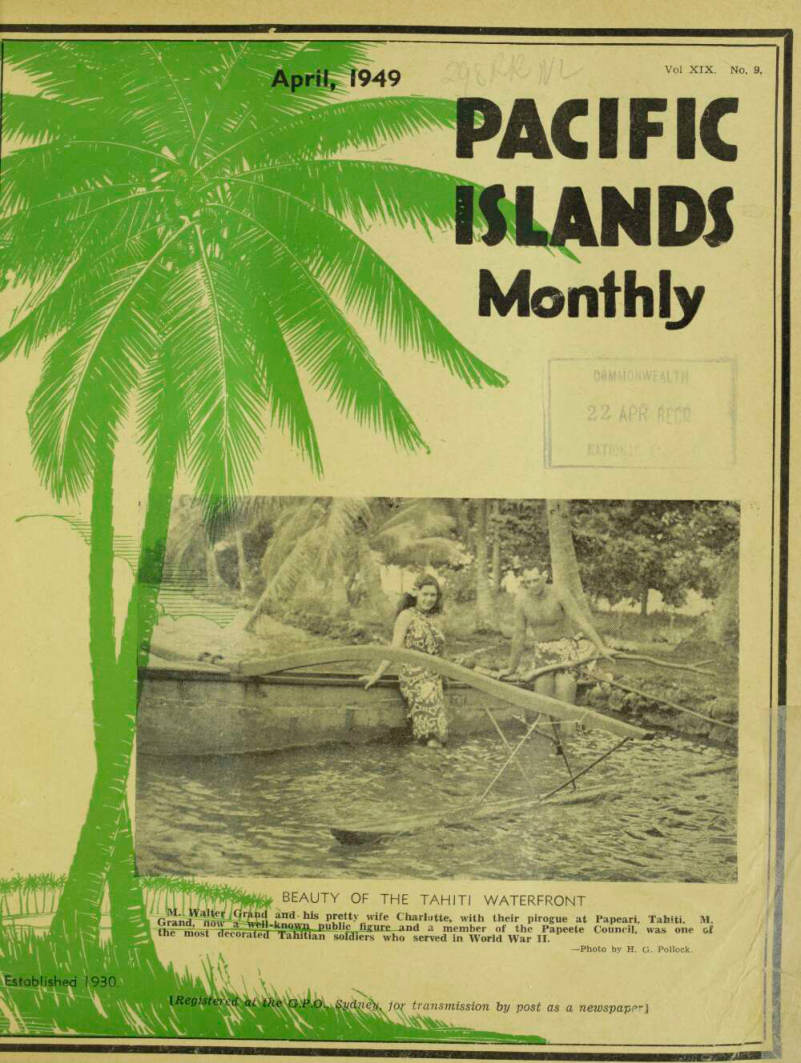
Beauty Of The Tahiti Waterfront
M. Walter Grand his pretty wife Charlutte, with their pirogue at Papeari, Tahiti. M.
Grand, now a well-known public figure and a member of the Papeete Council, was one of the most decorated Tahitian soldiers who served in World War Ì. —Photo by H. G. Pollock.
Advertisements & other items, pp. 2-4 (1 item)
Qafttaj
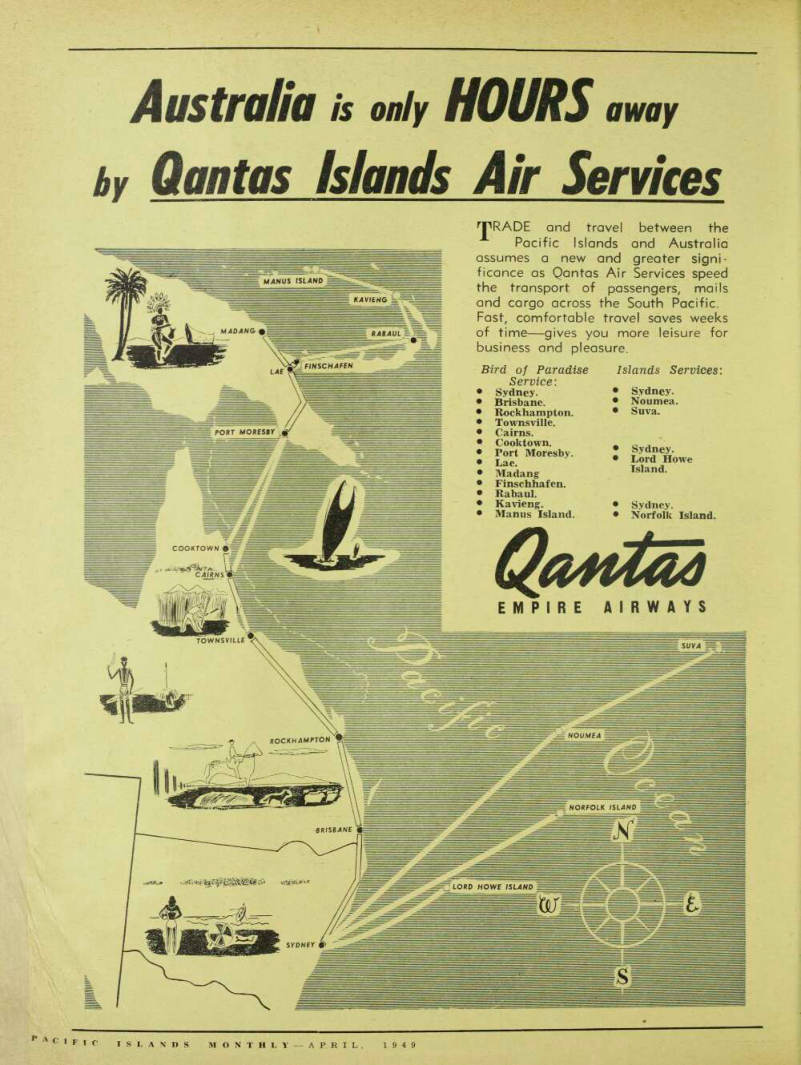
Australia is only HOURS away
by Pantos Islands Air Services
MANUS ISLAND
KAVItNO ~-^=
MADA NG
RABAUL
FINSCHAFEN
PORT MORESBY
cook to wn mm
CAIRNS
TIRADE and travel between the
Pacific Islands and Australia
assumes a new and greater signi-
ficance as Qantas Air Services speed
the transport of passengers, mails
and cargo across the South Pacific.
Fast, comfortable travel saves weeks
of time—gives you more leisure for
business and pleasure.
Bird of Paradise Islands Services'.
Service : Sydney.
Brisbane.
Rockhampton.
Townsville.
Cairns.
Cooktown.
Port Moresby.
Lae.
Madang Finschhafen.
Rabaul.
Kavieng.
Manus Island. • Sydney. • Noumea. • Suva.
Sydney.
Lord Howe Island.
Sydney.
Norfolk Island.
Qafttaj
EMPIRE AIRWAYS
TOWNSVILLE
suva ps
= NOUMEA
*r ROCKHAMPTON
NORFOLK ISLAND
X
BRISBANE
LORD HOWE ISLAND
SYDNEY
s
Col
WKW v . ,
. \ X. £ ■
eman
Instant-lite Petrol Lantern 300 or 500 C.P. wm Speed-master Petrol Stove
LANTERNS IRONS STOVES
THE BEST OF
THEIR KIND
Coleman appliances have for man/ /ears been bringing better ways of living to
people everywhere. They bring greater
comfort and happiness with better light . . . easier, faster ironing . . . more convenient, more healthful heating . . .
better cooking.
Over forty years’ experience in producing
these appliances have made Coleman Products “The best of their kind.”
Coleman’s appliances include:— Petrol and Kerosene operated Lamps, Lanterns, Irons, Stoves, Portable Stoves, Brazing Torches and Blow Lamps.
Kerosene or Petrol Table or Hanging Lamp Coleman “530’
Pocket Stove Coleman Kerosene Iron ■ 11 Kerosene 3 Burner Cooking Stove ■ ■■ > '" T Instant-lighting portable Petrol Cooking Stove Representatives for the Pacific Islands:
ROBERT GILLESPIE PTY. LTD.
S4a PITT STREET, SYDNEY
PEARCE & CO. LTD
SUVA
FOR FIJI ISLANDS
% Vi m Vi » c a m i K I 1
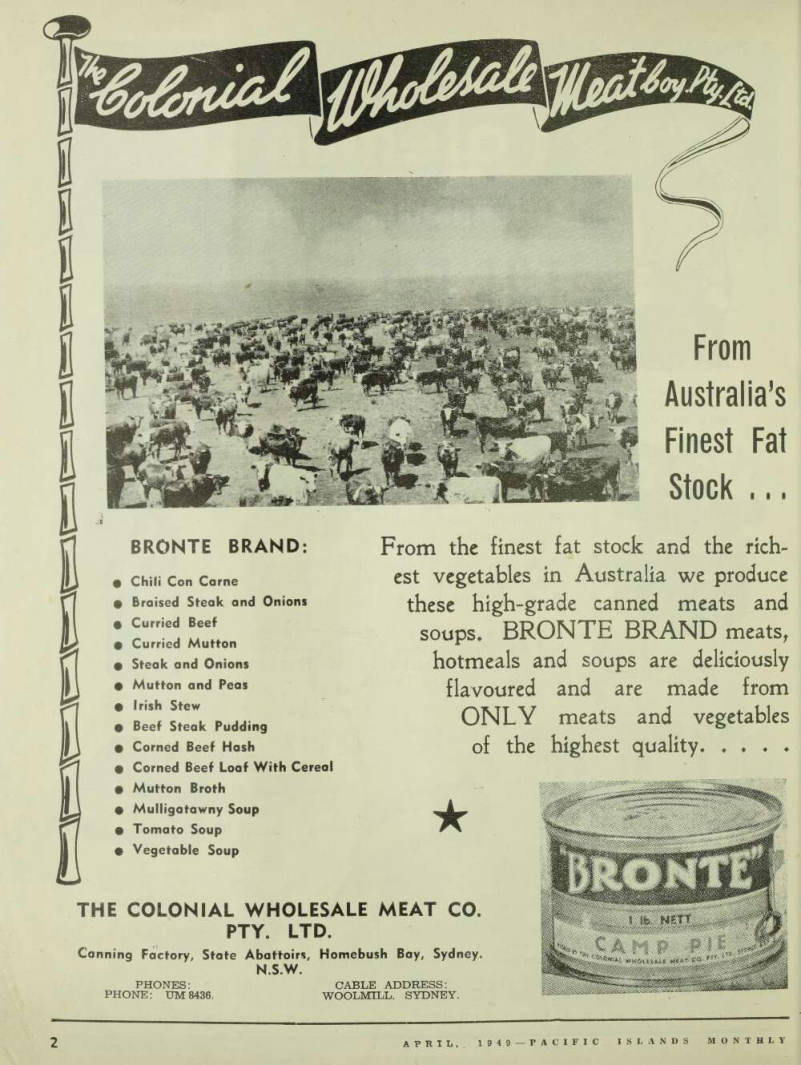
BRONTE BRAND
Chili Con Came Braised Steak and Onions Curried Beef Curried Mutton Steak and Onions Mutton and Peas Irish Stew Beef Steak Pudding Corned Beef Hash Corned Beef Loaf With Cereal Mutton Broth Mulligatawny Soup Tomato Soup Vegetable Soup
From
Australia’s
Finest Fat
Stock ...
From the finest fat stock and the rich-
est vegetables in Australia we produce
these high-grade canned meats and
soups. BRONTE BRAND meats,
hotmeals and soups are deliciously
flavoured and are made from
ONLY meats and vegetables
of the highest quality. . . . . ★
THE COLONIAL WHOLESALE MEAT CO.
PTY. LTD.
Canning Factory, State Abattoirs, Homebush Bay, Sydney.
N.S.W.
PHONES:
PHONE: UM 8436.
CABLE ADDRESS;
WOOLMTLL. SYDNEY.
V, m § .
Wm S amj - **
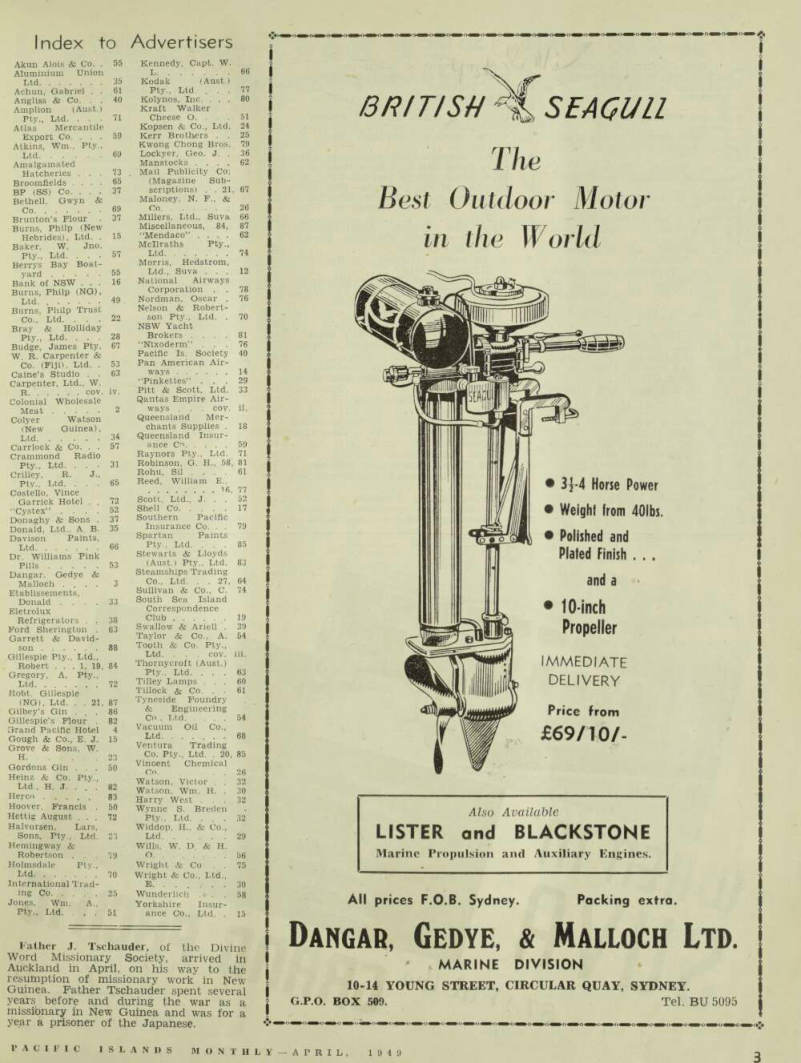
Index to Advertisers
Akun Alois & Co. . 55 Aluminium Union Ltd 35 Achun, Gabriel . . 61 Angliss & Co. . . 40 Amplion (Aust.) Pty., Ltd. ... 71 Atlas Mercantile Export Co. ... 59 Atkins, Wm., Pty., Ltd 69 Amalgamated Hatcheries ... 73 Broomfields ... 65 BP (SS) Co. . . . 37 Bethell, Gwyn & Co • 69 Brunton’s Flour . 37 Burns, Philp (New Hebrides), Ltd. . 15 Baker, W. Jno.
Pty., Ltd. ... 57 Berrys Bay Boat yard 55 Bank of NSW ... 16 Burns, Philp (NG), Ltd 49 Burns, Philp Trust Co.. Ltd. ... 22 Bray & Holliday Pty., Ltd. ... 28 Budge, James Pty. 67 W. R. Carpenter & Co. (Fiji). Ltd. . 53 Caine’s Studio . . 63 Carpenter, Ltd., W. r cov. iv.
Colonial Wholesale Meat 2 Colyer Watson (New Guinea), Ltd 34 Carrlock & Co. . . 57 Crammond Radio Pty., Ltd. ... 31 Crilley, R. J., Pty.. Ltd. ... 65 Costello, Vince Garrick Hotel . . 72 “Cystex” ... 52 Donaghy & Sons . 37 Donald, Ltd., A. B. 35 Davison Paints, Ltd 66 Dr. Williams Pink Pills 53 Dangar. Gedye & Malloch ... 3 Etablissements, Donald ... 33 Eletrolux Refrigerators . . 38 Ford Sherington . 63 Garrett & David son 88 Gillespie Pty., Ltd., Robert ... 1, 19, 84 Gregory, A, Pty., Ltd. ... 72 Robt. Gillespie (NG), Ltd. . . 21, 87 Gilbey’s Gin ... 86 Gillespie’s Flour . 82 Grand Pacific Hotel 4 Gough & Co., E. J. 15 Grove & Sons, W.
H 23 Gordons Gin ... 50 Heinz & Co. Pty., Ltd, H. J. . . . 82 Herco 83 Hoover, Francis . 50 Hettig August ... 72 Halvorsen, Lars, Sons, Pty., Ltd. 23 Hemingway & Robertson ... 79 Holmsdale Pty..
Ltd 70 International Trad ing Co 25 Jones, Wm. A., Pty., Ltd. ... 51
Kennedy, Capt. W.
L 66 Kodak (Aust.) Pty., Ltd. ... 77 Kolynos, Inc. ... 80 Kraft Walker Cheese O. . 51 Kopsen & Co., Ltd. 24 Kerr Brothers . . 25 Kwong Chong Bros. 79 Lockyer, Geo. J. . 36 Manstocks ... 62 Mail Publicity Co. (Magazine Sub scriptions) . . 21, 67 Maloney, N. F., & Co 26 Millers, Ltd., Suva 66 Miscellaneous, 84, 87 “Mendaco” ... 62 Mcllraths Pty., Ltd. 74 Morris, Hedstrom, Ltd., Suva ... 12 National Airways Corporation . , 78 Nordman, Oscar . 76 Nelson & Robert son Pty., Ltd. . 70 NSW Yacht Brokers ... 81 “Nixoderm” ... 76 Pacific Is. Society 40 Pan American Air ways 14 “Pinkettes” ... 29 Pitt & Scott, Ltd. 33 Qantas Empire Air ways . . . cov. ii.
Queensland Mer chants Supplies . 18 Queensland Insur ance Co 59 Raynors Pty., Ltd. 71 Robinson, G. H., 58, 81 Rohu, Sil . . . . 61 Reed, William E., l6, 77 Scott, Ltd., J. . . 52 Shell Co 17 Southern Pacific Insurance Co. . . 79 Spartan Paints Pty., Ltd. ... 85 Stewarts & Lloyds (Aust.) Pty., Ltd. 83 Steamships Trading Co.. Ltd. . . 27, 64 Sullivan & Co., C. 74 South Sea Island Correspondence Club 19 Swallow & Ariell . 39 Taylor & Co., A. 54 Tooth & Co. Pty., Ltd. . . . cov. hi, Thornycroft (Aust.) Pty.. Ltd. ... 63 Tilley Lamps ... 60 Tillock & Co. . . 61 Tyneside Foundry & Engineering Co . Ltd 54 Vacuum Oil Co., Ltd 68 Ventura Trading Co. Pty., Ltd. . 20, 85 Vincent Chemical Cn. .26 Watson, Victor . . 32 Watson, Wm. H. . 30 Harry West ... 32 Wynne S. Breden Pty.. Ltd. ... 32 Widdop, H., & Co., Ltd 29 Wills, W. D. & H. 0 56 Wright & Co . . 75 Wright & Co., Ltd., E. ... 30 Wunderlich ... 58 Yorkshire Insur ance Co., Ltd. . 15
Father ,1. Tschauder, of the Divine Word Missionary Society, arrived in Auckland in April, on his way to the resumption of missionary work in New Guinea. Father Tschauder spent several years before and during the war as a missibnary in New Guinea and was for a year a prisoner of the Japanese.
Advertisements & other items, p. 5 (1 item)
Dangar, Gedye, & Malloch Ltd.
BRITISH SEAOULI
The
Best Outdoor Motor
in the II
• 3f 4 Horse Power • Weight from 40lbs. • Polished and Plated Finish and a • 10-inch
Propeller
IMMEDIATE
DELIVERY
Price from £69/10/- Also Available
LISTER and BLACKSTONE
Marine Propulsion and Auxiliary Engines.
All prices F. 0.8. Sydney. Packing extra.
Dangar, Gedye, & Malloch Ltd.
MARINE DIVISION
10-14 YOUNG STREET, CIRCULAR QUAY, SYDNEY.
G.P.O. BOX 509. Tel. BU 5095
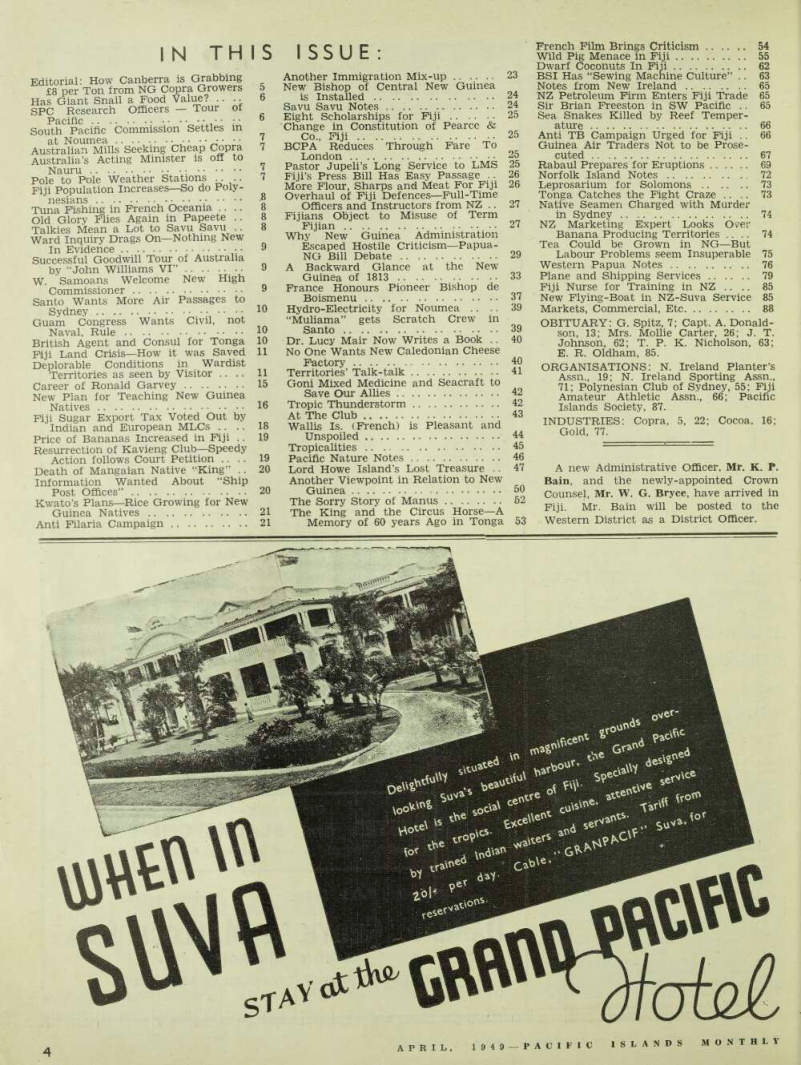
1 N This Issue:
Editorial: How Canberra is Grabbing £8 per Ton from NG Copra Growers 5 Has Giant Snail a Food Value? ... 6 SPC Research Officers Tour of Pacific South Pacific Commission Settles in at Noumea • • • A Australian Mills Seeking Cheap Copra 7 Australia’s Acting Minister is off to Nauru • • • • • A Pole to Pole Weather Stations ... 7 Fiji Population Increases —So do Poly nesians ° Tuna Fishing in French Oceania ... 8 Old Glory Flies Again in Papeete .. 8 Talkies Mean a Lot to Savu Savu .. 8 Ward Inquiry Drags On —Nothing New In Evidence .. • 9 Successful Goodwill Tour of Australia by “John Williams VI” 9 W. Samoans Welcome New High Commissioner 9 Santo Wants More Air Passages to Sydney 10 Guam Congress Wants Civil, not Naval, Rule 10 British Agent and Consul for Tonga 10 Fiji Land Crisis —How it was Saved 11 Deplorable Conditions in Wardist Territories as seen by Visitor ... 11 Career of Ronald Garvey 15 New Plan for Teaching New Guinea Natives 10 Fiji Sugar Export Tax Voted Out by Indian and European MLCs ... 18 Price of Bananas Increased in Fiji .. 19 Resurrection of Kavieng Club—Speedy Action follows Court Petition ... 19 Death of Mangaian Native *‘King” .. 20 Information Wanted About “Ship Post Offices” 20 Kwato’s Plans —Rice Growing for New Guinea Natives 21 Anti Filaria Campaign 21
Another Immigration Mix-up 23 New Bishop of Central New Guinea is Installed 24 Savu Savu Notes 24 Eight Scholarships for Fiji 25 Change in Constitution of Pearce & Co., Fiji 25 BCPA Reduces Through Fare To London 25 Pastor Jupeli’s Long Service to LMS 25 Fiji’s Press Bill Has Easy Passage .. 26 More Flour, Sharps and Meat For Fiji 26 Overhaul of Fiji Defences—Full-Time Officers and Instructors from NZ .. 27 Fijians Object to Misuse of Term Fijian 27 Why New Guinea Administration Escaped Hostile Criticism —Papua- NG Bill Debate 29 A Backward Glance at the New Guinea of 1813 33 France Honours Pioneer Bishop de Boismenu 37 Hydro-Electricity for Noumea .. .. 39 “Muliama” gets Scratch Crew in Santo 39 Dr. Lucy Mair Now Writes a Book .. 40 No One Wants New Caledonian Cheese Factory 40 Territories’ Talk-talk 41 Goni Mixed Medicine and Seacraft to Save Our Allies 42 Tropic Thunderstorm 42 At The Club 43 Wallis Is. (French) is Pleasant and Unspoiled 44 Tropicalities 45 Pacific Nature Notes 46 Lord Howe Island’s Lost Treasure .. 47 Another Viewpoint in Relation to New Guinea 50 The Sorry Story of Manus 52 The King and the Circus Horse—A Memory of 60 years Ago in Tonga 53
French Film Brings Criticism 54 Wild Pig Menace in Fiji 55 Dwarf Coconuts In Fiji 62 BSI Has “Sewing Machine Culture” .. 63 Notes from New Ireland 65 NZ Petroleum Firm Enters Fiji Trade 65 Sir Brian Freeston in SW Pacific .. 65 Sea Snakes Killed by Reef Temper ature 66 Anti TB Campaign Urged for Fiji .. 66 Guinea Air Traders Not to be Prose cuted 67 Rabaul Prepares for Eruptions 69 Norfolk Island Notes 72 Leprosarium for Solomons 73 Tonga Catches the Fight Craze ... 73 Native Seamen Charged with Murder in Sydney 74 NZ Marketing Expert Looks Over Banana Producing Territories ... 74 Tea Could be Grown in NG—But Labour Problems seem Insuperable 75 Western Papua Notes 76 Plane and Shipping Services 79 Fiji Nurse for Training in NZ .. .. 85 New Flying-Boat in NZ-Suva Service 85 Markets, Commercial, Etc 88 OBITUARY: G. Spitz, 7; Capt. A. Donald son, 13; Mrs. Mollie Carter, 26; J. T.
Johnson, 62; T. P. K. Nicholson, 63; E. R. Oldham, 85.
ORGANISATIONS: N. Ireland Planter’s Assn., 19; N. Ireland Sporting Assn., 71; Polynesian Club of Sydney, 55; Fiji Amateur Athletic Assn., 66; Pacific Islands Society, 87.
INDUSTRIES: Copra, 5, 22; Cocoa, 16; Gold, 77.
A new Administrative Officer. Mr. K. P.
Bain, and the newly-appointed Crown Counsel, Mr. W. G. Bryce, have arrived in Fiji. Mr. Bain will be posted to the Western District as a District Officer.
Advertisements & other items, p. 6 (1 item)
fofe^
sT *Vrf*-
.Irx- *«* '•“ »”“* “” W « """ bv '• rait ' ed V Cab b 1 d»f t»l« ? ns -
r ese^°"
a*** 8 "*
fofe^
Pacific Islands Monthly
The Newspaper-Magazine of the South Seas
L Registered at the G.P.0., Sydney, for transmission by post as a newspaper ] Published Once Each Month and Circulated in Australia and New Zealand and in the following Pacific Territories and Islands Groups:
Australian Territory ot Papua.
Trustee Territory (Australia) of New Guinea.
Australian Territory of Norfolk Island.
New Zealand Territory of Cook Islands.
Trustee Territory (NZ) of Western Samoa.
British Colony of Fiji.
British Solomon Islands Protectorate.
British Protectorate of Tongan Islands.
British Crown Colony of Gilbert and EUlce Islands.
Trustee Territory of Nauru.
British and French Condominium ol New Hebrides.
French Colony of New Caledonia.
French Colony of Oceania (Tahiti, etc.).
American Territory of Eastern Samoa.
American Territory of Hawaiian Islands.
Owned and Produced by Pacific Publications Fty., Ltd., Union House, 247 George Street, Sydney.
Vol. Xix. No. 9.
April, 1949
r 1/6 Per Copy Price Prepaid, p.a.: 15/- Aus. ( In USA. p.a.: $3.
How Canberra Is Grabbing £8 Per
Ton From NG Copra-Growers
The way in which the Socialist Government of Australia is with holding from the copra producers of New Guinea and Papua a substantial portion of the amount Britain now is
paying for copra is assuming the
appearance of a public scandal. Here are the facts.
DURING 1948, the Production Control Board (a Government instrumen tality created by Socialist Minister Ward to take all produce from Territories planters at a price fixed by Canberra— a system plainly devised to substitute State control for the operations of the trading firms) paid the planters, for copra, a price that was anything from £lO to £2O per ton under world parity.
About £ 8 per ton of this was placed in a Stabilisation Fund (to provide against a market slump). There is now about £400,000 in that Fund. In theory, it belongs to the planters. But no one has yet been able to get from the Australian Socialist Ministers any statement about the Fund.
During 1948, other British copra-pro ducing countries accepted the offer of the British Ministry of Food, that it would pay, over a period of nine years— subject to a yearly adjustment—a guaran teed price for copra. Australia accepted this agreement at the end of 1948; and, as from January 1 last. Britain is pay ing Australia £4B sterling (the equiva lent of £6O Australian) FOB at port of shipment. As Britain is quite prepared to pick up the copra at New Guinea ports, NG planters naturally assumed that they were to get £6OA per ton, or something pretty close to it. They were wrong.
ON March 3, in Canberra, the Acting Minister for Territories said; “The basis of a contract, designed to stabilise the copra industry of Papua- New Guinea under a long-term agree ment with the United Kingdom, has now been reached.
“The contract will be for a period of nine years. The price for 1949 is to be £4B sterling per ton, FOB, Territory Ports. The price for each subsequent year will not be more than 10 ner cent, higher or lower than the preceding year, and will be negotiated before the end of the preceding year.”
The Acting Minister said that, pre-war, Papua produced 13,600 tons p.a., and New Guinea 76,000. Total production, during and immediately after the war was 10,000 to 12,000 tons. It was now up to about 40,000 tons. It was hoped total production presently would rise to 60,000
tons. Australia’s normal consumption was about 25,000 tons per annum—it was expected that Britain now would take the balance.
As the foregoing still left us in the dark regarding the price to be paid to planters, we applied to the Department for information. We received the follow ing letter, dated March 30, from Mr. J. R.
Halligan, secretary of the Department: “I refer to the statement (of March 3) by the Acting Minister for External Territories regarding the Australia- United Kingdom copra agreement.
“It has now been practicable to con sider other matters regarding the copra industry of the Territory of Papua-New Guinea in the light of the agreement, and set out hereunder are details of the approvals given for the revision of copra prices:— Tentative Prices from 1/1/1949 Hot air/sun Smoke Port Moresby, S a m a r a i, Madang, Rabaul £4B £47 7 6 Kokopo £46 17 6 £46 5 0 Kavieng .. .. £45 17 6 £45 5 0 Final Price for 1947-48 (1) Final price for hot air/sun dried copra has been fixed £ 1 higher than the tentative prices already paid, and Final price for smoke dried copra has been fixed. (a) For period July 1, 1947 to March 31, 1948. £1 higher than the tentative price al ready paid; (b) for period April 1 to June 30, 1948, £4 higher than the tentative price already paid.”
AT first glance, it appeared that Can berra was going to give the Terri tories planters the full benefit of the British agreement—in other words that Mr. Halligan’s quotations were in Sterl ing. But inquiry showed that this was not the case—the quotations obviously were in Australian Currency.
This means that the Australian Gov ernment is going to follow its policy of “grab”, and take the full difference be tween £4B Sterling (paid by the British for the coora FOB at point of shipment) and £4B Australian—namely 25 per cent., or £l2 per ton.
This appeared extraordinary. The planter in Fiji, for example, gets £5O Fijian per ton—equal to over £56 Aus tralian. The same applies in other Terri tories under the control of the British Colonial Office. Why should the Aus tralian planter get only £4B Australian per ton?
It is recognised, of course, that there would have to be deductions from the £4B Sterling per ton, if it were allowed to the planter at point of shipment.
Those deductions would cover various costs shrinkage, damage, handling charges and insurance, between delivery into store and delivery into ship’s hold — and there also would be an export tax of £3 Australian per ton to be taken care of —probably, a total of £4 per ton.
But, even then, the New Guinea planter should get £56 Australian per ton (about the same as Fiji), Accordingly, we sent the following reply-paid telegram to Mr. Halligan, in Canberra: “Reference yours March 30, under stand these prices are Australian currency. What happens to 25 per cent, difference with sterling. Also, what about final smoke dried price be tween July/December, 1948? Fiji, etc., getting nearly full benefit of £4B Sterl ing. Grateful for some explanation as feel bound now to disclose full story of this extraordinary situation tt> Aus tralian press.”
Up to th 2 moment of writing we have had no reply or explanation. If any reply is received after we go to press it will be handed to the Australian newspapers.
IT has been assumed by New Guinea planters that they would receive pay ments from Canberra to take care of the fact that, although the Production Control Board has been making a sub stantial difference in payments for hot air and/or smoke-dried copra, the over seas consumers in fact have been pay ing full price for the lot, making little difference between different classes of copra.
Canberra now ha c recognised this claim (see Mr. Halligan’s letter) but there is as yet no indication of what is being done in this respect to cover the period between July 1, 1948, and January 1, 1949, when the new price, based on the British agreement, came into operation.
Finally there is the mystery of the Stabilisation Fund. During 1946-48, the Production Control Board has deducted from payments due to all planters a sum ranging from £6 to £8 per ton, where with to build up this plan which had some merit.
With the British agreement guarantee, extending over nine vears, there is no further need for a Stabilisation Fund.
Canberra, therefore, was expected to; • Distribute pro rata among the plan ters the Fund which is now believed to be in the vicinity of £400,000. • Discontinue the deduction of so much per ton for the Fund from plan ters’ payments.
So far, Canberra has apparently de clined to do either. Nothing whatever of an official nature has been said in re
lation to the Stabilisation Fund—there still is no assurance that this large sum will be distributed to planters.
This writer, knowing something of the strange way in which the minds of Socialist Ministers work, would not be surprised if an attempt is made by Can berra to grab the whole of this Fund for some such fancy scheme as providing boots for the natives, or a private plane for the Territories Minister.
Summed up the position appears to be this: The producers are going to get the equivalent of £4B Australian at main ports of shipment—a very good return.
But they are entitled to everything they can get.
The difference between £4B per ton Australian and £4B per ton Sterling is being grabbed by the Australian Govern ment. We can account for perhaps £4 of the difference—but where does the other £8 go?
The planters are going to get tjhe difference between what they were paid for smoke-dried, and the overseas price, from July 1, 1947, to June 30, 1948. But there is no indication of when Canberra will distribute the Stabilisation Fund, and the difference between smoke dried and overseas price, from July 1 to December 31, 1948.
Mcphee’S Paintings On Show
In Sydney
THE South Seas artist, Mr. Charles McPhee, who arrived in Sydney a short time ago from Samoa, has placed a number of his paintings on view at the Fine Art Gallery, on the fourth floor of Anthony Hordern & Sons, Ltd., Sydney.
Most of Mr. McPhee’s Pacific Islands landscapes have a unique and undefinab’e quality that usually arrests attention wherever they are shown. He has suc ceeded, in a remarkable degree, in capturing that quiet lagoon atmosphere, and the background of brilliant tropical greens, that are so characteristic of Islands scenes.
He has brought a couple of score of his paintings to Sydney—mostly Samoan subjects—and persons who like to buy pictures that somehow are different, al though real works of art, should look this collection over.
Mr. McPhee may be seen at offices of National Display Co.. Albion St., Sydney —telephone MA9651.
Easter Islanders On The
Long Way Home
Prom Our Own Correspondent PAPEETE, March 30.
THE Easter Islanders—four adults and two children—who made that in credible open boat voyage from Easter Island to the Tuamotus (1,800 miles) at the end of 1947, finally left Papeete on the “Eridan” on March 16.
Under arrangement between the French Governor and the Government of Chile (owners of Easter Island), they are being sent to Cristobal; from there they will go to Chile; and thence back to their lonely and isolated home on Easter.
From the time that the boat was blown to sea, on December 23, 1947, until it drifted onto Reao, in the Tuamotus, six weeks elapsed. The six Polynesian people from Easter, who speak only Spanish, kept themselves alive on a strict dole of fresh rainwater, received from the clouds, and fish, which they took from the sea.
Officers
Spc Research
Examine Eight Territories In 5 Weeks
MAKING use of service and chartered planes, four of the principal officers of the South Pacific Commission completed a comprehensive tour of the South Pacific at the end of March, when they arrived in Sydney on their way to the Commission’s Headquarters in Noumea. They were:— Dr. L, G. M. Baas Becking, Deputy Chairman of the Research Coun cil.
Mr. H. E. Maude, Deputy Secretary- General of the Commission (tem porarily carrying on the duties of full-time Research Officer in the field of Social Development).
Dr. E. Massal, full-time Health Of ficer of the Research Council.
Dr. H. G. MacMillan, full-time Eco nomic Development Officer of the Research Council.
Between February 26, when they left New Zealand, and April 3, these gentle men planned a tour as follows: — February 26-March 4: In Suva, capital of Fiji, and headquarters of the Western Pacific High Commission.
March 4-9: At Apia, Admn. Hdqrs. of Western Samoa.
March 9-11: At Rarotonga, Admn.
Hdqrs. of Cook Islands.
March 12-15: At Pago Pago, Admn, Hdqrs. of American Samoa.
March 16-20: At Honiara. Admn. Hdqrs. of British Solomon Islands.
March 20-21: At Lae, Australian New Guinea.
March 21-24: At Hollandia, Dutc . I ew Guinea.
March 24-26: At Lae, Australian New Guinea.
March 26-31: At Port Moresby, Admn.
Hdqrs. of Papua-New Guinea.
Owing to dislocation of plane schedu’es, the Honiara visit was omitted.
The officers reported, on their arrival in Sydney, that they had everywhere been received with courtesy, and their search for information had been greatly assisted by the local Administrations. They had accumulated a great deal of valuable in formation which would be put in f o shape, and made readily accessible, when they had settled down in the Commission’s new Headquarters in Noumea.
The officers proceeded from Sydney to New Caledonia by plane after a week in Sydney, in which they had many inter views with experts on the fields of health, education, economic development, anthro pology, etc.
Ex-Service Doctors For
New Guinea
A FORMER flight-lieutenant in the RAF, and a specialist with the RAMC, are among the three migrant doctors (all ex-Servicemen) who are being flown from England to help relieve the acute shortage of medical officers in New Guinea. They are Drs. W. Boyd, G. C.
Tweedle and A. P. Maruff. All are in their thirties.
Dr. Boyd served with Fighter Com mands in Britain and in South-East Asia.
Dr. Tweedle was a surgical specialist, 1942-1946, and held rank as Major. Dr.
Maruff, who served in India from 1941 to 1947, held rank as Major.
Worth £266,000,000
Ni Family Claims Estate
11THEN Robert Edwards lived in America ▼ ▼ last century, he gave to his son leasehold titles over Manhattan (New York) land now estimated to be worth £266,000,000. A family in Norfolk Island claims the fortune.
Robert Edwards migrated from Wales to New York in 1830, and married a Dutch woman. He had one son, John Henry, who went to sea and became a world wanderer. Robert gave this son certain documents showing him to be owner of 50 acres of leasehold land on Manhattan.
John Henry came to Norfolk Island with his little ship, the “St. Kilda,” and event ually settled there. It was he who carried back to Pitcairn, the section of original Pitcairners who did not like Norfolk and so returned “home.”
John Henry had those documents with him when he died in 1906. His son, Charles Robert, who has lived most of his life on Norfolk, and is now 75, says the deeds were there once, but now have dis appeared. He and his son, Victor Edwards, 48, curator of the island’s famous convict grave-yard, are now press ing their claim to the fortune. The American authorities, about 1912, began to seek the owner of the 50 acres on Manhattan—now fabulously valuable—but the Edwards family of NI did not know of the quest until quite recent times. —Condensed from Sydney “Sunday Sun.”
Snail
Has The Giant
A Food Value?
SUFFERERS from “Giant snails” in New Britain, New Ireland, New Guinea (Madang area) and some of the islands of Micronesia (brought in by the Japanese in 1942-44) will be interested in the following article in the March issue of “Corona” (the new British Colomal Office publication):— In 1947 the Botanical Department of the Hongkong Government collected and destroyed over ten thousand pounds of “Giant African” snails. The scientists tell us that Achatina fulica reached Mauritius from East Africa a century ago.
India by 1910, Sarawak by 1928, and the mainland of China by 1948—a Snail’s Progress. We are, however, also told that the snails made a “dramatic appearance” in Hongkong in 1941.
The Japanese ate them. In Africa these snails, or others —and a Giant by any other name should taste as sweet —are collected by the ton each year. But they are not destroyed, they are sold expen sively on delicatessen stalls in all the local markets. The Japanese ate them. The Africans do it. The French, thank God, do it. Why then do the hardworking Chinese labourers of the Hongkong- Botanical Department destroy them?
Ketch For Cook Is.
THE NZ Islands Territories Department has taken over the ketch. “Ranui,” and is sending her from Wellington to Rarotonga, to maintain a trading and passenger service in the Cook Islands.
She will sail at the end of April.
The death occurred on March 19 of Madame Pierrot Coulon, formerly Margot Lehartel, a young and popular resident of Papeete. She was involved in a road accident on the island of Tubuai some three years ago, and injuries she then received eventually caused her death.
Her grandparents went to Tahiti in the old sailing ship days.
South Pacific
Commission
Settling-In In the Pentagon, Noumea
BY the end of March, the officials and staff of the South Pacific Commis sion, transported from Sydney in three parties, by air, had settled in the Commission’s new headquarters, in the Pentagon Building, some 21 miles out side Noumea, in New Caledonia.
The French Government has given most complete co-operation, in altering the building and in providing all kinds of amenities. The NC Treasury allocated 3,200,000 Pacific francs for this work in December, and another 800.000 in March —altogether £25,000 Australian.
The majority of the officials, and their families, are in residence at the Penta gon, where suitable apartments, with central kitchen and messing equipment, have been provided. “Transit” quarters also are being provided for the numerous persons who will be coming and going.
The Research Council officers have now arrived in Noumea after a lengthy tour of the Pacific (see article elsewhere), and are making preparations for the first Council session on April 30.
THE Commission will hold its nertt meeting there on May 7. The French chairman will retire in favour of the Netherlands delegate, whose turn it is to preside. M. Lasselle Sere is still First Commissioner for France. M. Bonnard.
Head of Cabinet in Noumea, is Second Commissioner.
Brigadier Hunt, of New Zealand, is acting for six months as immediate As sistant to the Secretary General, Mr. W.
D. Forsyth. The Deputy Secretary General, Mr. H. E. Maude, is acting for the present as Social Development Officer of the Research Council (an important position that was not filled at the October meeting in Sydney).
Towards the end of May, after the heat and dust of removal from Sydney, plus a Council and a Commission meet ing, have cleared away, this new and im portant organisation will settle down to its routine duties, and a more normal life.
Service
Dr. C. M. Dawson Leaves
Islands After Long Years’
SUVA. April 4.
R. C. M. DAWSON, who since 1913, when he first went to Niue, has been widely known as a popular medical man in Niue, Samoa, Tonga and the Cook Group, called at Suva in the “Matua” on April 2 on his way from Niue to New Zea land, where he intends to retire.
Dr. Dawson claims that he has dis covered the cause of the common attacks of so-called jaundice in the Islands. He diagnoses the sickness as Weil’s Disease, caused by a wriggling microbe which does its best to destroy the blood, attacks the liver, kidneys and lungs, and sometimes the cerebro-spinal system.
He says that it was prevalent in North Africa during the war. At Niue it is a notifiable disease. Relief is secured by mass doses of penicillin.
Dr. Dawson’s diagnosis has been con firmed by Sir Raphael Cilento, former head of the Islands Medical Service of Australia and now stationed in Palestine.
Are Seeking
Australian Mills Are Seeking Cheap Copra
WITH reference to our main article, on New Guinea copra, it is reported that the Canberra authorities have fixed the following prices, which they are charging the Australian copra-crushers for New Guinea copra: Hot-air £66 per ton Sundried £66 per ton Smoked £65 7 6 per ton It is reported also that the crushing mills are not happy about the prices they are being charged. They do not see why they should pay the same as Britain. (Copra, bought for £4B sterling in New Guinea, would be worth between £6O and £7O Australian on arrival in Euro pean port).
There is a move afoot to force the Aus tralian Government to sell the 25,000 tons of NG copra, required per annum for Australian consumption, to Australian crushers for less than the price Britain is paying. NG will resist this. Why should New Guinea planters be penalised for the benefit of Australian consumers?
Australia does nothing for the New Guinea planters, except force up to ridiculous levels the costs of nearly everything that the planter has to buy in Australia.
It is reported that last December Messrs. W. R. Carpenter & Co., Ltd., bought from PCB a cargo of copra, in Rabaul, for £7O per ton, and took it to Vancouver. The PCB paid the New Guinea planters, for that copra, just over £4O per ton. And Mr. Ward called the Big Firms “exploiters”
Being Built
Vernon Memorial Hospital
From Our Own Correspondent
Daru, Papua, March 26.
FRIENDS of the Bamu River Mission will be interested to know that, at long last, work has been commenced on building of the “Dr. Vernon Memorial Native Hospital” buildings.
This has been made possible by the generosity of Mr. G. Gwilliams, of' Syd ney, who came to assist in the erection.
Whilst they are waiting for more Euro pean material for the dispensary-labora tory, two wards are going up, together with a special ward and necessary offices —also a hostel for aged Papuans.
This latter is a new venture and, as far as is known, the first such special effort for aged in Papua.
Recently, the Mission was moved to a new site further up the Bamu River, where there is higher ground, more suit able for building.
Mr. George Spitz, a leading resident of Papeete, Tahiti, died in Paoeete on March 13.
Mr. o. Soltwedel—an old New Guinea identity who was deported by the Aus tralian Government—writes from Ger many to say that he finds life in that war-battered region very difficult, after an absence of nearly 40 years. He is living in the country with a nephew, who was with him for a while in New Guinea, and they are not finding it easy to make a living. He has been in consultation with an American group who are in terested in New Guinea minerals, and he hopes he yet may have a chance to re turn to the Territory.
He’S Off To
Nauru!
Australia’s Territories Minister
THE Australian Acting-Minister for Territories, Mr. Chambers, went off on what is more or less a pleasure cruise at the end of April, leaving Papua- New Guinea affairs (especially in relation to copra) in a state of confusion—see articles elsewhere.
Mr. Chambers joined the phosphate ship “Triadic,” en route to Nauru—sometimes called Pleasant Island. He expects to be absent for a month.
Nauru is held under Trusteeship by Australia, Britain and New Zealand, jointly. By agreement, Australia takes responsibility for administration. There is a small community of Nauruans (Micro nesians, with a strong affinity with Poly nesians) , but most of the island’s activities are grouped around the large phosphate industry, in which the British Phosphate Commission employs large numbers of Chinese and Gilbertese.
A small royalty per ton of phosphate is paid to the credit of the Nauruans.
They, and the Banabans of Ocean Island, similarly treated, are easily the richest natives in the Pacific.
But the Nauruans are not happy. They have been petitioning the Trusteeship Council, asking for a larger share in local administration. Russians and similar mischief-makers on the Trusteeship council have taken up their case vocifer ously, as a means of annoying the Trustees.
There has been nothing wrong with the administration and there was only one way to treat the Nauruans who, notori ously, have been pampered and spoiled.
But the Australian Socialists, with their sensitive Brown Brother complex, have de cided that this matter needs their most urgent attention—and the Minister him self has gone off to deal with it, leaving Papua and New Guinea to stew in their own copra.
The Administrator of Nauru, Mr Ridgeway, is quite competent to handle the situation. But, that way, there would have been no tropical picnic for the Minister. And how these Socialists love to go tripping around!
For Long-Range Forecasting
Pole-to-Pole Weather Stations For Long-Range Forecasting
SOME day, when Pole-to-Pole weather stations are establshed and furc tionmg, and a little irore is known about weather cycles it miv be possible to forecast good or bid season for various crops, . This’s the opinion of Mr. J. W. Hatch ings who was the organising secretary of the meteorological section of the Pacific Science Qongress that was rece itly held in New Zealand.
Recommendations by the meteoro’ogical committee that weather s f at be set up, linking the South with the North Pole are already being put into effe.t but new upper-air research stat : ons must be established at Little America in the Ant arctic, on Norfolk Island, New Hebrides Guadalcanal, Bougainville, Tarawa and so on a line northward. The gaps in this chain would be filled bv weather ships. The chief purpose of these will be the recurring fluctuations in the weather —it is already known that in parts of the Pacific, weather occurs in a three year cycle.
The new Governor of French Oceania, M. Anziani, who has succeeded M.
Maestracci, was expected to arrive in Tahiti by the “Ville d’Amiens” early in April.
Fiji Population
Indians Maintain Their Natural Increase
mHE following is the estimated popula -1 tion of Fiji on December 31, 1948.
It will be noted that all races except the Chinese have increased and the most marked increase is by Europeans (unex plained) and by Indians. The Indian rate of increase still is nearly double that of the Fijians. Many Chinese, during 1948, departed for China.
1948 1947 Europeans 6,159 5,376 Part Europeans 6,530 6,341 Fijians . 123.995 121,249 Other Islanders 4,010 3,823 Rotumans 3.487 3,403 Indians . 129,761 125,674 Chinese 2.804 2,891 Others 626 517 Totals , . 277,372 269,274
More Polynesians
How All Branches of The Race Are Now Increasing
SUMMARISING his impressions before returning from New Zealand to his job of Director of the Bishop Museum in Honolulu, Sir Peter Buck, in April, re ferred to the remarkable growth of the Maori population.
Fifty years ago, the Maoris did not number more than 40,000, and the com munity was shrinking. To-day, there are 110,000 Maoris in NZ, and they are in creasing steadily. Sir Peter is confident that Pakeha and Maori will merge hap pily in New Zealand, for the benefit of that growing Dominion.
The revival of the Maori race is no isolated incident, however. It is a pheno menon common throughout Polynesia.
Fifty years ago, it seemed that Samoans, Tongans, Cook Islanders, Tahitians and Hawaiians were doomed. To-day, every one of those communities has more or less doubled in size, and is growing healthily.
Even the Fijian race (Polynesians based on sturdy Melanesian stock), which seemed to be staggering at the opening of the century, are now increasing satis factorily in numbers.
These South Pacific Territories provide an interesting example of how primitive races will fall away under the impact of European penetration and then, in cer tain circumstances, will make a strong re covery.
Rabaul Wedding For
Miss Marjorie Allan
Miss Marjorie Allan, Younger
daughter of Mr. and Mrs. J. T.
Allan of Gilalum Plantation, Kokopo, New Guinea, was married on March 12, to Mr. Lionel Mansfield, also of Kokopo. The bride’s sister, Mrs. Wheeler was matron-of-honour and Mr. Wheeler was best man.
The ceremony took place at the Metho dist Church, Rabaul, and the 120 guests were afterwards entertained at a recep tion in the Kokopo Club. The church was decorated by Rabaul friends of the bride and groom; Kokopo friends decorated the Club for the receptipn which was one of the most successful social functions ever held in the district.
Major D. C. C. Trench, secretary of the Solomon Islands Government, arrived in Sydney at the end of March in the Australian frigate “Culgoa.”
Tuna Fishing In French
Oceania
Prom Our Own Correspondent PAPEETE, March 30.
THE tuna fishing industry seems to be full of promise. The motor-ships “Hawaiian Tuna” and “Marlin" sailed on March 19 for Honolulu, by way of the Marquesas Islands, after a most successful trial run in Tahitian waters.
They are expected to return in about three months.
M. Emile Lagarde, delegate to the Rep resentative Assembly, accompanied them to Honolulu to continue discussions of plans and supervise their eventual return to this area.
New Mission Ketch For
Solomons
4O-ft. auxiliary ketch, “Cicely II,” launched in Auckland recently, is expected to sail at the end of April for the Solomons, to replace the original “Cicely” (lost in the war) in the work of the Methodist Mission. She is Dowered by a 30 h.p. diesel: Captain Carl Johnson is in charge; and Mr. F. G. Gresham is engineer.
Papeete
‘Old Glory’ Flies Again In Papeete
THIS building is the former American Consulate in Papeete, Tahiti, which was closed on October 31, 1948.
As the Stars and Stripes had waved in front of this building for 116 years, a prominent member of the community, a friend of French, British and American interests, through the Chef de Cabinet, Monsieur Rene Haza, asked the Gover-
nor’s permission to fly the American flag on the same flagstaff as of old, on the American national holiday, George Washington’s Birthday.
This was granted, and on February 22, “Old Glory” was seen again in its ac customed place. As this building is now a private residence, the French flag flew side by side with its American brother, a symbol of the ancient friendship of these two great nations.
Recent additions to the medical men practising in Tahiti include Dr. Andre Tourneux, lately of Paris, who has re sumed practice in association with Dr.
Andrea de Balman, and Dr. Begon, a recent arrival from France.
Talkies Come To Savu
Savu
What 16 mm. Film Does For Isolated Native Villages
Prom a Special Correspondent
Savu Savu, Fiji.
SA dua na yaloyalo uasivi e a vakar aitaki ena bogi ena noa, ko ya na Kaupoi. A sabu sabu, sa matai dina sara la ko Roy Rogers kei na nona ose vulavula, ko Trigger.” (An excellent Cow boy picture was shown last night. My word, Roy Rogers is a real expert, and so is his white horse, Trigger.) Thus remarked one of our Fijian picture fans: and, judging by the loud applause of the large native audience which at tended “Parr’s Pictures" for the first real Cowboy film shown at that theatre, on March 4, 1949, this was the general opinion.
“Parr’s Pictures” started operations in November, 1948, and they have given residents of this district of Vanua Levu
island, Fiji, an opportunity of weekly entertainment which is much appreciated.
As the native population is greatly in the majority in Savusavu, however, it is necessary to cater more for them than for Europeans, in order to increase financial returns. The class of films hitherto dis played have been too good, and beyond the intelligence of the natives who, for the most part, do not understand sufficient English to follow the “talkies." They dearly love a film crowded with action, fighting, and chasing. Mr. C. G. O. Parr hqs arranged with the Metro-Goldwyn Mayer Company (with whom he has a contract for the supply of 16 m.m. films) to send him regular Cowboy pictures in future. This Company also hires films to Mr. Val Tarte, of Taveuni, and to the managers of Rabi Island who are in the same “Circuit."
Mr. Parr deserves success and encour agement for his enterprise, which was es tablished mainly for the benefit of the “Peter Murray Practical School," of which Mr. Parr is the Principal. Mr. Parr also has a coconut plantation and a photo graphic studio, and he runs a co-opera tive store, which is shared in by the boys of the school. He has an able assistant in Mrs. Parr.
The “theatre" which was erected almost entirely by the schoolboys them selves has a thatched roof, with open sides, and is very cool and comfortable.
There is seating capacity for about 270 on the substantially-made bamboo seats. The screen is of Masonite; there is no flicker or billowing, and the sound effect is ex cellent. Cool drinks, sweets, tea and cakes, and kava are among the refresh ments obtainable on picture nights.
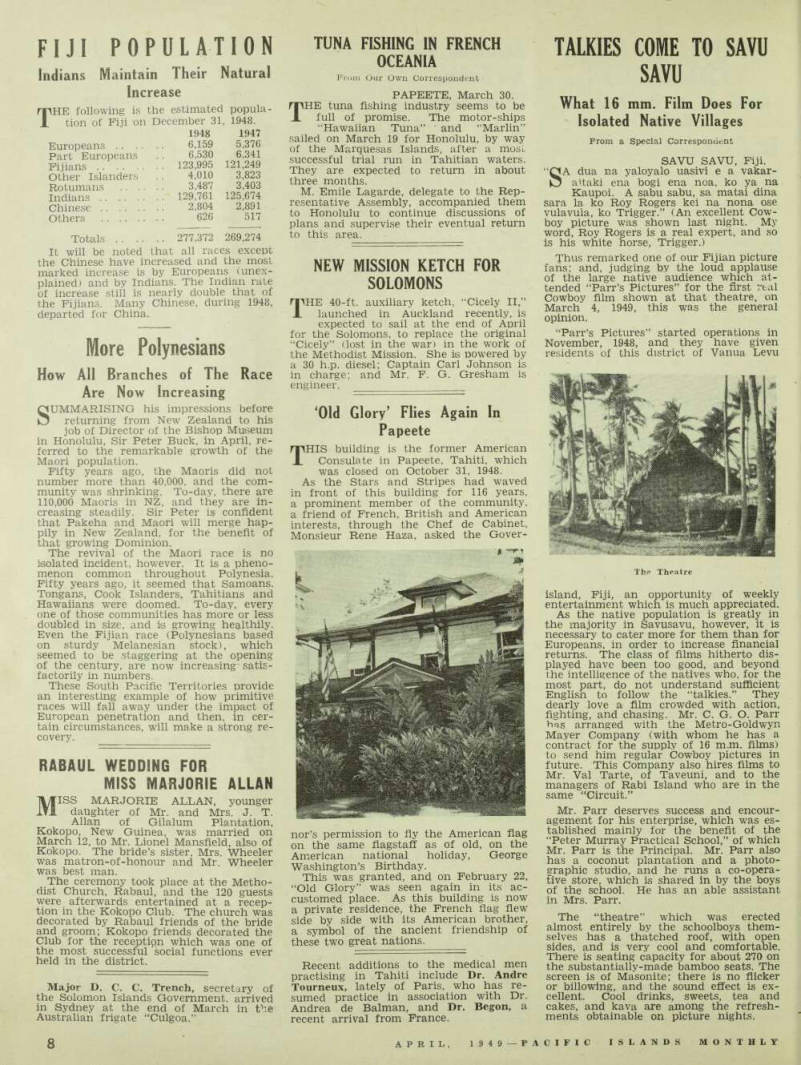
The Theatre
Ward Inquiry
Drags On
Nothing New In Recent Evidence
THE inquiry, by an Australian Royal Commissioner, into the alleged con nections of Territories Minister, E.
J. Ward, with what has been called the New Guinea Timber Lease Case, dragged wearily on through 45 sitting days, and the evidence by witnesses came to an end on April 7. The Commission will resume on April 28, when counsel will address the Commissioner.
It is estimated that the four trials and this present inquiry will cost the country £60,000.
It is apparent that there will be no re port by the Commissioner to the Austra lian Government until June. Nothing will be done in relation to the Territories port folio until the report is in.
That, in turn, means that Papua-New Guinea will have been virtually without Ministerial direction and control for 18 months. Mr. Ward —at his own request —was relieved of his portfolio in January, 1949; but, actually, he has been so deeply concerned with the Timber Case since December, 1947, that the Australian Terri tories appear to have had little of his attention. The Army Minister (Mr.
Chambers) has acted as Territoiies Min ister since January.
There was little in the evidence given before the Commission in late March and early April to excite attention. The Corn months. Mr. Ward —at his own request the evidence submitted; but all the later evidence appeared to have been brought forward by the interests defending Mr.
Ward; and, generally, it all has been in favour of Mr. Ward.
During the four Crown prosecutions which resulted in the gaoling of Mr. Jock Garden, and the acquittal of Messrs.
Garden, Harcourt Garden and Parer on charges of conspiracy, Mr. Jock Garden (Mr. Ward’s chief accuser) was repre sented by Mr. S. Isaacs, a barrister who subjected certain witnesses to a gruelling cross-examination, and who thus gave prominence to some very serious charges against Mr. Ward. But, early in the pre sent inquiry, Mr. Isaacs disappeared and Garden returned to gaol. The only person at the inquiry who showed hostility in cross-examination of the numerous wit nesses who gave evidence favourable to Ward, and of Ward himself, was Jock Garden’s son, Harcourt Garden.
Ward was defended by a very able bar rister, in Mr. Miller, KC.
MR. WARD gave a complete denial of all the charges brought against him; and, although he was on the witness-stand for two or three days, his evidence appeared consistent and un shaken. A long line of witnesses, includ ing the Prime Minister, bore testimony to Mr. Ward’s good reputation and to the unsuspicious character of his bank ac counts. Mr. Ward, under examination, gave an explanation of all the circum stances which, according to earlier evi dence, might have suggested that he knew something of the attempts (that went on around him for three years) to obtain a timber lease for Ray Parer and the syndi cate. He declared that he knew nothing of the Garden-Parer-Farrell plan to get the timber licenses and that, as scon as he recognised what was afoot, he placed the whoie matter in the hands of the law authorities.
A “Sun” newspaper reporter caused a slight stir, towards the end, by saying that during the earliest criminal prosecu tion he had been privately told by Mr.
Isaacs that, if the Gardens and Parer
were charged jointly with conspiracy, “We will say that Ward was in it.” Mr. Ward’s defenders said that this was evidence that Mr. Isaacs had done some improper pianmng. The reporter, asked why he had delayed 15 months before making his disclosure, said that he had been unwill ing to betray a confidence, but the barris ter s words “had burned themselves into his (memory.” Mr. Isaacs has referred tn «r matter to the Law Council of NSW We are not permitted to comment upon this extraordinary case until Mr. Justice Ligertwood has submitted his report to the Prime Minister. . Ifc is expected that this Royal Commis sion inquiry will be followed by an appeal by Jock Garden against his conviction for forgery, on the ground that new evidence (that of Farrell) at the inquiry had tended to prove Garden’s innocence of the crime (forgery) of which he was convicted.
Successful Goodwill Tour
Of Australia
“John Williams VI” is Visited by Thousands of Australians
THE 400-ton LMS ship “John Williams VI” received an enthusiastic welcome in Australian capital cities in March and April when she was on a tour of goodwill. The tour was originally de signed to show Australian Sunday-school children “their ship”—all the ships of the John Williams line have been purchased with money contributed by the Sunday school children of the United Kingdom and Australasia. But this trim little white and blue ship flying the LMS flag (a purple pennant bearing a white dove of peace) has appealed to the imagination of adults as well, and in every capital port thousands visited het.
The ship is manned by a Gilbertese crew and, while in Australian ports, was carrying Polynesian missionaries on their way home for leave after service in Papua Crew and passengers entered into the spirit of the goodwill tour and delighted their visitors with native songs and dances.
Master of the ship is Captain Stanton Page who is well known to all Eastern Pacific residents. In November, 1943. he and Captain G. J. Webster of Fiji, piloted the American invasion fleet through the narrow reefs of Tarawa lagoon and so helped materially in the capture of Betio by US Marines. For this Captain Page a nd Captain Webster were subsequently awarded the US Bronze Star for con spicuous service. . To-day however, Captain Page is more lr k *} i£ L P° cket “battleship of peace, the sixth John Williams of her line Sins C ?L^ I l 0 H ti i er John Williams name d.f. or the pioneer missionary), fe Vo imf en sailm S tb e seas for the LMS for 105 years. “John Williams V” was wrecked on a reef off Western Samol during bad weather, in December 1948 “John Wiiliams VI” Was then SiherWay out from England to her base in Suva fh-mcess Margaret named the ship aT a ceremony in London last August
Cost of Living in Fiji
ACCORDING to the latest European cost-of-living index, issued in Fiji by Mr C. H. Came, living in the Colony now costs 74 per cent more than 1939. . T* l6 ba se year is taken to be 1939 and is f lVO^/r an * nc *f x 10®- The index number for March, 1949, was 174—two per cent, more than in December, 1948, but the same as the index for September, 1948.
Mr. Came seems to think that cost-of- Hvmg will rise even more, shortly.
High Commissioner
W. Samoans Welcome New High Commissioner
From Our Own Correspondent THE new High Commissioner of Western Samoa, Mr. G. R. Powles and Mrs.
Powles, accompanied by Captain Whitlock and Mrs. Whitlock arrived in Apia on March 1 on HMNZ frigate.
“Hawea.”
They were given a traditional Samoan welcome, with European and Samoan re presentatives assembled to be presented and a Samoan ceremony including dances, songs |&nd speeches of welcome at the Samoan capital, Mulinu’u The new High Commissioner, who, as announced from Wellington, will follow the same policy as his predecessor, Col.
F. W. Voelcker, has so far made few pub lic appearances and is busily investigating Government activities and getting ac quainted with the various problems of the Territory.
Captain E. Olsen, who has been in Sydney recently in command of the Matson freighter “Ventura”, is the same Captain Olsen who was in command of the American ship “Golden Bear”, which helped evacuate citizens of Rabaul when the volcanoes erupted in 1937.
Monsieur Borgeau, Administrator of Colonies Ist Class, and New Caledonia’s wartime Secretary-General, has been made a Chevalier of the Legion of Honour
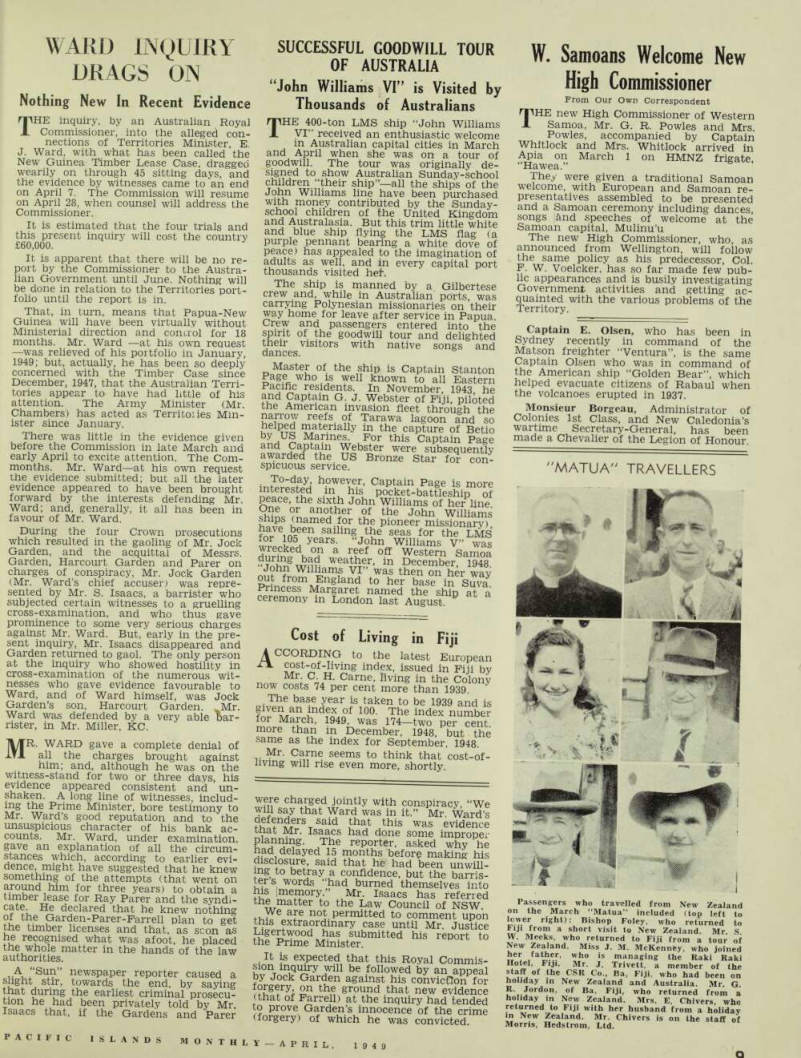
"Matua" Travellers
Passengers who travelled from New Zealand on the March “Matua” included (top left to lower right): Bishop Foley, who returned to Fiji from a short visit to New Zealand. Mr S W. Meeks, who returned to Fiji from a tour of New Zealand. Miss J. M. McKennfey, who joined her father, who is managing the Raki Raki Hotel, Fiji. Mr. J. Trivett, a member of the staff of the CSR Co.. Ba, Fiji, who had been on holiday in New Zealand and Australia. Mr. G.
R. Jordon, of Ba, Fiji, who returned from a holiday in New Zealand. Mrs. E Chivers who returned to Fiji with her husband from a holiday in New Zealand. Mr. Chivers is on the staff of Morris, Hedstrom, Ltd.
Passages to Sydney
Santo Needs More Air Passages to Sydney
Prom Our Own Correspondent M ID-1948 promised to usher in, as far as the New Hebrides were con cerned, hitherto undreamed-of air mail and transport facilities.
Trans-Oceanic Airways continued its regular monthly schedule from Sydney; TRAPAS, recovered from earlier hurri cane damage, resumed its weekly, and at times bi-weekly, service from Noumea to Santo; and Qantas inaugurated its fortnightly Sydney-Santo service. Ru mours that Guinea Airways were in terested in a Noumea-Santo route were It aopeared at last that the people of the New Hebrides might reasonably look forward to regular and swift contact witn th ßut U 1949 6 5 aw a sudden and bewildering Airways service failed to materialise. At date of writing (imd March) TRAPAS had made no , fll S bt seven weeks and rumours are abroad that TOA may shortly make its last flight.
Qantas continues, with a fourteenrarely more than two people from Santo can fly direct to Sydeach fortnight. Da y' bef ?J e '£ l l^ t bookings are impossible. Should emer gencies arise, a prospective passenger to Sydney could do nothing about it He would have to anticipate his emergency to the extent of a month or six weeks ah I 6 n d a worse position still are the people of the Solomon Islands.
With a passenger list of two out of a potential fourteen from Tulagi last flight, it is conceivable that Qantas are consider ing cutting out the Santo -Tulagi hop al together. With TOA out of the field, the only link with Australia left to these people is the “Morinda.” It calls at the Solomons on every alternate outward voyage from Sydney (about once every three months). . , , ..
Vanikoro, that Cinderella of the SW Pacific, does not even enjoy this amenity.
To point the bone in any particular direction for this lack of outside com munication would be impossible. But it would seem obvious that Governments, to mention but one interest, who Profess such great interest in the welfare of their Colonies, would have some obligation to their employees who are the instruments used to spread their ideas.
EDITORIAL NOTE. At present Qantas Airways do not run an internationally re cognised service from Sydney to BSI, via the New Hebrides. The service which usually leaves Sydney on alternate Tues days for these islands, is still officially in the experimental, or survey, stage. Trans oceanic Airways have every intention of continuing their Sydney-Tulagi service via New Caledonia and New Hebrides, whatever may be said in Santo to the contrary. It is recognised that air passages from Santo are in great demand but these are allocated by the companies in accordance with the passenger poten tial of each place. Santo is allocated two seats per trip by Qantas airways, and fou ’ to Noumea and four direct to Sydney by TOA.
Mr. C. W. Anderson, who has been manager of the Grand Pacific Hotel, Suva, is to return to sea as chief steward in one of the vessels of the Union Steam ship Company, Ltd. He has been suc ceeded as manager of the Grand Pacific Hotel by Mr. G. R. Johns, formerly manager of Brent’s Private Hotel, Roto rua, New Zealand.
Navy, Control
Guam Congress Wants , Not Navy, Control
THE Guam Parliament, or Assembly— which is a post-war development of the Territory’s administration —was in revolt against US Navy rule, in early April.
The revolt is entirely bloodless, and ap pears to be taking the form of passive resistance. The native Chamorros ap parently do not wish to sever any of then ties with the United States, but they do wish to seek a new status, under a civil authority.
They demand that US Congress pass an Act similar to that which was passed in relation to Hawaii. This would give the Guamanians US citizenship and more self-government.
The trouble started in early March when 34 of the 36 members of the Guam Congress walked out (over the failure of the Governor to honour a warrant for the arrest of a Naval employee) and were subsequently dismissed by the Naval Governor of the island, Rear-Admiral A.
Pownall. The Governor then called for the municipal commissions on Guam to submit three names for each vacant seat, from which he would choose successors to the rebellious members. Mass meetings in a dozen villages objected to this pro cedure and the ousted legislators refused to recognise the Governor’s appointees.
One of the men who had been dismissed by the Governor said that he obviously had made no attempt to consider the wishes of the Guamanians who were aware, however, that the Navy’s action is not in keeping with American democracy.
Guam, which is the largest of the Mariana group, has been an American pos session since the end of the Spanish- American war in 1898. The rest of the group was sold by Spain to Germany, in whose possession it remained until World War I. The Marianas, in 1919, became a Mandate, held by Japan and, after World War 11, a strategic Trusteeship held by the United States.
Spain had possession of the Marianas as long ago as 1565 but it took them 125 years to pacify the group. The natives, usually called Chamorros, are Micro nesians.
The Americans maintained Guam as a naval base and the port was closed to foreign ships of both war and commerce.
In the mid-thirties it attained new im
portance as a stage on Pan-American Air ways services from the Pacific coast of the US to Hongkong, Manila and Aus tralasia.
On December 11, 1941, the defences of Guam were overwhelmed by superior Japanese forces and the island was in enemy occupation until after the surren der of Japan, in 1945.
Before the Pacific War the government of the island was almost entirely in the hands of the Naval Governor, but since the American re-occupation the Gua manians have had a parliament of their own, based on the democratic principle of an upper and lower chamber.
The present trouble in Guam is said to have been hastened by the fact that Guam, as a defence base, has lost a great deal of its importance since the United States has shifted its greatest naval strength to the Atlantic. This, pre sumably, has made the Guamanians feel that the time has come when the govern ment should have a civil rather than a naval flavour.
Tonga
British Agent and Consul for Tonga
THE newly appointed British Agent and Consul in Tonga, Mr. J. E. Windrum, arrived in Nukualofa from Fiji, in March. , He has recently been in the United Kingdom and USA on leave. His wife and family are still in USA but will join him later this year.
The retiring Consul of Tonga is Mr. C.
W. T. Johnson.
Mr. A. W. Anderson, formerly a promi nent smallgoods trader in Sydney, arrived in Australia recently after a lengthy health holiday in Rabaul. He informed reporters that he has bought 18 ships to ship meat from his Australian works to New Guinea. He said his fleet comprised tugs, refrigeration barges, and similar types of vessels. After attending to busi ness matters in Sydney he will go back to Rabaul to examine the possibility of bringing fish to the Australian markets from New Guinea.
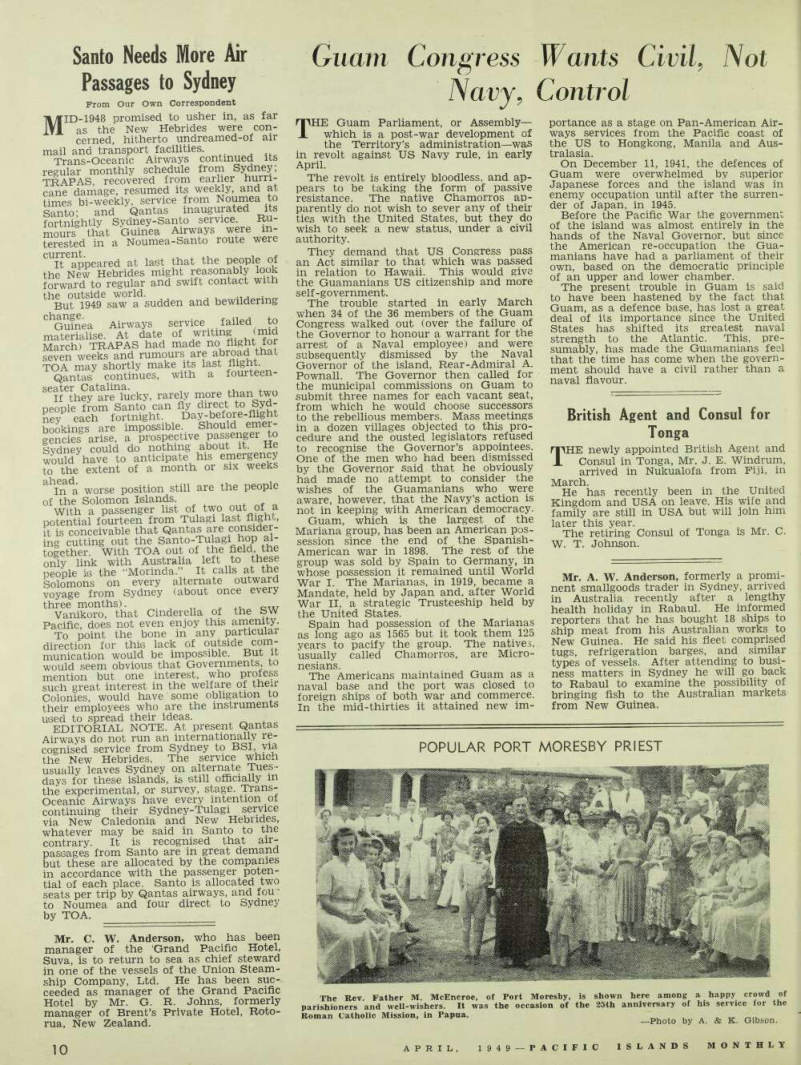
Popular Port Moresby Priest
The Rev. Father M. McEncroe, of Port Moresby, is shown here among: a happy crowd of parishioners and well-wishers. It was the occasion of the 25th anniversary of his service for the Roman Catholic Mission, in Papua.
Photo by A. & K. Gibson.
Fiji Land Crisis
Former Governor Tells How It Was Solved
From Our Own Correspondent SUVA, April 4.
THE inside story of a dramatic page in the history of Fiji has come out in an address given by Lord Milverton (formerly Sir Arthur Richards. Governor of Fiji, 1936-38).
Lord Milverton said that in 1937 a ptfj minent Indian leader pleaded with him for Indians to be given the right to own land.
“They were short leaseholders of the Fijians, with no security; and one had to find some solution of a problem which must end in violence if left to drift,” said Lord Milverton, He continued: “On the other hand were the Fijians, loyal, peaceable, but distrustful of the Indians and resenting them as intruders.
The major Fijian Chief came to me and asked that he and his four fellows might resign from Legislative Council and all share in it. He told me that they had no quarrel with the Government, but they heartily disliked the Western democratic system of elected members of Council.
They resented the manners of the Indians in public debate.
“He said they were a chiefly people with respect for authority, who could not bear to sit in Council and hear In dians abusing Government and the King’s representative.
“He indicated that it was a situation they could well have handled in our ab sence, but since we were there they were restrained. He said they would be glad to leave that sort of government to us, and if we must have it that way they would be happy not to be represented and would leave their interests in the Governor’s hands.
“In point of fact they were persuaded to stay.
“Not much later the Fijian Chiefs, great and small, after the lengthiest delibera tions, were persuaded to agree to relin quish all their lands, held communally, and to place them in the hands of the Governor in trust.
“They were to be divided so that ample areas were reserved for them and their descendants, and the remainder thrown open for alienation to Indians or other races or to Fijians who desired to break away from the communal system.
“The idea was at one stroke to remove the bitterest Indian grievance, to settle and reserve the Fijian areas and to pro vide a safety-valve for the young pro gressive who wanted to break away from the communal system.
“All rent revenues from land so alien ated were to be paid into a Fijian welfare fund for the benefit of the indigenous population.
“This generous and far-sighted offer of the Fijians was probably the finest act of trust in colonial history.”
Engineer for Manus
THE job of project engineer on Manus Island, at £1,200 a year, was adver tised in the Commonwealth Gazette of April 7.
The successful applicant will take charge of demolition and salvage of build ings on the island and despatch of build ings and materials to Papua-New Guinea and to Australia.
He will also supervise all works required for the construction of a naval base, air fields, and civil administrative establish ments on the island.
Some Vivid Descriptions By An Independent
Deplorable Conditions In The Wardist
Territories
Some Vivid Descriptions By An Independent Visitor
The most dismal picture yet painted of the Papua-New Guinea Administration appeared in the Melbourne Herald of March 31. It was from well-known journalist, Osmar White, now visiting the Territories. ext^ acts ,f rom the article, in which he describes conditions in Port Moresby:— A HANDFUL of ill-equipped, halftrained civil servants are living in sisal paper houses and working in offices built from junk, muttering the same lament. The old danger that too little would arrive too late has arisen again in a different form.
The ghost of frustration that haunts this place was vividly conjured yesterday by the man who took me down to inspect the harbour equipment. Jerking a thumb at the old T wharf, now shivering and creaking in the first boisterous breezes of the south-east season, he said: “Jap planes raided this town more than 100 times, but thanks to Jackson, and men like him, they never hit the wharf. Now it is falling down of its own accord—thanks to dry rot, white ants and bureaucrats!” ♦ * But, most of all, Moresby is unhappy of eC “a 0 -N o ew k GZea W^ re he h a e d e T d erri Th y oi r-apua incw yumea is neaaea in. o? P hTrdwo P rfwffh n a S pen ° Ut oi nara worK with mu „ .. , , .. .
The collection of ramshackle humpies at Konedobu, where the Territory’s important business is transacted has become known as Belsen. ’ The Administration mess is “House Pig.”
All Chifley’s horses and all Chifley’s men can t drag enough timber, corrugated iron, fibro-cement and nails through the redtape swamps to accommodate decently more than a small percentage of the 2,500 people now living in a town that housed 600 before the war
What Moresby Housewife
Paid On March 30;—
5 lbs. sirloin of beef .. .. 16/8 Eggs 5/7 doz 4 lb. loaf bread 2/8 Butter 4/6 lb.
One cabbage 2/1 to 3/9 Since there is no local cobbler, shoes must be sent by air to Cairns for repair.
When they come back, Customs officers solemnly assess the value of the leather used in the repair, and charge duty on it.
Bread is the price of pre-war fruit cake because a canny Treasurer in Australia, remembering that no income tax is levied on salaries in New Guinea, gets his pound of flesh anyway from export tax on Australian flour—and the rate on one ton of flour is £25! * * * THERE can be no stability in the labour position here until supply problems have been solved by provision of increased shipping services; until wharves and cargo storage buildings have been repaired or replaced; until houses have been established. reSt ° red ' “ d '° Cal agriculture Either prices must be forced down, or salaries raised, until the man doing a job of work in NG gets as much return for his effort as he does in Australia. * Ihe fault cannot be attributed to the de S H?ie PUbliC rf SerVantS ; *l° doubt l here are drones and incompetents among them,
as there are in any public service—and personal loyalties, which so often override public morality, make them hard to shift —but by far the greater percentage of departmental administrators in the New Guinea service are honest men, with a realisation of the importance of the work they are doing.
They love this country, and believe that it is destined to become great and wealthy.
They are bitter because the policy they have to administer is unreal, ill-defined, and contradictory—because their reports and requests and suggestions, however urgent, are either mutilated or misinter preted—or vanish into the pigeon-hole jungles of the Department of External Territories.
Editorial Note
YOU are asked to note that the fore going was not written by what has been called the “temperish PIM,” but by an independent journalist who probably never has seen the “PIM.”
The points that have been made bv Mr.
White, especially in relation to the de terioration of Administration morale, are the points which we have tried to hammer home to Canberra, for more than a year.
While the Territory’s Socialist Minister has been wallowing in political feuds and Timber Lease fandangos in Australia, his half-baked scheme of Territories develop ment has been falling to pieces. The men placed in Port Moresby to do an im portant job have been more or less de serted, and have been unable to defend themselves against criticism because they are gagged by their administrative obliga tions.
The Territories in 20 years have known a score of Ministers, Liberal and Labour, and scarcely one of them has been worth a pearler’s curse. Mr. Ward, by compari son, seemed a godsend—he had ideas, some capacity for planning, and the energy and the determination to imple ment his plans. But, because he tried to apply Marxist principles to a region that can be developed only by private enter prise and rugged individualism, Mr. Ward has been a calamity greater than all the figurehead Ministers put together.
THE deplorable conditions observed and reported by Mr. White are the out ward signs of the Wardist economic fallacies and political muddling. Papua- New Guinea will never be an inspiring place to examine until Canberra takes a leaf out of the British Colonial Office bcok and, having selected competent and trained men for a highly specialised job, leaves them alone, free from political in terference, with full authority to carry out that job.
It is an utterly ridiculous thing that Papua-New Guinea should continue to be made the plaything of the uneducated Ministers and economic rat-bags so con sistently spewed up by the political machines. Why should trained and edu cated administrative officers, honestly eager to do a creditable job, be left at the mercy of such people? Why should decent Australian women, who are ex pected to maintain a good status in a black man’s country, be asked to keep house on a beggarly £5OO or £6OO per an num, while the unchecked bureaucrats push the prices of essential foodstuffs to the figures quoted?
We always have regarded the Wardist regime as a joke. Now, it is beginning to look like a tragedy.
Advertisements & other items, p. 14 (1 item)
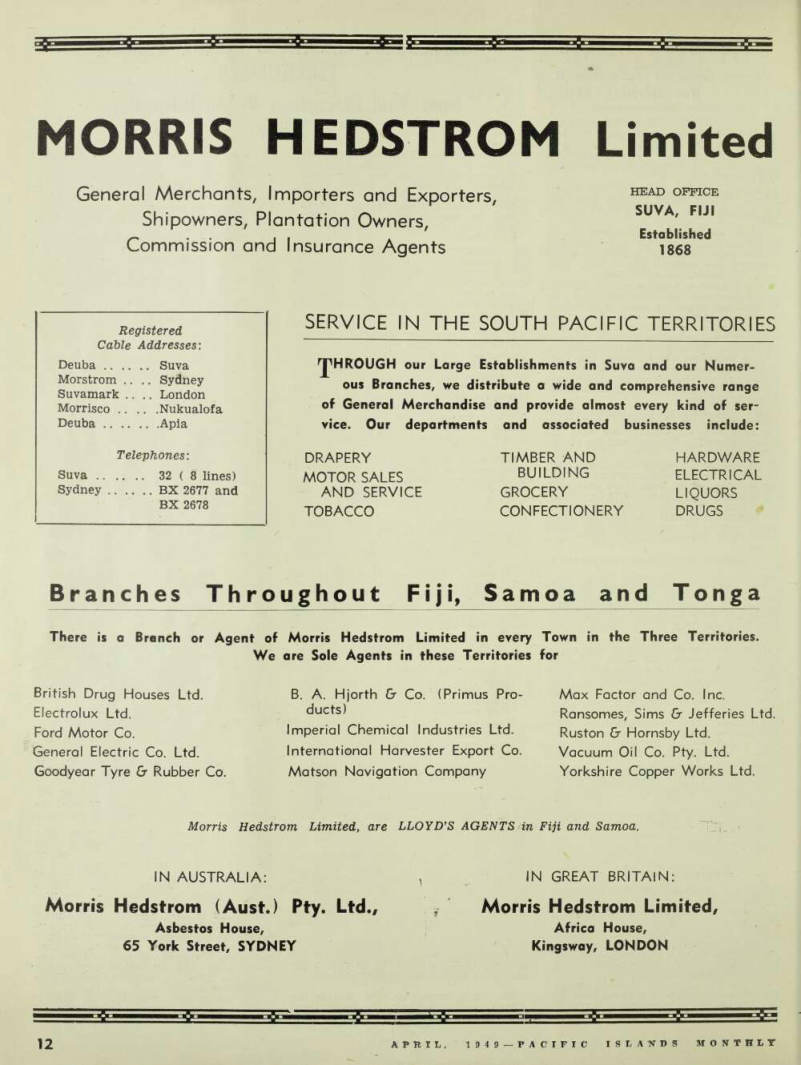
Morris Hedstrom Limited
General Merchants, Importers and Exporters,
Shipowners, Plantation Owners,
Commission and Insurance Agents
HEAD OFFICE
SUVA, FIJI
Established 1868
SERVICE IN THE SOUTH PACIFIC TERRITORIES
rpHROUGH our Large Establishments in Suva and our Numerous Branches, we distribute a wide and comprehensive range of General Merchandise and provide almost every kind of service. Our departments and associated businesses include:
DRAPERY
MOTOR SALES
AND SERVICE
TOBACCO
TIMBER AND
BUILDING
GROCERY
CONFECTIONERY
HARDWARE
ELECTRICAL
LIQUORS
DRUGS
Branches Throughout Fiji, Samoa and Tonga
There is a Branch or Agent of Morris Hedstrom Limited in every Town in the Three Territories.
We are Sole Agents in these Territories for British Drug Houses Ltd.
Electrolux Ltd.
Ford Motor Co.
General Electric Co. Ltd.
Goodyear Tyre £r Rubber Co.
B. A. Hjorth £r Co. (Primus Products) Imperial Chemical Industries Ltd.
International Harvester Export Co.
Matson Navigation Company Max Factor and Co. Inc.
Ransomes, Sims £r Jefferies Ltd Ruston Gr Hornsby Ltd.
Vacuum Oil Co. Pty. Ltd.
Yorkshire Copper Works Ltd.
Morris Hedstrom Limited, are LLOYD'S AGENTS in Fiji and Samoa.
IN AUSTRALIA:
Morris Hedstrom (Aust.) Pty. Ltd.,
Asbestos House, 65 York Street, SYDNEY
IN GREAT BRITAIN:
Morris Hedstrom Limited,
Africa House, Kingsway, LONDON
Death Of Well-Known
Bp Skipper
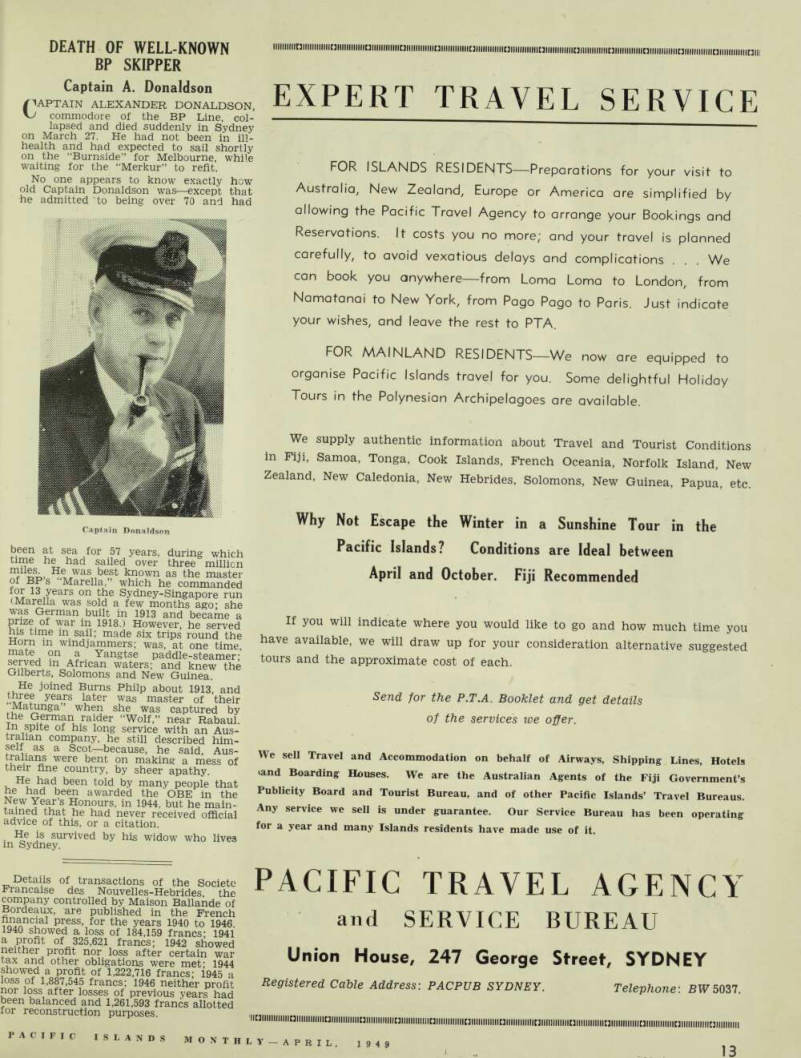
Captain A. Donaldson
C Captain Alexander Donaldson,
J commodore of the BP Line, col lapsed and died suddenly in Sydney on March 27. He had not been in ill health and had expected to sail shortly on the “Burnside” for Melbourne, while waiting for the “Merkur” to refit.
No one appears to know exactly how old Captain Donaldson was—except that he admitted to being over 70 and had
been at sea for 57 years, during which time he had sailed over three million was best kn own as the master of BPs ‘Marella,” which he commanded y ears on the Sydney-Singapore run (Marella was sold a few months ago: she was German built in 1913 and became a prize of war in 1918.) However, he served ms time in sail; made six trips round the Horn in windjammers; was, at one time, mate on a Yangtse paddle-steamer; served in African waters; and knew the Gilberts, Solomons and New Guinea.
He joined Burns Philp about 1913, and three years later was master of their Matunga ’ when she was captured by the German raider “Wolf.” near Rabaul. in spite of his long service with an Aus tralian company, he still described him self as a Scot—because, he said, Aus tralians were bent on making a mess of their fine country, by sheer apathy.
He had been told by many people that he had been awarded the QBE in the New Year’s Honours, in 1944, but he main tained that he had never received official advice of this, or a citation. • , is sur vived by his widow who lives m Sydney.
Details of transactions of the Societe Francaise des Nouvelles-Hebrides the company controlled by Maison Ballande of Bordeaux, are published in the French ?£n nc i al press > for the years 1940 to 1946. 1940 showed a loss of 184,159 francs; 1941 a of 325 > 621 francs; 1942 showed neither profit nor loss after certain war tax and other obligations were met; 1944 showed a profit of 1,222,716 francs; 1945 a loss of 1,887,545 francs; 1946 neither profit nor loss after losses of previous years had been balanced and 1,261,593 francs allotted lor reconstruction purposes.
Captain Donaldson
Advertisements & other items, pp. 15-16 (1 item)
Expert Travel Service
FOR ISLANDS RESlDENTS—Preparations for your visit to Australia, New Zealand, Europe or America are simplified by allowing the Pacific Travel Agency to arrange your Bookings and Reservations. It costs you no more; and your travel is planned carefully, to avoid vexatious delays and complications . . We can book you anywhere—from Loma Loma to London, from Namatanai to New York, from Pago Pago to Paris. Just indicate your wishes, and leave the rest to PTA.
FOR MAINLAND RES I DENTS—We now are equipped to organise Pacific Islands travel for you. Some delightful Holiday Tours in the Polynesian Archipelagoes are available.
We supply authentic information about Travel and Tourist Conditions in Fiji, Samoa, Tonga, Cook Islands, French Oceania, Norfolk Island, New Zealand, New Caledonia, New Hebrides, Solomons, New Guinea, Papua, etc.
Why Not Escape the Winter in a Sunshine Tour in the Pacific Islands? Conditions are Ideal between April and October. Fiji Recommended If you will indicate where you would like to go and how much time you have available, we will draw up for your consideration alternative suggested tours and the approximate cost of each.
Send for the P.T.A. Booklet and get details of the services we offer.
We sell Travel and Accommodation on behalf of Airways, Shipping Lines, Hotels *and Boarding Houses. We are the Australian Agents of the Fiji Government’s Publicity Board and Tourist Bureau, and of other Pacific Islands’ Travel Bureaus.
Any service we sell is under guarantee. Our Service Bureau has been operating for a year and many Islands residents have made use of it.
PACIFIC TRAVEL AGENCY
and SERVICE BUREAU
Union House, 247 George Street, SYDNEY
Registered Cable Address: PACPUB SYDNEY. 8W5037,
Take the thrifty Clipper* way
LONDON via us.
New low fare in pounds (no dollars needed) takes care of all transportation costs. Allows you sight-seeing stopovers in principal U.S. cities. m I ill ii
SCWCCftDIUV Sr.
way on©
i\ol
t32' top OnW /\O/0
c^cine'/
ttorn Stop-over in lovely Honolulu . . . spend a day in San Francisco . . . sight-see in New York to your heart’s content! That’s the way you go when you fly by Clipper to London.
At no extra cost. And at new low fares.
The Flying Clippers take-off from Sydney every Tuesday, Friday and Sunday for San Francisco. You enjoy restful Sleeperette* service (no extra cost). And from New York, London-bound Clippers cross the Atlantic daily.
For help with your Clipper trip, see your Travel Agent or . . . ,* t ri .0* c.
“ SPEED YOUR PARCEL BY CLIPPER ”
Rue Jean Joures,NOUMEA Bank of N.S.W. , . \ /
4, ° Sr fXPER'^
*Trade Marks, Pan American Airways, Inc.
Busy Day In Samarai Port
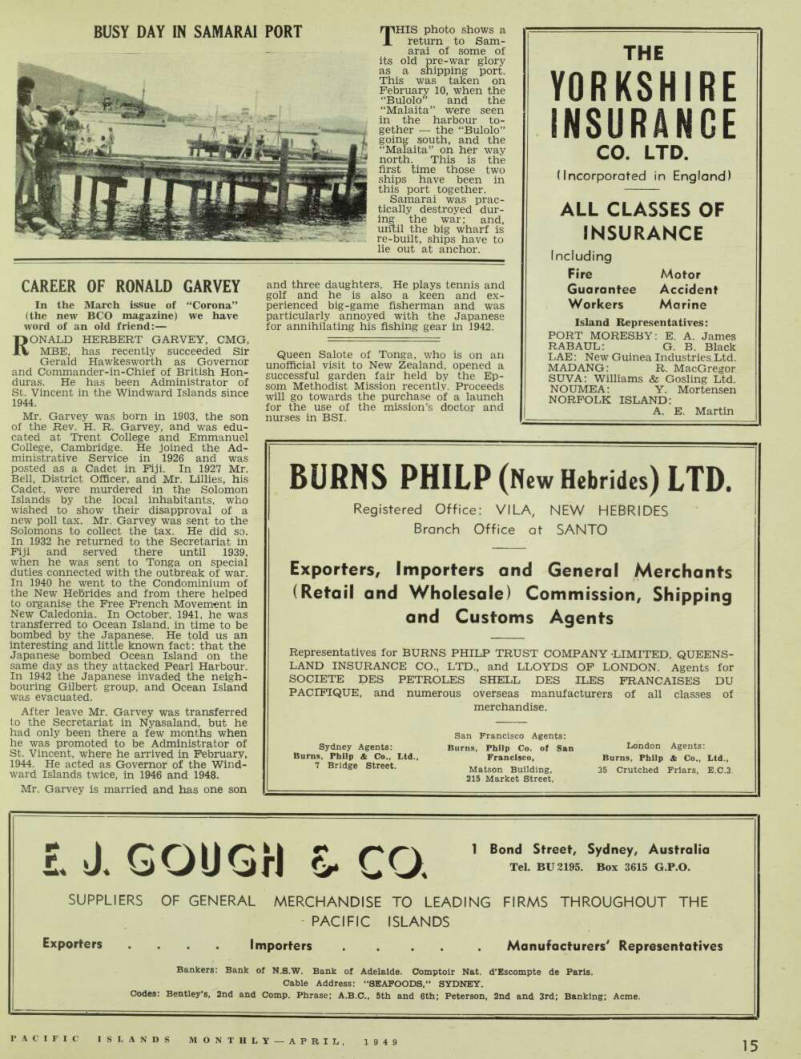
THIS photo shows a return to Sam ara! of some of its old pre-war glory as a shipping port.
This was taken on February 10, when the “Bulolo” and the “Malaita” were seen in the harbour to gether the “Bulolo” going south, and the “Malaita” on her way north. This is the first lime those two ships have been in this port together.
Samara! was prac tically destroyed dur ing the war; and, until the big wharf is re-built, ships have to lie out at anchor.
Career Of Ronald Garvey
In the March issue of “Corona” (the new BCO magazine) we have word of an old friend: — Ronald Herbert garvey, cmg, MBE, has recently succeeded Sir Gerald Hawkesworth as Governor and Commander-in-Chief of British Hon duras. He has been Administrator of St. Vincent in the Windward Islands since 1944.
Mr. Garvey was born in 1903, the son of the Rev. H. R. Garvey, and was edu cated at Trent College and Emmanuel College, Cambridge. He joined the Ad ministrative Service in 1926 and was posted as a Cadet in Fiji. In 1927 Mr.
Bell, District Officer, and Mr. Lillies, his Cadet, were murdered in the Solomon Islands by the local inhabitants, who wished to show their disapproval of a new poll tax. Mr. Garvey was sent to the Solomons to collect the tax. He did so.
In 1932 he returned to the Secretariat in Fiji and served there until 1939, when he was sent to Tonga on special duties connected with the outbreak of war.
In 1940 he went to the Condominium of the New Hebrides and from there helped to organise the Free French Movement in New Caledonia. In October, 1941. he was transferred to Ocean Island, in time to be bombed by the Japanese. He told us an interesting and little known fact: that the Japanese bombed Ocean Island on the same day as they attacked Pearl Harbour.
In 1942 the Japanese invaded the neigh bouring Gilbert group, and Ocean Island was evacuated.
After leave Mr, Garvey was transferred to the Secretariat in Nyasaland, but he had only been there a few months when he was promoted to be Administrator of St. Vincent, where he arrived in February, 1944. He acted as Governor of the Wind ward Islands twice, in 1946 and 1948.
Mr, Garvey is married and has one son
and three daughters. He plays tennis and golf and he is also a keen and ex perienced big-game fisherman and was particularly annoyed with the Japanese for annihilating his fishing gear in 1942.
Queen Salote of Tonga, who is on an unofficial visit to New Zealand, opened a successful garden fair held by the Ep som Methodist Mission recently. Proceeds will go towards the purchase of a launch for the use of the mission’s doctor and nurses in BSI.
Australian Government has refused to give a petroleum prospecting license to Enterprise of NG Gold and Petroleum De velopment, NL; and has refused to give any reason. But Enterprise directors are continuing to demand a reason.
An epidemic of petty thefts and burg laries in all parts of Apia is troubling the inhabitants of Samoa’s capital. Though no big hauls are reported, apparently a gang of young larrikins is at work.
Several Samoan prisoners from Vaimea gaol who recently escaped are also still at large.
Advertisements & other items, pp. 17-18 (1 item)
£. J. Gough 5- Co.
THE
YORKSHIRE
INSURANCE
CO. LTD.
(Incorporated in England)
ALL CLASSES OF
INSURANCE
Including Fire Motor Guarantee Accident Workers Marine Island Representatives:
PORT MORESBY: E. A. James
RABAUL: G. B. Black LAE: New Guinea Industries Ltd.
MADANG: R. MacGregor SUVA; Williams & Gosling Ltd.
NOUMEA: Y. Mortensen
NORFOLK ISLAND:
A. E. Martin
BURNS PHILP (New Hebrides) LTD.
Registered Office: VILA, NEW HEBRIDES
Branch Office at SANTO
Exporters, Importers and General Merchants
(Retail and Wholesale) Commission, Shipping
and Customs Agents
Representatives for BURNS PHILP TRUST COMPANY -LIMITED, QUEENS- LAND INSURANCE CO., LTD., and LLOYDS OF LONDON. Agents for SOCIETE DES PETROLES SHELL DES ILES FRAN C AISES DU PACIFTQUE, and numerous overseas manufacturers of all classes of merchandise.
Sydney Agents: Burns, Philp & Co., Ltd., 7 Bridge Street.
San Francisco Agents: Burns, Philp Co. of San Francisco, Matson Building, 215 Market Street, London Agents: Burns, Philp & Co., Ltd., 35 Crutched Friars, E.C.3.
£. J. GOUGH 5- CO.
1 Bond Street Sydney, Australia Tel. BU 2195. Box 3615 G.P.O.
SUPPLIERS OF GENERAL MERCHANDISE TO LEADING FIRMS THROUGHOUT THE
PACIFIC ISLANDS
Exporters ... Importers ... Manufacturers' Representatives Bankers: Bank of N.S.W. Bank of Adelaide. Comptoir Nat. d’Escompte de Paris.
Cable Address: “SEAFOODS." SYDNEY.
Codes; Bentley's, 2nd and Comp. Phrase; A.8.C., sth and 6th; Peterson, 2nd and 3rd; Banking; Acme.
TEL.: BW 5129. ESTABLISHED 1913.
William E. Reed
Broker and Agent
MENDES’ CHAMBERS,
8a CASTLEREAGH STREET. SYDNEY.
For all Plantation and Trading Requirements. Inquiries Invited.
aBK % % 0
DAYS WORK
What a confusion of currencies there is in the world to-day!
And what a maze of controls and restrictions surrounds transactions in international trade!
Yet familiarity with foreign exchange prob-
lems is all in the day’s work to officers of the "Wales" overseas departments.
If you have any financial dealings with another country, you cannot do better than —- Consult and use
BANK OF
NEW SOUTH WALES
FIRST BANK IN AUSTRALIA
Incorporated in New South Wales with limited liability
Sign of Recovery
Samoa Cocoa Shows No Sign of Recovery
From Our Own Correspondent APIA, March 24.
WESTERN Samoa’s cocoa boom seems to be over. Prosperity, which was based on the returns which Samoan and European planters have been getting for their cocoa, during the last few years, could easily turn into a depression.
Over one thousand tons of cocoa have accumulated in Apia sheds and overseas buyers, even at £lOO to £l2O per ton FOB, Apia, (less than half the amount it brought a few months ago) are still re luctant. Growers are getting about £BO net, which is still about three times more than cocoa was worth in 1939. (First grade Accra cocoa was bringing £25/10/per ton in Sydney in mid-1939.) Adverse weather conditions —persistent and excessive rain and high winds —have affected the coming cocoa crop also—and to add to the present attack of doldrums, local foodstuff is in short supply.
This may be the result of past prosperity when Samoans neglected their gardens and banana plantations in order to con centrate on cocoa. It is believed now, that the export of bananas to NZ will have to be curtailed.
Guinea Natives
New Plan For Teaching N.
A MESSAGE from Darwin, published in Sydney “Sun” on April 7, said that Dr. A. N. K. Daubach will go to New Guinea later this month to con duct a literacy campaign. He is now in India, where he has been teaching many of India’s illiterate millions.
Dr. Laubach is special counsellor of the World Literacy and Christian Literature movement in New York. He will teach New Guinea natives to read and write.
His method is to reduce the native language to a phonetic alphabet and then teach it. He expects that every native he teaches will teach another as he is learning himself. .
Dr. Laubach. who will be accompanied by a staff of three, will visit only Darwin and Brisbane in Australia before going to Lae. He is due in Darwin on April 18 and will meet all Northern Territory Christian missionaries in conference there and explain his methods to them.
Advertisements & other items, p. 18 (1 item)
Ng Planters Official
Mr. W. R. Paul, who has been appointed organising secretary of the New Guinea Planters’
Association, and has now taken up his residence in Rabaul.
Fiji Sugar Export Tax Voted Out

by Indian and European MFC’s
From Our Own Correspondent
SSUVA, March 22.
OME surprises but few real sensations marked the March session of the Legislative Council of Fiji.
There was a sharp division of opinion, and a curious alignment of non-official forces, over the proposed continuation of the export tax on sugar.
A section of the non-official members (Sir Hugh Ragg, and Messrs. F. G. Aichi bald and S. H. Wilson) joined the Indian members in opposing the tax; while an other section (Mr. A. A. Ragg) joined tne Fijian members in supporting it. I his renewed the report (widely circulated, but never proved) that the European non officials originally made an “unholy bar gain” with the Indians, to the effect that if the Indians would oppose the proposed copra tax, the Europeans would oppose the sugar tax, which the Indians hate.
The Europeans maintained that they are fighting for a vital principle—namely, the non-taxation of primary products.
The proposed copra tax was abandoned when the industry was affected by the recent hurricane; but the Government proceeded with its plan to continue the export tax on sugar.
The tax, of 10/- a ton, of which tho processor (the CSR Company) paid 5 and the canegrower 4/4i, has been m operation for two years and returns about £65,000 a year.
The Government rejected the theory that primary products should not be taxed and maintained that the levy, besides be ing light, was fully justified by the returns being received by the sugar industry.
The Financial Secretary (Mr. R. M Taylor) sharply criticised the attitude of Sir Hugh Ragg, who had suggested the reimposition of the Port and Customs Service Tax as a means of raising re venue. The Controller of Customs (Mr.
A. R. Smith) pointed out that Sir Hugh had strongly supported the removal uf that tax at the end of 1947. and Mr.
Taylor said that in the debate, Sir Hugh had provided “probably the best example of public conversion since the days of St Paul.”
The Governor (Sir Brian Freeston) left the voting on the tax to the unofficial members, who defeated the proposal for retention by nine votes to five.
This resulted in the removal of the tax, but the Governor made it clear that if the Colony’s finances in July indicated that the tax be needed, he reserved the right to move for its reintroduction.
Arguments Against Tax
AS Sir Hugh Ragg bore the brunt of the Government attack (made in sup- P 0 1? the P r °P°sal), and we had no report of the arguments used by the non pmcial members in opposing the tax, we s * r . to give us a summary of the position as he had seen it. and he has kindly supplied the following;— Fiji economy is based almost entirely on primary production—therefore it is unsound in principle to place an export tax on primary products. The primary producer provides the wherewithal for all other classes—merchants, bankers, hotel keepers, butchers, bakers, etc. If it was the Government’s policy to tax sugar and copra (as had been proposed) the next ogical step would be an export tax on old and bananas, and that would spell isastcr.
In presenting its 1949 budget, the Government departed from its orthodox method of presentation by including, as expen ‘ diture which normally should have gone l an a PP endlx the budget. The ef this was that an anticipated surplus of over £250,000 was converted in f O a deficit of some £2o,ooo—thus creating on aDDarent "justification for the onpor P ?js U ailv such capital exSLdUu??
Si' been nrovided forient of P ?nrrdns ftas Deen P rovlclecl lor out of surplus
balances, or Colonial Development grant, or loans, if and when necessary. These three headings have invariably appeared as appendices to the normal budget.
Taxation should be general and should
not be applied to particular interests.
There are over 8,000 Indians producing cane to-day, in comparison with only 400 Fijians: which means that the sugar tax would be a sectional tax —which is bad in principle. If the Government really needed these additional funds out of re venue, it should impose a general import and service tax, and thus spread the burden over the whole community.
Sir Hugh said that he started the sugar tax in March, 1948, but he had changed his outlook because further consideration based on experience had clearly shown the unwisdom of sectional taxation. It had been stated privately—but not pub licly—that the tax in the main was to be an impost on the Indian community (the cane growers) and in his opinion the time had arrived when any such policy as that must be resisted. There was no future for Fiji unless the Colony sank all sectional differences and pooled all its resources.
Advertisements & other items, pp. 19-20 (1 item)
Shell
THE PACIFIC ISLANDS SOCIETY
(Founded 1937) Visitors from the Pacific Islands to Sydney, or persons interested in Island affairs, are invited to communicate with the Honorary Secretary of the above Society which was formed to constitute a social centre for those interested in the Pacific Islands.
Regular meetings and social gatherings, with, lectures, are held at History House, 8 Young Street, Sydney, on the fourth Wednesday of each month, at 8 p.m.
Address for correspondence:—
THE PACIFIC ISLANDS SOCIETY
Box 2434. 0.P.0., Sydney.
ft 's Dray free
in tropic heat
i H: r m ’jsm > *✓*
SHELL
MOTOR OIL
SHELL COMPANY (PACIFIC ISLANDS) LTD.
(Incorporated in Great Britain) Agents: BURNS PHILP (South Sea) Co. Ltd.'
LO 46 4H
TO-DAY’S MOST OUTSTANDING
RADIO !
WZ£ m I a m
The Triple Throat
KRIESLER
Sealed RADIO
COMPLETELY TROPIC PROOFED WORLD RANGE . . . 12,500 miles range guaranteed.
it Sealed
MIDGET—A.C.
(Illustrated Above) A Triple Throat sealed .Radio, midget in size, mighty in performance . . . incorporates the unique Sound Vibrator Bridge that brings to midget radio the tonal quality of the true musical instrument. World range, too.
MODEL 11-20 WORLD RANGE. 18 Gns.
F. 0.8. BRIS.
it Sealed
TABLE MODEL—A.C.
Here is your dream radio come true —the powerful, full size Triple Throat sealed Table Model . . . the most exciting radio ever built. Features the big console dial, beauty back and front, world range—plus the triple throat that gives you three times the entertainment value.
MODEL 11-7 WORLD RANGE.
25i Gns,
F. 0.8. BRIS.
FREIGHT OFFER. Your radio will be despatched immediately by air or sea. We will par up to 75 per cent, of freight cost, depending on distance.
BATTERY
MODELS-
arg| also available.
Please write for full details and price.
Send your order to, or obtain further particulars from:
Queensland
MERCHANTS SUPPLIES
143-145 QUEEN STREET, BRISBANE, Q'LD.
Fiji
Price of Bananas Increased in Fiji
AN increase in the price of Fiji bananas has been approved by the New Zea land Marketing Depaitment. As - a result of this increase, growers in Fiji will now be paid the following prices at packing stations:— Viti Levu and Beqa. 6/6 a case; other areas, 5/6 a case.
M. Mascart, head of the French Customs Service in New Caledonia, is at present in France investigating proposals to re vise the Custom’s system. For fifty years or more, Caledonians have blamed the system, enforced by the Metropolis, for the high cost of living.
Resurrection Of Kavieng
Club
Speedy Action Follows Court Petition.
From a Special Correspondent KAVIENG, March 28.
Following the petition of Mr. j. h.
McDonald, sole surviving trustee of the pre-war Kavieng Club (the others died during the Japanese occupa tion of NG), that he be directed by the Supreme Court of Papua-New Guinea as to the disposal of club funds, the resi dents of New Ireland have called a special general meeting for April 16.
Mr. McDonald was formerly District Officer, Kavieng, and is now a high execu tive officer in the Papua-New Guinea Administration and is stationed in Port Moresby.
The Kavieng Club, of course, went temporarily out of business, when the Japanese invaded the Territory, in 1942.
Present residents of New Ireland have been taking steps to resurrect it and the petition—which will be heard in Port Moresby in June—has precipitated mat ters.
A residential club in Kavieng is greatly needed as there is no accommodation there for planters and others visiting the township from outer districts. A social centre for the townspeople is also thought to be desirable.
The Court has been asked to declare the date on which the Club ceased to function; how the assets are to be dis posed of; and who is to share in them.
If objection to the petition is to be made, time is short, and there has been much activity in Kavieng and district.
All members of the old club are urged
to attend the meeting, seek out other members, and, if nothing else, obtain their proxy. 'Before they can vote, mem bers must pay a year’s subscription— which ranges from £3/3/- for a town member to 10/6 for a junior member.
If they can get sufficient support, it is evidently the intention of the convenors of the meeting to prove to the Court that the old club has been in suspension but never out of business. And that any “dis posal of the assets” should be in their direction for the purpose of building a new club premises. Whether or not they will fight depends upon the numbers and opinions of those who attend the Easter meeting. % Other matters that will be attended to will be election of officers and election of trustees.
Planters 7 Association Meeting
A MEETING of the local planters’
J\ association will be held on the same day (April 16). This will enable many out-of-town members of both organisations to kill two birds with one stone.
Advertisements & other items, p. 21 (1 item)
Robert Gillespie Ptt Lip
"ISLAND LIFE"
Official organ of the S.S.l.C.C.—Calling Collectors, Correspondents and Penfriends throughout the South Sea Islands. Over 1,000 members. Write for your free copy and particulars to—
SOUTH SEA ISLANDS CORRESPOND-
ENCE CLUB,
NATUVU, FIJI.
f v..basis S r All classes of merchandise purchased for Island clients throughout the South-west Pacific. island produce sold on Australian and overseas r ■ markets on a commission
ROBERT GILLESPIE PTT LIP
54* PITT ST.,SYDNEY- PNOMESBW47B2- BUDS
Cable Xddress-Y
Death Of Mangaian Native
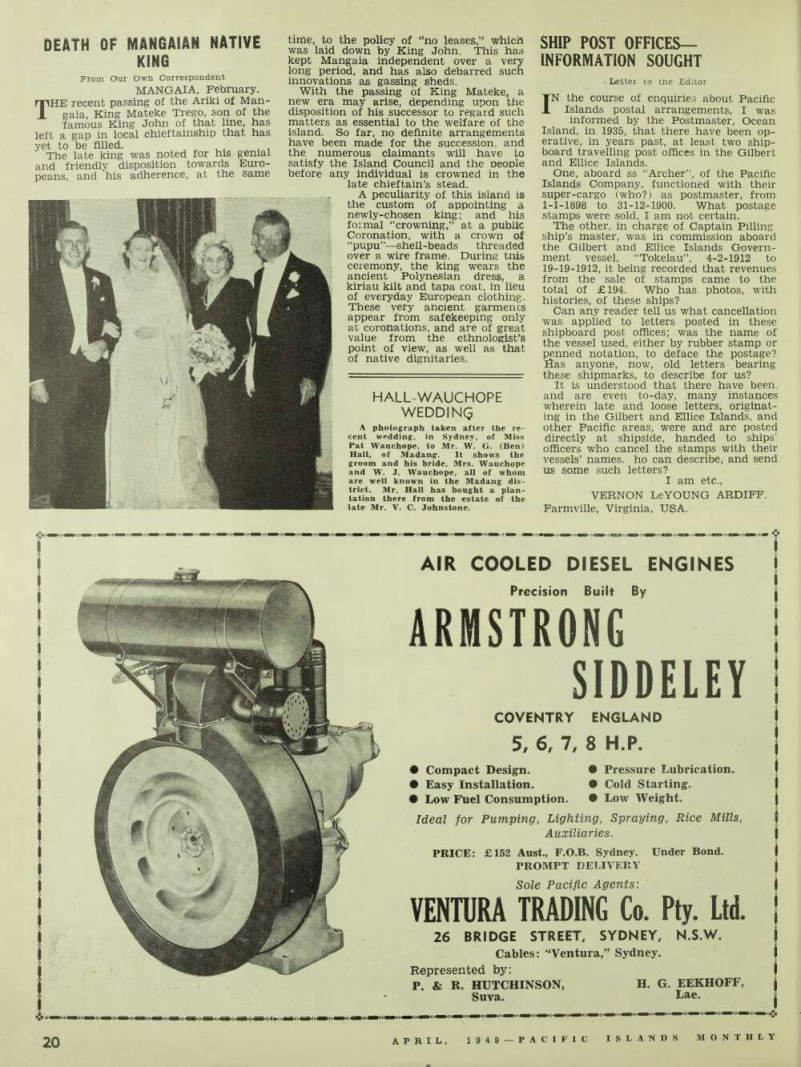
King
Prom Our Own Correspondent MANGAIA, February.
THE recent passing of the Ariki of Man gaia, King Mateke Trego, son of the famous King John of that line, has left a gap in local chieftainship that has yet to be filled. „ . .
The late king was noted for his genial and friendly disposition towards Euro peans, and his adherence, at the same
time, to the policy of “no leases,” which was laid down by King John. This has kept Mangaia independent over a very long period, and has also debarred such innovations as gassing sheds.
With the passing of King Mateke, a new era may arise, depending upon the disposition of his successor to regard such matters as essential to the welfare of the island. So far, no definite arrangements have been made for the succession, and the numerous claimants will have to satisfy the Island Council and the neopie before any individual is crowned in the late chieftain’s stead.
A peculiarity of this island is the custom of appointing a newly-chosen king; and his formal “crowning,” at a public Coronation, with a crown of “pupu”—shell-beads threaded over a wire frame. During tnis ceremony, the king wears the ancient Polynesian dress, a kiriau kilt and tapa coat, in lieu of everyday European clothing.
These very ancient garments appear from safekeeping only at coronations, and are of great value from the ethnologist’s point of view, as well as that of native dignitaries.
Hall-Wauchope
Wedding
A photograph taken after the re cent wedding, in Sydney, of Miss Pat Wauchope, to Mr. W. G. (Ben) Hall, of Madang. It shows the groom and his bride, Mrs. Wauchope and W. J. Wauchope, all of whom are well known in the Madang dis trict. Mr. Hall has bought a plan tation there from the estate of the late Mr. V. C, Johnstone.
Information Sought
Ship Post Offices—
• Letter to the Editor IN the course of enquiries about Pacific Islands postal arrangements, I was informed by the Postmaster, Ocean Island, in 1935, that there have been op erative, in years past, at least two ship board travelling post offices in the Gilbert and Ellice Islands.
One, aboard ss “Archer”, of the Pacific Islands Company, functioned with their super-cargo (who?) as postmaster, from 1-1-1898 to 31-12-1900. What postage stamps were sold, I am not certain.
The other, in charge of Captain Pilling ship’s master, was in commission aboard the Gilbert and Ellice Islands Govern ment vessel, “Tokelau”, 4-2-1912 to 19-19-1912, it being recorded that revenues from the sale of stamps came to the total of £194, Who has photos, with histories, of these ships?
Can any reader tell us what cancellation was applied to letters posted in these shipboard post offices; was the name of the vessel used, either by rubber stamp or penned notation, to deface the postage? lias anyone, now, old letters bearing these shipmarks, to describe for us?
It is understood that there have been, and are even to-day, many instances wherein late and loose letters, originat ing in the Gilbert and Ellice Islands, and other Pacific areas, were and are posted directly at shipside, handed to ships' officers who cancel the stamps with their vessels’ names, ho can describe, and send us some such letters?
I am etc.,
Vernon Leyoung Ardipf.
Farmville, Virginia, USA.
Advertisements & other items, p. 22 (1 item)
Armstrong
I 4*.
AIR COOLED DIESEL ENGINES
Precision Built By
ARMSTRONG
SIDDELEY
COVENTRY ENGLAND
5,6, 7, 8 H.P. • Compact Design, • Pressure Lubrication. • Easy Installation. • Cold Starting. • Low Fuel Consumption. • Low Weight.
Ideal for Pumping, Lighting, Spraying, Rice Mills, Auxiliaries.
PRICE: £152 Aust., F. 0.8. Sydney. Under Bond.
PROMPT DELIVERY
Sole Pacific Agents :
VENTURA TRADING C». Pty. Ltd.
26 BRIDGE STREET, SYDNEY, N.S.W.
Cables: “Ventura,” Sydney.
Represented by: P, & R. HUTCHINSON, H. G. EEKHOFF, Suva. Lae.
Kwato’S Plans
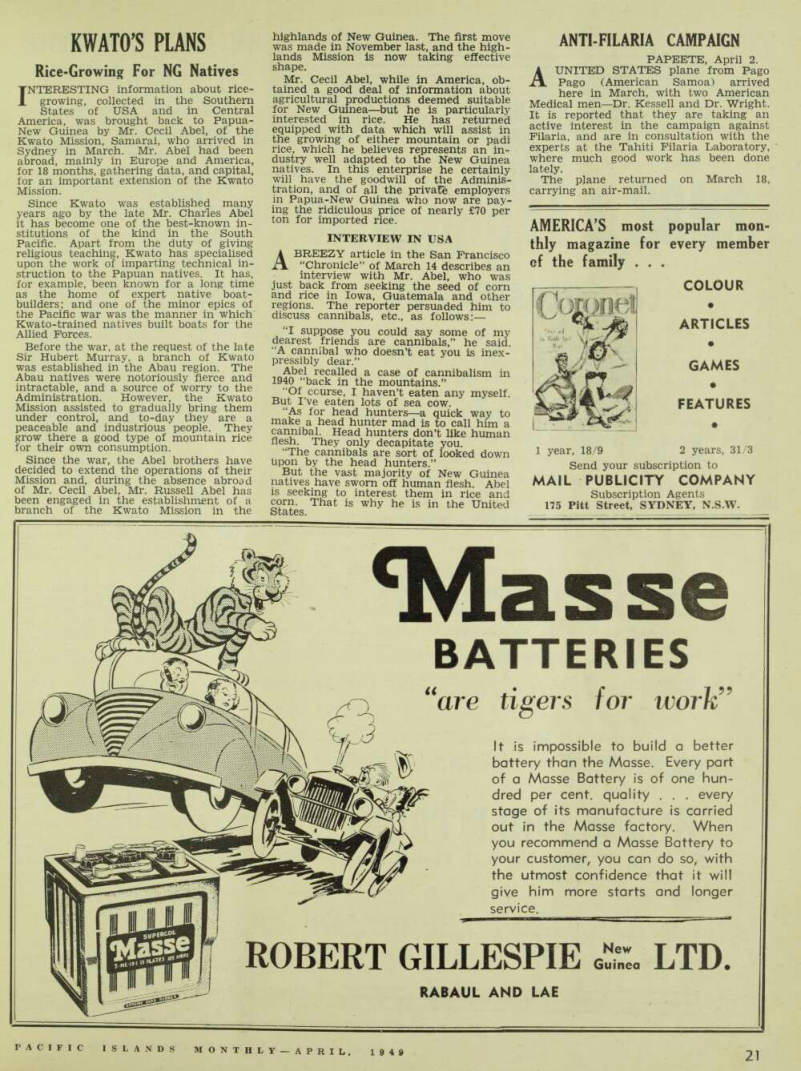
Rice-Growing For NG Natives
INTERESTING information about rice growing, collected in the Southern States of USA and in Central America, was brought back to Papua- New Guinea by Mr, Cecil Abel, of the Kwato Mission, Samarai, who arrived in Sydney in March. Mr. Abel had been abroad, mainly in Europe and America, for 18 months, gathering data, and capital, for an important extension of the Kwato Mission.
Since Kwato was established many years ago by the late Mr. Charles Abel it has become one of the best-known in stitutions of the kind in the South Pacific. Apart from the duty of giving religious teaching, Kwato has specialised upon the work of imparting technical in struction to the Papuan natives. It has, for example, been known for a long time as the home of expert native boat builders; and one of the minor epics of the Pacific war was the manner in which Kwato-trained natives built boats for the Allied Forces, Before the war, at the request of the late Sir Hubert Murray, a branch of Kwato was established in the Abau region. The Abau natives were notoriously fierce and intractable, and a source of worry to the Administration. However, the Kwato Mission assisted to gradually bring them under control, and to-day they are a peaceable and industrious people. They grow there a good type of mountain rice for their own consumption.
Since the war, the Abel brothers have decided to extend the operations of their Mission and, during the absence abroad of Mr. Cecil Abel, Mr. Russell Abel has been engaged in the establishment of a branch of the Kwato Mission in the
highlands of New Guinea. The first move was made in November last, and the high lands Mission is now taking effective shape.
Mr. Cecil Abel, while in America, ob tained a good deal of information about agricultural productions deemed suitable for New Guinea—but he is particularly interested in rice. He has returned equipped with data which will assist in the growing of either mountain or padi rice, which he believes represents an in dustry well adapted to the New Guinea natives. In this enterprise he certainly will have the goodwill of the Adminis tration, and of all the private employers in Papua-New Guinea who now are pay ing the ridiculous price of nearly £7O per ton for imported rice.
Interview In Usa
A BREEZY article in the San Francisco “Chronicle” of March 14 describes an interview with Mr. Abel, who was just back from seeking the seed of corn and rice in lowa, Guatemala and other regions. The reporter persuaded him to discuss cannibals, etc., as follows: “I suppose you could say some of my dearest friends are cannibals,” he said. ‘A cannibal who doesn’t eat you is inex pressibly dear.”
Abel recalled a case of cannibalism in 1940 “back in the mountains.”
“Of course, I haven’t eaten any myself.
But I’ve eaten lots of sea cow.
“As for head hunters—a quick way to make a head hunter mad is to call him a cannibal. Head hunters don’t like human flesh. They only decapitate you.
“The cannibals are sort of looked down Upon by the head hunters.”
But the vast majority of New Guinea natives have sworn off human flesh. Abel is seeking to interest them in rice and corn. That is why he is in the United States.
Anti-Filaria Campaign
PAPEETE, April 2.
A UNITED STATES plane from Pago Pago (American Samoa) arrived here in March, with two American Medical men—Dr. Kessell and Dr. Wright.
It is reported that they are taking an active interest in the campaign against Filaria, and are in consultation with the experts at the Tahiti Filaria Laboratory, where much good work has been done lately.
The plane returned on March 18, carrying an air-mail.
Advertisements & other items, pp. 23-24 (1 item)
'Masse
AMERICAN most popular monthly magazine for every member of the family . . .
COLOUR
ARTICLES
GAMES
FEATURES
Colonel
1 year, 18/9 2 years, 31/3 Send your subscription to
MAIL PUBLICITY COMPANY
Subscription Agents 175 Pitt Street, SYDNEY, N.S.W.
□ □ k: T r £ y
'Masse
BATTERIES
are tigers for work
It is impossible to build a better battery than the Masse. Every part of a Masse Battery is of one hundred per cent, quality . . . every stage of its manufacture is carried out in the Masse factory. When you recommend a Masse Battery to your customer, you can do so, with the utmost confidence that it will give him more starts and longer service.
ROBERT GILLESPIE oil LTD
RABAUL AND LAE
THAT
fa The
Put an End
to guesswork
No executor or trustee can afford to lose touch with day-to-day changes in taxation, finance, and investments. Living in the Islands, he finds it quite impracticable to administer an estate by remote control.
Isolated from sound advice on pressing problems, he is likely to neglect his own job without assisting the beneficiaries in the least. Such a disaster can be avoided by transferring these extra responsibilities to Burns Philp Trust Company Limited.
This step liberates you from incessant anxiety, while the beneficiaries profit by smooth and efficient administration. The Company possesses every facility for dealing with the many and complex problems connected with the management of estates.
",Hands That Never Leave the Wheel " explains in detail how this organisation can assist you. A complimentary copy of this booklet will be forwarded on request.
DIRECTORS:
James Burns Joseph Mitchell P. T. W. Black Eric Priestley Lee MANAGER: L. S. Parker SECRETARY: E. R. Overton, A.F.I.A.
Burns Philp Trust
COMPANY LIMITED
EXECUTOR • TRUSTEE • AGENT
Constituted by Special Act of the N.S.W. Parliament
HEAD OFFICE: 7 BRIDGE STREET, SYDNEY
TEL: BU 5901 BOX M3 ' S ' P '°" SYDNEY BP4-49
Mad Copra Race Is Over
Talk of a Slump In The New Hebrides
From Our Own Correspondent SANTO. March 20.
BEGINNING with the April-May-June quarter, a considerable drop in the prices of New Hebrides’ copra is ex pected.
France has based the price per ton she has been paying for NH copra on the price the United States pays for Philip pines copra; but she now sees that market showing signs of sliding, and has brought her own price down accordingly.
This month, March, is witnessing per haps the greatest race to get copra in, weighed and bought, that the New Heb rides has ever experienced. In a last attempt to make hay while the sun still shines, certain commercial interests — relative newcomers to the field—have raised their local buying price by 200 francs. This added inducement has brought the copra in but not, it appears, to the detriment of more stable business houses.
The slump, while sudden, was not un expected. It had to come. The fantastic prices which New Hebridean copra, by no means a superior grade, has been bringing over the past eighteen months could not continue indefinitely. The mad, cut-throat, no-holds-barred race, which has been going on between all concerned for two years, has come to its end. The outcome will be unfortunate for some.
As it now stands, the bulk of the price paid for copra goes to the natives. For example: A trader sails into a village and buys copra from the natives for £4O per ton. This he later sells for perhaps £5B to £6O, Australian. A second trader calls at this same village, and, upon learning that a competitor has paid £4O, he offers £45. The natives get the £45. The trader gets perhaps £5!
THE slump will force many small men out of business; and the trader has only himself to blame. There was room for everyone in the beginning, but the unscrupulous methods employed by some forced others to follow suit. It was a case of fighting back or letting the other fellow walk in and drive you out of business.
There was never any unity among traders and, in the heat of the race, they seemed to lose sight of the fact that they were working 24 hours a day to keep the natives rich and idle.
The natives know nothing about inter national economics, or the price the United States is paying for Philippines copra. Nor do they care. All they know is that for every ton of copra they have received a bundle of Australian bank notes which they have counted very care fully and found it either the same as be fore, or more —but never less.
How the trader is going to convince the native that the golden days are over, and that the price has fallen, is a problem which he, having brought it on himself, must face.
Copra Prices In The
Solomons
THE report published on page 59 of the February issue of PIM, to the effect that the planters of the Solomons Islands had turned down the offer of a guaranteed price by the British Ministry of Food, was an error.
Although the BSI planters were divided on the subject, they did eventually agree to accept the British guaranteed price—
the same as in Fiji and other British Territories—and they now are operating under the 9 years’ contract system.
It now appears that this decision was a very good thing for thorn—as it was for the Fiii nlanters—because according to advices received at the end of March the tee marterrrice in fallen hplow the first vear’s enntrad; 11 prfcT equal to £6O Australian FOB per ton.
The retention of Prisoners (Tonga) Bill was passed by the Fiji Legislative Coun cil without opposition. It legalises the re ception and detention, at Suva Gaol, for the purpose of serving his sentence, of a prisoner sentenced by a Tongan court.
The Tongan Government has passed legis lation authorising the Government to send a Tongan prisoner to Suva and providing for the payment by Tonga of all expenses incurred.
The District Officer at Labasa, Vanua Levu, Ratu Penaia K. Ganilau, was mar ried on March 8 to Adi Laisa D. Yavaca.
The ceremony was performed by the Rev.
G. Strickland, and a reception was after wards held at the residence of the District Commissioner. The reception was very largely attended, the guests including the bridegroom’s official colleagues and rep resentatives of other Government depart ments.
Advertisements & other items, p. 24 (1 item)
22
APRIL. 1949 PACIFIC ISLANDS MON IB L £
Another Immigration Mix-Up
THE case of Mr. E. H. Duesterdleck, aged 43, has been receiving attention in the Australian newspapers.
His father was German, and his mother now lives in Samoa. He was born in Auckland, and claims that he holds a valid British passport. He lived in Samoa until he was 15. Then he went to Germany, where he married and lived in Munich. He was not interned during the war. Last December, with his wife and two small children he went to Samoa, with New Zealand’s permission, to live with his mother; and then he decided to go on to New Zealand by the “Matua”. But at Suva he was informed by the Fiji police that New Zealand would not admit him—he was given no reason for the decision. He remained in Fiji and finally obtained permission from Canberra to enter Australia. He arrived by air in Sydney in March, and plans to become an Australian citizen.
The Mayor of Noumea (M. Sautot) has informed the Governor General of New Caledonia that the town intends to raise a loan of ten million francs for a three year programme of road construction, linking the suburbs.
Advertisements & other items, p. 25 (1 item)
W. H. Grove & Sons
Limited
Established 1896.
AUCKLAND
Island Traders. P.O. box 490.
Telegraphic and Cable Address: “Grove”, Auckland.
Entrust Your Orders to the Firm with Fifty Years Practical Experience in the Island Trade.
Shippers of all classes of New Zealand products.
Representing English Manufacturers throughout the Cook and Society Islands, Fiji, Tonga, Samoa, Niue, New Hebrides, the Solomon Islands and New Caledonia.
In FIJI as—W. H. Grove Cr Sons (Fiji) Ltd.
MARINE ENGINES
HALVORSEN’S HAVE FOR IMMEDIATE DELIVERY :
“UNDERWOOD” 3 H.P. —2 Cycle—with built in Clutch —Petrol MORRIS “VEDETTE” 4 Cylinder 6/12 H.P. Petrol or Kerosene MORRIS “NAVIGATOR” 4 Cylinder 12 24 H.P. Petrol or Kerosene MORRIS “COMMODORE” 6 Cylinder 20 40 H.P. Petrol or Kerosene CHRYSLER “CROWN” 6 Cylinder 45/102 H.P. Petrol CHRYSLER “ROYAL” 8 Cylinder 55/132 H.P. Petrol Available soon : “LEYLAND” DIESEL MARINE 6 Cylinder 85 H.P.
Further particulars from the distributors :
LARS HALVORSEN SONS PTY. LTD.
WATERVIEW ST., RYDE ( s “Xy°' )- N.S.W.
Telegrams: Halvorsens, Sydney. ’Phone: Ryde 105
• FREE EXPERT PROPELLER ADVICE
Gizo Is Restored To Favour
Prom a Special Correspondent ON March 1, Gizo was re-opened as the seat of government in the West ern Solomon Islands, superseding Hobu Hobu in that respect.
Mr. T. Russell, Acting District Com missioner, is the Officer-in-Charge. He has had a strenuous time arranging and executing the transfer from Hobu Hobu; yet plenty remains to be done.
But in Mr. Russell’s capable hands it will be done, the whole delighted District feels assured.
Mrs. McKenzie Pollock, wife of the new Senior Medical Officer, Honiara,, BSI. who took up his duties at the end of January, has been appointed a part-time Govern ment Medical Officer at the Central Hos pital.
Inquiry For Carl Nagy
WE have an enquiry (from an old friend) for the present where abouts of Mr. Carl Nagy, who was well-known in New Guinea several years ago. Mr. Nagy was a highly competent mechanic, and it was he who assisted the late Father Glover to rescue refugees in the Central Highlands of New Guinea in 1942. We should be grateful to any one who could give us the present ad dress of Mr. Nagy.
Pastor Anderson and Sister Cooper of the Seventh Day Adventist Mission ar rived in Honiara, BSI, from Rabaul at the end of February. Pastor Anderson knows the Solomons well from earlier service here and will take charge of the local branch of the mission after a quick return trip to Australia on mission busi ness. He will live at the mission head quarters near Honiara,
Installed
New Bishop Is
Ceremony In Central N. Guinea
(Contributed) THE Most Reverend Leo Arkfeld, SVD. was installed as Vicar Apostolic of the Vicariate of Central New Guinea on March 26, at Wewak, TNG.
Thirty-two priests and lay brothers of the Divine Word Missionaries, and Fran ciscans of the Order of Friars Minor, as well as a large gathering of natives, wel comed his Lordship and conducted him to the temporary church which serves as his pro-cathedral. His Lordslvp was wel comed by the Very Reverend A. Gerstner,
Svd.
His Lordship replied to the welcome ex tended in the name of the missionaries, and then addressed the assembled natives in Pidgin English, A Solemn Pontifical Hieh Mass was celebrated on Sunday morning, March 27.
Natives from distant villages, as well as the Catholics of Wewak, were present.
Many of the former had hiked long hours through the tropical heat to welcome, their new leader. The whole day was taken up by groups of the natives, coming to present their respects and their humble gifts to his Lordship, who received each delegation and spoke to each native in dividually.
A civic reception was tendered the new Bishop on Monday evening at the home of Mr. and Mrs, Slattery, of Wewak.
Bishop Arkfeld, SVD, already known in New Guinea as the “Plying Bishop,” arrived in his own mission plane, bring ing the little Auster in for a perfect land ing. This plane will be used to supply the otherwise inaccessible mountain stations of the Vicariate of Central New Guinea.
His Lordship’s co-workers, both of the Divine Word Missionaries and the Fran ciscans of the Order of Friars Minor, look to Bishop Arkfeld. SVD, with complete confidence in his ability and his sincerity.
Ad Multos annos!
Savu Savu Notes
THE Hot Springs Hotel (situated on the shore of Savu Savu Bay, Vanua Levu, Fiji) is once again under new management, after a short but success ful reign by Mr, Dave Riemy. Mr. Tsidor (“Joe”) Abel is the new manager.
Mr. Riemy is back again in the district as manager of Messrs. Morris Hedstrom, Ltd., in place of Mr. P. Snook, who has gone on 2V 2 months’ leave to New Zealand. Mr. and Mrs. Riemy are very popular in Savu Savu, and received an enthusiastic welcome.
The Rev. S. G. Cowled, Methodist missionary in charge of the Cakaudrove Circuit (the headquarters of which are now at Savu Savu, instead of Taveuni), left for Rotuma by the “Yanawai” in March. He expects to be away for some two months.
Mrs. A. W. Small, wife of the Senior Officer of the Station, and son Anthony, aged 16, left for Suva on March 12 on their way to New Zealand. Tony has been accepted for employment with the Radio Corporation of NZ, and will spend the first year at Whangarei, followed by three years at Wellington.—Own Corres pondent.
Advertisements & other items, p. 26 (1 item)
W. Kopsen & Go. Ptv. Ltd.
Prom WHOA!
SIMPLEX
MARINE ENGINES
3, 5 and 10/12 h.p. Suitable for all crafts from 14-32 ft. The 5 and 10 h.p. are supplied with built-in reverse gear. All Australian made. Prices and specifications on request.
C.Q.R. ANCHORS
The lightweight anchor with three times the holding power of any other anchor. No more efficient tool for quick and positive “dig-in’* has ever been found than the ploughshare. The C.Q.R. is two well designed ploughshares welded together. Write for C.Q.R. Anchor leaflet.
T. GO!
W. KOPSEN & GO. PTV. LTD.
Have EVERYTHING for Boats
FISHING
TACKLE
Our new Fishing Department has been opened to provide the utmost service and satisfaction in all classes of fishing gear. Marlin Gut lines, Fishkil Nylon Twist, Geisha Wire Traces, Linen and Cotton lines, Rangoon and Split Cane Rods, Reels and numerous other lines.
SHIPCHANDLERS &
KAYEN PRESSURE LAMPS
The all Australian made vapour lamps— reliable—efficient—safe—easy to operate.
Burns for 10 hours on IV* pints of kerosene. The lamp Illustrated is of 300 C.P. and is the table model (HL7); the allpurpose lamp (AP2) Is wlndproof and ideal for outdoor work. Burn ordinary kerosene. Write for Illustrated leaflet.
MARINE ENGINEERS
376-380 KENT ST., SYDNEY. MA6336 (9 lines).
Cables: “KOPSEN” Sydney.
Eight British Scholarships
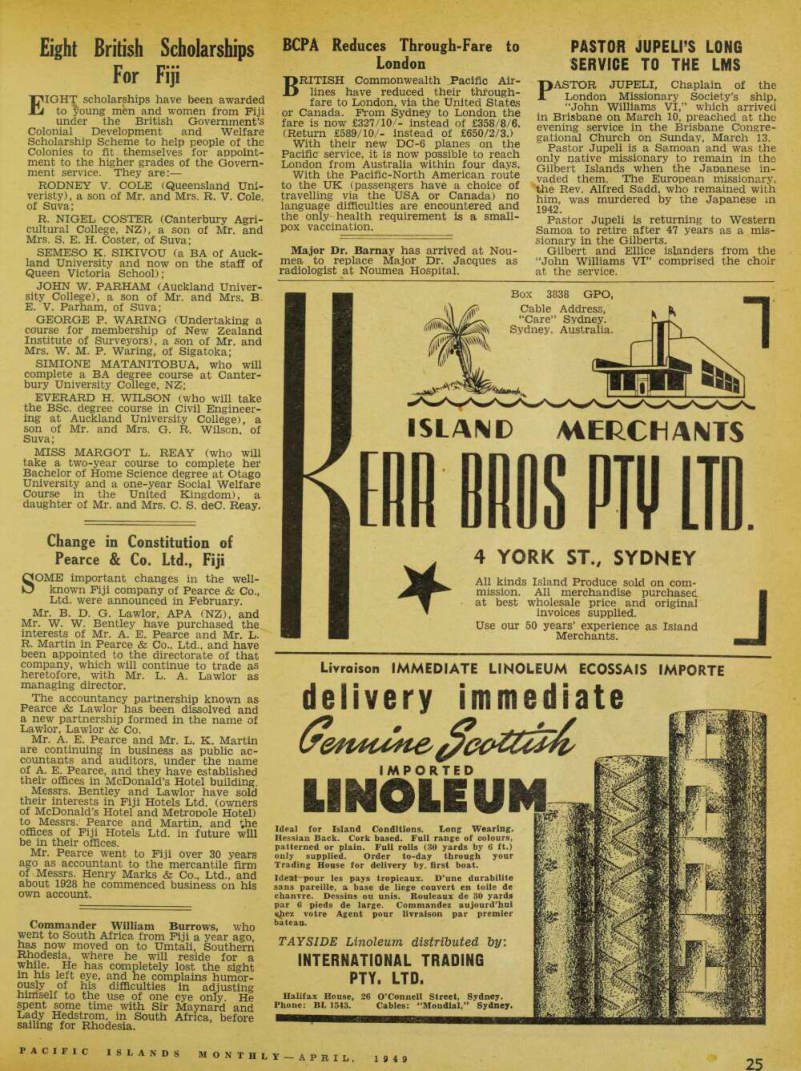
For Fiji
EIGHT scholarships have been awarded to young men and women from Fiji under the British Government’s Colonial Development and Welfare Scholarship Scheme to help people of the Colonies to fit themselves for appoint ment to the higher grades of the Govern ment service. They are:— RODNEY V. COLE (Queensland Unl veristy), a son of Mr. and Mrs. R. V, Cole, of Suva; R. NIGEL COSTER (Canterbury Agri cultural College, NZ), a son of Mr. and Mrs. S. E. H. Coster, of Suva; SEMESO K. SIKIVOU (a BA of Auck land University and now on the staff of Queen Victoria School); JOHN W. PARHAM (Auckland Univer sity College), a son of Mr. and Mrs. B.
E. V. Parham, of Suva; GEORGE P. WARING (Undertaking a course for membership of New Zealand Institute of Surveyors), a son of Mr. and Mrs. W. M. P. Waring, of Sigatoka;
Simione Matanitobua, Who Will
complete a BA degree course at Canter bury University College, NZ; EVERARD H. WILSON (who will take the BSc. degree course in Civil Engineer ing at Auckland University College), a son of Mr. and Mrs. G. R. Wilson, of Suva; MISS MARGOT L. REAY (who will take a two-year course to complete her Bachelor of Home Science degree at Otago University and a one-year Social Welfare Course in the United Kingdom), a daughter of Mr. and Mrs. C. S. deC. Reay.
Change in Constitution of Pearce & Co
Pearce & Co. Ltd., Fiji
SOME important changes in the well known Fiji company of Pearce & Co., Ltd. were announced in February.
Mr. B. D. G. Lawlor, APA (NZ), and Mr. W. W. Bentley have purchased the interests of Mr. A. E. Pearce and Mr. L.
R. Martin in Pearce & Co.. Ltd., and have been appointed to the directorate of that company, which will continue to trade as heretofore, with Mr. L. A. Lawlor as managing director.
The accountancy partnership known a& Pearce & Lawlor has been dissolved and a new partnership formed in the name of Lawlor, Lawlor & Co.
Mr. A. E. Pearce and Mr. L. K. Martin are continuing in business as public ac countants and auditors, under the name of A. E. Pearce, and they have established their offices in McDonald’s Hotel building.
Messrs. Bentley and Lawlor have sold their interests in Fiji Hotels Ltd. (owners of McDonald’s Hotel and Metropole Hotel) to Messrs. Pearce and Martin, and the offices of Fiji Hotels Ltd. in future will be in their offices, Mr. Pearce went to Fiji over 30 years ago as accountant to the mercantile firm of Messrs. Henry Marks & Co., Ltd., and about 1928 he commenced business on his own account.
Commander William Burrows, who went to South Africa from Fiji a year ago, has now moved on to Umtali, Southern Rhodesia, where he will reside for a while. He has completely lost the sight in his left eye, and he complains humor ously of his difficulties in adjusting himself to the use of one eye only. He spent some time with Sir Maynard and Lady Hedstrom, in South Africa, before sailing for Rhodesia.
BCPA Reduces Through-Fare to London
London
BRITISH Commonwealth Pacific Air lines have reduced their through fare to London, via the United States or Canada. From Sydney to London the fare is now £327/10/- instead of £358/8/6. (Return £589/10/- instead of £650/2/3.) With their new DC-6 planes on the Pacific service, it is now possible to reach London from Australia within four days.
With the Pacific-North American route to the UK (passengers have a choice of travelling via the USA or Canada) no language difficulties are encountered and the only health requirement is a small pox vaccination.
Major Dr. Baraay has arrived at Nou mea to replace Major Dr. Jacques as radiologist at Noumea Hospital.
Pastor Jupeli’S Long
Service To The Lms
PASTOR JUPELI, Chaplain of the London Missionary Society’s ship, “John Williams VI,” which arrived in Brisbane on March 10, preached at the evening service in the Brisbane Congre gational Church on Sunday, March 13.
Pastor Jupeli is a Samoan and was the only native missionary to remain in the Gilbert Islands when the Japanese in vaded them. The European missionary, the Rev. Alfred Sadd, who remained with him, was murdered by the Japanese in 1942.
Pastor Jupeli is returning to Western Samoa to retire after 47 years as a mis sionary in the Gilberts.
Gilbert and Ellice islanders from the “John Williams VI” comprised the choir at the service.
Advertisements & other items, pp. 27-28 (2 items)
25
PACIFIC ISLANDS MONTHLY A P R I L , 1049
Linoleum
Box 3838 GPO, Cable Address, “Care” Sydney.
Sydney. Australia. >V-
ISLAND MERCHANTS
4 YORK ST., SYDNEY
All kinds Island Produce sold on commission. All merchandise purchased at best wholesale price and original invoices supplied.
Use our 50 years’ experience as Island Merchants.
J
Livraison IMMEDIATE LINOLEUM ECOSSAIS IMPORTS
delivery immediate
LINOLEUM
Halifax House, 26 O’Connell Street, Sydney.
Phone: BL 1543. Cables: “Mondial,” Sydney
MPORTED
Ideal for Island Conditions. Long Wearing.
Hessian Back. Cork based. Full range of colours, patterned or plain. Full rolls (30 yards by 6 ft.) only supplied. Order to-day through your Trading House for delivery by. first boat.
Idea! pour les pays tropicaux. D’une durabilite sans pareille, a base de liege couvert en toile de chanvre. Dessins ou unis. Rouleaux de 30 yards par 6 pieds de large. Commandez aujourd’hui ejiez votre Agent pour livraison par premier bateau.
TAY SIDE Linoleum distributed by:
INTERNATIONAL TRADING
PTY. LTD.
FOR SALE
QUANTITY OF NEW PLUMBING FITTINGS
GALVANISED AND BLACK FITTINGS, i
in. to 6 in.
BRASS COCKS, 818, BALL, ETC., in. to 1 in. 3 in. and 4 in. Johns Pattern Gate and Check Valve.
Write for Complete Catalogue.
N. F. MALONEY & CO.,
Agents, Port Moresby, PAPUA Cab. add MALCO. P.M.
take vtNcer/rS iv/ffi
COMffCEMCE
-j& ' * Confidence brings successl Place your confidence in the hospital formula of genuine - vincent’s a.p.c. For over 25 years the medical profession has had absolute confidence in this better-balanced prescription Take Vincent's A.P.C With Confidence.
For HEADACHE AND NERVE
AND MUSCULAR PAIN!
tm / m m /
VIN CENTS
safe mb ■ / N4BD
ToOSSI
vTNcJSEi
SAFEST & BESTI
Easy Passage
Fiji’s Press Bill Has Easy Passage
From Our Own Correspondent SUVA, March 22.
DESPITE a strenuous endeavour by Mr.
A. A. Ragg, to show that Fiji’s Press 'Correction Bill was a milestone on the way to slavery under a totalitarian dictatorship, a majority of the unofficial members of the Fiji Legislative Council, supported the measure and threw out an amendment by which Mr. Ragg sought to delay the measure for six months.
Government speakers, including the Governor (Sir Brian Freeston). the Colonial Secretary (Mr. J. F. Nicoll) and the Acting Attorney-General (Mr. B. A.
Doyle), reaffirmed that there was nothing sinister about the Bill and that there was no desire to turn the press into a sub servient mouthpiece of the Government.
There was no concealment of the fact that the basis of the measure was appre hension in case non-English publications, which were likely to appear in the future, and which possibly would lack experienced staffs, might become Communist propa ganda sheets. It was stressed that the legislation was not directed at any exist ing publication. TT Mr. A. D. Patel defended the Bill. He pointed out that there was no restriction of the freedom of the press and added that a paper could still “tell lies or distort facts to its heart’s content.”
Death Of Mrs. Mollie
Garter
AFTER a short illness, Mrs. Mollie Carter, wife of Mr. H. D. (Nick) Carter, died in Launceston, Tas mania, on March 15. She and her hus band were well-known ex-New Guinea residents Mrs. Carter is best remembered in the Territory as Mrs. Ifould. Mrs. Ifould, then a young Englishwoman, went to New Guinea in the Expro Board days, in 1921, and was one of the first European women to settle in Rabaul and other districts after World War I. Because of her charm and her hospitality, she became well known and highly esteemed in the New Guinea of those days, especially m the Wewak district. In the 30’s, her home at Boram Plantation, represented, to many miners and recruiters, about all there was of civilisation in the district. After she left New Guinea, about 1937, she married Mr. Carter, who also had been a resident for many years. She is survived by her husband, and by her popular daughter (Mrs. Joan Bell, of Cairns, Queensland).
More Flour, Sharps And
Meat For Fiji
From Our Own Correspondent SUVA. March 22.
THE International Emergency Food Council has announced that Fms allocation of flour and sharps for 1949 has been fixed at 17,920 short tons compared with 14,016 short tons in 1948.
A <f q result of representations made by thf Government o? Fiji to the British Ministry of Food, the Ministry has agreed to the release of 500 tons of boneless beef during 1949. This will bring the total amount of New Zealand meat available for Fiji this year to 840 tons, compared with 259 tons in 1948.
Mr. and Mrs. W. C. Groves returned to Port Moresby in March after leave m Victoria and NSW.
Overhaul of Fiji Defence
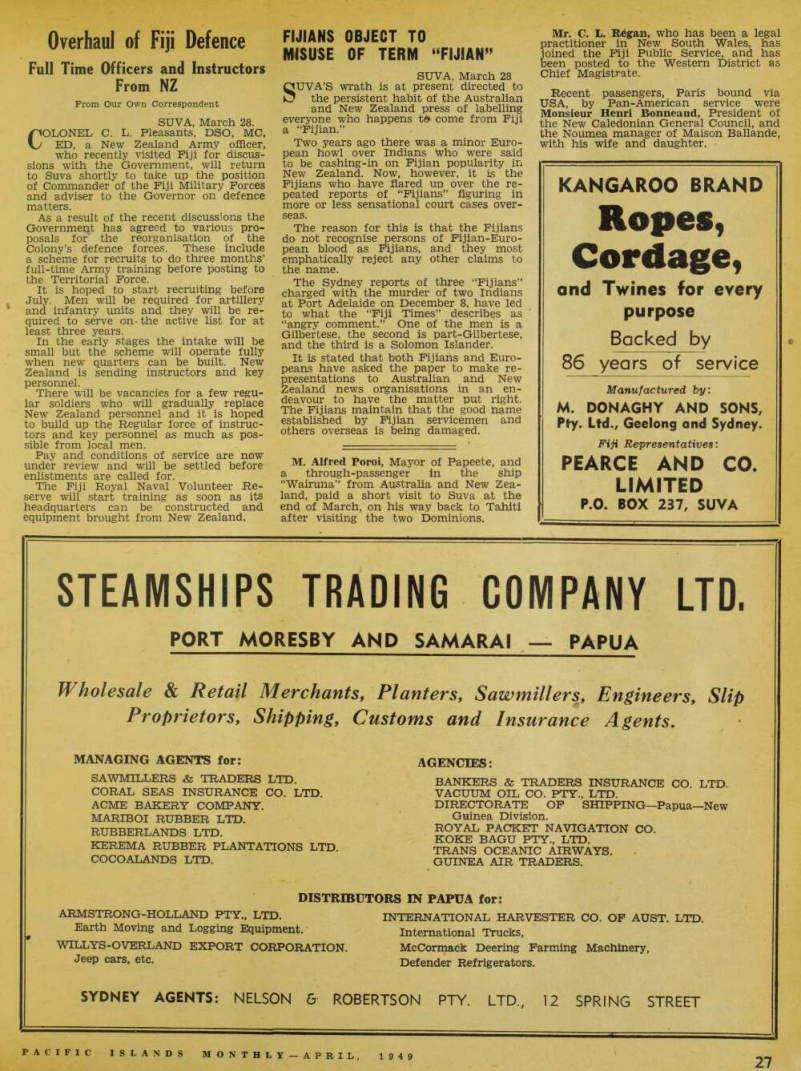
Full Time Officers and Instructors From NZ
From Our Own Correspondent SUVA, March 28.
COLONEL C. L. Pleasants, DSO, MC, ED, a New Zealand Army officer, who recently visited Fiji for discus sions with the Government, will return to Suva shortly to take up the position of Commander of the Fiji Military Forces and adviser to the Governor on defence matters.
As a result of the recent discussions the Government has agreed to various pro posals for the reorganisation of the Colony’s defence forces. These include a scheme for recruits to do three months’ full-time Army training before posting to the Territorial Force.
It is hoped to start recruiting before July. Men will be required for artillery and infantry units and they will be re quired to serve on- the active list for at least three years.
In the early stages the intake will be small but the scheme will operate fully when new quarters can be built. New Zealand is sending instructors and key personnel.
There will be vacancies for a few regu lar soldiers who will gradually replace New Z-ealand personnel and it is hoped to build up the Regular force of instruc tors and key personnel as much as pos sible from local men.
Pay and conditions of service are now under review and will be settled before enlistments are called for.
The Fiji Royal Naval Volunteer Re serve will start training as soon as its headquarters can be constructed and equipment brought from New Zealand.
Misuse Of Term “Fijian”
Fijians Object To
SUVA, March 28 SUVA’S wrath is at present directed to the persistent habit of the Australian and New Zealand press of labelling everyone who happens tc* come from Fiji a “Fijian.”
Two years ago there was a minor Euro pean howl over Indians who were said to be cashing-in on Fijian popularity in New Zealand. Now, however, it is the Fijians who have flared up over the re peated reports of “Fijians” figuring in more or less sensational court cases over seas.
The reason for this is that the Fijians do not recognise persons of Fijian-Euro pean blood as Fijians, and they most emphatically reject any other claims to the name.
The Sydney reports of three “Fijians” charged with the murder of two Indians at Port Adelaide on December 8. have led to what the “Fiji Times” describes as “angry comment.” One of the men is a Gilbertese, the second is part-Gilbertese, and the third is a Solomon Islander.
It is stated that both Fijians and Euro peans have asked the paper to make re presentations to Australian and New Zealand news organisations in an en deavour to have the matter put right.
The Fijians maintain that the good name established by Fijian servicemen and others overseas is being damaged.
M. Alfred Poroi, Mayor of Papeete, and a through-passenger in the ship “Wairuna” from Australia and New Zea land, paid a short visit to Suva at the end of March, on his way back to Tahiti after visiting the two Dominions.
Mr. C. L. Regan, who has been a legal practitioner in New South Wales, has joined the Fiji Public Service, and has been posted to the Western District as Chief Magistrate.
Recent passengers, Paris bound via USA, by Pan-American service were Monsieur Henri Bonneaud, President of the New Caledonian General Council, and the Noumea manager of Maison Ballande, with his wife and daughter.
Advertisements & other items, pp. 29-30 (1 item)
Steamships Trading Company Ltd.
KANGAROO BRAND
Ropes,
Cordage,
and Twines for every purpose Backed by 86 years of service Manufactured by:
M. DONAGHY AND SONS,
Pty. Ltd., Geelong and Sydney.
Fiji Representatives:
PEARCE AND CO.
LIMITED
P.O. BOX 237, SUVA
STEAMSHIPS TRADING COMPANY LTD.
PORT MORESBY AND SAMARAI PAPUA
Wholesale & Retail Merchants, Planters, Engineers, Slip
Proprietors, Shipping, Customs and Insurance Agents.
MANAGING AGENTS for: AGENCIES:
SAWMILLERS & TRADERS LTD.
CORAL SEAS INSURANCE CO. LTD.
ACME BAKERY COMPANY.
MARIBOI RUBBER LTD.
RUBBERLANDS LTD.
KEREMA RUBBER PLANTATIONS LTD,
COCOALANDS LTD.
BANKERS & TRADERS INSURANCE CO. LTD.
VACUUM OIL CO. PTY., LTD.
DIRECTORATE OP SHIPPING—Papua—New
Guinea Division.
ROYAL PACKET NAVIGATION CO.
KOKE BAGU PTY., LTD.
TRANS OCEANIC AIRWAYS.
GUINEA AIR TRADERS.
DISTRIBUTORS IN PAPUA for:
ARMSTRONG-HOLLAND PTY., LTD.
Earth Moving and Logging Equipment.
WILLYS-OVERLAND EXPORT CORPORATION.
Jeep cars, etc.
INTERNATIONAL HARVESTER CO. OF AUST. LTD.
International Trucks, McCormack Deering Farming Machinery, Defender Refrigerators.
SYDNEY AGENTS: NELSON G ROBERTSON PTY. LTD., 12 SPRING STREET
Price at Works: £36/10/- Extra for 10 inch additional shelf and brackets (if required): £2 Glass Server to Top (if required): £l/10/- Packing and Transport to Wharf: £lO/10/- The display case is securely packed in two substantial crates occupying shipping space of 37 cubic feet. Total weight, when packed, 5 cwt.
Equip
Smart
mm m
Your Store with this
Modern Counter Display
Specially Built for Export
Case
As smart as those in leading Australian city stores, and built by a firm that has been making fine store and office fittings for over a third of a century.
Moreover, it is specially built for export, so that it can be readily securely packed, and assembled by anyone, from simple directions, in an hour, with no tools other than a screwdriver.
Retailers all over the world have learned the selling value of modern display equipment, and this “silent salesman” will soon pay for itself in increased sales.
Volume production has enabled us to make economies in manufacturing costs, and this saving has been passed on to our customers. The price has been substantially reduced, and is now only £36/10/-.
HERE ARE THE DETAILS
of the "Brahol" Export Counter Case
(as illustrated) To help you to get an accurate picture of the "Brahol" Special Export Glass Counter Case, here are the main specifications:— • Overall size is 6 feet long x 1 ft. 9 ins. deep x 3 ft. 3 ins. high. Made from first-class, wellseasoned Queensland Maple, hand french polished, wax finished, in natural maple colour.
Glass parts are i inch British plate glass. • The inside is lacquered ivory colour, and the recessed base is lacquered burgundy. • There is a pair of solid core sliding doors, and one glass shelf, 14 inches wide, on adjustable nickel-plated brackets. • Storage space below is 11 inches high. • The plate glass front is 22 inches high.
BRAY & HOLLIDAY
PTY. LTD.
Makers of Fine Store and Office
Fittings for over a third of a century.
Brahol House, 66-74 McLachlan Avenue, Rushcutter Bay, Sydney. Telephone: FA 4121.
Cable & Telegraphic Address: “Brahol”
Why Ng Administration Escaped
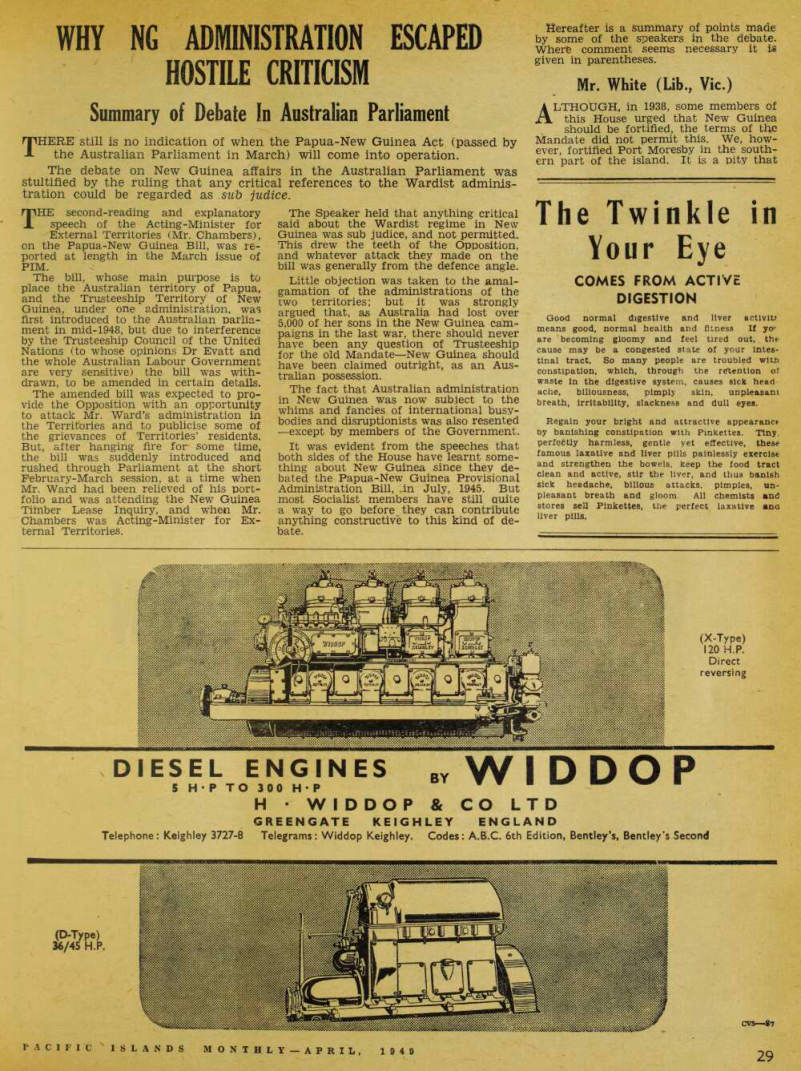
Hostile Criticism
Summary of Debate In Australian Parliament
THERE still is no indication of when the Papua-New Guinea Act (passed by the Australian Parliament in March) will come into operation.
The debate on New Guinea affairs in the Australian Parliament was stultified by the ruling that any critical references to the Wardist adminis tration could be regarded as sub judice.
THE second-reading and explanatory speech of the Acting-Minister for External Territories (Mr. Chambers), on the Papua-New Guinea Bill, was re ported at length in the March issue of
Pim.
The bill, whose main purpose is to place the Australian territory of Papua, and the Trusteeship Territory of New Guinea, under one administration, was first introduced to the Australian parlia ment in mid-1948, but due to interference by the Trusteeship Council of the United Nations (to whose opinions Dr Evatt and the whole Australian Labour Government are very sensitive) the bill was with drawn, to be amended in certain details.
The amended bill was expected to pro vide the Opposition with an opportunity to attack Mr. Ward's administration in the Territories and to publicise some of the grievances of Territories’ residents.
But, after hanging fire for some time, the bill was suddenly introduced and rushed through Parliament at the short February-March session, at a time when Mr. Ward had been relieved of his port folio and was attending the New Guinea Timber Lease Inquiry, and when Mr.
Chambers was Acting-Minister for Ex ternal Territories.
The Speaker held that anything critical said about the Wardist regime in New Guinea was sub judice, and not permitted.
This drew the teeth of the Opposition, and whatever attack they made on the bill was generally from the defence angle.
Little objection was taken to the amal gamation of the administrations of the two territories; but it was strongly argued that, as Australia had lost over 5,000 of her sons in the New Guinea cam paigns in the last war, there should never have been any question of Trusteeship for the old Mandate —New Guinea should have been claimed outright, as an Aus tralian possession.
The fact that Australian administration in New Guinea was now subject to the whims and fancies of international busy bodies and disruptionists was also resented —except by members of the Government.
It was evident from the speeches that both sides of the House have learnt some thing about New Guinea since they de bated the Papua-New Guinea Provisional Administration Bill, .in July, 1945. But most Socialist members have still Quite a way to go before they can contribute anything constructive to this kind of de bate.
Hereafter is a summary of points made by some of the speakers in the debate.
Where comment seems necessary it is given in parentheses.
Mr. White (Lib., Vic.)
ALTHOUGH, in 1938, some members of this House urged that New Guinea should be fortified, the terms of the Mandate did not permit this. We, how ever, fortified Port Moresby in the south ern part of the island. It is a pity that
we were unable to fortify the Mandated Territory, because its unpreparedness to resist invasion enabled an enemy to gain a foothold there and menace Australia.
Although New Guinea became a battle ground for the Australians —and a grave yard for many—this territory has been given away to the Trusteeship Council by the Minister for External Affairs (Dr.
Evatt). South Africa did not permit such a thing in connection with her Mandated Territory of South-West Africa, which is adjacent to the Union of South Africa.
Already Russia, which is a Pacific power as well as a world menace, has taken a sinister interest in what we are doing in NG.
The measure provides for a form of local government which is commendable and in line with that set up by the Lyons Government before World War 11. Then Papua and "the Mandated Territory of New Guinea each had a distinct administra tion.
We must not forget that the white settlers, to whom every encouragement
was given, formed a solid buffer against the Japanese invader after World War I.
Properties expropriated from the Germans were made available to Australian ex servicemen.
During the debate which took place in this House in 1945, when the Government sought to apply its former policy with respect to the civil administration of the territories, Mr. Bryson, the former mem ber for Bourke, the member for Parkes (Mr. Haylen) and the Minister for Ex ternal Territories (Mr. Ward) made scathing comments about the planters in the territories. Those comments evoked strong protests from servicemen in New Guinea.
The Minister who is now acting for the Minister for External Territories recently visited the territories. If he visited Bulolo he would have seen the graves of many white planters who died when serving in the New Guinea Rifles or as coast wat chers, in which roles they gained valuable time for us when the enemy was launch ing his attack. Therefore, I hope that
the Minister now will deny the statements that were made by his colleague In 1945.
Nearly two years ago I moved that a Joint Select Committee be appointed to inquire into the set-up under the New Guinea Act in respect to the inadequacy of the administration, its failure to main tain production, its lack of economic policy, the unbalanced native labour policy, and the unrest in the Public Ser vice. fTIHERE is a tendency for some sup- JL porters of the Government to believe that a man who goes to the tropics to battle for a living must be an exploiter.
They forget that the British peoples have given a striking lead to the world in colonisation and that one of our brightest examples of colonisation is in the admin istration of New Guinea. This Govern ment has failed in its administration of the Territories mainly because of its re fusal to consult with residents of the territories on the spot. I quote from an article in the Sydney “Bulletin” on the editor of' the “Pacific Islands Monthly,”
Mr. Robson, who said that ladies and other theorists, anthropologists and the like, comprised the panel of so-called ex perts called together to advise Mr. Ward —he would not seek the advice of those he branded “exploiters.”
Before Japan entered the war, I and my colleagues drew the attention of the Government to the inadequacy of defences in New Guinea. At that time Mr, Ward retorted that, so far as he was concerned, those who lived in New Guinea could de fend it themselves. I repeat that the defence of New Guinea is our trust and responsibility. We should not abdicate to the Trusteeship Council, which no doubt will have its headquarters at Lake Suc cess, or some other distant centre, where it may decide to interfere in our domestic affairs.
(Continued page 32)
The Acting Minister should examine carefully the matters which I have raised. and he must also study the points of view of white settlers on the plantations.
The setting up of local government under this legislation is a progressive move; except that the country will come under the constant surveillance of an inter-
national body. The change is not to the advantage of Australia. . . . The proposal that some of the natives should be ap pointed to the new Legislative Council emanated from Russia, which also sug gested that the natives should be given their independence. If the Territory of New Guinea is to be an effective front
line of defence for us, we require a healthy, intelligent and loyal native popu lation and a permanently resident white industrial population with a stake in the country and the capacity to direct native effort.
Unfortunately, the white settlers have been checked in every way. Before the advent of the Labour Government the Lyons Government encouraged the pro duction of rubber in southeast Papua and ensured that that commodity was sold at a reasonable price. But this Government has discouraged the opening of addi tional country suitable for the production of rubber. (Mr. Chambers, Acting Minister, here interjected that the Government had done nothing to hinder the production of additional rubber; that there was no hold up in encouraging more white settlers to the Territory; and that no reasonable people regarded the white settlers as ex ploiters.) When the Minister replies to the de bate, I should like him to explain why the Government is not allowing planters the full benefit of copra prices, and why it is retaining £8 or £lO a ton. I remind the Minister that there is supposed to be a stabilisation fund. World parity for copra is about £6O a ton, but the producers are lucky to receive £4O from the Production Board, which the Government has ap pointed, and in addition, they have all the shipping difficulties to overcome.
I have questioned certain appointments that have been made. For example, I read a statement in this House about the appointment of the Controller of Shipping at Port Moresby. That appointment was unpopular, but the officer in question happened to be a friend of the Minister.
The, inter-island shipping services are not satisfactory, the planters are not get ting a fair price for their copra, and their difficulties have been increased by the, one-year indenture system. (COMMENT: The reference made by Mr. White to what might have been done to fortify New Guinea before World War II is interesting. But Australia (or any Democracy) is not given to fortifying anything until it must. Whatever the Australian Government of the 1938-41 period did to Port Moresby, it could not, by any stretch of the imagination, be called fortifying it. Rabaul folk are not likely to forget that when the Japs struck, the complete air-force in their area consisted of half a dozen obsolete Wirraway planes.
The Australian mainland, in early 1942, had virtually no modern fortifications and its air strength was on a par with that of Rabaul. Nor, looking back on the pre war era in Papua-New Guinea, can we remember any positive encouragement given to planters and others. The best that can be said for the Australian gov ernments that preceded the present Labour set-up was, after taking native requirements into consideration, they gave the Territories a “free go,” nor did they sit up at nights devising ways and means of driving them to despair with un necessary “reforms” and frustrating re strictions. No Australian government yet has had a really vigorous, forward looking, adequate policy for the advance ment of Papua-New Guinea.)
Mr. Anthony (C.P.)
NOTHING that this Parliament can do is likely to alter the effect of what already has been done by the Min ister for External Affairs in handing over, to the custody of an international organ isation, a territory that is vital to the security of our Commonwealth . . . the interests of Australia have been sacrificed to the aggrandizement of the Minister, as an individual.
The blood and treasure that the people of Australia have poured into New Guinea (Continued on Page 57)
have given them the right to assert com plete authority over that part of the world —authority at least as great as that demanded by the United States in respect of the Mariana, Marshall and Caroline Islands.
The New Guinea Trusteeship Agreement was signed on December 13, 1946, but only now is it being discussed by Par iament.
It is too late. New Guinea has been vested in the Trusteeship Council and there is little we can do about it.
The USA can, at any time, close the r islands to representatives of other nations which are members of the Trusteeship Council. Under our agreement we must permit representatives of Russia, India, China, Peru or any other nation which happens, for the time being, to be a member of the Trusteeship Council, to inspect what we are doing in New Guinea.
Mr. Haylen (Lab.)
IT would have been much better if Mr.
Anthony had been honest and said that mandates mean nothing to us and that we should have annexed the Mandated Territory of New Guinea as South Africa annexed South-West Africa.
He uttered a lot of rambling nonsense about our rights to the territory. At the time of the declaration of the last war the British Prime Minister said that we were not fighting a war for self-aggran dizement but for the preservation of democracy. There is no justification for saying that we should have done what South Africa did.
The Constitution of the proposed Legis lative Council for Papua-New Guinea provides for 29 members. There will be
16 official members, exclusive of the ad ministrator. I do not think that there is reason for criticism in the fact that Government members will be in a sub stantial majority.
Surely it is not suggested that the natives of Mount Hagen should be given autonomy before we have induced them to, at least, remove from their noses the pieces of bone with which they disfigure themselves. A great deal has yet to be done in New Guinea before the natives are sufficiently enlightened to co-operate in the government. A lot of Idealistic nonsense has been talked about improving the natives’ lot. It should be borne in mind that our first task is to feed them.
We must ensure that their forward pro gress . . . shall continue in accordance with the plan that was prepared long be fore the war.
I shall never assert that New Guinea is a planters’ paradise, although there are opportunities for exploitation, nor shall I assert that it should be left entirely to the black man, because the utilisation of the world's resources is something that concerns all the peoples of the world. An important feature which has charac terised the administration of New Guinea and Papua, and which I stress, is the humanitarian approach, not only of the present Government, but also of preced ing governments.
It has fallen to the lot of the present Government to implement some most im portant plans. One of these is the aboli tion of indentured labour. When ’Slaffery, as such, was abolished throughout the civilised world, new methods of enslaving native races were devised. In the West Indies the method adopted was euphemis tically termed a system of “apprentice ship.” In the South Pacific, where the Polynesians and Melanesians were ex ploited, the system of enforced labour be came known as “indentured” labour.
However, past strictures and imposi tions on the native peoples in New Guinea are being slowly but surely lif.ed by the present administration, under the inspira tion of the Minister for External Terri tories.
It is abundantly clear to any observer in New Guinea that the natives are croud to co-operate with the administration.
The more enlightened of them bel.eve that the chains of enforced labour are being slowly struck from their ankles. An ob server must realise how greatly the natives of New Guinea are suffering from the effects of war in their island, because of the virtual disappearance of their villages and gardens and plantations. The native women, to whose lot fell the tending of gardens during the absence of men on war service, became too weak and ill to attend to them. The supply of natural foods has become so short that the Ad
ministration has had to remove some of the natives to more fertile areas.
Quite frankly, I admit that I have changed my mind about reparations and
I now believe that Japan should be made to replace the fleet of small ships which formerly traded around the coast of New Guinea. Britain and the Netherlands have made claims upon the Japanese and I be lieve that Australia would be justified in claiming, from Japan, the cost of replac ing the small ships which used to trade along the New Guinea coasts carrying the trade that is vital to the country’s economy. (COMMENT; Mr. Haylen seems to have modified some of his ideas since he went on record, in July, 1945, as saying that an Australian community dedicated to the White Australia policy could not see the second largest island in the world ex ploited by a handful of white men. He now infers that all planters need not ne cessarily “exploit.” However, he is still riding his old hobby horse —the slavery of indentured labour. If Mr. Haylen has not learned, by now, just what consti tuted indentured labour in New Guinea, he will never know. His reference to the chains of enforced labour slowly being struck off the ankles of New Guinea natives is mere hyperbole. So also are his references to the post-war sufferings of the natives. The vast majority of Papua-New Guinea natives never came in contact with the war. Those who might have been affected have been allowed “to write their own tickets” in relation to war damages. It is doubtful if repara tion payments from Japan on account of the small coastal ships would improve the inter-island shipping position. The greatest factor in this muddle has been Mr. Ward’s shipping regulations, which banned the private operation of inter island ships and made it a government monopoly.)
Mr. Archie Cameron (C.P., SA)
INSTEAD of being led astray by the United Nations and all the bag of nonsense that goes on over there, we should have done as South Africa did.
What Australia does in New Guinea is Australia’s business. It must be remem bered that Mexico is a member of the Trusteeship Council. The internal ad
ministration of that country is one of the worst in the world. It is therefore fan tastic and stupid that Australia, which stands in the front rank of democratic states, should have to make reports to countries such as Mexico and Peru, which are the ragtag and bobtail of modern civi lisation, Added to that is the everlasting fact that so long as the United Nations remains, it is only necessary for Mr. Molo tov of Russia to say “no” to a proposal and that is the end of it.
Part IV of the bill deals with adminis tration and the functions of the adminis trator. The administrator will be a most important person, for he will be clothed with all the powers that Mr. Molotov now exercises. There is to be no act. adminis trative or legal, that he may not veto.
Clause 71 is one of the most interesting provisions of the measure. Sub-clause 1 provides:— The slave trade is prohibited in the Territory.
I did not know that the slave trade had been carried on in the territory. I have not heard any reference to it in this House, and I know of no references hav ing been made to it before the now de funct League of Nations.
Mr. Hughes (Lib., NSW)
BEFORE the end of World War I, the Imperial Cabinet decided that the German colonies in the Pacific and South Africa should become integral parts of the dominions contiguous thereto. But the armistice was based on President Wilson’s 14 points, under which annexa tions and indemnities were prohibited, and this involved some re-adjustment.
Annexations then became mandates, and indemnities became reparations. The fight for the New Guinea Mandate was prolonged and opposed by the President of the US, and although he finally ac cepted it under protest he was bitterly opposed to it being granted to Australia.
As I saw it, the full control of New Guinea was vital td the security of Australia. (Mr. Hughes was Australia’s representa tive at the Peace Conference after World War I, and it was he who fought tena ciously for Australia’s right to govern New Guinea. It was he who devised the “C” Class Mandate, which provided for the 1919-1945 administration of New Guinea and Western Samoa.) If the mandate had not been given to Australia, and if I had agreed to the in sertion, in the League of Nations Coven ant, of a provision for racial equality, as I was urged to do, New Guinea would have been swamped by Japanese long ago.
I believe in a White Australia policy but I believe that in the administration of that policy we should not give offence to our coloured neighbours. It is important to note that part of New Guinea is held by the Dutch who have been, between the wars, our very good friends. Their occu pation of New Guinea has strengthened our hold on our territory . . . yet where does the present Australian government stand? Is it for the white races or for the coloured races?
The Australian government has cham pioned the cause of the Indonesians and denounced the Dutch . . . but let me sav a word about the Indonesians. In 1942, when the Japanese had overwhelmed the Dutch, had sunk Repulse and Prince of Wales, and were at our very doors, Dr Soekamo, now the president of the Indo nesian Republic, said that they would fight a life-and-death struggle, together with Japan, in order to smash and destroy America, England and the Netherlands.
But the Australian Government has now voted for the admission of Indonesia into the Economic Council for Asia and the Far East, and Australian delegates have
voted for the Indonesians against the Dutch and Americans.
When I hear trade union leaders talk ing about the rights of the Indonesians, I cannot help thinking that if an Indo nesian applied at the wharfs of any Aus tralian port for a job he would have a better chance of jumping to the moon than he would have of getting one. The attitude of the Government and the trade unions to the Indonesians is canting hy pocrisy. Are we or are we not for the White Australia policy?
I look at trusteeship from the point of view of defence, which is what matters most to people of this country. A trustee ship is a mandate under another name.
Whatever it may be called it is something to which we have been accustomed and that we must continue to support.
Mr. Dedman (Lab., Vic.)
In the Trusteeship Agreement which was approved in December, 1946, provision is made for Australia to take the ne cessary steps to defend New Guinea, and, of course, in defending it, we shall be de fending Australia.
Non-Labour governments failed to spend, in New Guinea, enough money for its development. Had they done so we should have been able to check the advance of the Japanese in the area at a much earlier stage.
This bill provides for the setting up of a Legislative Council to assist in the Ad ministration of the Territory. It is true that before the war there was a Legisla tive Council in Papua but there has never been one in New Guinea. It is provided that the Council shall come into exis tence before the expiration of 12 months after the proclamation of the act. The bill also provides for the setting up of native village councils, which represent
a progressive step in advance of any taken by non-Labour governments. (COMMENT, The ignorance of this Minister is remarkable. The Mandated Territory of New Guinea had a Legisla tive Council from 1933 until civil adminis tration ceased in the Territory, in 1942.
It consisted of the Administrator, the eight official members of the Executive Council, seven non-official members, nominated by the Administrator. The Territory of Papua had a Legislative Council consisting of nine members of the Executive Council (eight* of whom were heads of departments) and five others nominated by the Administrator (who presided) to represent non-official in terests.)
Mr. McEwan (CP)
THE principal significance of the speech delivered by the Minister for Post War Reconstruction (Mr. Dedman) lies in the fact that he is also Minister for Defence. He has assured us that on the matter of defence, we need have no fear that anything contained in this measure will impair the capacity of Aus tralia to defend New Guinea.
It is on record, however, that in the early days of the recent war, every mem ber of the Australian Labour Party under Mr. John Curtin opposed, with his vote, the application of the Australian Defence Act to the Territories of New Guinea.
Honorable members who have told us, in this debate, that we should rest con tent because they will attend to the de fence of New Guinea, opposed the estab lishment of the Australian Imperial Force at that time.
The member for East Sydney (Mr.
Ward) said at that time; “It is amusing to hear people say that we shall not give up New Guinea. To those people I would
say that if it should become necessary to defend our Mandated Territory, they should defend it themselves," . . . The British abolished slavery'over 100 years ago, yet we are to vote on legis lation whereby we undertake that there is to be no slavery in New Guinea. What a fantastic and degrading proposal!
Could more potent propaganda be placed in the hands of our enemies? What fool wrote that into this legislation?
In order that there shall be no more slavery in New Guinea we are to place ourselves under the supervision of a group of other countries . . , and report upon our responsibility to Soviet Russia, China, Iraq, Mexico and the Philippines. . . . The natives cannot be taught how to engage in gold-mining, commercial fishing, timber milling, etc., by sending civil servants to the Territory. That can be achieved only by encouraging Aus tralians to go there and start industries.
Mr. Beale (Lib., NSW)
rE Minister for Defence (Mr. Dedman) in July, 1941, almost two years after the beginning of World War II said: “I have not made any bones about where I stand in regard to conscription.
I am opposed to conscription for home service as well as for service overseas. 1 am opposed to it on religious grounds, because I do not believe that any man or any government ought to force any in dividual to take up the art of killing his fellowmen.”
This is the gentleman who now tries to convince us that, as Minister for De fence, he is doing more for the defence of New Guinea by means of this peculiar bill, than any anti-Labour government has done, —- I am in favour of making the territory completely and absolutely the Territory of the Commonwealth of Australia —of annexation, if members like that word.
Mr. Harrison (Deputy Leader of
of the Opposition)
THE United States effected a compro mise and obtained administrative control of the Mariana. Marshall and Caroline Islands, as a strategic area and to-day it virtually wields sovereignty over them. The Security Council ac cepted that agreement. I invite the House to compare that arrangement with the proposal contained in this bill. The United States of America need not report to the International Trusteeship Council or permit supervisors to visit the islands that it holds in trust. That arrangement is infinitely better than annexation, be cause the control of the islands is backed not by one nation, but by the United Nations.
It is perfectly true that we shall be permitted to place defences in the terri tory, but I was always under the impres sion that the value of defences lay in the preservation of secrecy about them. Se crecy cannot be maintained if we allow, for example, the representatives of Russia to inspect our defences, as they can easily do under the guise of investigating the manner in which we are treating the natives of New Guinea. Another member of the Trusteeship Council which will de termine whether we are fulfilling our responsibilities in the territory is China.
I have no doubt that Communist China will be recognised, as Communist Indo nesia has been recognised. Other mem bers of the Trusteeship Council are Costa Rica, Iraq and Mexico. Until those countries have put their own houses in order, they cannot make an effective con tribution to decisions about the manner in which we are carrying out the terms of our trust. Therefore, defence con siderations alone dictate that we must retain complete control of Papua and New Guinea. I believe that we have
committed a major mistake in not insist ing that we should hold New Guinea as a strategic trusteeship.
Reply by Acting Minister
MR. CHAMBERS said that since August, 1946, Opposition members had known of the Government’s in tention to bring the Mandated Territory of New Guinea under UN Trusteeship.
They had had plenty of opportunity to
discuss the matter. Nor could he un derstand their reference to “giving New Guinea away." Australia had never owned the Territory but had held it under a League of Nations Mandate. When the League had given place to*the Trusteeship Council, New Guinea had become the sub ject of a Trusteeship Agreement. He could not agree, either, that Australia had lost anything by accepting the trus teeship of New Guinea.
In respect of defence, upon which Op
position members had based their main criticism, he was confident that the present Labour Government would do more for the defence of Papua and New Guinea than all the pre-war, anti-Labour governments had done.
Any person of open mind would have to admit that much had been done in New Guinea since the end of the war, although both Papua and New Guinea had- suffered the same shortages of men and materials as other parts of the world, As well, many of those who had the finest knowledge of the Territories were killed during the war, and it was a matter of starting all over again. The Government
had given every assistance to the rehabili tation of Territories residents and vast sums had been paid out by the War Damage Commission, With regard to copra—Mr. Chambers had himself discussed this with planters at Koitake and Rabaul during his recent visit to Papua-New Guinea, and they had stated that they were happy about the agreement then being negotiated with the United Kingdom for a guaranteed price for a term of years. More recently the Prime Minister had given him a letter from a Mr. Paul, secretary of the Rabaul Planters’ Association, who expressed pleasure at the way Mr. Chambers had
met planters and had had discussions with them. No letter had been received from any planter to say that he did not approve of the Government’s policy in this regard.
It should be clearly understood that to day, no attempt was made to keep anyone out of the Territories who had real busi ness to take him there. He, personally, believed that if the best is to be got from Papua-New Guinea it will be necessary to tempt many Europeans there. The natives are not yet ready to develop it as it should be developed. Every facility will be given to people who want to go there and work.
Under the Trusteeship system, with a union between New Guinea and Papua, with united public services and an ad ministrator anxious and ready to give as sistance, not only to Europeans, but to natives, Mr. Chambers was confident that great prosperity will be the Territories’ lot.
Advertisements & other items, pp. 31-34 (1 item)
Your Eye
The Twinkle in
COMES FROM ACTIVE
DIGESTION
Good normal digestive and liver activity means good, normal health and fitness If yo' are becoming gloomy and feel tired out, the cause may be a congested state of your Intestinal tract. So many people are troubled with constipation, which, through the retention of waste in the digestive system, causes sick head ache, biliousness, pimply skin, unpleasant breath, irritability, slackness and dull eyes.
Regain your bright and attractive appearance by banishing constipation with Pmkettes. Tiny, perfectly harmless, gentle yet effective, these famous laxative and liver pills painlessly exercise and strengthen the bowels, keep the food tract clean and active, stir the liver, and thus banish sick headache, bilious attacks, pimples, unpleasant breath and gloom. All chemists and stores sell Pinkettes, the perfect laxative ana liver pills.
V t , - - . <■'#" i ' IP p?Tvou7 (X-Type) 120 H.P, Direct reversing BY
Wl DDOP
DIESEL ENGINES
5 H P TO 300 H-P
H • WIDDOP & CO LTD
GREENGATE KEIGHLEY ENGLAND
Telephone: Keighley 3727-8 Telegrams: Widdop Keighley. Codes: A.B.C. 6th Edition, Bentley’s, Bentley’s Second S/M.
iliuil
CVS— B7
Woven Wire for all Industry \
COPRA DRYING TRAYS, FLOORS, Etc.
FRUIT DRYING TRAYS, MINING SCREENS.
Heavy Mosquito Gauze in Phosphor Bronze and other Metals Impervious to Salt Sea Air.
WIRE DOOR MATS AND GENERAL WIRE WORKS
E. WRIGHT & CO. LTD.
Office and Works: 148-152 Cleveland Street, Sydney, N.S.W.
Telegraphic Address; “Wrlghtmake," Chippendale.
T!
Or £ •ft
ESTABLISHED 1930
WILLIAM H. WATSON
RAROTONGA, COOK ISLANDS
Wholesale and Retail Trader
LICENSED STAMP DEALER
Agent For:—
BRITISH TRADERS' INSURANCE CO.
CORONA & L. C. SMITH TYPEWRITERS
KAISER & FRAZER MOTOR CARS
B.S.A. CYCLES AND MOTOR CYCLES
AMERICAN LEAD PENCIL CO.
WHITES AVIATION LTD.
Manufacturers of: FOOTWEAR, ALL CLASSES SUITABLE FOR NATIVE TRADING . . . M.O.P. PRODUCTS, INCLUDING ROUND EAR-RING BLANKS AND BUITON BLANKS Exporter of: “Rarotonga” Hula-Skirts.
Sea-Shell Necklaces.
M.O.P. Jewellery.
Island Produce.
Wholesale and Retail Inquiries Invited.
Prepared to Consider Agencies for all Class of Goods.
Importer of: Textiles.
General Hardware.
Fancy Goods.
General Merchandise.
Cable Address: “Watson” Rarotonga Bankers: Bank of New Zealand, Auckland.
THE CRAMMOND TROPIC EAGLE
Has now tried out its wings in some of the most gruelling humid locations in the world.
All reports from purchasers agree that Tropic Eagle performance is making radio history.
The number of orders received as a result of our preliminary publicity was most gratifying.
We have now instituted a separate department of Crammond Radio to handle tropical receivers and Crammond pH test instruments exclusively. This division will be under' the personal care of Mr. Jack Chesterfield who has many years of radio experience in the territory to his credit.
Inquiries will be welcomed from overseas companies and firms interested in representing Crammond tropical productions in any locations where representation has not been arranged.
Write for full particulars of Crammond's full range of tropical instruments All Crammonds are individually built of higheest grade components by skilled craftsmen. Our reputation built over more than twenty years of trading is a guarantee of satisfaction.
Address letters to: Alfred Crammond, Managing Director, or Mr. Jack Chesterfield, Manager and Technical Director—Tropical Division.
Crammond Tropical Receivers Available in four models:— 6 Valve 2 volt with Accumulator. 6 Valve 1.4 volt with batteries. 6 Valve 240 volt 50 cycle A.C. 6 Valve Vibrator.
Exclusive Features:
• Completely Tropic Proofed. • Sealed in Rustless Steel Metal Cabinet. • Provision for Loudspeaker and Headphone reception. • Slow motion instrument type dial with gear ratio 55 to 1 simplifies tuning on all wave lengths. • Continuous coverage of short wave lengths from 16 to 150 metres. • Designed for trouble-free operation ii areas where extreme humidity prevails. • Built in moisture absorber.
CRAMMOND RADIO MANUFACTURING COMPANY. PTY. LTD
No. 8 Queen Street, Brisbane
Wynne S. Breden Pty. Ltd.
BOAT' JSVILDERS AND ENGINEERS.
"PHOENIX SHIPYARDS", NEWCASTLE, N.S.W.
Designers, Builders & Outfitters of ISLAND Vessels Work Boats, Cargo Boats and Auxiliary Craft up to 200 tons.
X-RAY, PHYSICAL-THERAPY
SURGICAL & SCIENTIFIC EQUIPMENT
Prompt Attention to All Inquiries
ostVictor
'ATT
iL a r\a i t e d Watson House, 9-13 Bligh Street, Sydney, Australia
fdƒds
A Glance Backward To New Guinea
of 1813
'THIS article was translated from Dutch by Mrs. Tilly Milder. It was written by an Army veteran, H.
W. van Waeij, in 1876, and was pub lished in a newspaper in the Nether lands Indies. Mr. van Waeij was, apparently, a Eurasian, but a cultured one. Me was, therefore, more inter ested in local colonial development than the Hollanders.
One gets an impression of a crusty old man, looking back over a long life, and goaded into writing a “Letter to the Editor” on the misdeeds and omissions of Authority; testily cursing the present when “everything has to be modern and based on theory alone . . . and the experience of former years is ignored.”
One wonders if, 73 years after he wrote, he would have found much more to admire fin the New Guinea of to-day, where some of his worst fears have been realised in that the “English in Australia have snatched a goodly part of New Guinea from under the noses of the Dutch.” The surprising thing about this “letter ,> is that it could, largely, be of quite recent vintage. Much of what he said still makes sense.
Mr. van Waeij urged the annexa tion of the whole of New Guinea, then a no-man’s land, primarily for the Indonesians and his own Indo-
Europeans. Only when they had paved the way, were Netherlands families to he sent out—by which time, he says, the unhealthiness would have gone from the newly cleared bush. The belief that freshly cleared jungle releases vapours and other detriments to good health is a belief still held by many Dutch colonials, Mrs. Milder tells us.
The Dutch claimed possession of what is known as Dutch New Guinea in 1828, 15 years after van Waeij first went there. But due, it is said, to bad climate, they abandoned it again in 1835. Subsequently they declared that it came under the jurisdiction of the Sultan Tidore. In 1895, Great Britain and the Netherlands agreed, by treaty, to the boundary between the Netherlands territory and Papua.
Great Britain and Germany had agreed about the northern half of the boundary, between Dutch and German territory, in 1885, but strangely enough this was never a matter of treaty between the Ger mans and the Dutch.
I VISITED the coasts of New Guinea, the Aru Islands and other islands in the Molucca Sea in 1813. when all Europe was in confusion. The great Napoleon waved his sceptre over the whole continent, with the exception only of Britain and Russia. The Netherlands had
ceased to exist; they had been joined to France and made only a province in that huge State. Britain ruled the waves and her flag was seen over the Seven Seas. In Java we saw an occasional Portuguese flag, from Macao, in our roadsteads. England was overstocked with colonial products, which were kept from the continent of Europe by Napoleon’s embargo, enforced by a strong customs line that stretched around the whole European coastline.
Trade was thereby suppressed, and doomed to die. For our young men of that day,
in Java all prospects were closed. They were lucky to get a place in an office for 22 guilders a month, and one had to be very competent and used to the work to earn from 33 to 40 guilders a month.
At that time, three young men and I decided to try our luck at sea. I took a job on an inter-island trader with the rank of cadet, without pay. The ship’s destination was the Moluccas, but as soon as we were at sea, the Captain told us that we were really going on a trading venture to New Guinea and the Aru Islands.
We took on board an experienced Ambonese supercargo, who knew the natives of these regions well. Even after sixtythree years I can still recall some of the vicissitudes of this trip.
Because there was no coinage among the natives, trading was carried on by barter. We therefore loaded aboard some drums of arrack (rice wine). a large quantity of hatchets and axes, blue cotton and trade goods such as glass beads and mirrors. We started for the Tammbar Islands (between Australia and Dutch New Guinea). At one of these the savages received us with their arrows and spears, while at other islands in this group they allowed us to get water and were willing to barter.
For trade goods they gave us some trepang—good merchandise for the Chinese market; also a little gutta-percha and wild nutmeg, altogether not enough to load even the launch. We also bartered for pumpkins, watermelons, maize and sago, to provide us with fresh food.
THE Aru Islands were in those times often visited by native traders from Macassar, in their famous proas, Our supercargo sailed through these islands in our ship’s-boat. Now and again he brought back some trepang and nutmeg hardly enough edible birdsnests to mention and a few ponies. Because this
bartering took up a lot of time and our captain was getting bored being idle at anchor, for so long, the supercargo agreed to remain ashore there for a few days while we continued our journey to New Guinea. We put a tent ashore for his use and provided him with food and trade goods. Further, we put at his disposal our boat and six oarsmen and a quartermaster. Ships sailing at that time, to the Spice Islands, needed a large crew, not only to withstand the pirates, but also because there were no loading-craft available in those harbours. That is why we were able to leave seven men and our boat with the supercargo. We took a guide with us from Aru to act as pilot: a man, who knew the coast-dwellers of New Guinea and who was to show us the villages along the seaboard.
We hove up our an chor and set sail for New Guinea. On reaching the coast, we dropped our anchor near some sparsely populated villages. Some of the inhabitants seeme d. to be direct descendants of some of the people of our archipelago.
Th had a g j, eat res emblance to the Ambonese Others were Papuans The former had curly hair and a civilised look, i had frizzy hair and were very timid The Papuans had a receding forehead and a high crown, their noses and mouths jutted out; and their eyes were small f n short thev looked like monk * ’ y r . vpf3 nrdpr frnm onr captain not to> annoy me .local nanves g* £ b g,“ c Tllf when them a few glass beads, mirrors and other trifles, as well as a few axes with which they were exceptionally pleased. In return they gave us some wild nutmeg, sago, pumpkins, maize and some game-birds, Also dried Birds of Paradise, Gouria pidgeons, white and red cockatoos, parrots and a young cassowary. The latter be-
came rather troublesome, so we dispatched him to a happier world, in return for which he made us a tasty meal, These people had nothing of any con sequence for trading. They lived mostly in the interior. They were, as far as we got to know them, less cruel than the Alfurese of Ceram or the Dyaks of Borneo, But these people are headhunters and cannibals, their fortune, honour and im portance consists of the possession—so they say—of human heads they have cut off. They are said to have decorated their houses with these skulls, although I do not recall having seen one human skull among the Papuans.
With the help of our field-glasses I had plenty of opportunity to see the coast and the interior, while we coasted along with shortened sail and dropped our anchor at every little village. Even now, after sixty-three years. I have to confess that the luxurious plant-growth of that country left a deep impression on me. Probably nowhere else in the world can one see better the awe-inspiring growing-power of the tropical jungle. This luscious vege tation made me imagine that I was in the primeval forests of the prehistoric world. ...
It is a pity that such a fertile country is being left to nature and a few wild Papuans. At least, we discovered that the villages along the coast were sparsely populated. The inhabitants were often attacked by pirates and their villages ransacked. If any of them were caught, they were taken away as s i aves> it i S for reason that these People- at.the sight n s and remain there until the pirates remain tnere until me pirates na J e ie “* According to information obtained from the coastal natives, there is a lot of game in the jungle; such as deer, wild pigs, cassowary and Baberoessa. There are no marauding animals such as are found m
Malakka, Sumatra, Java and Bali. The country is rich in timber suitable for joinery, for housebuilding and ship building. We used some to mend our foreyard and found it strong, resilient and light.
ON our return to the Aru Islands we found that our supercargo had not been able to do much trading. These islands were, in those days, the central trading depot of the Spice Islands. In spite of that it meant so little that our ship, twenty tons burthen, could not get a full cargo in the three months we roamed around there. Even the native traders from Macassar found it necessary to return home half empty, although their proas carried less than a longboat.
We left our supercargo again, while we visited a few remote islands, before we decided to return to Semarang. Our cargo consisted of trepang, which was put in the hold, some gutta-percha, edible birdnests, a few pearls and dried Birds of Paradise. These last we carefully packed in kapok, drenched in fine camphor and wrapped in hessian. The whole cargo, with the exception of the trepang could be packed into a small trunk . . . and so ended our adventurous trading trip.
WHILE the Netherlands have not yet occupied this large and fertile country, it surprises me that no other European nation has done so. is it because the small population does not produce anything worth while for the world market? Couldn’t we at present send some of our surplus native peoples of Java and Madura to colonise the place?
It appears that the government, when headed by Commissaris-Generaal Du Bus de Gisignies, had already thought of colonising the territory. He ordered the Fort du Bus (Triton Bay) to be built (1828) in the coastal area called Merku soord. This fort was later abandoned (1835) because it was so unhealthy. But was not the real reason that this settle ment failed due to lack of immediate trading success, and that it did not con tribute to the revenue? Unhealthiness cannot be given as the only reason.
The sickness and death-rate at Merku soord could not have been as high as at Fort Toeboeali on the Island of Banka, where we, in the fifteen months that I was serving there, lost 675 men out of 725.
If we could only learn by the costly ex periences of earlier years! Alas for the spirit of these times; the old ways are neglected and forgotten. Everything has to be modern and based on theory alone; the experience of former years is ignored.
If we want to colonise the coast of New Guinea, we have to limit ourselves to fifty immigrants and as many women, for a start. All timber for the dwellings should
be taken ready-cut to New Guinea, so that these can be erected immediately upon arrival, thus sparing the settlers the danger of camping in newly cleared jungle. We also have to see that they are provided with plenty of fresh food, a thing so often neglected. Land close to the settlement should be planted as soon as possible with quick-growing foodstuffs.
The first migrants, one must realise, be come the expendable advance guard; their duty is to make the country habitable for others. When they have accomplished this, others can follow year by year. As New Guinea is more than ten times as large as Java, we can, if we want to colonise the whole island, continue this for centuries.
When the migrants from Java and Madura have the settlements in working order, we can start sending out Nether lands families. They could be granted land by hereditary lease. The unhealthi ness, due to newly cultivated jungle ground will then have worn off. What a large expansion that will give to our colonial industry!
We must not forget cattle raising. For that we must start with Timorese and Balinese breeds, improving them with the Australian strain. When we have all that settled and running smoothly, we can start growing products acceptable for the European market.
If we had not abandoned Merkusoord,
but had expanded it with care and wis dom, we would already have had yearly shipments of coffee and other tropical products. If we continue to stand off and delay, the English in Australia will probably snatch New Guinea from under our noses. If I am not mistaken, an Italian ship has been nosing around the coast of New Guinea, probably with the idea of setting up a penal settlement there. If this happens we will have a colony of Italian bandits in the neigh bourhood of our archipelago! If we con tinue to neglect to occupy New Guinea, this unusual and fertile territory will be come the prey of any European seapower.
Had we persevered in Merkusoord, and had we set aside only one million guilders for colonising this settlement, we would soon have had a flourishing colony.
But for colonisation in the Netherlands East Indies, the Netherlands government has apparently no money to spare; they cannot bear to use some of their credit balance.
At the end of 1948 there were 1,075 reg istered lepers in New Caledonia, repre senting 2 per cent, of the population.
They were made up of 140 Europeans, 923 natives (of whom 365 are on outer islands), and 12 Asiatics. The total in cludes non-contagious cases.
Advertisements & other items, pp. 35-38 (1 item)
Etablissements Donald Tahiti
We Will Buy
It For You
Any goods you may require from English shops or factories Purchased and Shipped.
Small or large orders catered for.
ALL SERVICES UNDER-
TAKEN FOR RESIDENTS
ABROAD.
PITT & SCOTT
LIMITED
(Established 1876) General Shipping and Buying Agents. 1/3, St. Paul's Churchyard, London, England Cables. Shipping London.
ETABLISSEMENTS DONALD TAHITI
HEAD OFFICE—QUAI DU COMMERCE—PAPEETE
TELEGRAPHIC ADDRESS—“DONALD, PAPEETE"
General Merchants (Wholesale & Retail) & Shipowners
Importers & Exporters—Branches Throughout Marquesas Islands
Lloyd’s Agents
ASSOCIATE
HOUSES:
A. B. DONALD, LTD.
AUCKLAND, NEW ZEALAND.
A. B. DONALD, LTD.
RAROTONGA, COOK ISLANDS.
DOMINION FRUIT CO.,
SUVA, FIJI ISLANDS.
Agents and Distributors for :
FRANCE:
HENNESSY COGNACS
MARIE BRIZARD & ROGER
LIQUEURS
CHARLES HEIDSIECK
CHAMPAGNES
PERRIER WATER
GRUBER BEER
U.S.A.:
GENERAL STEAMSHIP CORP.
RADIO CORP. OF AMERICA
BROWN & WILLIAMSON, LTD.
CIGARETTES: LUCKY STRIKE,
WINGS, OLD GOLD
CHAMPION SPARK PLUG CO.
KAINIER BEER
ENGLAND:
RECKITTS & COLMAN
(OVERSEAS), LTD.
PHILLIPS BICYCLES
NEW ZEALAND:
VACUUM OIL CO. PTY., LTD.
PETROLEUM PRODUCTS
SWEDEN
HJORTH & CIE
PRIMUS STOVES
Sydney Agents :
BURNS, PHILP & CO., LTD.
London Agents :
BURNS, PHILP & CO., LTD.
San Francisco Agents :
BURNS, PHILP CO. OF
SAN FRANCISCO.
Agents in France :
HARTH & CIE, PARIS.
A. BICKART,
&L Wholesale and Retail Merchants. Shipowners. Sawmillers.
General Engineers. Customs and Shipping Agents.
Catering for all Plantation Supplies. Buyers of Island Produce.
Plantation Owners and Managing Agents.
Agents for:— Australia-West Pacific Line.
China Navigation Co.
Canton Insurance Office, Ltd.
Union Assurance Society, Ltd.
Aust. T. & G. Mutual Life Society, Ltd.
Guinea Air Traders, Ltd.
•j* tTO.
COUtR. e Brisbane , v , „ i Sydney eiatei tuith
UTO.
COLX«
•yj elbngton Assoc*” C Q
V/ATSON 1 » hurch .
Distributing Agents in New Guinea for:— Hillman, Humber, Sunbeam-Talbot, Chrysler and Plymouth Cars.
Commer, Harrier and Fargo Trucks.
Willys Overland Jeeps.
G.M. Marine and Industrial Engines.
Olympic Tyres and Cables.
Hygeia Dissolvenators.
Prefect Refrigerators.
Mullard Radios.
Ewo Beer.
Snowflake Unsweetened Evaporated Milk.
A. B. DONALD Ltd.
AUCKLAND
ISLAND TRADERS & GENERAL MERCHANTS
P.O. Box 1509. Cables & Telegrams, "Kingdom/' Auckland.
Aluminium Roofing
k,„... _;i_l,_ ... . W r Now available for shipment to Pacific Islands Aluminium Corrugated Roofing is rustless and is the lightest of all fabricated roofing materials. This is a point worth remembering when considering freight costs. Heat due to solar radiation is substantially reduced when Aluminium roofing is used.
Inquiries to:-
ALUMINIUM UNION LIMITED
(Incorporated in the Dominion of Canada) Largest D.stributors of Aluminium and its alloys in the British Commonwealth OCEAN HOUSE, 34 MARTIN PLACE, SYDNEY, N.S.W.
Member of the Aluminium Limited Group. Montreal. Canada
GEORGE J. LOCKYER & COMPANY
CONSULTING ENGINEERS DOCKYARD MACHINERY
In association with GEORGE J. LOCKYER (Far East) & CO. and GEORGE J. LOCKYER (Overseas) & CO.
ENGINEERING SUPPLIES, GENERAL HARDWARE EXPORTERS AND MERCHANTS Agents for the Finest Australian Liquors Aerated Water and Cordial Manufacturing Machinery, Bottling and Capping Machinery, etc.
IF YOU ARE INTERESTED IN:—
MILLS
Flour mills. Hard semolina mills. Self-contained Colonial Flour Mills, Flour improving equipment. Feed milling equipment. Grinding and blending plants. Saw dust mills. Grinding and blend plants for spices and colours. Laboratory equipment.
HULLING INDUSTRY
Hulling mills for rice, barley (for making groats), oats (for flakes and groats), peas, buckwheat, millets, kauliang, lentils, Dal and other pulses.
OIL MILLING
Complete equipments for the manufacture and refining of vegetable oils and fats. Pressing, Extraction-, and Refining plants. Oil separating plants for wool and leather. Margarine granulators, Melting and Tempering Pand for the manufacture of margarine.
CONSTRUCTION OF GRANARIES AND
WAREHOUSES
Construction of Export and Import Granaries. Agricultural and Mill Granaries for all kinds of grain, oil fruits, pulses, and seed, in bulk or in sacks. Mechanical and pneumatic handling plants for loading and unloading ships and railway cars with the above-named goods. Steel Silos. Grain Cleaning Plants. Machinery for dressing seed.
PNEUMATIC HANDLING PLANTS
For grain, bran, flour, oil seed, coal, salt, chemical products, ashes, blast furnace dust, wood chips, woodshavings. Floating pneumatic elevators. Floating pneumatic grain elevators. Stationary and travelling ship discharging plants. Conveying plants for rubbish from wash plants and rubbish disposal plants for mines.
SUGAR TREATING MACHINERY
Installations for drying, cooling and assorting granulated sugar. Conveying plants. Grinding plants for pile and granulated sugar. Manufacture of powdered sugar.
MALTING AND BREWING PLANTS
Equipments of complete maltings and breweries. Barley and Malt cleaning plants. Pneumatic Maltings (Drum and Saladin Box Maltings). Malt Kilns. High Capacity Malt Kilns. Floor Stores and Silos for barley and malt.
Pneumatic and mechanical handling plants for barley and malt. Malt crushing plants. Brew house equipment. Mash filters. Wort colling plants. Fermentation and Storage Tanks. Conveying plants for barrels and bottles. Laboratory equipments.
MACHINES FOR SOAP MAKING
Soap boiling equipment. Pumps. Soap slabs cooling plants. Cutting machines. Presses. Drying plants.
Milling equipment. Pendulum cutter. Flaking rolls.
Soap-powder plants.
MECHANICAL HANDLING PLANTS
For all kinds of goods in bulk and packages, such as grain, coal, salt, earth and ores, stornes, bags, cases, bales, barrels, wood logs, etc. Mechanical equipment for warehouses of salt works and the chemical industry.
Trans-shipping plants for loading salts into ships and railway cars. Coal handling plants for boiler houses.
Equipment for the automatic operation of mail offices.
CEMENT WORKS AND ROCK CRUSHING
PLANTS
Equipment of complete cement works. Crushing, burning grinding, and conveying equipment for the chemical industry; specially for Dolomite, Magnesite, and Aluminium Works. Installations for salt mills and salt stores. Crushing and grinding plants for coal.
Road metal plants, etc.
MECHANICAL PULP AND BOARD MILLS
MACHINES FOR THE CHOCOLATE INDUSTRY
Cocoa beans crushing, cleaning and grinding plants.
Cocoa presses. Cocoa and chocolate roller mills.
Dmplete equipment for mechanical wood pulp mills and >ard mills of every size. Preparing plants for cellulose id pulp wood. Wood barking plants. Installations for mdling wood sticks and pulp.
All communications to be addressed to The General Manager, Q.P.0., Box 4553, Sydney.
- CONSULT US -
Bankers: Commonwealth Bank of Australia, Sydney.
Also Bank of N.S.W., Sydney.
Telegraphic and Cable Address: •‘LOCKMACH,” Sydney.
France Honours Pioneer Archbishop

de Boismenu (Contributed)
ALTHOUGH he retired quietly to his Papuan mountains several years ago, to wait quietly for the end of his life, the aged Archbishop Alain de Boismenu has twice been sought out for honours.
The first occasion was on his retire ment, in 1945, when the Pope created him an Archbishop: and the second occa sion was more recently, when the French Government, through the French Am bassador to Australia, granted him its highest decoration—the Cross of the Legion of Honour.
The Archbishop has spent most of his life in Papua serving the natives de votedly. Their welfare and advancement have been his sole concern for 50 years.
But although such men are above nation alism, he kept a warm love for his native land which has now honoured him.
France is proud of such achievements, al though they were not performed directly in the service of France.
ALAIN Marie Guynot de Boismenu was born in St. Malo, Brittany, at the end of 1870, the 11th child of an old and noble Breton family. He entered the Order of the Sacred Heart when he was 18 and was ordained a priest in 1895.
Two years later his religious superiors asked him to go as a missionary to Papua—then British New Guinea. He ar rived at Yule Island, Papua, the head quarters of the Catholic Mission, on January 25, 1898.
Two weeks later. Father de Boismenu was appointed deputy-superior of the
mission and vicar-general to Archbishoo Navarre who founded the Catholic Missions in New Britain, the Torres Straits and finally, in 1885, in Papua.
Father de Boismenu started immediately to organise the Mission on lines that are still followed and began almost at once to penetrate into the hinterland of the
mainland. On June 9, 1898, he was nominated Titular Bishop of Gabala, by Pope Leo XIII but the new bishop him self, that day, was repelling the attacks of primitive Papuan mountain villagers.
Bishop de Boismenu ruled his Papuan diocese with zeal and wisdom for 45 years.
But then, failing in health and growing old, he asked to be relieved of the burden of office and the charge given into the keeping of a younger man. This was granted in January, 1945, but in recog nition of his services to the church in Papua, the Pope raised him to the dig nity of Archbishop, and on the date of Archbishop Boismenu’s jubilee praised him
in a public letter for his work as a mis sionary, as a builder oi the Church in the outpost of Christianity, the founder of the Native Order of Nuns (the Handmaids of the Lord) the promoter of native clergy and native brothers, and for the develop ment of civilization through the establish ment of schools and churches.
The Archbishop, now a tall, thin, frail figure, retired to his beloved Valiev of Kubuna about 20 miles inland. There he lives in his small hermitage not far from the convent of the Little Papuan Sisters.
It no doubt will be pleasing to him to think that France has reached out to him in the far-off Papuan jungle to pre sent him with her highest honour. But he will certainly take it much more as a recognition for work done in Papua by French missionaries, during the past 63 years, than for himself.
Advertisements & other items, pp. 39-40 (2 items)
Burns Philp (South Sea) Go. Ltd.
PRODUCING UNIFORM GOOD RESULTS SINCE 1868
9m
ALWAYS ASK FOR IT
BURNS PHILP (SOUTH SEA) Go. ltd.
ISLAND TRADERS AND SHIPOWNERS
General Merchants (Wholesale and Retail)
Shipping, Customs and General Agents
Representatives for QUEENSLAND INSURANCE CO, LTD.
Distributing Agents for SHELL COMPANY (PACIFIC ISLANDS) LTD.
Registered Office: SUVA, FIJI
Code Address: "BURNSOUTH''
BRANCHES
Sydney Agents;
BURNS. PHILP & CO., LTD.
7 Bridge Street.
FIJI—
SUVA.
LEVUKA.
LAUTOKA.
LAB AS A.
BA.
SIGATOKA.
ROTUMA ISLAND,
TONGA—
NUKUALOFA.
HAAPAI.
VAVAU.
SAMOA—
APIA.
PAGO PAGO.
1 -
BURNS, PHILP CO. OP SAN FRANCISCO,
Matson Building, 215 Market Street, London Agents:
BURNS, PHILP & CO., LTD.,
35 Crutched Friars, E.C.3.
San Francisco Agents:
NORFOLK IS.—
NIUE IS
Agencies Throughout the World.
There is only one
ELECTROLUX
THE MODERN KEROSENE-OPERATED REFRIGERATOR
THAT ACHIEVES THE MIRACLE OF ICE FROM HEAT
Lasting Efficiency, Silent Operation, Streamlined Beauty
v r- ■ bd Economically operated by kerosene, with a simple precision-built freezing unit that has no moving parts and is GUARANTEED FOR
FIVE (5) YEARS.
Obtainable from:
NEW GUINEA COMPANY, LIMITED.
Rabaul, Madang, Lae, Kavieng.
J. R. CLAY & CO., LTD., Port Moresby.
W. R. CARPENTER & CO. (Sol. Is.), LTD., Tulagi.
For New Hebrides, Butaritari, Noumea, New Caledonia.' Apply— a * Model LKSSI
PRICES ON APPLICATION.
'Storage capacity: 5i cub. ft. (approx.); shelf area, 9 sq. ft. food shelves, six—five removable; 2 self-supporting when half drawn. Ice-making: Four trays —5 lb. ice per freezing: 80 cubes. Fuel consumption: 1.8 pints kerosene per day (approx.).
Height: 4 ft. 10 in. Depth: 2 ft. 3i in.
Weight, unpacked, 406 lb. Packed, 574 lb.
W. R. CARPENTER & CO. LTD. Head Office: 16 O'Connell St., Sydney, N. S. Wales
38
APRIL, 1949-PACIFIC ISLANDS MONTHLI
Hydro-Electricity For
Noumea
THE 50 miles of grid-lines, bringing electricity from the Nickel Co. hydro-electric smelters at Yate, to the Point Doniambo smelters, Noumea, are now in operation.
The completion of the line is hailed as a big event in New Caledonia’s industrial development. It will mean less depend ence on Newcastle coal supplies, which have been so uncertain since the war owing to the Australian miners’ go-slow policy and industrial unrest.
The Nickel Co, is to undertake work in the Yate catchment area of the Plaine des Lacs, to increase the electricity poten tial, for the present water power is in sufficient in times of drought, in spite of the dam built earlier in the century by Mr. Adolphus Nichols for the rich Ger man Jewish mining magnate, Bernheim.
The company proposes to create a new artificial lake and dam near the great Anna-Madeleine waterfall.
Noumea’s water supply from the pump ing station on the Montagne Coupee is also to be increased by power turned on at Yate. This station was put into opera tion by the Americans, but the Diesel engines need to be replaced, and the municipality finds them costly as they consume 1,600,000 francs worth of oil per annum. Yate current should mean in creased efficiency and greater economy.
Crew In Santo
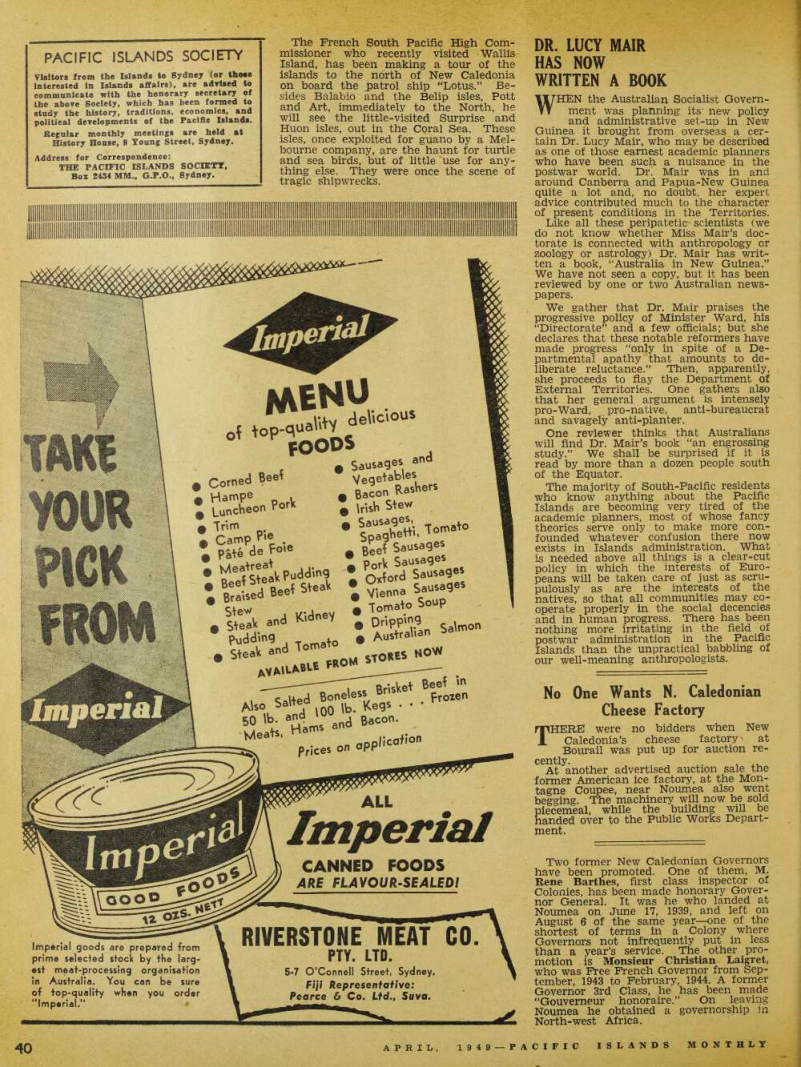
“Muliama” Gets Scratch
SANTO, March 1, UNDER old-timer, Captain Bickle, the small Burns Philp Islands’ vessel, the MV “Muliama” arrived in Santo during February and unloaded 60 tons of cargo.
When the “Morinda” left dry dock and resumed her former Sydney-New Hebrides run last June, the “Moolly” (as she is popularly known) was diverted from the New Hebrides and ran from then on direct from Sydney to the Solomon Islands. Her unscheduled visit to the New Hebrides was only made fto re patriate her present crew and to recruit a new one.
Difficulties were encountered in this re spect, however, and she sailed from the Group with a crew scratched up from among the store “boys” of Burns Philp Vila Branch.
From Santo she sailed direct to the Solomons, whence she will return to Sydney.
Noumea’s European birthrate declined from 364 in 1947 to 328 in 1948. Mar riages also declined from 129 to 101, and deaths from 128 to 104.
The Rev. and Mrs. Trevor Shepherd, of the Methodist Mission, Kekesu, Bougainville, entertained recently in honour of the 21st birthday of Mrs. Shepherd’s sister, Miss Valmai Pickford, of New Zealand, who is visiting the Mission. Eleven of the seventeen guests all had birthdays within the same month! Other guests were: Rev. C. Luxton, Pastor and Mrs. Cyril Pascoe and Mr. Pascoe’s brother, Mr. Ernest Pascoe (another New Zealand visitor), Mrs, Paul Mason and her sister, Miss Ette Taylor (visiting from Sydney), Mr. Reg. Pullen, Mr. Stewart Murray, Pastor E. Martin, Mrs. Nari Forster and her son, Michael. Another distinguished guest was the three-weeks-
old Alys Shepherd, newly arrived daughter of Rev. and Mrs. Shepherd. Sls ters Merle Carter and Winifred Poole of the Methodist Mission assisted to enter tain the guests. » „, T *} e ne ™ Resident Commissioner for Western Samoa, Mr. G. R. Powles, was scheduled to reach Apia on RNZN ship “Hawea” on March 2. Before he left New Zealand, the NZ Prime Minister said that Mr, Powles was undertaking a heavy task and that he would push forward the Government’s policy towards its ultimate objective—self-government for the Samoans.
The French South Pacific High Com missioner who recently visited Wallis Island, has been making a tour of the islands to the north of New Caledonia on board the patrol ship “Lotus.” Be sides Balabio and the Belip isles, Pott and Art, immediately to the North, he will see the little-visited Surprise and Huon isles, out in the Coral Sea. These isles, once exploited for guano by a Mel bourne company, are the haunt for turtle and sea birds, but of little use for any thing else. They were once the scene of tragic shipwrecks.
Advertisements & other items, pp. 41-42 (1 item)
m
mm* ■ *■ I m m 3 II *T
SWALLOW & ARIELL
LIMITED
S3SI6
I ) Master Craftsmen in the Biscuit Industry since 1854
PACIFIC ISLANDS SOCIETY
Visitors from the Islands to Sydney (or these Interested In Islands affairs), are advised to communicate with the honorary secretary of the above Society, which has been formed to study the history, traditions, economics, and political developments of the Pacific Islands.
Regular monthly meetings are held at History House, 8 Young Street, Sydney.
Address for Correspondence:
THE PACIFIC ISLANDS SOCIETY,
Box 2454 MM., G.P.0., Sydney.
rial
TAKE
YOUR
HCK
hup 6
menu
FOODS
v Sausages and
• Corned Beet Vegetables
jec.** :sc
• Sp Pie * IpagheHi, Tomato * Pate P de Foie Bee f Sausage^ * R e fs+elk Pudding * t Braised Beet Steak • Sausages 9 cw , A Tomato Soup • Steak and Kidney Dnpptaq Salmon Pudding to • Austral' 3 • --jri” 0 * —-— " ' ' . . n« -— — —" i Brisket Beef in A'so Salted • • • Fr ° ie " s ° e S; Hams and Bacon.
' prices on
KT' ALL
Imperial
CANNED FOODS
ARE FLAVOUR-SEALED
Imperial goods are prepared from prime selected stock by the largest meat-processing organisation in Australia. You can be sure of top-quality when you order "Imperial. 11
RIVERSTONE MEAT CO
PTY. LTD.
5-7 O’Connell Street, Sydney.
Fiji Representative: Pearce & Co. Ltd.. Suva.
Has Now
Dr. Lucy Mair
Written A Book
WHEN the Australian Socialist Govern ment was planning its' new policy and administrative set-up in New Guinea it brought from overseas a cer tain Dr. Lucy Mair, who may be described as one of those earnest academic planners who have been such a nuisance in the postwar world. Dr. Mair was in and around Canberra and Papua-New Guinea quite a lot and, no doubt, her expert advice contributed much to the character of present conditions in the Territories.
Like all these peripatetic scientists (we do not know whether Miss Mair’s doc torate is connected with anthropology or zoology or astrology) Dr. Mair has writ ten a book, “Australia in New Guinea.”
We have not seen a copy, but it has been reviewed by one or two Australian news papers.
We gather that Dr. Mair praises the progressive policy of Minister Ward, his “Directorate” and a few officials; but she declares that these notable reformers have made progress “only in spite of a De partmental apathy that amounts to de liberate reluctance.” Then, apparently, she proceeds to flay the Department of External Territories. One gathers also that her general argument is intensely pro-Ward, pro-native, anti-bureaucrat and savagely anti-planter.
One reviewer thinks that Australians will find Dr. Mair’s book “an engrossing study.” We shall be surprised if it is read by more than a dozen people south of the Equator.
The majority of South-Pacific residents who know anything about the Pacific Islands are becoming very tired of the academic planners, most of whose fancy theories serve only to make more con founded whatever confusion there now exists in Islands administration. What is needed above all things is a clear-cut policy in which the interests of Euro peans will be taken care of just as scru pulously as are the interests of the natives, so that all communities may co operate properly in the social decencies and in human progress. There has been nothing more irritating in the field of postwar administration in the Pacific Islands than the unpractical babbling of our well-meaning anthropologists.
Cheese Factory
No One Wants N. Caledonian Cheese Factory
THERE were no bidders when New Caledonia’s cheese factory at Bourail was put up for auction re cently. . , ..
At another advertised auction sale the former American ice factory, at the Mon tagne Coupee, near Noumea also went begging. The machinery will now be sold piecemeal, while the building will be handed over to the Public Works Depart ment.
Two former New Caledonian Governors have been promoted. One of them, M.
Rene Barthes, first class inspector of Colonies, has been made honorary Gover nor General. It was he who landed at Noumea on June 17, 1939, and left on August 6 of the same year—one of the shortest of terms in a Colony where Governors not infrequently put in less than a year’s service. The other pro motion is Monsieur Christian Laigret, who was Free French Governor from Sep tember, 1943 to February, 1944. A former Governor 3rd Class, he has been made “Gouverneur honoraire.” On leaving Noumea he obtained a governorship in North-west Africa.
Magazine Section
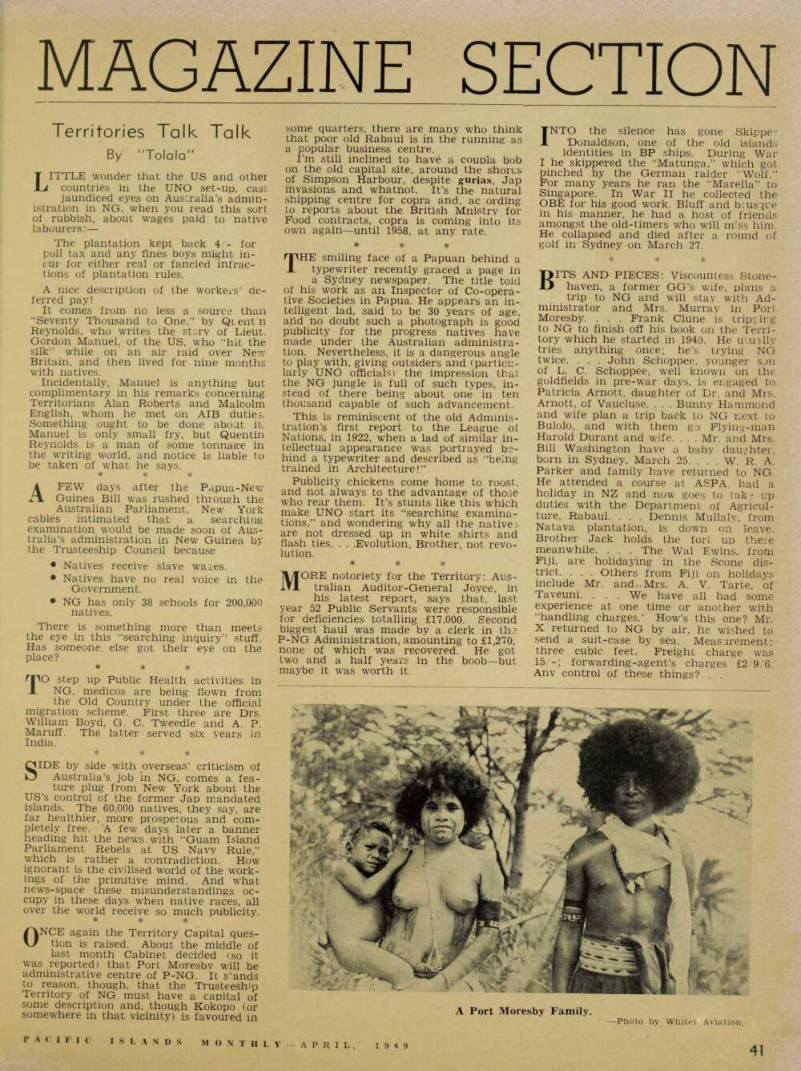
Territories Talk Talk
By "Tolala"
LITTLE wonder that the US and other countries in the UNO set-up, cast jaundiced eyes on Australia’s admin istration in NG, when you read this sort of rubbish, about wages paid to native labourers: — The plantation kept back 4 - for poll tax and any fines boys might in cur for either real or fancied infrac tions of plantation rules.
A nice description of the workers’ de ferred pay!
It comes from no less a source than “Seventy Thousand to One,” by Quent’n Reynolds, who writes the storv of Lieut.
Gordon Manuel, of the US. who “hit the silk” while on an air raid over New Britain, and then lived for nine months with natives.
Incidentally, Manuel is anything but complimentary in his remarks concerning Territorians Alan Roberts and Malcolm English, whom he met on AIB duties.
Something ought to be done about it.
Manuel is only small fry, but Quentin Reynolds is a man of some tonnage in the writing world, and notice is liable to be taken of what he says. * * * A FEW days after the Papua-New Guinea Bill was rushed through the Australian Parliament, New York cables intimated that a searching examination would be made soon of Aus tralia’s administration in New Guinea by the Trusteeship Council because • Natives receive slave wages. • Natives have no real voice in the Government. • NG has only 38 schools for 200,000 natives.
There is something more than meets the eye in this “searching inquiry” stuff.
Has someone else got their eye on the place? ♦ * * rpo step up Public Health activities in X NG, medicos are being flown from the Old Country under the official migration scheme. First three are Drs.
William Boyd, G. C. TWeedle and A. P.
Maruff. The latter served six years in India. * * * SIDE by side with overseas’ criticism of Australia’s job in NG, comes a fea ture plug from New York about the US’s control of the former Jap mandated islands. The 60,000 natives, they say, are far healthier, more prosperous and com pletely free. A few days later a banner heading hit the news with “Guam Island Parliament Rebels at US Navy Rule,” which is rather a contradiction. How ignorant is the civilised world of the work ings of the primitive mind. And what news-space these misunderstandings oc cupy in these days when native races, all over the world receive so much publicity. * * « ONCE again the Territory Capital ques tion is raised. About the middle of last month Cabinet decided (so it was reported) that Port Moresby will be administrative centre of P-NG. It stands to reason, though, that the Trusteeship Territory of NG must have a capital of some description and, though Kokopo (or somewhere in that vicinity) is favoured in
some quarters, there are many who think that poor old Rabaul is in the running as a popular business centre.
I’m still inclined to have a coupla bob on the old capital site, around the shores of Simpson Harbour, despite gurias, Jap invasions, and whatnot. It’s the natural shipping centre for copra and. ac.ording to reports about the British Mnistrv for Food contracts, copra is coming into its own again—until 1958, at any rate. ♦ * * 11HE smiling face of a Papuan behind a typewriter recently graced a page in a Sydney newspaper. The title told of his work as an Inspector of Co-opera tive Societies in Papua. He appears an in telligent lad, said to be 30 years of age, and no doubt such a photograph is good publicity for the progress natives have made under the Australian administra tion. Nevertheless, it is a dangerous angle to play with, giving outsiders and (particu larly UNO officials) the impression that the NG jungle is full of such types, in stead of there being about one in ten thousand capable of such advancement.
This is reminiscent of the old Adminis tration’s first report to the League of Nations, in 1922, when a lad of similar in tellectual appearance was portrayed be hind a typewriter and described as “being trained in Architecture!”
Publicity chickens come home to roost, and not always to the advantage of those who rear them. It’s stunts like this which make UNO start its “searching examina tions,” and wondering why all the native; are not dressed up in white shirts and flash ties. . . .Evolution, Brother, not revo lution. ♦ * * MORE notoriety for the Territory; Aus tralian Auditor-General Joyce, in his latest report, says that, last year 52 Public Servants were responsible for deficiencies totalling £17,000. Second biggest haul was made by a clerk in th 3 P-NG Administration, amounting to £1,270, none of which was recovered. He got two and a half years in the boob—but maybe it was worth it.
INTO the silence has gone Skippe’.- 'Donaldson, one of the old islands identities in BP ships. During War I he skippered the “Matunga,” which got pinched by the German raider ‘ Wolf.”
For many years he ran the “Marella” to Singapore. In War II he collected the OBE for his good work. Bluff and biusque in his manner, he had a host of friends amongst the old-timers who will miss him.
He collapsed and died after a round of golf in Sydney on March 27. * * * BITS AND PIECES: Viscountess Stone haven, a former GG’s wife, plans a trip to NG and will stay with Ad ministrator and Mrs. Murray in Port Moresby. . . . Frank Clune is tripping to NG to finish off his book on the Terri tory which he started in 1940. He usually tries anything once; he’s trying NG twice. . . . John Schoppee, younger son of L. C. Schoppee, well known on the goldfields in pre-war days, is engaged to Patricia Arnott, daughter of Dr. and Mrs.
Arnott, of Vaucluse. . . . Bunny Hammond and wife plan a trip back to NG next to Bulolo, and with them go Flying-man Harold Durant and wife. . . .Mr. and Mrs.
Bill Washington have a baby daughter, born in Sydney, March 25. . . . W. R. A.
Parker and family have returned to NG, He attended a course at ASPA had a holiday in NZ and now goes to tak- up duties with the Department of Agricul ture, Rabaul. . . . Dennis Mullaly, from Natava plantation, is down on leave.
Brother Jack holds the fort up there meanwhile. . . . The Wal Ewins. from Fiji, are holidaying in the Scone dis trict. . . . Others from Fiji on holidays include Mr. and. Mrs. A. V. Tarte, of Taveuni. . . . We have all had some experience at one time or another with “handling charges.’ How’s this one? Mr.
X returned to NG by air, he wished to send a suit-case by sea. Measurement: three cubic feet. Freight charge was 15/-; forwarding-agent’s charges £2 9 6, Anv control of these things? . .
A Port Moresby Family.
Photo by Whites Aviation.
Goni Mixed Medicine and Sea
craft to Save Our Allies
By F.P.A.
THERE is nothing remarkable about the appearance of Goni, the Medical Tul Tul, or “Doctor Boy,” of Carterets— an atoll group some 40 miles north-east of Buka Island—but he can. when oc casion demands, do a job of work. The story of how he piloted a party of casta way American airmen, from Carterets to Choisuel Island in the British Solomons, in a light canoe and through stormy seas in monsoon weather, is worth telling.
I re-met Goni in February, 1944, when I had gone to Carterets in an American PT boat from the Green Is l and (Nissan) base. He greeted me casually, as though there had not been an interval of years, and a war, since our last meeting. Yes, everything was alright, he said, no Jap anese had landed on the group during the war, but a party of shot-down Americans had arrived there in rubber dinghies about a year before and they had been looked after by the natives. they had rested, he (Goni) had repaired one of the larger canoes and had piloted them to the British Solomons, where they had con tacted friends. They had paid him well for the job and had returned him by plane to the group. That was all—then he added as an afterthought, “Masta, me no got tobak.”
Here is the other side of the story, which shows that Goni rendered a real service to the Allied Forces in assisting to restore, urgently required, trained air men to their jobs at a very critical period.
On February 9, 1943, at 3 a.m., the 817, My Lovin' Dove,” in charge of Capt.
T. W. Classen of the American Air Force, left Guadalcanal on a mission to the north-east, and when, near Nauru Island, was tackled by eight Zeros. Though the Fortress shot down four Zeros, and eluded the others, all her crew were wounded in the 90-minute fight. The Plane was se verely crippled and forced to come down in the sea, where she quickly sank.
The crew had time to clear away the two rubber dinghies and collect some em ergency rations and water before "Mv Lovin’ Dove” sank from sight. They tied the two dinghies together and prepared to make the best of things and what with high seas, rain squalls and no means of propulsion they decided to leave the matter in the hands of the winds, the currents and the Gods! There followed fifteen and a half days of exposure and discomfort, meanwhile their wounds — though not serious—were becoming ex tremely painful. Also they had become very hungry and considerably weakened, on the diet of an occasionally caught fish and sea birds.
Then, on the morning of the sixteenth day they came to the Carterets. and, somehow, scrambled ashore and threw themselves thankfully on the beach. They had drifted an estimated 643 miles since they had taken to the rubber dinghies.
Their approach had not been unob served, and, before long the natives made contact and welcomed them. The natives rendered the airmen every possible assis tance —housing and feeding them and at tending to their wounds. As the food situation on the atoll was not good, the natives distributed their guests among the various islands and shared what they had. One native even “operated” on one of the gunners and removed a bullet from his heel!
Then the Fortress crew found, to then surprise, that another American —sole survivor of a shot-down Navy “Grumman”
Avenger plane—had been on the atoll for nearly six months. He had drifted in a rubber dinghy for 16 days before reach ing the Carterets in rather bad shapi from exposure, lack of food, and a bad wound in the right leg. He had been well cared for by the natives, and been fed and had his wound dressed until he was able to walk again.
AFTER recouperating and regaining their strength the airmen decided that some of their number should at tempt a canoe trip to the British Solo mons to seek aid, and, if successful in running the gauntlet of Jap planes, ships, etc., to send a rescue plane back for the remainder of the party. The first at empi by four Americans was unsuccessful as the canoe capsized not far off shore, and the occupants swam and waded back to the beach. It was then decided to try and enlist a native to accompany them and skipper the canoe.
To this end Goni offered his services, so a larger canoe was obtained and repaired, and a mat sail was manufactured to meet the needs of this craft. All was ready at the end of March when Captain Clas sen, three other airmen, and Goni set out for the British Solomons, away to the south. Their route lay straight down past the heavily garrisoned and efficiently patrolled Jap-held islands of Buka and Bougainville. It was a desperate venture, but they hoped for the best. They took bananas and coconuts as food and for drinking.
Proceeding down the east coast of Buka and Bougainville they encountered heavy winds, rough seas and much rain, and, though mighty uncomfortable, the heavy weather was probably their salvation as the wind and sea was behind them and the rain squalls assisted in hiding them from view. Goni hoisted the big mat sail, gripped his big steering paddle and wedged himself firmly in the stern sheets. The others hung on and baled constantly.
After three and a half days sail they reached the northern end of Choiseul Island in the British Solomons.
The party saw no Jap ships en route but several times they were sighted by enemy planes, though only one of them came down to investigate. It flew low over them—twice —and then unexpectedly flew on. The party was immensely relieved!
They also came close to Kieta—brought there by wind and current —but a rain squall hid them as they went past. With out Goni they could not have made it as he had handled the canoe with skill and courage during the most trying times of the voyage.
Having arrived at the northern end of Choiseul in the evening, they rested up until noon next day, and made necessary repairs to canoe and rigging. After pro ceeding another 15 miles southward, and spending another night, the party .con tacted friendly natives and replenished their larder. The British Solomons natives now transferred them to another and larger canoe and took them to a rendezvous with an Australian Coast- Watcher.
The Coast-Watcher took them to his camp and gave them food and medical at tention until, as a result of radio arrange
ments, an American plane came and picked them up at Boe Boe Harbour, 30 miles to the south, and they reached their original starting point—Henderson Field —on April 13, just 63 days after leav ing it!
On April 15 a PBY was despatched to Carterets to pick up the remaining six Americans. Goni was returned with this plane, together with a cargo of rice, tobac co, beans and print, and he was a happj man! At 3 a.m. on the next day the PBY took off from Carterets lagoon bringing the rest of the party to Guadalcanal after being 66 days away from their base.
The Americans were well aware, and very appreciative, of the care and hospi tality received from the Carteret natives during their enforced stay on the atoll.
It was a time when food was short and these young men had healthy appetites during their convalescence. The natives shared what they had with them. The knowledge and assistance of Goni made possible the canoe trip and the subse quent rescue of all.
QUITE recently a letter has come from Lieut-Colonel T. W. Classen—the former Captain Classen—written from USA just prior to his departure for Oc cupied Germany in charge of a squadron of B29’s. He says that, after the inter vening years, he still has a lively sense of gratitude, and feeling of indebtedness, to the natives of the atoll for their assis tance to the castaways. And he feels he owes a special debt to Goni, through whose courage and skill the rescue of all was made possible.
Tropic Thunderstorm
Rain running all over the rooms; And it is dark with thunder hovering— Too dark to read, though the lamp-walk about is lit.
Within the house-cook the coon crouches ’gainst the stove, Joined by his enemy the cat—“lick-lick harp-cat”
This kitten from Madang with broken tail is called.
Rain running away from the roof, Spilling above the tanks already full.
Oh, irony of fate, that tanks have limits!
Rain running away, recklessly, rashly.
Into our lounge come various visitors, Curious creatures —miniature shellbacks.
A dignified crab walks in by the open door, Large as a lobster he seems to be — Ah, How the balsams bloom after the rain And the orchids out of their yellowed stems (I ran out in the rain to look) Not one—but a cluster of twentynine; Orchids at last, trailing the gnarled old tree.
Thunder rolled further and further away Over the sullen bay and past the horizon’s rim Where mountain-islands lay smothered in storm.
Then suddenly came the sun. The steamy skies w Devoured the rain-soaked earth. Blue was the bay again.
The shellbacked visitors vanished whence they came.
I heard the coon in the house-cook pump ing the primus, , Over the hill came the sound of the jeep— “ Master ’e come!” called the coon from the house-cook.
Freda Macdonnell.
At The Club
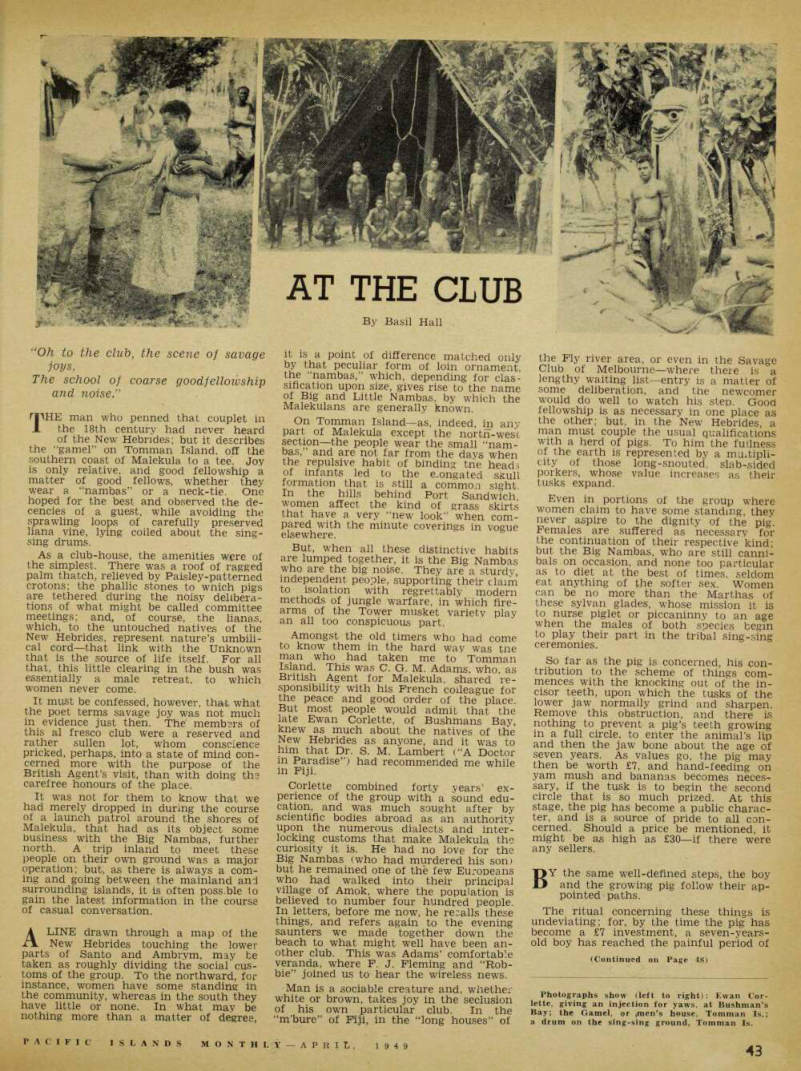
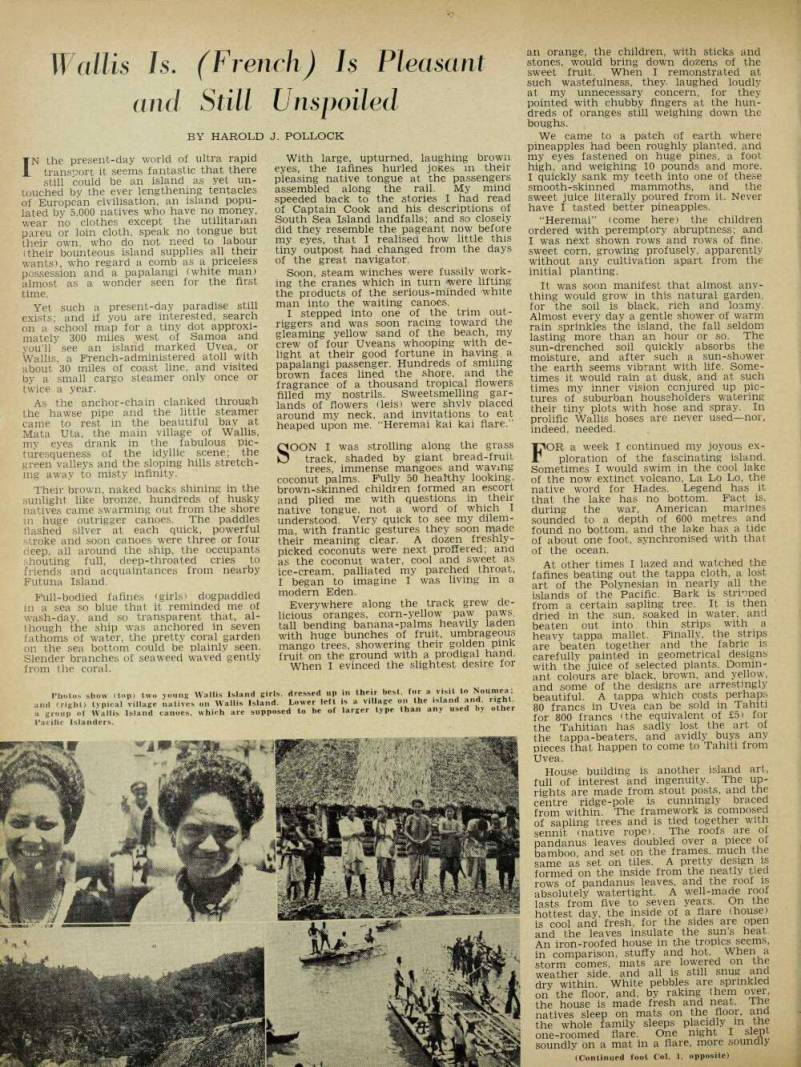
i( Oh to the club, the scene of savage joys, The school of coarse goodfellowship and noise.” 11HE man who penned that couplet in the 18th century had never heard of the New Hebrides; but it describes the “gamel” on Tomman Island, off the southern coast of Malekula to a tee, Joy is only relative, and good fellowship a matter of good fellows, whether they wear a “nambas” or a neck-tie. One hoped for the best and observed the de cencies of a guest, while avoiding the sprawling loops of carefully preserved liana vine, lying coiled about the sing sing drums.
As a club-house, the amenities were of the simplest. There was a roof of ragged palm thatch, relieved by Paisley-patterned crotons: the phallic stones to which pigs are tethered during the noisy delibera tions of what might be called committee meetings; and, of course, the lianas, which, to the untouched natives of the New Hebrides, represent nature’s umbili cal cord —that link with the Unknown that is the source of life itself. For all that, this little clearing in the bush was essentially a male retreat, to which women never come.
It must be confessed, however, that what the poet terms savage joy was not much in evidence just then. The members of this al fresco club were a reserved and rather sullen lot, whom conscience pricked, perhaps, into a state of mind con cerned more with the purpose of the British Agent’s visit, than with doing the carefree honours of the place.
It was not for them to know that we had merely dropped in during the course of a launch patrol around the shores of Malekula, that had as its object some business with the Big Nambas, further north. A trip inland to meet these people on their own ground was a major operation: but, as there is always a com ing and going between the mainland and surrounding islands, it is often poss ble to gain the latest information in the course of casual conversation.
ALINE drawn through a map of the New Hebrides touching the lower parts of Santo and Ambrym, may be taken as roughly dividing the social cus toms of the group. To the northward, for instance, women have some standing in the community, whereas in the south they have little or none. In what may be nothing more than a matter of degree,
By Basil Hall
it is a point of difference matched only by that peculiar form of loin ornament, lffl e ca ; t ir b u a p S on sizel gives P rise name of Big and Little Nambas, by which the Malekulans are generally known. on Tomman Island-as, indeed, in any part of Malekula except the nortn-wesc section—the people wear the small “nam bas,” and are not far from the days when the repulsive habit of binding tne heads of infants led to the elongated skull formation that is still a common sight, in the hills behind Port Sandwich women affect the kind of grass skirts that have a very “new look" when com pared with the minute coverings in vogue elsewhere. K vogue are who aS the bfg noTse Thev a re B n independent people, supporting their claim to isolation With regrettably modern methods of jungle warfare in which fire arms of the Tower muskrt viTrirtv Slav a n all too consnicnnnW V play A conspicuous part.
Amongst the old timers who had come know them in the hard wav was tne man who .had taken me to Tomman Island. This was C, G. M. Adams, who, as British Agent for Malekula, shared re sponsibility with his French colleague for H lO . peac f anc * good order of the place, r* 5? ost People would admit that the , e Ewan Corlette, of Bushmans Bay, knew I P, uc h about the natives of the New Hebrides as anyone, and it was to Or. S. M. Lambert <“A Doctor - n Ear . adlse ) had recommended me while
ln FIJI
- combined forty years’ ex perience of the group with a sound edu cation, and was much sought after by scientific bodies abroad as an authority upon the numerous dialects and inter locking customs that make Malekula the curiosity it is. He had no love for the Big Nambas (who had murdered his son) but he remained one of the few Europeans who had walked into their principal village of Amok, where the population is believed to number four hundred people In letters, before me now, he recalls these things, and refers again to the evening saunters we made together down the beach to what might well have been an other club. This was Adams’ comfortable veranda, where F. J. Fleming and “Rob bie” joined us to hear the wireless news, Man is a sociable creature and, whether white or brown, takes joy in the seclusion of his own particular club. In the “m’bure” of Fiji, in the “long houses” of
the Fly river area, or even in the Savage Club of Melbourne—where there is a lengthy waiting list—entry is a matter of some deliberation, and the newcomer would do well to watch his step. Good fellowship is as necessary in one place as the other; but, in the New Hebrides, a man must couple the usual qualifications with a herd of pigs. To him the fullness of the earth is represented by a multipli city of those long-snouted, slab-sided porkers, whose value increases as their tusks expand.
Even in portions of the group where women claim to have some standing, they never aspire to the dignity of the pig.
Females are suffered as necessary for the continuation of their respective kind; but the Big Nambas, who are still canni bals on occasion, and none too particular as to diet at the best of times, seldom eat anything of the softer sex. Women can be no more than the Marthas of these sylvan glades, whose mission it is to nurse piglet or piccaninny to an age when the males of both species begin to play their part in the tribal sing-sing ceremonies.
So far as the pig is concerned, his con tribution to the scheme of things com mences with the knocking out of the in cisor teeth, upon which the tusks of the lower jaw normally grind and sharpen.
Remove this obstruction, and there is nothing to prevent a pig’s teeth growing in a full circle, to enter the animal’s Up and then the jaw bone about the age of seven years. As values go, the pig may then be worth £7, and hand-feeding on yam mush and bananas becomes neces sary, if the tusk is to begin the second circle that is so much prized. At this stage, the pig has become a public charac ter, and is a source of pride to all con cerned. Should a price be mentioned, it might be as high as £3o—if there were any sellers.
BY the same well-defined steps, the boy and the growing pig follow their ap pointed paths.
The ritual concerning these things is undeviating; for, by the time the pig has become a £7 investment, a seven-years old boy has reached the painful period of
(Continued on Page 48)
Photographs show (left to right): Ewan Cor lette, giving an injection for yaws, at Bushman’s Bay; the Gamel, or house, Tomman Is.; a drum on the sing-sing ground, Tomman Is.
initiation, and is free of his mother’s care and guidance. Now he may wear the "nambas” and is approaching that grand moment when he joins forces with his father’s pigs; the one to enter the men’s "gamel,” the other to become no more than the memory of a good deed in a naughty world.
For the first of a young man’s sing sings the whole family must prepare a good twelve months before, since upon a bumper yam harvest do they depend to feed their guests. Very often a whole year’s food supply is poured out in one glorious spree, leaving the kind of debt that hangs like a dark cloud in the back ground of a native’s life. Hard economic facts like this are the things that go to swell a British planter’s labour line, and the recruiter follows close upon the sing sing hang-over.
In a world of clubs and pubs—the two being synonymous in Malekula where the big Nambas brew a form of kava —a boy prepares for his first sing-sing, by tying his pigs with the traditional wild cane bands before those ancestral drums (“tame”) that dominate the dancing ground. Pop-eyed with excitement, he follows his prancing elders through all the intricacies of a complicated dance; dazzled by the light of torches, deafened by chanting, hand-clapping and the thud of drums, he has reached manhood as he falls exhausted long before the night is done. His is now the right of member ship that carries with it a fire of his own in the “gamel,” and the chance to laugh
with “coarse good fellowship” at those same moss-hung stories that are a feature of any smoking room.
But he knows better than to believe that he has seen the last of pigs. If an en gaging young woman catches his eye, her parents will expect him to say it with pigs. He must have more pigs for his wife to rear, for, as a family man, it is up to him to work his way from the most junior to more senior places in the club life of the “gamel,” and, once more, a sing-sing is the necessary procedure. This time, he will tie his offering to stakes cut
from the Dragon’s Blood tree and. with each succeeding grade, to those of the coral tree (Nen-Rar), the cycus palm; to stakes of teak, and to slabs of stone wnoie height increases with advancement. One can compress the ladder of life into a dozen lines; but multiply the years in terms of pig currency, and it becomes apparent that only the rich man really scales the social peaks.
Pig money or what passes for the same elsewhere —well, you know the answer! I have a feeling, too, that Wil liam Cowper’s lines describe most clubs— or should we scornfully reject the word "noise?”
Monsieur Girault, Administrator of Colonies Ist Class, has arrived at Papeete, Tahiti, as Secretary-General of French Oceania. Another arrival is M. Vaissiere, a French educationist, who is to organise technical instruction in Tahiti.
Like New Caledonian students, who get an allowance of 12,000 metropolitan francs when attending French universities, Tahitian students are now to receive al lowances amounting to 13,000 francs monthly at Paris or Marseilles, and 12,000 at other French universities.
and Still Unspoiled
Wallis Is. ( French) Is Pleasant and Still Unspoiled
By Harold J. Pollock
IN the present-day world of ultra rapid transport it seems fantastic that there still could be an island as yet untouched bv the ever lengthening tentacles of European civilisation, an island populated by 5,000 natives who have no money, wear no clothes except the utilitarian pareu or loin cloth, speak no tongue but their own who do not need to labour (their bounteous island supplies all their wants), who regard a comb as a priceless possession and a papalangi (white man) almost as a wonder seen for the first time. vpi curb a nresent-dav naradise still
exists - "and if ?oTare interes[?dlearch
man for a tinv dot approximately 300 miles west of Samoa and vnn’ii cpp an island marked Uvea or Wallis, a French-administered atoll with about 30 miles of coast line, and visited twice rvear Carg ° St6amer ° n ‘ y ° nC6 ° r twice a year.
As the anchor-chain clanked through the hawse pipe and the little steamer came to rest in the beautiful bay at Mata Uta, the main village of Wallis. my eyes drank in the fabulous picturesqueness of the idyllic scene, the mTaJav le to m]stv h fnfin?tv S hIUS stretch ' mg away to misty infinity.
Their brown, naked backs shining in the sunlight like bronze, hundreds of husky natives came swarming out from the shore in huge outrigger canoes. The paddles flashed silver at each quick, powerful stroke and soon canoes were three or four deep, all around the ship, the occupants shouting full, deep-throated cries to friends and acquaintances from nearby Futuna Island.
Full-bodied fafines (girls) dogpaddled in a sea so blue that it reminded me of wash-day. and so transparent that, although the ship was anchored in seven fathoms of water, the pretty coral garden on the sea bottom could be plainly seen.
Slender branches of seaweed waved gently from the coral.
With large, upturned, laughing brown eyes, the tafines hurled jokes m their pleasing native tongue at the passengers assembled along the rail. My mind speeded back to the stories I had read of Captain Cook and his descriptions 9f South Sea Island landfalls; and so closeiy did they resemble the pageant now before my eyes, that I realised how little this tiny outpost had changed from the days of the great navigator, Soon, steam winches were fussily work ing the cranes which in turn =were lifting the products of the serious-minded white man into the waiting canoes, .1 stepped into one of .the trim out riggers and was soon racing toward the gleaming yellow sand of the beach, my crew of four Uveans whooping with de fight at their good o^sminne papalangi passenger. Hundreds of smiling Sancfof tropical flowers mled my nostrils. Sweetsmelling gar iands 0 f flowers (leis) were shyly placed aroU nd my neck, and invitations to eat heaped upon me. “Heremai kai kai flare.” rioON I was strolling along the grass trQrVr hv bread-fruit trees,’ immense mangoes and waving coconut palms. Fully 50 healthy looking, brown-skinned children formed an escort and plied me with questions in their native tongue, not a word of which I understood. Very quick to see my dilem ma, with frantic gestures they soon made their meaning clear. A dozen freshly picked coconuts were next proffered; and as the coconut water, cool and sweet as ice-cream, palliated my parched throat, I began to imagine I was living in a modern Eden, Everywhere along the track B re w de licious oranges, corn-yellow paw P Q a^n tall bending banana-palms heavily laden with huge bunches of fruit, umbrageous mango trees, showering their golden pink fruit on the ground with a prodigal hand, When I evinced the slightest desire tor
an orange, the children, with sticks and stones, would bring down dozens of the sweet fruit. When I remonstrated at such wastefulness, they, laughed loudly at my unnecessary concern, for they pointed with chubby fingers at the hun dreds of oranges still weighing down the boughs.
We came to a patch of earth where pineapples had been roughly planted, and my eyes fastened on huge pines, a foot high, and weighing 10 pounds and more.
I quickly sank my teeth into one of these smooth-skinned mammoths, and the sweet juice literally poured from it. Never have I tasted better pineapples.
“Heremai” (come here) the children ordered with peremptory abruptness; and I was next shown rows and rows of fine, sweet corn, growing profusely, apparently without any cultivation apart from the initial planting.
It was soon manifest that almost any thing would grow in this natural garden, for the soil is black, rich and loamy.
Almost every day a gentle shower of warm rain sprinkles the island, the fall seldom lasting more than an hour or so. The sun-drenched soil quickly absorbs the moisture, and after such a sun-shower the earth seems vibrant with life. Some times it would rain at dusk, and at such times my inner vision conjured up pic tures of suburban householders watering their tiny plots with hose and spray. In prolific Wallis hoses are never used—nor, indeed, needed.
FOR a week I continued my joyous ex ploration of the fascinating island.
Sometimes I would swim in the cool lake of the now extinct volcano, La Lo Lo, the native word for Hades. Legend has it that the lake has no bottom. Fact is, during the war, American marines sounded to a depth of 600 metres and found no bottom, and the lake has a tide of about one foot, synchronised with that of the ocean.
At other times I lazed and watched the fafines beating out the tappa cloth, a lost art of the Polynesian in nearly all the islands of the Pacific. Bark is stripped from a certain sapling tree. It is then dried in the sun, soaked in water, and beaten out into thin strips with a heavy tappa mallet. Finally, the strips are beaten together and the fabric is carefully painted in geometrical designs with the juice of selected plants. Domin ant colours are black, brown, and yellow, and some of the designs are arrestingly beautiful. A tappa which costs perhaps 80 francs in Uvea can be sold in Tahiti for 800 francs (the equivalent of £5) for the Tahitian has sadly lost the art of the tappa-beaters, and avidly buys any pieces that happen to come to Tahiti from Uvea.
House building is another island art, full of interest and ingenuity. The up rights are made from stout posts, and the centre ridge-pole is cunningly braced from within. The framework is composed of sapling trees and is tied together with sennit (native rope). The roofs are of pandanus leaves doubled over a piece of bamboo, and set on the frames, much the same as set on tiles. A pretty design is formed on the inside from the neatly tied rows of pandanus leaves, and the roof is absolutely watertight. A well-made roof lasts from five to seven years. On the hottest day, the inside of a flare (house) is cool and fresh, for the sides are open and the leaves insulate the sun’s heat.
An iron-roofed house in the tropics seems, in comparison, stuffy and hot. When a storm comes, mats are lowered on the weather side, and all is still snug and dry within. White pebbles are sprinkled on the floor, and. by raking them over, the house is made fresh and neat. The natives sleep on mats on the floor, and the whole family sleeps placidly m the one-roomed flare. One night I slept soundly on a mat in a flare, more soundly
(Continued foot Col. 1, opposite)
Photos show (top) two young Wallis Island girls, dressed up in their best, for and (right) typical village natives on Wallis Island. Lower left is a village on the island and right a group of Wallis island canoes, which are supposed to be of larger type than any used by other Pacific Islanders.
perhaps than I would have on a feather bed in a Queensland iron-roofed house, for there are no, or few, mosquitoes in Uvea.
One day is much the same as another in Wallis, and they slip by without worry, without hurry, and without an angry word. Sometimes, as the hush of even ing gently fell over Uvea, I would sit on the beach and listen to the gentle lap lap of the waters on the shore of the blue lagoon. The sweet scents of the lovely Tiare Tahiti gardenia and the Frangi pani mingled with the pungent smell of the cooking fires, and of the damp earth.
The merry laughter of the natives swim ming in the lagoon would float away in the still air. The flafes of the Uveans fishing on the reef reminded me of a street of electric lights. A feeling of content would steal over me, as I dreamed on for an hour or so, and then slowly paddled out to the ship, swinging to her anchor chain.
So, Mr. Beachcomber, Mr. Tired Busi nessman, Mr. Naturist, if you are search ing for your Utopia, don’t worry about the much-publicised islands like Tahiti, Fiji, and Samoa, for I know you will be disap pointed. If there is a spot on this planet more like Eden than Uvea —well, that’s the place I’m heading for on my next holiday.
Tropicalities
information on the Giant Snail Problem—from an American journalist, Harman W. Nichols, in
Washington :
The Navy would like to know whatever happened to the bright young scientist it sent to South Africa in search of a snail eater.
If the boy doesn’t come back pretty soon, we’re going to have to move out of Guam, not to mention Saipan, to make room for the giant African snails.
History of the snail plague is this: When the Japs first moved onto Guam, they brought their lunch with them.
Snails, which the Nips dearly love. As you’ll recall, the Japs left the island in kind of a hurry, leaving their main entree behind.
The Marines and Gl’s who took over, had lots of those delicious beans and Spam and hence had little appetite for snails. So the hard-shelled critters, left to their own devices, reproduced a lot of little snails.
The snails, measuring 4 to 6 inches in length and weighing up to a pound and a half, are raising the very devil with vege tation on Guam.
There are 11,000 arable acres on the island —good for raising corn, potatoes, peas, melons and sugar. All liked by snails.
The Navy yelped for help and the Naval Research Council and our Department of Agriculture responded. The two agencies lend-leased a crew of snail experts who gave the matter a good, hard thought.
They sent a lone scientist to Africa, from whence came the snails, to find a natural enemy.
The man hasn’t sent a report in; or even a “wish-you-all-were-here” card. I went through a flock of "channels,” as we call ’em, and couldn’t even learn the man’s name, although the Navy is sure it sent Somebody down there.
West Coast ports are a little disturbed too.
They got word not long ago that offi cials boarded freighters loaded with scrap metal in Saipan and the Marianas and found more snails—apparently looking forward to a voyage to the United States.
Bent, doubtless, on displacing a lot of our growing stuff. * * * APT AIN S. W. MUIR, 77 years old, J and one of the few remaining square rigger masters, skippered the 37-ton "Diane” when she left Hobart, Tasmania, for Tulagi, BSI.
Lever’s Pacific Plantations Ltd., bought the "Diane” in Hobart and plan to use her for inter-island trading.
The four members of Captain Muir’s crew were all from Sydney. He has been at sea for 61 years and thinks that sail ing small vessels is more fun than sailing larger ships. ♦ * ♦ Y HIS appeared in McNicoll’s column
in the Sydney “Daily Telegraph”
recently :—
MANLY’S puzzled about a local theft — a Military Cross and a Belgian Royal decoration taken from a showcase in the Manly Art Gallery.
The Military Cross had an amazing his tory. Lieutenant Hunter Kirke won it in World War I. When the Japs invaded New Guinea in World War 11. Kirke evacuated his home, leaving all his pos sessions, including the decoration.
The MC was found two years later, strung round the neck of a native 1,500 miles away. * * * THE Cook Islanders’ love for being photographed or sketched, is par ticularly noticeable among the people of Rarotonga, the administrative centre.
One village there, near the very "hub” of Cl affairs, contains some very remarkable old examples of the enlarger’s art, as practised nearly forty years ago.
These “family portraits” are of native worthies long gathered to their ancestors.
They have, of course, typical Polynesian faces. The oddity lies in the fact that the framed portraits do not conform to Polynesian colouring, but have been—at the customer’s express order—tinted upon the best Teutonic lines, with pink faces and blue eyes! The early artist who did them, of course, had no fixed views on such matters, and was willing to oblige as generous a patron as the Maori of Cl always is with photographers. In that far-off day, it was no unusual thing for some Rarotongan of substance to pay the limner a fee of even five sovereigns (they were in circulation then) for a nice Nordic-tinted job, including gilt metal frame.
Preserved with pride by the descendants, these quaint, old, enlarged photos are as bright to-day as when they were made.
As far as I know, the custom was not practised in any other part of Cl, prob ably because the outer-islanders had not the money to spare. But Mangaia now has its photographer—and the future is to be dreaded!
“Eti.”
DURING the Jap blitz on Port Moresby when ANGAU was dug in at Hanua bada, a certain US Artillery colonel called on the RSM (Mons Medal and ex- Irish Guards type) in search of a suitable site for some AA guns. The RSM directed him to an old, disused watertank at the rear of the OR’s mess and a pair of Bofors was duly installed —much to the alarm and consternation of the said OR’s, whose midday siestas and nightly slumbers were rudely disturbed by the staccato crashes of the Bofors.
The situation caused amusement in
more exalted circles and resulted in a neatly typed notice which appeared on the notice boards:— No more long, dull, winter evenings —keep the children home —banish boredom by keeping a Bofors in the back yard.
A slightly amended version would be applicable in New Guinea to-day:— No more long dull winter evenings— keep the children amused—buy a second hand jeep, and you will never know a dull moment!
MM.
SOME months ago we published a short article from our Mangaia correspon dent in which he suggested that the difference in the fertility in the soils of Mangaia and Rarotonga might be ex plained by the fact that there were few, if any, earthworms on Mangaia while there were many to be found on Raro tonga.
We added, editorially, that the fact that fertility and earthworms went hand-in hand was recognised overseas and that there was at least one earth-worm farm, on the United States Pacific coast, which produced earthworms for farmers and gardeners.
Now we have a pamphlet from a firm in Sydney which aims to do the same thing for Australian farms and gardens.
Anyone who wants to know more about how worms build up the top-soil, and their other peculiar habits, can get one of these folders by writing to Soilmaster Earthworm Farms, 37 Manning Road, Double Bay, NSW. Breeder worms are also available at 25/- a box of 200. Or if you think you may have trouble intro ducing these to your soil, you can buy earthworm capsules (which is what worms produce instead of babies) for 2/per dozen; these hatch out in about three weeks.
The whole idea, of course, sounds slightly screwey as do most new ideas, but there is probably much in it. It is said that one reason why the Nile Valley retains its fertility after 6,000 years of cultivation is that there the earthworms produce 119 tons of castings—the most readily avail able plant food—per acre, per annum.
Janet Johnson, aged 14, who recently won the NSW 800-metre title at the State women’s swimming championships in Sydney, is the daughter of the former Miss Yeala McConnell, niece of Mr. Percy McConnell, formerly of Taveuni, Fiji, and now of Suva. Mrs. Johnson was born at Taveuni but now lives at Newcastle.
Advertisements & other items, p. 47 (2 items)
45
Wallis Island (Continued from Page 14)
PACIFIC ISLANDS MONTHLY - APRIL, 1949
Recipes From Home—ll
TAKE six gheckos, scale and fillet; add twenty-four hermit crabs, bearded: season with grated betel-nut; and serve hot with whiteant sauce.
My tested recipe when the steamer is overdue. —Alma G.
Paci Fic Nature Notes
Written for "PIM" by Charles Barrett, FRZS
The “Valo” Of Tonga
THERE is a strange creature to be found occasionally in these islands,” writes Mr. J. H. Young, of Nukua lofa. Tonga. “It is of the species of the lobster and the crayfish, I should think.
The native Tongan name for it is valo; but that conveys nothing. It is about 10 inches long and one inch and a half thick when mature, and its flesh is like that of the lobster (the true lobster found in UK waters) and the crayfish of these Pacific waters. It is equipped with two ‘antennae’ with which it evidently gets its food: they are like arms and are three-jointed, and the shoulder from which they branch is just behind the head. The furthest joint away from the valo’s body is like a folding pocket-comb, folding into a sheath, and the teeth are about half an inch long, with extremely sharp points, like needles.
“To eat, valos are a delicacy. They should be boiled in white wine, but with what other ingredients I am unaware.
They live in burrows in the sand, between high and low water mark; not dry sana, but sand that is water-logged. Tne egress from the valo’s retreat is a round hole which is plastered, beneath the aperture, to keep the sand from falling in. The burrow runs for several feet and has off shoots from the main stem.
“The valo is most difficult to catch, being seldom found outside its burrow.
To dig for it with a spade is merely to emulate Sisyphus. The only method I have heard of is for three or four men, with iron crowbais, to describe a circie a few feet round the outlet, and thrust the crowbars into the soft sand, gradually drawing towards the centre, with the ob ject oi disturbing the burrow, but not de stroying it completely; thus forcing the valo to the outlet. But there mav be a simpler method than that.
“H you or readers of your nature notes can add anything about this interesting creature, the imormation would be wel come.”
Had a specimen been sent to me, I could readily have identified the valo. giving its scientific title. Evidently it is a squilla, or mantis-shrimp—one of the larger species. The “antennae” described bv my correspondent aciuaily are the second pair of thpracic appendages, modified as prehensile limbs; tne terminal joint of each is armed with long teeth which can close against pits in tne margin of the preceding joint—clasp-knife fashion. The popular name for remarkable crusta ceans, of couise, refers to the resemblance their second maxillipeds bear to the fore limbs of a praying mands, and the fact that they are held and used much in the mantis manner.
It was a French naturalist of the six teenth century who described the first known species, Squilla mantis, the specific name because, as he ex plained, the long-armed marine creature lesembled the “soothsayer” or mantis in sect found in the south of France. Had old Rondolet seen some of the b-g man tids of the tropics, he would, perhaps, have regarded the “preguediou,” or pray ing insect of his own country, as rather a poor representative of the mantis clan.
Habits Of Mantis-Shrimps
THERE are about 70 species of mantis shrimps; and the most of them are burrowing animals: all are extremely active and difficult to capture. Generally, they are of a “retiring disposition,” spend ing much time in their burrows. Some, however, wander far from home in search of prey; and may be taken in nets and
trawls in fairly deep water. Others, again, prefer to get food without hunting for it: covered in sand, the eye-tips excepted, they lie in wait at the entrances to their burrows, which are deep and fairly ex tensive. The least sign of danger sends the “ant-lions of the sea,” as these crus taceans have been termed, darting to the ends of their retreats.
A certain professor, who greatly desired specimens of the elusive mantis-shrimps, after many failures, devised a plan much less elaborate than that described by Mr, Young, but not always effective. At the mouth of a burrow, he held a trowel in one hand and a tempting bait in the other, waiting patiently for the tenant to appear. The professor was no novice at capturing crustaceans; but, with all his speed and skill, often he was too slow for a frightened mantis-shrimp darting down its burrow; while often, the trowel mutilated a fine specimen instead of going beneath it.
Professor Brooks, who relates his ex periences in his report on the crustaceans collected during the voyage of the “Chal lenger,” closely observed the habits of the lurking mantis-shrimp, which exca vates its deep, almost vertical cylindrical burrows in the sand of the ocean beacn, where it is exposed to the full force of the ocean swell. Its prey includes small crustaceans, little fishes, and other small animals. When one comes within range, the shrimp darts out of its burrow, seizes
it in its raptorial claw, and darts back ward, taking the victim with it to the bottom of the burrow. Not content with one victim, it may return to the burrow mouth, and lurk there for another. Two may suffice for a meal, which is enjoyed in safety far below the surface of the beach.
Some of the largest mantis-shrimps I have seen were swimming in very shallow water near a Dunk Island beach. There were dozens of them, well away from their burrows; but I failed to make a capture, even with the assistance of “The Beach comber.” We were wading across to an islet where the “matchbox bean” flour ishes; and where, doubtless, many mantis shrimps were at home.
“Lost” Bird Found
Naturalists the world over, or at least all the ornithologists, must have rejoiced over the discovery of living specimens of Notornis, New Zealand’s flightless rail, long regarded as a “lost” bird, and represented, until this grand find, by only four specimens, one being preserved in the Otago Museum.
I have always been keenly interested in flightless birds, whether extinct or, hap pily, still among the living forms. And the re-discovery of Notornis revives hope that some other “lost” species may still survive in remote, unexplored, or seldom visited parts of their range.
Maori sealers were the original dis coverers of Notornis—away back in 1849.
The skin of this specimen became a treasure of the British Museum (Natural History), having been presented to the institution by Dr. Gideon Mantell. About a year before the capture of a living ex-
Please Send One Red Utility and Four Pairs of Sox
MR. LEO POLAND, a well-known resi dent of the Morobe District re cently received, from a native in the Central Highlands of New Guinea, the following letter: — Kainantu.
Good-O Dear Sir, Mr. Leo Poland — Biessd be Jesus Christ. Nao and for ever amen. Yes sir, My Good Friend, Mr, Leo. Can you odar one lory caar for me?
Auto caar. Look alsem me droime?
You can sehm.
Please me naf long pay olssem nao.
You mast Oder new felo caar tru long Australia tru. Please sir. Mr. Leo Poland.
Me can pay you haumast £s? Me can pay you long him. Read kolar —read paind long em. No truck no Dgip—auto car tru. i olsem long Texi. i got good roome and bihind i gat pies blong ca-ying cargo. Mi look him wanfelo long Madang blong PCB. Pies you can oder one to mi. 4 months or 3 months i must come up long you long Lae. Oright you singait long mi long pass, olrait, mi come end pay you and pay Castans and long boot, he pay algeder olrait. Balus i can Karim i come long bush long Kainantu.
Please frend nao you can send him let ter i go long Australia bambai disfelo auto caar i come long me. Please master.
And nao you can send him 4 paar shocks zise 6. No wait no kacki. maski, send him onlly bllak one atzol. 4 paar nao long dispelo playn me can send him money you mast send him pas 3 long me. Haumas you laikim me can send him, please frend?
Tok i finish.
Mi good frend blong you Mr. Leo
Poland.
A K Benjamin.
Benjamin’s Pidgin is unique in that it seems to go where it listeth and does not follow the pattern of Pidgin as taught by several of the missionary societies in the Territory. A small amount of character research, reveals Benjamin as a person who knows what he wants (A red Utility and four pairs of black sox, no more, no less); and his spelling shows him to be a rugged individualist. While NG old timers are shaking their heads and won dering how he became so affluent, others may like to know that, in straight English, he meant; —
Kainantu.
Dear Mr. Leo Poland—Blessings be up on you. Could you order a lorry-car for me? An auto-car—just like my drawing, herewith. I have sufficient to pay for one, if you will order a new one from Australia.
How much will it be? But howeve much it is I can pay it. It must be red colour—with red paint upon it. I don’t want a truck, or a jeep—but an auto car true. Like a taxi—with a good cabin in front and behind a place to carry cargo. I have seen one at the PCB in Madang.
I would like it to arrive in Lae in three or four months. When it arrives you write me a note and I will pay you, the Customs’ duty and the freight. It can then be carried by plane (balus) from Lae to Kainantu.
In the meantime you can send me four pairs of sox size 6. No white or khaki colour —just send black ones, that’s all.
Send them by return plane with a letter telling me how much they are—then I will pay you.
That’s all for now.
Yours truly,
A. K. Benjamin.
ample, Notornis had been described, by Professor Owen, from an imperfect fossil skull —described as an extinct species.
Over an interval of 35 years, three known specimens were taken; and in the ’sixties Maoris at Riverton assured Sir James Hector that mohos were still plenti ful at the head of the north-west arm of Te Anau Lake. Sir Walter Buller, twenty
years later, expressed his belief that Notornis still survived in remote parts of the South Island.
Notornis mantelli, the moho or takeha of the Maoris, which resembles a gigantic swamp-hen, or pukeko (Porphyrio) in its general colouring and the form of its bill had an ally in the extinct white Notornis of Norfolk Island and Lord Howe Island.
Notornis alba, I believe, is represented by only one specimen, in the Vienna Museum.
As “The White Fulica,” this vanished bird is figured on a plate in Surgeon John White’s “Journal of a Voyage to New South Wales,” published at London ir 1790. A fine, upstanding bird it looks, though not nearly as impressive as the portrait of its cousin, the Takeha, in Buller’s grand work on the Birds of New Zealand.
Bird Books
BY the way, all the noble bird books, more especially Gould’s, have greatly increased in value. Gould’s “Birds of Australia”—a complete set of the folio volumes—is worth about £600; while in a lecent catalogue, the five volumes of the “Birds of New Guinea” (bv Gould and Sharpe) are priced at £500; not so many years ago this splendid work could be had for less than half that amount. Tom Iredale, late of the Australian Museum, has written a book on the birds of New Guinea (the “mainland,” and adjacent Papuan islands); and his monograph on “The Birds of Paradise” is announced foi* early publication.
Rare and costly is Wilson & Evans’
"Birds 'of the Sandwich Islands,” pub lished about half a century ago. The colour plates are magnificent; especially those of Depranis pacifica, the hoohoo or “great-billed creeper.” mentioned in King’s account of Captain Cook’s last voyage; of the brilliantly coloured alokile (Vestaria coccinea) which, like many other Ha waiian birds, was first obtained by Cook’s “scientific gentlemen”; and of the curious parrot-billed ou. But all the plates are beautiful, and one is fortunate to possess a copy of this grand book. Several of the birds illustrated are now either ex tinct or excessively rare. Some collectors will take their toll even when ex tinction threatens a species; rarity in creases their desire for specimens. It has been said of a celebrated ornithologist, long since departed, that he always came first, the birds second.
The Giant Clam
LARGEST bivalve shell in the world, the giant clam (Tridacna deresa) is be ing put to what a conchologist may regard as base uses: garden ornamenta tion. Often an outsize valve serves as a bird-bath in a suburban garden, where gnomes, and storks, and giant frogs in porcelain or stone, or some other material, are proudly placed on the lawn. How in congruous they look: as much out of place as a pair of Tridacna valves.
The giant clam, though not by any means the sole member of the genus, is the only Tridaona widely known, even among ordinary folk. Yarns are told bv sailors and longshoremen, of pearl divers and native trepang fishermen being trapped by the snapping together of gaping clam valves between which they had unwittingly stepped. Some of these stories are true: the giant clam has been responsible for the drowning of natives, held prisoner by the vice-like grip of valves controlled by a very powerful “ad ductor” muscle. An unarmed man trapped by Tridacna, and beyond reach of helo, has no chance; but one armed with an extra large hunting knife or a crowbar may escape by severing the clam’s adduc
tor muscle with repeated jabs. The leader of the Great Barrier Reef Expedition, Dr. C. M. Yonge, mentions this in his popular account of the expedition. He and his assistant became expert at open ing big clams, with a crowbar of medium size.
The largest specimen of Tridacna deresa I have seen measured under four feet.
Saville Kent mentions monsters—up to 14 feet in length: but these are hearsay records. Authentic records indicate that five feet may be the length limit for the world’s largest h' valve mollusc. The famous pair of Tridacna valves, used as holy water basins in the Cathedral of St.
Sulpice, Paris, weigh 550 lbs.
Lord Howe Island’s Lost Treasure
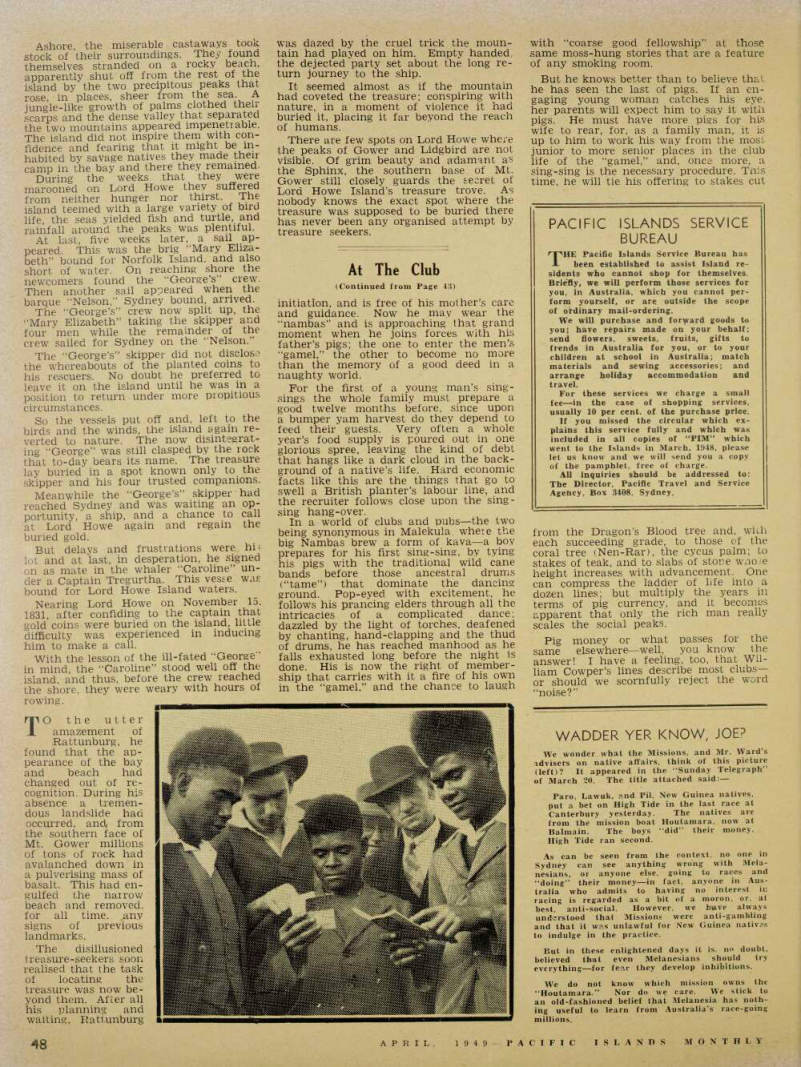
By Geoffrey Shepherd
I HAD been on Lord Howe Island only a week when I heard about the buried treasure in George’s Bay. At first I was sceptical. Just another island yarn that was reserved for tourist con sumption, I thought.
But my informant, an ex-school teacher with long residence on Lord Howe, was persistent and convincing.
Into his archives of Lord Howe he dived and produced documentary evidence to support his claim, and if it were not ab solutely conclusive, it indicated that the island could well hold lost riches. Briefly, it was supposed that somewhere on the island’s most southerly, mountainous ana unsettled region, there was buried some 6,000 sovereigns.
It appears that in 1830 the brig “George,” of 185 tons, under a Captain Rattunburg, sailed from London for Hobart Town with a consignment of me chandise for W. Bethune & Co .
Arriving there after. an uneventual voyage, the cargo was discharged and the “George” ,was fitted up as a whaler. The Middle Banks was now its destination, a rich whaling area in the Tasman Sea.
Success met the expedition: a profitable haul of whales was gathered. On reach ing Sydney proceeds from the sale of oil realised £6,000, paid in sovereigns, the coin of the day.
With the money safely placed on board, the “George” lost little time in putting out again for the Middle Banks. Thus time the whaler met with less success, and was forced to spend a longer period at sea, whereupon the water supply ran
short. Then, sighting the high i:eaks of Lord Howe Island, the skipper decided to put in and send a landing party ashore to search for water and provisions.
IN early colonial days little was known about Lord Howe. It had been dis covered 42 years previous to the “George’s” visit, by Lieutenant Ball, on his way to Norfolk Island in the “Supply,” but during the intervening years no settle ment had taken place and it was not until 1834 that the first settlers arrived.
Viewed from the sea it offered the “George’s” crew no hint of the verdant beauty to be found ashore. They saw it only as a gaunt island of massive peaks, whose summits were clothed in rain mists—a forbidding-looking island of an unknown quantity, that reared up from foam-fringed seas which were studded with rocky islets and the white wash of submerged reefs.
Cautiously the vessel entered a wide bay under the shadow of Mt. Gower, the island’s most southerly extremity which towered up for nearly 3,000 feet. While the “George” hove to in the bay, the skipper sent a landing party ashore for supplies. . Then disaster struck. A sudden gust 6# wind sweeping down from the moun tains caught the ship, and threw it heavily on a submerged rock. The vessel was held firmly but it was evident that it was only a question of time before it would break uo. Hastily the “George” was abandoned and everything of use was removed ashore, including the £6,000 in sovereigns.
Mt. Gower (right) where treasure was buried.
Ashore, the miserable castaways took stock of their surroundings. They found themselves stranded on a rocky beach, apparently shut off from the rest of the island by the two precipitous peaks that rose, in places, sheer from the sea. A iungle-like growth of palms clothed then scarps and the dense valley that separated the two mountains appeared impenetrable.
The island did not inspire them with con fidence and fearing that it might be in habited by savage natives they made their camp in the bay and there they remained.
During the weeks that they were marooned on Lord Howe they suffered from neither hunger nor thirst. The island teemed with a large variety of bird life, the seas yielded fish and turtle, and rainfall around the peaks was plentiful.
At last, five weeks later, a sail ap peared. This was the brig “Mary Eliza beth” bound for Norfolk Island, and also short of water. On reaching shore the newcomers found the “George’s” crew.
Then another sail appeared when the barque "Nelson,” Sydney bound, arrived.
The "George’s” crew now split up, the "Mary Elizabeth” taking the skipper and four men while the remainder of the crew sailed for Sydney on the “Nelson.”
The “George’s” skipper did not disclose the whereabouts of the planted coins to his rescuers. No doubt he preferred to leave it on the island until he was in a position to return under more propitious circumstances.
So the vessels put off and. left to the birds and the winds, the island again re verted to nature. The now disintegrat ing “George” was still clasped by the rock that to-day bears its name. The treasure lay buried in a spot known only to the skipper and his four trusted companions.
Meanwhile the “George’s” skipper had reached Sydney and was waiting an op portunity, a ship, and a chance to call at Lord Howe again and regain the buried gold.
But delays and frustrations were his lot and at last, in desperation, he signed on as mate in the whaler “Caroline” un der a Captain Tregurtha. This vesse was bound for Lord Howe Island waters.
Nearing Lord Howe on November 15. 1831, after confiding to the captain that gold coins were buried on the island, little difficulty was experienced in inducing him to make a call.
With the lesson of the ill-fated "George” in mind, the “Caroline” stood well off the island, and thus, before the crew reached the shore, they were weary with hours of
rowing.
TO the utter amazement of Rattunburg, he found that the ap pearance of the bay and beach had changed out of re cognition. During his absence a tremen dous landslide had occurred, and/ from the southern face of Mt. Gower millions of tons of rock had avalanched down in a pulverising mass of basalt. This had en gulfed the narrow beach and removed, for all time, any signs of previous landmarks.
The disillusioned treasure-seekers soon realised that the task of locating the treasure was now be yond them. After all his planning and waiting, Rattunburg
was dazed by the cruel trick the moun tain had played on him. Empty handed, the dejected party set about the long re turn journey to the ship.
It seemed almost as if the mountain had coveted the treasure; conspiring with nature, in a moment of violence it had buried it, placing it far beyond the reach of humans.
There are few spots on Lord Howe where the peaks of Gower and Lidgbird are not visible. Of grim beauty and adamant as the Sphinx, the southern base of Mt.
Gower still closely guards the secret of Lord Howe Island’s treasure trove. As nobody knows the exact spot where the treasure was supposed to be buried there has never been any organised attempt by treasure seekers.
Advertisements & other items, pp. 49-52 (3 items)
Communications from Nature
students in the Pacific Islands are welcomed by our contributor—Mr.
Charles Barrett, “Maralena,” Maysbury Avenue, Elstemwick S 4, Victoria.
At The Club
48
APRIL, 1949 - PACIFIC ISLANDS MONTHLY
At The Club (Continued from Page 43)
Wadder Yer Know, Joe?
PACIFIC ISLANDS SERVICE
BUREAU
THE Pacific Islands Service Bureau has been established to assist Island residents who cannot shop for themselves.
Briefly, we will perform those services for you, in Australia, which you cannot perform yourself, or are outside the scope of ordinary mail-ordering.
We will purchase and forward goods to you; have repairs made on your behalf; send flowers, sweets, fruits, gifts to frends in Australia for you, or to your children at school in Australia; match materials and sewing accessories; and arrange holiday accommodation and travel.
For these services we charge a small fee—in the case of shopping services, usually 10 per cent, of the purchase price.
If you missed the circular which explains this service fully and which was included in all copies of “PIM” which went to the Islands in March, 1948, please let us know and we will send you a copy of the pamphlet, free of charge.
All inquiries should be addressed to: The Director, Pacific Travel and Service Agency, Box 3408, Sydney.
WADDER YER KNOW, JOE?
We wonder what the Missions, and Mr. Ward’s advisers on native affairs, think of this picture (left)? It appeared in the “Sunday Telegraph’ of March 20. The title attached said:— Paro, Lawuk, and Pil, New Guinea natives, put a bet on High Tide in the last race at Canterbury yesterday. The natives are from the mission boat Houtamara, now at Balmain. The boys “did” their money.
High Tide ran second.
As can be seen from the context, no one in Sydney can see anything wrong with Melanesians, or anyone else, going to races and “doing” their money—in fact, anyone in Australia who admits to having no interest in racing is regarded as a bit of a moron, or, at best, anti-social. However, we have always understood that Missions were anti-gambling and that it was unlawful for New Guinea natives to indulge in the practice.
But in these enlightened days it is. no doubt, believed that even Melanesians should try everything—for fear they develop inhibitions.
We do not know which mission owns the “Houtamara.” Nor do we care. We stick to an old-fashioned belief that Melanesia has nothing useful to learn from Australia’s race-going millions.
BURNS PHILP (New Guinea) LIMITED
General Merchants (Wholesale and Retail)
Shipping, Customs and General Agents
Head Office: PORT MORESBY, PAPUA
BRANCHES:
NEW GUINEA: Rabaul, Kokopo / L.ae Gr Madang.
PAPUA: Samarai.
QUEENSLAND INSURANCE CO. LTD.
LLOYDS OF LONDON
BURNS PHILP TRUST CO. LTD.
BURNS, PHILP Cr CO. LTD.
All States.
BURNS, PHILP & CO. LTD.
"London House", 35 Crutched Friars, E.C.3.
BURNS, PHILP CO. OF SAN FRANCISCO INC. 510 Matson Building.
Distributing Agents, Territory of Papua-New Guinea for:
SHELL COMPANY OF AUSTRALIA LIMITED
Petroleum Products
GENERAL MOTORS CORPORATION
Chevrolet, Buick, Pontiac and Oldsmobile Cars Chevrolet and GMC Trucks Frigidaire Refrigerators
VAUXHALL MOTORS LIMITED
Vauxhall Cars and Bedford Trucks ♦
R. A. LISTER & CO., BRISTOL
Producers of Petrol, Parrafin and Diesel Engines Pumps and Lighting plants
RUSTON HORNSBY LIMITED
Engines
CROSSLEY MARINE ENGINES
REPRESENTATIVES FOR:
AUSTRALIAN AGENTS:
LONDON AGENTS:
SAN FRANCISCO AGENTS;
FRANCIS HOOVER
4 Castlereagh Street, Sydney Cables: Petwer, G.P.0., Box 4623.
ISLAND TRADERS
All classes of merchandise supplied. Careful attention given to big and small orders.
a iS W By Appointment Gin Distillers , to H.M. King George VI Tanqueray, Gordon & Co. Ltd, G°
w&SSa
Quafay
Gordon's
Stands Sup'c&mz
Another Viewpoint In Relation To
New Guinea
Writer Denies There Is Socialist Policy—Says There Is No Policy At All Letter to the Editor
YOUR leading article in January flays the Wardists for the sorry mess they have made of Papua-New Guinea.
That there is a mess cannot be disputed, but your analysis of its causes seems rather too superficial.
The theme that New Guinea has been made the victim of a Socialist policy de liberately designed to stifle private enter prise and uplift the blacks may be fervently endorsed by labour-hungry plan tation interests, but is not altogether borne out by the facts. A Socialist policy would definitely not suit New Guinea’s needs any more than it is suiting those of Great Britain; but the truth is that the Territory is suffering acutely from lack of any defined policy at all. (The ill-timed and badly-thought Labour legis lation introduced since the war can scarcely be called a general policy). Gen erally speaking, Europeans and natives seem to be suffering about equally, though in different ways.
Australians have yet to realise what more experienced colony-owners have now accepted—that the particular measures required to administer a tropical depen dency in the 20th century are essentially beyond the scope of domestic party poli tics.
For some time past I have been en gaged in compiling information on New Guinea conditions and trends for a large commercial concern not at present operat ing in the Pacific, and can claim a reasonable degree of objectivity for my views. The following points from my findings may interest your readers:—
• The Federal Government has not yet evolved an overall policy (Socalist or otherwise) for Papua-New Guinea.
The ignorance of politicians on both sides of the House (including Mr.
Ward), and of senior Public Servants of the problems involved in the Terri tory, is staggering. • Among Labour members there is a vague appreciation that the invest ment of private capital is essential to New Guinea’s development, but there is no clear idea how this is to be equated to strategic needs, the low native man-power potential, native social and economic development, and • Australia’s Trusteeship commitments. • There is amazingly little collated in formation on New Guinea’s physical resources and little recognition of the need for physical resources surveys to fill the gaps. • The obvious fact that comprehensive development entails enormous capital expenditure on installations and trans portation systems does not seem to be appreciated at all. • The Commonwealth Department of External Territories is most inefficient.
Its lack of vision, and procrastinations (not to mention pure ignorance) have been the greatest obstacles to the Ter ritory’s advancement since the War’s end. The Department’s staff does not seem to include one officer with any expert knowledge of the classic prob lems of colonial administration, and as an advisory body to the Federal Gov ernment it is beneath contempt. Its
inadequacies are the subject of caustic comment even by officials of other Canberra departments. (Compare these comments, based on my per sonal experience, to your . . the skilled assistance of Mr. Halligan— who knows only too well the things that are wrong with the Terri tories . . • Naturally, perhaps, the Port Moresby Government heads seem little clearer in their ideas on general policy than does Canberra. As executives they do not impress. It is impossible, either in Canberra or Port Moresby, to ob tain any clear idea of future New Guinea land policy. • Most Government officers on out stations frankly declare that they have no idea of what general policy is supposed to be and content them selves with endeavouring to maintain the status quo. • There is no decision —vital, incidentally, to planters in the Gazelle Peninsula and Kavieng areas—regarding future policy on migrant native labour if the present restricted indenture system is abandoned. There is no policy on the equation to be worked out between European and native economic produc tion. • I see no signs of the “full-blooded Socialist set-up for Melanesian natives” your article mentions. In fact, the re sults of the CRTS and Native War- Damage Compensation schemes will have the opposite effect, • Commercial interests themselves have no solutions to offer other than the immediate need for labour. Compared with settlers in British colonies their outlook is very narrow. • Judging by their balance-sheets, the “Big Firms” interested in New Guinea seem to have done well in the post war era. The copra industry is at present at the peak of its boom period; a slump will drive a majority of small
men out of the industry. The idea of stabilisation is sound, but I could learn little of whether such a scheme is really contemplated. • The bungling manner in which the Government, without adequately con sidering future developmental needs, allowed the huge quantities of heavy equipment left by the Services to be transferred out of the country will ultimately come to be regarded as the gravest error of the many made by the present Administration.
Emphatically the best statement on
Territorial policy I have ever read was contained in an anonymous article pub lished in your last October issue. Whilst by no means perfect, it marked the first attempt I have seen to correlate the various separate problems and get them in perspective. May I be pardoned for suggesting that the leading article in your informative little magazine could learn something from it?
I am, etc.,
Passer-By.
Cremorne, 18/2/49. (See Next Page)
(Continued from Page 51)
EDITORIAL NOTE: Our correspondent is not quite fair to the Departmental heads of Papua-New Guinea. Imagine their position. The majority of these experienced men know well what is wanted, and would think clearly and act decisively if given authority and direc tion. But, because their administration is tied helplessly to a Minister who seems pre-occupied by politics and motivated by
his hates, and is guided by a Govern ment whose policy (if it is anything) is muddled Socialism, they can take no positive action by themselves. So they just carry on, doing the routine task at their hand, sheltering behind regulations, and counting the days to long leave and retirement. Pity the man who tries to do anything else, under the present set up!
Advertisements & other items, pp. 53-54 (1 item)
William A Jones Pty. Ltd.
Livestock Exporters
Livestock Exported To All Ports Inquiries Invited Address:
108 QUEEN ST., MELBOURNE
Telegrams : “V Melbourne. : •
Look for KRAFT
and find QUALITY
The unchanging quality of Kraft foods is a byword wherever fine foods find appreciation. In their constant vigilance over quality, Kraft experts have achieved even more than just that, for hand in hand with Kraft quality goes flavour perfection and food value of a very high order.
Wherever you see the name “Kraft”,, buy confidently, and remember, “Red Feather” foods are made by Kraft too. No finer foods can be found.
Export Division , Kraft Walker Cheese Co. Pty. Ltd.,
Riverside Ave., South Melbourne,
AUSTRALIA.
■ " --V
KRAFT
\ Three famous Kraft Foods note available
in full supply everywhere .
VEGEMITE the delicious, healthful yeast extract. One of the richest known sources of the important Vitamin B complex. Strongly recommended in all areas where fresh vegetables are scarce. A little does a power of good.
KRAFT CHEDDAR CHEESE a
creamy-smooth, choice processed cheddar.
Rich in Vitamins A, B and D, calcium, phosphorus, and other nutrients of milk.
Always fresh whether in the attractive blue can or in its hygienic foil wrapping. Not too sharp not too mild just too good for words.
BONOX pre-digested beef in its tastiest and most assimilable form. A valuable food for its high content of niacin (the anti-pellagric factor), and a powerful digestive stimulant. Dissolve in hot water for an appetising drink, or use as a spread or a flavouring for cooked dishes. Eat it and drink it for a liftl
Rid Kidneys Of
Poisons And Adds
If you suffer sharp, stabbing pains, if joint* are swollen, It shows your blood Is poisoned through faulty kidney action. Other symptoms of Kidney Disorders are Backache, Aching Joints and Limbs, Sciatica, Neuritis, Lumbago, Sleepless Nights, Dizziness, Nervousness, Circles under Eyes, Loss of Energy and Appetite and Frequent Headaches and Colds, etc. Ordinary medicines can’t help much because you must get to the root cause of the trouble.
The Cystex treatment is specially compounded to soothe, tone and clean kidneys and bladder and remove acids and poisons from your system safely, quickly and surely, yet contains no harmful or dangerous drugs. Cystex works In 3 ways to end your troubles. 1. Starts killing the germs which are attacking your Kidneys, Bladder and Urinary System in two hours, yet Is absolutely harmless to human tissue. 1. Gets rid of health-destroying, deadly poisonous acids with which your system has become saturated. 3. Strengthens and reinvigorates the kidneys, protects from the ravages of disease-attack on the delicate filter organism, and stimulates the entire system.
Praised by One-time Sufferers
Cystex is approved by one-time sufferers in 73 countries from the troubles shown above.
Mr. Reg Thomas, Townsville, Queensland, recently wrote: “My joints were all stiff, I had leg pains, my back used to ache day and night.
My bladder was weak. I had headaches and no appetite. The first dose of Cystex helped me and before I finished three boxes my health and strength came back."
Guaranteed to Satisfy or Money Back
Get Cystex from your chemist or store to-day.
Give it a thorough test. Cystex Is guaranteed to make you feel younger, stronger, better Iv every way, or your money back If you return the empty package.
Now in * sizes—4/-, i/-.
Cystex
This Is a
GUARANTEED
Treatment
for Your Kidneys, Bladder, Rheumatism.
Scott’s “Renown” Brand Rope,
Cordage and
Binder
Cable Address: Ropeyard Sydney.
Twine
of Every
Description
manufactured at mascot, n.s.w.
By
J. SCOTT
PTY. LTD.
Head Office and Store
163 CLARENCE STREET,
SYDNEY,
the Century
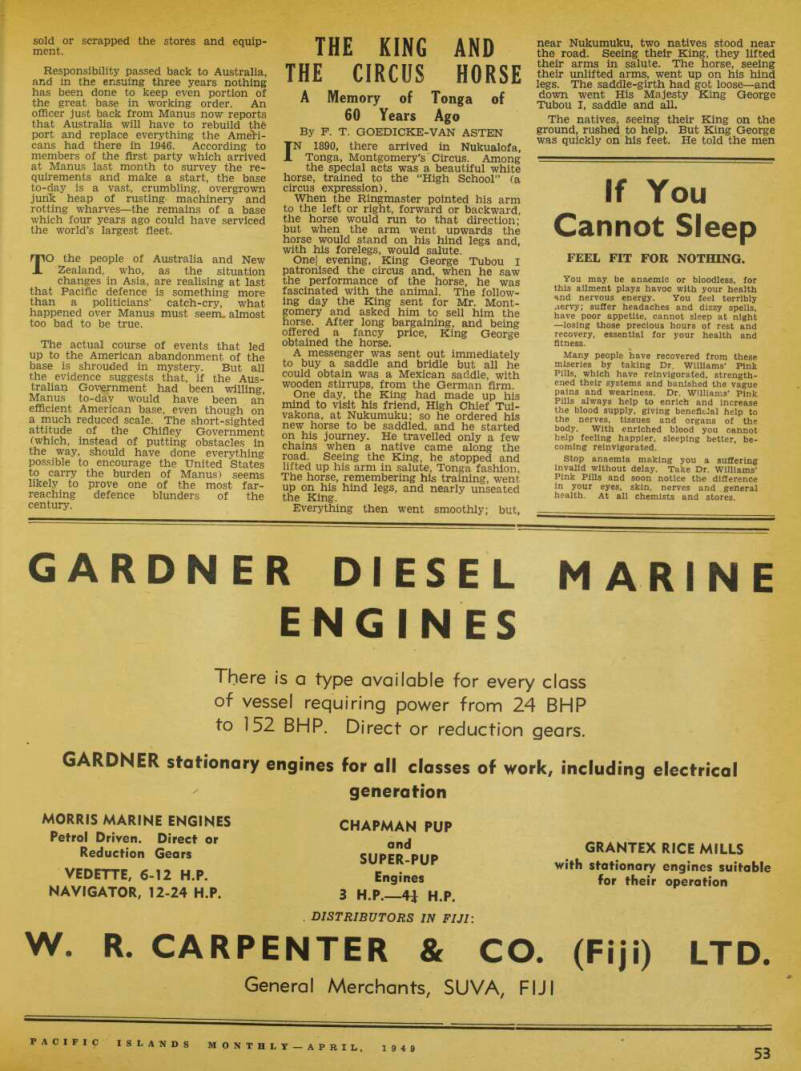
The Sorry Story Of Manus
Chifley Made One of Worst Blunders of the Century
IMMEDIATELY after World War 11, the United States announced that it was prepared to maintain the great sea and air base it had constructed in the Admiralty Islands (Manus), then part of the Mandated Territory of New Guinea. As part of a plan for protecting the eastern and southern areas of the Pacific against overcrowded Asia, this was .a magnificent thing for Australia and New Zealand.
But Australia announced, haughtily, that no nation, great or small, could in terfere with Australia’s sovereign rights.
The Americans immediately withdrew the suggestion, and the plan fell through.
Now the Australian Socialist Govern ment, with its tiny Navy and the limited resources of IV2 million people, is trying to maintain the gigantic Manus Base — and making itself ridiculous, in the attempt.
During the past month, the Australian Prime Minister and his Deputy, Dr.
Evatt, have replied savagely to their jeering critics, and asserted that they did nothing at all to cause the with drawal of the Americans. But several newspapers, who keep a close index of world events, have re-published certain reports of the 1945-6 period, and given Chifley and Co. the lie direct.
The following is an article published in the Auckland (NZ) Star on March 1.
It tells the whole sorry story:
FOR strategic reasons during the war, America occupied /the Australian mandated island of Manus, in the Admiralties. When the war ended there is little doubt that American planning staffs, and particularly the United States Navy, wanted to retain it. This was scarcely surprising in view of the fact that about £lOO million had been spent converting the island into a base from which to mount the full weight of the Pacific offensive.
But even more important than the airstrips and docks, the warehouses and living quarters, and all the vast mass of supplies, machinery and equipment as sembled on Manus, was Seeadler Harbour, one of the best in the Pacific. Into Seeadler Harbour, once the naval con struction battalions (the “Seabees”) had done their work, came the battle squad rons and the troopships staging for part of the reconquest of the Philippines. Out came the tankers, the ammunition ships, the store ships, the floating docks, the tenders, and the strange, newly-evolved specialised craft to serve a fleet operating thousands of miles from permanent bases. Swiftly grew the shore establish ment of the fleet, its air arm and its transport services.
By 1945, when the heavy carrier-borne attacks on the Japanese homeland began, Manus was one of several assembly points from which the mighty armament of the United States Pacific Fleet finally put to sea with the attendant supply train that enabled it to remain in action for weeks.
Afterwards it became the half-way house for the British Pacific Fleet, be tween its chief base at Sydney and its operating zones off Formosa and then off the divine soil of Honshu. Many of the American and British ships which steamed into Tokyo Bay in August, 1945, had last weighed anchor from Seeadler Harbour. When the Japanese surrend ered, all installations at Manus were in working order and there were enormous reserves of ammunition and the para phernalia of war.
ON February 16, 1946, Vice-Admiral Forrest, deputy-chief of United States Naval Operations, reported to the Naval Affairs Committee of the Senate that the United States Navy wanted to maintain major bases at Honolulu, Guam. Saipan, the Philippines and Manus. The following day the Secretary of State, Mr. James Byrnes, said that the United States had built a huge base on Manus, and post-war plans provided for its continuing that base.
Discussions with Australia were re ported, but the conferences ended abruptly, and the United States suddenly lost interest In the proceedings. The United States evacuated Manus, having
sold or scrapped the stores and equip ment.
Responsibility passed back to Australia, and in the ensuing three years nothing has been done to keep even portion of the great base in working order. An officer just back from Manus now reports that Australia will have to rebuild the port and replace everything the Ameri cans had there in 1946. According to members of the first party which arrived at Manus last month to survey the re quirements and make a start, the base to-day is a vast, crumbling, overgrown junk heap of rusting machinery and rotting wharves—the remains of a base which four years ago could have serviced the world’s largest fleet.
TO the people of Australia and New Zealand, who, as the situation changes in Asia, are realising at last that Pacific defence is something more than a politicians’ catch-cry, what happened over Manus must seem-almost too bad to be true.
The actual course of events that led up to the American abandonment of the base is shrouded in mystery. But all the evidence suggests that, if the Aus tralian Government had been willing, Manus to-day would have been an efficient American base, even though on a much reduced scale. The short-sighted attitude of the Chifley Government (which, instead of putting obstacles in the way, should have done everything possible to encourage the United States to carry the burden of Manus) seems likely to prove one of the most far reaching defence blunders of the century.
The Circus Horse
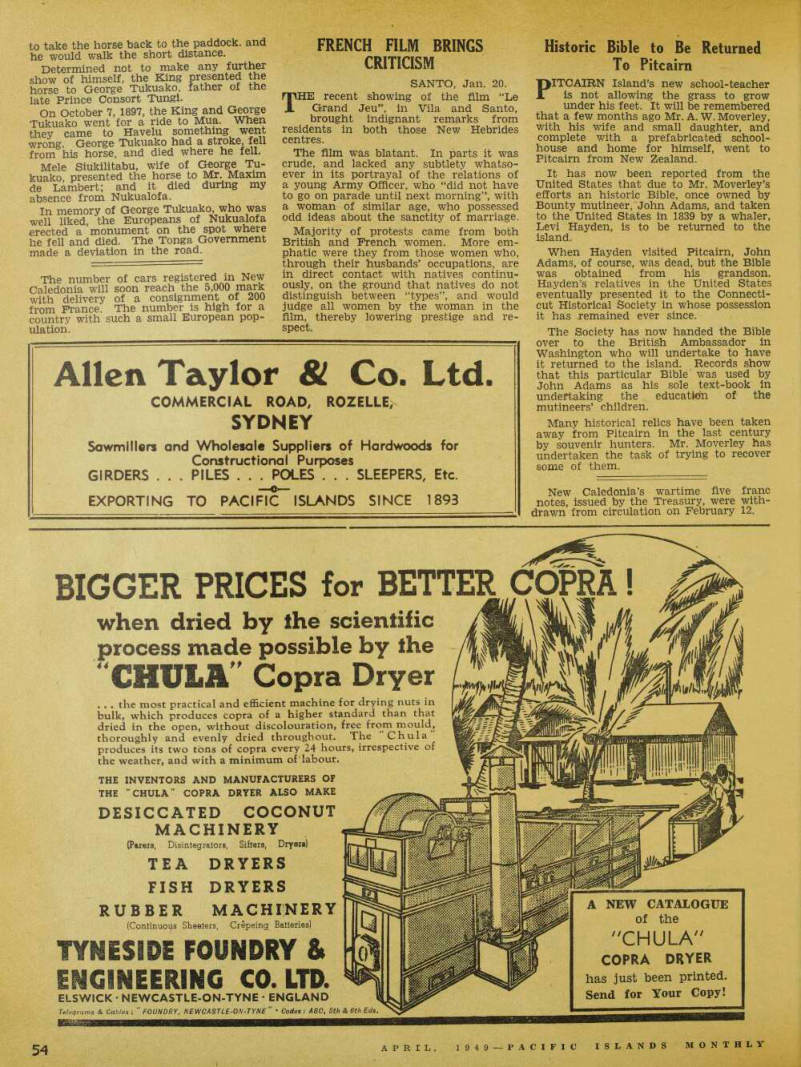
The King And
A Memory of Tonga of 60 Years Ago
By F. T. Goedicke-Van Asten
IN 1890, there arrived in Nukualofa, Tonga, Montgomery’s Circus. Among the special acts was a beautiful white horse, trained to the “High School” (a circus expression).
When the Ringmaster pointed his arm to the left or right, forward or backward, the horse would run to that direction; but when the arm went upwards the horse would stand on his hind legs and, with his forelegs, would salute.
One| evening, King George Tubou I patronised the circus and, when he saw the performance of the horse, he was fascinated with the animal. The follow ing day the King sent for Mr. Mont gomery and asked him to sell him the horse. After long bargaining, and being offered a fancy price, King George obtained the horse.
A messenger was sent out immediately to buy a saddle and bridle but all he could obtain was a Mexican saddle, with wooden stirrups, from the German firm.
One day, the King had made up his mind to visit his friend. High Chief Tui vakona, at Nukumuku; so he ordered his new horse to be saddled, and he started on his journey. He travelled only a few chains when a native came along the road. Seeing the King, he stopped and lifted up his arm in salute, Tonga fashion, The horse, remembering his training, went up on his hind legs, and nearly unseated the King.
Everything then went smoothly; but,
near Nukumuku, two natives stood near the road. Seeing their King, they lifted their arms in salute. The horse, seeing their unlifted arms, went up on his hind legs. The saddle-girth had got loose—and down went His Majesty King George Tubou I, saddle and all.
The natives, seeing their King on the ground, rushed to help. But King George was quickly on his feet. He told the men
to take the horse back to the paddock, and he would walk the short distance.
Determined not to make any further show of himself, the King presented the horse to George Tukuako, father of the late Prince Consort Tungi.
On October 7, 1897, the King and George Tukuako went for a ride to Mua. when they came to Havelu something went wrong. George Tukuako had a stroke, fell from his horse, and died where he fell.
Mele Siukilitabu, wife of George Tu kuako, presented the horse to Mr. Maxim de Lambert; and it died during my absence from Nukualofa.
In memory of George Tukuako, who was well liked, the Europeans of Nukualofa erected a monument on the spot where he fell and died. The Tonga Government made a deviation in the road.
The number of cars registered in New Caledonia will soon reach the 5,000 mark with delivery of a consignment of 200 from France. The number is high for a country with such a small European pop ulation.
Advertisements & other items, pp. 55-56 (2 items)
53
PACIFIC ISLANDS MONTHLT A P R I L , 1949
Cannot Sleep
If You
FEEL FIT FOR NOTHING.
You may be anaemic or bloodless, for this ailment plays havoc with your health and nervous energy. You feel terribly nervy; suffer headaches and dizzy spells, have poor appetite, cannot sleep at night —losing those precious hours of rest and recovery, essential for your health and fitness.
Many people have recovered from these miseries by taking Dr. Williams- Pink Pills, which have reinvigorated, strengthened their systems and banished the vague pains and weariness. Dr. Williams’ Pink Pills always help to enrich and increase the blood supply, giving beneficial help to the nerves, tissues and organs of the body. With enriched blood you cannot help feeling happier, sleeping better, becoming reinvigorated.
Stop anaemia making you a suffering invalid without delay. Take Dr. Williams’
Pink Pills and soon notice the difference in your eyes, skin, nerves and general health. At all chemists and stores.
GARDNER DIESEL MARIN
ENGINES
3 There is a type available for every class of vessel requiring power from 24 BHP to 152 BHP. Direct or reduction gears.
GARDNER stationary engines for all classes of work, including electrical
generation
MORRIS MARINE ENGINES
Petrol Driven. Direct or Reduction Gears
VEDETTE, 6-12 H.P.
NAVIGATOR, 12-24 H.P.
CHAPMAN PUP
and
SUPER-PUP
Engines
3 H.P.—4i H.P.
DISTRIBUTORS IN FIJI:
GRANTEX RICE MILLS
with stationary engines suitable for their operation W. R. CARPENTER & CO. (Fiji) LTD.
General Merchants, SUVA, FIJI
Allen Taylor & Co. Ltd.
COMMERCIAL ROAD, ROZELLE,
SYDNEY
Sowmlllers and Wholesale Suppliers of Hardwoods for Constructional Purposes GIRDERS . . . PILES . . . POLES . . . SLEEPERS, Etc.
EXPORTING TO PAdRc” ISLANDS SINCE 1893
BIGGER PRICES for BETTER COTRA!
when dried by Ihe scientific
process made possible by the
"CHULA” Copra Dryer
. . . the most practical and efficient machine for drying nuts in bulk, which produces copra of a higher standard than that dried in the open, without discolouration, free from mould, thoroughly and evenly dried throughout. The Chula produces its two tons of copra every 24 hours, irrespective of the weather, and with a minimum of labour.
THE INVENTORS AND MANUFACTURERS OF
THE "CHULA” COPRA DRYER ALSO MAKE
DESICCATED COCONUT
MACHINERY
(Parers, Disintegrators, Sifters, Dryers)
TEA DRYERS
FISH DRYERS
RUBBER MACHINERY
(Continuous Sheeters, Crepeing Batteries)
TYNESIDE FOUNDRY &
ENGINEERING CO. LTD.
ELSWICK • NEWCASTLE-ON-TYNE • ENGLAND
Telegrams & Cables', "FOUNDRY, NEWCASTLE-ON-TYNE" * Codes ; ABC, sth & 6th Eds ik
rIH
C£ V*mm
A NEW CATALOGUE
of the
"CHULA"
COPRA DRYER
has just been printed.
Send for Tour Copy!
Criticism
French Film Brings
Santo, Jan. 20.
THE recent showing of the film “Le Grand Jeu", in Vila and Santo, brought indignant remarks from residents in both those New Hebrides centres.
The film was blatant. In parts it was crude, and lacked any subtlety whatso ever in its portrayal of the relations of a young Army Officer, who “did not have to go on parade until next morning”, with a woman of similar age, who possessed odd ideas about the sanctity of marriage.
Majority of protests came from both British and French women. More em phatic were they from those women who, through their husbands’ occupations, are in direct contact with natives continu ously, on the ground that natives do not distinguish between “types”, and would judge all women by the woman in the film, thereby lowering prestige and re spect.
Historic Bible to Be Returned
To Pitcairn
PITCAIRN Island’s new school-teacher is not allowing the grass to grow under his feet. It will be remembered that a few months ago Mr. A. W. Moverley, with his wife and small daughter, and complete with a prefabricated! school house and home for himself, went to Pitcairn from New Zealand.
It has now been reported from the United States that due to Mr. Moverley’s efforts an historic Bible, once owned by Bounty mutineer, John Adams, and taken to the United States in 1839 by a whaler, Levi Hayden, is to be returned to the island.
When Hayden visited Pitcairn, John Adams, of course, was dead, but the Bible was obtained from his grandson.
Hayden’s relatives in the United States eventually presented it to the Connecti cut Historical Society in whose possession it has remained ever since.
The Society has now handed the Bible over to the British Ambassador in Washington who will undertake to have it returned to the island. Records show that this particular Bible was used by John Adams as his sole text-book in undertaking the education of the mutineers’ children.
Many historical relics have been taken away from Pitcairn in the last century by souvenir hunters. Mr. Moverley has undertaken the task of trying to recover some of them.
New Caledonia’s wartime five franc notes, issued by the Treasury, were with drawn from circulation on February 12.
Wild Pig Menace In Fiji
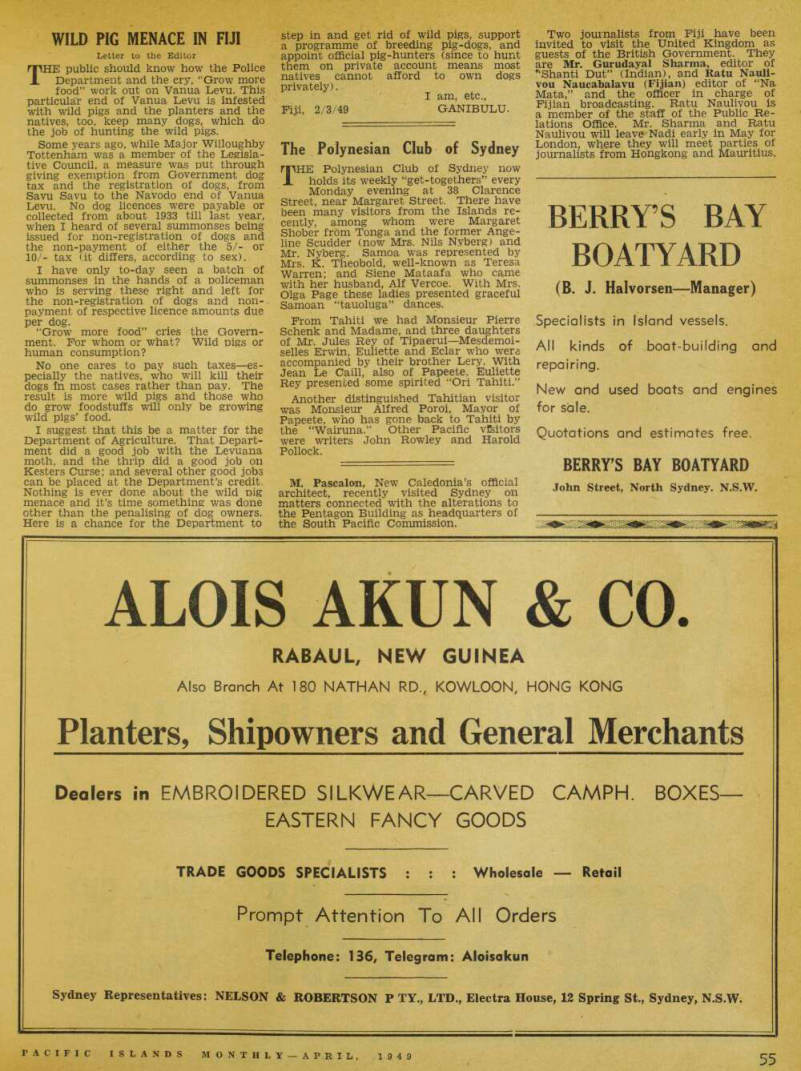
Letter to the Editor THE public should know how the Police Department and the cry, “Grow more food” work out on Vanua Levu. This particular end of Vanua Levu is infested with wild pigs and the planters and the natives, too, keep many dogs, which do the job of hunting the wild pigs.
Some years ago, while Major Willoughby Tottenham was a member of the Legisla tive Council, a measure was put through giving exemption from Government dog tax and the registration of dogs, from Savu Savu to the Navodo end of Vanua Levu. No dog licences were payable or collected from about 1933 till last year, when I heard of several summonses being issued for non-registration of dogs and the non-payment of either the 5/- or 10/- tax (it differs, according to sex).
I have only to-day seen a batch of summonses in the hands of a policeman who is serving these right and left for the non-registration of dogs and non payment of respective licence amounts due per dog.
“Grow more food” cries the Govern ment. For whom or what? Wild pigs or human consumption?
No one cares to pay such taxes —especially the natives, who will kill their dogs in most cases rather than pay. The result is more wild pigs and those who do grow foodstuffs will only be growing wild pigs’ food.
I suggest that this be a matter for the Department of Agriculture. That Depart ment did a good job with the Levuana moth, and the thrip did a good job on Kesters Curse; and several other good jobs can be placed at the Department’s credit.
Nothing is ever done about the wild pig menace and it’s time something was done other than the penalising of dog owners.
Here is a chance for the Department to
step in and get rid of wild pigs, support a programme of breeding pig-dogs, and appoint official pig-hunters (since to hunt them on private account means most natives cannot afford to own dogs privately).
I am, etc.,
Fiji, 2/3/49
Ganibulu.
The Polynesian Club of Sydney
now holds its weekly “get-togethers” every Monday evening at 38 Clarence Street, near Margaret Street. There have been many visitors from the Islands re cently, among whom were Margaret Shober from Tonga and the former Ange line Scudder (now Mrs. Nils Nyberg) and Mr. Nyberg. Samoa was represented by Mrs. K. Theobold, well-known as Teresa Warren; and Siene Mataafa who came with her husband, Alf Vercoe. With Mrs.
Olga Page these ladies presented graceful Samoan “tauoluga” dances.
From Tahiti we had Monsieur Pierre Schenk and Madame, and three daughters of Mr. Jules Rey of Tipaerul—Mesdemoi selles Erwin, Euliette and Eclar who were accompanied by their brother Lery. With Jean Le Caill, also of Papeete. Euliette Rey presented some spirited “Ori Tahiti.”
Another distinguished Tahitian visitor was Monsieur Alfred Poroi. Mayor of Papeete, who has gone back to Tahiti by the “Wairuna.” Other Pacific visitors were writers John Rowley and Harold Pollock.
M. Pascalon, New Caledonia’s official architect, recently visited Sydney on matters connected with the alterations to the Pentagon Building as headquarters of the South Pacific Commission.
Two journalists from Fiji have been invited to visit the United Kingdom as guests of the British Government. They are Mr. Gurudayal Sharma, editor of r ‘Shanti Dut” (Indian), and Ratu Nauli vou Naucabalavu (Fijian) editor of “Na Mata,” and the officer in charge of Fijian broadcasting. Ratu Naulivou is a member of the staff of the Public Re lations Office. Mr. Sharma and Ratu Naulivou will leave Nadi early in May for London, where they will meet parties of journalists from Hongkong and Mauritius.
Advertisements & other items, pp. 57-64 (3 items)
Alois Akun & Co.
BERRY’S BAY
BOATYARD
(B. J. Halvorsen—Manager)
Specialists in Island vessels.
All kinds of boat-building and repairing.
New and used boats and engines for sale.
Quotations and estimates free.
BERRY'S BAY BOATYARD
John Street, North Sydney. N.S.W.
ALOIS AKUN & CO.
RABAUL, NEW GUINEA
Also Branch At 180 NATHAN RD., KOWLOON, HONG KONG
Planters, Shipowners and General Merchants
Dealers in EMBROIDERED SILKWEAR—CARVED CAMPH. BOXES—
EASTERN FANCY GOODS
TRADE GOODS SPECIALISTS : : : Wholesale Retail Prompt Attention To All Orders Telephone: 136, Telegram: Aloisakun Sydney Representatives: NELSON & ROBERTSON P TY., LTD., Electra House, 12 Spring St., Sydney, N.S.W.
An ornate example of historical keys, this XVlth Century French key features the sporting motif in its club and animal carvings. It seems to have been the key to a Duke’s country
lodge.
i v y > it A A T
The key
to smoking pleasure
FINE CUT
NAVY CUT
TOBACCOS
or
VETERINARY
INSTRUMENTS
For Sheep and Cattle can be
Supplied Immediately
EARMARKERS.
SPEYING INSTRUMENTS.
BULLRINGS.
FIRE BRANDS.
EMASCULATORS.
W. JNO. BAKER
PTY. LTD.
3 Hunter Street, Sydney, N.S.W., Australia
Telegram: "CARRLOCK" p.O. Box 2140, Hong Kong
CARRLOCK CO. LTD.
2nd Floor, Queen's Bldg., Chater Road, HONG KONG
General Merchants ;; Commission Agents
Exporters and Shippers of All Kinds of Merchandise To the Pacific Islands Representatives of Leading Manufacturers
in HONG KONG
INQUIRIES INVITED
G. H. Robinson
Exports & Imports Pty., Ltd.
ISLAND SUPPLIES
of all kinds—Selected and Shipped to order at lowest possible prices—Piecegoods in Wool, Cotton and Silk, Under and Outerwear, Manchester, Drapery, Grocery, Hardware, Engineers and Leathergoods trade supplies a specialty.
Indents and Transhipments arranged. Large or small orders treated with equal care.
Use our 25 years' extensive experience.
Enquiries solicited to —
G. H. ROBINSON
Exports & Imports Pty., Ltd. 51 Macquarie Street, Sydney, N.S.W.
Telegrams: Sunrise, Sydney.
Letters: Box 3317, G.P.0., Sydney.
Even Dad will want to help
The gleaming satin smooth finish of a Wunderlich Stainless Steel Sink Unit makes the task of washing dishes so much more attractive even Dad will be eager to assist.
Ask him to buy one for your kitchen . . . they are made 4ft., 5 ft. and 6 ft. long by I ft. 6 ins. wide.
The units are backed with timber to simplify installation supplies are available now.
See your local Hardware Merchant, 'phone MX 2411, or write to Box 474, G.P.O. Sydney, for illustrations and prices.
S'^lPunc/erlick.
INK. UNITS
IN STAIN L-ESS ST«L
QUEENSLAND
INSURANCE
COMPANY
LIMITED
(Incorporated 1886 in Australia)
ASSETS EXCEED £5,000,000
Head Office:
QUEENSLAND
INSURANCE BUILDING,
80-82 PITT STREET, SYDNEY.
Speciolists in South Seas Fire,
Marine & Accident Insurances
Apply to:—
FlJl.—Branch Office: I. B. Chalmers, Manager, Burns Philp (South Sea) Co., Ltd.
VlLA.—Burns Philp (South Sea) Co., Ltd.
Comptoirs Francais Des Nouvelles Hebrides (Marine).
NOUMEA.—L. & W. Johnston.
NEW GUINEA. —Manager for Mandated Territory and Papua, W. A. Anderson.
PORT MORESBY—SAMARAI— LAE
—MADANG—RABAUL.
Burns, Philp (New Guinea), Ltd.
PAGO PAGO.
Burns Philp (South Sea) Co., Ltd.
Q. H. C Reid Si Co.
OTHER SOUTH SEA ISLANDS.
Burns Philp (South Sea) Co., Ltd.
Also to any of the Company's Offices in Australia or New Zealand .
& o S' 0 N Cjv a* & & & & \o
j^JS
o* ❖r & * \*r, &* s SP \0 to ,\0 & o 6? ...
golden links..
with Australia's rich Export Trade * ■ • ln the profitable and growing island trade of iiiswl Australian products, our four specialised divisions offer you a complete, efficient and thoroughly up-to-the-minute service. We handle all types of Australian merchandise, including our own outstanding brands—CORONET, BANQUET, SEVEN CROWN, CAPTAIN KIDD (WINES, SPIRITS and LIQUEURS) ; SUNBLOOM, CAVALIER, CAVCO, C.A.V. FOOD PRODUCTS; CAKEX FLAVOURING ESSENCE; and CAVALIER EUCALYPTUS DISINFECTANTS, CLEANERS, INSECT SPRAYS, LIQUID SOAPS, etc.
Your orders or enquiries will receive prompt and expert attention.
Cable and Telegraphic Address: “Retlaw,”
Sydney. Codes: A.B.C. sth Edition, Western Union, Bentley.
ATLAS MERCANTILE EXPORT CO. PTY. LTD.
(SUBSIDIARY TO WALTER CAVILL PTY. LTD. Wine, Spirit and General Merchants and Manufacturers)
377 SUSSEX STREET. SYDNEY. AUSTRALIA
TILLEY LAMPS
(BURN ORDINARY KEROSENE)
The Modern Form of PORTABLE LIGHTING
ATTENTION TO DETAIL
is the characteristic of all British products
TILLEY LAMPS
are British made throughout at Hendon & Cricklewood, England.
THE TILLEY LAMP COMPANY LTD. of ENGLAND London Offices and Showrooms: 33 SACKVILLE STREET, PICCADILLY, W.l
REPRESENTATION :
MELBOURNE: T. H. Bentley, Pty. Ltd., 123-125 William Street, Melbourne, C.l.
TASMANIA; Mr. C. Sellars, 108 a Charles Street, Launceston.
FIJI; Mr. K. Witherington, 2 Burns Philp Buildings, Suva.
OUR HANDS MAKE GOOD ARMS
For your Fishing and Shooting Wants Consult Us.
Lithgow .22 Cal. Repeating Rifles ... £ll 14 0) Post Lithgow .22 Cal. Single Shot 5 1 3( Extra SiILRO H U 143 ELIZABETH STREET, SYDNEY.
AUNT
MARYS
BAKING POWDER
For the best in delicious baking results A product of TILLOCK AND CO. PTY. LTD. manufacturers of all the famous Aunt Mary’s Pure Foods
Gabriel Achun
Malaguna Road, RABAUL, T.N.G.
WHOLESALE MERCHANT AND IMPORTER
CORDIAL MANUFACTURER
Piecegoods for Native Trade. (Large shipment of variety arrives with every Eastern boat.) Other Lines of Trade Goods. • High-class Aerated Water and Cordials. Beer, Wines and Spirits.
Quotations and Samples of Materials gladly sent upon request.
Cables & Radios: Gabriel Achun. Rabaul Telephone: No. 104
Hard to Get? 7r v m
FOR
SADDLERY Cr HARNESS
HOME LIGHTING PLANTS
WINES AND SPIRITS
NON-ELECTRIC WASHING
MACHINES
PUMPS, IRRIGATION
PLANTS
CROCKERY
HAIRDRESSING SUPPLIES
HARDWARE
AIR CIRCULATORS
Manstocks Sydney, Australia
ISLAND TRADERS
Cable and Telegraphic address: “MANSTOCKS,’' SYDNEY Telephones: 8W7405, 8W1237, 85076, FM2766
Asthma Curbed In 3 Minutes
Since the discovery of Mendaco by a famous physician sufferers can get relief from Asthma. Mendaco does away with expensive injections and offensive smokes.
All you do is to take 2 tasteless tablets with meals and Mendaco starts circulating through the blood in 10 minutes. You breathe easily and freely. Your nerves relax, you get good, fresh, pure air into your lungs, and vigour returns.
Sleep Like a Baby
Thousands of former sufferers from Asthma say that the very first dose of Mendaco brought them glorious ease and comfort, and that they slept soundly the very first night. Then their vigour returned and they felt healthier and stronger, and 5 to 10 years younger. The reason for this is that Mendaco acts In natural ways to overcome the effects of Asthma. (1) It removes the mucus or phlegm; (2) It relaxes thousands of tiny muscles In your bronchial tubes so that the air can get in and out of your lungs; (3> It promotes body vigour, and stimulates the building of rich, revitalised blood.
No Asthma for Five Years
Mendaco not only brings almost Immediate results, free breathing and comfort and enables you to sleep, but also builds up the system to ward off future attacks. Mr.
J. R. writes: “I was almost dead with Asthma. Had lost 40 lbs. in weight, snf-
fered coughing every night—couldn’t sleep.
Mendaco stopped spasms first night. I have had no Asthma since in over 2 years.”
Mrs. A. W. writes: “I had Asthma for 25 years. After using Mendaco I can sleep all night and have not had an attack since taking it.” Mrs. G. E. C. writes: “I bless the day I first heard of Mendaco. What a godsend it is to a poor woman like me who for 35 years never knew what it was to have a good night’s rest. The constant fight between Asthma and sleep was wearing me down, but I feel now I want to forget my past suffering.”
Benefits Immediate
The very first dose of Mendaco goes right to work circulating through your blood and helping nature rid you of the effects of Asthma. Try Mendaco under an iron-clad money back guarantee. You be the judge.
If you don't feel fully satisfied after taking Mendaco Just return the package and the purchase price will be refunded. Get Mendaco from your chemist to-day and see how well you sleep to-night and how much better you will feel.
RELIEVES ASTHMA
Mendaco
Now in Z adzes 6/- and 12/-
57
PACIFIC ISLANDS MONTHLY APRIL, 1949
Papua-NG Bill Debate (Continued from Page 32)
60
APRIL. 1949 PACIF. IC ISLANDS MONTHLY
Dwarf Coconuts In Fiji
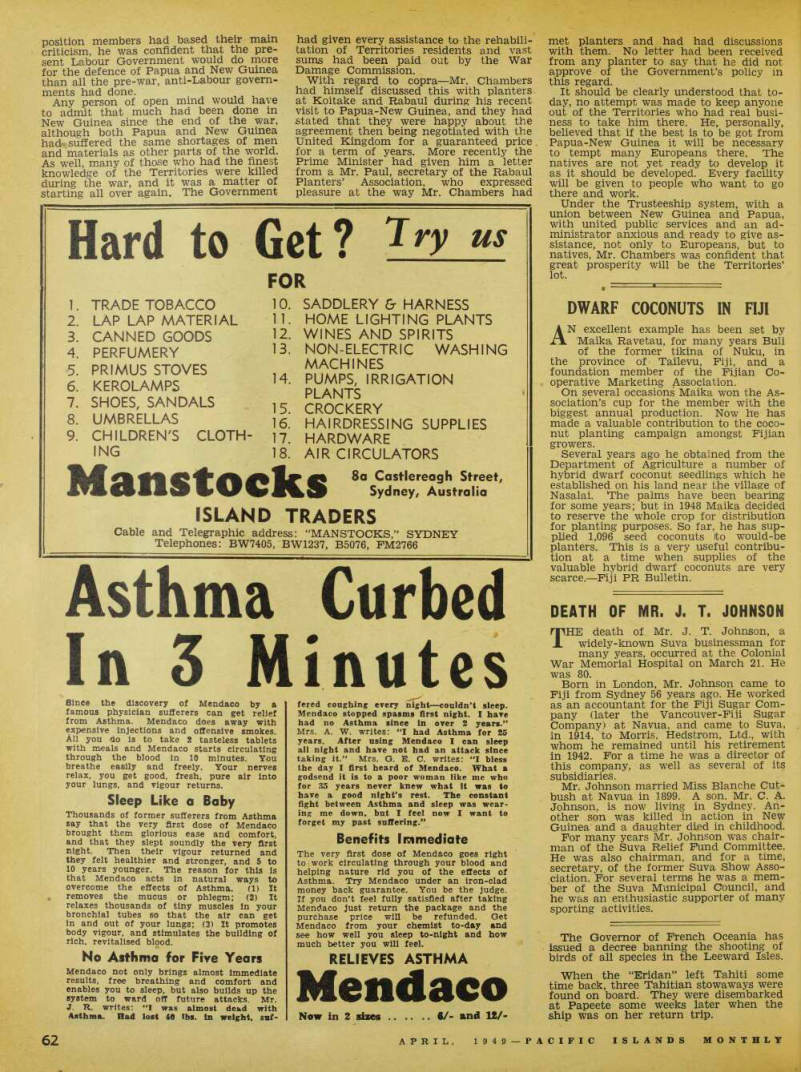
AN excellent example has been set by Maika Ravetau, for many years Buli of the former tikina of Nuku, in the province of Tailevu, Fiji, and a foundation member of the Fijian Co operative Marketing Association.
On several occasions Maika won the As sociation’s cup for the member with the biggest annual production. Now he has made a valuable contribution to the coco nut planting campaign amongst Fijian growers.
Several years ago he obtained from the Department of Agriculture a number of hybrid dwarf coconut seedlings which he established on his land near the village of Nasalai. The palms have been bearing for some years; but in 1948 Maika decided to reserve the whole crop for distribution for planting purposes. So far, he has sup plied 1,096 seed coconuts Ito would-be planters. This is a very useful contribu tion at a time when supplies of the valuable hybrid dwarf coconuts are very scarce.—Fiji PR Bulletin.
Death Of Mr. J. T. Johnson
THE death of Mr. J. T. Johnson, a widely-known Suva businessman for many years, occurred at the Colonial War Memorial Hospital on March 21. He was 80.
Born in London, Mr. Johnson came to Fiji from Sydney 56 years ago. He worked as an accountant for the Fiji Sugar Com pany (later the Vancouver-Fiji Sugar Company) at Navua, and came to Suva, in 1914, to Morris, Hedstrom, Ltd-, with whom he remained until his retirement in 1942. For a time he was a director of this company, as well as several of its subsidiaries.
Mr. Johnson married Miss Blanche Cut bush at Navua in 1899. A son. Mr. C. A.
Johnson, is now living in Sydney. An other son was killed in action in New Guinea and a daughter died in childhood.
For many years Mr. Johnson was chair man of the Suva Relief Fund Committee.
He was also chairman, and for a time, secretary, of the former Suva Show Asso ciation. For several terms he was a mem ber of the Suva Municipal Council, and he was an enthusiastic supporter of many sporting activities.
The Governor of French Oceania has issued a decree banning the shooting of birds of all species in the Leeward Isles.
When the “Eridan” left Tahiti some time back, three Tahitian stowaways were found on board. They were disembarked at Papeete some weeks later when the ship was on her return trip.
Culture
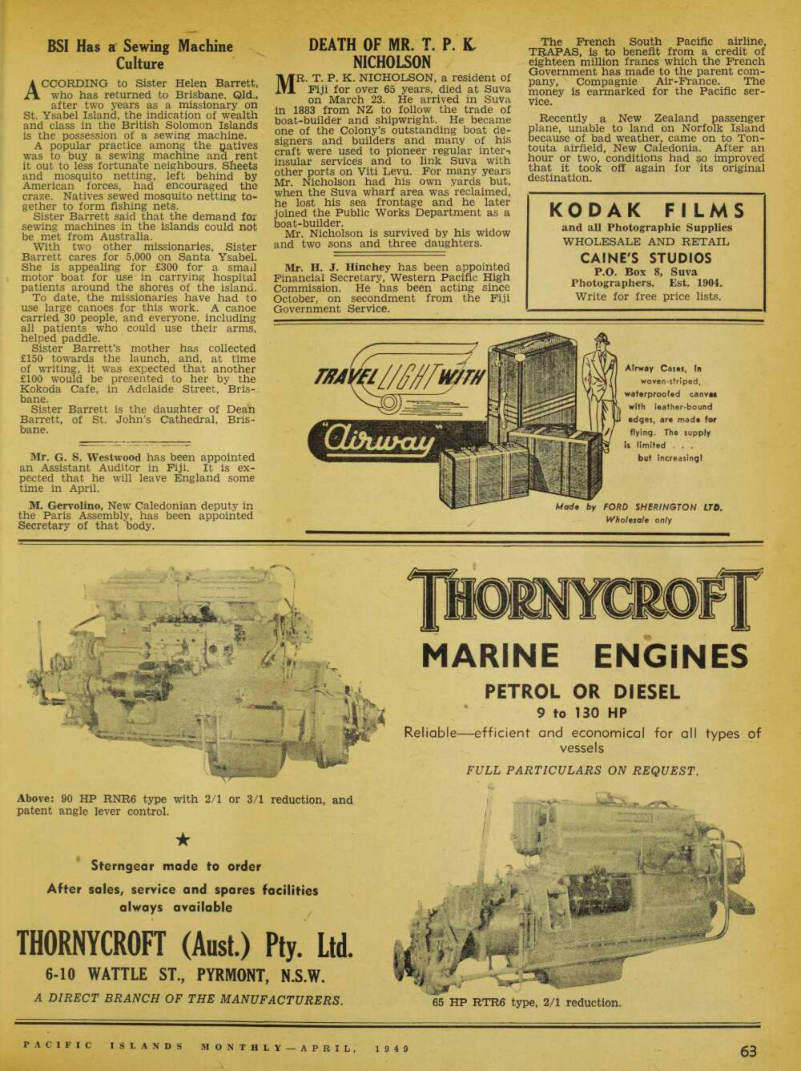
BSI Has a Sewing Machine Culture
ACCORDING to Sister Helen Barrett, who has returned to Brisbane. Qld., after two years as a missionary on St. Ysabel Island, the indication of wealth and class in the British Solomon Islands is the possession of a sewing machine.
A popular practice among the natives was to buy a sewing machine and rent it out to less fortunate neighbours. Sheets and mosquito netting, left behind by American forces, had encouraged the craze. Natives sewed mosquito netting to gether to form fishing nets.
Sister Barrett said that the demand for sewing machines in the islands could not be met from Australia.
With two other missionaries. Sister Barrett cares for 5,000 on Santa Ysabel.
She is appealing for £3OO for a smail motor boat for use in carrying hospital patients around the shores of the island.
To date, the missionaries have had to use large canoes for this work. A canoe carried 30 people, and everyone, including all patients who could use their arms, helped paddle.
Sister Barrett’s mother has collected £l5O towards the launch, and, at time of writing, it was expected that another £lOO would be presented to her by the Kokoda Cafe, in Adelaide Street. Bris bane.
Sister Barrett is the daughter of Dean Barrett, of St. John’s Cathedral. Bris bane.
Mr. G. S. Westwood has been appointed an Assistant Auditor in Fiji. It is ex pected that he will leave England some time in April.
M. Gervolino, New Caledonian deputy in the Paris Assembly, has been appointed Secretary of that body.
Nicholson
Death Of Mr. T. P. K
MR. T. P. K. NICHOLSON, a resident of Fiji for over 65 years, died at Suva on March 23. He arrived in Suva in 1883 from NZ to follow the trade of boat-builder and shipwright. He became one of the Colony’s outstanding boat de signers and builders and many of his craft were used to pioneer regular inters insular services and to link Suva with other ports on Viti Levu. For many years Mr. Nicholson had his own yards but, when the Suva wharf area was reclaimed, he lost his sea frontage and he later joined the Public Works Department as a boat-builder.
Mr. Nicholson is survived by his widow and two sons and three daughters.
Mr. H. J. Hinchey has been appointed Financial Secretary, Western Pacific High Commission. He has been acting since October, on secondment from the Fiji Government Service.
The French South Pacific airline, TRAPAS, is to benefit from a credit of eighteen million francs which the French Government has made to the parent com pany, Compagnie Air-France. The money is earmarked for the Pacific ser vice.
Recently a New Zealand passenger plane, unable to land on Norfolk Island because of bad weather, came on to Ton touta airfield, New Caledonia. After an hour or two, conditions had so improved that it took off again for its original destination.
Advertisements & other items, pp. 65-66 (1 item)
mVal/JMWm
KODAK FILMS
and all Photographic Supplies
WHOLESALE AND RETAIL
CAINE'S STUDIOS
P.O. Box 8, Suva Photographers. Est. 1904.
Write for free price lists.
mVal/JMWm
9 I : ■ - Airway Cast*, In woven-striped, waterproofed canvas with leather-bound edges, are made for flying. The supply Is limited . . . but increasing!
Made by FORD SHERINGTON LTD.
Wholesale only
i Above: 90 HP RNR6 type with 2/1 or 3/1 reduction, and patent angle lever control. ★ Sterngear made to order After sales, service and spares facilities always available
THORNYCROFT (Anst.) Pty. Ltd.
6-10 WATTLE ST., PYRMONT, N.S.W.
A DIRECT BRANCH OF THE MANUFACTURERS.
OFF
0
MARINE ENGINES
PETROL OR DIESEL
9 to 130 HP Reliable —efficient and economical for all types of vessels
FULL PARTICULARS ON REQUEST.
' ~~'FT , P =i< ' 65 HP RTR6 type, 2/1 reduction.
HEAVY MACHINERY AND EQUIPMENT
FOR THE ISLANDS TERRITORIES
Steamships Trading Company Ltd.
AUTOMOTIVE and MACHINERY DEPARTMENT
Distributors in Papua and New Guinea for —
MOTOR CARS
ROOTS, LTD.—Hillman Minx —Humber Hawk— Humber Snipe and Sunbeam —Talbot Cars.
WILLYS-OVERLAND —Universal Jeeps—Jeepsters —Jeep Station Waggons.
Papua only.
ROAD TRANSPORT
INTERNATIONAL HEAVY DUTY MOTOR
TRUCKS —15 cwt. to 8 tons Gross Carrying Capacity. Utility Bodies—Platform Bodies— Tippers—Semi-Trailers—Low Loaders, etc.
AGRICULTURAL MACHINERY
McCORMICK-DEERING FARM TRACTORS, all
sizes, Wheel and Crawler Types.
FARM MACHINERY to suit every Purpose— Ploughs Harrows Cultivators Planters Harvesters Grass-Mowers Hay Rakes Gr Power Pressers—Chaff Cutters —Feed Grinders —Hammer Mills, Etc.
RICE-MILLING MACH INERY—Hullers—Pearlers Polishers Threshers Gr Dressers Seed Graders—Aspirators—also Complete Mills from 100 to 3,000 lb. capacity rice per hour.
EARTH-MOVING EQUIPMENT
Bui (graders Dozers Excavators Front End Loaders—Road Graders —Road-Rippers—Waggon Scoops—Quarry Dumpers—Bitumen Sprayers, Etc.
TIMBER LOGGING AND
MILLING EQUIPMENT
Diesel Logging Tractors—Timber Trucks —Timber Jinkers—Log Haulers—Tractor Logging Winches —Truck Mounted Loading Gr Front End Pull Winches—Wire Rope, Etc.
SAW-MILLING MACHINERY Circular Saw
Benches—Circular Rack Saws Gr Log Mills up to 31" depth of cut.
INDUSTRIAL EQUIPMENT
DIESEL STATIONARY ENGINES—from 5 h.p.
upward, all purposes.
DIESEL MARINE ENGINES—from 5 h.p. upward W/Reverse Gr Reducing Gears.
OUTBOARD MOTORS—2i to 22 h.p.
MOBILE CRANES—Wharf Gr Material Handling, 1 to 5 tons Capacity.
PUMPS Gr PUMPING PLANTS—Agriculture- Mining and General Purpose Pumps.
ELECTRIC GENERATING SETS—sizes to suit every purpose—A.C.-D.C. current.
ELECTRIC MOTORS—GENERATORS—FractionaI
sizes upwards—A.C. and D.C. current.
GANG Gr POWER GRASS MOWERS—Municipal,
Golf Course and Airfield use.
REFRIGERATORS
ELECTRIC COMPRESSOR and KEROSENE
OPERATED Food Storage Capacity. - Models 4 to 7 Cubic Feet.
AUTOMOTIVE EQUIPMENT
STORAGE BATTERIES —for every purpose—Car —Truck—Radio—Marine—Lighting sets.
TYRES Gr TUBES—Cars—Trucks—Tractors— industrial Equipment.
HYDRAULIC LIFTING JACKS—i ton to 10 ton capacity.
GENERAL CAR AND TRUCK ACCESSORIES—
Electrical Gr Hydraulic Replacements—Clutch Linings, Brake Linings, Etc.
Adequate stocks of spare parts are available for all vehicles and machinery at our
SERVICE PARTS DEPOT
PORT MORESBY
Cable Address : Telephone : Postal Address : “Steamships, ” Port Moresby Moresby, 476 Port Moresby, Papua
Notes From New Ireland
From a Special Correspondent KAVIENG. March 28.
TOWARDS the end of February our permanent medical officer arrived by Qantas plane. He is Dr. G. C.
Tweedie, whose headquarters will be in Kavieng. * In recent weeks we have had a num ber of official visitors on tours of inspec tion: Dr. J. T. Gunther, Director of Pub lic Health, in early March; Mr. Keith Kear, of the Civil Aviation Department, to inspect our airstrip, at the end of February; Mr. Cottrell Dormer, Director of Agriculture, Stock and Fisheries, on March 9; and Matron Thorburn on March 23. * Medical Assistant Ray Carlaw of Tas kul, New Hanover, arrived here by canoe in early March and later went on to Rabaul by plane to meet his family. They returned to Kavieng on March' 9 and later went on home by launch. Canoe trips from New Hanover are getting to be a habit—Patrol Officer Kimmerley ar rived in Kavieng by the same means, on March 25. * Mrs. and Mrs. Ted Lowney have arrived and will take up their positions with Dis trict Services Department—Mr. Lowney as Chief Clerk and Mrs. Lowney as typist to replace Miss Anne Lowrey who has gone to Rabaul. * Mr. and Mrs. S. Poole have a young son, born on March 12. This youngster has the distinction of being the first Euro pean child born in New Ireland since the Japanese invasion. * Party of the month was held at Mr.
John Cox’s home to celebrate St. Patrick’s Day—Mr. Cox being the sole representa tive of Eire in our midst. Mrs. J. Read, wife of the District-Officer, presented Mr.
Cox with a large cake, lavishly iced, de corated with shamrocks and bearing the somewhat cryptic inscription, “God Save Ireland.” ♦ Heavy rain that has continued inter mittently since January, has hampered work on local roads. Some work has been done in other directions, however, and a new wing is being added to the Euro pean nurses’ quarters. This will provide a temporary European hospital, capable of accommodating six patients.
NZ Petroleum Firm
Enters Fiji Trade
Prom Our Own Correspondent T„„ „ ... SUVA, March 22.
HE British Petroleum Company of New Zealand is about to start business in Fiji, with W. R. Carpenter and Co. (Fiji) Ltd. as its local representatives.
In addition to ordinary business, the company will service the NZNAC and RNZAF planes in Fiji. It will hold stocks of all classes of oils at Suva, where tanks are now being built.
Sir Peter Buck, who was in New Zealand in February, attending the Pacific Science Congress, said that he had enough work planned ahead in Honolulu to keep him busy for many years but that he hoped to make more frequent visits to New Zealand in future.
He said that he would attend the meet ing of the South Pacific Commission, of whose Social Development Committee he is a member, at Noumea, in May.
Pacific
Sir Brian Freeston In Southwest Pacific
From Our Own Correspondent HONIARA, March 22.
UNFAVOURABLE weather complicated the first visit of the High Com missioner (Sir Brian Freeston) to the Solomons Protectorate. When the RNZAF Catalina in which he was travel ling attempted to touch down at Point Cruz, near Honiara, on March 18, it bounced so violently that the pilot de cided to carry on to Tulagi, 20 miles away.
Honiara’s welcome, plus a guard of honour, treated the mishap as a dress rehearsal, and turned out again the fol lowing morning when his Excellency arrived from Tulagi in MV “Kurimarau”.
He was accompanied by Mr. Hill (second assistant secretary in the WPHC office) as ADC and by Mr. A. Hayden, Director of Education in Fiji.
His Excellency was met by the Pro tectorate’s Acting Resident Commissioner (Mr. J. D. A. Germond), Resident Magis trate (Mr. W. T. Charles), Secretary to Government (Mr. D. C. C. Trench), and Divisional Officer (Mr, P. Hughes). His already brisk programme had to be speeded up, but much ground was satis factorily covered before he left in HMAS
“Culgoa” at 10 p.m. on March 20, on a swift visit to Malaita, accompanied by Mr. and Mrs. Germond. He left by Catalina for Vila, New Hebrides, on March 22.
Mr. Hayden conferred with local edu cational authorities.
Fijian AMP’s Long Fight
To Save GirTs Life
CSUVA, March 28.
AUGHT by a 10 ft. shark when she was fishing two miles from Lomaloma, a Lauan girl named Takape suffered terrible injuries to her right leg before her women companions could get her into their canoe.
The girl was taken to Lomaloma Hospi tal in a critical condition. A Fiiian As sistant Medical Practitioner, Seru Lomani, gave a blood transfusion and battled for two days and nights to save the girl’s life.
He succeeded, and Takape is now able to walk with crutches.
Mr. E. P. Kaad, a resident of Kanacea, says; “No praise is too high for the Cen tral Medical School and its Fijian students. In places like Lomaloma we are absolutely dependent on the AMP's, and in Seru Lomani we have one of the best.”
Following his recent marriage in Bordeaux M. Andre Ballande was expected to reach ’Noumea by air during March.
The Automobile Association of Auck land, NZ, has 599 members in Fiji out of a total membership of 52,580.
Advertisements & other items, pp. 67-68 (1 item)
Broompields Ltd.
FOR ALL ISLAND SUPPLIES, FORWARD YOUR
ORDERS AND INQUIRIES TO
R. J. CRILLEY PTY. LTD
123 SUSSEX STREET, SYDNEY
All classes of merchandise purchased on behalf of Island clients at best wholesale rates—original invoices provided—prompt attention assured all orders, large or small.
Cables: “Rejam,” Sydney.
BROOMPIELDS Ltd.
Suppliers of Building Hardware Ship Chandlery, Paint Materials &
WRITE DIRECT TO:
Broomfields Ltd., 152 Sussex Street, Sydney
C finished by
DAVI SON
For Tropical conditions
Velvene Water Paint and Davison's Zinc Base Paints are used extensively throughout the islands and Mandated Territories on Government and Private buildings, giving full satisfaction under severe tropical conditions.
DAVISON PAINTS LTD.
BOX 24, AUBURN, N.S.W.
CAPTAIN W. L. KENNEDY
Ship and Yacht Broker, 63 Pitt Street, Sydney
LISTING FOR SALE:
Modern Steam Cargo Vessel, Carry approx. 400 tons, built 1940, in class 12 knots, £40,000; Steamship Cargo Oil Fuel, carry approx. 1,000 tons, permit to sail arranged.
Price around £22,000. Twin Diesel Motor Cargo Vessel, steel construction in Federal survey, carry 380 tons general. 120,000 super timber, good accommodation, £31,500.
Cargo Ketch, 60 x 15, Gardinor diesel engine, sails carry 40 tons, £4,500. Several other Ketches listed. Diesel Trawlers from £1,260.
New 300-ton Cargo, wood construction. 125 x 25, carry 70,000 feet timber, twin 200 bp. diesels, diesel auxiliaries, electric winches. 914 knots, in Federal survey, £34,000, Another 300-ton Vessel, in survey. Twin Diesels, Electric Winches, £22,000.
Modern Sea-going Steel Tug, 240 h.p. Vivian diesel, built 1948. diesel auxiliaries, hydraulic stearing. centrifugal fire pump. 65 x 18 x 10, £13.000. Steel Tug, built 1949, 75 x 18 x 11, 240 B.H.P. Crossley diesel, seagoing. £15,000. Tusa Tug. 270 h.p. National Superior diesel, £B,OOO. 45 x 13 Harbour Tug, 250 h.p. diesel, £5,250. 23 ft. Fishing Boat, 10-12 Simplex. £320. Also, we have a number of Sydney’s finest Cruisers and Auxiliaries for Sale. Priced moderateyl.
New Steel Cargo Vessel, carry 70 tons, diesel power, available time charter.
Fairmile, good order, engines and fittings, £2,100. Lock-up Steel Lighter, 80 tons, £9OO. Refuelling Barge, £350. Fire-fighting Barge, complete engine, pumps, and Imses. £B5O. Large Steel Punt, suitable dredge or crane, £BOO. New 42 H.P. 3-1 Reduction Southern Cross Diesel quantity spares, £750. BW 6461.
Enquiries through our Real Estate and Business Branch for Sydney Properties wiP be attended to promptly.
Every Branch Of
ENGINEERING and BUILDING CONSTRUCTION
MILLERS LTD.
SUVA and LAUTOKA
Sawmillers and Timber Merchants; Shipwrights and Sailmakers; Joinery and Furniture Manufacturers; Upholsterers; Plumbers; Electricians; Hardware Merchants; Motor Dealers.
AGENCIES :
Chevrolet, Bedford, Vauxhall, Nash Motors. Firestone Tyres.
Fetters Marine ai}d Stationary Engines. G.E.C. Radio Sets.
British Australian Lead Manufacturers Pty., Ltd., Atlas Assurance Co., Ltd.
There is no need to send to Australia or New Zealand for Repairs or Replacements. We can give you a sound Quotation and guarantee First-Class Workmanship
Temperature
Sea Snakes Killed By Reef
Prom Our Own Correspondent MANGAIA, February.
AGAIN this year the Mangaia “beach combers” of the seaward villages, searching the reef-pools for small fish, have had their expectations agree ably fulfilled by something better. The phenomenon known locally as “tua,” which appears to be a heating of the reef-pools, in bright sunshine, beyond their usual temperature, resulted in the death of many “kerekere,” or spotted sea-snakes, which floated lifeless on the surface of the pools in gratifying numbers.
Other fish do not seem to be affected by the increased temperature of the sea water, for it is only the snakes that suc cumb when there is a “tua.”
The local sea-snake is good eating, and when obtained thus easily, is hailed by villagers with appreciation. Under normal conditions it lives in a hole in the coral and has to be enticed out with a small hook on the end of a palm-frond rib, suitably baited.
The angling entails submergence for the fisher, who generally wears a pair of locally-made water-goggles, and he may be rewarded with a nasty bite from the “kerekere” if he is rash enough to get a finger within reach. These snakes are not venomous.
It would be interesting to know to what extent the reef-pools heat uo in “tua”time, and if any chemical change takes place in the water. The dead snakes exude oil when picked up, which is not the case with those caught alive on a hook; the “tua” harvest is, of course, never given time to decompose—the fish come to the cook-huts straight from the pools. This, and the annual run of sar dine-like fry of the ‘tutai-nui,” has been a valued help to native larders in the poor months of the off-season.
Anti-Tb Campaign
Urged In Fiji
SUVA, March 28.
FOR several weeks the demand for an anti-tuberculosis campaign on a national scale in Fiji, has been grow ing. Fijians want to finance it by means of an all-Fijian co-operative fund.
Mr. B. B. Browne, of Levuka, has sounded out Government circles in con nection with a scheme for an anti-TB lottery. This idea, however, is opposed in certain mission circles; and the Rev.
A. R. Tippett, of the Methodist Mission, has stirred up the Philatelic Society of Fiji to sponsor a proposal for health stamps on the lines adopted in New Zea land.
Association
Fiji’S New Athletic
SUVA, March 28.
THE Amateur Athletic_ Association of Fiji was established at a meeting on March 25.
The Governor (Sir Brian Freeston) is to be invited to be patron. Sir Hugh Ragg was elected president and Ratu Sir Lala Sukuna senior vice-president. Other vice-presidents are Mr. W. H. B. Buck hurst, Ratu Edward Cakobau, Messrs.
Dwarka Singh, David Ragg and R. Noerr.
Mr. C. Prentice is secretary.
M. Parisot, a recent Governor of New Caledonia, who left Noumea last June, has been made honorarv Colonial Governor-General.
Prosecuted
Guinea Air Traders Not To Be Prosecuted Report of Lae Air Accident Released by Minister
ALMOST ll months after the event, the official report of the air accident in Lae, New Guinea, on April 18, 1948, was tabled in the Australian Parlia ment, in early March. The Minister for Civil Aviation, Mr. Drakeford, said that no legal action would now be taken against the operators.
The accident occurred when a plane operated by Guinea Air Traders Ltd., and owned by a Mr. Van Praag, of Sydney, crashed on an island in the Markham River shortly after taking off from Lae.
The crew of four, and 33 native passengers were killed.
A report by a panel of Civil Aviation Department experts was given to the Minister some months ago but was not released for publication. Several ques tions have been asked in the House in this connection, and at the time of the acci dent, there was a considerable amount of controversy as to whether natives should or should not be carried as freight—as had been the practice in pre-war New Guinea.
The experts’ report fixed the cause of accident as loss of control of the aircraft, following failure of the port engine due to “fatigue failure of an accessory drive gear.” The panel said, also, that loss of control was probably due to poor tech nique on the part of the pilot, following the engine failure; contributing factor could be that the pilot had had inade quate training in this type of aircraft,
and that the load was not disposed of correctly in the plane.
Seating accommodation was provided for two, and the certificate of air worthiness limited the passengers to this number, although the loaded weight of the aircraft, at the time of the accident, was within the all-up weight specified in the certificate.
The panel considered that, unless the positions of the occupants had been changed, provision of seats and safety belts for all the passengers would not have affected the circumstances of the accident.
In October, 1948, Mr. Drakeford stated, he had authorised the (prosecution of Guinea Air Traders. 'But since then the Crown Solicitor had advised that action could not be taken along the lines re commended and the prosecution had not been proceeded with.
The Department of Civil Aviation, how ever, was seeing that regulations for the training of pilots and the loading of aircraft were observed in New Guinea as they were in Australia.
Suva Buses Cutting Into Taxi
Business
SUVA. March 28.
SUVA now has three town bus services —one established and two on trial.
Result is an almighty wail from the taxi proprietors, who claim tha 1 : their two most profitable trips—to the Hospital and to Rewa Street —have vir tually come to an end.
Writes one of them in the press: “I be lieve the taxi owners will iust have to cut the fares (2/6 minimum) or park their £l,OOO cars.”
Advertisements & other items, pp. 69-70 (1 item)
Budge
OVERSEAS MAGAZINES
Direct to You from th*> Publishers.
American:
CHARM 33/6
COLLIERS WEEKLY 607-
CORONET 18/9
ESQUIRE 757-
HARPER’S BAZAAR 757-
LADIES’ HOME JOURNAL 37/6
LIFE 497-
LOOK 39/-
POPULAR MECHANICS 28/3
READERS’ DIGEST 12/-
SATURDAY EVENING POST 68/9
SCIENTIFIC AMERICAN 52/6
TIME 967-
VOGUE 1057-
YACHTING 40/-
English:
APOLLO 52/6
COURIER 50/6
PICTURE POST 27/6
PUNCH 46/3
TATLER 1227-
TIMES WEEKLY 38/-
Rates are for one year and include all charges. Many other overseas periodicals available on all subjects.
ALL ORDERS AIR-MAILED TO
PUBLISHERS.
MAIL PUBLICITY CO., 175 PITT
STREET, SYDNEY, N.S.W.
TELEPHONES: LA5034-5-6
BUDGE
REFRIG ERA TION
EQUIPMENT
Commercial and Industrial Units
(not domestic) Ammonia and Methyl Chloride machines of large or small capacity.
The illustration is of a complete 30 cwt. Ice-making Plant, comprising twin, enclosed ammonia compressor, evaporative condenser, insulated ice tank etc. It may be driven by a 10 h.p. electric motor or diesel engine.
Inquirers should mention dimensions of cold room (or cabinet) and amount of ice (if any) required per day.
JANIES BUDGE PTY. LTD,
Established 1890.
REFRIGERATION ENGINEERS
McEvoy Street, Alexandria,
Sydney
r
m$ Mi P
z?u>t/ y7/i* &
Protect the eyes of youth with Laurel's "soft, white light/' Laurel Kerosene burns steadily and brightly to the last drop, because it contains no impurities to clog the wick There is no smoke nor any disagreeable odour. For efficiency and economy - Insist upon LAUREL KEROSENE.
VACUUM
Al l- PURPOSE
KEROSENE
For Lighting, Heating , Coole, Cleaning Freezing
Eruptions
Rabaul Prepares For Eruptions Resentment By Some Residents
WE have received a letter from a highly respected and well-known resident of Rabaul, NG, as follows: “The enclosed circular, which has been distributed in Rabaul, gives some indica tion of the dictatorship methods adopted by the Administration. It is believed that the District Officer was responsible for the issue of this ‘instruction,’ although it will be noticed that the document has not been signed.
“Naturally, the owners of vehicles are loud in their condemnation of paragraph 3, and are wondering by what authority private property can be confiscated, and who will be responsible for damage sus tained to their vehicles in the event of an eruption.
“Perhaps it is that the writer has lived too long in the tropics and objects to such words as ‘instructions’ and ‘will.’”
The circular to which he takes excep tion concerns action to be taken in Rabaul should severe earthquakes or eruptions occur. It states:— 1- —On the evacuation alarm being given all business houses will close and lock their pre mises and leave one person in charge. The remainder, unless detailed for special duties, will proceed to the assembly point in Mango Avenue near the Power House. 2.—Those detailed for special duty will report to the Senior Inspector of Police at the Police Station. 3-—All vehicles, other than those specified in paragraph 11, will be taken over by the OIC transport. The OIC transport will, wherever possible, place European drivers on the trucks. 4 ~The OIC transport will despatch three trucks to the European Hospital and three to the Native Hospital. Drivers of these trucks will report to the OIC of the Hospital on arrival.
They will remove bed and non-walking cases; also all instruments and oxygen cylinders. OIC transport will despatch one truck to a point near Mr. Ryan’s home at Namanula to remove European women and children. All other trans port will be lined along Mango Avenue, from the transport lines to Malaguna Road, ready to move on instructions from the Senior Police Officer present. 5. —All persons, European and Asiatic, other than sick, injured or on special duty, will proceed to the assembly point at the corner of Mango Avenue and take directions from the police. 6. —Special constables will wear a white arm band with the letter “P” in black on the band.
These constables have the same powers as the permanent police officers. 7. —Stores and medical supplies are being laid down at Nonga, 8. The old escape tracks from Rabaul over the hill to Nonga are being opened up. These are for persons proceeding on foot. 9. —Police will be in absolute control of all traffic. 10. —lt is suggested that each person brings with him to the assembly point one small case
containing immediate needs. Large cases will not be carried. 11. —The following officers will retain their transport: District Officer, in charge of opera tions; Magistrate, second in charge of operations; Police, traffic and personnel control; ADO, Rabaul, in charge of evacuation camp; Medical Officer; Harbour Master, in charge of harbour and foreshore; Chief Clerk, co-ordination; OIC, Stores; OIC, Works and Housing; Transport Officer, supervision transport; District Labour Officer, supervision of all natives. 12. —lf possible, women, children and hospital patients will be evacuated to Vunapope first. 13. —The District Labour Officer will direct all natives over the escape tracks to Nonga. 14. —On arrival at Nonga. all male persons will place themselves at the disposal of the officer in charge of the camp for the erection of tents, etc. 15. —Radio operators and technicians will stand by their gear. 16. —The Navy will be informed immediately and should be here within 48 hours.
(Continued next page)
17. —should it be necessary to leave by sea in the small ships, the Harbourmaster will inform Headquarters, District Office, as to the assembly points. 18. —Should sufficient warning be given, all persons will be sent to Kokopo. 19. —petrol dumps will be established at Nonga and Kokopo.
OUR Rabaul resident states that there has been general condemnation of this measure locally, so there may be more in it than meets the eye; or the
instructions may have been issued in a bureaucratic and high-handed manner.
But on the face of it, the circular appears to be simply a commonsense measure for coping with an emergency, should it ar se.
It is understandable that owners of motor vehicles would not be entirely happy in giving up their only means of escape, even though for the common good. But it may be remembered that in the 1937 eruption, when there was no control, and
when no preparations for escape had been made, owners of vehicles getting away un der their own power caused what is probably the only large traffic jam in New Guinea history—between Namanula and Nordup—at great risk to their own chances of escape, or for that matter, their lives. And New Guinea people are still complaining that when the Japanese in vasion threatened —and, later, occurred— the Administration had no co-ordinated plan to assist residents to escape.
Large-scale eruptions and earthquakes are always a possibility in Rabaul. The Administration must therefore either sit down and do nothing, letting everyone shift for himself when, or if, the erup tion comes: or it must make some pre parations, in advance, and thereby risk treading on a few private corns. Rabaul residents cannot have it both ways.
Advertisements & other items, pp. 71-72 (2 items)
69
PACIFIC ISLANDS MO N HLV_A P R I L, 1949
Ect Sb#
LONDON-SUVA
\Y v,* V A
PANAMA
For Sailings and Further Particulars Apply To:— BETHELL, GWYN & CO., BURNS, PHILP (SOUTH SEA)
138 LEADENHALL ST., CO., LTD.,
LONDON, E.C.3. SUVA
Willia
I I
Atkins Ptjr. Ltd.
Head Office, 449-451 KENT ST., SYDNEY
Iron & Steel Merchants—Engineers' Supplies
Coach fir Motor Hardware
ESTABLISHED OVER 50 YEARS
Cable Address: WILATKJN, Sydney
STEEL DEPARTMENT
MILO STEEL;
Rounds, Squares, Flats, Half-rounds, Hexagons, Bevel,
Shoeing, Tyre, Angles, Tees, Sheets, Plates, Girder
Plates, Chequer Plates, Channels, Hoops, Etc.
BRIGHT STEEL;
Rounds, Squares, Hexagons.
Extra Special High Speed Tool Steel, Mining Steel, Blister Steel and Spring Steel, Rounds, Flats & Squares!
Bor Iron—All sections and sizes.
Engineers' Supplies: Set Screws, Studs, Metal Thread Screws, Coach Screws, Piles, Cotter Pins, Bright and Black Bolts, Rivets, Etc., Hack Saw Blades.
Power Transmission Gear: Including Plummer Blocks, Couplings, Collars.
Etc. • Coach and Motor Hardware: Axles, Springs, Wheelstufl, Duck, Paints.
Farriers' Supplies: Horse Nails, Anvils, Vices, Etc.
Motor-Trimmers and Motor Builders' Cr Motor Painters' Requirements Pacific Island Agents : Corrie fir Co., Sura, Fiji DUCO Lacquers and DULUX Enamels—FAßßEX Motor Toppings and Leather Cloths, House & Decorators' Paints, Varnishes & Brushware.
Sole Distributor, of CHAMPION'S Decorator. Paint Product*, i.tributing Agent, for BROLITE Lacquer., SYNFLEX Enamel, and "POLYGLOSS" Fini.h.
HOLMESDALE PTY. LIMITED
110 lliawarra Rd., Marrickville, Sydney, N.S.W.
’Phones: LM 3509, LM 4838. Cables: “Holmesdale”, Marrickville, N.S.W.
Island Suppliers of ARMY DISPOSAL GOODS, such as Boots, Saddles, Hats, Jackets, Shorts, Raincoats, Shirts, Mosquito Nets, Blankets, Haversacks, Packs, Paints.
REGULAR LINES: Old Newspaper, Coloured Handkerchiefs, Ladies' Rayon Underwear, Coloured Singlets, Shoes, Laundry Soap, Toilet Soap, Petroleum Jelly, Mirrors, Castor Oil Pomade, Torches, Ladies’ Handkerchiefs, Fertilisers, Water Perfumes, Printed Cotton, Combs, Bush Knives, all types of Leather and Plastic Goods.
ALL TYPES OF FOODSTUFFS.
Sole Agents for famous “BION” PASTRY MIXTURE, “BIOMITE”
PRODUCTS, etc..
All Inquiries Promptly Attended.
NELSON and ROBERTSON Pty. Ltd.
Established 1895
Shipowners - Brokers and
Islands Merchants
All classes merchandise purchased at Best Wholesale Prices. Original Invoices supplied to island Clients. Cocoa Beans, Copra, Rubber, Trochus Shell and All Islands 7 Produce Sold on Commission.
Entrust your requirements to the firm with fifty years' practical experience in the Pacific Islands. rrompr arrennon giren 10 an enquiries.
NELSON & ROBERTSON KL
12 SPRING STREET, SYDNEY, AUSTRALIA
Telegraphic Address: IVAN, SYDNEY.
Transfer To Kokopo Will Take

Five Years
THE following statement was issued in Port Moresby on January 22 by the Acting Minister for Territories. It was marked “For Press”; but it was not seen by the PIM until the end of March; The Acting Minister for External Terri tories on his return to Port Moresby to day stated that the decision that the Administrative Headquarters of the New Britain District would be transferred from Rabaul to the Kokopo area (some 20 miles distant) had been confirmed.
The decision to remove administration activities from Rabaul had been taken as a result of the severe eruption of neighbouring volcanoes in 1937 and their continued activity over the years im mediately following.
This activity is still apparent, and con
stitutes too grave a risk to justify the maintenance of Rabaul as the principal centre for the District.
Completion of the transfer is now ex pected to take about five years.
In the meantime, Rabaul will continue to be used for official, residential, ship ping and business purposes. Facilities provided there, however, will be of a temporary nature only, pending develop ment of the new site.
New Ireland Sporting Association
THE annual general meeting of the New Ireland District Sporting Association was held in the District Officer’s resi dence, Kavieng, on March 5.
Discussion centred mainly on the desira bility of having a club house. The Association has about £BOO of public money but in view of labour and material shortages, it was decided that an ambi tious building plan would be postponed indefinitely, as also would be the restora tion of the golf links. It was decided to concentrate on erecting a small temporary structure at the site of the present tennis courts.
A tennis team from Rabaul was invited to play at Kavieng over the Easter holi days. (The invitation was subsequently accepted by four men and two lady players from Rabaul.) It was agreed to continue the member ship fees at £2/2/- per annum for men and £l/1/- for women.
Election of office bearers resulted in Mr. H. Thackston becoming president; Mrs, J. Read, secretary; Mr. Gibson, honorary auditor; and Sister Harris, Mr.
S. Williams and Mr. lan Downs, commit tee members.
Lautoka Inquiry Into Sale of Ice Cream
Ice Cream
Prom Our Own Correspondent SUVA, March 28.
SINCE a fairly widespread outbreak of sickness at Lautoka, Fiji, was attri buted to locally-made ice cream, bacteriological examination of ice cream samples has been found to. be unsatie
factory, according to reports received by the Lautoka Town Board.
The Health Inspector said that if further samples were found to be unsatis factory he would recommend that legal proceedings be taken against the offen ders.
The Medical Officer of Health (Dr. R.
W. D. Maxwell) said that the consump tion of contaminated ice cream could be a contributing factor to an outbreak of typhoid of epidemic proportions.
To balance its 1949 budget, the town of Noumea is receiving a Government grant of three million francs.
During his visit to Prance, M. Bonneaud, President of the New Caledonian General Council, was granted an audience by the President of the Republic, M. Auriol. The latter questioned him closely on the prob lems facing the islanders to-day.
The French Government grant to the French administration in the New Heb rides for 1949, amounts to 6,500,500 Pacific francs. A similar grant for the Wallis- Futuna Group’s administration amounts to 1,152,600 Pacific francs.
New Caledonia has a new Inspector of Native Affairs. He is Gendarmerie adjudant Richard.
Advertisements & other items, pp. 73-74 (2 items)
71
PACIFIC ISLANDS MONTHLY A P R I L , 194&
Cuttle-Bone
RAYNORS PTY. LTD., PUNCHBOWL, N.S.W.
URGENTLY REQUIRE
Cuttlefish Bones in large quantities. Large size pieces only with minimum size approx. 8 in. x 5 in. Good prices for correct type. Freight charges paid to Sydney. Advice required immediately of supplies available to RAYNORS PTY. LTD., P.O. Box 8, Punchbowl, N.S.W.
CRYSTAL PICK-UP
A Complete Range
of
Useful Products
magnetic
4s *»' 7 PICK-OP
WEiWHOtfSC
BATTERY CHARGER
ACOS GPIO High Fidelity Crystal Pickup incorporating the new UNBREAKABLE CARTRlDGE—vibrationless arm—needle pressure adjusting device—YOU can instal it Price, 48/6.
ACOS GP6 Magnetic Pickup has light weight head, giving excellent fidelity of tone and—it’s easy on your records. Price, 44/1.
VVESTINGHOUSE Battery Charger, supplied ready to plug into the nearest 200-260 volts AC power supply. No mess, no fuss, no bother! Whether it’s a car or radio battery completely recharge it at your home overnight! 6V £6/12/9 12V £7/12/6 Why suffer that rattling, toneless speaker m your radio any longer? Instal an Amplion Cone Speaker—renowned for excellent tonal quality and high efficiency—there is an Amplion Speaker for YOUR Set.
CONE
SPEAKER
The MANLEY URN—a most useful appliance in the kitchen. Provides 4 pints of boiling water, and can also be used to boil eggs, cook vegetables, heat baby’s bottle.- Has “lift out” element for quick cleaning— unique “safety level” prevents burn outs.
Operates from 240 volts AC or DC. REAL
VALUE at £3/19/6.
The PHONOMOTOR has high power, at constant speed. Being mounted in live rubber, is completely silent. Plays 10” or 12” records and —it’s available NOW for only £5/8/3. (240 V AC only).
The HUSHATONE is an “under-the-pillow” speaker for individual listening. Hear your favourite programme in bed, without disturbing others. Every HUSHATONE is complete with installation instructions. Price, £3/16/4.
Mail your orders TO-DAY. We specialise in Island deliveries. 50/HP.3.
mrmim
pry. ltd.
URN
itS
iH B Wm HOME
THE AMPLJOU
PHONOMOTOR
56-40 PARRAMATTA SOAP, *iS.W M AUSL
THE new
HtISHATONE
AN (NTIHATE
LISTENING APPLIANCE
ART POSTCARDS OF
TONGA
Per Dozen, Postage Paid: 6/- (one US Dollar).
TONGAN PHOTOS BUREAU
Nukuolofa, Tonga
A. GREGORY PTY, LTD.
IMPORTERS, EXPORTERS AND
MANUFACTURERS
Leather Saddlery and Paint Merchants ALL CLASSES OF LEATHER SUPPLIED FROM STOCK Apply direct to: A. GREGORY PTY., I.TD., 107 York St., Sydney
The Garrick Hotel
SUVA
FIJI
This well-known Hotel is centrally situated in Suva's main business quarter :: Modern accommodation provides comfort in all climatic Conditions :: Only the best of Beers, Spirits and Wines is served Telephone: 80. VINCE COSTELLO, Proprietor.
Norfolk Is. Notes
By Vernon Wheatley
Chapter Of Accidents: When The
“Morinda” put in her very welcome appearance, the occasion was evi dently too much for some of the lads. In the excitement of the moment, the bull dozer inadvertently found its way onto the rocks at Cascades; and later, when the “Morinda” steamed around to Kingston, the portable crane was accidentally driven over the side of the pier—to land in a whaleboat! Fortunately there were no casualties.
In view of the lack of a harbour, and considering the exposed anchorages both at Cascades and Kingston, it is a wonder that there are not more casulties, as the trip from ship to shore can be hazardous, especially when the whaleboats are laden and the weather is tricky.
Maybe there will come a day when the Administration will consider an improve ment in the landing facilities. Maybe.
Did I Step On Somebody’S Toes?
In the February issue of the ‘ PIM, I briefly discussed the high price of butter.
Since then, I have had an admonitory finger waggled at me. I seem to remem ber that I have had the same linger waggled at me by personages ranging from Air Vice-Marshals, downwards.
It was suggested that I knew nothing about freight and storage charges. Maybe so; but one does not have to be an econo mist to realise that if the above-mehuoned charges amount to 1/7 on a pound oi butter, there is something wrong some where.
It was also suggested that I am ready to report increases in prices but never decreases. To give the lie to tnis par ticular allegation, I am only too happy to announce a reduction in the price of pork sausages—the price having fallen from 2/9 to 2/6 per pound.
DOUBLE SLUG: I could never navigate my way along the quaint and often am biguous path that is the Customs Rules, Regulations, Edicts, Charges and what have you. Under the Socialist regime we have all become familiar with double and even triple taxation, but a case in point has me more or less stumped. English cigarettes are on sale in Australia. As I understand it, duty was paid on these cigarettes when they arrived in Australia, before they were displayed for sale in the stores. So far so good. I recently re ceived a small parcel of these cigarettes, purchased in a well-known Sydney store; but before I could take delivery of them, I was slugged the sum of 3/-.
They said it was “duty.”
We had another name for it in the Services.
GET RICH QUICK: The Whaling Company cl hope to do an article on their activities shortly) which has only recently commenced operations, received a stiff jolt from the Powers That Be.
The Company enjoys no privileges. It has no all-weather anchorage, no road way or any other normal facility. It has to put up with official indifference, lack of essential materials and Lord pnly knows what else. But they have received a demand for a licence fee running into a few hundreds of pounds, together with the usual tactful list of penalties if the fee is not paid before they kill the first whale.
All that the Company gets in return for the princely fee is a further list of penalties should they kill whales under a certain length, whales with calves, and so on. Presumably, the prohibited whales are clearly placarded or fly banners.
The “Bulolo,” which left Sydney on March 5, carried 176 passengers, 35 of whom were “round-trippers.”
Advertisements & other items, p. 74 (1 item)
72
ACIFIC ISLANDS MONTHLY
APRIL, 1 9 4 9 P
Islanders
Leprosarium For Solomon
LEPERS in the Solomon Islands— estimated at 1 per cent., of the population—will in time be accom modated and treated at the Government Leper station now slowly taking shape 30 miles from Honiara, on the coastline of Guadalcanal.
Until now there has been no Govern ment attempt to segregate lepers, although work on a small scale has been attempted by various missions. The new Government scheme is made possible by a grant of £60,000 from the Colonial Development Fund and £lO,OOO from the New Zealand Leprosy Trust.
The leper station is situated at Tetere, a former Burns Philp plantation, on an area of 8,000 acres, 600 of which are under coconuts. Under the direction of Mr. F. Witty, supervisor of the leprosy scheme, the station is being built with salvage building materials from old army camps along the coast. Quarters for two Roman /Catholic nursing sisters,
trained in leper work, and already wait ing in the Protectorate, have been com pleted and accommodation is ready for about 50 patients.
The station was recently visited by Mr. Twomey, secretary of the New Zealand Leper Trust who conferred here with local medical officers, Mr. Witty and representatives of all missions en gaged in leper work. Mr. Twomey and Miss Kiely, the Trust’s assistant secre tary, travelled in the Southern Cross.
Since a Government survey of leper victims waa made before the war, a check has been kept on known cases and village headmen have, during the past year, been asked to spread the news of the new hospital. Some of the most recent drug discoveries will be used in treating patients, a proportion of whom are expected to be cured by organised treatment and regime.
Situated on the fertile grass plains, the leprosarium has admirable agri cultural possibilities and is expected to be practically self-supporting after a while.
The SDA Mission has a Leprosarium at Malekula, New Hebrides, where about a dozen patients are cared for. Each has separate quarters, as shown here. On the left a native patient is shown outside his house; and on the right is a French patient from Noumea. She is making good progress.
Pastor D. Ferris, who is a trained nurse, is in charge.
Tonga Catches The Fight
Graze
From a Special Correspondent rpHE visit here of the Fijian heavyweight JL boxing champion, Alfred, has livened boxing amongst the Tongans these last few months.
In 1947, Alfred won on points from the Tongan heavyweight champion, Soakai.
This time Soakai won, also on points, in a ten round match with the Fiiian cham pion.
It was a keenly contested match and a huge crowd watched the fight, it is re ported that the gate-money totalled close on £2O0 —which is a great deal for Tonga; £75 went to Alfred and £6O to Soakai.
The rest of the money is supposed to be charged to expenses.
Now that the Tongan public is boxing minded it is time a properly constituted body controlled boxing matches. At pre sent it is managed anyhow, by anybody Tongans will pay anything to see a fight —it is their idea of an ideal sport—and fights that were staged here lately cost the public 4/- to 10/- admittance, for each person.
It is rumoured that a Boxing Associa tion has now been formed. It is hoped that it will put boxing in Tonga on a better footing.
It is time Soakai retired from the ring as he is now over 36. He took up boxing at 16. A young giant, Komiti, from Mau fanga village trained hard for months to wrest the boxing crown from Soakai, and hopes ran high among his many Tongan and European fans. Alfred was to be ‘cleaned up” first, then Soakai; it was the main topic at “faikava” parties.
The matches came off but poor Komiti lost on points to the Fijian and got a KO in the fourth round from Soakai.
Nevertheless, Komiti is a keen and tough contender and with more scienti fic coaching he may yet take Soakai’s place.
The Roman Catholic Bishop in the Solomons, the Rt. Rev. J. Aubin, returned to BSI by TOA flying-boat in mid- February, after 13 months abroad. Much of his leave was spent in France with members of his family. He made an offi cial visit to Rome and was received by the Pope and by the Superior-General of the Marist Order. Bishop Aubin also visited Belgium, Holland, England and America.
Advertisements & other items, p. 75 (1 item)
Day-Old
Chicks
BY AIR
Amalgamated Hatcheries
(Reg.) of Bankstown, near Sydney, N.S.W., can dispatch limited numbers of chicks by
PLANE TO
RABAUL, PORT MORESBY,
LAE, NOUMEA, SUVA.
and all other islands of the Pacific served "by vresent AND PROJECTED air services.
Amalgamated Hatcheries are the largest distributors of dayold chicks in Australia, last year over 1,000,000 chicks being sold by us in N.S.W. alone.
Our scientific method of packing and dispatch has resulted in a loss of less than 1 per cent, of chicks sent by plane.
If any chicks in your consignment arrive dead, we will replace them frees provided the extra freight is paid by the purchaser.
Chicks available are R.1.R., Austrolorps, and W.L.
Price, £lO per 100, landed at your airport, for unsexed chicks, and £l4 per 100 for all pullets. (Guaranteed 96 per cent, accurate sexing.) These chicks are the cream of Australia’s stock, produced under ultra-violet rays to guard against disease; the adult stock is blood-tested monthly by veterinary officers and each individual order carries a N.S.W.
Government certificate that the chicks are healthy and from tested stock.
Payment for chicks shonld be made by draft with the order, or credit arranged through oar Bankers, the Commercial Bank of Australia, Ltd., Bankstown.
N.S.W.
Drafts and remittances can be sent direct to Amalgamated Hatcheries, Bankstown, N.S.W., or to the following agents: Messrs. Burns, Philp (South Sea) Co., Suva-Ba-Fijl, or any Island Branch. Also to: Marcel Legras, 38 Rue de Verdun, Noumea.
WRITE BY AIR-MAIL OR
CABLE.
AMALGAMATED
HATCHERIES
BANKSTOWN, N.S.W.
Native Seamen Charged
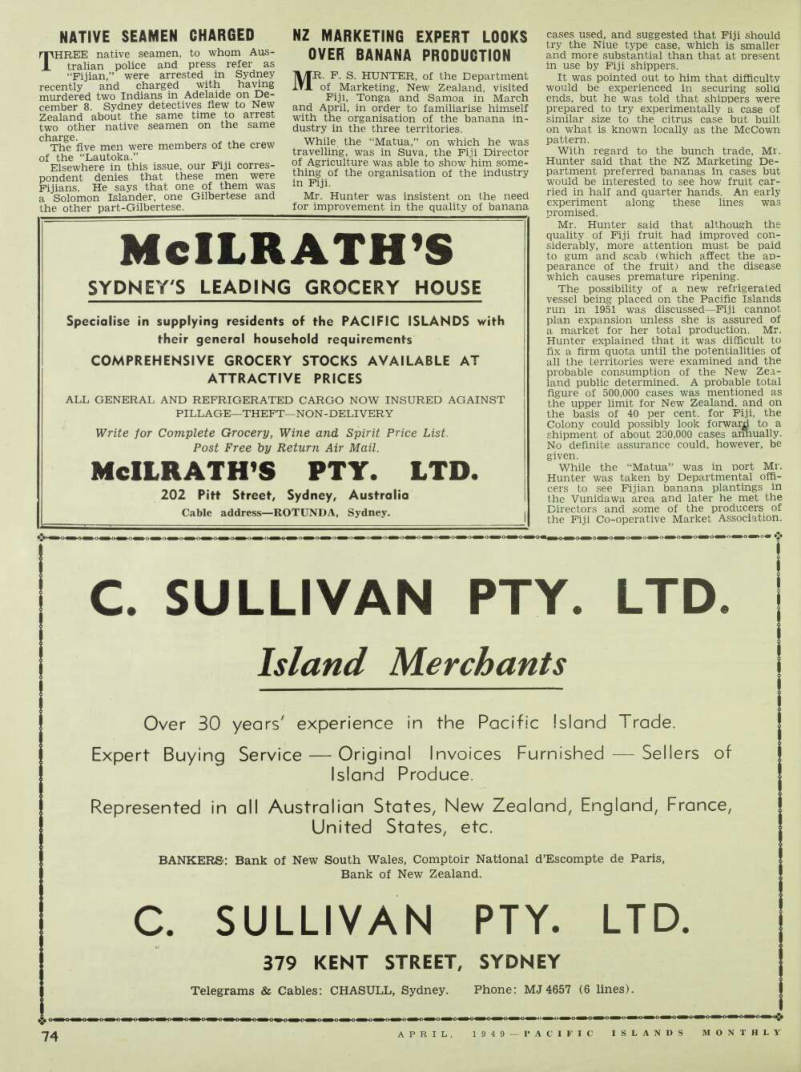
THREE native seamen, to whom Aus tralian police and press refer as “Fijian,” were arrested in Sydney recently and charged with having murdered two Indians in Adelaide on De cember 8. Sydney detectives flew to New Zealand about the same time to arrest two other native seamen on the same charge. , . ..
The five men were members of the crew of the “Lautoka.”
Elsewhere in this issue, our Fiji corres pondent denies that these men were Fijians. He says that one of them was a Solomon Islander, one Gilbertese and the other part-Gilbertese.
Nz Marketing Expert Looks
Over Banana Production
MR. F. S. HUNTER, of the Department of Marketing, New Zealand, visited Fiji, Tonga and Samoa in March and April, in order to familiarise himself with the organisation of the banana in dustry in the three territories.
While the “Matua,” on which he was travelling, was in Suva, the Fiji Director of Agriculture was able to show him some thing of the organisation of the industry in Fiji.
Mr. Hunter was insistent on the need for improvement in the quality of banana
cases used, and suggested that Fiji should try the Niue type case, which is smaller and more substantial than that at present in use by Fiji shippers.
It was pointed out to him that difficulty would be experienced in securing solid ends, but he was told that shippers were prepared to try experimentally a case of similar size to the citrus case but built on what is known locally as the McCown pattern.
With regard to the bunch trade, Mr.
Hunter said that the NZ Marketing De partment preferred bananas In cases but would be interested to see how fruit car ried in half and quarter hands. An early experiment along these lines was promised.
Mr. Hunter said that although the quality of Fiji fruit had improved con siderably, more attention must be paid to gum and scab (which affect the ap pearance of the fruit) and the disease which causes premature ripening.
The possibility of a new refrigerated vessel being placed on the Pacific Islands run in 1951 was discussed —Fiji cannot plan expansion unless she is assured of a market for her total production. Mr.
Hunter explained that it was difficult to fix a firm quota until the potentialities of all the territories were examined and the probable consumption of the New Zea land public determined. A probable total figure of 500,000 eases was mentioned as the upper limit for New Zealand, and on the basis of 40 per cent, for Fiji, the Colony could possibly look forward to a shipment of about 200,000 cases annually.
No definite assurance could, however, be given.
While the “Matua” was in port Mr.
Hunter was taken by Departmental offi cers to see Fijian banana plantings in the Vunidawa area and later he met the Directors and some of the producers of the Fiji Co-operative Market Association.
Advertisements & other items, p. 76 (1 item)
C. Sullivan Pty. Ltd.
McILRATH’S
SYDNEY'S LEADING GROCERY HOUSE
Specialise in supplying residents of the PACIFIC ISLANDS with their general household requirements
COMPREHENSIVE GROCERY STOCKS AVAILABLE AT
ATTRACTIVE PRICES
ALL GENERAL AND REFRIGERATED CARGO NOW INSURED AGAINST
PILLAGE-THEFT—NON-DELIVERY
Write for Complete Grocery, Wine and Spirit Price List.
Post Free by Return Air Mail.
McILRATH’S PTY. LTD.
202 Pitt Street, Sydney, Australia Cable address—ROTUNDA, Sydney.
C. SULLIVAN PTY. LTD.
Island Merchants
Over 30 years' experience in the Pacific Island Trade.
Expert Buying Service Original Invoices Furnished Sellers of Island Produce.
Represented in all Australian States, New Zealand, England, France, United States, etc.
BANKERS-: Bank of New South Wales, Comptoir National d’Escompte de Paris, Bank of New Zealand.
C. SULLIVAN PTY. LTD.
379 KENT STREET, SYDNEY
Telegrams & Cables: CHASULL, Sydney. Phone: MJ 4657 (6 lines).
New Guinea
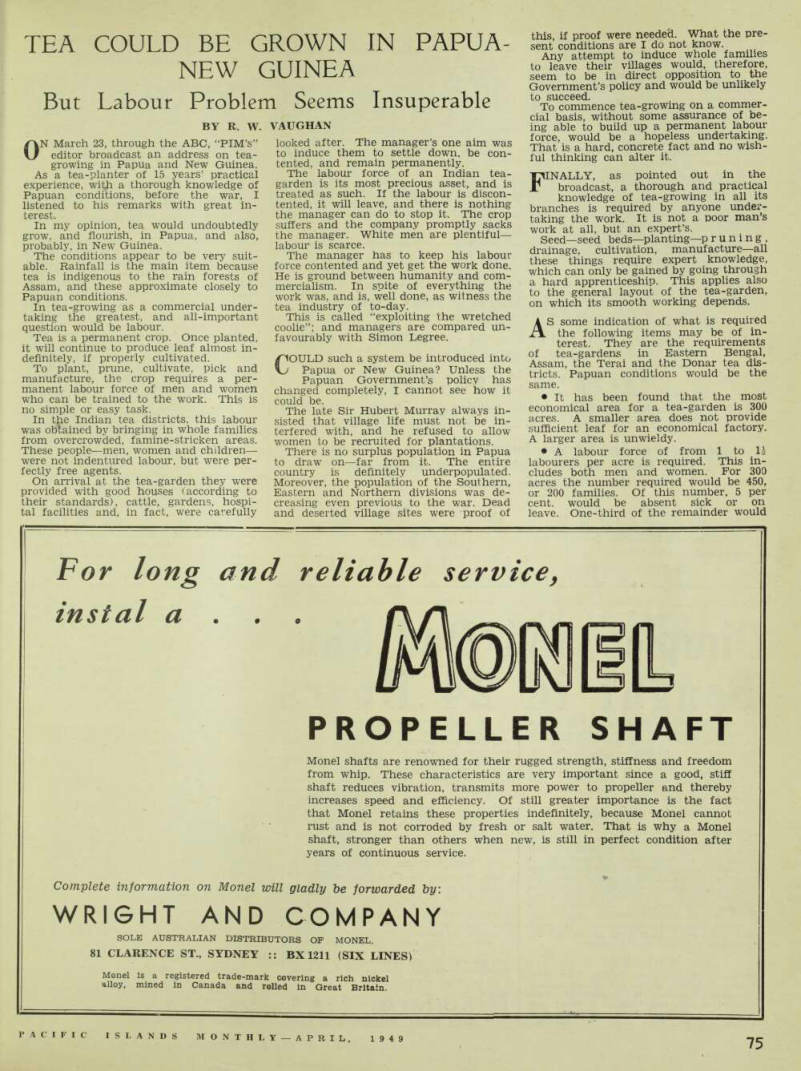
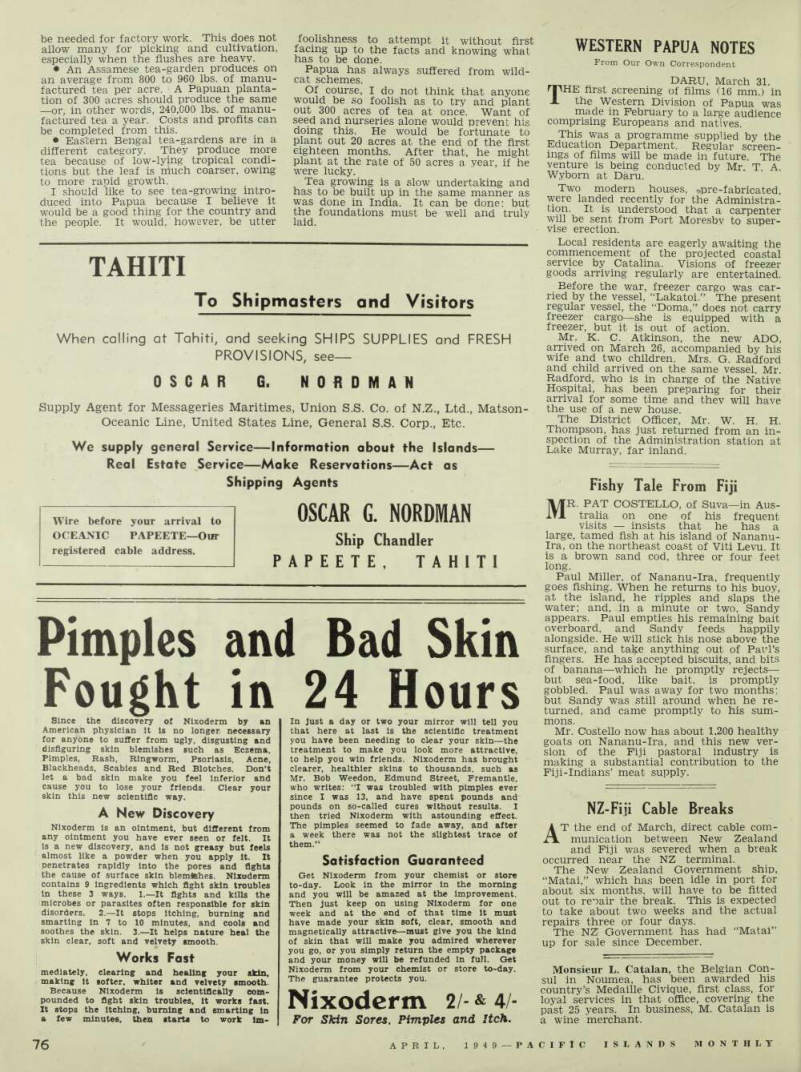
Tea Could Be Grown In Papua
But Labour Problem Seems Insuperable
By R. W. Vaughan
ON March 23, through the ABC, “PlM’s” editor broadcast an address on tea growing in Papua and New Guinea, As a tea-planter of 15 years’ practical experience, with a thorough knowledge of Papuan conditions, before the war, I listened to his remarks with great in terest.
In my opinion, tea would undoubtedly grow, and flourish, in Papua, and also, probably, in New Guinea.
The conditions appear to be very suit able. Rainfall is the main item because tea is indigenous to the rain forests of Assam, and these approximate closely to Papuan conditions.
In tea-growing as a commercial under taking the greatest, and all-important question would be labour.
Tea is a permanent crop. Once planted, it will continue to produce leaf almost in definitely, if properly cultivated.
To plant, prune, cultivate, pick and manufacture, the crop requires a per manent labour force of men and women who can be trained to the work. This is no simple or easy task.
In the Indian tea districts, this labour was obtained by bringing in whole families from overcrowded, famine-stricken areas.
These people—men, women and children— were not indentured labour, but were per fectly free agents.
On arrival at the tea-garden they were provided with good houses (according to their standards), cattle, gardens, hospi tal facilities and, in fact, were carefully
looked after. The manager’s one aim was to induce them to settle down, be con tented, and remain permanently.
The labour force of an Indian tea garden is its most precious asset, and is treated as such. If the labour is discon tented, it will leave, and there is nothing the manager can do to stop it. The crop suffers and the company promptly sacks the manager. White men are plentiful— labour is scarce.
The manager has to keep his labour force contented and yet get the work done.
He is ground between humanity and com mercialism. In spite of everything the work was, and is, well done, as witness the tea industry of to-day.
This is called “exploiting the wretched coolie”; and managers are compared un favourably with Simon Legree.
COULD such a system be introduced into Papua or New Guinea? Unless the Papuan Government’s policy has changed completely, I cannot see how it could be.
The late Sir Hubert Murray always in sisted that village life must not be in terfered with, and he refused to allow women to be recruited for plantations.
There is no surplus population in Papua to draw on—far from it. The entire country is definitely underpopulated.
Moreover, the population of the Southern, Eastern and Northern divisions was de creasing even previous to the war. Dead and deserted village sites were proof of
this, if proof were needed. What the pre sent conditions are I do not know.
Any attempt to induce whole families to leave their villages would, therefore, seem to be in direct opposition to the Government’s policy and would be unlikely to succeed.
To commence tea-growing on a commer cial basis, without some assurance of be ing able to build up a permanent labour force, would be a hopeless undertaking.
That is a hard, concrete fact and no wish ful thinking can alter it.
FINALLY, as pointed out in the broadcast, a thorough and practical knowledge of tea-growing in all its branches is required by anyone under taking the work. It is not a poor man’s work at all, but an expert’s.
Seed—seed beds—planting—p r u n i n g , drainage, cultivation, manufacture —all these things require expert knowledge, which can only be gained by going through a hard apprenticeship. This applies also to the general layout of the tea-garden, on which its smooth working depends.
AS some indication of what is required the following items may be of in terest. They are the requirements of tea-gardens in Eastern Bengal, Assam, the Terai and the Donar tea dis tricts. Papuan conditions would be the same. • It has been found that the most economical area for a tea-garden is 300 acres. A smaller area does not provide sufficient leaf for an economical factory.
A larger area is unwieldy. • A labour force of from 1 to li labourers per acre is required. This in cludes both men and women. For 300 acres the number required would be 450, or 200 families. Of this number. 5 per cent, would be absent sick or on leave. One-third of the remainder would
be needed for factory work. This does not allow many for picking and cultivation, especially when the flushes are heavy. • An Assamese tea-garden produces on an average from 800 to 960 lbs. of manufactured tea per acre. A Papuan plantation of 300 acres should produce the same —or, in other words, 240,000 lbs. of manufactured tea a year. Costs and profits can be completed from this. • Eastern Bengal tea-gardens are in a different category. They produce more tea because of low-lying tropical conditions but the leaf is much coarser, owing to more rapid growth.
I should like to see tea-growing introduced into Papua because I believe it would be a good thing for the country and the people. It would, however, be utter
foolishness to attempt it without first facing up to the facts and knowing what has to be done.
Papua has always suffered from wild cat schemes.
Of course, I do not think that anyone would be so foolish as to try and plant out 300 acres of tea at once. Want of seed and nurseries alone would prevent his doing this. He would be fortunate to plant out 20 acres at the end of the first eighteen months. After that, he might plant at the rate of 50 acres a year, if he were lucky.
Tea growing is a slow undertaking and has to be built up in the same manner as was done in India. It can be done: but the foundations must be well and truly laid.
Advertisements & other items, pp. 77-78 (1 item)
reliable service,
For long and
instal a .
l=i
PROPELLER SHAFT
Monel shafts are renowned for their rugged strength, stiffness and freedom from whip. These characteristics are very important since a good, stiff shaft reduces vibration, transmits more power to propeller and thereby increases speed and efficiency. Of still greater importance is the fact that Monel retains these properties indefinitely, because Monel cannot rust and is not corroded by fresh or salt water. That is why a Monel shaft, stronger than others when new, is still in perfect condition after years of continuous service. *• Complete information on Monel will gladly he forwarded by:
WRIGHT AND COMPANY
SOLE AUSTRALIAN DISTRIBUTORS OF MONEL,
81 CLARENCE ST., SYDNEY :: BX 1211 (SIX LINES) Monel Is a registered trade-mark covering a rich nickel alloy, mined In Canada and rolled in Great Britain.
TAHITI
To Shipmasters and Visitors When calling at Tahiti, and seeking SHIPS SUPPLIES and FRESH
PROVISIONS, see—
OSCAR G. NORDMAN
Supply Agent for Messageries Maritimes, Union S.S. Co. of N.Z., Ltd., Matson Oceanic Line, United States Line, General S.S. Corp., Etc.
We supply general Service—lnformation about the Islands— Real Estate Service—Make Reservations—Act as Shipping Agents Wire before your arrival to
OCEANIC PAPEETE—Our
registered cable address.
OSCAR G. NORDMAN
Ship Chandler
PAPEETE, TAHITI
Pimples and Bad Skin Fought in 24 Hours
Since the discovery of Nlxoderm by an American physician it Is no longer necessary for anyone to suffer from ugly, disgusting and disfiguring skin blemishes such as Eczema, Pimples, Rash, Ringworm, Psoriasis, Acne, Blackheads, Scabies and Red Blotches. Don’t let a bad skin make you feel inferior and cause you to lose your friends. Clear your skin this new scientific way.
A New Discovery
Nlxoderm is an ointment, but different from any ointment you have ever seen or felt. It is a new discovery, and is not greasy but feels almost like a powder when you apply It. It penetrates rapidly into the pores and fights the cause of surface skin blemtehes. Nlxoderm contains 9 ingredients which fight skin troubles in these 3 ways. 1.—It fights and kills the microbes or parasites often responsible for skin disorders. 2.—It stops itching, burning and smarting in 7 to 10 minutes, and cools and soothes the skin. 3.—It helps nature heal the skin clear, soft and velvety smooth.
Works Fast
mediately, clearing and healing your skin, making it softer, whiter and velvety smooth Because Nlxoderm is scientifically compounded to fight skin troubles, it works fast.
It stops the itching, burning and smarting in a few minutes, then starts to work 1m-
In Just a day or two your mirror will tell you that here at last is the scientific treatment you have been needing to clear your skin—the treatment to make you look more attractive, to help you win friends. Nixoderm has brought clearer, healthier skins to thousands, such as Mr. Bob Weedon, Edmund Street, Fremantle, who writes: “I was troubled with pimples ever since I was 13, and have spent pounds and pounds on so-called cures without results. I then tried Nixoderm with astounding effect.
The pimples seemed to fade away, and after a week there was not the slightest trace of them.”
Satisfaction Guaranteed
Get Nixoderm from your chemist or store to-day. Look in the mirror in the morning and you will be amazed at the improvement.
Then Just keep on using Nixoderm for one week and at the end of that time It must have made your skin soft, clear, smooth and magnetically attractive —must give you the kind of skin that will make you admired wherever you go, or you simply return the empty package and your money will be refunded in full. Get Nixoderm from your chemist or store to-day.
The guarantee protects you.
Nixoderm 2 & 4/-
For Skin Sores . Pimples and Itch.
Western Papua Notes
From Our Own Correspondent T ttt _, DARU, March 31.
HE first screening of films (16 mm.) in the Western Division of Papua was made in February to a large audience comprising Europeans and natives.
This was a programme supplied by the Education Department. Regular screen ings of films will be made in future. The venture is being conducted by Mr. T A.
Wyborn at Daru.
Two modern houses, *pre-fabricated, were landed recently for the Administra tion. It is understood that a carpenter will be sent from Port Moresbv to super vise erection.
Local residents are eagerly awaiting the commencement of the projected coastal service by Catalina. Visions of freezer goods arriving regularly are entertained.
Before the war, freezer cargo was car ried by the vessel, “Lakatoi.” The present regular vessel, the “Doma,” does not carry freezer cargo—she is equipped with a freezer, but it is out of action.
Mr. K. C. Atkinson, the new ADO, arrived on March 26, accompanied by his wife and two children. Mrs. G. Radford and child arrived on the same vessel. Mr.
Radford, who is in charge of the Native Hospital, has been preparing for their arrival for some time and they will have the use of a new house.
The District Officer, Mr. W. H. H.
Thompson, has just returned from an in spection of the Administration station at Lake Murray, far inland.
Fishy Tale From Fiji
M,R. PAT COSTELLO, of Suva —in Aus tralia on one of his frequent visits insists that he has a large, tamed fish at his island of Nananu- Ira, on the northeast coast of Viti Levu. It is a brown sand cod, three or four feet long.
Paul Miller, of Nananu-Ira, frequently goes fishing. When he returns to his buoy, at the island, he ripples and slaps the water; and, in a minute or two, Sandy appears. Paul empties his remaining bait overboard, and Sandy feeds happily alongside. He will stick his nose above the surface, and ta£e anything out of Paul’s fingers. He has accepted biscuits, and bits of banana —which he promptly rejects— but sea-food, like bait, is promptly gobbled. Paul was away for two months; but Sandy was still around when he re turned, and came promptly to his sum mons.
Mr. Costello now has about 1,200 healthy goats on Nananu-Ira, and this new ver sion of the Fiji pastoral industry is making a substantial contribution to the Fiji-Indians’ meat supply.
NZ-Fiji Cable Breaks
AT the end of March, direct cable com munication between New Zealand and Fiji was severed when a break occurred near the NZ terminal.
The New Zealand Government ship, “Matai,” which has been idle in port for about six months, will have to be fitted out to repair the break. This is expected to take about two weeks and the actual repairs three or four days.
The NZ Government has had “Matai” up for sale since December.
Monsieur L. Catalan, the Belgian Con sul in Noumea, has been awarded his country’s Medaille Civique, first class, for loyal services in that office, covering the past 25 years. In business, M. Catalan is a wine merchant.
Advertisements & other items, pp. 79-80 (2 items)
™^l V SSted°S
SANDY CREEK FACES
DIFFICULT PERIOD
THE difficulties under which some of the small gold-mining companies in New Guinea are labouring were in dicated in the chairman’s report to share holders of Sandy Creek Gold Sluicing, Ltd., in Sydney on February 28. Due to staff difficulties in Sydney and New Guinea this meeting had been delayed some months.
In the chairman’s opinion, the future of gold-mining in the Territory is not bright, unless relief from royalty is forthcoming—at present it is a flat 5 per cent, irrespective of costs—and there is an increase in the price of gold which at present is fixed at £lO/15/- (Aus tralian) per ounce. Production to-day is but a fraction of that of 1939, but costs have increased alarmingly.
The past year has not been a lucky one for the Company.
Work was continued in the Sandy and Poverty Creek area but towards the end of 1948 recoveries of gold became very poor. In early February, 1949, a flood broke the Coldwater race, which supplies most of the workings in the area. As repairs would be difficult and costly to make, the area was abandoned.
Gold recovery operation in the Co.’s Watut area commenced in April, 1948. but the sluicing pipes had corroded and could not take the full head of water.
Sluicing was confined to the less, valuable terrace deposits.
The company purchased pipes in New Zealand, but before delivery could be taken, the New Zealand £ unexpectedly went to par with sterling, and the pipes cost £6,000 landed at Lae, plus heavy transport cost to the leases.
Another current problem, difficult and
expensive, was_ that of bringing extra
water to the Watut property. • mHE company received from the War
£^l, 264^6^°^ a revaluation
down bv £2 683 necessitated the writing tS° Poverty B Creek fi leases £ has
SSS
has other large expenditure in respect of pipes, etc.
Sandy Creek Gold Sluicing Ltd.
A DV .f CE haS beGn received that during the mon th of February, 1949, 57 oz.
™^l V SSted°S
Morobe, New Gffinea. g leaBeB “
Cinevox Master
ASSEMBLE
THIS BOAT
YOURSELF!
It’s Easy .
PROOF WOOD BOAT ASSEMBLY KITS, made from PROOFWOOD, the famous marine plywood—for 8 ft., 11 ft., 3 in., and 16 ft. craft —come to you complete with all components. All parts are machine finished to exact size.
They can be assembled, in a very little time, into a beautifully designed craft, light in weight, yet immensely strong. Simplified plans accompany every kit. Send for illustrated brochure giving full details of PROOFWOOD
BOAT ASSEMBLY KITS.
Sole Export Agents for South Pacific :
WILLIAM E. REED
145 a George Street, Circular Quay,
Sydney Cables: “WILREED”, Sydney.
WRITE FOR ILLUSTRATED FOLDER.
Presenting: THE NEW
CINEVOX MASTER
16mm, Sound Film Projector
Its Battery Operated
MOW you ore no longer dependent upon power main installations to show home movies in your own living room. This amazing new 16 mm. sound projector will operate from any 32-volt domestic, power source as well as from the 24-volt current supplied by two 12-volt car batteries.
Some of its outstanding features are :— Capacity of 2,000 ft.; 240-watt lamp; fully corrected, 2Vz inch f/2 lens; gear-drive motor; amplifier frequency range of 100-7,000 c.p.s.; 27-volt 1-amp. exciter lamp; single 8-inch Alnico speaker; power output of 5.5 watts; convenient grouping of controls; brilliant screenings obtainable at distances up to 30 ft.; total equipment packs into one case.
KODAK (A/SIA.) PTY., LTD.
379 George Street, Sydney
BRANCHES IN ALL STATES
ONE OF THE WORLD S
WONDER-SIGHTS
Miles of
MOVING ICE
«s*p
See New Zealand’s
FRANZ JOSEF-GLACIER
From the Air I
NOWHERE else in the world can you see an eight-mile long river of ice framed in an evergreen setting of sub-tropical forest. Franz Josef is one of the scenic wonders of the world. Why not take the holiday you’ve promised yourself relax in comfort, in scenic surroundings? Travel in comfort too, by N.A.C. aircraft that land you fresh and unweary two hundred yards from tb« hotel door.
HOTEL ACCOMMODATION
Comfortable accommodation and attentive service is provided by the Government Tourist Department’s Hotel at the foot of the Glacier,
-AT YOUR SERVICE
New Zealand National Airways Corporation provides a network of air services throughout the Dominion and the South-west Pacific. General Agents in the Dominion for British Commonwealth Pacific Airlines and Trans-Australia Airlines. Booking Agents for Tasman Empire Airways, Qantas Empire Airways, the 8.0.A.C. and other overseas airlines. , Offices and Agents throughout New Zealand and the South-west Pacific
Samoa—Tonga
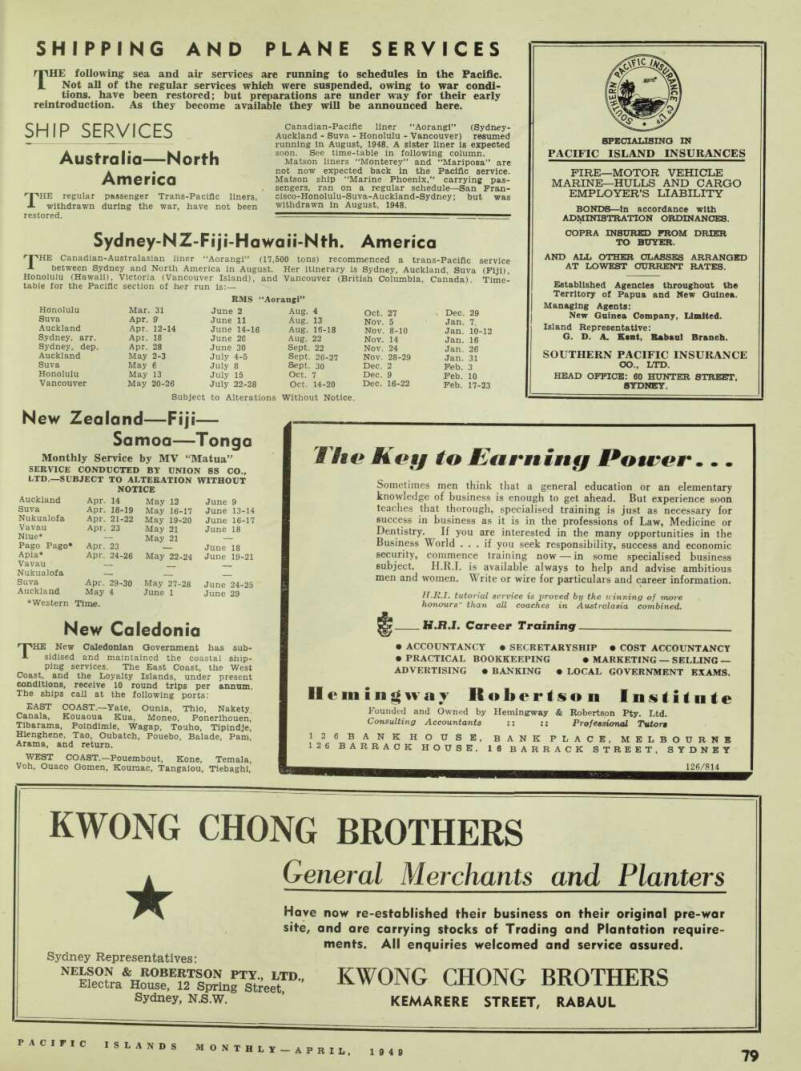

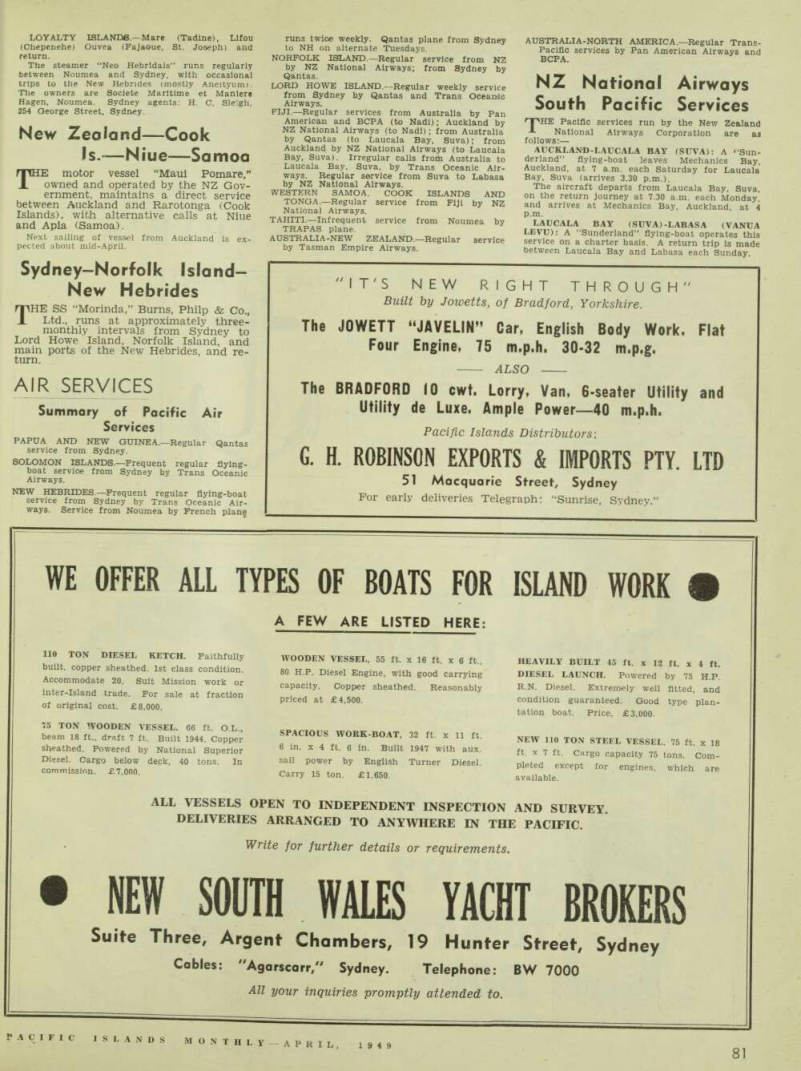
Shipping And Plane Services
THE following sea and air services are running to schedules in the Pacific.
Not all of the regular services which were suspended, owing to war condi tions. have been restored; but preparations are under way for their early reintroduction. As they become available they will be announced here.
Ship Services
Australia—North America nnHE regular passenger Trans-Pacific liners, J- withdrawn during the war, have not been restored.
Canadian-Pacific liner “Aorangi” (Sydney- Auckland - Suva - Honolulu - Vancouver) resumed running in August, 1948. A sister liner is expected soon. See time-table in following column, Matson liners “Monterey” and “Mariposa” are not now expected back in the Pacific service.
Matson ship “Marine Phoenix,” carrying pas sengers, ran on a regular schedule—San Fran cisco-Honolulu-Suva-Auckland-Sydney; but was withdrawn in August, 1948.
Sydney-NZ-Fiji-Hawaii-Nth. America
'T'HE Canadian-Australasian liner “Aorangi” (17,500 tons) recommenced a trans-Pacific service between Sydney and North America in August. Her itinerary is Sydney, Auckland, Suva (Fiji), Honolulu (Hawaii). Victoria (Vancouver Island), and Vancouver (British Columbia, Canada) Time table for the Pacific section of her run is:—
Subject to Alterations Without Notice.
New Zealand—Fiji—
Samoa—Tonga
Monthly Service by MV “Matua”
Service Conducted By Union 8S Co.,
Ltd.—Subject To Alteration Without
Notice
New Caledonia
THE New Caledonian Government has sub sidised and maintained the coastal ship ping services. The East Coast, the West Coast, and the Loyalty Islands, under present conditions, receive 10 round trips per annum.
The ships call at the following ports: EAST COAST.—Yate, Ounia, Thio, Nakety.
Canala, Kouaoua Kua, Moneo, Ponerthouen, Tibarama, Poindlmle, Wagap, Touho, Tipindje, Hlenghene, Tao, Oubatch, Pouebo, Balade, Pam, Arama, and return.
WEST COAST,—Pouembout, Kone, Temala, Voh, Ouaco Gomen, Koumac, Tangaiou, Tiebaghl,
Rms ‘
‘Aorangi”
Honolulu Mar. 31 June 2 Aug. 4 Oct. 27 ■ Dec. 29 Suva Apr. 9 June 11 Aug. 13 Nov. 5 Jan. 7.
Auckland Apr. 12-14 June 14-16 Aug. 16-18 Nov. 8-10 Jan. 10-12 Sydney, arr.
Apr. 18 June 20 Aug. 22 Nov. 14 Jan. 16 Sydney, dep.
Apr. 28 June 30 Sept. 22 Nov. 24 Jan. 26 Auckland May 2-3 July 4-5 Sept. 26-27 Nov. 28-29 Jan. 31 Suva May 6 July 8 Sept. 30 Dec. 2 Feb. 3 Honolulu May 13 July 15 Oct. 7 Dec. 9 Feb. 10 Vancouver May 20-26 July 22-28 Oct. 14-20 Dec. 16-22 Feb. 17-23
Auckland Apr. 14 May 12 June 9 Suva Apr, 18-19 May 16-17 June 13-14 Nukualofa Apr. 21-22 May 19-20 June 16-17 Vavau Apr. 23 May 21 June 18 Niue* — May 21 — Pago Pago* Apr. 23 — June 18 Apia* Apr. 24-26 May 22-24 June 19-21 Vavau — Nukualofa — Suva Apr. 29-30 May 27-28 June 24-25 Auckland May 4 June 1 June 29 ♦Western Time.
LOYALTY ISLANDS. —Mare (Tadlne), Llfou (Chepenehe) Ouvea (Fajaoue, St. Joseph) and return.
The steamer "Neo Hebrldais” runs regularly between Noumea and Sydney, with occasional trips to the New Hebrides (mostly Aneityumi.
The owners are Soclete Maritime et Manlere Hagen, Noumea. Sydney agents; H. C. Sleigh, 254 George Street, Sydney.
New Zeoland—Cook
Is.-—Niue—Samoa
fTTHE motor vessel “Maui Pomare,”
X owned and operated by the NZ Gov ernment, maintains a direct service between Auckland and Rarotonga (Cook Islands), with alternative calls at Niue and Apia (Samoa).
Next sailing of vessel from Auckland is ex pected about mid-April.
Sydney-Norfolk Island-
New Hebrides
THE SS “Morinda,” Burns, Philp & Co., Ltd., runs at approximately three monthly intervals from Sydney to Lord Howe Island, Norfolk Island, and main ports of the New Hebrides, and re turn.
Air Services
Summary of Pacific Air
Services
PAPUA AND NEW GUlNEA.—Regular Qantas service from Sydney.
SOLOMON ISLANDS.—Frequent regular flying boat service from Sydney by Trans Oceanic Airways.
NEW HEBRlDES,—Frequent regular flying-boat service from Sydney by Trans Oceanic Air ways. Service from Noumea by French plan?
runs twice weekly. Qantas plane from Sydney to NH on alternate Tuesdays.
NORFOLK ISLAND.—Regular service from NZ by NZ National Airways; from Sydney by Qantas.
LORD HOWE ISLAND.—Regular weekly service from Sydney by Qantas and Trans Oceanic Airways.
FlJl.—Regular services from Australia by Pan American and BCPA (to Nadi); Auckland by NZ National Airways (to Nadi); from Australia by Qantas (to Laucala Bay, Suva); from Auckland by NZ National Airways (to Laucala Bay, Suva). Irregular calls from Australia to Laucala Bay. Suva, by Trans Oceanic Air ways. Regular service from Suva to Labasa by NZ National Airways.
Western Samoa. Cook Islands And
TONGA.—Regular service from Fiji by NZ National Airways.
TAHlTl.—lnfrequent service from Noumea by TRAPAS plane.
AUSTRALIA-NEW ZEALAND.—ReguIar service by Tasman Empire Airways.
AUSTRALIA-NORTH AMERICA.—Regular Trans pacific services by Pan American Airways and
Bcpa.
NZ National Airways
South Pacific Services
'T'HE Pacific services run by the New Zealand A National Airways Corporation are as follows:
Aucklanb-Laucala Bay (Suva): A “Sun
derland” flying-boat leaves Mechanics Bay, Auckland, at 7 am. each Saturday for Laucala Bay, Suva (arrives 3.30 p.m.).
The aircraft departs from Laucala Bay, Suva, on the return journey at 7.30 a.m. each Monday, and arrives at Mechanics Bay, Auckland, at 4 p.m.
Laucala Bay (Suva)-Labasa (Vanua
LEVU): A “Sunderland” flying-boat operates this service on a charter basis. A return trip is made between Laucala Bay and Labasa each Sunday.
auckland-norfolk ISLAND-FIJI-TONGA
Western Samoa-Cook Islands: A “Douglas”
airliner leaves Whenuapai, Auckland, on alter nate Sundays at 8.30 a.m. (May 1, 15, 29, June 12, 26.) for Norfolk Island (arr. 12.30 p.m., dep. 12.1 a.m. Monday), Nadi (arr. 6.55 a.m., dep. 5.40 a.m. Tuesday), Nausori (arr. 6.30 a.m., dep. 7.15 a.m.), Tonga (arr. 10.45 a.m., dep. 11.45 a.m.), ‘Apia, Western Samoa (arr. 4.10 p.m. Monday, dep. 7.45 a.m. Tuesday), Aitutaki, Cook Islands (arr. 1.50 p.m., dep. 2.45 p.m.) and Rarotonga, Cook Islands (arr. 4.5 p.m.).
The aircraft departs from Rarotonga on the return journey at 7.30 a.m. on alternate Thursdays (May 5, IS', June 2, 16, 30) for Aitutaki (arr. 8.50 a.m., dep. 9.45 a.m.), Apia, Western Samoa (arr. 3.35 p.m., dep. 8 a.m.
Friday), *Tonga (arr. 11.15 a.m. Saturday, dep. 12.15 p.m.), Nausori (arr. 3.10 p.m., dep. 4.15 p.m.), Nadi (arr. 5.5 p.m., dep. 2 a.m. Sunday), Norfolk Island (arr. 8.10 a.m., dep. 1 p.m.), and Whenuapai, Auckland (arr. 5.45 p.m.).
An additional return service between Raro tonga and Aitutaki is operated on alternate Wednesdays when traffic warrants. ♦Crosses International Date Line.
Auckland-Norfolk Island: A “Douglas”
airliner leaves Whenuapai, Auckland, every Sun day at 8.15 a.m. for Norfolk Island (arr. 12.15 p.m.), and departs on the return flight at 1.15 p.m., arriving at Whenuapai at 6 p.m.
PARES, single (in NZ currency): Auckland to Norfolk, £l2/10/-; to Fiji, £3l; to Tonga. £3l; to Samoa, £34; to Aitutaki, £39; to Raro tonga, £39/10/-. Norfolk to Fiji, £l9. Fiji to Tonga, £B/15/-; to Samoa, £l3; to Aitutaki, £29/15/-; to Rarotonga, £3l. Samoa to Raro tonga, £l7/15/-; to Aitutaki, £l6/10/-; Suva to Labasa, £4/10/-. Return fares, less 10 per cent.
BOOKING OFFICES: Wellington, Govt. Life Bldg., Customhouse Quay; Auckland Airways House, Customs St.; Dunedin, 8-10 Manse St.; Christchurch, Union SS Co., 168 Hereford St.; Gisborne, 74 Peel St.; Palmerston Nth., 107 Broadway Ave.; Hamilton, 8 Alma St.; Rotorua, Airport Bid., Fenton St.; Norfolk Is., Burns Philp, Ltd.; Fiji, NAC at Nadi and Suva; Burns Philp, Labasa and Lautoka; Tonga, Mrs.
F. F. Melhose, Fou-amotu Airfield: W. Samoa, Burns Philp (SS), Ltd., Apia; Cook Is,, Mrs. P.
McVeagh, Aitutaki, and Mr. J. D. Campbell, Rarotonga.
Advertisements & other items, pp. 81-83 (2 items)
Kwong Chong Brothers
SPECIALISING IN
PACIFIC ISLAND INSURANCES
FIRE—MOTOR VEHICLE
MARINE—HULLS AND CARGO
EMPLOYER’S LIABILITY
BONDS—In accordance with
ADMINISTRATION ORDINANCES.
COPRA INSURED FROM DRIER
TO BUYER.
AND ALL OTHER CLASSES ARRANGED
AT LOWEST CURRENT RATES.
Established Agencies throughout the Territory of Papua and New Guinea.
Managing Agents: New Guinea Company, Limited.
Island Representative: G. D. A. Kent, Rabaul Branch.
SOUTHERN PACIFIC INSURANCE
CO., LTD.
HEAD OFFICE: 60 HUNTER STREET.
SYDNEY.
Hit* heyio hur nittyPower.. .
Sometimes men think that a general education or an elementary knowledge of business is enough to gel ahead. But experience soon teaches that thorough, specialised training is just as necessary for success in business as it is in the professions of Law, Medicine or Dentistry. If you are interested in the many opportunities in the Business World ... if you seek responsibility, success and economic security, commence training now —in some specialised business subject. H.R.I. is available always to help and advise ambitious men and women. Write or wire for particulars and career information. t- H.R.I. tutorial service is proved by the winning of more honours " than all coaches in Australasia combined.
H.R.I, Career Training • ACCOUNTANCY • SECRETARYSHIP • COST ACCOUNTANCY
• PRACTICAL BOOKKEEPING • MARKETING SELLING
ADVERTISING • BANKING • LOCAL GOVERNMENT EXAMS.
Hem injjwa r Robertson Institute
Founded and Owned by Consulting Accountants Hemingway & Robertson Pty. Ltd. :: :: Professional Tutors
126 BANK HOUSE
126 BARRACK HOUSE.
BANK PLACE, MELBOURNE
18 BARRACK STREET, SYDNEY
126/814
KWONG CHONG BROTHERS
★ Sydney Representatives:
General Merchants Planters
Have now re-established their business on their original pre-war site, and are carrying stocks of Trading and Plantation requirements. All enquiries welcomed and service assured.
NELSON & ROBERTSON PTY., LTD
Electra House, 12 Spring street ”
Sydney, N.S.W.
KWONG CHONG BROTHERS
KEMARERE STREET, RABAUL
/feve teeth
that are
perfect
clean ■ ■ ■ ~JS*
dove“ N£SS "'
m \% \ ■t) <■“ 3, VI and save
\\ mone
the same -time! & 7P & y \ r * 4 v. o n % & «*- 0. .•% Yes! Kolynos does save you money. Kolynos lasts longer because it is highly concentrated. Half an inch on a dry brush is all you need to leave your teeth surgically clean, and gleaming. Always ask for Kolynos.
DENTAL
CREAM
(Cleans better - ‘vksres better- longer.
"IT'S NEW RIGHT THROUGH"
Built by Jowetts, of Bradford, Yorkshire.
The JOWETT “JAVELIN” Car, English Body Work. Flat Four Engine, 75 m.p.h, 30-32 m.p.g,
ALSO
The BRADFORD 10 cwt. Lorry, Van, 6-seater Utility and Utility de Luxe. Ample Power—4o m.p.h.
Pacific Islands Distributors : G. H. ROBINSON EXPORTS & IMPORTS PTY. LTD 51 Macquarie Street, Sydney For early deliveries Telegraph: “Sunrise, Sydney.”
WE OFFER ALL TYPES OF BOATS FOR
A FEW ARE LISTED HERE:
ISLAND WORK •
110 TON DIESEL KETCH. Faithfully built, copper sheathed. Ist class condition.
Accommodate 20. Suit Mission work or inter-island trade. For sale at fraction of original cost. £B,OOO. 75 TON WOODEN VESSEL. 66 ft. 0.L., beam 18 ft., draft 7 ft. Built 1944. Copper sheathed. Powered by National Superior Diesel. Cargo below deck, 40 tons. In commission. £7.000.
WOODEN VESSEL, 55 ft. x 16 ft. X 6 ft., 80 H.P. Diesel Engine, with good carrying capacity. Copper sheathed. Reasonably priced at £4,500.
SPACIOUS WORK-BOAT, 32 ft. x 11 ft. 6 in. x 4 ft. 6 in. Built 1947 with aux. sail power by English Turner Diesel.
Carry 15 ton. £1.650.
HEAVILY BUILT 45 ft. x 12 ft. x 4 ft.
DIESEL LAUNCH. Powered by 75 H.P.
R.N. Diesel. Extremely well fitted, and condition guaranteed. Good type plantation boat. Price, £3,000.
NEW 110 TON STEEL VESSEL. 75 ft. X 18 ft. x 7 ft. Cargo capacity 75 tons. Completed except for engines, which are available.
ALL VESSELS OPEN TO INDEPENDENT INSPECTION AND SURVEY.
DELIVERIES ARRANGED TO ANYWHERE IN THE PACIFIC.
Write for further details or requirements.
• NEW SOirm WALES YACHT BROKERS
Suite Three, Argent Chambers, 19 Hunter Street, Sydney
Cables: "Agorsearr," Sydney. Telephone; BW 7000
All your inquiries promptly attended to.
81
ACIFIC ISLANDS MONTHLY-APRIL, 1949
Sydney-Vcmcouver
BCPA Service
BRITISH Commonwealth Pacific Airlines, Ltd., operate a twice weekly trans-Paciflc service from Sydney to Vancouver, via Fiji, Canton Island, Honolulu and San Francisco; and a weekly service between Auckland and Vancouver, via the same ports.
Planes leave Sydney every Wednesday and Saturday, and Vancouver on the Southbound trip every Monday and Thursday. Every fourth
trip from Sydney terminates at San Francisco instead of Vancouver.
Planes leave Auckland every Tuesday and arrive in Vancouver the following Wednesday.
The Southbound trip to Auckland commences from Vancouver every alternate Friday. Every other Friday the service commences at San Francisco.
Fares are (in Australian currency): Sydney- San Francisco, £2OO single and £360 return; Auckland-Vancouver, £AI9B single; Auckland- Nadi (Fiji), £A39; Sydney-Nandi, £ASS.
Douglas DC6 aircraft carrying 48 passengers (seated) or 37 passengers (in sleepers) and a crew of nine are used on the service.
Advertisements & other items, p. 84 (1 item)
Heinz
GILLESPIE’S
The Flour
TRADE
MARK
of the Islands
- SY DN EY -
113 tom., it’s Heinz/
Appetites spring to life when its Heinz Tomato Soup made with “Aristocrat” Tomatoes.
Grown specially for Heinz, tended and cared for until red-ripe, then made into the perfect Tomato Soup with that smooth texture and enticing Heinz flavour.
And try Heinz Home Style Tomato Soup too , Ws garnished ivith vegetables.
SOVJ"
• S 7
HEINZ
TOMATO
SOUP
m&m
Sydney—Auckland
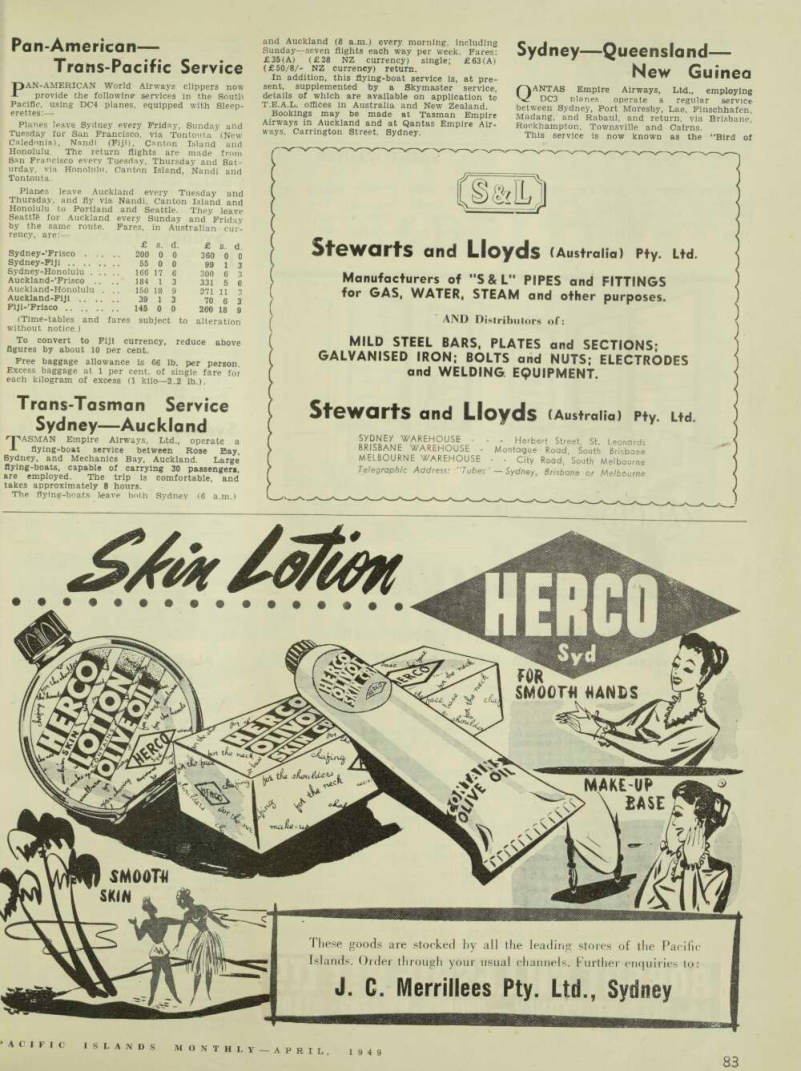
Pan-American— Trans-Pacific Service
PAN-AMERICAN World Airways clippers now provide the following services in the South Pacific, using DC4 planes, equipped with Sleep erettes : Planes leave Sydney every Friday, Sunday and Tuesday for San Francisco, via Tontouta (New Caledonia). Nandi (Fiji). Canton Island and Honolulu. The return flights are made from San Francisco every Tuesday. Thursday and Sat urday. via Honolulu. Canton Island, Nandi and Tontouta.
Planes leave Auckland every Tuesday and Thursday, and fly via Nandi, Canton Island and Honolulu to Portland and Seattle. They leave Seattle for Auckland every Sunday and Friday by the same route. Pares, in Australian cur rency, are:—
To convert to Fiji currency, reduce above figures by about 10 per cent.
Free baggage allowance is 66 lb. per person.
Excess baggage at 1 per cent, of single fare for each kilogram of excess (1 ki10—2.2 lb.).
Trans-Tasman Service
Sydney—Auckland
HpASMAN Empire Airways, Ltd., operate a A flying-boat service between Rose Bay.
Sydney, and Mechanics Bay, Auckland. Large flying-boats, capable of carrying 30 passenger*. are employed. The trip is comfortable, and takes approximately 8 hours.
The flying-boats leave both Sydney (6 a.m.)
and Auckland (8 a.m.) every morning, including Sunday-seven flights each way per week. Pares: £3S(A) (£2B NZ currency) single; £63(A) (£5O/8/- NZ currency) return.
In addition, this flying-boat service is, at present supplemented by a Skymaster service. ° f ™ hlch ar A e avanabl e on application to T ’Bo^’kines ffiC m S av m be US nf£i? a ! ld n , New Zea ja nd - Airwavs fn o asn l an , Em Pl re waJl^Oßwln^ton 1 sfri? d ql?!. Empire Airways, Carrington Street, Sydney.
Jyciiicv V/Ueghsiqfid
7 7 '
fZ hlhaa
VSUinetl /"V ANT AS Empire Airways, Ltd., employing DC3 Dianes, operate a regular service between Sydney, Port Moresby, Lae, Finschhafen.
Madang, and Rabaul, and return, via Brisbane, Rockhampton. Townsville and Cairns, Thls ser vice is now known as the "Bird o t
£ s. d. £ s. d.
Sydney-’Frisco 200 0 0 360 0 0 Sydney-PIJi 55 0 0 99 1 3 Sydney-Honolulu 166 17 6 300 6 3 Auckland-’Prisco ... 184 1 3 331 5 o Auckland-Honolulu ... 150 18 9 271 il 3 Auckland-Pljl 39 1 3 70 6 3 PlJl-’Frlsco 145 0 0 260 18 9 (Time-tables and fares subject to alteration without notice.)
Paradise” Service. DC3 aircraft, carrying 19 passengers, are useo.
Plames leave Sydney on Mondays, Wednesdays, and Fridays at 9 a.m., and arrive at Lae at 1 p.m. on Tuesdays, Thursdays and Saturdays.
The plane which leaves Sydney on Wednesday and arrives at Lae on Thursday then goes on to Rabaul. It returns on Friday. The plane, which arrives at Lae on Tuesdays, then goes on to Madang, returning to Lae the same day.
Planes leave Lae at 5.45 a.m. on Wednesdays, Saturday and Sunday, and arrive in Sydney at 10 p.m., accomplishing the Lae-Sydney run in a day.
The return plane from Rabaul leaves at 1.30 p.m. on Fridays.
Bookings may be made at Qantas offices at any of the towns named. At present, berths are available only to passengers holding official per mits to visit Papua or New Guinea.
Sydney-Noumea-Suva
THE following is the time-table of the Qantas flying-boat:—
Intending passengers may book through Qantas offices In Australia. Burns, Phllp (South Seas) Company, in Suva; and T. Johnston In Noumea.
Fares: To Noumea, £35 single; £63 return.
To Suva, £52/10/- single; £94/10/- return.
Noumea-Suva, £l7/10/- single; £3l/10/- re turn.
Sydney-Lord Howe ls.-
Norfolk Is.
QANTAS, Sydney, run a Catalina once weekly from Sydney to Lord Howe Island. Pare, single, £l2. Return, £2l/12/-.
Qantas run a land plane alt. Thursdays (re turning same day) from Sydney to Norfolk Island. Fare, £22 single; £39/12/- return. (For Norfolk Island, see also under NZ National Airways. For Lord Howe, see also under TOA.)
Noumeo-Fiji-Tahiti
'X'HAPAS (a French company with headquarters in Noumea) ran an air service once a month from Noumea (New Caledonia), via Nadi (Fiji) and Altutaki (Cook Islands) to Papeete (Tahiti), and return.
The Trapas Co. also runs a service to New Hebrides—see under Caledonia-New Hebrides.
New Caledonia—New
Hebrides —Tahiti
A TRAPAS amphibian runs twice each week between New Caledonia and New Hebrides.
The days vary, but on the selected day the planes adhere to the following time-table; — Noumea—dep. 0630. Vila—arr. 1315 0945 Santo —arr. 1115 Santo—dep. 1145 Vila—arr. 0900 Vila —dep. 1400 Noumea—arr. 1630 A TRAPAS plane runs monthly between Noumea and Tahiti.
TOA Services
TRANS Oceanic Airways run the following Pacific services:— SYDNEY-LORD HOWE IS.: A regular fort nightly service with large four-engine flying boats from Rose Bay. Pare: £ll single; £2l return. Free baggage allowance 50 lb. Excess baggage and freight rate 6d. per lb.
SYDNEY-NEW HEBRIDES; A regular monthly service with large four-engine flying-boats from Sydney, via Noumea (overnight stop), to Vila and Espiritu Santo. Pare: Sydney-Vlla, £45: Sydney-Santo, £5O; Noumea-Vila, £l2/10/-; Noumea-Santo. £lB/15/-. Freight: Sydney-Vila, 2/- per lb.; Sydney-Santo. 2/3.
Sydney-Solomon Islands; A Regular
monthly service from Sydney, via New Cale donia and New Hebrides to Tulagi. Solomon Islands. This service is frequently extended to Llngatou. in the Russell Islands, and calls are sometimes made at Vanikoro. in the Santa Cruz Group. Pares: Sydney-Tulagi, £65. Free bag gage allowance, 60 lb.; excess baggage and. freight, 3/- per lb.
Sydney dep. 9 p.m. alt. Tues.
Noumea .. , , . . arr. 6.55 a.m. alt. Wed.
Noumea dep. 7.55 a.m. alt. Wed.
Suva arr. 2.55 p.m. alt. Wed.
Suva dep. 6 a.m. alt. Frid.
Noumea arr. 11 a.m, alt. Frid.
Noumea . . .. .. dep. 12 noon alt. Frid.
Sydney arr. 7.45 p.m. alt. Frid.
Advertisements & other items, pp. 85-86 (1 item)
J. C. Merrillees Pty. Ltd., Sydney
yny
Stewarts and Lloyds (Australia) Pty. Ltd Manufacturers of "S & L" PIPES and FITTINGS for GAS, WATER, STEAM and other purposes.
AND Distributors of:
MILD STEEL BARS, PLATES and SECTIONS;
GALVANISED IRON; BOLTS and NUTS; ELECTRODES
and WELDING EQUIPMENT.
Stewarts and Lloyds
(Australia) Pty. Ltd. !^!* WAREHOUSE - - - Herbert Street, St. Leonards BRISBANE WAREHOUSE - Montague Road, South Brisbane MELBOURNE WAREHOUSE - - City Road, South Melbourne Telegraphic Address: Tubes Sydney, Brisbane or Melbourne
Zi-f V* V m
SMOOTH HANDS
V -'q.l -nuifetf-i N>
MAKE-UP
BASE
(S>
SMOOTH
SKIN
These goods are stocked by all the leading stores of the Pacific Islands. Order through your usual channels. Further enquiries to:
J. C. Merrillees Pty. Ltd., Sydney
FOR SALE
CRUISER, 48 ft., TWIN DIESELS, three 4berth cabins, 2 Toilets, shower, etc. Ideal luxury craft for Barrier Reef, etc., being built, ready 10 weeks. Price, Hull complete with 2 Dinghies, £3.000. Engines extra. Offers. Box 814 L., G.P.0., Brisbane.
AGENT WANTED
Walter Kary & Son, Baking House, Sydney, Textile Indentors, wish to appoint Agent for New Guinea Territory.
Interested parties please contact.
POSITIONS WANTED
Islands, young man, general experience all types farm machinery and tractors, distribution and re-conditioning. Also experience with motor trade distribution.
Two years as Country Representative.
Single. Age 23 years. Apply Trade, c-
Box 3408 G.P.0., SYDNEY.
CARPENTER & JOINER: Requhes
position in Pacific Islands. Experienced tradesman, accom. needed for wife and two children. Apply “Carpenter,” c -
G.P.O. Box 3408, SYDNEY.
GIVES FULL LIGHT AND AIR
WITH YEAR ROUND WEATHER PROTECTION
This ultra modern window comprises a series of glass blades swung one above the other and inclinable to any angle.
Air entering the room is diverted towards the ceiling thus preventing draughts. AGCO Supaluvres have all the advantages of other louvre windows plus exclusive features.
The specially designed rain guards cannot be fouled by the glass holders and provide flush finish so that fly screens, curtains or blinds can be attached. By an automatic locking device AGCO Supaluvres can be locked open in four positions, thus eliminating rattle and are also fitted with rack and pinion movement. All exposed surfaces are made of rust resisting zincanneal metal.
For Verandahs, Sun-rooms, Lounge-rooms, Kitchens and Laundries Illustrated leaflet, price list and installation instructions on request.
Sole Agents for South-west Pacific :
Death Of Mr. E. R. Oldham
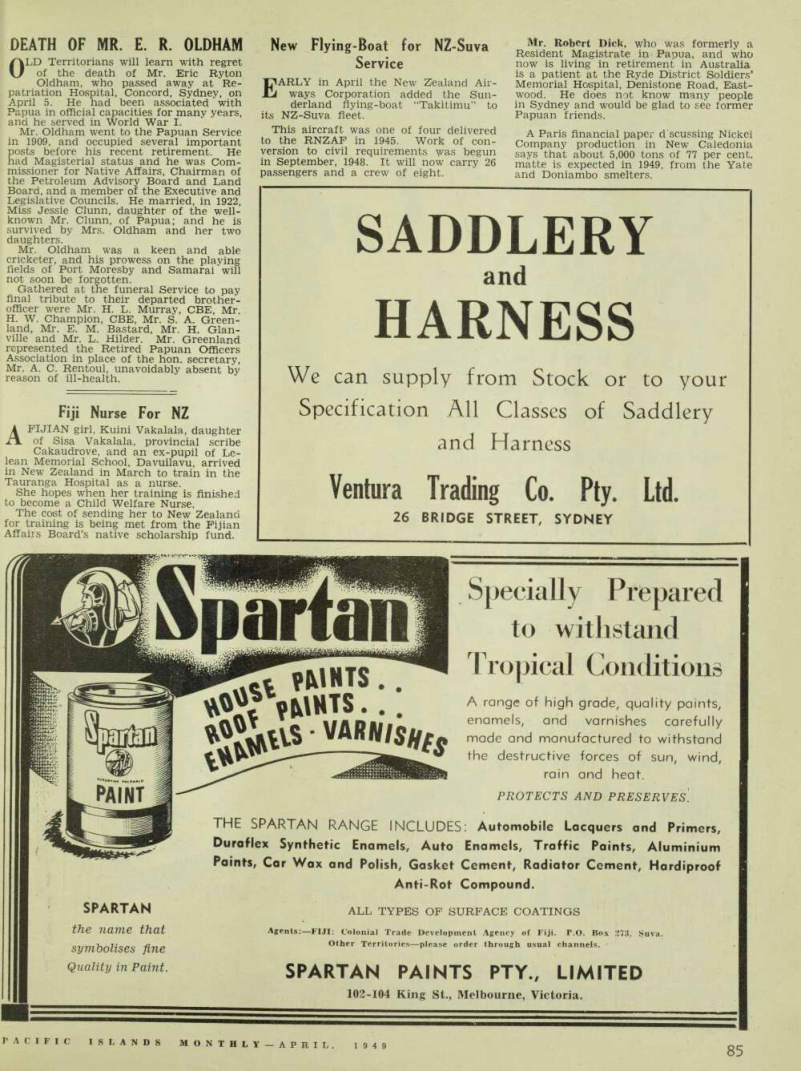
OLD Territorians will learn with regret of the death of Mr, Eric Ryton Oldham, who passed away at Re patriation Hospital, Concord, Sydney, on April 5. He had been associated with Papua in official capacities for many years, and he served in World War I.
Mr. Oldham went to the Papuan Service in 1909, and occupied several important posts before his recent retirement. He had Magisterial status and he was Com missioner for Native Affairs, Chairman of the Petroleum Advisory Board and Land Board, and a member of the Executive and Legislative Councils. He married, in 1922, Miss Jessie Clunn, daughter of the well known Mr. Clunn, of Papua; and he is survived by Mrs. Oldham and her two daughters.
Mr. Oldham was a keen and able cricketer, and his prowess on the playing fields of Port Moresby and Samarai will not soon be forgotten.
Gathered at the funeral Service to pay final tribute to their departed brother officer were Mr. H. L. Murray, CBE, Mr.
H. W. Champion, CBE, Mr. S. A. Green land, Mr. E. M. Bastard, Mr. H. Glan ville and Mr. L. Hilder. Mr. Greenland represented the Retired Papuan Officers Association in place of the hon. secretary, Mr. A. C. Rentoul, unavoidably absent by reason of ill-health.
Fiji Nurse For NZ
A FIJIAN girl, Kuini Vakalala, daughter of Sisa Vakalala, provincial scribe Cakaudrove, and an ex-pupil of Le lean Memorial School, Davuilavu, arrived in New Zealand in March to train in the Tauranga Hospital as a nurse.
She hopes when her training is finished to become a Child Welfare Nurse.
The cost of sending her to New Zealand for training is being met from the Fijian Affairs Board’s native scholarship fund.
New Flying-Boat for NZ-Suva
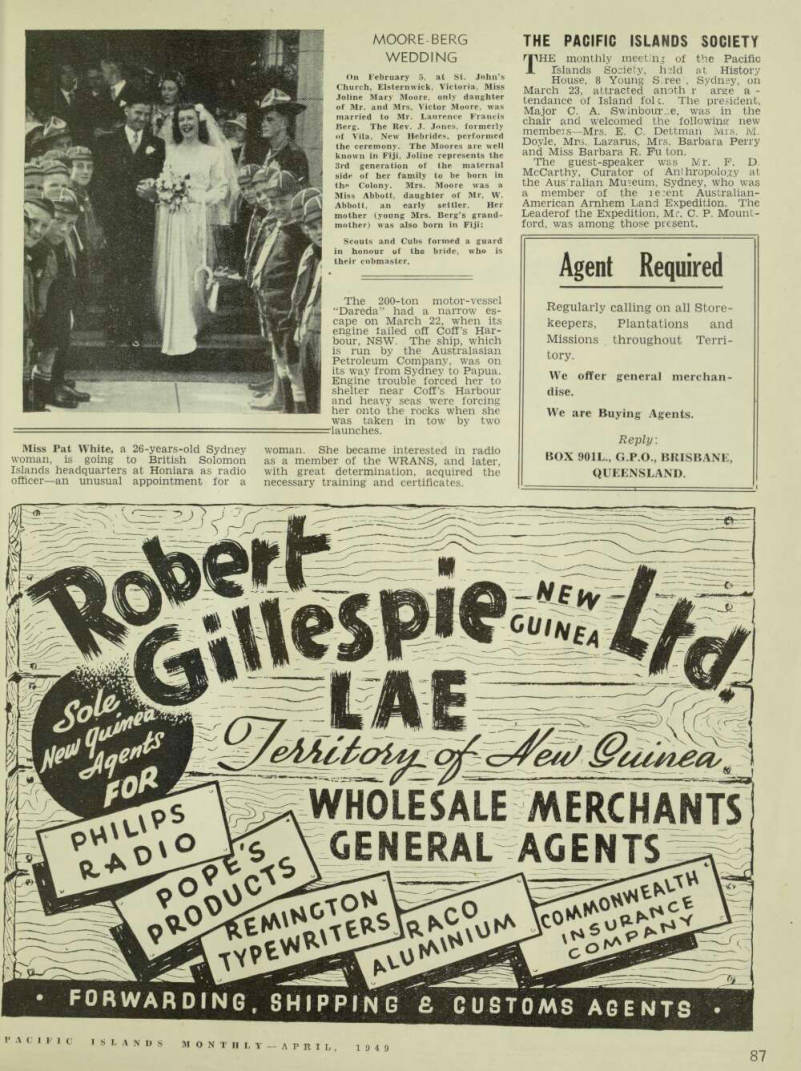
Service
EARLY in April the New Zealand Air ways Corporation added the Sun derland flying-boat “Takitimu” to its NZ-Suva fleet.
This aircraft was one of four delivered to the RNZAF in 1945. Work of con version to civil requirements was begun in September, 1948. It will now carry 26 passengers and a crew of eight.
Mr. Robert Dick, who was formerly a Resident Magistrate in Papua, and who now is living in retirement in Australia is a patient at the Ryde District Soldiers* Memorial Hospital, Denistone Road, East wood. He does not know many people in Sydney and would be glad to see former Papuan friends.
A Paris financial paper d scussing Nickel Company production in New Caledonia says that about 5,000 tons of 77 per cent, matte is expected in 1949, from the Yate and Doniambo smelters.
Miss Pat White, a 26-years-old Sydney woman, is going to British Solomon Islands headquarters at Honiara as radio officer—an unusual appointment for a
woman. She became interested in radio as a member of the WRANS, and later, with great determination, acquired the necessary training and certificates.
Advertisements & other items, pp. 87-88 (1 item)
artan
SADDLERY
and
HARNESS
We can supply from Stock or to your Specification All Classes of Saddlery and Harness Ventura Trading Co. Pty. Ltd.
26 BRIDGE STREET, SYDNEY
PAINT
SPARTAN
the name that symbolises fine Quality in Paint.
artan
TS • • •
Specially Prepared
to withstand
Tropical Conditions
A range of high grade, quality paints, enamels, and varnishes carefully made and manufactured to withstand the destructive forces of sun, wind, rain and heat.
PROTECTS AND PRESERVES.
THE SPARTAN RANGE INCLUDES: Automobile Lacquers and Primers, Duraflex Synthetic Enamels, Auto Enamels, Traffic Paints, Aluminium Paints, Car Wax and Polish, Gasket Cement, Radiator Cement, Hardiproof Anti-Rot Compound.
ALL TYPES OF SURFACE COATINGS
Agents:—FlJl: Colonial Trade Development Agency of Fiji. P.O. Box 273, Suva.
Other Territories—please order through usual channels.
SPARTAN PAINTS PTY., LIMITED
102-104 King St., Melbourne, Victoria.
DON'T SAY GIN
G I M DON'T SAY
DON'T SAY GIM
CIM DON'T SAY
DON'T SAY GIM
I 1% DON'T SAY
DON'T SAY ft I N
fp I M DON'T SAY
DON'T SAY « I m
i 1 M DON'T SAY
DON'T SAY G I M
GIM DON'T SAY
DON'T SAY G I M
DON'T SAY GIM
GIM DON'T SAY
DON'T SAY GIM
GIM DON'T SAY
DON'T SAY GIM
GIM DON'T SAY
DON'T SAY GIM
GIM DON'T SAY
DON'T SAY GUI
Cl M DON'T SAY
DON'T SAY GIM
GIM DON'T SAY
DON'T SAY G 1 M
DON'T SAY GIM
G SAY
DON'T SAY G I M
Cl m DON'T SAY
DON'T SAY C I M
DON'T SAY
DON
c 3ii; D Y S AY G/yV ir 0 °u r ne °°C *Ta Us ychi ey SK/p
DON'
G I M DON'T ~S
DON'T SAY G I M
DON'T SAY GIM
G SAY
DO G D
SAY
IM
T SAY
don't IM
DON'T SAY GIM
DON'T SAY
DON'T SAY GIM
DON'T SAY
M Y 5 AY * M Af ®4>o c °c
SAY
'is y<bie ***& IM r ish
T SAY
IM
DON'T
GIM DON'T
DON'T SAY GIM DON’T
Address all inquiries to: Telegrams and Cables: “GILBEYS,” Melboarne.
W. & A. GILBEY LTD.
33 ROSSLYN STREET, WEST MELBOURNE. 109 REGENT STREET, SYDNEY.
Telegrams and Cables: “GILBEYS,” Sydney.
Moore-Berg
Wedding
The 200-ton motor-vessel “Dareda” had a narrow es cape on March 22, when its engine tailed off Goff’s Har bour, NSW. The ship, which is run by the Australasian Petroleum Company, was on its way from Sydney to Papua.
Engine trouble forced her to shelter near Goff’s Harbour and heavy seas were forcing her onto the rocks when she was taken in tow by two launches.
On February 5, at St. John’s Church, Elsternwick, Victoria, Miss Joline Mary Moore, only daughter of Mr. and Mrs. Victor Moore, was married to Mr. Laurence Francis Berg. The Rev. J. Jones, formerly of Vila, New Hebrides, performed the ceremony. The Moores are well known in Fiji, Joline represents the 3rd generation of the maternal side of her family to be born in the Colony. Mrs. Moore was a Miss Abbott, daughter of Mr. W.
Abbott, an early settler. Her mother (young Mrs. Berg’s grand mother) was also born in Fiji: Scouts and Cubs formed a guard in honour of the bride, who is their cubmaster.
The Pacific Islands Society
rpHE monthly meeting of the Pacific 1 Tslands Society, held at History House, 8 Young Slree , Sydney, on March 23, attracted anoth r arge a tendance of Island foU. The president, Major Q A lSwinbom v.e, Was in the chair and welcomed the following new members—Mrs. E. C. Dettman Mrs. M.
Lazarus. Mrs. Barbara Perry and MISS Barbara R. Fll ton. The „ guest-speaker was MT. F. D McCarthy, Curator of Anthropology at the Aus'ralian Museum, Sydney, who was a member of the ie:ent Australian- American Arnhem Land Expedition. The Leaderof the Expedition, Ml’. C. P. Mount ford, was among those present.
Advertisements & other items, p. 89 (1 item)
Merchants
Agent Required
Regularly calling on all Storekeepers, Plantations and Missions throughout Territory.
We offer general merchandise.
We are Buying Agents.
Reply:
BOX 901 L., G.P.0., BRISBANE,
QUEENSLAND.
A V 'rwM c * u jnb i s> f eUli uineas„ 9* s \ R> \P S
WHOLESALE
GENERAL AGENTS
MERCHANTS
$5%Ss • FORWARDING, SHIPPING fi C USTOMS AG E NTS
Islands Produce
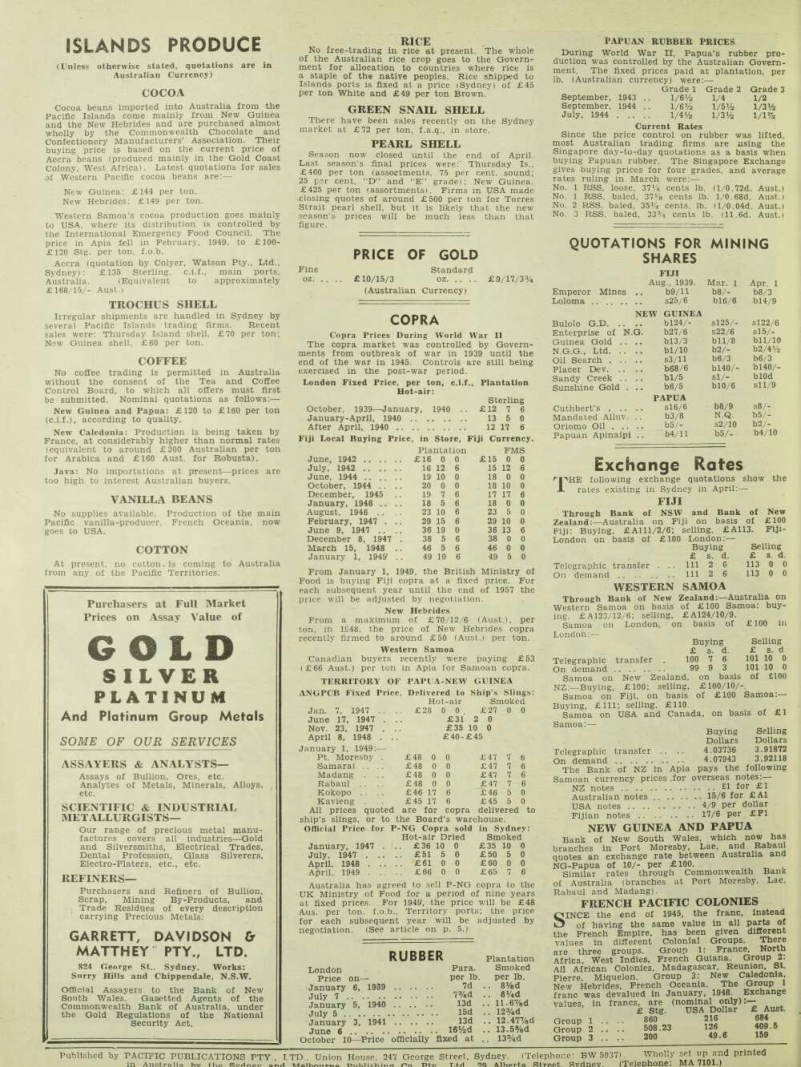
(Unless otherwise stated, quotations are in Australian Currency)
Cocoa
Cocoa beans imported into Australia from the Pacific Islands come mainly from New Guinea and the New Hebrides and are purchased almost wholly by the Commonwealth Chocolate and Confectionery Manufacturers’ Association. Their buying price is based on the current price of Accra beans (produced mainly in the Gold Coast Colony, West Africa). Latest quotations for sales of Western Pacific cocoa beans are:— New Guinea: £144 per ton.
New Hebrides: £149 per ton.
Western Samoa’s cocoa production goes mainly to USA, where its distribution is controlled by the International Emergency Food Council. The price in Apia fell in February, 1949, to £ 100- £l2O Stg. per ton, f.o.b.
Accra (quotation by Colyer, Watson Pty., Ltd., Sydney): £135 Sterling, c.i.f., main ports, Australia. (Equivalent to approximately £l6B/15/- Aust.)
Trochus Shell
Irregular shipments are handled in Sydney by several Pacific Islands trading firms. Recent sales were: Thursday Island shell, £7O per ton; New Guinea shell, £6O per ton.
Coffee
No coffee trading is permitted in Australia without the consent of the Tea and Coffee Control Board, to which all offers must first be submitted. Nominal quotations as follows: New Guinea and Papua: £l2O to £l6O per ton (c.i.f.), according to quality.
New Caledonia: Production is being taken by France, at considerably higher than normal rates (equivalent to around £2OO Australian per ton for Arabica and £l6O Aust. for Robusta).
Java: No importations at present—prices are too high to interest Australian buyers.
Vanilla Beans
No supplies available. Production of the main Pacific vanilla-produoer, French Oceania, now goes to USA.
Cotton
At present, no cotton, is coming to Australia from any of the Pacific Territories.
Rice
No free-trading in rice at present. The whole of the Australian rice crop goes to the Govern ment for allocation to countries where rice is a staple of the native peoples. Rice shipped to Islands ports is fixed at a price (Sydney) of £45 per ton White and £49 per ton Brown.
Green Snail Shell
There have been sales recently on the Sydney market at £72 per ton, f.a.q., in store.
Pearl Shell
Season now closed until the end of April.
Last season’s final prices were: Thursday Is., £460 per ton (assortments, 75 per cent, sound; 25 per cent. “D” and “E" grade i; New Guinea. £425 per ton (assortments). Firms in USA made closing quotes of around £5OO per ton for Torres Strait pearl shell, but it is likely that the new season’s prices will be much less than that figure.
Advertisements & other items, p. 90 (1 item)
Price Of Gold
Fine Standard oz. .. . .. £10/15/3 oz £9/17/3% (Australian Currency)
Copra
Prices During World War II The copra market was controlled by Govern ments from outbreak of war in 1939 until the end of the war in 1945. Controls are still being exercised in the post-war period.
London Fixed Price, per ton, c.i.f., Plantation Hot-air;
From January 1, 1949, the British Ministry of Food is buying Fiji copra at a fixed price. For each subsequent year until the end of 1957 the price will be adjusted by negotiation.
New Hebrides From a maximum of £7O/12/6 (Aust.), per ton, in IG4B, the price of New Hebrides copra recently firmed to around £5O (Aust.) per ton.
Western Samoa Canadian buyers recently were paying £53 (£66 Aust.) per ton in Apia for Samoan copra.
Territory Of Papua-New Guinea
ANGPCB Fixed Price. Delivered to Ship’s Slings:
All prices quoted are for copra delivered to ship’s slings, or to the Board’s warehouse.
Official Price for P-NG Copra sold in Sydney:
Australia has agreed to sell P-NG copra to the UK Ministry of Food for a period of nine years at fixed prices. For 1949 1 , the price will be £4B A«s. per ton. f.0.b., Territory ports; the price for each subsequent year will be adjusted by negotiation. (See article on p. 5.)
Papuan Rubber Prices
During World War 11, Papua’s rubber pro duction was controlled by the Australian Govern ment. The fixed prices paid at plantation, per lb. (Australian currency) were:—
Current Rates Since the price control on rubber was lifted, most Australian trading firms are using the Singapore day-to-day quotations as a basis when buying Papuan rubber. The Singapore Exchange gives buying prices for four grades, and average rates ruling in March were:— No. 1 RSS, loose, 37Vi cents lb. (1/0.72d. Aust.) No. 1 RSS, baled, 37)4 cents lb. 1/0.68d. Aust.) No. 2 RSS, baled, 35% cents, lb. (1/0.04d. Aust.) No. 3 RSS. baled, 33% cents lb. (11.6 d. Aust.)
October, 1939 —January, 1940 Sterling £12 7 6 January-April, 1940 13 5 0 After April, 1940 .. 12 17 6 Fiji Local Buying Price in Store, Fiji Currency.
June, 1942 Plantation £16 0 0 £15
Fms
0 0 July. 1942 16 12 6 15 12 6 June, 1944 19 10 0 18 0 0 October, 1944 .. 20 0 0 18 10 0 December, 1945 19 7 6 17 17 6 January, 1946 .. 18 5 6 18 0 0 August, 1946 . . 23 10 6 23 5 0 February, 1947 . .. 29 15 6 29 10 0 June 9, 1947 .. 36 19 0 36 13 6 December 8, 1947 . 38 5 6 38 0 0 March 15, 1948 .. 46 5 6 46 0 0 January 1, 1945’ .. 49 10 6 49 5 0
Hot-air Smoked Jau. 7, 1947 .. . . £28 0 0. £27 0 0 June 17, 1947 ... £31 2 0 Nov. 23, 1947 ... £35 10 0 April 8, 1948 ... £40-£45 January 1, 1949: — Pt. Moresby . £48 0 0 £47 7 6 Samarai .. .. £48 0 0 £47 7 6 Madang ... £48 0 0 £47 7 6 Rabaul .. .. £48 0 0 £47 7 6 Kokopo .. .. £46 17 6 £46 5 0 Kavieng ... £45 17 6 £45 5 0
Hot-air Dried Smoked January, 1947 . .. £36 10 0 £35 10 0 July. 1947 . .. .. £51 5 0 £50 5 0 April, 1948 . .. . . £61 0 0 £60 0 0 April, 1949 . . . £66 0 0 £65 7 6
Rubber
Plantation London Para.
Smoked Price on— per lb. per lb.
January 6, 1939 7d .. SVad July 7 7%d .. 8»/4d January 5, 1940 13d .. 11.6 7 /sd July 5 15d 12%d January 3, 1941 13d .. 12.47 7 /ed June 6 16y 2 d .. 13.5 s /sd October 10—Price officially fixed at .. 13%d
Grade 1 Grade 2 Grade 3 September, 1943 1/6% 1/4 1/2 September, 1944 1/6 % 1/5% 1/3% July, 1944 1/4% 1/3% 1/1%
Quotations For Mining
Shares
Fiji
Aug., 1939.
Mar. 1 Apr. 1 Emperor Mines b9/ll b8/b8/3 Loloma bl6/6 bl4/9 Bulolo G.D. ..
New Guinea
bl24/sl25/- S122/6 Enterprise of N.G. b27/6 S22/6 sl5/- Guinea Gold ,. bl3/3 bll/8 bll/10 N.G.G., Ltd. .. bl/10 b2/b2/4V 2 Oil Search . ..
S3/11 b6/3 b6/3 Placer Dev. .. b68/6 bl40/» bl40/- Sandy Creek .. bl/5 Sl/blOd Sunshine Gold . b6/5 blO/6 sll/9 Cuthbert’s , ..
Papua
sie/6 b8/9 s8/- Mandated Alluv. b3/8 N.Q. b5/- Oriomo Oil . .. b5/- S2/10 b2/- Papuan Apinaipi b4/ll b5/b4/10
Exchange Rates
THE following exchange quotations show the rates existing in Sydney in April:—
Western Samoa
Through Bank of New Zealand: —Australia on Western Samoa on basis of £lOO Samoa: buy ing. £AI23/12/6; selling, £AI24/10/9.
Samoa on London, on basis of £ 100 in London; —
New Guinea And Papua
Bank of New South Wales, which now has branches in Port Moresby, Lae, and Rabaul quotes an exchange rate between Australia and NG-Papua of 10/- per £lOO.
Similar rates through Commonwealth Bank of Australia (branches at Port Moresby, Lae, Rabaul and Madang).
French Pacific Colonies
SINCE the end of 1945, the franc, instead of having the same value in all parts of the French Empire, has been given different values in different Colonial Groups. There are three groups. Group 1: France, North Africa, West Indies, French Guiana. Group 2.
All African Colonies, Madagascar, Reunion, St.
Pierre. Miquelon. Group 3: New Caledonia, New Hebrides, French Oceania. The Group 1 franc was devalued in January, 1948. Exchange values, in francs, are (nominal_ only)
Fiji
Through Bank of NSW and Bank of New Zealand: —Australia on Fiji on basis of £100 Fiji: Buying, £Alll/2/6; selling, £A113. Flji- London on basis of £100 London: — Buying Selling £ s. d. £ s. d.
Telegraphic transfer . .. Ill 2 6 113 0 0 On demand Ill 2 6 113 0 0
Buying Selling £ s. d. £ s. d Telegraphic transfer 100 7 6 101 10 0 On demand 99 9 3 101 10 0 Samoa on New Zealand, on basis of £100 NZ .—Buying, £100; selling, £100/10/- Samoa on Fiji, on basis of £100 Samoa; — Buying, £111; selling. £110.
Samoa on USA and Canada, on basis of £1 Samoa: — Buying Selling Dollars Dollars Telegraphic transfer . . .. 4.03736 3.91872 On demand . .. 4.07943 3.92118 The Bank of NZ in Apia pays the following Samoan currency prices -for overseas notes;— NZ notes £1 for £1 Australian notes .. 15/6 for £A1 USA notes 4/9 per ' dollar Fijian notes .. .. .. .. 17/6 per £F1
v “ £ stg. USA Dollar £ Aust.
Groan 1 860 216 684 Group 2 .. . . 508.23 126 409.5 Group 3 .. . • 200 49.6 159
Advertisements & other items, pp. 90-92 (3 items)
Published by PACIFIC PUBLICATIONS PTY , LTD , Union House, 247 George Street, Sydney. (Telephone: BW 5037). Wholly set up and printed
in Australia hv tha Svrtmw anri MoiKnnma Cnhikhimr r>n Ptv i.trf 9.Q Alhprta Rtrppt. Svdnev. (Telephone; MA 7101.)
Gold
Purchasers at Full Market Prices on Assay Value of
SILVER
PLATINUM
And Platinum Group Metals
SOME OF OUR SERVICES
ASSAYERS & ANALYSTS—
Assays of Bullion, Ores, etc.
Analyses of Metals, Minerals, Alloys, etc.
SCIENTIFIC & INDUSTRIAL
METALLURGISTS—
Our range of precious metal manufactures covers all industries—Gold and Silversmiths, Electrical Trades, Dental Profession, Glass Silverers, Electro-Platers, etc., etc.
REFINERS—
Purchasers and Refiners of Bullion, Scrap, Mining By-Products, and Trade Residues of every description carrying Precious Metals.
GARRETT, DAVIDSON &
MATTHEY PTY., LTD.
824 George St., Sydney. Works: Sorry Hills and Chippendale, N.S.W.
Official Assayers to the Bank of New South Wales. Gazetted Agents of the Commonwealth Bank of Australia, under the Gold Regulations of the National Security Act.
Tooth’S 1
To quench a
tropical thirst...
S COO;
ms
ULI
.V V* v -. »J -v> In.;”' 11 * 8o » f i*P •• ° 0T H lco UMireO
‘VC~H
onm SJ When you’re hot and tired,
there is nothing quite so satisfying
and thirst quenching as a long, cold glass of "K. 8.” Your friends and guests, too, will ap-
preciate this really fine
Lager, for “Everybody
drinks K. 8.”
TOOTH’S 1
LAGER
MERCHANTS. Qc SHIP OWNERS
Copifral £1,000,000
ESTABLISHED 1914
COPRA MERCHANTS & MILLERS
ASSOCIATED COMPANIES THROUGHOUT THE PACIFIC ISLANDS
IN LONDON
Buyers and exporters of all kinds of Islands produce. Copra Merchants and Millers.
Agents for Australian, European and American Manufacturers, Distributors of every description of merchandise.
Thirty years of Pacific Islands development and service.
REGULAR CARGO
PACIFIC
w.
Head Office:
AND PASSENGER SERVICE
ISLAND PORTS WAS ESTABLISHED
R. CARPENTER & CO. LTD.
16 O'CONNELL STREET,
BETWEEN EUROPE
BY
AND
SYDNEY.
Cable Address: Telephone: Postal Address: CAMOHE. BW 4421. P.O. Box No. 168, Sydney.
PACIFIC ISLANDS MONTHLY— APRIL, 1949