Monthly
Islands
Monthly
February, 1949
Vol. XIX. No. 7.
tablished 1930.
for transmission by post as a newspaper ]
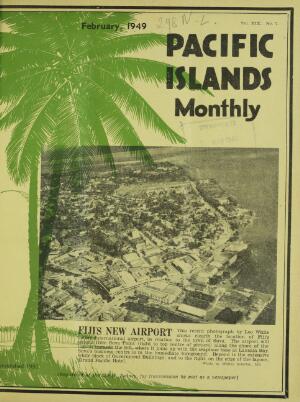
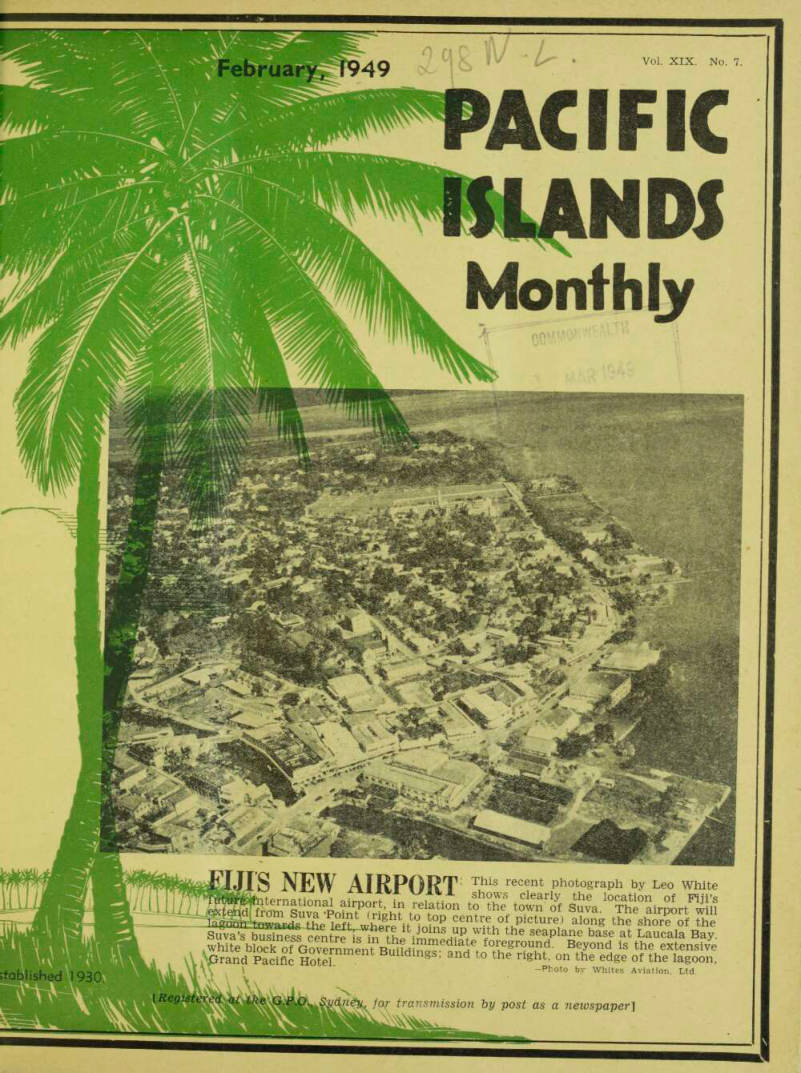
FIJI'S NEW AIRPORT: This recent Photograph by Leo White shows elearly the location of fiji's future international airport in relation to the town of Suva. The airport will extend from Suva Point (right to top centre of picture) along the shore of the lagoon towards the left, where it joins up with the seaplane base at Laucala Bay.
Suva's business centre is int the immediate foreground. Beyond is the extensive white block of Government Buildings; and to the rigth, on the edge of the lagoon, Grand Pacific Hotel.
Photo by whites Aviation. Ltd.
Advertisements & other items, pp. 2-4 (2 items)
Mndu
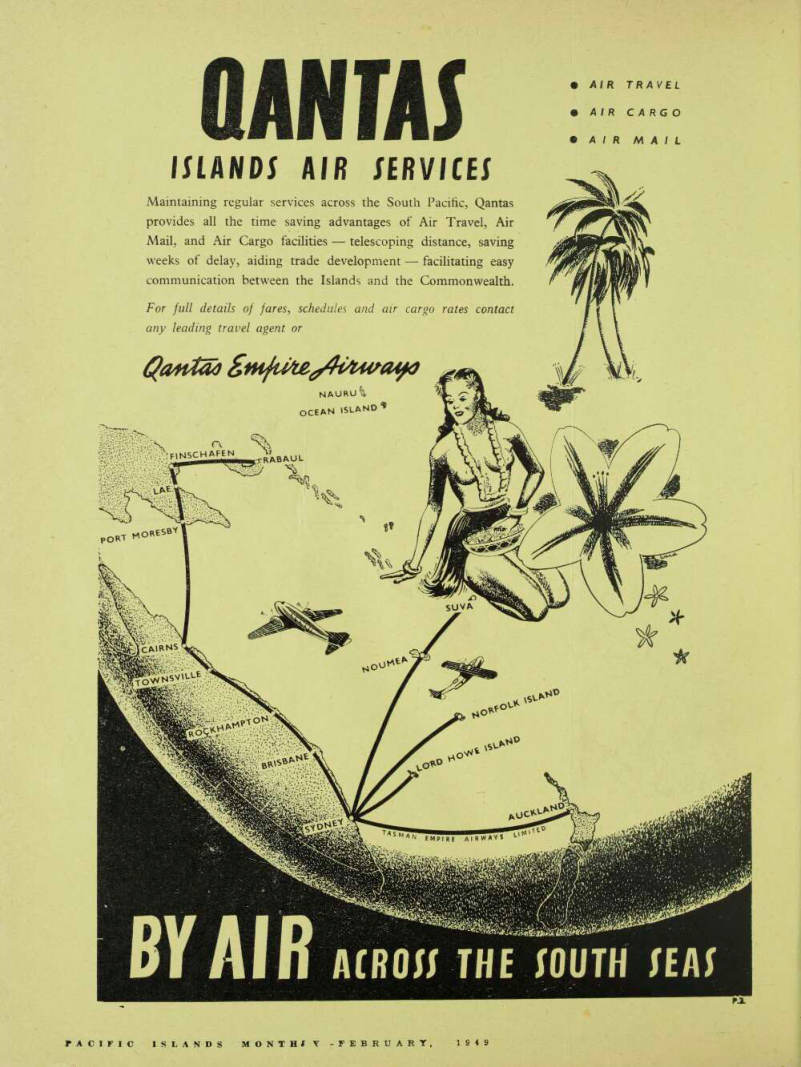
IfIANDS AIR StRVICU
Maintaining regular services across the South Pacific, Qantas provides all the time saving advantages of Air Travel, Air Mail, and Air Cargo facilities telescoping distance, saving weeks of delay, aiding trade development facilitating easy communication between the Islands and the Commonwealth.
For full details of fares, schedules and air cargo rates contact any leading travel agent or
• AIR TRAVEL
© AIR CARGO
© AIR MAIL
ft
NAURU'i
OCEAN ISLAND*
rv V -pinschafen SI
RABAUL
LAt
POBT HORNBY
SUVA
CAIRNS
NO •A**’' \SL \SV m. baN^
VCL A*
A u c EMPIRE airways l,n " 9 1 1
vou
n f/ r
CM DEPEND ON
EsaiiW
Any kerosene or petrol stove which bears the name of Coleman is as dependable and efficient as over 40 years’ intensive specialisation can make a product . . . in fact it is the “Best of its kind.”
This two-burner petrol portable stove illustrated at right requires no preheating and has instant heat control—safety shut-off valve makes it unnecessary to repump each time stove is lighted— has removable fuel tank for safe and easy filling.
In ivory and brown baked enamel finish. Weight 16 lbs. 6 V , Although only 8| ins. high and 4| ins. wide this pocket stove illustrated below boils a pint inside 5 minutes.
Made of corrosion-resistant
metal... lights instantly...
needs no priming . . . burns any kind of petrol and cannot spill fuel even when
tipped over.
This quick-heating “Speedmaster” portable stove lights instantly and can be regulated to any degree of heat. Has odorless windproofburner, rust resisting brass fount of 2 pints, and is unspillable. Boils a pint in 1\ minutes. Height 7 ins., width 10J ins., Weight 5 lbs.
A 3 burner kerosene stove finished in glistening white baked enamel with ample cooking top of heavy steel grates. Two-quart fuel tank . . . needle valve asbestos wick. Hot blast cap induces extra oxygen and hastens combustion. Supplied with or without oven.
Representatives for the Pacific Islands;
ROBERT GILLESPIE PTY. LTD.
540 PITT STREET, SYDNEY
PEARCE & CO, LTD.
SUVA
FOR FIJI ISLANDS
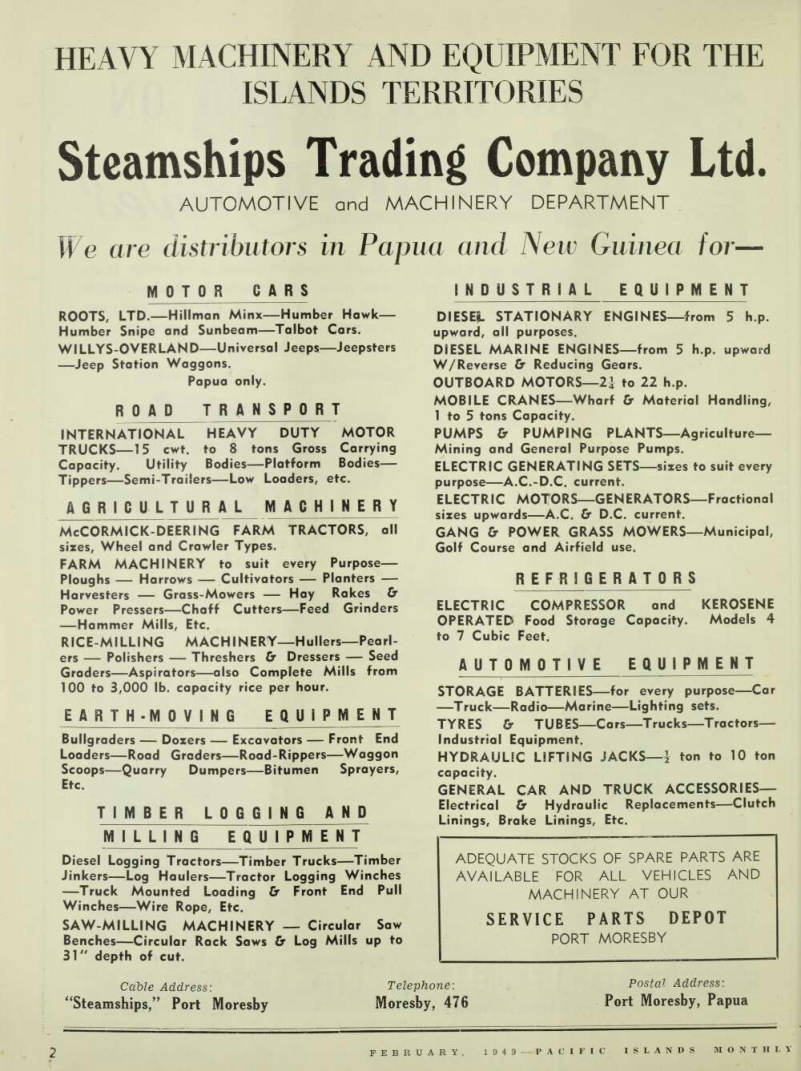
HEAVY MACHINERY AND EQUIPMENT FOR THE
ISLANDS TERRITORIES
Steamships Trading Company Ltd.
AUTOMOTIVE and MACHINERY DEPARTMENT
We are distributors in Papua and New Guinea for —
M 0 I 0 R CARS
ROOTS, LTD.—Hillman Minx—Humber Hawk— Humber Snipe and Sunbeam —Talbot Cars.
WILLYS-OVERLAND —Universal Jeeps—Jeepsters —Jeep Station Waggons.
Papua only.
ROAD TRANSPORT
INTERNATIONAL HEAVY DUTY MOTOR
TRUCKS—IS cwt, to 8 tons Gross Carrying Capacity. Utility Bodies—Platform Bodies— Tippers—Semi-Trailers—Low Loaders, etc.
AGRICU L T U R A L MACHINERY
McCORMICK-DEERING FARM TRACTORS, all
sizes. Wheel and Crawler Types.
FARM MACHINERY to suit every Purpose— Ploughs Harrows Cultivators Planters Harvesters Grass-Mowers Hay Rakes Cr Power Pressers—Chaff Cutters—Feed Grinders —Hammer Mills, Etc.
RICE-MILLING MACHlNERY—Hullers—Pearlers Polishers Threshers Cr Dressers Seed Graders—Aspirators—also Complete Mills from 100 to 3,000 lb. capacity rice per hour.
EARTH-MOVI N G I Q U i P M E N T Bullgraders Dozers Excavators Front End Loaders—Road Graders—Road-Rippers —Waggon Scoops—Quarry Dumpers—Bitumen Sprayers, Etc.
TIMBER LOGG I N G AND
MILLING EQUIPMENT
Diesel Logging Tractors—Timber Trucks—Timber Jinkers—Log Haulers—Tractor Logging Winches —Truck Mounted Loading Cr Front End Pull Winches—Wire Rope, Etc.
SAW-MILLING MACHINERY Circular Saw
Benches—Circular Rack Saws Cr Log Mills up to 31" depth of cut.
INDUS T R I A L EQ U I PJM ENJ
DIESEL STATIONARY ENGINES—from 5 h.p.
upward, all purposes.
DIESEL MARINE ENGINES—from 5 h.p. upward W/Reverse Cr Reducing Gears.
OUTBOARD MOTORS—2i to 22 h.p.
MOBILE CRANES—Wharf Cr Material Handling, 1 to 5 tons Capacity.
PUMPS Cr PUMPING PLANTS—Agriculture- Mining and General Purpose Pumps.
ELECTRIC GENERATING SETS—sizes to suit every purpose—A.C.-D.C. current.
ELECTRIC MOTORS—GENERATORS—FractionaI
sizes upwards—A.C. Cr D.C. current.
GANG Cr POWER GRASS MOWERS—Municipal,
Golf Course and Airfield use.
R EFRIBERATORS
ELECTRIC COMPRESSOR and KEROSENE
OPERATED Food Storage Capacity. Models 4 to 7 Cubic Feet.
AUJ Q M OTIVE EQUIPME N T STORAGE BATTERIES—for every purpose—Car —Truck—Radio—Marine —Lighting sets.
TYRES Cr TUBES—Cars—Trucks—Tractors— Industrial Equipment.
HYDRAULIC LIFTING JACKS —\ ton to 10 ton capacity.
GENERAL CAR AND TRUCK ACCESSORIES—
Electrical Cr Hydraulic Replacements—Clutch Linings, Brake Linings, Etc.
ADEQUATE STOCKS OF SPARE PARTS ARE
AVAILABLE FOR ALL VEHICLES AND
MACHINERY AT OUR
SERVICE PARTS DEPOT
PORT MORESBY
Cable Address'. Telephone : Postal Address'.
“Steamships,” Port Moresby Moresby, 476 Port Moresby, Papua
1
acific islands monthlv-pebrdar V, 1949
Advertisers
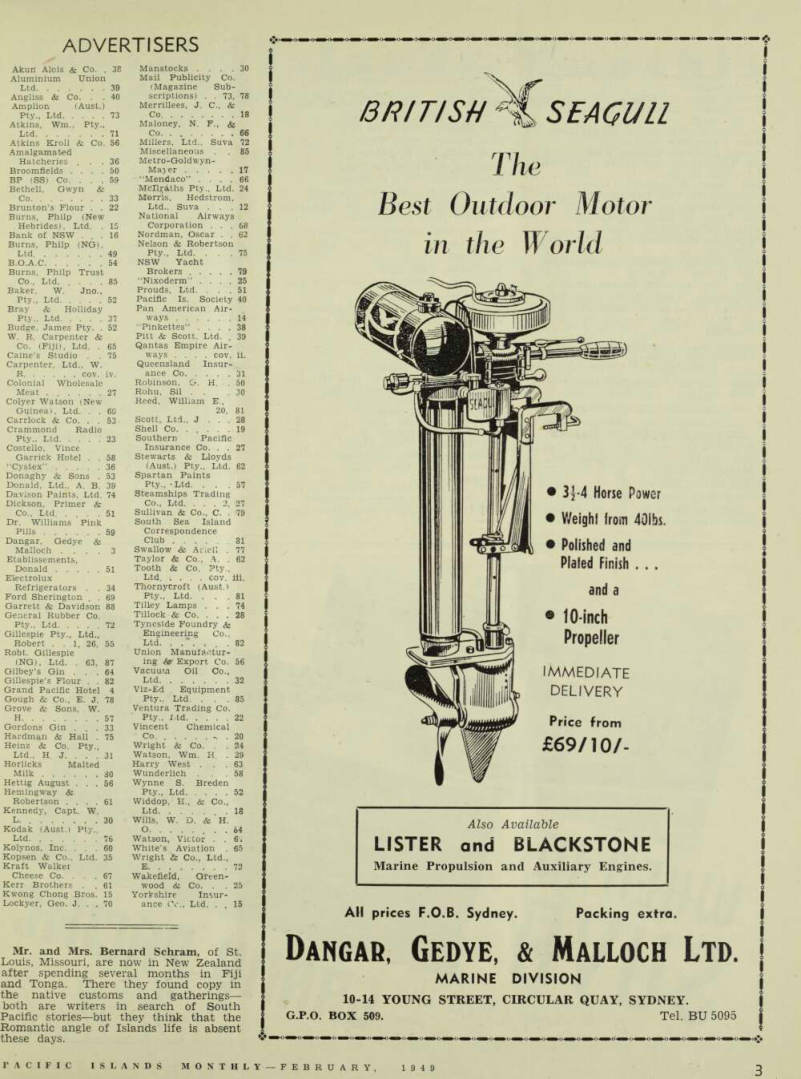
Akun Alois & Co. . 38 Aluminium Union Ltd 39 Angliss & Co. . . 40 Amplion (Aust.) Pty., Ltd 73 Atkins, Wm., Pty., Ltd 71 Atkins Kroll & Co. 56 Amalgamated Hatcheries ... 36 Broomfields ... 50 BP (SS) Co. . . . 59 Bethell, Gwyn & Co 33 Brunton’s Flour . . 22 Burns, Philp (New Hebrides). Ltd. . 15 Bank of NSW ... 16 Burns, Philp (NG), Ltd 49 8.0.A.C 54 Burns, Philp Trust Co., Ltd. ... 85 Baker, W. Jno., Pty., Ltd 52 Bray & Holliday Pty., Ltd 37 Budge, James Pty. . 52 W. R. Carpenter & Co. (Fiji), Ltd. . 65 Caine’s Studio . . 75 Carpenter, Ltd., W.
R cov. iv.
Colonial Wholesale Meat ... 27 Colyer Watson (New Guinea), Ltd. . . 69 Carrlock & Co. . . 53 Crammond Radio Pty.. Ltd 23 Costello. Vince Garrick Hotel . . 58 “Cystex” 36 Donaghy & Sons . 53 Donald, Ltd.. A. B. 39 Davison Paints, Ltd. 74 Dickson, Primer & Co., Ltd. ... 51 Dr. Williams Pink Pills 59 Dangar, Gedye & Malloch ... 3 Etablissements, Donald 51 Electrolux Refrigerators . . 34 Ford Sherington . . 69 Garrett & Davidson 88 General Rubber Co.
Pty., Ltd 72 Gillespie Pty., Ltd., Robert . . 1, 26, 55 Robt. Gillespie (NG), Ltd. . 63, 87 Gilbey’s Gin ... 64 Gillespie’s Flour . . 82 Grand Pacific Hotel 4 Gough & Co., E. J. 78 Grove & Sons, W.
H 57 Gordons Gin ... 33 Hardman & Hall . 75 Heinz & Co. Pty., Ltd., H. J. . . . 31 Horlicks Malted Milk 30 Hettig August ... 56 Hemingway & Robertson ... 61 Kennedy, Capt. W.
L. 30 Kodak (Aust.) Pty., Ltd 76 Kolynos, Inc. ... 60 Kopsen & Co., Ltd. 35 Kraft Walker Cheese Co. ... 67 Kerr Brothers . . 61 Kwong Chong Bros. 15 Lockyer, Geo. J. . .70
Manstocks ... 30 Mail Publicity Co. (Magazine Sub scriptions) . . 73, 78 Merrillees, J. C., & Co 18 Maloney, N. F., & Co. 66 Millers, Ltd.. Suva 72 Miscellaneous . 85 Metro-Goldwyn- Mayer 17 “Mendaco” ... 66 Mcllraths Pty., Ltd. 24 Morris, Hedstrom, Ltd., Suva ... 12 National Airways Corporation ... 68 Nordman, Oscar . . 62 Nelson & Robertson Pty., Ltd. ... 75 NSW Yacht Brokers 79 “Nixoderm” ... 25 Prouds, Ltd. ... 51 Pacific Is. Society 40 Pan American Air ways 14 “Pinkettes” ... 38 Pitt & Scott. Ltd. . 39 Qantas Empire Air ways ... cov. ii, Queensland Insur ance Co 31 Robinson, G. H. . 50 Rohu, Sil . . . 30 Reed, William E., 20, 81 Scott, Ltd., J ... 28 Shell Co. ... 19 Southern Pacific Insurance Co. . .27 Stewarts & Lloyds (Aust.) Pty., Ltd. 62 Spartan Paints Pty., - Ltd. ... 57 Steamships Trading Co., Ltd. ... 2, 27 Sullivan & Co., C. . 79 South Sea Island Correspondence Club 81 Swallow & Ariell . 77 Taylor & Co., A. . 62 Tooth & Co. Pty., Ltd. ■. . . . cov. ili.
Thornycroft (Aust.) Pty., Ltd. ... 81 Tilley Lamps ... 74 Tillock & Co. ... 28 Tyneside Foundry & Engineering Co.,
Ltd. . .**, . . .82
Union Manufactur ing Sgr Export Co. 56 Vacuum Oil Co., Ltd 32 Viz-Ed Equipment Pty., Ltd. ... 85 Ventura Trading Co. ‘ Pty., Ltd 22 Vincent Chemical Co . 20 Wright & Co. . . 24 Watson, Wm. H. . 29 Harry West ... 63 Wunderlich ... 58 Wynne S. Breden Pty., Ltd 52 Widdop, H., & Co., Ltd 18 Wills, W. D. & H.
O 84 Watson, Victor . . 6i White’s Aviation . 65 Wright & Co., Ltd., E 72 Wakefield, Green wood <fe Co. . . 25 Yorkshire Insur ance Co., Ltd. . . 15
Mr. and Mrs. Bernard Schram, of St.
Louis, Missouri, are now in New Zealand after spending several months in Fiji and Tonga. There they found copy in the native customs and gatherings— both are writers in search of South Pacific stories —but they think that the Romantic angle of Islands life is absent these days.
Advertisements & other items, p. 5 (1 item)
Dangad, Gedye, & Malloch Ltd.
BRITISH *% SEAGULL
The
Best Outdoor Motor
in the World
~im « • 3f4 Hone Power • Weigh! from 40lbs. • Polished and Plated Finish . .. and a • 10-inch
Propeller
IMMEDIATE
DELIVERY
Price from £69/10/- Also Available
LISTER and BLACKSTONE
Marine Propulsion and Auxiliary Engines.
All prices F. 0.8. Sydney.
Packing extra.
Dangad, Gedye, & Malloch Ltd.
MARINE DIVISION
10-14 YOUNG STREET, CIRCULAR QUAY, SYDNEY.
G.P.O. BOX 509. Tel. BU 5095
In This Issue:
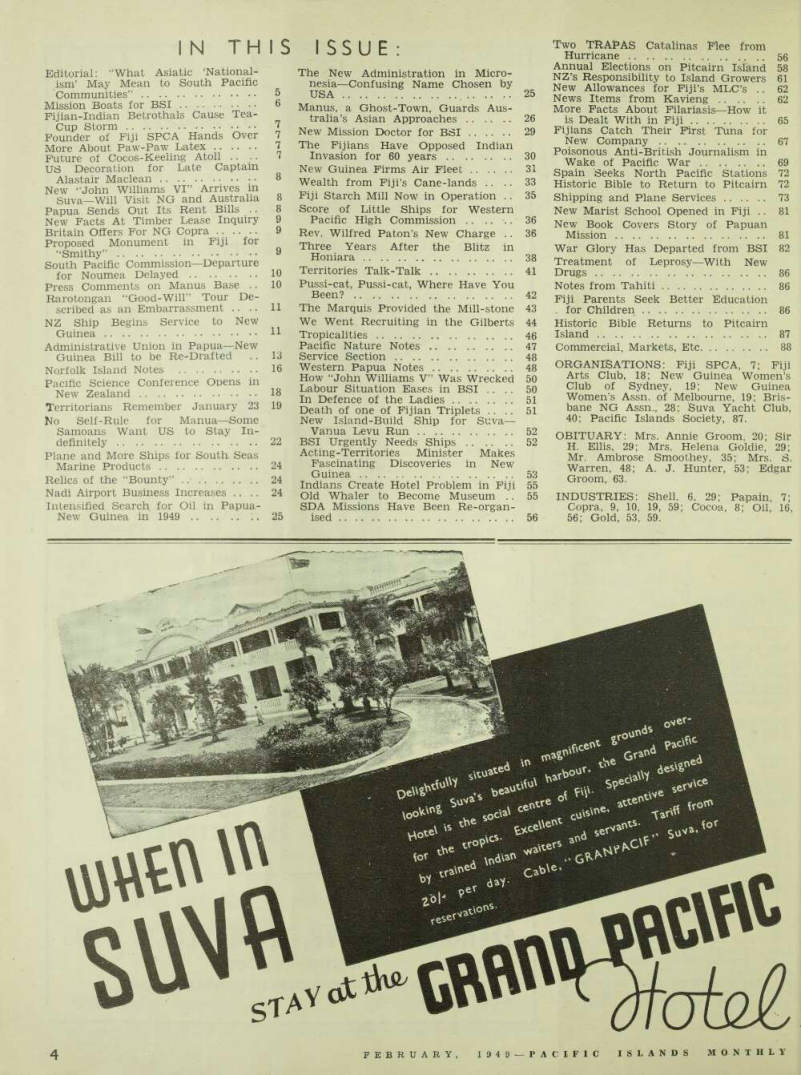
Editorial: “What Asiatic ‘National ism’ May Mean to South Pacific Communities” 5 Mission Boats for BSI 6 Fijian-Indian Betrothals Cause Tea- Cup Storm 7 Founder of Fiji SPCA Hands Over 7 More About Paw-Paw Latex 7 Future of Cocos-Keeling Atoll ... 7 US Decoration for Late Captain Alastair Maclean 8 New ‘‘John Williams VI” Arrives in Suva—Will Visit NG and Australia 8 Papua Sends Out Its Rent Bills .. 8 New Facts At Timber Lease Inquiry 9 Britain Offers For NG Copra 9 Proposed Monument in Fiji for “Smithy” 9 South Pacific Commission—Departure for Noumea Delayed 10 Press Comments on Manus Base .. 10 Rarotongan “Good-Will” Tour De scribed as an Embarrassment ... 11 NZ Ship Begins Service to New Guinea H Administrative Union in Papua-New Guinea Bill to be Re-Drafted .. 13 Norfolk Island Notes 16 Pacific Science Conference Opens in New Zealand IB Territorians Remember January 23 19 No Self-Rule for Manua —Some Samoans Want US to Stay In definitely 22 Plane and More Ships for South Seas Marine Products 24 Relics of the “Bounty” 24 Nadi Airport Business Increases ... 24 Intensified Search for Oil in Papua- New Guinea in 1949 25
The New Administration in Micro nesia—Confusing Name Chosen by
Usa 25
Manus, a Ghost-Town, Guards Aus tralia’s Asian Approaches 26 New Mission Doctor for BSI 29 The Fijians Have Opposed Indian Invasion for 60 years 30 New Guinea Firms Air Fleet 31 Wealth from Fiji’s Cane-lands ... 33 Fiji Starch Mill Now in Operation .. 35 Score of Little Ships for Western Pacific High Commission 36 Rev. Wilfred Paton’s New Charge .. 36 Three Years After the Blitz in Honiara 38 Territories Talk-Talk 41 Pussi-cat, Pussi-cat, Where Have You Been? 42 The Marquis Provided the Mill-stone 43 We Went Recruiting in the Gilberts 44 Tropicalities 46 Pacific Nature Notes 47 Service Section 48 Western Papua Notes 48 How “John Williams V’’ Was Wrecked 50 Labour Situation Eases in BSI ... 50 In Defence of the Ladies 51 Death of one of Fijian Triplets ... 51 New Island-Build Ship for Suva— Vanua Levu Run 52 BSI Urgently Needs Ships 52 Acting-Territories Minister Makes Fascinating Discoveries in New Guinea 53 Indians Create Hotel Problem in Fiji 55 Old Whaler to Become Museum .. 55 SDA Missions Have Been Re-organ ised 56
Two TRAPAS Catalinas Plee from Hurricane 56 Annual Elections on Pitcairn Island 58 NZ’s Responsibility to Island Growers 61 New Allowances for Fiji’s MLC’s .. 62 News Items from Kavieng 62 More Facts About Filariasis —How it is Dealt With in Fiji 65 Fijians Catch Their First Tuna for New Company 67 Poisonous Anti-British Journalism in Wake of Pacific War 69 Spain Seeks North Pacific Stations 72 Historic Bible to Return to Pitcairn 72 Shipping and Plane Services 73 New Marist School Opened in Fiji .. 81 New Book Covers Story of Papuan Mission 81 War Glory Has Departed from BSI 82 Treatment of Leprosy—With New Drugs 86 Notes from Tahiti 86 Fiji Parents Seek Better Education for Children 86 Historic Bible Returns to Pitcairn Island 87 Commercial, Markets, Etc 88
Organisations: Fiji Spca, 7; Fiji
Arts Club, 18; New Guinea Women’s Club of Sydney, 19; New Guinea Women’s Assn, of Melbourne, 19; Bris bane NG Assn., 28; Suva Yacht Club, 40; Pacific Islands Society, 87.
OBITUARY: Mrs. Annie Groom, 20; Sir H. Ellis, 29; Mrs. Helena Goldie, 29; Mr. Ambrose Smoothey, 35; Mrs. S.
Warren, 48; A. J. Hunter, 53; Edgar Groom, 63.
INDUSTRIES: Shell. 6, 29; Papain, 7; Copra, 9, 10, 19, 59; Cocoa, 8; Oil, 16, 56; Gold, 53, 59.
Advertisements & other items, p. 6 (1 item)
SflS*
% S 0&
sTAV***
I over-
r oond s .r.cent * a ?ac\V\ c A \n n r\ae ° , -.^cd ■ :::> -£ ce nW e ne a 1 .« Svort' . „ s° c ' 4 ' , c u> s ' n tar'" *® t *ce« e <* ser ( or «°*' cS ' \r> e “ Ca b' e r M-
SflS*
Pacific Islands Monthly
The Newspaper-Magazine of the South Seas I Registered at the G.P.0., Sydney, for transmission by post as a newspaper ]
Published Once Each Month and Circulated in Australia and New Zealand and in the following Pacific Territories and Islands Groups:
Australian Territory ot Papua.
Trustee Territory (Australia) of New Guinea.
Australian Territory of Norfolk Island.
New Zealand Territory of Cook Islands.
BdUslf cllonT’o? Fist 2 ’ 1 °' Wcstern Samo °-
British Solomon Islands Protectorate.
British Protectorate of Tongan Islands.
British Crown Colony of Gilbert and Ellice Islands.
Trustee Territory of Nauru.
British and French Condominium of New Hebrides.
French Colony of New Caledonia.
French Colony of Oceania (Tahiti, etc.).
American Territory of Eastern Samoa.
American Territory of Hawaiian Islands.
Owned and Produced by Pacific Publications Pty., Ltd., Union House, 247 George Street, Sydney.
Telephone: General Office and Advertising BW 5037.
P.O. Box 3408
Registered Address for Telegrams. Radiograms, and Cables; “Pacpub,” Sydney.
Contributions,
Articles, Stories, and Photographs dealing with Pacific Islands subjects are Invited and will be paid for on publication.
Subscription Rates.
Per Annum, Pre-paid, Including Postage.
In Australia, New Zealand, Fiji, New Guinea, Papua, Western Samoa, Cook Islands. Tonga, British Solomons. Gil bert and Ellice Colony. Nauru, and United Kingdom 15 0 Elsewhere .. *-5 ir n Single Copies . ‘ V. ; ’ J Jj
Editor and Publisher:
R. W. Robson, P.R.G.S.
Assistant Editor; JUDY TUDOR.
General Office: Union House. 247 George Street Sydney. Telephone: BW 5037.
Advertising Manager: W. E. Rogers.
Representative In London.
J. T. Wallis, Coronation House. 4 Lloyds Avenue, London, E.C.3. from whom may be obtained copies of Pacific Islands Monthly.
Pacific Is. Year Book, advertising schedules, etc.
Representative In U.S.A.
Pacific Islands Trading Co.,
244 California St.. San Francisco. U.S.A.
Agents.
The following are authorised to receive sub scriptions for Pacific Islands Monthly:— Burns. Phllp & Co.. Ltd. and Burns Phllp (South Sea) Co,. Ltd. All branches.
W. R. Carpenter & Co.. Ltd. All branches.
Morris. Hedstrom, Ltd. All branches.
Steamships Trading Co., Papua. All branches.
W. M. Caldwell, Suva. Fiji.
Cook Islands Trading Co., Rarotonga, Cook Is.
Oscar Nordman. Papeete, Tahiti.
Islands Branches and Representatives of W H Grove & Sons, Ltd., Auckland, New Zealand.
Ed. Pentecost, Noumea, New Caledonia.
Societe Gubbay Kerr et Cle, Noumea. New Caledonia.
Vol. Xix. No. 7.
February, 1949
( 1/6 Per Copy Price Prepaid, pa: 15/- Aus ' In USA. p.a.: $3.
What Asiatic 'i Nationalism' May
Mean to South Pacific Communities
AMONG all the dangerous international and mter-racial situations in the world to-day, there is none more complex and tense, and S ore 9 ha^ g , ed Wlth menace, than the Mahfvi® th ? Dl tch and East Indie. Tbo d ?n- oSlai l S) m . flfflL* 108, The thmg has sl S ni ficance for every man and woman who Pacific 11 the r6gionS ° f the SoUth mi,' „ .
Ihe East Indies provide an almost continuous land bridge between empty Australia and over-populated Asia where live 2,000 millions of people—half the human race.
In the 300 years in which the Dutch have occupied the rich archipelagoes they have established roads, railways cities, vast industries, oilfields and communal orderliness. If the Dutch now should be compelled to leave the East Indies, the Americans should vacate North America and the British should yield New Zealand to the Maoris.
There wnnid bn™ ™ « T
mmm
promptly stamp out the enemy inspired insurrection.
The so-called “Indonesian re publicans” there were encouraged to resist the Dutch by Japanese traitors in Java who were not promptly rounded up; by a British Socialist Government that developed a deep “Brown Brother” complex; by the Communist - led wharf - labourers Union in Australia, which virtually dictated the “foreign policy” of the Australian Socialist Government* and by the pernicious New Planners of the United Nations, who have now more or less hamstrung that once magnificent conception.
While two years were wasted in useless discussions and arguments in the East Indies, there were extra ordinary developments in Southern and Eastern Asia. Instead of follow ing up their defeat of Japan by a ruthless re-establishment of law and order in South and East Asia—and thus regaining the White prestige which had been sadly undermined by Japan’s 1941-42 victories—the Anglo- American Powers dithered and de ferred. United States did her part well enough in Japan; but the stupidities of the British Socialist Government in encouraging a wave of “nationalism” throughout South Asia, and the weakness of Washington in allowing the Chinese situation to develop until the nation fell like a
rotten pear into the greedy hands of Moscow, have set afoot a train of political disasters to which we now can see no end.
Following the psychological condi tion created throughout Asia by the Pacific war, the actions of our so called leaders of Western civilisation m granting independence to Burma!
India and Ceylon, and encouraging nationalist movements in the Indo nesian countries, represent something like lunacv. They may quite easily spell the beginning of the end of all European communities in the South Pacific, from Australia to French Oceania. And if we—the Europeans— go down under an Asiatic flood, there will be no future for the indigenous Pacific Islands races.
TOURING those two wasted years, the Dutch courageous and tenacious as always—slowly built up their strength, until in 1948 they had assembled in the East Indies a force big enough to allow them to act with out dependence upon the Socialist British or the leaderless Americans They had tried, quite honestly, over endless exasperating months, to make a fair compromise with the slippery little politicians of the “Indonesian republic”: but when that proved im possible, late in 1948 they brought their forces into action and chased the screeching “Republicans” into the Javanese jungles.
Whereupon every mischief-making New Planner in UNO, Britain and Australia came into vociferous action.
The British did not do much, how ever. By early 1948, the British
Socialists were beginning to recognise some of their more calamitous errors —to realise that their incredible international and anti - Imperial policies had thrown the whole world open to the tireless emissaries of Moscow —and they were trying to go into reverse. They yet may save the day, so far as Britain’s huge African Empire is concerned; but in Asia and Indonesia they surely are going to reap the whirlwind.
The Dutch, with calculated and implacable purpose, have gone ahead with their plans for the pacification of Java and the reduction of the East Indies to orderliness and good govern ment, on a sound Federal plan. They have not been diverted from that pur pose by the Moscow-inspired howling of the Asiatic States, led by Pakistan and Hindustan. The latter called a conference in Delhi, designed to place pressure upon the Dutch. The Western Powers very wisely stayed away—they saw, not only the undesir ableness of interfering further with Dutch plans, but the sinister purposes and the ugly shadows behind the Delhi Conference.
Every circus must have its clown; and Australia became the clown of the Delhi Conference. While Aus tralian representatives—youngsters of the New Planner type—took a really active nart in the Delhi Conference, under the direction of the pro-Asiatic Dr. Evatt, the minions of another Department, directed by Immigration Minister Calwell, were giving real substance to the White Australia Policy by hunting out of the Common wealth sundry Indonesians who had taken refuge there during the war— and thereby arousing some Indo nesian mobs in Singapore to furious demonstrations against Australia.
Australia’s foreign policy certainly has added to the gaiety of the nations—and, God knows, they need something to-day to make them laugh!
MEANWHILE, the Chinese Govern ment of Chiang Kai Shek has collapsed in utter chaos; and great Communist armies apparently equipped and directed from Moscow —are moving slowlv and irresistibly across the Ancient Empire. In a few months, they will have comnlete possession of China. Then, what?
Will they be Communists first and Chinese afterwards—or Chinese first, giving only lin service to the Com munist set-up? Onlv the decade still to come can give the answer. Upon that answer will depend much of the fate of the South Pacific. A com pletely Communist China most surely means a completelv Communist Asia; and can a Dutch-dominated East Indies, and an Australia manned by a mere million Europeans provide a sufficient barrier for the South Pacific against 2,000 millions of more or less hungry ' and race-conscious Asiatics?
Hindustan and Pakistan, the two States created out of the former British Empire of India, have re mained, reluctantly and suspiciously, within the British Commonwealth;
but that set-up is not likely to en dure. Sooner or later, India will be anti-British—and imposing an em barrassing barrier between the South Pacific and Europe. Already, to show goodwill towards the Ja/vanese “re public,” the Indian States have closed their airfields to the Dutch, and the Dutch planes, maintaining communi cations between Java and Holland, are compelled to fly across the Indian Ocean and pick up the African route to Etirope.
No thoughtful and well-informed resident of the South Pacific can af ford to ignore the significance of these events in Southern Asia and Indonesia. And they surely have more than an academic interest for the residents of Fiji.
Port Moresby Fire Loss
THE temporary structure which housed the Government Secretary’s office and Central Administration at Konedobu, Port Moresby (an ex-ANGAU building of con crete, timber, maHhoidr corrugated iron, thatched roof of grass) was completely de stroyed by fire shortly after 1.30 p.m. on Saturday, February 12. The staff was ab sent when the fire started in the eastern end of the general office, and in a few minutes the tinder-dry thatched roof was ablaze from end to end. Some files, re cords and furniture were saved before the roof collapsed but generally great de struction was done to records and en ormous confusion thereby caused.
The fire brigade arrived promptly but (as in the case of the PCB copra shed a few weeks ago) control was impossible and activity was devoted to preventing com
plete destruction of the smouldering: re cords, and saving the adjoining Educa tion Department.
Prosperous Pearl-Shell
Industry Benefits Islanders
rE Queensland Government is de termined to resist any attempt to employ Japanese divers in the pearl ing industry. It has been reported that some Japanese interests have been making representation to be readmitted into the industry.
The Queensland Government depends entirely on the pearling industry for the rehabilitation and maintenance of 800 Torres Strait Island ex-servicemen.
They have proved so successful as dress divers, that alien labour for deep diving will not be needed in a few years. In pre-war days, this form of diving was done by Japanese and Malayans.
But for the pearling industry, it would be a problem for the Torres Strait islander to exist. Their population of 5,000 including 1,100 schcxpl children, has increased a great deal in the last 10 years. Families with eight to 14 children are common. Many natives are forced to migrate to the mainland owing to limited agricultural land on the Islands.
At the present time the pearl ing industry is prosperous and em ploying 1,000 men. Pearl shell is selling at £525 a ton; and as America is the chief buyer, the industry is earning valuable dollars for Australia. Trochus shell, on the other hand, fetches £72 to £75 a ton compared with £l7O pre war.
Wages of native divers have increased in recent years from £1 15/- to £3/15per week, and keep.
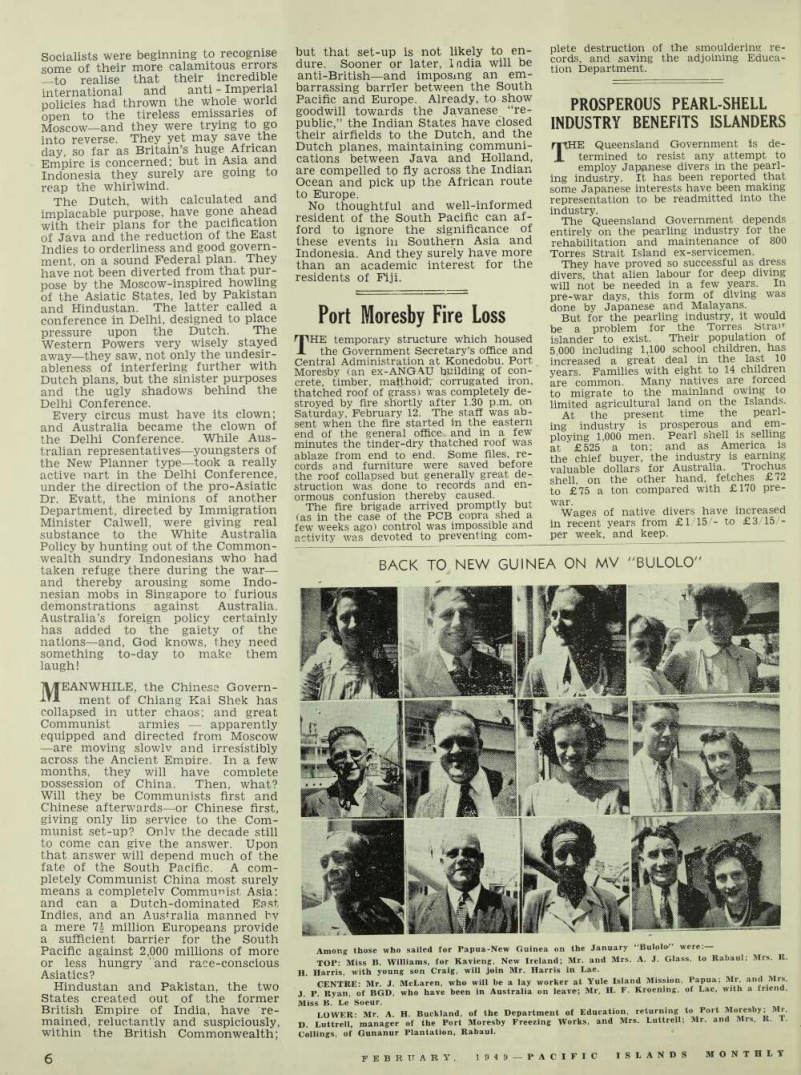
Back To New Guinea On Mv "Bulolo"
Among those who sailed for Papua-New Guinea on the January “Bulolo” were: TOP: Miss B. Williams, for Kavieng, New Ireland; Mr. and Mrs. A. J. Glass, to Rabaul; Mrs. R.
H. Harris, with young son Craig, will join Mr. Harris in Lae.
CENTRE; Mr. J. McLaren, who will be a lay worker at Yule Island Mission, Papua; Mr and Mrs, J. P. Ryan, of BGD, who have been in Australia on leave; Mr. H. F. Kroening, of Lae, with a friend, Miss B. Le Soeur.
LOWER: Mr. A. H. Buckland, of the Department of Education, returning to Port Moresby; Mr.
D. Luttrell. manager of the Port Moresby Freezing Works, and Mrs. Luttrell; Mr. and Mrs. R. T.
Collings, of Gunanur Plantation, Rabaul.
Fijian-Indian Betrothals
Cause Teacup Storm
From Our Own Correspondent
Suva, Jan. 31.
THREE Fijian men students at the Teachers’ Training College, Nasinu, are reported to have become engaged to three Indian women teachers.
This, presumably, is their own affair, but the shred of information has been going the rounds for several weeks, usually ac companied by a spate of condemnation.
Indians generally despise the Fijians and Fijians mostly despise the Indians—but with Fijians tolerance goes to extra ordinary lengths.
Although the personal affairs of the six young teacher-trainees have been the pro perty of gossip-centres for a considerable time, it was not until an Indian weekly, “Fiji Samachar,” came to light with an editorial condemning the proposed domes tic arrangements that the matter ap peared in print.
Whereupon habitual writers of “let ters to the editor,” seized their pens, and had their say on the broad implica tions of inter-marriage between Fijians and Asiatics.
In view of the present racial set-up in Fiji, it is not surprising that few people seem to like the idea. Some responsible Fijians suspect a future lever for weaken ing the Fijians’ hold on the lands that remain to them.
Several competent European observers see in the controversy full justification for misgivings about the system of train ing Fijian, Indian and other men and women teachers at one centre.
There is little question that the con sensus of unfavourable opinion is based on a suspicion that in most organisations where “all races march together in har mony and co-operation,” the Fijians get the wrong end of the deal in the long run.
One Fijian wrote: “In the past there has been very little intermingling of Fijians and Asiatics by marriage. If it starts now it will be another of the things that are said to threaten the end of the Fijian race.”
EDITORIAL NOTE: Three betrothals— or marriages—between young Fijian men and young Indian women, can scarcely be regarded as race suicide—from either the Fijian or Indian point of view It must have been more than proximity that inspired romantic notions in the six young student teachers. “Love” has* ever laughed at locksmiths, stern parents, racial taboos and other obstacles—when it wished to. If there had been any real compatabihty between the Fijian and Indian races there would have been large scale inter-marriage long ago. it is hard marrSf s ? n °usly the suggestion that marriage is the latest Indian secret weapon for the undoing of the Fijians.
Founder Of Fiji
Spca Hands Over
Prom Our Own Correspondent
Suva. Feb 7
MRS. DUNOON KIRK, founder of the Fiji Society for the Prevention of . , c ™elty to Animals, and her hus band, Mr. L. C. Kirk, will leave the Colony shortly. . ™ a T^ r , ewell broadcast on February 4 Mrs. Kirk announced that the head quarters of the Society was to be trans ferred from Lautoka to Suva, where the organising secretary of the newly-formed Suva branch (Mrs. L. McLintock) will take over from the founder.
Since the Society was formed 21 years ago six branches and nearly 80“ junior divisions have been formed in Fiji ' Two animal clinics are in full ©Deration.
Papain
More About The Value of Paw-Paw Latex
SOME notes by Mr. B. E. V. Parham, in the Fiji Agricultural Journal, give the latest information on the - subject of Papain (the latex of the paw paw), for which there hajs been some demand.
The “Agricultural Journal of Ceylon”, Vol. XCIII, No. 4, October, 1939, supplied the following information.
The latex containing the papain is best obtained from full-grown, or nearly full-grown, well-developed green fruit by making 2 to 4 longitudinal incisions not more than 1/8 inch deep. This opera tion may be repeated every three to seven days. It has been found that better yields are obtained if only a few incisions are made at a time, the tapping being done over a longer period until the fruit is covered with incisions approxi mately 1 cm. apart. The flow is most abundant in the early morning. Very young fruits give a latex that is rather weak in digestive power, while ripe fruits ‘ give verv little, if any, milky juice.
Only non-metallic containers, such as glass or porcelain dishes, should be used to collect the latex, because the juice acts orj the metal and becomes dis coloured. Coagulation soon begins and the mass adhering to the surface of the fruit must be carefully scraped off. Con siderable time and labour would be .saved if a convenient and efficient vessel could be devised which could be quickly put in place to receive the juice, per mitting the operator to proceed to the next tree in the meantime.
The juice must be dried promptly after it is collected, or decomposition, which destroys the value of the product, will occur. Sun-drying is practised to some extent, but it is much more satisfactory to dry the latex in a properlv ventilated . oven operated at 50 to 55 deg. Cent.
One form of drier is about three feet broad, three feet deep and six fqet long.
The sides and ends are made of brick, and openings are provided at both ends, one for the flue and the other to admit fuel. A foot from the top, which is open, a sheet of iron is placed, and upon this one or two inches of sand are laid to modify and distribute the heat arising from the fire beneath. The coagulated juice is spread upon brown linen stretched upon frames, which are made to fit the top of the drier. The tem perature should not exceed 50 to 55 deg Cent., since great heat destroys the fer ment. The dry and flaky material can be ground in a coffee-mill, preferably when the material is warm, and it should then be in the form of a light cream coloured powder. This powder should be placed in bottles, which should be tightly sealed.
Little information is available as to yields. Amounts of papain extracted per plant vary considerably: 20 to 250 grams per tree, or from 60 to 350 lb. of dried latex powder per morgen may be produced. Coagulated latex produces 25 per cent, of its weight of dried powder.
The latex is harvested through three seasons. By the fourth season the fruit is so high on the trunk that the cost of collecting the juice becomes prohibitive Mr. Parham says that advice from HM Government Agents in Australia states that this product was. until April 1948, realizing approximately 255. per pound fob Australian currency, but that since then the market price steadily de creased until June when it touched 14s 6d. per pound for first grade. There is now a slight improvement in price.
Future Of Cocos-Keeling
Atoll
THE statement in the “PIM” of Jan uary, that the international air companies seeking a new route be tween the South Pacific and Europe, might possibly make use of the Indian Ocean—East Africa route, and that in consequence Britain might seek to get a closer hold over the atoll of Cocos-Keel ing, in the Indian Ocean, was picked up by one of the international press agencies m January and distributed acrossl the world. It aroused a good deal of inter esting comment.
It was ascertained that the present owner of Cocos-Keeling Island, John Glumes Ross V, was then in Singapore and that he had recently been in consul tation there with his solicitor from Lon don (Mr. Hardy Bentley) and representa tives of the British Government. Mr Ross, however, denied the report that he has any intention of selling Cocos-Keel mg atoll to the British Government. He said that the consultations in Singapore were connected with the damage that had been done to the atoll by the Japanese during the war Rnd connected also with the fact that there had been a British garrison there and an airfield had been constructed.
Schoolboys On Holiday
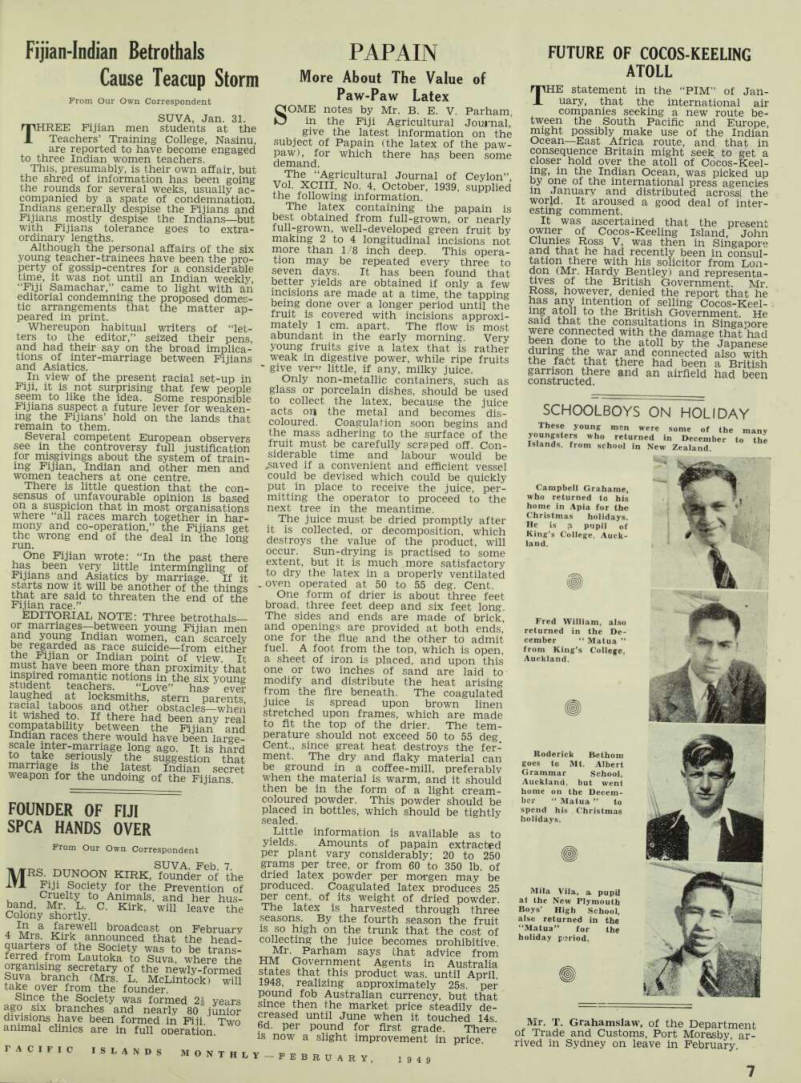
These young men were some of the many ? wh « returned in December to the Islands, from school in New Zealand.
Mr. T. Grahamslaw, of the Department of Trade and Customs, Port Moresby ar rived in Sydney on leave in February
Campbell Grahame, who returned to his home in Apia for the Christmas holidays.
He is a pupil of King’s College, Auck land.
Fred William, also returned in the De cember “ Matua ” from King’s College, Auckland.
Roderick Bethom goes to Mt. Albert Grammar School, Auckland, but went home on the Decem ber “ Matua ” to spend his Christmas holidays.
Mila Vila, a pupil at the New Plymouth Boys’ High School, also returned in the “Matua” for the holiday period.
Advertisements & other items, p. 9 (1 item)
7
PACIFIC ISLANDS MONTHLT-PEBBDARY, 1 949
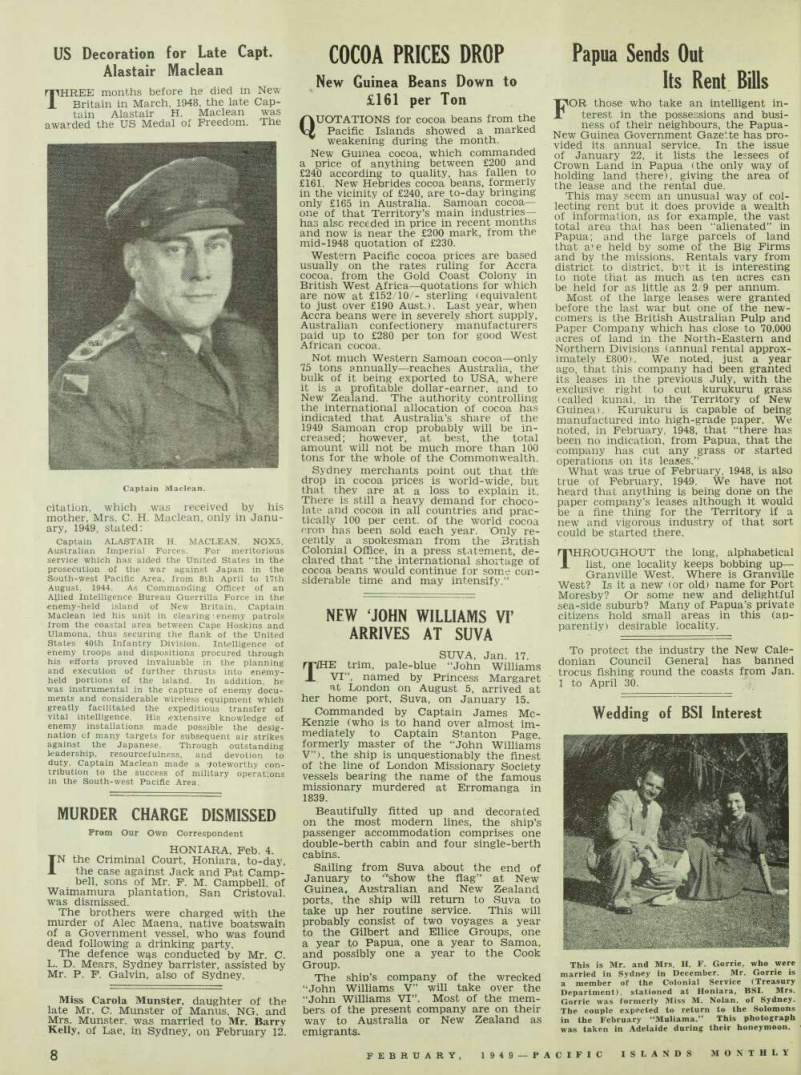
Alastair Maclean
US Decoration for Late Capt.
THREE months before he died in New Britain in March, 1948, the late Cap tain Alastair H. Maclean was awarded the US Medal of Freedom. The
citation, which .was received by his mother, Mrs. C. H. Maclean, only in Janu ary, 1949, stated: Captain AL AST AIR H. MACLEAN, NGXS, Australian Imperial Forces. For meritorious service which has aided the United States in the prosecution of the war against Japan in the South-West Pacific Area, from Bth April to 17th August. 1944. As Commanding Officer of an Allied Intelligence Bureau Guerrilla Force in the enemy-held island of New Britain, Captain Maclean led his unit in clearing'enemy patrols from the coastal area between Cape Hoskins and Ulamona, thus securing the flank of the United States 40th Infantry Division. Intelligence of enemy troops and dispositions procured through his efforts proved invaluable in the planning and execution of further thrusts into enemy held portions of the island. In addition, he was instrumental in the capture of enemy docu ments and considerable wireless equipment which greatly facilitated the expeditious transfer of vital intelligence. His extensive knowledge of enemy installations made possible the desig nation of many targets for subsequent air strikes against the Japanese. Through outstanding leadership, resourcefulness, and devotion to duty, Captain Maclean made a noteworthy con tribution to the success of military operations in the South-west Pacific Area.
Captain Maclean.
Murder Charge Dismissed
Prom Our Own Correspondent
Honiara, Feb. 4.
IN the Criminal Court, Honiara, to-day, the case against Jack and Pat Camp bell, sons of Mr. F. M. Campbell, of Waimamura plantation, San Cristoval. was dismissed.
The brothers were charged with the murder of Alec Maena, native boatswain of a Government vessel, who was found dead following a drinking party.
The defence wqs conducted by Mr. C.
L. D. Mears, Sydney barrister, assisted by Mr. P. P. Galvin, also of Sydney.
Miss Carola Munster, daughter of the late Mr. C. Munster of Manus. NG. and Mrs. Munster, was married to Mr. Barry Kelly, of Lae, in Sydney, on February 12.
Cocoa Prices Drop
New Guinea Beans Down to £l6l per Ton
QUOTATIONS for cocoa beans from the Pacific Islands showed a marked weakening during the month.
New Guinea cocoa, which commanded a nrice of anything between £2OO and £240 according to quality, has fallen to £l6l. New Hebrides cocoa beans, formerly in the vicinity of £240, are to-day bringing only £165 in Australia. Samoan cocoa one of that Territory’s main industries— has also receded in price in recent months and now is near the £2OO mark, from the mid-1948 quotation of £230.
Western Pacific cocoa prices are based usually on the rates ruling for Accra cocoa, from the Gold Coast Colony in British West Africa —quotations for which are now at £152/10/- sterling (equivalent to just over £l9O Aust.). Last year, when Accra beans were in severely short supply, Australian confectionery manufacturers paid up to £2BO per ton for good West African cocoa.
Not much Western Samoan cocoa —only 75 tons annually—reaches Australia, the bulk of it being exported to USA, where it is a profitable dollar-earner, and to New Zealand. The authority controlling the international allocation of cocoa has indicated that Australia’s share of the 1949 Samoan crop probably will be in creased; however, at best, the total amount will not be much more than 100 tons for the whole of the Commonwealth, Sydney merchants point out that thte drop in cocoa prices is world-wide, but that they are at a loss to explain it.
There is still a heavy demand for choco late and cocoa in all countries and prac tically 100 per cent, of the world cocoa cron has been sold each year. Only re cently a spokesman from the British Colonial Office, in a press statement, de clared that “the international shortage of cocoa beans would continue for some con siderable time and may intensify.”
New ‘John Williams Vi’
Arrives At Suva
Suva, Jan. 17.
Ti/HE trim, pale-blue “John Williams VI”, named by Princess Margaret at London on August 5, arrived at her home port, Suva, on January 15.
Commanded by Captain James Mc- Kenzie (who is to hand over almost im mediately to Captain Stanton Page, formerly master of the “John Williams V”), the ship is unquestionably the finest of the line of London Missionary Society vessels bearing the name of the famous missionary murdered at Erromanga in 1839.
Beautifully fitted up and decorated on the most modern lines, the ship’s passenger accommodation comprises one double-berth cabin and four single-berth cabins.
Sailing from Suva about the end of January to ‘‘’show the flag” at New Guinea. Australian, and New Zealand ports, the ship will return to Suva to take up her routine service. This will probably consist of two voyages a year to the Gilbert and Ellice Groups, one a year to Papua, one a year to Samoa, and possibly one a year to the Cook Group.
The ship’s company of the wrecked “John Williams V” will take over the “John Williams VI”. Most of the mem bers of the present company are on their wav to Australia or New Zealand as emigrants.
Papua Sends Out
Its Rent Bills
FOR those who take an intelligent in terest in the possessions and busi ness of their neighbours, the Papua- New Guinea Government Gazette has pro vided its annual service. In the issue of January 22, it lists the lessees of Crown Land in Papua (the only way of holding land there), giving the area of the lease and the rental due.
This may seem an unusual way of col lecting rent but it does provide a wealth of information, as for example, the vast total area that has been “alienated” in Papua; and the large parcels of land that are held by some of the Big Firms and by the missions. Rentals vary from district to district, but it is interesting to note that as much as ten acres can be held for as little as 2/9 per annum.
Most of the large leases were granted before the last war but one of the new comers is the British Australian Pulp and Paper Company which has close to 70,000 acres of land in the North-Eastern and Northern Divisions (annual rental approx imately £800). We noted, just a year ago, that this company had been granted its leases in the previous July, with the exclusive right to cut kurukuru grass (called kunai, in the Territory of New Guinea). Kurukuru is capable of being manufactured into high-grade paper. We noted, in February, 1948, that “there has been no indication, from Papua, that the company has cut any grass or started operations on its leases.”
What was true of February, 1948, is also true of February, 1949. We have not heard that anything is being done on the paper company’s leases although it would be a fine thing for the Territory if a new and vigorous industry of that sort could be started there.
THROUGHOUT the long, alphabetical list, one locality keeps bobbing up— Granville West. Where is Granville West? Is it a new (or old) name for Port Moresby? Or some new and delightful sea-side suburb? Many of Papua’s private citizens hold small areas in this (ap parently) desirable locality.
To protect the industry the New Cale donian Council General has banned trocus fishing round the coasts from Jan. 1 to April 30.
Wedding of BSI Interest
This is Mr. and Mrs. H. F. Gorrie, who were married in Sydney in December. Mr. Gorrie is a member of the Colonial Service (Treasury Department), stationed at Honiara, BSI. Mrs.
Gorrie was formerly Miss M. Nolan, of Sydney.
The couple expected to return to the Solomons in the February “Muliama.” This photograph was taken in Adelaide during their honeymoon.
Lease Inquiry
New Facts At Timber
Garden Will Appeal For New Trial
A FURTHER review of what is known as “the New Guinea Timber Lease Case” commenced in Sydney on February 1, in the shape of an inquiry by a Royal Commissioner (Mr. Justice Ligertwood); and it was still going on when this issue went to press.
The history of the wearisome thing was given fully in these pages in Janu ary.
In negotiations and discussions ex tending over the years 1945, 1946 and 1947, a syndicate comprising Mr. “Jock”
Garden (a close and personal, political and Departmental associate of Mr. E. J.
Ward, Australian Minister for Terri tories), Mr. Edward Farrell (a 60-years old mining engineer), Mr. Ray Parer (well-known New Guinea commercial aviator) and Mr. Harcourt Garden (Jock Garden’s son, said to be a “dummy” for Mr. Ward) “sold” timber leases in the Bulolo Valley, New Guinea, to Han cock and Gore, Ltd., a Queensland timber firm, for a large sum, of which £50,000 was paid to the syndicate.
Mr. Garden claimed that Mr, Ward was “in it”, and that a close personal friend of Ward, Mr. William Urquhart (who became managing director of Pincombes, Ltd., Sydney, at Mr. Ward’s nomination) received large sums in cash on Mr. Ward’s behalf.
Mr. Ward, at the end of 1948, reported the circumstances to the authorities, whereupon Garden was arrested, tried twice, convicted of forging a document and sentenced to three years. Next, Garden, his son and Parer were charged with conspiracy, but were foi|nd not guilty. Farrell, who had played a prominent part escaped trial because he was too ill to appear.
As the evidence given in the three trials had reflected in some degree upon Mr. Ward, he sought and was given an inquiry by a Royal Commission. The Commissioner is to investigate certain aspects of Mr. Ward’s administration and his connection, if any, with Sidney Pincombe, Ltd.
So far, the only new evidence given is that Farrell, after getting £50,000 from Hancock and Gore. Ltd., loaned £4,000 to a man named Forshaw, one of Han cock and Gore’s managers. It is claimed that this fact vitiated the evidence of Forshaw, who was the principal witness against Jock Garden in his conviction of forging a document. (Garden said he altered the last page of a letter from Hancock and Gore to the Minister, and signed the name of Forshaw with the knowledge and consent of Forshaw.) Witnesses admitted that, if the fact of Farrell’s loan to Forshaw had been disclosed at Garden’s trial, Garden might not have been convicted of forgery.
Following upon that, it has been an nounced that Garden now will appeal for a new trial or for his sentence to be quashed.
The other new fact brought out is that Farrell had previously been con victed of receiving money under false pretences, and sentenced to three years’ imprisonment.
After vain attempts to ascertain where the £50,000 went, Farrell was asked to give evidence. He refused, on grounds of ill health. On Feb. 16, he was arrested, brought before the judge and sent for medical examination.—lnquiry proceeding.
Copra
Britain’s Offer to Buy NG Copra Federal Cabinet Decision Expected This Month
m H E subject of New Guinea copra has 1 been set down on the Australian . °abmet' S agenda for discussion with frx rmr rh?cp Ce ?vn!i, fhi SI P iir chase from Australia the output of NG £e? r ?on 0r J h he slmUaTta the between the UK and Fiji, Samoa and Tonga. The first year’s fixed price was reported to be in the vicinity of £45 sterling per ton (just over £56 Aust.).
Federal Cabinet’s decision on the mat ter is expected to be announced before the end of February Since the end of World War 11. the Australian New Guinea Production Con trol Board has bought, sold and arranged to ship all New Guinea copra—2s,ooo tons for the Australian market and some 15.000 tons sent abroad. The ANGPCB will continue to do this until a new organisa tion is set up by the Australian Govern ment, should a decision be made to tie in with the UK Ministry of Food.
Kokopo, Tng
They Still Are Waiting At
THE Acting Minister for Territories told reporters in Canberra early in Feb ruary that “the capital of New Britain would be transferred from Rabaul to Kokopo, but although a survey of Ko kopo had begun, the transfer would take about five years.”
Which is somewhat of an under statement. For at least two years this Department has been dithering about with a plan to shift administrative head quarters from Rabaul to Kokopo (or Rapopo), and surveyors and other tech nicians have been seen making spasmodic efforts in the district. But nothing has been done; and, what is worse, no one can get any authoritative statement of what is likely to be done.
Meanwhile, the bomb-obliterated town
of Rabaul is slowly but surely taking shape again. (Officialdom proposes to re move the administrative centre from Rabaul, north of the volcanoes, to Kokopo district, which is south of the volcanoes, because in an eruption the dust follows the prevailing wind northwards.
Also Kokopo is not much troubled by earth tremors.)
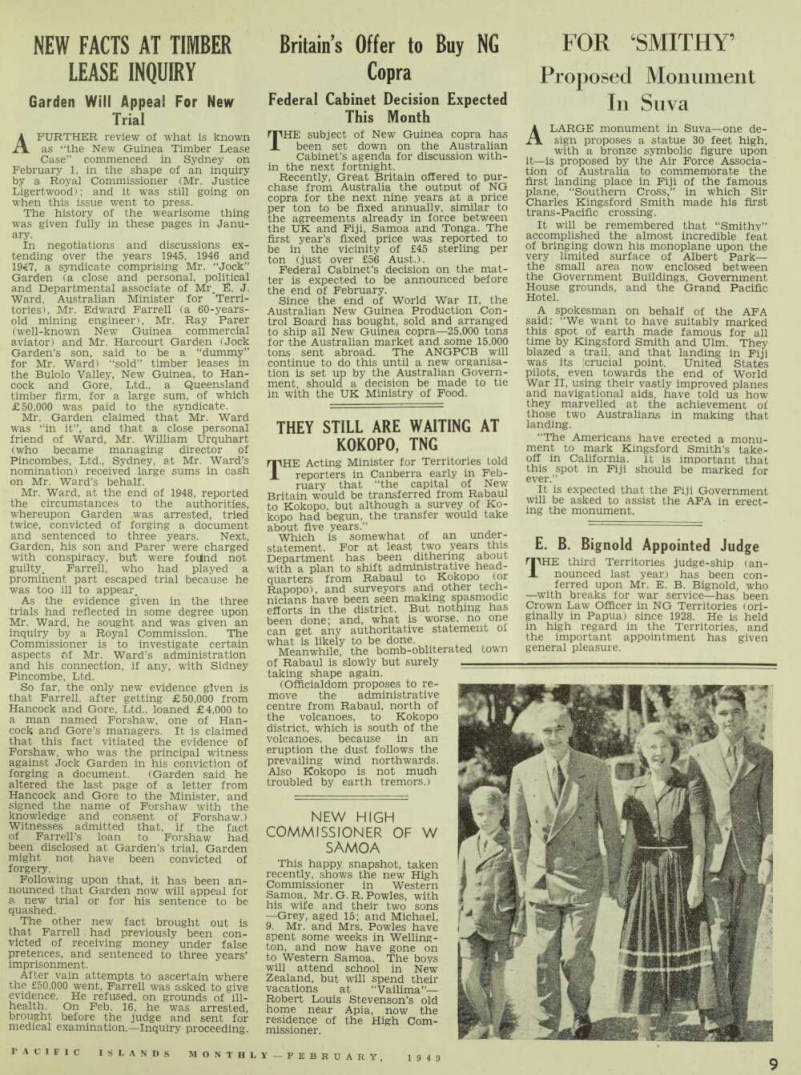
New High
Commissioner Of W
Samoa
This happy snapshot, taken recently, shows the new High Commissioner in Western Samoa, Mr. G. R. Powles, with his wife and their two sons —Grey, aged 15; and Michael, 9. Mr. and Mrs. Powles have spent some weeks in Welling ton, and now have gone on to Western Samoa. The boys will attend school in New Zealand, but will spend their vacations at “Vailima”— Robert Louis Stevenson’s old home near Apia, now the residence of the High Com missioner.
Proposed Monument
For ‘Smithy’
In Suva
A LARGE monument in Suva —one de sign proposes a statue 30 feet high, with a bronze symbolic figure upon it—is proposed by the Air Force Associa tion of Australia to commemorate the first landing place in Fiji of the famous plane, “Southern Cross,” in which Sir Charles Kirigsford Smith made his first trans-Pacific crossing.
It will be remembered that “Smithy” accomplished the almost incredible feat of bringing down his monoplane upon the very limited surface of Albert Park — the small area now enclosed between the Government Buildings, Government House grounds, and the Grand Pacific Hotel.
A spokesman on behalf of the AFA said: “We want to have suitably marked this spot of earth made famous for all time by Kingsford Smith and Ulm. They blazed a trail, and that landing in Fiji was its Icrucial point. United States pilots, even towards the end of World War 11, using their vastly improved planes and navigational aids, have told us how they marvelled at the achievement of those two Australians in making that landing.
“The Americans have erected a monu ment to mark Kingsford Smith’s take off in California. It is important that this spot in Fiji should be marked for ever.”
It is expected that the Fiji Government will be asked to assist the AFA in erect ing the monument.
L. D. Bignold Appointed Judge
np HE third Territories inHo-e shin F njij tnim , lermones judge-ship (an- A nounced last year) has been con . * er £ ed upon Mr - E - B - Bignold, who —with breaks for war service—has been Crown Law Officer in NG Territories (ori (finally in Papua), since 1928. He is held m high regard in the Territories, and the important appointment has given general pleasure.
Commission
South Pacific
Transfer To Noumea Complete in March
Transportation difficulties some what slowed up the South Pacific Commission’s plans for removal of its headquarters frfom St. Georges Heights, Sydney, to the Pentagon Build ing, Noumea. Practically all the material required has been sent away to New Caledonia, however, and the Secretary- General, Mr. W. D. Forsyth, and his immediate assistants, who were obliged to spend February in Sydney, will de part for Noumea in March.
The Deputy Secretary-General (Mr.
H. E. Maude) and three of the chief officers of the Research Council (Dr. L.
G. M. Baas Becking, Dr. E. Massal, and Dr. H. G. MacMillan—the latter of whom went direct from United States) pro ceeded in January to New Zealand, to attend the sessions of the Pacific Science Congress in February. It is their in tention-transportation conditions per mitting—to visit the chief centres of the South Pacific Islands before proceeding to Noumea, to prepare there for a meet ing of the Research Council, early in May, and of the Commission, late in May.
The French authorities, in preparing the Pentagon Building for occupation are reported to have done a splendid job and displayed a spirit of real co-operation.
An enormous amount of organisational work is involved in (a) transferring the records and staff from Sydney to Noumea, (b) assembling in Noumea the Commission’s high officials from all over the world, (c) providing in Noumea the office and residential and transport ac commodation required by the officials and their families and staffs, and (d) in arranging the smooth functioning of a completely new body, the purpose and activities of which are, as yet, only vaguely understood by the public.
French Do Good Job On
Pentagon Building
From a Special Correspondent
Noumea, Jan. 4.
THE French metropolitan Government has announced that it will advance to the New Caledonian adminstra tion, the sum of 17,000,000 Pacific francs to purchase the land at Anse Vata and to cover the expense of installing the South Pacific Commission headquarters there. The charge really falls on the budget of the French Ministry for Foreign Affairs.
Work of transforming the former US Army’s Pentagon Building at Anse Vata for the use of the Commission is pro ceeding satisfactorily, and arrangements have been made to lodge the first section of the Commission’s staff soon. Local contractors have joined forces with the Public Works Department to get the work finished on time.
The secretary-Generat of the Com mission (Mr. W. D. Forsyth) has indi cated that he would like the work done In two stages. ' The more immediate need is to prepare the wing to be used for offices and the two wings allotted for the personnel and passengers in transit; as well as a fourth wing for the domestic staff. The central rotunda is to be
converted into a reception hall, alongside which will be kitchen and restaurant. Above the rotunda is accommodation for the Secretary-General and his family and for guests.
The second stage will involve the installation of library, laboratories, an assembly room, etc.
Colonel Bent, a civil engineer who served in Noumea during the war, has been acting as liaison officer on behalf of the Commission.
More "Bulolo" Passengers
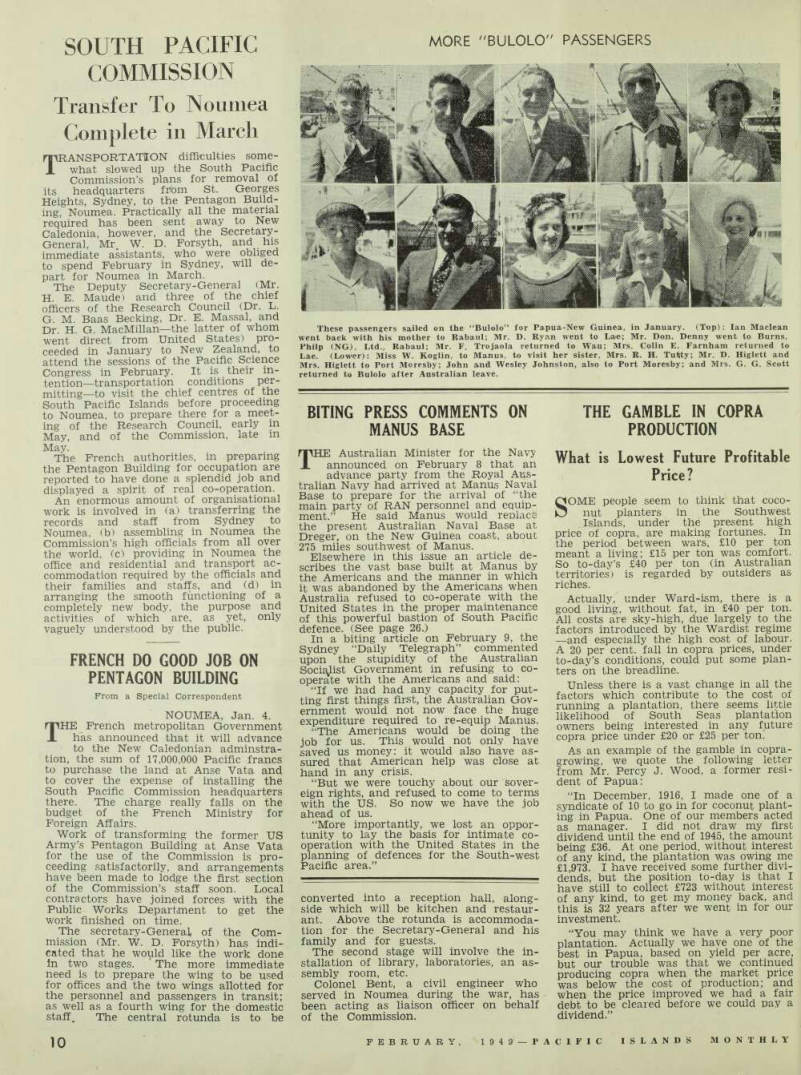
These passengers sailed on the “Bulolo” for Papua-New Guinea, in January. (Top): lan Maclean went back with his mother to Rabaul; Mr. D. Ryan went to Lae; Mr. Don. Denny went to Burns, Philp (NG), Ltd., Rabaul; Mr. F. Trojaola returned to Wau; Mrs. Colin E. Farnham returned to Lae. (Lower): Miss W. Koglin, to Manus, to visit her sister, Mrs, R. H. Tutty; Mr. D. Higlett and Mrs. Higlett to Port Moresby; John and Wesley Johnston, also to Port Moresby; and Mrs. G. G. Scott returned to Bulolo after Australian leave.
Biting Press Comments On
Manus Base
THE Australian Minister for the Navy announced on February 8 that an advance party from the Royal Aus tralian Navy had arrived at Manus Naval Base to prepare for the arrival of “the main party of RAN personnel and equip ment.” He said Manus would replace the present Australian Naval Base at Dreger, on the New Guinea coast, about 275 miles southwest of Manus.
Elsewhere in this issue an article de scribes the vast base built at Manus by the Americans and the manner in which it was abandoned by the Americans when Australia refused to co-operate with the United States in the proper maintenance of this powerful bastion of South Pacific defence. (See page 26.) In a biting article on February 9, the Sydney “Daily Telegraph” commented upon the stupidity of the Australian Socialist Government in refusing to co operate with the Americans and said: “If we had had any capacity for put ting first things first, the Australian Gov ernment would not now face the huge expenditure required to re-equip Manus.
“The Americans would be doing the job for us. This would not only have saved us money: it would also have as sured that American help was close at hand in any crisis.
“But we were touchy about our sover eign rights, and refused to come to terms with the US. So now we have the job ahead of us.
“More importantly, we lost an oppor tunity to lay the basis for intimate co operation with the United States in the planning of defences for the South-west Pacific area.”
What is Lowest Future Profitable
The Gamble In Copra
Production
What is Lowest Future Profitable Price?
SOME people seem to think that coco nut planters in the Southwest Islands, under the present high price of copra, are making fortunes. In the period between wars, £lO per ton meant a living; £l5 per ton was comfort.
So to-day’s £4O per ton (in Australian territories) is regarded by outsiders as riches.
Actually, under Ward-ism, there is a good living, without fat, in £4O per ton.
All costs are sky-high, due largely to the factors introduced by the Wardist regime —and especially the high cost of labour.
A 20 per cent, fall in copra prices, under to-day’s conditions, could put some plan ters on the breadline.
Unless there is a vast change in all the factors which contribute to the cost of running a plantation, there seems little likelihood of South Seas plantation owners being interested in any future copra price under £2O or £25 per ton.
As an example of the gamble in copra growing, we quote the following letter from Mr. Percy J. Wood, a former resi dent of Papua; “In December, 1916, I made one of a syndicate of 10 to go in for coconut plant ing in Papua. One of our members acted as manager. I did not draw my first dividend until the end of 1945, the amount being £36. At one period, without interest of any kind, the plantation was owing me £1,973. I have received some further divi dends, but the position to-day is that I have still to collect £723 without interest of any kind, to get my money back, and this is 32 years after we went in for our investment.
“You may think we have a very poor plantation. Actually we have one of the best in Papua, based on yield per acre, but our trouble was that we continued producing copra when the market price was below the cost of production; and when the price improved we had a fair debt to be cleared before we could pay a dividend.”
Rarotongan “Good-Will” Tour of NZ
Described as an Embarrassment
From Our Own Correspondent
AUCKLAND, February 3.
RESPONSIBLE Maori leaders are pondering on whose authority a party of Rarotongans was invited to New Zealand. In some ways the visit has been a distinct embarrassment, and the objective planned—a “good-will” tour to give the travellers a favourable impression of New Zealand —can hardly be realised.
As the Labour Government sanctioned the departure of the visitors (the majority come from Ngatangiia at Rarotonga, and from the island of Aitutaki) the least it could have done was to sponsor the tour in some form.
Towards the end of last year, Barnett Maniapoto Otene, a well-known Maori who has, for years, been associated with the Labour organisation among his people, visited Rarotonga to inquire in to industrial troubles there—and he claims that he achieved success in his mission both there and at Aitutaki. The invitation may have been extended by him.
No one appears to know just what Mr. Otene’s mission was in Rarotonga, or with what authority he was invested by the Government. But the trip ap peared to have at least a semi-official basis.
His stay in those islands was followed by the visit of the present party, numbering about 40, under the leader ship of Piri Moate, a member of the recently constituted Legislative Council, and Pa Ariki, a leading chieftainess (who was educated in New Zealand, having been brought here as a child by the late
Makea Tinirau).
The intention was, it is presumed, to pay expenses of the tour in New Zealand by giving concerts in the various Maori centres. Those in charge, however, ap pear to have little business acumen, and the response from the public, at several centres was, by no means, satisfactory.
Considerable portion of the financial expenses have fallen upon Princess Te Puea Herangi, of Waikato, who was in the Cook Is. last year, and during the stay of the visitors she has been an ex ceedingly generous hostess to them at Ngaruawahia.
In some centres, nevertheless, Maori hosts have declined to receive the party, because they have been engaged in other activities. Sir Apirana Ngata, who was closely associated with the Rarotongan visit in 1934, it is noticed, did not ex tend an invitation to the visitors to go to the East Coast, where the previous party was made welcome.
It is obvious that he and other Maori leaders were not consulted about the tour. Therefore, it would seem that the arrangements were haphazard and badly planned, and the visitors are likely to return to their islands with a wrong conception of Maori hospitality. Some settlements (as was the case, of course, in Waikato) were exceedingly helpful, but others could not afford the expense of entertainment.
WHILE in Wellington the visitors were received by Prime Minister Fraser, and they were also invited to Gov ernment House by the Governor-General (Sir Bernard Freyberg, VC) and Lady Freyberg.
Another complication is likely to arise concerning their departure. At the
moment it seems that only half the number can be accommodated by the April steamer. The others will have to remain at Orakei, a Maori settlement near Auckland.
Pe Ariki has* left the party, and is in hospital in Auckland, expecting the birth of a child. But her husband is travelling with the visitors.
It has been estimated that there are 1,000 Cook Islanders in New Zealand, the majority being in the vicinity of Auckland.
NZ Ship Begins Service To NG
Acting-Minister At Lae
LAE, January 25.
THE Acting Minister for External Territories, Mr. Chambers, with Mr. J. R. Halligan, Secretary of the Department, spent a day and a night in Lae in early January. He was making a short official visit to Papua-New Guinea.
After his arrival he inspected the township, war cemetery and native hospital and then met local residents and representatives of organisations who wished to discuss a number of their problems with him.
Some of the matters raised were long standing grievances—the town-plan, re patriation matters, hotel sites, Public Service conditions, land tenure, native labour indenture, mining leases being a few of them. Public reaction to the Minister was, on the whole, good. A ministerial visit was long overdue—but whether any benefit will derive from it remains to be seen.
After spending the night in Lae he flew to Wau the following morning, and motored to Bulolo where he stayed the night as the guest of Bulolo Gold Dredg ing, Ltd. The following day he returned to Lae by road, and flew, that afternoon, to Madang.
NZ Ship Begins Service To NG
LAE, January 25.
WHAT is hoped will be a regular ser vice between New Zealand and New Guinea was inaugurated in January with the MV “Wairata.”
She is a 5,000 ton vessel belonging to the Union Manufacturing and Export Company, whose headquarters are in Wellington.
On board the “Wairata” on her first trip was Mr. E. Herschfeld, an official of the company. He said that the next ship of the line to call would be a 3,000 ton LST, specially converted for the Islands trade. She will be practically in dependent of local labour and will be equipped with mobile cranes, trucks, and skilled engineers for the purpose of back loading war disposals equipment.
“Wairata”, which is equipped with every known navigational device, in cluding radar, brought a cargo of dairy products, canned goods, general cargo and several varieties of New Zealand beer. She returned to New Zealand with war disposals goods.
Advertisements & other items, p. 13 (1 item)
Two Young Ladies Of Port
MORESBY
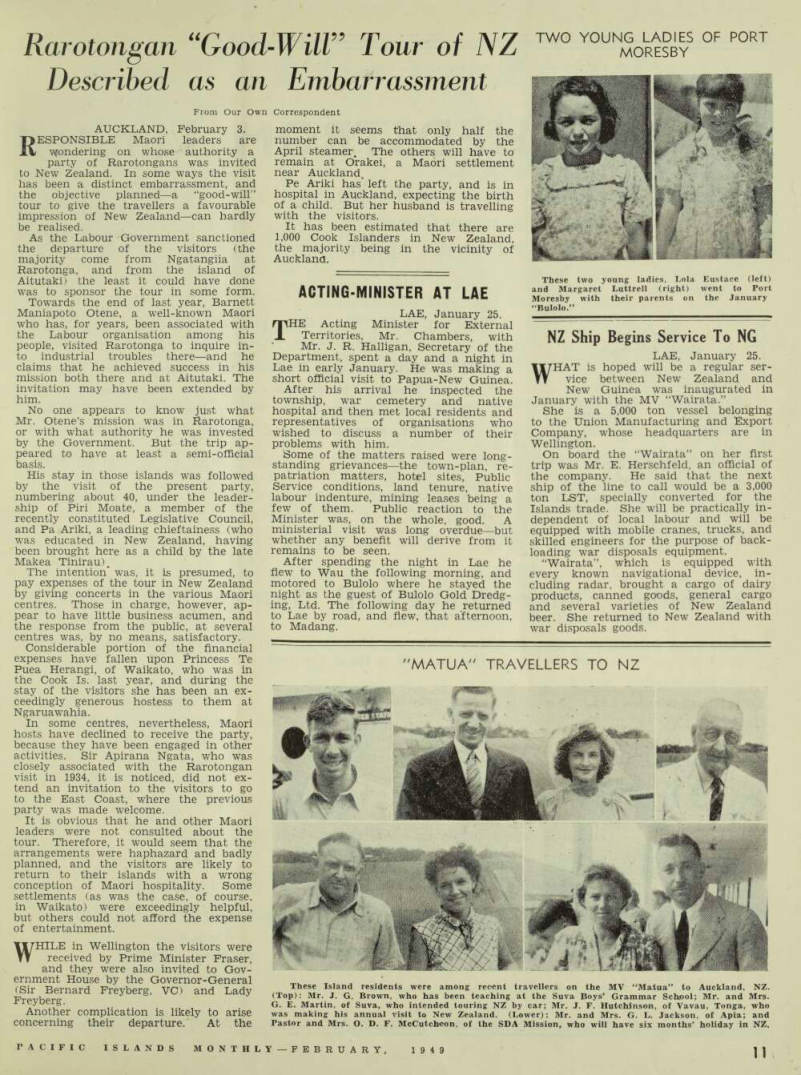
These two young ladies, Lola Eustace (left) and Margaret Luttrell (right) went to Port Moresby with their parents on the January “Bulolo."
"Matua" Travellers To Nz
These Island residents were among recent travellers on the MV “Matua” to Auckland, NZ. (Top): Mr. J. G. Brown, who has been teaching at the Suva Boys’ Grammar Schtool; Mi. and Mrs.
G. E. Martin, of Suva, who intended touring NZ by car; Mr. J. F. Hutchinson, of Vavau, Tonga, who was making his annual visit to New Zealand. (Lower): Mr. and Mrs. G. L. Jackson, of Apia; and Pastor and Mrs. O. D. F. McCutcheon, of the SDA Mission, who will have six months’ holiday in NZ.
Advertisements & other items, p. 14 (1 item)
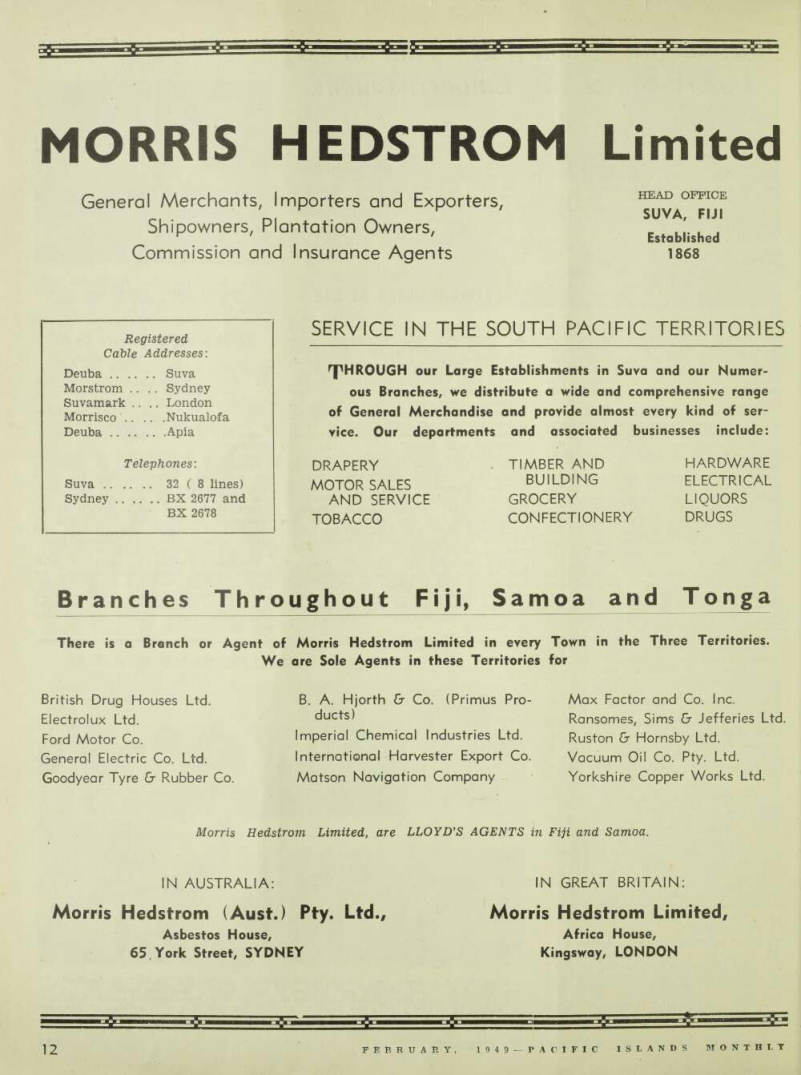
Morris Hedstrom Limited
General Merchants, Importers and Exporters,
Shipowners, Plantation Owners,
Commission and Insurance Agents
HEAD OFFICE
SUVA, FIJI
Established 1868
SERVICE IN THE SOUTH PACIFIC TERRITORIES
rpHROUGH our Large Establishments in Suva and our Numerous Branches, we distribute a wide and comprehensive range of General Merchandise and provide almost every kind of service. Our departments and associated businesses include:
DRAPERY
MOTOR SALES
AND SERVICE
TOBACCO
TIMBER AND
BUILDING
GROCERY
CONFECTIONERY
HARDWARE
ELECTRICAL
LIQUORS
DRUGS
Branches Throughout Fiji, Samoa and Tonga
There is a Branch or Agent of Morris Hedstrom Limited in every Town in the Three Territories.
We are Sole Agents in these Territories for British Drug Houses Ltd.
Electrolux Ltd.
Ford Motor Co.
General Electric Co. Ltd.
Goodyear Tyre Gr Rubber Co.
B. A. Hjorth Gr Co. (Primus Products) Imperial Chemical Industries Ltd.
International Harvester Export Co.
Matson Navigation Company Max Factor and Co. Inc.
Ransomes, Sims Gr Jefferies Ltd.
Ruston Gr Hornsby Ltd.
Vacuum Oil Co. Pty. Ltd.
Yorkshire Copper Works Ltd.
Morris Hedstrom Limited , are LLOYD'S AGENTS in Fiji and Samoa.
IN AUSTRALIA:
Morris Hedstrom (Aust.) Pty. Ltd.,
Asbestos House, 65 York Street, SYDNEY
IN GREAT BRITAIN:
Morris Hedstrom Limited,
Africa House, Kingsway, LONDON
Administrative Union In Papua-
New Guinea Bill For Re-Drafting : Another Delay Likely
BECAUSE of the yelping of some of the irresponsible Leftist elements in UNO, the Australian Socialist Govern ment has modified its plan for a unified administration for Papua-New Guinea.
It will be remembered that about the middle of 1948 the Australian Government introduced the Papua-New Guinea Bill, which gave effect to a plan of administra tive union worked out by the Department of External Territories and some of the other Departments interested during the preceding two years. There did not seem to be anything much in the plan to cavil at. It had been agreed that the two Territories were to be administered as one unit; and Canberra had produced a plan that appeared to be simple and prac tical, and which provided for all funda mental considerations, like the responsi bility of the Trusteeship Council towards New Guinea.
When the plan came before the Trustee ship Council and the General Assembly of UNO, the spokesmen of Russia and her satellites (whose purpose was purely to make mischief) and of one or two irre sponsible little States, expressed suspicion of the “imperialist” motives of Australia in framing one administrative unit.
Any Government with backbone would have ignored these demonstrations and proceeded with its plan, secure in the knowledge that it was not trying to serve any hidden purpose. But not the Chifley-Evatt-Ward set-up in Canberra— which already is notorious for its readi ness to listen to the voices of Moscow, Indonesia and any other anti-British concern which bestirs itself.
So the Papua-New Guinea Bill was quietly removed from the Parliamentary Order Paper last December and has gone back into the machine for a bit of re drafting, with a view to meeting the ob jections of the UNO critics.
Bill To Be Rushed Through
THE Papua-New Guinea Bill, it has been announced, was restored to the Aus tralian Parliament Order Paper in early February, and will be rushed through the present session. A large amount of criticism of the Wardist administration now will tend to misfire, as the Bill will be piloted by Acting Minister Chambers.
The amended Bill provides that al though Papua and NG will be under one Administration, the accounts will be kept strictly separate—an awkward task for the officials.
Public Service Conditions
MR. R. P. ARCHER, Commonwealth Public Service Inspector for New South Wales, who has been making a complete survey of public service condi tions and emoluments in Papua and New Guinea, is expected tc report to the Min ister for Territories by the end of February. His recommendations may be far-reaching. There has been great dis content throughout the Territories services for the last two years; and if this new report does not take care of the officials’ grievances, the effect upon Territories administration generally will be bad.
The engagement has been announced of Rabaul-bom Miss Barbara Grose, only daughter of Mrs. Grose and the late Hon. W. E. Grose, MLC (New Guinea) to Mac, the only son of Mr. and Mrs. J. E. McLeish, of Coonamble, NSW. The wedding is planned for June.
Advertisements & other items, pp. 15-16 (2 items)
13
PACIFIC ISLANDS MONTHLY-P E B R U A R Y , 1949
Travel
Pi
easure
in the
PACIFIC ISLANDS
of the most attractive fields of Pleasure Travel in the world is available in the South Pacific Islands. Lack of Transport and Accommodation hitherto has made such travel difficult. Some of those handicaps have been removed—others are disappearing.
The PACIFIC TRAVEL AGENCY (conducted as a department of Pacific Publications Pty., Ltd.) from next month will be ready to assist Prospective Travellers with information and service, such as
the following:
• The attractions and conditions of the various Islands and Archipelagoes. • How to get there. • The class and cost of accommodation in the Islands now available to Travellers. • How Travellers should proceed, in order to see the most, with the greatest comfort, at the least cost. • How to deal with the Problems of getting from place to place, and island* to island.
We now supply authentic information about Travel and Tourist Conditions in Fiji, Samoa, Tonga, Cook Islands, French Oceania, Norfolk Island, New Zealand, New Caledonia, New Hebrides, Solomons, New Guinea, Papua, etc.
Some of these Territories now have suitable facilities for the Accommodation and Entertainment of Visitors; in others, the available accommodation is poor.
Why Not Escape the Winter in a Sunshine Tour in the
Pacific Islands? Conditions are Ideal between
April and October. Fiji Recommended
If you will indicate where you would like to go and how much time you have available, we will draw up for your consideration alternative suggested tours and the approximate cost of each.
We Organise Your Tour from Your Home back to Your Home—All Bookings are made for you in advance—All arrangements are made ahead for your comfort—You may Travel individually, or as a member of a small party.
Send for the P.T.A. Booklet and get details of the services we offer.
We sell Travel and Accommodation on behalf of Airways, Shipping Lines, Hotels *and Boarding Houses. We are the Australian Agents of the Fiji Government’s Publicity Board and Tourist Bureau, and of other Pacific Islands’ Travel Bureaus.
Any service we sell is under guarantee. Our Service Bureau has been operating for a year and many Islands residents have made use of it.
TO ISLANDS RESIDENTS: Do you want Bookings made, anywhere, by Airways, Shipping Lines, Railways, in Hotels? Send us your instructions.
All details of your wishes attended to.
PACIFIC TRAVEL AGENCY
and SERVICE BUREAU
Union House, 247 George Street, SYDNEY
Registered Cable Address: PACPUB SYDNEY. Telephone: 5037.
Take the thrifty Clipper way
to
LONDON via us
New low fare in pounds (no dollars needed) takes care of all transportation costs. Allows you sight-seeing stopovers in principal U.S. cities. fr m I 4 Hi % M i / wav one £32T/' O/ lt\p OnW r oen /\o/o 5,589
Sydney
\rom Stop-over in lovely Honolulu . . . spend a day in San Francisco . . . sight-see in New York to your heart’s content! That’s the way you go when you fly by Clipper to London.
At no extra cost. And at new low fares.
The Flying Clippers take-off from Sydney Tuesday, Friday and Sunday for San Francisco. You enjoy restful Sleeperette* service (no extra cost). And from New York, London-bound Clippers cross the Atlantic daily.
For help with your Clipper trip, see your Travel Agent or . . .
Cr “SPEED YOUR PARCEL BY CLIPPER CARGO 99 Rue Jean Joures, NOUMEA Bank of N.S.W . Building , SUVA. \ % *Trade Marks, Pan American Airways, Inc.
The “Waste-Not” Era
THAT we are now well into the period when the normally and apparently useless becomes valuable, is indi cated in the Papua-New Guinea Govern ment Gazette of January 22. Therein ten ders are called for 3’k miles of three-inch black piping at Ward’s Drome, Port Moresby. The piping is still bufied in the ground. Tenders are called also for 991 black-iron, 40-gallon drums and 420 steel drums.
The new High Commissioner of Western Samoa, Mr. G. R. Powles, visited Fiji and Tonga this month. The retiring High Commissioner, Lieutenant-Colonel F. W.
Voelcker, is scheduled to leave Western Samoa late in February.
More "Matua" Passengers
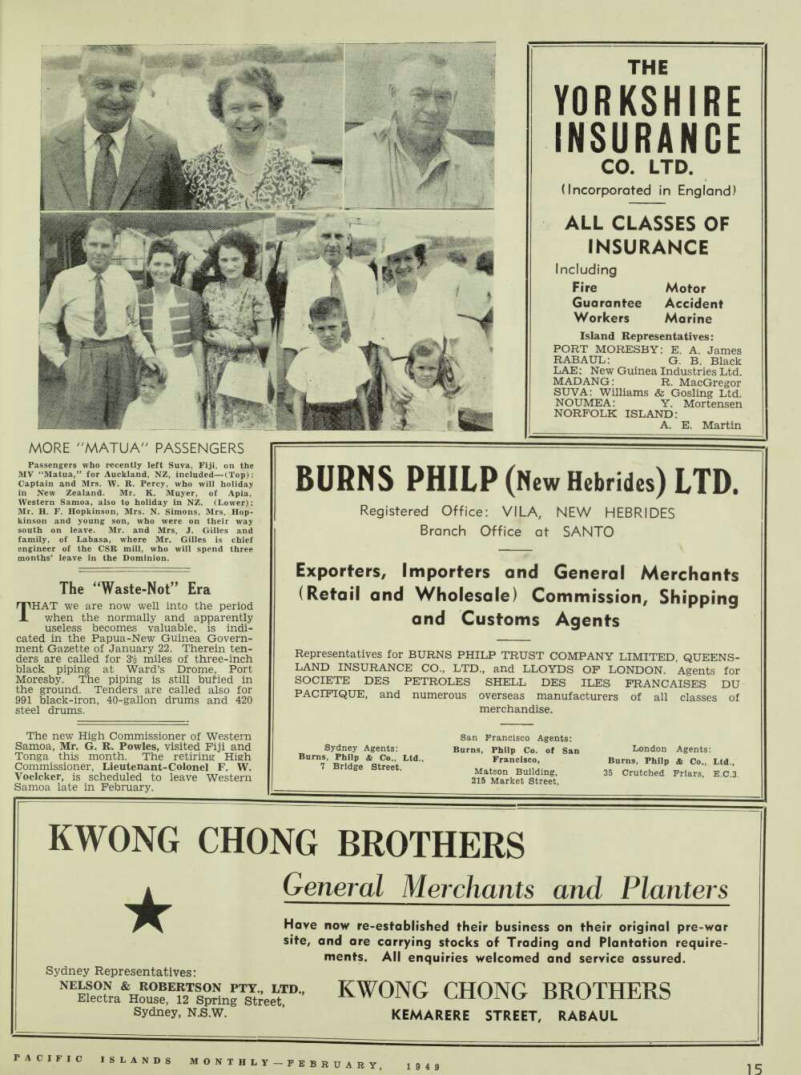
Passengers who recently left Suva, Fiji, on the MV “Matua,” for Auckland, NZ, included—(Top): Captain and Mrs. W. R. Percy, who will holiday in New Zealand. Mr. K. Muyer, of Apia, Western Samoa, also to holiday in NZ. (Lower): Mr. H. F. Hopkinson, Mrs. N. Simons, Mrs. Hop kinson and young son, who were on their way south on leave. Mr. and Mrs. J. Gilles and family, of Labasa, where Mr. Gilles is chief engineer of the CSR mill, who will spend three months’ leave in the Dominion.
Advertisements & other items, p. 17 (2 items)
15
PACIFIC ISLANDS MONTHLT-F E B E C A B Y, 1949
Insurance
THE
YORKSHIRE
CO. LTD.
(Incorporated in England)
ALL CLASSES OF
INSURANCE
Including
Fire Motor Guarantee Accident Workers Marine Island Representatives:
PORT MORESBY: E. A. James
RABAUL: G. B. Black LAE: New Guinea Industries Ltd.
MADANG: R. MacGregor SUVA: Williams & Gosling Ltd.
NOUMEA: Y, Mortensen
NORFOLK ISLAND;
A. E. Martin
BURNS PHILP (New Hebrides) LTD.
Registered Office: VILA, NEW HEBRIDES
Branch Office at SANTO
Exporters, Importers and General Merchants
(Retail and Wholesale) Commission, Shipping
and Customs Agents
Representatives for BURNS PHILP TRUST COMPANY LIMITED, QUEENS- LAND INSURANCE CO., LTD., and LLOYDS OF LONDON. Agents for SOCIETE DES PETROLES SHELL DES ILES FRANCAISES DU PACIFIQUE, and numerous overseas manufacturers of all classes of merchandise.
Sydney Agents: Burns, Philp & Co., Ltd.. 7 Bridge Street.
San Francisco Agents: Burns, Philp Co. of San Francisco, Matson Building, 215 Market Street, London Agents: Burns, Philp & Co., Ltd., 35 Crutched Friars, E.C.3.
KWONG CHONG BROTHERS
General and Phmters
Have now re-established their business on their original pre-war site, and are carrying stocks of Trading and Plantation requirements. All enquiries welcomed and service assured.
Sydney Representatives:
NELSON & ROBERTSON PTY., LTD.
Electra House, 12 Spring Street, Sydney, N.S.W.
KWONG CHONG BROTHERS
KEMARERE STREET, RABAUL
Oil Exploration In Papua
THE Australasian Petroleum Company Pty., Ltd., reports the following pro gress during the month of January, 1949: ORIO: Operations to seal the difficult fissured zones between 430 feet and 1,087 feet, have been continued and are now nearing completion. Drilling to deepen the hole below 1.694 feet should be re sumed shortly.
UPOIA; The outfit at this site spudded in on January 20, and a depth of 420 feet
has been reached. 13| in. casing has been cemented at 416 feet.
HOHORO: Erection of the outfit and final rigging-up is nearing completion.
MALALAUA: Construction of a road across a swamp area to reach the site for the drilling location has been com menced.
WANA: A test site for drilling has been chosen at Wana in the vicinity of Port Romilly and a survey of the area is in progress.
GENERAL; The Company’s marine es tablishment has been increased by the purchase of one 200 ton steel vessel, one 150 ton LCT and one 40 ton ALC barge.
Norfolk Is. Notes
By Vernon Wheatley
Passing Through: Mr. And Mrs.
Griffiths, of the CSR, Fiji, en route to NZ. They are holiday-making and are looking forward to an extensive tour of the South Island.
Mrs. Stanley and son Bill, on the way to Australia. Mrs. Stanley will return to Fiji some time in June, while Bill will remain at King’s College, Sydney.
Gone—But Not Forgotten: The
character who jumped off the Sydney plane and said: “They tell me the women outnumber the men by two to one.” His manner implied—lead me to ’em! Shades of la priere d’une vierge—the ladies didn’t rush him! Also on the same plane was a charming type who endeavoured to “make” his expenses by means of a little judicious gambling. He did not meet with any spectacular success.
EXPECTED: The Nickolai family, from Vila. We learn that wages are high in the New Hebrides. Very nice . . . but it costs 8/- for a bar of ordinary grade laundry soap, and other items are corres
pondingly high.
WHY IS IT? Butter in NZ costs lid. to 1/10 per lb. for “farm,” while factory butter costs 1/6 per lb. Butter in Sydney costs 2/2 per lb. Norfolk Island imports a considerable quantity of butter from Sydney. However, during the brief voy age across from Sydney, something mys terious happens to the butter for it costs us, on arrival, 3/9 per lb. It seems strange that such a short trip should so enhance a pound of butter. Local butter (the equivalent to NZ “farm” butter) sells at 2/9 per lb. When the freight costs from Australia were increased recently, the price of the local product shot up 3d. per lb. Which is remarkable, seeing that the locally-produced butter is not influenced in any way by freight charges from Australia. The local butter is either good or bad —there seems to be no half measures. A bad pound of butter, when cut, exposes in its cross-section many white streaks. Some folks claim it is pig-fat, while others say that margarine has been mixed with it.
DO YOU KNOW? That cigarettes weigh very heavy. It is a fact —4,000 cigarettes weigh exactly one ton. That is, if my arithmetic is correct. In answer to the recent freight increase of £l/-/per ton, the local price of cigarettes ad vanced by 3d. per 50. Work it out for yourself. Similarly, 480 ounces of tobac co weigh one ton —for tobacco increased in price by Id. per 2 ozs. It’s a great life!
Straight From The Horse’S
MOUTH: Sydney housewives would gee an awful shock should they ever be per mitted to view the shelves of the local stores. Since the “Morinda’s” schedule was cut by 50 per cent., the supply posi tion has become a problem. The more well-to-do residents are able to rush in and buy right and left when the “Morinda” discharges, but this is a poor consolation for the average householder.
You can’t blame the storekeepers. Re cently, we ran out of petrol. However, this apppears to be well under control now. At the moment we are experiencing a severe famine in matches, cigarettes, tobacco, soap, washing powder and many other household lines. Luckily, the Gov ernment-operated Bond Store is still able to do a brisk traffic, as they recently took delivery of a quantity of whisky which was rushed over by plane. Some house wives were awkward enough to ask: “Why not foodstuffs?”
But the only answer was silence.
Advertisements & other items, pp. 18-19 (2 items)
Cheques
HOW THE “WALES” WORKS Services Series No. 6
TRAVELLERS’
vim.
W'HEN you go away, whether on family holidays, a business trip, or a world tour, you will need funds for your daily requirements.
It is risky to carry these funds in cash. The modern, safe means of payment for travellers is Bank of New South Wales Travellers’ Cheques.
You will find that these cheques are readily cashed by all banks and accepted by principal tourist bureaux, transport offices, hotels, restaurants and stores.
Bank of New South Wales Travellers’ Cheques can be bought at any branch of the "Wales’’.
Consult and use
BANK OF
NEW SOUTH WALES
FIRST BANK IN AUSTRALIA
Incorporated In New South Wales with limited liability
111 A4B2^L)
Outstanding Notion Picture Entertainment
Metro-Goldnyn-Mayer
brings to all the peoples
of the Pacific Islands
OUTSTANDING NOTION PICTURE ENTERTAINMENT
Available with
• ENGLISH SOUND TRACKS
• FRENCH SOUND TRACKS
• HINDUSTANI SOUND TRACKS
—on 16mm, NON-INFLAMMABLE, LIGHTWEIGHT SAFETY FILM
To-day, no community is too remote to acquire the pleasure of continuous, modern motion picture entertainment. Already commercial exhibitors . . .hospitals . . . schools . . . institutions . . . tourist centres . . . plantation owners . . . and traders are successfully presenting M-G-M 16 m.m. ENTER- TAINMENT PROGRAMMES in all parts of the Pacific. You, too, can bring motion pictures right into your own corner of the Pacific.
Arrange Now to Screen M-G-M Attractions Presenting The greatest stars of the screen in their most outstanding productions.
The cream of the world's Comedies, Melodramas, Westerns, Action Films and Serials.
Including M-G-M Cartoons, Pete Smith, Passing Parades, "Crime Does Not Pay", Etc.
M-G-M METRO NEWS— The screen's major Newsmagazine, bringing the headline highlights from the four corners of the globe!
EDUCATIONAL FILMS also available for outright purchase.
FIJI TRADING CO., Suva.
(M-G-M Agent).
ENQUIRIES:
METRO-GOLDWYN-MAYER
(N.Z.), Ltd.
Box 1664 G.P.0., Wellington.
METRO-GOLDWYN-MAYER
(16 mm. Division), Box 2576 E, G.P.0., Sydney.
REMEMBER ... No Location is too Remote to Service!
Pacific Science Conference Opens
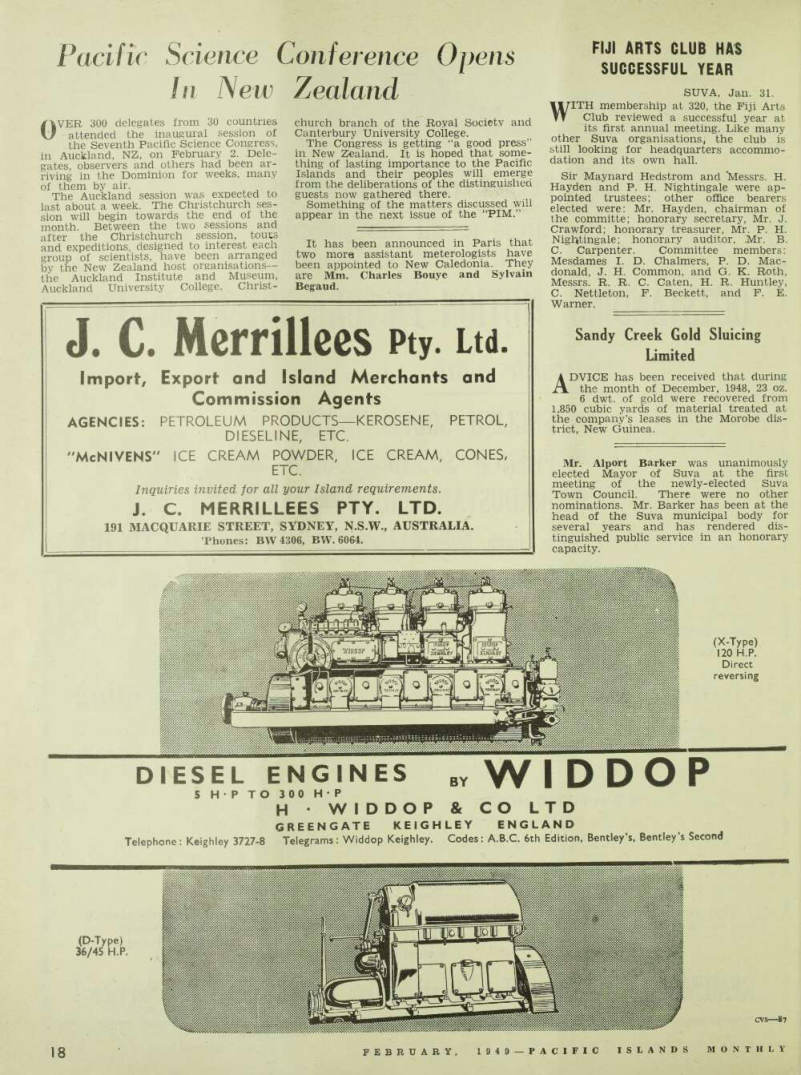
In New Zealand
OVER 300 delegates from 30 countries attended the inaugural session of the Seventh Pacific Science Congress, in Auckland, NZ, on February 2. Dele gates, observers and others had been ar riving in the Dominion for weeks, many of them by air.
The Auckland session was expected to last about a week. The Christchurch ses sion will begin towards the end of the month. Between the two sessions and after the Christchurch session, touts and expeditions, designed to interest each group of scientists, have been arranged by the New Zealand host organisations— the Auckland Institute and Museum, Auckland University College, Christ
church branch of the Royal Society and Canterbury University College.
The Congress is getting “a good press” in New Zealand. It is hoped that some thing of lasting importance to the Pacific Islands and their peoples will emerge from the deliberations of the distinguished guests now gathered there.
Something of the matters discussed will appear in the next issue of the “PIM.”
It has been announced in Paris that two more assistant meterologists have been appointed to New Caledonia. They are Mm. Charles Bouye and Sylvain Begaud.
Fiji Arts Club Has
Successful Year
Suva, Jan. 31.
WITH membership at 320, the Fiji Arts Club reviewed a successful year at its first annual meeting. Like many other Suva organisations* the club is still looking for headquarters accommo dation and its own hall.
Sir Maynard Hedstrom and 'Messrs. H.
Hayden and P. H. Nightingale were ap pointed trustees; other office bearers elected were: Mr. Hayden, chairman of the committe; honorary secretary, Mr. J.
Crawford; honorary treasurer, Mr. P. H.
Nightingale; honorary auditor, Mr. B.
C. Carpenter. Committee members; Mesdames I. D. Chalmers, P. D. Mac donald, J. H. Common, and G. K. Roth, Messrs. R. R. C. Caten, H. R. Huntley, C. Nettleton, F. Beckett, and F. E.
Warner.
Sandy Creek Gold Sluicing
Limited
ADVICE has been received that during the month of December, 1948, 23 oz. 6 dwt. of gold were recovered from 1,850 cubic yards of material treated at the company’s leases in the Morobe dis trict, New Guinea.
Mr. Alport Barker was unanimously elected Mayor of Suva at the first meeting of the newly-elected Suva Town Council. There were no other nominations. Mr. Barker has been at the head of the Suva municipal body for several years and has rendered dis tinguished public service in an honorary capacity.
Advertisements & other items, p. 20 (1 item)
J. C. Mcrrillccs Pty. Ltd.
Import, Export and Island Merchants and
Commission Agents
AGENCIES; PETROLEUM PRODUCTS—KEROSENE, PETROL,
DIESELINE, ETC.
"McNIVENS" ICE CREAM POWDER, ICE CREAM, CONES,
ETC.
Inquiries invited for all your Island requirements.
J. C. MERRILLEES PTY. LTD.
191 MACQUARIE STREET, SYDNEY, N.S.W., AUSTRALIA.
Phones: BW 4306, BW. 6064.
(0.m (X-Type) 120 H.P.
Direct reversing
WIDDOP
DIESEL ENGINES BY
5 H P TO 300 H• P
H • WIDDOP & CO LTD
GREENGATE KEIGHLEY ENGLAND
Telephone : Keighley 3727-8 Telegrams : Widdop Keighley. Codes: A.B.C. 6th Edition, Bentley’s, Bentley’s Second (D-Type) 36/45 H.P. ft •
liSi
CVS —8?
January 23
Remembered in Rabaul and
Australia
Prom a Special Correspondent THE anniversary of the fall of Rabaul to the Japanese on January 23, 1942, was observed this year in Rabaul with two services—one at dawn at the Japanese landing point near Vulcan Island, and the other at 10 a.m. at the Colyer Watson wharf from whence the ill-fated “Montevideo Maru” is believed to have sailed with those civilian in ternees and AIF soldiers captured in the Rabaul area.
About 50 attended the dawn service; a smaller number the 10 a.m. service.
Both services were conducted by the Rev.
B, Chenoweth and wreaths were placed on the memorial stone at Vulcan as fol lows: By Mr. J. Gilmore on behalf of the RSSAILA, Rabaul; Mr. A, J. Gaskin, on behalf of the NGVR; Miss Dorothy Stewart, New Guinea Women’s Assn., Melbourne; Mrs. Vallentine. New Guinea Association, Brisbane; Mrs. Maxwell, New Guinea Women’s Club of Sydney; Captain Backhouse, Ist Australian War Criminals Compound; Mr. L. Corbett. Colyer Wat son (NG) Ltd.; Miss Holden. New Guinea Company; Mrs. Hicks, Southern Pacific Insurance Ltd.; Mrs. C. Bates, widows and children.
There were several private w eaths.
Rarely has Rabaul had a more impres sive dawn. The harbour was still and when the sun emerged from a spot of dull, grey cloud the whole area was tipped with rosy-pink.
This year, due to the fact that a large number of bombs have been exploded in that vicinity, Vulcan was more accessible.
And, on the day previous to the dawn service, Mr. Rolf Cambridge sent in a team of boys who practically swept the area.
It is hoped to have a working-bee there shortly to do the preliminary work on what perhaps will some day be a small park—something that visitors might care to visit. At the present time they would have to fight their way througn more jungle than the original Jap landing party did, to see anything.
Ceremony in Sydney
IN Martin Place, Sydney, on January 23, about 40 relatives and friends gathered at 10 a.m. to pay tribute to the memory of the New Guinea men lost during the invasion of New Britain and in the Japanese prison ship “Montevideo Maru” in June, 1942.
A dozen wreaths were placed on the Cenotaph in a quiet ceremony, the more impressive for its simplicity. Led by Mr.
H. L. Clark, formerly of Rabaul, the wreath-bearers faced the Cenotaph and each in turn advanced to place the tri bute on the stone coping; a pace back and a long moment of reflection: then back into line.
Mr. Clark placed there a laurel garland on behalf of the NG Branch of the RSS&AILA, with a green and gold pen nant of the New Guinea Volunteer Rifles and a ribbon bearing the message, “Lest We Forget.”
Of the other floral tributes one was from the Sydney New Guinea Women’s Club. There were many private tributes.
Service In Melbourne
THE New Guinea Women’s Association, Melbourne, joined with the 2nd/ 22nd in a Service at the Shrine on January 23. The Rev. F. G. Lewis as sisted Lieut-Col. Leggett in the cere mony.
After a service on the steps, returned members of the 2nd/22nd filed into the building, followed by relatives and friends of the fallen, where a two minutes silence was followed by the Last Post.
Floral wreaths were on the Rock of Remembrance, Lady McNicoll, who was visiting Melbourne, placing the wreath of the New Guinea Women’s As sociation in memory of those who had lost their lives.
Etablissements Ballande, Noumea, ad vertise American red and white wine for sale at 55 francs a bottle; dry sherry for 25 and 40 francs; and US champagne for 60 francs a bottle. Australian vin rouge ordinaire is on sale for 35 francs a bottle.
Bsi Mission Natives Give
Liberally
WHEN it comes to making a thanks giving offering to his mission there is nothing parsimonious about the BSI native.
From Roviana, New Georgia, scene of so much bitter fighting in July, 1943, the Rev. J. F. Goldie, veteran chairman of the Methodist Mission in BSI, wrote in Sep tember to friends in New Zealand: “We had our Thanksgiving service last Sunday week at Roviana, and the morning collec tion came to just over £6OO. I am leaving for Marovo tomorrow for their thanks giving next Sunday.”
Details of the Marovo offering were not given, but it is probable that the total for the Roviana Circuit of the Mission was at least £l,OOO for the year.
Advertisements & other items, pp. 21-22 (1 item)
Symbol Of
M k. r X- \ va
The Shell Co. of Aust., Ltd. (Inc. in Great Britain)
ASSEMBLE
THIS BOAT
YOURSELF!
It’s Easy.
’ mm m * in fe.- , ■ , ■*i PROOFWOOD BOAT ASSEMBLY KITS, made from PROOFWOOD, the famous marine plywood—for 8 ft., 11 ft., 3 in,, and 16 ft. craft —come to you complete with all components. All parts are machine finished to exact size.
They can be assembled, in a very little time, into a beautifully designed craft, light in weight, yet immensely strong. Simplified plans accompany every kit. Send for illustrated brochure giving full details of PROOFWOOD
BOAT ASSEMBLY KITS.
Sole Export Agents for South Pacific :
WILLIAM E. REED
145 a George Street, Circular Quay,
Sydney
Cables: “WILREED”, Sydney.
takc mceHTi a-Pc mm
€ONFtCiMCe
Confidence brings success!
Place your confidence in the A hospital formula of genuine • Vincent’s a.p.c. For over ,<s U 25 years the medical profession has had absolute confidence in w this better-balanced prescription Take Vincent's A.P.C With Confidence.
For HEADACHE AND NERVE
AND MUSCULAR PAIN!
m
VINCENTS
Toosinz
N
cHxC
SAFEST & BESTI
Magartney-Ewert Wedding
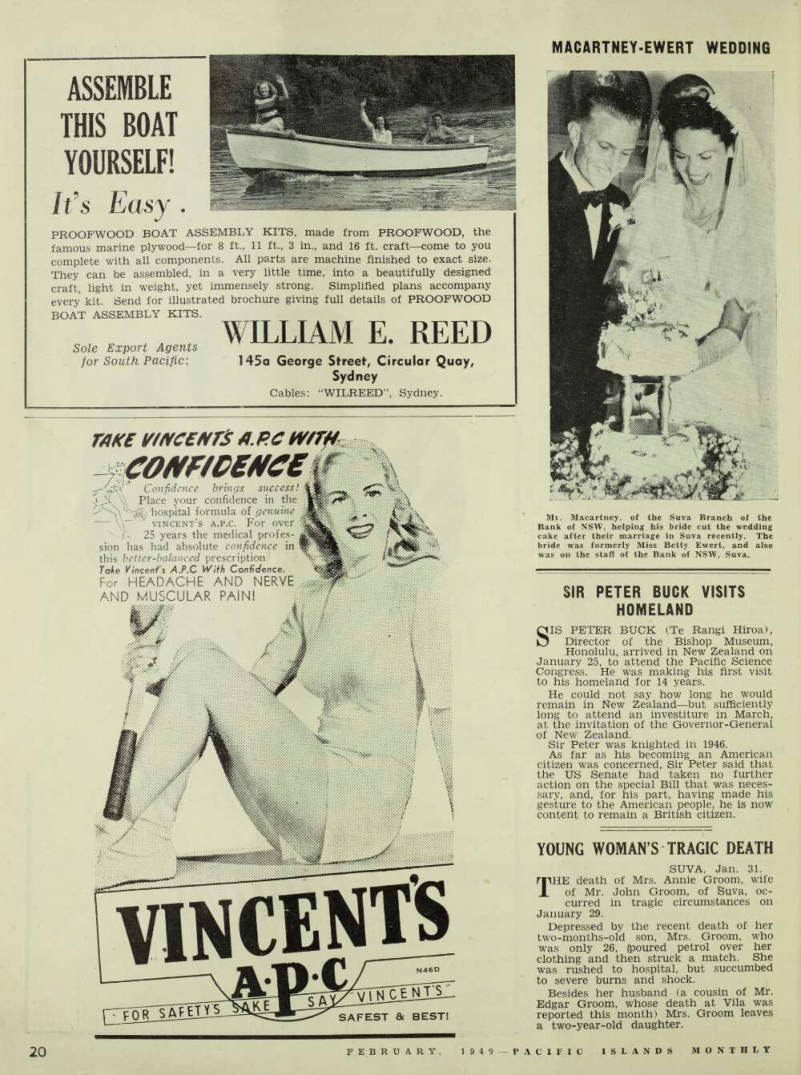
Mi. Macartney, of the Suva Branch of the Bank of NSW, helping his bride cut the wedding cake after their marriage in Suva recently. The bride was formerly Miss Betty Ewert, and also was on the staff of the Bank of NSW, Suva.
Sir Peter Buck Visits
Homeland
SIS PETER BUCK (Te Rangi Hiroa), Director of the Bishop Museum, Honolulu, arrived in New Zealand on January 25, to attend the Pacific Science Congress. He was making his first visit to his homeland for 14 years.
He could not say how long he would remain in New Zealand —but sufficiently long to attend an investiture in March, at the invitation of the Governor-General of New Zealand.
Sir Peter was knighted in 1946.
As far as his becoming an American citizen was concerned, Sir Peter said that the US Senate had taken no further action on the special Bill that was neces sary, and, for his part, having made his gesture to the American people, he is now content to remain a British citizen.
Young Woman’S Tragic Death
Suva, Jan. 31.
fTUiE death of Mrs. Annie Groom, wife X of Mr. John Groom, of Suva, oc curred in tragic circumstances on January 29.
Depressed by the recent death of her two-months-old son, Mrs. Groom, who was only 26, (poured petrol over her clothing and then struck a match. She was rushed to hospital, but succumbed to severe burns and shock.
Besides her husband (a cousin of Mr.
Edgar Groom, whose death at Vila was reported this month) Mrs. Groom leaves a two-year-old daughter.
Advertisements & other items, p. 23 (2 items)
21
PACIFIC ISLANDS MONTH LY-FEBRUARY. 1949
Australia’s
7a Va 7a I Va V
BRONTE
BRAND:
From
Australia’s
Finest Fat
Stock ..
Chili Con Came Braised Steak and Onions Curried Beef Curried Mutton Steak and Onions Mutton and Peas Irish Stew Beef Steak Pudding Corned Beef Hash Corned Beef Loaf With Cereal Mutton Broth Mulligatawny Soup Tomato Soup Vegetable Soup From the finest fat stock and the rich-
est vegetables in Australia we produce
these high-grade canned meats and
soups. BRONTE BRAND meats,
hotmeals and soups are deliciously
flavoured and are made from
ONLY meats and vegetables
of the highest quality. . . . ★
THE COLONIAL WHOLESALE MEAT CO.
PTY. LTD.
Canning Factory, State Abattoirs, Homebush Bay, Sydney.
N.S.W.
PHONES:
PHONE: UM 8436.
CABLE ADDRESS:
WOOLMILL. SYDNEY.
8 P R m CO mm
No Self-Rule For Manua
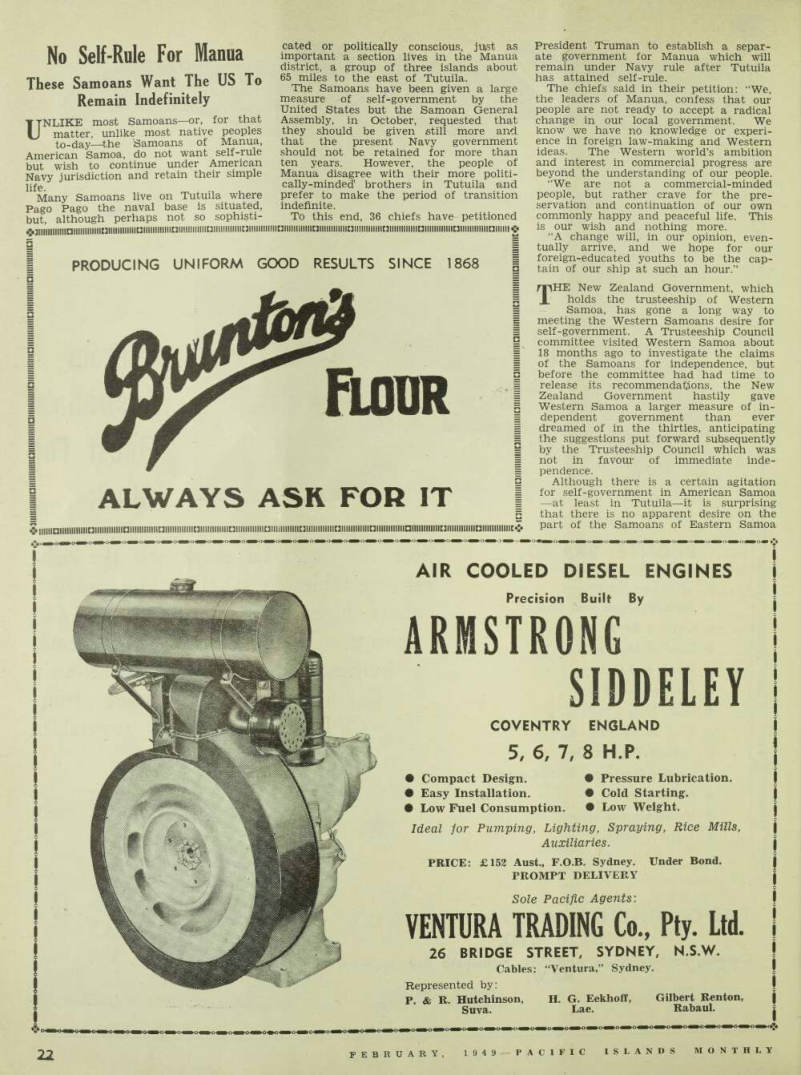
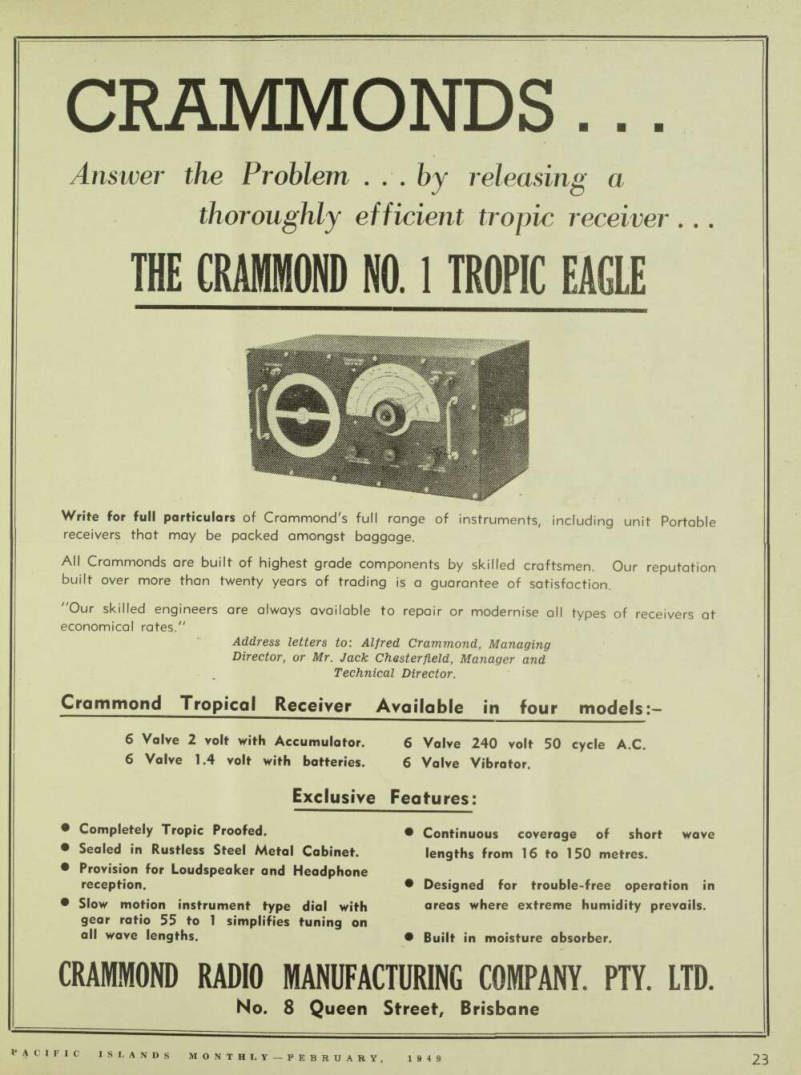
These Samoans Want The US To Remain Indefinitely
UNLIKE most Samoans—or, for that matter unlike most native peoples to_day—the Samoans of Manua, American Samoa, do not want self-rule but wish to continue under American Navy jurisdiction and retain their simple Many Samoans live on Tutuila where Pago Pago the naval base is situated, but although perhaps not so sophisti
cated or politically conscious, just as important a section lives in the Manua district, a group of three islands about 65 miles to the east of Tutuila.
The Samoans have been given a large measure of self-government by the United States but the Samoan General Assembly, in October, requested that they should be given still more and that the present Navy government should not be retained for more than ten years. However, the people of Manua disagree with their more politi cally-minded' brothers in Tutuila and prefer to make the period of transition indefinite.
To this end, 36 chiefs have petitioned
President Truman to establish a separ ate government for Manua which will remain under Navy rule after Tutuila has attained self-rule.
The chiefs said in their petition: “We, the leaders of Manua, confess that our people are not ready to accept a radical change in our local government. We know we have no knowledge or experi ence in foreign law-making and Western ideas. The Western world’s ambition and interest in commercial progress are beyond the understanding of our people.
“We are not a commercial-minded people, but rather crave for the pre servation and continuation of our own commonly happy and peaceful life. This is our wish and nothing more.
“A change will, in our opinion, even tually arrive, and we hope for our foreign-educated youths to be the cap tain of our ship at such an hour.’’
THE New Zealand Government, which holds the trusteeship of Western Samoa, has gone a long way to meeting the Western Samoans desire for self-government. A Trusteeship Council committee visited Western Samoa about 18 months ago to investigate the claims of the Samoans for independence, but before the committee had had time to release its recommendations, the New Zealand Government hastily gave Western Samoa a larger measure of in dependent government than ever dreamed of in the thirties, anticipating the suggestions put forward subsequently by the Trusteeship Council which was not in favour of immediate inde pendence.
Although there is a certain agitation for self-government in American Samoa —at least in Tutuila —it is surprising that there is no apparent desire on the part of the Samoans of Eastern Samoa
to join Western Samoa in forming a Samoan nation. The fact that the present political division is European made and dates only from 1899, when Western Samoa became German terri tory and Eastern Samoa went to the United States, makes it the more puzzling.
The Western Samoans, no doubt, would welcome the American Samoans to their fold. The American Samoans, no doubt, with a thought to the feuds and petty wars of old Samoa, prefer to remain under the wing of the United States for the present, anct give the Western Samoan experiment ample time to work itself out, one way or the other.
Advertisements & other items, pp. 24-26 (1 item)
Flour
PRODUCING UNIFORM GOOD RESULTS SINCE 1868
ALWAYS ASK FOR IT
■ F . /
AIR COOLED DIESEL ENGINES
Precision Built By
ARMSTRONG
SIDDELEY
COVENTRY ENGLAND
5,6, 7, 8 H.P. • Compact Design. • Pressure Lubrication. • Easy Installation. • Cold Starting. • Low Fuel Consumption. • Low Weight.
Ideal for Pumping, Lighting, Spraying, Rice Mills, Auxiliaries.
PRICE: £152 Aust., F. 0.8. Sydney. Under Bond.
PROMPT DELIVERY
Sole Pacific Agents :
VENTURA TRADING Co., Pty. ltd.
26 BRIDGE STREET, SYDNEY, N.S.W.
Cables: “Ventura,” Sydney.
Represented by: P. & R. Hutchinson, H. G. Eekhoff, Gilbert Renton, Suva. Lae. Rabaul.
CRAMMONDS...
Answer the Problem . . . by releasing a thoroughly efficient tropic receiver . . .
IDE CRAM NO. I TROPIC EACH
m Write for full particulars of Crammond's full range of instruments, receivers that may be packed amongst baggage. including unit Portable All Crammonds are built of highest grade components by skilled craftsmen. Our reputation built over more than twenty years of trading is a guarantee of satisfaction.
' Our skilled engineers are always available to repair or modernise all types of receivers at economical rates."
Address letters to: Alfred Crammond, Managing Director , or Mr. Jack Chesterfield, Manager and Technical Director.
Crommond Tropical Receiver Available in four models 6 Valve 2 volt with Accumulator. 6 Valve 240 volt 50 cycle A.C. 6 Valve 1.4 volt with batteries. 6 Valve Vibrator.
Exclusive Features:
• Completely Tropic Proofed. • Sealed in Rustless Steel Metal Cabinet. • Provision for Loudspeaker and Headphone reception. • Slow motion instrument type dial with gear ratio 55 to 1 simplifies tuning on all wave lengths. • Continuous coverage of short wave lengths from 16 to 150 metres. • Designed for trouble-free operation in areas where extreme humidity prevails. • Built in moisture absorber.
CRAMMOND RADIO MANUFACTURING COMPANY. PTY. LTD.
No. 8 Queen Street', Brisbane
McILRATH’S
OF SYDNEY
EXPORT DEPARTMENT
is a unit specialising in supplying residents of the PACIFIC ISLANDS with essential goods.
OUR STOCKS ARE FULLY COMPREHENSIVE—WHICH INCLUDES
TROPICAL PACKS—also the multitude of goods so essential for local conditions.
McILRAITH’S NOW INSURE ALL GENERAL AND REFRIGERATED
CARGO AGAINST PILLAGE, THEFT AND NON-DELIVERY
Write for Complete Grocery, Wine and Spirit Price List.
Post Free by Return Air Mail.
McILRATH’S PTY. LTD.
202 Pitt Street, Sydney, Australia Cable address—ROTUNDA, Sydney.
mi
for SHAFTS.SAFETY
Reliability is the major consideration when selecting propeller shafting. By installing Monel, you take the surest precaution against breakdown at a critical moment.
Monel shafts are exceptionally strong and tough—they withstand blows which would hopelessly spring shafts of other materials. Their great rigidity reduces whip and vibration to a minimum, whilst in service, Monel quickly develops a mirror-like finish which prolongs the life of both packing and bearings. In addition, Monel cannot rust and is not corroded by prolonged immersion in fresh or salt water.
Complete information on the many marine uses of Monel will gladly be forwarded by:
WRIGHT AND COMPANY
SOLE AUSTRALIAN DISTRIBUTORS OF MONEL
81 CLARENCE STREET, SYDNEY : : : ; : 'Phone: BXI2II (Six Lines) Monnl is a registered trade-mark covering a rich nickel ■ ■■ alloy, mined in Canada and rolled in Great Britain.
Plane And More Ships For
Ss Marine Products
Prom Our Own Correspondent
Suva, Jan. 24.
AGRUMAN Goose plane for South Seas Marine Products was landed at Suva by the ship “Alameda” on January 21. After assembly here, the plane will be used for spotting fish, surveying and for the transport of personnel.
The second ship convoy, comprising two tuna clippers and two bait vessels, is ex pected at Suva early in February, The first clipper, the “Sea King,” is now in operation in Fijian waters.
Relics Of The “Bounty”
A RECENT press report that the Bible of HMS “Bounty” is to be returned to Pitcairn Island, home of the des cendants of the “Bounty” mutineers, led to the discovery that Lieutenant William Bligh’s soup tureen, another “Bounty” relic, was in Suva.
It is the property of Mr. R. M. D.
Towner, of the staff of Cable and Wireless Ltd., and was given to him by Mrs.
Charles Fysh, of Norfolk Island, a direct descendant of the “Bounty” mutineers.
Mr. Towner said that Mrs. Fvsh had the autographed lithograph of Queen Vic toria, the Prince Consort and their family, which was sent by the Queen to the des cendants of the mutineers with an am nesty, and the “title deeds” of Norfolk Island.
Mr. Ray Nobbs, of Norfolk, has the “Bounty’s” barometer, which. Mr. Towner said, is still tapped and read every morn ing.
Busy Nadi Airport
OVER eighty aircraft on regular Pacific flights are expected to call at Nadi (Fiji’s major airport) during Febru ary.
The British Commonwealth Pacific Air lines’ service between North America and Australia and New Zealand, will be speeded up with the bringing into use of the new DC6’s, and the number of flights is to be increased.
Pan American World Airlines are run ning extra flights during the month to both Sydney and Auckland.
In addition to these trunk route ser vices, there will be the usual New Zea land National Airways Corporation South Pacific regional flights, and two trips by the French airline —TRAP AS—between New Caledonia and Tahiti, are scheduled.
Intensified Oil Search In
Papua-Ng In 1949
mHE British Government, main share- X holder in the Anglo-Iranian Oil Company, is keenly interested in the search for oil in New Guinea, said Dr. E. G. Raggart, Director of the Com monwealth Bureau of Mineral Resources, in Melbourne recently. Hundreds of thousands of pounds will be spent in Papua-New Guinea this year in an in tensified search for oil.
The search will involve the construction of many miles of road, erection of drills and provision for homes, electricity and other facilities for personnel.
The Australian Petroleum Company is responsible for the operations in the Territory, where at present 250 Europeans and almost 2,000 natives are employed.
A number of officials are on loan from the Anglo-Iranian Oil Company, and from the Vacuum Oil Company. Ten trainees sent from Australia to Iran have now returned and are working in New Guinea and another 12 trainees recently went to the United States from Australia.
APC have a big job ahead of them, but equipment of all kinds is constantly arriving in Australia for transhipment to New Guinea. Two new drilling plants were expected to arrive from America in the early New Year.
One of the problems confronting the company in the field is that of keeping men happy in remote jungle outposts.
But the provision of good amenities goes some way towards solving it.
Geographical Mistake
The New Administration In
Micronesia
Official America Makes a Silly Geographical Mistake
FROM a pamphlet recently received from Professor John Wesley Coulter, of the University of Cincinnati, we learn that the official name of the Trustee Territories of Caroline, Marshall and Mariana Islands, taken over by the United States in World' War II from the defeated Japanese, is “the United States Trust Territory of the Pacific Islands”.
This is an unfortunate and confusing choice of a name.. Within the 'Trust Territory there are only about 100 large atolls and main islands (many more, of course, if every little atoll islet is counted); whereas in the North and South Pacific there are literally thousands of Pacific Islands which are not under American care.
In the first year or two after the war, the region usually was referred to as “the United States Trust Territory of Micronesia”; and, as the three groups concerned (Marshalls, Carolines and Marianas) comprised most of Micronesia —the remaining group being the Gilberts, which is part of the British Colony of Gilbert and Ellice Islands—this seemed a suitable title. The switch over to “Trust Territory of Pacific Islands” is simply silly. It is hoped that general usage will retain the title of “Trust Territory of Micronesia”.
Professor Coulter’s pamphlet—a reprint of his article in the Journal of Geog raphy of October, 1948—gives a useful and reliable summary of conditions in Micronesia.
Captain James Duncan, who retired recently from the post of harbour-master in Rabaul, spent January and February in Sydney, and then went home to his family’s plantation at Rapopo, near Kokopo, New Britain.
Fiji s new Puisne Judge, Mr. W.
Desmond Carew, has arrived in Fiji. Mr.
Justice Carew is the son of a former Medical Officer in the Colony. He served in Fiji from 1921 to 1935 as an administrative officer and magistrate,
and was then seconded to the New Hebrides as British Judge. He was transferred to Malaya in 1940 and, during the war, was a prisoner of the Japanese for 3Vz years. In 1947 he was transferred to Nigeria.
Advertisements & other items, p. 27 (2 items)
25
PACIFIC ISLANDS MONTHLY-P E B R U A R Y , 1949
Fought in 24 Hours
Pimples and Bad Skin Fought in 24 Hours
Since the discovery of Nlxoderm by an American physician it Is no longer necessary for anyone to suffer from ugly, disgusting and disfiguring skin blemishes such as Eczema, Pimples, Rash, Ringworm, Psoriasis, Acne, Blackheads, Scabies and Red Blotches. Don’t let a bad skin make you feel Inferior and cause you to lose your friends. Clear your skin this new scientific way.
A New Discovery
Nlxoderm is an ointment, but different from any ointment you have ever seen or felt. It is a new discovery, and Is not greasy but feels almost like a powder when you apply It. It penetrates rapidly Into the pores and fights the cause of surface skin blemishes. Nlxoderm contains 9 Ingredients which fight skin troubles In these 3 ways. l.—lt fights and kills the microbes or parasites often responsible for skin disorders. 2.—lt stops Itching, burning and smarting In 7 to 10 minutes, and cools and soothes the skin. 3.—lt helps nature heal the skin clear, soft and velvety smooth.
Works Fast
mediately, clearing and healing your skin, making it softer, whiter and velvety smooth- Because Nlxoderm Is scientifically compounded to fight skin troubles, it works fast.
It stops burning and smarting In a few minutes, then starts to work 1m-
In Just a day or two your mirror will tell you that here at last is the scientific treatment you have been needing to clear your skin—the treatment to make you look more attractive, to help you win friends. Nixoderm has brought clearer, healthier skins to thousands, such as Mr. Bob Weedon, Edmund Street, Fremantle, who writes: “I was troubled with pimples ever since I was 13, and have spent pounds and pounds on so-called cures without results. I then tried Nixoderm with astounding effect.
The pimples seemed to fade away, and after a week there was not the slightest trace of them.”
Satisfaction Guaranteed
Get Nixoderm from your chemist or store to-day. Look in the mirror In the morning and you will be amazed at the Improvement.
Then Just keep on using Nixoderm for one week and at the end of that time it must have made your skin soft, clear, smooth and magnetically attractive—must give you the kind of skin that will make you admired wherever you go, or you simply return the empty package and your money will be refunded In full. Get Nixoderm from your chemist or store to-day.
The guarantee protects you.
Nixoderm 2/- & 4/-
For Skin Sores, Pimples and Itch.
tf°v=
A > <0 0 v
\»oO v
SUPER BOTANY
MERINO KNITTING
NON-SHRINK 2 & 3-PLY
FOR
ALL WOOL
REAL SHETLAND WOOL
2-PLY
I£a#w r * /n4 *'
BABY WOOLS
GOOD KNITTING
WHEREVER YOU
ARE
Manufactured by Wakefield, Greenwood & Co. (Huddersfield) Ltd., St. George’s Sq., Huddersfield, England Agents for Fiji : P. & R. HUTCHINSON, CENTRAL BUILDINGS, THOMPSON
STREET, SUVA, FIJI.
Asian Approaches
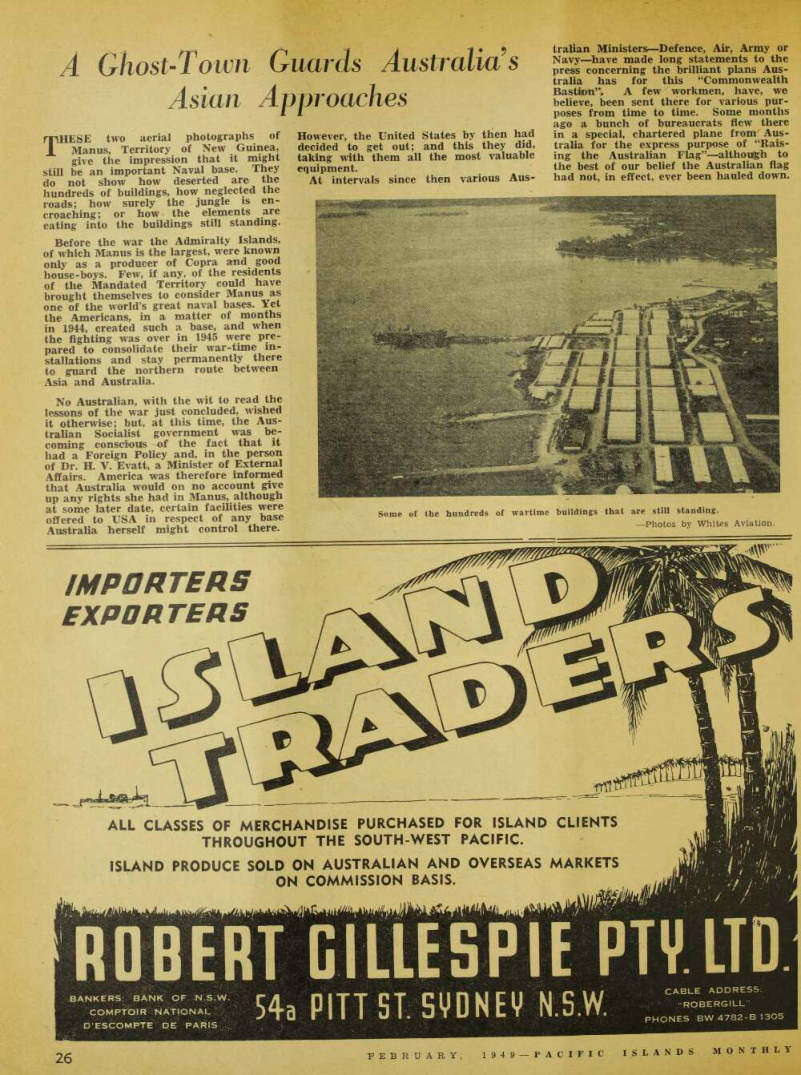
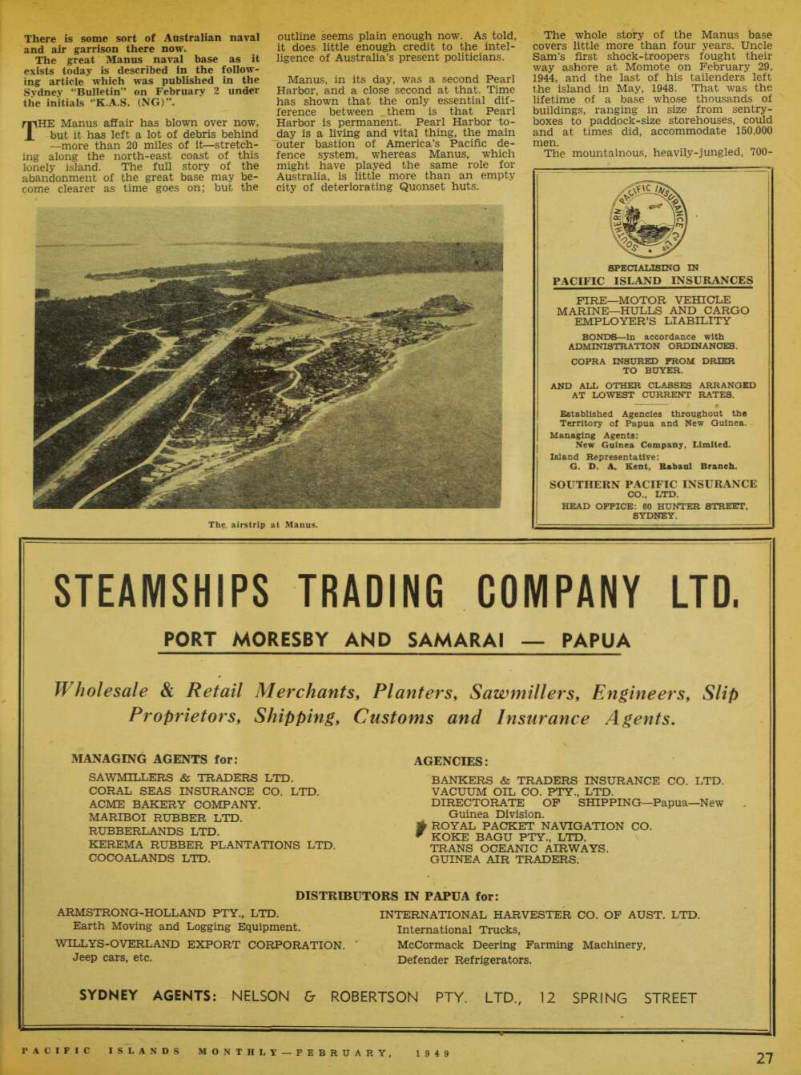
A Ghost-Town Guards Australia’s Asian Approaches
THESE two aerial photographs of Manus, Territory of New Guinea, give the impression that it might still be an important Naval base. They do not show how deserted are the hundreds of buildings, how neglected the roads; how surely the jungle is en croaching; or how the elements are eating into the buildings still standing.
Before the war the Admiralty Islands, of which Manus is the largest, were known only as a producer of Copra and good house-boys. Few, if any, of the residents of the Mandated Territory could have brought themselves to consider Manus as one of the world’s great naval bases. Yet the Americans, in a matter of months in 1944, created such a base, and when the fighting was over in 1945 were pre pared to consolidate their war-time in stallations and stay permanently there to guard the northern route between Asia and Australia.
No Australian, with the wit to read the lessons of the war just concluded, wished it otherwise; but, at this time, the Aus tralian Socialist government was be coming conscious of the fact that it had a Foreign Policy and, in the person of Dr. H. V. Evatt, a Minister of External Affairs. America was therefore informed that Australia would on no account give up any rights she had in Manus, although at some later date, certain facilities were offered to USA in respect of any base Australia herself might control there.
However, the United States by then had decided to get out; and this they did, taking with them all the most valuable equipment.
At intervals since then various Aus-
tralian Ministers—Defence, Air, Army or Navy—have made long statements to the press concerning the brilliant plans Aus tralia has for this “Commonwealth BastUm” A few workmen, have, we believe, been sent there for various pur poses from time to time. Some months ago a bunch of bureaucrats flew there in a special, chartered plane from Aus tralia for the express purpose of “Rais ing the Australian Flag”—although to the best of our belief the Australian flag had not, in effect, ever been hauled down.
Some of the hundreds of wartime buildings that are still standing, Photos by Whites Aviation.
There is some sort of Australian naval and air garrison there now.
The great Manus naval base as it exists today is described in the follow ing article which was published in the Sydney "Bulletin” on February 2 under the initials “K.A.S. (NG)”.
THE Manus affair has blown over now, but it has left a lot of debris behind —more than 20 miles of it—stretching along the north-east coast of this lonely island. The full story of the abandonment of the great base may become clearer as time goes on; but the
outline seems plain enough now. As told, it does little enough credit to the intel ligence of Australia’s present politicians, Manus, in its day, was a second Pearl Harbor, and a close second at that. Time has shown that the only essential dif ference between them is that Pearl Harbor is permanent. Pearl Harbor to day is a living and vital thing, the main outer bastion of America’s Pacific de fence system, whereas Manus, which might have played the same role for Australia, is little more than an empty city of deteriorating Quonset huts.
The whole story of the Manus base covers little more than four years. Uncle Sam’s first shock-troopers fought their way ashore at Momote on February 29, 1944, and the last of his tailenders left the island in May, 1948. That was the lifetime of a base whose thousands of buildings, ranging in size from sentry boxes to paddock-size storehouses, could and at times did, accommodate 150,000 men.
The mountainous, heavily-jungled, 700-
The airstrip at Manus.
square-mile island of Manus is the main member of the Admiralty Group a “hen-and-chicken” cluster 370 miles north-west of Rabaul and 200 miles off New Guinea’s north coast. Its geographi cal position determined its choice as supply-base and starting-point for the great drives against the Japanese in the East Indies and the Philippines. Though this was its primary war-time function, it has an obvious permanent value as the guardian of the gateway to Eastern Aus tralia and the South-West Pacific. Today, that gateway is wide open. The men who might have guarded it have gone. Only the silent buildings remain.
The base was sited mainly on the shores and reef-islands of 'Seeadler Harbor, a huge expanse whose eastern and better-protected half is cradled be tween the north-east coast of Manus and the western coast of Los Negros, which is
itself only a flat bow-shaped extension of Manus, projecting eastward from the main island and then swinging away to the north-west in a long narrow strip.
The two islands are separated only by a narrow bridgeable passage. The build ings and installations lay in jungle surrounded patches all round the eastern half of Seeadler Harbor, from Lugos on the mainland to Mokarang on the north west tip of Los Negros. The main naval area was on Manus itself, while the two big airports were Mokarang (heavy bombers) and near-by Momote (fighters).
All parts of the base, except the installa tions on the reef-islands protecting the harbor seaward, were connected by a first-class 25-mile road.
CONSIDERING the isolation of the Admiralty Group, before the war only a quiet copra-producing Pacific backwater supporting about 40 Europeans
and 13,000 natives, the scale and nature of the military installation in this pre viously almost unknown group seems in credible.
Manus had everything—first-class air fields, docks, repair-shops and workshops that could handle anything used in the Pacific war, huge deep-water jetties, enormous military stores, machinery of every imaginable type. Amenities for troops were on a grand scale. On one occasion—the launching of the Philip pines invasion—there were 800 ships gathered in Seeadler Harbor, and Momote andJMokarang were, in their heyday, two of the busiest airstrips in the world. It was a big show, and, except for a couple of RAAF and RNZAF squadrons, it was 100 per cent. American. Now it is gone, and the protection it could have afforded Australia has been thrown away, because, on the face of it, Australia’s politicians did not have the sense to know when they were on a good thing.
The Americans, on their departure, dis posed of the huge quantity of fine machinery and equipment by removing it themselves, by destroying it, or by selling it. Chief buyers were a couple of international private concerns and the Commonwealth Government. Much of the stuff acquired by the Commonwealth has deteriorated through neglect and ex posure, as instanced by the scores of motor landing-craft rotting in the man groves of Loniu Passage. The equatorial climate, with its 120 in. to 150 in. annual rainfall, has no mercy On man-made materials. The roads still in use are for the most part in a shocking condition.
Nevertheless, Manus is to figijre in Australia’s defence set-up, perhaps in conjunction with Britain. A few RAAF and RAN at Momote are keeping the airport open, and plans are said to be forward for an eventual establishment of several hundred or even a few thousand men. Even taking the most optimistic view, that is not enough to hold a large scale attack. As the Pacific war abund antly proved, isolated insufficient gar risons invite disaster.
Manus today still shows a few sparks of life. There are the handful of service people at Momote, and there is the Ad ministration at Lorengau, the “capital,” where, apart from the issuing of ukases and the filling-in of forms, the principal activity is provided by 40 Balts and Poles from Works and Housing pulling down Quonsets. Most of Manus’s over-all white population of under 100 is one way or another on the Government payroll.
There are 20 administrative officials to day in place of the pre-war seven, and one planting concern in place of the former nine—a picture, in this respect, that might be drawn of many parts of New Guinea.
Form a purely defence outlook at least, Manus inspires regret for the past rather than confidence in the future.
Advertisements & other items, pp. 28-30 (1 item)
Robert Gillespie Ptv Ltd
IMPORTERS
EXP OR TERS
r^m. t T ALL CLASSES OF MERCHANDISE PURCHASED FOR ISLAND CLIENTS
THROUGHOUT THE SOUTH-WEST PACIFIC.
ISLAND PRODUCE SOLD ON AUSTRALIAN AND OVERSEAS MARKETS
ON COMMISSION BASIS.
■ ijL.ii, /.I -i,.L^.',jvi../iLiriii^iiiijiijiL id ■
ROBERT GILLESPIE PTV LTD
BANKERS: BANK OF N.S.W.
COMPTOIR NATIONAL
D'ESCOMPTE DE PARIS
54a PITT ST SYDNEY N.S.W,
CABLE ADDRESS;
“ROBERGILL"
PHONES BW 4-782-B *305
SPECIALISING IN
PACIFIC ISLAND INSURANCES
FIRE—MOTOR VEHICLE
MARINE—HULLS AND CARGO
EMPLOYER’S LIABILITY
BONDS—In accordance with
ADMINISTRATION ORDINANCES.
COPRA INSURED PROM DRIER
TO BUYER.
AND ALL OTHER CLASSES ARRANGED
AT LOWEST CURRENT RATES.
Established Agencies throughout the Territory of Papua and New Guinea.
Managing Agents: New Guinea Company, Limited.
Island Representative: G. D. A. Kent, Babanl Branch.
SOUTHERN PACIFIC INSURANCE
CO., LTD.
HEAD OFFICE: 60 HUNTER STREET.
SYDNEY.
STEAMSHIPS TRADING COMPANY
PORT MORESBY AND SAMARAI PAPUA
LTD.
Wholesale & Retail Merchants, Planters, Sawmillers, Engineers, Slip Proprietors, Shipping, Customs and Insurance Agents .
MANAGING AGENTS for:
SAWMILLERS & TRADERS LTD.
CORAL SEAS INSURANCE CO. LTD.
ACME BAKERY COMPANY.
MARIBOI RUBBER LTD,
RUBBERLANDS LTD.
KEREMA RUBBER PLANTATIONS LTD.
COCOALANDS LTD.
AGENCIES:
BANKERS & TRADERS INSURANCE CO. LTD.
VACUUM OIL CO. PTY., LTD.
DIRECTORATE OF SHIPPING—Papua—New
Guinea Division.
* ROYAL PACKET NAVIGATION CO.
w KOKE BAGU PTY., LTD.
TRANS OCEANIC AIRWAYS.
GUINEA AIR TRADERS.
DISTRIBUTORS IN PAPUA for:
ARMSTRONG-HOLLAND PTY., LTD.
Earth Moving and Logging Equipment.
WILLYS-OVERLAND EXPORT CORPORATION. ‘
Jeep cars, etc.
INTERNATIONAL HARVESTER CO. OF AUST. LTD.
International Trucks, McCormack Deering Farming Machinery, Defender Refrigerators.
SYDNEY AGENTS: NELSON & ROBERTSON PTY. LTD., 12 SPRING STREET
ALPNT
MARYS
BAKING POWDER
For the best in delicious baking results A product of TILLOCK AND CO. PTY. LTD. manufacturers of all the famous Aunt Mary s Pure Foods
Scott’s “ Renown” Brand Rope,
Cordage and
Binder
Twine
of Every
Description
Cable Address: Ropeyard, Sydney. abases*
MANUFACTURED AT
MASCOT, N.S.W.
J. SCOTT
PTY. LTD.
Head Office and Store
163 CLARENCE STREET,
SYDNEY,
N.S.W.
Territorians Meet In Brisbane
THERE was a happy gathering of ex territorians at the home of Mrs.
Gladys Forsyth, in Brisbane, during December when 25 children of one-time New Guinea residents were presented with gifts from a Christmas tree, Mrs. Forsyth is a past-president of the Brisbane NG Association. Her home was a bower of flowers for the occasion.
Mr. Roy P. Clark, post-master at Pit cairn Island, and Mrs. Clark left for New Zealand on January 1. Mr. Clark will undergo hospital treatment in the Dominion.
Inquiries For Shell Again
Signs of Recovery of Industry
DURING the war, and since its termina tion, the world market for all kinds of Pacific Islands shell has been chaotic.
Most of the shell went to two countries— Japan and Czechoslovakia. War and post-war events destroyed or paralysed the installations set up in those countries for the manufacture of buttons and similar things from shell. Rehabilitation of the industries, in those countries and else where, has been slow, for obvious reasons —and also for the reason that plastics tend, in many cases, to take the place of the shell.
However, the industry generally is re covering. The manager of the Trans ocean Import and Export Company, of 3 Castlereagh Street, Sydney, Mr. G. Mein hold, informs us that they have inquiries for shell from America, Europe and (very limited, as yet, but growing) from Japan.
He seeks supplies of Green Snail and Trocas, from the Southwest Pacific, and of MOP and Blacklip from Fiji. Quota tions published in this journal, for a long time, have been nominal —around £BO to £lOO per ton. Mr. Meinhold says the price range is less than that—from £5O to £7O (Australian) per ton.
In view of to-day’s heavy costs, this price may not attract South Seas pro ducers. Shell beds, generally, are in good condition, however: in the last seven years, they have recovered well from the decades of “skinning” they underwent at the hands of wandering Japs.
Mr. R. J. Worssam has been appointed resident Director of Vacuum Oil Co. Pty., Ltd., in New Zealand. At one time he was a member of the Co’s, staff in Fiji.
Death Of Sir Howard Ellis
Of Fiji
Suva. Jan. 24.
THE death of Sir Howard Ellis occurred at Auckland, NZ, on January 19. Sir Howard was born in New Zealand, called to the Bar in 1912 and shortly af terwards went to Fiji where he became associated with the legal firm now known as Ellis, Munro, Warren and Leys.
In 1914 he was one of the first volun teers and served with the Northumber land Fusiliers and later in the Roval Air Force. He was awarded the MBE (Mili tary) .
Returning to Fiji he resumed his prac tice until the outbreak of the Second World War, when he became prominent in defence concerns and. in 1942, was ap pointed Director of Manpower and National Service in Fiji. From 1941 until 1943 he was one of the two unofficial members in the Executive Council. He was knighted in 1943.
Sir Howard was twice married —first to Miss Mary Mackenzie, daughter of the late Sir Thomas Mackenzie, a one-time party leader in New Zealand; and secondly (in 1926) to Miss Ellen Brewster Joske, of Suva, who survived him. He had two children, Mr. John Ellis and Miss Susan Ellis, who are both in New Zealand.
Sir Howard Ellis was 59 at the time of his death.
Death of Mrs. Helena Goldie
THE death occurred in Melbourne, Vic toria, on December 26, of Mrs.
Helena Goldie, wife of the well known Methodist Missionary, the Rev.
J. F. Goldie, of the British Solomon Islands.
New Mission Doctor For Bsi
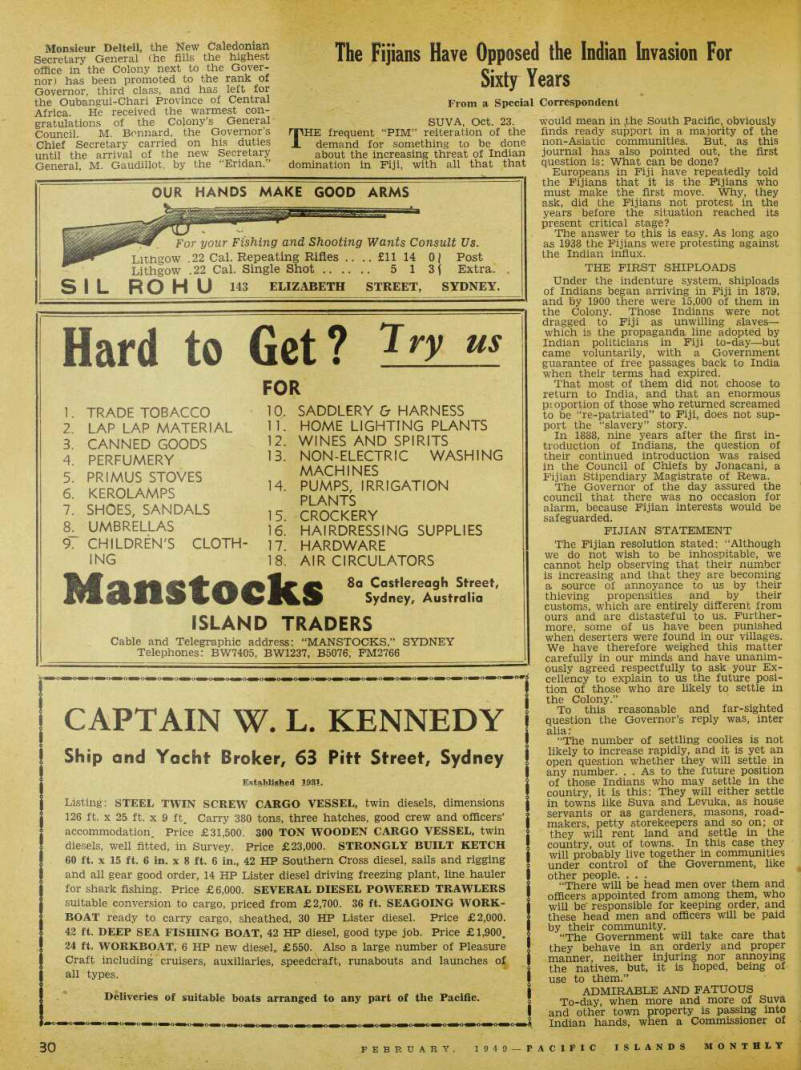
THE medical work of the Methodist Mission in the New Georgia Group and adjacent islands of the BSI should make further advances during 1949 as a result of the arrival in the islands of X)r. G. E. Hoult, who holds degrees in medicine, surgery and also in dental surgery.
Dr. Hoult left New Zealand in Novem ber, and spent a month in Sydney with a view to making contacts at the School of Tropical Medicine.
In taking up the position of medical superintendent of the Methodist Mission in BSI, Dr, Hoult follows Dr. A. G.
Rutter, who did splendid work in the years prior to 1942. In 1944, Dr. Rutter returned to the BSI as chief medical officer of the Protectorate and acted in this capacity until his departure) for Britain early in 1948.
Dr. Hoult qualified in medicine and dentistry with the idea of missionary service. His desire was to go to the Belgian Congo, but as that was not open for him, he accepted the position of Acting Medical Superintendent of the Methodist Mission in BSI for a period of 18 months. The Methodist Mission in New Zealand had been seeking a doctor for the Solomons since 1945. It is hoped that Dr. Hoult will decide to remain there for a long period.
The slaughter of deer by American Servicemen during the war has had a considerable effect on New Caledonia’s post-war export of hides. In 1941, 81,545 deerskins were exported to Aus tralia. Against this, exports in the period October, 1946, to October, 1947, were 27,451. In the same period 1947- 48, only 18,785 hides were sent overseas.
SeCTe^ary Ur G?neml’ (he fills the highest office in the Colony next to the Cover nor) has been promoted to the rank of Governor, third class, and has left for the Oubangui-Chari Province of Central Africa. He received the warmest con gratulations of the Colony’s General Council. M. Bonnard, the Governor’s Chief Secretary carried on his duties until the arrival of the new Secretary General, M. Gaudillot, by the “Eridan.”
Advertisements & other items, p. 31 (2 items)
29
PACIFIC ISLANDS MONTHLY-P E B R u A R Y. 1949
William H. Watson
ESTABLISHED 1930
RAROTONGA, COOK ISLANDS
Wholesale and Retail Trader
LICENSED STAMP DEALER
Agent For:—
BRITISH TRADERS' INSURANCE CO.
CORONA & L. C. SMITH TYPEWRITERS
KAISER & FRAZER MOTOR CARS
B.S.A. CYCLES AND MOTOR CYCLES
AMERICAN LEAD PENCIL CO.
WHITES AVIATION LTD.
Manufacturers of: FOOTWEAR, ALL CLASSES SUITABLE FOR NATIVE TRADING . . . M.O.P. PRODUCTS, INCLUDING ROUND EAR-RING BLANKS AND BUTTON BLANKS Exporter of: “Rarotonga” Hula-Skirts.
Sea-Shell Necklaces.
M.O.P. Jewellery.
Island Produce.
Cable Address: “Watson” Rarotonga Wholesale and Retail Inquiries Invited.
Prepared to Consider Agencies for all Class of Goods.
Importer of; Textiles.
General Hardware.
Fancy Goods.
General Merchandise.
Bankers; Bank of New Zealand, Auckland.
The Fijians Have Opposed the Indian Invasion For Sixty Years

Sixty Years
From a Special Correspondent
Suva, Oct. 23.
rrtHE frequent “PIM” reiteration of the x demand for something to be dpne about the increasing threat of Indian domination in Fiji, with all that that
would mean in N the South Pacific, obviously finds ready support in a majority of the non-Asiatic communities. But. as this journal has also pointed out, the first question is: What can be done?
Europeans in Fiji have repeatedly told the Fijians that it is the Fijians who must make the first move. Why, they ask, did the Fijians not protest in the years before the situation reached its present critical stage?
The answer to this is easy. As long ago as 1938 the Fijians were protesting against the Indian influx.
The First Shiploads
Under the indenture system, shiploads of Indians began arriving in Fiji in 1879, and by 1900 there were 15,000 of them in the Colony. Those Indians were not dragged to Fiji as unwilling slaves— which is the propaganda line adopted by Indian politicians in Fiji to-day—but came voluntarily, with a Government guarantee of free passages back to India when their terms had expired.
That most of them did not choose to return to India, and that an enormous pioportion of those who returned screamed to be “re-patriated” to Fiji, does not sup port the “slavery” story.
In 1888, nine years after the first in troduction of Indians, the question of their continued introduction was raised in the Council of Chiefs by Jonacani, a Fijian Stipendiary Magistrate of Rewa.
The Governor of the day assured the council that there was no occasion for alarm, because Fijian interests would be safeguarded.
Fijian Statement
The Fijian resolution stated: “Although we do not wish to be inhospitable, we cannot help observing that their number is increasing and that they are becoming a source of annoyance to us by their thieving propensities and by their customs, which are entirely different from ours and are distasteful to us. Further more, some of us have been punished when deserters were found in our villages.
We have therefore weighed this matter carefully in our minds and have unanim ously agreed respectfully to ask your Ex cellency to explain to us the future posi tion of those who are likely to settle in the Colony.”
To this reasonable and far-sighted question the Governor’s reply was, inter alia: “The number of settling coolies is not likely to increase rapidly, and it is yet an open question whether they will settle in any number. . . As to the future position of those Indians who may settle in the country, it is this: They will either settle in towns like Suva and Levuka, as house servants or as gardeners, masons, road makers, petty storekeepers and so on; or they will rent land and settle in the country, out of towns. In this case they will probably live together in communities under control of the Government, like other people. ...
“There will be head men over them and officers appointed from among them, who will be' responsible for keeping order, and these head men and officers will be paid by their community.
“The Government will take care that they behave in an orderly and proper manner, neither injuring nor annoying the natives, but, it is hoped, being of use to them.”
Admirable And Fatuous
To-day, when more and more of Suva and other town property is passing into Indian hands, when a Commissioner of
the Government of “free” India is estab lished in the capital, and when Indians are in a numerical racial majority in the Colony, these admirable sentiments appear fatuous in the extreme.
Despite this Government assurance of 1888, by 1916, when the indenture system was wound up the Indian population of Fiji had increased to 60,000. To-day it is about 125,000.
Thq apprehension of the Council of Chiefs in 1888 was mentioned by Mr. A. A.
Ragg in the Deed of Cession debate in the Legislative Council in 1946.
In the same debate. Ratu George Toganivalu, a member of both councils, referred to the following resolution passed by the Council of Chiefs in 1933: ‘This council records its strong and unanimous opinion that Fiji, having been ceded to Her Majesty the Queen of Great Britain and Ireland, her heirs and successors, the immigrant Indian popula tion should neither directly nor indirectly have any part in the control or direction of matters affecting the interests of the Fijian race.”
Ever-Growing Demands
In the course of his speech in the 1946 debate, Ratu George said: “It is evident that with the rapidly in creasing Indian population, their demand for land and more land, and the insistent cry for a wider franchise, for a form of Government based on the theory of political equality as between the Indian and the European, it is impossible to see how the Government is going to preserve the principle of trusteeship for the Fijian race and the security of native interests.”
Referring to the demarcation of Fijian land reserves—a process instituted as a result of ceaseless Indian political de mands—Ratu George said: “Will the Indians have sufficient land in the years to come? Reserves are no guarantee against future increases in population.
There again it is bound to be a clash be tween the Indian and the Fijian. . .
“It is quite true that the Indians have benefited the country economically,” he continued, “but has it done the Fijian any good? Where large rent payments are made, I find the standard of Fijian morale much lower than in places like Lau or Kadavu, where the influence of the Indian moneylender is not felt.”
Fijian View In 1948
To conclude this record, the following is quoted from the letter of a Fijian published in the “Fiji Times” on Oc tober 23, 1948—sixty years after the Coun cil of Chiefs had asked the first appre hensive question: “The Indians in Fiji will never come out in the open and co-operate in the progressive work of the Colony. They re vealed this lack of co-operation during the Second World War, when they refused pointblank to serve in the forces at the rates of pay then existing.”
Referring to an extremely controversial statement made by the new Indian Com missioner in a speech—that the Indians had come to Fiji and turned the virgin forest into a paradise—this Fijian says: “I challenge the Commissioner’s state ment. . . Do they refer to the sugarcane areas as the foundation for this claim?
If so, I say that it was due to the CSR Company, to which the Indians in Fiji owe so much and which the Indians stabbed in the back in 1944.”
Advertisements & other items, p. 32 (1 item)
Hard to Get? us
OUR HANDS MAKE GOOD ARMS
S I L
For your Fishing and Shooting Wants Consult Us.
Litngow .22 Cal. Repeating Rifles ... £ll 14 OJ Post Lithgow .22 Cal. Single Shot 5 1 3( Extra.
RO H U 143 ELIZABETH STREET, SYDNEY.
Hard to Get? us
FOR
1. TRADE TOBACCO
2. LAP LAP MATERIAL
3. CANNED GOODS
4. PERFUMERY
5. PRIMUS STOVES
6. KEROLAMPS
7. SHOES, SANDALS
UMBRELLAS
9. CHILDREN'S CLOTH-
ING
10. SADDLERY & HARNESS
11. HOME LIGHTING PLANTS
12. WINES AND SPIRITS
13. NON-ELECTRIC WASHING
MACHINES
14. PUMPS, IRRIGATION
PLANTS
15. CROCKERY
16. HAIRDRESSING SUPPLIES
17. HARDWARE
18. AIR CIRCULATORS
8a Castlereagh Street folllll V W V Sydney, Australia
ISLAND TRADERS
Cable and Telegraphic address: “MANSTOCKS” SYDNEY Telephones: 8W7405, 8W1237, 85076, FM2766
CAPTAIN W. L. KENNEDY
Ship and Yacht- Broker, 63 Pit-t Street, Sydney Established 1931.
Listing: STEEL TWIN SCREW CARGO VESSEL, twin diesels, dimensions 126 ft. x 25 ft. x 9 ft. Carry 380 tons, three hatches, good crew and officers’ accommodation. Price £31,500. 300 TON WOODEN CARGO VESSEL, twin diesels, well fitted, in Survey. Price £23,000. STRONGLY BUILT KETCH 60 ft. x 15 ft. 6 in. x 8 ft. 6 in., 42 HP Southern Cross diesel, sails and rigging and all gear good order, 14 HP Lister diesel driving freezing plant, line hauler for shark fishing. Price £6,000. SEVERAL DIESEL POWERED TRAWLERS suitable conversion to cargo, priced from £2,700. 36 ft. SEAGOING WORK- BOAT ready to carry cargo, sheathed, 30 HP Lister diesel. Price £2,000. 42 ft. DEEP SEA FISHING BOAT, 42 HP diesel, good type job. Price £1,900. 24 ft. WORKBOAT, 6 HP new diesel, £550. Also a large number of Pleasure Craft including cruisers, auxiliaries, speedcraft, runabouts and launches of all types.
Deliveries of suitable boats arranged to any part of the Pacific.
New Guinea Firm’s Air Fleet
From Our Own Correspondent LAE, Nov. 20.
A FOX moth has been added to Guinea Air Traders fleet. It is capable of carrying three passengers or 533 lb. of cargo to Wau and Bulolo. More air craft are expected by this enterprising firm.
GAT also have a C 47 on the regular run to Rome, flying immigrants to Aus tralia. They have flown five loads of
sheep from Australia direct to Kerewai, for the Government—with no loss.
Advertisements & other items, pp. 33-34 (1 item)
Sz'smce
QUEENSLAND
INSURANCE
COMPANY
LIMITED
(Incorporated 1886 In Australia)
ASSETS EXCEED £5,000,000
Head Office :
QUEENSLAND
INSURANCE BUILDING,
80-82 PITT STREET, SYDNEY.
Specialists in South Seas Fire,
Marine Or Accident Insurances
Apply to:—
FlJl.—Branch Office; I. B. Chalmers, Manager, Burns Philp (South Sea) Co., Ltd.
VILA. —Burns Philp (South Sea) Co., Ltd.
Comptolrs Francais Des Nouvelles Hebrides (Marine).
NOUMEA.—L. & W. Johnston.
NEW GUlNEA,—Manager for Mandated Territory and Papua, W. A. Anderson.
PORT MORESBY—SAMARAI—LAE
—MADANG—RABAUL.
Burns, Philp (New Guinea), Ltd.
PAGO PAGO.
Burns Philp (South Sea) Co., Ltd.
Q. H. C. Reid Sz Co.
OTHER SOUTH SEA ISLANDS.
Burns Philp (South Sea) Co., Ltd.
Also to any of the Company's Offices in Australia or Hew Zealand.
Make him happy
with his food!
The wise wife always keeps a bottle of Heinz ‘s7’ Sauce in the kitchen.
She knows that no other sauce adds so much tastiness, A few drops makes the “flavour difference” in meat dishes or fish put the bottle on the table see his eyes light up I And, next time you’re having sandwiches or savouries use a little ‘s7’ sauce.
HEINZ
SZ'SMCE
m m Of) X ARTifg * sr s ?*A\/ *'SH 'fs c nee 37 TV*'
mtm
' > s C
KEROSENE
The Favourite amongst Housewives
particularly for use in kero, refrigerators. Laurel's purity makes it outstandingly ideal for this class of service.
Impure kerosenes cause the wick to char which, in turn distorts the flame, causes soot, necessitating frequent cleaning and trimming. You need best results, so always buy Laurel!
VACUUM OIL COMPANY PTY. LTD. <inc. in aust.)
VACUUM
OUfILUT PRODUCT
Wealth From Fiji’s Cane-Lands
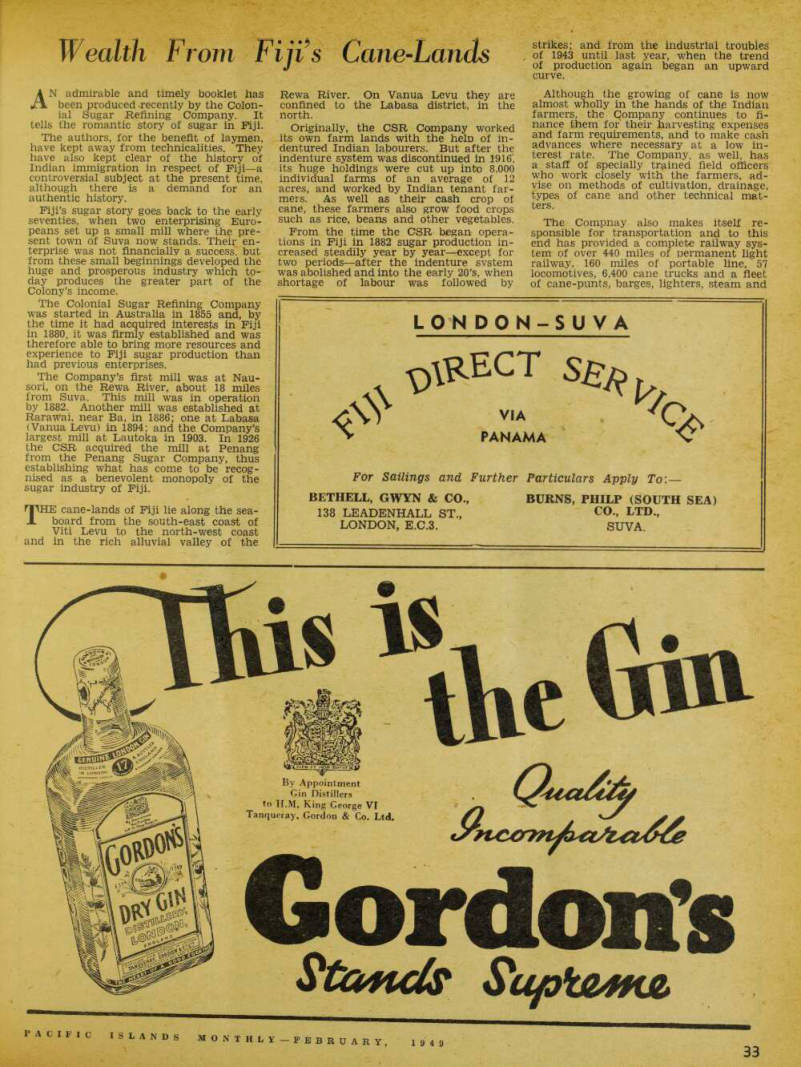

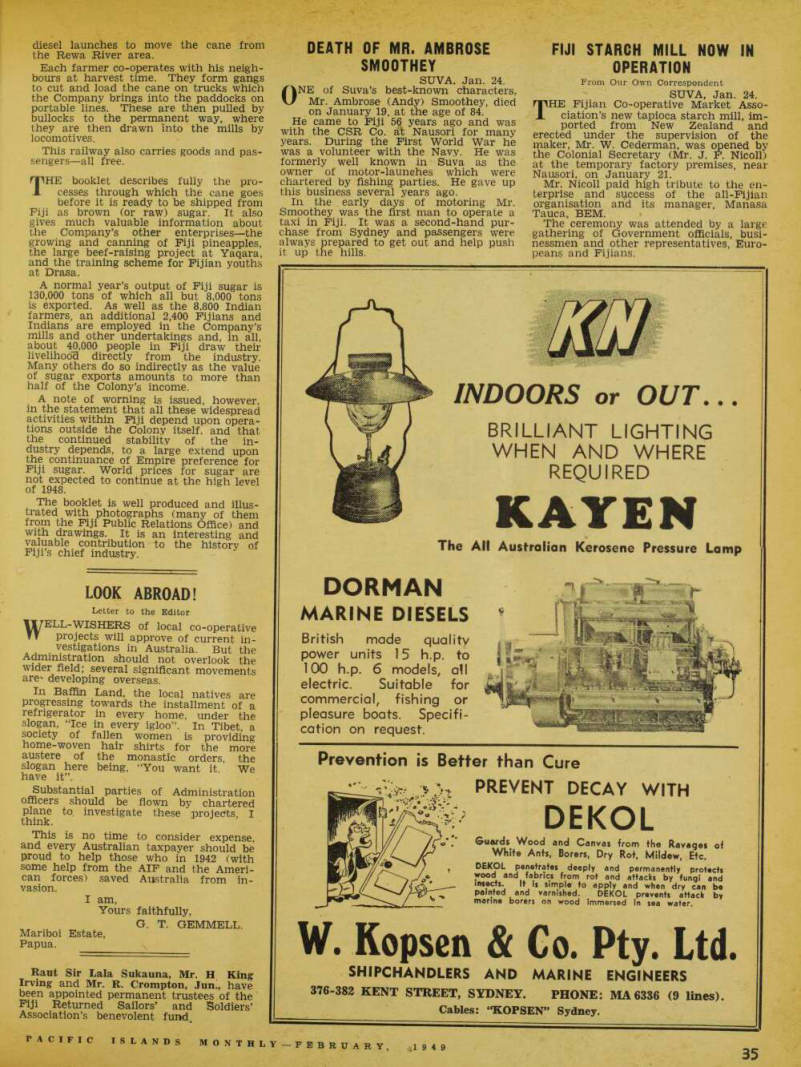
AN admirable and timely booklet has been produced recently by the Colon ial Sugar Refining Company. It tells the romantic story of sugar in Fiji.
The authors, for the benefit of laymen, have kept away from technicalities. They have also kept clear of the history of Indian immigration in respect of Fiji—a controversial subject at the present time, although there is a demand for an authentic history.
Fiji’s sugar story goes back to the early seventies, when two enterprising Euro peans set up a small mill where the pre sent town of Suva now stands. Their en terprise was not financially a success, but from these small beginnings developed the huge and prosperous industry which to day produces the greater part of the Colony’s income.
The Colonial Sugar Refining Company was started in Australia in 1855 and, by the time it had acquired interests in Fiji in 1880, it was firmly established and was therefore able to bring more resources and experience to Fiji sugar production than had previous enterprises.
The Company’s first mill was at Nau sori, on the Rewa River, about 18 miles from Suva. This mill was in operation by 1882. Another mill was established at Rarawai, near Ba, in 1886; one at Labasa (Vanua Levu) in 1894; and the Company’s largest mill at Lautoka in 1903. In 1926 the CSR acquired the mill at Penang from the Penang Sugar Company, thus establishing what has come to be recog nised as a benevolent monopoly of the sugar industry of Fiji.
THE cane-lands of Fiji lie along the sea board from the south-east coast of Viti Levu to the north-west coast and in the rich alluvial valley of the
Rewa River. On Vanua Levu they are confined to the Labasa district, in the north.
Originally, the CSR Company worked its own farm lands with the heln of in dentured Indian labourers. But after the indenture system was discontinued in 1916, its huge holdings were cut up into 8,000 individual farms of an average of 12 acres, and worked by Indian tenant far mers. As well as their cash crop of cane, these farmers also grow food crops such as rice, beans and other vegetables.
From the time the CSR began opera tions in Fiji in 1882 sugar production in creased steadily year by year—except for two periods—after the indenture system was abolished and into the early 20’s, when shortage of labour was followed by
strikes: and from the industrial troubles of 1943 until last year, when the trend of production again began an upward curve.
Although the growing of cane is now almost wholly in the hands of the Indian farmers, the Company continues to fi nance them for their harvesting expenses and farm requirements, and to make cash advances where necessary at a low in terest rate. The Company, as well, has a staff of specially trained field officers who work closely with the farmers, ad vise on methods of cultivation, drainage, types of cane and other technical mat ters.
The Compnay also makes itself re sponsible for transportation and to this end has provided a complete railway sys tem of over 440 miles of permanent light railway, 160 miles of portable line, 57 locomotives, 6,400 cane trucks and a fleet of cane-punts, barges, lighters, steam and
diesel launches to move the cane from the Rewa River area.
Each farmer co-operates with his neigh bours at harvest time. They form gangs to cut and load the cane on trucks which the Company brings into the paddocks on portable lines. These are then pulled by bullocks to the permanent way, where they are then drawn into the mills by locomotives.
This railway also carries goods and pas sengers—all free.
THE booklet describes fully the pro cesses through which the cane goes before it is ready to be shipped from Fiji as brown (or raw) sugar. It also gives much valuable information about the Company’s other enterprises—the growing and canning of Fiji pineapples, the large beef-raising project at Yaqara, and the training scheme for Fijian youths at Drasa.
A normal year’s output of Fiji sugar is 130,000 tons of which all but 8,000 tons is exported. As well as the 8.800 Indian farmers, an additional 2,400 Fijians and Indians are employed in the Company’s mills and other undertakings and, in all, about 40,000 people in Fiji draw their livelihood directly from the industry.
Many others do so indirectly as the value of sugar exports amounts to more than half of the Colony’s income.
A note of worning is issued, however, in the statement that all these widespread activities within Fiji depend upon opera tions outside the Colony itself, and that the continued stability of the in dustry depends, to a large extend upon the continuance of Empire preference for Fiji sugar. World prices for sugar are not expected to continue at the high level of 1948.
The booklet is well produced and illus trated with photographs (many of them from the Fiji Public Relations Office) and with drawings. It is an interesting and valuable contribution to the history of Fiji’s chief industry.
Advertisements & other items, pp. 35-36 (1 item)
G or don's
LON DON-SUVA
DIRECT
> N vT VIA A
c
PANAMA
❖ For Sailings and Further Particulars Apply To: — BETHELL, GWYN & CO., BURNS, PHILP (SOUTH SEA)
138 LEADENHALL ST., CO., LTD.,
LONDON, E.C.3. SUVA.
&SSJS
-r By Appointment Gin Distillers R# GO 0$ W 2
G or don's
Stands Supk&mjL
to H.M. King George VI Tanqueray, Gordon & Co. Ltd.
There is only one
ELECTROLUX
THE MODERN KEROSENE-OPERATED REFRIGERATOR
THAT ACHIEVES THE MIRACLE OF ICE FROM HEAT
Lasting Efficiency, Silent Operation, Streamlined Beauty
1 ■ ■ Wl Economically operated by kerosene, with a simple precision-built freezing unit that has no moving ports and is GUARANTEED FOR
FIVE (5) YEARS.
Model LKSSI Obtainable from:
NEW GUINEA COMPANY, LIMITED.
Rabaul, Madang, Lae, Kavieng.
J, R. CLAY & CO., LTD., Port Moresby.
W. R. CARPENTER & CO. (Sol. Is.), LTD., Tulagi.
PRICES ON APPLICATION.
I Storage capacity: 5i cub. ft. (approx.); shelf area, 9 sq. ft. food shelves, six—five removable; 2 self-supporting when half drawn. Ice-making: trays —5 lb. ice per freezing: 80 cubes. Fuel consumption: 1.8 pints kerosene per day (approx.).
For New Hebrides, Butaritari, Noumea, New Caledonia., Apply— Height: 4 ft. 10 in. Depth: 2 ft. 3i in.
Weight, unpacked, 406 lb. Packed, 574 lb.
W. R. CARPENTER & CO., LTD.. Head Office: 16 O'Connell St., Sydney, N. S. Wales
Look Abroad!
Letter to the Editor WELL-WISHERS of local co-operative projects will approve of current in vestigations in Australia. But the Administration should not overlook the wider field; several significant movements are' developing overseas.
In Baffin Land, the local natives are progressing towards the installment of a refrigerator in every home, under the slogan, “Ice in every igloo”. In Tibet, a society of fallen women is providing home-woven hair shirts for the more austere of the monastic orders, the slogan here being, “You want it. We have it”.
Substantial parties of Administration officers should be flown by chartered plane to, investigate these projects, I think.
This is no time to consider expense, and every Australian taxpayer should be proud to help those who in 1942 (with some help from the AIF and the Ameri can forces) saved Australia from in vasion.
I am, Yours faithfully,
G. T. Gemmell.
Mariboi Estate, Papua.
Raut Sir Lala Sukauna, Mr. H King Irving and Mr. R. Crompton, Jim., have been appointed permanent trustees of the Fiji Returned Sailors’ and Soldiers’
Association’s benevolent fund
Smoothey
Death Of Mr. Ambrose
Osuva. Jan. 24.
NE of Suva’s best-known characters, Mr. Ambrose (Andy) Smoothey, died 6 r. age of 84 u 1 y ® ars ago and was with the CSR Co. at Nausori.for many years. During the First World War he was a volunteer with the Navy. He was formerly well known in Suva as the owner of motor-launches which were chartered by fishing parties. He gave up this business several years ago.
In the early days of motoring Mr.
Smoothey was the first man to operate a taxi in Fiji. It was a second-hand purchase from Sydney and passengers were always prepared to get out and help push it up the hills.
Operation
Fiji Starch Mill Now In
From Our Own Correspondent
Suva Jan 24
nnHE Fijian Co-operative Market 'asso- A ciation’s new tapioca starch mill, im ported from New Zealand and erected under the supervision of the maker, Mr. W. Cederman, was opened by the Colonial Secretary (Mr. J. F. Nicoll) a t the temporary factory premises, near Nausori, on January 21.
Mr. Nicoll paid high tribute to the en terprise and success of the all-Fijian organisation and its manager. Manasa Tauca, BEM.
The ceremony was attended by a large gathering of Government officials, busi nessmen and other representatives, Euro peans and Fijians.
Advertisements & other items, pp. 37-38 (1 item)
Kayen
INDOORS or OUT. ..
BRILLIANT LIGHTING
WHEN AND WHERE
REQUIRED
KAYEN
The All Australian Kerosene Pressure Lamp
DORMAN
MARINE DIESELS
British made quality power units 15 h.p. to 100 h.p. 6 models, all electric. Suitable for commercial, fishing or pleasure boats. Specification on request. r
Uk- -i
Prevention is Better than Cure O
PREVENT DECAY WITH
DEKOL
Guards Wood and Canvas from the Ravages of White Ants, Borers. Dry Rot, Mildew. Etc.
DEKOL penetrates deeply and permanently protects wood and fabrics from rot and attacks by fungi and insects. It i* simple to apply and when dry can be painted and varnished. DEKOL prevents attack by marine borers on wood immersed in sea water.
W. Kopsen & Co. Pty. Ltd.
SHIPCHANDLERS AND MARINE ENGINEERS
376-382 KENT STREET, SYDNEY. PHONE: MA63S6 (9 lines).
Cables: "KOPSEN” S:
Day-Old
Chicks
BY AIR
Amalgamated Hatcheries
(Reg.) of Bankstown, near Sydney, N.S.W., can dispatch limited numbers of chicks by
PLANE TO
RABAUL, PORT MORESBY,
LAE, NOUMEA, SUVA.
and all other islands of the Pacific served by present AND PROJECTED air services.
Amalgamated Hatcheries are the largest distributors of dayold chicks in Australia, last year over 1,000,000 chicks being sold by us in N.S.W. alone.
Our scientific method of packing and dispatch has resulted in a loss of less than 1 per cent, of chicks sent by plane.
If any chicks in your consignment arrive dead, we will replace them free, provided the extra freight is paid by the purchaser.
Chicks available are R.1.R., Austrolorps, and W.L.
Price, £lO per 100, landed at your airport, for unsexed chicks, and £l4 per 100 for all pullets. (Guaranteed 96 per cent, accurate sexing.) These chicks are the cream of Australia’s stock, produced under ultra - violet rays to guard against disease; the adult stock is blood-tested monthly by veterinary officers and each individual order carries a N.S.W.
Government certificate that the chicks are healthy and from tested stock.
Payment for chicks should be made by draft with the order, or credit arranged through our Bankers, the Commercial Bank of Australia, Ltd., Bankstown,
N.S.W.
Drafts and remittances can be sent direct to Amalgamated Hatcheries, Bankstown, N.S.W., or to the following agents: Messrs. Burns, Phiip (South Sea) Co., Suva-Ba-Fiji, or any Island Branch. Also to: Marcel Legras, 38 Rue de Verdun, Noumea.
WRITE BY AIR-MAIL OR
CABLE.
AMALGAMATED
HATCHERIES
BANKSTOWN, N.S.W.
Rid Kidneys Of
Poisons And Adds
If you suffer sharp, stabbing pains, if Joints are swollen, it shows your blood Is poisoned through faulty kidney action. Other symptoms of Kidney Disorders are Backache, Aching Joints and Limbs, Sciatica, Neuritis, Lumbago, Sleepless Nights, Dizziness, Nervousness, Circles under Eyes, Loss of Energy and Appetite and Frequent Headaches and Colds, etc. Ordinary medicines can’t help much because you must get to the root cause of the trouble.
The Cystex treatment Is specially compounded to soothe, tone and clean kidneys and bladder and remove acids and poisons from your system safely, quickly and surely, yet contains no harmful or dangerous drugs. Cystex works In 3 ways to end your troubles. 1. Starts killing the germs which are attacking your Kidneys, Bladder and Urinary System In two hours, yet Is absolutely harmless to human tissue. 2 Gets rid of health-destroying, deadly poisonous acids with which your system has become saturated. 3 strengthens and reinvigorates the kidneys, protects from the ravages of disease-attack on the delicate filter organism, and stimulates the entire system.
Praised by One-time Sufferers
Cystex Is approved by one-time sufferers in T 3 countries from the troubles shown above.
Mr. Reg Thomas, Townsville. Queensland, recently wrote: “My joints were all stiff, I had leg pains, my back used to ache day and night.
My bladder was weak. I had headaches and no appetite. The first dose of Cystex helped me and before I finished three boxes my health and strength came back.”
Guaranteed to Satisfy or Money Back
Get Cystex from your chemist or store to-day. live It a thorough test. Cystex Is guaranteed o make you feel younger, stronger, better li very way, or your money back if you return he empty package, low in 2 sizes—4/-, */-•
guaranteed CVStGX
Treatment *
for Your Kidneys, Bladder, Rheumatism.
Commission
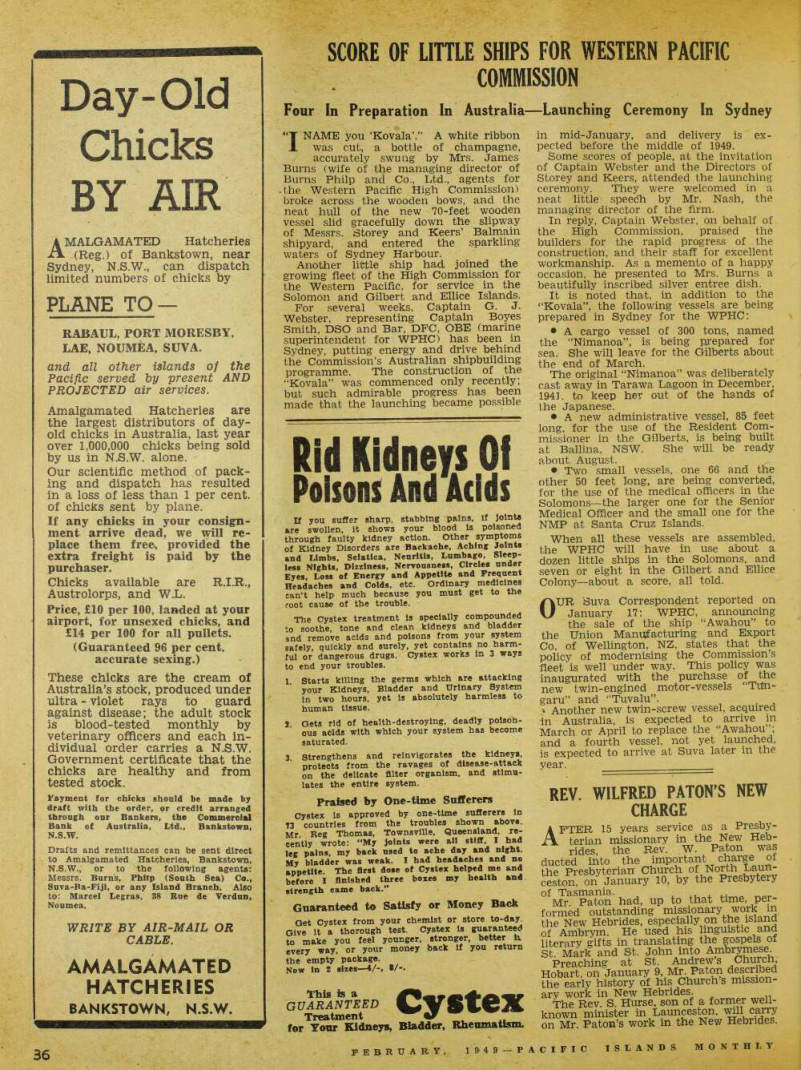
SCORE OF LITTLE SHIPS FOR WESTERN PACIFIC
Four In Preparation In Australia—Launching Ceremony In Sydney
“T NAME you ‘Kovala’.” A white ribbon A was cut, a bottle of champagne, accurately swung by Mrs. James Burns (wife of the managing director of Burns Philp and Co., Ltd., agents for the Western Pacific High Commission) broke across the wooden bows, and the neat hull of the new 70-feet wooden vessel slid gracefully down the slipway of Messrs. Storey and Keers’ Balmain shipyard, and entered the sparkling waters of Sydney Harbour.
Another little ship had joined the growing fleet of the High Commission for the Western Pacific, for service in the Solomon and Gilbert and Ellice Islands.
For several weeks, Captain G. J.
Webster, representing Captain Boyes Smith, DSO and Bar, DFC, QBE (marine superintendent for has been in Sydney, putting energy and drive behind the Commission’s Australian shipbuilding programme. The construction of the “Kovala” was commenced only recently; but such admirable progress has been made that the launching became possible
in mid-January, and delivery is ex pected before the middle of 1949.
Some scores of people, at the invitation of Captain Webster and the Directors of Storey and Keers, attended the launching ceremony. They were welcomed in a neat little speech by Mr, Nash, the managing director of the firm.
In reply, Captain Webster, on behalf of the High Commission, praised the builders for the rapid progress of the construction, and their staff for excellent workmanship. As a memento of a happy occasion, he presented to Mrs. Burns a beautifully inscribed silver entree dish.
It is noted that, in addition to the “Kovala”, the following vessels are being prepared in Sydney for the WPHC: • A cargo vessel of 300 tons, named the “Nimanoa”, is being prepared for sea. She will leave for the Gilberts about the end of March.
The original “Nimanoa” was deliberately cast away in Tarawa Lagoon in December, 1941. to keep her out of the hands of the Japanese. • A new administrative vessel, 85 feet long, for the use of the Resident Com missioner in the Gilberts, is being built at Ballina, NSW. She will be ready about August. • Two small vessels, one 66 and the other 50 feet long, are being converted, for the use of the medical officers in the Solomons—the larger one for the Senior Medical Officer and the small one for the NMP at Santa Cruz Islands.
When all these vessels are assembled, the WPHC will have in use about a dozen little ships in the Solomons, and seven or eight in the Gilbert and Ellice Colony—about a score, all told.
OUR Suva Correspondent reported on January 17: WPHC, announcing the sale of the ship “Awahou” to the Union Manufacturing and Export Co. of Wellington, NZ, states that the policy of modernising the Commission’s fleet is well under way. This policy was inaugurated with the purchase of the new twin-engined motor-vessels “Tiln garu” and “Tuvalu”. . •. Another new twin-screw vessel, acquired in Australia, is expected to arrive in March or April to replace the “Awahou”: and a fourth vessel, not yet launched, is expected to arrive at Suva later in the year.
Rev. Wilfred Paton’S New

Charge
AFTER 15 years service as a Presby terian missionary in the New Heb rides, the Rev. W. Paton was ducted into the important charge ot the Presbyterian Church of North Laun ceston, on January 10, by the Presbytery ° f ]Vfr aS Paton had, up to that time, per formed outstanding missionary work m the New Hebrides, especially on the island of Ambrym. He used his linguistic and literary gifts in translating the gospels ot St. Mark and St. John into Ambrymese Preaching at St. Andrews pburch, Hobart, on January 9, Mr. Paton described the early history of his Church s mission ary work in New Hebrides.
The Rev. S. Hurse, son of a former well known minister in Launceston, willi carry on Mr. Paton’s work in the New Hebrides.
Queen Salote, of Tonga, was a guest at Government House, Suva, Fiji, for a brief period, during January.
After three months at Suva, Fiji, the Canadian auxiliary cutter “Escapee” sailed on her return voyage to Van couver at the end of January. On board are the owner (Mr. G. Brock) and Messrs. Wells and Fortune. The “Es capee” will sail by way of the Lau Gflpup, Tonga,- Rarotonga, Tahiti and Honolulu.
Advertisements & other items, pp. 39-40 (1 item)
Equip
Price at Works: £36/10/- Extra for 10 inch additional shelf and brackets (if required): £2 Glass Server to Top (if required) : £l/10/- Packing and Transport to Wharf: £lO/10/- The display case is securely packed in two substantial crates occupying shipping space of 37 cubic feet. Total weight, when packed, 5 cwt.
Smart
Your Store with this
Modern Counter Display
Specially Built for Export
Case
A * smart as those in leading Australian city stores, and built by a firm that has been making fine store and office fittings for over a third of a century. s Moreover it is specially built for export, so that it can be readily securely packed, and assembled by anyone, from simple directions, in an hour, with no tools other than a screwdriver. * Retailers all over the world have learned the selling value of modern display equipment and this “silent salesman will soon pay for itself in increased sales. 3 4 P a tniS sllenl Volume production has enabled us to make economies in manufacturing costs, and this saving has been passed on to our customers. The price has been substantially reduced, and is now only £36/10/-
HERE ARE THE DETAILS
of the "Brohol" Export Counter Cose
(as illustrated ) * To help you to get on accurate picture of the "Brahol" Special Export Glass Counter Case, here are the main specifications:— • Overall size is 6 feet long x 1 ft. 9 ins. deep x 3 ft. 3 ins. high. Made from first-class, wellseasoned Queensland Maple, hand french polished, wax finished, in natural maple colour.
Glass parts are i inch British plate glass. • The inside is lacquered ivory colour, and the recessed base is lacquered burgundy. • There is a pair of solid core sliding doors, and one glass shelf, 14 inches wide, on adjustable nickel-plated brackets. • Storage space below is 1 1 inches high. • The plate glass front is 22 inches high.
BRAY & HOLLIDAY
PTY. LTD.
Makers of Fine Store and Office
Fittings for over a third of a century.
Brahol House, 66-74 McLachlon Avenue, Rushcutter Boy, Sydney. Telephone: FA 4121.
Cable & Telegraphic Address: “Brahol”
The Twinkle in
Your Eye
COMES FROM ACTIVE
DIGESTION
Good normal digestive and liver activity means good, normal health and fitness. If yo* are becoming gloomy and feel tired out, the cause may be a congested state of your Intestinal tract. So many people are troubled with constipation, which, through the retention of waste in the digestive system, causes sick headache, biliousness, pimply skin, unpleasant breath, irritability, slackness and dull eyes.
Regain your bright and attractive appearance by banishing constipation with Pinkettes. Tiny, perfectly harmless, gentle yet effective, these famous laxative and liver pills painlessly exercise and strengthen the bowels, keep the food tract clean and active, stir the liver, and thus banish sick headache, bilious attacks, pimples, unpleasant breath and gloom. All chemists and stores sell Pinkettes, the perfect laxative and liver pills.
ALOIS AKUN & CO
RABAUL, NEW GUINEA
Also Branch At 180 NATHAN RD., KOWLOON, HONG KONG
Planters, Shipowners and General Merchants
Dealers in EMBROIDERED SILKWEAR—CARVED CAMPH. BOXES—
EASTERN FANCY GOODS
TRADE GOODS SPECIALISTS : : Wholesale Retail Prompt Attention To All Orders Telephone: 136, Telegram: Aloisakun I Sydney Representatives: NELSON & ROBERTSON PTY., LTD., Electra House, 12 Spring St., Sydney, N.S.W.
Three Years After the Blitz
A Glimpse of Honiara by a Recent Visitor.
AFTER nearly three years’ existence as a capital, Honiara, ESI, still is a leaf-roofed camp in a setting of decayed war-time litter. Sum total of permanent buildings erected to date are —one post office, one radio station, one native market, eight permanent houses and several Euronesian houses.
It is natural to wonder why so little has been accomplished in a period of time adequate for at least the foundations of the new capital to be taking solid shape. But it is also necessary to re member that the BSI Government started its post-war career by going to the mixed bargain sale run by the American War Disposals Committee on Guadalcanal, and since then much valuable time has been spent trying to check up on just what was acquired and where it is and just how to put it to the best use. As well, it is necessary to keep secondhand machinery and vehicles from collapsing into an early old age.
Then, too, overseas markets could not supply building materials, so practically every bit of material used to date has been salvaged from old Army buildings.
The area round the present Honiara workshop (the former Stateside area) is a nightmare junkheap of everything from sagging petrol lorries to rusted mobile sterilising units, with a vast pile of weary tyres. It is not clear to the spectator just which, if any, of this junk is supposed still to be serviceable; or what was acquired in the bargain basement deal; or what is still waiting to be dumped in the sea. But the
general air of decay strikes alarm to the spirits of the tidy-minded, as does the fact that a mile-long barbed wire fence erected 12 months ago to protect the workshop and its concentration of petrol has collapsed.
A year ago a colossal concentration of petrol was explained as Honiara’s supply for the next three years. Latest reports are that after barely a year, the Govern ment finds itself practically down to the dregs again, due to average monthly consumption of 2,300 gallons.
The 20-odd Government-owned jeeps driven by Government officials (some for pleasure, in which case they pay for their own petrol) and the 20 trucks and lorries, plus a few oddments like the big red fire cart (main function of which is to offset the deficiencies of the water supply by rushing water to the needy) chew up a fabulous amount of petrol and also a terrific slice of time and maintenance.
Early in November, Government issued a decree that vehicles with unserviceable brakes (and quite a proportion of Honiara’s drivers were managing with none at all) were to come off the road.
Immediately 17 Public Works Department trucks were laid up and, to quote the statement in BSI Government’s current weekly broadcast, “work on the new capital was brought virtually to a stand still.” At the New Year, vehicle registra tion, driving tests for non-holders of outside licences and more stringent road rules will come into force.
ryou approach Honiara from the old American wharf at Kukum, the most depressing sight is the hospital area, an abandoned-looking straggle of Army huts with frayed, leaf roofs, and rotting timber. Actually, it houses heroic en deavour under difficult conditions, and its most striking feature is its flourishing
vegetable garden,
The arid temporary “suburb” of Kola’a Ridge, nearly always in a flap over fail ing power and water supply, looks down on the hospital. It comprises seven mend-and-make-do houses, which were hastily and expensively run up some two years ago for Government officials.
Three of these houses are now empty (an embarrassing number of resignations have kept Government moving employees round in a sort of Mad Hatter’s tea party) and the others will be wiped off when the new Honiara is built.
Between the hospital and the Matanikau River lies the temporary Chinese settle ment—more army huts, very desiccated, some turned into primitive stores and tailoring establishments. There are about 100 Chinese living there, about 20 work ing for the Government as carpenters and handymen.
Then you cross the sagging, constantly reinforced American-built bridge over the Matanikau, and on the other side of this, dumped out in the weather, with grass growing high through the girders, stand the five Baily bridges which will be erected over the three principal rivers, Matanikau, Lunga and Tenaru. These bridges have been sitting there for the last 12 months, apparently awaiting the day when an expert to erect them strays into the Protectorate. Beyond them lies the Government experimental farm, necessitating the upkeep of some 20 miles of road.
The main road improves (faintly) as you near Point Cruz, a slender finger of swamp, scrub and coral, which was the site of an expensive hydrographic survey round about December, 1947. when the present small-boat anchorages on both sides of the Point were examined as the basis for a huge future harbour and wharfing scheme. Reports were ap parently encouraging, but old hands are nasty about the whole idea, saying that the construction and maintenance of wharves that will do the job for any thing larger than a 600 tonner will be a constant headache to everybody.
At the moment, the sheltered eastern side of Point Cruz (site for this wharf scheme) has an 80-foot pontoon dock, capable of berthing the Government motor vessel “Kurimarau”.
A PLAN of New Honiara on view in the Lands Department seems to have very little bearing on the current
proposals of the Honiara Town Board (comprised of six members) which have changed so constantly during the past two years that the general public has given up trying to follow what is going on. An excellent building area for a number of economically-centred dwelling places has been abandoned, ’ apparently for the projected purpose of laying down a golf course (unofficial, estimated cost up to £1,000). The result of this is that the residential area is scattered hither and yon, with complicated water and lighting systems as a result.
Some houses are going on to a lofty ridge overlooking Point Cruz, with the new radio station as their nucleus. The new houses are almost completed there, and on the flat below them is the just completed native market, two already inhabited permanent houses, a high, grim building known as The Transit Quarters (refuge for homeless visitors to Honiara) and, on 'the seashore, the temporary quarters of the Government Trade Scheme. This, failing the reopening of outside commercial interests, caters for European housekeeper and moneyed Solomon Islander alike and, to the casual onlooker, appears to be doing a good job at prices which could certainly be worse.
Government Trade Scheme handles the fresh meats and small-goods offered three (Continued Next Page)
times a week at the Government “reefer” —fresh butter 4/6 a pound, fresh meat averaging about 3/- a pound.
OVER a new concrete bridge spanning a harmless-looking creek (but native critics say the storm drain is too small to take what they’ve seen come down in floodtime) and we’re in Honiara camp itself —practically the same as it was three) years ago, except for the addition of a few more leaf-roofed huts for bachelor employees, a few more leaf roofed annexes to the Government build
ing and the removal of the post office from its old fowl-house accommodation to a magnificent plywood affair (perma nent) across the road.
The Chief Magistrate still holds court in another leaf-roofed fowl house (temporary) in the camp area; the Residency still stands on the foreshore, converted out of what was a war-time, New Zealand casualty clearing station.
There are five leaf-roofed residences behind the new post office, set round what seasonally lives up to its name of Mud Alley, but you don’t take much notice of these—allegedly they’re not permanent.
Further on, clambering up the side of a ridge overlooking the golf course (proposed) are three permanent houses, completed within the last six months— quite pleasing but for the fact that all are dominated at the back by what appear to be gigantic lavatories; these are boy houses, which will presumably soften with age and a little horticulture.
Somehow the designs for these new houses, although commendable consider ing their salvage material origin, have a strange clumsiness and miss the dignity of pre-war Tulagi homes. Best house is certainly that of the manager for the Trade Scheme who was his own designer in collaboration with his builder. But each Government house seems a little Jess tangled-up with walls and, doors and cubby-holes, than the last, so the yet-to-be-built Residency stands a chance of being a success.
But it seems that transport will con tinue to be a problem in the new Honiara and roads, lighting and water systems a continual expense. It remains to be seen whether the economic future of the Group justifies the outlay made for the capital from the pockets of the gallant British taxpayer.
Advertisements & other items, pp. 41-42 (1 item)
Aluminium Roofing
We Will Buy
It For You
Any goods you may require from English shops or factories Purchased and Shipped.
Small or large orders catered for.
ALL SERVICES UNDER-
TAKEN FOR RESIDENTS
ABROAD.
PITT & SCOTT
LIMITED
(Established 1876) General Shipping and Buying Agents . 1/3, St. Paul's Churchyard, London, England Cables. Shipping London.
A. B. DONALD Ltd.
AUCKLAND
ISLAND TRADERS & GENERAL MERCHANTS
P.O. Box 1509. Cobles & Telegrams, "Kingdom/ 7 Auckland.
Aluminium Roofing
... O s Now available for shipment to Pacific Islands Aluminium Corrugated Roofing is rustless and is the lightest of all fabricated roofing materials. This Is a point worth remembering when considering freight costs. Heat due to solar radiation is substantially reduced when Aluminium roofing is used.
Inquiries to:-
ALUMINIUM UNION LIMITED
(Incorporated in the Dominion of Canada) Largest Distributors of Aluminium and its allo/s in the British Commonwealth OCEAN HOUSE, 34 MARTIN PLACE, SYDNEY, N.S.W.
A Member of the Aluminium Limited Group, Montreal, Canada
PACIFIC ISLANDS SOCIETY
Visitors from the Islands to Sydney (or those interested In Islands affairs), are advised to communicate with the honorary secretary of the above Society, which has been formed to study the history, traditions, economics, and political developments of the Pacific Islands.
Regular monthly meetings are held at History House, 8 Young Street, Sydney.
Address for Correspondence:
THE PACIFIC ISLANDS SOCIETY,
Box 2434 MM., G.P.0., Sydney.
lntp eria L
foods
• Corned Be®* • Harn , pe p o rk m Luncheon P° rK • ’ lrirn o- • Camp P'® , Pate de Foie
Meatreat
Sausages and
Vegetables
, Bacon Rashers Irish Stew
• s?P ■ jr*
* Beef Sausages W « -L Catisaa© s de ro>» Beet • e fstelk Pudding •
:KE2Tt* Steak : SnaS-ag.es
Stew y. , y * Tomato S P • •. «
Imperial
i ~Brisket Beet » n i c A \+ed Boneless Bn p ro ien A ' S °,u S ind 100 lb. Kegs ** * 50 lb. a * d - n a Bacon.
SJfc.H.m. and BaC ° n - MeaT ‘ Prices on OPP' !cafi ° n C«
ALL
BgE]f\ Imperial
V CANNED FOODS
ARE FLAVOUR-SEALEDI
CANNED FOODS
ARE FLAVOUR-SEALED!
0 OK fO OO QO \z
RIVERSTONE MEAT CO
Imperial goods are prepared from prime selected stock by the largest meat-processing organisation in Australia. You can be sure of top-quality when you order "Imperial."
PTY. LID.
5-7 O'Connell Street, Sydney.
Fiji Representative: Pearce & Co. Ltd.. Suva. £
Membership of Suva Yacht Club
A Record
Prom Our Own Correspondent
Suva. Jan. 24.
MEMBERSHIP of the Suva Yacht Club at the end of the 1948 season is a record. There are 400 financial mem bers.
The big event of the year was the open ing of the new clubhouse, which has been praised and admired by overseas visitors to Suva.
Officers elected at the annual meeting of the Club recently are as follows: General Committee: Commodore, Cap tain J. P. Mullins; vice-commodore, Mr.
S. A. Lee; rear-commodore. Captain E.
W. Harness; secretary, Mr. J. W. St.
Julian; treasurer, Mr. V. Hawksley; sail ing captain, Mr. T. F. B. Frost; house captain, Mr. W. Willoughby; two elected members, Mr. J. K. Mac Lean, Mr. J.
Molloy.
Sailing Committee: Starter, Mr. L.
Hawksley; timekeeper, Mr. G. Robertson; handicapper, Mr. O. A. Bentley; junior representative, Master B. Frost.
House Committee: Two elected lady members, Mrs. M. Williams, Mrs. W. Sel lars; junior representative; Master P.
Sellars.
The date of the official opening of the 1949 yachting season has been fixed for February 26 and 27.
Mr. E. J. Coode is to be stationed at Rabi, where he is to be Adviser on Bana ban Affairs. Mr. Coode will replace Major F. G. L. Holland, GM, who is to re tire. Rabi is the Fiji island on which has been settled the surplus population from Ocean Island (Gilbert and Ellice Colony).
Magazine Section
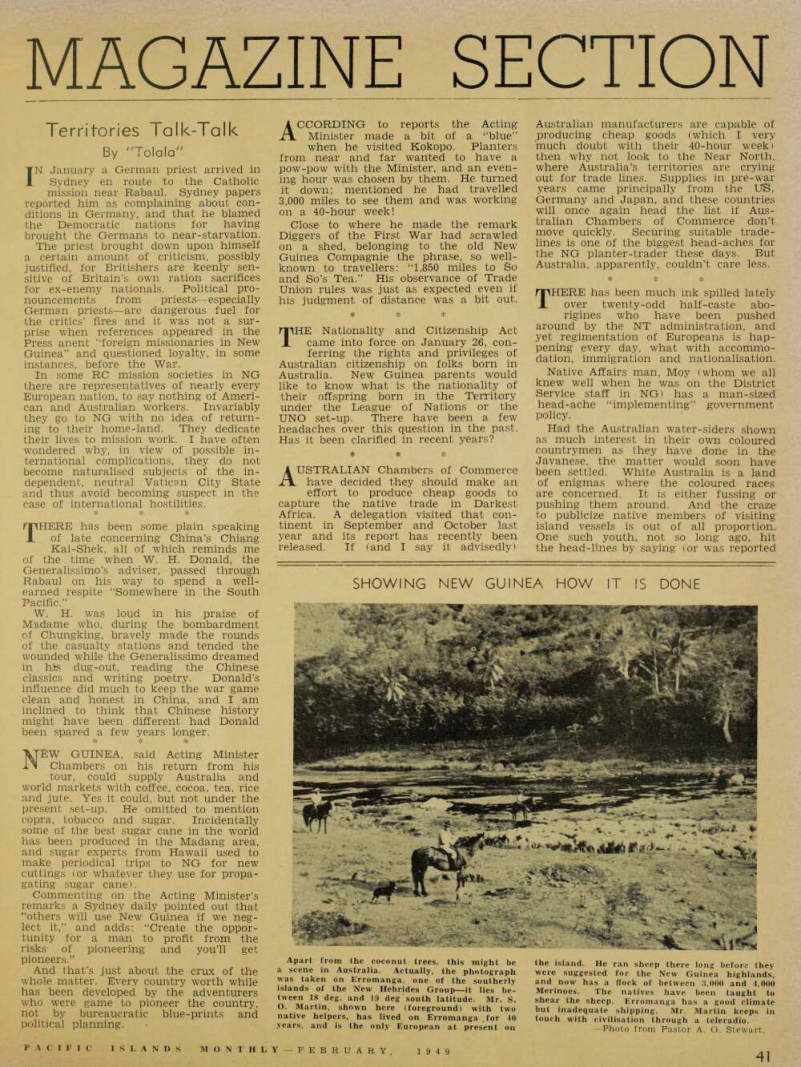
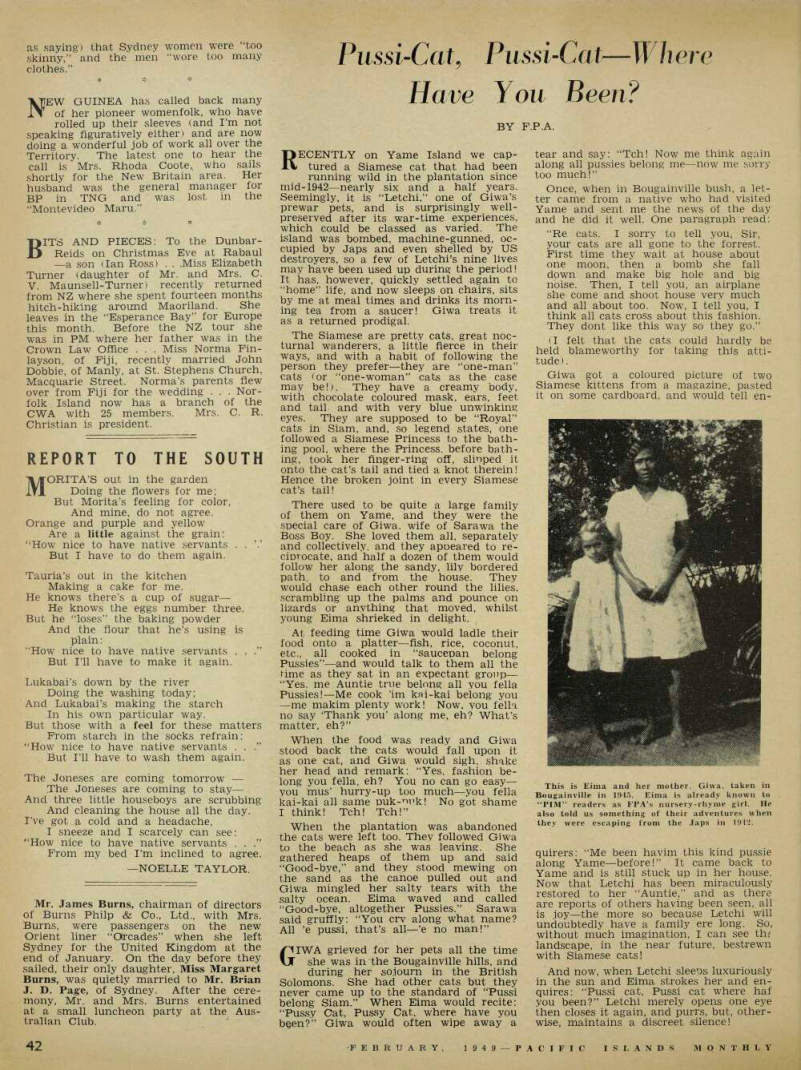
Territories Talk-Talk
By "Tolala"
IN January a German priest arrived in Sydney en route to the Catholic mission near Rabaul. Sydney papers reported him as complaining about con ditions in Germany, and that he blamed the Democratic nations for having brought the Germans to near-starvation.
The priest brought down upon himself a certain amount of criticism, possibly justified, for Britishers are keenly sen sitive of Britain’s own ration sacrifices for ex-enemy nationals. Political pro nouncements from priests—especially German priests—are dangerous fuel for the critics’ fires and it was not a sur prise when references appeared in the Press anent “foreign missionaries in New Guinea” and questioned loyalty, in some instances, before the War.
In some RC mission societies in NG there are representatives of nearly every European nation, to say nothing of Ameri can and Australian workers. Invariably they go to NG with no idea of return ing to their home-land. They dedicate their lives to mission work. I have often wondered why, in view of possible in ternational complications, they do not become naturalised subjects of the in dependent, neutral Vatican City State and thus avoid becoming suspect in the case of international hostilities. * * * THERE has been some plain speaking of late concerning China’s Chiang Kai-Shek, all of which reminds me of the time when W. H. Donald, the Generalissimo’s adviser, passed through Rabaul on his way to spend a well earned respite “Somewhere in the South Pacific.”
W. H. was loud in his praise of Mjidame who, during the bombardment of Chungking, bravely made the rounds of the casualty stations and tended the wounded while the Generalissimo dreamed in his dug-out, reading the Chinese classics and writing poetry. Donald’s influence did much to keep the war game clean and honest in China, and I am inclined to think that Chinese history might have been different had Donald been spared a few years longer. * * * N£lW GUINEA, said Acting Minister Chambers on his return from his tour, could supply Australia and world markets with coffee, cocoa, tea, rice and jute. Yes it could, but not under the present set-up. He omitted to mention copra, tobacco and sugar. Incidentally some of the best sugar cane in the world has been produced in the Madang area, and sugar experts from Hawaii used to make periodical trips to NG for new cuttings (or whatever they use for propa gating sugar cane).
Commenting on the Acting Minister’s remarks a Sydney daily pointed out that “others will use New Guinea if we neg lect it,” and adds: “Create the oppor tunity for a man to profit from the risks of pioneering and you’ll get pioneers.”
And that’s just about the crux of the whole matter. Every country worth while has been developed by the adventurers who were game to pioneer the country, not by bureaucratic blue-prints and political planning.
ACCORDING to reports the Acting Minister made a bit of a “blue” when he visited Kokopo. Planters from near and far wanted to have a pow-pow with the Minister, and an evening hour was chosen by them. He turned it; down: mentioned he had travelled 3,000 miles to see them and was working on a 40-hour week!
Close to where he made the remark Diggers of the First War had scrawled on a shed, belonging to the old New Guinea Compagnie the phrase, so wellknown to travellers: “1,850 miles to So and So’s Tea.” His observance of Trade Union rules was just as expected even if his judgment of distance was a bit out. * • * THE Nationality and Citizenship Act came into force on January 26. con-
Australian'^cltteenl^on”VkT’bom in
Australia. New Guinea parents would like to know what is the nationality of their offspring born in the Territory under the League of Nations or the UNO set-up. There have been a few headaches over this question in the past.
Has it been clarified in recent years? * * * AUSTRALIAN Chambers of Commerce have decided they should make an effort to produce cheap goods to capture the native trade in Darkest Africa. A delegation visited that continent in September and October last year and its report has recently been released. If (and I say it advisedly)
Australian manufacturers are capable of producing cheap goods (which I very much doubt with their 40-hour week) then why not look to the Near North, where Australia’s territories are crying out for trade lines. Supplies in pre-war years came principally from the UIS, Germany and Japan, and these countries will once again head the list if Aus tralian Chambers of Commerce don t ™ ve . Quickly Securing suitable trade l™ es is one of the biggest head-aches for the NG planter-trader these days. But Australia, .apparently, couldn t care less, * * * rpHERE has been much ink spilled lately over twen ty-odd half-caste abo rigines who have been pushed around by the NT administration and
£f ni £ 8 “S
dation ’ Emigration and nationalisation.
Native Affairs man, Moy (whom we all kn ew well when he was on the District Service staff in NG) has a man-sized head-ache “implementing” government policy.
Had the Australian water-siders shown as much interest in their own coloured countrymen as they have done in the Javanese, the matter would soon have been settled. White Australia is a land of enigmas where the coloured races are concerned. It is either fussing or pushing them around. And the craze to publicize native members of visiting island vessels is out of all proportion, One such youth, not so long ago, hit the head-lines by saying (or was reported
as saying) that Sydney women were “too skinny,” and the men “wore too many clothes.”
NEW GUINEA has called back many of her pioneer womenfolk, who have rolled up their sleeves (and I’m not speaking figuratively either) and are now doing a wonderful job of work all over the Territory. The latest one to hear the call is Mrs. Rhoda Coote, who sails shortly for the New Britain area. Her husband was the general manager for BP in TNG and was lost in the “Montevideo Maru.” * * BITS AND PIECES: To the Dunbar- Reids on Christmas Eve at Rabaul —a son (lan Ross) . . .Miss Elizabeth Turner (daughter of Mr. and Mrs. C.
V. Maunsell-Turner) recently returned from NZ where she spent fourteen months hitch-hiking around Maoriland. She leaves in the “Esperance Bay” for Europe this month. Before the NZ tour she was in PM where her father was in the Crown Law Office . . . Miss Norma Fin layson, of Fiji, recently married John Dobbie, of Manly, at St. Stephens Church, Macquarie Street. Norma’s parents flew over from Fiji for the wedding . . . Nor folk Island now has a branch of the CWA with 25 members. Mrs. C. R.
Christian is president.
Showing New Guinea How It Is Done
Apart from the coconut trees, this might be a scene in Australia. Actually, the photograph was taken on Erromanga, one of the southerly islands of the New Hebrides Group—it lies be tween IS deg. and 19 deg south latitude. Mr. S.
O. Martin, shown here (foreground) with two native helpers, has lived on Erromanga for 40 years, and is the only European at present on
the island. He ran sheep there long before they were suggested for the New Guinea highlands, and now has a flock of between 3.000 and 4,000 Merinoes. The natives have been taught to shear the sheep. Erromanga has a good climate but inadequate shipping. Mr. Martin keeps in touch with civilisation through a teleradio.
Photo from Pastor A. G. Stewart.
Report To The South
MORITA’S out in the garden Doing the flowers for me; But Morita’s feeling for color, And mine, do not agree.
Orange and purple and yellow Are a little against the grain: ‘‘How nice to have native servants . . ’.’
But I have to do them again.
Tauria’s out in the kitchen Making a cake for me.
He knows there’s a cup of sugar— He knows the eggs number three.
But he “loses” the baking powder And the flour that he’s using is plain: “How nice to have native servants . .
But I’ll have to make it again.
Lukabai’s down by the river Doing the washing today; And Lukabai’s making the starch In his own particular way.
But those with a feel for these matters From starch in the socks refrain: “How nice to have native servants . . .”
But I’ll have to wash them again.
The Joneses are coming tomorrow The Joneses are coming to stay— And three little houseboys are scrubbing And cleaning the house all the day.
I’ve got a cold and a headache, I sneeze and I scarcely can see: “How nice to have native servants . . .”
From my bed I’m inclined to agree.
Noelle Taylor.
Mr. James Burns, chairman of directors of Burns Philp & Co., Ltd., with Mrs.
Burns, were passengers on the new Orient liner “Orcades” when she left Sydney for the United Kingdom at the end of January. On the day before they sailed, their only daughter, Miss Margaret Burns, was quietly married to Mr. Brian J. D. Page, of Sydney. After the cere mony, Mr. and Mrs. Burns entertained at a small luncheon party at the Aus tralian Club.
Pussi-Cat, Pussi-Cat-Where
Have You Been?
By F.P.A
RECENTLY on Yame Island we cap tured a Siamese cat that had been running wild in the plantation since mid-1942—nearly six and a half years.
Seemingly, it is “Letchi,” one of Giwa’s prewar pets, and is surprisingly well preserved after its war-time experiences, which could be classed as varied. The island was bombed, machine-gunned, oc cupied by Japs and even shelled by US destroyers, so a few of Letchi’s nine lives may have been used up during the period!
It has, however, quickly settled again to “home” life, and now sleeps on chairs, sits by me at meal times and drinks its morn ing tea from a saucer! Giwa treats it as a returned prodigal.
The Siamese are pretty cats, great noc turnal wanderers, a little fierce in their ways, and with a habit of following the person they prefer—they are “one-man” cats (or “one-woman” cats as the case may be!). They have a creamy body, with chocolate coloured mask, ears, feet and tail, and with very blue unwinking eyes. They are supposed to be “Royal” cats in Siam, and, so legend states, one followed a Siamese Princess to the bath ing pool, where the Princess, before bath ing, took her finger-ring off, slinped it onto the cat’s tail and tied a knot therein!
Hence the broken joint in every Siamese cat’s tail!
There used to be quite a large family of them on Yame, and they were the special care of Giwa, wife of Sarawa the Boss Boy. She loved them all. separately and collectively, and they apoeared to re ciprocate, and half a dozen of them would follow her along the sandy, lily bordered path, to and from the house. They would chase each other round the lilies, scrambling up the palms and pounce on lizards or anything that moved, whilst young Eima shrieked in delight.
At feeding time Giwa would ladle their food onto a platter—fish, rice, coconut, etc., all cooked in “saucepan belong Pussies” —and would talk to them all the time as they sat in an expectant group— “ Yes. me Auntie true belong all you fella Pussies!—Me cook ’im kai-kai belong you —me makim plenty work! Now. you fella no say ‘Thank you’ along me, eh? What’s matter, eh?”
When the food was ready and Giwa stood back the cats would fall upon it as one cat, and Giwa would sigh, shake her head and remark: “Yes. fashion be long you fella, eh? You no can go easy— you mus’ hurry-up too much—you fella kai-kai all same puk-nuk! No got shame I think! Tch! Tch!”
When the plantation was abandoned the cats were left too. They followed Giwa to the beach as she was leaving. She gathered heaps of them up and said “Good-bye,” and they stood mewing on the sand as the canoe pulled out and Giwa mingled her salty tears with the salty ocean. Eima waved and called “Good-bye, altogether Pussies.” Sarawa said gruffly: “You cry along what name?
All ’e pussi, that’s all —’e no man!”
GIWA grieved for her pets all the time she was in the Bougainville hills, and during her sojourn in the British Solomons. She had other cats but they never came up to the standard of “Pussi belong Siam.” When Eima would recite: “Pussy Cat, Pussy Cat. where have you bqen?” Giwa would often wipe away a
tear and say: “Tch! Now me think again along all pussies belong me —now me sorry too much!”
Once, when in Bougainville bush, a let ter came from a native who had visited Yame and sent me the news of the day and he did it well. One paragraph read: “Re cats. I sorry to tell you, Sir, your cats are all gone to the forrest.
First time they wait at house about one moon, then a bomb she fall down and make big hole and big noise. Then, I tell you, an airplane she come and shoot house very much and all about too. Now, I tell you, I think all cats cross about this fashion.
They dont like this way so they go.” (I felt that the cats could hardly be held blameworthy for taking this atti tude).
Giwa got a coloured picture of two Siamese kittens from a magazine, pasted it on some cardboard, and would tell en-
quirers: “Me been havim this kind pussie along Yame—before!” It came back to Yame and is still stuck up in her house.
Now that Letchi has been miraculously restored to her “Auntie,” and as there are reports of others having been seen, all is joy—the more so because Letchi will undoubtedly have a family ere long. So, without much imagination, I can see thr landscape, in the near future, bestrewn with Siamese cats!
And now, when Letchi sleeps luxuriously in the sun and Eima strokes her and en quires: “Pussi cat, Pussi cat where haf you been?” Letchi merely opens one eye then closes it again, and purrs, but, other wise, maintains a discreet silence!
This is Eima and her mother, Giwa. taken in Bougainville in 1945. Eima is already known to “PIM” readers as FPA’s nursery-rhyme girl. He also told us something of their adventures when they were escaping from the Japs in 1942.
The Marquis provided
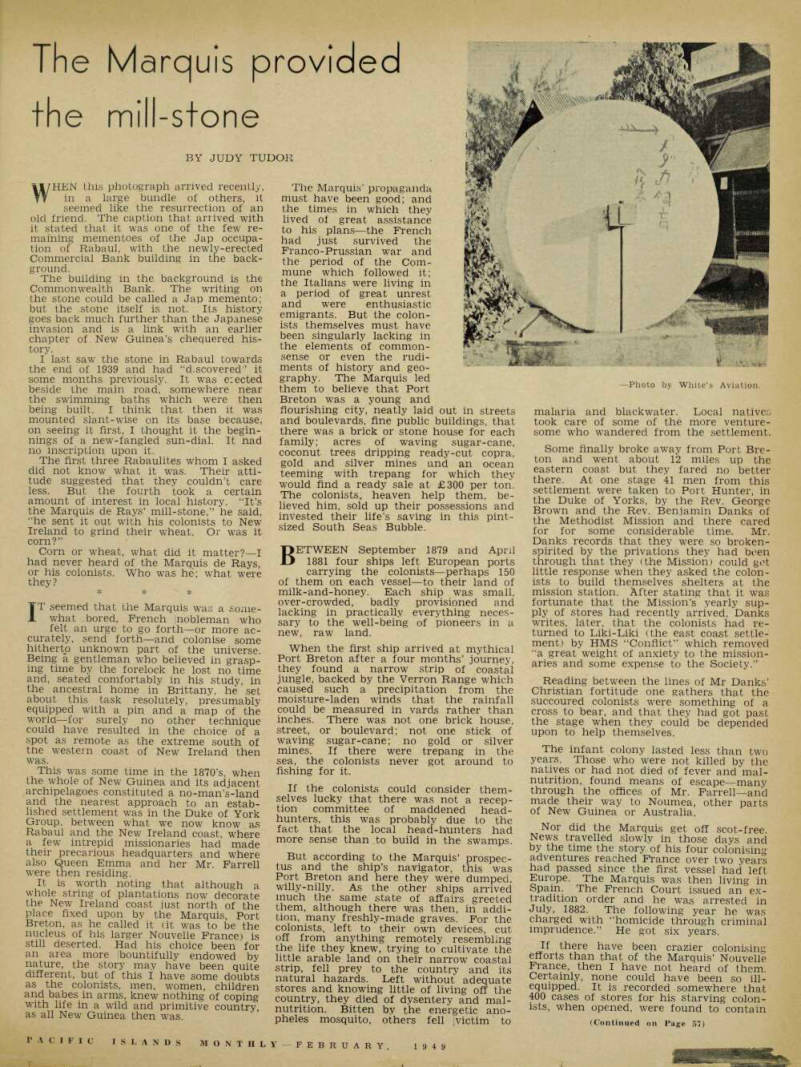
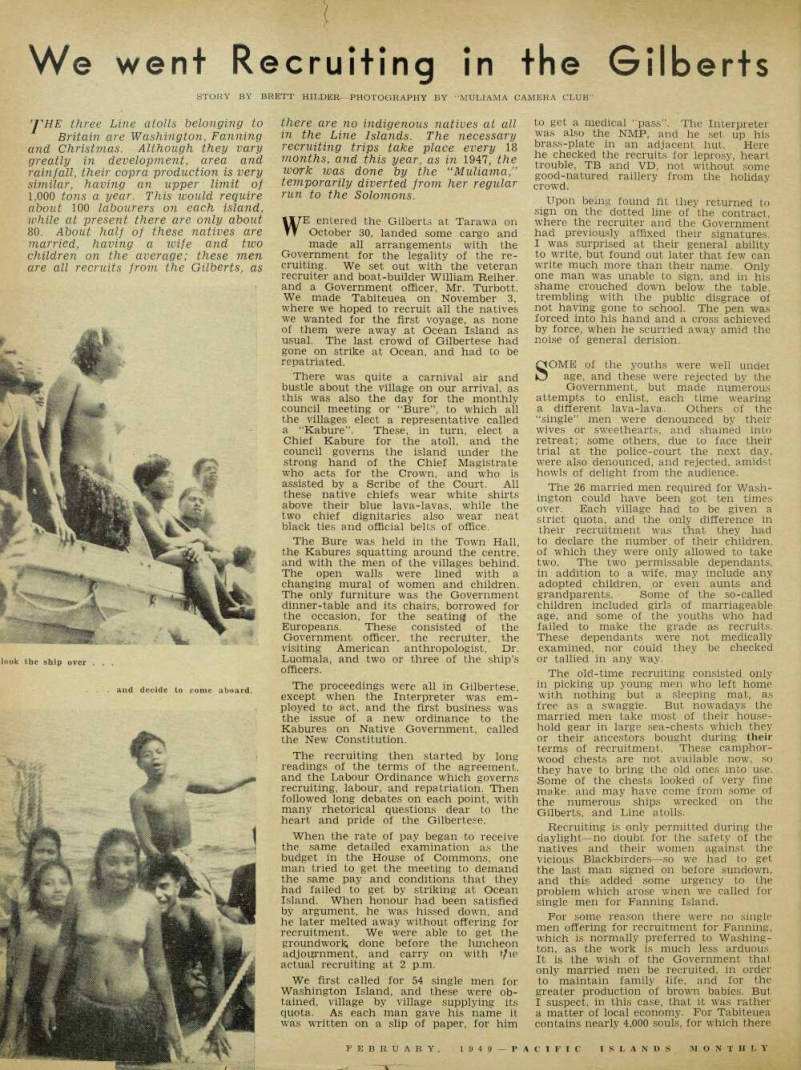
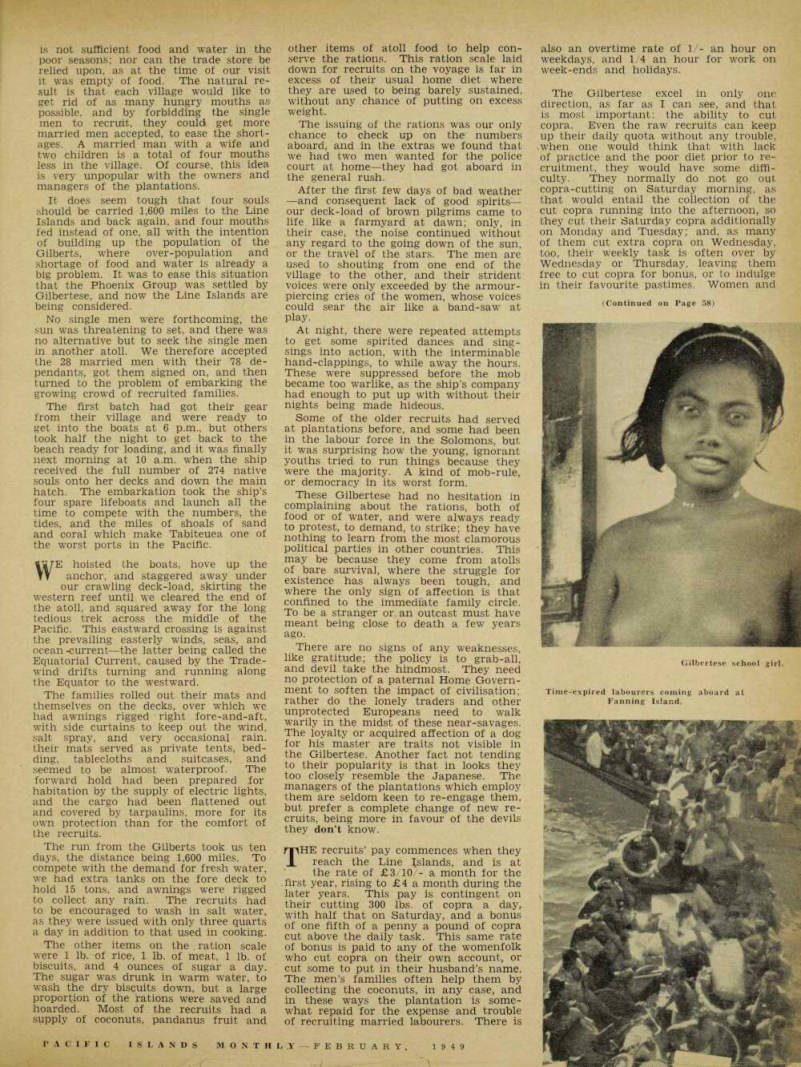
the mill-stone
By Judy Tudor
WHEN this photograph arrived recently, in a large bundle of others, it seemed like the resurrection of an old friend. The caption that arrived with it stated that it was one of the few re maining mementoes of the Jap occupa tion of Rabaul, with the newly-erected Commercial Bank building in the back ground.
The building in the background is the Commonwealth Bank. The writing on the stone could be called a Jap memento; but the stone itself is not. Its history goes back much further than the Japanese invasion and is a link with an earlier chapter of New Guinea’s chequered his tory.
I last saw the stone in Rabaul towards the end of 1939 and had “d.scovered” it some months previously. It was erected beside the main road, somewhere near the swimming baths which were then being built. I think that then it was mounted slant-wise on its base because, on seeing it first, I thought it the begin nings of a new-fangled sun-dial. It nad no inscription upon it.
The first three Rabaulites whom I asked did not know what it was. Their atti tude suggested that they couldn’t care less. But the fourth took a certain amount of interest in local history. “It’s the Marquis de Rays’ mill-stone,” he said, “he sent it out with his colonists to New Ireland to grind their wheat. Or was it corn?”
Corn or wheat, what did it matter?—l had never heard of the Marquis de Rays, or his colonists. Who was he; what were they? * * ♦ IT seemed that the Marquis was a some what bored, French Inobleman who felt an urge to go forth—or more ac curately, send forth—and colonise some hitherto unknown part of the universe.
Being a gentleman who believed in grasp ing time by the forelock he lost no time and, seated comfortably in his study, in the ancestral home in Brittany, he set about this task resolutely, presumably equipped with a pin and a map of the world—for surely no other technique could have resulted in the choice of a spot as remote as the extreme south of the western coast of New Ireland then was.
This was some time in the 1870’s, when the whole of New Guinea and its adjacent archipelagoes constituted a no-man’s-land and the nearest approach to an estab lished settlement was in the Duke of York Group, between what we now know as Rabaul and the New Ireland coast, where a few intrepid missionaries had made their precarious headquarters and where also Queen Emma and her Mr. Farrell were then residing.
It is worth noting that although a whole string of plantations now decorate the New Ireland coast just north of the place fixed upon by the Marquis, Port Breton, as he called it (it was to be the nucleus of his larger Nouvelle France) is still deserted. Had his choice been for an area more 'bountifully endowed by nature, the story may have been quite different, but of this I have some doubts as the colonists, men, women, children and babes in arms, knew nothing of coping with life in a wild and primitive country, as all New Guinea then was.
The Marquis’ propaganda must have been good: and the times in which they lived of great assistance to his plans—the French had just survived the Franco-Prussian war and the period of the Com mune which followed it; the Italians were living in a period of great unrest and were enthusiastic emigrants. But the colon ists themselves must have been singularly lacking in the elements of common sense or even the rudi ments of history and geo graphy. The Marquis led them to believe that Port Breton was a young and
flourishing city, neatly laid out in streets and boulevards, fine public buildings, that there was a brick or stone house for each family; acres of waving sugar-cane, coconut trees dripping ready-cut copra, gold and silver mines and an ocean teeming with trepang for which they would find a ready sale at £3OO per ton.
The colonists, heaven help them, be lieved him, sold up their possessions and invested their life’s saving in this pint sized South Seas Bubble.
BETWEEN September 1879 and April 1881 four ships left European ports carrying the colonists —perhaps 150 of them on each vessel—to their land of milk-and-honey. Each ship was small, over-crowded, badly provisioned and lacking in practically everything neces sary to the well-being of pioneers in a new, raw land.
When the first ship arrived at mythical Port Breton after a four months’ journey, they found a narrow strip of coastal jungle, backed by the Verron Range which caused such a precipitation from the moisture-laden winds that the rainfall could be measured in yards rather than inches. There was not one brick house, street, or boulevard; not one stick of waving sugar-cane; no gold or silver mines. If there were trepang in the sea, the colonists never got around to fishing for it.
If the colonists could consider them selves lucky that there was not a recep tion committee of maddened head hunters, this was probably due to the fact that the local head-hunters had more sense than to build in the swamps.
But according to the Marquis’ prospec tus and the ship’s navigator, this was P<prt Breton and here they were dumped, willy-nilly. As the other ships arrived much the same state of affairs greeted them, although there was then, in addi tion, many freshly-made graves. For the colonists, left to their own devices, cut off from anything remotely resembling the life they knew, trying to cultivate the little arable land on their narrow coastal strip, fell prey to the country and its natural hazards. Left without adequate stores and knowing little of living off the country, they died of dysentery and mal nutrition. Bitten by the energetic ano pheles mosquito, others fell [victim to
malaria and blackwater. Local natives took care of some of the more venture some who wandered from the settlement.
Some finally broke away from Port Bre ton and went about 12 miles up the eastern coast but they fared no better there. At one stage 41 men from this settlement were taken to Port Hunter, in the Duke of Yorks, by the Rev. George Brown and the Rev. Benjamin Danks of the Methodist Mission and there cared for for some considerable time. Mr.
Danks records that they were so broken spirited by the privations they had been through that they (the Mission) could get little response when they asked the colon ists to build themselves shelters at the mission station. After stating that it was fortunate that the Mission’s yearly sup ply of stores had recently arrived, Danks writes, later, that the colonists had re turned to Liki-Liki (the east coast settle ment) by HMS “Conflict” which removed “a great weight of anxiety to the mission aries and some expense to the Society.”
Reading between the lines of Mr Danks’
Christian fortitude one gathers that the succoured colonists were something of a cross to bear, and that they had got past the stage when they could be depended upon to help themselves.
The infant colony lasted less than two years. Those who were not killed by the natives or had not died of fever and mal nutrition, found means of escape—many through the offices of Mr. Farrell—and made their way to Noumea, other parts of New Guinea or Australia.
Nor did the Marquis get off scot-free.
News travelled slowly in those days and by the time the story of his four colonising adventures reached Prance over two years had passed since the first vessel had left Europe. The Marquis was then living in Spain. The French Court issued an ex tradition order and he was arrested in July, 1882. The following year he was charged with “homicide through criminal imprudence.” He got six years.
If there have been crazier colonising efforts than that of the Marquis’ Nouvelle France, then I have not heard of them.
Certainly, none could have been so ill equipped. It is recorded somewhere that 400 cases of stores for his starving colon ists, when opened, were found to contain
(Continued on Page 57)
Photo by White’s Aviation.
2,000 dog-collars, a Punch and Judy show and thousands of satin slippers. Possibly it was at this time also, that the Marquis opened his heart and sent them the mill stone. ♦ ♦ * IDO not know which of Rabaul’s history minded citizens was instrumental in having the old relic brought across from Port Breton but Commander C. J.
R. Webb, then harbour-master at Rabaul, performed the actual task. I believe, some time between 1937 and 1938. The job was difficult but he accomplished it by tow ing the stone on a raft behind a govern ment schooner.
It seems [strange, indeed, that when the rest of Rabaul was completely erased from the map by Allied bombing, be tween 1942 and 1945, this old link with another murky incident in New Guinea’s past, should survive. It seemed so im probable that I consulted Mr. Gordon Thomas who was one of the handful who lived through the occupation of Rabaul.
He replied—Yes, the old mill-stone was lying about somewhere after Rabaul had been done-over, and that he remembered seeing it when he came into the town again. By then the Jap characters had been written upon it and it was suggested that they meant “Nippon above all!”
However, Mr, Thomas seems to doubt this and, in view of the arrow thereon, it seems more probable that the characters merely mean “This way to the canteen’’— or the Jap equivalent.
Mr. Thomas says that the only “me men to erected by the Japs was a wooden pillar about 18 feet high, commemorating their victory in Rabaul in January, 1942.
Among the prisoners who were later sent away to their death in the ill-fated “Mon teyideo Maru,” but who then were im prisoned in the town, there was much talk
of pulling it down when Rabaul was again in Allied hands. But Mr. Harold Page, New Guinea Government Secretary, said; “No, let’s keep it there. We’ll put a post script to the thing commemorating our return to Rabaul.”
But the wooden pillar proved as un substantial as the Japanese hold on New Britain, After the Jap surrender in 1945 it was found that several years of Allied bombing had left nothing of it.
A publican’s license for premises at Wau, New Guinea, to be known as the Kaindi Hotel, has been granted to Mr.
Joseph Michael Bourke.
We went Recruiting in the Gilberts
STORY BY BRETT HILDER—PHOTOGRAPHY BY 'MULIAMA CAMERA CLUB
r pHE three Line atolls belonging to Britain are Washington . Fanning and Christmas. Although they vary greatly in development, area and rainfall, their copra production is very similar, having an upper limit of 1,000 tons a year. This ivould require about 100 labourers on each island, while at present there are only about 80. About half of these natives are married, having a wife and two children on the average; these men are all recruits from the Gilberts, as
there are no indigenous natives at all in the Line Islands. The necessary
recruiting trips take place every 18
months, and this year, as in 1947, the work was done by the <( Muliama,”
temporarily diverted from her regular
run to the Solomons.
WE entered the Gilberts at Tarawa on October 30, landed some cargo and made all arrangements with the Government for the legality of the re cruiting. We set out with the veteran recruiter and boat-builder William Reiher. and a Government officer, Mr. Turbott.
We made Tabiteuea on November 3, where we hoped to recruit all the natives we wanted for the first voyage, as none of them were away at Ocean Island as usual. The last crowd of Gilbertese had gone on strike at Ocean, and had to be repatriated.
There was quite a carnival air and bustle about the village on our arrival, as this was also the day for the monthly council meeting or “Bure”, to which all the villages elect a representative called a “Kabure”. These, in turn, elect a Chief Kabure for the atoll, and the council governs the island under the strong hand of the Chief Magistrate who acts for the Crown, and who is assisted by a Scribe of the Court. All these native chiefs wear white shirts above their blue lava-lavas, while the two chief dignitaries also wear neat black ties and official belts of office.
The Bure was held in the Town Hall, the Kabures squatting around the centre, and with the men of the villages behind.
The open walls were lined with a changing mural of women and children.
The only furniture was the Government dinner-table and its chairs, borrowed for the occasion, for the seating of the Europeans. These consisted of the Government officer, the recruiter, the visiting American anthropologist, Dr.
Luomala, and two or three of the ship’s officers.
The proceedings were all in Gilbertese, except when the Interpreter was em ployed to act, and the first business was the issue of a new ordinance to the Kabures on Native Government, called the New Constitution.
The recruiting then started by long readings of the terms of the agreement, and the Labour Ordinance which governs recruiting, labour, and repatriation. Then followed long debates on each point, with many rhetorical questions dear to the heart and pride of the Gilbertese.
When the rate of pay began to receive the same detailed examination as the budget in the House of Commons, one man tried to get the meeting to demand the same pay and conditions that they had failed to get by striking at Ocean Island. When honour had been satisfied by argument, he was hissed down, and he later melted away without offering for recruitment. We were able to get the done before the luncheon adjournment, and carry on with actual recruiting at 2 p.m.
We first called for 54 single men for Washington Island, and these were ob tained, village by village supplying its quota. As each man gave his name it was written on a slip of paper, for him
to get a medical ‘ pass”. The Interpreter was also the NMP, and he set up his brass-plate in an adjacent hut. Here he checked the recruits for leprosy, heart trouble, TB and VD, not without some good-natured raillery from the holiday crowd.
Upon being found fit they returned to sign on the dotted line of the contract, where the recruiter and the Government had previously affixed their signatures.
I was surprised at their general ability to write, but found out later that few can write much more than their name. Only one man was unable to sign, and in his shame crouched down below the table, trembling with the public disgrace of not having gone to school. The pen was forced into his hand and a cross achieved by force, when he scurried away amid the noise of general derision.
SOME of the youths were well under age, and these were rejected by the Government, but made numerous attempts to enlist, each time wearing a different lava-lava. Others of the “single” men were denounced by their wives or sweethearts, and shamed into retreat; some others, due to face their trial at the police-court the next day, were also denounced, and rejected, amidst howls of delight from the audience.
The 26 married men required for Wash ington could have been got ten times over. Each village had to be given a strict quota, and the only difference in their recruitment was that they had to declare the number of their children, of which they were only allowed to take two. The two permissable dependants, in addition to a wife, may include any adopted children, or even aunts and grandparents. Some of the so-called children included girls of marriageable age, and some of the youths who had failed to make the grade as recruits.
These dependants were not medically examined, nor could they be checked or tallied in any way.
The old-time recruiting consisted only in picking up young men who left home with nothing but a sleeping mat, as free as a swaggie. But nowadays the married men take most of their house hold gear in large sea-chests which they or their ancestors bought during their terms of recruitment. These camphor wood chests are not available now, so they have to bring the old ones into use.
Some of the chests looked of very fine make, and may have come from some of the numerous ships wrecked on the Gilberts, and Line atolls.
Recruiting is only permitted during the daylight—no doubt for the safety of the natives and their women against the vicious Blackbirders —so we had to get the last man signed on before sundown, and this? added some urgency to the problem which arose when we called for single men for Fanning Island.
For some reason there were no single men offering for recruitment for Fanning, which is normally preferred to Washing ton, as the work is much less arduous.
It is the wish of the Government that only married men be recruited, in order to maintain family life, and for the greater production of brown babies. But I suspect, in this case, that it was rather a matter of local economy. For Tabiteuea contains nearly 4,000 souls, for which there
look the ship over . . .
and decide to come aboard.
is not sufficient food and water in the poor seasons; nor can the trade store be relied upon, as at the time of our visit it was empty of food. The natural re sult is that each village would like to get rid of as many hungry mouths as possible, and by forbidding the single men to recruit, they could get more married men accepted, to ease the short ages. A married man with a wife and two children is a total of four mouths less in the village. Of course, this idea is very unpopular with the owners and managers of the plantations.
It does seem tough that four souls should be carried 1,600 miles to the Line Islands and back again, and four mouths fed instead of one, all with the intention of building up the population of the Gilberts, where over-population and shortage of food and water is already a big problem. It was to ease this situation that the Phoenix Group was settled by Gilbertese, and now the Line Islands are being considered.
No single men were forthcoming, the sun was threatening to set, and there was no alternative but to seek the single men in another atoll. We therefore accepted the 28 married men with their 78 de pendants, got them signed on, and then turned to the problem of embarking the growing crowd of recruited families.
The first batch had got their gear from their village and were ready to get into the boats at 6 p.m., but others took half the night to get back to the beach ready for loading, and it was finally next morning at 10 a.m. when the ship received the full number of 274 native souls onto her decks and down the main hatch. The embarkation took the ship’s four spare lifeboats and launch all the time to compete with the numbers, the tides, and the miles of shoals of sand and coral which make Tabiteuea one of the worst ports in the Pacific.
WE hoisted the boats, hove up the anchor, and staggered away under our crawling deck-load, skirting the western reef until we cleared the end of the atoll, and squared away for the long tedious trek across the middle of the Pacific. This eastward crossing is against the prevailing easterly winds, seas, and ocean-current—the latter being called the Equatorial Current, caused by the Trade wind drifts turning and running along the Equator to the westward.
The families rolled out their mats and themselves on the decks, over which we had awnings rigged right fore-and-aft, with side curtains to keep out the wind, salt spray, and very occasional rain, their mats served as private tents, bed ding, tablecloths and suitcases, and seemed to be almost waterproof. The forward hold had been prepared for habitation by the supply of electric lights, and the cargo had been flattened out and covered by tarpaulins, more for its own protection than for the comfort of the recruits.
The run from the Gilberts took us ten days, the distance being 1,600 miles. To compete with the demand for fresh water, we had extra tanks on the fore deck to hold 15 tons, and awnings were rigged to collect any rain. The recruits had to be encouraged to wash in salt water, as they were issued with only three quarts a day in addition to that used in cooking.
The other items on the ration scale were 1 lb. of rice, 1 lb. of meat, 1 lb. of biscuits, and 4 ounces of sugar a day.
The sugar was drunk in warm water, to wash the dry biscuits down, but a large proportion of the rations were saved and hoarded. Most of the recruits had a supply of coconuts, pandanus fruit and
other items of atoll food to help con serve the rations. This ration scale laid down for recruits on the voyage is far in excess of their usual home diet where they are used to being barely sustained, without any chance of putting on excess weight.
The issuing of the rations was our only chance to check up on the numbers aboard, and in the extras we found that we had two men wanted for the police court at home —they had got aboard in the general rush.
After the first few days of bad weather —and consequent lack of good spirits— our deck-load of brown pilgrims came to life like a farmyard at dawn; only, in their case, the noise continued without any regard to the going down of the sun, or the travel of the stars. The men are used to shouting from one end of the village to the other, and their strident voices were only exceeded by the armour piercing cries of the women, whose voices could sear the air like a band-saw at play.
At night, there were repeated attempts to get some spirited dances and sing sings into action, with the interminable hand-clappings, to while away the hours.
These were suppressed before the mob became too warlike, as the ship’s company had enough to put up with without their nights being made hideous.
Some of the older recruits had served at plantations before, and some had been in the labour force in the Solomons, but it was surprising how the young, ignorant youths tried to run things because they were the majority. A kind of mob-rule, or democracy in its worst form.
These Gilbertese had no hesitation in complaining about the rations, both of food or of water, and were always ready to protest, to demand, to strike; they have nothing to learn from the most clamorous political parties in other countries. This may be because they come from atolls of bare survival, where the struggle for existence has always been tough, and where the only sign of affection is that confined to the immediate family circle.
To be a stranger or. an outcast must have meant being close to death a few years ago.
There are no signs of any weaknesses, like gratitude; the policy is to grab-all, and devil take the hindmost. They need no protection of a paternal Home Govern ment to soften the impact of civilisation; rather do the lonely traders and other unprotected Europeans need to walk warily in the midst of these near-savages.
The loyalty or acquired affection of a dog for his master are traits not visible in the Gilbertese. Another fact not tending to their popularity is that in looks they too closely resemble the Japanese, The managers of the plantations which employ them are seldom keen to re-engage them, but prefer a complete change of new re cruits, being more in favour of the devils they don’t know.
THE recruits’ pay commences when they reach the Line Islands, and is at the rate of £3/10 - a month for the first year, rising to £4 a month during the later years. This pay is contingent on their cutting 300 lbs. of copra a day, with half that on Saturday, and a bonus of one fifth of a penny a pound of copra cut above the daily task. This same rate of bonus is paid to any of the womenfolk who cut copra on their own account, or cut some to put in their husband’s name.
The men’s families often help them by collecting the coconuts, in any case, and in these ways the plantation is some what repaid for the expense and trouble of recruiting married labourers. There is
also an overtime rate of 1/- an hour on weekdays, and 14 an hour for work on week-ends and holidays.
The Gilbertese excel in only one direction, as far as I can see, and that is most important: the ability to cut copra. Even the raw recruits can keep up their daily quota without any trouble, when one would think that with lack of practice and the poor diet prior to re cruitment, they would have some diffi culty. They normally do not go out copra-cutting on Saturday morning, as that would entail the collection of the cut copra running into the afternoon, so they cut their Saturday copra additionally on Monday and Tuesday; and, as many of them cut extra copra on Wednesday, too, their weekly task is often over by Wednesday or Thursday, leaving them free to cut copra for bonus, or to indulge in their favourite pastimes. Women and
(Continued on Page 58)
Gilbertese school girl.
Time-expired labourers coming aboard at Fanning Island.
illicit gambling seem to be among these occupations. A .
Most of the recruits save a lot of their rations on the plantations, and buy
further supplies with their pay, as well as trade-goods like sewing-machines and bicycles. When the time comes for their repatriation they have nearly a ton of personal gear apiece—bags and drums of flour, rice and sugar, boxes full of biscuits, and miles of calicoes. They have lived off the land to a great extent, on native foods grown by themselves or inherited
from the previous recruits.
All the coconuts they eat are charged at the rate of one penny each, which is roughly their value as copra, and there is no check at all on the number they consume. After their experience of living on a well-run plantation, having plenty of food and also some money to buy trade goods, they should not curse the workings of private enterprise and the Big Firms. They have also seen a large island run efficiently, without the continuous arguments, debates and lack of co-operation which is usual on their own democratic islands.
ON our first trip we renewed the labour force of Washington and half that of Fanning, and on the second trip we brought replacements for the other half of Fanning and all the new recruits required for Christmas Island. There was a very marked change in the recruits during their period of indenture. After their time is over they are much quieter, reasonable, docile and peaceful. They seem to be aware of the fact that the whole ship doesn’t belong to them, as did their own island, and that there are other people in the world besides them selves and their own little wants and habits. I believe that they are much better citizens for their short and materially profitable experience of work ing for a commercial concern.
On our first return voyage we were notified that a leper had gone from one plantation, and was suspected of being aboard. This turned out to be true, the Tabiteueans having smuggled him aboard ujiseen, and kept him hidden among themselves in a life-boat, surrounded, as usual, by plenty of mats.
They had no fear of the disease, nor did the leper have any worries; and he is now safely on his way to Makogai, Fiji. An other addition* to our family was the birth of a daughter to the wife of a recruit, Tu kiara, and although I suggested that the girl be named Muliama, they may not have taken it seriously. v We finally discharged the last of our repatriates at Tarawa on January 7 of this year, and made our farewells to the Gilberts the same day, getting out of the lagoon just before dusk.
No more till next time!
Tropicalities
A READER tells us that on the after noon of New Year’s Day, the Administration held an organised sports and sing-sing for the natives at Lae, New Guinea. A cash prize of £3 was offered for the winner of the 120 yards race, run in heats; a case of meat for the best tug-of-war team; and two cases of meat to the best sing-sing team.
Some of the sing-sing teams according to our reader, were really pathetic. One team of Markhams held banana fronds to represent spears and simply pranced in one spot. Another crowd, obviously short of kundUs (small nativp hand drums) used 2 ounce tobacco tins, enamel jugs and empty cigarette tins in lieu thereof. “Majority of performers wore lap-laps, which always tend jto spoil the general effect of a native dance, which, if properly prepared and presented, has universal appeal.
“It is recognised that some of the per formers- were at a disadvantage due to the fact that they came from outlying centres. But surely the Administration, if it wanted to organise a sing-sing, could arrange for the participants to obtain what they require to do the job properly.
“Dancing is one of the native arts and those who perform in public should be made to wear correct costume —not odds and ends of Western origin. ‘The performance put on by the Butibum natives, on this occasion, ap peared to be the best of a bad lot.” * * * THIS reminds us of another New Guinea sing-sing which we witnessed a number of years ago. It was staged in a newly opened-up part of the New Guinea mainland —an area which, until a few months previously, had seen practi cally nothing of civilization.
Several thousand of the local natives, whose fashion it is to go absolutely naked except for a few bone and shell orna ments, attended, and it was the intention of the Patrol-officer and Medical Assist ant, who organised it, that not one thing of European origin or manufacture was to spoil it. This sing-sing was to be the “dinkum thing”.
On the appointed day, therefore, there gathered together literally a sea of shining brown flesh, thousands of tossing paradise plumes, cassowary feather head dresses, hideous masks, and shell orna ments galore. And, to open the show, they were all herded down onto the banks of the river, perhaps twenty feet below the level of the drome that was to be their stage, the idea being that they were to form a long, sinuous line and, appearing dramatically from out of tall kunai grass, were to wind their way onto the arena for the benefit of the spectators.
There was a sense of the dramatic about it. too, as we waited there in the heat, watching the kunai that screened the river-bed and hearing the muffled beat of a distant kundu. Then they came, a long weaving file of bent, brown bodies, -skin glistening, golden plumes tossing, drums beating. Paga/n, beautiful; the kind of thing of which coloured movies are made. But no touch of the West—?
Leading them on to the field was the most ancient luluai in the district. Naked, be-plumed, as instructed, and his skinny shanks prancing like a well-trained circus
horse, while over his head he whirled and twirled the largest thing in bright-blue trade umbrellas! * * * THESE gems were collected by a New Zealand teacher who taught native students in Fiji for some time: CONCERNING BALBOA: Balboa saw the big ocean lying on his feet. He was the Spainish man who was the first Englishman to discover the Pacific Ocean.
Concerning Captain Cook; Cap
tain Cook went to Hawaii, where he was killed, and back to England to his home again. Cook went to New Zealand and went through one river and he enters there, when he went there the native of that place eats all his sailors and Cook was left. And he named that river the Endeavour. When he went home no body with him, only by him self.
DRAKE: Question: How and where did Drake first see the Pacific Ocean?
What was the object of his journey?
Answer: Drake seemed to see the Pacific Ocean when he was lying under a tree and the object he use to carry was a gun and a bag of water.
AND AGAIN: Drake see the Pacific from Central America on a fig tree. It took him one month 25 days to sail round the world. The great object of his journey was the things he stole from America. * $ % IT seems to look more like Buenos Aires than Suva” was the local com ment when an advertisement in the New Zealand Herald, Auckland, on January 7, offered four competent typistes, aged under 30, “salaries of £384 (sterling) per annum; tropical allowance, £2O per annum; free passage to New Zealand every two years; five months’ leave every two years, and modern, self-contained flats provided free”.
The advertisement purports to come from “a newly-established American con cern in Fiji”, but so far no connection can be traced between any American concern in Fiji and the advertisement.
When inquiries were being made in official quarters, the first official come back was the hopeful query: “Where are the modern, self-contained flats?”—S. * * * THE decision of Powers-That-Be, some where, to call a graduate of the Central Medical Bchool, Suva, in future, Assistant Medical Practitioner, instead of Native Medical Practitioner, is one of those very silly things character istic of this sloppy, post-war habit of “kidding” to indigenous peoples.
Under Dr. Hoodless, the School was built up in a fine tradition; the young native students learned —and rightly—■ to be proud of their race, their School, and their chosen profession; and their record of service in the field has been so good that there was no need for any apology for the addition of the honour able letters, “NMP”, to a man’s name.
Now, the Native Medical Practitioner is being called “AMP”; and, as any in telligent young Islander naturally will ask the reason for the change, and will learn that the European boss has de cided that the description “native” is
unbearable, a bad impression is given.
Why cannot these interfering Planners leave well alone? * * * IN an interesting little booklet issued by . the CSR Company, “Sugar in Fiji” (see article elsewhere this issue) there is recorded the prayer of Ratu Namani, Roko Tui Ba and Yasawa, which he offered at a meeting of Chiefs at Nadi, early in 1900. The prayer was as follows: Oh Lord who dwellest in Heaven, we thy people have met together this even ing to thank Thee for the good tidings which we have heard about our District.
We have here this evening the Com pany’s (CSR) Chief, Mr. Fenner, from Rarawai, and Mr. Markham, the surveyor, to look at the land to see if it is good for cane cultivation. They have now seen Drasa, Vei Togo, Na Moli and Vei Seisei.
Take pity on us oh Lord and cause the Holy Spirit to enter into Mr. Fenner and grant that he may be inclined to look with favour upon our land. The land at Drasa and Vei Togo has seemed good to him; grant that our land at Nadi may also find favour in his eyes and that we may have a very large mill. Ba has a mill and Labasa and Nausori and there are also small mills at Mago and Vuna.
Take pity on us and let us have a large mill as we are very poor. Let Mr.
Fenner think favourably of our land and make it seem good in his eyes so that we may no longer be poor. Watch over Mr. Fenner wherever he goes and protect him and help him in his inspection of our land. —Amen, Apparently Mr. Fenner did look with favour upon their land. The CSR built their large mill at Lautoka within the next three years. * * * ONE of our Christmas cards this year was from Miss Dorothy Stewart, of the Cosmopolitan Hotel, Rabaul, New Guinea. It contained this verse, which we think she must aim at Aus tralia, in general, rather than at us:
Who Am I?
I am the foundation of all business; I am the source of all prosperity; I am the salt that gives life its savour; I have laid the foundations of every fortune; I can do more to advance youth than his own parents, be they ever so wealthy; I must be loved before I can bestow my greatest blessing, and achieve my greatest ends.
Loved, I make life sweet, purposeful and fruitful, All progress springs from me.
I Am Work
Those who know Miss Stewart will, at all events, agree that it is entirely appropriate to that energetic young woman. * * ❖ ANEW GUINEA planter asked the Director of Education, Port Moresby, if there were any truth in a current rumour that some form of assistance was contemplated for Territories parents who had children at school in Australia.
The Department head replied that there was no such provision, and added: “Our representations, which the Administration here has strongly supported in sub missions to the Department of External Territories, have been unsuccessful.” The planter, commenting on this, remarked: “Residents here suffer under two grave disabilities: they have white skins, and they have no vote.”
Pacific Nature Notes
Written for "RIM" by Charles Barrett, FRZS
Crocodiles Ln Fiji
THAT the range of the saltwater croco dile extends to Fiji has been doubted by some naturalists, unfamiliar with all the literature relating to saurians— and Pacific isles. There are definite records of the occurrence of Crocodilus porosus in Fijian waters, though it is not indigenous to the group. Such authorities as Arthur Loveridge, of the Museum of Comparative Anatomy, Cambridge, Mass., USA, include Fiji in the saltwater crocodile’s range.
The earliest record appears to be that of Will Mariner, who lived for several years among the Friendly Islanders at the beginning of last century, and made “extensive communications” to Dr. John Martin, compiler of the famous Account of the Natives of the Tonga Islands. An ‘ enormous lizard” made its appearance at a small island in the Fiji Group, as related by the people of Pau, who fancied that it had come from Bulu (Heaven).
The monster took two members of a party camped on the isle—its landfall after a journey from the Solomons, possibly. Later, a woman washing tolo root in a saltwater lake, was seized by the giant “lizard”.
Before his capture and destruction, the visitor from Heaven had claimed nine victims. The natives changed their mind about the man-eater’s divinity, and, cut ting up the body, they made a hearty meal of the tenderest parts, baked to suit their taste.
This note may serve as a reply to a correspondent at Namosau, Ba, Fiji, who asked me to check up on a statement in one of my books, that the saltwater crocodile is distributed over India and Ceylon and ranges from South China tc Northern Australia, the Solomons and Fiji.
“I have not seen or heard of crocodiles in Fiji,” writes H. D. “A few years ago excitement was caused by the finding of a young crocodile in Fiji, supposed to have got there accidentally.” This in cident may have recalled Will Mariner’s story, of the “enormous lizard”, to some familiar with the Tonga Islands book, which, by the way, has become rare and valuable in the original edition; I paid seven guineas for a finely-bound copy in perfect condition, and regarded the price as reasonable.
Seafaring Reptiles F
“QEA-FARING” crocodile has been O proposed as a popular name for C. porosus, which, though mainly an estuarine creature, makes long journeys by sea: it has been sighted hundreds of miles from any land. Its wide distri bution may, as some naturalists believe, be due to this sea-going habit. Personally, I have not met with the saltwater croco dile far out at sea; but there are authentic records, and maybe some readers of the “PIM” can add to our knowledge of C. porous as an ocean wanderer.
The “mugger” or marsh crocodile (C. palustris), which has an extensive distri bution. including India and Ceylon and the Malay Archipelago, unlike its larger ally, the saltwater crocodile, occurs far inland, inhabiting marshes and pools.
When drought commences to dry up their haunts, the muggers emigrate across country in quest of more permanent waters: and, during such times, to quote the late Dr. Raymond Ditmars. they may be found wandering through the jungle,
at what seem to be considerable distances from water.
The Kabara-goya, as the Sinhalese call the common water monitor, ranges from the Philippines to Celebes and, possibly, New Guinea and Northern Australia (one record for Cape York). It is a powerful swimmer, and has been observed far out at sea. Another water monitor, related to the kabara-goya, is native to Celebes, whence it ranges to the Solomon Islands, and northwards from that group to the Carolines p/nd Marshalls, according tb Loveridge. These sea-faring lizards, cousins of the Australian goannas, have compressed tails which serve admirably as swimming organs, though less effective than the paddle-like tails of sea snakes.
The Air-Plant
GROWERS of succulents usually in clude the air-plant (Bryophyllum pinnatum) in their collections, but not all of them know that is was originally described from Mauritius, and has become a citizen of the Pacific world. Natural ised in many parts of the tropics, the air-plant flourishes as a weed in favour able conditions. K. W„ who found it growing in the New Hebrides, sends me some leaves, “for cultivation”.
Few plants are more easily grown than Bryophllum, whose every leaf produces plantlets; they develop in notches around the edge of the succulent leaf—asexual reproduction. Many a crop of air-plants have I raised without giving any special attention to the mother plants, whose stems grew to a height of about three feet, and bore abundance of leaves and, at the ends, “Chinese lantern” shaped flowers.
Dr. Otto Degener, whose great work on the Flora of Hawaii is in course of publi cation, says that, in those islands, the air-plant is pollinated chiefly by sphinx moths, and the flower develops into a many-seeded capsule-like fruit. I have noticed sphinx or hawk-moths flying in the vicinity of my Bryophyllum plants, but, so far, none of the flowers has been pollinated.
More than one hundred species of hawk-moths are Pacific islanders— natives of the region; and I do not pretend to know them all, not a tenth of the total; but among those on my list are large handsome insects, including a species of Callambulyx, whose fore-wings are green and the hind pair red. Which kinds pollinate the air-plant? Possibly representatives of Macroglossum.
Giant Grasshopper
FROM Papua comes a fine specimen of the great shielded grasshopper, col lected in hill country by D. B.
Readers of Alfred Russel Wallace’s Malay Archipelago will know about this remarkable insect, which the great naturalist describes in his best manner' he also gives a figure of the oddity.
Megalodon ensifer, to-give the insect its scientific title, is even more remarkable than the mountain grasshopper of Aus tralia. Its thorax is protected by a triangular horny shield which has serrated edges and measures about two and a half inches in length. The all-green in sect’s shield helps to camouflage it, for it resembles a leaf, the mid-rib being represented by a median line. The wing-covertp of this huge grasshopper have an expanse of more than eight inches; they, too, are leaf-like, being veined in the manner of leaves of some jungle plants. The legs are spiny; the
body is short, but the female Insect has a large curved ovipositor resembling a miniature scimitar.
The great shielded grasshopper pro vides a good example of camouflage in nature. But one imagines that it hardly needs such protection: it would make an unpleasant beakful for a bird; and a lizard might not enjoy crunching the
Communications from Nature students in the Pacific Islands are welcomed by our contributor—Mr.
Charles Barrett, “Maralena,” Mays bury Avenue, Elsternwick S 4, Victoria.
strongly-spined legs. My specimens have been sent to a museum. All rare speci mens should be preserved in museums.
At least, that is my opinion. Enthusi astic collectors of insects, especially those who favour butterflies, will not agree.
I have collected thousands of insects, from ants to butterflies and beetles; but very few of them remain in my possession
The Shell King
SHELLS form the bulk of my natural history collection; and cowries pre dominate, with cone shells next on the list. Cowries and cones have always been favourites with amateur concholo gists, some of whom have formed large and valuable collections, notably Hugh Cuming, a Devonshire man, who combed the Pacific for rare and beautiful shells.
A man of some means, Hugh Cuming built a yacht and in 1826 sailed from England for the South Seas. The first isle he visited, after touching at Juan Ferandez, was Pitcairn. John Adams was still living and Cuming spent a week on the island as his guest. Then to Tahiti, where the shell man was well received by Queen Pomare, who furthered his researches into the molluscan fauna of tropic seas. Dredging and wading, Hugh reaped a rich harvest, many of his specimens bein£ rare, others new to science. The cruise lasted for a year, and was a glorious experience for the owner of the yacht, which had been fitted up expressly for natural history purposes—the collecting and storing of specimens.
Hugh Cuming fully deserved the title, Shell King. He was a born collector, and a great collector, who added much to our knowledge of shell life in the southern and south-western Pacific. At one time his shell cabinets contained at least 30,000 specimens, including the types of numerous species of cowries. He had a host of perfect specimens. The orange cowry was well represented: but even Hugh Cuming may not have possessed a finer specimen of this lovely shell than the one given to me by a school teacher of Fiji, who had dozens, collected from the reefs.
Fancy prices were, paid for cowries when shell collecting was a fashionable hobby in Europe and America. At auction in 1821, a specimen of Cypraea aurora fetched £2O/10/-; while a Cypraea aurantia was knocked down for eighteen guineas. At another sale at Stevens’ rooms, a specimen of C. princeps was put up at £25. Hugh Cuming, himself, often was a bidder, not only for shells, but other natural history specimens. He paid fifteen guineas for a splendid speci men of “Venus’s flower-basket”, a lovely marine fabric known to science as Euplectella aspergellum. Later, numbers of specimens were dredged from the Persian Gulf, and one could buy a Venus’ flower-basket for less than a quarter the price given by Cuming.
Service Section
Concerning Spare Parts
WHEN ordering spare parts for machinery, all possible marks, num bers and descriptions should be sup plied and, if feasible, the old, worn part should be sent as a sample. This applies to all machinery—or anything that needs a spare part—and it applies particularly to War Disposals goods, in which case a history of the machine and the part is also desirable.
The improvisations that were made in the stress of war have a way of rebound ing now upon the heads of those who pur chased engines and machinery from the disposals authorities. Here are two cases in point: THE first concerns a Cadillac V-8 engine used by the Navy in launches during the war. There are, of course, agents for this engine in Australia but they are interested in the engine only—they do not care if it is installed in a boat or used to drive a circular saw—therefore, when we were asked to get two rubber impellers for the salt-water pump they could not oblige nor were they very helpful. No, they said, they hadn’t the slightest idea where we could find out what sort of pump was installed in this boat; maybe the whole boat was Lend-Lease; maybe it had been assembled here. They didn’t know. Sorry.
After some cogitation we decided to try the Commonwealth Disposals Commission We told the tale to Mr. A; were passed on to Mr. B; then to Mr. C, who was out inspecting something or other and would n’t be back till Mondee. “i’ll have you put on to Mi'. D.”
Mr. D, with a flash of genius, told us the name of the Sydney agents for the engine (which we already knew) but otherwise he could not help either.
"Look,” he said, “We only sell these things—we don’t know anything about them—who made them or anything else.”
As he showed every sign of hanging up in our ear we said with some asperity, "What do you expect this chap to do?
Just go out and scuttle his boat for lack of two rubber gadgets for a water pump?”
“Well,” said Mr. D. reluctantly at the end of the phone, “just hang on and I’ll see if anyone else can suggest anything.”
We hung on for 10 minutes and at the end of that time were advised to try Garden Island, and ask for Mr. Jones, at Navy workshop number 6.
We duly rang Garden Island, asked for Ng- 6 workshop and then Mr. Jones.
What Mr. Jones,” said an irate voice which sounded as though its owner had had to leave off making a battleship to answer the phone. p "We don’t know what Mr. Jones. What we want is some information about a Dis posals boat with a ” We got to that stage when the battleship maker decided he had had enough and hung up We tried twice more and at the fourth at tempt, by some good fortune, we got on to a man who seemed to know what we were talking about, and was prepared to forget that the Navy is the silent service and do some talking himself. “Yes I the f job ’ The Navy is scrapping all those water pumps. Simply can’t get the parts for them. Just what parts would you be wanting?”
“Just two rubber impellers . ” ‘Wei! that might be done. Ring the Blank Rubber Company, ask for Mr X, mention my name and tell him what you want. They made us several hundred impellers for those pumps about six Sme th ovef ”’ Th6y might just have had
We are loud in our thanks and turn to the Blank Rubber Co. and Mr. X. Mr.
X listens patiently while we go over the whole story. Yes, he remembers the Navy job. But are there any left —that is the question. But hold on, he will find out.
We hang on for another ten minutes.
Mr. X returns. Yes, he has located two.
He can have them ready Monday. Will that do?
It will do fine. We retire thankfully, another job done —we think. Six weeks later we receive a letter from the owner of the boat. The impellers have arrived.
They won’t fit. They are too long; the spindle is of different diameter to the original. Will we try to get some that will fit?
We are back where we started.
THE second example concerns a large army-type refrigerator—about 118 cubic feet. Our client wants some gas for it.
Part of this outfit was made during the war by the Kelvinator Company, part by General-Motors Holden (Frigidaire). It was assembled by someone else, no one knows who. Both Kelvinator and Frigi daire disown their illegitimate war-time offspring, so off and on, over perhaps two days we shop around among the best part of Sydney’s refrigerator engineers trying to find out how much gas this out fit will need: how the client (in New Ireland) is going to get it into the com pressor.
The conversation (other end) usually goes like this: No—they can’t say they know the job, but they have heard of it.
What does anyone want with such a large refrigerator? Can’t the chap take it into Rabool? No? Well, into Port Moresby then? No? Well really, they couldn’t suggest what could be done—not having seen the job; and they couldn’t see how anyone but a trained refrigerator engineer was going to get the gas out of the cylin der into the compressor, etc., etc.
Finally, we find a young man who had been in Port Moresby during the war and who had heard of “Rab-awl” and other outposts. Apparently intrigued by the thought that this unknown man, some
where up at the back of nowhere, might be going to waste some very expensive re frigerator gas on the jungle air, he not only hazards a guess at a suitable quan tity to be sent, but suggests a book that might be suitable to the amateur engineer.
We will draw a veil over the search for the book, the permits to export gas, the fire permit (whatever that is) and the trouble entailed in getting the shipping company to carry it. The moral of this story, and the previous one, is that getting replacement parts for Disposals goods is likely to be an increasing headache, and that, as we said in the beginning, all pos sible marks, numbers, descriptions and case histories should be supplied when ordering anything of the sort.
Perhaps we should add, as a rider to the above, that as there is a certain amount of latent Sherlock Holmes in everyone, we get considerable satisfaction from unravelling the conundrums created by the confusion of war and post-war.
The foregoing should by no means be taken as a complaint at some of the prob lems set us, but merely as a guide to the unwary and an invitation to supply as many clues as possible.
Pacific Islands Service
Bureau
npHE Pacific Islands Service Bureau has 1 been established to assist Island re sidents who cannot shop for themselves.
Briefly, we will perform those services for you, in Australia, which you cannot per form yourself, or are outside the scope of ordinary mail-ordering.
We will purchase and forward goods to you; have repairs made on your behalf; send flowers, sweets, fruits, gifts to trends in Australia for you, or to your children at school in Australia; match materials and sewing accessories; and arrange holiday accommodation and travel.
For these services we charge a small fee —in the case of shopping services, usually 10 per cent, of the purchase price.
If you missed the circular which ex plains this service fully and which was included in all copies of “PIM” which went to the Islands in March, please let us know and we will send you a copy of the pamphlet, free of charge.
All inquiries should be addressed to: The Director, Pacific Travel and Service Agency, Box 3408, Sydney.
Western Papua Notes
From a Special Correspondent
Daru, Jan. 10.
OUR popular District Officer, Mr. J.
R. Foldi will shortly be leaving Daru to take up duties at Samarai.
Mr. and Mrs. T. J. Holland recently re turned to their plantation at Madiri after some time spent on Cape York, where Mr. Holland conducted a saw-milk Mr. and Mrs. E. O. Graham are at present at Daru awaiting transport to Kikori. Mr. Graham managed Madiri Plantation during the Hollands’ absence —his new position is with the Co operative Section of District Services.
The Unevangelized Fields Mission vessel “Maino II” has just brought their Field Leader, Mr. G. Sexton, back from Thursday Island. Mr. Sexton has been visiting Java on Mission work, and was fortunate in leaving that country without undue incident.
Mrs. T. A. Wyborn recently made a short visit to Cairns to visit her sister.
Mr. and Mrs. J. Stocks have been busy settling in at Mibu Plantation—Mr.
Stocks was previously employed by the Australasian Petroleum Company.
Christmas was enjoyed equally by Europeans and natives here. A native sing-sing was largely attended: one dance in particular, staged by the native police and depicting the killing of a crocodile, was most ingenious.
Mr. D ; B *™ s > who has been in charge hospital at Gaima, on the north bank of e , Fly Rlver > for the past two yea F s ’ will shortly go south on leave, D - Clancy is also due for leave and be on the first vessel proceeding to I ?? o J es v by - Patrol officer Clancy is W6 rlv llked he re. , The London Missionary Society now r ia Yf a trim-looking 35-footer in the harbour for local use. This vessel is on loan for one year until their permanent vessel 1S returned.
Death of Mrs. Warren, of Pitcairn
Pitcairn
mHE death on January 2 has been re- X ported of Mrs. Selwyn Warren, of Pitcairn Island. Before her marriage she was Miss Sophie Christian and is a sister of Mr. Parkin Christian who, some weeks previous to her death, had been elected Chief Magistrate of the island.
About 70 copies of the “Pacific Islands Monthly”, covering the years 1942 to 1948, may be obtained by anyone in terested on application to Mrs. E. Turner, of “The Peel,” 3 Elizabeth Bay Road, Elizabeth Bay, Sydney.
Advertisements & other items, pp. 51-52 (1 item)
Burns Philp (New Guinea) Limited
General Merchants (Wholesale and Retail)
Shipping, Customs and General Agents
Head Office: PORT MORESBY, PAPUA
BRANCHES:
NEW GUINEA: Rabaul, Kokopo, L.ae Gr Madang.
PAPUA; Samarai.
REPRESENTATIVES FOR;
AUSTRALIAN AGENTS:
LONDON AGENTS:
SAN FRANCISCO AGENTS:
QUEENSLAND INSURANCE CO. LTD.
LLOYDS OF LONDON
BURNS PHILP TRUST CO. LTD.
BURNS, PHILP & CO. LTD.
All States.
BURNS, PHILP Cr CO. LTD.
"London House", 35 Crutched Friars, E.C.3.
BURNS, PHILP CO. OF SAN FRANCISCO INC 510 Matson Building.
Distributing Agents, Territory of Papua-New Guinea for;
SHELL COMPANY OF AUSTRALIA LIMITED
Petroleum Products
GENERAL MOTORS CORPORATION
Chevrolet, Buick, Pontiac and Oldsmobile Cars Chevrolet and GMC Trucks Frigidaire Refrigerators
VAUXHALL MOTORS LIMITED
Vauxhall Cars and Bedford Trucks
R. A. LISTER & CO., BRISTOL
Producers of Petrol, Parrafin and Diesel Engines Pumps and Lighting plants
RUSTON HORNSBY LIMITED
Engines
CROSSLEY MARINE ENGINES
G. H. Robinson
ISLAND SUPPLIES
of all kinds—Selected and Shipped to order at lowest possible prices—Piecegoods in Wool, Cotton and Silk, Under and Outerwear, Manchester, Drapery, Grocery, Hardware, Engineers and Leathergoods trade supplies a specialty.
Indents and Transhipments arranged. Large or small orders treated with equal care.
Use our 25 years’ extensive experience.
Enquiries solicited to —
G. H. ROBINSON
51 Macquarie Street,
Sydney, N.S.W.
Telegrams: Sunrise, Sydney.
Letters: Box 3317, G.P.0., Sydney.
BROOMPIELDS Ltd.
Suppliers of Building Hardware Ship Chandlery, Paint Materials *
WRITE DIRECT TO'.
Broomfields Ltd., 152 Sussex Street, Sydney
How John Williams V Was Wrecked
From Our Own Correspondent
Suva, Jan. 17.
THE first complete account of the wreck of the London Missionary Society’s ship “John Williams V” at Savaii, Western Samoa, on Christmas Eve, has just arrived at Suva with the “John Williams VI”, which is now at her home port (Suva) after a maiden voyage from England by way of Madeira, Panama, Tarawa, Beru and Apia.
At Apia the “John Williams VI” picked up the master (Captain Stanton Page), the crew and passengers of the “John Williams V”.
Details of the wreck are assembled in a factual account given to the press by Mr. Howard Diamond, a high official of the LMS who has come to the South Pacific as a passenger in the new ship.
After visiting the Gilbert Islands, the 19-years-old “John Williams V” was sail ing to Apia, en route to Suva, where she was to be laid up. Near Savaii, on De cember 23, the master set his course to take the ship clear of the island, by 10 miles.
There had been heavy storms in the vicinity, and at 9.30 p.m. rain fell in a deluge, blotting out all sight of land.
The master altered the course again by 14 degrees, to be sure of clearing the unlighted Savaii coast.
AT 1.30 a.m., the, vessel struck the reef with a crash. Lifted on to the reef by the surf, the vessel was pounded by the heavy swell and the engines were powerless to get her off. The seams of the plates started to open and water entered the engine-room and water tanks in the ship’s bottom.
By 3.30 a.m., it was clear that the battered ship was being driven further on to the reef and it was decided to get the passengers away. One of these was a young New Zealender returning home after a visit to Tarawa, and the others were Gilbert Islanders returning from visits to their families.
The passengers were placed in a surf bbat with six sailors, in charge of the second officer, with orders to stand clear of the reef until daylight.
Soon after, the electric lights failed owing to the flooding of the engine room, and the master decided to get the crew away in the two lifeboats. Six men went in the first boat and six in the second, which was launched by Cap tain Page and Chief Officer Ward, who had to jump overboard and swim to the boats.
Just before daylight, the lights of the small Samoan copra boat “Gaualofa” were sighted. This vessel took the boats in tow, but, being too small to give effective help, took the passengers on board and directed the three boats to Avao, where the shipwrecked sailors were hospitably entertained by the pastor of the LMS church and his wife.
CAPTAIN Page and his skilful Gilbertese crew returned to the wreck in the early morning, but failed in an attempt to get the ship off the reef.
However, radio contact was established with the Apia Harbourmaster, who came to the scene to help in a final but fruit less effort to save the ship.
Earlier, with the help of Avao villagers, much of the ship’s gear had been salvaged.
On December 28 a ketch from Apia collected the ship’s company, the three boats, and the salvaged gear and took them to Apia, where the company was picked up by the “John Williams VI” on January 11.
Labour Situation Eases In
Bsi
From Our Own Correspondent HONIARA, January 2.
T ABOUR problems are easing in the XJ Solomons. Recent recruiting trips for plantations havfe been highly successful, recruits coming mainly from the eastern Solomons (including Talesi, ex-Marching Rule stronghold) and the Reef Islands.
No hardy spirit has yet tackled Malaita for recruits, although indications are that the hostile Marching Rule move ment is gradually dying down, especially in the south, although there are a few cases of passive resistance in the northern area.
One of the inexplicable schemes/ of Marching Rule addicts was to erect fences—ranging from a few symbolical bits of brush to positive pallisades—round their domains, presumably to mark off Marching Rule sheep from pro-Govern ment goats. Recently ordered to remove these symbolical barriers, some villages have conformed, with an air of guilty relief; a few die-hards, however, have packed up their gear all ready to live at Government expense for disobedience.
Recently a representative of Levers’
Pacific Plantations Malaita to hand out back pay dating from the days of emergency war-time renatriation and indications were that Malaitamen, always the most prolific source of recruits pre war, were becoming more amenable to the idea of working again.
Mr. E. J. Jeffries, who has been Accountant of the Suva branch of the Bank of New South Wales, has left Fiji on transfer to an Australian branch.
In Defence of the Ladies
By a Mere Woman
WHENEVER I have heard people de clare that they have no time for the Indians —and judging by what one reads in the “PIM”, this is a very prevalent attitude —I have replied, “Do you know any Indian women or girls?”
The answer is usually in the negative.
Then I have continued, “But why judge a whole race of people by one sex of them?”
Owing to the male Indian’s habit of dominating his womenfolk, they are generally humble and grateful for kind nesses received. Many of these ladies have a hard life, with much work to do, many children to care for, and some times fill-health to combat, and they have developed a ready sympathy for the troubles of" others which is very genuine and very touching. I cannot speak too highly of this side of their natures. The little girls are sweet, eager, and possess a latent sense of fun. The young girls who are fortunate enough to escape marriage at an early age, often make splendid students with a sporting spirit and a fine sense of responsibility.
Much has been said about the Indian lack of war effort. I remember one broiling Saturday afternoon in Suva when I went to a Sale-of-work, in the Lilac Theatre, organized, prepared for, and rum entirely by Indian ladies, to raise funds for a British Red Cross Ambulance. The displays on the stalls spoke eloquently of the long hours of work that had been put into their preparation.
Many suggestions have been put for ward for the solution of Indian problems in Fiji; but may I put forward a new one, which I hope is not entirely fan
tastic? Could not the Indian male raise the status of the Indian woman from her position of abject drudgery, and learn something from her sweetness, patience and understanding?
Some have already done so, to their credit and advantage, and they will heartily agree with me as to the wisdom of this proposition. But let it be done on a large scale, so that the effect may be far-reaching and beneficial.
Death Of One Of The
Fijian Triplets
Suva. Jan. 24.
ONE of the Fijian triplets born at Wainibokasi on December 20 has died. The news was published on January 18, at a time when public interest in the babies was at its peak, due to a modest “shilling-in” collection started in Suva by Mr. Albert Low.
The idea of a small voluntary contri bution appealed.to people of all races, and
in a short time the shillings totalled more than £35.
About 24 New Caledonian Boy Scouts took part in the Pan-Pacific Jamboree in Melbourne, Australia, in December, 1948.
Dr. J. M. Cruikshank, the new Director of Medical Services, Fiji, and Mrs.
Cruikshank, arrived at Suva in the “Aorangi” on February 4.
Advertisements & other items, pp. 53-54 (1 item)
Prouds
' Gift Book
WRITE for a presentation copy of our 1949 Gift Book catalogue, sent without charge. Precious stone jewellery clocks, watches, costume jewellery, china, pencils, lighters, souvenirs, pens, glassware, silverware, leather and fancy goods . . . year-round gifts.
Seven Floor Gift Store.
Prouds, Ltd., Box 1502, G.P.O.
Sydney.
Minerals, Ores and Concentrates. Buyers and Sellers
of all classes
Australasian Representatives for —METAL TRADERS, LTD., London;
METAL TRADERS INC., New York.
SCRAP METALS (Ferrous & Non-Ferrous) GENERAL MACHINERY MERCHANTS (New and Reconditioned)
DICKSON PRIMER & CO. PTY., LTD.
Federal Wharf, 73 Day St., Sydney, N.S.W., Australia.
ALSO AT: Melbourne, Brisbane, Adelaide, Devonport (Tas.), Christchurch (N.Z.).
ESTABLISSEMENTS DONALD TAHITI
HEAD OFFICE—QUAI DU COMMERCE—PAPEETE
TELEGRAPHIC ADDRESS—“DONALD, PAPEETE”
General Merchants (Wholesale & Retail) & Shipowners
Importers & Exporters—Branches Throughout Marquesas Islands
Lloyd’s Agents
ASSOCIATE
HOUSES:
A. B. DONALD, LTD.
AUCKLAND, NEW ZEALAND.
A. B. DONALD, LTD.
RAROTONGA, COOK ISLANDS.
DOMINION FRUIT CO.,
SUVA, FIJI ISLANDS.
Agents and Distributors for :
FRANCE:
HENNESSY COGNACS
MARIE BRIZARD & ROGER
LIQUEURS
CHARLES HEIDSIECK
CHAMPAGNES
PERRIER WATER
GRUBER BEER
U.S.A.:
GENERAL STEAMSHIP CORP.
RADIO CORP. OF AMERICA
BROWN & WILLIAMSON, LTD.
CIGARETTES: LUCKY STRIKE,
WINGS, OLD GOLD
CHAMPION SPARK PLUG CO.
KAINIER BEER
ENGLAND:
RECKITTS & COLMAN
(OVERSEAS), LTD.
PHILLIPS BICYCLES
NEW ZEALAND;
VACUUM OIL CO. PTY., LTD.
PETROLEUM PRODUCTS
SWEDEN:
HJORTH & CIE
PRIMUS STOVES
Sydney Agents : London Agents :
San Francisco Agents : Agents in France : BURNS, PHILP & CO., LTD. BURNS, PHILP & CO., LTD. BURNS, PHILP CO. OF HARTH & CIE, PARIS.
SAN FRANCISCO. A. BICKART, MARSEILLES.
VETERINARY
INSTRUMENTS
For Sheep and Cattle can be
Supplied Immediately
EARMARKERS.
SPEYING INSTRUMENTS.
BULLRINGS.
FIRE BRANDS.
EMASCULATORS.
W. JNO. BAKER
PTY. LTD.
3 Hunter Street, Sydney, N.S.W., Australia
Wynne S. Breden Pty. Ltd.
SHIPWRIGHTS AN ENGINEERS.
"PHOENIX SHIPYARDS", NEWCASTLE, N.S.W.
Designers, Builders & Outfitters of ISLAND Vessels Work Boats, Cargo Boats and Auxiliary Craft up to 200 tons.
r * 7M M
TELEPHONES: LA5034-5-6
BUDGE
REFRIGERATION
EQUIPMENT
Commercial and Industrial Units
(not domestic) Ammonia and Methyl Chloride machines of large or small capacity.
The illustration is of a complete 30 cwt. Ice-making Plant, comprising twin, enclosed ammonia compressor, evaporative condenser, insulated ice tank, etc. It may be driven by a 10 h.p. electric motor or diesel engine.
Inquirers should mention dimensions of cold room (or cabinet) and amount of ice (if any) required per day.
JAMES BUDGE PTY. LTD.
Established 1890.
REFRIGERATION ENGINEERS
McEvoy Street, Alexandria,
Sydney
Bsi Urgently Needs Ships
Letter to the Editor ONE often wonders whether the British Solomons Administration has ever approached the Australian Govern ment for co-operation to help solve the Sydney-Solomons shipping problem.
When I left Sydney a year ago two ships were loading at the same wharf for the Islands—viz., the 9000-ton “River Mitta,” for New Guinea, and the 100-ton “Ruena” for the BSI. And that just about illus trates the relative shipping services of the two Groups in the period which has since elapsed.
In comparison with the BSI, New Guinea-Papua is serviced with quite a fleet of large passenger ships and freighters, whilst BSI struggles to exist on the irregular services of a few midget vessels, and a very occasional larger one.
At their present stage of reconstruction the BSI cannot expect to command the full-time service of a decent-sized passen ger steamer. Even in our palmy days we were not able to do that. But, neverthe less, we were adequately serviced by a 3000-ton, 6-weekly vessel which we shared
with Bougainville and Rabaul. The Syd ney-Solomons-New Guinea, or, in reverse, Sydney-New Guinea-Solomons runs are essential services which have existed from the earliest days—natural runs, which must sooner or later be re-established— so why not now, when the need was never greater? Australia helped us before with shipping, and I feel sure would help us again if approached at the highest level.
BSI, 29/12/48. I am, etc,
Leslie F. Gill.
New Island-Built Ship for Suva-
Vanua Levu Run
From Our Own Correspondent
Suva. Jan. 24.
BUILT in a palm-grove at the island of Nairai and completed at the Bay of Islands, in Suva Harbour, the 98-ton vessel, “Island Prince,” is now in ser vice between Suva and Vanua Levu and other parts of the Group.
The keel was laid at Nairai in January, 1946, and for nearly two years the builder and designer, Mr. W. Baker, with a few assistants laboured at the hull.
The working model was prepared by Mr. Baker, who drew on a wealth of ship building and sailing experience. Between 1916 and 1942 he built three vessels at Nairai and one at Lau. They included the well-known “Island Queen.”
The “Island Prince” was christened by Mrs. Baker with a bowl of yaqona in November, 1947, and after launching was towed to Suva Harbour to avoid any pos sible hurricane damage.
“Island Prince” has a length of 92 ft., a beam of 26 ft. and a depth of hold of approximately 8 ft., accommodation for 72 persons, including the ship’s company of 15.
Fascinating Discoveries in NC
Acting Territories Minister Makes Fascinating Discoveries in NC
SOME discoveries which stirred Old Territorians were announced on January 25 by Australian Minister Chambers, who is in charge of New Guinea and Papuan affairs during the preoccupation elsewhere of Mr. E. J.
Ward. Mr. Chambers had just completed what the newspapers called “a compre hensive tour” of the Territories.
Mr. Chambers announced that “with proper development” New Guinea could suoply cocoa, tea, coffee, rice and jute; and he actually was told by an agricul tural officer at Keravat “that cocoa could be produced in many parts of the Terri tories.” 1 It is a pity the political gentleman did not look up the records of his own de partment. He would have found that, just before the Japs invaded, 1,033 hec tares (2,500 acres) were under cocoa in New Britain, New Guinea, and Manus, and that more than that area was under coffee. New Guinea had a substantial cocoa-growing industry 25 years ago; about £7,000 worth of cocoa was exported in 1925.
The Minister told astounded reporters that coffee now was being grown on the central highlands, and “indications were that the industry could be developed as a payable proposition.” When the Japs came in in 1942 over 1,000 acres in New Britain and 500 acres in Manus actually were producing coffee. Three substantial coffee-growing companies were operating in New Guinea in 1938, apart from Mr.
C. C. Wilde’s flourishing plantation in the Bulolo Valley, just outside Wau. (Mr,
Chambers is reported to have served with the AIF in New Guinea: did he never hear of how the Aussies. dropped by plane on the Wau drome in that critical Bulolo Valley battle in 1942, caught the Japs’ jungle column in Wilde’s coffee plantation, and cleaned them up?) Direc tor of Agriculture George Murray (lost on the Montevideo Maru in 1942) actu ally introduced coffee-growing to New Guinea in the Depression (1931-2) to pro vide planters with some alternative to the very sick copra industry.
It really is remarkable to see, in all walks of life, how the sedulous wielder of the new broom ignores the old broom’s record.
Death of Former Madang DO
MR. A. J. Hunter, at one time an officer of the District Services Department, New Guinea, and District Officer, Madang, in the 20’s, died in South Aus tralia on December 7.
He is survived by his wife and two sons.
Mr. John Caldwell, a young Ameri can, who in 1946 sailed a cutter from Panama with the intention of reaching Sydney, and who was spec tacularly shipwrecked at Tuvuca, in the Lau Group, has written a book about the voyage. Called “Dangerous Voyage”.
It will be published in America this year.
Progress of BGD
IN November and December, Bulolo Gold Dredging, Ltd., working seven dredges in the Bulolo Valley, New Guinea, produced 4,078 and 4,220 ounces of fine gold, respectively.
Almost L 200,000 yards of gravel were treated during these two months.
Advertisements & other items, pp. 55-56 (1 item)
Carrlock Co. Ltd.
KANGAROO BRAND
Ropes,
Cordage,
and Twines for every purpose Backed by 86 years of service Manufactured by:
M. DONAGHY AND SONS,
Pty. Ltd., Geelong and Sydney.
Fiji Representatives ;
PEARCE AND CO.
LIMITED
P.O. BOX 237, SUVA
Telegram; "CARRLOCK" P-O. Box 2140, Hong Kong
CARRLOCK CO. LTD.
2nd Floor, Queen's Bldg., Chafer Road, HONG KONG
General Merchants Commission Agents
Exporters and. Shippers of All Kinds of Merchandise To the Pacific Islands
Representatives of Leading Manufacturers
in HONG KONG
INQUIRIES INVITED
\s
“It’s easier to do business
with a man than an address !”
As my firm’s export manager, I find it pays to do business }y with a man and not just an address. Correspondence is cut to the bone, misunderstandings are prevented, problems are discussed and solved right on the spot.
That’s where Speedbird service and 8.0.A.C.’s more than 72,000 miles of world-wide air routes come in. 8.0.A.C. usually flies where I want to go, and Speedbird service gets me or my freight there in a hurry and right on schedule. Arranging my trips is easy. The local 8.0.A.C. Appointed Age.it fixes everything. No crowds or confusion, and no red tape. Everything goes like clock-work, but with this important difference : there’s the personal touch !
About the actual flight . . . It’s good, really good from beginning to end. If you’re hungry, you can eat wonderful food “on the house’ too. If you’re tired, the comfortable seats practically lull you to sleep. Everything and I mean everything reflects 8.0.A.C.’s 30-year-old tradition of Speedbird service and Speedbird experience.
GREAT BRITAIN • USA • CANADA • MIDDLE EAST WEST AFRICA • EAST AFRICA • SOUTH AFRICA PAKISTAN • INDIA • CEYLON • AUSTRALIA NEW ZEALAND • FAR EAST • JAPAN *
8.0.A.C. TAKES GOOD CARE OF YOU
fIY • BOA C
Al/AU
Information & Bookings : Qantas Empire Airways , Sydney , Melbourne , Brisbane , Townsville , Cairns , Darwin (General Agents in Australia ), or from Booking Agents in all cities.
BRITISH OVERSEAS AIRWAYS CORPORATION WITH Q.E.A., S.A.A. AND T.E.A.L
Indians Create Hotel Problem
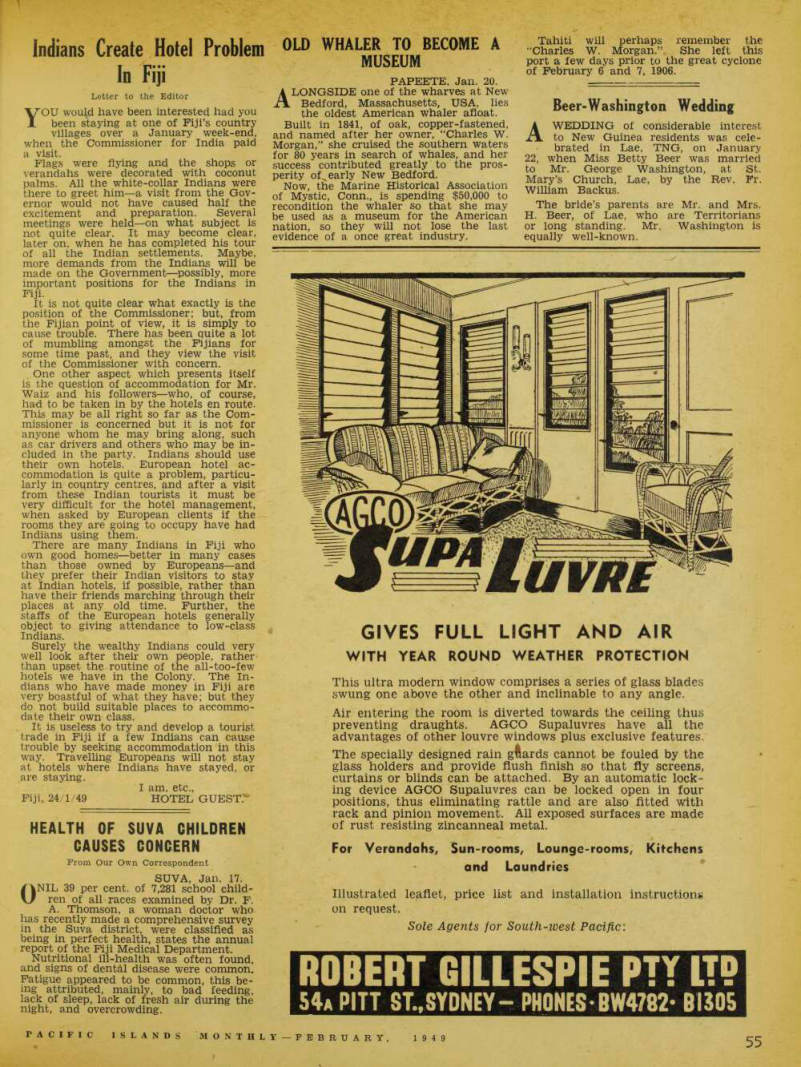
In Fiji
Letter to the Editor YOU would have been interested had you been staying at one of Fiji’s country villages over a January week-end, when the Commissioner for India paid a visit.
Flags were flying and the shops or verandahs were decorated with coconut palms. All the white-collar Indians were there to greet him —a visit from the Gov ernor would not have caused half the excitement and preparation. Several meetings were held—on what subject is not quite clear. It may become clear, later on, when he has completed his tour of all the Indian settlements. Maybe, more demands from the Indians will be made on the Government —possibly, more important positions for the Indians in Fiji.
It is not quite clear what exactly is the position of the Commissioner: but, from the Fijian point of view, it is simply to cause trouble. There has been quite a lot of mumbling amongst the Fijians for some time past, and they view the visit of the Commissioner with concern.
One other aspect which presents itself is the question of accommodation for Mr.
Waiz and his followers —who. of course, had to be taken in by the hotels en route.
This may be all right so far as the Com missioner is concerned but it is not for anyone whom he may bring along, such as car drivers and others who may be in cluded in the party. Indians should use their own hotels. European hotel ac commodation is quite a problem, particu larly in country centres, and after a visit from these Indian tourists it must be very difficult for the hotel management, when asked by European clients if the rooms they are going to occupy have had Indians using them.
There are many Indians in Fiji who own good homes —better in many cases than those owned by Europeans—and they prefer their Indian visitors to stay at Indian hotels, if possible, rather than have their friends marching through their places at any old time. Further, the staffs of the European hotels generally object to giving attendance to low-class Indians.
Surely the wealthy Indians could very well look after their own people, rather than upset the routine of the all-too-few hotels we have in the Colony. The In dians who have made money in Fiji are very boastful of what they have; but they do not build suitable places to accommo date their own class.
It is useless to try and develop a tourist trade in Fiji if a few Indians can cause trouble by seeking accommodation in this way. Travelling Europeans will not stay at hotels where Indians have stayed, or are staying.
I am. etc.,
Fiji. 24/1/49
Hotel Guest.'
Health Of Suva Childreh
Causes Concern
From Our Own Correspondent
Suva, Jan. 17.
ONIL 39 per cent, of 7,281 school child ren of all races examined by Dr. F.
A. Thomson, a woman doctor who has recently made a comprehensive survey in the Suva district, were classified as being in perfect health, states the annual report of the Fiji Medical Department.
Nutritional ill-health was often found, and signs of dentdl disease were common.
Fatigue appeared to be common, this be ing attributed, mainly, to bad feeding, lack of sleep, lack of fresh air during the night, and overcrowding.
“Charles w!* Morgan!” this
Old Whaler To Become A
Museum
Papeete. Jan. 20.
ALONGSIDE one of the wharves at New Bedford, Massachusetts, USA, lies the oldest American whaler afloat.
Built in 1841, of oak, copper-fastened, and named after her owner, “Charles W.
Morgan,” she cruised the southern waters for 80 years in search of whales, and her success contributed greatly to the pros perity of, early New Bedford.
Now, the Marine Historical Association of Mystic, Conn., is spending $50,000 to recondition the whaler so that she may be used as a museum for the American nation, so they will not lose the last evidence of a once great industry.
“Charles w!* Morgan!” this
P° r t a few days prior to the great cyclone of February 6 and 7, 1906.
Beer-Washington Wedding
a WEDDING of considerable interest Mew Guinea residents was cele brated in Lae TNG on January 2 2 whpn rph’v -Rppr’ wac mnrripri r en Georg? WafhTngton “ St Mzrv\' Church Lae b?the’ Rev Fr L ’ by th R Wllllam Backus.
The bride’s parents are Mr. and Mrs.
H. Beer, of Lae, who are Territorians or long standing. Mr. Washington is equally well-known.
weU-kno'wn' Lau
Archipelago, Fiji, passed through Sydney in February, en route to Britain. He will remain abroad for about a year.
Advertisements & other items, pp. 57-58 (1 item)
Robert Gillespie Pty It?
GIVES FULL LIGHT AND AIR
WITH YEAR ROUND WEATHER PROTECTION
This ultra modern window comprises a series of glass blades swung one above the other and inclinable to any angle.
Air entering the room is diverted towards the ceiling thus preventing draughts. AGCO Supaluvres have all the advantages of other louvre windows plus exclusive features.
The specially designed rain guards cannot be fouled by the glass holders and provide flush finish so that fly screens, curtains or blinds can be attached. By an automatic locking device AGCO Supaluvres can be locked open in four positions, thus eliminating rattle and are also fitted with rack and pinion movement. All exposed surfaces are made of rust resisting zincanneal metal.
For Verandahs, Sun-rooms, Lounge-rooms, Kitchens and Laundries Illustrated leaflet, price list and installation instructions on request.
Sole Agents for South-west Pacific'.
ROBERT GILLESPIE PTY IT?
s4* PITT ST., SYDNEY - PHONES 8W4782- DUOS
ART POSTCARDS OF
TONGA
Per Dozen, Postage Paid: 6/- (one US Dollar).
TONGAN PHOTOS BUREAU
Nukualofa, Tonga
SHIPPING
TO RESIDENTS OF NORFOLK ISLAND, COOK ISLANDS, NEW
CALEDONIA, NEW HEBRIDES, BRITISH SOLOMON ISLANDS,
NEW GUINEA
Service From New Zealand
... Our next vessels are loading shortly, and we recommend that, if you have not already placed orders with us, you do so immediately, to enable us to arrange space.
All classes of general marchandise available at competitive prices. Amongst the commodities which may be particularly mentioned for immediate delivery are:
FOOD PRODUCTS:
GENERAL:
Meats.
Butter.
Cheese.
Potatoes.
Onions and Tinned Vegetables.
Beer.
Sandshoes.
Roman Sandals.
Leather Soles.
Leather and Belting.
Tobacco and Cigarettes.
Matches.
Soap.
Toilet Gift Sets.
Candles.
Silver-plate Ware.
Builders’ Hardware.
Chairs and Furniture.
Laminated Wood and Plywood.
Many items, especially hinges, builders’ hardware and silver-plate ware are produced in our own factories. These are listed in a catalogue and price list, a copy of which we will be happy to post without charge on receipt of your request. If you desire a specific offer on a C.I.F. basis, please cable or air-mail details of your needs and we will quote you promptly. If you contemplate ordering in large quantities we shall be pleased to arrange for our representative to visit you with samples and discuss the transaction.
We are also buyers of Islands Produce of every description, and we can provide shipping. Buying or selling, we can help you—our selling organisation is wopld-wide.
UNION MANUFACTURING
& EXPORT CO. LTD.
G.P.O. Box 1060, Wellington, NEW ZEALAND Cables: “UMEC” Wellington.
Branches at Auckland, Christchurch, Sydney, Melbourne.
Western Pacific Office: P.O. Box 78, Noumea. Cables: SICO, Noumea.
Oil Exploration In Papua
THE Australian Petroleum Company Pty., Ltd., reports that during De cember it was engaged at Oroi, Papua, in sealing upper formations in the well, and the depth remained at 1,694 feet. On the completion of this work, drilling operations will be con tinued.
Construction work at other drilling sites in Papua is progressing satisfactorily, and it was expected to spud-in at Upoia not later than January 15, 1949, and at Hohoro about three weeks later.
Messrs. Brian J. Holloway, and Arthur G. Rackeman, in December, received appointments as officers in the Royal Papuan Constabulary.
Sda Missions
Pacific Islands Stations Have Been Reorganised
Afar-reaching reorganisation of ■ the Pacific Islands missions conduc ted by the Seventh Day Adventists has been completed.
The mission stations in Fiji, Samoa, Tonga, New Hebrides, Gilbert and Ellice, Cook Islands, French Oceania, Pitcairn Island and New Caledonia are now grouped as the Central Pacific Union, with headquarters in Suva. Pastor G. Brans ter, who previously had spent 17 years in Fiji, left for Suva this month, to take charge of that administration. He will have at his disposal, as an administra tion vessel, the recently-purchased 60-ft. vessel, “Viking Ahoy,” (sail and twin Diesels), which will be based on Suva.
The stations of the Southwest Pacific (Solomon Islands, Papua and New Gui nea) have been grouped in another ad ministrative union, with headquarters in Rabaul.
Formerly, all these Island mission sta tions were directed and controlled from the headquarters of the Australasian Inter-Union Conference, at Wahroonga, Sydney. The decentralisation that has been arranged is expected to simplify ad ministration very much.
‘Operation Screwball'
The Adventures of R. E. Johnson
THE story of Ronald Ernest Johnson, and “Operation Screwball,” was pub lished in PIM in March, 1948. It stated that Johnson took his yacht “Thel ma” from New Zealand to Tahiti; pro ceeded to Honolulu; sold the yacht; bought an engine-less submarine-chaser; and eventually, by a series of extraordin ary adventures, got it to Suva.
The story presented Mr. Johnson as something of a hero; and it appeared that all these events occurred after World War 11. We now have the following note from an official source: R. E. Johnson and companion sailed on the yacht “Thelma” from New Zealand to Papeete, arriving early in 1942. They had thus escaped military service. Mr.
Johnson said he was a conscientious ob jector. The two men were returned to New Zealand, where Mr. Johnson under went imprisonment for five years; his companion was given the option of serving, which he did. Mr. Johnson returned to Papeete in 1946 to take possession of his yacht “Thelma,” which had, in the mean time, been taken over by the French Marine; and he then continued on his way to Honolulu.
Two Catalinas Flee From
Hurricane
TWO Catalina amphibians, owned by TRAP AS, of New Caledonia, arrived unexpectedly over Brisbane about noon on January 26. They had fled at 8 a.m. from what might have been a de veloping hurricane near Noumea and made an 8-hours flight to Queensland.
Eagle Farm, Brisbane, was the nearest well-equipped field outside the hurricane area. , .. „ TRAPAS, a year ago, lost practically all its fleet in a hurricane at Noumea.
This time it took no chances. One of the Cats, had been due to leave Noumea on January 27 for New Hebrides.
Mr. Pierre Routhier, a French Govern ment geologist bound for New Zealand, for the Science Congress, was the only passenger.
Advertisements & other items, p. 58 (1 item)
56
FEBRUARY, 194 9 - PACIFIC - ISLANDS MONTHLY
To Investigate Native Unrest
From Our Own Correspondent LAE, January 25.
TOWARDS the end of January, Mr. G.
O’Donnell, Assistant-District Officer, " Morobe District, left Lae for the Upper Markham area. He will investi gate a report that, at the beginning of the month, natives armed with Japanese rifles killed other natives.
The patrol is expected to be absent some time as the area to which it is going has never been brought completely under Administrative control.
Advertisements & other items, pp. 59-60 (2 items)
57
The Marquis Provided the Mill-Stone (Continued from Page 43)
ACIFIC ISLANDS MONTHLY FEBRUARY, 1949
Sparta
W. H. GROVE & SONS
Limited
Established 1896.
AUCKLAND
Island Traders. P.O. BOX 490.
Telegraphic and Cable Address: “Grove”, Auckland.
Entrust Your Orders to the Firm with Fifty Years Practical Experience in the Island Trade.
Shippers of all classes of New Zealand products.
Representing English Manufacturers through-
out the Cook and Society Islands, Fiji, Tonga,
Samoa, Niue/New Caledonia, New Guinea, etc.
In FIJI as—W. H. Grove Cr Sons (Fiji) Ltd.
Specially Prepared
to withstand
Tropical Conditions
A range of high grade, quality paints, enamels, and varnishes carefully made and manufactured to withstand the destructive forces of sun, wind, rain and heat.
PROTECTS AND PRESERVES.
Sparta
HOUSE PAINTS
ROOF PAINTS
ENAMELS
VARNISHES
Automobile Lacquers and Primers, Duraflex Synthetic Enamels, Auto Enamels, Traffic Paints, Aluminium Paints, Car Wax and Polish Gasket Cement, Radiator Cement, Hardiproof Anti-Rot Compound!
ALL TYPES OF SURFACE COATINGS.
SPARTAN— — the name that symbolises fine quality in Paint.
Agents:—FlJl: Colonial Trade Development Agency of Fiji, F.O. Box 273, Suva.
Other Territories—please order through usual channels.
SPARTAN PAINTS PTY. LIMITED
102-104 King St., Melbourne, Victoria.
PAINT
Washing up is child's play . . .
No broken or chipped dishes, none of the drudgery of constantly rubbing and scrubbing a worn and stained sink when you instal a satin smooth hygienic Wunderlich Unit in your kitchen. Available for immediate delivery in standard sizes 4 ft., 5 ft. and 6' ft. long by I '6" wide, the unit features a commodious bowl and is backed with timber to simplify installation.
Ask your local Hardware Merchant, 'phone MX 2411, or write to Box 474, G.P.O. Sydney, for particulars and prices.
S^^JPunderlicft
INK. UNITS
IN STAINL-ESS ST-KL
The Garrick Hotel
n
niiffifii
: S ,
SUVA
FIJI
This well-known Hofei is centrally situated in Suva's main business quarter Modern accommodation provides comfort in all climatic conditions Only the best of Beers, Spirits and Wines is served Telephone: 80.
VINCE COSTELLO,
Proprietor.
Annual Elections On Pitcairn
Island
From a Special Correspondent THE annual elections were held on Pitcairn Island on December 22, when Mr. Parkin Christian was elected Chief Magistrate. He has held this position on previous occasions. Three candidates stood for election but he polled more than half of the votes.
The retiring Chief Magistrate is Mr.
Norris Young.
Mr. Christian had been away from the island for the past few years living with his son, Mr. Richard Christian, at Parramatta, NSW. His term of office commenced on January 1, 1949.
Mr. Eliot Elisofon, a Life Magazine photographer recently visited New Guinea in the course of a world tour for his paper. His chief interest in the Territory was in the newly-established sheep-station at Nondugl in the Central Highlands, where he took a series of photographs. In Lae he collected several examples of native carving which he will add to a collection which he intends to present to the New York museum.
Advertisements & other items, p. 60 (1 item)
58
FEBRUARY, 1949 PACIFIC ISLANDS MONTHLY
We Went Recruiting in the Gilberts (Continued from Pag>e 45)
Slow Recovery Of Ng Gold
Ltd.
IN the year ended September 30, 1948, New Guinea Goldfields, Ltd. (a com pany with a capital of IXA1 X A million, operating in New Guinea) had an income of £13,600 from the sale of gold pro duced, and £43,800 from dividends and interest received from about £320,000 of cash and investments.
Before the war this was one of the two really big companies operating on the New Guinea goldfields; but whereas BGD, Ltd., under efficient management and with American capital, quickly be came a highly profitable gold producer, NGG, Ltd. fumbled and stumbled around for many years, and wrote off about £3,000,000 of capital; and it was just getting into efficient and profitable pro duction when the war came and the Japs chased us out of New Guinea.
Since 1945, the story has been sub stantially the same —BGD, Ltd. has re turned quickly to profitable production, but NGG, Ltd., is making heavy weather of rehabilitation.
When the war came, the Company was operating in three different kinds of mining operations—deep mining up in the Edie Creek area, crushing operations half-way down, and sluicing down in the Bulolo Valley, near the junction of the rich creeks with the Bulolo River. In addition, the Company was sitting solidly upon an area of what is believed to be good gold-bearing country.
All the Co’s, valuable installations were severely damaged or completely destroyed; as against that, the Co. was generously treated by the Australian War Damage Commission and got at least £500,000 in cash. Financially, it seems to be well
equipped to gd ahead with the task of rehabilitation, but it is heavily handi capped by the problems of transport and native labour and does not seem to be solving them as readily as BGD, Ltd.
The Co’s, ordinary 5/- shares have been quoted at between 2/6 and 3/- for a long time. The potentialities are there; but there does seem to be an extraordinary drag upon developments.
Price Of Copra In The
Solomons
IT transpires that several months ago the Resident Commissioner of the British Solomon Islands called the copra producers and buyers together at Honiara and outlined proposals that had been made by the British Ministry of Food for the purchase of BSI copra on guarantee over a period of years. The plan was much the same as that which was submitted to copra producers in Fiji.
The prices proposed by the British authorities under the three years’ con tract (1948-1951) would have been £5l Sterling per ton at BSI ports in the first year; and in the next two years not less than £43 Sterling. The second alterna tive, of course, was the nine years con tract similar to that adopted recently in Fiji. In 1949 the price would have been £5l Sterling, and in subsequent years there would not have been a greater drop or rise than 10% per annum.
The BSI copra growers were divided on the subject, but the majority pre ferred the day-to-day market, and did not adopt either of the proposals.
As a result, the price of copra in the
Solomons now is guided more or less by the current market rate; from which the BSI Government deducts an export tax of 15%.
Mr. & Mrs. W. Finlayson, of Lautoka, Fiji, arrived in Sydney by air on January 27, to attend the wedding of their daughter, Norma, to Mr. John Bobbie of Manly, NSW.
Advertisements & other items, pp. 61-62 (1 item)
Burns Philp (South Sea) Go. Ltd.
If You
Cannot Sleep
FEEL FIT FOR NOTHING.
You may be anaemic or bloodless, for this ailment plays havoc with your health and nervous energy. You feel terribly aervy; suffer headaches and dizzy spells, have poor appetite, cannot sleep at night —losing those precious hours of rest and recovery, essential for your health and fitness.
Many people have recovered from these miseries by taking Dr. Williams’ Pink Pills, which have reinvigorated, strengthened their systems and banished the vague pains and weariness. Dr. Williams' Pink Pills always help to enrich and increase the blood supply, giving benefh-lal help tothe nerves, tissues and organs of the body. With enriched blood you cannot help feeling happier, sleeping better, becoming reinvigorated.
Stop anaemia making you a suffering invalid without delay. Take Dr. Williams' Pink Pills and soon notice the difference in your eyes, skin, nerves and general health. At all chemists and stores.
BURNS PHILP (SOUTH SEA) Go. Ltd.
ISLAND TRADERS AND SHIPOWNERS
General Merchants (Wholesale and Retail)
Shipping, Customs and General Agents
Representatives for QUEENSLAND INSURANCE CO. LTD.
Distributing Agents for SHELL COMPANY (PACIFIC ISLANDS) LTD.
Registered Office: SUVA, FIJI
Code Address: “BURNSOUTH”
BRANCHES
Sydney Agents:
BURNS, PHILP & CO., LTD,,
7 Bridge Street.
FIJI—
SUVA.
LEVUKA.
LAUTOKA.
LABASA.
BA.
SIGATOKA.
ROTUMA ISLAND.
SAMOA—
APIA.
PAGO PAGO.
TONGA—
NUKUALOFA.
HAAPAI.
VAVAU.
BURNS, PHILP CO. OP SAN FRANCISCO,
Matson Building, 215 Market Street, London Agents:
BURNS, PHILP & CO.. LTD.,
35 Crutched Friars, E.C.3.
San Francisco Agents:
NOBFOLE IS.-
NIUE IS.
Agencies Throughout the World.
/feve tee f
that
perfectly
clean ■ ■ ■
WITH
dovet' N£SS ' ■ ‘ ) < a* i, o u S>. %<}u *o v.-v Cf. •v< *> . » y \ c\CS < * dndsave money dt the same, iime!
Yes! Kolynos does save you money. Kolynos lasts longer because it is highly concentrated. Half an inch on a dry brush is all you need to leave your teeth surgically clean, and gleaming. Always ask for Kolynos.
CENTAL
CREAM *
(Cleans better better- longer.
NZ’s Responsibility To
Island Growers Professor Peren Sums Up In An Interesting Booklet
ALTHOUGH Professor G. S. Peren, Principal of the Massey Agricultural College, New Zealand, paid a semi official visit to Fiji, Western Samoa and the Cook Islands in July-August, 1947, his report (in the form of a small book let), was not published until the end of 1948.
However, it is safe to say that few, if any, changes were made in the agri cultural set-up in these territories tn the interval and Professor Peren’s observa tions and remarks are still much to the point.
Professor Peren, as many others before him, wonders why there is not better liaison between the various administra tions of the islands north of New Zealand —particularly in such matters as agri culture, where each island group could assist its neighbour by pooling personnel and experience. Possibly the South Pacific Commission’s committee on agri culture-, when it gets itself organised sufficiently, will be able to assist along these lines; but there seems no immediate prospect of Professor Peren’s plan for a combined agricultural service for Fiji, Samoa and Cook Islands coming to fruition, although it has much to commend it.
Nor has there been any improvement in the shipping problem since the professor visited the Islands almost 18 months ago.
The “Matua” and the “Maui Pomare” are still the only ships available to bring produce from New Zealand’s Islands neighbours. If these ships, by themselves, were considered inadequate for the job before the war, then they are much more so in the post-war period when, due to protracted turn-around in ports, the ships make fewer trips per year. Yet, until better transport is assured, stepping up production in the islands, by better agricultural methods, or in any other way, is a waste of time. Nonetheless, New Zealand, Professor Peren thinks, has an obligation to the Islands—particularly to her own territories of Western Samoa and Cook Islands, As a partial solution to transport difficulties he suggests air freight at much reduced cost.
THESE points were made by Professor Peren in respect of the two New Zealand territories he visited; WESTERN SAMOA. The soil is vol canic and very fertile but, due to out crops of scoria, even on the flats and gentle slopes, it is impossible to culti vate anything that needs ploughing.
The best crops are those already being grown—cocoa, bananas and coconuts.
Cocoa is Samoa’s most important in dustry at present; but, due to unrestricted cross-pollination, the types of trees being grown vary so widely that practically no two are alike. This must result, says Professor Peren, in the quality of cocoa beans varying from tree to tree. In any advanced agricultural country this prob lem—which must inevitably affect Western Samoa’s reputation in overseas markets —would have been tackled long ago. Its solution would present no great difficulty to a trained plant breeder.
COOK ISLANDS. Professor Peren’s impression was that the population pf the Cook Islands was suspended between two civilizations—European and Poly nesian—and was therefore going through a difficult transition period. This was
not helped by the dependence on two crops—oranges and tomatoes —the pro duction of which was subjected to the whimsies of erratic shipping.
A considerable proportion of the citrus crops is still harvested from seedling trees which get no attention whatsoever.
They bear remarkably; but, realising that this will not last indefinitely the Administration has established its own citrus nurseries for replanting. The fostering of the Cook Islands citrus in dustry is not always popular with citrus growers in the North Island of New Zealand, but the Cook Islands can pro duce types of citrus that cannot be pro duced in the colder NZ latitudes. The Cook Islands are capable of producing not only what New Zealanders refer to as the “Island orange” but every modern variety of citrus, including the best quality Californian-type grapefruit.
Professor Peren also suggests an over all guaranteed price for Cook Islands
citrus. The Islanders were unable to understand either the fluctuation of prices in overseas markets or the periodic gluts which force prices down. Conse quently, when the price of citrus is low they allow the fruit to rot on the trees as they feel that they are being taken advantage of.
The Professor also urged, both for Western Samoa and the Cook Islands, the planting of quick-growing timber suitable for the making of fruit cases.
All fruit cases had to be imported and cost the grower something like 4/- each.
In Fiji, cases were made locally from native timbers.
After a visit to England to attend the Lambeth Conference, the Bishop of Melanesia (Bishop Caulton) returned to the Solomon Islands in “Southern Cross”, which arrived at Point Cruz (Honiara) on January 26 after a trying three weeks journey from Auckland.
Advertisements & other items, p. 63 (1 item)
Island Merchants
Box 3838 GPO, k\ /J»« Cable Address, “Care” Sydney.
Sydney. Australia.
4 YORK ST., SYDNEY
ft All kinds Island Produce sold on commission. All merchandise purchased at best wholesale price and original invoices supplied.
Use our 50 years’ experience as Island Merchants. j The Key to Earning Pouter, . .
Sometimes men think that a general education or an elementary knowledge of business is enough to get ahead. But experience soon teaches that thorough, specialised training is just as necessary for success in business as it is in the professions of Law, Medicine or Dentistry. If you are interested in the many opportunities in the Business World ... if you seek responsibility, success and economic security, commence training now —in some specialised business subject. H.R.I. is available always to help and advise ambitious men and women. Write or wire for particulars and career information.
H.R.I. tutorial service is proved by the winning of more honours than all coaches in Australasia combined.
H.R.I. Career Training • ACCOUNTANCY e SECRETARYSHIP • COST ACCOUNTANCY
• PRACTICAL BOOKKEEPING • MARKETING SELLING
ADVERTISING e BANKING • LOCAL GOVERNMENT EXAMS.
Hemingway Robertson Institute
Founded and Owned by Hemingrway & Robertson Pty. Ltd.
Consulting Accountamts :; ;; Professional Tutors
126BANKHOUSE
126 BARRACK HOUSE.
BANK PLACE, MELBOURNE
16 BARRACK STREET, SYDNEY
126/814
Unofficial Mlcs
New Allowances For Fiji's
oTTirA ir? -4. SUVA, Jail. 17 .
LTHOUGH it was not mentioned in Council, the unofficial members of Fiji’s Legislative Council last month
allocated £2,250 (£l5O each) to themselves in the Revised Estimates for 1949.
Tilis is in addition to travelling ex penses to and from sittings of the Council.
Further allowances, ranging from £25 a year to £75 were also voted by the Stand mg Committee on Finance to enable various unofficial members to tour their electoral divisions.
News Items From Kavieng
From a Special Correspondent
Kavieng, Jan. 31.
rE festive season was celebrated fittingly in Kavieng, as it was in most parts of the Territory.
On December 27, land and sea sports, which had been organised by officers of the Administration, were held for the native community. The Assistant District Officer, Mr. lan Downs, was in charge of arrangements and announced the various events through a loud speaker.
His enthusiasm was sufficient to arouse even the natives from their usual inertia and they entered completely into the spirit of the occasion.
There were canoe races, diving, swim ming competitions, foot races and other athletic events; in the evening after the prizes had been dsitributed by the District Officer, Mr. W. J. Read, there was a feast and sing-sing which lasted well into the afternoon of the following day. ♦ ♦ * THE New Year was “seen in” in traditional fashion at the home of Mr. and Mrs. H. Thackston. Music was supplied by Messrs White, Agar, Mitchell and Meehan, and a delightful midnight supper gave the revellers suf ficient strength to carry on until dawn.
Those present included Mr. W. J. Read and his daughter, Judy Read, Mr. & Mrs. lan Downs, Mr. & Mrs. Seale, Mr. & Mrs. Walsh, Mr. & Mrs. Hewitt, Mr. & Mrs. Sid Poole, Mr. & Mrs. Tom Mitchell, Miss Ann Lower. Messrs. Bill Meehan, John Cox, L. Pearson, S.
Williams, J. Gaffney, W. Dalbey, L. White, and E. Agar, T. Render, Taylor and Macabe. * * * MR. AND MRS. W. SEALE and family left by plane for Australia in early January. They are missed from the local community. * * * ROAD-MASTER John Cox hag arrived in Kavieng from the bush to build and repair local roads. ♦ * ♦ MEDICAL Assistant Hewitt and Mrs.
Hewitt will shortly be leaving on transfer to New Britain. Mr.
M. A. Vaughan, now of Namatanai, will be our new Medical Assistant. The Hewitts will spend leave in Australia be fore going to New Britain. * * * QANTAS plane, arriving on January 20 brought Sister Harris to relieve popular Sister Dobbyn, who is over due for leave. Sister Harris is an old New Guinea-ite and was captured by the Nips at Rabaul, and suffered the usual horrors of internment.
Unfortunately, the same plane, on its return flight carried a seriously-ill Mrs.
Thackston, the wife of Police Master Harry Thackston. An efficient and charming hostess, Mrs. Thackston is a decided social asset here.
On the evening of January 23 the home of Messrs. Bill Meehan and John Cox (“The Priory”) was the scene of a gay narty, convened as a house-warming for the new annexe, a farewell to Sister Dobbyn, and a welcome to Sister Harris.
Guests included Mesdames Read, Downs, Miller, Cameron, and Judy Read, the Miller twins, Mrs. Saunders and her daughter. Mr. and Mrs. Tom Mitchell, Mr. and Mrs. Sid Poole. Messrs. Kim merley, Taylor, Harry Thackston, and Bill Battis. *' * * ON patrol to Tabar, per “Nerius”, went A. D. O. Downs, who returned to Kavieng last week.
By Qantas plane, on January 5, Bill Battis, an old Namatanai identity, came over from Rabaul to relieve Jack Gaffney of PCB, who is going to Sydney to bring his wife up here.
Qantas plane, returning to Rabaul on January 27, carried Mr. Widdup, of Wire less—a very sick man. * * ♦ OVER 30 natives were recently sentenced to terms of hard labour (ranging from 3 months to one year) for breaking and entering and steal ing from Colyer Watson’s store, over the Christmas holidays, three cases of Red Shield OP Rum. They are now helping Road-master John Cox to build his new road from Begail Native Hospital through the town area. * * * Administration officials here are better housed than are any of their opposite numbers at the other centres. The houses are all in excellent positions, shaded by beautiful flowering trees, and are admirably suited for the tropics and weather conditions prevailing here. Full marks must be awarded to D. O. Jack Read for his housing con struction policy.
The death occurred at Ba, Fiji, of Mrs.
A. E. Allman, widow of a former well known member of the staff of the Colonial Sugar Refining Company. She is survived by two daughters and a son, Mr. Ted All man, who is attached to the CSR staff at Nausori, Fiji.
As a result of an appeal sponsored by the Suva Rotary Club, an amount of £678/18/6 has been given by the people of Viti Levu, to help to meet the cost of purchasing and equipping a new mobile Child Welfare Clinic.
Advertisements & other items, p. 64 (1 item)
Allen Taylor & Co. Ltd.
COMMERCIAL ROAD, ROZELLE,
SYDNEY
Sowmiliers and Wholesale Suppliers of Hardwoods for Constructional Purposes GIRDERS . . . PILES . . . POLES . . . SLEEPERS, Etc.
EXPORTING TO PACIFIC”” ISLANDS SINCE. 1893
TAHITI
To Shipmasters and Visitors When calling at Tahiti, and seeking SHIPS SUPPLIES and FRESH
PROVISIONS, see—
OSCAR G. NORDMAN
Supply Agent for Messageries Maritimes, Union S.S. Co. of N.Z., Ltd., Matson- Oceanic Line, United States Line, General S.S. Corp., Etc.
We supply general Service—lnformation about the Islands— Real Estate Service—Make Reservations—Act as Shipping Agents
Ship Chandler
PAPEETE, TAHIT
Wire before your arrival to
OCEANIC PAPEETE—Oiir
registered cable address.
OSCAR G. NORDMAN
Jr Stewarts and Lloyds (Australia) pt y . Ltd.
Manufacturers of "SScl" PIPES and FITTINGS for GAS, WATER, STEAM and other purposes.
AND Distributors of:
MILD STEEL BARS, PLATES and SECTIONS;
GALVANISED IRON; BOLTS and NUTS; ELECTRODES
and WELDING EQUIPMENT.
Stewarts and Lloyds (Australia) pty. Ltd.
SYDN'Ey WAREHOUSE - - - Herbert Street. St. Leonards BRISBANE WAREHOUSE - Montague Road, South Brisbane MELBOURNE WAREHOUSE • - City Road. South Melbourne Telegraphic Address: "Tubes' I — Sydney, Brisbane or Melbourne
Death Of Mr. Edgar Groom
From Our Own Correspondent MR. EDGAR GROOM, second son of Mr. Arthur Groom, of Suva, died at the Paton Memorial Hospital, Vila, on January 22.
He was boatswain-carpenter in the Western Pacific High Commission’s ship “Kurimarau,” and only 28. He developed pneumonia during a voyage to Suva from
the Solomons and was landed at Vila.
He is survived by his wife and two young children.
The Rev. J. A. F. Watson, who has been Minister of St. Andrew’s Presby terian Church, Suva, for the past three years, has gone to Western Australia, and will be succeeded in Suva by the Rev. D. M. McDiarmid, who has been Director of Missions in New Zealand.
Advertisements & other items, pp. 65-66 (1 item)
fgfĝƒg
m € s>) □ U— r y
*Masse
BATTERIES
“are tigers for work
99 It is impossible to build a better battery than the Masse. Every part of a Masse Battery is of one hundred per cent, quality . . . every stage of its manufacture is carried out in the Masse factory. When you recommend a Masse Battery to your customer, you can do so, with the utmost confidence that it wil give him more starts and longer service.
AGENTS FOR NEW GUINEA AND PAPUA :
ROBERT GILLESPIE LTD.
RABAUL AND LAE
ONT SAY
DON'T SAY
DON'T SAY g 1 ]\ T
g I M DON'T SAY
DON'T SAY g I J\f
IS I M DON'T SAY
DON'T SAY jJIH
GIN DON'T SAY
DON'T SAY f, I M
SIM DON'T SAY
DON'T SAY SIM
SIM DON'T SAY
DON'T SAY SIM
DON'T SAY S I M
I M DON'T SAY
DON'T SAY G I M
« I M DON'T SAY
DON'T SAY SIM
SIM DON'T SAY
DON'T SAY SIM
SIM DON'T SAY
DON'T SAY S 1 M
SIM DON'T SAY
DON'T SAY SIM
SIM DON'T SAY
I?’
IM
i'T SAY g I
SAY
DON'T SAY C I M
I M DON'T SAY
DON'T SAY g I M
DON'T SAY
Y
DON
€ DC S C/iV ♦ CO *Hs * ey
DON'T
GIM don-tT
DON'T SAY SIM
DON'T SAY g I JH
g SAY
DO G D AY M
SAY
IM
'T SAY
DON'T I
DON'T SAY S I M
SIN DON'T SAY
DON'T SAY g I M
DON'T SAY
M Y s AY Gift & % 'bo *r 0 * °c*r
SAY
*tis S y*>e * IM Bn Sb
T SAY
IM T
DON'T
G I M DON'T
DON'T SAY g I M
DON'
Telegrams and Cable's: “OILBEYS,” Melbourne Address all inquiries to:
W. & A. GILBEY LTD.
33 ROSSLYN STREET, WEST MELBOURNE. 109 REGENT STREET, SYDNEY.
Telegrams and Cables: “GILBEYS,” Sydney.
Filariasis
More Facts About
How It Is Being Dealt With In Fiji
IN an interesting interview with an officer of the Fiji Public Relations Office, Mr. D. W. Amos. Senior Mos quito Inspector in Fiji, recently reviewed the anti-filariasis campaign since its in auguration in 1944 in Fiji. Mr. Amos, as well, supplied some further interesting data on the disease and its primary cause, the mosquito pseudo scutellaris.
Filaria, and its attendant disease, ele phantiasis, is a scourge in the Eastern Pacific, as malaria is in the Western Paci fic. A few months ago we published an article on what is being done in French Oceania, where the incidence of Filaria is very high.
The campaign in Fiji began in the Lau Islands as it had been proved that the spread of the disease was from the east to the west, and it was proved early that the mosquito carrier of the filarial worm in Fiji had a very short flight range from its breeding place. The car rier of the disease was named as long ago as 1912, by Sir Philip Manson-Blair, although at that time its habits were unknown.
Since the campaign began in 1944 a drug (Hetrazan) has become available and is said to be able to clear the micro filariae from the blood' stream, and pos sibly also to kill the adult worm within the body. Mr. Amos said that, in his opinion, its real value lies only in its use in those communities which have already achieved a more or less complete
control over the breeding: of the mos quito, so as to assist in rendering: harm less the human carrier of the filarial embryo.
The drug (like quinine in the case of malaria), will not prevent reinfestation.
The control of the mosquito is a first essential —the drug can only be an as sisting medium.
THE full name of the Filarial mosquito is Aedes (Stegomia) scutellaris pseu do scutellaris, and it has a maximum flight-range from its breeding place of less than 150 yards. It breeds in small re ceptacles capable of holding a little rain water —such as discarded tins or bottles, coconut shells, rot holes in trees, broken bamboo stumps, hollow stems of old shrubs, and the leaf axils of certain plants.
It does not breed in ponds or ditches, or in swamps, or in large or flowing water. It lays its eggs singly in a row on the edge of a container holding a little still water. It cannot lav its eggs on water like some other mosquitoes, since its eggs are not provided with floats and they would sink and be destroyed it dropped in the water. The embrvo of the mosquito must mature in the egg for 48 hours before it can take to the water as a first-stage larvae.
The adult shelters only in long grasses, in bushes, and under the leaves of low growing trees. Unlike other varieties of the mosquito family, it does not shelter in buildings or houses. It will, however, fly into houses for a blood meal, and when its stomach is full, will return to its out side shelter.
Mr. Amos explained that if the mos quito is not an infected one. a verv irri tating bite is the only result, but, if it happens that the person bitten is the provider of a blood meal for an infected
mosquito, he will receive in exchange for the meal a tiny worm or worms. They drop off the mosquito onto his skin, bur row their way through the pores into the lymphatic system, and there grow, in the course of some nine months, into adult worms four or five inches long.
THERE are now 34 inspectors and three supervising inspectors (all Fijians) at work in the field in Fiji. The corn
plete staff visualised for the work is 40 inspectors and four supervising inspec tors.
They have already made over 40,000 blood tests which prove that approxi mately 20 per cent, of the total Fijian population harbour the active Filarial worm in their bodies.
This is very much higher than the medical forecasts before the campaign be gan, but it is much in keeping with the estimate made by Sir Phillip Manson — Bahr as the outcome of his investigation during 1911.
The first work of a team is to make a blood survey, and also a larval survey, of all villages within its province, and to advise the people what they have to do in order to stamp out Filariasis. The original work completed, the inspectors are each allotted a district, or districts, within which each makes a regular rou tine inspection. He reports on them to the Roko, and sends copies of his report to the Assistant Medical Practitioner of the district, and to headquarters. The reports sent to the Roko are meant to keep him informed of the state of the
villages in his Province, and. where ne cessary, give him early advice of condi tions which may require some form of prompt, corrective action. Those sent to headquarters are carefullv tabulated and recorded in such a way that deterioration or improvement can be seen at a glance and this movement is recorded in quar terly reports to the Colonial Secretary, the Director of Medical Services, and Dis trict Commissioners. During their inspec tion visits, the people are constantly reminded that only through a persistent hygiene can it be hoped to eradicate Filariasis.
The co-operation of the people has been, as was expected, slow in making itself manifest. It was realised, however, that a people who had a wrong concep tion of the cause of Filariasis would re quire to be handled with patience. Hy giene is the key-note of the campaign, and its benefits should be very much more than the mere eradication of Filaria sis.
MR. Amos explained that the mosqui toes’ effective range of flight, that is, its disease-carrying ability, is something considerably less than its maximum flight range because the in fected mosquito is a sick mosquito—it becomes sick of the disease itself, and its flight is impaired very considerably.
A high incidence figure of Filaria was always found where there was a high in cidence of pseudo scutellaris. A high incidence of pseudo scutellaris was always found in the dirty villages where the grass was overgrown and the bush-scrub was thick and uncut. This naturally meant much rubbish strewn around in the undergrowth—which, in turn, meant good breeding conditions for pseudo scu tellaris and beneficial shade for the rest ing mosquitoes.
Research and investigation being made in England at the present time by Sir Philip Manson-Bahr is a bio-chemical one. Among other things, the investiga tion will probably help to answer the question why certain mosquitoes carry diseases and others cannot; and why some are able to carry one disease and not another. For example, whv can pseudo scutellaris carry the filarial worm if no others can do so?
Aedes Aegypti and Yellow Fever
THE anopheles is not to be found in Fiji. It belongs to a tribe of disease carriers, one of its worst being mal aria, and if it were there it would be a bad business for Fiji, since, owing to the exigencies of the war there are now many carriers of malaria in the Colony. It is the primary duty of the Mosquito Con trol to see that the anopheles mosquito never becomes established in Fiji, said Mr. Amos.
He then referred to another variety— “ One I fear even greater than the ano pheles—the mosquito aedes (stegomyia) Aegypti, carrier of the dreaded vellow fever. Here we have the mosquito, but no carrier—as yet. Every one of the European and Indian centres in Fiji are heavily infested with aedes Aegypti. It only needs the entry of one yellow fever subject (so easy in these days of air travel), and then perhaps the survivors of the European and Indian population will listen to suggestions of future pre ventative measures against the entry of diseases into the Colony.”
For the benefit of air passengers, Maison Ballande have installed a shop in the entrance hall at Tontouta Airport, New Caledonia, for the sale of French perfumes and liqueurs. .Australian and American passengers are expected to be the main buyers.
Advertisements & other items, pp. 67-68 (1 item)
Engines
Aerial Photographs
Up to date aerial views, 10 x 8 inches. 6/6 (N.Z.) each, posted. Coloured enlargements also available. Send for price list.
Photographs available for reproduction on payment of special fee.
PACIFIC ISLANDS—Lord Howe, Norfolk, Kermadecs, Fiji, Tonga, Samoa, Aitutaki, Rarotonga, Noumea, New Guinea (Australian), New Britain, New Ireland, New Hanover, Admiralty Islands.
AUSTRALIA —Sydney, Brisbane, Bowen, Rockhampton, Townsville, Cairns, Darwin, Daly Waters, Cloncurry, Camooweal, Charleville.
NEW ZEALAND—Every city and town of note. Scenic resorts, harbours, mountains, glaciers, etc.
Whites Aviation Limited
“The Air Travel Specialists,”
DILWORTH BUILDING, AUCKLAND,
C. 1., N.Z.
Ring 41-669 —Cable Whiteair —Write Box 2040.
BOOKING AGENTS FOR ALL PRINCIPAL
AIRLINES.
GARDNER DIESEL MARINE
ENGINES
There is a type available for every class of vessel requiring power from 24 BHP to 152 BHP. Direct or reduction gears.
GARDNER stationary engines for all classes of work, including electrical
generation
CHAPMAN PUP
GRANTEX RICE MILLS
SUPER-PUP with stationary engines suitable Engines for their operation
3 H.P.—4J H.P.
DISTRIBUTORS IN FIJI:
W, R. CARPENTER & CO. (Fiji) LTD.
General Merchants, SUVA, FIJI
MORRIS MARINE ENGINES
Petrol Driven. Direct or Reduction Gears
VEDETTE, 6-12 H.P.
NAVIGATOR, 12-24 H.P.
N. F. Maloney & Co.
Phone 268. PORT MORESBY Phone 268.
Cables, Radios, etc., “Malco,” Port Moresby.
CUSTOMS, SHIPPING, AND FORWARDING AGENTS.
LICENSED AUCTIONEERS AND GENERAL COMMISSION
AGENTS.
House, Land, and Estate Agents.
Chief Agents:
NEW ZEALAND INSURANCE CO. LTD.
(Incorporated in New Zealand) FIRE . . ACCIDENT . . MOTOR VEHICLE . . MARINE, ETC.
Importers and Exporters :: Manufacturers Representatives.
Australian Representatives : E. J. GOUGH & CO., 1 BOND STREET, SYDNEY.
Asthma Curbed In 3 Minutes
Since the discovery of Mendaco by a famous physician sufferers can get relief from Asthma. Mendaco does away with expensive Injections and offensive smokes.
All you ao is to take 2 tasteless tablets with meals and Mendaco starts circulating through the blood In 10 minutes. You breathe easily and freely. Your nerves relax, you get good, fresh, pure air into your lungs, and vigour returns.
Sleep Like a Baby
Thousands of former sufferers from Asthma say that the very first dose of Mendaco brought them glorious ease and comfort, and that they slept soundly the very first night. Then their vigour returned and they felt healthier and stronger, and 5 to 10 years younger. The reason for this is that Mendaco acts in natural ways to overcome the effects of Asthma. (1) It removes the mucus or phlegm; (2) It relaxes thousands of tiny muscles In your bronchial tubes so that the air can get in and out of your lungs; (3) It promotes body vigour, and stimulates the building of rich, revitalised blood.
No Asthma for Five Years
Mendaco not only brings almost immediate results, free breathing and comfort and enables you to sleep, but also builds up the system to ward off future attacks. Mr.
J. R. writes; “1 was almost dead with Asthma. Dad lost 40 lbs, in weight, suf-
fered coughing every night—couldn’t sleep.
Mendaco stopped spasms first night. I have had no Asthma since in over 3 years.”
Mrs. A. W. writes; “I had Asthma for 25 years. After using Mendaco I can sleep all night and have not had an attack since taking it.” Mrs. G. E. C. writes: ”1 bless the day I first heard of Mendaco. What a godsend it is to a poor woman like me who for 35 years never knew what it was to have a good night’s rest. The constant fight between Asthma and sleep was wearing me down, but I feel now I want to forget my past suffering.”
Benefits Immediate
The very first dose of Mendaco goes right to work circulating through your blood and helping nature rid you of the effects of Asthma. Try Mendaco under an iron-clad money back guarantee. You be the judge.
If you don’t feel fully satisfied after taking Mendaco just return the package and the purchase price will be refunded. Get Mendaco from your chemist to-day and see how well you sleep to-night and how much better you will feel.
RELIEVES ASTHMA
Mendaco
Now in 2 sizes 6/- and 12/-
Fijians Catch Their First
Tuna For New Co.
FIJIAN fishermen, trained by South Seas Marine Products Ltd., at the end of January, had their first ex perience of catching tuna in the manner developed by the American tuna industry.
For weeks the men have been learning in Suva how to make the lures and the fishing gear required, and they have prac tised hauling in bags of sand from the sea and swinging them on to the deck behind them in tuna-fishing faslron.
There is no barb on the heavy hooks em ployed, and fishing can be resumed as soon as the hook slips from the mouth of the tuna when it is safely on deck.
Although it is not the tuna fishing season in Fiji waters, the Fijian trainees were taken on a trial cruise on the vessel “Sea King.” Large quantities of fish to be used as bait were caught, but it was not until the vessel was on her way back to Suva that the fishermen had a chance to apply their newly-learned tuna-fishing skill.
When a shoal was sighted, bait was thrown overboard to attract the tuna, and the men lined up on the platform at the stern of the ship. When they began to hook the tuna there were some exciting minutes as fish began to fly through the air. Some landed on the deck immediately behind the fishermen, in the approved style, but many of the lighter tuna were flung by the excited fishermen on to the vessel’s super-structure.
The man who landed the first tuna was given a bonus of £1 by the managing director of the Company, Mr. Harold Gatty.
The live bait used to attract the tuna was netted at night, with the aid of powerful underwater lights, and kept alive, until needed, in tanks on board the vessel.
The tuna caught were placed in re frigerating tanks and preserved in filtered sea-water brought to just above freezing point and kept circulating about the fish.
Among the tuna caught were three varieties, the Skip-Jack, Yellow-fin and Dog Tooth. The largest of them weighed 98 pounds.
The manner in which cost of living has risen in the South Pacific is shown by the index figure for Nefa Caledonia.
Quoted in 1939 as 40 per cent., it is now
given as 421 per cent. In the same period the French Colony’s budget expenditure has risen from 44 million francs to 260 million.
Dr. J. W. Coulter, Professor of Human Geography at the University of Cincin nati, United States of America, has joined the staff of the Trusteeship Division of the United Nations, as specialist in the Pacific islands and Pacific Asia. Dr. Coul ter visited Fiji in 1940-41, and later pub lished a study of the Colony under the title, “Fiji—Little India of the Pacific.”
Advertisements & other items, pp. 69-70 (1 item)
9) Wats®wViic , t®ir
X-RAY, PHYSICAL-THERAPY
SURGICAL & SCIENTIFIC EQUIPMENT
Prompt Attention to All Inquiries
9) Wats®wViic , t®ir
h ir r iT' ie a> Watson House, 9-13 Bligh Street, Sydney, Australia
Look for KRAFT
and find QUALITY
The unchanging quality of Kraft foods is a byword wherever fine foods find appreciation. In their constant vigilance over quality, Kraft experts have achieved even more than just that, for hand in hand with Kraft quality goes flavour perfection and food value of a very high order.
Wherever you see the name “Kraft”, buy confidently, and remember, “Red Feather” foods are made by Kraft too. No finer foods can be found.
Export Division .
Kraft Walker Cheese Co. Pty. Ltd.,
Riverside Ave., South Melbourne,
AUSTRALIA. *
V V WM
KRAFT
Three famous Kraft Foods
now available in full supply everywhere .
VEGEMITE the delicious, healthful yeast extract. One of the richest known sources of the important Vitamin B complex. Strongly recommended in all areas where fresh vegetables are scarce. A little does a power of good.
KRAFT CHEDDAR CHEESE a
creamy-smooth, choice processed cheddar.
Rich in Vitamins A, B and D, calcium, phosphorus, and other nutrients of milk.
Always fresh whether in the attractive blue can or in its hygienic foil wrapping. Not too sharp not too mild just too good for words.
BONOX pre-digested beef in its tastiest and most assimilable form. A valuable food for its high content of niacin (the anti-pellagric factor), and a powerful digestive stimulant. Dissolve in hot water for an appetising drink, or use as a spread or a flavouring for cooked dishes. Eat it and drink it for a lift!
ONE OF THE WORLD’S
WONDER-SIGHTS
Miles of
MOVING ICE
See New Zealand's
FRANZ JOSEF-GLACIER
From the Air !
VTOWHERE else in the world can you see an eight-mile -L1 long river of ice framed in an evergreen setting of sub-tropical forest. Franz Josef is one of the scenic wonders of the world. Why not take the holiday you’ve promised yourself . . . relax in comfort, in scenic surroundings? Travel in comfort too, by N.A.C. aircraft that land you fresh and unweary two hundred yards from th« hotel door. mrmm mm KU
HOTEL ACCOMMODATION
Comfortable accommodation and attentive service is provided by the Government Tourist Department’s Hotel at the foot of the Glacier.
-AT YOUR SERVICE
New Zealand National Airways Corporation provides a network of air services throughout the Dominion and the South-west Pacific. General Agents in the Dominion for British Commonwealth Pacific Airlines and irans-Australia Airlines. Booking Agents for Tasman Empire Airways, Qantas Empire Airways, the BO AC and other overseas airlines. ' ' Offices and Agents throughout New Zealand and the South-west Pacific - 37
Poisonous Anti-British Journalism
in the Wake of the Pacific War
SOME nasty specimens of the genus Journalist Americanus have been wandering through the Pacific Islands lately, and releasing some of their ac customed poison against the British Empire. White people in the South Seas generally look upon the United States as their friend and protector; but it is well to remember that, within USA, there are important elements which hate all things British —and especially, it seems, these isolated sections of the great British Empire.
Hereunder is an article which was published, late in 1948, in an American newspaper of pronounced anti-British bias. It is re-printed in order to show South Pacific readers the distortions and lies which are circulated deliber ately in North America as propaganda against Britain. Our own comments are added, where comment seemed called for.
IT was five years ago that the Americans landed at Tarawa, occupied early in the war by Japan without resistance from Britain, the owner of the Gilbert Island group. It was six years ago that Ameri cans began working their way back up the coast of New Guinea, where the Japs had lodged themselves without opposition from the British Empire. It is also six years ago since Americans landed on Guadalcanal, another imperial holding, and began the slow work of running out the Japs.
Actually, some British Empire troops— Australians in New Guinea, New Zealanders and Fijians in the Solomons—co-operated with the Americans, and were supposed to have done a reasonably good job in places like Bougainville, and the Kokoda Trail. However, let that pass. . . . The Americans did not come into the South Pacific to save the British Empire. They came because the Japs, in the beginning, had given the Americans in Hawaii and the Philippines the same kind of hiding that they gave the British in Singapore and the Australians in New Guinea; and the Americans, accordingly, could not advance directly upon Japan from the east. Instead, the Americans had to attack Japan south about—that is, they had to work around the Jap eastern flank and establish attack bases in the South and South-west Pacific Islands.
t CORRESPONDENTS who have been J filtering back into these remote places of the world for a memorial look find the British colonial administration installed in its old position, but sorely troubled and with its authority shaken.
True, the British were playing cricket on Tarawa, but C. F. R. Williams, the dis trict officer in charge, confessed that times had changed. The natives, he said, had loved the Americans who came and brought with them at once deliverance and abundant wealth. They resented the return of the British and the restoration of imperial rule. There were disturbances and some prosecutions were necessary.
Which is plain lying. There has been acute restlessness in some of the more primitive Melanesian islands, but not among the Gilbertese.
THE District officer thought the ex planation lay in the fact that for
(Continued on Page 71)
thousands of years the natives had sur vived on the products of the coconut, pandanus, and breadfruit trees, and that their view of what was possible expanded too rapidly when Americans began giving them food, bedding, cigarettes, clothing, priceless utensils, and bicycles, which per mit them to ride between islands at low tide along the reefs.
True enough. The aftermath of American wartime luxuriousness is seen in innumerable administration headaches, in all the groups touched at by the lavishly-equipped troops.
The “PIM” would dearly like to see some atoll natives riding their bicycles along the reefs at low tides! McCormick journalism at its best!
IN Guadalcanal it was much the same story, but conditions were even more aggravated. A few Americans are still stationed near what was Henderson field, engaged in graves registration and com munications. One day they were ap proached by a delegation of natives who laid down 3,000 dollars in worn American currency and asked their help and leader ship in driving out the British. British colonial administrators report that the natives have erected warehouses and wait in the confident belief that one day a great American convoy will return, bear ing automobiles, refrigerators, cases of Biscuits, and all of the things of the modern world to go into their palm huts.
In New Guinea there is a similar “cargo cult.”
There is also a new political develop ment in the Solomon Islands, known as the “Marching Rule.” This is an organ isation of head chiefs, area chiefs, village chiefs, and sub-chiefs, with the chain of command marching from the central authority through the jungles and into the most remote village. It taxes, con
ducts trials, maintains jails, and requires
communal service quite apart from the British rule.
The matter came to a head when the nine head chiefs of Malaita appeared be fore the British district commissioner with 7,000 followers at their backs and demanded 16 dollars a week for all natives working on the coconut plantations. This impudence was dealt with by jailing 19 of the leaders for periods up to six years hard labour. ft surely takes an American anti-British reporter’s imagination to decorate the drab tale of the “Marching Rule” in the Solomons.
The Malaita-men are very primitive folk; and they, in particular, and Solomons natives generally, were greatly disturbed in their ways by their treatment at the hands of the richly endowed, over-generous and wasteful American Servicemen. When the Americans passed on, and normal conditions returned, the natives did not return cheerfully to their village life.
As the months passed, and Father Christmas did not come back, they grew sulky and non co-operative; certain political ideas planted
cunningly among them by certain Americans began to sprout; and so we got a queer kind of movement called “Marching Rule” —which apparently is the Melanesian attempt to pro nounce “Marxian Law.” The British officials for over a year were very patient and for bearing with these children of the jungle; but when “Marching Rule” began to set up its own Courts and deal out punishment to so called malefactors, the British acted firmly, and put a score of leaders into gaol. “March ing Rule” thereupon faded out—and is still out.
BUT these delusions, as the colonial ad ministrators regard them, persist and have the colonial powers badly worried.
Some members of the administration think it may take generations for the effect of the American occupation to wear off, and that the growing pains of the natives who have awakened to the charms of a life that must exist somewhere in the outside world can only be ended by long range education, if at all.
It has been deucedly annoying, indeed,
that the Americans ever had to intrude into the sylvan if malarial paradise of the south seas and stir up a folk who used to give their labour freely or at the most
for a few pence, and who were satisfied with a little cotton cloth and trade goods, That stuff about the four freedoms took hold when anybody in his right mind
should have known that it was simply a parcel of chitchat.
Is it any wonder that we are having endless trouble witln black and brown and yellow People. aU round the north-western edges of the Pacific, when American millionaire news paper owners send long-haired scribes across the world to dish up that kind of stuff? Races and nations do not gain freedom and high standards of living by the mere fact of being born—they achieve these things, and usually through many generations of sociological struggle. The idea of a world in which white and black and yellow can sit down amicably together to an equal share of life’s good things is pure and impractical idealism—and will re main so for many generations yet to conic.
It is so easy for the uninstructed mobs to be lieve the American reporter’s jeering rubbish —they want to believe it.
Advertisements & other items, pp. 71-74 (1 item)
C^ ER ' BrisbV
IM^j.
m. 7 JW § 2 Airway Cases, In woven-striped, waterproofed canv«« with leather-bound edges, are made for flying. The supply is limited . . . but increasing!
Made by FORD SHERINGTON LTD.
Wholesale only
Vs TT* A*** iattd with Distributing Agents in for:— New Guinea
C^ ER ' BrisbV
tTO.
Sydney,
COU £R
Wholesale and Retail Merchants. Shipowners. Sawmillers.
General Engineers. Customs and Shipping Agents.
Catering for all Plantation Supplies. Buyers of Island Produce.
Plantation Owners and Managing Agents.
Agents for:— Australia-West Pacific Line.
Hillman, Humber, Sunbeam-Talbot, Chrysler and Plymouth Cars.
Commer, Karrier and Fargo Trucks.
Willys Overland Jeeps.
G.M. Marine and Industrial Engines.
Olympic Tyres and Cables.
Hygeia Dissolvenators.
Prefect Refrigerators.
Mullard Radios.
Ewo Beer.
Snowflake Unsweetened Evaporated Milk.
China Navigation Co.
Canton Insurance Office, Ltd.
Union Assurance Society, Ltd.
Aust. T. & G. Mutual Life Society, Ltd.
Guinea Air Traders, Ltd.
Auociottd ITO WMS WUnd, Cchurch.
Auc
GEORGE J. LOCKYER & COMPANY
CONSULTING ENGINEERS
DOCKYARD MACHINERY
In association with GEORGE J. LOCKYER (For East) tj CO. and GEORGE J. LOCKYER (Overseas) Cr CO.
ENGINEERING SUPPLIES, GENERAL HARDWARE EXPORTERS AND MERCHANTS Agents for the Finest Australian Liquors Aerated Water and Cordial Manufacturing Machinery, Bottling and Capping Machinery, etc.
IF YOU ARE INTERESTED IN:—
MILLS
Flour mills. Hard semolina mills. Self-contained Colonial Flour Mills. Flour improving equipment. Feed milling equipment. Grinding and blending plants. Saw dust mills. Grinding and blend plants for spices and colours. Laboratory equipment.
CONSTRUCTION OF GRANARIES AND
WAREHOUSES
HULLING INDUSTRY
Hulling mills for rice, barley (for making groats), oats (for flakes and groats), peas, buckwheat, millets, kauliang, lentils, Dal and other pulses.
Construction of Export and Import Granaries. Agricultural and Mill Granaries for all kinds of grain, oil fruits, pulses, and seed, in bulk or in sacks. Mechanical and pneumatic handling plants for loading and unloading ships and railway cars with the above-named goods. Steel Silos. Grain Cleaning Plants. Machinery for dressing seed.
PNEUMATIC HANDLING PLANTS
OIL MILLING
Complete equipments for the manufacture and refining of vegetable oils and fats. Pressing, Extraction-, and Refining plants. Oil separating plants for wool and leather. Margarine granulators, Melting and Tempering Pand for the manufacture of margarine.
For grain, bran, flour, oil seed, coal, salt, chemical products, ashes, blast furnace dust, wood chips, woodshavings. Floating pneumatic elevators. Floating pneumatic grain elevators. Stationary and travelling ship discharging plants. Conveying plants for rubbish from wash plants and rubbish disposal plants for mines.
SUGAR TREATING MACHINERY
Installations for drying, cooling and assorting granulated sugar. Conveying plants. Grinding plants for pile and granulated sugar. Manufacture of powdered sugar.
MECHANICAL HANDLING PLANTS
MALTING AND BREWING PLANTS
Equipments of complete maltings and breweries. Barley and Malt cleaning plants. Pneumatic Maltings (Drum and Saladin Box Maltings). Malt Kilns. High Capacity Malt Kilns. Floor Stores and Silos for barley and malt.
Pneumatic and mechanical handling plants for barley and malt. Malt crushing plants. Brew house equipment. Mash filters. Wort colling plants. Fermentation and Storage Tanks. Conveying plants for barrels and bottles. Laboratory equipments.
For all kinds of goods in bulk and packages, such as grain, coal, salt, earth and ores, stornes, bags, cases, bales, barrels, wood logs, etc. Mechanical equipment for warehouses of salt works and the chemical industry.
Trans-shipping plants for loading salts into ships and railway cars. Coal handling plants for boiler houses.
Equipment for the automatic operation of mail offices.
CEMENT WORKS AND ROCK CRUSHING
PLANTS
MACHINES FOR SOAP MAKING
Soap boiling equipment. Pumps. Soap slabs cooling plants. Cutting machines. Presses. Drying plants.
Milling equipment. Pendulum cutter. Flaking rolls.
Soap-powder plants.
Equipment of complete cement works. Crushing, burning, grinding, and conveying equipment for the chemical industry; specially for Dolomite, Magnesite, and Aluminium Works. Installations for salt mills and salt stores. Crushing and grinding plants for coal.
Road metal plants, etc.
MECHANICAL PULP AND BOARD MILLS
MACHINES FOR THE CHOCOLATE INDUSTRY
Cocoa beans crushing, cleaning and grinding plants.
Cocoa presses. Cocoa and chocolate roller mills.
Complete equipment for mechanical wood pulp mills and board mills of every size. Preparing plants for cellulose and pulp wood. Wood barking plants. Installations for handling wood sticks and pulp.
- CONSULT US -
All communications to be addressed to The General Manager, G.P.0., Box 4553, Sydney.
Bankers: Commonwealth Bank of Australia, Sydney.
Also Bank of N.S.W., Sydney.
Telegraphic and Cable Address: "LOCKMACH,” Sydney.
Cfinidhed fry
DAVISON
For Tropical conditions
Velvene Water Paint and Davison's Zinc Base Paints are used extensively throughout the islands and Mandated Territories on Government and Private buildings, giving full satisfaction under severe tropical conditions.
DAVISON PAINTS LTD.
BOX 24, AUBURN, N.S.W.
William Atkins Pty. Ltd.
Head Office, 449-451 KENT ST., SYDNEY
Iron & Steel Merchants-Engineers' Supplies
Coach & Motor Hardware
ESTABLISHED OVER 50 YEARS
STEEL DEPARTMENT
MILD STEEL:
Rounds, Squares, Flats, Half-rounds, Hexagons, Bevel, Shoeing, Tyre, Angles, Tees, Sheets, Plates, Girder Plates, Chequer Plates, Channels, Hoops, Etc.
BRIGHT STEEL:
Rounds, Squares, Hexagons.
Engineers' Supplies: Set Screws, Studs, Metal Thread Screws, Coach Screws, Piles, Cotter Pins, Bright and Black Bolts, Rivets, Etc., Hack Saw Blades.
Power Transmission Gear: Including Plummer Blocks, Couplings, Collars, Etc.
Coach and Motor Hardware: Axles, Springs, Wheelstuff, Duck, Paints.
Farriers' Supplies: Horse Nails, Anvils, Vices, Etc.
Extra Special High Speed Tool Steel, Mining Steel, Blister Steel and Spring Steel, Rounds, Flats Gr Squares.
Bar Iron—All sections and sizes.
Motor-Trimmers and Motor Builders' & Motor Painters' Requirements Pacific Island Agents : Carrie & Co., Suva, Fiji DUCO Lacquers and DULUX Enamels—FAßßEX Motor Toppings and Leather Cloths, House & Decorators' Paints, Varnishes & Brushware.
Sole Distributors of CHAMPION'S Decorators Paint Products.
Distributing Agents for BROLITE Lacquers, SYNFLEX Enamels and "POLYGLOSS" Finish.
Woven Wire for all Industry
COPRA DRYING TRAYS, FLOORS, Etc.
FRUIT DRYING TRAYS, MINING SCREENS,
Heavy Mosquito Gauze in Phosphor Bronze and other Metals Impervious to Salt Sea Air.
WIRE DOOR MATS AND GENERAL WIRE WORKS
E. WRIGHT & CO. LTD.
Office and Works: 143-152 Cleveland Street, Sydney, N.S.W.
Telegraphic Address: "Wrlghtmake," Chippendale.
*3l ISV^
Every Branch Of
ENGINEERING and BUILDING CONSTRUCTION
MILLERS LTD.
SUVA and LAUTOKA
Sawmillers and Timber Merchants; Shipwrights and Sailmakers; Joinery and Furniture Manufacturers; Upholsterers; Plumbers; Electricians; Hardware Merchants; Motor Dealers.
AGENCIES:
Chevrolet, Bedford, Vauxhall, Nash Motors. Firestone Tyres.
Fetters Marine and Stationary Engines. G.E.C. Radio Sets.
British Australian Lead Manufacturers Pty., Ltd, Atlas Assurance Co, Ltd.
There is no need to send to Australia or New Zealand for Repairs or Replacements. We can give you a sound Quotation and guarantee First-Class Workmanship
u-commm s , * Ford & Mercury
SHORT £7O
COMPLETE READY TO INSTAL
£lOB Chev.
COMPLETE READY
TO INSTAL
£9O
GENERAL RUBBER CO. PTY., LTD.,
115-119 PARRAMATTA ROAD, CAMPERDOWN, SYDNEY
Phone: LA 3777.
Yap, Saipan and Korror
Spain Seeks North Pacific
Stations
Yap, Saipan and Korror Mentioned
A SPANISH claim to three North Pacific coaling stations in Micro nesia is put forward in a recent issue of the Spanish official magazine, ‘Africa’, originally founded by General Franco.
Senor Emilio Pastor Santos, president and founder of the Hispanic Philippine Brotherhood and counsellor of the Philip pines Legation in Madrid, has, according to the magazine, recommended that Spain should open negotiations with the United States with a view to securing possession of three coaling stations in the Mariana, Palau and Caroline Islands, about 1,000 miles north of New Guinea.
Senor Santos claimed that Spanish rights were based on discoveries by Spanish navigators in the 16th century and on the protocol of a treaty con cluded between Germany and Spain at Rome in 1885, and at Madrid in 1899.
He suggested the coaling stations should be at Yap (Carolines), Korror (Palau), and Saipan (Marianas).
As these are three of the best ports in the Archipelagoes, it is unlikely that the United States (in formal possession of the Caroline, Marshall and Mariana Islands since World War II) will agree.
Spain discovered and colonised these Island groups: sold some of them to Germany in 1885; and disposed of the remainder to Germany after being de feated by America in the Spanish- American War. Japan took them from Germany in World War I; and America took them from Japan in World War 11.
Too Much Money For New
Guinea Natives
RABAUL natives were money-crazy, Rev. C. J. Mannering, Methodist mis sionary, said in an address in Mel bourne recently.
Probably the administration’s biggest mistake was to pay for their services in cash, he said. With copra bringing high prices, natives had more money than they could use and gambling was showing no decline.
Rehabilitation of the natives and the area would have been advanced further if Australian-New Guinea administration units had been given more supervision of the natives and the 70,000 Japanese cap tured there had been kept on to clear away the debris.
The missions regarded the Govern ment’s proposed scale of salaries for native school teachers as too high, Mr.
Mannering said. Standards set by mis sion-trained tutors should be maintained.
Samoa—Tonga
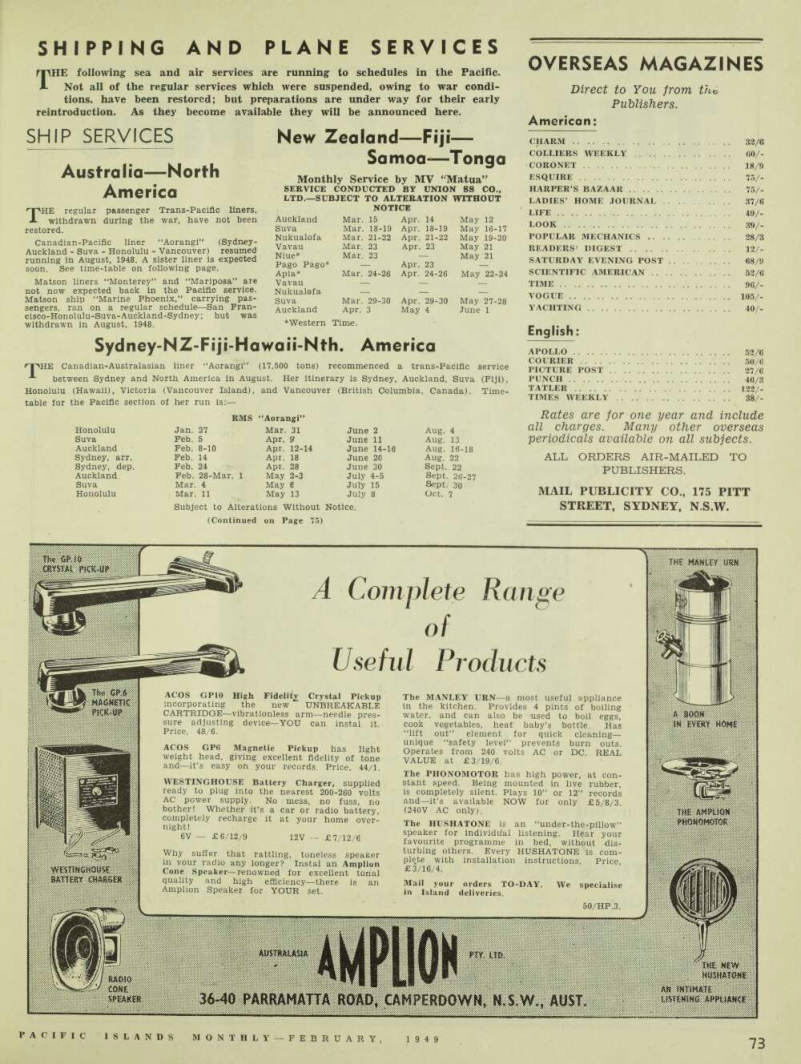
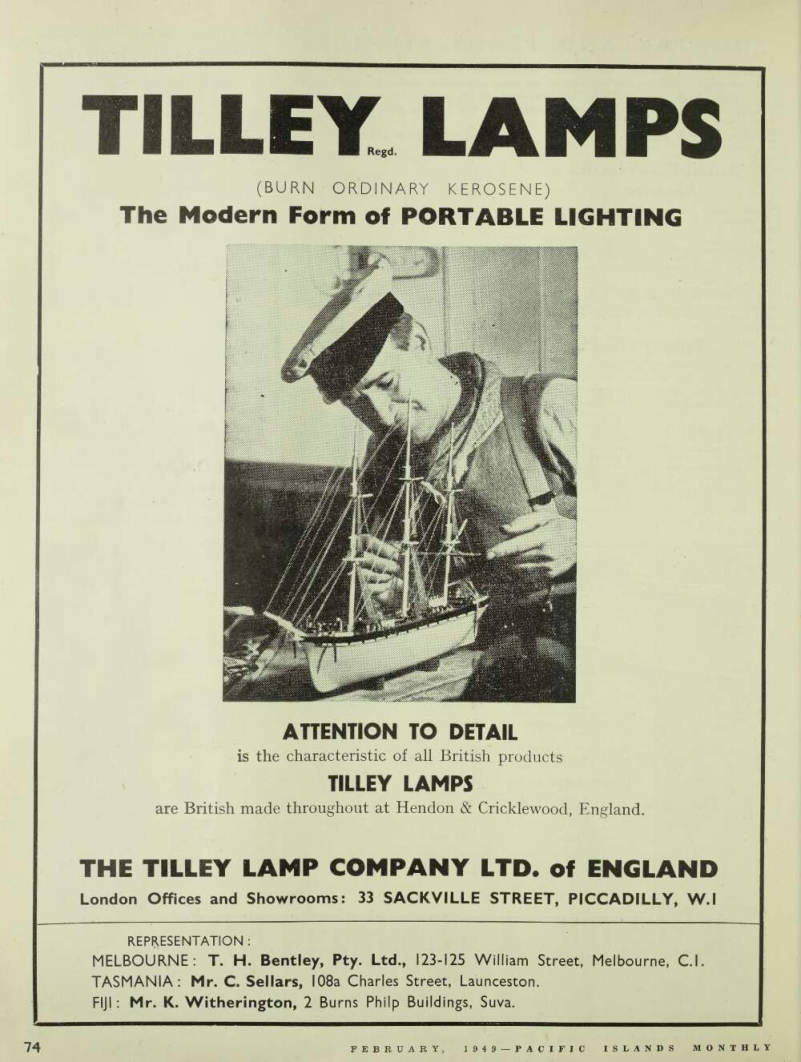
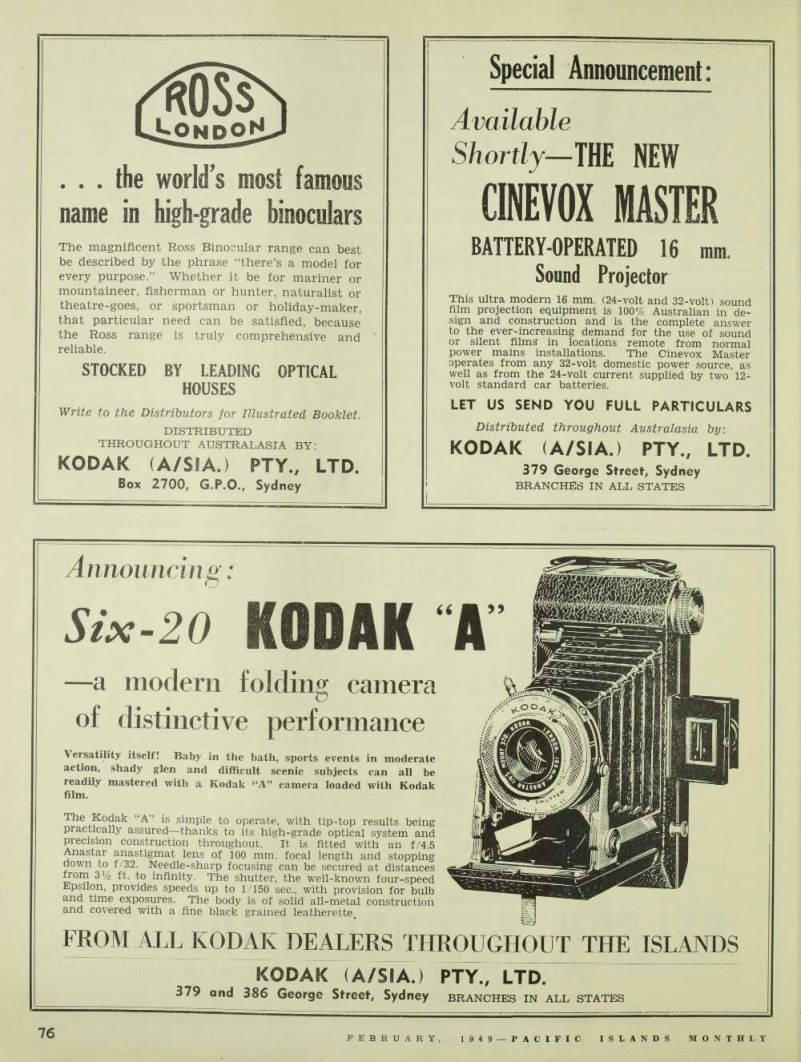
Shipping And Plane Services
THE following sea and air services are running to schedules in the Pacific.
Not all of the regular services which were suspended, owing to war condi tions. have been restored; but preparations are under way for their early reintroduction. As they become available they will be announced here.
Ship Services
Australia—North
America
THE regular passenger Trans-Pacific liners, withdrawn during the war, have not been restored, Canadian-Pacific liner “Aorangi” (Sydney- Auckland - Suva - Honolulu - Vancouver) resumed running in August, 1948. A sister liner is expected soon. See time-table on following page.
Matson liners “Monterey” and “Mariposa” are not now expected back in the Pacific service.
Matson ship “Marine Phoenix,” carrying pas sengers, ran on a regular schedule—San Pran cisco-Honolulu-Suva-Auckland-Sydney; but was withdrawn in August, 1948.
New Zealand—Fiji—
Samoa—Tonga
Monthly Service by MV “Matua”
Service Conducted By Union 8S Co..
Ltd.—Subject To Alteration Without
Notice
Sydney-NZ-Fiji-Hawali-Nth. America
'T'HE Canadian-Australasian liner “Aorangi” (17,500 tons) recommenced a trans-Pacific service between Sydney and North America in August. Her itinerary is Sydney, Auckland, Suva (Fiji), Honolulu (Hawaii), Victoria (Vancouver Island), and Vancouver (British Columbia, Canada). Time table for the Pacific section of her run is:—
(Continued on Page 75)
Overseas Magazines
Direct to You from th*
Publishers.
American:
Charm 32/6
Colliers Weekly 60/-
Coronet 18/9
Esquire 75/-
Harper’S Bazaar 75/-
Ladies’ Home Journal 37/6
Life 49/-
Look 39/-
Popular Mechanics 28/3
Readers' Digest 12/.
Saturday Evening Post 68/9
Scientific American 52/6
Time 96/-
Vogue 105/-
Yachting 40/-
English:
Apollo 52/6
Courier 50/6
Picture Post 27/6
Punch 46/3
Tatler 122/-
Times Weekly 38/-
Rates are for one year and include all charges. Many other overseas periodicals available on all subjects.
All Orders Air-Mailed To
Publishers.
Mail Publicity Co., 175 Pitt
Street, Sydney, N.S.W.
Rms
“Aorangi”
Honolulu Jan. 27 Mar. 31 June 2 Aug. 4 Suva Feb. 5 Apr. 9 June 11 Aug. 13 Auckland Feb. 8-10 Apr. 12-14 June 14-16 Aug. 16-18 Sydney, arr.
Feb. 14 Apr. 18 June 20 Aug. 22 Sydney, dep.
Feb. 24 Apr. 28 June 30 Sept. 22 Auckland Feb. 28-Mar. 1 May 2-3 July 4-5 Sept. 26-27 Suva Mar. 4 May 6 July 15 Sept. 30 Honolulu Mar. 11 May 13 July 8 Oct. 7 Subject to Alterations Without Notice.
Auckland Mar. 15 Apr. 14 May 12 Suva Mar. 18-19 Apr. 18-19 May 16-17 Nukualofa Mar. 21-22 Apr. 21-22 May 19-20 Vavau Mar. 23 Apr. 23 May 21 Niue* Mar. 23 May 21 Pago Pago* Apr. 23 Apia* Mar. 24-26 Apr. 24-26 May 22-24 Vavau Nukualofa Suva Mar. 29-30 Apr. 29-30 May 27-28 Auckland Apr. 3 May 4 June 1 ♦Western Time.
New Caledonia
THE New Caledonian Government has sub sidised and maintained the coastal ship ping services. The East Coast, the West Coast, and the Loyalty Islands, under present conditions, receive 10 round trips per annum.
The ships call at the following ports: EAST COAST. —Yale, Ounia, Thio, Nakety.
Canala, Kouaoua Kua, Moneo, Ponerihouen, Tibarama, Poindlmle, Wagap, Touho, Tipindje, Hienghene, Tao, Oubatch, Pouebo, Balade, Pam, Arama, and return.
WEST COAST. —Pouembout, Kone, Temala, Voh, Ouaco Gomen, Kouraac, Tangaiou, Tiebaghl, Nehoue Poume, Baaba, Belep and return.
LOYALTY ISLANDS—Mare (Tadine), Llfou (Chepenehe) Ouvea (Fajaoue, St. Joseph) and return.
The steamer “Neo Hebrldais” runs regularly between Noumea and Sydney, with occasional trips to the New Hebrides (mostly Aneityum).
The owners are Societe Maritime et Manlere Hagen, Noumea. Sydney agents: H. C, Sleigh, 254 George Street, Sydney.
New Zeoland —Cook
Is.—Niue—Samoa
fTIHE motor vessel “Maui Pomare,”
X owned and operated by the NZ Gov ernment. maintains a direct service between Auckland and Rarotonga (Cook Islands), with alternative calls at Niue and Apia (Samoa).
Next sailing of vessel from Auckland is not expected before mid-April.
Sydney-Norfolk Island-
New Hebrides
THE SS “Morinda,” Burns, Philp & Cos., Ltd., runs at approximately three monthly intervals from Sydney to Lord Howe Island, Norfolk Island, and main ports of the New Hebrides, and re turn.
Air Services
Summary of Pacific Air
Services
PAPUA AND NEW GUlNEA.—Regular Qantas service from Sydney.
SOLOMON ISLANDS. —Frequent regular flying boat service from Sydney by Trans Oceanic Airways.
NEW HEBRIDES. —Frequent regular flying-boat service from Sydney by Trans Oceanic Air ways. Service from Noumea by French plane runs twice weekly. Qantas plane from Sydney to NH on alternate Thursdays.
NORFOLK ISLAND.—Regular service from NZ by NZ National Airways; from Sydney by Qantas.
LORD HOWE ISLAND. —Regular weekly service from Sydney by Qantas and Trans Oceanic Airways.
FIJI. —Regular services from Australia by Pan American and BCPA (to Nadi); Auckland by NZ National Airways (to Nadi); from Australia by Qantas (to Laucala Bay, Suva); from Auckland by NZ National Airways (to Laucala Bay, Suva). Irregular calls from Australia to Laucala Bay, Suva, by Trans Oceanic Air ways. Regular service from Suva to Labasa by NZ National Airways.
Western Samoa, Cook Islands And
TONGA. —Regular service from Fiji by NZ National Airways.
TAHITI. —Infrequent service from Noumea by TRAPAS plane.
AUSTRALIA-NEW ZEALAND.—ReguIar service by Tasman Empire Airways.
AUSTRALIA-NORTH AMERICA.—Regular Trans pacific services by Pan American Airways and
Bcpa.
NZ National Airways
South Pacific Services
THE Pacific services run by the New Zealand National Airways Corporation are as follows:
Auckland-Laucala Bay (Suva): A “Sun
derland” flying-boat leaves Mechanics Bay, Auckland, at 7 a.m. each Saturday for Laucala Bay, Suva (arrives 3.30 p.m.).
(Continued on Page 77)
The aircraft departs from Laucala Bay, Suva, on the return journey at 7.30 a.m. each Monday, and arrives at Mechanics Bay, Auckland, at 4 p.m.
Laucala Bay (Suva)-Labasa (Vanua
LEVU): A “Sunderland” flying-boat operates this service on a charter basis. A return trip is made between Laucala Bay and Labasa each Sunday.
Auckland-Norfolk Island-Fiji-Tonga
Western Samoa-Cook Islands: A “Douglas”
airliner leaves Whenuapai, Auckland, on alter nate Sundays at o*3o a.m. (March 6, 20; April 3, 17) for Norfolk Island (arr. 12.30 p.m., dep. 12.1 a.m. Monday), Nadi (arr. 6.55 a.m., dep. 5.40 a.m. Tuesday), Nausori (arr. 6.30 a.m., dep. 7.15 a.m.), Tonga (arr. 10.45 a.m., dep. 11.45 a.m.), ’Apia, Western Samoa (arr. 4.10 p.m. Monday, dep. 7.45 a.m. Tuesday), Aitutaki, Cook Islands (arr. 1.50 p.m., dep. 2.45 p.m.) and Rarotonga, Cook Islands (arr. 4.5 p.m.).
The aircraft departs from Rarotonga on the return journey at 7.30 a.m. on alternate Thursdays (March 10, 24; April 7, 21) for Aitutaki (arr. 8.30 a.m., dep. 9.45 a.m.), Apia, Western Samoa (arr. 3.35 p.m., dep. 8 a.m.
Friday), *Tonga (arr. 11.15 a.m. Saturday, dep. 12.15 p.m.), Nausori (arr. 3.10 p.m., dep. 4.15 p.m.), Nadi (arr. 5.5 p.m., dep. 2 a.m. Sunday), Norfolk Island (arr. 8.10 a.m., dep. 1 p.m.), and Whenuapai, Auckland (arr. 5.45 p.m.).
An additional return service between Raro tonga and Aitutaki is operated on alternate Wednesdays when traffic warrants. •Crosses International Date Line.
Auckland-Norfolk Island: A “Douglas”
airliner leaves Whenuapai, Auckland, every Sun day at 8.15 a.m. for Norfolk Island (arr. 12.15 p.m.), and departs on the return flight at 1.15 p.m., arriving at Whenuapai at 6 p.m.
FARES, single (in NZ currency); Auckland to Norfolk, £l2/10/-; to Fiji, £3l; to Tonga, £3l; to Samoa, £34; to Aitutaki, £39; to Raro tonga, £39/10/-. Norfolk to Fiji, £l9. Fiji to Tonga, £B/15/-; to Samoa, £l3; to Aitutaki, £29/15/-; to Rarotonga, £3l. Samoa to Raro tonga, £l7/15/-; to Aitutaki, £l6/10/-; Suva to Labasa, £4/10/-. Return fares, less 10 per cent.
BOOKING OFFICES: Wellington, Govt. Life Bldg., Customhouse Quay; Auckland Airways House, Customs St.; Dunedin, 8-10 Manse St.; Christchurch, Union SS Cos., 168 Hereford 3t.; Gisborne, 74 Peel St.; Palmerston Nth., 107 Broadway Ave.; Hamilton, 8 Alma St.; Rotorua, Airport Bid., Fenton St.; Norfolk Is., Burns Philp, Ltd.; Fiji, NAC at Nadi and Suva; Burns Philp, Labasa and Lautoka; Tonga, Mrs.
F. F. Melhose, Fou-amotu Airfield: W. Samoa, Burns Philp (SS), Ltd., Apia; Cook Is., Mrs. P.
McVeagh, Aitutaki, and Mr. J. D. Campbell, Rarotonga.
Sydney-Vancouver
BCPA Service
BRITISH Commonwealth Pacific Airlines, Ltd., operate a twice weekly trans-Pacific service from Sydney to Vancouver, via Fiji, Canton Island, Honolulu and San Francisco; and a weekly service between Auckland and Vancouver, via the same ports.
Planes leave Sydney every Wednesday and Saturday, and Vancouver on the Southbound trip every Monday and Thursday. Every fourth trip from Sydney terminates at San Francisco instead of Vancouver.
Planes leave Auckland every Tuesday and arrive in Vancouver the following Wednesday.
The Southbound trip to Auckland commences from Vancouver every alternate Friday. Every other Friday the service commences at San Francisco.
Fares are (in Australian currency); Sydney- San Francisco, £2OO single and £360 return; Auckland-Vancouver, £AI9B single; Auckland- Nadi (Fiji), £A39; Sydney-Nandi, £ASS.
Douglas DC6 aircraft carrying 48 passengers (seated) or 37 passengers (in sleepers) and a crew of nine are used on the service.
Trans-Tasman Service
Sydney—Auckland
'XVASMAN Empire Airways, Ltd., operate a A flying-boat service between Rose Bay.
Sydney, and Mechanics Bay, Auckland. Large
flying-boats, capable of carrying 30 passengers, are employed. The trip is eomfortable, and takes approximately 8 hours.
The flying-boats leave both Sydney (6.30 a.m.) and Auckland (8 a.m.) every morning, including Sunday—seven flights each way per week. Fares: £35 (A) (£2B NZ currency) single; £63 (A) (£SO/8/- NZ currency) return.
In addition, this flying-boat service is, at pre sent, supplemented by a Skymaster service, details of which are available on application to TEA offices in Australia and New Zealand.
Bookings may be made at Tasman Empire Airways in Auckland and at Qantas Empire Air ways, Carrington Street, Sydney.
Pan-American—
Trans-Pacific Service
PAN-AMERICAN World Airways clippers now provide the followlner services in the South Pacific, using DC4 planes:— Planes leave Sydney every Tuesday, Friday and Sunday, and fly via Tontouta (New Caledonia), Nadi (Fiji), Canton Island, Honolulu, to San Francisco, and return along the same route. leaving ’Frisco every Tuesday and Saturday and Monday.
Planes leave Auckland every Friday and fly via Nadi, Canton Island, and Honolulu, to San
Francisco; and leave ’Frisco for Auckland every Monday. Fares are given below, in Australian currency:—
(Time-tables and fares subject to alteration without notice.) To convert to Fiji currency, reduce above figures by about 10 per cent.
Free baggage allowance is 66 lb. per person.
Excess baggage at 1 per cent, of single fare for each kilogram of excess (1 ki10—2.2 lb.). (Starting in February, three trips per week will be run between Sydney and San Francisco and re turn.)
Sydney—Noumea—Suva
/''VNCE fortnightly a Qantas flying-boat (a Catalina), leaves Sydney in the early morning, and goes directly over the Pacific to Noumea. Prom Sydney to Noumea is a Journey of about 11 hours. An overflight stop is made in Noumea, and Suva is reached the following afternoon.
Intending passengers should book through Qantas offices in Australia. Burns, Phllp (South Seas) Company, in Suva; and T. Johnston in Noumea.
Pares: To Noumea, £35 single; £63 return.
To Suva, £52/10/- single; £94/10/- return.
Noumea-Suva, £l7/10/- single; £3l/10/- re turn.
Sydney—Queensland—
New Guinea
QANTAS Empire Airways, Ltd., employing DC3 planes, operate a regular service between Sydney, Port Moresby, Lae, Pinschhafen, Madang, and Rabaul, and return, via Brisbane, Rockhampton, Townsville and Cairns.
This service is now known as the “Bird of Paradise” Service. DC3 aircraft, carrying 19 passengers, are used.
Flames leave Sydney on Mondays, Wednesdays, and Fridays at 9 a.m., and arrive at Lae at 1 p.m. on Tuesdays, Thursdays and Saturdays.
The plane which leaves Sydney on Wednesday
and arrives at Lae on Thursday then goes on to Rabaul, It returns on Friday. The plane, which arrives at Lae on Tuesdays, then goes on to Madang, returning to Lae the same day.
Planes leave Lae at 5.45 a.m. on Wednesdays, Saturday and Sunday, and arrive in Sydney at 10 p.m., accomplishing the Lae-Sydney run in a day.
The return plane from Rabaul leaves at 130 p.m. on Fridays.
Bookings may be made at Qantas offices at any of the towns named. At present, berths are available only to passengers holding official per mits to visit Papua or New Guinea.
Sydney-Lord Howe ls.-
Norfolk Is.
QANTAS, Sydney, run a Catalina once weekly from Sydney to Lord Howe Island. Fare, single, £l2. Return, £2l/12/-.
Qantas run a laud plane about once a fort night from Sydney to Norfolk Island. Fare, £22 single; £35/12/- return. (For Norfolk Island, see also under NZ National Airways.)
Noumea-Fiji-Tahiti
TRAPAS (a French company with headquarters in Noumea) ran an air service once a month from Noumea (New Caledonia), via Nadi (Fiji) and Altutaki (Cook Islands) to Papeete (Tahiti), and return.
It was announced in January that this was to become a fortnightly service; but service was suspended in March owing to hurricane damage.
New Caledonia—
New Hebrides
A PLANE based on Noumea runs between Noumea and Port Vila (New Hebrides), with calls at Santo and other places as required, and returns, twice each week.
Papua-NG Local
Services
MANDATED Airlines, Ltd., of Lae, New Guinea, and other private operators, run air ser vices between Lae and the New Guinea mainland centres of Wau, Bulolo, Madang, Wewak, Aitape, Mt. Hagen, Finschhafen, Moresby, Kokoda —in fact anywhere in Papua or New Guinea where there is an air-strip. These planes carry pas sengers, mails and cargo on regular schedules or charter flights.
Guinea Air Traders Ltd., of Lae, New Guinea, employ six aircraft on local services, and on charter work.
Under arrangement with the Administration, a Qantas plane, carrying Administration personnel and cargo, and mails, flies once each week from Lae to Rabaul, KaVieng and Manus, and returns to Lae by the same route.
New Caledonia-New
Hebrides—Tahiti
A TRAPAS amphibian runs twice each week between New Caledonia and New Hebrides.
The days vary, but on the selected day the planes adhere to the following time-table:— Noumea—dep. 0630. Vila—arr. 0900 Vila—dep. 0945 Santo —arr. 1115 Santo—dep. 1145 Vila —arr. 1315 Vila—dep. 1400 Noumea—arr. 1630 A TRAPAS plane runs monthly between Noumea and Tahiti.
Single Return £ s. d. £ s. d.
Sydney-’Prisco 200 0 0 360 0 0 Sydney-Piji 55 0 0 99 1 3 Auckland-’Frisco .. .. 184 1 3 331 5 0 Auckland-Plji 39 1 3 70 6 3 Fiji-’Frisco 145 0 0 260 18 9
(Continued from Page 78)
TOA Services
TRANS Oceanic Airways run the following Pacific services:— SYDNEY-LORD HOWE IS.: A regular fort nightly service with large four-engine flying boats from Rose Bay. Fare: £ll single; £2l return. Free baggage allowance 50 lb. Excess baggage and freight rate 6d. per lb.
SYDNEY-NEW HEBRIDES: A regular monthly service with large four-engine flying-boats from Sydney, via Noumea (overnight stop), to Vila and Espiritu Santo. Pare; Sydney-Vila, £45; Sydney-Santo. £5O: Noumea-Vila, £l2/10/-; Noumea-Santo, £ 18/10 -. Freight: Sydney-Vila or Santo, 2/- per lb.
Sydney-Solomon Islands: A Regular
monthly service from Sydney, via New Cale donia and New Hebrides to Tulagi, Solomon Islands. This service is frequently extended to Lingatou, in the Russell Islands, and calls are sometimes made at Vanikoro, in the Santa Cruz Group. Fares: Sydney-Tulagi, £65. Free bag gage allowance. 60 lb.; excess baggage and freight. 3/- per ID.
Advertisements & other items, pp. 75-82 (2 items)
A Complete Range
The CP. 10
CRYSTAL PICK-UP
of
Useful Products
,m m tm The GP.* kinetic
PICK-UP
RT CHARGE
RADIO
CONE
SPEAKER
ACOS GPIO High Fidelity Crystal Pickup incorporating the new UNBREAKABLE CARTRIDGE —vibrationless arm—needle pressure adjusting device—YOU can instal it.
Price, 48/6.
ACOS GP6 Magnetic Pickup has light weight head, giving excellent fidelity of tone and—it’s easy on your records. Price, 44/1.
WESTINGHOUSE Battery Charger, supplied ready to plug into the nearest 200-260 volts AC power supply. No mess, no fuss, no bother! Whether it’s a car or radio battery, completely recharge it at your home overnight! 6V £6/12/9 12V £7/12/6 Why suffer that rattling, toneless speaker in your radio any longer? Instal an Amplion Cone Speaker—renowned for excellent tonal quality and high efficiency—there is an Amplion Speaker for YOUR Set.
The MANLEY URN —a most useful appliance in the kitchen. Provides 4 pints of boiling water, and can also be used to boil eggs, cook vegetables, heat baby’s bottle. Has “lift out” element for quick cleaning— unique “safety level” prevents burn outs.
Operates from 240 volts AC or DC. REAL
VALUE at £3/19/6.
The PHONOMOTOR has high power, at constant speed. Being mounted in live rubber, is completely silent. Plays 10” or 12” records and—it’s available NOW for only £5/8/3. (240 V AC only).
The HUSHATONE is an “under-the-pillow” speaker for individual listening. Hear your favourite programme in bed, without disturbing others. Every HUSHATONE is complete with installation instructions. Price £3/16/4.
Mail your orders TO-DAY. in Island deliveries.
We specialise 50/HP.3.
AUSTRALASIA
Dry. LTO
THE MANLEY URN
A BOON
IN EVERY HOME
THE AMPLION
PHONOMOTOR
i
36-40 PARRAMATTA ROAD, CAMPPRDOWK, AUST,
THE NEW
HUSHATONE
AN INTIMATE
LISTENING APPLIANCE
TILLEY, LAMPS
(BURN ORDINARY KEROSENE)
The Modern Form of PORTABLE LIGHTING mm a: i wig
ATTENTION TO DETAIL
is the characteristic of all British products
TILLEY LAMPS
are British made throughout at Hendon & Cricklewood, England.
THE TILLEY LAMP COMPANY LTD. of ENGLAND London Offices and Showrooms: 33 SACKVILLE STREET, PICCADILLY, W.l
REPRESENTATION :
MELBOURNE; T. H. Bentley, Pty. Ltd., 123-125 William Street. Melbourne, Cl.
TASMANIA: Mr. C. Sellars, 108 a Charles Street, Launceston.
FIJI: Mr. K. Witherington, 2 Burns Philp Buildings, Suva.
KODAK FILMS
and all Photographic Supplies
WHOLESALE AND RETAIL
CAINE'S STUDIOS
P.O. Box 8, Suva Photographers. Est. 1904.
Write for free price lists.
Coventry Climax
Electric Sets
2.75 KVA 110/130 Volf A.C.
3 PHASE, £135
Discount for quantity.
These sets are new and driven by 4-Cylinder 8 H.P. Petrol Engine, complete with instruments and mounted in steel frame.
Ideal for lighting, used extensively by Army and Air Force during war.
HARDMAN & HALL
44 Missenden Road, Newtown, N.S.W., Australia.
NELSON and ROBERTSON Ply. Ltd.
Established 1895
Shipowners - Brokers and
Islands Merchants
All classes merchandise purchased at Best Wholesale Prices. Original Invoices supplied to Island Clients. Cocoa Beans, Copra, Rubber, Trochus Shell and All Islands 7 Produce Sold on Commission.
Entrust your requirements to the firm with fifty years' practical experience in the Pacific Islands. ■ uiivuuwii yiTcit iv vii enquiries,
NELSON & ROBERTSON 111
12 SPRING STREET, SYDNEY, AUSTRALIA
Telegraphic Address; IVAN, SYDNEY.
Special Announcement:
Available
Shortly—THE NEW
CMVOX MASTER
BATTERY-OPERATED 16 mm,
Sound Projector
This ultra modern 16 mm. (24-volt and 32-volt) sound film projection equipment is 100% Australian in design and construction and is the complete answer to the ever-increasing demand for the use of sound or silent filmg in locations remote from normal power mains installations. The Cinevox Master operates from any 32-volt domestic power source, as well as from the 24-volt current supplied by two 12volt standard car batteries.
LET US SEND YOU FULL PARTICULARS
Distributed throughout Australasia by.
KODAK (A/SIA.) PTY., LTD.
379 George Street, Sydney
BRANCHES IN ALL STATES
London
. . . the world’s most famous
name in high-grade binoculars
The magnificent Ross Binocular range can best be described by the phrase “there’s a model for every purpose.” Whether it be for mariner or mountaineer, fisherman or hunter, naturalist or theatre-goes, or sportsman or holiday-maker, that particular need can be satisfied, because the Ross range is truly comprehensive and reliable.
STOCKED BY LEADING OPTICAL
HOUSES
Write to the Distributors for Illustrated Booklet.
DISTRIBUTED
THROUGHOUT AUSTRALASIA BY:
KODAK (A/SIA.) PTY., LTD,
Box 2100, G.P.0., Sydney
Announcing:
Six-20 KODAK
—a modern folding camera
of distinctive performance
Versatility itself! Baby in the bath, sports events in moderate action, shady glen and difficult scenic subjects can all be readily mastered with a Kodak “A” camera loaded with Kodak film.
The Kodak “A” is simple to operate, with tip-top results being practically assured—thanks to its high-grade optical system and precision construction throughout. It is fitted with an f/4.5 Anastar anastigmat lens of 100 mm. focal length and stopping down to f/32. Needle-sharp focusing can be secured at distances from 3Vo ft, to infinity. The shutter, the well-known four-speed Epsilon, provides speeds up to 1/150 sec., with provision for bulb and time exposures. The body is of solid all-metal construction and covered with a fine black grained leatherette.
Vfl % I FROM ALL KODAK DEALERS THROUGHOUT THE ISLANDS
KODAK (A/SIA.) PTY., LTD,
379 and 386 George Street Sydney branches in all states
fINKUS"
::z
iti
m VP til Si 55
SWALLOW « ARIELL
LIMITED
53916 Master Craftsmen in the Biscuit Industry since 1854
AMERICA’S most popular monthly magazine for every member of the family . . .
COLOUR
ARTICLES
GAMES
FEATURES
1 year, 18/9 2 years, 31/3 Send your subscription to
MAIL PUBLICITY COMPANY
Subscription Agents 175 Pitt Street, SYDNEY, N.S.W.
A. GREGORY PTV, LTD,
IMPORTERS, EXPORTERS AND
MANUFACTURERS
Leather Saddlery and Paint Merchants All Classes of Leather and Paints Kept in Stock A. GREGORY PTY., LTD., 107 York St, Sydney
£ J. GOUGrI S. CQ.
Bond Street, Sydney, Australia
Tel. BU 2195. Box 3615 G.P.O.
SUPPLIERS OF GENERAL MERCHANDISE TO LEADING FIRMS THROUGHOUT THE
PACIFIC ISLANDS
Exporters . . . Importers ... . Manufacturers' Representatives Bankers: Bank of N.S.W. Bank of Adelaide. Comptoir Nat. d’Escompte de Paris.
Cable Address: “SEAFOODS.” SYDNEY.
Codes: Bentley’s, 2nd and Comp. Phrase; A.8.C., sth and 6th; Peterson, 2nd and 3rd; Banking; Acme.
C. SULLIVAN PTY. LTD.
Island Merchants
Over 30 years' experience in the Pacific Island Trade.
Expert Buying Service Original Invoices Furnished Sellers of Island Produce.
Represented in all Australian States, New Zealand, England, France, United States, etc.
BANKERS-: Bank of New South Wales, Comptoir National d’Escompte de Paris, Bank of New Zealand.
C. SULLIVAN PTY. LTD.
379 KENT STREET, SYDNEY
Telegrams & Cables: CHASULL, Sydney. Phone: MJ 4657 (6 lines).
WE OFFER ALL TYPES OF BOATS FOR ISLAND WORK •
A FEW ARE LISTED HERE:
110 TON DIESEL KETCH. Faithfully built, copper sheathed. Ist class condition.
Accommodate 20. Suit Mission work or inter-island trade. For sale at fraction of original cost. £B,OOO.
WOODEN VESSEL, 55 ft. x 16 ft. X 6 ft., 80 H.P. Diesel Engine, with good carrying capacity. Copper sheathed. Reasonably priced at £4,500.
HEAVILY BUILT 45 ft. x 12 ft. x 4 ft.
DIESEL LAUNCH. Powered by 75 H.P.
R.N. Diesel. Extremely well fitted, and condition guaranteed. Good type plantation boat. Price, £3,000. 75 TON WOODEN VESSEL. 66 ft. 0.L., beam 18 ft., draft 7 ft. Built 1944. Copper sheathed. Powered by National Superior Diesel. Cargo below deck, 40 tons. In commission. £7,000.
SPACIOUS WORK-BOAT, 32 ft. X 11 ft. 6 in. x 4 ft. 6 in. Built 1947 with aux. sail power by English Turner Diesel.
Carry 15 ton. £1,650.
NEW 110 TON STEEL VESSEL. 75 ft. x 18 ft. x 7 ft. Cargo capacity 75 tons. Completed except for engines, which are available.
ALL VESSELS OPEN TO INDEPENDENT INSPECTION AND SURVEY.
DELIVERIES ARRANGED TO ANYWHERE IN THE PACIFIC.
Write for further details or requirements.
• NEW SOUTH WALES YACHT BROKERS
Suite Three, Argent Chambers, 19 Hunter Street, Sydney
Cables: "Agarscarr," Sydney. Telephone: BW 7000
All your inquiries promptly attended to.
m.pAmw
KHfl
and FAMILY agree;
Horlicks is extra delicious
and more nourishing.
It's our family
IlfegsrK■ food drink”
.» m 4.
Vic. Patrick famous Australian boxer —is very much the family man. And do you wonder why. when you see' his charming wife and two lovely daughters, Anne and Vicki?
Both Vic. and his wife, Nancy, swear by Horlicks. Mrs. Patrick says: “Aoull always find Horlicks in our house. It’s so nourishing.”
And Vic. says; “Naturally I watch my health carefully at all times.
And that’s why I like Horlicks so
PttOTEM
much ... it helps me sleep and keeps me in fighting trim.”
The full, satisfying flavour of Horlicks comes from a careful blend of fresh, full-cream milk and the nutritive extracts of malted barley and wheat. It is Nature’s flavour . . . that’s why you never tire of it.
Many people drink Horlicks at home simply because they enjoy that distinctive flavour. Others drink Horlicks because they need it to build them up ... to nourish the body and nerves . . . and to
induce deep, refreshing sleep.
Horlicks is equally delicious hot or cold.
“You’ve got to be fit to fight” says Vic. Patrick. And that’s one good reason why he enjoys Horlicks it’s such a nourishing and sustaining health drink.
Ask your
storekeeper for
CALC/UM
when mixed as directed
16-oz. TIN
3'
HORLICKS
8-oz. TIN 2 l
(Prices slightly higher in country areas)
75
PACIFIC ISLANDS MONTHLY-P E B R U A R Y . 1949
School Opened
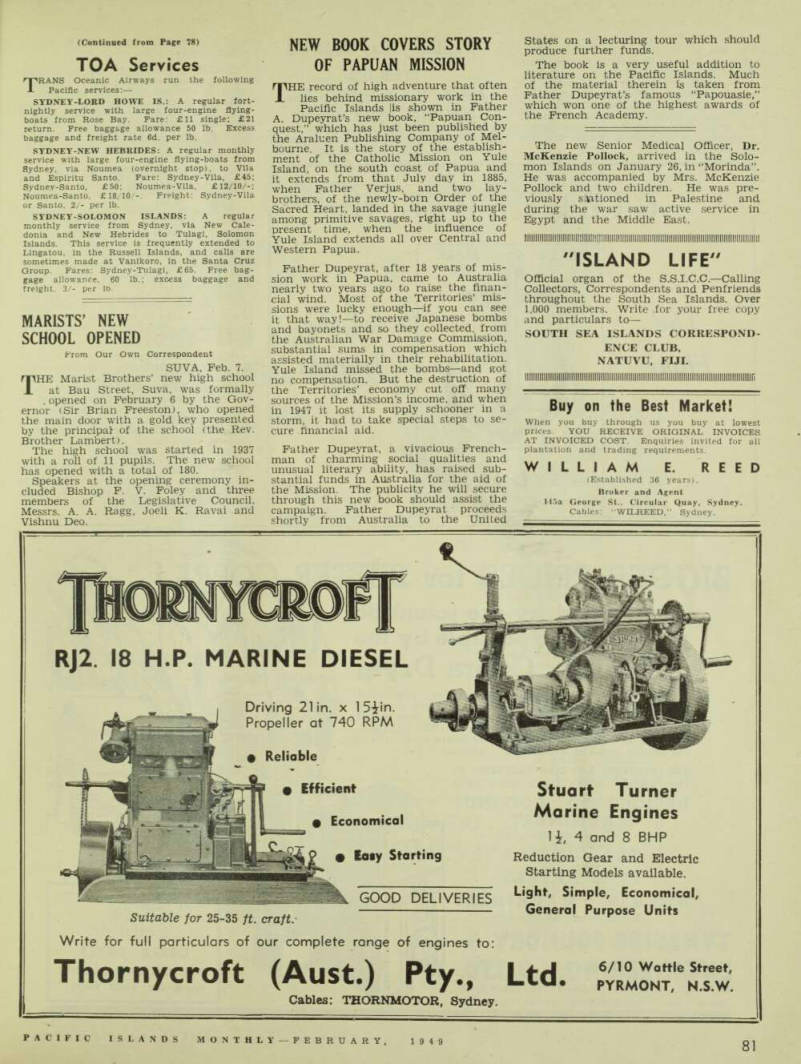
Marists’ New
From Our Own Correspondent
Suva. Feb. 7.
THE Marist Brothers’ new high school at Bau Street, Suva, was formally . opened on February 6 by the Gov ernor (Sir Brian Freeston), who opened the main door with a gold key presented by the principal of the school (the Rev.
Brother Lambert).
The high school was started in 1937 with a roll of 11 pupils. The new school has opened with a total of 180.
Speakers at the opening ceremony in cluded Bishop F. V. Foley and three members of the Legislative Council.
Messrs. A. A. Ragg, Joeli K. Ravai and Vishnu Deo.
New Book Covers Story
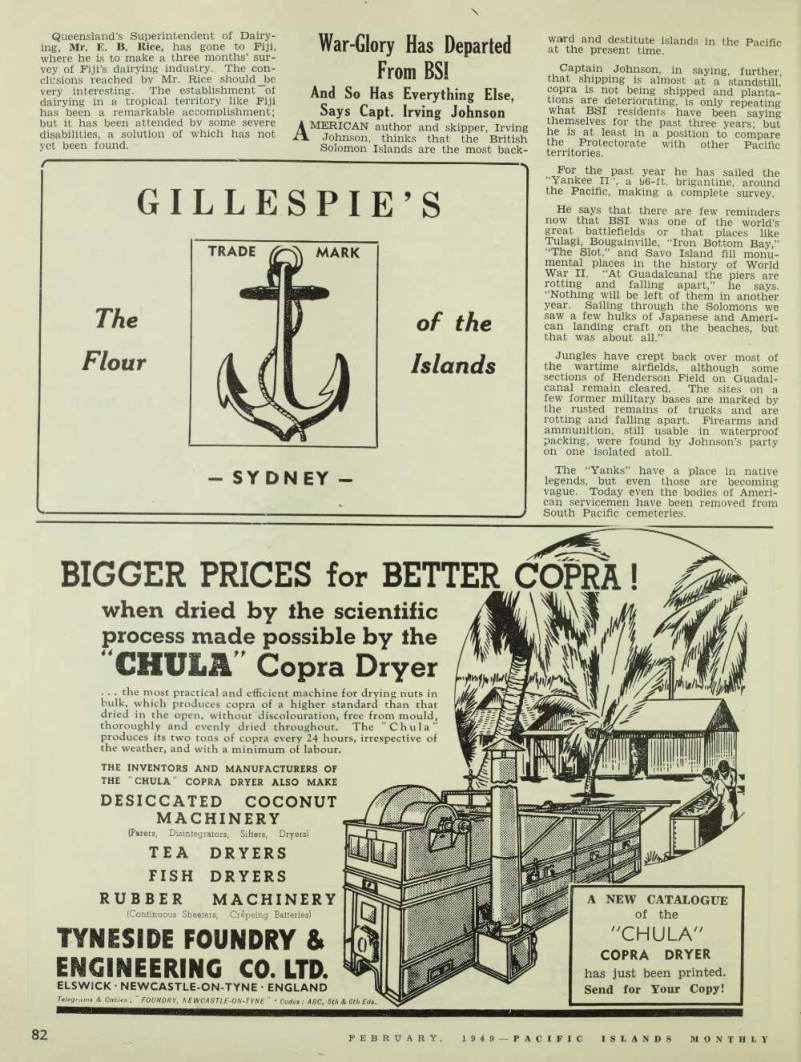
Of Papuan Mission
THE record of high adventure that often lies behind missionary work in the Pacific Islands |is shown in Father A. Dupeyrat’s new book, “Papuan Con quest,” which has just been published by the Araluen Publishing Company of Mel bourne. It is the story of the establish ment of the Catholic Mission on Yule Island, on the south coast of Papua and it extends from that July day in 1885, when Father Verjus, and two lay brothers, of the newly-born Order of the Sacred Heart, landed in the savage jungle among primitive savages, right up to the present time, when the influence of Yule Island extends all over Central and Western Papua.
Father Dupeyrat, after 18 years of mis sion work in Papua, came to Australia nearly two years ago to raise the finan cial wind. Most of the Territories’ mis sions were lucky enough—if you can see it that way!—to receive Japanese bombs and bayonets and so they collected, from the Australian War Damage Commission, substantial sums in compensation which assisted materially in their rehabilitation.
Yule Island missed the bombs—and got no compensation. But the destruction of the Territories’ economy cut off many sources of the Mission’s income, and when in 1947 it lost its supply schooner in a storm, it had to take special steps to se cure financial aid.
Father Dupeyrat, a vivacious French man of charming social qualities and unusual literary ability, has raised sub stantial funds in Australia for the aid of the Mission. The publicity he will secure through this new book should assist the campaign. Father Dupeyrat proceeds shortly from Australia to the United
States on a lecturing tour which should produce further funds.
The book is a very useful addition to literature on the Pacific Islands. Much of the material therein is taken from Father Dupeyrat’s famous “Papouasie,” which won one of the highest awards of the French Academy.
The new Senior Medical Officer, Dr.
McKenzie Pollock, arrived in the Solo mon Islands on January 26, in “Morinda”.
He was accompanied by Mrs. McKenzie Pollock and two children. He was pre viously sifctioned in Palestine and during the war saw active service in Egypt and the Middle East.
Queensland’s Superintendent of Dairy ing, Mr. E. B. Rice, has gone to Fiji, where he is to make a three months’ sur vey of Fiji’s dairying industry. The con clusions reached by Mr. Rice should __be very interesting. The establishment of dairying in a tropical territory like Fiji has been a remarkable accomplishment; but it has been attended by some severe disabilities, a solution of which has not yet been found.
Advertisements & other items, pp. 83-84 (1 item)
Thornycroft (Aust.) Pty., Ltd.
"ISLAND LIFE"
Official organ of the S.S.l.C.C.—Calling Collectors, Correspondents and Penfriends throughout the South Sea Islands. Over 1,000 members. Write for your free copy and particulars to—
SOUTH SEA ISLANDS CORRESPOND-
ENCE CLUB.
NATUVU, FIJI.
llllllNlillllilllllllH
Buy on the Best Market!
When you buy through us you buy at lowest
prices YOU RECEIVE ORIGINAL INVOICES
AT INVOICED COST. Enquiries invited for all plantation and trading requirements.
WILLIAM E. REED
(Established 36 years).
Broker and Agent 145 a George St., Circular Quay, Sydney.
Cables; “WILREED,” Sydney.
OFF
0
RJ2. 18 H.P. MARINE DIESEL
Driving 21 in. x 1 siin.
Propeller at 740 RPM • Reliable • Efficient ft Economical • Easy Starting
GOOD DELIVERIES
Suitable for 25-35 ft. craft.
Stuart Turner
Marine Engines
li, 4 and 8 BHP Reduction Gear and Electric Starting Models available.
Light, Simple, Economical, General Purpose Units Write for full particulars of our complete range of engines to:
Thornycroft (Aust.) Pty., Ltd.
Cables: THORNMOTOR, Sydney. 6/10 Wattle Street,
PYRMONT, N.S.W.
GILLESPIE’S
The Flour
TRADE MARK
of the Islands
- SY DN EY -
BIGGER PRICES for BETTER COPRA!
when dried by the scientific
process made possible by the
"CHULA' Copra Dryer
. . . the most practical and efficient machine for drying nuts in bulk, which produces copra of a higher standard than that dried in the open, without discolouration, free from mould, thoroughly and evenly dried throughout. The ‘‘Chula'' produces its two tons of copra every 24 hours, irrespective of the weather, and with a minimum of labour.
THE INVENTORS AND MANUFACTURERS OF
THE “CHULA” COPRA DRYER ALSO MAKE
DESICCATED COCONUT
MACHINERY
(Parers, Disintegrators, Sifters, Dryers)
TEA DRYERS
FISH DRYERS
RUBBER MACHINERY
(Continuous Sheeters, Crepeing Batteries)
TYNESIDE FOUNDRY &
ENGINEERING CO. LTD.
ELSWICK • NEWCASTLE-ON-TYNE • ENGLAND
Telegrams & Cables ; " FOUNDRY, NEWCASTLE-ON-TYNE " • Codes ; ABC, sth & 6th Eds jT \ 1A d m
NEW CATALOGUE
of the
CHULA"
COPRA DRYER
has just been printed.
Send for Your Copy!
War-Glory Has Departed
From BSI And So Has Everything Else, Says Capt. Irving Johnson
AMERICAN author and skipper, Irving Johnson, thinks that the British Solomon Islands are the most back
ward and destitute islands in the Pacific at the present time.
Captain Johnson, in saying, further that shipping is almost at a standstill, copra is not being shipped and planta tions are deteriorating, is only repeating what BSI residents have been saying themselves for the past three years; but he is at least in a position to compare the Protectorate with other Pacific territories.
For the past year he has sailed the ‘Yankee II", a 96-ft. brigantine, around the Pacific, making a complete survey.
He says that there are few reminders now that BSI was one of the world’s great battlefields or that places like Tulagi, Bougainville, “Iron Bottom Bay,”
“The Slot,’’ and Savo Island fill monu mental places in the history of World War 11. “At Guadalcanal the piers are rotting and falling apart,” he says.
“Nothing will be left of them in another year. Sailing through the Solomons we saw a few hulks of Japanese and Ameri can landing craft on the beaches, but that was about all.”
Jungles have crept back over most of the wartime airfields, although some sections of Henderson Field on Guadal canal remain cleared. The sites on a few former military bases are marked by the rusted remains of trucks and are rotting and falling apart. Firearms and ammunition, still usable in waterproof packing, were found by Johnson’s party on one isolated atoll.
The “Yanks” have a place in native legends, but even those are becoming vague. Today even the bodies of Ameri can servicemen have been removed from South Pacific cemeteries.
Advertisements & other items, pp. 85-87 (2 items)
83
PACIFIC ISLANDS MONTHLY—F E B R U A R Y , 1949
It s a fact!
i ill i & W
shows the way to
new Box Office fields
with 16 MM.
This year over forty-five 16 m.m. Equipments have been installed throughout the sparsely populated outback, and small country towns providing entertainment for many who have never before seen a movie, or except on rare visits to the cities, have the pleasure of enjoying their favourite stars and film personalities.
“Are you one of these 45 progressive Showmen?”
Q .r
CINEVOX
(Dual Head, as illustrated)
EXHIBITOR
Outside the main centres of population there is a huge untouched field for smart Exhibitors with 16 m.m. Equipment, with untold possibilities for profitable business. Many CINEVOX “Exhibitor” Dual Equipments are in use throughout the Australian outback and Pacific Islands.
“ARE YOU ALIVE TO THESE OPPORTUNITIES?"
Mail the coupon below for full particulars of CINEVOX and how to obtain your picture programmes.
Operates from A.C. or D.C.
Current, or from Mobile Power Unit.
CINEVOX
MASTER
For 32 V. or Battery Operation.
Distributors for Papua, New Guinea and Pacific Islands:
VIZ-ED EQUIPMENT (Q'ld) Pty. Ltd.
OLD COURIER BLDG., QUEEN ST., BRISBANE
Please send me FREE and POST FREE complete details of
the CINEVOX PREFECT and MASTER PROJECTORS.
Name Address
P.I M.”
1 I I i I I I I
yin ornate example of historical keys, this XVlth Century French key features the sporting motif in its club and animal carvings. It seems to have been the key to a Duke’s country
lodge.
0 «%IP USe r M m
The key
to smoking pleasure
CAPSTAN
FINE CUT
NAVY CUT
TOBACCOS
or © 1657.7.48
Classified Advertisements
FOR SALE
Completely equipped ketch, 55 ft. certificated by full accommodation ten persons. Delivered anywhere in the Pacific Details from William E. Reed, 145 a George Street, Circular Quay, Sydney.
Cables: “Wilreed”, Sydney.
AVRO ANSON AIRCRAFT FOR SALE.
Has just completed annual Certificate of Airworthiness. Interior lined, seats, etc.
Apply Thiess Bros., Brisbane. Cable address: “Excavators”.
POSITION WANTED
Diesel, refrigeration and electrical engineer desires position in islands, certified electrical welder. Apply, E. McKee, c/o Box 3408, G.P.0., Sydney.
POSITIONS VACANT
BUSHMEN (4) wanted —up to 45 years old and single men preferred—for Fijian Timber Mill.
Must be capable of handling any bush job, particularly “Roping” and “Breaking Out,” splicing, maintenance of saws and the laying out of ropes for log hauling.
Wages, £5O Fijian currency per month (Australian currency, £56/5/-). An extra £lO Fijian currency per month will be paid to anyone capable of assuming a Foreman’s position. In addition, a bonus on production will be paid when the new mill is operating.
Fares, either by steamer or plane, will be paid to appointees. Accommodation and messing available for single men. For a married man a house will be erected and supplied rent free.
Successful applicants will be required to give a guarantee to remain at least 12 months.
Applications, accompanied by copies of testimonials, by letter, to
“LUMBER,”
c/o Mercantile Exchange, 380 Collins Street.
Melbourne.
WANTED:— Governess teach two children. Prefer woman between thirty-five and forty-five years. Salary Two Pounds a week. For further particulars, write Mrs. Holland, Madiri Plantation, Fly
River, Papua.
TENDERS
Tenders addressed, Secretary, Shortland Islands Plantations, Ltd., Box 543, G.P.0., Sydney, are invited and will be received up to 12 noon, Saturday, April 30, 1949, for the purchase of the following coconut plantation properties, situated in the British Solomon Islands Protectorate:—
LOFUNG.
HARAPA.
KAMALIAI.
The highest or any tender not necessarily accepted. Terms with suitable guarantees will be considered. Further particulars will be made available on application.
Tenders addressed, Secretary, Solomon Islands Development Co., Ltd., Box 543, G.P.0., Sydney, are invited and will be received up to 12 noon' Saturday, April 30, 1949, for the purchase of the following coconut plantation properties, situated in the British Solomon Islands Protectorate:— NEAL ISLAND and small plantation on mainland.
TETIPARI.
MANNING STRAITS.
LUTEE.
The highest or any tender not necess accepted. Terms with suitable guarantee wi considered. Further particulars will be r available on application.
\our own job
is big enough
The man who lives in the Islands may acquire additional responsibilities without warning. If he has been appointed executor of an estate several thousand miles away, distance alone makes it almost impossible to carry out these extra duties. In any case, he is most unlikely to possess the highly-specialised knowledge of taxation, investment and finance which efficient administration demands.
Rather than attempt two jobs, he can share the responsibility with Burns Philp Trust Company Limited. If desired, the entire task of administration can be transferred to this experienced and permanent organisation. Not only does this arrangement relieve the individual of an unsought obligation, but also ensures that the beneficiaries’ interests will be safeguarded at all times.
A full description of the Company’s services, together with much valuable information, is given in “Hands That Never Leave The Wheel”. You are invited to send for a copy of this free booklet.
DIRECTORS:
JAMES BURNS, JOSEPH MITCHELL, P. T. W. BLACK,
ERIC PRIESTLEY LEE.
MANAGER: SECRETARY:
L, S. PARKER. E. R OVERTON, A.F.I.A.
Burns Philp Trust
COMPANY LIMITED
EXECUTOR • TRUSTEE • AGENT
(Constituted by Special Act of the N.S.W. Parliament.)
7 BRIDGE STREET, SYDNEY
Tele. BU 5901 BOX 543, 5.P.0., SYDNEY
BPIO
'VHAT
TH t
Treatment Of Leprosy
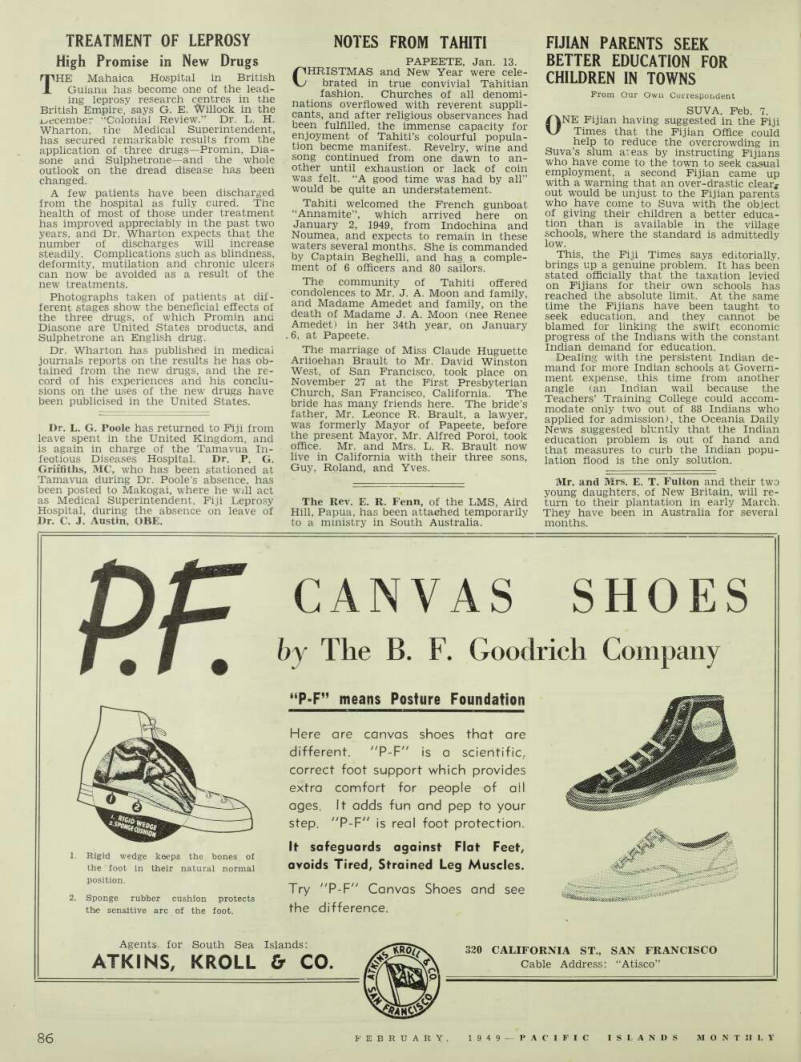
High Promise in New Drugs
THE Mahaica Hospital in British Guiana has become one of the lead ing leprosy research centres in the British Empire, says G. E. Willock in the December "Colonial Review.” Dr. L. H.
Wharton, the Medical Superintendent, has secured remarkable results from the application of three drugs—Promin, Dia sone and Sulphetrone—and the whole outlook on the dread disease has been changed.
A few patients have been discharged from the hospital as fully cured. The health of most of those under treatment has improved appreciably in the past two years, and Dr. Wharton expects that the number of discharges will increase steadily. Complications such as blindness, deformity, mutilation and chronic ulcers can now be avoided as a result of the new treatments.
Photographs taken of patients at dif ferent stages show the beneficial effects of the three drugs, of which Promin and Diasone are United States products, and Sulphetrone an English drug.
Dr. Wharton has published in medical journals reports on the results he has ob tained from the new drugs, and the re cord of his experiences and his conclu sions on the uses of the new drugs have been publicised in the United States.
Dr. L. G. Poole has returned to Fiji from leave spent in the United Kingdom, and is again in charge of the Tamavua In fectious Diseases Hospital. Dr. P. G.
Griffiths, MC, who has been stationed at Tamavua during Dr. Poole’s absence, has been posted to Makogai, where he will act as Medical Superintendent, Fiji Leprosy Hospital, during the absence on leave of Dr. C. J. Austin, OBE.
Notes From Tahiti
Papeete, Jan. 13.
CHRISTMAS and New Year were cele brated in true convivial Tahitian fashion. Churches of all denomi nations overflowed with reverent suppli cants, and after religious observances had been fulfilled, the immense capacity for enjoyment of Tahiti’s colourful popula tion becme manifest. Revelry, wine and song continued from one dawn to an other until exhaustion or lack of coin was felt. “A good time was had by all” would be quite an understatement.
Tahiti welcomed the French gunboat “Annamite”, which arrived here on January 2, 1949, from Indochina and Noumea, and expects to remain in these waters several months. She is commanded by Captain Beghelli, and a comple ment of 6 officers and 80 sailors.
The community of Tahiti offered condolences to Mr. J. A. Moon and family, and Madame Amedet and family, on the death of Madame J. A. Moon (nee Renee Amedet) in her 34th year, on January . 6, at Papeete.
The marriage of Miss Claude Huguette Ariioehan Brault to Mr. David Winston West, of iSan Francisco, took place on November 27 at the First Presbyterian Church, San Francisco, California. The bride has many friends here. The bride’s father, Mr. Leonce R. Brault, a lawyer, was formerly Mayor of Papeete, before the present Mayor, Mr. Alfred Poroi, took office. Mr. and Mrs. L. R. Brault now live in California with their three sons, Guy, Roland, and Yves.
The Rev. E. R. Fenn, of the LMS, Aird Hill, Papua, has been attached temporarily to a ministry in South Australia.
Better Education For
Fijian Parents Seek
Children In Towns
From Our Own Correspondent
Suva, Feb. 7.
ONE Fijian having suggested in the Fiji Times that the Fijian Office could help to reduce the overcrowding in Suva’s slum areas by instructing Fijians who have come to the town to seek casual employment, a second Fijian came up with a warning that an over-drastic clear* out would be unjust to the Fijian parents who have come to Suva with the object of giving their children a better educa tion than is available in the village schools, where the standard is admittedly low.
This, the Fiji Times says editorially, brings up a genuine problem. It has been stated officially that the taxation levied on Fijians for their own schools has reached the absolute limit. At the same time the Fijians have been taught to seek education, and they cannot be blamed for linking the swift economic progress of the Indians with the constant Indian demand for education.
Dealing with the persistent Indian de mand for more Indian schools at Govern ment expense, this time from another angle (an Indian wail because the Teachers’ Training College could accom modate only two out of 88 Indians who applied for admission), the Oceania Daily News suggested bluntly that the Indian education problem is out of hand and that measures to curb the Indian popu lation flood is the only solution.
Mr. and Mrs. E. T. Fulton and their two young daughters, of New Britain, will re turn to their plantation in early March.
They have been in Australia for several months.
Advertisements & other items, p. 88 (1 item)
Canvas Shoes
1. Rigid wedge keeps the bones of the ' foot in their natural normal position. 2. Sponge rubber cushion protects the sensitive arc of the foot.
by The B. F. Goodrich Company
“P-F” means Posture Foundation Here are canvas shoes that are different. "P-F" is a scientific, correct foot support which provides extra comfort for people of all ages. It adds fun and pep to your step. "P-F" is real foot protection.
It safeguards against Flat Feet, avoids Tired, Strained Leg Muscles.
Try "P-F" Canvas Shoes and see the difference.
Agents for South Sea Islands:
ATKINS, KROLL & CO
320 CALIFORNIA ST., SAN FRANCISCO
Cable Address: “Atisco”
The Pacific Islands Society
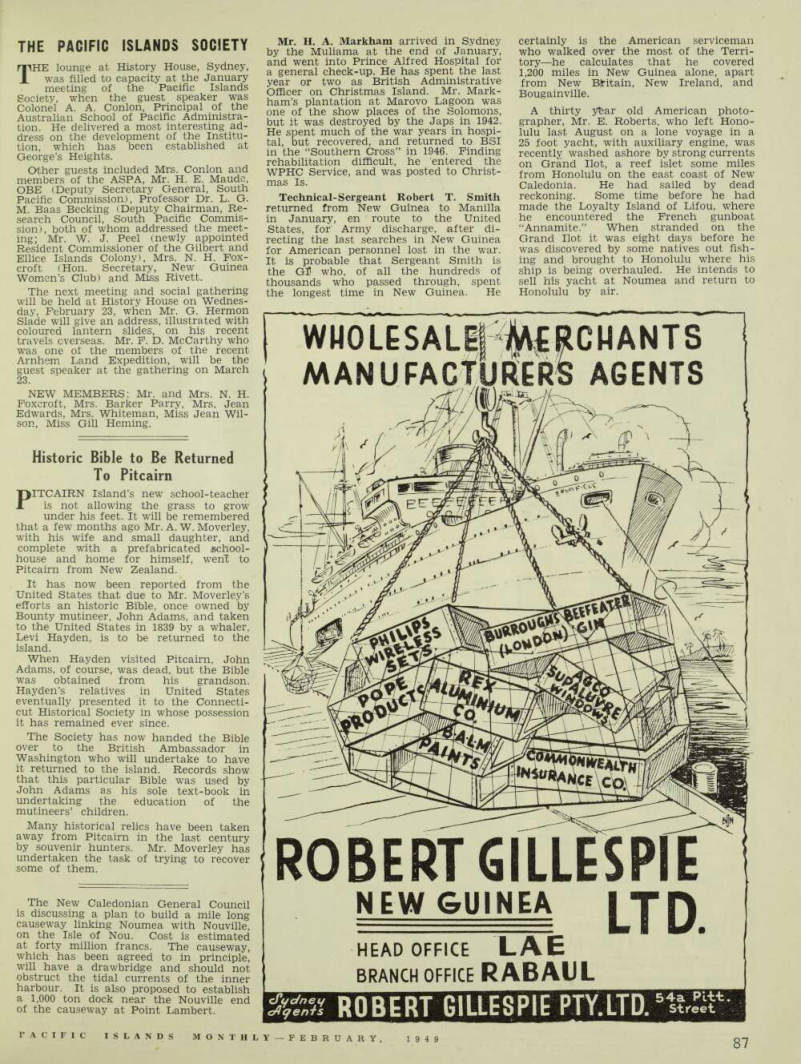
THE lounge at History House, Sydney, was filled to capacity at the January meeting of the Pacific Islands Society, when the guest speaker was Colonel A. A. Conlon, Principal of the Australian School of Pacific Administra tion. He delivered a most interesting ad dress on the development of the Institu tion, which has been established at George’s Heights.
Other guests included Mrs. Conlon and members of the ASPA, Mr. H. E. Maude, OBE (Deputy Secretary General, South Pacific Commission), Professor Dr. L. G.
M. Baas Becking (Deputy Chairman, Re search Council, South Pacific Commis sion), both of whom addressed the meet ing; Mr. W. J. Peel (newly appointed Resident Commissioner of the Gilbert and Ellice Islands Colony), Mrs. N. H. Fox croft (Hon. Secretary, New Guinea Women’s Club) and Miss Rivett.
The next meeting and social gathering will be held at History House on Wednes day, February 23, when Mr. G. Hermon Slade will give an address, illustrated with coloured lantern slides, on his recent travels overseas. Mr. F. D. McCarthy who was one of the members of the recent Arnhem Land Expedition, will be the guest sneaker at the gathering on March 23.
NEW MEMBERS: Mr. and Mrs. N. H.
Foxcroft, Mrs. Barker Parry, Mrs, Jean Edwards, Mrs. Whiteman, Miss Jean Wil son, Miss Gill Heming.
Historic Bible to Be Returned
To Pitcairn
PITCAIRN Island’s new school-teacher is not allowing the grass to grow under his feet. It will be remembered that a few months ago Mr. A. W. Moverley, with his wife and small daughter, and complete with a prefabricated school house and home for himself, weril to Pitcairn from New Zealand.
It has now been reported from the United States that due to Mr. Moverley’s efforts an historic Bible, once owned by Bounty mutineer, John Adams, and taken to the United States in 1839 by a whaler, Levi Hayden, is to be returned to the island.
When Hayden visited Pitcairn, John Adams, of course, was dead, but the Bible was obtained from his grandson.
Hayden’s relatives in United States eventually presented it to the Connecti cut Historical Society in whose possession it has remained ever since.
The Society has now handed the Bible over to the British Ambassador in Washington who will undertake to have it returned to the island. Records show that this particular Bible was used by John Adams as his sole text-book in undertaking the education of the mutineers’ children.
Many historical relics have been taken away from Pitcairn in the last century by souvenir hunters. Mr. Moverley has undertaken the task of trying to recover some of them.
The New Caledonian General Council is discussing a plan to build a mile long causeway linking Noumea with Nouville, on the Isle of Nou. Cost is estimated at forty million francs. The causeway, which has been agreed to in principle, will have a drawbridge and should not obstruct the tidal currents of the inner harbour. It is also proposed to establish a 1,000 ton dock near the Nouville end of the causeway at Point Lambert.
Mr. H. A. Markham arrived in Sydney by the Muliama at the end of January, and went into Prince Alfred Hospital for a general check-up. He has spent the last year or two as British Administrative Officer on Christmas Island. Mr. Markham’s plantation at Marovo Lagoon was one of the show places of the Solomons, but it was destroyed by the Japs in 1942.
He spent much of the war years in hospital, but recovered, and returned to BSI in the “Southern Cross” in 1946. Finding rehabilitation difficult, he entered the WPHC Service, and was posted to Christmas Is - Technical-Sergeant Robert T. Smith returned from New Guinea to Manilla in January, en route to the United States, for Army discharge, after directing the last searches in New Guinea for American personnel lost in the war.
It is probable that Sergeant Smith is the Gtf who, of all the hundreds of thousands who passed through, spent the longest time in New Guinea. He
certainly is the American serviceman who walked over the most of the Terri tory—he calculates that he covered 1,200 miles in New Guinea alone, apart f rom New Britain, New Ireland, and Bougainville, A thirty yfear old American photo grapher, Mr. E. Roberts, who left Hono lulu last August on a lone voyage in a 25 foot yacht, with auxiliary engine, was recently washed ashore by strong currents on Grand Hot, a reef islet some miles from Honolulu on the east coast of New Caledonia. He had sailed by dead reckoning. Some time before he had made the Loyalty Island of Lifou, where he encountered the French gunboat “Annamite.” When stranded on the Grand Hot it was eight days before he was discovered by some natives out fish ing and brought to Honolulu where his ship is being overhauled. He intends to sell his yacht at Noumea and return to Honolulu by air.
Advertisements & other items, p. 89 (1 item)
Robert Gillespie
WHOLESAL
i-
CHANTS
MANUFACTURERS AGENTS
EE Et & mb ft s* o* X a f M Vl CE PflH
ROBERT GILLESPIE
NEW GUINEA
HEAD OFFICE LAE
BRANCH OFFICE RABAUL
ROBERT GILLESPIE PTY.LTD. *&Sr'
Islands Produce
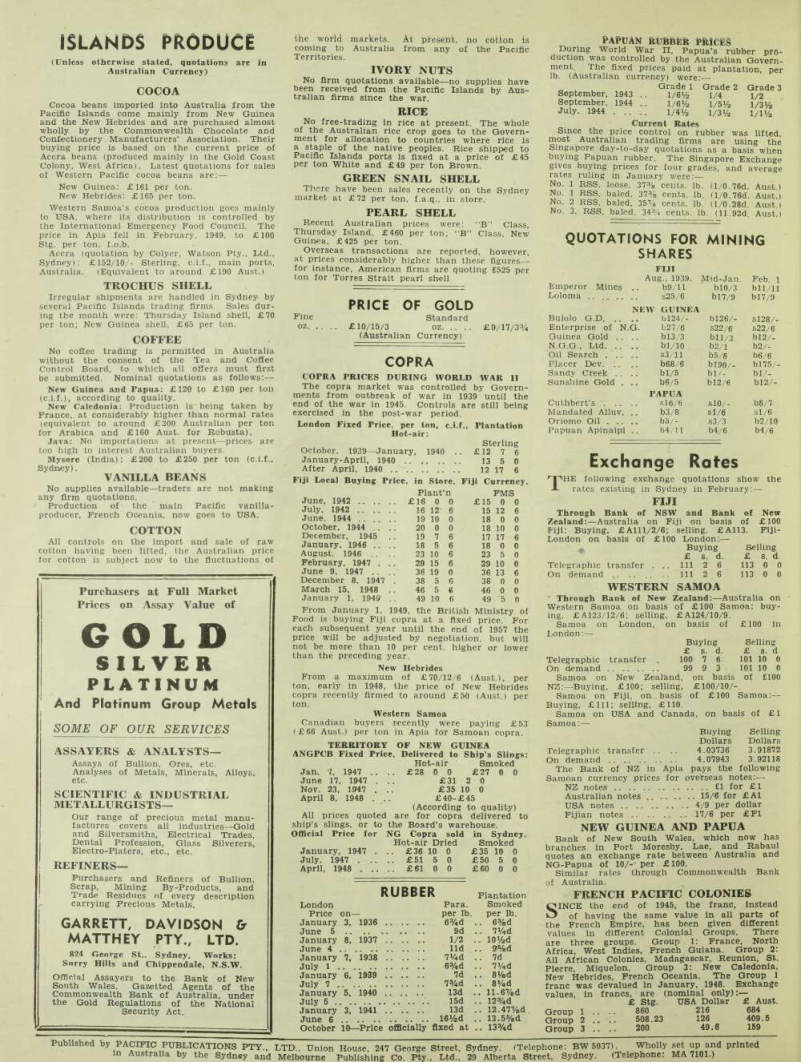
(Unless otherwise stated, quotations are in Australian Currency)
Cocoa
Cocoa beans imported into Australia from the Pacific Islands come mainly from New Guinea and the New Hebrides and are purchased almost wholly by the Commonwealth Chocolate and Confectionery Manufacturers’ Association. Their buying price is based on the current price of Accra beans (produced mainly in the Gold Coast Colony, West Africa). Latest quotations for sales of Western Pacific cocoa beans are;— New Guinea: £l6l per ton.
New Hebrides; £165 per ton.
Western Samoa’s cocoa production goes mainly to USA, where its distribution is controlled by the International Emergency Food Council. The price in Apia fell in February, 1949, to £lOO Stg. per ton, f.o.b.
Accra (quotation by Colyer, Watson Pty., Ltd., Sydney): £152/10/- Sterling, c.i.f., main ports, Australia. (Equivalent to around £l9O Aust.)
Trochus Shell
Irregular shipments are handled in Sydney- by several Pacific Islands trading firms. Sales dur ing the month were: Thursday Island shell, £7O per ton; New Guinea shell, £65 per ton.
Coffee
No coffee trading is permitted in Australia without the consent of the Tea and Coffee Control Board, to which all offers must first be submitted. Nominal quotations as follows; — New Guinea and Papua: £l2O to £l6O per ton (c.i.f.), according to quality.
New Caledonia: Production is being taken by France, at considerably higher than normal rates (equivalent to around £2OO Australian per ton for Arabica and £l6O Aust. for Robusta).
Java: No importations at present—prices are too high to interest Australian buyers.
Mysore (India): £2OO to £250 per ton (c.i.f., Sydney).
Vanilla Beans
No supplies available —traders are not making any firm quotations.
Production of the ' main Pacific vanilla producer, French Oceania, now goes to USA.
Cotton
All controls on the import and sale of raw cotton having been lifted, the Australian price for cotton is subject now to the fluctuations of
the world markets. At present, ho cotton is coming to Australia from any of the Pacific Territories.
Ivory Nuts
No firm quotations available—no supplies have been received from the Pacific Islands by Aus tralian firms since the war.
Rice
No free-trading In rice at present. The whole of the Australian rice crop goes to the Govern ment for allocation to countries where rice is a staple of the native peoples. Rice shipped to Pacific Islands ports is fixed at a price of £45 per ton White and £49 per ton Brown.
Green Snail Shell
There have been sales recently on the Sydney market at £72 per ton, f.a.q., in store.
Pearl Shell
Recent Australian prices were: “B” Class, Thursday Island, £460 per ton; “B” Class, New Guinea, £425 per ton.
Overseas transactions are reported, however, at prices considerably higher than these figures— for instance, American firms are quoting £525 per ton for Torres Strait pearl shell
Advertisements & other items, p. 90 (1 item)
Price Of Gold
Fine Standard oz. .. . . £10/15/3 oz £9/17/3 3 /4 (Australian Currency)
Copra
Prices During World War Ii
The copra market was controlled by Govern ments from outbreak of war in 1939 until the end of the war in 1945. Controls are still being exercised in the post-war period.
London Fixed Price, per ton. c.i.f., Plantation Hot-air:
From January 1. 1949, the British Ministry of Food is buying Fiji copra at a fixed price. For each subsequent year until the end of 1957 the price will be adjusted by negotiation, but will not be more than 10 per cent, higher or lower than the preceding year.
New Hebrides From a maximum of £7O/12/6 (Aust.), per ton, early in 1948, the price of New Hebrides copra recently firmed to around £5O (Aust.) per ton.
Western Samoa Canadian buyers recently were paying £53 (£66 Aust.) per ton in Apia for Samoan copra.
Territory Of New Guinea
ANGPCB Fixed Price, Delivered to Ship’s Slings;
All prices quoted are for copra delivered to ship’s slings, or to the Board’s warehouse.
Official Price for NG Copra sold in Sydney.
October. 1939 —January, 1940 Sterling . £12 7 6 January-Aprll, 1940 13 5 0 After April. 1940 .. 12 17 6 Fiji Local Baying Price, in Store, Fiji Currency, June. 1942 Plant'n £16 0 0 £15
Pms
0 0 July. 1942 16 12 6 15 12 6 June. 1944 .. 19 10 0 18 0 0 October. 1944 . . 20 0 0 18 10 0 December, 1945 19 7 6 17 17 6 January, 1946 .. 18 5 6 18 0 0 August. 1946 . . 23 10 6 23 5 0 February, 1947 . .. 29 15 6 29 10 0 June 9. 1947 .. 36 19 0 36 13 6 December 8. 1947 . 38 5 6 38 0 0 March 15, 1948 . . 46 5 6 46 0 0 January 1, 1949 . . 49 10 6 49 5 0
Jan, 7, 1947 ..
Hot-air Smoked £28 0 0 £27 0 0 June 17, 1947 . £31 2 0 Nov. 23, 1947 . £35 10 0 April 8. 1948 . . £40-£45 (According to quality)
Hot-air Dried Smoked January, 1947 . .. £36 10 0 £35 10 0 July. 1947 . .. .. £51 5 0 £50 5 0 April, 1948 . .. .. £61 0 0 £60 0 0
Rubber
Plantation
Papuan Rubber Pfetues
During World War 11, Papua’s rubber pro duction was controlled by the Australian Govern ment. The fixed prices paid at plantation, per lb. (Australian currency) were:—
Current Rates Since the price control on rubber was lifted, most Australian trading firms are using the Singapore day-to-day quotations as a basis when buying Papuan rubber. The Singapore Exchange gives buying prices for four grades, and average rates ruling in January were:—
London Para.
Smoked Price onper lb. per lb.
January 3, 1936 . 6%d June 5 9d . . 7‘/.d January 8, 1937 . ioy 2 d June 4 lid . . 9 5 /ad January 7. 1938 7»/ 4 d . . 7d July 1 , . 7V 4 d January 6, 1939 7d . , 8Vad July 7 . 7%d . . 8V 4 d January 5. 1940 , 13d . . 11.6%d July 5 . 15d . . 12%d January 3. 1941 13d . . 12.47 7 /sd June 6 16y 2 d . . 13.5 s /sd October 10 —Price officially fixed at . . 13%d
Grade 1 Grade 2 Grade 3 September, 1943 .
I/6V2 1/4 1/2 September. 1944 . 1/6 Vi 1/5 V s 1/3 V 2 July. 1944 1/4 y 2 1/3V 2 1/1 Vi
No. 1 RSS. loose. 37% cents, lb. fl/0.76d. Aust.) No. 1 RSS. baled. 37% cents, lb. (1/0.76d. Aust.) No. 2 RSS. baled, 35% cents, lb. (1/0.28d. Aust.) No. 3. RSS, baled, 34% cents, lb. (11.92d. Aust.)
Quotations For Mining
Shares
Fiji
Aug.. 1939.
Mid-Jan.
Feb. 1 Emperor Mines b9/ll blO/3 bll/11 Loloma .. s25/6 b!7/9 bl7/9 Bulolo G.D. ..
New Guinea
.. bl24/bl26/sl28/- Enterprise of N.G. b27/6 s22/6 S22/6 Guinea Gold .. bl3/3 bll/3 bl2/- N.G.G., Ltd. .. bl/10 b2/l b2/- Oil Search . ..
S3/11 b5/8 b6/6 Placer Dev. .. b68/6 bl90/bl75/- Sandy Creek .. bl/5 bl/bl/- Sunshine Gold . b6/5 bl2/6 bl2/- Cuthbert’s . ..
Papua
si 6/6 slO/b8/7 Mandated Alluv. b3/8 sl/6 sl/6 Oriomo Oil . .. b5/s3/3 b2/10 Papuan Apinaipi b4/11 b4/6 b4/6
Exchange Rates
HpHE following exchange quotations show the A rates existing in Sydney in February:—
Fiji
Through Bank of NSW and Bank of New Zealand:—Australia on Fiji on basis of £lOO Fiji: Buying, £Alll/2/6; selling. £AII3. Fiji- London on basis of £lOO London;—
Western Samoa
' Through Bank of New Zealand: —Australia on Western Samoa on basis of £lOO Samoa: buy ing. £AI23/12/6; selling. £AI24/10/9.
Samoa on London, on basis of £lOO in London; —
Samoa on New Zealand, on basis of £lOO NZ:—Buying, £100; selling, £lOO/10/-.
Samoa on Fiji, on basis of £lOO Samoa:— Buying, £111; selling, £llO, Samoa on USA and Canada, on basis of £1 Samoa:—
New Guinea And Papua
Bank of New South Wales, which now has branches in Port Moresby, Lae, and Rabaul quotes an exchange rate between Australia and NG-Papua of 10/-- per £lOO.
Similar rates through Commonwealth Bank of Australia.
French Pacific Colonies
SINCE the end of 1945, the franc, instead of having the same value in all parts of the French Empire, has been given different values in different Colonial Groups. There are three groups. Group 1: France, North Africa, West Indies, French Guiana. Group 2: All African Colonies, Madagascar, Reunion, St.
Pierre. Miquelon. Group 3: New Caledonia.
New Hebrides, French Oceania. The Group 1 franc was devalued in January, 1948. Exchange values, in francs, are (nominal only):
Buying Selling £ s. d. £ s. d.
Telegraphic transfer . .. Ill 2 6 113 0 0 On demand .. Ill 2 6 113 0 0
Buying Selling £ s. d. £ s. d Telegraphic transfer . 100 7 6 101 10 0 On demand 99 9 3 101 10 0
Buying Selling Dollars Dollars Telegraphic transfer .. .. 4.03736 3.91872 On demand 4.07943 3.92118 The Bank of NZ in Apia pays the following Samoan currency prices for overseas notes: — NZ notes £1 for £1 Australian notes 15/6 for £A1 USA notes 4/9 per dollar Fijian notes 17/6 per £F1
£ Stg.
USA Dollar £ Aust.
Group 1 .. 860 216 684 Group 2 .. 508.23 126 409.5 Group 3 .. 200 49.6 159
Advertisements & other items, pp. 90-92 (3 items)
Published by PACIFIC PUBLICATIONS PTY., LTD., Union House. 247 George Street, Sydney. BW 5037). Wholly set up and printed
in Australia by the Sydney and Melbourne Publishing Co. Pty., Ltd., 29 Alberta Street, Sydney. (Telephone: MA 7101.)
Gold
Purchasers at Full Market Prices on Assay Value of
SILVER
PLATINUM
And Platinum Group Metals
SOME OF OUR SERVICES
ASSAYERS & ANALYSTS—
Assays of Bullion, Ores, etc.
Analyses of Metals, Minerals, Alloys, etc.
SCIENTIFIC & INDUSTRIAL
METALLURGISTS—
Our range of precious metal manufactures covers all industries—Gold and Silversmiths, Electrical Trades, Dental Profession, Glass Silverers, Electro-Platers, etc., etc.
REFINERS—
Purchasers and Refiners of Bullion, Scrap, Mining By-Products, and Trade Residues of every description carrying Precious Metals.
GARRETT, DAVIDSON &
MATTHEY PTY., LTD.
824 George St., Sydney. Works: Surry Hills and Chippendale, N.S.W.
Official Assayers to the Bank of New South Wales. Gazetted Agents of the Commonwealth Bank of Australia, under the Gold Regulations of the National Security Act.
fy.rlhodi o'"'"*'
To quench a
tropical thirst...
V fm - C*> * A_ V. r oor H t co’uMireO kfe. »OJT« AL * ~|S When you’re hot and tired, there is nothing quite so satisfying and thirst quenching as a long, cold glass of Your friends and guests, too, will appreciate this really fine
Lager, for “Everybody
drinks K. 8.”
TOOTH’S
LAGER
Capital £1,000,000
ESTABLISHED 1914
COPRA MERCHANTS & MILLERS
ASSOCIATED COMPANIES THROUGHOUT THE PACIFIC ISLANDS
Buyers and exporters of all kinds of Islands produce. Copra Merchants and Millers.
Agents for Australian.
European and American Manufacturers. Distributors of every description of merchandise.
Thirty years of Pacific Islands development and service.
IN LONDON
W. R. CARPENTER & CO.
(LONDON) LTD.
Coronation House. 4 Lloyd’s Avenue, London, E.C.
IN NEW GUINEA
New Guinea Company Limited., Rabaul, Lae, Madang, Kavieng.
IN PAPUA
J. R. Clay & Co., Ltd.,
IN FIJI
W. R. Carpenter & Co. (Fiji) Ltd.
REGULAR CARGO
PACIFIC
Head
W.
Office:
DISTRIBUTING
AGENTS FOR:
Ford Motor Company of Canada.
Electrolux Refrigerators.
T. G. & C. Bolinders (Engines).
Chrysler Corporation.
Westinghouse Electrical Co.
Caterpillar Tractors.
THE W.R.C LINE Etc., Etc
THE FIRST DIRECT AND I
AND PASSENGER SER/ICE BETWEEN EUROPE AND
ISLAND PORTS WAS ESTABLISHED BY
R. CARPENTER Cr CO. LTD.
16 O'CONNELL STREET, SYDNEY.
Cable Address:
CAMOHE
Telephone: BW 4421.
Postal Address: P.O. Box No. 168, Sydney.
PACIFIC ISLANDS MONTHLY— FEBRUARY, 1949