Islands
Pacific
Monthly
January, 1949
Vol. XIX. No. 6.
cfnMiek A 1 ODH
fa transmission by post as a newspaper ]
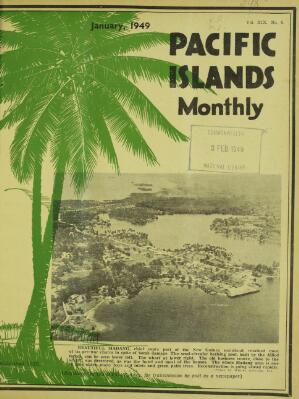
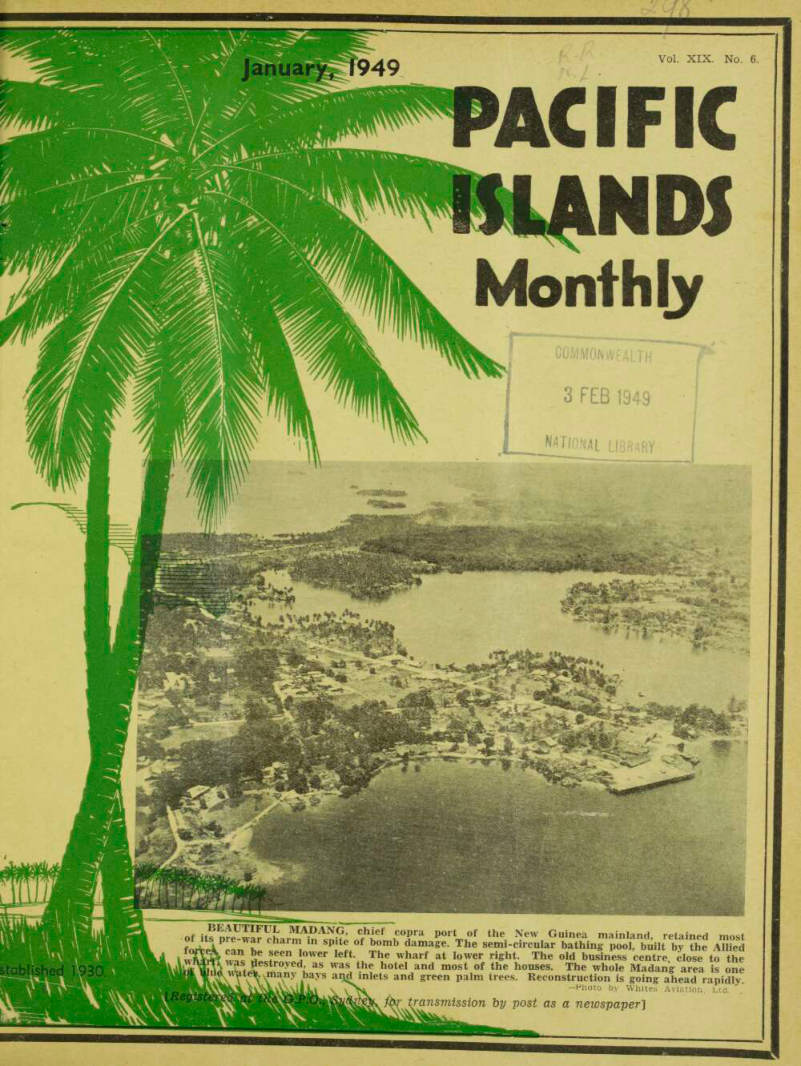
BEAUTIFUL MADANG, chief copra port of the New Guinea mainland, retained most of its pre-war charm in spite of bomb damage. The semi-circular bathing pool, built by the Allied forces, can be seen lower left. The wharf at lower righ t. The old busin ess centre, close to the wharf , was destroyed, as was the hotel and most of the houses. The whole Madang area is one of blue water, many bays and inlets and green palm trees. Reconstruction is going ahead rapidly. —Photo by Whites Aviation. Ltd.
Advertisements & other items, pp. 2-4 (1 item)
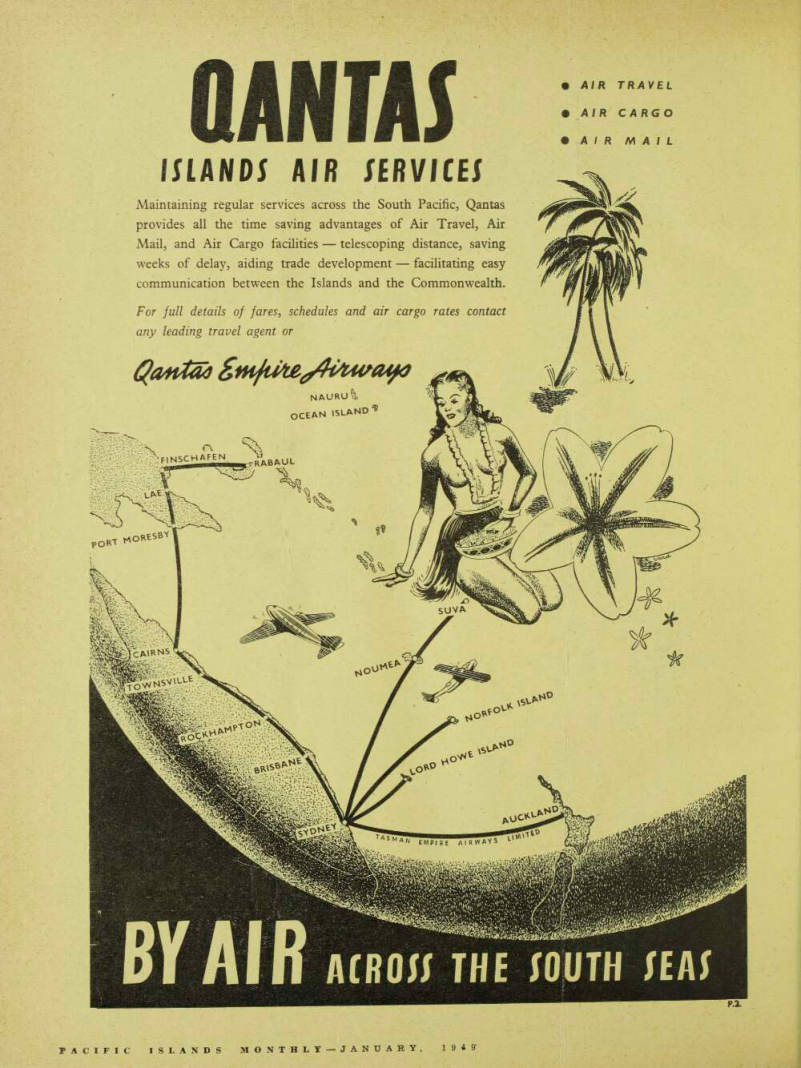
Oantai
ISLANDS AIR SERVICES
Maintaining regular services across the South Pacific, Qantas provides all the time saving advantages of Air Travel, Air Mail, and Air Cargo facilities telescoping distance, saving weeks of delay, aiding trade development facilitating easy communication between the Islands and the Commonwealth.
For full details of fares , schedules and air cargo rates contact any leading travel agent or
tfantad Sm/tM^/Uuvaya
• AIR TRAVEL
• AIR CARGO
• AIR MAIL
rv ■ > finschafen &
NAURU'S,
OCEAN ISLAND
RABAUL
LAt
PORT HORNBY
M
SUVA
CAIRNS
NSVILLt
T O v \SL O'-*
-TON
<5 \SV.
VAO
BANt
oR° br' s aNO svo It® Ll W*
WAY
EMPI
I PA
SoAe yppub
KEROSENE
Coleman’s fuel irons have dominated the field for over 30 years, and will continue to do so, for the experience they have gained has not been enjoyed by other makers.
Whichever you choose, petrol or kerosene, you can be sure you have the “ Best of its kind."
Kerosene Iron Requires preheating with methylated spirits m. » Petrol Iron This model requires no preheating. *V 1 Both these self-heating irons are streamlined and have hand protected air-cooled
hoods. They are light, and perfectly
balanced to eliminate fatigue.
The irons can be used in and out of doors as there are no wires or connections. The bodies are ventilated, the edges tapered for ironing pleats and around buttons, and additional heat is developed at points for fine ironing work. Efficient, simple, economical.
Representatives for the Pacific Islands
ROBERT GILLESPIE PTY. LTD.
S4a PITT STREET, SYDNEY
PEARCE & CO. LTD.
SUVA
FOR FIJI ISLANDS
7 a 7a m *r i l 0 B fi
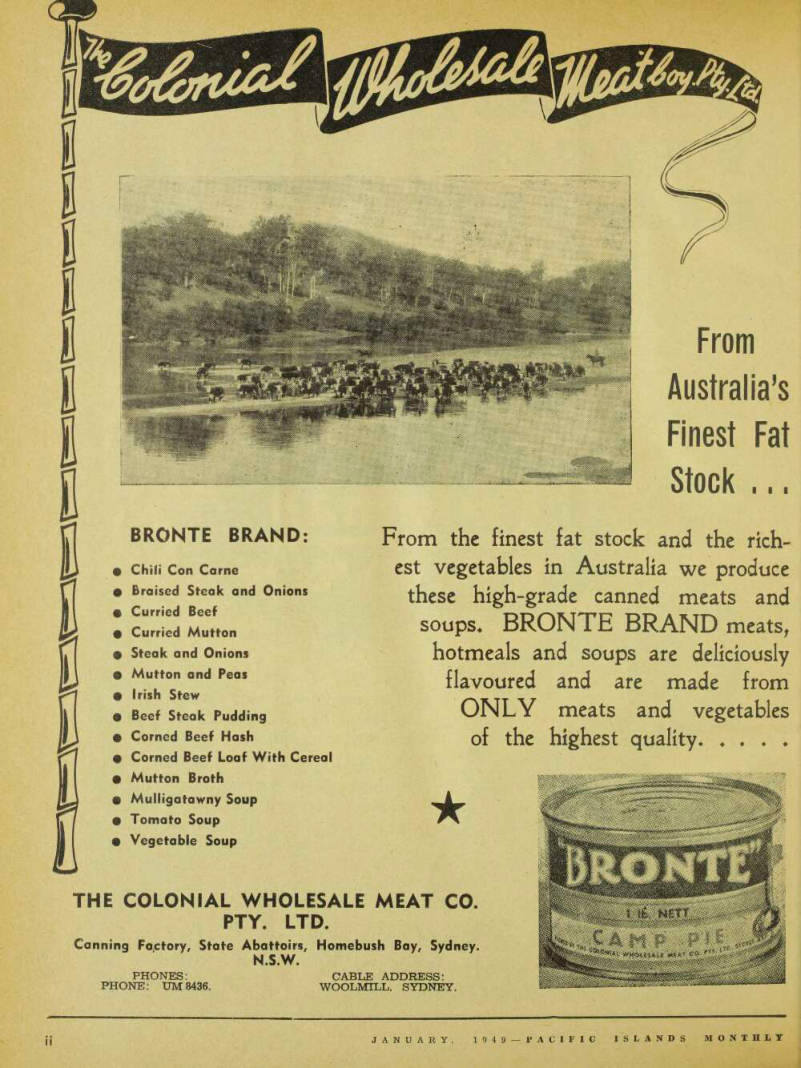
From
Australia’s
Finest Fat
Stock
I I I
BRONTE BRAND:
Chili Con Came Braised Steak and Onions Curried Beef Curried Mutton Steak and Onions Mutton and Peas Irish Stew Beef Steak Pudding Corned Beef Hash Corned Beef Loaf With Cereal Mutton Broth Mulligatawny Soup Tomato Soup Vegetable Soup From the finest fat stock and the rich-
est vegetables in Australia we produce
these high-grade canned meats and soups. BRONTE BRAND meats, hotmeals and soups are deliciously flavoured and are made from ONLY meats and vegetables of the highest quality. . . . . ★ iat >■*'«'
THE COLONIAL WHOLESALE MEAT CO.
PTY. LTD.
Canning Factory, State Abattoirs, Homebush Bay, Sydney.
N.S.W.
PHONES:
PHONE: UM 8436.
CABLE ADDRESS;
WOOLMILL. SYDNEY.
■ p pll • 3 'M ca
Advertisers
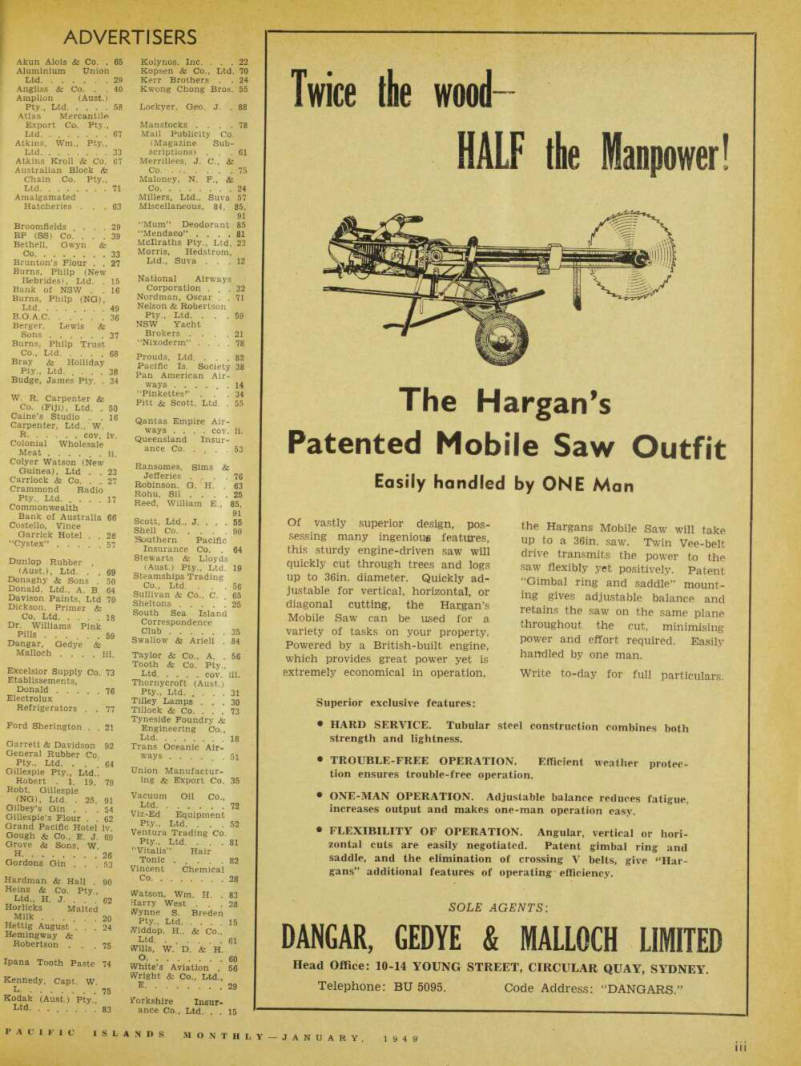
Akun Alois & Co. . 65 Aluminium Union Ltd 29 Angliss & Co. . .40 Amplion (Aust.) Pty., Ltd 58 Atlas Mercantile Export Co. Pty., Ltd. . 67 Atkins, Wm., Pty., Ltd 33 Atkins Kroll & Co. 67 Australian Block & Chain Co. Pty., Ltd 71 Amalgamated Hatcheries ... 63 Broomfields ... 29 BP (SS) Co. . . . 39 Bethell, Gwyn & Co 33 Brunton’s Flour . . 27 Burns, Philp (New Hebrides), Ltd. . 15 Bank of NSW . . 16 Burns, Philp (NG), Ltd. ... 49 8.0.A.C 36 Berger, Lewis & Sons 37 Burns, Philp Trust Co., Ltd 68 Bray & Holliday Pty., Ltd. ... 38 Budge, James Pty. . 34 W. R. Carpenter & Co. (Fiji), Ltd. . 50 Caine’s Studio . . 16 Carpenter, Ltd., W.
R cov. iv.
Colonial Wholesale Meat ... ii.
Colyer Watson (New Guinea), Ltd . . 23 Carriock & Co. . . 27 Crammond Radio Pty.. Ltd. ... 17 Commonwealth Bank of Australia 66 Costello., Vince Garrick Hotel . . 26 “Cystex” 57 Dunlop Rubber , (Aust.), Ltd. . . 69 Donaghy & Sons . 50 Donald. Ltd., A. B, 64 Davison Paints, Ltd 70 Dickson. Primer & Co, Ltd 18 Dr. Williams Pink Pills ... 59 Dangar, Gedye & Malloch ... iff.
Excelsior Supply Co. 73 Etablissements, Donald 76 Electrolux Refrigerators . . 77 Ford Sherington . . 21 Garrett & Davidson 92 General Rubber Co.
Pty., Ltd. ... 64 Gillespie Pty., Ltd..
Robert . 1. 19, 79 Robt. Gillespie )NG), Ltd. . 25, 91 Gilbey’s Gin ... 54 Gillespie’s Flour . . 62 Grand Pacific Hotel iv.
Gough & Co., E. J. 69 Grove & Sons, W.
H 26 Gordons Gin ... 53 Hardman & Hall . 90 Heinz & Co. Pty , Ltd., H. J. . . . 62 Horlicks Malted Milk ... 20 Hettig August ... 24
Hemingway &
Robertson ... 75 Ipana Tooth Paste 74 Kennedy, Capt. W.
L 75 Kodak (Aust.) Pty..
Ltd. . 83
Kolynos, Inc. ... 22 Kopsen & Co., Ltd. 70 Kerr Brothers . . 24 Kwong Chong Bros. 55 Lockyer, Geo. J. . 88 Manstocks ... 78 Mail Publicity Co. (Magazine Sub scriptions) ... 61 Merrillees, J. C., & Co. 75 Maloney, N. F., & Co 24 Millers, Ltd., Suva 57 Miscellaneous, 84, 85, 91 “Mum” Deodorant 85 “Mendaco” . , , . 81 McHraths Pty., Ltd. 23 Morris, Hedstrom, Ltd., Suva ... 12 National Airways Corporation ... 32 Nordman, Oscar . . 71 Nelson & Robertson Pty., Ltd. ... 59 NSW Yacht Brokers ... 21 “Nixoderm” ... 78 Prouds, Ltd. ... 82 Pacific Is. Society 38 Pan American Air ways ... 14 ‘Pinkettes’’ ... 34 Pitt & Scott, Ltd. . 55 Qantas Empire Air ways ... cov. ii.
Queensland Insur ance Co. ... 53 Ransomes, Sims & Jefferies ... 76 Robinson, G. H. . 63 Rohu, Sil . . . ,25 Reed, William E., 85, 91 Scott, Ltd., J. ... 55 Shell Co 90 Southern Pacific Insurance Co. . 64 Stewarts & Lloyds (Aust.) Pty.. Ltd. 19 Steamships Trading Co., Ltd. ... 56 Sullivan & Co., C. , 65 Sheltons ... 25 South Sea Island Correspondence Club 35 Swallow & Ariell . 84 Taylor & Co., A. . 56 Tooth & Co. Pty., Ltd cov. iii.
Thornycroft (Aust.) Pty., Ltd. ... 31 Tilley Lamps ... 30 Tillock & Co. ... 73 Tyneside Foundry & Engineering Co,, Ltd is Trans Oceanic Air ways ... 51 Union Manufactur ing & Export Co. 35 Vacuum Oil Co., Ltd 72 Viz-Ed Equipment Pty., Ltd. ... 52 Ventura Trading Co.
Pty., Ltd. ... 81 “Vitalis” Hair Tonic ... 82 Vincent Chemical Co 28 Watson, Wm. H. . 83 Harry West ... 28 Wynne s. Breden Pty., Ltd 15 Widdop, H., & Co., Ltd. ... 61 Wills, W. D. & H. 0 60 White’s Aviation . 56 Wright & Co., Ltd., E 29 Yorkshire Insur ance Co., Ltd. . . 15
Advertisements & other items, p. 5 (1 item)
Twice the wood
HALF the Manpower!
The Hargan’s
Patented Mobile Saw Outfit
Easily handled by ONE Mon
Of vastly superior design, possessing many ingenious features, this sturdy engine-driven saw will quickly cut through trees and logs up to 36in. diameter. Quickly adjustable for vertical, horizontal, or diagonal cutting, the Hargan’s Mobile Saw can be used for a variety of tasks on your property.
Powered by a British-built engine, which provides great power yet is extremely economical in operation, the Hargans Mobile Saw will take up to a 36in, saw. Twin Vee-belt drive transmits the power to the saw flexibly yet positively. Patent “Gimbal ring and saddle” mounting gives adjustable balance and retains the saw on the same plane throughout the cut, minimising power and effort required. Easily handled by one man.
Write to-day for full particulars.
Superior exclusive features: • HARD SERVICE. Tubular steel construction combines both strength and lightness. • TROUBLE-FREE OPERATION. Efficient weather protection ensures trouble-free operation. • ONE-MAN OPERATION. Adjustable balance reduces fatigue, increases output and makes one-man operation easy. • FLEXIBILITY OF OPERATION. Angular, vertical or horizontal cuts are easily negotiated. Patent gimbal ring and saddle, and the elimination of crossing V belts, give “Hargans” additional features of operating efficiency.
SOLE AGENTS :
DANGAR, GEDYE & MALLOCH LIMITED
Head Office: 10-14 YOUNG STREET, CIRCULAR QUAY, SYDNEY.
Telephone: BU 5095. Code Address: “DANGARS.”
In This Issue:
Editorial: “Can We hope to See the End of Wardism in New Guinea?” 1 Chinese Lose Nauru and Manus Cases 3 Seventh Pacific Science Congress in NZ 3 SPC Moves to Noumea 3 Price Fixing in New Guinea 3 How NG Planter is Robbed —Aust.
Govt. Still Takes All Copra ... 4 BGD Working Seven Dredges ... 4 Indian Ocean Air Route —Alternative to Crossing India 5 NG Natives Killed With Jap Rifles 5 5,000 Javanese for French Colonies 5 New Secretary for New Guinea Plan ters Union 5 O. Soltwedel Deported by Australia 5 Suggested Pacific Union Against Asiatics and Red Russia 6 The Case of Tunica Y. Casas ... 6 Acting External Territories Minister Visits Papua-New Guinea .. .. 6 Native Labour System in New Guinea 7 New Year Honours List 7 Copra Tax Out—Fiji Faces Deficit .. 7 New Town Council for Suva 7 Fish Cannery for Tahiti 8 Mr. Osborne Sees Improved Con ditions in Cooks 8 New Resident Commissioner for G. & E. Islands Colony 9 NZ Welcomes NG Scrap Metal ... 9 Fall of Rabaul—7th Anniversary of Jap Invasion 9 Loss of “John Williams V,” 9 Effect of New Guinea Timber Lease Trial on Mr. E. J. Ward’s Career 10 Fiji Hurricane—Serious Loss of 1949 Copra 13 Attacks on Trans-Pacific Aviation Companies by Australian Govern ment 18
Pedigreed Cattle for Morobe 19 Fiji’s New Airport will “Make” Suva and Help Tourist Trade 21 Alfred Robinson and Eight Natives Murdered by Natives in New Guinea 25 Fiji’s Copra Contract 26 New Book on Islands 26 Australian Canned Foods Under Open Licence in Fiji 28 Tonga Provides for an Extensive Public Works Programme 29 “John Frum” Origin of New Hebrides Movement 31 Charge of Alcoholic Excess in Tonga 31 The Wreck of the “Tahitienne”— “Taipi” Also Rumoured Lost ... 33 Fiji’s New Copra Board Set-up ... 34 Increased Allocations for Fijian Schools 34 Honiara versus Tulagi—Wordy Battle Goes On 35 Official Decisions About Cook Islands Requests 37 Americans Find Two More Crashed Planes in New Guinea 39 Conditions at Another Fijian School Attacked 39 “Morinda’s” Return —How She Took 146 Out of BSI in 1942 40 Territories’ Talk-Talk 39 Two Days in the Toils of a Biscuit Forcer 40 Abemama, Land of Moonlight .. .. 41 High Chief’s Stick Comes Home ... 42 All in Their Little Woolly Drawers 42 Rarotonga Was Like That in the Nineties 43 My Old Suva Flame 44 Tropicalities 45 Pacific Nature Notes 46 Sweet Chaos —Poem By A. P. Herbert 46 Santo Becomes a Cinema Town ... 50
“Merciless Fecundity” of Fiji Indians 53 Control of Insects in Micronesia .. 55 Weather Station for Banks Islands 56 Where to go for 3,000,000 Beer Bottles 59 Fiji’s War Debt to New Zealand .. 59 Deportation of Indians—Or Extinc tion of Fijians 61 Closer Relations with the US—Aus tralia-American Assn 62 Glass Eyes from Nauruans 63 New Manager for Burns Philp, Santo 64 Christmas Tree for Christmas Island 68 Clunies-Ross V Is Now Located— Future of Cocos Keeling 70 Yandina Docking Area Cleared for Copra Ship 75 Triplets for Fijian Couple 76 Reviewed Optimism in New Cale donia 78 Plane & Shipping Services 78 Boat Building in New Guinea 84 Mutton-Bird Survey 85 George Dibbern and Crew Resume Pacific Wandering 86 NG Administrator Visits Sepik ... 87 New Guinea’s War Cemeteries .. .. 87 Prince Von Bismarck’s Interest in New Guinea 60 Years Ago 89 US Closes Pacific Consulates 91 Commercial Markets, Etc 92 OBITUARY: A. H. Gauld, 2; Thomas Horne, 3; A. Robinson, 25; P. Burns, 38; Fr. J. Glover, 57; Robert Dean Frisbie, 66; Richard Gore, 82.
INDUSTRIES: Gold, 4,5, 24; Oil, 67, 71; Copra, 4, 26, 63.
ORGANISATIONS: New Guinea Women’s Club, Sydney, 2; NG Women’s Assn.
Melb., 7; Pacific Islands Society, 6; Port Moresby, RSSAILA, 24; Aus tralian-American Assn., 62; Polynesian Club, 63.
Advertisements & other items, p. 6 (1 item)
oioi
Pacific Islands Monthly
The Newspaper-Magazine of the South Seas I Registered at the G.P.0., Sydney, for transmission by post as a newspaper]
Published Once Each Month and Circulated in Australia and New Zealand and in the following Pacific Territories and Islands Groups:
Australian Territory ol Papua.
Trustee Territory (Australia) of New Guinea.
Australian Territory of Norfolk Island.
New Zealand Territory of Cook Islands.
Trustee Territory (NZ) of Western Samoa.
British Colony of Fiji.
British Solomon Islands Protectorate.
British Protectorate of Tongan Islands.
British Crown Colony of Gilbert and Ellice Islands.
Trustee Territory of Nauru.
British and French Condominium of New Hebrides.
French Colony of New Caledonia.
French Colony of Oceania (Tahiti, etc.).
American Territory of Eastern Samoa.
American Territory of Hawaiian Islands.
Owned and Produced by Pacific Publications Pty., Ltd., Union House, 247 George Street, Sydney.
Telephone: General Office and Advertising, BW 5037.
P.O. Box 3408
Registered Address for Telegrams, Radiograms, and Cables: “Pacpub,” Sydney.
Contributions.
Articles, Stories, and Photographs dealing with Pacific Islands subjects are invited and will be paid for on publication.
Subscription Rates.
Per Annum, Pre-paid, Including Postage.
In Australia, New Zealand, Fiji, New Guinea, Papua, Western Samoa, Cook Islands, Tonga, British Solomons, Gil bert and Ellice Colony, Nauru, and United Kingdom 15 0 Elsewhere .. $3 .. .. .’. ]lB 0 Single Copies 1 g
Editor and Publisher:
R. W. Robson, F.R.G.S.
Assistant Editor: JUDY TUDOR.
General Office: Union House, 247 George Street, Sydney. Telephone: BW 5037.
Advertising Manager: W. E. Rogers.
Representative In London.
J. T. Wallis, Coronation House, 4 Lloyds Avenue, London, E.C.3, from whom may be obtained copies of Pacific Islands Monthly, Pacific Is. Year Book, advertising schedules, etc.
Representative In U.S.A.
Pacific Islands Trading Co..
244 California St., San Francisco, U.S.A
Agents.
The following are authorised to receive sub scriptions for Pacific Islands Monthly:— Burns, Philp & Co., Ltd., and Burns Phllp (South Sea) Co., Ltd. All branches.
W. R. Carpenter & Co., Ltd. All branches.
Morris. Hedstrom, Ltd. All branches.
Steamships Trading Co., Papua. All branches.
W. M. Caldwell, Suva, Fiji.
Cook Islands Trading Co., Rarotonga, Cook Is.
Oscar Nordman, Papeete, Tahiti.
Islands Branches and Representatives of W. H.
Grove & Sons, Ltd., Auckland, New Zealand.
Ed. Pentecost, Noumea, New Caledonia.
Societe Gubbay Kerr et Cle, Noumea, New Caledonia.
Vol. Xix. No. 6.
January, 1949
( 1/6 Per Copy Price Prepaid, p.a.: 15/- Aus. ( In USA, p.a.: $3.
Can We Hope to See the End of Wardism
In New Guinea?
WHEN the Sydney jury declared three men not guilty of con spiracy in the Timber Lease case, a certain reflection was cast upon Mr.
E. J. Ward, Australian Minister in charge of the Territories of Papua and New Guinea. Because, if those men were not guilty of conspiracy, an answer is demanded to some pertinent questions connected with Mr. Ward’s handling of the Territories portfolio.
We cannot say more than that, be cause the whole matter appears to be again sub judice—an Australian Royal Commissioner is goinp- to sub ject the circumstances of the alleged Timber Lease to another inquiry, and his investigations may extend into the domain of Territories adminis tration.
But there is no reason why we should not say now, frankly and pointedly, as 1949 opens, that every one connected with Papua and New Guinea is heartily sick of the fumb ling and inefficient administration established by the Chifley-Ward re gime, and hopes sincerely that it will be replaced by something of a dif ferent character before the end of .hundreds of officials in the Territories who have been carry ing on the Administration are not to blame for the conditions there. They necessarily take their inspiration and direction from the top. It is not their
fault if the top is addle-pated, and they are without the guidance of a clear-cut and soundly based policy.
AS soon as the military forces were out of Papua-New Guinea, Mr.
Ward went in with a policy and an organisation which he had been pre paring for at least a year. From 1942 onwards his policy had been clear— it was to kick the Big Firms in the teeth, discourage European enterprise in any shape or form, and subvert all considerations to that of native wel fare. Knowing nothing whatever abou£ tropical administration in a country of most primitive people, he sought advice; but, instead of going to the experienced administration officials and the pioneer Europeans, he shut himself away behind an extraordinary group of scientists, academicians and New Planners— well-meaning and honest but thor oughly impractical people, who were thrilled to the marrow at this unique chance of shaping, for the eager and unchecked Leftist Minister, a new paradise on earth for natives.
At this time (1942-45) most of the European population of Papua and New Guinea were “evacuees” in Australia, living virtually from hand to mouth, awaiting a chance to re turn to their homes, and desperately in need of a little practical Govern ment help and sympathy. The “PIM”
has a vivid memory of that unhappy period. Except that Canberra re luctantly allowed a dole to be paid to these people (“all such allowances must be regarded as a loan, and must be repaid when circumstances per mit”) the Minister deliberately ignored practically every appeal and representation that was made to him.
Mr. Ward, in the manner typical of the professional politician, now would virulently deny this accusation; but the record kept over the black years by Mr. E. A. James and his Pacific Territories Association is there for Mr. Ward’s confusion, if required.
So the new policy and administra tion, when they came into operation in 1945-46, held no surprises—the unfortunate Territorians knew what to expect. The Europeans—simply be cause they were Europeans, and. therefore, in the opinion of Mr. Ward and his New Planners, bred-in-the bone “exploiters”—were readmitted to their own homes with manifest re luctance; private enterprise was sternly discouraged; there was, for perhaps two years, little organised effort towards the rehabilitation of the European victims of the Jap invasion; while all official energy and a truly astonishing amount of Aus tralian taxpayers’ money were avail able without demur for the New Guinea natives, whose post-war con dition, in comparison with what Europeans had suffered, was quite good.
As the years passed, between 1945 and 1948, the rigours of the Wardist
system in New Guinea were modified considerably. That, probably, was due to two things. The Minister, with increasing knowledge, began to see that his full-blooded Socialist set up for Melanesian natives would not work; while the more experienced and better-balanced officials of the Administration slowly but surely got rid of the most objectionable features of the Wardist policy. Conditions are much better to-day than they were, for example, two or three years ago; but we still have with us the Pro duction Control Board system of grabbing all copra, under which the planter is paid from £l5 to £2O per ton under world parity; Government monopoly of coastal shipping, by which most of the Territories’ internal traffic moves; and the one-year system of native labour indenture, which probably is worse than no system at all.
APART altogether from the merits of the Timber Lease cases, the Territories have “had” Mr. Eddie Ward; they view without sympathy, and with a certain amount of cynical amusement, his present political em barrassments; and they see the arrival of another Chifley Minister of Territories (Mr. Chambers) with interest, but without enthusiasm.
In an administrative sense, for at least a year, Papua-New Guinea has been indeed a doleful picture. The post-war development of the Terri tories, in relation to the Wardist policy, had reached in 1947 a stage where consultation on the spot with the Minister seemed imperative. The Administrator, Colonel J. K. Murray, hard-working and sincere, obviously had reached an impasse, created by his honest attempts to implement Wardist plans which simply wouldn’t work. Throughout the Port Moresby departments there was a sense of frustration and defeat—and the situation was not made easier by Canberra’s delay in raising public service emoluments to take care of the fearfully heavy post-war living costs in the Territories.
Mr. Ward should have been in the Territories at the end of 1947. In stead, he remained stubbornly in Sydney and Canberra throughout 1948, trying so hard to avoid the political bomb represented by Jock Garden and the Timber Leases that he had no time for the Territories and their irritating troubles. Natur ally, conditions in the Territories have not improved. And the worst of them, perhaps, is the decline in Adminis tration morale.
We know nothing about Mr. Cham bers, the new Minister. He was a dental surgeon before he became a politician, and his experience of tropical Territories was gained when he served as a captain in a medical unit in New Guinea during the war.
If he is an honest politician, he will try to give Papua'-New Guinea a new lease of life by scrapping most of the Wardist policy and encouraging private enterprise in the development of the region. But that is unlikely.
He will not interfere with funda mentals, because Mr. Ward obviously
expects to return to his Territories post, when Judge Ligertwood has finished his inquiry. However, with the skilled assistance of Mr. Halligan —who knows only too well the things that are wrong with the Territories— Mr. Chambers probably will introduce a number of immediate reforms, designed to remove the Territorians’ worst grievances. But Territorians will remain under a cloud so long as Australia is under the ineffable Mr.
Chifley.
Ng Women’S Club Of Sydney
THE two Christmas parties given by the New Guinea Women’s Club of Syd ney were again a great success. A
particularly happy atmosphere prevailed
at the. adult’s party on December 23.
Over one hundred Territorians attended —many of them were down on leave from Papua and New Guinea.
Sixty-eight children attended their special party on December 20. Each child received a gift from the tree, as well as indulging in the usual cake and lemon ade. Donations received by the Club en abled the executive to give these youngsters a memorable afternoon.
The complete list of donations is as follows: Already acknowledged £3O 17 6 Burns, Philp & Co 2 2 0 Bulolo Gold Dredging 10 10 0 G. Edgell & Sons 110 Mrs. Draffin ... 10 0 Mrs. L. Roberts 220 Mrs. E. Ormond 110 Mrs. R. Uechtritz 200 Mr. W. G. Keith 220 Mrs. G. Perriman 110 Mrs A. Innes 1 i 0 Mrs. Laird 100 Mrs. I. Lonergan ... 330 Colyer, Watson NG, Ltd 10 10 0 Mrs. C. Haviland 110 Mrs. A. Beer 10 0 Anonymous 10 0 Mrs. Maclean 1 10
Mrs. L. Clark 100 Kokopo Sports Club ’ 10 10 0 Mrs. Gilmore 550 £BB 17 6 THE Club has gone into recess and will not meet until Thursday, February 3.
Death Of Alan H. Gauld
THE death occurred on December 6, in a private hospital at Crow’s Nest, Sydney, of Alan Henderson Gauld, who since 1934 has been in charge of the B.P. plantation interests in the Pacific, and has acted for the Company in its capacity as Agents for the Western Pacific High Commission.
The passing of Alan Gauld will be mourned by a host of his friends through out the Pacific Islands, for during his forty-odd years with Messrs. Burns, Philp & Co. he had travelled and worked in Micronesia, Melanesia, and Polynesia, and was held in esteem by all.
He was born in Queensland in 1888, joined the company in July, 1905, and for 18 months was engaged in head office duties. In 1907 he joined one of the com pany’s vessels trading to the Gilbert Islands.
In 1914 he was appointed manager of the company’s branch at Tarawa, where he remained until 1919.
In 1920 he was transferred to the Ton gan Group as manager of the Nukualofa branch, and remained there until April, 1926, when he was transferred to Faisi, in the Solomons. At end of 1926 he took charge of the Company’s plantation in terests on Bougainville. In April, 1933, he assumed control of B.P. plantations throughout New Guinea. A year later he returned to Sydney head office in charge of all plantation interests, and it was in this post that he remained until his death.
Alan Gauld leaves a widow and a son (Donald) and a daughter (Mrs. McKib
bin) .-
G.T.
(Until the December hurricane destroyed a large part of the Eastern Fiji copra plantations, the Fiji Government was pressing on with its plan to impose an export tax on copra. The copra interests were resisting bitterly, but the Governor pointed out that Fiji’s other two major industries—sugar and gold—had to bear an export tax—why should coconut planters escape? However, the cruel loss imposed by the storm upon the planters has altered the situation. This cartoon was drawn before the hurricane occurred.) HMG (which means His Majesty’s Government, and can also mean High wayman Gentleman) to Planters: But, my friends, I ask you for only £3 per ton! It might be very much worse. —cartoon by Rox.
Chinese Lose Nauru and Manus Cases
Manus Cases
IN early December, two cases involving Chinese labourers on Pacific Islands, were lost in Courts under Australian jurisdiction.
In Nauru Supreme Court, Agoko, a native policeman, was acquitted of a charge of having murdered a Chinese during riots last June. Judge Phillips, of the New Guinea Supreme Court, who had gone to Nauru specially to hear this case, found that the Chinese had died of bayonet wounds accidentally received.
On June 7, 1948, hundreds of Chinese labourers, employed by the BPC, rioted.
They were to be returned to China, their indentures having expired. They had armed themselves with knives, choppers, pick handles, bars of steel and poles.
Nauru police quelled the not. Two of the Chinese had died from peritonitis after Agoko had allegedly stabbed them in the stomach.
IN Sydney, on December 6, an appeal to the Full Bench of the High Court by two Chinese against a sentence imposed by Judge Phillips, failed. • August, two Chinese were con victed of an attack on a Manus Island native, Pondranei, on January 25, 1948.
It was stated that the Chinese had seized Pondranei, tied his hands behind him With wire, driven him along a road, then had taken him to a hut where they tied him to a roof with his toes just touching the ground. They left him there until he fainted. The Chinese stated that they believed that he had stolen cigarettes be longing to them.
The appeal was made to the High Court on the ground that the Supreme Court of New Guinea had no jurisdiction to try the charges because the offences were committed by members of an armed force of a friendly power. (The Chinese had been brought to Manus by the United States to help dismantle their former High c °urt held, how ever, that the Chinese were simply mem bers of a body of labourers.
Seventh Pacific
Science
Congress In Nz
DELEGATES to the Pacific Science Congress are now assembling in New Hnrw 6^ Tl ? e Con & re ss will be held during February in Auckland and Christ cnurch.
There will be innumerable papers pre sented, and long discussions, but it re .seen whether this Congress wfil contribute very much to a solution of the worlds troubles.
This is the seventh Pacific Science Con gress—the previous six. all of which were held prior to World War 11, were held in Canada, United States, Hawaii, Mexico, Australia and Japan.
The world has had lately rather a surfeit of international conferences de signed to assist worthy causes.
The scientists will deal with a wide variety of subjects related to the Pacific area—such as oceanography, geophysics geology, botany, zoology, anthropology, meteorology, agriculture, forestry, public Health and social services. Something of real benefit to the Pacific should come out of all that.
Sixteen papers, ranging from entom ology and agriculture to tuberculosis, linguistics and education, will be pre
sented by Fiji delegates, who include: Dr. R. W. D. Maxwell and Messrs. H.
Hayden. G. K. Roth, B. E V. Parham, G. B. Milner, W. J. Blackie, H. Hall, C.
Marshall, B. A. O’Connor, L. Smythe and Ami Chandra.
Spc Moves To
Noumea
Members of Staff From Overseas
THE establishment of the South Pacific Commission will be moved from St.
George’s Heights, Mosman, Sydney, to the Pentagon Building, in Noumea, New Caledonia, within the next two or three weeks. Much material and equip ment already has left on cargo ships.
During December and early January, members of the Secretariat and Research Council began to assemble in Sydney from overseas. They included Mr. H. E. Maude, OBE, formerly Resident Commissioner in the Gilbert and Ellice Islands Colony, and now Deputy Secretary General; Professor L. G. M. Baas Becking (Netherlands), Deputy Chairman of the Research Coun cil; Major E. Massal (France), Research Council Officer in charge of Health.
Good progress has been made in Nou mea with the alterations in the Pentagon Building, to meet the official and residen tial requirements of the Commission’s staff.
The majority of the staff will attend the Seventh Pacific Science Congress in New Zealand in February. The Secretary- General (Mr. W, D. Forsyth), however, may be compelled to remain in Sydney and Noumea to superintend transfer and the functioning of the new organisation.
Price-Fixing In Papua-New
Guinea?
IN the Commonwealth Gazette of December 6, applications are called for a Price Controller (salary £936- £1,036) and two Deputy Controllers (salary £822-£918) for Papua-New Guinea.
Applicants should be graduates in Com merce or Economics or qualified account ants, or have experience in price control.
Applications close on January 29.
Emperor and Loloma gold-mines, Fiji, being extremely short of skilled staff, have had their general manager, Mr. N.
E. Nilson, on the West Coast of New Zea land lately. Owing to the NZ £ going to parity with Sterling, the NZ gold-mine industry has slumped. It is likely that a party of selected West Coasters will be proceeding soon to Vatukoula.
Public servants in Western Samoa are pressing for the appointment of their own Public Service Commission. Its special function would be to find means of promoting local people, both Samoan and European, to positions of responsi bility.
“Tommy” Horne
Death in Sydney in January
THERE passed away at his home in Roseville, Sydney, on January 16, Mr. Thomas Horne, one of the best known of the older generation of Fiji merchants. He was 73 years old, and he had been in failing health for some months.
In 1883, Mr. Walter Horne, of Glasgow with his wife and family, in the course of a world wander, looked in on the newly estabhshed town of Suva, saw its possi bilities and immediately established the firm of Walter Horne & Co., drapers and soft-goods merchants. The firm flourished and still is flourishing, in the centre of Suva. The family consisted of three daughters and one son—Thomas.
The founder and his family, in 1899. had retired, to live in Sydney; but Tommy as he was known to the end of his life, who entered Fiji as a small boy, spent all his early years, and a large part of his adult life in the Colony.
As a young man, he travelled much abroad, and at one period he held an important position in the Canadian salmon-canning industry. After his father died, in 1912, he took a prominent part in the management of the firm. He retired, to reside with his sisters in Syd ney. about ten years ago. He was twice married.
During his residence in Fiji, “Tommy”
Horne took an active interest in all the Colony s activities, and he was very well known and popular. He was an authority on the early history of the Colony, and on this subject he wrote a good deal and, when radio came in, he broadcast several memorable addresses. Right to the end of his life, he was famous for his hospitality, and for his charming quali ties. Few men of this generation dress as smartly or carry themselves with such distinction as did handsome old “Tommy”
Horne at 70.
It was “Tommy” Horne who es tablished the weekly luncheons of the “Old Fijians” in Sydney—still held every Friday at the Wentworth Hotel. He never missed a meeting until the latter half of 1948, when—to his outspoken disgust—a heart that refused to function properly obliged him to remain at home.
His interment, on January 17, was private; but many family friends gathered at his home to say a last farewell to one who was greatly loved and esteemed.
Mother Ina Donovan, the new Mother Superior of St. Joseph’s Convent, Suva, accompanied by Sister Louis Woodnutt and Sister Rosalie Flannery, has arrived in Fiji. Mother Ina has spent 25 years in the West Indies, while Sister Louis comes from Sierra Leone 'and Sister Rosalie from England.
To Aid British
Orphans
A committee comprising Lady Ragg, Mesdames Butler, Trotter
and Gatty, Messrs. Stansfield,
Phillips, W. E. Donovan and D.
Collins, organised a ball at the Grand Pacific Hotel, Suva, on November 5, in aid of the London Lord Mayor’s Appeal for Children.
Photograph shows the “top table.’’ Left to right: Mrs. Trotter, HE the Governor (Sir Brian Free ston), Lady Freeston, Sir Hugh Ragg, and Mr. Howard Hayden.
Advertisements & other items, p. 9 (1 item)
3
PACIFIC ISLANDS MONTHLY- J A N U A R Y , m>
How Ng Planter Is
Robbed
Australian Government is Still Taking All Copra
THERE has been no change in the copra market, so far as it affects Papua- New Guinea.
The planter is still being forced to sell his product to the Australian Government at a sum very much under world parity (allowing for the costs of transport from New Guinea ports to Australia). £AB per ton is still being taken from him arbi trarily by the Australian Government for what is called a “stabilisation fund” —a mysterious fund of which no one outside of bureaucracy knows anything.
The Government, through PCB, pays the planter just over £A4O per ton. PCB pays freight and charges, and sells in Sydney at about £A6O per ton. Various copra interests, including W. R. Carpenter & Co. Ltd., have indicated their readiness to pay from £A7O to £ABO per ton for this NG copra. The fixed price in Fiji (on a guaranteed 9-years’ basis), is £49 10 6—equal to about £55 Australian.
The planter, helpless and voiceless, is surely getting a raw deal from the Aus tralian Socialists.
While no official announcement has been made from Canberra, it seems cer tain that the Production Control Board (the Government body which takes over copra) will continue to function in New Guinea for at least another three or four months. The Government agency pro posed to supersede the PCB appears to be no further advanced than it was three months ago.
Meanwhile the Australian Cabinet, with other national matters on its hands, is not treating as urgent the need for a de cision concerning the British Govern ment’s offer of a guaranteed price for Australian Territories’ copra over a period of nine years, such as has been brought into operation in Fiji. It is understood that the price suggested by the UK Minis try of Food for the first year’s purchases is £45 sterling per ton (equivalent to £56/5/- Aust.).
In the meantime, as stated, New Guinea copra is still being shipped to Australia through the PCB, to be sold by PCB at the official figure of £6IA per ton for hot-air dried. Out of this, the planter gets a little more than £4O per ton.
The bulk of copra sold to Australian crushers is the better grade hot-air dried —smoke-dried copra is usually shipped overseas at the official price in Sydney of £6OA per ton. However, a shipment of smoke-dried copra from New Guinea was purchased in mid-January by Lever Bros.
Sydney, at £SSA per ton. It is not ex pected, though, that smoke-dried copra will be in much demand in Australia for some considerable time.
Captain de Frogier has retired from active service in the French Pacific Navy.
He has built a handsome villa in the dis trict of Punaavia, Tahiti, where he in tends to reside.
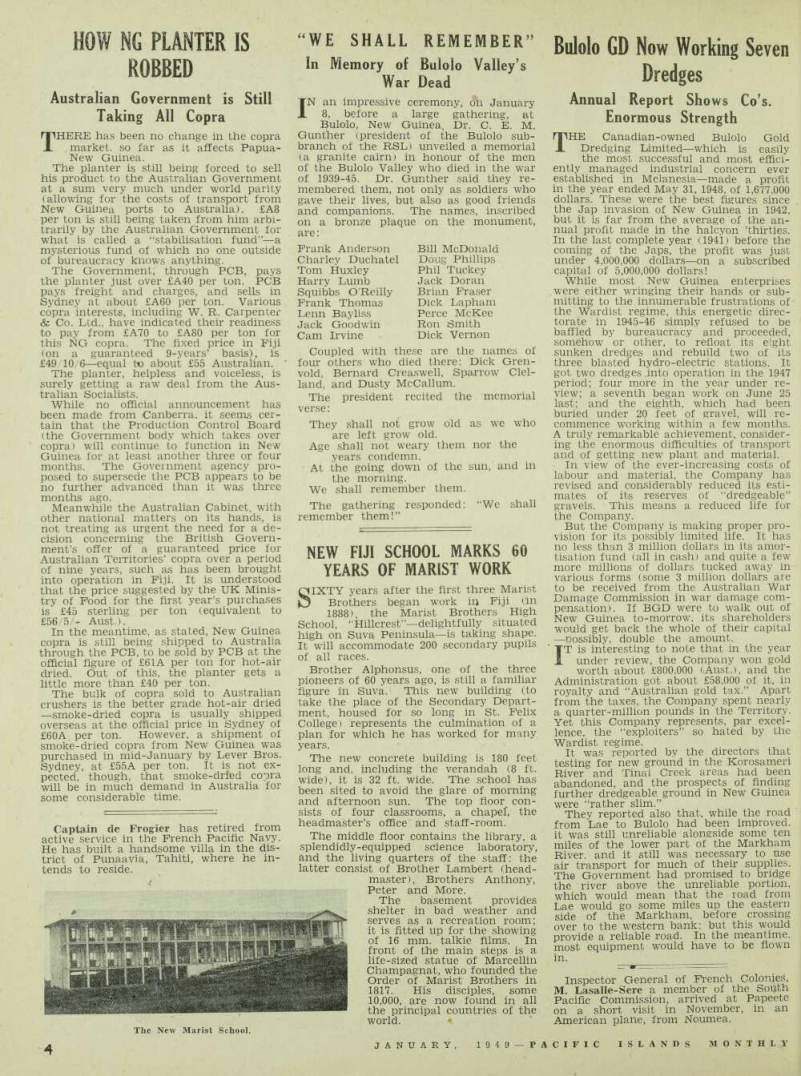
The New Marist School.
“We Shall Remember”
In Memory of Bulolo Valley’s War Dead
1N an impressive ceremony, (fn January 8, before a large gathering, at Bulolo, New Guinea, Dr. C. E. M.
Gunther (president of the Bulolo sub branch of the RSL) unveiled a memorial (a granite cairn) in honour of the men of the Bulolo Valley who died in the war of 1939-45. Dr. Gunther said they re membered them, not only as soldiers who gave their lives, but also as good friends and companions. The names, inscribed on a bronze plaque on the monument, are: Frank Anderson Bill McDonald Charley Duchatel Doug Phillips Tom Huxley Phil Tuckey Harry Lumb Jack Doran Squibbs O'Reilly Brian Fraser Frank Thomas Dick Lapham Lenn Bayliss Perce McKee Jack Goodwin Ron Smith Cam Irvine Dick Vernon Coupled with these are the names of four others who died there: Dick Gren vold, Bernard Creaswell, Sparrow Clel land, and Dusty McCallum.
The president recited the memorial verse: They shall not grow old as we who are left grow old.
Age shall not weary them nor the years condemn.
At the going down of the sun, and in the morning.
We shall remember them.
The gathering responded: “We shall remember them!”
New Fiji School Marks 60
Years Of Marist Work
SIXTY years after the first three Marist Brothers began work in Fiji (in 1888) the Marist Brothers High School, “Hillcrest” —delightfully situated high on Suva Peninsula —is taking shape.
It will accommodate 200 secondary pupils of all races.
Brother Alphonsus, one of the three pioneers of 60 years ago, is still a familiar figure in Suva. This new building (to take the place of the Secondary Depart ment, housed for so long in St. Felix College) represents the culmination of a plan for which he has worked for many years.
The new concrete building is 180 feet long and, including the verandah (8 ft. wide), it is 32 ft. wide. The school has been sited to avoid the glare of morning and afternoon sun. The top floor con sists of four classrooms, a chapel', the headmaster’s office and staff-room.
The middle floor contains the library, a splendidly-equipped science laboratory, and the living quarters of the staff: the latter consist of Brother Lambert (head
master), Brothers Anthony, Peter and More.
The basement provides shelter in bad weather and serves as a recreation room; it is fitted up for the showing of 16 mm. talkie films. In front of the main steps is a life-sized statue of Marcellin Champagnat, who founded the Order of Marist Brothers in 1817. His disciples, some 10,000, are now found in all the principal countries of the world.
Dredges
Bulolo GD Now Working Seven Dredges Annual Report Shows Co’s.
Enormous Strength
THE Canadian-owned Bulolo Gold Dredging Limited —which is easily the most successful and most effici ently managed industrial concern ever established in Melanesia —made a profit in the year ended May 31, 1948, of 1,677,000 dollars. These were the best figures since the Jap invasion of New Guinea in 1942, but it is far from the average of the an nual profit made in the halcyon ’thirties.
In the last complete year (1941) before the coming of the Japs, the profit was just under 4,000,000 dollars—on a subscribed capital of 5,000,000 dollars!
While most New Guinea enterprises were either wringing their hands or sub mitting to the innumerable frustrations of the Wardist regime, this energetic direc torate in 1945-46 simply refused to be baffled by bureaucracy and proceeded, somehow or other, to refloat its eight sunken dredges and rebuild two of its three blasted hydro-electric stations. It got two dredges into operation in the 1947 period; four more in the year under re view; a seventh began work on June 25 last; and the eighth, which had been buried under 20 feet of gravel, will re commence working within a few months.
A truly remarkable achievement, consider ing the enormous difficulties of transport and of getting new plant and material.
In view of the ever-increasing costs of labour and material, the Company has revised and considerably reduced its esti mates of its reserves of “dredgeable” gravels. This means a reduced life for the Company.
But the Company is making proper pro vision for its possibly limited life. It has no less than 3 million dollars in its amor tisation fund (all in cash) and quite a few more millions of dollars tucked away in various forms (some 3 million dollars are to be received from the Australian War Damage Commission in war damage com pensation). If BGD were to walk out of New Guinea to-morrow, its shareholders would get back the whole of their capital —possibly, double the amount.
IT is interesting to note that in the year under review, the Company won gold worth about £BOO,OOO (\Aust.), and the Administration got about £58,000 of it, in royalty and “Australian gold tax.’’ Apart from the taxes, the Company spent nearly a quarter-million pounds in the Territory.
Yet this Company represents, par excel lence, the “exploiters” so hated by the Wardist regime.
It was reported by the directors that testing for new ground in the Korosameri River and Tinai Creek areas had been abandoned, and the prospects of finding further dredgeable ground in New Guinea were “rather slim.”
They reported also that, while the road from Lae to Bulolo had been improved, it was still unreliable alongside some ten miles of the lower part of the Markham River, and it still was necessary to use air transport for much of their supplies.
The Government had promised to bridge the river above the unreliable portion, which would mean that the road from Lae would go some miles up the eastern side of the Markham, before crossing over to the western bank: but this would provide a reliable road. In the meantime, most equipment would have to be flown in.
I— m —■■ ■ Inspector General of French Colonies, M. Lasalle-Sere a member of the South Pacific Commission, arrived at Papeete on a short visit in November, in an .American plane, from Noumea.
Route
Indian Ocean Air Route May Be Alternative to Crossing India
THE main airways which connect Europe with the South Pacific come across Asia Minor into India: thence through the Netherlands Indies into Norts-west Australia.
An unfriendly India can interrupt those services at any time. There is a lesson for us in the fact that, in December, India would not let the Netherlands-Java airline across India —this being retaliation for the strong Dutch action against the “Indonesian republic,”
That will explain the sudden, renewed interest in a new route from Australia to Europe, via the Indian Ocean and East and North Africa. It has been proved that large planes can fly comfortably from North-west Australia to Cocos Keeling atoll, 1,600 miles; thence to the Chagos Islands (Diego Garcia), 1,600 miles; thence to Seychelles Islands, 1,200 miles; thence to Kenya, 1,000 miles. Thence up through Africa to Europe.
By using such a route, the air transport companies could by-pass all Southern Asia, if desired. The route at nresent lacks ground' organisation; but it is no. more difficult than the now regularly used trajis-Pacific route, from Australia to North America.
Another possible route would go directly west from North-west Australia to Rodri guez, Mauritius, Madagascar and East Africa.
The first-named route (which was ex plored by Captain P. G. Taylor a ‘couple of years ago) would be all-British, except that Cocos Keeling atoll is the absolute possession of the Clunies Ross family.
There may be significance in the fact that Clunies Ross V has been recently engaged the conferences with the British Colonial Office people in Singapore.
Ng Natives Slain With Jap
Rifles
LAE, Jan. 8.
THREE natives of a group which lives on the upper reaches of the Mark ham, were killed by other natives using Japanese rifles.
The killers are believed to be members of a semi-nomadic group, who were con tacted by the Administration just prior to the war. However, due to the very rugged type of country, no patrols have been through the area for some time. The area is believed to be around the head of the Leron, The native who reported the killings to the QIC, Kaiapit, brought in 2 or 3 used Jap cartridge cases.
As soon as the report reached Lae an Auster aircraft was chartered from GAT to enable Mr. Gus O’Donnell, ADO, Morobe, to take a look at the area from the air, so as to plot the easiest and quickest route in. A oatrol will leave immediately to investigate.
Mr. Max (“Mick”) Little, who has played prominently in Sheffield Shield cricket in Australia, has settled down in Bulolo, New Guinea, and is taking a keen and helpful interest in sport. He played for NSW when only 17. Then, in 1940, he enlisted, saw servicec in North Africa, New Guinea, and Europe, and finished with the rank of captain, a Military Cross, and other distinctions. He was at Darwin as a Qantas traffic officer for a time, and captained the Darwin Eleven.
5,000 Javanese For French
Pacific Industries
FOLLOWING the recent visit to Batavia (NED of the New Caledonian and New Hebridean (French) mission to secure Javanese labour for these colonies, it was announced in Noumea that the first contingent of Javanese was expected to arrive in early February. There will be 5,000 workers in all —3.000 for New Caledonia and 2,000 for the Hebrides— and conditions of employment will be much improved to those that prevailed before the war. The leader of the French mission, M. George Dubois, has stated that a satisfactory feature is the applica tion of 300 Javanese who have worked in the French Pacific islands before.
The Messageries Maritimes Company is arranging transport.—P.
O. Soltwedfl Deported By
Australia
THE Australian Government recently deported to Germany Mr. O. Solt wedel who, 36 years ago, went from Germany to New Guinea, where he was well known and highly respected. “Salty” (as he was generally known) was brought to Australia with other Germans in 1940, and he spent six weary years in intern ment, and another two in. Sydney, seeking oei mission to return to NG. Although his appeal was warmly supported by several Australians, the Australian Social ist Government was adamant, and “Salty” departed sadly in October for a land he had not seen since Wilhelm II was Kaiser.
Miss Raquel Lagos, of Casillla 901, South America, in a bright, interesting letter, in forms us that she is seeking pen friends in the Pacific Islands.
Planters’ Union
New Secretary For N. Guinea
MR. W. R. PAUL, who was for some years on the staff of Bulolo Gold Dredging, Ltd., in New Guinea, has been appointed organising secretary of the New Guinea Planters’
Union; and he left recently for Rabaul, to take over his new duties.
It is understood that the Planters’
Union, henceforth, will take a much stronger line than hitherto in matters relating to (a) the sale of its New Guinea copra and (b) the purchase of plantation supplies; and that Mr. Paul will be asked to undertake what has been described as “a man-size job”.
Mr. Les. Clark, another New Guinea “old-timer”, who now runs the South west Pacific Trading Co,, at 31 King St., Svdney, will act as the Sydney agent of the Planters’ Union,
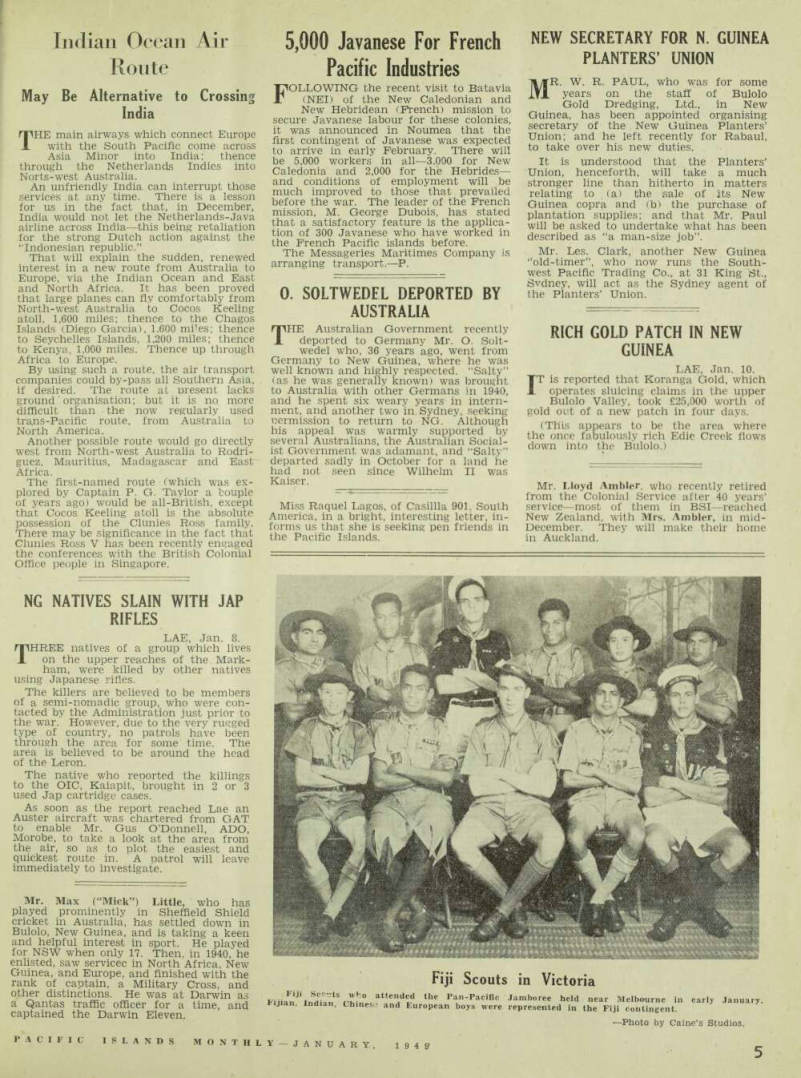
Fiji Scouts in Victoria
Rich Gold Patch In New
Guinea
LAE, Jan. 10.
IT is reported that Koranga Gold, which operates sluicing claims in the upper Bulolo Valley, took £25,000 worth of gold out of a new patch in four days. (This appears to be the area where the once fabulously rich Edie Creek flows down into the Bulolo.) Mr. Lloyd Ambler, who recently retired from the Colonial Service after 40 years’ service—most of them in BSI —reached New Zealand, with Mrs. Ambler, in mid- December. They will make their home in Auckland.
Fiji Scouts in Victoria
Fiji Scòuts who attended the Pa n - Pacific Jamboree held near Melbourne In early January, Fijian, Indian, Chinese and European boys were represented in the Fiji contingent. —Photo by Caine’s Studios.
Suggested Pacific Union Against
Asiatics and Red Russia
VARIOUS incidents in recent weeks in dicate that, while the nations of Western Europe have been forming an Atlantic Defence Union against Russia, a similar idea, involving a Defence Union of Western peoples within the Pacific area, has been taking shape in this part of the world.
The Pacific is enclosed by four Con tinents. Two of them. North America and Australia, are inhabited by Europeans South America is inhabited by part- Europeans. The fourth and biggest Con tinent, Asia, carries more than half the population of the world, and is wholly non-European. That creates a difficult, complex situation.
Not only are the Asiatics rapidly de veloping a national consciousness, which in itself may threaten the safety of the Pacific-European countries: but, under Russian direction and inspiration, Com munism is rapidly taking possession of Asia; and Communism no less than Asia tics, threatens the security and living standards of all European communities.
The day is coming rapidly when the European nations, in and around the Pacific, will have to defend themselves against Asia; and their only sure and certain defence is a sharp sword. If West ern civilisation were to be led by the nose, by people like the Australian Dr. Evatt, into putting their faith in a toothless UNO, Western civilisation surely would perish.
The most notable of the month’s de velopments is the overthrow of the de cadent Chiang Kai-rShek Government of China by the Communists, and the estab lishment of a Communist Government, subservient to Moscow, in ancient China, where live one-quarter of the human race.
Next was the announcement that Russia is putting into service in the North Paci fic a new type of large submarine, with tremendous cruising range.
At the same time, Russia is perfecting an air fleet which can fly from Northern Russia right across the North Pole, to drop bombs in the middle of North America.
The other development was the step taken by the Dutch to “liquidate” the treacherous “republic of Indonesia”—the first sign of real backbone among the Socialist-ridden nations of Western Europe, Because the South Americans are indif ferent. the possibilities of a Pacific De fence Union actually are limited. Already, United States and Canada are united.
Even if Australia and New Zealand are enthusiastic in favour of a Defence Union, their collaboration, in terms of strength, means comparatively little to the United States. There are fewer people in all Australia than there are in the city of New York. There are as many people in the city of Sydney as there are in the whole of New Zealand. Nonetheless, Aus tralia and New Zealand could help by providing bases for American Forces.
The New Zealand Prime Minister, in statements made recently in Canada, was in favour of a Pacific Union: “If the need arose for the Democratic Nations in the Pacific to stand together, I am sure we would see a Pacific Pact developing along the lines of the Atlantic Pact.”
Australia has said nothing, Australia, officially, is playing about with various Socialist enterprises, and displaying her love for the Indonesians and voicing her passionate faith in the now discredited
UNO. But Australians, like everyone else recognise that there is no future whatever for these white communities in the South ern Seas unless the United States main tains command over the Pacific basin and keeps Asiatics, Russians and Communists m their proper place.
The two great protagonists of two en tirely different worlds are the United States, which stands for Individualism and the social standards which have evolved in 2,000 years of sociological struggle; and Russia, which represents Totalitarianism, and which is preparing to force upon the whole world a standard of life planned by Communists, in which the individual is a slave and everything that is decent in human conduct is trampled upon.
The Case of Tunica Y Casas
TjTOLLOWING questions asked in the -T House of Representatives in Octo ber (see “PIM” for December) the Australian Prime Minister made the following statement with regard to Tunica Y Casas and his wife, both form erly of Noumea.
Permission was given in 1937 for Casas, his wife and child, then French nationals, living m Noumea, to be admitted to Aus tralia. This permission was not availed of within the specified time. They finally came to Australia in August, 1946, on visitors’ vises, issued by the British Consul in Noumea. They have indicated their desire to remain in Australia for an indefinite period. Inquiries as to their activities and conduct while in Australia have been proceeding for some time and the action to be taken with regard to them will be decided when these investi gations are complete. They have not yet been granted permission to remain per manently. (Mr. Lang, Member for Reid, had asked, among other things, what was the con nection of Casas and his wife with the Communist Party.) Mrs. Isobel Jones and Mrs. Gwen Phill pott, both well-known residents of pre war Rabaul, will leave Sydney on the new Orient liner “Orcades” at the end of January. They expect to be away about nine months and will tour the United Kingdom and Europe.
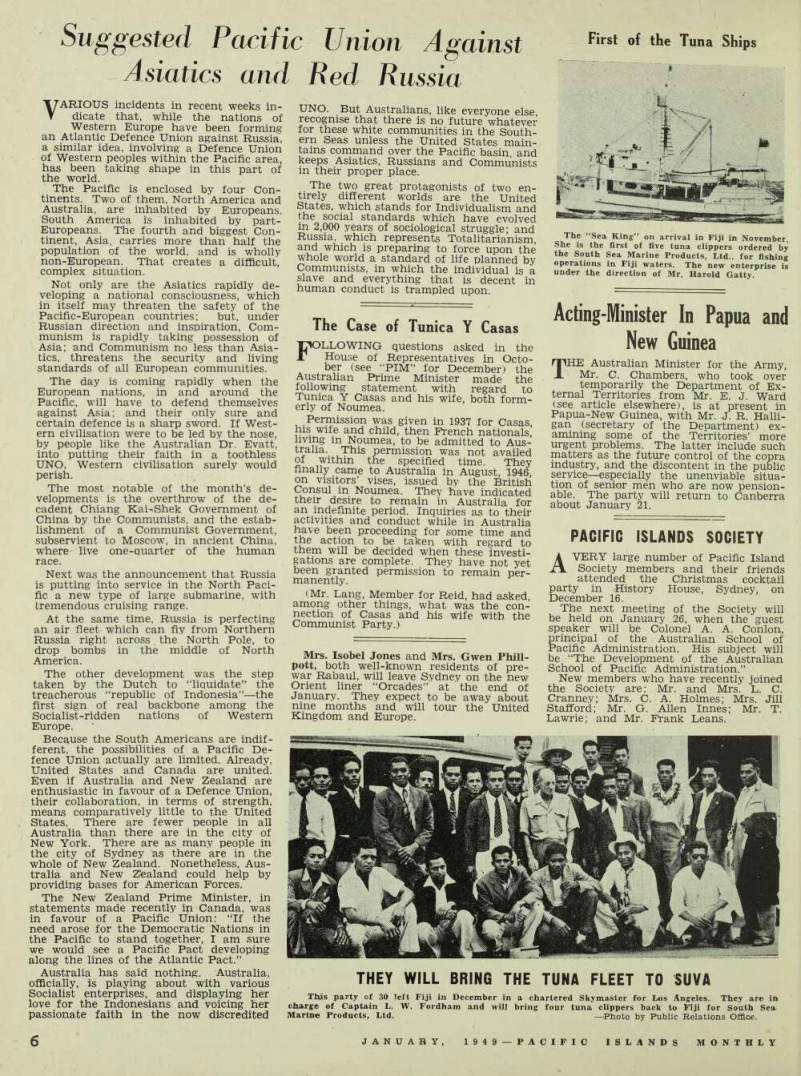
First of the Tuna Ships
The “Sea King” on arrival in Fiji in November.
She is the first of five tuna clippers ordered by the South Sea Marine Products, Ltd., for fishing operations in Fiji waters. The new enterprise is under the direction of Mr. Harold Gatty.
Acting-Minister In Papua and New Guinea
New Guinea
THE Australian Minister for the Army, Mr. C. Chambers, who took over temporarily the Department of Ex ternal Territories from Mr. E. J. Ward (see article elsewhere), is at present in Papua-New Guinea, with Mr. J. R. Halli gan (secretary of the Department) ex amining some of the Territories’ more urgent problems. The latter include such matters as the future control of the copra industry, and the discontent in the public service—especially the unenviable situa tion of senior men who are now pension able. The party will return to Canberra about January 21.
Pacific Islands Society
AVERY large number of Pacific Island Society members and their friends attended the Christmas cocktail party in History House, Sydney, on December 16.
The next meeting of the Society will be held on January 26, when the guest speaker will be Colonel A. A. Conlon, principal of the Australian School of Pacific Administration. His subject will be “The Development of the Australian School of Pacific Administration.”
New members who have recently joined the Society are; Mr, and Mrs. L. C.
Cranney; Mrs. C. A. Holmes; Mrs. Jill Stafford; Mr. G. Allen Innes; Mr. T.
Lawrie; and Mr. Frank Leans.
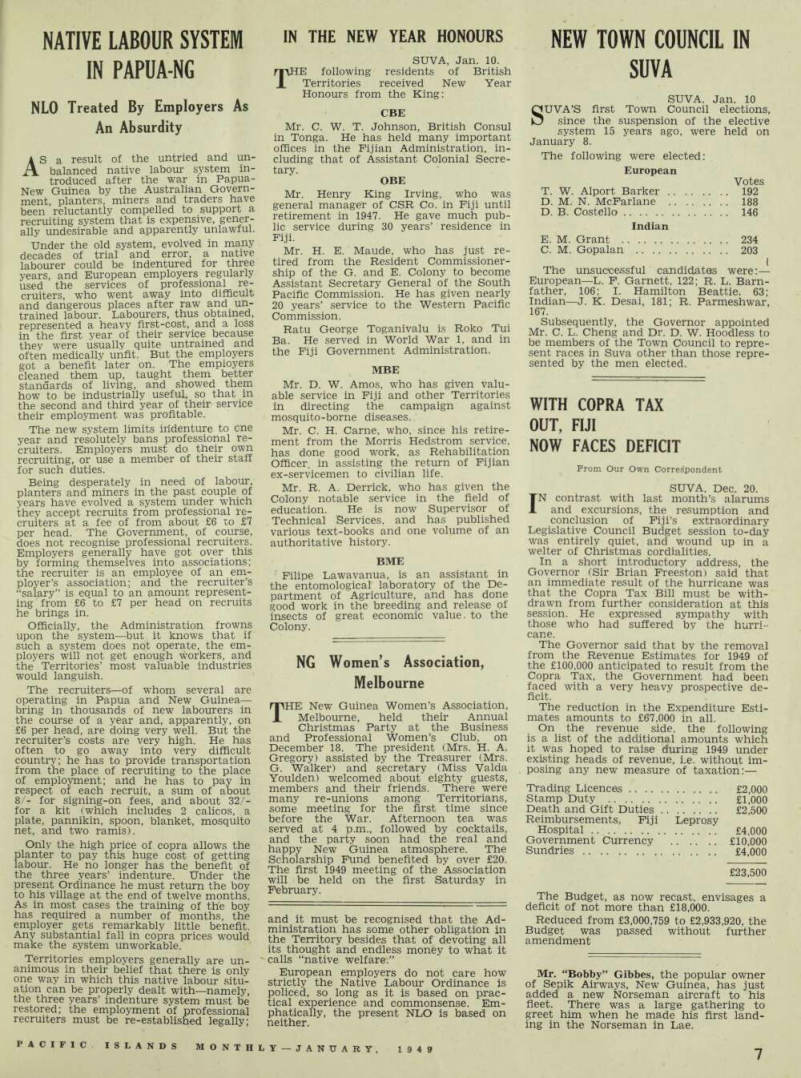
THEY WILL BRING THE TUNA FLEET TO SUVA This party of 30 left Fiji in December in a chartered Skymaster for Los Angeles. They are in charge of Captain L. W. Fordham and will bring four tuna clippers back to Fiji for South Sea Marine Products, Ltd. —Photo by Public Relations Office.
In Papua-Ng
Native Labour System
NLO Treated By Employers As An Absurdity
AS a result of the untried and un balanced native labour system in troduced after the war in Papua- New Guinea by the Australian Govern ment, planters, miners and traders have been reluctantly compelled to support a recruiting system that is expensive, gener ally undesirable and apparently unlawful.
Under the old system, evolved in many decades of trial and error, a native labourer could be indentured for three years, and European employers regularly used the services of professional re cruiters, who went away into difficult and dangerous places after raw and un trained labour. Labourers, thus obtained, represented a heavy first-cost, and a loss in the first year of their service because they were usually quite untrained and often medically unfit. But the employers got a benefit later on. The employers cleaned them up, taught them better standards of living, and showed them how to be industrially useful, so that in the second and third year of their service their employment was profitable.
The new system limits iildenture to one year and resolutely bans professional re cruiters. Employers must do their own recruiting, or use a member of their staff for such duties.
Being desperately in need of labour, planters and miners in the past couple of years have evolved a system under which they accept recruits from professional re cruiters at a fee of from about £6 to £7 per head. The Government, of course, does not recognise professional recruiters.
Employers generally have got over this by forming themselves into associations; the recruiter is an employee of an em ployer’s association: and the recruiter’s “salary” is eoual to an amount represent ing from £6 to £7 per head on recruits he brings in.
Ofiicially, the Administration frowns upon the system—but it knows that if such a system does not operate, the em ployers will not get enough workers, and the Territories’ most valuable industries would languish.
The recruiters —of whom several are operating in Papua and New Guinea — bring in thousands of new labourers in the course of a year and, apparently, on £6 per head, are doing very well. But the recruiter’s costs are very high. He has often to go away into very difficult country; he has to provide transportation from the place of recruiting to the place of employment; and he has to pay in respect of each recruit, a sum of about 8/- for signing-on fees, and about 32/for a kit (which includes 2 calicos, a plate, pannikin, spoon, blanket, mosquito net, and two ramis).
Only the high price of copra allows the planter to pay this huge cost of getting labour. He no longer has the benefit of the three years’ indenture. Under the present Ordinance he must return the boy to his village at the end of twelve months.
As in most cases the training of the boy has required a number of months, the employer gets remarkably little benefit.
Any substantial fall in copra prices would make the system unworkable.
Territories employers generally are un animous in their belief that there is only one way in which this native labour situ ation can be properly dealt with—namely, the three years’ indenture system must be restored; the employment of professional recruiters must be re-established legally;
and it must be recognised that the Ad ministration has some other obligation in the Territory besides that of devoting all its thought and endless money to what it calls “native welfare.”
European employers do not care how strictly the Native Labour Ordinance is policed, so long as it is based on prac tical experience and commonsense. Em phatically, the present NLO is based on neither.
In The New Year Honours
Suva, Jan. 10.
rE following residents of British Territories received New Year Honours from the King:
Cbe
Mr. C, W. T. Johnson, British Consul in Tonga. He has held many important offices in the Fijian Administration, in cluding that of Assistant Colonial Secre tary.
Qbe
Mr. Henry King Irving, who was general manager of CSR Co. in Fiji until retirement in 1947. He gave much pub lic service during 30 years’ residence in Fiji.
Mr. H. E. Maude, who has just re tired from the Resident Commissioner ship of the G. and E. Colony to become Assistant Secretary General of the South Pacific Commission. He has given nearly 20 years’ service to the Western Pacific Commission.
Ratu George Toganivalu is Roko Tui Ba. He served in World War 1, and in the Fiji Government Administration.
Mbe
Mr. D. W. Amos, who has given valu able service in Fiji and other Territories in directing the campaign against mosquito-borne diseases.
Mr. C. H. Came, who, since his retire ment from the Morris Hedstrom service, has done good work, as Rehabilitation Officer, in assisting the return of Fijian ex-servicemen to civilian life.
Mr. R. A. Derrick, who has given the Colony notable service in the field of education. He is now Supervisor of Technical Services, and has published various text-books and one volume of an authoritative history.
Bme
Filipe Lawavanua, is an assistant in the entomological laboratory of the De partment of Agriculture, and has done good work in the breeding and release of insects of great economic value, to the Colony.
NG Womens Association,
Melbourne
THE New Guinea Women’s Association, Melbourne, held their Annual Christmas Party at the Business and Professional Women’s Club, on December 18. The president (Mrs. H. A.
Gregory) assisted by the Treasurer (Mrs.
G. Walker) and secretary (Miss Valda Youlden) welcomed about eighty guests, members and their friends. There were many re-unions among Territorians, some meeting for the first time since before the War. Afternoon tea was served at 4 p.m., followed by cocktails, and the party soon had the real and happy New Guinea atmosphere. The Scholarship Fund benefited by over £2O.
The first 1949 meeting of the Association will be held on the first Saturday in February.
Suva
New Town Council In
Suva. Jan. 10
SUVA’S first Town Council elections, since the suspension of the elective system 15 years ago, were held on January 8.
The following were elected:
The unsuccessful candidates were;— European—L. P. Garnett, 122; R. L. Barn father, 106; I. Hamilton Beattie. 63; Indian —J. K. Desai, 181; R. Parmeshwar, 167.
Subsequently, the Governor appointed Mr. C. L. Cheng and Dr. D. W. Hoodless to be members of the Town Council to repre sent races in Suva other than those repre sented by the men elected.
European Votes ŕtrtr T. W. Alport Barrker 192 D. M. N. McFarŕtane 188 D. B. Costehlrrlo 146 Indian E. M. Grant 234 C. M. Gopalan 203
Out, Fiji
With Copra Tax
Now Faces Deficit
Prom Our Own Correspondent
Suva. Dec. 20.
IN contrast with last month’s alarums and excursions, the resumption and conclusion of Fiji’s extraordinary Legislative Council Budget session to-day was entirely quiet, and wound up in a welter of Christmas cordialities.
In a short introductory address, the Governor (Sir Brian Freeston) said that an immediate result of the hurricane was that the Copra Tax Bill must be with drawn from further consideration at this session. He expressed sympathy with those who had suffered by the hurri cane.
The Governor said that by the removal from the Revenue Estimates for 1949 of the £lOO,OOO anticipated to result from the Copra Tax, the Government had been faced with a very heavy prospective de ficit.
The reduction in the Expenditure Esti mates amounts to £67,000 in all.
On the revenue side, the following is a list of the additional amounts which it was hoped to raise during 1949 under existing heads of revenue, i.e. without im posing any new measure of taxation:—
The Budget, as now recast, envisages a deficit of not more than £lB,OOO.
Reduced from £3,000,759 to £2,933,920, the Budget was passed without further amendment Mr. “Bobby” Gibbes, the popular owner of Sepik Airways, New Guinea, has just added a new Norseman aircraft to his fleet. There was a large gathering to greet him when he made his first land ing in the Norseman in Lae.
Trading Licences £2,000 Stamp Duty Death and Gift Duties . £2,500 Reimbursements, Fiji Leprosy Hospital Government Currency £10,000 Sundries £23.500
New Fish Cannery For
Tahiti
From Our Own Correspondent
Papeete, Dec. 20.
A PLAN for the establishment here of a fish-canning plant in Tahiti (simi lar to that in Fiji) submitted by Mr.
Lewis Hirshon, has received the tentative approval of the Government, and it is expected that Hawaiian Tuna Packers, of Honolulu, will put it into effect. Mr. Alan Davis is to arrive on January 15 on a 250-tons refrigerated ship, accompanied by a smaller vessel.
The main business will be the catching and canning of fish of the Tuna variety, and fishmeal, fertilisers, and vitamin oils will be processed for world markets, with preference for France. There is a plenti ful supply of fish in these waters, especi ally of the Tuna variety.
Closing Of American Consulate
THE former American Consulate build ing has now been leased to Mr. O G. Nordman, of Tahiti. This land was granted to United States for the Con sulate by Queen Pomare in 1832, and was confirmed by the French Government in 1848. For 116 years the American Consul ate has given excellent service, and it was with deep regret that the community saw the departure of the Stars and Stripes.
Mr. Nordman, as well as many others, was registered there, as a child, as an Ameri can citizen: and many were the dinners and receptions held in this delightful old Consular residence. It is the fond hope of all that some day the American Con sulate will be re-established in Tahiti American affairs for French Oceania are now controlled by the American Lega tion in Wellington, NZ.
Merchant Killed
MR. ELIAS SALEM, a Syrian by birth, on November 24 was run over and killed by a car, while on his way to say farewell to his son, leaving on the schooner “Stella Maris,”
Mr. Salem, a former pearl merchant, and his wife, arrived in Tahiti in 1907 where 12 children were born to them The family became favourably known for their industry and generosity.
Treasure-Seekers
PERMISSION has been given to an ex pedition of treasure-seekers, to hunt for the much-sought-after “lost” treasure on the island of Pinaki, in the Tuamotu Group. The party will leave New Zealand shortly for Papeete.
Many years ago an Australian, Charles Howe, while an inmate of a Sydney hos pital, was handed a chart of this lost treasure by a dying patient, whom he had. befriended. Mr. Howe came to Tahiti but after several years of fruitless search! left the Islands, and never returned.
Paa May Call At Tahiti
IT is reported that Pan American Air ways will make Papeete a port of call in the future. Their requests were granted in the last session of the Repre sentative Assembly.
The second flight of Airways TRAPAS from New Caledonia is due at Papeete on December 24.
Air France may make Tahiti a port of call on its Round-the-,World schedule The American yacht “Ornant” arrived on December 6 and plans a regular pas senger service (about every 2 months) between Honolulu and Papeete.
Mr. Osborne Sees Improved
Conditions in Cooks
WHEN he returned to Auckland, NZ, early in December, Mr. A. G Os borne, Under-Secretary to the New Zealand Prime Minister, told the NZ “Herald” that he saw a brighter outlook for the people of the Cook Islands. He had been visiting Rarotonga as represen tative of the NZ Government at the sec ond session of the Legislative Council of the Cook Islands.
He said that native members of the Council had taken a full part in the dis cussions and dealt with the subjects thoroughly, constructively and in a well informed manner.
Mr. Osborne said he visited many citrus and other agricultural areas in Rarotonga during his three weeks’ stay in the group.
He anticipated a great increase in pro duction of citrus fruit, arrowroot, pine apples and tomatoes, as well as taro and kumaras for local consumption. The cit rus replanting scheme, which lagged for a while, was now being keenly developed, not only in Rarotonga but in all islands of the southern part of the group.
The people had been taking a consider able interest in the production of toma toes, he said. He had pointed out to them that New Zealand had a substantial hot house tomato industry, and the growers were entitled to have their interests con sidered by the Government. He asked island growers to arrange plantings so that production would be tapering off by the end of October.
Citrus nurseries, which at present con tained over 100,000 young trees, were being maintained in Rarotonga. Nurseries also were developing banana shoots in anti cipation of the resumption of banana exports.
Considerable planting was being done in Aitutaki, which was once one of the most productive orange-growing islands in the group. The old nitive trees had almost died out, but they were now being re placed by new trees, which were bein properly tended. Aitutaki had a fair prospect of recovering its former pre eminent position . ' ' ' = UNESCO has granted 20,000 dollars to the Pacif ? c Scientific Congress to en able seven scientists from war devastated countries in Asia, and two from Holland and Scandinavia, to participate in the Congress in NZ in February. This con stitutes the largest single financial assist ance 80 far given by UNESCO to a scientific congress.
Correction And Apology
In December we published a photograph of a Tongan Royal Group, taken about 1918. From left to right the persons photographed were Prince Tugi (Consort of Queen Salote); an Aide de-camp; Sir Cecil Rodwell (Governor of Fiji); Captain Clive Brewster; Queen Salote; Premier of Tonga; Mrs. McOwan; Mr. Islay McOwan (British Consul). In describing the photograph we said that all these people, except Queen Salote, were dead.
Many correspondents have hastened to correct this unfortunate statement. Sir Cecil Rodwell is very much alive at his home, “Woodlands,”
Holbrook, near Ipswich, England. He retired from the Governorship of Southern Rhodesia in 1934. Mrs. McOwan, widow of Mr. Islay McOwan, is a. resident of Sydney and is «lso very well, It is believed also that the aide-de-camp is still alive. We express regret for any annoyance caused to these people.
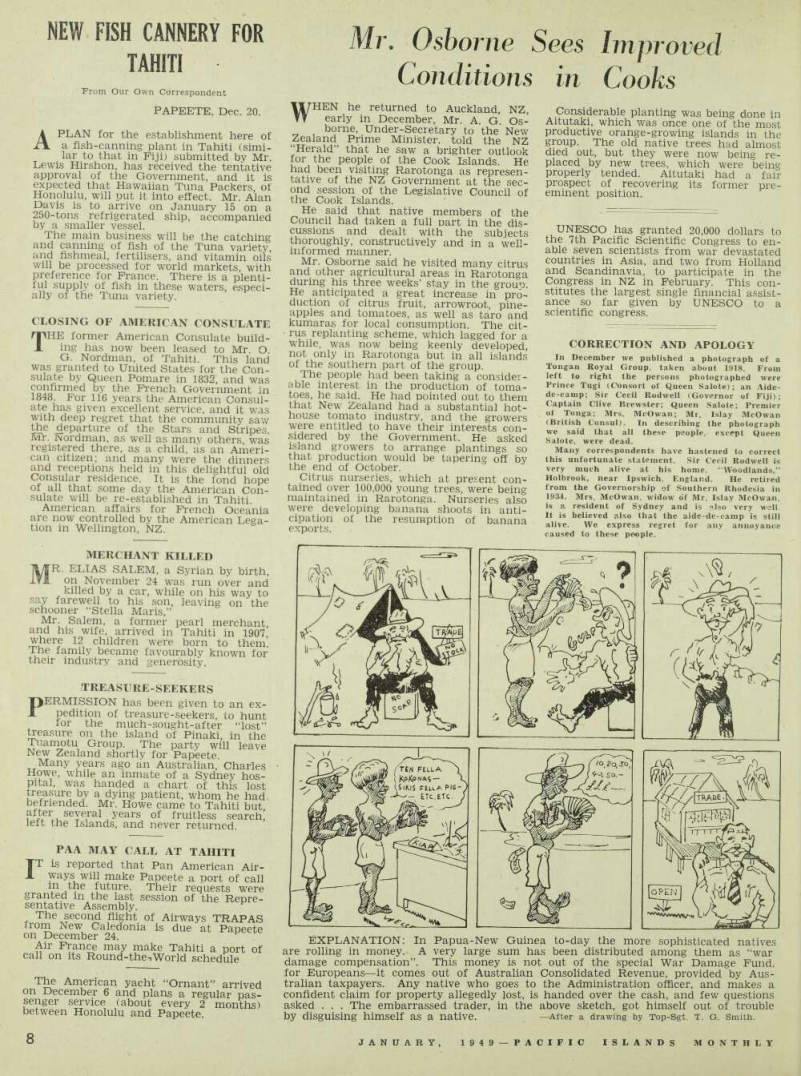
EXPLANATION: In Papua-New Guinea to-day the more sophisticated natives are rolling in money. A very large sum has been distributed among them as “war damage compensation”. This money is not out of the special War Damage Fund, for Europeans—it comes out of Australian Consolidated Revenue, provided by Aus tralian taxpayers. Any native who goes to the Administration officer, and makes a confident claim for property allegedly lost, is handed over the cash, and few questions asked . . . The embarrassed trader, in the above sketch, got himself out of trouble by disguising himself as a native. —After a drawing by Top-Sgt. T. G. Smith.
New Resident Commissioner
of G. and E. Colony
MR. W. J. PEEL has been appointed Resident Commissioner of the Gil bert and Ellice Islands Colony, with headquarters at Tarawa. He replaces Mr.
H. E. Maude, who was recently appointed Deputy Secretary-General of the South Pacific Commission.
Mr. Peel, who was born in 1912, is mar ried and has two children. He was edu cated at Wellington College, Berkshire, and Queen’s College, Cambridge, where he obtained an Honours Degree in Law (8.A.). He passed the Bar Intermedia e examination in 1934.
He was appointed to the Colonial Ad ministrative Service as a cadet in the Malayan Civil Service in 1937; was in terned by the Japanese during the Pacific War; and after the war he acted as Bri:ish Resident in Brunei, Northern Borneo.
NZ Welcomes NG Scrap Metal
While New Guinea Tightens Export of Disposals Goods
ACCORDING to the Auckland “Star,” 10,000 tons of structural steel were expected in New Zealand by the “Waitara” in January. All of it comes from abandoned war dumns in Papua- New Guinea. It was stated also that, early in 1949, a similar quantity will arrive in New Zealand on another vessel from the same source.
This steel includes reinforcing rods, mild steel plate, miles of steel air strip, pre-fabricated steel huts and floating dock pontoons.. Engineers are hard at work in New Guinea stripping huts and preparing steel for shipment.
There is wild enthusiasm over this scoop, in the Dominion.
Iron and steel are almost unprocurable in New Zealand and this scrap is there fore, extremely precious. It is to be presumed that it is not so valuable in New Zealand’s sister Dominion, Australia, to whom the scrap originally belonged.
These large quantities of iron and steel, now salvaged by New Zealanders —particularly by the alert Union Manufactur ing and Export Co. —have been lying around New Guinea since the end of the war, in 1945. Every assistance was given to Australian buyers by the Common wealth Disposals Commission and this material has been gone-over and spurned by hundreds of these gentlemen.
It is interesting to note, however, that in a proclamation in the Papua-New Guinea Government Gazette of December 1, 1948, any goods or property acquired from the Commonwealth Disposals Com mission, or Treasury Disposals Section, “directly or indirectly,” cannot now be exported unless consent in writing of the Papua-New Guinea Collector of Customs has been first obtained.
This may be an eleventh-hour attempt to reserve for the Territories such aban doned war materials as will be of use to them. Previously, buyers from the Australian mainland had an open field with regard to Disposals goods, with the result that much equipment that was badly needed for the rehabilitation of the Territories was taken away without re striction and subsequently had to be re imported.
The engagement is announced of Mr.
John EUzpatriek, of Guinea Air Traders, Ltd., Lae, and Sister Patricia Lumley, of Kinwma, Trobriand Islands. Miss Lumley was recently stationed at the Lae Hospital and has been transferred to Wewak.
Fall Of Rabaul
January 23 Marks 7th Anniversary of Jap Invasion
IT is now seven years since the Japanese forces landed on the shores of Blanche Bay and occupied Rabaul and ultimately most of New Britain.
After the fighting had ceased on Jan uary 23, 1942, some Europeans made their way through the jungles of New Britain, were rescued, and eventually reached Australia. But some hundreds of Rabaul residents who were trapped, and even more of members of the AIF garrison there, became prisoners of the Japs. All but a handful of these subsequently perished, when the “Montevideo Maru” was sunk while transporting them to Japan.
January 23, therefore, has become set apart in the minds of Territorians as a date of special significance. This year, as usual, it will be marked by ceremonies in Sydney and New Guinea.
In Sydney, former and present New Guinea residents will meet in Martin Place, where wreaths will be placed on the Cenotaph. As the 23rd. falls on a Sunday this year, the time of meeting has been fixed for 10 a.m., instead of 8.30 a.m., as is usual.
Arrangements are in the hands of the New Guinea Women’s Club of Sydney and New Guinea ex-Servicemen.
Sir Maynard and Lady Hedstrom, who sailed from Australia by the Wangaratta in December, are now in South Africa.
Ladv Hedstrom’s health imnroved very much during the voyage.
Loss Of John Williams V
THE 200-tons London Missionary Society’s auxiliary schooner, “John Williams V” was lost off Savaii, Western Samoa, on December 24. She was shortly to be sold, following the com missioning of “John Williams VI,” now on her maiden Islands voyage.
The schooner went ashore at 2 a.m. on Christmas Eve. The officers and men abandoned ship and spent 24 hours in the lifeboats before being picked up by the Apia harbourmaster, who had gone out in one of O. P. Nelson and Co.’s tugs.
It is believed that “John Williams V” hit a reef off Savaii. Master of schooner was Captain Stanton Page who piloted the American landing at Tarawa, during the war, because of his intimate knowledge of the Gilbert Islands. “John Williams V” cost only £15,000 when she was launched in 1930 but was worth more than that to the LMS to-day, “John Williams VI,” launched last August, cost £74,000.
Mr, A. L. Ethell, formerly of the Papua Administrative Service, and more recently a planter in the Milne Bay district, has gone to Western Australia to take up the position of Superintendent of the Moore River Aboriginal Station, about 100 miles from Perth. He will be under the direc tion of Mr. S. G. Middleton, who is now Commissioner of Native Affairs, in West ern Australia, but who formerly was a valued member of the Papuan Public Service. Another former member of the Papuan Service who has joined Mr Middleton is Mr. Saunders, who was a member of District Services in Port Moresby.
Social Events In Suva
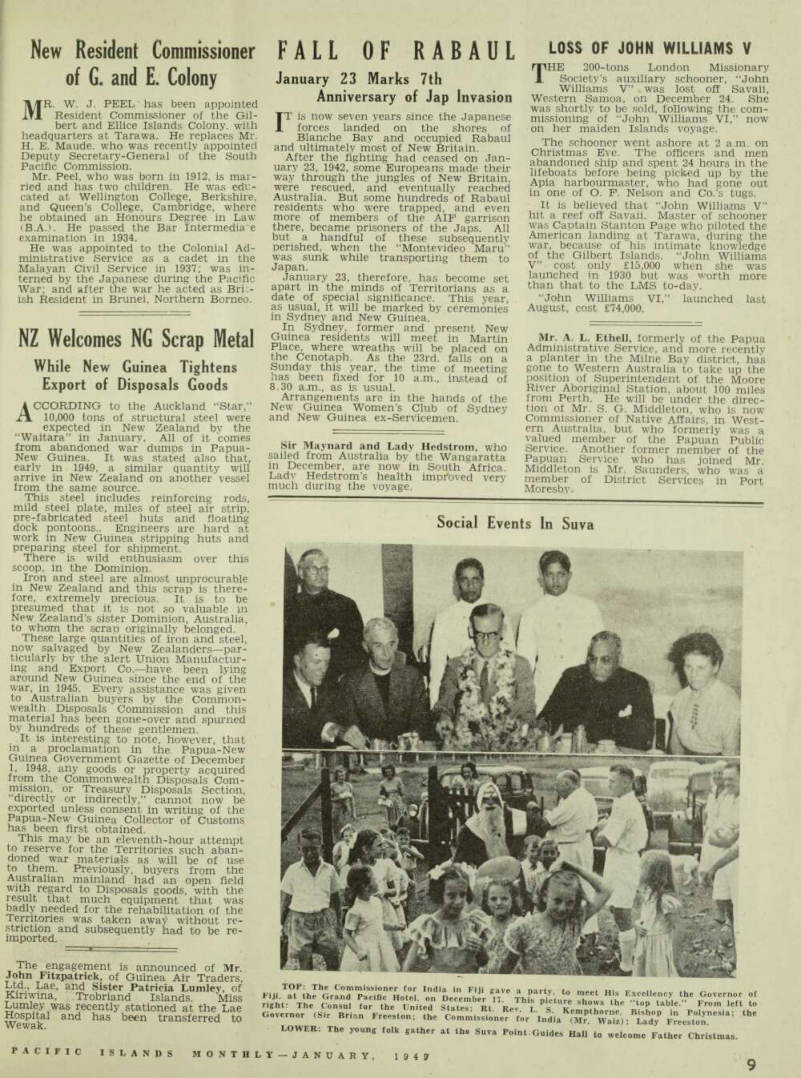
TOP: The commissioner for India in Fiji gave a party, to meet His Excellency the Governor of Fiji, at the Grand Pacific Hotel, on December 17. This piture shows the "top table." From left to right: The Consul for the United States; Rt. Rev. L. S. Kempthorne, Bishop in Polynesia; the Governor (Sir Brian Freeston; the Commissioner for India (Mr. Waiz; Lady Freeston.
LOWER: The young folk gather at the Suva Point: Guides Hall to welcome Father Christmas.
Extraordinary Case
EFFECT OF NG TIMBER LEASE TRIAL VERDICT UPON
Mr. E. J. Ward's Career
Conditions of Royal Commission Add Ridicule To An Extraordinary Case
By R. W. Robson
THE drama of the New Guinea Timber Leases, the question of whether Australian Territories • Minister “Eddie” Ward was connected with them, and the charges made against Ward by his former associate, “Jock” Garden, did not end with the verdict of “not guilty” by the Sydney jury in the conspiracy trial on December 22, It has now been switched over into an inquiry by an Australian Royal Commis sioner, which will commence in February, but which, owing to the limited terms of reference, is already being decried as an absurdity.
Meanwhile Mr. Ward (“at his own re quest”) has been relieved of his port folios, and another Australian Minister, a Mr. Chambers —who hitherto has held the portfolio of the Army—is acting as Minister in charge of New Guinea and Papua affairs.
History of The Case THE drama began away back in 1944, soon after Mr. Ward became Minister for Territories, Mr. Ward had been Minister for National Service, during the war, and his very old friend and staunch comrade in a thousand political fights, Mr. Jock Garden, was a high official in Mr. Ward’s Department. Another official was a Mr. Urquhart, who had been a Railways clerk, or something modest in that line. Bear the name in mind.
From one angle, the National Service Organisation did not have a good repu tation.
It was generally believed in Sydney during the critical war years that men who had been “called up” could be “ex cused” from service if a bribe were paid to certain officials in the National Service Department (or whatever it was called).
How common the practice was I can not say positively; but I know that the system was in operation, because I per sonally knew of a man who escaped service on payment of £ 100 —I made a note of the details at the time. I do not say that either Garden or Urquhart were connected with this racket; but the racket did exist in the Department with which they were connected, and of which Mr. Ward was the Ministerial head.
Anyway, when Mr. Ward moved over to the Territories Department, Mr.
Garden apparently moved with him.
Garden seems to have been still paid by the former Department: but his office was close to th£vt of the Territories Minister in the Commonwealth Bank, Sydney, and among other things he looked after electoral organisation matters for “Eddie” in East Sydney (“Eddie’s” seat), and he had the entree to the Territories Minister’s office. Garden apparently had no official standing in the Territories Department; but, unofficially, because of his close personal association with the Minister, he seems to have been accepted as a person in authority.
Syndicate’s Slow Progress SOMEWHERE about the end of 1944, Jock Garden, a mysterious indi vidual named Edward Farrell (aged 60, a mining engineer) and our old friend Ray Parer (aged 54, pioneer aviator), be came involved in a plan for securing the
right to remove, from the Bulolo Valley of New Guinea, some of the very valu able stands of timber that clothe those precipitous slopes. There was nothing wrong about the plan—it was quite openly referred to in the PIM in 1944. The PIM on that occasion, however, said that the reports had one or two Commonwealth Ministers interested in the Timber Leases; and. up to date, that has not been proved correct.
Mr. Farrell, in 1944-45, succeeded in getting a well-known Brisbane timber concern, Hancock and Gore, Ltd., in terested in the project. A syndicate, comprising Jock Garden, his son Har court (said subsequently to be a dummy for Mr. Ward, but this was never proved), Farrell and Parer, was formed to handle the plan. The Co. apparently was prepared to pay £lOO,OOO for the right to take the timber out of New Guinea. It actually paid, first, £12,500, and later, £37,500, making £50,000 in all.
Jock Garden’s efforts, on behalf of the syndicate, to obtain from the Minister and/or the Department a formal license or concession to take the timber, made slow progress. There were innumerable interviews and discussions between mem bers of the syndicate, and various of ficials. Jock seems to have convinced the members of the syndicate, and Han cock and Gore. Ltd., that the Minister was favourable. They all knew of Jock's close association with Mr. Ward, and Jock produced a formal Departmental letter approving of the Issue of the timber lease or license, signed ‘‘E. J.
Ward, per J. S. Garden”; and they ac cepted that at its face value. There was alleged to have been another and more formal letter in 1944.
One gets the impression that the real obstacle in the path of the plan was Mr. J. R. Halligan, secretary of the De partment. Whether the Minister did or did not approve of the plan—and that has been the moot point—it is clear that Halligan never at any time indicated that the Department, officially, had any thought or intention of giving to anyone the right to acquire New Guinea timber, except under conditions of open com petition.
Incredible as It may appear, these negotiations, or discussions, dragged on through 1945, 1946 and 1947, and there was no finality. Hancock and Gore, Ltd., which had paid £50,000, became more and more impatient and insistent. In the course of correspondence, a letter was written by Hancock and Gore, Ltd., to the Minister. It went through Garden’s hands. It was not in the form required, so Mr. Garden —instead of sending the letter back to Brisbane for alteration — had the last sheet re-typed, and himself signed the firm’s name.
The thing which seems to have told most against the Minister is that this went on for three years and he, accord ing to his claim, knew practically nothing about it.
Garden Goes to Gaol FINALLY, in December, 1947, came the showdown, Hancock and Gore tried to force the issue with the Minister; the Minister, shown the correspondence, denied knowledge of the plan to give the syndicate a timber lease, and of the receipt and distribution of £50,000; and, at his instigation, Garden was arrested and charged with certain offences. After a sensational trial in February, 1948, Garden was finally convicted of forgery in respect of the letter from Hancock and Gore which he had altered and signed, although he gave what he claimed to be a perfectly reasonable explanation of
his action. He was sent to gaol for three years.
The next stage was the prosecution of the members of the syndicate (Jock Garden, Harcourt Garden, Farrell and Ray Parer) on a charge of conspiracy.
The original prosecution of Jock Garden had occupied many weeks early in 1948.
The conspiracy trial occupied a longer period, in the latter part of 1948, con cluding on December 22. Much the same evidence was given as in the trial of Garden. Farrell, however, was now seriously ill, and could not stand his trial; and the three others went to trial without him. They were found “Not Guilty”.
Therefore, the charge against Farrell was withdrawn.
Charges Against Ward rE defence put up by the accused, Garden, in both trials was to the effect that Ward was cognisant of the plan to give the syndicate a timber lease, and that he received a substantial share of the £50,000 paid over by Han cock and Gore, Ltd, Garden said that on Ward’s instructions he personally handed some of Ward’s share (£5,000) to Urquhart, who was Ward’s close per sonal friend. Both Ward and Urquhart fiercely denied this.
This brought Mr. Urquhart under the microscope. It was found that Urquhart, formerly a clerk, had become a National Service official in Mr. Ward’s Department; that, while he was in that job, extra ordinarily large sums of money had passed through his private bank accounts —a fact which he explained by saying he had been a heavy bettor on Sydney race courses: and that, on Mr. Ward’s recom mendation, he had now become managing director of Pincombes, Ltd. (a typewriter importing firm) at £2,000 p.a.
During the Court proceedings, there was a great amount of sharply conflicting evidence —one side or the other was clearly guilty of barefaced perjury—and charges and counter-charges involving the Minister were exceedingly bitter.
Judge Holt’s summing up, at the end of the conspiracy trial, occupied many hours. The following is from the “Daily Telegraph” report, published on Decem ber 22: Approaching: the end of his summing-up, Judge Holt said that either Ward or Garden had com mitted perjury. The decision was with the jury “in this sad and dreadful matter which has been contested between the two.*’
He said to the jury: “You have the tests of documents and of their (Garden’s and Ward’s) demeanour in the witness-box, and you have to decide whom you accept out of the two. They might be telling lies about one thing and lies about another.
“Could there be anything more serious in community life than offering a Minister a bribe?
It strikes at the whole of the Government of the country and the running of the country.
“Garden was cross-examined on the handing over of £5,000 to Urquhart, which he said he did on the Minister’s direction. It is a matter for you to decide whether the £5,000 was handed over. If it was it may account for a great number of matters on which the case for the accused hinges. If it was not, it seriously re flects on the credit of J. S. Garden. It would show him to be a man who would resort to almost anything, even to endeavouring to tear down a vpry old friend in the esteem of the community.
“Of course, on the other hand, if you come to the conclusion that the Minister did accept it, then he must be guilty of a most reprehen sible and despicable act, quite apart from the serious crime of testifying against a friend of very many years.
“There can be no b/alf-measures—it is a definite perjury on the side of one or the other and whoever is perjuring himself, it is a very dreadful act.”
The Jury found all three “Not Guilty”.
Harcourt Garden and Ray Parer were
dlscharged from custody, and Jock Gar den was returned to gaol.
Ward Goes Quickly Into Action IMMEDIATELY the jury had given its verdict, Territories Minister Ward— who had been in court during most of the proceedings—leaped into a Ministerial car and went at once to Canberra, where he demanded of the Prime Minister the appointment of a Royal Commission, with the widest possible powers, to investigate the whole circumstances.
Mr. Chifley agreed that the matter should forthwith come under review by a Royal Commission. He also, at Mr.
Ward’s request, relieved Mr. Ward of his Ministerial portfolios.
But the newspapers regarded the pro cedure sourly. Ever since December, 1947, the case had been sub judice.
There was much that the newspapers, in the public interest, would have liked to have said concerning Mr. Garden and Mr. Ward: but, because they may not comment on anything sub judice, they could do no more than report develop ments, and court proceedings.
When the conspiracy trial ended the case became open for comment. But, by racing off to Canberra, and getting agreement to a Royal Commission within a few hours, Mr. Ward rendered it sub judice again. The journalists were not pleased.
Mr. Ward’s Conduct THERE are certain aspects of this thing, however, which are not sub judice, and may thus be referred to; • The action of Minister Ward, in hanging on to his portfolio during 1948 has been generally condemned. The un written rules of Parliament demand that, upon the slightest breath of suspicion of his integrity, a member of Parliament shall give up all Ministerial responsibility, until the matter is cleared up. The nature of Garden’s defence—his claim that “Ward was in it”—was seen early in 1948; yet Ward remained in charge of important departments until the end of 1948. • There was a serious gap in the con spiracy trial, owing to the absence of Farrell. It was Farrell who received—
and banked—the two payments, totalling £50,000, from Hancock and Gore; and Farrell, presumably, distributed the money. A knowledge of how the £50,000 was disposed of was vital to the clearing-up of this case—but that never was brought out. It is incredible that there were no Bank records available, covering this point. • So far as is known, Mr. Ward is still a member of the Australian Govern ment, and is still drawing Ministerial emoluments. Is he still attending Cabinet Meetings? If the judge’s com ments, which we have quoted, mean any thing at all, they mean that Mr. Ward is now under a cloud—at least until such time as he can be cleared by this Royal Commission.
The Royal Commission: Could Be Useless rE Royal Commission will seriously commence its inquiry (after a pre liminary sitting on January 21) on February 1, Instead of three, only one Royal Com missioner (Mr. Justice Ligertwood, of the South Australian Supreme Court) was appointed by the Australian Prime Minister; and .there was such extra ordinary delay in issuing the terms of reference (that is, the instructions to the Commissioner, determining the scope of the inquiry) that the newspapers— always suspicious of this office-loving Socialist Government—made sharp com ment upon it. The terms of reference were published on January 12: What were the real transactions involved be tween Raymond Parer, Harcourt Garden, Edward Farrell, and John Smith Garden, or any of them, and Hancock & Gore, Ltd., or any of its directors, employees, or legal repre sentatives in relation to timber rights in the Territory now known as Papua-New Guinea?
Whether the Honourable Edward John Ward, Minister for State for External Territories, was party to any of the transactions above men tioned.
Whether the Minister signed, or authorised John Smith Garden to sign, any notification that the grant to Raymond Parer of any timber licence jn the Bulolo Valley had been or would be approved by the Minister.
Whether the Minister— (l) Was promised any financial benefit in re
(Continued on Page 90)
lation to any of the transactions above mentioned. (2) Received either directly or indirectly any financial benefit in relation to any of the transactions above mentioned.
Whether the Minister— (l) Is or was financially interected either directly or indirectly in Sydney Pincombe Pty., Ltd. (2) Has received either directly or indirectly any financial benefit from that company.
This, of course, so narrows the scope of the inquiry as to make the whole proceeding of little use to the public.
The Commissioner is asked merely to check up on evidence given in the trials of Garden and the other men; and it is
difficult to see how he is going to get any more information than was available to the skilled officials who prepared the case against Garden and his associates.
Australian newspapers, almost unani mously, have condemned or ridiculed the terms of reference.
What the public want to know goes further and deeper. They want to know the history of the relationship between Ward and Garden, and between Ward and Urquhart, not only in connection with New Guinea matters, but also in connection with the National Service De partment, which preceded the New Guinea incident. They want to know a good deal more about Mr. Farrell’s bank ing transactions than has been yet dis closed. They want to know why Mr.
Garden occupied that extraordinary po sition within—or on the edge of—Mr Ward’s Department of External Terri tories. And they would like to know a great deal more about the assets of Messrs. Ward, Garden, Urquhart and others, in 1948-49, as compared with their assets in, say, 1941.
But the terms of reference issued by Mr. Chifley do not appear to give the Commissioner authority to inquire into any of these things. Verbum sapienti sat est!
Mr. Ward’s Political Stock Is Down MEANWHILE, it is evident that, as a result of the New Guinea Timber Leases and the conviction of Jock Garden, the political stock of Mr. Ward has fallen sharply.
A couple of years ago, it was generally expected that Ward would become the leader of at least the Leftist Section of Australian Labour. His achievement, in running Dr. Evatt so close for the Deputy Prime Ministership, was a tribute to his strength and general ability. But now he seems to be in the discard: Labour Party observers have expressed doubt as to whether he can secure the official selection for East Sydney seat. Garden is very well known in East 'Sydney; and most East Sydney people seem to re member him as “good old Jock” rather than as a man convicted of the crime of forgery. That fact is reacting against Mr. Ward.
Mr. Charles McPhee, and his small son Paul, of Western Samoa, arrived in Syd ney on holiday on January 15. Mr.
McPhee’s paintings of Western Samoa are well known in the Pacific and in New Zealand and they also have become well known to Americans who served in West ern Samoa during the war. Unlike most artists who have attempted to paint in the South Seas, he gets an almost tan gible Pacific atmosphere into his work.
The Rev. Gordon Young and the Rev. and Mrs. J. Goodwin of the Methodist Overseas Mission left Sydney in early December by the Malaita. Mr. Young will go to New Britain; Mr. and Mrs. Good win to Papua.
New Hq Of South Pacific Commission
The former American building, the “Pentagon,” near Noumea, that is now being subdivided and painted, to become the headquarters of the South Pacific Commission. It was erected at Anse Vata, famous watering-place of Noumea, as headquarters of the South Pacific Base Command. . . . The lower picture shows the beach at Anse Vata, with Mount Ouen Toro and its fort in the background. - Photos by Dunn.
New Guinea Women In Sydney
A group of memebers of the New Guinea Women's Club of Sydney photographed recently. They are:- BACK ROW (left to right): Mrs. Jean Edwards, Mrs. J. Hawnt, Mrs. W. C. Groves, Mrs. J.
Jones, Mrs. Hallam, Mrs. N. Hutchinson, Mrs. H. Whiteman, Mrs. E. Haynes, Mrs. M. McEwan, Mrs. H. Carr, Mrs. Carr's sister (name not known).
FRONT ROW: Mrs. D. Emery, Mrs. H. Taylour, Prudence Ross, Mrs. N. H. Foxcroft, Janet Ross, Mrs. M. Ross, Michael Ross.
Advertisements & other items, pp. 17-18 (2 items)
11
PACIFIC ISLANDS MONTHLT- J A N C A R Y , 1 94 s
Morris Hedstrom Limited
General Merchants, Importers and Exporters,
Shipowners, Plantation Owners,
Commission and Insurance Agents
HEAD OFFICE
SUVA, FIJI
Established 1868
SERVICE IN THE SOUTH PACIFIC TERRITORIES
THROUGH our Large Establishments in Suva and our Numerous Branches, we distribute a wide and comprehensive range of General Merchandise and provide almost every kind of service. Our departments and associated businesses include:
DRAPERY
MOTOR SALES
AND SERVICE
TOBACCO
TIMBER AND
BUILDING
GROCERY
CONFECTIONERY
HARDWARE
ELECTRICAL
LIQUORS
DRUGS
Branches Throughout Fiji, Samoa and Tonga
There is o Branch or Agent of Morris Hedstrom Limited in every Town in the Three Territories, We are Sole Agents in these Territories for British Drug Houses Ltd.
Electrolux Ltd.
Ford Motor Co.
General Electric Co. Ltd.
Goodyear Tyre £r Rubber Co.
B. A. Hjorth £r Co. (Primus Products) Imperial Chemical Industries Ltd.
International Harvester Export Co.
Matson Navigation Company Max Factor and Co. Inc.
Ransomes, Sims £r Jefferies Ltd.
Ruston & Hornsby Ltd.
Vacuum Oil Co. Pty. Ltd.
Yorkshire Copper Works Ltd.
Morris Hedstrom Limited, are LLOYD'S AGENTS in Fiji and Samoa.
IN AUSTRALIA:
Morris Hedstrom (Aust.) Pty. Ltd.
Asbestos House, 65 York Street, SYDNEY
IN GREAT BRITAIN:
Morris Hedstrom Limited,
Africa House, Kingsway, LONDON
Fijian Copra
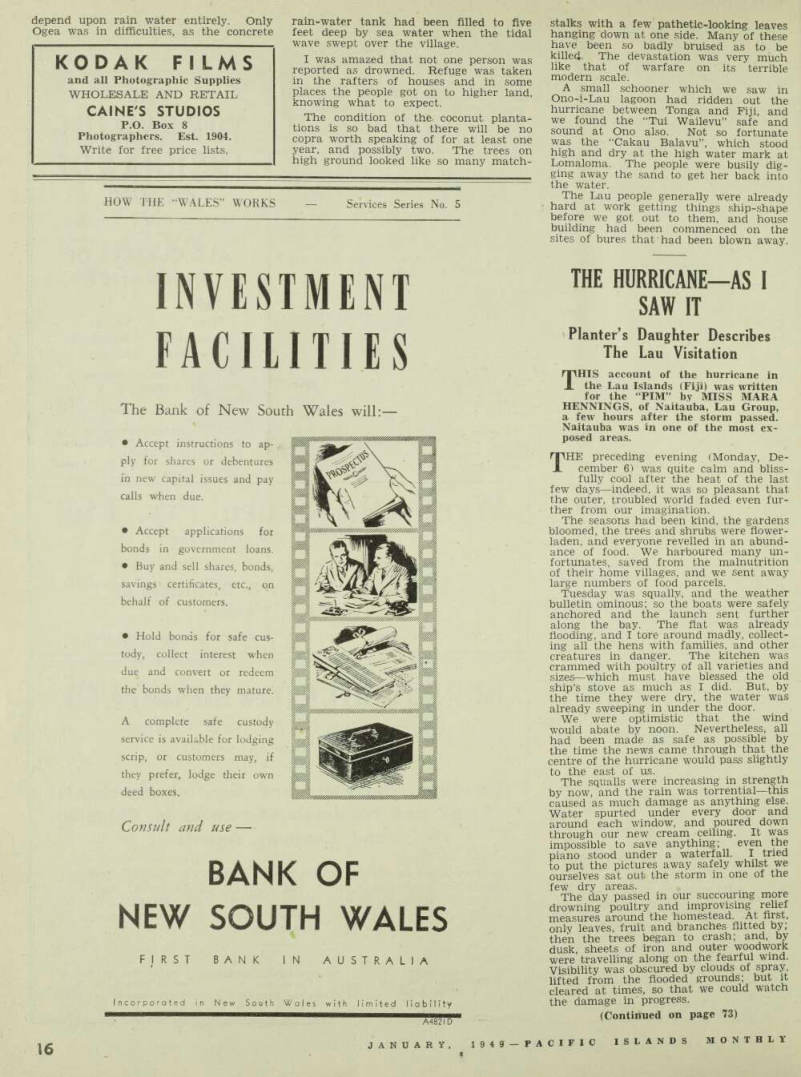
Serious Loss Of
Hurricane Damage to 1949 Crop
From Our Own Correspondent
Suva, Dec. 19.
NO over-all estimate of the devastation caused by the December hurricane, which, between December 6 and 8, swept from Rotuma round the eastern islands of Fiji and down through the Lau Group, ultimately dying out in the region of Niue, is possible for some time yet.
From Rotuma, eastern Vanua Levu, Rabi, Taveuni and Lau, the reports in dicate the loss of from 40 per cent to 75 per cent of the 1949 copra crop.
Wherever the hurricane struck, food crops were devastated and heavy damage was done to buildings.
Copra production is Fiji’s second in dustry. A loss of a large proportion of the crop must have far-reaching economic
repercussions.
On December 13, 14 and 15 the Royal New Zealand Air Force operated a Catalina “airlift” to the Lau Islands, making three trips daily and parachuting emergency food and medical supplies wherever it was not practicable for flying-boats to alight.
Only one fatality has been reported.
Sauito, the District Chief of Juju, Rotuma, died as the result of being crushed by three falling coconut-palms.
The Burns, Philp inter-island ship “Yanawai” had landed passengers and mails at Rotuma before the hurricane struck. She immediately put to sea and fought out the storm, returning to land 250 tons of stores.
On the ship’s return to Suva on De cember 14, Captain W. R. Percy paid the highest possible tribute to the ship’s European. Fijian and Banaban per sonnel.
Five buildings were destroyed at the Government Station at Rotuma.
The official report on a preliminary aerial survey of Lau stated that the ap pearance of many islands recalled scenes in the Solomons and Gilberts after heavy bombing and artillery bombard ment.
The worst-hit copra areas will require at least three years to recover—providing that there are no more hurricanes. The Colony’s best copra comes from these eastern districts.
Excellent service was given during the emergency by the Meteorological Office and ZJV Suva. No part of the Group failed to receive the preliminary warn ing; and all the areas directly affected were given the final warning in ample time. On the other hand, the difficulty of getting information from the stricken islands to Suva has led to a demand for more adequate communication with out lying islands. A comprehensive radio telephone system is strongly advocated.
“Appalling Damage”
WHEN the “air lift” was organised by the New Zealand Air Force to carry supplies to the areas of eastern Fiji devastated by the hurricane, the Catalina carried also Ratu Edward Cakobau, MC, who is a Government District Officer, as well as a Fijian High Chief, Dr. P. G.
(Continued on page 15)
Madame Maurice Calamy, niece of the late Father Rougier, has gone to Suva, Fiji, to settle lease and other interests concerning Christmas Island.
Mr. Alan Blatchford, B.Sc., has been appointed a member of the Fiji and Wes tern Pacific Research Council, in place of Mr. L. M. Abell, who has left Fiji.
Griffiths (medical officer) and Mr. Rob.
Wright (official photographer).
The following description of what he saw is taken from a broadcast address given by Dr. Griffiths over ZJV: Not one case of injury was seen; and only few seriously ill. No epidemic had broken out, and water supplies were, by and large, no worse than they were in 1947.
I find myself incapable of describing the appalling damage which the hurricane has done to housing, food-crops, and coconuts. This was almost equally bad at each of the islands we visited. The morale of the Fijians throughout the devastated area was not affected. The bringing of food to them so early after the disaster, and in such large amounts, brought forth from them more apprecia tion than I have ever seen from any people other than the Dutch when our liberating army freed them from the German occupation,
Edward Cakobau At Work
SOMETHING which, impressed me was the extreme competence of Ratu Edward Cakobau. I had never before seen a Fijian chief who was prepared to “muck in” with his people, to help in fetching and carrying, to a load as heavy as any other man’s, and who yet retains the most reverent re spect, to which‘may now be added the gratitude, of his people. Many of the Lauans had never seen Ratu Edward before, but they all knew him for his war record, and they were delighted to receive him in their villages and re peatedly mentioned in speeches their knowledge of the fact that he is a “turaga ni lewa vavalagi” (a District Officer) as well as a high chief. Ratu Edward knows how to organise the Fijians, and I have never seen Fijians get down to any job so quickly and so efficiently as they did on our recent calls.
I suppose the best example which I can give is what I saw at the tiny village of Ogea. When the Catalina landed in the lagoon between Ogea Levu and Ogea Driki, it was about one mile from the village. The large canoes were on the hard when we arrived, and the small canoes which came out to meet us could not cope with the weight of food which we had brought.
When Ratu Edward got to the village (on a small canoe which he handled as well as any of the locals) he organised every man, woman, and child to carry one of the large canoes down to the sea—a matter of half a mile over the sands.
The children ran round and round the body and the outrigger of the canoe, putting in place small lengths of tree branches to act as rollers; and the men and women pushed, pulled, heaved and strained, joking and laughing, and with Ratu Edward heaving at the rear; and they had that huge canoe down to the sea in an amazingly short time. That was a sight to remember.
Methods of getting the food from the seaplanes varied from island to island.
At Lomaloma. Mr. Fred Kaad of Kanacea was of great assistance, as he put his large launch at our service. Ono-i-Lau (a very go-ahead community with a keen and well-educated Bull) has its own launch.
But at other islands we were dependent largely upon canoes, which are far from easy to bring alongside a seaplane with out damaging at least the aerial. Time and again the air crews detached their aenai, with no sign of a grumble, to let the rather unweildly canoes come well into the side of the plane.
At other islands a new form of trans portation was used. The seaplane’s in flatable rubber dinghies, big enough to hold seven men, were put over the side, and were hauled ashore by a small canoe.
Again, at Moce, where there was a stiff breeze, making it particularly difficult to bring even a small canoe alongside, an other method was used. As soon as the plane had landed, a couple of score of the village school-boys swam out to us, about a quarter of a mile. They clambered all over the seaplane except the wings; and, when we found that it was going to be some time before the canoes could reach us, the boys jumped back into the water and swam us ashore, led by a Fiji soldier who was there on leave. One of the boys swam back-stroke, with the rubber dinghy towrope in his teeth, and the rest swam at our sides, holding on to the rope around the dinghy with one hand.
Conditions In The Villages
rE conditions under which the Fijians are living in many of the villages are frightful. Many are sheltering in all that is left of their bure, the roof having been lifted high off the house and dumped down away from the flattened walls. Others are using the shelter of the more durable wood and iron churches— though not even all of these are standing.
Others are sharing the few bures which are still habitable.
In some parts of the Lau group, food gardens are no longer recognisable. Even in good times some of the southern Lau islands have a hard time for food, and
they are now very hard hit.
Water supplies generally were of a simple enough nature to be little affected.
The smaller islands have no creeks, and
depend upon rain water entirely. Only Ogea was in difficulties, as the concrete
rain-water tank had been filled to five feet deep by sea water when the tidal wave swept over the village.
I was amazed that not one person was reported as drowned. Refuge was taken in the rafters of houses and in some places the people got on to higher land, knowing what to expect.
The condition of the coconut planta tions is so bad that there will be no copra worth speaking of for at least one year, and possibly two. The trees on high ground looked like so many match
stalks with a few pathetic-looking leaves hanging down at one side. Many of these have been so badly bruised as to be killed. The devastation was very much like that of warfare on its terrible modern scale.
A small schooner which we saw in Ono-i-Lau lagoon had ridden out the hurricane between Tonga and Fiji, and we found the “Tui Wailevu” safe and sound at Ono also. Not so fortunate was the “Cakau Balavu”, which stood high and dry at the high water mark at Lomaloma. The people were busily dig ging away the sand to get her back into the water.
The Lau people generally were already hard at work getting things ship-shape before we got out to them, and house building had been commenced on the sites of bures that had been blown away.
Fiji Hurricane—Pictures From the Air Force Rescue Party
Photos taken by Rob. Wright, in the Lau Islands, showing effects of the hurricane which swept over Eastern Fiji early in December. TOP: All that was left of a village on Ogea Levu, after the hurricane and tidal wave had passed. CENTRE: District Officer Ratu Edward Cakobau, MC (a direct descendant of high ruling chiefs) tells villagers that they must use all local foodstuffs not entirely destroyed by the hurricane, before turning to the emergency rations brought by plane. Additional food supplies and seeds for planting would be brought by ship. LOWER: Dr. P. G. Griffiths, MC, opens an emergency clinic on the beach of a devastated island, while supplies are being unloaded from the Catalina.
Advertisements & other items, pp. 20-22 (2 items)
To The Us A.
by Flying
m J*
Clippe
the
n $ t *«« S' m yc, * Relax and arrive refreshed in Pan American’s exclusive Sleeperette* (no extra cost). * Pan American offers you the fastest transit time across the Pacific only hours to San Francisco, including stops at Noumea, Fiji, Canton Is. and Honolulu. ★ Your fare from Australia to Honolulu and to any part of the world served by P.A.A. can be paid in Australian currency. • Call your Travel Agent or Pan American world’s most experienced airline . . . *Trade Mark, Pan American Airways Inc. 30-day excursion fare available up to 31st March, 1949 saves you £5l on round trip from New York to London.
Swift
4-engine
Clipper service
Sydney
to the U.S.
via NEW CALEDONIA
FIJI IS.
CANTON IS.
HONOLULU
SAN FRANCISCO
or LOS ANGELES
Fly straight through or stop over at Hawaii , etc.
Mezzanine Floor , Hotel Australia , Sydney . Tel. 8W4701 Rue Jean Joures , Noumea Bank of New South Wales Building , Suva
Pan America tv
World Airways
System of Cfhpp ers
American Airways Inc. (Liability Limited — lnc. in U.S.A.)
THE
YORKSHIRE
INSURANCE
CO. LTD.
(Incorporated in England)
ALL CLASSES OF
INSURANCE
Including
Fire Motor Guarantee Accident Workers Marine Island Representatives:
PORT MORESBY: E. A. James
RABAUL: G. B. Black LAE: New Guinea Industries Ltd.
MADANG: R. MacGregor SUVA: Williams & Gosling Ltd.
NOUMEA: Y. Mortensen
NORFOLK ISLAND:
A. E. Martin
Wynne S. Breden Pty. Ltd.
SHIPWRIGHTS AND ENGINEERS.
"PHOENIX SHIPYARDS", NEWCASTLE, N.S.W.
Designers, Builders & Outfitters of ISLAND Vessels Work Boats, Cargo Boats and Auxiliary Craft up to 200 tons.
BURNS PHILP (New Hebrides) LTD.
Registered Office: VILA, NEW HEBRIDES
Branch Office at SANTO
Exporters, Importers and General Merchants
(Retail and Wholesale) Commission, Shipping
and Customs Agents
Representatives for BURNS PHILP TRUST COMPANY LIMITED, QUEENS- LAND INSURANCE CO., LTD., and LLOYDS OF LONDON. Agents for SOCIETE DES PETROLES SHELL DES ILES PRANCAISES DU PACIPIQUE, and numerous overseas manufacturers of all classes of merchandise.
Sydney Agents: Burns, Philp & Co., Ltd., 7 Bridge Street.
San Francisco Agents: Burns, Philp Co. of San Francisco, Matson Building, 215 Market Street, London Agents: Burns, Philp & Co., Ltd., 35 Crutched Friars, E.C.3.
KODAK FILMS
and all Photographic Supplies
WHOLESALE AND RETAIL
CAINE'S STUDIOS
P.O. Box 8 Photographers. Est. 1904.
Write for free price lists.
HOW THE “WALES” WORKS Services Series No. 5
INVESTMENT
FACILITIES
The Bank of New South Wales will: — • Accept instructions to apply for shares or debentures in new capital issues and pay calls when due. • Accept applications for bonds in government loans. • Buy and sell shares, bonds, savings certificates, etc., on behalf of customers. • Hold bonds for safe custody, collect interest when due and convert or redeem the bonds when they mature.
A complete safe custody service is available for lodging scrip, or customers may, if they prefer, lodge their own deed boxes.
Consult and use
BANK OF
NEW SOUTH WALES
FIRST BANK IN AUSTRALIA
Incorporated in New South Wales with limited liability A4821D \
15
PACIFIC ISLANDS MONTHLY- J A N U A R Y , 1 94 g
The Hurricane-As I
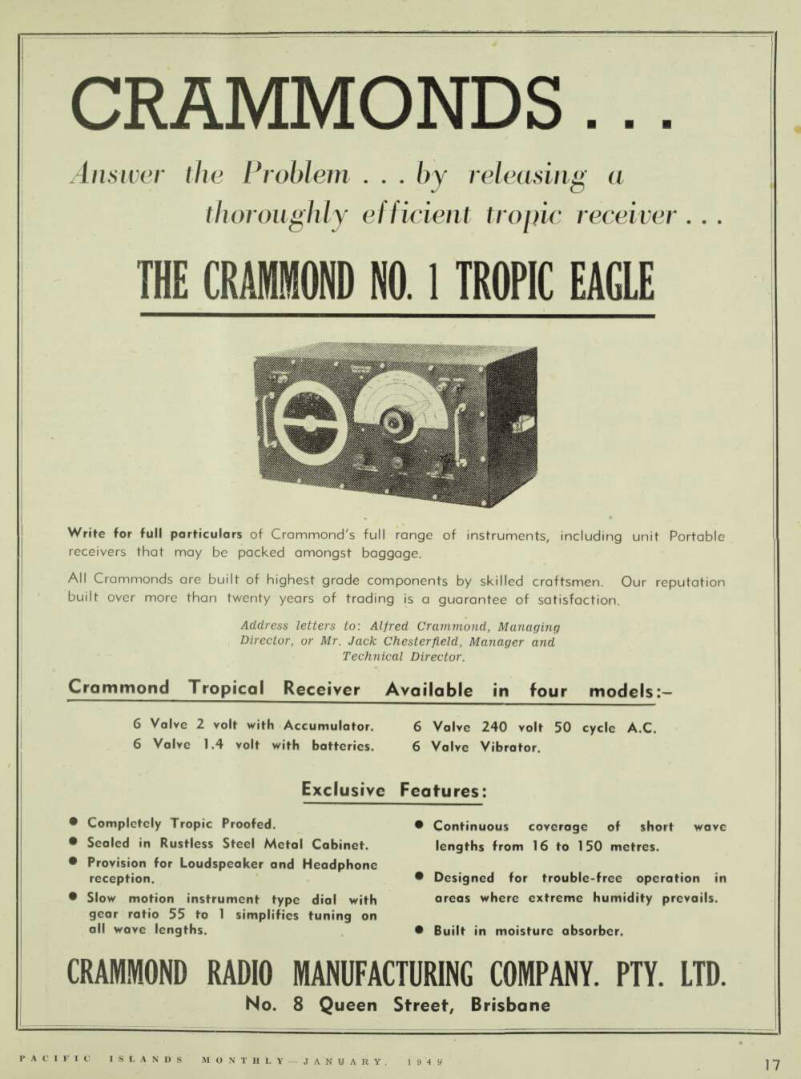
Saw It
Planter’s Daughter Describes The Lau Visitation
THIS account of the hurricane in the Lau Islands (Fiji) was written for the “PIM” by MISS MARA HENNINGS, of Naitauba, Lau Group, a few hours after the storm passed.
Naitauba was in one of the most ex posed areas.
THE preceding evening (Monday, De cember 6) was quite calm and bliss fully cool after the heat of the last few days—indeed, it was so pleasant that the outer, troubled world faded even fur ther from our imagination.
The seasons had been kind, the gardens bloomed, the trees and shrubs were flower laden, and everyone revelled in an abund ance of food. We harboured many un fortunates, saved from the malnutrition of their home villages, and we sent away large numbers of food parcels.
Tuesday was squally, and the weather bulletin ominous; so the boats were safely anchored and the launch sent further along the bay. The flat was already flooding, and I tore around madly, collect ing all the hens with families, and other creatures in danger. The kitchen was crammed with poultry of all varieties and sizes—which must have blessed the old ship’s stove as much as I did. But. by the time they were dry, the water was already sweeping in under the door.
We were optimistic that the wind would abate by noon. Nevertheless, all had been made as safe as possible by the time the news came through that the centre of the hurricane would pass slightly to the east of us.
The squalls were increasing in strength by now, and the rain was torrential—this caused as much damage as anything else.
Water spurted under every door and around each window, and poured down through our new cream ceiling. It was impossible to save anything; even the piano stood under a waterfall. I tried to put the pictures away safely whilst we ourselves sat out the storm in one of the few dry areas.
The day passed in our succouring more drowning poultry and improvising relief measures around the homestead. At first, only leaves, fruit and branches flitted by; then the trees began to crash; and, by dusk, sheets of iron and outer woodwork were travelling along on the fearful wind.
Visibility was obscured by clouds of spray, lifted from the flooded grounds; but it cleared at times, so that we could watch the damage in progress.
(Continued on page 73)
SHORTLY before 5 p.m. the barometer fell to 28.14 ins., although the home stead was still slightly sheltered from the full blast by the surrounding hills. We dined in the kitchen, between two broken windows, our feet tucked up, clear of the water, now 3-4 inches deep. Still more poultry was being brought in, so that the din almost drowned out the storm.
Due to some—fortunate —architectural fault, there was a dry island under a table, large enough for many hens to crowd on to, with packing cases for the rest to perch on.
By dusk, the wind had moved south, and then westwards; and although the barometer was rising slightly, the gusts became even more merciless. My father, long past the Biblical span, went out into the gale to call the overseer for volunteers to take another anchor out to the launch.
The men refused. It was bitter, indeed.
We sat out the evening by the light of a dim kerosene lantern, trying to scream an occasional remark, and comfort the terrified dogs. Water still poured in, the house swayed and, below the higher notes of wind, rain and sea, the hurricane throbbed like the engines of a giant liner.
It heightened the impression of un reality that I had had all day, as if watching a horror film and constantly re assuring myself that it was, after all, only on the screen.
The barometer continued to rise to 28.60 inches at 8 p.m., which we considered fairly safe, as the wind seemed to be abating. The weather bulletin, coming in uncannily clear and unemotional through ,the din, confirmed this; so we made for our damp beds.
Wednesday was still cold, wet, and bois terous. The destruction was unbelievable.
It seemed that every fourth palm was down and quite half the others—prize breadfruit groves ripped apart, one fruit tree left standing, the roads and food plantations devastated.
Heavy wood and iron copra-drying trays had been hurled against other buildings, garage doors wrenched off. all the build ings flooded, native houses obliterated, and ruin everywhere. The launch had dis appeared—smashed to pieces, with her new engine buried in the sand. The changing wind had swept her towards the shore, the anchor held and tore out the bow, whilst the stern drifted away, to crash against a stone wharf further along.
No anchor could have saved her from that westerly wind, nor could she have sur vived on the slip, as she would have been crushed under the tree that lay across it.
Nothing could have saved her except a trip to the lee side of the island—and, by that time it was far too dangerous to attempt. That comfort we had, and perhaps that alone, after the hurricane of 1948—our worst since 1912.
Lady Freeston, wife of Sir Brian Frees ton, Governor of Fiji, left Suva on Jan uary 10 by plane for New Zealand, en route to England, where the eldest daughter of Sir Brian and Lady Freeston is to be married shortly. Lady Freeston will be away for about six months. £ The Fijian infant mortality rate in the period 1926 to 1947 is illustrated by a graph in the annual report of the Medical Department. It shows an en couraging if not spectacular drop in recent years. Despite recessions in' 1930 (the worst year shown in the graph), 1936 and 1944, the death-rate for every 1,000 live births has dropped from more than 175 in 1930 to 75 in 1947. In 1945 the rate was below 70.
Advertisements & other items, p. 23 (1 item)
Crammonds
Answer the Problem . .
thoroughly effici tropic receiver . ..
THE CRAMMOND NO. I TROPIC EAGLE
Write for full particulars of CrammoncTs full range of instruments, including unit Portable receivers that may be packed amongst baggage.
All Crammonds are built of highest grade components by skilled craftsmen. Our reputation built over more than twenty years of trading is a guarantee of satisfaction.
Address letters to: Alfred Crammond, Managing Director, or Mr. Jack Chesterfield, Manager and Technical Director.
Crammond Tropical Receiver Available in four models:— 6 Valve 2 volt with Accumulator. 6 Valve 240 volt 50 cycle A.C. 6 Valve 1.4 volt with batteries. 6 Valve Vibrator.
Exclusive Features;
• Completely Tropic Proofed. • Sealed in Rustless Steel Metal Cabinet. • Provision for Loudspeaker and Headphone reception. • Slow motion instrument type dial with gear ratio 55 to 1 simplifies tuning on all wave lengths. • Continuous coverage of short wave lengths from 16 to 150 metres. • Designed for trouble-free operation in areas where extreme humidity prevails. • Built in moisture absorber.
CRAMMOND RADIO MANUFACTURING COMPANY. PTY. LTD
No. 8 Queen Street, Brisbane
Aviation Coys.
Attacks on Trans-Pacific Aviation Coys.
Australian Socialist Government
Develops Its Plan
THE Australian Socialist Government’s war on private enterprise is being extended to Trans-Pacific aviation.
There has been a clash during the month between the Government and two con cerns—the powerful Pan-American Air ways, and Trans-Oceanic Airways, an en terprising little company established n the last two years by Captain Brian Monkton at Rose Bay, Sydney.
The Australian Government has in formed PAA that it intends to impose a 5 per cent, gross turnover tax on all fares taken by PAA in Australia—the equivalent of about £lO on each average booking. It is reported that Canberra, with characteristic savagery, intends to
make this retrospective over 1948. It will cost PAA about £20,000 Australian per annum.
Although publicly hated by the Aus tralian Department of Civil Aviation, Trans-Oceanic Airways has been carry ing on regular passenger and freight ser vices, out of Sydney, to various Western Pacific islands, by means of flying-boats, for the past year. Its services to New Hebrides and Solomons were a godsend at a time when no other sea or air com munications were available. It has been carrying tourists regularly to Lord Howe Island, a popular holiday resort some 300 miles off the NSW coast, TOA has now been informed that it must discontinue certain of these ser vices. It has been told, among other reasons, that the services are not now re quired. Most observers, however, recog nise the real reason —the policy of the Socialist Government to discourage pri vate enterprise wherever possible, and particularly when it is in competition with State enterprise.
CANBERRA’S method of attacking PAA provides an outstanding example of how Socialism works. Socialism came into being as an alternative to pri vate enterprise. Private enterprise, ex tended by Europeans across the world in a remarkable way during the past two centuries, developed one or two great evils of which the worst was the elimination of competition by ruthless combines. Rings and combines thus preyed upon the help less public. The people’s answer was the organisation of State enterprise (which has now become Socialist enterprise) as a means of restoring competition.
Instead of maintaining State enterprise mainly as a weapon for the control of private enterprise, the Socialist States are developing it as an end in itself —in other words, they are rushing on from State enterprise to plain Communism, the pur pose of which is the destruction of pri vate enterprise altogether, and the control of everything by the State.
As seen in the case of Pan’ American Airways, the Australian Government is using its constitutional power, and the State’s money, to fight a private com pany—although such a policy, most de finitely, is not approved by the Australian people as a whole —and least of all by that section of the people who are in terested in Trans-Pacific aviation. The Socialist-Communist State, if allowed to carry this thing to a logical conclusion (the elimination of private enterprise) would create an evil (Communist control) far greater than the evil (exploitation by monopolies) which originally brought State enterprise into existence.
You Cross The Pacific While
You Sleep
BRITISH Commonwealth Pacific Air lines Ltd. are early off the mark in
the brisk trans-pacific airline com petition, with the recent purchase of four long-range Douglas DC-6’s. B.C.P.A. plan to have these new aircraft operating over the “Southern Cross” route (Vancouver to San Francisco, Honolulu. Canton Island, Fiji, Sydney or Auckland) by February, 1949.
Designed for comfortable and depend able travel at high altitudes, the DC-6’s carry 48 passengers and a crew of nine.
By night, seats may be converted quickly into spacious sleeping berths, and with the addition of berths concealed in the ceiling of the cabin, a total of 37 bunks will be available. As most of BCPA’s fly ing is done at night, to give passengers daylight hours ashore, the provision of “skyberths” should prove an outstanding addition to passenger comfort over the 8.000-odd mile route. Schedules should be reduced by a day, as the flying time San Francisco to Sydney, on the second delivery flight, was 26 hours 39 minutes, as compared to the current Skymaster schedules of 38 flying hours.
The equipment includes all sorts of new gadgets for the comfort of passen gers.
PAA Will Soon Have
Strato-Cruisers
Pan American Airways Will Use
Boeing Strato-cruisers between San Francisco and Hawaii this year, and when the runways at Kingsford Smith Airport (Bydney) are extended, wfll br.ng them right to Sydney.
These giant planes carry 80 passengers, have a cruising speed of 340 miles an hour and a full range of 5,000 miles.
Advertisements & other items, p. 24 (1 item)
"CHULA’' Copra Dryer
Minerals, Ores and Concentrates. Buyers and Sellers
of all classes
Australasian Representatives for —METAL TRADERS, LTD., London;
METAL TRADERS INC., New York.
SCRAP METALS (Ferrous & Non-Ferrous) GENERAL MACHINERY MERCHANTS (New and Reconditioned)
DICKSON PRIMER & CO. PTY., LTD,
Federal Wharf, 73 Day St., Sydney, N.S.W., Australia.
ALSO AT: Melbourne, Brisbane. Adelaide, Devonport (Tas.), Christchurch (N.Z.).
BIGGER PRICES for BETTER
when dried by the scientific
process made possible by the
"CHULA’' Copra Dryer
. . . the most practical and efficient machine for drying nuts in bulk, which produces copra of a higher standard than that dried in the open, without discolouration, free from mould, thoroughly and evenly dried throughout. The “Chula" produces its two tons of copra every 24 hours, irrespective of the weather, and with a minimum of labour.
THE INVENTORS AND MANUFACTURERS OF
THE "CHULA” COPRA DRYER ALSO MAKE
DESICCATED COCONUT
MACHINERY
(Parers, Disintegrators, Sifters, Dryers)
TEA DRYERS
FISH DRYERS
RUBBER MACHINERY
(Continuous Sheeters, Crepeing Batteries)
TYNESIDE FOUNDRY &
ENGINEERING CO. LTD.
ELSWICK • NEWCASTLE-ON-TYNE • ENGLAND
Telegrams & Cables ; " FOUNDRY, AEWCASTLE-ON-TYNE " * Codes : ABC , sth & 6th Eds
COPRA!
'k\WM
a* I M
A NEW CATALOGUE
of the
"CHULA"
COPRA DRYER
has just been printed.
Send for Your Copy!
Pedigreed Cattle For
Morobe
UNDETERRED by New Guinea’s sud den crop of sheep farmers Mr. Michael Leahy of the Morobe District, has decided to go in for beef. He has pur chased 45 pedigreed Polled Hereford fe males and two bulls which will shortly
be shipped to New Guinea. The cattle come from the Braidwood district of New South Wales.
It has long been believed that cattle would do well on New Guinea’s grass country, and the Labu-Wau road has now opened up much high-level country that should be suitable. Zenag, the highest point on the road, is well over 4,000 feet above sea level.
Advertisements & other items, pp. 25-26 (2 items)
Pacific Islands Monxhly- J A N U A R Y , 194?
Stewarts and Lloyds (Australia) Pty. Ltd.
l|gL)
Manufacturers of "S & L" PIPES and FITTINGS for GAS, WATER, STEAM and other purposes.
AND Distributors of:
MILD STEEL BARS. PLATES and SECTIONS:
GALVANISED IRON; BOLTS and NUTS; ELECTRODES
and WELDING EQUIPMENT.
Stewarts and Lloyds (Australia) Pty. Ltd.
SYDNEY WAREHOUSE - - Herbert Street, St. Leonards BRISBANE WAREHOUSE - Montague Road, South Brisbane MELBOURNE WAREHOUSE - - City Road, South Melbourne Telegraphic Address: "Tubes ' Sydney, Brisbane or Melbourne
chandise purchased for island clients throughout the South-west Pacific.
Island produce sold on Australian and overseas markets on a commission basis.
Norman VOA/MPA
GOLF CHAMPION
6 'lt 9 s UORLICKSfor me. Extra
delicious —and the
most nourishing
food drink
of all”
“Playing championship golf all the year round is a tiring and strenuous life,” says Norman Von Nida. “Believe me, I need the nourishment that Horlicks gives.
And that extra energy makes a big difference to my game.”
Our champion Australian golfer, Norman Von Nida has always studied his health carefully . . . keeping physically and mentally fit during and between the big tournaments. Von knows the great value of Horlieks. He enjoys that full satisfying flavour . . . and he has proved that Horlieks at night and during the day gives him the extra energy he needs every day.
“Horlieks is the most nourishing food drink of all,” he says.
CACC/C/A1
■ — when mixed as directed That full, satisfying flavour of Horlieks comes from a careful blend of fresh, full-cream milk and the nutritive extracts of malted barley and wheat. It is Nature’s flavour . . . that’s why you never tire of it.
Many people drink Horlieks simply because they enjoy that distinctive flavour. Others drink Horlieks because they need it to build them up ... to nourish the body and nerves . . . and to induce
deep, refreshing sleep. Horlieks
is equally delicious hot or cold.
Ask your storekeeper for
HORLICKS
»z. TIN 3 6 8-oz. TIN 2 l (Prices slightly higher in country areas)
Fiji’S New Airport Will ‘Make’ Suva And

Help Tourist Trade
Surprise Rejection of Nadi and Selection of Suva Point
THE announcement, early in December, that the international air authority had recommended the selection of Suva Point, only two miles from the town of Suva, to be the site of Fiji’s great international airport, came as a complete surprise. But it gave great pleasure to all Fiji’s well-wishers, and especially those with enough vision to see what this development will mean to the future city of Suva.
It had been generally assumed that the selection would go to Nadi, in the dry northwest zone of Viti Levu, 15 miles from Lautoka and over 130 weary miles from the Colony’s administrative and commercial centre, at Suva. This, probably, was because the New Zealand air authority, in charge of Fiji airways generally, had spent so much money recently on Nadi improvements.
It is now disclosed, however, that Nadi is to be used exclusively as a military airport.
Nadi would have provided a good in ternational port—usually dry, and open in nearly all weather. Experienced air men. however, usually looked askance at the ring of uglv mountains encircling Nadi Bay—some miles back, but near enough to be very dangerous if the area were blotted out in bad weather.
Nadi’s great disadvantages as a civil airport were its isolation, and the poor impression of Fiji received by the trans pacific traveller landed there in the
middle of a featureless and comparatively arid plain. It is some 15 miles from Lautoka. Suva, which really has unique interest and beauty, as well as being the country’s nerve-centre, is a full day’s drive away.
THE experts who made the choice evidently gave their attention par ticularly to Nausori (14 miles from Suva) and the two areas close to Suva —Laucala Bay and Suva Point. They very wisely took the view that, as they were to select an area thereabouts so as to be close to Suva, they might as well be as close as circumstances permitted.
Hence the Point election —which means that the airfield will lie just eastwards and northwards of Government House and the Grand Pacific Hotel, and within two miles of Suva Post Office.
Nausori doubtless was rejected because, after all, it is little more than a crudely formed airfield in the middle of the Rewa River country, which has ex perienced inundation. Why put the air field at Nausori when, with comparatively little extra cost, it could be put at Suva Point?
OIOME critics take a gloomy view of the O airport’s future. They say it is vulnerable from land, air and sea and that, included with Suva, with its Government and commercial buildings, it forms a compact little target for the delight of the enemy. They must suffer from a wartime psychosis. Why consider everything in terms of war?
Air transportation is the transportation of the future: and any planner with any
vision at all will try to place his airport as near as possible to the distribution centre for passengers and goods.
Unfortunately, most of the world’s cities were built before airports were visualised; and so the aircraft, ever grow ing in size and numbers, must be landed so far from the centre to which they are directed that much of the convenience and economic advantage is lost. The air traveller, cursing the long bus-ride from the airport to Melbourne or Auckland, does not see any advantage in the de fence angle. The man who lands at Mascot, and reaches his hotel within a comparatively few minutes, is happy that Sydney’s airport is so happily placed within her huge metropolitan area.
SUVA’S airport designers are planning for the long future; they can afford to ignore the howls of the few ob structionists, and to think of the great advantages of the situation.
Suva has been well described as “the cross-roads of the South Pacific ’. In the decades to come, as more and more trans pacific air travellers land at Suva Point, and reach Suva’s busy side-walks within ten minutes, and admire the shining harbour and its colourful background, Fiji will be more than ever a “cross roads”, and will enter upon its heritage as the chief pleasure-resort of the South Seas.
Selection of Nadi would not have killed Fiji’s tourist traffic. But, to get that valuable trade, Fiji would have had to work very much harder. Now, every trans-Pacific traveller will go away to sing the praises of Fiji—every one an unpaid publicity agent.
“The objections to Suva Point”, writes one shrewd commentator, “are that it will take up a good deal of land in the growing town of Suva, and that there will be noise from aircraft. Against these must
be counted the great advantage of ac cessibility, and the existence of a flying boat base at Laucala Bay, right beside the airport. The site is a good one, as the approach and take-off will both be over water, and the runway will be in the right position to allow best use to be made of the prevailing wind.”
There will be ample land to the north ward for the growing city of Suva; and, as for the noise of aircraft —well, what would the Suva critics have to say of Sydney, over which aircraft, going to or leaving Mascot, fly low during all day light hours, and most of the night?
To establish the new airport—and it is presumed the work will start soon—it unfortunately is necessary to sacrifice nine or ten homes; but, in view of the importance of the project, that is a small matter. It is en unhappy experience for those who will lose their homes; but they will be well compensated. The owner of by far the largest area affected is Mrs. Alport Barker, an old and highly esteemed resident: and, fortunately for Mrs. Barker and for the authority which must pay the compensation, this area is practically undeveloped. (See Next Page)
OFFICIAL recognition of the fact that the development of local as well as trans-Pacific aviation will greatly affect the future of Fiji was contained in a number of interesting statements made in the Fiji Legislative Council on December 20 by the Colonial Secretary, Mr. J. F. Nicoll, who had just returned,
with Mr. P. H. Nightingale, from the meeting in New Zealand of the South Pacific Air Transport Council. The following is a summary.
New Zealand National Airways in con junction with Fiji Government, will carry out the following local air-services, with small flying-boats or amphibians— probably Short Sealand flying-boats, carrying 7 passengers, with 800 miles range: From Suva to— Flights Per Week Lautoka Five Levuka Two Labasa Five Savusavu —Taveuni One Rotuma, Lau, Once each per Kandavu month Fares might be Bd. per mile. Capital cost would be £82,000. With £lO,OOO p.a. depreciation, the annual loss would be about £20,000. Fiji now pays a subsidy of £5,000 p.a. on the Suva-Labasa service.
IT is expected that the construction of the new Suva airport will take five years. The Government of Fiji will provide the international authority with the necessary land, and will contribute probably £250,000 towards the capital cost.
It was at first proposed to close Nausori airfield, the maintenance of which costs £16,000 p.a.; but, at the urgent request of New Zealand, it has been decided to keep the field open, by the Fiji Public Works Department, at an estimated cost of £6,000 p.a.
Because Nadi is being used for regional and local services, Fiji will contribute £lO,OOO p.a. towards the cost of ground services there, pending the construction of Suva airport.
To have brought Nadi to the standard required today for an international air port would have cost little less than the construction of an entirely new airport at Nausori or Suva Point.
Advertisements & other items, pp. 27-30 (1 item)
• New South Wales Yacht Brokers
l/MW
r/?j / r// 0 Airway Cases, In woven-striped, waterproofed canvas ith leather-bound edges, are made for // flying. The supply is limited . . . but increasing!
Made by FORD SHERINGTON LTD.
Wholesale only
WE OFFER ALL TYPES OF BOATS FOR ISLAND WORK •
A FEW ARE LISTED HERE:
110 TON DIESEL KETCH. Faithfully built, copper sheathed. Ist class condition.
Accommodate 20. Suit Mission work or inter-island trade. For sale at fraction of original cost. £B,OOO. 75 TON WOODEN VESSEL. 66 ft. 0.L., beam 18 ft., draft 7 ft. Built 1944. Copper sheathed. Powered by National Superior Diesel. Cargo below deck, 40 tons. In commission. £7,000.
WOODEN VESSEL. 55 ft. x 16 ft. X 6 ft., 80 H P. Diesel Engine, with good carrying capacity. Copper sheathed. Reasonably priced at £4,500.
SPACIOUS WORK-BOAT, 32 ft. X 11 ft. 6 in. x 4 ft. 6 in. Built 1947 with aux. sail power by English Turner Diesel.
Carry 15 ton. £1,650.
HEAVILY BUILT 45 ft. x 12 ft. x I ft.
DIESEL LAUNCH, Powered by 75 H.P.
R.N. Diesel. Extremely well fitted, and condition guaranteed. Good type plantation boat. Price, £3,000.
NEW 110 TON STEEL VESSEL. 75 ft. X 18 ft. x 7 ft. Cargo capacity 75 tons. Completed except for engines, which are available.
ALL VESSELS OPEN TO INDEPENDENT INSPECTION AND SURVEY.
DELIVERIES ARRANGED TO ANYWHERE IN THE PACIFIC.
Write for further details or requirements.
• NEW SOUTH WALES YACHT BROKERS
Suite Three, Argent Chambers, 19 Hunter Street, Sydney
Cables: "Agarscarr," Sydney. Telephone: BW 7000
All your inquiries promptly attended to.
Have
that f t
perfect
clean ■ ■ ■
dovet' NeSS ’■'
■i) 10 S and save
\ \ money dt
the same time! ** . .)> / %2 \ is a 9 <s> fr O 'a -S>. % 3b VA 'S. ■v< pYs? i\Vf >y**q Yes! Kolynos does save you money. Kolynos lasts longer because it is highly concentrated. Half an inch on a dry brush is all you need to leave your teeth surgically clean, and gleaming. Always ask for Kolynos.
DENTAL
CREAM
(Cleans better-Pastes better- [Lasts longer.
McILRATH’S
EXPORT DEPARTMENT
extend the SEASON'S GREETINGS to all residents of the Pacific Islands, and thank them for their patronage and support during 1948.
McILRATH’S INSURE ALL GENERAL CARGO AGAINST PILLAGE-
THEFT—NON-DELI VERY.
Write for Complete Grocery , Wine and Spirit Price List.
Post Free hy Return Air Mail.
McILRATH’S PTY. LTD.
202 Pitt Street, Sydney, Australia Cable address —ROTUNDA, Sydney.
TT» Associai t ed with
COUYER«
Sydney* I*"— pT y. uto.
WAf Brisbane Melbourne.
Wholesale and Retail Merchants. Shipowners. Sawmillers.
General Engineers. Customs and Shipping Agents.
Catering for all Plantation Supplies. Buyers of Island Produce.
Plantation Owners and Managing Agents.
Agents for:— Distributing Agents in New Guinea for:— Hillman, Humber, Sunbeam-Talbot, Chrysler and Plymouth Cars.
Commer, Harrier and Fargo Trucks.
Willys Overland Jeeps.
G.M. Marine and Industrial Engines.
Olympic Tyres and Cables.
Hygeia Dissolvenators.
Prefect Refrigerators.
Mullard Radios.
Ewo Beer.
Snowflake Unsiveetened Evaporated Milk.
Australia-West Pacific Line.
China Navigation Co.
Canton Insurance Office, Ltd.
Union Assurance Society, Ltd.
Aust. T. & G. Mutual Life Society, Ltd.
Guinea Air Traders, Ltd.
A “““1nu fc CO. LTO.
C’cburA-
ART POSTCARDS OF
TONGA
Per Dozen, Postage Paid: 6/- (one US Dollar).
TONGAN PHOTOS BUREAU
Nukualofa, Tonga
N. F. Maloney & Co.
Phone 268. PORT MORESBY Phone 268.
Cables, Radios, etc., “Malco,” Port Moresby.
CUSTOMS, SHIPPING, AND FORWARDING AGENTS.
LICENSED AUCTIONEERS AND GENERAL COMMISSION
AGENTS.
House, Land, and Estate Agents.
Chief Agents:
NEW ZEALAND INSURANCE CO. LTD,
(Incorporated in New Zealand) FIRE . . ACCIDENT . . MOTOR VEHICLE . . MARINE. ETC.
Importers and Exporters :: Manufacturers Representatives.
Australian Representatives : E. J. GOUGH & CO., 1 BOND STREET, SYDNEY.
Box 3838 GPO, k\ Art Cable Address, ‘ Care” Sydney.
Sydney. Australia. >v
ISLAND MERCHANTS
4 YORK ST., SYDNEY
All kinds Island Produce sold on commission. All merchandise purchased at best wholesale price and original invoices supplied.
Use our 50 years’ experience as Island Merchants. j
Successful Parties
Moresby Rssaila Holds Two
rpHE Port Moresby Branch of the J. RSSAILA held two successful func tions during the Christmas-New Year period. The first was the annual Christ mas-tree and party for 300 of Moresby’s children: the second, the annual ball for 400 adults on New Year’s Eve.
The children’s party was held at the RSL premises at Ela Beach, on the after noon of December 18. Mr. J. O. Lyons was chairman of the committee respon sible for the function, which was success ful in every way. Mrs. Lyohs and ladies of her committee had worked hard before hand preparing gifts, which each child received from the tree. The children were entertained by films screened by Mr. John Cox, of the Education Department, and by Mr. Leo Bryant, who performed con juring tricks. Afternoon tea was served on the lawn, and a plentiful supply of “lolly water” and ice-cream was available.
The proceedings were broadcast by 9PA, The New Year ball, also held in club premises at Ela Beach, was attended by 400 people.
The President of the Port Moresby Branch, Mr. S. E. Reilly, and Mrs. Reilly, and the Vice-President. Mr. D. L. Pullen, and Mrs. Pullen entertained the official party, which included the Acting Adminis trator, Judge Phillips, and Mrs. Phillips, Mr. R. Melrose, Matron Thorburn, Flight- Lieutenant Whitworth. RAAF, and Mrs.
Whitworth, Major Manthos and Captain Hoff, USAF, Mr. and Mrs. Tom Nevitt, Mr. and Mrs. E. A. James, and Mr. and Mrs. A. Davidson.
The catering was undertaken by the Club manager, Mr. W. A. Penney, and his wife. Mr. Owen McNeil and Mr. Guy Broad were responsible for the decora tions.
Enterprise of NG Gold
ENTERPRISE of New Guinea Gold and Development Ltd. reported at their meeting in Melbourne in early De cember that rehabilitation of their mine at Edie Creek, New Guinea, is going ahead and that work has been accelerated as more labour was forthcoming. Efforts are being made, however, to sell the mine.
Further efforts will also be made to obtain a petroleum prospecting permit fo”
Papua-New Guinea. This previously had been refused.
Kamatamata, a Cook Islander who aopealed against a long sentence imposed at Niue last June, has won his case. The three years’ imprisonment to which he was sentenced, on a charge of stealing copra valued at £2, has been quashed.
Guinea
Bad Outbreak In New
9 Murdered Include Alf Robinson,
Dcm
MR. ALFRED ROBINSON, who had a distinguished record as a Coast- Watcher in World War 11, and as an administrative official, was murdered by New Britain natives, at Pooaing vil lage, on New Britain, about 190 miles fromi Rabaul in mid-December. Eight native labourers who were with him were also killed.
This is the first serious incident of the kind that has occurred in New Guinea Territory for many years. There is nothing, as yet, to show the circumstances surrounding the murders. Unless very great provocation caused the attack—and that is most unlikely, in the case of an experienced man like Robinson—the in cident must reflect badly upon the Wardist Administration. It has been said, for some time, that the Australian Administration is so concerned about making union-conscious citizens out of these primitive Melanesians that it neg lects its primary function—the mainten ance among them of order and a proper recognition of the white man’s law.
The Territories Minister (Mr. Ward) on December 18 took time off from his at tendances at the Timber Lease Con spiracy trial to announce “that a full investigation is being made.”
It is reported that Mr. Robinson was struck from behind, with a tomahawk, while he was in Pooaing village trying to engage labour for his copra plantation.
Another report says that he was speared.
Mr, Robinson was on of the few Austra lians who escaped from the massacre of prisoners by Japanese on Tol Plantation,
early in 1942. Tol, curiously enough, is not very far from the place where Rob inson was murdered. It will be re membered that the Japs rounded up a lot of exhausted refugees from Rabaul, tied their arms behind them, and system atically butchered them. Although his arms were lashed, Mr. Robinson succeeded in dashing away from his captors and hiding from them in the jungle. He was eventually picked up, in a bad condition, by an Australian patrol and, shipped to Australia, where he made a complete recovery.
He became one of the famous coast watchers under Mr. Eric Feldt, and he was awarded the DCM for outstanding courage. After the war he joined the Administration, and he became Acting District Officer at Gasmata, in New Britain, Last April, he resigned j£rom the Administration in order to take over and run Ring Ring copra plantation. He went first to New Guinea 22 years ago, as an Administration clerk.
His wife and child are residents of Dalby, in Queensland.
How He Won The Dcm
117 HEN a warrant-officer with the Aus tT tralian New Guinea Administration Unit, Mr. Robinson was the first Australian soldier to land at Momote, Los Negros (Manus), on February 29, 1944. He volunteered to act as a guide for 35
American officers and men, who were to attack and capture Hauwei Island from ihe Japanese.
The enemy opened fire from concealed positions with mortars, machine guns and rifles. Some of the landing party re treated to their vessel, which put off into deep water. Robinson and his native guide, with other American soldiers, re mained on the beach. A covering PT boat had withdrawn, also, after having suffered heavy casualties, and Robinson’s party was left without support.
When the landing craft returned to the beach, Robinson carried a wounded American soldier aboard. Heavy mortar fire sank the landing ship, and Robinson, despite heavy fire and the risk of sharks, supported the wounded man for five hours. The two men eventually were picked up by a naval craft.
On the following day, Robinson volun teered to guide a stronger force, which ultimately captured the island.
Mr. A. W. McMillan, who recently re tired from the post of Inspector of Schools in Fiji, left Suva in December for New Zealand, where he intends to make his home. Mr. McMillan went to Fiji in 1929 as Inspector of Indian Schools. He had previously spent many years in India and had become an authority on certain In lian languages. Some years ago he pub lished a Hindustani handbook which attracted wide attention, and recently he prepared a “Guide to Hindustani” for use in Fiji. Mr. McMillan had been chairman of the local St. John Ambulance Associa tion, and has held a first-aid certificate for 48 years.
Advertisements & other items, pp. 31-32 (1 item)
Batteries
STOCK BOOKS
Useful books for Farmers and Traders:— Bacon Curing, 1/8; Tanning Skins and Hides, 1/8; Stock Diseases, £l-5-6; Artificial Insemination of Live Stock, 9/6; postage included.
Correspondence invited SHELTONS, 37 Florrie Street, Wooloowin, N. 3., Brisbane, Queensland.
OUR HANDS MAKE GOOD ARMS
SIL
For your Fishing and Shooting Wants Consult Us.
Litngow .22 Cal. Repeating Rifles ... £ll 14 0/ Post Lithgow .22 Cal. Single Shot 5 1 3( Extra.
RO H U 143 ELIZABETH STREET, SYDNEY.
(« □ 1 &
BATTERIES
“are tigers for work
55 It is impossible to build a better battery than the Masse. Every part of a Masse Battery is of one hundred per cent, quality . . . every stage of its manufacture is carried out in the Masse factory. When you recommend a Masse Battery to your customer, you can do so, with the utmost confidence that it will give him more starts and longer service.
AGENTS FOR NEW GUINEA AND PAPUA :
ROBERT GILLESPIE
LTD.
RABAUL AND LAE
W. H. GROVE A SON
Limited
Established 1896.
AUCKLAN D
Island Traders. P.O. BOX 490.
Telegraphic and Cable Address: “Grove”, Auckland.
Entrust Your Orders to the Firm with Fifty Years Practical Experience in the Island Trade.
Shippers of all classes of New Zealand products.
Representing English Manufacturers through-
out the Cook and Society Islands, Fiji, Tonga, Samoa, Niue, New Caledonia, New Guinea, etc.
In FIJI as—W. H. Grove G* Sons (Fiji) Ltd.
Tnc Garrick Hotel
IK
' sVrs
S'..* . M&, gy <*> , *>¥»
B** s»*m lilt tj && ‘
SUVA
FIJI
This well-known Hotel is centrally situated in Suva's main business quarter ;: Modern accommodation provides comfort in all climatic conditions :: Only the best of Beers, Spirits and Wines is served Telephone: 80.
VINCE COSTELLO,
Proprietor.
Fiji’S Copra Contract
IN reply to an enquiry by the Govern ment of Fiji, the British Ministry of Food has stated jdiat under the re cently-negotiated nine-years contract for the purchase of Fiji copra, the new price (which will become payable on January 1 each year) will apply to all fresh pur chases from producers. Stocks already in merchants’. hands will be bought at the previous year’s price.
Late in December the Fiji Copra Board announced that the local buying price of copra from January 1, 1949, was £F49/10/6.
The Islands
The Best Book Yet On The Islands Furnas, Clever American Writer, Produces Something Unique
THE Pacific Islands have a literature of their own. Hundreds—probably thousands—of books have been written about the Islands and the Islanders—their origin, history, social systems, morals, quaint ways and peculiar habits. Persons have been known to go into libraries, fasten onto the Pacific section—and come away after a month or two literally staggering under a load of unrelated and more or less indigestible data.
This is an age of short cuts and time saving. And here is the book of books, which will give you, in one volume, what otherwise you might have spent months in gathering from a hundred wearisome treatises. It is accurate, unexaggerated, well-written, presented in a really en tertaining form and —most precious of all —it is most copiously indexed.
Do you want to know what the first mis sionary in Hawaii thought of the easy going ladies who slept with white sailors; or why the people of Lord Howe Island always observed Thanksgiving; or why Cook should not have called Tonga the Friendly Islands; or why the cannibals ate women, but never allowed their women to join in the feasts; or how much African negro there is in the make up of the Melanesian; or how “Nativ ophiles” make fools of themselves; or why “South Seas” is used so confusingly; or who introduced the Islanders to the art of copra-making; or where Western Samoa is heading, or what anthropology has done for the South Pacific; or the answer to a hundred other intriguing questions? Then all you do is turn to this excellent, friendly index, and you’ve got it in two minutes —and usually with the name of the authority quoted.
This new book is “Anatomy of Paradise”, by J. C. Furnas, one of the most gifted of the younger school of American writers. It is published by William Sloane Associates Inc., , New York, at 5 dollars. It contains over 500 pages and a large section of illustrations; and it supplies most of the information about “the Islands” that anyone in the world, whether casual inquirer or fussy scientist, would want to know.
According to the “sources” which he quotes, Mr. Lucas has consulted over 500 authors and read over 1,000 books; and he has extracted the juice from them all, and served it up most entertainingly. He deals with all the Pacific Islands, but he has given much of his research to Polynesia and Micronesia, and especially to Hawaii. Apart from Fiji—which gets a large section —there is not a great deal about Melanesia.
MR. FURNAS—as befits one whose book carries the blessing of the Institute of Pacific Relations—has little that is good to say about the white people who were first into the Pacific Islands. He uses the early missionaries mostly for purposes of entertainment; and he usually sneers good-naturedly at the profit motive —although it was private enterprise, motivated by the age-old eagerness] for gain, which tamed and civilised the Pacific Islanders, just as it conquered the North American wilder (Continued on Next Page )
ness and established the mighty United States.
It is a clever book, because the author makes his points so effectively, and ef fortlessly. It is a compendium of all that is best in what has been written about the Islands —I am filled with ad miration for the slickness with which hundreds of quotations from innumerable authors are dropped in, .exactly in the right places.
And it is a somewhat disturbing book, because this author, with the facile cynicism that is so rapidly undermining and destroying the Old Order, has little to say in praise of what has been ac complished by people of his own race in the Pacific Islands, In practically every Territory there is a splendid record of achievement —monuments, in my humble opinion, to all that is best in the Old Order. But Mr, Furnas dismisses these things lightly. He does not use the word “exploitation”—but he clearly is on the verge of it, whenever he deals with European-Islander relations—that fact may limit the Usefulness of a great work. The book’s outstanding quality, however, will blind the average reader to that regrettable shortcoming.
IN many respects, it is the best book that ever has been written about the Pacific Islands. But why, O why, do publishers insist upon such dam-fool titles?
The late Dr. S. M. Lambert’s book, describing his remarkable accomplish ments in the Pacific Islands, and easily the most readable Islands book of the decade, was called “A Yankee Doctor in Paradise”. And now this outstanding work of Furnas’s has to be called “Anatomy of Paradise.”
The Pacific Islands, as both Lambert and Furnas were at some pains to show,
bear no resemblance to Paradise, except in the fervid imaginations of those who have never seen them. I suppose the public has to be kidded along—how else could authors and publishers live! But it is a pity to cheapen a good article by putting a silly, gaudy and misleading wrapping around it—RWR.
The Rt. Rev. S. G. Caulton, Bishop of Melanesia, arrived by air in New Zealand on December 7, after attending the Lambeth Conference in London. He re turned to his headquarters in the Solomons in early January.
Soon after Mrs. Lucy Brodie and mem bers of her family (who were pre-war re sidents of Rabaul) returned to Lae, New Guinea, they lost literally all their pos sessions when their house,, about two miles out of Lae, was destroyed by fire.
They had taken considerable property with them from Sydney, and it was all uninsured. Mrs. Brodie is the manager of the Administration mess at Lae.
Mr. C. J. Smith, the newly-appointed principal of Queen Victoria School, arrived in Fiji last week. Mr. Smith has been a teacher in Mauritius, where there is a large Indian population.
Advertisements & other items, pp. 33-34 (1 item)
Floor
PRODUCING UNIFORM GOOD RESULTS SINCE 1868
ALWAYS ASK FOR IT
Telegram: "CARRLOCK" p.O. Box 2140, Hong Kong
CARRLOCK CO. LTD.
2nd Floor, Queen's Bldg., Chafer Road, HONG KONG
General Merchants ;; Commission Agents
Exporters and Shippers of All Kinds of Merchandise To the Pacific Islands Representatives of Leading Manufacturers
in HONG KONG
INQUIRIES INVITED
c
takc me curs a. pc
CONf/CEMCE
''~ y ‘ Confidence brings success!
Place your confidence in the v hospital formula of genuine \\ .Vincent’s a.p.c. For over x C 25 years the medical profession has had absolute confidence in this better-balanced prescription Take Vincent's A.P.C With Confidence.
For HEADACHE AND NERVE
AND MUSCULAR PAIN!
x r
VINCENTS
N4BD
VINCENTS
S A KE
FOR SAFEIYi
SAFEST & BESTI
Now Under Open Licence
Ausralian Canned Goods In Fiji
THE Collector of Imports, Fiji, has made the following comments on the item headed “Why are Australian canned goods restricted in Fiji,” published recently in the “PIM;”
Mr. Rowe, of Heinz Products Ltd. did not consult anyone in this office,’ but appears to have obtained a garbled ac count of import control practice from local merchants. In the first paragraph it is stated that representations are now being made to both the Australian and Fijian authorities on the matter of restric tions upon Australian canned goods. So far as I am aware, no such representations have been made, to this Government.
It is also stated that the present quota is “based on 1945 imports, which were very low.” This is quite incorrect. The annual quotas were originally based upon 1941 imports, but have been annually ad justed to meet changing conditions. In any case, there is no indication that 1945 was an unusually low year for imports.
The obvious reason for such restrictions as exist is that we are requested to follow this policy by the Secretary of State on behalf of the Ministry of Food and, for such lines as are restricted, it is necessary for the Colony to submit an annual pro gramme of requirements.
In regard to the final paragraph I can only say that the reason for the restriction on canned fruits would have been given to anybody that asked and was, in fact, given by telegram to the Australian Gov ernment. Again, we had been requested by the British Ministry of Pood to restrict the imports of canned fruits; but when an assurance was received from the Aus tralian authorities in June. 1948, that rea sonable quantities could be imported with out detriment to the United Kingdom supplies, certain relaxations were intro duced.
Later, advice was received from the United Kingdom that these goods could be put under open licence, and this was done in August, 1948. The advice was re ceived in the form of a circular telegram to all Colonies, and there is no suggestion that there was any particular reference to Fiji and, so far as this Colony is con cerned, nothing is known of any discus sions between London and Canberra on the subject.
Underpaid Men In Islands
Jobs
From Our Own Correspondent
Nukualofa, Dec. 18.
YOUR September article urging more consideration for men in responsible positions, on fixed incomes, was timely. The same stinginess in relation to salaries and wages is observed here in Tonga. It is no wonder people steal and embezzle—their meagre salaries are now inadequate to meet present-day sky high prices—most of them are still paid pre-war salaries.
The big firms should do better, and give a lead, for they are coining money these days. When it comes to paying their employees on a scale in line with present-day big business, they are not very interested. But they make a dread ful fuss when their employees rob them.
The Government circulates a schedule for daily labour wages from 7/6d. to 10/6d. per day; overtime from l/3d. to 2/4d. per hour. Compared with wages paid to their own civil service, to men with much more responsible jobs, the daily, labourer is better off. Among the poorly paid are school teachers, police, post office and copra board office em ployees, and responsible native staff.
Tonga Provides for an Extensive
Public Works Programme
DUE largely to increased expenditure on public works the Tongan Govern ment Estimates for 1948-49 show an increase of over 100 per cent on the actual expenditure of 1946-7.
The current year’s estimates provide for a small surplus, with revenue calculated at £224,000 and expenditure at £222,242. (Revised estimates for 1947-48 were; Revenue, £238,200 and Expenditure, £142,500).
Customs duties are again expected to account for more half of the revenue —£141,000. The remainder is to be made up of native taxes, port and wharfage dues, licenses, Court fees, Post Office, etc.
It is estimated that Queen Salote and her establishment will receive £5,646 in the current year; the Premier and his establishment, £6,712; the Legislative Assembly, £7,076; and Governors of provinces, £1,258.
It should be noted that these amounts are, in the case of the Queen and the Premier, made to cover the cost of their entire establishments. The £5,646 paid to the Queen covers allowances and salaries to the Crown Prince, 33 nobles, an aide-de-camp, a chaplain, a private secretary, six attendants, two servants, one messenger and a clerk, an unspecified number of guards, and a car allowance.
Of the various government departments education and medical services will re ceive the largest amounts (£13,360 and £17,960 respectively) and show some in crease on previous years’ figures.
New and non-recurrent public works are estimated to cost £63,364, but whether this amount can be spent depends upon the availability of materials. Original estimates for 1947-48 were for to be spent on non-recurrent public works.
The revised estimates, however, show that the figure will be nearer £5,000. Tonga, in common with other Pacific territories, has a large public works programme ahead but labour and material supplies have cramped it, to date.
In the current year it is hoped to undertake a deal of new public building. It is estimated that £5,000 of the new £lO,OOO hospital at Vavau will be spent this year; £4,000 will be spent on the erection of the new Magistrates’
Court; £5,000 on the replacement of other public buildings (estimated to cost, eventually, £50,000). A new telephone exchange is estimated to cost £2,000;
the electric light scheme for Nukualofa will cost £14,000 this year (final esti
mated cost, £28,000); and £3,000 has been provided for reconstruction of the wharf at Nukualofa and a further £3,000 for the wharf at Vavau.
Mr. and Mrs. W. R. Cahill of Madang, NG, have been spending a holiday in Brisbane and Sydney. They expect to return to New Guinea shortly.
Advertisements & other items, pp. 35-36 (1 item)
linium Roofing
Woven Wire for all Industry
COPRA DRYING TRAYS, FLOORS, Etc.
FRUIT DRYING TRAYS, MINING SCREENS.
Heavy Mosquito Gauze in Phosphor Bronze and other Metals Impervious to Salt Sea Air.
WIRE DOOR MATS AND GENERAL WIRE WORKS
E. WRIGHT & CO. LTD.
Office and Works; 148-152 Cleveland Street, Sydney, N.S.W.
Telegraphic Address: “Wrlghtmake,” Chippendale.
o* T V
* Q: £ r:
BROOMPIELDS Ltd.
Suppliers of Building Hardware Ship Chandlery, Paint Materials %
WRITE DIRECT TO:
Broomfields Ltd., 152 Sussex Street, Sydney
linium Roofing
Now available for shipment to Pacific Islands Aluminium Corrugated Roofing is rustless and is the lightest of all fabricated roofing materials. This is a point worth remembering when considering freight costs. Heat due to solar radiation is substantially reduced when Aluminium roofing is used.
Inquiries to:-
ALUMINIUM UNION LIMITED
(Incorporated in the Dominion of Canada) Largest Distributors of Aluminium and its alloys in the British Commonwealth OCEAN HOUSE, 34 MARTIN PLACE, SYDNEY, N.S.W.
A Member of the Aluminium Limited Group, Montreal. Canada
TILLEY. LAMPS
Regd.
BURN ORDINARY KEROSENE
The Modern Form of PORTABLE LIGHTING
wmm 1948 Exhibition British Industries Fair THE TILLEY LAMP COMPANY LTD* of ENGLAND BRENT WORKS, HENDON, AND NEW BRENT WORKS, CRICKLEWOOD London Offices and Showrooms: 33 SACKVILLE STREET, PICCADILLY, W.l.
REPRESENTATIVES :
MELBOURNE: T, H. Bentley, Pty. Ltd., 123-125 William Street, Melbourne, C.l.
TASMANIA : Mr. C. Sellers, 108 a Charles Street, Launceston.
FIJI : Mr. K. Witherington, 2 Burns Philp Buildings, Suva.
“John Frum”
Origin of New Hebrides Movement
Letter to the Editor HAVING at one time served as British District Agent at Tanna, in the New Hebrides, I was interested in your notes on what is known as the “Jon Frum” movement existing there.
While there, I went to some pains to find out the exact meaning of the title, but I met with a wall of silence, until one day I did a favour for one of the heads of the movement and, as a token of grati tude, he gave me the whole story of its origin, which I pass on to you for what it is worth.
In rapid Pidgin English, my friend re lated how some 10 years or so ago a very enterprising member of a certain Mission, who wished to increase his congregation, approached various leading natives of the Presbyterian persuasion, and pointed out that, although the latter Mission had been long established, it had done little for the natives in the way of education. He suggested that if the natives transferred their children to his Mission he would send them North to his Mission’s training centre, and teach them to build boats, to typewrite, and to do all sorts of things.
My informant explained that the plan succeeded, because they had all got very tired of prayers and hymns every day, with little practical gain to their child ren; but that later on. the young Pres byterians came back bitterly disappointed at the failure of the missionary’s promises to materialise. It was just the same up North, he explained—“ Pray, pray, pray and sing, sing, sing, all the time.”
The result of all this, according to my friend, was that natives in large numbers left both Missions, and rejoined the “heathen” in the various villages, an nouncing that they had left the John the
Baptist Missions, and formed instead the John Broom (“Jon Frum,’’ he pronounced it) movement, the object of which was to sweep (or “broom”) the white people off the island of Tanna—Tanna for the Tan nese was their slogan.
I believe that this movement did origi nate in this way, and was first prompted by dissatisfaction with the Missions, and that it had no connection with Commun ism or other outside influence. The Tan nese, in my opinion, are »not the sort of weak-minded natives likely to be in fluenced by such teachings, and are quite capable of starting a movement of their own. directed primarily against the Mis sions, and only indirectly against some of the other whites.
Alexander Rentoul
Cremorne, 22/12/48
New Guinea Wedding
ON December 10, at the Methodist Church, Rabaul, Mrs. R. Uechtritz, of Sum Sum Plantation, New Guinea, attended by Miss K. Jay, was married to Mr. E. (Tex) Roberts, of Talilis and Asa lingi Plantations. Mr. Dennis Mullaly was best man.
After the ceremony a reception was held on the lawn of Mr. A. Richards’s home.
The atmosphere created by the spacious lawn and surroundings brought back many memories of former happy days, as most of the guests are old residents of the Ter ritory. Among those present were Mr. A.
Richards, Mr. and Mrs. J. Gilmore, Mr. and Mrs. Perriman, Mr. and Mrs. Drum mond Thompson, Mr. and Mrs. Corbett, Mrs. M. Costello, Dr. Sinclair, Mr. J.
Essen, Mr. J. Mullaly, Mr. Ewing, Mr. B.
Bailey, Mr. K. Walker, Mr. E. Hill, Mr.
C Doyle, Mr. R. Cambridge, Mr. Perriman junior, and Mr. Costello junior.
The departure of the newly-weds to
spend a brief honeymoon on Tokua Plan tation was speeded by the good wishes of all.
Charge Of Alcoholic Excess
In Tonga
From Our Own Correspondent
Nukualofa, Dec. 10.
A SAVAGE assault is reported from Haapai. A native split another native’s head, by smashing with a beer bottle, and it is doubtful whether he will live. It is another crime arising from alcoholic excess, now so prevalent here.
The law prohibiting the Tongans from alcohol without permits, and the law prohibiting firms (with liquor licenses) selling liquor indiscriminately, are being violated right and left. It is done so openly that police now join in the drink ing.
If the Tongan authorities think that their people should be allowed to drink freely why then allow such laws to re main and be made ridiculous?
Some of us believe there is too much drinking among the Europeans here—it is bad for their health and it is a very bad example to the Tongan race. Our famous annual club dance the other night was marred because the crack Tongan Jazz Band turned up almost all more or less intoxicated.
A bill to authorise payment of £1,500,000 for Christmas Island (Indian Ocean) phosphate was passed in the New Zealand Parliament in early Decem ber. The NZ Government is also thereby empowered to make an agreement with Australia to set up a commission to work the phosphate.
Advertisements & other items, pp. 37-38 (1 item)
TKornycroft (Aust.) Pty., Ltd. iSTSS;
RJ2. 18 H.P. MARINE DIESEL
Driving 21 in. x 1 5-jrin.
Propeller at 740 RPM Reliable Efficient • Economical • Easy Starting
GOOD DELIVERIES
Suitable for 25-35 ft. craft. ' Write tor full particulars of our complete range of engines to:
TKornycroft (Aust.) Pty., Ltd. iSTSS;
Cables: THORNMOTOR, Sydney.
Stuort Turner
Marine Engines
I*, 4 and 8 BHP Reduction Gear and Electric Starting Models available.
Light, Simple, Economical, General Purpose Units
ONE OF THE WORLD’S
WONDER-SIGHTS
Miles
mom ice
See New Zealand's
FRANZ JOSEF-GLACIER
From the Air I
* NOWHERE else in the world can you see an eight-mile long river of ice framed in an evergreen setting of sub-tropical forest. Franz Josef is one of the scenic wonders of the world. Why not take the holiday you’ve promised yourself . . . relax in comfort, in scenic surroundings? Travel in comfort too, by N.A.C. aircraft that land you fresh and unweary two hundred yards from th° hotel door.
HOTEL ACCOMMODATION
Comfortable accommodation and attentive service is provided by the Government Tourist Department’s Hotel at the foot of the Glacier.
-AT YOUR SERVICE
New Zealand National Airways Corporation provides a network of air services throughout the Dominion and the South-west Pacific. General Agents in the Dominion for British Commonwealth Pacific Airlines and Trans-Australia Airlines, Booking Agents for Tasman Empire Airways, Qantas Empire Airways, the 8.0.A.C. and other overseas airlines. mu; Offices and Agents throughout New Zealand and the South-west Pacific 37
The Wreck of “Tahitienne”
Taipi is Also Rumoured Lost
Prom Our Own Correspondent
Rarotonga. Dec. 10.
HEAVY seas which struck Raro tonga on November 23 brought to a close the last adventurous chapter in the history of the schooner “Tahitienne”. She was driven on the reef and became a total wreck.
The “Tahitienne” was moored in Avarua harbour by a web hf heavy lines, but at 2 p.m. when the seas were becoming increasingly violent, the ropes snapped like so many threads and the schooner was swinging free in the tide rip of the passage. The three men aboard her tried to hoist the mainsail, but with a beam wind blowing across the passage, the show of canvas only com pleted the job of setting the vessel onto the reef.
The Union SS Co. launches went out and put towlines on her but they were not able to budge her. Heavy lines were then brought from the ship to the wharf and teams of men hauled mightily for hours every time a large wave righted her.
The ship was rolling heavily on her beam ends in the surf, but, although she rolled freely, her keel was firmly fixed on the coral shelf and all efforts to move her were in vain.
The midnight high-tide dealt the death blow to the stricken ship. Daylight re vealed that she was already in bad shape, lying heavily on her starboard side she was holed and water-logged, the keel was off and the rudder gone.
The after-deck had an ugly twist and the masts were sagging at an ever increasing angle. At low water men started work to strip the wreck. The
following night the stern collapsed and broke away completely and from then on the disintegration was rapid.
Examination of some of the timbers on the beach revealed that the schooner was in a very poor condition and it was the general opinion that it was just as well that she had finished on the reef rather than at sea.
The “Tahitienne” ended last season in bad shape and ; has not been used this year. On her last voyage she caused a sensation by becoming lost at sea, leaking badly and with engine and pumps out of commission. Two Catalinas took part in the search for her and she was eventually rescued by the schooner “Tiare Taporo”.
After that adventure she was brought into Ngatangiia harbour where an attempt was made to haul her out. A rough
cradle was constructed and there were scenes reminiscent of the early schooner days as teams of men five hundred strong attempted to haul the vessel ashore. But she was a bit too heavy for them and the slipway was inadequate. Eventually the cradle collapsed and the ship fell on her side, so it was decided to abandon the attempt and just do whatever re pairs possible by careening her as she was. She was later refloated and recently towed round to Avarua.
It was intended that after final re fitting and the reinstallation of the engine, which was being overhauled, the “Tahitienne” would be sailed to Penrhyn to shelter for the hurricane season. rE “Tahitienne” was owned by Mr.
D. C. Brown, trader, of Rarotonga.
The schooner had graceful lines and
must have been a lovely ship in her hey day. She was built in America of soft woods as a pleasure craft thirty-odd years ago and had passed the end of her useful life, Nevertheless, the schooner has done a lot of hard work during her last days in the Cook Islands.
It was fortunate that George Dibbern’s little Te Rapunga, which had been moored astern of the Tahitienne for several weeks, had left only the day before the heavy seas struck. The Te Rapunga had
some cargo and passengers for Aitutaki, but had to hang on the offshore buoy for a number of days before communication could be made with the shore.
The heavy seas were general in these parts and radio news was received that the little ketch “Taipi”,. owned by Captain Cambridge, had been driven on the reef and wrecked at Palmerston Island. The “Taipi” has been at Palmerston for some time and the news was Recently received that Captain Cambridge had married a Palmerston lady. (The story of Captain Cambridge’s “Taipi” was published in “P-IM” during 1947.)
Advertisements & other items, p. 39 (2 items)
33
PACIFIC ISLANDS MONTHLY- J A N U A R Y . 194?
Direct
LONDON-SUVA
V,* K /(^
V PANAMA V
For Sailings and Further Particulars Apply To:— BETHELL, GWYN & CO., BURNS, PHILP (SOUTH SEA)
138 LEADENHALL ST., CO., LTD.,
LONDON, E.C.3. SUVA
William Atkins Pty. Ltd.
Head Office, 449-451 KENT ST., SYDNEY
Iron & Steel Merchants—Engineers' Supplies
Coach & Motor Hardware
ESTABLISHED OVER 50 YEARS
:w'.
Cable Address: WILATKIN, Sydney.
STEEL DEPARTMENT
MILD STEEL:
Rounds, Squares, Flats, Half-rounds, Hexagons, Bevel, Shoeing, Tyre, Angles, Tees, Sheets, Plates, Girder Plates, Chequer Plates, Channels, Hoops, Etc.
BRIGHT STEEL:
Rounds, Squares, Hexagons.
Engineers 1 Supplies: Set Screws, Studs, Metal Thread Screws, Coach Screws, Piles, Cotter Pins, Bright and Black Bolts, Rivets, Etc., Hack Saw Blades.
Power Transmission Gear: Including Plummer Blocks, Couplings, Collars, Etc.
Coach and Motor Hardware: Axles, Springs, Wheelstuff, Duck, Paints.
Farriers 1 Supplies: Horse Nails, Anvils, Vices, Etc.
Extra Special High Speed Tool Steel, Mining Steel, Blister Steel and Spring Steel, Rounds, Flats & Squares!
Bor Iron—All sections and sizes.
Motor-Trimmers and Motor Builders' & Motor Painters' Requirements Pacific Island Agents: Carrie & Co., Suva, Fiji DUCO Lacquers and DULUX Enamels—FAßßEX Motor Toppings and Leather Cloths, House & Decorators' Points, Varnishes & Brushware.
Sole Distributors of CHAMPION'S Decorators Paint Products.
Distributing Agents for BROLITE Lacquers, SYNFLEX Enamels and "POLYGLOSS" Finish.
Your Eye
The Twinkle in Your Eye
Comes From Active
Digestion
Good."normal digestive and liver activit? means good, normal health and fitness, if yo» are becoming gloomy and feel tired out, the cause may be a congested state of your intes tinal tract. So many people are troubled with constipation, which, through the retention of waste in the digestive system, causes sick head ache, biliousness, pimply skin, unpleasant breath, irritability, slackness and dull eyes.
Regain your bright and attractive appearance by banishing constipation with Pinkettes. Tiny, C s ly ia.ati r v“ le and ciea n S an d g active! tir °the^liver^ P a nd e t hus anisb sick headache, bilious attacks, pimples, un pleasant breath and gloom, aii chemists and stores sell Pinkettes, the perfect laxative and liver pills.
Set-Up
Fiji’S New Copra Board
Suva, Nov. 29.
FIJI’S statutory Copra Board will have the Director of Agriculture (Mr. C.
Harvey) as chairman. When the Bill to establish the board (with an un official majority) was before the Legis lative Council, the European members attempted to empty out the Director by way of an amendment, claiming that the members of the board should have the “democratic right” to elect a chair man.
The Indians (who have nothing to do with copra-production in Fiji) supported this.
The Fijians, however, who represent well over half the Colony’s copra industry, insisted on the Director, implying that they had more confidence in his inde pendence than they had in that of other possible chairmen.
“The Government”, said the Colonial Secretary (Mr. J. F. Nicoll), “has a duty to the Fijian producers, who are a
majority interest”.
Increased Allocations
For Fijian Schools
Suva, Nov. 29.
THE battle for the two great Fijian schools—Queen Victoria and Ratu Kadavulevu—ended with complete victory when the Revised Estimates for 1949 came out with big additional allo cations to the two establishments.
Instead of an estimate of £2,389 for the maintenance of the farm, hostel and school at Queen Victoria School, the com mittee recommended £3,389.
Instead of an estimate of £5,550 for the maintenance of the school and hostel at Ratu Kadavulevu School—an increase of £1,600 over the approved estimate for 1948 —the committee recommended
£Lo,Ooo.
Legislative , Council members—notably Mr, H. M. Scott and the Fijians—went to town on the subject during the Budget debate. The “Fiji Times”, having exposed these scandals, stuck to the trail until something was done.
Twenty-one Fijians, writing jointly to the paper, said that the Legislative Council was like Blucher at Waterloo—it was delayed on the way to the battle but arrived in time to confirm the victory.
Correction: In describing a photograph entitled “In Tonga, 30 Years Ago”, in December “PIM”, we stated that all those shown, with the exception of Queen Salote, were now dead. This is not cor rect. Mrs. McOwan, widow of Mr. Islay McOwan (second from right) is alive and well and living in Sydney. We regret the error.
Advertisements & other items, p. 40 (1 item)
Equipment
BUDGE REFRIGERATION and
ICE MAKING
JAMES
COMMERCIAL AND INDUSTRIAL
UNITS
(not domestic) Ammonia and Methyl Chloride machines of large or small capacity.
The illustration is of a small (nine 28 lb. blocks) electric, Methyl Chloride Icemaking plant.
Enquirers should mention dimensions of cold room (or cabinet) and of amount of ice (if any) required per day; also if electric motor or internal combustion engine is to be included.
BUDGE PTY. LTD.
REFRIGERATION ENGINEERS
Telephones: LA 5034-5-6
McEvoy Street, Alexandria, Sydney
Established 1890
Honiara Versus Tulagi
Wordy Battle Proceeds In The Solomons
From Our Own Correspondent
Honiara. Nov. 20.
THAT officially dead horse —the Tulagi was-better-than-this movement —is still rearing its unhallowed head in Honiara and the Group generally. Its main backers are, of course, various “old hands” who are shaking their heads over Honiara’s network of roads and tired fleet of war-veterans (requiring a monthly con sumption of something like 2,300 gallons of petrol) and, above all, its harbour ex posed, so they say, to the nor’-west blow.
Existing harbour facilities cannot justly be criticised, as they are temporary only.
A hydrographic survey, made round Point Cruz a year ago, endorsed it as a suit able site for a harbour to serve Honiara safely; but it will be a highly expensive scheme and is at present theoretical only.
In reply, the “old hands” argue that the cost of Honiara's upkeep (and only a fraction of its permanent form has so far been achieved), plus the building of suitable wharves, will be out of all pro portion to the population and future in come of the Group.
A few post-war residents are beginning to join in the fray. They point out that until such time as Honiara can provide secure wharfing facilities, it is logical that commercial firms in the Group should pre fer headquarters, as before, in the en virons of Tulagi; also that until the pro jected wharves at Point Cruz are built and put to the test, any big ships will wish to be sure of safe anchorage in the proved Tulagi harbour—as, currently, does the monthly Trans-Oceanic flying-boat, which never yet has availed itself of anchorage here at Point Cruz (where a mooring buoy was installed nearly a year ago). The pilots prefer to make Tulagi the terminal point of their flight.
This necessitates a Government vessel travelling the 20-odd miles from Honiara to pick up incoming passengers and mail and to despatch outgoing passengers and mail.
TO date, any criticism of the temporary Point Cruz anchorage as unsafe dur ing the nor’-west season has not been proved. The same applies to Austin Dock, an American wharf built during the war at Kukum, two miles each along the coast from Honiara) which has supported vari ous RN and RAN vessels during the past three years, as well as a selection of American ships. This is where “Morinda” discharged her cargo on the first of her post-war visits here, last month.
When the Americans asked local advice on the practicability of laying down docks on this particualr site (there are three there, but only Austin Dock is still in use), old hands told them the scheme was mad—that the first big blow would whip away the wharves like match boxes. The Americans decided to risk it, and so far the weather has co-operated. ■.rvJrJ 1616 has not been a bad blow since 1937, and only on one occasion in the past three years has a vessel lying at Austin Dock had to stand out for safety over night. But the old hands continue to say, “You wait,” and predict the battering of foreshore installations at Honiara and probable collapse of all coastline wharves.
HONIARA was chosen after thorough deliberation as the site of the new capital of the Group for its possibil ities of expansion, its healthy climate (it is one of the driest and coolest-at-night sites available in the whole Group) and the fact that the timber, vehicles, machinery, installations, etc., bought from
the American Disposals Committee, were concentrated on Guadalcanal.
Comparing it with certain aspects of Tulagi is causing irritation on all sides.
It is officially hoped that Honiara in its permanent form (and the dual job of maintaining its temporary form and work ing towards the permanent lay-out will obviously be a protracted one) will end the argument.
Sir Harold Hartley, Chairman of British Overseas Airways Corporation, was expected to arrive at Suva by New Zealand National Airways Corporation flying-boat on December 11. He has been inspecting air routes and air stations in the Far East, and attending the South Pacific Air Transport Council meeting in Wellington.
Mr. K. M. Almao has accepted a trans fer to Hong Kong as a Grade 1 Assessor in the Revenue Department. The date of his departure from Fiji is at present uncertain.
Advertisements & other items, pp. 41-42 (1 item)
Shipping
"ISLAND LIFE"
Official organ of the S.S.I.C.C. —Calling Collectors, Correspondents and Penfriends throughout the South Sea Islands. Over 1,000 members. Write for your free copy and particulars to—
SOUTH SEA ISLANDS CORRESPOND-
ENCE CLUB,
NATUVU, FIJI.
SHIPPING
TO RESIDENTS OF NORFOLK ISLAND, COOK ISLANDS, NEW
CALEDONIA, NEW HEBRIDES, BRITISH SOLOMON ISLANDS,
NEW GUINEA
Service From New Zealand
... Our next vessels are loading shortly, and we recommend that, if you have not already placed orders with us, you do so immediately, to enable us to sp^tcc.
All classes of general marchandise available at competitive prices. Amongst the commodities which may be particularly mentioned for immediate delivery are: ! IT
FOOD PRODUCTS
Meats.
Butter.
Cheese.
Potatoes.
Onions and Tinned Vegetables.
Beer.
GENERAL:
Sandshoes.
Roman Sandals.
Leather Soles.
Leather and Belting.
Tobacco and Cigarettes.
Matches.
Soap.
Sets.
Toilet Gift Candles.
Silver-plate Ware.
Builders’ Hardware.
Chairs and Furniture.
Laminated Wood and Plywood.
Many items, especially hinges, builders’ hardware and silver-nlate ware are produced m our own factories. These are listed in a catalog and pri™ of ur°reouest W lf C vni7 dP^l! 1 be ha ?g y t 2, P° st without charge on receipt oi your request. If you desire a -specific offer on a C.I.F. basis please cable details of your needs and we will quote you promptly If you contemplate ordering in large quantities we shall be pleased to arrange for our representative to visit you with samples and discuss the transaction.
UNION MANUFACTURING
& EXPORT CO. LTD.
G.P.O. Box 1060, Wellington, NEW ZEALAND Cables: " UMEC ,” Wellington.
Branches at Auckland, Christchurch, Sydney, Melbourne Western Pacific Office: P.O. Box 78, Noumea. Cables: SICO, Noumea.
3,500 leading travel agencies throughout the world make no charge for expert advice, detailed information or bookings by 8.0.A.C. Speedbird services to five continents and forty-two countries.
IT’S A SMALL WORLD BY SPEEDBIRD
BEA : BRITAIN TO EUROPE • BSAA : BRITAIN TO S. AMERICA Information & Bookings : Qantas Empire Airways, Sydney, Melbourne, Brisbane, Townsville, Cairns, Darwin. (General Agents in Australia), or from Booking Agents in all cities.
BOAC
RITISH OVERSEAS AIRWAYS CORPORATION N ASSOCIATION WITH Q.E.A. S.A.A. & T.E.A.I
About

Official Decisions About Cook Is. Requests
rnHE subjects which were dealt with by JL the New Zealand Council of the Cook Islands, and the decision of the New Zealand Government in relation thereto have been officially set out as follows: — Experimental Farms: The Minister has approved of agri cultural development trials being under taken at once in Rarotonga and extended to the other islands of the Group as soon as an instructor is available.
It is considered that there should not be too much concentration in Rarotonga.
On account of the varying types* of soils in the islands it would be better to de velop experimentally along the lines of small trial or demonstration areas in each of the islands, thereby, in time, determining the commodities best suited to the particular areas. A sum of £1,900 has been placed on the Estimates for the development of experimental farms.
The appointment of an instructor in general agriculture for the group has been approved.
School Fees: The collection of school fees is to be discontinued and the regulations are being amended accordingly. It is ex pected that the local residents will show their interest in education by maintain ing school buildings and grounds by community labour and local materials.
An amendment to the regulations is being prepared by the Department.
Postage Stamp Issues: The Minister cannot agree to issues of postage stamps at frequent intervals merely for revenue purposes.
Provision of Boats and Launches for Resident Agents: The Minister, while appreciating the value of launches for communication be tween Manihiki and Rakahanga, and be tween Mauke and Mitiaro, desires a report on the question generally and par ticularly regarding berthing or mooring possibilities. He seeks data about boats for Resident Agents at other islands.
Allowance to Members of Council: While agreeing that there were apparent inequalities in the rates of allowances paid to members absent from their homes—i.e., 7/- on non-sitting days and 10/- on sitting days the Minister is seeking further information.
He has agreed that members of all Islands Councils be paid an allowance of £9 p.a.
Gaols at Outer Islands: Provision is being made on the sup plementary estimates for small gaols at Penrhyn, Manihiki, Atiu and Mauke.
In regard to the provision of £300 for a gaol at Aitutaki, information is sought on the report that a gaol has been erected there but was being used as a garage.
Police Salaries: This being a matter for the Public Service Commission was not referred to the Minister. Recommendations in this matter are now under action.
Constitution of Legislative Council: That the constitution be altered by removing all Rarotonga official members —Minister cannot agree.
That the islands of Mitiaro, Puka Puka and Rakahanga be represented annually on the Council—The Council as
at present constituted is sufficiently large and to give the islands mentioned continuous representation without increasing the representation of more thickly populated islands would be inequitable.
That the 1946 Amendment Act be amended to provide for the unofficial members to consist of nine natives and one European—The proposed amendment represents the intention of the Government, which will adjust the matter when other amendments of the Act are under consideration.
That unofficial members remain in office for three years—The Minister agrees that the life of the Council was
intended to be three years. Question referred to the Law Officers for their opinion and the suggestion of a means whereby the Government’s intention can be met as far as possible. , , , Minister invited to attend Council Meetings: The Minister will endeavour to make his visits coincide with meetings of the Council. Should he be unable to do this he will try to arrange for another member of the Government to represent him.
Orange Price for 1948; A decision in regard to this and the
retention of the bonus system was given at the beginning of the season.
Construction of Airstrips: Owing to high costs, the project of pro viding airstrips at the various islands has had to be deferred in favour of more urgent works. Members should not con clude that the proposed project has now been abandoned, but recent developments in international civil aviation make it necessary to lay down conditions regard ing safety, efficiency and equipment, which makes the provision of airstrips a much more costly 1 business than pre viously. The Government is converting for the use of the Administration a Fair mile launch which would provide rapid, regular communication betweeu the Islands.
Reef Passages: Members are informed that the question of reef passages is under con sideration, following a comprehensive re port by an officer of Public Works, covering extensive improvements to the passage at Mangaia, Mauke, Mitiaro and Atiu. As the total expenditure involved is estimated to be in excess of £20,000, thought must be given to doing more urgent work first. The improvement of the passages will be attended to.
Radio Telephones: As the reconstruction of the Rarotonga radio station (which will contain radio telephone equipment) is being pushed forward it is not considered necessary to make any temporary installations of ZCI sets.
Afforestation: This year’s l Estimates include £lOO, to allow for the cultivation of seedlings for later planting-out.
Water supply in Outer Islands: The Minister is keenly aware of the necessity of improving water supplies in the outer islands. This year’s Estimates provide for six tanks, each of 10,000 gallons. It is probable that some, if not all, of these will be precast, thus avoiding the necessity of collecting materials in Rarotonga and employing experts in their erection.
Development in Agriculture: Appointment of an instructor in general agriculture has been agreed to.
The Government could not purchase all produce grown, but this difficulty would be met in due course by the provision of adequate shipping to New Zealand. As practically all produce would be sold to New Zealand it would be within the competence of the Government to ensure that producers receive fair prices.
Advertisements & other items, pp. 43-45 (1 item)
Finishes
m ,y , m/V
Wk f v
* >iZ ' > < A ' M jy% . .V : ' ' v\ \ \ \" \\ \\ \ \ \ \ A' M
T rop
U-ul l «' " ,,, '" ?
Eve|y Berger finish must withstand test after test to prove worthy of the Berger label . . . every product must satisfy the Berger technicians and chemists that it will meet the challenge of all climates from tropic heat to arctic cold.
'Sm&d
FINISHES
KEEP ON KEEPING ON!
Price at Works; £42 Extra for 10 inch additional shelf and brackets (if required): £2 Glass Server to Top (if required) : £l/10/- Packing and Transport to Wharf: £lO/10/- The display case is securely packed in two substantial crates occupying shipping space of 37 cubic feet. Total weight, when packed, 5 cwt.
Equip
Smart
P * •v ;
Your Store with this
Modern Counter Display
Specially Built for Export
Case
As smart as those in leading Australian city stores, and built by a firm that has been making fine store and office fittings for over a third of a century.
Moreover, it is specially built for export, so that it can be readily securely packed, and assembled by anyone, from simple directions, in an hour, with no tools other than a screwdriver.
Retailers all over the world have learned the selling value of modern display equipment, and this “silent salesman’’ will soon pay for itself in increased sales.
HERE ARE THE DETAILS
of the "Brahol" Export Counter Case
(as illustrated) To help you to get an accurate picture of the "Brahol" Special Export Glass Counter Case, here are the main specifications:— • Overall size is 6 feet long x I ft. 9 ins. deep x 3 ft. 3 in. high. Made from first-class, wellseasoned Queensland Maple, hand french polished, wax finished, in natural maple colour.
Glass parts are< inch British plate glass. • The inside is lacquered ivory colour, and the recessed base is lacquered burgundy. • There is a pair of solid core sliding doors, and one glass shelf, 14 inches wide, on adjustable nickel-plated brackets. • Storage space below is 1 1 inches high. • The plate glass front is 22 inches high.
BRAY & HOLLIDAY
PTY. LTD.
Makers of Fine Store and Office
Fittings for over a third of a century.
Brahol House, 66-74 McLachlan Avenue, RushcuUer Bay, Sydney. Telephone: FA 4121.
Cable & Telegraphic Address: “Brahal.”
BURNS PHILP (SOUTH SEA) Go. Ltd.
Registered Office: SUVA, FIJI
Code Address: “BURNSOUTH”
ISLAND TRADERS AND SHIPOWNERS
General Merchants (Wholesale and Retail)
Shipping, Customs and General Agents
■■■MHHi
Representatives for QUEENSLAND INSURANCE CO, LTD.
Distributing Agents for SHELL COMPANY (PACIFIC ISLANDS) LTD.
BRANCHES:
FIJI—
SUVA.
LEVUKA.
LAUTOKA.
LAB AS A.
BA.
SIGATOKA.
ROTUMA ISLAND.
SAMOA—
APIA.
PAGO PAGO.
TONGA—
NUKUALOFA.
HAAPAI.
VAVAU.
NORFOLK IS.— NIUE IS.—
Sydney Agents:
BURNS, PHILP & CO., LTD.,
7 Bridge Street.
London Agents:
BURNS, PHILP & CO., LTD.,
35 Crutched Friars, E.C.3.
San Francisco Agents:
BURNS, PHILP CO. OF SAN FRANCISCO,
Matson Building, 215 Market Street, Agencies Throughout the World.
Americans Find Two More
Crashed Planes in NG
Sergeant Robert T. Smith, Of The
United States Graves Service, re turned to Lae, New Guinea, recently after spending three months in the moun tains and jungles of the Huon Peninsula, seeking the remains of American airmen who might have been lost in crashed planes. He found two wrecks, and thus recovered (for transportation and burial in the United States) the bodies of 10 American airmen. It was tough going, and the sergeant had a spell in Lae Hos pital on his return, recovering from what he describes as “various forms of dogs’ diseases.”
In October, Sandy Creek Sluicing Ltd., New Guinea, recovered 74 oz, of gold from 5,040 cubic yards of wash.
Fijian School Attacked
Conditions At Another
Suva, Nov. 22.
OVERCROWDING, inadequate water
supply, “appalling” diet and other matters at the Ratu Kadavulevre School, a “feeder” school for Queen Vic toria School, have been denounced in an article bristling with indignation in the “Fiji Times.”
Ratu Kadavulevre School contains nearly 400 Fijian students and is situated not far from Lodoni. Following a paral lel attack on conditions at Queen Victoria School, the article caused some stir.
Following an official statement, which really did not answer the charges made, the “Fiji Times” said editorially that the two great Fijian schools have been starved.
“At a time when we have assumed that we were in a position to teach the South Pacific Commission something about the education of native races, these disclo sures must leave the Government of Fiji with the uncomfortable feeling that it has been let down,” the editorial continues, and adds: “There is some consolation to be de rived in the fact that the Government, instead of trying to justify a bad case, is apparently wasting little time in remedying departmental neglect.”
Miss Phoebe Mills, 8.A., who has been engaged in missionary work in Fiji for 10 years, was speaker at a missionary afternoon held recently in Brisbane by the Leichhardt Street Methodist Church, women’s branch of the Overseas Missions.
Miss Mills plans returning to Fiji early in 1949.
Miss Joy James, only daughter of Mr. and Mrs. H. James, of Madang (NG), left Brisbane recently on her way to New York by air. She will marry Mr.
James Thomas Seyfried, junr., Long Island.
Mr. Stan McCosker of “Matala” plan tation, Rabaul, who has been visiting his wife and family at Kelvin Grove, Brisbane, plans to return to his planta tion in the New Year.
Iorinda’S’ Return
Memories of How She Took 146 From BSI In 1942
From Our Own Correspondent
. Honiara. Nov. 11.
THE last passenger ship out of the Solomons in 1942, before the Jap anese landed three weeks later, BP’s veteran “Morinda” tied up at Kukum dock, Guadalcanal, on October 17, 1948, on her first post-war visit.
Five of the ship’s personnel, then on board, recalled the tense days of Feb ruary, 1942, when “Morinda” rushed from Sydney to Tulagi to cram 146 evacuees (and eight stowaways) on to her decks.
In Tulagi Harbour she met with the attentions of a Jap bomber, of luckily poor marksmanship, and successfully hid down-coast before loading her passengers at night.
Normally engaged on the New Hebrides run, Morinda is expected to include the Solomons in her itinerary every three months, when she will cut out Lord Howe and Norfolk, with a back loading of copra diverted to the Australian market by permission of the British Ministry of Food, to make her run economically pos sible.
This trip, she loaded 600 tons of copra at Kukum and Yandina. As well, she took 61 tons of scrap brass, mainly shell cases, collected under contract for the Government Trade Scheme from Hell’s Point, huge wartime ammo dump at Lunga, which blew up (by mistake) in 1943. This brass will fetch £9l a ton in Australia.
“Semaphoriste”
Sea Stories Recalled By Death of “Semaphoriste”
From Our Own Correspondent
Papeete, Nov. 20.
PATRICE BURNS, of British descent, Papeete’s famous “Semaphoriste,” passed away on November 14, aged 76.
This colourful figure of former Tahiti for many years kept a constant vigil for ships approaching the island, signalling to Papeete the rig and nationality, and, after code flag discourse with the ship, gave the eagerly awaited news to the population.
In November, 1906, he sighted a foreign skiff, which was found to two men, one of whom was an Australian, Mr. Joe Champion. They informed the authorities that they had deserted the British barque “Lord Templeton” 40 miles from shore, for alleged bad treatment by the mate, and paddled their way to the freedom of the Islands.
Mr. Burns was the first to give warning of the cyclone of February 6-7, 1906, when much of Papeete was washed away.
Through Mr. Burns we got the courage ous story of Captain Benson who, in 1914, found his vessel, the “El Dorado,” water logged in the middle of the Pacific Ocean.
He sailed a small life-boat 1,000 miles to Easter Island, where he left his crew, and with a few men continued his voyage 2,500 miles to Papeete. A voyage compar able with that of Captain Bligh of “Bounty” fame.
Mr. Burns was the first to show defiance to the German cruisers “Schamhorst” and “Gneisenau”, when they appeared be fore Papeete on September 22, 1914, and he signalled them to give their identity.
Advertisements & other items, p. 46 (1 item)
Pick
PACIFIC ISLANDS SOCIETY
Visitors from the Islands to Sydney (or those interested in Islands affairs), are advised to communicate with the honorary secretary of the above Society, which has been formed to study the history, traditions, economics, and political developments of the Pacific Islands.
Regular monthly meetings are held at History House, 8 Young Street, Sydney.
Address for Correspondence:
THE PACIFIC ISLANDS SOCIETY,
Box 2484 MM., G.P.0., Sydney.
PICK
r<r<
’imperial
MENU
of fop-q-aWV de ' ic,OUs
FOODS
• Sausages and
Vegetables
, Bacon Refers Irish Stew m B eet Sausages Corned Beet Hampe , Luncheon PorV • Trim p- * pitTde Foie Beet * Beef Pudding • P o °J 0 d Sausages t Braised Beef Steak v;enn a Sausages Stew K . , « Tomato S P
* 1.1 : ssa.
«*. u *i . ■ ■ *•”»
I o .* *H.»>
■ ,*«o
ALL
0000 fO
Imperial
CANNED FOODS
ARE FLAVOUR-SEALED!
\z Gth Imperial goods are prepared from prime selected stock by the largest meat-processing organisation in Australia. You can ,be sure of top-quality when you order "Imperial."
RIVERSTONE MEAT CO.
PTY. LTD.
5-7 O'Connell Street, Sydney.
Fiji Representative: Pearce & Co. Ltd.. Suva.
Magazine Section
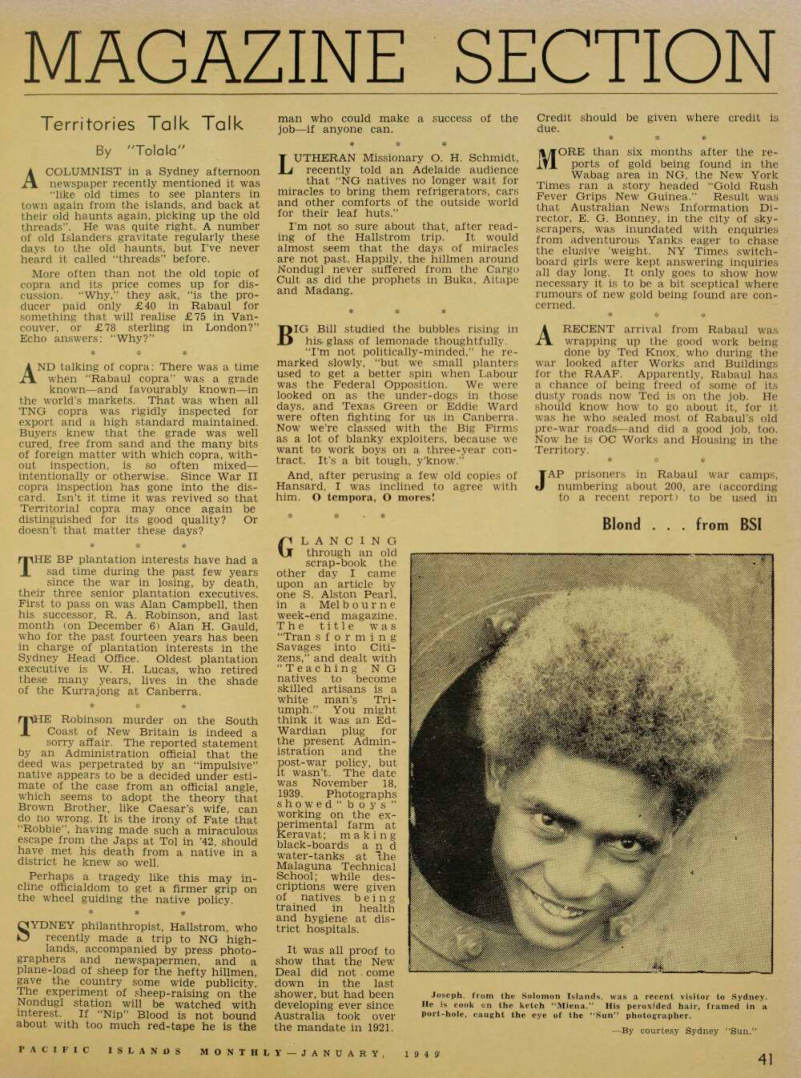
Territories Talk Talk
By "Tolala"
A COLUMNIST in a Sydney afternoon newspaper recently mentioned it was "like old times to see planters in town again from the islands, and back at their old haunts again, picking up the old threads”. He was quite right. A number of old Islanders gravitate regularly these days to the old haunts, but I’ve never heard it called “threads” before.
More often than not the old topic of copra and its price comes up for dis cussion. “Why,” they ask, “is the pro ducer paid only £4O in Rabaul for something that will realise £75 in Van couver, or £7B sterling in London?”
Echo answers: “Why?” * * * AND talking of copra; There was a time when “Rabaul copra” was a grade known —and favourably known—in the world’s markets. That was when all TNG copra was rigidly inspected for export and a high standard maintained.
Buyers knew that the grade was well cured, free from sand and the many bits of foreign matter with which copra, with out inspection, is so often mixed — intentionally or otherwise. Since War II copra inspection has gone into the dis card. Isn’t it time it was revived so that Territorial copra may once again be distinguished for its good quality? Or doesn’t that matter these days? * * * THE BP plantation interests have had a sad time during the past few years since the war in losing, by death, their three senior plantation executives.
First to pass on was Alan Campbell, then his successor, R. A. Robinson, and last month (on December 6) Alan H. Gauld, who for the past fourteen years has been in charge of plantation interests in the Sydney Head Office. Oldest plantation executive is W. H. Lucas, who retired these many years, lives in the shade of the Kurrajong at Canberra. * « * rpHE Robinson murder on the South X Coast of New Britain is indeed a sorry affair. The reported statement by an Administration official that the deed was perpetrated by an “impulsive” native appears to be a decided under esti mate of the case from an official angle, which seems to adopt the theory that Brown Brother, like Caesar’s wife, can do no wrong. It is the irony of Fate that “Robbie”, having made such a miraculous escape from the Japs at Tol in ’42, should have met his death from a native in a district he knew so well.
Perhaps a tragedy like this may in cline officialdom to get a firmer grip on the wheel guiding the native policy. * * *
SYDNEY philanthropist, Hallstrom, who
recently made a trip to NG high lands, accompanied by press photo graphers and newspapermen, and a plane-load of sheep for the hefty hillmen, gave the country some wide publicity.
The experiment of sheep-raising on the Nondugl station will be watched with interest. If “Nip” Blood is not bound about with too much red-tape he is the
man who could make a success of the job—if anyone can. * * * LUTHERAN Missionary O. H. Schmidt, recently told an Adelaide audience that “NG natives no longer wait for miracles to bring them refrigerators, cars and other comforts of the outside world for their leaf huts.”
I’m not so sure about that, after read ing of the Hallstrom trip. It would almost seem that the days of miracles are not past. Happily, the hillmen around Nondugl never suffered from the Cargo Cult as did the prophets in Buka, Aitape and Madang. ♦ * * BIG Bill studied the bubbles rising in his. glass of lemonade thoughtfully.
“I’m not politically-minded,” he re marked slowly, “but we small planters used to get a better spin when Labour was the Federal Opposition. We were looked on as the under-dogs in those days, and Texas Green or Eddie Ward were often fighting for us in Canberra.
Now we’re classed with the Big Firms as a lot of blanky exploiters, because we want to work boys on a three-year con tract. It’s a bit tough, y’know.”
And, after perusing a few old copies of Hansard, I was inclined to agree with him. O tempora, O mores!
Glancing
through an old scrap-book the other day I came upon an article by one S. Alston Pearl, in a Mel bourne week-end magazine.
The title was “Tran s f o r m i n g Savages into Citi zens,” and dealt with “Teaching NG natives to become skilled artisans is a white man’s Tri umph.” You might think it was an Ed wardian plug for the present Admin istration and the post-war policy, taut it wasn’t. The date was November 18, 1939. Photographs showed”boys” working on the ex perimental farm at Keravat; making black-boards and water-tanks at the Malaguna Technical School; while des criptions were given of natives being trained in health and hygiene at dis trict hospitals.
It was all proof to show that the New Deal did not come down in the last shower, but had been developing ever since Australia took over the mandate in 1921.
Credit should be given where credit is due. * * * ||/|ORE than six months after the re- Itl ports of gold being found in the Wabag area in NG, the New York Times ran a story headed “Gold Rush Fever Grips New Guinea." Result was that Australian News Information Di rector, E. G. Bonney, in the city of sky scrapers, was inundated with enquiries from adventurous Yanks eager to chase the elusive ’weight. NY Times switch board girls were kept answering inquiries all day long. It only goes to show how necessary it is to be a bit sceptical where rumours of new gold being found are con cerned. * *s= * A RECENT arrival from Rabaul was wrapping up the good work being done by Ted Knox, who during the war looked after Works and Buildings for the RAAF. Apparently, Rabaul has a chance of being freed of some of its dusty roads now Ted is on the job. He should know how to go about it, for it was he who sealed most of Rabaul’s old pre-war roads—and did a good job, too.
Now he is OC Works and Housing in the Territory. ♦ * * JAP prisoners in Rabaul war camps, numbering about 200, are (according to a recent report) to be used in
reconstructing the Australian naval base at Manus. Whether this is quite accord ing to Hoyle’s rules of war or not is be side the point. Why, when their number was a hundred times as great, were they not put to useful rehabilitation work on public works and plantations?
There’s no doubt that there are strange things done beneath that New Guinea sun ... I remember hearing the story of an officer in charge of some of these Rabaul Jap prisoners (who had bashed our own people about a-plenty) giving a recalcitrant Nip a clip over the ear; and for that he was severely reprimanded.
That in a country where the natives had seen the grossest indignities heaped on the whites by the erstwhile victors. No wonder the ramparts of Empire have tumbled about our ears. This turning the other cheek policy can be carried too far, One day we’ll discover it in NG, to our sorrow. * * * song of the Nondugl natives at this time of the Festive Season is naturally “Silent Night”* * * * A DARWIN report states that 60 abos., men, women and children, made a 400-mile trek to secure a ration of tobacco. Can you imagine that being allowed to happen in New Guinea?
There would be a cry to high heaven by Trusteeship Committee members if. it did.
As a matter-of-fact Bobby Gibbes’ air taxi service in the Wewak area has been receiving a modicum of publicity, where bush natives charter planes to do their buying in Wewak township. * * * A SYDNEY daily paper runs a feature page of notable personalities. Re cently the late Sir Hubert Murray was the subject of a eulogistic article.
Interesting tit-bit revealed that Yarra lumla, present G-G’s vice-regal lodge, is located on the site of the original Murray home. ♦ * * BITS AND PIECES: US Consulate at Suva closed down December 31 for lack of business . . . The R. B.
Carpenters, with daughter Edith May, returned to Sydney last month from Frisco, breaking their journey to spend two weeks in Suva. Most of their five months’ absence was spent touring Canada , . . Harvey Gorrie, of the BSI Service, was married last month to Maisie Nolan, of Maroubra Bay. They will live at Honiara . . . TNG Pioneer and most popular and eligible bachelor for the last three decades. Tex Roberts, was recently married in Rabaul to Mrs.
Uechtritz, also an Island identity held in high esteem . . . Before sailing on Malaita last month for Port Moresby, Mr. and Mrs. Dudley Spence gave a cocktail party to friends to say “au revoir.” . . .
The Ken McMullens were down for Christmas from Rabaul-way, meeting many old friends . . . Mrs. Ethel Bates, whose husband was one-time Judge in BSI, later at Fiji and then Tanganyika, is on a visit to Sydney from South Africa. She is staying with Mrs. Rhoda Coote at Wahroonga. Mrs. Bates is a sister of Mrs. Claire Scott, of Faisi . , .
Ted Fulton and family from Makurapau and Rabaul are down on leave . . . Frank Patten, recently inspector with the War Damage Commission, was holidaying in Sydney last month. He returned to take over the management of the Pigibut estates, off the New Ireland coast.
Blond . . . from BSI
Joseph, from the Solomon Islands, was a recent visitor to Sydney.
He is cook on the ketch “Miena.” His peroxided hair, framed in a port-hole, caught the eye of the “Sun” photographer. —By courtesy Sydney “Sun.”
*For the benefit of non-Australian-area readers, it may be explained that Mr. Hallstrom, who is transporting sheep to New Guinea, has made his millions (more or less) out of the Silent Knight refrigerator
Two Days In The Toils Of A
Biscuit Forcer
By Rosa Moore
NOW that I may give up wearing the ice-pack on my head, and things are quiet again, they think it won’t do me any harm to have my type writer and try to explain what really happened during my Two Days with a Biscuit Forcer.
Before our trip to Australia I was a gentle creature. When I made biscuits, I just floured a board, put down the dough and quietly rolled it out with — of all archaic things—a rolling-pin, I came back changed, ruthless, de termined to Force my biscuits in the future. I had bought a cellophane covered box rioting with pretty pictures of biscuits Forced; into rosettes, into dainty ridged bathmats, pyramids, sea shells, fluted twigs. It looked such a charming hobby.
There was a lot of quiet reading on the back of the box, telling me just what to screw into what when I came to Forcing a Biscuit; but nothing about Keeping Quiet Till the Doctor Came, if things should go wrong. I started out all right. I washed, as per directions, all the playful little gadgets in hot, soapy water, followed by a solemn ten minutes of screwing A into B, adding C, and thrusting my pet biscuit dough into cylinder D. All I had to do, then, was to press plunger E and all my friends were scheduled to be amazed and envious at the results.
I had guests coming at 4 p.m. I set to work at 9 a.m., while the houseboys were out of the kitchen, so that I could be alone with my art.
After some enjoyable indecision I chose the dainty bathmat gadget and inserted it where directed. Trembling with sus pense, I pressed in plunger E, with a suitably greased tin at the ready.
Nothing happened. I pressed harder and harder. Slowly, slowly, a dainty ridged bit of dough coyly began to emerge. I changed to the left hand and shoved.
Another half inch appeared. Taking a deep breath, indifferent to my bulging muscles, I gave my all. Out came a biscuit.
I did it again and, five minutes later, again. By this time arms F and G (mine) were weary and worn. I bent forward and tried pressing plunger E with my diaphragm. Effective, but more suitable for a footballer.
By 10 a.m. I had Forced one trayful of dainty ridged bathmats, not counting eight which had to be disqualified for taking a right-angle turn half-way.
Then a cup of tea, a teeny sit-down, and I was ready to go on. Sometimes I used the right hand, sometimes the left, sometimes I reverted to one of my floating ribs. Came lunch-time, and I had Forced just enough biscuits to see the tea-party through, but I was really too tired to be my usual carefree self.
In fact, night fell and three-quarters of the virgin biscuit dough still sat in its basin, the Biscuit Forcer alongside, all ready for an early start next morn ing.
ON the second day, I decided to switch to the fluted twig job. Wow! Out writhed biscuits looking like tor mented caterpillars. Cross-eyed (With the effort, I kept plunger E, and arms F and G, working like mad, while bis cuits thudded on to the table and crawled up the sides of the tin. I baked
them all, except for three which fell on the cat.
Then something seemed to come over me. I brusquely removed the caterpillar gadget and inserted the sea-shell model.
Ah! this was easier. Just stand the Biscuit Forcer upright, isharply shove in plunger E, give a brutal smack to cylinder D and snatch the whole thing away before the biscuit dough guessed what was happening. The results were not shells so much as anthills of in different architecture. After a bit, I got out an old leather wrist-support and carried on madly.
Houseboys came and went, shaking the head solemnly: Missus work’im biskit all the same cement!
Beginning to tremble, I hurled aside the se£t-shell mould and went to town with a sort of rosette affair. Result: a small button of biscuit with seven little press-studs cavorting round it. The idea must have been that these would amalgamate in baking, but all I got were lots of cooked buttons and plenty of cooked press-studs.
Back, to the ridged bathmat effect.
No, the dough wouldn’t come out at all now, except in a series of fits and starts —and who wants to eat biscuits in fits and starts?
Savagely I changed to the pyramid model. Out rushed the biscuit dough with eager co-operation; up and up went the pyramids—stop them, some body! The first one’s six inches high; here’s the second, a mere five inches!
Look out for the third —nearly hit me in the nose—stop it, stop it, STOP IT!
Keeping my head for one last frenzied moment, I hurled the Biscuit Forcer to the floor and jumped on it. with a fine clash of metal and final writhing of biscuit dough. Next I think I joined it and beat my heels on the kitchen floor.
Then everything—the way it does— went mercifully black.
I AM better now, and things are quiet again. But I seem to remember in my delirium saying to my husband, “Order another Biscuit Forcer from Sydney—will you? I think that other one must have had defective works.’’
The trouble is, I don’t dare ask him if he did. I feel too weak still to know the truth.
Socialism
A sincere, sentimental, beneficent story, which has but one objection— and that is . it will not work.
A plan by which the inefficient, irresponsible, ineffective, unemploy able, and unworthy, will thrive with out industry, persistence, or economy.
A social and economic scheme of government by which man shall loiter, rather than labour—a survival of the unfit.
A system of turning water into wine, kerosene into oyster soup, and boulders into beer, by passing resolu tions.
An arrangement for destroying initiative, inventive creation, and originality.
Abemama, Land of Moonlight
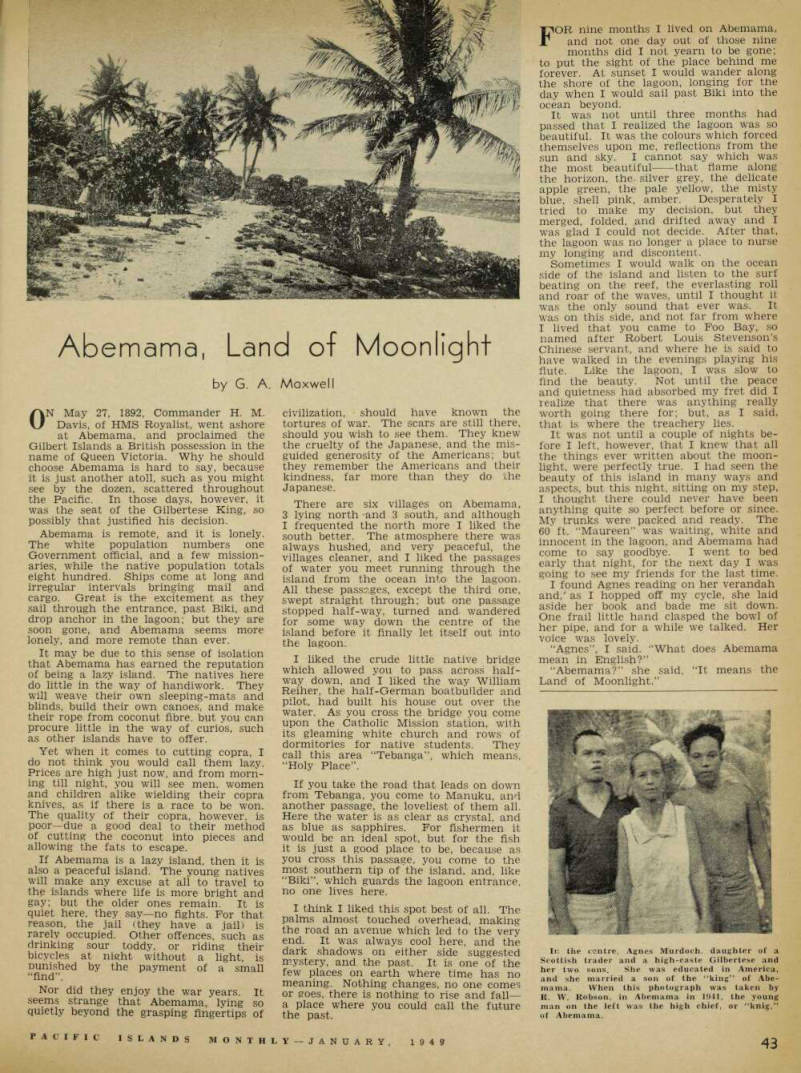
by G. A. Maxwell
ON May 27, 1892, Commander H. M.
Davis, of HMS Royalist, went ashore at Abemama, and proclaimed the Gilbert Islands a British possession in the name of Queen Victoria. Why he should choose Abemama is hard to say, because it is just another atoll, such as you might see by the dozen, scattered throughout the Pacific. In those days, however, it was the seat of the Gilbertese King, so possibly that justified his decision.
Abemama is remote, and it is lonely.
The white population numbers one Government official, and a few mission aries, while the native population totals eight hundred. Ships come at long and irregular intervals bringing mail and cargo. Great is the excitement as they sail through the entrance, past Biki, and drop anchor in the lagoon; but they are soon gone, and Abemama seems more lonely, and more remote than ever.
It may be due to this sense of isolation that Abemama has earned the reputation of being a lazy island. The natives here do little in the way of handiwork. They will weave their own sleeping-mats and blinds, build their own canoes, and make their rope from coconut fibre, but you can procure little in the way of curios, such as other islands have to offer.
Yet when it comes to cutting copra, I do not think you would call them lazy.
Prices are high just now, and from morn ing till night, you will see men, women and children alike wielding their copra knives, as if there is a race to be won.
The quality of their copra, however, is poor—due a good deal to their method of cutting the coconut into pieces and allowing the fats to escape.
If Abemama is a lazy island, then it is also a peaceful island. The young natives will make any excuse at all to travel to the islands where life is more bright and gay; but the older ones remain. It is quiet here, they say—no fights. For that reason, the jail (they have a jail) is rarely occupied. Other offences, such as drinking sour toddy, or riding their bicycles at night without a light, is punished by the payment of a small “find”.
Nor did they enjoy the war years. It seems strange that Abemama, lying so quietly beyond the grasping fingertips of
civilization, should have known the tortures of war. The scars are still there, should you wish to see them. They knew the cruelty of the Japanese, and the mis guided generosity of the Americans; but they remember the Americans and their kindness, far more than they do the Japanese.
There are six villages on Abemama, 3 lying north and 3 south, and although I frequented the north more I liked the south better. The atmosphere there was always hushed, and very peaceful, the villages cleaner, and I liked the passages of water you meet running through the island from the ocean into the lagoon.
All these passages, except the third one, swept straight through: but one passage stopped half-way, turned and- wandered for some way down the centre of the island before it finally let itself out into the lagoon.
I liked the crude little native bridge which allowed you to pass across half way down, and I liked the way William Reiher, the half-German boatbuilder and pilot, had built his house out over the water. As you cross the bridge you come upon the Catholic Mission station, with its gleaming white church and rows of dormitories for native students. They call this area “Tebanga”, which means, “Holy Place”.
If you take the road that leads on down from Tebanga, you come to Manuku, and another passage, the loveliest of them all.
Here the water is as clear as crystal, and as blue as sapphires. For fishermen it would be an ideal spot, but for the fish it is just a good place to be, because as you cross this passage, you come to the most southern tip of the island, and, like ■‘Biki”, which guards the lagoon entrance, no one lives here.
I think I liked this spot best of all. The palms almost touched overhead, making the road an avenue which led to the very end. It was always cool here, and the dark shadows on either side suggested mystery, and. the past. It is one of the few places on earth where time has no meaning. Nothing changes, no one comes or goes, there is nothing to rise and fall — a place where you could call the future the past.
FOR nine months I lived on Abemama, and not one day out of those nine months did I not yearn to be gone; to put the sight of the place behind me forever. At sunset I would wander along the shore of the lagoon, longing for the day when I would sail past Biki into the ocean beyond.
It was not until three months had passed that I realized the lagoon was so beautiful. It was the colours which forced themselves upon me, reflections from the sun and sky. I cannot say which was the most beautiful that flame along the horizon, the- silver grey, the delicate apple green, the pale yellow, the misty blue, shell pink, amber. Desperately I tried to make my decision, but they merged, folded, and drifted away and I was glad I could not decide. After that, the lagoon was no longer a place to nurse my longing and discontent.
Sometimes I would walk on the ocean side of the island and listen to the surf beating on the reef, the everlasting roll and roar of the waves, until I thought it was the only sound that ever was. It was on this side, and not far from where I lived that you came to Foo Bay, so named after Robert Louis Stevenson’s Chinese servant, and where he is said to have walked in the evenings playing his flute. Like the lagoon, I was slow to find the beauty. Not until the peace and quietness had absorbed my fret did I realize that there was anything really worth going there for; but, as I said, that is where the treachery lies.
It was not until a couple of nights be fore I left, however, that I knew that all the things ever written about the moon light, were perfectly true. I had seen the beauty of this island in many ways and aspects, but this night, sitting on my step, I thought there could never have been anything quite so perfect before or since.
My trunks were packed and ready. The 60 ft. “Maureen” was waiting, white and innocent in the lagoon, and Abemama had come to say goodbye. I went to bed early that night, for the next day I was going to see my friends for the last time.
I found Agnes reading on her verandah and/ as I hopped off my cycle, she laid aside her book and bade me sit down.
One frail little hand clasped the bowl of her pipe, and for a while we talked. Her voice was lovely.
“Agnes”, I said. “What does Abemama mean in English?”
"Abemama?” she said, “It means the Land of Moonlight.”
In the centre, Agnes Murdoch, daughter of a Scottish trader and a high-caste Gilbertese and her two sons. She was educated in America, and she married a son of the “king” of Abe mama. When this photograph was taken by R. W. Robson, in Abemama in 1941, the young man on the left was the high chief, or “knig,” of Abemama.
High Chief’S
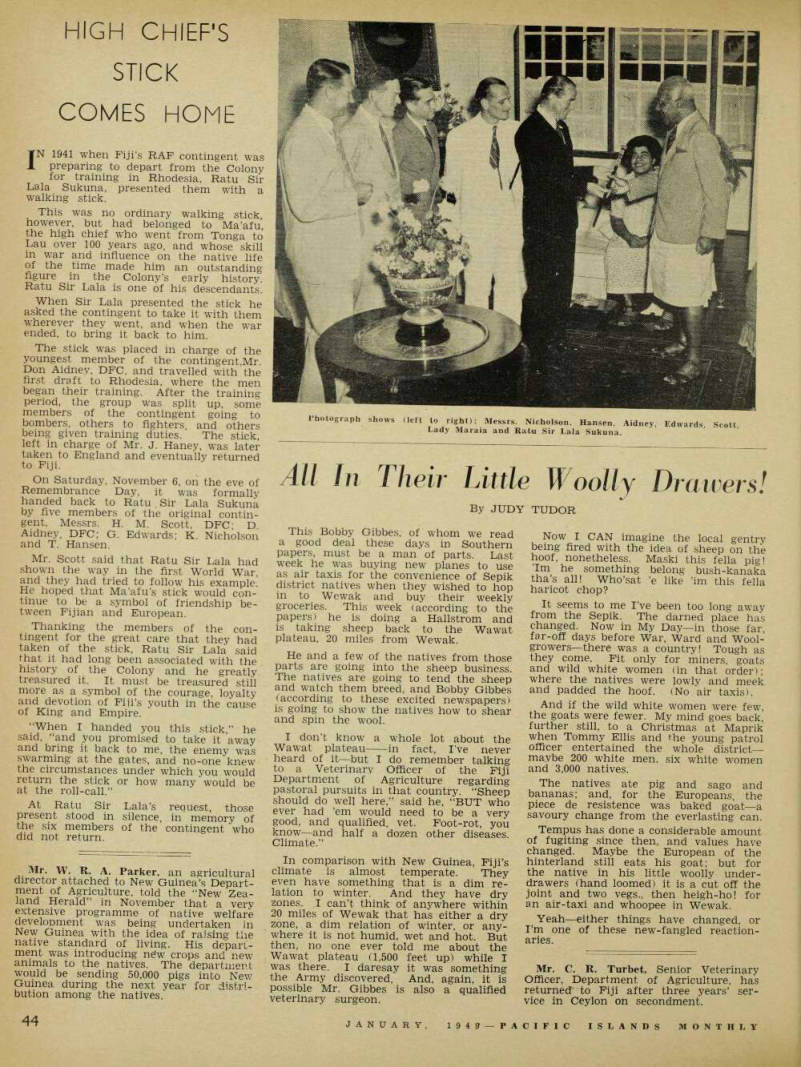
Stick
Comes Home
IN 1941 when Fiji’s RAF contingent was preparing to depart from the Colony for training in Rhodesia. Ratu Sir Lala Sukuna, presented them with a walking stick.
This was no ordinary walking stick however, but had belonged to Ma’afu, the high chief who went from Tonga to Lau over 100 years ago, and whose skill m war and influence on the native life of the time made him an outstanding figure in the Colony’s early history.
Ratu Sir Lala is one of his descendants.
When Sir Lala presented the stick he asked the contingent to take it with them wherever they went, and when the war ended, to bring it back to him.
The stick was placed in charge of the youngest member of the contingent,Mr Don Aidney, DFC, and travelled with the first draft to Rhodesia, where the men began their training. After the training period, the group was split up, some members of the contingent going to bombers, others to fighters, and others being given training duties. The stick, left in charge of Mr. J. Haney, was later taken to England and eventually returned to Fiji.
On Saturday, November 6, on the eve of Remembrance Day, it was formally handed back to Ratu Sir Lala Sukuna by five members of the original contin gent, Messrs. H. M. Scott, DFC • D Aidney, DFC; G. Edwards: K. Nicholson and T. Hansen.
Mr. Scott said that Ratu Sir Lala had shown the way in the first World War, and they had tried to follow his example.
He hoped that Ma’afu’s stick would con tinue to be a symbol of friendship be tween Fijian and European.
Thanking the members of the con tingent for the great care that they had taken of the stick, Ratu Sir Lala said that it had long been associated with the history of the Colony and he greatly treasured it. It must be treasured still more as a symbol of the courage, loyalty and devotion of Fiji’s youth in the cause of King and Empire.
“When I handed you this stick ” he said, “and you promised to take it away and bring it back to me, the enemy was swarming at the gates, and no-one knew the circumstances under which you would return the stick or how many would be at the roll-call.”
At Ratu Sir Lala’s request, those present stood in silence, in memory of the six members of the contingent who did not return.
Mr. W. R. A. Parker, an agricultural director attached to New Guinea’s Depart ment of Agriculture, told the “New Zea land Herald” in November that a very extensive programme of native welfare development was being undertaken in New Guinea with the idea of raising the native standard of living. His depart ment was introducing n£w crops and new animals to the natives. The department would be sending 50,000 pigs into New Guinea during the next year for distri bution among the natives.
Photograph shows (left to right): Messrs. Nicholson. Hansen. Aidney, Edwards, Scott Lady Maraia and Ratu Sir Lala Sukuna.
All In Their Little Woolly Di rovers!
By Judy Tudor
This Bobby Gibbes, of whom we read a good deal these days in Southern papers, must be a man of parts. Last week he was buying new planes to use as air taxis for the convenience of Sepik district natives when they wished to hop in to Wewak and buy their weekly groceries. This week (according to the papers) he is doing a Hallstrom and is taking sheep back to the Wawat plateau, 20 miles from Wewak.
He and a few of the natives from those parts are going into the sheep business.
The natives are going to tend the sheep and watch them breed, and Bobby Gibbes (according to these excited newspapers) is going to show the natives how to shear and spin the wool.
I don’t know a whole lot about the Wawat plateau in fact, I’ve never heard of it—but I do remember talking to a Veterinary Officer of the Fiji Department of Agriculture regarding pastoral pursuits in that country. “Sheep should do well here,” said he, “BUT who ever had ’em would need to be a very good, and qualified, vet. Foot-rot, you know—and half a dozen other diseases.
Climate.”
In comparison with New Guinea, Fiji’s climate is almost temperate. They even have something that is a dim re lation to winter. And they have dry zones. I can’t think of anywhere within 20 miles of Wewak that has either a dry zone, a dim relation of winter, or any where it is not humid, wet and hot. But then, no one ever told me about the Wawat plateau (1,500 feet up) while I was there. I daresay it was something the Army discovered, And. again, it is possible Mr. Gibbes is also a qualified
veterinary surgeon.
Now I CAN imagine the local gentry being fired with the idea of sheep on the hoof, nonetheless. Maski this fella pig' 'lm he something belong bush-kanaka tha’s all! Who’sat ’e like ’im this fella haricot chop?
It seems to me I’ve been too long away from the Sepik. The darned place has changed. Now in My Day—in those far, far-off days before War, Ward and Wool growers—there was a country! Tough as they come. Fit only for miners, goats and wild white women (in that order); where the natives were lowly and meek and padded the hoof. (No air taxis).
And if the wild white women were few, the goats were fewer. My mind goes back, further still, to a Christmas at Maprik when Tommy Ellis and the young patrol officer entertained the whole district— maybe 200 white men. six white women and 3,000 natives.
The natives ate pig and sago and bananas; and, for the Europeans, the piece de resistence was baked goat—a savoury change from the everlasting can.
Tempus has done a considerable amount of fugiting since then, and values have changed. Maybe the European of the hinterland still eats his goat; but for the native in his little woolly under drawers (hand loomed) it is a cut off the joint and two vegs., then heigh-ho! for an air-taxi and whoopee in Wewak.
Yeah—either things have changed, or I’m one of these new-fangled reaction aries.
Mr. C. R. Turbet, Senior Veterinary Officer, Department of Agriculture, has returned to Fiji after three years’ ser vice in Ceylon on secondment.
Rarotonga was like that in the Nineties!
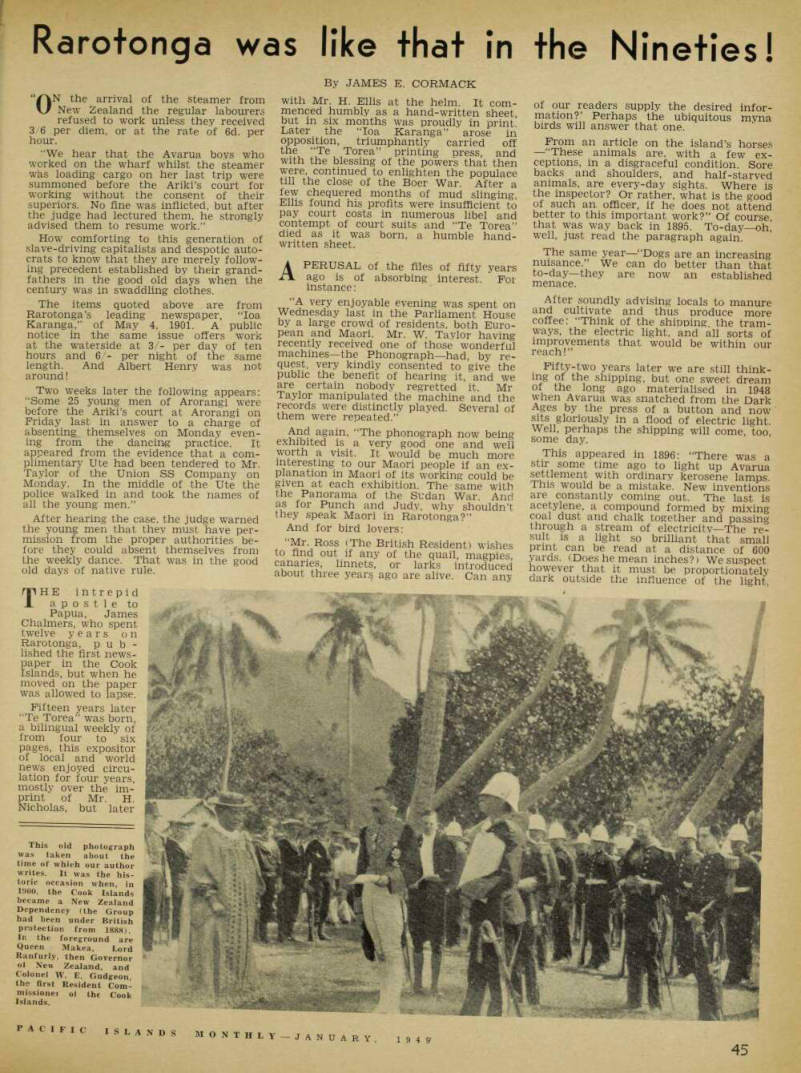
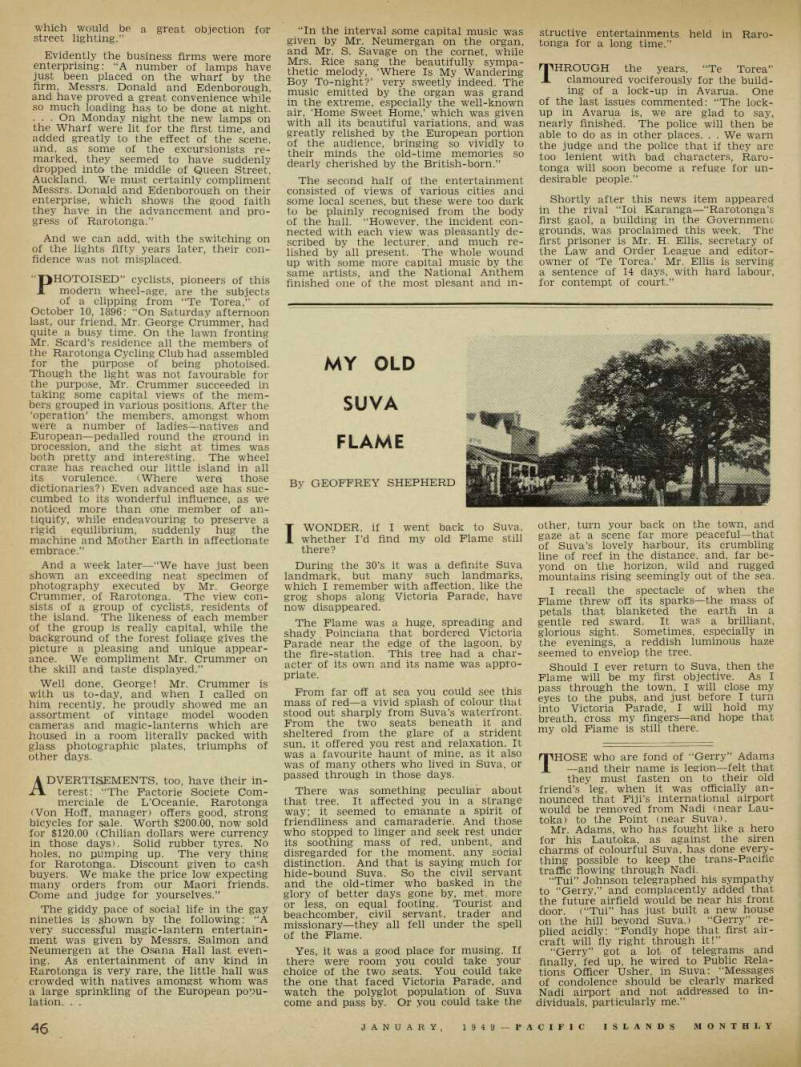
By James E. Cormack
“fl N the arrival of the steamer from w New Zealand the regular labourers refused to work unless they received 3 6 per diem, or at the rate of 6d. per hour.
"We hear that the Avarua boys who worked on the wharf whilst the steamer was loading cargo on her last trip were summoned before the Ariki’s court for working without the consent of their superiors. No fine was inflicted, but after the judge had lectured them, he strongly advised them to resume work.”
How comforting to this generation of slave-driving capitalists and despotic auto crats to know that they are merely follow ing precedent established by their grand fathers in the good old days when the century was in swaddling clothes.
The items quoted above are from Rarotonga’s leading newspaper, “loa Karanga,” of May 4. 1901. A public notice in the same issue offers work at the waterside at 3/- per day of ten hours and 6 - per night of the same length. And Albert Henry was not around!
Two weeks later the following appears: “Some 25 young men of Arorangi were before the Ariki’s court at Arorangi on Friday last in answer to a charge of absenting themselves on Monday even ing from the dancing practice. It appeared from the evidence that a com plimentary Ute had been tendered to Mr.
Taylor of the Union SS Company on Monday. In the middle of the Ute the police walked in and took the names of all the young men.”
After hearing the case, the judge warned the young men that they must have per mission from the proper authorities be fore they could absent themselves from the weekly dance. That was in the good old days of native rule.
THE intrepid
apostle to Papua, James Chalmers, who spent twelve years on Rarotonga, p u b lished the first news paper in the Cook Islands, but when he moved on the paper was allowed to lapse.
Fifteen years later “Te Torea” was born, a bilingual weekly of from four to six pages, this expositor of local and world news enjoyed circu lation for four years, mostly over the im print of Mr. H.
Nicholas, but later
with Mr. H. Ellis at the helm. It com menced humbly as a hand-written sheet, but in six months was proudly in print.
Later the “loa Karanga” arose in opposition, triumphantly carried off the “Te Torea” printing press, and with the blessing of the powers that then were, continued to enlighten the populace till the close of the Boer War. After a few chequered months of mud slinging, Ellis found his profits were insufficient to pay court costs in numerous libel and ccpntempt of court suits and “Te Torea” died as it was born, a humble hand written sheet.
A PERUSAL of the files of fifty years ago is of absorbing interest. Foi instance: “A very enjoyable evening was spent on Wednesday last in the Parliament House by a large crowd of residents, both Euro pean and Maori. Mr. W. Taylor having recently received one of those wonderful machines—the Phonograph—had, by re quest, very kindly consented to give the public the benefit of hearing it, and we are certain nobody regretted it. Mr Taylor manipulated the machine and the records were distinctly played. Several of them were repeated.”
And again, “The phonograph now being exhibited is a very good one and well worth a visit. It would be much more interesting to our Maori people if an ex planation in Maori of its working could be given at each exhibition. The same with the Panorama of the Sudan War. And as for Punch and Judy, why shouldn’t they speak Maori in Rarotonga?”
And for bird lovers: “Mr. Ross (The British Resident) wishes to find out if any of the quail, magpies, canaries, linnets, or larks introduced about three years ago are alive. Can any
of our readers supply the desired infor mation?’ Perhaps the übiquitous myna birds will answer that one.
From an article on the island’s horses —“These animals are, with a few ex ceptions, in a disgraceful condition. Sore backs and shoulders, and half-starved animals, are every-day sights. Where is the inspector? Or rather, what is the good of such an. officer, if he does not attend better to this important work?” Of course that was way back in 1895. To-day—oh,’ well, just read the paragraph again.
The same year—“ Dogs are an increasing nuisance.” We can do better than that to-day—they are now an established menace.
After soundly advising locals to manure and cultivate and thus produce more coffee: “Think of the shipping, the tram ways, the electric light, and all sorts of improvements that would be within our reach!”
Fifty-two years later we are still think- P/ th e s hiPPi n g. but one sweet dream of the long ago materialised in 1948 when Avarua was snatched from the Dark Ages by the press of a button and now sits gloriously in a flood of electric light.
Well, perhaps the shipping will come, too. some day.
This appeared in 1896: “There was a stir some time ago to light up Avarua settlement with ordinary kerosene lamps.
This would be a mistake. New inventions are constantly coming out. The last is acetylene, a compound formed by mixing coal dust and chalk together and passing through a stream of electricity—The re sult is a light so brilliant that small print can be read at a distance of 600 yards. (Does he mean inches?) We suspect however that it must be proportionately dark outside the influence of the light,
This old photograph was taken about the time of which our author writes. It was the his toric occasion when, in 1900, the Cook Islands became a New Zealand Dependency (the Group had been under British protection from 1888).
In the foreground are Queen Makea, Lord Ranfurly. then Governor of New Zealand, and Colonel W. E. Gudgeon, the first Resident Com missioner of the Cook Islands.
which would be a great objection for street lighting.”
Evidently the business firms were more enterprising; “A number of lamps have just been placed on the wharf by the firm, Messrs. Donald and Edenborough, and have proved a great convenience while so much loading has to be done at night. . . . On Monday night the new lamps on the Wharf were lit for the first time, and added greatly to the effect of the scene, and, as some of the excursionists re marked, they seemed to have suddenly dropped into the middle of Queen Street, Auckland. We must certainly compliment Messrs. Donald and Edenborough on their enterprise, which shows the good faith they have in the advancement and pro gress of Rarotonga.”
And we can add, with the switching on of the lights fifty years later, their con fidence was not misplaced.
PHOTOISED” cyclists, pioneers of this modern wheel-age, are the subjects of a clipping from “Te Torea,” of October 10, 1896: “On Saturday afternoon last, our friend, Mr. George Crummer, had quite a busy time. On the lawn fronting Mr. Scard’s residence all the members of the Rarotonga Cycling Club had assembled for the purpose of being photoised.
Though the light was not favourable for the purpose, Mr. Crummer succeeded in taking some capital views of the mem bers grouped in various positions. After the ‘operation’ the members, amongst whom were a number of ladies—natives and European—pedalled round the ground in procession, and the sight at times was both pretty and interesting. The wheel craze has reached our little island in all its vorulence. (Where werei those dictionaries?) Even advanced age has suc cumbed to its wonderful influence, as we noticed more than one member of an tiquity, while endeavouring to preserve a rigid equilibrium, suddenly hug the machine and Mother Earth in affectionate embrace.”
And a week later—“We have just been shown an exceeding neat specimen of photography executed by Mr. George Crummer, of Rarotonga. The view con sists of a group of cyclists, residents of the island. The likeness of each member of the group is really capital, while the background of the forest foliage gives the picture a pleasing and unique appear ance. We compliment Mr. Crummer on the skill and taste displayed.”
Well done, George! Mr. Crummer is with us to-day, and when I called on him recently, he proudly showed me an assortment of vintage model wooden cameras and magic-lanterns which are housed in a room literally packed with glass photographic plates, triumphs of other days.
ADVERTISEMENTS, too, have their in terest: “The Factorie Societe Com merciale de L’Oceanie, Rarotonga (Von Hoff, manager) offers good, strong bicycles for sale. Worth $200.00, now sold for $120.00 (Chilian dollars were currency in those days). Solid rubber tyres. No holes, no pumping up. The very thing for Rarotonga. Discount given to cash buyers. We make the price low expecting many orders from our Maori friends.
Come and judge for yourselves.”
The giddy pace of social life in the gay nineties is shown by the following: “A very successful magic-lantern entertain ment was given by Messrs. Salmon and Neumergen at the Osana Hall last even ing. As entertainment of any kind in Rarotonga is very rare, the little hall was crowded with natives amongst whom was a large sprinkling of the European popu lation. . .
“In the interval some capital music was given by Mr. Neumergan on the organ, and Mr. S. Savage on the cornet, while Mrs. Rice sang the beautifully sympa thetic melody, ‘Where Is My Wandering Boy To-night?’ very sweetly indeed. The music emitted by the organ was grand in the extreme, especially the well-known air, ‘Home Sweet Home,’ which was given with all its beautiful variations, and was greatly relished by the European portion of the audience, bringing so vividly to their minds the old-time memories so dearly cherished by the British-born.”
The second half of the entertainment consisted of views of various cities and some local scenes, but these were too dark to be plainly recognised from the body of the hall. "However, the incident con nected with each view was pleasantly de scribed by the lecturer, and much re lished by all present. The whole wound up with some more capital music by the same artists, and the National Anthem finished one of the most plesant and in
structive entertainments held in Raro tonga for a long time.”
THROUGH the years, “Te Torea” clamoured vociferously for the build ing of a lock-up in Avarua. One of the last issues commented: “The lock up in Avarua is, we are glad to say, nearly finished. The police will then be able to do as in other places. . . We warn the judge and the police that if they are too lenient with bad characters, Raro tonga will soon become a refuge for un desirable people.”
Shortly after this news item appeared in the rival “loi Karanga—“Rarotonga’s first gaol, a building in the Government grounds, was proclaimed this week. The first prisoner is Mr. H. Ellis, secretary of the Law and Order League and editor owner of ‘Te Torea.’ Mr. Ellis is serving a sentence of 14 days, with hard labour, for contempt of court.”
Advertisements & other items, p. 51 (1 item)
pacific islands Monthly- j a n u a r Y, 194?
My Old
Suva
Flame
By Geoffrey Shepherd
I WONDER, if I went back to Suva, whether I’d find my old Flame still there?
During the 30’s it was a definite Suva landmark, but many such landmarks, which I remember with affection, like the grog shops along Victoria Parade, have now disappeared.
The Flame was a huge, spreading and shady Poinciana that bordered Victoria Parade near the edge of the lagoon, by the fire-station. This tree had a char acter of its own and its name was appro priate.
From far off at sea you could see this mass of red —a vivid splash of colour that stood out sharply from Suva’s waterfront.
From the two seats beneath it and sheltered from the glare of a strident sun, it offered you rest and relaxation. It was a favourite haunt of mine, as it also was of many others who lived in Suva, or passed through in those days.
There was something peculiar about that tree. It affected you in a strange way; it seemed to emanate a spirit of friendliness and camaraderie. And those who stopped to linger and seek rest under its soothing mass of red, unbent, and disregarded for the moment, any social distinction. And that is saying much for hide-bound Suva. So the civil servant and the old-timer who basked in the glory of better days gone by, met, more or less, on equal footing. Tourist and beachcomber, civil servant, trader and missionary—they all fell under the spell of the Flame.
Yes, it was a good place for musing. If there were room you could take your choice of the two seats. You could take the one that faced Victoria Parade, and watch the polyglot population of Suva come and pass by. Or you could take the
other, turn your back on the town, and gaze at a scene far more peaceful—that of Suva’s lovely harbour, its crumbling line of reef in the distance, and, far be yond on the horizon, wild and rugged mountains rising seemingly out of the sea.
I recall the spectacle of when the Flame threw off its sparks—the mass of petals that blanketed the earth in a gentle red sward. It was a brilliant, glorious sight. Sometimes, especially in the evenings, a reddish luminous haze seemed to envelop the tree.
Should I ever return to Suva, then the Flame will be my first objective. As I pass through the town, I will close my eyes to the pubs, and just before I turn into Victoria Parade, I will hold my breath, cross my fingers—and hope that my old Flame is still there.
THOSE who are fond of “Gerry” Adams —and their name is legion—felt that they must fasten on to their old friend’s leg, when it was officially an nounced that Fiji’s international airport would be removed from Nadi (near Lau toka) to the Point (near Suva).
Mr. Adams, who has fought like a hero for his Lautoka, as against the siren charms of colourful Suva, has done every thing possible to keep the trans-Pacific traffic flowing through Nadi.
“Tui” Johnson telegraphed his sympathy to “Gerry,” and complacently added that the future airfield would be near his front door. (“Tui” has just built a new house on the hill beyond Suva.) “Gerry” re plied acidly: “Fondly hope that first air craft will fly right through it!”
“Gerry” got a lot of telegrams and finally, fed up, he wired to Public Rela tions Officer Usher, in Suva: “Messages of condolence should be clearly marked Nadi airport and not addressed to in dividuals, particularly me.”
Tropicalities
A PASSENGER who recently returned to “civilisation” after the Matuh had called at Pago Pago (American Samoa) for the second time in her career, says that there is a rumour that she will call there about once every four months in 1949.
Our passenger also brought a story of a recent visit of the French sloop, Dumont D’Urville, to Pago. It appears that the sloop was there almost a week and that the purpose of her visit was to effect necessary repairs to a monument to Frenchmen who were killed by Samoans a number of years ago at Asu.
Pago was full of French sailors but, on the whole, they appeared to have a thin time due mostly to the shatter ing exchange rate of francs on dollars.
They made little progress with the local belles, also, no doubt because of the above and also because of their inability to speak English.
A party of six of the sailor lads did, however, find something of the once famed Samoan hospitality. They had gone into the Pago beer tavern and pooling all their resources managed to buy three pint bottles of beer which they took turns at sipping.
This is how the Samoan Chief of Police found them. He was so horrified at what he took to be their poverty, that there and then he stood treat for a bottle of beer each and a carton of cigarettes.
Those French sailors thought he was a millionaire.
In spite of their dollar-poverty, how ever. they are reported as being a “happy lot of men, of good physique—and I never heard that they were involved in any brawls while the ship was in port. Per haps because they couldn’t afford to get drunk!”
THE recent return of the £NZ to sterling naturally had many reper cussions in Fiji, but I’m afraid that to many of the Fijjians the in tricacies of international finance are beyond comprehension—as they are to me, sometimes.
I tried the other day to explain the situation to a Fijian who quite under stood that some money was “bad” and other “good”, but could not see how, overnight, the position could change.
My arguments were complicated in his eyes by the fact that many of the Fijian notes are NZ notes overprinted.
However, the incident made me think of a time when I was living in a rathei remote part of the Pacific, and where many of my daily wants were provided by a very likable old rogue from a nearby village. Money rarely entered into our transactions. Instead, we had a delightful ‘'service-barter” arrangement which worked to our mutual satisfaction and advantage.
The book-keeping consisted of a sheet of paper pasted up on my back porch and the transactions were recorded after this fashion;—
Pereti
Solder kettle.
One white shirt (old).
Pay Tiko’s water rate (10/-).
Fix sewing machine.
Mend bicycle.
Write letter to Govt, for Tiko.
Even without Govt. Price Control we somehow managed very well, and I’m afraid we never worried over the “ex change rate”, although from the twinkle in Tiko’s eye at times I’m sure he imagined the rate to be “in his favour”!
Periti.
PROFESSOR Charles Schindler, who has been at the University of Queensland since it opened in 1911, has retired, and he says, he will go to live with his son in New Guinea.
He says that he has marked so many examination papers that he does not know whether the number is 120,000 or 12,000. Nor does he care. His main object in going to New Guinea is to get the natives together to form a League for the Prevention of Examinations!
I HAD an illuminating chat with a Sepik native, the day the New Guinea Administrator paid his hurried visit to Angoram—he arrived there by plane and was gone again in side 90 minutes (writes a Sepik correspon dent).
I was walking along the air-strip, near the dais which had been erected for the convenience of His Honour, who was to address a large assemblage of natives.
I explained to a curious group the pur pose of the dais.
Rather hesitantly, one of the natives asked me if the “Gubmint” (the admini strator) was one of my colour.
I answered “Yes”; and to my surprise the native registered extreme disapproval.
He uttered a lament that they had come such a long way merely to see another white man.
Rather puzzled, I asked him what he had expected. He told me that they had expected to see a man like themselves— a dark man—because they had been assured by Government officials that the “Gubmint” was now designed for the natives and not for the whites.
The disappointment of this group of primitive Sepiks was marked—and re markable.
FIJI Arts Club, in a three nights season in mid November, presented Coward’s “Blithe Spirit” to delighted Suva audiences. Great attention to details of production and the designing of the set, as well as good acting, lifted the show far above amateur class.
Mr. James Crawford, of the Suva Bank of New Zealand, took the part of Charles Condomine, the novelist; Miss Dorothy Kearsley played Ruth, Charles’ second wife; Mrs. Joan Chalmers was the medium, Madame Arcati; Mrs. Delia McDonald was Elvira the Spirit. Support ing roles were taken by Lorna Bradley, Eric and Enid Bevington. Stage manager was Mr. Kelvin Pinson and the very excellent set was built by architect Fred Beckett of Suva.
Tiko
Basket Taro. 2 baskets kumera.
Cut grass 2 days.
Bunch bananas.
Chop firewood. 2 chickens.
ERROL FLYNN may be seen in New Guinea again. He has urged* his studios to let him go to Australia to make a film based on the pearling in dustry; and if he gets his way, it may be taken as certain that his film-making will lead him back for one more look at his old stamping-grounds in Papua and New Guinea. At present, he is on his way to Europe—he is to star in a film made in Paris.
AS monuments to the Rockefeller Foundation and the raising of • hygienic standards in the South Seas, there is one thing that has attained extraordinary prominence: The family outhouse.
In Western Samoa they adorn the waterfront in endless varieties of in genious architecture, even though the degree of decrepitude is pretty constant, as is also, I imagine, the precariousness of the visit thereto.
One cannot say that they enhance the beauty of otherwise delightful beaches, and they must surely detract from the romance on tropical moonlight nights!
Over in the Cook Islands the style varies, and although the prominence remains, at least the waterfront has es caped. From what I can gather, the original specification ordained a pit of a certain depth. But to dig a pit in coral rock is really hard work, and so some ingenious digger, after a while, called it a day, but in order to keep to the specification, he transferred his energies to the top of the hole, built up a coral cement hollow-mound, placed the edifice on top, made a few steps to reach same, and hey presto!—the‘job was done!
Apparently the idea caught on, and it is now common to see the family throne perched up five or six feet in the air, and of course in full view of all.
Alas, as in Samoa, time has wrought havoc with many of the buildings, but, after all, what is a missing door or a few wall boards if the view from within is so much better?
This brings to my mind an occasion some years ago when I was cycling around Titikaveka, in Rarotonga. I could hear a great hullabaloo in the distance, and on coming around a bend in the road the scene which greeted me was mother, yelling blue murder, and marooned up in the throne house (which was sans door, by-the-way), an irate bull bellowing and stamping around the base, and, at a discreet distance, the whole family verbally endeavouring to induce the bull to raise the siege.
I had no camera, unfortunately!
Periti.
11HE manner in which a slice of Prin cess Elizabeth’s wedding-cake, re ceived at Government House, Fiji, was divided up and distributed far and wide across the Pacific, to serve various charitable and ceremonial purposes, was described in the September issue of the “PIM.” Here is some further history. The section destined for the British Solomon Islands was raffled, for the benefit of the leper settlement on Guadalcanal. The winner, Mr. G. F. Witty, viewed the pre cious morsel, and then re-wrapped it and sent it to his daughter, at a school in New Zealand. There, the package was greeted with wild enthusiasm: the unwrapping was made a formal ceremony; the confec tion was then split up into crumbs, which were distributed among certain lucky girls; and, at last advices, the youngsters were meticulously sleeping upon their crumbs and comparing dreams!
Pacific Nature Notes
Written for "PIM" by Charles Barrett, FRZS
Sea-Roving Seaweed
THE red seaweed described by a cor respondent evidently is the elegant little sea-rover known to science as Asparagopsis armata. The generic name, of course, refers to the graceful sprays, which are rather like small shoots of asparagus; while armata was given be cause some of the plant’s branches bear inch-long branchlets beset with barbs— they are for use as hooks, not as ‘“spears”.
When I was editor of the “Victorian Naturalist”, the late Professor A. H. S.
Lucas, of Sydney, sent me an interesting paper on this remarkable seaweed, which nas crossed the sea from Australia to Europe. Discovered in 1854 by Dr. Harvey, author of a splendid work on Australian Seaweeds, the Red Rover (Asparagopsis) occurs on the west, south, and east coasts of Australia, and also in Tasmania and New Zealand. It made its first ap pearance in European waters early in the Nineteenth Century; the pioneer plants having migrated, perhaps, from New Zealand.
Its barbed branchlets give the plant its wonderful power of sea-roving. At first merely hooks, as Professor Lucas ex plains, when attached they grow into strongly adhesive discs; these fix the whole branchlet, which sends out vegeta tive shoots and is easily removed from the parent plant. Waves can easily detach the new individual from its new sub stratum; and should its hooks reach a mass of green seaweed growing on the hull of a ship, it may make a long sub marine voyage.
Seaweed collecting, once very popular, went out of fashion years ago. But there are still a few enthusiasts, some in the Pacific realm; and occasionally a new marine “weed’ is discovered. The student of fishes has some interest in seaweeds, for many kinds of fishes feed upon them.
The beautiful little chrome-yellow surgeon-fish, common about Hawaiian coral reefs, is said to subsist entirely upon filamentous seaweeds. The lauhau has mouth parts adapted for feeding upon algae, and certain species, abundant on the reefs, form its staple food.
Sargassum or ‘Gulfweed” occurs in all warm seas, and one of the very numerous species (there are well over one hundred), is commonly used for food by Japanese fishermen, I believe.
Flying Fish
DO flying fish fly? The question has been answered a thousand times in the negative; but many people be lieve that the beautifully coloured, streamlined fishes that rise from the sea and go zooming through the air, do fly flap their wing-like fins. This is a fallacy, as anybody who has closely ob served flying fishes “on the wing” surely will agree. The fins certainly are vibrated rapidly when the fish leaves the water, which is flicked by the tail in the take off.
Despite the assertion of some naturalists that the flying fish does actually fly, I hold the contrary opinion. Fin vibration is not true flight; and the flying fish has been well described as an “aqua-aero glide”. I have watched them often enough, from the deck of a steamer, to know that these fishes, do appear to fly.
Their two-inch long wings are vibrated during the “flight”, and the tail may be used as a propeller when it touches the water as the fish goes over a swell; this has been noticed by many observers.
The few records available indicate that
flying fishes are unable to make long sustained ‘’flights”. They stay in the air from about a dozen seconds to little more than half a minute, and the dis tance covered mayoe several hundreds of yards only guess measurements, of course, are possmle. It would be interest ing to have the views of readers who may nave paid special attention to the flying nsn as a flier, or a glider!
“Lost” Parrots
A BRISBANE bird man is anxious to know whether any of the Cyanor hamphus parrakeets still exist—not New Zealand species, but those once fairly aoundant on small and remote islands. So far as my knowledge goes, these forms are either extremely rare, or extinct.
The Society Island parrakeet was re ported as extinct more than sixty years ago while the Ulietea species, restricted to one isle of the group, has not been re corded for a century. The Lord Howe Island parakeet long since disappeared completely; extermination has also been the fate of other species; in all, six are extinct; while such forms as the Kerma dec Island parrakeet are very rare.
Happily, the red-fronted parrakeet ( Cyanornamphus novae zeelaiidiae), though it may be scarce on the mainland, has found sanctuary in island reserves— notably, Little Barrier Island, which I plan to visit next year.
One of the “lost” island parrakeets is said to have been fairly plentiful until a collector of bird-skins visited its territory.
When he departed, if reports be true, few of the small birds remained; the num ber taken had been too heavv to allow lo_ recovery.
A pity it seems, now, that many pairs of these parrots were not taken into captivity before they became rare. Avi culturists may have bred them success fully, as they have certain Australian parrots threatened with extinction. It may even have been possible, in time, to liberate small numbers on their home islands —to restock such parrotless places as lone Antipodes Isle, which once had its own Cyanorhamphus.
New Zealand Giants
THE extinct giant birds of New Zealand are in the news again. “Fossil” moa footprints were recently dis covered: impressions made in clay by the huge feet of a Dinornus which died, per chance, not more than two or three centuries ago. An important discovery, but not the first bird of its kind. I possess a photograph, taken many years ago, of the footprints of a moa, on the margin of the Manawatu River.
Feathers of the wingless giants have been found in river banks and in a cave or two. Bushels of moa bones have been dug up in various parts of the Dominion.
An American expedition reaped a rich harvest of specimens, and their study may increase the number of known species of Dinornis, Emus, or some other genus. Specialists are generous in their classification schemes; and many kinds of moas have been described and named.
Five or six are included in one genus alone.
The discovery of a living moa—a highly improbable event—would cause almost as much stir as did the finding of Tutankhamen’s Tomb in the Valley of the Kings. It would certainly be as im portant in the eyes of naturalists.
Several perfect moa’s eggs have been found. One, known as the “Ettrick Egg”,
is preserved in the Otago Museum. It was found in 1911, appropriately enough in the district known as Moa Flat, of which Etterick is the township. The egg of a moa may be as commercially valu able as one of the Great Auk, for all I know; but an old collector of “natural
Communications from Nature students in the Pacific Islands are welcomed by our contributor—Mr.
Charles Barrett, “Maralena,” Mays bury Avenue, Elstemwick S 4, Victoria.
curios’' once offered me a few fragments of eggshell, guaranteed to be “dinkum Dinornis”, for a guinea. Just where they xi^ the o * d man couldn’t say; but they came from New Zealand, all right To me they looked like flakes of an ostrich egg. In any event, they were not purchased.
Raising The Wind!
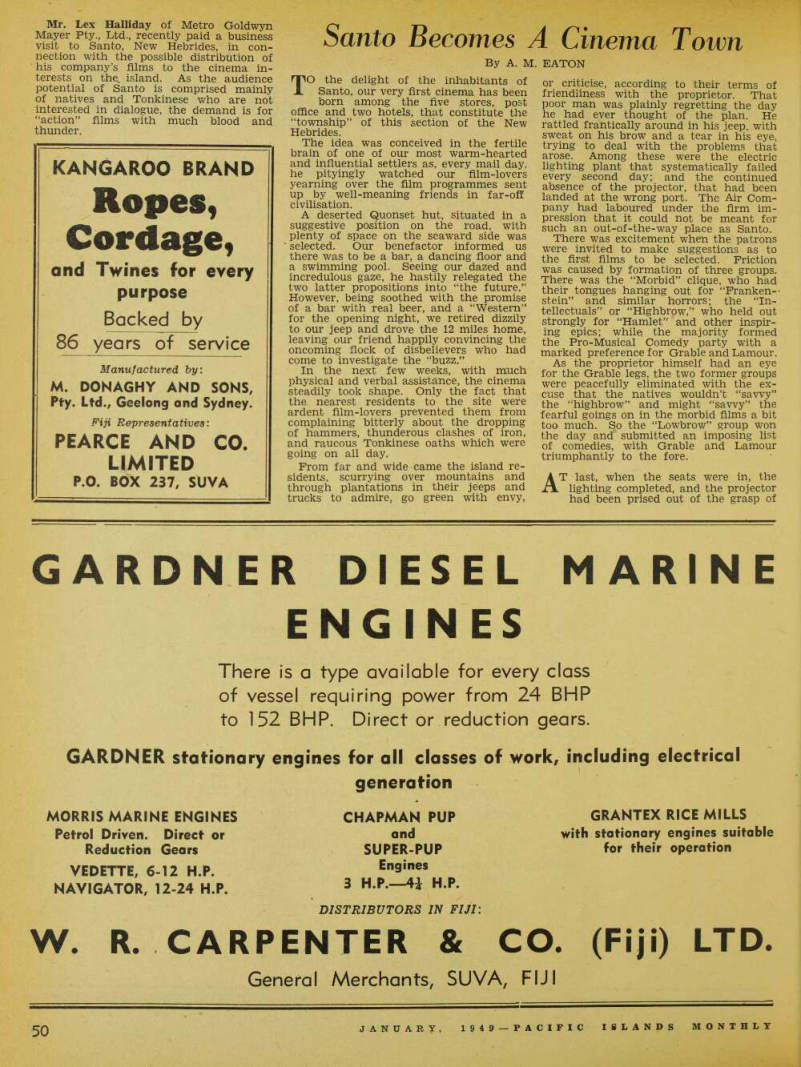
By F.P.A.
YOUR inveterate borrower is much the same in his methods and excuses the world over, and of whatever creed and colour. Wasn’t it Charles Lamb who remarked, “How cheerful of mein is the borrower, how rosy of gills, how careless of money—yours and mine!”
A recent communication from a native, that came under my notice, shows how our natives are progressing in this Edwardian era. This particular native was formerly a store boy for me, but now holds a fairly well-paid Administra tion job. He was explaining to a friend why he could not send along the few pounds that he owed him. He said he had been trying various games of chance in the hope of raising the wind, but, in fol lowing out his theories he had lost all his own and his friend’s money. He could not go into details because it “was private too much.”
He invited sympathy and forebearance because he had lost much sleep and did not enjoy his leisure hours owing to the amount of thought and concentration he was giving to a new idea for “catching plenty money.” If he was successful he would repay the loan twice over. He said that I was aware of the big dividends that would accrue if he were successful in striking oil and suggested that I be consulted about it.t There was a note for me pinned to the letter, and addressed in the same manner as the cargo that used to come to the plantation store: 3. 6. 48.
F.P.A. —BUKA. . . I will be very glad if you can let me know the address of the Melbourne, Victoria, London and New Zealand Golden Caskets, please!
Yours truly,
J.H.O.
PS.—I got the address of Tasmania, but I want all the others.
I replied that gambling of any sort was not a good thing and recommended the uninteresting procedure of living within his means, together with the slow pro cess of building up a Savings Bank bal ance! However, if he was determined to have a flutter he might try the Brisbane Golden Casket. Should that not offer sufficient attractions there was. of course, the Irish Sweep and the Calcutta Sweep, the winning of either of which would cer tainly mean “catching plenty money.” I now await his reaction to my letter and am expecting a request for more infor mation about the two big sweeps!
Mr. Lex Halliday of Metro Goldwyn Mayer Pty., Ltd., recently paid a business visit to Santo, New Hebrides, in con nection with the possible distribution of his company’s films to the cinema in terests on the. island. As the audience potential of Santo is comprised mainly of natives and Tonkinese who are not interested in dialogue, the demand is for “action” films with much blood and thunder.
Advertisements & other items, pp. 55-56 (2 items)
49
PACIFIC ISLANDS MONTHLY— J A N U A R Y . 1940
Burns Philp (New Guinea) Limited
General Merchants (Wholesale and Retail)
Shipping, Customs and General Agents
Head Office: PORT MORESBY, PAPUA
BRANCHES:
NEW GUINEA: Rabaul, Kokopo, L.ae Gr Madang.
PAPUA: Samarai.
QUEENSLAND INSURANCE CO. LTD.
LLOYDS OF LONDON
BURNS PHILP TRUST CO. LTD.
BURNS, PHILP & CO. LTD.
All States.
BURNS, PHILP & CO. LTD.
"London House", 35 Crutched Friars, E.C.3.
BURNS, PHILP CO. OF SAN FRANCISCO INC. 510 Matson Building.
Distributing Agents, Territory of Papua-New Guinea for:
SHELL COMPANY OF AUSTRALIA LIMITED
Petroleum Products
GENERAL MOTORS CORPORATION
Chevrolet, Buick, Pontiac and Oldsmobile Cars Chevrolet and GMC Trucks Frigidaire Refrigerators
VAUXHALL MOTORS LIMITED
Vauxhall Cars and Bedford Trucks
R. A. LISTER & CO., BRISTOL
Producers of Petrol, Parrafin and Diesel Engines Pumps and Lighting plants
RUSTON HORNSBY LIMITED
Engines
CROSSLEY MARINE ENGINES
REPRESENTATIVES FOR:
AUSTRALIAN AGENTS:
LONDON AGENTS:
SAN FRANCISCO AGENTS:
KANGAROO BRAND
Ropes,
Cordage,
and Twines for every purpose Backed by 86 jyears of service Manufactured by:
M. DONAGHY AND SONS,
Pty. Ltd., Geelong and Sydney.
Fiji Representatives :
PEARCE AND CO.
LIMITED
P.O. BOX 237, SUVA
GARDNER DIESEL MARINE
ENGINES
There is a type available for every class of vessel requiring power from 24 BHP to 152 BHP. Direct or reduction gears.
GARDNER stationary engines for all classes of work, including
generation
eiecrncai
MORRIS MARINE ENGINES
Petrol Driven. Direct or Reduction Gears
VEDETTE, 6-12 H.P.
NAVIGATOR, 12-24 H.P.
CHAPMAN PUP
and
SUPER-PUP
Engines
3 H.P.—4i H.P.
DISTRIBUTORS IN FIJI:
GRANTEX RICE MILLS
with stationary engines suitable for their operation
W. R. CARPENTER & CO. (Fiji)
General Merchants, SUVA, FIJI
LTD
Santo Becomes A Cinema Town
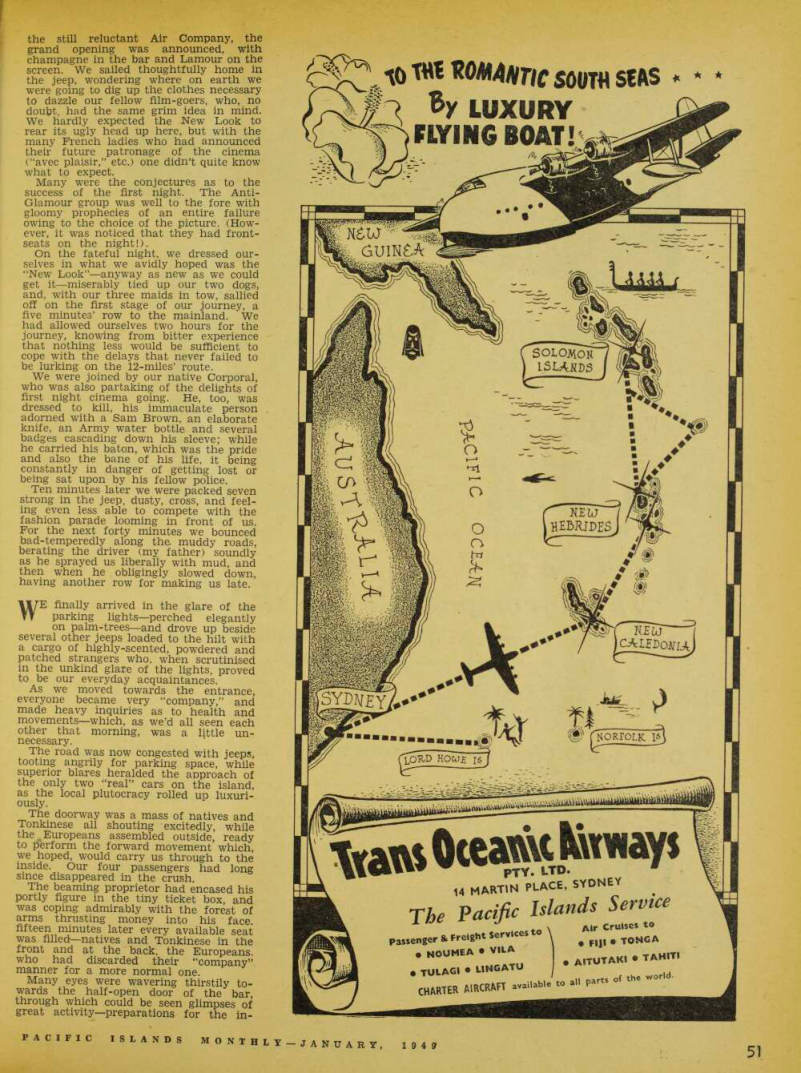

By A. M. Eaton
TO the delight of the inhabitants of Santo, our very first cinema has been born among the five stores, post office and two hotels, that constitute the “township” of this section of the New Hebrides.
The idea was conceived in the fertile brain of one of our most warm-hearted and influential settlers as, every mail day, he pityingly watched our film-lovers yearning over the film programmes sent up by well-meaning friends in far-off civilisation.
A deserted Quonset hut, situated in a suggestive position on the road, with plenty of space on the seaward side was ' selected. Our benefactor informed us there was to be a bar, a dancing floor and a swimming pool. Seeing our dazed and incredulous gaze, he hastily relegated the two latter propositions into “the future.”
However, being soothed with the promise of a bar with real beer, and a “Western” for the opening night, we retired dizzily to our jeep and drove the 12 miles home, leaving our friend happily convincing the oncoming flock of disbelievers who had come to investigate the “buzz.”
In the next few weeks, with much physical and verbal assistance, the cinema steadily took shape. Only the fact that the nearest residents to the site were ardent film-lovers prevented them from complaining bitterly about the dropping of hammers, thunderous clashes of iron, and raucous Tonkinese oaths which were going on all day.
From far and wide came the island re sidents, scurrying over mountains and through plantations in their jeeps and trucks to admire, go green with envy,
or criticise according to their term* of friendliness with the proprietor That poor man was plainly regretting the dav he had ever thought of the llan He rattled frantically around in his*jeep, wfih sweat on his brow and a tear in his eye, trying to deal with the problems that arose. Among these were the electric lighting plant that systematically failed every second day; and the continued absence of the projector, that had been landed at the wrong port. The Air Com pany had laboured under the firm im pression that it could not be meant for such an out-of-the-way place as Santo.
There was excitement when the patrons were invited to make suggestions as to the first films to be selected. Friction was caused by formation of three groups, Ther e was the “Morbid” clique, who had their tongues hanging out for “Franken stein” and similar horrors; the “In tellectuals” or “Highbrow,” who held out strongly for “Hamlet” and other inspir ing epics; while the majority formed the Pro-Musical Comedy party with a marked preference for Grable and Lamour.
As the proprietor himself had an eye for the Grable legs, the two former groups were peacefully eliminated with the ex- C use that the natives wouldn’t “savvy” the “highbrow” and might “savvy” the fearful goings on in the morbid films a bit too muc h. So the “Lowbrow” group won the ay and submitted an imposing list of comedies, with Grable and Lamour triumphantly to the fore.
AT last, when the seats were in, the lighting completed, and the projector had been prised out of the grasp of
the still reluctant Air Company, the grand opening was announced, with champagne in the bar and Lamour on the screen. We sailed thoughtfully home in the jeep, wondering where on earth we were going to dig up the clothes necessary to dazzle our fellow film-goers, who, no doubt, had the same grim idea in mind.
We hardly expected the New Look to rear its ugly head up here, but with the many French ladies who had announced their future patronage of the cinema (“avec plaisir,” etc.) one didn’t quite know what to expect.
Many were the conjectures as to the success of the first night. The Anti- Glamour group was well to the fore with gloomy prophecies of an entire failure owing to the choice of the picture. (How ever, it was noticed that they had front seats on the night!).
On the fateful night, we dressed our selves in what we avidly hoped was the “New Look” —anyway as new as we could get it —miserably tied up our two dogs, and, with our three maids in tow, sallied off on the first stage of our journey, a five minutes’ row to the mainland. We had allowed ourselves two hours for the journey, knowing from bitter experience that nothing less would be sufficient to cope with the delays that never failed to be lurking on the 12-miles’ route.
We were joined by our native Corporal, who was also partaking of the delights of first night cinema going. He, too, was dressed to kill, his immaculate person adorned with a Sam Brown, an elaborate knife, an Army water bottle and several badges cascading down his sleeve; while he carried his baton, which was the pride and also the bane of his life, it being constantly in danger of getting lost or being sat upon by his fellow police.
Ten minutes later we were packed seven strong in the jeep, dusty, cross, and feel ing even less able to compete with the fashion parade looming in front of us.
For the next forty minutes we bounced bad-temperedly along the. muddy roads, berating the driver (my father) soundly as he sprayed us liberally with mud, and then when he obligingly slowed down, having another row for making us late.
WE finally arrived in the glare of the parking lights—perched elegantly on palm-trees—and drove up beside several other jeeps loaded to the hilt with a cargo of highly-scented, powdered and patched strangers who, when scrutinised in the unkind glare of the lights, proved to be our everyday acquaintances.
As we moved towards the entrance, everyone became very “company,” and made heavy inquiries as to health and movements—which, as we’d all seen each other that morning, was a little un necessary.
The road was now congested with jeeps, tooting angrily for parking space, while superior blares heralded the approach of the only two “real” cars on the island, as the local plutocracy rolled up luxuri ously.
The doorway was a mass of natives and Tonkinese all shouting excitedly, while the Europeans assembled outside, ready to perform the forward movement which, we hoped, would carry us through to the inside. Our four passengers had long since disappeared in the crush.
The beaming proprietor had encased his portly figure in the tiny ticket box, and was coping admirably with the forest of arms thrusting money into his face, fifteen minutes later every available seat was filled—natives and Tonkinese in the front and at the back, the Europeans, who had discarded their “company” manner for a more normal one.
Many eyes were wavering thirstily to wards the half-open door of the bar, through which could be seen glimpses of great activity—preparations for the in
terval crush—while an increasing clammi ness of the atmosphere indicated a great thirst would be worked up by that time.
THE lights then went off and the picture commenced—upside-down! This pro duced great hilarity, much to the confusion of the sweating operator, who could be seen tinkering anxiously with the controls in the projection box.
There were four reels to the first half.
Every twenty minutes there was a small interval when the lights were switched on and the film hastily changed. During these periods, the audience wiped their streaming eyes (the lights being rather glary) and smoked cigarettes—carefully glancing away from the notices which said “No Smoking!”
At the interval we packed like sardines into the bar and were served with champagne and beer, and free (first night) hamburgers handed round by the sweating proprietor (who now had donned an apron and was performing the office of barman). This strategic move enabled him to listen in to the comments of the show, and, as these were delivered under the influence of champagne and ham burgers, they were very encouraging.
With a triumphant burst of music from the electric pick-up, the Lamour legs dis appeared finally from the screen and the cinema was over. As we got out into the cool air—vigorously pumping the hand of the exhausted but still beaming pro prietor on the way—we felt mentally and physically satisfied, although the ham burgers were beginning to throw their weight around rather noticeably.
Climbing into our jeeps, we all agreed that it had been a huge success. How satisfactory it was to be able to yell to our friends in the surrounding vehicles, “See you at the show next week!”
Advertisements & other items, pp. 57-58 (2 items)
51
PACIFIC ISLANDS MONTHLY- J A N U A R Y , 1949
\taW OteaxvxcLwways
tO TWt ROMAN SOUTH SCAS
By LUXURY
FLYING BOAT!
★ ★ 3 ; nsw
Is. GUINSA
! <IA<U r
SOLOMOK
ISLAKD3
Pi I^l %^vl I i ii' r I /t / / s 1
NEW
fi
W f NORFOLK 14
LORDHOCV£ IS
& (? a W
\taW OteaxvxcLwways
14 MARTIN PLACE. SYDNEY
Pacific Islands Service Air Cruises to
• FIJI • TONGA
• AITUTAKI • TAHITI
, all parts of the world-
oi tone el_ m . — •] •J * ~» ••
CINEVOX WL
PREFECT a% 5 "
fop all A.C. Supplies and with the addition of a small convertor, for all D.C. Voltages from 110 V to 260 V.
EINEYOX
WASTE R
for battery operation. From 32V Lighting Set or two 12V Heavy Duty car batteries
The incomparable CINEVOX
Australia’s Foremost 16mm Sound-silent Projector
The entirely new, streamlined, light-weight CINEVOX is truly a “theatre-in-a-suitcase.” Projector, amplifier, twin speakers, power unit, all in two compact cases. Simple and easy to operate. No matter where you live you can now enjoy first-class film entertainment—thanks to CINEVOX! Film capacity 2000 ft., illumination 750 watts. Mail the coupon below for illustrated folders and full particulars.
Over 1,000 Cinevox Projectors are in use in Australia r 1 Distributors for Papua, New Guinea, & Pacific Islands J 1 VIZ-ED EQUIPMENT (Q ld) Pty. Ltd.
OLD COURIER BLDG., QUEEN ST., BRISBANE
Please send me FREE and POST FREE complete details of
the CINEVOX PREFECT and MASTER PROJECTORS.
Name Address “p.i.m.” I I I I I
“Merciless Fecundity” Of
Fiji Indians
Letter to the Editor I READ with interest the article by Mr.
Abernethy on the Indian problem in Fiji. I do not know what are his qualifications for discussing this matter.
But I will say at once that when he says that repatriation of the Indians is wishful thinking, and that the only problem— already solved —is the preservation of the Fijian race, he is ignoring the greatest and most dangerous factor —the merciless fecundity of the Indians.
It is a matter of simple arithmetic.
Our census officials believe that the Indians will double themselves in 20 years.
What will the Indian population be in 50 years? And how many Fijians and Euronesians will there be? At the present rate of increase, this small archipelago in a few years will have to accommodate one million people, with an ever-accelfer ating rate of increase. It is enough to make anyone shudder.
It is no less than the duty of the Gov ernment to get the Indians out of here; and only thus can the British honour their trust. So far, the Fijians have trusted the Government blindly. Unless a miracle occurs, they will be sacrificed on the altar of political expediency as surely as were the Czechs at Munich in 1938.
Lautoka. I am, etc..
Sugarlands.
The NZ National Airways Corporation announced on December 2, that to bring fares into line under the International Air Transport Association regulations, the Fiji-New Zealand plane fare had been increased to £NZ3I (£F34/14/5).
Fiji-New Zealand freight rates have been increased to 2/5 (NZ) a pound, with a minimum rate of 5/- (NZ).
Advertisements & other items, pp. 59-60 (2 items)
53
PACIFIC ISLANDS MONTHLY— J A N D A B Y , 19 4?
Gordon's
QUEENSLAND
INSURANCE
COMPANY
LIMITED
(Incorporated 1886 In Australia)
ASSETS EXCEED £5,000,000
Head Office :
QUEENSLAND
INSURANCE BUILDING,
80-82 PITT STREET, SYDNEY.
Speciolists in South Seas Fire,
Marine & Accident Insurances
Apply to:—
FIJI. —Branch Office: I. B. Chalmers, Manager, Burns Phllp (South Sea) Co., Ltd.
VILA. —Burns Philp (South Sea) Co., Ltd.
Comptoirs Francais Des Nouvelles Hebrides (Marine).
NOUMEA.—L. & W. Johnston.
NEW GUlNEA.—Manager for Mandated Territory and Papua, W. A. Anderson.
PORT MORESBY—SAMARAI—LAE
—MADANG—RABAUL.
Burns, Philp (New Guinea), Ltd.
PAGO PAGO.
Burns Philp (South Sea) Co., Ltd.
O. H. O. Reid & Co.
OTHER SOUTH SEA ISLANDS.
Burns Philp (South Sea) Co., Ltd.
Also to any of the Company’s Offices in Australia or Hew Zealand.
By Appointment Gin Distillers
ttf#;
09 m O'fl m iW
Gordon's
Stands Sup’mmji
to H.M. King George VI Tanqueray, Gordon & Co. Lt(L
DON'T SAY G I ]\
IJ I M DON'T SAY
DON'T SAY © 1 M
G-W- y*
1 N DON'T SAY
DON'T SAY GIU
G I N DON'T SAY
DON'T SAY G I N
G v *SBBST‘ T
1 N DON'T SAY
DON'T SAY G I N<
GIN DON'T SAY
DON'T SAY G I N
GIN DON'T SAY
PONT SAY GIN
DON'T SAY GIN
s\vwv <y
I M DON'T SAY
'SSJT *W»A T
DON'T SAY GIM
GIN DON'T SAY
DON'T SAY GIN
DON'T SAY GIN
G SAY
DON'T SAY G I N
G'VXXXX"- WjWS vy
I M DON'T SAY
DON'T SAY G I M
DON'T SAY
M Y m
DON
DC S am * Ll ou *9* e Jb °ur * Co c ***o3 * ycin e y S *!£ S T ish
DON'T
GIM DON'T S
DON'T SAY GIM
DON'T SAY GIM
G SAY
DO G 0
GIM DON'T SAY
AY
SAY
IM
T SAY
DON'T SUPPG I M
DON'T SAY G I M
GIM DON'T SAY
6VVV\V» w»
IM
DON'T SAY
Y
DON'T SAY GIN
GIN DON'T SAY
DON'T SAY GIN
GIN DON'T SAY
DON'T SAY GIM
G r l M DON'T SAY
DON'T SAY G I M
s AY. * N
UQU
Mi lb 0 *r 0 <***> *
C ° C *T.
SAY
*tis S y<i*e * N Br isb
T SAY
IM
DON'T
GIM DON'T
DON'T SAY GIM DON'T
Telegrams and Cables: "GELBEYS,” Melbourne.
Address all inquiries to:
W. & A. GILBEY LTD.
33 ROSSLYN STREET, WEST MELBOURNE. 109 REGENT STREET, SYDNEY.
Telegrams and Cables: “GILBEYS.” Sydney.
In Micronesia
Control Of Insects
CONSIDERABLE entomological work is being done in Micronesia under direc tion of a committee of the Pacific Science Board called the Insect Control Committee for Micronesia. The Pacific Science Board, established by the National Research Council in 1946 to aid scientific investigation in the Pacific and to advise governmental and other agencies on scientific matters pertaining to the Pacific, was the natural organisation to which the Administration of the Trust Territory of the Pacific Islands should refer problems of quarantine and control of insect pests in Micronesia.
In 1946, two entomologists, Dr. Henry K.
Townes and R. G. Oakley, investigated and reported upon insect problems and conditions in the area in connection with the economic survey of Micronesia made under the auspices of the United States Commercial Company.
They found a few major insect pests and a number of minor entomological problems. They recommended the estab lishment of quarantine, both to keep pests of other lands from getting into Micro nesia, and to prevent the spread of those pests already on the islands. And they proposed an insect survey of various island groups as a basis for a wider know ledge of the insects of the region.
Informal discussion between Admiral Louis E. Denfeld, then High Commis sioner for the Trust Territory, and Harold J. Coolidge, Executive Secretary of the Pacific Science Board, regarding ways and means of investigating insect problems in Micronesia, followed in May, 1947, by an official request for assistance by the Chief of Naval Operations to the National Research Council, led to the appointment of the Insect Control Committee for Micronesia in July, 1947. The Committee consisted of C. E. Pemberton, entomologist, Hawaiian Sugar Planters’ Association, Honolulu, chairman; Professor Harry S.
Smith, head Division of Biological Con trol, University of California, Riverside; C. P. Clausen, chief, Division of Foreign Parasite Introduction, Bureau of En tomology and Plant Quarantine, US De partment of Agriculture, Washington; and the entomologist on the staff of the Deputy High Commissioner. Trust Ter ritory, Guam, Elwood C, Zimmerman, of the staff of the Hawaiian Sugar Planters’
Association and Bernice P. Bishop Museum, Honolulu, and Dr. Joseph C.
Bequaert, curator of insects. Museum of Comparative Zoology, Harvard University, were appointed consultants.
The initial meeting of the Committee was held in Honolulu, September 30 to October 2, 1947.
Daniel B, Langford, who had been the
entomologist with the US Commercial Company, was appointed staff entomologist for the Trust Territory. He continued to investigate insect pests and to carry out control measures as recommended by the Committee. Kenneth L. Maehler, on loan
THIS is part of an article, by Dr. E, H.
Bryan, in “Far Eastern Survey,” of October 6, 1948. Dr. Bryan, a research geographer, was until recently Honolulu Officer of the Pacific Science Board. From January, 1946, until May, 1947, he was in charge of the Research Section of the Economic Survey of Micronesia conducted by the United States Commercial Company.
The article is of interest to landowners in the South Pacific; and it shows how the Americans already are dealing with their new Trust Territory of Micronesia (Caroline, Marshall and Mariana Islands).
from the Honolulu office of the Bureau of Entomology and Plant Quarantine, was appointed quarantine officer, with head quarters at Guam. He undertook the_ task of drawing up quarantine regulations, based on the recommendations of the Committee, and of co-ordinating the work of various agencies in carrying out their enforcement.
FIVE field associates in entomology of the Pacific Science Board were sent into the field.
Theodore R. Gardner, on loan from the Bureau of Entomology and Plant Quaran tine, spent one month in the Palau Islands, surveying the damage done to coconut palms by the rhinoceros beetle, Oryctes rhinoceros.
Dr. W. Harry Lange, on loan from the Agricultural Experiment Station, Uni versity of California (Davis), proceeded to Saipan, Tinian, and Rota Islands in the Marianas, where he studied the Mariana coconut beetle, Brontispa mariana, which damages the leaves of coconut palms, and the giant African snail, Achatina fulica, a general plant feeder.
These two scientists then visited the Philippines, Siam, and Malaya in search of natural enemies of the two coconut pests. Conditions in the Philippines pre vented extensive search there; but a large species of Scolia wasp was found in Malaya and nearly 100 of them were transported to Palau as parasites of rhino ceros beetle grubs; and some tiny wasps were procured in Malaya and Java and released in Saipan to parasitise the leaf beetle there.
Henry S. Dybas, on loan from the Chicago Natural History Museum, made a systematic survey and collection of in sects in the Palau Islands, from November, 1947, to February, 1948, and on Ponape Island during the next month. The more than 40,000 specimens which he procured have been pronounced by experts to be the finest collection of insects and their relatives to come out of these two Micro nesian regions.
Meanwhile, Dr, P. X. Williams, associate entomologist with the Hawaiian Sugar Planters’ Association, proceeded to East Africa to study the giant African snail in its native land, and to attempt to find natural enemies to control it. He travelled extensively in Kenya, Uganda, Tanganyika and Zanzibar, finding and
studying a few parasites and predators of the snails. Some of these were trans ported to Honolulu, where they are being studied in quarantine.
Also in East Africa, both he and Harold Compere (who was there on a mission for the Division of Biological Control of the University of California) procured large Scolia wasps to serve as natural enemies of the rhinoceros beetle in Palau.
Five lots of adult wasps and one shipment of parasitised pupae of the beetle were sent by air freight, but mortality was high because of the length of the trip and the freezing weather encountered en route. Despite all this, a considerable number of wasps reached Palau alive and were liberated in coconut groves.
Dr. Williams finally accompanied two cages of wasps by air from Zanzibar to Palau, where he supervised the release of more than fifty female wasps, which it is hoped will lay their eggs on rhinoceros beetle grubs.
A second meeting of the Insect Control Committee for Micronesia was held in Honolulu on April 16, 1948, to review these accomplishments and to plan and recom mend future activities.
In July, 1948, Dr. Richard L. Doutt, on loan from the Division of Biological Con trol of the University of California (Albany), went to Saipan to investigate the status* of the natural enemies of the Mariana coconut beetle. He also planned to seek additional parasites for this beetle.
Advertisements & other items, pp. 61-62 (1 item)
Cordage and
We Will Buy
It For You
Any goods you may require from English shops or factories Purchased and Shipped.
Small or large orders catered for.
ALL SERVICES UNDER-
TAKEN FOR RESIDENTS
ABROAD.
PITT Cr SCOTT
LIMITED
(Established 1876) General Shipping and Buying Agents. 1/3, St. Foul's Churchyard, London, England Cables. Shipping London.
Scott's “Renown” Brand Rope,
Cordage and
Binder
Twine
of Every
Description
Cable Address Ropeyard, Sydney. - £ 9
MANUFACTURED AT
MASCOT, N.S.W.
J. SCOTT
PTY. LTD.
Head Office and Store
163 CLARENCE STREET,
SYDNEY,
N.S.W.
KWONG CHONG BROTHERS
General Merchants and Planters
Have now re-established their business on their original pre-war site, and are carrying stocks of Trading and Plantation requirements. All enquiries welcomed and service assured.
Sydney Representatives:
NELSON & ROBERTSON PTY., LTD.,
Electra House, 12 Spring Street, Sydney, N.S.W.
KWONG CHONG BROTHERS
KEMARERE STREET, RABAUL
Allen Taylor & Co. Ltd.
COMMERCIAL ROAD, ROZELLE,
SYDNEY
Sawmillers ond Wholesale Suppliers of Hardwoods for Constructional Purposes GIRDERS . . . PILES . , . POLES . . . SLEEPERS, Etc.
EXPORTING TO PACIFIC ISLANDS SINCE 1893
STEAMSHIPS TRADING COMPANY LTD.
PORT MORESBY AND SAMARA) PAPUA
Wholesale & Retail Merchants , Planters , Sawmillers, Engineers , Slip Proprietors , Shipping , Customs and Insurance Agents.
MANAGING AGENTS for:
SAWMILLERS & TRADERS LTD.
CORAL SEAS INSURANCE CO. LTD.
ACME BAKERY COMPANY.
MARIBOI RUBBER LTD.
RUBBERLANDS LTD.
KEREMA RUBBER PLANTATIONS LTD.
COCOALANDS LTD.
AGENCIES:
BANKERS & TRADERS INSURANCE CO. LTD.
VACUUM OIL CO. PTY., LTD.
DIRECTORATE OF SHIPPING—Papua—New
Guinea Division.
ROYAL PACKET NAVIGATION CO.
KOKE BAGU PTY. f LTD.
TRANS OCEANIC AIRWAYS.
GUINEA AIR TRADERS.
DISTRIBUTORS IN PAPUA for:
ARMSTRONG-HOLLAND PTY., LTD. INTERNATIONAL HARVESTER CO. OP AUST. LTD.
Earth Moving and Logging Equipment. International Trucks, WILLYS-OVERLAND EXPORT CORPORATION. McCormack Deering Farming Machinery, Jeep cars, epc. Defender Refrigerators.
SYDNEY AGENTS: NELSON & ROBERTSON PTY. LTD., 12 SPRING STREET
Banks Islands
Weather Station For The
Santo, Dec 1.
OFFICER-IN-CHARGE of meteorologi cal services for the South Pacific Air Transport Council in the New Hebrides, Mr. W. Roberts, recently passed through Santo on his way to the Banks Group to establish a weather station at Vanua-lava.
The new station will be under the auspices of the SPATC and will be the last of the net-work of four planned and built by the Council to cover the New Hebrides and adjacent spheres.
The three remaining stations of the New Hebrides net-work are at Vila, Erramango and Aneityum.
Father Glovers Death
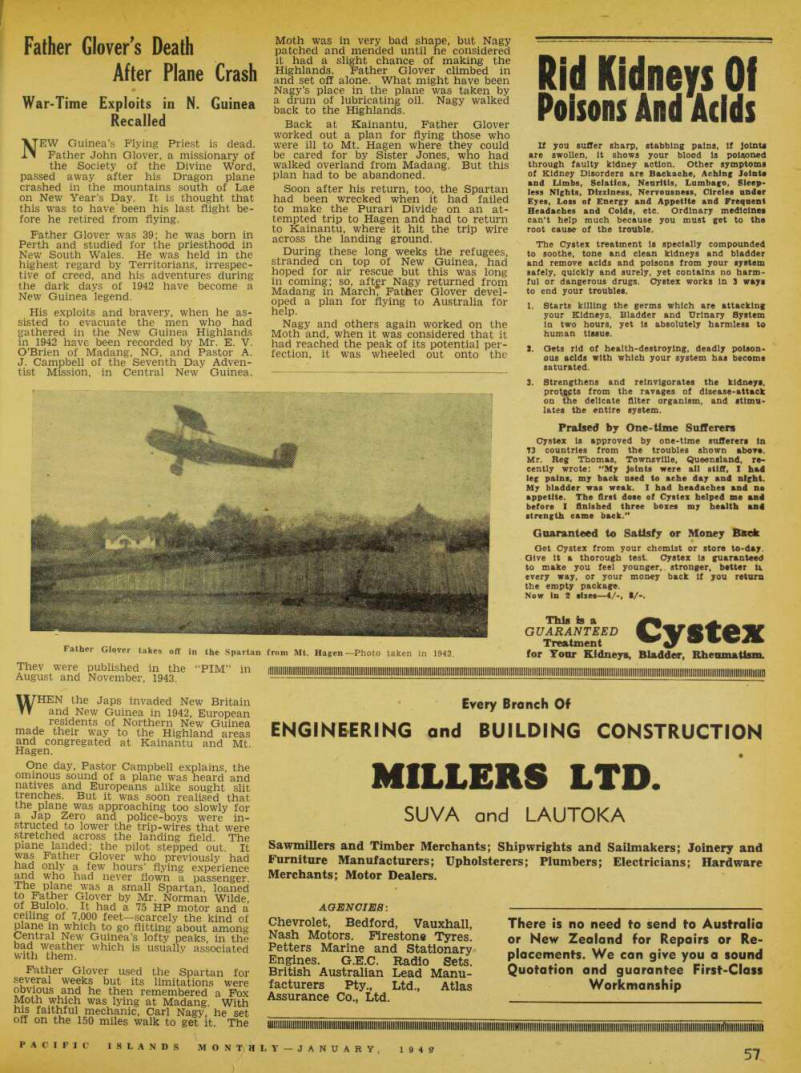
After Plane Crash War-Time Exploits in N. Guinea Recalled
NEW Guinea’s Flying Priest is dead.
Father John Glover, a missionary of the Society of the Divine Word, passed away after his Dragon plane crashed in the mountains south of Lae on New Year’s Day. It is thought that this was to have been his last flight be fore he retired from flying.
Father Glover was 39; he was born in Perth and studied for the priesthood in New South Wales. He was held in the highest regard by Territorians, irrespec tive of creed, and his adventures during the dark days of 1942 have become a New Guinea legend.
His exploits and bravery, when he as sisted to evacuate the men who had gathered in the New Guinea Highlands in 1942 have been recorded by Mr. E. V.
O’Brien of Madang, NG, and Pastor A.
J. Campbell of the Seventh Day Adven tist Mission, in Central New Guinea.
They were published in the “PIM” in August and November, 1943.
WHEN the Japs invaded New Britain and New Guinea in 1942, European residents of Northern New Guinea made their way to the Highland areas and congregated at Kainantu and Mt.
Hagen.
One day, Pastor Campbell explains, the ominous sound of a plane was heard and natives and Europeans alike sought slit trenches. But it was soon realised that the plane was approaching too slowly for a Jap Zero and police-boys were in structed to lower the trip-wires that were stretched across the landing field. The piane landed; the pilot stepped out. It was Father Glover who previously had had only a few hours’ flying experience and who had never flown a passenger.
The plane was a small Spartan, loaned to Father Glover by Mr. Norman Wilde of Bulolo. It had a 75 HP motor and a ceiling of 7,000 feet—scarcely the kind of plane in which to go flitting about among Central New Guinea’s lofty peaks, in the bad weather which is usually associated with them.
Father Glover used the Spartan for several weeks but its limitations were obvious and he then remembered a Fox Moth which was lying at Madang. With his faithful mechanic, Carl Nagy, he set off on the 150 miles walk to get it. The
Moth was in very bad shape, but Nagy patched and mended until he considered it had a slight chance of making the Highlands. Father Glover climbed in and set off alone. What might have been Nagy’s place in the plane was taken by a drum of lubricating oil. Nagy walked back to the Highlands.
Back at Kainantu, Father Glover worked out a plan for flying those who were ill to Mt. Hagen where they could be cared for by Sister Jones, who had walked overland from Madang. But this plan had to be abandoned.
Soon after his return, too, the Spartan had been wrecked when it had failed to make the Purari Divide on an at tempted trip to Hagen and had to return to Kainantu, where it hit the trip wire across the landing ground.
During these long weeks the refugees, stranded on top of New Guinea, had hoped for air rescue but this was long in coming; so, aftgr Nagy returned from Madang in March, Father Glover devel oped a plan for flying to Australia for help.
Nagy and others again worked on the Moth and, when it was considered that it had reached the peak of its potential per fection, it was wheeled out onto the
Father Glover takes off in the Spartan from Mt. Hagen—Photo taken in 1942.
drome and pilot and mechanic climbed aboard. The first attempt to take off for Hagen failed, and a drum of lubricating oil and all personal gear had to be left behind. But on the second attempt the plane rose sufficiently to clear the moun tains, and they reached Hagen.
Here, according to Mr. O’Brien, they took on extra petrol, which Nagy nursed on his knee, in a covered lavatory pan,
and fed to the engine with an enema; and on March 28, they were ready for their brazen attempt to reach Australia.
Father Glover had no knowledge of navigation: the Moth had no instruments.
He put his faith in God and a coloured map out of a school atlas. He calculated that he would fly 150 miles due south until he saw the Papuan coast, then south-west along the coast until he picked up the Fly River and Daru and then 100 miles across the Torres Strait to Thursday Island. The take-off from Hagen was accomplished and so was the climb across the central mountains; but, as so often happens, the coast of Papua was shrouded in thick rain. He flew out over the sea for some time but when petrol was getting dangerously low he turned back and about six that evening landed on an unknown beach. They learned afterwards that they had come down near the Dutch Border.
Next morning Nagy was ill with malaria but the indomitable priest began scouring the district and finally found a village where he persuaded the natives to take him and Carl Nagy in an outrigger canoe across Torres Strait to Thursday Island. They were two days in the canoe before being picked up by a lugger.
Once in Australia, Father Glovet was extremely busy. For once the authorities listened and an organisation was created for the rescue of the people who were stranded in the Highlands. They put Father Glover in charge of the operation with the rank of Captain, and gave him all facilities.
In May, the refugees on the Tablelands were told that they might soon expect rescue by air and bn May 13, 1942, a large plane came out of the clouds and landed on Hagen drome. Soon after a second plane appeared. The evacuation was completed without incident.
Advertisements & other items, pp. 63-64 (1 item)
Rid Kidneys Of
Poisons And Adds
If you suffer sharp, stabbing pains, If Joints are swollen, It shows your blood Is poisoned through faulty kidney action. Other symptoms of Kidney Disorders are Backache, Aching Joints and Limbs, Sciatica, Neuritis, Lumbago, Sleepless Nights, Dizziness, Nervousness, Circles under Eyes, Loss of Energy and Appetite and Frequent Headaches and Colds, etc. Ordinary medicines can’t help much because you must get to the root cause of the trouble.
The Cystex treatment is specially compounded to soothe, tone and clean kidneys and bladder and remove acids and poisons from your system safely, quickly and surely, yet contains no harmful or dangerous drugs. Cystex works In 3 ways to end your troubles. 1. Starts killing the germs which are attacking your Kidneys, Bladder and Urinary System In two hours, yet Is absolutely harmless to human tissue. 3. Gets rid of health-destroying, deadly poisonous acids with which your system has become saturated. 3. Strengthens and reinvigorates the kidneys, protects from the ravages of disease-attack on the delicate filter organism, and stimulates the entire system.
Praised by One-time Sufferers
Cystex Is approved by one-time sufferers in 73 countries from the troubles shown abort.
Mr. Reg Thomas, Townsville, Queensland, recently wrote: “My Joints were all stiff, I had leg pains, my back used to ache day and night.
My bladder was weak. I had headaches and no appetite. The first dose of Cystex helped me and before I finished three boxes my health and strength came back.”
Guaranteed to Satisfy or Money Back Get Cystex from your chemist or store to-day.
Give It a thorough test. Cystex Is guaranteed to make you feel younger, stronger, better U every way, or your money back If you return the empty package.
Now In 2 sizes—4/-, I/-.
GUARANTEED fjtfgfPV
Treatment for Your Kidneys, Bladder, Rheumatism.
Every Branch Of
ENGINEERING and BUILDING CONSTRUCTION
MILLERS LTD.
SUVA and LAUTOKA
Sawmillers and Timber Merchants; Shipwrights and Sailmakers; Joinery and Furniture Manufacturers; Upholsterers; Plumbers; Electricians; Hardware Merchants; Motor Dealers.
AGENCIES :
Chevrolet, Bedford, Vauxhall, Nash Motors. Firestone Tyres.
Fetters Marine and Stationary Engines. G.E.C. Radio Sets.
British Australian Lead Manufacturers Pty., Ltd., Atlas Assurance Co., Ltd.
There is no need to send to Australia or New Zealand for Repairs or Replacements. We can give you a sound Quotation and guarantee First-Class Workmanship
Aerial Photographs
Up to date aerial views, 10 x 8 inches. 6/6 (N.Z.) each, posted. Coloured enlargements also available. Send for price list.
Photographs available for reproduction on payment of special fee.
PACIFIC ISLANDS—Lord Howe, Norfolk, Kermadecs, Fiji, Tonga, Samoa, Aitutaki, Rarotonga, Noumea, New Guinea (Australian), New Britain, New Ireland, New Hanover, Admiralty Islands.
AUSTRALIA—Sydney, Brisbane, Bowen, Rockhampton, Townsville, Cairns, Darwin, Daly Waters, Cloncurry, Camooweal, Charleville.
NEW ZEALAND—Every city and town of note. Scenic resorts, harbours, mountains, glaciers, etc.
Whites Aviation Limited
“The Air Travel Specialists,”
DILWORTH BUILDING, AUCKLAND,
C. 1., N.Z.
Ring 41-669 —Cable Whiteair—Write Box 2040.
BOOKING AGENTS FOR ALL PRINCIPAL
AIRLINES.
Flood your home with brilliant light!
I Imagine it just flick a switch and on comes a flood of electric light. How the children and Mother will delight in this new pleasure which every home needs to be really restful and cheery!
With the Amplite Electric Lighting Unit, you can serve every room, and outhouses, grounds, garage— with pulsing current —even run a vacuum cleaner!
We would like you to have our buy.
Manufactured by-
aMPUOh
Australasia Pty. Ltd.
• SOME QUICK FACTS
ABOUT THIS GREAT UNIT
• Light in weight. Plant weighs only 70 lbs. • Runs for 8-10 hours on one gallon of petrol. • Air-cooled, 4 cycle engine. • Run a few hours per week, will keep your batteries charged. • Electrical self-starting. No cranking of engine.
YOU'LL FIND IT
FASCINATING
READING
Messrs. AMPLION (A/ASIA) PTY., LTD.,
36-40 Parramatta Road, Camperdown, N.S.W.
Dear Sirs: Please let me have your illustrated Electric Lighting Unit brochure. Publication APC7C.
Name Address
“PEW,” 9/47.
Father Glover—A Tribute
Mr. Reginald Johnstone Of
Madang has written us: I have been a close friend of Father Glover since 1946, He was a priest, a missionary and a man. As a priest he lived up to the highest ideals of his vocation, ever-willing to listen to those in trouble and give friendly advice.
As a missionary he was responsible for flying in to the Catholic Highland mission stations all supplies. He was their life line. He gave all his time and strength to it—often making three trips a day.
As a man he was a friend to all. He did not ask a man’s religion and he pos sessed the greatest of all virtues—charity.
He spoke ill of none and visited all classes, always taking with him some gift.
His memory will remain to become a legend. It was his desire to give his life for his mission and to bring happiness to his fellow-men. He has attained both desires.
Port Moresby Wedding
IN Port Moresby recently Miss Joan Heape, second daughter of Mr. Ben Heape (PM) and Mrs. Gladys Mor ton (Sydney) was married to Mr. Bernard Grant, third son of Lady Elizabeth Grant and the late Lieut.-Col. Sir Herbert Grant, of Julia Creek, N. Queensland.
Matron of Honour was Mrs. Des Large, and the bridesmaids were Misses Margaret and Judy Heape. The Ela Protestant Church was beautifully decorated for the ceremony by the local Girl Guides. The bride’s mother flew from Sydney to at tend the wedding.
Where To Go For Three
Million Bottles Of Beer
rnHIS is the sort of rubbish which some JL newspapers publish in the “silly season” —the Christmas, or near- Christmas holidays—when there is little news. The following appeared in an Australian evening newspaper:
Wellington, (Nz), Wed.—The
New Zealand Government steamer “Matai” is back from a Pacific salvage search with tons of treasure—not gold, but steel, which is almost as hard to come by in this country.
At Canton Island, the largest coral atoll in the world, there are enough timber stacks to build 10,000 homes.
Blistering on the equator the timber is 4,000 miles from any market. And there are also stacks of beer, 240,000 dozen bottles, but useless now after so much sun.
From one Pacific dump, almost swallowed by Solomons Islands jungle, 10,000 drums of high-octane aviation spirit were recovered earlier this year; but steel is far more valuable.
Reinforcing rod, steel huts, hanger sheeting, bridging steels and piping were the “Matai’s” best finds.
Anyone who needs steel runway mesh badly enough to think of wresting it from the jungle grip will find acres of it on these Pacific isles.
The “Matai” will be back for more steel in the New Year, carrying more men for bigger and quicker results.
Canton is far from being the largest itoll. Enough timber to build 10,000 acmes would just about sink Canton island; and, even if it were as large as
represented, it is doubtful if there would be room upon it for 2,880,000 bottles of beer, besides an international airport.
There is a lot of war-time salvage in the Islands, awaiting recovery; but the figures quoted should be taken with more than a grain of salt.
Fiji’S War Debt To Nz
IT was suggested in November “PIM” that Fiji was caught napping when New Zealand suddenly moved her currency exchange to par with Sterling.
Fiji owes New Zealand some £500,000, in connection with war settlements; and it was feared that, instead of Fiji paying this in the old NZ currency (25 per cent under sterling) it would have to be paid at the new rate—a difference to Fiji of over £lOO,OOO.
The Fiji Finance Secretary, Mr. Taylor, made a quick visit to New Zealand im mediately after NZ announced her currency change.
Mr. Taylor has reported, however, that the settlement he arranged was wholly in Fiji currency and was quite indepen dent of NZ’s exchange rate. The debt is to be paid in ten annual instalments of £50,000 —all in Fiji currency.
All of which seems satisfactory. Yet one cannot help wondering whether, if the half-million had been tendered to NZ a year ago in NZ currency. NZ would not have accepted it happily in NZ currency—which would have saved Fiji about £62,000. However, some of the world’s shrewdest financiers have been caught cold by sudden unexpected dips in exchange.
Miss Barbara Ramjan, who went from Suva to India three years ago, was a member of the staff of the Indian delegation to the ECAFE Conference in Australia in December. She was selected because of her knowledge of English and her expert stenography. The news papers commented on her “attractive personality”, and one published her photograph as “the* Pin-up girl of
Ecafe”.
Advertisements & other items, pp. 65-66 (1 item)
Nelson & Robertson Zl:
If You
Cannot Sleep
FEEL FIT FOR NOTHING.
You may be anaemic or bloodless, for this ailment plays havoc with your health and nervous energy. You feel terribly nervy; suffer headaches and dizzy spells, have poor appetite, cannot sleep at night —losing those precious hours of rest and recovery, essential for your health and fitness.
Many people have recovered from these miseries by taking Dr, Williams’ Pink Pills, which have reinvigorated, strengthened their systems and banished the vague pains and weariness. Dr. Williams’ Pink Pills always help to enrich and Increase the blood supply, giving beneficial help to the nerves, tissues and organs of the body. With enriched blood you cannot help feeling happier, sleeping better, becoming reinvigorated.
Stop anaemia making you a suffering invalid without delay. Take Dr. Williams’
Pink Pills and soon notice the difference in your eyes, skin, nerves and general health. At all chemists and stores.
NELSON and ROBERTSON Pfy. Ltd.
Estoblished 1895
Shipowners - Brokers and
Islands Merchants
AM , flosses merchandise purchased at Best Wholesale Prices. Original Invoices supplied to Island Clients. Cocoa Beans, Copra, Rubber, Trochus Shell and All Islands' Produce Sold on Commission.
Entrust your requirement* to the firm with fifty year*' practical experience in the Pacific Islands.
Sole Agents :
SKANDIA DIESEL ENGINES
ARCHIMEDES MOTORS
Prompt attention given to all enquiries.
NELSON & ROBERTSON Zl:
12 SPRING STREET, SYDNEY, AUSTRALIA
Telegraphic Address: IVAN, SYDNEY.
OVERSEA INDENTS
ARRANGED FOR
CLIENTS.
REPRESENTED IN
ALL PARTS OF
THE WORLD.
A.n ornate example of historical
keys, this XVlth Century
French key features the sporting motif in its club and animal carvings. It seems to have been the key to a Duke’s country
lodge.
n -~£s e ■i 1 in i fr?- 35=-^ wm A
The key
to smoking pleasure
APSTAN
FINE CUT
NAVY CUT
TOBACCOS
or
Alternatives Before The Fijians
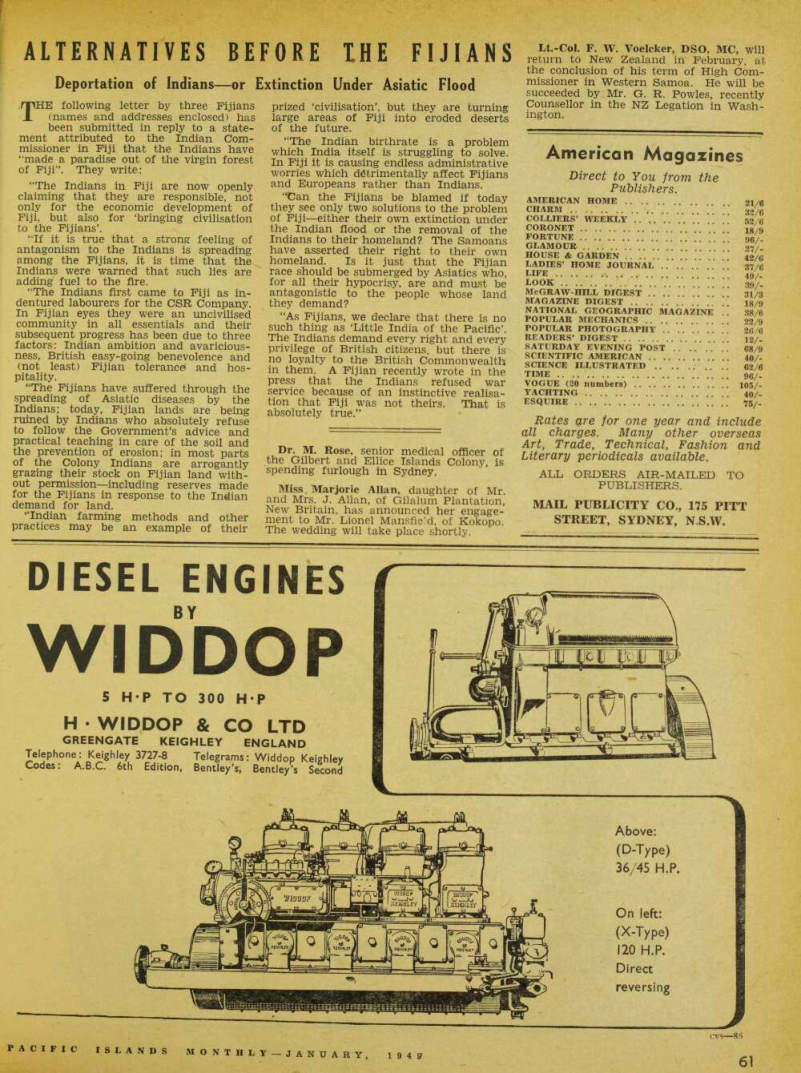
Deportation of Indians—or Extinction Under Asiatic Flood
THE following letter by three Fijians (names and addresses enclosed) has been submitted in reply to a state ment attributed to the Indian Com missioner in Fiji that the Indians have “made a paradise out of the virgin forest of Fiji”. They write: “The Indians in Fiji are now openly claiming that they are responsible, not only for the economic development of Fiji, but also for ‘bringing civilisation to the Fijians’, “If it is true that a strong feeling of antagonism to the Indians is spreading among the Fijians, it is time that the Indians were warned that such lies are adding fuel to the fire.
“The Indians first came to Fiji as in dentured labourers for the CSR Company.
In Fijian eyes they were an uncivilised community in all essentials and their subsequent progress has been due to three factors: Indian ambition and avaricious ness, British easy-going benevolence and (not least) Fijian tolerance* and hos pitality.
“The Fijians have suffered through the spreading of Asiatic diseases by the Indians; today, Fijian lands are being ruined by Indians who absolutely refuse to follow the Government’s advice and practical teaching in care of the soil and the prevention of erosion; in most parts of the Colony Indians are arrogantly grazing their stock on Fijian land with out permission—including reserves made for the Fijians in response to the Indian demand for land.
“Indian farming methods and other practices may be an example of their
prized ‘civilisation’, but they are turning large areas of Fiji into eroded deserts of the future.
“The Indian birthrate is a problem which India itself is struggling to solve.
In Fiji it is causing endless administrative worries which detrimentally affect Fijians and Europeans rather than Indians.
“Can the Fijians be blamed if today they see only two solutions to the problem of Fiji—either their own extinction under the Indian flood or the removal of the Indians to their homeland? The Samoans have asserted their right to their own homeland. Is it just that the Fijian race should be submerged by Asiatics who, for all their hypocrisy, are and must be antagonistic to the people whose land they demand?
“As Fijians, we declare that there is no such thing as ‘Little India of the Pacific’.
The Indians demand every right and every privilege of British citizens, but there is no loyalty to the British Commonwealth in them. A Fijian recently wrote in the press that the Indians refused war service because of an instinctive realisa tion that Fiji was not theirs. That is absolutely true.”
Dr. M. Rose, senior medical officer of the Gilbert and Ellice Islands Colony, is spending furlough in Sydney.
Miss .Mar jorie Allan, daughter of Mr. and Mrs. J. Allan, of Gilalum Plantation, New Britain, has announced her engage ment to Mr. Lionel Mansfie’d. of Kokopo.
The wedding will take place shortly.
Lt.-Col. F. W. Voelcker, DSO, MC, will return to New Zealand in February, at the conclusion of his term of High Com missioner in Western Samoa. He will be succeeded by Mr. G. R. Powles, recently Counsellor in the NZ Legation in Wash ington.
Advertisements & other items, p. 67 (1 item)
Widdop
ħŕ
DIESEL ENGINES
5 H P TO 300 H P
H • WIDDOP & CO LTD
GREENGATE KEIGHLEY ENGLAND
Telephone: Keighley 3727-8 Telegrams: Widdop Keighley Codes: A.B.C. 6th Edition, Bentley’s, Bentley’s Second
HLi
r t £ Above: (D-Type) 36/45 H.P
'Hi'J'JUP
On left: (X-Type) 120 H.P.
Direct reversing 9 cvs—B6
United States
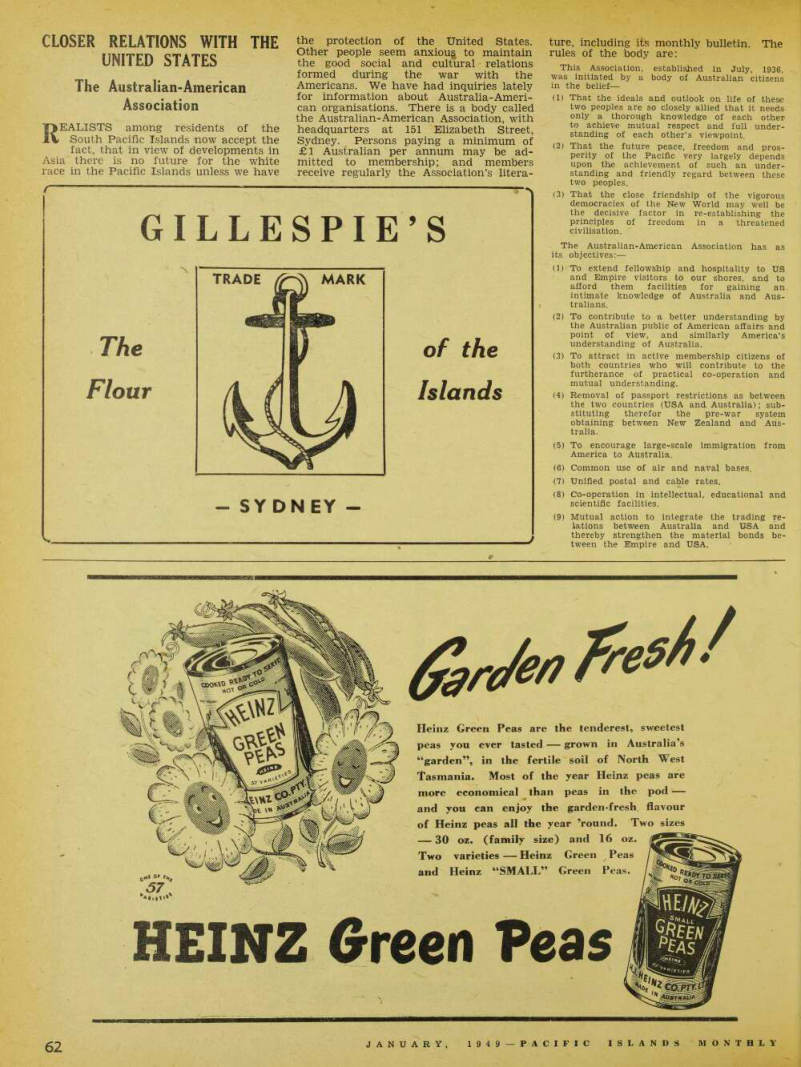
Closer Relations With The
The Australian-American Association
REALISTS among residents of the South Pacific Islands now accept the fact, that in view of developments in Asia there is no future for the white race in the Pacific Islands unless we have
the protection of the United States.
Other people seem anxioug to maintain the good social and cultural relations formed during the war with the Americans. We have had inquiries lately for information about Australia-Ameri can organisations. There is a body called the Australian-American Association, with headquarters at 151 Elizabeth Street, Sydney. Persons paying a minimum of £1 Australian per annum may be ad mitted to membership; and members receive regularly the Association’s litera
ture, including its monthly bulletin. The
rules of the body are: This Association, established in July, 1936, was initiated by a body of Australian citizens in the belief— (l) That the ideals and outlook on life of these two peoples are so closely allied that it needs only a thorough knowledge of each other to achieve mutual respect and full under standing of each other’s viewpoint. (2) That the future peace, freedom and pros perity of the Pacific very largely depends upon the achievement of such an under standing and friendly regard between these two peoples. (3) That the close friendship of the vigorous democracies of the New World may well be the decisive factor in re-establishing the principles of freedom in a threatened civilisation.
The Australian-American Association has as its objectives:— (1) To extend fellowship and hospitality to US and Empire visitors to our shores, and to afford them facilities for gaining an intimate knowledge of Australia and Aus tralians. (2) To contribute to a better understanding by the Australian public of American affairs and point of view, and similarly America’s understanding of Australia. (3) To attract in active membership citizens of both countries who will contribute to the furtherance of practical co-operation and mutual understanding, (4) Removal of passport restrictions as between the two countries (USA and Australia); sub stituting therefor the pre-war system obtaining between New Zealand and Aus tralia. (5) To encourage large-scale immigration from America to Australia. (6) Common use of air and naval bases. (7) Unified postal and cable rates, (8) Co-operation in intellectual, educational and scientific facilities. (9) Mutual action to integrate the trading re lations between Australia and USA and thereby strengthen the material bonds be tween the Empire and USA.
Advertisements & other items, p. 68 (1 item)
HEINZ Green Peas
GILLESPI
The Flour
- SYDNEY -
TRADE
MARK
’S of the Islands
10 a>o*w m 2 r 0
SAHI
m 0 -*‘ O' f* 57 Heinz Green Peas are the tenderest, sweetest peas you ever tasted grown in Australia’s “garden”, in the fertile soil of North West Tasmania. Most of the year Heinz peas are more economical than peas in the pod and you can enjoy the garden-fresh, flavour of Heinz peas all the year ’round. Two sizes —3O oz. (family size) and 16 oz.
Two varieties Heinz Green Peas and Heinz “SMALL” Green Peas.
HEINZ Green Peas
CO.PTY.
How Fijians Pay Their
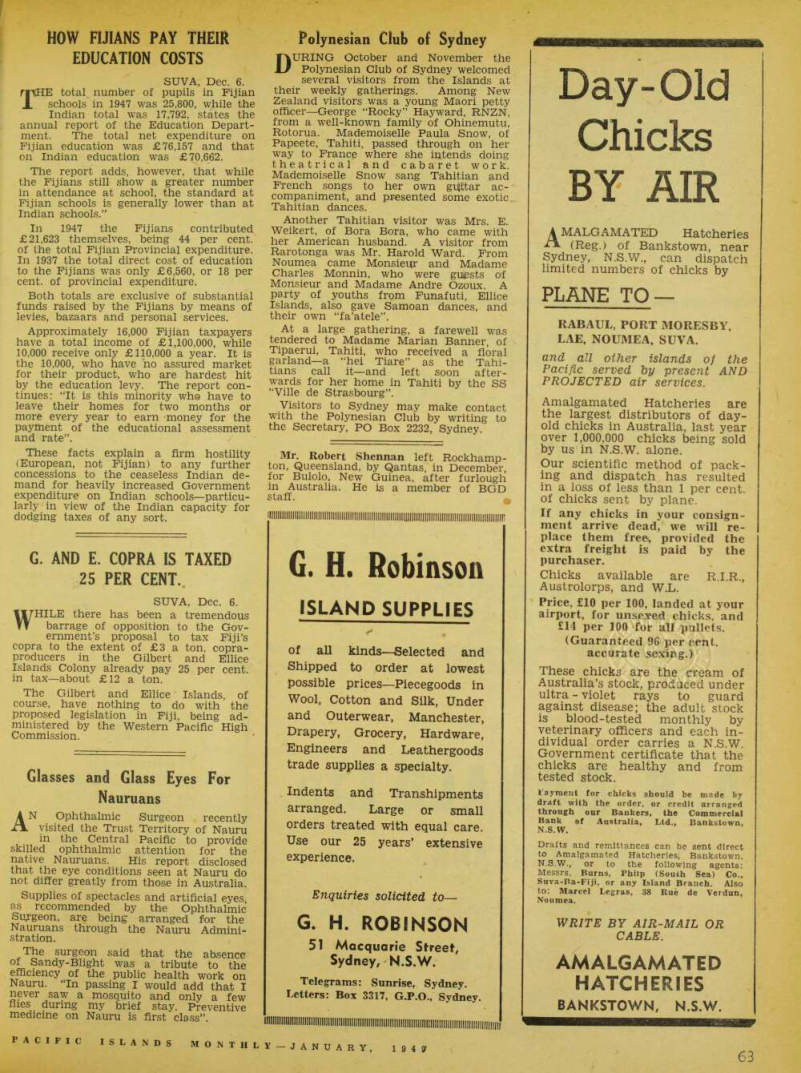
Education Costs
Suva, Dec. 6.
rE total, number of pupils in Fijian schools in 1947 was 25,800, while the Indian total was 17,792, states the annual report of the Education Depart ment. The total net expenditure on Fijian education was £76,157 and that on Indian education was £70,662.
The report adds, however, that while the Fijians still show a greater number in attendance at school, the standard at Fijian schools is generally lower than at Indian schools.”
In 1947 the Fijians contributed £21,623 themselves, being 44 per cent, of the total Fijian Provincial expenditure.
In 1937 the total direct cost of education to the Fijians was only £6,560, or 18 per cent, of provincial expenditure.
Both totals are exclusive of substantial funds raised by the Fijians by means of levies, bazaars and personal services.
Approximately 16,000 Fijian taxpayers have a total income of £1,100,000, while 10,000 receive only £llO,OOO a year. It is the 10,000, who have ho assured market for their product, who are hardest hit by the education levy. The report con tinues: “It is this minority who have to leave their homes for two months or more every year to earn money for the payment of the educational assessment and rate”.
These facts explain a firm hostility (European, not Fijian) to any further concessions to the ceaseless Indian de mand for heavily increased Government expenditure on Indian schools—particu larly in view of the Indian capacity for dodging taxes of any sort.
G. And E. Copra Is Taxed
25 Per Cent.
Suva, Dec. 6.
WHILE there has been a tremendous barrage of opposition to the Gov ernment’s proposal to tax Fiji’s copra to the extent of £3 a ton, copra producers in the Gilbert and Ellice Islands Colony already pay 25 per cent, in tax—about £l2 a ton.
The Gilbert and Ellice Islands, of course, have nothing to do with the proposed legislation in Fiji, being ad ministered by the Western Pacific High Commission.
Nauruans
Glasses and Glass Eyes For Nauruans
AN Ophthalmic Surgeon recently visited the Trust Territory of Nauru in the Central Pacific to provide skilled ophthalmic attention for the native Nauruans. His report disclosed that the eye conditions seen at Nauru do not differ greatly from those in Australia.
Supplies of spectacles and artificial eyes, as recommended by the Ophthalmic Suygeon, are being arranged for the Nauruans through the Nauru Admini stration.
The surgeon said that the absence of Sandy-Blight was a tribute to the efficiency of the public health work on Nauru. “In passing I would add that I never saw a mos Quito and only a few flies during my brief stay. Preventive medicine on Nauru is first class”.
Polynesian Club of Sydney
DURING October and November the Polynesian Club of Sydney welcomed several visitors from the Islands at their weekly gatherings. Among New Zealand visitors was a young Maori petty officer —George “Rocky” Hayward, RNZN, from a well-known family of Ohinemutu, Rotorua. Mademoiselle Paula Snow, of Papeete, Tahiti, passed through on her way to France where she intends doing theatrical and cabaret work.
Mademoiselle Snow sang Tahitian and French songs to her own gitftar ac companiment, and presented some exotic Tahitian dances.
Another Tahitian visitor was Mrs. E.
Weikert, of Bora Bora, who came with her American husband. A visitor from Rarotonga was Mr. Harold Ward. From Noumea came Monsieur and Madame Charles Monnin, who were guiests of Monsieur and Madame Andre Ozoux. A party of youths from Funafuti, Ellice Islands, also gave Samoan dances, and their own “fa’atele”.
At a large gathering, a farewell was tendered to Madame Marian Banner of Tipaerui, Tahiti, who received a floral garland—a “hei Tiare” as the Tahi tians call it—and left soon after wards for her home in Tahiti by the SS “Ville de Strasbourg”.
Visitors to Sydney may make contact with the Polynesian Club by writing to the Secretary, PO Box 2232, Sydney.
Mr. Robert Shennan left Rockhamp ton, Queensland, by Qantas, in December, for Bulolo, New Guinea, after furlough in Australia. He is a member of BGD staff.
Advertisements & other items, p. 69 (2 items)
63
PACIFIC ISLANDS MONTHLY- J A N U A R Y , 194?
Day-Old
Chicks
BY AIR
Amalgamated Hatcheries
(Reg.) of Bankstown, near Sydney, N.S.W., can dispatch limited numbers of chicks by
PLANE TO
RABAUL, PORT MORESBY,
LAE, NOUMEA, SUVA.
and all other islands of the Pacific served by present AND PROJECTED air services.
Amalgamated Hatcheries are the largest distributors of dayold chicks in Australia, last year over 1,000,000 chicks being sold by us in N.S.W. alone.
Our scientific method of packing and dispatch has resulted in a loss of less than 1 per cent, of chicks sent by plane.
If any chicks in your consignment arrive dead, we will replace them frees provided the extra freight is paid by the purchaser.
Chicks available are R.1.R., Austrolorps, and W.L.
Price, £lO per 100, landed at your airport, for unsolved chicks, and £l4 per 100 for all pullets. (Guaranteed 96 per cent, accurate sexing.) These chicks are the cream of Australia’s stock, produced under ultra - violet rays to guard against disease; the adult stock is blood-tested monthly by veterinary officers and each individual order carries a N.S.W.
Government certificate that the chicks are healthy and from tested stock.
Payment for chicks should be made by draft with the order, or credit arranged through our Bankers, the Commercial Bank of Australia, Ltd., Bankstown,
N.S.W.
Drafts and remittances can be sent direct to Amalgamated Hatcheries, Bankstown, N.S.W., or to the following agents: Messrs. Burns, Philp (South Sea) Co., Suva-Ha-Fiji, or any Island Branch. Also to: Marcel Legras, 38 Rue de Verdun, Noumea.
WRITE BY AIR-MAIL OR
CABLE.
AMALGAMATED
HATCHERIES
BANKSTOWN, N.S.W.
G. H. Robinson
ISLAND SUPPLIES
r of all kinds—Selected and Shipped to order at lowest possible prices—Piecegoods in Wool, Cotton and Silk, Under and Outerwear, Manchester, Drapery, Grocery, Hardware, Engineers and Leathergoods trade supplies a specialty.
Indents and Transhipments arranged. Large or small orders treated with equal care.
Use our 25 years’ extensive experience.
Enquiries solicited to—
G. H. ROBINSON
51 Macquarie Street,
Sydney, N.S.W.
Telegrams: Sunrise, Sydney.
Letters: Box 3317, G.P.0., Sydney.
Charge Of Murder In Bsi
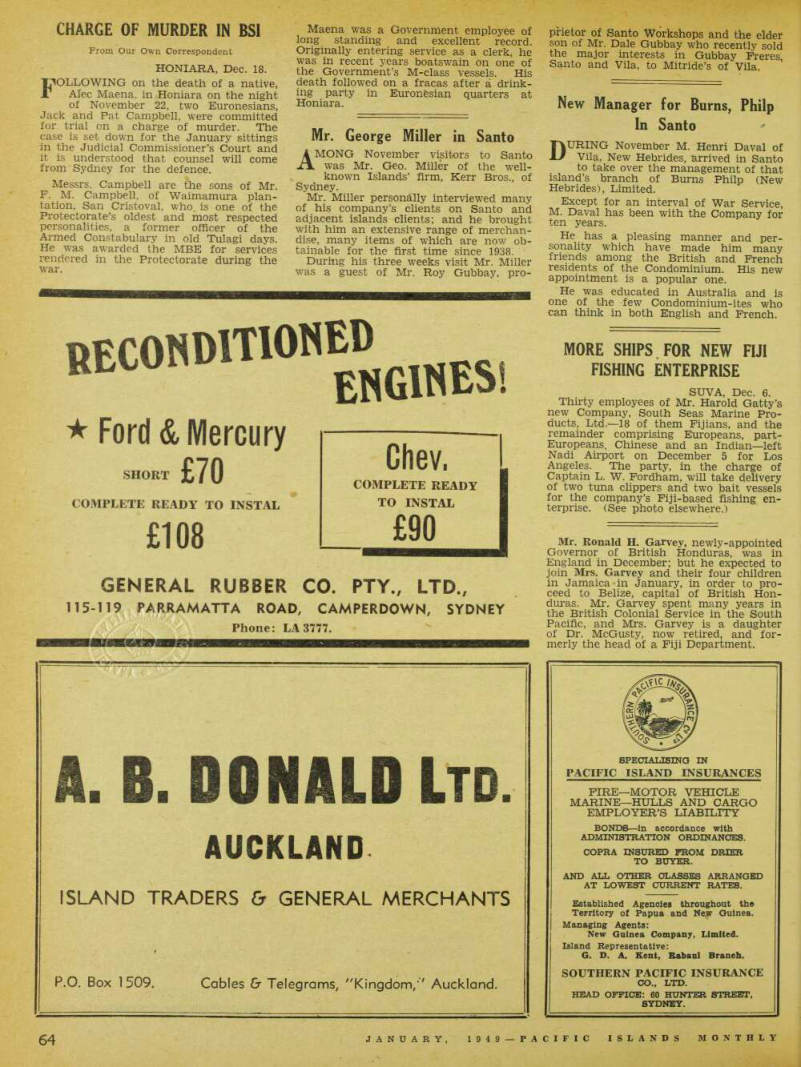
From Our Own Correspondent
Honiara, Dec. 18.
FOLLOWING on the death of a native, Alec Maena. in Honiara on the night of November 22, two Euronesians, Jack and Pat Campbell, -were committed for trial on a charge of murder. The case is set down for the January sittings in the Judicial Commissioner’s Court and it is understood that counsel will come from Sydney for the defence.
Messrs. Campbell are the sons of Mr.
F. M. Campbell, of Waimamura plan tation, San Cristoval, who is one of the Protectorate’s oldest and most respected personalities, a former officer of the Armed Constabulary in old Tulagi days.
He was awarded the MBE for services rendered in the Protectorate during the war.
Maena was a Government employee of long standing and excellent record.
Originally entering service as a clerk, he was in recent years boatswain on one of the Government’s M-class vessels. His death followed on a fracas after a, drink ing party in Euronfesian quarters at Honiara.
Mr. George Miller in Santo
AMONG November visitors to Santo was Mr. Geo. Miller of the well known Islands’ firm, Kerr Bros., of Sydney.
Mr. Miller personally interviewed many of his company’s clients on Santo and adjacent islands clients: and he brought with him an extensive range of merchan dise, many items of which are now ob tainable for the first time since 1938.
During his three weeks visit Mr. Miller was a guest of Mr. Roy Gubbay, pro
prietor of Santo Workshops and the elder* son of Mr. Dale Gubbay who recently sold the major interests in Gubbay Freres, Santo and Vila, to Mitride’s of Vila.
New Manager for Burns, Philp
In Santo
DURING November M. Henri Daval of Vila, New Hebrides, 'arrived in Santo to take over the management of that island’s branch of Burns Philp (New Hebrides), Limited.
Except for an interval of War Service, M. Daval has been with the Company for ten years.
He has a pleasing manner and per sonality which have made him many friends among the British and French residents of the Condominium. His new appointment is a popular one.
He was educated in Australia and is one of the few Condominium-ites who can think in both English and French.
More Ships For New Fiji
Fishing Enterprise
Suva, Dec. 6.
Thirty employees of Mr. Harold Gatty’s new Company, South Seas Marine Pro ducts, Ltd.—lB of them Fijians, and the remainder comprising Europeans, part- Europeans, Chinese and an Indian—left Nadi Airport on December 5 for Los Angeles. The party, in the charge of Captain L. W. Fordham, will take delivery of two tuna clippers and two bait vessels for the company’s Fiji-based fishing en terprise. (See photo elsewhere.) Mr. Ronald H. Garvey, newly-appointed Governor of British Honduras, was in England in December; but he expected to join Mrs. Garvey and their four children in Jamaica in January, in order to pro ceed to Belize, capital of British Hon duras. Mr. Garvey spent many years in the British Colonial Service in the South Pacific, and Mrs. Garvey is a daughter of Dr. McGusty, now retired, and for merly the head of a Fiji Department.
Advertisements & other items, pp. 70-71 (1 item)
reconditioned^^
★ Ford & Mercury
SHORT
£7O
Chev
COMPLETE READY TO INSTAL
COMPLETE READY
TO INSTAL
£lOB
£9O
GENERAL RUBBER CO. PTY., LTD.,
115-119 PARRAMATTA ROAD, CAMPERDOWN, SYDNEY
Phone: LA3777.
tfic
SPECIALISING IN
PACIFIC ISLAND INSURANCES
FIRE—MOTOR VEHICLE
MARINE—HULLS AND CARGO
EMPLOYER’S LIABILITY
BONDS—In accordance with
ADMINISTRATION ORDINANCES.
COPRA INSURED FROM DRIER
TO BUYER.
AND ALL OTHER CLASSES ARRANGED
AT LOWEST CURRENT RATES,
Established Agencies throughout the Territory of Papua and New Guinea.
Managing Agents: New Guinea Company, Limited.
Island Representative: G. D. A. Kent, Babanl Branch.
SOUTHERN PACIFIC INSURANCE
CO., LTD.
HEAD OFFICE: 60 HUNTER STREET,
SYDNEY.
A. B. DONALD Ltd.
AUCKLAND
ISLAND TRADERS & GENERAL MERCHANTS
P.O. Box 1509. Cables & Telegrams, "Kingdom/' Auckland.
ALOIS AKUN & CO.
RABAUL, NEW GUINEA
Also Branch At 180 NATHAN RD., KOWLOON, HONG KONG
Planters, Shipowners and General Merchants
Dealers in EMBROIDERED SILKWEAR—CARVED CAMPH. BOXES—
EASTERN FANCY GOODS
TRADE GOODS SPECIALISTS : : : Wholesale Retail Prompt Attention To All Orders Telephone: 136, Telegram: Aloisakun Sydney Representatives: NELSON & ROBERTSON PTY., LTD., Electra House, 12 Spring St., Sydney, N.S.W.
C. SULLIVAN PTY. LTD.
Island Merchants
Over 30 years' experience in the Pacific Island Trade.
Expert Buying Service Original Invoices Furnished Sellers of Island Produce.
Represented in all Australian States, New Zealand, England, France, United States, etc.
BANKERS: Bank of New South Wales, Comptoir National d’Escompte de Paris, Bank of New Zealand.
C. SULLIVAN PTY. LTD.
379 KENT STREET, SYDNEY
Telegrams & Cables: CHASULL, Sydney. Phone: MJ4657 (6 lines).
Robert Dean Frishie the Puka-Pukaßooks is Dead
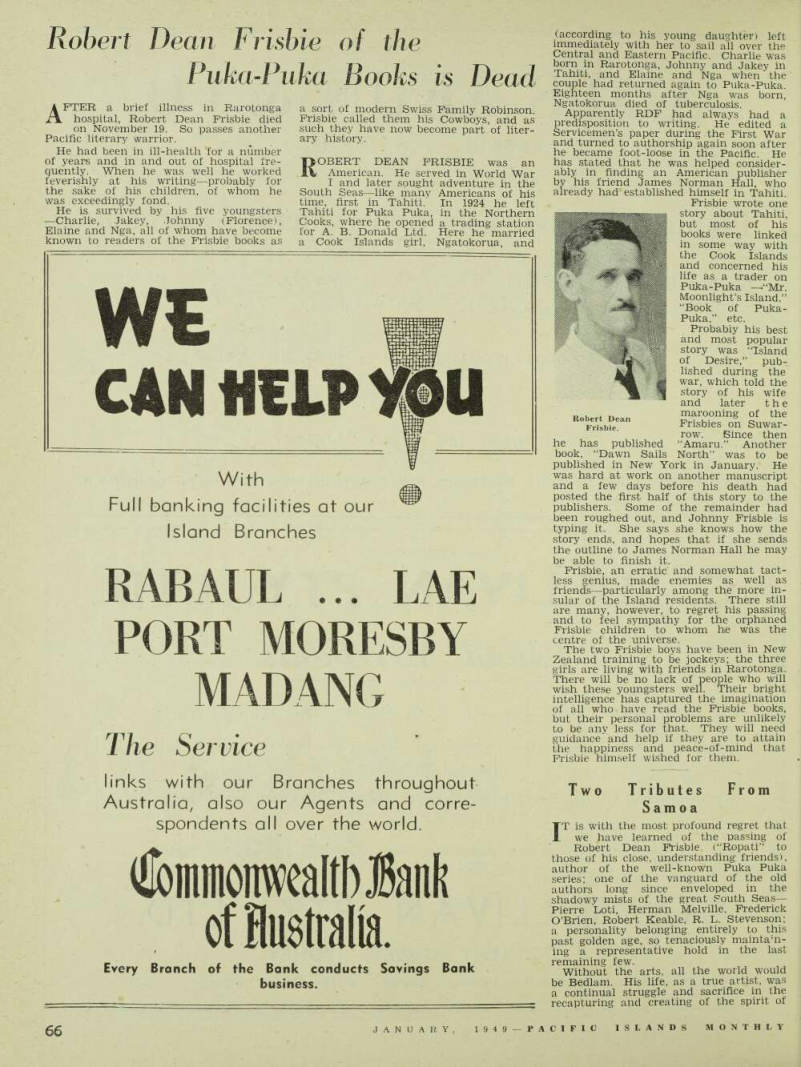
Puka-Pukaßooks is Dead
AFTER a brief illness in Rarotonga hospital, Robert Dean Frisbie died on November 19. So passes another Pacific literary warrior.
He had been in ill-health for a number of years and in and out of hospital frequently. When he was well he worked feverishly at his writing—probably for the sake of his children, of whom he was exceedingly fond.
He is survived by his five youngsters —Charlie, Jakey, Johnny (Florence), Elaine and Nga, all of whom have become known to readers of the Frisbie books as
a sort of modern Swiss Family Robinson.
Frisbie called them his Cowboys, and as such they have now become part of liter ary history.
Robert dean frisbie was an American. He served in World War I and later sought adventure in the South Seas—like many Americans of his time, first in Tahiti. In 1924 he left Tahiti for Puka Puka, in the Northern Cooks, where he opened a trading station for A. B. Donald Ltd. Here he married a Cook Islands girl, Ngatokorua, and
(according to his young daughter) left immediately with her to sail all over the Central and Eastern Pacific. Charlie was born in Rarotonga, Johnny and Jakey in Tahiti, and Elaine and Nga when the couple had returned again to Puka-Puka.
Eighteen months after Nga was born, Ngatokorua died of tuberculosis.
Apparently RDF had always had a predisposition to writing. He edited a Servicemen’s paper during the First War and turned to authorship again soon after he became foot-loose in the Pacific. He has stated that he was helped consider ably in finding an American publisher by his friend James Norman Hall, who already had established himself in Tahiti.
Frisbie wrote one story about Tahiti, but most of his books were linked in some way with the Cook Islands and concerned his life as a trader on Puka-Puka Moonlight’s Island,”
“Book of Puka- Puka,” etc.
Probably his best and most popular story was ‘Tsland of Desire,” pub lished during the war, which told the story of his wife and later the marooning of the Frisbies on Suwar row. Bince then
he has published “Amaru.” Another book, “Dawn Sails North” was to be published in New York in January. He was hard at work on another manuscript and a few days before his death had posted the first half of this story to the publishers. Some of the remainder had been roughed out, and Johnny Frisbie is typing it. She says she knows how the story ends, and hopes that if she sends the outline to James Norman Hall he may be able to finish it.
Frisbie, an erratic and somewhat tact less genius, made enemies as well as friends—particularly among the more in sular of the Island residents. There still are many, however, to regret his passing and to feel sympathy for the orphaned Frisbie children to whom he was the centre of the universe.
The two Frisbie boys have been in New Zealand training to be jockeys; the three girls are living with friends in Rarotonga.
There will be no lack of people who will wish these youngsters well. Their bright intelligence has captured the imagination of all who have read the Frisbie books, but their personal problems are unlikely to be any less for that. They will need guidance and help if they are to attain the happiness and peace-of-mind that Frisbie himself wished for them.
Robert Dean Frisbie.
Two Tributes From Samoa
Samoa
IT is with the most profound regret that we have learned of the passing of Robert Dean Frisbie (“Ropati” to those of his close, understanding friends), author of the well-known Puka Puka series; one of the vanguard of the old authors long since enveloped in the shadowy mists of the great South Seas — Pierre Loti, Herman Melville. Frederick O’Brien, Robert Keable, R. L. Stevenson; a personality belonging entirely to this past golden age, so tenaciously maintain ing a representative hold in the last remaining few.
Without the arts, all the world would be Bedlam. His life, as a true artist, was a continual struggle and sacrifice in the recapturing and creating of the spirit of
the lonely South Seas atolls, for the en joyment and happiness of others in their leisure hours.
“Ropati” was not of this materialistic, factual world. He was rather of the imaginative, idealistic-visionary plane—a world neither of substance nor form— and so to us he personified the essence and the spirit of those lonely, isolated islets where he so loved to be.
We pass on to a greater presence to be neither judged nor condemned by any mere mortal man. Many who live in flimsy glass houses are so prone to judge —their personalities infinitely small and nameless—their lives devoted to any cause but the furthering of any aesthetic ideals.
The works of “Ropati” the man will be always the treasured possession of our memories. la soifua lava,
Charles Mcphee.
DURING the many months friend Fris bie lived with his little tribe of children in my home with me, I dis covered and cherished his good heart. He certainly had his ups and downs, and he had unfortunately at times caved in under life’s blows —but always to stand up again.
I can find no more fitting tribute to my dear friend Prisbie’s character than these verses which I discovered a few years back and which he really liked: “Here lies one who took life’s chances In this busy world of men, Battled fate and circumstances, Fought, and lost, and fought again; Won sometimes and did no crowing, Lost sometimes and 'did not wail, Took his beating, kept on going, Never let his spirit fail!
He was fallible and human.
Therefore loved and understood Both his fellow men and women, Whether good, or not so good; Kept his courage undiminished; Never false to any friend— Played the game, till it was finished, Was a sportsman to the end!
R. T. Berking
Apia, Samoa, Dec., 1948
Advertisements & other items, pp. 72-74 (2 items)
WE mm
CAN ffill YOU
With Full banking facilities at our Island Branches
RABAUL ... LAE
PORT MORESBY
MADANG
The Service links with our Branches throughout Australia, also our Agents and correspondents all over the world.
<flbmmonwealtb JBanh
of Australia.
Every Branch of the Bank conducts Savings Bank business.
golden links...
AM. tO. A*
*NO $ o S' 5 * 0 N cT a*: & & & L\o 0> *K & s* * s* *■' <<; & jp jP & o' & or.
Cable and Telegraphic Address: “Retlaw,"
Sydney. Codes: A.B.C. sth Edition, Western Union, Bentley. with Australia s rich Export Trade tn the profitable ami growing island trade of Australian products, our four specialised divisions offer you a complete, efficient and thoroughly up-to-the-minute service. We handle all types of Australian merchandise, including our own outstanding brands—CORONET, BANQUET, SEVEN CROWN, CAPTAIN KIDD (WINES, SPIRITS and LIQUEURS); SUNBLOOM, CAVALIER, CAVCO, C.A.V. FOOD PRODUCTS; CAKEX FLAVOURING ESSENCE; and CAVALIER EUCALYPTUS DISINFECTANTS, CLEANERS, INSECT SPRAYS, LIQUID SOAPS, etc.
Your orders or enquiries will receive prompt and expert attention.
ATLAS MERCANTILE EXPORT CO. PTY. LTD.
(SUBSIDIARY TO WALTER CAVILL PTY. LTD. Wine, Spirit and General M-rchants and Manufacturers)
377 SUSSEX STREET. SYDNEY, AUSTRALIA
RF
CANVAS SHOES
by The B. F. Goodrich Company
Rigid wedge keeps the bones of the foot in their natural normal position.
Sponge rubber cushion protects the sensitive arc of the foot.
“P-F” means Posture Foundation Here are canva's shoes that are different. "P-F" is a scientific, correct foot support which provides extra comfort for people of all ages. It adds fun and pep to your step. "P-F" is real foot protection.
It safeguards against Flat Feet, avoids Tired, Strained Leg Muscles.
Try "P-F" Canvas Shoes and see the difference.
Agents for South Sea Islands;
ATKINS, KROLL & CO.
fR 07
3-0 CALIFORNIA ST., SAN FRANCISCO
Cable Address: “Atisco”
<- 'VHAt ,
-i VO rnt
Your own
affairs
must come first
There is no need for Islands residents to attempt to cope with the numerous and difficult duties imposed by executorship. The far-sighted testator spares his friends by appointing Burns Philp Trust Company Limited to administer his estate. The over-worked executor or trustee arranges for this permanent institution to relieve him of a constant source of anxiety. In both instances, the beneficiaries gain substantially. Competent and unbroken management is assured by capable directors and experienced officers.
"Hands That Never Leave the Wheel" describes the various services offered by the Company. A complimentary copy of this booklet will be forwarded on request.
JAMES BURNS
MANAGER:
L. S. PARKER
DIRECTORS:
JOSEPH MITCHELL
ERIC PRIESTLEY LEE
P. T. W, BLACK
SECRETARY:
E. R. OVERTON, A.F.I.A
BURNS PHILP TRUST
COMPANY LIMITED
EXECUTOR • TRUSTEE • AGENT
CONSTITUTED BY SPECIAL ACT OF THE N.S.W. PARLIAMENT
7 BRIDGE STREET, SYDNEY
TELEPHONE: BU 5901
BOX 543, G.P.0., SYDNEY
BP2O-48
Island

Christmas Trees For Canton Island
CANTON ISLAND—that treeless coral landing-field in inid-Pacific—got its Christmas trees this year from Aus tralia and through the good offices of Pan-American Airways.
Virtually the whole permanent popula tion of Canton consists of people con nected in some way with the trans-Pacific air services, and their families. Pan- American heard their plea for Christmas trees and, before the event, took on a load of Norfolk Pines in Sydney. They were given special attention by the crew during the journey, in order to reach Can ton in fresh condition.
The Rev. D. N. McDiarmid, at present Director of Missions for the Presbyterian Church in New Zealand, has accepted an appointment as Minister of St.
Andrew’s Presbyterian Church, Suva. He will succeed the Rev. J. A. F. Watson, who expects to leave for Australia early in the New Year.
Lever’s Pacific Plantations Pty. Ltd. have appointed a new general manager in the Solomons. He is Mr. L. C. Thomas, who came from London to take up the appointment. He has had previous experi ence in Africa. He arrived at Lmgatu, BSI, by Trarvs-Oceanic flying-boat on December 17.
Mr. and Mrs C. E. Searle, of Awala Plantation, northwestern Papua, returned !° f , by A tbe January “Bulolo,” after furlough in Australia.
Mr. Charles Sullivan, of Sydney, well known Islands merchant, will leave Aus tralia in a few weeks on a visit to United States and Eurone.
Advertisements & other items, pp. 75-76 (1 item)
7ovf Clvn
A nr IU
rtf
St. 7 . .?:-. • A Concord, Sydney, Home Built with “Rapid” Blocks
“RAPID ’ CONCRETE BLOCK & BRICK
MOULDING MACHINES
AN IMMEDIATE SOLUTION FOR HOME BUILDERS
Capacity, 3 blocks per minute.
Semi-automatic—no tamping quired.
Water tanks —well linings. re- • Priced to suit home-builders. • Hundreds in use. • Water tanks—well linings. • For all building purposes.
WRITE FOR PARTICULARS TO PACIFIC ISLANDS REPRESENTATIVE
£. J. GOUGH S- CO.
SUPPLIERS OF GENERAL MERCHANDISE TO LEADING FIRMS THROUGHOUT THE PACIFIC ISLANDS.
Exporters . . . Importers . . . Manufacturer s’ Representatives 1 BOND STREET, SYDNEY, AUSTRALIA. Box 3615 G.P.O. Tel. 8U2195 Bankers: Bank of N.S.W Bank of Adelaide. Comptolr Nat. d’Escompte de Paris.
Cable Address: '‘SEAFOODS,” SYDNEY.
Codes: Bentley’s. 2nd and Comp. Phrase; A.8.C., sth and 6th; Peterson. 2nd and 3rd; Banking: Acme.
7ovf Clvn
® © Snug Waterproofs, Thigh, Knee and Ankle Boots for wet weather wear in styles and sizes for men women and children
ALL THE YEAR ROUND
Dunlop Footwear is designed to relieve the jolts and fatigue of hard work and long wear and will be available soon in an extensive range of sizes and styles to suit every member of
the family.
Genuine Dunlop Kromhyd Soles guaranteed to out- Sport and Sandshoes for every w ear two leather recreational occasion. mWmvBSSSmS& soles.
Rubber heels for comfort and economy.
D 442
vn "ira dOINAQ
t Cflnldlted fry
DAVISON
V For Tropical conditions
Velvene Water Paint and Davison's Zinc Base Paints are used extensively throughout the islands and Mandated Territories on Government and Private buildings, giving full satisfaction under severe tropical conditions.
DAVISON PAINTS LTD.
BOX 24, AUBURN, N.S.W.
From WHOA!
SIMPLEX
MARINE ENGINES
3. 5 and 10/12 h.p. Suitable for all crafts from 14-32 ft. The 5 and 10 h.p. are supplied with built-in reverse gear. All Australian made. Prices and specifications on request. k
C.Q.R. ANCHORS
The lightweight anchor with three times the holding power of any other anchor. No more efficient tool for quick and positive “dig-ln” has ever been found than the ploughshare. The C.Q.R. Is two well designed ploughshares welded together. Write for .Q.R. Anchor leaflet.
to GO!
KOPSEN & GO. PIT. LTD
Have EVERYTHING for Boats
FISHING
TACKLE
Our new Fishing Department has been opened to provide the utmost service and satisfaction in all classes of fishing gear. Marlin Gut lines, Fishkil Nylon Twist, Geisha Wire Traces, Linen and Cotton lines, Rangoon and Split Cane Rods. Reels and numerous other lines.
KAYEN PRESSURE LAMPS
The all Australian made vapour lamps— reliable—efficient—safe —easy to operate.
Burns for 10 hours on IVi pints of kerosene. The lamp illustrated is of 300 C.P. and is the table model (HL7); the allpurpose lamp (AP2) is windproof and ideal for outdoor work. Burn ordinary kerosene. Write for illustrated leaflet.
SHIPCHANDLERS & MARINE ENGINEERS
376-380 KENT ST., SYDNEY. MA 6336 (9 lines).
Cables: “KOPSEN” Sydney.
Clunies Ross V Is Now
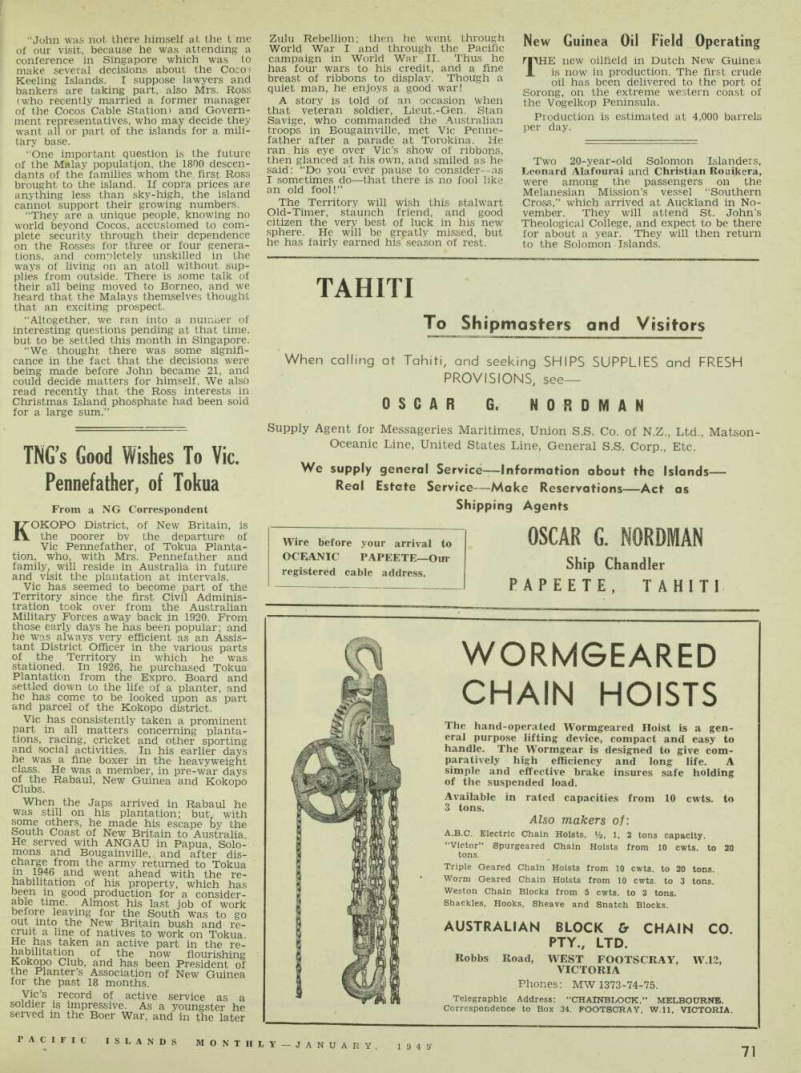
Located
Singapore Talks To Decide Future of Cocos Keeling
WPIEN it was announced, a couple of months ago, that the £2,750,000 paid by Australia and New Zealand for the phosphate on Christmas Island (In dian Ocean) would be shared by the Murray and Clunies Ross families, it was assumed that Christmas Island was part of the Cocos Keeling Islands, which have been the unchallenged domain of the Clunies Ross family for 125 years.
This was incorrect. Christmas Island is 530 miles from Cocos Keeling. The Clunies Ross interest in Christmas arises from the fact that, in 1897, Clunies. Ross 11, of Cocos Keeling, joined with Sir John Murray in forming Christmas Island Phosphate Co. Ltd., which has held the phosphate rights ever since, and which has just sold out to the Australian and NZ Governments.
The full story of Cocos Keeling was told in the November PIM. We described how Clunies Ross I (John) settled in Cocos Keeling in 1825, and took possession, and died in 1854; how Clunies Ross II (John George), who married a Malayan princess and reigned from 1854 until the late 19th century, was confirmed in absolute pos session by Queen Victoria, in 1886, in re cognition of the very good government of the atoll; how Clunies Ross 111 died in 1910; how Clunies Ross IV (1910-1944) died during a Jap air-raid on the island; and how various interests had reported that they had sought for Clunies Ross V, but had not discovered him. and they won dered what was to become of Cocos Keel ing.
Clunies Ross IV seems to have been a lestless person. When the search for Ross V was on, the newspapers said he did not appear to have been married prior to 1930, but that he was reported to have married a lady whom he met in a tea shop in 1930, and she bore him a son. An other newspaper, however, said it had located a real heir—an attractive youth, who was then at a British University.
THE “PIM” now is able to complete the stoiy. Clunies Ross IV apparently was married and had a son in 1928 or 1929. We have received the following letter from Commander and Mrs. Irving Johnson, of the American brigantine “Yankee,” who are well-known writers and world-wanderers. They are on their fourth round-the-world cruise, which is planned to extend from November, 1947, to May, 1949. when they are due back at their home in Springfield, Mass. Mrs.
Electa Johnson wrote on December 14; “I am sure you know the extraordinary history of the Ross family, who have been virtual kings of the Cocos Keeling Islands for the last four generations. On our previous visit, in 1934, we met John Clunies Ross IV, and were greatly in terested in him and in the remarkable islands.
“We called there again just a few weeks ago. John Clunies Ross IV died during the war, and his son, John, is the heir— at least, he will be in another year; he is only 20 now.
“We had often wondered what would hapnen to the islands after the older Ross (whom we knew) died, and we were told on our recent visit that John, though he was educated in England and has spent most of his life away from the islands, loves Cocos and would like to carry on the old Ross tradition.
“John was not there himself at the t me of our visit, because he was attending a conference in Singapore which was to make several decisions about the Cocos Keeling Islands. I suppose lawyers and bankers are taking part, also Mrs. Ross (who recently married a former manager of the Cocos Cable Station) and Govern ment representatives, who may decide they want all or part of the islands for a mili tary base.
“One important question is the future of the Malay population, the 1800 descen dants of the families whom the first Ross brought to the island. If copra prices are anything less than sky-high, the island cannot support their growing numbers.
“They are a unique people, knowing no world beyond Cocos, accustomed to com plete security through their dependence on the Rosses for three or four genera tions, and completely unskilled in the ways of living on an atoll without sup plies from outside. There is some talk of their all being moved to Borneo, and we heard that the Malays themselves thought that an exciting prospect.
“Altogether, we ran into a number of interesting questions pending at that time, but to be settled this month in Singapore.
“We thought there was some signifi cance in the fact that the decisions were being made before John became 21, and could decide matters for himself. We also read recently that the Ross interests in Christmas Island phosphate had been sold for a large sum.”
TNG’s Good Wishes To Vic.
Pennefather, of Tokua
From a NG Correspondent KOKOPO District, of New Britain, is the poorer by the departure of Vic Pennefather, of Tokua Planta tion, who, with Mrs. Pennefather and family, will reside in Australia in future and visit the plantation at intervals.
Vic has seemed to become part of the Territory since the first Civil Adminis tration took over from the Australian Military Forces away back in 1920. From those early days he has been popular; and he was always very efficient as an Assis tant District Officer in the various parts of the Territory in which he was stationed. In 1926, he purchased Tokua Plantation from the Expro. Board and settled down to the life of a planter, and he has come to be looked upon as part and parcel of the Kokopo district.
Vic has consistently taken a prominent part in all matters concerning planta tions, racing, cricket and other sporting and social activities. In his earlier days he was a fine boxer in the heavyweight class. He was a member, in pre-war days of the Rabaul, New Guinea and Kokopo Clubs.
When the Japs arrived in Rabaul he was still on his plantation; taut v with some others, he made his escape by the South Coast of New Britain to Australia.
He served with ANGAU in Papua, Solo mons and Bougainville, and after dis charge from the army returned to Tokua m 1946 and went ahead with the re habilitation of his property, which has been in good production for a consider able time. Almost his last job of work before leaving for the South was to go out into the New Britain bush and re cruit a line of natives to work on Tokua.
He has taken an active part in the re habilitation of the now flourishing Kokopo Club, and has been President of the Planter’s Association of New Guinea for the past 18 months.
Vic’s record of active service as a soldier is impressive. As a youngster he served m the Boer War, and in the later
Zulu Rebellion: then he went through World War I and through the Pacific campaign in World War 11. Thus he has four wars to his credit, and a fine breast of ribbons to display. Though a quiet man, he enjoys a good war!
A story is told of an occasion when that veteran soldier, Lieut.-Gen. Stan Savige, who commanded the Australian troops in Bougainville, met Vic Penne father after a parade at Torokina. He ran his eye over Vic’s show of ribbons, then glanced at his own, and smiled as he said: “Do you‘ever pause to consider--as I sometimes do —that there is no fool like an old fool!”
The Territory will wish this stalwart Old-Timer, staunch friend, and good citizen the very best of luck in his new sphere. He will be greatly missed, but he has fairly earned his season of rest.
New Guinea Oil Field Operating
THE new oilfield in Dutch New Guinea is now in production. The first crude oil has been delivered to the port of Sorong, on the extreme western coast of the Vogelkop Peninsula.
Production is estimated at 4,000 barrels per day.
Two 20-year-old Solomon Islanders, Leonard Alafourai and Christian Rouikera, were among the passengers on the Melanesian Mission’s vessel “Southern Cross,” which arrived at Auckland in No vember. They will attend St. John’s Theological College, and expect to be there for about a year. They will then return to the Solomon Islands.
Advertisements & other items, pp. 77-80 (2 items)
Wormgeared
TAHITI
To Shipmasters and Visitors When calling at Tahiti, and seeking SHIPS SUPPLIES and FRESH
PROVISIONS, see—
OSCAR G. NO ROMAN
Supply Agent for Messageries Maritimes, Union S.S. Co. of N.Z., Ltd., Matson- Oceanic Line, United States Line, General S.S. Corp., Etc.
We supply general Service—lnformation about the Islands— Real Estate Service—Make Reservations—Act as Shipping Agents
OSCAR G. NORDMAN
Ship Chandler
PAPEETE, TAHITI
Wire before your arrival to
OCEANIC PAPEETE—Our
registered cable address.
WORMGEARED
CHAIN HOISTS
The hand-operated Wormgeared Hoist is a general purpose lifting device, compact and easy to handle. The Wormgear is designed to give comparatively high efficiency and long life, A simple and effective brake insures safe holding of the suspended load.
Available in rated capacities from 10 cwts. to 3 tons.
Also makers of: A.B.C. Electric Chain Holsts. Va, 1, 2 tons capacity.
"Victor” Spurgeared Chain Holsts from 10 cwts. to 20 tons.
Triple Geared Chain Hoists from 10 cwts. to 20 tons.
Worm Geared Chain Holsts from 10 cwts. to 3 tons.
Weston Chain Blocks from 5 cwts. to 2 tons.
Shackles, Hooks, Sheave and Snatch Blocks.
AUSTRALIAN BLOCK & CHAIN CO.
PTY., LTD.
Robbs Road, WEST FOOTSCRAY, W.12,
VICTORIA
Phones: MW 1373-74-75.
Telegraphic Address: ‘'CHAINS LOCK,” MELBOURNE.
Correspondence to Box 34. FOOTSCRAY, W.ll, VICTORIA.
IP m m
mmm
LAUREL
KEROSENE
I he Favourite amongst Houseivives
. . . particularly for use in kero, refrigerators. Laurel's purity makes it outstandingly ideal for this class of service.
Impure kerosenes cause the wick to char which, in turn distorts the flame, causes soot, necessitating frequent cleaning and trimming. You need best results, so always buy Laurel!
VACUUM OIL COMPANY PTY, LTD. ( inc. in mist.
L^-6)
VACUUM
QUAllir PRODUCTS
AUNT
MARYS
BAKING POWDER
For the best in delicious baking results A product of TILLOCK AND CO. PTY. LTD, manufacturers of all the famous Aunt Mary s Pure Foods
The Most Extensive Manufacturers in the British Empire of
RUBBER STAMPS,
INKS, STENCILS,
Marking Devices,
ACME STAMP PADS
OFFICE & STATIONERY SUPPLIES
We also Manufacture & Supply a Complete Line of
LIMEWASHING and
SPRAYING MACHINES
for all purposes.
Let us know your requirements and we will quote by return.
WRITE FOR OUR GENERAL CATALOGUE
Li me washing Machine
EXCELSIOR SUPPLY CO. PTY. LTD.
278 Post Office Place,
MELBOURNE, VIC.
HEAD OFFICE :
160 BROADWAY,
Formerly known as George St., West,
SYDNEY. N.S.W.
50 Victoria Street,
WELLINGTON, N.Z.
9 3S . - .r-v; 1
Don’t risk the loss
of a
Pleasant Smile
JF your gums flash a warning tinge of “pink” on your tooth brush, consult your dentist.
There may be nothing seriously wrong . . . but don’t take chances ... let your dentist decide. He may explain “a simple case of sensitive gums gums robbed of work by to-day’s soft and creamy foods”. His advice will probably be <( more work and resistance for lazy gums” and often, “the helpful stimulation of Ipana Tooth Paste and massage” .
Adopt this simple dental health routine : Brush your teeth with Ipana every morning and evening, followed by vigorous gum massage with Ipana on the finger-tip. Gums become firmer, healthier; teeth brighter, more lustrous.
IPANA TOOTH PASTE
4539
Fiji Hurricane
73
Fiji Hurricane (Continued from Page 16)
pacific islands monthly January, m>
Noumea Wedding
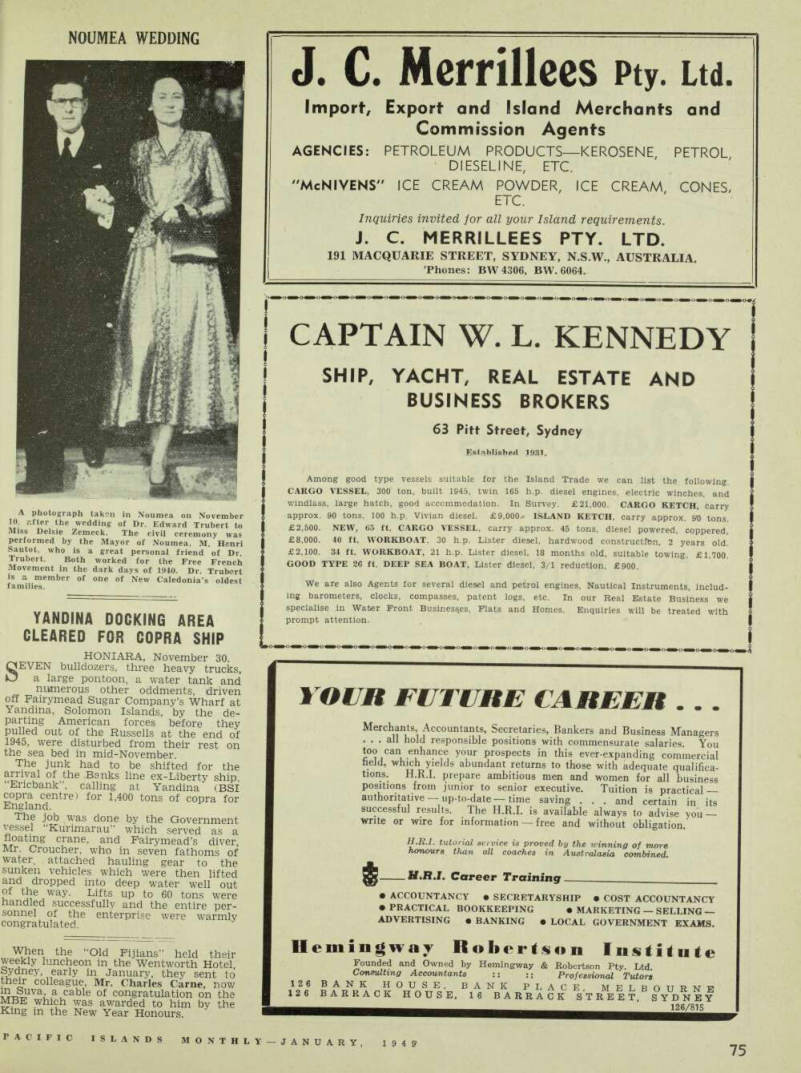
A photograph taken in Noumea on November 10, after the wedding of Dr. Edward Trubert to Miss Delsie Zemeck. The civil ceremony was performed by the Mayor of Noumea, M. Henri Sautot, who is a great personal friend of Dr.
Trubert. Both worked for the Free French Movement in the dark days of 1940. Dr. Trubert is a member of one of New Caledonia’s oldest families.
Yandina Docking Area
Cleared For Copra Ship
HONIARA, November 30.
OEVEN bulldozers, three heavy trucks, O a large pontoon, a water tank and numerous other oddments, driven off Fairymead Sugar Company’s Wharf at Yandma, Solomon Islands, by the de parting American forces before they pulled out of the Russells at the end of 1945, were disturbed from their rest on the sea bed in mid-November.
The junk had to be shifted for the arrival of the Banks line ex-Liberty ship.
“Ericbank”, calling at Yandina (BSI copra centre) for 1,400 tons of copra for England.
The job was done by the Government vessel “Kurimarau” which served as a floating crane, and Fairymead’s diver, Mr. Croucher, who in seven fathoms of water, attached hauling gear to the sunken vehicles which were then lifted a s l< \i. <^ ee P water well out of the way. Lifts up to 60 tons were handled successfully and the entire per sonnel of the enterprise were warmly congratulated.
When the “Old Fijians” held their weekly luncheon in the Wentworth Hotel Sydney, early in January, they sent to their colleague, Mr. Charles Came, now Spa. . a , cable of congratulation on the MBE which was awarded to him by the King m the New Year Honours.
Advertisements & other items, p. 81 (2 items)
75
PACIFIC ISLANDS MONTHLY— J A N U A R Y , 194?
J. C. Merrillees pt y . Ltd.
Import, Export and Island Merchants and
Commission Agents
AGENCIES: PETROLEUM PRODUCTS—KEROSENE, PETROL
DIESELINE, ETC.
"McNIVENS" ICE CREAM POWDER, ICE CREAM, CONES,
ETC.
Inquiries invited for all your Island requirements.
J. C. MERRILLEES PTY. LTD.
191 MACQUARIE STREET, SYDNEY, N.S.W., AUSTRALIA.
’Phones: BW 4306, BW. 6064.
CAPTAIN W. L. KENNEDY
SHIP, YACHT, REAL ESTATE AND
BUSINESS BROKERS
63 Rift Street, Sydney
Established 1931.
Among good type vessels suitable for the Island Trade we can list the following.
CARGO VESSEL, 300 ton, built 1945, twin 165 h.p. diesel engines, electric winches, and windlass, large hatch, good accommodation. In Survey. £21,000. CARGO KETCH, carry approx. 90 tons. 100 h.p. Vivian diesel. £9,000.- ISLAND KETCH, carry approx. 90 tons. £2,500. NEW, 65 ft. CARGO VESSEL, carry approx. 45 tons, diesel powered, coppered, £B,OOO. 40 ft. WORKBOAT. 30 h.p. Lister diesel, hardwood constructfbn, 2 years old. £2,100. 34 ft. WORKBOAT, 21 h.p. Lister diesel, 18 months old, suitable towing, £1.700.
GOOD TYPE 26 ft. DEEP SEA BOAT, Lister diesel, 3/1 reduction, £9OO.
We are also Agents for several diesel and petrol engines, Nautical Instruments, Including barometers, clocks, compasses, patent logs, etc. In our Real Estate Business we specialise in Water Front Businesses, Flats and Homes. Enquiries will be treated with prompt attention.
YOUR FUTURE CAREER . . .
Merchants, Accountants, Secretaries, Bankers and Business Managers ... all hold responsible positions with commensurate salaries. You too can enhance your prospects in this ever-expanding commercial held, which yields abundant returns to those with adequate qualifications. H.R.I. prepare ambitious men and women for all business positions from junior to senior executive. Tuition is practical authoritative- up-to-date time saving . . . and certain in its successful results. The H.R.I. is available always to advise you write or wire for information free and without obligation.
H.R.I. tutorial service is proved by the winning of more honours than all coaches in Australasia combined.
H.H.J. Career Training • ACCOUNTANCY • SECRETARYSHIP • COST ACCOUNTANCY
• PRACTICAL BOOKKEEPING • MARKETING SELLING—
ADVERTISING • BANKING • LOCAL GOVERNMENT EXAMS.
Hemingway Roliertson Institute
12 6 12 6 Founded and Owned by Hemingway & Robertson Pty. Ltd Consulting Accountants ;; :: Professional Tutors
BANK HOUSE,
BARRACK HOUSE.
BANK
16 BA
PLACE, MELBOURNE
RRACK STREET, SYDNEY
126/815
Fijians Produce Triplets
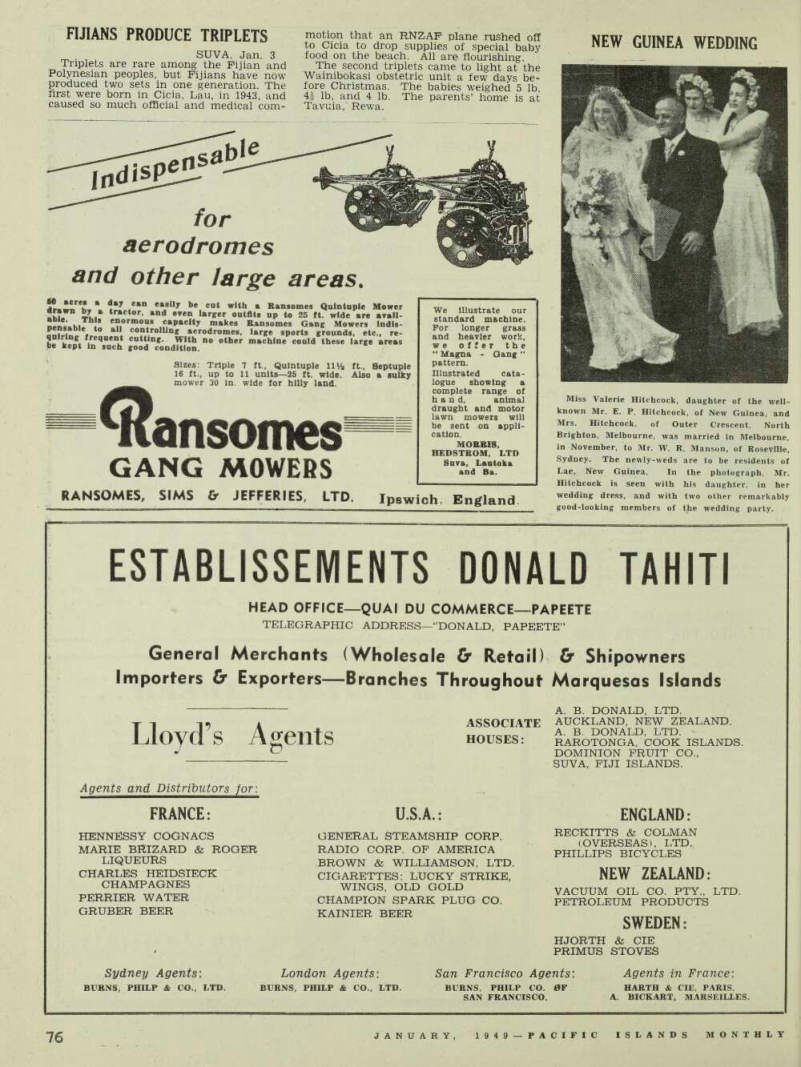
Suva. Jan. 3
Triplets are rare among the Fijian and Polynesian peoples, but Fijians have now produced two sets in one generation. The first were born in Cicia. Lau, in 1943, and caused so much official and medical com
motion that an RNZAP plane rushed off to Cicia to drop supplies of special baby food on the beach. All are flourishing.
The second triplets came to light at the Wainibokasi obstetric unit a few days be fore Christmas. The babies weighed 5 lb. 41 lb, and 4 lb. The parents’ home is at Tavuia, Rewa.
New Guinea Wedding
Miss Valerie Hitchcock, daughter of the well known Mr. E. P. Hitchcock, of New Guinea, and Mrs. Hitchcock, of Outer Crescent, North Brighton, Melbourne, was married in Melbourne, in November, to Mr. W. R. Manson, of Roseville, Sydney. The newly-weds are to be residents of Lae, New Guinea. In the photograph, Mr.
Hitchcock is seen with his daughter, in her wedding dress, and with two other remarkably good-looking members of the wedding party.
Advertisements & other items, pp. 82-83 (1 item)
Mumsomes
ind jsP
efl sa
b* e
for
aerodromes
and other large .
f • day can easily be col with a Bansomes Quintuple Mower S-l. tractor - and ***“ I »* , eer outfits up to 25 ft. wide are avall- *,**■ enormous capacity makes Bansomes Gang Mowers Indls- Jn?rin^ ! *1 controlling aerodromes, large sports grounds, etc., re- ? * re^°ei u cu “ ,n «* no other machine could these large areas be kept In such good condition.
Sizes: Triple 7 ft.. Quintuple 11% ft., Septuple 16 ft., up to 11 units—2s ft. wide. Also a sulky mower 30 In. wide for hilly land.
Mumsomes
GANG MOWERS
We illustrate our standard machine.
For longer grass and heavier work, we offer the “ Magna - Gang ” pattern.
Illustrated catalogue showing a complete range of hand, animal draught and motor lawn mowers will be sent on application.
MOBBIS,
HEDSTBOM, LTD
Suva, Lanloka and Ba.
RANSOMES, SIMS & JEFFERIES, LTD. Ipswich, England
ESTABLISSEMENTS DONALD TAHITI
HEAD OFFICE—QUAI DU COMMERCE—PAPEETE
TELEGRAPHIC ADDRESS—“DONALD, PAPEETE”
General Merchant's (Wholesale £r Retail) & Shipowners
Importers & Exporters—Branches Throughout Marquesas Islands
Lloyd’s Agents
ASSOCIATE
HOUSES:
A. B. DONALD, LTD.
AUCKLAND, NEW ZEALAND.
A. B. DONALD, LTD.
RAROTONGA, COOK ISLANDS.
DOMINION FRUIT CO.,
SUVA, FIJI ISLANDS.
Agents and Distributors for:
FRANCE:
HENNESSY COGNACS
MARIE BRIZARD & ROGER
LIQUEURS
CHARLES HEIDSIECK
CHAMPAGNES
PERRIER WATER
GRUBER BEER
Sydney Agents:
BURNS, PHILP & CO., LTD.
U.S.A.:
GENERAL STEAMSHIP CORP.
RADIO CORP. OF AMERICA
BROWN & WILLIAMSON, LTD.
CIGARETTES: LUCKY STRIKE,
WINGS, OLD GOLD
CHAMPION SPARK PLUG CO.
KAINIER BEER
ENGLAND:
RECKITTS & COLMAN
(OVERSEAS), LTD.
PHILLIPS BICYCLES
NEW ZEALAND:
VACUUM OIL CO. PTY., LTD.
PETROLEUM PRODUCTS
SWEDEN
HJORTH & CIE
PRIMUS STOVES
London Agents :
BURNS, PHILP & CO., LTD.
San Francisco Agents :
BURNS, PHILP CO. 0F
SAN FRANCISCO.
Agents in France :
HARTH & CIE, PARIS.
A, BICKART, MARSEILLES.
There is only one
ELECTROLUX
THE MODERN KEROSENE-OPERATED REFRIGERATOR
THAT ACHIEVES THE MIRACLE OF ICE FROM HEAT £8! 10 Price Sydney
Lasting Efficiency
Silent Operation
Now Available
For
Immediate Delivery
THE
ENGLISH MODEL
LK. 550.
SPECIFICATIONS:
STORAGE CAPACITY: Approximately 5V2 cubic feet.
SHELF AREA; 9 square feet. All shelves are removable— two being self-supporting when half drawn out.
ICE MAKING: 4 drawers producing a total of 5 lb. of ice per freezing in cube or block form.
OUTSIDE DIMENSIONS: Height. 4 ft. 9 in. Depth, exclusive of door fittings, 2 ft. iV 2 in. Width, 2 ft. 3V < in.
NET WEIGHT: 427 lb. Packed—approximately 567 lb.
FUEL CONSUMPTION: Approximately V/ 2 pints of kerosene per day.
Obtainable from: - * *
NEW GUINEA COMPANY, LIMITED.
Rabaul, Madang, Lae, Kavieng.
J. R. CLAY & CO., LTD., Port Moresby.
W. R. CARPENTER & CO. (Sol. Is.), LTD., Tulagi For New Hebrides, Butaritari, Noumea, New Caledonia. Apply—
W. R. CARPENTER & CO. LTD.
Economically operated by kerosene, with a simple precision-built freezizng unit that has no moving parts and is GUARANTEED FOR
FIVE (5) YEARS.
Head Office: 16 O'Connell St., Sydney, N. S. Wales
Renewed Optimism In N.
Caledonia
MR. H. BONNEAUD, Noumea manager of the big trading firm of Ballandes, has been re-elected President of the New Caledonian General Council.
In his first speech after re-election he suggested that the rise in optimism re garding the economic future of the Colony was due to energetic action taken by the Council to maintain the Pacific franc at its present level.
He referred also to the 50.000 tons of US coal being received by the nickel in dustry under the Marshall Plan, but added that, with the new Canberra agreement, under which New Caledonia is delivering timber to Australia, he ex
nected Australia tn v P p n ™ supplies of coal to the (?olonv r mcrease 65 01 coal t 0 the Colony. He referred with satisfaction to the Javanese labour agreement, and said that he believed now that the chrome ore tar get of 100,000 tons for 1949 might even be surpassed. The choice of Noumea as head quarters for the South Pacific Commission was also gratifying, and he congratulated the French delegation which had con ducted the discussions.
Samoa—Tonga
Shipping And Plane Services
rpinfrorinrtinn * est ® ed ’ but Preparations are under way for their early reintroduction. As they become available they will be announced here.
Ship Services
Australia—North
America
THE regular passenger Trans-Pacific liners, withdrawn during the war, have not been restored.
Canadian-Pacific liner “Aorangi” (Sydney- Auckland - Suva - Honolulu - Vancouver) resumed running in August, 1948. A sister liner is expected soon. See time-table on following page.
Matson liners “Monterey” and “Mariposa” are not now expected back in the Pacific service.
Matson ship “Marine Phoenix,” carrying pas sengers, ran on a regular schedule—San Fran cisco-Honolulu-Suva-Auckland-Sydney; but was withdrawn in August, 1948.
New Zealand—Fiji—
Samoa—Tonga
Monthly Service by MV “Matua”
Service Conducted By Union Ss Co.,
Ltd.—Subject To Alteration Without
Notice
Auckland .. Jan. 11 Feb. 10 Mar. 10 Suva .. .. Jan. 14-15 Feb. 14-15 Mar. 14-15 Nukualofa Jan. 17-18 Mar. 17-18 Vavau .. .. Jan. 19 Mar. 19 Apia* .. Jan. 19-21 Feb. 16-19 Mar. 19-21 Vavau .. .. Feb. 21 Nukualofa .. Feb. 22-23 Suva .. .. Jan. 24-25 Feb. 25-26 Mar. 24-25 Auckland .. Jan. 29 Mar. 2 Mar. 29 ♦Western Time.
New Caledonia
THE New Caledonian Government has sub sidised and maintained the coastal ship ping services. The East Coast, the West Coast, and the Loyalty Islands, under present conditions, receive 10 round trips per annum.
The ships call at the following ports: EAST COAST. —Yate, Ounia, Thio, Nakety.
Canala, Kouaoua Kua, Moneo, Ponerfhouen, Tibarama, Poindimle, Wagap, Touho, Tlpindje, Hienghene, Tao, Oubatch, Pouebo, Balade, Pam, Arama, and return.
WEST COAST. —Pouembout, Kone, Temala, Voh, Ouaco Gomen, Koumac, Tangaiou, Tiebaghl, Nehoue Poume, Baaba, Belep and return.
LOYALTY ISLANDS.—Mare (Tadine), Llfou (Chepenehe) Ouvea (Fajaoue, St. Joseph) and return.
The steamer “Neo Hebridals” runs regularly between Noumea and Sydney, with occasional trips to the New Hebrides (mostly Aneityum).
The owners are Societe Maritime et Manlere Hagen, Noumea. Sydney agents: H. C. Sleigh, 254 George Street, Sydney.
New Zealand—Cook
Is.—Niue—Samoa
rpHE motor vessel “Maui Pomare,”
X owned and operated by the NZ Gov ernment. maintains a direct service between Auckland and Rarotonga (Cook Islands), with alternative calls at Niue and Apia (Samoa).
Sydney-Norfolk Island-
New Hebrides
THE SS “Morinda,” Burns, Philp & Co., Ltd., runs at approximately three monthly intervals from Sydney to Lord Howe Island, Norfolk Island, and main ports of the New Hebrides, and re turn.
Advertisements & other items, p. 84 (1 item)
Itching Skin Germs
Hard to Get? 7r v US
FOR
SADDLERY & HARNESS
HOME LIGHTING PLANTS
WINES AND SPIRITS
NON-ELECTRIC WASHING
MACHINES
PUMPS, IRRIGATION
PLANTS
CROCKERY
HAIRDRESSING SUPPLIES
HARDWARE
AIR CIRCULATORS
Manstocks ‘•ssrniiSr
ISLAND TRADERS
Cable and Telegraphic address: “MANSTOCKS,” SYDNEY Telephones: 8W7405, 8W1237, 85076, FM2766
Itching Skin Germs Killed in 3 Days
Thanks to the discovery of an American physician, It Is now possible to kill and remove the true cause of most skin troubles. Your skin has nearly 50 million tiny seams and pores where invisible germs and parasites can hide, and which are the true cause of terrible Itching, Cracking, Peeling, Burning, Ringworm, Acne, Psoriasis, Blackheads, Pimples, Foot Itch and other disfiguring blemishes.
Blemishes such as these make you look and feel embarrassed, unattractive and handicapped In life, both socially and In business. You can’t get rid of these disfigurements with ordinary treatments, which give only temporary relief, because they do not kill the germs or parasites responsible for your trouble. .
New Discovery Kills Cause
Former skin sufferers throughout the world are now praising Nixoderm, the discovery of a leading American skin specialist. This remarkable new preparation quickly penetrates into the pores of the skin and kills the germs and parasites responsible for yo;ur trouble In 7 minutes, stopping the itch almost instantly. At the same time, this wonderful preparation acts as a tonic and skin food, so that as the cause of your trouble is removed, your skin becomes soft, smooth and clear. This clear, healthy complexion will give you new charm and make It easy to win friends.
Praised by Doctors
Dr. T. A. Ellis, well-known physician of Toronto, Canada, recently stated: “Skin disorders caused by parasites, as many are, ylel** to Nixoderm. These parasites are invisible to the naked eye. They eat away the skin, forming ugly eruptions. Ordinary ointments or remedies fall completely, or give only temporary results because they do not reach the cause of the condition. It Is this value about Nixoderm in attacking parasites which impresses me most favorably, and explains In large measure the success it enjoys over many stubborn cases.”
Guaranteed Results
Get Nixoderm to-day. Put It to the test. In a few minutes you will find that the itching has stopped, and In 24 hours you can see for yourself that your skin Is clearer. And it is guaranteed that, within one week, Nixoderm must make your skin soft, clear, smooth and attractive or money back on return of empty package. Get Nixoderm from your chemist or store to-day. The guarantee protects you. So don’t delay. Get Nixoderm to-day.
Nixoderm 2/ &4/.
For Skin Sores, Pimples and Itch.
Sydney-NZ-Fiji-Hawaii-Nth. America
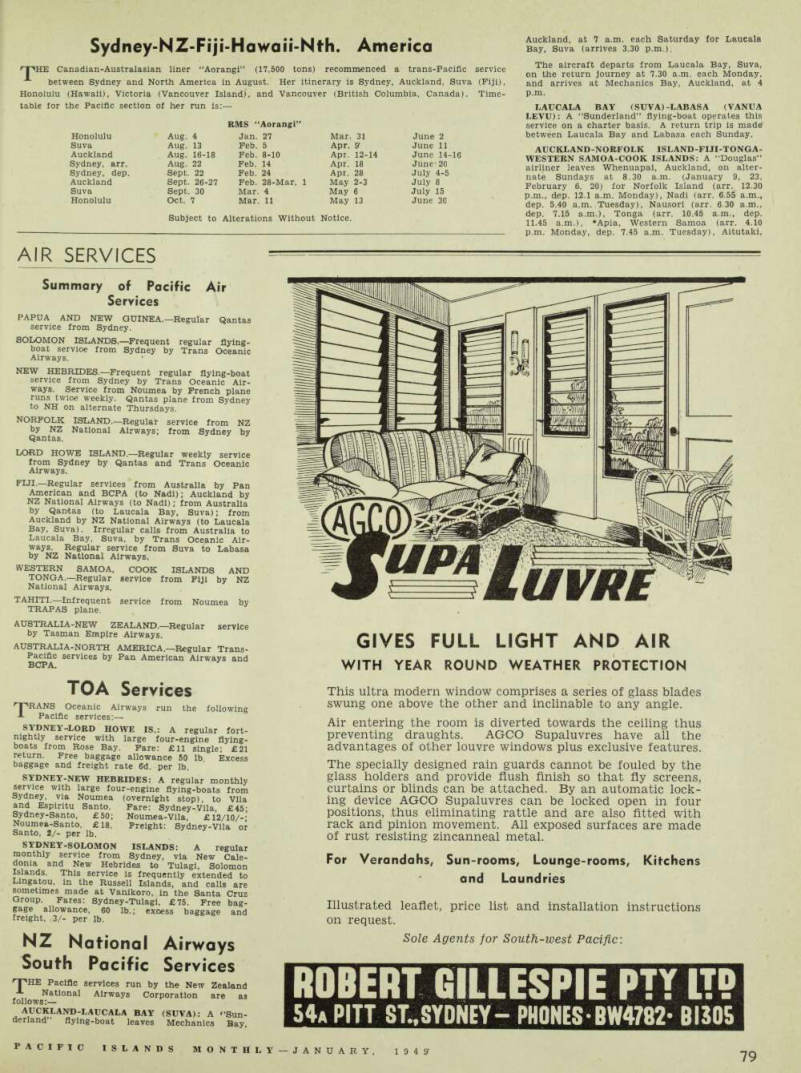
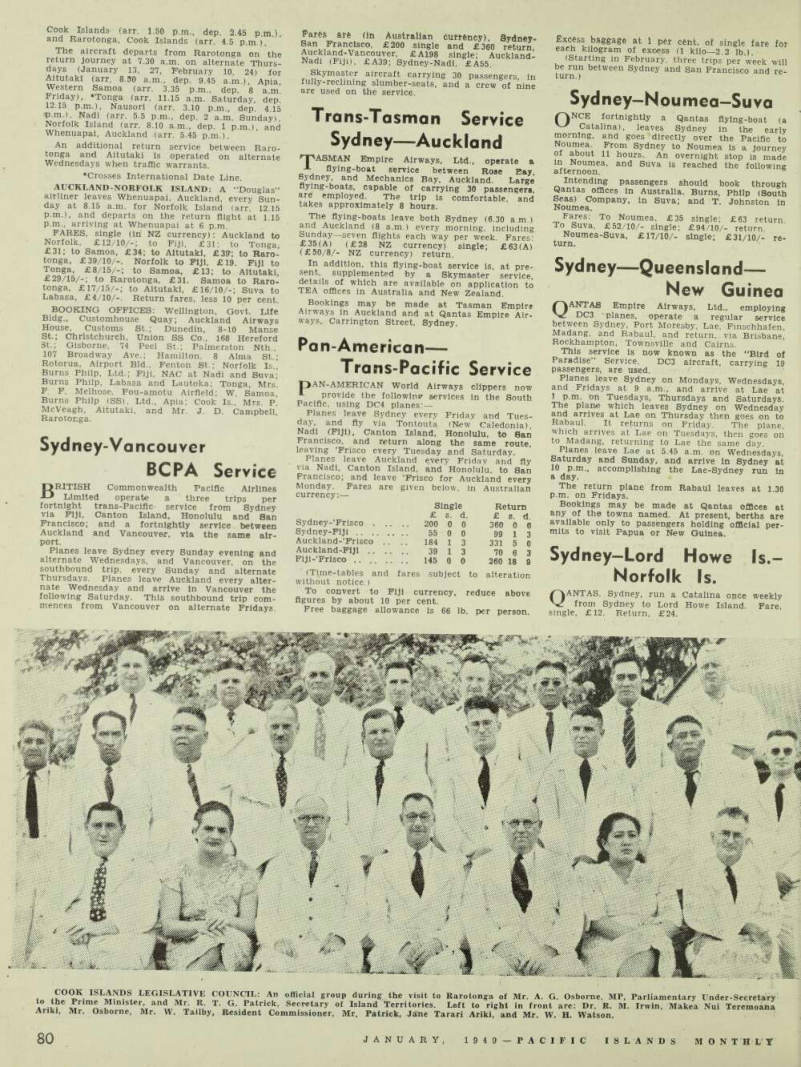
npHE Canadian-Australasian liner “Aorangi” (17,500 tons) recommenced a trans-Pacific service A between Sydney and North America in August. Her itinerary is Sydney, Auckland, Suva (Fiji), Honolulu (Hawaii), Victoria (Vancouver Island), and Vancouver (British Columbia, Canada). Time table for the Pacific section of her run is:—
Auckland, at 7 a.m. each Saturday for Laucala Bay, Suva (arrives 3.30 p.m.).
The aircraft departs from Laucala Bay, Suva, on the return journey at 7.30 a.m. each Monday, and arrives at Mechanics Bay, Auckland, at 4 p.m.
Laucala Bay (Suva)-Labasa (Vanua
LEVU): A “Sunderland” flying-boat operates this service on a charter basis. A return trip is made between Laucala Bay and Labasa each Sunday.
Auckland-Norfolk Island-Fiji-Tonga
Western Samoa-Cook Islands: A “Douglas”
airliner leaves Whenuapai, Auckland, on alter nate Sundays at 8.30 a.m. (January 9, 23, February 6, 20) for Norfolk Island (arr. 12.30 p.m., dep. 12.1 a.m. Monday), Nadi (arr. 6.55 a.m., dep. 5.40 a.m. Tuesday), Nausori (arr. 6.30 a.m., dep. 7.15 a.m.), Tonga (arr. 10.45 a.m., dep. 11.45 a.m.), *Apia, Western Samoa (arr. 4.10 p.m. Monday, dep. 7.45 a.m. Tuesday), Aitutaki,
Honolulu Aug. 4 RMS “Aorangi”
Jan. 27 Mar. 31 June 2 Suva Aug. 13 Feb. 5 Apr. 9 June 11 Auckland Aug. 16-18 Feb. 8-10 Apr. 12-14 June 14-16 Sydney, arr.
Aug. 22 Feb. 14 Apr. 18 June 20 Sydney, dep.
Sept. 22 Feb. 24 Apr. 28 July 4-5 Auckland Sept. 26-27 Feb. 28-Mar. 1 May 2-3 July 8 Suva Sept. 30 Mar. 4 May 6 July 15 Honolulu Oct. 7 Mar. 11 May 13 June 30 Subject to Alterations Without Notice.
Cook Islands (arr. 1.50 p.m., dep. 2.45 p.m.), and Rarotonga, Cook Islands (arr. 4.5 p.m).
The aircraft departs from Rarotonga on the return journey at 7.30 a.m. on alternate Thurs days (January 13, 27, February 10. 24) for Aitutakl (arr. 8.50 a.m., dep. 9.45 a.m.), Apia Western Samoa (arr. 3.35 p.m., dep. 8 a m’
Friday), *Tonga (arr. 11.15 a.m. Saturday, dep 12.15 p.m.), Nausori (arr. 3.10 p.m., dep. 4.15 p.m.), Nadi (arr. 5.5 p.m., dep. 2 a.m. Sunday) Norfolk Island (arr. 8.10 a.m., dep. 1 p.m.), and Whenuapai, Auckland (arr. 5.45 p.m.).
An additional return service between Raro tonga and Aitutaki is operated on alternate Wednesdays when traffic warrants. ♦Crosses International Date Line.
Auckland-Norfolk Island: A “Douglas”
airliner leaves Whenuapai, Auckland, every Sun day at 8.15 a.m. for Norfolk Island (arr. 12.15 p.m.), and departs on the return flight at 1 15 p.m., arriving at Whenuapai at 6 p.m.
FARES, single (in NZ currency): Auckland to Norfolk, £l2/10/-; to Fiji, £3l; to Tonga, £3l; to Samoa, £34; to Aitutakl. £39; to Raro tonga, £39/10/-. Norfolk to FIJI, £l9. Fiji to Tonga, £B/15/-; to Samoa, £l3; to Aitutaki, £29/15/-; to Rarotonga. £3l. Samoa to Raro tonga, £l7/15/-; to Aitutakl, £l6/10/-; Suva to Labasa, £4/10/-. Return fares, less 10 per cent.
BOOKING OFFICES: Wellington, Govt. Life Bldg., Customhouse Quay; Auckland Airways House, Customs St.; Dunedin, 8-10 Manse St.; Christchurch. Union SS Co., 168 Hereford 3t.; Gisborne. 74 Peel St.; Palmerston Nth . 107 Broadway Ave.; Hamilton, 8 Alma St.; Rotorua, Airport Bid., Fenton St.; Norfolk Is Burns Philp, Ltd.; Fiji, NAC at Nadi and Suva; Burns Philp, Labasa and Lautoka; Tonga. Mrs.
F. P. Melhose. Fou-amotu Airfield; W. Samoa Burns Philp (SS). Ltd., Apia; Cook Is., Mrs. P.
McVeagh, Aitutaki, and Mr. J. D. Campbell, Rarotonga.
Sydney-Vancouver
BCPA Service
ORITISH Commonwealth Pacific Airlines -U Limited operate a three trips per fortnight trans-Paciflc service from Sydney via FIJI, Canton Island, Honolulu and San Francisco; and a fortnightly service between Auckland and Vancouver, via the same air port.
Planes leave Sydney every Sunday evening and alternate Wednesdays, and Vancouver, on the southbound trip, every Sunday and alternate Thursdays. Planes leave Auckland every alter nate Wednesday and arrive in Vancouver the following Saturday. This southbound trip com mences from Vancouver on alternate Fridays.
Pares are (In Australian currency), Sydney- San Francisco, £2OO single and £360 return.
Auckland-Vancouver, £AI9B single; Auckland- Nadi (Fiji), £A39; Sydney-Nadi. £ASS.
Skymaster aircraft carrying 30 passengers, in fully-reclining slumber-seats, and a crew of nine are used on the service,
Trons-Tasman Service
Sydney—Auckland
r T'ASMAN Empire Airways, Ltd., operate a 1 flying-boat service between Rose Bay, Sydney and Mechanics Bay. Auckland. Large flying-boats, capable of carrying 30 passengers, are employed. The trip is comfortable, and takes approximately 8 hours.
The flying-boats leave both Sydney (6.30 a.m.) and Auckland (8 a.m.) every morning, including Sunday—seven flights each way per week. Fares: NZ currency) single; £63 (A) (£5O/8/- NZ currency) return.
In addition, this flying-boat service is, at pre sent. supplemented by a Skymaster service, details of which are available on application to TEA offices in Australia and New Zealand.
Bookings may be made at Tasman Empire Airways in Auckland and at Qantas Empire Air ways, Carrington Street. Sydney.
Pan-American—
Trans-Pacific Service
T)AN-AMERICAN World Airways clippers now ■- provide the following services in the South Pacific, using DC4 planes:— Planes leave Sydney every Friday and Tues day, and fly via Tontouta (New Caledonia) Nadi (FIJI), Canton Island, Honolulu, to San Francisco, and return along the same route, leaving ’Frisco every Tuesday and Saturday.
Planes leave Auckland every Friday and fly via Nadi. Canton Island, and Honolulu, to San Francisco; and leave ’Frisco for Auckland every Monday. Fares are given below, in Australian currency:—
(Time-tables and fares subject to alteration without notice.) To convert to Fiji currency, reduce above figures by about 10 per cent.
Free baggage aUowance is 66 lb. per person.
Excess baggage at 1 per cent, of single fare for each kilogram of excess (1 ki10—2.2 lb.). (Starting in February, three trips per week will turn 1 ) 1 bet Ween Sydney and S an Francisco and re-
Sydney-Noumea—Suva
(") NCE fortnightly a Qantas flying-boat (a Catalina), leaves Sydney in the early morning, and goes directly over the Pacific to Noumea. From Sydney to Noumea Is a Journey of about 11 hours. An overnight stop is made m Noumea, and Suva is reached the following afternoon. 6 Intending passengers should book through Qantas offices in Australia. Burns, Phllp (South Seas) Company, in Suva; and T. Johnston in Noumea.
Fares: To Noumea. £35 single: £63 return.
To Suva. £52/10/- single; £94/10/- return Noumea-Suva, £l7/10/- single; £3l/10/- re turn.
Sydney—Queensland—
New Guinea
Qantas Empire Airways, Ltd., employing DCS planes, operate a regular service between Sydney, Port Moresby, Lae, Finschhafen, Madang, and Rabaul, and return, via Brisbane, Rockhampton, Townsville and Cairns.
This service is now known as the “Bird of Paradise” Service. DC3 aircraft, carrying 19 passengers, are used.
Planes leave Sydney on Mondays, Wednesdays, and Fridays at 9 a.m., and arrive at Lae at 1 p.m. on Tuesdays, Thursdays and Saturdays.
The plane which leaves Sydney on Wednesday and arrives at Lae on Thursday then goes on to Rabaul. It returns on Friday. The plane, which arrives at Lae on Tuesdays, then goes on to Madang, returning to Lae the same day.
Planes leave Lae at 5.45 a.m. on Wednesdays, Saturday and Sunday, and arrive In Sydney at 10 p.m., accomplishing the Lae-Sydney run in a day.
The return plane from Rabaul leaves at 1.30 p.m. on Fridays.
Bookings may be made at Qantas offices at any of the towns named. At present, berths are available only to passengers holding official per mits to visit Papua or New Guinea.
Sydney-Lord Howe ls.-
Norfolk Is.
QANTAS. Sydney, run a Catalina once weekly from Sydney to Lord Howe Island. Fare single. £l2. Return, £24.
COOK ISLANDS LEGISLATIVE COUNCIL: An official group during the visit to Rarotonga of Mr. A. G. Osborne. MP, Parliamentary Under-Secretary to the prime Minister, and Mr. R. T. G. Patrick, Secretary of Island Territories. Left to right in front are: Dr. R. M. Irwin, Makea Nui Teremoana Ariki, Mr. Osborne, Mr. W. Tailby, Resident Commissioner, Mr. Patrick, Jane Tarari Ariki, and Mr. W. H. Watson.
Single Return £ s. d. £ s. d Sydney-’Prisco 200 0 0 360 0 0 Sydney-PIJi 55 0 0 99 1 3 Auckland-’Frlsco ... 184 1 3 331 5 0 Auckland-Pljl 39 1 3 70 6 3 PlJi-’Frlsco 145 0 0 260 18 9
Trans Oceanic Airways Pty., Ltd., 14 Martin Place, Sydney, run a large flying-boat regularly between Sydney and Lord Howe Island, Qantas run a land plane about once a fort night from Sydney to Norfolk Island. Fare, £22 single; £39/12/- return. (For Norfolk Island, see also under NZ National Airways.)
Noumea-Fiji—'Tahiti
TRAPAS (a French company with headquarters in Noumea) ran an air service once a month from Noumea (New Caledonia), via Nadi (Fiji) and Altutaki (Cook Islands) to Papeete (Tahiti), and return.
It was announced in January that this was to become a fortnightly service; but service was suspended in March owing to hurricane damage.
New Caledonia—
New Hebrides
A PLANE based on Noumea runs between Noumea and Port Vila (New Hebrides), with calls at Santo and other places as required, and returns, twice each week.
Papua-NG Local
Services
MANDATED Airlines, Ltd., of Lae, New Guinea, and other private operators, run air ser vices between Lae and the New Guinea mainland centre? of Wau, Bulolo, Madang, Wewak, Aitape, Mt. Hagen, Finschhafen, Moresby, Kokoda—in fact anywhere in Papua or New Guinea where there is an air-strip. These planes carry pas sengers, mails and cargo on regular schedules or charter flights.
Guinea Air Traders Ltd., of Lae, New Guinea, employ six aircraft on local services, and on charter work.
Under arrangement with the Administration, a Qantas plane, carrying Administration personnel and cargo, and mails, flies once each week from Lae to Rabaul, Kavieng and Manus, and returns to Lae by the same route.
New Caledonia—New
Hebrides—Tahiti
A TRAPAS amphibian runs twice each week between New Caledonia and New Hebrides.
The days vary, but on the selected day the planes adhere to the following time-table:— Noumea—dep. 0630. Vila —arr. 0900 Vila—dep. 0945 Santo—arr. 1115 Santo—dep. 1145 Vila—arr. 1315 Vila—dep. 1400 Noumea —arr. 1630 A TRAPAS plane runs monthly between Noumea and Tahiti.
The death of Mrs. Gertrude Bindemann, a widely known and respected Suva resi dent, occurred on January 2. She was aged 81. The widow of Mr. G. M. Binde mann, formerly of Tonga, Mrs. Binde mann was the daughter of Mr. and Mrs.
Henry Bentley, early settlers in Fiji.
The Anglican Bishop of New Guinea, the Rt. Rev. P. N. W. Strong, has recently been visiting the United States. When preaching at a New York church he said that New Guinea must be looked upon as sacred ground by Americans because so many of their servicemen died there.
TOA Services
Air Services
Summary of Pacific Air
Services
PAPUA AND NEW GUINEA.—Regular Qantas service from Sydney.
SOLOMON ISLANDS.—Frequent regular flying boat service from Sydney by Trans Oceanic Airways.
NEW HEBRIDES.—Frequent regular flying-boat service from Sydney by Trans Oceanic Air ways. Service from Noumea by French plane runs twice weekly. Qantas plane from Sydney to NH on alternate Thursdays.
NORFOLK ISLAND.—Regular service from NZ by NZ National Airways; from Sydney bv Qantas.
LORD HOWE ISLAND.—Regular weekly service from Sydney by Qantas and Trans Oceanic Airways.
FIJI.—Regular services from Australia by Pan American and BCPA (to Nadi); Auckland by NZ National Airways (to Nadi); from Australia by Qantas (to Laucala Bay, Suva); from Auckland by NZ National Airways (to Laucala Bay, Suva). Irregular calls from Australia to Laucala Bay. Suva, by Trans Oceanic Air ways. Regular service from Suva to Labasa by NZ National Airways.
Western Samoa, Cook Islands And
TONGA.—Regular service from Fiji by NZ National Airways.
TAHITI.—Infrequent service from Noumea by TRAPAS plane.
AUSTRALIA-NEW ZEALAND.—Regular service by Tasman Empire Airways.
AUSTRALIA-NORTH AMERICA.—Regular Trans pacific services by Pan American Airways and
Bcpa.
TOA Services
TRANS Oceanic Airways run the following Pacific services:— SYDNEY-LORD HOWE IS.: A regular fort nightly service with large four-engine flying boats from Rose Bay. Pare: £11 single; £21 return. Free baggage allowance 50 lb Excess baggage and freight rate 6d. per lb.
SYDNEY-NEW HEBRIDES: A regular monthly service with large four-engine flying-boats from Sydney, via Noumea (overnight stop), to Vila and Espiritu Santo. Pare: Sydney-Vila, £45; Sydney-Santo, £50; Noumea-Vila, £12/10/-; Noumea-Santo. £18. Freight: Sydney-Vila or Santo, 2/- per lb.
Sydney-Solomon Islands: A Regular
monthly service from Sydney, via New Cale donia and New Hebrides to Tulagi, Solomon Islands. This service is frequently extended to Lingatou, in the Russell Islands, and calls are sometimes made at Vanikoro, in the Santa Cruz Group. Fares: Sydney-Tulagl, £75. Free bag gage allowance, 60 lb.; excess baggage and freight, ,3/- per lb.
NZ National Airways
South Pacific Services
'T'HE Pacific services run by the New Zealand National Airways Corporation are as follows:—
Auckland-Laucala Bay (Suva): A “Sun
derland” flying-boat leaves Mechanics Bay,
Advertisements & other items, pp. 85-88 (2 items)
Robert Gillespie Pty It?
GIVES FULL LIGHT AND AIR
WITH YEAR ROUND WEATHER PROTECTION
This ultra modern window comprises a series of glass blades swung one above the other and inclinable to any angle.
Air entering the room is diverted towards the ceiling thus preventing draughts. AGCO Supaluvres have all the advantages of other louvre windows plus exclusive features.
The specially designed rain guards cannot be fouled by the glass holders and provide flush finish so that fly screens, curtains or blinds can be attached. By an automatic locking device AGCO Supaluvres can be locked open in four positions, thus eliminating rattle and are also fitted with rack and pinion movement. All exposed surfaces are made of rust resisting zincanneal metal.
For Verandahs, Sun-rooms, Lounge-rooms, Kitchens
and Laundries Illustrated leaflet, price list and installation instructions on request.
Sole Agents for South-west Pacific :
ROBERT GILLESPIE PTY IT?
54* PITT ST.,SYDNEY - PHONES-8W4782- BISOB
Asthma. Bronchitis Coughing, Curbed in 3 Minutes
Do you have attacks of Asthma or Bronchitis so bad that you can’t sleep? Do you feel weak unable to work, and have to be careful not to take cold and can’t eat certain foods?
No matter how long you have suffered or what you have tried, there is new hope for you In a doctor’s prescription called Mendaco.
No dopes, no smokes, no injections, no atomizer All you do Is take two tasteless tablets at meals and In 3 minutes Mendaco starts working through your blood, aiding nature to remove phlegm, promote free easy breathing and bring sound sleep the first night, so that you soon feel years younger and stronger.
No Asthma in 2 Years
Mendaco not only brings almost Immediate comfort and free breathing but builds up the system to ward off future attacks For Instance, J. Richards. Hamilton, Ont., Canada, had lost 40 lbs., suffered coughing every night' couldn’t sleep. Mendaco stopped Asthma
spasms first night and he has had none since In over two years.
Money Back Guarantee
The very first dose of Mendaco goes right to work circulating through your blood and helping nature relieve you of the effects of Asthma. Try Mendaco under an iron-clad money back gaurantee. You be the Judge. If you don’t feel fully satisfied after taking Mendaco Just return the empty package and the full purchase price will be refunded. Get Mendaco from your chemist to-day and see how well you sleep to-night and how much better you feel to-morrow. The guarantee protect/’
relieves asthma
Mendaco
Now in 2 sizes ... 6/- and 12/-
i
AIR COOLED DIESEL ENGINES
Precision Built By
ARMSTRONG
SIDDELEY
COVENTRY ENGLAND
5,6, 7, 8 H.P. • Compact Design. • Pressure Lubrication. • Easy Installation. • Cold Starting. • Low Fuel Consumption. ® Low Weight.
Ideal for Pumping, Lighting, Spraying, Rice Mills, Auxiliaries.
PRICE: £157 Aust., F. 0.8. Sydney. Under Bond.
PROMPT DELIVERY
Sole Pacific Agents :
VENTURA TRADING Co., Pty. Ltd.
26 BRIDGE STREET, SYDNEY, N.S.W.
Cables: “Ventura,” Sydney.
Represented by: P. &R. Hutchinson, H. G. Eekhoff, Gilbert Renton, Suva - Lae. Rabaul.
Prouds' Gift Book
If/'RITE for a presentation copy of our 1949 Gift Book catalogue, sent without charge. Precious stone jewellery, clocks, watches, costume jewellery, china, pencils, lighters, souvenirs, pens, glassware, silverware, leather and fancy goods . . . year-round gifts.
Prouds
Seven Floor Gift Store.
Prouds, Ltd., Box 1502, G.P.0., Sydney.
• The need is urgent—support the Food for Britain Appeal.
roteet your Hair
The Tonic Hair Dressing
4517 S 38* fie *1 V r 1 \ / v\^
UN. WIND, and WATER
all play havoc with your hair, depriving it of its natural scalp oils.
Let Vitalis ’ pure vegetable oils protect your hair and scalp, no matter where you are or what you do.
Vitalis routs loose dandruff; helps retard falling hair; stimulates the scalp and dresses the hair in a handsome, natural way.
81
PACIFIC ISLANDS MONTH LY-JANUARY, 1g 4 g
Venereal Disease Increases

In Fiji
Suva, Jan, 10.
THE continued Increase in the number of cases of venereal disease cannot be viewed with complacency and steps are being taken to deal with the situa tion,” says the 1947 renort of the Medical Department of Fiji. Tlje figures were: Gonorrhoea. —Europeans 26, part-Euro peans 20, Fijians 84, Indians 114, others 20.
Syphilis.—Europeans 7, part-Europeans 2, Fijians —, Indians 111, others 7.
The Death of Richard
Gore
Contributed by “Thyrsis”
THE life of Richard Gore, the only son of Mr. Justice R. T. Gore and Mrs.
Gore, of Papua, was crammed with activity. We had watched him grow from a child to splendid manhood: and when he died at the age of 28, in Port Moresby, on December 17, it left those of us who knew him well with a brooding sense of the injustice of circumstances.
I think of him as he was twenty years ago, when I saw him climbing a hill near Ela Beach, in Port Moresby. He was then a tall, slim, good-looking lad of eight, in knickerbockers. That picture slips, and others take its place, revealing Richard Gore as a soldier, deep-sea fisherman, navigator and contractor.
He loved navigation best, not naviga tion by guess, but as a science: he studied it assiduously, and wireless as well. Unon his discharge from the AIF, early in 1946, he went to Ceduna. in South Australia, and there engaged in deep-sea fishing, on one occasion commanding a sailing ship on a voyage across the Great Australian Bight; and in 1947 he brought the small ship “Rouna Falls” from Sydney to Port Moresby, with a scanty crew of in experienced men.
Some time afterwards, circumstances and the desperate need for houses in Port Moresby encouraged him to enter the field as a contractor. To assist him in this new venture he gathered around him some of the most reliable native carpen ters in the area—men who had known him since he was a boy and who had a real personal affection for him.
These men were not Richard Gore’s employees; they were his partners, shar ing with him the labour of each long, difficult day, and the trials inseparable from building operations in Port Moresby.
Both he and his mates were doing well; and then the blow came with all the sud denness of a thunderbolt out of a clear skv. A mere slip from some scaffolding, a fall of not more than two or three feet, and Richard Gore was fighting for his life. He took the blow straight and he took it striking, game as ever to the end.
The authorities chose a spot for him next to the grave of that grand old man.
Sir Hubert Murray, and, as was always the custom, detailed some native prisoners to dig his grave. But they had reckoned without the people of Hanuabada. A body of old men appeared on the scene.
They brushed the prisoners aside, saying: “You go back. He belonged to us, and we shall dig his grave.”
Afterwards they filled in the grave, and each one laid a wreath upon it. Of the scores of wreaths placed near the grave that day not a petal was left on the ground: each one was picked up by these “primitive” men and carefully deposited in its appropriate place—a manifestation of affection that was truly moving to behold.
What affected some of us even more deeply than this was the sight of other “primitive” men—his working partners— who stood, silent, in the background, and whose thoughts could not find expression save in tears. Utterly bewildered by the event, their youthful leader gone, all their nlans awry, they were a forlorn-looking lot; and I know that I for one turned away from their grief as one turns away a trail of thought that closes in a dream of death.
Mr. A. M. Gurau, of Apia, Western Samoa, returned to the Territory by plane in January, after two months’ holi day in New Zealand.
Advertisements & other items, p. 89 (1 item)
William H. Watson
A Miniature Camera for the Modernist ... m
SEMM-KIM 35mm.
Rapidly becoming popular, particularly for its high quality and low cost, the SEMM-Kim incorporates all of the features previously embodied in most of its pre-war contemporaries —automatic film counter, built-in shutter release, optical viewfinder, safety-catch winding button, tripod lock nut, shutter speeds ranging from bulb to 1/200 of a second, fitted with a Cross Anastigmat f/2.9 lens, and complete with an attractive pigskin ever-ready case.
This is the opportunity for which aspiring miniature camera enthusiasts have been waiting . . . and now that opportunity is here.
You are invited to call or write to your nearest Kodak Dealer.
FROM ALL KODAK DEALERS THROUGHOUT THE ISLANDS
KODAK (A/ASIA)
379 and 386 George Street, Sydney
PTY. LTD.
BRANCHES IN ALL STATES.
ESTABLISHED 1930
WILLIAM H. WATSON
RAROTONGA, COOK ISLANDS
Wholesale and Retail Trader
LICENSED STAMP DEALER
Agent For:—
BRITISH TRADERS' INSURANCE CO.
CORONA & L. C. SMITH TYPEWRITERS
KAISER & FRAZER MOTOR CARS
B.S.A. CYCLES AND MOTOR CYCLES
AMERICAN LEAD PENCIL CO.
WHITES AVIATION LTD.
Manufacturers of: FOOTWEAR, ALL CLASSES SUITABLE FOR NATIVE TRADING . . . M.O.P. PRODUCTS, INCLUDING ROUND EAR-RING BLANKS AND BUITON BLANKS Exporter of; “Rarotonga” Hula-Skirts.
Sea-Shell Necklaces.
M.O.P. Jewellery.
Island Produce.
Cable Address: “Watson” Rarotonga Wholesale and Retail Inquiries Invited.
Prepared to Consider Agencies for all Class of Goods.
Bankers: Importer of: Textiles.
General Hardware.
Fancy Goods.
General Merchandise.
Bank of New Zealand, Auckland.
Boat Building In New Guinea
THE boats which Mr. A. G. Cameron is building at Garua Island, near Tala sea, on the northern coast of New Britain, are finding favour—Mr. Cameron reports that he has received a large num ber of new orders.
Mr. Cameron is using native labour as much as possible; “but,” he writes mourn fully, “I doubt whether a period of one year’s indenture is sufficient to bring New Guinea natives to a high enough standard of technical efficiency to maintain a boat building industry.”
It was part of the Australian Govern ment’s policy, in its campaign against the Europeans who were “exploiting” New Guinea, to reduce the native labour in denture period from three years to one.
As a result, industrial enterprise in the Territory has been handicapped.
Mr. Norman Nelson, managing director of Nelson & Robertson Pty., Ltd., of Syd ney, well-known Islands merchants, ac companied by Mrs. Nelson, left Sydney by the “Changte” on January 12, on a visit to Japan and other countries of the Far East.
Advertisements & other items, pp. 90-91 (1 item)
The sign o( IJnalily
Classified Advertisements
FOR SALE
COLDSTREAM 4-hole ice-cream cabinet —2 food compartments and ice-cream
maker, £3OO.
KELVINATOR 1 ton ice making plant, £lOO.
Apply: Morobe Bakery, Lae.
Pearlers
DIVING OUTFIT:— 2 Divers Mechanical Compressor, Amplifier Communication.
Guaranteed new and unused. Price £1,500. No Sales Tax.
E. Boulton, 26 Enmore Rd., Newtown,
Sydney, N.S.W.
Back Numbers of PIM
Complete files for years 1932 to 1942.
March, 1931; May to Dec., 1931; May to Nov., 1943; Jan. to April and Sept, 1944; Jan. and Feb., 1945. L. Reese, P.O. Tolga, via Cairns, Queensland.
TENDERS
Tenders addressed, Secretary. Shortland Islands Plantations, Ltd., Box 543, G.P.0., Sydney, are invited and will be received up to 12 noon, Saturday. April 30, 1949, for the purchase of the following coconut plantation properties, situated in the British Solomon Islands Protectorate:—-
LOFUNG.
HARAPA.
KAMALIAI.
The highest or any tender not necessarily accepted. Terms with suitable guarantees will be considered. Further particulars will be made available on application.
Tenders addressed, Secretary. Solomon Islands Development Co., Ltd., Box 543, G.P.0., Sydney, are invited and will be received up to 12 noon, Saturday, April 30. 1949, for the purchase of the following coconut plantation properties, situated in the British Solomon Islands Protectorate:— NEAL ISLAND and small plantation on mainland.
TETIPARI.
MANNING STRAITS.
LUTEE.
The highest or any tender not necessarily accepted. Terms with suitable guarantee will be considered. Further particulars will be made available on application.
ESTATE ALBERT AUBREY SMITH,
DECEASED.
Sealed tenders endorsed.
“Tenders Vunarakan’’ are Invited and will be received by the undersigned until 5 p.m. on the 28th February, 1949, for the purchase of the following:— (1) Leasehold property known as Vunarakan Plantation, approximately 18 miles by road from Rabaul, New Britain, consisting of 99 year agricultural lease, with approximately 90 years to go. (2) Area approximately 150 • Hectares, of which approximately one-third planted with Cacao, which has been destroyed. (3) Clearing subsidy of £95 payable to successful tender subject to clearance to the satisfaction of War Damage Commission, (4) Transfer to successful tenderer subject to administrator’s consent. (5) The highest or any tender not necessarily accepted.
BURNS, PHILP TRUST COMPANY, LIMITED,
7 Bridge Street, Sydney. (Continued on Next Page)
3ft tffi: £
The sign o( IJnalily
lor nearly a Century
SWALLOW & ARIELL
LIMITED
o* in
the g lAClltl Stti
Si nee 1854 Listen to 3AW-CV at 6.30 p.m. Mondays to Thursdays, to "Front Page Lady” - Radio’s most enthralling serial.
Buy on the Best Market!
When you buy through us you buy at lowest
prices YOU RECEIVE ORIGINAL INVOICES
AT INVOICED COST. Enquiries invited for all plantation and trading requirements.
WILLIAM E. REED
(Established 35 years).
Broker and Agent 145 a George St., Circular Quay, Sydney, pables: “WILREED,” Sydney.
Classified Advertisments
(Continued from Page 84)
TENDERS
ESTATE GEORGE ALEXANDER NAESS
(DECEASED).
Tenders endorsed “Tender TOL” are invited and will be received by the undersigned until 5 p.m.. 28th February, 1949, for the purchase of the following property:— TOL PLANTATlON.—Agricultural Lease. Vol. 2, Fol. 89. and additional Lease, Vol. 7. Fol. 94, Henry Reid Bay, South Coast of New Britain.
AREA.—Approx. 160 Hectares (400 acres).
Plantation badly damaged during enemy occupation, Coconut palms remaining approx. 6,000.
CLEARING SUBSIDY.—The War Damage Commission has assessed an amount of £197 as a subsidy towards the clearing of secondary growth and drains.
This amount will be paid to the successful tenderer subject to clearing being to the satisfaction of the War Damage Commission.
TERMS.—2S% of amount of tender to be paid on acceptance of tender, remaining 75% to be paid on completion of transfer by transferror.
Transfer to successful tenderer will be subject to the consent of the Administrator.
The highest or any tender will not necessarily be accepted.
BURNS. PHILP TRUST COMPANY, LIMITED,
7 Bridge Street. Sydney, as Executor of the Will of
G. A. NAESS (DECEASED).
oome things you
just can't
mask, Rgeon !
I Cute costume, slave girl.
But what good is your masquerade if underarm odour gives you away? Don’t take chances. Rely on Mum.
Tonight’s bath was fine . . . for washing away past perspiration. But to guard against future underarm odour, play safe - use Mum !
Snow-white Mum is gentle, harmless to skin and fabrics.
Mum gives sure protection
against underarm odour all
day or evening.
Mum
TAKES
LEGAL NOTICE
SANDY CREEK GOLD SLUICING
LIMITED
(Incorporated in the Australian Capital
Territory)
APPLICATION has been made to the abovenamed Company to issue Mrs. Ella F. Bunting, of Samarai, Papua, new share certificates for 350 shares in the Company in lieu of the undermentioned certificates which it is stated have been lost.
Certificate No. 15683, dated 27th September. 1939, for 100 shares. No. 248804 to 248903 inclusive.
Certificate No. 7655, dated 27th September. 1939. for 50 shares. No. 97507 to 97556 inclusive.
Certificate No. 17213, dated 7th May, 1941, for 100 shares. No. 299652 to 299751 inclusive.
Certificate No. 17214. dated 7th May, 1941, for 100 shares. No. 299552 to 299651 inclusive.
Notice is hereby given that if *tvithin twentyone days from the publication hereof no claim or representation in respect of such original Certificates be made to the Company the Directors will (subject to all their requirements being complied with) issue new Certificates pursuant to such Application.
E. J. MACGREGOR. Secretary. 15 Hamilton Street, Sydney.
Mutton-Bird Survey
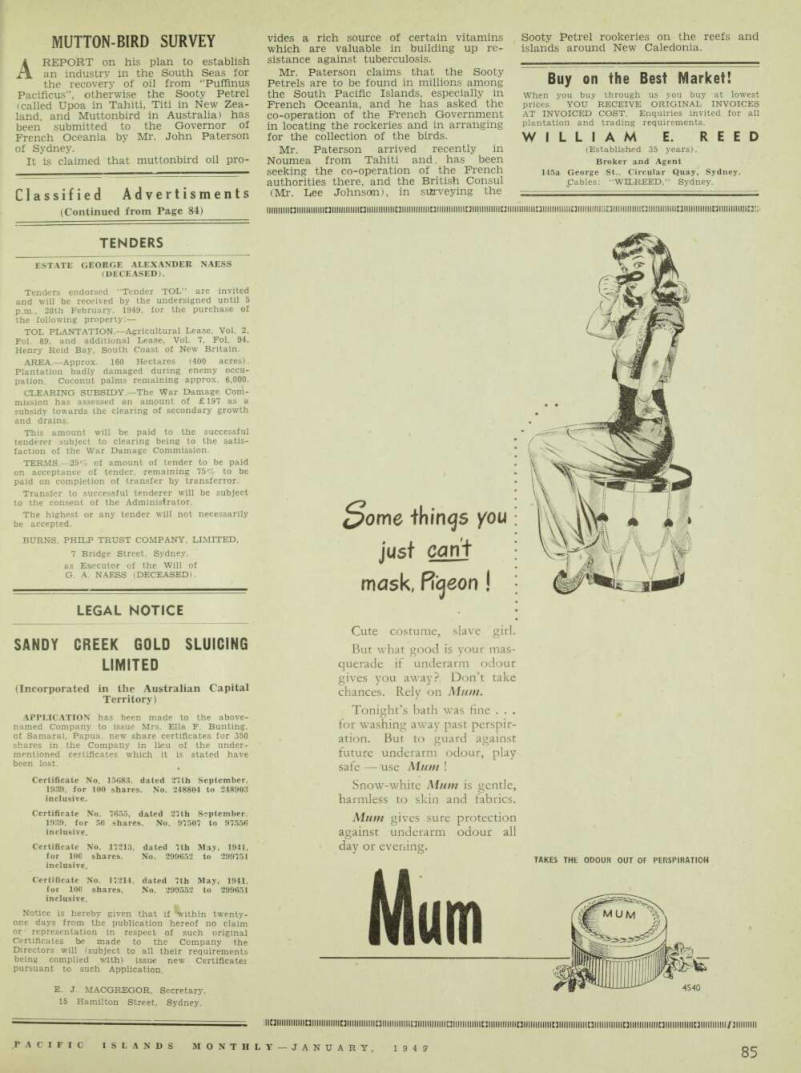
A REPORT on his plan to establish an industry in the South Seas for the recovery of oil from “Puffinus Pacificus”, otherwise the Sooty Petrel (called Upoa in Tahiti, Titi in New Zea land, and Muttonbird in Australia) has been submitted to the Governor of French Oceania by Mr. John Paterson of Sydney.
It is claimed that muttonbird oil pro
vides a rich source of certain vitamins which are valuable in building up re sistance against tuberculosis.
Mr. Paterson claims that the Sooty Petrels are to be found in millions among the South Pacific Islands, especially in French Oceania, and he has asked the co-operation of the French Government in locating the rockeries and in arranging for the collection of the birds.
Mr. Paterson arrived recently in Noumea from Tahiti and, has been seeking the co-operation of the French authorities there, and the British Consul (Mr. Lee Johnson), in surveying the
Sooty Petrel rookeries on the reefs and islands around New Caledonia.
Sea Rovers
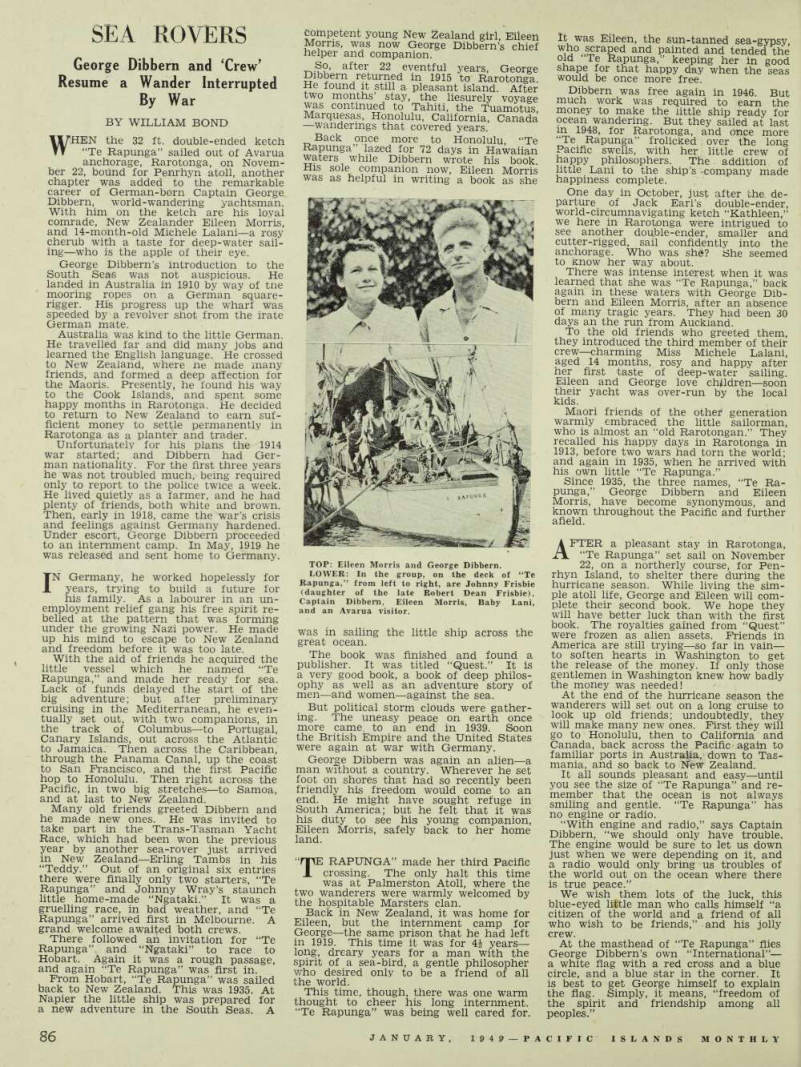
George Dibbern and ‘Crew’
Resume a Wander Interrupted By War
By William Bond
WHEN the 32 ft. double-ended ketch “Te Rapunga” sailed out of Avarua anchorage, Rarotonga, on Novem ber 22, bound for Penrhyn atoll, another chapter was added to the remarkable career of German-born Captain George Dibbern, world-wandering yachtsman.
With him on the ketch are his loyal comrade, New Zealander Eileen Morris, and 14-month-old Michele Lalani —a rosy cherub with a taste for deep-water sail ing—who is the apple of their eye.
George Dibbern’s introduction to the South Seas was not auspicious. He landed in Australia in 1910 by way of tne mooring ropes on a German square rigger. His progress up the wharf was speeded by a revolver shot from the irate German mate.
Australia was kind to the little German.
He travelled far and did many jobs and learned the English language. He crossed to New Zealand, where ne made many friends, and formed a deep affection for the Maoris. Presently, he found his way to the Cook Islands, and spent some happy months in Rarotonga. He decided to return to New Zealand to earn suf ficient money to settle permanently in Rarotonga as a planter and trader.
Unfortunately for his plans the 1914 war started; and Dibbern had Ger man nationality. For the first three years he was not troubled much, being required only to report to the police twice a week.
He lived quietly as a farmer, and he had plenty of friends, both white and brown.
Then, early In 1918, came the war’s crisis and feelings against Germany hardened.
Under escort, George Dibbern proceeded to an internment camp. In May, 1919 he was released and sent home to Germany.
IN Germany, he worked hopelessly for years, trying to build a future for his family. As a labourer in an un employment relief gang his free spirit re belled at the pattern that was forming under the growing Nazi power. He made up his mind to escape to New Zealand and freedom before it was too late.
With the aid of friends he acquired the little vessel which he named “Te Rapunga,” and made her ready for sea.
Lack of funds delayed the start of the big adventure; but after preliminary cruising in the Mediterranean, he even tually set out, with two companions, in the track of Columbus —to Portugal, Canary Islands, out across the Atlantic to Jamaica. Then across the Caribbean, through the Panama Canal, up the coast to San Francisco, and the first Pacific hop to Honolulu. Then right across the Pacific, in two big stretches—to Samoa, and at last to New Zealand.
Many old friends greeted Dibbern and he made new ones. He was invited to take part in the Trans-Tasman Yacht Race, which had been won the previous year by another sea-rover just arrived in New Zealand —Erling Tambs in his “Teddy.” Out of an original six entries there were finally only two starters, “Te Rapunga” and Johnny Wray’s staunch little home-made “Ngataki.” It was a gruelling race, in bad weather, and “Te Rapunga” arrived first in Melbourne. A grand welcome awaited both crews.
There followed an invitation for “Te Rapunga” and “Ngataki” to race to Hobart. Again it was a rough passage, and again “Te Rapunga” was first in.
From Hobart, “Te Rapunga” was sailed back to New Zealand. This was 1935. At Napier the little ship was prepared for a new adventure in the South Seas. A
Competent young New Zealand girl, Eileen Morris, was now George Dibbern’s chief helper and companion.
So, after 22 eventful years, George Dibbern returned in 1915 to Rarotonga.
He found it still a pleasant island. After two months’ stay, the liesurely voyage was continued to Tahiti, the Tuamotus, Marquesas, Honolulu, California, Canada —wanderings that covered years.
Back once more to Honolulu, “Te Rapunga” lazed for 72 days in Hawaiian waters while Dibbern wrote his book His sole companion now, Eileen Morris was as helpful in writing a book as she
was in sailing the little ship across the great ocean.
The book was finished and found a publisher. It was titled “Quest.” It is a very good book, a book of deep philos ophy as well as an adventure story of men—and women—against the sea.
But political storm clouds were gather ing. The uneasy peace on earth once more came, to an end in 1939. Soon the British Empire and the United States were again at war with Germany.
George Dibbern was again an alien —a man without a country. Wherever he set foot on shores that had so recently been friendly his freedom would come to an end. He might have sought refuge in South America; but he felt that it was his duty to see his young companion, Eileen Morris, safely back to her home land.
TE RAPUNGA” made her third Pacific crossing. The only halt this time was at Palmerston Atoll, where the two wanderers were warmly welcomed by the hospitable Marsters clan.
Back in New Zealand, it was home for Eileen, but the internment camp for George—the same prison that he had left in 1919. This time it was for 4i years— long, dreary years for a man with the spirit of a sea-bird, a gentle philosopher who desired only to be a friend of all the world.
This time, though, there was one warm thought to cheer his long internment.
“Te Rapunga” was being well cared for.
it was Eileen, the sun-tanned sea-gypsy, who seraped and painted and tended the old ‘Te Rapunga,” keeping her in good shape for that happy day when the seas would be once more free.
Dibbern was free again in 1946. But much work was required to earn the money to make the little ship ready for pcean wandering. But they sailed at last in 1948, for Rarotonga, and once more “Te Rapunga” frolicked over the long Pacific swells, with her little crew of happy philosophers. The addition of little Lani to the ship’s -company made happiness complete.
One day in October, just after the de parture of Jack Earl’s double-ender, world-circumnavigating ketch “Kathleen,” we here in Rarotonga were intrigued to see another double-ender, smaller and cutter-rigged, sail confidently into the anchorage. Who was she? She seemed to know her way about.
There was intense interest when it was learned that she was “Te Rapunga,” back again in these waters with George Dib bern and Eileen Morris, after an absence of many tragic years. They had been 30 days an the run from Auckland.
To the old friends who greeted them, they introduced the third member of their crew—charming Miss Michele Lalani, aged 14 months, rosy and happy after her first taste of deep-water sailing.
Eileen and George love children—soon their yacht was over-run by the local kids.
Maori friends of the other generation warmly embraced the little sailorman, who is almost an “old Rarotongan.” They recalled his happy days in Rarotonga In 1913, before two wars had torn the world; and again in 1935, when he arrived with his own little “Te Rapunga.”
Since 1935, the three names, “Te Ra punga,” George Dibbern and Eileen Morris, have become synonymous, and known throughout the Pacific and further afield.
AFTER a pleasant stay in Rarotonga, “Te Rapunga” set sail on November 22, on a northerly course, for Pen rhyn Island, to shelter there during the hurricane season. While living the sim ple atoll life, George and Eileen will com plete their second book. We hope they will have better luck than with the first book. The royalties gained from “Quest” were frozen as alien assets. Friends in America are still trying—so far in vain— to soften hearts in Washington to get the release of the money. If only those gentlemen in Washington knew how badly the money was needed!
At the end of the hurricane season the wanderers will set out on a long cruise to look up old friends; undoubtedly, they will make many new ones. First they will go to Honolulu, then to California and Canada, back across the Pacific again to familiar ports in Australia, down to Tas mania, and so back to New Zealand.
It all sounds pleasant and easy—until you see the size of “Te Rapunga” and re member that the ocean is not always smiling and gentle. “Te Rapunga” has no engine or radio.
“With engine and radio,” says Captain Dibbern, “we should only have trouble.
The engine would be sure to let us down just when we were depending on it, and a radio would only bring us troubles of the world out on the ocean where there is true peace,”
We wish them lots of the luck, this blue-eyed little man who calls himself “a citizen of the world and a friend of all who wish to be friends,” and his jolly crew.
At the masthead of “Te Rapunga” flies George Dibbern’s own “International”— a white flag with a red cross and a blue circle, and a blue star in the corner. It is best to get George himself to explain the flag. Simply, it means, “freedom of the spirit and friendship among all peoples.”
TOP: Eileen Morris and George Dibbern.
LOWER: In the group, on the deck of “Te Rapunga,” from left to right, are Johnny Frisbie (daughter of the late Robert Dean Frisbie), Captain Dibbern, Eileen Morris, Baby Lani, and an Avarua visitor.
Administrator Visits Sepik
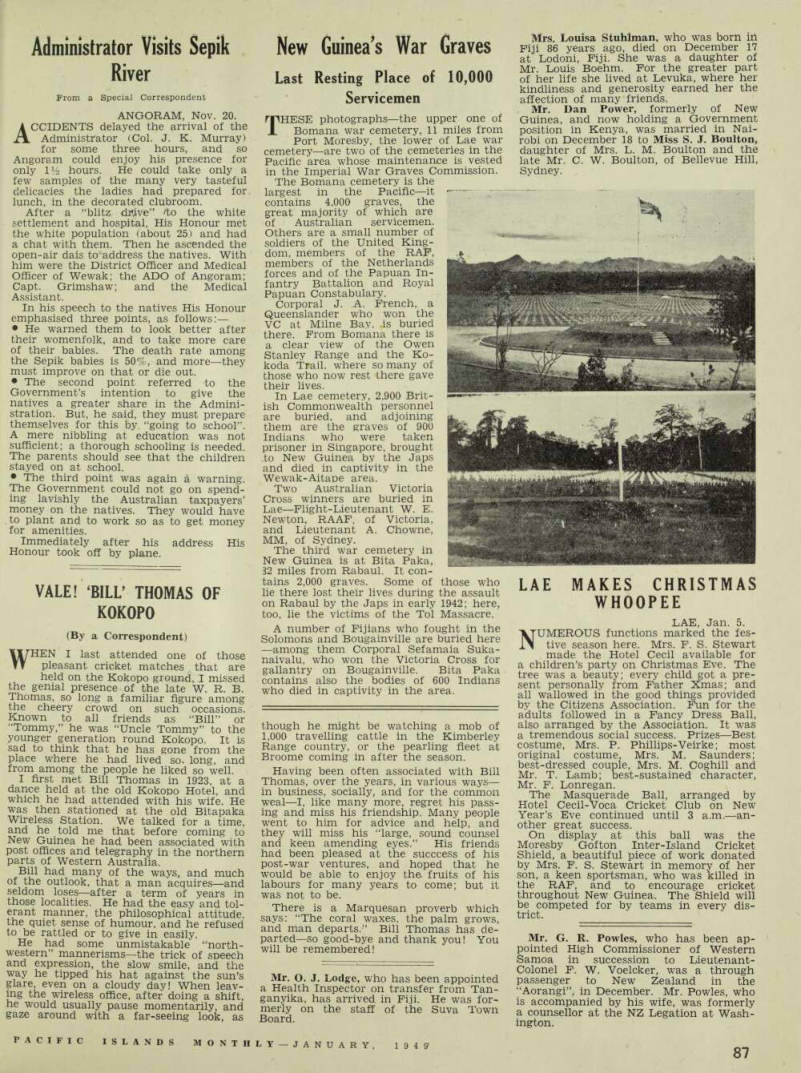
River
From a Special Correspondent
Angoram, Nov. 20.
ACCIDENTS delayed the arrival of the Administrator (Col. J. K. Murray) for some three hours, and so Angoram could enjoy his presence for only IV 2 hours. He could take only a few samples of the many very tasteful delicacies the ladies had prepared for lunch, in the decorated clubroom.
After a “blitz dflive” (to the white settlement and hospital, His Honour met the white population (about 25) and had a chat with them. Then he ascended the open-air dais to'address the natives. With him were the District Officer and Medical Officer of Wewak; the ADO of Angoram; Capt. Grimshaw; and the Medical Assistant.
In his speech to the natives His Honour emphasised three points, as follows: — • He warned them to look better after their womenfolk, and to take more care of their babies. The death rate among the Sepik babies is 50%, and more—they must improve on that or die out. • The second point referred to the Government’s intention to give the natives a greater share in the Admini stration. But, he said, they must prepare themselves for this by “going to school”.
A mere nibbling at education was not sufficient: a thorough schooling is needed.
The parents should see that the children stayed on at school. • The third point was again a warning.
The Government could not go on spend ing lavishly the Australian taxpayers’ money on the natives. They would have to plant and to work so as to get money for amenities.
Immediately after his address His Honour took off by plane.
Vale! ‘Bill’ Thomas Of
Kokopo
(By a Correspondent)
WHEN I last attended one of those pleasant cricket matches that are held on the Kokopo ground, I missed the genial presence of the late W. R. B.
Thomas, so long a familiar figure among the cheery crowd on such occasions.
Known to all friends as “Bill” or “Tommy,” he was “Uncle Tommy” to the younger generation round Kokopo. It is sad to think that he has gone from the place where he had lived so, long, and from among the people he liked so well.
I first met Bill Thomas in 1923, at a dance held at the old Kokopo Hotel, and which he had attended with his wife. He was then stationed at the old Bitapaka Wireless Station. We talked for a time, and he told me that before coming to New Guinea he had been associated with post offices and telegraphy in the northern parts of Western Australia.
Bill had many of the ways, and much of the outlook, that a man acquires—and seldom loses—after a term of years in those localities. He had the easy and tol erant manner, the philosophical attitude, the quiet sense of humour, and he refused to be rattled or to give in easily.
He had some unmistakable “north western” mannerisms—the trick of speech and expression, the slow smile, and the way he tipped his hat against the sun’s glare, even on a cloudy day! When leav ing the wireless office, after doing a shift, he would usually pause momentarily, and gaze around with a far-seeing look, as
though he might be watching a mob of 1,000 travelling cattle in the Kimberley Range country, or the pearling fleet at Broome coming in after the season.
Having been often associated with Bill Thomas, over the years, in various ways— in business, socially, and for the common weal —I, like many more, regret his pass ing and miss his friendship. Many people went to him for advice and help, and they will miss his “large, sound counsel and keen amending eyes.” His friends had been pleased at the succcess of his post-war ventures, and hoped that he would be able to enjoy the. fruits of his labours for many years to come; but it was not to be.
There is a Marquesan proverb which says: “The coral waxes, the palm grows, and man departs.” Bill Thomas has de parted—so good-bye and thank you! You will be remembered!
Mr. O. J. Lodge, who has been appointed a Health Inspector on transfer from Tan ganyika, has arrived in Fiji. He was for merly on the staff of the Suva Town Board.
New Guinea’s War Graves
Last Resting Place of 10,000 Servicemen
THESE photographs—the upper one of Bomana war cemetery, 11 miles from Port Moresby, the lower of Lae war cemetery—are two of the cemeteries in the Pacific area whose maintenance is vested in the Imperial War Graves Commission,
The Bomana cemetery is the largest in the Pacific —it contains 4,000 graves, the great majority of which are of Australian servicemen.
Others are a small number of soldiers of the United King dom, members of the RAF, members of the Netherlands forces and of the Papuan In fantry Battalion and Royal Papuan Constabulary.
Corporal J. A. French, a Queenslander who won the VC at Milne Bay. is buried there. From Bomana there is a clear view of the Owen Stanley Range and the Ko koda Trail, where so many of those who now rest there gave their lives.
In Lae cemetery, 2,900 Brit ish Commonwealth personnel are buried, and adjoining them are the graves of 900 Indians who were taken prisoner in Singapore, brought .to New Guinea by the Japs and died in captivity in the Wewak-Aitape area.
Two Australian Victoria Cross winners are buried in Lae—Flight-Lieutenant W. E.
Newton, RAAF, of Victoria, and Lieutenant A. Chowne, MM, of Sydney.
The third war cemetery in New Guinea is at Bita Paka, 32 miles from Rabaul. It con
tains 2,000 graves. Some of those who lie there lost their lives during the assault on Rabaul by the Japs in early 1942; here, too, lie the victims of the Tol Massacre.
A number of Fijians who fought in the Solomons and Bougainville are buried here —among them Corporal Sefamaia Suka naivalu, who won the Victoria Cross for gallantry on Bougainville. Bita Paka contains also the bodies of 600 Indians who died in captivity in the area.
Mrs. Louisa Stuhlman, who was born in Fiji 86 years ago, died on December 17 at Lodoni, Fiji. She was a daughter of Mr. Louis Boehm. For the greater part of her life she lived at Levuka, where her kindliness and generosity earned her the affection of many friends.
Mr. Dan Power, formerly of New Guinea, and now holding a Government position in Kenya, was married in Nai robi on December 18 to Miss S. J. Boulton, daughter of Mrs. L. M. Boulton and the late Mr. C. W. Boulton, of Bellevue Hill, Sydney.
Lae Makes Christmas
Whoopee
LAE, Jan. 5.
NUMEROUS functions marked the fes tive season here. Mrs. F. S. Stewart made the Hotel Cecil available for a children’s party on Christmas Eve. The tree was a beauty; every child got a pre sent personally from Father Xmas; and all wallowed in the good things provided by the Citizens Association. Fun for the adults followed in a Fancy Dress Ball, also arranged by the Association. It was a tremendous social success. Prizes —Best costume, Mrs. P. Phillips-Veirke; most original costume, Mrs. M. Saunders; best-dressed couple, Mrs. M. Coghill and Mr. T. Lamb; best-sustained character, Mr. F. Lonregan.
The Masquerade Ball, arranged by Hotel Cecil-Voca Cricket Club on New Year’s Eve continued until 3 a.m.—an other great success.
On display at this ball was the Moresby Gofton Inter-Island Cricket Shield, a beautiful piece of work donated by Mrs. F. S. Stewart in memory of her son, a keen sportsman, who was killed in the RAF, and to encourage cricket throughout New Guinea. The Shield will be competed for by teams in every dis trict.
Mr. G. R. Powles, who has been ap pointed High Commissioner of Western Samoa in succession to Lieutenant- Colonel P. W. Voelcker, was a through passenger to New Zealand in the “Aorangi”, in December. Mr. Powles, who is accompanied by his wife, was formerly a counsellor at the NZ Legation at Wash ington.
Advertisements & other items, p. 94 (1 item)
George J. Logkyer & Company
CONSULTING ENGINEERS DOCKYARD MACHINERY
In association with GEORGE J. LOCKYER (For East) & CO. and GEORGE J. LOCKYER (Overseas) & CO.
ENGINEERING SUPPLIES, GENERAL HARDWARE EXPORTERS AND MERCHANTS Agents for the Finest Australian Liquors Aerated Water and Cordial Manufacturing Machinery, Bottling and Capping Machinery, etc.
!F YOU ARE INTERESTED SN:
MILLS
Flour mills. Hard semolina mills. Self-contained Colonial Flour Mills. Flour improving equipment. Feed milling equipment. Grinding and blending plants. Saw dust mills. Grinding and blend plants for spices and colours. Laboratory equipment.
HULLING INDUSTRY
Hulling mills for rice, barley (for making groats), oats (for flakes and groats), peas, buckwheat, millets, kauliang, lentils, Dal and other pulses.
OIL MILLING
Complete equipments for the manufacture and refining of vegetable oils and fats. Pressing, Extraction-, and Refining plants. Oil separating plants for wool and leather. Margarine granulators, Melting and Tempering Pand for the manufacture of margarine.
SUGAR TREATING MACHINERY
Installations for drying, cooling and assorting granulated sugar. Conveying plants. Grinding plants for pile and granulated sugar. Manufacture of powdered sugar,
MALTING AND BREWING PLANTS
Equipments of complete maltings and breweries. Barley and Malt cleaning plants. Pneumatic Maltings (Drum and Saladin Box Maltings). Malt Kilns. High Capacity Malt Kilns. Floor Stores and Silos for barley and malt.
Pneumatic and mechanical handling plants for barley and malt. Malt crushing plants. Brew house equipment. Mash filters. Wort colling plants. Fermentation and Storage Tanks. Conveying plants for barrels and bottles. Laboratory equipments.
MACHINES FOR SOAP MAKING
Soap boiling equipment. Pumps. Soap slabs cooling plants. Cutting machines. Presses. Drying plants.
Milling equipment. Pendulum cutter. Flaking rolls.
Soap-powder plants.
MACHINES FOR THE CHOCOLATE INDUSTRY
Cocoa beans crushing, cleaning and grinding plants.
Cocoa presses. Cocoa and chocolate roller mills.
CONSTRUCTION OF GRANARIES AND
WAREHOUSES
Construction of Export and Import Granaries. Agricultural and Mill Granaries for all kinds of grain, oil fruits, pulses, and seed, in bulk or in sacks. Mechanical and pneumatic handling plants for loading and unloading ships and railway cars with the above-named goods. Steel Silos. Grain Cleaning Plants. Machinery for dressing seed.
PNEUMATIC HANDLING PLANTS
For grain, bran, flour, oil seed, coal, salt, chemical products, ashes, blast furnace dust, wood chips, woodshavings. Floating pneumatic elevators. Floating pneumatic grain elevators. Stationary and travelling ship discharging plants. Conveying plants for rubbish from wash plants and rubbish disposal plants for mines.
MECHANICAL HANDLING PLANTS
For all kinds of goods in bulk and packages, such as grain, coal, salt, earth and ores, stornfes, bags, cases, bales, barrels, wood logs, etc. Mechanical equipment for warehouses of salt works and the chemical industry.
Trans-shipping plants for loading salts into ships and railway cars. Coal handling plants for boiler houses.
Equipment for the automatic operation of mail offices.
CEMENT WORKS AND ROCK CRUSHING
PLANTS
Equipment of complete cement works. Crushing, burning, grinding, and conveying equipment for the chemical industry; specially for Dolomite, Magnesite, and Aluminium Works. Installations for salt mills and salt stores. Crushing and grinding plants for coal.
Road metal plants, etc.
MECHANICAL PULP AND BOARD MILLS
Complete equipment for mechanical wood pulp mills and board mills of every size. Preparing plants for cellulose and pulp wood. Wood barking plants. Installations for handling wood sticks and pulp.
- CONSULT US -
All communications to be addressed to The General Manager, G.P.0., Box 4553, Sydney.
Bankers: Commonwealth Bank of Australia, Sydney.
Also Bank of N.S.W., Sydney.
Telegraphic and Cable Address: “LOCKMACH,” Sydney.
Prince Von Bismarck’S Interest
In New Guinea
A Berlin Interview of Sixty Years Ago
By F. T. Goedicke-van-Asten (Count Van Asten) of Haapai, Tonga, holder of an old Dutch title.
IN January, 1888, I left Haapai, Tonga, in a copra vessel for Bremen, Ger many. My plan was to stay about three months in Germany and then go via the United States to Samoa, where I was sure to get one of the DH & PG’s vessels to New Britain.
While I was in Germany I visited my brother, Dr. K. Goedicke, who, at that time, was serving his one year as a volunteer in the German Army, at Berlin.
One evening, my brother took me with him to the officers’ casino, where I was introduced to several officers.
When one of the officers, a Lieutenant von Hanseman, learned that I had been in New Guinea, he asked me if I could spare an hour, next day, to meet his father, who was a big shareholder in the New Guinea Company. The next day I met his father, Banker von Hanseman, a very kind old gentleman. I had to answer many questions about New Guinea; climate, people, produce, if gold had been found, etc.
Then he told me he would like me to meet Prince von Bismarck, the Imperial German Chancellor, who was at the head of the New Guinea Company, and was the principal shareholder in the DH & PG, of Hamburg. He said that von Bismarck would go, at 11 am next day, to inspect the new Parliament House, then being erected, and that we could meet him there.
Next day we drove up to the front of the Reichstag, just as von Bismarck came down the marble steps. I was introduced: but von Bismarck excused himself—he had not a minute to spare, but he asked me to see him next day at the Chancellery, where we could, as he expressed it, have a long taki taki.
NEXT morning, as I approached the Chancellery, I was challenged by a guard. I told him I had an appoint ment with the Imperial Chancellor. He called another guard and, after a lot of red tape, I was ushered into the room where von Bismarck welcomed me. He bombarded me with questions about the different Islands in the Bismarck Archi pelago.
When I told Bismarck that I had taken part in the punishment of the natives of Kabaira bv the German warship “Alba tros,” for killing several Europeans dur ing the last few years, von Bismarck called his secretary, saving, “bring me Admiralty reports, Albatros, New Britain, 1885.”
Von Bismarck onened the portfolio, turned leaf after leaf, and at last he said: “Here we are! August 5: Albatros arrived at Kabaira, anchored in front of one of the German firm’s stations occu pied by one, Mr. Goedicke.”
Von Bismarck turned several more leaves and then he read out: “August 6: ‘Albatros’ bombarded the village, landed 140 men. As no natives were seen, huts were burnt, plantations destroyed, ‘Alba tros’ men returned on board.
“Aug. 7: 140 men were landed under command of Lieutenant von Brido. After a march of about one hour, the ‘Albatros’ party was confronted by a large crowd of natives, all armed with spears, bows and arrows, and sling stones; spears were thrown and replied to with rifles
by the Albatros party. During a skirmish of about one hour, four of the ‘Albatros’ party and Dr. Butig were seriously wounded; Mr. Goedicke also received an arrow in his hand and a poisoned spear in his back.”
Von Bismarck looked up and said, “I am sorry. Are you all right again?” I said I was.
He continued reading. Lieutenant von Brido thought that the natives had re ceived sufficient punishment. The ‘Alba tros’s’ men returned to report to Com mander Count von Baudisin.
Von Bismrack turned another leaf and read: “August 8: ‘Albatros’ left New Britain, taking Mr. Goedicke on board to be placed with the other wounded men in a hospital in Sydney.”
VON BISMARCK closed the portfolio, stood up, went to his desk and re turned with a medal. On one side was the image of Bismarck; the other side had German words engraved, mean ing: “We Germans fear God, but nobody else in this world!”
Von Bismarck told me that he had had several of these medals made to give to people who had interested themselves in the Bismarck Archipelago. He said the medal was not an Order or Decoration it was a kind of memento, to remind them of New Guinea.
“I think that, according to your own story and the Admiralty report, you are one who is entitled to receive this medal,” he said. “Whenever you look at it, re member that I, Otto Prince von Bis marck-Schoershausen had the pleasure of handing it to you.”
I thanked the Prince and we sat down again.
“Have you ever tasted a ‘Berliner Weiss’?” asked von Bismarck.
I said that I had not.
He rang a bell and told a servant to bring two Berliner Weiss (a beer only brewed in Berlin). The servant placed on the table two bottles of beer, two very large tumblers, two small liqueur glasses filled with Gilka, and a plate of caviare sandwiches.
We ate, drank and conversed for a long while. Finally, looking at the clock on the wall, I saw I had been there an hour, so I said: “Excellency, words fail me to express my thanks for the honour you have bestowed on me. I think I have occunied your valuable time too long, so with your kind permission I will wish you good-bye.”
Von Bismarck stood up, placed one of his hands in mine, the other one on my shoulder, looked me in the face and, in a very fatherly way, he said: “Goedicke, you are a young man; you have the world before you. I wish you all the best for the future, and may the blessing of our Lord rest upon you.” We shook hands.
Von Bismarck accomnanied me to the door, and I left the Chancellery.
Thus I met Otto von Bismarck- Schoershausen, the statesman more re sponsible than any other man for the unification of the German States and the foundation of the German Empire.
If von Bismarck had been alive in 1914 there would have been no World War I; and, therefore, no World War IT.
Immediately thereafter, I wrote the
whole of the circumstances of the inter view in my diary, from which I now have copied the foregoing.
I saw von Bismarck once more, but only from a distance, at the funeral of Emperor Frederic 111, father of Emperor William 11. * * * I HAVE made in my Will a provision that, after my death, my Bismarck medal shall go to Mr. R. W. Robson, editor of the “Pacific Islands Monthly,” in the belief that this interesting link between Prince von Bismarck and what was German New Guinea will be suit ably taken care of, and preserved.
Fijians Are Not Copra
Plutocrats
Suva. Nov. 22.
THE widely-held but erroneous view that the Fijians, who produce about two-thirds of Fiji’s copra, are rolling in money as a result of the present high prices, is dealt with in the annual report of the Secretary for Fijian Affairs: “Contrary to the accepted view, the Fijians of the big copra-producing pro vinces are a minority of the population.
“Rough calculations based on figures taken from the Census report, 1946, show that a little more than one quarter of the total Fijian population lives in those areas.
“On this basis, it may be assumed that 25 per cent, of the Fijian taxpayers are copra producers, but their output varies greatly according to the size of holdings and productivity.
“Thus a Provincial Rate of £2/13/levied on a native of Ra is a very heavy tax, if he belongs to the hills or coastal stretches where there is no copra and no sale for bananas or roots, compared with £2/5 -, the rate in Cakaudrove Pro vince, which produces more than 5,000 tons of copra a year.”
Oil Exploration in Papua
AUSTRALASIAN Petroleum Company Pty. Ltd. reports, in connection with its search for oil in Papua, that drill ing is continuing at Oroi, the bore having been carried down to 1,694 feet. Drilling was expected to commence at Upoia dur ing December, and at Hohoro during January.
Pacific Islands Service
Bureau
THE Pacific Islands Service Bureau has been established to assist Island re sidents who cannot shop for themselves.
Briefly, we will perform those services for you, in Australia, which you cannot per form yourself, or are outside the scope of ordinary mail-ordering;.
We will purchase and forward goods to you; have repairs made on your behalf; send flowers, sweets, fruits, gifts to frends in Australia for you. or to your children at school in Australia; match materials and sewing accessories; and arrange holiday accommodation and travel.
For these services we charge a small fee —in the case of shopping services, usually 10 per cent, of the purchase price.
If you missed the circular which ex plains this service fully and which was included in all copies of “PIM” which went to the Islands in March, please let us know and we will send you a copy of the pamphlet, free of charge.
All inquiries should be addressed to: The Director, Pacific Travel and Service Agency, Box 3408, Sydney.
Advertisements & other items, p. 96 (2 items)
90
JANUARY, 1949 PACIFIC ISLANDS MONTHLY
Mr. Ward’s Career (Continued from Page 11)
Coventry Climax
IT l_h it •
HILLMAN
SILVER SHELL MOTOR OIL S.A.E. 20.
HUMBER
SINGLE SHELL MOTOR OIL S.A.E. 30.
SUNBEAM-TALBOT
SI HOLE SHELL MOTOR OIL S.A.E. 30.
COMMER
SINGLE SHELL MOTOR OIL $ JLE. 30.
KARRIER
SINGLE SHELL MOTOR OIL SJLE. 30.
THE ROOTES GROUP
Recommend Exclusively
SHELL
MOTOR OIL
FOR ALL THEIR VEHICLES
SHELLj You, too, can be sure of SHELL MOTOR OIL THE SHELL CO. OF AUST. LTD. (Inc. In Gt. Bril.) UOAB9J
Coventry Climax
Electric Sets
2.75 KVA 110/130 Volt A.C.
3 PHASE, £135
Discount for quantity.
These sets are new and driven by 4-Cylinder 8 H.P. Petrol Engine, complete with instruments and mounted in steel frame.
Ideal for lighting, used extensively by Army and Air Force during war.
HARDMAN & HALL
44 Missenden Road, Newtown, N.S.W., Australia.
Us Closes Pacific Consulates
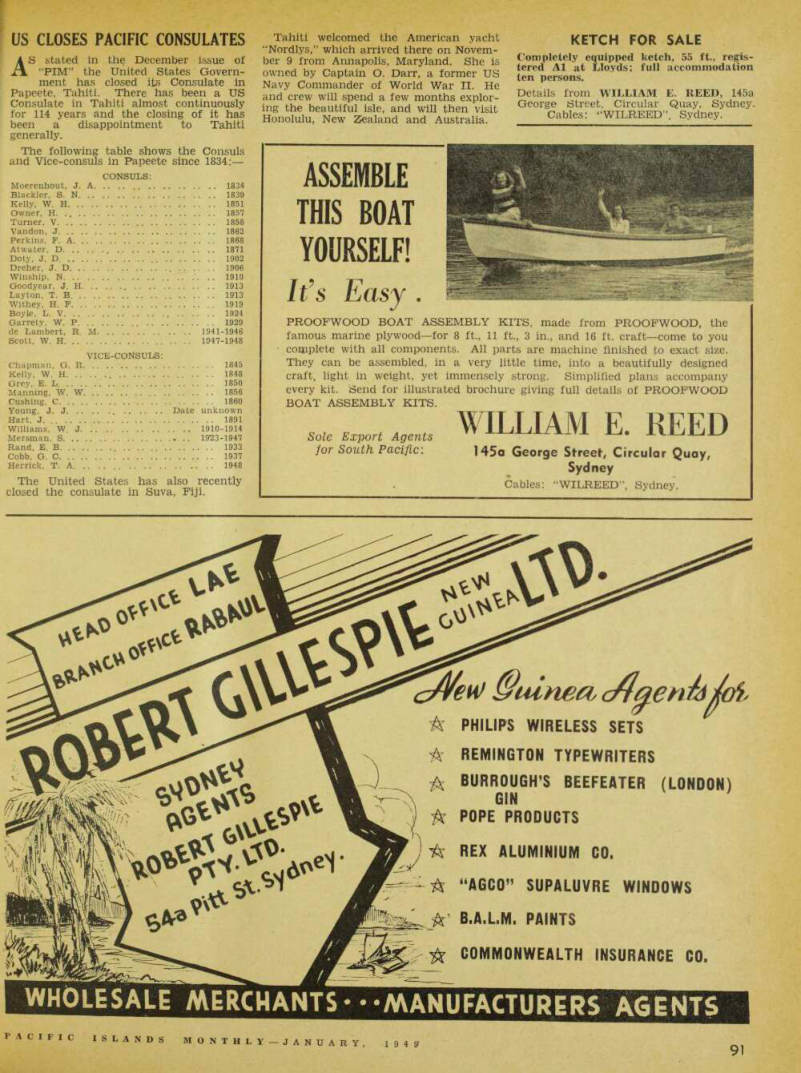
AS stated in the December issue of “PIM” the United States Govern ment has closed its Consulate in Papeete, Tahiti. There has been a US Consulate in Tahiti almost continuously for 114 years and the closing of it has been a disappointment to Tahiti
generally.
The following table shows the Consuls and Vice-consuls in Papeete since 1834:
Consuls:
Moerenhout, J. A 1834 Blackler, S. N 1839 Kelly, W. H 1851 Owner, H. 1857 Turner, V 1858 Vandon, J 1862 Perkins, F. A 1868 Atwater, D 1871 Doty, J. D 1902 Dreher, J. D 1906 Winship, N .. 1910 Goodyear, J. H 1913 Layton, T. B 1913 Withey, H. F 1919 Boyle, L. V 1924 Garrety. W. P 1929 de Lambert, R. M 1941-1946 Scott, W. H 1947-1948
Vice-Consuls:
Chapman, G. R 1845 Kelly, W. H 1848 Grey, E. L 1850 Manning, W. W 1856 Cushing, C 1860 Young, J. J Date unknown Hart, J 1891 Williams, W. J 1910-1914 Mersman, S , .. 1923-1947 Rand, E. B 1933 Cobb, G. C 1937 Herrick, T. A 1948 The United States has also recently closed the consulate in Suva, Fiji.
Tahiti welcomed the American yacht “Nordlys,” which arrived there on November 9 from Annapolis, Maryland. She is owned by Captain O. Darr, a former US Navy Commander of World War 11. He and crew wi |j S p enc j a f ew mo nths explorin£r thp hpanHfni i«ip nnri win tbpn
Advertisements & other items, p. 97 (1 item)
It’s Easy.
KETCH FOR SALE
Completely equipped ketch, 55 ft., registered A 1 at Lloyds; full accommodation ten persons.
Details from WILLIAM E. REED, 145 a George Street, Circular Quay, Sydney.
Cables: “WILREED”, Sydney.
ASSEMBLE
THIS BOAT
YOURSELF!
It’s Easy.
PROOFWOOD BOAT ASSEMBLY KITS, made from PROOFWOOD, the famous marine plywood—for 8 ft., 11 ft., 3 in., and 16 ft. craft—come to you complete with all components. All parts are machine finished to exact size.
They can be assembled, in a very little time, into a beautifully designed craft, light in weight, yet immensely strong. Simplified plans accompany every kit. Send for illustrated brochure giving full details of PROOFWOOD
BOAT ASSEMBLY KITS.
Sole Export Agents for South Pacific:
WILLIAM E. HEED
145 a George Street, Circular Quay,
Sydney Cables: “WILREED”, Sydney.
o** \C*
>xV t^
*j» ,I'jU.
,\vvt
V' 1 fcggggg cA
'fM' Guinea </jgcnh/o>.
A PHILIPS WIRELESS SETS
A REMINGTON TYPEWRITERS
A BURROUGHS BEEFEATER (LONDON)
GIN
A POPE PRODUCTS
A REX ALUMINIUM CO.
A “AGCO” SUPALUVRE WINDOWS
A B.A.L.M. PAINTS
A COMMONWEALTH INSURANCE CO.
WHOLESALE MERCHANTS ••‘MANUFACTURERS AGENTS
Islands Produce
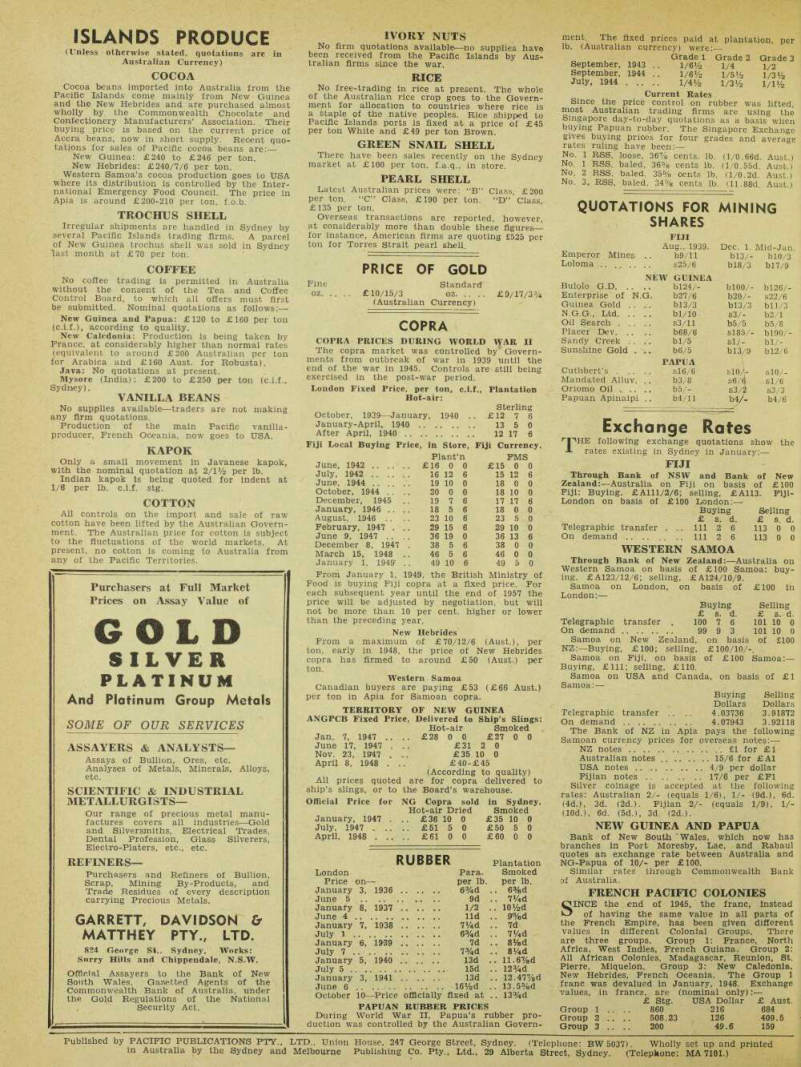
(Unless otherwise stated, quotations arc in Australian Currency)
Cocoa
Cocoa beans imported into Australia from the Pacific Islands come mainly from New Guinea and the New Hebrides and are purchased almost wholly by the Commonwealth Chocolate and Confectionery Manufacturers’ Association. Their buying price is based on the current price of Accra beans, now in short supply. Recent quo tations for sales of Pacific cocoa beans are:— New Guinea: £240 to £246 per ton.
New Hebrides: £240/7/6 per ton.
Western Samoa’s cocoa production goes to USA where its distribution is controlled by the Inter national Emergency Food Council. The price in Apia is around £2OO-210 per ton, f.o.b.
Trochus Shell
Irregular shipments are handled in Sydney by several Pacific Islands trading firms. A parcel of New Guinea trochus shell was sold in Sydney last month at £7O per ton.
Coffee
No coffee trading is permitted in Australia without the consent of the Tea and Coffee Control Board, to which all offers must first be submitted. Nominal quotations as follows: — New Guinea and Papua: £l2O to £l6O per ton (c.i.f.), according to quality.
New Caledonia: Production is being taken by France, at considerably higher than normal rates (equivalent to around £2OO Australian per ton for Arabica and £l6O Aust. for Robusta), Java: No quotations at present.
Mysore (India): £2OO to £250 per ton (c.i.f., Sydney).
Vanilla Beans
No supplies available —traders are not making any firm quotations.
Production of the main Pacific vanilla producer, French Oceania, now goes to USA.
Kapok
Only a small movement in Javanese kapok, with the nominal quotation a$ 2/iy 2 per lb.
Indian kapok is being quoted for indent at 1/6 per lb. c.i.f. stg.
Cotton
All controls on the import and sale of raw cotton have been lifted by the Australian Govern ment. The Australian price for cotton is subject to the fluctuations of the world markets. At present, no cotton is coming to Australia from any of the Pacific Territories.
Ivory Nuts
No firm quotations available—no supplies have been received from the Pacific Islands by Aus tralian firms since the war.
Rice
No free-trading in rice at present. The whole of the Australian rice crop goes to the Govern ment for allocation to countries where rice is a staple of the native peoples. Rice shipped to Pacific Islands ports is fixed at a price of £45 per ton White and £49 per ton Brown.
Green Snail Shell
There have been sales recently on the Sydney market at £lOO per ton, f.a.q., in store.
Pearl Shell
Latest Australian prices were; “B” Class, £2OO per ton, “C” Class, £l9O per ton. “D” Class, £135 per ton.
Overseas transactions are reported, however, at considerably more than double these figures— for instance, American firms are quoting £525 per ton for Torres Strait pearl shell.
Advertisements & other items, p. 98 (1 item)
Price Of Gold
Fine Standard oz. .. .. £10/15/3 oz £9/17/3 3 / 4 (Australian Currency)
Copra
Prices During World War Ii
The copra market was controlled by Govern ments from outbreak of war in 1939 until the end of the war in 1945. Controls are still being exercised in the post-war period.
London Fixed Price, per ton, c.i.f., Plantation Hot-air:
From January 1, 1949, the British Ministry of Food is buying Fiji copra at a fixed price. For each subsequent year until the end of 1957 the price will be adjusted by negotiation, but will not be more than 10 per cent, higher or lower than the preceding year.
New Hebrides From a maximum of £7O/12/6 (Aust.), per ton, early in 1948, the price of New Hebrides copra has firmed to around £5O (Aust.) per ton.
Western Samoa Canadian buyers are paying £53 (£66 Aust.) per ton in Apia for Samoan copra.
Territory Of New Guinea
ANGPCB Fixed Price, Delivered to Ship’s Slings:
(According to quality) All prices quoted are for copra delivered to ship’s slings, or to the Board’s warehouse.
Official Price for NG Copra sold in Sydney.
Papuan Rubber Prices
During World War 11, Papua’s rubber pro duction was controlled by the Australian Govern
ment. The fixed prices paid at plantation, per lb. (Australian currency) were:—
Current Rates Since the price control on rubber was lifted, most Australian trading firms are using the Singapore day-to-day quotations as a basis when buying Papuan rubber. The Singapore Exchange gives buying prices for four grades and average rates ruling have been:— No. 1 RSS, loose, 36 7 / 8 cents, lb. (1/0.66d. Aust ) No. 1 RSS, baled, 36% cents lb. (1/0.55d. Aust.i No. 2 RSS, baled, 35% cents lb. (1/0.2d. Aust.) No. 3, RSS, baled, 34% cents lb. (11.88 d, Aust.)
October, 1939—January, 1940 Sterling . £12 7 6 January-April, 1940 13 5 0 After April, 1940 . . 12 17 6 Fiji Local Buying Price in Store, Fiji Currency.
June, 1942 Plant’n £16 0 0 £15
Fms
0 0 July. 1942 16 12 6 15 12 6 June. 1944 19 10 0 18 0 0 October, 1944 .. 20 0 0 18 10 0 December, 1945 .. 19 7 6 17 17 6 January, 1946 .. 18 5 6 18 0 0 August, 1946 .. 23 10 6 23 5 0 February, 1947 . .. 29 15 6 29 10 0 June 9, 1947 .. 36 19 0 36 13 6 December 8, 1947 . 38 5 6 38 0 0 March 15. 1948 .. 46 5 6 46 0 0 January 1, 1949’ .. 49 10 6 49 5 0
Jan. 7, 1947 ..
Hot-air Smoked .. £28 0 0 £27 0 0 June 17, 1947 . £31 2 0 Nov. 23, 1947 . £35 10 0 April 8. 1948 . . £40-£45
Hot-air Dried Smoked January, 1947 . .. £36 10 0 £35 10 0 July. 1947 . .. .. £51 5 0 £50 5 0 April, 1948 . .. .. £61 0 0 £60 0 0
Rubber
Plantation London Para.
Smoked Price onper lb. per lb.
January 3, 1936 6%d .. 6%d June 5 9d .. 7>/ 4 d January 8, 1937 1/2 .. 10V 2 d June 4 lid .. 9 5 /ad January 7, 1938 7*/ 4 d .. 7d July 1 , 6 3 /id .. IVtd January 6, 1939 7d .. 8Vsd July 7 . 7%d .. 8V4d January 5. 1940 13d .. 11.6 7 /ad July 5 . 15d .. 12%d January 3, 1941 13d .. 12.47y 8 d June 6 IGVad .. 13.5 5 /ad October 10- -Price officially fixed at .. 13 3 / 4 d
Grade 1 Grade 2 Grade 3 September, 1943 . 1/6% 1/4 1/2 September, 1944 . 1/6 y 2 1/51/2 I/31/2 July, 1944 1/4V2 I/31/2 I/I1/2
Quotations For Mining
Shares
Fiji
Aug., 1939.
Dec. 1.
Mid-Jan.
Emperor Mines b9/ll bl3/blO/3 Loloma .. bl8/3 bl7/9 Bulolo G.D. ..
New Guinea
bl24/blOO/bl26/- Enterprise of N.G. b27/6 b20/- S22/6 Guinea Gold .. bl3/3 bl3/3 bll/3 N.G.G., Ltd. .. bl/10 s3/b2/l Oil Search . ..
S3/11 b5/5 b5/8 Placer Diev. .. b68/6 sl85/bl90/- Sandy Creek .. bl/5 sl/bl/- Sunshine Gold . b6/5 bl3/9 bl2/6 Cuthbert’s . ..
Papua
516/6 \ slO/|slO/- Mandated Alluv. b3/8 S6/6 sl/6 Oriomo Oil , b5/- S3/2 s3/3 Papuan Apinaipi b4/l 1 b4/b4/6
Exchange Rates
THE following exchange quotations show the rates existing in Sydney in January:—
Fiji
Through Bank of NSW and Bank of New Zealand:—Australia on Fiji on basis of £lOO Fiji: Buying, £Alll/2/6; selling, £AII3. Fiji- London on basis of £lOO London;—
Western Samoa
Through Bank of New Zealand: —Australia on Western Samoa on basis of £lOO Samoa: buy ing. £AI23/12/6; selling, £AI24/10/9.
Samoa on London, on basis of £lOO in London: —
Samoa on New Zealand, on basis of £lOO NZ:—Buying, £100; selling, £lOO/10/-.
Samoa on Fiji, on basis of £lOO Samoa: — Buying, £111; selling, £llO.
Samoa on USA and Canada, on basis of £1 Samoa:—
The Bank of NZ in Apia pays the following Samoan currency prices for overseas notes:— NZ notes £1 for £1 Australian notes 15/6 for £AI USA notes 4/9 per dollar Fijian notes 17/6 per £FI Silver coinage is accepted at the following rates: Australian 2/- (equals 1/6), 1/- (9d.), 6d. (4d.), 3d. (2d.). Fijian 2/- (equals 1/9), 1/- (lOd.), 6d. (5d.), 3d. (2d.).
New Guinea And Papua
Bank of New South 'Wales, which now has branches in Port Moresby, Lae, and Rabaul quotes an exchange rate between Australia and NG-Papua of 10/- per £lOO.
Similar rates through Commonwealth Bank of Australia.
French Pacific Colonies
SINCE the end of 1945, the franc, Instead of having the same value in all parts of the French Empire, has been given different values in different Colonial Groups. There are three groups. Group 1: France, North Africa, West Indies, French Guiana. Group 2: All African Colonies, Madagascar, Reunion, St.
Pierre, Miquelon. Group 3: New Caledonia, New Hebrides, French Oceania. The Group 1 franc was devalued in January, 1948. Exchange values, in francs, are (nominal only):
Buying Selling £ s. d. £ s. d.
Telegraphic transfer . .. Ill 2 6 113 0 0 On demand .. .. .. Ill 2 6 113 0 0
Buying Selling £ s. d. £ s. d.
Telegraphic transfer . 100 7 6 101 10 0 On demand 99 9 3 101 10 0
Buying Selling Dollars Dollars Telegraphic transfer .. 4.03736 3.91872 On demand 4.07943 3.92118
£ Stg.
USA Dollar £ Aust.
Group 1 .. 860 216 684 Group 2 .. 508.23 126 409.5 Group 3 .. 200 49.6 159
Advertisements & other items, pp. 98-100 (3 items)
Published by PACIFIC PUBLICATIONS PTY., LTD., Union House, 247 George Street, Sydney. (Telephone: BW 5037). Wholly set up and printed
in Australia by the Sydney and Melbourne Publishing Co. Pty., Ltd., 29 Alberta Street, Sydney. (Telephone: MA 7101.)
Gold
Purchasers at Full Market Prices on Assay Value of
SILVER
PLATINUM
And Platinum Group Metals
SOME OF OUR SERVICES
ASSAYERS & ANALYSTS—
Assays of Bullion, Ores, etc.
Analyses of Metals, Minerals, Alloys, etc.
SCIENTIFIC & INDUSTRIAL
METALLURGISTS—
Our range of precious metal manufactures covers all industries —Gold and Silversmiths, Electrical Trades, Dental Profession, Glass Silverers, Electro-Platers, etc., etc.
REFINERS—
Purchasers and Refiners of Bullion, Scrap, Mining By-Products, and Trade Residues of every description carrying Precious Metals.
GARRETT, DAVIDSON &
MATTHEY PTY., LTD.
824 George St., Sydney. Works: Surry Hills and Chippendale, N.S.W.
Official Assayers to the Bank of New South Wales. Gazetted Agents of the Commonwealth Bank of Australia, under the Gold Regulations of the National Security Act.
tropical thirst...
To quench a
i
(V COo^
/ '■ < c -ing - -
• JO’MO » T
00t H t CO UMITfO
IVONtT >
IM* A||
ai V' When you’re hot and tired,
there is nothing quite so satisfying
and thirst quenching as a long, cold glass of “K. 8.” Your friends and guests, too, will ap-
preciate this really fine
Lager, for “Everybody
drinks K. 8.”
TOOTHS ‘
LAGER
MERCHANTS. & SHIP OWNERS
Capita! £1,000,000 E_ 1914
COPRA MERCHANTS & MILLERS
ASSOCIATED COMPANIES THROUGHOUT THE PACIFIC ISLANDS
IN LONDON
Buyers and exporters of all kinds of Islands produce. Copra IV erchants and Millers.
Agents for Australian, European and American Manufacturers. Distributors of every description of merchandise.
Thirty years of Pacific Islands development and service.
REGULAR CARGO AND PASSENGER SERVICE BETWEEN EUROPE AND
PACIFIC
Head
W.
Office:
ISLAND PORTS WAS ESTABLISHED BY
R. CARPENTER & CO. LTD.
16 O'CONNELL
STREET, SYDNEY.
Cable Address:
CAMOHE.
Telephone: BW 4421, Postal Address: P.O. Box No. 168, Sydney.