Islands

Pacific
Monthly
December, 1948
Vol. XIX. No. 5.
abllshed 1930.
VRegistered at the G.P.0., Sydney, /<y transmission by post as a newspaper ]
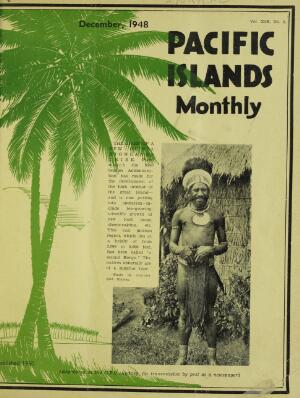
The Chief Of A
New Guinea
Highlands
TRIBE. Plana
Which the New
Guinea Administra tion has made for the development of the high interior of the great island— and is now putting into operation—in clude tea-growing, scientific growth of new food crops, sheep-raising, etc.
This vast plateau region, which lies at a height of from 3,000 to 5,000 feet, has been called “a second Kenya.” The natives generally are of a superior type. —Photo by courtesy SDA Mission.
Advertisements & other items, pp. 2-4 (3 items)
Fic Islands Monthly December, 1948
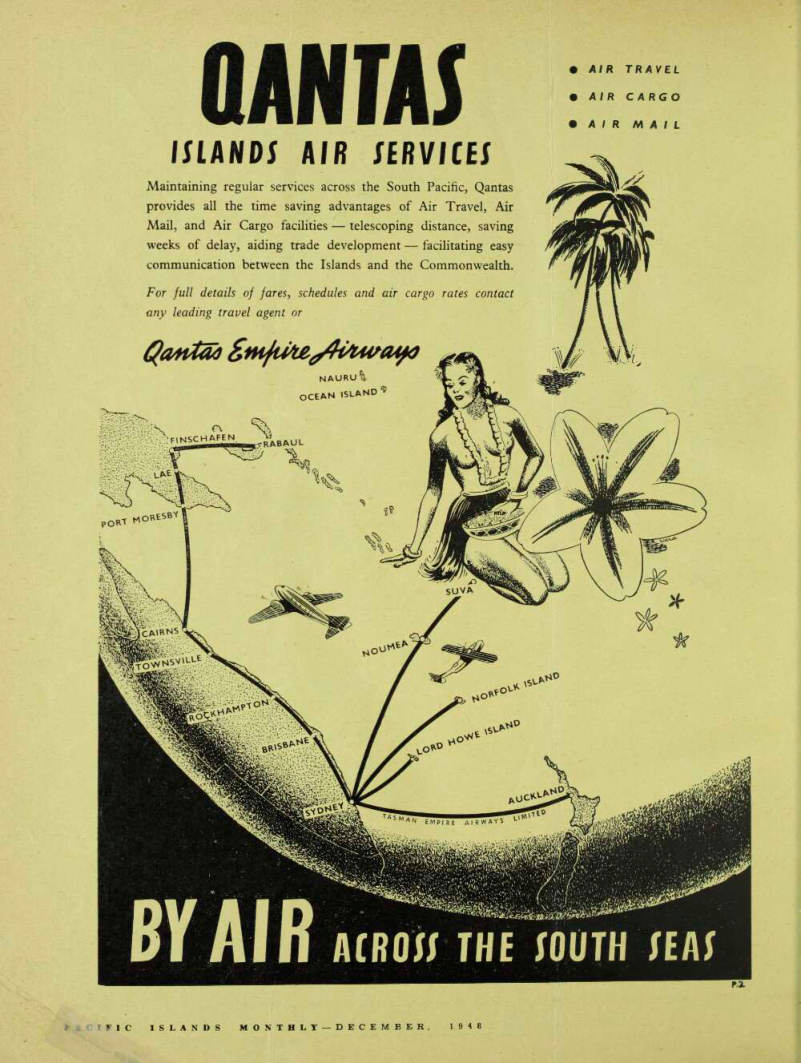
Oantaj
ISLANDS AIR SERVICES
Maintaining regular services across the South Pacific, Qantas provides all the time saving advantages of Air Travel, Air Mail, and Air Cargo facilities telescoping distance, saving weeks of delay, aiding trade development facilitating easy communication between the Islands and the Commonwealth.
For full details of fares , schedules and air cargo rates contact any leading travel agent or
Qantao
• AIR TRAVEL
• AIR CARGO
• AIR MAIL
NAURU
A /A
. p 1 NSC HAFEN
OCEAN ISLAND
RABAUL
LA*
PORT HORESBX
SUVA
CAIRN 5
NO
NSVILLt
TOW
NO R* N°
TON
RO NO \sv* NO
BAN e
oRO br' 5 aNO
UC* U
NtT
SVO
no L\W' I
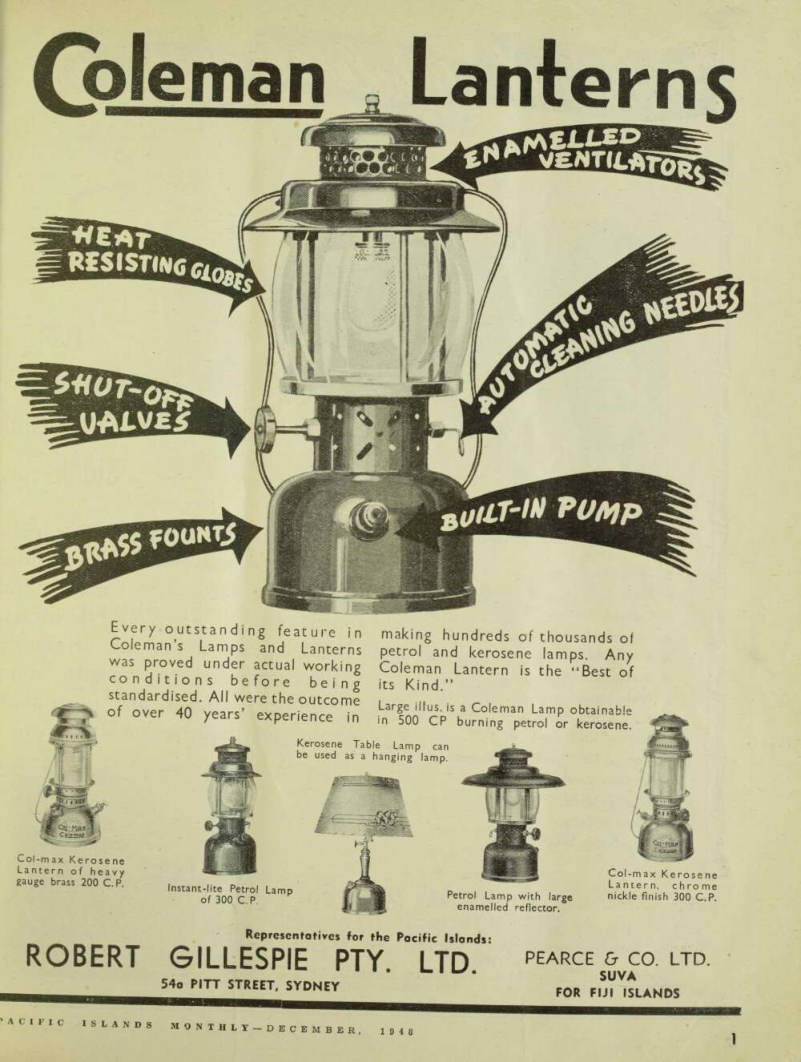
Coleman
Lanterns
a MM n \IL ■- ✓ “C r., '°- U£S and ' ng ea , ture ln making hundreds of thousands of Coleman s Lamps and Lanterns petrol and kerosene lamps. Any as proved under actual working Coleman Lantern is the “Best of conditions before being its Kind.” standardised. All were the outcome i ° f ° w 40 y*"’ «P«««nc. in Kerosene Table Lamp can be used as a hanging lamp.
Col-max Kerosene Lantern of heavy gauge brass 200 C.P.
Instant-lite Petrol Lamp of 300 C.P.
Petrol Lamp with large enamelled reflector.
Col-max Kerosene Lantern, chrome nickle finish 300 C.P.
Representatives for the Pacific Islands:
ROBERT GILLESPIE PTY. LTD.
54a PITT STREET, SYDNEY
PEARCE & CO. LTD.
SUVA
FOR FIJI ISLANDS
% % 7> £
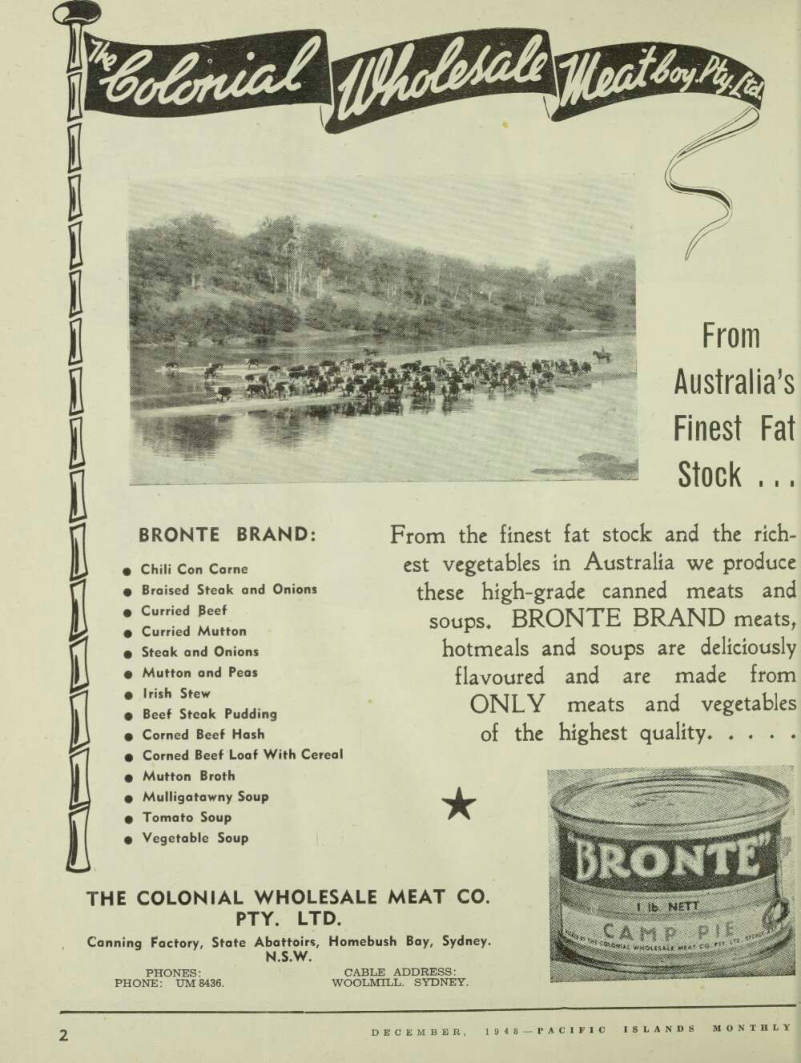
BRONTE BRAND:
Chili Con Came Braised Steak and Onions Curried Beef Curried Mutton Steak and Onions Mutton and Peas Irish Stew Beef Steak Pudding Corned Beef Hash Corned Beef Loaf With Cereal Mutton Broth Mulligatawny Soup Tomato Soup Vegetable Soup
From
Australia’s
Finest Fat
Stock ..,
From the finest fat stock and the rich-
est vegetables in Australia we produce
these high-grade canned meats and
soups. BRONTE BRAND meats,
hotmeals and soups are deliciously
flavoured and are made from
ONLY meats and vegetables
of the highest quality. . . . .
TSkm ★
THE COLONIAL WHOLESALE MEAT CO.
PTY. LTD.
Canning Factory, State Abattoirs, Homebush Bay, Sydney.
N.S.W.
PHONES:
PHONE: UM 8436.
CABLE ADDRESS:
WOOLMTLL. SYDNEY.
j-s
1
'AdFIC ISLANDS MONTHLY-D E C E M B E R , JO4 8
Advertisers
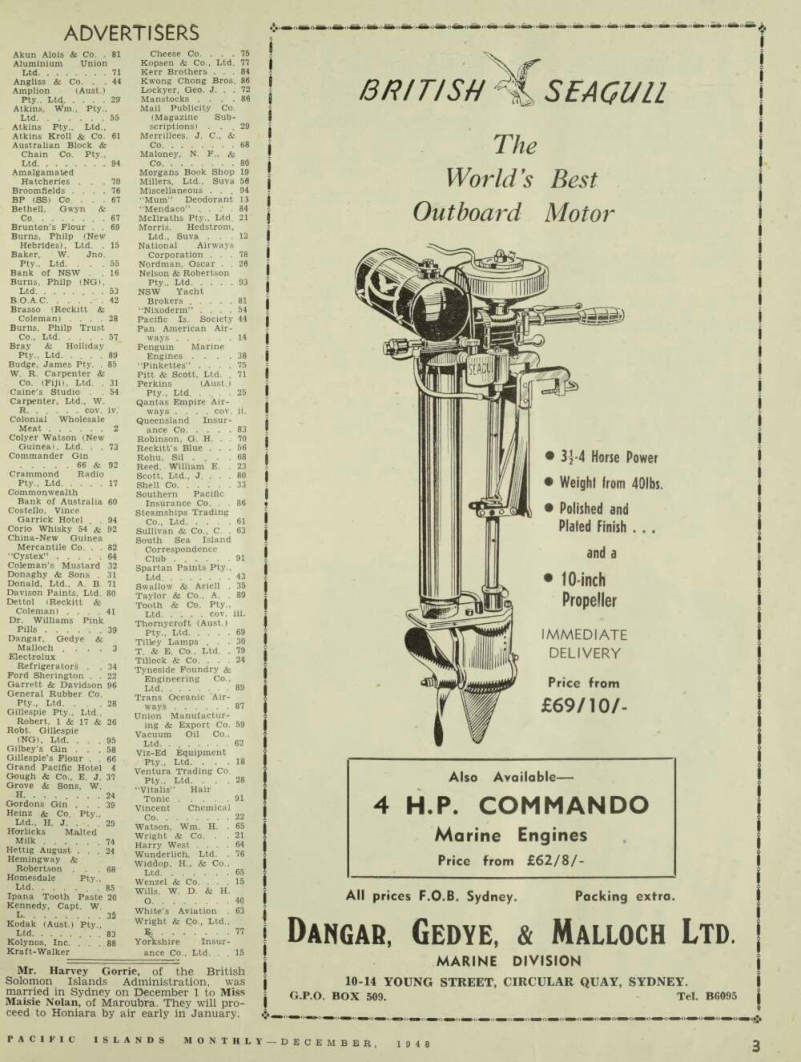
Akun Alois & Co. . 81 Aluminium Union Ltd 71 Angliss & Co. . . 44 Amplion (Aust.) Pty.. Ltd 29 Atkins, Wm., Pty., Ltd 55 Atkins Pty., Ltd., Atkins Kroll & Co. 61 Australian Block & Chain Co. Pty., Ltd 94 Amalgamated Hatcheries ... 70 Broomfields ... 76 BP (88) Co. . . . 67 Bethell, Gwyn & Co. 67 Brunton’s Flour . . 69 Burns, Philp (New Hebrides), Ltd. . 15 Baker, W. Jno.
Pty., Ltd. ... 55 Bank of NSW . . 16 Burns, Philp (NG), Ltd 53 8.0.A.C 42 Brasso (Reckitt & Coleman) ... 28 Burns, Philp Trust Co., Ltd 57 Bray & Holliday Pty., Ltd. ... 89 Budge, James Pty. . 85 W. R. Carpenter & Co. (Fiji), Ltd. . 31 Caine’s Studio . . 54 Carpienter, Ltd., W.
R. . . . . . cov. iv.
Colonial Wholesale Meat 2 Colyer Watson (New Guinea). Ltd. . . 73 Commander Gin 66 & 92 Crammond Radio Pty., Ltd 17 Commonwealth Bank of Australia 60 Costello, Vince Garrick Hotel . , 94 Corio Whisky 54 & 92 China-New Guinea Mercantile Co. . . 82 “Cystex” 64 Coleman’s Mustard 32 Donaghy & Sons . 31 Donald, Ltd., A. B. 71 Davison Paints, Ltd. 80 Dettol (Reckitt & Coleman) ... 41 Dr. Williams Pink Pills 39 Dangar, Gedye & Malloch ... 3 Electrolux Refrigerators . . 34 Ford Sherington . . 22 Garrett & Davidson 96 General Rubber Co.
Pty., Ltd. ... 28 Gillespie Pty., Ltd., Robert, 1 & 17 & 26 Robt. Gillespie (NG), Ltd. ... 95 Gilbey’s Gin ... 58 Gillespie’s Flour . . 66 Grand Pacific Hotel 4 Gough & Co., E. J. 37 Grove & Sons, W.
H. ... 24 Gordons Gin ... 39 Heinz & Co. Pty., Ltd., H. J. . . .29 Horlicks Malted Milk 74 Hettig August ... 24 Hemingway & Robertson ... 68 Homesdale Pty., Ltd . 85 Ipana Tooth Paste 20 Kennedy, Capt. W.
L 32 Kodak (Aust.) Pty., Ltd 83 Kolynos, Inc. ... 88 Kraft-Walker
Cheese Co. ... 75 Kopsen & Co., Ltd. 77 Kerr Brothers ... 84 Kwong Chong Bros. 86 Lockyer, Geo. J. . . 72 Manstocks ... 86 Mail Publicity Co. (Magazine Sub scriptions) ... 29 Merrillees, J. C., & Co 68 Maloney, N. F., & Co 80 Morgans Book Shop 19 Millers, Ltd., Suva 50 Miscellaneous ... 94 “Mum” Deodorant 13 “Mendaco” ... .84 Mcllraths Pty., Ltd. 21 Morris, Hedstrom, Ltd., Suva ... 12 National Airways Corporation ... 78 Nordman, Oscar . . 20 Nelson & Robertson Pty., Ltd 93 NSW Yacht Brokers 81 “Nixoderm” ... 54 Pacific Is. Society 44 Pan American Air ways 14 Penguin Marine Engines ... 38 “Pinkettes” ... 75 Pitt & Scott, Ltd. . 71 Perkins (Aust.) Pty., Ltd. ... 25 Qantas Empire Air ways; ... cov. ii.
Queensland Insur ance Co 83 Robinson, G. H. . . 70 Reckitt’s Blue ... 56 Rohu, Sil . . . . 68 Reed. William E. . 23 Scott, Ltd., J. ... 80 Shell Co 33 Southern Pacific Insurance Co. . . 86 Steamships Trading Co., Ltd 61 Sullivan & Co., C. . 63 South Sea Island Correspondence Club ... 91 Spartan Paints Pty., Ltd 43 Swallow & Ariell . 35 Taylor & Co., A. . 89 Tooth & Co. Pty., Ltd cov. ill.
Thornycroft (Aust.) Pty., Ltd 69 Tilley Lamps ... 30 T. & E. Co., Ltd. . 79 Tillock & Co. . . .24 Tyneside Foundry & Engineering Co., Ltd 89 Trans Oceanic Air ways 87 Union Manufactur ing & Export Co. 59 Vacuum Oil Co., Ltd. . 62 Viz-Ed Equipment Pty., Ltd. ... 18 Ventura Trading Co.
Pty., Ltd. ... 28 “Vitalis” Hair Tonic . . . ... 91 Vincent Chemical Co 22 Watson, Wm. H. . 65 Wright & Co. . . 21 Harry West ... 64 Wunderlich, Ltd. . 76 Widdop, H., & Co., Ltd 65 Wenzel & Co. ... 15 Wills, W. D. & H. 0 40 White’s Aviation . 63 Wright & Co., Ltd., E. 77 Yorkshire Insur ance Co., Ltd. . . 15
Mr. Harvey Gorrie, of the British Solomon Islands Administration, was married in Sydney on December 1 to Miss Maisie Nolan, of Maroubra. They will pro ceed to Honiara by air early in January.
Advertisements & other items, p. 5 (2 items)
3
PACIFIC ISLANDS MONTHLY—D E C E M B E R , 1948
Dangab, Gedye, & Malloch Ltd.
BRITISH *% SEAGULL
The
World s Best
Outboard Motor
335?) W • 3f 4 Horse Power • Weight from 40lb$. • Polished and Plated Finish . . . and a • 10-inch
Propeller
IMMEDIATE
DELIVERY
Price from £69/10/- Also Available—
-4 H.P. COMMANDO
Marine Engines
Price from £62/8/- All prices F. 0.8. Sydney. Packing extra.
Dangab, Gedye, & Malloch Ltd.
MARINE DIVISION
10-14 YOUNG STREET, CIRCULAR QUAY, SYDNEY.
G.P.O. BOX 509. Tel. 86095
In This Issue:
Editorial: “We Look from Tortured 1948 Out Into Uncertain 1949” .. 5 Political Stir in Fiji Governor Adjourns Council 6 South Pacific Commission Prepares for Noumea Move 7 Control of South Pacific Air Services 7 Laws of Papua to be Revised 7 NG Production Control Board is Still Functioning 7 Mr. A. G. Osborne Visits Rarotonga 7 The New Guinea Timber Lease Case 8 New Trading Company for Islands Based on New Zealand 8 Fire Destroys Copra and Shed at Port Moresby 9 UN to Investigate Trusteeship of New Guinea 9 First Tuna Clipper Reaches Suva .. 9 Fiji is “Not Overtaxed” 10 Guinea Air Traders May Be Prose cuted 10 Fijian Economy—Plain Speaking by Native Leader 10 Australian Ignorance of New Guinea is Abysmal—Says Major-General Basil Morris 11 No Labour Reserves in New Guinea 11 Rabaul Has 70 MPH Gale 13 Special Police Leave Rarotonga— Eight Months’ Duty, No Incidents 13 New Puisne Judge Appointment for
Fiji 13
Territories’ Talk-Talk 15 US Closes Papeete Consulate 17 Fiji Must Face World Facts Says Governor 19 Second Session of South Pacific Com mission 19 Japs Want Living Space Mass Migration to South Pacific Urged 21 Woman From Noumea Called a Com
munist —Questions Asked in Aus tralian Parliament 22 High Cost of Importing Stock to New Guinea 24 Ownership of “Cheng Ho”—lnvolved Legal Action in Honolulu 24 Indians Claim Fijians as Their Bro thers —Many Writers Seek Solu tion of Difficult Problem 26 Fiji’s Surpluses Will be Used for Social Services —Financial Secre tary’s Report 29 Ships for the Solomons —Plea for Direct Connection with Sydney .. 31 Notes from Tonga 32 Ridiculous Currency Situation in South Pacific 33 Fiji Customs Duty Cut —Copra Tax to Go on 35 “Mariposa” May Come Back 35 Morris Hedstrom Scholarship for 1949 35 Polynesian Status in International Law—NZ Discusses the Australian Immigration Embargo 37 Origin and History of Tin Can Mail 41 NZ Interest in N. Guinea—Hunt for Scrap Metal 43 “Marching Rule” in Solomons .. .. 44 Last Christmas in My Garden of Sinners 45 Noumea Had a Gaudy Past .. .. 46 Lohia 47 Why Don’t We Have a Real Tourist industry in the South Pacific? .. 48 Verse: Farewell, South Seas 51 Service Section; Why Not a Blue Mountains Holiday? 52 New Stamps for Cook Islands .. .. 52 New Guinea’s Cocoa Industry Could Be Important—Survey Also in Malaya 54 Jungle Covers Santo War Base ... 55
Solomons Copra—lndustry’s Slow Re covery 57 Economic Headaches for BSI Natives —Strange Doings in Copra Industry 59 Geological Survey for Fiji 59 British Funds for Pacific Research .. 60 “Marella” Sold to South American Firm 64 Big Fleet of Small Ships for WPHC 66 Mr. H. H. Nickling Awarded US Decoration 66 New Air Service between Australia and South Africa 70 The Problems of New Caledonia — Planters Want Labour and Help from France 71 Analysis of Crime in Fiji 73 News and Notes from Buka and Bougainville 75 Tongan Bernadette 79 Plane and Shipping Services 81 PAA’s New Pacific Air Link 87 The Month in Moresby 89 Tidal Wave Reported from Raro tonga—“Tahitienne” Lost 91 South Pacific Health Service 91 Tapioca Mill for Fiji 92 Another Trans-Pacific Airline .. .. 93 Brutal Murder in Tahiti 93 Two New Guinea RC Bishops Conse crated 93 Tahiti Notes 94 Fijians Speak out Frankly to Indians 95 Noumea-Tahiti Airmail 95 Commercial, Markets, etc 96 OBITUARY: Rev. Fr. Diehl, 5; E. J.
Ifould, 9; A. Paatsch, 17; S. J. Smith, 22; Edmond Cane, 22: Howard Smith. 44; C. B. Becha, 55; Victor Jacka, 57.
ORGANISATIONS: Pacific Islands So ciety, 7; New Guinea Women’s Club, 13; SPCA of Fiji, 43; RSSAILA, Port Moresby, 87.
INDUSTRIES: Copra, 7,9; Gold, 7, 70; Cocoa, 9, 54; Oil, 69.
Advertisements & other items, p. 6 (1 item)
STAVrf^
: -r : -
:$» O * • 1 AS oVet ' , r ovi<' ds , fl , Gr^ 4 Pa 4 ■«iat ed W ** iw des>S° e< ' *" 1 "I, '.Vo***' oi W **%. sefV ' Ce ,s *® t%ce" e ° , se t' ,a< ' tS Suva- '° r ** <.:>** • l ra'<' e ° Ca b ' e ’ r dal- -4 P ef
Pacific Islands Monthly
The Newspaper-Magazine of the South Seas
L Registered at the G.P.0., Sydney, for transmission by post as a newspaper ] Published Once Each Month and Circulated in Australia and New Zealand and in the following Pacific Territories and Islands Groups:
Australian Territory oi Papua.
Trustee Territory (Australia) of New Guinea.
Australian Territory of Norfolk Island.
New Zealand Territory of Cook Islands.
Trustee Territory (NZ) of Western Samoa.
British Colony of Fiji.
British Solomon Islands Protectorate.
British Protectorate of Tongan Islands.
British Crown Colony of Gilbert and Ellice Islands.
Trustee Territory of Nauru.
British and French Condominium of New Hebrides.
French Colony of New Caledonia.
French Colony of Oceania (Tahiti, etc.).
American Territory of Eastern Samoa.
American Territory of Hawaiian Islands.
Owned and Produced by Pacific Publications Pty., Ltd., Union House, 247 George Street, Sydney.
Telephone: General Office and Advertising, BW 5037.
P.O. Box 3408
Registered Address for Telegrams, Radiograms, and Cables: “Pacpub,” Sydney.
Contributions.
Articles, Stories, and Photographs dealing with Pacific Islands subjects are invited and will be paid for on publication.
Subscription Rates.
Per Annum, Pre-paid, Including Postage.
In Australia, New Zealand, Fiji, New Guinea, Papua, Western Samoa, Cook Islands, Tonga, British Solomons, Gil bert and Ellice Colony, Nauru, and United Kingdom 15 o Elsewhere <£3 18 0 Single Copies 1 6
Editor and Publisher:
R. W. Robson, P.R.G.S.
Assistant Editor: JUDY TUDOR.
General Office: Union House, 247 George Street, Sydney. Telephone: BW 5037.
Advertising Manager: W. E. Rogers.
Representative In London.
J. T. Wallis, Coronation House, 4 Lloyds Avenue, London, E.C.3, from whom may be obtained copies of Pacific Islands Monthly, Pacific Is. Year Book, advertising schedules, etc.
Representative In U.S.A.
Pacific Islands Trading Co.,
244 California St., San Francisco, U.S.A
Agents.
The following are authorised to receive sub scriptions for Pacific Islands Monthly:— Burns, Philp & Co., Ltd., and Burns Phllp (South Sea) Co., Ltd. All branches.
W. R. Carpenter & Co., Ltd. All branches.
Morris, Hedstrom, Ltd. All branches.
Steamships Trading Co., Papua. All branches.
W. M. Caldwell, Suva, FIJI.
Cook Islands Trading Co., Rarotonga, Cook Is.
Oscar Nordman, Papeete, Tahiti.
Islands Branches and Representatives of W. H.
Grove & Sons, Ltd., Auckland, New Zealand.
Ed. Pentecost, Noumea, New Caledonia.
Soclete Gubbay Kerr et Cie, Noumea, New Caledonia.
Vol. Xix. No. 5
December, 1948
r 1/6 Per Copy Price ] Prepaid, p.a.: 15/- Aus. ( In USA, p.a.: $3.
We Look From Tortured 1948 Out
Into Uncertain 1949
IF we compare the present condition of the war-torn countries of the South-west Pacific, with what it was in January, 1946, we may see a big difference. The Europeans are back on their mines and plantations; the natives have settled down, to some extent; a good deal of temporary re pair work has been done.
But the improvement that has taken place is nothing, in comparison with what we might have expected to have been achieved in three years.
The economy of New Guinea, Papua, British Solomons and Gilbert and Ellice Islands has not been restored— in fact, it still is decidedly wonky.
In both a physical and a moral sense, the condition of those four Terri tories is deplorable, and of most other Pacific Territories, unsatis factory.
For the physical shortcomings of the Groups, we can thank the Socialist Governments of the British Empire and France—Governments which we ourselves created. We did not create the Soviet Union and its world-wide Communist conspiracy, which have thrown a shadow over all our affairs for three weary years; but the dithering weakness of the British Socialist Governments (for which we are responsible) has con tributed much to the arrogance and
growing strength of the Russian set up.
It is not necessary here to describe at length the way in which Islands rehabilitation has been retarded by the quaint fancies and experimental plans of the Socialist Governments.
The 1946-49 history of Papua-New Guinea remains as a permanent memorial of what can and cannot be accomplished in a rich and well balanced Territory by a set-up of well-meaning theorists, who try to balance their lack of knowledge and experience by the exercise of un checked power and the use of un limited money.
By now—the end of 1948—Papua- New Guinea, with its huge resources of coconuts and gold and timber and other things in urgent demand throughout the world, should have been, not only self-supporting, but capable also of providing comfort and even luxury for both Europeans and Europeanised natives. Instead, pro duction has been seriously retarded by Socialist interference with labour, transportation, supplies and indivi dual trading. The great majority of Europeans are living in temporary, native-built houses. Between two and three million pounds per annum— ripped out of the pockets of over taxed Australians—have been spent wildly by an Administration whose
personnel has reached a total of about 900; but these lavish funds, so far from stimulating local enterprise and production, and improving Euro pean conditions, seem partly to have been used in ways to demoralise the natives. It is hard to say which has been the greatest embarrassment to the Territories—unwilling native labour, or inadequate and inefficient transport, for both of which the Wardist regime is responsible.
These South-west Territories have made a considerable recovery from the wreckage of 1945; but they are now only where they should have been in 1946 or 1947—and where they would have been, had they not shared with most of the British Em pire the curse of the Bloomsbury Planners.
OVER all of us, of course, has lain the threat of World War 111, and there is nothing to show that this shadow will grow less in 1949.
While the Democracies, since 1945, have disarmed themselves to the point of lunacy, and impotency, Russia has maintained a huge land and Air Force. While the British countries, and France, have been per mitting all kinds of industrial dis location, and dissipating their ener gies in trying to nationalise great industries, Moscow has been thrust ing its Communist tentacles across the world, until to-day we see half of Europe, and a great part of Asia, saluting the Hammer and Sickle.
We now have reached a point where
there seems to be only one alter native ; we must either accept the horror of world-wide Communism, or we must fight to retain the standards of life which we have achieved in 15 centuries of sociological evolution.
We enter this unknown 1949 with the feeling that, so far as our national, or domestic difficulties are concerned, we may be on the way to a solution of our problems. The Socia list Governments of Britain, Australia and New Zealand have modified their policies very much since, in 1946, they embarked with starry-eyed enthu siasm upon plans for the regeneration of mankind. In New Guinea, for example, recent events suggest that, even if the Australian Socialist Gov ernment is not thrown out of office in 1949, administrative policy will in the future be more in alignment with private enterprise and common sense than it has been since 1945. The British people of the Empire, gener ally, are showing clear signs that they have “had” Socialism; and there may be far-reaching political changes in 1949-50.
But, on the international front, the outlook is black. There is no sign that Moscow will abandon its clear cut policy of avoiding war, and build ing up her internal strength, while hamstringing every effort of the Democracies to achieve world-wide peace. Some time in 1949, probably, the issue will be put up bluntly to the Communist dictators: they must either abandon their tactics of keep ing the world in a state of restless ness and fear, or fight.
Political Stir In
Fiji
Anti-Tax Demand By European- Indian Bloc :: Governor Adjourns Council
APOLITICAL stir has been caused by a split on finance in the Fiji Legis lative Council (which consists of 15 Unofficial Members —5 Europeans, 5 Fijian, 5 Indian—and 16 Official Mem bers); and by a newspaper charge that the Unofficials have entered into an un precedented alliance against the Govern ment.
The Governor, having arranged a guaranteed price for copra for nine years, proposes a tax on copra. To strong pro tests he has replied that other Fiji inter ests are taxed—why not copra?
Legislative Council met on November 12, and adjourned as usual to allow Un official Members to consider the Estimates in Finance Committee. The Estimates were generally approved. Council resumed on Tuesday, Nov. 23.
Discussion that day (23rd) showed European and Indian Unofficials demand ing removal of import duty on sharps (for Indians) and flour (for all classes).
The Governor said that already taxes equal to £65,000 had been taken off food stuffs; any further reduction would mean that subsidies must come off, and consumers would gain nothing.
The Indians pressed the matter to a division. Unofficials voted solidly for re mission of the duties, but were defeated by the Official bloc vote.
Next day (24th) “Fiji Times” made the following sensational charge: “It is alleged that all the European
Unofficial Members agreed that if the Indian Members would join a solid front of opposition to the Copra Tax Bill, full support would in turn be given to an Indian demand for the removal of the Residential Tax, the Sugar Export Tax and the duty on imported sharps and flour, “This scheme, assuming that the Gov ernment could be pushed into agreement, would result in the freeing of the Indians from virtually all effective taxation in return for Indian aid in blocking the Copra Tax Bill.”
The newspaper challenged the Unoffi cials to deny the charge. No denial was made.
The newspaper said that the Fijian Members had been led into this unpre cedented and undesirable alliance by the Europeans, but they might now recede from that position. The Fijians, who are the largest producers of Copra, might, however, fight for a reduction in the pro posed tax from £3 to £1 per ton.
On Nov. 24 and 25, in a strained atmos phere, the Unofficials demanded that the Government spend its £1,700,000 reserve on public works and financial reforms designed to reduce living costs. In reply to the Officials’ argument that some re serve must be kept in case of a slump.
Sir Hugh Ragg advocated a loan of £3,000,000, if necessary.
The Governor pointed out that Un officials, having apparently approved of the Estimates, were now throwing them back into the melting-pot.
On Nov. 26 the Governor, in order to give Members a chance of calm reflec tion, adjourned the Council until Decem ber 20. He said: “I have been given to understand that the Unofficial Members have agreed that it is the Government’s duty to drop the Copra Tax, the Sugar Tax, the Residen tial Tax and the import duty on flour and sharps. I am not a mathematician, but I believe the loss of revenue sug gested is some £250,000 per annum.”
A difference of opinion in Council on the Colony’s financial policy is quite understandable; but the spectacle of the European Members (who include leading figures like Sir Hugh Ragg and Mr.
Maurice Scott) entering with Indian Members into the kind of alliance described by the newspapers has left a very sour taste in the mouth of the European and Fijian communities, who already have been greatly troubled by Indian demands.
South Pacific Commission—Second Session
DURING a morning-tea adjournment of the Second Session of the South Pacific Commission, held in Sydney in October, the Senior of the : six nations represented on the Commission were photographed with representatives of the Press. The names of the persons in the above group, from left to right, are.
Mr. H. A. Standish, “Sydney Morning Herald”; Mr. J. R. Halligan, Secretary of the Australian Department of External Territories —senior Commissioner for Australia, M. Lassalle-Sere, Permanent Commissioner for France; His Excellency m. Auge, Minister for France in Australia, who was Chairman of these Sessions of the Commis sion; Mr. A. J. Beversluis, Senior Commissioner for the Netherlands; Dr. J. A. Burton, Commissioner for Australia; Sir Brian Freeston, Governor of Fiji and. Hign. Com missioner for the Western Pacific —Senior Commissioner for the United Kingaom.
Mr. R. W. Robson, “Pacific Islands Monthly”; Dr. Felix Keesing, Senior Commissioner for the United States; Mr. C. G. R. McKay, Senior Commissioner for New Zealand.
Death Of Rev. Father Diehl
From Our Own Correspondent APIA, November 4.
NEWS has been received here that the Rev. Father Joseph Diehl died in the United States on November 1.
Father Diehl left Apia about two months ago for medical treatment in his native land.
The news of his death came as a deep shock to Western Samoa, where he had given 28 years of devoted service not only to the Roman Catholic Mission, to education, and his own flock, but to all who needed his help. His heart, which was not strong, was further debilitated by the great amount of work accomplished by him in organising the centenary cele brations of his mission in Samoa. For some time before his departure from Samoa he had been unable to continue his duties and had to undergo hospital treatment.
Tributes have been paid to him by the High Commissioner and by the Chiefs.
His passing is felt deeply by all sections of the community, irrespective of race or creed.
South Pacific Commission
Preparing Sydney-Noumea Move In January
PLANS are being made for the removal of the headquarters of the South Pacific Commission, from Sydney to Noumea, late in January, and for the establishment there to be complete in time for the next session of the Com mission, in April or May, 1949.
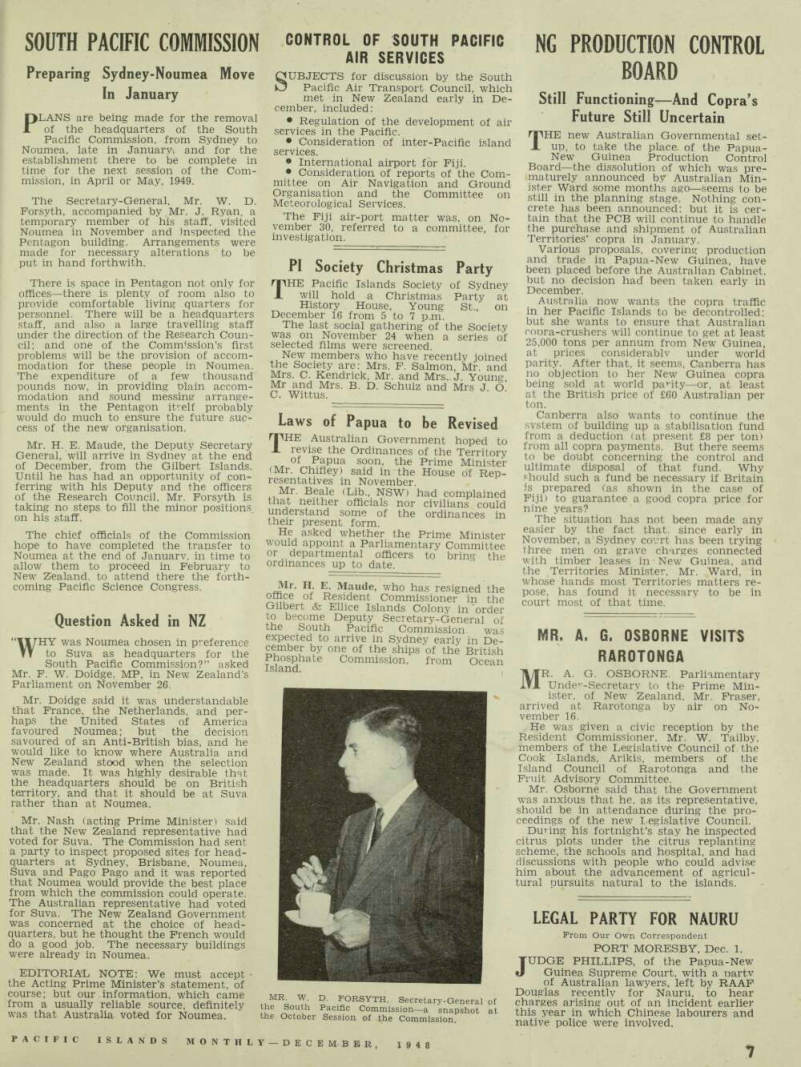
The Secretary-General. Mr. W. D.
Forsyth, accompanied by Mr. J. Ryan, a temporary member of his staff, visited Noumea in November and inspected the Pentagon building. Arrangements were made for necessary alterations to be put in hand forthwith.
There is space in Pentagon not only for offices —there is plenty of room also to provide comfortable living quarters for personnel. There will be a headquarters staff, and also a large travelling staff under the direction of the Research Coun cil; and one of the Commission’s first problems will be the provision of accom modation for these people in Noumea.
The expenditure of a few thousand pounds now, in providing nlain accom modation and sound messing arrange ments in the Pentagon itself probably would do much to ensure the future suc cess of the new organisation.
Mr. H. E. Maude, the Deputy Secretary General, will arrive in Sydney at the end of December, from the Gilbert Islands.
Until he has had an opportunity of con ferring with his Deputy and the officers of the Research Council. Mr. Forsyth is taking no steps to fill the minor positions on his staff.
The chief officials of the Commission hope to have completed the transfer to Noumea at the end of January, in time to allow them to proceed in February to New Zealand, to attend there the forth coming Pacific Science Congress.
Question Asked in NZ
“lITHY was Noumea chosen in preference Tf to Suva as headquarters for the South Pacific Commission?” asked Mr. F. W. Doidge, MP, in New Zealand’s Parliament on November 26.
Mr. Doidge said it was understandable that France, the Netherlands, and per haps the United States of America favoured Noumea; but the decision savoured of an Anti-British bias, and he would like to know where Australia and New Zealand stood when the selection was made. It was highly desirable thqt the headquarters should be on British territory, and that it should be at Suva rather than at Noumea.
Mr. Nash (acting Prime Minister) said that the New Zealand representative had voted for Suva. The Commission had sent a party to inspect proposed sites for head quarters at Sydney, Brisbane, Noumea, Suva and Pago Pago and it was reported that Noumea would provide the best place from which the commission could operate.
The Australian representative had voted for Suva. The New Zealand Government was concerned at the choice of head quarters, but he thought the French would do a good job. The necessary buildings were already in Noumea.
EDITORIAL NOTE: We must accept the Acting Prime Minister’s statement, of course; but our information, which came from a usually reliable source, definitely was that Australia voted for Noumea.
Control Of South Pacific
Air Services
SUBJECTS for discussion by the South Pacific Air Transport Council, which met in New Zealand early in De cember, included: • Regulation of the development of air services in the Pacific. • Consideration of inter-Pacific island services. • International airport for Fiji. • Consideration of reports of the Com mittee on Air Navigation and Ground Organisation and the Committee on Meteorological Services.
The Fiji air-port matter was, on No vember 30, referred to a committee, for investigation.
PI Society Christmas Party
THE Pacific Islands Society of Sydney will hold a Christmas Party at History House, Young St., on December 16 from 5 to 7 n.m.
The last social gathering r of the Society was on November 24 when a series of selected films were screened.
New members who have recently joined the Society are: Mrs. F. Salmon, Mr. and Mrs. C. Kendrick, Mr. and Mrs. J. Young, Mr and Mrs. B. D. Schulz and Mrs J O C. Wittus.
Laws of Papua to be Revised
THE Australian Government hoped to revise the Ordinances of the Territory of Papua soon, the Prime Minister 'Mr. Chifley) said in the House of Rep resentatives in November.
Mr. Beale (Lib., NSW) had complained that neither officials nor civilians could understand some of the ordinances in their present form.
He asked whether the Prime Minister would appoint a Parliamentary Committee or departmental officers to brine- the ordinances up to date.
Mr. H. E, Maude, who has resigned the office of Resident Commissioner in the Gilbert & Ellice Islands Colony in 'order to become Deputy Secretary-General of the South Pacific Commission was expected to arrive in Sydney early in De cember by one of the ships of the British Phosphate Commission, from Ocean Island.
W- D- FORSYTH. Secretary-General of the South Pacific Commission—a snapshot at the October Session of the Commission.
Ng Production Control
Board
Still Functioning—And Copra’s Future Still Uncertain
THE new Australian Governmental set up, to take the place of the Papua- New Guinea Production Control Board—the dissolution of which was pre maturely announced by Australian Min ister Ward some months ago—seems to be still in the planning stage. Nothing con crete has been announced: but it is cer tain that the PCB will continue to handle the purchase and shipment of Australian Territories’ copra in January.
Various proposals, covering production and trade in Papua-New Guinea, have been placed before the Australian Cabinet, but no decision had been taken early in December.
Australia now wants the copra traffic in her Pacific Islands to be decontrolled: but she wants to ensure that Australian conra-crushers will continue to get at least 25,000 tons per annum from New Guinea, at prices considerablv under world parity. After that, it seems, Canberra has no objection to her New Guinea copra being sold at world parity—or, at least at the British price of £6O Australian per ton.
Canberra also wants to continue the system of building up a stabilisation fund from a deduction (at present £8 per ton) from all copra payments. But there seems to be doubt concerning the control and ultimate disposal of that fund. Why should such a fund be necessary if Britain is prepared (as shown in the case of Fiji) to guarantee a good copra price for nine years?
The situation has not been made any easier by the fact that, since early in November, a Sydney court has been trying three men on grave charges connected with timber leases in New Guinea, and the Territories Minister. Mr. Ward, in whose hands most Territories matters re pose, has found it necessary to be in court most of that time.
Mr. A. G. Osborne Visits
Rarotonga
MR. A. G. OSBORNE. Parliamentary Undersecretary to the Prime Min ister, of New Zealand, Mr. Fraser, arrived at Rarotonga by air on No vember 16.
He was given a civic reception by the Resident Commissioner, Mr. W. Tailby, members of the Legislative Council of the Cook Islands, Arikis, members of the Island Council of Rarotonga and the Fruit Advisory Committee.
Mr. Osborne said that the Government was anxious that he, as its representative, should be in attendance during the pro ceedings of the new Legislative Council.
During his fortnight’s stay he inspected citrus plots under the citrus replanting scheme, the schools and hospital, and had discussions with people who could advise him about the advancement of agricul tural pursuits natural to the islands.
Legal Party For Nauru
From Our Own Correspondent
Port Moresby, Dec. 1.
JUDGE PHILLIPS, of the Papua-New Guinea Supreme Court, with a nartv of Australian lawyers, left by RAAF Douglas recently for Nauru, to hear charges arising out of an incident earlier this year in which Chinese labourers and native police were involved.
Little New Evidence In Long Hearing Of ‘Conspiracy’ Charge
New Guinea Timber Lease Case
THE New Guinea Timber Lease Case again occupied the attention of a major Court in Sydney (Judge Holt) for three weeks, from November 8.
John Smith (“Jock”) Garden, his son Harcourt Garden and Raymond Parer, New Guinea airman, were charged with conspiring with Edward Farrell, to de fraud Hancock and Gore, timber merch ants of Brisbane, of £50,000, by selling them what purported to be a timber lease in the Bulolo Valley, New Guinea.
The Court adjourned the charge against Farrell until next February because of his ill health.
Public interest has been aroused by the fact that Mr. E. J. Ward, Minister for External Territories, and other Govern ment officials, were Crown witnesses.
Garden and Ward had been very close political and personal friends for many years before the timber-lease case first broke at the end of 1947. Garden is at present serving three years for forgery, arising out of the same case. Ward and other officials have been in Court during most of the hearing.
This trial has, to the date of writing, produced no fireworks and very little evidence different from that given in the earlier trial of Garden for forgery.
THE Crown case is that the four men conspired to sell Hancock and Gore a timber lease that never existed.
In giving evidence Ward denied that he had ever had nart in the deal, that he had ever received any money or that Har court Garden had been his dummy in a syndicate handling the deal.
The first time he heard that Hancock and Gore were interested in the Bulolo Valley proposal was in December, 1947, when he also learned that J. S. Garden had a financial interest in the deal. (The “deal” had been going on since 1944).
He had not at any time given Garden authority to sign his name to letters or to inform anyone that a lease had been granted in respect of Bulolo Valley timber.
After the interview with Forshaw and Garden on December 15, 1947, when he had learned the truth about the deal, he had told Forshaw (logging manager for Hancock and Gore) to put his ideas on paper, but he had not told him to send the letter to Garden. (Earlier, Forshaw had stated that Ward had told him to send the letter to Garden who would know what to do with it. It was the third page of this letter that Garden altered, and to which he had forged Forshaw’s name; that sent him to jail for three years).
Ward, in evidence, denied emphatically that he was in any way involved in the conspiracy.
IN evidence, Garden stated that his son Harcourt Garden had had nothing to do with the deal —he was merely a dummy for Ward and had received no money.
He said he introduced Parer to Ward and that Ward had said in his (Garden’s) presence, that he would do all he could for Parer in having the lease granted because of Parer’s work for New Guinea. (In the earlier case, against Garden for forgery, Ward had denied that he had ever met Parer).
After Hancock and Gore had become interested in the timber it was decided to form a syndicate, on which Ward would be represented by Harcourt Garden, and that Ward’s share would be 20 per cent, of the money received. On Novem ber 20, 1945, when he signed a letter “E. J.
Ward per J. S. Garden,” stating that the lease had been granted, he was simply following Ward’s instructions. On December 3, 1945, he told Ward that his
share of the £37,000, that Hancock and Gore had paid as a second payment, would be along that day; and subse quently, on Ward’s instructions, he had delivered a parcel of notes (£5,000) to a William Urquhart.
Garden said that when Forshaw, on be half of Hancock and Gore, sought an interview with Ward in December, 1947, and was told that Bulolo was “out”, Ward asked Forshaw to put his ideas about an alternative area on paper, and send it to Garden. The third page of this letter mentioned Hancock and Gore and, remembering that Ward had said that on no account must the firm be mentioned, he had re-drafted this page and signed it with Forshaw’s name. He ha'd shown the re-drafted page to Ward, who had agreed, but said Forshaw must sign it.
When Forshaw visited Ward again, later that month, Garden was called in and shown the letter he had written in 1945, signed “E. J. Ward per J. S. Garden.”
Ward asked him if he had signed it. He had admitted it, stating that he was only following instructions and thought that it would he all right. Ward said he had no right to sign it. When Forshaw left, Ward said that too many people knew about the deal, and he was getting out.
Garden then asked if Ward were going to “dump” him, to which the reply was: “I will look after myself. You look after yourself. If we don’t get out of this I’m a goner.”
When interviewed by an officer of the Commonwealth Investigation Branch, Garden said that he had stated that Ward was the most honest man he knew and “would not accept even a postage stamp.”
He said that he knew that was not true, but he lied to cover up for a man who, he felt, would play his part. He changed his views on Ward’s honesty when he knew he was going to be “dumped.”
Ward, he said, had “dumped” him be fore, on political matters, but that did not altogether indicate treachery ... It was perhaps dishonest in the business sense, but “in the political sense it was differ ent.”
Mr. Shand KC (for the Crown) asked: “Do you mean there is no honesty in political matters?” Garden replied: “Not much.”
IN his evidence Ray Parer said that he had received £9,000 as his share in the syndicate to sell a timber lease in New Guinea. He said- he and Farrell first discussed the possibility of a timber lease in October, 1944. He already had a gold lease in the Bulolo Valley, which included the right to cut timber, and he told Farrell that he thought that if they could get export permit, it would be payable.
After he left Australia again on war service in January, 1945, he received a letter from Farrell telling him that Farrell had obtained a concession to cut and ex port timber from Bulolo Valley, and a Brisbane firm had agreed to pay £lOO,OOO for it. Farrell also stated he had received a sum of money which he had in a trust account. He asked Parer to hurry back, as it was necessary for him to go over the concession in New Guinea with a representative of the timber firm.
Farrell told Parer, on this occasion, that Ward had promised to grant a concession if he, Parer, put in an application.
Later, he was told that Harcourt Gar den was dummying for someone who did not want his name to be known. When Parer queried this, Farrell told him that he was all right for making out claims in New Guinea, but he must leave the rest of it to Farrell. From that time o A i he had been consulted by neither Garden
nor Farrell, in any shape or form. He had seen Ward in May, 1945, when Mr.
J. R. Halligan (Secretary of the Depart ment of External Territories) had been reluctant to issue Parer and Forshaw per mits to visit New Guinea. Before the visit Garden had said “Eddie will fix it up.”
He and Forshaw had subsequently visited N. Guinea and seen Parer’s pro perty.
RAY PARER gave evidence on Decem ber 1. He was the first new witness of importance—none knew what he was going to say. On December 2, the S.M. Herald Columnist said: “Department of External Territories must have felt lonely yesterday, “Among the observers at the Garden case were the Minister of the Department, Mr. E. J. Ward; the departmental head, Mr. Halligan; Mr. Ward’s personal secre tary; and Mr. Ward’s personal steno grapher; two typists and one filing clerk.
“And waiting outside the court all day was Mr. Ward’s Ministerial car.”
Farrell later had shown Parer a letter signed "E. J. Ward,” purporting to show that a concession had been granted. Parer had then believed that the deal was finally settled and that the delay was over.
Nothing was ever said to him about Ward sharing in the transaction. He was told there was a story about Ward and timber leases in the “Pacific Islands Monthly” in 1945. But Farrell told him that Robson, the editor, and Ward were having a row and not to take notice of it.
The case, on December 2, was still pro ceeding.
New Trading Co
For Islands
Based On N. Zealand
THE following statement was made in Wellington, NZ, by Mr. E. Hirschfeld, managing director of Union Manu facturing Co., Ltd: Regular trading between New Zealand and the Western Pacific will be inaugu rated from Wellington in mid- December by ships belonging to the Union Manufactur ing Company, of Petone. The organisa tion of a shipping and trading service within an industrial concern is stated to be the first such venture in New Zealand.
The company will sell New Zealand primary and secondary products in Norfolk Island, the New Hebrides, the British Solomon Islands, New Guinea, and New Caledonia, in return for Islands hard woods and phosphates.
Three former New Zealand coastal ships, and a larger chartered vessel will be en gaged.
A chartered vessel will make three monthly trips from Wellington to Norfolk Island, from where a feeder service to the outlying islands will be operated by the “Melva,” “Avon” and “Rosalie.”
The “Melva” is due to leave Welling ton for Norfolk and the Gilbert and Ellice Islands about December 15. The USS Company’s “Wairata” will sail from Auckland under charter in early De cember for the Islands, taking softwoods, livestock, and beer, and will return in January with steel purchased from the United States armed forces.
The company will charter indefinitely a vessel for its regular trading.
Fire Destroys Copra
and Shed At Port Moresby
From Our Own Correspondent \ NSW copra sKeSy bu Jt for°the 1\ Administration) containing 300 tons to°the a scene" 6 loCal flre p e m C °?op?a a “ls still smouldering and dense smoke from the waterfront g The shed has been almost completely destroyed. The damage is estimated at £22,000 including the copra stacked therein The Copra Control Board is covered as far as the copra is concerned, by their Insurance Reserve Fund.
The fire was the most snectacular in Port Moresby’s history. An official inquiry he!d° thG CaUSG ° f the ° Utbreak is t 0 b *
Wheel Compartment
Indian Crosses Pacific In Plane’s Wheel Compartment
AFIJI-INDIAN With wander-lust accomplished the almost-impossible feat of stowing away on an aircraft.
On November 15, he hid on a trans pacific plane, which had landed at Nadi for refuelling, by crawling into the space under the fuselage, into which the plane’s wheels are retracted while in flight.
Apparently, there was just sufficient space for both Indian and wheels, but he must have had an extremely uncom fortable journey across the Pacific. He escaped discovery at Canton, but was found in Honolulu.
He was arrested and sentenced to 60 days imprisonment, and return to Fiji.
Pioneer
Death Of New Guinea
Mr. E. J. Ifould
THE death of Ernest John Ifould occurred at his residence in New South Wales on November 16 Better known as Tom Ifould, he went to New Guinea m the 20’s and later, in partner ship with Mr. Dick Glasson. one of the Big Six of Edie Creek fame, took over Boram Plantation, near Wewak, which he managed personahy for a number of ye ?rs. When the Sepik Goldfield was established in the mid-thirties, Boram Plantation became the rendezvous for the district s miners and prospectors. The rest houses there provided the only accom modation in the district for the transient visitor for several years—until, in fact, the township of Wewak became estab lished and the district’s floating popula tion gravitated there. P Mr Ifould retired from Boram in the late thirties; he established a home at Church Point, m the Pittwater area near Sydney, and this he also called Bor’am He is survived by one daughter, Joan, who married Lincoln Bell. Mr. Bell it will be remembered, was murdered ’by natives of the Rai Coast area during the war while he was on coastwatching duties.
Mr. Edwin Gold, of Mangaia, who has many amusing stories for the PI 1 M > T was , in in Rarotonga Hospital in early November.
New Fiji Copra Price
Equal To £A6O Per Ton During 1949
THE offer of the British Ministry of Food to buy the total exportable sur plus of coconut products from Fiji for the period 1949-1957 inclusive, has been formally accepted, in accordance with the wishes of the great majority of copra producers in the Colony.
The agreement will come* into force on January, 1949, and will continue until De cember 31, 1957.
The price of copra in Fiji for 1949 will be £4B (sterling) per ton FOB; and for each subsequent year this price will be negotiated before the end of the preced ing year, but in no case will the price be more than 10 per cent, (to the nearest 5/-) higher or lower than that of the preceding year.
Forty-eight pounds Sterling is equal to about £54 Fijian and about £6O Australian.
Australian Comparison
THE Australian Production Control Board now pays New Guinea copra producers a price equal to £4O/17/6 A, m Rabaul. The PCB. in turn, pays freight to Australia, 61/6; amount to f-^in^ lsa^10n Func k £B/5/-; handling, £5/10/- (a total of £2O 2/6); and it sells the copm in Sydney for about £A6I. ere L h , as been some indication that tne Australian authorities propose a fixed price over a term of years, similar to the British system announced in Fiji; but there had been no official announcement up to December 6.
Sir Maynard and Lady Hedstrom, of Fiji, were in Sydney at the end of November, They expected to leave on December 8 by a Swedish vessel for South Africa, where they will spend a leisurely holiday. Lady Hedstrom is much im proved in health.
Trusteeship
UN To Investigate Trusteeship Of New Guinea
THE United Nations General Assembly decided in Paris on November 18 to ■nt investigate Australia’s trusteeship of New Guinea. H This is due to Australia’s wish to amal gamate the administrations of Papua and New Guinea, and the fact that UN has accepted a recommendation by its Trus teeship committee that it should investi gate administrative unions effected by administering powers between their Trust territories and other colonies.
It is not stated what form the investi gation will take. Presumably a committee, similar to that which visited Western Samoa to determine that Territory’s claim for self-government, will go to New Guinea at some future date to make in vestigations at first hand.
Meanwhile, the Papua-New Guinea Bill, which is designed to make the Union formal, legal and effective (at present the whole arrangement is only “provisional”) is still before the Australian Parliament, and in its early stages. It is not now ex pected th£it any progress will be made with it until some time in 1949.
Reaches Suva
First Of The Tuna Clippers
Suva Nov 14
rpHE “Sea King,” the first of the three A ™ na : for the South Seas t v-, Rroducts enterprise estab hshed by Mr. Harold Gatty, has arrived at Suva from Los Angeles. Two similar vessels are expected soon and two larger ships are under construction, f ™ e ,‘‘? ea King,” capable of holding 65 tons of tuna m frozen brine, will operate in Fijian waters and the catch will be taken to Pago Pago for canning for the American market.
In Tonga, 30 Years Ago
This interesting old photograph was taken about 1918, on the occasion of a visit by the newly-appointed Governor of fiji to Tonga. Those in the group, from left to right, are: Prince Tugi, Consort of Queen Salote; the next figure is unknown; sir Cecil Rodwell, Governor of Fiji and HC for Western pacific; Captain Clive Brewster, then Aide-de-Camp to the Governor Queen Salote, who had succeded her father, king Geoege of Tonga, only a couple consul in previously; the Premer of Tonga; Mrs. McOwan; Mr. Islay McOwan, then British cousul in Tonga. Except Queen Salote, all the persons in this group are now dead. The photo was made available to Rob. Wrigt by Mrs jessie Tarr, of Suva, of whose father was the late R. L. Skeen, who became chief judge in Tonga in 1905.
Fiji is “Not Overtaxed”
Suva, Nov. 14.
FIJI is by no means an overtaxed rnnntrv sairi Governor (Sir Brian y Wleston) whenaddressing T fS 6 -^ e^ Council at the opening of tne Budget session.
“The ratio of increase in tax revenue between 1938 and 1948 is almost exactly parallel with the decrease over the same period in the purchasing power of money,” he said.
“In other words, although the number of pounds (Fijian) extracted from the pockets of the taxpayers has almost nounds d measured 3 in hoc services, diminished by more than one-nan.
If the total taxation receipts were com pared with the total value of exports in 1938 and 1948 respectively, it would be found that the ratio had risen incon siderablv in view of the vast additional burdens of the war period war period. [Ed. Note: But has the salary of the individual taxpayer in Fiji bee/doubled since 1938?]
Plain Speaking By
Fijian Economy
Plain Speaking By Native Leader
From Our Owr Correspondent
Suva, Nov. 22
PLAIN speaking to an unusual degree occurs in the annual report (for 1947) of the Secretary for Fijian Affairs (Ratu Sir Lala Sukuna), which includes an outline of the historical basis of pre sent-day problems of the Fijian race.
Some of the points in the report are:— • “To improve social conditions and create new industries with which to ex tend markets, capital is, of course, essen tial. And this is just what the Fijian people have not got.” • “In this Colony the economic pros peritv of the Fijians was a matter that did not come into prominence until Sir Arthur Richards, as he then was, took up the question of native reserves. Once on the right road, the search to find answers to important questions on the way was given direction by Sir Philip Mitchell, the architect of Fijian Administration policy.
Cession in 1874, the report states; — g “Within 12 months of a solemn and momentous act that was going to secure the promotion of civilisation and Christi amty, and of increasing trade and indus try (Deed of Cession) > the flower of the race had been struck down by a strange disease. In the following decade more tried leaders passed on, villages continued to be depleted and some 400,000 acres of the best and most accessible tribal lands were lost for ever through transactions th |£ the 6 early yTa^^^tLs^mu^^the
re£rf th »
the Government to lease land, and to make more use of their own land. But that time the only crop with an assured “Unused to ploughs'and the handling 0 f bullocks and being generally regarded as incapable of skilled work—just as not many years ago the native policeman was considered unfitted for point duty—the Fijian was encouraged to lease his arable land rather than work it. After the col lapse of the indenture system the demand for land was intensified and was met to an extent that was, in many cases and in the long run, against the true interests of the owners. ... , “The results of this insistence we have
to-day-the Jeasmg
cane areas.
“Again, though the total rent-rolls in the cane areas are large, individual receipts, except for the comparatively few, are small and, what was important for the board to bear in mind, they are re ceived at a cost.
“So much cultivable land is alienated in these areas that many owners, having no land for subsistence agricul ture, are driven to a money economy which, of course, materially reduces the tax able portion of rent income.
“As a preliminary step to wards economic organisation, the people in the coconut areas were urged at Provincial Council meetings in 1946 to organise themselves by treat ing their own produce, selling it direct in the main markets, and putting by an agreed amount for village housing and economic development.”
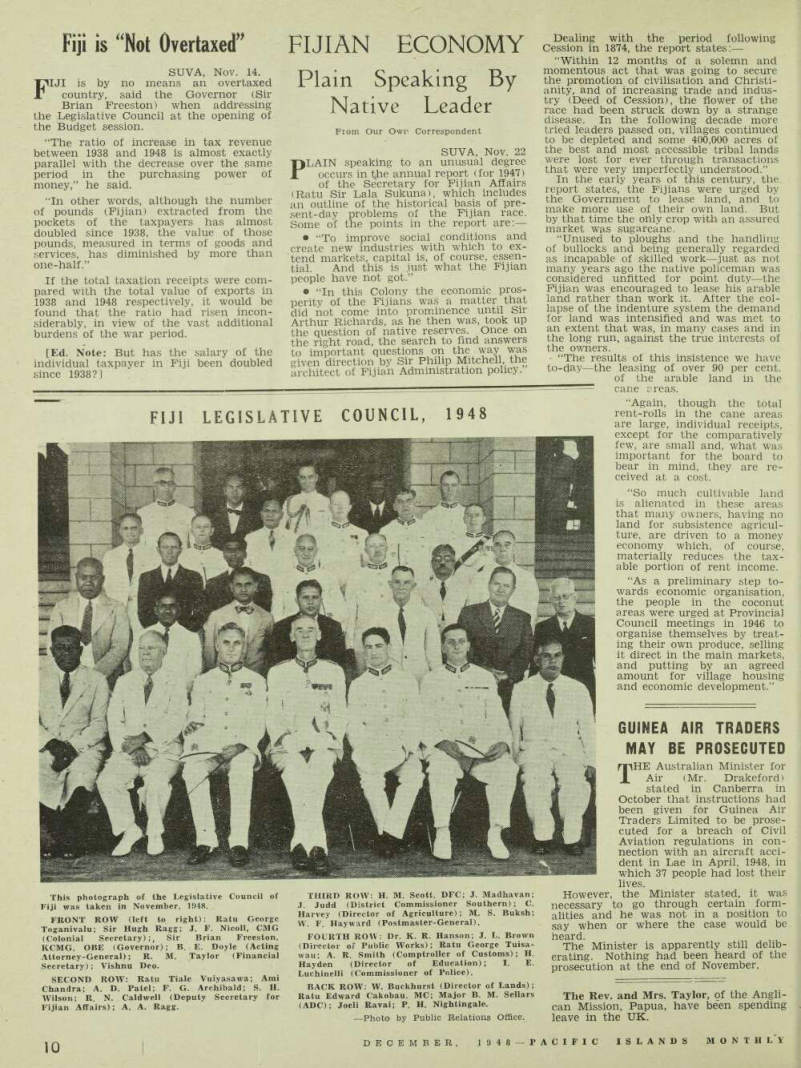
Fiji Legislative Council, 1948
This photograph of the Legislative Council of Fiji was taken in November, 1948.
FRONT ROW (left to right): Ratu George Toganivalu; Sir Hugh Ragg; J. F. Nicoll, CMG (Colonial Secretary); Sir Brian Freeston, KCMG, OBE (Governor); B. E. Doyle (Acting Attorney-General); R. M. Taylor (Financial Secretary); Vishnu Deo.
SECOND ROW: Ratu Tiale Vuiyasawa; Ami Chandra; A. D. Patel; F. G. Archibald; S. H.
Wilson; R. N. Caldwell (Deputy Secretary for Fijian Affairs); A. A. Ragg.
THIRD ROW: H. M. Scott, DFC; J. Madhavan; J. Judd (District Commissioner Southern); C.
Harvey (Director of Agriculture); M. S. Buksh; W. F. Hayward (Postmaster-General).
FOURTH ROW: Dr. K. R. Hanson; J. L. Brown (Director of Public Works); Ratu George Tuisa wau; A. R. Smith (Comptroller of Customs); H.
Hayden (Director of Education); I. E.
Luchinelli (Commissioner of Police).
BACK ROW: W. Buckhurst (Director of Lands); Ratu Edward Cakobau, MC; Major B. M. Sellars (ADC); Joeli Ravai; P. H. Nightingale.
Photo by Public Relations Office.
Guinea Air Traders
May Be Prosecuted
THE Australian Minister for Air (Mr. Drakeford) stated in Canberra in October that instructions had been given for Guinea Air Traders Limited to be prose cuted for a breach of Civil Aviation regulations in con nection with an aircraft acci dent in Lae in April, 1948, in which 37 people had lost their lives.
However, the Minister stated, it was necessary to go through certain form alities and he was not in a position to say when or where the case would be heard.
The Minister is apparently still delib erating. Nothing had been heard of the prosecution at the end of November.
The Rev. and Mrs. Taylor, of the Angli can Mission, Papua, have been spending leave in the UK.
Australian Ignorance Of N. Guinea Is ‘Abysmal’
And ‘Disgraceful’
Former Head of ANGAU Is Critical of Territories Conditions
SOME rather sour comment on adminis trative conditions in New Guinea, and on the Australian Government policy which made such conditions pos sible, was made in Melbourne in Novem ber, in the course of a public address, by Major-General B. M. Morris, who was in charge of the Territories, as military com mander, and as head of ANGAU, during most of World War II.
According to “The Age,’’ these are some of General Morris’s comments;— “The abysmal ignorance displayed by members and Ministers of the Federal Parliament who create the laws and ordi nances of the New Guinea Territory is disgraceful.
“In 1943, I suggested that the New Guinea and Papua territory be represented in the Federal Parliament on the same basis as the Northern Territory—to-day, I reaffirm that suggestion.”
General Morris said that the knowledge of New Guinea which was lacking among Parliamentarians was not to be acquired in five minutes. He had met a missionary in the territory who had been there 34 years, and he had told him that he had been there just long enough to realise that he knew little of the natives.
In criticising the Government’s policy of increasing wages and war-damage pay ments to the natives, General Morris said that it made his heart bleed to see the state of the natives after the ravages of war. “But it is not an increase in money and wages the natives need,” he said. “What is needed is a large and well-managed medical and education scheme.”
Commenting on United Nations’ criti cism of Australia’s refusal to grant self- Government to New Guinea, Major-Gen eral Morris said that the natives are not yet fitted for self-government. “They are too easily swayed,” he said.
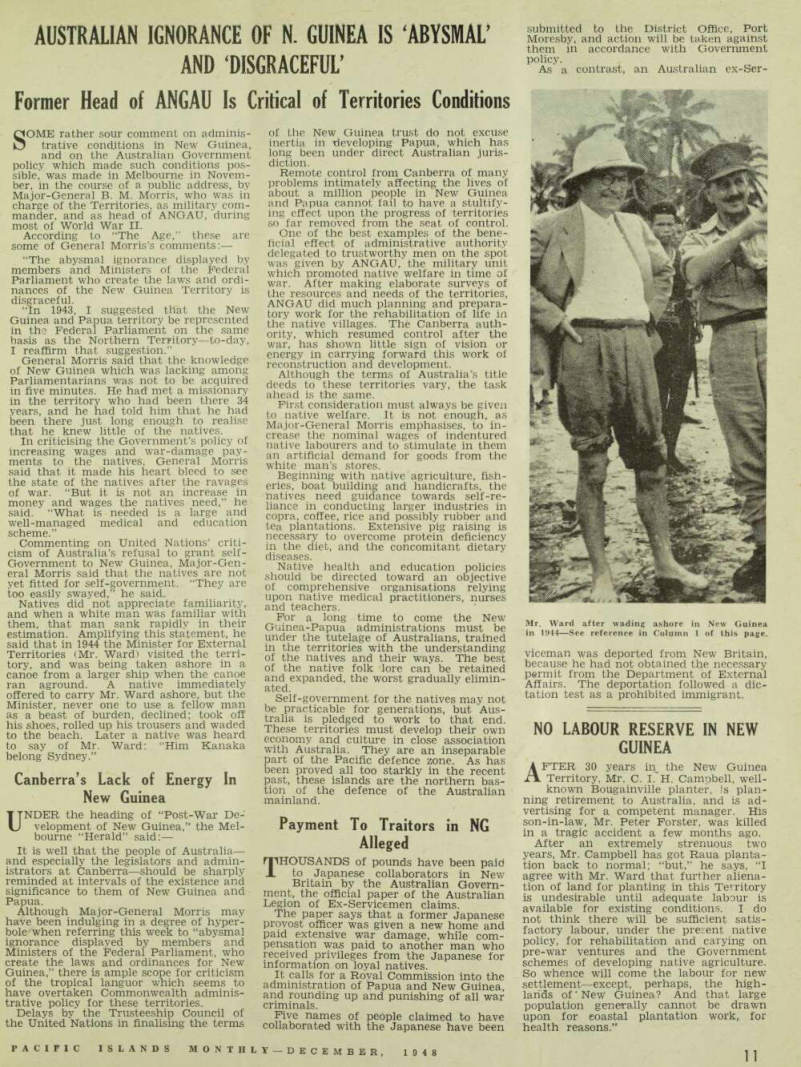
Natives did not appreciate familiarity, and when a white man was familiar with them, that man sank rapidly in their estimation. Amplifying this statement, he said that in 1944 the Minister for External Territories (Mr. Ward) visited the terri tory, and was being taken ashore in a canoe from a larger ship when the canoe ran aground. A native immediately offered to carry Mr. Ward ashore, but the Minister, never one to use a fellow man as a beast of burden, declined; took off his shoes, rolled up his trousers and waded to the beach. Later a native was heard to say of Mr. Ward: “Him Kanaka belong Sydney.”
Canberra’s Lack of Energy In
New Guinea
UNDER the heading of “Post-War De velopment of New Guinea,” the Mel bourne “Herald” said: — It is well that the people of Australia— and especially the legislators and admin istrators at Canberra —should be sharply reminded at intervals of the existence and significance to them of New Guinea and Papua.
Although Major-General Morris may have been indulging in a degree of hyper bole when referring this week to “abysmal ignorance displayed by members and Ministers of the Federal Parliament, who create the laws and ordinances for New Guinea,” there is ample scope for criticism of the tropical languor which seems to have overtaken Commonwealth adminis trative policy for these territories.
Delays by the Trusteeship Council of the United Nations in finalising the terms
of the New Guinea trust do not excuse inertia in developing Papua, which has long been under direct Australian juris diction.
Remote control from Canberra of many problems intimately affecting the lives of about a million people in New Guinea and Papua cannot fail to have a stultify ing effect upon the progress of territories so far removed from the seat of control.
One of the best examples of the bene ficial effect of administrative authority delegated to trustworthy men on the spot was given by ANGAU, the military unit which promoted native welfare in time of war. After making elaborate surveys of the resources and needs of the territories, ANGAU did much planning and prepara tory work for the rehabilitation of life in the native villages. The Canberra auth ority, which resumed control after the war, has shown little sign of vision or energy in carrying forward this work of reconstruction and development.
Although the terms of Australia’s title deeds to these territories vary, the task ahead is the same.
First consideration must always be given to native welfare. It is not enough, as Major-General Morris emphasises, to in crease the nominal wages of indentured native labourers and to stimulate in them an artificial demand for goods from the white man’s stores.
Beginning with native agriculture, fish eries, boat building and handicrafts, the natives need guidance towards self-re liance in conducting larger industries in copra, coffee, rice and possibly rubber and tea plantations. Extensive pig raising is necessary to overcome protein deficiency in the diet, and the concomitant dietary diseases.
Native health and education policies should be directed toward an objective of comprehensive organisations relying upon native medical practitioners, nurses and teachers.
For a long time to come the New Guinea-Papua administrations must be under the tutelage of Australians, trained in the territories with the understanding of the natives and their ways. The best of the native folk lore can be retained and expanded, the worst gradually elimin ated.
Self-government for the natives may not be practicable for generations, but Aus tralia is pledged to work to that end.
These territories must develop their own economy and culture in close association with Australia. They are an inseparable part of the Pacific defence zone. As has been proved all too starkly in the recent past, these islands are the northern bas tion of the defence of the Australian mainland.
Payment To Traitors in NG
Alleged
THOUSANDS of pounds have been paid to Japanese collaborators in New Britain by the Australian Govern ment, the official paper of the Australian Legion of Ex-Servicemen claims.
The paper says that a former Japanese provost officer was given a new home and paid extensive war damage, while com pensation was paid to another man who received privileges from the Japanese for information on loyal natives.
It calls for a Royal Commission into the administration of Papua and New Guinea, and rounding up and punishing of all war criminals.
Five names of people claimed to have collaborated with the Japanese have been
submitted to the District Office, Port Moresby, and action will be taken against them in accordance with Government policy.
Asa contrast, an Australian ex-Ser-
viceman was deported from New Britain, because he had not obtained the necessary permit from the Department of External Affairs. The deportation followed a dic tation test as a prohibited immigrant.
Mr. Ward after wading ashore in New Guinea in 1944—See reference in Column 1 of this page.
No Labour Reserve In New
Guinea
AFTER 30 years in_ the New Guinea Territory, Mr. C. I. H. Campbell, well known Bougainville planter, is plan ning retirement to Australia, and is ad vertising for a competent manager. His son-in-law, Mr. Peter Forster, was killed in a tragic accident a few months ago.
After an extremely strenuous two years, Mr. Campbell has got Raua planta tion back to normal; “but,” he says, “1 agree with Mr. Ward that further aliena tion of land for planting in this Territory is undesirable until adequate labour is available for existing conditions. I do not think there will be sufficient satis factory labour, under the present native policy, for rehabilitation and carying on pre-war ventures and the Government schemes of developing native agriculture.
So whence will come the labour for new settlement—except, perhaps, the high lands of ‘ New Guinea? And that large population generally cannot be drawn upon for coastal plantation work, for health reasons.”
Advertisements & other items, p. 14 (1 item)
Morris Hedstrom Limited
General Merchants, Importers and Exporters,
Shipowners, Plantation Owners,
Commission and Insurance Agents
HEAD OFFICE
SUVA, FIJI
Established 1868
SERVICE IN THE SOUTH PACIFIC TERRITORIES
r pHROUGH our Large Establishments in Suva and our Numerous Branches, we distribute a wide and comprehensive range of General Merchandise and provide almost every kind of service. Our departments and associated businesses include:
DRAPERY
MOTOR SALES
AND SERVICE
TOBACCO
TIMBER AND
BUILDING
GROCERY
CONFECTIONERY
HARDWARE
ELECTRICAL
LIQUORS
DRUGS
Branches Throughout Fiji, Samoa and Tonga
Agent of Morris Hedstrom Limited in every Town in the Three Territories.
We ore Sole Agents in these Territories for There is a Branch or British Drug Houses Ltd.
Electrolux Ltd.
Ford Motor Co.
General Electric Co. Ltd.
Goodyear Tyre £r Rubber Co.
B. A. Hjorth & Co. (Primus Products) Imperial Chemical Industries Ltd.
International Harvester Export Co.
Matson Navigation Company Max Factor and Co. Inc.
Ransomes, Sims Gr Jefferies Ltd.
Ruston & Hornsby Ltd.
Vacuum Oil Co. Pty. Ltd.
Yorkshire Copper Works Ltd.
Morris Hedstrom Limited, are LLOYD'S AGENTS in Fiji and Samoa.
IN AUSTRALIA; IN GREAT BRITAIN:
Morris Hedstrom (Aust.) Pty. Ltd., Morris Hedstrom Limited, Asbestos House, Africa House, 65 York Street, SYDNEY Kingsway, LONDON
Rabaul Has 70 Mph Gale
THE fiercest wind-storm in memory swept Rabaul (New Guinea) and surrounding districts shortly before dark on November 8. The gale at times reached 70 miles per hour.
Clouds of dust were whirled into the air and trees were uprooted. At least five houses were damaged by falling trees —one of the houses being that which is occupied by the Supreme Court Judge on his visits to the town. It was unoccupied at the time of the gale.
Several small ships broke their moorings and were driven ashore and considerable damage was done in Chinatown, where shanty-type dwellings lost their roofs.
Native gardens were damaged and hun dreds of banana palms and coconuts up rooted.
The gale was followed by rain.
Rabaul is out of the hurricane belt and fierce winds are unusual.
Of Sydney
New Guinea Women’S Club
THE following donations have been made towards the expenses of the children’s Christmas party which will be held by the New Guinea Women’s Club of Sydney on December 20:
As well as the Children’s Party which will be held in the Feminist Club rooms on the afternoon of the 20th (com mencing about 2.30) an adult party will be held in the evening of December 23, commencing at 6.30.
All oast and present Territorians are invited to attend.
During November members of the Club had a launch excursion to Fort Denison, historic landmark in Sydney Harbour.
They were conducted over the old fort, where refreshments were later served.
£ s. d.
Lady McNicoll ... 1 1 0 Mrs. Lacey 18 0 Mr H. Downing 10 0 Miss I. Davies 10 0 Mrs. Bellhouse * .. .. 1 1 0 Mrs. Hopkins 10 0 Mrs. Harvey 10 6 Mrs, Pennefather ... 1 1 0 Mr J. Allan 3 0 0 Mr. A. J. Gaskin .. ... 3 3 0 Mrs. E. Wauchope .. .. 5 0 0 “Pacific Islands Monthly” 2 2 0 W. R. Carpenter & Co., Ltd. .. . 3 3 0 J. Sedgers 2 2 0 C. Beckett ... 1 1 0 Robt. Gillespie Pty., Ltd 5 5 0 £30 17 6
Rarotonga
Special Police Leave
Eight Months’ Duty, No Incidents
AFTER eight months special duty in the Cook Islands the six remaining members of the New Zealand Police Force are being withdrawn. Three of them reached Auckland in the “Maui Pomare” in early November and the other three are expected back on the next trip of the ship.
Fourteen New Zealand policemen were sent to Rarotonga in March when a CIPA picket-line threatened to prevent the un loading of ships carrying essential sup plies. The arrival of the police caused a sensation and except for an abortive at tempt by women members of the CIPA all picketing was dropoed.
Eight of the police returned to New Zealand within a few weeks. Six have remained. They have taken no part in the ordinary police work of the island but it was felt that it would be unwise to lose the advantage of their presence by early withdrawal.
New Puisne Judge Appointment
For Fiji
MR. W. DESMOND CAREW has been appointed Puisne Judge, Fiji, in succession to Mr. Justice Thomson.
Mr. Carew is expected to arrive in the Colony towards the end of this year. He is already known to many people in Fiji —he is the son of a former Medical Officer in the Colony and in 1921 after medical studies at Trinity College, Dublin, and after taking part in the 1914-18 war,
he was appointed to Fiji as an adminis trative cadet.
From 1923 to 1931 he served as District Officer in the old Province of Colo East, and at Rotuma. He was called to the Bar at Gray’s Inn, London, in November, 1930. From 1931 until his secondment to the New Hebrides as British Judge in 1935, he served as Acting Police Chief Magistrate, Suva, and Police Magistrate, North West Viti Levu.
Mr. Carew was transferred to Malaya in 1940. During the war he was captured by the Japanese and was interned for over 3 h years.
Advertisements & other items, pp. 15-16 (1 item)
Honey!
He didn't forget
to kiss you
Poor foolish wife—to trust just a bath, instead of capping it off with dependable Mum.
Your bath washes away past perspiration but it can’t safeguard you against the risk of future underarm odour.
Take just 30 seconds to smooth on Mum ; then you’ll be worry-free all day or even-
ing. Mum guards charm.
You can use Mum even after dressing. It will not injure fabrics or irritate your skin.
Get Mum today.
Mum
takes n
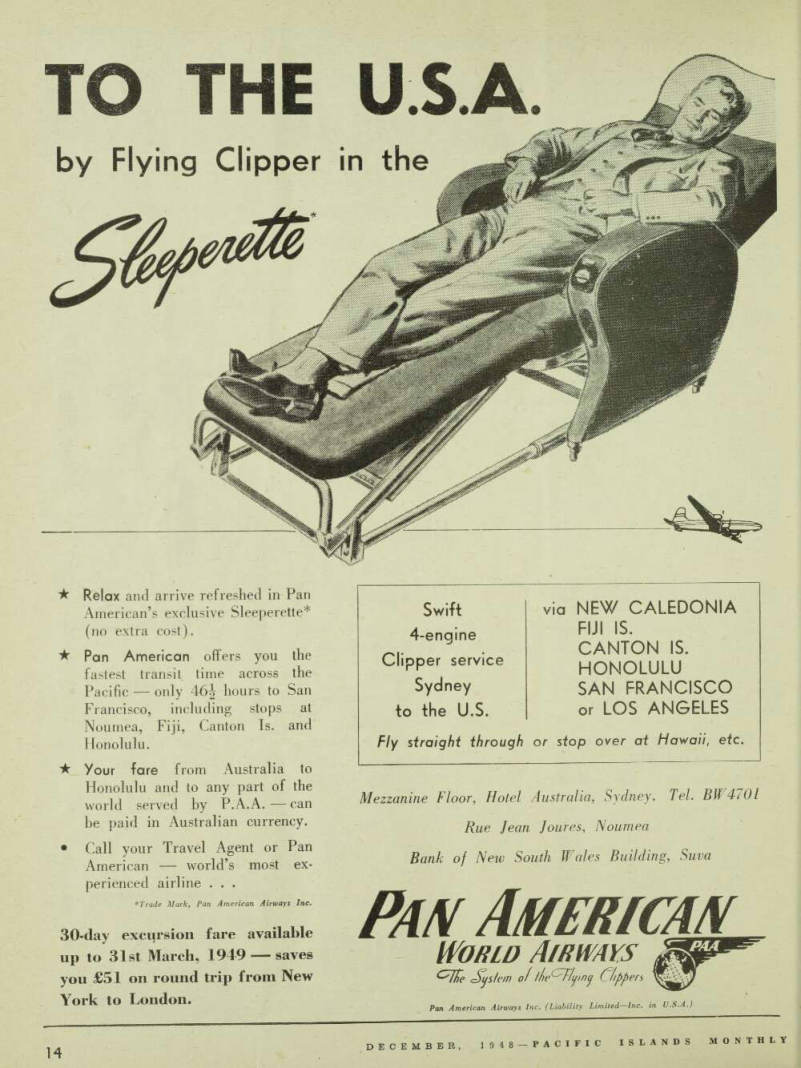
TO THE US A
by Flying Clipper in the
■ m w c I m ■m W 9 f ★ Relax and arrive refreshed in Pan American’s exclusive Sleeperette* (no extra cost). ★ Pan American offers you the fastest transit time across the Pacific only 46| hours to San Francisco, including stops at Noumea, Fiji, Canton Is. and Honolulu. ★ Your fare from Australia to Honolulu and to any part of the world served by P.A.A. can be paid in Australian currency. ★ Call your Travel Agent or Pan American world’s most experienced airline . . . *Trade Mark, Pan American Airways Inc. 30-day excursion fare available up to 31st March, 1949 saves you £5l on round trip from New York to London.
Swift 4-engine
Clipper service
Sydney
to the U.S.
via NEW CALEDONIA
FIJI IS.
CANTON IS.
HONOLULU
SAN FRANCISCO
or LOS ANGELES
Fly straight through or stop over at Hawaii, etc.
Mezzanine Floor , Hotel Australia, Sydney. Tel. 8W4701 Rue Jean Joures, Noumea Bank of New South Wales Building , Suva
Pan American.
World Alrmavs
Sysfctn of lhe Clippers
Pan American Airways Inc. (Liability Limited Inc. in U.S.A.)
Territories Talk-Talk
By "Tolala"
LAST month I mentioned NG’s potenti alities as a tea-growing country, de pendent upon labour and transport.
I met an old Indian tea-planter the other day and he smiled cynically at the sug gestion. He gave me some tea-picking figures, based on his own experiences in India—pre-war, of course. Pickers, usually females—who, he said, are the best workers —pick 20 lbs. of green tea a day, which is equivalent to 5 lbs. of the finished article; and for this each picker received sd. (five-pence) a day. Out of this sum they clothed and fed themselves. This was only the picking expense. Highest wholesale price realised for this com modity was 1/4 a lb.
Can you see that wage being paid in NG? I can’t.
Incidentally, the adviser to the Inter national Tea Market Expansion Board (Sir Percival Griffiths) is reported as say ing that before long the world would have more tea than it wanted: and, to cope with this situation, the Board would have to intensify the campaign for ex panding the market. • * * EXECUTIVES of an old Rabaul Institu tion —the Agnes Wisdom Library— got into a huddle recently at the NG Women’s Club in Sydney to decide the library’s future activities. It seems that all libraries in the Territories are novtf “nationalised,” and the suggestion that an Agnes Library Wing should be established to perpetuate a name held dear to old Territorians was not wel comed by officialdom, unless it were open for the use of literate natives. AW Library executives did not appreciate this string being attached to acceptance of their offer. Hence, a bottle-neck. It appears to me that natives’ amenities are well catered for by the Administration without insisting on private European in stitutions sharing in this work. * ♦ * WATTIE HEYDON was a well-known plantation manager in TNG before the War. He was on Varzin, in the Kokopo district, for some time, and im mediately before the kite went up he was on Tanga Island, for WRC, Wattie was numbered, with many others, among those who disappeared after the invasion in ’42. His brother, H. Heydon—who is, in cidentally, secretary of the NSW Cricket Association—would like to contact anyone who knew Wattie during the last few months prior to the invasion. ♦ * * LITTLE wonder that South Africa is refusing to allow its old mandated territories to come under the new Trusteeship Committee of UNO. The Transvaal Nationalist Congress recently included the following subjects on its agenda:
• Old-age pensions for natives should be discontinued. • Too much public money was being spent on education of natives. • Native telegraph messengers should not be allowed to deliver telegrams to the homes of Europeans, The colour-bar appears to be rising in that neck of the woods —and about the only place in the British Commonwealth where that is happening. ♦ * ♦ AS a contrast to this attitude, radio listeners recently heard the aborigine tenor, Harold Blair, deliver a plea for his race in a pleasing, well-educated voice. His singing shows what can be accomplished with proper training. But anyone who has heard native choirs sing ing in the Territories realises the perfect harmony they attain —it seems a natural gift to them.
Old Rabaulites will remember the Matupi village choir, under the baton of one Tami, which gave some fine render ings at a native arts and crafts concert, sponsored by the old Administrator, the late Tom Griffiths, back in ’34. The “Hallelujah Chorus,’’ and a selection from “The Messiah” were included in their pro gramme. They trained from gramophone records. They would go over in a big way if they toured Australia. * * ♦ SOLOMON ISLAND “cargo cults” are making the headlines in the “New York Times.” Writes its corre spondent from Guadalcanal: “Natives be
lieve that a convoy of ships is on its way to the islands, laden with the fruits of the modern world, to enable them to fill their leaf huts with refrigerators and other comforts, including motor cars.”
Next thing we’ll hear of will be that some eccentric millionaire will load a ship with such a cargo and wander through then thT d fat d «r& We, ££ Malaita to Aitape and back again. ‘ CANBERRA message at the beginning of last month mentioned that Federal Cabinet had authorised the Shipping Board to build two 3,000-tons
diesel cargo vessels for the Territories.
The design will be the “D Class” adapted to the special requirements of P-NG.
“D,” according to most Territorians, stands for Delay, where P-NG government transport is concerned. * * * THE co-operative society scheme amongst natives in NG has been re ceiving some publicity of late, as thought it were some brand-new blue print from a Canberra office. The co operative spirit, carried out in a practical form, has long been the basis of most native trading and marketing in both Territories, so the principles will be noth
ing new to black brother. With Govern ment red-tape, however, it may become a trifle confusing to the simple producer of copra.
There was, for a while, a flourishing co-operative store in Rabaul. run for the Military during the First World War: and, later, a New Guinea Producers’ Co operative Society was registered by some local planters, but never got working pro perly before the Second War threw a spanner in the works. * * * THERE is a lengthy survey of Rabaul, its past glory and dismal future in the Sydney “Bulletin” (24/11/48), by a NG writer. Possible future eruptions inspire the writer’s cynicism, but he puts forward quite a good case. He forgets to mention, however, the lack of present precautions in the form of systematic yulcanological observations, which the Administration should adopt for the safety of the natives, even if not for the mental comfort of the non-native population Dr
Fisher—forward, please!
* * * BITS and Pieces: Gone to their rest: George Wilkinson, of Menangle Park, who was in the Kavieng dis trict some years ago in the District Ser vices Dept. In the First War he served with' the 33rd Bn., AIF; wounded at Messines in 1917. . . Wilfred Clarence Sparks, of Bankstown. on November 9, formerly of Port Moresby. . . Ernest John (“Tom”) Ifould, of Church Point and formerly of Boram plantation, at Wewak.
Tom was a well-known NG identity from the days in 1922, when he was a schooner skipper for the Exproboard. Later, his home at Boram was a popular rendezvous for the Wewak miners. . . Ernst Paatzsch, after repeated reports of his death during the past few years, was called away on November 17. He died in the Manly Dis trict Hospital. Arrived in NG back in 1911 as book-keeper for the Hernsheim Company. In later years, he was associ ated with the late G. Furter. in Rabaul. . . . May they all rest peacefully!
“Kassa” Townsend, previously a TNG DO, now attached to UNO in New York, was in Sydney recently. . . Another Townsend—Wing Commander W. E., of Moree, and CO of the RAAF at PM at one time—has been posted for duty with the Defence Department. Washing ton, USA. He commanded No. 22 Souadron in NG during the War. . . Nor folk Island PO opened a new issue in June, 1947. Up to June this year sale of postage stamps there netted £17,357. When does Papua-NG get its own individual stamp issue? . . . R. Hall-Best, a recent victim of Terrorist shootings in Malaya, was a well-known goldfields identity. . .
Photographer Gibson (he used to be Gov ernment Printer in PM) was about Syd ney this month. . . Other NG and Papuan identities seen around Sydney town were Jack Allen, from Gilalun plantation, in the Kokopo district; Vic Pennefather, from Tokua. in the same area, who has ideas of staying down in definitely. Cyril Doyle is looking after the Tokua coconuts. . . Father McEncroe, from PM, on his way over to WA. . . Bob Bunting, from Samarai, looking the pic ture of health. . . Reg. Clancy, from Kimadan plantation, in New Ireland, snatching a spot of leave.
After many months of delay, Fijian and Polynesian Methodist missionaries and their • families —31 of them alto gether—have been able to return to their homes. They have given years of service in Papua. For some time these people were held up in Madang, NG; then in Queensland: but the last group of seven was scheduled to leave for Suva on December 1.
Advertisements & other items, pp. 17-18 (1 item)
Wenzel & Co.
THE
YORKSHIRE
INSURANCE
CO. LTD.
(Incorporated in England)
ALL CLASSES OF
INSURANCE
Including Fire Motor Guarantee Accident Workers Marine Island Representatives:
PORT MORESBY: E. A. James
RABAUL: G. B. Black LAE; New Guinea Industries Ltd.
MADANG: R. MacGregor SUVA; Williams & Gosling Ltd.
NOUMEA: Y. Mortensen
NORFOLK ISLAND:
A. E. Martin
BURNS PHILP (New Hebrides) LTD.
Registered Office: VILA, NEW HEBRIDES
Branch Office at SANTO
Exporters, Importers and General Merchants
(Retail and Wholesale) Commission, Shipping
and Customs Agents
Representatives for BURNS PHILP TRUST COMPANY LIMITED, QUEENS- LAND INSURANCE CO., LTD., and LLOYDS OF LONDON. Agents for SOCIETE DES PETROLES SHELL DES ILES FRANCAISES DU PACIFIQUE, and numerous overseas manufacturers of all classes of merchandise.
Sydney Agents: Burns, Philp & Co., Ltd., 7 Bridge Street.
San Francisco Agents: Burns, Philp Co. of San Francisco, Matson Building, 215 Market Street, London Agents: Burns, Philp & Co., Ltd., 35 Crutched Friars, EC. 3
WENZEL & CO.
EXPORT DISTRIBUTORS
255 California Street, San Francisco 11, U.S.A.
Cable Address “Wenco.” All Codes.
HOW THE “WALES” WORKS
Services Series No. 3
3ntered-l>e*^
Deposits
INTEREST-BEARING Deposit (1.8. D.)
accounts at the Bank of New South Wales are designed to meet the needs of those who have funds which they do not expect to re-
quire for some time,
but who do not wish the funds to lie idle.
Money on 1.8. D. account earns interest. It is a nest-egg, yet not so tied up that it is not readily available within reasonable time.
Small sums on 1.8. D account are a good
safeguard against
emergencies.
Consult and use
CURRENT RATES
OF INTEREST
on 1.8. D. Accounts 3 months \ % p.a. 6 months „ % p.a. 12 months 1 % p.a. 24 months % p.a.* * up to £lO,OOO, thereafter 1 % p.a.
HOW INTEREST
IS PAID
Interest on 1.8. D. accounts may be withdrawn as it falls due, or credited to a current account or added to the principal of the deposit if that'is renewed for a further term. Interest on 12 and 24 months deposits is payable each six months.
BANK OF
NEW SOUTH WALES
FIRST BANK IN AUSTRALIA
Incorporated In New South Wales with limited liability
US Closes Papeete Consulate
From Our Own Correspondent
Papeete, Oct. 6
FR reasons of economy the American Consulate in Papeete, Tahiti, has been closed down and the property will be sold.
This came as a shock to the Consul, Mr. Winifred H. Scott, the Vice-Consul, Mr. T. A. Herrick, and to residents of Tahiti.
An American consulate was established in Tahiti 116 years ago when, in 1832, Queen Pomare gave a grant of land for a building. A building was subsequently erected at the expense of the American Consul of the day and each subsequent Consul purchased the property from his predecessor until the time of Consul Sal mon who did not sell. There is a record, in 1868, of a suit begun by Mrs. Salmon for the recovery of rent from a Consul Perkins. Perkins finally bought the building for 300 dollars but the US Gov ernment did not reimburse him and the title to the building was retained by him.
This building was, however, later * des troyed by a cyclone and in 1906 the US Government appropriated sufficient money to erect the present building.
Mr. Scott left Papeete by the “Waite mata” in October. Mr. Herrick will re main in Papeete to supervise the sale of the building, furniture, etc.
This sudden decision of the US Govern ment has come as a disappointment to local residents with whom the officers of the consulate were popular.
Death Of Mr. A. Paatsch
THE death occurred in Manly Hospital, Sydney on November 17, of Mr. A.
Paatsch, who was well known as a merchant in Rabaul, New Guinea, before the Jap invasion. Mr. Paatsch had re tained his German nationality; and, when World War II became serious, he was one of those removed from New Guinea to a prison camp in Australia, where he remained until after the end of World War 11. He wished to return to New Guinea; but Australia would not allow it, so he lived very modestly in Sydney during 1946-48. Mr. Paatsch went from Germany to German New Guinea about 1911; and was interned between 1914 and 1918. He was one of those unfortunate Germans who, although not interested in Germany’s foreign policy, had their lives moulded by it, because they would not give up German nationality. Mr. Paatsch spent more than ten years of his life in internment.
Trophy Winners
Mr. E. O. Anderson, superintending architect of the Mormon Church was due in Tonga in November from Salt Lake City, USA. It is planned/ to build a mission school in Nukualofa that will ac commodate 150 boys and a similar num ber of girls. Much of the material has already been shipped from the United
States and it is expected that local labour will be used for most of the work.
Air France contemplates the establish ment of an air service from France to New Caledonia, via Indo-China.
The Suva Yacht Club held its Presentation Dance on November 6. The photograph shows some smiling cup-winning members. On the right is Mr. Bentley, skipper of the “Levuka,” the Club’s fastest yacht.
Advertisements & other items, pp. 19-20 (1 item)
Allen Taylor & Co. Ltd.
COMMERCIAL ROAD, ROZELLE,
SYDNEY
Sowmillers and Wholesale Suppliers of Hardwoods for Constructional Purposes GIRDERS , . . PILES . . . POLES . , . SLEEPERS, Etc.
EXPORTING TO PACIFIC - ISLANDS SINCE 1893
IMPORTERS
EXPORTERS
All classes of merchandise purchased for Island clients throughout the South-west Pacific.
Island produce sold on Australian and overseas markets on a commission basis.
54a Pitt Street - Sydney
Cable Address: “ROBERGILL,” Sydney
Experts agree! CINEVOX
has all three
1. LIGHT-WEIGHT
PORTABILITY.
Packs into three carrying cases and can be assembled for operating in less than 30 minutes.
2. “THEATRE” TONE.
27v. D.C. operated Exciter Lamps, High Fidelity 25w. Amplifier, Speaker system employing four Speakers in Special Baffle cases with High and Low frequency network ensuring rich, true, fidelity tone in any size auditorium or open air.
3. EASY OPERATION.
Minimum of controls conveniently located, straight-line film threading, motor rewind, flick of a switch ensures smooth instantaneous changeover from reel to reel.
J U MM mm m m
EXHIBITOR 16 mm. EQUIPMENT
Yes ! Cinevox has the three most important features required for successful showing of 16 mm. Sound Movies in Country and outback areas. What’s more, Cinevox operates equally well on A.C., D.C. or Mobile power Unit—has 750 watt Projection Lamp, 2000 ft. reel capacity, Gramophone pick-up—and other outstanding features.
Another satisfied user recently telegraphed : "Opened Tannymorel Sat. 4, Cinevox Equipment beyond expectation 12 sound excellent regards. — Stewart.”
Proof beyond doubt of Cinevox performance.
Distributors for Papua, New Guinea, and Pacific Islands:
Lj-el,
EQUIPMENT (QLD.) PTY. LTD.
Old Courier Building, Queen Street, Brisbane
Box 754 K, G.P.0., Brisbane. x 10 picture definition and
POST THIS COUPON
TO-DAY
Please send me FREE and POST FREE complete details of the CINEVOX
EXHIBITOR EQUIP-
MENT.
NAME ...
I ADDRESS
P.I.M.
Conditions Reviewed In Budget Session Speech
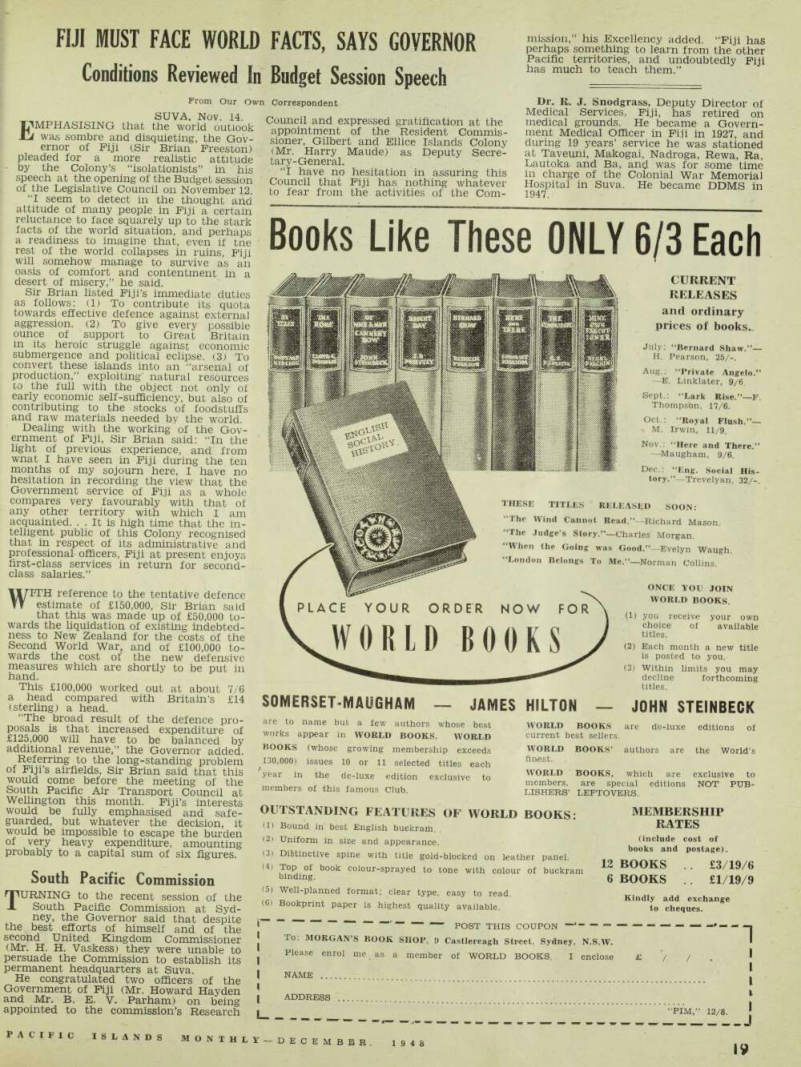
FIJI MUST FACE WORLD FACTS, SAYS GOVERNOR Conditions Reviewed In Budget Session Speech
Prom Our Own Correspondent
Suva. Nov. 14.
that the world outlook A J was sombre and disquieting, the Gov ernor of Fiji (Sir Brian Freeston) pleaded for a more realistic attitude by the Colony’s “isolationists” in his speech at the opening of the Budget session of the Legislative Council on November 12.
“I seem to detect in the thought and attitude of many people in Fiji a certain reluctance to face squarely up to the stark facts of the world situation, and perhaps a readiness to imagine that, even if tne rest of the world collapses in ruins, Fiji will somehow manage to survive as an oasis of comfort and contentment in a desert of misery,” he said.
Sir Brian listed Fiji’s immediate duties as follows; (1) To contribute its quota towards effective defence against external aggression. (2) To give every possible ounce of support to Great Britain m its heroic struggle against economic submergence and political eclipse. (3) To convert these islands into an “arsenal of production,” exploiting natural resources to the full with the object not only of early economic self-sufficiency, but also of contributing to the stocks of foodstuffs and raw materials needed by the world.
Dealing with the working of the Gov ernment of Fiji, Sir Brian said: "In the light of previous experience, and from wnat I have seen in Fiji during the ten months of my sojourn here, I have no hesitation in recording the view that the Government service of Fiji as a whole compares very favourably with that of any other territory with which 1 am acquainted. . . It is high time that the in telligent public of this Colony recognised that in respect of its administrative and professional officers, Fiji at present enjoys first-class services in return for second class salaries.”
WITH reference to the tentative defence estimate of £150,000, Sir Brian said that this was made up of £50,000 to wards the liquidation of existing indebted ness to New Zealand for the costs of the Second World War, and of £100,000 to wards the cost of the new defensive measures which are shortly to be put in hand.
This £100,000 worked out at about 7/6 a head compared with Britain’s £14 (sterling) a head.
“The broad result of the defence pro posals is that increased expenditure of £125,000 will have to be balanced by additional revenue,” the Governor added.
Referring to the long-standing problem of Fiji’s airfields, Sir Brian said that this would come before the meeting of the South Pacific Air Transport Council at Wellington this month. Fiji’s interests would be fully emphasised and safe guarded, but whatever the decision, it would be impossible to escape the burden of very heavy expenditure, amounting probably to a capital sum of six figures.
South Pacific Commission
TURNING to the recent session of the South Pacific Commission at Syd ney, the Governor said that despite the best efforts of himself and of the second United Kingdom Commissioner (Mr. H. H. Vaskess) they were unable to persuade the Commission to establish its permanent headquarters at Suva.
He congratulated two officers of the Government of Fiji (Mr. Howard Hayden and Mr. B. E. V. Parham) on being appointed to the commission’s Research
Council and expressed gratification at the appointment of the Resident Commis sioner, Gilbert and Ellice Islands Colony (Mr. Harry Maude) as Deputy Secre tary-General.
“I have no hesitation in assuring this Council that Fiji has nothing whatever to fear from the activities of the Com
mission,” his Excellency added. “Fiji has perhaps something to learn from the other Pacific territories, and undoubtedly Fiji has much to teach them.”
Ur. R. J. Snodgrass, Deputy Director of Medical Services, Fiji, has retired on medical grounds. He became a Govern ment Medical Officer in Fiji in 1927, and during 19 years’ service he was stationed at Taveuni, Makogai. Nadroga, Rewa, Ra, Lautoka and Ba, and was for some time in charge of the Colonial War Memorial Hospital in Suva. He became DDMS in 1947.
Advertisements & other items, pp. 21-22 (2 items)
19
PACIFIC ISLANDS HONTHtY_ D E C E M B ER. 1948
Books Like These ONLY 6/3 Each
■ ■ m nm g w w (I II n I! 0 0 K
CURRENT
RELEASES
and ordinary
prices of books.
July: “Bernard Shaw.”— H. Pearson, 25/-.
Aug.: “Private Angelo.” —E. Linklater, 9/6.
Sept.: “Lark Rise.”—F, Thompson, 17/6.
Oct.: “Royal Flush.”— M. Irwin, 11/9.
Nov.: “Here and There.” —Maugham, 9/6.
Dec.; “Eng. Social History.”—Trevelyan, 32/-.
THESE TITLES RELEASED SOON:
“The Wind Cannot Read.”—Richard Mason.
“The Judge’s Story.”—Charles Morgan.
“When the Going was Good.”—Evelyn Waugh.
“London Belongs To Me.”—Norman Collins.
ONCE YOU JOIN
WORLD BOOKS.
(1) you receive your own choice of available titles. (2) Each month a new title is posted to you.
Within limits you may decline forthcoming titles.
SOMERSET-MAUGHAM JAMES HILTON JOHN STEINBECK
are to name but a few authors whose best works appear in WORLD BOOKS. WORLD BOOKS (whose growing membership exceeds 130,000) issues 10 or 11 selected titles each year in the de-luxe edition exclusive to members of this famous Club.
WORLD BOOKS are
current best sellers. de-luxe editions of authors are the World’s
WORLD BOOKS’
finest.
WORLD BOOKS, which are exclusive to members, are special editions NOT PUB-
LISHERS’ LEFTOVERS.
OUTSTANDING FEATURES OF WORLD BOOKS:
(1) Bound in best English buekram. (2) Uniform in size and appearance. (3) Distinctive spine with title gold-blocked on leather panel. (4) Top of book colour-sprayed to tone with colour of buckram binding. (5) Well-planned format; clear type, easy to read. (6) Bookprint paper is highest quality available.
MEMBERSHIP
RATES
(include cost of books and postage).
12 BOOKS . . £3/19/6
6 BOOKS . . £l/19/9
Kindly add exchange to cheques.
POST THIS COUPON "* ' -
To; MORGAN’S BOOK SHOP, 9 Castlereagh Street. Sydney, N.S.W.
Please enrol me as a member of WORLD BOOKS. I enclose
NAME
ADDRESS
“PIM,” 12/8.
A tinge of‘pink 5 on your tooth brush is a warning to see your dentist. It may mean nothing serious, but let him be the judge.
He may explain that yours is simply a case of tender gums robbed of resistance by to-day 5 s soft foods. His advice will probably be “more work for lazy gums 55 and often “the helpful stimula-
Safeguard
that Smile !
tion ot Ipana Tooth Paste and gum massage 55 .
Adopt this simple dental health rou tine : Brush your teeth with Ipana every morning and evening, followed by vigorous gum massage with Ipana on the finger-tip . . . Teeth become brighter, more lustrous ; gums firmer, healthier; smiles more pleasing.
IPANA TOOTH PAST
4538b/Gi
Pacific Urged
Japs Want Living Space
Mass Migration to South Pacific Urged
IT is unlikely that the idea of mass migration of 20,000,000 Japs to the South Seas, recently put forth by an English language magazine in Tokio, will be greeted enthusiastically by either the Dutch (in whose territory they hope to settle) or by the Australians who also have a stake in that part of the world.
It is proposed (by the magazine) that most of the Japs will go to Dutch New Guinea where, they say, there is abun dant water and snow-capped mountains and (probably) fertile plateaux.
They have quaint ideas about some as pects of the country, however—one being the “prevalence of dangerous epidemics; ’ but they feel that they might manage to overcome these by spraying DDT pow der from the air to “lessen the ferocity of these pestilences.”
The migrants, it is proposed, would lose their Japanese nationality and acquire that of the country in which they were living. But they would establish them selves in small groups and live as if in their own villages in Japan.
The magazine urges the Japanese Gov ernment to consider the project immedi ately—before any peace treaty is signed, as that, it is thought, would automatically delay proceedings.
Nothing is said about obtaining the consent of the Governments of the countries to which it is proposed the migrants will go. It is unlikely that Holland would look with favour on millions of Jap migrants flooding into Dutch New Guinea. And, even if they did, the howls of protest that would rise from every section of the Australian
population would be sufficient to block it effectively.
There is, in fact, nowhere in the South Seas where Jap settlers would be wel comed. Yet where are Japan’s surplus millions to go?
The population of Japan now is in creasing at a greater rate than ever before in her history. Over 1,000,000 Jap babies are coming into the world each year, and there is no room for them in Japan. In an endeavour to put some sort of brake on this extraordinary fecundity the Jap anese Government recently went to the previously unheard of length of putting a tax on babies. Whether or not this will
induce Japanese parents to practice birth-control remains to be seen.
It is a well-known fact too, that the ordinary Japanese is reluctant to migrate.
Before the Pacific war, when several avenues were open to him, the Japanese Government had great difficulty in find ing sufficient pioneers to populate their various colonies. The war, of course, may have changed all that.
Japan’s overpopulation will have to be solved sooner or later. A solution, how ever, does not readily present itself—un less it is the introduction, into Japan, of one of those “pestilences” from Darkest New Guinea,
Advertisements & other items, p. 23 (2 items)
21
PACIFIC ISLANDS MONTHLY-D E C E M B E R , 1948
Mcilrath’S
EXPORT DEPARTMENT
extend the SEASON'S GREETINGS to all residents of the Pacific Islands, and thank them for their patronage and support during 1948.
McILRATH’S INSURE ALL GENERAL CARGO AGAINST PILLAGE-
THEFT—NON-DELIVERY.
Write for Complete Grocery, Wine and Spirit Price List Post Free by Return Air Mail.
McILRATH’S PTY. LTD.
202 Pitt Street, Sydney, Australia Cable address—ROTUNDA, Sydney.
For long and reliable service, a
A § (L
PROPELLER SHAFT
Monel shafts are renowned for their rugged strength, stiffness and freedom from whip.
These characteristics are very important since a good, stiff shaft reduces vibration, transmits more power to propeller and thereby increases speed and efficiency. Of still greater importance is the fact that Monel retains these properties indefinitely, because Monel cannot rust and is not corroded by fresh or salt water.
That is why a Monel shaft, stronger than others when new, is still in perfect condition after years of continuous service.
Complete information on Monel will gladly he forwarded by:
WRIGHT AND COMPANY
SOLE AUSTRALIAN DISTRIBUTORS OF MONEL
81 CLARENCE STREET, SYDNEY
imov 6 ’ mln«rt re f‘ St<^ ed i rade ‘ mark covering a rich nickel alloy, mined in Canada and rolled in Great Britain.
'Phone: 6X1211 (Six Lines)
Death Of Mr. S. J. Smith
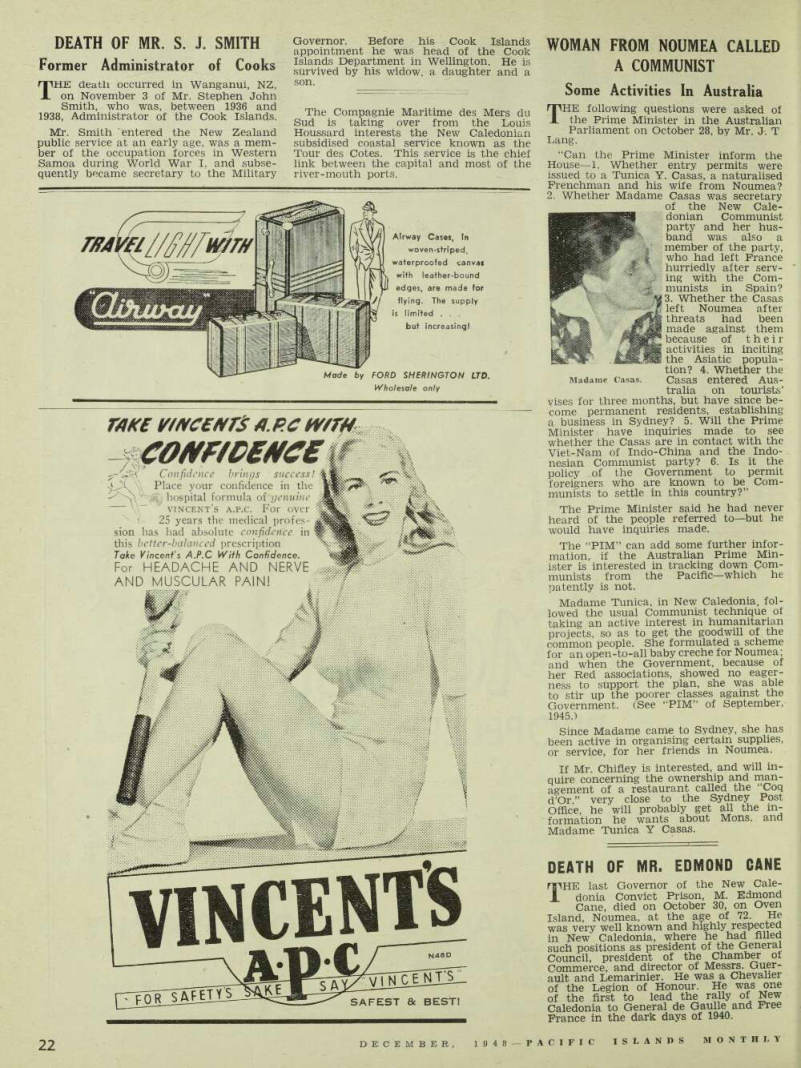
Former Administrator of Cooks
THE death occurred in Wanganui, NZ> on November 3 of Mr. Stephen John Smith, who was, between 1936 and 1938, Administrator of the Cook Islands.
Mr. Smith entered the New Zealand public service at an early age, was a mem ber of the occupation forces in Western Samoa during World War I, and subse quently became secretary to the Military
Governor. Before his Cook Islands appointment he was head of the Cook Islands Department in Wellington. He is survived by his widow, a daughter and a son.
The Compagnie Maritime des Mers du Sud is taking over from the Louis Houssard interests the New Caledonian subsidised coastal service known as the Tour des Cotes. This service is the chief link between the capital and most of the river-mouth ports.
Woman From Noumea Called
A Communist
Some Activities In Australia
THE following questions were asked of the Prime Minister in the Australian Parliament on October 28, by Mr. J. T Lang.
“Can the Prime Minister inform the House —1. Whether entry permits were issued to a Tunica Y. Casas, a naturalised Frenchman and his wife from Noumea? 2. Whether Madame Casas was secretary
of the New Cale donian Communist party and her hus band was also a member of the party, who had left France hurriedly after serv ing with the Com munists in Spain? 3. Whether the Casas left Noumea after threats had been made against them because of their activities in inciting the Asiatic popula tion? 4. Whether the Casas entered Aus tralia on tourists’
vises for three months, but have since be come permanent residents, establishing a business in Sydney? 5. Will the Prime Minister have inquiries made to see whether the Casas are in contact with the Viet-Nam of Indo-China and the Indo nesian Communist party? 6. Is it the policy of the Government to permit foreigners who are known to be Com munists to settle in this country?”
The Prime Minister said he had never heard of the people referred to—but he would have inquiries made.
The “PIM” can add some further infor mation, if the Australian Prime Min ister is interested in tracking down Com munists from the Pacific—which he patently is not.
Madame Tunica, in New Caledonia, fol lowed the usual Communist technique of taking an active interest in humanitarian projects, so as to get the goodwill of the common people. She formulated a scheme for an open-to-all baby creche for Noumea; and when the Government, because of her Red associations, showed no eager ness to support the plan, she was able to stir up the poorer classes against the Government. (See “PIM” of September, 1945.) Since Madame came to Sydney, she has been active in organising certain supplies, or service, for her friends in Noumea.
If Mr. Chifley is interested, and will in quire concerning the ownership and man agement of a restaurant called the “Coq d’Or,” very close to the Sydney Post Office, he will probably get all the in formation he wants about Mons. and Madame Tunica Y Casas.
Madame Casas.
Death Of Mr. Edmond Cane
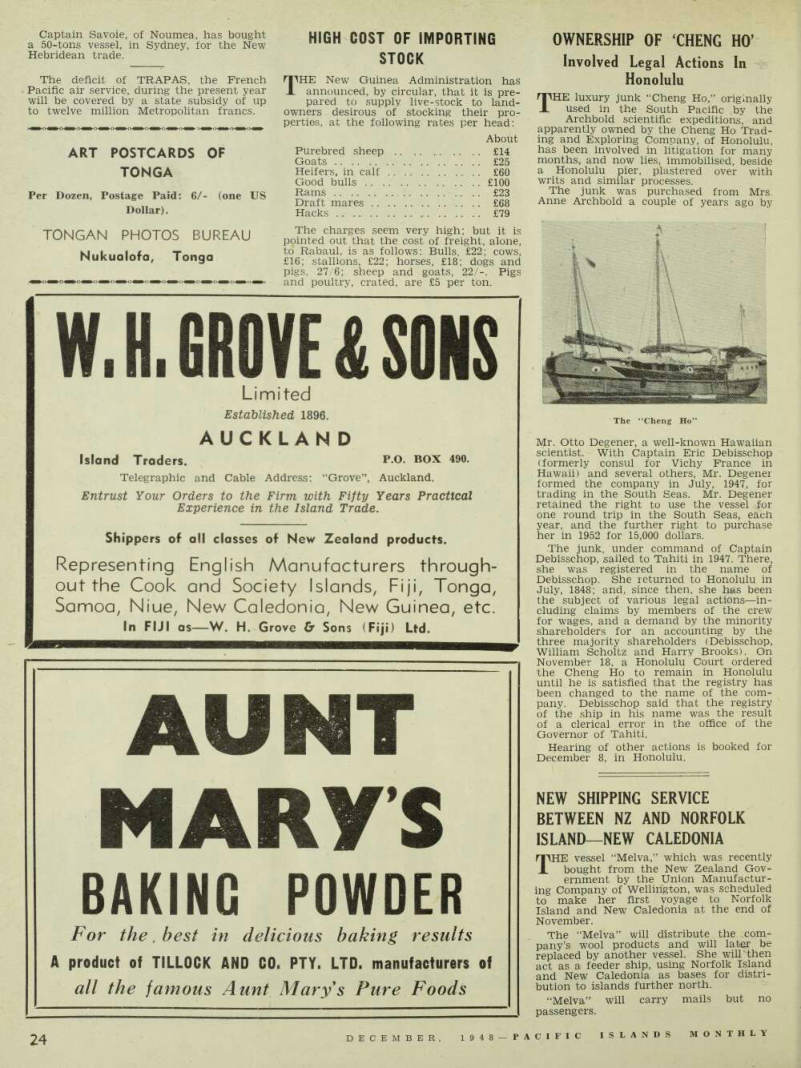
THE last Governor of the New Cale donia Convict Prison, M. Edmond Cane, died on October 30, on Oven Island, Noumea, at the age of 72. He was very well known and highly respected in New Caledonia, where he had filled such positions as president of the General Council, president of the Chamber of Commerce, and director of Messrs. Guer ault and Lemarinier. He was a Chevalier of the Legion of Honour. He was one of the first to lead the rally of New Caledonia to General de Gaulle and Free France in the dark days of 1940.
Captain Savoie, of Noumea, has bought a 50-tons vessel, in Sydney, for the New Hebridean trade.
The deficit of TRAPAS, the French Pacific air service, during the present year will be covered by a state subsidy of up to twelve million Metropolitan francs.
Advertisements & other items, pp. 24-26 (2 items)
Vincents
I Airway Cases, In woven-striped, waterproofed canvas with leather-bound edges, are made for flying. The supply is limited . . . but increasing!
Mode by FORD SHERINGTON LTD.
Wholesale only
rAKC rmcenrs a. rc
coNFtcettce
—Vv Confidence brings success!
Place your confidence in the hospital formula of genuine Vincent's a.p.c. For over 25 years the medical profession has had absolute confidence in w this better-balanced prescription \ Take Vincent's A.P.C With Confidence.
For HEADACHE AND NERVE
AND MUSCULAR PAIN!
m
VINCENTS
N46D NT KE
QToTISII^
SAFEST & BEST!
Proorwood
can assemble
$
'JUHH3I 111//fill/
*lO
SUPER
SPEC
. moaRD SI a OW—brought within a price range everybody can afford—you can secure a complete kit for the assembly of YOUR OWN SPECIALLY
DESIGNED PROOFWOOD BOAT.
You need no skill, no boat building knowledge, only a few tools. ALL MATERIALS ARE SUP- PLIED—mouIds, essential components and fittings.
All parts are machine-finished to exact shape, so that it is only necessary to fit them together.
SIMPLIFIED WORKING DRAWINGS AND
ASSEMBLY INSTRUCTIONS ACCOMPANY
YOUR PROOFWOOD ASSEMBLY KIT.
KITS FOR THREE ATTRACTIVE MODELS ARE
AVAILABLE—the Standard 8 (yacht's dinghy, car-top boat), Special 12 (pulling skiff or outboard
motor), Super 16 (launch).
PROOFWOOD boats are proved designs. Skilled men have modelled these roomy craft, beautiful in line, immensely strong, and embodying 15 years' experience of PROOFWOOD in marine and aircraft uses, Because of their immense strength, light weight, buoyancy, and roomy size, Proofwood boats are ideal for Island use. Built to stand up to rough handling, Proofwood boats will last for years.
PROOFWOOD, the famous marine plywood, is a laminated, permanently bonded wood which retains its unusual strength under the most severe conditions of usage. PROOFWOOD cannot split or warp—thus your PROOFWOOD boat can be left out of water for long periods and will not leak when refloated.
Your Sydney buying house has full details of
PROOrWOOD
BOAT ASS fM BIBITS
~t*ud iUu&habdfaockuAe
Sole export agents for South Pacific: WILLIAM E. REED, 8a Castlereagh Street, Sydney.
ART POSTCARDS OF
TONGA
Per Dozen, Postage Paid: 6/- (one US Dollar).
TONGAN PHOTOS BUREAU
Nukualofa, Tonga
W. H.GROVE & SONS
Limited
Established 1896.
AUCKLAND
Island Traders. P.O. BOX 490.
Telegraphic and Cable Address: “Grove”, Auckland.
Entrust Your Orders to the Firm with Fifty Years Practical Experience in the Island Trade.
Shippers of all classes of New Zealand products.
Representing English Manufacturers through-
out the Cook and Society Islands, Fiji, Tonga, Samoa, Niue, New Caledonia, New Guinea, etc.
In FIJI as—W. H. Grove Cr Sons (Fiji) Ltd.
AUNT
MARYS
BAKING POWDER
For the , best in delicious baking results A product of TILLOCK AND CO. PTY. LTD. manufacturers of all the famous Aunt Marys Pure Foods
High Cost Of Importing
Stock
THE New Guinea Administration has announced, by circular, that it is pre pared to supply live-stock to land owners desirous of stocking their pro perties, at the following rates per head:
The charges seem very high; but it is pointed out that the cost of freight, alone, to Rabaul, is as follows: Bulls, £22; cows, £l6; stallions, £22; horses, £18; dogs and pigs, 27 6; sheep and goats, 22/-. Pigs and poultry, crated, are £5 per ton.
About Purebred sheep £14 Goats £25 Heifers, in calf £60 Good bulls £100 Rams £23 Draft mares £68 Hacks £79
Ownership Of ‘Cheng Ho ,
Involved Legal Actions In Honolulu
THE luxury junk “Cheng Ho,” originally used in the South Pacific by the Archbold scientific expeditions, and apparently owned by the Cheng Ho Trad ing and Exploring Company, of Honolulu, has been involved in litigation for many months, and now lies, immobilised, beside a Honolulu pier, plastered over with writs and similar processes.
The junk was purchased from Mrs.
Anne Archbold a couple of years ago by
Mr. Otto Degener, a well-known Hawaiian scientist. With Captain Eric Debisschop (formerly consul for Vichy France in Hawaii) and several others, Mr. Degener formed the company in July, 1947, for trading in the South Seas. Mr, Degener retained the right to use the vessel for one round trip in the South Seas, each year, and the further right to purchase her in 1952 for 15,000 dollars.
The junk, under command of Captain Debisschop, sailed to Tahiti in 1947. There, she was registered in the name of Debisschop. She returned to Honolulu in July, 1848; and, since then, she has been the subject of various legal actions—in cluding claims by members of the crew for wages, and a demand by the minority shareholders for an accounting by the three majority shareholders (Debisschop, William Scholtz and Harry Brooks), On November 18, a Honolulu Court ordered the Cheng Ho to remain in Honolulu until he is satisfied that the registry has been changed to the name of the com pany. Debisschop said that the registry of the ship in his name was the result of a clerical error in the office of the Governor of Tahiti.
Hearing of other actions is booked for December 8, in Honolulu.
The “Cheng Ho”
Between Nz And Norfolk
New Shipping Service
Island-New Caledonia
THE vessel “Melva,” which was recently bought from the New Zealand Gov ernment by the Union Manufactur ing Company of Wellington, was scheduled to make her first voyage to Norfolk Island and New Caledonia at the end of November.
The “Melva” will distribute the com pany’s wool products and will later be replaced by another vessel. She will’then act as a feeder ship, using Norfolk Island and New Caledonia as bases for distri bution to islands further north.
“Melva” will carry mails but no passengers.
Advertisements & other items, p. 27 (1 item)
Perkins
(AUST.) PTY. LIMITED...
have pleasure in announcing the appointment of.. .
MR. C. C. EVANS,
C/o BANK OF NEW SOUTH WALES,
PORT MORESBY . . .
as their sub-distributor for Papua-New Guinea.
Our Technical Division is always available to receive your inquiry and will readily formulate recommendations (or the correct application of our engineering products. Our comprehensive range includes the products of such widely known manufacturers as those listed below: • VIVIAN . . . Heavy Duty Marine and Stationary Diesel Engines and Generating Sets, 40-625 H.P.
The 6| in. Bore x 10 in. stroke series is now made in Australia under Licence. The 1-Cylinder 80-100 H.P. @ 600-650 R.P.M. Model is available for immediate delivery. • MEADOWS . . . Petrol and Diesel Engines, 12-100 H.P. 60 K.W. Diesel Alternator Sets. • PETER BROTHERHOOD . . , High and Low Pressure Air Compressors, 60-3000 C.F.M. • PRESTAIR . . . Australian made singlestage Air Compressors, 40-200 C.F.M. at 100 lbs. Pressure. • HERCULES . . . Petrol and Diesel Engines, 12-400 H.P.
Ford, Chevrolet and G.M.C. Automotive Diesel Engine Replacement Packages.
• WORTHINGTON-SIMPSON . . . Single
and Two-Stage, Air and Watercooled Air Compressors. • RUSSELL NEWBERY . . . Medium Duty Marine and Stationary Diesel Engines, 9-96 H.P.
Full particulars and specifications are obtainable from Mr. Evans.
PERKINS (AUST.) PTY. LIMITED
MELBOURNE:
Cnr. Capel & Queensbury Streets, North.
HEAD OFFICE:
SYDNEY: *
Bowden Street, Alexandria.
BRISBANE:
340 Wickham Street, Valley.
Indians Claim Fijians As Their

‘Brothers’
Many Writers Seek Solution of Difficult Problem
From Our Own Correspondent
Suva. Nov. 18.
THE widely-publicised editorial in the October “PIM” (“No Little India Will Be Tolerated in the South Pacific”) has stirred up the commotion which is usually stirred up when someone steps on Indian political toes, asks pertinent ques-
tions, and says, frankly, what many people are thinking. It has also brought S£ l S Bl j& h gSS t ’ wh h h d Printed the article.
One or two points in the correspond ence are interesting. A European writer
(“O. Sagos”), for instance, seriously dis
cusses the Implications of the removal of the Indian population from Fiji, if such a course if feasible; and he suggests that it could very well be made feasible.
“In our hearts we know that any alternative could be only a makeshift, merely staving off the inevitable swamp ing,” he writes. “ . . We cannot change the Indian psychology; nothing will ever alter that.”
There would be dislocation, but it need not be crippling to the economy of Fiji, the writer continues. “For instance, the sugar industry at present is based on the principle of small holdings (for the most part) Indian tenants who farm with single-furrow ploughs and horses or bullocks. But, with modern methods of cultivation, areas of 200 to 500 acres could be economically farmed.
“For those operations where hand labour is still needed the Fijian people would have to play a part, and this brings up the crux of the matter. It would be for the Fijians to decide whether they were prepared to work for their heritage, or whether they would rather see it taken by others, as has already happened to a very considerable extent.
“In my opinion, the Fijians are per fectly capable of setting up an efficient labour organisation under Government supervision, just as they proved them selves to be superb soldiers, willingly sub mitting to Army discipline.”
Like many others, the writer agrees that things cannot be allowed to continue to drift. Since the 1946 census, he says two very common questions have been: ‘What will be the position in 50 years?”
“Where will it end?”
“The usual reply is a shrug of the shoulders and ‘God knows—at which juncture we hastily reassert that the paramountcy of Fijian interests will be preserved, come what may.”
Indian Retort
ON the other side, an Indian (J. M.
Christopher) writes: “Fiji is already the Little India of the Pacific, whether the ‘Pacific Islands Monthly’ likes it or not.” , .
Replying to arguments raised in the editorial, Mr. Christopher makes these points: • Are permanent English residents in Australia regarded as traitors to their adopted country if they welcome a new United Kingdom Commissioner in Aus tralia? • Before Australian publications criticise the court figures in Fiji they might do something about cleaning up the Sydney underworld. • In Fiji, the big monopplies are in European (including Australian) hands, while many Indian and Fijian workers are hard put to it to meet the high cost of living. It is, therefore, inevitable that the European community should pay more in taxation than the Indians. • During the war, the Indians in Fiji did not enlist because they were not and still are not offered equal status with Europeans in all walks of life, whether military or civilian. • In some districts Indian children have no alternative to Christian mission schools. What about Roman Catholic children attending Protestant schools, and vice versa? Are such children com pelled to change their religion? • There are a number of Indian nurses in some hospitals, but the reason why they are so few is that Indians are not given the same opportunities as Euro- Pe * n ft was neither the Fijians nor the Europeans who turned Fiji from bush land into a land of milk and honey; but for the Indians. Fiji to-day would be like New Guinea. Therefore, it was logical for New Delhi to send a commissioner as
soon as India had “broken away from the shackles of Imperialism,” and the Indians have every right to cry ever more loudly for a large share in the administration of the Colony.” • As for the Fijians, the European “trustees” do not appear to do much for them beyond making promises on paper, The Indians have a great respect for the Fijian race, and have no expansionist designs against anyone.
“Our Brothers And Our
Country”
QOMEONE signing himself Fiji-Born O Indian” makes these statements in “Oceania Daily News”:- “We have, to a large extent, adapted ourselves politically, educationally and socially to the conditions prevalent in the Colony. We associate with the Fijians friendly, more freely, and wilfully than
Mr. Robson thinks we do. I am afraid he is not well informed.
“The entire population has reached a stage where we can see beyond, and the time is not far when our joint efforts will secure us things that Mr. Robson and his like would rather withhold from us.
We regard the indigenous population as our brothers and their country as our country, and we will ask Mr. Robson to let us alone, inasmuch as our policy to day is ‘Let the dogs bark.’ ’’
Editorial Note
The TIM’ Is Not ‘Anti-Indian’
A GREAT deal of material has come in by mail, dealing with this Indian situation in Fiji, and our October article. Much of it is anti-Indian; much expresses, rather furiously, the Indian point of view. We have not space for all of it.
We dealt with the situation, frankly, and we believe truthfully, in October.
We do not propose to recapitulate. We have printed the foregoing article just as we received it from Suva, because therein an- attempt is made to present the Indian viewpoint; and, under the con ditions of our Western civilisation, the Indian is entitled to express his opinion in this free newspaper.
The arguments of the Indians can be effectively answered; but that may be left for another occasion.
WE should like to say, however, that the attitude of the “Pacific Islands Monthly” is not anti-Indian. Only an ignoramus or a fool would merit such a description.
The history and culture of India—or, should we say, of the best of the races on the Indian sub-continent —give the Indians a place in human affairs which is just as high and as honourable as that of any European race. A cultured Indian quite properly ranks equally with a cul tured European—or a cultured Fijian.
Any distinction or discrimination as be tween such individuals is merely silly.
But the “PIM” is definitely anti-Fiji Indian, insofar as the Fiji Indian wants to control the Fijian race, with a view to imposing the ideas and culture of India upon it.
Because of circumstances which Europeans could not control, and con ditions which we may not discuss here, the Fijian race was obliged to abandon the culture and living standards of ancient Oceania, and adapt itself to something different. For half a century, or more that adaptation was a sort of hit-and-miss affair, of little benefit to the Fijians or anyone else; but, for the last fifty years, it has been under the intelligent direction and control of Europeans, and the Fijians have been launched upon a sociological and cultural change which is calculated to take care of their national future, and from which they already have benefited much.
Already, in the councils of the Colony, there have appeared native Fijians who rank ill ability, statesmanship and ideals with the Europeans, and who have gained, on their own merits, the good will and respect of the Europeans. If the policy inaugurated and the processes launched fifty years ago are not inter fered with, there is nothing to prevent the Fijian people, in due course, taking administrative control of Fiji.
BUT there now enters into the picture the people of India, demanding— with an impertinence that is very hard to bear— co-trusteeship with the
(Continued on Page 70)
British in the government of Fiji. The British insistence that the Indian justify himself before he makes such a demand has nothing to do with racial distinc tions.
The Indian can share with the British the responsibility for Fiji only if he can (a) abandon entirely the ideas and in hibitions of Mother India, by which scores of millions of people are shackled and destroyed; (b) accept the ideal of a clean, free young nation in the South Seas, in which the fundamental rights of the indigenous people shall be acknowledged and protected; and (c) disclose that ad ministrative ability that is essential if the Fijian is to be assisted to take his rightful place in his own country.
It is that last proviso, above all, which defeats the Indians’ ambitions. There is nothing in the recent history of India which suggests that the Indians can be entrusted with the government of a race like the Fijians. The recent history of the British Empire contains many ex amples to show that the British, especi ally, are equipped to assist the Fijians to independent nationhood.
The Indians are intruders in Fiji. That fact might had been overlooked if, in Fiji, they had subscribed to the ideals of good citizenship, entered fully into this new life, and gradually grown away from their Asiatic associations. They have not done that.
In 1942-43, they had a unique opportunity of standing beside the British and Fijians in defence of Fiji, and thus earn ing an unchallengeable place in the future life of Fiji. They did nothing—except, it is strongly suspected, pray heartily for the success of the Japanese. That was
hoots.
their great chance; and they forfeited it, and with it any right to ask for any share .in Britain’s Fijian trustee-ship.
That is why the “PIM” is anti-Fiji Indian. We cannot forget the Fiji Indian’s shameful record in 1942-43.
THE solution of the Indian problem in Fiji will come when the anti-British Indian lawyers and the mischief making Indian political opportunists take themselves (or are kicked) out of Fiji; when the Fiji-Indians are sufficiently freed from their overseas associations to allow them to grow up and develop natur ally as the decent, kindly people they are, at heart; and when the British, as the trustees of Fijian freedom and security, are satisfied that the Fijians will not be injured by conceding greater authority to the Indians.
Until “then the Indians, as the intruders in Fiji, will retain their present status. If they do not like it, there is nothing to prevent their return to India. The wel fare of the Fijian is the paramount con sideration. As against that, the status of the Fiji Indian does not matter two
R. W. Robson.
Advertisements & other items, pp. 28-30 (1 item)
Robert Gillespie Pit It?
nflr
[inf
A 0 & wA UP,
GIVES FULL LIGHT AND AIR
WITH YEAR ROUND WEATHER PROTECTION
This ultra modern window comprises a series of glass blades swung one above the other and inclinable to any angle.
Air entering the room is diverted towards the ceiling thus preventing draughts. AGCO Supaluvres have all the advantages of other louvre windows plus exclusive features.
The specially designed rain guards cannot be fouled by the glass holders and provide flush finish so that fly screens, curtains or blinds can be attached. By an automatic locking device AGCO Supaluvres can be locked open in four positions, thus eliminating rattle and are also fitted with rack and pinion movement. All exposed surfaces are made of rust resisting zincanneal metal.
For Verandahs, Sun-rooms, Lounge-rooms, Kitchens and Laundries Illustrated leaflet, price list and installation instructions on request. , Sole Agents for South-west Pacific :
ROBERT GILLESPIE PIT IT?
54* PITT ST..SYDNEY - PHONES-8W4782- 81305
i ■ V I n
AIR COOLED DIESEL ENGINES
Precision Built By
ARMSTRONG
SIDDELEY
COVENTRY ENGLAND
5, 6, 7, 8 H.P. • Compact Design. • Pressure Lubrication. • Easy Installation. • Cold Starting. • Low Fuel Consumption. • Low Weight.
Ideal for Pumping, Lighting, Spraying, Rice Mills, Auxiliaries.
PRICE: £157 Aust., F. 0.8. Sydney. Under Bond.
PROMPT DELIVERY
Sole Pacific Agents :
VENTURA TRADING Co., Pty. Ltd.
26 BRIDGE STREET, SYDNEY, N.S.W.
Cables: “Ventura,” Sydney.
Represented by: P. & R. Hutchinson, H. G. Eekhoff, Gilbert Renton, Suva. Lae. Rabaul.
£ A m *k &
Chri§tma§ Cireetin^
from
HEINZ
Famous Since Xmas, 1869 Heinz say, “Thank You”, for your co-operation during 1948 —and here’s wishing you a prosperous 1949.
Makers of the 57 Varieties
H. J. HEINZ CO. PTY., LTD.
479 Bourke Street, Sydney.
Telephone FA 8181.
BECOHDITIOtICT es!
★ Ford & Mercury
SHORT £7O
COMPLETE vREADY TO INSTAL
£lOB Chev,
COMPLETE READY
TO INSTAL
£9O
GENERAL RUBBER CO. PTY. LTD.,
115-119 PARRAMATTA ROAD, CAMPERDOWN, SYDNEY
Phone: LA3777. r \ m
Brighten
the home with
BRASSO
METAL POLISH
J
Fiji’S Surpluses Will Be Used For Social Services
Financial Secretary’s Review of Budget Promises Little Tax Relief
From Our Own Correspondent
Suva. Nov. 14.
WISHFUL thinkers in Fiji, who con stantly demand bigger and better • social services and simultaneous.y demand cuts in taxation have been sharply rapped on the knuckles by the Financial Secretary (Mr. R. M.
Taylor) in his Budget speech in the Legislative Council.
Mr. Taylor said they had “Rolls-Royce ideas on a Ford purse.”
At the end of 1948, the Colony’s total surplus balances were expected to be £1,964,820, but it was a mistake to think that those balances would be available for taxation cuts, said Mr. Taylor. Every penny would be needed to finance de velopment.
HE mentioned the schemes before the Development Revision Committee as follows: Agricultural Station (Southern), £96,850.
Feeder roads, an unknown sum, but substantial and very necessary.
Industrial housing and slum clearance, £250,000.
Queen Victoria School, £82,000.
Ratu Kadavulevu School, £25,000.
Suva wharf improvements, £150,000, Lautoka wharf improvements, £120,000.
Suva slipway, £lOO,OOO.
Share of hydro-electric scheme, £400,000.
These, he added, are only a few of the schemes. As plans crystallise the surplus balance will be gradually whittled down to
about £700,000.
“Total expenditure for 1949 is just over £2,900,000,’’ Mr. Taylor continued.
Expenditure List
THE full list of expenditure can be simplified as follows: Administration: Governor, Account ant-General, Audit, Customs, District Ad ministration, Labour, Lands, Miscellane ous, Printing and Stationery, Public Re lations, Secretariat, Stores, Works Estab lishment: Portions of Public Works Re current and Public Works Extraordinary not otherwise allocated, 1948, £668,335; 1949 £703 237 Law and order: 1948, £166,992; 1949. £175,964.
Social Services: 1948, (a) Education, £368,277; (b) Medical, £428,840, £797,117; 1949 (a) Education, £356,337; (b) Medical, £421,024, £777,361.
Public Debt: 1948, £88,725; 1949, £88,465.
Pensions: 1948, £91,200; 1949, £127,200.
Economic Services: 1948, (a) Agricul ture, £156,619; (b) Forestry, £14,755; (c) Communications, £577,688; (d) Power and Water, £182,510—£931,592; 1949 (a) Agri culture, £123,464; (b) Forestry, £23,200; (c) Communications, £425,670, (d) Power and Water, £184,017—£756,351.
Defence: 1948, £75,121; 1949, £168,466. (This includes rehabilitation).
Subsidies: 1948, £141,500; 1949, £41,500.
Social Services
“Social services get the lion’s share,”
the Financial Secretary pointed out. “It is proposed to spend nearly £BOO,OOO on education and medical or about £3 a head of the population and about 27 per cent, of the colony’s revenue.
“Despite this expenditure, services will remain below the level at which many members would wish to see them.”
Advertisements & other items, pp. 31-32 (1 item)
A Complete Range
American Magazines
Direct to You from the Publishers.
AMERICAN HOME 21/6
CHARM 32/6
COLLIERS’ WEEKLY 52/6
CORONET 18/9
FORTUNE 96/-
GLAMOUR 27/-
HOUSE & GARDEN 42/6
LADIES’ HOME JOURNAL 37/6
LIFE 49/-
LOOK 39/-
McGRAVV-HILL DIGEST 31/3
MAGAZINE DIGEST 18/9
NATIONAL GEOGRAPHIC MAGAZINE .. 38/6
POPULAR MECHANICS 22/9
POPULAR PHOTOGRAPHY 26/6
READERS’ DIGEST 12/-
SATURDAY EVENING POST 68/9
SCIENTIFIC AMERICAN 40/-
SCIENCE ILLUSTRATED 62/6
TIME 96/-
VOGUE (20 numbers) 105/-
YACHTING 40/-
ESQUIRE 76/-
Rates are for one year and include all charges. Many other overseas Art , Trade, Technical, Fashion and
Literary periodicals available.
ALL ORDERS AIR-MAILED TO
PUBLISHERS.
MAIL PUBLICITY CO., 175 PITT
STREET, SYDNEY, N.S.W.
The GPJO
CRYSTAE PICK-HP
mm
A Complete Range
of
Useful Products
the mcnmc wow* ACOS GPIO High Fidelity Crystal Pickup incorporating the new UNBREAKABLE CARTRlDGE—vibrationless arm—needle pressure adjusting device—YOU can instal it.
Price, 48/6.
ACOS GP6 Magnetic Pickup has light weight head, giving excellent fidelity of tone and —it’s easy on your records. Price, 44/1.
WESTINGHOUSE Battery Charger, supplied ready to plug into the nearest 200-260' volts AC power supply. No mess, no fuss, no bother! Whether it’s a car or radio battery, completely recharge it at your home overnight! 6V £5/13/- 12V £6/19/9 Why suffer that rattling, toneless speaker m your radio any longer? Instal an Amplion Cone Speaker—renowned for excellent tonal quality and high efficiency—there is an Amplion Speaker for YOUR Set.
The MANLEY URN —a most useful appliance in the kitchen. Provides 4 pints of boiling water, and can also be used to boil eggs, cook vegetables, heat baby’s bottle. Has “lift out’’ element for quick cleaningunique “safety- level” prevents burn outs.
Operates from 240 volts AC or DC. REAL
VALUE at £3/19/6.
The PHONOMOTOR has high power, at constant speed. Being mounted in live rubber, is completely silent. Plays 10” or 12” records and—it’s available NOW for only £5/8/3. (240 V AC only).
The HUSHATONE is an “under-the-pillow” speaker for individual listening. Hear your favourite programme in bed, without disturbing others. Every HUSHATONE is complete with installation instructions. Price, £3/16/4.
Mail your orders TO-DAY. in Island deliveries.
We specialise 50/HP.3.
SPEAKER
teiPi
AusmasiA
M-tO PARRAMATTA K
m, tm
v KLS.W,, AUST,
m HANLEY
A BOON
IN F.VfTKY HOME
THE AMPLION
, HWlflWCftOft i a
THE NEW
AS INTIMATE ••
LISTENING APPLIANCE
TILLEY LAMPS
Regd.
BURN ORDINARY KEROSENE
The Modern Form of PORTABLE LIGHTING
1948 Exhibition—British Industries Fair THE TILLEY LAMP COMPANY LTD. Of ENGLAND BRENT WORKS, HENDON, AND NEW BRENT WORKS, CRICKLEWOOD London Offices and Showrooms: 33 SACKVILLE STREET, PICCADILLY, W.l.
REPRESENTATIVES :
MELBOURNE: T. H. Bentley, Pty. Ltd., 123-125 William Street, Melbourne, C.I.
TASMANIA : Mr. C. Sellers, 108 a Charles Street, Launceston.
FIJI : Mr. K. Witherington, 2 Burns Philp Buildings, Suva.
Ships For Solomons
Plea For The Direct Connection With Sydney
Letter to the Editor THE best development in the Solomons this year has been the re-establish ment of the Sydney-Solomons ship ping connection by BP, in conjunction with other major interests. Admittedly, at present the service is not as firmly established as we would like; but the three runs of the “Muliama” in as many months has demonstrated the quality of the service the Big Firm can provide—so much so, that it is unthinkable that the Govern ment can allow it to lapse for lack of inducement.
In my time, I’ve thrown more bricks than bouquets at BP. But I have never denied its ability and efficiency in run ing shipping. And its recent perform ance shows that the old hand has not lost its skill. So it is with pleasure and respect that I pay this tribute.
After a couple of years’ experience with the “bent elbow” route —Sydney-Suva- Solomons—with its attendant ferocious double freights, double Customs duties often, delays and transhipment charges, we were mightily relieved when Govern ment ceased trying to make water flow uphill, severed the “Kurimarau” connec tion with Fiji, and decided to allow Solomons trade to revert to its natural channel—the direct Sydney-Solomons run.
Then, just to show how it is done, BP whipped in the “Muliama” in three quick trips; and orders which had been wait ing in Sydney for an age came along pronto; overtook most of our shortages;
and left us grateful and gasping at the celerity of it all.
The heart-breaking delays and endless months of waiting on the arrival of goods via Fiji are a bad dream which we are glad to forget. And we hope the Gov ernment will never try anything like that again. Forget Fiji! It is not in our orbit, and never was; and all the political wire pulling in the world will not alter the long-established fact that Sydney is the natural source and hub of the Islands trade.
Fiji had a marvellous run and a won derful opportunity; but simply did not have what it takes to deliver the goods.
It has -been weighed in the balance and found wanting.
I am, etc..
Leslie F. Gill.
Bsi, 25/10/48.
expect no improvement in shipping con ditions in the Southwest Pacific while the Australian Government fails to exercise control over the Communist-led trade Unions.
The naturally, refuse to comment. But they point eloquently to the ever-rising costs, which must force still higher freights and rates upon the Islands communities.
Endure
What Islands Communities Must Endure
IT is intended that the “Muliama,” after she has completed her present runs to the Gilbert Islands, shall return to the Sydney-Solomons run. The “Morinda” also will continue to extend her run from New Hebrides to Solomons every three months. Enough copra for shipment from Solomons to Australia has been promised to justify this improved shipping service.
We asked Messrs. Burns Philp and Co. this month whether we might have de tails of the Sydney-New Guinea and Sydney-New Hebrides-Solomons shipping timetables for publication in advance; but we were informed that that is not practicable. None is more eager than the shipowner to run these Islands vessels on regular timetables; but, under the condi
tions which now exist in the Islands ports (insufficient berthing and cargo working facilities) and the Australian ports (chaotic labour control delaying the discharge and loading and turn-around of ships) it is impossible to adhere to any schedule.
These conditions impose maximum in convenience and loss upon both the public and the shipowner, but we can
Advertisements & other items, pp. 33-34 (1 item)
Ropes,
KANGAROO BRAND
Cordage,
and Twines for every purpose Backed by 86 years of service Manufactured by:
M. DONAGHY AND SONS,
Pty, Ltd., Geelong and Sydney.
Fiji Representatives:
PEARCE AND CO.
LIMITED
P.O. BOX 237, SUVA
• • • • i wtjr ■ A Hyster Crane at Work on Suva Wharves.
We Supply all Types of
“CATERPILLAR”
MACHINERY
WE ARE DISTRIBUTORS IN FIJI FOR
The Caterpillar Tractor
Company
Caterpillar Diesel Tractors Caterpillar Bulldozers Caterpillar Earth-movers Caterpillar Road Building and Maintenance Machines
ALL MADE BY “CATERPILLAR.”
"Caterpillar" Diesel Marine Engines, 34 to 135 BHP Continuous Rating Stoeks of Spare Parts carried in Suva. Information available about Agricultural Implements Inquiries from anywhere gladly answered to suit Caterpillar Tractors.
'Hyster" Winches, Logging Arches and Equipment 'Tracson" Excavators for use with Caterpillar Tractors W. R. CARPENTER & CO. (Fiji) Ltd.
SUVA
FIJI
CAPTAIN W. L. KENNEDY
Ship and Yacht' Broker, 63 Pitt Street, Sydney Established 193 L LISTING FOR SALE Vessels suitable for Island work , including : STEEL MOTOR CARGO VESSEL. Built 1938, 182 X 27 X 11.6 light, 14 ft, loaded. 600 H.P. marine, diesel engine, cargo capacity 350 tons. Passenger and Crew accommodation. Price approximately £23,000. MOTOR PASSENGER VESSEL, Suit Mission work or Island service. 110 x 22 x 10, built 1934. 300 H.P. 8 cyl. Union diesel, speed 11 knots, well appointed, carry approx. 50 passengers plus crew. Price £13,000. STEEL CARGO VESSEL. 106 x 26, shallow draft, twin 100 H.P. marine diesels, diesel winch and windlass.
Carry approx. 180 tons. Price £7,000. MOTOR CARGO VESSEL 80 x 20, built 1934, 160 H.P. diesel (needs attention), 94 tons gross, good crew and officers accommodation. £7,000 or near offer. TRAWLER 56 x 18. 120 H.P. Heavy Duty marine diesel, Suitable cargo conversion to 45 tons. Forced sale. £3,500. 65 ft. STEEL TRAWLER 2 years old, Gardener diesel. £4,500. WORKBOAT, 40 x 12, approximately 2 years old. 30 H.P.
Lister diesel. Hardwood construction. £2,100. WORKBOAT about 12 months old. 40 x 14, 38 H.P. National diesel, hardwood construction, solidly built. £2,700 EX-ARMY WORKBOAT 40 x 12, 165 H.P. Gray marine diesel, coppered, £2,400. GOOD TYPE 26 ft. BOAT with 7 H.P. Lister diesel 2/1 reduction gear. £9OO. Also we -have a large range of pleasure craft including cruisers, auxiliaries, speed craft, runabouts, etc.
These are only a few of the craft we have listed for sale. Write us your requirements and we shall forward specifications and photographs. Delivery arranged under own power for suitable boats to any part of the Pacific by arrangement. We are also subagents for several marine diesels and petrol engines and have many second hand units for sale.
m ■4(l U-. mt
Good food tastes all
the better with
Colman's Mustard
‘Wanganella’ Should Improve
Eastern Services
f|!HE resumption, on December 9, by the X Huddart Parker liner “Wanganella,” of the Australian-New Zealand ser vice (interrupted in January. 1947, when she ran on the reef outside Wellington Harbour on her first post-war voyage)
should improve all surface communica tions between New Zealand, Australia, and the islands of the Central South Pacific.
The “Aorangi” now is running regularly between Australia and North America, with calls at Auckland and Suva; there is some talk of another liner entering this service in 1949; and it seems likely there will be another modern passenger ship soon on the Sydney-New Zealand run.
The Trans-Pacific sea-communications position, whch has been deplorable for years, should be better soon.
Notes From Tonga
From Our Own Correspondent
Nukualofa. Nov. 11.
THE People’s representatives in the Tongan Parliament this year claim they have “broken the ice,” so far as getting things done. Previous People’s representatives, they say, were either too slow and ignorant of the needs of the country, or too scared of their opposition —the Nobles and the Ministers. Whether this sudden enthusiasm will have results remains to be seen. We do know that our little Kingdom could do with some reforms and progress.
There is still talk of a new issue of Tongan stamps. For beautiful artistic designs for stamps, showing native scenery and native life in their natural colours, these islands are an artist’s paradise. We do not seem to be expert yet in this stamp business, although new issues are badly needed. The big profit from the Pitcairn and Tokelau issues ought to have been sufficient encourage ment for any Government stamp depart ment, yet we are still “considering” it.
We have now a CMO establishment that is a vast improvement on what it used to be, at the Vaiola Hospital. Manage ment there is carried out with clockwork precision, and serious cases are not told to go to Suva or Auckland for treatment —they are dealt with right here on the spot. Naturally, this progressive doctor has plans for greater improvements, but our Government is not reacting sharply, probably because of a fear of unnecessary expenditure. We can only hope that our CMO will not get discouraged.
Parliament rejected a garbage scheme for Nukualofa, proposed by the Medical Department. It is needless to point out the advantages of this scheme, from a public health point of view, but the “fakatonga” attitude prevails here still.
Not to be outdone, the MD has initiated a voluntary garbage scheme of its own, well supported by both Europeans and Tongans. The only flaw is that small traders are obliged to pay the same fees as the big firms. , .
The yawl bought by the Church of Tonga arrived here the other day from Wellington, Quite a crowd went down to meet this new addition to Tonga’s, inter island fleet of church boats, and dis appointment was rather marked among some of them. They had expected, for their £3,000, something big and strong made, to resist hurricanes and rough island handling, and not a show-piece, or pleasure craft that cannot stow copra and bulk cargoes. However, nothing can touch her here for fittings: with the exception of a radar outfit and hot and cold water, she has got them all.
Pastor J. A. Cormack, superintendent of Seventh Day Adventist Missions m the Cook Islands, arrived in Sydney m No vember. He is taking part in the SDA Conference, which is planning a wide re organisation of the system of controlling its mission work in the Pacific Islands.
Ridiculous Currency Situation In
South Pacific
Tonga Holds Australian Parity :: Three Grades of £, With Fluctuating Franc and No Dollars
From Our Own Correspondent
Nukualofa. Nov. 17.
TONGA officially has decided against maintaining parity with NZ currency, which recently moved up 25 per cent, in value, to parity with sterling.
Our financiers should know best. Yet there are those who do not approve.
It is bad enough that we should now have to pay an extra five shillings for every £1 worth of NZ goods; but, whether affected or otherwise by this change,* a 25 per cent, mania is now “getting” our people badly, even down to local purveyors of vegetables, butter and firewood.
In consequence, Price Control here is now merely another farce.
Coin manipulators also are busy with their hoards of NZ coins, dislocating busi ness and copra buying.
Stocks are showing signs of sticking to the shelves of the stores, nowadays, and our big merchants are getting anxious.
The days of quick turnover are slowly passing away. The arrival of large ship ments by each boat is gradually glutting the market, at ever-increasing prices. So the wise trader is stepping warily, and do ing much calculating.
Editorial Note
Three Kind Si Of £
THE Tongan decision —to maintain parity with Australian currency, and not follow New Zealand to parity with Sterling—creates a very remarkable situa tion in the Central Pacific groups of Islands—namely, Fiji, Tonga, Samoa and Cook Islands. Samoa and Cook Islands went with NZ to Sterling, while Fiji de cided to stay where it was—namely, 12i per cent, under Sterling.
Now, within *the Central Pacific groups, we have: Samoa and Cooks Sterling Fiji 12i% Under Sterling Tonga 25% Under Sterling To the south of the CP groups, and in intimate trading contact with them, is New Zealand, on parity with Sterling. To the southwest, and also trading heavily, is Australia, 25 per cent, under Sterling.
To the northwest and to the east, but with little trade, are the French currencies in New Hebrides, New Caledonia and French Oceania, which are heavily dis counted, in comparison with Sterling. In the far northeast, we have the Dollar areas—but Dollars are almost unprocur able.
It creates a general exchange situa tion so confusing that it is likely to drive bank officials and Big Firm accountants into madness. It is also a ridiculous situation—it is astonishing that the Gov ernments of the United Kingdom, Aus tralia and New Zealand should have done nothing to reconcile these clashing currencies.
Actually, the Tongan Government took a wise decision. It would have spelled ruin for that little Kingdom, with its pre carious economic balance, if it had fol lowed NZ to Sterling parity, because only a small proportion of Tonga’s exports (bananas) goes to NZ, while most of Tonga’s imports have been coming from NZ. Tonga’s main export (copra) is bought by Britain, so Tonga already was getting whatever benefits were available
to her from Sterling. By following NZ, she might have got some benefit from in creased money for her bananas, but that gain would have been completely swamped by the much higher price she must pay NZ for goods imported from NZ. What she will do now, to maintain her economy, is to cease buying from NZ, and buy in stead from Australia (whose currency, 25 per cent, under Sterling, is on par with
her own) and from Fiji (123 per cent, under sterling). She may expect benefits from two sources—from higher prices for her bananas sold to NZ. and from an increased tourist traffic—for New Zea landers, finding their money now so much more valuable in countries which main tain the Australian exchange rate (25 per cent, under Sterling) will naturally want to visit places like Tonga and Norfolk Island.
But the whole currency situation in the British South Pacific Territories (Sterling in New Zealand, Samoa and Cooks; 12£ under in Fiji; and 25 under in Australia, Papua-New Guinea, Solomons, Norfolk and Tonga) is ridiculous ,and typical of the financial genius behind the Socialist Gov ernments of Britain, Australia and New Zealand.
Advertisements & other items, pp. 35-36 (1 item)
Shell
IT ®DD, 5:,
HILLMAN
SILVER SHELL MOTOR OIL S.A.E. 20.
HUMBER
SINGLE SHELL MOTOR OIL S.A.E. 30.
SUNBEAM-TALBOT
SI HOLE SHELL MOTOR OIL S.A.E. 30.
COMMER «
SINGLE SHELL MOTOR OILSJLE. 30.
HARRIER
M SINGLE SHELL MOTOR OIL S JLE. 30. .
THE ROOTES GROUP
Recommend Exclusively
SHELL
MOTOR OIL
FOR ALL THEIR VEHICLES
SHELi) You, too, can be sure of SHELL MOTOR OIL THE SHELL CO. OF AUST. LTD. (Inc. in Gt. Brit.) . LQ4B9J
There is only one
ELECTROLUX
THE MODERN KEROSENE-OPERATED REFRIGERATOR
THAT ACHIEVES THE MIRACLE OF ICE FROM HEAT
Lasting Efficiency, Silent Operation, Streamlined Beauty
pc M ■ c * : Economically operated by kerosene, with a simple precision-built freezing unit that has no moving parts and is GUARANTEED FOR
FIVE (5) YEARS.
Obtainable from:
NEW GUINEA COMPANY, LIMITED.
Rabaul, Madang, Lae, Kavieng.
J. R. CLAY & CO., LTD., Port Moresby.
W. R. CARPENTER & CO. (Sol. Is.), LTD., Tulagi.
For New Hebrides, Butaritari, Noumea, New Caledonia. Apply— Model LKSSI
PRICES ON APPLICATION.
Storage capacity: 5i cub. ft. (approx); shelf area, 9 sq. ft.; food shelves, six—five removable; 2 self-supporting when half drawn. Ice-making: Four trays —5 lb. ice per freezing: 80 cubes. Fuel consumption: 1.8 pints kerosene per day (approx.).
Height: 4 ft. 10 in. Depth: 2 ft. 3i in. weight, unpacked, 406 lb. Packed, 574 lb.
W. R. CARPENTER & CO. LTD. Head Office: 16 O'Connell St., Sydney, N. S. Wales
Fiji’s Customs Duties Cut
But Copra Tax To Go On
From Our Own Correspondent
Suva. Nov. 14.
THE most interesting occurrence at the opening of the Budget session of the Legislative Council of Fiji was the introduction of a Government motion revising the Customs tariff by a net re duction of about £65,000.
Broadly, the motion embodies the abolition of all import duties on food stuffs and agricultural and industrial machinery of British origin, while the duties on foreign goods in the same categories will be cut by the same amount.
Thus, if there is a British preferential duty on an article of 20 per cent, while the duty on a similar foreign article is 50 per cent., the British article will be duty-free when the new regulation comes into force, and the duty on the foreign article will be reduced to 30 per cent.
Proposed alterations to the Income Tax Ordinance are estimated to benefit the taxpayers by about £16,000 a year.
In the course of his opening address the Governor (Sir Brian Freeston) re ferred to these proposals. But, he con tinued: “On the other side of the taxa tion account, we are proposing to derive an additional £lOO,OOO of revenue from that section of the community which is undoubtedly the best able to spare it. I refer, of course, to the producers of copra, both European and Fijian.”
After mentioning that a copra tax had been foreshadowed by his predecessor (Sir Alexander Grantham) as long ago as April, 1947, Sir Brian added: “Aa the other principal exports of the Colony gold and sugar—are already subject to special taxation, it is difficult to see how, in common fairness, copra can claim to remain exempt from it. . . I would earnestly beg the opponents of the Bill (the Copra Tax Bill) not to expose the copra producers to the charge that they are preferring their own selfish interests to those of the community.”
Exchange Effect On Food Prices
From Our Own Correspondent
Suva, Nov. 1
BECAUSE of the general increase in the cost of goods from New Zealand since the rise in the Dominion’s exchange rate, the prices in Fiji of New Zealand dripping, boneless beef, uncooked ham, mutton and lamb have all gone up within the last week.
A pound of dripping now costs 2/-.
"Mariposa” May Still Come
Back
A HINT that one of the Matson Line ships may come back into the Syd ney-San Francisco trade was given in San Francisco on November 21 by the US Maritime Commission’s chairman.
He said that the Matson Line had in dicated that it would complete the re conversion of the “Mariposa” if the Mari time Commission bought the sister ship “Monterey.” If anything came of this, “Mariposa” would probably run between the US Pacific coast and Hawaii during the tourist season, and to Australia and New Zealand for the rest of the year.
The Rev. Harold Short, well-known LMS missionary in Papua, spent a few weeks in Australia recently and has now returned to the Territory.
Morris Hedstrom
Scholarship For 1949
Suva. Nov. 14.
Rederick Manu Giblin, The 19-
year-old son of Captain F. Giblin, has been chosen as Morris. Hedstrom Scholar for 1949. He was born at Levuka and was educated at the Levuka Public School, the Marist Brothers’ Secondary School, Suva, and Sacred Heart College, Auckland. He proposes to study for a degree in Agricultural Science at either
the University of Queensland or Auck land University College. He is a nephew of Dr. Giblin, well known in New Guinea before the war. The selection committee comprised Sir Maynard Hedstrom (chair man), Mr. M. Arthur (Acting Director of Education) and Mr. Robert Munro.
The French metropolitan shipbuilding programme includes the construction of four cargo vessels of 8,300 tons for the South Pacific trade. The programme is already well advanced according to Paris messages.
Advertisements & other items, pp. 37-38 (1 item)
The sign of Qualify
m ■V z
for nearly a Century
SWALLOW & ARIELL
LIMITED
o* s#gSt£ m yPtiulez in
the (f>)iACiiil c^SiuiuAtxy
cSince 1854 Listen to 3AW-CV at 6.30 p.m. Mondays to Thursdays, to "Front Page Lady" • Radio’s most enthralling serial.
CRAMMONDS.
Answer the Problem ... by releasing a
thoroughly efficient tropic receiver ...
THE. CRAMMOND NO. I TROPIC EAGLE
Hiii
Write for full particulars of CrammoncTs full range of instruments, including unit Portable receivers that may be packed amongst baggage.
All Crammonds are built of highest grade components by skilled craftsmen. Our reputation built over more than twenty years of trading is a guarantee of satisfaction.
Address letters to: Alfred Crammond, Managing Director, or Mr. Jack Chesterfield, Manager and Technical Director.
Crammond Tropica! Receiver Available in four models:— 6 Valve 2 volt with Accumulator. 6 Valve 240 volt 50 cycle A.C. 6 Valve 1.4 volt with batteries. 6 Valve Vibrator.
Exclusive Features:
• Completely Tropic Proofed. • Sealed in Rustless Steel Metal Cabinet. • Provision for Loudspeaker and Headphone reception. • Slow motion instrument type dial with gear ratio 55 to 1 simplifies tuning on all wave lengths. • Continuous coverage of short wave lengths from 16 to 150 metres. • Designed for trouble-free operation in areas where extreme humidity prevails. ® Built in moisture absorber.
CRAMMOND RADIO MANUFACTURING COMPANY. PTY. LTD.
No. 8 Queen Street, Brisbane
Embargo
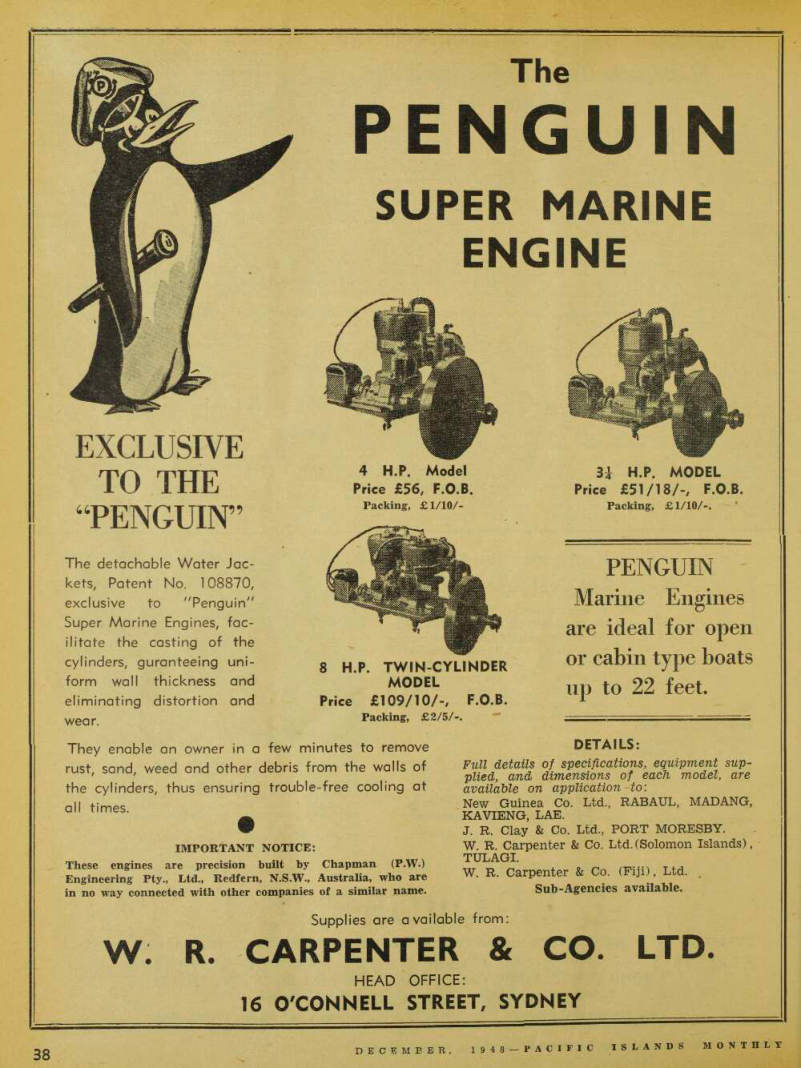
Polynesian Status In International Law
NZ Discusses The Australian Immigration Embargo
THE immigration disabilities which have been placed upon Polynesians and part-Polynesians by Australia came under discussion in the New Zealand Parliament on August 17 when the British Nationality and NZ Citizenship Bill was before the House.
In the course of a speech, Mr. F. W.
Doidge pointed out that the Minister in charge of the Bill had said that the people of Western Samoa and of Tonga had no British status in international law. “That seemed rather drastic” commented Mr.
Doidge. “Tonga, it is true, is a kingdom, but it acknowledges allegiance to the United Kingdom, and the Tongan Group is a responsibility of the British Colonial Office. In the case of Western Samoa and the Cook Islands, surely New Zealand is directly responsible for the welfare and protection of those areas. The Minister said those island people were not British subjects, nor were they aliens and they were to be treated under the Bill as an intermediate class.
“I want to call attention to what recently happened in Australia where an Australian Minister shocked New Zealanders by refusing to grant members of the Maori race the rights of British subjects. The NZ Prime Minister interceded, with the result that the decision was revoked, and the order withdrawn.
“In Sydney there is published a very influential and widely read journal, known as the “Pacific Islands Monthly,” which was interested in this incident, and called the attention of the Prime Minister of New Zealand to the fact that this injunction,
,~ , A issued from Canberra, applied to other Polynesians; and it quoted the case of a blood relative to the Queen of Tonga, who also happened to live in Sydney, and was married to a Briton That publication urged the Prune Minister of New Zealand to take a similarly insistent stand in regard to the people of the Cook Islands and Samoa, inasmuch as they are under the aegis of the New Zealand Government.
“Our Prune Ministers reply was pubfished in that journal and he said. It does not appear that these are matters in which the New Zealand Government could concern itself.’ So that it would seem that our Prune Minister is denying responsibility for these people and their welfare. .
“I suggest that this debate provides an opportunity for our Prime Minister to explain just what he meant, because the Maoris, the Cook Islanders, the Samoans, and the Tongans are all of the same blood, and, it must be obvious to us all, it is our duty always to strengthen the ties which bind these people together, and which bind them to us. The Prime Minister’s statement received very wide publicity throughout the Pacific.”
Mr. Osborne: The Prime Minister made a further statement which was reported in the “Auckland Star.”
Mr. Doidge: If that is so, I have not seen it. As far as I know, the Prime Minister has not made any further statement in the journal to which I have referred, and that is the journal which circulates to a far greater extent throughout the Pacific islands than does the
“Auckland Star,” good a newspaper as the “Auckland Star” is, and wide as its cir culation is. This debate clearly indicates that there is no doubt about where the sentiments of members on both sides of the House lie.
Dr. Finlay said that the Islands referred to are not part of any nation, as such, known to international law, and they have no nationality. Their status in the British Commonwealth is somewhere between that of a British subject and that of an alien.
They are, in fact, “British protected per sons,” as defined in the Bill.
THE Prime Minister (Mr. Fraser) said that Mr. Doidge’s statement that he, as Prime Minister, had limited his interest to one section of the Polynesian people, (the Maoris) was derived from an article in the “Pacific Islands Monthly” by the editor, Mr. Robson, and arose out of letters sent to him by Mr. Robson and his reply.
“I should like briefly to put the matter in its proper perspective,” said Mr. Fraser.
“It is well known that the statement was made in Australia about Maoris—Poly nesians. That was cleared up quite satis factorily at the time. A Maori wife living in Australia was informed that she could not be allowed to be permanently resident in Australia. I am not going to comment on Australia’s attitude or on the question of various races in Australia or in the the dependencies of Australia. There are many problems there, and there are prob lems extending far beyond the shores of Australia that affect the people of Aus “I am going to say, however, that we in New Zealand cannot divide up the Polynesian race—the Maoris of New Zea land, the Maoris of the Cook Islands, the people of Samoa, the people of the Toke laus, and the others for whom we have no direct responsibility or jurisdiction over, as, for example, the people of Tonga. Our responsibility as the Government of the
country is confined to the Polynesians who are under the Government of New Zealand, and if we endeavoured, as Mr.
Robson wanted me to do, to make repre sentations on behalf of members of the very fine Tongan people, we would be told to mind our own business, and that that was the business of the United Kingdom Government and not the New Zealand Government.
“I made it very plain in a statement which appeared in the “Auckland Star” of July 8 that that was the position, and if members are sufficiently interested they can see there the view that I put forward.
I have just paraphrased what I said on that occasion.
“I stated that the interests of the Poly nesian people in the Cook Islands (an in tegral part of New Zealand) of Samoa, and of Tokelau Islands, were our concern, and I felt sure that, if we made represent ations to Australia, we would meet with the same result that we achieved pre viously.
“I have never hesitated to express my admiration for the Tongan people, placing them on the same level as the others, and entitled to the same human rights as the other Polynesian people; but it would not do for us gratuitously to interfere in the interests of citizens looked after by an other Government.”
Editorial Note.—The “Pim” Never
suggested that New Zealand should make representations to Australia on behalf of the Tongans—that, clearly, is the respon sibility of the British Colonial Office.
The Polynesians for whom New Zealand is responsible are the Cook Islanders, the Samoans and the Tokelau Islanders; and it is gratifying to see that the NZ Prime Minister does now agree that it would be his responsibility to make representations to Australia on their behalf. There are other Polynesians who are just as much entitled to admission to Australia as the
Maoris, Cook Islanders and Samoans—the Ellice Islanders, the Tahitians, the Hawaiians, for example—but they are re spectively the responsibility of Britain, France and the United States.
We now have written to the ever-cour teous Prime Minister of NZ, asking him if he yet has made representations to Aus tralia on behalf of Cook Islands, Samoa and the Tokelaus.
Advertisements & other items, pp. 39-40 (1 item)
£. J. Gough S. Co
/ r Cooper Adjustable Glass Louvres are manufactured by F. W. GISSING PTY., LTD., 197 Wilson Street, Newtown, Sydney, Australia. Always insist on GENUINE
COOPEE LOUVRES—
they are clearly branded.
Keeps Hot Sun OUT . ..
Let Cool Breezes IN!
Cooper Adjustable Glass Louvres are the ideal way of securing maximum ventilation with minimum interference from glare. Fitted with non-actinic glass, which absorbs the sun’s heat, they are ideal for nurseries and verandahs . . and amazing though it may seem, are actually cheaper to install than ordinary windows Cheaper to insial than ANY other kind of WINDOW m
ADJUSTABLE GLASS LOUVBES
Imagine it —units of movable glass louvres (plain or figured) in metal frames, giving unobstructed light and air, yet protection from draughts and' rain and all with as simple a motion as flicking on a light switch. The price is so amazingly reasonable and father can do all the erecting, it’s so easy.
Illustrated: Typical Suburban Home. Verandah (Sydney) glassed in with Cooper Louvres.
WRITE FOR PARTICULARS TO PACIFIC ISLANDS REPRESENTATIVE
£. J. GOUGH S. CO
SUPPLIERS OF GENERAL MERCHANDISE TO LEADING FIRMS THROUGHOUT THE PACIFIC ISLANDS.
Exporters . . . Importers . . . Manufacturers * Representatives 1 BOND STREET, SYDNEY, AUSTRALIA. Box 3615 G.P.O. Tel. 8U2195 Bankers: Bank of N.S.W. Bank of Adelaide. Comptoir Nat. d’Escompte de Paris.
Cable Address: “SEAFOODS,” SYDNEY.
Codes; Bentley’s, 2nd and Comp. Phrase; A.8.C., sth and 6th; Peterson, 2nd and 3rd; Banking; Acme.
EXCLUSIVE
TO THE
“PENGUIN”
The detachable Water Jackets, Patent No. 108870, exclusive to "Penguin"
Super Marine Engines, facilitate the casting of the cylinders, guranteeing uniform wall thickness and eliminating distortion and wear.
The
PENGUIN
SUPER MARINE
ENGINE
4 H.P. Model Price £56, F. 0.8, Packing, £ 1/10/-
8 H.P. TWIN-CYLINDER
MODEL
Price £lO9/10/-, F. 0.8.
Packing, £2/5/-.
3i H.P. MODEL
Price £5l/18/-, F. 0.8.
Packing, £ 1/10/-.
PENGUIN
Marine Engines
are ideal for open
or cabin type boats
up to 22 feet.
They enable an owner in a few minutes to remove rust, sand, weed and other debris from the walls of the cylinders, thus ensuring trouble-free cooling at all times.
IMPORTANT NOTICE:
These engines are precision built by Chapman (P.W.) Engineering Pty., Ltd., Redfern, N.S.W., Australia, who are in no way connected with other companies of a similar name.
DETAILS:
Full details of specifications, equipment supplied, and dimensions of each model, are available on application to: New Guinea Co. Ltd., RABAUL, MADANG,
KAVIENG, LAE.
J. R. Clay & Co. Ltd., PORT MORESBY.
W. R. Carpenter & Co. Ltd.(Solomon Islands),
TULAGI.
W. R. Carpenter & Co. (Fiji), Ltd. .
Sub-Agencies available.
Supplies are available from:
W. R. CARPENTER & CO. LTD.
HEAD OFFICE:
16 O'CONNELL STREET, SYDNEY
‘The Coast Watchers’ Is
Sold Out
11/E have had several inquiries from ff readers anxious to purchase copies of Eric Feldt’s “The Coast Watchers.” The first edition has been completely sold out and there apparently is not a copy to be bought anywhere in Australia.
The author informs us that there is no prospect of a reprint of the book. The publishers are of the opinion that there is not sufficient demand to justify it.
This seems absurd. Few Australian books have been attended with the suc cess that met “The Coast Watchers;” fewer have sold out more quickly. This is more remarkable when one considers the price at which the book sold—some thing over 17/-. Australians mainly come into the penny class of reading matter, their interest beginning and ending with the daily and Sunday newspapers.
Not only is “The Coast Watchers” of current interest but it is valuable as a re ference book. An extraordinary amount of work has obviously gone into its com pilation, its detail is immense and it con tains, as well, very valuable indexes. It is an important contribution to the his tory of the war in the South West Pacific and, as such, should have a steady sale for many years.
The Tonkinese in New Caledonia are inveterate gamblers, and the Noumea police are their natural enemies. The other day the police made one of then successful hauls, which resulted in twelve Tonkinese appearing before the local court. The magistrates fined the owner of the house and the banker 2,000 francs each, plus brief terms of imprisonment.
The other players had to pay fines of from 25 to 200 francs.
Advertisements & other items, pp. 41-42 (1 item)
Gordon's
If You
Cannot Sleep
FEEL FIT FOR NOTHING.
You may be anaemic or bloodless, for this ailment plays havoc with your health and nervous energy. You feel terribly iiervy; suffer headaches and dizzy spells, have poor appetite, cannot sleep at night —losing those precious hours of rest and recovery, essential for your health and fitness.
Many people have recovered from these miseries by taking Dr. Williams’ Pink Pills, which have relnvlgorated, strengthened their systems and banished the vague pains and weariness. Dr. Williams' Pink Pills always help to enrich and increase the blood supply, giving beneficial help to the nerves, tissues and organs of the body. With enriched blood you cannot help feeling happier, sleeping better, becoming relnvlgorated.
Stop anaemia making you a suffering invalid without delay. Take Dr. Williams’
Pink Pills and soon notice the difference in your eyes, skin, nerves and general health. At all chemists and stores.
m ss By Appointment Gin Distillers to HiM. King George VI Tanqueray, Gordon & Co. Ltd. ore M 3 rrev
Quu/irfy
Gordon's
Stands S
An ornate example of historical
keys, this XVlth Century
French key features the sporting motif in its club and animal carvings. It seems to have been the key to a Duke’s country
lodge.
A' ~zr A ill f ifkb A S
The key
to smoking pleasure
FINE CUT
NAVY CUT
TOBACCOS
sr 1657.7.
Origin And History Of
The Tin-Can Mail
Letter to the Editor 1 REFER to Mr. H. E. L. Friday’s letter in your August issue under the title of “Origin of the Tin Can Mail.” One might slangily retort: “Why bring that up?”—for the Tin Can Mail has been dead since 1931. By this I refer to the real Tin Can Mail, or, to give it its proper title, The Swimming Mail.
For over 16 years I have derived quiet enjoyment from the effusive efforts of imaginative writers, and the gullibility of philatelists. The Swimming Mail was alone unique, and was perhaps—to use the over-worked adjective—romantic.
There is little more novelty or romance in receiving mail in sacks from, and delivering to, a canoe, than from a wharf. Yet it was the Canoe Mail which brought the shekels to my old friend George Quensell, and “covers” into the albums of half the collectors of the world.
As Mr. Friday states, sporadic attempts had been made prior to my advent at Niua Fo’ou to deliver mail by rocket.
Also on occasion natives had swum out with packets of mail. I commenced swimming, with one or two native com panions. regularly each month to the “Tofua” in September, 1921, and con tinued to do so until the native lad Folau was killed by a shark in 1931. We swam day or night, according to the “Tofua’s” arrival. I was twice away for periods of three months on leave. From 1931, until I left in 1932, we used a canoe when the seas would permit.
The method of our swimming is, or should be by now, well known. The out ward mail was in paper packets, tied to
a 3 in. stick. The 7 ft. to 8 ft. Fau poles were used as floats, and the inward mail was in sealed tins from the “Tofua.”
The joke of the matter—and the joke is also on me—is that apart from those who actually witnessed it from the “Tofua,” the Swimming Mail was prac tically unknown to the outside world. It was during those ten years that the covers of letters would have been a real acquisition to a collector’s album, had they been franked with the rubber stamp later used by Mr. Quensell. Their num bers were of necessity small, from the method of carriage—which would have enhanced their value. But I was the unimaginative fool who failed to realise he was swimming in a potential goldmine.
Wide publicity started when I emi grated to the US in 1932. A former assistant purser on the “Tofua,” who had been transferred to the “Niagara” set the press sleuths on to me at Honolulu.
Cabled press-news brought the Van couver gentlemen of that ilk to the wharf. This was repeated at San Fran cisco, Los Angeles, and Beverly Hills.
Thence the story went via the Associated Press all over America. Letters then commenced to pour into Niua Fo’ou in ever-increasing quantities, and George Quensell reaped a golden harvest from the crop I had sown.
I should like to correct Mr. Friday on a few points. His statement that Ton gans (I expect he means the Tongans he met in the Solomons, and not Niua Fo’ou people) “give pride of place as postman to Mr. Quensell” will leave George as unimpressed by the unexpected honour as am I at being denuded of it.
Mr. Quensell will also corroborate the fact that he was never “postman,” as he has never swum with the mail. Under Government permission he acted as un official postmaster when the monthly
tidal-wave of correspondence inundated the island and drowned the native clerk.
In this he was not “succeeded by his son Dugald.” He continued right through until the Canoe Mail became another war casualty.
Mr. Friday makes yet another error in saying “Dugald used to swim out regu larly with the mail from the time he was 10 or 12.” At that tender age he was with his father on the island of Ha’afeva, in the Ha’apai Group. They moved to Niua Fo’ou in 1920, preceding me by about a year, Dugald and I have swum together with mail on many occasions, by day. I do not recollect his swimming at night, but may be wrong in this. He left for New Zealand not so long after my arrival, where he remained, until 1930 or 1931. He was at Niua Fo’ou when Folau was killed in ’3l.
Also, steamers did not “anchor half a mile out.” They simple “hove-to” for the mail’s receipt and delivery. And here is a tip to the “good Australian life savers.” Use a Fau pole as float, and you will need no great prowess as a swimmer to save life. We have frequently been early at the rendezvous and awaited the steamer’s arrival literally sitting on our poles as on the top rail of a fence, with our legs dangling above the blue-black depths, and our chests and heads above water.
The difficulty of the swim lay in entering and leaving the water in rough weather—especially the latter. We were usually ignominiously hauled out at the end of a rope, which meant invariably leaving skin on the jagged rocks. The essential asset was a somnolent imagina tion in the daytime, and-a totally defunct one at night. Even so there was always the disquieting conviction that one’s legs were dangerously and superfluously long!
(Continued page 43)
I was later to swim with cans of mail at Niua Fo’ou from the Matson Com pany’s luxury tourist-ship “City of Los Angeles” on each of her two cruises around the Pacific in 1934. As Assistant Cruise-director I gained the Company’s permission to do so as a stunt for the passengers, but only after signing on the dotted line relieving them of any respon sibility. On the first cruise I swam in to meet canoes from shore, with 2,000 letters. On the second voyage the num ber was enormously increased.
For a year or so after this the “Mari posa” and “Monterey” made monthly calls at the island, pouring letters in by the sackfull; then suddenly cut Niua Fo’ou out of their itinerary, ' So, we have the Tin-can-paper-packet swimming mail, and the Mail-sack-canoe mail. Philatelists, take your choice!
I am, etc.,
Ha’apai, Tonga.
C. S. Ramsay.
Advertisements & other items, pp. 43-44 (1 item)
Dettol
Tell me, doctor
can an antiseptic be pleasant and at the same time a powerful germicide ? * The efficiency of a germicide does not depend upon an unpleasant smell, a deep staining colour or a poisonous nature.‘Dettol’ is a powerful germicide and yet it is non-poisonous. It is a clean, clear fluid with an agreeable smell, so pleasant to use that very many people add it to their bath.
r
THE MODERN ANTISEPTIC
THREE REASONS why ‘ Dettol ’ is now being used in all the leading hospitals of Great Britain and throughout the Empire. 1 * Dettol * antiseptic is deadly to the germs that cause so many septic infections. 2‘Dettol’ is non-poisonous and is kind and gentle to human tissues. 3 ‘Dettol’ is pleasant and agreeable and does not stain either linen or the skin.
B2
1 s■ n
WEST AFRICA
SOUTH AFRICA
U
USA ■ GREAT BRITAIN
8.0.A.C. has 4,000 maintenance engineers carefully trained in the unvarying 8.0.A.C. system of aircraft checks and cross checks evolved during 29 consecutive years of flying experience
ITS A SMALL WORLD BY SP^EDBIRD
PAKISTAN INDIA
kA
BOH
BEA : BRITAIN TO EUROPE • BSAA : BRITAIN TO SOUTH AMERICA
-i •'t n
Information & Bookings : Qantas Empire Airways, Sydney, Melbourne, Brisbane, Townsville, Cairns, Darwin (General Agents in Australia), or from Booking Agents in all cities.
BRITISH OVERSEAS AIRWAYS CORPORATION IN ASSOCIATION WITH Q. E. A., S. A. A. & T. B. A. L. 84/AU
Work of SPCA in Fiji
From Our Own Correspondent SUVA, November 1.
THE Fiji Society for the Prevention of Cruelty to Animals ended its second year with a credit balance of £471, due largely to a Government grant of £5OO. With its headquarters at Lautoka the society has extended its activities throughout northern and western Viti Levu and as far afield as Labasa. It is still trying to get a branch started at Suva.
The annual report by the secretary, Mrs. D. Kirk, founder and organiser of the society in the Colony, shows a record of valuable educational work and prac tical achievement. An animal-clinic has been operating at Lautoka for a year and a first-aid and mobile lethal unit is doing useful work.
NZ Interest in Papua-New
Guinea
Visit of Government and
Commercial Party
Prom Our Own Correspondent
Lae. Nov. 1.
LAST month, representatives of the New Zealand Government and of private enterprise visited the Terri tory. The party consisted of Mr. Trevor- Smith, of NZ Public Works Department; Captain Webling, of the NZ Marine De partment; Mr. Bryant, engineer NZ Public Works Department; Mr. E. Hirsch feld, Managing-Director of The Union Manufacturing and Export Company,' of Wellington: Mr. Howard Allison, Pacific representative of the same company, and Mr. Burton, representing Fletcher Hold ings Pty., Ltd., of Wellington.
UM & E Co. has bought extensive sal vage rights throughout the territory and with the assistance of the NZ Government is interested in shipping out steel.
The party’s job was to inspect the already-purchased areas and it is under stood that the NZ Government is in terested in certain of the goods contained therein. The Government representatives were present to find out if certain com modities under consideration were neces sary to NZ economy and whether or not shipping could be allocated to remove them.
It is believed that the quantities of dis posals goods involved will necessitate the employment of large vessels, including one 10,000 tonner.
The UM and E Co is interested in the purchase of steel in rounds, flats, RSJ, angle or sheet, and in non-ferrous metals, and piping. It is also intended to export
commodities from NZ tb New Guinea and orders have been accepted from some well-known firms.
New Zealand’s Pacific Treasure
Hunt
AT present the New Zealand Govern ment -and other interests are scour ing the Pacific for abandoned steel of any description. This is to relieve the current acute shortage in the Dominion.
The official lighthouse ship “Matai” has only recently completed a trip to New Caledonia and New Hebrides, where Quonset huts, roofing iron and old motor trucks were loaded. On the same voyage “Matai” called at Noumea to pick up about 60 tons of reinforcing steel and steel plates which were other legacies from the Pacific war.
It is estimated that thousands of tons of junk steel and iron in various forms and millions of oil drums are still lying in the grass and jungles of the Pacific. These have now assumed considerable value, particularly in New Zealand which has no steel industry of its own.
The Australian steel industry, which is extensive, and was capable of fulfilling all her pre-war local and export needs, can not now meet the demand. This is due to the introduction of the 40-hour week, and industrial upsets both in the steel industry itself and in coal production.
It is, however, one thing to have junk steel and drums in the isolation of the islands and another to transport them to the places where they are most needed.
It is obvious that this can be done only with the co-operation of Governments or big shipping interests. And in the mean time three years have passed since the end of the war and the jungle and the islands climate is having its way with
this now precious abandoned war equip ment.
Iron and steel are not the only valu ables to be picked up on island beaches, either. Non-ferrous metals are also in demand. The “Morinda,” on her last trip to Sydney from the BSI brought back 60 tons of scrap brass which is valued at £9O per ton in Sydney.
Mr. Howard Smith, District Services staff, died in Port Moresby Hospital last month.
Advertisements & other items, pp. 45-46 (1 item)
Specially Prepared
to withstand
Tropical Conditions
A range of high grade, quality paints, enamels, and varnishes carefully made and manufactured to withstand the destructive forces of sun, wind, rain and heat.
PROTECTS AND PRESERVES.
Automobile Lacquers and Primers, Duraflex Synthetic Enamels, Auto Enamels, Traffic Paints, Aluminium Paints, Car Wax and Polish, Gasket Cement, Radiator Cement, Hardiproof Anti-Rot Compound.
ALL TYPES OP SURFACE COATINGS.
SPARTAN— — the name that symbolises fine quality in Paint .
Agents:-FIJI: Colonial T ra de Development Agency of Fiji, *P.O. Box 275. Suva.
Other Territories—please order through usual channels.
SPARTAN PAINTS PTY. LIMITED
102-104 King St., Melbourne, Victoria.
PACIFIC ISLANDS SOCIETY
Visitors from the Islands to Sydney (or the«e Interested In Islands affairs), are adrlsed to communicate with the honorary secretary of the abore Society, which has been formed to study the history, traditions, economies, and political developments of the Pacific Islands.
Regular monthly meetings are held at History House, 8 Young Street, Sydney.
Address for Correspondence:
THE PACIFIC ISLANDS SOCIETY,
Box 2484 MM., G.P.0., Sydney.
Imperial
r<r<
w J t nperia^
tfi ENU
„( *oM^H eltaous
FOODS
• Sausages and
Vegetables
Bacon Rashers * Irish S+ew * Spaghetti, Tomato Beet Sausages
tf£lvPuddmg • SJoSsSi-
, Braised Beef Steak • °* enna Sausages Stew Kidney • Tomato ° U P
• air ,1 *• s *°"
-— . . n . 0 Corned Beef : £X» r«* • Camp P‘>e * Pate de Foie
: ss&ms
Hams and Prices on applied 0 "
ALL
0000 \z ott F° Imperial goods are prepared from prime selected stock by the largest meat-processing organisation in Australia. You can be sure of top-quality when you order "Imperial."
Imperial
CANNED FOODS
ARE FLAVOUR-SEALED!
RIVERSTONE MEAT CO.
PTY. LTD.
5-7 O'Connell Street, Sydney.
Fiji Representative: Pearce & Co. Ltd., Sdva.
‘Marching Rule’
Police Raids on Fortified Villages In Solomons
Prom Our Own Correspondent
Honiara, Nov. 11.
CARRYING on with the enforcement of the Government order against Marching Rule villages on Malaita to remove their fortifying fences, a day light raid by armed native constabulary in charge of the District Commissioner was made on Iranunu and Alailala, two large villages in the Koio area, on Oc tober 26.
The fences here were ambitious palli sades, complete with look-out towers. They were successfully destroyed without active resistance, many of the Marching Rule addicts taking to the bush and a number of others being arrested.
In Iranunu village, the Government was interested in the Marching Rule gaol, apparently currently in use. in which the so-called Marching Rule chiefs summarily imprisoned anybody opposing Marching Rule demands with barracks for the Marching Rule “duties”—a private police force to carry out Marching Rule methods of bullying the underdog.
Chief feeling in the affected areas appeared to be indignation against March ing Rule leaders (who skipped out the back way a few days before the raid), dis illusionment that Marching Rule hasn’t carried out its promises of a better way of life, and resentment that the Govern ment called everybody’s bluff.
Meanwhile, Malaita’s rehabilitation is gradually getting under way to revive Malaitamen’s interest in progress arrested by the war. One of Marching Rule’s original demands, before it went off the rails, was for better education—which will be met, as a'beginning, with the opening in November of the Government admin istrative experimental school at Auki.
This will eventually take 72 students and aims to train picked Malaitamen to act, under minimum Government supervision, in the Government-sponsored native councils and courts.
The building of roads and bridges and the fostering of the practically extinct copra industry are other rehabilitation measures.
Elsewhere in the Group, Marching Rule seems to have died a natural death.
Malaitamen, traditionally hot-headed and pugnacious, are expected to relinquish it gradually as they discover it is not bring ing them anything but disorder and dis sension among themselves.
The term “Marching Rule” is supposed to represent the native attempt to pro nounce the words “Marxian Law.” The movement swept over the big island of Malaita, and some of the adjoining ter ritory. immediately after the war. It was apparently an anti-white nationalist plan; and the-various communities set up their own governments, took the law into their own hands, and encouraged the growth of dictatorships. The British officials, making allowance for the pro found disturbance of the war period, were patient, and left the natives very much alone for a couple of years; but, a year ago, when Marching Rule bosses began to arrest and punish natives who had offended them, the authorities finally moved, with strength and purpose. A couple of score of ML leaders were arrested and gaoled, and Marching Rule was practically outlawed. The movement is slow in dying, however —there have been some signs of recrudescence —and activ ities by Communist agents have been suspected, occasionally.
Magazine Section
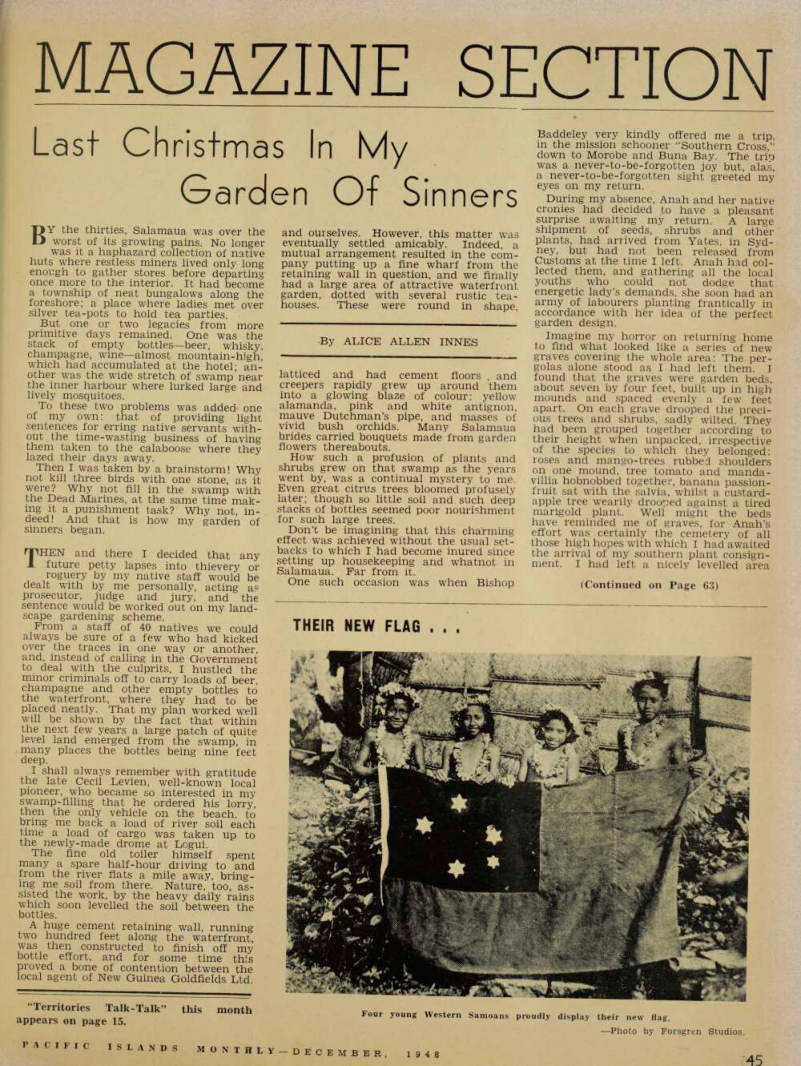
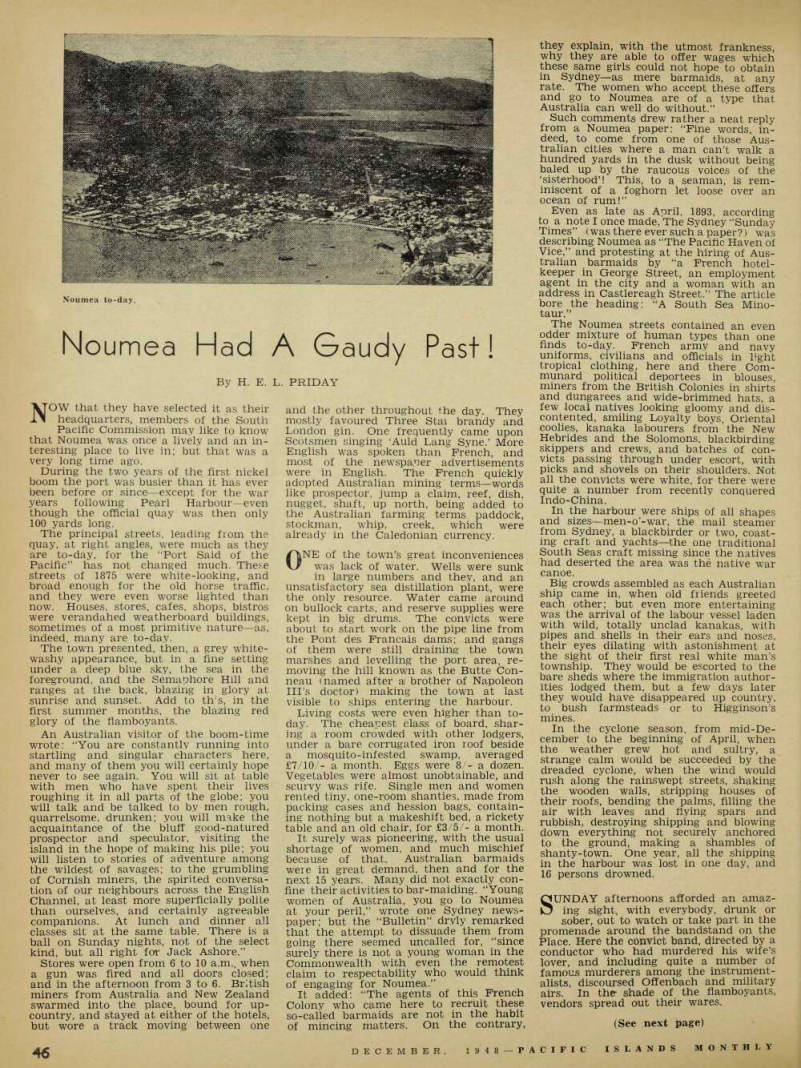
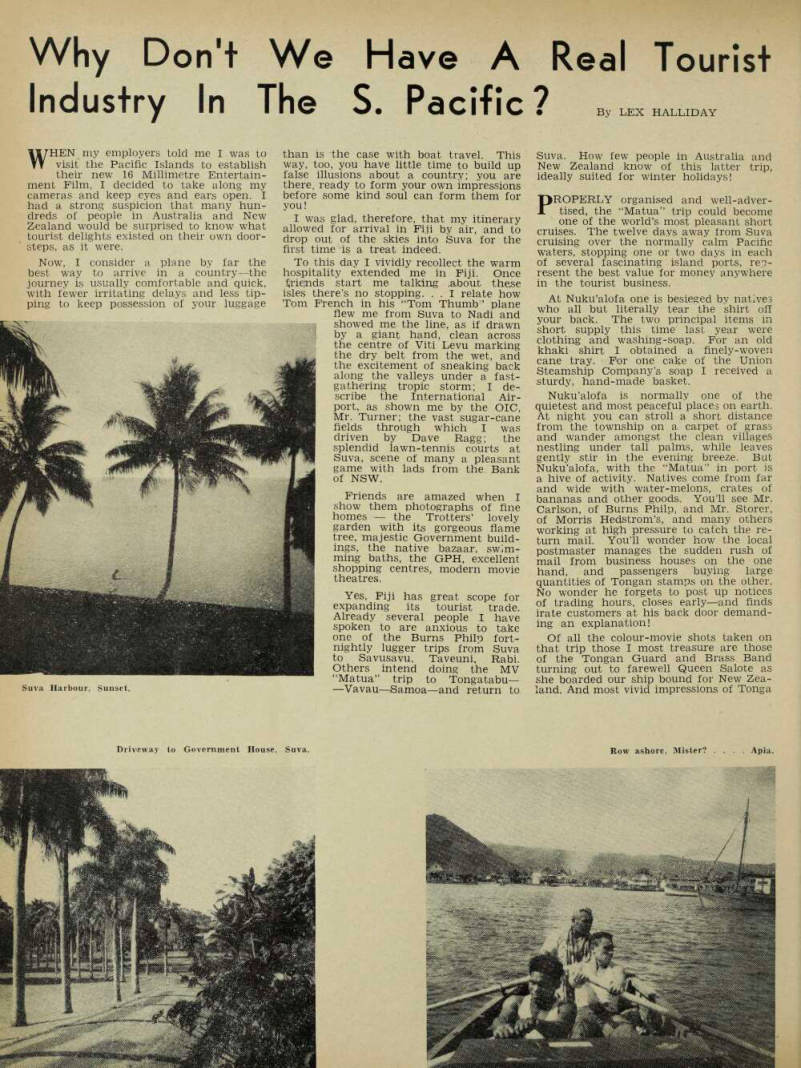
Last Christmas In My Garden Of Sinners
BY the thirties, Salamaua was over the worst of its growing pains. No longer was it a haphazard collection of native huts where restless miners lived only long enough to gather stores before departing once more to the interior. It had become a township of neat bungalows along the foreshore; a place where ladies met over silver tea-pots to hold tea parties.
But one or two legacies from more primitive days remained. One was the stack of empty bottles—beer, whisky, champagne, wine—almost mountain-high, which had accumulated at the hotel; an other was the wide stretch of swamp near the inner harbour where lurked large and lively mosquitoes.
To these two problems was added one of my own: that of providing light sentences for erring native servants with out the time-wasting business of having them taken to the calaboose where they lazed their days away.
Then I was taken by a brainstorm! Why not kill three birds with one stone, as it were? Why not fill in the swamp with the Dead Marines, at the same time mak ing it a punishment task? Why not, in deed! And that is how my garden of sinners began, THEN and there I decided that any future petty lapses into thievery or roguery by my native staff would be dealt with by me personally, acting as prosecutor, judge and jury, and the sentence would be worked out on my land scape gardening scheme.
From a staff of 40 natives we could always be sure of a few who had kicked over the traces in one way or another, and, instead of calling in the Government to deal with the culprits, I hustled the minor criminals off to carry loads of beer, champagne and other empty bottles to the waterfront, where they had to be placed neatly. That my plan worked well will be shown by the fact that within the next few years a large patch of quite level land emerged from the swamp, in many places the bottles being nine feet deep.
I shall always remember with gratitude the late Cecil Levien, well-known local pioneer, who became so interested in my swamp-filling that he ordered his lorry, then the only vehicle on the beach, to bring me back a load of river soil each time a load of cargo was taken up to the newly-made drome at Logui.
The fine old toiler himself spent many a spare half-hour driving to and from the river flats a mile away, bring ing me soil from there. Nature,' too, as sisted the work, by the heavy daily rains which soon levelled the soil between the bottles.
A huge cement retaining wall, running two hundred feet along the waterfront, was then constructed to finish off my bottle effort, and for some time this proved a bone of contention between the local agent of New Guinea Goldfields Ltd.
“Territories Talk-Talk” this month appears on page 15.
and ourselves. However, this matter was eventually settled amicably. Indeed, a mutual arrangement resulted in the com pany putting up a fine wharf from the retaining wall in question, and we finally had a large area of attractive waterfront garden, dotted with several rustic tea houses. These were round in shape,
By Alice Allen Innes
latticed and had cement floors and creepers rapidly grew up around them into a glowing blaze of colour: yellow alamanda, pink and white antignon, mauve Dutchman’s pipe, and masses of vivid bush orchids. Many Salamaua brides carried bouquets made from garden flowers thereabouts.
How such a profusion of plants and shrubs grew on that swamp as the years went by, was a continual mystery to me.
Even great citrus trees bloomed profusely later; though so little soil and such deep stacks of bottles seemed poor nourishment for such large trees.
Don’t be imagining that this charming effect was achieved without the usual set backs to which I had become inured since setting up housekeeping and whatnot in Salamaua. Far from it.
One such occasion was when Bishop
Baddeley very kindly offered me a trip, in the mission schooner “Southern Cross,” down to Morobe and Buna Bay. The trio was a never-to-be-forgotten joy but, alas, a never-to-be-forgotten sight greeted my eyes on my return.
During my absence, Anah and her native cronies had decided to have a pleasant surprise awaiting my return. A large shipment of seeds, shrubs and other plants, had arrived from Yates, in Syd ney, but had not been released from Customs at the time I left. Anah had col lected them, and gathering all the local youths who could not dodge that energetic lady’s demands, she soon had an army of labourers planting frantically in accordance with her idea of the perfect garden design.
Imagine my horror on returning home to find what looked like a series of new graves covering the whole area: The per golas alone stood as I had left them. J found that the graves were garden beds, about seven by four feet, built up in high mounds and spaced evenly a few feet apart. On each grave drooped the preci ous trees and shrubs, sadly wilted. They had been grouped together according to their height when unpacked, irrespective of the species to which they belonged: roses and mango-trees rubbed shoulders on one mound, tree tomato and manda villia hobnobbed together, banana passion fruit sat with the salvia, whilst a custard apple tree wearily drooned against a tired marigold plant. Well might the beds have reminded me of graves, for Anah’s effort was certainly the cemetery of all those high hopes with which I had awaited the arrival of my southern plant consign ment. I had left a nicely levelled area
(Continued on Page 63)
spaced with pot-holes of good soil ready to receive the precious trees and plants without the loss of time, but well-mean ing Anah had upset all my carefully laid plans.
Fortunately, a few of the plants clung stubbornly to life, and we received another shipment later which among other things, included roses; and ultimately the flowers and the fruit sat in their appointed places, where the majority flourished.
In later years I found that all the woody trees and shrubs died, or white-ants at tacked each one as soon as it was about six feet high. Limes, mangoes, rosellas and a few other fruits did well, and the gay and hardy annuals crowded along sociably in and out of season, at all times lending a cheerful note to the “garden bottle,” as the natives called it.
AMUSING arguments often went on be tween the staff as to which had helped most with the garden. Gimah could then strut boastfully along, point ing to his patches and, perhaps evolving some new “crime.”
Many of these were unprintable.
As ali the work in the garden had been done by native servants in lieu of a term in jail for minor offences, each boy called the spot he had filled with bottles by the name of his offence at the time, with the result that the “garden-bottle” became a kind of crime record, details of which are better omitted here. The following incident will give a modified idea of the method of naming a particular patch.
Little Bobdubi, copying Gimah’s marked swagger, appeared with a splendid plume of scarlet celosia in his hair and the light of a conqueror in his big, brown eyes.
“Missus, me got new fella flower ’long
garden belong me,” he said, parading for my inspection.
I duly admired the unusual and lovely head-dress. “What part of the garden did you pick it?” I asked.
“Garden belong bloody fool before,” he said proudly.
I was taken aback for a moment; then I remembered that Bobdubi had been sent to fill in the spot where the celosia now grew, because he had called the boss boy “Bloody fool.”
There was the zinnia bed —always re ferred to as “pul-pul belong kick-cross” (flowers of football fight) and hinted of punishment when the hotel boys’ football team got out of hand and punished their opponents more than the game warranted.
The unsporting team dug and weeded for so many afternoons that zinnias flourished in that particular bed for years.
So the zinnia bed reminded the boys ever after that football must be played without a “kick-cross” developing.
The borders could have been termed thieves edges, as they were tended and weeded by any boy caught stealing, and few missed out on being caught occasionally.
Once I was surprised to see a conscience stricken culprit tugging weeds and clip ping the blue Angeloma into trim tidiness.
“Now, what name trouble.” I asked.
“Me man belong humbug,” he replied. (What male isn’t, I thought.) Aloud I asked for further particulars.
“Me steal ’em sardine belong store. Me savee one boy belong house cook ’er look ’em me. Me like walkabout long Satur day, now me work ’em garden belong trouble to-day.”
He had known the other boy would re port him so he “made court” with himself and worked his self-given sentence out on Friday afternoon in case I punished him on Saturday when he wanted to go to a Sing-Sing.
So, out of a stack of bottles that
threatened to overwhelm us, a swampy patch that was an eyesore and a menace, and the expiation of a bunch of native offences, blossomed the bottle garden.
What a shattering there must have been when the first bombs hit that “Garden of Sinners.” ♦ ♦ ♦ THE garden needed more humus and manure as the sandy isthmus had only a streak of rotted calophylium bark in it —not enough to make zinnias
distend themselves to the size of saucers, as the catalogue showed so temptingly.
Hopefully I made inquiries about mules; then I suggested cattle expectantly. How ever, planes eventuated—PLANES! I ask you. Have those tinned beasts of aerial burden ever given humus back to the good earth from their great panting engines?
They did —when some good soul taught me that artificial fertilisers could compensate for the lack of homely animals. That garden bloomed.
Sometime afterwards a large quantity of specially designed crockery with name and address branded upon each piece, was ordered from England. The pottery people evidently failed to cope with such an outlandish name and as we unpacked the crockery even the natives joined in the hilarious shouts of laughter. Himself rudely murmured something about “even the china manufacturers heard of your sandy garden’s urgent need” for there, printed clearly on each of the many articles of dinner and tea ware, was— Allen Innes. . , Salamanua.
“Manua” at last came to Salamaua on cups and plates! * * * MY husband’s office handled various 'guarantees, such as Landing Bonds, Native Labour Guarantees, and Un controlled Area Permits. Most newcomers appreciated these protective measures and conformed willingly, even if they were people of sound interests.
However, one old prospector decided that it hurt his pride and he would fight it out with the Administration. He wanted to go to W T au to prospect but the Admin istration would not allow him to leave the Beach until the necessary permit was taken out. Neither side would give way, so he built himself a kunai hut on the narrowest strip of the Isthmus and sat down.
One day I took him some magazines and had a chat; he seemed a very in teresting and well-read man so I followed up by sending him other books. He was rarely seen by any one locally but after two years of waiting the Administration proclaimed the desired district as a “con trolled” area and he was at last free to venture forth unrestricted.
The garden, from the time of my Mambare trip, had grown rapidly into a jungle of plants and shrubs, but since Anah had lost all the labels and literature
in connection with the imported plants I could not identify them. Not knowing my plants by name, my garden pride was hurt. This was mentioned to the Hermit in casual conversation.
One bright moonlight night, hearing the dogs barking a great deal, I looked from the balcony to see the old man go ing slowly from shrub to plant; he would pause, kneel down, rise and then go on; it was like some strange ritual being re
peated.
When I went to the garden in the morning, to my surprise, each of the scores of plants, trees and shrubs had a neat label fastened securely to its stem.
Printed in copperplate hand was the botanical and common name clearly in scribed.
The Hermit had vanished. Thin wisps of blue smoke showed where his hut was still smouldering away in the distance. He had burnt down his little grass home and gone at last to- prospect inland.
It was found out later that the old gentleman was a famous botanist and re nowned traveller.
ONE Christmas morning dawned to find Binatang, Bobdubi and Anah gather ing flowers for the table. Sounds of their voices came to me as they darted in and out amongst the hibiscus and gardenia hedges, filling lovely' Buka baskets.
They were singing a Christmas carol— Sing belong Mission —and harmonising very sweetly. It remains with me as a picture of my last New Guinea Christmas; “Ol wachman blong Betlem ol wach long bignait, Ol lukim wan anglo, em anglo i lait.
Em tok long ol wachman, “Kirap kwik, kirap, Long krib blong haus shipship Mesias i stap!” . . . Nau yumi olgeder adorim Em tu, Em Yesus, Ridimer, i God end Man tru.” * * * (All Watchmen belong Bethlehem, all watch through the night, All look for one angel, but the angel is late.
They speak to all the watchmen, “Get up quick, get up To go to the manger in the house-sheep where the Messiah is.” . . . Now you and me adore Him, too, He is Jesus, Redeemer, He’s God and Man true.)
Advertisements & other items, p. 47 (2 items)
Their New Flag ...
Four young Western Samoans proudly display their new flag.
Photo by Forsgren Studios.
45
pacific islands MONTBLY-DBOEMBBE, IK!
Noumea Had A Gaudy Past!
By H. E. L. Friday
NOW that they have selected it as their headquarters, members of the South Pacific Commission mav like to know that Noumea was once a lively and an interesting place to live in; but that was a very long time ago.
During the two years of the first nickel boom the port was busier than it has ever been before or since—except for the war years following Pearl Harbour—even though the official quay was then only 100 yards long.
The principal streets, leading from the quay, at right angles, were much as they are to-day, for the “Port Said of the Pacific” has not changed much. These streets of 1875 were white-looking, and broad enough for the old horse traffic, and they were even worse lighted than now. Houses, stores, cafes, shops, bistros were verandahed weatherboard buildings, sometimes of a most primitive nature—as, indeed, many are to-day.
The town presented, then, a grey whitewashy appearance, but in a fine setting under a deep blue sky, the sea in the foreground, and the Semaphore Hill and ranges at the back, blazing in glory at sunrise and sunset. Add to th's, in the first summer months, the blazing red glory of the flamboyants.
An Australian visitor of the boom-time wrote: “You are constantly running into startling and singular characters here, and many of them you will certainly hope never to see again. You will sit at table with men who have spent their lives roughing it in all parts of the globe; you will talk and be talked to by men rough, quarrelsome, drunken; you will make the acquaintance of the bluff good-natured prospector and speculator, visiting the island in the hope of making his pile; you will listen to stories of adventure among the wildest of savages; to the grumbling of Cornish miners, the spirited conversation of our neighbours across the English Channel, at least more superficially polite than ourselves, and certainly agreeable companions. At lunch and dinner all classes sit at the same table. There is a ball on Sunday nights, not of the select kind, but all right for Jack Ashore.”
Stores were open from 6 to 10 a.m., when a gun was fired and all doors closed; and in the afternoon from 3 to 6. British miners from Australia and New Zealand swarmed into the place, bound for upcountry, and stayed at either of the hotels, but wore a track moving between one
and the other throughout the day. They mostly favoured Three Stai brandy and London gin. One frequently came upon Scotsmen singing ‘Auld Lang Syne.’ More English was spoken than French, and most of the newspaper advertisements were in English. The French quickly adopted Australian mining terms—words like prospector, jump a claim, reef, dish, nugget, shaft, up north, being added to the Australian farming terms paddock, stockman, whip, creek, which were already in the Caledonian currency, /"|NE °f the town’s great inconveniences was lack of water. Wells were sunk in large numbers and they, and an unsatisfactory sea distillation plant, were the only resource. Water came around on bullock carts, and reserve supplies were kept in big drums. The convicts were about to start work on the pipe line from the Pont des Francais dams; and gangs of them were still draining the town marshes and levelling the port area, re moving the hill known as the Butte Con neau (named after ai brother of Napoleon m’ S doctor) making the town at last visible to ships entering the harbour, Living costs were even higher than to day. The cheapest class of board, shar ing a room crowded with other lodgers, under a bare corrugated iron roof beside a mosquito-infested swamp, averaged £7/10/- a month. Eggs were 8 - a dozen, Vegetables were almost unobtainable, and scurvy was rife. Single men and women rented tiny, one-room shanties, made from packing cases and hession bags, contain ing nothing but a makeshift bed, a rickety table and an old chair, for £3/5/- a month, It surely was pioneering, with the usual shortage of women, and much mischief because of that. Australian barmaids were in great demand, then and for the next 15 years. Many did not exactly con fine their activities to bar-maiding. “Young women of Australia, you go to Noumea at your peril,” wrote one Sydney news paper; but the “Bulletin” dryly remarked that the attempt to dissuade them from going there seemed uncalled for, “since surely there is not a young woman in the Commonwealth with even the remotest claim to respectability who would think of engaging for Noumea.”
It added: “The agents of this French Colony who came here to recruit these so-called barmaids are not in the habit of mincing matters. On the contrary,
they explain, with the utmost frankness, why they are able to offer wages which these same girls could not hope to obtain in Sydney—as mere barmaids, at any rate. The women who accept these offers and go to Noumea are of a type that Australia can well do without.”
Such comments drew rather a neat reply from a Noumea paper: “Fine words, in deed, to come from one of those Aus tralian cities where a man can’t walk a hundred yards in the dusk without being baled up by the raucous voices of the ‘sisterhood’! This, to a seaman, is rem iniscent of a foghorn let loose over an ocean of rum!”
Even as late as April, 1893, according to a note I once made, The Sydney “Sunday Times” (was there ever such a paper?) was describing Noumea as “The Pacific Haven of Vice,” and protesting at the hiring of Aus tralian barmaids by “a French hotel keeper in George Street, an employment agent in the city and a woman with an address in Castlereagh Street.” The article bore the heading: “A South Sea Mino taur.”
The Noumea streets contained an even odder mixture of human types than one finds to-day. French army and navy uniforms, civilians and officials in light tropical clothing, here and there Com munard political deportees in blouses, miners from the British Colonies in shirts and dungarees and wide-brimmed hats, a few local natives looking gloomy and dis contented, smiling Loyalty boys, Oriental coolies, kanaka labourers from ’ the New Hebrides and the Solomons, blackbirding skippers and crews, and batches of con victs passing through under escort, with picks and shovels on their shoulders. Not all the convicts were white, for there were quite a number from recently conquered Indo-China.
In the harbour were ships of all shapes and sizes—men-o’-war, the mail steamer from Sydney, a blackbirder or two, coast ing craft and yachts—the one traditional South Seas craft missing since the natives had deserted the area was the native war canoe.
Big crowds assembled as each Australian ship came in, when old friends greeted each other; but even more entertaining was the arrival of the labour vessel laden with wild, totally unclad kanakas, with pipes and shells in their ears and noses, their eyes dilating with astonishment at the sight of their first real white man’s township. They would be escorted to the bare sheds where the immigration author ities lodged them, but a few days later they would have disappeared up country, to bush farmsteads or to Higginson’s mines.
In the cyclone season, from mid-De cember to the beginning of April, when the weather grew hot and sultry, a strange calm would be succeeded by the dreaded cyclone, when the wind would rush along the rainswept streets, shaking the wooden walls, stripping houses of their roofs, bending the palms, filling the air with leaves and flying spars and rubbish, destroying shipping and blowing down everything not securely anchored to the ground, making a shambles of shanty-town. One year, all the shipping in the harbour was lost in one day, and 16 persons drowned.
SUNDAY afternoons afforded an amaz ing sight, with everybody, drunk or sober, out to watch or take part in the promenade around the bandstand on the Place. Here the convict band, directed by a conductor who had murdered his wife’s lover, and including quite a number of famous murderers among the instrument alists, discoursed Offenbach and military airs. In the- shade of the flamboyants, vendors spread out their wares.
(See next page)
Noumea to-day.
Fights were frequent between the tribes of the mainland and the Mare and Lifou boys, the natives being cheered on bv their women (in bright Mother Hubbard dresses) who had just come down from the hymn-singing at the Protestant temple. The unfortunate New Hebrideans unpopular with the locals, got it from all quarters, and were fast taking to drink, much to the concern of their bourgeois employers. Gin and rum and cheap Algerian wine, fortified to preserve its drinking qualities on the long voyage out, were the cause of the rough-house atmos phere. As usual, the black was eager to learn the white man’s ways, vicious or otherwise.
That excellent journalist, “Vagabond,” of the Melbourne “Argus,” came to the conclusion that the most respectable section of the white populace were the deportees of the Commune. Noumea, he afterwards wrote, changed for the worse with their departure. He missed the cafe where of a Sunday evening they used to resort to drink their bock in company and talk of a Paris they had not seen for years.
He adds: “To-day the Rue d’Alma has its English hotels, and its Australian bar maids. I can’t say I think much of the change. If a girl, through force of cir cumstances, has to work behind a bar there is no reason why she should be treated w*th less respect than that normally shown to women. I would advise no young girl to go to Noumea. In the pre vailing circumstances she can preserve neither her modesty nor her self-respect.”
Lohia
By Vyvian Garth
rOM the very first it was a battle be tween the old and the new—between the ancient, native customs, and the strange magic of the white man’s civilisa tion slowly spreading over the land. He had been born to his native background; trained in it during the eleven north west winds that had passed since he first opened his eyes in the village under the coconut palms. It was part of Lohia’s life.
But against that was the pull of the white man’s power; his knowledge, his in ventions, his education. These called him irresistibly, too. He knew all the duties of a small boy in the village, now—how to fetch for tne older boys, how to chop wood, and carry water. He knew all that was expected of him in the native school.
He wanted something fresh, something bigger; something that only the white man could give. The village with its palms, its fishing, its school could hold him no longer.
So at eleven he got his first real job.
He was my house-boy.
His keen little brain absorbed know ledge without any effort. Every day he learnt something new. His questions were continuous. It was not long before we realised this was no ordinary native boy we had with us. Taubada’s long experi ence in the country assured him of that.
It made us realise too, that unless that young brain was given scope for definite self-expression, Lohia would become a menace. If his quickness was not directed into the correct channels it would find ex pression in scheming and cunning. He would become a leader among his com panions, keen enough to outwit even the white man.
It was in tnose first days after the war, and the law that no boy be employed under sixteen was not yet in force. So we kept Lohia, giving him light duties, and teaching him all we could, watching for some opening that would enable him to have proper schooling.
And in this we were not alone. He came in one day shaking a fuzzy head in a worried way. “Sinabada, the teacher be long my village came to see me. Him say, ‘You clever boy, Lohia, You come back school.’ Me say, ‘Me no clever. Me stay job.’ Sinabada, village school him no good. One day me get water. One day me chop wood. One day me go school.
No good. THAT no school!” There was scorn in his young voice.
SUDDENLY the way opened. The Gov ernment had started its post-war education for Papuan natives. Plans had been made and were slowly being carried out. The natives discussed them among themselves. Lohia came to me one day, eyes keen, face alight. “Sinabada, if me go school, me go Sogeri. Them talk English him school. Him very good school.”
The idea was excellent. If he could be got into the Sogeri Training Centre, he could be trained as a native teacher, and his quick mind, with its almost uncanny ability to absorb knowledge, would have all the self-expression it needed.
Taubada lost no time in interviewing the Education Department. They were interested. That was the type of boy they wanted. What grade was he in? We did not know. Well, would we find out?
Give them all the particulars. They would see what could be done. There were still vacancies. If he came in, it would be for three years, of course.
We told Lohia. He listened intently.
Three years seemed an eternity to an eleven-year-old. If it had been one year —but three! He thought it over for days.
Then that intense craving for knowledge pushed all else aside.
He told his people. After Christmas he was to go to Sogeri. It came as a thunderbolt to the village drowsing be neath the palms. Lohia go to Sogeri?
Lohia who was earning one pound a month and his rations! Lohia who was still a small boy, and therefore could have all his money taken from him by the village, and most of his rations, too. Lohia to go to Sogeri? Definitely not!
The undercurrent of village feeling be gan to be felt, even by us, as the weeks passed. Lohia seemed continually conscious of it. One day he waved an expressive hand to the harbour where a village canoe was slowly moving toward the land.
“You see him canoe, Sinabada? Him canoe belong my village. Them Marys they come get my money.” Then the whole story tumbled out. Before he had left the village, the old women had promised him that they would took after him when he was an old man, if he would go to work now and get them money. So he had come to me. The story seemed incredible.
But there they were, ready for their pound of flesh, and Lohia could not say no. But he was rebellious. Small boy or not, he was already fighting the customs of the village. The first joy of independence was his. If he earned money he did not see why the Marys should have the spending of it. Not when the stores were full of attractions.
DECEMBER came, and my house-boy grew quiet and thoughtful. “Sina bada, my old mother she sit in canoe. She cry all day because I go Sogeri.”
I boiled with indignation.
“You have big brother, Lohia,” I said.
“He will help your old mother. You go Sogeri three years. Then you get good job. Plenty money. Then you help old mother.”
He did not answer. There was a funny little smile on his face as if he had seen through his mother’s plans to hold him
by her tears. But there are many things little brown boys do not tell their Sina badas. They do not know native custom.
They would not understand.
Through the last few weeks of that year the battle lasted. We felt that we were standing aside looking on at one of life’s dramas—watching the struggle experi enced the world over by a certain type of native when he feels the first real impact of civilisation on the ancient customs of his people.
Lohia was going home for three days at Christmas. The day before he left he paused in his work as if a great decision had finally been made. Squaring his shoulders he spoke with such decision that I started.
“Sinabada, I MUST go Sogeri.”
“Yes, Lohia,” I answered, “1 think you must go Sogeri too.”
“If God help me go Sogeri,” he said as solemnly as if he was taking a vow, “I will come back and work for you.”
I smiled. When Lohia had been three years at Sogeri he would be qualified for a better job than that of house work.
So he went home, and Christmas came and went. But Lohia did not return at the specified time. “The dances have proved too tempting for a small boy,” I said to Taubada, and waited. Still no Lohia.
Then one evening a boy from his village came to the door. His eyes were down cast. “Sinabada,” he said. “Lohia no more job you. Finish.”
I looked at him in amazement.
Taubada more versed in native ways than I was, came to the door. “Why Lohia no come?” he asked, “Monkey business?”
The boy raised his eyes. He seemed genuinely distressed. “Me sorry, Taubada Monkey business village. Them no want him go Sogeri. Lohia clever. Him learn quick Sogeri. Me think better him go.
Humbug village.” He shook his head dis approvingly.
We went back into the house. The vil lage, seemingly had won. We were de feated. Yet, surely a village could not hold a brilliant boy like that?
Taubada left no stone unturned. He saw the District Officer. He talked things over with the missionaries who visited the village. We got no further.
We were up against a stone wall.
Then out of the blue came a letter from the Education Department. We had for warded them all particulars about Lohia some time before. Now they had written to say it would be impossible to take him He had been only in grade two. They did not take boys at Sogeri till they had passed grade four.
So that was that. We thought of Lohia his passion for knowledge; the fight he had put up against the village; his de termined statement, “I MUST go Sogeri.”
And to us it seemed that the powers of darkness had won, indeed.
But we reckoned without Lohia. So in fact did the village. He had made his decision. Now nothing would turn him back.
The weeks passed. We heard nothing Then I met a boy from his village.
“Where is Lohia?” I asked.
“Lohia gone Sogeri, Sinabada,” he answered.
“Sogeri!” I gasped, “To school? But how?”
“Him go Sogeri, sign police band three years. Him play band morning. Him go school afternoon. Him very good.”
IT was true. Lohia had indeed joined the Papuan Royal Constabulary Band.
Determined not to give in he had left the village, and gone all those miles to Sogeri himself. Whether on arriving there he had discovered his grading was too low for the Training Centre, and joined the band instead, we never found out. But the battle was over. Lohia was attending school each afternoon. His love of music, and craving for knowledge were satisfied at last.
Industry In The S. Pacific?
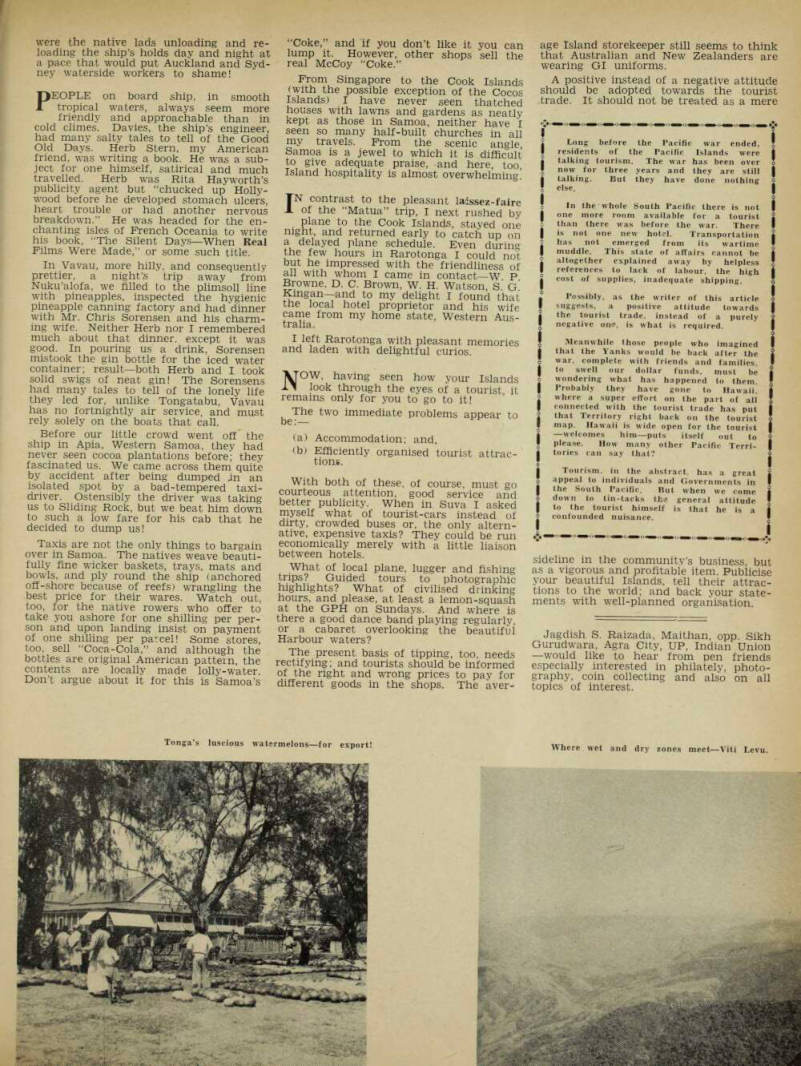
Why Don't We Have A Real Tourist
By Lex Halliday
WHEN my employers told me I was to visit the Pacific Islands to establish their new 16 Millimetre Entertain ment Film, I decided to take along my cameras and keep eyes and ears open. I had a strong suspicion that many hun dreds of people in Australia and New Zealand would be surprised to know what tourist delights existed on their own door steps, as it were.
Now, I consider a plane by far the best way to arrive in a country—the journey is usually comfortable and quick, with fewer irritating delays and less tip ping to keep possession of your luggage
than is the case with boat travel. This way, too, you have little time to build up false illusions about a country; you are there, ready to form your own impressions before some kind soul can form them for you!
I was glad, therefore, that my itinerary allowed for arrival in Fiji by air, and to drop out of the skies into Suva for the first time is a treat indeed.
To this day I vividly recollect the warm hospitality extended me in Fiji. Once triqnds start me talking .about the,se isles there’s no stopping. . , I relate how Tom French in his “Tom Thumb” plane
flew me from Suva to Nadi and showed me the line, as if drawn by a giant hand, clean across the centre of Viti Levu marking the dry belt from the wet, and the excitement of sneaking back along the valleys under a fast gathering tropic storm; I de scribe the International Air port, as shown me by the QIC, Mr. Turner; the vast sugar-cane fields through which I was driven by Dave Ragg; the splendid lawn-tennis courts at Suva, scene of many a pleasant game with lads from the Bank of NSW.
Friends are amazed when I show them photographs of fine homes the Trotters’ lovely garden with its gorgeous flame tree, majestic Government build ings, the native bazaar, swim ming baths, the GPH, excellent shopping centres, modern movie theatres.
Yes, Fiji has great scope for expanding its tourist trade.
Already several people I have spoken to are anxious to take one of the Burns Philo fort nightly lugger trips from Suva to Savusavu, Taveuni, Rabi.
Others intend doing the MV “Matua” trip to Tongatabu— —Vavau—Samoa—and return to
Suva. How few people in Australia and New Zealand know of this latter trip, ideally suited for winter holidays!
PROPERLY organised and well-adver tised, the “Matua” trip could become one of the world’s most pleasant short cruises. The twelve days away from Suva cruising over the normally calm Pacific waters, stopping one or two days in each of several fascinating island ports, rep resent the best value for money anywhere in the tourist business.
At Nuku’alofa one is besieged by natives who all but literally tear the shirt off your back. The two principal items in short supply this time last year were clothing and washing-soap. For an old khaki shirt I obtained a finely-woven cane tray. For one cake of the Union Steamship Company’s soap I received a sturdy, hand-made basket.
Nuku’alofa is normally one of the quietest and most peaceful places on earth.
At night you can stroll a short distance from the township on a carpet of grass and wander amongst the clean villages nestling under tall palms, while leaves gently stir in the evening breeze. But Nuku’alofa, with the “Matua” in port is a hive of activity. Natives come from far and wide with water-melons, crates of bananas and other goods. You’ll see Mr.
Carlson, of Burns Philp, and Mr. Storer, of Morris Hedstrom’s, and many others working at high pressure to catch the re turn mail. You’ll wonder how the local postmaster manages the sudden rush of mail from business houses on the one hand, and passengers buying large quantities of Tongan stamps on the other.
No wonder he forgets to post up notices of trading hours, closes early—and finds irate customers at his back door demand ing an explanation!
Of all the colour-movie shots taken on that trip those I most treasure are those of the Tongan Guard and Brass Band turning out to farewell Queen Salote as she boarded our ship bound for New Zea land. And most vivid impressions of Tonga
Suva Harbour, Sunset.
Driveway to Government House, Suva.
Row ashore, Mister? ... Apia.
were the native lads unloading and re loading the ship’s holds day and night at a pace that would put Auckland and Syd ney waterside workers to shame!
PEOPLE on board ship, in smooth tropical waters, always seem more friendly and approachable than in cold climes. Davies, the ship’s engineer, had many salty tales to tell of the Good Old Days. Herb Stern, my American friend, was writing a book. He was a sub ject for one himself, satirical and much travelled. Herb was Rita Hayworth’s publicity agent but “chucked up Holly wood before he developed stomach ulcers, heart trouble or had another nervous breakdown.” He was headed for the en chanting isles of French Oceania to write his book, “The Silent Days—When Real Films Were Made,” or some such title.
In Vavau, more hilly, and consequently prettier, a night’s trip away from Nukualofa, we filled to the plimsoll line with pineapples, inspected the hygienic pineapple canning factory and had dinner with Mr. Chris Sorensen and his charm ing wife. Neither Herb nor I remembered much about that dinner, except it was good. In pouring us a drink, Sorensen mistook the gin bottle for the iced water container; result—both Herb and I took solid swigs of neat gin! The Sorensens had many tales to tell of the lonely life they led for, unlike Tongatabu, Vavau has no fortnightly air service, and must rely solely on the boats that call.
Before our little crowd went off the ship in Apia, Western Samoa, they had never seen cocoa plantations before; they fascinated us. We came across them quite by accident after being dumped in an isolated spot by a bad-tempered taxi driver. Ostensibly the driver was taking us to Sliding Rock, but we beat him down to such a low fare for his cab that he decided to dump us!
Taxis are not the only things to bargain over in Samoa. The natives weave beauti fully fine wicker baskets, trays, mats and bowls, and ply round the ship (anchored off-shore because of reefs) wrangling the best price for their wares. Watch out, too, for the native rowers who offer to take you ashore for one shilling per per son and upon landing insist on payment of one shilling per parcel! Some stores, too, sell “Coca-Cola,” and although the bottles are original American pattern, the contents are locally made lolly-water.
Don’t argue about it for this is Samoa’s
“Coke,” and if you don’t like it you can lump it. However, other shops sell the real McCoy “Coke.”
From Singapore to the Cook Islands (with the possible exception of the Cocos Islands) I have never seen thatched houses with lawns and gardens as neatly kept as those in Samoa, neither have I seen so many half-built churches in all my travels. From the scenic angle Samoa is a jewel to which it is difficult to give adequate praise, and here, too, Island hospitality is almost overwhelming.
IN contrast to the pleasant laissez-faire of the “Matua” trip, I next rushed by plane to the Cook Islands, stayed one night, and returned early to catch up on a delayed plane schedule. Even during the few hours in Rarotonga I could not but he impressed with the friendliness of all with whom I came in contact—W P Browne, D. C. Brown, W. H. Watson, S.’ G Kingan—and to my delight I found that the local hotel proprietor and his wife came from my home state, Western Aus tralia.
I left Rarotonga with pleasant memories and laden with delightful curios.
NOW, having seen how your Islands look through the eyes of a tourist, it remains only for you to go to it! be The two imm ediate problems appear to (a) Accommodation; and. (b) Efficiently organised tourist attrac tions.
With both of these, of course, must go courteous attention, good service and better publicity. When in Suva I asked myself what of tourist-cars instead of dirty, crowded buses or, the only altern ative, expensive taxis? They could be run economically merely with a little liaison between hotels.
What of local plane, lugger and fishing trips? Guided tours to photographic highlights? What of civilised drinking hours, and please, at least a lemon-squash at the GPH on Sundays. And where is there a good dance band playing regularly, or a cabaret overlooking the beautiful Harbour waters?
The present basis of tipping, too, needs rectifying: and tourists should be informed of the right and wrong prices to pay for different goods in the shops. The aver-
age Island storekeeper still seems to think that Australian and New Zealanders are wearing GI uniforms.
A positive instead of a negative attitude should be adopted towards the tourist trade. It should not be treated as a mere
Long before the Pacific war ended, residents of the Pacific Islands were talking tourism. The war has been over now for three years and they are still talking. But they have done nothing else.
In the whole South Pacific there is not one more room available for a tourist than there was before the war. There is not one new hotel. Transportation has not emerged from its wartime muddle. This state of affairs cannot be altogether explained away by helpless references to lack of labour, the high cost of supplies, inadequate shipping.
Possibly, as the writer of this article suggests, a positive attitude towards the tourist trade, instead of a purely negative one, is what is required.
Meanwhile those people who imagined that the Yanks would be back after the war. complete with friends and families, to swell our dollar funds, must be wondering what has happened to them.
Probably they have gone to Hawaii! where a super effort on the part of all connected with the tourist trade has put that Territory right back on the tourist map. Hawaii is wide open for the tourist —welcomes him—puts itself out to please. How many other Pacific Terri tories can say that?
Tourism, in the abstract, has a great appeal to individuals and Governments in the South Pacific. But when we come down to tin-tacks the general attitude to the tourist himself is that he is a confounded nuisance.
sideline in the community’s business, but as a vigorous and profitable item. Publicise your beautiful Islands, tell their attrac tions to the world; and back your state ments with well-planned organisation.
Jagdish S. Raizada, Maithan, opp. Sikh Gurudwara, Agra City, UP, Indian Union —would like to hear from pen friends especially interested in philately, photo graphy, coin collecting and also on all topics of interest.
Tonga’s luscious watermelons—for export!
Where wet and dry zones meet—Viti Levu.
Tropicalities
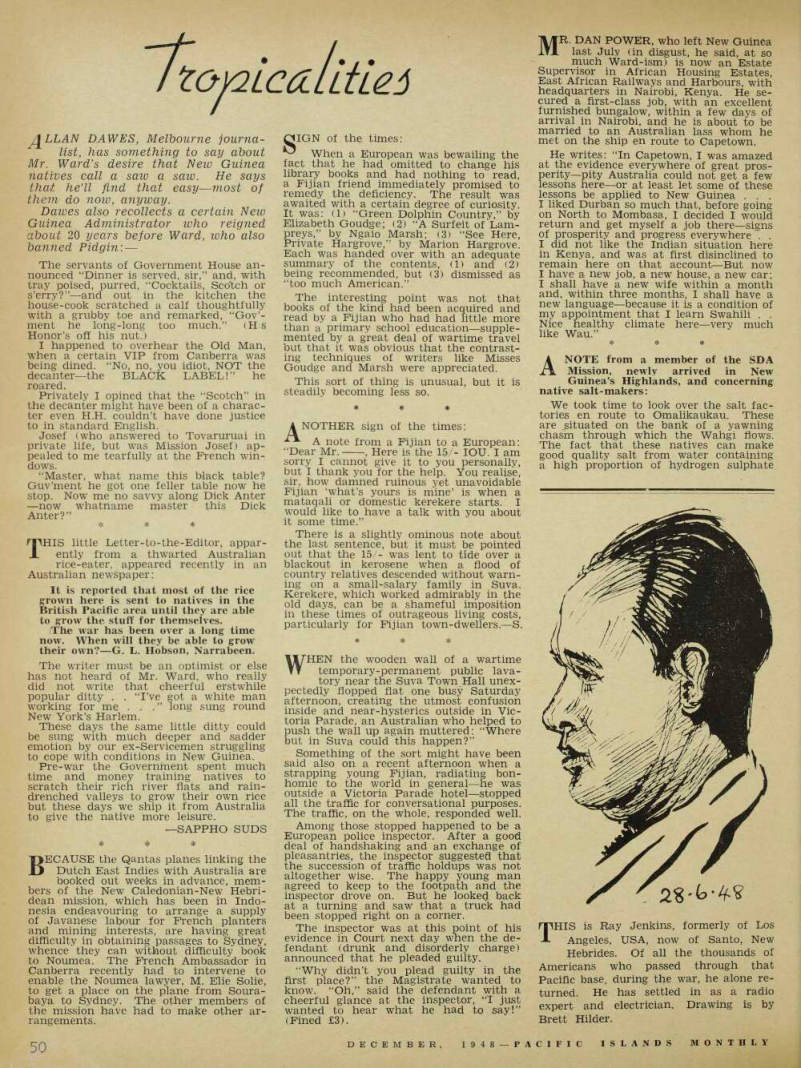
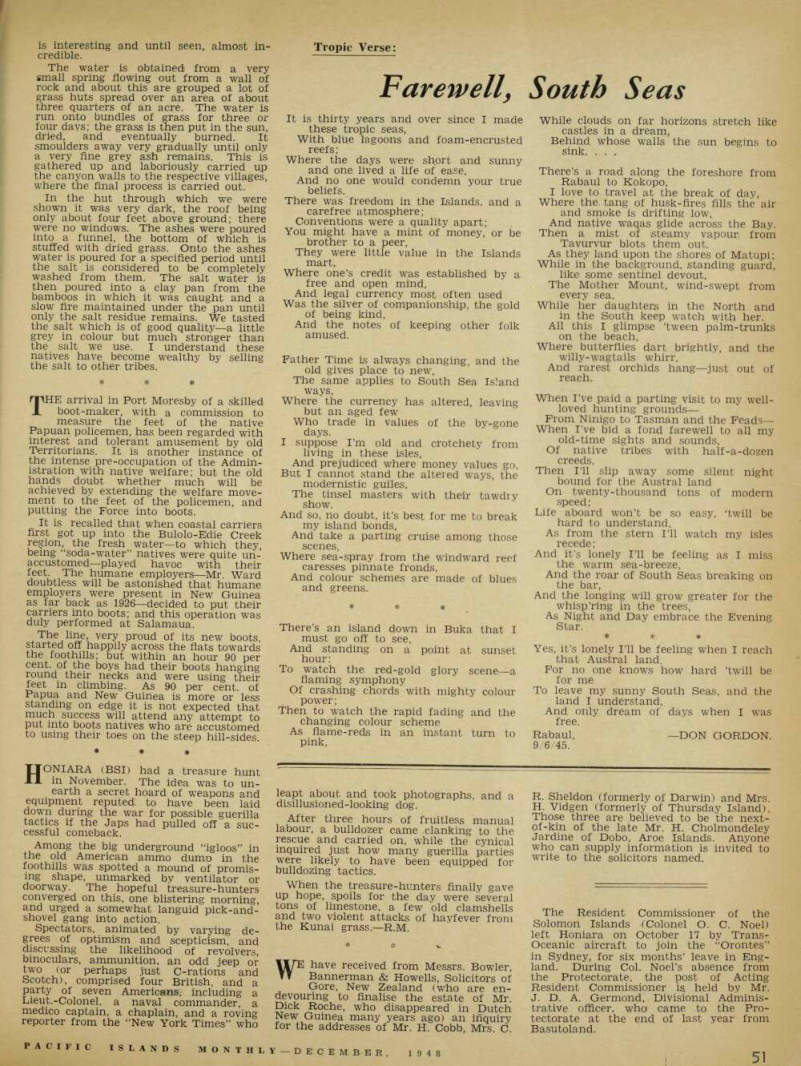
DAWES, Melbourne journa
list, has something to say about Mr. Ward’s desire that New Guinea natives call a saw a saw. He says
that he’ll find that easy—most of
them do now, anyway.
Dawes also recollects a certain New Guinea Administrator who reigned about 20 years before Ward, who also
banned Pidgin :
The servants of Government House an nounced “Dinner is served, sir,” and, with tray poised, purred, “Cocktails, Scotch or s’erry?”—and out in the kitchen the house-cook scratched a calf thoughtfully with a grubby toe and remarked, “Gov’ment he long-long too much.” (H s Honor’s off his nut.) I happened to overhear the Old Man, when a certain VIP from Canberra was being dined. “No, no, you idiot, NOT the decanter—the BLACK LABEL!” he roared.
Privately I opined that the “Scotch” in the decanter might have been of a charac ter even H.H. couldn’t have done justice to in standard English.
Josef (who answered to Tovaruruai in private life, but was Mission Josef) ap pealed to me tearfully at the French win dows.
“Master, what name this black table?
Guv’ment he got one feller table now he stop. Now me no savvy along Dick Anter —now whatname master this Dick Anter?” * * * THIS little Letter-to-the-Editor, appar ently from a thwarted Australian rice-eater, appeared recently in an Australian newspaper: It is reported that most of the rice grown here is sent to natives in the British Pacific area until they are able to grow the stuff for themselves. (The war has been over a long time now. When will they be able to grow their own? —G. L. Hobson, Narrabeen.
The writer must be an optimist or else has not heard of Mr. Ward, who really did not write that cheerful erstwhile popular ditty . . “I’ve got a white man working for me . . .” long sung round New York’s Harlem.
These days the same little ditty could be sung with much deeper and sadder emotion by our ex-Servicemen struggling to cope with conditions in New Guinea.
Pre-war the Government spent much time and money training natives to scratch their rich river flats and rain drenched valleys to grow their own rice but these days we ship it from Australia to give the native more leisure.
Sappho Suds
BECAUSE the Qantas planes linking the Dutch East Indies with Australia are booked out weeks in advance, mem bers of the New Caledonian-New Hebri dean mission, which has been in Indo nesia endeavouring to arrange a supply of Javanese labour for French planters and mining interests, are having great difficulty in obtaining passages to Sydney, whence they can without difficulty book to Noumea. The French Ambassador in Canberra recently had to intervene to enable the Noumea lawyer, M. Elie Solie, to get a place on the plane from Soura baya to Sydney. The other members of the mission have had to make other ar rangements.
QIGN of the times: When a European was bewailing the fact that he had omitted to change his library books and had nothing to read, a Fijian friend immediately promised to remedy the deficiency. The result was awaited with a certain degree of curiosity.
It was: (1) “Green Dolphin Country,” by Elizabeth Goudge; (2) “A Surfeit of Lam preys,” by Ngaio Marsh; (3) “See Here, Private Hargrove,” by Marion Hargrove.
Each was handed over with an adequate summary of the contents, (1) and (2) being recommended, but (3) dismissed as “too much American.”
The interesting point was not that books of the kind had been acquired and read by a Fijian who had had little more than a primary school education—supple mented by a great deal of wartime travel but that it was obvious that the contrast ing techniques of writers like Misses Goudge and Marsh were appreciated.
This sort of thing is unusual, but it is steadily becoming less so. * * * 4 NOTHER sign of the times: A note from a Fijian to a European: “Dear Mr. , Here is the 15/- lOU. I am sorry I cannot give it to you personally, but I thank you for the help. You realise, sir, how damned ruinous yet unavoidable Fijian ‘what’s yours is mine’ is when a mataqali or domestic kerekere starts. I would like to have a talk with you about it some time.”
There is a slightly ominous note about the last sentence, but it must be pointed out that the 15/- was lent to tide over a blackout in kerosene when a flood of country relatives descended without warn ing on a small-salary family in Suva.
Kerekere, which worked admirably in the old days, can be a shameful imposition in these times of outrageous living costs, particularly for Fijian town-dwellers. —S. ♦ * * WHEN the wooden wall of a wartime temporary-permanent public lava tory near the Suva Town Hall unex pectedly flopped flat one busy Saturday afternoon, creating the utmost confusion inside and near-hysterics outside in Vic toria Parade, an Australian who helped to push the wall up again muttered: “Where but in Suva could this happen?”
Something of the sort might have been said also on a recent afternoon when a strapping young Fijian, radiating bon homie to the world in general—he was outside a Victoria Parade hotel—stopped all the traffic for conversational purposes.
The traffic, on the whole, responded well.
Among those stopped happened to be a European police inspector. After a good deal of handshaking and an exchange of pleasantries, the inspector suggested that the succession of traffic holdups was not altogether wise. The happy young man agreed to keep to the footpath and the inspector drove on. But he looked hack at a turning and saw that a truck had been stopped right on a corner.
The insnector was at this point of his evidence in Court next day when the de fendant (drunk and disorderly charge) announced that he pleaded guilty.
“Why didn’t you plead guilty in the first place?” the Magistrate wanted to know. “Oh,” said the defendant with a cheerful glance at the inspector, “I just wanted to hear what he had to say!” (Fined £3).
MR. DAN POWER, who left New Guinea last July (in disgust, he said, at so much Ward-ism) is now an Estate Supervisor in African Housing Estates, East African Railways and Harbours, with headquarters in Nairobi, Kenya. He se cured a first-class job, with an excellent furnished bungalow, within a few days of arrival in Nairobi, and he is about to be married to an Australian lass whom he met on the ship en route to Capetown.
He writes: “In Capetown, I was amazed at the evidence everywhere of great pros perity-pity Australia could not get a few lessons here—or at least let some of these lessons be applied to New Guinea , . .
I liked Durban so much that, before going on North to Mombasa, I decided I would return and get myself a job there—signs of prosperity and progress everywhere . .
I did not like the Indian situation here in Kenya, and was at first disinclined to remain here on that account—But now I have a new job, a new house, a new car: I shall have a new wife within a month and, within three months, I shall have a new language—because it is a condition of my appointment that I learn Swahili . .
Nice healthy climate here —very much like Wau.” * * * A NOTE from a member of the SDA Mission, newly arrived in New Guinea’s Highlands, and concerning native salt-makers: We took time to look over the salt fac tories en route to Omalikaukau, These are situated on the bank of a yawning chasm through which the Wahgi flows.
The fact that these natives can make good quality salt from water containing a high proportion of hydrogen sulphate
THIS is Ray Jenkins, formerly of Los Angeles, USA, now of Santo, New Hebrides. Of all the thousands of Americans who passed through that Pacific base, during the war, he alone re turned. He has settled in as a radio expert and electrician. Drawing is by Brett Hilder.
is interesting and until seen, almost in credible.
The water is obtained from a very small spring flowing out from a wall of rock and about this are grouped a lot of grass huts spread over an area of about three quarters of an acre. The water is run onto bundles of grass for three or four days; the grass is then put in the sun, dried, and eventually burned. It smoulders away very gradually until only a very fine grey ash remains. This is gathered up and laboriously carried up the canyon walls to the respective villages, where the final process is carried out.
In the hut through which we were shown it was very dark, the roof being only about four feet above ground; there were no windows. The ashes were poured into a funnel, the bottom of which is stuffed with dried grass. Onto the ashes water is poured for a specified period until the salt is considered to be completely washed from them. The salt water is then poured into a clay pan from the bamboos in which it was caught and a slow fire maintained under the pan until only the salt residue remains. We tasted the salt which is of good quality—a little grey in colour but much stronger than the salt we use. I understand these natives have become wealthy by selling the salt to other tribes. * ♦ ♦ THE arrival in Port Moresby of a skilled boot-maker, with a commission to measure the feet of the native Papuan policemen, has been regarded with interest and tolerant amusement by old Territorians. It is another instance of the intense pre-occupation of the Admin istration with native welfare; but the old hands doubt whether much will be achieved by extending the welfare move ment to the feet of the policemen, and putting the Force into boots.
It is recalled that when coastal carriers first got up into the Bulolo-Edie Creek region, the fresh water—to which they, being “soda-water” natives were quite un accustomed—played havoc with their feet. The humane employers—Mr. Ward doubtless will be astonished that humane employers were present in New Guinea as far back as 1926—decided to put their carriers into boots; and this operation was duly performed at Salamaua.
The line, very proud of its new boots, started off happily across the flats towards the foothills: but within an hour 90 per cent, of the boys had their boots hanging round their necks and were using their feet in climbing. As 90 per cent, of Papua and New Guinea is more or less standing on edge it is not expected that much success will attend any attempt to put into boots natives who are accustomed to using their toes on the steep hill-sides. * * ♦ HONIARA (BSD had a treasure hunt in November. The idea was to un earth a secret hoard of weapons and equipment reputed, to have been laid down during the war for possible guerilla tactics if the Japs had pulled off a suc cessful comeback.
Among the big underground “igloos” in the old American ammo dumn in the foothills was spotted a mound of promis ing shape, unmarked by ventilator or doorway. The hopeful treasure-hunters converged on this, one blistering morning, and urged a somewhat languid pick-and shovel gang into action.
Spectators, animated by varying de grees of optimism and scepticism, and discussing the likelihood of revolvers, binoculars, ammunition, an odd jeep or two (or perhaps just C-rations and Scotch), comprised four British, and a party of seven Americans, including a Lieut.-Colonel, a naval commander, a medico captain, a chaplain, and a roving reporter from the “New York Times” who
leapt about and took photographs, and a
disillusioned-looking dog.
After three hours of fruitless manual labour, a bulldozer came clanking to the rescue and carried on, while the cynical inquired just how many guerilla parties were likely to have been equipped for bulldozing tactics.
When the treasure-hunters finally gave up hope, spoils for the day were several tons of limestone, a few old clamshells and two violent attacks of hayfever from the Kunai grass.—R.M. * * V \lfE have received from Messrs. Bowler, ▼ f Bannerman & Howells, Solicitors of Gore, New Zealand (who are en devouring to finalise the estate of Mr.
Dick Roche, who disappeared in Dutch New Guinea many years ago) an inquiry for the addresses of Mr. H. Cobb, Mrs. C.
R. Sheldon (formerly of Darwin) and Mrs.
H. Vidgen (formerly of Thursday Island).
Those three are believed to be the next of-kin of the late Mr. H. Cholmondeley Jardine of Dobo, Aroe Islands. Anyone who can supply information is invited to write to the solicitors named.
The Resident Commissioner of the Solomon Islands (Colonel O. C. Noel) left Honiara on October 17 by Trans oceanic aircraft to join the “Orontes” in Sydney, for six months’ leave in Eng land. During Col. Noel’s absence from the Protectorate, the post of Acting Resident Commissioner is held by Mr.
J. D. A. Germond, Divisional Adminis trative officer, who came to the Pro tectorate at the end of last year from Basutoland.
Farewell , South Seas
Tropic Verse:
It is thirty years and over since I made these tropic seas, With blue lagoons and foam-encrusted reefs; Where the days were short and sunny and one lived a life of ease.
And no one would condemn your true beliefs.
There was freedom in the Islands, and a carefree atmosphere; Conventions were a quality apart; You might have a mint of money, or be brother to a peer, They were little value in the Islands mart, Where one’s credit was established by a free and open mind, And legal currency most often used Was the silver of companionship, the gold of being kind, And the notes of keeping other folk amused.
Father Time is always changing, and the old gives place to new, The same applies to South Sea Island ways, Where the currency has altered, leaving but an aged few Who trade in values of the by-gone days.
I suppose I’m old and crotchety from living in these isles, And prejudiced where money values go, But I cannot stand the altered ways, the modernistic guiles, The tinsel masters with their tawdry show.
And so, no doubt, it’s best for me to break my island bonds, And take a parting cruise among those scenes, Where sea-spray from the windward reef caresses pinnate fronds, And colour schemes are made of blues and greens. * * * There’s an island down in Buka that I must go off to see, And standing on a point at sunset hour: To watch the red-gold glory scene—a
flaming symphony
Of crashing chords with mighty colour power; Then to watch the rapid fading and the changing colour scheme As flame-reds in an instant turn to pink,
While clouds on far horizons stretch like castles in a dream, Behind whose walls the sun begins to sink. . . .
There’s a road along the foreshore from Rabaul to Kokopo, I love to travel at the break of day, Where the. tang of husk-fires fills the air and smoke is drifting low.
And native waqas glide across the Bay.
Then a mist of steamy vapour, from Tavurvur blots them out.
As they land upon the shores of Matupi; While in the background, standing guard, like some sentinel devout.
The Mother Mount, wind-swept from every sea, While her daughters in the North and in the South keep watch with her.
All this I glimpse ’tween palm-trunks on the beach, Where butterflies dart brightly, and the willy-wagtails whirr, And rarest orchids hang—just out of reach.
When I’ve paid a parting visit to my well loved hunting grounds— From Ninigo to Tasman and the Feads— When I’ve bid a fond farewell to all my old-time sights and sounds, Of native tribes with half-a-dozen creeds, Then I’ll slip away some silent night bound for the Austral land On twenty-thousand tons of modern speed; Life aboard won’t be so easy, ‘twill be hard to understand.
As from the stern I’ll watch my isles recede; And it’s lonely I’ll be feeling as I miss the warm sea-breeze, And the roar of South Seas breaking on the bar, And the longing will grow greater for the whisp’ring in the trees, As Night and Day embrace the Evening Star. ♦ ♦ ♦ Yes, it’s lonely I’ll be feeling when I reach that Austral land.
For no one knows how hard ’twill be for me To leave my sunny South Seas, and the land I understand, And only dream of days when I was free.
Rabaul, —DON GORDON. 9 6 45.
Service Section
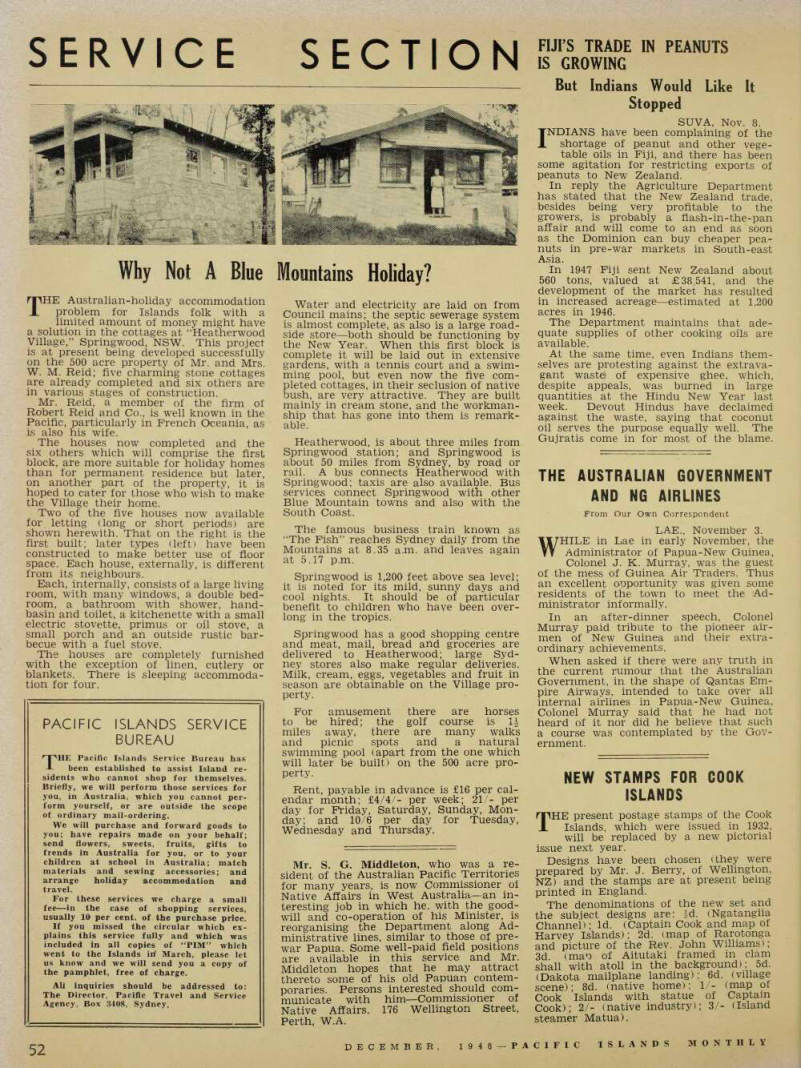
Why Not A Blue Mountains Holiday?
THE Australian-holiday accommodation problem for Islands folk with a limited amount of money might have a solution in the cottages at “Heatherwood Village,” Springwood, NSW. This project is at present being developed successfully on the 500 acre property of Mr. and Mrs.
W. M. Reid; five charming stone cottages are already completed and six others are in various stages of construction, Mr. Reid, a member of the firm of Robert Reid and Co., is well known in the Pacific, particularly in French Oceania, as is also his wife.
The houses now completed and the six others which will comprise the first block, are more suitable for holiday homes than for permanent residence but later, on another part of the property, it is hoped to cater for those who wish to make the Village their home.
Two of the five houses now available for letting (long or short periods) are shown herewith. That on the right is the first built; later types (left) have been constructed to make better use of floor space. Each house, externally, is different from its neighbours.
Each, internally, consists of a large living room, with many windows, a double bed room, a bathroom with shower, hand basin and toilet, a kitchenette with a small electric stovette, primus or oil stove, a small porch and an outside rustic bar becue with a fuel stove.
The houses are completely furnished with the exception of linen, cutlery or blankets. There is sleeping accommoda tion for four.
Water and electricity are laid on from Council mains; the septic sewerage system is almost complete, as also is a large road side store—both should be functioning by the New Year. When this first block is complete it will be laid out in extensive gardens, with a tennis court and a swim ming pool, but even now the five com pleted cottages, in their seclusion of native bush, are very attractive. They are built mainly in cream stone, and the workman ship that has gone into them is remark able.
Heatherwood, is about three miles from Springwood station; and Springwood is about 50 miles from Sydney, by road or rail. A bus connects Heatherwood with Springwood: taxis are also available. Bus services connect Springwood with other Blue Mountain towns and also with the South Coast.
The famous business train known as “The Fish” reaches Sydney daily from the Mountains at 8.35 a.m. and leaves again at 5.17 p.m.
Springwood is 1,200 feet above sea level; it is noted for its mild, sunny days and cool nights. It should be of particular benefit to children who have been over long in the tropics.
Springwood has a good shopping centre and meat, mail, bread and groceries are delivered to Heatherwood; large Syd ney stores also make regular deliveries.
Milk, cream, eggs, vegetables and fruit in season are obtainable on the Village pro perty.
For amusement there are horses to be hired; the golf course is H miles away, there are many walks and picnic spots and a natural swimming pool (apart from the one which will later be built) on the 500 acre pro perty.
Rent, payable in advance is £l6 per cal endar month; £4/4/- per week; 21/- per day for Friday, Saturday, Sunday, Mon day: and 10/6 per day for Tuesday, Wednesday and Thursday.
Mr. S. G. Middleton, who was a re sident of the Australian Pacific Territories for many years, is now Commissioner of Native Affairs in West Australia—an in teresting job in which he. with the good will and co-operation of his Minister, is reorganising the Department along Ad ministrative lines, similar to those of pre war Papua. Some well-paid field positions are available in this service and Mr.
Middleton hopes that he may attract thereto some of his old Papuan contem poraries. Persons interested should com municate with him—Commissioner of Native Affairs, 176 Wellington Street, Perth, W.A.
Stopped
Fiji’S Trade In Peanuts
Is Growing
But Indians Would Like It Stopped
Suva, Nov. 8.
INDIANS have been complaining of the shortage of peanut and other vege table oils in Fiji, and there has been some agitation for restricting exports of peanuts to New Zealand.
In reply the Agriculture Department has stated that the New Zealand trade, besides being very profitable to the growers, is probably a flash-in-the-pan affair and will come to an end as soon as the Dominion can buy cheaper pea nuts in pre-war markets in South-east Asia.
In 1947 Fiji sent New Zealand about 560 tons, valued at £38,541, and the development of the market has resulted in increased acreage—estimated at 1,200 acres in 1946.
The Department maintains that ade quate supplies of other cooking oils are available.
At the same time, even Indians them selves are protesting against the extrava gant wastes/ of expensive ghee, which, despite appeals, was burned in large quantities at the Hindu New Year last week. Devout Hindus have declaimed against the waste, saying that coconut oil serves the purpose equally well. The Gujratis come in for most of the blame.
And Ng Airlines
The Australian Government
From Our Own Correspondent LAE.. November 3.
WHILE in Lae in early November, the Administrator of Papua-New Guinea, Colonel J. K. Murray, was the guest of the mess of Guinea Air Traders. Thus an excellent opportunity was given some residents of the town to meet the Ad ministrator informally.
In an after-dinner speech, Colonel Murray paid tribute to the pioneer air men of New Guinea and their extra ordinary achievements.
When asked if there were any truth in the current rumour that the Australian Government, in the shape of Qantas Em pire Airways, intended to take over all internal airlines in Papua-New Guinea, Colonel Murray said that he had not heard of it nor did he believe that such a course was contemplated by the Gov ernment.
New Stamps For Cook
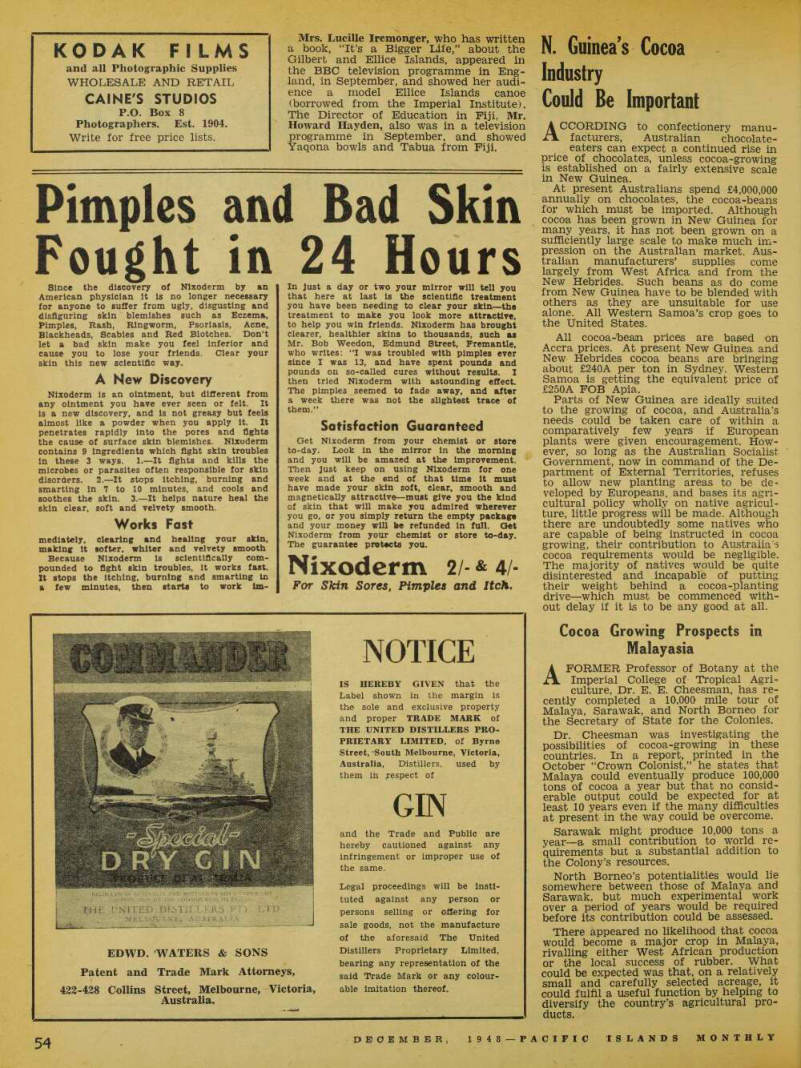
Islands
THE present postage stamps of the Cook Islands, which were issued in 1932, will be replaced by a new pictorial issue next year.
Designs have been chosen (they were prepared by Mr. J. Berry, of Wellington, NZ) and the stamps are at present being printed in England.
The denominations of the new set and the subject designs are; Id. (Ngatangiia Channel); Id. (Captain Cook and map of Harvey Islands); 2d. (map of Rarotonga and picture of the Rev. John Williams); 3d (man of Aitutaki framed in clam shall with atoll in the background): sd. (Dakota mailplane landing); 6d. (village scene); Bd. (native home): 1/- (map of Cook Islands with statue of Captain Cook); 2/- (native industry); 3/- (Island steamer Matua).
Mrs. Lucille Iremonger, who has written a book, “It’s a Bigger Life,” about the Gilbert and Ellice Islands, appeared in the BBC television programme in Eng land, in September, and showed her audi ence a model Ellice Islands canoe (borrowed from the Imperial Institute).
The Director of Education in Fiji, Mr.
Howard Hayden, also was in a television programme in September, and showed Yaqona bowls and Tabua from Fiji.
Advertisements & other items, pp. 54-56 (2 items)
Pacific Islands Service
BUREAU
THE Pacific Islands Service Bureau has been established to assist Island residents who cannot shop for themselves.
Briefly, we will perform those services for you, in Australia, which you cannot perform yourself, or are outside the scope of ordinary mail-ordering.
We will purchase and forward goods to you; have repairs made on your behalf; send flowers, sweets, fruits, gifts to frends in Australia for you, or to your children at school in Australia; match materials and sewing accessories; and arrange holiday accommodation and travel.
For these services we charge a small fee—in the case of shopping services, usually 10 per cent, of the purchase price.
If you missed the circular which explains this service fully and which was included in all copies of “PIM” which went to the Islands iri March, please let us know and we will send you a copy of the pamphlet, free of charge.
All inquiries should be addressed to; The Director, Pacific Travel and Service Agency, Box 3408, Sydney.
Burns Philp (New Guinea) Limited
General Merchants (Wholesale and Retail)
Shipping, Customs and General Agents
Head Office; PORT MORESBY, PAPUA
BRANCHES:
NEW GUINEA; Rabaul, Kokopo, Lae Cr Madang.
PAPUA: Samarai.
REPRESENTATIVES FOR:
AUSTRALIAN AGENTS:
LONDON AGENTS:
SAN FRANCISCO AGENTS:
QUEENSLAND INSURANCE CO. LTD.
LLOYDS OF LONDON
BURNS PHILP TRUST CO. LTD.
BURNS, PHILP b CO. LTD.
All States.
BURNS, PHILP b CO. LTD.
"London House", 35 Crutched Friars, E.C.3.
BURNS, PHILP CO. OF SAN FRANCISCO INC. 510 Matson Building.
Distributing Agents, Territory of Papua-New Guinea for:
SHELL COMPANY OF AUSTRALIA LIMITED
Petroleum Products
GENERAL MOTORS CORPORATION
Chevrolet, Buick, Pontiac and Oldsmobile Cars Chevrolet and GMC Trucks Frigidaire Refrigerators
VAUXHALL MOTORS LIMITED
Vauxhall Cars and Bedford Trucks
R. A. LISTER b CO., BRISTOL
Producers of Petrol, Parrafin and Diesel Engines Pumps and Lighting plants
RUSTON HORNSBY LIMITED
Engines
CROSSLEY MARINE ENGINES
KODAK FILMS
and all Photographic Supplies
WHOLESALE AND RETAIL
CAINE'S STUDIOS
P.O. Box 8 Photographers. Est. 1904.
Write for free price lists.
Pimples and Bad Skin Fought in 24 Hours
Since the discovery of Nlxoderm by an American physician it Is no longer necessary for anyone to suffer from ugly, disgusting and disfiguring skin blemishes such as Eczema, Pimples, Rash, Ringworm, Psoriasis, Acne, Blackheads, Scabies and Red Blotches. Don’t let a bad skin make you feel inferior and cause you to lose your friends. Clear your skin this new scientific way.
A New Discovery
Nlxoderm is an ointment, but different from any ointment you have ever seen or felt. It is a new discovery, and is not greasy but feels almost like a powder when you apply it. It penetrates rapidly into the pores and fights the cause of surface skin blemishes. Nlxoderm contains 9 Ingredients which fight skin troubles in these 3 ways. I.—lt fights and kills the microbes or parasites often responsible for skin disorders. 2.—lt stops Itching, burning and smarting in 7 to 10 minutes, and cools and soothes the skin. 3. —It helps nature heal the skin clear, soft and velvety smooth.
Works Fast
mediately, clearing and healing your skin, making it softer, whiter and velvety smooth Because Nlxoderm is scientifically compounded to fight skin troubles, it works fast.
It stops the itching, burning and smarting In a few minutes, then starts to work 1m-
In Just a day or two your mirror will tell you that here at last is the scientific treatment you have been needing to clear your skin—the treatment to make you look more attractive, to help you win friends. Nixoderm has brought clearer, healthier skins to thousands, such as Mr. Bob Weedon, Edmund Street, Premantle, who writes: “I was troubled with pimples ever since I was 13, and have spent pounds and pounds on so-called cures without results. I then tried Nixoderm with astounding effect.
The pimples seemed to fade away, and after a week there was not the slightest trace of them.”
Satisfaction Guaranteed
Get Nixoderm from your chemist or store to-day. Look in the mirror in the morning and you will be amazed at the improvement.
Then just keep on using Nixoderm for one week and at the end of that time it must have made your skin soft, clear, smooth and magnetically attractive—must give you the kind of skin that will make you admired wherever you go, or you simply return the empty package and your money will be refunded in full. Get Nixoderm from your chemist or store to-day.
The guarantee protects you.
Nixoderm 2/- & 4/-
For Skin Sores, Pimples and Itch.
m
•JJHE'tJMITED DISTILLERS PTE LTD'
• MEtStfUSSIK, Ai;SIt.UJA
EDWD. WATERS & SONS
Patent and Trade Mark Attorneys,
422-428 Collins Street, Melbourne, Victoria,
Australia.
NOTICE
IS HEREBY GIVEN that the Label shown in the margin is the sole and exclusive property and proper TRADE MARK of
THE UNITED DISTILLERS PRO-
PRIETARY LIMITED, of Byrne
Street, South Melbourne, Victoria, Australia, Distillers, used by them in respect of
GIN
and the Trade and Public are hereby cautioned against any infringement or improper use of the same.
Legal proceedings will be instituted against any person or persons selling or offering for sale goods, not the manufacture of the aforesaid The United Distillers Proprietary Limited, bearing any representation of the said Trade Mark or any colourable imitation thereof.
Industry
N. Guinea’s Cocoa Industry Could Be Important
ACCORDING to confectionery manu facturers, Australian chocolate eaters can expect a continued rise in price of chocolates, unless cocoa-growing is established on a fairly extensive scale in New Guinea.
At present Australians spend £4,000,000 annually on chocolates, the cocoa-beans for which must be imported. Although cocoa has been grown in New Guinea for many years, it has not been grown on a sufficiently large scale to make much im pression on the Australian market. Aus tralian manufacturers’ supplies come largely from West Africa and from the New Hebrides. Such beans as do come from New Guinea have to be blended with others as they are unsuitable for use alone. All Western Samoa’s crop goes to the United States.
All cocoa-beajn prices are based on Accra prices. At present New Guinea and New Hebrides cocoa beans are bringing about £24OA per ton in Sydney. Western Samoa is getting the equivalent price of
£2Soa Fob Apia.
Parts of New Guinea are ideally suited to the growing of cocoa, and Australia’s needs could be taken care of within a comparatively few years if European plants were given encouragement. How ever, so long as the Australian Socialist Government, now in command of the De partment of External Territories, refuses to allow new planting areas to be de veloped by Europeans, and bases its agri cultural policy wholly on native agricul ture, little progress will be made. Although there are undoubtedly some natives who are capable of being instructed in cocoa growing, their contribution to Australia’s cocoa requirements would be negligible.
The majority of natives would be quite disinterested and incapable of putting their weight behind a cocoa-planting drive —which must be commenced with out delay if it is to be any good at all.
Cocoa Growing Prospects in Malayasia
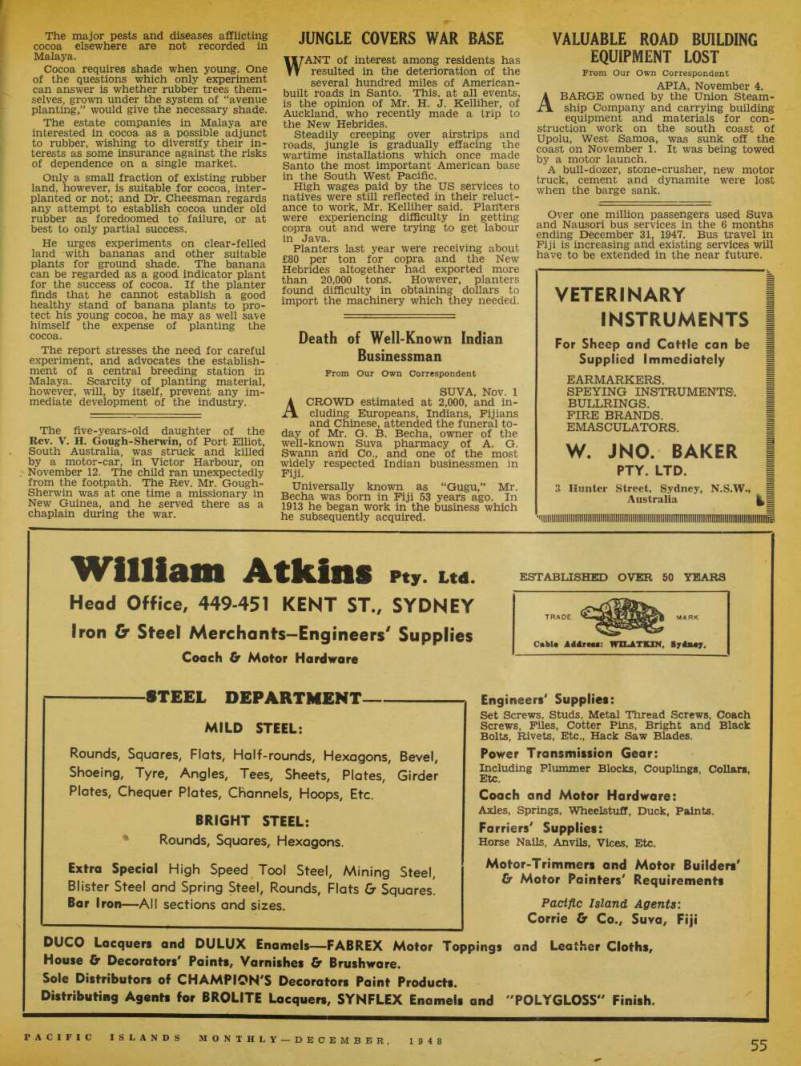
Malayasia
A FORMER Professor of Botany at the Imperial College of Tropical Agri culture, Dr. E. E. Cheesman, has re cently completed a 10,000 mile tour of Malaya, Sarawak, and North Borneo for the Secretary of State for the Colonies.
Dr. Cheesman was investigating the possibilities of cocoa-growing in these countries. In a report, printed in the October “Crown Colonist,” he states that Malaya could eventually produce 100,000 tons of cocoa a year but that no consid erable output could be expected for at least 10 years even if the many difficulties at present in the way could be overcome.
Sarawak might produce 10,000 tons a y ear — a small contribution to world re quirements but a substantial addition to the Colony’s resources.
North Borneo’s potentialities would lie somewhere between those of Malaya and Sarawak, but much experimental work over a period of years would be required before its contribution could be assessed.
There appeared no likelihood that cocoa would become a major crop in Malaya, rivalling either West African production or the local success of rubber. What could be expected was that, on a relatively small and carefully selected acreage, it could fulfil a useful function by helping to diversify the country’s agricultural pro ducts.
The major pests and diseases afflicting cocoa elsewhere are not recorded in Malaya.
Cocoa requires shade when young. One of the questions which only experiment can answer is whether rubber trees them selves, grown under the system of “avenue planting,” would give the necessary shade.
The estate companies in Malaya are interested in cocoa as a possible adjunct to rubber, wishing to diversify their in terests as some insurance against the risks of dependence on a single market.
Only a small fraction of existing rubber land, however, is suitable for cocoa, inter planted or not; and Dr. Cheesman regards any attempt to establish cocoa under old rubber as foredoomed to failure, or at best to only partial success.
He urges experiments on clear-felled land with bananas and other suitable plants for ground shade. The banana can be regarded as a good indicator plant for the success of cocoa. If the planter finds that he cannot establish a good healthy stand of banana plants to pro tect his young cocoa, he may as well save himself the expense of planting the cocoa.
The report stresses the need for careful experiment, and advocates the establish ment of a central breeding station in Malaya. Scarcity of planting material, however, will, by itself, prevent any im mediate development of the industry.
The five-years-old daughter of the Rev. V. H. Gough-Sherwin, of Port Elliot, South Australia, was struck and killed by a motor-car, in Victor Harbour, on November 12. The child ran unexpectedly from the footpath. The Rev. Mr. Gough- Sherwin was at one time a missionary in New Guinea, and he served there as a chaplain during the war.
Jungle Covers War Base
WANT of interest among residents has resulted in the deterioration of the several hundred miles of American built roads in Santo. This, at all events, is the opinion of Mr. H. J. Kelliher, of Auckland, who recently made a trip to the New Hebrides.
Steadily creeping over airstrips and roads, jungle is gradually effacing the wartime installations which once made Santo the most important American base in the South West Pacific.
High wages paid by the US services to natives were still reflected in their reluct ance to work, Mr, Kelliher said. Planters were experiencing difficulty in getting copra out and were trying to get labour in Java.
Planters last year were receiving about £BO per ton for copra and the New Hebrides altogether had exported more than 20,000 tons. However, planters found difficulty in obtaining dollars to import the machinery which they needed.
Death of Well-Known Indian
Businessman
From Our Own Correspondent
Suva, Nov. 1
A CROWD estimated at 2,000, and in cluding Europeans, Indians, Fijians and Chinese, attended the funeral to day of Mr. G. B. Becha, owner of the well-known Suva pharmacy of A. G.
Swann and Co., and one of the most widely respected Indian businessmen in Fiji.
Universally known as “Gugu,” Mr.
Becha was born in Fiji 53 years ago. In 1913 he began work in the business which he subsequently acquired.
Equipment Lost
Valuable Road Building
From Our Own Correspondent APIA, November 4.
A BARGE owned by the Union Steam ship Company and carrying building equipment and materials for con struction work on the south coast of Upolu, West Samoa, was sunk off the coast on November 1. It was being towed by a motor launch.
A bull-dozer, stone-crusher, new motor truck, cement and dynamite were lost when the barge sank.
Over one million passengers used Suva and Nausori bus services in the 6 months ending December 31, 1947. Bus travel in Fiji is increasing and existing services will have to be extended in the near future.
Advertisements & other items, p. 57 (1 item)
William Atkins Pty. Ltd.
VETERINARY
INSTRUMENTS
For Sheep and Cattle can be
Supplied Immediately
EARMARKERS.
SPEYING INSTRUMENTS.
BULLRINGS.
FIRE BRANDS.
EMASCULATORS.
W. JNO. BAKER
PTY. LTD.
3 Hunter Street, Sydney, N.S.W., Australia
William Atkins Pty. Ltd.
Head Office, 449-451 KENT ST., SYDNEY
Iron Gr Steel Merchants—Engineers 7 Supplies
Coach fir Motor Hardware
ESTABLISHED OVER 50 YEARS
Csbls Address: WXLATKIN, Bydmay.
STEEL DEPARTMENT
MILD STEEL:
Rounds, Squares, Flats, Half-rounds, Hexagons, Bevel, Shoeing, Tyre, Angles, Tees, Sheets, Plates, Girder Plates, Chequer Plates, Channels, Hoops, Etc.
BRIGHT STEEL:
Rounds, Squares, Hexagons.
Engineers' Supplies: Set Screws, Studs, Metal Thread Screws, Coach Screws, Files, Cotter Pins, Bright and Black Bolts, Rivets, Etc., Hack Saw Blades.
Power Transmission Gear: Including Plummer Blocks, Couplings, Collars, Etc.
Coach and Motor Hardware: Axles, Springs, Wheelstuff, Duck, Paints, Farriers' Supplies: Horse Nails, Anvils, Vices, Etc.
Extra Special High Speed Tool Steel, Mining Steel, Blister Steel and Spring Steel, Rounds, Flats & Squares.
Bar Iron—All sections and sizes.
Motor-Trimmers and Motor Builders' & Motor Painters' Requirements Pacific Island Agents : Corrie fir Co., Suva, Fiji DUCO Lacquers and DULUX Enamels—FAßßEX Motor Toppings and Leather Cloths, House & Decorators' Paints, Varnishes fir Brushware.
Sole Distributors of CHAMPION'S Decorators Paint Products.
Distributing Agents for BROLITE Lacquers, SYNFLEX Enamels and "POLYGLOSS" Finish.
Plane Missing in Pacific
AN American flying-fortress plane which left Port Moresby, Papua for the Philippines on November 16, has been reported missing somewhere east of Luzon.
Planes and ships were making a search of the area in mid-November.
Sir Hugh Ragg has been reappointed a member of the Executive Council of Fiji.
The British Steamer “Ivybank” was in Apia, Western Samoa in November load ing 2,000 tons of copra for the British Ministry of Food. Owing to a shortage of transport there was a large accumula tion of copra stored in Apia sheds.
More Drunkenness
Among Fiji Indians
From Our Own Correspondent „ mTTn .. , SUVA. Nov. 8 IIfHILE the number of Fijians convicted TT of being drunk and disorderly de creased in 1947 compared with 1946, the number of Indians convicted of the same offence increased by 66 per cent. These figures in the newly-published Police Department report for 1947 are of interest when the bitterly-contested Liqupr Bill (proposing to remove all liquor restrictions on Indians) is still temporarily shelved.
At the same time, Fijians convicted of other liquor offences in 1947 increased by 50 per cent, and Indians by 30 per cent.
The report indicates that “the tendency of non-permit-holders to frequent licensed premises” accounted considerably for the increases in this category.”
The total number of permits was 7,542, of which Indians held no fewer than 5,343, Fijians and others accounting for a total of 2,199.
Memories Of ‘Bully’ Proctor
Letter to the Editor THE article on “Bully Proctor” (“PIM,”
September) interested me greatly, as I lived for nearly two years in Futuna, within a quarter of a mile of the Catholic Mission at Segrave, the only port with a good anchorage in Futuna. This was in the 1890’s. Father Quibler (or Patale Soane, as he was called) was in charge; and he told me about Proctor, exactly as you have it in the “PIM.”
Proctor was a swine. I first heard of him at Savage Island (Niue) although he had never been there. Head, the trader, told me about him.
Then, again, in Apia, Robert Louis Stevenson and Blacklock, the American Consul, and Cusack Smith, the British Consul, mentioned him.
Afterwards, I found traces of him at Rotuma. He did not last long there, as there were two traders there who knew all about him, and were pretty slick with a shooting-iron. Thence he went to Wallis Island and Futuna.
Father Bataillou was one of che strongest men ever to live on Futuna— the natives used to tell me about him.
Father Quiblier was an old man when I knew him in the 1890’s —an old, lovable Christian —and although my wife and I were Protestants we were treated as if we were his children. He was loved by all, and respected. We were the only two Protestants on the island. Opperman and his wife (mentioned in Louis Becke’s “By Reef and Palm”) with whom I was working, had turned Catholics.
F. S. Whitcombe, Senior.
Levuka, 5/11/48.
Remembrance Day at Suva
Prom Our Own Correspondent
Suva. Nov. 8
TO commemorate Remembrance Day, a parade of the Territorial units of the Fiji Military Forces, ex-Servicemen and women, Boy Scouts and Girl Guides, the Band of the FMF and groups of Suva school-children was held at Albert Park on November 7.
After two minutes’ silence, the parade was inspected by the Governor (Sir Brian Freeston), who later placed a wreath at the Colonial War Memorial Hospital.
Advertisements & other items, p. 58 (1 item)
dazzling
Every Branch Of
ENGINEERING and BUILDING CONSTRUCTION
MILLERS LTD.
SUVA and LAUTOKA
Sawmillers and Timber Merchants; Shipwrights and Sailmakers; Joinery and Furniture Manufacturers; Upholsterers; Plumbers; Electricians; Hardware Merchants; Motor Dealers.
AGENCIES :
Chevrolet, Bedford, Vauxhall, Nash Motors. Firestone Tyres.
Fetters Marine and Stationary Engines. G.E.C. Radio Sets.
British Australian Lead Manufacturers Pty., Ltd., Atlas Assurance Co., Ltd.
There is no need to send to Australia or New Zealand for Repairs or Replacements. We can give you a sound Quotation and guarantee First-Class
Workmanship
For
dazzling
whiteness L Always use Beckitt 9 s Bag Blue in the last rinse the safe way to keep your linen a really good colour
Solomons Copra
Industry's Slow Recovery Prom Our Own Correspondent
Honiara, Nov. 11.
COPRA production in BSI took an up ward turn in October when an esti mated 576 tons was turned out for the month, against the monthly average of 400 tons during the past year.
The total for the past 12 months was 3,250 tons. Pre-war, the annual copra production was 25,000 tons.
The copra ship “Ericbank,” expected here mid-November, will take up to 1,200 tons to Great Britain.
New Whaling Enterprise On
Norfolk Is.
A SMALL factory has been erected at Ball’s Bay, Norfolk Island, for the treatment of whale blubber, and it is hoped to resume commercial whaling there at an early date.
At one time, the Norfolk Islanders used to catch anything from ten to twenty whales per season, and recover the oil by somewhat crude methods. The in dustry-such as it was—was discontinued during the war. It is now being revived by Mr. Max Picard, of New Zealand, and Mr. K. Hansen, a retired mariner from Australia. They have assembled some plant, and an electric generating system, at Ball’s Bay—most of it had to be lowered down the steep cliffs by block and tackle —and, with the co-operation of the skilled boatmen of Norfolk Island, a profitable industry should result. They could treat up to six whales per week. Whales in large numbers pass Norfolk Island during several months of the year.
In constructing the little factory, the promoters have used flattened iron from the innumberable oil drums left on Norfolk by the Air Force during the war.
They have welded the iron with a special plant taken in by air. Building material otherwise was unprocurable. There still are thousands of empty drums rusting on the island.
Jacka of Suva
Sudden Death of Mr. Victor Jacka of Suva
Prom Our Own Correspondent
T„_ Suva. Nov. 14.
HE death occurred suddenly on No vember 11 of Mr. Victor Jacka, a well-known and popular resident of Suva, where he was born 55 years ago He was on the staff of Morris. Hedstrom, Ltd., and was at work on the day of his death. In the late afternoon he suffered a heart attack while giving his launch a tnal in Suva Harbour; he died shortly 31001*.
He was the elder son of the late Mr. t\P d J Vlrs - John Jacka * was educated at the Suva Grammar School and at King’s College, Auckland. For a time he carried on his father’s business as a general storekeeper, but ultimately disposed of the business and joined Morris Hed strom, Ltd. He was a keen Rugby foot ball supporter.
Mr. Jacka is survived by his wife, two sons and a daughter, all residents of Suva.
New Caledonia’s first wheat crop of 200 tons is stated to be of good quality. M Henri Bonneaud has placed the silos of the old Lietard factory at the disposal of the growers, and Noumeans are Iqoking forward to eating their first real “New Caledonian bread.”
Advertisements & other items, pp. 59-60 (1 item)
is big enough
\our own job
The man who lives in the Islands may acquire additional responsibilities without warning. If he has been appointed executor of an estate several thousand miles away, distance alone makes it almost impossible to carry out these extra duties. In any case, he is most unlikely to possess the highly-specialised knowledge of taxation, investment and finance which efficient administration demands.
Rather than attempt two jobs, he can share the responsibility with Burns Philp Trust Company Limited. If desired, the entire task of administration can be transferred to this experienced and permanent organisation. Not only does this arrangement relieve the individual of an unsought obligation, but also ensures that the beneficiaries’ interests will be safeguarded at all times.
<VUT
& w * TfHa A full description of the Company’s services, together with much valuable information, is given in “Hands That Never Leave The Wheel”, You are invited to send for a copy of this free booklet.
DIRECTORS:
JAMES BURNS, JOSEPH MITCHELL. p. T. W. BLACK
FREDERICK EWEN LOXTON. ERIC PRIESTLEY LEE.
MANAGER:
L S. PARKER
SECRETARY:
E. R. OVERTON. A.F.I.A.
Burns Philp Trust
COMPANY LIMITEE
EXECUTOR • TRUSTEE • AGENT
7 BRIDGE STREET, SYDNEY >
Tele. BU 5901 BOX 543 ep o syDNEy
DON'T SAY GIN
GIN DON'T SAY
DON'T SAY GIN
GIN DON'T SAY
DON'T SAY GIN
G'-coqoo- '’SSBfcfc T
I N DON'T SAY
DON'T SAY GIN
GIN DON'T SAY
DON'T SAY G 1 N<
GIN DON'T SAY
DON'T SAY GIN
GIN DON'T SAY
dont' say G I M
DON'T SAY G I M
Y
GIN DON'T SAY
DON'T SAY GIN
GIN DON'T SAY
DON'T SAY G I N
GIN DON'T SAY
DONT SAY GIN
GIN DON'T SAY
DON'T SAY GIN!
GIN DON'T SAY
DONT SAY GIN
GIN DONT SAY
DON'T SAY G I M
DON'T SAT G I M
G I/ SAY
DONT SAY GIN
I M DON'T SAY
DONT SAY G I M
DONT SAY
N Y
DON
jpi IP D S * i! QU H IT 0 °Ur °Oc **Ai is * T Vsb
DON'
GIN DON'T S
DONT SAY GIM
DON'T SAY G I M
G SAY
DO AY m
SAY
IN
T SAY
DON'T I N
DON'T SAY G I N
GIN DON'T SAY
DON'T SAY GIN
DON'T SAY
N Y D S AY WjV * N u Qu the ‘re * c °Q:r
SAY
*iis S y<be IN V£S Sri sb
T SAY
11 m
DON'T
DON'T
GIN DONT
DON'T SAY G I
Address all inquiries to: Telegrams and Cables: “GILBEYS,” Melbourne.
W. & A. GILBEY LTD.
33 ROSSLYN STREET, WEST MELBOURNE. 109 REGENT STREET, SYDNEY.
Telegrams and Cables: “GILBEYS.” Sydney.
Economic Headaches For
Esi Natives
Strange Doings in The Copra Industry
Letter to the Editor BEFORE is it too late, it is desirable to set down some facts for the record. Prices throughout will be in Australian currency.
At the bottom of the depression, in the early 1930’5, bagged copra fell to the record “low” of 24/- per ton in the British Solomons. When it painfully climbed to £B, about four years later, though the price was still unpayable, planters and traders felt quite elated.
When it reached £l4 a ton, around 1937, they thought they were in Heaven.
Then a Big Firm stepped into native trading in the Western Solomons, with the announcement that it was so sorry at the poor prices which had been paid to the natives for so long, so “bring your copra along and we will pay you natives £l4 a ton —all the same white man.”
As Insensate competition had always limited the small traders’ profit to around £1 a ton (when it wasn’t a loss), and as all the traders sold their copra to that Big Firm, this method of competing against its own clients evoked intense bitterness among the outraged traders.
Both they and the Firm knew the impli cations of the position thus created: these things cannot be explained to natives, who at once drew the Inference that the rascally traders alone had been responsible for the wretched prices paid to them during the long depression years and after—and many uninformed whites held the same opinion, and sympathised with the natives accordingly.
The anger of the traders was not against the competition of the Big Firm as such, but against the manner in which it had initiated the new policy. It held all the cards, so there was no call to “put in the boot.” Later, copra re acted in price, and continued in a steady decline. The natives lived to see the day when the benevolent Big Firm, which had come to their “rescue” a few years pre viously, was paying around £3/5/- a ton for the major portion of the year prior to the evacuation.
And that is what happened under Big Firm Control. * ♦ * The time, but not the scene, has changed. It is now 1948, in the post war Solomons. Nearly eighteen years have elapsed since copra was 24/- per ton.
The Big Firm is absent from the scene.
Copra-buying is now a Government Mon opoly. The world price is now around £BO per ton. Solomons price is £4O.
Even the Big Firm will admit that it now has nothing to learn from Govern ment in covering itself against “contin gencies,” and making a thundering pro fit at the producers’ expense.
Once again a Saviour has appeared at the top of the market. (Curious how these benefactors turn up in Booms* never in Depressions.) Not so blatantly as the Big Firm did its stuff, but just as effectively, the Government has sold the native the idea that it alone is the creator of the present high prices, and that the trader, by implication, was re sponsible for the pre-war low ones. The poor blanky trader always seems, come hell or high water, to be cast for the villain of the piece.
It’s impossible to argue against a suc cess: and these things can no more be explained to natives than can the simple economics of business be explained to an unreasoning crowd of striking waterside workers. Which is one reason why the returning planter-trader in the Islands, and Missionaries also, find the natives—with important exceptions— neither grateful nor co-operative; a cocky, we-have-found-you - out-and- now-know all-the-answers attitude prevalent; and manifestations of the Marching Rule spirit in evidence in unexpected and un predictable places.
The natives are still unsatisfied, still highly critical (like they were in the last phase of Big Firm Control), because, in addition to receiving wholesale prices for retail lots, they are not receiving the
highly specialised, attentive service they received from the small traders.
And that is what has happened under Socialist Control.
I am, etc.,
Leslie F. Gill.
- Vella Lavella, BSI, 7/8/48.
Geological Survey For Fiji
From Our Own Correspondent
Suva, Nov. 1
THE United Kingdom government has made a free grant of £22,220 (ster ling) , under the Colonial Develop ment and Welfare Act, for a three-year geological survey of the whole of Fiji.
Areas likely to yield valuable minerals are to be mapped in detail.
Advertisements & other items, p. 61 (1 item)
Shipping
TO RESIDENTS OF NORFOLK ISLAND, COOK ISLANDS, NEW
CALEDONIA, NEW HEBRIDES, BRITISH SOLOMON ISLANDS,
NEW GUINEA
Service From New Zealand
... Our next vessels are loading shortly, and we recommend that, if you nave not already placed orders with us, you do so immediately, to enable us to arrange space.
All classes of general marchandise available at competitive prices. Amongst the commodities which may be particularly mentioned for immediate deliveryare i
FOOD PRODUCTS: GENERAL:
Meats.
Butter.
Cheese.
Potatoes.
Onions and Tinned Vegetables.
Beer.
Sandshoes.
Roman Sandals.
Leather Soles.
Leather and Belting.
Tobacco and Cigarettes.
Matches.
Soap.
Toilet Gift Sets.
Candles.
Silver-plate Ware.
Builders’ Hardware.
Chairs and Furniture.
Laminated Wood and Plywood. especially hinges, builders’ hardware and silver-plate ware are ifs? a factol :;f s : T s ese ai ; e lis ted in a catalogue and price ofvnnr which we will be happy to post without charge on receipt nl Soil? y ° u desire s P ec i fic offer on a C.I.P. basis, please cable or air-mail details of your needs and we will quote you promptly. If you ir > l arge entities we shall be pleased to arrange for our representative to visit you with samples and discuss the transaction. iv^ so • buye £ s 9 f Islands Produce of every description, and we can ?s °world-wide mg Buymg or selling ’ we can hel P you—our selling organisation
UNION MANUFACTURING
& EXPORT CO. LTD.
G.P.O. Box 1060, Wellington, NEW ZEALAND Cables: “UMEC,” Wellington.
Branches at Auckland, Christchurch, Sydney, Melbourne.
Western Pacific Office: P.O. Box 78, Noumea. Cables: SICO, Noumea.
British Funds For Pacific
Research
Prom Our Own Correspondent
Suva, Nov. 1
THE provision of funds for two research projects in Fiji and the Western Pacific has been approved, in prin ciple, by the British Government. The first is the establishment and mainten ance for five years of an Institute of Edu cational Research in Fiji and the second is the foundation of a medical research library for Fiji and the Western Pacific High Commission.
Details of both proposals are still being discussed.
Copra Growers’ Goose Laid Few Golden Eggs
But Fiji Government Would Now Like It Plucked
Letter to the Editor
\ T the next meeting of the Legislative Council of Fiji a Bill is to be intro duced for the purpose of imposing a tax on copra exported from or con sumed in Fiji. This tax is to be, in the words of a highly placed personage, “an attempt to relieve the planters of some of the profits they are making out of the miseries of Europe.”
This shortsighted view fails entirely to take into consideration the miseries of the planter during the days when Unilever
wielded the big stick and copra prices fell below the cost of production.
Figures recently worked out show that 5oL a 7 erage price of copra f °r the period 1928-48 was £l2/15/ per ton, while the average cost of production (landed at Suva) was, during the same period £lO p er ton This shows a truly handsome profit of £2/10/- per ton from which had to be deducted the wages of a European overseer.
A graph for the same period shows chat the actual price obtained during the years 1930-42 fell below the average cost of production except for a brief period in 1937. The lowest price recorded was in the July-December period in 1934. was then bringing £3/2/6 per ton.
A hurricane in 1929 laid waste many Fijian plantations and these did not be gin producing again until 1933, by which time copra was worth about £5 per ton.
These figures will stand examination and in view of these facts it becomes dif ficult to see how any Government official, be he high or low, can sit in his office, secure in the thoughft of his regular emoluments, come rain or hurricane, and calmly propose depriving the planter of the hardearned rewards of his labour.
But this is, unfortunately, typical of officialdom which rarely has to face up to the realities of a situation.
Fiji, Nov. 11. I am, etc..
C. P. Godhard.
Nickel Co’S ‘Quebec’ In S.
Pacific Service
From Our Own Correspondent
Noumea, Nov. 20.
THE Nickel Company of New Caledonia gave a party to welcome the arrival of the fine new addition to their fleet, the Canadian-built vessel “Quebec.”
Present were the Governor-General, the President of the General Council, the Mayor of Noumea, heads of Government services, and representatives of New Caledonian shipping companies, com merce and industry.
The “Quebec” is 113 metres long, with a displacement of 4,875 tons, fitted with diesel engines, and with a speed of 13 knots.
Her master is Captain Jego, who was in command of the collier “Notou” when she was sunk by a German raider in 1940. The Germans took him in through the blockade, and he was their prisoner for some time. M. Rapadzi, Noumea manager of the Nickel Co., recalled this incident in his speech of welcome, and he also read the roll of honour of the sister collier “Cagou,” sunk with all hands by enemy action in 1942.
The “Quebec” will be a regular caller at Australian east coast ports.
French Singer at Santo
From Our Own Correspondent
Santo. Nh, Oct. 30.
AMONG Qantas passengers from Santo on October 29, was the French stage and screen actress Mile. Mylene Fidelin. She was returning to Noumea after a short visit to Vila and Santo.
She arrived in Santo by TRAP AS and gave one recital at the Harris Cinema.
Her programme was made up of two brackets of popular French songs, sung to the accompaniment of a guitar and to an audience which did not have suf ficient manners to keep quiet.
Advertisements & other items, pp. 62-66 (3 items)
(flbmmonwcaltb Bank
WE w
CAN HELP #11
With Full banking facilities at our ™ Island Branches
RABAUL ... LAE
PORT MORESBY
MADANG
The Service links with our Branches throughout Australia, also our Agents and correspondents all over the world.
(flbmmonwcaltb Bank
of Australia.
Every Branch of the Bank conducts Savings Bank business.
Canvas Shoes
• f • h y ie • Goodrich Company Rigid wedge keeps the bones of the foot in their natural normal position.
Sponge rubber cushion protects the sensitive arc of the foot.
“P-F” means Posture Foundation Here are canvas shoes that are different. "P-F" is a scientific, correct foot support which provides extra comfort for people of all ages. It adds fun and pep to your step. "P-F" is real foot protection.
It safeguards against Fiat Feet, avoids Tired, Strained Leg Muscles.
Try "P-F" Canvas Shoes and see the difference.
Agents for South Sea Islands:
ATKINS, KROLL & CO.
320 CALIFORNIA ST., SAN FRANCISCO
Cable Address: “Atisco”
STEAMSHIPS TRADING COMPANY LTD.
PORT MORESBY AND SAMARAI PAPUA
Wholesale & Retail Merchants, Planters , Sawmillers, Engineers , Slip Proprietors , Shipping , Customs and Insurance Agents.
MANAGING AGENTS for:
SAWMILLERS & TRADERS LTD.
CORAL SEAS INSURANCE CO. LTD.
ACME BAKERY COMPANY.
MARIBOI RUBBER LTD.
RUBBERLANDS LTD.
KEREMA RUBBER PLANTATIONS LTD.
COCOALANDS LTD.
AGENCIES:
BANKERS & TRADERS INSURANCE CO. LTD.
VACUUM OIL CO. PTY., LTD.
DIRECTORATE OP SHIPPING—Papua—New
Guinea Division.
ROYAL PACKET NAVIGATION CO.
KOKE BAGU PTY., LTD.
TRANS OCEANIC AIRWAYS.
GUINEA AIR TRADERS.
DISTRIBUTORS
ARMSTRONG-HOLLAND PTY., LTD.
Earth Moving and Logging Equipment.
WILLYS-OVERLAND EXPORT CORPORATION.
Jeep cars, etc.
IN PAPUA for:
INTERNATIONAL HARVESTER CO. OF AUST. LTD.
International Trucks, McCormack Deering Farming Machinery, Defender Refrigerators.
SYDNEY AGENTS: NELSON Gr ROBERTSON PTY. LTD., 12 SPRING STREET
YOU’LL ALWAYS GET
THE BEST FROM THE
PLUME
X.
10 HUM]
PUMP!
pflo^ fc ■L P 484 i||i3 PI M Plume is the best petrol available today. The finest petrol ever pro- H duced will be served from the Plume Pump as soon as world 1 economic conditions permit. Buy H Plume - It's Always the Best.
VACUUM
. ouauir piodvcl VACUUM OIL COMPANY PTY. LTD. (Incorporated in Australia)
Aerial Photographs
Up to date aerial views, 10 x 8 inches. 6/6 (N.Z.) each, posted. Coloured enlargements also available. Send for price list.
PACIFIC ISLANDS—Lord Howe, Norfolk, Kermadecs, Fiji, Tonga, Samoa, Aitutaki, Rarotonga, Noumea, New Guinea (Australian), New Britain, New Ireland, New Hanover, Admiralty Islands.
AUSTRALIA—Sydney, Brisbane, Bowen, Rockhampton, Townsville, Cairns, Darwin, Daly Waters, Clonourry, Camooweal, Charleville.
NEW ZEALAND —Every city and town of note. Scenic resorts, harbours, mountains, glaciers, etc.
Whites Aviation Limited
“The Air Travel Specialists,”
DILWORTH BUILDING, AUCKLAND,
C. 1., N.Z.
Ring 41-669 —Cable Whiteair —Write Box 2040.
BOOKING AGENTS FOR ALL PRINCIPAL
• AIRLINES.
C. SULLIVAN PTY. LTD.
Island Merchants
Over 30 years' experience in the Pacific Island Trade.
Expert Buying Service Original Invoices Furnished Sellers of Island Produce.
Represented in all Australian States, New Zealand, England, France, United States, etc.
BANKERS': Bank of New South Wales, Comptoir National d’Escompte de Paris, Bank of New Zealand.
C. SULLIVAN PTY. LTD.
379 KENT STREET, SYDNEY
Telegrams & Cables: CHASULL, Sydney. Phone: MJ4657 (6 lines).
Rid Kidneys Of
Poisons And Adds
If you suffer sharp, stabbing pains, if Joints are swollen, It shows your blood Is poisoned through faulty kidney action. Other symptoms of Kidney Disorders are Backache, Aching Joints and Limbs, Sciatica, Neuritis, Lumbago, Sleepless Nights, Dizziness, Nervousness, Circles under Eyes, Loss of Energy and Appetite and Frequent Headaches and Colds, etc. Ordinary medicines can’t help much because you must get to the root cause of the trouble.
The Cystex treatment Is specially compounded to soothe, tone and clean kidneys and bladder and remove acids and poisons from your system safely, quickly and surely, yet contains no harmful or dangerous drugs. Cystex works In 3 ways to end your troubles. 1. Starts killing the germs which are attacking your Kidneys, Bladder and Urinary System in two hours, yet Is absolutely harmless to human tissue. 3. Gets rid of health-destroying, deadly poisonous acids with which your system has become saturated. 3. Strengthens and reinvigorates the kidneys, protects from the ravages of disease-attack on the delicate filter organism, and stimulates the entire system.
Praised by One-time Sufferers
Cystex Is approved by one-time sufferers In 73 countries from the troubles shown above.
Mr. Reg Thomas, Townsville, Queensland, recently wrote: “My Joints were all stiff, I had leg pains, my back used to ache day and night.
My bladder was weak. I had headaches and no appetite. The first dose of Cystex helped me and before I finished three boxes my health and strength came back.*' Guaranteed to Satisfy or Money Back Get Cystex from your chemist or store to-day.
Give It a thorough test. Cystex Is guaranteed to make you feel younger, stronger, better U every way, or your money back if you return the empty package.
Now in 2 sizes—4/-, •/-.
GUARANTEED CVStfiX
Treatment **' for Your Kidneys, Bladder, Rheumatism.
dxfyk
63
PACIFIC ISLANDS MONTHLY DECEMBER, 1948
Garden of Sinners (Continued from page 45)
“Marella” Sold
BURNS, PHILP’S 34-year old veteran “Marella” has been sold to a South American company and will in future sail under the Panama flag as the “Cap tain Marcos.”
Before the war “Marella,” with “Mer kur,” maintained Burns, Philp’s Sydney- Singapore service.
She was handed over to her new owners in Singapore in November. The price paid for her is believed to be in the vicinity of £BO,OOO.
Mission Work In N. Caledonia
THE French Protestant mission in New Caledonia, which always has done good work among the natives, is asking for 1,500,000 francs, with which to establish a native centre in Noumea. The General Council has passed the request on to a committee charged with examin ing questions of reorganisation of native affairs.
Although persons elsewhere usually think of New Caledonia as a Catholic country, half of the Melanesian tribes are Protestant, and they number among them some of the most energetic and influential groupings of the Loyalty Islands and of the mainland.
Advertisements & other items, p. 67 (2 items)
65
PACIFIC ISLANDS MONTHLY—D E C E M B E R , 1948
William H. Watson
m * ' v ' ' " M i rnmmmmrnmmmmm ; :-; : : : : : x-;*; : 'j/mny ~z-. * A wm m '■■■:'< ■ . 120 H.P.
Direct reversing BY
Wl DDOP
DIESEL ENGINES
5 H- P TO 300 H- P
H • WIDDOP & CO LTD
GREENGATE KEIGHLEY ENGLAND
Telephone: Keighley 3727-8 Telegrams: Widdop Keighley. Codes: A.B.C. 6th Edition, Bentley’s, Bentley’s Second « mMmmrnmmm « r 1111
CVS §7
ESTABLISHED 1930
WILLIAM H. WATSON
RAROTONGA, COOK ISLANDS
Wholesale and Retail Trader
LICENSED STAMP DEALER
Agent For:—
BRITISH TRADERS' INSURANCE CO.
CORONA & L, C. SMITH TYPEWRITERS
KAISER & FRAZER MOTOR CARS
B.S.A. CYCLES AND MOTOR CYCLES
AMERICAN LEAD PENCIL CO.
WHITES AVIATION LTD.
Manufacturers of: FOOTWEAR, ALL CLASSES SUITABLE FOR NATIVE TRADING . . . M.O.P. PRODUCTS, INCLUDING ROUND EAR-RING BLANKS AND BUITON BLANKS Exporter of: “Rarotonga” Hula-Skirts.
Sea-Shell Necklaces.
M.O.P. Jewellery.
Island Produce.
Cable Address: “Watson” Rarotonga Wholesale and Retail Inquiries Invited.
Prepared to Consider Agencies for all Class of Goods.
Bankers: Importer of: Textiles.
General Hardware.
Fancy Goods.
General Merchandise.
Bank of New Zealand, Auckland.
Big Fleet Of Small Ships
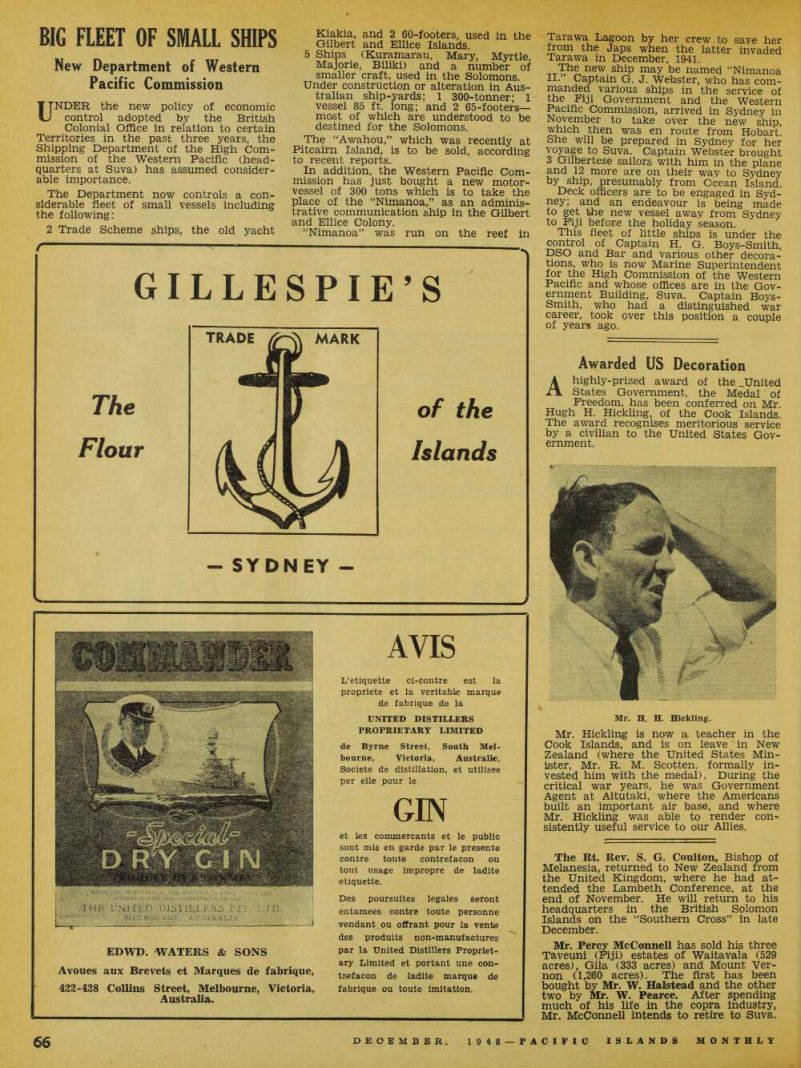
New Department of Western Pacific Commission
UNDER the new policy of economic control adopted by the British Colonial Office in relation to certain Territories in the past three years, the Shipping Department of the High Com mission of the Western Pacific (head quarters at Suva) has assumed consider able importance.
The Department now controls a con siderable fleet of small vessels including the following: 2 Trade Scheme ships, the old yacht
Kiakia, and 2 60-footers, used in the Gilbert and Ellice Islands. 5 Ships (Kuramarau, Mary, Myrtle, Majorie, Biliki) and a number of smaller craft, used in the Solomons.
Under construction or alteration in Aus tralian ship-yards; 1 300-tonner; 1 vessel 85 ft. long; and 2 65-footers— most of which are understood to be destined for the Solomons.
The “Awahou,” which was recently at Pitcairn Island, is to be sold, according to recent reports.
In addition, the Western Pacific Com mission has just bought a new motor vessel of 300 tons which is to take the place of the “Nimanoa,” as an adminis trative communication ship in the Gilbert and Ellice Colony.
“Nimanoa” was run on the reef in
Tarawa Lagoon by her crew to save her rrom the Japs when the latter invaded Tarawa in December, 1941.
The ne . w . shi P may be named “Nimanoa 11. Captain G. J. Webster, who has com manded various ships in the service of the Fiji Government and the Western Pacific Commission, arrived in Sydney in November to take over the new ship, which then was en route from Hobart.
She will be prepared in Sydney for her voyage to Suva. Captain Webster brought 3 Gilbertese sailors with him in the plane and 12 more are on their wav to Sydney by ship, presumably from Ocean Island.
Deck officers are to be engaged in Syd ney; and an endeavour is being made to get the new vessel away from Sydney to Fiji before the holiday season.
This fleet of little ships is under the control of Captain H. G. Boys-Smith, DSO and Bar and various other decora tions, who is now Marine Superintendent for the High Commission of the Western Pacific and whose offices are in the Gov ernment Building, Suva. Captain Boys- Smith, who had a distinguished war career, took over this position a couple of years ago.
Awarded US Decoration
A highly-prized award of the ..United States Government, the Medal of Freedom, has been conferred on Mr.
Hugh H. Hickling, of the Cook Islands.
The award recognises meritorious service by a civilian to the United States Gov ernment.
Mr. Hickling is now a teacher in the Cook Islands, and is on leave in New Zealand (where the United States Min ister, Mr. R. M. Scotten. formally in vested him with the medal). During the critical war years, he was Government Agent at Aitutaki, where the Americans built an important air base, and where Mr. Hickling was able to render con sistently useful service to our Allies.
The Rt. Rev. S. G. Coulton, Bishop of Melanesia, returned to New Z-ealand from the United Kingdom, where he had at tended the Lambeth Conference, at the end of November. He will return to his headquarters in the British Solomon Islands on the “Southern Cross” in late December.
Mr. Percy McConnell has sold his three Taveuni (Fiji) estates of Waitavala (529 acres), Gila (333 acres) and Mount Ver non (1,260 acres). The first has been bought by Mr. W. Halstead and the other two by Mr. W. Pearce. After spending much of his life in the copra industry, Mr. McConnell intends to retire to Suva.
Mr. H. H. Hickling.
Advertisements & other items, p. 68 (1 item)
Gillespie
The Flour
- SYDN EY -
TRADE
MARK
’S of the Islands
Ti THE ' LIMITED • DISTILLERS Tl' SID
"" ' 'MStSO-ff.X.F. AtST&ALIA .
EDWD. WATERS & SONS
Avoues aux Brevets et Marques de fabrique,
422-428 Collins Street, Melbourne, Victoria,
Australia.
AVIS
L’etiquette ci-contre est la propriete et la veritable marque de fabrique de la
UNITED DISTILLERS
PROPRIETARY LIMITED
de Byrne Street, South Melbourne, Victoria, Australie, Societe de distillation, et utilisee per elle pour le
GIN
et les commercants et le public sont mis en garde par le presente centre toute contrefacon ou tout usage impropre de ladite etiquette, Des poursuites legales seront entamees centre toute personne vendant ou offrant pour la vente des produits non-manufactures par la United Distillers Proprietary Limited et portant une contrefacon de ladite marque de fabrique ou toute imitation.
To Papua By Launch
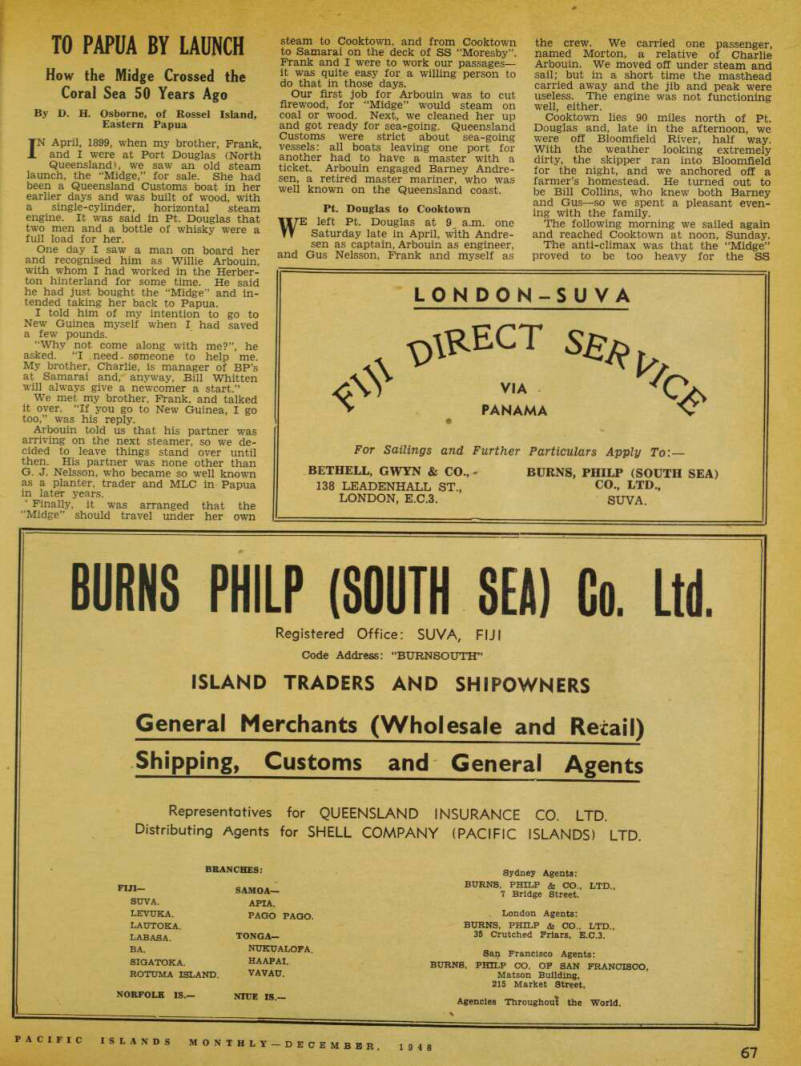
How the Midge Crossed the Coral Sea 50 Years Ago
By D. H. Osborne, of Rossel Island, Eastern Papua
IN April, 1899, when my brother, Frank, and I were at Port Douglas (North Queensland), we saw an old steam launch, the “Midge,” for sale. She had been a Queensland Customs boat in her earlier days and was built of wood, with a single-cylinder, horizontal steam engine. It was said in Pt. Douglas that two men and a bottle of whisky were a full load for her.
One day I saw a man on board her and recognised him as Willie Arbouin, with whom I had worked in the Herber ton hinterland for some time. He said he had just bought the “Midge” and in tended taking her back to Papua.
I told him of my intention to go to New Guinea myself when I had saved a few pounds.
“Why not come along with me?”, he asked. “I need, someone to help me.
My brother, Charlie, is manager of HP’s at Samarai and, anyway, Bill Whitten will always give a newcomer a start.”
We met my brother, Frank, and talked it over. “If you go to New Guinea, I go too,” was his reply.
Arbouin told us that his partner was arriving on the next steamer, so we de cided to leave things stand over until then. His partner was none other than G. J. Nelsson, who became so well known as a planter, trader and MLC in Papua in later years. ’ Finally, it was arranged that the “Midge” should travel under her own
steam to Cooktown, and from Cooktown to Samarai on the deck of SS “Moresby”.
Frank and I were to work our passages— it was quite easy for a willing person to do that in those days.
Our first job for Arbouin was to cut firewood, for “Midge” would steam on coal or wood. Next, we cleaned her up and got ready for sea-going. Queensland Customs were strict about sea-going vessels: all boats leaving one port for another had to have a master with a ticket. Arbouin engaged Barney Andresen, a retired master mariner, who was well known on the Queensland coast. , . .
Pt. Douglas to Cooktown WE left Pt. Douglas at 9 a.m. one Saturday late in April, with Andresen as captain, Arbouin as engineer, and Gus Nelsson, Frank and myself as
the crew. We carried one passenger, named Morton, a relative of Charlie Arbouin. We moved off under steam and sail; but in a short time the masthead carried away and the jib and peak were useless. The engine was not functioning well, either.
Cooktown lies 90 miles north of Pt.
Douglas and, late in the afternoon, we were off Bloomfield River, half way With the weather looking extremely dirty, the skipper ran into Bloomfield for the night, and we anchored off a farmer’s homestead. He turned out to be Bill Collins, who knew both Barney and Gus—so we spent a pleasant even ing wlth the fami ]y, The following morning we sailed again and reached Cooktown at noon, Sunday, The anti-climax was that the “Midge” proved to be too heavy for the SS
“Moresby” to lift on deck. A small BP vessel, SS “Ysabel”, was due to sail for Samarai the following Saturday and, since her speed was only seven knots, it was arranged that she should tow the “Midge” across. That suited Frank and me, for now we were sure of our passage.
We worked for several days making her ship-shape, as the mast had to be repaired and a new bilge pump installed.
A week or two earlier a heavy cyclone had wrecked a pearling fleet at Princess Charlotte Bay, and boats were bringing a lot of wreckage into Cooktown. No one about the town was eager to make the third man for our crew and neither of the owners wished to take it on.
On the last day Gus Nelsson dug up an old beachcomber who had been on a bender and was hard up. A bottle of whisky and promises of more coaxed him
to make the voyage. He was known as “Billy Liverpool”—l forget his real name.
He would not leave without a bundle of cotton waste, a couple of gallons of kero sene, and a pole—all for signalling if in distress.
We had been promised that the “Ysabel” would slow down each day at noon to pass us food, but Barney Andre sen warned us: “Take some extra food on board —that old skipper won’t slow down until he arrives in Samarai.”
In Tow MIDDAY on Saturday, April 28, 1899, saw our departure from Cooktown.
The “Ysabel” was to have slowed down before passing out of Earner Pass age, to see if all was well with us —but she continued right on.
The evening turned out wet, with a
nasty sea running. We were shipping a lot of spray and leaking freely. Our tow line was a wire rope with no spring in it and that prevented the “Midge” from rising to meet the seas.
“This looks like my last night—and I haven’t a drop of whisky left,” lamented “Billy”. He was not the only one who had doubts about living until morning!
I had given the engine a clean-up in Cooktown and must have let some cotton waste fall into the bilge; it ap parently had got into the pump rose and I had a real job of cleaning it out, then pumping, while Frank did most of the steering. “Liverpool” was not in the mood to do much except feel sorry for himself and hold his aching head.
Before daylight we broke adrift. Im mediately we burnt a flare, and then a second one. Still the “Ysabel” kept to her course. Finally, we saw her green light showing and she returned and hailed us. The skipper yelled that he would pick us up at daylight.
Daylight brought a boat with a coir hawser for us and thereafter the “Midge” towed much better. Bill scored a bottle of whisky, but no food was forthcoming.
We heard later that when the “Ysabel” left Cooktown, most of the crew were the worse for liquor and that we were very lucky that they missed us after the towline snapped.
All went well during Sunday and Monday, save that we were wet through and thoroughly miserable. During Mon day night we were near land, with nasty tide rips, and were making heavy going of it. Finally, the “Ysanel’s” skipper called out “We’ll go half speed until day light.” Later, she went dead slow and we were able to get a bit of rest until she resumed full speed at the first light.
We anchored at noon at Samarai. It didn’t take us long to got aboard the “Ysabel”, where a hot meal was await ing us—and did we do it justice!
The “Ysabel’s” captain told us exactly what sort of a risk we had taken. He shook his head and said: “I wouldn’t have done it for £25.”
Samarai In 1899 AT that time —May, 1899—the houses in Samarai were changing from native structures to European buildings. The town itself was quite lively, with a lot of drinking going on at the stores. Off-shore a number of boats were at anchor, including a fast sailing schooner on her way from Wood lark Island to Cooktown, with Captain C. O. Andersen in charge.
We stayed in Samarai until the Thurs day. leaving early in the morning. All sailing boats were in sight—but no motor launches. We spent the first night at anchor at Gyama, the second near Tofi, and finally reached Mambare Beach at sundown. The “Ysabel” dis charged her cargo at night and, leaving us, went on her way at sunrise.
Sunday we spent making the “Midge” ready for the trip up the River, for she was to tow a large whaleboat. We set out the following morning, expecting to make the trip in one day, but we could not locate the channel into the river and had to return to the beach. Gus, Frank and I took a dinghy and with flag-sticks marked the channel.
Next morning we entered the river quickly. By sundown we were only about a third of the distance. Arbouin acted as engineer and fireman —but he soon became knocked up, as the work was too heavy for him, and no one among the passengers would help.
When we set off again, I took fire for fire with him. It was hot work, and the steam would drop after each stoking.
By evening we still were a long way
from Tamata and the bunkers were almost empty.
The mining warden was one of the passengers and he questioned a local native who was with him about firewood.
He pointed up the river. We pulled in to the bank a short distance upriver and Frank and I, who had brought our axes from Port Douglas, chopped a load of wood, while the others stacked it against the boiler to warm it. The old “Midge” steamed ever so much better with this mixture of fuel and we reached Tamata in the early afternoon.
Willie and Gus gave us five shillings each to chop another load of wood to take them down stream again. They also gave us a pick, shovel, and dish for the extra work we had done coming up the river.
End of the “Midge”
THE “Midge” made one more trip up Mambare, but she was not suitable, being underpowered at 4 HP. Re turning to Samarai, she later sailed for Woodlark Island, but was wrecked on a reef and her bones rest there to-day.
Frank and I. after a day’s spell in Tamata, set out for the goldfield to seek our fortune. Little did we realize the hardships that lay ahead.
Advertisements & other items, pp. 69-70 (2 items)
67
PACIFIC ISLANDS MONTHLY-D E C E M B B R . 1948
Burns Philp (South Sea) Co. Ltd.
<c
LON DON-SUVA
ECT s£# v
'S' VIA A.
c
PANAMA
<<V For Sailings and Further Particulars Apply To :— BETHELL, GWYN & CO., - BURNS, PHILP (SOUTH SEA)
138 LEADENHALL ST.,
LONDON, E.C.3.
CO., LTD.,
SUVA.
BURNS PHILP (SOUTH SEA) Co. Ltd.
ISLAND TRADERS AND SHIPOWNERS
General Merchants (Wholesale and Retail)
Shipping, Customs and General Agents
Representatives for QUEENSLAND INSURANCE CO. LTD.
Distributing Agents for SHELL COMPANY (PACIFIC ISLANDS) LTD.
Registered Office: SUVA, FIJI
Code Address: "BURNSOUTH"
BRANCHES:
Sydney Agents:
BURNS, PHILP & CO., LTD.,
7 Bridge Street.
FIJI—
SUVA.
LEVUKA.
LAUTOKA.
LABASA.
BA.
SIGATOKA.
ROTUMA ISLAND.
SAMOA—
APIA.
PAGO PAGO.
TONGA—
NUKUALOFA.
HAAPAI.
VAVAU.
San Francisco Agents:
BURNS, PHILP CO. OP SAN FRANCISCO,
Matson Building, 215 Market Street, London Agents:
BURNS, PHILP & CO., LTD.,
35 Crutched Friars, E.C.3.
NORFOLK IS.—
NIUE IS
Agencies Throughout the World.
OUR HANDS MAKE GOOD ARMS
For your Fishing and Shooting Wants Consult Us.
Lithgow .22 Cal. Repeating Rifles ... £ll 14 0} Post Lithgow .22 Cal. Single Shot 5 1 3f Extra.
SI L RO H U 143 ELIZABETH STREET, SYDNEY.
J. C. Merrillees Pty. Ltd.
Import, Export and Island Merchants and
Commission Agents
AGENCIES; PETROLEUM PRODUCTS—KEROSENE, PETROL,
DIESELINE, ETC.
"McNIVENS" ICE CREAM POWDER, ICE CREAM, CONES,
ETC.
Inquiries invited for all your Island requirements.
J. C. MERRILLEES PTY. LTD.
191 MACQUARIE STREET, SYDNEY, N.S.W., AUSTRALIA.
’Phones; BW 4306, BW. 6064.
The Key to Earning Power. . .
Sometimes men think that a general education or an elementary knowledge of business is enough to gel ahead. But experience soon teaches that thorough, specialised training is just as necessary for success in business as it is in the professions of Law, Medicine or Dentistry. If you are interested in the many opportunities in the Business World ... if you seek responsibility, success and economic security, commence training now —in some specialised business subject. H.R.I. is available always to help and advise ambitious men and women. Write or wire for particulars and career information.
H.R.I. tutorial service is ■proved by the winning of more honours than all coaches in Australasia combined.
H.R.I. Career Training • ACCOUNTANCY • SECRETARYSHIP • COST ACCOUNTANCY
• PRACTICAL BOOKKEEPING • MARKETING SELLING
ADVERTISING o BANKING • LOCAL GOVERNMENT EXAMS.
Hemingway Robertson Institute
Fouhded and Owned by Hemingway & Robertson Pty. Ltd.
Consulting Accountants : i :: Professional Tutors
126 BANK HOUSE, BANK PLACE, MELBOURNE
126 BARRACK HOUSE. 16 BARRACK STREET, SYDNEY 126/814
Survey
“Southern Cross” Makes Leper Survey
THE Melanesian Mission vessel “Southern Cross,” which is at present in Auck land, New Zealand, undergoing over haul, recently undertook a leprosy survey among the islands of the New Hebrides.
An Australian doctor was carried and as close a survey as possible was made. Only four or five cases were found among the
natives examined, which was consider ably fewer than expected.
The major difficulty encountered during the survey was finding the villages, which are not built on the sea shore but are hidden behind dense belts of coastal vegetation. - The “Southern Cross” will remain in Auckland until after Christmas, when she will take the Bishop of Melanesia back to his diocese.
Governor-General and Mme. Cournarie left Noumea by the patrol ship “Lotus” on September 28 to visit Wallis and Futuna.
Oil Exploration In Papua
AUSTRALASIAN Petroleum Company Pty., Ltd., reports that, during the month of October, coring was carried out at the drilling site at Oroi, Papua, and on October 31, a depth of 1,266 feet was reached.
The British Seismic party has arrived in Papua and has now commenced work in the field.
The new issue of 2,500,000 £1 shares has been applied for by the shareholding companies.
Advertisements & other items, pp. 71-72 (1 item)
Thornycroft (Aust.) Pty., Ltd.
PRODUCING UNIFORM GOOD RESULTS SINCE 1868
ALWAYS ASK FOR IT
RJ2. 18 H.P. MARINE DIESEL
Driving 21 in. x 1 siin.
Propeller at 740 RPM • Reliable • Efficient • Economical • Easy Starting mt
GOOD DELIVERIES
Suitable for 25-35 ft . craft.
Write for full particulars of our complete range of engines to:
Thornycroft (Aust.) Pty., Ltd.
Cables: THOBNMOTOR, Sydney.
Stuart Turner
Marine Engines
H, 4 and 8 BHP Reduction Gear and Electric Starting Models available.
Light, Simple, Economical, General Purpose Units 6/10 Wattle Street,
PYRMONT, N.S.W.
Day-Old
Chicks
BY AIR
Amalgamated Hatcheries
(Reg.) of Bankstown, near Sydney, N.S.W., can dispatch limited numbers of chicks by
PLANE TO
RABAUL, PORT MORESBY,
LAE, NOUMEA, SUVA.
and all other islands of the Pacific served by present AND PROJECTED air services.
Amalgamated Hatcheries are the largest distributors of dayold chicks in Australia, last year over 1,000,000 chicks being sold by us in N.S.W. alone.
Our scientific method of packing and dispatch has resulted in a loss of less than 1 per cent, of chicks sent by plane.
If any chicks in your consignment arrive dead, we will replace them frees provided the extra freight is paid by the purchaser.
Chicks available are R.1.R., Austrolorps, and W.L.
Price, £lO per 100, landed at your airport, for unsexed chicks, and £l4 per 100 for all pullets. (Guaranteed 96 per cent, accurate sexing.) These chicks are the cream of Australia’s stock, produced under ultra - violet rays to guard against disease; the adult stock is blood-tested monthly by veterinary officers and each individual order carries a N.S.W.
Government certificate that the chicks are healthy and from tested stock.
Payment for chicks should be made by draft with the order, or credit arranged through our Bankers, the Commercial Bank of Australia, Ltd., Bankstown,
N.S.W.
Drafts and remittances can be sent direct to Amalgamated Hatcheries, Bankstown, N.S.W., or to the following agents; Messrs. Burns, Philp (South Sea) Co., Suva-Ba-Fiji, or any Island Branch. Also to: Marcel Legras, 38 Rue de Verdun, Noumea.
WRITE BY AIR-MAIL OR
CABLE.
AMALGAMATED
HATCHERIES
BANKSTOWN, N.S.W.
G. H. Robinson
ISLAND SUPPLIES
of all kinds—Selected and Shipped to order at lowest possible prices—Piecegoods in Wool, Cotton and Silk, Under and Outerwear, Manchester, Drapery, Grocery, Hardware, Engineers and Leathergoods trade supplies a specialty.
Indents and Transhipments arranged. Large or small orders treated with equal care.
Use our 25 years’ extensive experience.
Enquiries solicited to —
G. H. ROBINSON
51 Macquarie Street, Sydney, N.S.W.
Telegrams: Sunrise, Sydney.
Letters: Box 3317, G.P.0., Sydney.
Australia To S. Africa
New Air Service
USING 824 war-time crossings the Indian, Ocean, between Perth and Ceylon, as a yardstick of experience, Qantas Empire Airways has commenced survey flights over an air route connecting Australia with South Africa, across the Indian Ocean. The first flight began on Sunday, November 14.
In charge of this survey were Captain W. H. Crowther, Operations Manager of QEA. The aircraft, a QEA Lancastrian, VH-EAS, was commanded by Senior Plight Captain L. R. Ambrose, with Captain A. R. H. Morris as First Officer and Deputy Captain. The remainder of the crew were First Officer G. Jakinov, Navi gation Officer J. Cowan and Radio Officer Clarke. A team of aviation experts was carried The following are details of the route, with mileages and flight times; St. miles Hrs. Mins.
Sydney-Perth .. .. 2,056 9 30 Perth-Cocos Is 1,833 8 Cocos Is.-Mauritius . 2,670 12 30 Mauritius-Tananarive via Reunion Is. 603 4 Tananarive-J ohan nesburg 1.360 6 15 Qantas pioneered the Indian Ocean with regular services in 1943, establishing con tact over 3,500 miles between Perth and Ceylon after the United Kingdom-Aus tralia route had been broken by the Jap anese invasion of Malaya and NEI.
The Indian Ocean was first crossed by air in 1939, when Captain P. G. Taylor, with the Archbold expedition, flew from Port Hedland, Western Australia, to Mom basa, Kenya Colony, via Batavia, Cocos Island, Deigo Garcia and the Seychells Islands, in the Catalina Plying Boat “Guba.”
Bulolo Gold Dredging Limited
rR the month of October, seven BGD dredges handled 725,500 cubic yards of gravel for a total recovery of ap proximately 3,403 ounces of fine gold.
Due to the necessary coursing of the dredges the total yardage handled and the yield per yard were both considerably be low average. This condition may continue for the next two or three months.
Advertisements & other items, p. 72 (1 item)
70
DECEMBER, 1948 PACIFIC ISLANDS MONTHLY
THE “PIM” IS NOT ANTI-INDIAN
(Continued from Page 28)
The Problems Of New
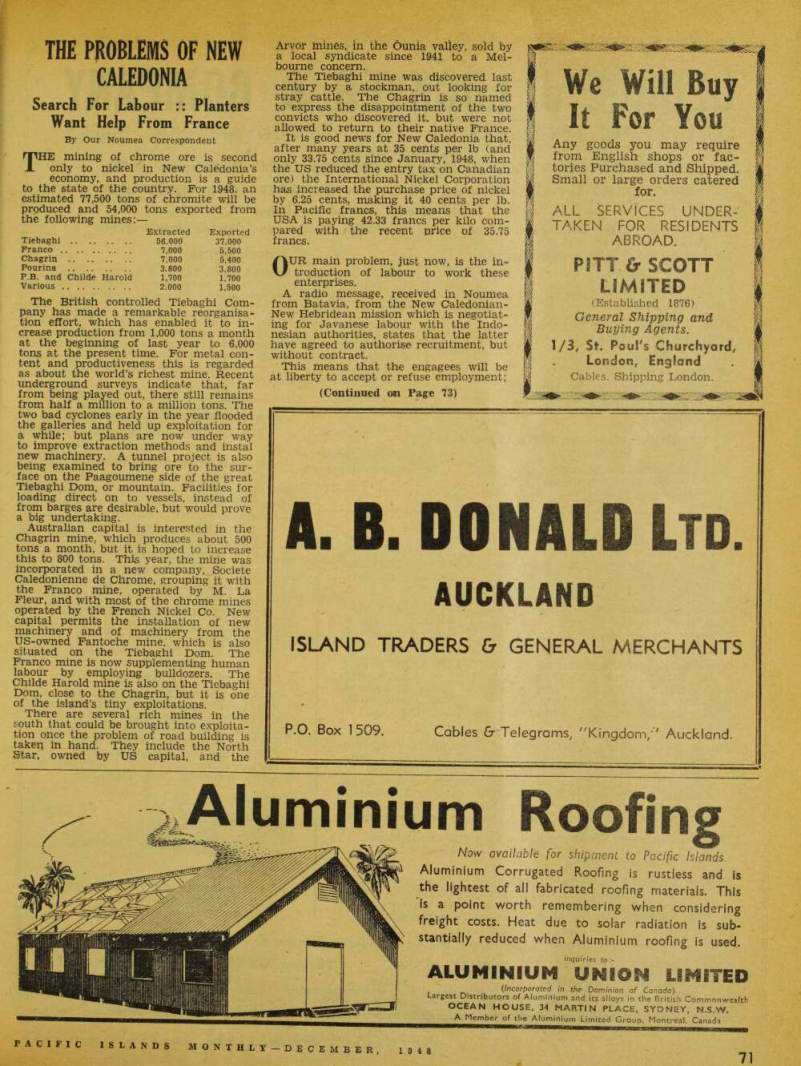
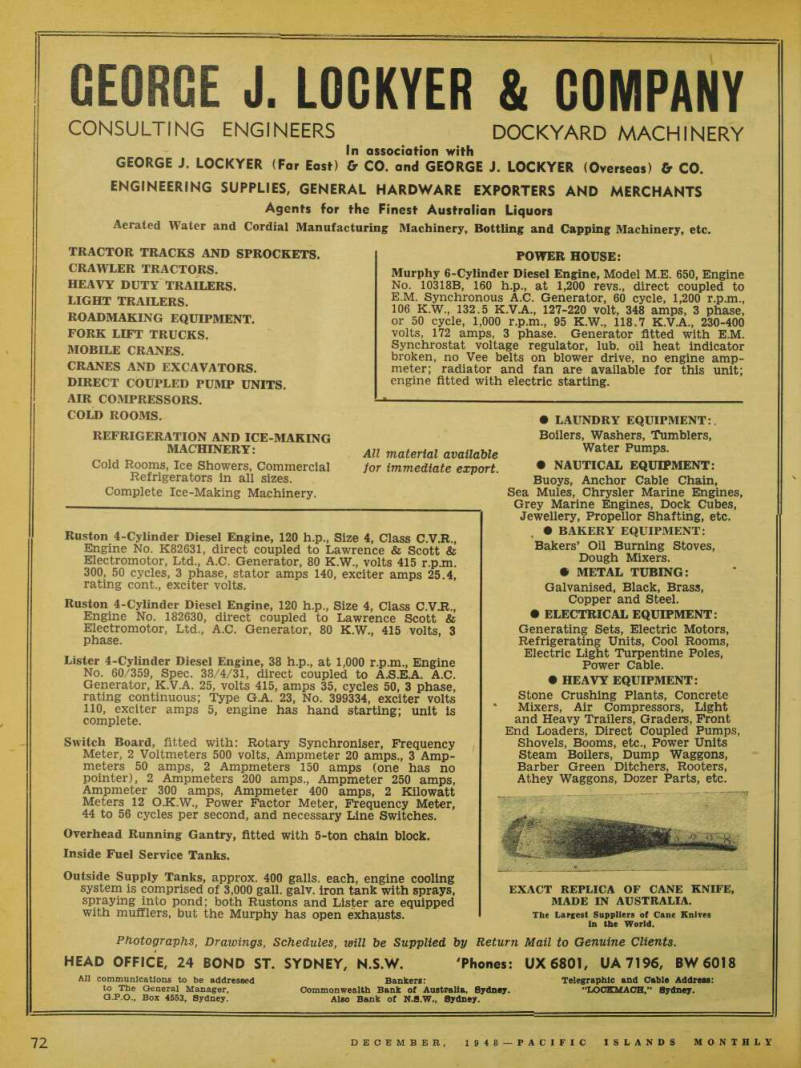
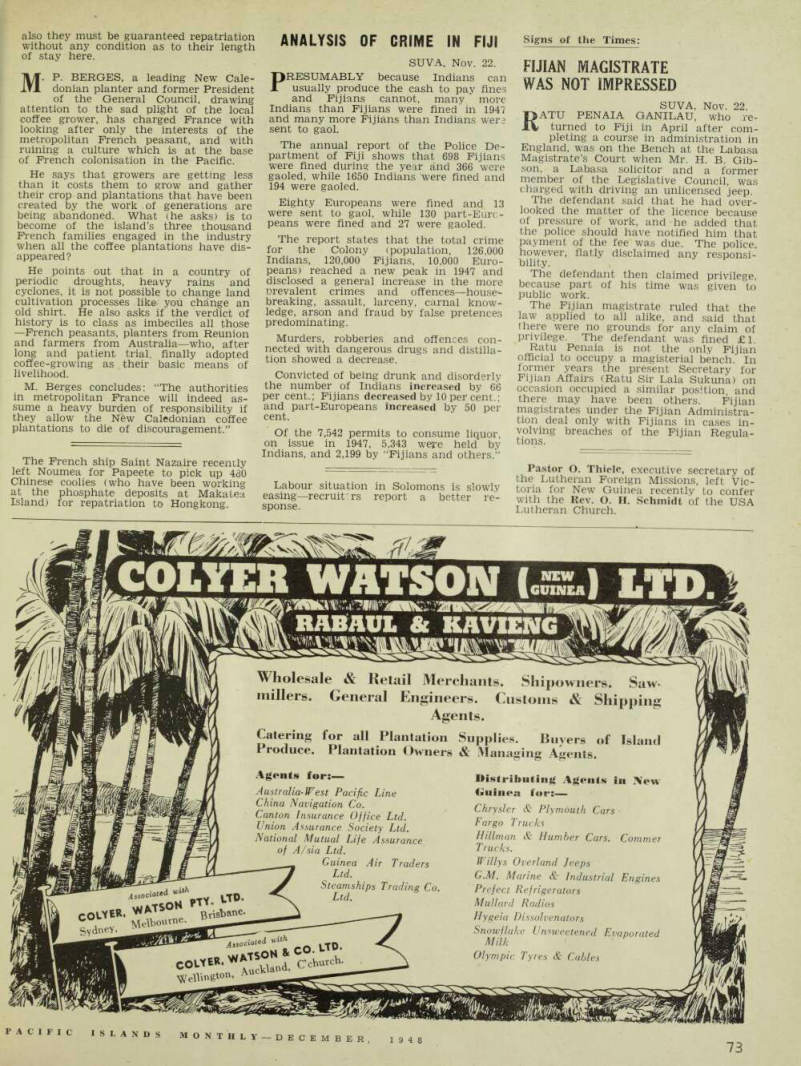
Caledonia
Search For Labour :: Planters Want Help From France
By Our Noumea Correspondent
THE mining of chrome ore is second only to nickel in New Caledonia’s economy, and production is a guide to the state of the country. For 1948. an estimated 77,500 tons of chromite will be produced and 54,000 tons exported from the following mines:— Extracted Exported Tiebaghi 56,000 37,000 Franco 7,000 5,500 Chagrin 7.000 5,400 Pourina 3,800 3,800 P.B. and Childe Harold 1,700 1,700 Various 2,000 1,500 The British controlled Tiebaghi Com pany has made a remarkable reorganisa tion effort, which has enabled it to in crease production from 1,000 tons a month at the beginning of last year to 6,000 tons at the present time. For metal con tent and productiveness this is regarded as about the world’s richest mine. Recent underground surveys indicate that, far from being played out, there still remains from half a million to a million tons. The two bad cyclones early in the year flooded the galleries and held up exploitation for a while; but plans are now under way to improve extraction methods and instal new machinery. A tunnel project is also being examined to bring ore to the sur face on the Paagoumene side of the great Tiebaghi Dom, or mountain. Facilities for loading direct on to vessels, instead of from barges are desirable, but would prove a big undertaking.
Australian capital is interested in the Chagrin mine, which produces about 500 tons a month, but it is hoped to increase this to 800 tons. This year, the mine was incorporated in a new company, Societe Caledonienne de Chrome, grouping it with the Franco mine, operated by M. La Fleur, and with most of the chrome mines operated by the French Nickel Co. New capital permits the installation of new machinery and of machinery from the US-owned Fantoche mine, which is also situated on the Tiebaghi Dom. The Franco mine is now supplementing human labour by employing bulldozers. The Childe Harold mine is also on the Tiebaghi Dom, close to the Chagrin, but it is one of the island’s tiny exploitations.
There are several rich mines in the south that could be brought into exploita tion once the problem of road building is taken in hand. They include the North Star, owned by US capital, and the
Arvor mines, in the Ounia valley, sold by a local syndicate since 1941 to a Mel bourne concern.
The Tiebaghi mine was discovered last century by a stockman, out looking for stray cattle. The Chagrin is so named to express the disappointment of the two convicts who discovered it. but were not allowed to return to their native France.
It is good news for New Caledonia that, after many years at 35 cents per lb (and only 33.75 cents since January, 1948, when the US reduced the entry tax on Canadian ore) the International Nickel Corporation has increased the purchase price of nickel by 6.25 cents, making it 40 cents per lb.
In Pacific francs, this means that the USA is paying 42.33 francs per kilo com pared with the recent price of 35.75 francs.
OUR main problem, just now, is the in troduction of labour to work these enterprises.
A radio message, received in Noumea from Batavia, from the New Caledonian- New Hebridean mission which is negotiat ing for Javanese labour with the Indo nesian authorities, states that the latter have agreed to authorise recruitment, but without contract.
This means that the engagees will be at liberty to accept or refuse employment;
(Continued cm Page 73)
also they must be guaranteed repatriation without any condition as to their length of stay here.
M. P. BERGES, a leading New Cale donian planter and former President of the General Council, drawing attention to the sad plight of the local coffee grower, has charged France with looking after only the interests of the metropolitan French peasant, and with ruining a culture which is at the base of French colonisation in the Pacific.
He says that growers are getting less than it costs them to grow and gather their crop and plantations that have been created by the work of generations are being abandoned. What (he asks) is to become of the island’s three thousand French families engaged in the industry when all the coffee plantations have dis appeared?
He points out that in a country of periodic droughts, heavy rains and cyclones, it is not possible to change land cultivation processes like you change an old shirt. He also asks if the verdict of history is to class as imbeciles all those —French peasants, planters from Reunion and farmers from Australia—who, after long and patient trial, finally adopted coffee-growing as their basic means of livelihood.
M. Berges concludes: “The authorities in metropolitan Prance will indeed as sume a heavy burden of responsibility if they allow the New Caledonian coffee plantations to die of discouragement.”
The French ship Saint Nazaire recently left Noumea for Papeete to pick up 480 Chinese coolies (who have been working at the phosphate deposits at Makatea Island) for repatriation to Hongkong.
Advertisements & other items, pp. 73-75 (1 item)
A. B, Donald Ltd.
Wc Will Buy
It For You
Any goods you may require from English shops or factories Purchased and Shipped.
Small or large orders catered for.
ALL SERVICES UNDER-
TAKEN FOR RESIDENTS
ABROAD.
PITT & SCOTT
LIMITED
(Established 1876) General Shipping and Buying Agents. 1/3, St. Paul's Churchyard, London, England Cables. Shipping London.
A. B, DONALD Ltd.
AUCKLAND
ISLAND TRADERS Gr GENERAL MERCHANTS
P.O. Box 1509. Cables & Telegrams, "Kingdom, ' Auckland.
Aluminium Roofing
O Now available for shipment to Pacific Islands Aluminium Corrugated Roofing is rustless and is the lightest of all fabricated roofing materials. This Is a point worth remembering when considering freight costs. Heat due to solar radiation is substantially reduced when Aluminium roofing is used.
Inquiries to:-
ALUMINIUM UNION LIMITED
(Incorporated in the Dominion of Canada) Largest Distributors of Aluminium and its alloys in the British Commonwealth OCEAN HOUSE, 34 MARTIN PLACE, SYDNEY, N.S.W.
A Member of the Aluminium Limited Group, Montreal, Canada
GEORGE J. LOGKYER & COMPANY
CONSULTING ENGINEERS DOCKYARD MACHINERY
In association with GEORGE J. LOCKYER (Far East) fir CO. and GEORGE J. LOCKYER (Overseas) & CO.
ENGINEERING SUPPLIES, GENERAL HARDWARE EXPORTERS AND MERCHANTS Agents for the Finest Australian Liquors Aerated Water and Cordial Manufacturing Machinery, Bottling and Capping Machinery, etc.
TRACTOR TRACKS AND SPROCKETS.
CRAWLER TRACTORS.
HEAVY DUTY TRAILERS.
LIGHT TRAILERS.
ROADMAKING EQUIPMENT.
FORK LIFT TRUCKS.
MOBILE CRANES.
CRANES AND EXCAVATORS.
DIRECT COUPLED PUMP UNITS.
AIR COMPRESSORS.
COLD ROOMS.
REFRIGERATION AND ICE-MAKING
MACHINERY:
Cold Rooms, Ice Showers, Commercial Refrigerators in all sizes.
Complete Ice-Making Machinery.
POWER HOUSE:
Murphy 6-Cylinder Diesel Engine, Model M.E. 650, Engine No. 10318B, 160 h.p., at 1,200 revs., direct coupled to E.M. Synchronous A.C. Generator, 60 cycle, 1,200 r.p.m. 106 K.W., 132.5 K.V.A., 127-220 volt, 348 amps, 3 phase or 50 cycle, 1,000 r.p.m., 95 K.W., 118.7 K.V.A., 230-400 volts, 172 amps, 3 phase. Generator fitted with E.M Synchrostat voltage regulator, lub. oil heat indicator broken, no Vee belts on blower drive, no engine ampmeter; radiator and fan are available for this unit; engine fitted with electric starting.
All material available for immediate export.
Ruston 4-Cylinder Diesel Engine, 120 h.p., Size 4, Class C.V.R., Engine No. K82631, direct coupled to Lawrence & Scott & Electromotor, Ltd., A.C. Generator, 80 K.W., volts 415 r.p.m. 300, 50 cycles, 3 phase, stator amps 140, exciter amps 25.4, rating cont., exciter volts.
Ruston 4-Cylinder Diesel Engine, 120 h.p., Size 4, Class C.V.R., Engine No. 182630, direct coupled to Lawrence Scott & Electromotor, Ltd., A.C. Generator, 80 K.W., 415 volts, 3 phase.
Lister 4-Cylinder Diesel Engine, 38 h.p., at 1,000 r.p.m., Engine No. 60/359, Spec. 38/4/31, direct coupled to A.S.E.A. A.C.
Generator, K.V.A. 25, volts 415, amps 35, cycles 50, 3 phase, rating continuous; Type G.A. 23, No. 399334, exciter volts 110, exciter amps 5, engine has hand starting; unit is complete.
Switch Board, fitted with: Rotary Synchroniser, Frequency Meter, 2 Voltmeters 500 volts, Ampmeter 20 amps., 3 Ampmeters 50 amps, 2 Ampmeters 150 amps (one has no pointer), 2 Ampmeters 200 amps., Ampmeter 250 amps, Ampmeter 300 amps, Ampmeter 400 amps, 2 Kilowatt Meters 12 O.K.W., Power Factor Meter, Frequency Meter, 44 to 56 cycles per second, and necessary Line Switches.
Overhead Running Gantry, fitted with 5-ton chain block.
Inside Fuel Service Tanks.
Outside Supply Tanks, approx. 400 galls, each, engine cooling system is comprised of 3,000 gall. galv. iron tank with sprays, spraying into pond; both Rustons and Lister are equipped with mufflers, but the Murphy has open exhausts.
• LAUNDRY EQUIPMENT:
Boilers, Washers, Tumblers, Water Pumps.
• NAUTICAL EQUIPMENT:
Buoys, Anchor Cable Chain, Sea Mules, Chrysler Marine Engines, Grey Marine Engines, Dock Cubes, Jewellery, Propeller Shafting, etc.
• BAKERY EQUIPMENT:
Bakers’ Oil Burning Stoves, Dough Mixers.
• METAL TUBING;
Galvanised, Black, Brass, Copper and Steel.
• ELECTRICAL EQUIPMENT:
Generating Sets, Electric Motors, Refrigerating Units, Cool Rooms, Electric Light Turpentine Poles, Power Cable.
• HEAVY EQUIPMENT:
Stone Crushing Plants, Concrete Mixers, Air Compressors, Light and Heavy Trailers, Graders, Front End Loaders, Direct Coupled Pumps, Shovels, Booms, etc., Power Units Steam Boilers, Dump Waggons, Barber Green Ditchers, Rooters, Athey Waggons, Dozer Parts, etc.
EXACT REPLICA OF CANE KNIFE,
MADE IN AUSTRALIA.
The Largest Suppliers of Cane Knives in the World.
Photographs, Drawings, Schedules, will be Supplied by Return Mail to Genuine Clients.
HEAD OFFICE, 24 BOND ST. SYDNEY, N.S.W. 'Phones: UX680I, UA7196, BW6018 All communications to be addressed to The General Manager, G.P.O., Box 4553, Sydney.
Bankers: Commonwealth Bank of Australia, Sydney.
Also Bank of N.S.W., Sydney.
Telegraphic and Cable Address: -LOCKMACH,” Sydney.
Wholesale & Retail Merchants. Shipowners. Saw* millers. General Engineers. Customs & Shipping
Agents.
Catering for all Plantation Supplies. Buyers of Island Produce. Plantation Owners & Managing Agents.
Associated wltk
Batson rn-'
Agents for:— Australia-West Pacific Line China Navigation Co.
Canton Insurance Office Ltd.
Union Assurance Society Ltd.
National Mutual Life Assurance of A/sia Ltd.
Guinea Air Traders Ltd.
Steamships Trading Co.
Ltd.
COLDER. ‘ isbane .
civ.
<"* ITO
V COUER. W^ Uand , CchuT*.
II Wellington, Auck —— Distribnfing Agents in New Guinea for:— Chrysler Sc Plymouth Cars Fargo Trucks Hillman Sc Humber Cars. Commer Trucks.
Willys Overland Jeeps G.M. Marine Sc Industrial Engines Prefect Refrigerators Mallard Radios Hygeia Dissolvenators Snowflake Unsweetened Evaporated Milk Olympic Tyres Sc Cables
Analysis Of Grime In Fiji
Suva. Nov. 22.
PRESUMABLY because Indians can usually produce the cash to pay fines and Fijians cannot, many more Indians than Fijians were fined in 1947 and many more Fijians than Indians were sent to gaol.
The annual report of the Police De partment of Fiji shows that 698 Fijians were fined during the year and 366 were gaoled, while 1650 Indians were fined and 194 were gaoled.
Eighty Europeans were fined and 13 were sent to gaol, while 130 part-Eurc peans were fined and 27 were gaoled.
The report states that the total crime for the Colony (population, 126,000 Indians, 120,000 Fijians, 10.000 Euro peans) reached a new peak in 1947 and disclosed a general increase in the more nrevalent crimes and offences —housebreaking, assault, larceny, carnal know ledge, arson and fraud by false pretences predominating.
Murders, robberies and offences con nected with dangerous drugs and distilla tion showed a decrease.
Convicted of being drunk and disorderly the number of Indians increased by 66 per cent.; Fijians decreased by 10 per cent.; and part-Europeans increased by 50 per cent.
Of the 7,542 permits to consume liquor, on issue in 1947, 5,343 were held by Indians, and 2,199 by “Fijians and others.”
Labour situation in Solomons is slowly easing—recruit:rs report a better re sponse.
Fijian Magistrate
Signs of the Times:
Was Not Impressed
Suva, Nov. 22.
Ratu Penaia Ganilau, Who Re
turned to Fiji in April after com pleting a course in administration in England, was on the Bench at the Labasa Magistrate’s Court when Mr. H. B. Gib son, a Labasa solicitor and a former member of the Legislative Council, was charged with driving an unlicensed jeep.
The defendant said that he had over looked the matter of the licence because of pressure of work, and he added that the police should have notified him that payment of the fee was due. The police, however, flatly disclaimed any responsi bility.
The defendant then claimed privilege, because part of his time was given to public work.
The Fijian magistrate ruled that the law applied to all alike, and said that there were no grounds for any claim of privilege. The defendant was fined £1 Ratu Penaia is not the only Fijian official to occupy a magisterial bench. In former years the present Secretary for Fijian Affairs (Ratu Sir Lala Sukuna) on occasion occupied a similar position and there may have been others. Fijian magistrates under the Fijian Administra tion deal only with Fijians in cases in volving breaches of the Fijian Regula tions.
Pastor O. Thiele, executive secretary of the Lutheran Foreign Missions, left Vic toria for New Guinea recently to confer with the Rev. O. H. Schmidt of the USA Lutheran Church.
Advertisements & other items, pp. 75-76 (2 items)
73
ACIFIC ISLANDS MONXHLY-D E C E M B E R , 1948
tmt/m
Norman
GOLF CHAMPION
“It’sHORLICKS for me. Extra delicious —and the 388888^3888%^ most nourishing “* *
food drink
of all.
“Playing championship golf all the year round is a tiring and strenuous life,’' says Norman Von ISida. “Believe me, I need the nourishment that Horlicks gives.
And that extra energy makes a big difference to my game.” m ■
Our champion Australian golfer, Norman Von Nida has always studied his health carefully . . . keeping physically and mentally fit during and between the big tournaments. Von knows the great value of Horlicks. He enjoys that full satisfying flavour . . . and he has proved that Horlicks at night and during the day gives him the extra energy he needs every day.
“Horlicks is the most nourishing food drink of all,” he says.
CACC/C/M
when mixed as directed That full, satisfying flavour of Horlicks conies from a careful blend of fresh, full-cream milk and the nutritive extracts of malted barley and wheat. It is Nature's flavour . . . that’s why you never tire of it.
Many people drink Horlicks simply because they enjoy that distinctive flavour. Others drink Horlicks because they need it to build them up ... to nourish the body and nerves . . . and to induce deep, refreshing sleep. Horlicks is equally delicious hot or cold.
Ask your storekeeper for
HORLICKS
16-oz. TIN 3 6 8-oz. TIN 2^2 (Prices slightly higher in country areas)
Bougainville
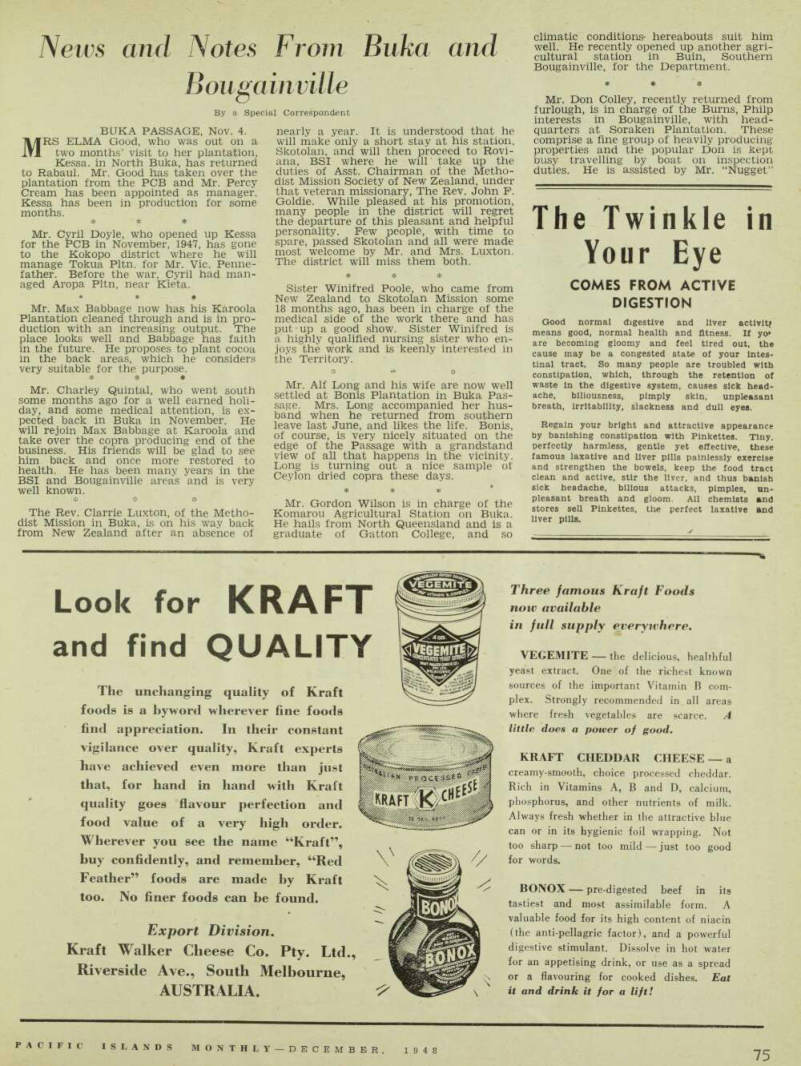
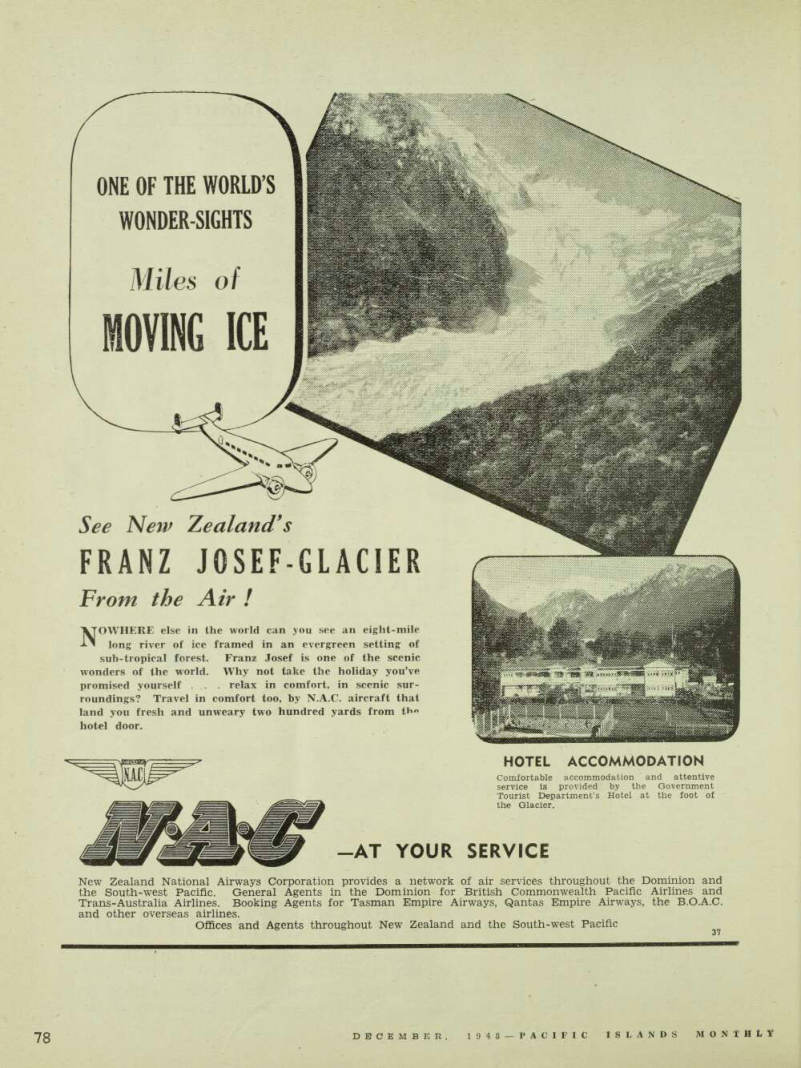
News and Notes From Buka and Bougainville
By a Special Correspondent
Buka Passage, Nov. 4.
MRS ELMA Good, who was out on a two months’ visit to her plantation, Kessa. in North Buka, has returned to Rabaul. Mr. Good has taken over the plantation from the PCB and Mr. Percy Cream has been appointed as manager.
Kessa has been in production for some months. * * * Mr. Cyril Doyle, who opened up Kessa for the PCB in November, 1947, has gone to the Kokopo district where he will manage Tokua Pltn, for Mr. Vic. Penne father. Before the war, Cyril had man aged Aropa Pltn, near Kieta. * * * Mr. Max Babbage now has his Karoola Plantation cleaned through and is in pro duction with an increasing output. The place looks well and Babbage has faith in the future. He proposes to plant cocoa in the back areas, which he considers very suitable for the purpose. * * ♦ Mr, Charley Quintal, who went south some months ago for a well earned holi day, and some medical attention, is ex pected back in Buka in November. He will rejoin Max Babbage at Karoola and take over the copra producing end of the business. His friends will be glad to see him back and once more restored to health. He has been many years in the BSI and Bougainville areas and is very well known.
The Rev. Clarrie Luxton, of the Metho dist Mission in Buka, is on his way back from New Zealand after an absence of
nearly a year. It is understood that he will make only a short stay at his station, Skotolan, and will then proceed to Rovi ana, BSI where he will' take up the duties of Asst. Chairman of the Metho dist Mission Society of New Zealand, under that veteran missionary, The Rev. John F.
Goldie. While pleased at his promotion, many people in the district will regret the departure of this pleasant and helpful personality. Few people, with time to spare, passed Skotolan and all were made most welcome by Mr. and Mrs. Luxton.
The district will miss them both. * * * Sister Winifred Poole, who came from New Zealand to Skotolan Mission some 18 months ago, has been in charge of the medical side of the work there and has put up a good show. Sister Winifred is a highly qualified nursing sister who en joys the work and is keenly interested in the Territory.
Mr. Alf Long and his wife are now well settled at Bonis Plantation in Buka Pas sage. Mrs. Long accompanied her hus band when he returned from southern leave last June, and likes the life. Bonis, of course, is very nicely situated on the edge of the Passage with a grandstand view of all that happens in the vicinity.
Long is turning out a nice sample of Ceylon dried copra these days. ♦ * * Mr. Gordon Wilson is in charge of the Komarou Agricultural Station on Buka.
He hails from North Queensland and is a graduate of Gatton College, and so
climatic conditions- hereabouts suit him well. He recently opened up another agri cultural station in Buin, Southern Bougainville, for the Department. * * * Mr. Don Colley, recently returned from furlough, is in charge of the Burns, Philp interests in Bougainville, with head quarters at Soraken Plantation. These comprise a fine group of heavily producing properties and the popular Don is kept busy travelling by boat on inspection duties. He is assisted by Mr. “Nugget”
Nugent, who joined up with the firm some time ago, and handles the plantation ac counts. “Nugget” comes from Victoria but was in New Guinea during the war period and fits in nicely. * ♦ ♦ Old Timers in the District were grieved to hear of the recent death in Sydney of Mr. R. A. Robinson, who was connected for so long with the Burns, Philp planta tion section. Before becoming the firm’s Chief Plantation Inspector for New Guinea, “Robbie” had been Group
Manager at Soraken for a while and was a very popular resident. * * ♦ Mr. Sid Paisley is in charge at Banui Plantation. He and Mrs. Paisley have been resident there for some months.
Whilst no stranger to Bougainville dis trict Sid is probably better known in Madang and Wewak areas, where he managed plantations before the war. sK * * Word that Mr. Rolf Cambridge, had been appointed to the position of Chief
Inspector of Plantations for Burns, Philp, as a successor to Mr. R. A. Robinson, gave a lot of satisfaction to the same Old Timers as he, also, had been Group Manager at Soraken before the War and was logical successor to “Robbie.” Like “Robbie,” he had many years experience in the BSI before coming to this Territory, both having served with the late Allan Campbell there. * * * MR. CLAUDE CAMPBELL has his Raua Plantation in very good shape these days. He has a comfortable bun galow, good station buildings and a sub stantially built Ceylon Dryer and copra shed. The coconut palms are in good condition and carrying excellent crops.
The plantation has more of the pre-war look about it than any other your corres pondent has seen in the district. A force of “redskin” labour, from New Guinea mainland, has assisted in this desirable result. The Ceylon Dryer is turning out an excellent sample of copra. * ♦ * Mr. Charlie Smith of Tinputz Plantation has been suffering from a dearth of labour for some time, but has now received a batch of “redskins” from Madang way, so hopes to make good progress. The introduction of labour from another dis trict has a healthy effect upon the locals, who then find that they are not indis pensable. * * * Tearouki Plantation, on Teop Harbour, has recently been acquired from Mrs. Eva Falkner by Bishop T. J. Wade for the Marist Mission’s Headquarters when a move is made from Torokina. Tearouki is a fine plantation with a good frontage to one of the best harbours in Bougain ville and should be ideally suited for the purpose, The Rev. Fr. Lebel is in charge at present and is energetically proceeding with the building programme which in cludes Mission house, church, native school and hospital. No one knows how to ex tract “sixty seconds worth of distance rmi” from every unforgiving minute, better than the Padre! * * * Mr. and Mrs. A. M. Stewart, who have been at Teopasino Plantation for some time are shortly proceeding to Australia on leave. Mr. Stewart opened up the plantation after the war and brought it into production. He is an old resident of the Territory, having come up for the Ex propriation Board back in 1920 and was Plantation Inspector and Branch Manager for the Board in several districts. Like so many of our elder residents he served in both World Wars. * * * Mr. Paul Mason and his wife have made themselves comfortable at Inus Plantation.
There is a good bungalow, built of local material and the cool breeze from the mountains makes it a pleasant place at night. Mrs. Mason was formerly a jour nalist and finds much of interest, and to write about, in her new surroundings. * 4r
Pastor Cyril Pascoe, Who Is In
charge of the Seventh Day Adven tist Mission in Bougainville, has established himself at anew station just north of Inus, and, with the assistance of his brother Ernie, has made a good show. He has recently taken delivery of anew 45 foot boat which will be used for the Mission work in Bougainville. It is a well built and fitted craft with a 50 horsepower Gardiner Diesel engine, and should be most suitable. There will be general satisfaction at the return of the Pascoes to the district. * * * Mr. “Sandy” Sandford is in charge at Numa Numa, whilst Mr. Drummond Thomson is a wav on a southern holiday.
“Sandy” leads a busy life with an increas ing copra production and a big labour line to maintain, but he gets away with it.
His house is much admired by visitors as it shows a deal of ingenuity and im provisation, and just what can be done with the unconsidered trifles of military camps. Mrs. Sandford is a keen gardener and has achieved fine results. * * * Mr. Bob Stuart and his wife are settled in at Tenekau and are turning out copra in a satisfactory way. Stuart is one of the older Bougainville residents and in pre-war days put much hard work into the development of his plantation, which is now a valuable property. ♦ ♦ * Mr. Jim Joyes, wife and family of three, are living on Iwi, below Kieta. Joyes also owns Kekere, which is close to Iwi. He is getting copra out of both places, but, like all others at the soutnern end of Bougainville has had a continuous battle for supplies and shipping. ♦ * ♦ Mr. Robin McKay, who bought Aropa last year has had a busy time since taking over the plantation. Opening up a pro perty and having to scratch for labour and supplies is no sinecure. However, he has plenty of enthusiasm and energy and has managed both cleaning-up and produc tion. Mrs. McKay is at present in Aus tralia. ♦ * * Mr. W. A. L. Clarke, “Clarkie” to all, is running Toimanapu for Burns, Philp. It is an old stamping ground of his and the firm are old employers, so filling in the complicated monthly returns is no trouble.
Mrs. Clarke is also at the plantation, and likes the life. * * * Messrs. Bob and Bernie Parer are still conducting their salvaging operations at Torokina, with the assistance of several helpers. The brothers are a busy and popular pair and do a deal of travelling in pursuit of their business. People like their genial ways and easy way of making a deal.
Shipping is Now Bougainville’s
Greatest Problem
11HE plantations in the district are now producing more copra, and the natives are bringing in a consider able amount of trade copra, from the Buka area, to the various traders, so that the district output has substantially grown.
The need for extra shipping to move it all is now felt.
Most of the plantations are producing Ceylon Dried copra—cooked in the half shell —but most of the native stuff is smoke dried, and the general quality of it leaves much to be desired. Brown brother realises that, in the absence of in spection, copra not fully dried is heavier and brings in more cash!
Bougainville is, of course, a heavy pro ducing area and before the war the “Malaita,” at 6 weekly intervals, picked up aH copra from the bigger Burns, Philp plantations and Numa Numa, while 500ton inter-island steamers came out from Rabaul at three-weekly intervals to deal with copra of the smaller plantations.
Further, there were various 50-ton schooners that frequently brought loading out and returned to Rabaul full of copra.
Of late there seems to be a lack of re liable information, as to ships movements, both from the Directorate of Shipping and from the agents—even visits to the offices of both, in Rabaul, leaves the intending shipper and/or passenger rather be wildered. To the Outports man, anxious about his incoming cargo and copra ship ments, the delay in leaving Rabaul, alter ation of route and places of pick up, are an additional worry, and they consider that they are entitled to more considera tion than they are at present receiving.
After all, they do supply the freights and
the reason for the ship coming! But the shipping point of view, seemingly, is that the outports are lucky to have any service at a ii i
A bone of contention, and a serious one, is that on a number of occasions ships have passed Sohano—the HQ of the Bougainville District—without stopping to
pick up the inward (to Rabaul) mail. This lack of courtesy may well mean consider able delay to urgent and important letters which may thus miss one or two air mails from Rabaul. Surely His Majesty’s mails are entitled to every consideration, as was accorded them at outports in pre-war days. Will someone please take note!
Passengers, too, might well be accorded a little more consideration. The inward bound ships are nearly always carrying more passengers than there is accommo dation for; and while passengers do not enjoy sleeping on a settee, or on any dry place on deck, they put up with it, if they must travel to Rabaul to do business.
To be informed, however, that he is “very lucky” and to be reminded, even jocularly, that extra passengers make the ship uncomfortable and imperil the food supply, is something no passenger enjoys.
When he pays £l/10/- for the first day and £1 for every other day, or part there of he feels that he is entitled to everything he gets—which is not much at all!
The Chinese stores at Buka Passage, conducted by Wong You and Laurie Chan, are hives of industry these days and the owners do a flourishing and increasing business. Both stores keep a good range of European goods, besides native trade goods. Prices compare favourably with those of the Rabaul stores, and most resi dents prefer to buy locally, and see what they get, rather than order from Rabaul and have their goods subjected to the “round the world tours” and eccentric de liveries, which seems to be an inseparable part of our present shipping set up. The local Chinese stores concede that the customer is often right and is entitled to every attention —which is a nice change!
Sister Shirley Grey and the Rev. Wesley Lutton sailed on the December “Bulolo” from Sydney to take up work with the Methodist Mission in New Britain.
Advertisements & other items, pp. 77-81 (2 items)
Your Eye
The Twinkle in
COMES FROM ACTIVE
DIGESTION
Good normal digestive and liver actlvlt? means good, normal health and fitness. If yo» are becoming gloomy and feel tired out, the cause may be a congested state of your intestinal tract. So many people are troubled with constipation, which, through the retention of waste in the digestive system, causes sick headache, biliousness, pimply skin, unpleasant breath, Irritability, slackness and dull eyes.
Regain your bright and attractive appearance by banishing constipation with Plnkettes. Tiny, perfectly harmless, gentle yet effective, these famous laxative and liver pills painlessly exercise and strengthen the bowels, keep the food tract clean and active, stir the liver, and thus banish sick headache, bilious attacks, pimples, unpleasant breath and gloom. All chemists and stores sell Pinkettes, the perfect laxative and liver pills.
Look for KRAFT
and find QUALITY
The unchanging quality of Kraft foods is a byword wherever fine foods find appreciation. In their constant vigilance over quality, Kraft experts have achieved even more than just that, for hand in hand with Kraft quality goes flavour perfection and food value of a very high order.
Wherever you see the name “Kraft”, buy confidently, and remember, “Red Feather” foods are made by Kraft too. No finer foods can be found.
Export Division .
Kraft Walker Cheese Co. Pty. Ltd.,
Riverside Ave., South Melbourne,
AUSTRALIA.
KRAFT
Three famous Kraft Foods now available in full supply everywhere .
VEGEMITE the delicious, healthful yeast extract. One of the richest known sources of the important Vitamin B complex. Strongly recommended in all areas where fresh vegetables are scarce. A little does a power of good.
KRAFT CHEDDAR CHEESE a
creamy-smooth, choice processed cheddar.
Rich in Vitamins A, B and D, calcium, phosphorus, and other nutrients of milk.
Always fresh whether in the attractive blue can or in its hygienic foil wrapping. Not too sharp not too mild—just too good for words.
BONOX pre-digested beef in its tastiest and most assimilable form. A valuable food for its high content of niacin (the anti-pellagric factor), and a powerful digestive stimulant. Dissolve in hot water for an appetising drink, or use as a spread or a flavouring for cooked dishes. Eat it and drink it for a lift!
•••«* M
Even Dad will want to help
The gleaming satin smooth finish of a Wunderlich Stainless Steel Sink Unit makes the task of washing dishes so much more attractive even Dad will be eager to assist.
Ask him to buy one for your kitchen , . . they are made 4ft., 5 ft. and 6 ft. long by I ft. 6 ins. wide.
The units are backed with timber to simplify installation supplies are available now.
See your local Hardware Merchant, 'phone MX 241 I, or write to Box 474, G.P.O. Sydney, for illustrations and prices.
S^ifunclerl Left
INK. UNITS
IN STAIN LESS ST-E-EL
BROOMFIELDS Ltd.
Suppliers of
Building Hardware
Ship Chandlery, Paint Materials
■ H
WRITE DIRECT TO:
Broomfields Ltd., 152 Sussex Street, Sydney
Woven Wire for all Industry
COPRA DRYING TRAYS, FLOORS, Etc.
FRUIT DRYING TRAYS, MINING SCREENS.
Heavy Mosquito Gauze in Phosphor Bronze and other Metals Impervious to Salt Sea Air.
WIRE DOOR MATS AND GENERAL WIRE WORKS
E. WRIGHT & CO. LTD.
Office and Works: 148-152 Cleveland Street, Sydney, N.S.W.
Telegraphic Address: "Wrlghtmake,” Chippendale. * Or £
_A
jVJ
AP2
INDOORS or OUT
BRILLIANT LIGHTING
WHEN £r WHERE REQUIRED
The vapour lamps are the last word in efficiency in modern kerosene lighting. Burn for 10 hours on U pints kerosene. All spare parts available.
Obtainable in two models, the AP2 and HL7. Write for leaflet.
HL7
DEKOL
Guards Wood and Canvas from the Ravages of White Ants, Borers, Dry Rot, Mildew, etc.
DEKOL penetrates deeply, permanently protecting wood and fabrics from rot and attacks by fungi and insects. It Is simple to apply and when dry can be painted and varnished. DEKOL also prevents attack by marine borers on wood immersed in sea water.
DON'T WAIT
TILL THIS
HAPPENS.
If Trade Inquiries Invited.
R
ANCHORS
The light-weight anchor with three times the holding power of any other anchor. Designed for positive and quick “dig in, the C.Q.R. anchor is two well-designed ploughshares welded together.
Write for another leaflet.
W. KOPSEN 8 CO. PTV. LTD.
SHIPCHANDLERS Cr MARINE ENGINEERS
376-382 KENT STREET, SYDNEY. PHONE: MA 6336 (9 lines).
Cables: “KOPSEN” Sydney.
ONE OF THE WORLD’S
WONDER-SIGHTS
Miles of
MOVING ICE
See New Zealand’s
FRANZ JOSEF-GLACIER
From the Air !
NOWHERE else in the world can you see an eight-mile long river of ice framed in an evergreen setting of sub-tropical forest. Franz Josef is one of the scenic wonders of the world. Why not take the holiday you’ve promised yourself . . . relax in comfort, in scenic surroundings? Travel in comfort too, by N.A.C. aircraft that land you fresh and unweary two hundred yards from hotel door.
HOTEL ACCOMMODATION
Comfortable accommodation and attentive service is provided by the Government Tourist Department’s Hotel at the foot of the Glacier.
-AT YOUR SERVICE
New Zealand National Airways Corporation provides a network of air services throughout the Dominion and the South-west Pacific. General Agents in the Dominion for British Commonwealth Pacific Airlines and Trans-Australia Airlines. Booking Agents for Tasman Empire Airways, Qantas Empire Airways, the 8.0.A.C. and other overseas airlines.
Offices and Agents throughout New Zealand and the South-west Pacific
Phone: Rabaul 12 (Transport) (Engineering)
COMPANY LIMITED, RABAUL
MOTOR, GENERAL AND ELECTRICAL ENGINEERS
Customs, Shipping and Forwarding Agents
GENERAL CARRIERS AND TRANSPORT SERVICES
DISTRIBUTORS:
International Trucks and Tractors.
McCormick-Deering Agricultural Equipment.
Armstrong-Holland Products.
Century Batteries.
Defender Refrigerators.
Shell and Vacuum Oil Products.
Motor and Electrical Accessories.
CHIEF AGENTS FOR
ROYAL INSURANCE
CO. LTD.
Vehicle, Fire, Accident,
Marine, etc.
Cables; Trenco, Rabaul T & E
78
DECEMBER, 1948 PACIFIC ISLANDS MONtHtt
Tongan Bernadette
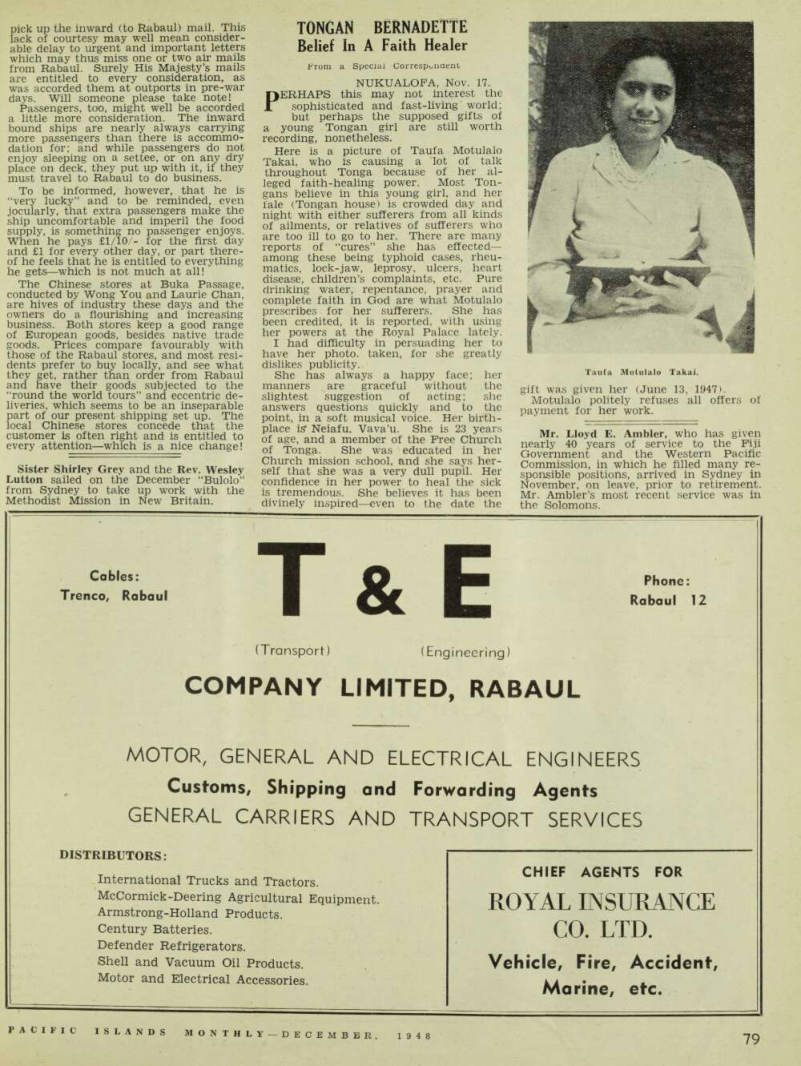
Belief In A Faith Healer
From a Special Correspondent,
Nukualofa, Nov. 17.
PERHAPS this may not interest the sophisticated and fast-living world; but perhaps the supposed gifts of a young Tongan girl are still worth recording, nonetheless.
Here is a picture of Taufa Motulalo Takai, who is causing a lot of talk throughout Tonga because of her al leged faith-healing power. Most Ton gans believe in this young girl, and her fale (Tongan house) is crowded day and night with either sufferers from all kinds of ailments, or relatives of sufferers who are too ill to go to her. There are many reports of “cures” she has effected— among these being typhoid cases, rheu matics, lock-jaw, leprosy, ulcers, heart disease, children’s complaints, etc. Pure drinking water, repentance, prayer and complete faith in God are what Motulalo prescribes for her sufferers. She has been credited, it is reported, with using her powers at the Royal Palace lately.
I had difficulty in persuading her to have her photo, taken, for she greatly dislikes publicity.
She has always a happy face; her manners are graceful without the slightest suggestion of acting: she answers questions quickly and to the point, in a soft musical voice. Her birth place i£ Neiafu, Vava’u. She is 23 years of age, and a member of the Free Church of Tonga. She was educated in her Church mission school, and she says her self that she was a very dull pupil. Her confidence in her power to heal the sick is tremendous. She believes it has been divinely inspired—even to the date the
gift was given her (June 13, 1947).
Motulalo politely refuses all offers of payment for her work.
Mr. Lloyd E. Ambler, who has given nearly 40 years of service to the Fiji Government and the Western Pacific Commission, in which he filled many re sponsible positions, arrived in Sydney in November, on leave, prior to retirement.
Mr. Ambler’s most recent service was in the Solomons.
Taufa Motulalo Takai.
An Appreciation Of Mrs. E.
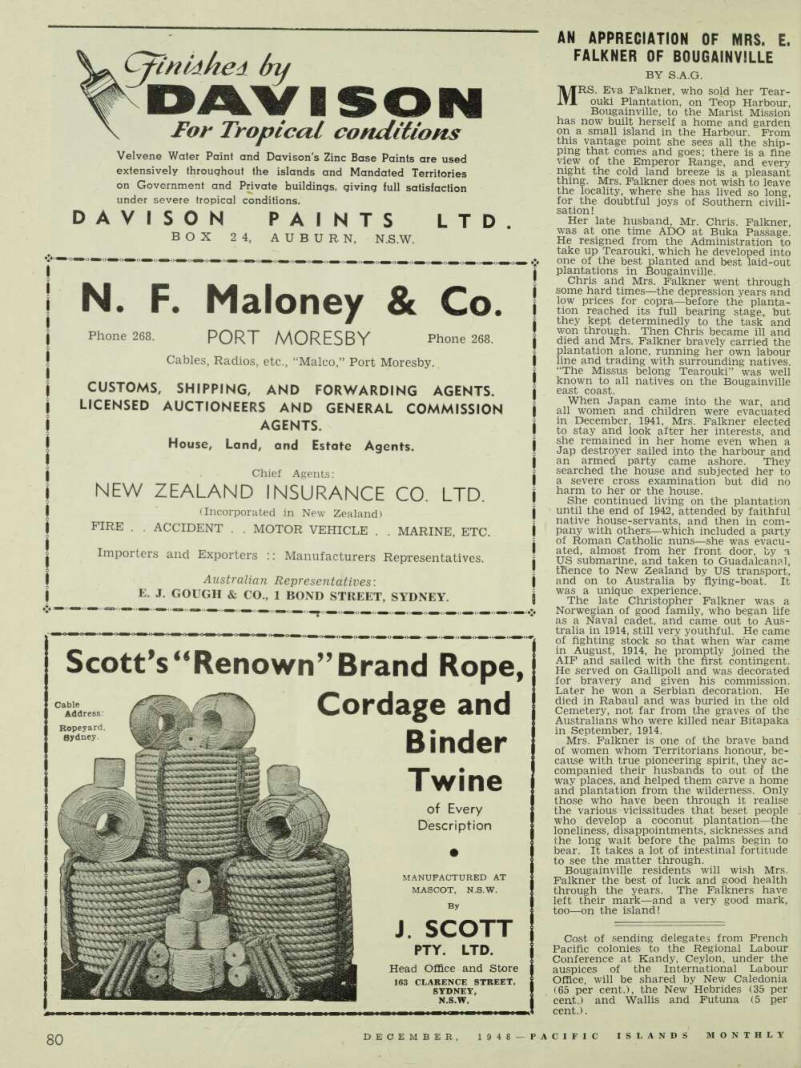
Falkner Of Bougainville
By S.A.G.
MRS. Eva Falkner, who sold her Tear ouki Plantation, on Teop Harbour, Bougainville, to the Marist Mission has now built herself a home and garden on a small island in the Harbour. From this vantage point she sees all the ship ping that comes and goes; there is a fine view of the Emperor Range, and every night the cold land breeze is a pleasant thing. Mrs. Falkner does not wish to leave the locality, where she has lived so long, for the doubtful joys of Southern civili sation!
Her late husband, Mr. Chris. Falkner, was at one time ADO at Buka Passage.
He resigned from the Administration to take up Tearouki, which he developed into one of the best planted and best laid-out plantations in Bougainville.
Chris and Mrs. Falkner went through some hard times—the depression years and low prices for copra—before the planta tion reached its full bearing stage, but they kept determinedly to the task and won through. Then Chris became ill and died and Mrs. Falkner bravely carried the plantation alone, running her own labour line and trading with surrounding natives.
“The Missus belong Tearouki” was well known to all natives on the Bougainville east coast.
When Japan came into the war, and all women and children were evacuated in December, 1941, Mrs. Falkner elected to stay and look after her interests, and she remained in her home even when a Jap destroyer sailed into the harbour and an armed party came ashore. They searched the house and subjected her to a severe cross examination but did no harm to her or the house.
She continued living on the plantation until the end of 1942, attended by faithful native house-servants, and then in com pany with others—which included a party of Roman Catholic nuns—she was evacu ated, almost from her front door, by a US submarine, and taken to Guadalcanal, tnence to New Zealand by US transport, and on to Australia by flying-boat. It was a unique experience.
The late Christopher Falkner was a Norwegian of good family, who began life as a Naval cadet, and came out to Aus tralia in 1914, still very youthful. He came of fighting stock so that when war came in August, 1914, he promptly joined the AIF and sailed with the first contingent.
He served on Gallipoli and was decorated for bravery and given his commission.
Later he won a Serbian decoration. He died in Rabaul and was buried in the old Cemetery, not far from the graves of the Australians who were killed near Bitapaka in September, 1914.
Mrs. Falkner is one of the brave band of women whom Territorians honour, be cause with true pioneering spirit, they ac companied their husbands to out of the way places, and helped them carve a home and plantation from the wilderness. Only those who have been through it realise the various vicissitudes that beset people who develop a coconut plantation—the loneliness, disappointments, sicknesses and the long wait before the palms begin to bear. It takes a lot of intestinal fortitude to see the matter through.
Bougainville residents will wish Mrs.
Falkner the best of luck and good health through the years. The Falkners have left their mark —and a very good mark, too —on the island!
Cost of sending delegates from French Pacific colonies to the Regional Labour Conference at Kandy, Ceylon, under the auspices of the International Labour Office, will be shared by New Caledonia (65 per cent.), the New Hebrides (35 per cent.) and Wallis and Futuna (5 per cent.).
Advertisements & other items, p. 82 (2 items)
80
ACIFIC ISLANDS MONTHLY
DECEMBER, 1948 P
Opnldked
For Tropical conditions
Velvene Water Paint and Davison's Zinc Base Paints are used extensively throughout the islands and Mandated Territories on Government and Private buildings, giving full satisfaction under severe tropical conditions.
DAVISON PAINTS LTD
BOX 2 4, AUBURN, N.S.W.
N. F. Maloney & Co.
Phone 268. PORT MORESBY Phone 268.
Cables, Radios, etc., “Malco,” Port Moresby.
CUSTOMS, SHIPPING, AND FORWARDING AGENTS.
LICENSED AUCTIONEERS AND GENERAL COMMISSION
AGENTS.
House, Land, and Estate Agents.
Chief Agents:
NEW ZEALAND INSURANCE CO. LTD.
(Incorporated In New Zealand) FIRE . . ACCIDENT . . MOTOR VEHICLE . . MARINE, ETC.
Importers and Exporters :: Manufacturers Representatives.
Australian Representatives : E. J. GOUGH & CO., 1 BOND STREET, SYDNEY.
Scott's “Renown” Brand Rope,
Cable Address Ropeyard Sydney.
SBH^SswasgggsE'
I MBS?
E2SBS
Cordage and
Binder
Twine
of Every Description
MANUFACTURED AT
MASCOT. N.S.W.
By
J. SCOTT
PTY. LTD.
Head Office and Store
163 CLARENCE STREET,
SYDNEY,
N.S.W.
New Zealand—Fiji—
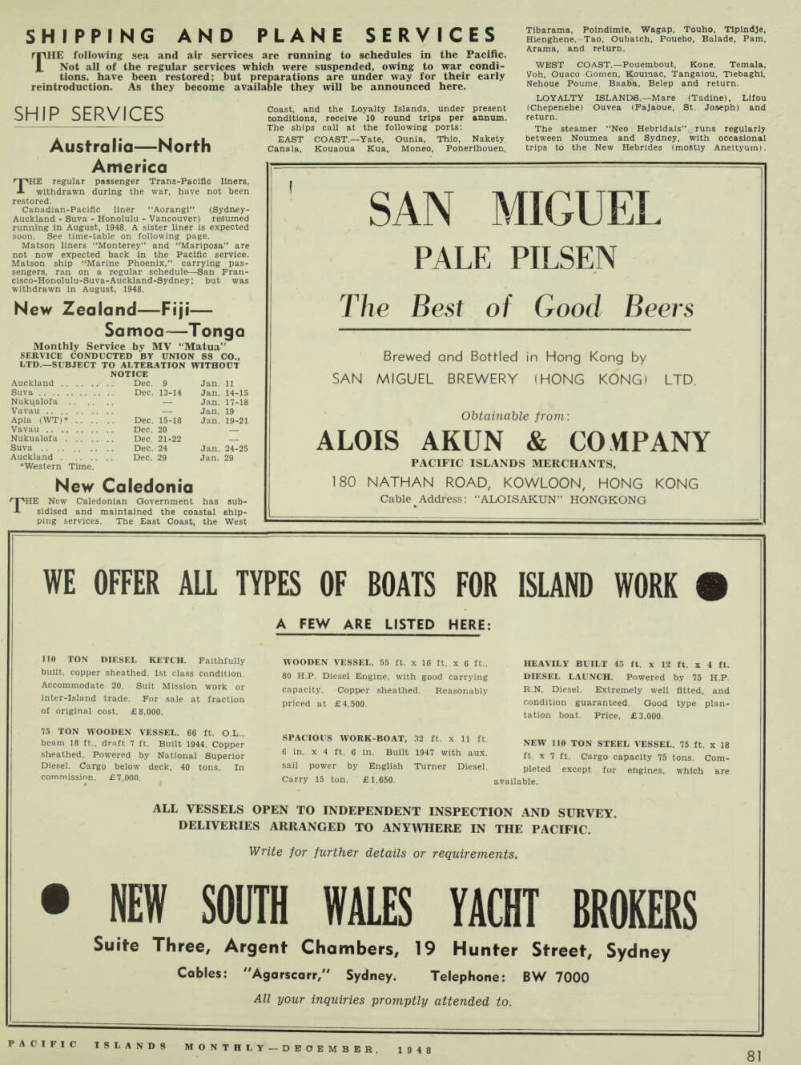
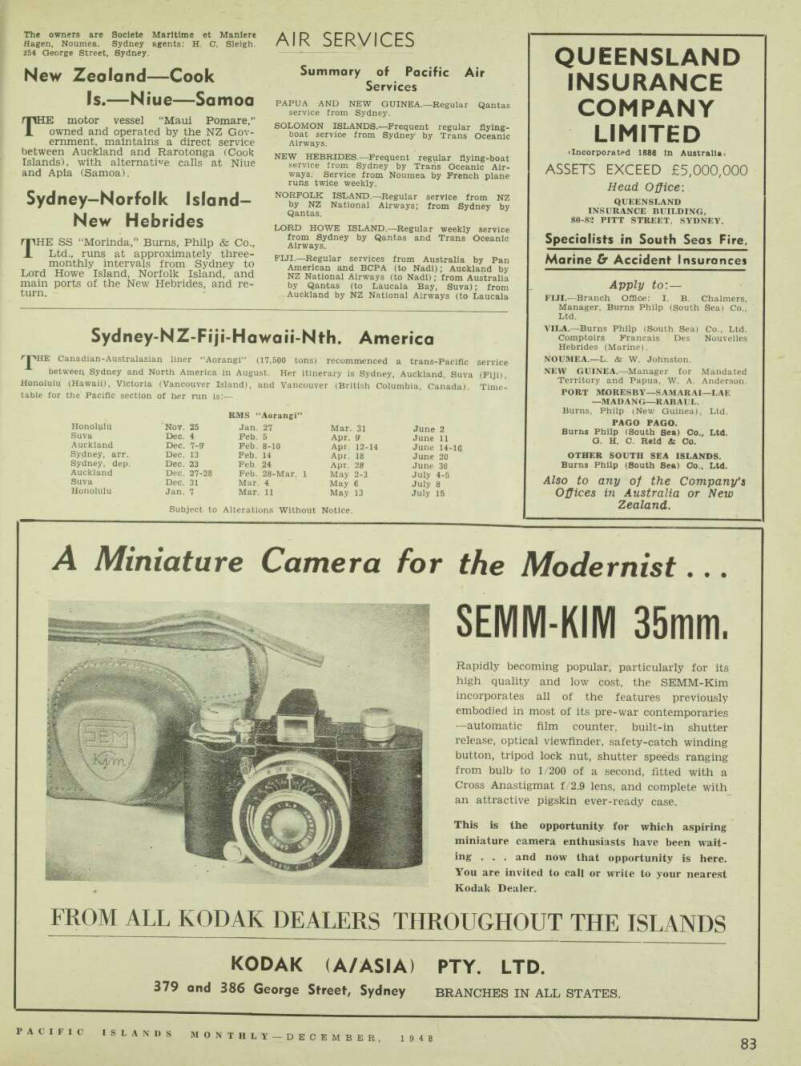
Shipping And Plane Services
THE following sea and air services are running to schedules in the Pacific.
Not all of the regular services which were suspended, owing to war condi tions. have been restored; but preparations are under way for their early reintroduction. As they become available they will be announced here.
Ship Services
Australia—North
America
THE regular passenger Trans-Paciflc liners, withdrawn during the war, have not been restored.
Canadian-Pacific liner “Aorangi” (Sydney- Auckland - Suva - Honolulu - Vancouver) resumed running in August, 1948. A sister liner is expected soon. See time-table on following page.
Matson liners “Monterey” and “Mariposa” are not now expected back in the Pacific service.
Matson ship “Marine Phoenix,” carrying pas sengers, ran on a regular schedule —San Fran cisco-Honolulu-Suva-Auckland-Sydney; but was withdrawn in August, 1948.
New Zealand—Fiji—
Samoa—Tonga
Monthly Service by MV “Matua”
Service Conducted By Union Ss Co.,
Ltd.—Subject To Alteration Without
Notice
New Caledonia
THE New Caledonian Government has sub sidised and maintained the coastal ship ping services. The East Coast, the West
Coast, and the Loyalty Islands, under present conditions, receive 10 round trips per annum.
The ships call at the following ports: EAST COAST.—Yate, Ounia, Thio, Nakety, Canala, Kouaoua Kua, Moneo, Ponerifiouen,
Tibarama, Polndimie, Wagap, Touho, Tlpindje, Hienghene, Tao, Oubatch, Pouebo, Balade, Pam, Arama, and return.
WEST COAST. —Pouembout, Kone, Temala, Vbh, Ouaco Gomen, Koumac, Tangaiou, Tiebaghi, Nehoue Poume, Baaba, Belep and return.
LOYALTY ISLANDS.—Mare (Tadine), Lifou (Chepenehe) Ouvea (Fajaoue, St. Joseph) and return.
The steamer “Neo Hebridais” runs regularly between Noumea and Sydney, with occasional trips to the New Hebrides (mostly Aneityum).
Auckland Dec. 9 Jan. 11 Suva Dec. 13-14 Jan. 14-15 Nukualofa — Jan. 17-18 Vavau — Jan. 19 Apia (WT)* Dec. 15-18 Jan. 19-21 Vavau Dec. 20 — Nukualofa Dec. 21-22 — Suva Dec. 24 Jan. 24-25 Auckland Dec. 29 Jan. 29 ““Western Time.
The owners are Societe Maritime et Manlere Hagen, Noumea. Sydney agents: H. C. Sleigh. 254 George Street, Sydney.
New Zealand—Cook
Is.—Niue—Samoa
rpHE motor vessel “Maui Pomare,”
X owned and operated by the NZ Gov ernment, maintains a direct service between Auckland and Rarotonga (Cook Islands), with alternative calls at Niue and Apia (Samoa).
Sydney-Norfolk Island-
New Hebrides
THE SS “Morinda,” Burns, Philp & Co., Ltd., runs at approximately three monthly intervals from Sydney to Lord Howe Island, Norfolk Island, and main ports of the New Hebrides, and re turn.
Air Services
Summary of Pacific Air
Services
PAPUA AND NEW GUlNEA.—Regular Qantas service from Sydney.
SOLOMON ISLANDS.—Frequent regular flying boat service from Sydney by Trans Oceanic Airways.
NEW HEBRlDES.—Frequent regular flying-boat service from Sydney by Trans Oceanic Air ways. Service from Noumea by French plane runs twice weekly.
NORFOLK ISLAND.—Regular service from NZ by NZ National Airways; from Sydney by Qantas.
LORD HOWE ISLAND. —Regular weekly service from Sydney by Qantas and Trans Oceanic Airways.
FlJl.—Regular services from Australia by Pan American and BCPA (to Nadi); Auckland by NZ National Airways (to Nadi); from Australia by Qantas (to Laucala Bay, Suva); from Auckland by NZ National Airways (to Laucala
Advertisements & other items, pp. 83-84 (2 items)
Hew South Wales Yacht Brokers
SAN MIGUEL
PALE PILSEN
The Best of Good Beers
Brewed and Bottled in Hong Kong by
SAN MIGUEL BREWERY (HONG KONG) LTD.
Obtainable from :
ALOIS AKUN & COMPANY
PACIFIC ISLANDS MERCHANTS,
180 NATHAN ROAD, KOWLOON, HONG KONG
Cable Address: “ALOISAKUN” HONGKONG
WE OFFER ALL TYPES OF BOATS FOR ISLAND WORK •
A FEW ARE LISTED HERE:
110 TON DIESEL KETCH. Faithfully built, copper sheathed. Ist class condition.
Accommodate 20. Suit Mission work or inter-island trade. For sale at fraction of original cost. £B,OOO. 75 TON WOODEN VESSEL. 66 ft. 0.L., beam 18 ft., draft 7 ft. Built 1944. Copper sheathed. Powered by National Superior Diesel. Cargo below deck, 40 tons. In commission. £7,000.
WOODEN VESSEL, 55 ft. X 16 ft. X 6 ft.. 80 H.P. Diesel Engine, with good carrying capacity. Copper sheathed. Reasonably priced at £4,500.
SPACIOUS WORK-BOAT, 32 ft. x 11 ft. 6 in. x 4 ft. 6 in. Built 1947 with aux. sail power by English Turner Diesel.
Carry 15 ton. £1,650.
HEAVILY BUILT 45 ft. x 12 ft. x 4 ft.
DIESEL LAUNCH. Powered by 75 H.P.
R.N. Diesel. Extremely well fitted, and condition guaranteed. Good type plantation boat. Price, £3,000.
NEW 110 TON STEEL VESSEL. 75 ft. X 18 ft. x 7 ft. Cargo capacity 75 tons. Completed except for engines, which are available.
ALL VESSELS OPEN TO INDEPENDENT INSPECTION AND SURVEY.
DELIVERIES ARRANGED TO ANYWHERE IN THE PACIFIC.
Write for further details or requirements.
HEW SOUTH WALES YACHT BROKERS
Suite Three, Argent Chambers, 19 Hunter Street, Sydney
Cables: "Agarscarr," Sydney. Telephone: BW 7000
All your inquiries promptly attended to.
You can Always Depend on
Attention !
DO NOT PASS BY THIS NOTICE
_0) CL E o u -o c a a u ARE YOU handling Trade Items from Hongkong and the Far East?. • • HAVE YOU communicated with
CHINA-NEW GUINEA MERCANTILE CO.,
36 Connaught Road Central, HONGKONG? • •
. You Are ?
. . Not Yet ?
THEN YOU are missing a GOLDEN LINK in your connections
with Hongkong and the Far East.
WHY?
Because I know that they are a very old and reliable concern with over 20 years' experience in the supply of all kinds of merchandise, including the following:— Tin and Brass Torchcases.
Torch Batteries.
Straw Mats.
Safety Matches.
Imitation Leather Suitcases.
Camphorwood Boxes.
Shirting Materials.
Underpants.
Linen Dinner Sets.
Fountain Pens.
Plastic Harmonicas.
Straw Hats.
Rubber Balls.
Rattan Furniture.
T-Shirts.
Hurricane Lanterns.
Cotton Piecegoods.
Laundry Soap.
Artificial Fibre Suitcases.
Leather Suitcases.
Trade Boxes.
Pyjamas.
Linen Handkerchiefs.
Ivory Wares and Ornaments.
Nylon Stockings.
Swimming Trunks.
Canvas Rubber Shoes.
Thermos Flasks.
Charcoal Irons.
Sport Shirts.
Kerosene Lamps.
Grass and Cord Mats.
Cement.
Fibre Suitcases.
Camphorwood Trunks.
Shirts.
Khaki Shorts.
Linen Tea Sets.
Lacquer Goods.
Men’s and Ladies’ Cotton Anklets.
Sun Helmets.
Leather Footballs.
Pillow Cases and Sheets.
Singlets.
Etc., Etc., Etc., Etc. and in most cases I have found their prices the cheapest. I am thoroughly satisfied with their prompt service, and do not hesitate to recommend this house to you.
IF I WERE YOU
would lose no time to write to them letting them know of your requirements
IMMEDIATELY.
FOR SERVICE AND SATISFACTION CONTACT
CHINA-NEW GUINEA MERCANTILE CO
36, Connaught Road Central, Hongkong
Cable Address: Chigatile.
Bankers: Hongkong & Shanghai Banking Corporation, Des Voeux Road, Hongkong. 3 0 1 Z t c 5’ o o n o 3 ■D O 3 We Assure Prompt Attention to all Enquiries
82
DECEMBER, 19 4 8 -PACIFIC ISLANDS MONTHLV
Sydney-NZ-Fiji-Hawaii-Nth. America
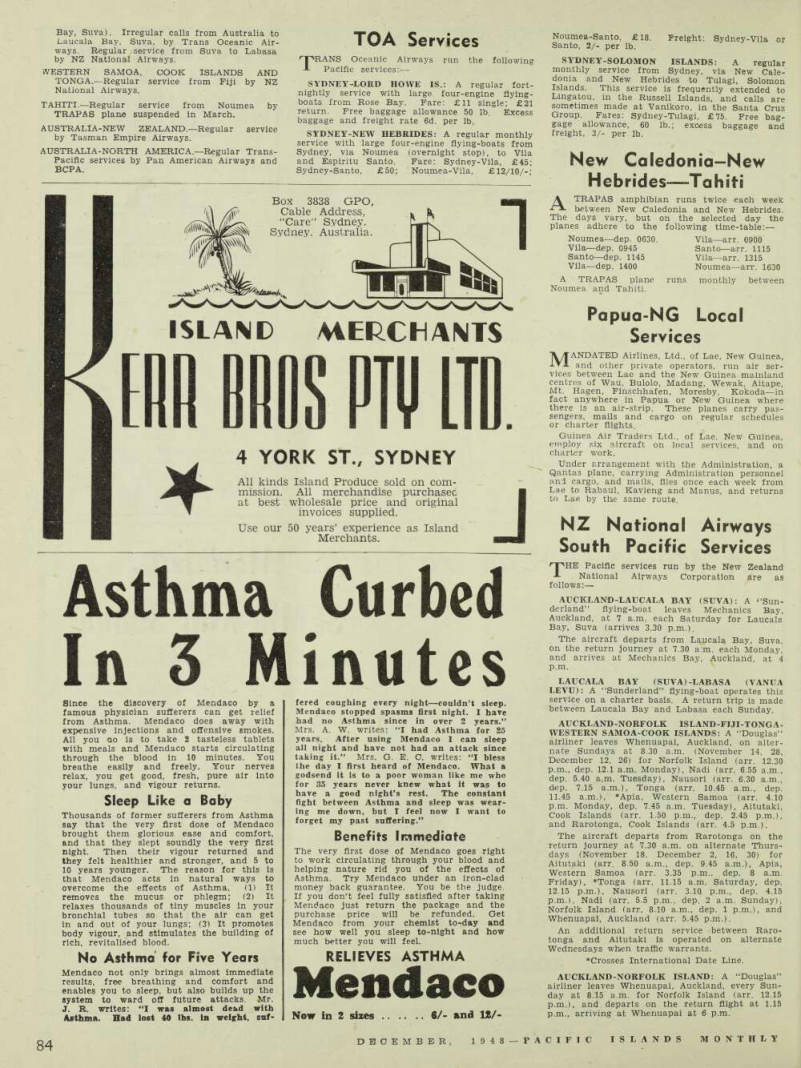
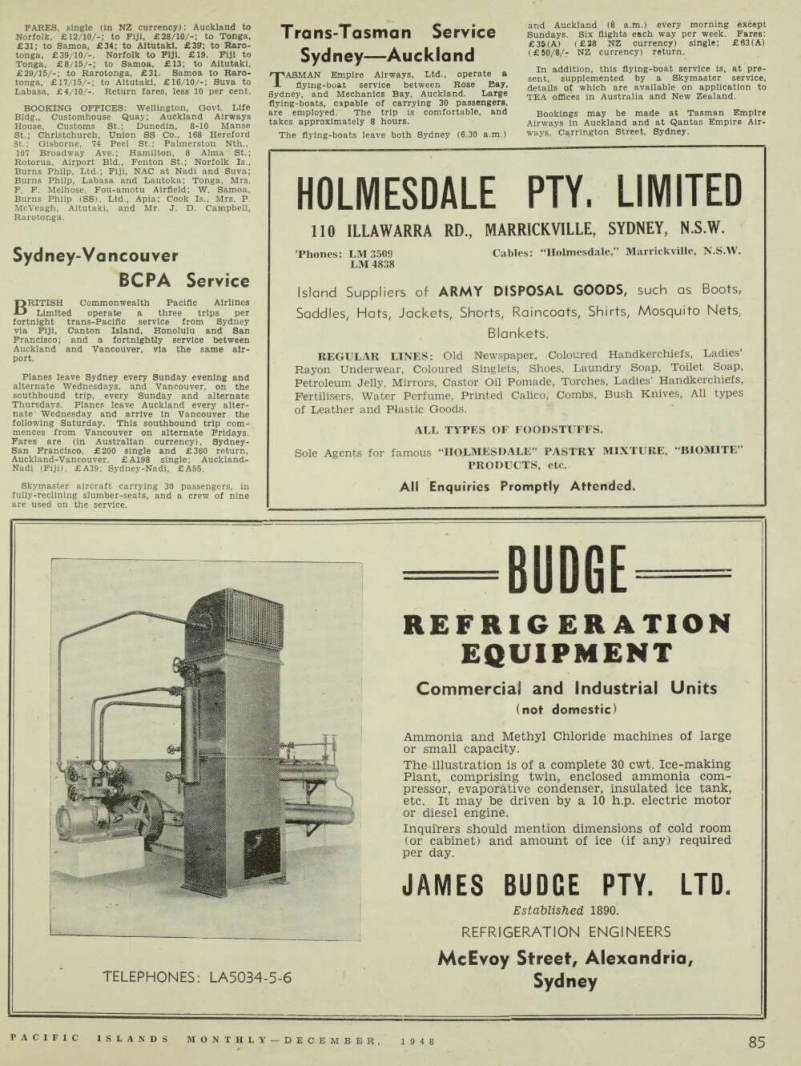
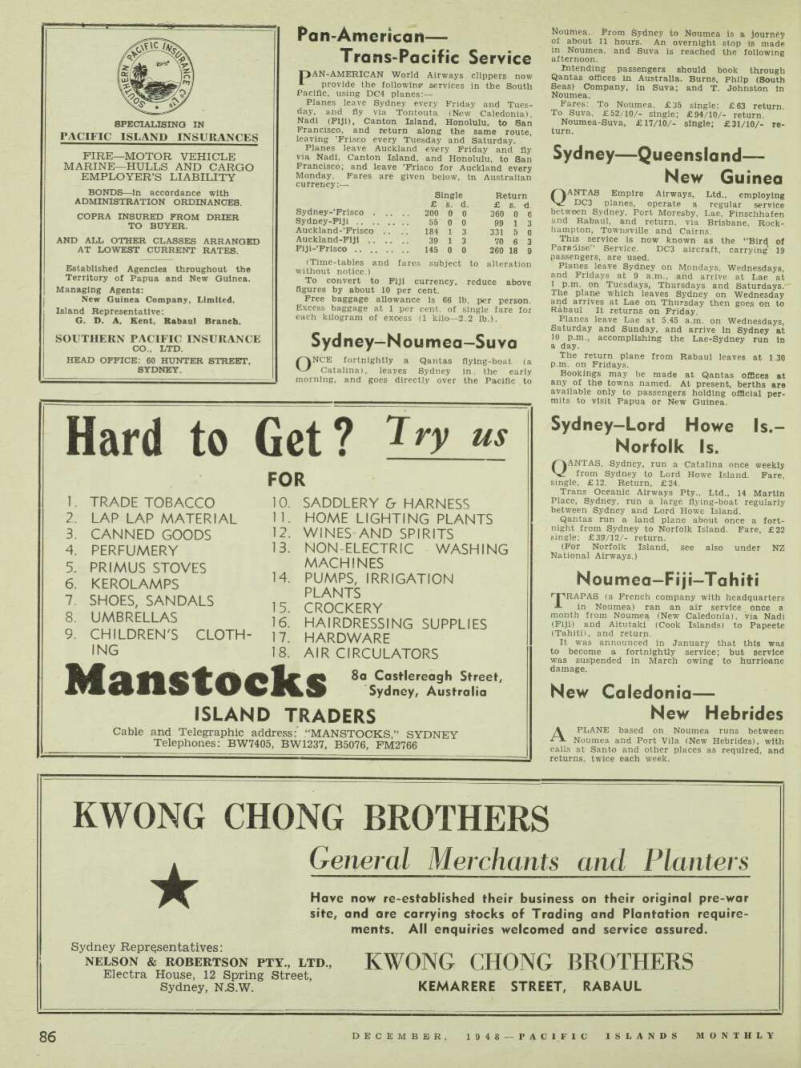
'JpHE Canadian-Australasian liner “Aorangi” (17,500 tons) recommenced a trans-Paciflc service between Sydney and North America in August. Her itinerary is Sydney, Auckland, Suva (Fiji), Honolulu (Hawaii), Victoria (Vancouver Island), and Vancouver (British Columbia, Canada). Time table for the Pacific section of her run is:—
Honolulu Nov. 25 RMS “Aorangi”
Jan. 27 Mar. 31 June 2 Suva Dec. 4 Feb. 5 Apr. 9 June 11 Auckland Dec. 7-9 Feb. 8-10 Apr 12-14 June 14-16 Sydney, arr.
Dec. 13 Feb. 14 Apr. 18 June 20 Sydney, dep.
Dec. 23 Feb. 24 Apr. 28 June 30 Auckland Dec. 27-28 Feb. 28-Mar. 1 May 2-3 July 4-5 Suva Dec. 31 Mar. 4 May 6 July 8 Honolulu Jan. 7 Mar. 11 May 13 July 15 Subject to Alterations Without Notice.
Bay, Suva), Irregular calls from Australia to Laucala Bay, Suva, by Trans Oceanic Air ways. Regular service from Suva to Labasa by NZ National Airways.
Western Samoa, Cook Islands And
TONGA.—Regular service from Fiji by NZ National Airways.
TAHlTl.—Regular service from Noumea by TRAPAS plane suspended in March.
AUSTRALIA-NEW ZEALAND.—ReguIar service by Tasman Empire Airways.
AUSTRALIA-NORTH AMERICA.—Regular Trans pacific services by Pan American Airways and
Bcpa.
TOA Services
TRANS Oceanic Airways run the following Pacific services:— SYDNEY-LORD HOWE IS.: A regular fort nightly service with large four-engine flying boats from Rose Bay. Fare: £ll single; £2l return. Free baggage allowance 50 lb. Excess baggage and freight rate 6d. per lb.
SYDNEY-NEW HEBRIDES: A regular monthly service with large four-engine flying-boats from Sydney, via Noumea (overnight stop), to Vila and Espiritu Santo. Fare: Sydney-Vila, £45; Sydney-Santo, £5O; Noumea-Vila, £l2/10/-;
Noumea-Santo, £lB. Freight: Sydney-Vila or Santo, 2/- per lb.
Sydnet-Solomon Islands: A Regular
monthly service from Sydney, via New Cale donia and New Hebrides to Tulagi, Solomon Islands. This service is frequently extended to Lingatou, in the Russell Islands, and calls are sometimes made at Vanikoro, in the Santa Cruz Group. Fares: Sydney-Tulagi, £75. Free bag gage allowance, 60 lb.; excess baggage and freight, 3/- per lb.
New Caledonia-New
Hebrides—Tahiti
ATRAPAS amphibian runs twice each week between New Caledonia and New Hebrides.
The days vary, but on the selected day the planes adhere to the following time-table:— Noumea—dep. 0630. Vila—arr. 0900 Vila—dep. 0945 Santo—arr. 1115 Santo—dep. 1145 Vila—arr. 1315 Vila —dep. 1400 Noumea —arr. 1630 A TRAPAS plane runs monthly between Noumea and Tahiti.
Papua-NG Local
Services
MANDATED Airlines, Ltd., of Lae, New Guinea, and other private operators, run air ser vices between Lae and the New Guinea mainland centres of Wau, Bulolo, Madang, Wewak, Aitape, Mt. Hagen, Finschhafen, Moresby, Kokoda—in fact anywhere in Papua or New Guinea where there is an air-strip. These planes carry pas sengers, mails and cargo on regular schedules or charter flights.
Guinea Air Traders Ltd., of Lae, New Guinea, employ six aircraft on local services, and on charter work.
Under arrangement with the Administration, a Qantas plane, carrying Administration personnel and cargo, and mails, flies once each week from Lae to Rabaul, Kavieng and Manus, and returns to Lae by the same route.
NZ National Airways
South Pacific Services
THE Pacific services run by the New Zealand National Airways Corporation are aa follows:
Auckland-Laucala Bay (Suva): A “Sun
derland” flying-boat leaves Mechanics Bay, Auckland, at 7 a.m. each Saturday for Laucala Bay, Suva (arrives 3.30 p.m.).
The aircraft departs from Laucala Bay, Suva, on the return journey at 7.30 a.m. each Monday, and arrives at Mechanics Bay, Auckland, at 4 p.m.
Laucala Bay (Suva)-Labasa (Vanua
LEVU): A “Sunderland” flying-boat operates this service on a charter basis, A return trip is made between Laucala Bay and Labasa each Sunday.
Auckland-Norfolk Island-Fiji-Tonga
Vvestern Samoa-Cook Islands: A “Douglas”
airliner leaves Whenuapai, Auckland, on alter nate Sundays at 8.30 a.m. (November 14. 28, December 12, 26) for Norfolk Island (arr. 12.30 p.m., dep. 12.1 a.m. Monday), Nadi (arr. 6.55 a.m., dep. 5.40 a.m. Tuesday), Nausori (arr. 6.30 a.m., dep. 7.15 a.m.), Tonga (arr. 10.45 a.m., dep. 11.45 a.m.), *Apia, Western Samoa (arr. 4.10 p.m. Monday, dep. 7.45 a.m. Tuesday), Aitutaki, Cook Islands (arr. 1.50 p.m., dep. 2.45 p.m.), and Rarotonga, Cook Islands (arr. 4.5 p.m.).
The aircraft departs from Rarotonga on the return journey at 7.30 a.m. on alternate Thurs days (November 18, December 2, 16, 30) for Aitutaki (arr. 8.50 a.m., dep. 9.45 a.m.), Apia, Western Samoa (arr. 3.35 p.m., dep. 8 a.m.
Friday), *Tonga (arr. 11.15 a.m. Saturday, dep. 12.15 p.m.), Nausori (arr. 3.10 p.m., dep. 4.15 p.m.), Nadi (arr. 5.5 p.m., dep. 2 a.m. Sunday), Norfolk Island (arr. 8.10 a.m., dep. 1 p.m.), and Whenuapai, Auckland (arr. 5.45 p.m.).
An additional return service between Raro tonga and Aitutaki is operated on alternate Wednesdays when traffic warrants. ♦Crosses International Date Line.
Auckland-Norfolk Island: A “Douglas”
airliner leaves Whenuapai, Auckland, every Sun day at 8.15 a.m. for Norfolk Island (arr. 12.15 p.m.), and departs on the return flight at 1.15 p.m., arriving at Whenuapai at 6 p.m.
FARES, single (in NZ currency): Auckland to Norfolk, £l2/10/-; to Fiji, £2B/10/-; to Tonga, £3l; to Samoa, £34; to Aitutaki, £3ff; to Raro tonga, £39/10/-. Norfolk to FIJI, £l9. Fiji to Tonga, £B/15/-; to Samoa, £l3; to Aitutaki, £29/15/-; to Rarotonga, £3l. Samoa to Raro tonga, £l7/15/-; to Aitutaki, £l6/10/-; Suva to Labasa, £4/10/-. Return fares, less 10 per cent.
BOOKING OFFICES: Wellington, Govt. Life Bldg., Customhouse Quay; Auckland Airways House, Customs St.; Dunedin, 8-10 Manse St.; Christchurch, Union SS Co., 168 Hereford 3t.; Gisborne, 74 Peel St.; Palmerston Nth., 107 Broadway Ave.; Hamilton, 8 Alma St.; Rotorua, Airport Bid., Fenton St.; Norfolk Is., Burns Philp, Ltd.; Fiji, NAC at Nadi and Suva; Burns Philp, Labasa and Lautoka; Tonga, Mrs.
F. F. Melhose, Fou-amotu Airfield; W. Samoa, Burns Philp (SS). Ltd., Apia; Cook Is., Mrs. P, McVeagh, Aitutaki, and Mr. J. D. Campbell, Rarotonga.
Sydney-Voncouver
BCPA Service
BRITISH Commonwealth Pacific Airlines Limited operate a three trips per fortnight trans-Pacific service from Sydney via Fiji, Canton Island, Honolulu and San Francisco: and a fortnightly service between Auckland and Vancouver, via the same air port.
Planes leave Sydney every Sunday evening and alternate Wednesdays, and Vancouver, on the southbound trip, every Sunday and alternate Thursdays. Planes leave Auckland every alter nate Wednesday and arrive in Vancouver the following Saturday. This southbound trip com mences from Vancouver on alternate Fridays.
Fares are (in Australian currency), Sydney- San Francisco, £2OO single and £360 return, Auckland-Vancouver, £AI9B single; Auckland- Nadi (Fiji), £A39; Sydney-Nadi, £ASS.
Skymaster aircraft carrying 30 passengers, in fully-reclining slumber-seats, and a crew of nine are used on the service.
Trans-Tasman Service
Sydney—Auckland
TASMAN Empire Airways, Ltd., operate a flying-boat service between Rose Bay, Sydney, and Mechanics Bay, Auckland. Large flying-boats, capable of carrying 30 passengers, are employed. The trip is comfortable, and takes approximately 8 hours.
The flying-boats leave both Sydney (6.30 a.m.)
and Auckland (S a.m.) every morning except Sundays. Six flights each way per week. Fares: £35 (A) (£2B NZ currency) single; £63 (A) (£5O/8/- NZ currency) return.
In addition, this flying-boat service is, at pre sent, supplemented by a Skymaster service, details of which are available on application to TEA offices in Australia and New Zealand.
Bookings may be made at Tasman Empire Airways in Auckland and at Qantas Empire Air ways, Carrington Street, Sydney.
Pan-American—
Trans-Pacific Service
F)AN-AMEKICAN World Airways clippers now 1 provide the following services in the South Pacific, using DC4 planes:— Planes leave Sydney every Friday and Tues day, and fly via Tontouta (New Caledonia), Nadi (Fiji), Canton Island, Honolulu, to San Francisco, and return along the same route, leaving ’Frisco every Tuesday and Saturday.
Planes leave Auckland every Friday and fly via Nadi, Canton Island, and Honolulu, to San Francisco; and leave ’Frisco for Auckland every Monday. Fares are given below, in Australian currency:— Single Return £ s. d. £ s. d.
Sydney-’Prisco 200 0 0 360 0 0 Sydney-Piji 55 0 0 99 1 3 Auckland-’Frisco ... 184 1 3 331 5 0 Auckland-FIJI 39 1 3 70 6 3 Fiji-’Frisco 145 0 0 260 18 9 (Time-tables and fares subject to alteration without notice.) To convert to Fiji currency, reduce above figures by about 10 per cent.
Free baggage allowance is 66 lb. per person.
Excess baggage at 1 per cent, of single fare for each kilogram of excess (1 ki10—2.2 lb.).
Sydney—Noumea—Suva
pvNCE fortnightly a Qantas flying-boat (a v-J Catalina), leaves Sydney in. the early morning, and goes directly over the Pacific to
Noumea. From Sydney to Noumea is a Journey of about 11 hours. An overnight stop is made in Noumea, and Suva is reached the following afternoon.
Intending passengers should book through Qantas offices in Australia. Burns, Phllp (South Seas) Company, in Suva; and T. Johnston in Noumea.
Fares: To Noumea. £35 single: £63 return To Suva, £52/10/- single; £94/10/- return.
Noumea-Suva, £l7/10/- single; £3l/10/- re turn.
Sydney—Queensland—
New Guinea
QANTAS Empire Airways, Ltd., employing DCS planes, operate a regular service between Sydney, Port Moresby, Lae. Finschhafen and Rabaul, and return, via Brisbane, Rock hampton, Townsville and Cairns.
This service is now known as the “Bird of Paradise” Service. DCS aircraft, carrying' 19 passengers, are used.
Planes leave Sydney on Mondays, Wednesdays, and Fridays at 9 a.m., and arrive at Lae at 1 p.m. on Tuesdays, Thursdays and Saturdays.
The plane which leaves Sydney on Wednesday and arrives at Lae on Thursday then goes on to Rabaul It returns on Friday.
Planes leave Lae at 5.45 a.m. on Wednesdays, Saturday and Sunday, and arrive in Sydney at 10 p.m., accomplishing the Lae-Sydney run in a day.
The return plane from Rabaul leaves at 1.30 p.m. on Fridays.
Bookings may be made at Qantas offices at any of the towns named. At present, berths are available only to passengers holding official per mits to visit Papua or New Guinea.
Sydney-Lord Howe ls.-
Norfolk Is.
QANTAS, Sydney, run a Catalina once weekly from Sydney to Lord Howe Island. Fare, single. £l2. Return, £24.
Trans Oceanic Airways Pty., Ltd., 14 Martin Place, Sydney, run a large flying-boat regularly between Sydney and Lord Howe Island.
Qantas run a land plane about once a fort night from Sydney to Norfolk Island. Fare. £22 single; £39/12/- return. (For Norfolk Island, see also under NZ National Airways.)
Noumea—Fiji—Tahiti
TRAPAS (a French company with headquarters in Noumea) ran an air service once a month from Noumea (New Caledonia), via Nadi (Fiji) and Aitutaki (Cook Islands) to Papeete (Tahiti), and return.
It was announced in January that this was to become a fortnightly service; but service was suspended in March owing to hurricane damage.
New Caledonia—
New Hebrides
A PLANE based on Noumea runs between Noumea and Port Vila (New Hebrides), with calls at Santo and other places as required, and returns, twice each week.
Advertisements & other items, pp. 85-88 (2 items)
83
PACIFIC ISLANDS MONTHLY—D E C E M B E R . 1948
Semm-Kim 35Mm.
QUEENSLAND
INSURANCE
COMPANY
LIMITED
• Incorporated 1886 In Australia.
ASSETS EXCEED £5,000,000
Head Office:
QUEENSLAND
INSURANCE BUILDING,
80-82 PITT STREET, SYDNEY,
Specialists in South Seas Fire, Marine Cr Accident Insurances
Apply to:
FIJI, —Branch Office: I. B. Chalmers, Manager, Burns Philp (South Sea) Co..
Ltd.
VlLA.—Burns Philp (South Sea) Co., Ltd.
Comptoirs Prancais Des Nouvelles Hebrides (Marine).
NOUMEA.—L. & W. Johnston.
NEW GUINEA. —Manager for Mandated Territory and Papua, W. A. Anderson.
PORT MORESBY—SAMARAI— LAE
—MADANG—RABAUL.
Burns, Philp (New Guinea), Ltd.
PAGO PAGO.
Burns Philp (South Sea) Co., Ltd.
G. H. C. Reid & Co.
OTHER SOUTH SEA ISLANDS.
Burns Philp (South Sea) Co., Ltd.
Also to any of the Company’s
Offices in Australia or New
Zealand.
A Miniature Camera for the Modernist ...
A
SEMM-KIM 35mm.
Rapidly becoming popular, particularly for its high quality and low cost, the SEMM-Kim incorporates all of the features previously embodied in most of its pre-war contemporaries —automatic film counter, built-in shutter release, optical viewfinder, safety-catch winding button, tripod lock nut, shutter speeds ranging from bulb to 1/200 of a second, fitted with a Cross Anastigmat f/2.9 lens, and complete with an attractive pigskin ever-ready case.
This is the opportunity for which aspiring miniature camera enthusiasts have been waiting . . . and now that opportunity is here.
You are invited to call or write to your nearest Kodak Dealer.
FROM ALL KODAK DEALERS THROUGHOUT THE ISLANDS
KODAK (A/ASIA
379 and 386 George Street, Sydney
PTY. LTD.
BRANCHES IN ALL STATES.
Box 3838 GPO, Cable Address, “Care” Sydney.
Sydney. Australia.
ISLAND MERCHANTS
4 YORK ST., SYDNEY
All kinds Island Produce sold on commission. All merchandise purchased, at best wholesale price and original invoices supplied.
Use our 50 years’ experience as Island Merchants.
J
Asthma Curbed In 3 Minutes
Since the discovery of Mendaco by a famous physician sufferers can get relief from Asthma. Mendaco does away with expensive injections and offensive smokes.
All you ao is to take 2 tasteless tablets with meals and Mendaco starts circulating through the blood in 10 minutes. You breathe easily and freely. Your nerves relax, you get good, fresh, pure air into your lungs, and vigour returns.
Sleep Like a Baby
Thousands of former sufferers from Asthma say that the very first dose of Mendaco brought them glorious ease and comfort, and that they slept soundly the very first night. Then their vigour returned and they felt healthier and stronger, and 5 to 10 years younger. The reason for this is that Mendaco acts in natural ways to overcome the effects of Asthma, (1) It removes the mucus or phlegm; (2) It relaxes thousands of tiny muscles in your bronchial tubes so that the air can get in and out of your lungs; (3) It promotes body vigour, and stimulates the building of rich, revitalised blood.
No Asthma for Five Years
Mendaco not only brings almost immediate results, free breathing and comfort and enables you to sleep, but also builds up the system to ward off future attacks. Mr.
J. R. writes: “I was almost dead with Asthma. Had lost 40 lbs. In weight, snf-
fered coughing every night—couldn’t sleep.
Mendaco stopped spasms first night. I have had no Asthma since in over 2 years.”
Mrs. A. W. writes: “I had Asthma for 25 years. After using Mendaco I can sleep all night and have not had an attack since taking it.” Mrs. G. E. C. writes; “I bless the day I first heard of Mendaco. What a godsend it is to a poor woman like me who for 35 years never knew what it was to have a good night’s rest. The constant fight between Asthma and sleep was wearing me down, but I feel now I want to forget my past suffering.”
Benefits Immediate
The very first dose of Mendaco goes right to work circulating through your blood and helping nature rid you of the effects of Asthma. Try Mendaco under an iron-clad money back guarantee. You be the judge.
If you don’t feel fully satisfied after taking Mendaco just return the package and the purchase price will be refunded. Get Mendaco from your chemist to-day and see how well you sleep to-night and how much better you will feel.
RELIEVES ASTHMA
Mendaco
Now in 2 sizes 6/- and 12/-
HOLMESDALE PTY. LIMITED
110 ILLAWARRA RD., MARRICKVILLE, SYDNEY, N.S.W.
’Phones: LM 3509 Cables: “Holmesdale,” Marrickville, N.S.W.
LM 4838 Island Suppliers of ARMY DISPOSAL GOODS, such as Boots, Saddles, Hats, Jackets, Shorts, Raincoats, Shirts, Mosquito Nets, Blankets.
REGULAR LINES: Old Newspaper, Coloured Handkerchiefs, Ladies’
Rayon Underwear, Coloured Singlets, Shoes, Laundry Soap, Toilet Soap, Petroleum Jelly, Mirrors, Castor Oil Pomade, Torches, Ladies’ Handkerchiefs, Fertilisers, Water Perfume, Printed Calico, Combs, Bush Knives, All types of Leather and Plastic Goods.
ALL TYPES OF FOODSTUFFS.
Sole Agents for famous “HOLMESDALE’ PASTRY MIXTURE. “BIOMITE”
PRODUCTS, etc.
All Enquiries Promptly Attended.
TELEPHONES; LA5034-5-6
BUDGE
REFRIGERATION
EQUIPMENT
Commerciai and Industrial Units (not domestic) Ammonia and Methyl Chloride machines of large or small capacity.
The illustration is of a complete 30 cwt. Ice-making Plant, comprising twin, enclosed ammonia compressor, evaporative condenser, insulated ice tank, etc. It may be driven by a 10 h.p. electric motor or diesel engine.
Inquirers should mention dimensions of cold room (or cabinet) and amount of ice (if any) required per day.
JAMES BUDGE PTY. LTD.
Established 1890.
REFRIGERATION ENGINEERS
McEvoy Street, Alexandria,
Sydney
SPECIALISING IN
PACIFIC ISLAND INSURANCES
FIRE—MOTOR VEHICLE
MARINE—HULLS AND CARGO
EMPLOYER’S LIABILITY
BONDS—In accordance with
ADMINISTRATION ORDINANCES.
COPRA INSURED FROM DRIER
TO BUYER.
AND ALL OTHER CLASSES ARRAN
AT LOWEST CURRENT RATES.
Established Agencies throughout the Territory of Papua and New Guinea.
Managing Agents: New Guinea Company, Limited.
Island Representative: G. D. A. Kent, Rabaui Branch.
SOUTHERN PACIFIC INSURANCI
CO., LTD.
HEAD OFFICE: 60 HUNTER STREET,
SYDNEY.
Hard to Get? Tr v us
FOR
1. TRADE TOBACCO 10.
2. LAP LAP MATERIAL 11.
3. CANNED GOODS 12.
4. PERFUMERY '3.
5. PRIMUS STOVES ,
6. KEROLAMPS l4 '
7. SHOES, SANDALS , s
8. UMBRELLAS ,5
9. CHILDREN'S CLOTH- 17'
ING is!
SADDLERY & HARNESS
HOME LIGHTING PLANTS
WINES AND SPIRITS
NON-ELECTRIC WASHING
MACHINES
PUMPS, IRRIGATION
PLANTS
CROCKERY
HAIRDRESSING SUPPLIES
HARDWARE
AIR CIRCULATORS
Manstocks
ISLAND TRADERS
Cable and Telegraphic address: “MANSTOCKS,” SYDNEY Telephones: 8W7405, 8W1237, 85076, FM2766
KWONG CHONG BROTHERS
General MercjmMs and Planters
Have now re-established their business on their original pre-war site, and are carrying stocks of Trading and Plantation requirements. All enquiries welcomed and service assured.
Sydney Representatives:
NELSON & ROBERTSON PTY., LTD.,
Electra House, 12 Spring Street, Sydney, N.S.W,
KWONG CHONG BROTHERS
KEMARERE STREET, RABAUL
Moresby Rssaila
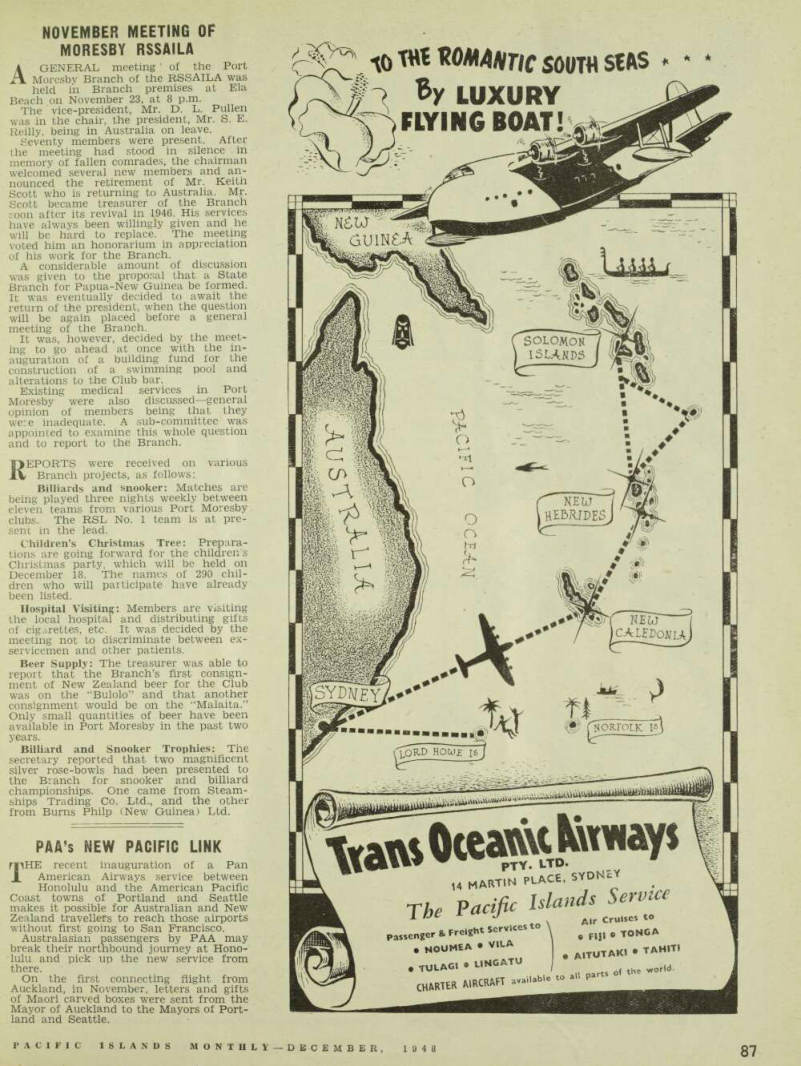
November Meeting Of
A GENERAL meeting ‘ of the Port Moresbv Branch of the RSSAILA was held in Branch premises at Ela Beach on November 23, at 8 p.m.
The vice-president, Mr. D. L, Pullen was in the chair, the president, Mr. S. E.
Reilly, being in Australia on leave.
Seventy members were present. After the meeting had stood in silence in memory of fallen comrades, the chairman welcomed several new members and an nounced the retirement of Mr. Keith Scott who is returning to Australia. Mr.
Scott became treasurer of the Branch soon after its revival in 1946. His services have always been willingly given and he will be hard to replace. The meeting voted him an honorarium in appreciation of his work for the Branch.
A considerable amount of discussion was given to the proposal that a State Branch for Papua-New Guinea be formed.
It was eventually decided to await the return of the president, when the question will be again placed before a general meeting of the Branch.
It was, however, decided by the meet ing to go ahead at once with the in auguration of a building fund for the construction of a swimming pool and alterations to the Club bar.
Existing medical services in Port Moresby were also discussed —general opinion of members being that they we:e inadequate. A sub-committee was appointed to examine this whole question and to report to the Branch.
REPORTS were received on various Branch projects, as follows: Billiards and snooker: Matches are being played three nights weekly between eleven teams from various Port Moresby clubs. The RSL No. 1 team is at pre sent in the lead.
Children’s Christmas Tree: Prepara tions are going forward for the children's Christmas party, which will be held on December 18. The names of 290 chil dren who will participate have already been listed.
Hospital Visiting: Members are visiting the local hospital and distributing gifts of cigarettes, etc. It was decided by the meeting not to discriminate between ex servicemen and other patients.
Beer Supply: The treasurer was able to report that the Branch’s first consign ment of New Zealand beer for the Club was on the “Bulolo” and that another consignment would be on the “Malaita.”
Only small quantities of beer have been available in Port Moresby in the past two years.
Billiard and Snooker Trophies: The secretary reported that two magnificent silver rose-bowls had been presented to the Branch for snooker and billiard championships. One came from Steam ships Trading Co. Ltd., and the other from Burns Philp (New Guinea) Ltd.
Paa's New Pacific Link
mHE recent inauguration of a Pan X American Airways service between Honolulu and the American Pacific Coast towns of Portland and Seattle makes it possible for Australian and New Zealand travellers to reach those airports without first going to San Francisco.
Australasian passengers by PAA may break their northbound journey at Hono lulu and pick up the new service from there.
On the first connecting flight from Auckland, in November, letters and gifts of Maori carved boxes were sent from the Mayor of Auckland to the Mayors of Port land and Seattle.
Advertisements & other items, pp. 89-90 (1 item)
\\dX& OtcaTi\f„^tways
•w wt momahtic south sirs
7 By LUXURY
A A
FLYING BOAT! %
K£UT
Wfe GUINEA
i>p I ¥ • • 1 nu t
N£LJ
CALEDONIA
» (Norfolk
LO'RD HOWJE 16
\\dX& OtcaTi\f„^tways
The P “aclfic Air Cruises e Fil« ® TONGA
» AITUTAKI • TAHITI
. ~. nartS of the world-
ai !5Si
PHYSICIANS OF THE MIDDLE ACES TREATED
ACHING TEETH BY JABBING THEM WITH
COFFIN NAILS ! DENTISTS, OF TO-DAY
treat teeth scientifically- kolynos
CLEANS TEETH SURGICALLY. ACTIVE KOLYNOS
REMOVES DECAY-BREEDING FOOD DEPOSITS-
miserncALLi , 7T ! a N?
USED
0 Q
ROC JS
BECAUSE OF BAD UGHTING
IN THE SLIOO COUNTY
(EIRE) - BACK TOOTH
SUFFERERS ARE .
TO GET ATTENTION *
ON BRIGHT
DAYS ONLY
All
XX a* $ 'i'-
wfr, j
c
j&SEiI.T
■j2- X % m
MUCH
MrA*
KOLYNOS LASTS TWICE
OA LONG 06 ORDINARY
TOOTHPASTE
\W> BECAUSE HIGHLY
JLJpX CONCENTRATED.
Pk| F£Af
AWk FA6F'AM'/AACM
infm O/V
[* VlSk B/
wMm. 7>c£Hry
Kf* Anc/enT 5
v FILLED TEETH WITH
CHIPS OF ROCK ! DON
BE HARD ON YOUR TEETH
/ - REMOVE UGLY STAINS*(
BRING SPARKLE TO YOUR
SMILE WITH KOLYNOS.
KOLYNOS SWEETENS
YOUR BREATH TOO J
M * u 48 -ou
PA/Af FASTER/
ANACIN stops pain faster because it contains an extra -ingredient. ANACIN is a prescription for pain. Keep it handy for those “difficult” days.
&NAc/y
Trade Mark
The Month In Moresby
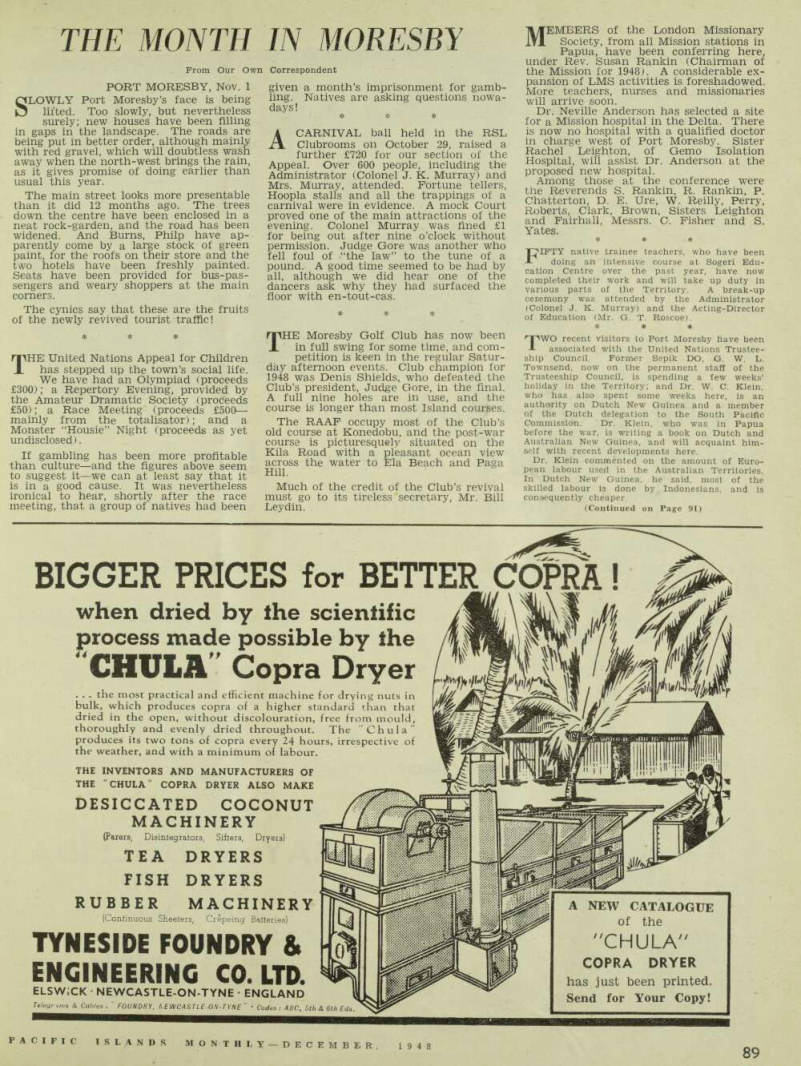


From Our Own Correspondent
Port Moresby, Nov. 1
SLOWLY Port Moresby’s face is being lifted. Too slowly, but nevertheless surely; new houses have been filling in gaps in the landscape. The roads are being put in better order, although mainly with red gravel, which will doubtless wash away when the north-west brings the rain, as it gives promise of doing earlier than usual this year.
The main street looks more presentable than it did 12 months ago. The trees down the centre have been enclosed in a neat rock-garden, and the road has been widened. And Burns, Philp have ap parently come by a large stock of green paint, for the roofs on their store and the two hotels have been freshly painted.
Seats have been provided for bus-pas sengers and weary shoppers at the main corners.
The cynics say that these are the fruits of the newly revived tourist traffic!
S§s 9|C THE United Nations Appeal for Children has stepped up the town’s social life.
We have had an Olympiad (proceeds £300); a Repertory Evening, provided by the Amateur Dramatic Society (proceeds £50); a Race Meeting (proceeds £5O0 — mainly from the totalisator); and a Monster “Housie” Night (proceeds as yet undisclosed).
If gambling has been more profitable than culture —and the figures above seem to suggest it —we can at least say that it is in a good cause. It was nevertheless ironical to hear, shortly after the race meeting, that a group of natives had been
given a month’s imprisonment for gamb ling. Natives are asking questions nowa days! * * * A CARNIVAL ball held in the RSL Clubrooms on October 29, raised a further £720 for our section of the Appeal. Over 600 people, including the Administrator (Colonel J. K. Murray) and Mrs, Murray, attended. Fortune tellers, Hoopla stalls and all the trappings of a carnival were in evidence. A mock Court proved one of the main attractions of the evening. Colonel Murray was fined £1 for being out after nine o’clock without permission. Judge Gore was another who fell foul of “the law” to the tune of a pound. A good time seemed to be had by all, although we did hear one of the dancers ask why they had surfaced the floor with en-tout-cas. * * * THE Moresby Golf Club has now been in full swing for some time, and com petition is keen in the regular Satur day afternoon events. Club champion for 1948 was Denis Shields, who defeated the Club’s president, Judge Gore, in the final.
A full nine holes are in use, and the course is longer than most Island courses.
The RAAF occupy most of the Club’s old course at Konedobu, and the post-war course is picturesquelv situated on the Kila Road with a pleasant ocean view across the water to Ela Beach and Paga Hill.
Much of the credit of the Club’s revival must go to its tireless secretary, Mr. Bill Leydin.
MEMBERS of the London Missionary Society, from all Mission stations in
Papua, have been conferring here,
under Rev. Susan Rankin (Chairman of the Mission for 1948). A considerable ex pansion of LMS activities is foreshadowed.
More teachers, nurses and missionaries will arrive soon.
Dr. Neville Anderson has selected a site for a Mission hospital in the Delta. There is now no hospital with a qualified doctor in charge west of Port Moresby. Sister Rachel Leighton, of Gemo Isolation Hospital, will assist Dr. Anderson at the
proposed new hospital.
Among those at the conference were the Reverends S. Rankin, R. Rankin, P.
Chatterton, D. E. Ure, W. Reilly, Perry,
Roberts, Clark, Brown, Sisters Leighton
and Fairhall, Messrs. C. Fisher and S.
Yates. * * * FIFTY native trainee teachers, who have been doing an intensive course at Sogeri Edu cation Centre over the past year, have now completed their work and will take up duty in various parts of the Territory. A break-up ceremony was attended by the Administrator (Colonel J. K. Murray) and the Acting-Director of Education (Mr. G. T. Roscoe). * ♦ ♦ TWO recent visitors to Port Moresby have been associated with the United Nations Trustee ship Council. Former Sepik DO, G. W. L.
Townsend, now on the permanent staff of the Trusteeship Council, is spending a few weeks’ holiday in the Territory: and Dr. W. C. Klein, who has also spent some weeks here, is an authority on Dutch New Guinea and a member of the Dutch delegation to the South Pacific Commission. Dr. Klein, who was in Papua before the war, is writing a book on Dutch and Australian New Guinea, and will acquaint him self with recent developments here.
Dr. Klein commented on the amount of Euro pean labour used in the Australian Territories.
In Dutch New Guinea, he said, most of the skilled labour is done by Indonesians, and is consequently cheaper.
(Continued on Page 91)
MORESBY taxi proprietor, Mr. R. Corlett, has obtained a modern streamlined bus, to carry native passengers from Elevala Village to Koki. Fares: Elevala to Port Moresby, 6d.; Port Moresby to Koki, 1/-. Despite reports about natives’ post-war wealth, it is hard to imagine many of them paying 1/- for a two-mile bus trip. The Government, so often abused as the natives’ benefactor, runs a free bus service— for Europeans only. * * ♦ invESPITE the harsh provisions of the, White women’s Protection Ordinance, there has been recently a wave of offences against white women here. Two cases of being In a dwelling with indecent intent, and one case of attempted rape, were before the Courts in November. * ♦ * jDEFORE he goes on leave shortly, the Administrator is having a good last look at his domains. Almost as soon as he returned from a two weeks’ tour of the New Ireland-New Britain area, he left again for another fortnight in the Sepik-Central Highlands areas. His ex hausting itinerary included calls at almost every Government outpost. Now he has left on a two-days’ visit to Daru. * * ♦ 'T'HE re-classifying officers looking into the • Territory’s public service are apparently lightning workers. After a day in Samarai, last week, they have left for Lae, Wau, Madang, Rabaul, etc., and expect to be back in less than a week. * * * mails probably mean less nowadays than before the war, but they are still very welcome. The “Empire Mountain” and the “Nellore” were not well received last week— neither had brought any mail. Apparently our only surface mails are to be on the monthly “Bulolo” which, unfortunately, is not running monthly. Her arrival, at the end of November, broke yet another fresh food and potato famine.
The only beer available for months has been English beer (1/6 per glass!).
Advertisements & other items, pp. 91-92 (1 item)
CHULA Copra Dryer
44
BIGGER PRICES for BETTER
when dried by the scientific
process made possible by the
CHULA Copra Dryer
. . . the most practical and efficient machine for drying nuts in bulk, which produces copra of a higher standard than that dried in the open, without discolouration, free from mould, thoroughly and evenly dried throughout. The “Chula” produces its two tons of copra every 24 hours, irrespective of the weather, and with a minimum of labour.
THE INVENTORS AND MANUFACTURERS OF
THE “CHULA” COPRA DRYER ALSO MAKE
DESICCATED COCONUT
MACHINERY
(Parers, Disintegrators, Sifters, Dryers)
TEA DRYERS
FISH DRYERS
RUBBER MACHINERY
(Continuous Sheelers, Crepeing Batteries)
TYNESIDE FOUNDRY &
ENGINEERING CO. LTD.
ELSWiCK NEWCASTLE-ON-TYNE • ENGLAND
Telegnms & Cables. "FOUNDRY, REWCASTLE-ON-TYNE " * Codes ; ABC, sth &
COPRA!
m ik V' H »1
fh\s!
A NEW CATALOGUE
of the
"CHULA"
COPRA DRYER
has just been printed.
Send for Your Copy!
Price at Works: £42 Extra for 10 inch additional shelf and brackets (if required) : £2 Glass Server to Top (.if required) : £l/10/- Packing and Transport to Wharf: £lO/10/- The display case is securely packed in two substantial crates occupying shipping space of 37 cubic feet. Total weight, when packed, 5 cwt.
Equip
Smart
i tp
Your Store with this
Modern Counter Display
Specially Built for Export
Case
As smart as those in leading Australian city stores, and built by a firm that has been making fine store and office fittings for over a third of a century.
Moreover, it is specially built for export, so that it can be readily securely packed, and assembled by anyone, from simple directions, in an hour, with no tools other than a screwdriver.
Retailers all over the world have learned the selling value of modern display equipment, and this “silent salesman” will soon pay for itself in increased sales.
HERE ARE THE DETAILS
of the "Brahol" Export Counter Case
(as illustrated) To help you to get an accurate picture of the "Brahol" Special Export Glass Counter Case, here are the main specifications:— • Overall size is 6 feet long x 1 ft. 9 ins. deep x 3 ft. 3 irr. high. Made from first-class, wellseasoned Queensland Maple, hand french polished, wax finished, in natural maple colour.
Glass parts qre i inch British plate glass. • The inside is lacquered ivory colour, and the recessed base is lacquered burgundy. • There is a pair of solid core sliding doors, and one glass shelf, 14 inches wide, on adjustable nickel-plated brackets. • Storage space below is 1 1 inches high. • The plate glass front is 22 inches high.
BRAY & HOLLIDAY
PTY. LTD.
Makers of Fine Store and Office
Fittings for over a third of a century.
Brahol House, 66-74 McLachlan Avenue, Rushcutter Bay, Sydney. Telephone: FA 4121.
Cable & Telegraphic Address: “Brahal.”-
Tidal Waves Reported From
Rarotonga
Tidal wave conditions at Rarotonga, Cook Islands, probably due to a submarine disturbance, were re ported in a message received in Welling ton from the Resident Agent on the island, on November 25.
The disturbance around the Avarua Harbour reef caused the schooner Tahi tienne to break her moorings and she became a total loss on the west of the reef As a safety measure the Union Steam Ship Company’s launches and lighters were removed to the landward end of the wharf.
New Official At Futuna
M. CRESSON, French Colonial Admin istrator, has arrived in the Pacific to take over the post of French Resident at Wallis and Futuna Islands (north-east of Fiji).
Hitherto, the duties of Resident have been earned out by the Government doctor. The Group, since French an nexation in 1917, has been under New Caledonian administration.
Eight Years
Guinea Gold’s First Dividend For Eight Years
GUINEA Gold NL, Adelaide, has declared a dividend of 6d. per share payable on December 9.
This follows the resumption of dividends by Bulolo Gold Dredging Ltd., in which company Guinea Gold has very sub stantial interests, • l as t dividend was paid in 1941.
Colonel H. T. Allan, of Rabaul, New Guinea was in Sydney for a few days in November, after representing New Guinea at the annual Convention of the Returned Soldiers League in Brisbane. He returned to Rabaul m November.
South Pacific Health
Service
THE South Pacific Health Service agree ment between the Governments ot New Zealand and Fiji and the Western Pacific High Commission has been extended for 12 months from Sep tember, 1948.
During the present extension the agree ment will be reviewed in the light of ex perience gained and the relation of the South Pacific Health Service to the new South Pacific Commission will be con sidered.
Advertisements & other items, p. 93 (2 items)
91
pacific islands mon t h l y-d ece m b BR, 1,11
protect your Hair
"ISLAND LIFE"
Official organ of the S.S.l.C.C—Calling Collectors, Correspondents and Penfriends throughout the South Sea Islands. Over 1,000 members. Write for your free copy and particulars to—
SOUTH SEA ISLANDS CORRESPOND-
ENCE CLUB,
NATUVU, FIJI
protect your Hair
Hie Tonic Hair Dressing
4517 I > (3 / V «r / Nl'
3 UN. WIND, and WATER
all play havoc with your hair t depriving it of its natural scalp oils.
Let Vita I is' pure vegetable oils protect your hair and scalp, no matter where you are or what you do.
Vitalis routs loose dandruff; helps retard falling hair; stimulates the scalp and dresses the hair in a handsome, natural way
Of New Industry To Fiji
Tapioca Mill Marks Introduction Of New Industry To Fiji
THE installation of machinery for a tapioca mill at Nasinu, Fiji, by Mr.
G. A. Cederman, a New Zealand engineer, in November, was an event of importance, because this represents the introduction of a new industry to Fiji by the enterprise of a co-operative associa tion of Fiji natives. Hitherto, all starch extraction has been done by hand.
The plant—made in New Zealand from wooden moulds prepared in Fiji from
plans first drawn in Malaya—was ordered by the Fijian Co-operative Market Asso ciation, of Nasinu. It is in three sections —a washing machine, a rasping machine and a straining machine. It was made in Mr. Cederman’s workshop in Hokitika, and thence shipped to Fiji.
The United States State Department in Washington announced in November that the United States Consulate at Suva, Fiji, will be closed on December 31 be cause of lack of Consulate business for Americans there recently.
Alleged Anti-Exploitation
Movement in Hebrides Missionary Accuses Planters- Traders—Again!
ACCORDING to Mr. L. W. Murray, New Zealand secretary of the Presbyterian Overseas Mission, there has been a growth of nationalism and a violent re action against “exploitation” by traders and planters among the natives of the New Hebrides.
He described this to a meeting of the Presbyterian General Assembly in Wel lington, NZ, in early November, and spoke of what he called the “Jon Frum move ment” in Tanna, which manifested itself as a resurgence of native superstition and heathenism as well as reaction against exploitation. This took place in 1940 and again in 1942.
Mr. Murray said that the Resident Com missioner had told him that within 24 hours the whole native population had turned against the white people and had plotted to massacre them. The movement had not reached such a stage in other islands of the group although there was a trace of it in Santo.
These were some of the reasons why it had been decided to establish a separate church in the New Hebrides. “If there should be a surging up or the idea of nationalism in these islands, with a desire by their peoples to govern their own affairs, it might be an advantage that the church should also be under the control of its own people,” said Mr. Murray. (EDITORIAL NOTE: The old mission howl of “exploitation”—a silly Commu nist term designed to tickle the ears of the ignorant—is so well known to “PIM” readers by this time that it would be tedious to discuss it further. But what Mr, Murray calls the “Jon Frum move ment,” and describes as a new feeling of intense nationalism on the part of the New Hebrideans, seems to be nothing more or less than what is known in Papua and New Guinea as “Cargo Cult.” There is nothing new about “Cargo Cult.”
There have been outbreaks of it, from time to time, during the last 50 years.
And there have been many articles about it in the “PIM” in recent years. A section of the missionaries think as Mr. Murray does; the big bad “exploiters” (that is the traders and planters), on the other hand, will tell you that it is the fault of the missions, who break down the native’s ancient institutions and disturb his normal life. It probably is a bit of both— that is, the native reaction to the impact of European civilisation. There is, how ever, a distinct difference between “Cargo Cult” and the Solomon Islands “Marching Rule,” which is a direct result of the war.
But, as Mr. Murray describes it, it would appear that “Jon Frum” is just “Cargo Cult” under a new name.)
In Papuan History
Samarai Will Have Second Jury In Papuan History
Port Moresby, Dec. 1.
EARLY in December, Mr. Justice Gore, of the Papua-New Guinea Supreme Court, will conduct, at Samarai, the trial of two Europeans, Albert Edward Downey and Arthur Louis Leßoutillier, who have been charged with the murder in 1942, at Misima, of one native, and inflicting grievous bodily harm on an other.
The accused will be tried by jury. Old timers can recall only one other jury trial in Papuan history, A European charged with a capital offence is here tried by a jury of four.
All other criminal charges are tried by a judge alone.
Advertisements & other items, p. 94 (1 item)
bcfwjpmal
*£> .c# . /
EXTRA FINE
OLD WHISKY
Mr <%Jaot<X'tiwf
i<srt/rrM <s> ■Me-e'tt
THE DISTILLERS CORPORATION PTY, LTD.
TWE CORIO DISTILLERY, COHK>.
KARASmC A6EKTS.
H€LSOUSHS. AUSTRALIA.'*
AVIS
L’etiquette ci-contre est la propriete et la veritable marque de fabrique de la
DISTILLERS CORPORATION PRO-
PRIETARY LIMITED, de Byrne Street.
South Melbourne, Victoria, Australie, Societe de distillation, et utilisee par elle pour le
WHISKY
et les commercants et le public sont mis en garde par le presente centre toute contrefacon ou tout usage impropre de ladite etiquette.
Des poursuibes legales seront entamees centre toute personne vendant ou offrant pour le vente des produits nonmanufactures par la Distillers Corporation Proprietary Limited et portant une contrefacon de ladite marque de fabrique ou toute imitation.
EDVVD. WATERS & SONS
Avoues aux Brevets et Marques de fabrique, 422-428 Collins Street, Melbourne, Victoria, Australia.
s/? . ( . /
bene special
EXTRA FIiNE
OLD WHISKY
/A* tS'S» Am*- ‘4*e»
//<tfa4ry/ *st f*t?£ /sJti M**it jSmeve fa&iA
THE DISTILLERS CORPORATION PTY. LTD
THE CORIO DISTILLERY, CORK)
MANAGING AGENTS >
. 7/<r ///?/7pr/ . ~/h/. .
MELBOURNE. AUSTRALIA.
NOTICE
IS HEREBY GIVEN that the Label shown in the margin is the sole and exclusive property and proper TRADE
MARK Of THE DISTILLERS COR-
PORATION PROPRIETARY LIMITED,
of Byrne Street, South Melbourne, Victoria, Australia, Distillers; used by them in respect of
WHISKY
and the Trade and Public are hereby cautioned against any infringment or improper use of the same.
Legal proceedings will be instituted against any person or persons selling or offering for sale goods, not the manufacture of the aforesaid The Distillers Corporation Proprietary Limited, bearing any representation of the said Trade Mark or any colourable imitation thereof.
EDWI). WATERS & SONS
Patent and Trade Mark
Attorneys,
422-428 Collins Street, Melbourne,
Victoria, Australia.
Christian-Bataille Wedding
TIHE marriage of Miss Mildred Nash Christian to Mr. Richard Albert Bataille took place in St. Barnabas Chapel, Norfolk Island, on November 17.
The bride is a daughter of Mrs. Emily Nash Christian and a descendant of Fletcher Christian, of the “Bounty.” She was given away by Mr. M. Edwards and attended by Patricia Mitchell, her niece, as trainbearer, and by Miss Fay Bataille, sister of the groom, and Miss Kathy Quintall, as bridesmaids.
Groomsmen were Mr. J. and Bruce Olsen.
A reception was later held at Rawson Hall for 500 guests.
Brutal Murder In Tahiti
From Our Own Correspondent
Papeete, Nov. 20.
A FRENCH resident of the district of Papara, Monsieur Delamar, on Sat urday, November 13, was ruthlessly bludgeoned to death by two Tahitian youths, named Totora, and Jean Taetae, aged 17 and 18 respectively. They silently entered his home about 8 p.m, and struck him down from behind as he was pre paring his evening coffee.
His body was found next morning by a passer-by who gave the alarm.
Monsieur Pascault, the Police Commis sioner, quickly arrived at the scene of the crime and, in a short while the youths were apprehended. They finally con fessed to having murdered the man for money. They found 2,500 francs.
Monsieur Delamar owned a small store in Papara, and was respected by his neighbours as a quiet, law-abiding citizen.
Another Trans-Pacific
Air-Line
From Our Own Correspondent
Suva, Nov 1
(CANADIAN Pacific Airlines, the third J of 'the great Pacific airways linking North America with Australia and New Zealand by way of Fiji, expects to start operating next July.
This was announced by officials of the company who have just passed through Nadi Airport on their way to Australia
Consecrated
Two New Guinea RC Bishops Consecrated
TWO Roman Catholic New Guinea missionaries Stephen Applehans (43) and Leo Arkfield (36)—were consecrated as bishops in a solemn ceremony at St. Mary’s Mission House at Techny, Illinois, USA on November 30.
Bishop Arkfield, believed to be the youngest bishop in the world, has been working in New Guinea since 1943, and Bishop Applehans has been Director of the New Guinea Mission since 1944.
Both are American-born and replace Bishops Francis Wolf and Joseph Loerks, who died from wounds after a Japanese prison ship was strafed by American planes in February, 1944.
Miss Patricia June Wauchope, daughter of Mr. E. J. Wauchope, of Madang, New Guinea, has announced her engagement to Mr. B. W. G. Hall. Lieutenant “Ben"
Hall was a notable Coast Watcher during the war, and was awarded the DCM (British) and the Bronze Star (Ameri can).
Advertisements & other items, p. 95 (1 item)
Nelson & Robertson
Livestock
Available for Ship-
ment to Island
Ports.
HORSES, CATTLE,
PIGS, GOATS &
POULTRY
ALL STOCK SHIPPED
IN GOOD CONDITION
AND FULLY INSURED.
PACKING CASES:
New, or Used Cases Supplied on Firm Orders.
ALL SIZES.
Address all inquiries to:
CASES PTY. LTD.
CUSTOMS AGENTS,
214 SUSSEX STREET,
SYDNEY
NELSON and ROBERTSON Pty. Ltd.
Established 1895
Shipowners - Brokers and
Islands Merchants
AH classes merchandise purchased at Best Wholesale Prices. Original Invoices supplied to Island Clients. Cocoa Beans, Copra, Rubber, Trochus Shell and All Islands' Produce Sold on Commission.
Entrust your requirements to the firm with fifty years' Pacific Islands.
Sole Agents :
SKANDIA DIESEL ENGINES
ARCHIMEDES MOTORS
REPRESENTED IN
ALL PARTS OF
THE WORLD.
practical experience in the
OVERSEA INDENTS
ARRANGED FOR
CLIENTS.
Prompt attention given to all enquiries.
NELSON & ROBERTSON
12 SPRING STREET, SYDNEY, AUSTRALIA
Telegraphic Address; IVAN, SYDNEY.
PTY.
LTD.
Tahiti Notes
From Our Own Correspondent
Papeete. Nov. 20.
THE French steamer “Saint Nazaire” (Messageries Maritime) sailed on No vember 7 with the largest number of passengers ever to leave Tahiti by one vessel. She had 580 Chinese on board,
bound lor Hongkong. Some Were return ing to their homeland to die: others, born in Tahiti, were seeking new opportunities in China.
The “Saint Nazaire” discharged here over 4,000 tons of cement and rice, taking on the equivalent tonnage in copra.
A large crowd, bright with garlands of flowers, attended the departure of the Chinese, who have had a large part in
the life of this Colony. As the first batch of Chinese embarked, a heavy downpour of rain caused everyone to think of the old Island saying: “Tahiti is weeping for her lost ones.” ♦ * * Doctor Colonel Bonnaud. Chief of the Government Health Service, left on the “Saint Nazaire,” after having completed excellent service in the Islands. * * * The death of Madame Adele Simon, nee Lehartel, occurred in Papeete on October 9. She was respected and liked by the community. One of the daughters of M. and Mdme. Simon, was married a few months ago to Mr. Marc Bambridge. * * * Mr. and Mrs. Victor Frogier, on Oc tober 24, lost their only daughter, Raquel, aged 11. * * * Monsieur Louis Andre Girault, the new Secretary-General to the Governor (M.
Pierre Maestracci), arrived with his family at Papeete recently.
V *j* Monsieur Alfred Poroi, entering into his 7th year’s service as Mayor of Papeete, is leaving about December 20 on the ss “Waitemata” for an extended visit to the Antipodes. After 30 years as a. sub-man ager of the Union Steamship Co. of New Zealand, he is having a well-earned vaca tion, at their proposal. * * * November 11 (Victory Day) was solemnly observed by a review of troops by the Governor, and the laying of a wreath on the Soldiers’ Memorial. Religious ser vices were held in memory of France’s Glorious Dead, and for soldiers every where who died, or are still fighting, for liberty and freedom.
Advertisements & other items, p. 96 (1 item)
Tnc Garrick Hotel
WORMGEARED
CHAIN HOISTS
The hand-operated Wormgeared Hoist is a general purpose lifting device, compact and easy to handle. The Wormgear is designed to give comparatively high efficiency and long life. A simple and effective brake insures safe holding of the suspended load.
Available in rated capacities from 10 cwts. to 3 tons.
Also makers of: A.B.C. Electric Chain Holsts, V 2, 1, 2 tons capacity.
“Victor” Spurgeared Chain Holsts from 10 cwts. to 20 tons.
Triple Geared Chain Hoists from 10 cwts. to 20 tons.
Worm Geared Chain Holsts from 10 cwts. to 3 tons.
Weston Chain Blocks from 5 cwts. to 2 tons.
Shackles. Hooks, Sheave and Snatch Blocks.
AUSTRALIAN BLOCK Cr CHAIN CO.
PTY., LTD.
Robbs Road, WEST FOOTSCRAY, W. 12,
VICTORIA
Phones: MW 1373-74-75.
Telegraphic Address: “CHAINBLOCK.” MELBOURNE.
Correspondence to Box 34, FOOTSCRAY, W.ll, VICTORIA.
STAMPS
WANTED: Philatelic Correspondents in Oceania —Medium Advanced Collector — All Letters Answered. R. L. Jones, 19
Albert Street, Parramatta, N.S.W.
Plantation Manager Wanted
Experienced plantation manager wanted for Raua Estate, Bougainville, New Guinea. Knowledge of cocoa planting desirable but not essential. Good salary and commission. Send all details of experience, condition, salary wanted and when available to C. I. H. Campbell, Raua, Bougainville, New Guinea.
POSITION VACANT
WESTERN AUSTRALIAN STATE PUBLIC
SERVICE.
NATIVE AFFAIRS ADMINISTRATION.
APPLICATIONS are invited for appointment to the position of District Officer, West Kimberley Division, with headquarters at Derby.
Applicants should possess a knowledge of natives and some experience of Native Administration. They should a,lso have some knowledge of practical anthropology—i.e., the study of customs, traditions, sociology, etc., of natives.
Salary range: £637-£662, plus District Allowance of £BO whilst in the Derby Area.
The successful applicant, subject to a probationary period of service, will receive a permanent appointment under the Public Service Act and will be eligible to join the State Superannuation Fund.
Applications, addressed to the Public Service Commissioner, Treasury Buildings, Perth, will be received up to December 18.
S. A. TAYLOR,
Public Service Commissioner.
Tnc Garrick Hotel
■>l! i!
Si &u&im WJ t «t»«
SUVA
FIJI
This well-known Hotel is centrally situated in Suva's main business quarter :: Modern accommodation provides comfort in all climatic conditions :: Only the best of Beers, Spirits and Wines is served Telephone; 80. VINCE COSTELLO, Proprietor.
Fijians Speak Out
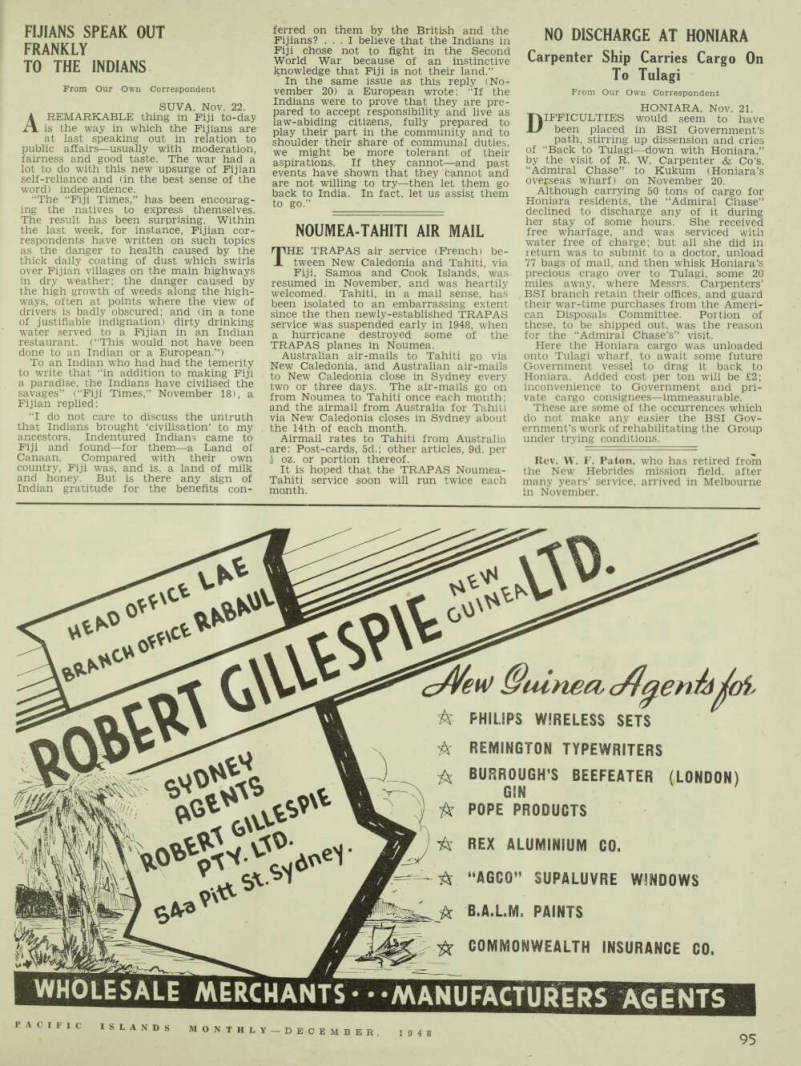
Frankly
To The Indians
From Our Own Correspondent
Suva. Nov. 22.
A REMARKABLE thing in Fiji to-day is the way in which the Fijians are at last speaking out in relation to public affairs —usually with moderation, fairness and good taste. The war had a lot to do with this new upsurge of Fijian self-reliance and (in the best sense of the word) independence.
“The “Fiji Times,” has been encourag ing the natives to express themselves.
The result has been surprising. Within the last week, for instance, Fijian cor respondents have written on such topics as the danger to health caused by the thick daily coating of dust which swirls over Fijian villages on the main highways in dry weather; the danger caused by the high growth of weeds along the high ways, often at points where the view of drivers is badly obscured; and (in a tone of justifiable indignation) dirty drinking water served to a Fijian in an Indian restaurant. (“This would not have been done to an Indian or a European.”) To an Indian who had had the temerity to write that “in addition to making Fiji a paradise, the Indians have civilised the savages” (“Fiji Times,” November 18), a Fijian replied: “I do not care to discuss the untruth that Indians brought ‘civilisation’ to my ancestors. Indentured Indians came to Fiji and found —for them —a Land of Canaan. Compared with their own country, Fiji was, and is, a land of milk and honey. But is there any sign of Indian gratitude for the benefits con
ferred on them by the British and the Fijians? ... I believe that the Indians in Fiji chose not to fight in the Second World War because of an instinctive knowledge that Fiji is not their land.”
In the same issue as this reply (No vember 20) a European wrote: “If the Indians were to prove that they are pre pared to accept responsibility and live as law-abiding citizens, fully prepared to play their part in the community and to shoulder their share of communal duties, we might be more tolerant of their aspirations. If they cannot —and past events have shown that they cannot and are not willing to try—then let them go back to India. In fact, let us assist them to go.”
Noumea-Tahiti Air Mail
THE TRAPAS air service (French) be tween New Caledonia and Tahiti, via Fiji, Samoa and Cook Islands, was resumed in November, and was heartily welcomed. Tahiti, in a mail sense, has been isolated to an embarrassing extent since the then newly-established TRAPAS service was suspended early in 1948, when a hurricane destroyed some of the TRAPAS planes in Noumea.
Australian air-mails to Tahiti go via New Caledonia, and Australian air-mails to New Caledonia close in Sydney every two or three days. The air-mails go on from Noumea to Tahiti once each month; and the airmail from Australia for Tahiti via New Caledonia closes in Sydney about the 14th of each month.
Airmail rates to Tahiti from Australia are: Post-cards, 5d.; other articles, 9d. per I oz. or portion thereof.
It is hoped that the TRAPAS Noumea- Tahiti service soon will run twice each month.
To Tulagi
No Discharge At Honiara
Carpenter Ship Carries Cargo On To Tulagi
From Our Own Correspondent
Honiara. Nov. 21.
Difficulties would seem to have been placed in BSI Government’s path, stirring up dissension and cries of “Back to Tulagi—down with Honiara,” by the visit of R. W. Carpenter & Co’s.
“Admiral Chase” to Kukum (Honiara’s overseas wharf) on November 20.
Although carrying 50 tons of cargo for Honiara residents, the “Admiral Chase” declined to discharge any of it during her stay of some hours. She received free wharfage, and was serviced with water free of charge; but all she did in return was to submit to a doctor, unload 77 bags of mail, and then whisk Honiara’s precious crago over to Tulagi, some 20 miles away, where Messrs. Carpenters’
BSI branch retain their offices, and guard their war-time purchases from the Ameri can Disposals Committee. Portion of these, to be shipped out, was the reason for the "Admiral Chase’s” visit.
Here the Honiara cargo was unloaded onto Tulagi wharf, to await some future Government vessel to drag it back to Honiara. Added cost per ton will be £2; inconvenience to Government and pri vate cargo consignees—immeasurable.
These are some of the occurrences which do not make any easier the BSI Gov ernment’s work of rehabilitating the Group under trying conditions.
Rev. W. F. Paton, who has retired from the New Hebrides mission field, after many years’ service, arrived in Melbourne in November.
Advertisements & other items, p. 97 (2 items)
Pacific Islands Monthly-D E C E M B E R, 1948
\>*
\c£ 0^ 0^ V 2 * 0* &i £> e 1 G sR -r* XV ?' s*® f ew Guinea
PHILIPS WIRELESS SETS
REMINGTON TYPEWRITERS
A BURROUGHS BEEFEATER (LONDON)
GIN
$T POPE PRODUCTS
■& REX ALUMINIUM CO.
A “AGCO” SUPALUVRE WINDOWS
& B.A.L.M. PAINTS
COMMONWEALTH INSURANCE CO.
WHOLESALE MERCHANTS ‘“MANUFACTURERS AGENTS
Islands Produce
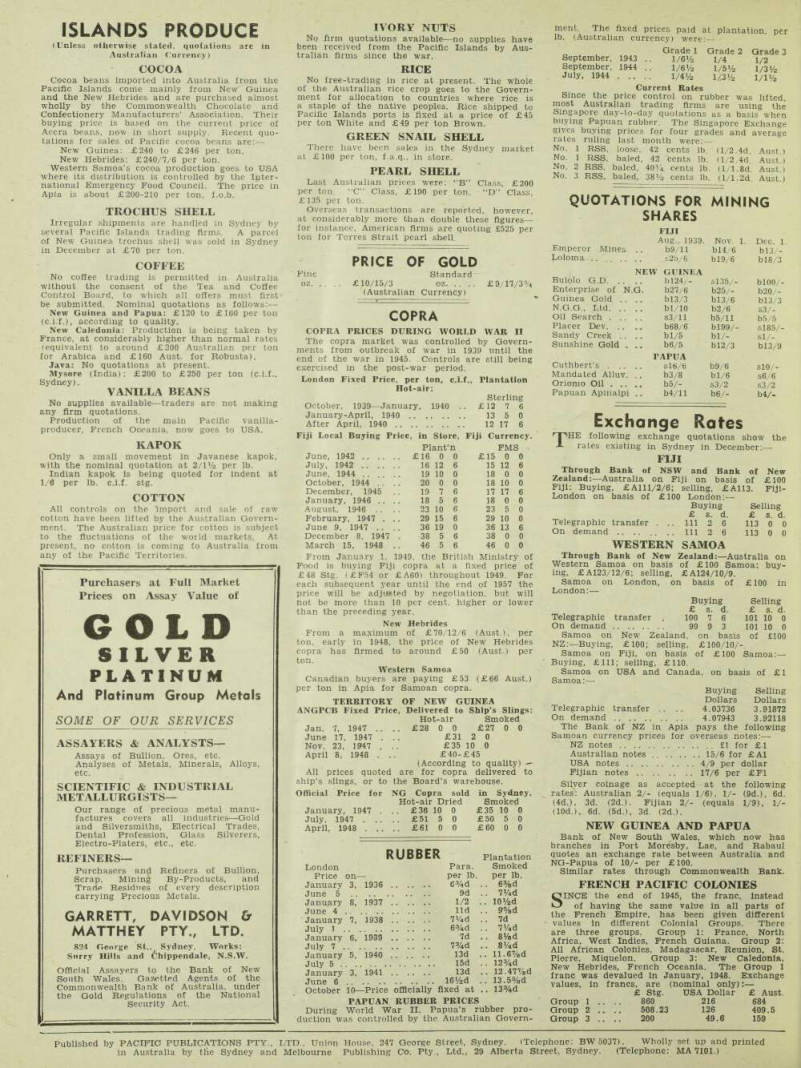
(Unless otherwise stated, quotations are in Australian Currency)
Cocoa
Cocoa beans imported into Australia from the Pacific Islands come mainly from Guinea and the New Hebrides and are purchased almost wholly by the Commonwealth Chocolate and Confectionery Manufacturers’ Association. Their buying price is based on the current price of Accra beans, now in short supply. Recent quo tations for sales of Pacific cocoa beans are:— New Guinea: £240 to £246 per ton.
New Hebrides: £240/7/6 per ton.
Western Samoa’s cocoa production goes to USA where its distribution is controlled by the Inter national Emergency Food Council. The price in Apia is about £200-210 per ton, f.o.b.
Trochus Shell
Irregular shipments are handled in Sydney by several Pacific Islands trading firms. A parcel of New Guinea trochus shell was sold in Sydney in December at £70 per ton.
Coffee
No coffee trading is permitted in Australia without the consent of the Tea and Coffee Control Board, to which all offers must first be submitted. Nominal quotations as follows:— New Guinea and Papua: £120 to £160 per ton (c.i.f.), according to quality.
New Caledonia: Production is being taken by France, at considerably higher than normal rates (equivalent to around £200 Australian per ton for Arabica and £160 Aust. for Robusta).
Java: No quotations at present.
Mysore (India): £200 to £250 per ton (c.i.f., Sydney).
Vanilla Beans
No supplies available —traders are not making any firm quotations.
Production of the main Pacific vanilla producer, French Oceania, now goes to USA.
Kapok
Only a small movement in Javanese kapok, with the nominal quotation at 2/1 V 2 per lb.
Indian kapok is being quoted for indent at 1/6 per lb. c.i.f. stg.
Cotton
All controls on the Import and sale of raw cotton have been lifted by the Australian Govern ment. The Australian price for cotton is subject to the fluctuations of the world markets. At present, no cotton is coming to Australia from any of the Pacific Territories.
Ivory Nuts
No firm quotations available—no supplies have been received from the Pacific Islands by Aus tralian firms since the war.
Rice
No free-trading in rice at present. The whole of the Australian rice crop goes to the Govern ment for allocation to countries where rice is a staple of the native peoples. Rice shipped to Pacific Islands ports is fixed at a price of £45 per ton White and £49 per ton Brown.
Green Snail Shell
There have been sales in the Sydney market at £IOO per ton, f.a.q., in store.
Pearl Shell
Last Australian prices were: “B” Class, £2OO per ton, “C” Class, £l9O per ton. “D” Class, £135 per ton.
Overseas transactions are reported, however, at considerably more than double these figures— for instance, American firms are quoting £525 per ton for Torres Strait pearl shell.
Advertisements & other items, p. 98 (1 item)
Price Of Gold
Fine Standard oz £lO/15/3 oz £9/17/33/4 (Australian Currency)
Copra
Prices During World War Ii
The copra market was controlled by Govern ments from outbreak of war in 1939 until the end of the war in 1945. Controls are still being exercised in the post-war period.
London Fixed Price, per ton, c.i.f., Plantation Hot-air:
From January 1, 1949, the British Ministry of Food is buying Fiji copra at a fixed price of £4B Stg. (£PS4 or £A6O) throughout 1949. For each subsequent year until the end of 1957 the price will be adjusted by negotiation, but will not be more than 10 per cent, higher or lower than the preceding year.
New Hebrides From a maximum of £7O/12/6 (Aust.), per ton, early in 1948, the price of New Hebrides copra has firmed to around £5O (Aust.) per ton.
Western Samoa Canadian buyers are paying £53 (£66 Aust.) per ton in Apia for Samoan copra.
Territory Of New Guinea
ANGPCB Fixed Price, Delivered to Ship’s Slings: Hot-air Smoked Jan. 7, 1947 .. .. £2B 0 0 £27 0 0 June 17, 1947 ... £3l 2 0 Nov. 23, 1947 ... £35 10 0 April 8, 1948 ... £4O-£45 (According to quality) All prices quoted are for copra delivered to ship’s slings, or to the Board’s warehouse.
October. 1939—January, 1940 Sterling . £12 7 6 January-Aprll, 1940 13 5 0 After April. 1940 .. 12 17 6 Fiji Local Buying Price in Store, Fiji Currency.
June, 1942 Plant’n £16 0 0 £15
Fms
0 0 July, 1942 16 12 6 15 12 6 June, 1944 19 10 0 18 0 0 October. 1944 .. 20 0 0 18 10 0 December, 1945 19 7 6 17 17 6 January, 1946 .. 18 5 6 18 0 0 August. 1946 .. 23 10 6 23 5 0 February, 1947 . .. 29 15 6 29 10 0 June 9. 1947 .. 36 19 0 36 13 6 December 8. 1947 . 38 5 6 38 0 0 March 15, 1948 .. 46 5 6 46 0 0
Official Price for NG Copra sold in Sydney.
Hot-air Dried Smoked January, 1947 . .. £36 10 0 £35 10 0 July. 1947 £51 5 0 £50 5 0 April. 1948 £61 0 0 £60 0 0
Rubber
Papuan Rubber Prices
During World War 11, Papua’s rubber pro duction was controlled by the Australian Govern
ment. The fixed prices paid at plantation, per lb. (Australian currency) were:—
Current Rates Since the price control on rubber was lifted, most Australian trading firms are using the Singapore day-to-day quotations as a basis when buying Papuan rubber. The Singapore Exchange gives buying prices for four grades and average rates ruling last month were:— No. 1 RSS, loose, 42 cents lb. (l/2.4d. Aust.) No. 1 RSS, baled, 42 cents lb. (1/2.4d. Aust.) No. 2 RSS, baled, 4014 cents lb. (1/1.8d. Aust.) No. 3 RSS, baled, 38y 2 cents lb. (1/1.2d Aust.)
Plantation
London Para.
Smoked Price onper lb. per lb.
January 3. 1936 . 6%d June 5 9d . . 7V 4 d January 8. 1937 1/2 . . lOVad June 4 lid . . 9 s /sd January 7. 1938 7Vid . . 7d July 1 . 6 3 / 4 d . . 7V 4 d January 6, 1939 7d . . 8Ved July 7 . 7%d . . sy 4 d January 5, 1940 13d . . 11.6 7 /sd July 5 . 15d . . 12%d January 3. 1941 13d . . 12.47 7 /sd June 6 levfed . . 13.5%d October 10 —Price officially fixed at . . 13%d
Grade 1 Grade 2 Grade 3 September, 1943 .
I/6V2 1/4 1/2 September, 1944 .
I/6V2 1/5 V 2 1/3 y 2 July, 1944 I/41/2 1/31/2 1/1V2
Quotations For Mining
Shares
Fiji
Aug.. 1939.
Nov. 1.
Dec. 1.
Emperor Mines b9/ll bl4/6 bl3/- Loloma .. bl9/6 bl8/3 Bulolo G.D. ..
New Guinea
bl24/sl35/blOO/- Enterprise of N.G. b27/6 b25/b20/- Guinea Gold .. bl3/3 bl3/6 bl3/3 N.G.G., Ltd. .. bl/10 b2/6 s3/- Oil Search . ..
S3/11 b5/ll b5/5 Placer Dev. .. b68/6 bl99/sl85/- Sandy Creek .. bl/5 bl/sl/- Sunshine Gold . b6/5 bl2/3 bl3/9 Cuthbert’s . ..
Papua
SI6/6 b9/6 slO/- Mandated Alluv. b3/8 bl/6 s6/6 Oriomo Oil . .. b5/s3/2 s3/2 Papuan Apinaipi b4/ll be/b4/-
Exchange Rates
THE following exchange quotations show the rates existing in Sydney in December:—
Fiji
Through Bank of NSW and Bank of New Zealand:—Australia on Fiji on basis of £lOO Fiji: Buying, £ All 1/2/6; selling, £AII3. Fiji- London on basis of £lOO London:—
Western Samoa
Through Bank of New Zealand:—Australia on Western Samoa on basis of £lOO Samoa: buy ing, £AI23/12/6; selling, £AI24/10/9.
Samoa on London, on basis of £ 100 in London:—
Samoa on New Zealand, on basis of £lOO NZ:—Buying, £100; selling, £lOO/10/-.
Samoa on Fiji, on basis of £lOO Samoa:— Buying, £111; selling, £llO.
Samoa on USA and Canada, on basis of £1 Samoa:— Buying Selling Dollars Dollars Telegraphic transfer .. .. 4.03736 3.91872 On demand 4.07943 3.92118 The Bank of NZ in Apia pays the following Samoan currency prices for overseas notes:— NZ notes £1 for £1 Australian notes 15/6 for £AI USA notes 4/9 per dollar Fijian notes 17/6 per £FI Silver coinage as accepted at the following rates: Australian 2/- (equals 1/6), 1/- (9d.), 6d. (4d.), 3d. (2d.). Fijian 2/- (equals 1/9), 1/- (lOd.), 6d. (5d.), 3d. (2d.).
New Guinea And Papua
Bank of New South Wales, which now has branches in Port Moresby, Lae, and Rabaul quotes an exchange rate between Australia and NG-Papua of 10/- per £lOO.
Similar rates through Commonwealth Bank.
French Pacific Colonies
SINCE the end of 1945, the franc, instead of having the same value in all parts of the French Empire, has been given different values in different Colonial Groups. There are three groups. Group 1: France, North Africa, West Indies, French Guiana. Group 2: All African Colonies, Madagascar, Reunion, St.
Pierre, Miquelon. Group 3: New Caledonia, New Hebrides, French Oceania. The Group 1 franc was devalued in January, 1948. Exchange values, in francs, are (nominal only):
Buying Selling £ s. d. £ s. d.
Telegraphic transfer . .. Ill 2 6 113 0 0 On demand .. .. 113 0 0
Buying Selling £ s. d. £ s. d.
Telegraphic transfer . 100 7 6 101 10 0 On demand 99 9 3 101 10 0
Group 1 .. £ Stg. 860 USA Dollar 216 £ Aust. 684 Group 2 .. 508.23 126 409.5 Group 3 .. 200 49.6 159
Advertisements & other items, pp. 98-100 (3 items)
Published by PACIFIC PUBLICATIONS PTY., LTD,, Union House, 247 George Street, Sydney. (Telephone: BW 5037). Wholly set up and printed
in Australia by tlie Sydney and Melbourne Publishing Co. Pty., Ltd., 29 Alberta Street, Sydney. (Telephone: MA 7101.)
Gold
Purchasers at Full Market Prices on Assay Value of
SILVER
PLATINUM
And Platinum Group Metals
SOME OF OUR SERVICES
ASSAYERS & ANALYSTS—
Assays of Bullion, Ores, etc.
Analyses of Metals, Minerals, Alloys, etc.
SCIENTIFIC & INDUSTRIAL
METALLURGISTS—
Our range of precious metal manufactures covers all industries —Gold and Silversmiths, Electrical Trades, Dental Profession, Glass Silverers, Electro-Platers, etc., etc.
REFINERS—
Purchasers ansJ Refiners of Bullion, Scrap, Mining By-Products, and Trade Residues of every description carrying Precious Metals.
GARRETT, DAVIDSON &
MATTHEY PTY., LTD.
824 George St.. Sydney. Works: Surry Hills and (Chippendale, N.S.W.
Official Assayers to the Bank of New South Wales. Gazetted Agents of the Commonwealth Bank of Australia, under the Gold Regulations of the National Security Act.
tropical thirst...
To quench a
Jjodtf drinks
'Z * c °Ot> e » nr»V* eo 4 eo"i«o • * ° CO limited *r 0 v #f « A V When you’re hot and tired, (here is nothing quite so satisfying and thirst quenching as a long, cold glass of “K. 8.” Your friends and guests, too, will appreciate this really fine Lager, for “Everybody drinks K.B.’*
TOOTH’S
LAGER
i M
ERCHANTS
. & SHIP OWNERS
Capita! £1,000,000
ESTABLISHED 1914
COPRA MERCHANTS & MILLERS
ASSOCIATED COMPANIES THROUGHOUT THE PACIFIC ISLANDS
Buyers and exporters of all kinds of Islands produce. Copra Merchants and Millers.
Agents for Australian, European and American Manufacturers. Distributors of every description of merchandise.
Thirty years of Pacific Islands development and service.
REGULAR CARGO
PACIFIC
IN LONDON
W. R. CARPENTER & CO.
(LONDON) LTD.
Coronation House, 4 Lloyd’s Avenue, London, E.C.
IN NEW GUINEA
New Guinea Company Limited., Rabaul, Lae, Madang, Kavieng.
IN PAPUA
J. R. Clay & Co., Ltd.,
IN FIJI
W. R. Carpenter & Co. (Fiji) Ltd. ★
THE W.R.C LINE
THE FIRST DIRECT AND
AND PASSENGER SERVICE
ISLAND
DISTRIBUTING
AGENTS FOR :
Ford Motor Company of Canada.
Electrolux Refrigerators.
T. G. & C. Bolinders (Engines).
Chrysler Corporation.
Westinghouse Electrical Co.
Caterpillar Tractors.
Etc., Etc.
AND
Head
W.
Office:
BETWEEN EUROPE
PORTS WAS ESTABLISHED BY
R. CARPENTER & CO. LTD.
16 O'CONNELL STREET, SYDNEY.
Cable Address:
CAMOKE.
Telephone: Postal Address: BW 4421. P.O. Box No. 168, Sydney.
PACIFIC ISLANDS MONTHLY DECEMBER, 1948