Islands
Pacific
Monthly
November, 1948
Vol. XIX. No. 4.
tobllshed 1930.
transmission by post as a newspaper ]
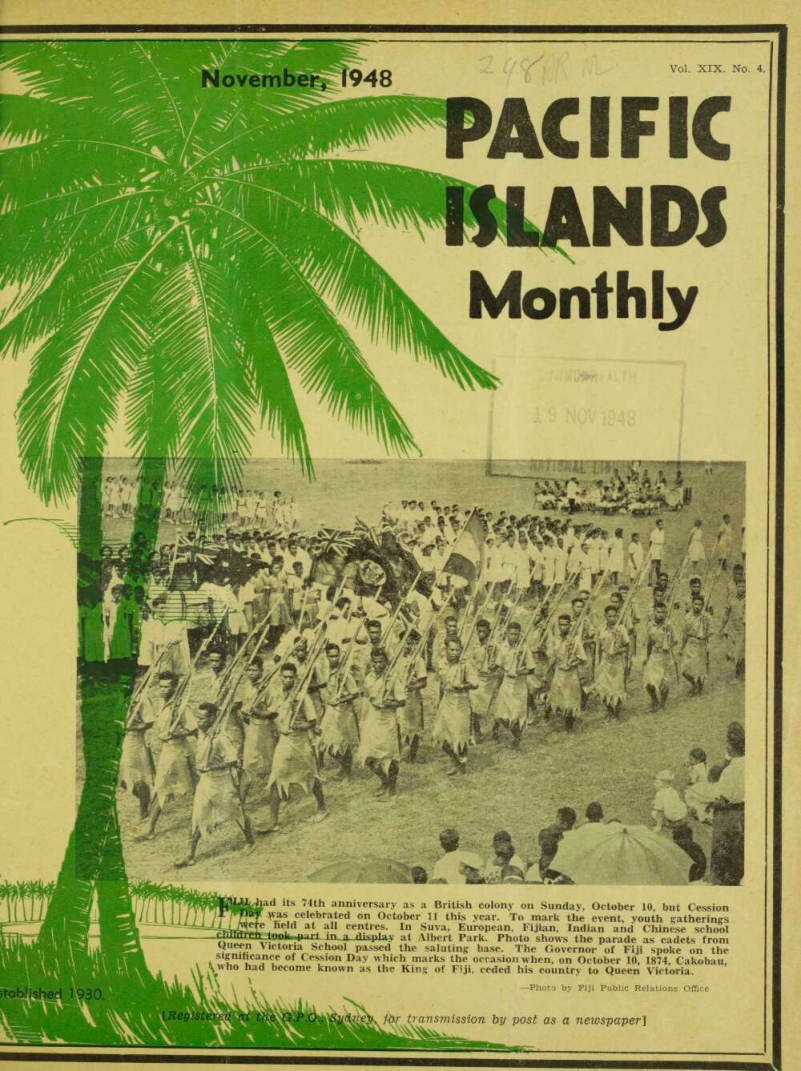
Fiji had its 74th anniversary as a British colony on Sunday, October 10, but Cession Day was celebr ated on October 11 this year. To mark the event, youth gatherings were held at all centres. In Suva, European, Fijian, Indian and Chinese school children took part in a display at Albert Park. Photo shows the parade as cadets from Queen Victoria School passed the saluting base. The Governor of Fiji spoke on the Significa nc e of Cession Day which marks the occasion when, on October 10, 1874, Cakobau, who had become known as the King of Fiji, ceded his country to Queen Victoria. —Photo by Fiji Public Relations Office
Advertisements & other items, pp. 2-4 (1 item)
tfanlab SmftFi£ < /hsru/ay<}
MM J
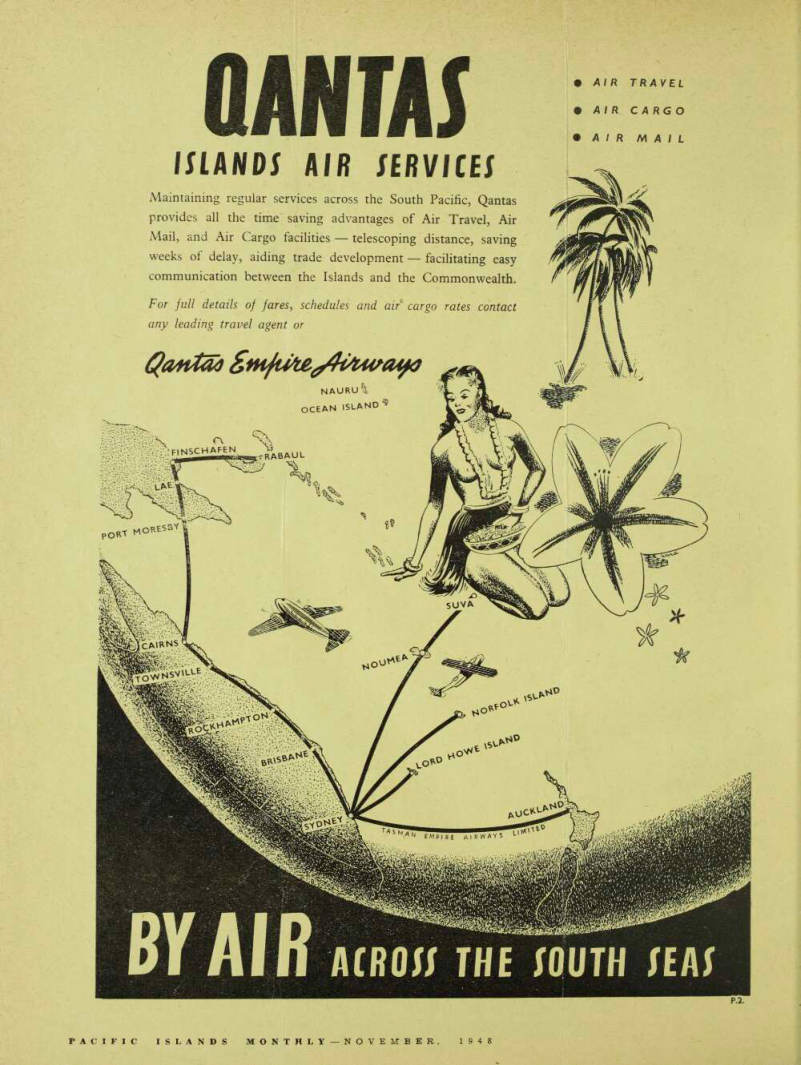
ISLANDS AIR SERVICES
Maintaining regular services across the South Pacific, Qantas provides all the time saving advantages of Air Travel, Air Mail, and Air Cargo facilities telescoping distance, saving weeks of delay, aiding trade development facilitating easy communication between the Islands and the Commonwealth.
For full details of fares , schedules and air cargo rates contact any leading travel agent or
tfanlab SmftFi£ < /hsru/ay<}
• AIR TRAVEL
• AIR CARGO
AIR MAIL
NAURUU
OCEAN ISLAND^
r\
.MNSCHAFEN
V-At
PORT MORES3T
m-
SUVA
* m
CAIRNS
NO nsville -rov* \SV o'-'** Rr NO ptoN RO aNO nN* ba^ NO br' s aNO
UC-R L
bNfej ut*' 1 » If P. 2.
- Instant-lite Petrol Lantern 300 or 500 C.P m •.s
eman
a Petrol Stove Speed-master
LANTERNS IRONS STOVES
THE BEST OF
THEIR KIND
Coleman appliances have for many years been bringing better ways of living to
people everywhere. They bring greater
comfort and happiness with better light . . . easier, faster ironing . . . more convenient, more healthful heating . . .
better cooking.
Over forty years’'expehence in producing
these appliances have made Coleman Products “The best of their kind.”
Coleman’s appliances include:— Petrol and Kerosene operated Lamps, Lanterns, Irons, Stoves, Portable Stoves, Brazing Torches and Blow Lamps. ■ ' % Kerosene or Petrol Table or Hanging Lamp Coleman “530”
Pocket Stove Coleman Kerosene Iron Kerosene 3 Burner Cooking Stove Instant-lighting portable Petrol Cooking Stove
mtm H L
Representatives for the f Pacific Islands:
ROBERT GILLESPIE PTY, LTD.
54a PITT STREET, SYDNEY
PEARCE & CO. LTD.
SUVA
FOR FIJI ISLANDS
7a 7a I Va ■ mmmsm m l * I >* & rtf '<r m >* - ' -;•': *,* A % i tk *.
H &
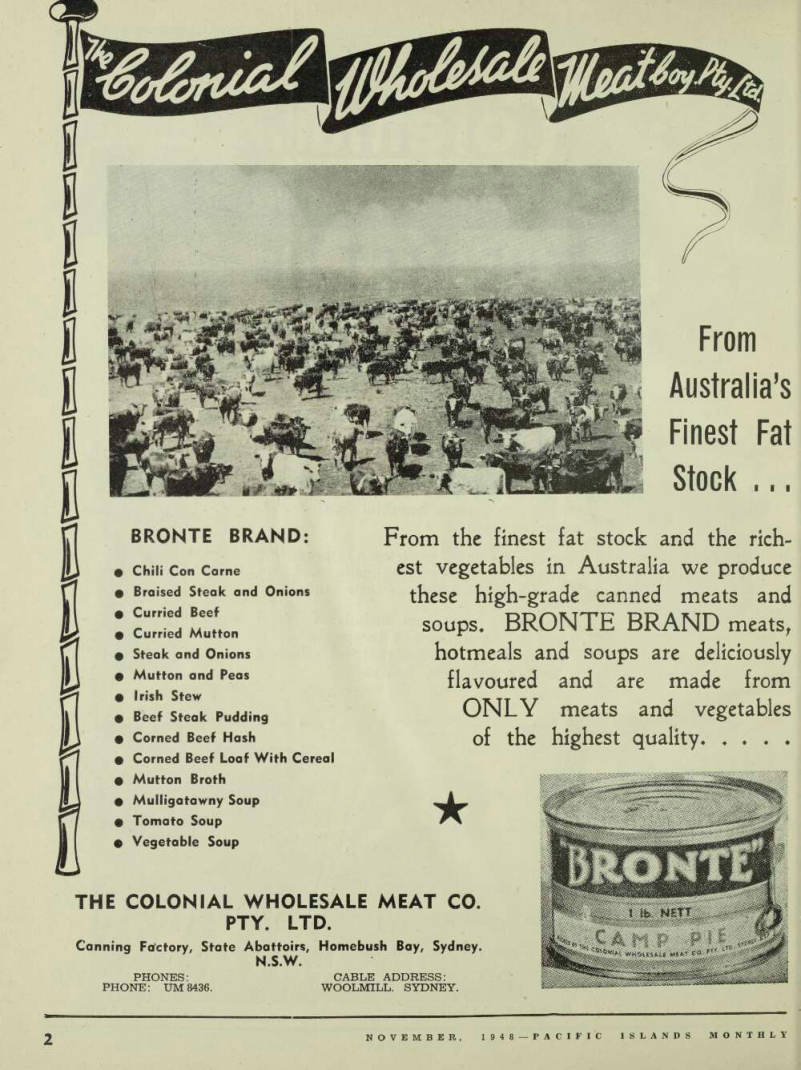
BRONTE BRAND:
Chili Con Came Braised Steak and Onions Curried Beef Curried Mutton Steak and Onions Mutton and Peas Irish Stew Beef Steak Pudding Corned Beef Hash Corned Beef Loaf With Cereal Mutton Broth Mulligatawny Soup Tomato Soup Vegetable Soup
From
Australia’s
Finest Fat
Stock ...
From the finest fat stock and the richest vegetables in Australia we produce these high-grade canned meats and soups. BRONTE BRAND meats, hotmeals and soups are deliciously flavoured and are made from
ONLY meats and vegetables
of the highest quality
THE COLONIAL WHOLESALE MEAT CO.
PTY. LTD.
Canning Factory, State Abattoirs, Homebush Bay, Sydney.
N.S.W.
PHONES:
PHONE: UM 8436.
CABLE ADDRESS:
WOOLMILL. SYDNEY.
If ® 9 i
Advertisers
Aluminium Union Ltd. 35 Angliss & Co. . .40 Amplion (Aust.) Pty., Ltd. ... 71 Atkins Pty., Ltd., Wm . 61 Atkins Kroll & Co. 33 Australian Block & Chain Co. Pty., Ltd 75 Amalgamated Hatcheries ... 73 Bethell, Gwyn & Co 33 Brunton’s Flour . 68 Burns, Philp (New Hebrides), Ltd. . 15 Bank of NSW . . 16 Burns, Philp (NG), Ltd 49 Berger, Lewis & Sons ... 37 Brasso (Reckitt & Coleman) ... 75 Burns, Philp Trust Co., Ltd 67 Budge, James Pty., Ltd 31 Broomflelds ... 24 BP (SS) Co. . . . 38 W. R. Carpenter & Co. (Fiji). Ltd. . 57 Caine’s Studio . . 77 Carpenter, Ltd.. W.
R cov. iv.
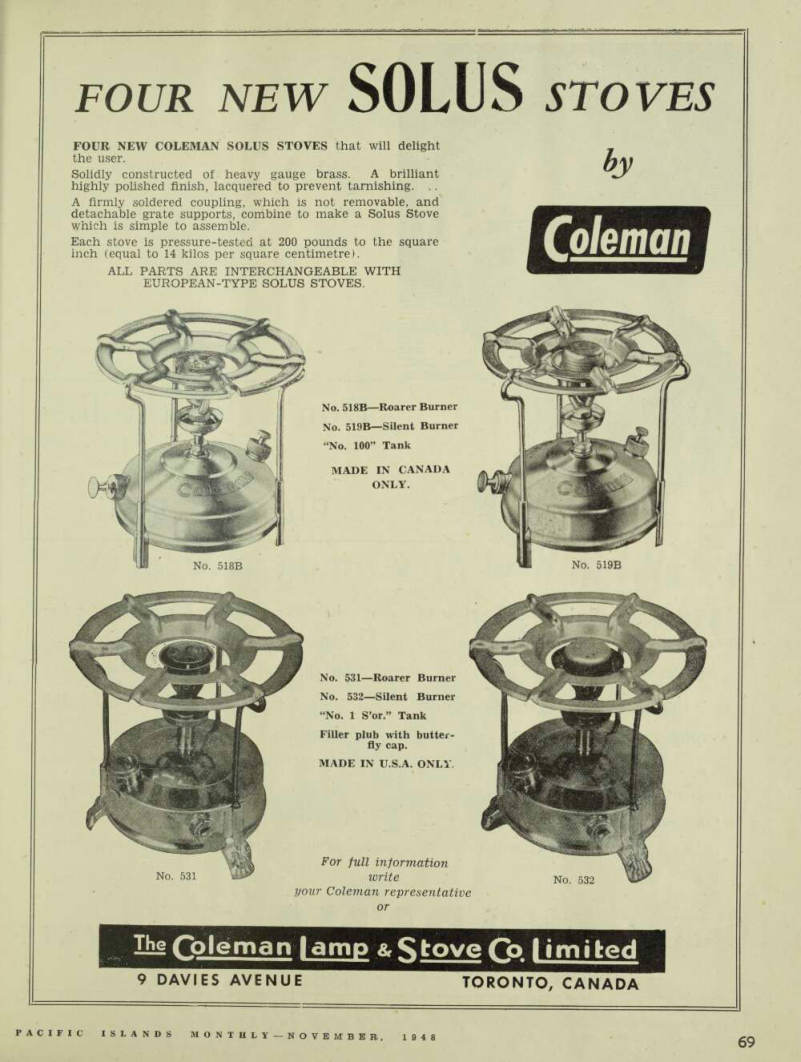
Colonial Wholesale Meat 2 Coleman Lamp & Stove Co. . . .69 Colyer Watson (New Guinea), Ltd. . . 28 Crammond Radio Pty., Ltd 17 Commonwealth Bank of Australia 30 Costello, Vince Garrick Hotel . . 29 China-New Guinea Mercantile Co. . . 34 “Cystex” 73 Coleman’s Mustard 77 Donaghy & Sons . 50 Donald, Ltd.. A. B. 76 Davison Paints, Ltd. 55 Dunlop Rubber (Aust.), Ltd. . . 51 Dettol (Reckitt & Coleman) ... 68 Dr. Williams Pink Pills 63 Dangar, Gedye & Malloch ... 3 Exeelstor Supply Co 58 Edwards, William & Co 19’
Electrolux Refrigerators . . 80 Ford Sherington . . 87 Garrett & Davidson 88 Gillespie Pty., Ltd., Robert ... 1 & 21 Rotot. Gillespie (NG), Ltd. ... 87 Gilbey’s Gin ... 64 Gillespie’s Flour . . 61 Grand Pacific Hotel 4 Gough & Co., E. J. 65 Grove & Sons, W.
H 29 Gordons Gin ... 72 Heinz & Co. Pty., Ltd., H. J. . . . 85 Hettig August ... 83 Hemingway & Robertson ... 60 Ipana Tooth Paste 70 Kennedy, Capt. W.
L 74 Kodak (Aust.), Pty., Ltd. 23 Kolynos, Inc. ... 52 Kopsen & Co., Ltd. 32 Kerr Brothers ... 85 Kwong Chong Bros. 55
Lockyer, Geo. J. . . 54 Manstocks ... 55 Mail Publicity Co. (Magazine Sub scriptions) ... 23 Merrillees, J. C., & Co 58 Maloney, N. F., & Co 66 Millers, Ltd., Suva 35 Miscellaneous 84 “Mum” Deodorant 56 “Mendaco” ... 66 Mcllraths Pty., Ltd. 62 Morris, Hedstrom, Ltd., Suva ... 12 National Airways Corporation ... 22 NAPT (Health Horizon) ... 27 Nordman, Oscar . . 21 Nelson & Robertson Pty., Ltd. ... 27 NSW Yacht Brokers ... 20 “Nixoderm” ... 82 Produce Buyers . . 79 Pacific Is. Society 40 Pan American Air ways 14 Patel, M. P.. & Co. 83 Penguin Marine Engines 63 “Pinkettes” ... 35 Pitt & Scott, Ltd. . 31 Qantas Empire Air ways . . . ’ cov. ii.
Queensland Insur ance Co 38 Robinson, G. H. . . 18 Renton. G 30 Ransomes, Sims ii Jefferies . . . . 20 Reckitt’s Blue . . 82 Rohu, Sil ... 51 Reed. William E. . 32 Scott, Ltd., J. ... 25 Shell Co. ... 81 Southern Pacific Insurance Co. . . 28 Steamships Trading Co., Ltd 75 Sullivan & Co., C. . 76 South Sea Island Correspondence Club ... 57 Spartan Paints Pty., Ltd 66 Swallow & Ariell . 84 Taylor & Co., A. . 36 Tooth & Co., Pty., Ltd cov. iii.
Thornycroft (Aust.) Pty., Ltd 25 Tilley Lamps ... 78 Tillock & Co. ... 77 Tyneside Foundry & Engineering Co., Ltd 53 Trans Oceanic Air ways 39 Union Manufactur ing & Export Co. 59 Vacuum Oil Co., Ltd. ... 26 “Vitalis” Hair Tonic 83 Vincent Chemical Co 60 Ventura Trading Co.
Pty., Ltd., 62. 81, 87 Watson, Wm. H . 36 Wakefield, Green wood & Co. . . 24 Harry West ... 21 Widdop, H„ & Co..
Ltd 50 Wenzel & Co. ... 15 Wills, W. D. & H.
O. 86 Wright & Co., Ltd., E. . 57 Young, Harry J., Pty., Ltd. ... 18 Yorkshire Insur ance Co., Ltd. . . 15
The new Senior Medical Officer for British Solomon Islands (Dr. Mackenzie Pollock) sailed from London in “Orion” on October 14 on his way to take up his new duties. Dr. Pollock was formerly an MO in Palestine.
Advertisements & other items, p. 5 (1 item)
Available Now!
BLACKSTONE Marine Diesels
The 160 h.p. diesel illustrated and also the 120 h.p. type are two of the famous Blackstone engines available for immediate delivery. Blackstone diesels, from 120 to 220 h.n.. arP' irlonl fnr nil fvnoe of smai they ai to 200 gear is ]
NOW ON THE WATERFRONT
Boat owners are advised of the new address of our Marine Division—;B MacDougall Street, Milson’s Point, on the southern side of Careening Cove, accessible by land or water. Previously occupied by Pritchard Bros., Ltd., the new premises have well-equipped workshops and a staff of experts headed by a qualified marine engineer to give faster and still better marine service.
Sole Distributors in N.S.W. :
Dangar, Gedye & Malloch Limited
Head Office: 10-14 YOUNG STREET, CIRCULAR QUAY, SYDNEY. gear is type, of spar availabl 1 ] for Trowlcrs
D.G.M. Marine Division
Telephone: B 6095.
Code Address: “DANGARS.
MARINE WORKSHOP; Phone XAII9I.
In This Issue:
Editorial: “The South Pacific Com mission is Launched” 5 Australians Lucky in War Damage Jackpot 6 Steamships Trading Co. Makes Almost £39,000 Profit 6 Tahiti is Anxious About TRAP AS Service 6 Oil Search in NG—Five Bores by End of 1949 7 Mrs. Cowan To Hold Ariki Title Permanently 7 Tahiti Tourist Premises Searched For Foreign Currency 7 Developmental Plans for Papua-New Guinea —Govt. May Retain Control of Copra 7 New Ship and Hotel for Norfolk Island 8 New Guinea Timber Case Begins ... 8 Lavish War Damage Gifts to NG Natives 8 Australian Donations to Islands Missions Are Taxable 8 Mr. R. H. Garvey is Promoted to Governorship Rank 9 More Trouble for Matson Line Directors 9 South Pacific Air Control Conference to Decide on Fiji’s International Airport 9 Maddening Travel Conditions “Matua” Three Months in Dock .’. 9 Sheep for NG Highlands—lnteresting Experiment Under Way 10 Japan Remains a Danger to Pacific Peace 10 UN Praise for NZ’s Samoa 10 South Pacific Commission Meets in Sydney but Noumea Will be New Headquarters i 11 Colonel Allan Speaks for New Guinea at RSSAILA Congress 18
Public Views Sought on Amending Fiji Constitution 20 Yacht Procession Across Pacific ... 20 New Tuna Industry for Fiji—Modern Ships and Equipment Will Be Brought Into South Pacific 21 Fiji-Indian Pot is Boiling—Discussions High-Light Difficulties of Racial Problem 25 Fiji’s Increased Copra Output 28 Qantas Begins Delayed Santo-Sydney Service 28 BGD’s War Compensation £1,300,000 . 29 NG Administrator on Work of Missions 29 Two Families Share Christmas Island Phosphate Fortune 30 Movie-Making on Makogai 31 Suva Wants Automatic Telephones .. 32 New Caledonia’s Industries—America Interested in Nickel and Chrome .. 32 Still no Timber from Vanikoro ... 33 Cook Islanders Form Labour Branch in New Zealand 33 Fiji Has Been British Colony for 74 Years 33 NZ Labour Solomons Seek Causes for Cook Islands Unrest 35 Notes from Tahiti 36 “Viti” on Tasman Run 36 Nauru’s Cantilever is Operating Again 37 Masonic Lodge Sponsors Fijian School 38 Fantastic Prices for New Hebrides Disposals Buildings 38 Palm-Grove Movies —16 mm. Film Development 39 Yachts for Tonga 40 NG Natives on Assault Charges ... 40 Territories Talk-Talk 41 Pacific Nature Notes 42 “Vaka Totomi” 43 Torgil, Valley of the Virgins 44 Tropicalities 45 Short Story: “On the Wallaby” ... 46
The Orange Grower’s Dream 47 Pay-Back 43 Queen Victoria School is Going Way of Fiji’s Cession Memorial 50 New Methods of Native Food Growing in Tonga 51 More Control Needed Over New Caledonian Lepers 51 Lae Newsletter 53 Banabans Settle Down on Rabi ... 53 New Hebrides Copra—Exchange Un certainty 55 New Look for Pitcairn Architecture .. 56 America’s Big Science Plans for Pacific Islands 57 Makatea’s Deep-Sea Moorings Rest on Sea-Bed 59 Men Who Rallied New Caledonia to de Gaulle were Condemned to Death 59 Earthworms Mean Soil Fertility ... 60 Melbourne Firm Seeks Pacific Mutton Birds 61 New Sydney University Professor Has Papua Affiliations 62 NZ Airforce Leaves Nausori 63 Gatty—A Man Who Gets Things Done 65 Western Samoa’s Healthy Financial Position 68 Plane and Shipping Services 71 Bird’s-eye Views of Pacific Islands — Photo-Survey Being Made 75 NZ Beer for Santo! 75 Soil Erosion in Fiji 76 Potato Growing in Fiji 79 Europeans Outnumbered in Suva Town Rolls 79 “German-Harry”—Memories of By- Gone Days in Papua 81 Commercial, Markets, etc 88 ORGANISATIONS: Brisbane NG Asso ciation, 67; Pacific Islands Society, 59.
OBITUARY: Fred. Cuthbert, 29; The Rev.
Nacaniela Mataika, 51.
INDUSTRIES: Oil, 7; Copra, 7, 28, 55, 68; Gold, 29; Phosphate, 30, 37, 38, 59.
Advertisements & other items, p. 6 (1 item)
jwSL?
'Jv OeV'i W
s t*v***
»% %\ iP Jt o^fflC et><- jroU ° . pac>f' c *• ** ; *-*** «• SPe Ce -** . S'*' 1 * . c eoW e 0 . ne . a« e " .« (rort' i . *. ‘t:.— - r;:- ■ t r»W e “ C»' 3 ' e ’ „, A^' )« P® .se^' 00 ''
jwSL?
Pacific Islands Monthly
The Newspaper-Magazine of the South Seas I Registered at the G.P.0., Sydney, for transmission by post as a newspaper]
Published Once Each Month and Circulated in Australia and New Zealand and in the following Pacific Territories and Islands Groups:
Australian Territory 01 Papua.
Trustee Territory (Australia) of New Guinea.
Australian Territory of Norfolk Island.
New Zealand Territory of Cook Islands.
Trustee Territory (NZ) of Western Samoa.
British Colony of Fiji.
British Solomon Islands Protectorate.
British Protectorate of Tongan Islands.
British Crown Colony of Gilbert and Ellice Islands.
Trustee Territory of Nauru.
British and French Condominium of New Hebrides.
French Colony of New Caledonia.
French Colony of Oceania (Tahiti, etc.).
American Territory of Eastern Samoa.
American Territory of Hawaiian Islands.
Owned and Produced by Pacific Publications Pty., Ltd., Union House, 247 George Street, Sydney.
Telephone: General Office and Advertising, BW 5037.
P.O. Box 3408
Registered Address for Telegrams. Radiograms, and Cables: “Pacpub,” Sydney.
Contributions.
Articles, Stories, and Photographs dealing with Pacific Islands subjects are invited and will be paid for on publication.
Subscription Rates.
Per Annum, Pre-paid, Including Postage.
In Australia, New Zealand, Fiji, New Guinea, Papua, Western Samoa, Cook Islands, Tonga, British Solomons, Gil bert and Ellice Colony, Nauru, and Uuited Kingdom 15 0 Elsewhere $3 18 0 Single Copies 1 6
Editor and Publisher:
R. W. Robson. P.R.G.S.
Assistant Editor: JUDY TUDOR.
General Office: Union House, 247 George Street, Sydney. Telephone: BW 5037.
Advertising Manager: W. E. Rogers.
Representative In London.
J, T. Wallis, Coronation House, 4 Lloyds Avenue, London, E.C.3, from whom may be obtained copies of Pacific Islands Monthly, Pacific Is. Year Book, advertising schedules, etc.
Representative In U.S.A.
Pacific Islands Trading Co..
244 California St.. San Francisco, U.S.A
Agents.
The following are authorised to receive sub scriptions for Pacific Islands Monthly:— Burns, Philp & Co., Ltd., and Burns Philp (South Sea) Co., Ltd. All branches.
W. R. Carpenter & Co., Ltd. All branches.
Morris, Hedstrom, Ltd. All branches.
Steamships Trading Co., Papua. All branches.
W. M. Caldwell, Suva, FIJI.
Cook Islands Trading Co., Rarotonga, Cook Is.
Oscar Nordman, Papeete, Tahiti.
Islands Branches and Representatives of W. H.
Grove & Sons, Ltd., Auckland, New Zealand.
Ed. Pentecost, Noumea, New Caledonia.
Societe Gubbay Kerr et Cle, Noumea. New Caledonia.
Vol. Xix. No. 4.
November, 1948
( 1/6 Per Copy Price Prepaid, p.a.: 15/- Aus. ( In USA, p.a.: $3.
The South Pacific Commission Is Launched
MOST thoughtful people who know anything about tropical adminis tration will approve warmly of the purpose of the South Pacific Com mission, which was brought into being in January, 1947, and which now is beginning to function. The mem bers of the carefully-selected, expert staff, as they apply themselves to their new tasks, may expect the sympathy and goodwill of the Territories interests concerned.
It must be admitted, however, that at this stage most people are blankly ignorant of the character and objects of the SPC. Their natural suspicion of any new “Government institution” is strengthened by the fact that this body is composed wholly of bureau crats and academicians—types of planners whose recent activities in this unhappy, post-war world have done nothing to endear them to the common man. Therefore, the pur pose of the SPC should be widely publicised, as soon as possible.
Broadly stated, the SPC has been brought into being to study the con ditions of life in all the Pacific Territories south of the equator, and north of Capricorn; and to assemble data and make recommendations which will assist the six nations re sponsible for those South Pacific Territories in their task of adminis
tration, especially in relation to native welfare. There are some 15 Territories in the area and the con ditions of life in each are in most respects similar. Yet those 15 Administrations have gone along, generally, in separate and water tight compartments, each tackling its problems in its own way, indifferent to the experiences and conclusions of the other Administrations, dealing with almost precisely similar prob lems. Generally, each of those Administrations has been animated by the same desire to improve the living standards of the indigenous peoples, and assist them towards self government; but, although they have been dealing with the same types of natives, there has been no effort to consult with each other as to the best ways of attaining those ends—there has not even been a channel of com munication available.
The creation of such an advisory and co-ordinating body, to work in co-operation with administrative bodies in a particular area, is not new. One, the Caribbean Com mission, created about 1946 and now functioning in the West Indies, is very similar in scope, purpose and structure to the South Pacific Com mission. The SPC has come into be ing as a result of the “Anzac” Agree
ment, signed by Australia and New Zealand at the end of 1944, and deal ing with their mutual interests in the South Pacific. The Australian Minister, Dr. Evatt, saw the necessity for something like the SPC, and made provision for it in the Agree ment. In due course, the four other nations concerned (Britain, United States, France and The Netherlands) accepted the idea; and the SPC was born at a conference in Canberra in January, 1947, when all six nations were represented.
THE SPC has no direct authority in relation to administration—it merely investigates and advises. Its most important work will be done by its Research Council, the members of which are recognised as experts and authorities in their particular fields.
Their reports and recommendations will go, through the Council’s per manent officers, per medium of the SPC Secretariat, to the Commission itself; and, when considered neces sary, the delegates of the six nations comprising the Commission will carry those recommendations back to their respective Governments, for con sideration and, if thought desirable, for implementation.
As will be seen from the report of the Commission’s Second Session, published elsewhere in this issue, the services of a number of distinguished men, some already well-known in connection with Pacific Islands
administration, have been secured for the Research Council; the officials who have been appointed to the Secretariat have a first-class repu tation; and the SPC steps off, to face its interesting Work Programme, under happy auspices.
AT this stage, only one criticism can be offered, and one fear ex pressed. The criticism is that there is not one representative of the com mercial classes in the personnel of this new set-up—all are bureaucrats and academicians, whose feet are not always planted very firmly on the hard earth. Quite apart from the fact that this organisation cannot func tion with complete efficiency unless it has the goodwill and co-operation of the commercial interests, it is desirable in all such bodies to have the advice and hard commonsense of men who are accustomed to demand ing, in organisation, the qualities of industry and efficiency, as an alter native to starvation.
The fear is that the influence of the Australian politicians may dom inate the SPC . . . which, it is admitted, is actually the creation of an Australian politician. If the methods of the Australian Socialist Administration in Australia and in Papua-New Guinea—which consist chiefly of inaugurating Utopian schemes, multiplying expensive staff to the point of absurdity, and ignor ing fundamental economic considera tions—are to be extended to the SPC, then the SPC is doomed. Because of her extravagance and her politicians’ apparent ignorance of economic law, Australia presently must face an economic blizzard; and, if Australian tentacles are too closely wound around the SPC, the SPC will go into the blizzard with her.
There is more than a suspicion that Australian political hates have been given an airing in connection with this SPC. If not, why has that skilled and experienced Pacific Administrator, Mr. Leonard Murray, not been given some part in this new organisation? We say, without hesi tation, that there is not one SPC delegate, connected with the Mela nesian section of this set-up, who has one tithe of Mr. Murray’s knowledge
and experience. Most people believe that the Australian Government’s failure to restore Mr. Murray to his place in Pacific administration—from which he was removed by the out break of war in his area—is con nected with the notorious hate complexes of Australian Minister Ward; and that belief is coloured by Australia’s failure to send Mr. Murray as a delegate to the SPC, for which he so obviously is fitted.
There is comment, also, on the fact that Australia voted for Noumea, as headquarters, instead of for Suva.
The selection of Noumea probably will work out quite well in the end— especially as the SPC seems to have the goodwill and co-operation of the French—but it was expected that Australia would have supported Britain and New Zealand in nominat ing Suva (which so obviously is the correct place for SPC headquarters) even if it was obvious that the cast ing vote would have gone in favour of Noumea. It is not forgotten that, at the birth of the SPC, in Canberra, Australia put forth the surprising claim that Port Moresby should be SPC headquarters.
It long has been felt, in British Pacific Territories, that there is ill will on the part of the Australian Pacific Administration towards the British. That feeling did not have its origin in Papua and New Guinea— it emanates from Canberra, from the little, pin-headed, professional poli ticians who make a feature of their anti-British hates. Australia’s sur prising vote for Noumea, instead of Suva, will not lessen that impression.
Any tendency to allow Australian political hates to influence important SPC decisions could be an evil thing, which would do untold harm to the SPC, SPC represents a good plan, which has been launched under pro mising auspices. It could contribute much to the advancement of the Pacific Territories. But, if it is to succeed, the politician and the place seeker must be kept out.
Mr. John McWhinney, secretary of the Norfolk Island Administration, has been spending furlough in Sydney. He re turned to Norfolk Island by air this month.
‘Steamships’ Make A Profit
of £38,900
AFTER paying 10 per cent, on its pref erence and ordinary shares, Steam ships Trading Co., Ltd., of Papua (which has an issued capital of £193,633) was able to add £15,000 to reserves, and add £4,000 to the carry-over. The profit, £38,907, fpr the year ended July 31, was the best in the Company’s history.
The company now has a general reserve of £115,000, a depreciation reserve of £30,000, and other funds of over £50,000 —making the total of shareholders’ funds £390,388. £113,000 is owing to the bank and to sundry creditors. Assets are well over £500,000, the main items being land, buildings and equipment, about £90,000 plantations £61,000, investments £41,000 and merchandise £191,000.
The directors are Messrs. E. V. Crisp L. Tracey, L. A. Willis and H. J. Lockrey.
Captain A. G. Fitch, who founded the company, and guided it through the hazardous war years, retired a coupl® of years ago.
Tahiti Is Anxious About
Trapas Service
From Our Own Correspondent
Papeete, Aug. 8.
THE coconut radio has it that the Aus tralian and New Zealand Govern ments have refused TRAPAS land ing rights in Fiji, Western Samoa and Cook Islands as a reprisal for the refusal of the French Government to allow Trans Oceanic Airways to make occasional trips to Tahiti.
Whether or not there is any truth in the rumour, the fact remains that TRAPAS have not indicated in any way when, or if, they will resume their in terrupted service between Noumea and Papeete. (Editorial Note: Whatever the reason for the delay in recommencing the TRAPAS trans-Pacific service, it is not due to any heartburnings the Australian and New Zealand Governments may have in regard to any prohibitions put upon Trans Oceanic Airways. TOA is one of the few un-nationalised airways in Australasia and, as such, a thorn in the flesh of the two Socialist Governments concerned, who seldom miss an opportunity of putting obstacles in the way of any independent airways operations).
Sea And Air Travellers To New Guinea
Among Papua-New Guinea residents who returned to their homes recently from Australia were (left to right): Mr.
B. G. Sherman, son of the late B. W. Sherman, going back to New Guinea, after 10 years’ absence; he travelled by Qantas Empire Airways. Mr. R. J. Anderson, of APC, Papua, returning after leave in Australia —he also was a Qantas traveller.
Mrs. H. W. Cullenward, who travelled to Rabaul, by MV "Bulolo.” Mrs. A. Ley, also a “Bulolo” passenger, for Rabaul. Mr.
C. W. Slattery and Mrs. Slattery, who returned to Port Moresby by air after leave.
Oil Search In New
Guinea
Five Bores By End of 1949
THE bore being put down by Austral asian Petroleum Co., at Oroi, in Papua, 60 miles northwest of Port Moresby, has reached a depth of over 1,000 feet. The Kariava bore was aban doned a few months ago after it had reached 12,000 feet.
Preparations for drilling at two other locations, viz. Hohoro and Upoia on the Vailala River, are well advanced and drilling should commence there before the end of the year. In addition to the rigs at Hohoro, Upoia and Oroi, APC has decided to purchase two more drilling out fits; one heavy plant capable of reaching 10,Q00 feet and a lighter plant with a range of 6,000 to 7,000 feet. Thus five drilling rigs should be operating by the end of 1949.
The Co., which now employs about 380 Europeans and 2,500 native labourers, ap parently is determined to find oil in Papua-New Guinea, if there is oil there.
New Field In Dutch N. Guinea
DR. W. C. KLEIN, who came recently from Netherlands Indies to the South Pacific Commission, in Sydney, reported that the big oil companies were proceeding vigorously with development of their great oil find at the western end of Dutch New Guinea, and a large and growing supply should begin to come from that source in 1949.
Title Permanently
Mrs. Cowan To Hold Ariki
A CASE arousing the greatest interest during the sittings of the newly-con stituted Cook Islands Native Appel late Court concerned the title of Makea Nui Ariki.
The Appellate Court ruled that this title is to be held by Mrs. Teremoana Cowan—in succession to her sister, the late Mrs. Takau Love, wife of the late Colonel Tiwi Love —during her lifetime, after which the appointment is to be made by the family according to native custom.
It was stated in the NZ Parliament in September, by the Prime Minister, that Mrs. Cowan was to hold the title only until Mrs. Love’s eldest daughter came of age or “proved herself competent.”
Prior to the setting up of the Appellate Court in the Cook Islands, appeals from the Native Land Courts had to be taken to the NZ Supreme Court.
Tahiti Tourist Premises
Searched For Foreign
Currency
Prom Our Own Correspondent PAPEETE. August 8.
MR. ORIZON GOODING, who is known to all as “Ripley,” has informed all steamship lines calling at Papeete that he will not accept foreign tourists at his hotel, which is recognised as the best on the island.
This decision follows a search which was made of his premises by local Customs officers and police on the day of the de parture of a Trans Oceanic Airways fly ing-boat. The search was alleged to be for foreign currency.
Mr. Gooding has taken strong exception to the search, as well he might, and pro tests have been made to the Metropolitan French Government on the way that Customs authorities in Papeete annoy tourists and others in this way.
Developmental Plans For Papua
New Guinea
Government May Retain Control Over Copra Production and Sale
A MINISTERIAL announcement ex plaining plans for a widespread development scheme in Papua-New Guinea, and an organisation to take the place of the Production Control Board (which now buys and sells all copra) has been expected during the past fortnight.
It may be made when the Minister (Mr.
Ward) moves the second reading of the Papua-New Guinea Bill in the present session of the Australian Parliament.
A sub-committee of the Australian Cabinet is understood to have approved of a plan under which the Government will retain control of the production and distribution of copra in Papua-New Guinea, in spite of the winding up of the PCB. It is expected that the private firms will be allowed to resume trade in copra, but under some form of control.
Present control of all exports under license will be continued. Negotiations are in progress with Great Britain for a guaranteed copra price. It will be below the present world rate, because it is feared copra prices may slump, and the Government claims it will be preferable to have a guaranteed price for some years ahead, even at rates below those ruling in the open market.
The PCB now pays NG producers £4O/17/6, in Rabaul. It bears the fol lowing costs: Export duty, £3/1/6; stab ilisation fund, £B/5/-; freight Rabaul- Aust., £3/6/0; handling, etc., £5/10/0; total, £2O/2/6; grand total, £6l. The copra is sold in Australia at £6l. It is expected that this PCB system will con tinue until the end of the year.
It is practically certain that the copra stabilisation scheme will be continued.
The copra trade is largely antipathetic to this, but Government circles claim it is the only safe way to guard against a slump in prices.
The Copra Stabilisation Fund is fin anced by a levy of £B/5/0 a ton on all copra produced. This year’s production will be about 40,000 tons. The fund at present contains about £200,000. No one knows who controls it or how the money is being employed.
Plans by a private company for instal lation of a copra crushing plant in New Guinea will almost certainly be approved, but this scheme is unlikely to be imple mented until there is some diminution of the present world demand for raw copra.
The Government has decided to en courage co-operative enterprises among natives and others in New Guinea, and a special section of the External Territories Department will supervise these activi ties, through a branch of the NG Denartment of Agriculture. (See October
“Pim.”)
Plans are also in hand to make the Territory more self supporting. It is proposed to experiment with sheep, as described elsewhere. Six thousand pigs will soon be distributed among natives, who will be instructed in pig breeding, and encouraged to make use of boars which will be made available by the Administration. The pigs are now being carried to Papua-New Guinea by plane.
Five hundred acres of land are being planted experimentally with tea, and an expert curator is being sought.
British doctors and dentists will also be invited to take up practice, as Gov ernment employees, in New Guinea.
Damage Jackpot
Australians Lucky In War
THE surplus of £5,500,000 in the Aus tralian War Damage Commission’s funds —after providing for war damage compensation in Papua and New Guinea totalling over £10,000,000 —is to be used by the Australian Government as a reserve for the payment of gratuities to Australian ex-Servicemen, Many claims for compensation have not yet been dealt with finally—but, on the whole, claimants have been generously treated.
This is in contrast with the plight of the owners of war-damaged property in the Solomons and the Gilbert and Ellice Colony, who haVe not received one penny of compensation—and who seem to have little prospect of getting anything.
Monsieur A. Demay, who was for many years Chief of Police and Security in Tahiti has retired and is now in Prance.
He spent 30 years in the Colony altogether —at first with the Army there —and is greatly missed in the community. His post has been filled by Monsieur J.
Pascault, formerly an officer of the Paris Municipal Police Force. He arrived in Papeete in August and was accompanied by his wife and son.
Noted Missionary
Retires
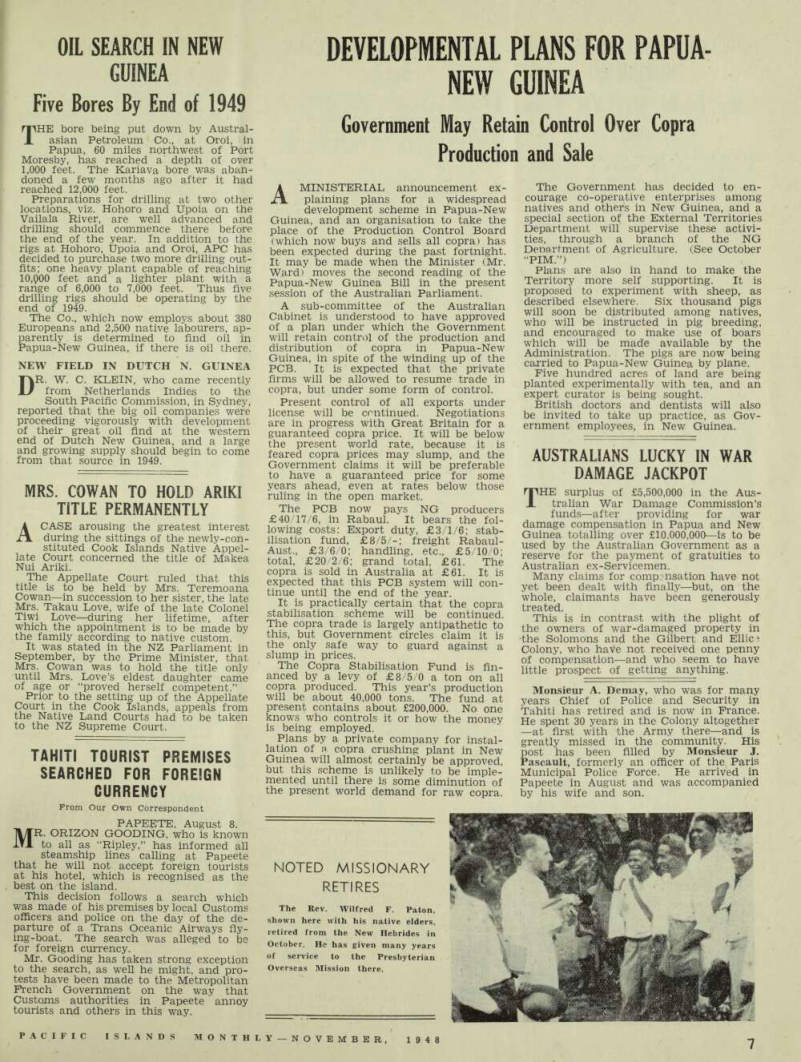
The Rev. Wilfred F. Paton, shown here with his native elders, retired from the New Hebrides in October. He has given many years of service to the Presbyterian Overseas Mission there.
Prosperity
New Ship And Hotel For
Norfolk
Little Island May Yet Know Prosperity
TWO projects which the Australian De partment of External Territories has in hand promise to alter con siderably the present condition and future prospects of Norfolk Island. They are— • The erection at a cost of £120.000 of a modem hotel, calculated to attract tourists. • The introduction of a modern ship to the Sydney-Norfolk Island service, in about 18 months’ time.
It is believed that, if facilities existed.
Norfolk Island could become one of the popular holiday resorts of the South Pacific. It now has regular air services with Auckland and with Sydney; but that passenger traffic is limited by the fact that the boardinghouses there have not any special amenities, and they cannot accommodate, all together, more than 60 to 80 people.
The island sadly needs a modern hotel.
Mr. and Mrs. C. A. Taylor, from New Zealand, who now run the leading board inghouse, made plans for a hotel on the edge of the plateau overlooking Kingston, but later abandoned the project, owing to lack of facilities.
The Australian Government has now undertaken to build a hotel in the south west section, alongside the airfield, at a cost of £120,000; but the plan is making slow progress, because of (a) lack of building materials and (b) lack of trans port facilities in relation to same.
For very many years—except during the war—the Bums Philp steamer “Morinda” has maintained a six-weekly service be tween Sydney, Norfolk Island and the New Hebrides; but the extreme difficulty of handling shipping on the unsheltered coast of NI, plus the absence of much cargo from NI to Sydney, has made the NI call unprofitable: and now the “Morinda” calls there only once in every three months.
The Australian Government, however, has announced that it has under con struction, for the Sydney-Lord Howe- Norfolk Island-New Hebrides run a 2,500tons, Diesel-engined vessel, the “Don garra,” which will carry 40 passengers, and from 150 to 200 tons of refrigerated cargo, in addition to dry cargo. She will have deck accommodation for native passengers; will take a 20 tons lift on her derricks; and will travel at 12 knots. She is expected to come into the service about March, 1950.
The decision to run an Australian Gov ernment ship into the New Hebrides may be connected with the fact that the Aus tralian Government is the nominal owner of large areas of land in that group, a gift to the Commonwealth from the late Sir James Burns about 45 years ago.
NG Women’s Club of Sydney
CHRISTMAS functions of the New Guinea Women’s Club will be held again this year in the Feminist Club Rooms, 77 King Street, Sydney. The Children’s Party will be on December 20.
Names of children under 14, whose parents were, or are, residents of New Guinea, should be forwarded to the secretary of the Club by the end of November.
The adult party will be held on Decem ber 23. Further details of both parties will be published in December “PIM.”
Begins
New Guinea Timber Case Begins
THE New Guinea • timber lease case, which was postponed on two previous occasions owing to the ill-health of one of the accused, Edward Farrell, began in Sydney on November 8. Farrell is still too ill to stand tidal and he will be tried later.
Four men are charged with conspiring to cheat and defraud Hancock and Gore Ltd., timber merchants of Brisbane, in respect of an alleged timber lease in the Bulolo Valley, New Guinea. Those charged, and their counsel (shown in parenthesis) are: Edward Farrell (Mr. J. E. Cassidy, KC, and Mr. G. Armstrong); J. s. (“Jock”) Garden and his son, Harcourt Garden (Mr. Simon Isaacs): Ray Parer (Mr. W. R. Dovey, KC, and Mr. R. J.
Marr). Mr. W. J. Shand. KC. and Mr.
J. W. Smyth are appearing for the Crown.
A number of officials, including the Minister of External Territories, Mr.
Ward, will be called to give evidence. It is anticipated that they will be detained in Sydney for some time as the hearing of the case is expected to last several weeks. They will also have to stand by for the trial of Farrell. (The opening of the present trial, November 8, coincided with the date on which the “PIM,” this month, goes to press.)
Lavish ‘War Damage’ To
New Guinea Natives
STORIES of the way in which “war damage compensation” has been lavished upon New Guinea natives by the present Administration continue to reach Sydney.
“An incident I saw in Bougainville is typical” reports one planter. “A certain native told the officials that he had lost four blankets in the war, and he claimed for them at the rate of £l, £2, and £3 per blanket. The officials paid out without argument. Before the war, I never knew a native to pay more than 6/- for a blanket—a thing made of cotton. That native collected altogether £l5O as war damage for various things. He had been informed that he could not collect more than £lO in any one day. So he kept on calling on the officials, at different times, until he got about £l5O altogether.
“That sort of thing has been going on all over the Territories. There must have been a great deal of fraud and there are many tens of thousands of pounds, in Aus tralian currency, hidden away in the villages. It does not come out of the special War Damage Fund —it is provided direct out of Australian common funds, contributed by the taxpayers.”
A New Guinea Pipe Line
THERE has been no report publishea yet from Mr. T. Grahamslaw, who. as a Royal Commissioner, sat in Port Moresby and Lae recently to inquire into the circumstances surrounding the sale to Mr. J. M. Bourke for £4OO of a length of pipe-line in the Lae area.
An important witness was Mr. Slee, in charge of the Disposals section of the Treasury, who said that the only offer for the pipe-line, apart from that of Mr.
Bourke, was £5O. Before he sold to Mr.
Bourke, he detailed another officer, Mr.
Watson, to ascertain whether the pipe line was of any use to the Government Deoartments- The inquiry seems to have been in stigated by the Commonwealth Govern ment. Mr. N. A. White appeared for Mr.
Bourke, and Mr. A. C. Jones assisted the Commissioner.
News In Brief
MR. A. A. CONLON has succeeded Mr, John Kerr as Principal of the Aus tralian School of Tropical Adminis tration. The first Principal was Professor Jack K. Murray, who was appointed Ad ministrator of Papua-New Guinea He was followed by Mr. Kerr, a barrister, who has now returned to his practice in Sydney.
Mr. Conlon became known to the Pacific Territories when, with the rank of Colonel he was prominent in an Army Research Council, which gave advice to Australian Ministers, including Mr. Ward, concerning Pacific Territories affairs, during the war and post-war period. * * * Because it was dissatisfied with wharf age in Port Moresby, and for other reasons, the KPM company has cancelled the arrangements that a Dutch liner should call regularly at Port Moresby, when en route between East Indies and Australia. * * * The appeal of two Chinese against im prisonment imposed upon them by Mr.
Justice Phillips for assaulting a native at Manus, NG, has been heard by the Aus tralian High Court. Decision reserved. * * * A committee of three is now re-classify ing the Papua-New Guinea public service, where there is acute discomfort owing to high cost of living. (It costs a married man with two children not less than £65 per month to live in Moresby). * * * Mr. Ward has refused an application by Enterprise of NG Gold and Petroleum Dev. Co. Ltd. for a petroleum prospecting permit. * * ♦ A. E. Downey and A. L. le Boutillier were committed for trial in Port Moresby on a charge of killing a native police men in Misima in March, 1942. * * * The “Morinda,” in October, picked up 600 tons of copra at Kukum and Yandina, BSI, for Sydney, Henceforth, on every alternate trip to New Hebrides, “Morinda” is expected to cut out Norfolk Island and extend her run to the Solomons. She also loaded, in BSI, 60 tons of brass (war time scrap), worth £9O per ton in Sydney. * * * Papua-New Guinea Administrator, Colonel Murray, has been recently in Lae and Rabaul, where he has had a series of cordial meetings with Europeans. ♦ * ♦ A party representing NZ Government and Union Manufacturing and Export Co. (NZ) has been recently in New Guinea inspecting large quantities of war-salvage goods (especially steel) which have been purchased.
Australian Donations To
Islands Missions Are Taxable
AUSTRALIANS who make donations to Christian missions operating in New Guinea are now not allowed to show those donations in their returns as re batable for income tax purposes.
Recently, in the Australian Parliament, Mr. A. Cameron moved that the Income Tax Bill be amended to allow rebates on donations. He said that missionaries in New Guinea were not only propagating the gospel but also providing medical, hospital and educational facilities which would normally have to be borne by the Government. “If it were not for the missionaries there would not be any education in New Guinea.”
The Prime Minister flatly refused the amendment.
Mr. K. H. Garvey
Promoted to Governorship Rank
MANY people in the South Pacific were interested to learn that Mr. Ronald H. Garvey, CMG, MBE, who has been Administrator of St. Vincent since 1943, has been appointed Governor of British Honduras.
Mr. Garvey is in his early forties, and he spent most of his British Colonial Service in the South Seas—mostly with the High Commission for the Western Pacific. He filled a wide variety of posts in Fiji, Solomons, New Hebrides and G & E Colony, and he was Acting Resident Commissioner in the latter Colony when the Japs invaded in 1942. He and his staff remained at their posts in Ocean Island until April, 1942, when all except a handful (who were afterwards murdered by the Japs) were removed under cover of darkness by a very fast Free French destroyer.
Mr. Garvey was appointed to Tan ganyika shortly afterwards, and he moved on to the West Indies in 1943. His wife is a daughter of Dr. V. W. T.
McGusty, OBE, who held the post of Director of Medical Services and Secre tary for Indian Affairs in Fiji for many years, apd is now retired. Mr. and Mrs.
Garvey were notable for their charming social qualities, and were popular in all Territories.
More Trouble for Matson
Line Directors
A GROUP of shareholders who allege that the directors of the Matson Navigation Company have been wasteful in refitting “Mariposa,” “Mon terey” and “Lurline” have begun an action to recover £12,600,000.
They contend that the directors should have entrusted the reconversion of these ships, after war service, to an “inde pendent, experienced and responsible ship yard under a master contract that would have fixed the total cost.”
The directors, however, had given the work to a subsidiary of the Matson Com pany, which the shareholders claim, did not have the facilities, experience or staff to carry out the work. (When the liners “Mariposa” and “Monterey” had finished their war service they were put into dock on the American Pacific coast for refitting for the Pacific run. In 1947, however, work was suddenly stopped and the directors of the Matson Company announced that as the cost of reconversion would be more than the original cost of the ships, due to inflated wages and material costs, it was con sidered uneconomical to put them back on the Pacific run. Later the directors were seeking another shipyard that might complete the job but as far as is known none was forthcoming, it was announced earlier this year that the ships would be sold. Reconversion of the “Lurline” was completed and she has now gone back on the San Francisco-Hono lulu run).
The Fiji Director of Public Works, Mr.
J. L. Brown, and the Director of Educa tion, Mr. H. Hayden, are both expected to return to Fiji towards the end of No vember from the United Kingdom, where they have been on leave.
South Pacific Air
Control Conference This Month To Discuss Nadi and Nausori
THE conferences of air transportation authorities which were postponed in August last, will be held in New Zealand this month.
Meetings of the South Pacific Air Transport Council, the Committee for Air Navigation and Ground Organisation, and the Committee of Meteorologists will be held in Wellington toward the end of November. They will be attended by delegates from the United Kingdom, Aus tralia and Fiji, and possibly Canada. The two committees will meet on November 23 and the Transport Council on No vember 29.
One of the principal items to be dis cussed is the location of the international airport in Fiji. For some time the Gov ernments interested have had Nausori airfield, near Suva, under consideration as an alternative to Nadi. The Conference will discuss the Pacific service, the Tas man service and regional services in the South Pacific areas.
Zealand
Fiji's Bothersome Debt To New Zealand
THE settlement of a debt of £BOO,OOO, owed by Fiji to New Zealand for war services and supplies, was discussed by Mr. R. M. Taylor (Financial Secretary) when he flew from Suva to Wellington late in October.
It is suspected, in relation to this debt, that Fiji was caught napping. In Sep tember, when the New Zealand £ was 25 per cent, under sterling, the Fiji Gov ernment (whose £ is 12h per cent, under sterling) could have settled the debt for about £700,000 Fijian. To-day, now that the NZ £ has gone to par with sterling, payment of the debt will cost Fiji about £900,000 Fijian—or £200,000 F more than it would have cost two months ago.
Result of the discussion is not known.
Mr. Taylor remained only a few days in New Zealand.
The Attorney-General of Fiji, Mr. J. H.
Vaughan, has left for the United King dom, where he will spend vacation leave.
Mr. B. A. Doyle is acting as Attorney- General during Mr. Vaughan’s absence.
Maddening Travel
Conditions
Matua (3 Months In Dock!) Cannot Cope With Traffic
THE Union Steamship Company’s “Matua” which was withdrawn for annual survey in August, and was expected to go back on the Auckland- Suva-Apia-Tonga run at the end of Sep tember, will not now be back in service until November 11—probably a little later.
On this first run after overhaul she is scheduled to call at Pago-Pago, American Samoa, as well as her usual ports. The Sydney office of the company, in early November, could not state why this de viation would be made; or whether a call at the American territory would be a regular feature in future. Nor could they give any reason for the length of time that “Matua” has spent, this year, in dock in Auckland on routine overhaul which in past years has taken about one month. They suggest that it is probably due to shortage of labour in the Auck land docks.
Meanwhile, the Pacific territories which depend upon “Matua” as their chief means of communication with New Zea land have been seriously inconvenienced.
In Western Samoa, alone, there is a “back log” of 100 passengers, for whom only 24 berths have been allotted in November.
“Matua,” from Apia, is now fully booked until June, 1949, and the Union Company will accept no further bookings. The NZAC fortnightly plane is also fully booked from Samoa for months ah'ad and a number of visitors to the Territory are said to be stranded there.
It was hoped that when the Canadian- Australasian liner “Aorangi” went back on the Pacific service it would relieve the pressure that has been put on the “Matua’ for the past eight years. However, “Aorangi” allots few berths for Sydney- Suva and Auckland-Suva passengers and “Matua” apparently is expected to struggle on with the burden that, before the war, was shared by four or five other ships.
If the conditions in the Auckland docks are such that ‘-‘Matua” must spend three months out of twelve in idleness, it will mean more headaches for the shipping company and further exasperation for the already frustrated Islands traveller.
Misses Cates and Bechervaise, and Mr. and Mrs. Hatter, left Brisbane recently by the “Malaita” for Anglican mission stations in New Guinea.
For Dutch Ng
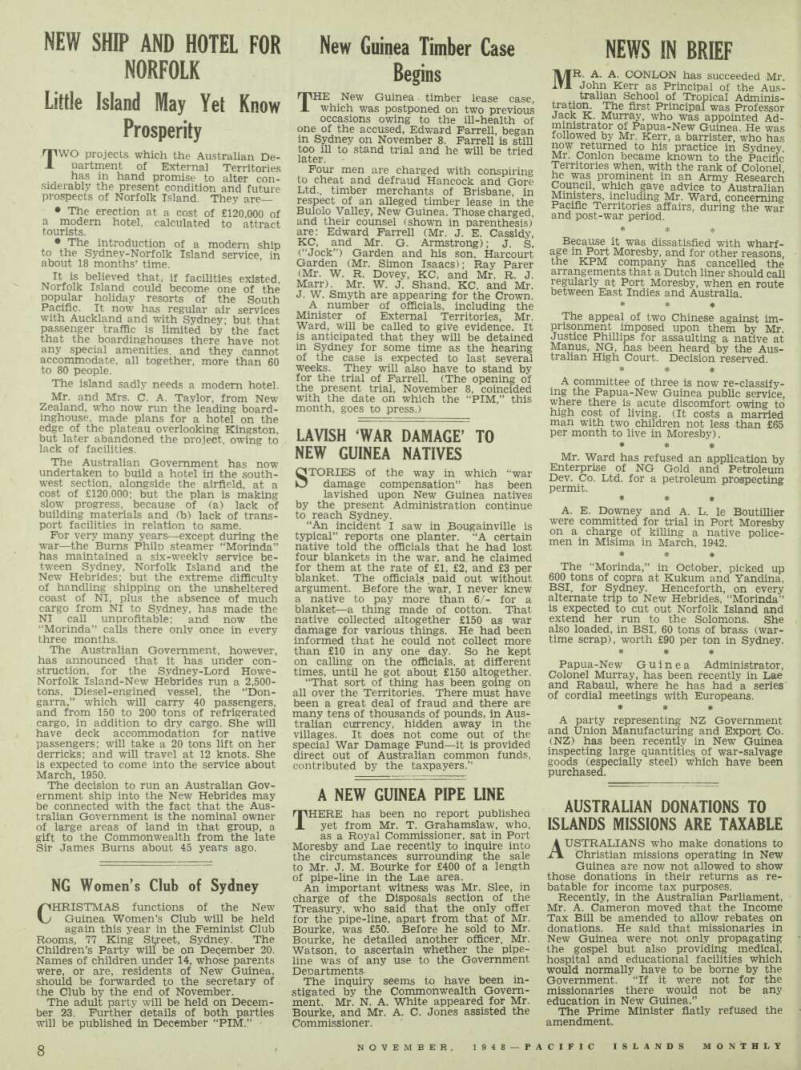
These three 150-ton Dutch tugs, which took part in the invasion of Europe, left Brisbane recently on the last leg of an adventurous 22, 000-mile voyage from Holland to Borneo. Each tug, which had a crew of 12, towed two barges from Brisbane to Sorong (Dutch New Guinea).
Interesting Experiment
Sheep For Ng
Highlands
Is Under Way
A WELL-KNOWN Sydney philanthro pist, Mr. E, J. Hallstrom, who is chairman of the Taronga Park Trust, has given the Australian Government £20,000, to be used in the establishment of a sheep-breeding industry in the high lands of Central New Guinea. The ex periment is already well under way. The Government has set up a trust for the . operation of the fund.
Mr. Hallstrom said that 500 acres had been set apart for an experimental station at Nondugal, 40 miles from Mt. Hagen in Central New Guinea, by the Department of External Territories at the request of the Administration of New Guinea.
Five hundred Romney Marsh sheep are being flown up to Nondugal by Guinea Air Traders in weekly lots.
Two plane-loads of 60 sheep had already been flown up by D.C.3 to an air-strip at Kerowagi, and walked about 8 miles to Nondugal.
Mr. Hallstrom said that the natives in the Nondugal area had entered into the scheme enthusiastically. “When the ex perimental station has been established, the natives are to be taught in classes how to shear, weave the wool, and make clothes for themselves,” he told Sydney newspapers. “At present the natives at Nondugal make their clothOs from op ossum fur and bark.”
Mr. Hallstrom said that sheep in New Guinea would have to be shorn twice a year. He had sent 50 sheep to Mt. Hagen about ten months ago. Their fleeces were now too heavy.
Editorial Note
THE area to which the sheep have been sent lies at an altitude of 4,000-5,000 feet: Central New Guinea has been called “a second Kenya.” There is no reason why certain types of sheep should not be acclimatised there, to become the basis of a pastoral industry. Sheep have been maintained successfully for years, on one of the southern islands of the New Hebrides, which has an altitude lower than Central New Guinea.
The experiment should be carried out by skilled European pastoralists, however.
The idea of converting the primitive gardeners of the Benna Benna-Ramu- Hagen highlands into sheep-farmers over night might be entertained in Canberra, but it does not make sense to people who know New Guinea. Maybe, in two or three generations, they will be eating mutton and wearing woollen pantaloons; but much must happen first in the way of training and adaptation.
The Mt. Hagen natives, at present, wear a few yards of hand-worked mesh as a sash and shell or bone ornaments. How soon they will take to hand-loomed woollen clothes remains to be seen.
Mr. Hallstrom is the manufacturer of the Silent Knight refrigerator (“The Peoples’ Refrigerator at the Peoples’
Price”). Since the war he has given a large amount of money to charities and public institutions—for cancer clinics, zoological specimens, etc. His latest dona tion to Taronga Park Zoo is a mouth organ-playing she-elephant from Durban.
He also offered £25 for Sydney’s elusive sea-leopard which has made the harbour its home. This offer was subsequently withdrawn and the money given instead to a group of University students who impersonated the sea-leopard in Martin Place and were charged with disturbing the peace.
Real Danger
Japan Remains A Real Danger To Pacific Peace
That exceedingly well-informed Aus tralian journalist, Malcolm "H. Ellis (“Ek Dum,” of “The Bulletin) is in Japan just now; and some of the things he has said in “The Bulletin” are of in terest to every intelligent observer in the Pacific.
He has expressed astonishment at the remarkable industrial recovery of Japan; but the thing which really has startled him is the evidence, on every side, of the phenomenal increase in the Jap population. A net increase each year of over a million presents a political problem which cannot be ignored.
Moscow’s long-range plan is the in clusion, in the Soviet sphere, of practic ally all Asia —1947-48 Communist activ ities in China, in all Southeastern countries, and in Indonesia are sufficient evidence of that. Moscow’s greatest weak ness, in that plan, is the lack of an in dustrial potential. Japan quickly could regain her position as one of .the greatest manufacturing countries of the world.
Japan already is overcrowded; as an other million Jap babies arrive, each year, the problem quickly becomes acute. As Ellis says, the Japs must either stop breeding, or we must provide them with new living-space. If we don’t, Russia will; and Russia thus would solve her immediate problem of finding an in dustrial potential for Communist Asia.
This is not a matter of to-morrow, or of next decade —it is with us to-day, as urgent and as ugly as any problem in this harassed old world. We of the' Pacific have witnessed one Japanese swarming; we do not wish to experience another.
The Americans hold control efficiently over the conquered nation. The countless tribe of Plann rs continue their useless clamour. But the Japs keep on breeding (a simple calculation shows me that 20 new Japs were added to the population since I parted to write this short article) —and no one seems to be concerned with the problem of their future accommo dation. —R.
A Guadalcanal romance has deprived the BSI Secretariat of Miss Meg Lewis, who was on the office staff at Vila before she was transferred to Honiara.. She left by TOA on October 17 for Honolulu, via Suva, where she will be married to Lieut.
George Deeming, at present serving with the US p rsonnel on Guadalcanal, but shortly to go on leave in Honolulu, on his way to a new appointment in the Philip pines.
Samoa
Un Praise Nz’S
But Russia Is Amok Concerning New Guinea
DURING a discussion in Paris in Oc tober by a committee of the United Nations on a report of the Trustee ship Council, many delegates praised the New Zealand Administration in Western Samoa and the willingness of the New Zealand Government to co-operate with and assist the Council.
Russian delegates in the Trusteeship Council, however, attacked the Australian administration of New Guinea. They said that Australia had taken away consider able areas of land from the natives — or, at most, had bought it for a mere trifle. They said that health services were poor—there were only 11 doctors for over one million natives. Australian policy was not favouring the development of ‘ local organs of self-government.”
One Russian delegate said that Aus tralia’s plan for the Papua-New Guinea administrative union was “a flagrant violation of the UNO Charter,” and sug gested that a colonies-hungry Australia was trying to grab New Guinea.
The irresponsible Russian statements (obviously supplied by the Australian Reds) will amuse the people who know the facts. The facts are that no area of native land in New Guinea worth mentioning had been alienated since Aus tralia took over New Guinea in 1914; that the pres nt Government has been bitterly criticised for spending too much on native welfare in New Guinea; that the Admin istration cannot engage doctors, because there are not enough doctors to meet current d mands outside the tropics; and that all trusteeship interests have been most scrupulously safeguarded in the plan for administrative union.
Captain P. G. Taylor, well-known pioneer of civil aviation in the Pacific, is to become a director of Trans Oceanic Airways of Sydney, which, under the managing-directorship of Squadron- Leader Bryan Monkton, carries on charter services in Eastern Australia and the Western Pacific. Caotain Taylor at pre sent is away in Sweden on a special mission. His last big job in the Pacific was his survey of the proposed alternative Trans-Pacific route from Mexico to Aus tralia, via Clipperton Island and French Oceania.
New Schooner For The Tongan Isles
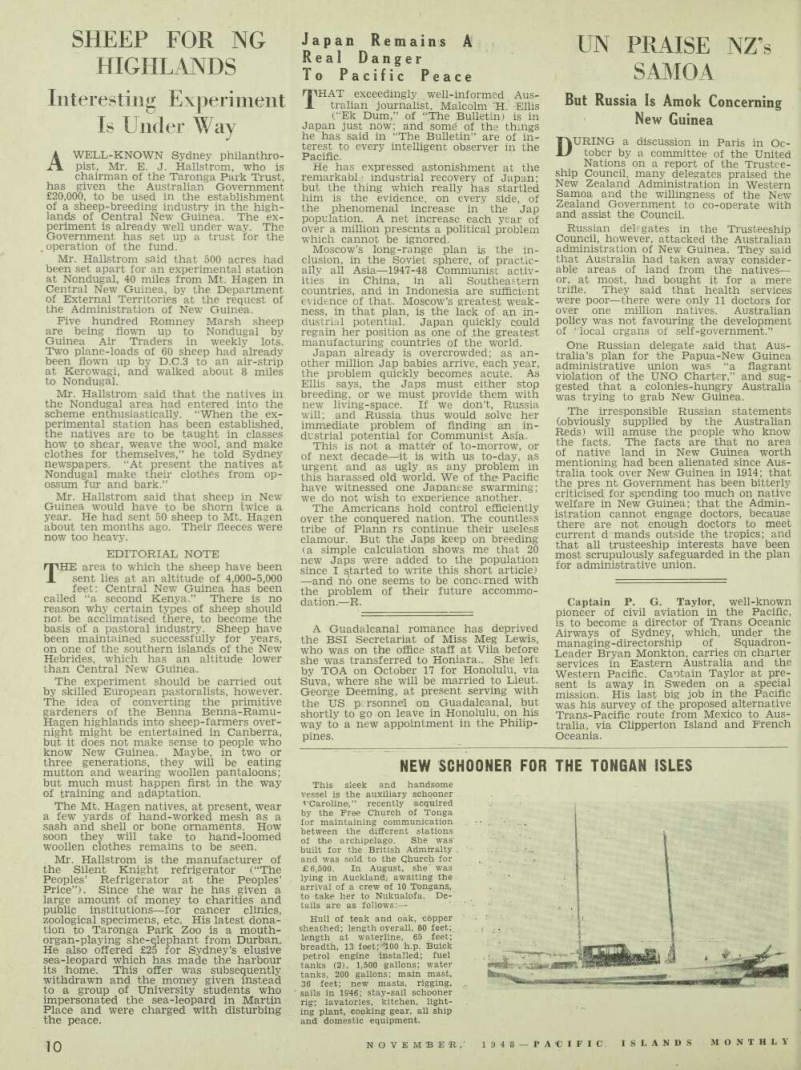
This sleek and handsome vessel is the auxiliary schooner recently acquired by the Free Church of Tonga for maintaining communication between the different stations of the archipelago. She was' built for the British Admiralty and was sold to the Church- for £6,500. In August, she' was lying in Auckland; awaiting the arrival of a crew of 10 Tongans, to take her to Nukualofa. De tails are as follows: — Hull of teak and oak, copper sheathed; length overall, 80 feet; length at waterline, 65 feet; breadth, 13; h.p. Buick petrol engine installed; fuel tanks (2), 1,500 gallons; water tanks, 200 gallons; main mast, 36 feet; new masts, rigging, sails in 19'46; stay-sail schooner rig' lavatories, kitchen, light ing plant, cooking gear, all ship and domestic equipment.
Advertisements & other items, p. 12 (1 item)
10
NOVEMBER,' 1 9 4'B -PACI P I C. ISLANDS MONTHLY
South Pacific Commission
Headquarters At Noumea :: General and Expert Officials Appointed
T*HE South Pacific Commission, a new international body, designed to co-ordinate policy and administration, and carry on important research in the South Pacific, held its Second Session in Sydney between October 25 and November 2. It selected headquarters and appointed a staff, and it will begin to function at an early date.
The Commission was formed at a conference in Canberra, Australia, in January, 1947; and its First Session was held at its temporary head quarters (St. George’s Heights, Mosman, Sydney), in May, 1948.
Delegates
THOSE who attended the meetings of the Commission were: AUSTRALIA. —Senior Commissioner: Mr. J, R. Halligan, Secretary, Department of External Territories. Commissioner: Rev. Dr. J. W. Burton, President-General of the Methodist Church of Australia.
Alternates: Dr. J. T. Gunther, Director of Public Health, Papua-New Guinea; and Mr. T. A. Pyman, Officer-in-Charge, South Pacific Section, Department of Ex ternal Affairs. Adviser: Mr. J. H. Jones, Director of District Services and Native Affairs, Papua-New Guinea. Secretary; Mr. M. F. Manning, Department of Ex ternal Territories.
FRANCE—Senior Commissioner: H. E.
Monsieur Pierre Auge, Minister at Can berra for France. Permanent Commis sioner; M. Lassalle-Sere, Inspector-Gen eral of Colonies. Alternate: M. Pierre Bonnard, Directeur du Cabinet du Haut- Commissaire de France dans le Pacifique, Noumea. Adviser: M. F. Fourcade, Ad ministrator of Colonies, Noumea.
NETHERLANDS.—Senior Commissioner: Mr. A. J. Beversluis, Senior Official for New Guinea Affairs at the Department of Economic Affairs, Batavia. Commissioner; Mr. M. A. Pellaupessey, Resident of the South Moluccas. Advisers: Dr. W. C.
Klein, Mining Engineer; Dr. J. A. de Ranitz, Foreign Office Directorate of the Far East, Batavia; Dr, J. I. Noest, Netherlands Consul-General at Sydney.
Adviser-Secretary; Dr. A. Loosjes; Officer of the General Secretariat of the Nether lands Indies Government, Batavia.
NEW ZEALAND.—Senior Commissioner; Mr. C. G. R. McKay, formerly Secretary of Department of Island Territories Commissioner: Brigadier F. L. Hunt, formerly Quarter-Master General, NZ Army. Adviser: Mr. R. H. Wade, Assist ant Official Secretary, Office of the High Commissioner for New Zealand in Aus- UNITED KINGDOM. —Senior Commis sioner: Sir Brian Freeston. Governor ol Fiji and High Commissioner for Western Pacific. Commissioner: Mr, H. H.
Vaskess, formerly secretary, Western Pacific High Commission. Alternate (ad interim): Mr. G. Kimber, Joint Official Secretary of the High Commissioner for the United Kingdom in Australia.
UNITED STATES.—Senior Commis sioner; Dr. Felix M. Keesing, Professor of Anthropology, Stanford University, Com missioner: Mr, Milton Shelleck, Attorney and Counsellor-at-law, New York. Altern ate: Mr. Orsen N. Nielsen, Consul-Gen eral at Sydney. Advisers: Mr. J, H.
Shullaw, Division of British Common wealth Affairs, Department of State. Mr.
Windsor G. Hackler, Division of De pendent Area Affairs, Department of State. Commander R, L. Ramey, US Navy, Deputy Governor of American Samoa.
Chairman
Following the practice established at the First Session, the Australian Senior Delegate (Mr. Halligan) handed over the chairmanship to the Senior Delegate for France (Mons. P. J. P. Auge), as next in alphabetical order; and he will remain chairman until the opening of the Third Session when the Senior Delegate for the Netherlands will be chairman.
Noumea Selected As
Headquarters
THE first business of the Commission was to consider a report from the Committee of six delegates (one from each of the six constituent countries) on the respective claims of Suva (Fiji) and Noumea (New Caledonia) as headquarters for the Commission. The Committee visited both places in August and Sep tember; and it reported fully on the facilities of each town.
Neither the report, nor the discussion of the Commission in respect thereto, was made public. After two days, the Com mission announced simply that Noumea had been chosen. The voting was not officially disclosed; but it was generally known that only Britain and New Zea land favoured Suva —Australia joined United States, France and Netherlands in voting for Noumea.
It is intended to remove the staff and offices of the Commission from Sydney to Noumea as soon as practicable. In the meantime, the Commission will function at its present temporary offices at St.
George’s Heights, Mosman, Sydney.
Third Session
The next session of the Commission will commence in Noumea about May 10, 1949.
The first South Pacific Conference, to be called by the Commission, will as semble in Suva about April, 1950.
Appointments
THE following are the names and pre sent positions of the men who have accepted appointments under the Commission: Secretary- General Mr. W. D. Forsyth, head of the Pacific Division of the Australian Department of External Affairs (Australia.) Deputy Secretary-General Mr. H. E. Maude. Resident Commissioner of the Gilbert and Ellice Islands Colony. (Britain.) Full-time Officers Of Research Council Deputy-Chairman: Professor L. G. M.
Baas Becking, Director of the Botanic Gardens and attached scientific insti tutions, Buitenzorg, Java. (The Nether lands.) Officer in Charge of Health: Major E.
Massai, who has been engaged for* some years in research concerning tropical diseases. (France.) Officer in Charge of Economic Develop ment: Dr. H. G. MacMillan, in charge of agricultural relations in the Pacific area for the United States Commercial Company. (United States.) Officer in Charge of Social Development: Appointment not yet finalised.
Part-Time Members Of Research Council
Health
Dr. J. T. Gunther, director of the De partment of Health in Papua-New Guinea. (Australia.) Dr. H. de Rook, Secretary-General of De partment of Health, Macassar. (The Netherlands.) Dr. J. C. Lopdell, Chief Medical Officer in Western Samoa. (New Zealand.) Captain W. P. Stephens, of the Medical Corps of the United States Navy. (United States.)
Economic Development
The Director of ITnstitut Francais d’Oceanie, Noumea. (France.) Mr. B. E. V. Parham, Senior Agricultural Officer, Fiji. (Britain.) Mr. Dean K. A. Ryerson, Assistant Dean of the College of Agriculture and Pro fessor of Horticulture. University of California. (United States.) Mr. J. G. Crawford, Director of Com monwealth Bureau of Agricultural Economics, and Member of the New Guinea Inter-Departmental Develop mental Committee. (Australia.)
Social Development
Sir Peter Buck, Director of the Bishop Museum, Hawaii. (United States.) Mr. Howard Hayden, Director of Educa tion, Fiji. (Britain.) Mr. W. C. Groves, Director of Education, Administration of Papua-New Guinea. (Australia.) M. Maurice Grangie, Director of Educa tion, New Caledonia. (France.) Rev. I. S. Kijne, Principal of the Papuan Institute, Joka, near Hollandia, Dutch New Guinea. (The Netherlands.) Biographical Notes : The New Officials
Mr. William Douglass Forsyth,
who has been head of the Pacific Division of the Australian Depart ment of External Affairs, has a dis tinguished scholastic record, and is re garded as one of the most “solid” and capable men in the Department. He is a Victorian, just on 40 years old, and he holds the degrees of Master of Arts of Melbourne University, and Bachelor of Literature of Oxford. He was a teacher, specialising in history, in Victorian high schools, and gaining various distinctions until 1941, when he joined the Australian Department of Information. He went over in 1942 to the Department of Ex ternal Affairs; and since then he has carried out various missions overseas for the Australian Government. This year he went with Mr. J. R. Halligan to the Trusteeship Council of the United Nations, to explain and defend Australia’s plans for the administration of New Guinea; and his work there received official com mendation. He married, in 1935, Miss Joyce Sherry, and they have one son and one daughter.
The appointment of Mr. Henry Evans Maude, MBE, to the post of Assistant Secretary General, will give pleasure and satisfaction to the British Territories. Mr.
Maude, now Resident Commissioner of the Gilbert and Ellice Islands Colony, is 42, and is regarded as one of the soundest men in the High Commission for the Western Pacific, to the service of which he has devoted most of his working life.
He was educated at Cambridge, where he took the degree of MA, and he went to
the G. & E. Colony as a cadet in 1929. He held various administrative positions there in the ensuing seven years, and he was then transferred to Zanzibar as district officer. But he came back to the Gilbert and Ellice Colony in 1937: and since then he has filled a wide variety of the higher posts in G & E Colony, Fiji, and Tonga, where he and his wife are held in high regard. Mr. Maude has a specialised knowledge of the Micronesian and Poly nesian peoples, and of all forms of ad ministration relating to them.
Professor Baas Becking, who has a re sponsible job as active head of the Re search Council (the nominal head is the chairman of the Commission for the time being) is regarded as a practical scientist of great distinction. He was for some years a professor on the staff of Stanford University, California, and of Leiden Uni versity, Holland: he has written many scientific books and papers; he is a mem ber of the Netherlands Royal Academy of Science: and he holds membership of many scientific bodies in other countries.
Major Emil Massal is about 40 years old; belongs to the Medical Section of the French Colonial Forces: and he holds the highest French medical teaching de gree. He has specialised in the study of diseases (especially leprosy) in the South Pacific, where he has spent eight years, in Tahiti, New Caledonia and New Hebrides.
He speaks English fluently, and can get along without an interpreter in Tahitian and Pidgin. During the war, he was Liaison Officer at United States Army headquarters in Santo, New Hebrides.
Dr. H. G. MacMillan, who is 58, speaks French, German and Spanish. From 1820 until 1943 he was a pathologist in the US Department of Agriculture: then for three years, he was an agricultural economist in the Foreign Economic Administration in the. South Pacific, with his head quarters for some of the time in New Caledonia; and since 1946 he has been in charge of agricultural relations in the Pacific area for the US Commercial Company.
Programme of Work
IT'OLLOWING upon decisions taken by I 1 the Commission at its meeting in Sydney in May, 1948, the Commis sion gave formal approval to a pro gramme of work.
It was formally reported that, in draw ing up its Work Programme, the Com mission has borne in mind the following considerations: (a) The importance of avoiding un necessary duplication or overlaooing between the activities of the Com mission and those of other agencies operating in the area and of using existing institutions where appro priate and feasible. (b) The necessity for reference to the Research Council, when appointed, of the research aspects of the pro blems concerned. (c) The importance of continual con sultation with territorial govern ments on the Work Programme of the Commission, particularly with the object of determining what further services the Commission might usefully perform.
The report was as follows: Classification Of Projects The Commission adopts the following categories of urgency; A. Subjects which call for early action and which show possibility of early results.
B. Subjects which call for early action which are not expected to reach fruition for some time.
C. Subjects which can be placed for the
time being in a lower category of urgency.
The following projects are considered worthy of inclusion in the categories named. They are not set out in any order of priority in each category.
Category A.
1. Collection of information on existing air and sea transport services in the region, analysis of further needs and sug gestions for the improvement of these services. 2. Efforts to improve on request, the supply of any item of essential goods in any part of the area or in the area as a whole. 3. Early and continual review of human quarantine measures throughout the area with particular attention to problems in troduced by air travel. 4. Mechanisation of the copra industry and the study of by-products and essential uses of copra residues. 5. Research into health problems, par ticularly infant and maternal welfare. 6. Fisheries research, including surveys and the testing of methods of catching and of processing fish and other marine products with the special aim of improv ing nutrition of the local inhabitants. (See note at end of report). 7. Cognisance of the food production potentiality survey to be conducted in New Guinea and the possible application of similar surveys for the area where these are not already being undertaken, with the object of raising the nutrition standards and of increasing food exports. 8. Pooling of information on expert as sistance desired and capable of being offered by the participating Governments.
Category B
1. Establishment of contact with public and private agencies doing experimental work in agriculture and industry with a view to disseminating information of their findings. 2. Collection and dissemination of in formation on technical and professional training of islanders in various fields such as health, education and the technical skills; and to consider the advisability of established centralised training institu tions for Islands pupils. 3. Development of a library on the South Pacific, acquisition of basic refer ence and other materials and the collec tion of official publications from the participating Governments; and the col lection of essential statistics for periodical publication. 4. Preparation of a records file of scientists and of public and private or ganisations interested in research in the South Pacific. 5. A plan for carrying out under the auspices either of the Commission or of other agencies, the research recommended in the list of immediate projects attached to the Agreement establishing the South Pacific Commission and other research projects. 6. Investigation of the possibilities afforded by wireless broadcasting and visual aids in the education of dependent peoples, especially illiterate peoples, 7. Stimulation and co-ordination of studies in the fields of Vulcanology and seismology. 8. Improvements of tropical pasture lands by all possible means especially: (a) Selection of types of fodder grasses: '■ (b) weed control. 9. The Committee recommends that as soon as its organisation is sufficiently established, the Commission should con vene a conference of educators from both within and without the area to give urgent attention to the educational needs of the islands peoples both by pooling knowledge and experience already acquired
and by making recommendations on the educational problems of the area, includ ing those stated in the appendix to the Agreement establishing the South Pacific Commission.
Category C
1. Problems associated with the nutrition of the resident populations within the territorial scope of the Commission. 2. Problems of conservation, including the setting aside of local reserves in which the unique indigenous flora and fauna characteristic of the islands may continue as far as possible to exist, and also the preservation of archaeological sites. 3. Problems arising from the impact of modern civilisation on the traditional in digenous societies, with special reference to the contributions of anthropological research in this field. 4. A plant * for the publication of a periodic bulletin of the Commission in cluding both articles and news items.
This should include the preparations of estimates, proposed layouts, data on print ing facilities and plans for distribution Analysis of existing radio facilities for the transmission of news with recom mendations as to the means by which these might be made available for the transmission of Commission news. The provision of information services to in dividuals and Governments on matters within the competence of the Commission. 5. Study of labour conditions within the territories, with a view to improvement in accordance with the recommendations of the International Labour Organisation .wherever applicable,
Fisheries, And Use Of Fish
The following observation of the Senior French Commissioner was recorded by the Commission: The Senior Commissioner of the French delegation observes, with regard to fisheries, that it would be advisable to make the following distinctions: • Study of the possibility of introduc ing fish more widely into the diet of certain indigenous peoples. • Study of seas and of the habitat of various species of fish, so as to improve the returns from fishing. • Study of methods of fishing and their possible improvement with a view to increasing the returns from this in dustry.
Although these various points can be connected with nutrition, since it is a question of improving the nutrition of the indigenous people both in quantity and quality, it would seem more logical to connect with actual nutrition nothing but the study of the introduction of fish into the diet of these peoples.
The other considerations would be con nected rather with marine biology, or the study of the development of smaller native industries, which are matters some what less urgent.
Discussion Indicates Commission’s
Wide Scope and Interests
INTERESTING comments on some of the problems of the Commission were made by delegates when discussing the Work Programme (printed in detail on this page).
The discussion on transport and allied matters (Al) was initiated by Dr.
Keesing (United States). He said that the present arrangement of transporta tion services in the Pacific called for ex amination and study—not only the trans pacific services but also those between the Pacific Territories, and those within the Territories themselves. It was found that frequently the services had been arranged to serve only one set of circumstances, rather than all the interests concerned.
There was need for training the Islanders in the technical crafts necessary for the running of transportation services. The proper organisation of transportation also brought into the picture such things as meteorology and oceanography, conce n ing which he thought' resolute action by the Council was necessary.
The senior delegate for France em phasised the need for the co-ordination of shipping services, which had been arranged to meet special needs in par ticular groups, without any regard for the needs of adjoining Territories. It was desirable to assemble information in re lation to these matters, so that the pro blems involved could be taken up in a proper way with the interests concerned.
The senior delegate for Britain (Sir Brian Freeston) remarked that this essentially was an administrative problem.
What was really wanted was an analysis of the traffic requirements of particular areas, to be considered in relation to the other needs of the Territories concerned.
Substantial progress could be made in this direction without involving the re search officers.
Dr. Keesing (United States) concurred with this view, and it was agreed that the Secretariat be asked to enquire into this subject.
Surpluses and Shortages ON the subject of better distribution of essential supplies in the Pacific —the need for transferring a surplus from one area to another area that might be short of supplies—the delegate for France directed attention to the obstacles created by a multiplicity of tariff schedules and suggested that the collection of such schedules should be undertaken, so that they might be available for use in an emergency, and also to enable the Com mission to make a study of all the pro blems involved.
Delegate for New Zealand (Mr. McKay) and delegate for Britain (Sir Brian Freeston) said that the plan outlined in the work programme (A 2) should operate only in an emergency and only if the Secretary-General should be asked to act in respect of any particular item.
Prevention Of Disease ON the subject of quarantine measures, Dr. Gunther (Australian delegate) said it was urgent that steps be taken to co-ordinate and standardise the rules and regulations by which the Adminis trations sought to control infectious diseases within the tropics. As an ex ample of urgency, he referred to the pre valence of malaria in the Western Ter ritories, and the need for seeing that air craft did not carry certain types of mosquitoes from diseased to disease-free Territories. He suggested the establish ment of an epidemiological bureau for the assistance and guidance of quarantine officers.
The New Zealand delegate suggested the addition of words to A 3 to permit the distribution of epidemiological informa
tion. The United States delegate said that the Caribbean Commission (West Indies) had approved of legislation to give effect to such a plan. The suggestion was approved of.
Copra Industry ON the subject of the further mechanisa tion and development of the copra industry (A 4), Dr. Gunther (Aus tralia) said that this was something that should await the attention of the Research Council. The Australian Production Con trol Board had in New Guinea under taken the task of collecting a large amount of information in relation to the copra industry, and this would be avail able to the Commission and Council.
The New Zealand d-legate (Mr. McKay) said that the management of the New Zealand Reparation Estates in Western Samoa had introduced many of the most modern methods of treating coconuts and copra; and all technical information in relation to that would be at the dis posal of the Commission.
The French delegation emphasised the importance of the mechanisation of the copra industry.
Control Of Pests DR KEESING (United States delegate) said that American scientists were taking a keen interest in the cam paign against insect pests in their Ter ritories north of the Equator; and they were particularly interested m preventing the spread of such pests through in dustrial activities. He emphasised the
importance of preventing the spread of certain pests to the southwards—he re ferred particularly to the Rhino beetle and the giant or African snail, which had been released by the Japanese during the war in Micronesia. They had scientists now in Africa seeking some control for the African snail. United States scientists would be happy to co-operate with the Commission.
Infant and Mother Welfare SPEAKING in relation to infant and maternal welfare <AS), Dr. Gunther (Australia) said that this was a
tremendous problem—as important to the sociologist as to the medical man.
The causes of infant and maternal death were many, and demanded early study.
They were confident in Papua-New Guinea that they could make substantial progress in this field, but much research was needed. They recommended the establish ment of a wide and detailed programme of research, which might extend over several years.
The New Zealand delegate (Mr. McKay) said that in Western Samoa they had made remarkable progress in this field without any help from sociologists,
nutntiomßt B and anthropologists—but they had had very substantial help from local committees of native peoples, who had been sympathetically instructed and directed.
Dr. Gunther pointed out that there was a considerable difference between Poly nesian and Melanesian communities in this regard—Polynesians could be more easily instructed than the more primitive people of the West.
British delegate (Sir Brian Preeston) said the two viewpoints were not irrecon cilable. A good deal could be done in a practical way, in the field of admin istration, while a broad plan of research was in operation.
Fish As A Food IN relation to the development of fish ing industries, Dr. Gunther (Australia) said that considerable research was being undertaken in Papua-New Guinea, and that information would be available to the Council. They were concerned in New Guinea with the absence of first-class proteins and it was believed that the in troduction of a more generous fish diet would play a big part in raising the standard of the people’s health.
The New Zealand delegate (Mr. McKay) urged that facilities be sought for trans ferring fish from one area to another, so that native communities generally might have a diet more satisfactorily balanced.
He said that the Pacific was remarkable for the way in which fish might be found in abundance in one place and be totally absent in another place not far away, where conditions seemed similar. Research should be directed to the important tasks of preserving fish and arranging for their transportation from good areas to areas where they were scarce.
The Dutch delegation urged co-opera tion with the expert officials of the Indo- Pacific Fisheries Council. Dr. Keesing (United States) was in fullest sympathy with this suggestion and urged co-opera cion not only with the Dutch but with all organisations interested in fishery ex ploitation Most of the items in the B category were agreed to without discussion. Dr.
Kersing (United States) remarked that the absence of discussion did not indicate lack of interest—on the contrary, the lack of discussion indicated almost complete unanimity in relation to these matters.
Pacific Science Congress
A Committee appointed to inquire con cerning the Pacific Science Congress, to be held in New Zealand in February, 1949, reported: The Committee recommends that the Secretary-General make arrangements for the permanent officers of the Commission as far as is feasible, to attend the Con gress as observers, for the purpose of con tact and consultation with leading scholars relative to the research work of the Commission; such part-time members of the Research Council, as are present in their other capacities, might also be asked to act as observers.
First Conference At Suva in
April, 1950
A COMMITTEE of the Commission sub mitted a report on arrangements for the first South Pacific Conference, to be held under the auspices of the Commission. The following were the re commendations adopted;— The following are the 15 territories from which delegates should be sent to the South Pacific Conference: Papua.
New Guinea (Australian Trust Ter ritory) .
(Continued on Page 77)
Nauru.
La Nouvelle-Caledonie et Depend ances.
Etablissements Francais de L’Oceanie.
Dutch New Guinea.
Western Samoa.
Tokelau Islands.
Cook Islands, including Niue.
Fiji.
British Solomon Islands Protectorate.
Gilbert Islands.
Ellice Islands.
American Samoa.
New Hebrides (Condominium).
The Committee records its hope that the Government of Tonga would see its way clear to send delegates to the Con ference, upon invitation from the Com mission.
For the first meeting of the Conference the total number of delegates will be limited to 30, and of alternates and ad visers to 34, and shall be allotted to the territories listed above, according to the quotas set out in the appended schedule.
The first meeting of the South Pacific Conference will take place at Suva (the Senior Commissioners for France and the United Kingdom abstained from voting on this issue) in April, 1950, on the as sumption that it will be possible to arrange a meeting of the Commission, say, two weeks later, also in Suva.
On the financial issues, (a) there will be admitted as a charge against the funds of the Commission the costs of transport between their territories and the place of meeting, of the delegates proper, but not of alternates and advisers; (b) in principle the Commission will bear the cost of subsistance of delegates, but the Commission will not be respon sible for alternates and advisers in this regard, and it is assumed that such costs will be borne by the respective appointing authorities; (c) the Secretary-General will consult with the host Government in regard to details of the scaie of sub sistence, and will submit at a later session of the Commission proposals for approval.
The Rules of Procedure for the South Pacific Conference and the Agenda for its first meeting will be considered at the Third Session of the Commission, and Senior Commissioners, after consultation with their Governments, will inform the Secretary-General before the Third Session of any Rules of Procedure which they wish to propose, and items which they suggested lor inclusion in the Agenda of the Conference.
Members of the Commission and of the Research Council will be invited to attend the Conference as observers.
South Pacific Conference
Representation By Territories
Number of Number of Alternates and Territory Delegates Advisers Papua 2 4 New Guinea (Australian Trust Territory 2 4 Nauru 1 2 La Nouvelle-Caledonie et Dependances .. 2 2 Etablissements Prancais de L’Oceanie 2 2 Dutch New Guinea .. 2 2 Western Samoa .. 2 2 Tokelau Islands .. .. 1 Cook Islands including Niue 2 2
Fiji
'British Solomon 2 2 Islands Protectorate 2 2 Gilbert Islands .. .. 2 2 Ellice Islands 2 2 American Samoa 2 2 New Hebrides (Condominium) 2 2 Tonga (if attending) 2 2 Total 30 34
Advertisements & other items, pp. 13-19 (2 items)
11
PACIFIC ISLANDS- MONTHLY NOVEMBER, 1948
Morris Hedstrom Limited
General Merchants, Importers and Exporters,
Shipowners, Plantation Owners,
Commission and Insurance Agents
HEAD OFFICE
SUVA, FIJI
Established 1868
SERVICE IN THE SOUTH PACIFIC TERRITORIES
THROUGH our Large Establishments in Suva and our Numerous Branches, we distribute a wide and comprehensive range of General Merchandise and provide almost every kind of service. Our departments and associated businesses include:
DRAPERY
MOTOR SALES
AND SERVICE
TOBACCO
TIMBER AND
BUILDING
GROCERY
CONFECTIONERY
HARDWARE
ELECTRICAL
LIQUORS
DRUGS
Branches Throughout Fiji, Samoa and Tonga
There is a Branch or Agent of Morris Hedstrom Limited in every Town in the Three Territories.
We ore Sole Agents in these Territories for British Drug Houses Ltd.
Electrolux Ltd.
Ford Motor Co.
General Electric Co. Ltd.
Goodyear Tyre Gr Rubber Co.
B. A. Hjorth & Co. (Primus Products) Max Factor and Co. Inc.
Ransomes, Sims Gr Jefferios Ltd Imperial Chemical Industries Ltd. Ruston Gr Hornsby Ltd.
International Harvester Export Co. Vacuum Oil Co. Pty. Ltd.
Matson Navigation Company Yorkshire Copper Works Ltd.
Morris Hedstrom Limited, are LLOYD’S AGENTS in Fiji and Samoa.
IN AUSTRALIA:
Morris Hedstrom (Aust.) Pty. Ltd.,
Asbestos House, 65 York Street, SYDNEY
IN GREAT BRITAIN:
Morris Hedstrom Limited,
Africa House, Kingsway, LONDON
TO THE US A
by Flying Clipper in the
3: v m Jr m g mm~~* ***> > % ..j A mm w f * Relax and arrive refreshed in Pan American’s exclusive Sleeperette* (no extra cost). * Pan American offers you the fastest transit time across the Pacific only 46-J hours to San Francisco, including stops at Noumea, Fiji, Canton Is. and Honolulu. * Your fare from Australia to Honolulu and to any part of the world served by P. A. A. can be paid in Australian currency. * Call your Travel Agent or Pan American world’s most experienced airline . . . *Trade Mark, Pan American Airways Inc. 30-day excursion fare available up to 31st March, 1949 saves you £5l on round trip from New York to London.
Swift
4-engine
Clipper service
Sydney
to the U.S.
via NEW CALEDONIA
FIJI IS.
CANTON IS.
HONOLULU
SAN FRANCISCO
or LOS ANGELES
Fly straight through or stop over at Hawaii, etc.
Mezzanine Floor , Hotel Australia, Sydney. Tel. 8W4701 Rue Jean Joures , Noumea Bank of Neiv South Wales Building , Suva
Pam Mericam
World Atr ways
Stfsfem of l/ie ( Gpp ers Pan American Airways Inc. (Liability Limited — Inc. in U.S.A.)
THE
YORKSHIRE
INSURANCE
CO. LTD.
(Incorporated in England)
ALL CLASSES OF
INSURANCE
Including Fire Motor Guarantee Accident Workers Marine Island Representatives:
PORT MORESBY: E. A. James
RABAUL: G. B. Black LAE: New Guinea Industries Ltd.
MADANG: R. MacGregor SUVA: Williams & Gosling Ltd.
NOUMEA: Y. Mortensen
NORFOLK ISLAND:
A. E. Martin
BURNS PHILP (New Hebrides) LTD.
Registered Office: VILA, NEW HEBRIDES
Branch Office at SANTO
Exporters, Importers and General Merchants
(Retail and Wholesale) Commission, Shipping
and Customs Agents
Representatives for BURNS PHILP TRUST COMPANY LIMITED, QUEENS- LAND INSURANCE CO., LTD., and LLOYDS OF LONDON. Agents for SOCIETE DES- PETROLES SHELL DES ILES FRANC AISES DU PACTFIQUE, an'd numerous overseas manufacturers of all classes of merchandise.
Sydney Agents: Burns, Phllp & Co., Ltd., 7 Bridge Street.
San Francisco Agents: Burns, Phllp Co. of San Francisco, Matson Building, 215 Market Street, London Agents: Burns, Phllp & Co., Ltd., 35 Crutched Friars, E.C.3.
WENZEL & CO.
EXPORT DISTRIBUTORS
255 California Cable Address ‘ Street, San Francisco Wenco.”
11, U.S.A.
All Codes.
HOW THE “WALES” WORKS
Services Series No. 2
ADVANCES
MOST of the advances made by the Bank of New South Wales (totalling some £lOO million) are made to increase production and stimulate, trade.
The "Wales” is just as happy to foster the growth of small business as to maintain the development of established industries.
Individuals, too, borrow from the Bank to undertake large purchases (such as a
home) or special expendi-
ture (such as medical
expenses).
The Manager of your local branch of the Bank will be pleased to discuss with you the extent to which your needs for financial assistance can be met by the "Wales”. r -I we* Consult and use
BANK OF
NEW SOUTH WALES
FIRST BANK IN AUSTRALIA
Incorporated in New South Wales with limited liability A4817D
r^«JMONO
“CRAMMOHD, KING OF THE AIR RECEIVERS"
CRAMMOND’S present . .
a full range of special Infra
Red Ray Tropic Proofed
Models.
The CRAMMOND Beautiful 1948 Mt. Everest Cabinet, Combining Luxury with economy and complete reliability. All Console Models are supplied with 12inch Speakers. Designed and Built by Craftsmen. Every Crammond Receiver is fully guaranteed and covered by free-service policy.
Five, Six, Seven and Eight-valve Models —Battery, Vibrator and All-Electric—Triple or Dual Waves, may be supplied in Mt. Everest Cabinet.
We also have just released Electric Radio Gramo-Combinations suitable for AC or DC current or Vibrator operated. Extract printed hereunder is a critique from a music critic attached to a Queensland paper.
“Musicians and music-lovers have a pleasant surprise awaiting them when they hear the latest development in gramophone reproduction—designed by a Brisbane radio engineer who knows and loves his music, and produced in a Brisbane factory.
The greatest difficulties confronting those engaged in research on the reproduction of either recorded or broadcast music have been the satisfactory handling of the wide range of frequencies covered by an orchestra and some solo instruments, and the faithful reproduction of the characteristic tone colour of the several instruments.
In this instrument, which I have had the pleasure of hearing, both of these difficulties have been so far overcome that the resultant reproduction attains a thrilling fidelity to the original.
Arrangements have been made for public demonstrations of the instrument —a tribute to Queensland enterprise and ability ”
Write for full price and terms list. Address letter to Alfred Crammond, Managing Director, or Mr. Jack Chesterfield, Manager.
CRAMMOND RADIO MANUFACTURING COMPANY PTY. LTD.,
No. 8 Queen Street, Brisbane
RSSAILA Congress
Col. Allan Speaks For NG At RSSAILA Congress
(Prom our Brisbane Correspondent)
9 1 on^ress Returned Soldiers, Sailors and Airmens Imperial League of Australia was held this year in Brisbane. The New Guinea representative was again Colonel H. T, (“Blue ) Allan, who stirred up a considerable amount of comment when he attended the 1947 Congress in Canberra.
On that occasion he had much to say about housing and other conditions under which Europeans were forced to live in
New Guinea. This was given a great deal of press publicity and brought forth the usual denials and abuse from the Terri tories Minister, Mr. E. J. Ward. It led to Mr. Chifley granting Colonel Allan an interview at which no punches were pulled, and during which New Guinea’s grievances were well ventilated. There followed a great deal of buck-passing, both in and out of New Guinea: and, characteristically (for New Guinea folk
are contrary, if nothing else) some divided opinion among Territorians as to whether Colonel Allan had said too much or painted too gloomy a picture.
Mr. Chifley instructed Mr. Ward to visit the Territories and investigate complaints; but Mr. Ward was unable to go.
In spite of Ministerial promises and/or denials, however, it is apparent that there is still room for improvement in New Guinea conditions although the shipping position, which was the worst factor at the end of 1947, has improved consider ably with the return of the “Bulolo.”
Colonel Allan had something to say about other disabilities suffered by Europeans in the Territory at the present time. One of their grievances, he said, was that the Government would not per mit Europeans to take up land. He claimed that there was room, immediately, for 400 cocoa planters who in four years would be clearing £650 per annum, and in nine years, at present prices, £3,000. New Guinea, however, he declared, was pre vented from regaining its feet economic ally because ex-servicemen were debarred from making a living from planting while land was made available to natives only.
Colonel Allan also had something to say about the New Guinea timber in dustry. He alleged that 300 million feet of pine were available in the Bulolo Valley alone. This could be used for the urgent timber needs of Australia, but while these vast timber stands were idle Australia was obtaining U million feet from Dutch Borneo and looking to New Zealand and New Caledonia for other supplies.
The ban on the importation of stock from Queensland was another Govern ment action which was holding the Ter ritory back. The Government was said to be surveying the tick position.
Advertisements & other items, p. 20 (1 item)
Again Available
NOW! .
These Exclusive Coloured Trade Goods are Again Available in the Following Colours . . . \
Bonds Coloured Athletic Singlets...
Red, Blue, Orange, Yellow
Sizes: 28 to 36
Coloured Trade Handkerchiefs...
Red, Blue, Orange, Yellow
Size: 17 in. x 17 in.
Coloured Native Diving Goggles...
Yellow, Red, Blue Green
SIMPLE SIZE ADJUSTMENTS. IDEAL FOR ALL SHALLOW
DIVING PURPOSES.
Order from the Sole Distributors for the Pacific Islands:
HARRY J. YOUNG PTV. LTD.
379 KENT STREET, SYDNEY
Phone MA 8187. PO Box 3661, G.P.0., Sydney.
G. H. Robinson
ISLAND SUPPLIES
of all kinds—Selected and Shipped to order at lowest possible prices—Piecegoods in Wool, Cotton and Silk, Under and Outerwear, Manchester, Drapery, Grocery, Hardware, Engineers and Leathergoods trade supplies a specialty.
Indents and Transhipments arranged. Large or small orders treated with equal care.
Use our 25 years’ extensive experience.
Enquiries solicited to —
G. H. ROBINSON
51 Macquarie Street, Sydney, N.S.W.
Telegrams: Sunrise, Sydney.
Letters: Box 3317, G.P.0., Sydney.
Around Fiji's Garden
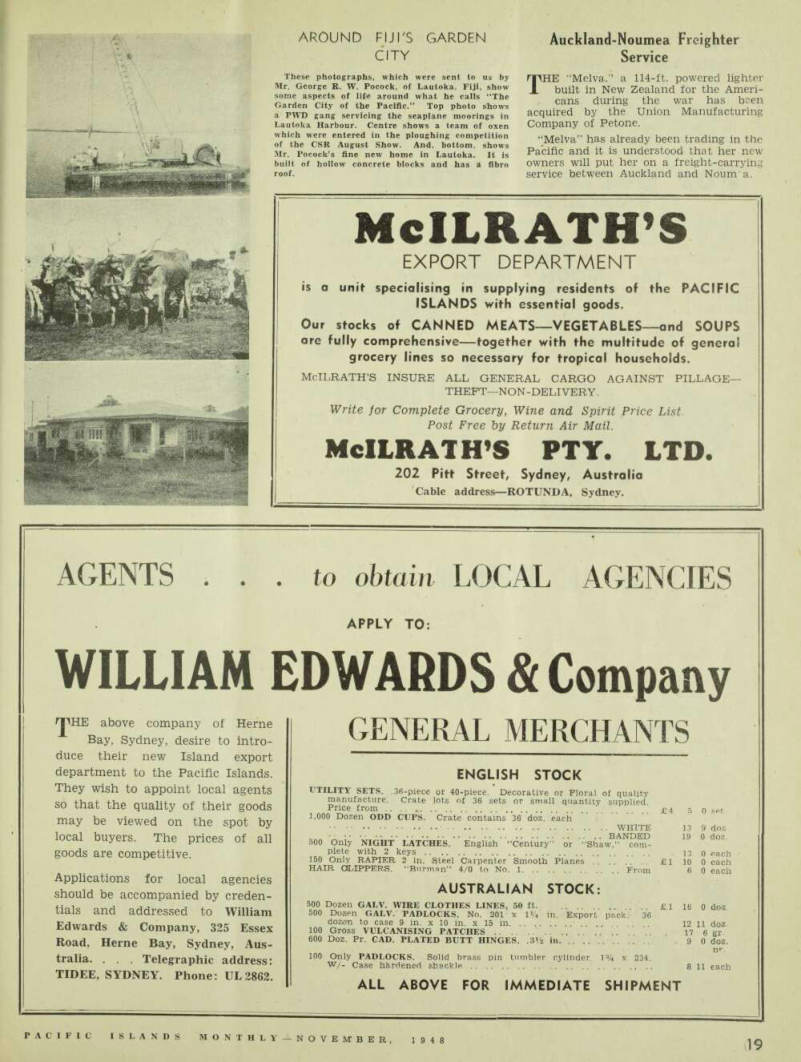
City
These photographs, which were sent to us by Mr. George R. W. Pocock, of Lautoka, Fiji, show some aspects of life around what he calls “The Garden City of the Pacific.” Top photo shows a PWD gang servicing the seaplane moorings in Lautoka Harbour. Centre shows a team of oxen which were entered in the ploughing competition of the CSR August Show. And, bottom, shows Mr. Pocock’s fine new home in Lautoka. It is built of hollow concrete blocks and has a fibro roof.
Auckland-Noumea Freighter
Service
THE “Melva,’’ a 114-ft. powered lighter built in New Zealand for the Ameri cans during the war has been acquired by the Union Manufacturing Company of Petone.
“Melva” has already been trading in the Pacific and it is understood that her new owners will put her on a freight-carrying service between Auckland and Noum a.
Advertisements & other items, p. 21 (1 item)
William Edwards & Company
McILRATH’S
EXPORT DEPARTMENT
is a unit specialising in supplying residents of the PACIFIC ISLANDS with essential goods.
Our stocks of CANNED MEATS-—VEGETABLES—and SOUPS are fully comprehensive—together with the multitude of general grocery lines so necessary for tropical households.
McILRATH’S INSURE ALL GENERAL CARGO AGAINST PILLAGE-
THEFT—NON-DELIVERY.
Write for Complete Grocery, Wine and Spirit Price List Post Free by Return Air Mail.
McILRATH’S PTY. LTD.
202 Pitt Street, Sydney, Australia Cable address—ROTUNDA, Sydney.
AGENTS ... to obtain LOCAL AGENCIES
APPLY TO:
WILLIAM EDWARDS & Company
above company of Herne Bay, Sydney, desire to introduce their new Island export department to the Pacific Islands.
They wish to appoint local agents so that the quality of their goods may be viewed on the spot by local buyers. The prices of all goods are competitive.
Applications for local agencies should be accompanied by credentials and addressed to William Edwards & Company, 325 Essex Road, Herne Bay, Sydney, Australia. . . . Telegraphic address:
TIDEE, SYDNEY. Phone: UL 2862.
GENERAL MERCHANTS
ENGLISH STOCK
UTILITY SETS. .36-piece or 40-piece. Decorative or Floral of quality manufacture. Crate lots of 36 sets or small quantity supplied Price from .. .. £4 1,000 Dozen ODD CUPS. Crate contains 36 doz. each
WHITE
B BANDED
500 Only NIGHT LATCHES. English “Century” or “Shaw.” complete with 2 keys 150 Only RAPIER 2 in. Steel Carpenter Smooth Planes £1 HAIR CLIPPERS. "Bnrman” 4/0 to No. 1 From
AUSTRALIAN STOCK:
500 Dozen GALV. WIRE CLOTHES LINES, 50 ft £1 16 0 500 Dozen GALV. PADLOCKS. No. 201 x l»/ 4 in. Export pack. 36 dozen to case 9 in. x 10 in. x 15 in
100 Gross VULCANISING PATCHES
600 Doz. Pr. CAD. PLATED BUTT HINGES. .3*/4 in 100 Only PADLOCKS. Solid brass pin tumbler cylinder. 1% x 234.
W/- case hardened shackle
ALL ABOVE FOR IMMEDIATE SHIPMENT
12 11 17 6 9 0 set doz doz. each each each doz. doz. gr doz. preach
Amending Fiji's Constitution
Public Asked For Views
From Our Own Correspondent
Suva. Oct. 24.
THE public of the Colony—European, Fijian, Indian and other commun ities—have been invited to submit views on a constitutional change to give
the people “a greater measure of political control over their own affairs.”
The invitation has been issued by Mr.
A. A. Ragg, chairman of the committee of unofficial members set up as a result of the recent motion in the Legislative Council recommending the appointment of such a body to investigate possible changes in the Constitution.
This is not a referendum. Reasons for
opinions must be given and the com mittee will not consider any communica tion recommending the retention of the present system, or a change if reasons are not given.
Yacht Procession
Across South Pacific
From Our Own Correspondent
Suva. Oct. 24.
THE 40 ft. cutter-rigged Canadian yacht “Ecapee” has arrived at Suva from Vancouver by way of San Francisco, Honolulu, Fanning Island, the Marquesas, Papeete and Apia. Aboard are Mr.
P. H. G. Brock (owner) and Messrs. J.
Wells and R. Parlou, all members of the Royal Vancouver Yacht Club.
During a stay of about three months, the “Escapee” will cruise about the Fiji Group and then will probably return to Vancouver.
The secretary of the Suva Yacht Club (Mr. B. A. Lee) has received a letter from Mr. Jack Earl, of Sydney, who is at Nukualofa after sailing his yacht “Kathleen” round the world on an un usual west-east course, returning via Panama. The “Kathleen” was expected to call at Suva on the last leg of the voyage back to Sydney, but Mr. Earl says that this will not be possible.
The South African yacht “Springbok” arrived at Auckland on October 21—19 days out from Suva.
Mr. E. G. Seagoe, British District Agent, and Commandant of Constabulary, New Hebrides, is at present on 12 months’ vacation leave prior to retirement, which took effect from August 1.
Advertisements & other items, p. 22 (2 items)
ansomes
For perfect cutting
under all conditions
There is a Ransomes Mower for every lawn our range covers machines for every requirement from the smooth, even surface of the putting green to the sports ground, golf course or aerodrome.
The "MOON" Mower
GANG
MOWERS
For grass such as couch, kikuyu, buffalo, etc., and grass longer than the average. 14-ln. and 18-ln. wide. 50 acres a day can easily be cat with a Ransomes Quintuple Mower drawn by a tractor and even larger outfits up to 25 ft. wide are available.
ansomes
Lawn Mowers
Write for illustrated literature and aU information
MORRIS, HEDSTROM LTD.,
Suva, Lantoka, and Ba.
Made by RANSOMES, SIMS & JEFFERIES LTD., IPSWICH, ENGLAND.
• New South Wales Yacht Brokers
WE OFFER ALL TYPES OF BOATS FOR ISLAND WORK H
A FEW ARE LISTED HERE:
110 TON DIESEL KETCH. Faithfully built, copper sheathed. Ist class condition.
Accommodate 20. Suit Mission work or inter-island trade. For sale at fraction of original cost. £B,OOO. 75 TON WOODEN VESSEL. 66 ft. 0.L., beam 18 ft., draft 7 ft. Built 1944. Copper sheathed. Powered by National Superior Diesel. Cargo below deck, 40 tons. In commission. £7.000.
WORKBOAT, 40 ft. x 12 ft. x 4 ft-, half cabin. Copper sheathed. Powered by 100 H.P. Perkins Diesel. Carry 15 tons, ideal copra. Hull and engine in excellent order.
Price £2,750.
STURDY WORKBOAT, 27 ft. x 9 ft. X 4 ft. Powered by 12 H.P. Southern Cross Diesel. In Ist class condition. Rigged with aux. sail. Price, £B5O.
HEAVILY BUILT 45 ft. x 12 ft. x 4 ft.
DIESEL LAUNCH. Powered by 75 H.P.
R.N. Diesel. Extremely well fitted, and condition guaranteed. Good type plantation boat. Price, £3,000.
NEW 110 TON STEEL VESSEL. 75 ft. X 18 ft. x 7 ft. Cargo capacity 75 tons. Completed except for engines, which are available.
ALL VESSELS OPEN TO INDEPENDENT INSPECTION AND SURVEY.
DELIVERIES ARRANGED TO ANYWHERE IN THE PACIFIC.
Write for further details or requirements,
• NEW SOUTH WALES YACHT BROKERS
Suite Three, Argent Chambers, 19 Hunter Street, Sydney
Cables: "Agarscarr," Sydney. Telephone: BW 7000
All your inquiries promptly attended to.
New Tuna Industry For Fiji
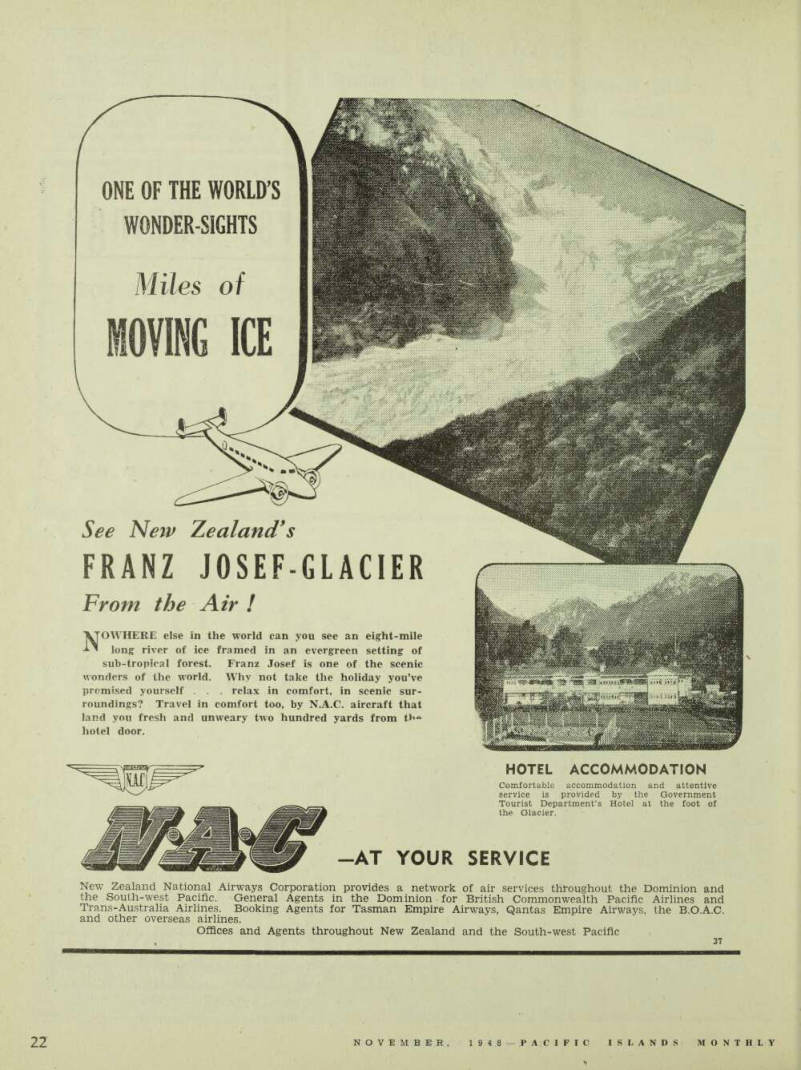
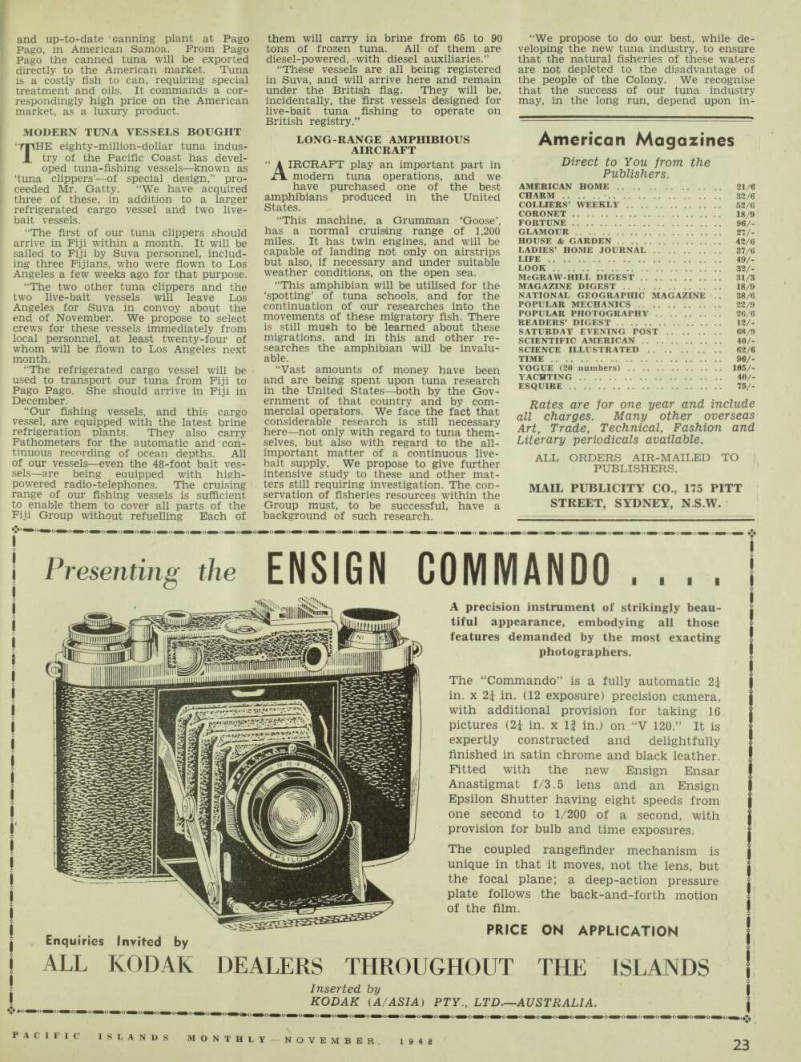
Harold Gatty Bringing Modern Ships and Equipment Into S. Pacific
A TUNA-EXPORTING industry is to be immediately established in Fijian waters with headquarters in Suva.
This announcement was made in Suva in October by Mr. Harold Gatty, chairman and managing director of South Seas Marine Products Limited, who had just returned to Suva after a business trip of several months to the United States and Europe.
“This new industry,” said Mr. Gatty “is one of the few new undertakings of a substantial nature to be established in Fiji for a long number of years.
“My company has, for nearly three years, conducted intensive surveys and researches into the possibility of success fully establishing various marine and fisheries projects in the South Pacific.
These surveys, while not yet completed, have yielded results which, in our view, are sufficiently encouraging to justify our proceeding with the establishment of a tuna industry in Fiji. South Seas Marine Products Limited (which is a British company registered in Suva, with a sub stantial proportion of American capital) is therefore pressing forward with plans which provide for our being in active commercial operation by April of next year.
“There is, in the United States, an ever-increasing demand for canned tuna.
We propose to take advantage of that demand, and of the accompanying oppor tunity to earn United States dollars for Fiji.
“Our catches of tuna and bonito will * be exported in a refrigerated state to an associated Company, now erecting a large
and up-to-date canning plant at Pago Pago, in American Samoa. From Pago Pago the canned tuna will be exported directly to the American market. Tuna is a costly fish to can, requiring special treatment and oils. It commands a cor respondingly high price on the American market, as a luxury product.
Modern Tuna Vessels Bought
THE eighty-million-dollar tuna indus try of the Pacific Coast has devel oped tuna-fishing vessels —known as ‘tuna clippers’—of special design,” pro ceeded Mr. Gatty. “We have acquired three of these, in addition to a larger refrigerated cargo vessel and two live bait vessels.
"The first of our tuna clippers should arrive in Fiji within a month. It will be sailed to Fiji by Suva personnel, includ ing three Fijians, who were flown to Los Angeles a few weeks ago for that purpose.
“The two other tuna clippers and the two live-bait vessels will leave Los Angeles for Suva in convoy about the end of November. We propose to select crews for these vessels immediately from local personnel, at least twenty-four of whom will be flown to Los Angeles next month.
“The refrigerated cargo vessel will be used to transport our tuna from Fiji to Pago Pago. She should arrive in Fiji in December.
“Our fishing vessels, and this cargo vessel, are equipped with the latest brine refrigeration plants. They also carry Fathometers for the automatic and con tinuous recording of ocean depths. All of our vessels —even the 48-foot bait ves sels—are being eauipped with high powered radio-telephones. The cruising range of our fishing vessels is sufficient to enable them to cover all parts of the Fiji Group without refuelling Each of
them will carry in brine from 65 to 90 tons of frozen tuna. All of them are diesel-powered, with diesel auxiliaries.”
“These vessels are all being registered in Suva, and will arrive here and remain under the British flag. They will be, incidentally, the first vessels designed for live-bait tuna fishing to operate on British registry.”
Long-Range Amphibious
Aircraft
“ A IRCRAFT play an important part in modern tuna operations, and we have purchased one of the best amphibians produced in the United States.
“This machine, a Grumman ‘Goose’, has a normal cruising range of 1,200 miles. It has twin engines, and will be capable of landing not only on airstrips but also, if necessary and under suitable weather conditions, on the open sea.
“This amphibian will be utilised for the ‘spotting’ of tuna schools, and for the continuation of our researches into the movements of these migratory fish. There is still mu«h to be learned about these migrations, and in this and other re searches the amphibian will be invalu able.
“Vast amounts of money have been and are being spent upon tuna research in the United States—both by the Gov ernment of that country and by com mercial operators. We face the fact that considerable research is still necessary here—not only with regard to tuna them selves, but also with regard to the all important matter of a continuous live bait supply. We propose to give further intensive study to these and other mat ters still requiring investigation. The con servation of fisheries resources within the Group must, to be successful, have a background of such research.
“We propose to do our best, while de veloping the new tuna industry, to ensure that the natural fisheries of these waters are not depleted to the disadvantage of the people of the Colony. We recognise that the success of our tuna industry may, in the long run, depend upon in
telligent conservation measures based upon research.
New Industry Protected
, . . . x , HE taking and export of tuna for commercial purposes,” said Mr.
Gatty, “have been proclaimed by Government as a protected’ industry.
This was done to ensure that any com pany having the courage and resources required to tackle the development of a tuna industry in Fiji would not be sub jected to uneconomic competition in its early stages of operation. It still has to be proved, moreover, that the tuna resources of Fijian waters are sufficient
to support more than one tuna project Government has recognised that very important fact; and, with it, the fact that freedom from uneconomic competi tion must be a condition precedent to the establishment of a fishing industry such as that which we have planned.
“The movements of the company’s fishing vessels will, to a large extent, be directed from headquarters and opera ting depots upon the basis of informa tion received from our amphibious air craft. The amphibian therefore will, like our vessels, carry high-powered two-way radio-telephones. Similar equipment will also be installed at our Lami base and at another base on the other side of Viti Levu—probably at Vuda Point, where we are leasing a substantial area.
“We are making early application to Government to operate the comprehen sive system of radio-telephony proposed, and are confident of receiving all possible help and co-operation in that direction.
Fijian Fishing Personnel
Tl URING our ex P eriment al fishing of MJ the past two years and more we have employed Fijians extensively, and have, generally speaking, been very satisfied with them. Unlike the Gilbertese and Ellice Islanders, many of whom have extensive experience of offshore fishing, the Fijian is not what might be termed a ‘natural’ fisherman. He is almost com nletelv ignorant of off-shore fish and of their habits, seasons and migrations. But he can be taught, and he learns readily.
Given a rate of nav and conditions com mensurate with the work involved, he is a good worker and becomes a good fisher man.
“We plan to train Fijians for our fish ing crews, and one of the leading tuna fishermen of the Pacific Coast will arrive here shortly to organise and direct our training programme. This programme will occupy some months, as tuna-fishing technique is not to be learned in a day.
We anticipate. however, that our crews will be fullv trained bv the end of March, and that we should be in commercial pro duction shortly thereafter.
Depots At Lami And Vuda
“TT is proposed to establish our head- A Quarters at Lami. where our tem porary headquarters, stores and lab oratory are already situated.
“Here we plan an extensive building nrogramme, including further storage facilities, engineering workshops and other buildings and plant essential to the maintenance and repair of our fleet of vessels.
“We propose also to maintain an oper ating base at Vuda Point, between Nadi and Lautoka, where the boat harbour constructed by the Americans during the war. will be of great value as a base for our bait vessels operating on that side of Viti Levu.
“We will also be establishing a number of live-bait depots in various parts of the Groun in order to ensure that our fishing vessels are continuously provided with adequate supplies of live avu, daniva, sara and other small fish required for the ‘chumming’ of tuna,
Tribute To Government
“T SHOULD like to say,” concluded Mr.
A Gatty, “that we are deeply appreciative of the assistance and encouragement rendered to us by Government itself and bv the members of many Government departments since we commenced oulr survey operations in Fijian waters nearly three years ago. To conduct those in tensive surveys was, as we knew it would be, a long and expensive business, with
(Continued on Page 65)
(Continued from Page 24)
no certainty of ultimate success. We undertook this work ourselves, but have throughout been favoured with the active interest of the Government. For this we are grateful.
“Our research programme will con
tinue —not only in respect of tuna and bait-fish, but also in relation to other prospective marine and fisheries products which we hope may prove capable of commercial development in Fiji as soon as our tuna project is in successful operation.”
Advertisements & other items, pp. 23-26 (1 item)
Sails, Covers, Awnings
TO SHIPMASTERS
When calling at Tahiti, see Oscar G.
Nordman for ships’ supplies and fresh provisions. Wire before your arrival to OCEANIC, PAPEETE (my registered cable address)
OSCAR G. NORDMAN
Ship Chandler, Papeete, Tahiti
Sails, Covers, Awnings
AND ALL CLASSES CANVAS GOODS FOR
INDUSTRIAL AND HOME USE
ALSO: FLAGS, ALL NATIONS
Send your inquiries to
HARRY WEST
"SYDNEY'S SAILMAKER"
DUKE ST. (WATERFRONT) EAST BALMAIN, SYDNEY, N.S.W.
Phone: WBIIOS. W 82284.
PH* % m A chandise purchased for Island clients throughout the South-west Pacific.
Island produce sold on Australian and overseas markets on a commission
ONE OF THE WORLD’S
WONDER-SIGHTS
Miles of
MOVING ICE
v£-'
See New Zealand 9 s
FRANZ JOSEF-GLACIER
From the Air !
NOWHERE else in the world can you see an eight-mile long river of ice framed in an evergreen setting of sub-tropical forest. Franz Josef is one of the scenic wonders of the world. Why not take the holiday you’ve promised yourself . . . relax in comfort, in scenic surroundings? Travel in comfort too, by N.A.C. aircraft that land you fresh and unweary two hundred yards from tb“ hotel door. m-fmm mmm m
HOTEL ACCOMMODATION
Comfortable accommodation and attentive service is provided by the Government Tourist Department’s Hotel at the foot of the Glacier.
-AT YOUR SERVICE
New Zealand National Airways Corporation provides a network of air services throughout the Dominion and the South-west Pacific. General Agents in the Dominion for British Commonwealth Pacific Airlines and Trans-Australia Airlines. Booking Agents for Tasman Empire Airways, Qantas Empire Airways, the 8.0.A.C. and other overseas airlines.
RIC
Offices and Agents throughout New Zealand and the South-west Pacific 37
American Magazines
Direct to You from the
Publishers.
AMERICAN HOME 21/6
CHARM 32/6
COLLIERS’ WEEKLY 52/6
CORONET 18/9
FORTUNE 96/-
GLAMOUR 27/-
HOUSE & GARDEN 42/6
LADIES’ HOME JOURNAL 37/6
LIFE 49/-
LOOK 32/-
McGRAW-HILL DIGEST 31/3
MAGAZINE DIGEST 18/9
NATIONAL GEOGRAPHIC MAGAZINE . . 38/6
POPULAR MECHANICS 22/9
POPULAR PHOTOGRAPHY 26/6
READERS’ DIGEST 12/-
SATURDAY EVENING POST 68/9
SCIENTIFIC AMERICAN 40/-
SCIENCE ILLUSTRATED 62/6
TIME 96/-
VOGUE (20 numbers) 105/-
YACHTING 40/-
ESQUIRE 75/-
Rates are for one year and include
all charges. Many other overseas
Art, Trade, Technical, Fashion and
Literary periodicals available.
ALL ORDERS AIR-MAILED TO
PUBLISHERS.
MAIL PUBLICITY CO., 175 PITT
STREET, SYDNEY, N.S.W.
Presenting the ENSIGN COMMANDO...,
IBWliiH
a $
Enquiries Invited by
A precision instrument of strikingly beautiful appearance, embodying all those features demanded by the most exacting photographers.
The “Commando” is a fully automatic 2f in. x 2f in. (12 exposure) precision camera, with additional provision for taking 16 pictures (2f in. x If in.) on “V 120.” It is expertly constructed and delightfully finished in satin chrome and black leather.
Fitted with the new Ensign Ensar Anastigmat f/3.5 lens and an Ensign Epsilon Shutter having eight speeds from one second to 1/200 of a second, with provision for bulb and time exposures.
The coupled rangefinder mechanism is unique in that it moves, not the lens, but the focal plane; a deep-action pressure plate follows the back-and-forth motion of the film.
PRICE ON APPLICATION
ALL KODAK DEALERS THROUGHOUT THE ISLANDS
Inserted by
KODAK (A/ASIA) PTY., LTD.—AUSTRALIA.
BROOMPIELDS Ltd.
Suppliers of Building Hardware Ship Chandlery, Paint Materials
WRITE DIRECT TO '.
Broomfieids Ltd., 152 Sussex Street, Sydney
- * - V <0 0^ \a
SUPER BOTANY
MERINO KNITTING
NON-SHRINK 2 * 3-PLY
FOR
ALL WOOL
REAL SHETLAND WOOL
2-PLY
'BaAf TlnffUn?
fr. I£oS*W r * tvCt '
BABY WOOLS
GOOD KNITTING
WHEREVER YOU
ARE
Manufactured by Wakefield, Greenwood & Co. (Huddersfield) Ltd., St. George's Sq., Huddersfield, England Agents for Fiji : P. & R. HUTCHINSON, CENTRAL BUILDINGS, THOMPSON
STREET, SUVA, FIJI.
Fiji-Indian Pot Is Boiling
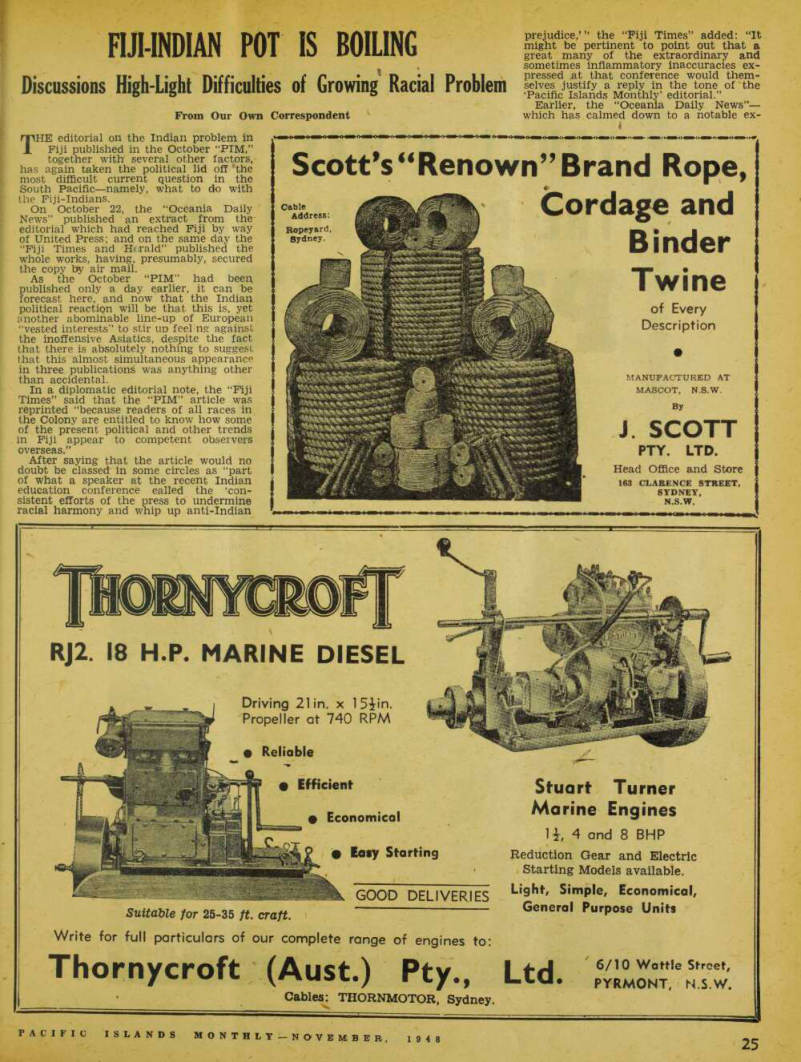

Discussions High-Light Difficulties of Growing Racial Problem
From Our Own Correspondent
THE editorial on the Indian problem in Fiji published in the October “PIM,” together with several other factors, has again taken the political lid off 'the most difficult current question in the South Pacific—namely, what to do with the Fiji-Indians.
On October 22, the “Oceania Daily News” published an extract from the editorial which had reached Fiji by way of United Press; and on the same day the “Fiji Times and Herald” published the whole works, having, presumably, secured the copy by air mail.
As the October “PIM” had been, published only a day earlier, it can be forecast here, and now that the Indian political reaction will be that this is, yet another abominable line-up of European “vested interests” to stir up feeing against the inoffensive Asiatics, despite the fact that there is absolutely nothing to suggest that this almost simultaneous appearance in three publications was anything other than accidental.
In a diplomatic editorial note, the “Fiji Times” said that the “PIM” article was reprinted “because readers of all races in the Colony are entitled to know how some of the present political and other trends in Fiji appear to competent observers overseas.”
After saying that the article would no doubt be classed in some circles as “part of what a speaker at the recent Indian education conference called the ‘con sistent efforts of the press to undermine racial harmony and whip up anti-Indian
prejudice,’” the “Fiji Times” added: “It might be pertinent to point out that a great many of the extraordinary and sometimes inflammatory inaccuracies ex pressed at that conference would them selves justify a reply in the tone of the ‘Pacific Islands Monthly’ editorial.”
Earlier, the “Oceania Daily News”— which has calmed down to a notable ex
tent since its days of infancy, when it demolished practically everything from the Colonial Office to the Suva Town Board —had attacked the Indian educa tion conference in general and Dr.
Mukherji, the delegate who assailed the press, in particular, and had challenged the doctor to substantiate his allegations.
A LETTER in the “Fiji Times” on Oc tober 23 gives an indication of how some aspects of the conference (which made no pretence to be anything other than another flimsily-disguised Indian bid for further control in Fiji) has stirred up non-Indians.
Over the nom-de-plume “Know Your Enemy,” the writer says: “Ratu Edward Cakobau used the word ‘effrontery,’ to describe Indian Politicians’ claims, despite their contemptible war effort, to share in the trusteeship of the Fijians. He would be hard put to it to find a word to describe the holding on Cession Day of all days—of an Indian electioneering (miscalled “education”) conference, at which, with blatant aggres sion, demands were made that alien cul ture should be forced on Fiji. The pro posal to set up a secondary school ‘with Indian Culture as its background’ is sheer impudence.
“It was notable that the conference did not suggest that this institution should make no call, direct or indirect, on public funds. The demands for increased Gov ernment provision for education for Indians, to make them loyal to India rather than to Britain, are revolting when one remembers how Indians con sistently head the list of income tax de faulters, and the bitter protests by Indian politicians against the residential tax.
“This conference, however, has done one good thing. It has brought out into the
open those who aim at making Fiji a dependency of India. The speakers at the conference and those who have accepted office on the committee have shown that their first loyalty is to India and not to Fiji.”
Advertisements & other items, pp. 27-28 (1 item)
Thornycroft (Aust.) Pty., Ltd.
Scott's “Renown” Brand Rope,
Cordage and
Binder
Twine
of Every
Description
Cable Address: Ropeyard Sydney.
aft
MANUFACTURED AT
MASCOT, N.S.W.
By
J. SCOTT
PTY. LTD.
Head Office and Store
163 CLARENCE STREET,
SYDNEY,
N.S.W.
0
RJ2. 18 H.P. MARINE DIESEL
Driving 21 in. x 1 siin.
Propeller at 740 RPM • Reliable • Efficient • Economical Easy Starting
GOOD DELIVERIES
Suitable for 25-35 ft. craft.
Write for full particulars of our complete range of engines to:
Thornycroft (Aust.) Pty., Ltd.
Cables: THORNMOTOR. Sydney.
Stuart Turner
Marine Engines
li, 4 and 8 BHP Reduction Gear and Electric Starting Models available.
Light, Simple, Economical, General Purpose Units 6/10 Wattle Street,
PYRMONT, NSW.
YOU'LL ALWAYS GET
THE BEST FROM THE
PLUME
PUMP!
PLUME
m & P4Bl m Today, Plume is the best petrol you can buy and, as world conditions permit, the Plume Pump will continue to serve the finest petrol available: so Buy from the Plume Pump. —=:
VACUUM
DUALITY PAOOUCI
New Commissioner Acclaimed
As Fiji-India Link
Suva. Oct. 24.
THE only section of the Indian com munity in Fiji which has not shown delirious enthusiasm over the instal lation of the Commissioner for the Gov ernment of India is the Muslim minority, whose existence, in a political sense, de pends on the nomination by the Governor of Muslim members of the Legislative Council. In past years the Muslims fought hard for that concession: they are mort ally afraid of losing it and being walked over, so to speak, by the Hindus in the name of democratic equality. There is also the point that the new Commissioner does not represent Pakistan, There can be no question that the Hindus and Sikhs, inspired by their politicians’ fervour, have greeted the Commissioner as a sort of messiah.
Almost literally the path of Mr, S. A.
Waiz has been strewn with flowers. (Nausori added palm-fronds and streamers across the streets).
The average European and the average Fijian, both of whom appear to be more inclined 4;o ask questions than they were in the days when Fiji’s Golden Rule was: “Don’t say that—you’ll upset the Indians again!” are rather bewildered.
Government pronouncements before the Commissioner arrived were emphatic: He was to be concerned with non-permanent Indians and no others —officially, that is.
No doubt the Indians are entitled to
hold these jamborees of welcome; but the fact remains that in none of his speeches has the Commissioner said anything to weaken the idea that he is to be an effective link between India and Fiji- India.
The “Fiji Times” remarked on October 22: “Extraordinary, to non-Indians, is the apparently universal Indian interpreta tion of the status of the new Commissioner for India, the scope of whose duties has
been explicitly stated more than once by the Government of Fiji,”
Challenging Statements
By A. D. Patel
Suva. Oct, 24.
CULTURALLY, the present education system in Fiji was totally unsuitable for Indian children, complained Mr.
A. D. Patel, a member of both the Legis lative and Executive Councils of Fiji, in a
speech at the Indian education confer ence held last week at Nadi.
“Hardly five out of every 100 Indian children either seek or find ‘white-collar’ jobs,” Mr. Patel continued. “Eighty per cent of them have to be content with be coming either small peasants or un skilled labourers. And yet we hear a cjahiour all round about Indian youths aspiring to ‘white collar’ jobs—as if to do so were a sin.”
Alleging that in Fiji only European children were educated to become “rulers, organisers and managers,” Mr. Patel said that others are educated “as those who are born to obedience and subservience.”
He claimed that Indian children grew up in ignorance of Indian literature, philosophy and culture, but became familiar with such subjects as Shake spear—a poor substitute, he implied.
“Spiritually, too, the Indian ideals of Satyam Shivam and Sundaram appear to be neglected,” said Mr. Patel. ‘To me that is the only education which leads to salvation.”
For an Indian child to aspire to become the Governor of Fiji would be a heinous sin, he added; but in India “his cousin could legitimately aspire to some day taking the place of the Governor-General, Rajagopalachari.” (EDITORIAL NOTE: India now belongs to the Indians, and the Indians may run their country in whatever way they wish.
If they wish, they can have Satyam Shivam instead of Shakespeare, and Patel instead of Nehru—that, now, is entirely their affair. But Fiji does not belong to the Indians, in any shape or form. Fiji belongs to the Fijians, and the British are there as trustees for the Fijians; and no amount of Patel sophistry, or casuistry, will alter that set-up in any material par ticular. Principles which may apply in India cannot be applied in Fiji, so far as the Indians are concerned. The Indians,
in Fiji, have no basic rights. When the Patels of Fiji accept those fundamental facts, we may make some progress to wards a solution of the Fiji-Indian pro blem.)
Advertisements & other items, pp. 29-30 (1 item)
Nelson & Robertson Si
HEALTH
HORIZON
—a quarterly illustrated magazine that is
DIFFERENT
October issue includes
MEASLES
DIABETES
SWIMMING POOL HYGIENE
AN M.O.H. IN SOUTH AFRICA
Only Five Shillings a Year Tavistock House North, Tavistock Square, London. W.C.I, England.
NELSON and ROBERTSON Pty. Ltd.
Established 1895
Shipowners - Brokers and
Islands Merchants
All classes merchandise purchased at Best Wholesale Prices. Original Invoices supplied to Island Clients. Cocoa Beans, Copra, Rubber, Trochus Shell and All Islands' Produce Sold on Commission.
Entrust your requirements to the firm with fifty years' practical experience in the Pacific Islands.
Prompt attention given to all enquiries.
NELSON & ROBERTSON Si
12 SPRING STREET, SYDNEY, AUSTRALIA
Telegraphic Address: IVAN, SYDNEY.
SPECIALISING IN
PACIFIC ISLAND INSURANCES
FIRE—MOTOR VEHICLE
MARINE—HULLS AND CARGO
EMPLOYER’S LIABILITY
BONDS—In accordance with
ADMINISTRATION ORDINANCES.
COPRA INSURED FROM DRIER
TO BUYER.
AND ALL OTHER CLASSES ARRANGED
AT LOWEST CURRENT RATES.
Established Agencies throughout the Territory of Papua and New Guinea.
Managing Agents: New Guinea Company, Limited.
Island Representative: G. D. A. Kent, Rabanl Branch.
SOUTHERN PACIFIC INSURANCE
CO., LTD.
HEAD OFFICE: 60 HUNTER STREET,
SYDNEY.
Fiji’s Increased Copra Output
From Our Own Correspondent
Suva. Oct. 11.
FIJI’S copra exports, for the first nine months of 1948 amounted to 16,125 tons, worth £F730,340. In addition, the two Suva oil-mills purchased about 14,000 tons. This brings the nine months’ total to about 30,000 tons, worth £F1,350,000.
For the whole of 1947, exports were 27,490 tons, valued at £966,246.
Qantas’ Sydney-Santo
Service Commences
Prom a Special Correspondent THE first Catalina of the new Qantas Empire Airways service between Australia and New Hebrides landed on the Canal at Santo on October 15..
There had been many postponements of the first flight. It was originally scheduled for July but the necessary per mission was not forthcoming. To date of writing, permission to operate a regular fortnightly service has not yet been granted. The matter is still under negotiation.
Until the position is clarified Qantas intends to run every two weeks with mail, freight and passengers.
It is believed that should the passenger potential warrant it, Catalinas will be re placed by a larger aircraft.
Agents for the new service are Burns Philp (New Hebrides) Ltd.
Advertisements & other items, p. 30 (1 item)
Colter Watson (=S.) Ltd!
Assoc iated w ith
WATSON (A.
a»at ram&smasm
RABAUL & KAVIENG
Wholesale & Retail Merchants. Shipowners. Sawinillers. General Engineers. Customs & Shipping
Agents.
Catering for all Plantation Supplies. Buyers of Island Produce. Plantation Owners & Managing Agents.
-IYERi ** TSON
tdnev, ***£
PTY.
UYO.
Brisbane.
Agents for:— Australia- West Pacific Line China Navigation Co.
Canton Insurance Office Ltd.
Union Assurance Society Ltd, National Mutual Life Assurance of A/sia Ltd.
Guinea Air Traders Ltd.
Steamships Trading Co.
Ltd.
Associated U TO.
CchulC '"
COtYER
■^r e \bt\gt°n Distributing Agents in New Guinea for:— Chrysler & Plymouth Cars Fargo Trucks Hillman & Humber Cars. Commer T rucks.
Willys Overland Jeeps G.M. Marine & Industrial Engines Prefect Refrigerators Mallard Radios Hygeia Dissolvenators Snowflake Unsweetened Evaporated Milk Olympic Tyres & Cables
Fred Cuthbert
Dead
He Established His Misima ‘Bonanza’ When Aged 80
ONE of the best known mining men of the Australian-Pacific Territories, Mr, “Freddie” Cuthbert, died in Bris bane on October 25, aged 92. Having made and lost two or three fortunes, he entered Papua mining when he was 77 years old, and established a “Bonanza” on Misima Island; and when he died he was worth, perhaps, a quarter-million.
Frederick William Cuthbert was born in London; but he was working in a grocer’s shop in Sydney before he was 20.
In a long and restless life, he became in terested in mining in Queensland, and he was a storekeeper on the well-known Croydon goldfield when he earned the title of “King of Croydon.” He had great suc cesses and great losses—he twice made a fortune of £30,000 or £40,000, and twice lost it by unwise investment in goldmines.
About 1929, Mr. Cuthbert went to Misima, Eastern Papua, and became in terested in the wreck of the famous Block Ten Mine. This was the show on which the BH Company had lost nearly half a million, back in the World War I period.
There was an extremely rich loda on Misima, but the cost of working it was huge, and finally BH abandoned it. It had been worked, on and off, by local syndicates, for some years, when Cuth bert formed New Misima Gold Mines Ltd. and took over the leases in 1929. The new owners were both clever and lucky.
In the ’thirties, New Misima was paying an annual dividend of 120 per cent.; Cuthbert himself made £lOO,OOO in seven years. His oldest associates were A. Pym (now a resident of Sydney), G. O. Wilkin son (dead) —both directors—and Jim Quinterall, who was underground man ager, and whose good work made phenomenal success possible.
They sold the mine, in 1935, to Cuth berts Misima Goldmine Ltd., for a large ium in cash, but they retained sub stantial interests in it. Although now in his eighties, the indefatigable “Freddie” returned to speculative gold mining enterprises in Queensland. He was in jured in a severe fall, last July, and he failed rapidly in recent weeks. He died a bachelor.
Bgd’S War Compensation
Was £1,312,047
THE total amount paid by the Aus tralian War Damage Commission to Bulolo Gold Dredging Ltd., New Guinea, in full settlement for war dam age compensation, was £1,312,047.
In September, the seven dredges of BGD put through 845,600 cubic yards of gravel, for a recovery of 5,458 ounces of gold.
The greater part of BCD’s huge equip ment was destroyed in 1942-43—mostly by “scorched earth” and looting. The com pany, in 1946, proceeded with rehabilita tion with great energy, and led all New Guinea enterprises in returning to full production.
As this company has now bought most of its equipment, and purchases nearly all its current supplies from Australia, it would be adversely affected if the Aus tralian exchange follows New Zealand to par with sterling.
Administrator On Work Of
Missions
PRAISE of the work of the missions in Papua and New Guinea was given recently in a letter from the Admin istrator (Colonel J. K. Murray) to the Rev. A. H. Voyce, of the Methodist mission in Bougainville.
After expressing appreciation of the constructive health and social develop ment work the missions have done in the difficult years since the beginning of their
activities in the territory, the Admin istrator adds: “The mission and the ad ministration have common ground and common work in the pressing and immense task of caring for the welfare and the social and economic development of more than 1,000,000 native dependent people in this territory, in keeping with the obligations of trusteeship.”
A memorial service to the late Mrs.
M. K. Gilmour, who gave many years to the Methodist Mission in Papua, was held at Salamo in August.
Advertisements & other items, pp. 31-32 (1 item)
W. H. Grove & Sons
Limited
Established 1896.
AUCKLAND
Island Traders. P.o. BOX 490.
Telegraphic and Cable Address: “Grove”, Auckland.
Entrust Your Orders to the Firm with Fifty Years Practical Experience in the Island Trade.
Shippers of all classes of New Zealand products.
Representing English Manufacturers through-
out the Cook and Society Islands, Fiji, Tonga, Samoa, Niue, New Caledonia, New Guinea, etc.
In FIJI as—W. H. Grove Gr Sons (Fiji) Ltd.
The Garrick Hotel
Hi;.,
. ll|. r
SUVA
FIJI
This well-known Hotel is centrally situated in Suva's main business quarter Modern accommodation provides comfort in all climatic conditions :: Only the best of Beers, Spirits and Wines is served Telephone: 80. VINCE COSTELLO, Proprietor.
Gilbert Renton
AUCTIONEER, VALUER,
ESTATE AGENT.
Storage and Repository Travellers Sample Rooms For General Information and Service.
P.O. Box Rabaul, TNG
WE
CAN HELP #U
Full banking facilities at our Island Branches
RABAUL ... LAE
PORT MORESBY
MADANG
The Service links with our Branches throughout Australia, also our Agents and correspondents all over the world.
fcmonwealtbJBank
of Australia.
Every Branch of the Bank conducts Savings Bank business.
A Then and Now Story
BEFORE the advent of the first missionaries to Mussau Island, in the St. Matthias Group, north of New Ireland, the natives were reported to be depressed, disinterested and in danger of starvation.
Recently, however, Mr. T. F. Judd, resident Seventh-day Adventist missionary there, told the people of the United Nations Appeal for the starving children of Europe* so they decided to participate in this. Some made copra, others col lected shell, and when the cash was counted it was found to amount to £l3O.
The oldest man on the island was the greatest individual giver. His donation was £l5.
Phosphate Fortune
Two Families Share Phosphate Fortune Christmas Is. Link With King, of Cocos Islands
THE £2,750,000 paid by the Australian and New Zealand Governments for •ii Christmas Island phosphate rights will be shared by members of two Eng lish families.
Next to Nauru the Christmas Island (Indian Ocean) deposits are the richest in the world. The property will be vested in an authority to be appointed by the two Governments and phosphate will be distributed by the British Phos phate Commission and delivered to the nearest fertiliser works in Australia—pro bably to Western Australia, which is about 1,400 miles from Christmas Island.
A concession to work phosphate at Christmas Island was granted in 1897 to the Christmas Island Phosphate Com pany Ltd., a private company formed by Sir John Murray, a naturalist who first landed on the island, and George Clunies Ross, the second “king” of Cocos Island, who had made a considerable amount of money from copra production.
When it was formed, the company had a capital of £360,000, divided into £lO shares. To-day the £lO shares are worth £76, making the 36,000 original shares worth £2,736,000.
Seven members of the Clunies Ross family are still shareholders, the largest of them being Mrs. Rachel Clunies Ross, of Middlesex, whose holding is worth £95,000.
Three Murrays are also share-holders, the largest holding being that of Mrs Cecilia Murray, of Wiltshire, whose shares are worth £253,000. (The first Clunies Ross, of Cocos (John) settled there in 1825. He was a “wanted” man in England, as he had taken up arms on behalf of James, the Pretender, of Scotland. He was succeeded in 1854 by his son, John George, who married a Malayan princess, and three years later Cocos was proclaimed a part of the British Empire. In 1886, Queen Victoria was so impressed with the able manner in which the Ross family was 'administering the islands that she granted the family possession of Cocos Islands for ever.
Ross 111 (part Malayan) followed his father in due course and died in the UK in 1910. Ross IV succeeded and reigned until July, 1944, when he died during a Jap air-raid on the island. It is not known whether he married and left issue, or not. It is rumoured that, in the 30’s, he visited England and there met a lady in a tea-shop; later, it is alleged, they were married and she bore him a son.
Ross IV, at all events, returned to Cocos alone and presumably left no record of his marriage. In 1945 a search was be ing made in England for the “missing heir” but apparently without result.
Neither the Colonial Office or Malayan headquarters could or would throw any light on the mystery. And no record of Ross V existed among the births at Somerset House. Evidently Ross IV’s romance was just a story. Some news papers in late 1945 carried a story that Ross V was found and at a British Uni versity. Allowing for the fact that he could not have been born before 1931, this would make him 14—rather young for the University.
But what is the position in the Cocos Islands to-day? Does some other Clunies Ross “reign”’ there? Or have the islands, like Sarawak, cast off their family dynasty and become merely another piece of the British Empire? We have never heard.
Movie-Making On Makogai
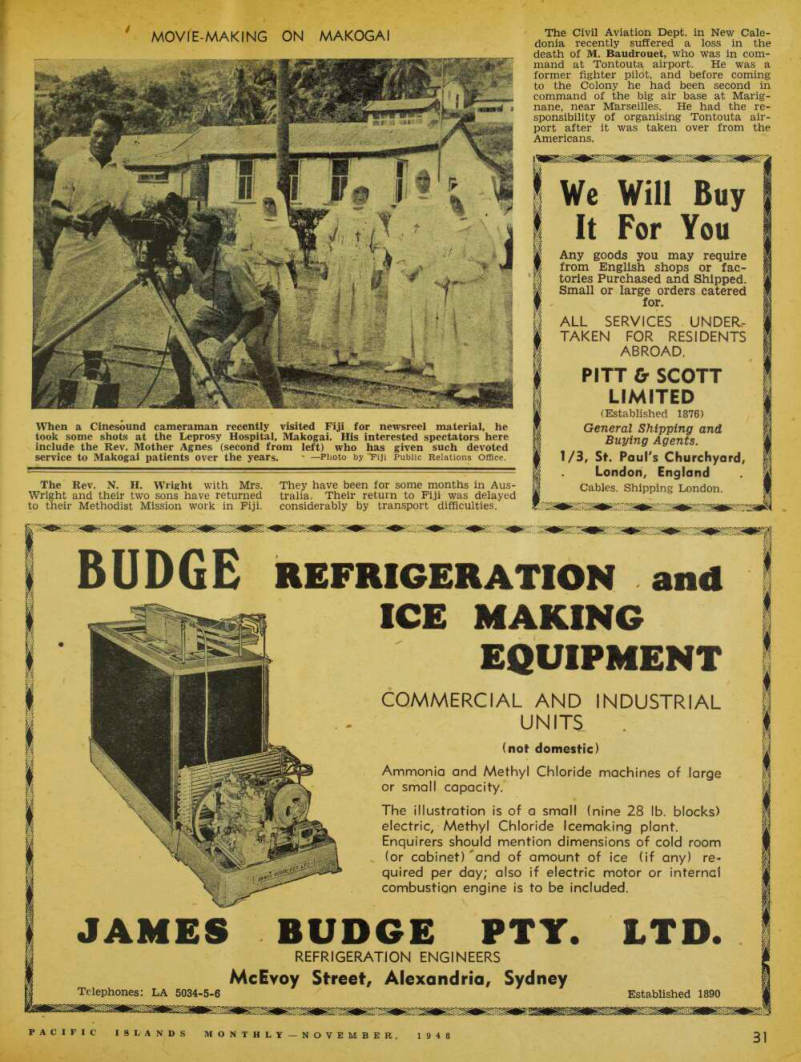
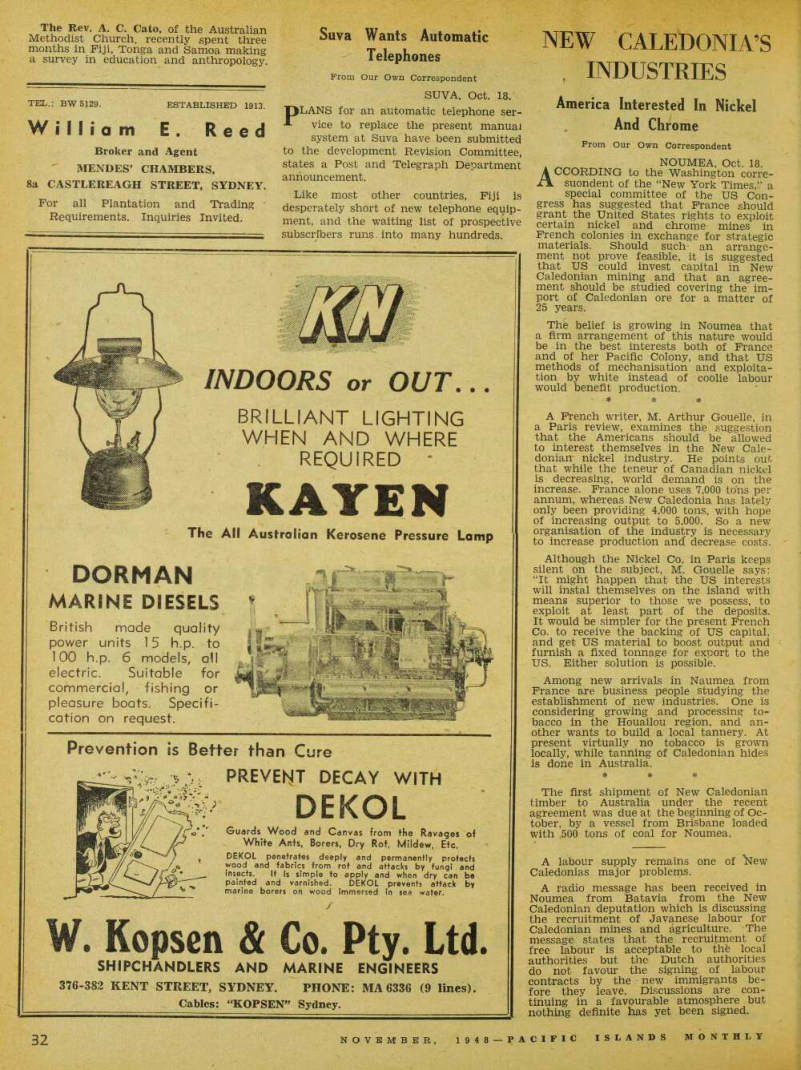
The Rev. N. H. Wright with Mrs.
Wrlght and their two sons have returned to their Methodist Mission work in Fiji,
They have been for some months in Aus tralia. Their return to Fiji was delayed considerably by transport difficulties.
The Civil Aviation Dept, in New Cale donia recently suffered a loss in the death of M. Baudrouet, who was in com mand at Tontouta airport. He was a former fighter pilot, and before coming to the Colony he had been second in command of the big air base at Marig nane, near Marseilles. He had the re sponsibility of organising Tontouta air port after it was taken over from the Americans.
When a Cinesound cameraman recently visited Fiji for newsreel material, he took some shots at the Leprosy Hospital, Makogai. His interested spectators here include the Rev. Mother Agnes (second from left) who has given such devoted service to Makogai patients over the years. —Photo by "Fiji Public Relations Office.
The Rev. A. C. Cato, of the Australian Methodist Church, recently spent three months in Fiji, Tonga and Samoa making a survey in education and anthropology.
Advertisements & other items, pp. 33-34 (1 item)
Equipment
We Will Buy
It For You
Any goods you may require from English shops or factories Purchased and Shipped.
Small or large orders catered for.
ALL SERVICES UNDER-
TAKEN FOR RESIDENTS
ABROAD.
PITT Cr SCOTT
LIMITED
(Established 1876) General Shipping and Buying Agents. 1/3, St. Paul's Churchyard, London, England Cables. Shipping London.
BUDGE REFRIGERATION and
ICE MAKING
EQUIPMENT
iS m
COMMERCIAL AND INDUSTRIAL
UNITS
(not domestic) Ammonia and Methyl Chloride machines of large or small capacity.
The illustration is of a small (nine 28 lb. blocks) electric. Methyl Chloride Icemaking plant.
Enquirers should mention dimensions of cold room (or cabinet) 'and of amount of ice (if any) required per day; also if electric motor or internal combustion engine is to be included.
JAMES BUDGE PTY. LTD.
REFRIGERATION ENGINEERS
McEvoy Street, Alexandria, Sydney
Telephones: LA 5034-5-6
TEL.: BW 5129. ESTABLISHED 1913.
William E. Reed
Broker and Agent
MENDES’ CHAMBERS,
8a CASTLEREAGH STREET, SYDNEY.
For all Plantation and Trading Requirements. Inquiries Invited.
Telephones
Suva Wants Automatic Telephones
From Our Own Correspondent
Suva. Oct. 18.
¥>LANS for an automatic telephone ser vice to replace the present manual system at Suva have been submitted to the development Revision Committee, states a Post and Telegraph Department announcement.
Like most other countries, Fiji is desperately short of new telephone equip ment, and the waiting list of prospective subscribers runs. into many hundreds.
New Caledonia’S
Industries
America Interested In Nickel And Chrome
Prom Our Own Correspondent
Noumea, Oct. 18.
A CCORDING to the Washington corre suondent of the “New York Times,” a special committee of the US Con gress has suggested that Prance should grant the United States rights to exploit certain nickel and chrome mines in French colonies in exchange for strategic materials. Should such an arrange ment not prove feasible, it is suggested that US could invest capital in New Caledonian mining and that an agree ment should be studied covering the im port of Caledonian ore for a matter of 25 years.
The belief is growing in Noumea that a firm arrangement of this nature would be in the best interests both of France and of her Pacific Colony, and that US methods of mechanisation and exploita tion by white instead of coolie labour would benefit production. * * * A French writer, M. Arthur Gouelle, in a Paris review, examines the suggestion that the Americans should be allowed to interest themselves in the New Cale doniarr nickel industry. He points out that while the teneur of Canadian nickel is decreasing, world demand is on the increase. France alone uses 7,000 tons per annum, whereas New Caledonia has lately only been providing 4,000 tons, with hope of increasing output to 5,000. So a new organisation of the industry is necessary to increase production and' decrease costs.
Although the Nickel Co. in Paris keeps silent on the subject, M. Gouelle says: “It might happen that the US interests will instal themselves on the island with means superior to those we possess, to exploit at least part of the deposits.
It would be simpler for the present French Co. to receive the backing of US capital, and get US material to boost output and furnish a fixed tonnage for export to the US. Either solution is possible.
Among new arrivals in Naumea from France are business people studying the establishment of new industries. One is considering growing and processing to bacco in the Houailou region, and an other wants to build a local tannery. At present virtually no tobacco is grown locally, while tanning of Caledonian hides is done in Australia. * * * The first shipment of New Caledonian timber to Australia under the recent agreement was due at the beginning of Oc tober, by a vessel from Brisbane loaded with 500 tons of coal for Noumea.
A labour supply remains one of New Caledonias major problems.
A radio message has been received in Noumea from Batavia from the New Caledonian deputation which is discussing the recruitment of Javanese labour for Caledonian mines and agriculture. The message states that the recruitment of free labour is acceptable to thfc local authorities taut the Dutch authorities do not favour the signing, of labour contracts by the new immigrants be fore they leave. Discussions are con tinuing in a favourable atmosphere but nothing definite has yet been signed.
Advertisements & other items, p. 34 (1 item)
Kayen
INDOORS or OUT. ..
BRILLIANT LIGHTING
WHEN AND WHERE
REQUIRED
KAYEN
The All Australian Kerosene Pressure Lamp
DORMAN
MARINE DIESELS
British made quality power units 15 h.p. to 100 h.p. 6 models, all electric. Suitable for commercial, fishing or pleasure boats. Specification on request. <*| t.- I*-
I |-jj
Prevention is Better than Cure
9 . a o.;> • •• k .V.V O
PREVENT DECAY WITH
DEKOL
Guards Wood and Canvas from the Ravages of White Ants, Borers, Dry Rot. Mildew. Etc.
DEKOL penetrates deeply and permanently protects wood and fabrics from rot and attacks by fungi and insects. It is simple to apply and when dry can be painted and varnished. DEKOL prevents attack by marine borers on wood immersed in sea water.
W. Kopscn & Co. Pty. Ltd.
SHIPCHANDLERS AND MARINE ENGINEERS
376-382 KENT STREET, SYDNEY. PHONE: MA 6336 (9 lines).
Cables: “KOPSEN” Sydney.
Still No Timber From
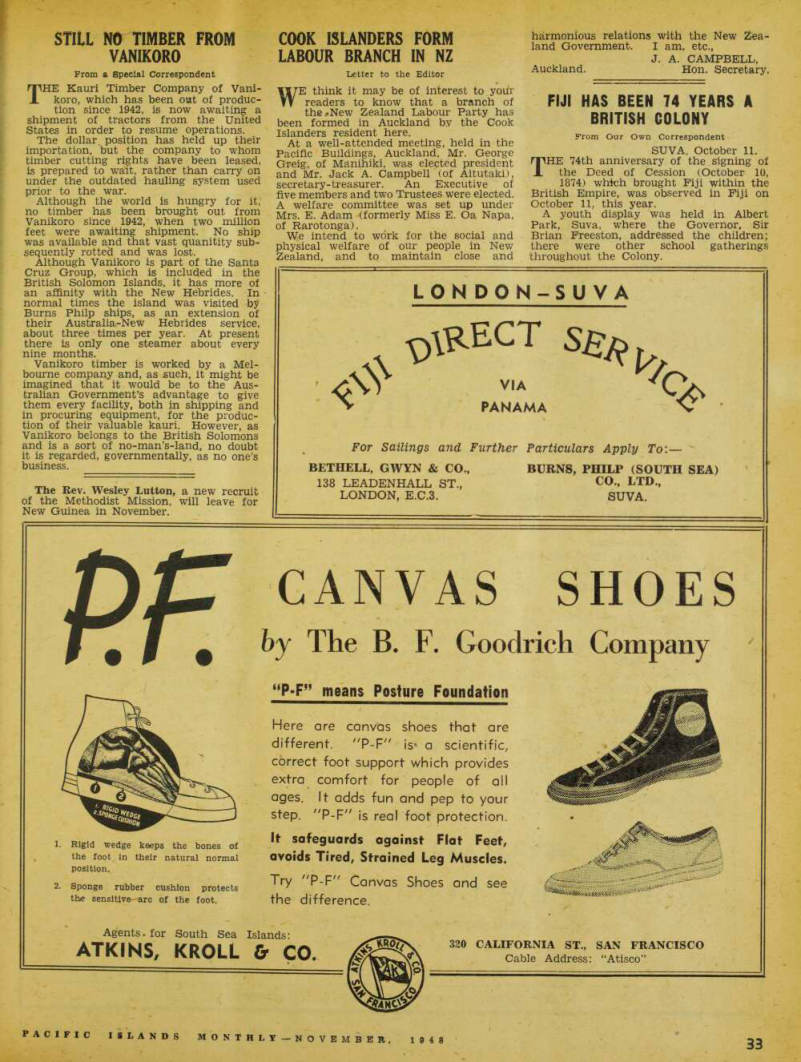
Vanikoro
Prom a Special Correspondent THE Kauri Timber Company of Vani koro, which has been out of produc tion since 1942, is now awaiting a shipment of tractors from the United States in order to resume operations.
The dollar position has held up their importation, but the company to whom timber cutting rights have been leased, is prepared to wait, rather than carry on under the outdated hauling system used prior to the war.
Although the world is hungry for it, no timber has been brought out from Vanikoro since 1942, when two million feet were awaiting shipment. No ship was available and that vast quanitity sub sequently rotted and was lost.
Although Vanikoro is part of the Santa Cruz Group, which is included in the British Solomon Islands, it has more of an affinity with the New Hebrides. In normal times the island was visited by Burns Philp ships, as an extension of their Australia-New Hebrides service, about three times per year. At present there is only one steamer about every nine months.
Vanikoro timber is worked by a Mel bourne company and, as such, it might be imagined that it would be to the Aus tralian Government’s advantage to give them every facility, both in shipping and in procuring equipment, for the produc tion of their valuable kauri. However, as Vanikoro belongs to the British Solomons and is a sort of no-man’s-land, no doubt it is regarded, governmentally, as no one’s business.
The Rev. Wesley Lutton, a new recruit of the Methodist Mission, will leave for New Guinea in November.
Cook Islanders Form
Labour Branch In Nz
Letter to the Editor WE think it may be of interest to your readers to know that a branch of the »New Zealand Labour Party has been formed in Auckland by the Cook Islanders resident here.
At a well-attended meeting, held in the Pacific Buildings, Auckland. Mr. George Greig, of Manihiki, was elected president and Mr, Jack A. Campbell (of Aitutaki), secretary-treasurer. An Executive of five members and two Trustees were elected.
A welfare committee was set up under Mrs. E. Adam (formerly Miss E, Oa Napa, of Rarotonga).
We intend to work for the social and physical welfare of our people in New Zealand, and to maintain close and
harmonious relations with the New Zea land Government. I am, etc.,
J. A. Campbell.
Auckland.
Hon. Secretary.
Fiji Has Been 74 Years A
British Colony
From Our Own Correspondent SUVA. October 11.
THE 74th anniversary of the signing of the Deed of Cession (October 10, 1874) which brought Fiji within the British Empire, was observed in Fiji on October 11, this year.
A youth display was held in Albert Park, Suva, where the Governor, Sir Brian Freeston, addressed the children; there were other school gatherings throughout the Colony.
Advertisements & other items, pp. 35-36 (1 item)
Canvas Shoes
LON DON-SUVA
ECT
«\v v,*
> PANAMA V
For Sailings and Further Particulars Apply To:— BETHELL, GWYN & CO., BURNS, PHILP (SOUTH SEA)
138 LEADENHALL ST., CO., LTD.,
LONDON, E.C.3. SUVA.
p.f.
CANVAS SHOES
hy The B. F. Goodrich Company
1. Rigid wedge keeps the bones of the foot in their natural normal position. 2. Sponge rubber cushion protects the sensitive - arc of the foot.
“P-F” means Posture Foundation / Here are canvas shoes that are different. "P-F" is* a scientific, correct foot support which provides extra comfort for people of ail ages. It adds fun and pep to your step. "P-f" is real foot protection.
It safeguards against Flat Feet, avoids Tired, Strained Leg Muscles.
Try "P-F'* Canvas Shoes and see the difference.
Agents, for South Sea Islands:
ATKINS, KROLL & CO.
£4 MCA
320 CALIFORNIA ST., SAN FRANCISCO
Cable Address: “Atisco”
For Reliable Service and Complete Satisfaction
You can Always Depend on
Attention !
DO NOT PASS BY THIS NOTICE
ARE YOU handling Trade Items from Hongkong and the Far East?. • • . You Are ?
HAVE YOU communicated with
CHINA-NEW GUINEA MERCANTILE CO., V 9
36 Connaught Road Central, HONGKONG? • • • . i\ Ot JL St THEN YOU are missing a GOLDEN LINK in your connections
with Hongkong and the Far East.
WHY?
Because I know that they are a very old and reliable concern with over 20 years 7 experience in the supply of all kinds of merchandise, including the following:— Tin and Brass Torchcases.
Torch Batteries.
Straw Mats.
Safety Matches.
Imitation Leather Suitcases.
Camphorwood Boxes.
Shirting Materials.
Underpants.
Linen Dinner Sets.
Fountain Pens.
Plastic Harmonicas.
Straw Hats.
Rubber Balls.
Rattan Furniture.
T-Shirts.
Hurricane Lanterns.
Cotton Piecegoods.
Laundry Soap.
Artificial Fibre Suitcases.
Leather Suitcases.
Trade Boxes.
Pyjamas.
Linen Handkerchiefs.
Ivory Wares and Ornaments.
Nylon Stockings.
Swimming Trunks.
Canvas Rubber Shoes.
Thermos Flasks.
Charcoal Irons.
Sport Shirts.
Kerosene Lamps.
Grass and Cord Mats.
Cement, Fibre Suitcases.
Camphorwood Trunks.
Shirts.
Khaki Shorts.
Linen Tea Sets.
Lacquer Goods.
Men’s and Ladies’ Cotton Anklets.
Sun Helmets.
Leather Footballs.
Pillow Cases and Sheets.
Singlets.
Etc., Etc., Etc., Etc. and in most cases I have found their prices the cheapest. I am thoroughly satisfied with their prompt service, and do not hesitate to recommend this house to you.
IF I WERE YOU I would lose no time to write to them letting them know of your requirements
IMMEDIATELY.
FOR SERVICE AND SATISFACTION CONTACT
CHINA-NEW GUINEA MERCANTILE CO.
36, Connaught Road Central, Hongkong
Cable Address: Chigatile.
Bankers: Hongkong & Shanghai Banking Corporation, Des Voeux Road, Hongkong.
We Assure Prompt Attention to all Enquiries
China-New Guinea Mercantile Company
Cook Islands Unrest
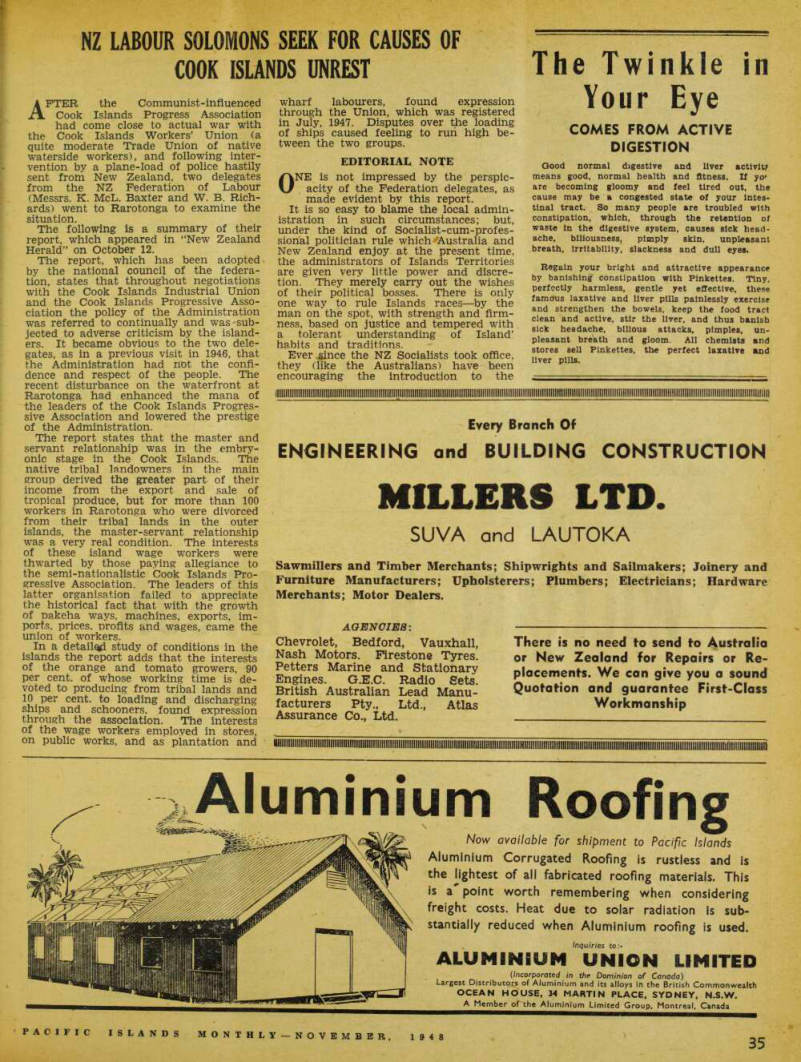
NZ LABOUR SOLOMONS SEEK FOR CAUSES OF
AFTER the Communist-influenced Cook Islands Progress Association had come close to actual war with the Cook Islands Workers’ Union (a quite moderate Trade Union of native waterside workers), and following inter vention by a plane-load of police hastily sent from New Zealand, two delegates from the NZ Federation of Labour (Messrs. K. McL, Baxter and W. B. Rich ards) went to Rarotonga to examine the situation.
The following is a summary of their report, which appeared in “New Zealand Herald” on October 12.
The report, which has been adopted by the national council of the federa tion, states that throughout negotiations with the Cook Islands Industrial Union and the Cook Islands Progressive Asso ciation the policy of the Administration was referred to continually and was sub jected to adverse criticism by the island ers. It became obvious to the two dele gates, as in a previous visit in 1946, that the Administration had not the confi dence and respect of the people. The recent disturbance on the waterfront at Rarotonga had enhanced the mana of the leaders of the Cook Islands Progres sive Association and lowered the prestige of the Administration.
The report states that the master and servant relationship was in the embry onic stage in the Cook Islands. The native tribal landowners in the main group derived the greater part of their income from the export and sale of tropical produce, but for more than 100 workers in Rarotonga who were divorced from their tribal lands in the outer islands, the master-servant relationship was a very real condition. The interests of these island wage workers were thwarted by those paying allegiance to the seml-nationallstic Cook Islands Pro gressive Association. The leaders of this latter organisation failed to appreciate the historical fact that with the growth of pakeha ways, machines, exports, im ports, prices, profits and wages, came the union of workers.
In a detailed study of conditions in the islands the report adds that the interests of the orange and tomato growers, 90 per cent, of whose working time is de voted to producing from tribal lands and 10 per cent, to loading and discharging ships and schooners, found expression through the association. The interests of the wage workers employed in stores, on public works, and as plantation and
wharf labourers, found expression through the Union, which was registered in July, 1947. Disputes over the loading of ships caused feeling to run high be tween the two groups.
Editorial Note
ONE is not impressed by the perspic acity of the Federation delegates, as made evident by this report.
It is so easy to blame the local admin istration in such circumstances; but, under the kind of Socialist-cum-profes sional politician rule which Australia and New Zealand enjoy at the present time, the administrators of Islands Territories are given very little power and discre tion. They merely carry out the wishes of their political bosses. There is only one way to rule Islands races—by the man on the spot, with strength and firm ness, based on justice and tempered with a tolerant understanding of Island’ habits and traditions.
Ever since the NZ Socialists took office, they (like the Australians) have been encouraging the introduction to the
Islands of the institutions peculiar to the Socialist way of political life, and especi ally Trade-Unionism. There is no place for Trade-Unionism in Islands communi ties—but, of course, one could never ex pect to convince Federation of Labour delegates of that.
It is sheer nonsense to blame the local Administration for the Cook Islands trouble. The blame lies, primarily, with the NZ framers of policy, who encourage “organisation” among Cook Islands natives. A competent Administrator, left alone bv Wellington to do his job, would never have allowed those mischievous agitators to carry on their activities in the Cooks in the first place. Once that weakness developed, everything else, in cluding the near-riot, and police inter vention, followed logically, as a matter of Course.
Mr. S. Hurse, of Tasmania, will succeed the Rev. W. F. Paton, of the Presbyterian Overseas Mission, in the New Hebrides.
Mr. Hurse will be ordained next year and is not expected to leave for the Hebrides for some months.
Advertisements & other items, p. 37 (1 item)
Aluminium Roofing
The Twinkle in
Your Eye
COMES FROM ACTIVE
DIGESTION
Good normal digestive and liver activity means good, normal health and fitness. If yo f are becoming gloomy and feel tired out, the cause may be a congested state of your Intestinal tract. So many people are troubled with constipation, which, through the retention of waste in the digestive system, causes sick headache, biliousness, pimply skin, unpleasant breath, irritability, slackness and dull eyes.
Regain your bright and attractive appearance by banishing constipation with Pinkettes. Tiny, perfectly harmless, gentle yet effective, these famous laxative and liver pills painlessly exercise and strengthen the bowels, keep the food tract clean and active, stir the liver, and thus banish sick headache, bilious attacks, pimples, unpleasant breath and gloom. All chemists and stores sell Pinkettes, the perfect laxative and liver pills.
Every Branch Of
ENGINEERING and BUILDING CONSTRUCTION
MILLERS LTD.
SUVA and LAUTOKA
Sawmillers and Timber Merchants; Shipwrights and Sailmakers; Joinery and Furniture Manufacturers; Upholsterers; Plumbers; Electricians; Hardware Merchants; Motor Dealers.
AGENCIES:
Chevrolet, Bedford, Vauxhall, Nash Motors. Firestone Tyres.
Fetters Marine and Stationary Engines. G.E.C. Radio Sets.
British Australian Lead Manufacturers Pty., Ltd., Atlas Assurance Co., Ltd.
There is no need to send to Australia or New Zealand for Repairs or Replacements. We can give you a sound Quotation and guarantee First-Class
Workmanship
Aluminium Roofing
K, r- Now available for shipment to Pacific Islands Aluminium Corrugated Roofing is rustless and is the lightest of all fabricated roofing materials. This is a point worth remembering when considering freight costs. Heat due to solar radiation is substantially reduced when Aluminium roofing is used.
Inquiries to:-
ALUMINBUM UNION LIMITED
(Incorporated in the Dominion of Canada) Largest Distributors of Aluminium and its alloys in the British Commonwealth OCEAN HOUSE, 34 MARTIN PLACE, SYDNEY, N.S.W.
A Member of the Aluminium Limited Group, Montreal, Canada
Notes From Tahiti
PAPEETE, September 28.
RESIDENTS of Tahiti were pleased to welcome back Commander Jean Bracchet when the Messagerles Mari times ship “Ville de Strasbourgh” arrived in Papeete on September 3.
Commander Bracchet was in command of the “Sagittaire” until about a year ago. In September, 1947, when this ship was clearing Papeete harbour, she went aground. No harm was done and she got off again at the next high tide. When the vessel returned to France, however, a court of inquiry was held and Com mandant Bracchet accepted full respon sibility for the slight mishap and was without a command for some months.
Now he has been reinstated and given the “Ville de Strasbourg.”
Commandant Bracchet has been with the Messageries Maritimes Company for many years and has a fine reputation as a seamon. He is well-known and liked by many travellers between the French Pacific possessions and France, as well as
by those whose business takes them aboard the company’s ships.
Ca Pit Ain E-De-F Regate De
ROUGIER, who was in command of the French Navy in French Oceania during the war has now retired and has built himself a fine home in the Punaauia district of Tahiti. He says that he in tends to spend the rest of his life here.
His Naval duties have been taken over by Capitaine-de-Fregate Riviere, who also served with distinction in World War 11.
THE anniversary of the rallying of Tahiti to General de Gaulle in 1940 was observed in Tahiti on September 2. During the morning there was a re view of troops and memorial services to the fallen in both the Catholic and Protestant churches. The afternoon was given up to sport of all kinds, including horse-racing.
As well as the US Naval ship “Greenwich Bay 41,” which called in here in the course of a Pacific cruise, three Bank Line steamers have been recently in port. The latter—“Forthbank,” “Comlie bank” and “Levernbank”—are waiting to go to Makatea to load phosphate for New Zealand. Mooring chains at Makatea were recently lost; the “Forthbank,” after making one trip to the island had to re turn to Papeete for new chains.
“Viti” on Tasman Run
THE “Viti,” formerly the Fiji Govern ment vessel, made her first Tasman crossing for the Tasman Steamship Company in late October. She carried 250 tons of refrigerated cargo between Auck land and Sydney, The Tasman Steamship Co. is a syndi cate of ek-servicemen. They have two small ships and specialise in refrigerated cargo.
Advertisements & other items, p. 38 (1 item)
William H. Watson
Allen Taylor & Co. Ltd.
COMMERCIAL ROAD, ROZELLE,
SYDNEY
Sowmillers and Wholesale Suppliers of Hardwoods for Constructional Purposes GIRDERS ... PILES .. . POLES . . . SLEEPERS, Etc.
EXPORTING TO PACIFIC ISLANDS SINCE 1893
ESTABLISHED 1930
WILLIAM H. WATSON
RAROTONGA, COOK ISLANDS
Wholesale and Retail Trader
LICENSED STAMP DEALER
Agent For:—
BRITISH TRADERS 7 INSURANCE CO.
CORONA & L C. SMITH TYPEWRITERS
KAISER & FRAZER MOTOR CARS
B.S.A. CYCLES AND MOTOR CYCLES
AMERICAN LEAD PENCIL CO.
WHITES AVIATION LTD.
Manufacturers of: FOOTWEAR, ALL CLASSES SUITABLE FOR NATIVE TRADING . . . M.O.P. PRODUCTS, INCLUDING ROUND EAR-RING BLANKS AND BUTTON BLANKS Exporter of: “Rarotonga” Hula-Skirts.
Sea-Shell Necklaces.
M.O.P. Jewellery.
Island Produce.
Wholesale and Retail Inquiries Invited.
Prepared to Consider Agencies for all Class of Goods.
Importer of: Textiles.
General Hardware.
Fancy Goods.
General Merchandise.
Cable Address: “Watson” Rarotonga Bankers: Bank of New Zealand, Auckland.
Operating
Again
Nauru's Unique Cantilever Loader Is Repaired
NAURU is a unique instance of an industry destroyed by war and re built with the promise of a greater degree of efficiency than before,” said the New Zealand representative on the Brit ish Phosphate Commission (Sir Albert Ellis), on his return to Auckland from Nauru recently.
“Operations at Nauru are very satis factory. Large quantities of phosphate are being shipped, at times at a rate equivalent to 700,000 tons a year. One arm of the cantilever was put into ser vice in July and is capable of loading 750 tons an hour. Repairs to the second arm should be completed in December.”
Twelve hundred technicians and lab ourers are toiling long hours on Nauru Island repairing the huge phosphate loading cantilever, severely damaged during the war (says a recent article in Auckland “Star”). One cantilever arm has been in operation since July, the other is expected to be working by the end of the year.
A German raider early in the war scored several direct hits on the struc ture and affected its stability. Later the Japanese occupied the island, used part of the structure as a foundation for a fort, and wrecked the rest.
When fully restored the cantilever will have a loading capacity of 1,500 tons an hour and will be capable of filling a 9.500-ton ship in one day. • NAURU provides, no natural shelter or practicable anchorage, and is fringed by a coral reef 400 ft. offshore. Orig inally the phosphate wa3 loaded into boats from short timber jetties over hanging the reef. The boats were towed to the ship.
Later, large steel, cantilever-type jetties were built extending from the beach to the reef edge. Phosphate on conveyor belts was discharged into lighters from which the ships were loaded. It was better, but still involved double handling and delay.
The main problem was a nautical one —to bring a large vessel close enough to the reef in water too deep to provide a safe anchorage and in a roadstead open to the weather, which, during five months of the year, is likely to change rapidly.
The depth of the anchorage in parts is over 200 fathoms and special moorings, believed to be the heaviest and deepest in the world, had to be laid. One by one the mooring difficulties were over come and a spider system of mooring lines, capable of instant release if bad weather sprang up, was devised.
The engineers then turned their atten tion to suitable loading equipment and in 1927, under the supervision of the Phos phate Commission’s engineer, Mr. F. F.
Christian, the present cantilever was started. Three years later it was com pleted—the only piece of machinery of its kind in the world. . Th e principal feature of the cantilever is a pair of immense swinging arms built on massive pillars near the edge of the reef. Through the centre of these arms run toughened rubber conveyor belts, which carry the phosphatic rock to the seaward end and load it through tele scopic chutes into a ship’s holds. The cantilever arms are fed from the shore by conveyor galleries.
The entire structure is over a quarter
of a mile in length, is electrically oper ated, the cantilever arms being controlled by operators in tiny cabins at the end of each arm. The loading capacity of the cantilever has been increased by fitting wider conveyor belts.
Chinese For Phosphate Islands
THE main labour force on the twin phosphate islands of Nauru and Ocean (180 miles apart) is Chinese.
A group of 830 Chinese from Hong Kong’s new territories arrived in October for a year’s service under the British Phosphate Commissioners in Nauru and Ocean Islands.
The group is the second to be recruited exclusively in the new Hong Kong terri tories. The demand for jobs is said to have been overwhelming because of the favourable reports given by earlier em ployees.
Applicants for positions had to prove beyond doubt that they were born in the new territories or that their families migrated there many years ago. They are paid eighty Hong K(s*ig dollars a month, have the opportunity of doubling this by overtime, are supplied with rations and clothing, and are given liberal benefits under their contracts.
The commissioners allow, the Chinese
the option of extending their contracts by a further year if they wish.
Phosphate From Makatea
IN the year 1947, French Oceania ex ported 208,316 tons of phosphate from Makatea Island to New Zealand.
Advertisements & other items, pp. 39-40 (1 item)
Finishes
M V \ N \ V f3§ \ \ vN ' N" \n N\ x N ' x \ A"a v \
u„l Formula
Tropi
test Every Berger finish must withstand after test to prove worthy of the Berger label . . . every product must satisfy the Berger technicians and chemists that it will meet the challenge of all climates from tropic heat to arctic cold.
FINISHES
KEEP ON KEEPING ON!
QUEENSLAND
INSURANCE
COMPANY
LIMITED
(Incorporated 1886 In Australia)
ASSETS EXCEED £4,000,000
Head Office:
QUEENSLAND
INSURANCE BUILDING,
80-82 PITT STREET, SYDNEY.
Speciolists in South Seos Fire,
Marine Cr Accident- Insurances
Apply to:—
TITL
Branch Office: I. B. Chalmers, Manager.
Burns Phllp (South Sea) Co., Ltd.
VELA.
Burns Phllp (South Sea) Co., Ltd.
Comptolrs Francals Des Nouvelles Hebrides (Marine).
NOUMEA.
L. & W. Johnston.
PORT MORESBY:
Burns, Phllp & Co., Ltd.
W. A, Anderson, Resident Officer.
PAGO PAGO.
Burns Phllp (South Sea) Co., Ltd.
O. H. O. Reid St Co.
OTHER SOUTH SEA ISLANDS.
Burns Phllp (South Sea) Co., Ltd.
Also to any of the Company's Offices in Australia or New Zealand .
Masonic Lodge Sponsors
Fijian School
From Our Own Correspondent
Suva, Oct. 18.
WITH full Masonic rites, the foundation stone of the Peter Murray Practical School for Fijians at Muanicula, Savusavu, Vanua Levu, was laid on Oc tober 9 in the presence of a large gather ing.
For many years Mr. Guy Parr, a teacher with the Fiji Department of Edu cation, dreamed of creating a plantation school for the practical education of Fijians. Officialdom, however, would have none of it. In 1946, Mr. Parr, sponsored by Lodge Polynesia Levuka, started the school which has now been named after an early Savusavu settler.
Lodge members travelled from Levuka to Savusavu in Captain H. M. Frewen’s yacht “Viking Ahoy” (which came to Fiji at the beginning of the year under charter to the “Blue Lagoon” film unit).
After Fijian ceremonies of welcome, the foundation stone was laid by the Right Worshipful Master (Brother R. Kaad).
To further native education in the Gilbert Islands, it is hoped to place 10 Gilbertese at schools and Universities in New Zealand, and 50 in Fiji schools.
Fantastic Prices For
Buildings
Disposals Sale In Hebrides
From Our Own Correspondent
Santo. Oct. 5.
ON September 18, the PT Base on the Segond Channel was sold by auction.
It was built by the Americans dur ing the war, and was sold to the French Government in the New Hebrides at the end of hostilities.
The Base comprised mainly buildings which were all in good condition when sold, but at the time of the sale, two years later, they were in various stages of dis repair. Equipment ranged from water tanks to stationery.
The auction began at 8 a.m., and prices rose rapidly. Buyers from New Cale donia forced the prices up, sometimes to a remarkable degree. In the morning, Quonset huts were being sold in lots of three, for a total of 30,000 francs. By afternoon, they were bringing that much each, minus floors.
New Caledonian buyers said they were forced to make high bids. They needed the equipment and they could not get it from Australia. By the time the huts are pulled down, shipped and re-erected in New Caledonia, the cost will be fantastic.
The taking of the inventory, and the sorting of the equipment for the sale, were done by the Condominium Engineer, Mr. R. Bartlett. M. Comette, of Vila, conducted the sale on a commission basis.
Consumers of electricity in Suva, Fiji, have again been warned to reduce their consumption of electricity. If this is not done voluntarily, rationing will be en forced.
Advertisements & other items, p. 40 (1 item)
Burns Philp (South Sea) Go. Ltd.
Registered Office: SUVA, FIJI
Code Address: “BURNSOUTH”
ISLAND TRADERS AND SHIPOWNERS
General Merchants (Wholesale and Retail)
Shipping, Customs and General. Agents
Representatives for QUEENSLAND INSURANCE CO. LTD.
Distributing Agents for SHELL COMPANY (PACIFIC ISLANDS) LTD.
FIJI—
SUVA.
LEVUKA.
LAUTOKA.
LAB ABA.
ba!
SIOATOKA.
ROTDMA ISLAND.
BRANCHES:
SAMOA—
APIA.
PAGO PAGO.
TONGA-
NUKUALOPA.
HAAPAI.
VAVAU.
Sydney Agents:
BURNS, PHILP & CO., LTD.,
7 Bridge Street.
London Agents:
BURNS, PHILP & CO., LTD.,
35 Crutched Friars, E.C.3.
San Francisco Agents:
BURNS, PHILP CO. OP SAN FRANCISCO,
Matson Building, 215 Market Street,
NORFOLK IS.— NIUE IS.—
Agencies Throughout the World,
Palm-Grove Movies
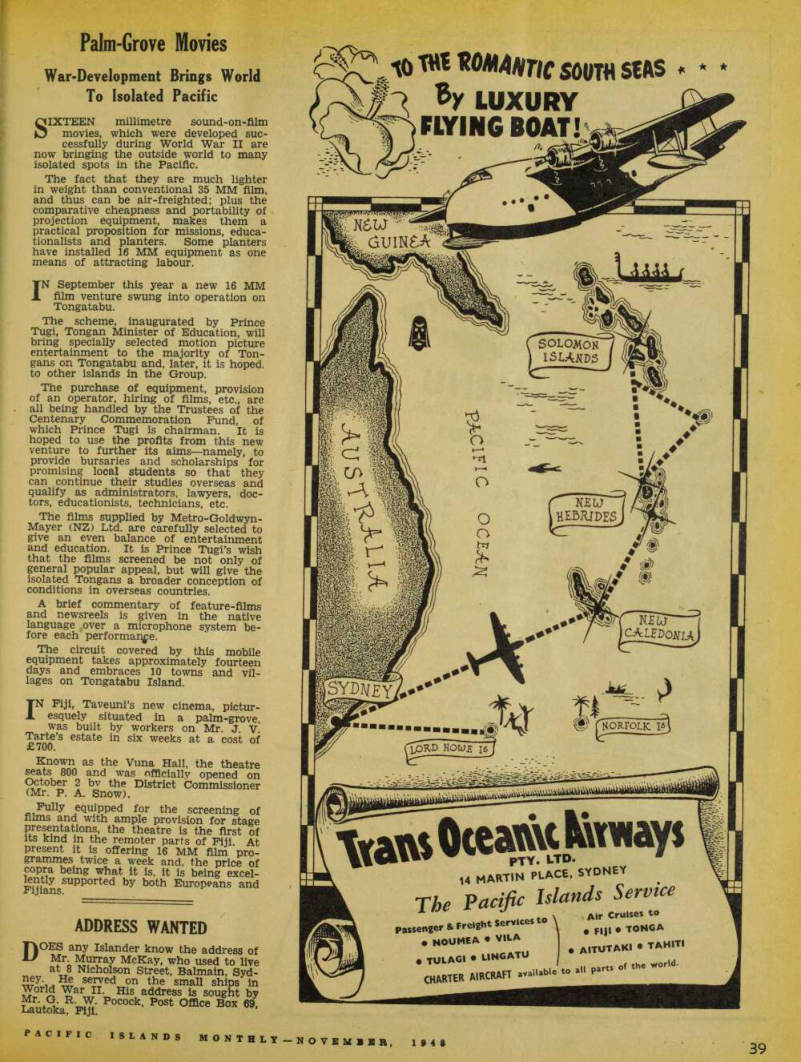
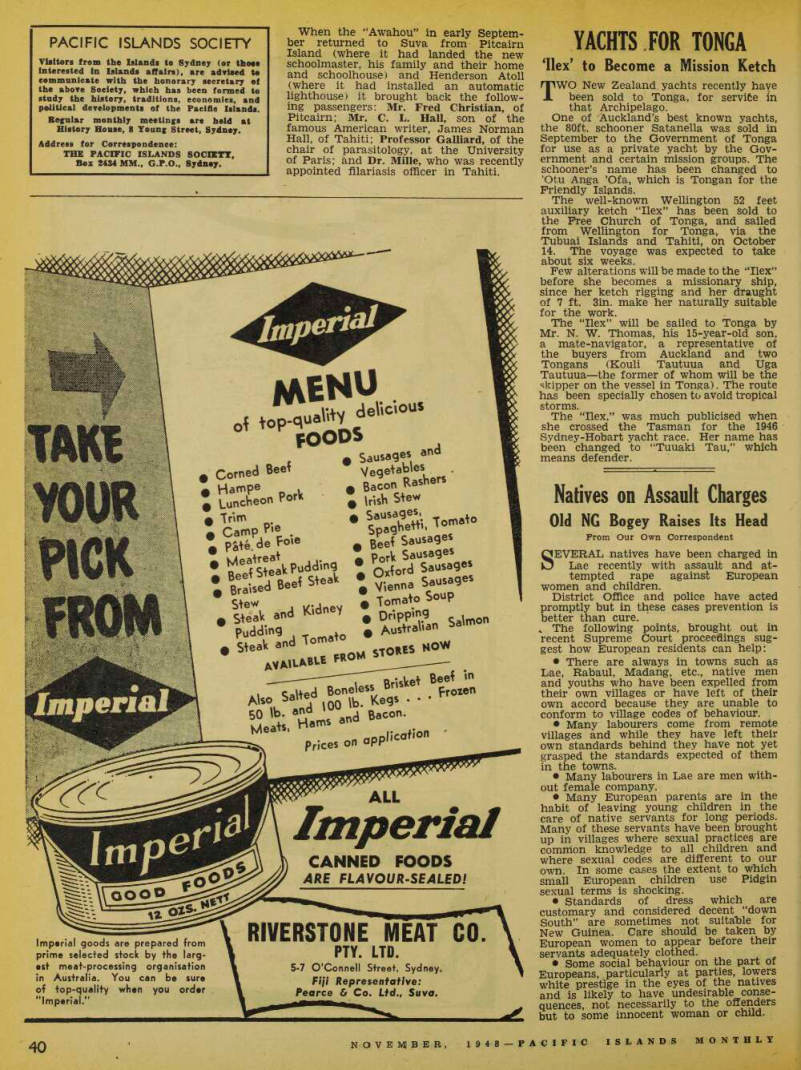
War-Development Brings World To Isolated Pacific
SIXTEEN millimetre sound-on-film movies, which were developed suc cessfully during World War II are now bringing the outside world to many isolated spots in the Pacific.
The fact that they are much lighter in weight than conventional 35 MM film, and thus can be air-freighted; plus the comparative cheapness and portability of projection equipment, makes them a practical proposition for missions, educa tionalists and planters. Some planters have installed 16 MM equipment as one means of attracting labour.
IN September this year a new 16 MM film venture swung into operation on Tongatabu.
The scheme, inaugurated by Prince Tugi, Tongan Minister of Education, will bring specially selected motion picture entertainment to the majority of Ton gans on Tongatabu and, later, it is hoped, to other islands in the Group.
The purchase of equipment, provision of an operator, hiring of films, etc., are all being handled by the Trustees of the Centenary Commemoration Fund, of which Prince Tugi is chairman. It is hoped to use the profits from this new venture to further its aims—namely, to provide bursaries and scholarships for promising local students so that they can continue their studies overseas and qualify as administrators, lawyers, doc tors, educationists, technicians, etc.
The films supplied by Metro-Goldwyn- Mayer (NZ) Ltd. are carefully selected to give an even balance of entertainment and education. It is Prince Tugi’s wish that the films screened be not only of general popular appeal, but will give the isolated Tongans a broader conception of conditions in overseas countries.
A brief commentary of feature-films and newsreels is given in the native language over a microphone system be fore each performance.
The circuit covered by this mobile equipment takes approximately fourteen days and embraces 10 towns and vil lages on Tongatabu Island.
IN Fiji, Taveuni’s new cinema, pictur esquely situated in a palm-grove was built by workers on Mr. J. v!
Tarte’s estate in six weeks at a cost of £7OO.
Known as the Vuna Hall, the theatre seats 800 and was officially opened on October 2 bv the District Commissioner (Mr. P. A. Snow).
Fully equipped for the screening of films and with ample provision for stage presentations, the theatre is the first of its kind in the remoter parts of Fiji. At present it is offering 16 MM film pro grammes twice a week and, the price of copra being what it is, it is being excel lently supported by both Europeans and Fijians.
When the “Awahou” in early Septem ber returned to Suva from Pitcairn Island (where it had landed the new schoolmaster, his family and their home and schoolhouse) and Henderson Atoll (where it had installed an automatic lighthouse) it brought back the follow ing passengers: Mr. Fred Christian, of Pitcairn; Mr. C. L. Hall, son of the famous American writer, James Norman Hall, of Tahiti; Professor Galliard, of the chair of parasitology, at the University of Paris; and Dr. Mille, who was recently appointed filariasis officer in Tahiti.
Advertisements & other items, pp. 41-42 (2 items)
39
pacific islands monibly-novemdbb, mi
VatttOwajittKnwyi
w-T^to whahtic SOUTH SEAS • * *
By LUXURY
FLYING
m ,W** U. New fc GUIN&Ac < • • \ <i<l4A c
SOLOMOK
ISMJID3
r '' Wp l£«
I ip
® ,3 -M I^l
NEW
hemjpes » I, I / 1# •
NEW
ICALEDo^IAj
*t. >) t*
f NORFOLK
LORDHOW£ is
l?j \£ ■ W.. v. >. uAUiA^AtaiU
VatttOwajittKnwyi
,4 MARTIN PLACE. SYDNEY
The Pacific Islands Service
1 . ~. \ Air Cruises to Passenger & freight Serv ces \ p|ji • TONGA • NOUMtA * Vlt * . AIT OTAK. 0 TAHIT.
, TOtAGI • LINCATU
CHARTER AIRCRAFT available to all parts - -
ADDRESS WANTED
DOES any Islander know the address of Mr. Murray McKay, who used to live at 8 Nicholson Street. Balmain, Syd- ?ey. He served on the small ships in World War II. His address is sought by Pocock ' Post ° fflce Box
PACIFIC ISLANDS SOCIETY
Visitors from the Islands to Sydney (or those Interested in Islands affairs), are advised to communicate with the honorary secretary of the above Society, which has been formed to study the history, traditions, economics, and political developments of the Pacific Islands.
Regular monthly meetings are held at History House, 8 Young Street, Sydney.
Address for Correspondence:
THE PACIFIC ISLANDS SOCIETY,
Box 8434 MM.. G.P.0., Sydney.
’imperial
menu
of *»p-«“»s:; s de " c ' 0 “ s
FOODS
9 Corned Beet • Hampe , Luncheon P°* • Trim n- • Camp P>e . • pite de Fo |e • Pudding , ISi ..a «*«* Pudding Sausages and
Vegetables .
Bacon Rashers , Irish S+ew ' Ipaghetti, Tomato geet Sausages 1 Pork Sausages * Oxtord Sausages * Vienna Sausages Tomato Soup Dripping .Ira IA
Imperial
atr:.. jess.*—
, n/.Aet Beet in
i c sited Boneless proien Also_ Se« e , a |OQ ib. Kegs .• • r AlsoSaltea Kegs 50 V Hams and Bacon Hams . • * naiua Prices on app^* 0 " 1 c<r<
ALL
imperial
CANNED FOODS
ARE FLAVOUR-SEALED!
c 2 f o 0000 505 o %h. \z
RIVERSTONE MEAT CO
Imperial goods are prepared from prime selected stock by the largest meat-processing organisation in Australia. You can be sure of top-quality when you order "Imperial."
PTY. LTO.
5-7 O’Connell Street, Sydney.
Fiji Representative: Pearce & Co. Ltd., Suva.
Yachts For Tonga
'l lex ' to Become a Mission Ketch
TWO New Zealand, yachts recently have been sold to Tonga, for service in that Archipelago.
One of Auckland’s best known yachts, the 80ft. schooner Satanella was sold in September to the Government of Tonga for use as a private yacht by the Gov ernment and certain mission groups. The schooner’s name has been changed to ’Otu Anga ’Ofa, which is Tongan for the Friendly Islands.
The well-known Wellington 52 feet auxiliary ketch “Hex” has been sold to the Free Church of Tonga, and sailed from Wellington for Tonga, via the Tubuai Islands and Tahiti, on October 14. The voyage was expected to take ohmif qiy wppltq Few alterations will be made to the “Hex” before she becomes a missionary ship, since her ketch rigging and her draught of 7 ft. Sin. make her naturally suitable for the work.
The “Hex” will be sailed to Tonga by Mr. N. W. Thomas, his 15-year-old son, a mate-navigator, a representative of the buyers from Auckland and two Tongans (Kouli Tautuua and Uga Tautuua—the former of whom will be the skipper on the vessel in Tonga), The route has been specially chosen to avoid tropical storms.
The “Hex,” was much publicised when she crossed the Tasman for the 1946 Sydney-Hobart yacht race. Her name has been changed to “Tuuaki Tau,” which means defender.
Natives on Assault Charges
Old NG Bogey Raises Its Head
Prom Our Own Correspondent SEVERAL natives have been charged in Lae recently with assault and at tempted rape against European women and children.
District Office and police have acted promptly but in these cases prevention is better than cure. < The following points, brought out in recent Supreme Court proceedings sug gest how European residents can help: • There are always in towns such as Lae, Rabaul, Madang, etc., native men and youths who have been expelled from their own villages or have left of their own accord because they are unable to conform to village codes of behaviour. • Many labourers come from remote villages and while they have left their own standards behind they have not yet grasped the standards expected of them in the towns. • Many labourers in Lae are men with out female company. • Many European parents are in the habit of leaving young children in the care of native servants for long periods.
Many of these servants have been brought up in villages where sexual practices are common knowledge to all children and where sexual codes are different to our own. In some cases the extent to which small European children use Pidgin sexual terms is shocking. • Standards of dress which are customary and considered decent “down South” are sometimes not suitable for New Guinea. Care should be taken by European women to appear before their servants adequately clothed. • Some social behaviour on the part of Europeans, particularly at parties, lowers white prestige in the eyes of the natives and is likely to have undesirable conse quences, not necessarily to the offenders but to some innocent woman or child.
Advertisements & other items, p. 42 (1 item)
40
NOVEMJBER, 1948 PACIF I C ISLANDS MONTHLY
Magazine Section
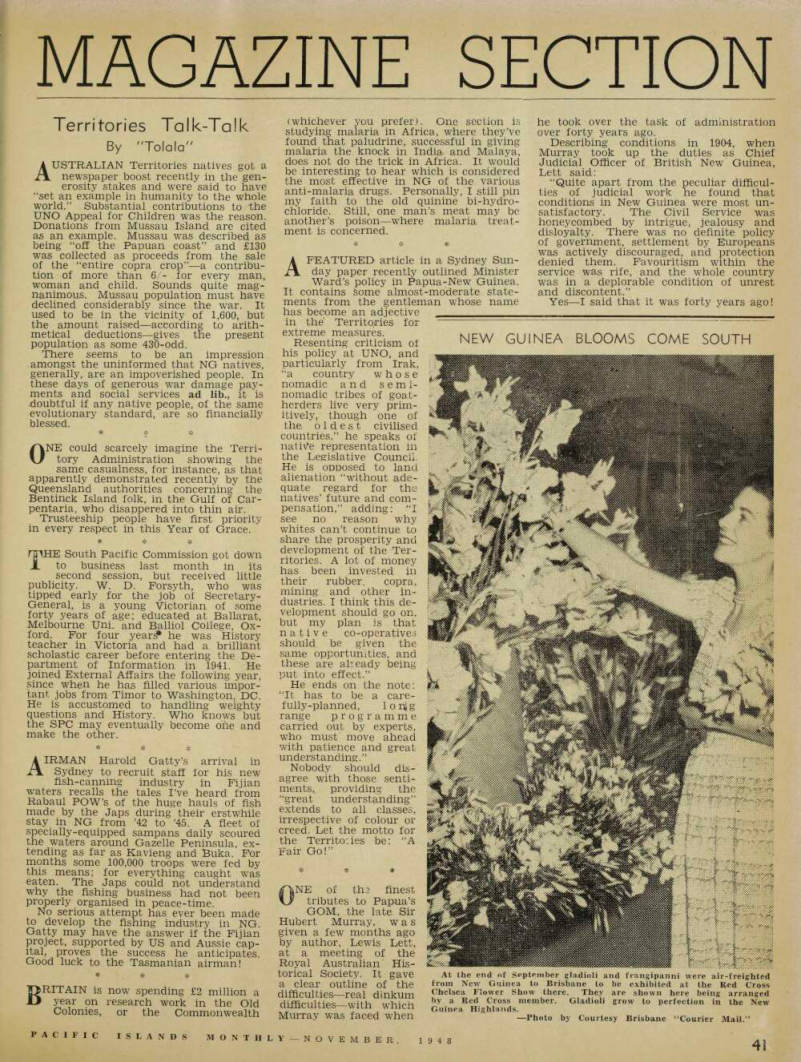
Territories Talk-Talk
By "Tolala"
AUSTRALIAN Territories natives got a newspaper boost recently in the gen erosity stakes and were said to have “set an example in humanity to the whole world.” Substantial contributions to the UNO Appeal for Children was the reason.
Donations from Mussau Island are cited as an example. Mussau was described as being “off the Papuan coast” and £l3O was collected as proceeds from the sale of the “entire copra crop”—a contribu tion of more than 6/- for every man, woman and child. Sounds quite mag nanimous. Mussau population must have declined considerably since the war. It used to be in the vicinity of 1,600, but the amount raised —according to arith metical deductions —gives the present population as some 430-odd.
There seems to be an impression amongst the uninformed that NG natives, generally, are an impoverished people. In these days of generous war damage pay ments and social services ad lib., it is doubtful if any native people, of the same evolutionary standard, are so financially blessed. * j * ONE could scarcely imagine the Terri tory Administration showing the same casualness, for instance, as that apparently demonstrated recently by the Queensland authorities concerning the Bentinck Island folk, in the Gulf of Car pentaria, who disappered into thin air.
Trusteeship people have first priority in every respect in this Year of Grace. ♦ * * rrnHE South Pacific Commission got down JL to business last month in its second session, but received little publicity. W. D. Forsyth, who was tipped early for the job of Secretary- General, is a young Victorian of some forty years of age; educated at Ballarat, Melbourne Uni. and Balliol College, Ox ford. For four he was History teacher in Victoria and had a brilliant scholastic career before entering the De partment of Information in 1941. He joined External Affairs the following year, since when he has filled various impor tant jobs from Timor to Washington, DC.
He is accustomed to handling weighty questions and History. Who knows but the SPC may eventually become one and make the other. * * * AIRMAN Harold Gatty’s arrival in Sydney to recruit staff for his new fish-canning industry in Fijian waters recalls the tales I’ve heard from Rabaul POW’s of the huge hauls of fish made by the Japs during their erstwhile stay in NG from ’42 to ’45. A fleet of specially-equipped sampans daily scoured the waters around Gazelle Peninsula, ex tending as far as Kavieng and Buka. For months some 100,000 troops were fed by this means; for everything caught was eaten. The Japs could not understand why the fishing business had not been properly organised in peace-time.
No serious attempt has ever been made to develop the fishing industry in NG.
Gatty may have the answer if the Fijian project, supported by US and Aussie cap ital, proves the success he anticipates.
Good luck to the Tasmanian airman! * * * BRITAIN is now spending £2 million a year on research work in the Old Colonies, or the Commonwealth
(whichever you prefer). One section is studying malaria in Africa, where they’ve found that paludrine, successful in giving malaria the knock in India and Malaya, does not do the trick in Africa. It would be interesting to hear which is considered the most effective in NG of the various anti-malaria drugs. Personally, I still pin my faith to the old quinine bi-hydro chloride. Still, one man’s meat may be another’s poison—where malaria treat ment is concerned, * * * A FEATURED article in a Sydney Sun day paper recently outlined Minister Ward’s policy in Papua-New Guinea.
It contains some almost-moderate state ments from the gentleman whose name
has become an adjective in the' Territories for extreme measures.
Resenting criticism of his policy at UNO, and particularly from Irak, “a country whose nomadic and semi nomadic tribes of goat herders live very prim itively, though one of the, oldest civilised countries,” he speaks of native representation in the Legislative Council.
He is opposed to land alienation ‘‘without ade quate regard for the natives’ future and com pensation,” adding: “I see no reason why whites can’t continue to share the prosperity and development of the Ter ritories. A lot of money has been invested in their rubber. copra, mining and other in dustries. I think this de velopment should go on, but my plan is that native co-operatives should be given the same opportunities, and these are already being put into effect.”
He ends on the note: “It has to be a care fully-planned, 1 o ni g range programme carried out by experts, who must' move ahead with patience and great understanding.”
Nobody should dis agree with those senti ments,. providing the “great understanding” extends to all classes, irrespective of colour or creed. Let the motto for the Territories be: “A Fair Go!” * V * ONE of the finest tributes to Papua’s GOM, the late Sir Hubert Murray, was given a few months ago by author, Lewis Lett, at a meeting of the Royal Australian His torical Society. It gave a clear outline of the difficulties —real dinkum difficulties—with which Murray was faced when
he took over the task of administration over forty years ago.
Describing conditions in 1904, when Murray took up the duties as Chief Judicial Officer of British New Guinea, Lett said: ‘‘Quite apart from the peculiar difficul ties of judicial work he found that conditions in New Guinea were most un satisfactory. The Civil Service was honeycombed by intrigue, jealousy and disloyalty. There was no definite policy of government, settlement by Europeans was actively discouraged, and protection denied them. Favouritism within the service was rife, and the whole country was in a deplorable condition of unrest and discontent.”
Yes —I said that it was forty years ago!
As a review of Papua’s evolution and Murray’s life —the two were interdepend ent—Lewis Lett did a good job. It should have been read at the Trusteeship Com mittee of UNO to show what Australian administrators have already accomplished. * * ♦ 11THILE in a retrospective mood it’s in- Ty teresting to note that a recently released Russian film in New York features a Russian scientist, with the Anglicised name of Maclay, who spent some time in NG in the 1860’s—some forty years before Murray. The Maclay Coast (the Rai Coast, in the Madang district) is named after the gentleman, whose material accomplishments while in NG were about as interesting as the scenery along the coast which now bears his name. The film “Without Prejudice” is a typical Soviet plug for the equality of man. It might even find its way to NG one of these days. (Ed. Note: Australian author Frank Greenop wrote the life of Maclay in his book, “Who Travels Alone,” reviewed in “PIM” in January, 1947). ♦ * ♦ • CJOUTH PACIFIC,” a small monthly periodical put out by the School of Pacific Administration at Mosman, contains some good general reading about the tropics. A recent article on Tea- Growing in NG suggests that British tea-planters—now being ousted from India —may become interested in an ex panding NG tea industry. And the writer has probably got something there.
Australia’s requirements are 55 million lb. a year. Why shouldn’t NG grow it — given labour and transport, of course? % t[z * ONCE again the need for Territorial re presentation at Canberra was de monstrated recently in the House when Country Party Member H. L.
Anthony (at all times a willing advocate for a Fair Deal in New Guinea) cham pioned the case of a returned man being allegedly victimised by the Works and Housing Department in the Territory.
These volunteer champions do a good job for the unrepresented New Guineaites, but its hardly fair either to them or their own constituents in Australia. Let the Territory have its own Member to fight its own battles in Canberra! * * * THE New Guinea Timber Case, listed for hearing in Sydney Quarter Sessions on October 7, was ad journed by Judge Lloyd to November 8 owing to the illness of Farrell. In some quarters it is believed the case won’t come on until next February. * * * BITS and Pieces: NG is represented amongst the much-publicised “Man ila Girls;” she is Jean Woods, the attractive blonde who was running the WRC drapery store in the Old Palms building for a while ... Curator Hardy in PM is seeking the next-of-kin of J. H. (Diwai) Wood, late of Drimboi Plantation in the Aitape district ... m.v. Bulolo had 65 round-trippers from Sydney when it left on October 9 for the NG trip. Be sides these there were 27 bookings for Lae, 28 for PM and 38 for Rabaul. Mal aita, which sailed 10 days later, took 26 passengers for Samarai. 4 for Lae, 3 for Rabaul and 17 for Madang.
A medical research team will leave New Zealand about the end of November for a three months’ -working survey of the incidence of disease in Western Samoa. The team consists of Dr. H. D.
Purvis (thyroid research): Dr. M. J.
Marples (fungus infections); Mr. P. A.
Samuels (bacteriologist); Mr. G. N. Davies (dental diseases); Dr. Brian C. Thompson (lung diseases and TB).
New Guinea Blooms Come South
At the end of September gladioli and frangipanni were air-freighted from New Guinea to Brisbane to be exhibited at the Red Cross Chelsea Flower Show there. They are shown here being arranged by a Red Cross member. Gladioli grow to perfection in the New Guinea Highlands. —Photo by Courtesy Brisbane “Courier Mail.”
Pacific Nature Notes
Written for “PIM”
By Charles Barrett, FRZS
Robber Crab Again
WRITING from Kuala Lumpur, Malaya, R.D.L. comments on my notes con cerning the robber crab, a creature that has interested generations of nat uralists. Its habit of climbing trees, as my correspondent points out, was known nearly forty years ago, C. W. Andrews having recorded it in 1909.
A plate in F. W. Christian’s book, “Eastern Pacific Lands,” gives a good portrait of Birgus lateo, with this caption; “A variety of land crab that goes around by night, climbs the palm trees, and with its huge and powerful claws nips off the coconuts from the mother-cluster, and descending, tears off their husks, breaks the shell, and devours the creamy kernel.”
Definite proof that the papaka, as it is called by the natives of Mangareva and Paumotu, breaks unbroken coconuts is still lacking, R.D.L. declares, “and no reputable observer has succeeded in seeing it done.” . . . Consider this statement by Dr. A. Alcock, FRS, who spent four years with the Royal Indian Marine Survey Ship “Investigator”: “Its specific name latro, or robber, is derived from tales of its climbing coconut trees to steal nuts. This seems to be a mistake, though it certainly does eat fallen coconuts when it can get them, tearing away the husk and hammering open one of the eye-holes of the shell with its large nippers, and then extract ing the pulp with the small hind pair of nippers, in the way described by Dar win” (“A Naturalist in Indian Seas.”) I once had a pet robber crab —at least, it was kept in captivity for a week or two. It did not become at all friendly, and was always ready to use its nippers freely when handled.
Cuscus As A Pet
“i'ANE objection to the Phalanger (Cus cus) as a pet,” R.D.L. observes, “is its strictly nocturnal habits. I have kept the Solomon Islands species (P. orien talis) and found it to sleep all day and be very active at night—an undesirable habit in a pet.”
Quite true; but other marsupials, notably the Australian possums, which are noc turnal in their habits, are favoured as pets. Often they become only semi-noc turnal through” being fed, and maybe fondled, in the daytime. Thus, my moun tain or silvery-grey possum was abroad by day as much as he was by night.
I must, however, admit that the cus cuses I have seen in captivity appeared to be disgruntled when disturbed from sleep or drowsiness at any daylight hour.
Still, they were interesting pets, usually docile and have “amusing ways.” My preference is for the brush-tail possum which, by the way, is nearly related to the cuscus. It is said that the latter, though mainly frugiverous, has also car nivorous tastes, and will eat any birds it can capture. The brush-tail possums definitely have this flesh-eating habit.
I have known a tame “silver-grey” to devour with relish a freshly-killed young rabbit.
The “Ghost Bat”
DESCRIBING a giant bat, seen by him in Papua, George R. (in New Ireland when he wrote to me) asks whether the ghost bat (Macroderma gigas) has ever been recorded from Papua-New Guinea.
So far as I know, this great-eared bat, related to the false vampire of India, has never been found outside Australia. Ap parently a rare form, macroderma, whose ghostly, bleached appearance is caused by the almost white membranes and pure white hair on the under-surface of the body, occurs only in South and Central Australia. Very few specimens have been
collected. However, numerous mummi fied “ghost bats” have been found in shallow caves in districts where the living Macroderma has not been seen for many years. I know one Queensland haunt of the species—Olsen’s Caves; but only a few “ghosts” were seen there on my last visit to the Caves, in 1945.
Communications from Nature students in the Pacific Islands are welcomed by our contributor—Mr.
Charles Barrett, “Maralena,” Mays bury Avenue, Elstemwick S 4, Victoria.
The creature described by George R., was undoubtedly one of the big fruit-bats.
“Some months ago, I was hunting after a deer or a pig on Vaigen Swamp, some ten miles from Port Moresby, and there, in broad daylight, I saw a huge ‘flying fox.’ Well over two feet in length, it had pale ‘ghostly’ wings, with a span, so far as I could judge, of much more than six feet. I could estimate it, too, having shot specimens of Gould’s mantled bats which had a wing-span of from five feet to five feet nine inches. I did not fire at my “ghost.” I carried a heavy (.375) rifle, and would have blown it to bits; more over, I had no means of preserving the body even had the specimen been col lected. The only species I could think of, which it might be, was Macroderma gigas.”
None of the scores of flying-foxes (museum specimens) I have seen measured more than five feet across the wings; and those with this impressive wing-span were kalongs, from Java, which, I believe, are the largest of all living bats. The grey-headed fruit-bat of Australia has a wing-spread of up to nearly four feet.
Flying-foxes are widespread in the Western Pacific islands —more widely than any other fruit-eating bats. Four or five species inhabit Australia. The curious tube-nosed fruit-bats range from Celebes and Timor to Queensland and the Solomons. Their descriptive name is not fanciful, for these ugly creatures actually have projecting tube-nostrils. The long tongued bats also deserve their name, the tongue in all species of Macroglossus being elongated and as protusable as that of a honey-mouse.
The mother bat, as is well known, carries her baby with her on long-dis tance flights to and from feeding-grounds, as well as roundabout the “camp;” the little naked creature clinging tightly to the front of her body. Twins are not “fashionable” among bats, but some species are known to produce them oc casionally: and there are even records of quartettes.
An American species became famous among naturalists specialising in bats, when it was proved by actual specimens —mother and infants—that quartettes were produced by Lasiurus borealis. Later, evi dence was forthcoming that, with this species, such big families were usual; and that the four young ones were habitually carried about by the female, clinging to her body.
I would like to hear from any reader of these notes who has visited a flying fox “camp,” and estimated the size of the population. The biggest “camp” I have seen was at Byfield, Central Queensland, where perhaps nearly 250,000 bats were at home in the daytime; at night they were miles away at their feeding-ground.
There may be even more populous flying fox communities in some Pacific lands.
'Vaka Totomi'
By Elisabeth Hennings
THE Fijian expression “vaka totomi” means the picking up of little things, here and there. It also means the picking up of news—or gossip.
The following was picked up from the business correspondence of William Hennings, who went to Fiji about the year 1858. He was engaged in the im port and export business and was, as well, interested in cotton and coconut planting. He was one of the outstanding personalities among the early settlers in Levuka.
THE boxes containing this correspond ence had been stored up under the rafters of an outhouse ever since William’s tired eyes had closed forever, just a few months before the outbreak of World War I. Perhaps they would be there still, with hens, cockroaches and little, pink, blind mice in undisputed pos session, had not a bit of a letter been scratched down a little while ago. It in dicated the disappearance of some con fidential papers, and so compelling was this glimpse into the past, that the sort ing of the papers was taken in hand forthwith.
What a fascinating picture of Fiji’s early days unfolded itself, and how vividly portrayed were those who lived then, through the medium of their hand writing.
There is the spidery hand of August Godeffroy, holding out for his firm in Samoa during a most critical period.
There is the neatly-turned and spaced script of Karl Sahl, William Henning’s agent in Melbourne, who appears to have had a finger in various of Fiji’s pies.
A marine surveyor plants his down strokes so heavily that they resemble a line of clubs, hardly connected with the upstrokes. All his communications are irascible and domineering, except the last, where he sounds rather small, and tells his creditors that he cannot meet his bills “owing to circumstances over which I have no control.”
Those “circumstances” to which our marine surveyor refers were a double-dose of post-war slump—one after the Ameri can Civil War of 1861-65; and the second after the Franco-Prussian War of 1870-72.
We read that what news came was bad.
Cotton had collapsed with the reappear ance of the cheaper American product and William lost his fight for recognition in the world market of Sea Island cotton grown in Fiji. Stead Bros., Liverpool, list under “substitutes,” in their “Sea Island Circular,” 80 bales of “Mango Island Fiji” sold at lOfd. early 1880. Bottom “sub stitute” is “Common Florida” at 16d.; top quality “Sea Island” 30d. Local cotton was bought at 6fd, in 1879.
But there is already some copra com ing in from cotton plantations which had been hastily inter-planted with coconuts.
In ’Bl a planter from Cicia complains of his cotton being ruined by “insect moths,” but he had 14 tons of “cobra” in hand But the price for this was also falling— from £l5/10/- to £l3 per ton.
“I hope you weren’t caught in a Gov ernment contract” commiserates Sahl, in ’Bl. “Copra is going to the dogs—how long it will last and what the reason is, is hard to say. Shall be glad to get some cotton—it’s a long, long lane, this copra planting.”
Now, rumours crop up in various letters that the firm of Godeffroy Hamburg- Samoa is about to suspend payments.
Even the planter in Cicia hears the evil news, adding it as a postscript, in red ink and as a dead secret—two years after it happened. William, as Godeffroy’s agent in Fiji, is considerably involved, and great must have been his relief in ’79, when a cable confirms the final de cision by Bismarck to continue the firm as Deutsche Handels and Plantagen Gesellschaft.
August 4, Godeffroy writes much de pressed. He had informed Hamburg that his copra will not be ready for shipment until July; yet early in March three large barques crowd in on him. Sending the vessels to William, in the hope of getting a load in Fiji, he ends: “Cheer up and help a poor fellow who finds himself in a corner!” There are many letters from him as, apparently, he and William had become personal friends.
THE scope of William’s interests and business is amazing. Letters come to him from all over the world. There is the “Lily Nursery,” Ghent, asking his good offices to procure seeds of decorative small palms. Baron Muller, a well known botanist, wants every detail about the “upright bearing banana.” One, D. T.
Smart, inquires about a cargo of guano despatched by Godeffroy from Samoa.
“Where was it dug? I fancy some of the Line islands have deposits.”
Lieutenant Werner van Bulow arrives with letters from the German Foreign Office to William, who also is Levuka’s German Consul. Six weeks afterwards there is a SOS from the upper Rewa where von Bulow is stuck without funds and appeals fori a return passage to Samoa.
A correspondent from Melbourne com ments, in 1679, on the removal of capital to Suva, “that time could only prove the wisdom of this step”; but adding, Grandly, that “our interests being so large, we cannot feel other than pleased, even if it takes years to mature.”
John Hennings, William’s eldest brother, well-known to old residents of Mel bourne as a scenic painter, writes that the Exhibition there is to be fitted up with GAS—the first time an international exhibition was to be opened at night, “to the great detriment of theatres, shop keepers and hotels. A very bad look-out everywhere and loud murmuring among those to suffer.”
The young business community of Fiji combines to produce an exhibit of the resources of the new Colony. Sahl reports from Melbourne that it attracted con siderable interest and “should result in an influx of capital.” Sugar, coffee and cotton were particularly good.
William, who had won a gold medal at the Paris Exhibition the year before, lost with his exhibit against the one from Ceylon, but gets an award for coconut oil, the Ist and 2nd prize for sugar “brewing crystals”: and W. Hunt a 3rd for brown sugar.
MOST interesting is the variety of pro ducts in which William deals. Here are 10 tons candlenuts. £B/10/- per ton; tortoise-shell, going to Yokohama, at 10/- to 13/- per lb.; coconut fibre at £l6 per ton; pearlshell at 7/- lb., best quality. Yams, 30 tons from Natewa Bay (there is a contract between A. A.
Coubrough, of Taveuni, and the DHPG Co. in Samoa to keep his schooner
“Elizabeth,” Captain W. Wilson, running between Levuka and Samoa for six months carrying yams at £6/6/- per ton).
Paul Joske ships timber from Serua and 63 bags of coffee from Taveuni; but there’s no demand for the peanuts offered; and whole coconuts at £5/5/- per ton cannot compete with Ceylon nuts offered in the Sydney market.
Now here are a few prices: A keg of salt beef, 16/-; sailcloth is lOd. per yard; best belaying pins, 1/3: ladies’ glaced slippers, 5/-; gents’ Oxfords. 11/-; a cane chair, 14/6; Empire sofa. £6/2/6; a round table, £2/15/-; an antimacassar, 3/4; and rat traps at 4/-.
J. B. Swann, “Medical Hall,” begs to inform that he supplies plantations with drugs at the rate of 10 men at £6/10/- —“with the exception of arrowroot.”
But amazing is the multitude of vessels mentioned. One pictures Levuka’s water front crowded with steamers and stately barques. Of the first, the “Gunga,”
"Dilmoor,” “Suva” and “Southern Cross” kept up a regular service between Fiji and Australia. The barques were mostly German, to judge hy the names—big vessels up to 400 tons burden.
Charles Hennings, a younger brother in charge of the Loma Loma branch, re ports to headquarters in Levuka of six vessels in that port in one week.
The last bit of vaka totomi is best quoted in full from a letter written by Charles, then in Levuka. to William, who was away: “After the luncheon, which was at Nasova, the party developed into the most terrible spree.
“C., M., S., GR., and I left Nasova to gether. We went to C’s house and had two or three nips; called at Connelly’s, where we had five nips each, and then went to Munroe’s Hotel. C. shouted champagne and we all followed suit.
After two or three bottles had been drunk, M. and C. wanted to fight. M. had Gr.’s belltopper on and danced about all over the house. Gr. was lying under the table; at this stage I cleared out and went to sleep at the Union Hotel. I have heard since that C. rolled home at 5 a.m., on all his fours, followed all the way by a crowd of natives and dogs, with Gr.’s belltopper still on his head.”
Beach Theatre
Some paddocks are just paddocks, but my cows browse in a theatre of green by the silver-sanded shore, where the palm maestros wave their fronded batons conducting the songs of Prima Donna Sea.
When she wears her blue gown with the sun as her crown her song will a lullaby be.
But with change of her dress there’s no hint of caress as she gathers together the reefs as they foam, for, shrieking and lashing; roaring and crashing; she dashes maestros down to the ground where their hearts are cut out for a “millionaire’s salad.”
Then the cows leave their stalls drained. . . only of milk for my tea, and continue to browse— just cows— in a paddock.
A. L. Austin.
Fiji.
Torgil,
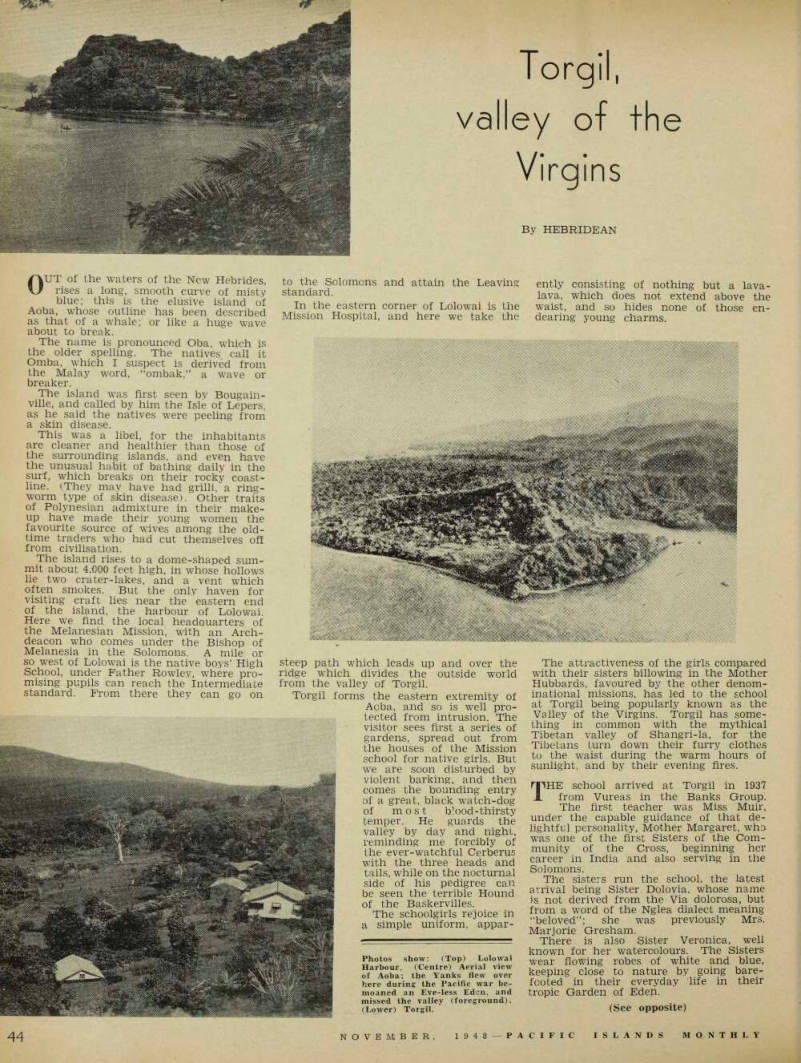
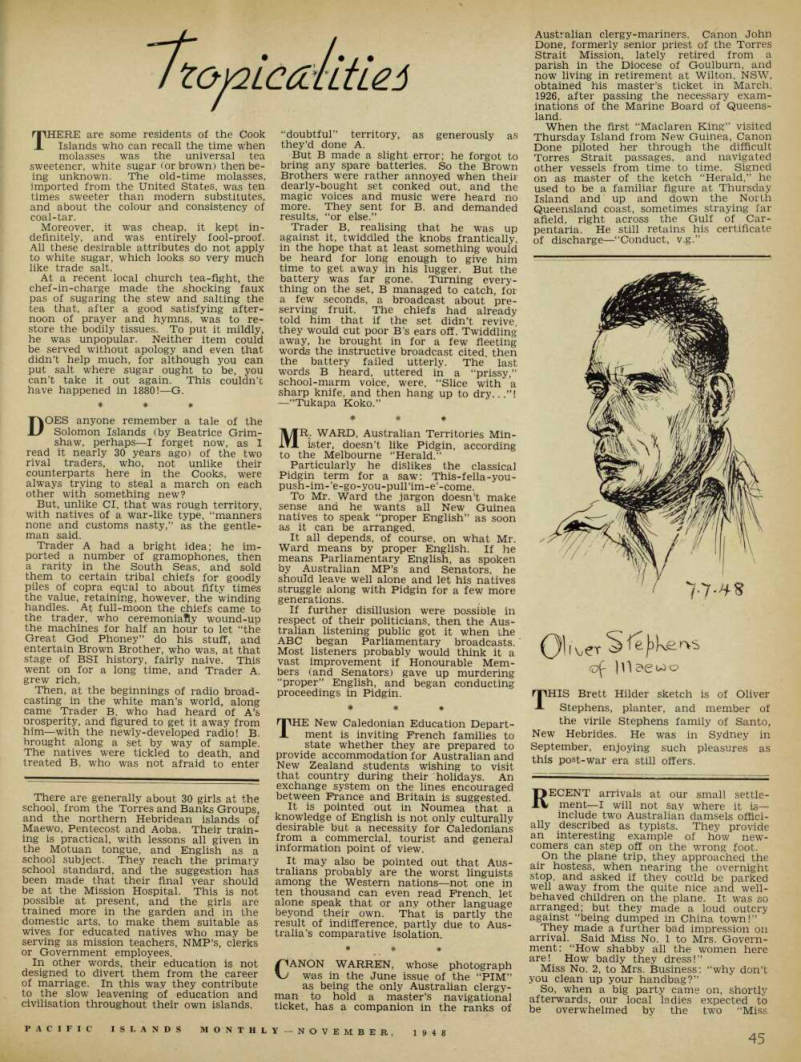
valley of the Virgins
By Hebridean
OUT of the waters of the New Hebrides, rises a long, smooth curve of misty blue; this is the elusive island of Aoba, whose outline has been described as that of a whale; or like a huge wave about to break.
The name is pronounced Oba, which is the older spelling. The natives call it Omba, which I suspect is derived from the Malay word, “ombak,” a wave or breaker.
The island was first seen by Bougain ville, and called by him the Isle of Lepers, as he said the natives were peeling from a skin disease.
This was a libel, for the inhabitants are cleaner and healthier than those of the surrounding islands, and even have the unusual habit of bathing dally in the surf, which breaks on their rocky coast line. (They may have had grilli, a ring worm type of skin disease). Other traits of Polynesian admixture in their make up have made their young women the favourite source of wives among the old time traders who had cut themselves off from civilisation.
The island rises to a dome-shaped sum mit about 4,000 feet high, in whose hollows lie two crater-lakes, and a vent which often smokes. But the only haven for visiting craft lies near the eastern end of the island, the harbour of Lolowai.
Here we find the local headouarters of the Melanesian Mission, with an Arch deacon who comes under the Bishop of Melanesia in the Solomons. A mile or so west of Lolowai is the native boys’ High School, under Father Rowley, where pro mising pupils can reach the Intermediate standard. From there they can go on
to the Solomons and attain the Leaving standard.
In the eastern corner of Lolowai is the Mission Hospital, and here we take the
steep path which leads up and over the ridge which divides the outside world from the valley of Torgil.
Torgil forms the eastern extremity of
Aoba, and so is well pro tected from intrusion. The visitor sees first a series of gardens, spread out from the houses of the Mission school for native girls. But we are soon disturbed by violent barking, and then comes the bounding entry of a great, black watch-dog of most blood-thirsty temper. He guards the valley by day and night, reminding me forcibly of the ever-watchful Cerberus with the three heads and tails, while on the nocturnal side of his pedigree can be seen the terrible Hound of the Baskervilles.
The schoolgirls rejoice in a simple uniform, appar
ently consisting of nothing but a lava lava, which does not extend above the waist, and so hides none of those en dearing young charms.
The attractiveness of the girls compared with their sisters billowing in the Mother Hubbards, favoured by the other denom inational missions, has led to the school at Torgil being popularly known as the Valley of the Virgins. Torgil has some thing in common with the mythical Tibetan valley of Shangri-la, for the Tibetans turn down their furry clothes to the waist during the warm hours of sunlight, and by their evening fires.
THE school arrived at Torgil in 1937 from Vureas in the Banks Group.
The first teacher was Miss Muir, under the capable guidance of that de lightful personality, Mother Margaret, who was one of the first Sisters of the Com munity of the Cross, beginning her career in India and also serving in the Solomons.
The sisters run the school, the latest arrival being Sister Dolovia, whose name is not derived from the Via dolorosa, but from a word of the Nglea dialect meaning “beloved”; she was previously Mrs.
Marjorie Gresham.
There is also Sister Veronica, well known for her watercolours. The Sisters wear flowing robes of white and blue, keeping close to nature by going bare footed in their everyday life in their tropic Garden of Eden.
(See opposite)
Photos show: (Top) Lolowai Harbour. (Centre) Aerial view of Aoba; the Yanks flew over here during the Pacific war be moaned an Eve-less Eden, and missed the valley (foreground). (Lower) Torgil.
There are generally about 30 girls at the school, from the Torres and Banks Groups, and the northern Hebridean islands of Maewo, Pentecost and Aoba. Their train ing is practical, with lessons all given in the Motuan tongue, and English as a school subject. They reach the primary school standard, and the suggestion has been made that their final year should be at the Mission Hospital. This is not possible at present, and the girls are trained more in the garden and in the domestic arts, to make them suitable as wives for educated natives who may be serving as mission teachers, NMP’s, clerks or Government employees.
In other words, their education is not designed to divert them from the career of marriage. In this way they contribute to the slow leavening of education and civilisation throughout their own islands.
Tropicalities
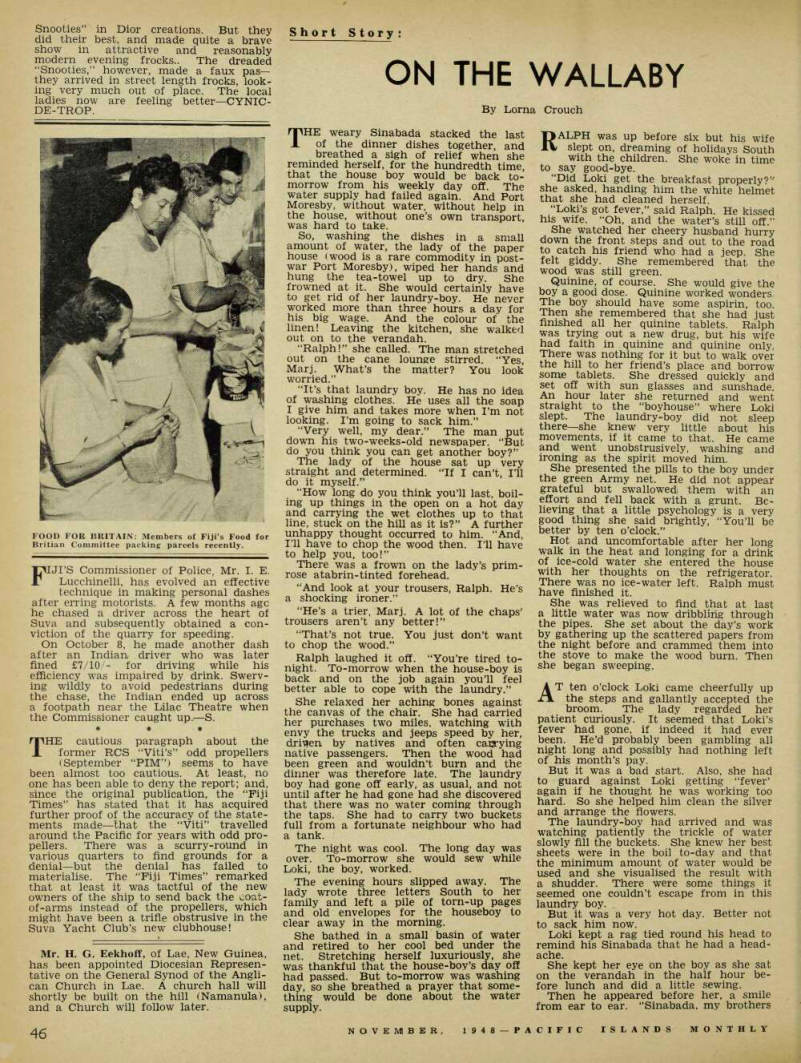
THERE are some residents of the Cook Islands who can recall the time when molasses was the universal tea sweetener, white sugar (or brown) then be ing unknown. The old-time molasses, imported from the United States, was ten times sweeter than modern substitutes, and about the colour and consistency of coal-tar.
Moreover, it was cheap, it kept in definitely, and was entirely fool-proof.
All these desirable attributes do not apply to white sugar, which looks so very much like trade salt.
At a recent local church tea-fight, the chef-in-charge made the shocking faux pas of sugaring the stew and salting the tea that, after a good satisfying after noon of prayer and hymns, was to re store the bodily tissues. To put it mildly, he was unpopular. Neither item could be served without apology and even that didn’t help much, for although you can put salt where sugar ought to be, you can’t take it out again. This couldn’t have happened in 1880!—G. ♦ ♦ ♦ DOES anyone remember a tale of the Solomon Islands (by Beatrice Grim shaw, perhaps—l forget now, as I read it nearly 30 years ago) of the two rival traders, who, not unlike their counterparts here in the Cooks, were always trying to steal a march on each other with something new?
But, unlike Cl, that was rough territory, with natives of a war-like type, “manners none and customs nasty,” as the gentle man said.
Trader A had a bright idea; he im ported a number of gramophones, then a rarity in the South Seas, and sold them to certain tribal chiefs for goodly piles of copra equal to about fifty times the value, retaining, however, the winding handles. At full-moon the chiefs came to the trader, who ceremonially wound-up the machines for half an hour to let “the Great God Phoney” do his stuff, and entertain Brown Brother, who was. at that stage of BSI history, fairly naive. This went on for a long time, and Trader A. grew rich.
Then, at the beginnings of radio broad casting in the white man’s world, along came Trader B, who had heard of A’s orosperity, and figured to get it away from him—with the newly-developed radio! B. brought along a set by way of sample.
The natives were tickled to death, and treated B. who was not afraid to enter
“doubtful” territory, as generously as they’d done A.
But B made a slight error; he forgot to bring any spare batteries. So the Brown Brothers were rather annoyed when their dearly-bought set conked out. and the magic voices and music were heard no more. They sent for B. and demanded results, “or else.”
Trader B, realising that he was up against it, twiddled the knobs frantically, in the hope that at least something would be heard for long enough to give him time to get away in his lugger. But the battery was far gone. Turning every thing on the set, B managed to catch, for a few seconds, a broadcast about pre serving fruit. The chiefs had already told him that if the set didn’t revive they would cut poor B’s ears off. Twiddling away, he brought in for a few fleeting words the instructive broadcast cited, then the battery failed utterly. The last words B heard, uttered in a “prissy,” school-marm voice, were. “Slice with a sharp knife, and then hang up to dry,,.”! —“Tukapa Koko.” ♦ ♦ ♦ MR. WARD, Australian Territories Min ister, doesn’t like Pidgin, according to the Melbourne “Herald.”
Particularly he dislikes the classical Pidgin term for a saw: This-fella-you push-im-’e-go-you-pull’im-e’-come.
To Mr. Ward the jargon doesn’t make sense and he wants all New Guinea natives to speak “proper English” as soon as it can be arranged.
It all depends, of course, on what Mr.
Ward means by proper English. If he means Parliamentary English, as spoken by Australian MP’s and Senators, he should leave well alone and let his natives struggle along with Pidgin for a few more generations.
If further disillusion were possible in respect of their politicians, then the Aus tralian listening public got it when the ABC began Parliamentary broadcasts.
Most listeners probably would think it a vast improvement if Honourable Mem bers (and Senators) gave up murdering “proper” English, and began conducting proceedings in Pidgin. * ♦ ♦ THE New Caledonian Education Depart ment is inviting French families to state whether they are prepared to provide accommodation for Australian and New Zealand students wishing to visit that country during their holidays. An exchange system on the lines encouraged between Prance and Britain is suggested.
It is pointed out in Noumea that a knowledge of English is not only culturally desirable but a necessity for Caledonians from a commercial, tourist and general information point of view.
It may also be pointed out that Aus tralians probably are the worst linguists among the Western nations—not one in ten thousand can even read French, let alone speak that or any other language beyond their own. That is partly the result of indifference, partly due to Aus tralia’s comparative isolation. ♦ * ♦ CANON WARREN, whose photograph was in the June issue of the “PIM” as being the only Australian clergy man to hold a master’s navigational ticket, has a companion in the ranks of
Australian clergy-mariners. Canon John Done, formerly senior priest of the Torres Strait Mission, lately retired from a parish in the Diocese of Goulburn, and now living in retirement at Wilton. NSW, obtained his master’s ticket in March, 1926, after passing the necessary exam inations of the Marine Board of Queens land.
When the first “Maclaren King” visited Thursday Island from New Guinea, Canon Done piloted her through the difficult Torres Strait passages, and navigated other vessels from time to time. Signed on as master of the ketch “Herald,” he used to be a familiar figure at Thursday Island and up and down the North Queensland coast, sometimes straying far afield, right across the Gulf of Car pentaria. He still retains his certificate of discharge—“ Conduct, v.g.”
THIS Brett Hilder sketch is of Oliver Stephens, planter, and member of the virile Stephens family of Santo, New Hebrides. He was in Sydney in September, enjoying such pleasures as this post-war era still offers.
RECENT arrivals at our small settle ment—l will not say where it is— include two Australian damsels offici ally described as typists. They provide an interesting example of how new comers can step off on the wrong foot.
On the plane trip, they approached the air hostess, when nearing the overnight stop, and asked if they could be parked well away from the quite nice and well behaved children on the plane. It was so arranged; but they made a loud outcry against “being dumped in China town!”
They made a further bad impression on arrival. Said Miss No. 1 to Mrs. Govern ment: “How shabby all the women here are! How badly they dress!”
Miss No. 2, to Mrs. Business: “why don’t you clean up your handbag?”
So, when a big party came on, shortly afterwards, our local ladies expected to be overwhelmed by the two “Miss
Snooties” in Dior creations. But they did their best, and made quite a brave show in attractive and reasonably modern evening frocks.. The dreaded “Snooties,” however, made a faux pas— they arrived in street length frocks, look ing very much out of place. The local ladies now are feeling better—CYNIC
De-Trop.
FIJI’S Commissioner of Police, Mr. I. E.
Lucchinelli, has evolved an effective technique in making personal dashes after erring motorists. A few months age he chased a driver across the heart of Suva and subsequently obtained a con viction of the quarry for speeding.
On October 8, he made another dash after an Indian driver who was later fined £7/10/- for driving while his efficiency was impaired by drink. Swerv ing wildly to avoid pedestrians during the chase, the Indian ended up across a footpath near the Lilac Theatre when the Commissioner caught up.—S. • • • THE cautious paragraph about the former RCS “Viti’s” odd propellers (September “PIM”) seems to have been almost too cautious. At least, no one has been able to deny the report; and, since the original publication, the “Fiji Times” has stated that it has acquired further proof of the accuracy of the state ments made —that the “Viti” travelled around the Pacific for years with odd pro pellers. There was a scurry-round in various quarters to find grounds for a denial —but the denial has failed to materialise. The “Fiji Times” remarked that at least it was tactful of the new owners of the ship to send back the coat of-arms instead of the propellers, which might have been a trifle obstrusive in the Suva Yacht Club’s new clubhouse!
Mr. H. G. Eekhoff, of Lae, New Guinea, has been appointed Diocesian Represen tative on the General Synod of the Angli can Church in Lae. A church hall will shortly be built on the hill (Namanula), and a Church will follow later.
FOOD FOR BRITAIN: Members of Fiji’s Food for Britian Committee packing parcels recently.
On The Wallaby
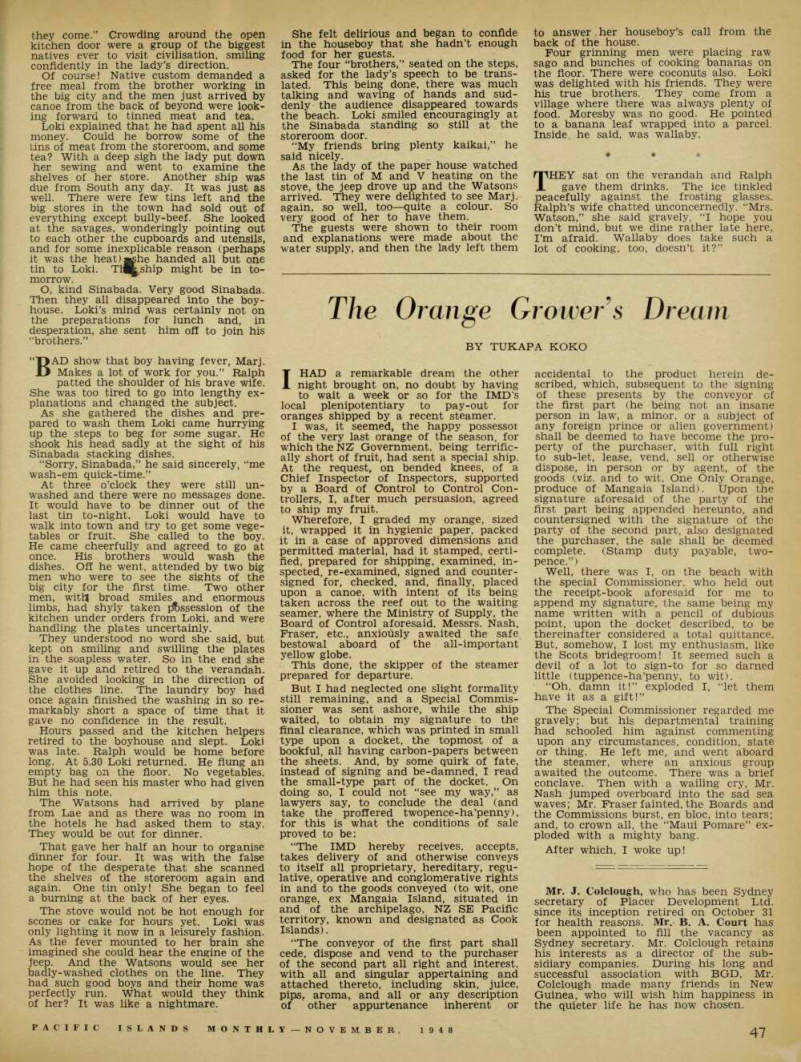
Short Story:
By Lorna Crouch
THE weary Sinabada stacked the last of the dinner dishes together, and breathed a sigh of relief when she reminded herself, for the hundredth time, that the house boy would be back to morrow from his weekly day off. The water supply had failed again. And Port Moresby, without water, without help in the house, without one’s own transport, was hard to take.
So, washing the dishes in a small amount of water, the lady of the paper house (wood is a rare commodity in post war Port Moresby), wiped her hands and hung the tea-towel up to dry. She frowned at it. She would certainly have to get rid of her laundry-boy. He never worked more than three hours a day for his big wage. And the colour of the linen! Leaving the kitchen, she walked out on to the verandah, “Ralph!” she called. The man stretched out on the cane lounge stirred. “Yes, Marj. What’s the matter? You look worried.”
“It’s that laundry boy. He has no idea of washing clothes. He uses all the soap I give him and takes more when I’m not looking. I’m going to sack him.”
“Very well, my dear.” The man put down his two-weeks-old newspaper. “But do you think you can get another boy?”
The lady of the house sat up very straight and determined. “If I can’t, I’ll do it myself.”
“How long do you think you’ll last, boil ing up things in the open on a hot day and carrying the wet clothes up to that line, stuck on the hill as it is?” A further unhappy thought occurred to him. “And, I’ll have to chop the wood then. I’ll have to help you, too!”
There was a frown on the lady’s prim rose atabrin-tinted forehead.
“And look at your trousers, Ralph. He’s a shocking ironer.”
“He’s a trier, Marj. A lot of the chaps’ trousers aren’t any better!”
“That’s not true. You just don’t want to chop the wood.”
Ralph laughed it off. “You’re tired to night. To-morrow when the house-boy is back and on the job again you’ll feel better able to cope with the laundry.”
She relaxed her aching bones against the canvas of the chair. She had carried her purchases two miles, watching with envy the trucks and jeeps speed by her, driven by natives and often carrying native passengers. Then the wood had been green and wouldn’t burn and the dinner was therefore late. The laundry boy had gone off early, as usual, and not until after he had gone had she discovered that there was no water coming through the taps. She had to carry two buckets full from a fortunate neighbour who had a tank.
The night was cool. The long day was over. To-morrow she would sew while Loki, the boy, worked.
The evening hours slipped away. The lady wrote three letters South to her family and left a pile of torn-up pages and old envelopes for the houseboy to clear away in the morning.
She bathed in a small basin of water and retired to her cool bed under the net. Stretching herself luxuriously, she was thankful that the house-boy’s day off had passed. But to-morrow was washing day, so she breathed a prayer that some thing would be done about the water supply.
RALPH was up before six but his wife slept on, dreaming of holidays South with the children. She woke in time to say good-bye.
“Did Loki get the breakfast properly?’*’ she asked, handing him the white helmet that she had cleaned herself.
“Loki’s got fever,” said Ralph. He kissed his wife. “Oh, and the water’s still off.”
She watched her cheery husband hurry down the front steps and out to the road to catch his friend who had a jeep. She felt giddy. She remembered that the wood was still green.
Quinine, of course. She would give the boy a good dose. Quinine worked wonders The boy should have some aspirin, too.
Then she remembered that she had just finished all her quinine tablets. Ralph was trying out a new drug, but his wife had faith in quinine and quinine only.
There was nothing for it but to walk over the hill to her friend’s place and borrow some tablets. She dressed quickly and set off with sun glasses and sunshade.
An hour later she returned and went straight to the “boyhouse” where Loki slept. The laundry-boy did not sleep there—she knew very little about his movements, if it came to that. He came and went unobstrusively, washing and ironing as the spirit moved him.
She presented the pills to the boy under the green Army net. He did not appear grateful but swallowed them with an effort and fell back with a grunt. Be lieving that a little psychology is a very good thing she said brightly, “You’ll be better by ten o’clock.”
Hot and uncomfortable after her long walk in the heat and longing for a drink of ice-cold water she entered the house with her thoughts on the refrigerator.
There was no ice-water left. Ralph must have finished it.
She was relieved to find that at last a little water was now dribbling through the pipes. She set about the day’s work by gathering up the scattered papers from the night before and crammed them into the stove to make the wood burn. Then she began sweeping.
AT ten o’clock Loki came cheerfully up the steps and gallantly accepted the broom. The lady regarded her patient curiously. It seemed that Loki’s fever had gone, if indeed it had ever been. He’d probably been gambling all night long and possibly had nothing left of his month’s pay.
But it was a bad start. Also, she had to guard against Loki getting “fever” again if he thought he was working too hard. So she helped him clean the silver and arrange the flowers.
The laundry-boy had arrived and was watching patiently the trickle of water slowly fill the buckets. She knew her best sheets were in the boil to-day and that the minimum amount of water would be used and she visualised the result with a shudder. There were some things it seemed one couldn’t escape from in this laundry boy.
But it was a very hot day. Better not to sack him now.
Loki kept a rag tied round his head to remind his Sinabada that he had a head ache She kept her eye on the boy as she sat on the verandah in the half hour be fore lunch and did a little sewing.
Then he appeared before her, a smile from ear to ear. “Sinabada. my brothers
they come.” Crowding around the open kitchen door were a group of the biggest natives ever to visit civilisation, smiling confidently in the lady's direction.
Of course! Native custom demanded a free meal from the brother working in the big city and the men just arrived by canoe from the back of beyond were look ing forward to tinned meat and tea.
Loki explained that he had spent all his money. Could he borrow some of the tins of meat from the storeroom, and some tea? With a deep sigh the lady put down her sewing and went to examine the shelves of her store. Another ship was due from South any day. It was just as well. There were few tins left and the big stores in the town had sold out of everything except bully-beef. She looked at the savages, wonderingly pointing out to each other the cupboards and utensils, and for some inexplicable reason (perhaps it was the heat)*jshe handed all but one tin to Loki. TMtship might be in to morrow.
O, kind Sinabada. Very good Sinabada.
Then they all disappeared into the boy house. Loki’s mind was certainly not on the preparations for lunch and, in desperation, she sent him off to join his “brothers.”
“T>AD show that boy having fever, Marj.
O Makes a lot of work for you.” Ralph patted the shoulder of his brave wife.
She was too tired to go into lengthy ex planations and changed the subject.
As she gathered the dishes and pre pared to wash them Loki came hurrying up the steps to beg for some sugar. He shook his head sadly at the sight of his Sinabada stacking dishes.
“Sorry, Sinabada,” he said sincerely, “me wash-em quick-time.”
At three o’clock they were still un washed and there were no messages done.
It would have to be dinner out of the last tin to-night. Loki would have to walk into town and try to get some vege tables or fruit. She called to the boy.
He came cheerfully and agreed to go at once. His brothers would wash the dishes. Off he went, attended by two big men who were to see the sights of the big city for the first time. Two other men, witlj broad smiles and enormous limbs, had shyly taken i&ssession of the kitchen under orders from Loki. and were handling the plates uncertainly.
They understood no word she said, but kept on smiling and swilling the plates in the soapless water. So in the end she gave it up and retired to the verandah.
She avoided looking in the direction of the clothes line. The laundry boy had once again finished the washing in so re markably short a space of time that it gave no confidence in the result.
Hours passed and the kitchen helpers retired to the boyhouse and slept. Loki was late. Ralph would be home before long. At 5.30 Loki returned. He flung an empty bag on the floor. No vegetables.
But he had seen his master who had given him this note.
The Watsons had arrived by plane from Lae and as there was no room in the hotels he had asked them to stay.
They would be out for dinner.
That gave her half an hour to organise dinner for four. It was with the false hope of the desperate that she scanned the shelves of the storeroom again and again. One tin only! She began to feel a burning at the back of her eyes.
The stove would not be hot enough for scones or cake for hours yet. Loki was only lighting it now in a leisurely fashion.
As the fever mounted to her brain she imagined she could hear the engine of the jeep. And the Watsons would see her badly-washed clothes on the line. They had such good boys and their home was perfectly run. What would they think of her? It was like a nightmare.
She felt delirious and began to confide in the houseboy that she hadn’t enough food for her guests.
The four “brothers,” seated on the steps, asked for the lady’s speech to be translated. This being done, there was much talking and waving of hands and suddenly the audience disappeared towards the beach. Loki smiled encouragingly at the Sinabada standing so still at the storeroom door.
“My friends bring plenty kaikai,” he said nicely.
As the lady of the paper house watched the last tin of M and V heating on the stove, the jeep drove up and the Watsons arrived. They were delighted to see Marj. again, so well, too—quite a colour. So very good of her to have them.
The guests were shown to their room and explanations were made about the water supply, and then the lady left them
to answer her houseboy's call from the back of the house.
Four grinning men were placing raw sago and bunches of cooking bananas on the floor. There were coconuts also. Loki was delighted with his friends. They were his true brothers. They come from a village where there was always plenty of food. Moresby was no good. He pointed to a banana leaf wrapped into a parcel, Inside, he said, was wallaby. * * * HHHEY sat on the verandah and Ralph X gave them drinks. The ice tinkled peacefully against the frosting glasses, Ralph’s wife chatted unconcernedly. “Mrs.
Watson,” she said gravely, “I hope you don’t mind, but we dine rather late here, rm afraid. Wallaby does take such a lot of cooking, too, doesn’t it?”
The Orange Grower's Dream
By Tukapa Koko
IHAD a remarkable dream the other night brought on, no doubt by having to wait a week or so for the IMD’s local plenipotentiary to pay-out for oranges shipped by a recent steamer.
I was, it seemed, the happy possessor of the very last orange of the season, for which the NZ Government, being terrific ally short of fruit, had sent a special ship.
At the request, on bended knees, of a Chief Inspector of Inspectors, supported by a Board of Control to Control Con trollers, I, after much persuasion, agreed to ship my fruit.
Wherefore, I graded my orange, sized it, wrapped it in hygienic paper, packed it in a case of approved dimensions and permitted material, had it stamped, certi fied, prepared for shipping, examined, in spected, re-examined, signed and counter signed for, checked, and, finally, placed upon a canoe, with intent of its being taken across the reef out to the waiting seamer, where the Ministry of Supply, the Board of Control aforesaid. Messrs. Nash, Fraser, etc., anxiously awaited the safe bestowal aboard of the all-important yellow globe.
This done, the skipper of the steamer prepared for departure.
But I had neglected one slight formality still remaining, and a Special Commis sioner was sent ashore, while the ship waited, to obtain my signature to the final clearance, which was printed in small type upon a docket, the topmost of a bookful, all having carbon-papers between the sheets. And, by some quirk of fate, instead of signing and be-damned, I read the small-type part of the docket. On doing so, I could not “see my way,” as lawyers say, to conclude the deal (and take the proffered twopence-ha’penny), for this is what the conditions of sale proved to be; “The IMD hereby receives, accepts, takes delivery of and otherwise conveys to itself all proprietary, hereditary, regu lative, operative and conglomerative rights in and to the goods conveyed (to wit, one orange, ex Mangaia Island, situated in and of the archipelago, NZ SE Pacific territory, known and designated as Cook Islands).
“The conveyor of the first part shall cede, dispose and vend to the purchaser of the second part all right and interest, with all and singular appertaining and attached thereto, including skin, juice, pips, aroma, and all or any description of other appurtenance inherent or
accidental to the product herein de scribed, which, subsequent to the signing of these presents by the conveyor of the first part (he being not an insane person in law, a minor, or a subject of any foreign prince or alien government) shall be deemed to have become the pro perty of the purchaser, with full right to sub-let, lease, vend, sell or otherwise dispose, in person or by agent, of the goods (viz. and to wit, One Only Orange, produce of Mangaia Island). Upon the signature aforesaid of the party of the first part being appended hereunto, and countersigned with the signature of the party of the second part, also designated the purchaser, the sale shall be deemed complete. (Stamp duty payable, two pence.”) Well, there was I, on the beach with the special Commissioner, who held out the receipt-book aforesaid for me to append my signature, the same being my name written with a pencil of dubious point, upon the docket described, to be thereinafter considered a total quittance.
But, somehow, I lost my enthusiasm, like the Scots bridegroom! It seemed such a devil of a lot to sign-to for so darned little (tuppence-ha’penny, to wit).
“Oh, damn it!” exploded I, “let them have it as a gift!”
The Special Commissioner regarded me gravely: but his departmental training had schooled him against commenting upon any circumstances, condition, state or thing. He left me, and went aboard the steamer, where an anxious group awaited the outcome. There was a brief conclave. Then with a wailing cry, Mr.
Nash jumped overboard into the sad sea waves; Mr. Fraser fainted, the Boards and the Commissions burst, en bloc, into tears; and, to crown all, the “Maui Pomare” ex ploded with a mighty bang.
After which, I woke up!
Mr. J. Colclough, who has been Sydney secretary of Placer Development Ltd. since its inception retired on October 31 for health reasons. Mr. B. A. Court has been appointed to fill the vacancy as Sydney secretary. Mr. Colclough retains his interests as a director of the sub sidiary companies. During his long and successful association with BGD, Mr.
Colclough made many friends in New Guinea, who will wish him happiness in the quieter life he has now chosen.
Pay-Back
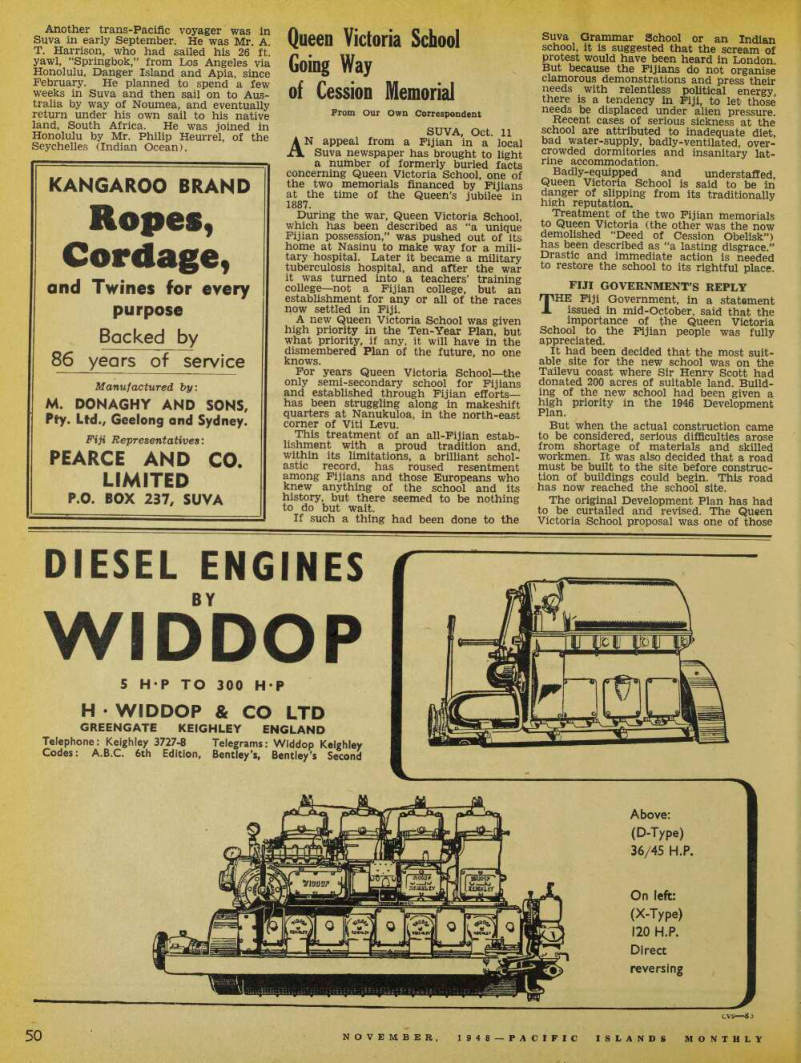
By W.H.J.
ANTHROPOLOGY has been described as the study of “stones and bones and dirty stories about black people.”
This tale of the Fly River, Papua, 30 years ago may not fulfil all the condi tions, but it is a true one.
The Resident Magistrate felt unsettled He paced back and forth along his verandah, glancing out occasionally at the wall of blackness that, at this hour of the night, was all that could be seen of the daytime view.
It was just after dinner, and the moon was not yet new. After a day of rain and storm the wind had died to a flat calm and the river flowed with a soft murmur, a sound like voices hushed in secret conclave. From the house nothing could be seen except varying shades of darkness. A weird black brightness (if such a thing is possible) showed where the river glided almost silently; and here and there on the subdued gleam showed darker shapes of something moving moving so quietly that even the slight river murmur sounded loud in the silence.
Sometflmg was not quite right. Those must be canoes moving about, and, after all, there was no reason why they should not do so. But it was unusual, and any tning unusual is worth looking into.
“Must find out in the morning who they are and wny they are about at night, moving without the familiar thump of paddles.” With this tnought and a stretch and a yawn the RM went to bed.
ATIFU was making one of his rare visits down river to Kerikaru to re port to the white-man “gavaman” and to collect his yearly pound. He was the Village Constable and a man of weight and influence among his oeople.
Witn his two wise and influential* coun cillors and six of the strongest and bravest of his hunting men, he had set off three days ago from his village high up on the Turamati.
The expedition had been planned for weeks, and the wonderful “moni” he was to receive had been spent, in anticipation, many times. With his councillors and the fathers of the tribe every detail had been gone over again and again. An axe must be brought home, for the village canoes were becoming worm-eaten and were cracked by the sun and new ones must be fashioned. And an iron spear to kill the pigs which escaped so often when the arrows were not driven with the old time force—the coming of the white man had made many changes and, without a doubt, the men of nowadays were not such men as their fathers and grand fathers had been. And red calicoes to tear in strips; and a knife to cut the sago leaves; and the fishlines which saved all the trouble and labour of damming the creeks; and dogs’ teeth for the Buguru head-dress. All these must be brought home.
The pound would not go far and an other year is long to wait. Somehow or other the pound must be stretched, for, so far, no tobacco had been provided for, and “kuku” cannot be done without. True, the women could make sago to fill the canoes, and this can be sold to the “gava men” but the price is small and the canoes cannot carry enough to earn all the “kuku” which is needed. Then, the women could go also. Was it not the law! of the fathers that woman must obey her man in all things, and was it not true that the “gavamen” policemen have no women and hunger for them?
So it was settled and the expedition had set out; Atifu, his councillors and the strong men in one canoe, and three canoes
with the wives of all of them plus the most luscious of the matrons from the village, an old man in charge of each ‘ woman” canoe.
Three days of gentle paddling and drifting with the tides had brought the party to Kerikaru that day. The sago had been sold but the puce was, indeed, small. The “moni” had been paid and spent, but the result was a disappoint ment. True, the axe, and knife, and dogs’ teeth and calico had been bought, but the stock of tobacco was too small to divide among so many.
To-night it was possible to stay at the “gavaman” rest-house, but the long jipurney home must be started when the tide turned in the morning, and there would be sore bellies in the village if they returned with so small a stock of “kuku.”
Therefore, now was the time for wives to carry out their marriage vows, and obey in all things.
The policemen, reasoned Atifu, are hungry for women and have much to bacco. True, the “gavamen” will be angry if it is discovered, but the white man Is easily deceived. So let the women in their canoes cross over to Kerikaru and see if the policemen’s love of “kuku” is stronger than their need for women, IN dead silence, with no sound of paddle beat to betray, the three canoes approached the landing. The white man’s wharf would perhaps not be safe, and the small jetty was also better avoided, so in a blacker shadow cast by a coconut tree the canoes gently grounded.
One of the old men, Pandaius re incarnated, approached the barracks where the whole of the rank and file of the police force were wrapped in virtuous slumber. A gentle scratching on the palm-frond floor, long continued, brought a grunted, “What is it?” from one of the constables within.
Pandarus gently murmurs, “We of the Turamati people have taken pity on your loneliness. Come to the river bank where our wives are waiting and let your woman-hunger be appeased.”
Policeman Mainati sat up and rubbed his eyes, and finding that his ears had, in deed, heard aright and had not deceived him, quietly roused his companions. Two could not rouse themselves sufficiently to fully take in what was toward, but Mainati and ten others crept quietly to the shadows where the argosies of dusky Venus waited in silence. A few whispered sentences and the whole party embarked and again crossed to the rest-house kindly provided by the “gavamen.”
Arrived there, by the flickering light of smoking fires the assembly made closer acquaintance, and each policeman made his own arrangement with the husband of his chosen Amaryllis. Much kuku changed hands and the village men-folk grunted with satisfaction that they would not now heed to feel shame when they returned to their people.
All was quiet and well-ordered and nothing would have gone amiss were it not for Mainati. He, with his six-years of “gavaman” service, held all village people in contempt. He selected the younger of the two wives of Atifu, and commenced to bargain for her favours. Atifu said that, truly, she was the belle of all the village and he knew he had been wise in bringing one of such attractions with him.
But she was superior to all these others, and the second wife of the village con stable to boot, and, therefore, the charge was three sticks of tobacco. Mainati snorted with scorn. Did not Atifu know that one and a half sticks was the proper “gavamen” fixed price?
To which Atifu replied, “Certainly I know the usual “gavamen” price is one and a half sticks but I am not bound to accept it. It is true that both you and I wear “gavamen” clothes but I also
know the law. You have given me this one and a half sticks but I want the full three sticks, otherwise I shall report to the sergeant.”
Mainati was adamant; he demanded the return of the “kuku” but Atifu re fused this, for the village people must not see a poor return for the expedition, and every stick counted. So Atifu withdrew apparently defeated. And had Fate cast him into another environment, doubtless he would have comforted himself, albeit sourly, that half a loaf was better than none. But being Papuan, nurtured in the law of Pay Back, he stood in the darkness brooding.
True. Mainati and his men were pro viding the village tobacco supply. But should he allow the shrewd-headed big mouthed policeman to get away with victory over Atifu? No!
Atifu again crossed the river and this time went to the house of the sergeant.
Rousing him, he said, “Do you know all your police have crossed to the rest-house and have made trouble with my people 9”
The sergeant went to the barracks and found his police to be only two instead of the thirteen who should have been there. He told Atifu to return but not to allow anyone to know he had crossed to Kerikaru, which Atifu had no inten tion of doing anyway.
THE RM tossed restlessly about and got up to look at the time. It was just after one, and he gazed out at the night, to see still another silent, black shadow creeping across the river. Cer tainly there was something not quite right.
At seven o’clock parade of the police the sergeant saluted the young Patrol Officer and reported “Taubada, ’alf-pas’ leven I look ’long barracks. Only this two man stop. Altogether this other man go ’long rest-house look round woman.”
At nine o’clock the RM found the names of eleven of his thirteen police on the charge-sheet. Fine—five shillings each.
The tide turned at ten o’clock and four canoes left the river bank and started down with paddles beating a rhythmic tune on the canoe sides. The RM turned to the PO and said, “I’m glad to see the last of those Turamati people. I had a feeling all last night that there was some thing not quite right.”
Atifu is still the village constable and, along the Turamati, is a man of weight and influence, much enhanced by the success of his recent trip to the “gava men” at Kerikaru.
Another trans-Pacific voyager was in Suva in early September. He was Mr. A, T. Harrison, who had sailed his 26 ft. yawl, “Springbok,” from Los Angeles via Honolulu, Danger Island and Apia, since February. He planned to spend a few weeks in Suva and then sail on to Aus tralia by way of Noumea, and eventually return under his own sail to his native land, South Africa. He was joined in Honolulu by Mr. Philip Heurrel, of the Seychelles (Indian Ocean).
Bureau
Pacific Islands Service
THE Pacific Islands Service Bureau has been established to assist Island re sidents who cannot shop for themselves.
Briefly, we will perform those services for you, in Australia, which you cannot per form yourself, or are outside the scope of ordinary mail-ordering.
We will purchase and forward goods to you; have repairs made on your behalf; send flowers, sweets, fruits, gifts to frends in Australia for you, or to your children at school in Australia; match materials and sewing accessories; and arrange holiday accommodation and travel.
For these services we charge a small fee—in the case of shopping services, usually 10 per cent, of the purchase price.
If you missed the circular which ex plains this service fully and which was included in all copies of “PIM” which went to the Islands in March, please let us know and we will send you a copy of the pamphlet, free of charge.
AU inquiries should be addressed to; The Director, Pacific Travel and Service Agency, Box 3408, Sydney.
Advertisements & other items, pp. 51-52 (1 item)
Burns Philp (New Guinea) Limited
General Merchants (Wholesale and Retail)
Shipping, Customs and General Agents
Head Office: PORT MORESBY, PAPUA
BRANCHES:
NEW GUINEA: Rabaul, Kokopo, Lae & Madang.
PAPUA; Samarai.
REPRESENTATIVES FOR:
AUSTRALIAN AGENTS:
LONDON AGENTS:
SAN FRANCISCO AGENTS:
QUEENSLAND INSURANCE CO. LTD.
LLOYDS OF LONDON
BURNS PHILP TRUST CO. LTD.
BURNS, PHILP & CO. LTD.
All States.
BURNS, PHILP & CO. LTD.
"London House", 35 Crutched Friars, E.C.3.
BURNS, PHILP CO. OF SAN FRANCISCO INC. 510 Matson Building.
Distributing Agents, Territory of Papua-New Guinea for:
SHELL COMPANY OF AUSTRALIA LIMITED
Petroleum Products
GENERAL MOTORS CORPORATION
Chevrolet, Buick, Pontiac and Oldsmobile Cars Chevrolet and GMC Trucks Frigidaire Refrigerators
VAUXHALL MOTORS LIMITED
Vauxhall Cars and Bedford Trucks
R. A. LISTER & CO., BRISTOL
Producers of Petrol, Parrafin and Diesel Engines Pumps and Lighting plants
RUSTON HORNSBY LIMITED
Engines
CROSSLEY MARINE ENGINES
KANGAROO BRAND
Ropes,
Cordage,
and Twines for every purpose Backed by 86 years of service Manufactured by:
M. DONAGHY AND SONS,
Pty. Ltd., Geelong and Sydney.
Fiji Representatives :
PEARCE AND CO.
LIMITED
P.O. BOX 237, SUVA
Going Way
Queen Victoria School Going Way of Cession Memorial
Prom Our Own Correspondent
Suva, Oct. 11
AN appeal from a Fijian in a local Suva newspaper has brought to light a number of formerly buried facts concerning Queen Victoria School, one of the two memorials financed by Fijians at the time of the Queen’s jubilee in 1887.
During the war, Queen Victoria School, which has been described as “a unique Fijian possession,” was pushed out of its home at Nasinu to make way for a mili tary hospital. Later it became a military tuberculosis hospital, and after the war it was turned into a teachers’ training college—not a Fijian college, but an establishment for any or all of the races now settled in Fiji.
A new Queen Victoria School was given high priority in the Ten-Year Plan, but what priority, if any. it will have in the dismembered Plan of the future, no one knows.
For years Queen Victoria School—the only semi-secondary school for Fijians and established through Fijian efforts— has been struggling along in makeshift quarters at Nanukuloa, in the north-east corner of Viti Levu.
This treatment of an all-Fijian estab lishment with a proud tradition and, within its limitations, a brilliant schol astic record, has roused resentment among Fijians and those Europeans who knew anything of the school and its history, but there seemed to be nothing to do but wait.
If such a thing had been done to the
Suva Grammar School or an Indian school, it is suggested that the scream of protest would have been heard in London.
But because the Fijians do not organise clamorous demonstrations and press their needs with relentless political energy there is a tendency in Fiji, to let those needs be displaced under alien pressure.
Recent cases of serious sickness at the school are attributed to inadequate diet, bad water-supply, badly-ventilated, over crowded dormitories and insanitary lat rine accommodation.
Badly-equipped and understaffed, Queen Victoria School is said to be in danger of slipping from its traditionally high reputation.
Treatment of the two Fijian memorials to Queen Victoria (the other was the now demolished “Deed of Cession Obelisk”) has been described as “a lasting disgrace.”
Drastic and immediate action is needed to restore the school to its rightful place.
Fiji Government’S Reply
THE Fiji Government, in a statement issued in mid-October, said that the importance of the Queen Victoria School to the Fijian people was fully appreciated.
It had been decided that the most suit able site for the new school was on the Tailevu coast where Sir Henry Scott had donated 200 acres of suitable land. Build ing of the new school had been given a high priority in the 1946 Development Plan.
But when the actual construction came to be considered, serious difficulties arose from shortage of materials and skilled workmen. It was also decided that a road must be built to the site before construc tion of buildings could begin. This road has now reached the school site.
The original Development Plan has had to be curtailed and revised. The Queen Victoria School proposal was one of those
now being examined by the Development Revision Committee. In the meantime the school was still being conducted in quarters at Nanukuloa which was never meant to be other than temporary. As a result of the recent reports about the health of the pupils a thorough examin ation was being made by officers of the Medical Department.
Advertisements & other items, p. 52 (1 item)
Widdop
DIESEL ENGINES
BY
5 H P TO 300 H P
H • WIDDOP & CO LTD
GREENGATE KEIGHLEY ENGLAND
Telephone: Keighley 3727-8 Telegrams: Wlddop Keighley Codes: A.B.C. 6th Edition, Bentley’s, Bentley’s Second £ [ mooy Ixsimsy yi'j'j'j? (tifiHLEV Above:
(D-Type)
36/45 H.P.
On left:
(X-Type)
120 H.P.
Direct reversing
CVS—Sj
Growing Demonstrated In
New Methods Of Native Food
Tonga
THAT the future of the island group of Tonga depends on new methods of native food growing is emphasised by the Rev. John Churchill in a report published in the NZ Methodist “Times” recently.
Mr. Churchill, is a NZ Methodist min ister with farming experience, and has spent the past three years in Tonga.
During that period he supervised the clearing and planting of 120 acres in native crops. 111-health has obliged Mr. Churchill to leave Tonga to continue church work in New Zealand, but his report on his efforts to increase food production in the Kingdom will be read with interest by people in other Pacific lands.
He served with the RNZAF during the war years and in the course of his duties was posted to Tonga for a time. It was then that he met the Rev. Rodger Page, veteran missionary of Tonga, and learned of the need for practical missionary work in the Islands. In 1945, Mr. Churchill, with his wife, returned to Tonga to assist in the agricultural work of the Methodist church there.
Urgent Need For More
Control Over French Lepers
Prom Our Own Correspondent
Noumea, Oct. 13.
THE New Caledonian deputation, con sisting of Messrs. Boilet, Pannetier, Pascalon (architect) and Major Dr.
Ragussin, has returned to Noumea after inspecting the Makogai leprosy colony in Fiji. Modernisation of the local Ducos Peninsula leprosarium is expected as a result.
The inmates of Ducos have recently been largely uncontrolled, and have been allowed to visit Noumea shops and cinemas almost at will. There is a rumour that vegetables from the leper colony are on sale in Noumea shops. In any case, there is a strong feeling that not enough is being done for those suffering from the disease,, which is rife among the white as well as among the native and Asiatic populations.
Quite apart from leprosy, in the way of medical training it is most desirable that France should agree to send native students—particularly the intelligent in habitants of the Loyalty group—to the Fiji Medical School, under some agree ment with Fiji.
Death Of Prominent Fijian
Minister
The Rev. Nacaniela Mataika
Suva. Oct. 11.
RATU, the Rev. Nacaniela Mataika minister of the Jubilee Church, Suva, the “cathedral” of Fijian Methodism, died at the Colonial War Memorial Hos pital on October 4, at the age of 65.
Ratu Nacaniela was born at the island of Nairai, and was of chiefly rank. He was ordained a minister of the Methodist Church 30 years ago and was stationed at Suva for several terms, the last being for nine years. He was a man of out standing ability, and a prominent figure in the Methodist Mission, his status be ing naturally enhanced by his rank as Tui Nairai —the principal chief in that island. For the last six years he had been one of the two Fijian nominated members of the Suva Town Board.
Ratu Nacaniela is survived by his wife and five children. One of his sons has gained high distinction at the Central Medical School.
The funeral was among the largest at Suva for very many years.
Advertisements & other items, pp. 53-54 (1 item)
DUNLOP Du&b&'i
OUR HANDS MAKE GOOD ARMS
For your Fishing and Shooting Wants Consult Us.
" Lithgow .22 Cal. Repeating Rifles ... £ll 14 0 Ww Lithgow .22 Cal. Single Shot 5 1 3
SIL ROHU 143 ELIZABETH STREET,
/ Post
Extra.
SYDNEY.
Dunlop sporting equipment enfoys worldwide popularity amongst all players of sport. You can be sure, always, of getting the best products of their kind available when -you specify Dunlop Tennis Rackets. Tennis Balls, Sports Shoes, Golf Balls and Bowta They're still difficult to obtain but keep asking for the Dunlop Brand. mm am 63 mm / ' f ' t>/4' ' ,{'/ ' ' ' '-f- -\ |-,V- &V - flW"' f"y n ' ***. '<i
DUNLOP VS
■ '?•>.- D.W
DUNLOP Du&b&'i
; Cll
laii L lx
P** L, fD^ V
f**° n y 1 1 , s %*%s***!%
'^precious
KOLYNOJ
sAves
YOU
M ° "* v,<3
■&SSS/
/& MICHIGAN (US.A.)
DENTIST CLAIMS
TEMPER- SETTING
UP A FLOW OF
CERTAIN
JUICES -
GAN
CAUSE
DECAY/
dental
SCIENCE HAS
PROVED
THAT GERMS
HIDDEN IN CREVICES
CAUSE DECAY.
ANTISEPTIC KOLYNOS
PENETRATES
SURGICALLY
CLEANS OUT HIDDEN
DANGER SPOTS/..
. * . „ ■, cO > if
MOOTWASW/
Roman women useq
MYRRH AS A
MOUTHWASH /
TODAY KOLYNOS
BRINGS SWEET
FRAGRANCE
TO YOUR
BREATH
SPARKLING LUSTRE
TO YOUR TEETH.
* fU# *%s& 09
I& K4B-20
Mr
■HEADACHE? Stop// FASTER/
anAcw
" REGD. TRADE MARK
1 ANACIN stops headaches faster because it contains an eafrfl ingredient. It is a prescription for pain and aches. Always ask for ANACIN.
Lae Newsletter
Prom Our Own Correspondent LAE. October 16.
RECENT visitors to the district were Mr. J. R. Halligan, Secretary of the Department of External Territories, and a party of officials including Mr.
Mulcahy, Mr. E. Knox (Director of Works and Housing) and Mr. Lewis (of the same Department).
During their stay they visited Bulolo and Wau, returning to Lae by the Wau- Labu road. It was regretted that they did not meet the local Citizens’ Association.
The Association was not informed of their visit until it was too late to arrange a meeting. ♦ ♦ * IT is reported, on good authority, that the Administrator has approved a re quest that trade-store licences now be issued for a period of five years, provid ing that the store is outside township areas.
Since the Provisional Administration went into operation it has been customary for such licences to be issued for one year only. ♦ ♦ ♦ THE state of local roads has not im proved. That from the hotel to Erap consists of one pot-hole after an other. The Department of Works and Housing, which is responsible for road maintenance, is virtually ham-strung be cause it cannot get the men to carry out the necessary work. This again is due to the fact that conditions offered married men are not attractive and until decent houses and suitable schools are available the present position, when one road over seer is responsible for about 50 miles of road, is unlikely to improve.
Most of the men who have come up from “South” for this class of work have been birds of passage who have returned to their homes in Australia when they realised that there was not much chance of being reunited with their families in New Guinea. * * ♦ THE Administrator, Colonel J. K. Murray, visited Lae recently to present diplomas to 17 native men and two native women who have been successful in their studies at the Native Medical School, Malahang, Dr. J. Gunther, Director of Public Health, accompanied the Administrator. In an address he said that this was the first step in training natives to become fully qualified doctors.
The Administrator pointed out that the purpose of training natives as Medical Assistants was not in order that they could make money from their knowledge but so that they could return to their people and give them valuable advice and treatment. * * * A SON has been born to Mrs. W.
Fishwick, in the Lae Public Hospital.
Mr. Fishwick is the local manager of Guinea Air Traders. ♦ ♦ * THE Managing Director of Guinea Air Traders, Mr. J. Jamieson, was in Lae in October. He said that he expected his company to have more aircraft in operation in New Guinea shortly. At pre sent the company has six aircraft en gaged in local services. ♦ ♦ ♦ MR. DUNCAN MacDONALD, formerly a Native Labour Supervisor has joined the New Guinea Police Force as Assistant Sub-Inspector. He was in command of the Police Guard of Honour for the Administrator during his recent visit to Lae.
LAE, at the time of writing, has col lected £650 towards the United Nations Children’s Appeal Fund. Money is coming in steadily—but slowly. Wewak has amazed the Territory by having already passed the £2,000 mark. • • • LAE residents were startled late in Sep tember when a sudden explosion occurred near the Administration married quarters at the foot of Namanula hill.
It appears that natives were burning off the kunai at the back of Sub-Inspector Larkin’s house and the fire set off some 25-lb. bombs which had been hidden in the grass. No one was injured. • • • IT is reported from New Ireland that plantation labour is now demanding and being paid 30/- a month and keep.
Those planters who will not “play ball” are left without boys.
Banabans Settle Down On
Fiji Island
Satisfaction with the condition of the Banabans who were transferred from Ocean Island to Rabi Island, in Fiji, after the war, was expressed re cently by Sir Albert Ellis, NZ, repre sentative on the British Phosphate Com mission.
Sir Albert said that he spent a week at Rabi Island, now the home of Ocean Islanders, who had been displaced by phosphate workings. “We had an en thusiastic reception,” he added. “Probably no more suitable island in the Pacific could be found for the Ocean Islanders.
It is very fertile, and twelve times the size of their former home.”
Advertisements & other items, pp. 55-56 (2 items)
Pacific Islands Monthlt—N O V E M B E R , 194«
“CHULA” Copra Dryer
BIGGER PRICES for BETTER COPRA!
when dried by the scientific
process made possible by the
“CHULA” Copra Dryer
, . . the most practical and efficient machine for drying nuts in bulk, which produces copra of a higher standard than that dried in the open, without discolouration, free from mould, thoroughly and evenly dried throughout. The "Chula” produces its two tons of copra every 24 hours, irrespective of the weather, and with a minimum of labour.
THE INVENTORS AND MANUFACTURERS OF
THE "CHULA” COPRA DRYER ALSO MAKE
DESICCATED COCONUT
MACHINERY
(Parers, Disintegrators, Sifters, Dryers)
TEA DRYERS
FISH DRYERS
RUBBER MACHINERY
(Continuous Sheeters, Crepeing Batteries)
TYNESIDE FOUNDRY &
ENGINEERING CO. LTD.
ELSWICK • NEWCASTLE-ON-TYNE • ENGLAND
Telegrams A Cables . “ FOUNDRY. NEWCASTLE-ON-TYNE " • Codes : ABC, sth A 6th Eds m
Mif.
a if
A NEW CATALOGUE
of the
"CHULA"
COPRA DRYER
has just been printed.
Send for Your Copy!
GEORGE J. LOGKYER & COMPANY
CONSULTING ENGINEERS
DOCKYARD MACHINERY
In associotion with GEORGE J. LOGKYER (Far East) fir CO. and GEORGE J. LOGKYER (Overseas) & CO.
ENGINEERING SUPPLIES, GENERAL HARDWARE EXPORTERS AND MERCHANTS Agents for the Finest Australian Liquors Aerated Water and Cordial Manufacturing Machinery, Bottling and Capping Machinery, etc.
TRACTOR TRACKS AND SPROCKETS.
CRAWLER TRACTORS.
HEAVY DUTY TRAILERS.
LIGHT TRAILERS.
ROADMAKING EQUIPMENT.
FORK LIFT TRUCKS.
MOBILE CRANES.
CRANES AND EXCAVATORS.
DIRECT COUPLED PUMP UNITS.
AIR COMPRESSORS.
COLD ROOMS.
REFRIGERATION AND ICE-MAKING
MACHINERY:
Cold Rooms, Ice Showers, Commercial Refrigerators in all sizes.
Complete Ice-Making Machinery.
POWER HOUSE:
Murphy 6-Cylinder Diesel Engine, Model M.E. 650, Engine No. 103188, 160 h.p., at 1,200 revs., direct coupled to E.M. Synchronous A.C. Generator, 60 cycle, 1,200 r.p.m., 106 K.W., 132.5 K.V.A., 127-220 volt, 348 amps, 3 phase, or 50 cycle, 1,000 r.p.m., 95 K.W., 118.7 K.V.A., 230-400 volts, 172 amps, 3 phase. Generator fitted with E.M.
Synchrostat voltage regulator, lub. oil heat indicator broken, no Vee belts on blower drive, no engine ampmeter; radiator and fan are available for this unit; engine fitted with electric starting.
All material available for immediate export.
Ruston 4-Cylinder Diesel Engine, 120 h.p., Size 4, Class C.V.R., Engine No. K 82631, direct coupled to Lawrence & Scott & Electromotor, Ltd., A.C. Generator, 80 K.W., volts 415 r.p.m. 300, 50 cycles, 3 phase, stator amps 140, exciter amps 25.4, rating cont., exciter volts.
Ruston 4-Cylinder Diesel Engine, 120 h.p., Size 4, Class C.V.R., Engine No. 182630, direct coupled to Lawrence Scott & Electromotor, Ltd., A.C. Generator, 80 K.W., 415 volts, 3 phase.
Lister 4-Cylinder Diesel Engine, 38 h.p., at 1,000 r.p.m., Engine No. 60/359, Spec. 38/4/31, direct coupled to A.S.E.A. A.C.
Generator, K.V.A. 25, volts 415, amps 35, cycles 50, 3 phase, rating continuous; Type G.A. 23, No. 399334, exciter volts 110, exciter amps 5, engine has hand starting; unit is complete.
Switch Board, fitted with: Rotary Synchroniser, Frequency Meter, 2 Voltmeters 500 volts, Ampmeter 20 amps., 3 Ampmeters 50 amps, 2 Ampmeters 150 amps (one has no pointer), 2 Ampmeters 200 amps., Ampmeter 250 amps, Ampmeter 300 amps, Ampmeter 400 amps, 2 Kilowatt Meters 12 0.K.W., Power Factor Meter, Frequency Meter, 44 to 56 cycles per second, and necessary Line Switches.
Overhead Running Gantry, fitted with 5-ton chain block.
Inside Fuel Service Tanks.
Outside Supply Tanks, approx. 400 galls, each, engine cooling system is comprised of 3,000 gall. galv. iron tank with sprays, spraying into pond; both Rustons and Lister are equipped with mufflers, but the Murphy has open exhausts.
• LAUNDRY EQUIPMENT:
Boilers, Washers, Tumblers, Water Pumps.
• NAUTICAL EQUIPMENT:
Buoys, Anchor Cable Chain, Sea Mules, Chrysler Marine Engines, Grey Marine Engines, Dock Cubes, Jewellery, Propeller Shafting, etc.
• BAKERY EQUIPMENT:
Bakers’ Oil Burning Stoves, Dough Mixers.
• METAL TUBING:
Galvanised, Black, Brass, Copper and Steel.
• ELECTRICAL EQUIPMENT:
Generating Sets, Electric Motors, Refrigerating Units, Cool Rooms, Electric Light Turpentine Poles, Power Cable.
• HEAVY EQUIPMENT:
Stone Crushing Plants, Concrete Mixers, Air Compressors, Light and Heavy Trailers, Graders, Front End Loaders, Direct Coupled Pumps, Shovels, Booms, etc., Power Units Steam Boilers, Dump Waggons, Barber Green Ditchers, Rooters, Athey Waggons, Dozer Parts, etc.
EXACT REPLICA OF CANE KNIFE,
MADE IN AUSTRALIA.
The Largest Suppliers of Cane Knives in the World.
Photographs, Drawings, Schedules, will be Supplied by Return Mail to Genuine Clients.
HEAD OFFICE, 24 BOND ST. SYDNEY, N.S.W. 'Phones; UX6BOI, UA7196, BW6OIB dll communications to be addressed to The General Manager, 0.P.0., Box 4653, Sydney.
Bankers: Commonwealth Bank of Australia, Sydney.
Also Bank of N.S.W., Sydney.
Telegraphic and Cable Address: “LOCKMACH,” Sydney.
N. Hebrides Copra
Uncertainty Over Franc Troubles The Market
From Our Own Correspondent
Santo, Oct. 5.
THE Norwegian vessel “Kronviken” arrived in Santo to lift copra late in September, and another large vessel is expected late in October. These, with the “Antonis” (in August) mean three major liftings of copra in three months.
Owing to doubt about Australian currency remaining stable or appreciating to Sterling, the copra market in Santo has been subject to rumours and un certainties. Both planters and buyers were operating in the dark in September, and gambling that France will meet her copra credits in Sterling and not in blocked Metropolitan francs.
Firms operating in Australian currency were forced to take drastic measures to protect themselves against considerable losses when the news first came through that France would not pay in Sterling but only in her local francs. Measures are still being taken to provide against a 25 per cent, loss on copra now on the seas or held awaiting shipment, should the Australian £ follow the New Zealand £.
A considerable drop in the price pei ton, as from October 1, is the outcome of this financial difficulty. From £2/10/per ton, the highest price paid for New Hebrides copra during the depression, the purchasing price rocketed to £7O/12/6 this year. October’s price is expected to be about £5O. The price which firms on Australian currency will pay will be less 25 per cent. Their actual price cannot be determined until the French Government makes its price for the last quarter of this year.
This 25 per cent, cut is planned to build up a “stabilisation” fund to meet the possible loss. Should the Australian pound remain as it is, this deduction will eventually be returned to the planters concerned.
Planters are of the opinion that the natives will continue to accept a lower price, paid in Australian currency, in preference to a higher price paid solely in francs.
Mr. W. O. Fry who, in recent years, was manager of the Union Steamship Co.’s branch at Apia, Western Samoa, has been appointed manager for the Union Steamship Co., Ltd. at Burnie, Tasmania. Mr. and Mrs. Fry spent a brief holiday in Sydney in September, before going on to Tasmania.
Near-Miss For Tea Party
Prom Our Own Correspondent SUVA, October 11.
A BIG Fijian bure at Sigatoka, where most of the important social and other gatherings of the Nadroga dis trict were held, recently flopped to the ground without warning.
If this calamity had occurred 24 hours earlier, the enormous roof-timbers would have crashed on a Church of England Ladies’ Guild tea-party.
As it was, tables, crockery and forms
were smashed to fragments and Lawaqa Tennis Club members and other Euro peans are now collecting funds for re placements.
It will cost £4O to rebuild the bure, to wards which cost the Government says it will give £2O and not a penny more, Mr. J. M. Brennan, who has been a Magistrate in Fiji for nine months, has returned to Sydney to resume his legal practice. During his stay in the Colony Mr. Brennan occupied the bench at Suva, Nausori, Navua, Labasa and other centres.
Advertisements & other items, p. 57 (2 items)
55
PACIFIC ISLANDS MONTHLY-N O V E M B E R , 1948
Hard to Get? In_ US
Cfinldked by
DAY I SON
For Tropical conditions
Velvene Water Paint and Davison's Zinc Base Paints are used extensively throughout the islands and Mandated Territories on Government and Private buildings, giving full satisfaction under severe tropical conditions.
DAVISON PAINTS LTD.
BOX 24, AUBURN, N.S.W.
Hard to Get? In_ US
FOR
10. SADDLERY & HARNESS
H. HOME LIGHTING PLANTS
12. WINES AND SPIRITS
13. NON-ELECTRIC WASHING
MACHINES
14. PUMPS, IRRIGATION
PLANTS
15. CROCKERY
16. HAIRDRESSING SUPPLIES
17. HARDWARE
18. AIR CIRCULATORS
Manstocks Sydney, Australia
ISLAND TRADERS
Cable and Telegraphic address: “MANSTOCKS,” SYDNEY Telephones: 8W7405, 8W1237, 85076, PM2766
1. TRADE TOBACCO
2. LAP LAP MATERIAL
3. CANNED GOODS
4. PERFUMERY
5. PRIMUS STOVES
6. KEROLAMPS
7. SHOES, SANDALS
8. UMBRELLAS
9. CHILDREN'S CLOTH-
ING
KWONG CHONG BROTHERS
General Merdmnts and Planters
Have now re-established their business on their original pre-war site, and are carrying stocks of Trading and Plantation requirements. All enquiries welcomed and service assured.
Sydney Representatives:
NELSON & ROBERTSON PTY., LTD.,
Electra House, 12 Spring Street, Sydney, N.S.W.
KWONG CHONG BROTHERS
KEMARERE STREET, RABAUL
In Fiji
Price of Butter and Ghee Rises In Fiji
From Our Own Correspondent
Suva. Oct. 11.
HTHE price of New Zealand butter in A Fiji has gone up 4ld. to a record figure of 3/U a pound. This is one result of the alteration of the New Zea land exchange rate.
Simultaneously ghee, for the Indians, has gone up another Bd. to 4/8 a bottle.
A correspondent in the “Fiji Times” re cently appealed to the Hindus not to bum ghee at the Diwali Festival of
Lights in November in view of the desperate world food shortage. Coconut oil serves the same purpose.
At previous festivals prosperous Indians, farmers and even Gujerati shoemakers have been accustomed to burn a bottle or two of ghee for each family at Diwali.
Eight young Fijian nurses gained their diplomas this year. They were Mele Lositika, of Lau, who won four of the major prizes; Anaseini Namakadre, Aka nise Buatoka, Makarita Sokuta, Akanise Bale, Eta Watiravula, Mereoni Semkalou and Atalaite Biu.
New Look For Pitcairn
Education and Architecture
NOTES from Mr. P. P. Ward, of the Seventh Day Adventist Mission, tell us how the “New Look” came to Pitcairn Island—although the Look, in this case did not concern skirt lengths.
He writes: Pitcairn’s new school teacher, Mr. A. W.
Moverley, MA, 8.C0m., Dip. Ed., with his wife and nine-year-old daughter, Diana, arrived at Pitcairn from New Zealand by the RCS “Awahou” on July 21. This little steamer, chartered by the High Commissioner’s office, brought from Fiji materials for the new school and teacher’s residence.
The island boats met the ship and it was not long before the men were busy bringing ashore the materials that filled the vessel. Then for three weeks our boats went to and fro till all was safely ashore.
A small motor launch that Captain Webster had brought towed the boats, speeding up operations considerably. Right at the last were two Diesel engines which are to be used for generating electricity for the school and the teacher’s home.
Happily the weather was good nearly all the time of the unloading, but there were some anxious moments and all were relieved when the task was finished.
The men are busy now carrying all the materials to the site of the school at Burau, at the western end of Adamstown, which is far enough out to be like a tiny suburb.
Some of the local men are helping on the building, which is in charge of three tradesmen from Fiji. Sounds of their hammers echo across the valley as I write. It is expected that the work will take several months to complete.
We have heard of “the new look” with regard to clothes elsewhere. We shall certainly have “a new look” on Pitcairn Island when these new buildings are finished. With their several tanks, cement walks, sewerage and electric lights, paint and gardens, they will surely make a great difference to the look of the hill side.
Recovery In The Gilberts
ACCORDING to Sir Garrick Robertson, of Auckland, NZ, the old Island trader is now a thing of the past in the Gilbert and Ellice Islands.
Sir Garrick recently spent several weeks on Bairiki, Tarawa. All imports and ex ports, he said, were arranged through native co-operatives.
Last year, a handicraft co-operative was formed; it had already exported mats, fans, baskets, etc., to the value of £2,000.
The islanders were anxious to increase this trade particularly with NZ.
Response to Britain’s need for fats had been good. They had contracted to supply 6,000 tons of copra in the current year.
There were still many signs of war on Tarawa—particularly at Betio islet, where the Americans had landed in 1943.
But coconut trees planted to replace those destroyed during the Japanese occupation and subsequent fighting, were already from six to eight feet high.
Miss Dorothea Henslow, who visited Brisbane recently to give talks on New Guinea for the Australian Board of Missions, said that the war had deepened natives’ faith in Christianity. Former members had rejoined the missions, and in some places groups of 500 non- Christian natives had asked for mission privileges. More personnel and more money were needed to extend the work.
Advertisements & other items, p. 58 (1 item)
Some -things you
just can't
mask, Rgeon j
Cute costume, slave gif] But what good is your mas querade if underarm odour gives you away? Don’t take chances. Rely on Mum.
Tonight’s bath was fine . . . for washing away past perspiration. But to guard against future underarm odour, play safe use Mum !
Snow-white Mum is gentle, harmless to skin and fabrics.
Mum gives sure protection
against underarm odour all day or evening.
Mum
Pacific Islands
America’S Big Science Plans For The
Activities In Micronesia Will Tie In With Developments In South Pacific
THE transfer to the care of the United States of the archipelagoes of Marshall, Caroline and Mariana Islands (formerly controlled by Japan under a League of Nations Mandate, but now held by America as a Trust Territory of the United Nations) is likely to have a/ marked effect upon administrative systems in the Pacific Islands generally.
The United States is putting huge funds behind its plans for research, co ordination of scientific knowledge and co-ordination of administration in con nection with the Pacific Islands generally.
Some indication of what is afoot is given by the following article by Mr.
Harold J. Coolidge (Secretary of the Pacific Science Board) in the August issue of the “Far Eastern Survey.” It will be seen that these plans and activities already link up with South Pacific admin istrations, through the South Pacific Com mission and the forthcoming Seventh Pacific Science Congress in New Zealand.
THE Pacific Science Board of the National Research Council “has been established to aid the scientists of America who wish to engage in scientific investigations for which there is a need in the Pacific area, to advise govern mental and other agencies on scientific matters pertaining to the Pacific, and to further international co-operation in the field of Pacific Science.”
During its first eighteen months under
the chairmanship of Knowles A. Ryerson, of the College of Agriculture, University of California, the Board has engaged in a number of activities in the field of inter national relations.
Its major activity has been to assist the administrative authorities of the TrustTSStor? (Navy De to too1d“ ng theh of the problems of the area through a two-year project, the Co-ordinated In vestigation of Micronesian Anthropology (CIMA), involving the selection and dispatch to the islands of forty-two specialists, including four linguists, three
geographers, and thirty-five anthropol ogists, from twenty universities and museums in this country and from the University of Sydney. This project is supported by grants from the Viking Fund, the Office of Naval Research, par ticipating institutions, and private sources.
Through the Insect Control Committee and a special grant from the Office of Naval Research, seven entomologists have been engaged not only in field research
on insect pests in the Trust area but also in collecting beneficial parasites in Malaya, Java, and East Africa to help control the giant African snail, the rhinoceros beetle (Oryctes), and the coconut beetle (Brontispa). Parasites have been flown from Java and Zanzibar to the islands as part of this control programme. Scientific institutions in the Philippines, Malaya, Java, Kenya, and Zanzibar have co-operated.
The Board aided in the establishment of the Institut Francais d’Oceanie at Noumea, which is housed in former Ameri can Army and Navy buildings equipped with surplus property donated for the purpose by the United States Govern ment. Arrangements were made for Dr. j. t. Buchholz, an American botanist, and his wife to carry out research from that base for several months on conifers of New Caledonia.
The Board’s advice has been requested on a variety of subjects by Colonel Schenck, Chief of the Natural Resources Section of SCAB in Japan. Dr. Bartlett, the chairman of the Committee on the Philippines, visited Manila and helped in the re-establishment of the Research Council there. Plans have been actively furthered for conservation in the Pacific, and two conferences—in Honolulu and Washington—have been held on conser vation in Micronesia in order to crystallise recommendations to the administrative authorities of the Trust Territory.
Under the Fulbright Act the sum of 43 million dollars will become available over the next twenty years in seven Pacific countries. A part of the sum can be de voted to research, and the Board is trying to arouse interest among United States scientists in projects taking advantage of this allocation.
The United States Department of State has requested the Board’s advice in cer tain matters relating to the South Pacific Commission. Dr. Douglas L. Oliver has been appointed special assistant to the Chief of the Office of Far Eastern Affairs to deal with Pacific Islands matters.
Plan Pacific Science Congress
THE Board has co-operated with the Royal Society of New Zealand in planning for American participation in the Seventh Pacific Science Congress, which will meet in New Zealand in Feb ruary, 1949.
The draft programme of the Congress was submitted to 120 American scientists for comment, and their replies were for warded to New Zealand.
Since the National Research Council is the official adhering agency in the United States to the Pacific Science Association, the Board sent invitations in May to 750 scientists, institutions, societies, and gov ernment agencies with information about the Congress. As of June 10, 1948, seventy-three replies showed positive in terest, and forty-three of these indicated a desire to participate.
THE Pacific Science Board has an active office in Honolulu in quarters pro vided by the Trustees of the Bishop Museum. This office has been directed by Edwin H. Bryan, Jr., the Board’s Honolulu Officer for the past ten months.
The Board also has a West Coast Ad visory Committee of twenty-one scientists in widely scattered fields.
A new Committee on the Oceanography of the Pacific, under the chairmanship of Dr. Thomas G. Thompson, of the Uni versity of Washington, has been estab lished recently and held its first meet ing on June 19 at the California Academy of Sciences in San Francisco.
The Board also held a symposium on Micronesia at the Berkeley meeting of the Pacific Division of the American As sociation for the Advancement qf Science on June 22, followed by a meeting of its West Coast Advisory Committee.
The Board hopes that, as a result of the meetings of the Seventh Pacific Science Congress, various United Nation agency plans, UNESCO plans, South Pacific Commission plans, and those re commended by the Pacific Science Confer ence (Washington, 1946) may be effectively integrated so as to achieve maximum benefits to the Pacific areas concerned.
It is expected that the Board will con tinue its assistance with conservation and research activities in the Trust Territory.
Greater emphasis is to be placed on the encouragement of oceanographic and fisheries research; field studies on heart disease, cancer, and diabetes are to be initiated in the islands: and the field station and fellowship programmes of the Pacific War Memorial are to be given every encouragement.
Advertisements & other items, pp. 59-60 (1 item)
(Fiji) LTD.
"ISLAND LIFE"
Official organ of the S.S.l.C.C.—Calling Collectors, 1 Correspondents and Penfriends throughout the South Sea Islands. Over 1,000 members. Write for your free copy and particulars to—
SOUTH SEA ISLANDS CORRESPOND-
ENCE CLUB,
NATUVU, FIJI.
Woven Wire for all Industry
COPRA DRYING TRAYS, FLOORS, Etc.
FRUIT DRYING TRAYS, MINING SCREENS.
Heavy Mosquito Gauze in Phosphor Bronze and other Metals Impervious to Salt Sea Air.
WIRE DOOR MATS AND GENERAL WIRE WORKS
E. WRIGHT & CO. LTD.
Office and Works: 148-152 Cleveland Street, Sydney, N.S.W.
Telegraphic Address: “Wrlghtmake,” Chippendale. o* T V f £
GARDNER DIESEL MARINE
ENGINES
There is a type available for every class of vessel requiring power from 24 BHP to 152 BHP. Direct or reduction gears.
GARDNER stationary engines for all classes of work, including electrical
generation
MORRIS MARINE ENGINES
Petrol Driven. Direct or Reduction Gears
VEDETTE, 6-12 H.P.
NAVIGATOR, 12-24 H.P.
CHAPMAN PUP
and
SUPER-PUP
Engines
3 H.P.—4i H.P.
DISTRIBUTORS IN FIJI :
GRANTEX RICE MILLS
with stationary engines suitable for their operation w.
R. CARPENTER & CO.
. General Merchants, SUVA, FIJI
(Fiji) LTD.
J. C. Merrillees Pty. Ltd.
Import, Export and Island Merchants and
Commission Agents
AGENCIES: PETROLEUM PRODUCTS—KEROSENE, PETROL,
DIESELINE, ETC.
"MeNIVENS" ICE CREAM POWDER, ICE CREAM, CONES,
ETC.
Inquiries invited for all your Island requirements.
J. C. MERRILLEES PTY. LTD.
191 MACQUARIE STREET, SYDNEY, N.S.W., AUSTRALIA.
’Phones: 8W4306, BW. 6064.
The Most Extensive Manufacturers in the British Empire of
RUBBER STAMPS,
INKS, STENCILS,
Marking Devices,
ACME STAMP PADS
OFFICE & STATIONERY SUPPLIES
We also Manufacture & Supply a Complete Line of
LIMEWASHING AND
SPRAYING MACHINES
for all purposes.
Let us know* your requirements and we will quote by return.
WRITE FOR OUR GENERAL CATALOGUE
Lime washing Machine
EXCELSIOR SUPPLY CO. PTY. LTD.
I 278 host Office Place,
MELBOURNE, VIC.
HEAD OFFICE :
160 BROADWAY,
Former I u known as George St, West,
SYDNEY, N.S.W.
50 Victoria Street,
WELLINGTON, NZ.
Makatea's Deep-sea Moorings
Rest on Sea Bed
MAKATEA, the phosphate island in French Oceania, was without deep sea moorings in early October.
Two attempts to lay 220-fathom moor ings were made by the “Forthbank” but on both occasions the cable snapped when about 200 fathoms of the cable had been paid out from the ship. The job was then abandoned and will await the arrival of the British Phosphate Com mission’s “Triona” carrying new equip ment from Australia.
Makatea, like the other two Pacific phosphate islands, Ocean Island and Nauru, has no harbour facilities. Deep water extends right up to the shore.
Vessels moor to a buoy, being held in position by two span-chains running to a reef.
Sudden squalls and bad weather make all loading at Makatea a hazard but special release gear allows ships to cast off from the buoy quickly and get away to sea.
Moorings are renewed every five years, “Triona” made the last replacement in 1944 at a time when Makatea was the only Pacific phosphate island left in Allied Ifknds. “Forthbank” has laid moorings there, however, on two previous occasions.
After spending three fruitless weeks, and making two trips from Makatea to Papeete to have new equipment assembled, the “Forthbank” gave up the job when the second cable broke, loaded phosphate at an intermediate buoy and sailed for New Zealand to discharge.
Islanders Forgather in Sydney
OCTOBER 16 saw a large group of Pacific Islands Society members forgather at the lovely Sydney home of Mrs. Marie €rvine. And, how ever remote from art and history our in terests may be, it would have been im possible not to have responded, in some way, to the rare French prints, paintings and reproductions, fine crystal and glass ware, ancient goblets and the great cab inets of the pricelss examples of the silversmith’s art that Mrs. Irvine has spent many years in collecting.
Out on the lawns, at afternoon tea, old friends swopped yarns and memories that took staid matrons swiftly back to girl hood years. Gay Spring bonnets threatened to assume rakish angles as the laughter went round the cheerful little knots of reunited friends.
The lads were not behind in get togethers, either, albeit some have reached the bay-window stage. There was much piirth as they compared notes and ex periences during the years that sundry locusts have eaten.
A very representative group of the Pacific attended. Residents of Fiji, Samoa, New Guinea, Papua, the Solomons, the Western Pacific and Thursday Island found delight in meeting again in such a gracious setting.
Thosp. present included; Mr. N. B. Casey, MBE and his popular wife, Mr- and Mrs. H. C.
Monckton (surrounded by delighted old friends), Mrs. E. Witus, Mrs. E. M. Donnan, Mr. and Mrs. G. A. Young, Mrs. and Miss Anstice, Mrs.
Rhoda Coote, (most proudly chatting of her grandson) Mrs. E. Chidgey and Miss Ellen Chid gey and Mr. Chidgey, Mr. Hubert Sabben, QBE and Mrs. Sabben. Mr. and Mrs. G. H. Cradick, Mr. and Mrs. M. B. Collins, Mrs. Lloyd Ambler (to whom the years are more than kind!), Miss M. M. McGann, Mrs. I. McComish, FRGS, Mr. and Mrs. T. R. Dale, Miss Doris Peters, Mrs.
Paul and Mrs. Basil Fouldes, Mrs. Fred William son, Mrs. Trevitt and Miss R. Trevitt, Mr. and Mrs. Wager, Mr. Fred Hennings, Mrs. Watkins, Mrs. Harold Taylour, Mrs. McEvilly, Mrs. Legge, Mrs. R H. Lucas. Mrs. M. K. Beasley, Mr. and Mrs. Alf Sturt, Mrs. Coutt, Mrs. Sims, Mrs, I.
H. Meredith, Mrs. Wheeler.
Major C. A. Swinbourne, president of
the PI Society, expressed the thanks of guests to Mrs. Marie Irvine. Mrs. Swin bourne, Mrs. M. K. Beasley and Mrs. E. M.
Sturt introduced new members—“ Sappho Suds.”
Condemned To Death
Men Who Rallied New Caledonia To Free France in 1940
Prom Our Own Correspondent
Noumea, Oct. 18.
IT is not generally known that the pro- Vichy Government of Indo-China, through a court-martial in Saigon on February 5, 1942, passed sentence of death on leading Frenchmen who rallied New Caledonia to Free France.
The men condemned included Capt.
Broche (later killed in action at Bir Hacheim), Colonel Dr. Gaffiero, Captain Houssin, Lieut. Ardant, Lieut. Guillaumet, Capt. Dr. Lutz, Col. Mansart and Capt.
Dr. Jacques. The sentence also included military degradation and confiscation of their property “in favour of the nation.”
Capt. Dr. Germain, one of the best-known doctors at Noumea hospital, was sentenced to 20 years’ hard labour. Many of these people were convicted also of having “joined a foreign army without Govern ment authorisation.”
They have had to wait a long time for it, but these ten officers have now been cleared by the Saigon Court of Appeal, which commends them for having acted in a highly patriotic manner for the liberation of the Patrie. Which of them helped most is part of the story told by Henri Sautot in his soon-to-be-published book.
Advertisements & other items, pp. 61-62 (1 item)
Shipping
TO RESIDENTS OF NORFOLK ISLAND, COOK ISLANDS, NEW
CALEDONIA, NEW HEBRIDES, BRITISH SOLOMON ISLANDS,
NEW GUINEA
Service From New Zealand
• • • • °ur next vessels are loading shortly, and we recommend that, if you have not already placed orders with us, you do so immediately, to enable us to arrange space.
All classes of general marchandise available at competitive prices. Amongst the commodities which may be particularly mentioned for immediate delivery are:
FOOD PRODUCTS:
GENERAL:
Meats.
Butter.
Cheese.
Potatoes.
Onions and Tinned Vegetables.
Beer.
Sandshoes.
Roman Sandals.
Leather Soles.
Leather and Belting.
Tobacco and Cigarettes.
Matches.
Soap.
Sets.
Toilet Gift Candles.
Silver-plate Ware.
Builders’ Hardware.
Chairs and Furniture.
Laminated Wood and Plywood.
Many items, especially hinges, builders’ hardware and silver-plate ware are produced in our own factories. These are listed in a catalogue and price list, a copy of which we will be happy to post without charge on receipt of your request. If you desire a specific offer on a C.I.F. basis, please cable or air-mail details of your needs and we will quote you promptly. If you contemplate ordering in large quantities we shall be pleased to arrange for our representative to visit you with samples and discuss the transaction.
We are also buyers of Islands Produce of every description, and we can provide shipping. Buying or selling, we can help you—our selling organisation is world-wide.
UNION MANUFACTURING
& EXPORT CO. LTD.
G.P.O. Box 1060, Wellington, NEW ZEALAND Cables: *UMEC” Wellington.
Branches at Auckland, Christchurch, Sydney, Melbourne.
Western Pacific Office: P.O. Box 78, Noumea. Cables: SICO, Noumea ,
YOUR FUTURE CAREER . . .
Merchants, Accountants, Secretaries, Bankers and Business Managers ... all hold responsible positions with commensurate salaries. You too can enhance your prospects in this ever-expanding commercial field, which yields abundant returns to those with adequate qualifications. H.R.L prepare ambitious men and women for all business positions from junior to senior executive. Tuition is practical authoritative up-to-date time saving . . . and certain in its successful results. The H.R.L is available always to advise you write or wire for information free and without obligation.
H.R.L tutorial service is proved by the winning of more honours than all coaches in Australasia combined.
H.R.I, Career Training • ACCOUNTANCY • SECRETARYSHIP • COST ACCOUNTANCY
• PRACTICAL BOOKKEEPING • MARKETING SELLING
ADVERTISING • BANKING • LOCAL GOVERNMENT EXAMS.
Hemingway Robertson Institute
Founded and Owned by Hemingway & Robertson Pty. Ltd.
Consulting Accountants :: :: Professional Tutors
126 BANK HOUSE. BANK PLACE. MELBOURNE
126 BARRACK HOUSE. 16 BARRACK STREET, SYDNEY 126/815
fl.p.t
TAKE
VINCENT’S
WITH CONFIDENCE for
HEADACHES, NEURALGIA & HEAD NOISES
One Vincent’s a.p.c Powder or two Tablets taken with water will bring quick relief!
FOR INFLUENZA AND RECENT COLDS:
One Vincent’s a.p.c Powder or two Tablets at night, followed by a hot lemon drink, then every four hours.
FOR PAINS & HEADACHES IN WOMEN:
One Vincent’s a.p.c Powder or two Tablets taken with water at the onset will bring quick and continuous relief! Repeat every 4 hours if necessary.
AN IMPORTANT POINT
TO REMEMBER IS:
That Genuine Vincent’s a.p.c contains Aspirin, Phenacetin and Caffeine in the same scientific proportions as the original hospital prescriptionl Insist on Vincent’s a.p.c!
S
VINCE
Importation to Dry Islands
Earthworms And Soil
Fertility
Importation to Dry Islands Suggested
From Our Own Correspondent T__ . MANGAIA, Cook Islands.
HE soil of this island, which is highly productive without fertiliser as far as oranges and pineapples are con cerned, falls short when it comes to vege tables. This may be due to extreme acidity, but it is as likely to be traced back to the paucity of earthworms.
One notes in Rarotonga that the most fertile fields seem to be those with the largest number of worms to the square yard. A point of interest is that not only worms but ugly ten-inch centipedes are found in this fertile soil. Perhaps their burrowing propensities may assist their earth-worm neighbours to break up the soil.
Here at Mangaia we rarely see a worm, even after rain, and in many fields the earth, reddish in hue, has a dry and tight appearance ■ even when freshly cultivated.
To suggest importing worms sems like a joke, but one has reason to believe that incalculable good might result. The creatures aerate, moisten and fertilise the soil they live in and the more there are of them the better the harvest that can be expected.
In spite of the cry that there is not enough land for the native population there are large areas on this island that lie idle and unproductive. And the fertile portions have been planted to death—the same crop being taken off each section every year. (Editorial Note: The importation of earth-worms to increase fertility is not unknown. The Dutch have made efforts since the end of World War II to restock their polder land with worms. These polders, reclaimed in the first place from the North Sea and the Zuider Zee, were flooded during the German occupation of Holland. They have been again drained by the Dutch, but the salt water killed the worms. Worms live and breed freely in soil rich in humus and decaying leaves and other vegetable matter. This fact has been utilised by the Dutch in bringing fertility back to their farmlands and by at least one American whose cultivation of worms in compost-heaps turned (it is reported in a recent “Reader’s Digest”) a piece of Pacific coast desert into a garden paradise.
Islander in Africa
“rpms is a fascinating country and I A have seen ideal places in which to pitch one’s camp,” writes Com mander William Burrows, lately of Fiji, after a lengthy wander in South Africa.
“But I have not decided yet whether I shall settle here—those damned South Sea Islands still keep me thinking.” Com mander Burrows has been doing a good deal of writing and some of his com ments on political conditions in South Africa are pertinent and pointed. He re gards Mr. Havenga as about the ablest man in the Malan Cabinet. He sends kindest regards to old Fijians.
Mr. B. Donkin, a representative of the Colonial Development Corporation, ar rived in Fiji in September to examine the Colony’s plans for hydro-electricity development. While in Fiji he will con sult Mr. Vickerman, who, on behalf of the New Zealand firm of Vickerman and Lancaster, reported on proposed schemes to the Government of Fiji in the early part of this year.
Melbourne Firm Seeks Pacific Mutton-Birds
A Potential Industry That Could Rival Cod-Liver Oil Production
ANEW industry may result in the Pacific if a survey, at present being carried out by Mr. John Paterson, of Paterson Laboratories, Melbourne, is successful.
Mr. Paterson, who has made his tem porary headquarters in Papeete, Tahiti, is on a quest for mutton birds, from which is produced, among other things, a valu able medicinal oil with a high vitamin content that makes it compare more than favourably with cod-liver oil.
Several products are made from mutton bird oil by the Paterson Laboratories — one of them an emulsion developed by the late Dr. J. S. Purdy, who was City Health Officer in Sydney between 1918 and 1936, and who spent a life-time on mutton-bird-oil research. But the chief sources of supply are Tasmania and New Zealand which between them produce about 2,000 gallons of oil yearly; and this is thought to be inadequate for any large scale boosting of medicinal oil and other products. It is Mr. Paterson’s contention that a profitable market for this oil could be found in the United States and Europe. But he wishes to avoid the mis take made with dugong oil at the end of last century when a world-wide de mand was created before adequate sources of supply were found.
In that instance, racketeers entered the industry when the genuine oil reached £3 per gallon and foisted some rubbishy sub stitute on an unsuspecting public. Many were made 111 by this bootleg oil and that ended the dugong oil industry over seas.
As well as in Tasmania and New Zea
land, mutton-birds have been found on the Queensland Barrier Reef, on the islands around Coff’s Harbour in NSW, on islands off New Caledonia and Lord Howe Island and in some of the isolated Groups of French Oceania—Tuamotus,
Marquesas, Gambias and Christmas Island.
FATHER ROUGIER, of Tahiti, evidently realised the value of the birds. In a prospectus for his Christmas Island Plantations he wrote in 1905 that these birds had fine eating qualities and that the Japanese used to poach them in hundreds of thousands —apparently they knew the value of the oil because their camps, Father Rougier points out, were
littered with the skeltons of more birds than could ever have been eaten on the spot.
Mutton-birds in New Zealand are prized as an article of diet by the Maoris who alone, in that country, are allowed to hunt them. Some Europeans like them, although their fish-oil flavour is not relished by others. A firm in Tasmania preserves them now and sells its product at 2/8 per can of two birds as “Tasmania Squab in Aspic.” For years before the war there was a thriving industry in Bass Strait in salting mutton birds for the Australian market.
As so many Polynesians contract TB,
Mr. Paterson’s quest has excited con siderable interest in Papeete. The Gov ernor and the Director of Health have arranged for the mutton-birl oil emulsion, made to Dr. Purdy’s formula, to be tried at the Colonial Hospital In Papeete, as a resistance-builder against tuberculosis.
Paterson’s Laboratories have already put mutton-bird oil to other uses—em brocation for rheumatism, and (de odorised) in cosmetics, hair tonics, sun tanning preparations, etc. It is naturally suited to skin protection as it is by its own oil that the mutton bird protects its feathers from salt water and the sun.
A by-product of oil extraction is the
collection of feather-down from the bird.
This can be used as a substitute for eider down.
Should any Pacific Island reader know of possible sources of supply of this oil, other than those mentioned, Mr. Pater son, or his partner (Mr. J. S. Purdy, 1 Bond Street, Sydney) would be interested to hear from them. If the birds are now found in localities as far apart as southern New Zealand and French Oceania, it is likely that they are to be found also in some of the other Pacific islands. Information supplied may be in strumental in assisting the establishment of another new industry for the pacific.
Advertisements & other items, pp. 63-64 (1 item)
Gillespi
The Flour
- SYDN EY -
TRADE
MARK
’S of the Islands
William Atkins Pty. Ltd.
Head Office, 449-451 KENT ST., SYDNEY
Iron & Steel Merchants—Engineers' Supplies
ESTABLISHED OVER 50 YEARS
Coach fir Motor Hardware Cable Address; WTLATKJN, Bydaay.
STEEL DEPARTMENT
MILD STEEL:
Rounds, Squares, Flats, Half-rounds, Hexagons, Bevel, Shoeing, Tyre, Angles, Tees, Sheets, Plates, Girder Plates, Chequer Plates, Channels, Hoops, Etc.
BRIGHT STEEL:
Rounds, Squares, Hexagons.
Extra Special High Speed Tool Steel, Mining Steel, Blister Steel and Spring Steel, Rounds, Flats & Squares.
Bar Iron—All sections and sizes.
Engineers' Supplies: Set Screws, Studs, Metal Thread Screws, Coach Screws, Piles, Cotter Pins, Bright and Black Bolts, Rivets, Etc., Hack Saw Blades.
Power Transmission Gear: Including Plummer Blocks, Couplings, Collars, Etc.
Coach and Motor Hardware: Axles, Springs, Wheelstufl, Duck, Paints.
Farriers' Supplies: Horse Nails, Anvils, Vices, Etc.
Motor-Trimmers and Motor Builders' tr Motor Painters' Requirements \ Pacific Island Agents : Corrie Cr Co., Suva, Fiji DUCO Lacquers and DULUX Enamels—FAßßEX Motor Toppings and Leather Cloths, Haute & Decorators' Paints, Varnishes & Brusbware.
Sole Distributors of CHAMPION'S Decorators Paint Products.
Distributing Agents for BROLITE Lacquers, SYNFLEX Enamels and "POLYGLOSS" Finish.
Asthma, Bronchitis Coughing, Curbed in 3 Minutes
Do you hare attacks of Asthma or Bronchitis so bad that you can’t sleep? Do you feel weak, unable to work, and have to be careful not to take cold and can’t eat certain foods?
No matter how long you have suffered or what you have tried, there is new hope for you in a doctor’s prescription called Mendaco.
No dopes, no smokes, no injections, no atomizer.
All you do is take two tasteless tablets at meals and in 3 minutes Mendaco starts working through your blood, aiding nature to remove phlegm, promote free easy breathing and bring sound sleep the first night, so that you soon feel years younger and stronger.
No Asthma in 2 Years
Mendaco not only brings almost Immediate comfort and free breathing but builds up the system to ward off future attacks. For instance, J. Richards, Hamilton, Ont., Canada, had lost 40 lbs., suffered coughing every night, couldn't sleep. Mendaco stopped Asthma
spasms first night and be has had none since In over two years.
Money Bock Guarantee
The very first dose of Mendaco goes right to work circulating through your blood and helping nature relieve you of the effects of Asthma. Try Mendaco under an Iron-clad money back gaurantee. You be the Judge. If you don’t feel fully satisfied after taking Mendaco Just return the empty package and the full purchase price will be refunded. Get Mendaco from your chemist to-day and see how well you sleep to-night and how much better you feel to-morrow. The guarantee protects
RELIEVES ASTHMA
Mendaco
Now in 2 sizes ... 8/- and 12/-
New Sydney University Professor
Has Papua Affiliations
PROFESSOR P. D. F, Murray, who has just been appointed to the Chair of Zoology at the University of Sydney, is the second son of the late Sir Hubert Murray, who was Lieut-Governor of Papua for over 20 years. He is described as one of Sydney University’s most ais tinguished graduates in Science.
This family includes many distinguished men. Sir Hubert’s brother is Sir Gilbert Murray, a very famous Professor of Oxford University. His nephew is Mr. H.
Leonard Murray, CBE, who was Admin istrator of Papua from 1940 until the Jap invasion.
The late Mr. W. S. Gilbert, of Gilbert and Sullivan fame, was a close relation of the family.
The Rev. Wesley Lutton of the Methodist Church, is expected to leave Brisbane shortly for New Guinea, where he will carry out mission work.
Advertisements & other items, p. 64 (1 item)
Armstrong
I «
AIR COOLED DIESEL ENGINES
Precision Built By
ARMSTRONG
SIDDELEY
COVENTRY ENGLAND
5,6, 7, 8 H.P. • Compact Design. • Pressure Lubrication. • Easy Installation. • Cold Starting. • Low Fuel Consumption. • Low Weight.
Ideal for Pumping, Lighting, Spraying, Rice Mills, Auxiliaries.
PRICE: £157 Aust., F. 0.8. Sydney. Under Bond.
PROMPT DELIVERY
Sole Pacific Agents :
VENTURA TRADING Co., Pty. ltd.
26 BRIDGE STREET, SYDNEY, N.S.W.
Cables: “Ventura,” Sydney.
Represented by: P. & R. Hutchinson, H. G. Eekhoff, Gilbert Renton, Suva. Lae. Rabaul.
NZ Airforce Leaves Nausori
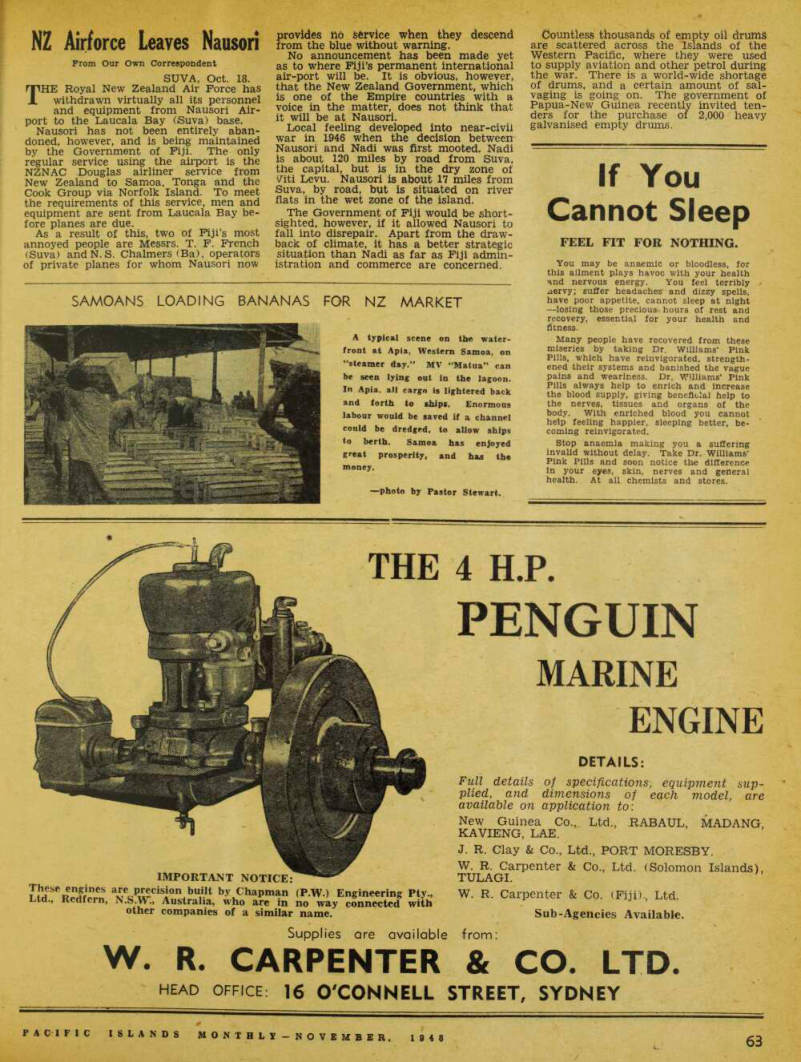
Prom Our Own Correspondent
Suva, Oct. 18.
THE Royal New Zealand Air Force has withdrawn virtually all its personnel and equipment from Nausori Air port to the Laucala Bay (Suva) base.
Nausori has not been entirely aban doned, however, and is being maintained by the Government of Fiji. The only regular service using the airport is the NZNAC Douglas airliner service from New Zealand to Samoa. Tonga and the Cook Group via Norfolk Island. To meet the requirements of this service, men and equipment are sent from Laucala Bay be fore planes are due.
As a result of this, two of Fiji’s most annoyed people are Messrs. T. F. French (Suva) andN. S. Chalmers (Ba), operators of private planes for whom Nausori now
provides ho service when they descend from the blue without warning.
No announcement has been made yet as to where Fiji’s permanent international air-port will be. It is obvious, however, that the New Zealand Government, which is one of the Empire countries with a voice in the matter, does not think that it will be at Nausori.
Local feeling developed into near-civil war in 1946 when the decision between Nausori and Nadi was first mooted. Nadi is about 120 miles by road from Suva, the capital, but is in the dry zone of Viti Levu. Nausori is about 17 miles from Suva, by road, but is situated on river flats in the wet zone of the island.
The Government of Fiji would be short sighted, however, if it allowed Nausori to fall into disrepair. Apart from the draw back of climate, it has a better strategic situation than Nadi as far as Fiji admin istration and commerce are concerned.
Countless thousands of empty oil drums are scattered across the Islands of the Western Pacific, where they were used to supply aviation and other petrol during the war. There is a world-wide shortage of drums, and a certain amount of sal vaging is going on. The government of Papua-New Guinea recently invited ten ders for the purchase of 2,000 heavy galvanised empty drums.
Samoans Loading Bananas For Nz Market
A typical scene on the water front at Apia, Western Samoa, on “steamer day.” MV “Matua” can be seen lying oat in the lagoon.
In Apia, all cargo is lightered back and forth to ships. Enormous labour would be saved if a channel could be dredged, to allow ships to berth. Samoa has enjoyed great prosperity, and has the money. —photo by Pastor Stewart.
Advertisements & other items, pp. 65-66 (1 item)
Penguin
If You
Cannot Sleep
FEEL FIT FOR NOTHING.
You may be anaemic or bloodless, for this ailment plays havoc with your health and nervous energy. You feel terribly xieivy, suffer headaches and dizzy spells, have poor appetite, cannot sleep at night —losing those precious hours of rest and recovery, essential for your health and fitness.
Many people have recovered from these miseries by taking Dr. Williams’ Pink Pills, which have reinvigorated, strengthened their systems and banished the vague pains and weariness. Dr. Williams’ Pink Pills always help to enrich and increase the blood supply, giving beneficial help to the nerves, tissues and organs of the body. With enriched blood you cannot help feeling happier, sleeping better, becoming reinvigorated.
Stop anaemia making you a suffering invalid without delay. Take Dr. Williams’
Pink Pills and soon notice the difference in your eyes, skin, nerves and general health. At all chemists and stores.
I
THE 4 H.P.
IMPORTANT NOTICE:
M h rt Sf, Rr,ff'™ a i e c P , r .r Cis i 0n . bu . ilt by Chapman (P.W.) Engineering Pty., Ltd., Kedfern, N.S.W., Australia, who are in no way connected with other companies of a similar name.
PENGUIN
MARINE
ENGINE
DETAILS:
Full details of specifications, equipment supplied, and dimensions of each model, are available on application to: New Guinea Co., Ltd., RABAUL, MADANG,
KAVIENG, LAE.
J. R. Clay & Co., Ltd., PORT MORESBY.
W. R. Carpenter & Co., Ltd. (Solomon Islands),
TULAGI.
W. R. Carpenter & Co. (Fiji)., Ltd.
Sub-Agencies Available.
Supplies are available from:
W. R. CARPENTER & CO. LTD.
head OFFICE: 16 O'CONNELL STREET, SYDNEY
DON'T SAY I M
GIM DON'T SAY
DON'T SAT © I M
T
I N DON'T SAY
DON'T SAY GIN
GIN DON'T SAY
DON'T SAY GIN
GIN DON'T SAY
DON'T 'SAY G I M
GIN DON'T SAY
DON'T SAY G I N
GIN DON'T SAY
W MT
DON'T SAY |f ill
DON'T SAY GIN
«■!««■ 'SSSSk Y
I'N DON'T SAY
DON'T SAY G I N
GIN DON'T SAY
DON'T SAY G I N
GIN DON'T SAY
DON'T SAY G I N
15 I M DON'T SAY
DON'T SAY G I N<
GIN DON'T SAY
DON'T SAY G I N
GIN DON'T SAY
DON'T SAY G I N
DON'T SAY Ip IM
G SAY
DON'T SAY G I N
I M DON'T SAY
DON'T SAY GIM
DON'T SAY
m
DON
0 s *
II OU
I T 0 °Ur * ne c Oc ey
DON'T
fj I M DON'T S
DON'T SAY GIM
DON'T SAY GIM
G SAY
DON
G D AY M
SAY
IM
'T SAY
DON'T I M
DON'T SAY GIM
GIM DON'T SAY
DON'T SAY GIM
DON'T SAY
M Y S AY G/<V L *ou M iro °urn * c °c tr.
SAY
*tis S ydn * **IS e y IN r *3b
T SAY
11M
DON'T
GIM DON'T
DON'T SAY G I
DON'T
Telegrams and Cables: “GILBETS,” Melbourne Address all inquiries to:
W. & A. GILBEY LTD.
33 ROSSLYN STREET, WEST MELBOURNE.
Telegrams and Cables: “GILBETS,” Sydney.
109 REGENT STREET, SYDNEY.
Gatty: A Man Who Gets Things Done

By R. W. Robson
A TUNA-FISHING industry on the American scale —which means that it is big, all blue-printed well in advance, and heavily financed (the Ameri can principle in business, as in war, is never to send a boy on a man’s errand) is now being established in Fiji. This week, in Australian newspapers, adver tisements invite applications from persons competent to fill some big and well-paid jobs in this new enterprise.
I, naturally, am interested in the big plan; but I am more interested in the brain behind it all. It is the conception of 45-years-old Tasmania, Harold Gatty, who already has achieved distinction in three other fields.
Gatty was educated in Hobart and the Royal Australian Naval College; but, while he was still in his twenties, he decided that there was little future for a navi gator in the Australian Navy, and he re signed, and went off to the United States.
No red carpets greeted the small-built, keen-looking youth with the square-jaw —in fact, he found it extremely hard to get his feet onto even the lowest rung of any kind of ladder. But. by 1931, he was a senior navigation engineer in the United States Army Air Corps, in Wash ington.
In the ensuing three years he made many useful contacts; and it was in re cognition of his technical skill as well as his tenacity of purpose that he was selected to accompany Wiley Post in his
epoch-making feat of flying a small plane right round the world, in 1934.
Thenceforward Gatty’s was a world famous name in aviation. That was his first great suc cess.
IN the ’thirties, the Aust r a 1 i a n s Kingsford Smith and Charles Ulm were pioneering air routes across the Pacific. Australia’s national “leaders” could not see the significance of the
achievements of their young men; but the meaning was clear to the restless intelli gence and keen vision of another Austra lian, Harold Gatty. Gatty somehow sold his idea to the then new and developing Pan American Airways. Australia and
New Zealand were doing nothing in re lation to trans-Pacific aviation—but they were sitting stubbornly on their landing rights. No foreign concern, said Canberra and Wellington, was going to get landing rights from them.
To the astonishment of the South Pacific world, Harold Gatty did get from the New Zealand Government, in 1935, permission for Pan American aircraft to use Auckland as an air-station. No one yet has discovered what Indian sign he employed to induce those Wellington rangitiras to put their name on the dotted line. But I think the real reason was the hypnotic power of the Gatty eye—a very clear, steady, blue eye, with a power of understanding behind it.
In these matters, Australia and New Zealand generally work as a team; but in this particular matter Canberra would not play ball with Wellington, despite everything that the usually irresistible Gatty could do.
Pan American Airways ran test flights between Honolulu and Auckland, via Kingman Reef and Pago, in 1937; but accidents in 1938 caused the postponement of the regular service. PAA had just completed the organisation, in 1940-1941. of a regular schedule, using Canton Island, Fiji, and Noumea, when the Pacific War came and caused a suspension of all civil airlines in the Pacific until 1946.
From 1935 until 1942, Harold Gatty was PAA’s representative in the Pacific, con tacting more or less hostile administra tions and slowly and patiently creating, in islands hitherto untouched by aviation, the elaborate organisation necessary if sea and land planes were to operate regularly and safely. He did a most notable job. The successful introduction of trans-ocean air transport to the South Pacific was the second outstanding achievement of Harold Gatty’s life.
(Continued Overleaf)
W.JEN the Japs came into the Pacific, and the PAA services disappeared, Gatty returned to the air as a serviceman—although he was no longer a juvenile. In a period when so many individuals gave such distinguished service, the achievements of Gatty were not noticed. I have never been able to get any information from him; but I have been told that he did a remarkably good transnou ol^6o^ 11 tn 68^ 6 ’icfvap nf AU v? ra i la x larg ? h Wh T° had , b6en CUt on in Indonesia b> the Jap advance.
Somewhere among these various performances he won the Distinguished Flying Cross of the United States; but how and when I don’t know.
TX)R many years Gatty the navigator I 1 had taken a keen interest irT the methods by which the Polynesians of the pre-European era found their wav across the vast spaces 1 of the Pacific °„ cea ? 1 - B y charting the stars, by a study of winds and currents, and by observing ce F tall i natural phenomena, they had developed a navigation technique that was
not only unknown generally to Euro peans, but was quite successful.
In the course of years, Gatty accumu lated a large amount of data on this fascinating subject, intending some day to put it into a book. Suddenly came the war, and thousands of our airmen and sailors were in danger of being cast adrift on the Pacific’s empty waters.
“A knowledge of Polynesian navigational methods might save many lives,” argued Gatty, and decided to rush his book to publication.
Any publisher or printer who has seen ‘‘The Raft Book” will understand what I mean when I say that every technician to whom he took his terrifying manu script either fainted away at the very idea of tackling that kind of printing job, or else demanded terms which would have left Gatty in debt until the millenium. But ‘‘The Raft Book” was published, and in quick time.
Gatty did not waste the precious weeks in argument. He fossicked around until he found, in New York, a printing house in which he could acquire a sufficient interest to direct operations as he wanted them; and then he printed and published “The Raft Book” himself.
Before the Pacific War was half over, the US Government was providing a special pack for every man who might find himself cast away on the Pacific— and every pack included “The Raft Book.”
It was not only a useful contribution to American equipment in the war; the shrewd business brain that functions alongside the visionary in the Gatty make-up saw to it that “The Raft Book’’ was not published and distributed at a loss. For his tenacity and courage in producing “The Raft Book,” he deserved whatever good profit he made out of the
enterprise.
I list “The Raft Book” as his third suc cessful achievement.
IN 1946, Gatty saw Pan American Air ways return to the South Pacific and restore its interrupted services; saw the stubborn Australian politicians finally grant landing-right to PAA; and then he more or less disappeared from the PAA organisation, and settled down in Suva.
He took over one of the well-known residential bungalows there, and he acquired a lovely little island, complete with residence and coconut plantation, in the romantic Lau group, a couple of days’ sail from Suva.
But there was no lotus-eating for Gatty —he was now talking, thinking and dreaming of fish. Something had directed his ever-questing mind to the fact that huge schools of tuna, and related fish, haunted those Fijian seas. The fact had been known for generations, but no one seems ever to have bothered about it.
Before long, two or three curiously shaped little ships made their head quarters among the islands in the western end of Suva harbour, and slipped away on unpublicised cruises; an occasional gentleman with “expert” written all over him came and went; and it was a matter of common beach gossip that “Gatty is fiddling around with some idea of catch ing fish.”
No new idea ever yet was hailed and praised by the gentlemen who sit in the sun on any tropical beach and scratch themselves: and Harold Gatty’s fishing plan collected the usual amount of criticism and ridicule. Gatty said noth ing—he only disappeared at regular in tervals in the general direction of the United States, and seemed very busy.
The rest is history. For a full descrip tion of the new industry, its lay-out and ramifications, see the article in another nart of this journal. It still has to prove itself; but even at this stage I am prepared to write it down as the fourth great achievement in the remarkable life of Harold Charles Gatty.
Advertisements & other items, pp. 67-68 (1 item)
£. J. Gough S. Co
Lr P (( £m: m S i m A Concord, Sydney, Home Built with “Rapid’' Blocks
RAPID” CONCRETE BLOCK & BRICK
MOULDING MACHINES
AN IMMEDIATE SOLUTION FOR HOME BUILDERS
• Capacity, 3 blocks per minute. • Semi-automatic—no tamping required. • Water tanks—well linings. • Priced to suit home-builders. • Hundreds in use. • For all building purposes.
WRITE FOR PARTICULARS TO PACIFIC ISLANDS REPRESENTATIVE
£. J. GOUGH S. CO
SUPPLIERS OF GENERAL MERCHANDISE TO LEADING FIRMS THROUGHOUT THE PACIFIC ISLANDS.
Exporters . . . Importers . . , Manufacturer s’ Representatives 1 BOND STREET, SYDNEY, AUSTRALIA. Box 3615 G.P.O. Tel. 84167 Bankers: Bank of N.EW. Bank of Adelaide. Comptolr Nat. d'Escompte de Paris.
Cable Address: '‘SEAFOODS.” SYDNEY. o<Htes: BeDtleyg ’ 2nd and Com P- Phrase; A.8.C.. sth and 6th; Peterson. 2nd and 3rd; Banking; Acme.
N. F. Maloney & Co.
Phone 268. PORT MORESBY Phone 268.
Cables, Radios, etc., “Malco,” Port Moresby.
CUSTOMS, SHIPPING, AND FORWARDING AGENTS.
LICENSED AUCTIONEERS AND GENERAL COMMISSION
AGENTS.
House, Land, and Estate Agents.
Chief Agents:
NEW ZEALAND INSURANCE CO. LTD.
(Incorporated in New Zealand) FIRE . . ACCIDENT . . MOTOR VEHICLE . . MARINE, ETC.
Importers and Exporters :: Manufacturers Representatives.
Australian Representatives : E. J. GOUGH & CO., 1 BOND STREET, SYDNEY.
Specially Prepared
to withstand
Tropical Conditions
A range of high grade, quality paints, enamels, and varnishes carefully made and manufactured to withstand the destructive forces of sun, wind, rain and heat.
PROTECTS AND PRESERVES.
parfon
HOUSE PAINTS
ROOF PAINTS
ENAMELS
VARNISHES
Automobile Lacquers and Primers, Duraflex Synthetic Enamels, Auto Enamels, Traffic Paints, Aluminium Paints, Car Wax and Polish, Gasket Cement, Radiator Cement, Hardiproof Anti-Rot Compound.
ALL TYPES OP SURFACE COATINGS.
SPARTAN— —the name that symbolises -fine quality in Paint.
Ajpents:—FlJl: Colonial Trade Development Agency of Fiji, F.O. Box 273, Suva.
Other Territories—please order through usual channels.
SPARTAN PAINTS PTY. LIMITED
102-104 King St., Melbourne, Victoria. m
PAINT
NG Association of Brisbane
THE Lyceum Club, Queen Street, Bris bane, where the monthly meetings of the Brisbane New Guinea Association are held, is still the rendezvous for many ex-Territorians. At the October meeting about 20 members were present.
Seldom is there a meeting of the clan without some Territorian dropping in.
Recently a visit was paid by Mr. Stan McCosker of “Matala,” Plantation, Rabaui.
Such visits recall happy family gather ings and social events of pre-war days in the Territory.
The members of the Brisbane Associa tion have already forged a link of friendship which neither time nor ad versity can sever.
Composed almost entirely of the fair sex, the office-bearers of the Association are an example in efficiency and decorum; and the manner in which meetings are conducted arouses the envy of many mere males.
No New Guinea visitor to Brisbane need ever feel lonely. The secretary, Mrs. A. Jamieson, will see to that. Her address is Dudley Street, Sherwood.
Phone U 7931. Meetings are held on the
second Saturday of each month.-
—J.M.H.
Brother Alphonsus, of the Marist Order, on August 27 celebrated the 60th anniver sary of his arrival in Fiji. He came from Sydney, at 24, to teach at the Roman Catholic school at Toorak, Suva, and he saw it grow into a huge organisation. The Secretary for Fijian Affairs (Ratu Sir Lala Sukuna) sent this message: “May t on behalf of the Fijians of this Colony, offer you my sincere congratulations on the celebration of the diamond jubilee of your services to education in the Colony ”
Advertisements & other items, p. 69 (1 item)
is big enough
to N* THt
our own job
The man who lives in the Islands may acquire additional responsibilities without warning. If he has been appointed executor of an estate several thousand miles away, distance alone makes it almost impossible to carry out these extra duties. In any case, he is most unlikely to possess the highly-specialised knowledge of taxation, investment and finance which efficient administration demands.
Rather than attempt two jobs, he can share the responsibility with Burns Philp Trust Company Limited. If desired, the entire task of administration can be transferred to this experienced and permanent organisation. Not only does this arrangement relieve the individual of an unsought obligation, but also ensures that the beneficiaries’ interests will be safeguarded at all times.
A full description of the Company’s services, together with much valuable information, is given in “Hands That Never Leave The Wheel”. You are invited to send for a copy of this free booklet.
DIRECTORS:
JAMES BURNS, JOSEPH MITCHELL. P. T. W. BLACK,
FREDERICK EWEN LOXTON, ERIC PRIESTLEY LEE.
MANAGER;
L. S. PARKER
SECRETARY:
E. R. OVERTON. A.F.I.A.
Burns Philp Trust
COMPANY LIMITED
EXECUTOR • TRUSTEE • AGENT
7 BRIDGE STREET, SYDNEY
Tele. B'J 5901 BOX 543, G.P.
•0.. SYDNEY JJ
BP 10-48
W. Samoa’s Healthy Financial

Position
Apia. Oct. 21.
THE second session of the Western Samoan Legislative Assembly was held between June 29 and July 12.
The proceedings have just been pub lished and deal mainly with the estimates for the current year.
The session was marked by lengthy debates, particularly in regard to the ex penditure on roads and Public works which was criticised by some Samoan and
European members as excessive, and in some instances wasteful. The High Com missioner and his officials stressed the great difficulty in getting the necessary road-making equipment and building materials. This had delayed and made costly the completion of the reading scheme in both Samoan islands.
It is clear from the debates and the subsequent report that Western Samoa is in a favourable financial position. Custom duties alone, during 1947-48 brought in £2BB,7o6—double that of 1946-47. In spite of increased wages and material costs the total accumulated cash surplus of the Territory is £607,155. As the Territory’s Treasurer pointed out. the New Assembly
takes over at a most favourable time in Western Samoa’s history.
The new estimates provide for a balanced budget of £452,755.
It was decided during the session to create separate departmental committees to control the work and expenditure of the various Government departments and make recommendations to the Assembly.
They are each composed of one European, three Samoan members of the Assembly and the Head of Department; the three Pautua are ex-officio members of all committees. Committees are Finance, to advise on all financial matters: Public Works; Hospital; and the Education Com mittee.
With the exception of some minor cuts in proposed Public Works and Education Department expenditure, the Estimates were passed by the Legislative Assembly.
W. Samoa Sells Copra To
Canada At £66A
Prom Our Own Correspondent APIA. October 21.
THE newly-created Western Samoa Copra Board has accepted an offer from Canadian buyers for the pur chase of copra at £53 per ton Samoan currency (which is equal to £66 Aus tralian) .
This is better than the current contract with the British Ministry of Food. Part of the higher price from Canada will be used to reimburse the Samoan Govern ment for the sum of £44,000 which was paid to local copra-producers and buyers for stocks held at the time of the appreciation of the Samoan £ to sterling in September.
Shipments of copra to Canada are ex pected to begin in November.
Advertisements & other items, pp. 70-72 (3 items)
Flour
PRODUCING UNIFORM GOOD RESULTS SINCE 1868
ALWAYS ASK FOR IT
Man versus Germs
When man first woke to the nature of germs and sought for means to destroy them he got a big surprise. he found that germs were easy to destroy. Carbolic acid, strong alcohol, etc., would swiftly and surely wipe out whole armies of germs. But he also found that germs were made of almost the same substance as his own living tissues. so began the patient research, the long story of trial and error. One after another antiseptic substances were discarded. Some, applied in sufficient concentration, harmed the patient as well as the germs. Others interfered with the natural healing processes. Others again were changed by the body into inert chemicals. today, with countless case histories to prove it, we have the highly efficient non-poisonous antiseptic ‘Dettol. ’
Gentle on human tissues, this non-staining antiseptic is used in all the leading hospitals of Great Britain and throughout the Empire. In your own home c Dettol ’ is the way to safety from infection. 2^
FOUR NEW SOLUS STO VES
FOUR NEW COLEMAN SOLUS STOVES that will delight the user.
Solidly constructed of heavy gauge brass. A brilliant highly polished finish, lacquered to prevent tarnishing. ..
A firmly soldered coupling, which is not removable, and detachable grate supports, combine to make a Solus Stove which is simple to assemble.
Each stove is pressure-tested at 200 pounds to the square inch (equal to 14 kilos per square centimetre).
ALL PARTS ARE INTERCHANGEABLE WITH
EUROPEAN-TYPE SOLUS STOVES.
& / i No. 5188 No. 518 B—Roarer Burner No. 519 B—Silent Burner “No. 100” Tank
MADE IN CANADA
ONLY.
No. 531 —Roarer Burner No. 532—Silent Burner “No. 1 S’or.” Tank Filler plub with butterfly cap.
MADE IN U.S.A. ONLY.
by
mum
No. 531 For full information write your Coleman representative or No. 5198 No. 532
lbs ("pieman lam
imited
9 DAVIES AVENUE
TORONTO, CANADA
- JF your gums flash a warning tinge of “pink” on your tooth brush, consult your dentist.
There may be nothing seriously wrong . . . but don’t take chances ... let your dentist decide. He may explain “a simple case of sensitive gums & gums robbed of work by to-day's soft and creamy foods". His advice will probably
Don’t risk the loss
of a
Pleasant Smile
be (< more work and resistance for lazy gums" and often, " the helpful stimulation oj Ip ana Tooth Paste and massage".
Adopt this simple dental health routine : Brush your teeth with Ipana every morning and evening, followed by vigorous gum massage with Ipana on the finger-tip. Gums become firmer, healthier; teeth brighter, more lustrous.
IPANA TOOTH PASTE
4539 — ——
70
NOVEMBER, 1948 PACIFIC ISLANDS MONTHL
Samoa—Tonga
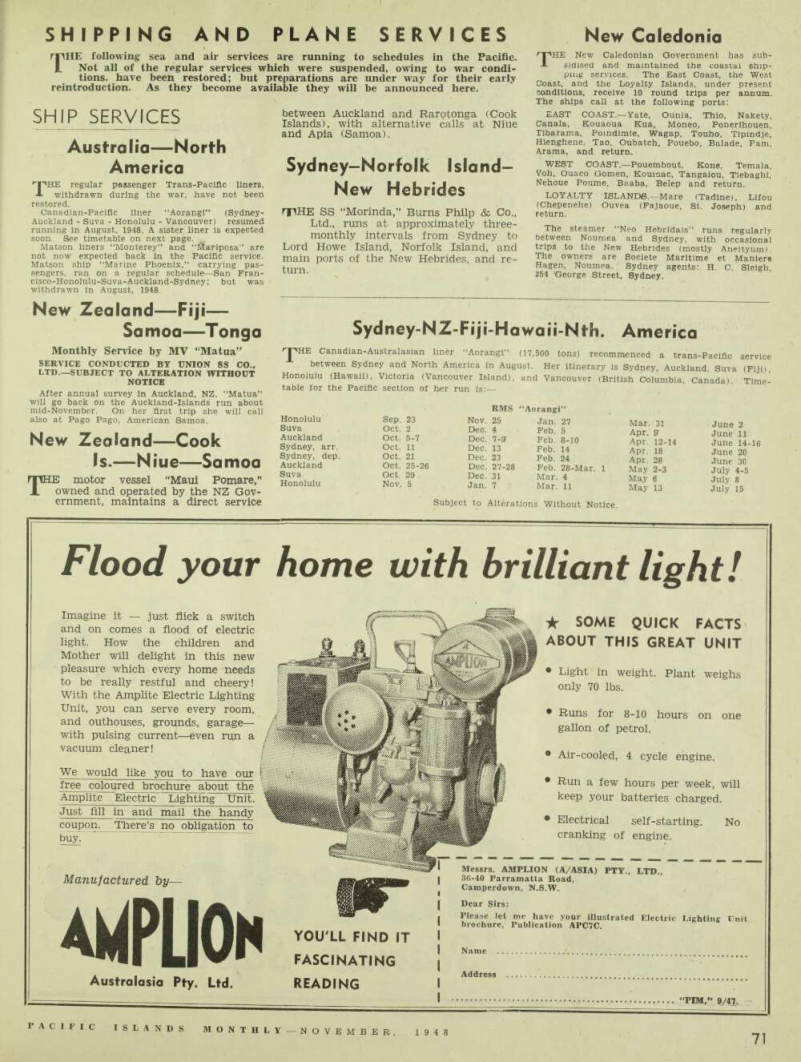
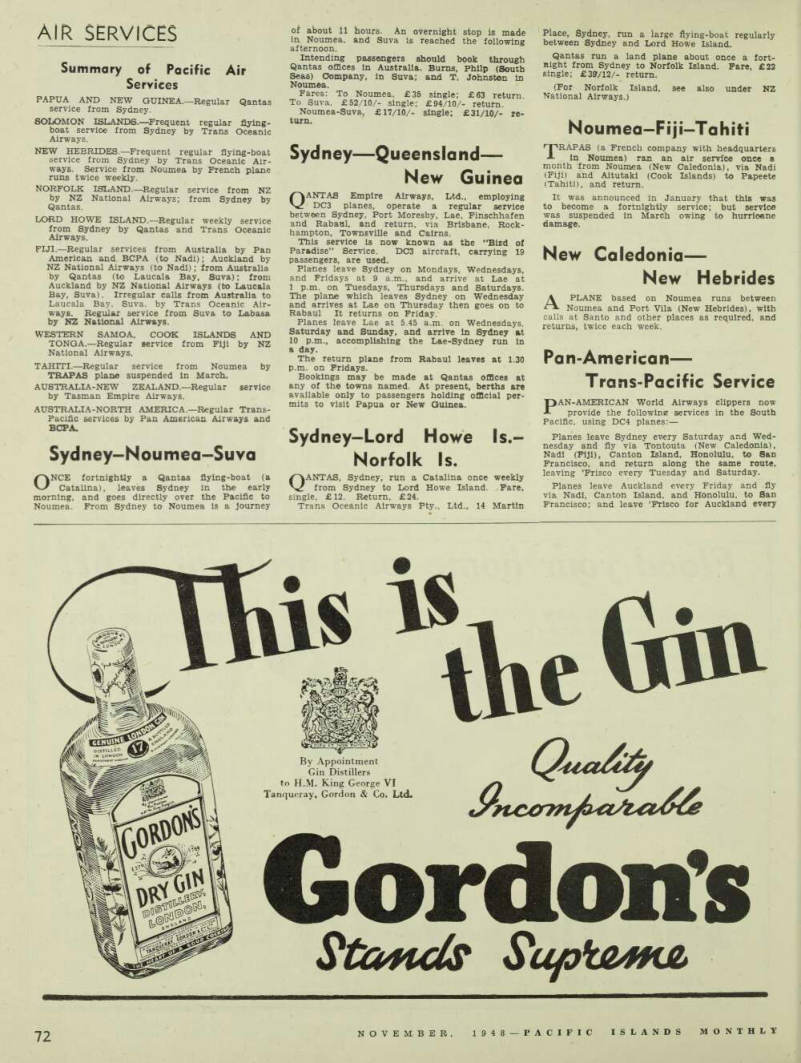
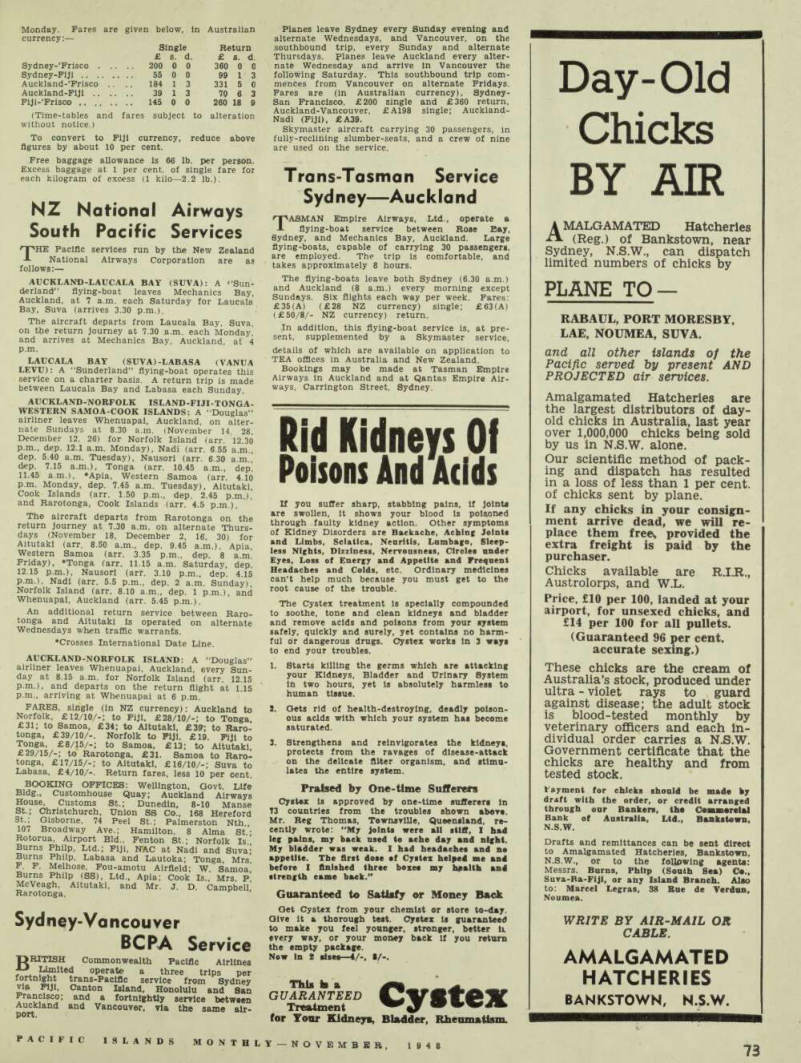
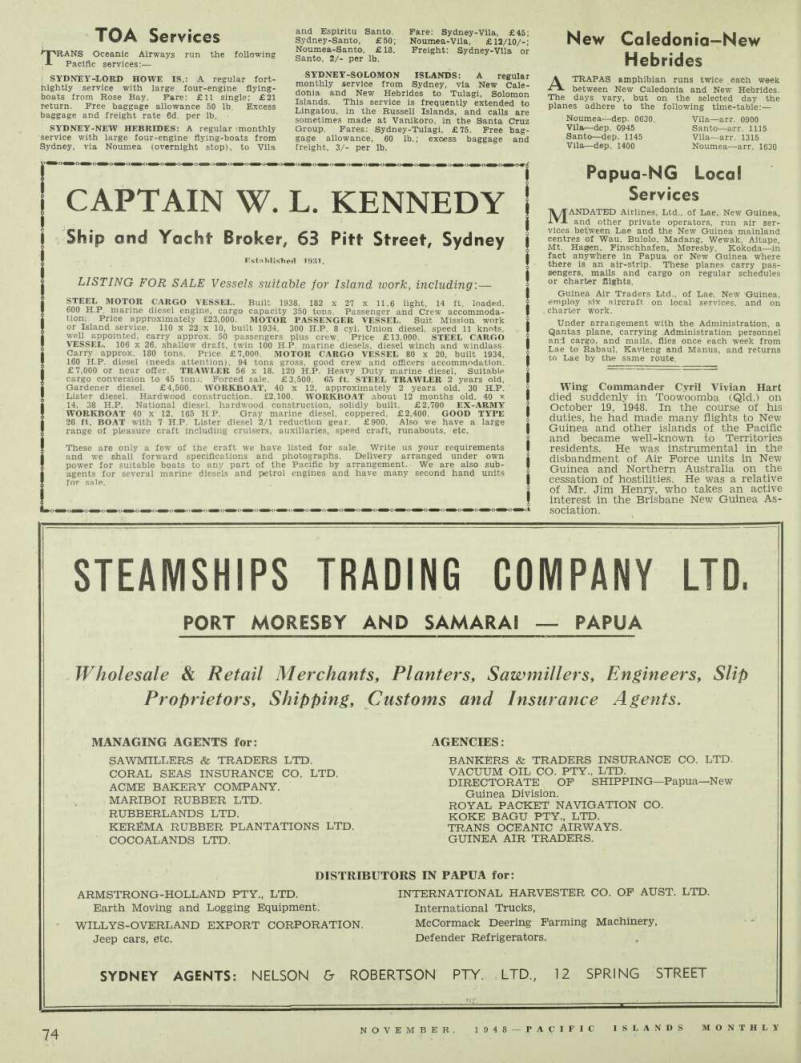
Shipping And Plane Services
THE following sea and air services are running to schedules in the Pacific.
Not all of the regular services which were suspended, owing to war condi tions. have been restored; but preparations are under way for their early reintroduction. As they become available they will be announced here.
Ship Services
Australia—North
America
THE regular passenger Trans-Pacific liners, withdrawn during the war, have not been restored.
Canadian-Pacific liner “Aorangi” (Sydney- Auckland - Suva - Honolulu - Vancouver) resumed running in August, 1948. A sister liner is expected soon. See timetable on next page. - Matson liners “Monterey” and “Mariposa” are not now expected back in the PaicifiC service.
Matson ship “Marine Phoenix,” carrying pas sengers, ran on a regular schedule —San Fran cisco-Honolulu-Suva-Auckland-Sydney; but was withdrawn in August, 1948.
New Zealand—Fiji—
Samoa—Tonga
Monthly Service by MV “Matua”
Service Conducted By Union Ss Co.,
Ltd.—Subject To Alteration Without
Notice
After annual survey In Auckland, NZ, “Matua” will go back on the Auckland-Islands run about mid-November. On her first trip she will call also at Pago Pago, American Samoa.
New Zealand—Cook
Is.—Niue—Samoa
fITHE motor vessel “Maui Pomare,"
A owned and operated by the NZ Gov
ernment, maintains a direct service
between Auckland and Rarotonga (Cook Islands), with alternative calls at Niue and Apia (Samoa).
Sydney-Nortolk Island-
New Hebrides
nPHE SS “Morinda,” Burns Philp & Co., Ltd., runs at approximately three monthly intervals from Sydney to Lord Howe Island, Norfolk Island, and main ports of the New Hebrides, and re turn.
New Caledonia
THE New Caledonian Government has sub sidised and maintained the coastal ship ping services. The East Coast, the West Coast, and the Loyalty Islands, under present conditions, receive 10 round trips per annum.
The ships call at the following ports: EAST COAST.—Yate, Ounia, Thio, Nakety, Canala, Kouaoua Kua, Moneo, Ponerlhouen, Tibarama, Pomdlmle, Wagap, Touho, Tipindje, Hienghene, Tao. Oubatch, Pouebo, Balade, Pam, Arama, and return.
WEST COAST.—Pouembout, Kone, Temala, Voh, Ouaco Gomen, Kouiaac, Tangaiou, Tiebaghl, Nehoue Poume, Baaba, Belep and return.
LOYALTY ISLANDS.—Mare (Tadine), Lifou (Chepenehe) Ouvea (Fajaoue, St. Joseph) and return.
The steamer “Neo Hebrldais" runs regularly between Noumea and Sydney, with occasional trips to the New Hebrides (mostly Aneltyumi.
The owners are Societe Maritime et Manlere Hagen, Noumea. Sydney agents: H. C. Sleigh, 254 George Street, Sydney.
Sydney-NZ-Fiji-Hawaii-Nth. America
'pHE Canadian-Australasian liner “Aorangi” (17.500 tons) recommenced a trans-Paciflc service between Sydney and North America in August. Her itinerary is Sydney, Auckland, Suva (Fiji) Honolulu (Hawaii), Victoria (Vancouver Island), and Vancouver (British Columbia. Canada). Time table for the Pacific section of her run is:—
RMS “Aorangl”
Honolulu Sep. 23 Nov. 25 Jan. 27 Mar. 31 June 2 Suva ° ct 2 Dec. 4 Feb. 5 Apr ff f, Auckland Oct. 5-7 Dec. 7-9 Feb. 8-10 Apr ? 2 -14 JuSe 14-16 Sydney, arr. Oct. 11 Dec. 13 Feb. 14 Apr 18 June 20 Sydney, dep. Oct. 21 Dec. 23 Feb. 24 Apr' 28 June 30 Auckland Oct. 25-26 Dec. 27-28 Feb. 28-Mar. 1 May 2-3 July 4-5 Suva Oct. 29 Dec. 31 Mar. 4 May 6 July 8 Honolulu Nov. 5 Jan. 7 Mar. 11 May 13 July 15 Subject to Alterations Without Notice.
Air Services
Summary of Pacific Air
Services
PAPUA AND NEW GUlNEA.—Regular Qantas service from Sydney.
SOLOMON ISLANDS.—Frequent regular flying boat service from Sydney by Trans Oceanic Airways.
NEW HEBRlDES.—Frequent regular flying-boat service from Sydney by Trans Oceanic Air ways. Service from Noumea by French plane runs twice weekly.
NORFOLK ISLAND.—Regular service from NZ by NZ National Airways; from Sydney by Qantas.
LORD HOWE ISLAND.—Regular weekly service from Sydney by Qantas and Trans Oceanic Airways.
FIJI. —Regular services from Australia by Pan American and BCPA (to Nadi); Auckland by NZ National Airways (to Nadi); from Australia by Qantas (to Laucala Bay, Suva); from Auckland by NZ National Airways (to Laucala Bay, Suva). Irregular calls from Australia to Laucala Bay. Suva, by Trans Oceanic Air ways. Regular service from Suva to Labasa by NZ National Airways.
Western Samoa, Cook Islands And
TONGA. —Regular service from Fiji by NZ National Airways.
TAHITI. —Regular service from Noumea by TRAPAS plane suspended In March.
AUSTRALIA-NEW ZEALAND.—ReguIar service by Tasman Empire Airways.
AUSTRALIA-NORTH AMERICA.—Regular Trans pacific services by Pan American Airways and
Bcpa,
Sydney-Noumea-Suva
ONCE fortnightly a Qantas flying-boat (a Catalina), leaves Sydney in the early morning, and goes directly over the Pacific to Noumea. From Sydney to Noumea is a Journey
of about il hours. An overnight stop is made in Noumea, and Suva is reached the following afternoon.
Intending passengers should book through Qantas offices in Australia. Burns, Phllp (South Seas) Company, in Suva; and T. Johnston in Noumea.
Fares: To Noumea. £35 single: £63 return To Suva. £52/10/- single; £94/10/- return.
Noumea-Suva, £l7/10/- single; £3l/10/- re turn.
Sydney—Queensland—
New Guinea
QANTAS Empire Airways, Ltd., employing DC3 planes, operate a regular service between Sydney, Port Moresby, Lae. Finschhafen and Rabanl, and return, via Brisbane, Rock hampton, Townsville and Cairns.
This service is now known as the "Bird of Paradise’’ Service. DC3 aircraft, carrying 19 passengers, are used.
Planes leave Sydney on Mondays, Wednesdays, and Fridays at 9 a.m., and arrive at Lae at 1 p.m. on Tuesdays, Thursdays and Saturdays.
The plane which leaves Sydney on Wednesday and arrives at Lae on Thursday then goes on to Rabaul It returns on Friday.
Planes leave Lae at 5.45 a.m. on Wednesdays, Saturday and Sunday, and arrive in Sydney at 10 p.m., accomplishing the Lae-Sydney run in a day.
The return plane from Rabaul leaves at 1.30 p.m. on Fridays.
Bookings may be made at Qantas offices at any of the towns named. At present, berths are available only to passengers holding official per mits to visit Papua or New Guinea.
Sydney-Lord Howe ls.-
Norfolk Is.
QANTAS, Sydney, run a Catalina once weekly from Sydney to Lord Howe Island. Fare, single. £l2. Return. £24.
Trans Oceanic Airways Pty., Ltd., 14 Martin
Place, Sydney, run a large flying-boat regularly between Sydney and Lord Howe Island.
Qantas run a land plane about once a fort night from Sydney to Norfolk Island. Fare, £22 single; £35/12/- return. (For Norfolk Island, see also under NZ National Airways.)
Noumea-Fiji-Tahiti
TRAPAS (a French company with headquarters in Noumea) ran an air service once a month from Noumea (New Caledonia), via Nadi (Fiji) and Altutaki (Cook Islands) to Papeete (Tahiti), and return.
It was announced in January that this was to become a fortnightly service; but service was suspended in March owing to hurricane damage.
New Caledonia—
New Hebrides
A PLANE based on Noumea runs between Noumea and Port Vila (New Hebrides), with calls at Santo and other places as required, and returns, twice each week.
Pan-American—
Trans-Pacific Service
PAN-AMERICAN World Airways clippers now provide the followine services in the South Pacific, using DC4 planes:— Planes leave Sydney every Saturday and Wed nesday and fly via Tontouta (New Caledonia), Nadi (Fiji), Canton Island, Honolulu, to San Francisco, and return along the same route, leaving ’Frisco every Tuesday and Saturday.
Planes leave Auckland every Friday and fly via Nadi, Canton Island, and Honolulu, to San Francisco: and leave ’Frisco for Auckland every
Monday. Pares are given below, in Australian currency:—
(Time-tables and fares subject to alteration without notice.) To convert to Fiji currency, reduce above figures by about 10 per cent.
Free baggage allowance is 66 lb. per person.
Excess baggage at 1 per cent, of single fare for each kilogram of excess (1 kilo —2.2 lb.).
NZ National Airways
South Pacific Services
THE Pacific services run by the New Zealand National Airways Corporation are as follows:
Auckland-Laucala Bay (Suva): A “Sun
derland” flying-boat leaves Mechanics Bay, Auckland, at 7 a.m. each Saturday for Laucala Bay, Suva (arrives 3.30 p.m.).
The aircraft departs from Laucala Bay. Suva, on the return Journey at 7.30 a.m. each Monday, and arrives at Mechanics Bay, Auckland, at 4 p.m.
Laucala Bay (Suva) -Labasa (Vanua
LEVU): A “Sunderland” flying-boat operates this service on a charter basis. A return trip is made between Laucala Bay and Labasa each Sunday,
Auckland-Norfolk Island-Fiji-Tonga
Western Samoa-Cook Islands: A “Douglas”
airliner leaves Whenuapal, Auckland, on alter nate Sundays at 8.30 a.m. (November 14, 28.
December 12. 26) for Norfolk Island (arr. 12.30 p.m., dep. 12.1 a.m. Monday), Nadi (arr. 6.55 a.m., dep. 5.40 a.m. Tuesday), Nausori (arr. 6.30 a.m., dep. 7.15 a.m.), Tonga (arr. 10.45 a.m., dep. 11.45 a.m.), ‘Apia, Western Samoa (arr. 4.10 p.m. Monday, dep. 7.45 a.m. Tuesday), Aitutaki, Cook Islands (arr. 1.50 p.m., dep. 2.45 p.m.), and Rarotonga, Cook Islands (arr. 4.5 p.m.).
The aircraft departs from Rarotonga on the return journey at 7.30 a.m. on alternate Thurs days (November 18, December 2, 16, 30) for Aitutaki (arr. 8.50 a.m., dep. 9.45 a.m.), Apia, Western Samoa (arr. 3.35 p.m., dep, 8 a.m Friday), ‘Tonga (arr. 11.15 a.m. Saturday, dep. 12.15 p.m.), Nausori (arr. 3.10 p.m., dep. 4.15 p.m.), Nadi (arr. 5.5 p.m., dep. 2 a.m. Sunday), Norfolk Island (arr. 8.10 a.m., dep. 1 p.m.), and Whenuapal, Auckland (arr. 5.45 p.m.).
An additional return service between Raro tonga and Aitutaki is operated on alternate Wednesdays when traffic warrants. •Crosses International Date Line.
Auckland-Norfolk Island: A “Douglas”
airliner leaves Whenuapal, Auckland, every Sun day at 8.15 a.m. for Norfolk Island (arr. 12.15 p.m.), and departs on the return flight at 1.15 p.m., arriving at Whenuapai at 6 p.m.
FARES, single (in NZ currency): Auckland to Norfolk. £l2/10/-; to Fiji, £2B/10/-; to Tonga £3l; to Samoa, £34; to Aitutaki. £39; to Raro tonga, £39/10/-. Norfolk to FIJI, £l9. Fiji to Tonga, £B/15/-; to Samoa, £l3; to Aitutaki £29/15/-; to Rarotonga, £3l. Samoa to Raro tonga, £l7/15/-; to Aitutaki, £l6/10/-; Suva to Labasa, £4/10/-. Return fares, less 10 per cent.
BOOKING OFFICES: Wellington, Govt. Life Bldg., Customhouse Quay; Auckland Airways House, Customs St.; Dunedin, 8-10 Manse St.; Christchurch, Union SS Co., 168 Hereford St.; Gisborne, 74 Peel St.; Palmerston Nth , 107 Broadway Ave.; Hamilton, 8 Alma St.; Rotorua, Airport Bid., Fenton St.; Norfolk Is Burns Philp, Ltd.; Fiji, NAC at Nadi and Suva; Burns Philp, Labasa and Lautoka; Tonga, Mrs F. F. Melhose, Fou-amotu Airfield; W. Samoa, Burns Philp (SS), Ltd., Apia; Cook Is., Mrs. P McVeagh, Aitutaki, and Mr. J. D. Campbell' Rarotonga. ’
Sydney-Vancouver
BCPA Service
DRITISH Commonwealth Pacific Airlines Limited operate a three trips per fortnight trans-Paclflc service from Sydney via Fiji, Canton Island. Honolulu and San Francisco; and a fortnightly service between Auckland and Vancouver, via the same air port.
Planes leave Sydney every Sunday evening and alternate Wednesdays, and Vancouver, on the southbound trip, every Sunday and alternate Thursdays, planes leave Auckland every alter nate Wednesday and arrive in Vancouver the following Saturday. This southbound trip com mences from Vancouver on alternate Fridays.
Pares are (in Australian currency), Sydney- San Francisco. £2OO single and £360 return, Auckland-Vancouver, £AI9B single; Auckland- Nadi (Fiji), £A39.
Skymaster aircraft carrying 30 passengers, in fully-reclining slumber-seats, and a crew of nine are used on the service.
Trons-Tasman Service
Sydney—Auckland
TASMAN Empire Airways, Ltd., operate a flying-boat service between Rose Bay.
Sydney, and Mechanics Bay, Auckland. Large flying-boats, capable of carrying 30 passengers, are employed. The trip is comfortable, and takes approximately 8 hours.
The flying-boats leave both Sydney (6.30 a.m.) and Auckland (8 a.m.) every morning except Sundays. Six flights each way per week. Fares: £35 (A) (£2B NZ currency) single; £63 (A) (£5O/8/- NZ currency) return.
In addition, this flying-boat service is, at pre sent, supplemented by a Skymaster service, details of which are available on application to TEA offices in Australia and New Zealand.
Bookings may be made at Tasman Empire Airways in Auckland and at Qantas Empire Air ways, Carrington Street, Sydney.
Single Return £ s. d. £ s. d.
Sydney-’Frisco 200 0 0 360 0 0 Sydney-Pljl 55 0 0 99 1 3 Auckland-’Frisco .. .. 184 1 3 331 5 0 Auckland-Pljl 39 1 3 70 6 3 Piji-’Frlsco 145 0 0 260 18 9
TOA Services
tRANS Oceanic Airways run the following Pacific services:— SYDNEY-LORD HOWE IS.: A regular fort nightly service with large four-engine flying boats from Rose Bay. Fare; £ll single; £2l return. Free baggage allowance 50 lb. Excess baggage and freight rate 6d. per lb.
SYDNEY-NEW HEBRIDES: A regular monthly service with large four-engine flying-boats from Sydney, via Noumea (overnight stop), to Vila
and Espiritu Santo. Fare: Sydney-Vila, £45; Sydney-Santo, £5O; Noumea-Vila, £l2/10/-; Noumea-Santo, £lB. Freight: Sydney-Vlla or Santo, 2/- per lb.
Sydney-Solomon Islands: A Regular
monthly service from Sydney, via New Cale donia and New Hebrides to Tulagi, Solomon Islands. This service is frequently extended to Lingatou, in the Russell Islands, and calls are sometimes made at Vanikoro, in the Santa Cruz Group. Fares: Sydney-Tulagi, £75. Free bag gage allowance, 60 lb.; excess baggage and freight, 3/- per lb.
New Caledonia-New
Hebrides
ATRAPAS amphibian runs twice each week between New Caledonia and New Hebrides.
The days vary, but on the selected day the planes adhere to the following time-table:— Noumea—dep. 0630. Vila—arr. 0900 Vila—dep. 0945 Santo—arr. 1115 Santo—dep. 1145 Vila—arr. 1315 Vila—dep. 1400 Noumea—arr. 1630
Papua-NG Local
Services
MANDATED Airlines, Ltd., of Lae, New Guinea, and other private operators, run air ser vices between Lae and the New Guinea mainland centres of Wau, Bulolo, Madang, Wewak, Aitape, Mt. Hagen, Finschhafen, Moresby, Kokoda—in fact anywhere in Papua or New Guinea where there is an air-strip. These planes carry pas sengers, mails and cargo on regular schedules or charter flights.
Guinea Air Traders Ltd., of Lae. New Guinea, employ six aircraft on local services, and on charter work.
Under arrangement with the Administration, a Qantas plane, carrying Administration personnel and cargo, and mails, flies once each week from Lae to Rabaul, Kavieng and Manus, and returns to Lae by the same route.
Wing Commander Cyril Vivian Hart died suddenly in Toowoomba (Qld.) on October 19, 1948. In the course of his duties, he had made many flights to New Guinea and other islands of the Pacific and became well-known to Territories residents. He was instrumental in the disbandment of Air Force units in New Guinea and Northern Australia on the cessation of hostilities. He was a relative of Mr. Jim Henry, who takes an active interest in the Brisbane New Guinea As sociation.
Advertisements & other items, pp. 73-76 (2 items)
Pacific Islands Monthly—N O V E M B E R , 1948
amPLlOh
Flood your home with brilliant light!
Imagine it just flick a switch and on comes a flood of electric light. How the children and Mother will delight in this new pleasure which every home needs to be really restful and cheery!
With the Amplite Electric Lighting Unit, you can serve every room, and outhouses, grounds, garage— with pulsing current—even run a vacuum cleaner! buy.
Manufactured by-
amPLlOh
Australasia Pty. Ltd.
m
• SOME QUICK FACTS
ABOUT THIS GREAT UNIT
• Light in weight. Plant weighs only 70 lbs. • Runs for 8-10 hours on one gallon of petrol. • Air-cooled, 4 cycle engine. • Run a few hours per week, will keep your batteries charged. • Electrical self-starting. No cranking of engine.
YOU'LL FIND IT
FASCINATING
READING
Messrs. AMPLION (A/ASIA) PTY., LTD.,
36-40 Parramatta Road, Camperdown, N.S.W.
Dear Sirs: Please let me have your illustrated Electric Lighting Unit brochure, Publication APC7C.
Name Address
“PIM," 9/47.
9srz<\ &
ffil
m
IfIfSLSsJ
By Appointment Gin Distillers to H.M. King George VI Tanqueray, Gordon & Co. Ltd*
Gordon's
Stands Supk£/Hi&
Day-Old
Chicks
BY AIR
Amalgamated Hatcheries
(Reg.) of Bankstown, near Sydney, N.S.W., can dispatch limited numbers of chicks by
PLANE TO
RABAUL, PORT MORESBY,
LAE, NOUMEA, SUVA.
and all other islands of the Pacific served by present AND PROJECTED air services.
Amalgamated Hatcheries are the largest distributors of dayold chicks in Australia, last year over 1,000,000 chicks being sold by us in N.S.W. alone.
Our scientific method of packing and dispatch has resulted in a loss of less than 1 per cent, of chicks sent by plane.
If any chicks in your consignment arrive dead, we will replace them free, provided the extra freight is paid by the purchaser.
Chicks available are R.1.R., Austrolorps, and W.L.
Price, £lO per 100, landed at your airport, for unsexed chicks, and £l4 per 100 for all pullets. (Guaranteed 96 per cent, accurate sexing.) These chicks are the cream of Australia’s stock, produced under ultra - violet rays to guard against disease; the adult stock is blood-tested monthly by veterinary officers and each individual order carries a N.S.W.
Government certificate that the chicks are healthy and from tested stock.
Payment for chicks should be made by draft with the order, or credit arranged through our Bankers, the Commercial Bank of Australia, Ltd., Bankstown,
N.S.W.
Drafts and remittances can be sent direct to Amalgamated Hatcheries, Bankstown, N.S.W., or to the following agents: Messrs. Burns, Phitp (South Sea) Co., Suva-Ba-Fiji, or any Island Branch. Also to: Marcel Legras, 38 Bne de Verdun, Noumea.
WRITE BY AIR-MAIL OR
CABLE.
AMALGAMATED
HATCHERIES
BANKSTOWN, N.S.W.
Rid Kidneys Of
Poisons And Acids
If you suffer sharp, stabbing pains, If Joint* are swollen, It shows your blood Is poisoned through faulty kidney action. Other symptoms of Kidney Disorders are Backache, Aching Joints and Limbs, Sciatica, Neuritis, Lumbago, Sleepless Nights, Dizziness, Nervousness, Circles under Eyes, Loss of Energy and Appetite and Frequent Headaches and Colds, etc. Ordinary medicines can’t help much because you must get to the root cause of the trouble.
The Cystex treatment Is specially compounded to soothe, tone and clean kidneys and bladder and remove acids and poisons from your system safely, quickly and surely, yet contains no harmful or dangerous drugs. Cystex works In 3 ways to end your troubles. 1. Starts killing the germs which are attacking your Kidneys. Bladder and Urinary System in two hours, yet Is absolutely harmless to human tissue.
X. Gets rid of health-destroying, deadly poisonous acids with which your system has become saturated. 3. Strengthens and reinvigorates the kidneys, protects from the ravages of disease-attack on the delicate filter organism, and stimulates the entire system.
Praised by One-time Sufferers Cystex Is approved by one-time sufferers in 73 countries from the troubles shown above.
Mr. Reg Thomas, Townsville, Queensland, recently wrote: “My Joints were all stiff, I had leg pains, my back used to ache day and night.
My bladder was weak. I had headaches and no appetite. Tbe first dose of Cystex helped me and before I finished three boxes my health and strength came back.”
Guaranteed to Satisfy or Money Back Get Cystex from your chemist or store to-day.
Give it a thorough test. Cystex is guaranteed to make you feel younger, stronger, better U every way, or your money back If you return the empty package.
Now in * slses—4/-, •/-.
GUARANTEED
Treatment
for Tour Kidneys, Bladder, Rheumatism.
CAPTAIN W. L. KENNEDY
Ship ond Yacht Broker, 63 Pitt Street, Sydney Established 1931.
LISTING FOR SALE Vessels suitable for Island work, including : STEEL MOTOR CARGO VESSEL. Built 1938, 182 x 27 x 11.6 light, 14 ft. loaded. 600 H.P. marine diesel engine, cargo capacity 350 tons. Passenger and Crew accommodation; Price approximately £23,000. MOTOR PASSENGER VESSEL. Suit Mission work or Island service. 110 x 22 x 10, built 1934. 300 H.P. 8 cyl. Union diesel, speed 11 knots, well appointed, carry approx. 50 passengers plus crew. Price £13,000. STEEL CARGO VESSEL. 106 x 26, shallow draft, twin 100 HP. marine diesels, diesel winch and windlass.
Carry approx. 180 tons. Price £7,000. MOTOR CARGO VESSEL 80 x 20, built 1934, 160 H.P. diesel (needs attention), 94 tons gross, good crew and officers accommodation. £7,000 or near offer. TRAWLER 56 x 18. 120 H.P. Heavy Duty marine diesel, Suitable cargo conversion to 45 tons. Forced sale. £3,500. 65 ft. STEEL TRAWLER 2 years old.
Gardener diesel. £4,500. WORKBOAT, 40 x 12, approximately 2 years old. 30 H.P.
Lister diesel. Hardwood construction. £2,100. WORKBOAT about 12 months old. 40 x 14, 38 H.P. National diesel, hardwood construction, solidly built. £2,700 EX-ARMY W'ORKBOAT 40 x 12. 165 HP. Gray marine diesel, coppered, £2,400. GOOD TYPE 26 ft. BOAT with 7 H.P. Lister diesel 2/1 reduction gear. £9OO, Also we have a large range of pleasure craft including cruisers, auxiliaries, speed craft, runabouts, etc.
These are only a few of the craft we have listed for sale. Write us your requirements and we shall forward specifications and photographs. Delivery arranged under own power for suitable boats to any part of the Pacific by arrangement. We are also subagents for several marine diesels and petrol engines and have many second hand units
STEAMSHIPS TRADING COMPANY LTD.
PORT MORESBY AND SAMARAS PAPUA
Wholesale & Retail Merchants , Planters , Sawmillers , Engineers , 5///> Proprietors , Shipping , Customs and Insurance Agents .
MANAGING AGENTS for:
SAWMILLERS & TRADERS LTD.
CORAL SEAS INSURANCE CO. LTD.
ACME BAKERY COMPANY.
MARIBOI RUBBER LTD.
RUBBERLANDS LTD.
KERtfMA RUBBER PLANTATIONS LTD.
COCOALANDS LTD.
AGENCIES:
BANKERS & TRADERS INSURANCE CO. LTD.
VACUUM OIL CO. PTY., LTD.
DIRECTORATE OF SHIPPING—Papua—New
Guinea Division.
ROYAL PACKET NAVIGATION CO.
KOKE BAGU PTY., LTD.
TRANS OCEANIC AIRWAYS.
GUINEA AIR TRADERS.
DISTRIBUTORS IN PAPUA for:
ARMSTRONG-HOLLAND PTY., LTD. INTERNATIONAL HARVESTER CO. OP AUST. LTD.
Earth Moving and Logging Equipment. International Trucks, WILLYS-OVERLAND EXPORT CORPORATION. McCormack Deering Farming Machinery, Jeep cars, etc. Defender Refrigerators.
SYDNEY AGENTS: NELSON & ROBERTSON PTY. LTD., 12 SPRING STREET
Pacific Islands
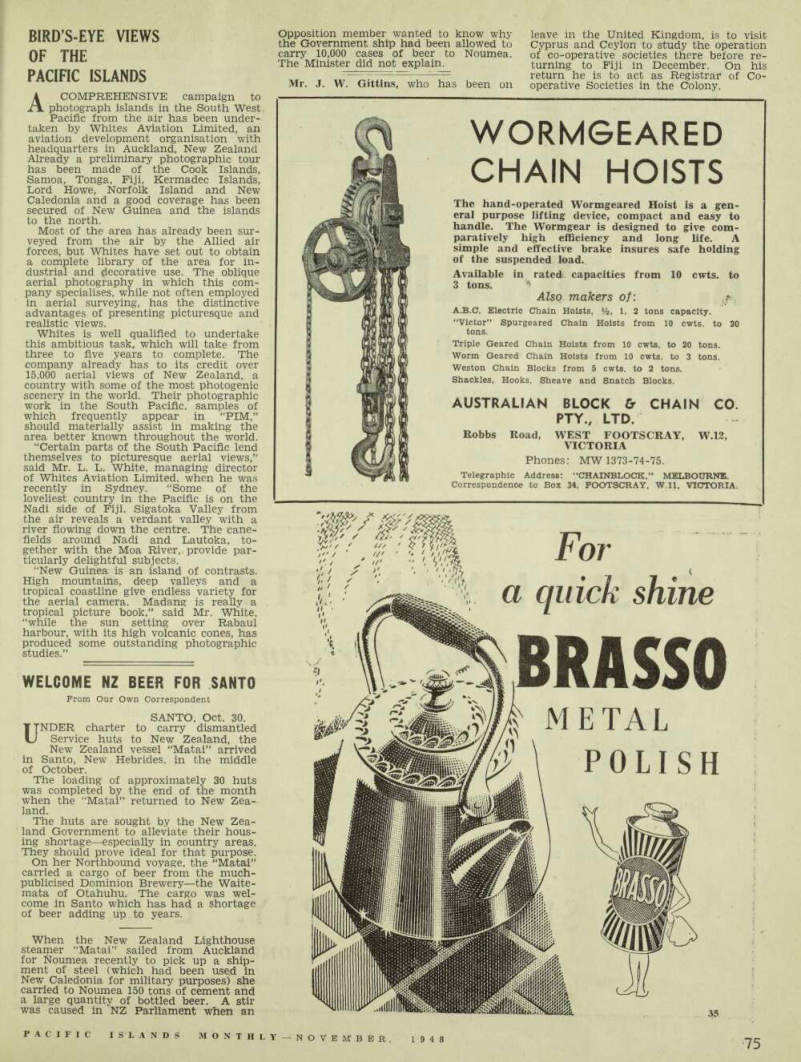
Bird’S-Eye Views
Of The
A COMPREHENSIVE campaign to photograph islands in the South West Pacific from the air has been under taken by Whites Aviation Limited, an aviation development organisation with headquarters in Auckland, New Zealand Already a preliminary photographic tour has been made of the Cook Islands, Samoa, Tonga, Fiji, Kermadec Islands, Lord Howe, Norfolk Island and New Caledonia and a good coverage has been secured of New Guinea and the islands to the north.
Most of the area has already been sur veyed from the air by the Allied air forces, but Whites have set out to obtain a complete library of the area for in dustrial and decorative use. The oblique aerial photography in which this com pany specialises, while not often employed in aerial surveying, has the distinctive advantages of presenting picturesque and realistic views.
Whites is well qualified to undertake this ambitious task, which will take from three to five years to complete. The company already has to its credit over 15,000 aerial views of New Zealand, a country with some of the most photogenic scenery in the world. Their photographic work in the South Pacific, samples of which frequently appear in “PIM,” should materially assist in making the area better known throughout the world.
“Certain parts of the South Pacific lend themselves to picturesque aerial views,” said Mr. L. L. White, managing director of Whites Aviation Limited, when he was recently in Sydney. “Some of the loveliest country in the Pacific is on the Nadi side of Fiji. Sigatoka Valley from the air reveals a verdant valley with a river flowing down the centre. The cane fields around Nadi and Lautoka, to gether with the Moa River, provide par ticularly delightful subjects.
“New Guinea is an island of contrasts.
High mountains, deep valleys and a tropical coastline give endless variety for the aerial camera. Madang is really a tropical picture book,” said Mr. White, “while the sun setting over Rabaul harbour, with its high volcanic cones, has produced some outstanding photographic studies.”
Welcome Nz Beer For Santo
Prom Our Own Correspondent
Santo. Oct. 30.
UNDER charter to carry dismantled Service huts to New Zealand, the New Zealand vessel “Matai” arrived in Santo, New Hebrides, in the middle of October.
The loading of approximately 30 huts was completed by the end of the month when the “Matai” returned to New Zea land.
The huts are sought by the New Zea land Government to alleviate their hous ing shortage—especially in country areas.
They should prove ideal for that purpose.
On her Northbound voyage, the “Matai” carried a cargo of beer from the much publicised Dominion Brewery—the Waite mata of Otahuhu. The cargo was wel come in Santo which has had a shortage of beer adding up to years.
When the New Zealand Lighthouse steamer “Matai” sailed from Auckland for Noumea recently to pick up a ship ment of steel (which had been used in New Caledonia for military purposes) she carried to Noumea 150 tons of cement and a large quantity of bottled beer. A stir was caused in NZ Parliament when an
Opposition member wanted to know why the Government ship had been allowed to carry 10,000 cases of beer to Noumea.
The Minister did not explain.
Mr. J. W. Gittins, who has been on
leave in the United Kingdom, is to visit Cyprus and Ceylon to study the operation of co-operative societies there before re turning to Fiji in December. On his return he is to act as Registrar of Co operative Societies in the Colony.
Advertisements & other items, p. 77 (2 items)
75
PACIFIC ISLANDS MONTHLY-N O V E M B E R , 1948
Brasso
WORMGEARED
CHAIN HOISTS
The hand-operated Wormgeared Hoist is a general purpose lifting device, compact and easy to handle. The Wormgear is designed to give comparatively high efficiency and long life. A simple and effective brake insures safe holding of the suspended load.
Available in rated capacities from 10 cwts. to 3 tons. M Also makers of: A.B.C. Electric Chain Holsts, V 2, 1, 2 tons capacity.
“Victor” Spurgeared Chain Holsts from 10 cwts. to 20 tons.
Triple Geared Chain Hoists from 10 cwts. to 20 tons.
Worm Geared Chain Holsts from 10 cwts. to 3 tons.
Weston Chain Blocks from 5 cwts. to 2 tons.
Shackles, Hooks, Sheave and Snatch Blocks.
AUSTRALIAN BLOCK Cr CHAIN CO.
PTY., LTD.
Robbs Road, WEST FOOTSCRAY, W. 12,
VICTORIA
Phones: MW 1373-74-75.
Telegraphic Address: “ CHAINS LOCK,” MELBOURNE.
Correspondence to Box 34. FOOTSCRAY, W.ll, VICTORIA.
w/»m 1%",' ✓ ft/, / /Zk Stor -!> SI &ftgS 8k&
For
a quick shine
BRASSO
METAL
POLISH
1 If 35
Nestegg From NZ Tour
Fiji Cricket Association’s Nestegg From NZ Tour
From Our Own Correspondent
Suva. Oct. 24.
DUE to the phenomenally successful Fijian cricket tour of New Zealand, the Fiji Cricket Association ended its year on September 30 with nearly £7OO in hand. Over £660 was profit on the tour.
The Association’s annual report states that very generous Fijian financial help for the tour came from all parts of the Colony, as well as from a number of Euro pean supporters.
Mother of Pearl Shell, worth about £250,000, was produced in Queensland for the year ended June 30, 1948. Eighty per cent, of shell was sold in America and earned about $600,000 (£187,602).
Fiji Warned Against
Soil Erosion
THERE is reason for concern over soil erosion in Fiji and all possible methods should be adopted to arrest it.
This is the opinion of Dr. G. K. Cumber land, head of the Department of Geography, Auckland University, who was making a survey in Fiji in October.
“It is time,” said Dr. Cumberland, “that the people who use the soil—Fijians, Indians and Europeans alike —appreciated better how valuable it is. how easily it is destroyed, and how costly its wastage must be in terms of decreased yields and lowered living standards for all the people in the Colony.”
Bell-Monk Wedding
THE new Rector of Holy Trinity Pro- Cathedral, Suva, Fiji, the Rev. H. W.
Figgess, officiated at his first wedding in Fiji when Miss Margery Culford Bell, of Taupo, New Zealand, was married to Mr. Kenneth Arthur Monk, second son of Mr. and Mrs. C. A. Monk, of Sigatoka.
The bride was given away by Mr.
Gordon Fraser. The bridesmaid was Miss Joan Mclntosh; Mr. Charles Kuhn was best man.
The entire bridal party—bride, bride groom, bridesmaid, best man and Mr.
Fraser —had seen war service overseas.
A pearl recently found by a Torres Strait Islander in North Queensland waters has been sold for £550. Islanders have virtually replaced Asiatic labour in the pearl industry and to-day, under the control of the Queensland Government, own and work approximately 40 luggers and cutters.
Advertisements & other items, pp. 78-80 (3 items)
A. B. Donald Ltd.
AUCKLAND
ISLAND TRADERS & GENERAL MERCHANTS
P.O. Box 1509. Cables £r Telegrams, "Kingdom/ 7 Auckland.
C. Sullivan Pty. Ltd.
Island Me
Over 30 years' experience in the Pacific Island Trade.
Expert Buying Service Original Invoices Furnished Sellers of Island Produce.
Represented in all Australian States, New Zealand, England, France, United States, etc.
BANKERS : Bank of New South Wales, Comptoir National d’Escompte de Paris, Bank of New Zealand.
C. SULLIVAN PTY. LTD.
379 KENT STREET, SYDNEY
Telegrams & Cables: CHASULL, Sydney. Phone: MJ4657 (6 lines).
KODAK FILMS
and all Photographic Supplies
WHOLESALE AND RETAIL
CAINE'S STUDIOS
P.O. Box 8 Photographers. Est. 1904.
Write for free price lists.
AUNT
MARYS
BAKING POWDER
For the best in delicious baking results A product of TILLOCK AND CO. PTY. LTD. manufacturers of all the famous Aunt Mary s Pure Foods
% m
To sharpen
appetite there is nothing like
Colmans Mustard
TILLEY LAMPS
BURN ORDINARY KEROSENE
The Modern Form of PORTABLE LIGHTING
> i hi : 11 m m mm ON THE OWL IS PROVERBIALLY A WISE BIRD, SO BE SURE YOU FOLLOW HIS EXAMPLE! TILLEY LAMPS ARE SO SUCCESSFUL THAT COPIES OF THEM ARE BEING MARKETED. TILLEY LAMPS ARE MADE ONLY IN ENGLAND THE TILLEY LAMP CO. LTD., of ENGLAND
REPRESENTATION :
MELBOURNE : T. H. Bentley, Pty. Ltd., 123-125 William Street, Melbourne, Cl.
TASMANIA : Mr. C. Sellars, 108 a Charles Street, Launceston.
FIJI ; Mr. K. Wltherington, 2 Burns Philp Buildings, Suva.
77
I’ACIFIC ISLANDS MONTHLY-NOVEMBER, 1048
South Pacific Commission Meets (Continued from Page 16)
Fiji's Touring Cricketers, 1948
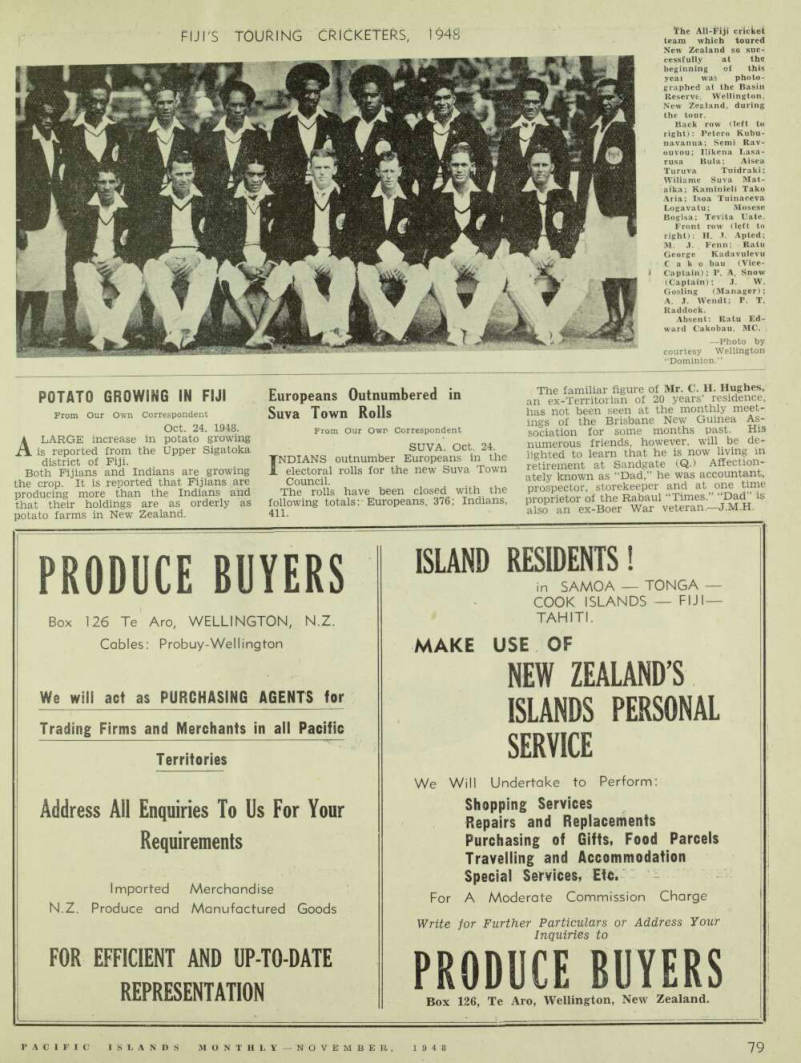
She All-Fiji cricket team which toured New Zealand so suc cessfully at the beginning of this year was photo graphed at the Basin Reserve Wellington, New Zealand, during the tour.
Back row (left to right): Petero Kubu navanua; Semi Rav ouvou; Ilikena Lasa rusa Bula; Aisea Turuva Tuidraki; Wiliame Suva Mat aika; Kaminieli Tako Aria; Isoa Tuinaceva Logavatu; Mosese Bogisa; Tevita Date.
Front row (left to right): H. J. Apted; M. J. Fenn; Ratu George Kadavulevu Cakobau (Vice- Captain); P. A. Snow (Captain); J. W.
Gosling (Manager); A. J. Wendt; P. T.
Raddock.
Absent; Ratu Ed ward Cakobau, MC. —Photo by courtesy Wellington “Dominion.”
Potato Growing In Fiji
From Our Own Correspondent Oct. 24. 1948.
A LARGE increase in potato growing is reported from the Upper Sigatoka district of Fiji.
Both Fijians and Indians are growing the crop. It is reported that Fijians are producing more than the Indians and that their holdings are as orderly as potato farms in New Zealand.
Europeans Outnumbered in Suva Town Rolls
Suva Town Rolls
From Our Own Correspondent
Suva. Oct. 24.
INDIANS outnumber Europeans in the electoral rolls for the new Suva Town Council.
The rolls have been closed with the following totals; Europeans, 376; Indians, 411.
The familiar figure of Mr. C. H. Hughes, an ex-Territoiian of 20 years’ residence, has not been seen at the monthly meet ings of the Brisbane New Guinea As sociation for some months past. His numerous friends, however, will be de lighted to learn that he is now living in retirement at Sandgate (Q.) Affection ately known as “Dad,” he was accountant, prospector, storekeeper and at one time proprietor of the Rabaul “Times.” “Dad is
also an ex-Boer War veteran.
J.M.H.
Advertisements & other items, pp. 81-82 (1 item)
Produce Buyers
ISLAND RESIDENTS!
in SAMOA TONGA
COOK ISLANDS FIJI—
TAHITI.
MAKE USE OF
NEW ZEALAND’S
ISLANDS PERSONAL
SERVICE
We Will Undertake to Perform; Shopping Services Repairs and Replacements Purchasing of Gifts, Food Parcels Travelling and Accommodation Special Services, Etc.
For A Moderate Commission Charge Write for Further Particulars or Address Your Inquiries to
PRODUCE BUYERS
Box 126, Te Aro, Wellington, New Zealand.
PRODUCE BUYERS
Box 126 Te Aro, WELLINGTON, N.Z.
Cobles: Probuy-Wellington We will act as PURCHASING AGENTS for Trading Firms and Merchants in all Pacific Territories Address All Enquiries To Us For Your
Requirements
Imported Merchandise N.Z. Produce and Manufactured Goods
FOR EFFICIENT AND UP-TO-DATE
REPRESENTATION
There is only one
ELECTROLUX
THE MODERN KEROSENE-OPERATED REFRIGERATOR
THAT ACHIEVES THE MIRACLE OF ICE FROM HEAT
Lasting Efficiency, Silent Operation, Streamlined Beauty
ii Economically operated by kerosene, with a simple precision-built freezing unit that has no moving parts and is GUARANTEED FOR
FIVE (5) YEARS.
Obtainable from:
NEW GUINEA COMPANY, LIMITED.
Rabaul, Madang, Lae, Kavieng.
J. R. CLAY & CO., LTD., Port Moresby.
W. R. CARPENTER & CO. (Sol. Is.), LTD., Tulagi.
For New Hebrides, Butaritari, Noumea, New Caledonia. Apply—
W. R. CARPENTER & CO. LTD.
Model LKSSI Price £79/15/- FOB, Melbourne Storage capacity: 5i cub. ft. (approx); shelf area, 9 sq. ft.; food shelves, six-—five removable; 2 self-supporting when half drawn. Ice-making: Four trays—s lb. ice per freezing: 80 cubes. Fuel consumption: 1.8 pints kerosene per day (approx.).
Height: 4 ft. 10 in. Depth: 2 ft. 3i in. weight, unpacked, 406 lb. Packed, 574 lb.
Head Office: 16 O'Connell St., Sydney, N. S. Wales
‘German Harry’

Some Memories of the By-Gone, Specious Days in Papua
By C. O. Andersen
I FIRST met “German Harry” (or “Harry the Dane”) as he was called, in 1896.
He had been around Papua for some time; and at the Trobriands he had picked up a considerable lot of pearls— in fact, he had an ordinary pickle bottle more than half filled, and the estimated value was in the vicinity of £l,OOO. He also carried with him an old chronometer.
As I, as second mate, had charge of the ship’s chronometer, he asked me to look after his while he was on board.
There was no likelihood of a steamer leaving Samarai for Australia for perhaps many months. So, as Harry was anxious to get to Sydney to purchase a schooner for himself, he decided to take passage to Vila with us, and pick up the Sydney boat there.
During the voyage to the New Hebrides (we also called at German New Guinea on our way, and spent over a week on the coast, doing some freighting for the Germans), Harry told us many tales about his exploits in different parts of the world. His next venture, he said, would be to buy a 50-ton schooner and go beche-de-mer fishing in the Pacific. I agreed to join him as navigator of the cruise, with a third interest in net re sults. At Vila, Harry took the Sydney steamer. 117 E arrived in Sydney the following ▼? year, and Harry was there with his schooner, all set to go north to Cook town. He needed a master to clear his schooner out, as Harry himself, although a very good seaman, knew nothing about navigating in deep water, so when he met me he exclaimed: “My luck is in. I want you straight away to skipper the “Wai wera” out of this and up north to Cook town.”
I replied, “Sorry to disappoint you, but I can’t do it, as I have only a mate’s ticket.”
Harry seemed quite crestfallen, and said: “But why did you tell me on board the “Ysabel” that you had a master’s ticket?”
“I have one alright,” I told him, “but it is from my homeland, Norway, and on the strength of that I was able to get my mate’s ticket here. In a few weeks I hope to have an Australian master’s ticket, which will enable me to take any vessel out from here.”
This mollified him somewhat, but as he had on occasions given evidence of a violent temper I had been half afraid of a rumpus; but he took it quite philo sophically and duly said that he would have to hire a captain—which he did without any trouble.
A couple of months later, when I had been able to persuade the Marine Board, on the recommendation of Captain Bedford, the Nautical Examiner, to issue
me a foreign-going master’s certificate I sent Harry a telegram. Some difficulty had arisen, however, in his plan to fish for beche-de-mer in the Coral Sea as
the Protector of Aboriginals would not give permits to take the native boys out side the Barrier Reef. So I had ta look around for another berth.
AFTER a year or so, I received a tele gram from Harry advising that the ban on aboriginals going outside the Barrier was lifted and requiring me to meet him as soon as possible. He added, characteristically, “If short of cash, wire —will send some.’ However, as it hap pened, I was able in a few days to get my discharge from the coaster, of which I was mate, so I made for Cooktown first steamer north and found Harry waiting for me.
This was in the middle of 1898. The Starkey and Ebagula goldfields had broken out shortly before and Harry had arranged to take a load of stores, etc., to those places before getting ready for the Coral Sea trip.
During this time I had good opportunity to study my prospective partner and I found him to be a most unusual character.
Generous to a fault to anyone he took a liking to and quite the opposite to any one he considered looked “down” on him on account of his neglected education when young. (He was able to write his name, Sorem Christensen, and that was about his limit). Those who tried to take him down generally found, to their dismay, that Harry was anything but a fool in a deal. In all practical work he was really clever, but when it came to figures he was stumped. Someone had taught him once to take the sun at noon and find his latitude (approximately), but he got ambitious and wanted to learn how to work out longitude. I was willing to show him how, so we started in on it; however, when it came to figures he was too unreliable —if he had to put down 34, he might (and did on several occasions) put the 4 before the 3! To him. as long as the two figures were down the order of them did not matter.
HARRY had rather a reputation for sharp practice in bargaining and when I got to know some of the Islands people I was warned to have our contract drawn up properly and made water tight, as Harry was not to be trusted.
When we had almost finished our out fitting for the Coral Sea trip, Harry one day said: “Well, we shall soon be off now, so we better go to Patching, the solicitor, and have our agreement drawn up.”
I said, “What will Patching charge for that?”
“Oh, about three or four guineas, I ex pect.”
“Well, Harry, you can, of course, have it done if you want to, but I think it is foolish to throw away three or four guineas on that.”
Harry seemed to be taken aback at this, and asked: “Do you really mean that?”
“Yes, of course,” I said, “I could not very well abscond and leave you in the lurch at any of the reefs we will be at— even if I wanted to —and as for your try ing to do me out of my fair share of our venture, well I trust you enough not to try that, so what do you say?”
I could see that he was touched, for he was not used to people treating him with confidence. He grabbed my hand and said, “By Jove, you will not be the loser by that.” And I wasn’t. He was scrupul ously fair in all our dealings.
HARRY was a good seaman and he did not know the word fear, but he was a bundle of contradictions in other ways. He always paid his just debts with out grumbling: but, if he had been taken in by unscrupulous “go-getters” he would not hesitate to “take in” others until he got square.
I remember one occasion when some one sold him a large parcel of mining scrip of no value. When Harry found this out, he unloaded half of his pur chase on an acquaintance for what the lot cost him. This man wanted to buy more shares from Harry but could not move Harry to part with any more.
I was walking up Flinders Street, Townsville, with Harry one afternoon when this chap hove in sight coming to wards us. Harry exclaimed. “There’s Cap tain T let us get away.” But it was too late; he had spotted Harry and he came over to us.
He roared to Harry: “You so-and-so, have you any more shares to sell?”
Harry said; “No, not to sell. You wanted all I had, but I would not sell you any more. I still hold a lot, so we were both taken in.”
Hearing this, Captain T quietened and admitted that he might have lost a lot more over the share deal than he did. finally, we all adjourned to the nearest hotel, ONE man, who in his younger days had been diving for pearl-shell in Torres Strait, but who was at this time owner of several luggers, once had an argument with Harry and said that no body could “take him in” on pearls.
Harry contradicted him.
Later on this chap—we’ll call him “A” —shifted over to Papua, with his luggers, working around Samarai.
Mr. A, Harry, Mr. M and I were at a bar in Cooktown one evening, Mr. A. having booked passage with me for the next morning’s trip to Samarai. Harry, between drinks, idly handled a “pearl” and Mr. A, spotting it, asked; “Where did you get that, Harry? Let’s have a look.” Harry passed over the “pearl.”
“What do you want for it?” inquired A.
“Say, £50,” answered Harry.
A. had another good look at it, then offered £35. They began bickering until A agreed to pay £4O and wrote a cheque for that amount.
Mr. M., who was manager of a concern in Cooktown, worried Harry to sell him a “pearl” of less value. Harry wanted him kept out out of it and. realising that Harry was up to something, I, too, tried to fence M. off, but he was very per sistent. So as not to awaken doubts in A’s. mind, Harry accepted a cheque from M. for £2/10/- for a small “pearl.”
When the other two had left us, I said to Harry: “You wanted to show A. that he is not infallible in judging pearls, eh?” “Yes,” he said, “It will teach him a lesson.”
Next morning, on my way down to the schooner, I encountered A., and his first words were: “Have you seen Harry? I’ll tear his liver out—he swindled me of £4O.
Sold me a Brummagen one.”
Just then Harry appeared. “Hullo, Neil, what is the trouble?”
“You blank so-and-so. you took me down—that was no pearl.”
“Calm down, Neil,” replied Harry. “I just wanted to show you that you too could be taken in. Here’s your cheque and you can keep the pearl.”
When M’s. office opened, Harry went down and gave him his cheque back, with a merry explanation.
That was just like Harry. I always thought that in the mixture of his make up his good points largely predominated.
AFTER we returned from a fairly suc cessful beche-de-mer trip in the Coral Sea, Messrs. John Clunn and Sons, of Cooktown, bought the schooner “Wai wera,” with me as a shareholder and
master. She was put on the Cooktown- Samarai-Woodlark Island trade. Harry went to Sydney to bring back an auxiliary boat and I lost track of him for a few years.
Then, in 1902, as I was taking a small steamer to Sydney to be sold there, Harry signed on with me as AB for the run down. He, with the others, was paid off at the shipping office. Harry was rather glad to get out of the office as he did not relish any personal questions being asked about his identity. The reason was as follows:
A year or so previously, Harry had bought himself a small ketch, intending to take her to Papua, but he got an offer to take a load of explosives to Darwin, which he accepted. He had to engage both master and mate before he could clear at the Customs. But Harry had no intention of keeping them, as he reckoned he could do the sailing by himself as he would hardly ever be without sight of land. So (he told me this later) he paid the master £lO and the mate £5 just to sign the clearance and hand it to him.
I don’t remember the name of the hired
captain, but, of course, Harry had to adopt his name for the time being.
Harry got away with two or three deck hands and in due course arrived at Dar win. There the Customs official knew him only by the name on his clearance and Harry answered to it. All went well until one day a Customs-man who had known Harry at Thursday Island some years before, returned to Darwin from his holidays. He ran into Harry and
greeted him with his known name—and “the cat was out of the bag.”
Harry was questioned on how he got away from Sydney and where was the Captain whose signature was on the clearance, etc. Harry’s answer to all these queries was rather naive. He ex plained that the cargo was all in and a good wind was blowing but the skipper and the mate were long overdue on board.
“I did not want to lose any of the fair wind blowing so I left without them,” he said simply.
There was some suspicion of foul play and Harry was detained until replies to questions had been received from Sydney.
It seemed that the master who signed the papers for Harry was still working about Sydney, so the suspicion that he might have been thrown overboard was un founded. Harry was permitted to leave and sign his own clearance. He turned up in Papua where he sold his vessel and went off to Sydney again.
LATER on Harry bought another schooner and took her back to Papua. He ran her on the Papuan coast for a while, then sold her and went back to Australia.
In Sydney, he lived aboard a yacht he had bought. Eventually he became ill, while living on his boat and, being missed by some of his friends, was found in a very bad way. They sent him to hos pital, where he died.
I am not sure about the year in which Soren Christensen, generally called “Ger man Harry,” passed away but it must have been about 1910-11.
M. le Trent, French labour inspector in the New Hebrides, has been chosen to rep resent New Caledonia, the New Hebrides and the Wallis Islands at the November 16 to 20 conference in Ceylon, at which questions concerning labour, raised at the Pan-Asiatic conference at New Delhi will be further discussed.
On arrival in Marseilles, the crew of the French liner “Sagittaire” (which was on strike for a while on its last trip to Noumea) struck, with a demand for pay ment in Pacific instead of French francs.
The strike started on September 20, and, as a result, the Messageries Maritime Co. put the vessel out of commission. The crew of 140, however, decided to remain on board.
Among recent consignments to Australia of New Caledonian timber- were 33 tons of Cook Pines (Araucaria Cooki), those
tall, strange, prehistoric pines with very short, straight branches which members of Capt. Cook’s second expedition, when they discovered the Isle of Pines, mistook for columns of besalt. The pines came from the Plaine des Lacs, and they are to go to a perfume factory in Perth.
After being under repairs in Australia for over a year, the New Caledonian Nickel Co. collier “Cap Tarifa’’ is being recommissioned. A crew reached Sydney by the “Neo Hebridais” to take her back to Noumea.
Advertisements & other items, pp. 83-88 (1 item)
|i||3of| loill
rX Jl,
U] Ji
Bflp®® ©OIL
HILLMAN
SHYER SHELL MOTOR OIL S.AJE. 20.
HUMBER
SINGLE SHELL MOTOR OIL S.A.E. 30.
SUNBEAN-TALBOT
SINGLE SHELL MOTOR OIL S.A.E. 30.
CONNER
SINGLE SHELL MOTOR OIL S JLE. 30.
HARRIER
Vtf SINGLE SHELL MOTOR OIL S JLE. 30.
THE ROOTES GROUP
Recommend Exclusively
SHELL
MOTOR OIL
FOR ALL THEIR VEHICLES
SHELLj Too, too, can sure of SHELL MOTOR OIL THE SHELL CO. OF AUST. LTD. (Inc. In Gt. Brit.) L0489J
■¥■ SPECIALS for the Trade Store-at the BEST Prices
MIRRORS.
BUSH KNIVES.
SARIFS.
HALF AXES.
HATCHETS.
DECORATIVE COMBS.
BRILLIANTINE.
PEROXIDE.
WATER PERFUME.
HAIR DYE.
SING SING PAINTS
CALICO LAP LAPS.
SCISSORS.
RAZORS.
HURRICANE LAMPS.
TORCHES AND
BATTERIES.
SING SING POWDER.
SUIT CASES.
BELTS.
LAUNDRY SOAP.
TOILET SOAP.
RINGWORM CURE.
VENTURA TRADING CO. PTY. LTD.
26 BRIDGE STREET, SYDNEY. Cobles: "Ventura," Sydney. in association with P. & R. HUTCHINSON, SUVA, and HENRY G. EEKHOFF, LAE, T.N.G.
Itching Skin Germs Killed in 3 Days
Thanks to the discovery of an American physician, It Is now possible to kill and remove the true cause of most skin troubles. Your skin has nearly 50 million tiny seams and pores where invisible germs and parasites can hide, and which are the true cause of terrible Itching, Cracking, Peeling, Burning, Ringworm.
Acne, Psoriasis, Blackheads, Pimples, Foot Itch and other disfiguring blemishes.
Blemishes such as these make you look and feel embarrassed, unattractive and handicapped In life, both socially and In business. You can’t get rid of these disfigurements with ordinary treatments, which give only temporary relief, because they do not kill the germs or parasites responsible for your trouble. .
New Discovery Kills Cause
Former skin sufferers throughout the world are now praising Nixoderm, the discovery of a leading American skin specialist. This remarkable new preparation quickly penetrates Into the pores of the skin and kills the germs and parasites responsible for your trouble in 7 minutes, stopping the itch almost instantly. At the same time, this wonderful preparation acts as a tonic and skin food, so that as the cause of your trouble is removed, your skin becomes soft, smooth and clear. This clear, healthy complexion will give you new charm and make It easy to win friends.
Praised by Doctors
Dr. T. A. Ellis, well-known physician of Toronto. Canada, recently stated; “Skin disorders caused by parasites, as many are, yiel* to Nixoderm. These parasites are invisible to the naked eye. They eat away the skin, forming ugly eruptions. Ordinary ointments or remedies fall completely, or give only temporary results because they do not reach the cause of the condition. It Is this value about Nixoderm In attacking parasites which Impresses me most favorably, and explains In large measure the success It enjoys over many stubborn cases,"
Guaranteed Results
Get Nixoderm to-day. Put It to the test. In a few minutes you will find that the Itching has stopped, and In 24 hours you can see for yourself that your skin Is clearer. And It Is guaranteed that, within one week, Nixoderm must make your skin soft, clear, smooth and attractive or money back on return of empty package. Get Nixoderm from your chemist or store to-day. The guarantee protects you. So don’t delay. Get Nixoderm to-day.
Nixoderm
For Skin Sores, Pimples and Itch.
For
dazzling
whiteness L
l LULU
Always use Rvckitt 9 s Hiuy Him? in the last rinse the safe way to keep your linen a really good colour
ART POSTCARDS OF
TONGA
Per Dozen, Postage Paid: 6/- (one US Dollar).
TONGAN PHOTOS BUREAU
Nukualofa, Tonga
roteet your Hair
Hie Tonic Hair Dressing
JUN, WIND, and WATER
all play havoc with your hair, depriving it of its natural scalp oils.
Let Vita I is' pure vegetable oils protect your hair and scalp, no matter where you are or what you do.
Vitalis routs loose dandruff; helps retard falling hair; stimulates the scalp and dresses the hair in a handsome, natural way. 4517 39* \ 7% (3 \
WANTED
PACIFIC ISLANDS'
USED STAMPS
AT HALF PRICE OF
FACE VALUE
M. P. PATEL & CO.
P.O. Box 83, Suva, Fiji
ESTATE NOTICE
Notice to Creditors
IN THE ESTATE of JOSEPH THOMAS McEVOY late of Tulu and Ponam Plantations Manus in the Territory of New Guinea deceased.
CREDITORS having claims against the estate of the abovenamed deceased who died on the first day of July One thousand nine hundred and fortytwo, are called upon to submit their claims verified by affidavit to Burns, Philp Trust Company Limited of 7 Bridge Street, Sydney, the Administrator of the abovenamed estate, within three months from the date of publication hereof, after which time the Administrator will proceed to distribute the estate having regard only to clairns of which it then shall have had notice in writing.
DATED this twentysixth day of October, 1948.
J. IRWIN CROMIE,
Solicitor for the Company Port Morseby
POSITION WANTED:
Native Labour Overseer, ex-A.N.G.A.U.,
desires position Papua. Write L. E. Heape, 218 Corio Street, Shepparton. Victoria.
INVESTMENT WANTED
Married couple, wife Manageress—Nursing ■ experience. Man carpenter—Farmer (Abstainer), Have £l,OOO to invest in working proposition or position of trust (Pacific Island), Bank reference, Confidential. J. Mclntyre, 31 Martin St., Valley, Brisbane, Q’ld.
BOATS FOR SALE
Ketch, length 52 ft-, beam 11 ft., draft 4 ft. 6. teak hull and deck, coppered, fitted Fairbanks Morse deisel engine, bunks, galley, fuel and water tanks, etc.
Ketch, length 36 ft., beam 11 ft., draft 3 ft 6. built 1944, coppered, fitted Kerosene international engine, bunks, galley, etc. workboat type.
Both boats are at present engaged in pearl fishing and are for sale at end of the pearling season.
For further particulars apply to owners, R. R.
Grayson & M. S. N. Lindley, Thursday Island.
FOR SALE OR EXCHANGE
AARAMON PLANTATION—BUKA
Copra-bearing Plantation. Producing 7
tons per month, plus Trading Store 6 tons (native) trade copra per month.
Price, £2,500.
OR EXCHANGE HOME same value. Buyer
will receive War Damage cheque clearing
olantation. Selling cheap. 111-health.
Mrs. C. Huson, 19 Roslyn Street, King’s Cross.
TO LET:
Springwood, Blue Mountains, superior furnished stone cottage, el., water, septic, &c., on bus route, accommodate 2,3, or 4. Heatherwood Village Ltd., Box 3722, Q.P.0., Sydney, or Hawkesbury Rd., Springwood,
<2 m US
The sign nf Quality
for nearly a Century
WC' : ' v %
SWALLOW & ARIELL
LIMITED
O*
Hskk
yllaAtet in
the djucnit <=Snduslnj
evince I 534 Listen to 3AW-CV at 6.30 p.m. Mondays to Thursdays, to "Front Page Lady” - Radio’s most enthralling serial. * S 3751
Box 3838 GPO; Cable Address, “Care” Sydney.
Sydney. Australia.
ISLAND MERCHANTS
4 YORK ST., SYDNEY
All kinds Island Produce sold on commission. All merchandise purchasec at best wholesale price and original invoices supplied.
Use our 50 years’ experience as Island Merchants.
J
Made from firm, red-ripe “aristocrat” tomatoes, and fragrant spices.
Tomato Sauce that’s better than ever . . . made as only Heinz know how. Be sure to put HEINZ Tomato Sauce on your grocery list always. * t a h£' 0F ST
HEINZ Tomato Sauce
An ornate example of historical
keys, this XVlth Century
French key features the sporting motif in its club and animal carvings. It seems to have been the key to a Duke’s country
lodge.
B £4 A
to S
The key
oking pleasure
FINE CUT
NAVY CUT
TOBACCOS
or 1657.7.48
Tempus Fugit
1 OFTEN wonder with what careless joy and abandon the native clerks in, British Solomons and in Territory of Papua-New Guinea, set the date-stamps which go on documents and letters! Maybe they have a Puckish sense of humour or exclaim, with Omar, “What boots it if to day be sweet.”
In going over some papers recently I came across several letters that had come to me from the British Solomons. The writer of one dated it “October 27th, 1947” and posted it at Auki, Malaita Island.
This had been joyfully stamped on the envelope woth the legend, “Auki. 28 Sep 47. 3PM” —just a month earlier as I reckon it! A later stamp, on same en velope, read, “Honiara. 14 Nov 47. 10AM,” showing that the letter had arrived at the capital city on Guadalcanal, but had taken over six weeks to get there!
Knowing the “Sleepy Hollows” which are Auki and Honiara. I am intrigued to think that the very hour of stamping the letter is noted on the envelope! Good work! But I observe that several letters, received through the same channels and over a period, still show the times as be ing 3 PM at Auki and 10 AM at Honiara.
This, of course, may have been a coincid ence, but unkind critics may suggest that Time stands still in the BSI!
Sundry examples of careless handling of date stamps in this Territory of Papua- New Guinea have come under my notice, too. What I consider as quite a prize example now reposes in my file. It is a receipt issued for a Savings Bank book, in April, 1947, which also bears the im print of a rubber stamp, “Comw’th Sav.
Bank. 30 Feb ’47”. I do not stress the point that April comes later in the year, but I have never, in the “leapiest” of Leap Years, heard of more than 29 days in
February!
Meantime, the merry native clerk goes on his merry way! See him, after the short Government office hours, playing cricket, flashing about the football field,
diving off the jetty or fishing from his canoe. He should worry! Let others con cern themselves about commonplace dates and figures. He proceeds along the prim rose path to the sound of lutes.—S.A.G.
Advertisements & other items, p. 89 (1 item)
Ciuespif
FISHING NETS
IMMEDIATE DELIVERY
Oxley Bros. Fishing Nets, 50 yds. Length, 2 in. Mesh, Knot to Knot, 72 in. Drop, Fully Corked and Leaded. Price, £B/10/-, F. 0.8., Sydney.
VENTURA TRADING CO. PTY., LTD.,
26 Bridge Street, Sydney
m No troublesome folding, no creasing or wrinkling, with the
MOKIIi:
2- or 5-SUITER
Mid* by FORD SHERINGTON, LTD.
CIUESPIf
E
(new
A)
TERRITORY OF NEW GUINEA
PHILIPS
RADIO
WHOLESALE
MERCHANTS
GENERAL AGENTS
REMINGTON
TYPEWRITER
FORWARDING. SHIPPING AND CUSTOMS AGENTS
So le New Guinea Agents for;
POPE'S
PRODUCTS
RACO
ALUMINIUM
Commonwealth Insurance Company
Islands Produce
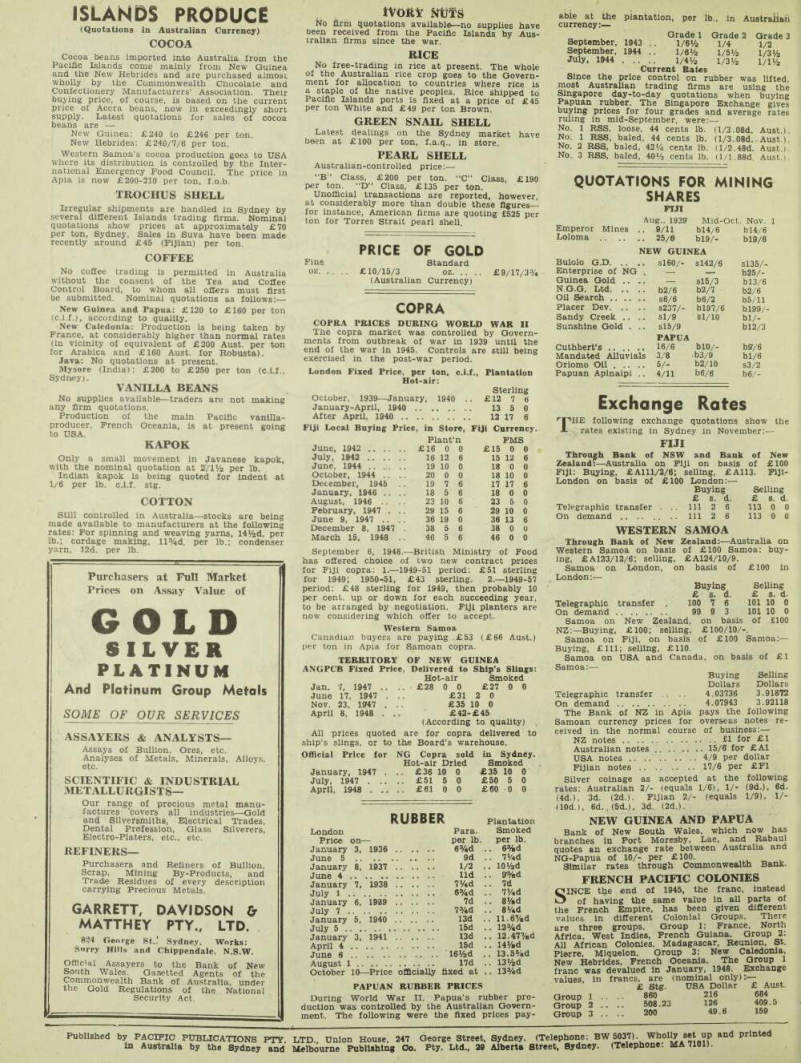
(Quotations in Australian Currency)
Cocoa
Cocoa beans imported into Australia from the Pacific Islands come mainly from New Guinea and the New Hebrides and are purchased almost wholly by the Commonwealth Chocolate and Confectionery Manufacturers’ Association. Their buying price, of course, is based on the current price of Accra beans, now in exceedingly short supply. Latest quotations for sales of cocoa beans are New Guinea: £240 to £246 per ton.
New Hebrides; £240/7/6 per ton.
Western Samoa’s cocoa production goes to USA where its distribution is controlled by the Inter national Emergency Pood Council. The price in Apia is now £2OO-210 per ton, f.o.b.
Trochus Shell
Irregular shipments are handled in Sydney by several different Islands trading firms. Nominal quotations show prices at approximately £7O per ton, Sydney, Sales in Suva have been made recently around £45 (Fijian) per ton.
Coffee
No coffee trading is permitted in Australia without the consent of the Tea and Coffee Control Board, to whom all offers must first be submitted. Nominal quotations as follows; New Guinea and Papua: £l2O to £l6O per ton (c.i.f.), according to quality.
New Caledonia: Production is being taken by France, at considerably higher than normal rates (in vicinity of equivalent of £2OO Aust. per ton for Arabica and £l6O Aust. for Robusta).
Java: No quotations at present.
Mysore (India): £2OO to £250 per ton (c.i.f., Sydney).
Vanilla Beans
No supplies available—traders are not making any firm quotations.
Production of the main Pacific vanilla producer, French Oceania, is at present going to USA.
Kapok
Only a small movement in Javanese kapok, with the nominal quotation at 2/1 y 2 per lb.
Indian kapok is being quoted for Indent at 1/6 per lb. c.i.f. stg.
Cotton
Still controlled in Australia—stocks are being made available to manufacturers at the following rates: For spinning and weaving yarns, 14*6d. per lb.; cordage making, ll%d. per lb.; condenser yarn, 12d. per lb.
Ivoitv Nuts
No firm quotations available—no supplies have been received from the Pacific Islands by Aus tralian firms since the war.
Rice
No free-trading in rice at present. The whole of the Australian rice crop goes to the Govern ment for allocation to countries where rice is a staple of the native peoples. Rice shipped to Pacific Islands ports is fixed at a price of £45 per ton White and £49 per ton Brown.
Green Snail Shell
Latest dealings on the Sydney market have been at £lOO per ton, f.a.q., in store.
Pearl Shell
Australian-controlled price:— “B" Class, £2OO per ton. “C” Class, £l9O per ton. “D” Class, £135 per ton.
Unofficial transactions are reported, however, at considerably more than double these figures— for instance, American firms are quoting £525 per ton for Torres Strait pearl shell.
Advertisements & other items, p. 90 (1 item)
Price Of Gold
Pins Standard oz £10/15/3 oz £9/17/33A (Australian Currency)
Copra
Prices During World War Ii
The copra market was controlled by Govern ments from outbreak of war in 1939 until the end of the war in 1945. Controls are still being exercised in the post-war period.
London Fixed Price, per ton, c.i.f., Plantation Hot-air:
September 6, 1948.—British Ministry of Food has offered choice of two new contract prices for Fiji copra; 1. —1949-51 period: £51 sterling for 1949; 1950-51, £43 sterling. 2.-1949-57 period: £48 sterling for 1949, then probably 10 per cent, up or down for each succeeding year, to be arranged by negotiation. Fiji planters are now considering which offer to accept.
Western Samoa Canadian buyers are paying £53 (£66 Aust.) per ton in Apia for Samoan copra.
Territory Of New Guinea
All prices quoted are for copra delivered to ship’s slings, or to the Board’s warehouse.
ANGPCB Fixed Price, Delivered to Ship’s Slings: Hot-air Smoked Jan. 7, 1947 .. .. £28 0 0 £27 0 0 June 17, 1947 ... £31 2 0 Nov. 23, 1947 ... £35 10 0 April 8, 1948 ... £42-£45 (According to quality)
Official Price for NG Copra sold in Sydney.
Hot-air Dried Smoked January, 1947 . £36 10 0 £35 10 0 July, 1947 . .. .. £51 5 0 £50 5 0 April, 1948 . .. £61 0 0 £60 0 0
Sterling October, 1939 —January, 1940 . £12 7 6 January-Aprll, 1940 5 0 After April. 1940 .. 12 17 6 Fiji Local Buying Price, in Store, Fiji Currency Plant’n
Fms
June, 1942 £16 0 0 £15 0 0 July, 1942 16 12 6 15 12 6 June, 1944 19 10 0 18 0 0 October, 1944 .. 20 0 0 18 10 0 December, 1945 .. 19 7 6 17 17 6 January, 1946 .. 18 5 6 18 0 0 August, 1946 . . 23 10 6 23 5 0 February, 1947 . .. 29 15 6 29 10 0 June 9, 1947 .. 36 19 0 36 13 6 December 8, 1947 . 38 5 6 38 0 0 March 15, 1948 .. 46 5 6 46 0 0
Rubber
Plantation
Papuan Rubber Prices
During World War II. Papua’s rubber pro duction was controlled by the Australian Govern ment. The following were the fixed prices pay
able at the plantation, per lb., in Australian currency:—
Current Rates Since the price control on rubber was lifted, most Australian trading firms are using the Singapore day-to-day quotations when buying Papuan rubber. The Singapore Exchange gives buying prices for four grades and average rates ruling in mid-September, were;— No. 1 RSS, loose, 44 cents lb. (1/3.08d. Aust.).
No. 1 RSS, baled, 44 cents lb. (1/3.08d, Aust.), No. 2 RSS, baled, 42V 4 cents lb. (l/2.48d. Aust.).
No. 3 RSS, baled, 40 V 2 cents lb. (1/1.88d. Aust.i.
London Para.
Smoked Price onper lb. per lb.
January 3, 1936 6%d .. 6%d June 5 9d .. 7‘/id January 8, 1937 1/2 .. lOVad June 4 lid .. 9%d January 7. 1938 .. 7d July 1 . .. 7‘Ad January 6, 1939 7d .. 8Vad July 7 . 7 3 Ad .. 8V<d January 5, 1940 13d .. 11.6 7 / 8 d July 5 . 15d .. 12 3 Ad January 3. 1941 13d .. 12.47 7 /ed April 4 15d .. 14y a d June 6 16y 2 d .. 13.5 5 / B d August 1 .. 17d .. 13y 2 d October 10—Price officially fixed at .. 13 3 Ad
Grade 1 Grade 2 Grade 3 September, 1943 . 1/6 Va 1/4 1/2 September, 1944 .. 1/6 Va 1/5 Va 1/3 July, 1944 1/4 Va 1/3 Va 1/1 Va
Quotations For Mining
Shares
Fiji
Aug.. 1939 Mid-Oct. Nov.
Emperor Mines .. 9/11 bl4/6 bl4/6 Loloma .. 25/6 bl9/bl9/6 Bulolo G.D. ..
New Guinea
.. Sl60/- S142/6 sl35/- Enterprise of NG — — b25/- Guinea Gold .. — S15/3 bl3/6 N.G.G. Ltd. .. .. b2/6 b2/7 b2/6 Oil Search .. .. •. s6/6 b6/2 b5/ll Placer Dev. .. . • s237/- bl97/6 bl99/- Sandy Creek .. .. sl/9 sl/10 bl/- Sunshine Gold . .. S15/9 bl2/3 Cuthbert's .. ..
Papua
.. 16/6 bit)/b9/6 Mandated AUuvials 3/8 b3/9 bl/6 Oriomo Oil . .. .. 5/- b2/10 s3/2 Papuan Apinaipi .. 4/11 b6/6 b6/-
Exchange Rates
THE following exchange quotations show the rates existing in Sydney in November:—
Fiji
Through Bank of NSW and Bank of New Zealand:—Australia on Fiji on basis of £100 Fiji: Buying, £Alll/2/6; selling, £A113. Fiji- London on basis of £100 London: —
Western Samoa
Through Bank of New Zealand: —Australia on Western Samoa on basis of £100 Samoa: buy ing, £A123/12/6; selling, £A124/10/9.
Samoa on London, on basis of £ 100 in London: —
Samoa on New Zealand, on basis of £100 NZ;—Buying, £100; selling, £100/10/-.
Samoa on Fiji, on basis of £100 Samoa: — Buying, £111; selling, £110.
Samoa on USA and Canada, on basis of £1 Samoa: — Buying Selling Dollars Dollars Telegraphic transfer .. .. 4.03736 3.91872 On demand 4.07943 3.92118 The Bank of NZ in Apia pays the following Samoan currency prices for overseas notes re ceived in the normal course of business;— NZ notes £1 for £1 Australian notes 15/6 for £A1 USA notes 4/9 per dollar Fijian notes 17/6 per £F1 Silver coinage as accepted at the following rates: Australian 2/- (equals 1/6), 1/- (9d.), 6d. (4d.), 3d. (2d.). Fijian 2/- (equals 1/9), 1/- (lOd.), 6d. , (5d.), 3d. (2d.).
New Guinea And Papua
Bank of New South Wales, which now has branches in Port Moresby, Lae, and Rabaul quotes an exchange rate between Australia and NG-Papua of 10/- per £100.
Similar rates through Commonwealth Bank.
French Pacific Colonies
SINCE the end of 1945, the franc, instead of having the same value in all parts of the French Empire, has been given different values in different Colonial Groups. There are three groups. Group 1: France, North Africa, West Indies, French Guiana, Group 2: All African Colonies, Madagascar, Reunion, St.
Pierre, Miquelon, Group 3: New Caledonia, New Hebrides, French Oceania. The Group 1 franc was devalued in January. 1948. Exchange values, in francs, are (nominal only):—
Buying Selling £ s. d. £ s. d.
Telegraphic transfer . .. Ill 2 6 113 0 0 On demand .. Ill 2 6 113 0 0
Buying Selling £ s. d. £ s. d.
Telegraphic transfer . 100 7 6 101 10 0 On demand 99 9 3 101 10 0
Advertisements & other items, pp. 90-92 (3 items)
Published by PACIFIC PUBLICATIONS PTY LTD Union House. 247 George Street. Sydney. (Telephone: BW 5037). Wholly set up and printed
In Australia by the Sydney and Melbourne Publishing 00. Pty. Ltd., 29 Alberta Street, Sydney. (Telephone: matiod.
Gold
Purchasers at Full Market Prices on Assay Value of
SILVER
PLATINUM
And Platinum Group Metals
SOME OF OUR SERVICES
ASSAYERS & ANALYSTS—
Assays of Bullion, Ores, etc.
Analyses of Metals, Minerals, Alloys, etc.
SCIENTIFIC & INDUSTRIAL
METALLURGISTS—
Our range of precious metal manufactures 'covers all industries—Gold S.nd Silversmiths, Electrical Trades, Pehtal Profession, Glass Silverers, Electro-Platers, etc., etc.
REFINERS—
Purchasers and Refiners of Bullion, Scrap, Mining By-Products, and Trade Residues of every description carrying Precious Metals.
GARRETT, DAVIDSON &
MATTHEY PTY., LTD.
824 George St,! Sydney. Works: Surry Hills and Chippendale, N.S.W.
Official Assayers to the Bank of New South Wales. Gazetted Agents of the Commonwealth Bank of Australia, under the Gold Regulations of the National Security Act.
tropical thirst...
To quench a
lodi dri * kS
K
tvertf
vs Cl m When you’re hot and tired, there is nothing quite so satisfying and thirst quenching as a long, cold glass of “K. 8.“ Your friends and guests, too, will appreciate this really fine Lager, for “Everybody drinks K.B.’*
TOOTH'S
LAGER
M
ERCHANTS
8c SH
P OWNERS
Capital £1,000,000
ESTABLISHED 1914
COPRA MERCHANTS & MILLERS
ASSOCIATED COMPANIES THROUGHOUT THE PACIFIC ISLANDS
REGULAR CARGO AND PASSENGER SERVICE BETWEEN EUROPE AND
PACIFIC ISLAND PORTS WAS ESTABLISHED BY
W. R. CARPENTER & CO. LTD.
Head Office: 16 O'CONNELL STREET, SYDNEY.
Cable Address;
CAMOHK.
Telephone. Postal Address: BW 4421. P.O. Box No. 168, Sydney.
PAflf I C ISLANDS MONTHLY - NOVEMBER. 1948