Pacific
Monthly
October, 1948
Vol. XIX. No. 3.
Established 1930.
[Registered & the G.P.0., transmission by post as a newspaper ]
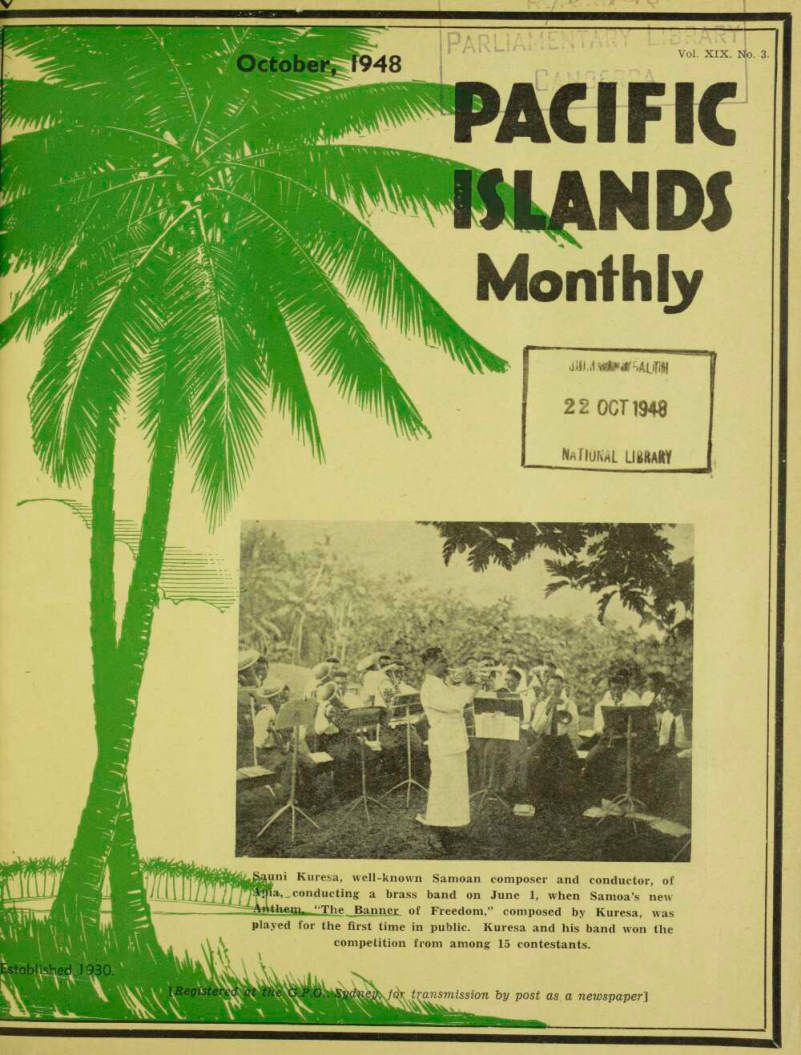
Sauni Kuresa, well-known Samoan composer and conductor, of Apoa, conducting a brass band on June 1, when Samoa’s new An them, "The Banner of Freedom,” composed by Kuresa, was played for the first time in public. Kuresa and his band won the competition from among 15 contestants.
Advertisements & other items, pp. 2-4 (1 item)
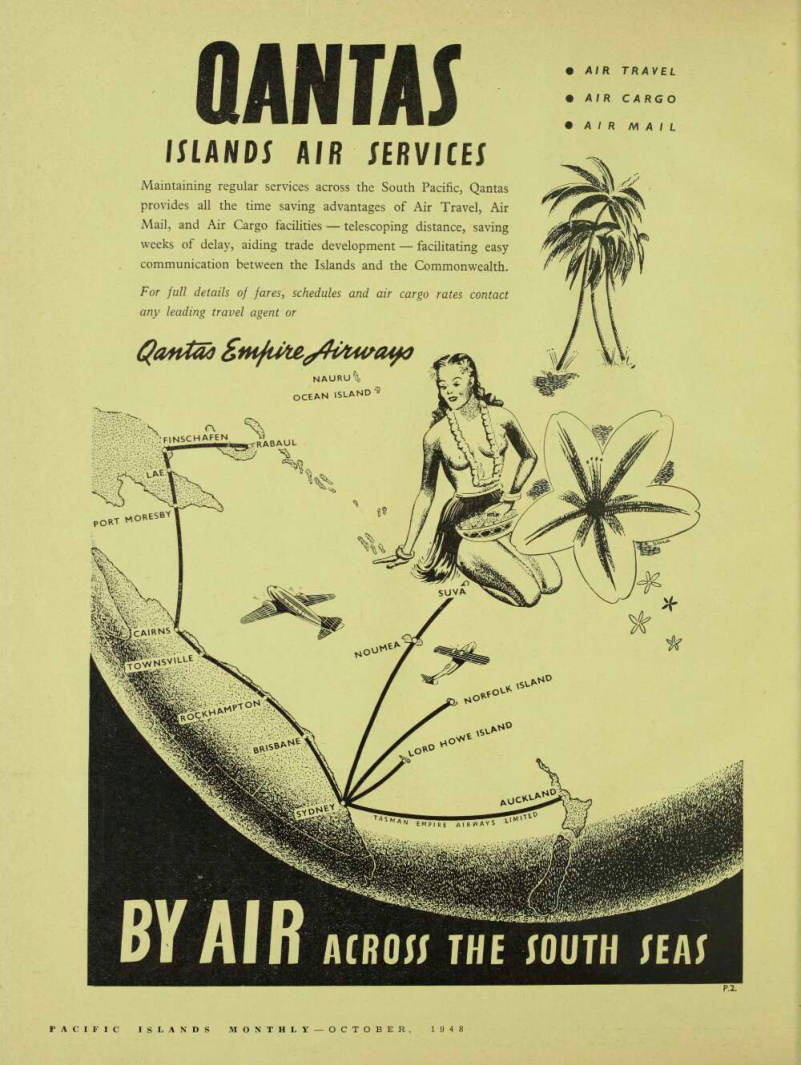
Qanms
ISLANDS AIR
Maintaining regular services across the South Pacific, Qantas provides all the time saving advantages of Air Travel, Air Mail, and Air Cargo facilities telescoping distance, saving weeks of delay, aiding trade development facilitating easy communication between the Islands and the Commonwealth.
For full details of fares , schedules and air cargo rates contact any leading travel agent or
tfantah StH/uUt/Uuvayj
• AIR
• AIR
• AIR
TRAVEL
CARGO
NAURU*!,
OCEAN ISLAND
■FINSCHAFiN “ ABAUU
mmm& *
PORT HORESBT
m
SUVA
* cairns NO TO aNO \sv O'-* 0* f ton aNO \SV nN*
BANt
NO and
UC*L
STD
I
flf
N •*###« m / a/&r wmk w. * t \ sm m i •S 59 3 - N?y''
Brazing Torches tßlow Lamps
Coleman Brazing Torches have solid-drawn heavy duty brass bodies with extra heavy brass bottoms.
All joints are mechanically sealed and securely soldered for double protection. Other features are : Sturdy bottom filler plug . . . positive shut-off fuel valve . . . removable gas tip . . . replaceable self cleaning needle . . . heavy longlife burners and heavy duty pump.
Each torch is inspected and given a pressure and burning test before leaving the factory.
Representatives for the Pacific Islands : FIG. I—Obtainable in two types, Petrol and Kerosene.
FIG. 2—Petrol burning only.
Fuel tank capacities of both are :—P pint and 1 quart.
FIG. 3—Coleman's new Paraffin Blow Lamp which has valves interchangeable with European types of Lamps. The long-life burner and container are of heavy gauge brass. The container will withstand a pressure of 200 lbs. The flame is regulated through Air-release, there being no shut-off valve.
Tank capacities f, 1 and 2 pints.
ROBERT GILLESPIE PTY. LTD.
54a PITT STREET, SYDNEY
PEARCE & CO. LTD
SUVA
FOR FIJI ISLANDS
I E I I I I
BRONTE BRAND
Chili Con Came Braised Steak and Onions Curried Beef Curried Mutton Steak and Onions Mutton and Peas Irish Stew Beef Steak Pudding Corned Beef Hash Corned Beef Loaf With Cereal Broth Mulligatawny Soup Tomato Soup Vegetable Soup From the finest fat stock and the rich-
est vegetables in Australia we produce
these high-grade canned meats and
soups. BRONTE BRAND meats,
hotmeals and soups are deliciously flavoured and are made from
ONLY meats and vegetables
of the highest quality. . . . . ★
THE
COLONIAL WHOLESALE MEAT CO.
PTY. LTD.
Canning Factory, State Abattoirs, Homebush Bay, Sydney.
N.S.W.
PHONES:
PHONE: UM 8436.
CABLE ADDRESS:
WOOLMILL. SYDNEY.
p, ptt
Advertisers
Aluminium Union Ltd 53 Angliss & Co. . . 42 Amplion (Aust.) Pty., Ltd. ... 19 Atkins Pty., Ltd., Wm 64 Anchor Hocking Glassware ... 83 Atkins Kroll & Co. 85 Australian Block & Chain Co. Pty., Ltd 54 Amalgamated Hatcheries ... 55 Bethell, Gwyn & Co. 39' Brunton’s Flour . 37 Burns, Philp (New Hebrides), Ltd. . 15 Bank of NSW . . 16 Burns, Philp (NG) Ltd 51 Baker, W. Jno.
Pty., Ltd. ... 38 Brasso (Reckitt & Coleman ... 32 Burns, Philp Trust Co., Ltd 30 Budge, James Pty., Ltd 57 Broomfields ... 22 BP (SS) Co. . . . 41 W. R. Carpenter & Co. .(Fiji), Ltd. . 71 Caine’s Studio . . 70 Carpenter, Ltd., W.
R. cov. iv‘ Colonial Wholesale Meat 2 Colyer Watson (New Guinea), Ltd. . . 81 Crammond Radio Pty., Ltd. ... 25 Commonwealth Bank of Australia 67 Costello, Vince Garrick Hotel . . 66 China-New Guinea Mercantile Co. . . 75 “Cystex” 90 Coleman’s Mustard 72 Donaghy & Sons . 71 Donald, Ltd., A. B. 72 Davison Paints Ltd. 87 Dunlop Rubber (Aust.), Ltd. . . 38 Dettol (Reckitt & Coleman) ... 27 Dr. Williams Pink Pills 18 Dangar, Gedye & Malloch ... 3 Edwards, William & Co 29 Electrolux Refrigerators . . 63 Ford Sherington . . 23 Garrett & Davidson 92 Gillespie Pty., Ltd., Robert . . . 1 & 20 Robt. Gillespie (NG), Ltd. ... 91 Gilbey’s Gin ... 59 Gillespie’s Flour . . 54 Grand Pacific Hotel 4 Gough & Co., E. J. 31 Grove & Sons, W.
H . 26 Horlicks Malted Milk 33 Heinz & Co. Pty Ltd., H. J. . . . 23 Hettig August ... 23
Hemingway &
Robertson ... 53 Ipana Tooth Pasts 35 Jackson S. Went worth ... 35 Kodak (Aust.), Pty., Ltd Kolynos, Inc. ... 65 Kopsen & Co., Ltd. 69 Kerr Brothers . . 60 Kraft - Walker
Cheese Co. . , . 52
Kwong Chong Bros. 39 Lockyer, Geo. J. . . 61 Manstocks ... 68 Mail Publicity Co. (Magazine Sub scriptions) ... 20 Merrillees, J. C., & Co 79 Maloney, N. F., & Co 89 Millers, Ltd., Suva 89 Miscellaneous, . 22, 78 “Mum” Deodorant 70 “Mendaco” ... 57 Mcllraths Pty., Ltd. 27 Morris, Hedstrom, Ltd., Suva ... 12 Nirex 36 National Airways Corporation ... 77 Nordman, Oscar . . 28 Nelson & Robertson Pty., Ltd. ... 68 “Nixoderm” ... 39 Produce Buyers . . 24 Pacific Is. Society 42 Pacific Islands Trading Co. ... 40 Pan American Air ways 14 Penguin Marine Engines ... 21 “Pinkettes” ... 81 Pitt & Scott, Ltd. . 52 Qantas Empire Air ways ... cov. ii Queensland Insur ance Co 19 Robinson, G. H. . . 55 Renton, G 69 Rose’s Eye Lotion 28, 67 Reckitt’s Blue . . 66 Rohu, Sil 54 Reed William E. . 74 Scott, Ltd., J. ... 73 Shell Co 74 Southern Pacific Insurance Co. . . 53 Steamships Trading Co., Ltd. ... 79 Sullivan & Co., C. . 36 South Sea Island Correspondence Club 58 Spartan Paints Pty., Ltd. 37 Swallow & Ariell . 34 Taylor & Co., A . 80 Tooth & Co., Pty., Ltd. ... cov .iii T. & E. Co., Ltd. . 28 Thornycroft (Aust.) Pty., Ltd 87 Tilley Lamps ... 84 Tillock & Co. ... 90 Tyneside Foundry & Engineering Co., Ltd 76 Trans Oceanic Air ways 56 Union Manufactur ing & Export Co. 80 Vacuum Oil Co., Ltd 88 “Vitalis” Hair Tonic 86 Vincent Chemical Co 26 Ventura Trading Co., Pty.. Ltd.. . . 18 Watson, Wm. H. . . 58 Wright & Co. ... 82 Harry West ... 69 Widdop, H., & Co., Ltd 62 Wenzel & Co. . . 15 Wills, W. D. & H.
O . 17 Wunderlich Ltd. . . 32 Wright & Co., Ltd., E . 41 Yorkshire Insur ance Co., Ltd. . 15
A notable plantation-clearing record has been put up by the Fijian people of Dogotuki, Macuata, in the current copra £o 0 /i uction campaign. During August, 6,300 chains of plantation land were weeded, and in the first eight months of 1948, 5,000 coconut palms were added to the tikina’s plantations.
Advertisements & other items, p. 5 (2 items)
3
1' A. CIF I C ISLANDS MONTHLY-OCTOBER. i 9 4 8
British '■%
The
World's Best
Outboard Motor
• 3f 4 Horse Power • Weight from 40lbs.
E m • Polished and Plated Finish . . and a • 10-inch
Propeller
IMMEDIATE
DELIVERY
Price from £69/10/- Also Available-
-4 H.P. COMMANDO
Marine Engines
Price from £62/8/- All prices F. 0.8. Sydney.
Packing extra.
Dahgar, Gedye, & Malloch Ltd
MARINE DIVISION
10-14 YOUNG STREET, CIRCULAR QUAY, SYDNEY
G.P.O. BOX 509. Tel. B6oi
In This Issue:
Editorial: “No ‘Little India’ Will Be Tolerated In Pacific” ... 5 Red Activity In Cook Islands ... 6 New Regulations Cover Fijian Affairs 6 Marshall Aid For New Caledonia— Australia Loses Coal Trade ... 7 New Guinea Timber Lease Trial On November 8 7 South Pacific Commission Meets This Month 9 New War Against Filariasis—French Oceania Starts Campaign 8 External Territories Secretary Visits New Guinea 8 Interesting Change-over In New Guinea Copra Control 9 No Place In NG For Guinea Airways 9 Minor Official Revolt Reported In BSI —Tulagi-Honiara Argument May Come To Head 10 Papua-New Guinea Costs Australian Taxpayers £3 Million 10 Papain Under Examination in NG .. 10 Remarkable Use Of Ant To Combat Nutfall In Solomons 11 How To Deal With War Damage Claims 11 Indian Insolence Angers Fijians ... 11 New High Commissioner For W.
Samoa —Retirement Of Colonel Voelcker 13 Two Men Charged With 1942 Papuan Killing 13 New Director Of Fiji Medical Services 13 Spectacular Indian Welcome To Commissioner To Fiji.
Why Are Australian Canned Goods Restricted In Fiji 13 Rarotongan Temporary Makeaship .. 15 US Pacific Medical School Transferred 16 Exchange Uncertainty—Affect Of Appreciation On Fiji Gold Mining 16 Fiji Governor’s Forthright Reply To Suggestion of “Dictatorship” .. .. 22
Tokelau Islands To Be Part Of New Zealand 24 The Americans Leave Christmas Island 26 BSI Rehabilitation Falls Short of Ex pectations—WPHC Tells of Post- War Difficulties 27 Christmas Island Phosphate Bought By Australia and New Zealand .. 29 Australian Judge For Nauru 29 100 Years Of Mission Work By Presbyterians In N. Hebrides ... 31 New Rabaul-Manus Plane Service .. 32 Last Chinese Go From Samoa .. .. 34 Establishment Of Mormon Church In Tahiti 36 Mechanical Fault Was the Cause Of Lae Air-Crash 37 Cairns As Port Of Call For NG Shipping 38 African Groundnut Scheme Under Fire 39 Unhappy Conditions In New Guinea — Writer Outlines Practical Policy As Solution 41 Territories’ Talk-Talk 43 Incident On Malden 44 Tropicalities 45 The Plane Gives Us Norfolk, Super Holiday Isle 46 Pacific Nature Notes 48 “Elaine”—A Short Story 49 Concerning Snails 49 Service Section 50 Committtee To Revise Fiji’s Ten- Year Plan 54 Mr. Ward Describes Trusteeship Council’s Views On New Guinea .. 55 Tributes To Late “Tibby” Hagen .. 62 Concerning Mr. H. A. Ward of Cook Islands 64 Hugh Mac, A Hero Without Show manship— Tiibute To H. A.
Mackenzie 66 Burns Philp Take Over Stores At
Forbes and Young 67 Presentation Of Messiah By Tongan Choir 68 New Hotel At Nadi, Fiji 70 W. R. Carpenter Pay 9 Per Cent and Return Capital 70 Ashes Of Late Judge Ayson Go Back To Rarotonga 72 The Racial Problem In Fiji .. 73 A 1941 Interview With Mr! Banno, Of Tonga 76 Plane and Shipping Services 81 Protection Of Fijian Lands Extended 86 Papua-NG Pensions Proposals Under Fire 89 New Drug For Makogai Patients .. 89 Easter Islanders’ Long Sea Voyage .. 90 He Caught An Alligator On a Gut Line 91 Commercial Markets, etc 92 OBITUARY: R. Speight, 7; H. A.
Mackenzie, 18; W. R. B. Thomas, 30; Mrs. K. Darley, 34; A. Witherow, 38; P.
Foster, 69; R. A. Robinson, 87.
Organisations: P.I. Society, 11.
INDUSTRIES; Papain, 10; Rubber, 24; Cocoa, 32; Copra, 9, 32; Oil, 29; Phosphate, 72; Gold, 16, 90.
Mr. R. G. Looker, who was seconded from the New Zealand public service in September, 1946, to become Assistant Postmaster-General of Fiji, is to remain in the Colony for a further 12 months.
He will then return to the Dominion to take up his duties as Inspector of Post Offices.
Mr. Pat Costello, of Suva, Fiji, is at present a visitor to Sydney and Mel bourne. It is mere coincidence that his visit should occur at the same time as the Spring Racing Carnival in Sydney, and the Melbourne Cup.
Advertisements & other items, p. 6 (1 item)
** t^^ >ed V^
9 *-‘ • #A «
S- AS O'**'
»J^' cePl B C*o 4 P?C * C wa tei w boU t. * e ' Aes*''® 4
** t^^ >ed V^
.»*" s t*®"*' oya ,<or W*"®* C^' e r d»K: ,1* P®
eserv^^^
50®
Pacific Islands Monthly
The Newspaper-Magazine of the South Seas IRegistered at the G.P.0., Sydney, for transmission by post as a newspaper]
Published Once Each Month and Circulated in Australia and New Zealand and in the following Pacific Territories and Islands Groups:
Australian Territory of Papua.
Trustee Territory (Australia) of New Guinea.
Australian Territory of Norfolk Island.
New Zealand Territory of Cook Islands.
Trustee Territory (NZ) of Western Samoa.
British Colony of Fiji.
British Solomon Islands Protectorate.
British Protectorate of Tongan Islands.
British Crown Colony of Gilbert and Ellice Islands.
Trustee Territory of Nauru.
British and French Condominium of New Hebrides.
French Colony of New Caledonia.
French Colony of Oceania (Tahiti, etc.).
American Territory of Eastern Samoa.
American Territory of Hawaiian Islands.
Owned and Produced by Pacific Publications Pty., Ltd., Union House, 247 George Street, Sydney.
Vol. Xix. No. 3.
October, 1948
( 1/6 Per Copy Price Prepaid, p.a.: 15/- Aus. ( In USA, p.a.: $3.
In The South Pacific
No 'Little India' Will Be Tolerated In The South Pacific
WE make no apology for referring again to the problem of the Indian in Fiji. It is the ugliest and most difficult problem in the South Pacific. It is brought again to our notice by recent events and develop ments. Here are some of them:— • The High Commissioner ap pointed by the new Government of India, to go to Fiji to attend to the .interests of Indians in Fiji who are not permanent residents of that Colony was greeted on his arrival at Nadi by about 250 carloads of mostly permanent Indian residents, who gave him an enthusiastic welcome. • Mr. A. D. Patel, who is not regarded as an Indian leader friendly to the British—and who, in fact, is neither liked nor trusted by British and Fijians—has been appointed (on the nomination of the Indian community) to the Governor’s Executive Council. • Of the 7,161 criminal cases dealt with in the Magistrates’ Court of Fiji in 1947, 5,057 represented charges against Indians. • Of the £6,218 extracted from indi viduals by the Income Taxation authority in Fiji by way of penalties, £4,883 was paid by Indians. The Europeans paid £69. Of the total Income Tax paid by individuals last year, £72,260 came from Europeans and £38,914 from Indians. • Of the 2,500 men who went on over seas war service from Fiji in World War 11, 2,313 were Fijians and the remainder were Europeans and part-Europeans.
Only one Indian served overseas—he was a Medical Warrant Officer. • There are only 2,000 Indians out of the 125,000 in Fiji who describe them selves as Christians. But the Christian Mission Schools in Fiji, for some decades, have been over-run by Indian children, in (Hher words, Fiji-born Indians accept Christian education but reject the Chris tian religion. • At any one time there may be 150 Indian patients receiving attention in the hospitals of Fiji. They are attended by European and Fijian nurses—there are
no Indian nurses. The only explanation given is that the Indians refuse to allow their women to do the “dirty work” in volved in the training of a nurse.
These appear to be wholly dis connected facts and incidents. But they add up to one very important and disconcerting conclusion—namely, that the Indian community has no record of achievement or service or good citizenship to support its de mand that it be given a large and increasing and permanent part in the government and development of Fiji. fpiHERE is the acute and growing A problem of Fiji—the problem of knowing what to do with the Indian community. It has been ignored for too long. Some policy must be adopted and some course of long-term action decided upon. The Indians, by their record in Fiji, and by their growing arrogance, not only contri bute nothing to the solution of the problem—they add constantly to the difficulty of finding a solution. The latest development certainly does nothing to lessen the local embarrass ments of Fiji’s most conscientious Governor.
In the old days, before India re ceived its present status, the Fiji Administration was often embarrassed by representations made to the Colonial Office by the Indian Office, which in its turn was reacting to the petty complaints of the Suva Indians.
When India achieved independence, it was feared that there would be repercussions in Fiji; and so it has proved. Within the year, we have the spectacle of Delhi trying to deal directly with the Fiji Indians, and sending to Suva a High Commissioner whose purpose clearly is to be a trouble-maker. We now may expect the opening of an era in which the Indian community in Fiji will cry, ever more loudly, for a larger and larger share in the administration of the Colony.
The British in Fiji, official and un official, who are the guardians and protectors of 120,000 native Fijians, must keep the facts constantly in mind, and be prepared to assist the Governor by resisting this Indian campaign in every way required of a balanced and just administration.
Unfortunately, the Fiji Government to-day must take its instructions from the Socialist set-up which tem porarily holds power in Britain, and which is responsible, among many major blunders in relation to Southern Asia, for the minor stupidity of allow ing Delhi to send this High Com missioner to Fiji.
The British Government respon sible for the change-over in India and Burma and Ceylon is quite cap able, in its ignorance and fatuity, of admitting the Indian community at once to a larger share of Fiji adminis tration. That would be for the whole of the South Pacific a calamity almost beyond calculation. Indians may, perhaps, be able to govern themselves; but they must never, in any circumstances, be allowed to govern other races. And all the other Governments of the South Pacific, including Australia and New Zealand, certainly do not want an Indian-dominated Fiji Government in their midst. That is why it is im portant that we keep fresh in our minds all the circumstances sur rounding Indian settlement in Fiji during the past half-century—and especially the events of the last ten years.
T'HE latest argument produced by A Fiji Indian spokesmen—that they, as our loyal fellow-subjects of the King, should be allowed to share with the British the trusteeship over the Fijian race—is not a convincing one—in fact, it is almost revolting.
There are sections of India’s vast population (about one-fifth of the human race are classed as Indians) for whose qualities we can have nothing but admiration and respect, of whose loyalty to our King during the long period of Anglo-Indian association we unhesitatingly make
acknowledgment; with whom it might have been possible to share Fijian responsibility. But they are not the classes of Indians whom we find in Fiji. They would not have sent a Patel to the Executive Council.
They would not have taken every chance of spitting upon the Union Jack, or flaunting their adherence to Mother India on every public oc casion.
British Colonial Office should A not—dare not—allow this Fiji problem to remain where it is. Some attempt must be made to find a plan that may lead to a solution.
The simplest and the most just way of dealing with it would be to remove the whole Indian community from Fiji, and leave the future of the rich archipelago in the hands of the Fijian race, which now is steadily in creasing in numbers, and becoming every year more capable of governing itself. But that does not seem to be a practicable thing. Before we turn to the drastic remedy of repatriation and deportation, we should examine some other alternatives.
The solution may lie in those swarms of bright, healthy and happy Indian children which, every where in Fiji, so impress the casual visitor. They are as attractive, in their way, as are the merry youngsters of the Fijian villages. Their funda mental qualities are good: they could grow up as good Fiji citizens. The tragedy of it is that, as soon as these Indian children reach formative years, most of them come sharply and irrevocably under the influence of traditions and practices imported from ancient India; their mental development is cramped and warped; and most of them grow up, not as free people with an outlook suitable for the citizens of a clean young country, but as moral slaves to im ported creeds and practices, and bound to the narrow prejudices and restricted social usefulness of the Gujrati race. In a sentence: We do not want Gujratis and Gujrati culture in Fiji. If we must have Indians, then let us have Fiji-Indians, with all that that implies.
THERE is another aspect of this problem that we may not ignore.
The Fijian people are adapting them selves rapidly to Western civilisation.
The Fijian leaders, to an increasing degree, with our respect and goodwill, are being admitted to equality with Europeans. The day soon will come when Fijians will demand the right to deal with “the Indian problem”; and, after so long trying to protect the Fijian against the Indian, we yet may have to protect the Indian against a somewhat belligerent Fijian.
That is all the more reason why the solution of the Indian problem should be hastened.
The situation calls for long and close inquiry and a report by a Royal Commission, composed of experts on colonial affairs, with a special know ledge of Indian migration and settle ment; and on that Commission both
Fijians and Indians should be repre sented. Here, the new South Pacific Commission may be able to assist— especially if its headquarters are to be in Suva.
In the meantime, we should demand, on the part of the British Government, strength and uncom promising firmness in handling the situation, and a clear indication that any interference or mischief-making in Fiji by the Government of India, and its innumerable official and un official instrumentalities whether High Commissioner (representing “only non-resident Indians”) or Madrassi Sangam (headed by a Guj rati lawyer) or Gujrati Sanatan Dharm (which apparently wants only the ways of ancient India)—will not be tolerated.
We are not going to permit the establishment of any “Little India” in the clean and happy countries of the South Seas. We may, however, have to accept a Fiji-Indian community.
When the Indians accept that dis tinction, we shall be on the way to a solution of the problem.
Red Activity In Cook Is.
SOME extraordinary statements were made to the “New Zealand Herald” lately by Mr. Barnett Otene (or ganiser of the NZ Maori Labour Party) when he arrived in Auckland from the Cook Islands after a three months’ visit.
Mr. Otene said that the Communists had had “opportunity to spill their deadly poison among the inhabitants of the Cook Islands” but he thought the political trouble was now all over. He said the Cook Islands Progressive Association was no longer “Communist inclined” and had expressed confidence in the New Zealand Government. The Association had been led astray by one or two men in New Zealand. Now it was not prepared to listen to anything “but the removal of the Workers’ Union from the Cook Islands.”
As the Workers’ Union is an orderly body and was established by non-Com munist interests to check the arrogance and activity of the CIPA, the statement of Mr. Otene is a little difficult to under stand.
Papua-Ng Shipping
Superintendent Retires
CAPTAIN HEYEN, Papua-New Guinea Superintendent of the Common wealth Directorate of Shipping, re tired on September 30, after 18 months in the Territory.
Before the war Captain Heyen was well-known in the Central Pacific. He served on Burns Philp ships in the Gil berts, later transferring to the British Phosphate Commission, for whom he commanded the Commission’s flagship, “Triaster,” on the Nauru and Ocean Island run. During the war he partici pated in landing operations in New Guinea, and other Pacific war areas.
The headquarters of the Directorate are to be transferred from Rabaul to Port Moresby, and Mr. O. J. Leighton has succeeded Captain as Superin tendent.
Captain Heyen and Mr. Leighton recently returned from a tour of New Britain, where they inspected shipping facilities.
New Regulations Cover Fijian
Affairs
Suva, Sep. 29
THE Native Regulations which had been in operation (with frequent amend ments) since shortly after the ces sion of Fiji to Britain were completely overhauled in the session of Fiji Legis lative Council just ended. The new Fijian Affairs Regulations, which will replace the Native Regulations, were introduced by Ratu Sir Lala Sukuna and received the unanimous approval of the Council.
Among other amendments introduced in the new regulations is that pertaining to the election of Fijian Provincial Councils, and the selection of unofficial represen tatives to the Council of Chiefs. This will now be by secret ballot (a system used by the Council of Chiefs for the past 25 years for selection of names to be submitted to the Governor who chooses five Fijian members of the Legislative Council). The same system will in future, apply to the selection of unofficial mem bers to Provincial Councils by Tikina Councils; and the selection of members of the Tikina Councils by Chiefs and Turaga-ni-Koro.* Another innovation is the provision of an unofficial majority in each of the Councils—the aim being to allow greater scope for individualism.
All Fijians have certain community obligations, which were compared, by Sir Lala, to the payment of rates for essen tial services received in a European com munity.
Under the Regulations the social services required from Fijians are;— • Making and maintaining unpro claimed roads. These include inter village tracks which only Fijians use and certain roads which all members of the community use. For the maintenance of the latter, payment is made by the Gov ernment. • Building and repairing houses. • Planting and upkeep of food crops. • Supplying Fijian visitors with food. • Transporting Fijian Administration officials when travelling on official duty. • Assisting in surveys of native land boundaries where such land is the subject of inquiry under Native Land (Native Re serves) Regulations. • Conveying of sick persons. • Carrying Fijian Administration letters or messages.
ANEW principle has been introduced in the carrying out of these services, however. Villagers who are now gainfully employed on their own account or living outside the village community may pay £1 in substitution for the ser vices which they owe their particular community. Those employed in periodic jobs of an essential nature, for example the punting of bananas, may pay a rate of 1/- per day for the actual social ser vice they missed.
"“Fijian villages are grouped to form Tikina, which in turn are grouped to form Provinces.
The headman of a village is called a turaga-ni koro; the Fijian Administrative head of a Tikina is called a buli. The head of a Province, a roko.
Living Investigation Completed
Papua-New Guinea Cost of Living Investigation Completed
From Our Own Correspondent
Port Moresby, Oct. 5
THE committee investigating cost of living in Papua-New Guinea has completed its work in the Territory, and a report is expected soon.
It is reported in Port Moresby that the committee has been startled at some prices here. Local residents feel that only a bold and imaginative salary increase can hope to ease the situation.
Caledonia
Marshall Aid For New Caledonia
NSW Loses Valuable Coal Trade
By Our Noumea Correspondent HAVING suffered severely because it could not get adequate supplies of NSW coal, the nickel industry of New Caledonia (which provides 75 per cent, of NC’s exports) is seeking relief in various directions —and. more especi ally, from Marshall Aid.
The French Colony hopes to get coal supplies later on from Queensland. Mean while. through Marshall Aid, it is this month getting 4,400 tons of coal from America, per the Nickel Company’s new Canadian-built collier “Quebec.”
The company is also developing its own hydro-electric smelters at Yate, which turn out a ferro-nickel fonte which can be re-smeltered at Noumea with much less coal.
Coal has been the life-blood of the nickel industry. The failure of the NSW miners to cut adequate supplies has done harm to many communities other than those in Australia. The coal exports from NSW to Noumea, once a most valuable trade, are steadily disappearing.
Figures for 1938 and estimates for the present year form an interesting com rarisen. In 1938, NSW sent 87,000 tons of carbon and 50,000 tons of coke, the equivalent altogether of 162,000 tons of coal, which produced 8,193 tons of nickel matte, of 77 per cent, metal content. So 25.6 tons of coal were needed to produce a ton of pure nickel.
But, this year an estimate of only 45,000 tons of Australian coal is available, a de cline of 117,000 tons. However, with this, thanks in part to the preliminary smelt ing at Yate, 3,157 tons of metal will be produced, an average of 14.3 tons of coal to a ton of nickel.
It is hoped that the reopening of Yate will result in a lessening of from 25,000 to 30,000 tons of Australian coal needed annually by the industry.
And there is talk of improving the Yate hydro-electric supply further by con structing a second dam on the Plaine des Lacs, though this may take years to com plete.
Lack of transport, due to the sinking of colliers by enemy action has been another factor delaying output.
Ore production has been confined to two groups of mines, at Thio on the East coast, where 31,000 tons of ore were produced, of a teneur of 3.55 per cent.; and at Pin-Pin, on the other side of the Central Chain, which turned out 18,650 tons of ore of a teneur of nearly 8 per cent. In actual fact this is far the highest teneur per ton of any mine in the world.
In Canada and the United States, the teneur of nickel ores is generally below 2 per cent., and this is to-day declining.
MONTHLY production of Caledonian ore, affected by the departure of Javanese indentured labour, has dropped from a pre-war average of 23,000 tons to something like 7,000 tons. All the same, the use of additional machinery for extraction, and the use of white labour, has increased production from under 9 tons to over 17 tons per man per month. Salvation for the industry is looked for in increasing use of machinery which it is hoped will now be purchased in the USA with Marshall Aid.
For 1949, a minimum of 93.000 tons of coke is being asked, partly from Australia and part from the United States, and with the work done at Yate. fonte should be produced containing 6,000 tons of metal, nearly twice as much as in 1948.
NG Timber Lease Trial on
Nov.' 8
THE New Guinea timber lease case has again been postponed owing to the continued illness of Edward Farrell, one of the four men charged.
The case was originally listed for hear ing on August 3, at the Sydney Quarter Sessions but was adjourned for one month when medical certificates proving Farrell’s illness were produced.
Four men, John Smith (“Jock”) Gar den, Harcourt Garden, his son, Ray Parer, well-known New Guinea aviator and miner, and Edward Farrell are charged with conspiring to cheat and defraud Hancock and Gore Ltd., timber merchants, of Brisbane, Queensland in respect of an alleged timber lease in the Bulolo Valley, New Guinea. Jock Garden is already serving a three year sentence for forgery in connection with the same case.
In October, in Sydney, Judge Lloyd fixed November 8 for the hearing of the case. He said that the trial would prob ably last two months and should begin as soon as possible. Mr. Simon Isaacs, for the two Gardens, asked that the hear ing be delayed until December. He said that Farrell is a material witness and that his clients would be seriously pre judiced if he were not available.
The trial of Garden on a forgery charge earlier this year was one of the most sensational in recent years. Great public interest, both in Australia and New Guinea, is attached to the coming trial, now listed for November 8. Some of Aus tralia’s outstanding legal talent has been briefed and will appear as follows: Mr. W. J. Shand, KC, and Mr. J. W.
Smyth, for the Crown; Mr, W. R. Dovey, KC, and Mr. R. J. Marr for Ray Parer; Mr. J, E. Cassidy, KC, and Mr. G. Ams berg, for Farrell; Mr. Simon Isaacs for both Gardens.
Airways
No Place In Ng For Guinea
GUINEA Airways Ltd. made application for permission to resume operations in New Guinea—the Co. was driven out in 1942 by the Jap invasion—but ap proval was withheld.
The matter was again before the Aus tralian Department of Civil Aviation re cently; and the Co. was informed that the Australian Government proposed to ex tend its operations in New Guinea through its own operator (Qantas).
Therefore, although Guinea Airways pioneered and successfully developed air transportation in New Guinea, it looks as if there is no place there for the Co. under the present administration.
Taveuni
Airfield And Movies For
ANEW airfield on the island of Taveuni, Fiji, built by Mr. J. V.
Tarte at Ura, was used for the first time on September 11, when two light aircraft made a successful landing after flying from Nausori.
The return flight was made on the following day. A large crowd of Fijians and Indians from nearby estates and vil ages watched the arrival and departure.
In addition to constructing an airfield on Taveuni, Mr. Tarte has built a theatre in which he intends to have regular screenings of 16 millimetre films.
The Theatre was to be officially opened on October 2, by the District Officer, Taveuni, Mr. P. A. Snow.
South Pacific
Commission
Second Session This Month
THE delegates of the six nations in terested (Britain, United States, France, Holland, Australia, and New Zealand) are gathering in Sydney this month to attend what probably will be the most important meeting of the South Pacific Commission, up to date.
The Commission will assemble in its temporary offices at Middle Head. Mos man, Sydney, on October 25. and its meet infs will extend over at least one week.
Since the inaugural meeting of the Com mission (in Sydney, last May) the Com mission’s activities have been mainly those of preparation.
A special Committee visited Suva and Noumea, in August-September, to report on the rival claims of those Islands’ towns to become the headquarters of the Commission; and applications have been invited from persons competent to receive appointment to the chief executive positions.
When the Commission assembles on October 25, the most important matters to be dealt with will be: • Appointments to the Secretariat, in cluding the office of Secretary- General; • Appointments to the Research Council; • Selection of a location for the head quarters of the Commission.
The chairmanship changes at each Session of the Commission. The countries represented take the chairmanship in alphabetical order. In May. Mr. J. R.
Halligan, as senior delegate representing Australia, was appointed chairman until the next Session. France, as next on the list, will supply the chairman for the next Session, and it is expected that Monsieur R. F. Lassalle-Sere, leader of the French delegation, will take that office.
It is not expected that there will be any important change in the personnel of the delegations.
Proceedings generally will be in Eng lish, as the language of four of the six nations taking part; but, probably, much of the more formal discussion will be translated into French. The Dutch probably will not seek a translation — Dutchmen usually are familiar with both French and English.
Death Of Mr. R. Speight Of
Tailevu
Suva, Oct. 3.
THE death has occurred of Mr. Roy Speight, a well-known Tailevu dairy farmer, at the age of 54.
He came to Fiji from New Zealand in 1913 as a working jeweller, served in the First World War and was severely wounded.
When he came back to Fiji in the early 20’s he built up one of the best of the Tailevu dairy farms.
He was a director of the Rewa Co-op erative Dairy Company, and was chair man for many years, as well as a prom inent member of the Returned Sailors’ and Soldiers’ Association.
He is survived by his wife, one son in Fiji, another with the Vacuum Oil Pty., in China, and a married daughter in New Zealand.
Scientist Brings Miracle Drug
New War Against Filariasis
French Oceania Starts Campaign :: Famous Scientist Brings Miracle Drug
Special Article By Our Tahiti Correspondent
AS a result of the visit to French Oceania of Dr. Galliard, an eminent French scientist, and of a united effort by leaders in French Oceania, directed by the Governor (M. Maestracci) there are prospects that the scourge of Polynesia, Filariasis (or Elephantiasis) will be brought under control, and per haps wiped out.
The Pacific Islands are divided, roughly, into east and west by the 180th degree of Longitude. Westwards of that line, there is much malaria, but little filaria.
Eastwards of the line, there is no malaria, but a great deal of filaria.
In proportion to population, filaria is not nearly so common as malaria, and perhaps it does not kill to the same ex tent. But nonetheless it causes a great deal of sickness, and the horrible dis figurements called Elephantiasis (a grotesque swelling of the limbs and organs, generally of the lower part of the body) have been seen by every traveller in Polynesia.
Like malaria, filaria is introduced to the human body by the bite of a mos quito. A knowledge of the history of the disease has been acquired only in recent years. It is caused by a minute para sitical worm which blocks up the lymphatic glands. It does not appear that a casual bite from an infected mos quito will permanently infect a human being—the latter seems to acquire the disease seriously only when he is “bom barded” —when he lives under conditions which subject him to frequent, repeated attacks by the mosquito. Once having acquired the disease, a cure seems to be difficult. But the disease can be checked if the sufferer removes to a colder climate.
Filaria seems to become more general, as one moves eastward. It is known, but is not common, in Fiji. Cases are more frequent in Samoa and Cook Islands. Filaria is common in French Oceania, where perhaps 75 per cent, of the people are affected.
DR. GALLIARD is Professor of Para sitology in the University of Paris, and is a recognised world authority on Filariasis. He gave the medical world much new and valuable informa tion when, as French delegate, he at tended the International Congress on Tropical Maladies in Washington in May, 1948. His arrival in Tahiti a few months ago is an important event in the history of the French Colony.
With Governor Maestracci in the lead, the heads of all the communities of French Oceania rallied to welcome and assist the Professor, and to promise co operation in every possible way.
Dr. Galliard has suggested that the campaign should shape in three practical directions. He urged the creation in French Oceania of an organisation to combat the Filaria mosquito, and thus reduce infection to a minimum; the establishment in Papeete of a centre for the expert, scientific study of the disease; and an invitation to the medical or ganisations of all Pacific Territories in the filaria area to co-operate with the Papeete centre in fighting the disease.
Very practical help came early in a generous donation from an American, Mr. William Robinson, who some years ago circumnavigated the globe in his cutter “Svaap,” and who has settled
in Tahiti. As a result of Mr. Robinson’s help, it became possible not only to estab lish in Papeete “the Medical Research Institute of Oceania,” but also to equip it properly. On July 24, the foundation stone of the Institute was laid by Gov ernor Maestricci, in a ceremony at which Dr. Galliard was an honoured guest, and which was attended by representatives of practically every institution in French Oceania.
The Institute will deal generally with tropical disease, but Filariasis will be given particular attention in the well equipped laboratory.
The President of the Chamber of Com merce, M. Albert Leboucher. in a speech, described the good that would be achieved if we could check the disease. He de scribed the economic loss caused because the natives in French Oceania suffer heavily from it—they call it “fifi.”
Medical-Colonel Bonneaud, head of the Health Department, said the new In stitute will be spacious and modern; and the medical men of all countries in terested—he referred especially to Britain, United States, Australia and New Z-ealand —would be very welcome visitors there, a t the invitation of the Governor, rep- A resentatlves ol most of the chief institutions in French Oceania as sembled in conference, to discuss anti filaria measures, on August 4.
Dr Galliard was introduced formally by colonel Bonneaud, head of the Health Department Dr Galliard, in simple, non-scientlfic language, described how the disease is transmitted, and said that if the people WOU ld co-operate in clearing out the mos quitoes, they would stop the infection hlch alrea J dy , has aff £ted two-thirds of the population of French Oceania, A large proportion of the people now ied the disease in their blood, said p ro fessor; and they, of course, had only to be bitten by mosquitoes to be come a potential source of infection to others. But a great step forward would he taken if this reservoir of infection wer q destroyed. And it could be de stroyed. There was available a new drug, Hetrazan, which was taken through the mouth, and which within seven days would destroy the parasites in the blood stream. This drug, even in high doses, was no t toxic, and would not harm the organs. In fact, said Dr. Galliard, the action of the drug was miraculous, and they had great hopes that by its use, combined with an attack upon the mos quitoes’ carriers, the filaria disease could he W i pe d out or very markedly reduced, The professor then when on to advise all i oC al bodies as to the best ways to c i ear out the mosquito. All vegetation around the houses, wherein the mosquito re poses during the day, should be cleared a way. There must be no stagnant water permitted—this was the breeding-place of t h e insects, of course. All the usual anti-mosquito measures must be em ployed. Finally, by education and instruc tion, they must get the goodwill and co operation of the natives in these matters, The fight against Filariasis was a dif ficult and complex thing, he said, calling for the co-operation of every department of public administration; but, properly directed and maintained, there was no reason why it should not be completely successful in the Pacific Islands.
THE war against “the scourge of the eastern Pacific” lias been happily and successfully launched by Dr. Galliard.
We hope that it will be strongly main tained.
Accompanied by Dr. Mille (who is as sistant to Colonel Bonneaud, and in charge of the new laboratory and of the anti-filaria campaign) Dr. Galliard left Tahiti for Fiji by the “Awahou” late in August.
Dr. Galliard has returned to Paris, and Dr. Mille is now engaged in a special study of the anti-filaria methods em ployed by the Medical Department in Fiji.
Response in NG
UN Children’s Appeal Has Good Response in NG
Port Moresby, Oct. 3.
THE Papua-New Guinea campaign to raise funds for the United Nations’
Children’s Appeal is well under way.
Progress figures show that already over half of the Territory’s £lO,OOO target has been subscribed.
The outstanding feature of the cam paign, to date, has been the response from Wewak, Sepik District, where one of New Guinea’s smaller communities has raised £2,200 —more than any other town in the Territory. Port Moresby has so far raised £1,760. (See elsewhere this issue). The response has also been good from most of the smaller District Stations.
There has been a poor response from some other areas, however.
External Territories
Secretary Visits Papua
New Guinea
Prom Our Own Correspondent
Port Moresby, Oct. 5.
MR. J. R. HALLIGAN, Secretary of the Department of External Territories, has returned to Australia after spending almost a month in Port Moresby and other parts of the Territory.
The principal purpose of Mr. Halligan’s visit was to represent the Department at a conference on shipping and port facilities held in Port Moresby in Sep tember. Others who attended the con ference included officials of the Directorate of Shipping, led by the Commonwealth Superintendent, Mr. McKay, and officers of the Queensland section of the Com monwealth Department of Works and Housing.
No announcement has been made of the results of the conference, but it is understood that new wharf facilities for Port Moresby were on the agenda.
Mr. Halligan also met various sections of the community and discussed their problems. Many people who have been waiting for over a year to gain the ear of the Minister, Mr. Ward, took their cases to Mr. Halligan instead.
In Port Moresby. Mr. Halligan met members of the Public Service Associa tion, promising to submit their arguments to the Minister. The subjects covered were: • Anomolies in the payment of fares for officers proceeding on leave. • The newly announced superannua tion scheme for pre-war officers who have returned to the Provisional Administra tion. • The question of permanent pro motions. Officers are only acting in jobs senior to those they held before the war. • Provision for the secondary school ing of Territories’ children in Australia.
Interesting Change-Over In New Guinea
Copra Control
Unconfirmed Reports That Agriculture Dept.’s ‘Project Scheme’
Will Encourage Native Production
THE nature of the organisation which is to be set up in Papua-New Guinea to take the place of the Production Con trol Board (the pending demise of which was announced some three months ago by the Australian Minister for External Ter itories) was still a mystery in the early part of October.
The Territories’ copra producers were naturally most interested: but the De paitment of External Territories would vouchsafe no information. Up to the pre sent, the PCB is continuing to buy all copra at the equivalent of about £4O/17/6 Australian, in store, Rabaul.
The general belief among Sydney copra interests, in early October, was that all controls would be taken off European grown copra at an early date; that such copra would be handled through the usual trading channels; but that the Govern ment would retain full control over copra produced by natives.
The “PIM” has been informed, on what appears to be good authority, that a section of the Papua-New Guinea Depart ment of Agriculture called the Project Scheme, is being organised to take over from PCB the responsibility of buying and shipping all native copra produced in the Territories. The Project Scheme will organise and encourage the native com munities to produce copra, and will buv their product. “Project Officers” are be mg sent out to various Territories centres. . Mr - J an MacDonald, native plantation inspector under the Agricultural Depart ment, has been appointed head of the Project Scheme. He has been recently in Sydney and Canberra, and has been in c ? n J£ r £ nce , with Mr - Archer, head P S B - That gave rise t 0 a report that the Department of Agriculture is to take over from PCB; but there is no confirma tion of this.
An official announcement is expected soon to clarify the position.
THE New Guinea Planters’ Association is hoping that it may be given an opportunity of taking some part “to® matter, once the PCB control is liited. It is known that Australia, as a whole, requires about 25,000 tons per annum of NG copra; and, as the produc tion is now about 40,000 tons per annum, and increasing steadily, the combined Planters think they may have a chance of influencing the marketing over seas of the 15,000 tons or more, surplus, getting thus the benefit of either the higher British price (at least £lO per ton better than the Australian-controlled price) or the world price (which may be anything from £2O to £3O per ton better than the British-controlled price) The New Guinea Planters’ Association suffered recently a severe loss in the sud den death of its secretary, Mr. W. R. B.
Thomas; and it in consequence is under some disadvantage in dealing with the foregoing situation. It is reported to be seeking the services of an organising secretary, at about £l,OOO per annum.
' T is not to be expected that the Aus tralian Government, in removing PCB control, will surrender also the right it now has to pay NG producers what ever price it thinks fit for the copra wanted for Australian consumption.
Australia wants 25,000 tons per annum; and, presumably, the NG growers will have to supply this to Australia at Aus
tralia’s price. The balance (about 15,000 tons per annum at present) will go over seas, at a higher price. How are the NG planters going to get the average of the two (or more) markets? No one knows, yet. It looks as if there will have to be some sort of pool.
Probably, when the Australian Minister makes his announcement he will say something about that stabilisation fund.
Canberra, for a year or more, has been taking £6 and £8 per ton from the price paid to the NG and Papua planters, for some vague purpose called “stabilisation of the market.” There must be now be tween £lOO,OOO and £200,000 in that fund.
What is the total? Who is holding the fund? How is it to be distributed, in the event of its (a) being needed for “stabil isation”; or (b) not so needed?
These are questions which ought to be answered—otherwise, the whole set-up will begin to look “queer.”
British Ministry’S Proposed
Guarantee
IT was announced in “PIM” in September that, with a view to, stabilising the copra industry in Fiji, Gilbert and Ellice, Solomon and Tonga Groups, the British Ministry of Food had offered coconut planters a guaranteed price, as follows; For 3 years (1949-51)—£51 Sterling per ton for 1949; and not less than £43 in 1950 and 1951; OR For 9 years (1949-57)—to start at £4B Stg.; and the price in each succeed ing year to be negotiated, but not to move up or down in any one year by more than 10 per cent.
The matter has been under considera tion by the Fiji copra-growers. By an almost unanimous vote, the Suva Chamber of Commerce, in September, advised the copra-producers to accept the nine-year purchase contract offered by the British Ministry.
The idea of a guaranteed copra price has been received with great interest throughout the Pacific; and the eyes of
growers in the Australian Territories have been turned hopefully on Mr, Ward. He had made no move up to October 12, however. .The „ P P B now Pays NG producers £4O/17/6, in Rabaul. It bears the follow ing Costs: Export duty, £3/1/6; stabilisa tion fund, £B/5/0; freight Rabaul-Aust., £3/6/0; handling, etc., £5/10/0; total. £2O/2/6; grand total, £6l. The copra is sold in Australia at £6l.
Fiji’S New Copra Bill
From Our Own Correspondent
Suva, Sep. 12
IJIS second Copra Bill will not be introduced until the November ses sion of the Fiji Legislative Council.
By this date, it is hoped, Fiji planters, will have an effective organisation which will represent them in negotiations with the Government.
Copra Producers Incorporated
—New Fiji Assn.
AT a meeting held in Suva on Septem ber 20, an association—Copra Pro ducers Incorporated—was formed to protect and further the interests of copra growers in Fiji.
Major W. E. Willoughby Tottenham was elected president and Mr. G. D. C.
Sandiford, vice-president. Committee members are Messrs. G. Barratt Senr s - K - Borron, J. M. Hedstrom Jnr!, W. G. Johnson, W. G. Mackay, G. C.
McGowan and C. G. O. Parr. Mr. C. R.
Stephen was elected auditor and Mr T Taverner secretary.
Membership of the association will be open to producers of five tons of copra or more a year, who have freehold title or a leasehold or who are producing copra under a licence or arrangement with the owner of such land. * n reply to a question by Mr. S. H.
Wilson it was stated at the inaugural meeting that under the rules Fijian pro ducers could become members of the As sociation, and that they would be wel comed. Fijians produce about 60 per cent of the Colony’s copra.
At the end of 1946 the reserve funds of Fiji were as follows: General Revenue Balance, £987,474; Emergency Reserve Fund, £140,000; General Revenue Fund. £140,000; Total, £1,267,474.
Tongan Parliamentarians
This group shows the “People’s Repre sentatives” in the present Parliament of Tonga.
From left: Hon. S. Puli’uvea (Vavau);
Hon. S. V. Lino (Tonga); Hon. H. Vote (Tonga); Hon. M. Finau (Tonga); Hon.
P. Vi (Haapai); Hon. V. Molofaha (Vavau). Kneeling: Hon. V. L. Tu’aki
hekolo (Haapai).
Advertisements & other items, p. 11 (1 item)
Pacific Islands Monthlt- O C T O B E R, 1948
Minor Official Revolt Reported
In Bsi
Old Honiara-Tulagi Argument May Come To A Head
Developments during the past two or three weeks indicate that some thing approaching a minor revolution is taking place in connection with the Administration in the Solomon Islands. (See also article on page 27).
It was expected that, with the departure of the Resident Commissioner (Colonel Noel), by the October “Morinda,” on long leave, Major Trench would act as RC, as he has done on previous occasions. In structions, however, came from London and Suva that Mr. Germond, Commis sioner for the Southern Solomons, should act as Resident Commissioner.
Mr. Germond and Mr. Hughes (District Commissioners respectively for the Southern and Northern Solomons) are re cent arrivals from Africa, and both are credited with infusing some new energy into the BSI Administration.
This change has brought about other changes. Major Masterman, who was acting as Secretary of the Administration, has returned to his position as Commis sioner for Labour; and Mr. Davidson, a former Navy man, has been appointed Secretary under Mr. Germond.
The rival claims of Tulagi (the former “capital”), and Honiara, to be permanent headquarters of the Administration, have been debated for a long time. Some people now expect that Tulagi will come into favour because practically all BSI trans port moves on the water and. while Tulagi is a good port, Honiara is held by mariners in high disfavour.
Honiara was selected in 1946 by that section of officialdom which thinks BSI should be developed mainly by native agriculture.
There is a general report—as yet un official and unconfirmed —that the Gov ernment Trade Scheme has been found unsatisfactory, and that certain of the Dig firms have been invited to take it over on the old profit-making basis.
The report states that the Govern ment Scheme is heavily overstocked, and that the Administration has disclosed a lack of efficiency in handling commerce generally—namely, the export of copra and the import and distribution of goods.
But there is no confirmation of this.
It is expected that, under the new regime, shipowners will be encouraged to send ships to the Solomons and so solve some of the Territory’s most acute pro blems. It is stated in an article else where in this issue (defending the Admin istration) that the Group’s worst problems have been caused by lack of transport— but it is not stated there that transport is missing because of an apparent at tempt to run the BSI Administration on a Socialistic basis, in which private enterprise generally has been severely discouraged.
Although more than three years have elapsed since the war ended, rehabilita tion in BSI has been very slow. The planting industry has been resumed only by Levers Pacific Plantations Ltd., the Fairymead Co. (which is closely connected with the South Seas Evangelical Mission), the Mission bodies, and a few private planters. It is not expected that copra production in the next twelve months will exceed 5,000 tons—which does not give the group a very interesting trade turnover.
The lack of trading facilities in BSI is causing much irritation. There are in dications that the Fairymead Co, (whose General Manager is Mr. C. A. N. Young)
is proposing to enter in a big way upon trading, as well as planting.
The method of controlling the produc tion, sale and shipment of copra has been under consideration, and the BSI Copra Board has been holding meetings. It is reported that BSI planters have been given a choice by the High Commission of the Western Pacific of two or three different methods of controlling the in dustry in the future; but the matter is still under consideration. The BSI Copra Board pays producers only £4O Australian per ton, and there is an export duty of 15 per cent. Copra producers are shaken by the report that copra in the group next door (New Hebrides) is worth £7O per ton.
The general position in Honiara about October 7 was reported to be “confused.”
If there really is a serious move to shift headquarters to Tulagi, it may indicate that the more or less Socialistic set-up in BSI, which has persisted for three years and which has discouraged private enterprise and “exploitation,” is to be abandoned in favour of something more practical and helpful.
Three Millions For
Papua-New Guinea
Cost To Australia of Socialist Policy In Territories
IN the year ended June 30, 1948, the Australian Government spent on the Territories of Papua and New Guinea approximately £2,300,000 out of Austra lian funds —that is, over and above the sums earned in the Territories by local taxation.
This year, it is proposed to spend just on £3,000,000 on the Territories, also out of Australian funds.
These figures emerge from a close examination of the Australian Estimates submitted in September by the Austra lian Treasurer, in presenting his Budget.
The figures are startling—but they are not new. Again and again, since the Ed-Wardian era commenced in New Guinea and Papua, the “PIM” has pointed out that, whereas in 1920-1940 the Australian Pacific Territories, with the encouragement of private enterprise, were practically self-supporting, under Socialist conditions they represent an in creasingly heavy drain upon the Austra lian taxpayers.
The following table shows the ex penditure proposed, and, for comparison, the amounts spent under the same heads in 1947-48:
Restoration of Plantations, Roads, etc 80,000 50,711 Library Services 1,000 1,343 Survey of Agric. Potentialities with Brit, Overseas Food Corporation (3) 30,000 Aust.-NG Production Board (3) 100,000 Grant to Administration, Dis posals Equipment 26,824 Public Service Classification Investigation 158 New Vessels for Coastal Services, Papua-NG (4) . . 100,000 South Pacific Commission .. 14,000 18,361 Conveyance of Mails, Aust.- New Guinea (5) ? 38,015 New Guinea Civil War Pensions and Education Benefits 23,500 23,301 Native Training and recon struction, Papua-NG (6) . 100,000 75,564 (1) This is all brought together as “grant to Administration towards expenses, including native welfare, development, war damage and reconstruction.” (2) No explanation or details. (3) Intriguing—but no explanation. (4) Evidently, plans are afoot to provide vessels for coastal and inter-island work—and not before time. No details. (5) This is now lumped in with payments to contractors in domestic air services, £606,000. A new grant, £32,000, for “payment to mail con tractor, Australia-Pacific Islands,” is not ex plained: but it is additional to the New Guinea air-mail subsidy. The former regular annual grant of £12,000 for conveyance of mails by sea to the Islands, has been cut out. (6) No details of what is proposed. £130,000 was appropriated in 1947-48, but only £75,564 was spent. This £lOO,OOO is in addition to the grant of £2,500,000.
It is noted that £403,450 was paid for “American surplus property at Manus Island and elsewhere.”
This outpouring of Australian tax payers’ money, on behalf of the Terri tories, does not matter very much while the Australian Socialist Government is engaged in an orgy of wasteful expendi ture. Two or three million pounds scarcely count, against a total dissipa tion of overburdened taxpayers’ funds running into scores of millions.
But what will happen when the Aus tralian taxpayers rebel —as they surely will? The whole Papua-New Guinea economy will have adjusted itself to an annual Australian subsidy of around £2,500,000 —and then that subsidy is withdrawn. What then?
Maybe, by 1952, or thereabouts, they will be burning Mr. Ward in effigy on the green slopes of Konedobu!
Proposed Expended , in 1948-49 1947-48 Territories Dept.— Salaries 86,900 25,164 Casual Employees 23.100 19,607 Extra Duty Pay 2,000 2,592 Travelling Expenses 1,500 1,246 Incidental ... 5,343 6,500 Department’s Total 70,000 53,952 Grant to Cover Miscellaneous Services in Papua and NG (1) Interest on Loans, etc., Papua 4,630 4,533 Interest on Loans, etc.. NG 2,830 2,725 Printing of Territories Laws 10,000 11,793 Anthropology Chair, Sydney University 1.750 1,750 School of Pacific Administration 16.000 10.225 Payments on Behalf of Former Administration (2) 22,250 22,243
Papain Under Examination
In New Guinea
THE possibility of developing the papain industry in the Pacific, to which references have been made in this journal during the past year, is under examination in Papua-New Guinea.
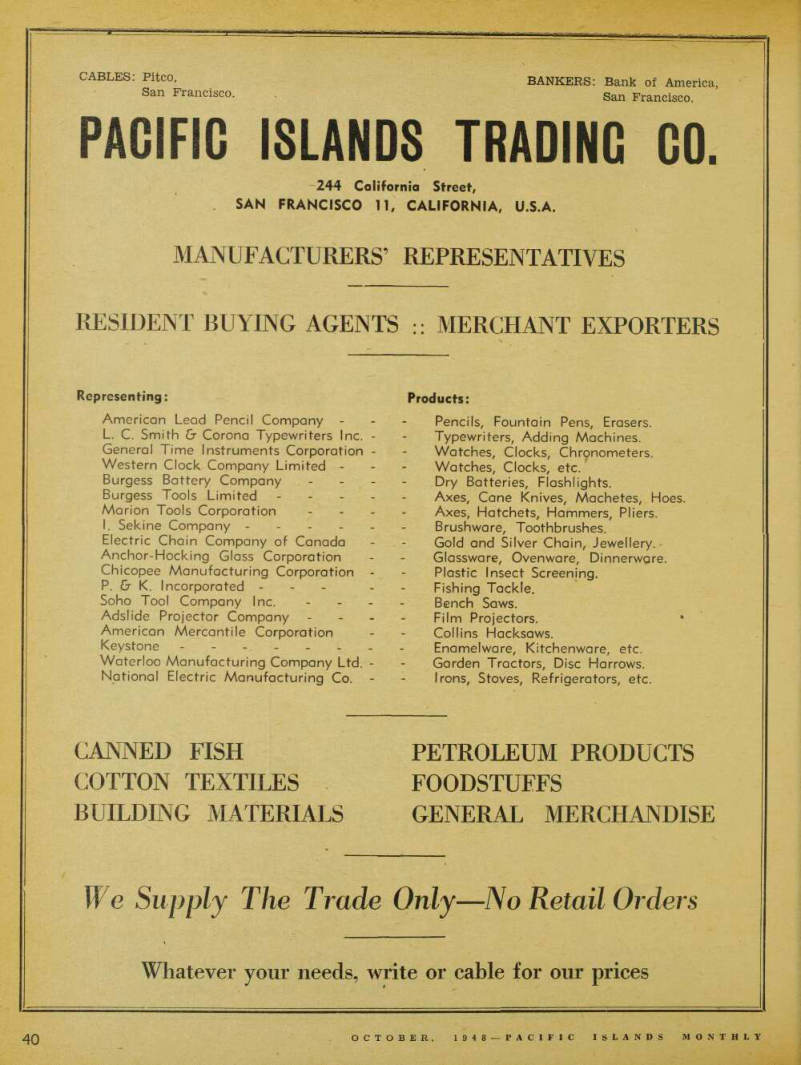
The Department of Agriculture there has been in touch with various oversea authorities on the subject. It has re ceived detailed advice from the Queens land Department of Agriculture. A ref erence sample of “Reference Papain’’ has been received from the Pacific Islands Trading Co., of San Francisco. Samples of the seed of the short-stemmed variety of paw-paw has been sent to the Depart ment from Tanganyika.
A circular, for distribution to planters, is being prepared by the Department, and some of the junior staff presently will be instructed to do preliminary field work in relation to papain.
Mr. and Mrs. W. R. Cahill, of Madang, New Guinea, arrived in Brisbane recently on an extended holiday.
To Combat
‘Nutfall’
Remarkable Use of Solomon Is.
Ant
Honiara, Sept. 12.
SUCCESSFUL research by scientists into the nutfall disease which causes serious losses in British Solomon Islands coconut plantations has recently been concluded.
Lever Bros, sent Mr. Leach, plant pathologist, from England to the Solo mons, to reopen investigations made by scientists before the war. The Fiji Gov ernment co-operated by sending Mr.
O’Connor, Government Entomologist, with Mr. Leach.
The present research team confirmed earlier scientific opinion that the nutfall trouble is caused by an insect, Ambly pelta, which feeds in the same manner as a mosquito, and pierces the young coconuts to suck their juices. Injury to the young coconut is caused by a toxic fluid which the insect injects while it feeds; the damaged area turns brown and soft; and the nut falls prematurely.
Maturing nuts are also damaged, though these do not fall.
Messrs. Leach and O’Connor conduc ted their investigations in plantations which, before the war, were almost entirely ruined by nutfall. They found that these estates, once kept clean and tidy, were now overgrown with vines and small shrubs, and that the coconut trees, though some of the old coconuts were heavily marked with Amblypelta scars, had recovered and were bearing very large crops of healthy nuts.
Pre-war, scientists discovered that the large yellow ant, Oecophylla, was pre sent on nearly every good bearing tree, and that it disturbed and attacked the sucking bug. This ant builds its nest out of leaves, preferably at the top of a tree, and comes down the tree to cover a wide area in its search for food.
The recent research disclosed that this yellow ant is attacked by two other species of ant, neither of which will harm the sucking bug, Amblypelta. One of these enemy ants (Pheidole) nests in the base of the coconut trees, and the other (Iridomyrmex) in depressions in the trunk and in the crown of the palm.
In plantations where only the ant living at the base of the tree was present, it was found that the overgrown state of the plantations had resulted in the yellow ant being provided with natural bridges from the ground to the upper trunk of the tree, so that it was not subject to the attack of its enemy at the tree base.
Transplanted colonies of the yellow ant readily made their way up and down the trees against which coconut fronds had been placed for their use, and the yellow, ants were also observed to be travelling along the natural vines which have sprung up near the trees.
Palms examined six weeks after a col ony of ants had been introduced and pro vided with artificial bridges were already bearing healthy young nuts.
Messrs. Leach and O’Connor were not able, in the time available, to find any way of countering the second variety of ant (Iridomyrmex) which destroys the yellow ant. Iridomyrmex is found all the way up the trunks of trees, and at their tops.
In plantations affected by Ambly pelta and therefore subject to nutfall, where Iridomyrmex is present, it is con
sidered that the yellow ant cannot be successfully established, unless Irido myrex is previously eliminated from the palms. Further work may show that this ant could be destroyed by reasonably economical methods.
In the meantime, dusting or spraying, for direct control of Amblypelta, appears to be indicated.
However, in plantations affected by Amblypelta, where only the ant (Phei dole) which nests at the base of a palm is present, nutfall should be a thing of the past, provided that coconut i)lanta tions are not kept too clean, and that provision is made for the yellow ant to bypass Pheidole.
Areas in the BSIP mainly affected by nutfall before the war, were the islands of Guadalcanal, Malaita and Nggela. It was then estimated that an average yield of only 2 cwt. of copra to the acre could be produced in affected areas; while in the unaffected Russell Islands Group the average yield was 15 cwt. of copra per acre. Copra is at present returning about £4O gross per ton to the Solomon Islands producer, and increased production is badly needed to alleviate the world-wide shortage of fats.
Damage Claims
How To Deal With War
NOW that the Australian War Damage Commission has ceased to function, it is notified that all matters relating to claims may be dealt with generally by the Commonwealth Treasury officials in the various capitals; and especially— In respect of all New South Wales matters and Queensland, Papua and New Guinea claims, by The Officer in Charge, Commonwealth Sub-Treasury, War Damage Section, Ist Floor, M.L.C. Build ing, 44 Martin Place, Sydney; In respect of inquiries in Papua and New Guinea in relation to claims, by Mr.
E. A. James, Local Representative, Com monwealth Treasury, War Damage Sec tion, Cuthbertson Street, Port Moresby, Papua.
P.I. Society of Sydney
IIHE next meeting and social gathering of the Pacific Islands Society will be held on October 27, at History House, 8 Young Street, Sydney. Guest speaker will be Dr. E. Morris Humphrey whose subject will be “Ships, Past and Present.”
New members who have joined the Society since the last meeting are Cap tain and Mrs. James Marr.
Rouses Fijian Anger
“Effrontery!”
Indian Insolence Again
Prom Our Own Correspondent
Suva, Oct. 1
Ratu Edward Cakobau, A Major
in the Army during the war, winner of the Military Cross in the Solo mons campaign, and not long returned to Fiji after completing an administrative course at Wadham College, Oxford, pro vided one of the bright spots in the just-ended session of Fiji’s Legislative Council.
Almost incredibly, the Indians had had the temerity to come up with another bland reference to the fact that as “loyal subjects of his Majesty in Fiji” they be lieved they had absolutely equal status with the British in the trusteeship over the Fijians conferred on Queen Victoria by the Deed of Cession in 1874.
Eyes were turned from the Indian facade of smooth assurance to what seemed to be the contemptuous indiffer ence of the five Fijian members.
Later, a spectator in the public gallery said that he had sat “petrified with fear that the Indians would be allowed to get away with that insult again”.
When Ratu Edward rose to speak (the debate was on the “constitutional” motion that misfired) he dealt with the motion and went through the points raised by other speakers with unassum ing efficiency. Then, without warning, out it came: “How a race which, just three years ago, not only made no contribution to the war effort but even sabotaged the war effort, has the effrontery to claim equal relationship with the British in trusteeship of the Fijian people is past comprehension,” said Ratu Edward, in a tone that expressed Fijian anger at this repeated insolence even better than his carefully-chosen words.
There was a moment’s pause before he went on to score a point off an Indian who had spoken of the Secretary of State for the Colonies as “the greatest dictator of the age, who sits in 10 Downing Street.”
Ratu Edward put the Indian member right about the address and informed him that the “dictator” happened to be an elected member of the House of Com mons.
But for all that there is no assurance anywhere that the Indians will not per sist in their trusteeship theory, more particularly as regards the Fijians’ owner ship of land.
Well-Known Ng
Family
A recent photograph of the Deland family, now of Adelaide, but also well known in New Guinea. Front row: Mrs. Deland, Dr. C. M. Deland and Curtis Deland, holding his small sister Marion, newly christened. Back row: Michael, Raymond, Peter and Donald Deland.
Advertisements & other items, p. 14 (1 item)
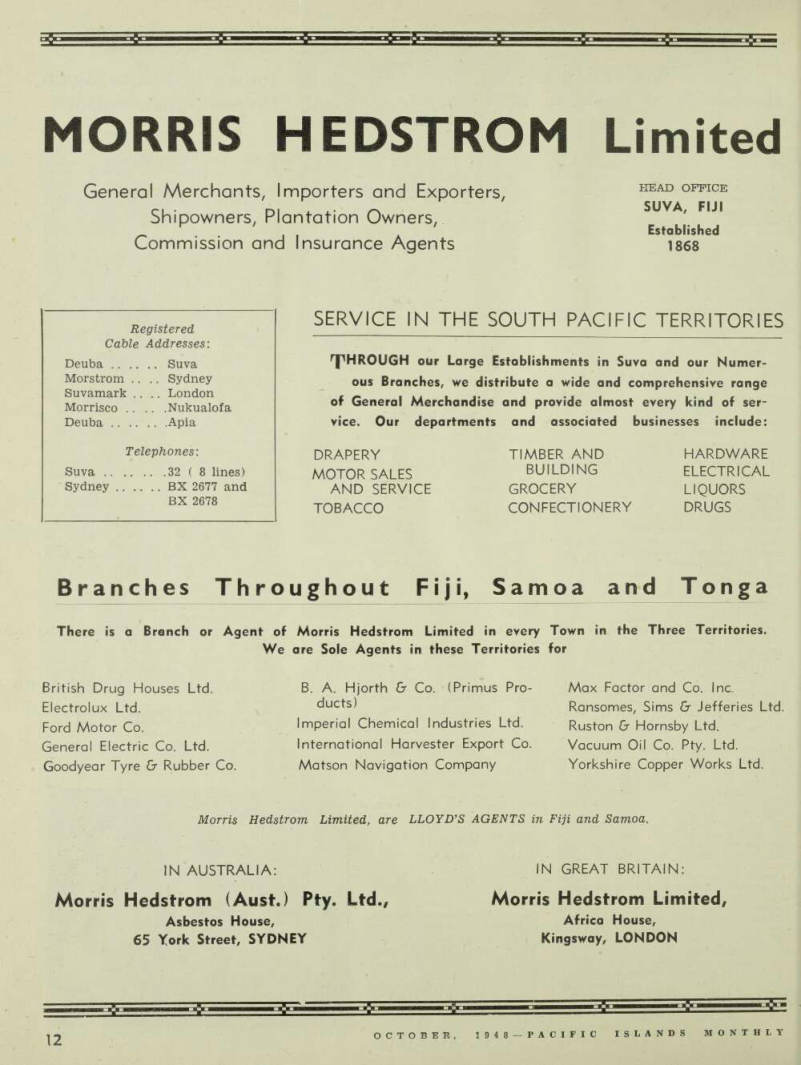
Morris Hedstrom Limited
General Merchants, Importers and Exporters,
Shipowners, Plantation Owners,
Commission and Insurance Agents
HEAD OFFICE
SUVA, FIJI
Established 1868
SERVICE IN THE SOUTH PACIFIC TERRITORIES
rpHROUGH our Large Establishments in Suva and our Numerous Branches, we distribute a wide and comprehensive range of General Merchandise and provide almost every kind of service. Our departments and associated businesses include:
DRAPERY
MOTOR SALES
AND SERVICE
TOBACCO
TIMBER AND
BUILDING
GROCERY
CONFECTIONERY
HARDWARE
ELECTRICAL
LIQUORS
DRUGS
Branches Throughout Fiji, Samoa and Tonga
There is a Branch or Agent of Morris Hedstrom Limited in every Town in the Three Territories.
We are Sole Agents in these Territories for British Drug Houses Ltd.
Electrolux Ltd.
Ford Motor Co.
General Electric Co. Ltd.
Goodyear Tyre & Rubber Co.
B. A. Hjorth £r Co. (Primus Pro- Max Factor and Co. Inc, d uc * s ) Ransomes, Sims Gr Jefferies Ltd.
Imperial Chemical Industries Ltd. Ruston £r Hornsby Ltd.
International Harvester Export Co. Vacuum Oil Co. Pty. Ltd.
Matson Navigation Company Yorkshire Copper Works Ltd.
Morris Hedstrom Limited, are LLOYD'S AGENTS in Fiji and Samoa.
IN AUSTRALIA:
Morris Hedstrom (Aust.) Pty. Ltd.,
Asbestos House, 65 York Street, SYDNEY
IN GREAT BRITAIN:
Morris Hedstrom Limited,
Africa House, Kingsway, LONDON
Mr. G. R. Powles to Succeed
High Commissioner Of
W. Samoa
Mr. G. R. Powles to Succeed Colonel Voelcker
THE next High Commissioner of Western Samoa will be Mr. Guy Richardson Powles. He will succeed Lieutenant-Colonel F. W. Voelcker, DSC, MC, who will complete his term next February. The appointment was offici ally announced on September 27 in Well ington, NZ.
Lieutenant-Colonel Voelcker took up the position of Administrator of Western Samoa in February, 1946. and became the first High Commissioner on the coming into force of the Samoa Amendment Act, 1947. He had served with distinction in the New Zealand forces in Fiji. He was appointed to command the Third Bat talion, Fiji Infantry Regiment, in 1942.
The regiment took part in the Solomon Islands campaign in conjunction with United States forces.
MR. POWLES is now counsellor in the New Zealand Legation in Washing ton. He was born in 1905, and graduated bachelor of laws at Victoria University College. He practised as a barrister in Wellington between 1928 and
1940. Enlisting early in the Second World War, Mr. Powles was a brigade major of the Second Brigade Group from 1940 to 1942. He was instructor at the New Zealand Staff College with the rank of lieutenant-colonel from 1942 to 1943, and later joined the Third New Zealand Division in the Pacific as a battery com mander. He was in action with that formation and was in command of a field regiment. From 1944 to 1945 he was Director of Personal Services at Army Headquarters, Wellington.
Mr. Powles has always taken a keen interest in international affairs and was secretary and later president of the New Zealand Institute of International Affairs.
He was appointed to the External Affairs service in December, 1945, and posted to Washington to assist in the work of the Far Eastern Commission. Mr. Powles has been intimately connected with the work of the commission as the New Zealand representative since that time. He at tended the British Commonwealth con
ference on the Japanese peace settle ment in Canberra in 1947. and has rep resented New Zealand at other inter national conferences.
Lieut.-Col. Voelcker,
With Papuan Killing
Two Men Charged With Papuan Killing
IN September, two men, now resident in Australia, were charged with the kill ing of a native police constable named Hala, in Misima, Papua, in March, 1942.
It was alleged Hala was shot, and died of wounds.
One of the accused is Albert Edward Downey, a mining engineer. He was charged in Sydney Central Court, on Sep tember 21, and remanded, pending extra dition to Papua. The other is Arthur Louis le Boutillier, a contractor. He was charged at the Brisbane Police Court, and remanded to Port Moresby.
Police-Inspector T. P. Gough and Sgt.
M. J. Guise, of the Royal Papuan Con stabulary, attended the courts in Sydney and Brisbane in connection with the matter.
New Director Of Fiji
Medical Services
DR. J. C. R. BUCHANAN has retired from the post of Director of Medical Services, Fiji. He will be succeeded by Dr. J. N. Cruikshank. OBE, who is expected to arrive in the Colony from the United Kingdom in February, 1949. He is a Canadian; has served as- Director of Medical Services, Bahamas, and as a Medical officer with the RCAF during the war.
Dr. Buchanan will become Assistant Medical Adviser to the Secretary of State for the Colonies.
Communications
Giving the Cooks Better Communications
THE provision of a small Administra tion vessel for service among the Cook Islands has been approved by the New Zealand Government. Com munication within the Group has been maintained by two trading schooners.
Cook Islands residents are hoping that the TRAPAS New Caledonian-Tahiti air service will be recommenced shortly.
Preliminary flights were made by the company, with a call at Aitutaki, early in the year, but the commencement of a regular service has been delayed by damage sustained by the company’s Catalina aircraft during a hurricane in New Caledonia.
“Bounty” Descendant in Victorian
Will Case
Mrs. Norah Jane Mitchell (Nee
Christian) of Norfolk Island appeared in a Melbourne Court re cently to contest the provisions of the will of her late husband, James Frederick Mitchell, formerly of Melbourne.
Mitchell left his widow a small annuity and a car; the residue of his £21,000 estate went to his daughter, Patricia.
Shortly after his death, Mrs. Mitchell gave birth to a son, but there was no provision in Mitchell’s will for a posthumous child.
Mr. Justice Barry granted Mrs. Mitchell £2,000 in cash from the estate, increased her annuity, and directed that the two children should share the residue.
Airport
Indian Commissioner
In Fiji
Spectacular Welcome At Nadi Airport
Prom Our Own Correspondent
Suva, Oct. 1
ALTHOUGH the newly-appointed Com missioner for the Indian Govern ment in Fiji (Mr. S. A. Waiz) will officially act only for those Indians in the Colony who are not permanent Indian residents, a procession of 250 cars, the property of permanent Indian resi dents, swept up to Nadi Airport early to-day to greet the commis sioner on his arrival from India by way of Australia, All the Indian political and other leaders were at Nadi and there was the usual display of national flags.
After spending to-night at Northern Hotels’ newly-opened hostelry at Nadi, Mr. Waiz will come to Suva to-morrow.
No announcement has been made as to where the Commissioner will live. The plan to buy the Oceanic for him seems to have fallen through. But it is known that, despite the desperate housing short age, a surprising number of Indian prop erty-owners have been eager to put houses at the disposal of their Commis sioner, at very generous rentals. An equally surprising number of prospective landlords have said openly that they want payment in advance.
Earlier this month, an Indian member of the Legislative Council was required to make a retraction in both the English and Indian press, of a statement he had made at an Independence Day gathering.
He had declared that the Commissioner would act for all the Indians living in Fiji. He spoke in Hindustani, and it was not until an Indian paper published a report of the speech that the surpris ing mistake became non-Indian property.
Why Are Australian Canned
Goods Restricted In Fiji?
AUSTRALIAN manufacturers of canned goods are disturbed by the fact that there are restrictions upon the im port of their products into Fiji, and rep resentations are now being made to both the Australian and Fijian authorities on the matter.
The disability was discovered recently by Mr. Rowe, representative of Heinz Products Ltd., who visited Fiji and who discovered that Fijian importers could get from their Government only a limited license to import canned meats, baked beans, etc. The quota permitted is based on 1945 imports, and in that year im portations were very low.
There seems to be no reason for the restriction. The population of Fiji is growing, and every Tuesday is a meatless day in the Colony, when the people turn towards canned foods. The people of Britain would not be affected in anv way if a larger quota of Australian canned goods were admitted to Fiji.
Fiji officials gave no reason for the re striction upon the importation of Aus tralian canned fruits into Fiji, but when the matter was taken up between London and Canberra, the embargo was removed.
The same thing could well be done in relation to other canned goods.
Advertisements & other items, p. 16 (1 item)
Pan American
TO
NEW CALEDONIA
by
Flying
Clipper
YOL RELAX in Pan American’s exclusive Sleeperette* (no extra cost). Your roomy chair-lounge is foam-soft . . . adjusts at button-touch to a restful bed length. You arrive fresh for work or fun.
YOU GET traditional Cl — delicious food, assistance with all travel details, including passports. Call your Travel Agent or Pan American, world’s most experienced airline , . .
Fast Clipper flights
from Sydney
DIRECT TO
NEW CALEDONIA
every Wednesday Saturday (10% reduction on all round-trip fares) Mezzanine Floor , Hotel Australia, Sydney Telephone 8W4701 Rue Jean Joures , Noumea Bank of N.S.W. Building , Suva
Pan American
Pan American Airways, Inc. (Incorporated in V.S.A. —Liability Limited)
World Airways
7cm of Clippers Trade Mark, Pan American Airways, Inc.
Rarotongan Temporary
Makea-Ship
From a Special Correspondent WHILE British law has long recognised the fact that the Heiress-presumptive to the Throne is deemed of age and competent to succeed at 18. that right is denied to the legal successor of the Makea Nui Ariki of Rarotonga.
The New Zealand Government, curi ously, has kept silent on a recent decision by the Native Land Court of the Cook Islands respecting the appointment of the new Makea, until prodded for informa tion by Mr. W. J. Broadfoot, a member of the Opposition.
The last Makea, Takau (the elder daughter of Makea Tinirau), died in September of last year, and the office was vacant until recently. It has been awarded by the Court to her sister, Teremoana (Mrs. Cowan), and the in stallation of the latter, it is known, has taken place in Rarotonga.
Mr. Broadfoot asked whether Mrs.
Cowan’s appointment was for life, or merely temporary: also whether the rights of succession of the daughter of Takau and the late Lt.-Colonel Tiwi Love <the first Maori commander of the Maori Battalion) had been preserved.
Mokoroa, the eldest of Takau’s daughters, who was educated in New Zea land with her father’s family, is now 18 years old.
The Prime Minister (Mr. Fraser), who is also Minister in charge of Island Ter ritories, read the judgment of the Court delivered on May 3, that: “The title goes to Teremoana, and she will hold office until Mokoroa attains the age of 21 years.
Mokoroa is now 18 years of age, and Teremoana will thus hold office, in the first instance, for a period of three years, and she will continue to hold office until Mokoroa can show that she is ready to take over the duties of Makea Nui Ariki.”
“It will be seen, therefore,” Mr. Fraser added, "that the judgment preserves the right of succession to the eldest daughter of the late Makea Nui Ariki Takau, pro vided she is competent.”
Who is to decide whether Mokoroa, on reaching 21 years, is competent? Presum ably, she will have to go to the Cook Islands Court and establish her compet ency. The law of Rarotonga, in this re gard is certainly open to criticism.
Mokoroa has been carefully reared and educated by her grandparents, Mr. and Mrs. Hapi Love, of Petone, who are highly respected members of the Maori race, and there should not be any doubt as to her “competency” to succeed her mother.
Sir Peter and Lady Buck To Visit NZ
Visit NZ In January
From a Special Correspondent WITHIN a few weeks of the decision of the University of New Zealand to confer an honorary Doctorate of Literature upon Sir Apirana Ngata, comes news from Honolulu of the award by the University of Hawaii of the same honour to Sir Peter Buck. He already held an honorary doctorate in science from the University of New Zealand.
Sir Peter and Lady Buck are due in New Zealand in January, at the Pacific Science Congress. Extensive preparations are be ing made by Maori communities to wel come them.
Ngati Porou tribe of the East Coast are restoring the old meeting-house near Rua toria which has associations for Sir Peter.
It was there, when a schoolboy at Te Aute College, he was called upon by the Ngati Porou elders to reply to their wel come, and Te Rangihiroa (as Sir Peter is known to his Maori people), had to ack nowledge that he could not do so in Maori.
Then he determined to master the lan guage and customs of his mother’s people, and he became a master of both.
It is possible that the KCMG which was awarded to Sir Peter will be personally bestowed upon him by the King during the Royal visit in March.
Advertisements & other items, p. 17 (1 item)
Wenzel & Co.
THE
YORKSHIRE
INSURANCE
CO. LTD.
(Incorporated in England)
ALL CLASSES OF
INSURANCE
Including Fire Motor Guarantee Accident Workers Marine Island Representatives:
PORT MORESBY; E. A. James
RABAUL: G. B. Black LAE; New Guinea Industries Ltd.
MADANG: R. MacGregor SUVA; Williams & Gosling Ltd.
NOUMEA; Y. Mortensen
NORFOLK ISLAND:
A. E. Martin
BURNS PHILP (New Hebrides) LTD.
Registered Office: VILA, NEW HEBRIDES
Branch Office at SANTO
Exporters, Importers and General Merchants
(Retail and Wholesale) Commission, Shipping
and Customs Agents
Representatives for BURNS PHILP TRUST COMPANY LIMITED. QUEENS- LAND INSURANCE CO., LTD., and LLOYDS OF LONDON. Agents for SOCIETE DES PETROLES SHELL DES ILES FRANCAISES DU PACIFIQUE, and numerous overseas manufacturers of all classes of merchandise.
Sydney Agents: Burns, Philp & Co,, Ltd.. 7 Bridge Street.
San Francisco Agents: Burns, Philp Co, of San London Agents: Francisco, Burns, Philp & Co., Ltd., Matson Building, 35 Crutched Friars, EC 3 215 Market Street,
WENZEL & CO.
EXPORT DISTRIBUTORS
255 California Street, San Francisco 11, U.S.A.
Cable Address “Wenco.” All Codes.
Transferred
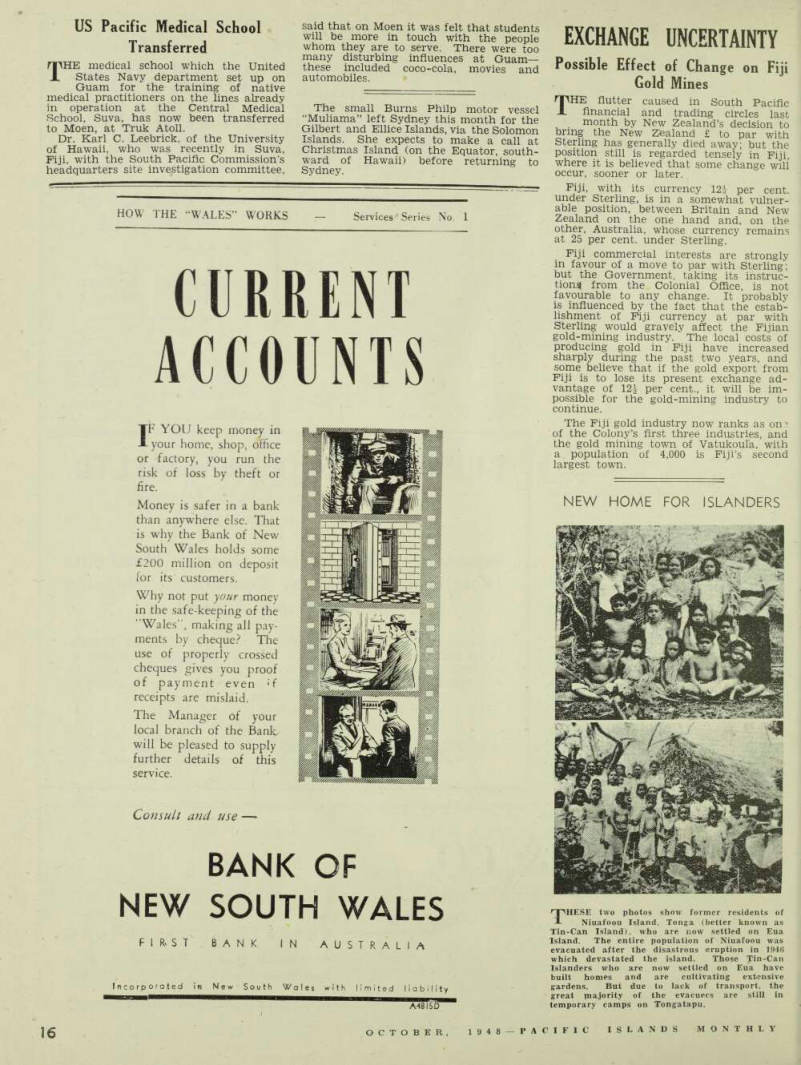
US Pacific Medical School Transferred
THE medical school which the United States Navy department set up on Guam for the training of native medical practitioners on the lines already in operation at the Central Medical School, Suva, has now been transferred to Moen, at Truk Atoll.
Dr. Karl C. Leebrick, of the University of Hawaii, who was recently in Suva, Fiji, with the South Pacific Commission's headquarters site investigation committee,
said that on Moen it was felt that students will be more in touch with the people whom they are to serve. There were too many disturbing influences at Guam— these included coco-cola, movies and automobiles.
The small Burns Philp motor vessel "Muliama” left Sydney this month for the Gilbert and Ellice Islands, via the Solomon Islands. She expects to make a call at Christmas Island (on the Equator, south ward of Hawaii) before returning to Sydney.
Exchange Uncertainty
Possible Effect of Change on Fiji Gold Mines
THE flutter caused in South Pacific financial and trading circles last month by New Zealand’s decision to bring the New Zfealand £ to par with Sterling has generally died away; but the position still is regarded tensely in Fiji, where it is believed that some change will occur, sooner or later.
Fiji, with its currency 12 i per cent, under Sterling, is in a somewhat vulner able position, between Britain and New Zealand on the one hand and. on the other, Australia, whose currency remains at 25 per cent, under Sterling.
Fiji commercial interests are strongly in favour of a move to par with Sterling; but the Government, taking its instrucfrom the Colonial Office, is not favourable to any change. It probably is influenced by the fact that the estab lishment of Fiji currency at par with Sterling would gravely affect the Fijian gold-mining industry. The local costs of producing gold in Fiji have increased sharply during the past two years, and some believe that if the gold export from Fiji is to lose its present exchange ad vantage of 12£ per cent., it will be im possible for the gold-mining industry to continue.
The Fiji gold industry now ranks as on > of the Colony’s first three industries, and the gold mining town of Vatukoul'a, with a population of 4,000 is Fiji’s second largest town.
New Home For Islanders
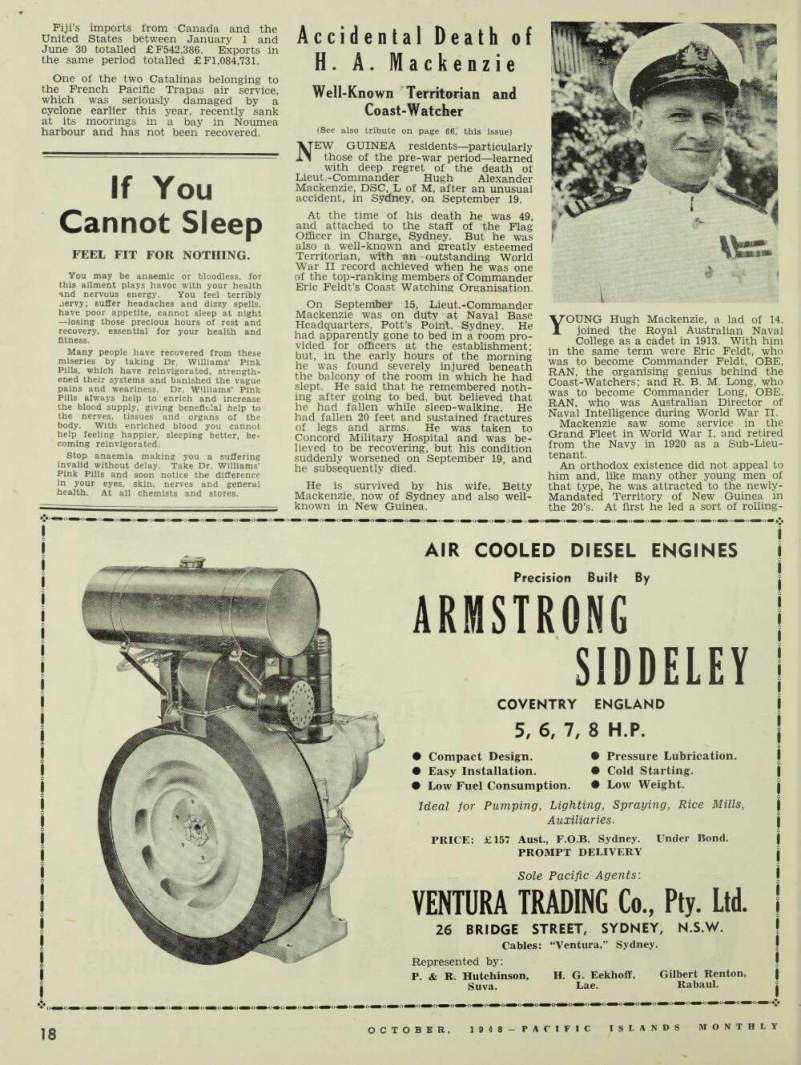
THESE two photos show former residents of Niuafoou Island, Tonga (better known as Tin-Can Island), who are now settled on Eua Island. The entire population of Niuafoou was evacuated after the disastrous eruption in 1946 which devastated the island. Those Tin-Can Islanders who are now settled on Eua have built homes and are cultivating extensive gardens. But due to lack of transport, the great majority of the evacuees are still in temporary camps on Tongatapu.
Fiji’s imports from Canada and the United States between January 1 and June 30 totalled £F542,386. Exports in the same period totalled £ F 1,084,731.
One of the two Catalinas belonging to the French Pacific Trapas air service, which was seriously damaged by a cyclone earlier this year, recently sank at its moorings in a bay in Noumea harbour and has not been recovered.
Advertisements & other items, pp. 18-20 (3 items)
Current
HOW THE “WALES” WORKS
Services Series No. 1
ACCOUNTS
IF YOU keep money in your home, shop, office or factory, you run the risk of loss by theft or fire.
Money is safer in a bank than anywhere else. That is why the Bank of New South Wales holds some £2OO million on deposit for its customers.
Why not put your money in the safe-keeping of the "Wales”, making all pay-
ments by cheque? The
use of properly crossed
cheques gives you proof
of payment even «’f receipts are mislaid.
The Manager of your local branch of the Bank, will be pleased to supply further details of this service.
Consult and use
BANK OF
NEW SOUTH WALES
FIRST BANK
I N
AUSTRALIA
Incorporated in New South Wales with limited liability A4815D
Pacific Islands Monthly- O C T O B E R , 1 948
Capstan
An ornate example of historical
keys, this XVlth Century
French key features the sporting motif in its club and animal carvings. It seems to have been the key to a Duke’s country
lodge.
-V V' n fS ill ‘ m
-A P S TA
The key
to smoking pleasure
CAPSTAN
FINE CUT
NAVY CUT
TOBACCOS
cr
If You
Cannot Sleep
FEEL FIT FOR NOTHING.
You may be anaemic or bloodless, for this ailment plays havoc with your health and nervous energy. You feel terribly nervy; suffer headaches and dizzy spells, have poor appetite, cannot sleep at night —losing those precious hours of rest and recovery, essential for your health and fitness.
Many people have recovered from these miseries by taking Dr. Williams’ Pink Pills, which have reinvigorated, strengthened their systems and banished the vague pains and weariness. Dr. Williams’ Pink Pills always help to enrich and increase the blood supply, giving beneficial help to the nerves, tissues and organs of the body. With enriched blood you cannot help feeling happier, sleeping better, becoming reinvigorated.
Stop anaemia making you a suffering invalid without delay. Take Dr. Williams’
Pink Pills and soon notice the difference in your eyes, skin, nerves and general health. At all chemists and stores.
SMmm
ir *
AIR COOLED DIESEL ENGINES
Precision Built By
ARMSTRONG
SIDDELEY
COVENTRY ENGLAND
5,6, 7, 8 H.P. • Compact Design. • Pressure Lubrication. • Easy Installation. • Cold Starting. • Low Fuel Consumption. • Low Weight. ideal for Pumping, Lighting, Spraying, Rice Mills, Auxiliaries.
PRICE: £157 Aust., F. 0.8. Sydney. Under Bond.
PROMPT DELIVERY
Sole Pacific Agents :
VENTURA TRADING Co., Pty. Ltd.
26 BRIDGE STREET, SYDNEY, N.S.W.
Cables: “Ventura,” Sydney.
Represented by: P. & R. Hutchinson, H. G. Eekhoff, Gilbert Renton, Suva. Lae. Rabaul.
Accidental Death of H

H. A. Mackenzie Well-Known Territorian and Coast-Watcher
(See also tribute on page 66, this issue)
NEW GUINEA residents—particularly
those of the pre-war period—learned with deep regret of the death of Lieut.-Commander Hugh Alexander Mackenzie, DSC, L of M, after an unusual accident, in Sydney, on September 19.
At the time of his death he was 49, and attached to the staff of the Flag Officer in Charge, Sydney. But he was also a well-known and greatly esteemed Territorian, with an outstanding World War II record achieved when he was one of the top-ranking members of Commander Eric Feldt’s Coast Watching Organisation.
On September 15, Lieut.-Commander Mackenzie was on duty at Naval Base Headquarters, Pott’s Point. Sydney. He had apparently gone to bed in a room pro vided for officers at the establishment; but, in the early hours of the morning he was found severely injured beneath the balcony of the room in which he had slept. He said that he remembered noth ing after going to bed. but believed that he had fallen while sleep-walking. He had fallen 20 feet and sustained fractures of legs and arms. He was taken to Concord Military Hospital and was be lieved to be recovering, but his condition suddenly worsened on September 19, and he subsequently died.
He is survived by his wife, Betty Mackenzie, now of Sydney and also well known in New Guinea.
YOUNG Hugh Mackenzie, a lad of 14, joined the Royal Australian Naval College as a cadet in 1913. With him in the same term were Eric Feldt, who was to become Commander Feldt, OBE, RAN, the organising genius behind the Coast-Watchers; and R. B. M. Long, who was to become Commander Long, OBE, RAN, who was Australian Director of Naval Intelligence during World War 11.
Mackenzie saw some service in the Grand Fleet in World War I. and retired from the Navy in 1920 as a Sub-Lieu tenant.
An orthodox existence did not appeal to him and, like many other young men of that type, he was attracted to the newly- Mandated Territory of New Guinea in the 20’s. At first he led a sort of rolling
stone existence—mostly in island schooners and in trading—then he settled down as a planter at Megigi, in the Talasea District of New Britain. He had a likeable personality and was held in high esteem by fellow Territorians. He later proved himself an able leader; a man other men would follow.
He was at Megigi when the Second World War began. In November, 1940, he was appointed assistant to Commander Feldt, head of the Coast Watchers, who then had his headquarters at Port Moresby. Feldt, in his book. “The Coast Watchers,” describes him as . . . “Conscientious and thorough in an unsystematic sort of way, and, occasionally, he would do something quite illogical.
He had none of the qualities of salesmanship or showmanship, whatsoever. In appearance he was of medium height, fair and sturdily built, looking, then, much younger than his 40 years.” ~«.,, , . . , Mackenzie s first task in his new job mon t v tlon when two Gerif H? n i OrS T-P n ? 6W i r^ and) ln . e " cernber, 1940, He was later appointed Naval Intelligence Officer, Rabaul, and he was there when the Japs landed in January, 1942. the subsequent evacuation he helped to save the lives of many who otherwise, out of sheer mexperience, would have perished in the New Britain push, When the retreat began from Rabaul, he collected his small Naval party and drove them to the end of the Toma Road; from there it was a matter of taking to the jungle. Realising that they would have to fend for themselves he gave orders that the teleradio should be destroyed so that the party of 10 would be, as far as possible, unencumbered. He gave them their choice—they could remam with him, under his leadership, or, unprepared for what lay ahead, rush off
with the troops still streaming by. To a man they elected to stay under his guid ance and, with his example, they re mained, in the midst of chaos, calmly preparing for the hardships of the journey, While they were preparing food-packs they were joined by a military party which included Lieutenant P. Figgis, Mil itary Intelligence Officer of Rabaul Force.
Th ey travelled together, following the native pads, up mountain slopes, through dripping jungles. Ahead of them mex-eri enced troops blundered on, some to fall out by the roadside to perish; some into the hands of the Japanese, to be massacred at Tol. m atviwxjtt T jV/fEANWHILE, J. K. McCarthy was organising an escape route along . the north coast of the island, roundm £ up the desperate, despondent troops .with the help of worthy assistants, bullying and cajoling them, by stages to Talasea. When McCarthy learned that some troops had escaped by the southern ro ute he despatched a* timber-man, Frank Holland, to the South Coast, to contact them. Holland walked day and night across New Britain’s central mountains reac h these men. When Mackenzie received McCarthy’s message, he sent his party back with the indomitable Holland b U t decided to stay himself to assist those troops who were too far away to take part j n McCarthy’s evacuation plans.
Figgis remained with Mackenzie.
McCarthy finally commandeered the small Burns Philp ship “Lakatoi,” which was hiding in Witu fiom the Japs, and got his troops, and those' who had come back with Holland, safely away to Aus tralia. a signal was sent to Port Moresby stating that more troops (Mackenzie’s Party) were on New Britain’s south coast, near Palmaimal, and Lieutenant Ivan Champion, in the “Laurabada,” sneaked across from the Trobiands and took them
off— ls 3 evacuees who safely reached Aus tralia in due course.
AFTER leave and a short period in headquarters in Townsville, Mackenzie was sent to Noumea as Deputy Super vising Intelligence Officer (SOPAC) Forces,
and he later moved on to Vila and !BSI where, on Guadalcanal, he established a radio station just seven days after the uS Marines had landed.
This station was to pick up warnings of Jap movements from Coast-Watchers further north (particularly from Paul Mason and W. J. Read, in Bougainville ) and pass them on to the forces on the spot. The radio post was first established in a captured Jap dug-out, a mere hole in the ground, at the edge of the air field. Here Mackenzie and his assistants spent their time in rain, mud and acute misery; but they had the satisfaction of knowing that the post rapidly became the pivot on which the Solomons campaign swung—the field headquarters to which, at one time, 11 Coast-Watchers in the Solomons were sending reports.
Due to speedy dispersal of messages, which this arrangement allowed, the US forces were warned of impending Jap at tacks hours before the Jap’s Rabaul based planes could reach Guadalcanal.
During this time, Mackenzie was in strumental in rescuing F. A. Rhoades and L. Schroeder, who were at dangerous coast-watching posts on North-west Guadalcanal and whose position, due to the landing in the vicinity of Jap rein forcements, was becoming untenable.
Mackenzie sent a launch to their aid and took off, as well, 13 missionaries and one shot-down American airman. For this independent action he earned the dis pleasure of General Vandegrift, of the US Corps of Marines, whole sole purpose was to hold the perimeter established by his Marines near Henderson Field and who, for some reason of his own. appeared to consider Rhoades and Schroeder “expend able.”
During the heavy bombardments that preceded the Jap attempt to recapture
Guadalcanal in October, 1942, Mackenzie and his staff had many narrow escapes from death; and some did not escape.
But during that time of activity Mackenzie’ was organising fresh coast watching posts, particularly on Vella La Vella, Choiseul and in the Russell Group.
Ater the failure of the Japanese to re capture Guadalcanal and after he had been in the thick of things for many months, Mackenzie visited Vila and Noumea, where he met Admiral Halsey, who expressed his admiration of the job being done by the Coast-Watchers.
Mackenzie was, about the same time, pro moted to acting Lieut.-Commander; and when Feldt became ill in March. 1943, Mackenzie appeared to be his logical suc cessor as Supervising Intelligence Officer.
Mackenzie arrived in Sydney on leave in May, 1943, but during it he developed blackwater fever and for many weeks had to fight for his life. In the meantime, Lieut.-Commander J. C. McManus was appointed SIO.
For his work in the Solomons. Mackenzie was awarded the US Legion of Merit.
Mr. J. P. Barron, who has been appointed Executive Engineer to the Fiji Public Works Department, recently arrived in the Colony. * * * Recent news of Dr. and Mrs. A. G.
Rutter, who left the BSI early in the year, is that they are living in Middlesex, England, while Dr. Rutter takes a post graduate course at Hammersmith Hos pital. Dr. Rutter went to the BSI as medical superintendent for the Methodist Mission in the 1930’s and in 1944 he be came chief medical officer of the BSI ad ministration.
Advertisements & other items, pp. 21-23 (1 item)
A Complete
QUEENSLAND
INSURANCE
COMPANY
LIMITED
(Incorporated 1886 In Australia;
ASSETS EXCEED £4,000,000
Head Office :
QUEENSLAND
INSURANCE BUILDING,
80-82 PITT STREET, SYDNEY.
Speciolists in South Seas Fire,
Marine Cr Accident Insurances
Apply to:—
nji.
Branch Office: I. B. Chalmers, Manager.
Burns Phllp (South Sea) Co.. Ltd.
VILA.
Burns Phllp (South Sea) Co.. Ltd.
Comptolrs Francals Des Nouvelles Hebrides (Marine).
NOUMEA.
L. & W. Johnston.
PORT MORESBY:
Burns, Phllp & Co., Ltd.
W. A. Anderson, Resident Officer.
PAGO PAGO.
Burns Phllp (South Sea) Co., Ltd.
G. H. C. Reid & Co.
OTHER SOUTH SEA ISLANDS.
Burns Phllp (South Sea) Co., Ltd.
Also to any of the Company's Offices in Australia or Hew Zealand.
crystal pick-dr The GP.6 mcmic
PICK-UP
A Complete
of
Useful Products
wesunghouse
BATTERY CHARTER
ACOS GPIO High Fidelity Crystal Pickup incorporating the new UNBREAKABLE CARTRlDGE—vibrationless arm—needle pressure adjusting device—YOU can instal it.
Price, 48/6.
ACOS GP6 Magnetic Pickup has light weight head, giving excellent fidelity of tone and—it’s easy on your records. Price, 44/1.
WESTINGHOUSE Battery Charger, supplied ready to plug into the nearest 200-260 volts AC power supply. No mess, no fuss, no bother! Whether it’s a car or radio battery, completely recharge it at your home overnight! 6V £5/13/- 12V £6/19/9 Why suffer that rattling, toneless speaker in your radio any longer? Instal an Amplion Cone Speaker—renowned for excellent tonal quality and high efficiency—there is an Amplion Speaker for YOUR Set.
The MANLEY URN —a most useful appliance in the kitchen. Provides 4 pints of boiling water, and can also be used to boil eggs, cook vegetables, heat baby’s bottle. Has.
“lift out” element for quick cleaningunique “safety level” . prevents burn outs.
Operates from 240 volts AC or DC. REAL
VALUE at £3/19/6.
The PHONOMOTOR has high power, at constant speed. Being mounted in live rubber, is completely silent. Plays 10” or 12” records and—it’s available NOW for only £5/8/3 (240 V AC only).
The HUSHATONE is an “under-the-pillow” speaker for individual listening. Hear your favourite programme in bed, without disturbing others. Every HUSHATONE is complete with installation instructions. Price. £3/16/4.
Mail your orders TO-DAY. in Island deliveries.
RADIO
CQ«£
SPEAKER
We specialise 50/HP.3.
AUSTRALASIA
#>TY. LTD.
36-40 PARRAMATTA ROAD, CAMPERDOWN, N.S.W., AUST.
American Magazines
Direct to You from the Publishers.
AMERICAN HOME 21/6
CHARM 32/6
COLLIERS’ WEEKLY 52/6
CORONET 18/9
FORTUNE 96/-
GLAMOUR 27/-
HOUSE & GARDEN 42/6
LADIES’ HOME JOURNAL 37/6
LIFE 49/-
LOOK 32/-
McGRAW-HILL DIGEST 31/3
MAGAZINE DIGEST 18/9
NATIONAL GEOGRAPHIC MAGAZINE .. 38/6
POPULAR MECHANICS 22/9
POPULAR PHOTOGRAPHY 26/6
READERS’ DIGEST 12/-
SATURDAY EVENING POST 68/9
SCIENTIFIC AMERICAN 40/-
SCIENCE ILLUSTRATED 62/6
TIME 96/-
VOGUE (20 numbers) 105/-
YACHTING 40/-
ESQUIRE 75/-
Rates are for one year and include all charges. Many other overseas
Art, Trade, Technical, Fashion and
Literary periodicals available.
ALL ORDERS AIR-MAILED TO
PUBLISHERS.
MAIL PUBLICITY CO., 175 PITT
STREET, SYDNEY, N.S.W.
IMPORTERS
EXP OR TER 5
m' X e X * r ml i jh ALL CLASSES OF MERCHANDISE PURCHASED FOR ISLAND CLIENTS
THROUGHOUT THE SOUTH-WEST PACIFIC.
ISLAND PRODUCE SOLD ON AUSTRALIAN AND OVERSEAS MARKETS
ON COMMISSION BASIS.
jSlkliLAkL..k JI..U. '/iikAA
ROBERT GILLESPIE PTV.LTD
BANKERS: BANK OF N.S.W.
COMPTOIR NATIONAL
D'ESCOMPTE DE PARIS
54a PITT ST. SVDNEV N.S.W.
CABLE ADDRESS;
•ROBERGILL"
PHONES BW 4782-B 1305
EXCLUSIVE
TO THE
“PENGUIN”
The detachable Water Jackets, Patent No. 108870, exclusive to "Penguin"
Super Marine Engines, facilitate the casting of the cylinders, guranteeing uniform wall thickness and eliminating distortion and wear.
The
PENGUIN
SUPER MARINE
ENGINE
H El 4 H.P. Model Price £56, F. 0.8.
Packing, £l/10/-
8 H.P. TWIN-CYLINDER
MODEL
Price £lO9/10/-, F. 0.8.
Packing, £2/5/-.
3i H.P. MODEL
Price £5l/18/-, F. 0.8.
Packing, £l/10/-.
PENGUIN
Marine Engines
are ideal for open
or cabin type boats
up to 22 feet.
They enable an owner in a few minutes to remove rust, sand, weed and other debris from the walls of the cylinders, thus ensuring trouble-free cooling at all times.
IMPORTANT NOTICE:
These engines are precision built by Chapman (P.W.) Engineering Pty., Ltd., Redfern, N.S.W., Australia, who are in no way connected with other companies of a similar name.
DETAILS:
Full details of specifications, equipment sup plied, and dimensions of each model, are available on application to: New Guinea Co. Ltd., RABAUL MADANG
KAVIENG, LAE.
J. R. Clay & Co. Ltd., PORT MORESBY.
W. R. Carpenter & Co. Ltd. (Solomon Islands)
TULAGI.
W. R. Carpenter & Co. (Fiji), Ltd.
Sub-Agencies available.
Supplies are available from;
W. R. CARPENTER & CO. LTD.
HEAD OFFICE:
16 O'CONNELL STREET, SYDNEY
‘Dictatorship’ Suggestion
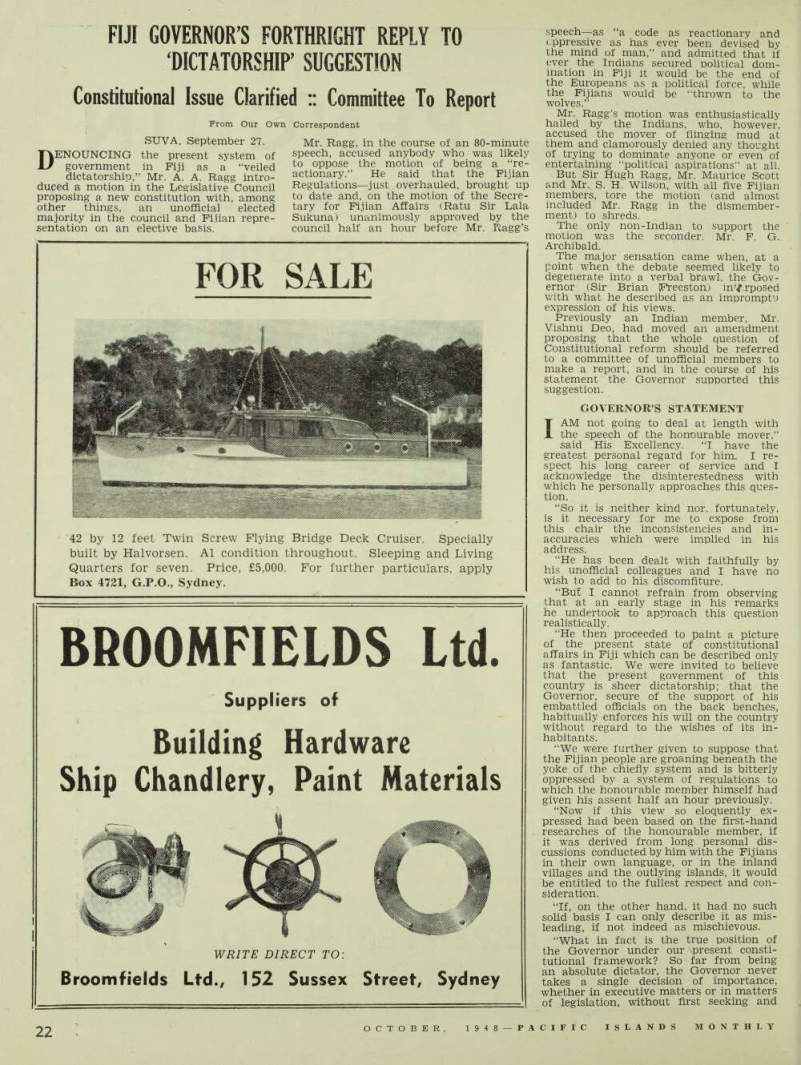

Fiji Governor’S Forthright Reply To
Constitutional Issue Clarified :: Committee To Report
Prom Our Own Correspondent
SUVA, September 27.
DENOUNCING the present system of government in Fiji as a “veiled dictatorship,” Mr. A. A. Ragg introduced a motion in the Legislative Council proposing a new constitution with, among other things, an unofficial elected majority in the council and Fijian representation on an elective basis.
Mr. Ragg, in the course of an 80-minute speech, accused anybody who was likely to oppose the motion of being a “re actionary.” He said that the Fijian Regulations—just overhauled, brought up to date and, on the motion of the Secre tary for Fijian Affairs (Ratu Sir Lala Sukuna) unanimously approved by the council half an hour before Mr. Ragg’s
speech—as “a code as reactionary and oppressive as has ever been devised by the mind of man,” and admitted that if ever the Indians secured nolitical dom ination in Fiji it would be the end of the Europeans as a political force, while the Fijians would be “thrown to the wolves.”
Mr. Ragg’s motion was enthusiastically hailed by the Indians, who, however, accused the mover of flinging mud at them and clamorously denied any thought of trying to dominate anyone or even of entertaining “political aspirations” at all.
But Sir Hugh Ragg, Mr. Maurice Scott and Mr. S. H. Wilson, with all five Fijian members, tore the motion (and almost included Mr. Ragg in the dismember ment) to shreds.
The only non-Indian to support the motion was the seconder. Mr. F. G.
Archibald.
The major sensation came when, at a point when the debate seemed likely to degenerate into a verbal brawl, the Gov ernor (Sir Brian IPreeston) with what he described as an impromptu expression of his views.
Previously an Indian member, Mr.
Vishnu Deo, had moved an amendment proposing that the whole question of Constitutional reform should be referred to a committee of unofficial members to make a report, and in the course of his statement the Governor supported this suggestion.
Governor’S Statement
I AM not going to deal at length with the speech of the honourable mover,” said His Excellency. “I have the greatest personal regard for him. I re spect his long career of service and I acknowledge the disinterestedness with which he personally approaches this ques tion.
“So it is neither kind nor. fortunately, is it necessary for me to expose from this chair the inconsistencies and in accuracies which were implied in his address.
“He has been dealt with faithfully by his unofficial colleagues and I have no wish to add to his discomfiture.
“But I cannot refrain from observing that at an early stage in his remarks he undertook to approach this question realistically.
“He then proceeded to paint a picture of the present state of constitutional affairs in Fiji which can be described only as fantastic. We were invited to believe that the present government of this country is sheer dictatorship; that the Governor, secure of the support of his embattled officials on the back benches, habitually enforces his will on the country without regard to the wishes of its in habitants, “We were further given to suppose that the Fijian people are groaning beneath the yoke of the chiefly system and is bitterly oppressed by a system of regulations to which the honourable member himself had given his assent half an hour previously.
“Now if this view so eloquently ex pressed had been based on the first-hand researches of the honourable member, if it was derived from long personal dis cussions conducted by him with the Fijians in their own language, or in the inland villages and the outlying islands, it would be entitled to the fullest respect and con sideration.
“If, on the other hand, it had no such solid basis I can only describe it as mis leading, if not indeed as mischievous.
“What in fact is the true position of the Governor under our present consti tutional framework? So far from being an absolute dictator, the Governor never takes a single decision of importance, whether in executive matters or in matters of legislation, without first seeking and
considering advice. He derives that ad vice from two sources, his officials and his unofficials.
“Now my Executive Council contains unofficial members of whom some are also members of this Council and I feel sure that if asked they would admit that whatever they say on these matters in Executive Council, although under the oath of secrecy, is taken into full account by the Governor before he makes what ever decision he does make on the matter in question.
“Under the new procedure for nomin ating unofficial members of the Executive Council the Governor will. I hope, have a greater assurance that the unofficials are such as are in close touch with the feel ing of the country.
“There will be at least a closer nexus, a closer contact between the views of the legislature and the views of the un official members expressed in the secrecy of the Executive Council.
“T CHALLENGE the supporters of the 1 motion to produce one single instance in the last five years where the Gov ernor of the day has used his official majority to over-ride the unanimous opposition of the unofficial members,” proceeded the Governor.
“If such a case can be found I feel confident that it must have been in re lation to that type of subject which under any scheme for constitutional reform and unofficial majorities is reserved to the Governor for the exercise of his guber natorial powers.
“The fact remains, none the less, that the constitution of Fiji as it exists to day is ultimately dependent on the existence of the official majority, 16 votes to 15, and that this might in certain circumstances be used to override the united views of the unofficial members.
“The official majority in my view is the greatest possible and most effective safeguard that any one of the three
peoples could hope for against being treated unjustly, shall we say, by a com bination of the other two races in league against it.
“It safeguards the Fijian absolutely against any attempt that might be made by a combination of the other two races to curtail or encroach upon the rights secured to the Fijian people by the Deed of Cession.
“It safeguards the European against the consequences of his numerical inferiority; it is the lifebuoy which will prevent him from being swamped by weight of num bers. It protects the Indian community from any possible combination of the European and Fijian which might act to their detriment.
“Until the process of assimilation be tween the interests, views and attitudes of the three races has preceded a good deal further than the stage it has reached up to the present, nothing will persuade me that it will be in the interests of the Colony for the Governor to be deprived of that ultimate power to hold the scales even.
“limiLE I have been here various ways YV have occurred to me in which our present constitution might be im proved, might be made more effective, more representative and might approach in some ways nearer our ideal of gov ernment of the people, by the people, for the people.
“For that reason, far from opposing the amendment which is still under de bate. speaking far the Government I say that I should welcome it.
“I am not prepared at this moment to go into it in detail, but, in principle, a
committee composed of unofficial repre sentatives of public opinion of the three races which takes evidence from outside persons or bodies, and which takes into account such racial interests as are hitherto entirely unrepresented in this Council could, I think, produce a very valuable and helpful report.
But I hope I have made it clear—l must repeat it again—that the Govern ment is not, and cannot be pledged in advance to accept the recommendations of such committee, and further that if the recommendations of such a committee included anything which tended to whittle away the existing safeguards for Euro peans, Fijians and Indians. I should feel it my duty to reject the advice and to advise the Secretary of State in London against it.”
At the conclusion of the debate, Mr.
Ragg withdrew his motion.
Mr. Vishnu Dec’s amendment then be came the motion and was carried. Three Europeans (Sir Hugh Ragg, Mr. Scott and Mr. Wilson) voted against it, as did two of the five Fijian members.
At the conclusion of the sitting, the 15 unofficial members held a meeting and submitted the names of two Europeans, two Fijian and two Indian members to serve on the committee, the Governor re serving the right to add other unofficial committeemen to represent communities (such as the Chinese) not included in the three main racial groups.
A concert party of 37 Cook Islanders will arrive in New Zealand shortly.
Their leader is Piri Macate. The party will visit Maori tribes and express the goodwill of their kinsmen in the Cook Islands. They will also give public per formances of Rarotongan traditional dancing and singing. Their visit will last several months.
Advertisements & other items, pp. 24-26 (1 item)
Broomfields Ltd.
FOR SALE
42 by 12 feet Twin Screw Flying Bridge Deck Cruiser. Specially built by Halvorsen. A 1 condition throughout. Sleeping and Living Quarters for seven. Price, £5,000. For further particulars, apply Box 4721, G.P.0., Sydney.
Suppliers of i
Building Hardware
Ship Chandlery, Paint Materials
WRITE DIRECT TO :
Broomfields Ltd., 152 Sussex Street, Sydney
ART POSTCARDS OF
TONGA
Per Dozen, Postage Paid: 6/- (one US Dollar).
TONGAN PHOTOS BUREAU
Nukualofa, Tonga
Better for School Books
They stand the rough and tumble. They're lighter and easier to carry.
Ask first for
SCHOOL CASES
* V' r ff y
FORD SHERINCTON LTD.
or > 57
ss?s-
Heinz beans are oven baked the way you like them!
They taste good and they are good . . . they’re full of nourishment ... a real energy giving food.
For a crowd, family or snack, it’s Heinz Baked Beans.
HEHSZH®BEMS
ISLAND RESIDENTS!
in SAMOA TONGA
COOK ISLANDS FIJI—
TAHITI.
MAKE USE OF
NEW ZEALAND’S
ISLANDS PERSONAL
SERVICE
We Will Undertake to Perform: Shopping Services Repairs and Replacements Purchasing of Gifts, Food Parcels Travelling and Accommodation Special Services, Etc.
For A Moderate Commission Charge Write for Further Particulars or Address Your Inquiries to
PRODUCE BUYERS
Box 126, Te Aro, Wellington, New Zealand.
PRODUCE BUYERS
Box 126 Te Aro, WELLINGTON, N.Z.
Cables: Probuy-Wellington We will act as AGENTS for Trading Firms and Merchants in all Pacific Territories Address All Enquiries To Us For Your
Requirements
Imported Merchandise N.Z. Produce and Manufactured Goods
FOR EFFICIENT AND UP-TO-DATE
REPRESENTATION
Tokelaus To Be
Part Of New Zealand
THE remote and tiny Tokelau Islands or Union Group, will, from January 1, become part of New Zealand.
Since 1916, although the Tokelaus have been administered by New Zealand through Western Samoa since 1925, they have been officially a British possession.
The Group consists of three main islands, Pakaofo, Nukunono, and Atafu, all of atoll formation. The total land area is about six square miles, and they lie 300 miles north of Samoa. They were administered by the High Commission for the Western Pacific, together with the Gilbert and Ellice Islands Colony. But they were awkwardly placed from an Ad ministrative point of view and New Zea land, in 1925, was asked to take over.
Warships from the New Zealand station occasionally visited them, as also did the Administrator of Western Samoa. For the most part, however, the people were governed by their own chiefs.
The present population is about 2,000.
The people speak a dialect of Samoan, and they are quiet and noted for their hos pitality. Their only contact with the out side world is through Apia, their port of entry, by small cutters.
Chief industry in the Group is the mak ing of copra. They also excel at mat weaving and other native handicrafts.
Although the Group will become part of New Zealand, the existing laws of the islands are £o continue and the statute law of New Zealand will not be applicable unless expressly stated.
This year the Group was given its first official postage stamps, through the
benevolgnce of the New Zealand Govern ment. If philatelists respond as they have in the past to stamp issues made by other isolated Pacific islands. New Zealand’s new territorial acquisition should not im pose any strain on the Dominion ex chequer.
World Price Of Rubber
SPOT rubber was quoted at 1/2% (ster ling) per pound in London recently and was still rising. This was caused mainly by heavy Russian buying. The Soviet, up to July, had bought over 70,000 tons of rubber in London, com pared with 35,000 tons for the same period last year (which was about normal pre-war intake).
The London price (equal to nearly 1/6 Australian per pound) is considerably under the price being received by Papuan rubber-growers.
Papua Is Back To Normal
Police-inspector Thomas Patrick Gough, who arrived in Brisbane re cently on official duties, said that conditions in Papua were practically back to normal; and that the natives had been remarkably helpful during the recon struction period.
Housing was still a problem, according to the Inspector, but supplies were in creasing and general conditions were sat isfactory.
Despite the influences of the war years, the natives in Papua were well behaved and they had little crime.
Inspector Gough said there were now 2,500 native police in the Papua-New Guinea area, headed by a staff of 45 Australian police officers.
Advertisements & other items, pp. 27-28 (1 item)
Crammond’S...
Answer the Problem ... releasing a
thoroughly efficient tropic receiver ...
THE CRAMMOND NO. 1 TROPIC EAGLE
••• Write for full particulars of Crammond's full range of instruments, including unit Portable receivers that may be packed amongst baggage.
All Crammonds are built of highest grade components by skilled craftsmen. Our reputation built over more than twenty years of trading is a guarantee of satisfaction.
Address letters to: Alfred Crammond, Managing Director, or Mr. Jack Chesterfield, Manager and Technical Director.
Crommond Tropical Receiver Available in four models:— 6 Valve 2 volt with Accumulator. 6 Valve 240 volt 50 cycle A.C. 6 Valve 1.4 volt with batteries. 6 Valve Vibrator.
Exclusive Features:
• Completely Tropic Proofed. • Sealed in Rustless Steel Metal Cabinet. • Provision for Loudspeaker and Headphone reception. • Slow motion instrument type dial with gear ratio 55 to 1 simplifies tuning on all wave lengths. • Continuous coverage of short wave lengths from 16 to 150 metres. • Designed for trouble-free operation in areas where extreme humidity prevails. • Built in moisture absorber.
CRAMMOND RADIO MANUFACTURING COMPANY. PTY. LTD.
No. 8 Queen Street, Brisbane
Limited
Established 1896.
AUCKLAND
Island Traders. PO * BOX 49 °* Telegraphic and Cable Address: “Grove”, Auckland, Entrust Your Orders to the Firm with Fifty Years Practical Experience in the Island Trade.
Shippers of all classes of New Zealand products.
Representing English Manufacturers through-
out the Cook and Society Islands, Fiji, Tonga, Samoa, Niue, New Caledonia, New Guinea, etc.
In FIJI as—W. H. Grove Gr Sons (Fiji) Ltd.
m
fi.p.C
TAKE
VINCENT’S
WITH CONFIDENCE
HEADACHES, NEURALGIA & HEAD NOISES
One Vincent's a.p.c Powder or two Tablets taken with water will bring -quick relief!
FOR INFLUENZA AND RECENT COLDS:
One Vincent's a,p.c Powder or two Tablets at night, followed by a hot lemon drink, then every four hours.
FOR PAINS & HEADACHES IN WOMEN:
One Vincent's a.p.c Powder or two Tablets taken with water at the onset will bring quick .and continuous relief! Repeat every 4 hours if necessary.
AN IMPORTANT POINT
TO REMEMBER IS:
That Genuine Vincent's a.p.c contains Aspirin, Phenacetin and Caffeine in the same scientific proportions as the original hospital prescription!
Insist on Vincent's a.p.c !
S
VINCE
A
The Americans
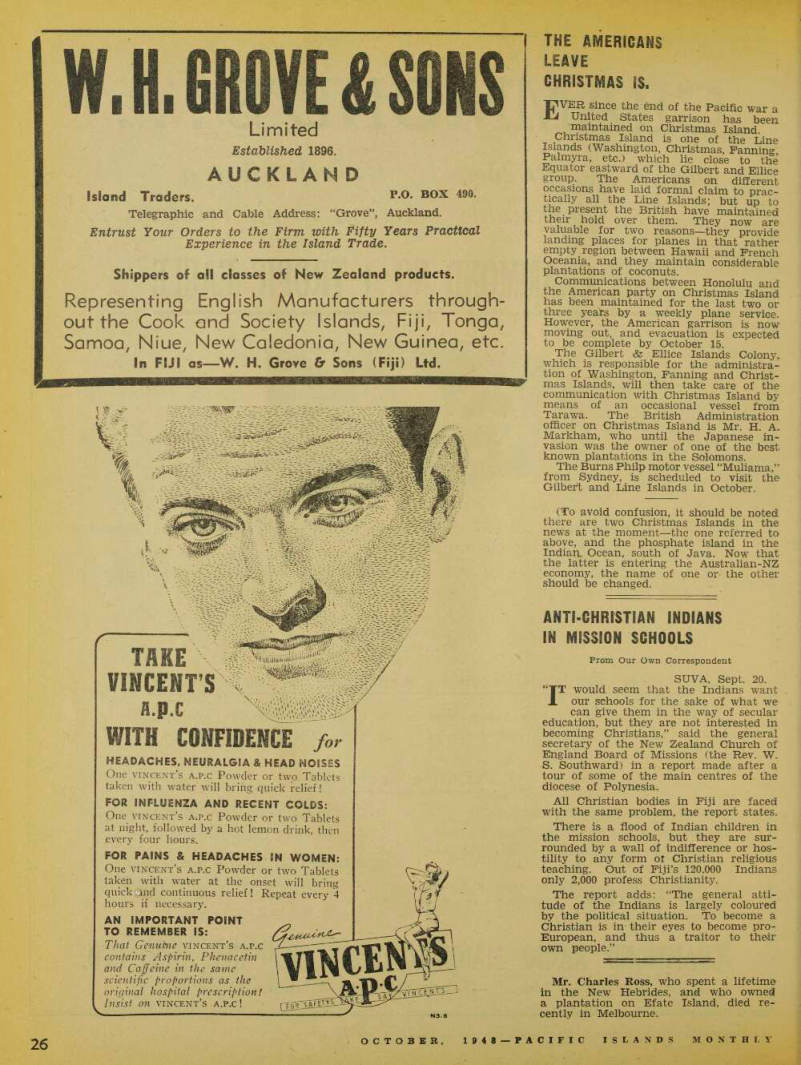
Leave
Christmas Is.
Ever since the end of the Pacific war a United States garrison has been, maintained on Christmas Island Christmas Island is one of the Line Islands (Washington, Christmas, Fanning.
Palmyra, etc.) which lie close to the Equator eastward of the Gilbert and Ellice group. The Americans on different occasions have laid formal claim to prac tically all the Line Islands; but up to the present the British have maintained their hold over them. They now are valuable for two reasons—they provide landing places for planes in that rather empty region between Hawaii and French Oceania, and they maintain considerable plantations of coconuts.
Communications between Honolulu and the American party on Christmas Island has been maintained for the last two or three years by a weekly plane service.
However, the American garrison is now moving out, and evacuation is expected to be complete by October 15.
The Gilbert & Ellice Islands Colony, which is responsible for the administra tion of Washington, Fanning and Christ mas Islands, will then take care of the communication with Christmas Island by means of an occasional vessel from Tarawa. The British Administration officer on Christmas Island is Mr. H. A.
Markham, who until the Japanese in vasion was the owner of one of the best known plantations in the Solomons.
The Burns Philp motor vessel “Muliama,” from Sydney, is scheduled to visit the Gilbert and Line Islands in October. (To avoid confusion, it should be noted there are two Christmas Islands in the news at the moment —the one referred to above, and the phosphate island in the Ocean, south of Java. Now that the latter is entering the Australian-NZ economy, the name of one or the other should be changed.
Anti-Christian Indians
In Mission Schools
From Our Own Correspondent SUVA, Sept. 20.
“TT would seem that the Indians want X our schools for the sake of what we can give them in the way of secular education, but they are not interested in becoming Christians,” said the general secretary of the New Zealand Church of England Board of Missions (the Rev. W.
S. Southward) in a report made after a tour of some of the main centres of the diocese of Polynesia.
All Christian bodies in Fiji are faced with the same problem, the report states.
There is a flood of Indian children in the mission schools, but they are sur rounded by a wall of indifference or hos tility to any form of Christian religious teaching. Out of Fiji’s 120,000 Indians only 2,000 profess Christianity.
The report adds: “The general atti tude of the Indians is largely coloured by the political situation. To become a Christian is in their eyes to become pro- European, and thus a traitor to their own people.”
Mr. Charles Ross, who spent a lifetime in the New Hebrides, and who owned a plantation on Efate Island, died re cently in Melbourne.
Bsi Rehabilitation Falls Short
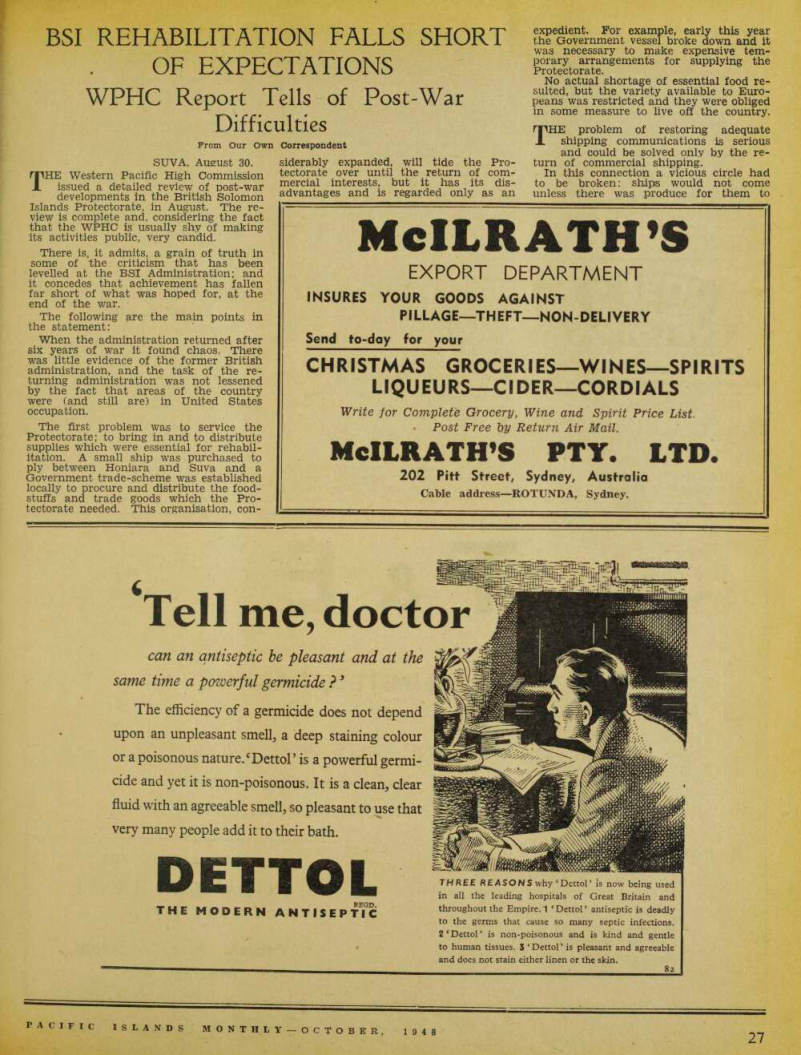
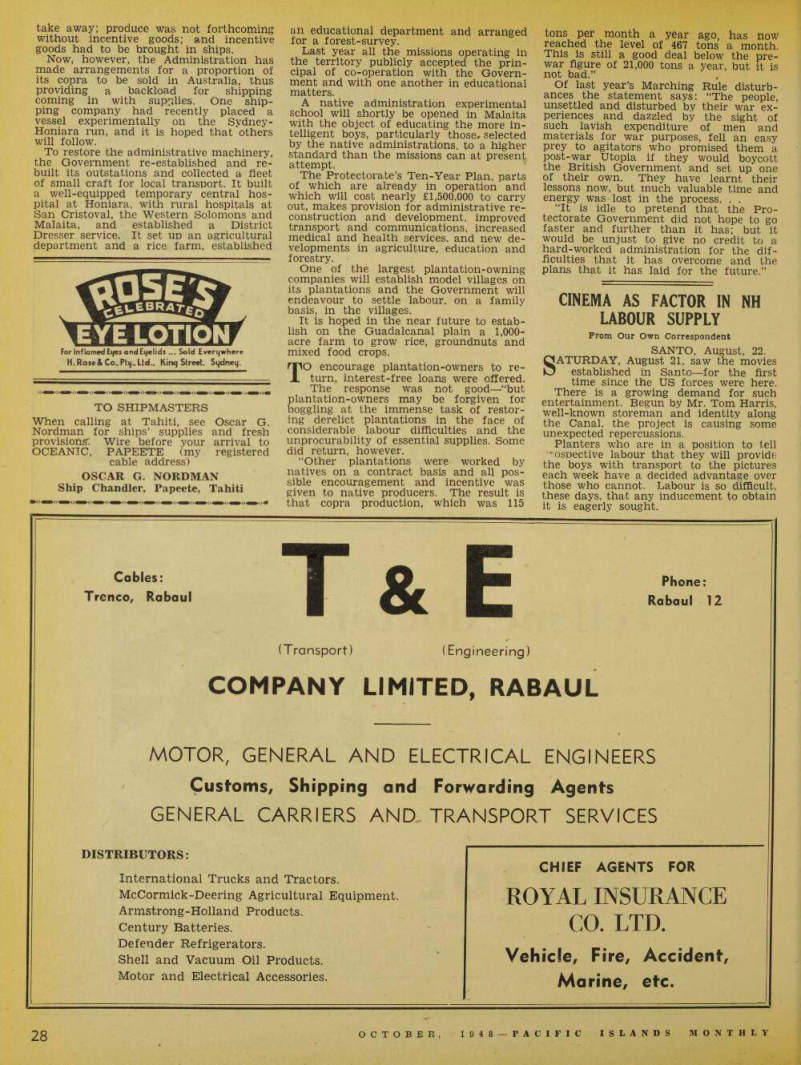
Of Expectations
WPHC Report Tells of Post-War Difficulties
From Our Own Correspondent
SUVA. August 30.
THE Western Pacific High Commission issued a detailed review of post-war developments in the British Solomon Islands Protectorate, in August. The re view is complete and, considering the fact that the WPHC is usually shy of making its activities public, very candid.
There is, it admits, a grain of truth in some of the criticism that has been levelled at the BSI Administration: and it concedes that achievement has fallen far short of what was hoped for, at the end of the war.
The following are the main points in the statement: When the administration returned after six years of war it found chaos. There was little evidence of the former British administration, and the task of the re turning administration was not lessened by the fact that areas of the country were (and still are) in United States occupation.
The first problem was to service the Protectorate: to bring in and to distribute supplies which were essential for rehabil itation. A small ship was purchased to ply between Honiara and Suva and a Government trade-scheme was established locally to procure and distribute the food stuffs and trade goods which the Pro tectorate needed. This organisation, con
siderably expanded, will tide the Pro tectorate over until the return of com mercial interests, but it has its dis advantages and is regarded only as an
expedient. For example, early this year the Government vessel broke down and it was necessary to make expensive tem porary arrangements for supplying the Protectorate.
No actual shortage of essential food re sulted, but the variety available to Euro peans was restricted and they were obliged in some measure to live off the country.
THE problem of restoring adequate shipping communications is serious and could be solved only by the re turn of commercial shipping.
In this connection a vicious circle had to be broken: ships would not come unless there was produce for them to
take away; produce was not forthcoming without incentive goods; and incentive goods had to be brought in ships.
Now, however, the Administration has made arrangements for a proportion of its copra to be sold in Australia, thus providing a backload for shipping coming in with supplies. One ship ping company had recently placed a vessel experimentally on the Sydney- Honiara run, and it is hoped that others will follow.
To restore the administrative machinery, the Government re-established and re built its outstations and collected a fleet of small craft for local transport. It built a well-equipped temporary central hos pital at Honiara, with rural hospitals at San Cristoval, the Western Solomons and Malaita, and established a District Dresser service. It set up an agricultural department and a rice farm, established
an educational department and arranged for a forest-survey.
Last year all the missions operating in the territory publicly accepted the prin cipal of co-operation with the Govern ment and with one another in educational matters.
A native administration experimental school will shortly be opened in Malaita with the object of educating the more in telligent boys, particularly those, selected by the native administrations, to a higher standard than the missions can at present attempt.
The Protectorate’s Ten-Year Plan, parts of which are already in operation and which will cost nearly £1,500,000 to carry out, makes provision for administrative re construction and development, improved transport and communications, increased medical and health services, and new de velopments in agriculture, education and forestry.
One of the largest plantation-owning companies will establish model villages on its plantations and the Government will endeavour to settle labour, on a family basis, in the villages.
It is hoped in the near future to estab lish on the Guadalcanal plain a 1,000acre farm to grow rice, groundnuts and mixed food crops.
TO encourage plantation-owners to re turn, interest-free loans were offered.
The response was not good—“but plantation-owners may be forgiven for boggling at the immense task of restor ing derelict plantations in the face of considerable labour difficulties and the unprocurability of essential supplies. Some did return, however.
“Other plantations were worked by natives on a contract basis and all pos sible encouragement and incentive was given to native producers. The result is that copra production, which was 115
tons per month a year ago, has how reached the level of 467 tons a month.
This is still a good deal below the pre war figure of 21,000 tons a year, but it is not bad.”
Of last year’s Marching Rule disturb ances the statement says: “The people, unsettled and disturbed by their war ex periences and dazzled by the sight of such lavish expenditure of men and materials for war purposes, fell an easy prey to agitators who promised them a post-war Utopia if they would boycott the British Government and set up one of their own. They have learnt their lessons now, but much valuable time and energy was lost in the process. . .
“It is idle to pretend that the Pro tectorate Government did not hope to go faster and further than it has; but it would be unjust to give no credit to a hard-worked administration for the dif ficulties that it has overcome and the plans that it has laid for the future.”
Advertisements & other items, pp. 29-30 (2 items)
27
PACIFIC ISLANDS MONTHLY— O C T O B E R, 1948
Dettol
McILRATH’S
EXPORT DEPARTMENT
INSURES YOUR GOODS AGAINST
PILLAGE—THEFT—NON-DELIVERY
Send to-day for your
CHRISTMAS GROCERIES—WINES—SPIRITS
LIQUEURS—CIDER—CORDIALS
Write for Complete Grocery, Wine and Spirit Price List.
Post Free by Return Air Mail.
McILRATH’S PTY. LTD.
202 Pitt Street, Sydney, Australia Cable address—ROTUNDA, Sydney.
Tell me, doctor
can an antiseptic he pleasant and at the same time a powerful germicide ? 3 The efficiency of a germicide does not depend upon an unpleasant smell, a deep staining colour or a poisonous nature. c DettoT is a powerful germicide and yet it is non-poisonous. It is a clean, clear fluid with an agreeable smell, so pleasant to use that very many people add it to their bath.
DETTOL
TC** w THE MODERN ANTI S E P tTc THREE REASONS why c Dettol ’ Is now being used in all the leading hospitals of Great Britain and throughout the Empire. 1 ‘Dettol’ antiseptic is deadly to the germs that cause so many septic infections. 2 ‘ Dettol ’ is non-poisonous and is kind and gentle to human tissues. 3 ‘Dettol’ is pleasant and agreeable and does not stain either linen or the skin. 82
I For Inflomed Eyes and Eyelids ... Sold Everywhere H.RoseiCo., Pky,Ltd„ King Street. Sydney.
TO SHIPMASTERS
When calling at Tahiti, see Oscar G.
Nordman for ships’ supplies and fresh provision!?: Wire before your arrival to OCEANIC, PAPEETE (my registered cable address)
OSCAR G. NORDMAN
Ship Chandler, Papeete, Tahiti
Cables: Trenco, Rabaul T & E (Transport) (Engineering)
COMPANY LIMITED, RABAUL
Phone: Rabaul 12
MOTOR, GENERAL AND ELECTRICAL ENGINEERS
Customs, Shipping and Forwarding Agents
GENERAL CARRIERS AND TRANSPORT SERVICES
DISTRIBUTORS:
International Trucks and Tractors.
McCormick-Deerlng Agricultural Equipment.
Armstrong-Holland Products.
Century Batteries.
Defender Refrigerators.
Shell and Vacuum Oil Products.
Motor and Electrical Accessories.
CHIEF AGENTS FOR
ROYAL INSURANCE
CO. LTD.
Vehicle, Fire, Accident,
Marine, etc.
Labour Supply
Cinema As Factor In Nh
Prom Our Own Correspondent SANTO, August, 22.
SATURDAY, August 21, saw the movies O established in Santo—for the first time since the US forces were here.
There is a growing demand for such entertainment. Begun by Mr. Tom Harris, well-known storeman and identity along the Canal, the project is causing some unexpected repercussions.
Planters who are in a position to tell '"ospective labour that they will provide the boys with transport to the pictures each week have a decided advantage over those who cannot. Labour is so difficult, these days, that any inducement to obtain it is eagerly sought.
Bought By Australia-
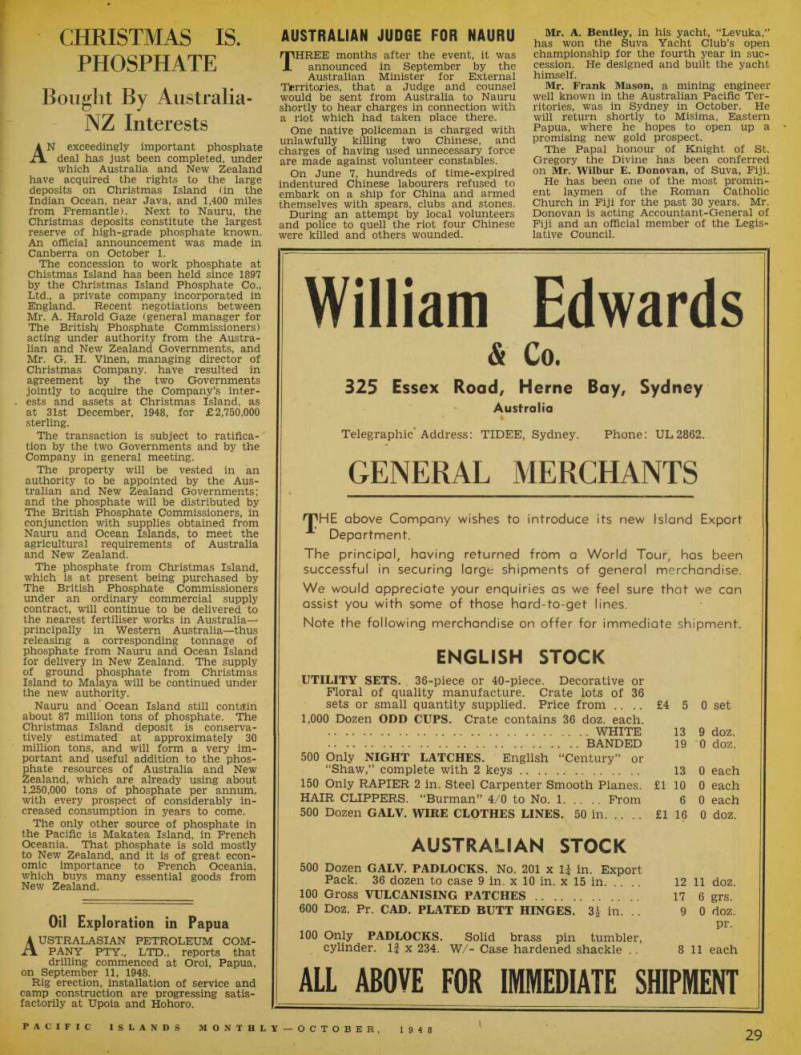
Christmas Is.
Phosphate
NZ Interests
AN exceedingly important phosphate deal has just been completed, under which Australia and New Zealand have acquired the rights to the large deposits on Christmas Island (in the Indian Ocean, near Java, and 1,400 miles from Fremantle). Next to Nauru, the Christmas deposits constitute the largest reserve of high-grade phosphate known.
An official announcement was made in Canberra on October 1.
The concession to work phosphate at Chistmas Island has been held since 1897 by the Christmas Island Phosphate Co., Ltd., a private company incorporated in England. Recent negotiations between Mr. A. Harold Gaze (general manager for The British] Phosphate Commissioners) acting under authority from the Austra lian and New Zealand Governments, and Mr. G. H. Vinen, managing director of Christmas Company, have resulted in agreement by the two Governments jointly to acquire the Company’s inter ests and assets at Christmas Island, as at 31st December, 1948, for £2,750,000 sterling.
The transaction is subject to ratifica tion by the two Governments and by the Company in general meeting.
The property will be vested in an authority to be appointed by the Aus tralian and New Zealand Governments; and the phosphate will be distributed by The British Phosphate Commissioners, in conjunction with supplies obtained from Nauru and Ocean Islands, to meet the agricultural requirements of Australia and New Zealand.
The phosphate from Christmas Island, which is at present being purchased by The British Phosphate Commissioners under an ordinary commercial supply contract, will continue to be delivered to the nearest fertiliser works in Australia— principally in Western Australia —thus releasing a corresponding tonnage of phosphate from Nauru and Ocean Island for delivery in New Zealand. The supply of ground phosphate from Christmas Island to Malaya will be continued under the new authority.
Nauru and ’ Ocean Island still contain about 87 million tons of phosphate. The Christmas Island deposit is conserva tively estimated at approximately 30 million tons, and will form a very im portant and useful addition to the phos phate resources of Australia and New Zealand, which are already using about 1,250,000 tons of phosphate per annum, with every prospect of considerably in creased consumption in years to come.
The only other source of phosphate in the Pacific is Makatea Island, in French Oceania. That phosphate is sold mostly to New Zealand, and it is of great econ omic importance to French Oceania, which buys many essential goods from New Zealand.
Oil Exploration in Papua
Australasian petroleum com pany PTY., LTD., reports that drilling commenced at Oroi, Papua, on September 11, 1948.
Rig erection, installation of service and camp construction are progressing satis factorily at Upoia and Hohoro.
Australian Judge For Nauru
THREE months after the event, it was announced in September by the Australian Minister for External Territories, that a Judge and counsel would be sent from Australia to Nauru shortly to hear charges in connection with a riot which had taken place there.
One native policeman is charged with unlawfully killing two Chinese, and charges of having used unnecessary force are made against volunteer constables.
On June 7, hundreds of time-expired indentured Chinese labourers refused to embark on a ship for China and armed themselves with spears, clubs and stones.
During an attempt by local volunteers and police to quell the riot four Chinese were killed and others wounded.
Mr - A - Bentle y> in his y acht > ‘Levuka, hag won the Suva yacht Club’s open championship for the fourth year in suc cession. He designed and built the yacht himself.
Mr. Frank Mason, a mining engineer well known in the Australian Pacific Ter ritories, was in Sydney in October. He will return shortly to Misima, Eastern Papua, where he hopes to open up a promising new gold prospect, The Papal honour of Knight of St.
Gregory the Divine has been conferred on Mr * Wilbur E. Donovan, of Suva, Fiji, He has been one of the most promm ent laymen of the Roman Catholic Church in Fiji for the past 30 years. Mr.
Donovan is acting Accountant-General of Fiji and an official member of the Legis lative Council.
Advertisements & other items, pp. 31-32 (1 item)
William Edwards
& Co.
325 Essex Road, Herne Bay, Sydney
Australia Telegraphic Address: TIDEE, Sydney. Phone: UL2862.
GENERAL MERCHANTS
fTHE above Company wishes to introduce its new Island Export
A Department.
The principal, having returned from a World Tour, has been successful in securing large shipments of general merchandise.
We would appreciate your enquiries as we feel sure that we can assist you with some of those hard-to-get lines.
Note the following merchandise on offer for immediate shipment.
ENGLISH STOCK
UTILITY SETS. 36-piece or 40-piece. Decorative or Floral of quality manufacture. Crate lots of 36 sets or small quantity supplied. Price from .. 1,000 Dozen ODD CUPS. Crate contains 36 doz. each.
WHITE
BANDED
500 Only NIGHT LATCHES. English “Century” or “Shaw,” complete with 2 keys 150 Only RAPIER 2 in. Steel Carpenter Smooth Planes.
HAIR CLIPPERS. “Burman” 4/0 to No. 1 From 500 Dozen GALV. WIRE CLOTHES LINES. 50 in
AUSTRALIAN STOCK
500 Dozen GALV. PADLOCKS. No. 201 x U in. Export Pack. 36 dozen to case 9 in. xlO in. xl5 in
100 Gross VULCANISING PATCHES
600 Doz. Pr. CAD. PLATED BUTT HINGES. 3£ in. .. 100 Only PADLOCKS. Solid brass pin tumbler, cylinder. 1| x 234. W/- Case hardened shackle .. 12 11 doz. 17 6 grs. 9 0 doz. pr. 8 11 each £450 set 13 9 doz. 19 0 doz. 13 0 each £1 10 0 each 6 0 each £1 16 0 doz.
ALL ABOVE FOR IMMEDIATE SHIPMENT
'VViAT
h o the
Your own job
is big enough
The man who lives in the Islands may acquire additional responsibilities without warning. If he has been appointed executor of an estate several thousand miles away, distance alone makes it almost impossible to carry out these extra duties. In any case, he is most unlikely to possess the highly-specialised knowledge of taxation, investment and finance which efficient administration demands.
Rather than attempt two jobs, he can share the responsibility with Burns Philp Trust Company Limited. If desired, the entire task of administration can be transferred to this experienced and permanent organisation. Not only does this arrangement relieve the individual of an unsought obligation, but also ensures that the beneficiaries’ interests will be safeguarded at all times.
A full description of the Company’s services, together with much valuable information, is given in “Hands That Never Leave The Wheel”. You are invited to send for a copy of this free booklet.
DIRECTORS:
JAMES BURNS. JOSEPH MITCHELL. P. T. W. BLACK.
FREDERICK EWEN LOXTON, ERIC PRIESTLEY LEE.
MANAGER:
L S. PARKER
SECRETARY:
E. R. OVERTON, A.F.I.A.
Burns Philp Trust
COMPANY LIMITED
EXECUTOR • TRUSTEE • AGENT
7 BRIDGE STREET, SYDNEY
Tele. BU 5901 BOX 543, 5.P.0., SYDNEY
-BPIO-
Death Of W. R. B. Thomas
THE death occurred on September 10 at Rabaul, of William Ross Barnard Thomas, well-known in New Guinea.
He died after a serious illness and opera tion, aged 62.
In his passing, New Guinea loses one of its most conscientious and public spirited citizens, who at all times gave unsparingly of his time and energies in the interests of the planting community of the Territory. As an officer of AWA (and later Overseas Telecommunications) he was held in high esteem by his col leagues and by the public generally.
Mr. Thomas was appointed Radio Tele graphist at Rabaul in July, 1922; and his considerate manner and pleasing person ality soon won him a place in the com munity which he maintained throughout the years. Always ready to give his sup port to any movement for the develop ment of the Territory generally, he took an active part in several prominent sporting and commercial organisations, particularly in the Rabaul and Kokopo districts; and, later, when the Expro priation Board properties were sold, he became personally interested in several plantations, including estates in Manus, Buka and Bougainville.
Shortly before the Japanese invasion in 1942 he was transferred to the Kavieng Radio Station as Telegraphist-in-Charge.
When the Japanese invaded Kavieng, he escaped into the interior of the island and, with other Europeans, he played a prominent part in organising a success ful escape from New Ireland by small schooner to Port Moresby, where the party arrived in May, 1942.
After recuperating from the privations experienced during his escape, Mr.
Thomas was stationed at La Perouse and, later, at the Central Office. He was transferred, after the war, to Lae, in 1946, and in December, 1947, he was ap pointed Officer-in-Gharge of Rabaul Radio. He retired from the service in June this year, and had planned to devote his energies to developing his planting and trading interests in New Britain.
The passing of “Bill” Thomas (as he was popularly known to New Guineaites) leaves a place in the community which will be very difficult to fill. His able work as Secretary of the New Guinea Planters’ Association during the difficult period of post-war rehabilitation will always be remembered. All Territorians extend their sympathy to his widow and family (a son, Theodore, and daughter, Marjorie—Mrs. Colin Marr).
Boom Days Gone In Fiji
Imported Goods Remain in Bond
From Our Own Correspondent SUVA, September 13.
SHORTAGE of funds and materials is responsible for the Fiji Public Works Department employing some of its workers on a week-on-week-off system.
With the present cost of living some of the lower-paid workers are finding it dif ficult to keep their families going during the weeks-off.
Another sign of the times is the falling off in the consumption of cigarettes.
Many, which were believed to have gone stale in Fiji shops, were recently burnt.
Others are still in bond.
It is also reported that many Indian storekeepers, feeling the economic pinch, have large quantities of imported goods lying in bond.
100 Years Of Mission Work
Presbyterians Mark Centenary In N. Hebrides By Inaugurating A New Church
By Rev. Wilfred F. Paton
MANY Pacific travellers who have done the round trip on the “Morinda” may have seen one of the loveliest spots in the New Hebrides (or anywhere else)—Tangoa.
Thic tinv nnrai island qhnnt a miip inne- hv hnlf n milp widp lies nniv n iZ|le by of Cdred yardf ofl the ?o y uth coast of the mainland of Santo, a dozen miles from Segond Canal, where the Americans built up an advance base of very large proportions during the war.
Here, the Centenary Synod of the New Hebrides Presbyterian Mission met on June 22 last.
The setting; is sunerb One noted the orderlv^^rrangement P of the vlri?us buildinesof Teachers 1 In statute (wh^h 1 cel^rated rS its 1 in fSSr 6 ip narklfkP slnnpV thp npS mission Imuses, the notably’ clean and well-set up native village; and looking over to the mainland, one views the mountains of Santo’s massive hinter and, with Mount Tabwemasena towering about 6,000 fedt away to the west. , . . , Things have certainly changed since 1848, when John and Catherine Geddie, the pioneers of the New Hebrides Presbyterian Mission, landed at Aneityum after a voyage of many months from Nova Scotia. In 1948, delegates from the Presbyterian Churches in New Zealand and Australia landed at Santo from a flyingboat, less than two days out from Austra-
lia. Among them was a grand-daughter of Dr. Geddie.
The Presbvterians were not the first white missionaries in the New Hebrides, for ( as everyone knows) Williams and Harris, of the London Missionary Society (Congregational), had been martyred on or near the beach at Dillon’s Bay, Erromanga, in November 1839. The Samoan teachers, who bravely carried on plant the Gospel on Aneityum and elsewhere, share with those early martyrs ti^ e f^ on R ur t> ein S the original pioneers 01 . tne Gospel m wna £ has proved to be a tou S h and savage Group.
However, Dr. Geddie’s arrival on Aneityum in 1848, followed by the slow and sacrificial consolidation and spread of the Presbyterian Mission in the New Hebrides, fairly gives to the Mission a t 0 th " earliBSt Christian pioneers.
A CENTURY’S aims and toils, service and sacrifices, errors and achieve ments, disappointments and sue ppssps ran nnlv hp hinted at in a short this 1 d * h 0 ' accoun L sucn as .
But, in the writer’s considered opinion (after a dozen years in the Mission’s ser vice) among the most miserable of pur suits is that of the “debunkers” of the early missionaries. Such writers surely cannot have stood quietly, as I have done, in some of the places filled with historical
significance: such as the memorial stones near the Williams River, at Erromanga; old empty mission houses in spots no longer able, or deemed essential, to be manned (with pieces of furniture, or utensils, left as if for use at any time); or one of the many mission graves, that speak of human loss bravely borne, often in deep loneliness.
To mention names would be invidious; but the NHPM is a fellowship of service, to belong to which any of the younger men of the present time counts it a great honour.
From earliest days, native converts have taken their place as helpers and leaders and teachers.
From almost every island, since the be ginning of the Training Institute at Tongoa in 1895, have gone selected lads and men for a course of training; and many of these, after returning to their islands, have given years of steady service in the villages. Some (like Apon, shot some years ago by the Big Nambas tribes men in northern Malekula) proved “faithful unto death.” Many such men, trained and untrained, have been lead ing their own people towards the ideal of a true and worthy future for their race.
All non-natives who have lived in the Islands know’ that they have numbered among their real friends many a dark skinned man or woman. The present writer recalls, for instance, the bravery of a man who deliberately risked his own life to protect him; and a man who does that for you is your friend.
NOW, for the second century, it be comes plainly necessary that the people of the New Hebrides them selves must increasingly take their part in all development.
On July 1, 1948, a hot but lovely tropical day, as the fruit and climax of the Cen tenary Synod’s deliberations, a solemn service for the Inauguration of the “Pres byterian Church of the New Hebrides” was held in the open air at Tangoa.
After some years of thought and re
search, work and prayer, a “Constitution,” precise enough to safeguard the essentials, and simple enough to be under stood by native leaders of average ability, had been formally adopted.
Here in solemn and cheerful as sembly, native Pastors taking their place
with the white missionaries and the rep resentatives of the Churches in Australia and New Zealand, the formal founding of another recognised branch of the Christian Church Catholic was carried out.
After a prayer of Inauguration, the Moderator of the Centenary Synod read the following Declaration: “In the Name of the Lord Jesus Christ, the only King and Head of the Church, I hereby declare the Presbyterian Church of the New Hebrides to be in augurated to the Glory of God and also for the spiritual upbuilding of the people of the New Hebrides.”
A newly re-erected Quonset Hut was appropriately dedicated for use in train ing native Pastors; and an eloquent address was given.
Thus the second century of the Mission’s work in this Group dawns with good hope.
The Presbyterian Church of the New Hebrides, an infant as yet, instinctively knows how much it needs its parents’ guidance, and even restraint, for many years to come. It shows many signs of good health and strength and promise of maturity; and there are many of us who believe that, while the difficult problems of the clash of cultures have in some organic life, to be developed and un folded within the clear guidance of the Christian Church, there will be found their only sane and happy solution.
Advertisements & other items, pp. 33-34 (1 item)
£. J. Gough S- Co.
r Q fi 8s r ■u.
Cooper Adjustable Glass Louvres are manufactured by F. W. GISSING PTY., LTD., 197 Wilson Street, Newtown, Sydney, Australia. Always insist on GENUINE
COOPER LOUVRES—
they are clearly branded.
Keeps Hot Sun OUT . . .
Let Cool Breezes IN!
Cooper Adjustable Glass Louvres are the ideal way of securing maximum ventilation with minimum interference from glare. Fitted with non-actinic glass, which absorbs the sun’s heat, they are ideal for nurseries and verandahs . . and amazing though it may seem, are actually cheaper to install than ordinary windows Cheaper to instal than ANY other pd of WINQOW adjustable glass louvres Imagine it—units of movable glass louvres (plain or figured) in metal frames, giving unobstructed light and air, yet protection from draughts rain and all with as simple a motion as flicking on a light switch. The price is so amazingly reasonable and father can do all the erecting, it’s so easy.
Illustrated: Typical Suburban Home. Verandah (Sydney) glassed in with Cooper Louvres.
WRITE FOR PARTICULARS TO PACIFIC ISLANDS REPRESENTATIVE
£. J. GOUGH S- CO.
SUPPLIERS OF GENERAL MERCHANDISE TO LEADING FIRMS THROUGHOUT THE PACIFIC ISLANDS.
Exporters . . . Importers . . . Manufacturer s’ Representatives 1 BOND STREET, SYDNEY, AUSTRALIA. Box 3615 G.P.O. Tel. 84167 Bankers: Bank of N.S.W. Bank of Adelaide. Comptolr Nat. d’Escompte do Paris.
Cable Address: “SEAPOODS,” SYDNEY.
Codes: Bentley’s, 2nd and Comp. Phrase; A.8.C., sth and 6th; Peterson, 2nd and 3rd; Banking; Acme.
Pride of ownership
Whether in a new home or old you will be proud to show the WUNDERLICH STAINLESS STEEL SINK to your friends ... to explain how the satin smooth gleaming unit saves your time . . . takes the drudgery out of washing dishes . . . and keeps clean and sparkling always.
WUNDERLICH STAINLESS STEEL SINK UNITS are
available 4ft.. 5 ft. and 6 ft. long by I ft. 6 ins. wide; and they feature a timber backing.
Ask your local Hardware Store, 'phone MX 241 I. or write to Box 474, G.P.O. Sydney, for further information and prices.
S^lPunderlicft
INK. UNITS
IN STAINLESS ST-&EL
■m i'/ r \ : I :
Brighten
the home with
BRASSO
METAL POLISH
VI
Prices
W. Samoa Cocoa and Copra Prices Effect of New Exchange Rate
From Our Own Correspondent APIA. Sept. 23.
WHEN New Zealand brought her £ to parity with sterling and Western Samoa fell into line on September 1, local copra buyers and traders held large quantities of copra bought at the old, higher rate.
At an emergency meeting of the Legis lative Assembly it now has been decided to create a fund to reimburse these buyers. The amount involved is reported to be in the vicinity of £20,000.
Meantime, a higher copra price has been offered by Canadian interests and in future copra shipments will, in part, be directed there instead of to England. The difference in price obtained for Canadian shipments as against British will, how ever be paid into the Emergency Fund until the money refunded by the Admin istration to the copra buyers is repaid.
The new rate paid to producers of copra in the Apia district has been fixed at 24/- per 100 pounds, as against the old price of 30/- per 100 lbs.
Cocoa prices have dropped from £3OO per ton FOB Apia, to between £2OO-£2lO per ton. The new season’s bumper cocoa crop is now being harvested and will be all in by December.
Rabaul To Manus Plane
Service
IN July last, Qantas Ltd., in co-operation with the Administration of Papua- New Guinea, commenced to send a plane, once each week, from Lae (New Guinea) to Rabaul, Kavieng and Manus.
The plane makes the return journey from Lae to Manus and back, in the lat ter part of each week.
This is not a regular commercial schedule —it is carried out under a special arrangement between Qantas and the Administration. The plane carries mails and Administration personnel.
Advertisements & other items, p. 35 (1 item)
tm mpa
Norman
GOLF CHAMPION says:
“Ws HORLICKS for me. Extra
delicious —and the
most nourishing
food drink
of all. 79
“Playing championship golf all the year round is a tiring and strenuous life,” says I\orman Von I\ida. “Believe me, / need the nourishment that Horlicks gives.
And that extra energy makes a big difference to my game ” m Our champion Australian golfer, Norman Von Nicla has always studied his health carefully . , . keeping physically and mentally fit during and between the big tournaments. Von knows the great value of Horlicks. He enjoys that full satisfying flavour . . . and he has proved that Horlicks at night and during the day gives him the extra energy he needs every day.
“Horlicks is the most nourishing food drink of all,” he says.
That full, satisfying flavour of
CALC/m
when mixed as directed Horlicks comes from a careful blend of fresh, full-cream milk and the nutritive extracts of malted barley and wheat. It is Nature’s flavour . . . that’s why you never tire of it.
Many people drink Horlicks simply because they enjoy that distinctive flavour. Others drink Horlicks because they need it to build them up ... to nourish the body and nerves . . . and to induce deep, refreshing sleep. But whatever the reason everyone enjoys Horlicks. Get some today.
Drink
HORLICKS
the delicious,
NOURISHING food drink
Darley
Death Of Mrs. Katarina
MEMBERS of the Polynesian Club of Sydney recently suffered the loss of a fellow-member, in the sudden passing of Mrs. Katarina Nehua Barley, who formerly lived in the Bay of Islands Bistrict, New Zealand. She was a chief tainess of the Ngapuhi people of North Auckland, and was a direct descendant of Eruera Maihi Patuone, a chieftain of
the Ngatihao of Hokianga. Patuone and his famous elder brother, Tamati Waaka Nene, through their chiefly position and Maori eloquence, did a lot towards per suading other Maori chiefs to sign the Treaty of Waitangi, over a century ago, whereby New Zealand came under British rule. Mjrs. Barley was a sweet singer, and was expert with the Maori Poi; and, with her five daughters, she made many appearances with the Club’s Concert Party, which entertained at so many military camps and hospitals dur ing and after the War.
V
Last Chinese Go From Samoa
End of a Long Period of Forced Repatriation
THE last party of indentured Chinese labourers, numbering 126, has been repatriated from Western Samoa by the British ship “Yunnan.” The remaining 159 of the 2,000-odd Chinese who were there when New Zealand took over the Territory from Germany, have been per mitted to remain.
Chinese indentured labourers and Mel anesians from the Solomons were brought in to Western Samoa by the Germans for plantation work which Samoans or Euronesians would do. Both Chinese and Melanesians liked Samoa and married freely with Samoans. They were consequently reluctant to return home.
When Samoa was given to New Zea land as a Mandated Territory, a rigor ous policy of repatriation was carried out.
In the first 15 years all but 80 of the original 1,000 Melanesians had been sent home and all but 700 Chinese.
When the present New Zealand labour Government came to power in 1936, it an nounced that the remainder of the Chinese would be repatriated without fear or favour. And, despite vigorous protests by planters and traders, they were sent home, by the boat-load. When war broke out in 1939, about 300 still remained. The war, and consequent lack of shipping, gave these men a reprieve of almost 10 years and provided some sort of labour force for a rapidly dwindling number of Euro pean planters.
The labour problem in Western Samoa is worse to-day than ever. Samoans are violently opposed to taking regular work of this kind and it is estimated that less than three per cent, are so employed.
However, the New Zealand Government apparently feels that by banishing the last of the Territory’s small labour force “for social and economic reasons” they are keeping Samoa safe for the Samoans.
The 72 Melanesians who still remain in the Territory are employed by the New Zealand Reparation Estates —a Govern ment concern.
Key Men
Chinese Were Cocoa Industries Key Men
From Our Own Correspondent APIA. Sect. 23.
MOST of the Chinese labourers, those who have been repatriated and those who have been allowed to stay behind, were key men on European cocoa planta tions, and the New Zealand Reparation Estates’ cocoa and rubber plantations.
They were in charge of plantation blocks and areas with Samoan labourers working under them. Nearly all of the men had married Samoan women and have large families.
Those who are married and who left on the “Yunnan” will be allowed to return to Samoa at their own expense, if they so desire, but will have to work on planta tions again in Samoa.
European planters have been hard hit by the repatriation and had previously tried their utmost to retain the Chinese.
New Zealand government policy, however, and a portion of the Samoans, insisted on repatriation.
It can hardly be maintained that less than 300 Chinese in a populatipn of 50,000 constituted a serious economic problem.
On the other hand, the progress and prosperity of the cocoa industry is due in no small measure to the Chinese labourers, their good work and their industry.
Advertisements & other items, pp. 36-38 (2 items)
The sign of Duality
<2 'f ' r.
for nearly a Century
SWALLOW & ARIELL
LIMITED
o?
Jlatlet in
the lAcml
c Since 1854 Listen to 3AW-CV at 6.30 p.m. Mondays to Thursdays, to "Front Page Lady” - Radio’s most enthralling serial.
Ipana
r / w %W* =§62 r
Sal
that
eguard
Smile !
A tinge of‘pink’on your tooth brush is a warning to w your dentist. It may mean nothing serious, but let him be the judge.
He may explain that yours is simply a case of tender gums robbed of resistance by to-day’s soft foods. His advice will probably be “more work for lazy gums” and often “the helpful stimulation of Ipana Tooth Paste and gum massage”.
Adopt this simple dental health routine : Brush your teeth with Ipana every morning and evening, followed by vigorous gum massage with Ipana on the finger-tip . . . Teeth become brighter, more lustrous ; gums firmer, healthier; smiles more pleasing.
IPANA
TOOTH PAST
E 4538b/G,
NIREX
8 BRUMBY ST., SYDNEY
Cables: “Nirex,” Sydney.
Tel.: MX3501
REQUIRE APPOINTMENTS
AS BUYING AGENTS FOR
ISLAND MERCHANTS.
Fancy Lines, General Merchandise, Knitware, Piece Goods, Tinned Food, Woollen Goods.
C. SULLIVAN PTY. LTD.
Island Merchants
Over 30 years' experience in the Pacific Island Trade.
Expert Buying Service Original Invoices Furnished Sellers of Island Produce.
Represented in all Australian States, New Zealand, England, France, United States, etc.
BANKERS-: Bank of New South Wales, Comptoir National d’Escompte de Paris, Bank of New Zealand.
C. SULLIVAN PTY. LTD.
379 KENT STREET, SYDNEY
Telegrams & Cables; CHASULL, Sydney. Phone; MJ4657 (6 lines).
New Mission Establishment In Tahiti
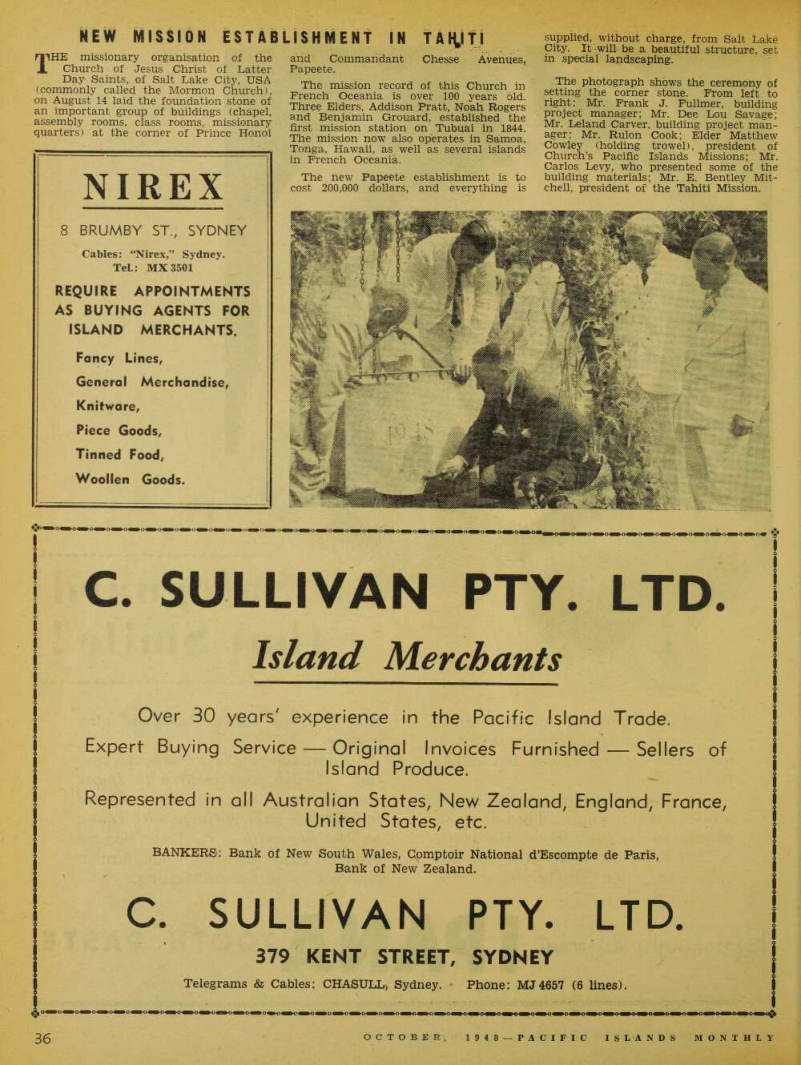
THE missionary organisation of the Church of Jesus Christ of Latter Day Saints, of Salt Lake City, USA (commonly called the Mormon Church), on August 14 laid the foundation stone of an important group of buildings (chapel, assembly rooms, class rooms, missionary quarters) at the corner of Prince Honoi
and Commandant Chesse Avenues, Papeete.
The mission record of this Church in French Oceania is over 100 years old.
Three Elders, Addison Pratt, Noah Rogers and Benjamin Grouard, established the first mission station on Tubuai in 1844.
The mission now also operates in Samoa, Tonga, Hawaii, as well as several islands in French Oceania.
The new Papeete establishment is to cost 200,000 dollars, and everything is
supplied, without charge, from Sait Lake City. It - will be a beautiful structure, set in special landscaping.
The photograph shows the ceremony of setting the corner stone. From left to right: Mr. Frank J. Fullmer, building project manager; Mr. Dee Lou Savage; Mr. Leland Carver, building project man ager: Mr. Rulon Cook; Elder Matthew Cowley (holding trowel), president of Church’s Pacific Islands Missions; Mr.
Carlos Levy, who presented some of the building materials; Mr. E. Bentley Mit chell, president of the Tahiti Mission.
Mechanical Fault Caused
Lae Air Crash Inter-Department Inquiry Not Made Public
THE breaking of four teeth in the main cog wheel of the blower equipment of the port motor caused the crash of the Guinea Air Traders’ Lockheed aircraft near Lae, New Guinea, on April 18. with the loss of 37 lives.
This information was given privately in September by the manager of the company.
The Civil Aviation Department sent its report on the crash to the Minister for Air two months ago but to date it has not been released to the public despite repeated requests for it. This has led to a suspicion that the Government is try ing to suppress it.
The breaking of the cog-wheel, said GAT manager, had caused the motor to fail suddenly. The pilot had done every thing he could to counter the failure but it was thought that the aircraft, which had just left Lae, had not gained suf ficient height.
Pour of the 37 killed were crew mem bers; the remainder were newly-inden tured native labourers who were being transported to the gold-fields, it was said that the natives were being transported as air-freight (as had long been the custom in New Guinea) and that they had not been provided with seats or safety belts. This caused a howl in Depart mental circles in Canberra. While not explaining how seats or safety belts would have helped anyone in this instance, when the plane had burst into flames immedi ately on hitting the ground, and the occupants had been killed instantly, Mr.
Ward and other Departmental heads had obviously been looking for a scapegoat.
Mr. Ward said, at the time, that no plane in New Guinea had Government approval to carry natives as freight and that he would be amazed if this “pre-war practice were continuing against Government orders.” There would, he said, be an immediate investigation to see whether this had been permitted by Civil Aviation officials.
It was suggested, at the time, that the plane may have been overloaded. This was denied by a company official.
As several months have elapsed since the report was given to the Minister for Air, it seems likely that this, like many
such documents, will sink out of sight in some Canberra pigeon-hole.
In the interests of Guinea Air Traders and New Guinea aviation generally, the findings of the committee of inquiry should be made public. (In the House of Representatives, in Canberra, on September 8, Mr. Ryan (Lib., Vic.) asked the Minister for Civil Avia tion, to state the reason for the un precedented delay in announcing the re sult of the inquiry into the air disaster in New Guinea; and would he make the report available to members of the House.
In reply, the Minister said that the report had been handed to him “only last Satur day week,” that it was very extensive,
and that he was going to read it again to determine what action was necessary to deal with the matter. When Mr.
Ryan asked, again, when members might see it the Minister replied, “I am not pro posing that the honorable member shall see it at all.”) The Governor of New Caledonia, M.
Cournarie, recently paid his first visit to the outlying Loyalty group, where live 12,000 native subjects of France who are generally regarded as the most active and intelligent of all Melanesians. He also visited the Isle of Pines, where the Marist Mission, in August, celebrated its hun dredth anniversary.
Advertisements & other items, pp. 39-40 (1 item)
Specially Prepared
PRODUCING UNIFORM GOOD RESULTS SINCE 1868
ALWAYS ASK FOR IT
to withstand
Tropical Conditions
A range of high grade, quality paints, enamels, and varnishes carefully made and manufactured to withstand the destructive forces of sun, wind, rain and heat.
PROTECTS AND PRESERVES.
Automobile Lacquers and Primers, Duraflex Synthetic Enamels, Auto Enamels, Traffic Paints, Aluminium Points, Car Wax and Polish Gasket Cement, Radiator Cement, Hordiproof Anti-Rot Compound.
ALL TYPES OP SURFACE COATINGS.
SPARTAN— — the name that symbolises fine quality in Paint. «*• s —
SPARTAN PAINTS PTY. LIMITED
102-104 King St., Melbourne, Victoria.
VETERINARY
INSTRUMENTS
For Sheep and Cattle can be
Supplied Immediately
EARMARKERS.
SPEYING INSTRUMENTS.
BULLRINGS.
FIRE BRANDS.
EMASCULATORS.
W. JNO. BAKER
PTY. LTD.
3 Hunter Street, Sydney, N.S.W., Australia
Wo/ &rm£ott .
Snug Waterproofs, Thigh, Knee and Ankle Boots for wet weather wear in styles and sizes for men women and children 0 0
ALL THE YEAR ROUND
Dunlop Footwear is designed to relieve the jolts and fatigue of hard work and long wear and will be available soon in an extensive range of sizes and styles to suit every member of
the family.
Genuine Dunlop Kromhyd Soles guaranteed to out- Sport and Sandshoes for every wear two leather recreational occasion, soles.
Rubber heels for comfort and economy.
D-442
DUNLOP
Settler-Producer
Late Mr. A. Witherow
Was Prominent Fiji
Mr. Alfred Hancock Witherow,
one of the best-known of Fiji’s settlers, died at his home at Waila, Rewa, on September 10. at the age of 76.
Born and educated in New Zealand, Mr.
Witherow went to Fiji in 1894. After a period as a sugar-cane cultivator on the Rewa, he took up banana-growing on a large scale during the “banana boom'’ and became one of the largest individual shippers to Australia and New Zealand.
At times his shipments exceeded 6,000 cases (12,000 bunches) to Sydney alone, and on one occasion he shipped 20,000 bunches to Sydney in the ship “Levuka.”
When Australia ended Fiji’s banana trade with the Commonwealth Mr.
Witherow maintained shipments to New Zealand, but concentrated mainly on dairy-farming, while still maintaining small areas under sugar-cane. He was prominently associated with the Rewa Co-operative Dairy Co., Ltd.
For two terms he was the elected mem ber of the Legislative Council for the Southern Division. In his younger days he was a noted athlete and a keen rifle man. In the days when horse-racing was popular in Fiji, he was a successful owner.
In 1904 he married Miss Lily Bailey, daughter of the late Mr. Richard Bailey, one of the few survivors of the sailing ship “All Serene,” lost near Fiji in the late ’sixties.
Mr, Witherow is survived by his wife,
two sons—Messrs. Joseph and Tom Witherow. both of New South Wales—and four daughters—Mesdames Jean McLeod (Gosford, Australia), Phyllis Evans (Labasa), Pat Farrar (Labasa) and Loma Miller (Ohio, USA).
for New Guinea Ships
Cairns as Port of Call for New Guinea Ships
CAIRNS (Qld.) businessmen are again urging that the town be made a port of call for vessels in the New Guinea- Sydney trade. They allege that the town is in a position to supply many goods wanted in New Guinea and now brought from Sydney, The local Chamber of Commerce had previously approached the Minister for External Territories and Burns Philp and Company but had not received satisfactory replies.
Before the war, Burns Philp ships made regular calls at Cairns and Townsville on their way to New Guinea but at that time they were subsidised to do so. Since the war the subsidy had been withdrawn and, it is stated, the volume of trade is such that calls there are unwarranted without it.
The Chamber of Commerce was of the opinion that if ships made regular calls, then the volume of trade from Cairns would grow accordingly. They decided, at their August meeting, to make a further approach to Burns Philp and Co., Ltd., and, if necessary, to ask the Federal Gov ernment to reintroduce the subsidy paid to the Company before the war.
Better Results By Utilising
African Groundnut Scheme
Under Fire
Better Results By Utilising Existing Facilities
A SPECIAL correspondent in the August issue of the “British Trade Journal and Export World” is of the opinion that the East African groundnut scheme is a missed opportunity, in so far as help ing native and European agriculture and getting results in terms of food produc tion, is concerned.
In the last 30 years, he says, East Africans generally have responded well to our efforts to get them to grow cash crops with the result that considerable quanti ties of cotton, groundnuts and coffee were exported. But, generally, agricultural development of the three British East African territories (Kenya, Tanganyika and Uganda) have been ham-strung by the fact that there was never enough money to provide trained staff to carry out the work of teaching the natives Western methods of agriculture. In many cases, one or two Europeans and 20 so-called native instructors have been appointed to areas the size of Wales— the natives, who are without qualifica tions, receiving only from £l2 to £4B per year in salary.
For years, conscientious agricultural workers have cried out for more money and staff to teach and guide and increase production and have longed for the time when the Home Government would wake up to the potentialities of these overseas territories.
But when the dream was at lasyt realised —what happened? Twenty-three million pounds were voted, not for these starved Colonial Agricultural Departments but for the Overseas Food Corporation which will rip up distant uninhabited bush country which the overwhelming majority of the five million natives will never see.
It is to be wondqred why the technical departments of the East African govern ments did not protest; or why the Euro pean settlers and planters did not cry out for subsidised assistance to be given to them in return for the production they could so easily have brought into being.
It could be that the groundnut scheme was too rushed, and that those who should have been most interested were not aware of what was happening until too late.
Had the money and present staff em ployed by the groundnut scheme been shared by the Agricultural Departments of the three territories it would have been possible to put native agriculture on a sound basis and obtain a total export of nuts of over 50,000 tons in 1947 and 100,000 tons in 1948, from native production alone Had the European settlers and planters been assisted with guidance, fertilisers and machinery they alone could have produced a quantity of nuts equal to that of the
native population, and in the same time.
The production of groundnuts by ex perienced farmers could have been in creased in leaps and bounds and would not
have met with the setbacks and the im possible targets of the present scheme.
The muddle that has occurred is typical of Socialist planning everywhere.
Advertisements & other items, pp. 41-42 (1 item)
Fought in 24 Hours
LON DON-SUVA
«\v v,. K/ o.
> PANAMA V
For Sailings and Further Particulars Apply To: BETHELL, GWYN & CO., BURNS, PHILP (SOUTH SEA)
138 LEADENHALL ST., CO., LTD.,
LONDON, E.C.3. SUVA.
Pimples and Bad Skin Fought in 24 Hours
Since the discovery of Nlxoderm by an American physician it Is no longer necessary for anyone to shffer from ugly, disgusting and disfiguring skin blemishes such as Eczema, Pimples, Rash, Ringworm, Psoriasis, Acne, Blackheads, Scabies and Red Blotches. Don’t let a bad skin make you feel Inferior and cause you to lose your friends. Clear your skin this new scientific way.
A New Discovery
Nixoderm is an ointment, but different from any ointment you have ever seen or felt. It is a new discovery, and Is not greasy but feels almost like a powder when you apply .It. It penetrates rapidly Into the pores and fights the cause of surface skin blemishes. Nlxoderm contains 9 Ingredients which fight skin troubles in these 3 ways. I.—lt fights and kills the microbes or parasites often responsible for skin disorders. 2.—lt stops Itching, burning and smarting In 7 to 10 minutes, and cools and soothes the skin. 3.—lt helps nature heal the skin clear, soft and velvety smooth.
Works Fast
mediately, clearing and healing your skin, making It softer, whiter and velvety smooth Because Nlxoderm Is scientifically compounded to fight skin troubles, It works fast.
It stops the Itching, burning and smarting In a few minutes, then starts to work 1m-
In Just a day or two your mirror will tell you that here at last Is the scientific treatment you have been needing to clear your skin—the treatment to make you look more attractive, to help you win friends. Nixoderm has brought clearer, healthier skins to thousands, such as Mr. Bob Weedon, Edmund Street, Fremantle, who writes: “I was troubled with pimples ever since I was 13, and have spent pounds and pounds on so-called cures without results. I then tried Nixoderm with astounding effect.
The pimples seemed to fade away, and after a week there was not the slightest trace of them.”
Satisfaction Guaranteed
Get Nixoderm from your chemist or store to-day. Look in the mirror in the morning and you will be amazed at the Improvement.
Then Just keep on using Nixoderm for one week and at the end of that time It must have made your skin soft, clear, smooth and magnetically attractive—must give you the kind of skin that will make you admired wherever you go, or you simply return the empty package and your money will be refunded In full. Get Nixoderm from your chemist or store to-day.
The guarantee protects you.
Nixoderm 2/- & 4/-
For Skin Sores, Pimples and Itch.
KWONG CHONG BROTHERS
General Merchants and Planters
Have now re-established their business on their original pre-war site, and are carrying stocks of Trading and Plantation requirements. All enquiries welcomed and service assured.
Sydney Representatives: ★
NELSON & ROBERTSON PTY., LTD.,
Electra House, 12 Spring Street, Sydney, N.S.W.
KWONG CHONG BROTHERS
KEMARERE STREET, RABAUL
CABLES: Pitco, BANKERS: Bank of America, San Francisco. San Prancisco
PACIFIC ISLANDS TRADING GO.
244 California Street,
SAN FRANCISCO 11, CALIFORNIA, U.S.A.
MANUFACTURERS’ REPRESENTATIVES
RESIDENT BUYING AGENTS ;: MERCHANT EXPORTERS
Representing: American Lead Pencil Company - L. C. Smith Gr Corona Typewriters Inc. - General Time Instruments Corporation - Western Clock Company Limited - Burgess Battery Company - Burgess Tools Limited - Marion Tools Corporation - I. Sekine Company - Electric Chain Company of Canada Anchor-Hocking Glass Corporation Chicopee Manufacturing Corporation - P. &• K. Incorporated - Soho Tool Company Inc.
Adslide Projector Company - American Mercantile Corporation Keystone Waterloo Manufacturing Company Ltd. - National Electric Manufacturing Co.
Products: Pencils, Fountain Pens, Erasers.
Typewriters, Adding Machines.
Watches, Clocks, Chrpnometers.
Watches, Clocks, etc.
Dry Batteries, Flashlights.
Axes, Cane Knives, Machetes, Hoes.
Axes, Hatchets, Hammers, Pliers.
Brushware, Toothbrushes.
Gold and Silver Chain, Jewellery.
Glassware, Ovenware, Dinnerware.
Plastic Insect Screening.
Fishing Tackle.
Bench Saws.
Film Projectors. • Collins Hacksaws.
Enamelware, Kitchenware, etc.
Garden Tractors, Disc Harrows.
Irons, Stoves, Refrigerators, etc.
CANNED FISH
COTTON TEXTILES
BUILDING MATERIALS
PETROLEUM PRODUCTS
FOODSTUFFS
GENERAL MERCHANDISE
We Supply The Trade Only—No Retail Orders Whatever your needs, write or cable for our prices
Unhappy Conditions In New Guinea
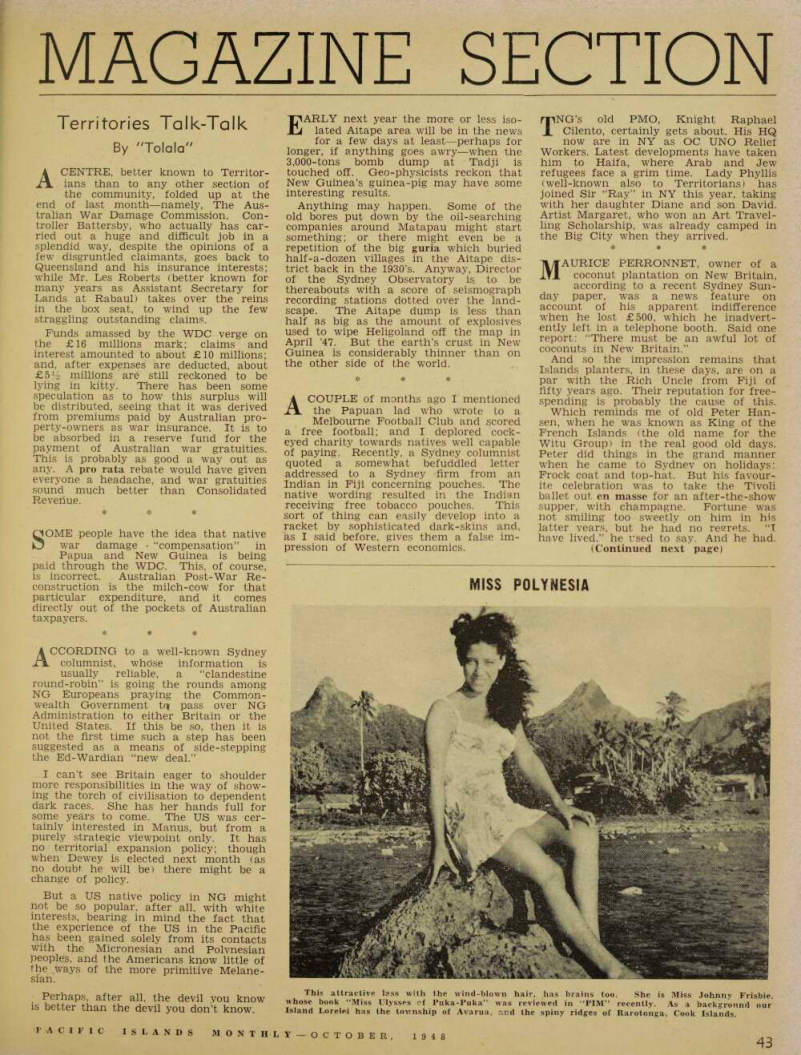
Anonymous Writer Outlines Impressive Practical Policy For ‘Cinderella Territories’
Letter to the Editor
FOR the most part, the New Guinea Europeans are a likeable crowd— I’ve worked, fought, drunk and played with them for nearly fifteen years—but they are not in the tropics for their health, they are little better informed on fundamental New Guinea problems than the average man in Aus tralia, and their ideas on the country’s future start and finish with the neces sity for a cheap, plentiful and docile supply of native labour.
Incidentally, I’ve long since learned that mere length of residence in the Territory is no criterion of knowledge— it hasn’t even taught many of the old timers to speak decent Pidgin.
At present, your views on New Guinea would seem to be as follows: (a) Strategic considerations necessitate Papua-New Guinea being developed as an Australian bastion against future Asiatic aggression. (This cannot be dis puted). (b) This development can best be achieved by energetic young Australians operating as free private enterprise as sisted by native labour. (c) The world is crying out for edible fats and produce, which P-NG can pro duce in appreciable quantities if given the chance.
(d) Government’s function is to main tain law and order and promote social services, but above all to facilitate development by free enterprise, the revenues from which can make the coun try even more flourishing than was TNG (allegedly) prior to the war. (e) The interests of the primitive stone-age native population can best be served by hitching their waggons to the star of private enterprise. In this way they will acquire our civilisation and its concomitant skills, and at some decently remote date will automatically rise to
social and economic levels sufficiently high to warrant their being granted some measure of political responsibility. (f) The above programme has been completely disrupted—firstly, by the war, and then by the advent of the Socialist- Labour regime at Canberra, whose ill chosen Territorial Minister, Ward, has made New Guinea the victim of his per sonal Left Wing prejudices and a test ing-ground for the ideas of woolly anthropological and Socialist theorists who are his advisers. (g) Accordingly, native interests have been made supreme, private enterprise has been strangled by bureaucratic red tape, starved of supplies, and ham-strung by foolish native labour legislation. The development of the country has been brought to a stand-still and a state of affairs produced which can only be cured by a change in Government.
If that is a fair summary of your views, PIM, then you are either grossly dishonest, or just as woolly as the arm chair theorists you deride.
NOW let us get down to some cold, uncomfortable facts. The retention and development of NG is vital to Australia. If we don’t do it, then, sooner or later, the Asiatics will. Thus far we have hardly scratched the surface.
NG is the only country in the world which apparently can be developed with out constructing roads and railways.
Apart from the New Ireland East Coast road (a German job) and the Wau-Labu nightmare (which opens up little agri cultural land) there is not a develop mental road in the country.
Any idea that NG can be developed by air transport is arrant nonsense. No industry, save gold, can stand air-freight charges, and the country’s future lies not m gold but in agriculture. Admittedly, much of the terrain precludes road building, but there are still tens of thou sands of acres of fertile land lying idle which could readily be made accessible.
This lack of transport not only makes the per capita cost of administration one of the heaviest of any colony in the world: it also prevents the establishment, in areas adjacent to labour supplies, of the variegated capital enterprises essen tial to economic stability; and finally— for all the rubbish talked about a New Order—it effectively bars the bulk of the native population from ever playing the substantial role they mustyif the islands are to remain ours and theirs.
NG is an agricultural country, but is not making the slightest effort even to support itself in foodstuffs. Two of the most serious problems facing employers are the shortage of supplies and the ter rific cost.of imported foods. The ship ping-space position would be consider ably eased, and the planters’ overhead considerably reduced, if that food were grown within the Territory, as it should be.
Meantime, instead of tackling these problems of transport and food produc tion, Government policy (sic) seems to be concentrated on over-loading the country with staff which can’t even be housed, let alone gainfully employed.
NO one taut a pipe-dreaming Socialist would dispute that introduced capi tal in the form of commercial enterprise is an essential to NG’s devel opment; but it is equally false to believe that this development can be achieved by the colonial plantation system alone.
Such theories have been already well tried and found wanting in other colonies —the West Indies and the Netherlands Indies are cases in point.
In NG, the theory breaks down right at the jump when considered in terms of man-power—white and black—alone.
We haven’t the white man-power willing and able to develop tropical Australia, let alone NG. In the TNG of 1940, after nearly sixty years of settlement, there were only 272,000 acres (less than y 2 per cent, of the total area) under planta tion cultivation—most of it planted up in German times in a few constricted areas.
Control of the majority of these holdings has long since passed into the hands of the Big Firms, and no one can maintain that a plantation system run by hired managers, with absentee shareholders as the real landlords, ever provided a sound basis for genuine agricultural settlement anywhere.
And even if we had large numbers of your Australians anxious to become yeoman settlers, and a Government will ing to assist them (we have neither), the development of plantation agricul ture under present methods still depends on an adequate supply of native labour.
Sufficient labour is not available; but the underlying reasons for its scarcity in volve much more than the blunderings of Government policy under the Wardist regime, THE native .labour supply in TNG was inadequate for that Territory’s needs in 1940, when 40,000 in dentured labourers were employed. Most of the accessible tribal areas had then been tapped, many had been closed to prevent the complete disappearance of man power from the villages, and future de velopment depended largely on recruiting labour from the limited new areas which
(Continued on page 52)
were left. Those areas did not include the highlands, whose population (at least a third of the total) have no acquired immunity to malaria and hence cannot be brought to the coast.
The manpower available has always been used wastefully. There has been no attempt, either by Government or
o d T lop meohani appliances with the object of replacmg large staffs of unskilled labourers by luuefme" ° f Sk “ ]ed Seml ' C nf Pr tronf^ S i tr S rU ? est . pr 9 ductlon rirvfn?) d im lm P r °ve it™* ° n • 5 mple +- 6 ™ Q P lon J eil]l S condia i pr °duction needs w l « 7Cl apH met ii^nfo^ numb iL rs - °f labour^ 00 ’ unsK:llled and inefficient , ng planters fe now discovering that ,'° nger so . cheap or so n ° th S g to Meantime, the Governments unbalanced new labour legislation is ensuring that no indentured plantation labourer shall h t ave an y opportunity of acquiring any s 4. i u . . , ? he c^ rent ] ahouv shortage is here to Th eie is ample official evidence t ?l at 1 the natlve population was declining c SIU mP 6 h S i^ a - r P ly the war, and is still declining. Chief causes of this are introduced diseases— Particularly influenza and other respiratory complaints—and the slow breakdown oi tribal life under the impacts of Government pacification, mission evangelising, and labour recruiting. This decline will continue until the living standards of village natives are raised, which cannot be done by denuding the villages of manpower. 4.x, 4l^ URTHERMOR E, the natives are " primitive subsistence gardeners who have never been dependent on wageearning to live and, generally speaking, have ne v? r been keen on exchanging the comparative freedom of village life for the steady work and discipline of the plantation.
Except for the war, forced labour has
been “out” since German times, and would not be a solution even if it were acceptable to international opinion.
Prior to the war some economic pressure was applied in the form of native taxa tion. Since the war, there has been less incentive than ever to work for wages, and the efficiency of labour has sunk from even its modest pre-war level.
Natives are holding large sums of cash and, under the present crazy system of war-damage payments, have still to receive large sums. For reasons best known to itself the Government is mak ing no effort to use this money for native advancement. Most of it is finding its way into the tills of thievish trade-store keepers who, in return, hand out junk at scandalous prices.
Added to all this, native opinion is becoming increasingly critical of the Government and of Europeans generally.
For good or ill, they saw a lot during the war, they placed their own inter pretation on it and, irrespective of what party is in power in Canberra, native mentality can never be reverted to what some of us like to think it was in 1940.
Large groups are beginning to demand education and economic advancement.
Communist agitators are already exer cising some influence on the Papuan coast.
READING the utterances in your journal one is led to think that the Wardist regime is pursuing an active policy in NG aimed at getting rid of the whites and uplifting the native.
Well, having just emerged from the thick of it, I maintain that there is no policy operating. The Administrator is a dignified professor, with no previous experience of the problems of colonial administration, who thinks all ills can be cured by speaking to the natives nicely. His Moresby advisers include too many doddering old-timers' without a
constructive idea between them; and his Canberra bosses, headed by J. R. Hal llgan, the tycoon of the effete External Territories Department, are simply a bunch of Commonwealth Public Service clerks quite ignorant of the special prob lems involved. Ward himself, having applied his Left Wing prejudices to the Native Labour Ordinance, is now no longer interested.
For all the talk of native welfare, there are few visible signs of it, and the natives are becoming more politically-minded, more impatient and more suspicious every year.
WHAT has to be done, then? Briefly, the Territory has to be developed, and, if events in South-East Asia are any guide, it has to be developed fast.
It is just as foolish to believe that this development can be effected by an ex pansion of the present plantation system as it is to maintain that the natives were enslaved and brutally. exploited before the war.
Continuing pre-war methods, the only way development could be stepped up would be by importing Javanese or Asiatic labour —and we don’t have to look further than Fiji to see the results of that course.
How, then, can the problem be tackled?
Here are some suggestions:— • Encouragement of capital enterprise —with Government subsidising if necessary—to grow food, including meat and rice, for local consump tion. • Subsidised research into the develop ment of mechanical appliances for copra production. • Movement of populations (at present on the road to extinction) living in bad country which has no agricultural future, to selected sites adjacent to the present planted-up areas, where, conditions being suitably safeguarded, they could make a good living wage earning. • Government and planters to co operate in setting up technical train ing centres in plantation areas where labourers could be taught the rudi ments of some technical skills. • A ten-years programme of road and/ or railway construction to make selected fertile and reasonably-popu lated inland areas accessible from the coast—it will cost millions but there is no alternative.
• Government encouragement of capital enterprise to start agricultural projects (rice, cattle, pigs, coffee, cocoa, tea, rubber, peanuts, etc.) in such selected areas where native manpower is available on the spot. • Such projects to be mechanised as far as possible, and also to aim at getting the natives to produce economic crops on their own land on a share basis under managerial supervision. (According to one of the ASOPA bright boys, this system has been successfully developed in the Sudan). • Native taxation to be re-introduced and its revenue expended on native social services. • An all-out attempt to raise the standard of life in the villages with the emphasis on agricultural development, hygiene and technical training. (This can’t all be done by kindness alone.) This is a long-range, costly and ambitious programme beset with countless obstacles. There is no easy way. Reasonable success would mean the emergence within a generation of a flourishing NG and a rapidly increasing native popula-
tion which is our one hope of staving off Asia. I regret that the need for official de-pfum? necessitates my usin S a nom - X nrn ’ ’
0 Sydney, Sept. 15.
Kiap.
Advertisements & other items, pp. 43-44 (1 item)
Burns Philp (South Sea) Go. Ltd.
Woven Wire for all Industry
COPRA DRYING TRAYS, FLOORS, Etc.
FRUIT DRYING TRAYS, MINING SCREENS.
Heavy Mosquito Gauze in Phosphor Bronze and other Metals Impervious to Salt Sea Air.
WIRE DOOR MATS AND GENERAL WIRE WORKS
E. WRIGHT & CO. LTD.
Office and Works: 148-152 Cleveland Street, Sydney, N.S.W.
Telegraphic Address: “Wrightmake,” Chippendale.
o* T V
f!
Or £
BURNS PHILP (SOUTH SEA) Go. Ltd.
ISLAND TRADERS AND SHIPOWNERS
General Merchants (Wholesale and Retail)
Shipping, Customs and General Agents
Representatives for QUEENSLAND INSURANCE CO. LTD.
Distributing Agents for SHELL COMPANY (PACIFIC ISLANDS) LTD.
Registered Office: SUVA, FIJI
Code Address: “BURNSOUTH”
BRANCHES:
Sydney Agents:
BURNS. PHILP & CO., LTD.,
7 Bridge Street.
FIJI—
SUVA.
LEVUKA.
LAUTOKA.
LAB AS A.
BA.
SIGATOKA.
ROTUMA ISLAND.
SAMOA—
APIA.
PAGO PAGO.
TONGA-
NUKUALOPA.
HAAPAI.
VAVAU.
San Francisco Agents:
BURNS, PHILP CO. OP SAN FRANCISCO,
Matson Building, 215 Market Street, London Agents:
BURNS, PHILP & CO.. LTD.,
35 Crutched Friars, E.C.3.
NORFOLK IS.—
NIUE IS
Agencies Throughout the World,
PACIFIC ISLANDS SOCIETY
Visitors from the Islands to Sydney (or these interested in Islands affairs), are advised te communicate with the honorary secretary of the above Society, which has been formed to study the history, traditions, economics, and political developments of the Pacific Islands.
Regular monthly meetings are held at History House, 8 Young Street, Sydney.
Address for Correspondence:
THE PACIFIC ISLANDS SOCIETY,
Box 2434 MM., G.P.0., Sydney.
; -C >,V
'imperil
MENU
of de '' c ' OUS
FOODS
. • Sausages and
Corned Beet Vegetables
Hampe Bacon Rashers Luncheon P° Irish Stew ► 'Trim • Sausages, . Camp P ,e Spaghetti, L Pole Bee t Sausages • t niLid Sa “ iages St.'* A Kidney • do^ a, .° 5 P
* ,l. , I WSn S..~n
r<r< \z
ALL
f q Imperial goods are prepared from prime selected stock by the largest meat-processing organisation in Australia. You can be sure of top-quality when you order "Imperial."
Imperial
CANNED FOODS
ARE FLAVOUR-SEALED!
RIVERSTONE IVSEAT CO
PTY. LTD.
5-7 O'Connell Street, Sydney.
Fiji Representative: Pearce & Co. Ltd., Suva.
Magazine Section
Territories Talk-Talk
By "Tolala"
A CENTRE, better known to Territor ians than to any other section of the community, folded up at the end of last month —namely, The Aus tralian War Damage Commission. Con troller Battersby, who actually has car ried out a huge and difficult job in a splendid way, despite the opinions of a few disgruntled claimants, goes back to Queensland and his insurance interests; while Mr. Les Roberts (better known for many years as Assistant Secretary for Lands at Rabaul) takes over the reins in the box seat, to wind up the few straggling outstanding claims.
Funds amassed by the WDC verge on the £l6 millions mark; claims and interest amounted to about £lO millions; and, after expenses are deducted, about £5 U 2 millions are still reckoned to be lying in kitty. There has been some speculation as to how this surplus will be distributed, seeing that it was derived from premiums paid by Australian pro perty-owners as war insurance. It is to be absorbed in a reserve fund for the payment of Australian war gratuities.
This is probably as good a way out as any. A pro rata rebate would have given everyone a headache, and war gratuities sound much better than Consolidated Revenue. * * * SOME people have the idea that native war damage - “compensation” in Papua and New Guinea is being paid through the WDC. This, of course, is incorrect. Australian Post-War Re construction is the milch-cow for that particular expenditure, and it comes directly out of the pockets of Australian taxpayers. * * * ACCORDING to a well-known Sydney columnist, whose information is usually reliable, a “clandestine round-robin” is going the rounds among NG Europeans praying the Common wealth Government tqi pass over NG Administration to either Britain or the United States. If this be so, then it is not the first time such a step has been suggested as a means of side-stepping the Ed-Wardian “new deal.”
I can’t see Britain eager to shoulder more responsibilities in the way of show ing the torch of civilisation to dependent dark races. She has her hands full for some years to come. The US was cer tainly interested in Manus, but from a purely strategic viewpoint only. It has no territorial expansion policy; though when Dewey is elected next month (as no doubt he will be) there might be a change of policy.
But a US native policy in NG might not be so popular, after all. with white interests, bearing in mind the fact that the experience of the US in the Pacific has been gained solely from its contacts vhth the Micronesian and Polynesian peoples, and the Americans know little of the ways of the more primitive Melane sian.
Perhaps, after all. the devil you know is better than the devil you don’t know.
EARLY next year the more or less isolated Aitape area will be in the news for a few days at least—perhaps for longer, if anything goes awry—when the 3,000-tons bomb dump at Tadji is touched off. Geo-physicists reckon that New Guinea’s guinea-pig may have some interesting results.
Anything may happen. Some of the old bores put down by the oil-searching companies around Matapau might start something; or there might even be a repetition of the big guria which buried half-a-dozen villages in the Aitape district back in the 1930’5. Anyway, Director of the Sydney Observatory is. to be thereabouts with a score of seismograph recording stations dotted over the landscape. The Aitape dump is less than half as big as the amount of explosives used to wipe Heligoland off the map in April ’47. But the earth’s crust in New Guinea is considerably thinner than on the other side of the world. * * * —. T A COUPLE of months ago I mentioned the Papuan lad who wrote to a Melbourne Football Club and scored a free football; and I deplored cockeyed charity towards natives well capable of paying. Recently, a Sydney columnist quoted a somewhat befuddled letter addressed to a Sydney firm from an Indian in Fiji concerning pouches. The native wording resulted in the Indian receiving free tobacco pouches. This sort of thing can easily develop into a racket by sophisticated dark-skins and, as I said before, gives them a false impression of Western economics.
rpNG’s old PMO, Knight Raphael X Cilento, certainly gets about. His HQ now are in NY as OC UNO Relief Workers. Latest developments have taken him to Haifa, where Arab and Jew refugees face a grim time. Lady Phyllis (well-known also to Territorians) has joined Sir “Ray” in NY this year, taking with her daughter Diane and son David, Artist Margaret, who won an Art Travel lmg Scholarship, was already camped in the Big City when they arrived, * * * /r Aiißir-Tr pfrronnvt 0 IVf AURICE PERRONNET, owner of a coconut plantation on New Britain, , according to a recent Sydney Sun- Paper, was a news feature on ac (f° un £ f J? 1 pparent indifference whl ? h inadvert ently left m a telephone booth. Said one report. There must be an awful lot of coconuts in New Britain, T An <* S0 1 tl e impression remains that Islands planters, in these days, are on a par with the Rich Uncle from Fiji of fifty years ago. Their reputation for free spending is probably the cause of this, Which reminds me of old Peter Han sen, when he was known as King of the French Islands (the old name for the Witu Group) in the real good old days, Peter did things in the grand manner when he came to Sydnev on holidays: Frock coat and top-hat. But his favour ite celebration was to take the Tivoli ballet out en masse for an after-the-show supper, with champagne. Fortune was not smiling too sweetly on him in his latter vears, but he had no regrets. “I have lived.” he used to say. And he had. (Continued next page)
Anthropologist ian Hogbin (can it Ho Bin, please) sailed last month for England. It has not been offi cially announced, but it is presumed in certain quarters that he will spend some of his time in the Old Country as a lecturer at some of the English univer sities under the newly-organised ex change system recommended at the conference of Universities of the Empire held at Bristol and Oxford. * * * FOR reading: Quentin Reynolds has written a factual story of interest to Territorians. Title: “Seventy Thousand to One”—all about the experi ences of jin American airman who bailed out over New Britain during the war, and remained hidden with the natives for nine months. A book of war historical interest. * * * THE Grim Reaper has been busy with his scythe in the last few weeks and, as is his custom, his sweeps invar iably take our old-timers in threes, in quick succession: Wally Digby, well known Morobe goldfields identity, passed over in a Lewisham private hospital; Jack Spence, another goldfields person ality, died at Lidcombe; and now G. St.
Clair Low, accidentally killed at Moresby.
Then came the sad tragedy when Lieut.- Commander Hugh A. McKenzie, so well known amongst the Coast Watchers, passed away at Concord hospital; Planters’ Secretary W. R. B. Thomas went to his rest in Namanula hospital at Rabaul; and Peter Forster (husband of Nari Campbell) died as a result of burns in Bougainville. . . . May they all rest peacefully. ♦ * * BITS AND PIECES: lan Innes (son of Mr. and Mrs. Allen Innes) and his good wife are receiving showers of congratulations on the birth of twins.
Mrs. Innes was Gwen O’Keefe, of Mel bourne. lan spent his childhood in NG and did a good job in the air during the last war. . . . Dr. and Mrs. Michael Read have returned from England. He takes up a position at the PSA at Mosman. . . . Drummond Thomson, of Numa Numa, Bougainville, is down on leave, spending it in Sydney and Mel bourne. . . . Assistant CLO Watkins hurried back from leave in WA to catch “Bulolo,” only to find he had to cool his heels in Sydney owing to the ship’s sail ing being delayed. . . . Colin Darby shire, of the Moresby Titles Office, is flown on leave with wife and daughter Robin. He aims to return in January. . . . Harry (Red) Murray is in Sydney on leave from Bali plantation, which he manages for Harold Coldham. .
Wally Tait, well-known stevedore from Moresby, is down on a spot of leave.
With boom prices for the copra of their productive island, prosperous Rotu mans are now taking holidays in Suva, The owners of the inter-island ship “Yanawai” (Burns, Philp) had to an nounce that the ship due to leave Suva for Rotuma on September 3, could take no passengers on the return voyage— which includes calls at Vanua Levu and Taveuni ports—because it had been booked out by Rotumans. This means that more than 80 islanders went to Suva The Rev. R. A. Donne, who has been rector of Holy Trinity Pro-Cathedral, Suva, for 3% years, is returning to Aus tralia. Mr. and Mrs. Donne were fare welled by a large gathering at the Parish Hall, when Mr. F. E. M. Warner, People’s Warden, made them a presentation.
Miss Polynesia
This attractive lass with the wind-blown hair, has brains too. She is Miss Johnny Frisbie, whose book “Miss Ulysses of Puka-Puka’’ was reviewed in “PIM” recently. As a background our Island Lorelei has the township of Avarua, and the spiny ridges of Rarotonga, Cook Islands.
Incident On Malden
By "Periti"
LYING lonely and almost forgotten, just four degrees south of the equator, in mid-Pacific, little Malden Island has a history of mystery, tragedy, and frustrated hopes. Someday, perhaps! someone will write the interesting story of Malden.
A truly desert island in all respects, Malden is normally uninhabited—that is, unless one counts the tens of thousands of sea-birds which have made the isle their sanctuary. The chief interest of Malden to the outside world, apart from its mysterious ruins of “temples,” that seem to indicate earlier Polynesian in habitants or visitors, has been the work ing of the extensive guano deposits.
This entailed the importation of native labourers who, with European overseers, usually spent a period of one or two years on the isle. Everything necessary for their support had to be imported— food for long periods, fuel, even a water condensing plant—for apart from fish, with which the sea teems in these parts, the isle is totally desert and unproductive.
It was just after World War I that the following incidents were added to Mal den’s chequered history.
A PARTY went up to the island per schooner. They comprised fifty or so natives, two European overseers, and the usual miscellaneous stores and equip ment. Things went along smoothly for a long period, but trouble was ahead.
The relieving schooner was long over due; lack of adequate food undermined the health of everyone; the loneliness became oppressive. It ended with one of the Europeans becoming “queer.” He would walk around muttering to himself, flourishing a rifle and talking wildly about “shooting that B—, the Kaiser.”
Anyone who interfered or remonstrated with him was likely to be threatened as well.
It culminated one stormy night when shouts out in the dark were followed by sounds of shooting. In the morning there was only one European on Malden.
Things settled down again; but, some time later, a second tragedy was nar rowly averted. Becoming seriously ill with dysentery, the remaining European reached a stage of complete exhaustion.
While he was delirious, his native per sonal servant deserted him, leaving him to his own resources; and, at the same time the boy spread the story that the second “papa’a” was “neneva te mimiti,” or queer in the head. Consequently, no native would venture near the European house, and the sick man. being too weak to fend for himself, was faced with prac tically certain death from starvation.
When the position had become really desperate, a strange thing happened.
Awakening one morning to an unusual noise, he found that an inquisitive hen had strayed into the room. There hap pened to be an old. white door-knob lying in one corner of the room, and the little hen was proudly announcing to the world that an egg now rested alongside the door-knob. No doubt a white door-knob made as good a nest-egg as anything else!
That egg looked good to the sick man, and he was later able to crawl across the room to it and dispose of it. The next day, friend hen repeated the perform ance, and a second egg went the way of the first.
According to his later account, this nourishment marked the turning point of his illness, and he was soon afterwards able to reach some food in the house and so, gradually, regain strength.
It was soon afterwards that the re lieving ship appeared and returned the party home. But, carried affectionately in the pocket of one passenger, was a small white door-knob which he maintained was responsible for his return passage from Malden.
Song Of The Islands
We haven’t any winter, we only have the sun, We haven’t any city crowds, we only have our fun— Oh, life is lovely in the Islands!
We haven’t any worries, we haven’t any cares No fear of sitting down too much (we haven’t any chairs) — Oh, life is lovely in the Islands!
No little things that worry you or make you feel upset; No fears about our cargo—it’s safe in Sydney yet— Oh; life is lovely in the Islands!
We haven’t any bills, because there’s nothing here to buy; No ship to bring us letters, so there’s no need to reply— Oh, life is lovely in the Islands!
We never do the washing, so there’s 'hothing much to do; We haven’t any water and we haven’t any blue— Oh,, life is lovely in the Islands!
We never see the oapers, so we never have to think.
We never get a headache since there’s nothing here to drink— Ohi life is lovely in the Islands!
We’re never very thirsty since there’s never any ham.
We could live off the country but there isn’t any yam— Oh, life is lovely in the Islands!
The boys are slow at copra, the Manager has said, But we don’t stop to worry, since we haven’t any shed — Oh, life is lovely in the Islands!
We never have* a blackout, since we haven’t any oil.
We never have a strike because we’ve got no boys to toil — Oh, life is lovely in the Islands!
Noelle Taylor.
Rev. W. F. Paton, who has given many years of his life to the Presby terian Mission in the New Hebrides—he is at present stationed in Ambrym—has been ordered away by his doctor; and he and his family will proceed next month to Australia, where they will make their future home. Three generations of Patons have served as missionaries in the New Hebrides: Pioneer was Dr. John G.
Paton, who was in the southern islands about 90 years ago. * * ♦ Twin daughters, Gai and Sue, were born to Mr. and Mrs. lan Innes, of Sydney, on September 3. Mr. Innes is the son of Mr. and Mrs. G. Allen Innes, of Vaucluse, Sydney, and formerly well known residents of Fiji, Papua and New Guinea.
Tropicalities
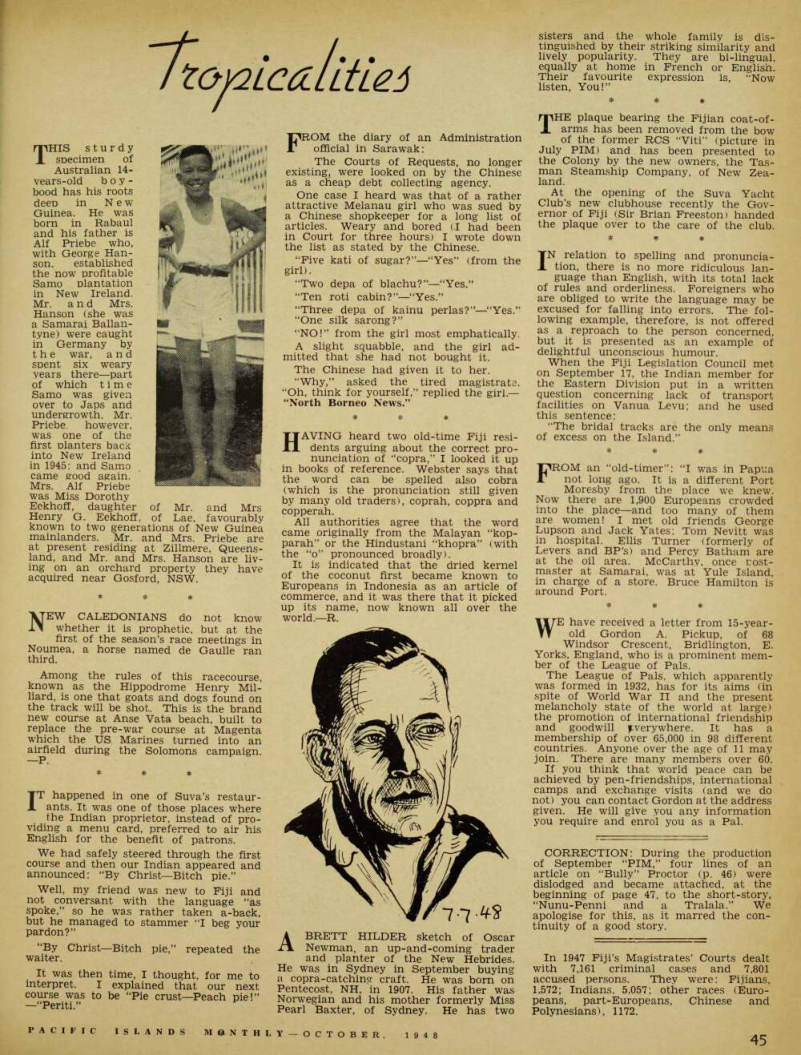
THIS sturdy
snecimen of Australian 14vears-old boy hood has his roots deen in New Guinea. He was born in Rabaul and his father is Alf Priebe who, with George Han son. established the now profitable Samo plantation in New Ireland.
Mr. and Mrs.
Hanson (she was a Samarai Ballan tyne) were caught in Germany by the war, and spent six weary years there—part of which time Samo was given over to Japs and undergrowth. Mr.
Priebe. however, was one of the first planters back into New Ireland in 1945: and Samo came good again.
Mrs. Alf Priebe was Miss Dorothy
Eekhoff, daughter of Mr. and Mrs Henry G. Eekhoff, of Lae, favourably known to two generations of New Guinea mainlanders. Mr. and Mrs. Priebe are at present residing at Zillmere, Queens land, and Mr. and Mrs. Hanson are liv ing on an orchard property they have acquired near Gosford, NSW. * * ♦ NEW CALEDONIANS do not know whether it is prophetic, but at the first of the season’s race meetings in Noumea, a horse named de Gaulle ran third.
Among the rules of this racecourse, known as the Hippodrome Henry Mil liard, is one that goats and dogs found on the track will be shot. This is the brand new course at Anse Vata beach, built to replace the pre-war course at Magenta which the US Marines turned into an airfield during the Solomons campaign.
p.
IT happened in one of Suva’s restaur ants. It was one of those places where the Indian proprietor, instead of pro viding a menu card, preferred to air his English for the benefit of patrons.
We had safely steered through the first course and then our Indian appeared and announced: “By Christ—Bitch pie.”
Well, my friend was new to Fiji and not conversant with the language “as spoke,” so he was rather taken a-back, but he managed to stammer “I beg your pardon?”
“By Christ—Bitch pie,” repeated the waiter.
It was then time, I thought, for me to interpret. I explained that our next course was to be “Pie crust—Peach pie!” —“Periti.”
FROM the diary of an Administration official in Sarawak: The Courts of Requests, no longer existing, were looked on by the Chinese as a cheap debt collecting agency.
One case I heard was that of a rather attractive Melanau girl who was sued by a Chinese shopkeeper for a long list of articles. Weary and bored (I had been in Court for three hours) I wrote down the list as stated by the Chinese.
“Five kati of sugar?”—“Yes” (from the girl).
“Two depa of blachu?”—“Yes.”
“Ten roti cabin?” —“Yes.”
“Three depa of kainu perlas?”—“Yes.”
“One silk sarong?”
“NO!” from the girl most emphatically.
A slight squabble, and the girl ad mitted that she had not bought it.
The Chinese had given it to her.
“Why,” asked the tired magistrate.
“Oh, think for yourself,” replied the girl.— “North Borneo News.” ♦ * * HAVING heard two old-time Fiji resi dents arguing about the correct pro nunciation of “copra,” I looked it up in books of reference. Webster says that the word can be spelled also cobra (which is the pronunciation still given by many old traders), coprah, coppra and copperah.
All authorities agree that the word came originally from the Malayan “kop parah” or the Hindustani “khopra” (with the “o” pronounced broadly).
It is indicated that the dried kernel of the coconut first became known to Europeans in Indonesia as an article of commerce, and it was there that it picked up its name, now known all over the
world.-
R.
A BRETT HILDER sketch of Oscar Newman, an up-and-coming trader and planter of the New Hebrides.
He was in Sydney in September buying a copra-catching craft. He was born on Pentecost, NH, in 1907. His father was Norwegian and his mother formerly Miss Pearl Baxter, of Sydney. He has two
sisters and the whole family is dis tinguished by their striking similarity and lively popularity. They are bi-lingual, equally at home in French or English.
Their favourite expression is, “Now listen, You!” * ♦ * THE plaque bearing the Fijian coat-of arms has been removed from the bow of the former RCS “Viti” (picture in July PIM) and has been presented to the Colony by the new owners, the Tas man Steamship Company, of New Zea land.
At the opening of the Suva Yacht Club’s new clubhouse recently the Gov ernor of Fiji (Sir Brian Freeston) handed the plaque over to the care of the club. ♦ * ♦ IN relation to spelling and pronuncia tion, there is no more ridiculous lan guage than English, with its total lack of rules and orderliness. Foreigners who are obliged to write the language may be excused for falling into errors. The fol lowing example, therefore, is not offered as a reproach to the person concerned, but it is presented as an example of delightful unconscious humour.
When the Fiji Legislation Council met on September 17, the Indian member for the Eastern Division put in a written question concerning lack of transport facilities on Vanua Levu; and he used this sentence: “The bridal tracks are the only means of excess on the Island.” ♦ ♦ ♦ FROM an “old-timer”: “I was in Papua not long ago. It is a different Port Moresby from the place we knew.
Now there are 1,900 Europeans crowded into the place—and too many of them are women! I met old friends George Lupson and Jack Yates: Tom Nevitt was in hospital. Ellis Turner (formerly of Levers and BP’s) and Percy Batham are at the oil area. McCarthy, once cost master at Samarai, was at Yule Island, in charge of a store. Bruce Hamilton is around Port. ♦ ♦ ♦ WE have received a letter from 15-year old Gordon A. Pickup, of 68 Windsor Crescent, Bridlington, E.
Yorks, England, who is a prominent mem ber of the League of Pals.
The League of Pals, which apparently was formed in 1932, has for its aims (in spite of World War II and the present melancholy state of the world at large) the promotion of international friendship and goodwill everywhere. It has a membership of over 65,000 in 98 different countries. Anyone over the age of 11 may join. There are many members over 60.
If you think that world peace can be achieved by pen-friendships, international camps and exchange visits (and we do not) you can contact Gordon at the address given. He will give you any information you require and enrol you as a Pal.
CORRECTION: During the production of September “PIM,” four lines of an article on “Bully” Proctor (p. 46) were dislodged and became attached, at the beginning of page 47, to the short-story, “Nunu-Penni and a Tralala.” We apologise for this, as it marred the con tinuity of a good story.
In 1947 Fiji’s Magistrates’ Courts dealt with 7,161 criminal cases and 7,801 accused persons. They were; Fijians, 1,572; Indians. 5,057; other races (Euro peans, part-Europeans, Chinese and Polynesians), 1172.
The plane gives us Norfolk, super
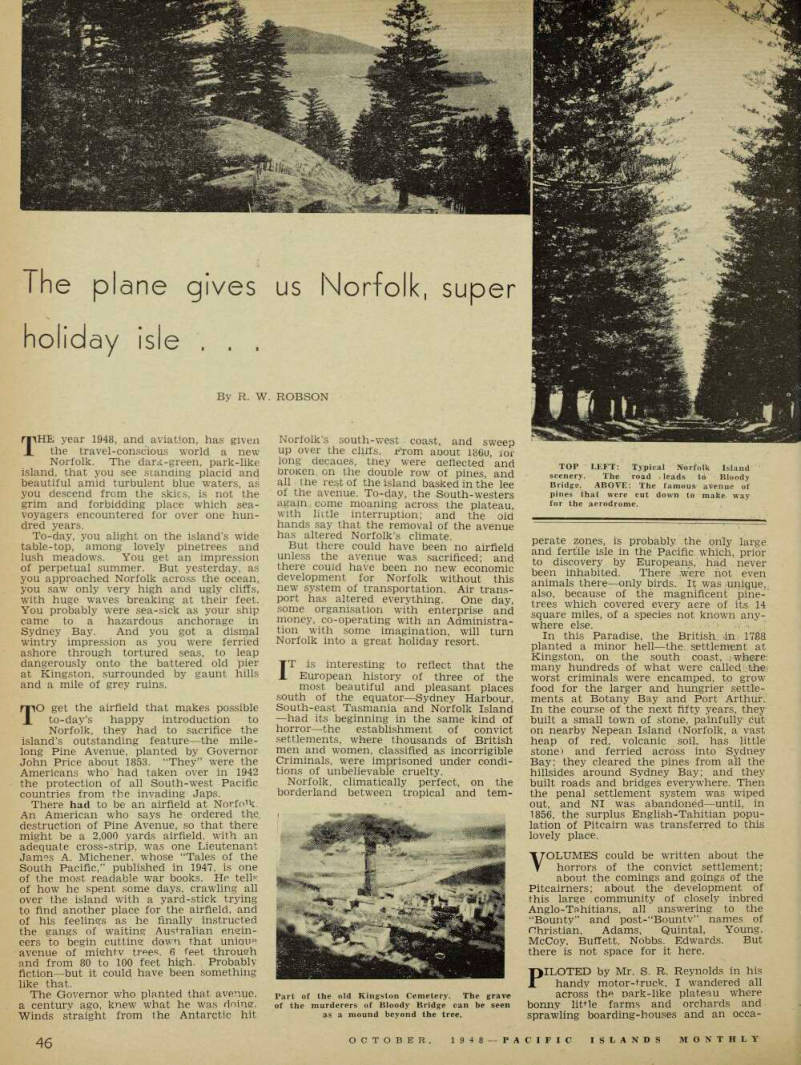
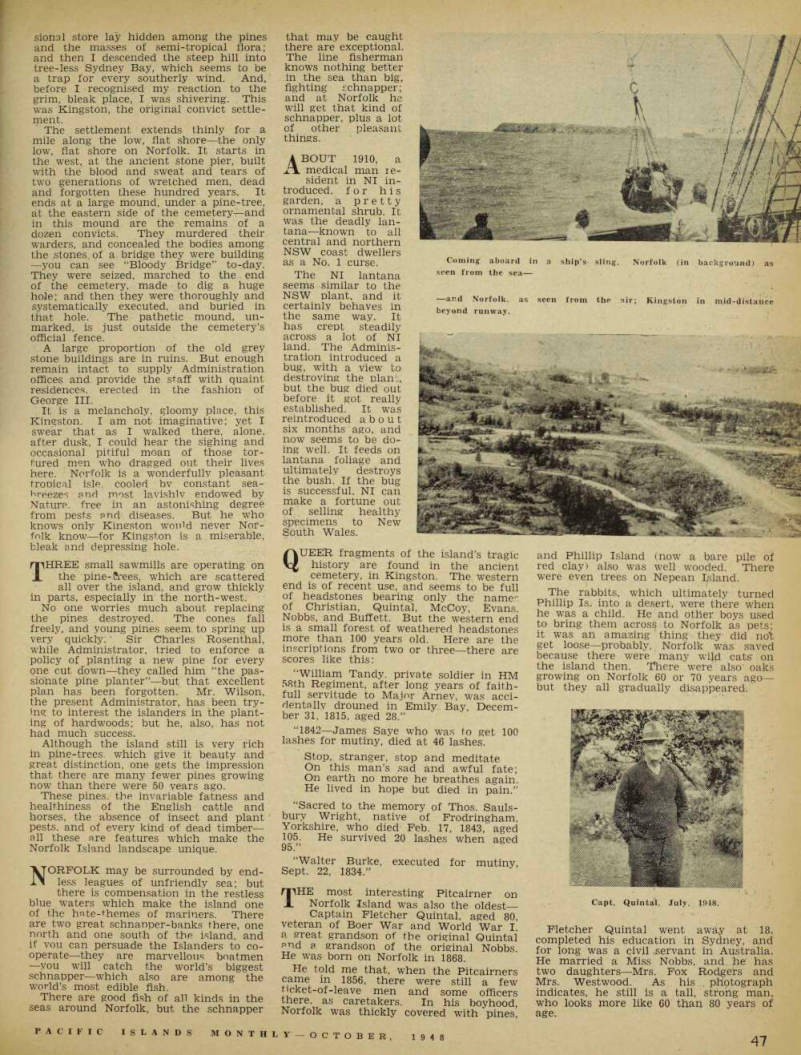
holiday isle . . .
By R. W. Robson
THE year 1948, and aviation, has given the travel-conscious world a new Norfolk. The darK-green, park-like island, that you see standing placid and beautiful amid turbulent blue waters, as you descend from the skies, is not the grim and forbidding place which sea voyagers encountered for over one hun dred years.
To-day, you alight on the island’s wide table-top, among lovely pinetrees and lush meadows. You get an impression of perpetual summer. But yesterday, as you approached Norfolk across the ocean, you saw only very high and ugly cliffs, with huge waves breaking at their feet.
You probably were sea-sick as your ship came to a hazardous anchorage in Sydney Bay. And you got a disrpal wintry impression as you were ferried ashore through tortured seas, to leap dangerously onto the battered old pier at Kingston, surrounded by gaunt hills and a mile of grey ruins.
TO get the airfield that makes possible to-day’s happy introduction to Norfolk, they had to sacrifice the island’s outstanding feature—the mile long Pine Avenue, planted by Governor John Price about 1853. “They” were the Americans who had taken over in 1942 the protection of all South-west Pacific countries from the invading Japs.
There had to be an airfield at An American who says he ordered the, destruction of Pine Avenue, so that there might be a 2,000 yards airfield, with an adequate cross-strip, was one Lieutenant James A. Michener. whose “Tales of the South Pacific,” published in 1947, is one of the most readable war books. He tells, of how he spent some days, crawling all over the island with a yard-stick trying to find another place for the airfield, and of his feelings as he finally instructed the gangs of waiting Australian engin eers to begin cutting down that unique avenue of miehtv trees, 6 feet through and from 80 to 100 feet high. Probably fiction —but it could have been something like that.
The Governor who planted that avenue, a century ago, knew what he was doinsr.
Winds straight from the Antarctic hit
Norfolk’s south-west coast, and sweep up over the cliffs. Prom aoout IB6u, for long decaaes, they were deflected and broxen on the double row of pines, and all the rest of the island basked in the lee of the avenue. To-day, the South-westers again come moaning across, the plateau, with little interruption; and the old hands say that the removal of the avenue has altered Norfolk’s climate.
But there could have been no airfield unless the avenue was sacrificed; and there could have been no new economic development for Norfolk without this new system of transportation. Air trans port has altered everything. One day, some organisation with enterprise and money, co-operating with an Administra tion with some imagination, will turn Norfolk into a great holiday resort.
IT is interesting to reflect that the European history of three of the most beautiful and pleasant places south of the equator—Sydney Harbour, South-east Tasmania and Norfolk Island —had its beginning in the same kind of horror—the establishment of convict settlements, where thousands of British men and women, classified as incorrigible Criminals, were imprisoned under condi tions of unbelievable cruelty.
Norfolk, climatically perfect, on the borderland between tropical and tem-
perate zones, is probably the only large and fertile isle in the Pacific which, prior to discovery by Europeans, had never been inhabited. There were not even animals there—only birds. was ainjque, also, because of the magnificent pine-’ trees which covered every acre of its 14 square miles, of a species not known any where else.
In this Paradise, the British an 1788 planted a minor hell —the settlement at Kingston, on the south coast, - where; many hundreds of what were called the; worst criminals were encamped, to grow food for the larger and hungrier settle ments at Botany Bay and Port Arthur.
In the course of the next fifty years, they built a small town of stone, painfully cut on nearby Nepean Island (Norfolk, a vast heap of red, volcanic soil, has little stone) and ferried across into Sydney Bay; they cleared the pines from all the hillsides around Sydney Bay; and they built roads and bridges everywhere. Then the penal settlement system was wiped out, and NI was abandoned—until, in 1856, the surplus English-Tahitian popu lation of Pitcairn was transferred to this lovely place.
VOLUMES could be written about the horrors of the convict settlement; about the comings and goings of the Pitcairners: about the development of this large community of closely inbred Anglo-Tahitians, all answering to the “Bounty” and post-“Bountv” names of Ohristian, Adams, Quintal, Young, McCoy, Buffett, Nobbs. Edwards. But there is not space for it here.
PILOTED by Mr. S. R. Reynolds in his handy motor-truck. I wandered all across the nark-like plateau where bonny little farms and orchards and sprawling boarding-houses and an occa
Part of the old Kingston Cemetery. The grave of the murderers of Bloody Bridge can be seen as a mound beyond the tree.
TOP LEFT: Typical Norfolk Island scenery. The road leads to Bloody Bridge. ABOVE: The famous avenue of pines that were cut down to make way for the aerodrome.
sional store lay hidden among the pines and the masses of semi-tropical flora; and then I descended the steep hill into tree-less Sydney Bay, which seems to be a trap for every southerly wind. And, before I recognised my reaction to the grim, bleak place, I was shivering. This was Kingston, the original convict settle ment.
The settlement extends thinly for a mile along the low, flat shore—the only low, flat shore on Norfolk. It starts in the west, at the ancient stone pier, built with the blood and sweat and tears of two generations of wretched men, dead and forgotten these hundred years. It ends at a large mound, under a pine-tree, at the eastern side of the cemetery—and in this mound are the remains of a dozen convicts. They murdered their warders, and concealed the bodies among the stones, of a bridge they were building —you can see “Bloody Bridge” to-day.
They were seized, marched to the end of the cemetery, made to dig a huge hole; and then they were thoroughly and systematically executed, and buried in that hole. The pathetic mound, un marked, is just outside the cemetery’s official fence.
A large proportion of the old grey stone buildings are in ruins. But enough remain intact to supply Administration offices and provide the staff with quaint residences, erected in the fashion of George 111.
It is a melancholy, gloomy place, this Kingston. I am not imaginative; yet I swear that as I walked there, alone, after dusk, I could hear the sighing and occasional pitiful moan of those tor tured men who dragged out their lives here. Norfolk is a wonderfully pleasant trooical isle, cooled bv constant sea breezes and most lavishly endowed by Nature, free in an astonishing degree from pests end diseases. But he who knows only Kingston would never Nor folk know—for Kingston is a miserable, bleak and depressing hole.
THREE small sawmills are operating on the pine-frrees, which are scattered all over the island, and grow thickly in parts, especially in the north-west.
No one worries much about replacing the pines destroyed. The cones fall freely, and young pines seem, to spring up very quickly. * Sir Charles Rosenthal, while Administrator, tried to enforce a policy of planting a new pine for every one cut down—they called him “the pas sionate pine planter”—but that excellent plan has been forgotten. Mr. Wilson, the present Administrator, has been try ing to interest the islanders in the plant ing of hardwoods; but he, also, has not had much success.
Although the island still is very rich in pine-trees, which give it beauty and great distinction, one gets the impression that there are many fewer pines growing now than there were 50 years ago.
These pines, the invariable fatness and healthiness of the English cattle and horses, the absence of insect and plant pests, and of every kind of dead timber -911 these are features which make the Norfolk Island landscape unique.
NORFOLK may be surrounded by end less leagues of unfriendly sea; but there is compensation in the restless blue waters which make the island one of the hate-themes of mariners. There are two great schnanper-banks there, one north and one south of the island, and if vou can persuade the Islanders to co operate—they are marvellous boatmen —you will catch the world’s biggest schnapper—which also are among the world’s most edible fish.
There are good fish of all kinds in the seas around Norfolk, but the schnapper
that may be caught there are exceptional.
The line fisherman knows nothing better in the sea than big, fighting schnapper; and at Norfolk he will get that kind of schnapper, plus a lot of other pleasant things.
A Bout 1910, A
A medical man re sident in NX in troduced. for his garden, a pretty ornamental shrub. It was the deadly lan tana—known to all central and northern NSW coast dwellers as a No. 1 curse.
The NI lantana seems similar to the NSW plant, and it certainly behaves in the same way. It has crept steadily across a lot of NI land. The Adminis tration introduced a bug, with a view to destroying the plant, but the bug died out before it got really established. It was reintroduced about six months ago. and now seems to be do ing well. It feeds on lantana foliage and ultimately destroys the bush. If the bug is successful. NI can make a fortune out of selling healthy specimens to New South Wales.
QUEER fragments of the island’s tragic history are found in the ancient cemetery, in Kingston. The western end is of recent use, and seems to be full of headstones bearing only the name 0 of Christian, Quintal, McCoy, Evans.
Nobbs, and Buffett. But the western end is a small forest of weathered headstones more than 100 years old. Here are the inscriptions from two or three—there are scores like this: “William Tandy, private soldier in HM 58th Regiment, after long years of faith full servitude to Major Arnev, was acci dentally drouned in Emily Bay, Decem ber 31, 1815, aged 28.’’
“1842—James Saye who was to get 100 lashes for mutiny, died at 46 lashes.
Stop, stranger, stop and meditate On this man’s sad and awful fate; On earth no more he breathes again.
He lived in hope but died in pain.’’
“Sacred to the memory of Thos. Sauls bury Wright, native of Frodringham, Yorkshire, who died Feb. 17, 1843, aged 105. He survived 20 lashes when aged 95.’’
“Walter Burke, executed for mutiny, Sept. 22, 1834.”
THE most interesting Pitcairner on Norfolk Island was also the oldest— Captain Fletcher Quintal, aged 80, veteran of Boer War and World War I. a great grandson of the original Quintal pn d a grandson of the original Nobbs.
He was born on Norfolk in 1868.
He told me that, when the Pitcairners came in 1856, there were still a few ticket-of-leave men and some officers there, as caretakers. In his boyhood, Norfolk was thickly covered with pines,
and Phillip Island (now a bare pile of red clay) also was well wooded. There were even trees on Nepean Island, . , p JSfn f which ultimately turned Is ‘ a desert, were there when Us f ed Norfolk as pets; lt f w ? s an arr \f tbm f' they dld ndt u; et lo ° probab l y ’ Norfolk was saved because there were many wild cats’ on the island then. Inhere were also oaks growing on Norfolk 60 or 70 years ago— but they all gradually disappeared,
Fletcher Quintal went away at 18, completed his education in Sydney, and for long was a civil servant in Australia, He married a Miss Nobbs, and he has two daughters—Mrs, Fox Rodgers and Mrs. Westwood. As his . phptograph indicates, he still is a tall, strong man, who looks more like 60 than 80 years of age.
Coming aboard in a ship’s sling. Norfolk (in background) as seen from the sea— —and Norfolk, as seen from the air; Kingston in mid-distance beyond runway.
Capt. Quintal, July, 1948.
Pacific Nature Notes
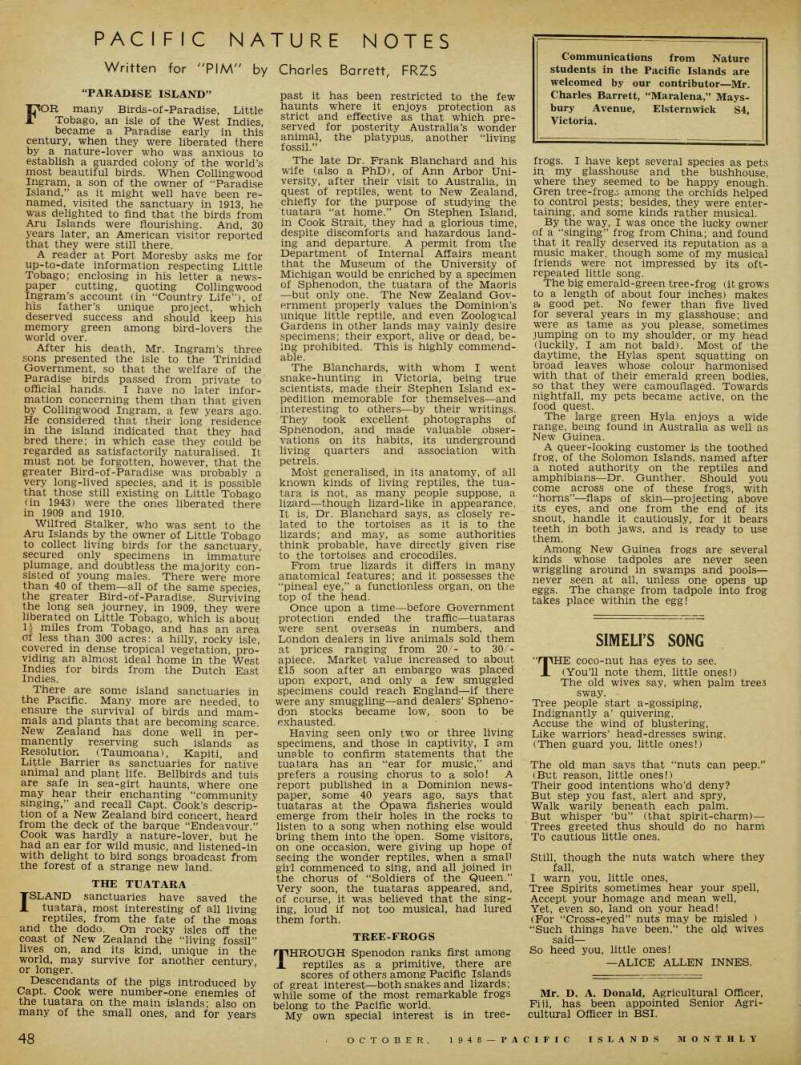
Written for "PIM" by Charles Barrett, FRZS
“Paradise Island”
rR many Birds-of-Paradise, Little Tobago, an isle of the West Indies, became a Paradise early in this century, when they were liberated there by a nature-lover who was anxious to establish a guarded colony 'of the world’s most beautiful birds. When Collingwood Ingram, a son of the owner of “Paradise Island,” as it might well have been re named, visited the sanctuary in 1913, he was delighted to find that the birds from Aru Islands were flourishing. And, 30 years later, an American visitor reported that they were still there.
A reader at Port Moresby asks me for up-to-date information respecting Little Tobago; enclosing in his letter a news paper cutting, quoting Collingwood Ingram’s account (in “Country Life”), of his father’s unique project, which deserved success and should keep his memory green among bird-lovers the world over.
After his death, Mr. Ingram’s three sons presented the isle to the Trinidad Government, so that the welfare of the Paradise birds passed from private to official hands. I have no later infor mation concerning them than that given by Collingwood Ingram, a few years ago.
He considered that their long residence in the island indicated that they had bred there; in which case they could be regarded as satisfactorily naturalised. It must not be forgotten, however, that the greater Bird-of-Paradise was nrobably a very long-lived species, and it is possible that those still existing on Little Tobago (in 1943) were the ones liberated there in 1909 and 1910.
Wilfred Stalker, who was sent to the Aru Islands by the owner of Little Tobago to collect living birds for the sanctuary, secured only specimens in immature plumage, and doubtless the majority con sisted of young males. There were more than 40 of them—all of the same species, the greater Bird-of-Paradise. Surviving the long sea journey, in 1909, they were liberated on Little Tobago, which is about 1 2- miles from Tobago, and has an area of less than 300 acres: a hilly, rocky isle, covered in dense tropical vegetation, pro viding an almost ideal home in the West Indies for birds from the Dutch East Indies.
There are some island sanctuaries in the Pacific. Many more are needed, to ensure the survival of birds and mam mals and plants that are becoming scarce.
New Zealand has done well in per manently reserving such islands as Resolution (Taumoana), Kapiti, and Little Barrier as sanctuaries for native animal and plant life. Bellbirds and tuis are safe in sea-girt haunts, where one may hear their enchanting “community singing,” and recall Capt. Cook’s descrip tion of a New Zealand bird concert, heard from the deck of the barque “Endeavour.”
Cook was hardly a nature-lover, but he had an ear for wild music, and listened-in with delight to bird songs broadcast from the forest of a strange new land.
The Tuatara
ISLAND sanctuaries have saved the tuatara, most interesting of all living reptiles, from the fate of the moas and the dodo. On rocky isles off the coast of New Zealand the “living fossil” lives on, and its kind, unique in the world, may survive for another century, or longer.
Descendants of the pigs introduced by Capt. Cook were number-one enemies of the tuatara on the main islands; also on many of the small ones, and for years
past it has been restricted to the few haunts where it enjoys protection as strict and effective as that which pre served for posterity Australia’s wonder animal, the platypus, another “living fossil.”
The late Dr. Frank Blanchard and his wife (also a PhD), of Ann Arbor Uni versity, after their visit to Australia, in quest of reptiles, went to New Zealand, chiefly for the purpose of studying the tuatara “at home.” On Stephen Island, in Cook Strait, they had a glorious time, despite discomforts and hazardous land ing and departure. A permit from the Department of Internal Affairs meant that the Museum of the University of Michigan would be enriched by a specimen of Sphenodon, the tuatara of the Maoris —but only one. The New Zealand Gov ernment properly values the Dominion’s unique little reptile, and even Zoological Gardens in other lands may vainly desire specimens: their export, alive or dead, be ing prohibited. This is highly commend able.
The Blanchards, with whom I went snake-hunting in Victoria, being true scientists, made their Stephen Island ex pedition memorable for themselves —and interesting to others —by their writings.
They took excellent photographs of Sphenodon, and made valuable obser vations on its habits, its underground living quarters and association with petrels.
Most generalised, in its anatomy, of all known kinds of living reptiles, the tua tara is not, as many people suppose, a lizard —though lizard-like in appearance.
It is, Dr. Blanchard says, as closely re lated to the tortoises as it is to the lizards; and may, as some authorities think probable, have directly given rise to the tortoises and crocodiles.
From true lizards it differs in many anatomical features; and it possesses the “pineal eye,” a functionless organ, on the top of the head.
Once upon a time —before Government protection ended the traffic—tuataras were sent overseas in numbers, and London dealers in live animals sold them at prices ranging from 20/- to 30/apiece. Market value increased to about £l5 soon after an embargo was placed upon export, and only a few smuggled specimens could reach England—if there were any smuggling—and dealers’ Spheno don stocks became low, soon to be exhausted.
Having seen only two or three living specimens, and those in captivity, I am unable to confirm statements that the tuatara has an “ear for music,” and prefers a rousing chorus to a solo! A report published in a Dominion news paper, some 40 years ago, says that tuataras at the Opawa fisheries would emerge from their holes in the rocks to listen to a song when nothing else would bring them into the open. Some visitors, on one occasion, were giving up hope of seeing the wonder reptiles, when a small girl commenced to sing, and all joined in the chorus of “Soldiers of the Queen.”
Very soon, the tuataras appeared, and, of course, it was believed that the sing ing, loud if not too musical, had lured them forth.
Tree-Frogs
THROUGH Spenodon ranks first among reptiles as a primitive, there are scores of others among Pacific Islands of great interest —both snakes and lizards; while some of the most remarkable frogs belong to the Pacific world.
My own special interest is in tree-
Communications from Nature students in the Pacific Islands are welcomed by our contributor—Mr.
Charles Barrett, “Maralena,” Mays bury Avenue, Elsternwick S 4, Victoria.
frogs. I have kept several species as pets in my glasshouse and the bushhouse, where they seemed to be happy enough.
Gren tree-frogo among the orchids helped to control pests; besides, they were enter taining, and some kinds rather musical.
By the way, I was once the lucky owner of a “singing” frog from China; and found that it really deserved its reputation as a music maker, though some of my musical friends were not impressed by its oft repeated little song.
The big emerald-green tree-frog (it grows to a length of about four inches) makes a good pet. No fewer than five lived for several years in my glasshouse; and were as tame as you please, sometimes jumping on to my shoulder, or my head (luckily, I am not bald). Most of the daytime, the Hylas spent squatting on broad leaves whose colour harmonised with that of their emerald green bodies, so that they were camouflaged. Towards nightfall, my pets became active, on the food quest.
The large green Hyla enjoys a wide range, being found in Australia as well as New Guinea.
A queer-looking customer is the toothed frog, of the Solomon Islands, named after a noted authority on the reptiles and amphibians—Dr. Gunther. Should you come across one of these frogs, with “horns” —flaps of skin—projecting above its eyes, and one from the end of its snout, handle it cautiously, for it bears teeth in both jaws, and is ready to use them.
Among New Guinea frogs are several kinds whose tadpoles are never seen wriggling around in swamps and pools— never seen at all, unless one opens up eggs. The change from tadpole into frog takes place within the egg!
Simeli’S Song
THE coco-nut has eyes to see. (You’ll note them, little ones!) The old wives say, when palm trees sway.
Tree people start a-gossiping, Indignantly a’ quivering, Accuse the wind of blustering.
Like warriors’ head-dresses swing. (Then guard you, little ones!) The old man says that “nuts can peep.” (But reason, little ones!) Their good intentions who’d deny?
But step you fast, alert and spry, Walk warily beneath each palm.
But whisper ‘bu” (that spirit-charm)— Trees greeted thus should do no harm To cautious little ones.
Still, though the nuts watch where they fall, I warn you, little ones, Tree Spirits sometimes hear your spell, Accept your homage and mean well, Yet, even so, land on your head! (For “Cross-eyed” nuts may be misled ) “Such things have been.” the old wives said — So heed you, little ones!
Alice Allen Innes.
Mr. D. A. Donald, Agricultural Officer, Fiii, has been appointed Senior Agri cultural Officer in BSI.
Elaine
Short Story:
By C. S. Ramsay
THE shadows cast by the gently-sway ing fronds of the coconut-trees were like patterned lace, as the moon climbed into the clear vault above.
The man let his gaze wander dreamily to the three islands floating in a sea of silver. Then, nearer, to the palm fringed beach of the lagoon, and the long green slope up to the steps of the verandah.
Yes, it had been worth it. The sneers of derision and the emphatic prophecies of failure had neither proved their accu racy or deterred his efforts. It had been a fight, admittedly a hard-won fight, against the heavy odds of sticky heat, shortage of labour, lush tangle of vege tation, and then the “blow.” But he had “arrived.” Pride of accomplishment and possession were now as spice to life.
Of course, he had been lonely. After all, no matter how one assured oneself that this was life as it was originally intended to be, there were always days and nights when, clear-cut as the cameo of black shadow beneath that mango-tree, came flashes on the screen of memory.
Nights and days on the Continent—Paris; Nice; the tables at Monte Carlo. . . .
Dinners with Diana in New York. . . .
Three deliriously happy weeks at Palm Springs—twenty-one days and nights of passion-filled ecstacy. . , . Bah! And what had it brought him? Disillusion ment and defeat!
No, not defeat. For had he not, when the world —his world—crashed in dissolu tion around him, retained the elements of his manhood and his sanity? And now he had Motutapu. Moulded, he might say, from the virgin bush by his own hands. Thank God, his work and the beauty of his island home had sufficed to annul the rankling stabs of bitter memories.
AND then, as though to complete his happiness, had come Elaine. Dark, sinuous, graceful as a cat. Love?
More than love it was she so freely gave him. It was pure, unadulterated devo tion. Each morning as he left for the plantation, she offered her caress. She was always waiting to greet him on his return. Their evenings were spent in quiet and complete companionship. What conversation he had offered was mostly replied to in monosyllables.
Strange, silent creature! For long periods she would sit motionless gazing into the night, her weird, inscrutable eyes half-closed. He had often watched her and tried to read her thoughts, but failed to gain an inkling. Sometimes he had to speak twice to her before she gave him her attention. But she would then invariably rise, stretch herself with feline grace, throw herself into his arms, and pour out such a flood of passionate adoration that at times brought him to the verge of tears for the very wonder of it.
Little enough had he done for her that he should merit it. Certainly, she had come to the island like a piece of flotsam —had stowed away on old Cap. Ander son’s schooner, a destitute waif —and he had accepted her, dirty and bedraggled as she was, and had given her of his best.
She had crept one night to his house and peered fearfullv in at him as he sat reading. Strange that had been! Not a
sound had she made, nor did she offer a word, yet he had felt her presence as plainly as though she had stepped before him. He had looked up—and his whole heart had gone out to her. It was the starvation in her great round eyes and emaciated body which had cut through his surprise and blocked the stirrings of repulsion at her condition.
He had not moved, but had quietly told her to come in. At the sound of his voice she had cringed and half-turned as though to run. Then, gaining confidence as he spoke again, she moved forward to his chair.
From what he could gather later, she has been a waif since she was first able to fend for herself. Of her parentage he could discover nothing. Yet he had been content to accept her as she was, and he had been amply rewarded by the love and gratitude she poured out for him. And they had been happy together.
She was subject to moods. Almost, it seemed to him at times, she was oblivious of his presence. Then, at others, she went into what approached paroxysms of love for him. He would sometimes awaken at night to find her gone from the bed He would arise and steal out to the verandah to see her sitting staring into the moonlight or the dark. But no matter how quietly he moved, always she sensed his approach, and would rise and come to him even before he spoke.
AND now she was gone! Gone as stealthily as she had come. And he was left to a great loneliness.
God! How he missed her!
Hating to be alone, at the approach of night, he would seek to hold in conver sation old black Manu, who had washed and cooked for him since his first coming.
Manu had helped him search the island for her without avail. He had offered no comment other than to growl: “I told you you were making too much of her.
It never does to let a female know just how she stands with one.”
Looking back, the man had to admit that perhaps Manu was right. He had lavished a love on Elaine which had been equalled only by hers for him. Or, could her love have been only assumed? Could she have so convincingly deceived him?
Bah! Conjecture was futile. Damn it, she was gone, and to hell with her for a deceitful jade!
But—and his eyes moved to her fav ourite spot on the verandah—if only he could see her sitting there as she was wont to do. But, curses on it, she was not there, so what was to be gained by useless longings? He should have known better, anyway, than to accept a waif like her on face value only.
There was little doubt she had cleared out on the copra-ketch which left at dawn yesterday morning. Probably— hateful thought—she had at last suc cumbed to the blandishments of the handsome Samoan Mate. Saipale had always quite openly admired her, and had never troubled to hide the covetous ness in his eyes. Often he had said to her: ‘‘Elaine, you are as beautiful as a starry night.” And of late she was certainly less aloof in her manner to ward him. She had seemed to like him better than any of the men who occa sionally came to the house. Damna tion take the false she-devil! But—
but she had loved him, and it was very lonesome now without her.
Two whole days and a night, and this was the second night. Well, he must just go on as he had before she came. It was maddening, though, how one’s thoughts could go on and on around the same circle in endless repe tition.
PERHAPS a good stiff whisky and coconut would help. Rising, he kicked his chair aside, strode out to a young tree at the top of one of the symmetrical rows. Selecting a nut from a moonlit bunch, he reached up and wrenched it off. He looked at it as it lay in his palm, cool and rounded like a —yes, like a young girl’s breast. . . .
A sudden rustle behind him swung him round. From the black pool of shadow beneath the mango-tree a lithe, dew-soaked form raced toward him.
“Elaine!”
He swooped forward and swept her into his arms.
“You little black witch—l should have expected it! You’re the second female in my life to jilt me for—a rat!”
The cat snuggled close against his neck, rubbed her sleek head hard on his chin, and purred in ecstacy.
Concerning Snails . . .
By S.A.G.
YOUR Rabaul correspondent in Feb ruary, in saying that giant snails were on the increase suggests that DO’s should be instructed to make the native villagers gather and burn them, and thinks it might be a good way to set the idle and inactive native in motion again, without too great a shock to his system. But he neglects to allow for the anthropological, ethnological, psychological and biological aspects of the matter, without proper consideration of which no such order could possibly be given! Am I right?
Then the order would have to filter, percolate, or otherwise pass through several Departments before being imple mented. So an interval of two years or so would pass before the snails need feel any alarm.
The question also arises as to whether or not the pdst-war sample of native villager can move fast enough to head off a snail, without an amount of exertion liable to bring on heart failure!
Most observers would put their money on the snail.
Supposing that a speedy native did suc ceed in heading off one of “animiles,” there then comes the matter of the muscular exertion requried to lift it into a basket and convey same to the funeral pyre, which might be some yards away.
Supposing again that a maddened snail turned and attacked its defenceless pursuer? It would be no small matter to be savaged by one! Is there anything in any existing Ordinance to cover such a happening? I think not.
Under the “New Order” your correspon dent’s suggestion seems impractical and unkind, and in making it he shows a total disregard for the village native’s con venience and leisure! This points to the probability of his being one of the old time planter type, who, as is well known, actually contends that natives should work and, furthermore, that it is good for them!
The last time I was in the Rabaul- Kokopo area there was a most unpleasant odour—in fact a stench —along some of the roads arising from the squashed and defunct snails thereon. The local re sidents explain, however, that where so much else “stinks” the smell of snail corpses is negligible.
Service Section
Rubber Ankle Boots: Cost Of
these is approximately 18/3 per pair.
They have, however, been in exceedingly short supply for some months, although the position will probably improve with the approach of the Australian summer.
Gramophone Records: These
range in price from 2/11 for hot jazz “pops,” to 10/6 (and more) for classical numbers, (Note: It is easier to pack half a dozen records than to pack one).
TROUSERS: Jungle-green, herringbone drill at 10/6 per pair. These were a bar gain line, but there is still plenty of this class of goods available.
FLOWERS: From eight or nine shil lings (for a corsage) and up to anything you like, delivered in any capital city (and some large towns) or to departing ships.
Bureau
Pacific Islands Service
r I ''HE Pacific Islands Service Bureau has been established to assist Island re sidents who cannot shop for themselves.
Briefly, we will perform those services for you, in Australia, which you cannot per form yourself, or are outside the scope of ordinary mail-ordering.
We will purchase and forward goods to you; have repairs made on your behalf; send flowers, sweets, fruits, gifts to trends in Australia for you, or to your children at school in Australia; match materials and sewing accessories; and arrange holiday accommodation and travel.
For these services we charge a small fee —in the case of shopping services, usually 10 per cent, of the purchase price.
If you missed the circular which ex plains this service fully and which was included in all copies of “PIM” which went to the Islands in March, please let us know and we will send you a copy of the pamphlet, free of charge.
All inquiries should be addressed to: The Director, Pacific Travel and Service Agency, Box 3408, Sydney.
Around Sydney Shops
THERE is not much resemblance be tween the old pressure-cookers, which most recruiters, miners and patrol-officers carried around New Guinea in the pre-war era, and the streamlined beauties which have become popular in Australia in the last 12 months. But they do relatively the same job.
The old recruiter-miner type were valued mostly because they could make even a recalcitrant New Guinea pigeon —dr any other “balus” —tender.
The 1948 version probably can do that too, but their greatest service should be to households in Islands townships where electric power is available but expensive.
A pressure-cooker cuts cooking time in half; and, as well, several different kinds of food can be cooked in the one sauce pan, at the same time, but the flavours do not mingle.
Australian-made cookers cost round about 95 -: imported British cookers £5/15/-. There appears little difference in efficiency.
The Australian-made jobs almost all have handles like conventional saucepans.
The imported ones have lugs, which look very neat. But when it comes to hand ling a hot saucepan a good, long handle is a blessing.
Spares, such as rubber pressure-rings, pressure indicators, wire baskets, are also available.
Suggestions . . .
A FEW of the requirements of other readers, which we have met over the last month or so, may prove of general interest: CARDS, Small Printing Jobs: Plain Christmas cards to fit into ordinary envelope, printed to client’s requirements.
Cost: £1 per 100. The firm which did the job also specialises in printed wed ding, birthday, lodge and dance invita tions. They can usually turn out an order in about three weeks —which, on present standards, is fast.
BICYCLE TYRES and TUBES: Cost of these —7/6 and 4/7 respectively.
Why Some Men
Amok
(From “North Borneo News”) ABDURAIA, a boatman, was the son of a Suluk father and a Bugis mother.
On a certain day, some thirty years ago, he obtained from his master the loan of $5 for the expenses of his marriage to Yasmani, who lived with her sister Lasmina, which does not seem an ex cessive amount.
On his way to their house, he lost $4 gambling. Before entering their house, he stopped to listen to a conversation going on inside it, and heard Lasmina tell Yasmani that she was a fool to marry a worthless fellow who had no money.
These two women, one regrets to add, were “of notorious character.”
Abduraia did not pursue his matrimonial plan. He returned to his house in a very bitter mood and commenced the sullen brooding, which usually proceeds an amok, and decided that life withouc Yasmani was not worth living. During the following forenoon he had his head shaved by a Chinese barber, and thus parted with a remarkable head of long wavy black hair, of which he was in ordinately proud. A dangerous sign!
He then walked a considerable distance to collect a debt of 25 cents, paid a bill at a coffee shop, bought a packet of cigarettes and went home to cook a meal.
After that he proceeded to the river to bathe.
On the way he saw Lasmina, who mocked him. That was the last straw!
He went home and sharpened his parang to the keenness of a razor. This he took sheathed and, in his other hand, he carried an iron bar with a cross bar, which resembled a sword hilt. Round his head he tied a length of new white cloth, the last act of a man who intends to amok.
He then set forth with the intention of killing Lasmina, and would have done so, had she not, the artful hussey, on seeing him approaching, immediately compre hended what was coming to her, and skipped off into an adjacent mangrove swamp, and so escaped.
Abduraia was no doubt acquainted with mangrove swamps and was of the opinion that they are no place to chase anybody.
He proceeded to kill three people, and severely wound four others, including a small Chinese girl. A policeman then shot him through the back. As to whether he recovered, and in that case, what the sentence was, we do not know.
Pacific Islands Hopping For
Fun Two Americans Sail Tiny Yacht Across Pacific
FAR away to the north of Rarotonga,a tiny light could occasionally be per ceived. Questions arose as to what it was and when the dawn came the mystery was solved. It was a tiny craft just 25 ft. 6 in. in length, the “Tai Manu” (Sea Bird), with F. V. K. Budd as skipoer and Miss Frankie Hulen as crew.
Back in 1940, Captain Budd and Frank.e had a notion that they would like to explore the South Sea Islands in a leisurely way. War intervened, so the project was postponed until April 8, 1947.
Then, after much planning the tiny craft left Los Angeles for San Diego, to collect last-minute supplies and get clearance prior to heading for La Paz, Mexico Peninsula 1,200 miles away, which was reached in June, 1947.
On the trip down, “Tai Manu” stopped in at every little bay to explore whatever there was to be explored; swapping one packet of cigarettes for three or four lobsters and so on. They stayed in Mexico until after the hurricane season, pushing off again in December for Nuka hiva in the Marquesas Group.
For the next 46 days “Tai Manu’ travelled 3,000 miles of ocean without sighting land, ship or fish. However, they did run into 50 Whales and had a few anxious moments when one got uncom fortably near. Christmas and New Year were celebrated in traditional style, even stockings being hung above the bunks.
Later they set sail for Tahiti, which they reached in 16 days after the un enviable experience of weathering ten squalls in one night. They stayed there a month for repairs to the engine, and to be restocked.
The Government gave them permission to visit Raiatea, Tahaa and Boroboro. On the 12-day trip from Boroboro to Raro tonga “Tai Manu” was becalmed for ohe day and hove-to for four days. From Rarotonga she was going to Tonga where the voyage and partnership would end — one partner then to buy the other out.
The 56-year-old captain is a retired electrical engineer who has a liking for the sea and who commanded a ship in the United States Navy during the war.
Miss Hulen is a land-lubber from Oklahoma, where she has done all manner of things, the most profitable of them being beauty culture.
With a snowy-white hull, green decks and bright work of Honduras mahogany, the yacht presents a pretty picture. The cabin, including a separate part for' the galley, is barely 15 feet overall but every thing fits in.
On the port side of the galley are the little stove and sink, beneath which are deep drawers with partitions.
In the interior cabin are two six-fool; bunks, each with pandanus mats as cover ings. Between these stands a beautiful Honduras mahogany table. At the end nearest to the stove is the cutlery, and at the opposite end oddments such as pencils, notepaper, etc. Directly above this are the set-in clock and barometer, placed on either side of two small doors which when open reveal a medicine chest.
Beneath this are more drawers wherein sit a typewriter, gramophone, records and spares required for all parts.
“Tai Manu” carries 380 square feet of sail and she has a five horse-power Lauson engine which she uses only when an emergency, such as going through a oass crops up. She does not carry wire less.—Reprinted from the NZ “Free Lance..”
Advertisements & other items, pp. 53-56 (2 items)
Burns Philp (New Guinea) Limited
General Merchants (Wholesale and Retail)
Shipping, Customs and General Agents
Head Office: PORT MORESBY, PAPUA
BRANCHES:
NEW GUINEA: Robaul, Kokopo, L.ae Gr Madang.
PAPUA: Sama rai.
REPRESENTATIVES FOR:
AUSTRALIAN AGENTS:
LONDON AGENTS:
SAN FRANCISCO AGENTS:
QUEENSLAND INSURANCE CO. LTD.
LLOYDS OF LONDON
BURNS PHILP TRUST CO. LTD.
BURNS, PHILP G- CO. LTD.
All States. ,
BURNS, PHILP Cr CO. LTD.
"London House", 35 Crutched Friars, E.C.3.
BURNS, PHILP CO. OF SAN FRANCISCO INC. 510 Matson Building.
Distributing Agents, Territory of Papua-New Guinea for:
SHELL COMPANY OF AUSTRALIA LIMITED
Petroleum Products
GENERAL MOTORS CORPORATION
Chevrolet, Buick, Pontiac and Oldsmobile Cars Chevrolet and GMC Trucks Frigidaire Refrigerators
VAUXHALL MOTORS LIMITED
Vauxhall Cars and Bedford Trucks
R. A. LISTER Cr CO., BRISTOL
Producers of Petrol, Parrafin and Diesel Engines Pumps and Lighting plants
RUSTON HORNSBY LIMITED
Engines
CROSSLEY MARINE ENGINES
We Will Buy
It For You
Any goods you may require from English shops or factories Purchased and Shipped.
Small or large orders catered for.
ALL SERVICES UNDER-
TAKEN FOR RESIDENTS
ABROAD.
PITT & SCOTT
LIMITED
(Established 1876) General Shipping and Buying Agents. 1/3, St. Paul's Churchyard, London, England Cables. Shipping London.
Look for KRAFT
and find QUALITY
The unchanging quality of Kraft foods is a byword wherever fine foods find appreciation. In their constant vigilance over quality, Kraft experts have achieved even more than just that, for hand in hand with Kraft quality goes flavour perfection and food value of a very high order.
Wherever you see the name “Kraft”, buy confidently, and remember, “Red Feather” foods are made by Kraft too. No finer foods can be found.
Export Division,
Kraft Walker Cheese Co. Pty. Ltd.,
Riverside Ave., South Melbourne,
AUSTRALIA.
KRAFT
V // Three famous Kraft Foods note available
in full supply everywhere.
VEGEMITE the delicious, healthful yeast extract. One of the richest known sources of the important Vitamin B complex. Strongly recommended in all areas where fresh vegetables are scarce. A little does a power of good.
KRAFT CHEDDAR CHEESE a
creamy-smooth, choice processed cheddar.
Rich in Vitamins A, B and D, calcium, phosphorus, and other nutrients of milk.
Always fresh whether in the attractive blue can or in its hygienic foil wrapping. Not too sharp not too mild just too good for words.
BONOX pre-digested beef in its tastiest and most assimilable form. A valuable food for its high content of niacin (the anti-pellagric factor), and a powerful digestive stimulant. Dissolve in hot water for an appetising drink, or use as a spread or a flavouring for cooked dishes. Eat it and drink it for a lift!
\V\C
SPECIALISING IN
PACIFIC ISLAND INSURANCES
FIRE—MOTOR VEHICLE
MARINE—HULLS AND CARGO
EMPLOYER’S LIABILITY
BONDS—In accordance with
ADMINISTRATION ORDINANCES.
COPRA INSURED FROM DRIER
TO BUYER.
AND ALL OTHER CLASSES ARRANGED
AT LOWEST CURRENT RATES.
Established Agencies throughout the Territory of Papua and New Guinea.
Managing Agents: New Guinea Company, Limited.
Island Representative: G. D. A. Kent, Babaul Branch.
SOUTHERN PACIFIC INSURANCE
CO., LTD.
HEAD OFFICE: 60 HUNTER STREET,
SYDNEY.
The Key to Knr nitty . . .
Sometimes men think that a general education or an elementary knowledge of business is enough to gel ahead. But experience soon teaches that thorough, specialised training is just as necessary for success in business as it is in the professions of Law, Medicine or Dentistry. If you are interested in the many opportunities in the Business World ... if you seek responsibility, success and economic security, commence training now —in some specialised business subject. H.R.I. is available always to help and advise ambitious men and women. Write or wire for particulars and career information.
H.R.I. tutorial service is proved by the winning of more honours than all coaches in Australasia combined.
H.R.I, Career Training • ACCOUNTANCY • SECRETARYSHIP • COST ACCOUNTANCY
• PRACTICAL BOOKKEEPING • MARKETING SELLING
ADVERTISING • BANKING • LOCAL GOVERNMENT EXAMS.
Hemingway Robertson Institute
Founded and Owned by Hemingway & Robertson Pty. Ltd.
Consulting Accountants :: Professional Tutors 126 BANK H O U S. E , BANK PLACE, MELBOURNE 126 BARRACK HOUSE. 16 BARRACK STREET, SYDNEY 126/814
Aluminium Roofing
5“ : Now available for shipment to Pacific Islands Aluminium Corrugated Roofing is rustless and is the lightest of all fabricated roofing materials. This is a point worth remembering when considering freight costs. Heat due to solar radiation is substantially reduced when Aluminium roofing is used.
Inquiries to:-
UNION LIMITED
(Incorporated in the Dominion of Canada) Largest Distributors of Aluminium and its alloys in the British Commonwealth OCEAN HOUSE, 34 MARTIN PLACE. SYDNEY. N.S.W.
A Member of the Aluminium Limited Group, Montreal, Canada
ALUMINIUM
OUR HANDS MAKE GOOD ARMS
S I L
For your Fishing and Shooting Wants Consult Us.
Litngow .22 Cal. Repeating Rifles ... £ll 14 0 / Post Lithgow .22 Cal. Single Shot 5 1 3 j Extra.
RO H U 143 ELIZABETH STREET, SYDNEY.
GILLESPIE
The Flour
- SY DN EY -
TRADE
MARK
’S of the Islands
WORMSEARED
CHAIN HOISTS
The hand-operated Wormgeared Hoist is a general purpose lifting device, compact and easy to handle. The Wormgear is designed to give comparatively high efficiency and long life. A simple and effective brake insures safe holding of the suspended load.
Available in rated capacities from 10 cwts. to 3 tons.
Also makers of: A.B.C. Electric Chain Holsts, V 2, 1, 2 tons capacity.
“Victor” Spurgeared Chain Hoists from 10 cwts. to 20 tons.
Triple Geared Chain Hoists from 10 cwts. to 20 tons.
Worm Geared Chain Hoists from 10 cwts. to 3 tons.
Weston Chain Blocks from 5 cwts, to 2 tons.
Shackles, Hooks, Sheave and Snatch Blocks.
AUSTRALIAN BLOCK €r CHAIN CO.
PTY., LTD.
Robbs Road, WEST FOOTSCRAY, W. 12,
VICTORIA
Phones: MW 1373-74-75.
Telegraphic Address: “CHAINBLOCK,” MELBOURNE.
Correspondence to Box 34, FOOTSCRAY, W.ll, VICTORIA,
52
OCTOBER, 1948 PACIFIC ISLANDS MONTHLY
UNHAPPY CONDITIONS IN NEW
GUINEA
(Continued from page 42)
T the writer and"heretorl it sloXhave
Editorial Note
mms ipttpr run nni
gone directly to the wpb. It contained some sharp, but quite effective criticism of PIM articles on New Guinea, and some
practical and useful comments on the present condition and the future of New Guinea.
We have printed “Kiap’s” letter be cause of the value of his constructive criticism; but, as he failed to supply his name, his attack on the PIM (which we appreciate and would readily have published) has been cut out.
“Kiap” makes a summary of what he believes to be PIM policy in relation to New Guinea, and jeers at it; and then, in an excellent, cogently-reasoned article, he gives chapter and verse to justify practically everything we have said about the Territories.
Most people who know the Territories will subscribe heartily to the policy he has outlined—and especially will they appreciate the points he makes about the need for roads and the unreliableness of the native labour supply. “Kiap” has made a really worth-while contribution to the discussion on the future of Papua- New Guinea.
The only great difference between “Kiap’s” views, and the suggestions offered from time to time by PIM is that “Kiap” apparently does not like the Big Firms, and the encouragement of private enterprise; whereas the PIM in sists that the only way to secure the quick and efficient development of these primitive tropical Territories is to give every possible assistance to private enter prise to go in there and get rich. We do not like “exploiters, greedy traders and ruthless morjey-power” any more than does Mr. Ward; but we keep our feet on the ground, and we know that, human nature being what it is, we can get no pioneer effort worthy of the name in anything, unless the motive force is the desire for profit. Only “starry-eyed planners” would imagine that New Guinea could be developed by public servants as Australia’s bastion of defence against Asia.
Committee To Revise
Fiji’S Ten-Year Plan
From Our Own Correspondent SUVA. Scot. 12.
FIJI’S Development Plan is to be re vised by a committee which, with the Governor as chairman, will deal with the original ten-year post-war develop ment and welfare plan in the light of the existing financial and economic circum stances.
The main points to be taken into con sideration are that the chance of a Lon don loan is nil; that essential construc tion materials are very scarce; and that non-productive schemes must be de ferred.
The committee, which will hold its first meeting after the September sitting of the Legislative Council, consists of the Financial Secretary; the Directors of Medical Services, Agriculture, Education, and Public Works; Mr. P. Costello (Executive Council); Messrs. A. A. Ragg, S. H. Wilson, Vishnu Deo. A. D. Patel, Ratu Edward Cakobau and Joeli Ravai (Legislative Council); Mr. H. E. Snell and Mr. P. H. Nightingale. Mr. Nightingale will also act as secretary.
Mr. C. V. Lowney, official secretary to the Administrator of Papua-New Guinea, has been spending furlough in Sydney.
He is one of the “old hands’’ of the Ter ritories —he joined the Papuan public service 24 years ago, and was private sec retary to the late Sir Hubert Murray for many years. Mr. Lowney returns to Port Moresby in December.
Advertisements & other items, p. 56 (1 item)
54
OCTOBER, 1948 PACIFIC ISLANDS MONTHL’
Administrative Union
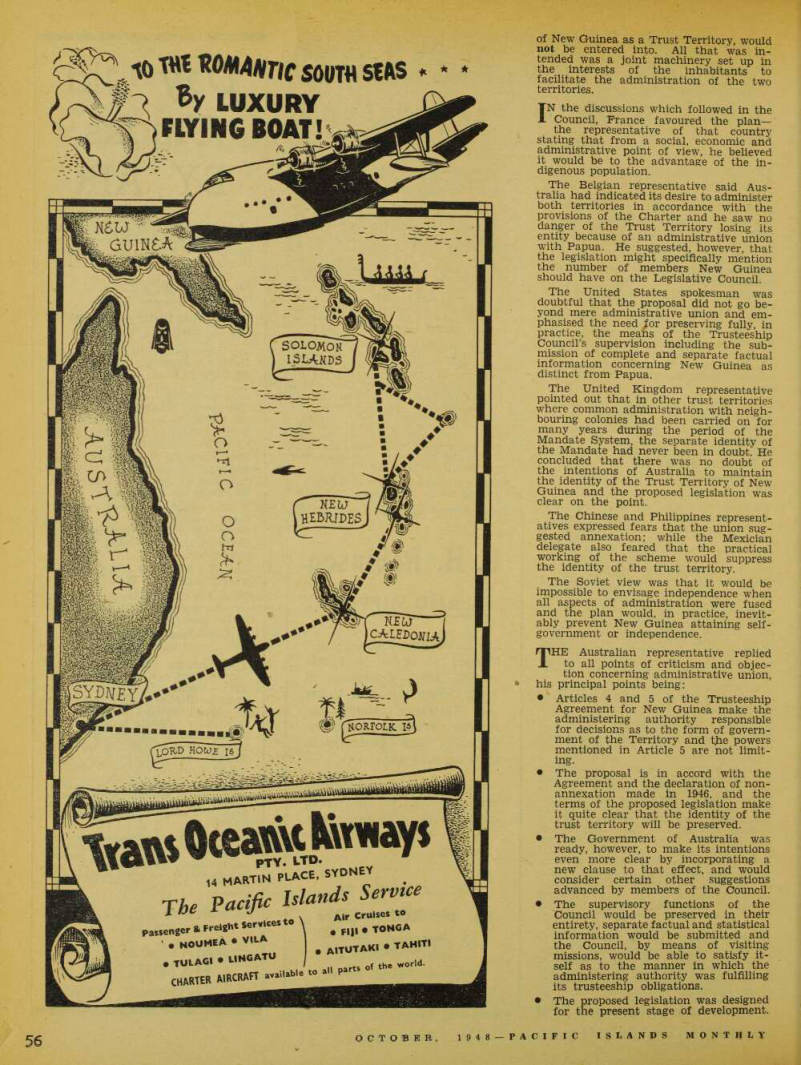
Mr. Ward Describes Trusteeship
Council’S View Of Ng Set-Up
Russia Says ’No’ to Papua-New Guinea Administrative Union
IN the House of Representatives, Canberra, on September 21, the Minister for External Territories (Mr.
E. J. Ward) made a statement on discussions which had taken place in respect of New Guinea, at the session of the Trusteeship Council of the
United Nations, last July.
In accordance with her commit ments under the United Nations Charter, Australia had submitted a report on the Administration of New Guinea for the period between July 1, 1946, and June 30, 1947. And, although Australia was not obliged to do so, she had advised the Council, at the same time, of the proposed administrative union of Papua-New Guinea.
Australia was represented at the July session of the Council by Mr. W.
D. Forsyth of the Department of External Affairs, and by Mr. J. R.
Halligan, secretary of the Department
of External Territories.
In his statement to Parliament, Mr.
Ward said:— THERE were two phases of the dis cussions by the Trusteeship Council.
The first dealt with the question of administrative union and the second was devoted to a consideration, based on the annual report and supplementary in formation furnished by the special repre sentative (Mr. Halligan), of every aspect of life and conditions in the Territory.
At the conclusion of its deliberations on these two phases, the Trusteeship Council prepared for the General Assembly a re port on New Guinea embodying a brief review of conditions in the Territory, some observations thereon, and the Council’s conclusions and recommendations, includ ing its views on administrative union.
With regard to the latter, the Council, in its report, takes the position that the establishment of the union is a highly important problem of serious con sequences; and expresses the conviction that an administrative union must remain strictly administrative in its nature and scope, and that it must not lead to a union of a closer, permanent nature with still greater implications. The Council also considered that, insofar as the problem (as to whether or not the pro posed union is within the terms of the Trusteeship Agreement approved by the General Assembly) is partly juridical in nature, it might to that extent be resolved by recourse to the appropriate juridical body, the International Court of Justice.
The Trusteeship Agreement for New Guinea provides in Article 4 that the Aus tralian Government will have the same powers of legislation, administration and jurisdiction in and over the Territory as if it were an integral part of Australia.
Article 5 states that in the exercise of these powers under Article 4. the Aus tralian Government “will be at liberty to bring the Territory into a customs, fiscal or administrative union or federation with <pther dependent territories under its jurisdiction or control,” if. in the opinion of the Australian Government, it would
be in the interests of the Territory and not inconsistent with the basic objectives of the Trusteeship system.
At the United Nations General Assembly in 1946, when the Trusteeship Agreement was approved, the Australian Government, in common with other governments administering trust territories, gave an assurance that it did not consider the terms of Articles 4 and 5 empowered it to establish any form of political associa tion between the trust territory and adjacent territories which would involve annexation of the trust territory or would have the effect of extinguishing its status as a trust territory.
Prior to the general debate on admin istrative union, the Australian repre sentative had informed Council members of the reasons which prompted the de cision, and explained that the Government was convinced that the establishment of an administrative union between New Guinea and Papua would not suppress or prejudice the juridical status of the Trust Territory. It would be in the interests of the inhabitants and would facilitate materially the fulfilment of the objectives of the United Nations Charter.
A political union which would result in the annexation or extinction of the status
of New Guinea as a Trust Territory, would not be entered into. All that was in tended was a joint machinery set up in the interests of the inhabitants to facilitate the administration of the two territories.
IN the discussions which followed in the Council, France favoured the plan— the representative of that country stating that from a social, economic and administrative point of view, he believed it would be to the advantage of the in digenous population.
The Belgian representative said Aus tralia had indicated its desire to administer both territories in accordance with the provisions of the Charter and he saw no danger of the Trust Territory losing its entity because of an administrative union with Papua. He suggested, however, that the legislation might specifically mention the number of members New Guinea should have on the Legislative Council.
The United States spokesman was doubtful that the proposal did not go be yond mere administrative union and em phasised the need /or preserving fully, in practice, the means of the Trusteeship Council’s supervision including the sub mission of complete and separate factual information concerning New Guinea as distinct from Papua.
The United Kingdom representative pointed out that in other trust territories where common administration with neigh bouring colonies had been carried on for many years during the period of the Mandate System, the separate identity of the Mandate had never been in doubt. He concluded that there was no doubt of the intentions of Australia to maintain the identity of the Trust Territory of New Guinea and the proposed legislation was clear on the point.
The Chinese and Philippines represent atives expressed fears that the union sug gested annexation; while the Mexician delegate also feared that the practical working of the scheme would suppress the identity of the trust territory.
The Soviet view was that it would be impossible to envisage independence when all aspects of administration were fused and the plan would, in practice, inevit ably prevent New Guinea attaining self government or independence.
THE Australian representative replied to all points of criticism and objec tion concerning administrative union, his principal points being: • Articles 4 and 5 of the Trusteeship Agreement for New Guinea make the administering authority responsible for decisions as to the form of govern ment of the Territory and tjie powers mentioned in Article 5 are not limit ing. • The proposal is in accord with the Agreement and the declaration of non annexation made in 1946, and the terms of the proposed legislation make it quite clear that the identity of the trust territory will be preserved. • The Government of Australia was ready, however, to make its intentions even more clear by incorporating a new clause to that effect, and would consider certain other suggestions advanced by members of the Council. • The supervisory functions of the Council would be preserved in their entirety, separate factual and statistical information would be submitted and the Council, by means of visiting missions, would be able to satisfy it self as to the manner in which the administering authority was fulfilling its trusteeship obligations. • The proposed legislation was designed for the present stage of development.
The people were only now emerging from savagery and no concept of New Guinea or its people as an entity existed at this stage or could for some considerable time exist in the minds of the people. Such a concept must be the product of a period of tutelage, as must also any expression of the will of the indigenous inhabitants as a group. • Australia’s aim was the highest standard of administration and welfare both in the Territory of New Guinea and the Territory of Papua. The Council should not frown on benefits indirectly accruing to a colonial territory from the supervision of a neighbouring trust territory. • The General Assembly had approved the Trusteeship Agreement for New Guinea in the knowledge that admin istrative union with Papua was con templated and had also approved other agreements for territories which had long been administered in admin istrative union with neighbouring colonies.
The nature of the Council’s discussions on administrative union makes it clear that any doubts which members had were essentially legal ones; or arose from a feeling that the treatment of the native populations of the two territories as a unit will prevent the growth of con sciousness of New Guinea as an entity in the minds of the people of the Trust Territory: (Continued Next Page)
IN its general observations concerning conditions in New Guinea as revealed by the annual report and the question ing of the special representative, the Trusteeship Council recognised that the administering authority had been con fronted, not merely with difficulties in herent in a little-developed country, but also with great problems of reconstruction.
The Council, furthermore, declared that the “contributions and sufferings” of the indigenous population during the war, entitled New Guinea to the special atten tion of the administering authority.
In this and in its recommendations regarding social and political advance ment and increased medical and educa tional facilities for the native inhabitants, the Council was merely reaffirming the policy which the Government had been implementing in Papua and New Guinea since Administration was restored.
This was made clear to the Trusteeship Council by the Australian representatives at all stages of its deliberations on New Guinea.
It was pointed out that, as the first step towards improving the social and economic conditions of the natives, the Government had reduced the period of indenture to one year (with the intention of securing complete abolition of the system within five years); had lowered the working week from 55 hours to 44 hours; increased the minimum wage from 5/- to 15/- per month; and issued a re vised code covering working conditions generally, including provision of an adequate and balanced diet and free hous ing, maintenance, clothing and medical treatment for all indigenous employees.
The formation of native co-operatives was being fostered and the development of native enterprise, both agricultural and commercial, encouraged.
In reply to questions as to whether the interests of indigenous landowners were sufficiently protected by the laws govern ing the alienation of land, it was pointed out that, with the exception of a com paratively small area which had been alienated in the past, all land belonged to the natives who could dispose of it to only the Administration which, in turn, would authorise the sale only when the native interests would not be adversely affected.
The Council also inquired regarding participation, by the natives, in the political and administrative machinery of their country. It was explained that positive steps towards advancing the political development of the indigenous inhabitants were being taken through the expansion of such native institutions as village councils from which, it was planned District Councils with wider responsibil ities and scope would stem.
Furthermore, there would be native representatives in the Legislative Council and a system of native courts is to be introduced, commencing with the more advanced centres and expanding as the civil sense and political responsibility of the natives developed.
Public Health
IN the discussions on public health, it was emphasised that Australia has concentrated largely on the improve ment of the health of the natives and considerable progress has been made in improving the general standard of health
and eradicating many diseases. The plans were being made for a much augmented medical service.
In New Guinea, before the war, there were only 62 positions in the Health De partment. Under present plans, New Guinea will have nearly 200 European health officials, including at least 25 doctors, some of whom will be specialists.
About 100 officials have already been appointed, and the speed with which the remaining positions will be filled will be governed only by the availability of qualified personnel.
I might add that the European per sonnel employed in the Department of Public Health of Papua, before the war, comprised four doctors, eight medical assistants and a number of nurses. The present plans provide for approximately 100 European personnel including sixteen doctors. There are in addition in both Territories, large numbers of natives em ployed as medical orderlies and in hygiene services.
Education
IT was admitted that education in New Guinea was, prior to the war, almost exclusively in the hands of the Missions.
The Council was told that a programme
had now been evolved whereby the Missions will take their part in education, but the direction and control of education generally will be a function of the Adminaf^^andaYd^^rom^thT^llage B^^!) 5 ! to the msh School and technfcal school The Missions wihcarrv out
standards ZS
ment I Thenumber' of teachers available
Sfd ■the number“ Sat am will
determfne SeDMe t at a which education
can be brought Cthe pelple educatlon
Eventually the establishment of institutions of University standard will be necessary in the Territory itself; but until that stage is reached, natives showing capacity for higher education than that available locally will be sent to appropriate institutions outside the Territory. It is thus clear that in urging improved educational facilities for the natives of
New Guinea, the Trusteeship Council simply echoed the clearly expressed in tentions of the administering authority, The Council wac . informpri that thp Government had always considered the economic future and stability of the New Guinea P e °P les to be based on agriculture and that while the natives to date have in the main ’ P roduced only subsistence food cr °P s - the y were now bein S en " coura ged and assisted to develop cash crops which will be available for export.
The Council also enquired concerning the means by which the Territory obtained its revenue. It was explained that no direct taxation was imposed; but the Council, recognising the very con siderable expenditure that will be neces sary before the indigenous inhabitants can make adequate progress, recom mended the examination of the whole fiscal system for alleviating the burden
of indirect taxation where it presses un duly; the introduction of direct taxation based on individual capacity to pay, and an increasing participation by the in digenous inhabitants in the Territory’s abundant natural wealth THE Report of the Trusteeship Council was approved by a vote of 8 to 1 (Russia dissenting), with three abstentions.
Out of respect for the views of the Council regarding administrative union, the Australian Government is prepared to insert certain amendments which will afford further evidence, if that were necessary, of its intention to maintain the identity and status of New Guinea, and to defer presentation of the enabling legis lation until the General Assembly has considered the Trusteeship Council’s Re port.
So far as the remainder of the Council’s Report is concerned, the Government accepts it as an international expression of approval for a policy which it has con sistently advocated and maintained.
Advertisements & other items, pp. 57-62 (3 items)
Day-Old
Chicks
BY AIR
Amalgamated Hatcheries
(Reg.) of Bankstown, near Sydney, N.S.W., can dispatch limited numbers of chicks by
PLANE TO
RABAUL, PORT MORESBY,
LAE, NOUMEA, SUVA.
and all other islands of the Pacific served by present AND PROJECTED air services.
Amalgamated Hatcheries are the largest distributors of dayold chicks in Australia, last year over 1,000,000 chicks being sold by us in N.S.W. alone.
Our scientific method of packing and dispatch has resulted in a loss of less than 1 per cent, of chicks sent by plane.
If any chicks in your consignment arrive dead, we will replace them provided the extra freight is paid by the purchaser.
Chicks available are R.1.R., Austrolorps, and W.L.
Price, £lO per 100, landed at your airport, for unsexed chicks, and £l4 per 100 for all pullets. (Guaranteed 96 per cent, accurate sexing.) These chicks are the cream of Australia's stock, produced under ultra - violet rays to guard against disease; the adult stock is blood-tested monthly by veterinary officers and each individual order carries a N.S.W.
Government certificate that the chicks are healthy and from tested stock.
Payment for chicks should be made by draft with the order, or credit arranged through our Bankers, the Commercial Bank of Australia, Ltd., Bankstown.
N.S.W.
Drafts and remittances can be sent direct to Amalgamated Hatcheries, Bankstown, N.S.W., or to the following agents: Messrs. Burns, Philp (South Sea) Co., Suva-Ba-Fijl, or any Island Branch. Also to: Marcel Legras, 38 Rue de Verdun, Noumea.
WRITE BY AIR-MAIL OR
CABLE.
AMALGAMATED
HATCHERIES
BANKSTOWN, N.S.W.
G. H. Robinson
ISLAND SUPPLIES
of all kinds—Selected and Shipped to order at lowest possible prices—Piecegoods in Wool, Cotton and Silk, Under and Outerwear, Manchester, Drapery, Grocery, Hardware, Engineers and Leathergoods trade supplies a specialty.
Indents and Transhipments arranged. Large or small orders treated with equal care.
Use our 25 years’ extensive experience.
Enquiries solicited to—
G. H. ROBINSON
51 Macquarie Street,
Sydney, N.S.W.
Telegrams: Sunrise, Sydney.
Letters: Box 3317, G.P.0., Sydney.
3
TWE ROMANTIC south sias
fy LUXURY
FLYING BOAT!
•k it N£W Vaa ?S • • m c \ w vA •£ I r" : » —<
6UIN tA
I AAU t
SOLOMOK
ISLANDS
• ♦< 1# * K£W C^cLEDomA.
LOUP HOIUjE 1$
£ ;■•;•'i'iV''
TtatA
‘ „ „ A ,™ .LAC., S.ONEY T /« p a «/fc Islands Service * " C v Air Cruises to Passenger & Freight Servi.es t. \ > T oHG A . NOUMEA • VILA AITOTA Kl • TAHITI • TULAGI • LINGATO j worW .
CHARTER AIRCRAFT available to a pa
Asthma Curbed In 3 Minutes
Since the discovery of Mendaco by a famous physician sufferers can get relief from Asthma. Mendaco does away with expensive injections and offensive smokes.
All you do is to take 2 tasteless tablets with meals and Mendaco starts circulating through the blood in 10 minutes. You breathe easily and freely. Your nerves relax, you get good, fresh, pure air Into your lungs, and vigour returns.
Sleep Like a Baby
Thousands of former sufferers from Asthma say that the very first dose of Mendaco brought them glorious ease and comfort, and that they slept soundly the very first night. Then their vigour returned and they felt healthier and stronger, and 5 to 10 years younger. The reason for this is that Mendaco acts in natural ways to overcome the effects of Asthma. (1) It removes the mucus or phlegm; (2) It relaxes thousands of tiny muscles in your bronchial tubes so that the air can get in and out of your lungs; (3) It promotes body vigour, and stimulates the building of rich, revitalised blood.
No Asthma for Five Years
Mendaco not only brings almost immediate results, free breathing and comfort and enables you to sleep, but also builds up the system to ward off future attacks. Mr.
J. R. writes: “I was almost dead with Asthma. Ilad lost 40 lbs. in weight, snf-
fered coughing every night—couldn’t sleep.
Mendaco stopped spasms first night. I have had no Asthma since in over 2 years.”
Mrs. A. W. writes: ”1 had Asthma for 25 years. After using Mendaco I can sleep all night and have not had an attack since taking it.” Mrs. G. E. C. writes: ”1 bless the day I first heard of Mendaco. What a godsend it is to a poor woman like me who for 35 years never knew what it was to have a good night’s rest. The constant fight between Asthma and sleep was wearing me down, but I feel now 1 want to forget my past suffering.”
Benefits Immediate
The very first dose of Mendaco goes right to work circulating through your blood and helping nature rid you of the effects of Asthma. Try Mendaco under an iron-clad money back guarantee. You be the Judge.
If you don’t feel fully satisfied after taking Mendaco Just return the package and the purchase price will be refunded. Get Mendaco from your chemist to-day and see how well you sleep to-night and how much better you will feel.
RELIEVES ASTHMA
Mendaco
Now in 2 sizes «/- and 12/-
TELEPHONES; LA5034-5-6
-BUDGE-
REFRIGERATION
EQUIPMENT
Commercial and Industrial Units
(not domestic) Ammonia and Methyl Chloride machines of large or small capacity.
The illustration is of a complete 30 cwt. Ice-making Plant, comprising twin, enclosed ammonia compressor, evaporative condenser, insulated ice tank, etc. It may be driven by a 10 h.p. electric motor or diesel engine.
Inquirers should mention dimensions of cold room (or cabinet) and amount of ice (if any) required per day.
JAMES BUDGE PTY. LTD.
Established 1890.
REFRIGERATION ENGINEERS
McEvoy Street, Alexandria,
Sydney
"ISLAND LIFE"
Official organ of the S.S.l.O.O.—Calling Collectors, Correspondents and Penfriends throughout the South Sea Islands. Over 1,000 members. Write for your free copy and particulars to—
SOUTH SEA ISLANDS CORRESPOND-
ENCE CLUB.
NATUVU, FIJI.
ESTABLISHED 1930
WILLIAM H. WATSON
RAROTONGA, COOK ISLANDS
Wholesale and Retail Trader
LICENSED STAMP DEALER
Agent For:-
BRITISH TRADERS' INSURANCE CO.
CORONA & L. C. SMITH TYPEWRITERS
KAISER & FRAZER MOTOR CARS
B.S.A. CYCLES AND MOTOR CYCLES
AMERICAN LEAD PENCIL CO.
WHITES AVIATION LTD.
Manufacturers of: FOOTWEAR, ALL CLASSES SUITABLE FOR NATIVE TRADING . . . M.O.P. PRODUCTS, INCLUDING ROUND EAR-RING BLANKS AND BUTTON BLANKS Exporter of: “Rarotonga” Hula-Skirts.
Sea-Shell Necklaces.
M.O.P. Jewellery.
Island Produce.
Wholesale and Retail Inquiries Invited.
Prepared to Consider Agencies for all Class of Goods.
Importer of: Textiles.
General Hardware.
Fancy Goods.
General Merchandise.
Cable Address: “Watson” Rarotonga Bankers: Bank of New Zealand, Auckland.
DON
D S
VQU
M ir 0 °u r * n e °o C **A *ls * W Hr *y s *tt nw, Q/i e
DON'T S
SAY G IN
DON'T SAY G I M DON'T SAY GIM
GIM DON'T SAY G SAY
DON'T SAY G I M
G I M DON'T SAY G
DON'T SAY SIM
SIM DON'T SAY
DON'T SAY SIM
SIM DON'T SAY
DON'T SAY ft I m
'3BBB#' y
GIM DON'T SAY
DON'T SAY GIN DON'T
GIM DON'T SAY G I
DON'T SAY SIM DON'T
DON'T SAY GIM DON'T SAY GIM
GIM DON'T SAY G SAY
DON'T SAY GIM DO
GIM DON'T SAY G
DON'T SAY GIMd
GIM DON'T SAY
DON'T SAY GIM
GIN DON'T SAY
DON'T SAY G I M
GIM DON'T SAY
DON'T SAY GIN DON'T
GIN DON'T SAY GIN DON'T
DON'T SAY G I N DON'T SAY G 1 N
DON'T SAY GIN
I M DON'T SAY
DON'T SAY GIM
DON'T SAY
N AY N
SAY
IN
T SAY
don't I N
DON'T SAY SIM
GIN DON'T SAY
DON'T SAY G I N
DON'T SAY
N Y r s AY *
U OU
M H 'ho If* urn * C °C ***o3
SAY
* nbm IN r *sh
OJI
T SAY
i I N
DON'T
Address all inquiries to: Telegrams and Cables: “GILBETS,” Melbourne.
W. & A. GILBEY LTD.
109 REGENT STREET, SYDNEY.
Telegrams and Cables: “GILBEYS,” Sydney.
33 ROSSLYN STREET, WEST MELBOURNE.
BOX 3838 GPO,
Cable Address, “Care” Sydney.
Sydney. Australia, m Vr'
ISLAND MERCHANTS
4 YORK ST., SYDNEY
All kinds Island Produce sold on commission. All merchandise purchased' at best wholesale price and original invoices supplied.
Use our 50 years’ experience as Island Merchants.
J
fgf
56
OCTOBER, 1948 PACIFIC ISIA N P S MONTHLY
58
OCTOBER, 1948 PACIFIC ISLANDS MONTHLY
(Continued from Previous Page) The Problems of Rehabilitation
Moresby Wedding
Thoughts At A Port
By “Thyrsis”
MY thoughts went back over the long years, as, a spectator, I witnessed the wedding of Nance Rae Sefton and Philip Leslie Oakley, in early Sep tember. The names of the parents had long been known and esteemed in Papua.
Never had I seen St. John’s-on-the-Hill more beautifully decorated; the flowers, the Altar lights, and the red lamp above them gleamed and glowed and blended in a harmony of still loveliness. And never had I seen the church so crowded with familiar faces, each one, as it were, to me, a page out of the past—a past more gracious than the future, alas, can ever be.
Now the organist is playing softly the old melodies; and these, mingling with the murmurs in the pews, give to the scene an atmosphere of solemnity and joy. The Church itself, the music, the people and the gentle wind-borne voices of those out side tyre <one, awaiting assuredly the arrival of the bride.
The moments pass quickly, and then she comes, all in white, beautiful to be hold, and passes with her father up the aisle to the handsome airman awaiting her at the altar. A great moment for her, for them —and for us. too, who have known her as and since she was a child.
For we in Papua keep a warm place in our hearts for the sons and daughters of the pioneers of this wild land.
“Who is it that gives this woman away,”
The old familiar imperative question.
And soon we hear the familiar answers to this and others; the firm, “I will”; and the fainter avowal that closes a chapter in the book of life for these young votaries.
O world of lips! O world of laughter! (Hope be not fleet, nor love fly after), Of lights in the clear night, and cries, That drift along the wave and rise, Thin, to the glittering stars above, You know the hands, the eyes of love?
Some thoughts like these —and then the organist is playing again. The bride, beautiful and serene, is walking down the aisle with her husband. The white scent of hyacinths chalices the air. As she passes close, the accents of an un forgotten voice come back again, as in a dream, singing, “My Beloved Is Mine, and I Am His.”
Ratu Edward T. Cakobau, MC, has been appointed a member of the Execu tive Council of Fiji.
Advertisements & other items, p. 63 (1 item)
George J. Logkyer & Company
CONSULTING ENGINEERS DOCKYARD MACHINERY
In association with GEORGE J. LOCKYER (Far East) & CO. and GEORGE J. LOCKYER (Overseas) & CO.
ENGINEERING SUPPLIES, GENERAL HARDWARE EXPORTERS AND MERCHANTS Agents for the Finest Australian Liquors Aerated Water and Cordial Manufacturing Machinery, Bottling and Capping Machinery, etc.
TRACTOR TRACKS AND SPROCKETS.
CRAWLER TRACTORS.
HEAVY DUTY TRAILERS.
LIGHT TRAILERS.
ROADMAKING EQUIPMENT.
FORK LIFT TRUCKS.
MOBILE CRANES.
CRANES AND EXCAVATORS.
DIRECT COUPLED PUMP UNITS.
AIR COMPRESSORS.
COLD ROOMS.
REFRIGERATION AND ICE-MAKING
MACHINERY:
Cold Rooms, Ice Showers, Commercial Refrigerators in all sizes.
Complete Ice-Making Machinery.
POWER HOUSE:
Murphy 6 -Cylinder Diesel Engine, Model M.E. 650, Engine No. 103188, 160 h.p., at 1,200 revs., direct coupled to E.M. Synchronous A.C. Generator, 60 cycle, 1,200 r.p.m., 106 K.W., 132.5 K.V.A., 127-220 volt, 348 amps, 3 phase, or 50 cycle, 1,000 r.p.m., 95 K.W., 118.7 K.V.A., 230-400 volts, 172 amps, 3 phase. Generator fitted with. E.M.
Synchrostat voltage regulator, lub. oil heat indicator broken, no Vee belts on blower drive, no engine ampmeter; radiator and fan are available for this unit; engine fitted with electric starting.
All material available for immediate export.
Ruston 4-Cylinder Diesel Engine, 120 h.p., Size 4, Class C.V.R.
Engine No. K 82631, direct coupled to Lawrence & Scott & Electromotor, Ltd., A.C. Generator, 80 K.W., volts 415 r.p m 300, 50 cycles, 3 phase, stator amps 140, exciter amps 25 4 rating cont., exciter volts.
Ruston 4-Cylinder Diesel Engine, 120 h.p., Size 4, Class C VJI Engine No. 182630, direct coupled to Lawrence Scott & Electromotor, Ltd., A.C. Generator, 80 K.W., 415 volts, 3 pnase.
Lis lr r Diesel En sine> 38 h.p., at 1,000 r.p.m., Engine No. 60/359, Spec. 38/4/31, direct coupled to A.S.E.A AC Generator, K.V.A. 25, volts 415, amps 35, cycles 50, 3 phase, ratmg continuous; Type G.A. 23, No. 399334, exciter volts 110, exciter amps 5, engine has hand starting; unit is complete.
Board, fitted with: Rotary Synchroniser, Frequency Meter, 2 Voltmeters 500 volts, Ampmeter 20 amps., 3 Ampmeters 50 amps, 2 Ampmeters 150 amps (one has no pointer), 2 Ampmeters 200 amps., Ampmeter 250 amps Ampmeter 300 amps, Ampmeter 400 amps, 2 Kilowatt Meters 12 0.K.W., Power Factor Meter, Frequency Meter, 44 to 56 cycles per second, and necessary Line Switches.
Overhead Running Gantry, fitted with 5-ton chain block.
Inside Fuel Service Tanks.
Outside Supply Tanks, approx. 400 galls, each, engine cooling system is comprised of 3,000 gall. galv. iron tank with sprays Ru I ? t °S s and Lis t er are equipped with mufflers, but the Murphy has open exhausts.
• LAUNDRY EQUIPMENT:
Boilers, Washers, Tumblers, Water Pumps.
• NAUTICAL EQUIPMENT:
Buoys, Anchor Cable Chain, Sea Mules, Chrysler Marine Engines, Grey Marine Engines, Dock Cubes, Jewellery, Propeller Shafting, etc.
• BAKERY EQUIPMENT:
Bakers’ Oil Burning Stoves, Dough Mixers.
• METAL TUBING:
Galvanised, Black, Brass, Copper and Steel.
• ELECTRICAL EQUIPMENT:
Generating Sets, Electric Motors, Refrigerating Units, Cool Rooms, Electric Light Turpentine Poles, Power Cable.
• HEAVY EQUIPMENT:
Stone Crushing Plants, Concrete Mixers, Air Compressors, Light and Heavy Trailers, Graders, Front End Loaders, Direct Coupled Pumps, Shovels, Booms, 'etc., Power Units Steam Boilers, Dump Waggons, Barber Green Ditchers, Rooters, Athey Waggons, Dozer Parts, etc.
EXACT REPLICA OF CANE KNIFE,
MADE IN AUSTRALIA.
The Largest Suppliers of Cane Knives in the World.
Photographs, Drawings, Schedules, will be Supplied by Return Mail to Genuine Clients.
HEAD OFFICE, 24 BOND ST. SYDNEY, N.S.W. 'Phones: UX6BOI, UA7196, BW6OIB All communications to be addressed to The General Manager, G.P.0., Box 4553, Sydney!
Bankers: Commonwealth Bank of Australia, Sydney.
Also Bank of N.S.W., Sydney.
Telegraphic and Cable Address: “LOCKMACH,” Sydney.
Tributes To The Late
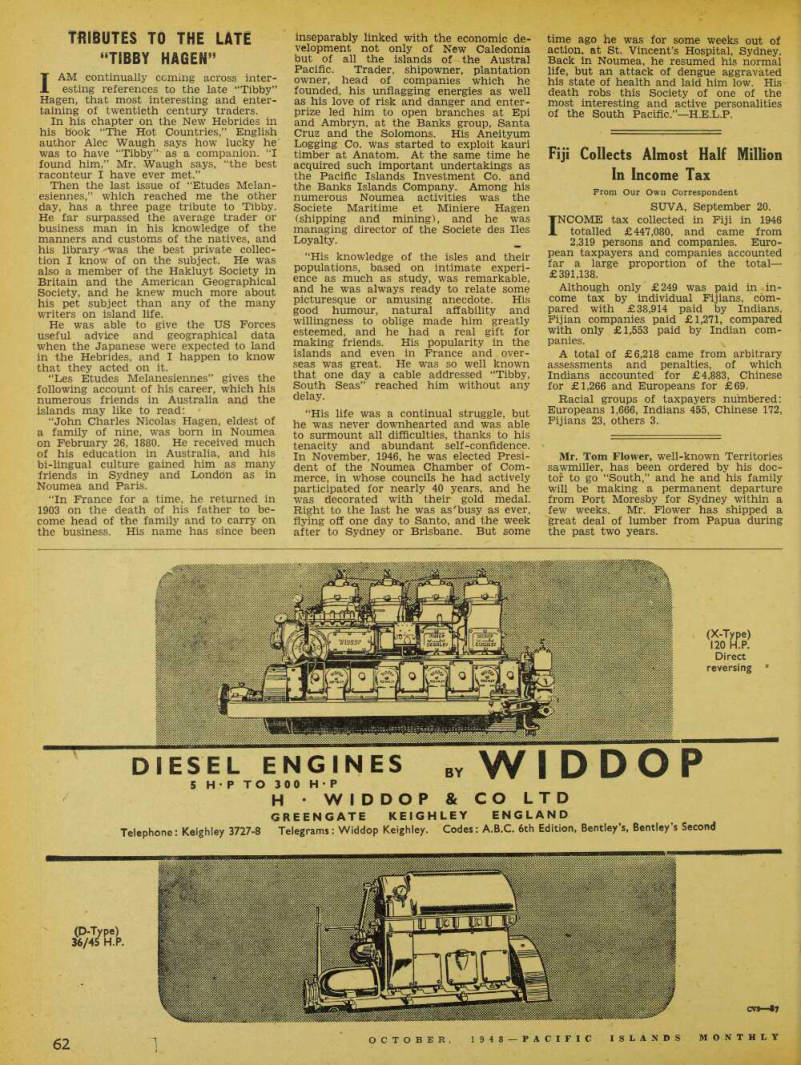
“Tibby Hagen”
IAM continually coming across inter esting references to the late “Tibby”
Hagen, that most interesting and enter taining of twentieth century traders.
In his chapter on the New Hebrides in his book “The Hot Countries,” English author Alec Waugh says how lucky he was to have “Tibby” as a companion. “I found him,” Mr. Waugh says, “the best raconteur I have ever met.”
Then the last issue of “Etudes Melan esiennes,” which reached me the other day, has a three page tribute to Tibby.
He far surpassed the average trader or business man in his knowledge of the manners and customs of the natives, and his library "was the best private collec tion I know of on the subject. He was also a member of the Hakluyt Society in Britain and the American Geographical Society, and he knew much more about his pet subject than any of the many writers on island life.
He was able to give the US Forces useful advice and geographical data when the Japanese were expected to land in the Hebrides, and I happen to know that they acted on it.
“Les Etudes Melanesiennes” gives the following account of his career, which his numerous friends in Australia and the islands may like to read; “John Charles Nicolas Hagen, eldest of a family of nine, was born in Noumea on February 26, 1880. He received much of his education in Australia, and his bi-lingual culture gained him as many friends in Sydney and London as in Noumea and Paris.
“In France for a time, he returned in 1903 on the death of his father to be come head of the family and to carry on the business. His name has since been
inseparably linked with the economic de velopment not only of New Caledonia but of all the islands of the Austral Pacific. Trader, shipowner, plantation owner, head of companies which he founded, his unflagging energies as well as his love of risk and danger and enter prize led him to open branches at Epi and Ambryn, at the Banks group, Santa Cruz and the Solomons. His Aneityum Logging Co. was started to exploit kauri timber at Anatom. At the same time he acquired such important undertakings as the Pacific Islands Investment Co. and the Banks Islands Company. Among his numerous Noumea activities was the Societe Maritime et Miniere Hagen (shipping and mining), and he was managing director of the Societe des lies Loyalty. “His knowledge of the isles and their populations, based on intimate experi ence as much as study, was remarkable, and he was always ready to relate some picturesque or amusing anecdote. His good humour, natural affability and willingness to oblige made him greatly esteemed, and he had a real gift for making friends. His popularity in the islands and even in France and over seas was great. He was so well known that one day a cable addressed “Tibby, South Seas” reached him without any delay.
“His life was a continual struggle, but he was never downhearted and was able to surmount all difficulties, thanks to his tenacity and abundant self-confidence.
In November, 1946, he was elected Presi dent of the Noumea Chamber of Com merce, in whose councils he had actively participated for nearly 40 years, and he was decorated with their gold medal.
Right to the last he was as'busy as ever, flying off one day to Santo, and the week after to Sydney or Brisbane. But some
time ago he was for some weeks out of action, at St. Vincent’s Hospital, Sydney.
Back in Noumea, he resumed his normal life, but an attack of dengue aggravated his state of health and laid him low. His death robs this Society of one of the most interesting and active personalities of the South Pacific.”—H.E.L.P.
Fiji Collects Almost Half Million
In Income Tax
From Our Own Correspondent SUVA, September 20.
INCOME tax collected in Fiji in 1946 totalled £447,080, and came from 2,319 persons and companies. Euro pean taxpayers and companies accounted far a large proportion of the t0ta1£391,138. £391,138.
Although only £249 was paid in in come tax by individual Fijians, com pared with £38,914 paid by Indians, Fijian companies paid £1,271, compared with only £1,553 paid by Indian com panies.
A total of £6,218 came from arbitrary assessments and penalties, of which Indians accounted for £4,883, Chinese for £1,266 and Europeans for £69.
Racial groups of taxpayers numbered: Europeans 1,666, Indians 455, Chinese 172, Fijians 23, others 3.
Mr. Tom Flower, well-known Territories sawmiller, has been ordered by his doc tor to go “South,” and he and his family will be making a permanent departure from Port Moresby for Sydney within a few weeks. Mr. Flower has shipped a great deal of lumber from Papua during the past two years.
Advertisements & other items, pp. 64-65 (1 item)
Widdop
A' ' ' ' i - «h r woo or >j io •AtlUhlt *.\ (X-Type) 120 H.P.
Direct reversing BY
DIESEL ENGINES
5 H • P TO 300 H • P
H • WIDDOP & CO LTD
GREENGATE KEIGHLEY ENGLAND
Telephone: Keighley 3727-8 Telegrams : Widdop Keighley. Codes: A.B.C. 6th Edition, Bentley’s, Bentley’s Second (D-Type) 36/45 H.P.
ii[n|iMn|pi]
pr V : ; a? ?.?! •:<;x :
CVS—*7
There is only one
ELECTROLUX
THE MODERN KEROSENE-OPERATED REFRIGERATOR
THAT ACHIEVES THE MIRACLE OF ICE FROM HEAT
Lasting Efficiency, Silent Operation, Streamlined Beauty
* Economically operated by kerosene, with a simple precision-built freezing unit that has no moving parts and is GUARANTEED FOR
FIVE (5) YEARS.
Obtainable from:
NEW GUINEA COMPANY, LIMITED.
Rabaul, Madang, Lae, Kavieng.
J. R. CLAY & CO., LTD., Port Moresby.
W. R. CARPENTER & CO. (Sol. Is.), LTD., Tulagi.
For New Hebrides, Butaritari, Noumea, New Caledonia. Apply—
W. R. CARPENTER & CO. LTD.
Model LKSSI Price £79/15/- FOB, Melbourne Storage capacity: 5i cub. ft. (approx); shelf area, 9 sq. ft.; food shelves, six—five removable; 2 self-supporting when half drawn. Ice-making: Four trays—s lb. ice per freezing: 80 cubes. Fuel consumption: 1.8 pints kerosene per day (approx.).
Height: 4 ft. 10 in. Depth: 2 ft. in. weight, unpacked, 406 lb. Packed, 574 lb.
Head Office: 16 O'Connell St., Sydney, N. S. Wales
Concerning Mr.
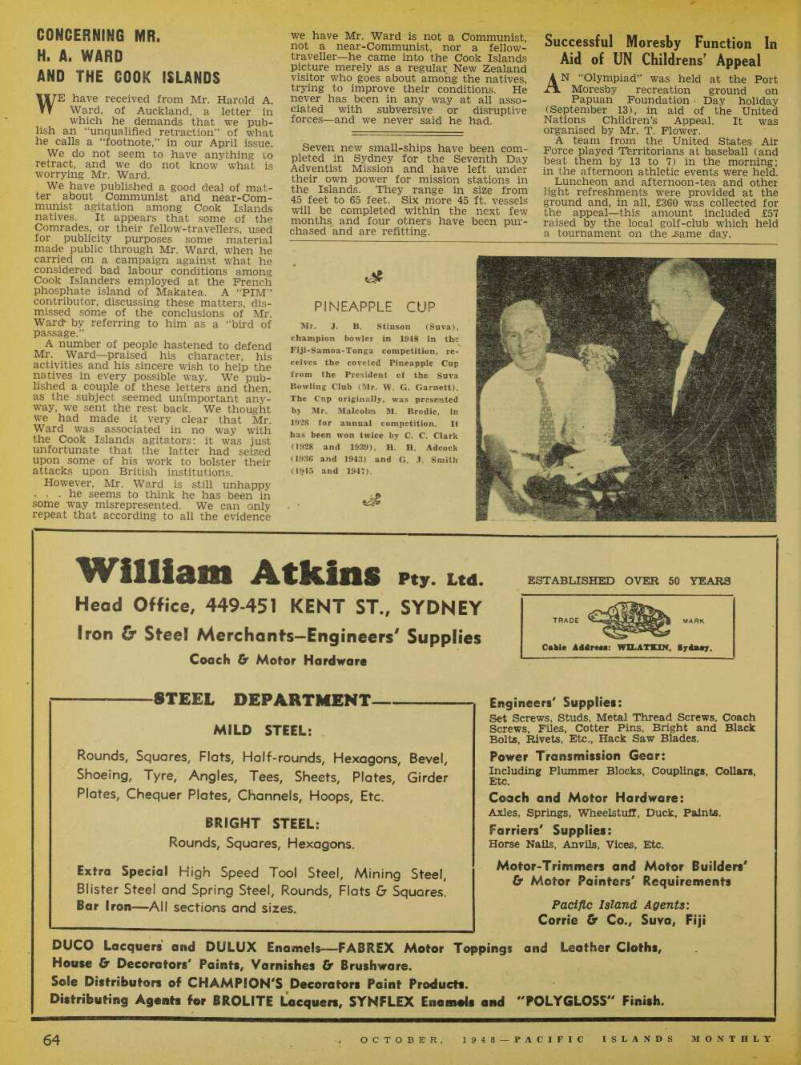
H. A. Ward
And The Cook Islands
WE have received from Mr. Harold A.
Ward, of Auckland, a letter in which he demands that we pub lish an “unqualified retraction” of what he calls a “footnote,” in our April issue.
We do not seem to have anything to retract, and we do not know what is worrying Mr. Ward.
We have published a good deal of mat ter about Communist and near-Com munist agitation among Cook Islands natives. It appears that some of the Comrades, or their fellow-travellers, used for publicity purposes some material made public through Mr. Ward, when he carried on a campaign against what he considered bad labour conditions among Cook Islanders employed at the French phosphate island of Makatea. A “PIM” contributor, discussing these matters, dis missed some of the conclusions of Mr.
Ward* by referring to him as a “bird of passage.”
A number of people hastened to defend Mr. Ward —praised his character, his activities and his sincere wish to help the natives in every possible way. We pub lished a couple of these letters and then, as the subject seemed unimportant any way, we sent the rest back. We thought we had made it very clear that Mr.
Ward was associated in no way with the Cook Islands agitators: it was just unfortunate that the latter had seized upon some of his work to bolster their attacks upon British institutions.
However, Mr. Ward is still unhappy ... he seems to think he has been in some way misrepresented. We can only repeat that according to all the evidence
we have Mr. Ward is not a Communist, not a near-Communist, nor a fellow traveller—he came into the Cook Islands picture merely as a regular New Zealand visitor who goes about among the natives, trying to improve their conditions. He never has been in any way at all asso ciated with subversive or disruptive forces—and we never said he had.
Seven new small-ships have been com pleted in Sydney for the Seventh Day Adventist Mission and have left under their own power for mission stations in the Islands. They range in size from 45 feet to 65 feet. Six more 45 ft. vessels will be completed within the next few months and four others have been pur chased and are refitting.
Successful Moresby Function In Aid
Aid of UN Childrens’ Appeal
AN “Olympiad” was held at the Port Moresby recreation ground on Papuan Foundation - Day holiday (September 13), in aid of the United Nations Children’s Appeal. It was organised by Mr. T. Flower.
A team from the United States Air Force played Territorians at baseball (and beat them by 13 to 7) in the morning; in the afternoon athletic events were held.
Luncheon and afternoon-tea and other light refreshments were provided at the ground and, in all, £360 was collected for the appeal—this amount included £57 raised by the local golf-club which held a tournament on the -same day.
Pineapple Cup
Mr. J. B. Stinson (Suva), champion bowler in 1948 in the Fiji-Samoa-Tonga competition, re ceives the coveted Pineapple Cup from the President of the Suva Bowling Club (Mr, W. G. Garnett).
The Cup originally, was presented by Mr. Malcolm M. Brodie, in 1928 for annual competition. It has been won twice by C. C. Clark (1928 and 1939), H. H. Adcock (1936 and 1943) and G. J, Smith (1945 and 1947).
Advertisements & other items, pp. 66-68 (1 item)
William Atkins Pty. Ltd.
Head Office, 449-451 KENT ST., SYDNEY
Iron & Steel Merchants—Engineers' Supplies
Coach & Motor Hardware
ESTABLISHED OVER 50 YEARS
TRADE
MARK
Cable Address: WILATKEN, Sydney.
STEEL DEPARTMENT
MILD STEEL:
Rounds, Squares, Flats, Half-rounds, Hexagons, Bevel, Shoeing, Tyre, Angles, Tees, Sheets, Plates, Girder Plates, Chequer Plates, Channels, Hoops, Etc.
BRIGHT STEEL:
Rounds, Squares, Hexagons.
Engineers 1 Supplies: Set Screws, Studs, Metal Thread Screws, Coach Screws, Files, Cotter Pins, Bright and Black Bolts, Rivets, Etc., Hack Saw Blades.
Power Transmission Gear: Including Plummer Blocks, Couplings, Collars, Etc.
Coach and Motor Hardware: Axles, Springs, WheeLstuff, Duck, Paints.
Farriers' Supplies: Horse Nails, Anvils, Vices, Etc.
Extra Special High Speed Tool Steel, Mining Steel, Blister Steel and Spring Steel, Rounds, Flats £r Squares.
Bar Iron—All sections and sizes.
Motor-Trimmers and Motor Builders' & Motor Painters' Requirements Pacific Island Agents : Corrie & Co., Suva, Fiji DUCO Lacquers and DULUX Enamels—FAßßEX Motor Toppings and Leather Cloths, House & Decorators' Paints, Varnishes & Brush ware.
Sole Distributors of CHAMPION'S Decorators Paint Products.
Distributing Agents for BROLITE Lacquers, SYNFLEX Enamels and "POLYGLOSS" Finish.
1 \
fWR TOOTHACHE.
xf Ancient Hebrews prescribed A SINGLE GRAIN OF SALT TO CURE
TOOTHACHE' ANTISEPTIC
BUBBLES EFFECTIVELY
GUARD AGAINST DECAY -
sweep Sjoor decay germs
/'CLEAN TEETH
SURGICALLY/
f? hs
Most
'I *nssz
Ears
Av Efdac THAT The
LOSes^tKRSOH
OF % 2S
J/frn
keep V Age [S V"~- „ QO " tOHC/cs:^
•jss&Ss*
Keep Th ’£*p routtr**
«s»s«aK*
T?
breath
P \ S’” kl liiT, \ -K 48-17 <t£ American scientists
HAVE NOW INVENTED
SPECIAL RADIO -
OPAQUE SPUN
CLASS TO FILL.
ROOT CANALS OF
%> TEETH/ '
fe'
"iMs
.k v'/
Stop your Headache fftSfWfi /
&NAC/y
t£GD. TRADE MARK
Anacin slops headaches faster. First because it contains an extra ingredient. Secondly because It IS a prescription for pain ami aches. ANACIN.
The Garrick Hotel
tzm ii mu m " w m 1 Wt iUg M 1 ■
SUVA
FIJI
This well-known Hotel is centrally situated in Suva's main business quarter :: Modern accommodation provides comfort in all climatic conditions :: Only the best of Beers, Spirits and Wines is served Telephone: 80. VINCE COSTELLO, Proprietor.
For
dazzling
whiteness L Always use Deckitt 9 s Dag Dlue in the last rinse the safe way to keep your linen a really good colour
‘Hugh Mac
Hero Who Was Without Showmanship
A REPORT of the death by accident of Lieutenant-Commander H. A.
Mackenzie, DSC, Legion of Merit (Officer Division), and an outline of his remarkable achievements as a Coast Watcher in World War 11, are published on another page.
In the following article, Commander Eric Feldt, who was at school with Mr.
Mackenzie, and who selected his old friend to be his right-hand man in the critical coast-watching days of 1941-43, pays this tribute to the memory of a most lovable and an extremely brave man: PERHAPS Hugh Mackenzie (we all knew him always as “Hugh Mac”) had a quality even greater than his courage—and that was his gift for mak ing friends—and keeping them. Those friends now mourn that the Last Post has sounded for him, and they tender their sympathy to his widow, Betty.
He had had four years’ training at the RAN Naval College when, in 1917, as a youth of 18, he joined HMS “Glorious” as a midshipman and served in her and other ships for the remainder of World War I. While doing submarine training, he was on board one of the four sub marines rammed by our own ships in the disaster in the Firth of Forth, and barely escaped. Many more close calls were to come. , , When the war ended. Hugh Mac found the Navy in peacetime too dull, and he retired in 1920. A little later, he went to New Guinea as a schooner-skipper for the Expro Board. After serving two years, he went south and acquired his own vessel. In her, he traded and re cruited on the Papuan coast for four years. Back in New Guinea, he skippered a number of small vessels, trading, re cruiting and trochus fishing. How many narrow escapes he had in those days is not now known. He was a skilful sea man, but the coasts were unlighted and the reefs always waiting.
In Salamaua, he nearly died of illness —probably scrub typhus, which had not then been recognised. Only his will to live pulled him through.
He married. Betty, his wife, was just such another lover of the sea, and of not seeing the same things every morning when she woke up, as Hugh himself. To gether they traded and fished for trochus, living life as they wanted it. Then, when they had savoured roving to the full, they took up land at Megigi, near Talasea, and started a plantation.
When war broke out, Hugh Mac re joined the Navy, leaving his wife to run the plantation. After service m Port Moresby and Rabaul, and escape from the Japs, he was sent to Y to charge of the coast watchers in the South Pacific Area. He landed on Guadalcanal a week after the US Marines had taken it and set up his radio station m a Japanese foxhole. To him came the warn ings of Read, Mason and Kennedy of Jap aircraft on the way, and he passed them on, so that these attacks were met and defeated. In addition, he sent boats to rescue personnel cut off, placed new parties in the field and built up an organ isation throughout the Solomons, so that we knew more about the Japanese posi tions and movements than the Japanese headquarters did themselves.
But it was no office job for Hugh Mac.
The position was frequently bombed and
shelled and he himself was in a covered slit trench which was directly hit by a bomb. The others in the trench went to hospital, but Hugh Mac remained on duty, remarking that he “had a head ache.” He remained on Guadalcanal for eight months, and was awarded the Legion of Merit (Officer Division) by Admiral Halsey for his services.
In Sydney, while on leave, the hard ships he had suffered took toll, and he went down with blackwater. It was a near thing, but he recovered, only to have a second attack six weeks later. His indomitable will and fortitude pulled him through, but it was several months before he was fit for duty again. He was appointed to AIB Headquarters, but could not be kept south. Time after time he went north, to join in operations there.
For these, and his former services, he was awarded the Distinguished Service' Cross by the RAN.
WHEN the war ended, he remained in the Navy. His plantation had been partly cleared by the Japs for use as an airfield, and when they retired to Rabaul, they mined it. Even he would not undertake putting it in order again.
However, his duties frequently took him to New Guinea, where his old friends welcomed him. Life seemed set fair for the future.
It is amazing that, after all this, he, who had watched the scythe of the Grim Reaper pass so closely so often, should meet his death from a fall.
I have described his deeds, but more remains to describe the man. He was fair and sturdily built, with a shambling walk, very handsome Of face and looking much younger than his years. I can' call him a war hero now that he is dead —he would have punched my nose if I had done so when he was alive. And he was heroic, but that without showmanship or guile of any kind.
In peacetime, he lived his life for the pleasure he could get out of it—cheerful, carefree but not irresponsible, for Hugh Mac was beholden to no man. He ex pected others to look after themselves; he would help if needed, but had no yearning to direct other people’s lives for them. Perhaps he would have appreci ated another age—he would have fitted well with the Elizabethans.
His fortitude was amazing. Even as a fourteen-years-old cadet, he had shown it in the ring, taking punishment and coming back for more, till his opponent, beaten by the futility of hitting him rather than by Mac’s blows, gave in. In war, he took the hardship and danger as just part of the show, it was there and a man took it. The job had to be done.
And, at the worst times, he was cheerful, with never a whinge.
Burns, Philp Take Over
Stores At Forbes And Young
LATEST country store acquisitions by Burns, Philp & Co., Ltd., which con tinues to invest heavily in this direc tion, are the well-known general stores of Arthur Hughes & Co., of Forbes, and Hammond & Hanlon, of Young.
Mr. C. N. Perry, a recognised efficiency expert, who spent many years in the islands and in North Queensland in the service of Burns Philp & Co., and who during the war was associated with the Commonwealth Rationing Commission, arrived in Forbes last month to become general manager of the Forbes business.
At Young, Mr. Roy Hammond relin quishes control of Hammond & Hanlon, but will retain a substantial interest in the business.
Another Japanese Pest
GIANT snails, now threatening the well-being of New Guinea native gar dens, were not the only pest released in the Pacific Islands by the Jap invaders in 1942-45. The following extract from a District Officer’s report was published recently by the “North Borneo News”: “In addition to the fern and lalang the Dayaks now have to compete with a new grass weed, which grows in most prolific fashion on the worst soil and has a peculiar odour. This is known to them as ‘aeroplane grass,’ because, as it never made its appearance until the Japanese arrived with their aeroplanes, the Dyaks are convinced that the Japanese broad cast it from the skies.”
Mr. K. A. Saxby, who was born in Fiji and lived in that Colony until 1939. expects to leave Sydney this month for Manus, New Guinea, where he will join the plantation staff of Messrs. Edgell and Whiteley.
Mr. Philip MacFarlane, BA, of Tas mania, proceeded to Thursday Island (Torres Straits) in September to take up his new work as a teacher, under the Anglican Mission, on Moa Island. He is a son of the Rev. W. F. MacFarlane, who was a missionary in the Torres Strait Islands for many years. The young man served in the war years as a navigator in the RAAF.
Advertisements & other items, pp. 69-70 (1 item)
fcinonweaMank
I m For Inflamed Eyes and Eyelids ... Sold Everywhere H.Rose&Ca.Pty..Ltd.. Kinq Street Sydney.
W€ 9
CAN HELP YOU
With Full banking facilities at our Island Branches
RABAUL ... LAE
PORT MORESBY
MADANG
The Service
links with our Branches throughout Australia, also our Agents and correspondents all over the world.
fcinonweaMank
of Australia.
0 Every Branch of the Bank conducts Savings Bank business.
Hard to Get? 7r v us
FOR
1. TRADE TOBACCO
2. LAP LAP MATERIAL
3. CANNED GOODS
4. PERFUMERY
5. PRIMUS STOVES
6. KEROLAMPS
7. SHOES, SANDALS
8. UMBRELLAS
9. CHILDREN'S CLOTH-
ING
10. SADDLERY & HARNESS
11. HOME LIGHTING PLANTS
12. WINES AND SPIRITS
13. NON-ELECTRIC WASHING
MACHINES
14. PUMPS, IRRIGATION
PLANTS
15. CROCKERY
16. HAIRDRESSING SUPPLIES
17. HARDWARE
18. AIR CIRCULATORS
Castlereagh Street
IH auSIOCKS Sydney, Australia
ISLAND TRADERS
Cable and Telegraphic address: “MANSTOCKS” SYDNEY Telephones: 8W7405, 8W1237, 85076, FM2766
NELSON and ROBERTSON Pty. Ltd.
Established 1895
Shipowners - Brokers and
Islands Merchants
All classes merchandise purchased at Best Wholesale Prices. Original Invoices supplied to Island Clients. Cocoa Beans, Copra, Rubber, Trochus Shell and All Islands 7 Produce Sold on Commission.
Entrust your requirements to the firm with fifty years' practical experience in the Pacific Islands.
Prompt attention given to all enquiries.
NELSON & ROBERTSON Ki
12 SPRING STREET, SYDNEY, AUSTRALIA
Telegraphic Address: IVAN, SYDNEY.
Unique Presentation Of
‘Messiah’ By Tongan Choir
A MUSICAL event of some interest and importance took place recently in connection with the Annual Confer ence of the Free Wesleyan Church of Tonga, which was held for the first time for some years in Neiafu, Vava’u. This was a performance by a Tongan choir
of about 300 voices of Handel's “Messiah." r - Helsen, until lately manager of Burns Philp, Ltd., in Vava’u, and formerly a well-known Sydney tenor, rendered one of the solos and gave appreciated help in the practices.
It was found practicable to perform only one solo in each part, three being taken by Tongans—Fakahua (soprano), Sisilia (contralto) and Motua Puaka (bass). All the usual choruses were sung with vigour, remarkable confidence and accuracy, and a pleasing quality of tone. The conductor was Taniela Mafua, and the choirs of Neiafu, Leimatu’a, Holonga and Makave took part.
In between the various pieces the Rev.
P. Kongaika read the words, to fill in the gaps caused in the sequence by the omission of the other solos and of the parts usually not included in any pre sent-day performance of this work. Much valuable assistance was given by those who adapted the Tongan scriptural words to the music, and transcribed the English music into the Tongan solfa, and by vari ous conductors in Neiafu who frequently visited the separate choirs during re hersals. Five or six combined practices were held prior to the performance.
It is probable that a presentation of “The Messiah" by a native choir is an event unique in Pacific history, and, com pared with performances in Australia and New Zealand, the standard was surpris ingly good.
The choruses were sung unaccompanied and from memory, with the aid of no musical instrument other than a pitch- Pipe.
Mr, O. Newman, planter, of the New Hebrides, returned home by Trans oceanic plane on September 16, after a month in Sydney.
Samoans Have Prosperity
But No Health Sense or Education
AFTER six months as a relieving medical officer in Western Samoa.
Dr. H. D. Livingstone returned to Christchurch, NZ-, in mid-September. H had this to say to a Christchurch “Press” reporter: The NZ Government has done a credit able job in raising living standards in Samoa, thus permitting an increase in the population. But although the popu lation had doubled during NZ’s adminis tration, 47 children out of every 1,000 still died before they were 10 years old. This was mostly due to native reluctance to adopt European health measures. Hook worm, malnutrition and typhoid were common and Samoans were particularly susceptible to influenza.
For the population of 70,000 there were three doctors and 20 native medical practitioners. The other two doctors with whom Dr. Livingstone worked were specialist surgeons who had served in the Indian Army. The native practitioners underwent a four-year course at the Suva medical school.
The hospital was well equipped with X-ray plant, laboratories, and dispensary.
The matron and sisters were recruited from New Zealand, and Samoan girls were trained at the nursing school attached to the hospital. “They do a good job, con sidering their lack of education,” Dr.
Livingstone said.
The average educational attainment of the Samoan was a Standard II education.
Educational and health talks were now broadcast from Samoa’s local radio station, and nearly all the villages had been provided with free radio sets in order to help spread this knowledge among the people.
Dr. Livingstone considered it would be advisable for some of the more intelligent natives to be sent to University in New Zealand, as was being done with the Fijians. Several Fijians had been to Oxford and had since been able to as sume administrative responsibility in their own land.
Speaking of the work of the missions, Dr. Livingstone said that they were very well supported by the native population.
There were 43 churches, some of cathedral proportions, near Apia, and about 10 more were under construction. “Without the missions the natives would probably not produce as much wealth from the country as they do. They have a great incentive to work in order to pay for new church buildings.”
THE Samoan community was very affluent because of the present high world price of cocoa and copra which were their principal exports.
Samoa was at present flooded with American goods. The cost of living was high for Europeans. The average small European family could not live for less than £7O a month.
It should be possible in the next few years to develop a tourist trade in the South Pacific, for Australia and New Zea land, while other tourist routes were virtually closed. Dr, Livingstone consid ered Samoa had the scenery, the recrea tion, and, in the cool months, the climate necessary to attract tourists, but its hotel accommodation needed to be improved and expanded.
At present an effort was being made to raise the general standard of native education in order to train the natives to undertake administrative responsibility in the future, Dr. Livingstone said. But it would appear that they would not be in a position completely to order their own affairs for at least another 10 years.
Fatal Accident In New
Guinea
REPORTS from New Guinea indicate that a fatal accident occurred at Soraken, Bougainville, recently, wherein Mr. Peter Foster, a well-known planter, lost his life. He was on a copra barge with his wife and child when the barge caught fire. Mr. Foster ass sted his wife and child to safety but was himself fatally injured when an explosion occurred.
Mrs. Peter Foster is a daughter of Mr.
C. I. H. Campbell, a well-known Bougain
ville planter.
A visitor to Suva is Mr. F. V. N. Budd, who left Los Angeles in his Seabird-type yacht “Tai Manu” in April, 1947, spent six months on the Mexican coast and then sailed to Apia by way of the Marquesas, Tahiti, and Palmerston. At
Apia he sold the yacht to Dr. C. H. Bliss, and travelled to Suva in the “Matua.”
He will visit Australia before returning to America.
Mr. A. D. Patel, a prominent member of the Indian community of Fiji, has been appointed a member of the Executive Council of Fiji.
Advertisements & other items, pp. 71-72 (1 item)
W. Kopsen & Co. Pty. Ltd
Gilbert Renton
AUCTIONEER, VALUER,
ESTATE AGENT.
Storage and Repository Travellers Sample Rooms For General Information and Service.
P.O. Box Rabaul, TNG
From WHOA
SIMPLEX
MARINE ENGINES
3, 5 and 10/12 h.p. Suitable for all crafts from 14-32 ft. The 5 and 10 h.p. are supplied with built-in reverse gear. All Australian made. Prices and specifications on request.
C.Q.R. ANCHORS
The lightweight anchor with three times the holding power of any other anchor. No more efficient tool for quick and positive “dig-in” has ever been found than the ploughshare The C.Q.R. Is two well designed ploughshares welded together. Write for C.Q.R. Anchor leaflet.
To GO!
W. KOPSEN & CO. PTY. LTD
Have EVERYTHING for Boats
FISHING
TACKLE
Our new Fishing Department has been opened to provide the utmost service and satisfaction in all classes of fishing gear. Marlin Gut lines, Fishkil Nylon Twist, Geisha Wire Traces, Linen and Cotton lines, Rangoon and Split Cane Rods, Reels and numerous other lines.
KAYEN PRESSURE LAMPS
The all Australian made vapour lamps— reliable—efficient—safe—easy to operate.
Burns for 10 hours on I*4 pints of kerosene. The lamp illustrated is of 300 C.P. and is the table model (HL7); the allpurpose lamp (AP2) Is windproof and ideal for outdoor work. Burn ordinary kerosene. Write for illustrated leaflet.
SHIPCHANDLERS & MARINE ENGINEERS
376-380 KENT ST., SYDNEY. MA 6336 (9 lines).
Cables: “KOPSEN” Sydney.
Send us your orders for
DEVELOPING, PRINTING,
ENLARGING
We Sell Kodak Films and Supplies Wholesale and Retail.
Caine's Studios, Suva
P.O. Box 8. (Estab. 1904) ’Phone 68.
He didn't -former
to kiss you
Honey!
Poor foolish wife—to trust just a bath, instead of capping it off with dependable Mum.
Your bath washes away past perspiration but it can’t safeguard you against the risk of future underarm odour.
Take just 30 seconds to smooth on Mum ; then you’ll be worry-free all day or even-
ing. Mum guards charm.
You can use Mum even after dressing. It will not injure fabrics or irritate your skin.
Get Mum today.
TAKES
Mum
New Hotel For Fiji
ANEW hotel at Nadi, Fiji, was opened on September 24.
This is the latest addition to the string of hotels owned by Northern Hotels Ltd., of which Sir Hugh Ragg is manag ing-director.
Modern furnishings are a feature of the hotel which is a two-storied, concrete building in Nadi township.
The new establishment may interest travellers to Fiji by international airlines.
It is within two miles of Nadi airport.
W. R. Carpenters Pay
9 Per Cent.
Parent Co. Is Now Purely A
Holding Co.
HAVING made a profit of £75,655 for the year ended June 30 (compared with £71,043 in the previous year).
W. R. Carpenter & Co., Ltd., have rais:d their annual dividend to 9 per cent.
This company now has an issued capital of £775,000; reserves, used generally in the business, of just over £500,000; and funds supplied by subsidiaries of about £180,000—in other words, it employs over £li millions. (All figures in Australian currency.) Of that, however, nearly £232,000 is in Australian War Loans, and over £400,000 is in cash.
The company’s subsidiaries now operate, quite independently, in New Guinea, Fiji, ' tilbert Islands and Solomon Islands.
Operations in New Guinea and Fi„i are reported as satisfactory: but, in the other two territories, “it has been found im possible to resume activities owing to lack of transport and absence of labour.”
South Pacific Insurance Company, estab lished by Carpenter interests before World War I, is now doing well and paying 8 per cent. The Canadian Company, estab lished just before the war to crush copra in Canada, is not a member of the group centred in Sydney—it is owned inde pendently by the Carpenter family, and is believed to be highly profitable.
W. R. Carpenter & Co., of Sydney, for so many years an active trading company, very shrewdly and capably managed, is now purely a holding company. It re ceives profits from its various subsidiaries which, in due course, are divided among the shareholders of the parent company; but each subsidiary now is self-contained and locally managed. All the company’s Fiji interests have been transferred to a holding company, Pacific Products Ltd.
Capital To Be Returned
IT was announced on October 6 that, as the company now has too much surplus cash, £375,000 will be returned to shareholders, and the Directors re commended that the uncalled liability of 1.5/- on 100,000 shares be cancelled. By this means, the subscribed capital of the company will be reduced from £775,000 )in 750,000 £1 shares, and 100,000 paid to 5/-) to £400,000, in 1,600,000 5/- shares.
The company’s shares now become very valuable. There is nothing to suggest that profit will not be maintained: while there is now only half the capital to share the profits. The £1 shares have been worth around 46 -. The 5 - shares may easily go to 16/- or 18/-.
Sir Walter Carpenter, founder of the group, who has spent most of the last eight years in Canada, presided at the annual general meeting in Sydney on October 6, and received many congratu lations on the successes of the companies.
The new issue of New Caledonian stamps has not yet been put on sale in Noumea, but Paris reports say they are in several colours and that they are criti cised for resembling designs associated with foreign packets of cigarettes. When they replace the present wartime issue, philatelists expect the older issues to increase in value. It seems that the wartime issue overprinted Wallis and Futuna which is to-day being sold for 2,137 francs is never likely to be put into use.
Lussick-Bot2 Wedding
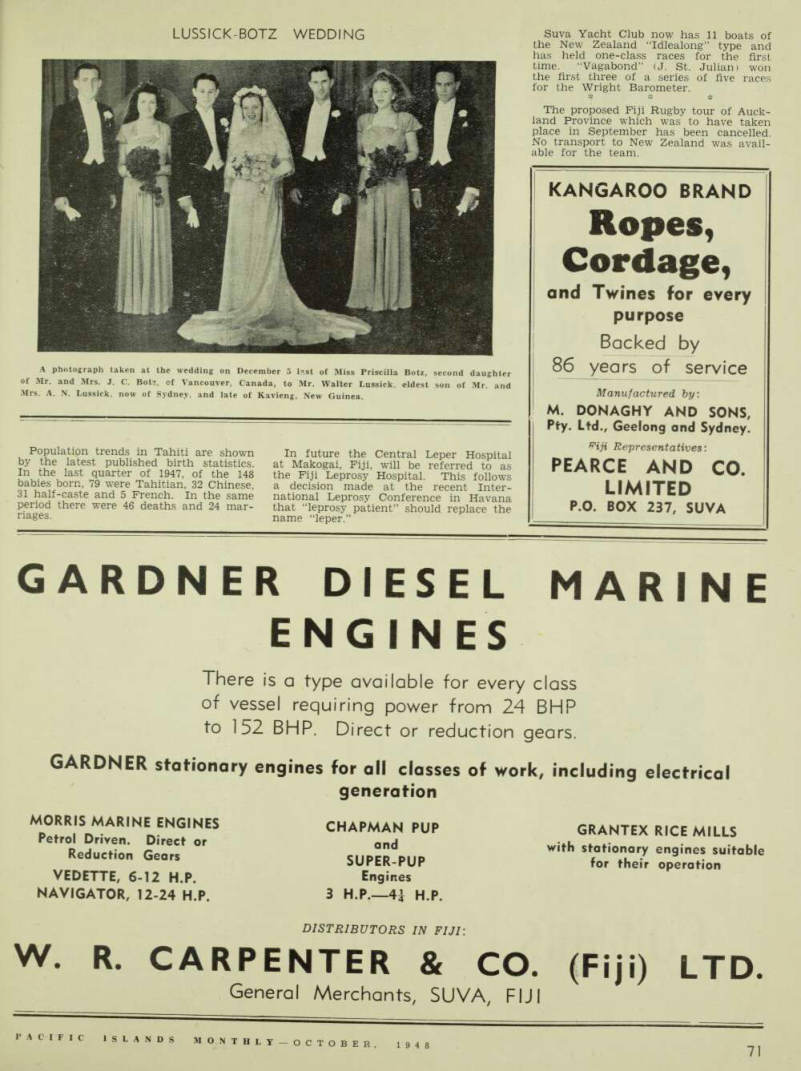
Population trends in Tahiti are shown by the latest published birth statistics.
In the last quarter of 1947, of the 148 babies born, 79 were Tahitian, 32 Chinese, 31 half-caste and 5 French. In the same period there were 46 deaths and 24 mar riages.
In future the Central Leper Hospital at Makogai, Fiji, will be referred to as the Fiji Leprosy Hospital. This follows a decision made at the recent Inter national Leprosy Conference in Havana that “leprosy patient” should replace the name “leper.”
Suva Yacht Club now has 11 boats of the New Zealand “Idlealong” type and has held one-class races for the first time. "Vagabond” (J. St. Julian) won the first three of a series of five races for the Wright Barometer, * * The proposed Fiji Rugby tour of Auck land Province which was to have taken place in September has been cancelled.
No transport to New Zealand was avail able for the team.
A photograph taken at the wedding on December 5 last of Miss Priscilla Botz, second daughter of Mr, and Mrs. J. C. Botz, of Vancouver, Canada, to Mr, Walter Lussick, eldest son of Mr. and Mrs. A. N. Lussick. now of Sydney, and late of Kavieng, New Guinea.
Advertisements & other items, p. 73 (1 item)
Cordage,
KANGAROO BRAND
Ropes,
and Twines for every purpose Backed by 86 years of service Manufactured by:
M. DONAGHY AND SONS,
Pty. Ltd., Geelong and Sydney.
Fiji Representatives:
PEARCE AND CO.
LIMITED
P.O. BOX 237, SUVA
GARDNER DIESEL MARIN
ENGINES
There is a type available for every class of vessel requiring power from 24 BHP to 152 BHP. Direct or reduction gears.
GARDNER stationary engines for all classes of work, including electrical
generation
MORRIS MARINE ENGINES
Petrol Driven. Direct or Reduction Gears
VEDETTE, 6-12 H.P.
NAVIGATOR, 12-24 H.P.
CHAPMAN PUP
and
SUPER-PUP
Engines
3 H.P.—4J H.P.
GRANTEX RICE MILLS
with stationary engines suitable for their operation
DISTRIBUTORS IN FIJI ;
VV, R, CARPENTER & CO. (Fiji) LTD.
General Merchants, SUVA, FIJI
Fiji Will Test Local Phosphate
From Our Own Correspondent SUVA. Sept. 12.
FURTHER investigation is to be made of the deposits of phosphates at the tiny island of Ogeadriki, in the Lau Group.
New Zealand was interested in the de posits during the war when supplies from
Nauru and Ocean Island were cut off.
Fifty tons of phosphates were shipped to the Dominion for tests, which were satis factory.
In July, 1948, 20 tons were brought to Suva for use in field trials in the Colony.
Tests of soils have shown fairly wide spread deficiency in phosphate. If the trials are satisfactory further plans will be made for developing the Ogeadriki de posits.
Ashes of Late Judge Ayson
Go Back To Rarotonga
Prom Our Own Correspondent
Rarotonga. Sept. 21.
THE ashes of the late Judge H. F.
Ayson, CMG, were brought to Raro tonga on September 18 by Mrs. Ayson aboard the “Maui Pomare.”
It was Mrs. Ayson’s own wish that the ashes of her husband should be interred in the Islands which he loved and for whose welfare he worked so long and strenuously.
The late Judge Ayson, who died in Wellington, NZ, on February 1, 1948, aged 63, devoted 27 years to the Cook Islands —first, in 1916, as Judge of the High and Native Land Courts, and, later, as Resident Commissioner. He was Resident Commissioner and Judge from 1922 until failing health forced him to retire at the end of 1943. He was made CMG in 1930.
IMMEDIATELY after the arrival of the “Maui Pomare” at Rarotonga the urn containing his ashes was brought ashore and placed in the Court Room.
Later the same morning, the funeral cortege left on foot for the LMS Church yard.
The urn was carried on a flag-draped stretcher, the pall-bearers being Mr. R.
McKegg, Mr. D. Reid and two Rarotongan high chiefs, Vakatini Ariki and Tinomana Ariki. Following was Mrs. Ayson, carry ing a magnificent spray of purple bougainvillea. She was accompanied by the present Resident Commissioner (Mr.
W. Tailby), Mrs. Tailby and Miss Margaret Tailby. Behind them was a long procession of European and Maori friends.
Companies of Girl Guides and Bovs’
Brigade formed a guard-of-honour at the churchyard. The service was conducted by the Rev. W. Murphy, of the LMS.
Final Search For American
Dead
SEARCH teams of the American Graves Registration Service have now ar rived in New Guinea and Papua to undertake work that is expected to close those Territories to anv further searching for unidentified American dead.
In the past two years these searches have been carried on on an individual basis —the men engaged in them going out to inquire only in regions where plane crashes or other casualties were known to have occurred. The teams which are now in the Territories will cover the whoip of the area as thoroughly as nossible. They will travel on foot, and will make either direct interrogation of natives on the soot, or will have representatives of outlying villages brought to them in central places This system has proved very successful in Dutch New Guinea and other similar areas.
Teams will be operating during the next few months in Sepik River Valley area (out of Madang) and north and south of Lae (out of Lae), and the Papuan Territory will be worked from Port Moresby. The present ©Derations will be carried out bv a small number of personnel, all of whom are Americans.
Anv person desirous of giving informa tion to the search teams, which might lead to the identification of unknown dead, should communicate with the Officer in Charge, American Graves Reg istration Service, c/o The Australian War Graves Commission, in Lae, or in Port Moresby.
Advertisements & other items, p. 74 (1 item)
Colmans Mustard
A. B. DONALD Ltd.
AUCKLAND
ISLAND TRADERS & GENERAL MERCHANTS
P.O. Box 1509. Cables £r Telegrams, ''Kingdom/' Auckland
HV L 4 9m, Good food tastes all the better with
Colmans Mustard
The Racial Problem In Fiji
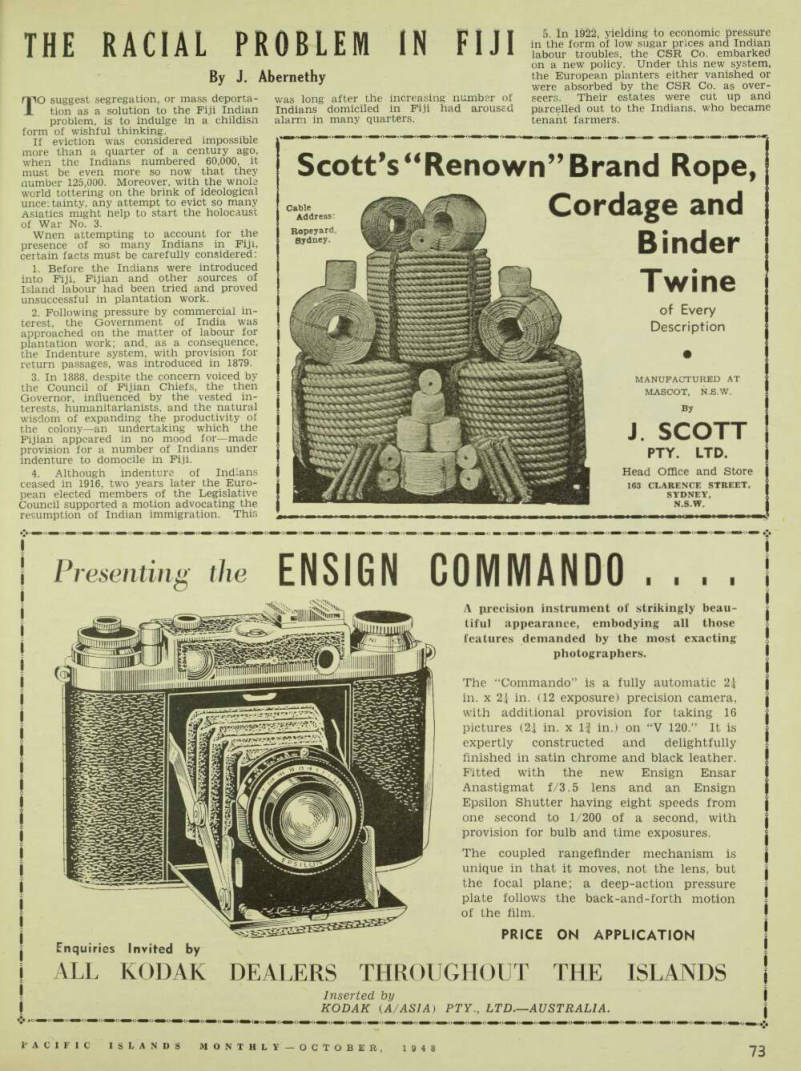
By J. Abernethy
suggest segregation, or mass deporta tion as a solution to the Fiji Indian problem, is to indulge in a childish form of wishful thinking.
If eviction was considered impossible more than a quarter of a century ago, when the Indians numbered 60,000, it must be even more so now that they number 125,000. Moreover, with the wnole world tottering on the brink of ideological unceitainty, any attempt to evict so many Asiatics might help to start the holocaust of War No. 3.
Wnen attempting to account for the presence of so many Indians in Fiji, certain facts must be carefully considered; 1. Before the Indians were introduced into Fiji, Fijian and other sources of Island labour had been tried and proved unsuccessful in plantation work. 2. Following pressure by commercial in terest, the Government of India was approached on the matter of labour for plantation work; and, as a consequence, the Indenture system, with provision for return passages, was introduced in 1879. 3. In 1888, despite the concern voiced by the Council of Fijian Chiefs, the then Governor, influenced by the vested in terests, humanitarianists, and the natural wisdom of expanding the productivity of the colony—an undertaking which the Fijian appeared in no mood for—made provision for a number of Indians under indenture to domocile in Fiji. 4. Although indenture of Indians ceased in 1916, two years later the Euro pean elected members of the Legislative Council supported a motion advocating the resumption of Indian immigration. This
was long after the increasing number of Indians domiciled in Fiji had aroused alarm in many quarters.
5. In yielding to economic pressure in the form of low sugar prices and Indian labour troubles, the CSR Co. embarked on a new policy. Under this new system, the European planters either vanished or were absorbed by the CSR Co. as over seers. Their estates were cut up and parcelled out to the Indians, who became tenant farmers.
6. The policy of European capital has, throughout the years, brought about the gradual elimination of the European him self, as an economic unit. The planter, the platelayer, the loco driver, the small trader, the tradesman, the clerk—all have gradually vanished and been replaced with the cheaper Indian. To-day, we have the spectacle of Indian building con tractors, financed with European money, underquoting the European firms who
trained them, and building homes for Europeans, and buildings for European con cerns. It is indeed a paradoxical situa tion.
Apart from the unwise move by the Government of 1888, the problem of the Indian was created for and aggravated by European interests.
The Indian, throughout, has been a pawn in the game of business (albeit a remarkably adaptable one) and now that the pawn by reason of his adaptability, thrift, energy, and fecundity, has reached the stature of a menace, there are loud cries for the formulation of some policy that will re duce him once again to the level of a pawn.
The presence in Fiji of 125,000 Indians, with the roots of their lives firmly estab lished, is so unalterable a fact that it
becomes unprofitable to regard it in the nature of a problem. The real problem is the preservation of the Fijian race; and if population statistics mean anything there are as yet no sound reasons for regarding the presence of the Indians as a menace.
The preservation and welfare of the Fijian race is a task which has been faith fully carried out by British Governments.
And, as long as there is a British Gov ernment, be it Labour or Conservative, with power in Colonial matters, that policy will always be religiously implemented.
There are encouraging signs that the high official •attitude, while favouring the communal way of life so natural to the Fijian, strongly discourages the con tinuance of those customs and duties which tend to retard economic progress.
As time goes on the effect of this modi fication of policy Will be made manifest through the excellent work done by the Native Land Trust Boaid. demarcation of adequate native reserves, child welfare, and the encouragement of Fijians in agricultural pursuits.
Meanwhile it is imperative that a strong core of European life should be preserved to act as a buffer between the two races. This is something which calls for a good deal of thoight on the part of Europeans themselves.
Advertisements & other items, pp. 75-76 (1 item)
The Ensign Commando
Scott’s “Renown” Brand Rope,
Cordage and
Binder
Twine
of Every
Description
Cable Address Ropeyard Sydney. m
RSB
MANUFACTURED AT
MASCOT. N.S.W.
J. SCOTT
PTY. LTD,
Head Office and Store
163 CLARENCE STREET,
SYDNEY,
N.S.W.
Presenting
the ENSIGN COMMANDO
I I I
wfi *< r ,."-,y» £ : <
Enquiries Invited by
A precision instrument of strikingly beautiful appearance, embodying all those features demanded by the most exacting photographers.
The “Commando” is a fully automatic 2* in. x 2i in. (12 exposure) precision camera, with additional provision for taking 16 pictures (2i in. x 1| in.) on “V 120.” It is expertly constructed and delightfully finished in satin chrome and black leather.
Fitted with the new Ensign Ensar Anastigmat f/3.5 lens and an Ensign Epsilon Shutter having eight speeds from one second to 1/200 of a second, with provision for bulb and time exposures.
The coupled rangefinder mechanism is unique in that it moves, not the lens, taut the focal plane; a deep-action pressure plate follows the back-and-forth motion of the film.
PRICE ON APPLICATION
ALL KODAK DEALERS THROUGHOUT THE ISLANDS
Inserted by
KODAK (A/ASIA) PTY ., LTD.—AUSTRALIA.
TEL.: BW 5129. ESTABLISHED 1913.
William E. Reed
Broker and Agent
MENDES’ CHAMBERS,
8a CASTLEREAGH STREET, SYDNEY.
For all Plantation and Trading Requirements. Inquiries Invited.
at
HILLMAN
SILVER SHELL MOTOR OIL S.A.E. 20.
HUMBER
SINGLE SHELL MOTOR OIL S.A.E. 30.
SUNBEAM-TALBOT
v * SINGLE SHELL MOTOR OIL S.A.C. 30.
COMMER
t SINGLE SHELL MOTOR OIL SJLE. 30.
KARRiER
SINGLE SHELL MOTOR OIL S.A.E. 30.
THE ROOTES GROUP
Recommend Exclusively
SHELL
MOTOR OIL
FOR ALL THEIR VEHICLES
SHELLj You, too, can be sure of SHELL MOTOR OIL THE SHELL CO. OF AUST. LTD. (Inc. In Gt. Brit.) L0489J
Grime In New Guinea
From Our Own Correspondent
Port Moresby, Aug. 18
CASES of more than usual Interest were dealt with by Mr. Justice Phillips, who has returned to Port Moresby from Lae and Rabaul.
A European officer of the Provisional Administration was sentenced to 2V 2 years’ imprisonment at Lae for misap propriating over £l,OOO of Government funds.
At Rabaul, two Chinese employed by the United States Army at Manus again came before the Court, after their case had been adjourned from Inrim, The Chinese were charged with assaulting a native. They had pleaded that the Papua-New Guinea Supreme Court had no jurisdiction over them on the grounds —first that they were members of a friendly armed force visiting the Ter ritory with the concurrence of the local authorities; and secondly, that at the time of the alleged offence Manus was American Territory, having been ob tained by conquest from the Japanese.
Judge Phillips held that the Court had jurisdiction. He decided that, even if the accused were in fact members of a visiting foreign armed force, their offence was committed on a private citizen out side their camp area. He also rejected the claim that Manus was, at the time of the offence, American territory.
Each accused was sentenced to six months’ imprisonment. Notice has been filed on their behalf in the High Court of Australia of their intention to appeal to the High Court against their con viction.
Nine natives, reputed to be members of the Roman Catholic Mission, were sentenced at Rabaul to imprisonment on charges of “riotously destroying” a school building and a number of houses be longing to members of the Seventh Day Adventist Mission at Bougainville.
A European man at Rabaul, was sentenced to three years’ imprisonment for an offence on a European boy.
Dr. P. E. C. Manson-Bahr, newly appointed physician-specialist to the Fiji Medical Department recently arrived in the Colony from the United Kingdom.
Advertisements & other items, p. 77 (2 items)
75
lACI F I C ISLANDS MONTHLY OCTOBER, 1948
China-New Guinea Mercantile Company
For Reliable Service and Complete Satisfaction
You can Always Depend on
Attention !
DO NOT PASS BY THIS NOTICE
iinr ———g mi i iiimi n g— i mb— ■■ i iiwmim i ihi i ■miii— ARE YOU handling Trade Items from Hongkong and the Far East?. • • • Yon Are : HAVE YOU communicated with
CHINA-NEW GUINEA MERCANTILE CO.,
36 Connaught Road Central, HONGKONG?
Not Yet?
THEN YOU are missing a GOLDEN LINK in your connections
with Hongkong and the Far East.
WHY?
Because I know that they are a very old and reliable concern with over 20 years' experience in the supply of all kinds of merchandise, including the following:— Tin and Brass Torchcases.
Torch Batteries.
Straw Mats.
Safety Matches.
Imitation Leather Suitcases.
Camphorwood Boxes.
Shirting Materials.
Underpants.
Linen Dinner Sets.
Fountain Pens.
Plastic Harmonicas.
Straw Hats.
Rubber Balls.
Rattan Furniture.
T-Shirts.
Hurricane Lanterns.
Cotton Piecegoods.
Laundry Soap.
Artificial Fibre Suitcases.
Leather Suitcases.
Trade Boxes.
Pyjamas.
Linen Handkerchiefs.
Ivory Wares and Ornaments.
Nylon Stockings.
Swimming Trunks.
Canvas Rubber Shoes.
Thermos Flasks.
Charcoal Irons.
Sport Shirts.
Kerosene Lamps.
Grass and Cord Mats.
Cement.
Fibre Suitcases.
Camphorwood Trunks.
Shirts.
Khaki Shorts.
Linen Tea Sets.
Lacquer Goods.
Men’s and Ladies’ Cotton Anklets.
Sun Helmets.
Leather Footballs.
Pillow Cases and Sheets.
Singlets.
Etc., Etc., Etc., Etc. and in most cases I have found their prices the cheapest. I am thoroughly satisfied with their prompt service, and do not hesitate to recommend this house to you.
IF I WERE YOU I would lose no time to write to them letting them know of your requirements
IMMEDIATELY.
FOR SERVICE AND SATISFACTION CONTACT
CHINA-NEW GUINEA MERCANTILE CO.
36, Connaught Road Central, Hongkong
Cable Address: Chigatile.
Bankers: Hongkong & Shanghai Banking Corporation, Des Voeux Road, Hongkong.
We Assure Prompt Attention to all Enquiries
China-New Guinea Mercantile Company
A 1941 Interview
With Mr.
Banno Of Tonga
THE other day, I received from an old friend in Tonga a memo of something he wanted done. I had dealt with it, and was on the point of tearing it up when I noticed something printed on the other side. This is a photographic re production of what I found:
The spelling and typo graphy are worth remem bering.
This took my memory back, with a jerk, to those days before World War 11, when the “PIM” was always shouting about “Jap pene tration of the Pacific Islands,” and was just as consistently being ignored by the bright intelligences which direct our governments.
Banno Brothers, of Tonga, was one con cern of which we were most suspicious.
The firm had started small, and had spread its trading activities all over Tonga and adjoining territories, and there was little doubt that its Intelligence service was working overtime for the Jap war lords.
After World War II started, the national authorities treated the “PlM’s” news gathering with more respect, and I was able, at times, to render some service to our directors of Intelligence.
One day, late in 1941 (just before Pearl Harbour) I was informed that Mr. Banno, from Tonga, had arrived unostentatiously in Sydney. My informant was anxious to learn something of the plans of Mr.
Banno, and to know his answers to cer
tain apparently harmless questions. Could I assist? I was happy to do so.
I was informed that Mr. Banno was living with another Japanese in a flat in a big building in Elizabeth Bay. That evening, between 6 and 7, I rang the bell.
A Jap opened the door. I asked if I might see Hr. Banno.
The Jap stared at me in astonishment.
Then he said something to someone be hind him.
A middle-aged Jap, grey and rotund, in European clothes —a typical Jap busi nessman —appeared. I told him my name, and said I was the editor of the “PIM,”
and that I’d like to have a chat with him about trading conditions in Tonga.
He smiled, and bowed, and hissed, and invited me in. I smiled and bowed and entered, I did not hiss. I have never learned how.
We sat most uncomfortably on hard chairs beside a dining table. He spoke good English. If his inscrutable face betrayed anything, it was profound wonder as to how I had found him in that maze of flats in that district. But, significantly, he did not ask.
I interviewed him concerning the pro bable future of the copra market. On the subject of whether Japan was likely to provide a market in the future for South Pacific copra, I was able to frame ques tions of a particular shape.
The little man was most amiable —but,
m speech, exceedingly wary. It was a battle of wits—l was trying to submit seemingly innocuous questions about trade; he was trying to dodge direct answers, without appearing to be evasive.
I was sure he was suspicious of me—he would have been a fool, otherwise. He told me he would be a fortnight in Syd ney, before returning to Tonga.
As the interview ended, he showed all his teeth in a beaming smile. He said I must not go until I had had a drink with him.
I accepted with thanks: but my imag ination worked busily, and I could feel my stomach contract with sheer fright.
He called out something to the other Jap, and, after some little time, a bottle of clear liquid, and two glasses, were placed before us. By now, I was sweating.
He poured me a large drink; and he stared at me intently as I raised the glass of sake (I think it was sake) to my lips.
Mr. Banno and I parted with smiles and (on his part) hissing assurance of goodwill. As I hurried around to my parked car, I was sure I could feel that infernal drink spreading its foul poison throughout my inside.
I reported by telephone the results of my interview, and, still sweating, I lost no time in getting home to the medicine chest. * * * About 10 o’clock next morning, I got a telephone call.
“There’s a ship going down the harbour now, bound for Japan,’’ said a familiar voice. “Your Mr. Banno is aboard her.” * * * I wonder what has become of Banno Brothers. And I wonder whether my Mr.
Banno guesses that his quaint business stationery is now being used by disrespectful gentlemen in Tonga as scribbling paper.—R. W. ROBSON.
Advertisements & other items, pp. 78-80 (1 item)
"CHULA" Copra Dryer
ORDeR SHEET
TO BAIMNO BROTHERS HmPAI
NUKUALOFA
Pleac Supply to Ban no Brothercs HAA PAI’ Brouch The following Goods and oblige
m % 1 t'”' z C M
A NEW CATALOGUE
of the
"CHULA"
COPRA DRYER
has just been printed.
Send for Your Copy!
BIGGER PRICES for BETTER COPRA!
when dried by the scientific
process made possible by the
"CHULA" Copra Dryer
. . . the most practical and efficient machine for drying nuts in bulk, which produces copra of a higher standard than that dried in the open, without discolouration, free from mould, thoroughly and evenly dried throughout. The “Chula” produces its two tons of copra every 24 hours, irrespective of the weather, and with a minimum of labour.
THE INVENTORS AND MANUFACTURERS OF
THE "CHULA” COPRA DRYER ALSO MAKE
DESICCATED COCONUT
MACHINERY
(Parers, Disintegrators, Sifters, Dryers)
TEA DRYERS
FISH DRYERS
RUBBER MACHINERY
(Continuous Sheeters, Crepeing Batteries)
TYNESIDE FOUNDRY &
ENGINEERING CO. LTD.
ELSWiCK • NEWCASTLEON f -TYNE • ENGLAND Telegr .ms & Cables , " FOUNDRY. / £ W CASTLE-0 -TYNE " * Cod s ; ABC, sth & 6th Eds
■>:£? :v "' '
ONE OF THE WORLD’S
WONDER-SIGHTS
k
Miles of
iCE
ft
See New Zealand's
FRANZ JOSEF-GLACIER
From the Air !
'VTOWHERE else in the world can you see an eight-mile long river of ice framed in an evergreen setting of sub-tropical forest. Franz Josef is one of the scenic wonders of the world. Why not take the holiday you’ve promised yourself . . relax in comfort, in scenic surroundings? Travel in comfort too, by N.A.C. aircraft that land you fresh and unweary two hundred yards from th« hotel door. i.
EC
HOTEL ACCOMMODATION
Comfortable accommodation and attentive service is provided by the Government Tourist Department’s Hotel at the foot of the Glacier.
-AT YOUR SERVICE
to 1 a .“ etw ° rk of air services throughout the Dominion and Trans-Australia Airlines Snnkf™ A^f 8 i n S? e Dom i? lon for British Commonwealth Pacific Airlines and and other overseas airlines? kg Ag ts for Tasman Empire Airways, Qantas Empire Airways, the 8.0.A.C.
Offices and Agents throughout New Zealand and the South-west Pacific - 37
ESTATE NOTICES
RE THE ESTATE of STANLEY WALTER
GEORGE EDMONDS, in the Will called STANLEY EDMONDS, formerly of Sydney, in the State of New South Wales, but late of the Territory of Papua, Project Manager, deceased.
LETTERS OF ADMINISTRATION with the Will
annexed granted by the Supreme Court of New South Wales on the Ist day of September, 1948.
PURSUANT to the Wills Probate and Administration Act, 1898-1940; Testator’s Family Maintenance and Guardianship of Infants Act, 1916-1938; and Trustee Act, 1925-1942; The PUBLIC TRUSTEE, the Administrator, with the Will annexed of the Estate of the said STANLEY WALTER GEORGE EDMONDS, in the Will called STANLEY EDMONDS, who died on the 15th day of December, 1947, hereby gives notice that creditors and others having any claim against or to the Estate of the said deceased are required to send particulars of their claims to the said PUBLIC TRUSTEE, at 19 O’Connell Street, Sydney, on or before the 27th day of November, 1948. at the expiration of which time the said Public Trustee will distribute the assets of the said deceased to the persons entitled, having regard only to the claims of which he then has notice.
P. J. P. PULLEN.
Public Trustee.
Notics to Creditors
IN THE ESTATE of AXEL JOHAN EILERTZ, late of Metlik Plantation, New Ireland, in the Territory of New Guinea, Planter and Trader, deceased.
CREDITORS having claims against the estate of the abovenamed deceased, who died on the twentieth day of September, One thousand nine hundred and forty-five, are called upon to submit their claims, verified by affidavit, to Burns, Philp Trust Company, Limited, of 7 Bridge Street, Sydney, the Administrator of the abovenamed Estate, within two months from the date of publication hereof, after which time the Administrator will proceed to distribute the Estate, having regard only to claims of which it then shall have had notice in writing.
DATED this twenty-third day of September, 1948.
J. IRWIN CROMIE,
Solicitor for the Company.
Port Moresby.
Notice to Creditors
IN THE ESTATE of JOHN SAMUEL TALMAGE, late of Tomalabatt Plantation, in the Territory of New Guinea, Planter and Trader, deceased.
CREDITORS having claims against the estate of the abovenamed deceased, who died on the thirtieth day of November, One thousand nine hundred and forty-two, are called upon to submit their claims, verified by affidavit, to Burns, Philp Trust Company, Limited, of 7 Bridge Street, Sydney, the Administrator of the abovenamed Estate, within two months from the date of publication hereof, after which time the Administrator will proceed to distribute the Estate, having regard only to claims of which it then shall have had notice in writing.
DATED this twenty-third day of September, 1948.
J. IRWIN CROMIE,
Solicitor for the Company, Port Moresby.
RE THE ESTATE of CHARLES THOMAS ROSS FIELD, late of Rabaul, in the Territory of New Guinea, but formerly of Perth, in the State of Western Australia, Director of Public Works, deceased. Letters of Administration with the Will as contained in a certified copy of an Order to Administer with the Will granted by the Supreme Court of Western Australia to the Public Trustee of Western Australia, annexed granted by the Supreme Court of New South Wales on the 27th May, 1948.
PURSUANT to the Wills Probate and
Administration Act, 1898-1940; Testator’s Family Maintenance and Guardianship of Infants Act, 1916-1938; and Trustee Act, 1925-1942; The PUBLIC TRUSTEE, the Administrator with the Will annexed of the Estate of the said CHARLES THOMAS ROSS FIELD, who became missing on Ist day of July, 15'42, and is for official purposes presumed to be dead, hereby gives notice that creditors and others having any claim against or to the Estate of the said deceased are required to send particulars of their claims to the said PUBLIC TRUSTEE, at 19 O’Connell Street. Sydney, on or before the 4th day of December. 1948, at the expiration of which time the said Public Trustee will distribute the assets of the said deceased to the persons entitled, having regard only to the claims of which he then has notice:
P. J. P. PULLEN,
Public Trustee.
LEASE WANTED
WANTED by two ex-Servicemen, experienced in Tropical Agriculture and all Plantation work, the lease of a Copra property, with suitable House, etc., in Fiji, the Solomons, or New Guinea, Papua. Bank references. Air-mail reply to Box 3408, G.P.0.. Sydney.
PLANTATION WANTED
Small, well-established Plantation wanted.
Must be situated in a healthy, desirable locality, and include a comfortable home, in addition to usual plant and refinements. Purchaser can offer a fully furnished, comfortable, riverside home in Sydney, complete with Swimming Pool.
Boathouse, Garage, Billiard Room and attractive Gardens, together with a sound freehold investment, showing £5 week as part payment, if desired, otherwise cash.
Reply: W. J. Booth, c/o Box 3408, G.P.0.,
Sydney.
FOR SALE
AMMONIA-COMPRESSOR FOR SALE,
SUITABLE FOR AIR-CONDITIONING,
ETC.
Plant of 8 tons capacity (approx.), consisting of Vertical Ammonia-compressor, double pipe counter-current condenser, fresh water generator, with built-in evaporator and agitator, complete with 7V 2 H.P. motor, 400 v., 50 cycles, 3-phase, 1,440 r.p.m. Plant includes Nash-Jennings centrifugal pump, directly coupled to 5 H.P. C.P. motor, 2,920 r.p.m., 50 cycles. This plant is in good running condition and is available immediately. Inquiries should be addressed to Philips Electrical Industries of Australia Pty., Ltd., Hendon Works, P.O. Box 1, Alberton, S.A.
South Pacific In Deadly, Growing Danger
From ‘Red’ Asia
Valuable Data Made Available In Two New Books
THE future of all the peoples who live in the Territories of the Pacific, in cluding Australia and New Zealand, is affected profoundly by recent events in Asia.
Across practically every country in Asia there has swept, first, a wave of national
ism, or conscious racialism, followed im mediately by another wave of aggressive Communism. The countries which re cently sought—and, for the most part, gained—a large degree of administrative independence are India. Ceylon, Burma, Indo-China, and Indonesia. Immediately after securing “freedom,” and under the influence of an under-cover drive directed from Moscow, most of them have swung towards Communism.
Communism already is seen as active in Burma, Indo-China, Malaya and In donesia, and it is a growing force already in India. In addition, a third of China and half of Korea now are Communist.
Communism, under European condi tions, has been described as Socialism with bloodshed. It is more than that — it is the seizure of political power by hoodlums, by means of criminal con spiracy against peace, order and good government. In Asia, Communism is uglier and even more sinister than any thing seen in Europe.
Generally speaking, Asiatics are not yet fit to exercise the kind of political power given to the masses by the system of Western Democracy: are still in the con dition when they can be most effectively ruled by strength, tempered with strict justice. The action of Britain, France and Holland, in conceding to Asiatics the institutions of Western Democracy, in it self a stupid and short-sighted thing, be comes a world tragedy as the new Asiatic democracies fall one by one before the oncoming wave of Russian Communism.
PRIOR to 1942, the countless masses ol Asia—more than half the human race is in that continent—were kept in something like order by the great colonial Powers. Britain guarded the peace in Southern Asia; France and Holland in South-east Asia; and Japan in East Asia.
Except in the East, the prestige of the white man was supreme and unchallenged.
Japan made her treacherous attack in December, 1941. Within six months, the Indo-Chinese, Malays, Burmans. Indo nesians and Indians saw the white men overwhelmed and driven away by Asiatics.
The crushing defeat and surrender of Japan in 1945, and the return of the Europeans, gave us a chance to restore the prestige of the white man. It could have been done by strength, firmness, and a display of ruthless power.
Instead, the blundering Socialist Planners of Western Europe, enjoying temporary political authority, chose this most critical moment to confer “self government” and “brotherhood” upon the countless millions of South and South east Asia. Instead of maintaining their hold, backed by implacable force, if necessary, over India, Ceylon, Burma.
Malaya, Indo-China and Indonesia, and gradually permitting self-government— but only to the extent that it would not add political and economic disruption to a world already JponvulsedJ—they have thrown what they call “national in dependence” to all those Asiatic countries with both hands. The effect already has been terrifying; but we have not seen anything yet, compared with what is to come.
The Kremlin directors of the Com munist “cold war,” whether by brilliant discernment of sheer good luck is not yet clear, chose this moment in humanity s tortured history to release upon all the
countries of South and South-east Asia a terrific flood of propaganda, carried and directed by secret agents. Almost before the flags of the new-born nations were unfurled, to receive the maudlin blessings of London and Paris, the political parties responsible for electing the new governments were reacting to the Communist drive.
The rest of the story is known to every reader of the newspapers of 1948. Burma is Communist. India and Siam are honey combed with Communism. Ceylon is feel ing the influence. Pakistan, staunchly Mohammedan, is resisting it. Communists have started revolutions in Malaya and Indonesia —and, to a lesser extent, in Indo-China and have had astonishing success.
Around the corner, in Eastern Asia, the Chinese National Government is fighting a losing battle against enormous forces of Chinese Reds, backed by the Soviets.
The plan to create a new State of Korea is collapsing, because Northern Korea, under Russian influence, is Communist.
To the average man, who sees only the thunder-clouds in the northern sky, but does not understand their origin or significance, the Asiatic situation to-day must seem like a mad-house. He can appreciate the sequence of events only if he goes back far enough, and sees them against the correct background and in their proper order, like this: • The collapse of Prance, the battering of Britain and the near-collapse of Russia in 1940-42 greatly weakened the Euro peans’ hold in South and South-east Asia. • The successes of Japan, in 1942-44, confirmed that weakness and destroyed the ancient prestige of the white man. • The accession to power in Western Europe of Socialist Governments, with story-book ideas of racial brotherhood, encouraged all the Asiatic races (still far
from competent to exercise the powers of free nationhood in a complex world) to demand and receive national inde pendence. • Russia’s Communist emissaries came swarming into these new South Asiatic countries, to reap extraordinary success amid the political confusion and economic chaos which they love.
To help the average man to better understand these events and develop ments, which are of incalculable danger to all orderly communities in the Pacific, two books have been published recently— “NEW CYCLE IN ASIA.” by Harold R.
Isaacs, published at $3 by the MacMillan Company of New York, under the auspices of the Institute of Pacific Relations: “NEAR NORTH,” by Robert J.
Gilmore and Denis Walker, published at 16/- A by Angus and Robertson Ltd., of Sydney, 11/|R. ISAACS’S book is mostly a selec tion of all the official documents bearing on major political and war time developments in Japan, China, Korea, the Philippines, India, Burma, Indo-China and Indonesia: and the notes which accompany each are well-informed illuminating. A knowledge of the documents, and of the developments so clearly described in this book, is necessary to an understanding of what is happen ing’ and likel y to happen, in Southern , T „ r . ‘‘Near North” supplies an extraordinary amount of information about not only the Asiatic countries to which we have re ferred, but also the Territories immedi ately northward of Australia, like Timor,
the southern islands of the Netherlands Indies, and New Guinea. As a carefully arranged, well-indexed work of reference,
it should be in the hands of every man who proposes to write or speak ’ about Australian history, the romantic trade de
velopments of the western Pacific, or the new and incalculable racial and political developments in South and East Asia, Many writers are quoted. The two well known Australian journalists who com piled “Near North” not only have given us a volume of fascinating interest, but also something that every Pacific states man and thinker will find indispensable to his work.
Probably, none of the writers concerned —Mr. Isaacs, and the dozen able men whose work has been collected in “Near North”—will subscribe to the forthright opinions expressed in the early part of this article. I can only say that most of the valuable data they have made available in these compilations leads me to an even stronger belief in the con clusions I have indicated. I believe that all the communities of the South Pacific —and especially the European and part- European peoples—are now in deadly and growing danger—R.W.R.
Advertisements & other items, pp. 81-82 (1 item)
J. C. Merrillees
PTY. LTD.
General Island Merchants
PHOENIX BUILDING, 63 PITT ST., SYDNEY
Telegrams and Cables: MERRILLEES SYDNEY. Phone: BW 6064
STEAMSHIPS TRADING COMPANY LTD.
PORT MORESBY AND SAMARAI PAPUA
JJ holesale & Retail Merchants , Planters , Sawmillers , Engineers , Proprietors , Shipping , Customs and Insurance Agents .
MANAGING AGENTS for:
SAWMILLERS & TRADERS LTD.
CORAL SEAS INSURANCE CO. LTD.
ACME BAKERY COMPANY.
MARIBOI RUBBER LTD.
RUBBERLANDS LTD.
KEREMA RUBBER PLANTATIONS LTD.
COCOALANDS LTD.
AGENCIES:
BANKERS & TRADERS INSURANCE CO. LTD.
VACUUM OIL CO. PTY., LTD.
DIRECTORATE OF SHIPPING—Papua—New
Guinea Division.
ROYAL PACKET NAVIGATION CO.
KOKE BAGU PTY., LTD.
TRANS OCEANIC AIRWAYS.
GUINEA AIR TRADERS.
DISTRIBUTORS IN PAPUA for:
ARMSTRONG-HOLLAND PTY., LTD.
Earth Moving and Logging Equipment.
WILLYS-OVERLAND EXPORT CORPORATION.
Jeep cars, etc.
INTERNATIONAL HARVESTER CO. OF AUST. LTD.
International Trucks, McCormack Deering Farming Machinery, Defender Refrigerators, SYDNEY AGENTS: NELSON & ROBERTSON PTY. LTD., 12 SPRING STREET
Allen Taylor & Co. Ltd.
COMMERCIAL ROAD, ROZELLE,
SYDNEY
Sawmillers and Wholesale Suppliers of Hardwoods for Constructional Purposes GIRDERS . . . PILES . . . POLES . . . SLEEPERS, Etc.
EXPORTING TO PACIFIC ISLANDS SINCE 1893
o
SHIPPING
TO RESIDENTS OF NORFOLK ISLAND, COOK ISLANDS, NEW
CALEDONIA, NEW HEBRIDES, BRITISH SOLOMON ISLANDS,
NEW GUINEA
Service From New Zealand
... Our next vessels are loading shortly, and we recommend- that, if you have not already placed orders with us, you do so immediately, to enable us to arrange space.
All classes of general marchandise available at competitive prices. Amongst the commodities which may be particularly mentioned for immediate delivery are:
FOOD PRODUCTS: GENERAL:
Meats.
Butter.
Cheese.
Potatoes.
Onions and Tinned Vegetables.
Beer.
Sandshoes.
Roman Sandals.
Leather Soles.
Leather and Belting.
Tobacco and Cigarettes.
Matches.
Soap.
Toilet Gift Sets.
Candles.
Silver-plate Ware.
Builders’ Hardware.
Chairs and Furniture.
Laminated Wood and Plywood.
Many items, especially hinges, builders’ hardware and silver-plate ware are produced in our own factories. These are listed in a catalogue and price list, a copy of which we will be happy to post without charge on receipt of your request. If you desire a specific offer on a C.I.F. basis, please cable or air-mail details of your needs and we will quote you promptly. If you contemplate ordering in large quantities we shall be pleased to arrange for our representative to visit you with samples and discuss the transaction.
We are also buyers of Islands Produce of every description, and we can provide shipping. Buying or selling, we can help you—our selling organisation is world-wide.
UNION MANUFACTURING
& EXPORT CO. LTD.
G.P.O. Box 1060, Wellington, NEW ZEALAND Cables : “UMEC,” Wellington.
Branches at Auckland, Christchurch, Sydney, Melbourne.
Western Pacific Office : P.O. Box 78, Noumea. Cables: SICO, Noumea.
Hamper
Labour and Shipping Hamper BSI Copra Producers
THE 37th annual report of Mamara Plantations Ltd. (which has ex tensive coconut properties near Honiara, BSI, and a paid-up capital of £89,000) says that, owing to bad shipping and labour conditions in the Solomons, only 32 tons of copra were cut last year.
This brought £1,145, but did not cover the year’s expenses by £24. Future produc tion depends on labour, which will not be forthcoming unless more regular ship ping and food supplies are maintained.
When the “Ryena” went up on the Queensland coast early this year, com munication between BSI and Australia was disrupted, food became scarce and the labour force then on the Mamara plan tations practically vanished. The position improved after the small Burns Philp ship “Muliama” went on the Sydney- Solomons run and 23 additional labourers were engaged in September, 1948.
In March this year, formal claims for war damage were lodged by the company with the War Damage Claims Commis sioner in Suva, Fiji. Claims totalled £32,690 but no authority has yet accepted any liability. Payment may be dependent upon receipt of reparation payments made by Japan to Britain.
It is estimated that about one-third of the coconut trees on the plantations were destroyed during the war.
More Price Rises In Fiji
Prom Our Own Correspondent SUVA. Sept. 12.
DURING the last week three com modities rose in price.
Local butter has gone up to 2/4 per puond in Suva, Navua and Nausori, and 2/5 elsewhere. Owing to the New Zea land exchange, NZ butter will now be somewhere in the vicinity of 3/1 per pound—if anyone has the- courage to im port it.
Petrol has gone up to 3/2 per gallon at Suva and Lautoka, with' the usual additional transport cost for other centres.
The Indian boycott of the Suva markets has at last been ended—with a win for the Indians. The price of most lines of vegetables has now increased.
Development of health work by the Anglican Mission, Papua, includes the establishment of base hospitals at Dogura and Oro Bay.
Samoa—Tonga
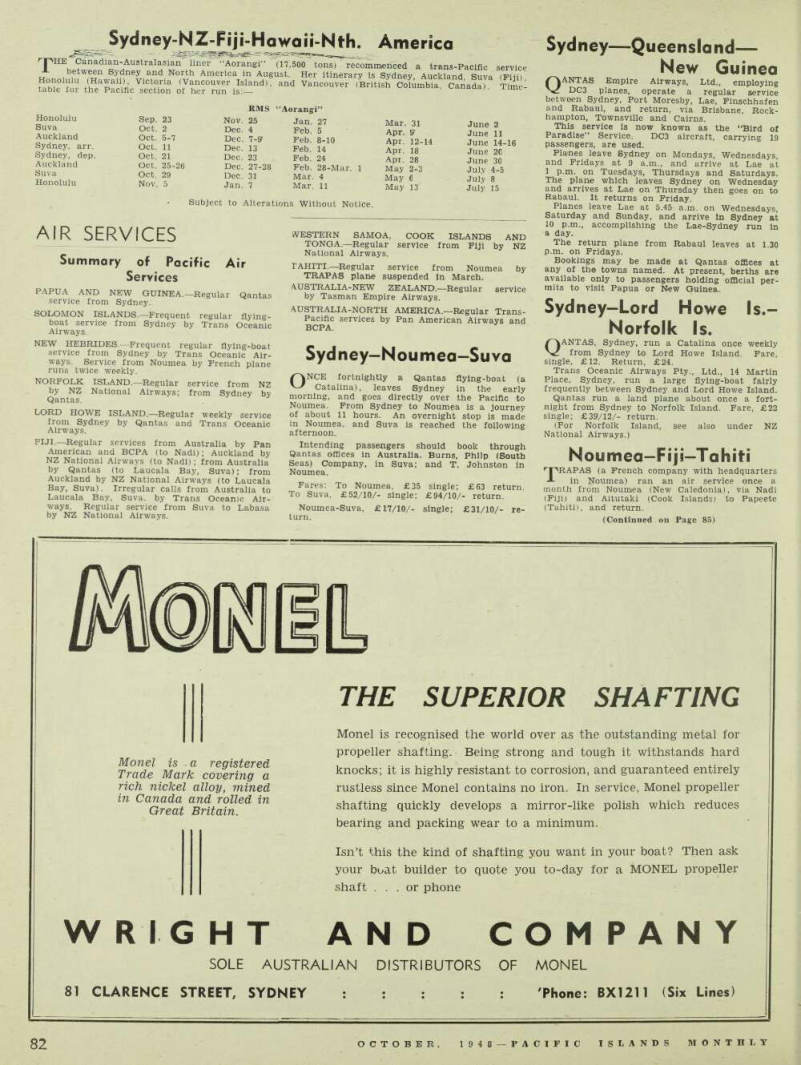
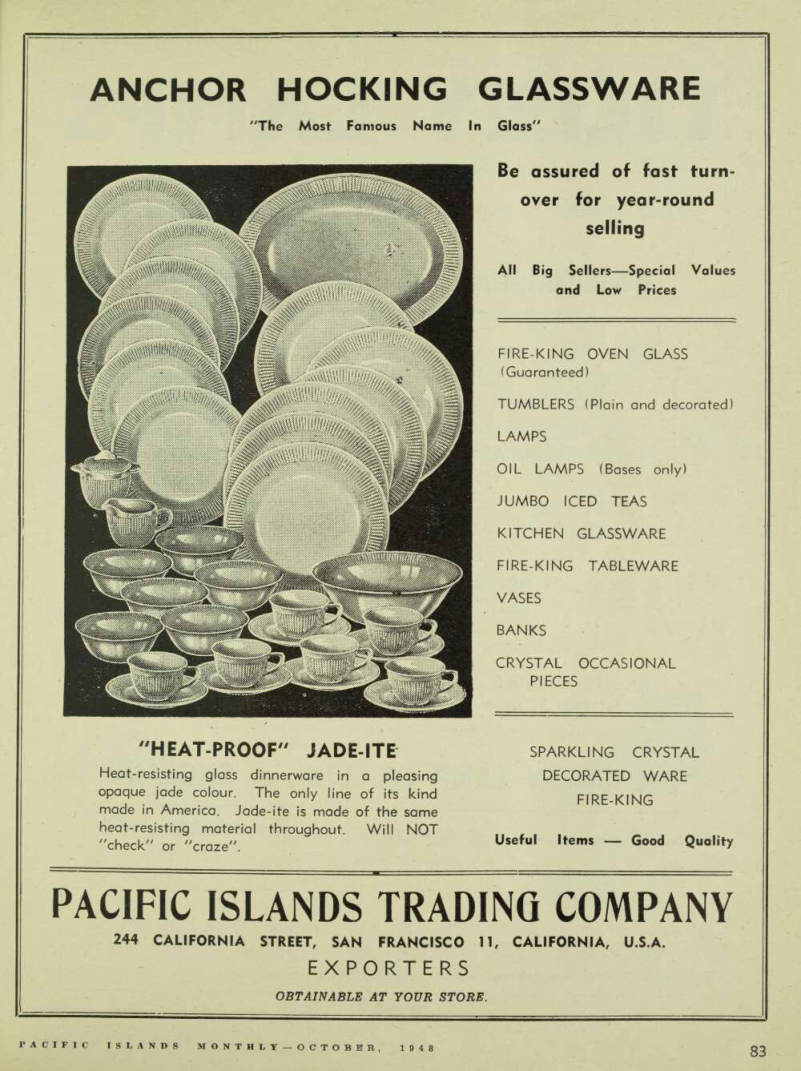
Shipping And Plane Services
THE following sea and air services are running to schedules in the Pacific.
Not all of the regular services which were suspended, owing to war condi tions. have been restored; but preparations are under way for their early reintroduction. As they become available they will be announced here.
Ship Services
Australia—North
America
THE regular passenger Trans-Pacific liners, withdrawn during the war, have not been restored.
Canadian-Pacific liner “Aorangi” (Sydney- Auckland - Suva - Honolulu - Vancouver) resumed running in August, 1948. A sister liner is expected soon. See timetable on next page.
Matson liners “Monterey” and “Mariposa” are not now expected back in the Pacific service.
Matson ship “Marine Phoenix,” carrying pas sengers, ran on a regular schedule —San Fran cisco-Honolulu-Suva-Auckland-Sydney; but was withdrawn in August, 1948.
New Zealand—Fiji—
Samoa—Tonga
Monthly Service by MV “Matua”
Service Conducted By Union Ss Co.,
Ltd.—Subject To Alteration Without
Notice
After annual survey in Auckland, NZ, “Matua” will go back on the Auckland-Islands run about the end of October.
New Caledonia
THE New Caledonian Government has sub sidised and maintained the coastal ship ping services. The East Coast, the West
Coast, and the Loyalty Islands, under present conditions, receive 10 round trips per annum.
The ships call at the following ports: EAST COAST. —Yate, Ounia, Thio, Nakety, Canala, Kouaoua Kua, Moneo, Ponerlhouen, Tibarama, Poindlmle, Wagap, Touho, Tlpindje, Hlenghene, Tao, Oubatch, Pouebo, Balade, Pam, Arama, and return.
WEST COAST. —Pouembout, Kone, Temala, Voh, Ouaco Gomen, Koumac, Tangaiou, Tiebaghl, Nehoue Poume, Baaba, Belep and return.
LOYALTY ISLANDS. —Mare (Tadine), Llfou (Chepenehe) Ouvea (Fajaoue, St. Joseph) and return.
The steamer “Neo Hebridais” runs regularly between Noumea and Sydney, with occasional trips to the New Hebrides (mostly Aneltyum).
The owners are Societe Maritime et Manlere Hagen, Noumea. Sydney agents; H. C. Sleigh, 254 George Street, Sydney.
Sydney-Nortolk Island-
New Hebrides
THE SS “Morinda,” Burns Philp & Co., Ltd., runs at approximately three monthly intervals from Sydney to Lord Howe Island, Norfolk Island, and main ports of the New Hebrides, and re turn.
New Zealand—Cook
Is.—Niue—Samoa
rpHE motor vessel “Maui Pomare,”
JL owned and operated by the NZ Gov ernment, maintains a direct service between Auckland and Rarotonga (Cook Islands), with alternative calls at Niue and Apia (Samoa). (Continued on Next Page)
Sydney-NZ-Fiji-Hawaii-Nth. America
Canadian-Australasian' liner “Aorangi” "(17.500 " tons) recommenced a trans-Pacific service itonoi,SfTwS^ ne v-^ nd - N0^ h America T in August. Her itinerary is Sydney, Auckland, Suva (Fiji) c V seS„ a o, V rr O ™T. s IS - nd) ’ < BrlUsh «*“«*• B -ada). WSI
Air Services
Summary of Pacific Air
Services
PAPUA AND NEW GUlNEA.—Regular Qantas service from Sydney.
SOLOMON ISLANDS.—Frequent regular flying boat service from Sydney by Trans Oceanic Airways.
NEW HEBRIDES. —Frequent regular flying-boat service from Sydney by Trans Oceanic Air ways. Service from Noumea by French plane runs twice weekly.
NORFOLK ISLAND.—Regular service from NZ by NZ National Airways; from Sydney bv Qantas.
LORD HOWE ISLAND.—Regular weekly service from Sydney by Qantas and Trans Oceanic Airways.
FlJl.—Regular services from Australia by Pan American and BCPA (to Nadi); Auckland by NZ National Airways (to Nadi); from Australia by Qantas (to Laucala Bay, Suva); from Auckland by NZ National Airways (to Laucala Bay, Suva). Irregular calls from Australia to Laucala Bay, Suva, by Trans Oceanic Air ways. Regular service from Suva to Labasa by NZ National Airways.
Western Samoa, Cook Islands And
TONGA. —Regular service from Fiji by NZ National Airways.
TAHlTl.—Regular service from Noumea by TRAPAS plane suspended in March, AUSTRALIA-NEW ZEALAND.—ReguIar service by Tasman Empire Airways.
AUSTRALIA-NORTH AMERICA.—Regular Trans pacific services by Pan American Airways and
Bcpa.
Sydney-Noumea-Suva
fortnightly a Qantas flying-boat (a Catalina), leaves Sydney in the early morning, and goes directly over the Pacific to Noumea. From Sydney to Noumea is a journey of about 11 hours. An overnight stop is made in Noumea, and Suva is reached the following afternoon.
Intending passengers should book through Qantas offices in Australia. Burns, Phllp (South Seas) Company, in Suva; and T. Johnston in Noumea.
Fares: To Noumea. £35 single: £63 return.
To Suva, £52/10/- single; £94/10/- return.
Noumea-Suva, £l7/10/- single; £3l/10/- re turn.
Sydney—Queensland-
New Guinea
QANTAS Empire Airways, Ltd., employing DCS planes, operate a regular service between Sydney, Port Moresby, Lae, Finschhafen and Rabaul, and return, via Brisbane, Rock hampton, Townsville and Cairns.
This service is now known as the “Bird of Paradise” Service. DCS aircraft, carrying 19 passengers, are used.
Planes leave Sydney on Mondays, Wednesdays, and Fridays at 9 a.m., and arrive at Lae at 1 p.m. on Tuesdays, Thursdays and Saturdays.
The plane which leaves Sydney on Wednesday and arrives at Lae on Thursday then goes on to Rabaul. It returns on Friday.
Planes leave Lae at 5.45 a.m. on Wednesdays, Saturday and Sunday, and arrive In Sydney at 10 p.m., accomplishing the Lae-Sydney run in a day.
The return plane from Rabaul leaves at 1.30 p.m. on Fridays.
Bookings may be made at Qantas offices at any of the towns named. At present, berths are available only to passengers holding official per mits to visit Papua or New Guinea.
Sydney-Lord Howe Is.-
Norfolk Is.
QANTAS, Sydney, run a Catalina once weekly from Sydney to Lord Howe Island. Fare, single, £l2. Return, £24.
Trans Oceanic Airways Pty., Ltd., 14 Martin Place, Sydney, run a large flying-boat fairly frequently between Sydney and Lord Howe Island.
Qantas run a land plane about once a fort night from Sydney to Norfolk Island. Fare, £22 single; £39/12/- return. (For Norfolk Island, see also under NZ National Airways.)
Noumea—Fiji—Tahiti
TRAPAS (a French company with headquarters in Noumea) ran an air service once a month from Noumea (New Caledonia), via Nadi (Fiji) and Aitutaki (Cook Islands) to Papeete (Tahiti), and return. (Continued on Page 85)
RMS “Aorangi”
Honolulu Sep. 23 Nov. 25 Jan. 27 Mar. 31 June 2 Auckland f , « Feb - 5 Apr. SSe AucKland Oct. 5-7 Dec. 7-9? Feb. 8-10 Apr 12-14 June 14 Ifi Syoney, arr. Oct. 11 Dec. 13 Feb. 14 Apr 18 June 20 Sydney dep. Oct. 21 Dec. 23 Feb. 24 Apr. 28 June 30 S'. 1 ' 25 ' 26 DfC 27 ' 28 Feb - 28 - Mar - 1 May 2-3 July 4-5 ® uva ° ct - 29 Dec. 31 Mar. 4 May 6 July 8 Honolulu Nov. 5 Jan. 7 Mar. 11 May 13 July 15 Subject to Alterations Without Notice.
It was announced in January that this was to become a fortnightly service; but service was suspended in March owing to hurricane damage.
New Caledonia—
New Hebrides
A PLANE based on Noumea runs between Noumea and Port Vila (New Hebrides), with calls at Santo and other places as required, and returns, twice each week,
Pan-American—
Trans-Pacific Service
DAN-AMERICAN World Airways clippers now •A provide the following services in the South Pacific, using DC4 planes:— Planes leave Sydney every Saturday and Wed nesday and fly via Tontouta (New Caledonia), Nadi (Fiji), Canton Island, Honolulu, to San Francisco, and return along the same route, leaving ’Frisco every Tuesday and Saturday.
Planes leave Auckland every Friday and fly via Nadi, Canton Island, and Honolulu, to San Francisco; and leave 'Frisco for Auckland every Monday. Pares are given below, in Australian currency:—
(Time-tables and fares subject to alteration without notice.) To convert to Fiji currency, reduce above figures by about 10 per cent.
Free baggage allowance is 66 lb. per person Excess baggage at 1 per cent, of single fare for each kilogram of excess (1 ki10—2.2 lb )
NZ National Airways
South Pacific Services
THE Pacific services run by the New Zealand National Airways Corporation are as follows:
Auckland-Laucala Bay (Suva): A “Sun
derland” flying-boat leaves Mechanics Bay, Auckland, at 7 a m. each Saturday for Laucala Bay, Suva (arrives 3.30 p.m.).
The aircraft departs from Laucala Bay, Suva, on the return journey at 7.30 a.m. each Monday, and arrives at Mechanics Bay, Auckland, at 4 p.m.
Laucala Bay (Suva)-Labasa (Vanua
LEVU): A “Sunderland” flying-boat operates this service on a charter basis. A return trip is made between Laucala Bay and Labasa each Sunday.
Auckland-Norfolk Island-Fiji-Tonga
Western Samoa-Cook Islands: A “Douglas”
airliner leaves Whenuapai, Auckland, on alter nate Sundays at 8.30 a.m. (October 17, 31, November *l4, 28) for Norfolk Island (arr. 12.30 p.m., dep. 12.1 a.m. Monday), Nadi (arr. 6.55 a.m., dep. 5.40 a.m. Tuesday), Nausori (arr. 6.30 a.m., dep. 7.15 a.m.), Tonga (arr. 10.45 a.m., dep. 11.45 a.m.), *Apia, Western Samoa (arr. 4.10 p.m. Monday, dep. 7.45 a.m. Tuesday), Aitutaki, Cook Islands (arr. 1.50 p.m., dep. 2.45 p.m.), and Rarotonga, Cook Islands (arr. 4.5 p.m.).
The aircraft departs from Rarotonga on the return journey at 7.30 a.m. on alternate Thurs days (October 21, November 4, 18, December 2) for Aitutaki (arr. 8.50 a.m., dep. 9.45 a.m.), Apia, Western Samoa (arr. 3.35 p.m., dep. 8 a.m.
Friday), *Tonga (arr. 11.15 a.m. Saturday, dep. 12.15 p.m.), Nausori (arr. 3.10 p.m., dep. 4.15 p.m.), Nadi (arr. 5.5 p.m., dep. 2 a.m. Sunday), Norfolk Island (arr. 8.10 a.m., dep. 1 p.m.), and Whenuapai, Auckland (arr. 5.45 p.m.).
An additional return service between Raro tonga and Aitutaki is operated on alternate Wednesdays when traffic warrants. •Crosses International Date Line.
Auckland-Norfolk Island: A “Douglas”
airliner leaves Whenuapai, Auckland, every Sun
day at 8.15 a.m. for Norfolk Island (arr. 12.15 p.m.), and departs on the return flight at 1.15 p.m., arriving at Whenuapai at 6 p.m.
FARES, single (in NZ currency): Auckland to Norfolk, £l2/10/-; to Fiji, £2B/10/-; to Tonga. £3l; to Samoa, £34; to Altutaki, £39; to Raro tonga, £39/10/-. Norfolk to Fiji, £l9. Fiji to Tonga, £B/15/-; to Samoa, £l3; to Altutaki, £29/15/-; to Rarotonga, £3l. Samoa to Raro tonga, £l7/15/-; to Altutaki, £l6/10/-; Suva to Labasa, £4/10/-. Return fares, less 10 per cent.
BOOKING OFFICES: Wellington, Govt. Life Bldg., Customhouse Quay; Auckland Airways House, Customs St.; Dunedin, 8-10 Manse St.; Christchurch, Union SS Co., 168 Hereford St.; Gisborne, 74 Peel St.; Palmerston Nth., 107 Broadway Ave.; Hamilton, 8 Alma St.; Rotorua, Airport Bid., Fenton St.; Norfolk Is., Burns Philp, Ltd.; Fiji, NAC at Nadi and Suva; Burns Philp, Labasa and Lautoka; Tonga, Mrs.
F. P. Melhose, Fou-amotu Airfield; W. Sqmoa, Burns Philp (SS). Ltd., Apia; Cook Is., Mrs. P.
McVeagh, Aitutaki, and Mr. J. D. Campbell, Rarotonga.
Sydney-Vancouver
BCPA Service
BRITISH Commonwealth Pacific Airlines Limited operate a three trips per fortnight trans-Paciflc service from Sydney via Fiji, Canton Island, Honolulu and San Francisco; and a fortnightly service between Auckland and Vancouver, via the same air port.
Planes leave Sydney every Sunday evening and alternate Wednesdays, and Vancouver, on the southbound trip, every Sunday and alternate Thursdays. Planes leave Auckland every alter nate Wednesday and arrive in Vancouver the following Saturday. This southbound trip com mences from Vancouver on alternate Fridays.
Fares are (in Australian currency), Sydney- San Francisco, £2OO single and £360 return, Auckland-Vancouver, £AI9B single; Auckland- Nadi (FIJI), £A39.
Skymaster aircraft carrying 30 passengers, in fully-reclining slumber-seats, and a crew of nine are used on the service.
Single Return £ s. d. £ s. d Sydney-’Prisco 200 0 0 360 0 0 Sydney-PIJi 55 0 0 99 1 3 Auckland-’Frisco ... 184 1 3 331 5 0 Auckland-Plji 39 1 3 70 6 3 Pijl-’Prlsco 145 0 0 260 18 9
Tmm Mtm R Mm M M
I ruriS" I QSman J§fYlC€
Ail ■
Sydney—Auckland
'T'ASMAN Empire Airways, Ltd., operate a 1 flying-boat service between Rose Bay.
Sydney, and Mechanics Bay, Auckland. Large flying-boats, capable of carrying 30 passengers, are employed. The trip is comfortable, and takes approximately 8 hours. . . . , . , //5 „ x The flying-boats leave both, Sydney (6.30 a.m.) and Auckland (8 a.m.) every morning except Sundays. Six flights each way per week. Fares: £3S(A) (£2B NZ currency) single; £63(A) (£5O/8/- NZ currency) return. t , . . .
In addition, this flying-boat service is. at present, supplemented by a Skymaster service. details of which are available on application to TEA offices in Australia and New Zealand.
Bookings may be made at Tasman Empire Airways in Auckland and at Qantas Empire Alr ways, Carrington Street, Sydney.
To A Serviccs
rp RA NS Oceanic Airways run the following J. Pacific services- SYDNEY-LORD HOWE IS,: A regular fort nightly service with large four-engine flying boats from Rose Bay. Fare: £ll single; £2l retU rn. Free baggage allowance 50 lb Excess baggage and freight rate 6d per lb SYDNEY-NEW HEBRIDES: A regular monthly service with large four-engine flying-boats from Sydney, via Noumea (overnight stop), to Vila and Espiritu Santo . Fare: Sydney-Vila, £45; S ydney-Santo. £5O; Noumea-Vila, £l2/10/-; Noumea-Santo, £ 18. Freight: Sydney-Vila or Santo, 2/- per lb.
Sydney -Solomon Islands: A Regular
monthly service from Sydney, via New Cale donia and New Hebrides to Tulagi, Solomon Islands. This service is frequently extended to Lingatou, in the Russell Islands, and calls are sometimes made at Vanikoro, in the Santa Cruz Group. Fares: Sydney-Tulagi, £75. Free bag gage allowance, 60 lb.; excess baggage and freight, 3/- per lb.
New Caledonia-New
Hebrides
ATRAPAS amphibian runs twice each week between New Caledonia and New Hebrides.
The days vary, but on the selected day the planes adhere to the following time-table:— Noumea —dep. 0630. Vila —arr. 0900 Vila—dep. 0945 Santo —arr. 1115 Santo —dep. 1145 Vila —arr. 1315 Vila—dep. 1400 Noumea—arr. 1630
Papua-NG Local
Services
MANDATED Airlines, Ltd., of Lae, New Guinea, and other private operators, run air ser vices between Lae and the New Guinea mainland centres of Wau, Bulolo, Madang, Wewak, Aitape.
Mt. Hagen. Finschhafen, Moresby, Kokoda —in fact anywhere in Papua or New Guinea where there is an air-strip. These planes carry pas sengers, mails and cargo on regular schedules or charter flights.
Under arrangement with the Administration, a Qantas plane, carrying Administration personnel and cargo, and mails, flies once each week from Lae to Rabaul, Kavieng and Manus, and returns to Lae by the same route.
Advertisements & other items, pp. 83-88 (1 item)
Your Eye
The Twinkle in
COMES FROM ACTIVE
DIGESTION
Good normal digestive and liver activity means good, normal health and fitness. If yo' are becoming gloomy and feel tired out, the cause may be a congested state of your Intestinal tract. So many people are troubled with constipation, which, through the retention of waste in the digestive system, causes sick headache, biliousness, pimply skin, unpleasant breath, irritability, slackness and dull eyes.
Regain your bright and attractive appearance by banishing constipation with Pinkettes. Tiny, perfectly harmless, gentle yet effective, these famous laxative and liver pills painlessly exercise and strengthen the bowels, keep the food tract clean and active, stir the liver, and thus banish sick headache, bilious attacks, pimples, unpleasant breath and gloom. All chemists and stores sell Pinkettes, the perfect laxative and liver pills.
NEW
GUINEA
) MP!
Associated « lth
COUER. ATSON Brisbane,
tdnev Melbourne
Wholesale & Retail Merchants. Shipowners. Sawmiller. General Engineers. Customs & Shipping
Agents.
Catering for all Plantation Supplies. Buyers of Island Produce. Plantation Owners & Managing Agents, Agents for:— Australia-West Pacific Line China Navigation Co.
Canton Insurance Office Ltd.
Union Assurance Society Ltd.
National Mutual Life Assurance of A/sia Ltd.
Guinea Air Traders Ltd.
Steamships Trading Co.
Ltd. i4iSOCi °' e lu 1 CO. UTO.
•"Sktoßd. Ccbureb.
getting ton, * uC
CO\A ER ’
■listributing Agents in New (•ninea for:— Chrysler & Plymouth Cars Fargo Trucks Hillman & Humber Cars. Commer Trucks.
Willys Overland Jeeps G.M. Marine & Industrial Engines Prefect Refrigerators Mullard Radios Hygeia Dissolvenators Snowflake Unsweetened Evaporated Milk Olympic Tyres & Cables
A Monel is a registered Trade Mark covering a rich nickel alloy, mined in Canada and rolled in Great Britain.
THE SUPERIOR SHAFTING
Monel is recognised the world over as the outstanding metal for propeller shafting. Being strong and tough it withstands hard knocks; it is highly resistant to corrosion, and guaranteed entirely rustless since Monel contains no iron. In service, Monel propeller shafting quickly develops a mirror-like polish which reduces bearing and packing wear to a minimum.
Isn’t this the kind of shafting you want in your boat? Then ask your boat builder to quote you to-day for a MONEL propeller shaft ... or phone
WRIGHT AND COMPANY
SOLE AUSTRALIAN DISTRIBUTORS OF MONEL
81 CLARENCE STREET, SYDNEY : : : : : 'Phone: BXI2II <Six Lines)
ANCHOR HOCKING GLASSWARE
"The Most Famous Name In Glass"
Be assured of fast turn-
over tor year-round
selling
All Big Sellers—Special Values and Low Prices
FIRE-KING OVEN GLASS
(Guaranteed) TUMBLERS (Plain and decorated)
LAMPS
OIL LAMPS (Bases only)
JUMBO ICED TEAS
KITCHEN GLASSWARE
FIRE-KING TABLEWARE
VASES
BANKS
CRYSTAL OCCASIONAL
PIECES
a m m
"HEAT-PROOF" JADE-ITE
Heat-resisting glass dinnerware in a pleasing opaque jade colour. The only line of its kind made in America. Jade-ite is made of the same heat-resisting material throughout. Will NOT "check" or "craze".
SPARKLING CRYSTAL
DECORATED WARE
FIRE-KING
Useful Items Good Quality
PACIFIC ISLANDS TRADING COMPANY
244 CALIFORNIA STREET, SAN FRANCISCO 11, CALIFORNIA, U.S.A.
EXPORTERS
OBTAINABLE AT YOUR STORE.
TILLEY LAMPS
BURN ORDINARY KEROSENE
The Modern Form of PORTABLE LIGHTING SPARE PARTS FOR TILLEY LAMPS AND RADIATORS
WE REALISE FULLY THE IMPORTANCE TO
THE USER OF TILLEY PRODUCTIONS OF
ADEQUATE SUPPLIES OF SPARE PARTS.
EQUALLY. WE ARE AWARE OF THE NECESSITY
FOR MAINTAINING OUR HIGH STANDARD
OF WORKMANSHIP.
GENUINE SPARES FOR TILLEY LAMPS AND
RADIATORS ARE MADE ONLY AT HENDON
AND CRICKLEWOOD. ENGLAND.
DO NOT BE PERSUADED THAT SUBSTITUTES
ARE “JUST AS GOOD.”
BRENT WORKS, NEW BRENT WORKS,
HENDON, N.W.4 CRICKLEWOOD, N.W.2.
THE TILLEY LAMP CO. LTD., of ENGLAND London Offices and Showroom: 33 SACKVILLE STREET, PICCADILLY, W.l.
REPRESENTATION :
MELBOURNE : T. H. Bentley, Pty. Ltd., 123-125 William Street. Melbourne, Cl.
TASMANIA : Mr. C. Sellars, 108 a Charles Street, Launceston.
FIJI : Mr. K. Witherington, 2 Burns Philp Buildings, Suva.
1. Rigid wedge keeps the bones of the foot in their natural normal position. 2. Sponge rubber cushion protects the sensitive arc of the foot.
CANVAS SHOES
by B. F. Goodrich
“P-F” means Posture Foundation Here ore canvas shoes that are different. "P-F" is a scientific, correct foot support which provides extra comfort for people of all ages. It adds fun and pep to your step. "P-F" is real foot protection.
It safeguards against Flat Feet, avoids Tired, Strained Leg Muscles.
Try "P-F" Canvas Shoes and see the difference.
Agents for South Sea Islands:
ATKINS, KROLL & CO
320 CALIFORNIA ST., SAN FRANCISCO
Cable Address: “Atisco”
a^ cts y° ur
use
B / 45* 7s iS z f fcr *4* ■ &r p w % #: % Wi 4515, Trop/CAL and sub-tropical sun, winds, humidity plus sea-bathing all tend to make the hair dry, dull and brittle.
Get to the base of the trouble. Massage Vita I is’ hair-shielding pure vegetable oils on your scalp. This routs loose dandruff and helps retard falling hair.
Vitalis keeps the scalp in good condition and the hair looking vigorous, alive.
VITALIS
THE TONIC HAIR DRESSING
Extended

Protection of Fiji Lands Extended
From Our Own Correspondent SUVA, September 27.
THE Native Land Trust Amendment Bill caused a brisk debate in the Fiji Legislative Council during the Sep tember session. This Bill is designed to bring the mortgaging of Fijian land held under lease within the control of the Native Land Trust Board, which already controls other dealings in leaseholds.
The Director of Lands (Mr. W. H. B.
Buckhurst) told the Council that one of the primary aims of the proposed legis lation was to protect over-exploitation of and damage to Fijian land.
“The best native land in the Colony, aggregating about 300.000 acres, is already leased and must be protected from the evils resulting from reckless borrowers and wilful lenders.” he said.
Up rose the Indian opposition, plus one European member (Mr. H. Maurice Scott) to contend that the proposal would in terfere with the rights of leaseholders, including those who had erected build ings and established plantations.
The Bill was referred to a select com mittee, which suggested a compromise plan giving the Government all it wanted in the way of protection of Fijian lands but permitting the lessee of a residential or commercial lease granted prior to the ordinance, to mortgage his lease.
This was adopted and the Bill went th O°ther' legislation of particular interest dealt with in this session was the in troduction of third party insurance for motor vehicle drivers.
Mr. E. G. Theodore, head of the Em porer and Loloma Gold Mines, of .Fiji, who returned to Sydney from Fiji m August, suffering from illness is now im proved in health, but is still under the care of his doctor.
Advertisements & other items, p. 88 (1 item)
86
OCTOBER. 1948-PACIFIC ISLANDS MONTH I. T
Another Coast Watcher
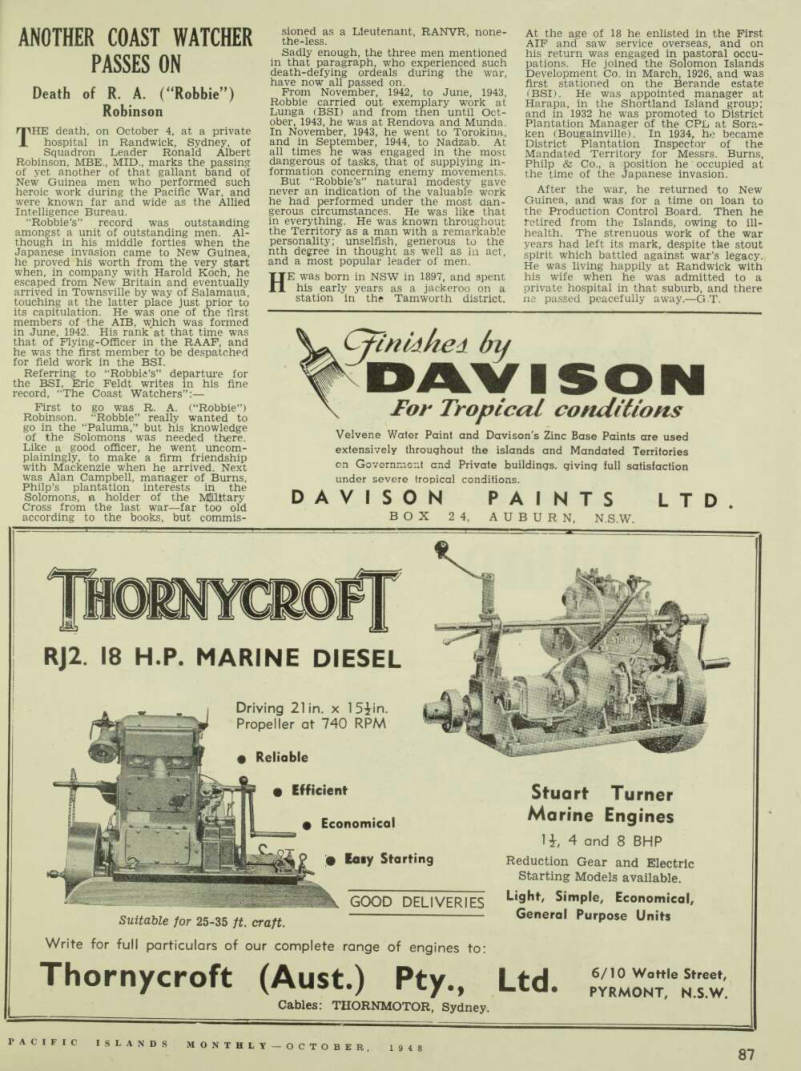
Passes On
Death of R. A. (“Robbie”) Robinson
THE death, on October 4, at a private hospital in Randwick, Sydney, of Squadron Leader Ronald Albert Robinson. MBE., MID., marks the passing of yet another of that gallant band of New Guinea men who performed such heroic work during the Pacific War, and were known far and wide as the Allied Intelligence Bureau.
“Robbie’s” record was outstanding amongst a unit of outstanding men. Al though in his middle forties when the Japanese invasion came to New Guinea, he proved his worth from the very start when, in company with Harold Koch, he escaped from New Britain and eventually arrived in Townsville by way of Salamaua, touching at the latter place just prior to its capitulation. He was one of the first members of the AIB, which was formed in June, 1942. His rank*at that time was that of Flying-Officer in the RAAF, and he was the first member to be despatched for field work in the BSD Referring to “Robbie’s” departure for the BSI, Eric Feldt writes in his fine record, “The Coast Watchers”:— First to go was R. A. (“Robbie”) Robinson. “Robbie” really wanted to go in the “Paluma,” but his knowledge of the Solomons was needed there.
Like a good officer, he went uncom plainingly, to make a firm friendship with Mackenzie when he arrived. Next was Alan Campbell, manager of Burns, Philp’s plantation interests in the Solomons, a holder of the Mlilttary Cross from the last war—far too old according to the books, but commis
sioned as a Lieutenant, RANVR, none the-less.
Sadly enough, the three men mentioned in that paragraph, who experienced such death-defying ordeals during the war, have now all passed on.
From November, 1942, to June, 1943, Robbie carried out exemplary work at Lunga (BSD and from then until Oct ober, 1943, he was at Rendova and Munda.
In November, 1943, he went to Torokina, and in September, 1944, to Nadzab. At all times he was engaged in the most dangerous of tasks, that of supplying in formation concerning enemy movements.
But “Robbie’s” natural modesty gave never an indication of the valuable work he had performed under the most dan gerous circumstances. He was like that in everything. He was known throughout the Territory as a man with a remarkable personality; unselfish, generous to the nth degree in thought as well as in act, and a most popular leader of men.
HE was born in NSW in 1897, and spent his early years as a jackeroo on a station in the Tamworth district.
At the age of 18 he enlisted in the First AIF and saw service overseas, and on his return was engaged in pastoral occu pations. He joined the Solomon Islands Development Co. in March, 1926, and was first stationed on the Berande estate (BSD. He was appointed manager at Harapa, in the Shortland Island group: and in 1932 he was promoted to District Plantation Manager of the CPI. at Sora ken (Bougainville). In 1934, he became District Plantation Inspector of the Mandated Territory for Messrs. Burns, Philp & Co., a position he occupied at the time of the Japanese invasion.
After the war, he returned to New Guinea, and was for a time on loan to the Production Control Board. Then he retired from the Islands, owing to ill health. The strenuous work of the war years had left its mark, despite the stout spirit which battled against war’s legacy.
He was living happily at Randwick with his wife when he was admitted to a private hospital in that suburb, and there ne passed peacefully away.—G.T.
Advertisements & other items, pp. 89-90 (1 item)
Opnidked by
DAVISON
v For Troptca.l conditions
Velvene Water Paint and Davison's Zinc Base Paints are used extensively throughout the islands and Mandated Territories cn Government and Private buildings, giving full satisfaction under severe tropical conditions.
DAVISON PAINTS LTD.
BOX 24, AUBURN, N.S.W.
OFT
HO
RJ2. 18 H.P. MARINE DIESEL
Driving 21 in. x 1 siin.
Propeller at 740 RPM • Reliable • Efficient Economical fi . c Easy Starting
GOOD DELIVERIES
Suitable for 25-35 ft. craft.
Write for full particulars of our complete range of engines to:
Thornycroft (Aust.) Pty., Ltd.
Cables: TIIORNMOTOR, Sydney.
Stuart Turner
Marine Engines
li, 4 and 8 BHP Reduction Gear and Electric Starting Models available.
Light, Simple, Economical, General Purpose Units 6/10 Wattle Street,
PYRMONT, N.S.W.
You'll always
get the best
from the
PLUME
m
pump
Sji^ Today, Plume is the best motor spirit you can buy. And as soon as world conditions permit, the Plume Pump will lead in serving the highest quality motor spirits, made by revolutionary methods developed by the world’s largest research staff. So form the habit now of going to the Plume Pump, where you’ll always get the best motor spirit. . . . and Always use
MOBILOIL
The World’s Quality Oil
VACUUM
QUALITY PRODUCT
VACUUM OIL COMPANY PTY. LTD. [lncorporated in Australia]
New Papua-NG Pensions
Proposals Under Fire
From Our Own Correspondent
Port Moresby, Oct. 5.
THE Papua-New Guinea Public Service Association has received details of the pension arrangements which will be applied to pre-war officers of the Papuan Public Service or the New Guinea Public Service who returned after the war to join the Provisional Admin istration. Local reaction to the proposals is not favourable.
The proposal is that officers shall receive a pension at the pre-war rates for every year of service, calculated on their pre-war salary, plus one-eightieth of the difference between their pre-war salary and their present salary in respect of each year they have served with the Provisional Administration.
In the pre-war Papuan Service officers were entitled to retire after 20 years’ service. They were paid a pension at the rate of l/42nd of their salary on retirement for each year of service (with a maximum of 28/42nds). Although Papuan salaries, even after 20 years ser vice, were not lavish, the pension scheme allowed an officer to withdraw from the tropics at a comparatively early age, with a useful financial safeguard.
The scheme for officers who have re turned to the Provisional Administration is understood to provide for the payment of a pension calculated as follows:—for each year of service until the date of retirement, officers will receive l/42nd of the salary they were receiving at the date when civil administration was ter minated (early 1942); then, for each year of service since the resumption of civil administration in 1945, l/80th of the difference between their pre-war salary and their present salary.
Many Papuan officers have been hang ing on in the Service in the hope that the pre-war pension formula would be applied to their greatly increased, but still not lavish, post-war salaries. They may perhaps have expected too much, but they claim that the new arrangement is far too small; that 1942 salaries are an unfair basis of calculation, as most of them would normally have had promo tion; and that, at the cessation of Civil Administration, salaries were under re view, and a reclassification was antici pated.
It seems clear that, although officers, at the time of retirement, will have larger salaries than pre-war, in either Papua or New Guinea, their pension pay ments will amount to less than they would normally have expected from un interrupted service with the former Administrations, allowing for promotions, proposed reclassifications, etc. .It is understood that the Public Ser vice Association intends to seek legal advice. They claim that they were guar anteed conditions not less favourable than those they had previously enjoyed.
It is rumoured in Port Moresby that many of these frustrations are due to the vetting of External Territories’ finances by Commonwealth Treasury advisers.
Indian Elections
Suva European and Indian Elections
THE first election for Suva’s reconsti tuted Town Council will probably be held on January 8. European and Indan rolls (there is no nrovision for Fi.iian elected representation) are now being completed.
New Drug For Makogai
Patients
AFTER paying his first visit to Makogai Leper Hospital recently, the Gover nor of Fiji, Sir Brian Freeston, ex pressed his personal appreciation of the efforts made over a number of years, by the Lepers’ Trust Board Inc. of New Zealand, towards the welfare and con tentment of patients.
At the same time Sir Brian was able to advise the Lepers’ Trust Board that a special grant has been made for the pur chase of Promin for the treatment of leper patients. Promin is one of the Sulfa drugs which is now being used with success on certain types of leprosy.
Nz Ketch To Collect Lepers
THE New Zealand Government ketch “New Golden Hind” made a special trip to Pacific Islands during Sep tember to collect leper patients from the
Cook Islands and Western Samoa for Makogai Leper Settlement, Fiji.
The ketch made her journey via the Kermadecs where she landed stores.
Pidgin Broadcasts From 9PA
NOW that the Port Moresby Regional Station is broadcasting on the short wave band, the Education Depart ment’s Native People’s Session has been re-organised to cater for the native lis tening public in New Guinea. In ad dition to the hour previously broadcast in Papuan languages, an extra half-hour daily is devoted to broadcasts in Pidgin.
Reports from New Guinea indicate that the new Session is popular. Even in Moresby a few former New Guinea resi dents surreptitiously refresh their pidgin —a language that has many affectionate adherents.
Advertisements & other items, pp. 91-92 (1 item)
N. F. Maloney & Co.
Phone 268. PORT MORESBY Phone 268.
Cables, Radios, etc., “Malco,” Port Moresby,
CUSTOMS, SHIPPING, AND FORWARDING AGENTS.
LICENSED AUCTIONEERS AND GENERAL COMMISSION
AGENTS.
House, Land, and Estate Agents.
Chief Agents:
NEW ZEALAND INSURANCE CO. LTD.
(Incorporated in New Zealand) FIRE . . ACCIDENT . . MOTOR VEHICLE . . MARINE, ETC.
Importers and Exporters :: Manufacturers Representatives.
Australian Representatives: E. J. GOUGH & CO., 1 BOND STREET, SYDNEY.
Every Branch Of
ENGINEERING and BUILDING CONSTRUCTION
MILLERS LTD.
SUVA and LAUTOKA
Sawmillers and Timber Merchants; Shipwrights and Sailmakers; Joinery and Furniture Manufacturers; Upholsterers; Plumbers; Electricians; Hardware Merchants; Motor Dealers.
AGENCIES:
Chevrolet, Bedford, Vauxhall, Nash Motors. Firestone Tyres.
Fetters Marine and Stationary Engines. G.E.C. Radio Sets.
British Australian Lead Manufacturers Pty., Ltd., Atlas Assurance Co., Ltd.
There is no need to send to Australia or New Zealand for Repairs or Replacements. We can give you a sound Quotation and guarantee First-Class Workmanship
Rid Kidneys Of
Poisons And Adds
If you suffer sharp, stabbing pains, if Joints are swollen, It shows your blood Is poisoned through faulty kidney action. Other symptoms of Kidney Disorders are Backache, Aching Joints and Limbs, Sciatica, Neuritis, Lumbago, Sleepless Nights, Dizziness, Nervousness, Circles under Eyes, Loss of Energy and Appetite and Frequent Headaches and Colds, etc. Ordinary medicines can’t help much because you must get to the root cause of the trouble.
The Cystex treatment Is specially compounded to soothe, tone and clean kidneys and bladder and remove acids and poisons from your system safely, quickly and surely, yet contains no harmful or dangerous drugs. Cystex works In 3 ways to end your troubles. 1. Starts killing the germs which are attacking your Kidneys, Bladder and Urinary System In two hours, yet Is absolutely harmless to human tissue. 2. Gets rid of health-destroying, deadly poisonous acids with which your system has become saturated. 3. Strengthens and reinvigorates the kidneys, protects from the ravages of disease-attack on the delicate filter organism, and stimulates the entire system.
Praised by One-time Sufferers Cystex Is approved by one-time sufferers In 73 countries from the troubles shown above.
Mr. Reg Thomas, Townsville, Queensland, recently wrote: “My joints were ail stiff, 1 had leg pains, my back used to ache day and night.
My bladder was weak. 1 had headaches and no appetite. The first dose of Cystex helped me and before I finished three boxes my health and strength came back.”
Guaranteed to Satisfy or Money Back
Ge't Cystex from your chemist or store to-day.
Give It a thorough test. Cystex Is guaranteed to make you feel younger, stronger, better li every way, or your money back If you return the empty package.
Now in 2 sizes—4/-, S/-.
GUARANTEED
Treatment W4B. for Your Kidneys, Bladder. Rheumatism,
AUNT
MARYS
BAKING POWDER
For the' best in delicious baking results A product of TILLOGK AND GO. PTY. LTD. manufacturers of all the famous Aunt Mary’s Pure Foods
Voyage
Easter Islanders’ Long Sea Voyage Other Small Boat Journeys Recalled
From a Special Correspondent in Tahiti TWO small boats from Easter Island put out on December 23, 1947; but, when a few miles at sea, a sudden storm sprang up and only the smaller of the two succeeded in getting back to the island.
The larger one was carried out of sight of land and, almost six weeks later, was washed up on the shores of Reao Island, one of the Tuamotus, 1,800 miles from its home.
The boat that made this incredible journey is smaller than an ordinary ship’s lifeboat; its unwilling passengers were four adults and two children, who some how managed to live on a meagre supply of fresh water, doled out meticulously by the thimblefull, and on the fish that they themselves caught.
Their sufferings and privations were great. There were long hours when they toiled at the oars in tropic calms, the sea a dazzling sheet of glass by day and an ominous expanse of blackness at night.
There were other times when they rode out storms, helplessly tossing at the mercy of the elements. When the little boat reached the French Colony she was equipped only with a badly-torn jib.
Wnen the castaways were reported, the Governor of French Oceania made haste to send a relief ship to bring them to Papeete. They were reluctant to leave the small craft that had sheltered them so long, but were finally persuaded to do so by the captain of the rescue ship.
They are now in Papeete anxiously awaiting a chance to return to Easter Island. Although they are of mixed Polynesian and Melanesian descent, they have few contacts with the rest of Poly nesia these days. Easter is a depend ency of Chile and the Islanders speak Spanish fluently.
WITH this long ocean voyage by small boat fresh in our minds, it is op portune to recall other hazardous small-boat voyages of comparatively re cent times.
One was the journey of the crew of the four-masted American schooner “El Dorado”, which had been bound from the American Pacific coast to Antofagasta.
She had encountered heavy weather, which had resulted in her abandonment, whereupon her company had taken to the only boat she carried.
A course was steered for Easter Island, where the captain and his men arrived after a run of 11 days. They stayed there for over three months, and then decided to try to get back to civilisa tion. Once more they put to sea in their lifeboat and, after a passage of 2,500 miles, over open sea, they reached Tahiti.
In that same year another American sailing ship, the four-masted barque “Amaranth,” was totally wrecked on Jarvis Island when on a voyage from New South Wales to San Francisco. Her crew, after some time on the island, took to two boats and set a course for Samoa, over 1,000 miles away. In less than two weeks they were safe—one boat made Pago Pago, in American Samoa, and the other got to Apia.
The “Amaranth” had broken in two a few hours after she struck, the boats were launched and the crew reached Jarvis Island. There was grim amuse ment for them in a sign that confronted them as they struggled ashore. It said: “This island is leased by His Britannic Majesty, King Edward the Seventh, to the Pacific Phosphate Com mission of London and Melbourne. . .
All Trespassers will be prosecuted.”
Captain Nielson, of the “Amaranth” remarked, when he eventually got back to San Francisco, that it would have taken more than an old sign to keep them off dry land right then. The island, in any event, was deserted and did not look as though it had been worked for years.
Another well-known four-master which was lost at the same period was the “Americana.” She, however, was not so fortunate and disappeared completely on a voyage between Australia and America.
BGD Progress in New Guinea
New Guinea Mining
IN the month of August, seven Bulolo Gold Dredging dredges in New Guinea
handled 912,900 cubic yards of gravel
for a total recovery of 7,212 ounces of
fine gold.
Sandy Creek
ADVICE has been received by the Sydney office of Sandy Creek Gold Sluicing, Ltd., that during the month of August, 1948, 132 oz. 7 dwt. of gold were recovered from 9,870 cubic yards of material treated at the company’s leases in the Morobe District, New Guinea.
Cuthbert’S Misima Goldmine, Ltd.
THE directors of Cuthbert’s Misima Goldmine, Ltd., PapGa, advise shareholders that the new issue of 50,000 ten shilling shares (£25,000), applications for which closed on September 17, was fully subscribed.
Letters of allotment will be forwarded to the shareholders shortly.
Enterprise Of Ng
EENTERPRISE of New Guinea Gold and Petro ls leum Development, NL, has received a final war damage claim payment of £1,412 —this makes a total of £20,110 war damage received.
Opening up of mining operations in the Morobe District is proceeding. = •U./K Monsieut Alexandre Graffe, of the French Colonial Service, who had been attached to the Department of Justice in Tahiti for many years, died recently at his home there. He was 75, and was a Chevalier of the Legion of Honour.
Caught An Alligator On A
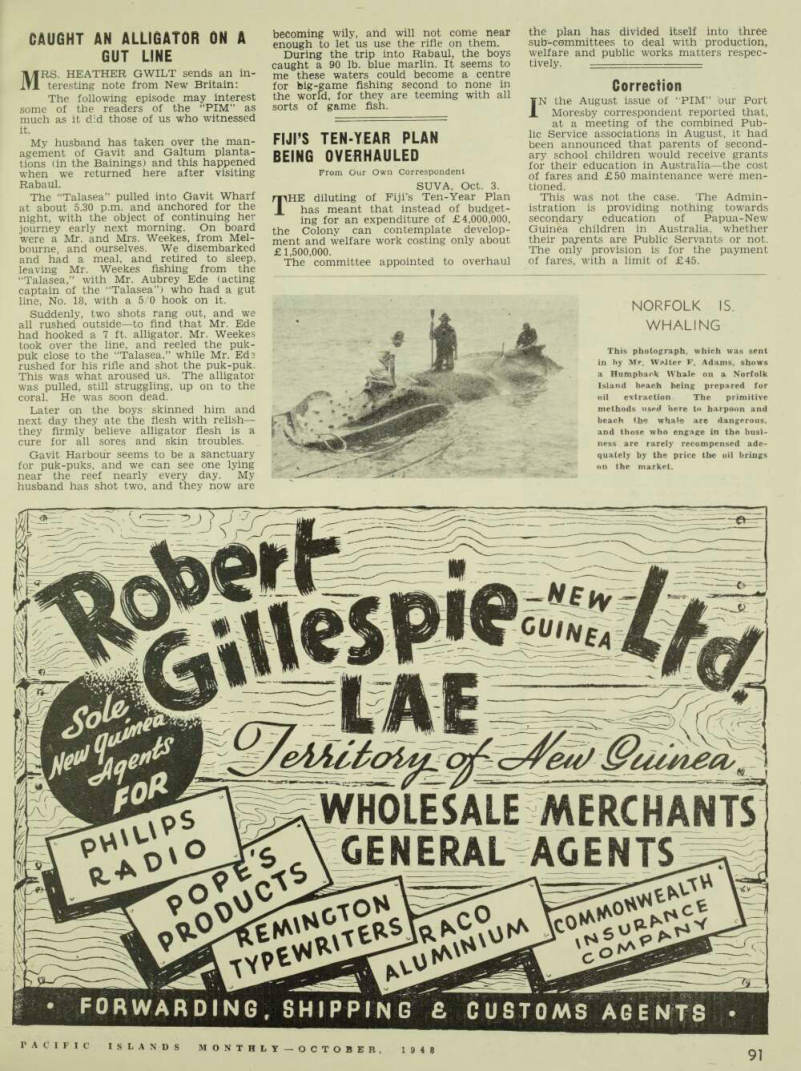
Gut Line
MRS. HEATHER GWILT sends an in teresting note from New Britain: The following episode may interest some of the readers of the “PIM” as much as it did those of us who witnessed it.
My husband has taken over the man agement of Gavit and Galtum planta tions (in the Bainings) and this happened when we returned here after visiting Rabaul.
The “Talasea” pulled into Gavit Wharf at about 5.30 p.m. and anchored for the night, with the object of continuing her journey early next morning. On board were a Mr. and Mrs. Weekes, from Mel bourne, and ourselves. We disembarked and had a meal, and retired to sleep, leaving Mr. Weekes fishing from the “Talasea,” with Mr. Aubrey Ede (acting captain of the “Talasea”) who had a gut line, No. 18, with a 5/0 hook on it.
Suddenly, two shots rang out, and we all rushed outside —to find that Mr. Ede had hooked a 7 ft. alligator. Mr. Weekes took over the line, and reeled the puk puk close to the “Talasea.” while Mr. Ede rushed for his rifle and shot the puk-puk.
This was what aroused us. The alligator was pulled, still struggling, up on to the coral. He was soon dead.
Later on the boys skinned him and next day they ate the flesh with relish— they firmly believe alligator flesh is a cure for all sores and skin troubles.
Gavit Harbour seems to be a sanctuary for puk-puks, and we can see one lying near the reef nearly every day. My husband has shot two, and they now are
becoming wily, and will not come near enough to let us use the rifle on them.
During the trip into Rabaul, the boys caught a 90 lb. blue marlin. It seems to me these waters could become a centre for big-game fishing second to none in the world, for they are teeming with all sorts of game fish.
Fiji’S Ten-Year Plan
Being Overhauled
From Our Own Correspondent
Suva, Oct. 3.
THE diluting of Fiji’s Ten-Year Plan has meant that instead of budget ing for an expenditure of £4,000,000, the Colony can contemplate develop ment and welfare work costing only about £1,500,000.
The committee appointed to overhaul
the plan has divided itself into three sub-committees to deal with production, welfare and public works matters respec
tively.
Correction
IN the August issue of “PIM” our Port Moresby correspondent reported that, at a meeting of the combined Pub lic Service associations in August, it had been announced that parents of second ary school children would receive grants for their education in Australia —the cost of fares and £5O maintenance were men tioned.
This was not the case. The Admin istration is providing nothing towards secondary education of Papua-New Guinea children in Australia, whether their parents are Public Servants or not.
The only provision is for the payment of fares, with a limit of £45.
Norfolk Is.
Whaling
This photograph, which was sent in Hy Mr. Walter F. Adams, shows a Humpback Whale on a Norfolk Island beach being prepared for oil extraction The primitive methods used bere to harpoon and beach the whale are dangerous, and those who engage in the busi ness are rarely recompensed ade quately by the price the oil brings on the market.
Advertisements & other items, p. 93 (1 item)
A
*JL 'eaS S/u/neos.
pv^S
\V> S
MERCHANTS
«> o'
WHOLESALE
GENERAL-AGENTS
•VYV
• FORWARDING, SHIPPING 6 CUSTOMS AGENTS •
Islands Produce
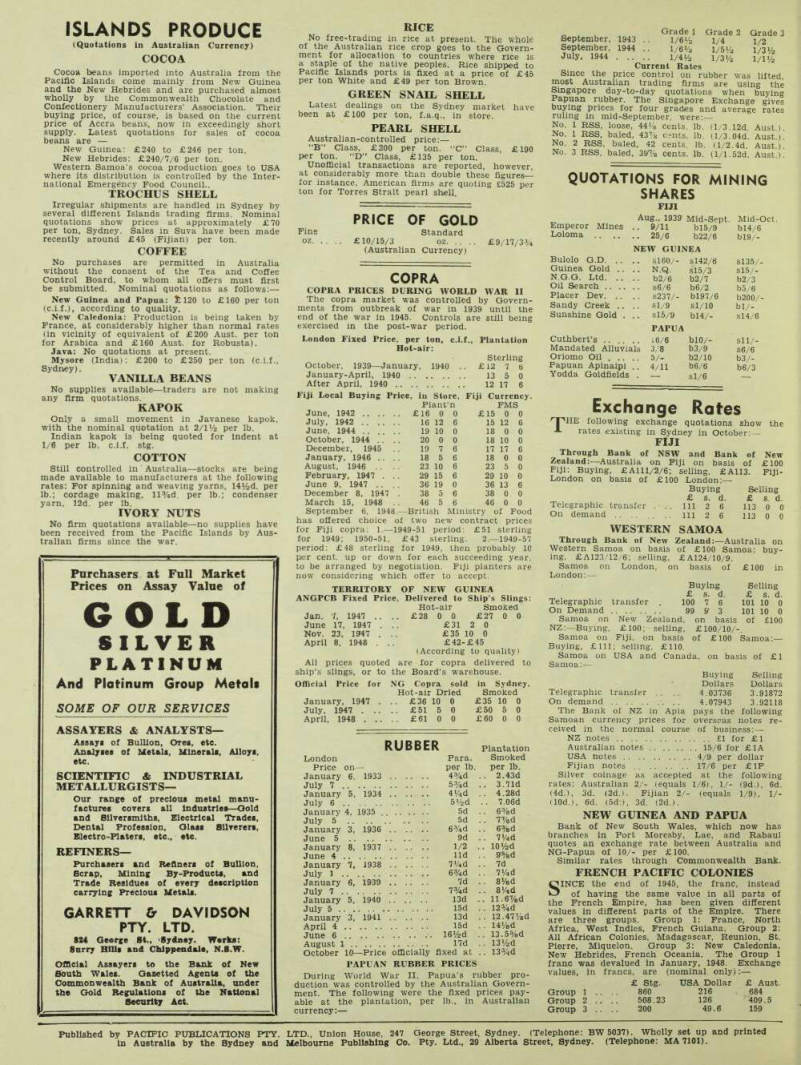
(Quotations in Australian Currency)
Cocoa
Cocoa beans imported into Australia from the Pacific Islands come mainly from New Guinea and the New Hebrides and are purchased almost wholly by the Commonwealth Chocolate and Confectionery Manufacturers’ Association. Their buying price, of course, is based on the current price of Accra beans, now in exceedingly short supply. Latest quotations for sales of cocoa beans are New Guinea: £240 to £246 per ton.
New Hebrides: £240/7/6 per ton.
Western Samoa’s cocoa production goes to USA where its distribution is controlled by the Inter national Emergency Pood Council..
Trochus Shell
Irregular shipments are handled in Sydney by several different Islands trading firms. Nominal quotations show prices at approximately £7O per ton, Sydney. Sales in Suva have been made recently around £45 (Fijian) per ton.
Coffee
No purchases are permitted in Australia without the consent of the Tea and Coffee Control Board, to whom all offers must first be submitted. Nominal quotations as follows: New Guinea and Papua: £l2O to £l6O per ton (c.i.f.), according to quality.
New Caledonia: Production is being taken by France, at considerably higher than normal rates (in vicinity of equivalent of £2OO Aust. per ton for Arabica and £l6O Aust. for Robusta), Java: No quotations at present.
Mysore (India): £2OO to £250 per ton (c.i.f., Sydney).
Vanilla Beans
No supplies available —traders are not making any firm quotations.
Kapok
Only a small movement in Javanese kapok, with the nominal quotation at 2/1 Vz per lb.
Indian kapok is being quoted for Indent at 1/6 per lb. c.i.f. stg.
Cotton
Still controlled in Australia —stocks are being made available to manufacturers at the following rates: For spinning and weaving yarns, 14y 2 d. per lb.; cordage making, ll 3 Ad. per lb.; condenser yarn, 12d. per lb.
Ivory Nuts
No firm quotations available—no supplies have been received from the Pacific Islands by Aus tralian firms since the war.
Rice
No free-trading in rice at present. The whole of the Australian rice crop goes to the Govern ment for allocation to countries where rice is a staple of the native peoples. Rice shipped to Pacific Islands ports is fixed at a price of £45 per ton White and £49 per ton Brown.
Green Snail Shell
Latest dealings on the Sydney market have been at £lOO per ton, f.a.q., in store.
Pearl Shell
Australian-controlled price:— “B” Class, £2OO per ton. “C” Class, £l9O per ton. “D” Class, £135 per ton.
Unofficial transactions are reported, however, at considerably more than double these figures— for instance, American firms are quoting £525 per ton for Torres Strait pearl shell.
Price Of Gold
Copra
Copra Prices During World War Ii
The copra market was controlled by Govern ments from outbreak of war in 1939 until the end of the war in 1945. Controls are still being exercised in the post-war period.
London Fixed Price, per ton, c.i.f., Plantation Hot-air:
September 6, 1948. —British Ministry of Food has offered choice of two new contract prices for Fiji copra: 1. —1949-51 period: £5l sterling for 1949; 1950-51, £43 sterling. 2.-1949-57 period: £4B sterling for 1949, then probably 10 per cent, up or down for each succeeding year, to be arranged by negotiation. Fiji planters are now considering which offer to accept.
Territory Of New Guinea
ANGPCB Fixed Price, Delivered to Ship’s Slings:
Papuan Rubber Prices
During World War 11, Papua’s rubber pro duction was controlled by the Australian Govern ment. The following were the fixed prices pay able at the plantation, per lb., in Australian currency:—
Current Rates Since the price control on rubber was lifted, most Australian trading firms are using the Singapore day-to-day quotations when buying Papuan rubber. The Singapore Exchange gives buying prices for four grades and average rates ruling in mid-September, were:— No. 1 RSS, loose, 44V 8 cents, lb. (1/3.12d Aust.).
No. 1 RSS, baled, 43Ts cents, lb. (1/3.04d. Aust.).
No. 2 RSS, baled, 42 cents, lb. (1/2.4d. Aust.).
No. 3 RSS, baled, 39' 7 /8 cents, lb. (1/1.52d. Aust.).
Pins Standard oz. ., £10/15/3 oz £9/17/3% (Australian Currency)
Sterling October, 1939 —January, 1940 £12 7 6 January-April, 1940 13 5 0 After April, 1940 .. 12 17 6 Fiji Local Buying Price in Store, Fiji Currency, Plant’n
Pms
June, 1942 £16 0 0 £15 0 0 July. 1942 16 12 6 15 12 6 June, 1944 19 10 0 18 0 0 October, 1944 . . 20 0 0 18 10 0 December, 1945 19 7 6 17 17 6 January, 1946 .. 18 5 6 18 0 0 August, 1946 . . 23 10 6 23 5 0 February, 1947 . .. 29 15 6 29 10 0 June 9, 1947 .. 36 19 0 36 13 6 December 8, 1947 . 38 5 6 38 0 0 March 15, 1948 .. 46 5 6 46 0 0
Jan. 7, 1947 ..
Hot-air Smoked £28 0 0 £27 0 0 June 17. 1947 . £31 2 0 Nov. 23, 1947 , £35 10 0 April 8, 1948 . . £42- £45 All prices quoted (According to quality) are for copra delivered to ship’s slings, or to the Board’s warehouse.
Official Price for NG Copra sold in Sydney, January, 1947 .
Hot-air Dried Smoked .. £36 10 0 £35 10 0 July, 1947 . .. , . £51 5 0 £50 5 0 April, 1948 . .. £61 0 0 £60 0 0
Rubber
Plantation London Para.
Smoked Price on per lb. per lb.
January 6. 1933 4%d .. 2.43d July 7 . 5%d .. 3.71d January 5, 1934 4‘Ad .. 4.28d July 6 5‘/ 2 d .. 7.06d January 4, 1935 5d .. 6%d July 5 5d .. 7 7 / s d January 3. 1936 6%d . . 63/ed June 5 9d . . 7‘Ad January 8, 1937 1/2 .. 10‘/ 2 d June 4 lid .. 9 5 /sd January 7, 1938 7‘Ad .. 7d July 1 . 6%d .. 7‘Ad January 6, 1939 7d . . 8‘/sd July 7 . 7 3 Ad .. 8‘Ad January 5, 1940 13d .. 11.6 7 /sd July 5 . 15d .. 12 3 Ad January 3. 1941 13d .. 12.47 7 / 8 d April 4 15d . . 14‘/ad June 6 16‘/ 2 d . . 13.5%d August 1 ., 17d . . 13‘/ 2 d October 10 —Price officially fixed at .. 13 3 Ad
„ , . Grade 1 Grade 2 Grade 3 September, 1943 .. 1/6V2 1/4 1/2 September. 1944 .. 1/6% 1/5K 1/3% July, 1944 i/4y 2 1/3 y 2 1/v/2
Quotations For Mining
Shares
Fiji
Aug.. 193? Mid-Sept.
Mid-Oct.
Emperor Mines .. 9/11 bl5/9 bl4/6 Loloma .. b22/6 bl9/-
New Guinea
Bulolo G.D. .. .. sl60/- S142/6 S135/- Guinea Gold .. .. N.Q.
S15/3 sl5/- N.G.G. Ltd. .. .. b2/6 b2/7 b2/3 Oil Search . . .. b6/2 b5/6 Placer Dev. .. .. s237/bl97/6 b200/- Sandy Creek .. .. sl/9 sl/10 bl/- Sunshine Gold .
S15/9 bl4/- S14/6
Papua
Cuthbert’s .. .. i6/6 blO/sll/- Mandated Alluvials 3/8 b3/9 S6/6 Oriomo Oil . .. .. 5/b2/10 b3/- Papuan Apinaipi .. 4/11 b6/6 b6/3 Yodda Goldfields • — sl/6
Exchange Rates
npHE following exchange quotations show the rates existing in Sydney in October;—
Fiji
Through Bank of NSW and Bank of New Zealand:—Australia on Fiji on basis of £lOO Fiji: Buying. £Alll/2/6; selling, £AII3. Fiji- London on basis of £lOO London:—
Western Samoa
Through Bank of New Zealand: —Australia on Western Samoa on basis of £lOO Samoa: buy ing, £ A123/12/6; selling, £AI24/10/9.
Samoa on London, on basis of £lOO in London: —
Samoa on New Zealand, on basis of £lOO NZ;—Buying, £100; selling, £lOO/10/-.
Samoa on Fiji, on basis of £lOO Samoa;— Buying, £111; selling, £llO.
Samoa on USA and Canada, on basis of £1 Samoa: —
The Bank of NZ in Apia pays the following Samoan currency prices for overseas notes re ceived in the normal course of business:— NZ notes £1 for £1 Australian notes 15/6 for £IA USA notes 4/9 per dollar Fijian notes 17/6 per £IP Silver coinage as accepted at the following rates: Australian 2/- (equals 1/6), 1/- (9d.), 6d. (4d.), 3d. (2d.). Fijian 2/- (equals 1/9), 1/- (TOd.), 6d. (5d.), 3d. (2d.).
New Guinea And Papua
Bank of New South Wales, which now has branches in Port Moresby, Lae, and Rabaul quotes an exchange rate between Australia and NG-Papua of 10/- per £lOO.
Similar rates through Commonwealth Bank.
French Pacific Colonies
SINCE the end of 1945, the franc, instead of having the same value in all parts of the French Empire, has been given different values in different parts of the Empire. There are three groups. Group 1: France, North Africa, West Indies, French Guiana. Group 2: All African Colonies, Madagascar, Reunion, St.
Pierre, Miquelon. Group 3; New Caledonia, New Hebrides, French Oceania. The Group 1 franc was devalued in January, 1948. Exchange values, in francs, are (nominal only):
Buying Selling £ s. d. £ s. d.
Telegraphic transfer . .. Ill 2 6 113 0 0 On demand .. . . 113 0 0
Buying Selling £ s. d. £ s. d.
Telegraphic transfer . 100 7 6 101 10 0 On Demand 99 S' 3 101 10 0
Buying Selling Dollars Dollars Telegraphic transfer .. 4.03736 3.91872 On demand 4.07943 3.92118
£ Stg. USA Dollar £ Aust.
Group 1 .. . . 860 216 684 Group 2 . . .. 508.23 126 409.5 Group 3 . . . . 200 49.6 159
Advertisements & other items, pp. 94-96 (3 items)
Published by PACIFIC PUBLICATIONS PTY. LTD., Union House, 247 George Street, Sydney. (Telephone: BW 5037). Wholly set up and printed
In Australia by the Sydney and Melbourne Publishing Co. Pty. Ltd., 29 Alberta Street, Sydney. (Telephone: MA7101).
Gold
Purchasers at Full Market Prices on Assay Value of
SILVER
PLATINUM
And Platinum Group Metals
SOME OF OUR SERVICES
ASSAYERS & ANALYSTS—
Assays of Bullion, Ores, etc.
Analyses of Metals, Minerals, Alloys, etc.
SCIENTIFIC & INDUSTRIAL
METALLURGISTS—
Our range of precious metal manufactures covers all industries—Gold and Silversmiths, Electrical Trades, Dental Profession, Glass Sllverers, Electro-Platers, etc., etc.
REFINERS—
Purchasers and Refiners of Bullion, Scrap, Mining By-Products, and Trade Residues of every description carrying Precious Metals.
GARRETT Cr DAVIDSON
PTY. LTD.
824 George St., Sydney. Works: Sorry Hills and Chippendale, N.B.W.
Official Assayers to the Bank of New South Wales. Gazetted Agents of the Commonwealth Bank of Australia, under the Gold Regulations of the National Security Act.
farfhodi
To quench a
tropical thirst...
m V}|
farfhodi
r‘‘ A COo t Vr t •s , > i ‘ •*€*, 9 V Jl fePnll 3ilW r OnV7 4 ••” l,p • H t*r\ i i& 4it
L CO LIMiTfO
‘ro«t» ,-\i& iSSiniiiii.’iiiiiii Hli
LAGER
When you’re hot and tired,
there is nothing quite so satisfying
and thirst quenching as a long, cold glass of “K. 8.” Your friends and guests, too, will ap-
preciate this really fine
Lager, for “Everybody
drinks K.B.'
TOOTH’S
M
ERCHANTS
H
OWNERS
Capitol £1,000,000
ESTABLISHED 1914
* ir
COPRA MERCHANTS & MILLERS
ASSOCIATED COMPANIES THROUGHOUT THE PACIFIC ISLANDS
IN LONDON
Buyers and exporters of all kinds of Islands produce. Copra Merchants and Millers.
Agents for Australian, European and American Manufacturers. Distributors of every description of merchandise.
Thirty years of Pacific Islands development and service.
REGULAR CARGO AND PASSENGER SERVICE BETWEEN EUROPE AND
PACIFIC ISLAND PORTS WAS ESTABLISHED BY
W. R. CARPENTER & CO. LTD.
Head Office: 16 O'CONNELL STREET, SYDNEY.
Cable Address:
CAMOHE.
Telephone: BW 4421.
Postal Address: P.O. Box No. 168, Sydney.