to you!
pp. 46-47 · Read in the full issue
Well—we leave it to you!
How would you like to spend Christmas on Christmas Island, And hang your stocking on a great, big coconut tree? —1948 Hit Parade song.
Ever since this syrupy ditty hit a credulous world, sometime in 1948, we have had a niggling thought, at the back of our minds —how would it be to spend Christmas on Christmas Island?
The song goes on to speak of tropic moonlight and love and swaying palms, etc—all the usual trappings of Hollywood South Seas. But we had a fairly accurate idea that, Christmas being one of the Line Islands, it would consist of coconut trees, pandanus scrub and a vast amount of glaring, white coral. Little else.
As it happened, we hadn’t long to wait to find out just what the festive season is like on Christmas, for last year at that time, Burns Philp’s motor-vessel “Muliama” was in those waters. Actually, they did not get to Christmas Island until Boxing Day, but in those latitudes there is mighty little difference between Christmas Day and Boxing Day anyway.
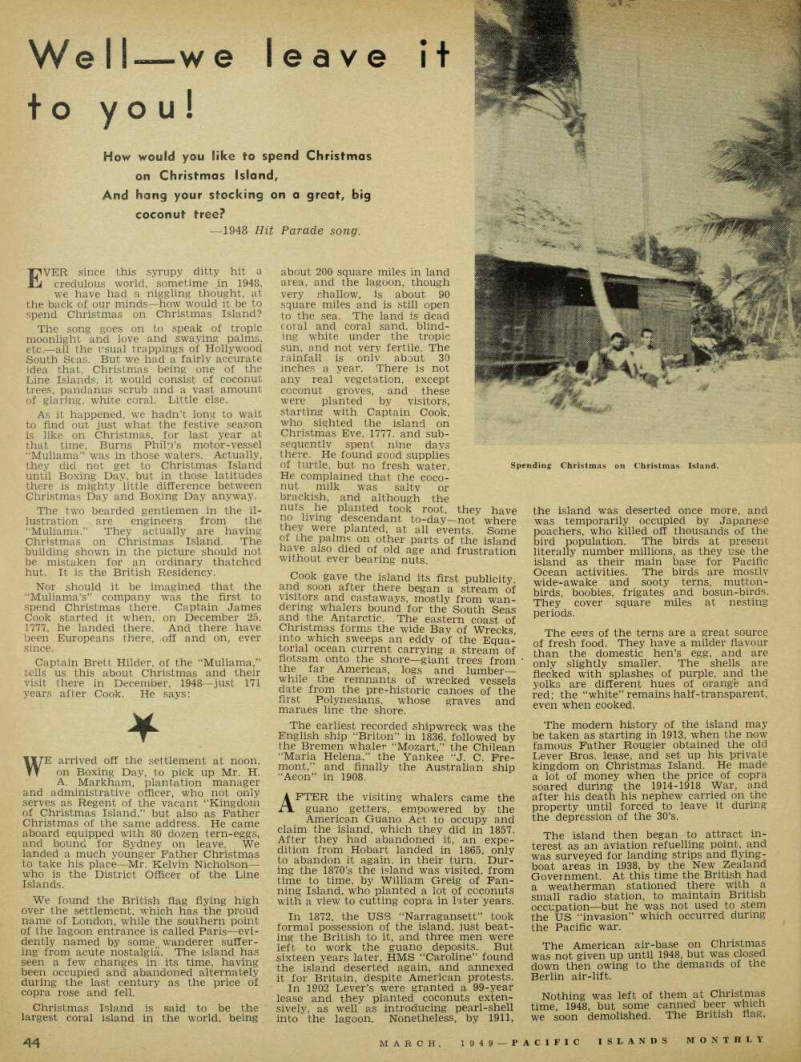
The two bearded gentlemen in the il lustration are engineers from the “Muliama.” They actually are having Christmas on Christmas Island. The building shown in the picture should not be mistaken for an ordinary thatched hut. It is the British Residency.
Nor should it be imagined that the “Muliama’s” company was the first to spend Christmas there. Captain James Cook started it when, on December 25, 1777, he landed there. And there have been Europeans there, off and on, ever since.
Captain Brett Hilder, of the “Muliama,” tells us this about Christmas and their visit there in December, 1948 —just 171 years after Cook. He says: ■¥■ WE arrived off the settlement at noon, on Boxing Day, to pick up Mr. H.
A. Markham, plantation manager and administrative officer, who not only serves as Regent of the vacant “Kingdom of Christmas Island,” but also as Father Christmas of the same address. He came aboard equipped with 80 dozen tern-eggs, and bound for Sydney on leave. We landed a much younger Father Christmas to take his place—Mr. Kelvin Nicholson — who is the District Officer of the Line Islands.
We found the British flag flying high over the settlement, which has the proud name of London, while the southern point of the lagoon entrance is called Paris —evidently named by some (i wanderer suffer ing from acute nostalgia. The island has seen a few changes in its time, having been occupied and abandoned alternately during the last century as the price of copra rose and fell.
Christmas Island is said to be the largest coral island in the world, being
about 200 square miles in land area, and the lagoon, though very shallow, is about 90 square miles and is still open to the sea. The land is dead coral and coral sand, blind ing white under the tropic sun, and not very fertile. The rainfall is only about 30 inches a year. There is not any real vegetation, except coconut groves, and these were planted by visitors, starting with Captain Cook, who sighted the island on Christmas Eve. 1777. and sub sequentlv spent nine days there. He found good supplies of turtle, but no fresh water.
He complained that the coco nut milk was salty or
brackish, and although the nuts he planted took root, they have no living descendant to-day—not where they were planted, at all events. Some of the palms on other parts of the island have also died of old age and frustration without ever bearing nuts.
Cook gave the island its first publicity, and soon after there began a stream of visitors and castaways, mostly from wan dering whalers bound for the South Seas and the Antarctic. The eastern coast of Christmas forms the wide Bay of Wrecks, into which sweeps an eddy of the Equa torial ocean current carrying a stream of flotsam onto the shore-giant trees from the far Americas, logs and lumber while the remnants of wrecked vessels date from the pre-historic canoes of the first Polynesians, whose graves and maraes line the shore.
The earliest recorded shipwreck was the English ship “Briton” in 1836, followed by the Bremen whaler “Mozart,” the Chilean “Maria Helena,” the Yankee “J. C. Fre mont,” and finally the Australian ship “Aeon” in 1908.
AFTER the visiting whalers came the guano getters, empowered by the American Guano Act to occupy and claim the island, which they did in 1857.
After they had abandoned it, an expe dition from Hobart landed in 1865, only to abandon it again, in their turn. Dur ing the 1870’s the island was visited, from time to time, by William Greig of Fan ning Island, who planted a lot of coconuts with a view to cutting copra in later years.
In 1872, the USS “Narragansett” took formal possession of the island, just beat ing the British to it, and three men were left to work the guano deposits. But sixteen years later, HMS “Caroline” found the island deserted again, and annexed it for Britain, despite American protests.
In 1902 Lever’s were granted a 99-year lease and they planted coconuts exten sively, as well as introducing pearl-shell into the lagoon. Nonetheless, by 1911,
the island was deserted once more, and was temporarily occupied by Japanese poachers, who killed off thousands of the bird population. The birds at present literally number millions, as they use the island as their main base for Pacific Ocean activities. The birds are mostly wide-awake and sooty terns, mutton birds, boobies, frigates and bosun-birds.
They cover square miles at nesting periods.
The eags of the terns are a great source of fresh food. They have a milder flavour than the domestic hen’s egg, and are only slightly smaller. The shells are flecked with splashes of purple, and the yolks are different hues of orange and red; the “white” remains half-transparent, even when cooked.
The modem history of the island may be taken as starting in 1913, when the now famous Father Rougier obtained the old Lever Bros, lease, and set up his private kingdom on Christmas Island. He made a lot of money when the price of copra soared during the 1914-1918 War, and after his death his nephew carried on the property until forced to leave it during the depression of the 30’s.
The island then began to attract in terest as an aviation refuelling point, and was surveyed for landing strips and flying boat areas in 1938, by the New Zealand Government. At this time the British had a weatherman stationed there with a small radio station, to maintain British occupation—but he was not used to stem the US “invasion” which occurred during the Pacific war.
The American air-base on Christmas was not given up until 1948, but was closed down then owing to the demands of the Berlin air-lift.
Nothing was left of them at Christmas time, 1948, but some canned beer which we soon demolished. The British flag,
Spending Christmas on Christmas Island.
therefore, flies undisturbed at present over Christmas Island, and the claims of the Rougier interests are being opposed by the Gilbert and Ellice Islands Govern ment. ★ THAT is the end of Captain Hilder’s Christmas Island story, but for the benefit of the lyric writer of the Christmas Island song we feel inclined to say “American papers please copy.”
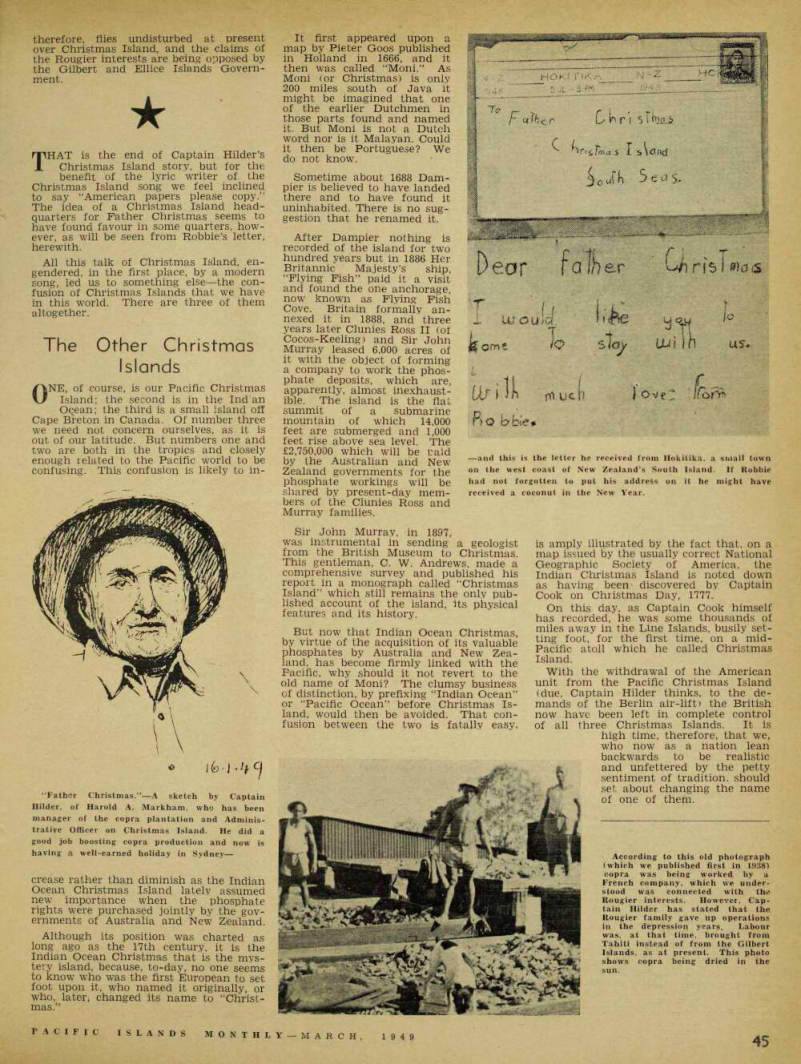
The idea of a Christmas Island head quarters for Father Christmas seems to have found favour in some quarters, how ever, as will be seen from Robbie’s letter, herewith.
All this talk of Christmas Island, en gendered, in the first place, by a modern song, led us to something else —the con fusion of Christmas Islands that we have in this world. There are three of them altogether.
The Other Christmas
Islands
ONE, of course, is our Pacific Christmas Island; the second is in the Ind an Oqean; the third is a small island off Cape Breton in Canada. Of number three we need not concern ourselves, as it is out of our latitude. But numbers one and two are both in the tropics and closely enough related to the Pacific world to be confusing. This confusion is likely to in-
crease rather than diminish as the Indian Ocean Christmas Island lately assumed new importance when the phosphate rights were purchased jointly by the gov ernments of Australia and New Zealand.
Although its position was charted as long ago as the 17th century, it is the Indian Ocean Christmas that is the mys tery island, because, to-day, no one seems to know who was the first European to set foot upon it, who named it originally, or who, later, changed its name to “Christ mas.”
It first appeared upon a map by Pieter Goos published in Holland in 1666, and it then was called “Moni.” As Moni (or Christmas) is only 200 miles south of Java it might be imagined that one of the earlier Dutchmen in those parts found and named it. But Moni is not a Dutch word nor is it Malayan. Could it then be Portuguese? We do not know.
Sometime about 1688 Dam pier is believed to have landed there and to have found it uninhabited. There is no sug gestion that he renamed it.
After Dampier nothing is recorded of the island for two hundred years but in 1886 Her Britannic Majesty’s ship, “Plying Fish” paid it a visit and found the one anchorage, now known as Flying Fish Cove. Britain formally an nexed it in 1888, and three years later Clunies Ross II (of Cocos-Keeling) and Sir John Murray leased 6,000 acres of it with the object of forming a company to work the phos phate deposits, which are, apparently, almost inexhaust ible. The island is the flat summit of a submarine mountain of which 14,000 feet are submerged and 1,000 feet rise above sea level. The £2,750,000 which will be raid by the Australian and New Zealand governments for the phosphate workings will be shared by present-day mem bers of the Clunies Ross and Murray families.
Sir John Murray, in 1897, was instrumental in sending a geologist from the British Museum to Christmas.
This gentleman, C. W. Andrews, made a comprehensive survey and published his report in a monograph called “Christmas Island” which still remains the only pubf C pSQ° ViiJ sland ’ Its physical features and its history.
But now that Indian Ocean Christmas. by virtue of the acquisition of its valuable phosphates by Australia and New Zealand, has become firmly linked with the Pacific, why should it not revert to the old name of Moni? The clumsy business of distinction, by prefixing “Indian Ocean” or “Pacific Ocean” before Christmas Island, would then be avoided. That confusion between the two is fatally easy,
is amply illustrated by the fact that, on a map issued by the usually correct National Geographic Society of America, the Indian Christmas Island is noted down as having been discovered by Captain Cook on Christmas Day, 1777.
On this day, as Captain Cook himself has reco rded, he was some thousands of es f^ ay in the Line Islands, busily set
piupH
Pacific a^oll w^ calle d Christmas island.
With the withdrawal of the American unit from the Pacific Christmas Island (due, Captain Hilder thinks, to the de mands of the Berlin air-lift) the British now have been left in complete control of all three Christmas Islands. It is
high time, therefore, that we, who now as a nation lean backwards to be realistic and unfettered by the petty sentiment of tradition, should set about changing the name of one of them.
“Father Christmas.”—A sketch by Captain Hilder. of Harold A. Markham, who has been manager of the copra plantation and Adminis trative Officer on Christmas Island. He did a good job boosting copra production and now is having a well-earned holiday in Sydney—
—and this is the letter he received from Hokitika, a small town on the west coast of New Zealand's South Island. If Robbie had not forgotten to put his address on it he might have received a coconut in the New Year.
According to this old photograph (which we published first in 1988) copra was being worked by a French company, which we under stood was connected with the Rougier interests. However, Cap tain Hilder has stated that the Rougier family gave up operations in the depression years. Labour was, at that time, brought from Tahiti instead of from the Gilbert Islands, as at present. This photo shows copra being dried in the sun.