The Things The Yanks Saw
p. 45 · Read in the full issue
DURING their service in the Pacific Islands, the Yanks—according to the Yanks —saw many strange things. But from the terse, Americanese descriptions given, by Marines and Gls, of the flora and fauna they met in the South Seas, island residents will recog nise many of the birds, animals and fish which are familiar to them. Some, of course, exist only in the minds of the Yanks.
In 1944, Wanda Burnett interviewed many convalescent Yanks in military and navy hospitals in the United States, and what she heard from them was recorded in the National Geographic Magazine.
There was, for example, the boy from lowa who, in the Ellice Islands, saw him a duck that wasn’t a duck. “It didn’t seem to have wings; but, man and boy. how that thing flew! It just zoomed along at 90 miles an hour. It moved so fast I never could get a look at it!”
A Texan suggested that it was just a plain, old mud-hen; the National Geo graphic thinks it was probably a little grebe, or hell-diver, and that its speed was not attained in flight but in rapid diving. rpHE land crabs and mosquitoes of 1 Guadalcanal seemed to have im pressed the Marines most. A Marine
describes a land crab and a rat that be came unwelcome guests in his sleeping bag; “. . .a crab as big as my steel helmet and a rat that looked like the half-sister to a wild pig.”
Thev alleged that they kept their guns and bayonets handy at night, not so much for the Japs as for the land crabs that walked all over their faces and crawled down inside their shirts to keep warm.
Solomon Island residents who will, no doubt, fly to the defence of their country should remember that the Marines were, '>.<■>* rime, living in holes dug not far from the beaches of Guadalcanal.
Then there was their meeting with a cus-cus, the well-known inhabitant of the South Pacific jungle areas—a harm less little fruit-eating creature that Is treated as a pet by natives and was so treated later by Allied and Australian servicemen themselves. It has been des cribed as a “tree-climbing kangaroo,” although its resemblance to a kangaroo begins and ends with the fact that it also is a marsupial.
But the Yanks liked not the cus-cus when first encountered and described him as a “crazy-looking thing that sat up in the trees at night and just stared at us. The first time we saw it, I tell you, none of us slept. We just stared back and didn’t dare move.”
Another said; “It had an almost human face—but rather like a monkey.
It had ears like a cat, a body like a possum and a tail like a rat.”
THE birds too, interested them—even the familiar yellow-crested white “cockies” who set up such a hulla baloo in the jungle when they heard movement, that they became sort of un official sentries.
The Yanks adopted coloured parrots and taught them to sit on their shoulders.
“It wasn’t no trouble getting a bird,” one lad said. “You could just pick ’em off the trees and bushes everywhere.
They was all shell-shocked. Most of them went round in a dizzy daze.”
But the old hornbill, with the OS wingspan and the XOS bill, which is known all over New Guinea and the Solomons, caused them to panic at first.
The hornbill is a clumsy bird and flies with a slow lumbering motion that, ac cording to the Yanks, makes a noise like a whistling artillery shell about to hit.
The hornbills usually fly home about dusk, and when they did. the Yanks hit their fox-holes. The Yanks said the hornbills could be eaten—but boy, were they tough!
The boys also encountered spider-webs “like camouflage nets” and lizards as “big as St. Bernard dogs;” arid strange animated green leaves that turned out to be long-horned grasshoppers from New Guinea.
SOME of them had been stationed in Northern Australia, on Cane York Peninsula, and of this jungle one had this to say:— “Believe me, next time I see a movie siren strolling through the jungle bare-footed and wearing nothing but a flower in her hair and a sarong around her middle, I’m going to hoot, and hoot plenty.
Why, even a tough-footed native would look twice before he’d put his foot down on that moving jungle floor, and he’s used to the place.
“In that man’s country even the trees have teeth, and the vines actually crawl out of their way to give you just one more scratch.
“I’d like to. see that dame when the wild dogs (dingoes) begin howling at night, or when one of those hand-sized spiders with fur on its legs starts sidling towards her. I’d like to see just what she’d do when a foot-long centipede wraps itself around her neck and begins moving its million and one legs.”
Most of the boys from the islands in the Southwest Pacific remembered with no affection the centipedes, “all sizes and colours.” Their bits wasn’t fatal but extremely painful Some of the fellows said they had been laid up for weeks after “con tacting” a centipede.
Spiders, centipedes, trees “with teeth” (stinging trees), and “flies so thick that before you could spear a piece of meat from your plate it was gone,” were the main con cern of the Cape York Yanks.
Those who had been on the North Queensland coast were in trigued most by the mudskipper, the amphibious fish with the bulb ous eyes that can live in or out of water, and is a familiar sight in the mangrove swamps.
The Yanks called it a “helluva sight’ ’and wanted their own brand of pink elephants back. “When that fish took to the trees,” said one GI, “it was too much for me. I wanted to get out of that country, and for permanent!”
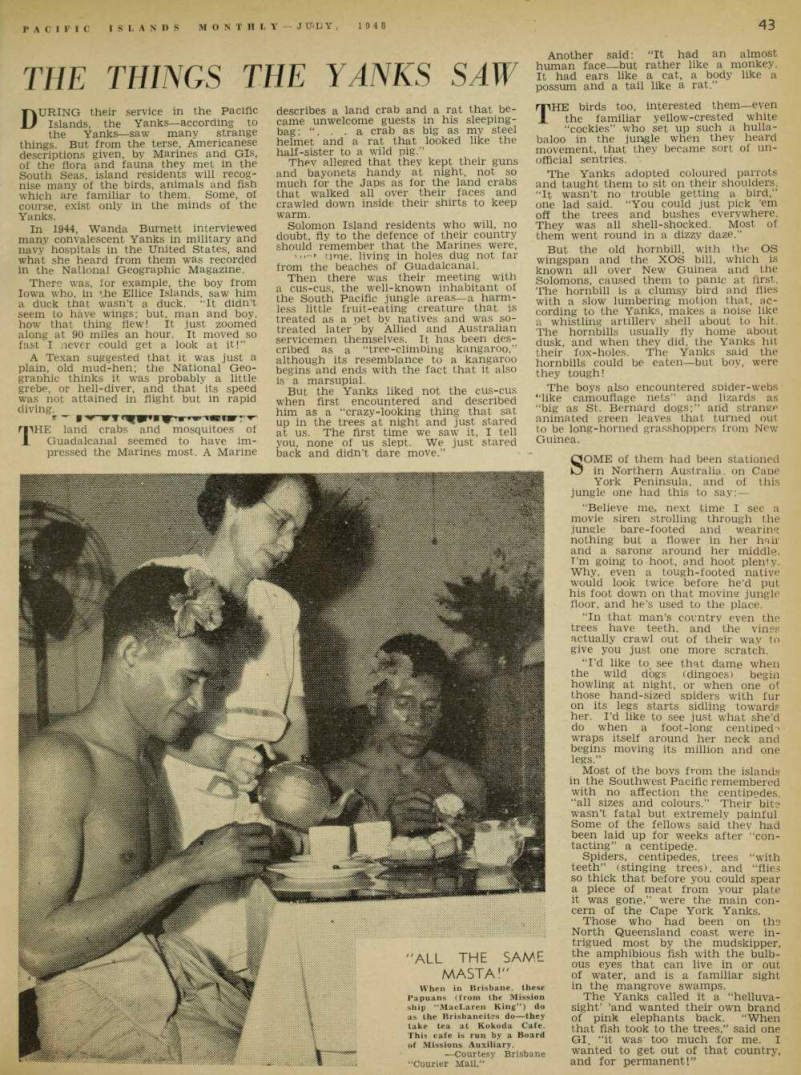
"All The Same
Masta!"
When in Brisbane, these Papuans (from the Mission ship “MacLaren King”) do as the Brisbaneites do—they take tea at Kokoda Cafe.
This cafe is run by a Board of Missions Auxiliary. —Courtesy Brisbane “Courier Mail.”