Pacific
Islands
Monthly
July 19, 1948
Vol. Xviii. No. 12.
Established 1930.
I Registered at the G.P.0., Sydney, for transmission by post as a newspaper ]
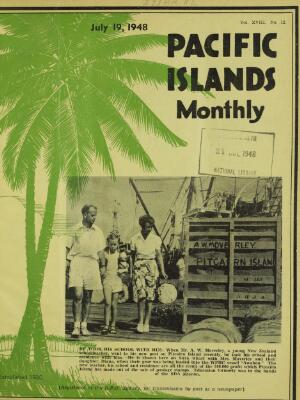
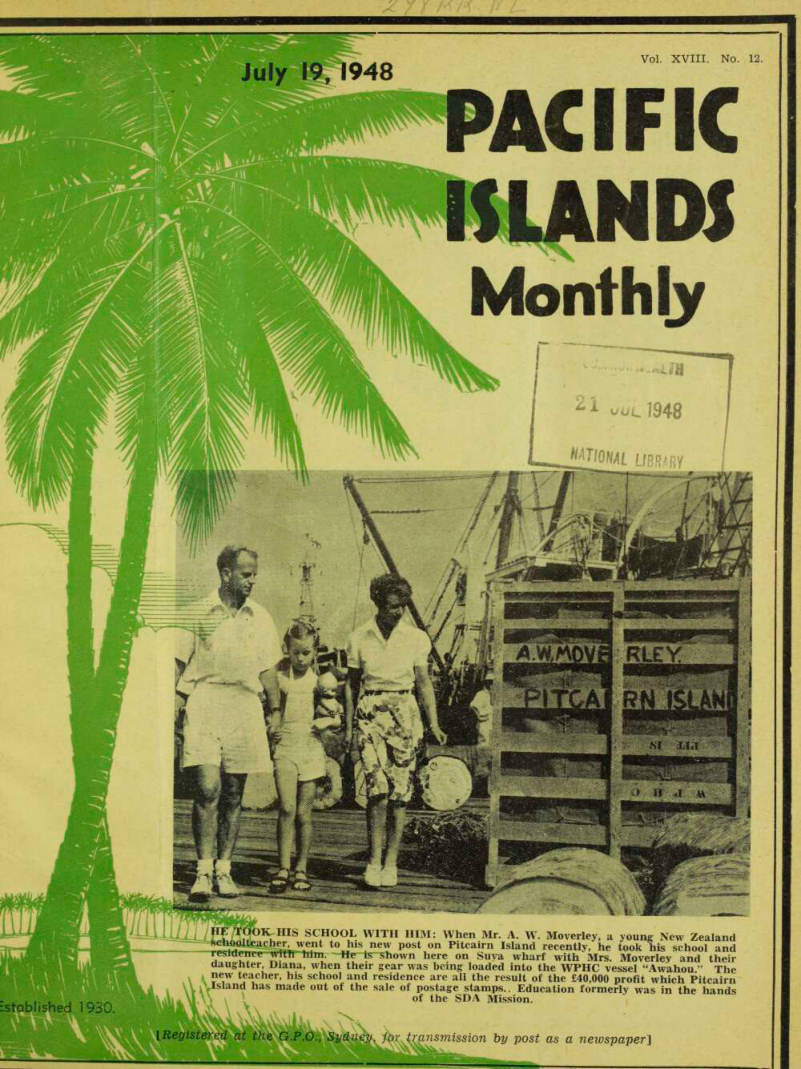
HE TOOK HIS SCHOOL WITH HIM: When Mr. A. W. Moverley, a young New Zealand schoolteacher went to his new post on Pitcairn Island recently, he took his school and residence with him He is shown here on Suva wharf with Mrs. Moverley and their daughter Diana, when their gear was being loaded into the WPHC vessel “Awahou.” The new teacher, his school and residence are all the result of the £40,000 profit which Pitcairn island has made out of the sale of postage stamps. Education formerly was in the hands of the SDA Mission.
Advertisements & other items, pp. 2-4 (2 items)
Pacific Islands Monthly J U L. Y . 19 4 8
gmfuM-yhmrMp
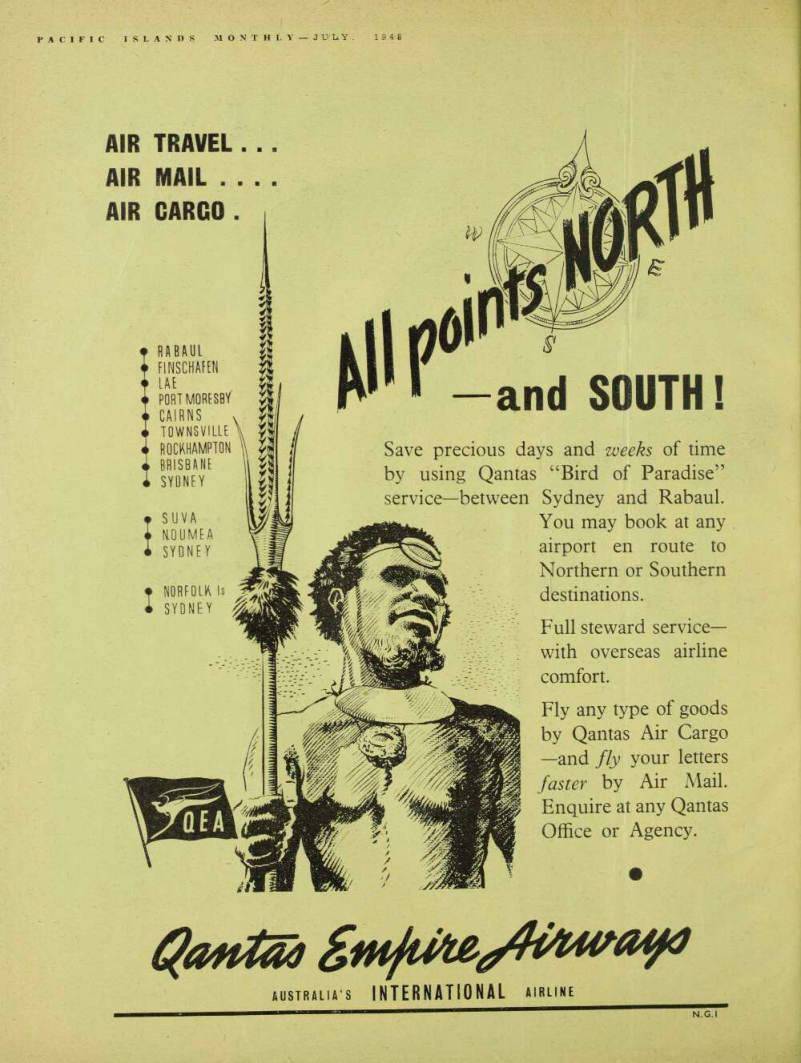
AIR TRAVEL
AIR MAIL .
AIR CARGO
n % s’ y/A /
RRBAUL
FINSCHAFEN
LAE
PORT MORESBY
CAIRNS
TOWNSVILLE
ROCKHAMPTON
BRISBANE
SYDNEY
SUVA
N.OUMEA
SYDNEY
NORFOLK Is
SYDNEY
X
and SOUTH
Save precious days and weeks of time by using Qantas “Bird of Paradise” service—between Sydney and Rabaul.
You may book at any airport en route to Northern or Southern destinations.
Full steward service— with overseas airline comfort.
Fly any type of goods by Qantas Air Cargo —and fly your letters faster by Air Mail.
Enquire at any Qantas Office or Agency.
gmfuM-yhmrMp
Australia's INTERNATIONAL airline
N.G.I
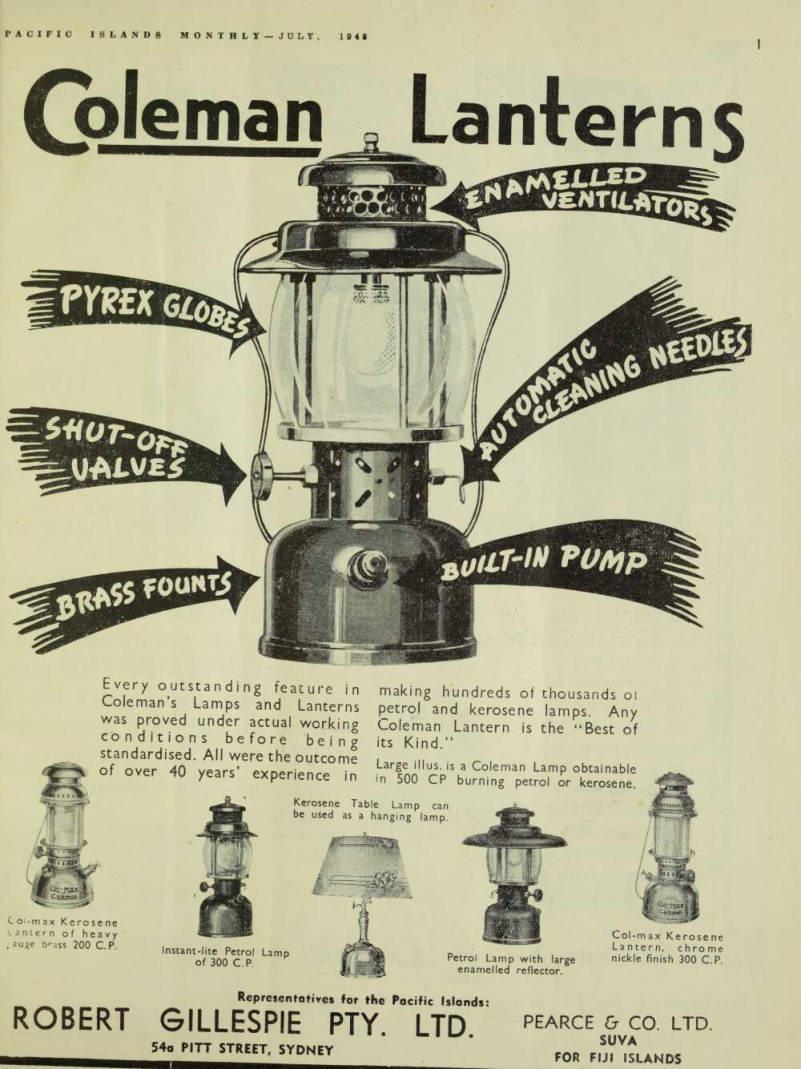
E very o utstan ding feature in Coleman s Lamps and Lanterns was proved under actual working conditions before being standardised. All were the outcome of over 40 years’ experience in Coi-max K Lantern o . auge brass erosene f heavy 200 CP. making hundreds of thousands ol
petrol and kerosene lamps. Any
Coleman Lantern is the “Best of its Kind.”
Large ill us. is a Coleman Lamp obtainable in 500 CP burning petrol or kerosene. i Kerosene Table Lamp can be used as a hanging lamp.
Instant-lite Petrol Lamp of 300 C.P.
Petrol Lamp with large enamelled reflector.
Col-max Kerosene Lantern, chrome nickle finish 300 C.P.
Representatives for the Pacific Islands
ROBERT GILLESPIE PTY. LTD.
540 PITT STREET, SYDNEY
PEARCE & CO. LTD.
SUVA
FOR FIJI ISLANDS
7a Va 7a % % I I I 8 *r I I E E I
From
Australia’s
Finest Fat
Stock ...
BRONTE BRAND
Chili Con Came Braised Steak and Onions Curried Beef Curried Mutton Steak and Onions Mutton and Peas Irish Stew Beef Steak Pudding Corned Beef Hash Corned Beef Loaf With Cereal Mutton Broth Mulligatawny Soup Tomato Soup Vegetable Soup From the finest fat stock and the richest vegetables in Australia we produce these high-grade canned meats and soups. BRONTE BRAND meats, hotmeals and soups are deliciously flavoured and are made from ONLY meats and vegetables of the highest quality. . . ♦ ★
THE COLONIAL WHOLESALE MEAT CO.
PTY. LTD.
Canning Factory, State Abattoirs, Homebush Bay, Sydney.
N.S.W.
PHONES:
PHONE: • UM 8436.
CABLE ADDRESS:
WOOLMILL. SYDNEY.
m p m *
Advertisers
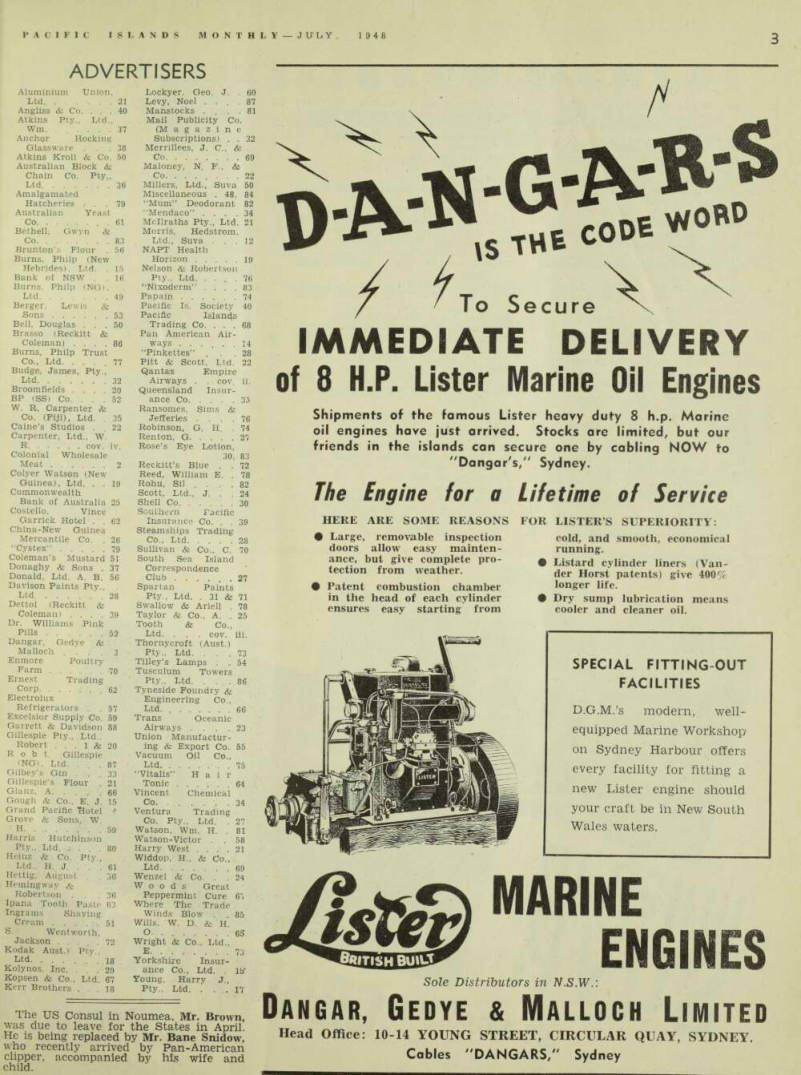
Aluminium Union.
Ltd 21 Angliss & Co. ... 40 Atkins Pty., Ltd., Wm. ... 37 Anchor Hocking Glassware ... 38 Atkins Kroll & Co. 50 Australian Block & Chain Co. Pty., Ltd 36 Amalgamated Hatcheries ... 79 Australian Yeast Co . 61 Bethell, Gwyn & Co 83 Brunton s Flour . 56 Burns, Philp (New Hebrides). Ltd. . 15 Bank of NSW . , 16 Burns, Philp (NG), Ltd. ... 49 Berger. Lewis & Sons 53 Bell, Douglas ... 50 Brasso (Reckitt & Coleman) ... 86 Burns, Philp Trust Co., Ltd. ... 77 Budge, James, Pty., Ltd 32 Broomfields ... 20 BP (SS( Co. . . . 52 W. R, Carpenter & Co. (Fiji), Ltd. . 35 Caine’s Studios . . 22 Carpenter, Ltd.. W.
R cov. iv.
Colonial Wholesale Meat 2 Colyer Watson (New Guinea), Ltd. . . 19 Commonwealth Bank of Australia 25 Costello, Vince Garrick Hotel . . 62 China-New Guinea Mercantile Co. . 26 “Cystex” 79 Coleman’s Mustard 51 Donaghy & Sons . 37 Donald, Ltd. A. B. 56 Davison Paints Pty., Ltd 28 Dettol (Reckitt & Coleman) ... 39 Dr. Williams Pink Pills 52 Dangar, Gedye & Malloch . 3 Enmore Poultry Farm 70 Ernest Trading Corp . 62 Electrolux Refrigerators . . 57 Excelsior Supply Co. 59 Garrett & Davidson 88 Gillespie Pty., Ltd..
Robert . . . 1 & 20 R o b t. Gillespie (NGi. Ltd. ... 87 Gilbey’s Gin . . .33 Gillespie’s Flour . 21 Glanz. A 66 Gough & Co.. E. J. 15 Grand Pacific Hotel * Grove & Sons, W H 59 Harris Hutchinson Pty.. Ltd. ... 80 Heinz & Co. Pty., Ltd.. H. J. . . . 61 Hettig. August . . 56
Hemingway &
Robertson ... 36 Ipana Tooth Paste 63 Ingrams Shaving Cream . . . . . 51 S. Wentworth.
Jackson ... 72 Kodak Aust. i Pty .
Ltd. . . . . is Kolynos. Inc. ... 29 Kopsen & Co., Ltd. 67 Kerr Brothers ... 18
Lockyer, Geo. J. . 60 Levy, Noel ... 87 Manstocks . . . .81 Mall Publicity Co. (Magazine Subscriptions) . . 32 Merrillees, J. C., & Co 69 Maloney, N. F., & Co. ... 22 Millers, Ltd., Suva 50 Miscellaneous . 48, 84 “Mum” Deodorant 82 “Mendaco” ... 34 Mcllraths Pty., Ltd. 21 Morris, Hedstrom, Ltd., Suva ... 12 NAPT Health Horizon 19 Nelson & Robertson Pty., Ltd. ... 76 “Nixoderm” ... 83 Papain 74 Pacific Is. Sociiety 40 Pacific Islands Trading Co. ... 68 Pan American Air ways ... 14 “Pinkettes” ... 28 Pitt & Scott, Ltd. 22 Qanta's Empire Airways . . cov, ii.
Queensland Insur ance Co 35 Ransomes, Sims & Jefferies ... 76 Robinson, G. H. 74 Renton, G 27 Rose’s Eye Lotion, 30, 83 Reckitt’s Blue . . 72 Reed, William E. . 78 Rohu, Sil . . . . 82 Scott, Ltd., J. . .24 Shell Co 30 Southern Pacific Insurance Co. . . 39 Steamships Trading Co., Ltd 28 Sullivan & Co., C. 70 South Sea Island Correspondence Club 27 Spartan Paints Pty., Ltd. . 31 & 71 Swallow & Ariell . 78 Taylor & Co., A. . 25 Tooth & Co., Ltd. . . . cov. iii.
Thorny croft (Aust.) Pty., Ltd. ... 73 Tilley’s Lamps . . 54 Tusculum Towers Pty., Ltd. . . .86 Tyneside Foundry & Engineering Co., Ltd. 66 Trans Oceanic Airways ... 23 Union Manufactur ing & Export Co. 55 Vacuum Oil Co., Ltd 75 “Vitalis” Hair Tonic 64 Vincent Chemical Co 34 Ventura Trading Co. Pty., Ltd. . 27 Watson, Wm. H. . 81 Watson-Victor 58 Harry West . . . .21 Widdop, H., & Co., Ltd 69 Wenzel & Co. . . 24 Woods Great Peppermint Cure 67 Where The Trade Winds Blow . . 85 Wills. W. D. & H.
O. . 65 Wright & Co.. Ltd., E 73 Yorkshire Insur ance Co., Ltd. . 15 v Young, Harry J., Pty.. Ltd. ... 17
The US Consul in Noumea. Mr. Brown, was due to leave for the States in April.
He is being replaced by Mr. Bane Snidow, who recently arrived by Pan-American clipper, accompanied by his wife and child.
Advertisements & other items, p. 5 (1 item)
Marine
x v X
D-A--S
a
\S THE
To Secure
IMMEDIATE DELIVERY
of 8 H.P. Lister Marine Oil Engines Shipments of the famous Lister heavy duty 8 h.p. Marine oil engines have just arrived. Stocks are limited, but our friends in the islands can secure one by cabling NOW to
"Danger's," Sydney.
The Engine for a Lifetime of Service
HERE ARE SOME REASONS
• Large, removable inspection doors allow easy maintenance, but give complete protection from weather, • Patent combustion chamber in the head of each cylinder ensures easy starting from
FOR LISTERS SUPERIORITY:
cold, and smooth, economical running. • Listard cylinder liners (Vander Horst patents) give 400% longer life. • Dry sump lubrication means cooler and cleaner oil. □t X Tj
SPECIAL FITTING-OUT
FACILITIES
D.G.M.’s modern, wellequipped Marine Workshopon Sydney Harbour offers every facility for fitting a new Lister engine should your craft be ih New South Wales waters.
MARINE
ENGINES
Sole Distributors in N.S.W.:
Dangar, Gedye & Malloch Limited
Head Office: 10-14 YOUNG STREET, CIRCULAR QUAY, SYDNEY.
Cobles "DANGARS," Sydney
In This Issue:
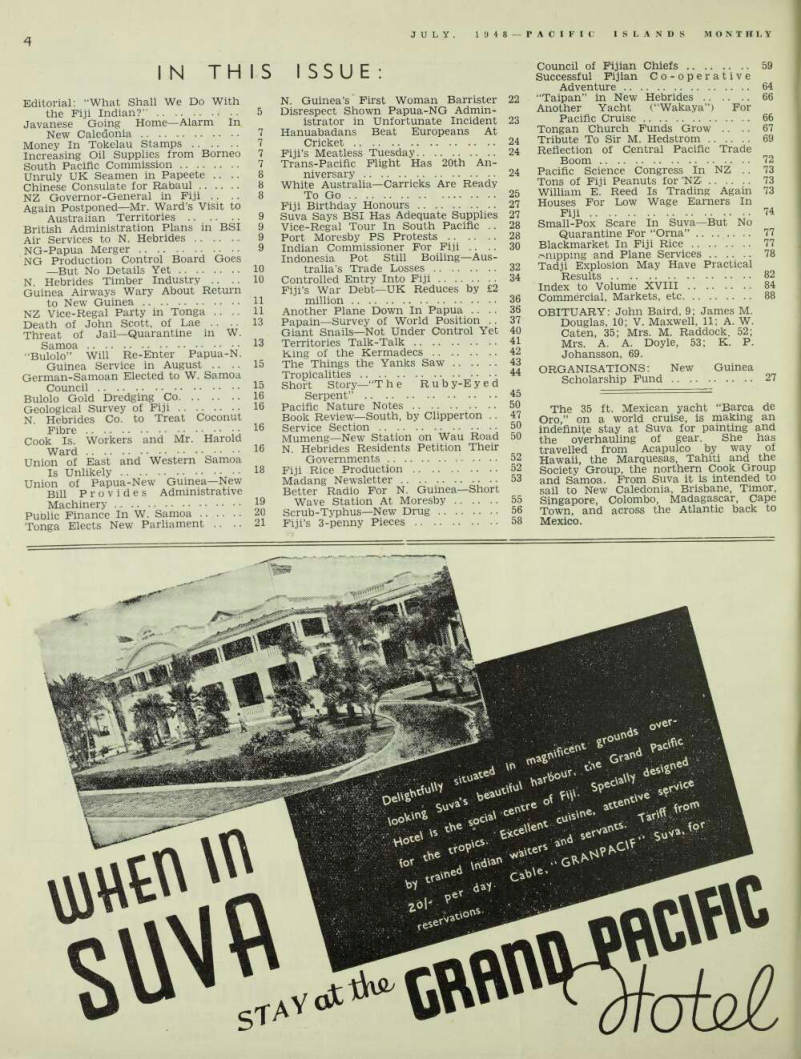
Editorial; “What Shall We Do With the Fiji Indian?” 5 Javanese Going Home—Alarm In New Caledonia 7 Money In Tokelau Stamps 7 Increasing Oil Supplies from Borneo 7 South Pacific Commission 7 Unruly UK Seamen in Papeete ... 8 Chinese Consulate for Rabaul 8 NZ Governor-General in Fiji ... 8 Again Postponed—Mr. Ward’s Visit to Australian Territories 9 British Administration Plans in BSI 9 Air Services to N. Hebrides 9 NG-Papua Merger 9 NG Production Control Board Goes —But No Details Yet 10 N. Hebrides Timber Industry .. .. 10 Guinea Airways Wary About Return to New Guinea 11 NZ Vice-Regal Party in Tonga ... 11 Death of John Scott, of Lae ... 13 Threat of Jail—Quarantine in W.
Samoa 13 “Bulolo” Will Re-Enter Papua-N.
Guinea Service in August .. .. 15 German-Samoan Elected to W. Samoa Council 15 Bulolo Gold Dredging Co 16 Geological Survey of Fiji 16 N. Hebrides Co. to Treat Coconut Fibre Cook Is. Workers and Mr. Harold Ward 16 Union of East and Western Samoa Is Unlikely i 8 Union of Papua-New Guinea—New Bill Provides Administrative Machinery 19 Public Finance In W. Samoa 2(J Tonga Elects New Parliament .. .. 21
N. Guinea’s First Woman Barrister 22 Disrespect Shown Papua-NG Admin istrator in Unfortunate Incident 23 Hanuabadans Beat Europeans At Cricket 24 Fiji’s Meatless Tuesday 24 Trans-Pacific Flight Has 20th An niversary 24 White Australia—Garricks Are Ready To Go 25 Fiji Birthday Honours 27 Suva Says BSI Has Adequate Supplies 27 Vice-Regal Tour In South Pacific .. 28 Port Moresby PS Protests 28 Indian Commissioner For Fiji .. .. 30 Indonesia Pot Still Boiling—Aus tralia’s Trade Losses 32 Controlled Entry Into Fiji 34 Fiji’s War Debt—UK Reduces by £2 million 36 Another Plane Down In Papua ... 36 Papain—Survey of World Position .. 37 Giant Snails—Not Under Control Yet 40 Territories Talk-Talk 41 King of the Kermadecs 42 The Things the Yanks Saw 43
Tropicalities 44
Short Story—“T he Rub y-E ye d Serpent” 45 Pacific Nature Notes 50 Book Review—South, by Clipperton .. 47 Service Section 50 Mumeng—New Station on Wau Road 50 N. Hebrides Residents Petition Their Governments 52 Fiji Rice Production 52 Madang Newsletter 53 Better Radio For N. Guinea—Short Wave Station At Moresby 55 Scrub-Typhus—New Drug 56 Fiji’s 3-penny Pieces 58
Council of Fijian Chiefs 59 Successful Fijian Co-operative Adventure 64 “Taipan” in New Hebrides 66 Another Yacht (“Wakaya”) For Pacific Cruise 66 Tongan Church Funds Grow .. .. 67 Tribute To Sir M. Hedstrom 69 Reflection of Central Pacific Trade Boom 72 Pacific Science Congress In NZ .. 73 Tons of Fiji Peanuts for'NZ 73 William E. Reed Is Trading Again 73 Houses For Low Wage Earners In Fiji 74 Small-Pox Scare In Suva—But No Quarantine For “Orna” 77 Blackmarket In Fiji Rice 77 snipping and Plane Services 78 Tadji Explosion May Have Practical Results 82 Index to Volume XVIII 84 Commercial, Markets, etc 88 OBITUARY: John Baird, 9; James M.
Douglas, 10; V. Maxwell, 11; A. W.
Caten, 35; Mrs. M. Raddock. 52; Mrs. A. A. Doyle, 53; K. P.
Johansson, 69.
ORGANISATIONS; New Guinea Scholarship Fund 27 The 35 ft. Mexican yacht “Barca de Oro,’’ on a world cruise, is making an indefinite stay at Suva for painting and the overhauling of gear. She has travelled from Acapulco by way of Hawaii, the Marquesas, Tahiti and the Society Group, the northern Cook Group and Samoa. From Suva it is intended to sail to New Caledonia, Brisbane, Timor, Singapore, Colombo, Madagascar, Cape Town, and across the Atlantic back to Mexico.
Advertisements & other items, p. 6 (1 item)
iipjl I|\
n V / ■. : ■ i
i|L v *. o^ er '
*** ATS- spe C^ cc
Qvi^ a S <»ntv e ° . at^ e ° £f tforf' * r , l r»>t' ed O b ' e ’ • r ‘ bl- pe 0S • •
r ese^- iOOS '
io^
Pacific Islands Monthly
The Newspaper-Magazine of the South Seas L Registered at the G.P.0., Sydney, for transmission by post as a newsp,aper~\
Published Once Each Month and Circulated in Australia and New Zealand and in the following Pacific Territories and Islands Groups:
Australian Territory of Papua.
Trustee Territory (Australia) of New Guinea.
Australian Territory of Norfolk Island.
New Zealand Territory of Cook Islands.
Trustee Territory (NZ) of Western Samoa.
British Colony of Fiji.
British Solomon Islands Protectorate.
British Protectorate of Tongan Islands.
British Crown Colony of Gilbert and Ellice Islands.
Trustee Territory of Nauru.
British and French Condominium of New Hebrides.
French Colony of New Caledonia.
French Colony of Oceania (Tahiti, etc.).
American Territory of Eastern Samoa.
American Territory of Hawaiian Islands.
Owned and Produced by Pacific Publications Pty., Ltd., Union House, 247 George Street, Sydney.
Telephone: General Office and Advertising BW 5037.
P.O. Box 3408
Registered Address for Telegrams, Radiograms, and Cables: “Pacpub,” Sydney.
Contributions.
Articles, Stories, and Photographs dealing with Pacific Islands subjects are invited and will be paid for on publication.
Subscription Rates.
Per Annum, Pre-paid, Including Postage.
In Australia, New Zealand, Fiji, New Guinea, Papua, Western Samoa, Cook Islands, Tonga, British Solomons, Gil bert and Ellice Colony, Nauru, and United Kingdom 15 0 Elsewhere $3 18 o Single Copies 1 6
Editor and Publisher:
R. W. Robson, P.R.G.S.
Assistant Editor: JUDY TUDOR.
General Office: Union House, 247 George Street, Sydney. Telephone: BW 5037.
Advertising Manager: W. E. Rogers.
Representative In London.
J. T. Wallis, Coronation House, 4 Lloyds Avenue, London, E.C.3, from whom may be obtained copies of Pacific Islands Monthly, Pacific Is. Year Book, advertising schedules, etc.
Representative In U.S.A.
Pacific Islands Trading Co.,
244 California St., San Francisco, U.S.A.
Agents.
The following are authorised to receive sub scriptions for Pacific Islands Monthly:— Burns, Philp & Co., Ltd., and Burns Phllp (South Sea) Co., Ltd. All branches.
W. R. Carpenter & Co., Ltd. All branches.
Morris, Hedstrom, Ltd. All branches.
Steamships Trading Co., Papua. All branches.
W. M. Caldwell, Suva, Fiji.
Cook Islands Trading Co., Rarotonga, Cook Is.
Oscar Nordman, Papeete, Tahiti.
Islands Branches and Representatives of W. H.
Grove & Sons, Ltd., Auckland, New Zealand.
Ed. Pentecost, Noumea, New Caledonia.
Societe Gubbay Kerr et Cie, Noumea, New Caledonia.
Vol. Xviii. No. 12.
July 19, 1948
r 1/6 Per Copy Price ] Prepaid, p.a.: 15/- Aus. ( In USA, p.a.: $3.
Fiji Indians?
What Is To Be Done With The Fiji Indians?
rpHE ugliest problem in the South A Pacific Territories to-day is found in Fiji. What is to be done there with the Indian community, which already numbers 125,000 in a total population of 260,000, and which is increasing twice as rapidly as any other race? Here, it seems to us, are the plain alternatives. One or other of these courses of action must be adopted:— • Follow the blind, indefensible policy of the past 25 years, and allow the rapidly-breeding Indians to take possession of the archipelago by sheer force of numbers, thus wiping out the Fijian race, and establishing a new India in the pleasant and fertile South Pacific. ( This would be criminal .) • Give the Indian an equal share with the Fijian in the future control and development of the Colony, in troduce a carefully planned system of education, and trust to the Indian’s sense of justice to see that the less industrious and tenacious Fijian gets a fair deal, especially in relation to land ownership. ( This plan usually regarded as idealistic and wholly im practical.) • Select a portion of Fiji where t.he
natural conditions are good and the native population small, and remove the whole Indian population thereto — giving them complete ownership of the area, but keeping them strictly segregated (so far as land ownership and settlement are concerned) in that section of the group. The big island of Vanua Levu—second in importance only to the main island of Viti Levu —is suggested for this purpose. ( The plan has considerable merits, and many difficulties. The Indians would resist it, like wildcats .) • Remove the whole of the Indian community from Fiji to India, after giving the Indians long notice of the change, and providing them with ample compensation—the cost of which would be a permanent charge upon the Colony. ( This seems the soundest answer to the problem. But it probably would cause a complete collapse of rich Fiji's economic struc ture.) SPHERE are advocates of every one of those four alternatives. On the other hand, every one is sharply con demned by different classes of people.
There is unanimity on only one point namely, that it is vital to the future
native people for whom we accepted responsibility over 70 years ago, that some definite and clear-cut policy be now adopted, and followed, firmly and consistently.
There should be no further hesi tancy over this thing: a decision must be reached, and soon. If it is not al ready too late, now, it will be too late in another five years.
There seems to be no possibility that the two races—Fijians and In dians—will coalesce. They do not inter-marry, nor do they co-operate to any extent on matters of common concern; each holds the other in contempt. If they are to remain in joint occupation of Fiji, they will go on, apart. That, beyond any doubt, would spell the end of the Fijian race.
According to Islands standards the Fijian is an exceedingly desirable per son-courageous, proud, intelligent, friendly, hospitable, dependable. But, like all Islanders, he is not very in dustrious, nor exceedingly tenacious in his purposes, and he is no trader.
The Indian, on the other hand, is an alert and tireless trader, and is indus trious, and most tenacious in his pursuits; and he breeds in a pheno menal way. The Fijian does not stand a chance against him.
The matter is in the hands of the British who, so far, have tried to treat both races with respect and even-handed justice. But the situa tion is difficult for them, because they
while there is no warmth in their re gard for the Indians. For that, the Indians have only themselves to blame. For a couple of decades, their professional agitators embarrassed the British administration by howling and yelling for political equality.
Then, while the British were engaged (practically at Fiji’s front door) in the most critical war in their history, the Indians remained surly and aloof and unco-operative, in contrast with the Fijians, who aligned themselves with the Allies, and fought magnifi cently.
This, actually, was the Fiji-Indians’ great opportunity. If they had taken their proper part in the Pacific War, they might have established some real claim to permanent residence in Fiji.
As it is, they earned precisely the consideration that they will get.
THE Fiji British do not blame all the Indians for the unpleasant political situation—in fact, they do not blame 95 per cent, of them. They say that the great majority are quiet, peaceable, industrious folk whose only faults are that they will have swarms of children, and they will follow blindly the shallow-pated, argumen tive, half-educated agitators who call themselves the “leaders.” If Fiji could get rid of all the Bombay traders and Madrassi lawyers, the In dian problem would be easier of solu tion.
The problem demands solution the more urgently because of the startling spread of Communism throughout Southern Asia, and because the new State of India has—as reported else where—just appointed a Commis sioner to Fiji. There is nothing in Fiji for such a Commissioner to do— except stir up political mischief. Al ready, there are far too many links between the Fiji Indians and India: that is why the outlook for perman ent Indian settlement in Fiji is so blue.
The British Colonial Office should not have permitted the appointment of that Commissioner. On the con trary, the CO should have applied it self to the problem of how to rid Fiji of the parasitical Indian growth, be fore Fiji itself is strangled.
For the time being, however, nothing is to be expected of London.
The Government which, through myopia and weakness, has lost Egypt, Palestine, India, Ceylon, Burma and (we fear) Malaya, is not likely to bring to the Fiji problem either the vision or the strength that is neces sary if an early solution is to be found. Yet a solution must be found, soon, if one of the best of the Islands races is to be saved.
Dr. Clinton Manson-Bahr has been appointed physician-specialist to the Fiji Department of Health. He will arrive in the Colony shortly. He is a son of Sir Philip Manson-Bahr. consulting physician to the Colonial Office. Sir Philip visited Fiji in 1910 to carry out research
Miniature
World Problem In Miniature Too Much Money—Too Little Goods, in Tokelaus
From Our Own Correspondent APIA. July 1.
THE motor vessel “Manua Tele” has just made a trip to the Tokelau group, mainly for the purpose of arranging for the issue of the new Tokelau stamps.
The Tokelau islanders are now paid the very high price of 30/- per 100 lbs. for their copra, but they have no chance of spending any money, as there are no stores there.
They once manufactured very good hats and mats, but have apparently been spoiled by their new prosperity, and do not want to weave hats and mats any longer. The price of hats has gone up from 7/- to 16/-, accordingly.
Fiji Wedding
TWO well-known Fijian families were united last month when the marriage took place at the Pro- Cathedral, Suva, of Miss June Irene Langdale, only daughter of Mr. and Mrs.
C. L. Langdale, and Mr. Lesley John Gar diner, youngest son of Mrs. E. Gardiner and the late Mr. Harry Gardiner. The
best man was Mr.
W. Gardiner, brother of the bridegroom, and groomsmen were Messrs. W. Garnett and V. Hawksley.
The bridesmaids were Misses Elsie Hawksley, Patricia Chapman and Milli cent Bean. Their bouquets were made by Mrs. L. Benja min. Miss Dawn MacDonald decor ated the Church, and Mrs. C. Gam bling was responsible for artistic frocking.
Mrs. Langdale re ceived her guests at the Masonic Hall, which had been charmingly decor ated by Mr. Harry Nicol.
Empire Day
OLD colonists of Fiji met at the Cafe Victoria, Suva, Fiji, on May 28 to observe Empire Day.
Lady Freeston, wife of the Gover nor of Fiji, was guest of honour.
Brother Alphohsus, one of the oldest guests present, said grace before tea and Major Willoughby Tottenham we 1 corned Lady Free ston and spoke on Empire Day. Lady Freeston suggested that old residents should write their early experiences so that they may not
"Muliama" for BSI
Regular Service Uncertain—No Shipping Facilities
THE small BP motor-vessel “Muliama,” scheduled for the Solomon Islands in mid-July, does not inaugurate a regular service as a common carrier. She has been engaged only to carry cargo for the Lever and Fairymead Companies, and the Government, all of whom will take delivery ex-ship’s slings.
Burns, Philp have made this arrange ment because they have no shipping facilities whatever in the Solomons now —no agents, no goods-sheds. no wharfage and no means of handling miscellaneous cargo.
The future depends entirely upon the conditions disclosed by the “Muliama’s”
July trip. If there is to be a regular Sydney-Solomons service, the BSI Gov ernment and other interests will have to co-operate in providing facilities and in guaranteeing cargo. Back-loading (Solomons to Sydney) is one of the pro blems. The Solomons produce only copra —and all copra is being shipped direct to Britain.
Mr. S. C. Lai, who has been Chinese consul in Suva, Fiji, for two years, arrived in Auckland by flying-boat in June. He was on his way to take up an appointment as consul in Vancouver.
He Spoke A Mouthful!
Dwindling herds have created an increasing shortage of fresh meat in Fiji. One Suva butcher now sells only imported frozen meat.
SUVA HOST: Feel like some Kai-kai, laddie?
VISITOR: Sure —I could eat a horse. SUVA HOST: Come along, then—you'll enjoy it—it is hores!
Javanese Going
Home
Alarm In N. Calendonio
From Our Own Correspondent
Noumea, July 4.
ALTHOUGH Noumea tradesmen out of work number 102, including 38 truck drivers, New Caledonia is concerned at the departure homeward bound, with the approval of the Dutch administration, of most of the Javanese labour in the country.
M. Henri Lafleur, Caledonian represen tative in the French Senate in Paris, is leaving Noumea by air for Java to try and Induce the powers that be to re-authorise the recruitment of Dutch East Indies labour for Caledonian mines and agri culture.
Following the Dutch Government’s de cision, a ship was expected towards the end of June to repatriate 2,000 of the Javanese who had been the longest in the Colony, and whose Indentures had ex aired during the war. Last December the Javanese in Caledonia numbered 7,084. A second 2,000 of these is expected to leave ;his month (July).
Last October, the 5.327 Javanese in work vere employed in the following indus tries : Administrative services .. 250 Industry and mining .. .. 1534 Commerce 470 Agriculture and cattle ... 2083 Private employment .. .. 990 The number not in employment was ,757, mainly women and children.
The loss of these people, will have nost serious repercussions on agriculture ,nd industry.
“Bulletin de Commerce” (Noumea) ays: “The Javanese, who have become )art of our daily life, are perfectly happy lere. To make them out as exploited im nigrant labour is to give an absolutely alse impression of Caledonian colonisa ion. . . What is needed is to group the fforts of all for the common good, in stead of robbing us of arms whose co iperation is needed for the prosperity of he territory. The expected departure is ike a sword of Damocles suspended over mr head. To take awav our Javanese abour is purely and simply to rob us of iur livelihood: it is to prevent the Cale lonian economy from developing to its lue extent our natural resources; and it vill affect the wellbeing of all. It repre ents furthermore—and this must be ealised—a threat of general unemplov ient for the European population, in vitable consequence of the slowing down r the death of our chief productive ctivities. It is high time that certain tupid falsehoods were exposed or the onsequences will be incalcuable. In New Caledonia there is neither slavery, nor laves.”
Money In Stamps
Tokelau Island Issue Now Out
JJ ALE of stamps and 100,000 first-day j covers will probably give the Tokelau Islands (a New Zealand dependency) lore revenue than it ever had before.
First issue of these stamps was made m June 29. New Zealand newspapers say hat the first-day covers were taken shore in canoes—all this having been ar anged before-hand by the New Zealand Jovernment.
The Tokelau Group has hitherto used /estern Samoan stamps, without any ill fleets. However, while philatelists fall ir these things, there appears to be no ood reason why Governments should not ash in on their hobby.
It is interesting to note that Pitcairn sland has made £40,000 out of the sale of
Increasing Oil Supply
From Borneo
NO further way from Australia than Perth is from Melbourne, the biggest oil producing unit in the British Commonwealth of Nations is being de veloped—namely the oil fields of Brunei and Sarawak, in British Borneo.
It will be remembered that the Jap anese over-ran these oilfields in 1942 and. when they were driven out in 1945, they set many of the wells afire.
By 1946, 300.000 tons of oil were ex ported. By 1947, the refinery at Lutong was again in operation and 1,185,000 tons of crude oil were exported in that year.
By the end of 1947, production was at the rate of 2\ millions tons per annum— three times the pre-war figure. This out put could be increased if more tankers could be supplied and more material made available for field equipment and worker’s houses. Enormous waste is still going on because equipment cannot be obtained to deal with the fires —seven enormous fires are still burning.
Mr. J. E. Brown, Shell Co. executive, reported these things when he returned lately to Melbourne. He said this field could be made of almost incalculable im portance to the nations of the Sterling group.
The manager of Seria field, in Brunei, employing about 4,670 Europeans and natives, is Mr. G. O. Higgins. Mr. and Mrs. Higgins were popular residents of Port Moresby in the middle 30’s, when Shell interests were engaged in the search for oil in Papua.
The death occurred in Tahiti early in June of Corvette Captain Robert Jeanpierre, Officer of the Legion of Honour, who was an old resident of the Colony. Captain Jeanpierre was a re lation of Admiral Du Petit Thours, who was prominently connected with the events in Tahiti, nearly 100 years ago, which led to the annexation of the group by France.
Commission
South Pacific
THE South Pacific Commission in June was seeking three senior officers.
Positions were: Secretary-General at a salary of £2,000 stg. per annum; Deputy Chairman of Research Council, at £1,900 stg. p. a.; and Deputy Secretary-General at £1,500 stg. p.a. All salaries are free of income tax. Appointments will be for five years.
No announcement has been made (mid- July) as to the number of applications re ceived, or who is likely to fill the posi tions. The salaries are not lightly to be passed over—and the freedom from in come tax is worth more than the salaries.
It was not expected that any important developments in the work of the Commis sion would take place until those positions had been filled. Each of the six constitu ent countries probably has to be con sulted before an appointment is made.
The headquarters of the Commission are at St. Georges’s Heights. Mosman, Sydney, where a small staff is carrying on. The Commission in May set up a small Committee to inquire and report on the rival merits of Suva and Noumea, as headquarters; but that inquiry has not been completed.
Next meeting of the Commission is scheduled for October, in Sydney.
Tahiti Ships
Papeete, June 2.
THE French gunboat Dumont D’urville has gone to Auckland to assist in towing two trawlers, which have been purchased for use in the French Colonies —one for Noumea and the other for Tahiti. That destined for Tahiti has been called after the famous Tahitian love-flower Tiare.
Tahiti interests recently bought the motor-ship “Orohera.” She was sent to New Zealand for repairs and alterations and, when finished, she will load cargo in Auckland for Tahiti.
New W. Samoan Assembly
This photograph, which was taken on June 2. 1948, at the opening of the new Legislative Assembly of Western Samoa shows Members and officials as follows: — FRONT ROW (left to right): Fata; Tualaulelei; Fautua Tupua Tamasese; the High Commissioner, Col. F. W. Voelcker; Fautua Malietoa Tanumafili; E. F. Paul; G. F. Betham; Molio’o; Amando Stowers.
SECOND ROW (left to right): Interpreter Matatumua; Tofa Tomasi; Vu’i; X. F. Boyes, Crown Solicitor; F. J. H. Grattan, Secretary of Native Affairs; J. B. Wright, Treasurer; Dr. H. C. Bliss.
Acting Chief Medical Officer; G. E. Burton. Superintendent of Schools; Lavea Lala; Tulele; W. F.
Stowers.
THIRD ROW (left to right): Fijian driver; Asiata; Tualatulu; Leiataua Solia; W. R. McCulloch, Secretary to the Government; W. R. Heatley, Secretary to the Legislative Assembly; Papali’i, inter preter; Jacob Helg; Fonoti.
Song"
"Wine, Women and Song"
Unruly Seamen In A French Port
From Our Own Correspondent
Papeete, June 10.
VERY unpleasant incidents were asso ciated with the visit to Papeete recently of the British steamer Nemiskan Park. She came to take on water and provisions before going to Makatea to load phosphates. Members of the crew got out of hand, with an orgy of wine, women and song.
Customs officials caught the crew red handed smuggling cigarettes and cloth ing ashore, and the ship was fined 13,000 francs (about £BO Australian).
That evening the angry crew began throwing lumps of phosphate, pieces of wood and other rubbish from the rail of the ship at people walking ashore—in this port, ships are tied up close to a main thoroughfare. Police were sum moned and other officials gathered.
There were furious exchanges. A bucket of potato peelings, thrown savagely from the side of the ship, missed Customs Officer Bremond by inches. The out raged French officials appealed to the captain and officers, and the latter stop ped the demonstration.
Next day, there were more ugly scenes and the British Consul, Mr. Henderson, had a long discussion with the members of the unruly crew. The crew demanded another night ashore, and a pay advance of £1 each, and this was agreed to.
In the course of their farewell demon stration, some of the crew got into holts with soldiers who had been brought down to the wharf to prevent disorder, and were pretty badly hurt.
The ship sailed the following morning for Makatea, leaving very unpleasant memories in Papeete.
New Suva Building
Boat-Building In New
Guinea
THE manager of Mr. D. S. Hore-Lacy’s plantation on the north coast of New Britain, Colonel Allan Cameron, DSO, reports that his shipyard there has recently built four sailing boats, 24 ft. long, for sale to the natives of the Talasea district. He says that there is a keen demand for this class of small craft.
Sir Hugh and Lady Ragg, after three months’ pleasant holiday in Sydney, returned to their home in Fiji by plane on July 11.
New Suva Building
These are the attractive new Suva premises of the Fiji Trading Company whose destinies are directed by Mr. T. French, one of the Colony’s most go-ahead busi ness men. As well as being owner pilot of Fiji’s only internal air line, Mr. French’s company is agent for Austin cars, and, as well as its other trading activities, will shortly begin the distribution of Metro-Goldwyn-Mayer 16-milli metre films throughout Fiji and adjacent islands.
Rabaul?
Chinese Consulate for Rabaul?
THE Government of China has asked the Government of Australia for permission to establish a Chinese Consulate in Rabaul, New Guinea. It is not expected that Australia will object —although there are only some 2,000 Chinese in New Britain, and only a pro portion of them claim Chinese nationality.
A “Canberra message,” widely published in Australian newspapers on July 5, said there were 18,000 Chinese in New Guinea and 4 in Papua!
In Fiji
NZ Governor-General In Fiji
THE Governor General of New Zealand, Lt.-General Sir Bernard Freyberg, and Lady Freyberg, arrived at Lau cala Bay. Suva, on June 29, on a brief visit to Fiji. While in the Colony they will be the guests of the Governor of Fiji and Lady Freeston.
When he arrived, Sir Bernard inspected a Guard of Honour provided by the Royal New Zealand Air Force, and later, at Government House, inspected a Guard ot Honour provided by the Fiji Police. The band of the Fiji Military Forces was present at Government House.
In the evening, returned soldiers who served under Sir Bernard in the Middle East, were given an opportunity of meet ing him when he visited the Headquarters of the Fiji Military Forces.
The following day, after inspecting the RNZAF station at Laucala Bay, Sir Ber nard and Lady Freyberg made a flight over the Colony in an RNZAF Catalina.
They lunched at Labasa as the guests of the District Commissioner Northern, Mr.
J. E. Windrum, and Mrs. Windrum.
The remainder of the programme in cluded a visit, with the Governor of Fiji and Lady Freeston, to the island of Ban.
On the morning of July 2, the NZ Vice- Regal party embarked on HMNZb “Bellona” for Tonga.
"Matua" Passengers
Passengers who left Suva, Fiji, for Auckland on June 15, on the “Matua” included (left to right): The Suva manager of Boots. Mr. Smidt, farewelling his wife and young son. Mrs.
L Mansell, who is well-known in the Girl Guides’ Movement in Fiji. Miss Jean Downs and Miss M. Downs, who were returning permanently to New Zealand. Mrs. Garnett and Mr. L. F. Garnett, who will spend a motoring holiday in NZ.
Mrs. Mansell, Mr. C. Mansell, of Suva, and child, who were going to NZ on leave.
Remarkable Chain Of
Misfortunes
Prom Our Own Correspondent
Papeete, June 2.
WE have had an extraordinary series of misfortunes in the Paea district in recent months.
One day, when I was travelling along the Broom road towards Papara, I saw a large crowd in front of a native house. I went in and there on the floor I saw a dead woman, whose head had been completely sev ered from her body. She had been young and good looking. Her husband, in a fit of jealousy, had committed this horrible crime.
A little later a man was fishing on the reef one night with a Coleman lamp. The light, of course, attracted fish all around him. Suddenly a large swordfish, diving at the light, pierced the body of the fisherman, killing him instantly.
Not long ago, a group gathered around to watch with amusement a fight be tween two schoolboys. Suddenly one fell unconscious. He was carried home — dead.
The other day a boy from that same house wanted to find out what happens in an empty gasoline-tin when a match is thrown in. He was badly burned and may lose his eyesight.
And, finally, the son of a native chief of Papara has been killed—run over by a car owned by Nedo Salmon. The latter was sentenced to a month’s imprison ment—but the sentence was suspended because it was apparent that the boy had run right into the vehicle.
Threepences
Fast Work With
SUVA, July 5.
THE two banks in Fiji (New Zealand arid New South Wales) have put piore than £l,OOO worth of the new threepenny pieces into circulation. (See article elsewhere.) Only one misfortune has been reported, unofficially: Enterprising Indians in Suva bought up the coins (until the banks wakened to it) and in some cases toured remote places which knew nothing about the new threepenny bits in an endeavour c- e n tbpm as sovereigns to both Indians and Fijians.
Again "Postponed"
Mr. E. J. Ward's Visit to Australian Territories
ABOUT six weeks ago, the Australian Minister for Territories (Mr. Ward) informed reporters that he, and the Army Minister (Mr. Chambers), would visit Papua and New Guinea as soon as possible after Parliament rose (this, it was presumed, would make the date early in July); and that while he (Mr. Ward) examined various matters connected with the plan to merge the two Territories, Mr. Chambers would inspect the places wherein Japanese prisoners are housed.
Early in July, Mr. Ward informed vari ous persons in the Territories that “there was no truth in the report”—he did not intend to visit the Territories at the present time.
The inference was that the “PIM” an nouncement, made in June, was published without authority. As a fact, the an nouncement was published in most of the Australian evening newspapers, in June, and apparently on the authority of Mr. Ward.
It is likely that two developments in duced the Minister to change his mind.
One is that there is now expected to be some UNO opposition to Mr. Ward’s cherished plan to merge the administra tion of Papua and New Guinea. The other is that Mr. Ward will be an im portant witness at the trial, very soon, of “Jock” and Harcourt Garden, Ray Parer and Farrell, on very serious charges connected with the “New Guinea timber case.”
It was announced, at the end of 1947, that Mr. Ward would visit the Terri tories in January to investigate condi tions there. When the Garden case came for trial, however, he could not leave Australia, but it was understood he would go as soon as possible.
It seems unlikely now that the Terriwill see their Minister this side of Michaelmas.
British Administration's
Plans In Solomons
IN the British House of Commons re cently the Secretary of State for the Colonies was asked whether an annual census on lines general throughout the Western Pacific could be taken-., in**the
Solomon Islands. gPf. ,
Mr. Creech Jones: A census is not held annually throughout the Western Pacific.
Censuses or counts of population have, where possible, been held every ten years.’
A count of the population of the British Solomon Islands was conducted in 1937 and a further count was to be made last year. I have not yet heard the result.
He was asked why the medical pro gramme authorised for the Solomon Islands in 1946 had been cut down and when it was to be carried out.
Mr. Creech Jones: There is no question of an approved scheme having been cut down. The programme for the develop ment of the medical services of the Pro tectorate covers a period of ten years and is being carried out by stages. An interim Colonial Development and Welfare scheme was, pending my approval of the overall plan of development, begun last year as a priority measure. It is possible that, on certain items, not as much pro fess has been made as was hoped. A further scheme, representing the second instalment of the full medical pro gramme, is now under consideration.
Air Services to New
Hebrides
Prom Our Own Correspondent VILA, July 1.
ON a survey flight, a Qantas plane arrived in Vila on June 6 from Suva, with six passengers for Sydney. The plane should have gone to Vila from Sydney via Noumea but, owing to bad weather, it was diverted to Suva.
The first official flight from Sydney to the New Hebrides, via Noumea, thus in augurating a new service, was made suc cessfully at the end of June.
This group also gets a flying-boat ser vice from Trans-Oceanic Airways, of Sydney.
On May 27, an American Army plane (a DC4) arrived in Vila and landed at Bauer Field (built by the Americans dur ing the war). It carried a crew of seven, with three Army officers as passengers.
The object of the visit was to dispose of bomb dumps said to have been found near the airfield. The plane left Vila for Santo on May 29 for a similar pur pose.
Visitors To Samoa Buy
Lavishly
WESTERN Samoa’s boom-time has created an export trade that is not favoured by the Administration.
The high price now being paid for cocoa beans (which Western Samoa sells mostly to the United States) has given the Terri tory a healthy dollar balance. Imported goods are in greater supply there than in other Pacific territories and passengers and crews of ships calling there, buy lavishly.
The Administration states that they do not want to be unreasonable about it, and that they have no objection to small Quantities of goods being taken for per sonal use, but that they do object to the large quantities of clothing, cigarettes and canned food at present being taken out of the country. If it persisted, Western Samoa would be short of supplies for local residents.
Mr. F. W. J. Plucknett, of Fiji, left the Colony in June for the United Kingdom where he will spend six months furlough.
Ng-Papua Merger
Not Yet Approved by the Trusteeship Council
ALTHOUGH the Australian Minister for External Territories has intro duced to the Australian Parliament a Bill providing for a joint Administra tion of Papua and New Guinea, it is not possible to say that that plan will be brought into operation until the Trustee ship Council of the United Nations has approved of it. The Bill is reviewed in another part of this issue.
The proposal (a joint Administration) came before the Trusteeship Council in New York on July 8. The Secretary of the Australian Department of External Territories, Mr. R. J. Halligan, went from Canberra to New York in order to ex plain the plan to the Council; and he was accompanied by an official of the Department of External Affairs.
It is understood that at least four im portant members of the United Nations —United States, Russia, China and Mexico —are critical of the plan because, in their view, the idea behind the Man dated Territories of the League of Nations (now Trusteeship Territories of the United Nations) was that such Terri tories shall have free international rela tionships and shall be open to the people or the trade of any nation. New Guinea, for example, when it was a Mandate, could not impose tariffs in favour of Australia. Its 10 per cent, tariff on im ports was entirely a revenue tariff and was imposed on the goods of all nations.
How would a merger affect that set-up?
No decision by the Trusteeship Coun cil had been reported to Australia when this issue went to press.
Death Of Mr. "Jock" Baird
rE death occurred in Sydney, early in July, of Mr. “Jock” Baird, a member of the staff of the Colonial Sugar Refining Co. Mr. Baird resided for several years in Fiji, where he was widely esteemed. He performed valuable public service in connection with Legacy.
Mr. and Mrs. C. W. Aidney returned to Suva in mid-June after a holiday visit to Norfolk Island. Mr. Aidney’s health has greatly improved.
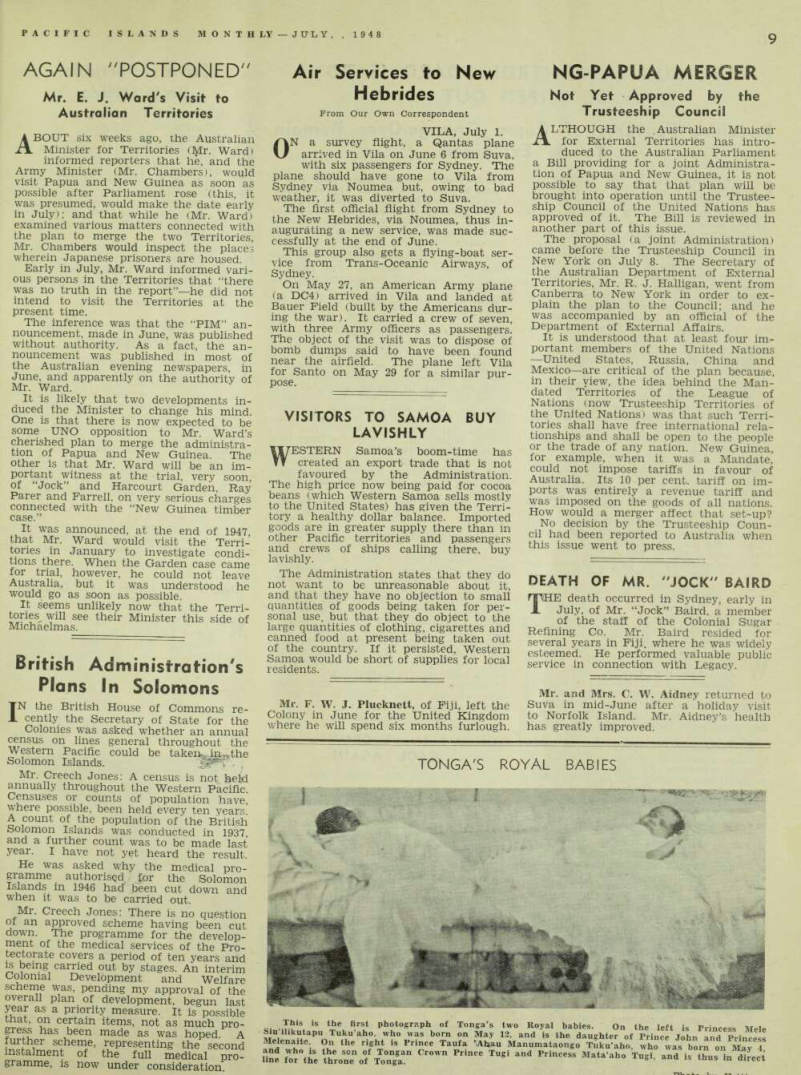
Tonga's Royal Babies
This first Photograph of Tonga’s two Royal babies. On the left is Princess Mele Siu'ilikutapu Tukuaho. who was born on May 12. and is the daughter of Prince John and Princess Melenaite. On the right is Prince Tauta 'Ahau ManumaUongo TSkhu'aho, who was born on May 4, and who is the son of Tongan Crown Prince Tugi and Prince Mata'aho Tugi is thus in direct line for the throne of Tonga. -Photo by Hittig
Advertisements & other items, p. 11 (1 item)
9
PACIFIC ISLANDS MONTH LY JULY, . 1948
Puzzling Features of Copra Change-Over Remain
N. Guinea Control Board Is To
Be Wiped Out
Puzzling Features of Copra Change-Over Remain To Be Explained
IT was announced in the “Melbourne Herald” on June 18 that the Australi an Government would cease to buy copra in New Guinea, and the Production Control Board would be wound up.
Obviously, this new policy will cause a far-reaching change in trading and economic conditions in Papua and New Guinea. For some years all copra pro duced in New Guinea has been com pulsorily acquired by the Board from planters at fixed shipping points in the Territories; planters have been paid prices fixed by the Board, and all such copra has been shipped from New Guinea in vessels under Government control, and has been consumed in Australia.
Three weeks after the announcement the “PIM” made the following enquiries: • Are merchants and traders now free to buy New Guinea copra? • If so, what is to be the price—a figure fixed by world parity, or a price fixed by Canberra? • Under what conditions is this copra to be shipped? • Will non-Government vessels be allowed to go to New Guinea and pick up the copra and take it to the open market, where it is worth £lO or £2O per ton more than Australia has been paying for it? a • How is it proposed to meet Aus tralian copra requirements (at least 20,000 tons p.a.) in the future? Is Aus tralia now going to pay world parity? • How much money has been accumu lated by Mr. Ward since he began to deduct £6 per ton as a ‘‘stabilisation Fund” from Copra payments due to planters? How does he now propose to dispose of this Fund? Is it to be dis tributed, pro rata, among the planters from whom it was taken?
WE were informed, on July 7, that although the announcement from Canberra on June 18 apparently was from official sources, the officials of the External Territories Department knew nothing about any change nor had any steps been taken to end the present system. .. XT , The Companies operating in New Guinea said that there had been no change whatever in the system—copra was still being taken over in New Guinea by the Production Control Board on the same terms and conditions as previously Islands traders on July 7 expressed the opinion that, while the removal of any controls always is good news, it was dif ficult to bee how the changeoyer m respect of New Guinea copra could be managed at the present time, in view of (a) Government control of shipping and <b) Australia’s evident determination to secure most of the New Guinea copra production for her own purposes.
They also were of opinion that copra produced in British Empire countries is not likely to enjoy sales at world parity (United States value) while the Socialists remain in charge of British Government.
And then, on July 9, the following was published in Australian newspapers: CANBERRA, Thursday.—Mr. Ward announced to-day that the Australian- New Guinea Production Control Board is to be wound up.
The board, he said, was established during the war to obtain maximum pro duction of copra and othier tropical jrnods in Panua or New Guinea. Copra
production was now more than 40,000 tons a year, which was approximately two-thirds of potential output. Negotia tions were proceeding with traders to obtain an orderly change-over of marketing under a system of export licences.
No Sydney traders had heard of any “negotiations” on July 10. The Depart ment, no doubt, will get around to them, in time.
Meanwhile, all the above questions re main unanswered.
THE steamer “Lockybank,” early in July, was in Sydney loading about 4,000 tons of New Guinea copra for the British Ministry of Food. This was the first shipment of New Guinea copra from Australia to Europe since the end of the war. It is believed that the ship ment has been made because, although the Australian crushers have been run ning at full capacity, they have not been able to handle all the supplies from New Guinea, which now are in the vicinity of 55,000 tons per annum. It is calculated that, henceforth, any New Guinea produc tion over 25,000 per annum will go to Britain.
It is expected that the “Lockybank ’ will also load copra for Britain in Fiji and Samoa.
Copra-producers generally are keenly interested in the report that one of the Australian Prime Minister’s reasons for visiting London is to bring the Australian £, now 25 per cent, under sterling, closer to parity with the English £.
If the difference in exchange is partly or wholly wiped out, all Australian pro ducers, including New Guinea planters, will suffer accordingly—although they will, of course, be able to buy more goods with their money. But if, simultaneously with the wiping out of the Production Control Board, the planters are permitted to receive world parity for their copra, tney will have no complaint at all—in fact they will be better off.
Tonga's No. 1 Criminal In
Gaol Again
From Our Own Correspondent
Nuku’Alofa. June 16.
TUPOU Ngata, one of the Kingdom's most hardened criminals, received a 7 years’ sentence at the recent sessions of the Supreme Court for house breaking and larceny. In April Ngata and an accomplice, Moses Huni, who was sentenced to 3 years for his share of the crime, broke into the Government dyna mite shed at Siumafoa’uta and stole about 60 cases of gelignite with detonators and fuse. The loot was taken on Hums father’s truck and hidden in caves to be later peddled to Tongan fishermen who prize the stuff as a quick and effective method of catching fish. Fortunately, smart police work resulted in the appre hension of the two offenders with almost the whole of the loot.
Ngata was released only last year aftei serving about 15 years in gaol. During his prison life he participated in several prison breaks. On one occasion he escaped to the island of ’Eua in a canoe, where he defied police searchers for weeks by hiding in the wild and almost inaccessible parts of the island.
Suva's Portable
Post Office
POSSIBLY it is the expected return to trans-Pacific shipping of the “Aorangi,” announced for August, that has inspired the appearance, on the Suva Wharf, on June 18 (when the “Marine Phoenix” called), of an efficient, movable booth constructed by the Public Works Department to provide postal and banking facilities for passengers in large ships. Post-Office and Bank of New Zealand clerks staffed the booth on the first day.
A year ago Suva people complained that on ship days the General Post Office was so jammed with tourists (mostly buy ing stamps) that no one else could get attention.
N. Hebrides Timber
Industry
rpHE Aneityum Logging Company (New 1 Hebrides) intends to expand its operations. It has purchased, in New Zealand, a complete sawmill, which will be dismantled and re-erected on Aneityum. The technician in charge of this job has already arrived on the island.
With the purchase of this sawmill and supplementary woodworking machinery the Company expects to supply all the sawn timber required in the New Heb rides. There are some good stands of Kauri in the southern islands of the group.
The supply of such timber will enable the Condominium Government to go ahead with its building programme, long delayed through lack of building material.
Death of James M. Douglas
Of Taveuni
Mr. James Martin Douglas, Who
died at the Waiyevo Hospital, Taveuni, in May. was one of the few remaining old settlers of the island.
He is survived by a son, Mr. Seth Douglas, and two daughters, Mesdames Fryer and J. Midson, of New Zealand.
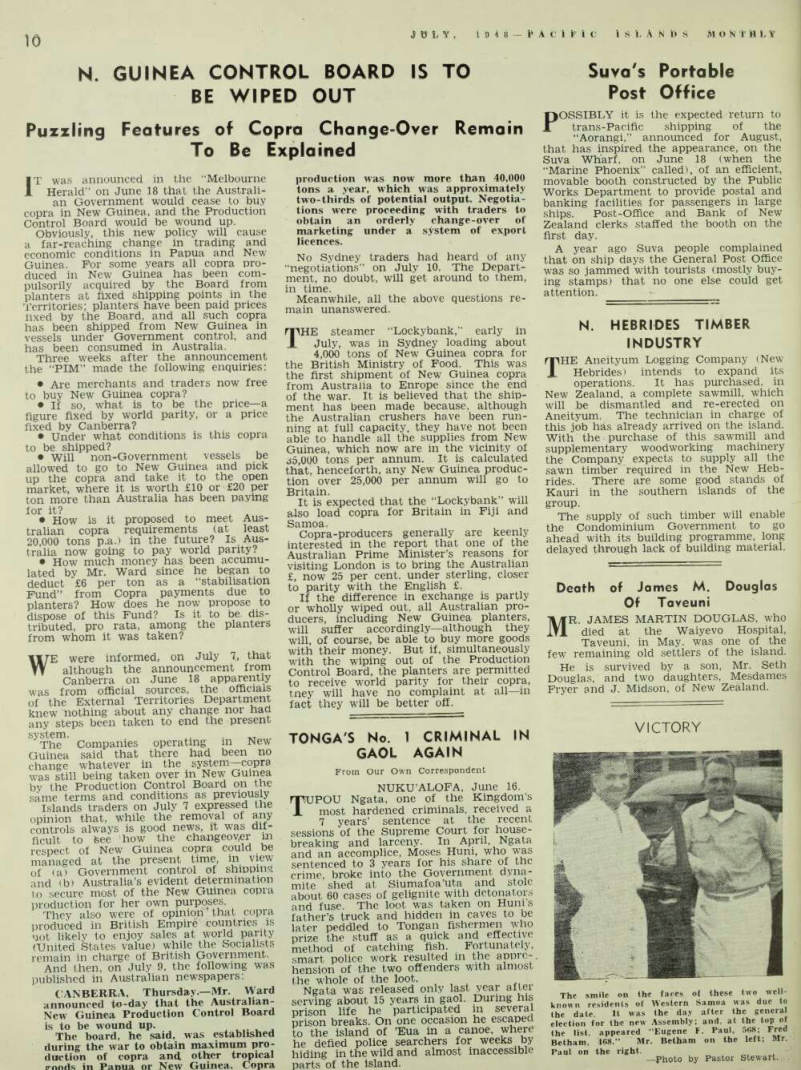
Victory
The smile on the faces of these two well known residents of Western Samoa was due to the date. It was the day after the general election for the new Assembly; and, at the top of the list, appeared “Eugene F. Paul, 568; Fred Betham, 468.” Mr. Betham on the left; Mr.
Paul on the right. —Photo by Pastor Stewart.
Advertisements & other items, p. 12 (1 item)
10
jbtY, 1948 Home islands monthly
GA Wary About Return
To New Guinea
ALTHOUGH Guinea Airways Ltd. has been forced out of its profitable Northern Territory Service (which it developed in 1942-3 after it had been driven out of New Guinea by the Jap invasion) and therefore has funds and equipment available, it has made no move to re-enter the transport industry in New Guinea.
The Chairman (Mr. Sidney Powell) at the Annual Meeting in Adelaide recently, said that they had sent a representative to New Guinea to investigate prospects; but his report made it clear that condi tions there were still too confused to induce the Company to resume opera tions.
“There is the added risk,” said the Chairman, bitterly, “that if, after the considerable expense of establishing an airline, the venture is successful, the Government may take over the business for the benefit of its own airlines.” That, of course, is what happened in the Northern Territory.
Guinea Airways, which is now in a very sound financial condition, “will con tinue to watch developments.”
Popular Territorian Dies
In Sydney
(Mr. Vic Maxwell)
RESIDENTS of New Guinea, of both old and new vintage, were grieved to hear of the death of Mr. Victor Maxwell, in Sydney, on June 13, after a long and painful illness.
He went to New Guinea soon after World War I and owned, for some time, one of the Ex-Pro Board properties in
northern New Ire land. Later, he was secretary of the Kavieng Club and. during this time, made many of his New Guinea friendships, which lasted throughout his life.
From Kavieng he went to Bogadjim, when the rubber market was at a low ebb.
He leased a Car penter plantation there and de
/eloped one of the few rubber plantations n the Mandated Territory—Maxwell was, n fact, recognised as the authority on Slew Guinea rubber planting. He in dented a process for smoke-treatment of scus rubber, which is liable to be blown >y hies. He was planting up further areas Df rubber near Bogadjim when the Pacific war came.
Since the war he has been manager )f the Production Control Board’s Rabaul jranch. He was in Sydney last year for in operation and later returned to ■labaul, full of hope. He was, however, jack again within a few months.
His Territory experiences were varied md wherever he went his pleasant per onality won him a host of friends. The Jaxwell home was always noted for its lospitality.
He is survived by his wife and his two laughters (Mrs. Don Maclean and >iane)) and three grandchildren.
Mr. V. Maxwell.
NZ Vice-Regal Party
True Islands
Welcome
NZ Vice-Regal Party Spend Happy Day in Tonga
The Special Correspondent of the NZ Press Association supplied the fol lowing excellent report of the visit to Nukualofa, Tonga, on July 3, of the Governor-General of New Zealand (Sir Bernard Freyberg, VC) and Lady Freyberg: SMOKING earth ovens of a dozen native villages poured out food for a feast with which Queen Salote and her 40,000 people of the independent island kingdom of Tonga honoured the Governor- General of New Zealand, Sir Bernard Freyberg, VC, and Lady Freyberg on July 3. Garlanded with flowers. Their Excellencies sat cross-legged at either hand of the Queen at the head of laden tables that could have fed an army battalion.
Local European residents and the New Zealand visitors, including a group of officers from the cruiser “Bellona.” were received with lavish hospitalitv on a scale typical of Tonga. The cloth of banana leaves before which they were seated displayed more than 20 separate dishes. Two hundred pigs toasted to crisp brownness on the spits lay end to end along the table. They were supple mented by 300 chickens, ducks and tur keys, a whole roasted bullock split in to massive joints, five tons of cooked yams and taro roots, and a selection of the islands’ fish, turtle, crabs, lobsters and shellfish.
Speech of Welcome For dessert there was a salad contain ing eight different fruits and a pudding prepared from squares of fresh tapioca and wrapped in green leaves with a sauce of sugared coconut milk. Juices of oranges, pineapples, grapefruit, lemons and coconut served as beverages.
While the guests picked with their fingers at the vast repast and a Govern ment band played “Colonel Bogey” and other familiar British marches, the Queen delivered a lengthy speech of welcome, in which she expressed Tonga’s affection for Britain and gratitude for the constant assurance of defence from Britain and New Zealand. She recalled the prompt action taken to garrison the islands when the kingdom was threatened bv Japanese invasion.
Entertainers Perform The kingdom’s most accomplished enter tainers then performed for two hours in the cool of the Queen’s 600-acre palm studded estate. Beyond the parties of capering warriors and graceful women dancers the guests looked across a tongue
of a sparkling lagoon to Mua, the old capital of Tonga, where Salote’s ancestors had established their rule before the Normans conquered England and where Captain Cook made his first contact with what he called the Friendly Islands in 1773.
The “Bellona” anchored at ten o’clock on the morning after the 24 hours’ voyage from Suva. On disembarking. Sir Bernard and Lady Freyberg were met by the Premier, the Hon. Ata. and members of the Tongan Cabinet and. with the British agent and consul, Mr. C. W. T.
Johnson, proceeded to the palace. Beneath the heraldic Royal Standard quartered in brilliant gold, red and blue, Sir Bernard inspected a bare-footed Royal guard and was received by the Queen before return ing to the residency to talk for an hour with 50 Tongan and European ex-Service men of the First and Second World Wars.
These included the Minister of Police, the Hon. Akaulola.
Heroes of Solomons Battle Each wearing the ribbons of the British Military Medal and the Ameri can Silver Star, two young Tongans, Johnny Inukinuhaanga and Simote Viamahi, were introduced as the Tongan heroes of the Battle of the Solomons.
Operating as jungle commandoes, they won their awards when the American patrol with which they served was ambushed by a strong force of Japanese.
The' patro/’s two officers were badly wounded, but the two Tongans stayed with them under heavy fire, dragged them a long distant to safer cover and alone kept up the fight with a vastly superior Japanese force. With hand grenades they inflicted heavy casualties on the enemy, as well as saving the lives of their American commanders.
Vice-Regal Tour
Argument in Samoa
APIA, July 1.
PREPARATIONS are being made now for the visit of the Governor-General of New Zealand, Sir Bernard Freyberg, on July 12. A large Samoan ta’alolo is planned for the occasion; but there seems to be some hitch now, as the people of Savai’i are reported to have declined to come to Apia for the occasion.
The argument is that the visit would involve thousands of them in great ex pense, especially as they would have to bring their food with them. They main tain that if the Governor-General can go to the Tokelau Islands (with about 2,000 inhabitants) he can just as well visit the island of Sava’ii, with 25,000 people. The whole of the Cook Islands group has only 20.000 inhabitants—less than Savai’i. (See also page 28, this issue).
Mr. and Mrs. T. P. Byrne, who recently were married in Queensland, have now made their home in Lae, New Guinea.
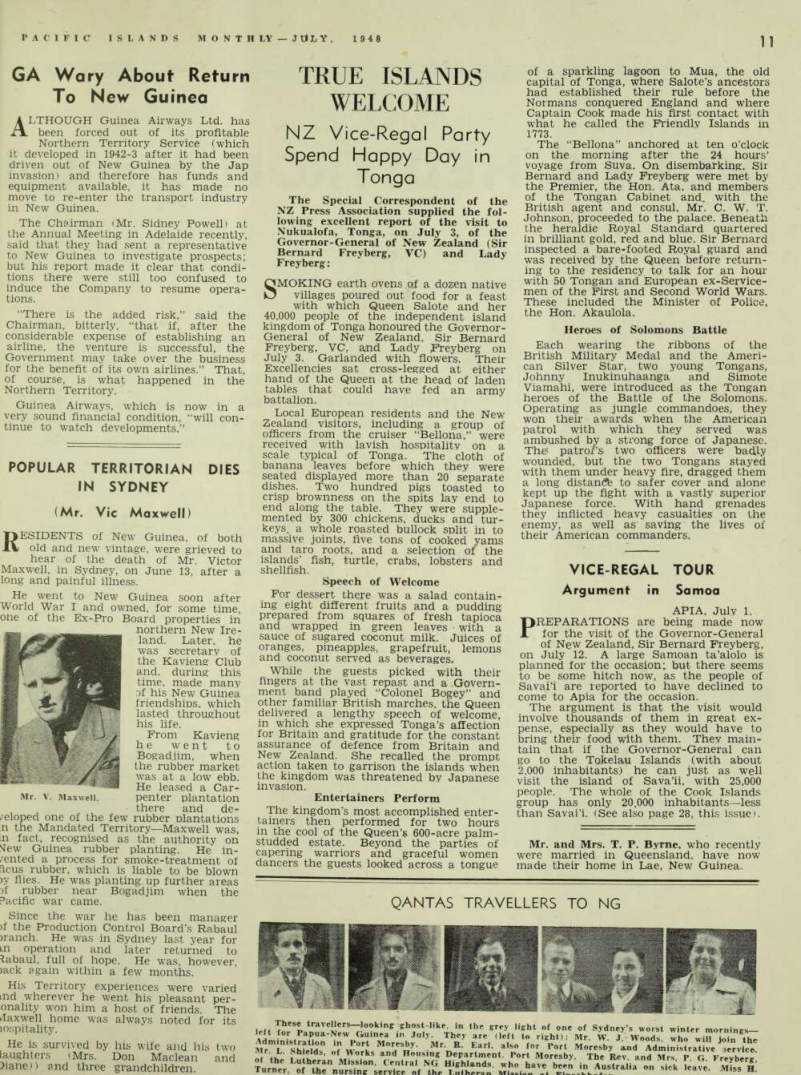
Qantas Travellers To Ng
These travellers-looking ghost-like, in the grey light of one of Sydney's worst winter moringes left for Papua-New Guinea in july. They are (left to right): Mr. W.J. woods, who will join the Administration in Port Moresby. Mr. R. Earl, also for Port Moresby and Administrative service.
Mr L. S h ields, of Works and Housing Department, Port Moresbu, The Rev, and Mrs. P.G. Freyberg, of the Lutheran Mission, Central NG Highlands, who have been in Australia on sick leave. Miss H.
Turner, of the nursing service of the lutheran Mission at [?]
Advertisements & other items, pp. 13-14 (2 items)
11
PACIFIC ISLANDS MONTH LY JULY, 1948
Morris Hedstrom Limited
General Merchants, Importers and Exporters,
Shipowners, Plantation Owners,
Commission and Insurance Agents
HEAD OFFICE
SUVA, FIJI
Established 1868
SERVICE IN THE SOUTH PACIFIC TERRITORIES
'JpHROUGH our Large Establishments in Suva and our Numerous Branches, we distribute a wide and comprehensive range of General Merchandise and provide almost every kind of service. Our departments and associated businesses include:
DRAPERY
MOTOR SALES
AND SERVICE
TOBACCO
TIMBER AND
BUILDING
GROCERY
CONFECTIONERY
HARDWARE
ELECTRICAL
LIQUORS
DRUGS
Branches Throughout Fiji, Samoa and Tonga
There is a Branch or Agent of Morris Hedstrom Limited in every Town in the Three Territories.
We are Sole Agents in these Territories for British Drug Houses Ltd.
Electrolux Ltd.
Ford Motor Co.
General Electric Co. Ltd.
Goodyear Tyre & Rubber Co.
B. A. Hjorth & Co. (Primus Products) Imperial Chemical Industries Ltd.
International Harvester Export Co.
Matson Navigation Company Max Factor and Co. Inc.
Ransomes, Sims & Jefferies Ltd Ruston Cr Hornsby Ltd.
Vacuum Oil Co. Pty. Ltd.
Yorkshire Copper Works Ltd.
Morris Hedstrom Limited, are LLOYD'S AGENTS in Fiji and Samoa.
IN AUSTRALIA:
Mom's Hedstrom <Aust.) Pty. Ltd.,
Asbestos House, 65 York Street, SYDNEY
IN GREAT BRITAIN:
Morris Hedstrom Limited,
Africa House, Kingsway, LONDON
Scott
Death Of John H.
Victim of Filipino Resentment of Colour Bar
A MEMBER of the United States Ser vices, in a private letter to the editor of the PIM, throws some fur ther light upon the death of Mr. John Scott (a sectional manager for New Guinea Goldfields Ltd.) by a Filipino soldier, in Lae, New Guinea, last New Year’s Eve. This American has been en gaged in special work in the Pacific, in the course of which he has travelled extensively with Filipinos enlisted in the US Army. He formed an intense dislike and contempt for the Filipino Scouts (as they are called) and their filthy, unpleas ant habits. He proceeds: “While we were proceeding south we met a northbound United States boat, which was transferring an American Search Team from Lae to Manokwari (in Dutch New Guinea). This was when I heard first of the Lae incident—and it made my blood boil.
“This was a Team in the command of an American-Mexican officer —he had about two American assistants and the rest were Filipino Scouts. These Scouts were accustomed to going to dances and buying liquor and other ‘diversions.’ They had plenty of licence in other Territories —but this did not go so well in the Aus tralian Territory, and in Lae they noticed the coldness of the Europeans towards them. But the American-Mexican offi cer assured them in Lae that they were as good as the next man —and this in turn encouraged them in their arrogance.
“It was the offensive attitude of these Filipinos which caused a brawl at a New Year’s Eve dance in Lae and, as a result, an outstanding citizen of Lae was struck on the head with a bottle by one of these Scouts, and died from his injuries.
“I understand that there has been a lot of jabbering between Washington.
Canberra and Manila in regard to this incident and the trial of the Filipino.
The last word of it I heard was that the Filipino had been let off, as he had killed in self-defence.’
“In Manila, according to the news papers, the killing of an American is no 1 " an uncommon thing and the stealing of Army jeeps, at gun-point, is so frequen; as to be hard to bear.
“On our way south, we called at Dutch New Guinea, and the officials there thought we were taking the Lae incident too seriously. In Finschhafen. however, we found the officials very cold on the subject.
“We were told that the people of Lae were so infuriated over the death of Mr.
Scott that they had been anxious to go after the Filipino Scouts with rifles and dynamite; so we decided that it would not be wise to take our party of Filipino Scouts into Lae, and we gave it a miss.
“When we got to Port Moresby we were advised by American Army officials not to allow our Scouts off the ship unless they were under escort. A police officer escorted three truck-loads of them to Rouna Falls; but during most of the week we were at Port Moresby the Fili pinos remained on the ship.”
However, it appears that in spite of precaution a number of incidents did occur in Port Moresby, and the party of Filipinos eventually, on the advice of American officers, “were bundled off to Dutch New Guinea, where the Govern ment has a more kindly attitude to wards this class of native.”
Trial Of The Filipino
THERE have been several reports re cently in Australian newspapers about the way in which the Filipino soldier escaped trial and puftishment.
Here is a correct report, from official sourcesi “Eduardo Bahinting, a Filipino Scout, was several months ago charged, ‘that he did unlawfully kill one John Harcourt Scott.’ He was tried by the District Court at Lae, Mr. J. Costelloe, JP, ADO, as Magistrate. Mr. McCubbery, Deputy Crown Law Officer appeared for the Crown, and an American barrister, Capt.
Maul, US Forces, appeared for Bahinting.
The Magistrate ruled that his Court had jurisdiction over the Filipino Scout and the case was heard. The case was dis missed on the grounds of ‘insufficient evidence.’ An appeal has been lodged by the Crown with the Supreme Court, on the grounds that an incorrect ruling on a point of law was given. The appeal has not yet been heard. The Filipino was removed from TNG when he was dis charged at the Lower Court hearing.”
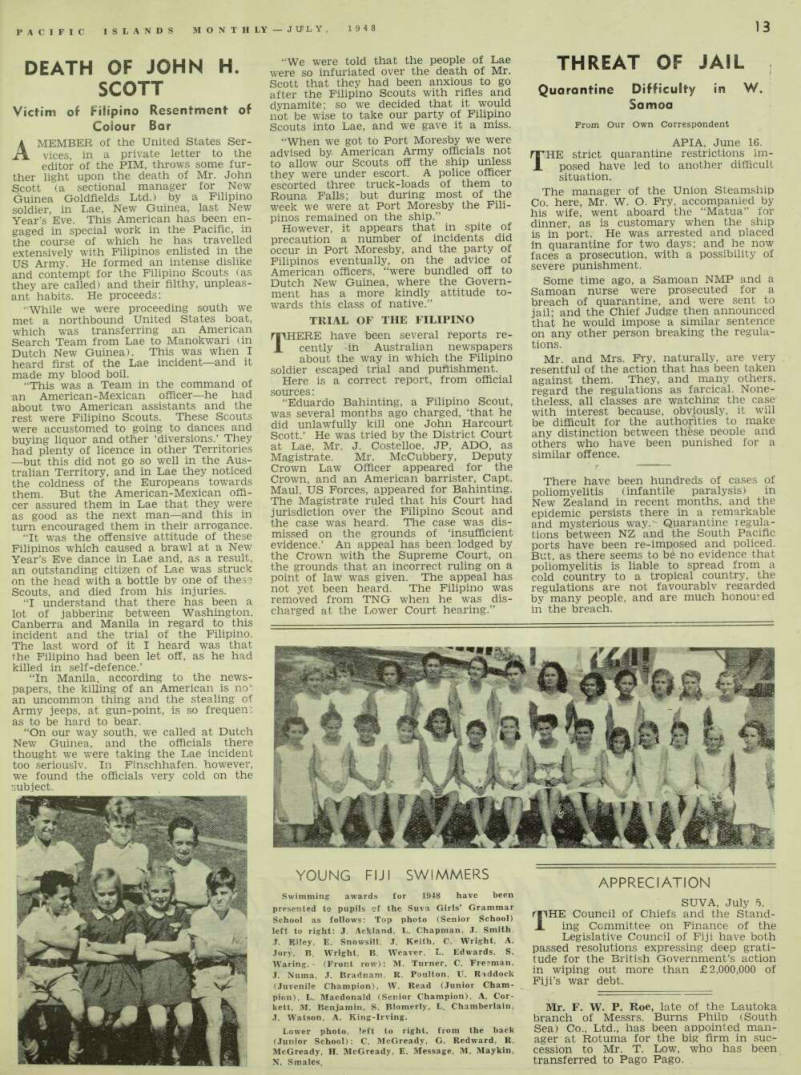
Oung Fiji Swimmers
Swimming awards for 1948 have been presented to pupils of the Suva Girls’ Grammar School as follows: Top photo (Senior School) left to right: J. Ackland. L. Chapman, J. Smith J. Riley, E. Snowsill. J. Keith, C. Wright. A.
Jory. B. Wright. B. Weaver, L. Edwards, S.
Waring. (Front row): M. Turner, C. Freeman, J. Numa, J. Bradnam. R. Poulton, U. Ruddock (Juvenile Champion), W. Read (Junior Cham pion), L. Macdonald (Senior Champion), A. Cor kett, M. Benjamin, S. Blomerly, L. Chamberlain, J. Watson, A. King-Irving.
Lower photo, left to right, from the back (Junior School): C. McGready, G. Redward, R.
McGready, H. McGready, E. Message, M. Maykin, N. Smales.
Threat Of Jail
Quarantine Difficulty in W.
Samoa
From Our Own Correspondent APIA. June 16.
T!HE strict quarantine restrictions im posed have led to another difficult situation.
The manager of the Union Steamship Co. here, Mr. W. O. Fry, accompanied by his wife, went aboard the “Matua” for dinner, as is customary when the ship is in port. He was arrested and placed in quarantine for two days; and he now faces a prosecution, with a possibility of severe punishment.
Some time ago, a Samoan NMP and a Samoan nurse were prosecuted for a breach of quarantine, and were sent to jail; and the Chief Judge then announced that he would impose a similar sentence on any other person breaking the regula tions.
Mr. and Mrs. Fry, naturally, are very resentful of the action that has been taken against them. They, and many others, regard the regulations as farcical. None theless, all classes are watching the case with interest because, obviously, it will be difficult for the authorities to make any distinction between these people and others who have been punished for a similar offence.
T There have been hundreds of cases of poliomyelitis (infantile paralysis) in New Zealand in recent months, and the epidemic persists there in a remarkable and mysterious way.'- Quarantine regula tions between NZ and the South Pacific ports have been re-imposed and policed.
But, as there seems to b 6 no evidence that poliomyelitis is liable to spread from a cold country to a tropical country, the regulations are not favourablv regarded by many people, and are much honouied in the breach.
Appreciation
SUVA, July 5. mHE Council of Chiefs and the Stand- X ing Committee on Finance of the Legislative Council of Fiji have both passed resolutions expressing deep grati tude for the British Government’s action in wiping out more than £2,000,000 of Fiji’s war debt.
Mr. F. W. P. Roe, late of the Lautoka branch of Messrs. Burns Philp (South Sea) Co., Ltd., has been appointed man ager at Rotuma for the big firm in suc cession to Mr. T. Low, who has been transferred to Pago Pago.
Advertisements & other items, pp. 15-16 (2 items)
13
PACIFIC ISLANDS MONTH LY JITLY, 1948
Pa/v American
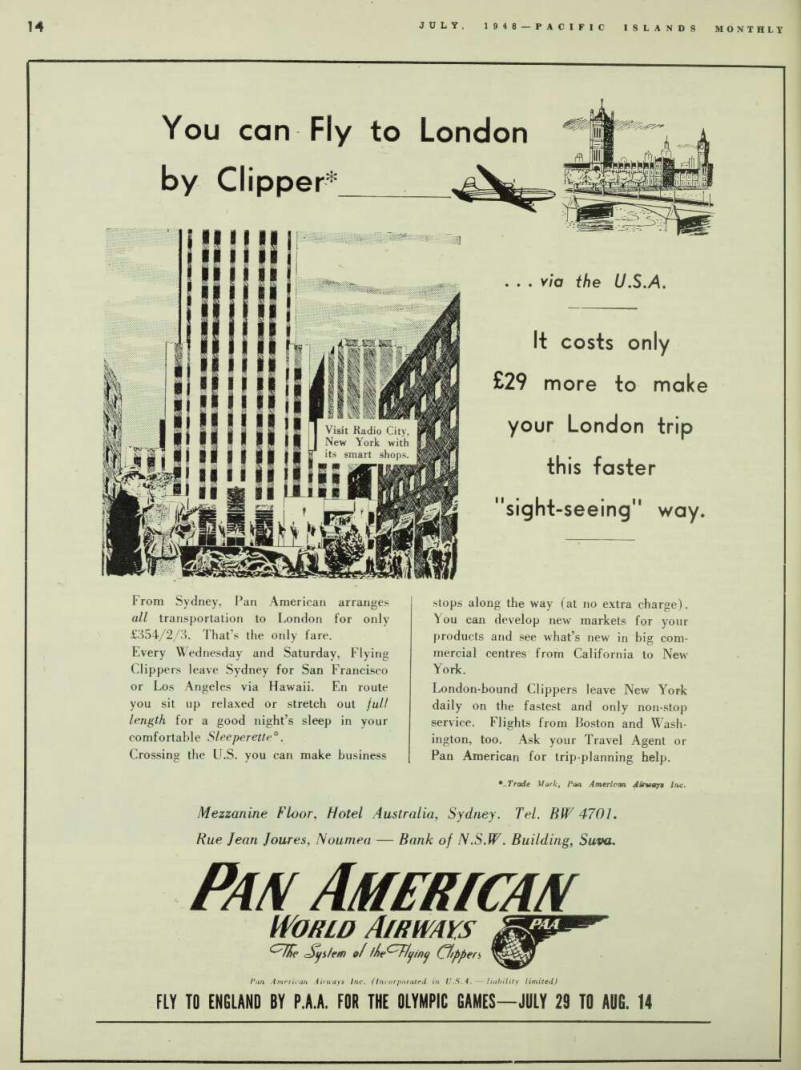
You can Fly to London
by Clipper
i .*
i ii i
li i
ii Vi v ii ! i: Visit Radio City, New York with its smart shops.
II l
SL lMt ,
. Wo f/ie U.S.A.
It costs only
£29 more to make
your London trip
this faster
"sight-seeing" way.
From Sydney, Pan American arranges all transportation to London for only £354/2/3. That’s the only fare.
Every Wednesday and Saturday, Flying Clippers leave Sydney for San Francisco or Los Angeles via Hawaii. En route you sit up relaxed or stretch out full length for a good night’s sleep in your comfortable Sleeperette*.
Crossing the U.S. you can make business stops along the way (at no extra charge).
You can develop new markets for your products and see what’s new in big commercial centres from California to New York.
London-bound Clippers leave New York daily on the fastest and only non-stop service. Flights from Boston and Washington, too. Ask your Travel Agent or I Pan American for trip-planning help. *-Trade Mark, Pan American Airways Inc.
Mezzanine Floor , Hotel Australia , Sydney. Tel. BW 4701 .
Rue Jean Joures , Noumea Bank of N.S.W. Building, Suva*
Pa/v American
Would Airways
cSysfem of dippers
Pan American Airways Inc. (Incorporated in U.S.A. liability limited) FLY TO ENGLAND BY P.A.A. FOR THE OLYMPIC GAMES—JULY 29 TO AUG. 14
Papua-NG
"Bulolo" Will Re-enter
Service in Mid-August
HAVING been completely refitted in Britain, the Burns, Philp motorship “Bulolo” reached Fremantle (Western Australia) on July 14 on her way to Sydney, prior to taking up the Papua- New Guinea service in mid-August.
The “Bulolo” (6,000 tons), under charter to the Blue Funnel Line, brought out a full complement of passengers and a large cargo from England and is expected in Sydney on July 23. She will be un loaded, restocked, inspected and made ship-shape before being formally handed back to her owners. Burns. Philip and Co., Ltd. Almost nine years ago she was commandeered by the British Admiralty for war duties and, as a fast armed merchant cruiser, gave notable service in European waters.
On a five-weekly schedule, she will maintain the Papua-New Guinea service from Sydney, calling at Brisbane, Port Moresby, Lae, Rabaul, Port Moresby and return direct to Sydney.
During her voyage to Australia from the UK, the “Bulolo” was under the com mand of Captain Duddell; but it has not vet been decided whether he shall con tinue as skipper on her Islands’ run.
"Aorangi" Resumes on August 19 AFTER a long break, a regular British trans-Pacific shipping service will operate again, with the departure of the Union Steam Ship Co’s “Aorangi” from Sydney on August 19. Details of her timetable for nine months ahead a v e published in our shipping columns in this issue.
Hitherto, since the war, the American Matson Line vessel “Marine Phoenix” has been the Sydney-Suva-USA link: she makes her final trip to San Francisco from Australia on July 30. Future plans of the Matson Company for the trans pacific run are indefinite —the Sydney office, at the moment, is awaiting the re turn of the Branch Manager, Mr. Neil S.
Laidlaw, who has been in USA con ferring with Matson headquarters officials.
Trans-Tasman Traffic
PROSPECTS of an increase in shipping facilities across the Tasman, between Australia and New Zealand, by which Islands travellers connect with the Union Line’s “Matua” (for Fiji, Tonga, Niue, and Samoa) and the NZ Government’s “Maui Pomare” (for the Cook Islands. Niue and Samoa) are not bright—until the end of the year.
Reconditioning work on the Huddart Parker liner “Wanganella,” which ran on a reef at the entrance to Wellington
(NZ) in February, 1947, have been severely handicapped by a shortage of skilled labour. She is expected to re-enter the trans-Tasman trade late in November.
On present indications, the Union Steam Ship Company will put the NZ inter-island vessel “Wahine” into dock shortly and then transfer her to the Sydney-NZ run.
The Union Company is hopeful that the “Monowai,” now in dock in Sydney, will be ready to take up regular running across the Tasman in November.
German-Samoan Elected to New
Council
APIA. June 20.
OFFICIALDOM became a little upset when the Samoans of Aana District (on the west coast) elected T, Nauer, a man of German-Polynesian birth, as their representative in the new Legislative Council.
Because he had German nationality, he was interned during the war. On his return, he obtained Samoan status and a Samoan title, Tofa. The Administra tion objected to his appointment, at first, and thereby caused a stir. But finally Mr. Bauer was allowed to take his seat, conditional on his obtaining British naturalisation.
It was a difficult, but a wise decision.
Mr. Bauer is a good type of man, held in general respect, and he has considerable influence among the Samoans.
Advertisements & other items, p. 17 (2 items)
15
PACIFIC ISLANDS MONTH IT —JU, L Y , 1948
Yorkshire
THE
INSURANCE
CO. LTD.
(Incorporated in England)
ALL CLASSES OF
INSURANCE
Including Fire Motor Guarantee Accident Workers Marine Island Representatives:
PORT MORESBY: E. A. James
RABAUL: G. B. Black LAE: Morobe Transport Co. Ltd.
MADANG: R. MacGregor SUVA: Williams & Gosling Ltd.
NOUMEA: Y. Mortensen
NORFOLK ISLAND:
A. E. Martin
BURNS PHILP (New Hebrides) LTD.
Registered Office: VILA, NEW HEBRIDES
Branch Office at SANTO
Exporters, Importers and General Merchants
(Retail and Wholesale) Commission, Shipping
and Customs Agents
Representatives for QUEENSLAND INSURANCE CO., LTD., and LLOYDS OF LONDON. Agents for SOCIETE DES PETROLES SHELL DES ILES FRANCAISES DU PACIFIQUE, and numerous overseas manufacturers of all classes of merchandise.
Sydney Agents: Burns, Philp & Co., Ltd., 7 Bridge Street.
San Francisco Agents: Burns, Philp Co. o( San Francisco, Matson Building. 215 Market Street, London Agents: Burns, Philp & Co., Ltd., 35 Crutched Friars, EC.3.
t* k 1 Bond Street, Sydney, Australio £ t Vi) -y U jfl VTel. B 4167. Box 3615 G.P.O.
SUPPLIERS OF GENERAL MERCHANDISE TO LEADING FIRMS THROUGHOUT THE
PACIFIC ISLANDS
Exporters ... Importers ... Manufacturers' Representatives L Bankers; Bank of N.S.W, Bank of Adelaide. Comptolr Nat. d’Escompte de Paris.
Cable Address: “SEAPOODS,” SYDNEY.
Codes: Bentley’s, 2nd and Comp. Phrase; A.8.C., sth and Bth; Peterson, 2nd and 3rd; Banking; Acme.
Bulolo Gold
IN the month of May, six BGD dredges (New Guinea) handled 740,000 cubic yards of gravel for a total recovery of approximately 5,766 ounces of fine gold.
Public works envisaged in Tahiti are to cost 87,000,000 francs, towards which the Colony will contribute over 45.000,000 and France the remainder. The cost of estab lishing the Bora Bora airport, amounting to 1,500,000 francs, is to be borne by the Metropolis.
Geological Survey
SUVA, July 5.
THE Director of Colonial Geological Surveys (Dr. Frank Dixey, OBE) will visit Fiji soon to discuss plans for a geological survey of Fiji and Western Pacific High Commission terri tories.
The Administrator of Papua-New Guinea, Colonel J. K. Murray, and Mrs.
Murray returned from Australia on June 12. They had been away for about five weeks.
To Treat Coconut
Fibre
New Co. In N. Hebrides
Prom Our Own Correspondent A GROUP of business men and planters has formed, in Vila, a company under the name of “Fibroco.”
This company intends to treat coconuts, principally for the fibre—the making of copra will be only a side-line. Modern machinery for this purpose has been im ported from England, and is now in the course of installation.
The Company will operate on a fairly extensive scale and a ready market for its products is believed to be assured.
Cook Islonds Workers
and Mr. Harold Ward
Letter to the Editor AS one interested in events in the Cook Islands over the past two and a half years, and associated with the efforts to establish the Cook Islands Industrial Union of Workers (an affiliation of the New Zealand Federation of Labour), per mit me to endorse the sentiments ex pressed by your correspondent, “Quarter Century Cook Islands.” in the “Pacific Islands Monthly,” of April, 1948, regard ing the constructive activities of Mr, Harold Ward on behalf of the people of the Cook Islands.
In your editorial note you state, “If Mr. Ward, no matter how good his motives, should ally himself with our enemies, he cannot hope to escape criticism.” I am sure all your readers will agree that “if” and “should” he do so there is no hope of escape from critic ism and possibly worse.
In justice to Mr. Ward, we would be pleased if you would publish the follow ing extract from the report of the two delegates of the New Zealand Federation of Labour (T. Anderson and K. Baxter) who went to the Cook Islands in June, 1946: “It was Mr. Ward, more than any other person or organisation who was instrumental in investigating the shock ing conditions under which native volunteer labourers from Rarotonga were required to work on the French phosphate island of Makatea. We de sire to record our indebtedness to Mr.
Ward, whose help in bringing us into contact with the workers at Rarotonga facilitated what otherwise might have been an impossible task.”
It was per medium of the RSA and the Teachers’ Guild organised by Harold Ward that contact with the people of Rarotonga was made, and the instructions from the CIPA “headquarters” in Auck land not to recognise the official New Zealand trade union delegation was largely defeated, an increase in the wage rates of the waterside workers conceded, regula tions gazetted, and a union later registered giving workers the right to organise.
As one who has been closely associated with many phases of trade union activity and working-class thought in Australia and New Zealand over a period of 35 years, I failed to observe the remotest as sociation or sympathy by Mr. H. Ward with any ideology on the “Left” or the “Right.” On the contrary, it was evident to T. Anderson and myself that Mr Ward’s activities were evidence of a genuine desire to further the welfare of all of the peoples in the Pacific Islands.
I am, etc.,
K. Baxter.
Sec., NZ. Federation of Labour.
Wellington, June 2, 1948.
Advertisements & other items, pp. 18-19 (3 items)
Bank Of
HOW THE WALES’" WORKS
Branch Series No. 4
file Teller
Generally, the best-known man in any Branch of the "Wales” is the teller, with whom nearly every client comes into contact.
You will have admired the ease with which the teller handles cash, his
familiarity with the sig
natures of many cus tomers, his cheerful
greeting and his willing
ness to assist you.
The teller’s job calls for more than a pleasing manner. He must handle large sums of cash with speed and accuracy and he needs a sound know ledge of the law relating to cheques. " Wales ” tellers are chosen for their personality and
ability.
BANK OF
NEW SOUTH WALES
FIRST BANK IN AUSTRALIA
Mr. G. W. Clarke-Hall, D.F.C.
Teller, Lake Grace (W.A.) Branch. Joined the Bank in 1931. Served 5 years with the
R.A.A.F.
Consult and use Incorporated in New S.outh Wales with limited liability A 46 09D°™
17
PACIFIC ISLANDS MONTH LY - JtJLY, 1948
Hercules
SUPER-STRONG TOYS
Assorted Colours
ALL-STEEL, SEMI-MECHANICAL
FOR IMMEDIATE DELIVERY
NO. 19—“ JUMBO” CATERPILLAR TRACTOR.
Proclaimed by retailers the finest toy produced in this country.
Travels over grass, gravel, ruts, ditches, etc., by self-propelled caterpillar tracks. Suitable for children 3-11 years. Length, 29 in.; height, 13 in.; width, 14 in.; weight, 28 lb. a j U * =n 0 o v^ At YA m \ % ’X. a 0 © (I) TOMMY TORTOISE. (2) TELEPHONE. (3) FARM TRACTOR.
C 4) CAT. TRACTOR. (5) SHEEP-WAGON (4) BULLDOZER.
VJV 17) TRACTOR-LOADER. (8) PETROL WAGON. (9) ROAD-ROLLER.
HO) TRANSPORTER. (11) GRADER. (12)POWER-SHOVEL. /
OBTAINABLE AT
OVERSEAS DISTRIBUTING AGENT;
HARRY J. YOUNG PTY. LID
379 KENT STREET, SYDNEY
NO. I—TOMMY TORTOISE.
The two-year-olds toy. Head and legs waggle when pulled along. Length, 10 in.; weight, 1 lb.
NO. 2—AUTOMATIC TELEPHONE.
Body contains dialling bell and money box. Steel construction, with bright plastic handle. Two toys in one.
Length, 7 in.; height, 4 in.; weight. 1 lb.
NO. 3—“ KOALA” FARM TRACTOR.
A sturdy toy of realistic design and rugged construction.
Length, 12 in.; height, 7 in.; weight, 2V 2 lb.
NO. 4—“ KOALA” CATERPILLAR TRACTOR.
Fitted with Hercules patented steel tracks. A model of a real tractor. Length, 12 in.; height, 6 in.; weight, 2>/ 4 lb.
NO. S—“KOALA” SHEEP WAGGON.
A farmer’s vehicle for transporting stock. Two tiers— sliding door at rear, and sheep race. Length, 13 in.; height, 5 in.; weight, 2 lb.
NO. 6—’’KOALA” BULLDOZER.
Hercules patented steel tracks and an angle blade.
Realistically forms roads and shifts spoil. Length, 14 in.; height, 6 in.; weight, 2Vz lb.
NO. 7—“ KOALA” TRACTOR-LOADER.
This scoop is operated by pressing a lever. Spoil is automatically tipped at top of stroke. A fascinating toy.
Hercules patented steel tracks. Length, 12 in.; height, 8 in.'? weight, 2 lb.
NO B—“KOALA” PETROL WAGGON.
A smart 6-wheel vehicle; carries a tank which holds water. Can be emptied with hose at rear. A very popular toy. Length, 13 in.; height, 5 in.; weight, 2Vz lb.
NO. 9—“ KOALA” ROAD-ROLLER.
A sturdy, nicely designed toy. Dual fly-wheels revolve when machine moves. Roller steers. Length, 13 in.; height, 9 in.; weight, 3y 2 lb.
NO. 10—“ KOALA” VEHICLE TRANSPORTER.
For shifting machinery from job to job. Sub-chassis of vehicle is hinged, forming a loading ramp, operated by a winch. Sub-chassis drops to level when load passes pivot point. Length, 21 in.; height, 5 in.; weight, 3 lb.
NO. 11—“ KOALA” ROAD-GRADER.
A model of a road maintenance machine. Blade angle adjusted by rod on toy. Length, 16 in.; height, 7 in.; weight, 23/ 4 lb.
NO. 12—“ KOALA” POWER SHOVEL.
The 'ooom is rod-operated, enabling soil or sand to be scooped, cab and boom swing on turntable—load is dumped by pulling cord. Pitted with patented Hercules steel tracks.
Length, 14 in.; height, 12 in.; weight, 2 lb.
Postal Address: Box 3661, G.P.0., Sydney
Bankers: Bank of N.S. Wales.
Codes:
Bentleys Comp-Phrase,
Bentleys Second Phrase.
Fiji Spca Wages War
SUVA, June 14.
A STEADILY mounting number of convictions for needless cruelty to animals, may be accepted as evidence of police co-operation with the battle being waged by the SPCA. The society was established by Mrs. Dunoon Kirk in
north-west Viti Levu in the face of a vast public indifference.
The latest case ended with the gaoling of three Lautoka Indians, for a month, for callously driving a bullock with a broken leg.
As part of its campaign to stir up the public conscience, the SPCA is planning a “Be Kind To Animals” Week for July 25 to July 31.
Unlikely
Union Of Samoa
Eastern Islanders Prefer American Rule
Prom Our Own Correspondent APIA, July 1.
IHAD the opportunity, when the chiefs from Eastern Samoa were visiting Western Samoa for the initiation of the new form of government here, of dis cussing with the visitors the suggestion that they should break loose from the American administration and join up with the Western Samoans, thus to make a united and stronger Samoa.
I found that these American Samoans are unanimously against anything of the sort. In spirit and in sentiment they are one with Western Samoa; but the econ omic factor is their chief consideration.
They point out that the Americans always have been generous in providing money for schools, public works and all kinds of services in Eastern Samoa, and they had subsidised the Matson Line, to make a regular call at Pago Pago. This American money has kept them prosper ous. The Eastern islands are rocky and, unlike the Western islands, are unsuit able for the production of anything more than a limited amount of copra.
Furthermore, these chiefs have influ ential positions in their local administra tion, which they probably would lose if they joined up in a united Samoa, under the domination of Apia.
They are friendly and sympathetic— but they will remain under the American flag.
Advertisements & other items, p. 20 (2 items)
Err Bros Ptu Ltd
Box 3838 GPO, Sydney. Australia.
Cable Address, “Care” Sydney.
ISLAND MERCHANTS
ERR BROS PTU LTD
4 YORK ST., SYDNEY
All kinds Island Produce sold on commission. All merchandise purchased, at best wholesale price and original invoices supplied.
Use our 50 years’ experience as Island Merchants.
J
Six -21 Brownie
*fdm
HERE AGAIN!
-the Best-Selling BROWNIES
Presenting one of Britain’s newest additions to the famous Brownie family —
SIX -21 BROWNIE
MODEL C
Following in the footsteps of its popular and fast-selling predecessors, the Brownie Model C is here in full supply . . . attractive, well-made, and efficient . exactly what your customers have been waiting for.
Don’t miss this opportunity—benefit by the famous Brownie name for reliability.
SEND IN YOUR ORDER NOW
KODAK (A/asia) Pty. Ltd.
379 and 386 George Street, Sydney, Newcastle, Katoomba, and all States.
Territories
Union For The Australian
New Bill Provides Administrative Machinery For Papua and N. Guinea
A BILL to formally approve the Trusteeship Agreement for the Territory of New Guinea, in sub stitution for the terms of the Mandate from the League of Nations, and to pro vide for the permanent administration of that Territory in an administrative union with the Territory of Papua, was introduced in the House of Representa tives, Canberra, on June 17, by the Minister for External Territories, Mr.
Ward. The Bill passed the first reading stage; and will be further dealt with by tne Australian Parliament at the September-October session.
Before the 1939-1945 War, each Terri tory had its own administration, with separate public services and adminis trators. Following the Japanese invasion these administrations were suspended, and a Military administration carried on from February 12, 1942, until October, 1945, when a Provisional Civil Adminis tration was introduced, to jointly admin ister the two Territories.
The Australian Government has de cided that the former separate adminis trations shall not be restored, and has approved an administrative union of the two Territories, with provision for one Administration head, one legislative body and for common public services for the whole area.
The Bill gives effect to that decision.
Its main provisions include:— Administrative and legislative arrange ments under which there will be an Ad
ministrator assisted by an executive council consisting of nine officers of the territory.
As soon as practicable there will be a Legislative Council consisting of the Administrator and 28 members. The 28 will comprise:— Officers of the Territory 16 Nominated by Administrator— Reps, of Missions 3 Reps, of non-indigenous popu lation 3 Reps, from native population 3 Members to be elected 3 Total members 28 The Legislative Council is empowered to make Ordinances for the peace, order and good government of the Territory.
Pending the establishment of the Legislative Council the Governor-General will continue to make Ordinances for the Territory.
In addition, Advisory Councils for native matters are to be established (appointed by the Administrator) to con sist of natives and Europeans, with a majority of natives.
Provision also exists for the establish ment of native village councils and native courts.
The Territory, which will henceforth be known as the Territory of Papua and New Guinea, will have its own Supreme
Court, from whose decisions appeals will lie to the High Court of Australia.
The Minister is also authorised to make arrangements and agreements for the carrying out of works, undertakings and research with a view to promoting the welfare of the people of the Territory and the development of its resources.
Authority is given for a special Insti tute to provide for the training of officers for the service of the Administration.
The new system will come into opera
tion on a date to be fixed by proclamafcion - . m , The whole of the revenues of the Territory are to be expended on the Territory, The Administrator will not be appointed for a term, but “during the pleasure of the Governor-General.”
Advertisements & other items, pp. 21-22 (1 item)
) Impi
HEALTH
HORIZON
a magazine for the
Overseas Reader
Current issue includes :
HEALTH AND THE AFRICAN.
ATHLETICS—A
HEADMASTER’S QUESTIONS.
By an Australian Schoolmaster.
ATHLETICS AND THE
SCHOOLBOY.
An Answer to the Headmaster’s questions.
Illustrated.
January—April—July—October.
Tavistock House North, Tavistock Square, London, W.C.I, England.
mm
I NEW
\ GUINEA
) IMPI
«» Associated u,l{h wats°n sbane .
SET Me ' boutne Wholesale & Retail Merchants. Shipowners. Sawmillers. General Engineers. Customs & Shipping
Agents.
Catering foi all Plantation Supplies. Buyers of Island Produce. Plantation Owners & Managing Agents.
Agents for;— Australia- West Pacific line China Navigation Co.
Canton Insurance Office Ltd.
Union Assurance Society Lii % National Mutual Life Assura> ce of A/sia Ltd.
Guinea Air Trade : S Ltd.
Steamships Trading Ct Ltd.
COLDER
n Associated Distributing Agents in New Guinea for;— Chrysler & Plymouth Cars Fargo Trucks Hillman & Humber Cars. Commer T rucks.
W'illys Overland Jeeps G.M. Marine & Industrial Engines Prefect Refrigerators Mullard Radios Hygeia Dissolvenators Snowflake Unsweetened Evaporated Milk Uympic Tyres & Cables m
BROOMFIELDS Ltd.
Suppliers of
Building Hardware
General Hardware
Ship Chandlery
Paint Materials
WRITE DIRECT TO
Broomfields Ltd.
152 SUSSEX STREET, SYDNEY
Sole Agents tor : P. H. MUNTZ & CO.’s 3-CROWN BRAND METAL
SHEATHING.
PEACOCK & BUCHANS’ ENGLISH READY-
MIXED PAINTS.
Editorial Note
that they are to be elected every three years, there is no pro vision in this Bill for the election of the only three members of the Legis lative Council who are not the nominees of the Administrator or the heads of his
Departments. There is nothing to say how the three are to be elected, and what are the qualifications of voters.
It is assumed that the voters will be the European community—but there is no provision to that effect. Presumably, the procedure will be covered by some Ordi nance, still to come.
But the Bill is so pro-native in plan ning and character that it would not be surprising to find that it is intended that voters will include not only Euro peans, but particular classes of natives —probably those who can comply with some educational qualification.
However, we may get clarification of the point on the second reading of the Bill.
Finance Under Review In
W. Samoa
From Our Own Correspondent APIA, July 1. fTiHE new Legislative Assembly is sitting at present, to vote on the Estimates for the current year. The Estimates reflect the prosperity of Samoa. The surplus is some £189,000 for the year 1947/48. This includes £140,000 from import duties and the balance from ex port duties, postal revenue, etc.
There will be criticism of Government expenditure in the Assembly.
There seems to be inefficiency in the Public Works Department—on roads and on the dam now in course of construc tion for the hydro-electric scheme. Also the education scheme requires a lot of money and is perhaps too elaborate. A new Director of Education has 'arrived recently; he is Mr. R. K. Lambie, who has been in Tonga for the past six years.
Produce prices here are still keeping up, though the cocoa crop this year will be much smaller than that of 1947.
Advertisements & other items, p. 22 (1 item)
Robert Gillespie Pit It?
AN dosses of merchandise purchased for Isiond clients throughout the South-west Pacific.
Island produce sold on Australian and overseas markets on o commission basis.
54. PITT ST.,SYDNEY- PHONES-8W4782- BUDS
Cable Address:
» m ROBCTIGU.L,«»Bydney»
Parliament
Tonga Elects New
History of the Growth of Democracy Recalled
From Our Own Correspondent
Nukualofa. June 14.
AT the general Parliamentary election, held recently throughout the King dom, these candidates were elected as representatives of the people: M. Finau, H. Vete and S. Lino, for Tongatapu.
V. L. Tu’akihekolo and P. Vi, for Ha’apai.
P. Afuha’amango and V. Molofaha, for Vava’u.
M. Finau, S. Lino, V. Molofaha and P.
Vi were sitting members. V. L.
Tu’akihekolo, youngest of the successful candidates, is 29, and is a lawyer by pro fession, as is H. Vete. P. Afuha’amango has been a former member.
Members of Tonga’s Parliament hold office for three years.
Parliament, which normally sits during the middle, of the year, is constituted of seven elected representatives of the people, seven elected representatives of the nobles (hereditary chiefs created titular nobles with grants of estates from the Crown) and seven Ministers of the Crown, in cluding the Governors of Ha’apai and Vava’u. It is presided over by a Speaker, appointed by the Crown, generally from the nobles.
This election was conducted under the new electoral law enacted last year which provides for the nomination of candi dates. Each candidate is now nominated by at least 30 voters; a payment of a £5 deposit to be refunded on the can didate securing 20 per cent, of the total poll for his electoral district, must also be made.
Hitherto, polling was done in a hap hazard way and it was generally a case of you voting for your neighbour and your neighbour voting for you. since all voters were eligible for election.
Parliaments of Other Days IT is a matter of great interest, politically as well as historically, and especi ally with the present universal clam ouring on the part of indigenous races for self-rule, to note that the little King dom has been successfully running a Parliament, modelled on the English Par liamentary system, for close on a century.
That sagacious and far-seeing Polynesian warrior-statesman. King George I Tupou, convened Tonga’s first Parliament on June A . 1862 (a date now kept as a public holi day in the Kingdom), after the unifica tion of the whole Group under his rule
and the inception of a regular, modern Government along democratic lines, when he delivered his subjects from serfdom, and the despotic rule of their chiefs. After that first historic meeting, Parliament met at irregular intervals in the years 1867, 1871. 1874, 1880 and 1882. From 1882 to 1912 it met every three years, but in 1914, due to the pressing need of expediency, the present practice of holding sessions annually came into being.
The present number of its Members is only a fraction of what it was during Parliament’s early years. Originally, all the nobles in the Kingdom, numbering 32 at that time, had seats in the Assembly.
The same number of representatives of the people also sat, besides the Cabinet Ministers. So in all. the Kingdom’s Par liament in those days was an impressive Assembly, rendered more so by the Mem bers’ mode of dress.
Members were attired in full European dress suits, plus shoes, as dictated by the standard of propriety set up by the over zealous Victorian missionaries of the day, who were determined to convert not only the “heathen’s” inner life, but his out ward life as well.
To distinguish themselves from the ordinary Members, Ministers of the Crown, as befitted their high offices, wore full dress uniforms patterned on the official regulation uniforms of British Admirals and Generals of the period, complete with cocked hats with plumes, and swords. It must have been extremely uncomfortable for them in that packed Assembly in the tropical heat.
It is little wonder that certain writers on the Pacific of those days referred to the little Kingdom as a “comic opera.”
Police Superintendent A. L. Abrahams, of Fiji, is on his way to the UK on leave.
Advertisements & other items, pp. 23-24 (2 items)
21
pacific; islands month ly JULY, 1 9 4 8
Aluminium Roofing
GILLESPIE’S
The Flour
MARK
TRADE
of the Islands
- SYDNEY -
Sails, Covers, Awnings
AND ALL CLASSES CANVAS GOODS FOR
INDUSTRIAL AND HOME USE
ALSO; FLAGS, ALL NATIONS
Send your inquiries to
HARRY WEST
"SYDNEY'S SAILMAKER"
DUKE ST. (WATERFRONT) EAST BALMAIN, SYDNEY, N.S.W.
Phone: WBIIOS, W 82284.
Aluminium Roofing
Now available for shipment to Pacific Islands Aluminium Corrugated Roofing is rustless and is the lightest of all fabricated roofing materials. This is a point worth remembering when considering freight costs. Heat due to solar radiation is substantially reduced when Aluminium roofing is used.
Inquiries to:-
ALUMINIUM UNION LIMITED
(Incorporated in the Dominion of Canada) Largest Distributors of Aluminium and its alloys in the British Commonwealth OCEAN HOUSE, 34 MARTIN PLACE, SYDNEY. N.S.W.
A Member of the Aluminium Limited Group, Montreal, Canada
Send us your orders for
DEVELOPING, PRINTING,
ENLARGING
We Sell Kodak Films and Supplies Wholesale and Retail.
Caine's Studios, Suva
P.O. Box 8. (Estab. 1904) ’Phone 68.
Wc Will Buy
It For You
Any goods you may require from English shops or factories Purchased and Shipped.
Small or large orders catered for.
ALL SERVICES UNDER-
TAKEN FOR RESIDENTS
ABROAD.
PITT & SCOTT
LIMITED
(Established 1876) General Shipping and Buying Agents. 1/3, St. Paul's Churchyard, London, England Cables. Shipping London.
Ng's First Woman
Barrister
Prom a Special Correspondent
Port Moresby, June 17.
ON June 15, Miss Hilda Maddocks, of the Crown Law Office, was admitted to practise as a barrister and soli citor of the Supreme Court of Papua- New Guinea.
Her admission was moved by the Crown Law Officer (Mr. E. B. Bignold) before Mr. Justice Phillies and Mr. Justice Gore, who both gave short addresses of wel come.
Miss Maddocks is the first woman to have been admitted to the Supreme Court of Papua-New Guinea. A touch of femininity doubtless will do the legal fraternity no harm.
Fiji's Cool Season
Cut Short This Year
Prom Our Own Correspondent SUVA. June 14.
A MAJOR cause of complaint in the wet zone of Viti Levu is that every year the cool season appears to get shorter.
This year, for instance, hot days and airless nights lasted until the second week in June —when the temperature divjed and everyone caught a violent cold.
The Meteorological Office, however, has announced pontifically that the weather in May was “normal,” except for a de ficiency in rainfall. This last, however, did not constitute a calamity—Suva had 8.5 in. compared with the normal 57 years’ average of 10.67 in.
Advertisements & other items, p. 24 (1 item)
N. F. Maloney & Co.
'PHONE 268 PORT MORESBY 'PHONE 268
Cables, Radios, etc.: “Malco,” Port Moresby.
Customs, Shipping and Forwarding Agents
(Boat or Air) : When ordering South, asks the Consignor to ship addressed your Brand or Name and Mark the Packages “PER MALONEY.” This will help us to give Fast and Speedy Delivery.
Licensed Auctioneers and General Commission Agents
We will sell anything you have to offer by Auction or Private Sale.
HOUSE, LAND, AND ESTATE AGENTS CHIEF AGENTS:—
NEW ZEALAND INSURANCE CO. LTD.
FIRE ACCIDENT MOTOR VEHICLE MARINE, ETC.
Importers and Exporters • Manufacturers Representatives • Managing Agents: Papuan Airlines, Limited.
Australian Representatives: E. J. GOUGH £r CO., 1 BOND STREET, SYDNEY
P. Moresby
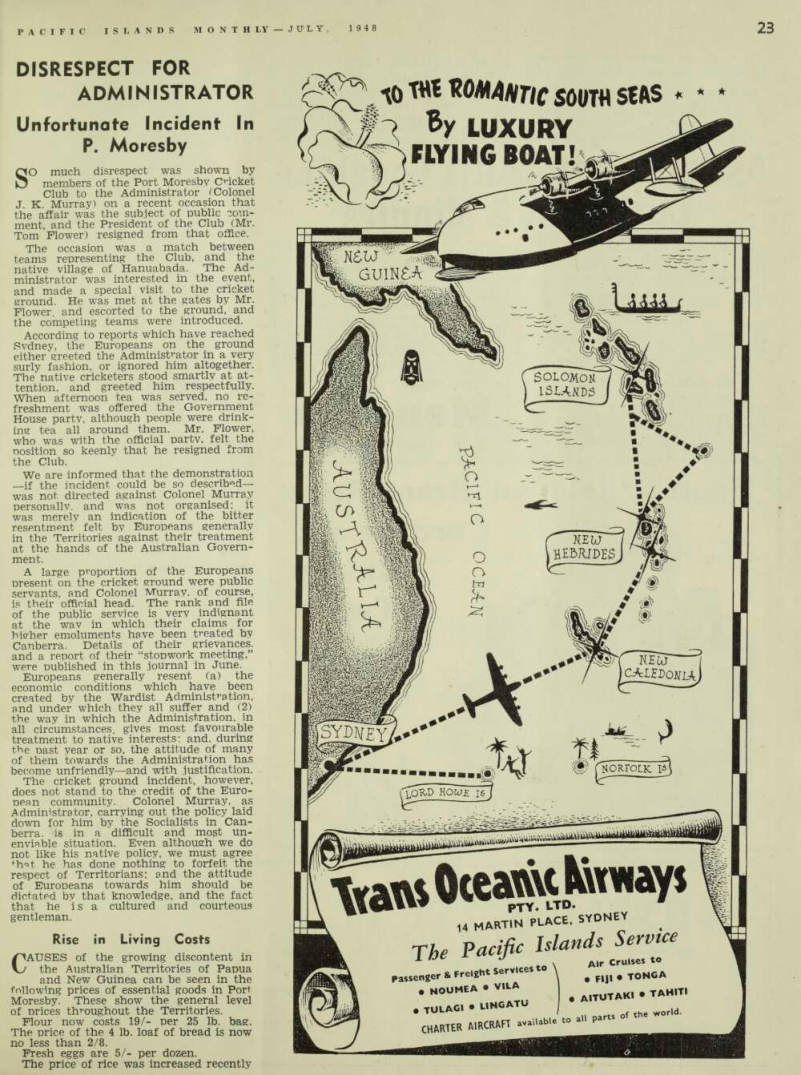
Disrespect For
Administrator
Unfortunate Incident In P. Moresby
SO much disrespect was shown by members of the Port Moresby Oicket Club to the Administrator ("Colonel J. K. Murray) on a recent occasion that the affair was the subject of public com ment, and the President of the Club (Mr.
Tom Flower) resigned from that office.
The occasion was a match between teams representing the Club, and the native village of Hanuabada. The Ad ministrator was interested in the event, and made a special visit to the cricket around. He was met at the gates by Mr.
Flower, and escorted to the ground, and the competing teams were introduced.
According to reports which have reached Svdney, the Europeans on the ground either greeted the Administrator in a very surly fashion, or ignored him altogether.
The native cricketers stood smartly at at tention, and greeted him respectfully.
When afternoon tea was served, no re freshment was offered the Government House party, although people were drink ing tea all around them. Mr. Flower, who was with the official party, felt the position so keenly that he resigned from the Club.
We are informed that the demonstration —if the incident could be so described— was not directed against Colonel Murray personally, and was not organised: it was merely an indication of the bitter resentment felt by Europeans generally in the Territories against their treatment at the hands of the Australian Govern ment.
A large proportion of the Europeans present on the cricket ground were public servants, and Colonel Murray, of course, is their official head. The rank and file of the public service is very indignant at the wav in which their claims for higher emoluments have been treated by Canberra. Details of their grievances, and a report of their “stopwork meeting,” were published in this journal in June.
Europeans generally resent (a) the economic conditions which have been created by the Wardist Administration, and under which they all suffer and (2) the way in which the Administration, in all circumstances, gives most favourable treatment to native interests: and. during the oast year or so, the attitude of many of them towards the Administration has become unfriendly—and with justification.
The cricket ground incident, however, does not stand to the credit of the Euro pean community. Colonel Murray, as Administrator, carrying out the policy laid down for him by the Socialists in Can berra. is in a difficult and most un enviable situation. Even although we do not like his native policy, we must agree f hat he has done nothing to forfeit the respect of Territorians: and the attitude of Europeans towards him should be dictated by that knowledge, and the fact that he is a cultured and courteous gentleman.
Rise in Living Costs CAUSES of the growing discontent in the Australian Territories of Papua and New Guinea can be seen in the following prices of essential goods in Port Moresby. These show the general level of prices throughout the Territories.
Flour now costs 19/- per 25 lb. bag.
The price of the 4 lb. loaf of bread is now no less than 2/8, Fresh eggs are 5/- per dozen.
The price of rice was increased recently
by £l5 per ton, making the total price over £6O per ton, in store. Moresby.
As probably the great majority of Europeans in both Territories are on fixed wages and salaries, it can be understood that their burden of living is very heavy.
Advertisements & other items, p. 25 (2 items)
23
PACIFIC ISLANDS MONTH LY JULY , 1948
•. r4W oteamL««y
0^", 'SO THE WMAHriC SOUTH SEAS «
~i LUXURY
FLYING BOAT!,
•k k ”sc2- • • N£W I^l ft St** '• fen t %*§s
r* II
r I n fe GUINEA '<i
\ <I<UA r
SOLOMOK
ISLANDS
IS At
Uemudes J
#/lf / ♦ • N£iJ cJtiznomji >)
@7 f NORFOLK
LORD HOCUJS 16
£
•. r4W oteamL««y
E* W F rx/IMJCY
14 MARTIN PLACE, SYDNEY
The Pacific Islands Sen,.ce
passenger & Freight Services to
• NOUMEA • VILA
• TULAGI • LINGATU
CHARTER AIRCRAFT available to all Air Cruises to
• FIJI • TONGA
• AITOTAKI • TAHITI
parts of the world.
Hanuabadans' Beat
Europeans At Cricket
Port Moresby Tunp 17
* CRICKET match between a repre sentative team of the Port Moresby Cricket Association and a team
from the Kavari Cricket Club was played at the Ela Beach Oval on June 14 (King’s Birthday Holiday). In a close finish, the native team beat the Europeans by 13 runs. The Administrator attended the match.
The Kavari Cricket Club is one of several clubs from Hanuabada Village.
They recently rebuilt their cricket pitch on its pre-war site at the western end of the village; the job was completed at night, with volunteer labour working under the light of car headlamps.
Tuesday, Now
Fiji Has Meatless Tuesday, Now
From Our Own Correspondent SUVA. June 14.
EVERY Tuesday after July 1, will be a meatless day in Fiji. No meat can be sold or bought without a special permit and no hotel or cafe can serve meat, as part of any meal.
This is one of two orders issued to cut meat-consumption and to conserve dwindling supplies.
The second order prohibits the kill ing. for human consumption, of any bull calf or bullock between 150 lb. and 450 lb. dressed weight, and no cow or heifer under 350 lb. dressed weight, except under special permit.
Beef allocations to Suva butcheries have been cut from 371 carcases to 250 weekly, and to country butcheries, a cut of 15 per cent, of the present quotas has been imposed.
Trans-Pacific Flight
Twenty Years of Trans-Pacific Flight
From Our Own Correspondent SUVA. June 14. rENTY years ago, Fiji, like Australia and the rest of the world, was agog at the first flight across the Pacific.
The late Sir Charles Kingsford Smith’s “Southern Cross” landed at Albert Park.
Suva, on June 5. 1928. from San Fran cisco by way of Hawaii. It took off for Brisbane from Naselai, at the south eastern tip of Viti Levu, on June 8.
Embezzlement Of Cricket
Club Funds
A MEMBER of the staff of Steamships Trading Co., Ltd., Arthur Riley, came before Judge Gore in Port Moresby recently on a charge that he had embezzled over £lOO, the property of the Port Moresby Cricket Club, of which he was secretary and acting treasurer, Riley was sentenced to six months’ im nrisonment, to be reduced to one month if he refunded to the Club the money that had been stolen. The money was refunded. Riley served the reduced sentence in Port Moresby.
Advertisements & other items, p. 26 (2 items)
Asthma, Bronchitis Coughing,
Curbed in 3 Minutes
Do you have attacks of Asthma or Bronchitis so bad that you can’t sleep? Do you feel weak, unable to work, and have to be careful not to take cold and can’t eat certain foods?
No matter how long you have suffered or what you have tried, there is new hope for you In a doctor’s prescription called Mendaco.
No dopes, no smokes, no injections, no atomizer.
All you do Is take two tasteless tablets at meals and in 3 minutes Mendaco starts working through your blood, aiding nature to remove phlegm, promote free easy breathing and bring sound sleep the first night, so that you soon feel years younger and stronger.
No Asthma in 2 Years
Mendaco not only brings almost Immediate comfort and free breathing but builds up the system to ward off future attacks. For Instance, J. Richards, Hamilton, Ont., Canada, had lost 40 lbs., suffered coughing every night, couldn’t sleep. Mendaco stopped Asthma
spasms first night and he has had none since In over two years.
Money Bock Guarantee
The very first dose of Mendaco goes right to work circulating through your blood and helping nature relieve you of the effects of Asthma. Try Mendaco under an iron-clad money back gaurantee. You be the Judge. If you don't feel fully satisfied after taking Mendaco Just return the empty package and the full purchase price will be refunded. Get Mendaco from your chemist to-day and see how well you sleep to-night and how much better you feel to-morrow. The guarantee protects
RELIEVES ASTHMA
Mendaco
Now in 2 sizes . . . 6/- and 12/-
Scott’s “Renown” Brand Rope,
Cordage and
Binder
Twine
Cable Address: Ropeyard, Sydney.
I 1
of Every
Description
MANUFACTURED AT
MASCOT, N.S.W.
J. SCOTT
PTY. LTD.
Head Office and Store
163 CLARENCE STREET,
SYDNEY,
N.S.W.
h
"White Australia"
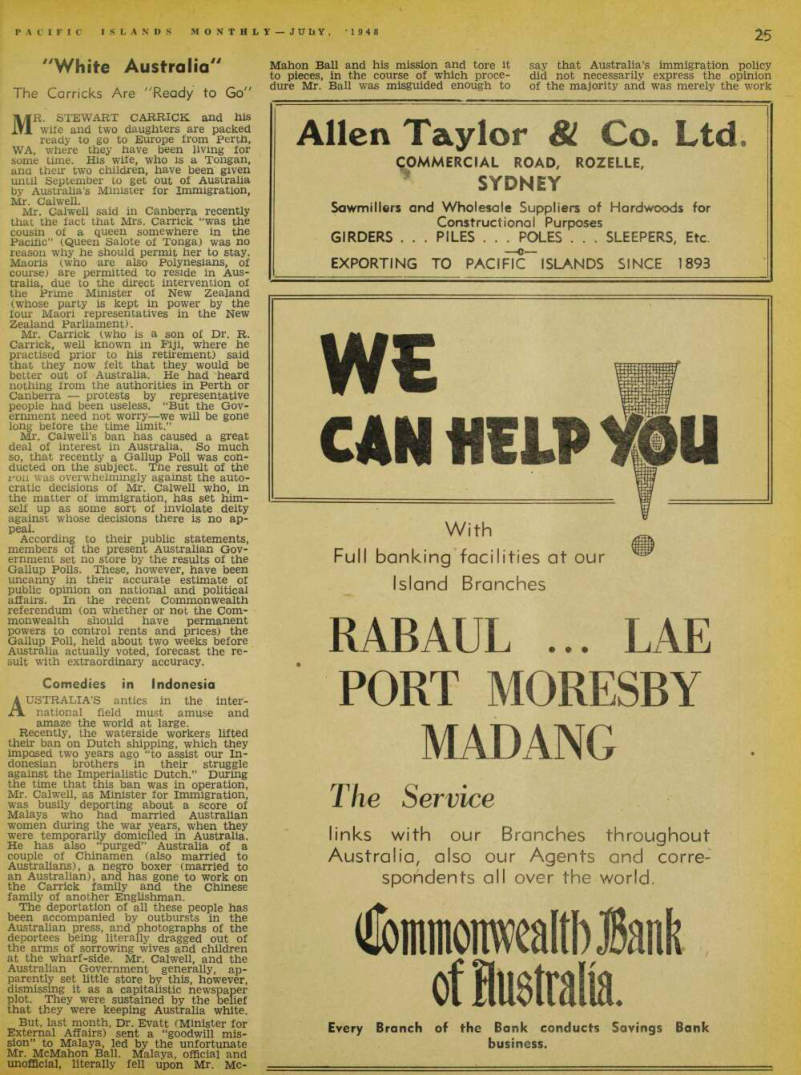
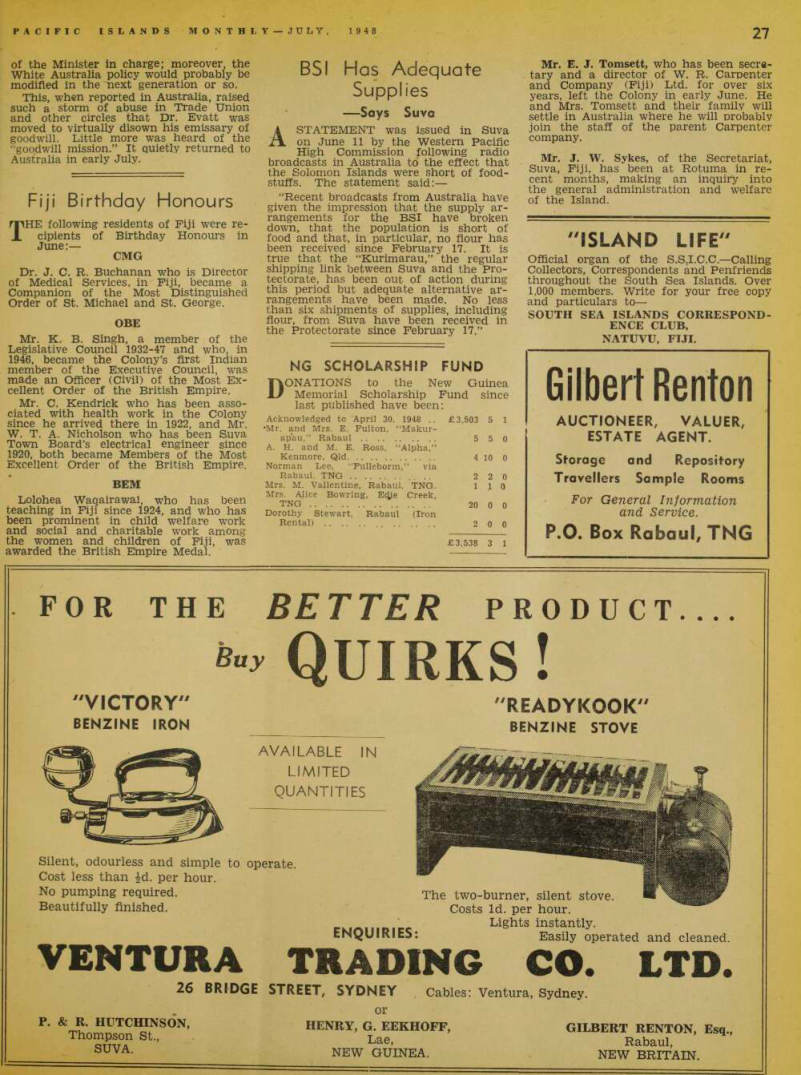
The Garricks Are "Ready to Go"
Mr. Stewart Garrick And His
wife and two daughters are packed ready to go to Europe from Perth, WA, where they have been living for some time. His wife, who is a Tongan, and their two children, have been given until September to get out of Australia by Australia’s Minister for Immigration, Mr. Calwell.
Mr. Calwell said in Canberra recently that the fact that Mrs. Garrick “was the cousin of a queen somewhere in the Pacific” (Queen Salote of Tonga) was no reason why he should permit her to stay.
Maoris (who are also Polynesians, of course) are permitted to reside in Aus tralia, due to the direct intervention of the Prime Minister of New Zealand (whose party is kept in power by the four Maori representatives in the New Zealand Parliament).
Mr. Garrick (who is a son of Dr. R.
Garrick, well known in Fiji, where he practised prior to his retirement) said that they now felt that they would be better out of Australia. He had heard nothing from the authorities in Perth or Canberra protests by representative people had been useless. “But the Gov ernment need not worry—we will be gone long before the time limit.”
Mr. calwell’s ban has caused a great deal of interest in Australia. So much so, that recently a Gallup Poll was con ducted on the subject. The result of the i-oii was overwhelmingly against the auto cratic decisions of Mr. Calwell who, in the matter of immigration, has set him self up as some sort of inviolate deity against whose decisions there is no ap peal.
According to their public statements, members of the present Australian Gov ernment set no store by the results of the Gallup Polls. These, however, have been uncanny in their accurate estimate of public opinion on national and political affairs. In the recent Commonwealth referendum (on whether or not the Com monwealth should have permanent powers to control rents and prices) the Gallup Poll, held about two weeks before Australia actually voted, forecast the re sult with extraordinary accuracy.
Comedies in Indonesia
AUSTRALIA’S antics in the inter national field must amuse and amaze the world at large.
Recently, the waterside workers lifted their ban on Dutch shipping, which they imposed two years ago “to assist our In donesian brothers in their struggle against the Imperialistic Dutch.” During the time that this ban was in operation, Mr. Calwell, as Minister for Immigration, was busily deporting about a score of Malays who had married Australian women during the war years, when they were temporarily domiciled in Australia.
He has also “purged” Australia of a couple of Chinamen (also married to Australians), a negro boxer (married to an Australian), and has gone to work on the Garrick family and the Chinese family of another Englishman.
The deportation of all these people has been accompanied by outbursts in the Australian press, and photographs of the deportees being literally dragged out of the arms of sorrowing wives and children at the wharf-side. Mr. Calwell, and the Australian Government generally, ap parently set little store by this, however, dismissing it as a capitalistic newspaper plot. They were sustained by the belief that they were keeping Australia white.
But, last month, Dr. Evatt (Minister for External Affairs) sent a “goodwill mis sion” to Malaya, led by the unfortunate Mr. McMahon Ball, Malaya, official and unofficial, literally fell upon Mr. Me-
Mahon Ball and his mission and tore it to pieces, in the course of which proce dure Mr, Ball was misguided enough to
say that Australia’s immigration policy did not necessarily express the opinion of the majority and was merely the work
of the Minister in charge; moreover, the White Australia policy would probably be modified in the next generation or so.
This, when reported in Australia, raised such a storm of abuse in Trade Union and other circles that Dr. Evatt was moved to virtually disown his emissary of goodwill. Little more was heard of the “goodwill mission,” It quietly returned to Australia in early July.
Advertisements & other items, pp. 27-28 (1 item)
mbmmoitwealtb Bank
Allen Taylor & Co. Ltd,
COMMERCIAL ROAD, ROZELLE,
SYDNEY
Sawmillers and Wholesale Suppliers of Hardwoods for Constructional Purposes GIRDERS . . . PILES . . . POLES . . . SLEEPERS, Etc.
EXPORTING TO PACIFIC ISLANDS SINCE 1893
WE m
CAN ffilf wn
With Full banking facilities at our Island Branches
RABAUL ... LAE
PORT MORESBY
MADANG
The Service links with our Branches throughout Australia, also our Agents and correspondents all over the world.
mbmmoitwealtb Bank
of Australia.
Every Branch of the Bank conducts Savings Bank business.
You can Always Depend on a to a a E o U "O c o Q to o ja o Q
Attention !
DO NOT PASS BY THIS NOTICE
ARE YOU handling Trade Items from Hongkong and the Far East?* • • • You Are ? lunicated with CHINA-NEW GUINEA MERCANTILE CO., J\ot Yet ?
HAVE YOU communicated with
CHINA-NEW
36 Connaught Road Central, HONGKONG?
THEN YOU are missing a GOLDEN LINK in your connections
with Hongkong and the Far East.
WHY?
Because I know that they are a very old and reliable concern with over 20 years' experience in the supply of all kinds of merchandise, including the following:— Tin and Brass Torchcases.
Torch Batteries.
Straw Mats.
Safety Matches.
Imitation Leather Suitcases.
Camphorwood Boxes.
Shirting Materials.
Underpants.
Linen Dinner Sets.
Fountain Pens.
Plastic Harmonicas.
Straw Hats.
Rubber Balls.
Rattan Furniture.
T-Shirts.
Hurricane Lanterns.
Cotton Piecegoods.
Laundry Soap.
Artificial Fibre Suitcases.
Leather Suitcases.
Trade Boxes.
Pyjamas.
Linen Handkerchiefs.
Ivory Wares and Ornaments.
Nylon Stockings. • Swimming Trunks.
Canvas Rubber Shoes.
Thermos Flasks.
Charcoal Irons.
Sport Shirts.
Kerosene Lamps.
Grass and Cord Mats.
Cement.
Fibre Suitcases.
Camphorwood Trunks.
Shirts.
Khaki Shorts.
Linen Tea Sets.
Lacquer Goods.
Men’s and Ladies’ Cotton Anklets.
Sun Helmets.
Leather Footballs.
Pillow Cases and Sheets.
Singlets.
Etc., Etc., Etc., Etc. and in- most cases I have found their prices the cheapest. I am thoroughly satisfied with their prompt service, and do not hesitate to recommend this house to you.
IF I WERE YOU I would lose no time to write to them letting them know of your requirements
IMMEDIATELY.
FOR SERVICE AND SATISFACTION CONTACT
CHINA-NEW GUINEA MERCANTILE CO
36, Connaught Road Central, Hongkong
Cable Address: Chigatile.
Bankers: Hongkong & Shanghai Banking Corporation, Des Voeux Road, Hongkong. 0 1 Z o t O c n o 3 ■o Q 3 We Assure Prompt Attention to all Enquiries
Fiji Birthday Honours
THE following residents of Fiji were re cipients of Birthday Honours in June:—
Cmg
Dr. J. C. R. Buchanan who is Director of Medical Services, in Fiji, became a Companion of the Most Distinguished Order of St. Michael and St. George.
Obe
Mr. K. B. Singh, a member of the Legislative Council 1932-47 and who, in 1946, became the Colony’s first Indian member of the Executive Council, was made an Officer (Civil) of the Most Ex cellent Order of the British Empire.
Mr. C. Kendrick who has been asso ciated with health work in the Colony since he arrived there in 1922, and Mr.
W. T. A. Nicholson who has been Suva Town Board’s electrical engineer since 1920, both became Members of the Most Excellent Order of the British Empire.
Bem
Lolohea Waqairawai, who has been teaching in Fiji since 1924, and who has been prominent in child welfare work and social and charitable work among the women and children of Fiji, was awarded the British Empire Medal.
Supplies
BSI Has Adequate Supplies
—Says Suva
A STATEMENT was issued in Suva on June 11 by the Western Pacific High Commission following radio broadcasts in Australia to the effect that the Solomon Islands were short of food stuffs. The statement said:— “Recent broadcasts from Australia have given the impression that the supply ar rangements for the BSI have broken down, that the population is short of food and that, in particular, no flour has been received since February 17. It is true that the “Kurimarau,” the regular shipping link between Suva and the Pro tectorate, has been out of action during this period but adequate alternative ar rangements have been made. No less than six shipments of supplies, including flour, from Suva have been received in the Protectorate since February 17.”
Ng Scholarship Fund
DONATIONS to the New Guinea Memorial Scholarship Fund since last published have been: Acknowledged to April 30, 1948 .. £3,503 5 1 •Mr. and Mrs. E. Fulton, “Makur apau,” Rabaul 550 A. H. and M. E. Ross, “Alpha,”
Kenmore, Qld 4 10 0 Norman Lee, “Fulleborm,” via Rabaul. TNG 2 20 Mrs. M. Vallentine, Rabaul, TNG. 110 Mrs. Alice Bowring, Creek,
Tng 20 0 0
Dorothy Stewart, Rabaul (Iron Rental) 200 £3,538 3 1
Mr. E. J. Tomsett, who has been secre tary and a director of W. R. Carpenter and Company (Fiji) Ltd. for over six years, left the Colony in early June. He and Mrs. Tomsett and their family will settle in Australia where he will probably join the staff of the parent Carpenter company.
Mr. J. W. Sykes, of the Secretariat, Suva, Fiji, has been at Rotuma in re cent months, making an inquiry into the general administration and welfare of the Island.
Advertisements & other items, pp. 29-30 (1 item)
‘-y Quirks!
"ISLAND LIFE"
Official organ of the S.S.l.C.C.—Calling Collectors, Correspondents and Penfriends throughout the South Sea Islands. Over 1,000 members. Write for your free copy and particulars to —
SOUTH SEA ISLANDS CORRESPOND-
ENCE CLUB,
NATUVU, FIJI.
Gilbert Renton
AUCTIONEER, VALUER,
ESTATE AGENT.
Storage and Repository Travellers Sample Rooms For General Information and Service.
P.O. Box Rabaul, TNG
FOR THE BETTER PRODUCT
‘-y Quirks!
"VICTORY"
BENZINE IRON
"READYKOOK"
BENZINE STOVE
AVAILABLE IN
LIMITED
QUANTITIES
Silent, odourless and simple to operate.
Cost less than £d. per hour.
No pumping required.
Beautifully finished.
ENQUIRIES
The two-burner, silent stove.
Costs Id. per hour.
Lights instantly.
Easily operated and cleaned.
VENTURA TRADING CO. LTD.
26 BRIDGE STREET, SYDNEY Cables: Ventura, Sydney.
P. & R. HUTCHINSON,
Thompson St.,
SUVA.
or
HENRY, G. EEKHOFF,
Lae,
NEW GUINEA.
GILBERT RENTON, Esq. ;
Rabaul,
NEW BRITAIN.
The Twinkle in
Your Eye
COMES FROM ACTIVE
DIGESTION
Good normal digestive and liver activit? means good, normal health and fitness. If yot are becoming gloomy and feel tired out, the cause may be a congested state of your intestinal tract. So many people are troubled with constipation, which, through the retention of waste in the digestive system, causes sick headache, biliousness, pimply skin, unpleasant breath, irritability, slackness and dull eyes.
Regain your bright and attractive appearance by banishing constipation with Pinkettes. Tiny, perfectly harmless, gentle yet efiective, these famous laxative and liver pills painlessly exercise and strengthen the bowels, keep the food tract clean and active, stir the liver, and thus banish sick headache, bilious attacks, pimples, unpleasant breath and gloom. All chemists and stores sell Pinkettes, the perfect laxative and liver pills.
For Tropical conditions
Velvene Water Paint and Davison's Zinc Base Paints are used extensively throughout the islands and Mandated Territories on Government and Private buildings, giving full satisfaction under severe tropical conditions.
DAVISON PAINTS PTY. LTD.
BOX 2 4, AUBURN. N.S.W.
Steamships Trading
Company Limited
PORT MORESBY SAMARAI PAPUA.
WHOLESALE & RETAIL MERCHANTS, SHIPOWNERS,
PLANTERS, ENGINEERS & SLIP PROPRIETORS.
Customs, Shipping, Insurance, and Forwarding Agents.
MANAGING AGENTS AND VISITING REPRESENTA-
TIVES FOR COCONUT AND RUBBER ESTATES.
SYDNEY REPRESENTATIVES: Nelson & Robertson Pty. Ltd., 12 Spring Street
Vice Regal Tours in Tonga,
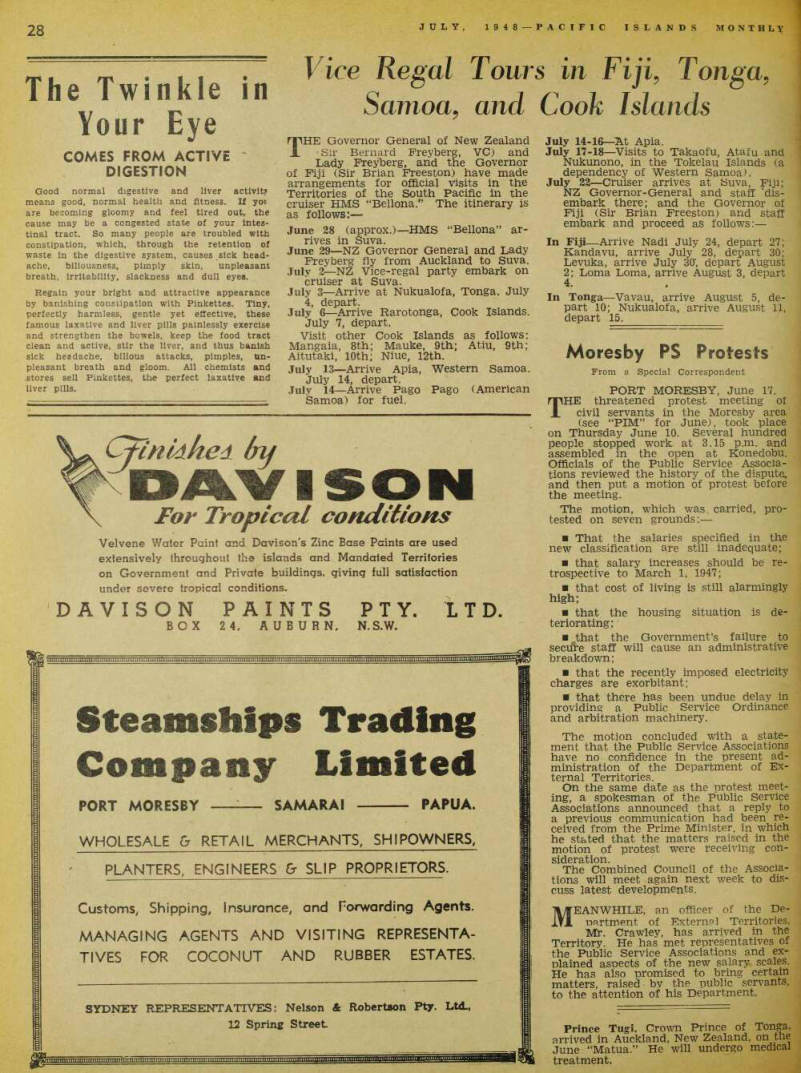
Samoa, and Cook Islands
THE Governor General of New Zealand Sir Bernard Freyberg, VC) and Lady Freyberg, and the Governor of Fiji (Sir Brian Freeston) have made arrangements for official visits in the Territories of the South Pacific in the cruiser HMS “Bellona.” The itinerary is as follows: June 28 (approx.)—HMS “Bellona” ar rives in Suva.
June 29 —NZ Governor General and Lady Freyberg fly from Auckland to Suva.
July 2 —NZ Vice-regal party embark on cruiser at Suva.
July 3—Arrive at Nukualofa, Tonga. July 4, depart.
July 6 —Arrive Rarotonga, Cook Islands.
July 7, depart.
Visit other Cook Islands as follows; Mangaia, Bth; Mauke, 9th; Atiu, 9th; Aitutaki, 10th; Niue, 12th.
July 13—Arrive Apia, Western Samoa.
July 14, depart.
July 14—Arrive Pago Pago (American Samoa) for fuel.
July 14-16—At Apia.
July 17-18—Visits to Takaofu, Atafu and Nukunono, in the Tokelau Islands (a dependency of Western Samoa).
July 22—Cruiser arrives at Suva, Fiji; NZ Governor-General and staff 'dis embark there; and the Governor of Fiji (Sir Brian Freeston) and staff embark and proceed as follows: In Fiji—Arrive Nadi July 24, depart 27; Kandavu, arrive July 28, depart 30; Levuka, arrive July 30*, depart August 2; Loma Loma, arrive August 3, depart 4.
In Tonga—Vavau, arrive August 5, de part 10; Nukualofa, arrive August 11, depart 15.
Moresby PS Protests

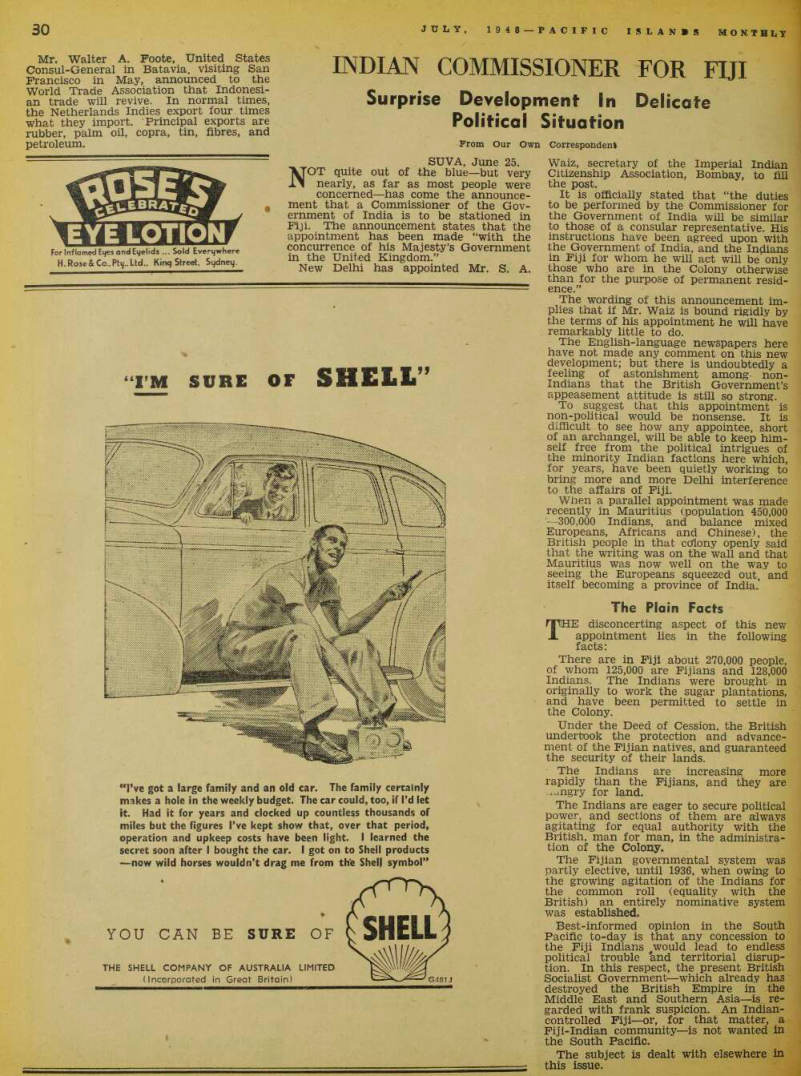
From a Special Correspondent
Port Moresby, June 17.
THE threatened protest meeting of civil servants in the Moresby area (see “PIM” for June), took place on Thursday June 10. Several hundred people stopped work at 3.15 p.m, and assembled in the open at Konedobu.
Officials of the Public Service Associa tions reviewed the history of the dispute, and then put a motion of protest before the meeting.
The motion, which was carried, pro tested on seven grounds:— ■ That the salaries specified in the new classification are still inadequate; ■ that salary increases should be re trospective to March 1, 1947; ■ that cost of living is still alarmingly high; ■ that the housing situation is de teriorating; ■ ,that the Government’s failure to secure staff will cause an administrative breakdown; ■ that the recently imposed electricity charges are exorbitant; ■ that there has been undue delay in providing a Public Service Ordinance and arbitration machinery.
The motion concluded with a state ment that the Public Service Associations have no confidence in the present ad ministration of the Department of Ex ternal Territories.
On the same date as the nrotest meet ing, a spokesman of the Public Service Associations announced that a reply to a previous communication had been re ceived from the Prime Minister, in which he stated that the matters raised in the motion of protest were receiving con sideration.
The Combined Council of the Associa tions will meet again next week to dis cuss latest developments, MEANWHILE, an officer of the De mrtment of External Territories, Mr. Crawley, has arrived in the Territory. He has met representatives of the Public Service Associations and ex plained asnects of the new salary scales.
He has also promised to bring certain matters, raised bv the nublic servants, to the attention of his Department.
Prince Tug!. Crown Prince of Tonga, arrived in Auckland, New Zealand, on the June “Matua.” He will undergo medical treatment.
Mr. Walter A. Foote, United States Consul-General in Batavia, visiting San Francisco in May, announced to the World Trade Association that Indonesi an trade will revive. In normal times, the Netherlands Indies export four times what they import. Principal exports are rubber, palm oil, copra, tin, fibres, and petroleum.
Advertisements & other items, pp. 31-32 (1 item)
K£pr\^th
y'-c
STOPS
Gr*4
fthUP'**
A«s* SE fjPvtS
TOO^
tTO^ s e*^ AC
VINO
APPL'
RO»ttS>
iss m te 9
DENTISTS
A sc
ftL
■Sc p«
K£pr\^th
TOOEJHZH!
In GERMANY WILD INDIGO AND
SCURVY CRASS WERE USED W
TIGHTEN LOOSE TEETH !
KOLYNOS KEEPS YOUR TEETH
AND GUMS FIRM’AND
HEALTHY-AT THE SAME
TIME KEEPS YOUR
BREATH FRESH AND
FRAGRANT.
In iv
CLAIM
TO STOP
r>wy/
Four dentists in texas (usa) say
THEY HAVE A CHEMICAL SOLUTION
WHICH OFFERS 90% IMMUNITY
FROM DENTAL DECAYf
G/VE YOUR TEETH PA/LY
WOTECT/ON W/TH KOLYNOS.
THOSE ACT/YE ANT/SEPT/C o
KOLYNOS BUBBLES CLEAN
TEETH SUROfCALLY/ °
Creqp
Feet of
DENTAL
„ CREAM
noV
There's 12 feet of kolynos
IN A LARGE TUBE IT'S SO
HIGHLY CONCENTRATED. THAT
MEANS 280 9RUSHI NGS FOR
l / /O d BECAUSE HALF AN INCH
AT A TIME IS PLENTY!
ft
Stop
colds,Sore throats FASTER!
Ask -for A gargle with ANACIN dissolved in warm water stops sore throats quicker ANACIN relief is faster because ANACIN contains an extra ingredient. Ask for ANACIN.
Trade Mark
EYE LOTION
For Inflamed Eyes and Eyelids ... Sold Everywhere H. Rose & Co., Pty.. Ltd.. Kinq Street. Sydney.
Indian Commissioner For Fiji
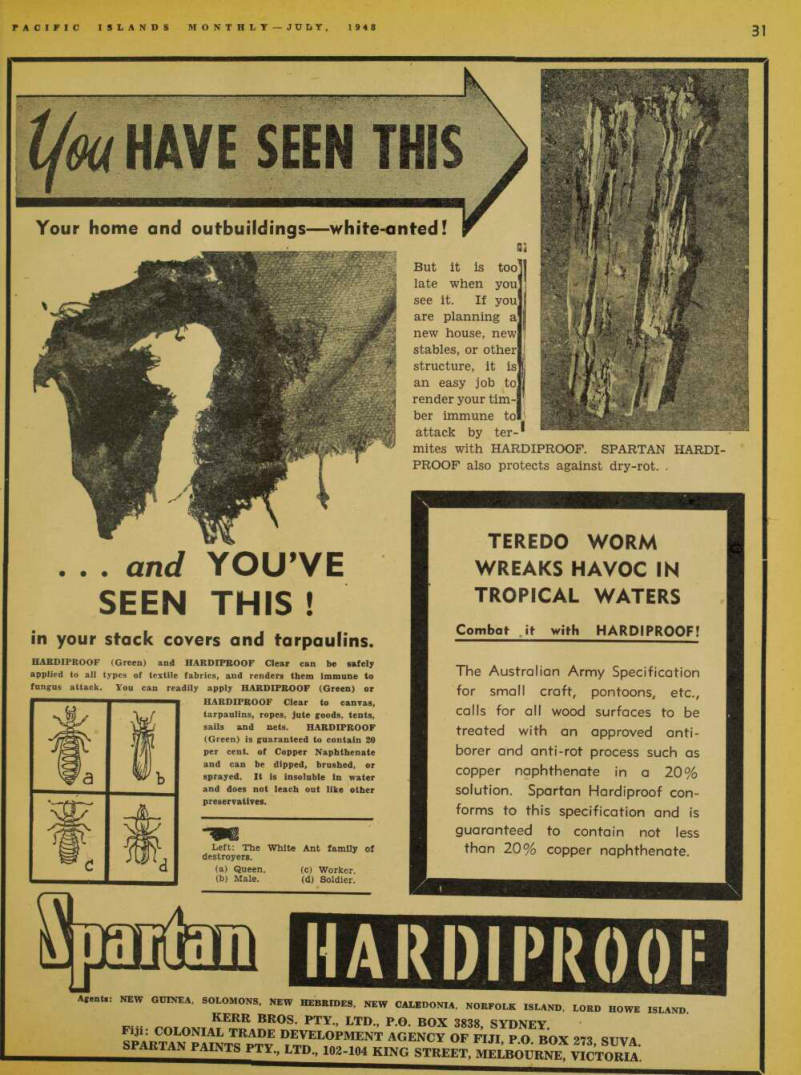
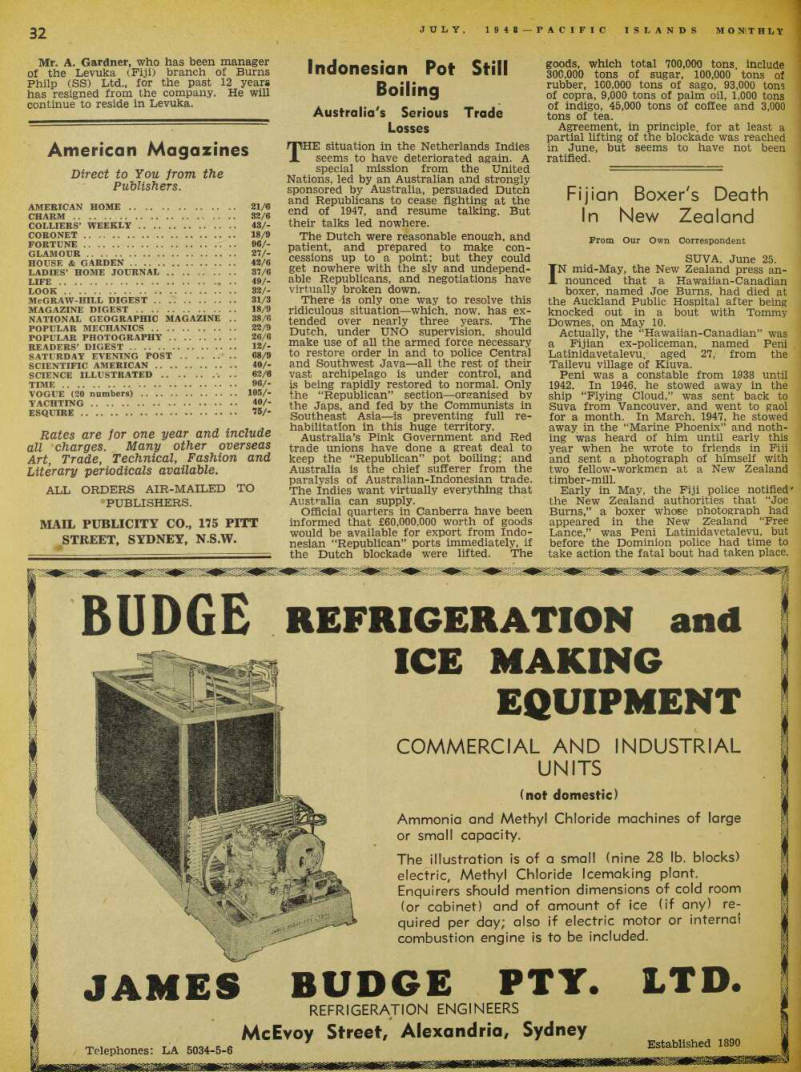
Surprise Development In Delicate Political Situation
Prom Our Own Correspondent
SUVA, June 25.
NOT quite out of the blue—but very nearly, as far as most people were concerned —has come the announce ment that a Commissioner of the Gov ernment of India is to be stationed in Fiji. The announcement states that the appointment has been made “with the concurrence of his Majesty’s Government in the United Kingdom.”
New Delhi has appointed Mr. S. A.
Waiz, secretary of the Imperial Indian Citizenship Association, Bombay, to fill the post.
It is officially stated that “the duties to be performed by the Commissioner for the Government of India will be similar to those of a consular representative. His instructions have been agreed upon with the Government of India, and the Indians in Fiji for whom he will act will be’ only those who are in the Colony otherwise than for the purpose of permanent resid ence.”
The wording of this announcement im plies that if Mr. Waiz is bound rigidly by the terms of his appointment he will have remarkably little to do.
The English-language newspapers here have not made any comment on this new development; but there is undoubtedly a feeling of astonishment among non- Indians that the British Government’s appeasement attitude is still so strong.
To suggest that this appointment is non-political would be nonsense. It is difficult to see how any appointee, short of an archangel, will be able to keep him self free from the political intrigues of the minority Indian factions here which, for years, have been quietly working to bring more and more Delhi interference to the affairs of Fiji.
When a parallel appointment was made recently in Mauritius (population 450,000 —300,000 Indians, and balance mixed Europeans, Africans and Chinese), the British people in that ctflony openly said that the writing was on the wall and that Mauritius was now well on the way to seeing the Europeans squeezed out, and itself becoming a province of India.
The Plain Facts
rE disconcerting aspect of this new appointment lies in the following facts: There are in Fiji about 270,000 people, of whom 125,000 are Fijians and 128,000 Indians. The Indians were brought in originally to work the sugar plantations, and have been permitted to settle in the Colony.
Under the Deed of Cession, the British undertook the protection and advance ment of the Fijian natives, and guaranteed the security of their lands.
The Indians are increasing more rapidly than the Fijians, and they are .angry for land.
The Indians are eager to secure political power, and sections of them are always agitating for equal authority with the British, man for man, in the administra tion of the Colony.
The Fijian governmental system was partly elective, until 1936, when owing to the growing agitation of the Indians for the common roll (equality with the British) an entirely nominative system was established.
Best-informed opinion in the South Pacific to-day is that any concession to the Fiji Indians would lead to endless political trouble and territorial disrup tion. In this respect, the present British Socialist Government—which already has destroyed the British Empire in the Middle East and Southern Asia—is re garded with frank suspicion. An Indian controlled Fiji—or, for that matter, a Fijl-Indian community—is not wanted in the South Pacific.
The subject is dealt with elsewhere in this issue.
Mr. A. Gardner, who has been manager of the Levuka (Fiji) branch of Burns Philp (SS) Ltd., for the past 12 years has resigned from the company. He will continue to reside in Levuka.
Advertisements & other items, pp. 32-34 (2 items)
30
JULY, 1948 PACIFIC ISLANBS MONTHLY
Shell
“I’M SURE OF SHELL”
m I m *Tve got a large family and an old car. The family certainly makes a hole in the weekly budget. The car could, too, if I’d let it. Had it for years and clocked up countless thousands of miles but the figures I’ve kept show that, over that period, operation and upkeep costs have been light. I learned the secret soon after I bought the car. I got on to Shell products —now wild horses wouldn’t drag me from th'e Shell symbol”
YOU CAN BE SURE OF
THE SHELL COMPANY OF AUSTRALIA LIMITED
(Incorporated in Great Britain)
SHELL
—■ : —■—~ ~— V I : ■
Your home and outbuildings—white-anted!
...and YOU’VE
SEEN THIS !
in your stack covers and tarpaulins.
HARDIPROOF (Green) and HARDIPROOF Clear can be safely applied to all types of textile fabrics, and renders them immune to fungus attack. You can readily apply HARDIPROOF (Green) or
HARDIPROOF
Clear to canvas, tarpaulins, ropes, jute goods, tents, sails and nets. HARDIPROOF (Green) is guaranteed to contain 30 per cent, of Copper Naphthenate and can be dipped, brushed, or sprayed. It is insoluble in water and does not leach out like other preservatives.
Left; The White Ant family of destroyers. (a) Queen. (b) Male. (c) Worker. (d) Soldier.
qpaojaa
i - But it is late when you see it. If you are planning a new house, new stables, or other structure, it is an easy job to render your timber immune to attack by ter-
mites with HARDIPROOF. SPARTAN HARDI-
PROOF also protects against dry-rot. .
TEREDO WORM
WREAKS HAVOC IN
TROPICAL WATERS
Combof it with HARDIPROOF!
The Australian Army Specification
for small craft, pontoons, etc., calls for all wood surfaces to be treated with an approved antiborer and anti-rot process such as copper naphthenate in a 20%
solution. Spartan Hardiproof con-
forms to this specification and is guaranteed to contain not less
than 20% copper naphthenate.
HARDIPROOI
Agent*: NEW GUINEA, SOLOMONS, NEW HEBRIDES, NEW CALEDONIA, NORFOLK ISLAND, LORD HOWE ISLAND. .. XTI , KERR BROS. PTY., LTD., P.O. BOX 3838, SYDNEY.
Fiji: COLONIAL TRADE DEVELOPMENT AGENCY OF FIJI PO BOX 213 SUVA SPARTAN PAINTS PTY.. LTD.. 102-104 KING STREET, VICTORIA,
American Magazines
Direct to You from the Publishers.
AMERICAN HOME 21/6
CHARM 32/6
COLLIERS’ WEEKLY 43/-
CORONET 18/9
FORTUNE 96/-
GLAMOUR 27/-
HOUSE & GARDEN 42/6
LADIES’ HOME JOURNAL 37/6
LIFE 49/-
LOOK 32/-
McGRAW-HILL DIGEST 31/3
MAGAZINE DIGEST 18/9
NATIONAL GEOGRAPHIC MAGAZINE .. 38/6
POPULAR MECHANICS 22/9
POPULAR PHOTOGRAPHY 26/6
READERS’ DIGEST 12/-
SATURDAY EVENING POST 68/9
SCIENTIFIC AMERICAN 40/-
SCIENCE ILLUSTRATED 62/6
TIME 96/-
VOGUE (20 numbers) 105/-
YACHTING 40/-
ESQUIRE 75/-
Rates are for one year and include
all charges. Many other overseas
Art, Trade, Technical, Fashion and
Literary 'periodicals available.
ALL ORDERS AIR-MAILED TO
PUBLISHERS.
MAIL PUBLICITY CO., 175 PITT
STREET, SYDNEY, N.S.W.
Boiling
Indonesian Pot Still Boiling Australia's Serious Trade Losses
THE situation in the Netherlands Indies seems to have deteriorated again. A special mission from the United Nations, led by an Australian and strongly sponsored by Australia, persuaded Dutch and Republicans to cease fighting at the end of 1947, and resume talking. But their talks led nowhere.
The Dutch were reasonable enough, and patient, and prepared to make con cessions up to a point; but they could get nowhere with the sly and undepend able Republicans, and negotiations have virtually broken down.
There is only one way to resolve this ridiculous situation—which, now, has ex tended over nearly three years. The Dutch, under UNO supervision, should make use of all the armed force necessary to restore order in and to police Central and Southwest Java —all the rest of their vast archipelago is under control, and is being rapidly restored to normal. Only the “Republican” section—organised by the Japs, and fed by the Communists in Southeast Asia —is preventing full re habilitation in this huge territory.
Australia’s Pink Government and Red trade unions have done a great deal to keep the “Republican” pot boiling; and Australia is the chief sufferer from the paralysis of Australian-Indonesian trade.
The Indies want virtually everything that Australia can supply.
Official quarters in Canberra have been informed that £60,000,000 worth of goods would be available for export from Indo nesian “Republican” ports immediately, if the Dutch blockade were lifted. The
goods, which total 700,000 tons. Include 300,000 tons of sugar, 100,000 tons of rubber, 100,000 tons of sago, 93,000 tons of copra, 9,000 tons of palm oil, 1,000 tons of indigo, 45,000 tons of coffee and 3,000 tons of tea.
Agreement, in principle, for at least a partial lifting of the blockade was reached in June, but seems to have not been ratified.
Fijian Boxer's Death
In New Zealand
From Our Own Correspondent SUVA. June 25.
IN mid-May, the New Zealand press an nounced that a Hawaiian-Canadian boxer, named Joe Burns, had died at the Auckland Public Hospital after being knocked out in a bout with Tommy Downes, on May 10.
Actually, the “Hawaiian-Canadian” was a Fijian ex-policeman, named Peni Latinidavetalevu, aged 27, from the Tailevu village of Kiuva.
Peni was a constable from 1938 until 1942. In 1946, he stowed away in the ship “Flying Cloud,” was sent back to Suva from Vancouver, and went to gaol for a month. In March. 1947, he stowed away in the “Marine Phoenix” and noth ing was heard of him until early this year when he wrote to friends in Fiji and sent a photograph of himself with two fellow-workmen at a New Zealand timber-mill.
Early in May, the Fiji police notified' the New Zealand authorities that “Joe Burns,” a boxer whose photograph had appeared in the New Zealand “Free Lance,” was Peni Latinidavetalevu. but before the Dominion police had time to take action the fatal bout had taken place.
Advertisements & other items, pp. 34-36 (2 items)
Equipment
BUDGE REFRIGERATION and
ICE MAKING
COMMERCIAL AND INDUSTRIAL
UNITS
(not domestic) Ammonia and Methyl Chloride machines of large or small capacity.
The illustration is of a small (nine 28 lb. blocks) electric, Methyl Chloride Icemaking plant.
Enquirers should mention dimensions of cold room (or cabinet) and of amount of ice (if any) required per day; also if electric motor or internal combustion engine is to be included.
JAMES BUDGE PTY. LTD.
REFRIGERATION ENGINEERS
McEvoy Street, Alexandria, Sydney
Telephones: LA 5034-5-6 Established 1890
DON'T SAY fir IN
y>&y Y
GIN DON'T SAY
DON'T SAY |p I M
GIN DON'T SAY
DON'T SAY G I N
GIN DON'T SAY
DON'T SAY G I N
G I M DON'T SAY
'WW' 'V'
Urn
C'W ’W& f
1 M DON'T SAY
DON'T SAY © I M
G I M DON'T SAY
DON'T SAY G I M
DON'T SAY © I M
IS I M DON'T SAY
DON'T SAY © I M
G I M DON'T SAY
DON'T SAY GIN
GIM DON'T SAY
DON'T SAY GIU
GIM DON'T SAY
DON'T SAY Gli
G I M DON'T SAY
DON'T SAY GIM
fj I M DON'T SAY
DON'T SAY GIM
DON'T SAY G I
G SAY
DON
DON'T SAY GIM
G I M DON'T SAY
DON'T SAY G I M
DON'T SAY
■ D a Y AY G//V N De c oc
KT A
SAY
£5 "to 1 ri
SKIP
T SAY
1
DON'
G I I%’ DON'T S
DON'T SAY GIN
DON'T SAY GIM
G SAY
DO G D
DON'T SMJ
DON'T SAY
G I M DON'T SAY
DON'T SAY G I M
DON'T SAY
M Y AY G//V N ♦ C Oc
SAY
US * ©y
ITV
*/£$ «n
'T SAY
T
DON'T
GIN DON'T
DON'T SAY G I m DON'-
Address all inquiries to: Telegrams and Cables: “GILBEYS,” Melbourne.
W. & A. SILBEY LTD.
Telegrams and Cables: • GILBEYS,” Sydney. 33 ROSSLYN STREET, WEST MELBOURNE. 109 REGENT S
SYDNEY.
McILRATH’S OF SYDNEY
OFFER AT COMPETITIVE PRICES
Australian I. A. SUGAR
New LevefLid Tins, 35 lb.
Cases contain 2 tins Best Plain FLOUR New Lever Lid Tins, 25 lb.
Cases contain 2 tins PURE ORANGE JUICE in 28 oz. cons per doz., 11 /6 5-case lots 11/- doz.—lo-case lots 10/6—Case contains 24 cans.
Mcllrath’s specialise in packing and shipping individual consignments to Pacific Islands Residents.
All shipments of general cargo are insured against pillage, theft, non-delivery.
McILRATH’S PTY. LTD.
Export Department, 202 Pitt Street, Sydney, Australia
ENJOV WINTER FUN
m me
\ with coNmmt
For 'FLU & COLDS
Colds, Influenza, Sore Throat, Laryngitis, and Tonsillitis are quickly relieved by the special treatment provided by the betterbalanced formula of genuine Vincent's a.p.c Powders and Tablets.
VINCE
NI6D
33
PACIFIC ISLAND# MONTHLY JULY, 1 9 » •
Fiji Now
Controiled Entry Into Fiji Now Fear of Over-Population is the Official Reason
REGULATIONS which have now come into effect in Fiji require every person who wishes to enter the Colony for an intended stay of more than four months, to obtain a permit to do so.
Application forms for these permits should be forwarded to the Chief Immi
gration Officer, in Suva.
Permits to enter and reside in the Colony will be granted only to those who “can fairly be brought within certain
specified categories.” People outside
these categories will be given permission
to enter only in special cases and only with the approval of the Governor
in Council.
There are eight categories to whom
permits will be granted:—
(1) Persons now absent from the Colony who hold valid Fiji passports issued prior to June 5, 1948, and who wish to return to the Colony, and who (a) were originally admitted into Fiji under the indenture system and who were re sident in the Colony when the passport was issued; or (b) had resided in the Colony con tinuously for not less than ten years prior to making application for the Fiji passport, and who also possess business interests or employ ment of a permanent nature in the Colony. (2) Persons to whom permits to enter the Colony were issued prior to the date of these directions and who can satisfy the Principal Immigration Officer that they have not been able to reach the Colony for reasons beyond their control. (3) Persons residing in the Colony who have established or establish a residential status under the Ordinance, and who, having left the Colony with the intention of returning, lose that status by remaining absent from the Colony for more than twelve months—provided that any such person satisfies the Principal Immigration Officer that he was so absent owing to circumstances beyond his control or for some other good and sufficient reason. (Residential status under the Ordinance involves residence in the Colony for a period of five years.) (4) Farmers and planters, provided that they have already acquired a property of not less than 100 acres, three-quarters of which is pro ductive land. (5) Members of professions who have recog nised professional qualifications and intend to practice their profession in the Colony—provided that no permit will be issued to a teacher unless his entry is approved by the Director of Edu cation. (6) .Ministers of religion. (7) Persons who are employed outside the Colony by local firms or undertakings and who are transferred to the Colony. (8) Persons who satisfy the Principal Immi gration Officer that they are in possession of an assured income, that they will not become a charge upon the public funds, that their entry is not contrary to the public interest and who accept such conditions as the Principal Immi gration Officer considers reasonable to impose.
Permits to reside for a period of less than four years may be issued at the discretion of the Principal Immigration Officer to apprentices, skilled tradesmen,
miners, students, persons mider medical
treatment, and to persons entering the Colony under short-term contracts of
employment with local agriculture or
commercial undertakings.
When granting a permit to enter and
reside in Fiji the Principal Immigration
Officer (who is also the Commissioner of Police) may require security in the de posit of cash or in providing a bond.
He may also require the entrant to en gage only in the specified occupation or profession for which he entered; or that he will report to the Immigration Officer
if he ceases to be employed by the em ployer for whom he went to Fiji to work.
AS an explanation to these immigra tion regulations, it was stated, offi cially, that it was clear from the 1946 census in Fiji that the population of the Colony was increasing rapidly and that it was estimated that the 260,000 people then in the Colony will have in creased to 340,000 in 1956 and have passed the half-million mark by 1970. It was therefore deemed necessary to ex ercise stricter control over entry into Fiji.
A committee was set up to make re commendations to the Governor in Council. The committee comprised the following citizens: the Commissioner of Police. Messrs. R. N. Caldwell, H, King Irving, K. B. Singh, Vishnu Deo, Joeli Ravai, H. Maurice Scott and J. Judd.
Presumably this committee was well qualified for the job and knew what it was about. It is interesting to note, however, in these days when regulations are the norm, that prior to the war any one could enter Fiji who held a valid passport and a return ticket. It is also interesting to note that the rapidly in creasing population which allegedly is the reason for these regulations, comes mainly from one section—the Indian community. It appears distinctly un likely that the Colony of Fiji will be overwhelmed by migrants from Aus tralasia, In, one case that has recently come to the notice of this journal, a position in Fiji was advertised in Sydney news papers. A salary of £4OO per annum and free board and lodging went with the job. Before the war, the advertiser of this particular job would literally have been killed in the rush of applications.
In June 1948, the advertisements brought forth exactly four replies—and three of the applicants were obviously impossible.
Death Of Mr. A. W. Caten
In Suva
Noted Musician and Composer
SUVA, June 7.
Mr. Abner Warner Oaten, Of
Suva, died on June 3, the day be fore his 72nd birthday. He was bandmaster of the former Fiji Defence Force Band (now the Band of the Fiji Military Forces) from 1924 until his re tirement in 1935.
Mr. Oaten joined the British Army when he was 16, and was with the Cold stream Guards Band for 24 years. He was a foundation member of the Royal Albert Hall Orchestra and a member of the London Symphony, London Phil harmonic. Queen’s Hall and Covent Garden Orchestras, and other musical organisations in Australia. He composed eight popular marches for military bands, and in 1928 produced a setting of the Fijian “Isa Lei” which, in sheet music form, has become well-known in New Zealand, Australia and elsewhere.
Incidentally, Mr. Oaten never laid claim to being the composer of the air of ‘Tsa Lei.” If there ever was an indi vidual composer, it was Ratu Tevita Uluilakeba, of Lau, who unquestion ably— according to Fijians was res ponsible for the song in the form that has become a Fijian tradition. And neither Ratu Tevita nor Mr. Oaten had anything to do with the crooner-perver sions recorded in Australia and America in the last year or two.
Mr. Oaten is survived by his second wife and by a son, Mr, Reginald Oaten, who is in the Government service in Fiji and is a member of the Suva Town Board.
The Fiji Crown Counsel, Mr. E, M.
Pritchard, has resigned and intends to take up legal practice in New Zealand.
Mr. P. Pritchard, chief fire-fighting officer in the NZ Air Department is at present inspecting fire-fighting equipment at aerodromes in the Pacific Islands.
He will visit landing fields in Fiji, Samoa, Cook Islands and Tonga and appoint European fire masters. Native crews will be employed.
Advertisements & other items, pp. 37-38 (1 item)
Engines
QUEENSLAND
INSURANCE
COMPANY
LIMITED
(Incorporated 1886 In Australia)
ASSETS EXCEED £4,000,000
Head Office :
QUEENSLAND
INSURANCE BUILDING,
80-82 PITT STREET, SYDNEY.
Specialists in South Seas Fire
Marine & Accident Insurances
Apply to:—
ruL Branch Office: I. B. Chalmers, Manager.
Burns Phllp (South Sea) Co., Ltd.
VILA.
Burns Phllp (South Sea) Co., Ltd.
Comptoirs Francals Das Nouvelles Hebrides (Marine).
NOUMEA.
L. & W. Johnston.
PORT MORESBY:
Burns, Phllp & Co., Ltd.
W. A. Anderson, Resident Officer,
PAGO PAGO.
Burns Philp (South Sea) Co., Ltd.
G. H. O. Reid & Co.
OTHER SOUTH SEA ISLANDS.
Burns Phllp (South Sea) Co., Ltd.
Also to any of the Company’s Offices in Australia or New Zealand .
GARDNER DIESEL MARINE
ENGINES
There is a type available for every class of vessel requiring power from 24 BHP to 152 BHP. Direct or reduction gears.
GARDNER stationary engines for all classes of work, including electrical
generation
MORRIS MARINE ENGINES
Petrol Driven. Direct or Reduction Gears
VEDETTE, 6-12 H.P.
NAVIGATOR, 12-24 H.P.
CHAPMAN PUP
and
SUPER-PUP
Engines
3 H.P.—4i H.P.
DISTRIBUTORS IN FIJI :
GRANTEX RICE MILLS
with stationary engines suitable for their operation W. R. CARPENTER & CO. (Fiji) LTD.
General Merchants, SUVA, FIJI
ART POSTCARDS OF
TONGA
Per Dozen, Postage Paid: 6/- (one US Dollar).
TONGAN PHOTOS BUREAU
Nukualofa, Tonga
YOUR FUTURE CAREER . . .
Merchants, Accountants, Secretaries, Bankers and Business Managers ... all hold responsible positions with commensurate salaries. You too can enhance your prospects in this ever-expanding commercial field, which yields abundant returns to those with adequate qualifications. H.R.I. prepare ambitious men and women for all business positions from junior to senior executive. Tuition is practical authoritative up-to-date time saving . . . and certain in its successful results. The H.R.I. is available always to advise you write or wire for information free and without obligation.
H.R.I. tutorial service is proved by the winning of more honours than all coaches in Australasia combined.
H.R.I. Career Training • ACCOUNTANCY • SECRETARYSHIP • COST ACCOUNTANCY
• PRACTICAL BOOKKEEPING • MARKETING SELLING
ADVERTISING • BANKING • LOCAL GOVERNMENT EXAMS.
Hemingway Robertson Institute
Founded and Owned by Hemingway & Robertson Pty. Ltd.
Consulting Accountants i : :: Professional Tutors
126 BANK HOUSE. BANK PLACE, MELBOURNE
126 BARRACK HOUSE, 16 BARRACK STREET, SYDNEY 126/815
WORMGEARED
CHAIN HOISTS
The hand-operated Wormgeared Hoist is a general purpose lifting device, compact and easy to handle. The Wormgear is designed to give comparatively high efficiency and long life. A simple and effective brake insures safe holding of the suspended load.
Available in rated capacities from 10 cwts. to 3 tons.
Also makers of: A.B.C. Electric Chain Holsts, Vfe, 1, 2 tons capacity.
“Victor” Spurgeared Chain Hoists from 10 cwts. to 20 tons.
Triple Geared Chain Holsts from 10 cwts, to 20 tons.
Worm Geared Chain Hoists from 10 cwts. to 3 tons.
Weston Chain Blocks from 5 cwts. to 2 tons.
Shackles, Hooks, Sheave and Snatch Blocks.
AUSTRALIAN BLOCK & CHAIN CO.
PTY., LTD.
Robbs Road, WEST FOOTSCRAY, W. 12,
VICTORIA
Phones: MW 1373-74-75.
Telegraphic Address: “CHAINBLOCK,” MELBOURNE.
Correspondence to Box 34, FOOTSCRAY, W.ll, VICTORIA.
French Film Unit In
New Caledonia
rE French film unit which recently visited New Caledonia, consisted of Messrs. R. Dubois, producer, Edouard Clarque, director, and his assistant Madame Mylene Fidelin.
They made two documentaries, each of about 2,000 feet, giving a general picture of life in the Colony, the mining, agri cultural and pastoral industries, and native life and tourist attractions.
The films are assured of distribution in .France, Belgium, Luxemburg and Swit zerland (countries where French is spoken) and it is possible that they will also get a showing in Australia and New Zea land.
Fiji's War Debt
UK's Generous Gift Reduces It
By £2 Million
From Our Own Correspondent SUVA. June 25.
FIJI is to receive, from Great Britain, another gift, this time of more than £2,000,000, to help to meet the cost of the defence of the Colony during the war.
Between 1943 and 1946. interest-free advances totalling more than £2,200,000 (Fijian) were made by the UK to meet war expenditure. •‘As a gesture of goodwill, and in recog nition of the Colony’s own contribution towards defence costs and its war effort generally, His Majesty’s Government has now generously decided to turn the ad vances into a free grant,” states the an nouncement by the Government of Fiji.
Fiji’s war-debt amounted to over £3,000,000. This gift from the UK will make it easier to proceed with the re vision of the Development Plan which is shortly to take place. During the war years, Fiji paid out £1,941,000 on direct war expenditure, out of general revenue.
Band Out For "Aorangi"
From Our Own Correspondent SUVA. June 25. rE band will be out to welcome the “Aorangi” when she returns to the trans-Pacific run in August. Per mission has been granted, at the request of the Fiji Publicity Board, for the band of the Fiji Military Forces to play the liner in to Suva when she arrives.
An official statement says that “this will be both a tribute to the ship’s fine war service and a welcome to the ‘Aorangi’ on her return to her old run.”
Papua
Another Plane Down in Papua
From a Special Correspondent
Port Moresby, June 17.
A DRAGON aircraft, owned by Man dated Airlines, and piloted by Captain B. H. Smith, made a forced landing in the Papuan area en route to Australia via Daru and Thurs day Island, on June 14.
A RAAF aircraft searched the Papuan Gulf the next day but failed to sight the Dragon. Another plane, belonging to Mr.
Bobby Gibbes’s new service, located the Dragon on an emergency airstrip In Papua later that afternoon,* and Captain Smith was rescued the following day.
This is the second occasion, within a couple of months, on which a Dragon aircraft has failed to make the crossing to Australia via Thursday Island.
New Guinea’s air record, which was unsurpassed before the war, is now be ginning to look rather dubious.
Pay £15,000 for Privilege
Fiji Indians Visit
Mother India
Prom Our Own Correspondent
Suva, May 17
rE ship “Talma”, which sailed from Suva on May 13 for Singapore and Calcutta, took 411 Asiatics from Fiji—4B Chinese and 363 Indians. Tq gether they paid more than £15,000 m passage money.
Of the Indians, only 20 are repatri ates under the old indenture isystem.
Most of the 363 intend to return to Fiji.
Papain
Imperial Institute Surreys the World Position
In view of interest displayed lately in supplies of papain (the latex ob tained from the paw-paw), and the advertisement from American inter ests published in this issue, readers may be interested in the following extract fron* the last report of the Imperial Institute, published last month in London: DURING the course of the year a rela tively large number of inquiries has been dealt with on the subject of papain; these have emanated from offi cial sources, prospective planters and others interested.
Attention to this crop is doubtless due to the enhanced price for the commodity that has ruled over the past two years.
The product is of considerable interest as, although the paw-paw is widely distri buted in tropical countries, papain is commercially produced almost exclusively in British Commonwealth countries and among these only to any extent in two areas, while the principal market is pro vided by the United States.
Tanganyika is by far the chief source of the material, having, since 1944, re placed Ceylon, which now occupies second place while a small production comes from Kenya and Uganda.
An inquiry was received from the Director of Agriculture, Kenya, concern ing future market prospects for the com modity, in view of the increased interest being shown by planters. It was felt that, with a crop such as papain, with a three or four year cycle, there was a danger of the recent rise in price tending to
over-planting with a consequential col lapse of the price due to over-production.
From inquiries made it appeared that to some extent the world shortage of pepsin, which was not judged likely to be overcome for some time, was favour ably influencing the demand for papain.
Authorities consulted both in the United Kingdom and in the United States were concerned at the current high price of papain, which might result in a reduced usage of the material, and the employ ment of substitutes.
It was considered that future prices of papain might be expected to move with world price levels generally.
It was observed that papain, though largely used in the United States as a tenderising agent for meat, has been finding increased uses in pharmacy as a digestant. It appeared that present prices might tend to discourage an ex tended pharmaceutical use, which seems to present a promising prospect of a wider market for the material.
An immediate prospect of over-produc tion was not anticipated. Moreover, an opinion was expressed that prices could recede somewhat and still leave the crop a reasonably profitable one to the pro ducer.
Lepers' Trust Board
Allocations
Prom Our Own Correspondent
Suva, May 31.
THE Lepers’ Trust Board of New Zea land last year allocated £5,000 to the leper station in the Solomons, £4,000 to the Central Leper Hospital, Makogai, £3.000 to the Church of England Melar»osiq n Mission, and £l.OOO each to the rehabilitation depot at Suva, the Marist
mission, the Seventh Day Adventist Mission.
The contingency fund totalled £5,000, thus giving a total of £23,295.
The New Caledonian Chamber of Agri culture has received word that Monsieur R. Mage has been unanimously elected Economic Councillor for the Colony, by the Assembly of the French Union sitting at Versailles.
Advertisements & other items, pp. 39-40 (2 items)
37
PACIFIC ISLANDS MOKTfi L t - JULY . 194 S
Ropes,
KANGAROO BRAND
Cordage,
and Twines for every purpose Backed by 86 years of service Manufactured by:
M. DONAGHY AND SONS,
Pry. Ltd., Geelong and Sydney.
Fiji Representatives:
PEARCE AND CO.
LIMITED
P.O. BOX 237, SUVA
William Atkins n>. l«.
Head Office, 449-451 KENT ST., SYDNEY
Iron fir Steel Merchants-Engineers' Supplies
ESTABLISHED OVER 50 YEARS
Coach fir Motor Hardware steel department
MILD STEEL:
Rounds, Squares, Flats, Half-rounds, Hexagons, Bevel, Shoeing, Tyre, Angles, Tees, Sheets, Plates, Girder Plates, Chequer Plates, Channels, Hoops, Etc.
BRIGHT STEEL:
Rounds, Squares, Hexagons.
Extra Special High Speed Tool Steel, Mining Steel, Blister Steel and Spring Steel, Rounds, Flats Gr Squares.
Bor Iron—All sections and sizes.
Engineers' Supplies: Set Screws. Studs, Metal Thread Screws, Coach Screws, Files, Cotter Pins, Bright and Black Bolts, Rivets, Etc., Hack Saw Blades.
Power Transmission Gear: Including Plummer Blocks, Couplings, Collars, Etc.
Coach and Motor Hardware: Axles, Springs, Wheelstuff, Duck, Paints.
Forriers' Supplies: Horse Nails, Anvils, Vices, Etc.
Motor-Trimmers ond Motor Builders' & Motor Painters' Requirements Pacific Island Agents : Corrie & Co., Suva, Fiji DUCO Lacquers ond DULUX Enamels—FAßßEX Motor Toppings ond Leather Cloths, House & Decorators' Points, Varnishes & Brushware.
Sole Distributors of CHAMPION'S Decorators Point Products.
Distributing Agents for BROLITE Lacquers, STNFLEX Enamels and "POLYGLOSS" Finish.
ANCHOR HOCKING GLASSWARE
"The Most Famous Name In Glass"
"HEAT-PROOF" JADE-ITE
Heat-resisting glass dinnerware in a pleasing opaque jade colour. The only line of its kind made in America. Jade-ite is made of the same heat-resisting material throughout. Will NOT "check" or "craze".
Be assured of fast turn-
over for year-round
selling
All Big Sellers—Special Values and Low Prices
FI RE-KING OVEN GLASS
(Guaranteed) TUMBLERS (Plain and decorated)
LAMPS
OIL LAMPS (Bases only)
JUMBO ICED TEAS
KITCHEN GLASSWARE
FIRE-KING TABLEWARE
VASES
BANKS
CRYSTAL OCCASIONAL
PIECES
SPARKLING CRYSTAL
DECORATED WARE
FIRE-KING
Useful Items Good Quality
PACIFIC ISLANDS TRADING COMPANY
244 CALIFORNIA STREET, SAN FRANCISCO 11, CALIFORNIA, U.S.A.
EXPORTERS
OBTAINABLE AT YOUR STORE.
Sub-Lieut. A. M. Andresen
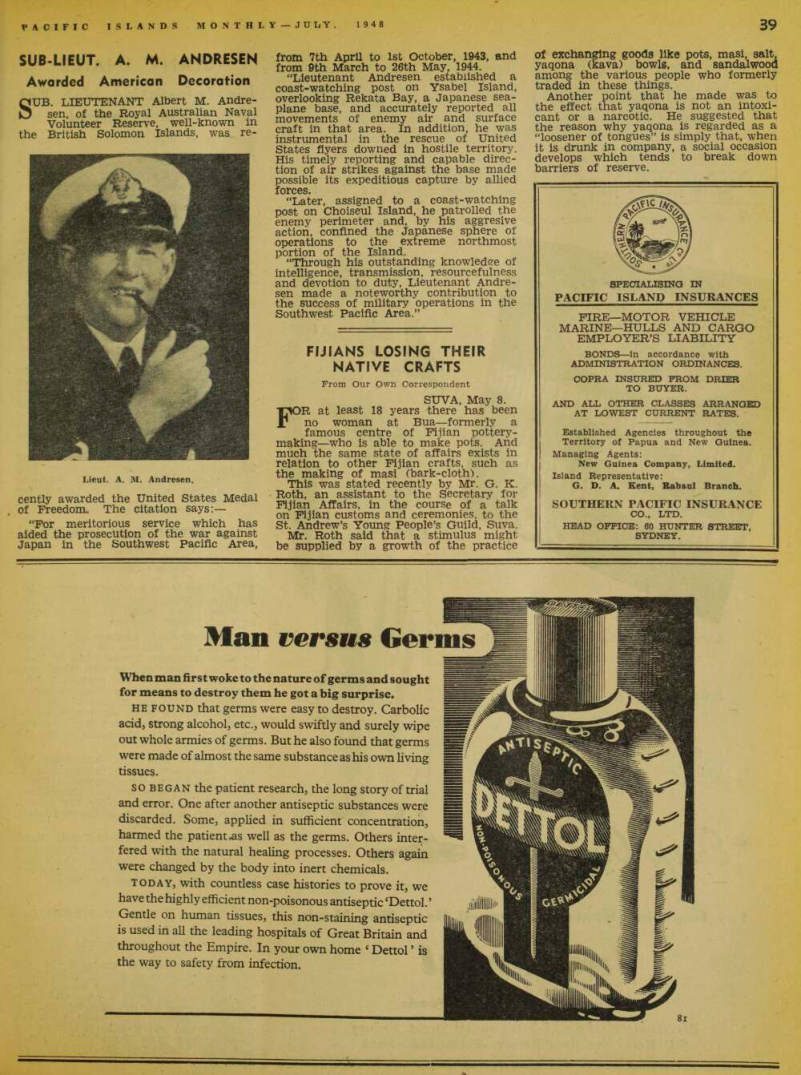
Awarded American Decoration
SUB. LIEUTENANT Albert M. Andre sen, of the Royal Australian Naval Volunteer Reserve, well-known in the British Solomon Islands, was re-
cently awarded the United States Medal of Freedom. The citation says;— “For meritorious service which has aided the prosecution of the war against Japan in the Southwest Pacific Area,
from 7th April to Ist October, 1943, and from 9th March to 26th May, 1944.
“Lieutenant Andresen established a coast-watching post on Ysabel Island, overlooking Rekata Bay, a Japanese sea plane base, and accurately reported all movements of enemy air and surface craft in that area. In addition, he was instrumental in the rescue of United States flyers downed in hostile territory.
His timely reporting and capable direc tion of air strikes against the base made possible its expeditious capture by allied forces.
“Later, assigned to a coast-watching post on Choiseul Island, he patrolled the enemy perimeter and, by his aggresive action, confined the Japanese sphere of operations to the extreme northmost portion of the Island.
“Through his outstanding knowledge of intelligence, transmission, resourcefulness and devotion to duty, Lieutenant Andre sen made a noteworthy contribution to the success of military operations in the Southwest Pacific Area.”
Lieut. A. M. Andresen.
Fijians Losing Their
Native Crafts
Prom Our Own Correspondent
Suva, May 8.
■TIOR at least 18 years there has been JP no woman at Bua—formerly a famous centre of Fijian pottery making—who is able to make pots. And much the same state of affairs exists in relation to other Fijian crafts, such as the making of masi (bark-cloth).
This was stated recently by Mr. G. K.
Roth, an assistant to the Secretary for Fijian Affairs, in the course of a talk on Fijian customs and ceremonies, to the St. Andrew’s Young People’s Guild, Suva.
Mr. Roth said that a stimulus might be supplied by a growth of the practice
of exchanging goods like pots, masl, salt, yaqona (kava) bowls, and sandalwood among the various people who formerly traded in these things.
Another point that he made was to the effect that yaqona is not an intoxi cant or a narcotic. He suggested that the reason why yaqona is regarded as a “loosener of tongues” is simply that, when it is drunk in company, a social occasion develops which tends to break down barriers of reserve.
Mr. D. Brown has been appointed chairman of the Levuka Township Board, Fiji, and Mr. R. X. Patterson a member of the Board. They replace Messrs H.
O. E. Palmer and E. Ashley whose resig nations have been accepted. Mr. Palmer has gone to the Gilbert and Ellice Islands Colony to take charge of the Govern ment trading scheme there.
M. Jean Baptiste Lelievrc, foreman of the Noumea Lightering Co., was drowned recently while fishing at the entrance to the Dumbea River, near Noumea. He was 43 years old.
Advertisements & other items, pp. 41-42 (1 item)
Man versus Germs
If/
SPECIALISING IN
PACIFIC ISLAND INSURANCES
FIRE—MOTOR VEHICLE
MARINE—HULLS AND CARGO
EMPLOYER’S LIABILITY
BONDS—In accordance with
ADMINISTRATION ORDINANCES.
COPRA INSURED FROM DRIER
TO BUYER.
AND ALL OTHER CLASSES ARRANGED
AT LOWEST CURRENT RATES.
Established Agencies throughout the Territory of Papua and New Guinea.
Managing Agents: New Guinea Company, Limited.
Island Representative: G. D. A. Kent, Babaul Branch.
SOUTHERN PACIFIC INSURANCE
CO., LTD.
HEAD OFFICE: 60 HUNTER STREET,
SYDNEY.
Man versus Germs
When man first woke to the nature of germs and sought for means to destroy them he got a big surprise. he found that germs were easy to destroy. Carbolic acid, strong alcohol, etc., would swiftly and surely wipe out whole armies of germs. But he also found that germs were made of almost the same substance as his own living tissues. sOBEGANthe patient research, the long story of trial and error. One after another antiseptic substances were discarded. Some, applied in sufficient concentration, harmed the patient .as well as the germs. Others interfered with the natural healing processes. Others again were changed by the body into inert chemicals. today, with countless case histories to prove it, we have the highly efficient non-poisonous antiseptic ‘Dettol.’
Gentle on human tissues, this non-staining antiseptic is used in all the leading hospitals of Great Britain and throughout the Empire. In your own home c Dettol ’ is the way to safety from infection. 5? w
PACIFIC ISLANDS SOCIETY
Visitor* from the Islands to Sydney (or those Interested in Islands affairs), are advised to communicate with the honorary secretary of the above Society, which has been formed to study the history, traditions, economies, and political developments of the Pacific Islands.
Regular monthly meetings are held at History Hosse, 8 Toung Street, Sydney.
Address for Correspondence:
THE PACIFIC ISLANDS SOCIETY,
Bex 2454 MM., G.P.0., Sydney.
Energy lost during the day is speedily restored when Imperial Hampe is served for the evening meal.
Hampe, sliced or diced, makes cool, energising salads, sandwiches and savouries, and the satisfying flavour lasts to the very end. □ape Try Imperial Meatreat, Corned Beef, Hot Meals
Imperial
Flavour Sealed Canned Foods [ Riverstone Meat Co., 5-7 O’Connell Street, Sydney Fiji Representative: Pearce & Co. Ltd., Suva
Giant Snails
Jap Infestation Not Yet Under Control
THE giant snails which were released by the Jap invaders as a source of food in New Britain, New Ireland and the mainland of New Guinea, rep resent a problem that has not yet been solved.
The infestation had spread so far through the jungles before its character and menace were recognised that it now seems unlikely that it will ever be brought under control. Like the Lantana of Eastern Australia, it will remain as a permanent curse to the blundering men who brought it in.
It has been found that the snails can be wiped out effectively by a “snail killer” prepared by a well known Aus tralian manufacturer. But this method, of course, calls for direct application of the preparation to the snails, or their haunts.
The Japs took the snails, also, to various Pacific Islands now in American occupation, where they are threatening to overrun various districts, including the island of Saipan. An American mission is being sent to Africa to seek a method of controlling the pest—which is a native of Madagascar.
The snails nearly got into the United States. Large numbers were found just in time, embedded in mud, on a shipment of cast-iron about to be loaded for America.
In Defence Of Harold
Ward
Letter to the Editor Fa footnote to a letter regarding Mr.
Harold Ward, you state that if Mr.
Ward allies himself to “our enemies” he must expect criticism.
As an old Cook Islander, and as one who has the interest of our “Brown Brother” at heart, I would like to know why you infer that Harold Ward may have been “allied to our enemies.” This would be a very serious thing to say of a man who, in recognition of his out standing service to ex-servicemen in the Pacific, has been granted the rare dis tinction of Life Membership in the
Nzrsa.
To the very best of my knowledge, Mr.
Ward has never had membership in either the CIPA, the Communist Party, or any'other party; but has always been willing to do his utmost for any person, persons or cause which, in his own belief, warranted assistance.
I trust that in fairness to Harold Ward, and as a counter to any misinterpretation of his activities and ideals, to which your footnote may have given cause, you will be so good as to publish this letter.
I am, etc.,
Thos. C. Wobrall.
Auckland, 7/6/48.
Monsieur Guihard, manager of the Wright plantation at Santo, N. Hebrides, was recently drowned in an unusual way.
He had gone to meet a boat and acci dentally backed his car into the sea. The car was recovered four hours later, put the body was not found. Depth at the wharf is from 30 to 40 yards. M. Guihard had been employed by the Wrights since
April, 1947.
Advertisements & other items, p. 42 (1 item)
40
JULY, 1948 PACIFIC ISLANDS MON'THLY
Magazine Section
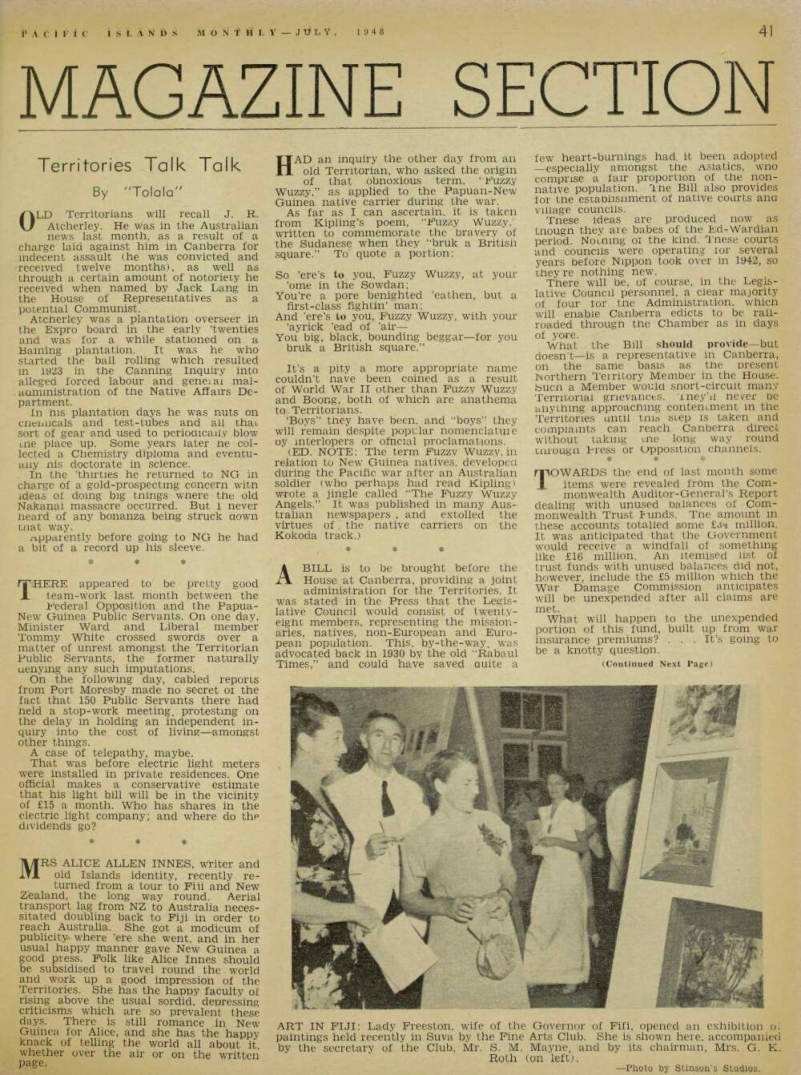
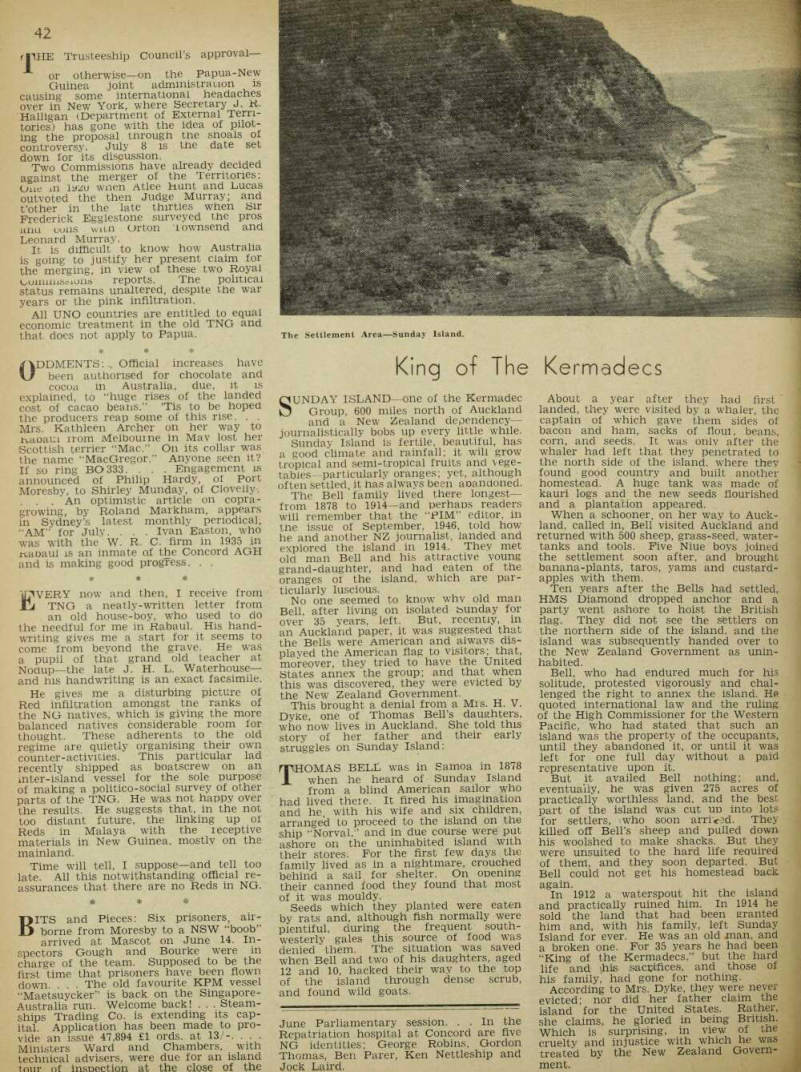
Territories Talk Talk
By "Tolala"
OLD Territorians will recall J. R.
Atcherley. He was in the Australian news last month, as a result of a charge laid against him in Canberra for indecent assault (he was convicted and received twelve months), as well as through a certain amount of notoriety he received when named by Jack Lang in the House of Representatives as a potential Communist.
Atcherley was a plantation overseer in the Expro board in the early ’twenties and was for a while stationed on a Earning plantation. It was he who started the ball rolling which resulted m 1923 in the Canning Inquiry into alleged forced labour and geneiai mal administration of the Native Affairs De partment.
In his plantation days he was nuts on criemicals and test-tubes and all that sort of gear and used to periodically blow tne place up. Some years later ne col lected a Chemistry diploma and eventu ally nis doctorate in science.
In the ’thirties he returned to NG in charge of a gold-prospecting concern witn ideas of doing big tnings where the old Nakanai massacre occurred. But 1 never heard of any bonanza being struck down tnat way. apparently before going to NG he had a bit of a record up his sleeve. * * THERE appeared to be pretty good team-work last month between the Federal Opposition and the Papua- New Guinea Public Servants. On one day, Minister Ward and Liberal member Tommy White crossed swords over a matter of unrest amongst the Territorian Public Servants, the former naturally uenymg any such imputations.
On the following day, cabled reports from Port Moresby made no secret oi the fact that 150 Public Servants there had held a stop-work meeting, protesting on the delay in holding an independent in quiry into the cost of living—amongst other things.
A case of telepathy, maybe.
That was before electric light meters were installed in private residences. One official makes a conservative estimate that his light bill will be in the vicinity of £l5 a month. Who has shares in the electric light company; and where do the dividends go? * ♦ ♦ MRS ALICE ALLEN INNES, writer and old Islands identity, recently re turned from a tour to Fiii and New Zealand, the long way round. Aerial transport lag from NZ to Australia neces sitated doubling back to Fiji in order to reach Australia. She got a modicum of publicity where ’ere she went, and in her usual happy manner gave New Guinea a good press. Folk like Alice Innes should be subsidised to travel round the world and work up a good impression of the Territories. She has the happy faculty of rising above the usual sordid, depressing criticisms which are so prevalent these days. There is still romance in New Guinea for Alice, and she has the happy knack of telling the world all about it, whether over the air or on the written page.
HAD an inquiry the other day from an old Territorian, who asked the origin of that obnoxious term, ‘ Huzzy Wuzzy,” as applied to the Papuan-New Guinea native carrier during the war.
As far as I can ascertain, it is taken from Kipling’s poem, “Huzzy Wuzzy,’ written to commemorate the bravery of the Sudanese when they “bruk a British square.” To quote a portion: So ’ere’s to you, Fuzzy Wuzzy, at your ’ome in the Sowdan; You’re a pore benighted ’eathen, but a first-class fightin’ man; And 'ere’s to you, Fuzzy Wuzzy, with your ’ayrick ’ead of ’air— You big, black, bounding beggar—for you bruk a British square.”
It’s a pity a more appropriate name couldn’t nave been coined as a result of World War II other than Fuzzy Wuzzy and Boong, both of which are anathema to Territorians.
“Boys” they have been, and “boys” they will remain despite popular nomenclatuie oy interlopers or official proclamations. (ED. NOTE; The term Fuzzv Wuzzy, in relation to New Guinea natives, developed during the Pacific war after an Australian soldier (who perhaps had read Kipling) wrote a jingle called “The Fuzzy Wuzzy Angels.” It was published in many Australian newspapers , and extolled the virtues of the native carriers on the Kokoda track.) * * * A BILL is to be brought before the House at Canberra, providing a joint administration for the Territories. It was stated in the Press that the Legislative Council would consist of twentyeight members, representing the missionaries, natives, non-European and European population. This, by-the-way, was advocated back in 1930 by the old “Rabaul Times,” and could have saved quite a
few heart-burnings had it been adopted —especially amongst the Asiatics, wno comprise a iair proportion of the non native population, me Bill also provides for the escabiisiiment of native courts ana village councils, Tnese ideas are produced now as tnougn they are babes of the Ed- Wardian period. Notnmg oi the kind, inese courts and councils were operating lor several years before Nippon took over in 1942, so they re nothing new.
There will be, of course, in the Legis lative Council personnel, a clear majority of four lor tne Administration, which will enable Canberra edicts to be raii roaded through the Chamber as in days of yore. . . . .
What the Bill should provide but doesn’t—is a representative in Canberra, on the same basis as the present Northern Territory Member in the House, Such a Member would snort-circuit many Territorial grievances, iney’u never be anything approaching contentment in the Territories until tms step is taken and complaints can reach Canberra direct without taking me long way round tnrougn Press or Opposition channels, mo WARDS the end of last month some f items were revealed from the Com monwealth Auditor-General’s Report dealing with unused balances of Com monwealth Trust Funds. Tne amount in these accounts totalled some £6* million. it was anticipated that the Government would receive a windfall of something like £l6 million. An itemised list of trust funds with unused balances did not, however, include the £5 million which the War Damage Commission anticipates be unexpended after all claims are ... , , , What will happen to the unexpended portion of this fund, built up from war insurance premiums. . . .Its going to be a knotty question.
(Continued Next rage)
ART IN FIJI: Lady Freeston, wife of the Governor of Fifi, opened an exhibition of paintings held recently in Suva by the Fine Arts Club. She is shown here, accompanied by the secretary of the Club, Mr. S. M. Mayne, and by its chairman, Mrs. G. K.
Roth (on left). —Photo by Stinson’s Studios.
rpilE Trusteeship Council’s approval— or otherwise —on the Papua-New Guinea joint administration is causing some international headaches over in New York, where Secretary J. R.
Halligan (Department of External Terri tories) has gone with the idea of pilot ing the proposal tnrougn tne snoals of controversy. July 8 is tine date set down for its discussion.
Two Commissions have already decided against the merger of the Territories: Oue m wnen Atlee hunt and Lucas outvoted the then Judge Murray; and t’other in the late thirties when Sir Frederick Egglestone surveyed the pros ana cans wnn Orton Townsend and Leonard Murray.
It is difficult to know how Australia is going to justify her present claim for the merging, in view of these two Royal reports. The political status remains unaltered, despite the war years or the pink infiltration.
All UNO countries are entitled to equal economic treatment in the old TNG and that does not apply to Papua. * * * ODDMENTS: . Official increases have been authorised for chocolate and cocoa in Australia, due, it is explained, to “huge rises of the landed cost of cacao beans.” ’Tis to be hoped the producers reap some of this rise. . .
Mrs. Kathleen Archer on her way to Kaoaui irom Melbourne in Mav lost her Scottish terrier “Mac.” On its collar was the name “MacGregor.” Anyone seen it?
If so ring BO 333. . . . Engagement is announced of Philip Hardy, of Port Moresby, to Shirley Munday, of Clovelly. . . An optimistic article on copra growing, by Roland Markham, appears in Sydney’s latest monthly periodical, “AM” for July. . . . Ivan Easton, who was with the W. R. C. firm in 1935 in rtaDaul is an inmate of the Concord AGH and is making good progress. . . * * * EVERY now and then, I receive from TNG a neatly-written letter from an old house-boy, who used to do the needful for me in Rabaul. His hand writing gives me a start for it seems to come from beyond the grave. He was a pupil of that grand old teacher at Nodup—the late J. H. L. Waterhouse— and his handwriting is an exact facsimile.
He gives me a disturbing picture of Red infiltration amongst tne ranks of the NG natives, which is giving the more balanced natives considerable room for thought. These adherents to the old regime are quietly organising their own counter-activities. This particular lad recently shipped as boatscrew on an inter-island vessel for the sole purpose of making a politico-social survey of other parts of the TNG. He was not happy over the results. He suggests that, in the not too distant future, the linking up of Reds in Malaya with the receptive materials in New Guinea, mostly on the mainland.
Time will tell, I suppose—and tell too late. All this notwithstanding official re assurances that there are no Reds in NG. * * * BITS and Pieces: Six prisoners, air borne from Moresby to a NSW “boob” arrived at Mascot on June 14. In spectors Gough and Bourke were in charge of the team. Supposed to be the first time that prisoners have been flown down. , . . The old favourite KPM vessel “Maetsuycker” is back on the Singapore- Australia run. Welcome back! . . . Steam ships Trading Co. is extending its cap ital. Application has been made to pro vide an issue 47,894 £1 ords. at 13/-. . . .
Ministers Ward and Chambers, with technical advisers, were due for an island tour of insnection at the close of the
June Parliamentary session. . . In the Repatriation hospital at Concord are five NG identities: George Robins. Gordon Thomas, Ben Parer, Ken Nettleship and Jock Laird.
King of The Kermadecs
SUNDAY ISLAND—one of the Kermadec Group. 600 miles north of Auckland and a New Zealand dependency— journalistically bobs up every little while, Sunday Island is fertile, beautiful, has a good climate and rainfall: it will grow tropical and semi-tropical fruits and vege tabies_particularly oranges; yet, although often settled it has always been aoandoned.
The Bell ’ family lived there longest— from 1878 to 1914—and perhaps readers will remember that the “PIM” editor, in the issue of September, 1946, told how he and another NZ journalist, landed and explored the island in 1914. They met old man Bell and his attractive young grand-daughter, and had eaten of the oranges of the island, which are par ticularly luscious.
No one seemed to know why old man Bell, after living on isolated bunday for over 35 years, left. But, recently, in an Auckland paper, it was suggested that the Bells were American and always dis played the American flag to visitors; that, moreover, they tried to have the United States annex the group; and that when this was discovered, they were evicted by the New Zealand Government.
This brought a denial from a Mrs. H. V.
Dyke, one of Thomas Bell’s daughters, who now lives in Auckland. She told this story of her father and their early struggles on Sunday Island: THOMAS BELL was in Samoa in 1878 when he heard of Sunday Island from a blind American sailor who had lived there. It fired his imagination and he with his wife and six children, arranged to proceed to the island on the ship “Norval,” and in due course were put ashore on the uninhabited island with their stores. For the first few days the family lived as in a nightmare, crouched behind a sail for shelter. On opening their canned food they found that most of ft W as mouldy.
Seeds which they planted were eaten by rats and, although fish normally were plentiful during the frequent south westerly ’ gales this source of food was denied them. The situation was saved when Bell and two of his daughters, aged 12 and 10, hacked their way to the top of the island through dense scrub, and found wild goats.
About a year after they had first landed, they were visited by a whaler, the captain of which gave them sides of bacon and ham, sacks of floui, beans, corn, and seeds. It was only after the whaler had left that they penetrated to the north side of the island, where they found good country and built another homestead. A huge tank was made of kauri logs and the new seeds flourished and a plantation appeared.
When a schooner, on her way to Auck land, called in, Bell visited Auckland and returned with 500 sheep, grass-seed, water tanks and tools. Five Niue boys joined the settlement soon after, and brought banana-plants, taros, yams and custard apples with them.
Ten years after the Bells had settled, HMS Diamond dropped anchor and a party went ashore to hoist the British flag. They did not see the settlers on the northern side of the island, and the island was subsequently handed over to the New Zealand Government as unin habited.
Bell, who had endured much for his solitude, protested vigorously and chal lenged the right to annex the island. He quoted international law and the ruling of the High Commissioner for the Western Pacific, who had stated that such an island was the property of the occupants, until they abandoned it, or until it was left for one full day without a paid representative upon it.
But it availed Bell nothing; and. eventually, he was given 275 acres of practically worthless land, and the best part of the island was cut un into lots for settlers, who soon arrived. They killed off Bell’s sheep and pulled down his woolshed to make shacks. But they were unsuited to the hard life required of them, and they soon departed. But Bell could not get his homestead back again.
In 1912 a waterspout hit the island and practically ruined him. In 1914 he sold the land that had been granted him and, with his family, left Sunday Island for ever. He was an old man, and a broken one. For 35 years he had been “King of the Kermadecs,” but the hard life and \hife .sacrifices, and those of his family, had gone for nothing.
According to Mrs. Dyke, they were never evicted; nor did her father claim the island for the United States. Rather, she claims, he gloried in being British.
Which is surprising, in view of tne cruelty and injustice with which he was treated by the New Zealand Govern ment.
The Settlement Area—Sunday Island.
The Things The Yanks Saw
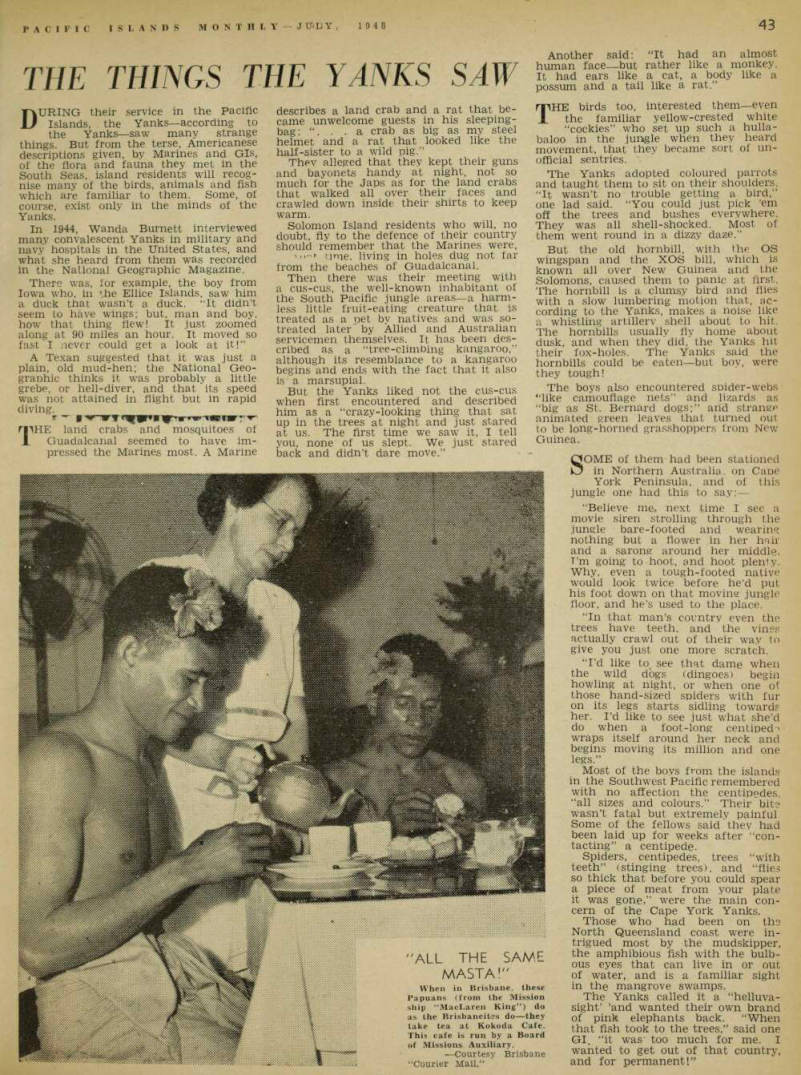
DURING their service in the Pacific Islands, the Yanks—according to the Yanks —saw many strange things. But from the terse, Americanese descriptions given, by Marines and Gls, of the flora and fauna they met in the South Seas, island residents will recog nise many of the birds, animals and fish which are familiar to them. Some, of course, exist only in the minds of the Yanks.
In 1944, Wanda Burnett interviewed many convalescent Yanks in military and navy hospitals in the United States, and what she heard from them was recorded in the National Geographic Magazine.
There was, for example, the boy from lowa who, in the Ellice Islands, saw him a duck that wasn’t a duck. “It didn’t seem to have wings; but, man and boy. how that thing flew! It just zoomed along at 90 miles an hour. It moved so fast I never could get a look at it!”
A Texan suggested that it was just a plain, old mud-hen; the National Geo graphic thinks it was probably a little grebe, or hell-diver, and that its speed was not attained in flight but in rapid diving. rpHE land crabs and mosquitoes of 1 Guadalcanal seemed to have im pressed the Marines most. A Marine
describes a land crab and a rat that be came unwelcome guests in his sleeping bag; “. . .a crab as big as my steel helmet and a rat that looked like the half-sister to a wild pig.”
Thev alleged that they kept their guns and bayonets handy at night, not so much for the Japs as for the land crabs that walked all over their faces and crawled down inside their shirts to keep warm.
Solomon Island residents who will, no doubt, fly to the defence of their country should remember that the Marines were, '>.<■>* rime, living in holes dug not far from the beaches of Guadalcanal.
Then there was their meeting with a cus-cus, the well-known inhabitant of the South Pacific jungle areas—a harm less little fruit-eating creature that Is treated as a pet by natives and was so treated later by Allied and Australian servicemen themselves. It has been des cribed as a “tree-climbing kangaroo,” although its resemblance to a kangaroo begins and ends with the fact that it also is a marsupial.
But the Yanks liked not the cus-cus when first encountered and described him as a “crazy-looking thing that sat up in the trees at night and just stared at us. The first time we saw it, I tell you, none of us slept. We just stared back and didn’t dare move.”
Another said; “It had an almost human face—but rather like a monkey.
It had ears like a cat, a body like a possum and a tail like a rat.”
THE birds too, interested them—even the familiar yellow-crested white “cockies” who set up such a hulla baloo in the jungle when they heard movement, that they became sort of un official sentries.
The Yanks adopted coloured parrots and taught them to sit on their shoulders.
“It wasn’t no trouble getting a bird,” one lad said. “You could just pick ’em off the trees and bushes everywhere.
They was all shell-shocked. Most of them went round in a dizzy daze.”
But the old hornbill, with the OS wingspan and the XOS bill, which is known all over New Guinea and the Solomons, caused them to panic at first.
The hornbill is a clumsy bird and flies with a slow lumbering motion that, ac cording to the Yanks, makes a noise like a whistling artillery shell about to hit.
The hornbills usually fly home about dusk, and when they did. the Yanks hit their fox-holes. The Yanks said the hornbills could be eaten—but boy, were they tough!
The boys also encountered spider-webs “like camouflage nets” and lizards as “big as St. Bernard dogs;” arid strange animated green leaves that turned out to be long-horned grasshoppers from New Guinea.
SOME of them had been stationed in Northern Australia, on Cane York Peninsula, and of this jungle one had this to say:— “Believe me, next time I see a movie siren strolling through the jungle bare-footed and wearing nothing but a flower in her hair and a sarong around her middle, I’m going to hoot, and hoot plenty.
Why, even a tough-footed native would look twice before he’d put his foot down on that moving jungle floor, and he’s used to the place.
“In that man’s country even the trees have teeth, and the vines actually crawl out of their way to give you just one more scratch.
“I’d like to. see that dame when the wild dogs (dingoes) begin howling at night, or when one of those hand-sized spiders with fur on its legs starts sidling towards her. I’d like to see just what she’d do when a foot-long centipede wraps itself around her neck and begins moving its million and one legs.”
Most of the boys from the islands in the Southwest Pacific remembered with no affection the centipedes, “all sizes and colours.” Their bits wasn’t fatal but extremely painful Some of the fellows said they had been laid up for weeks after “con tacting” a centipede.
Spiders, centipedes, trees “with teeth” (stinging trees), and “flies so thick that before you could spear a piece of meat from your plate it was gone,” were the main con cern of the Cape York Yanks.
Those who had been on the North Queensland coast were in trigued most by the mudskipper, the amphibious fish with the bulb ous eyes that can live in or out of water, and is a familiar sight in the mangrove swamps.
The Yanks called it a “helluva sight’ ’and wanted their own brand of pink elephants back. “When that fish took to the trees,” said one GI, “it was too much for me. I wanted to get out of that country, and for permanent!”
"All The Same
Masta!"
When in Brisbane, these Papuans (from the Mission ship “MacLaren King”) do as the Brisbaneites do—they take tea at Kokoda Cafe.
This cafe is run by a Board of Missions Auxiliary. —Courtesy Brisbane “Courier Mail.”
Tropicalities
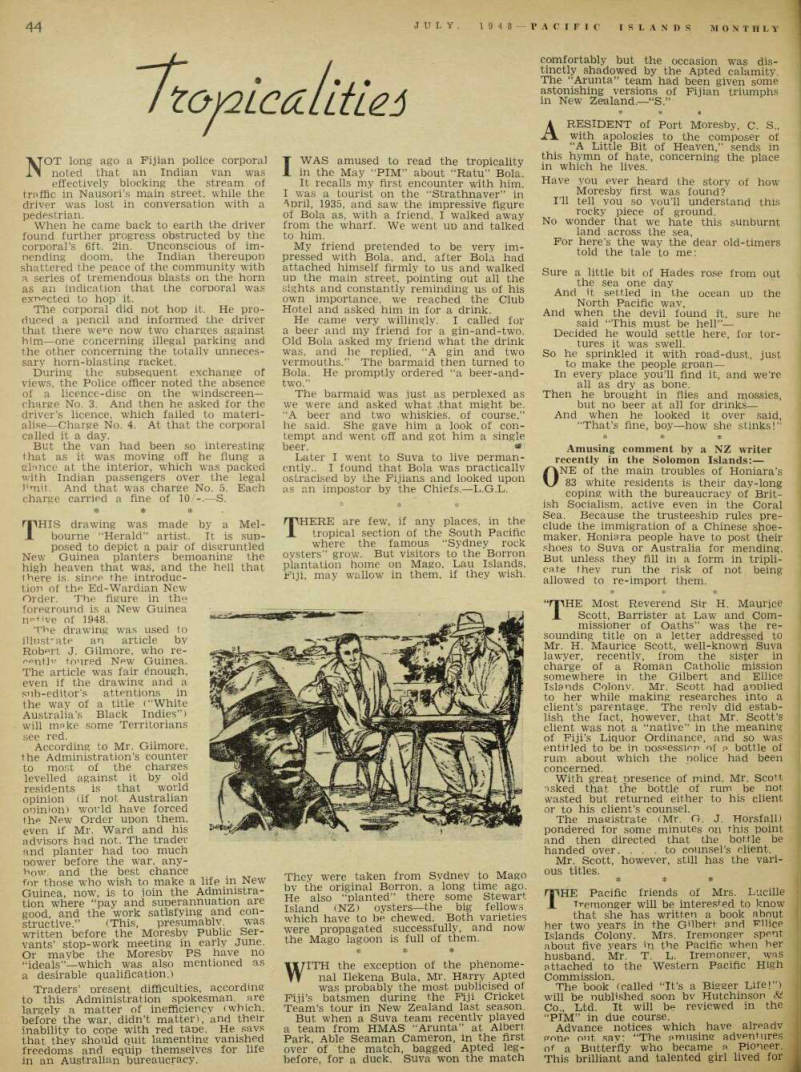
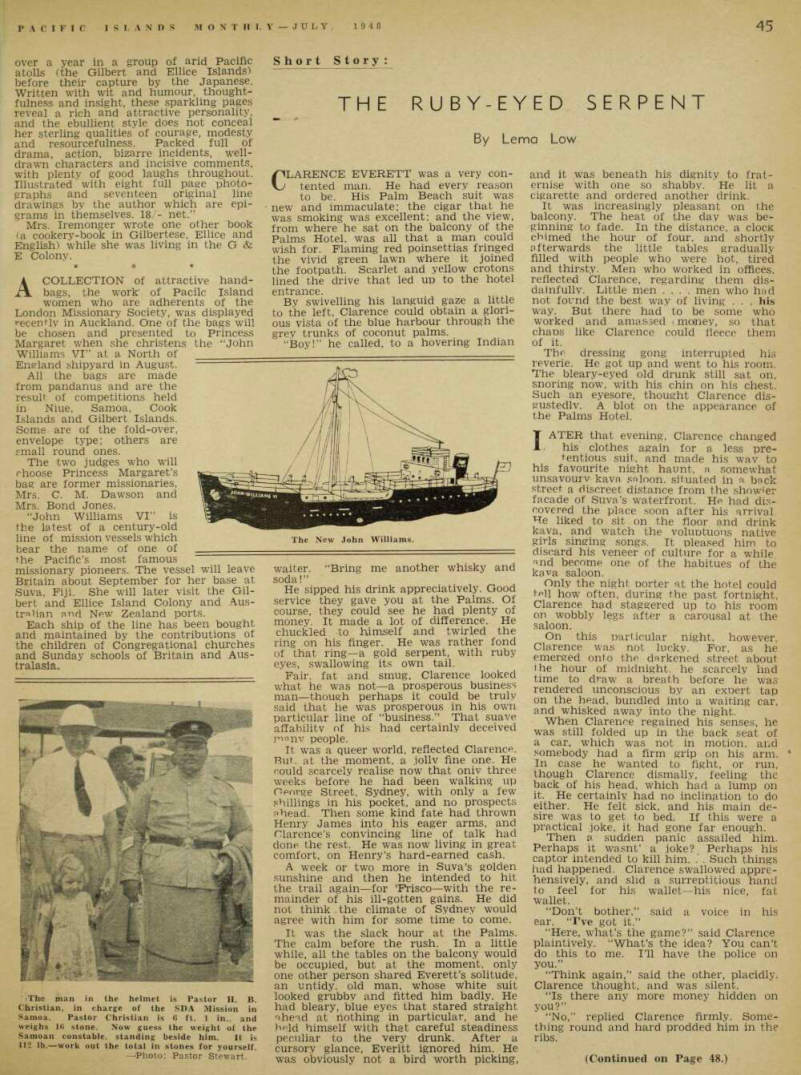
NOT long ago a Fijian police corporal noted that an Indian van was effectively blocking the stream of traffic in Nausori’s main street, while the driver was lost in conversation with a pedestrian.
When he came back to earth the driver found further progress obstructed by the corporal’s 6ft. 2in. Unconscious of impending doom, the Indian thereupon shattered the peace of the community with a series of tremendous blasts on the horn as an indication that the corporal was exacted to hop it.
The corporal did not hop it. He produced a pencil and informed the driver that there now two charges against him—one concerning illegal parking and the other concerning the totally unnecessary horn-blasting racket.
During the subsequent exchange of views, the Police officer noted the absence of a licence-disc on the windscreen— charge No. 3. And then he asked for the driver’s licence, which failed to materialise—Charge No. 4. At that the corporal called it a day.
But the van had been so interesting that as it was moving off he flung a glnnce at the interior, which was packed with Indian passengers over the legal Unfit. And that was charge No. 5. Each charge carried a fine of 10/-.—S. * ♦ * THIS drawing was made by a Melbourne “Herald” artist. It is supposed to depict a pair of disgruntled New Guinea planters bemoaning the high heaven that was, and the hell that there is. since the introduction of the Ed-Wardian New
Order. The figure in the foreground is a New Guinea noHve of 1948.
The drawing was used to illustrate an article by Robert J. Gilmore, who re ',ontW toured New Guinea.
The article was fair Enough, even if the drawing and a sub-editor’s attentions in the way of a title (“White Australia’s Black Indies”) will make some Territorians see red.
According to Mr. Gilmore, the Administration’s counter to most of the charges levelled against it by old residents is that world opinion (if not Australian opinion) world have forced the New Order upon them, even if Mr. Ward and his advisors had not. The trader and planter had too much power before the war, any
v>ow. and the best chance for those who wish to make a life in New Guinea, now, is to join the Administra tion where “pay and superannuation are good, and the work satisfying and con structive.” (This, presumablv. was written before the Moresby Public Ser vants’ stop-work meeting in early June.
Or maybe the Moresby PS have no “ideals”—which was also mentioned as a desirable qualification.) Traders’ present difficulties, according to this Administration sppkesman. are largely a matter of inefficiency (which, before the war, didn’t matter), and their inability to cone with red tape. He savs that they should quit lamenting vanished freedoms and equip themselves for life in an Australian bureaucracy.
T WAS amused to read the tropicality 1. in the May “PIM” about “Ratu” Bola.
It recalls my first encounter with him.
I was a tourist on the “Strathnaver” in 4pril, 1935, and saw the impressive figure of Bola as, with a friend. I walked away from the wharf. We went up and talked to him.
My friend pretended to be very im pressed with Bola, and. after Bola had attached himself firmly to us and walked up the main street, pointing out all the sights and constantly reminding us of his own importance, we reached the Club Hotel and asked him in for a drink, He came very willingly. I called for a beer and my friend for a gin-and-two.
Old Bola asked my friend what the drink was, and he replied, “A gin and two vermouths.” The barmaid then turned to Bola. He promptly ordered “a beer-and two.”
The barmaid was just as perplexed as we were and asked what .that might be.
"A beer and two whiskies, of course.” he said. She gave him a look of con tempt and went off and got him a single beer. * Later I went to Suva to live perman ently.. I found that Bola was practically ostracised by the Fijians and looked upon as an impostor by the Chiefs.—L.G.L. 0 HPHERE are few, if any places, in the A tropical section of the South Pacific where the famous Sydney rock oysters grow. But visitors to the Borron plantation home on Mago, Lau Islands, may wallow in them, if they wish,
J h ey were taken from Sydney to Mago by therl some Stewart
Itad“ («Z. Toysters-Ure S °to| fellows:
which have to be chewed Both varieties were Propagated successfully now the Mago la & oon is full of tnem. * yjiriTH the exception of the phenome yy nal n e kena Bula, Mr. Harry Apted was probably the most publicised of Fiji’s batsmen during the Fiji Cricket Team’s tour in New Zealand last season, But when a Suva team recently played a team from HMAS “Arunta” at Albert Park, Able Seaman Cameron, in the first over of the match, bagged Apted leg before, for a duck. Suva won the match
comfortably but the occasion was dis tinctly shadowed by the Apted calamity.
The “Arunta” team had been given some astonishing versions of Fijian triumphs in New Zealand.—“S ” * * * A RESIDENT of Port Moresby, C. S., with apologies to the composer of “A Little Bit of Heaven,” sends in this hymn of hate, concerning the place in which he lives.
Have you ever heard the story of how Moresby first was found?
I’ll tell vou so you’ll understand this rocky piece of ground.
No wonder that we hate this sunburnt land across the sea, For here’s the way the dear old-timers told the tale to me: Sure a little bit of Hades rose from out the sea one day And it settled in the ocean up the North Pacific wav, And when the devil found it, sure he said “This must be hell”— Decided he would settle here, for tor tures it was swell.
So he sprinkled it with road-dust, just to make the people groan— In every place you’ll find it, and we’re all as dry as bone.
Then he brought in flies and mossies, but no beer at all for drinks— And when he looked it over said, “That’s fine, boy—how she stinks!” * * * Amusing comment by a NZ writer recently in the Solomon Islands:— ONE of the main troubles of Honiara’s 83 white residents is their day-long coping with the bureaucracy of Brit ish Socialism, active even in the Coral Sea. Because the trusteeship rules pre clude the immigration of a Chinese shoe maker, Honiara people have to post their shoes to Suva or Australia for mending.
But unless they fill in a form in tripli cate thev run the risk of not being allowed to re-import them. * * * “rpHE Most Reverend Sir H. Maurice X Scott, Barrister at Law and Com missioner of Oaths” was the re sounding title on a letter addressed to Mr. H. Maurice Scott, well-known Suva lawyer, recently, from the sister in charge of a Roman Catholic mission somewhere in the Gilbert and Ellice Islands Colony. Mr. Scott had applied to her while making researches into a client’s parentage. The renly did estab lish the fact, however, that Mr. Scott’s client was not a “native” in the meaning of Fiji’s Liquor Ordinance, and so was entitled to be in possession of a bottle of rum about which the police had been concerned.
With great presence of mind. Mr. Scott, nsked that the bottle of rum be not wasted but returned either to his client or to his client’s counsel.
The magistrate (Mr. G. J. Horsfall) pondered for some minutes on this point and then directed that the bottle be handed over. ... to counsel’s client.
Mr. Scott, however, still has the vari ous titles. * * * Pacific friends of Mrs. Lucille Tremonger will be interested to know that she has written a book about her two years in the Gilbert and hi lice Islands Colony. Mrs. Iremonger spent about five years in the Pacific when her husband, Mr. T. L. Iremonger, was attached to the Western Pacific High Commission.
The book (called “It’s a Bigger Life!”) will be published soon bv Hutchinson &!
Co., Ltd. It will be reviewed in the “PTM” in due course.
Advance notices which have already p-one out sav: “The amusing adventures ot a Butterfly who became a Pioneer.
This brilliant and talented girl lived for
over a year in a group of arid Pacific atolls (the Gilbert and Ellice Islands) before their capture by the Japanese.
Written with wit and humour, thought fulness and insight, these sparkling pages reveal a rich and attractive personality, and the ebullient style does not conceal her sterling qualities of courage, modesty and resourcefulness. Packed full of drama, action, bizarre incidents, well drawn characters and incisive comments, with plenty of good laughs throughout.
Illustrated with eight full page photo graphs and seventeen original line drawings by the author which are epi grams in themselves. 18/- net.”
Mrs. Iremonger wrote one other book (a cookery-book in Gilbertese, Ellice and English) while she was living in the G & E Colony. * * * A COLLECTION of attractive hand bags, the work of Pacilc Island women who are adherents of the London Missionary Society, was displayed recently in Auckland. One of the bags will be chosen and presented to Princess Margaret when she christens the “John
Williams VI” at a North of England shipyard in August.
All the bags are made from pandanus and are the result of competitions held in Niue, Samoa, Cook Islands and Gilbert Islands.
Some are of the fold-over, envelope type; others are small round ones.
The two judges who will choose Princess Margaret’s bag are former missionaries, Mrs. C. M. Dawson and Mrs. Bond Jones.
“John Williams VI” is the latest of a century-old line of mission vessels which bear the name of one of the Pacific’s most famous
missionary pioneers. The vessel will leave Britain about September for her base at Suva, Fiji. She will later visit the Gil bert and Ellice Island Colony and Aus tralian pnd New Zealand ports.
Each ship of the line has been bought and maintained by the contributions of the children of Congregational churches and Sunday schools of Britain and Aus tralasia.
The Ruby-Eyed Serpent
Short Story:
By Lema Low
CLARENCE EVERETT was a very con tented man. He had every reason to be. His Palm Beach suit was new and immaculate: the cigar that he was smoking was excellent: and the view, from where he sat on the balcony of the Palms Hotel, was all that a man could wish for. Flaming red poinsettias fringed the vivid green lawn where it joined the footpath. Scarlet and yellow crotons lined the drive that led up to the hotel entrance By swivelling his languid gaze a little to the left, Clarence could obtain a glori ous vista of the blue harbour through the grey trunks of coconut palms.
“Boy!” he called, to a hovering Indian
waiter. “Bring me another whisky and soda!”
He sipped his drink appreciatively. Good service they gave you at the Palms. Of course, they could see he had plenty of money. It made a lot of difference. He chuckled to himself and twirled the ring on his finger. He was rather fond of that ring-a gold serpent, with ruby eyes, swallowing its own tail.
Fair, fat and smug, Clarence looked what he was not—a prosperous business man—though perhaps it could be truly said that he was prosperous in his own particular line of “business.” That suave affabilitv of his had certainly deceived msnv people.
It was a queer world, reflected Clarence.
But. at the moment, a jolly fine one. He could scarcely realise now that oniv three weeks before he had been walking up George Street, Sydney, with only a few shillings in his pocket, and no prospects ehead. Then some kind fate had thrown Henry James into his eager arms, and Clarence’s convincing line of talk had done the rest. He was now living in great comfort, on Henry’s hard-earned cash.
A week or two more in Suva’s golden sunshine and then he intended to hit the trail again—for ’Frisco —with the re mainder of his ill-gotten gains. He did not think the climate of Sydney would agree with him for some time to come.
It was the slack hour at the Palms.
The calm before the rush. In a little while, all the tables on the balcony would be occupied, but at the moment, only one other person shared Everett’s solitude, an untidy, old man. whose white suit looked grubby and fitted him badly. He had bleary, blue eyes that stared straight qhead at nothing in particular, and he bold himself with that careful steadiness peculiar to the very drunk. After a cursory glance, Everitt ignored him. He was obviously not a bird worth picking,
and it was beneath his dignity to frat ernise with one so shabby. He lit a cigarette and ordered another drink.
It was increasingly pleasant on the balcony. The heat of the day was be ginning to fade. In the distance, a clock chimed the hour of four, and shortly afterwards the little tables gradually filled with people who were hot, tired and thirsty. Men who worked in offices, reflected Clarence, regarding them dis dainfully. Little men ... men who had not found the best way of living ... his way. But there had to be some who worked and ama&sed ■ moaiey, so that chaos like Clarence could fleece them of it.
The dressing gong interrupted his reverie. He got up and went to his room.
The bleary-eyed old drunk still sat on, snoring now, with his chin on his chest.
Such an eyesore, thought Clarence dis gustedlv. A blot on the appearance of the Palms Hotel. lATER that evening, Clarence changed his clothes again for a less pre tentious suit, and made his wav to his favourite night haunt, a somewhat unsavourv kava saloon, situated in a back street a discreet distance from the show'er facade of Suva’s waterfront. He had dis covered the place soon after his arrival He liked to sit on the floor and drink kava, and watch the voluotuous native girls singing songs. It nleased him to discard his veneer of culture for a while and become one of the habitues of the kava saloon.
Only the night norter at the hotel could tell how often, during the past fortnight.
Clarence had staggered up to his room on wobbly legs after a carousal at the saloon.
On this particular night, however, Clarence was not lucky. For, as he emerged onto the darkened street about the hour of midnight, he scarcely had time to draw a breath before he was rendered unconscious by an exoert tap on the head, bundled into a waiting car, and whisked away into the night.
When Clarence regained his senses, he was still folded up in the back seat of a car, which was not in motion, and somebody had a firm grip on his arm.
In case he wanted to fight, or run, though Clarence dismally, feeling the back of his head, which had a lump on it. He certainly had no inclination to do either. He felt sick, and his main de sire was to get to bed. If this were a practical joke, it had gone far enough.
Then a sudden panic assailed him.
Perhaps it wasnt’ a joke? Perhaps his captor intended to kill him. . . Such things had happened. Clarence swallowed appre hensively, and slid a surreptitious hand to feel for his wallet—his nice, fat wallet.
“Don’t bother,” said a voice in his ear. ‘Tve got it.”
“Here, what’s the game?” said Clarence plaintively. “What’s the idea? You can’t do this to me. I’ll have the police on you.”
“Think again,” said the other, placidly.
Clarence thought, and was silent.
“Is there any more money hidden on you?”
“No,” replied Clarence firmly. Some thing round and hard prodded him in the ribs.
(Continued on Page 48.)
The man in the helmet is Pastor H. B.
Christian, in charge of the SDA Mission in Samoa. Pastor Christian is 6 ft. 1 in., and weighs 16 stone. Now guess the weight of the Samoan constable, standing beside him. It is 412 lb.—work out the total in stones for yourself. —Photo: Pastor Stewart.
The New John Williams.
“Are you sure?” Courage was not one of Clarence’s strong points.
“Y-yes,” he amended, not knowing quite what he meant to say.
“Well, hand it over, then,” came the laconic request. Clarence reached down despairingly and undid a roll oi notes from the sole of his boot.
“Don’t take it all,” he begged. “Leave me something, or I’ll be broke. You’ve even taken my ring.”
“Sure,” said the robber calmly. ‘lt’s a fine ring. I might wear it myself. Now, I must leave you. You’re only eight miles from the hotel, so it will be a nice waiK for you. Pity it’s so dark. Good night.’
Filled with bitterness and misery, Clarence trudged off along the roaa.
Wnether it was the right direction or not he neither knew nor cared. But by dawn ms faltering feet had taken him to tne doors of Palms. On the floor inside ms own door, he found a ten-shilling note, and surmised that that damnable crook had had the impudence to put it there.
THAT afternoon, a very different Clarence sat on the shady balcony.
He was far from smug, and his thoughts were not pleasant ones. He had barely the price of a drink in his pocket and he cursed the scoundrel who had robbed him. Now he would have to get busy with his wits again if he were to see San Francisco. Hopefully, he glanced around the balcony, to see if there were anyone worth scraping acquaintance with, but there was nobody —absolutely nobody. Except that bleary eyed old —— Then Clarence’s thoughts halted in mid air, his jaw dropped and his eyes goggled The bleary-eyed old man was staring straight at him, and he gave Clarence a slow, knowing wink; and, as he winked, he raised his glass to Clarence; and, as he raised his glass, there came, from the third finger of his right hand, the gleam of an opulent ring—a gold serpent, with ruby eyes, swallowing its tail.
Pacific Nature Notes
Written for "PIM" by Charles Barrett, FRZS
Giant Butterflies
BUTTERFLY collecting became a diver sion with servicemen, in Papua and New Guinea especially, towards the end of the war. Few of the hundreds who chased swallowtails with long handled nets, while there were still Jap anese in the jungles, retained their enthusiasm for this “sport” after return ing to civilian life. But there have always been amateur entomologists among the Islands, and many are interested in but terflies —the splendid insects which often lured soldiers on long chases, not always to the accompaniment of laughter from their comrades.
A serviceman asked me to settle an argument by naming “the biggest but terfly.” That was easy; though I doubt whether any of the boys had seen, much less captured, a specimen of the Queen Alexandra birdwing (Papilio alexandraei, a giant butterfly of New Guinea, as en chanting to insect collectors as the blue bird of paradise is to bird men. It was discovered, many years ago, by A. S.
Meek, when he was collecting for Walter Rothschild, at the head of the Mambare River. His camp was 5,000 feet up, at Psiagi; and the greatest prize taken there was a female birdwing, destined to be named after England’s Queen. A year or two later. Meek netted the first male of the species, which is nearly related to another royal butterfly—the Victoria birdwing.
Papilio Alexandrae, with a wingspread of more than ten inches, is the largest known butterfly; but several other bird wings come close to it in size. They belong to the Swallowtail family, and are sometimes called the Aristolochia papilos because their caterpillars feed almost exclusively an Aristolochia plants: big caterpillars with a dense covering of very small hairs.
This group is represented in the Solo mons bv some lovely species, notably the Queen Victoria birdwing, of which Meek took a number of specimens. It was so rare and desirable in his day, that one particularly fine example sold for twenty nine guineas in London. Desirable still are these grand insects, though their market value long since declined as the supply increased. Entomologists were not the only buyers of tropical butter flies: designers of women’s dresses often bought cases of them; and copied pat terns and colour schemes from butterfly wings.
The Queen Victoria birdwing, of course, was discovered long before Papilio alex andrae, which put it in the shade, so far as size was concerned: in beauty they are rivals, and each has its champions.
It was John MacGillivray, naturalist on board HMS “Herald,” who collected the first known specimen of Victoriae; at Wanderer Bay, Guadalcanal, early in the ’fifties. The “Herald” visited the Solo mons on anything but a scientific mission —Benjamin Boyd had landed from his yacht, the “Wanderer,” disappeared in the jungle, and never returned. The “Herald” people failed to solve the mys tery: but, almost certainly, Ben Boyd was killed by natives and provided a cannibal feast.
MacGillivray, doubtless, felt happy about having discovered a magnificent new butterfly at Wanderer Bay. It was a female specimen—no male was col lected until a generation later, the lucky naturalist being Charles M. Woodforde, who wrote an excellent account of the
Solomons, nearly 60 years ago, and pre dicted that they would one day become of great importance to Australia.
Fijian Parrots
AN American bird man, who visited Fiji some years ago, took a poor view of the native parrots’ chances of survival beyond another half century.
He was concerned chiefly about the red-throated lorikeet, a small green bird, with red “face,” and throat, and thighs.
Its range is very restricted—Viti Levu, Ovalau, and Taveuni, and this long tailed lorikeet keeps to forest country on the mountains, I believe.
Two other kinds of lory are found in the Fiji group—the blue-crowned, and the collared lory; the former is also a bird of Samoa and other Polynesian islands. There are two larger parrots, the red-breasted and the yellow-breasted musk lorikeets. The collared bird also is known as the solitary lory, and the ruffed lory, on account of the long, silky feathers of the neck. A charming bird in the wilds—and in the aviary; it has long been known to aviculturists over seas. Several specimens were exhibited at London Zoological Gardens in the ’thirties, and they may still be thriving there, if these lorikeets are fairly long lived.
One way of saving a species in danger of extinction is to breed it in captivity.
This has been done successfully in the cases of several rare Australian parrots, including a lovely little Queenslander, which for years was a “lost” bird, none having been seen in a wild state.
So far as I know, the collared lorv is in no danger of sharing the Dodo’s fate.
Even a common bird, however, may soon become rare should conditions cease to favour it. The list of extinct birds in cludes several Pacific species formerlv numerous. The passenger pigeon of North America once existed in millions; none remains now. Snortsmen and pot hunters took heaw toll of the vast flocks on their migratory flights, season after season, until millions dwindled to thou sands, and eventually, to scores. The last of the race died in captivity,
The “White Gallinule”
THE extinction of the “white gallinule,” at first regarded as a cousin of the common bald coot, which it re sembled in shape and make, probably was hastened by descendants of muti neers of the “Bounty.” In 1868, a party of Pitcairn Islanders and their friends from Norfolk Island visited Sydney. On the return voyage measles broke out among them, and they called in at Lord Howe, remaining there until the sick men recovered. Doubtless those who went on shore killed many gallinules; for Norfolk Islanders knew the birds to be good tucker.
Until round about the ’fifties, the white gallinule (Notornis alba), originally de scribed and figured in “Phillip’s Voyage to New South Wales” (published in 1789). was fairly common on Lord Howe and Norfolk Islands: and it was as tame and stupid as a booby, until relentlessly hunted. When it became extinct is un certain; but the white gallinule dis appeared from all its haunts more than seventy years ago. The only specimen of which I can find a record, is one said to be preserved in the Vienna Museum — and that was long before World War II began.
New Zealand’s Notornis, a handsome bird, which might be mistaken for a giant coot, became known to science by fossil remains, and was thought to be. like the moas, an extinct species, until two years after the discovery of ancestral bones, when a live specimen was col-
T HE gleanings of a naturalist in the Pacific —the specimens collected—are likely to he stored away in a museum; but he may share with many people his knowledge of wild life, and ver haps, learn something from their own observations.
In this column I propose to write on all manner of living things belonging to the Pacific world: it will be a kind of naturalist’s notebook. Letters from readers are invited, and I shall be glad to answer questions, and identify specimens sent to me at i( Maralena,” Mavsbury Avenue, Elsternwick S 4, Victoria.
lected. Later, several others were ob tained, and one of these went to a Museum at Otago; two to the British Museum.
The “white gallinule” and the “takahe” (Maori name for the New Zealand Notornis) were large and heavy rail-like birds, unrelated to the bald coots despite superficial resemblance. Their passing deprived us of two handsome, flightless birds. Little is known respecting their habits: but the “takahe” liked solitude and led a lonely existence in the wild country of the West Coast Sounds, where, in recent years, it has been sought in vain.
Winged Seeds
A FRIEND who lives in Papua recently sent me some large winged seeds, for identification: saying that they were familiar objects, but neither he nor his neighbours knew what kind of “tree” produced them.
They were seeds of a climbing plant, Macrozanonia macrocarpa, native to Borneo, Java, the Aru Islands, New Guinea, and the Philippines. The cap sule, or seedpod, measures about six inches across and, in it, are packed numerous large, flattened seeds whose lateral wings, thin as tissue-naper and over five inches wide from tip to tip, give them a butterfly appearance. Re leased from the pendent pod, which opens widely at the top when ripe, the winged seeds go floating and gliding away at the wind’s will. Being very light, they may travel far, even out to sea, for some have been found on a ship’s deck. Short flights, however, seem to be the rule for winged seeds generally: they are not such long-distance travellers as are plumed seeds—thistledown, for instance; though beautifully adapted for dispersal by wind.
Macrozanonia seeds interest most people who see them, and hundreds are preserved, as “curios from cannibal lands.” I have known them to be used as bookmarks: though their wings are too flimsy to withstand much handling.
There are botanists who specialise in the study of seed dispersal, by wind, and water, and other agencies. Few books are more fascinating to a plant lover than Henrv Ridlev’s “Dispersal of Plants Throughout the World.” (Continued in Col. 1, Page 47)
Ridley for many years was Director of the Botanic Gardens, Straits Settlements, and was particularly interested in tropi cal vegetation. His great book contains many references to plants of Pacific islands, including the Gilbert and the Marshall Isles, the Admiralty Group, and, of course, Hawaii —the very rich flora of this group suggests that it was formerly of much greater extent “and that it is of great antiquity.”
From Hawaii to the nearest Polynesian islands, the distance is some 700 miles.
The American mainland lies 2,300 miles away, yet there is a distinct American element in the Hawaiian flora. How did plants with American affinities cross a vast expanse of sea? Their seeds, how ever well adapted for dispersal by water, could scarcely have survived a voyage of more than 2,000 miles. Vanished land links may account for that American element.
South, By Clipperton
Book Reviews
IT seems to be'tradition for explorers to beat their brains out against the brick wall of official indifference, and then, naving acnievea sometnmg in spite of it, to see the fruits of tneir endeavours wither upon the vine. P. G. Taylor, one of the few survivors of Pacific avia tion pioneering, is no exception to this rule, although ne has the rea-tape mer chants neatly tabulated and has ms own methods of circumventing their more maddening habits.
It will he remembered that shortly be fore the outbreak of World War il, Taylor surveyed an alternative air route to Europe from Australia, across the Indian Ocean —the route that was to be used later when the Japs had occupied Malaya. It may even be remembered that sometime during the mid-period of the Pacific War, a whisper was heard of a new trans-Pacific air route with a terminal in South America and using South Pacific islands as staging points.
The affair, then, was very hush-hush; but those who thought about it assumed that something was being done behind the scenes. It was somewhat surprising that the new southern route did not emerge from the mists of official mystery and it has subsequently, dropped from public consciousness. Now Taylor, him self, tells the story of the first—and, to date, the last—flight across the Pacific from South America to Australia by way of Clipperton Island, Bora Bora, Anutaki, Tohga and New Zealand.
It is perhaps too soon yet to judge whether theirs was a wasted pioneering effort. Taylor thinks it was not; and that, someday, commercial planes will regularly cross the Pacific by this southern route.
But there is no indication of this at present.
IT was Taylor’s intention, after he had completed the Indian Ocean survey in 1939, to go on to a survey in the South Pacific, but by the time he got around to it, Australia was at war with Germany and was preoccupied with war in Europe, to the exclusion of all else, and all that Taylor was able to achieve during this time, was to stimulate action that resulted in the purchase of Cata lina flying-boats from the United States.
He snent about a year ferrying them across the Pacific for the Australian Government.
When japan did come into the war, the whole question of Pacific bases and air routes then became a matter for the
United States. In some fashion, over wmcn Taylor draws a blind, he proceeded (presumably wnn tfie blessing of tne Australian Government) to Washington to try to wring permission to survey tne route, but on ms way tnere, ne conceived the idea that this should be a Bntisn jou—and if ne was to pioneer any routes, tney should be for Britain. He goes on, then, to London, nopmg to lay the scneme before a personal friend, and Under Secretary of State lor Air, narold Baliour. Balfour, however, is away, and he must therefore cnoose between await ing his return, or, as he describes it, going in on an official approacn.
His description of the omcial approach is perfiaps the most delightful tnmg m the book, which is devoted quite con siderably to the different methods he adopted to cut through red tape.
He says:— “A senior air official was astonished by my proposal, and clearly thougnt that m my pian to develop a British air-route across the Pacific, tnere must be some hidden scheme to overthrow the British Empire. Australia, I discovered, was in bad odour at this time, and i mysen therefore a creature under suspicion.
“For having allowed ourselves to ap pear to nave been saved by the Americans from the Japanese—who he considered, had no intention of invading Australia— we were a bad thing. And our Prime Minister. . . for having told the trutn . . . was the worst thing of all.
“I had slipped into a system, designed and wen-proved, for removing, as pain lessly as possible, inconvenient people. . .
I had been given the treatment most commonly used for people whose exist ence had to be recognised, but whose mission it was intended to dispense with, as soon as possible.
“Had I been ignored completely, the outlook would have been more hopeful, because that is often the beginning of a treatment for those whose irritation value is rated high, whose plans cannot be dispensed with entirely, and whose self esteem must therefore be reduced to a low level. A short course of this treat ment is usually effective. The victim, who may have arrived from a Colony or Dominion to reconstruct the British Em pire. . . is soon eating out of the hand of London. Ignored, purposely un heralded by the Press, ne spends his violence in frustration. . . his views crumble into the dust of demoralisation and his ego is whittled away to nothing.
“Then ... he is invited to dine with somebody of relative importance, or to an economical period at some significant country house.
“The victim is so relieved to find his existence recognised. . . that he is readily moulded into the desired form.”
TAYLOR decided to wait for Balfour and here he was able to sow the ideas that finally blossomed as a recognised survey flight from Mexico to Australia—but not until almost a year later, and after Taylor had marked time for six months, ferrying planes across the Atlantic.
The problems now became those of the practical business of getting a plane and planning the flight across thousands of miles of ocean which, as far as aircraft were concerned, were virtually un charted FROM the Pacific coast of Mexico, Taylor planned to make his first hop to Clipperton Island, a small atoll 700 miles off the Mevieno mnst. n.nd
about which no reliable information could be gained. He knew it was a tnm rim of coral, ten feet above the surface of the sea, enclosing a lagoon on whicn it may, or may not, nave been possible to land a flying-boat. It was two miles long and was the only speck of land between the Mexican coast and the Marquesas, 3,000 miles away.
It had been used first, as a pirate’s base, and at that time the lagoon was open to the sea. In 1906, it flad been worked by a British phospflate company which had gamed a concession from Mexico (whicn nominally owned it, at that time) and a party of about 100, con sisting of phosphate workers and a Mexican garrison, became established there. They remained there, supplied by a regular vessel, until the outbreak of World War I in 1914, and then, by a strange combination of circumstances, tney were forgotten and abandoned to their fate. When the next ship called, in 1917, only three women and eight chil dren remained.
From Clipperton it was a hop of 3,000 miles to Bora Bora where the first fuel supplies could be obtained and it was therefore planned to make two flights to Clipperton—on the first occasion, to lay down fuel and generally prospect the chances of landing at all, and, if this were feasible, the further chances of taking off with something over 2,000 gallons of fuel.
Apart from the hazard of landing at Clipperton, the second leg of the journey, too, represented an unknown quantity, in that, at the rate of normal consumption of fuel it was unlikely that they would reach Bora Bora at all, unless aided by the wind. It was on this aid that Taylor based his hopes. He believed that an inter-tropical route via these south Pacific Islands would have advantages over the more normal northern trans- Pacific route A Catalina (they called her the Frigate Bird) had been allotted for the trip, and Taylor picked his own crew of four. They had hoped to get away from Mexico and out to Clipperton by July, in order to exploit the north-east trade-winds for the long run to Bora Bora, but due to the usual run of delays peculiar to such undertakings, it was September before they finally left on their adventure, 700 miles over the open sea to find a speck on the wide ocean, distinguished only by one large rock, 70 feet high.
Through storm they came to it: “The lagoon appeared as a place of horror for the pilot of a flying-boat.
“Around the shores were wandering shadows in the blue that told of coral, some reaching to the surface. . . Out in the lagoon were outcrops in the deep area and across the end towards the Rock was a continuous reef from shore to shore. The intricacy of the pattern sug gested no possible entry for a flying boat.”
But not withstanding these difficulties, a comparatively clear stretch of water was lined up and the aircraft landed.
In the following days, the fuel was un loaded, the lagoon and island explored and they returned to Mexico for the second load of fuel.
IT is after their return to Clipperton that their luck begins to run out.
Firstly, their simple life is compli cated by the arrival of a second Catalina, with supplies; then there is trouble with one of the Frigate Bird’s engines, and this threatens to wreck the whole enter prise: thirdly, there is a hurricane which almost wipes out the Frigate Bird and the supply Cat, and, indeed the whole party.
All these catastrophes were miracu lously surmounted, however, but it was not until October 14 that Frigate Bird was ready for the long 3,000 miles hop to
(Continued on Page 62)
Bora Bora. Even then, no adequate run way had been found through the maze of reefs, weed and coral-heads and the whole plan was based on the unorthodox But it had, Taylor believed, to be then' or never. For weeks they had battled against adverse influences until it seemed that the aircraft was bogging down, if she were not got out quickly, then her bones would rest forever in Clipperton lagoon.
The aircraft had a clear run of a mile before coming to the Great Reef which cut the lagoon in two parts, but by going into a turn on the water it was possible to increase this run. if she did not take off in this distance, then Taylor was gambling on the ship being sufficiently airborne to cross the reef without damage and gain the deep water on the further side, where it would be possible to cut power and pull up.
The whole plan was crazy but, as an alternative, Taylor imagined himself sending a signal to his headquarters say ing: “Regret unable to take off from Clipperton.”
After his years of beating down the forest pf official disapproval, after all he and his crew had been through since leaving Mexico? No, crazy or not, the Frigate Bird had to be got off Clipper ton lagoon, somehow.- And this too, they finally accomplished, clawing their way up over the reef and out to sea, headed for Bora Bora 3,000 miles away to the south-westward. From there it became a battle for range, a matter of utilising every favourable breath of wind and air-current.
Twenty-seven hours later they sighted the high mountains of Bora Bora.
From Bora Bora the flight became a matter of routine, of finding suitable bases, of consolidating the victory they had already achieved in that 3,700 miles of open skyways they had travelled from the Mexican coast.
In November they reached Sydney— their task complete; and the following week were on their way north again. ’
Taylor was keen to hear about progress on Clipperton Island carrying tools and engineers. Three weeks had passed since Dakotas were to fly out to Clipperton to a cleared landing strip that had been made on the old phosphate workings. In his mind’s eye, he could see reefs being blasted for take-off lanes and graders smoothing off the air-strip. In a few months, he thought, they would be using the route as a people who had contri buted something to present security and future Pacific air communications.
THE Dakotas were still standing for- Inr-niv on airfield at Dorval.
Canada, loaded with equipment for Clipperton. “International complications” had arisen; there were dinlomatic dis cussions. Then the US Navy went in and occupied the Island—and issued a warning that any aircraft or ship that approached within 50 miles would be fired upon. . . .—J.T. (“Forgotten Island,” by P. G. Taylor.
Australian price: 18/6.) Mr. J. P. Barron, has been appointed an Executive Engineer in the Colonial Engineering Service and has been posted to Fiji. He will leave the United King dom for the Colony shortly.
“I have learned that conditions in the New Guinea territory are most unsatis factory and white residents are dissatis fied with the way in which affairs are being conducted.” Ward said that in the House on June 26, 1941. What a joker history can be!—From “Sydney Bulletin.”
Service Section
Around Sydney Shops
End Of Clothes Rationing: The
great news oi the month, as lar as Aus tralians were concerned, was tne lilting oi ciotnes rationing which haa peen in operation since mis snouid maKe tilings easier lor islands shoppers also.
Formerly Papua-New Guinea residents were able to buy couponed clothing only from mail-order estabiisnments, vvmcn are few and lar between tnese days, residents oi other Island territories lound it difficult to purchase any rationed goods.
People who remembered the panic buying of the immediate pre-rationing period in 1942, expected a stampede on the snops alter rationing came on. But tms has not nappened. Tne extra ordinary high prices of commodities are sufficient to put a damper on ah but tne wives of war-time pronteers. Most Aus tralians, in this winter of 1948, nave other things to thmK about —the fuel crisis, tor example, it is hard to whip up any en thusiasm for a spending splurge when gas and electricity me available lor only three short periods per day; coke and coal are “frozen” at their source by the authorities; fire-wood is unprocurable; radiators are banned. Most peoples' energies are engaged m producing lukc warm food in tne hour permitted for it, and learning how to batne adequately in a small disn of hot water heated sur reptitiously over gas stolen after officially permitted hours.
HOUSEHOLD LINEN; Since the lift ing of rationing, this has been in greatest demand from nousewives who have, dur ing the rationed years, shied away from spending half their year’s ration of cloth ing coupons on one pair of bed-sheets.
Sheeting is in short supply but some is available. Bath towels, on the other hand have become something of a col lector’s item and are virtually unobtain able. When they occassionally are avail able it is interesting to note that the variety that cost between 2 11 and 3/6 in 1939, now costs about 9/11. There are a number of towel manufacturers in Australia —sufficient anyway to supply the 1939 market. What they are doing these days and what happens to their pxoduct is one of the mysteries of the agr Pea-towels have also soared in price— at least 100 per cent, on pre-war values.
TENNIS: It is possible to get a 24 hour racquet lestrmg. New Guinea residents therefore should be able, if they use air ireight (and there is no off-loading) to send their racquets down and have them oack within a week.
FOOD FOR BRITAIN: Parcels for Britain can be sent for you. The value oi me parcels range from about 16 - to 27 6. These are carefully chosen to in clude the kind of foods most needed in Britain—meats, fats, sugars, etc. It should be realised that out of this amount almost 6 - represents postage.
Eleven pounds is the limit of the parcel that can be sent—although they can be sent as frequently as you wish. Some people have made a practice of sending sweets or chocolate in their parcels and have been disillusioned recently to see British chocolates on sale in Australia —at 8/- per pound.
Those who wish to send parcels to Britain to arrive at Christmas should be gin thinking about them shortly. A special pack of crystallised dessert fruits has been available here at 29/9 (includ ing postage). These fruits are not “dried” fruits, in the usual sense, but are to be eaten as they are. They are par ticularly attractive and would make an
admirable Christmas present lor British friends.
KNITTING WOOL: Another item which is received with emnusiasm oy British women is Knitting wool. Al though English Knitting wool is some times available m Australia at high prices, we are told by women in Britain that the knitting wool available to them is coarse and inferior, and exceedingly hard to get. You are permitted to. send up to two pounds of Australian wool to persons in Britain—and although Knit ting wool is at present in short supply in Australia it is possible to get some thing, As the warmer weather comes it will become easier. Your Knitting mends in Britain woud appreciate this thought.
Twelve ounces are sufficient for a good sized sweater.
News has been received In France of Captain Mureau, a former master of Nickel Company colliers plying between Noumea and Newcastle and Sydney.
Pacific Islands Service
Bureau
THE Pacific Islands Service Bureau has been established to assist Island re sidents who cannot shop for themselves.
Briefly, we will perform those services for you, in Australia, which you cannot per form yourself, or are outside the scope of ordinary mail-ordering.
We will purchase and forward goods to you; have repairs made on your behalf; send flowers, sweets, fruits, gifts to frends in Australia for you, or to your children at school in Australia; match materials and sewing accessories; and arrange holiday accommodation and travel.
For these services we charge a small fee—in the case of shopping services, usually 10 per cent, of the purchase price.
If you missed the circular which ex plains this service fully and which was included in all copies of “PIM” which went to the Islands in March, please let us know and we will send you a copy of the pamphlet, free of charge.
All inquiries should be addressed to: The Director, Pacific Service Bureau, Box 3408, Sydney.
Advertisements & other items, pp. 50-52 (2 items)
48
JULY, 1948 —pAC 1 H c Islands monthly
Ruby-Eyed Serpent (Continued from Page 45).
Advertisements
CLASSIFIED
Positions Wanted
Young Ex-Serviceman desires nosition on school staff as Teacher of Junior School Physical Education. Experienced, with excellent refs. Willing to travel anywhere.
Prefer Fiji.
S. T. Rolph, “Woodburn,” 10 Bower Street, Manly, N.S.W.
Qualified hairdresser wishes position
as hairdresser, or would lease shop.
Apply Miss B. Boden, 3 Cliff Street,
Manly, Sydney.
Competent Sawyer, ten years’ experience,
at present employed in New Guinea,
would like position anywhere in the
Islands, Reply R. Gatten, 71 Charles
Street, Ryde, Sydney.
Lost Policies
THE NATIONAL MUTUAL LIFE ASSOCIATION
OF AUSTRALASIA, LIMITED.
It is the intention of the Association on or after the 15th day of August, 1948, to issue Special Policies in lieu of Policies Nos. 194718 and 197736 on the life of BEN CHENOWETH which are alleged to have been lost or destroyed during the Japanese Invasion of New Guinea.
Dated at Adelaide this 15th day of July, 19'48.
S. R. ELLIS, Manager.
Islands for Sale
We have for sale the following two small Islands in the Fiji Group;— Korotuna (also known as Vetauua). Long. 179.27 W., Lat. 16.2 S.
Nuku Basaga. Long. 179.20 W., Lat. 16.17 S.
Uninhabited at present, and have not been worked for many years, but might produce annually 10 and 5 tons of copra, respectively.
Title is freehold. Price for both Islands, £l,OOO (Fijian).
Particulars from Browne’s Better Business, Agents, Levuka, Fiji.
Address Wanted
McINERNEY. —Cornelius James, believed born Wilcannia, N.S.W., about 1882. to Cornelius James Mclnerney, and Mary Mclnerney (nee Brown) ; married Mary Jane Phillips, 1905. at Humula, N.S.W.; last heard of at Goulburn, 1916; occupation then Labourer or Dairyman. He and all persons having knowledge of his present whereabouts or movements subsequent to 1916. or death, please communicate re estate Henry James Mclnerney, deceased, with PUBLIC TRUSTEE, 19 O’Connell Street, Sydney.
BURNS PHILP (New Guinea) LIMITED
General Merchants (Wholesale and Retail)
Shipping, Customs and General Agents
Head Office: PORT MORESBY, PAPUA
BRANCHES:
NEW GUINEA: Rabaul, Kokopo, Lae Gr Madang.
PAPUA: Samarai.
REPRESENTATIVES FOR:
AUSTRALIAN AGENTS:
LONDON AGENTS:
SAN FRANCISCO AGENTS:
QUEENSLAND INSURANCE CO. LTD.
LLOYDS OF LONDON
BURNS PHILP TRUST CO. LTD.
BURNS, PHILP fir CO. LTD.
All States.
BURNS, PHILP & CO. LTD.
"London House", 35 Crutched Friars, E.C.3.
BURNS, PHILP CO. OF SAN FRANCISCO INC. 510 Matson Building.
Distributing Agents, Territory of Papua-New Guinea for:
SHELL COMPANY OF AUSTRALIA LIMITED
Petroleum Products
GENERAL MOTORS CORPORATION
Chevrolet, Buick, Pontiac and Oldsmobile Cars Chevrolet and GMC Trucks Frigidaire Refrigerators
VAUXHALL MOTORS LIMITED
Vauxhall Cars and Bedford Trucks
R. A. LISTER & CO., BRISTOL
Producers of Petrol, Parrafin and Diesel Engines Pumps and Lighting plants
RUSTON HORNSBY LIMITED
Engines
CROSSLEY MARINE ENGINES
DOUGLAS BELL
Novol Architect ond Surveyor Detailed designs for all types of cargo ships for Island or general purpose—yachts and power cruisers.
Contracts Arranged and Supervised.
ROOM 112, 62 MARGARET STREET,
SYDNEY, N.S.W.
Phone: BX 1297. Box 4723, G.P.0., Sydney.
(Established 1906).
ATKINS, KROLL & CO.
IMPORTERS. EXPORTERS.
320 CALIFORNIA STREET
SAN FRANCISCO 4, CALIFORNIA.
Cable Address: Atisco, San Francisco.
General Exporters: South Sea Distributors:
FOODSTUFFS.
HARDWARE.
LUMBER.
TEXTILES
MACHINERY.
WILSON & CO.
Canned Meats.
B. F. GOODRICH CO.
Canvas Footwear.
Importers:
COPRA.
VANILLA BEANS.
COCOA BEANS.
SHELLS.
A. SCHILLING & CO.
Coffee, Spices, Tea, Extracts.
THE GLIDDEN CO.
Paints & Varnishes.
Monthly Merchandise Bulletins upon Request.
Every Branch Of
ENGINEERING and BUILDING CONSTRUCTION
MILLERS LTD.
SUVA and LAUTOKA
Sawmillers and Timber Merchants; Shipwrights and Sailmakers; Joinery and Furniture Manufacturers; Upholsterers; Plumbers; Electricians; Hardware Merchants; Motor Dealers.
AGENCIES :
Chevrolet, Bedford, Vauxhall, Nash Motors. Firestone Tyres.
Fetters Marine and Stationary Engines. G.E.C. Radio Sets.
British Australian Lead Manufacturers Pty., Ltd., Atlas Assurance Co., Ltd.
There is no need to send to Australia or New Zealand for Repairs or Replacements. We can give you a sound Quotation and guarantee First-Class
Workmanship
Price Control Does Not
Solve Fiji's Vegetable
Problem
Prom Our Own Correspondent
Suva. May 9.
THE recent reintroduction of price control over vegetables and other market produce at Levuka, Fiji, has led to agitation for similar action to be taken in Suva and other centres.
Unfortunately, Levuka’s experience is not altogether happy. Supplies from growers have shown a marked tendency to vanish before they get to the market— obviously into the black-market.
Suva’s market grievances are mainly attributed to the middlemen (usually Asiatics) who swoop like vultures on the Fijian growers as they arrive and quickly divide the bundles into small quantities for which they demand up to 10 per cent, more than they paid the Fijian grower for the whole bundle.
Mumeng
A New N. Guinea Centre Is Now On the Map
From a Special Correspondent 11TE have read, with interest, news f▼ from other centres; but Mumeng .. has had little, if any, mention in the “PIM.”
Where is Mumeng? It is situated about mid-wav between Lae and Wau, on the famous Wau-Labu Road, it came into being during the war, when ANGAU opened a Government Station there.
Shortly after the war’s end, Mr. Eric Robson, of the Department of Public Health, was sent to Mumeng to take over from ANGAU. A few months later Mr. lan Downs was sent to represent the Department of District Services and Native Affairs.
Since then, Mumeng has prospered and the population has grown considerably.
Most residents have remained more or less stationary with the exception of District Services and the Road employees.
The first ADO at Mumeng was Mr. I F G. Downs; he was followed by Mr. Lloyd Hurrell. Afterwards, Patrol Officers took over the duty of OIC and included Mr.
John Gibson, Mr. Lyn Clark and Mr. W.
Mossman. At the time of writing, Mr.
Arthur Carey is acting as OIC and mak ing a good job of it, too. Mr. Eric Rob son has returned from leave and is ready for his mountain hikes again.
Mr. Carson Atherton, who relieved Mr, Robson, has resigned his position with the Department of Public Health and is interesting himself in private enterprise.
Best wishes go with him in his new ven ture.
Mr. Vic. McCormick, who visited Mumeng recently, has resigned from the Department of Works and Housing as Native Labour Overseer and has taken up a position on a plantation. Mr. Vic.
Palmer has taken over Mr. McCormick’s job and is in residence in the old “McCormick House.” With him are Mr.
Alan Thompson and Mr. Frank Pender.
Mr. Pender, who recently celebrated his 50th birthday, was in the RAN for nearly 20 years. He is known to the local resi dents as Able Seaman Pender.
Mr. R. Fox with his wife and child is stationed at Mumeng as Road Supervisor.
The well-known Mr. Mark Schultz— who incidentally was one of the first arrivals there—continues to serve the native population with bits and pieces from his trade store. His latest venture is the Mumeng Hotel. He has been granted a licence and he will commence building operations as soon as local materials are available.
Mr. Mick Leahy, well-known and res pected throughout the Territory, has been engaging in many pursuits in the Mum eng area. Cattle, sheep, goats, fowls, pigs, ducks, geese and “what have you” continue to increase. Mr. Leahy also attends to agricultural pursuits and sweet potatoes, corn, peanuts and rice are domg nicely. Mr. Leahy, with his wife and family, is South at the moment, but is expected to return shortly to Zenag. Meanwhile his nephew Dan, as sisted by Mr. Don McKinley, attends to the farm. It is rumoured that Mr. Mc- Kinley has become “cattle minded” and hopes to open up a business before long.
Mr. Peter Monfries, with his wife and child, are living at Zenag. Mr. Monfries is delving in tobacco and reports are that he is producing a good type.
Mr. Jack Langhorne has purchased Mr.
Dud Ferries’ farm, and hopes to supply the district with potatoes.
Mr. Jack Westropp represents PHD on the road, and is attached to the Depart ment of Works and Housing. Mrs. Wes tropp is famous for her cake-making and Jack is a noted hiker. Mr. Westropp re cently accepted a challenge to walk up
Pateb Mountain within two hours. He did the job in an hour and ten minutes and collected a nice little wad of notes from local sporting men. After this splendid effort, he has been challenged, and has agreed, to wheel Mr. Pender in a wheel-barrow to Clear Water Creek in three hours. This has created a lot of interest and the stakes are big.
Mr. and Mrs. Jim Brugh conduct a trade store at Timne, and occasionally drop in on one of the Mumeng’s famous parties.
Talking of parties, I hear that Mr.
Robson recently invited some 20 guests to the “Plaster Room” for the purpose of celebrating his birthday (together with that of five or six other residents who were born under the Star of Gemini).
The opportunity was taken to farewell Mr. Atherton (Public Service) and to welcome Mr. Carey and Mr. Langhome.
It was fitting that Mr. Mossman (ex patrol officer) was present and an extra toast was given to the new son, who was born at Lae recently. The party con tinued happily until midnight. The chief entertainers were Mrs. Brugh, Mr.
Monfries and Mr. Carey. Mr. (Able Sea man) Pender gave a display of. the Sailor’s Hornpipe, danced to mouth-organ music supplied by Mrs. Brugh arid Mr.
Carey. Mr. Monfries entertained with an “aerobatical” display and a guitar solo.
Club Formed
On Sunday June 20, last a meeting was held at the residence of Mr. Eric J.
Robson and the Mumeng Club came into being. The club is a combined sports and social club and everything points to its success.
The election of officers resulted as follows: Patron, Mr. Mark Schultz (local busi nessman) ; President, Mr. Eric Robson (on the staff of PHD); Vice-president.
Mr. Frank Pender (of the Department of Works and Housing); honorary secre tary, Mrs. J. Westropp (wife of Mr. Jack Westropp, a member of PHD attached to Works and Housing); honorary treasurer, Mr. V. Palmer (of Works and Housing); publicity officer, Mr. J. Westropp.
The election of a general committee was as follows: Mr. Eric Robson, Mr.
Frank Pender, Mr. Bob Fox (Works and Housing), Mr. Arthur Carey (District Services) and the secretary, Mrs. Wes tropp.
The subscription fee has been fixed at one guinea for gentlemen and five shil lings for ladies, per annum. Members are admitted by nomination.
Mr. J. D. Rogers, Director and General Manager for Vacuum Oil Co. in NSW, has been appointed to head office as marketing Director for Australia and the Pacific Islands. Mr. Rogers has had 25 years’ distinguished service with Vacuum. He is a veteran of both World Wars, finish ing as Brigadier and Director of Military Intelligence, and with the following de corations: MC, Belgium C de G (World War I), CBE and OBE (World War II).
He is a member of Sydney Legacy, and more recently, has acted as Chairman of Legacy’s War Orphans’ Appeal Committee.
He is also president of the Imperial Ser vice Club and is a keen golfer.
The Rev. A. W. Silvester and Mrs.
Silvester of the Methodist Mission, Vella Lavella, BSI, for family reasons, will be returning to New Zealand this year to take up church work in the Dominion. Mr. Silvester remained on Vella Lavella during the Japanese invasion, and although he was pursued all over the island he evaded capture, due mostly to loyal sup port of the mission natives. When the American troops landed on Vella Lavella in August, 1943, Mr. Silvester was able to give valuable assistance. For this work
and for organising help to Allied airmen whose planes crashed around the island, Mr. Silvester was awarded the highest
decoration that the USA confers on civilians. Mr. Silvester has spent 14 years on Vella Lavella.
An invitation to submit designs for two new riji stamps was issued by Fiji Postmaster-General. The denomina tions of the new stamps are to be 10/and £l. A prize of £lO will be paid for each design that is accepted and the design will then become the property of the Government of Fiji. Rejected designs will be returned to competitors. Designs we e T • ' rwarded to the Postmaster- General before June 30, 1948.
Advertisements & other items, pp. 53-54 (1 item)
Colman's Mustard
HALF A MILLION s
r\ CD CD
* VVTTUE. 60W
c n
ISC
/tea ■.
'.*t3 A little Ingram's, goes a long, long, economical way towards making your shaving a carefree few moments. Ingram's is the concentrated, luxury shaving cream for all wise shavers, young or old. At all chemists. 120 smooth shaves for I/10.
CO CO CO
S.WVdO*
/*c To sharpen appetite there is nothing like
Colman's Mustard
If You
Cannot Sleep
FEEL FIT FOR NOTHING.
You may be anaemic or bloodless, for this ailment plays havoc with your health and nervous energy. You feel terribly .aervy; suffer headaches and dizzy spells, have poor appetite, cannot sleep at night —losing those precious hours of rest and recovery, essential for your health and fitness.
Many people have recovered from these miseries by taking Dr. Williams’ Pink Pills, which have reinvigorated, strengthened their systems and banished the vague pains and weariness. Dr. Williams’ Pink Pills always help to enrich and increase the blood supply, giving beneficial help to the nerves, tissues and organs of the body. With enriched blood you cannot help feeling happier, sleeping better, becoming reinvigorated.
Stop anaemia making you a suffering invalid without delay. Take Dr. Williams’
Pink Pills and soon notice the difference in your eyes, skin, nerves and general health. At all chemists and stores.
N. Hebrides Residents And
Their Government
THE petition by Franco-British colon ists in the New Hebrides, asking for a share in the government of the colony by the creation of an elected assembly with advisory powers and a voice in the colony’s budget, has been presented to the French and British Resident Commissioners.
It points out that the request is in no way revolutionary in intent but tnat an enlargement of the edifice which has sheltered two generations of colonists is in conformity with the requirements of a modern community. The petition there fore draws attention to the deficiency in the Condominium regime, resulting from the protocol of 1905 which was scarcely modified by the agreement of 1914 and which keeps colonisation completely aloof from the administration of the archipe lago. This deficiency, adds the petition, has unfortunate repercussions on the economic life and on the medical organi sation of the islands whose colonists are completely deprived of social and sani tary facilities.
Also the arbitrary regime, especially in financial matters, is contrary to French and British conceptions of government.
The petitioners add that they rely on the spirit of fair play of their respective governments for the realisation of their legitimate aspirations.
The Receiving Station Camp outside Noumea, which was built by the US Forces, is proving of such use for the town’s overflow population that all the 170 huts are now fully occupied. The camp’s civilian population is 536; there is a school for 69 of the 93 children who live there.
Fiji Rice Production
OVER 16,000 acres of rice were planted by Fiji cane growers in 1946-47, according to figures issued recently by the CSR Co., in the Colony. This is an increase of 37 per cent, on the area planted in the previous year.
In addition, 4,900 acres of other food crops have been planted by these farmers.
Death of Mrs. M. Raddock
THE death occurred in Suva on June 4, of Mrs. M. Raddock. She was a daughter of Mr. Dan Scott, who for many years was a settler on the Rewa River; and a sister of Captain Harry Scott of the “Adi Beti.”
Mrs. Raddock had many friends in the Colony and during the war was active in patriotic work. She is survived bjt a daughter, Mrs. F. W. Hay of Vatukoula, and five sons—Henry, Gus, Edward, Pat and Charlie who are all well known in Fiji sporting circles.
Sound Spiritual Life of
BSI Natives
IN a recent review of Methodist Mission enterprise in BSI, the Rev. J. F.
Goldie, said that the spiritual life of native people is more vigorous because of the terrible experiences of the years of war.
Mr. Goldie, veteran leader of the Methodist Mission in BSI has his head quarters at Roviana, New Georgia, where Allied forces battled with the Japs for possession of Munda airfield during July, 1943, in some of the bitterest fighting of the South Pacific War. The whole of the mission district was occupied by the Japs and most of the mission natives took to the hills while fighting was going on round the coastline.
Advertisements & other items, p. 54 (1 item)
Burns Philp (South Sei) Go. Ltd.
ISLAND TRADERS AND SHIPOWNERS
General Merchants (Wholesale and Retail)
Shipping, Customs and General Agents
Representatives for QUEENSLAND INSURANCE CO. LTD.
Distributing Agents for SHELL COMPANY (PACIFIC ISLANDS) LTD.
Registered Office: SUVA, FIJI
Code Address: “BURNSOUTH”
FIJI—
SUVA.
LETVUKA.
LAUTOKA.
LABASA.
BA.
SIOATOKA.
ROTUMA ISLAND.
BRANCHES:
SAMOA—
APIA.
PAGO PAGO.
Sydney Agents:
BURNS, PHILP & CO.. LTD.,
7 Bridge Street.
London Agents:
BURNS, PHILP & CO.. LTD.,
UxllNO, r xULLar cZ vV. t xjlU, 9 35 Crutched Friars, E.C.3.
TONGA—
NUKUALOFA.
San Francisco Agents:
HAAPAI,
VAVAU.
BURNS, PHILP CO. OP SAN FRANCISCO,
Matson Building, 215 Market Street,
NORFOLK 18.—
NIUE If.
Agencies Throughout the World.
Madang Newsletter
From a Special Correspondent
Madang, June 20.
EARLY in June Mr. A. Shields returned to Lae after relieving Mr. Keith Chambers as Collector of Customs for about nine months. During that time the latter had leave in Sydney with his family and later relieved Mr. Bill Marshall in Lae.
A movie programme from the Visual Education Session was recently presented here for natives. Mr. J, Ponting, as usual, gave free service as projectionist while Mr. Ken Hicks supplied a running com mentary in Pidgin English. The pro gramme was varied and interesting but it left this correspondent wondering if a film on music which used such words as “legato,” “violin,” “cello,” “musical interpretation” and “allegro” was above native understanding.
Natives have been filling in potholes on town roads. A worthwhile suggestion has been made by Mr, E. V. O’Brien so that people on plantations beyond the Meiro River will not be isolated during rain spells: This is to make a detour to a narrower point in the river where a bridge crossing would be a more practical proposition.
A foot bridge, or at least a railing, is necessary for school children from Kali bobo who must now cross the neck of the lagoon.
People in charge of the local power house were unable to track down the cause of trouble in the engines. Then they discovered that the men in a men’s mess had been receiving shocks and on examination found that severe rains had loosened - Wires which caused the roof to become electrified.
Mr. “Sonny” Clarke has transferred from the PHD to the staff of BP’s. His wife and daughter recently joined him in Madang.
Hay-ride for younger set! A motor vehicle loaned by the Lutheran Mission filled with shavings in lieu of hay, and driven by the Rev. A. A. Maahs, recently collected all the young people of the town for a moonlight picnic and barbecue supper at Kalibobo. Though the moon refused to shine and rain drove the pic nickers inside for half an hour, their spirits were undampened and their voices unimpaired as they drove home about 10.30. £ beetle is causing havoc-among gar dens in Madang. Zinnias, marigolds, and fruit trees seem to be its favourite food.
It is not known if other districts are affected and if biological control may be the most effective cure.
Mr. and Mrs. Maltman are the proud possessors of a second daughter born at Madang European Hospital. The event occurred on June 2. Mrs. Maltman is the daughter of Mr. and Mrs. Roy MacGregor.
Natives are now drifting into Madang to obtain work. The position is such that soon natives will be offering their services at rates lower than those offi cially ‘stipulated. Wewak and Sepik natives, having found work hard to ob tain in their district, are among the drifters. It is thought that War Damage money paid to natives has been used up ten years sooner than expected because' of high living costs, Madang Club has now been granted a licence. Drinks will be available on several afternoons and evenings a week— for Club members only.
Visitors from the Highlands at present include Mesdames Eisenhauer, Whitford, and Bailey.
The Queensland State Cabinet recentlv decided to buy a modern £20.000 vessel from the Tasmanian Government for use among the Torres Strait Islands, it will be based on Thursday Island.
Another Fiji Pioneer
Passes
Death of Mrs. A. A. Doyle
ANOTHER notable Fiji pioneer, in the person of Mrs. Amy Alice Doyle, has passed away, at the age of 71. She was born in Levuka, and was the daughter of Mr. C. H. H. Irvine, QC, who was At torney-General in the then infant Colony.
Her mother, whose maiden name was Alice Louisa Thorpe, went to Fiji when a child of only 13. She married Mr, John Carton Doyle, a planter, of Nadi, Fiji,
and among their six children were Mr.
Cyril Doyle, of Kessa Plantation, Buka, New Guinea; Mr. F. H, Doyle, of Glen Innes, NSW; Misses Aileen and Essie Doyle, of Roseville, Sydney; and Mr. H.G. (“Tiki”) Doyle, formerly of Kavieng, TNG, who was among those lost in 1942 on the prison-ship “Montevideo Maru.”
The Doyle family left Fiji in 1921 to settle in NSW. Mr. Alec Hamilton Irvine, of Sigatoka, Fiji, is a brother of Mrs.
Doyle. The MV “Corabank” loaded over 1,200 tons of copra at Rotuma for the United Kingdom, in March.
Advertisements & other items, pp. 55-56 (1 item)
Finishes
M ff
rfrop*'
for m H l ae
Every Berger finish must withstand lest after test to prove worthy of the Berger label . . . every product must satisfy the Berger technicians and chemists that it will meet the challenge of all climates from tropic beat to arctic cold.
'Sm&d
FINISHES
KEEP ON KEEPING ON!
TILLEY LAMPS
BURN ORDINARY KEROSENE
The Modern Form of PORTABLE LIGHTING SPARE PARTS FOR TILLEY LAMPS AND RADIATORS
WE REALISE FULLY THE IMPORTANCE TO
THE USER OF TILLEY PRODUCTIONS OF
ADEQUATE SUPPLIES OF SPARE PARTS.
EQUALLY. WE ARE AWARE OF THE NECESSITY
FOR MAINTAINING OUR HIGH STANDARD
OF WORKMANSHIP.
GENUINE SPARES FOR TILLEY LAMPS AND
RADIATORS ARE MADE ONLY AT HENDON
AND CRICKLEWOOD, ENGLAND.
DO NOT BE PERSUADED THAT SUBSTITUTES
ARE “JUST AS GOOD.”
4 ,
BRENT WORKS, NEW BRENT WORKS,
HENDON, N.W.4 CRICKLEWOOD, N.W.2.
THE TILLEY LAMP CO. LTD., of ENGLAND London Offices and Showroom : 33 SACKVILLE STREET, PICCADILLY, W.l.
REPRESENTATION :
MELBOURNE : T. H. Bentley, Pty. Ltd., 123-125 William Street, Melbourne. C.l.
TASMANIA ; Mr. C. Sellars, 108 a Charles Street, Launceston.
FIJI : Mr. K. Witherington, 2 Burns Philp Buildings, Suva.
N. Guinea
Better Radio For
New Short-Wave Station At Port Moresby
P. Moresby. June 30.
AT 8 p.m. on June 28, Station VLT, Port Moresby, commenced broadcast ing on short wave. It will broad cast 9PAB’s programme simultaneously with that station, and will cover most of the Territory.
The new station was declared open by the Australian Postmaster-General (Senator Cameron). The opening session included addresses by the Chairman of the Australian Broadcasting Commission (Mr. R. J. F. Boyer) and the Administrator of Papua-New Guinea (Colonel J. K.
Murray).
Senator Cameron said it was a special pleasure to open VLT, because it would nelp the gallant pioneers in the Territory to overcome their isolation, and because it would help the Administration in de veloping the welfare of the native popu lation.
Mr. Boyer pointed out that the ABC, under its initial charter, had been given the responsibility of providing broad casting facilities for the inhabitants of Australia’s external territories: but it had not been able to do this until it used the Army medium-wave station, 9PA. after the war. It had been obvious, how ever, that short-wave was essential for adequate service. Now the Commission would be able to give all territorians the best of its programmes, including an up to-date and independent news service.
“As time goes on,” said Mr. Boyer, “this station will provide one of the chief contacts with the native people, and will assist Australia to fulfil its obligations to them. The station will also provide culture, entertainment and information for the isolated Australians In the Ter ritory.”
Mr. Boyer said that the new station, beamed in a wide arc from Samarai to Wewak, will cover the greater part of both Territories. The station will operate at the low—or “long”—end of the fre quency band, and eventually it may be necessary to go as low as 3.5 megacycles (or 90 metres). Many manufactured radio sets would not tune down far enough.
It was, therefore, essential for Territori ans to buy sets which would tune down to these “tropical” frequencies.
The Administrator (Colonel Murray) stated that it was a great relief to know that this country of largely uninformed people would have the services of the ABC in its welfare, educational and de velopment programme. At a time when even Europeans found it difficult to dis tinguish the truth, the trustful and un initiated native people could have their confidence critically shaken if they were subjected to modern advertising tech niques.
Station VLT was especially important, Colonel Murray continued, for the ser vices it could render to the native people it was able to reach. The proportion of time devoted to these people in the programmes, he suggested, would increase.
In colonial education and development, broadcasting and visual aid could save money, and especially time.
Those who complained that the Admin istration’s native policy was going too far and too fast, he said, often meant that it was going too far and too fast for the languid Europeans’ approach to the pro blems involved. He pointed out that new agricultural techniques and machinery were often opposed by quite enlightened farmers, and that a lag occurred between inventions and their profitable use "which meant wasted productivity.
Colonel Murray stated that the South Pacific Commission had included, in its early projects, research into the most effective use of broadcasting and visual aids in the development of uninformed and dependent peoples. “We still tend to stick to the trodden path,” he said.
“In the government of the Territory the treading of well-trodden paths enables those concerned to meet day-to-day pro blems, but not to make full use of such assets as broadcasting in the ultimate de velopment of the dependent inhabitants. gency is a feature of the new attitudes to colonial administration, and these new techniques may telescope the job by half a century.”
PORT MORESBY’S new short wave station, VLT, is a subsidiary outlet for 9PA programmes and relays these
during the daytime on 9,630 kilocycles in the 31 metre band, and at night and early in the morning on 7,280 kilocycles in the 42 metre band.. Transmission times are: Sundays: 7.45 to 11 a.m.: 12 noon to 2 p.m.; and 4 p.m. to 10 p.m.
Mondays to Fridays: 6.45 to 10 p.m.; 12 noon to 2 p.m.; and 3.30 to 10.30 p.m..
Saturdays: 6.45 to 8.30 a.m.; and 12 noon to 11 p.m.
From the RAN, the Messageries Mari times Company has bought a 3,000 float ing dock to replace the Dupetit-Thouars pontoon which has for many years been used at Vila as a storage place for goods awaiting export to France. The new dock is to be towed from Sydney to Noumea by an Australian tug.
Advertisements & other items, p. 57 (1 item)
Shipping Now Available
FROM NEW ZEALAND
TO NEW CALEDONIA, NEW HEBRIDES, SOLOMONS, NEW GUINEA,
AND ADJACENT AREAS.
A regular shipping service is now available to the Pacific Islands, not only for direct shipping, but also for Inter-Island work and on special charter for passengers and general cargo.
Three small vessels (250 tons) are available immediately, and are now operating. We will have a major vessel (3,000) available shortly, leaving New Zealand for the Western Pacific through to New Guinea, with cargo space available both outwards and return.
We can supply at fair prices and deliver promptly all classes of general merchandise, including Canned Meat, Dairy Produce, Vegetables, Clothing and Textiles, Footwear, Canvas Shoes, Jewellery, Silverware, Builders’ Hardware and all traders’ requirements.
We are buyers of all classes of Island Produce, and can provide immediate shipment for raw and processed materials, including native products, fruit, shells, timber, hides and skins, and scrap metals of all kinds.
Your further inquiries will he welcomed.
UNION MANUFACTURING
& EXPORT CO. LTD.
G.P.O. Box 1060, Wellington, NEW ZEALAND Cables: “UMEC,” Wellington.
Branches at Auckland, Christchurch, Sydney, Melbourne.
Western Pacific Office, P.O. Box 78, Noumea.
Scrub Typhus
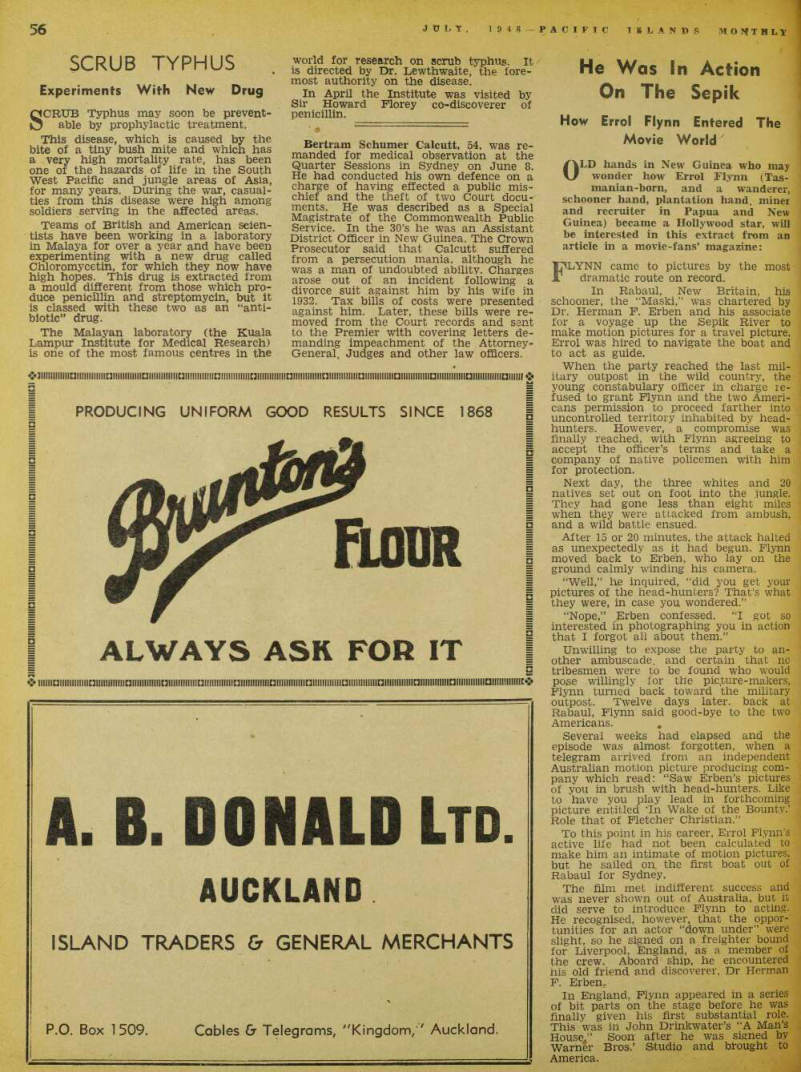
Experiments With New Drug
SCRUB Typhus may soon be prevent able by prophylactic treatment.
This disease, which is caused by the bite of a tiny bush mite and which has a very high mortality rate, has been one of the hazards of life in the South West Pacific and jungle areas of Asia, for many years. During the war, casual ties from this disease were high among soldiers serving in the affected areas.
Teams of British and American scien tists have been working in a laboratory in Malaya for over a year and have been experimenting with a new drug called Chloromycetin, for which they now have high hopes. This drug is extracted from a mould different from those which pro duce penicillin and streptomycin, but it is classed with these two as an “anti biotic” drug.
The Malayan laboratory (the Kuala Lampur Institute for Medical Research) is one of the most famous centres in the
world for research on scrub typhus. It is directed by Dr. Lewthwaite, the fore most authority on the disease.
In April the Institute was visited by Sir Howard Florey co-discoverer of penicillin.
Bertram Schumer Calcutt. 54, was re manded for medical observation at the Quarter Sessions in Sydney on June 8.
He had conducted his own defence on a charge of having effected a public mis chief and the theft of two Court docu ments. He was described as a Special Magistrate of the Commonwealth Public Service. In the 30’s he was an Assistant District Officer in New Guinea. The Crown Prosecutor said that Calcutt suffered from a persecution mania, although he was a man of undoubted ability. Charges arose out of an incident following a divorce suit against him by his wife in 1932. Tax bills of costs were presented against him. Later, these bills were re moved from the Court records and sent to the Premier with covering letters de manding impeachment of the Attorney- General, Judges and other law officers.
He Was In Action
On The Sepik How Errol Flynn Entered The Movie World
OLD hands in New Guinea who may wonder how Errol JFlynn (Tas manian -born, and a wanderer, schooner hand, plantation hand, miner and recruiter in Papua and New Guinea) became a Hollywood star, will be interested in this extract from an article in a movie-fans’ magazine: FLYNN came to pictures by the most dramatic route on record.
In Rabaul, New Britain, his schooner, the “Maski,” was chartered by Dr. Herman F. Erben and his associate for a voyage up the Sepik River to make motion pictures for a travel picture, Errol was hired to navigate the boat and to act as guide.
When the party reached the last mil itary outpost in the wild country, the young constabulary officer in charge re fused to grant Flynn and the two Ameri cans permission to proceed farther into uncontrolled territory inhabited by head hunters. However, a compromise was finally reached, with Flynn agreeing to accept the officer’s terms and take a company of native policemen with him for protection.
Next day, the three whites and 20 natives set out on foot into the jungle.
They had gone less than eight miles when they were attacked from ambush, and a wild battle ensued.
After 15 or 20 minutes, the attack halted as unexpectedly as it had begun. Flynn moved back to Erben, who lay on the ground calmly winding his camera.
“Well,” he inquired, “did you get your pictures of the head-hunters? That’s what they were, in case you wondered.”
“Nope,” Erben confessed. “I got so interested in photographing you in action that I forgot all about them.”
Unwilling to expose the party to an other ambuscade, and certain that no tribesmen were to be found who would pose willingly for the picture-makers, Flynn turned back toward the military outpost. Twelve days later, back at Rabaul, Flynn said good-bye to the two Americans. e Several weeks had elapsed and the episode was almost forgotten, when a telegram arrived from an independent Australian motion picture producing com pany which read: “Saw Erben’s pictures of you in brush with head-hunters. Like to have you play lead in forthcoming picture entitled Tn Wake of the Bounty.’
Role that of Fletcher Christian.”
To this point in his career, Errol Flynn’s active life had not been calculated to make him an intimate of motion pictures, but he sailed on, the first boat out of Rabaul for Sydney.
The film met indifferent success and was never shown out of Australia, but it did serve to introduce Flynn to acting.
He recognised, however, that the oppor tunities for an actor “down under” were slight, so he signed on a freighter bound for Liverpool, England, as a member of the crew. Aboard ship, he encountered his old friend and discoverer. Dr Herman F. Erben.
In England, Flynn appeared in a series of bit parts on the stage before he was finally given his first substantial role.
This was in John Drinkwater’s “A Man’s House,” Soon after he was signed by Warner Bros.’ Studio and brought to America.
Advertisements & other items, pp. 58-59 (2 items)
Floor
PRODUCING UNIFORM GOOD RESULTS SINCE 1868
ALWAYS ASK FOR IT
A. B. DONALD Ltd.
AUCKLAND
ISLAND TRADERS & GENERAL MERCHANTS
P.O. Box 1509. Cables £r Telegrams, "Kingdom/ 7 Auckland.
Electrolux
THE MODERN KEROSENE-OPERATED REFRIGERATOR
THAT ACHIEVES THE MIRACLE OF ICE FROM HEAT
There is only one
ELECTROLUX
Lasting Efficiency, Silent Operation, Streamlined Beauty
...i w k m Economically operated by kerosene, with a simple precision-built freezing unit that has no moving parts and is GUARANTEED FOR
FIVE (5) YEARS.
Model LKSSI Price £79/15/- FOB, Melbourne Obtainable from:
NEW GUINEA COMPANY, LIMITED.
Rabaul, Madang, Lae, Kavieng.
J. R. CLAY & CO., LTD., Port Moresby.
W. R. CARPENTER & CO. (Sol. Is.), LTD., Tulagi.
For New Hebrides, Butaritari, Noumea, New Caledonia. Apply— Storage capacity: 5i cub. ft. (approx); shelf area, 9 sq. ft.; food shelves, six—five removable; 2 self-supporting when half drawn. Ice-making: Four trays —5 lb. ice per freezing: 80 cubes. Fuel consumption: 1.8 pints kerosene per day (approx.).
Height; 4 ft. 10 in. Depth: 2 ft. 3i in. weight, unpacked, 406 lb. Packed, 574 lb.
W. R. CARPENTER & CO. LTD. Head Office: 16 O'Connell St„ Sydney, N. S. Wales
Six Fijians Try To Live
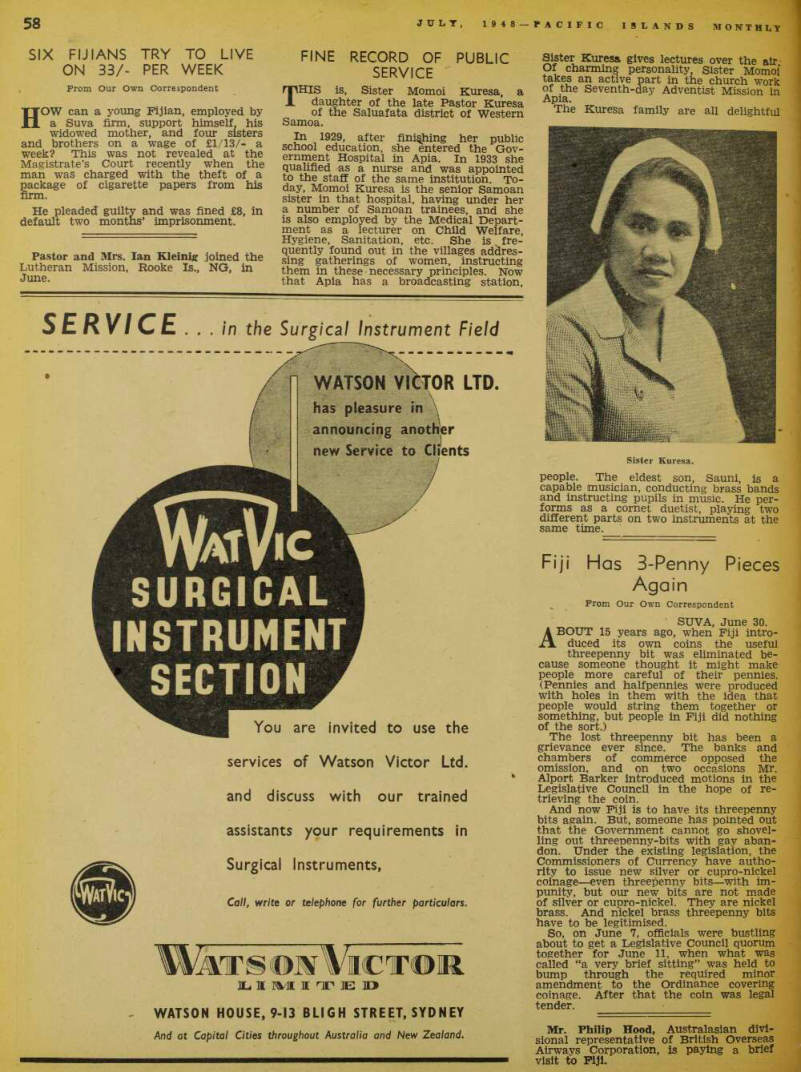
On 33/- Per Week
From Our Own Correipondent HOW can a young Fijian, employed by a Suva firm, support himself, his widowed mother, and four sisters and brothers on a wage of £l/13/- a week? This was not revealed at the Magistrate’s Court recently when the man was charged with the theft of a package of cigarette papers from his firm.
He pleaded guilty and was fined £B, in default two months’ imprisonment.
Pastor and Mrs. lan Kleinig joined the Lutheran Mission, Rooke Is., NG, in June.
Service
Fine Record Of Public
THIS is, Sister Momoi Kuresa, a daughter of the late Pastor Kuresa of the Saluafata district of Western Samoa.
In 1929, after finishing her public school education, she entered the Gov ernment Hospital in Apia. In 1933 she qualified as a nurse and was appointed to the staff of the same institution. To day, Momoi Kuresa is the senior Samoan sister in that hospital, having under her a number of Samoan trainees, and she is also employed by the Medical Depart ment as a lecturer on Child Welfare, Hygiene, Sanitation, etc. She is fre quently found out in the villages addres sing gatherings of women, instructing them in these necessary principles. Now that Apia has a broadcasting station,
Sister Kuresa gives lectures over the air pr charming personality, Sister Momoi takes an active part in the church work of the Seventh-day Adventist Mission in Apia.
The Kuresa family are all delightful
people. The eldest son, Sauni, is a capable musician, conducting brass bands and instructing pupils in music. He per forms as a cornet duetist, playing two different parts on two instruments at the same time.
Sister Kuresa.
Fiji Has 3-Penny Pieces
Again
Prom Our Own Correspondent SUVA. June 30.
ABOUT 15 years ago, when Fiji intro duced its own coins the useful threepenny bit was eliminated be cause someone thought it might make people more careful of their pennies. (Pennies and halfpennies were produced with holes in them with the idea that people would string them together or something, but people in Fiji did nothing of the sort.) The lost threepenny bit has been a grievance ever since. The banks and chambers of commerce opposed the omission, and on two occasions Mr.
Alport Barker introduced motions in the Legislative Council in the hope of re trieving the coin.
And now Fiji is to have its threepenny bits again. But, someone has pointed out that the Government cannot go shovel ling out threepenny-bits with gay aban don. Under the existing legislation, the Commissioners of Currency have autho rity to issue new silver or cupro-nickel coinage—even threepenny bits—with im punity, but our new bits are not made of silver or cupro-nickel. They are nickel brass. And nickel brass threepenny bits have to be legitimised.
So, on June 7, officials were bustling about to get a Legislative Council quorum together for June 11, when what was called “a very brief sitting” was held to bump through the required minor amendment to the Ordinance covering coinage. After that the coin was legal tender.
Mr. Philip Hood, Australasian divi sional representative of British Overseas Airways Corporation, is paying a brief visit to Fiji.
Advertisements & other items, p. 60 (1 item)
Instrument
SERVICE . . in the Surgical Instrument Field
TOR LTD.
g ano ents new A L
SURGICAL
INSTRUMENT
SECTION
You are invited to use the services of Watson Victor Ltd. and discuss with our trained assistants your requirements in
Surgical Instruments,
Call, write or telephone for further particulars.
Itoir s Victor
IL a IMI I TT E D
WATSON HOUSE, 9-13 BLIGH STREET, SYDNEY
And at Capital Cities throughout Australia and New Zealand.
Fiji's New Governor
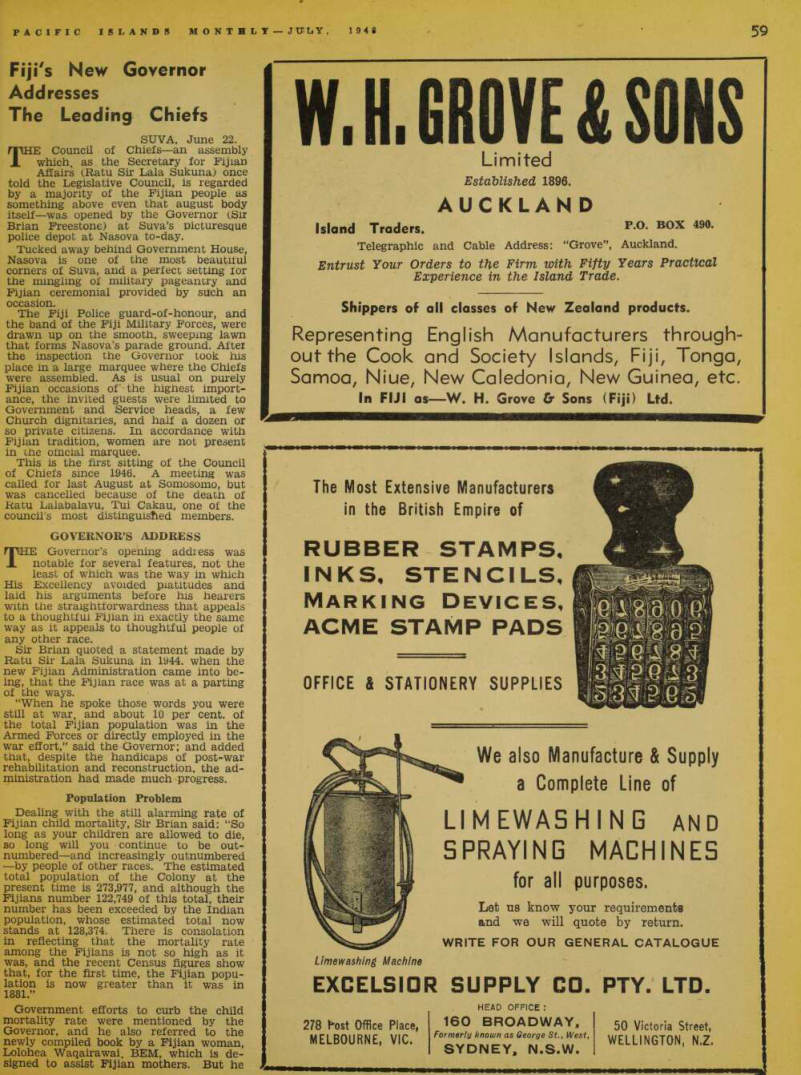
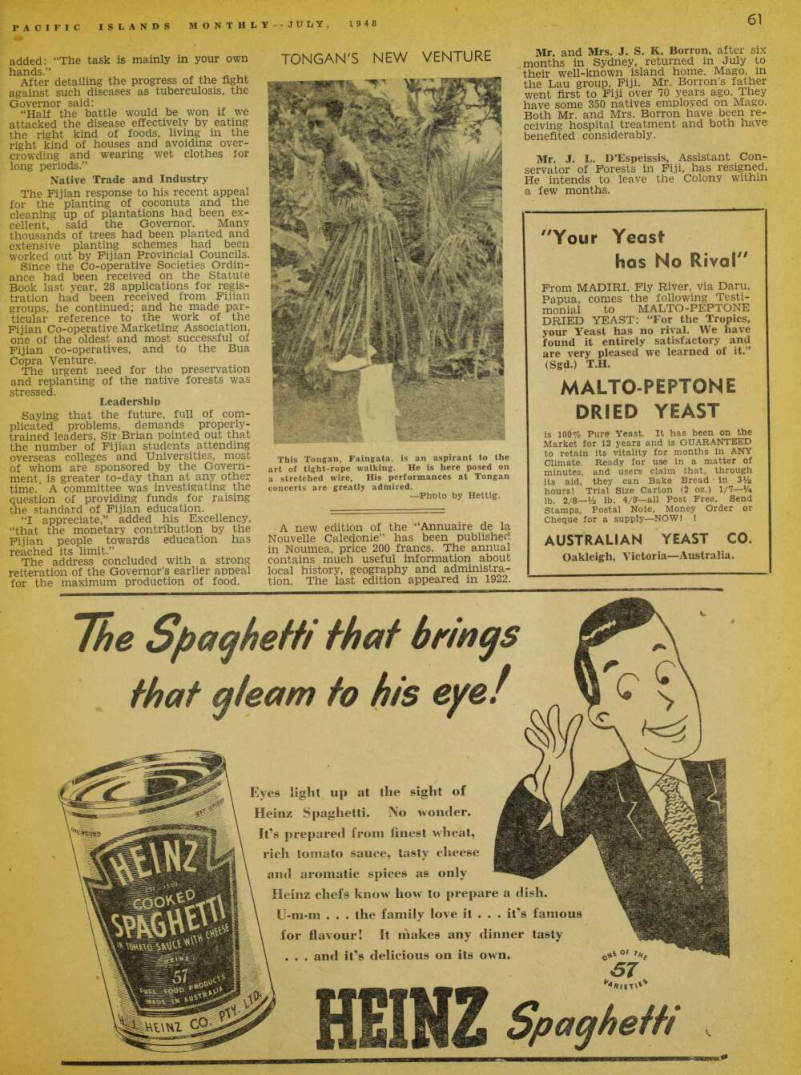
Addresses The Leading Chiefs
SUVA. June 22. rE Council of Chiefs —an assembly which, as the Secretary for Fijian Affairs (Ratu Sir Lala Sukuna) once told the Legislative Council, is regarded by a majority of the Fijian people as something above even that august body itself—was opened by the Governor (Sir Brian Freestone) at Suva’s picturesque police depot at Nasova to-day.
Tucked away behind Government House, Nasova is one of the most beautiful corners of Suva, and a perfect setting for the mingling of military pageantry and Fijian ceremonial provided by such an occasion.
The Fiji Police guard-of-honour, and the band of the Fiji Military Forces, were drawn up on the smooth, sweeping lawn that forms Nasova’s parade ground. Alter the inspection the Governor took his place in a large marquee where the Chiefs were assembled. As is usual on purely Fijian occasions of the highest import ance, the invited guests were limited to Government and Service heads, a few Church dignitaries, and half a dozen or so private citizens. In accordance with Fijian tradition, women are not present in the crucial marquee.
This is the first sitting of the Council of Chiefs since 1946. A meeting was called for last August at Somosomo, but was cancelled because of the death of Ratu Lalabalavu, Tui Cakau, one of the council’s most distinguished members.
Governor’S Address
rE Governor’s opening address was notable for several features, not the least of which was the way in which His Excellency avoided platitudes and laid his arguments before his hearers with the straightforwardness that appeals to a thoughtful Fijian in exactly the same way as it appeals to thoughtful people of any other race.
Sir Brian quoted a statement made by Ratu Sir Lala Sukuna in 1944. when the new Fijian Administration came into be ing, that the Fijian race was at a parting of the ways.
“When he spoke those words you were still at war, and about 10 per cent, of the total Fijian population was in the Armed Forces or directly employed in the war effort,” said the Governor; and added that, despite the handicaps of post-war rehabilitation and reconstruction, the ad ministration had made much progress.
Population Problem Dealing with the still alarming rate of Fijian child mortality, Sir Brian said: “So long as your children are allowed to die, so long will you continue to be out numbered —and increasingly outnumbered —by people of other races. The estimated total population of the Colony at the present time is 273,977, and although the Fijians number 122,749 of this total, their number has been exceeded by the Indian population, whose estimated total now stands at 128,374. There is consolation in reflecting that the mortality rate among the Fijians is not so high as it was, and the recent Census figures show that, for the first time, the Fijian popu lation is now greater than it was in 1881.”
Government efforts to curb the child mortality rate were mentioned by the Governor, and he also referred to the newly compiled book by a Fijian woman, Lolohea Waqairawai. BEM, which is de signed to assist Fijian mothers. But he
added: “The task is mainly in your own hands.” , After detailing the progress of the fight against such diseases as tuberculosis, the Governor said: “Half the battle would be won if we attacked the disease effectively by eating the right kind of foods, living in the right kind of houses and avoiding over crowding and wearing wet clothes for long periods.”
Native Trade and Industry The Fijian response to his recent appeal for the planting of coconuts and the cleaning up of plantations had been ex cellent, said the Governor. Many thousands of trees had been planted and extensive planting schemes had been worked out by Fijian Provincial Councils.
Since the Co-operative Societies Ordin ance had been received on the Statute Book last year, 28 applications for regis tration had been received from Fijian groups, he continued; and he made par ticular reference to the work of the Fijian Co-operative Marketing Association, one of the oldest and most successful of Fijian co-operatives, and to the Bua Copra Venture.
The urgent need for the preservation and replanting of the native forests was stressed.
Leadership Saying that the future, full of com plicated problems, demands properly trained leaders, Sir Brian pointed out that the number of Fijian students attending overseas colleges and Universities, most of whom are sponsored by the Govern ment, is greater to-day than at any other time.’ A committee was investigating the question of providing funds for raising the standard of Fijian education.
“I appreciate,” added his Excellency, “that the monetary contribution by the Fijian people towards education has reached its limit.”
The address concluded with a strong reiteration of the Governor’s earlier appeal for the maximum production of food.
Advertisements & other items, pp. 61-62 (2 items)
59
PACIFIC ISLANDS M O N T H L T J U L Y , 1948
W.H. Grove & Sons
Limited
Established 1896.
AUCKLAND
Island Traders. PO - BOX 49# - Telegraphic and Cable Address: “Grove”, Auckland.
Entrust Your Orders to the Firm with Fifty Years Practical Experience in the Island Trade.
Shippers of all classes of New Zealand products.
Representing English Manufacturers through-
out the Cook and Society Islands, Fiji, Tonga, Samoa, Niue, New Caledonia, New Guinea, etc.
In FIJI as—W. H. Grove Cr Sons (Fiji) Ltd.
The Most Extensive Manufacturers in the British Empire of
RUBBER STAMPS,
INKS, STENCILS,
Marking Devices,
ACME STAMP PADS
OFFICE & STATIONERY SUPPLIES
i We also Manufacture & Supply a Complete Line of
LIMEWASHING AND
SPRAYING MACHINES
for all purposes.
Let us know your requirements and we will quote by return.
WRITE FOR OUR GENERAL CATALOGUE
Lime washing Machine
EXCELSIOR SUPPLY CO. PTY. LTD.
278 h)st Office Place,
MELBOURNE, VIC.
HEAD OFFICE :
160 BROADWAY,
Formerlu known as George St., West,
SYDNEY* N.S.W.
50 Victoria Street,
WELLINGTON, N.Z.
GEORGE J. LOGKYER & COMPANY
CONSULTING ENGINEERS DOCKYARD MACHINERY
In association with GEORGE J. LOCKYER (For East) & CO. and GEORGE J. LOCKYER (Overseas) & CO.
ENGINEERING SUPPLIES, GENERAL HARDWARE EXPORTERS AND MERCHANTS Agents for the Finest Australian Liquors Aerated Water and Cordial Manufacturing Machinery, Bottling and Capping Machinery, etc.
TRACTOR TRACKS AND SPROCKETS.
CRAWLER TRACTORS.
HEAVY DUTY TRAILERS.
LIGHT TRAILERS.
ROADMAKING EQUIPMENT.
FORK LIFT TRUCKS.
MOBILE CRANES.
CRANES AND EXCAVATORS.
DIRECT COUPLED PUMP UNITS.
POWER HOUSE:
Murphy 6-Cylinder Diesel Engine, Model M.E. 650, Engine No. 103188, 160 h.p., at 1,200 revs., direct coupled to E.M. Synchronous A.C. Generator, 60 cycle, 1,200 r.p.m., 106 K.W., 132.5 K.V.A., 127-220 volt, 348 amps, 3 phase, or 50 cycle, 1,000 r.p.m., 95 K.W., 118.7 K.V.A., 230-400 volts, 172 amps, 3 phase. Generator fitted with E.M.
Synchrostat voltage regulator, lub. oil heat indicator broken, no Vee belts on blower drive, no engine ampmeter; radiator and fan are available for this unit; engine fitted with electric starting.
AIR COMPRESSORS.
COLD ROOMS.
REFRIGERATION AND ICE-MAKING
MACHINERY:
Cold Rooms, Ice Showers, Commercial Refrigerators in all sizes.
Complete Ice-Making Machinery.
All material available for immediate export.
9 LAUNDRY EQUIPMENT:
Boilers, Washers, Tumblers, Water Pumps.
• NAUTICAL
Buoys, Anchor Cable Chain, Sea Mules, Chrysler Marine Engines, Grey Marine Engines, Dock Cubes, Jewellery, Propeller Shafting, etc.
Ruston 4-Cylinder Diesel Engine, 120 h.p., Size 4, Class C.V.R., Engine No. K 82631, direct coupled to Lawrence & Scott & Electromotor, Ltd., A.C. Generator, 80 K.W., volts 415 r.p.m. 300, 50 cycles, 3 phase, stator amps 140, exciter amps 25.4, rating cont., exciter volts.
Ruston 4-Cylinder Diesel Engine, 120 h.p., Size 4, Class C.V.R., Engine No. 182630, direct coupled to Lawrence Scott & Electromotor, Ltd., A.C. Generator, 80 K.W., 415 volts, 3 phase.
Lister 4-Cylinder Diesel Engine, 38 h.p., at 1,000 r.p.m., Engine No. 60/359, Spec. 38/4/31, direct coupled to A.S.E.A. A.C.
Generator, K.V.A. 25, volts 415, amps 35, cycles 50, 3 phase, rating continuous; Type G.A. 23, No. 399334, exciter volts 110, exciter amps 5, engine has hand starting; unit is complete.
Switch Board, fitted with: Rotary Synchroniser, Frequency Meter, 2 Voltmeters 500 volts, Ampmeter 20 amps., 3 Ampmeters 50 amps, 2 Ampmeters 150 amps (one has no pointer), 2 Ampmeters 200 amps., Ampmeter 250 amps, Ampmeter 300 amps, Ampmeter 400 amps, 2 Kilowatt Meters 12 0.K.W., Power Factor Meter, Frequency Meter, 44 to 56 cycles per second, and necessary Line Switches.
Overhead Running Gantry, fitted with 5-ton chain block.
Inside Fuel Service Tanks.
Outside Supply Tanks, approx. 400 galls, each, engine cooling system is comprised of 3,000 gall. galv. iron tank with sprays, spraying into pond; both Rustons and Lister are equipped with mufflers, but the Murphy has open exhausts.
9 BAKERY EQUIPMENT:
Bakers’ Oil Burning Stoves, Dough Mixers.
• METAL TUBING:
Galvanised, Black, Brass, Copper and Steel.
• ELECTRICAL EQUIPMENT:
Generating Sets, Electric Motors, Refrigerating Units, Cool Rooms, Electric Light Turpentine Poles, Power Cable.
9 HEAVY EQUIPMENT:
Stone Crushing Plants, Concrete Mixers, Air Compressors, Light and Heavy Trailers, Graders, Front End Loaders, Direct Coupled Pumps, Shovels, Booms, etc., Power Units Steam Boilers, Dump Waggons, Barber Green Ditchers, Rooters, Athey Waggons, Dozer Parts, etc.
EXACT REPLICA OF CANE KNIFE,
MADE IN AUSTRALIA.
The Largest Suppliers of Cane Knives in the World.
Photographs, Drawings, Schedules, will be Supplied by Return Mail to Genuine Clients.
HEAD OFFICE, 24 BOND ST. SYDNEY, N.S.W. 'Phones: UX6BOI, UA7196, BW6OIB All communications to be addressed Bankers: Telegraphic and Cable Address: to The General Manager, Commonwealth Bank of Australia, Sydney. “LOCKMACH,” Sydney.
G.P.0., Box 4553, Sydney. Also Bank of N.S.W., Sydney.
Tongan's New Venture
A new edition of the Annuaire de la Nouvelle Caledonie” has been published in Noumea, price 200 francs. The annual contains much useful information about local history, geography and administra tion. The last edition appeared in 1922.
Mr. and Mrs. J. S. K. Borron. after six months in Sydney, returned in July to their well-known island home. Mago, in the Lau group, Fiji. Mr. Borron’s father went first to Fiji over 70 years ago. They have some 350 natives employed on Mago.
Both Mr. and Mrs. Borron have been re ceiving hospital treatment and both have benefited considerably.
Mr. J. L. D’Espeissis, Assistant Con servator of Forests in Fiji, has resigned.
He intends to leave the Colony within a few months.
This Tongan, Faingata, is an aspirant to the art of tight-rope walking. He is here posed on a stretched wire. His performances at Tongan concerts are greatly admired. —Photo by Hettig.
Advertisements & other items, p. 63 (1 item)
Spaghetti
"Your Yeast
has No Rival"
From MADIRI, Fly River, via Dam, Papua, comes the following Testimonial to MALTO-PEPTONE DRIED YEAST: “For the Tropics, your Yeast has no rival. We have found it entirely satisfactory and are very pleased we learned of it.” (Sgd.) T.H.
MALTO-PEPTONE
DRIED YEAST
is 100% Pure Yeast. It has been on the Market for 12 years and is GUARANTEED to retain its vitality for months in ANY Climate. Ready for use in a matter of minutes, and users claim that, through its aid, they can Bake Bread in SVa hours! Trial Size Carton (2 oz.) 1/7 — Va lb. 2/B—Va lb. 4/?—all Post Free. Send Stamps, Postal Note, Money Order or Cheque for a supply—NOW! !
AUSTRALIAN YEAST CO.
Oakleigh, Victoria—Australia.
The Spaghetti that brings
that gleam to his eye!
CO
HU HI
Eyes light up at the sight of Heinz Spaghetti. No wonder.
It’s prepared from finest wheat, rich tomato sauce, tasty cheese and aromatic spices as only Heinz chefs know how to prepare a dish.
U-m-m . . . the family love it . . . it’s famous for flavour! It makes any dinner tasty . . . and it’s delicious on its own. r Q Q c o** 0f *** si
Spaghetti
Suva's Fine-Weather Bus


Terminal
From Our Own Correspondent SUVA. June 7. ¥¥7HEN Fiji’s Ten-Year Plan was TV abandoned, Suva’s new bus ter minal in Rodwell Road, 200 yards from Burns, Philp’s Corner, came un stuck with it. The foundations and floor of the station are there, but no roof or anything else.
But, officialdom having made up its mind, on this memorable seventh day of
June, that this was the Bus Terminal, all buses coming into Suva with the usual early - morning crowds, unexpectedly stopped at the place where the Bus Station would have been if there were going to be a Bus Station.
In torrents of rain (Suva’s dry season is much as usual) passengers were dis charged at the non-existent shelter.
Those who had umbrellas complained that they were soaked before they could get them up and the majority who had no umbrellas—Europeans, Fijians and Indians—had a day of acute discomfort in wet clothes.
The one bright spot in New Caledonia’s present economic position is the recovery of the nickel market. After World War I it took about ten years before normalcy returned. But following World War 11, with all the new uses to which nickel can be put, two years have been suf ficient to restore demand. In 1945, for example, Canadian production was limited to 50 per cent, capacity. It is now back to 80 per cent, capacity, and will amount this year to 148,000 tons compared with 125,000 tons in 1946 and 120.000 tons in 1939. The US has lowered its tariff by 14 cents per lb. which enables the In ternational Nickel Co. to lower its sale price in that country.
Advertisements & other items, pp. 64-65 (2 items)
62
SOUTH, BY CLIPPERTON
(Continued from Page 47)
JULY, 1948 P ACIFIC ISLANDS MO NIT HL Y
Tnc Garrick Hotel
Immediate Delivery!
EASTERN GOODS: Textiles, Cotton Goods, Torch Coses, Hurricane Lanterns, Washing Soap, Silk, Embroidery, Fancy and Trade Goods, etc.
ORDERS LARGE AND SMALL CATERED FOR:
ERNEST TRADING CORPORATION
IMPORTERS, EXPORTERS , MANUFACTURERS,
AND COMMISSION AGENTS.
HONG KONG
P.O. Box 1278. Cable Address: “ERNCO
Tnc Garrick Hotel
7W M*
SUVA
■'lln FIJI
This well-known Hotel is centrally situated in Suva's main business quarter :: Modern accommodation provides comfort in all climatic conditions :: Only the best of Beers, Spirits and Wines is served Telephone: 80.
VINCE COSTELLO,
Proprietor.
Bl n IT
that
Safeguard
Smile I
A tinge of‘pink’ on your tooth brush is a warning to see your dentist. It may mean nothing serious, but let him be the judge.
He may explain that yours is simply a case of tender gums robbed of resistance by to-day’s soft foods. His advice will probably be “more work for lazy gums” and often “the helpful stimulation of Ipana Tooth Paste and gum massage”.
Adopt this simple dental health routine : Brush your teeth with Ipana every morning and evening, followed by vigorous gum massage with Ipana on the finger-tip . . . Teeth become brighter, more lustrous ; gums firmer, healthier; smiles more pleasing.
IPANA TOOTH PASTE
Venture
Successful Venture Co-operative Market Assn., Ltd.
(rnniri-hni+ori\ Keoniriouzea) mHESE photographs show the progress J_ m ade by one of the most successful Fijian ventures in co-operative marketing.
The Fijian Co-operative Market Asso elation Ltd., was founded in September, 1933. Fijian growers from the provinces around Nausori met and resolved to co operate in a scheme to establish a mar
ket booth in which their market produce could be sold at that centre.
This booth which is shown in the lower picture, was constructed by volun tary labour and opened for business in January, 1940. It continued to function until April, 1948, when it was demolished by order of the Government. The Asso ciation now uses part of the new Gov ernment market building at Nausori—an open-air affair consisting of a roof and
little else. The Fijians have not com plained; but this change-over has been felt deeply by them, particularly by those who worked hard in the early days of the Association to erect their own building.
After a general meeting of members in 1940, a management committee of seven was elected; a supervisor was ap pointed to grade and sell members’ pro duce on an agreed commission basis; and a clerical assistant was appointed. In 1944, the Association was registered as a public company but has continued to work on co-operative lines.
With the outbreak of the Pacific War, the Fiji Department of Agriculture called upon the Association to supply the Allied armed forces then stationed in the Colony. In 1944, 587 tons of fruit, 472 tons of green vegetables and 1,054 tons of root vegetables were supplied by members of the Association in this way.
In addition, during the war period, the Association built over 150 native-type houses for military use and supplied labour and materials for defence pur poses.
The Association contributed largely to patriotic funds and more recently gave £5OO for a scholarship to Gatton Agricul tural College, in Queensland.
Since the end of the war, the Associa tion has gone into the export business.
It has been granted a Banana Exporter’s Licence and has now leased a site at Nasinu on which a banana packing-shed and a factory for the manufacture of tapioca starch and other products, will be carried on.
The top photograph shows the business premises which have recently been ac quired in Suva by the Association. Fruit and vegetables will be sold here.
Advertisements & other items, pp. 66-68 (1 item)
Protect your Hair
The Tonic Hair Pressing
OUN, WIND , and WATER
all play havoc with your hair, depriving it of its natural scalp oils.
Let Vitalis' pure vegetable oils protect your hair and scalp, no matter where you are or what you do.
Vitalis routs ioose dandruff; helps retard falling hair; stimulates the scalp and dresses the hair in a handsome, natural way. c V r a rz 4? m S
is a
grand cigarette
for all occasions-
Capstan’s own blend
of fine Virginia
leaf cannot
be equalled
*8 H. 0. Wi Bi tefcSYPgl That’s why it’s always
TIME FOR A CAPSTAN
THE EMPIRE'S FAVOURITE CIGARETTE
BUTTERFLIES
and the Larger Moths
WANTED
From all sections of the Pacific Islands.
Will pay not less than: $5.00 per hundred for common attractive Butterflies. $7.50 to $50.00 and more per 100 for extra showy, large Butterflies and large Moths.
Collectors or Missionaries who can supply us, please get in touch with us. W 7 ill pay for sample selection, and advance money to good collectors.
MUST BE PERFECT FIRST
QUALITY ONLY.
Butterfly World Supply House,
289 East 98th Street,
Brooklyn, 12,
New York, U.S.A.
Mormon

Missionaries
Mrs, Huntsman and President Huntsman, Mrs, Cowley and Apostle Matthew Cowley, of the Latter Day Saints (Mormon) Church. The photograph was taken in Tonga on the occasion of the visit of Apostle Cowley, who has his headquarters in Hono lulu. He is LDS Pacific Overseer.
President Huntsman is the Tongan leader of the mission which has 3,000 followers in the Kingdom.
The LDS have recently acquired a large plantation near Nukualofa and have enlarged their educational facilities considerably. —Photo by Hettig.
"Taipan" Finds A Home
In N. Hebrides
VILA. July 1.
THE motor cruiser “Taipan,” which left the Australian coast under mysterious circumstances last year, and eventually turned up in Noumea—where she was re-named “Avalon”—arrived in Port Vila (New Hebrides) in May. She was eventually bought by Mr. Geoffrey Seagoe, a well-known trader He mU use her in various ways in the New Hebrides.
The late owners left Vila for Sydney by the “Morinda” on June 22.
j™ e ot Auc" lL is
Another Yacht for South Pacific
AN Auckland yacht with a Fiji name (“Wakaya”) owned and skippered by Ted Hay, will make a four months' cruise of the South Pacific Islands, in eluding Cooks, Samoa, Tonga and Lord Howe. Mr. Hay expected to leave Auck land at the beginning of July, Th “ Wakava ” was designed bv Mr
scho oner-rigged and has a LOA of 41 feet.
Her present owner has sailed twice in Trans-Tasman yacht races.
Advertisements & other items, p. 68 (1 item)
CHULA Copra Dryer
\ m H mfhw \w s o
BIGGER PRICES for BETTER COPRA!
when dried by the scientific
process made possible by the
CHULA Copra Dryer
. . . the most practical and efficient machine for drying nuts in bulk, which produces copra of a higher standard than that dried in the open, without discolouration, free from mould, thoroughly and evenly dried throughout. The “Chula” produces its two tons of copra every 24 hours, irrespective of the weather, and with a minimum of labour.
THE INVENTORS AND MANUFACTURERS OF
THE CHULA COPRA DRYER ALSO MAKE
DESICCATED COCONUT
MACHINERY
(Parers, Disintegrators, Sifters, Dryers)
TEA DRYERS
FISH DRYERS
RUBBER MACHINERY
(Continuous Sheeters, Crepeing Batteries)
TYNESIDE FOUNDRY & H
ENGINEERING CO. LTD.
ELSWICK • NEWCASTLE-ON-TYNE • ENGLAND
Telegrams & Cables ; " FOUNDRY, NEWCASTLE-ON-TYNE " • Codes : ABC, sth & 6th Eds
A NEW CATALOGUE
of the
"CHULA"
COPRA DRYER
has just been printed.
Send for Your Copy!
Prosperity and Church
Funds Grow in Tonga
From Our Own Correspondent
Nukualofa, June 18.
rHE present prosperity now enjoyed by the Tongans, as a result of the high price of copra, is reflected in the of some of our denominational icdies.
Ferro-concrete chapels are springing up n villages throughout the Kingdom. Re ently the secretary of the Church of n onga, an offshoot of the Wesleyans, isited Auckland, where he purchased two arge trucks, a sedan car and a lighting ilant, besides negotiating for the pur hase of a large auxiliary vessel for his hurch.
Not to be outdone by its rival’s show f worldly wealth, the Free Church of ’onga, another offshoot of the Wesleyans. 3 also negotiating for the purchase of large power-driven vessel of about 80 Dns carrying capacity. The Wesleyan Jhurch, too, will replace its old cutter Fetu’u’aho” by a two-masted schooner.
The “Misinales” —annual cash collec ions—conducted by the various churches rere marked by large individual contri utions. As much as £2OO were given by sveral of the “faithful.”
This open-handed giving in the cause f religion is a trait of Tongans. How ver, it is not so much a matter of “it ; more blessed to give than to receive” s a matter of prestige and the notion hat the fellow who gives more will have lore chance of successfully cajoling St. eter to let him through the pearly gates, hese gifts are given in friendly rivalry, owever. and the money is put to useful urposes.
The Ouaco rpeatworks on the west coast of New Caledonia sold produce of the net value of 30,000,000 francs during 1947.
Besides canned meat, the company now sells canned fish and vegetables, soap,
tallow, coconut oil, oil-cake, and hides, The works, under the management of an Australian, Colonel Dix, has long played an invaluable part in the agricultural life of the colony.
The Virtues, And The
Papuans
Letter to the Editor CHE recent misadventure which befell the Treasurer of a native Co-oper ative Society causes reflection on the irtue of probity in relation to the New ook, with which the New Order proposes ) endow the Papuan—as rapidly and ex snsively as possible.
Intelligence is possibly not the pre igative of any race or colour, given luality of opportunity for its develop ient. Initiative is fostered bv the neces ty to achieve or starve: administrative inability is a plant of slow growth, but ;tainable.
Probity is a virtue of very slow growth.
In the main, even in 1948, the European ill holds to that virtue, bequeathed to im by his one-time Roman mentors: in position of trust he is trustworthy.
By this quality above all others, and 3t by accident, he still bestrides the orld.
In the main, the Papuan, as yet, does Dt possess this quality; until he does 3 cannot manage hte own affairs and lie m his own country.
Admiration for, and understanding of m, is not confined to those who know ast about him; but I. for one, will look )wn from Paradise with much interest ; the conduct of Papuan judges, bank anagers, accountants, plantation man ners, and the like.
An eighteenth century king of Naples id the Two Sicilies was approached by s War Minister regarding a change in rmy uniform.
“Dress ’em in red; dress ’em in blue; ey 11 run away just the same,” replied ie monarch.
I am, etc.,
G. T. Gemmell.
ipua, June 7, 1948.
Advertisements & other items, pp. 69-70 (2 items)
67
ACIFIC ISLANDS MONTH LY JULY, 1948
I Kopsen & Co. Pty. Ltd.
SvGet in Quick
for tonsilitis, Septic forms so soon advance.
As with breath-stressed laryngitis Prompt relief may spare the lance.
Get in quick for dread bronchitis, Check its course without delay.
Chronic phases end in phthisis Great Peppermint Cure to-day!
Instant Relief for Coughs, Colds Woods* («roat IVppormint I'uro i Woods’
From WHOA!
SIMPLEX
MARINE ENGINES
3. 5 and 10/12 h.p. Suitable for all crafts from 14-32 ft. The 5 and 10 h.p. are supplied with built-in reverse gear. All Australian made. Prices and specifications on request.
C.Q.R. ANCHORS
The lightweight anchor with three times the holding power of any other anchor. No more efficient tool for quick and positive “dig-in” has ever been found than the ploughshare. The C.Q.R. is two well designed ploughshares welded together. Write for C.Q.R. Anchor leaflet.
To GO!
I KOPSEN & CO. PTY. LTD.
Have EVERYTHING for Boats
FISHING
TACKLE
Our new Fishing Department has been opened to provide the utmost service and satisfaction in all classes of fishing gear. Marlin Gut lines, Fishkil Nylon Twist, Geisha Wire Traces, Linen and Cotton lines, Rangoon and Split Cane Rods, Reels and numerous other lines.
KAYEN PRESSURE LAMPS
The all Australian made vapour lamps— reliable—efficient—safe—easy to operate.
Burns for 10 hours on IVt pints of kerosene. The lamp illustrated is of 300 C.P. and is the table model (HL7); the allpurpose lamp (AP2) is windproof and ideal for outdoor work. Burn ordinary kerosene. Write for illustrated leaflet.
SHIPCHANDLERS & MARINE ENGINEERS
376-380 KENT ST., SYDNEY. MA6336 (9 lines).
Cables: “KOPSEN” Sydney.
CABLES: Pitco, BANKERS: Bank of America, San Francisco. San Francisco.
PACIFIC ISLANDS TRADING GO.
244 California Street,
SAN FRANCISCO 11, CALIFORNIA, U.S.A.
MANUFACTURERS’ REPRESENTATIVES
RESIDENT BUYING AGENTS ;; MERCHANT EXPORTERS
Representing: American Lead Pencil Company L. C. Smith £r Corona Typewriters Inc. - General Time Instruments Corporation - Western Clock Company Limited - Burgess Battery Company Burgess Tools Limited Marion Tools Corporation I. Sekine Company - Electric Chain Company of Canada Anchor-Hocking Glass Corporation Chicopee Manufacturing Corporation - P. Cr K. Incorporated - Soho Tool Company Inc.
Adslide Projector Company American Mercantile Corporation Keystone --- Waterloo Manufacturing Company Ltd. - National Electric Manufacturing Co.
Products: Pencils, Fountain Pens, Erasers.
Typewriters, Adding Machines.
Watches, Clocks, Chronometers.
Watches, Clocks, etc.
Dry Batteries, Flashlights.
Axes, Cane Knives, Machetes, Hoes.
Axes, Hatchets, Hammers, Pliers.
Brushware, Toothbrushes.
Gold and Silver Chain, Jewellery.
Glassware, Ovenware, Dinnerware.
Plastic Insect Screening.
Fishing Tackle.
Bench Saws.
Film Projectors.
Collins Hacksaws.
Enamelware, Kitchenware, etc.
Garden Tractors, Disc Harrows.
Irons, Stoves, Refrigerators, etc.
CANNED FISH
COTTON TEXTILES
BUILDING MATERIALS
PETROLEUM PRODUCTS
FOODSTUFFS
GENERAL MERCHANDISE
We Supply The Trade Only —Vo Retail Orders Whatever your needs, write or cable for our prices
Tribute to Sir Maynard
Hedstrom
Prom Our Own Correspondent SUVA, June 14.
IT is interesting to learn that Burns Philp, with its tentacles all over the Pacific, lives in fear and trembling f Morris, Hedstrom. . . All the time, Morris, Hedstrom have been wondering yhen BP’s was going to end our career!
This amusing insight into the palpita ions of our higher commercial circles iras provided by Sir Maynard Hedstrom vhen the Suva Chamber of Commerce ave a dinner at the Grand Pacific Hotel n honour of Sir Maynard’s completion if 25 years as president—a position from vhich he has just retired.
Sir Maynard’s remark was directed at >ne of the vice-presidents, Mr. John rrotter (managing director of Burns >hilp (SS) Co., Ltd.), who had said, re erring to Sir Maynard’s establishment, hat “no one had any fear of the Big Firm, vhich had never used its power im jroperly.”
The dinner, which was attended by nore than 40 members, was clearly a genuine tribute by the Suva European justness community to an acknowledged 6 “Itorn in Fiji, Sir Maynard has ‘made r ood’ in every possible way,” said the lew president (Mr. Alport Barker), who lointed out that Sir Maynard’s was the irst knighthood bestowed in Fi.p, that or 29 years he had been an elected mem ber of the Legislative Council and for 55 years president of the Suva Chamber >f Commerce—almost certainlv a record imong British chambers of commerce.
In the course of his reply. Sir Maynard laid a warm tribute to the work of the chamber’s secretary, Mr. C. W. Aidney, svho is at present on a health visit to SForfolk Island.
Death Of K. P. Johansson,
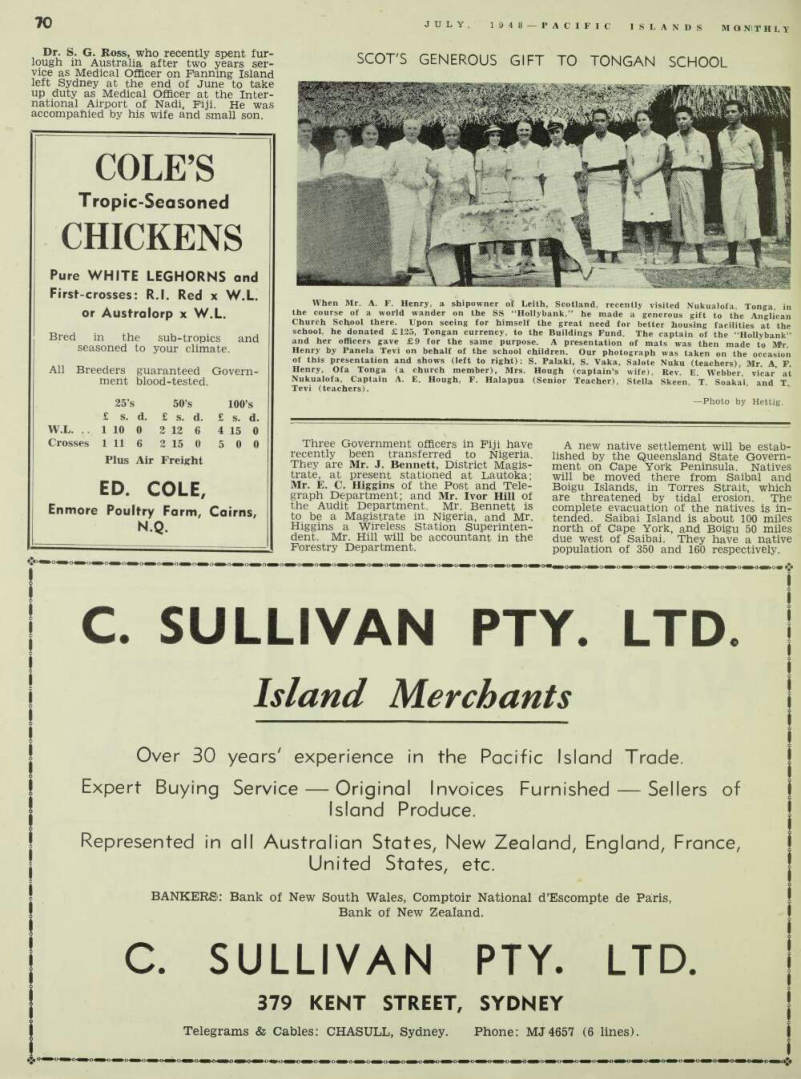
Of Tonga
( Contributed ) AFTER a long illness of eleven months at the Vaiola Hospital. Nukualofa, Karl Pontus Johansson passed away on May 21.
He was buried near his home at Tataka motonga, a village 12 miles from Nukua lofa. Many Tongans and Europeans at tended the large funeral, conducted by the Reverend E. Webber, of the Anglican Church. Among the mourners was Prince
Tupouto’a-Tungi.
In fine weather, the funeral procession moved to the cemetery, in its tropical setting, to solemn music played by the Catholic Mission Band of Lapaha.
Mr. Johansson was an island trader of many years standing in Tonga. He is
survived by a son, Adolph, and two brothers, Gustav and Albin.
He was born in Tosse, Sweden, in De cember, 1887, and left his country in 1912 to join his two brothers in Vavau, Tonga. They have been in residence here in Tonga ever since.
Karl started the present trading busi ness at Tatakamotonga 32 years ago. He was a shrewd and keen business man, and soon made a success of this under taking. For many years he has been the only white trader at this village. A man of sterling qualities, he earned the re spect and friendship of the natives throughout the villages in that region. He was a man of unbounded kindness and hospitality and his home was the gather ing place of numerous friends (natives and Europeans) at any time, day and He is another link gone from the lessen ing chain of genuine island old-timers.
Dr. S. G. Ross, who recently spent fur lough in Australia after two years ser vice as Medical Officer on Fanning Island left Sydney at the end of June to take up duty as Medical Officer at the Inter national Airport of Nadi, Fiji. He was accompanied by his wife and small son.
Advertisements & other items, pp. 71-72 (2 items)
69
ACIFIC ISLANDS MONTHLY JULY, 1948
Widdor
J. C. MERRILLEES
PTY. LTD.
General Island Merchants
PHOENIX BUILDFNG, 63 PITT ST., SYDNEY
Telegrams and Cables: MERRILLEES SYDNEY. Phone: BW 6064
DIESEL ENGINES
BY
WIDDOR
5 H P TO 300 H P
H • WIDDOR & CO LTD
GREENGATE KEIGHLEY ENGLAND
Telephone: Keighley 3727-8 Telegrams: Widdop Keighley Codes: A.B.C. 6th Edition, Bentley’s, Bentley’s Second tr r V Above; (D-Type) 36/45 H.P M On left: (X-Type) 120 H.P.
Direct reversing I cvs—B3
COLE’S
Tropic-Seasoned
CHICKENS
Pure WHITE LEGHORNS and
First-crosses: R.l. Red x W.L. or Australorp x W.L.
Bred In the sub-tropics and seasoned to your climate.
All Breeders guaranteed Government blood-tested. 25’s 50’s 100’s £ s. d. £ s. d. £ s. d.
W.L. . . 110 0 212 6 415 0 Crosses 111 6 215 0 500 Plus Air Freight
ED. COLE,
Enmore Poultry Farm, Cairns, N.Q.
Scot's Generous Gift To Tongan School

Three Government officers in Fiji have recently been transferred to Nigeria.
They are Mr. J. Bennett, District Magis trate, at present stationed at Lautoka; Mr. E. C. Higgins of the Post and Tele graph Department; and Mr. Ivor Hill of the Audit Department. Mr. Bennett is to be a Magistrate in Nigeria, and Mr.
Higgins a Wireless Station Superinten dent. Mr. Hill will be accountant in the Forestry Department.
A new native settlement will be estab lished by the Queensland State Govern ment on Cape York Peninsula. Natives will be moved there from Saibal and Boigu Islands, in Torres Strait, which are threatened by tidal erosion. The complete evacuation of the natives is in tended. Saibai Island is about 100 miles north of Cape York, and Boigu 50 miles due west of Saibai. They have a native population of 350 and 160 respectively.
When Mr. A. F. Henry, a shipowner of Leith, Scotland, recently visited Nukualofa, Tonga in the course of a world wander on the SS “Hollybank,” he made a generous gift to the Anglican Church School there. Upon seeing for himself the great need for better housing facilities at the school, he donated £125, Tongan currency, to the Buildings Fund. The captain of the “Hollybank” and her officers gave £9 for the same purpose. A presentation of mats was then made to Mr Henry by Panela Tevi on behalf of the school children. Our photograph was taken on the occasion of this presentation and shows (left to right): S. Palaki, S. Vaka, Salote Nuku (teachers), Mr A F Henry, Ofa Tonga (a church member), Mrs. Hough (captain’s wife), Rev. E. Webber vicar at Nukualofa, Captain A. E. Hough, F. Halapua (Senior Teacher), Stella Skeen, T. Soakai, and T.
Tevi (teachers). —Photo by Hettig.
Lautoka's Power Supply
“fIIHE electricity supply itself is anaemic A and temperamental and lack of control results in some premises be ing illuminated like lighthouses whilst others are bathed in a synthetic twilight. . . . Spares for this plant were ordered shortly after the Government took over.
. . . The reticulation is inadequate and dangerously worn and, whilst granting that materials are difficult to obtain, the impression persists that the Public Works Department has not exhibited outstanding talent or initiative in the management of the undertaking.”—A report to the Fiji Government by the chairman of the Lautoka Town Board.
Advertisements & other items, pp. 72-74 (2 items)
70
JULY, 1948 PACIFIC ISLANDS MDNITHLY
C. Sullivan Pty. Ltd.
Island Merchants
Over 30 years' experience in the Pacific Island Trade.
Expert Buying Service Original Invoices Furnished Sellers of Island Produce.
Represented in all Australian States, New Zealand, England, France, United States, etc.
BANKERS*: Bank of New South Wales, Comptoir National d’Escompte de Paris, Bank of New Zealand.
C. SULLIVAN PTY. LTD.
379 KENT STREET, SYDNEY
Telegrams & Cables: CHASULL, Sydney. Phone: MJ4657 (6 lines).
IMPROVE YOUR OUTLOOK!
Two recommended products from the famous Spartan range of dependable paints and enamels —Spartan Quick Drying Enamel and Spartan Silver will brighten your surroundings.
ECONOMICAL . DURABLE . WASHABLE NON-FADING
For long-life surface protection to metal and wood. Dries to a smooth, outstanding, lustrous finish.
Quick-drying
enamel'
Transforms small or large rooms into delightful, charming places in which it will be a pleasure to work and live.
Recommended for a PERFECT
FINISH
Durable Spartan Quick-Drying Enamel is a high-grade, quick-drying finish designed for application by professional and amateur alike—to go on easily and with an exceptionally smooth flow that ensures a perfect surface. . . . Drying speed of Spartan Quick-Drying Enamel is carefully controlled to allow ample time for “joining up” on large wall areas—it is fast enough to permit the surface drying dust-free within 2 hours, and setting with a wear-resisting hardness overnight. *
Heat-Resisting
SILVER
An outstanding heat-resisting paint that gives a greater area coverage than ordinary paints. Protects metal work from moisture and corrosion. Easily applied to clean metal and wood surfaces of
STOVES, COPPERS, BATHS, HEATERS, GATES,
MACHINE EQUIPMENT, Etc.
Dries to a smooth, outstanding, brilliant, silvery finish.
SEALS TAR, BITUMEN, GREASY SURFACES AND BLEEDING
COLOURS.
For large exterior surfaces—tanks, roofs or galvanised iron structures, Spartan ALKYDISED ALUMINIUM PAINT is recommended because of its extreme durability.
Agents: Fiji: COLONIAL TRADE DEVELOPMENT AGENCY OF FIJI P.O. Box 273, Suva.
Other Territories: Please Order Through Usual Channels.
SPARTAN PAINTS PTY., LIMITED
102-104 King Street, Melbourne, Victoria. u
LVER
SI I
HEAT-RESISTINC , QUICK DRYING
Announcing Return Visit . . . .
S. WENTWORTH JACKSON
(FIO, SYDJ
OPTOMETRIST Cr OPTICIAN
185 Elizabeth Street, Sydney
Consultations:
PAPUA HOTEL, PORT MORESBY
15th - 31st JULY, 1948
HAVE YOUR EYES EXAMINED. MAKE AN
APPOINTMENT NOW.
Apply The Manager, Papua Hotel, Port Moresby.
dazzling
whitenes
For
m m m
Always use
Rwkiit 9 s Slay BSluo in the last rinse—the safe way to keep your linen a really good colour
Reflection of
Central Pacific Boom Morris Hedstrom's Balance Sheet
THE balance sheet of Morris Hedstrom Limited for the year ended March 31 last is, as usual, an interesting re flection of the economic condition of the Territories of Fiji, Western Samoa and Tonga, wherein most of its extensive trad ing is done.
The Company made a profit for the year of £97,797, which compares with £93,293 in the previous year, and it pro vides a dividend of 6 per cent, on its Preference capital of £219,206, and 10 per cent, on its £520,407 of ordinary capital.
It carries forward £186,208 (compared with £153,603 last year).
The Company’s total subscribed cap ital is £739,613. It has £619.595 in re serves, £262,673 is due to creditors and in suspense, and £186,208 in P L account —a total of £1,834,109.
A year ago, no less than £1,000,000 of the Company’s assets were liquid (cash, stocks, and investments in subsidiaries) —in fact, £306,441 lay in cash at the bank.
This position, which had been caused by wartime conditions, had persisted for some years, and meant that, for present purposes, the Company was heavily over capitalised.
During the last year, however, the posi tion has partly remedied itself. The de mand for much larger stocks of mer chandise, and the sharp increase in the cost of all goods handled, has made it necessary to use more than another £400,000 in the business. Liquid assets are, therefore, down to £645.329. But even that seems to be too much—no less than £264,564 is lying in cash at the bank. In other words, a large proportion of the resources of this big company is un employed.
If only the spirit of private enterprise, instead of the crippling and suffocating policy of Socialism, were allowed to dom inate these archipelagoes, there would be plenty of use for the vast equipment and large funds of all these well-established Fiji companies <MH Ltd. is the biggest, but by no means the only one); but, under present conditions, the respective boards of directors can only pursue a policy of caution, and hope that, presently, the political wheel will turn full circle.
This Company has a liberal pension fund arrangement, which is run as a separate company. Its funds are now in the vicinity of £200,000. all in closely vetted shares which give an average re turn of around 4 per cent. Some 237 per sons contribute to the pensions fund, and the parent Co. at present is contributing £2 for every £1 contributed by employees.
Income from all sources last year was £44,523 and payments only £3,600, so that nearly £41,000 was added to the capital account.
The well-known and popular secretary of the Fiji branch of the Royal Life Sav ing Society, Mr. F. S. Baker, will shortly retire from the Civil Service, and he has accordingly resigned from the secretary ship of the Society. At the annual meeting the president (Mr. Alport Barker) referred to the outstanding work done for life-saving in Fiji by Mr. Baker and it was agreed that the branch re commend to the parent body that the Service Cross, the highest award, should be bestowed on him.
Pacific Science Congress
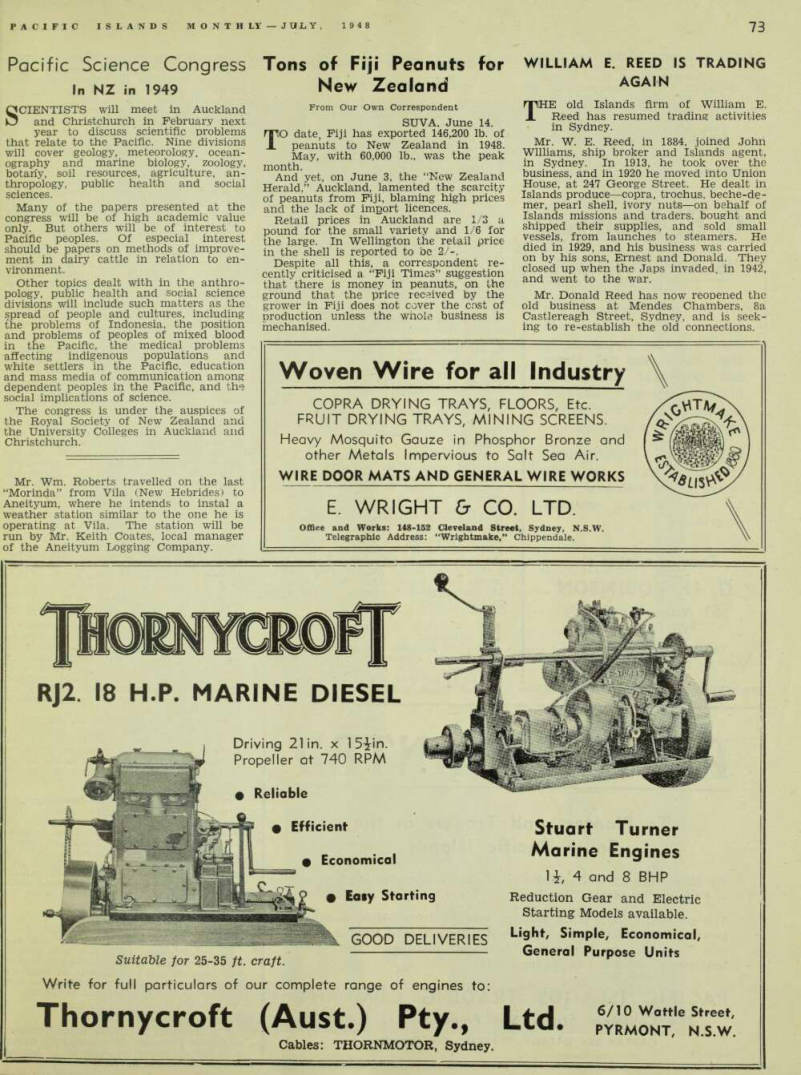
In NZ in 1949
SCIENTISTS will meet in Auckland and Christchurch in February next year to discuss scientific problems that relate to the Pacific. Nine divisions will cover geology, meteorology, ocean ography and marine biology, zoology, botany, soil resources, agriculture, an thropology, public health and social sciences.
Many of the papers presented at the congress will be of high academic value only. But others will be of interest to Pacific peoples. Of especial interest should be papers on methods of improve ment in dairy cattle in relation to en vironment.
Other topics dealt with in the anthro pology, public health and social science divisions will include such matters as the spread of people and cultures, including the problems of Indonesia, the position and problems of peoples of mixed blood in the Pacific, the medical problems affecting indigenous populations and white settlers in the Pacific, education and mass media of communication among dependent peoples in the Pacific, and the social implications of science.
The congress is under the auspices of the Royal Society of New Zealand and the University Colleges in Auckland and Christchurch.
Mr. Wm. Roberts travelled on the last “Morinda” from Vila (New Hebrides) to Aneityum, where he intends to instal a weather station similar to the one he is operating at Vila. The station will be run by Mr. Keith Coates, local manager of the Aneityum Logging Company.
Tons of Fiji Peanuts for New Zealand
New Zealand
From Our Own Correspondent SUVA. June 14. rdate, Fiji has exported 146,200 lb. of peanuts to New Zealand in 1948.
May, with 60,000 lb., was the peak month.
And yet, on June 3, the “New Zealand Herald,” Auckland, lamented the scarcity of peanuts from Fiji, blaming high prices and the lack of import licences.
Retail prices in Auckland are 1/3 a pound for the small variety and 1/6 for the large. In Wellington the retail price in the shell is reported to be 2/-.
Despite all this, a correspondent re cently criticised a “Fiji Times” suggestion that there is money in peanuts, on the ground that the price received by the grower in Fiji does not cover the cost of production unless the whole business is mechanised.
William E. Reed Is Trading
Again
THE old Islands firm of William E.
Reed has resumed trading activities in Sydney.
Mr. W. E. Reed, in 1884, joined John Williams, ship broker and Islands agent, in Sydney. In 1913, he took over the business, and in 1920 he moved into Union House, at 247 George Street. He dealt in Islands produce—copra, trochus, beche-de mer, pearl shell, ivory nuts —on behalf of Islands missions and traders, bought and shipped their supplies, and sold small vessels, from launches to steamers. He died in 1929, and his business was carried on by his sons, Ernest and Donald. They closed up when the Japs invaded, in 1942, and went to the war.
Mr. Donald Reed has now reopened the old business at Mendes Chambers, 8a Castlereagh Street, Sydney, and is seek ing to re-establish the old connections.
The Government ketch “New Golden Hind” left Auckland late in April with stores for Sunday Island, chief island of the Kermadec Group (between NZ and Fiji) which has been “colonised” by the NZ Government for use as a meteoro logical station. A group of labourers from Nuie, another NZ Territory, has been domiciled on Sunday Island for some time.
Advertisements & other items, pp. 75-76 (2 items)
73
PACIFIC ISLANDS MONTH LY JULY, 1948
Thornycroft (Aust.) Pty.,
Woven Wire for all Industry
COPRA DRYING TRAYS, FLOORS, Etc.
FRUIT DRYING TRAYS, MINING SCREENS.
Heavy Mosquito Gauze in Phosphor Bronze and other Metals Impervious to Salt Sea Air.
WJJ*E DOOR MATS AND GENERAL WIRE WORKS
E. WRIGHT & CO. LTD.
Office and Works: 148-153 Cleveland Street, Sydney, N.S.W.
Telegraphic Address: “Wrightmake,” Chippendale,
f 0 0
RJ2. 18 H.P. MARINE DIESEL
Driving 21 in. x 1 siin.
Propeller at 740 RPM Reliable Efficient Economical C- Eoty Starting ~r •m
GOOD DELIVERIES
Suitable for 25-35 ft. craft.
Write for full particulars of our complete range of engines to:
Thornycroft (Aust.) Pty.,
Cables: THORNMOTOR, Sydney.
Stuart Turner
Marine Engines
4 and 8 BHP Reduction Gear and Electric Starting Models available.
Light, Simple, Economical, General Purpose Units
Ltd.
6/10 Wattle Street,
PYRMONT, N.S.W.
G. H. Robinson
ISLAND SUPPLIES
of all kinds—Selected and Shipped to order at lowest possible prices—Piecegoods in Wool, Cotton and Silk, Under and Outerwear, Manchester, Drapery, Grocery, Hardware, Engineers and Leathergoods trade supplies a specialty.
Indents and Transhipments arranged. Large or small orders treated with equal care.
Use our 25 years’ extensive experience.
Enquiries solicited to —
G. H. ROBINSON
51 Macquarie Street, Sydney, N.S.W.
Telegrams: Sunrise, Sydney.
Letters: Box 3317, G.P.0., Sydney.
PAPAIN WANTED
To Planters and Traders in the
South Pacific Islands
We have Urgent Inquiries, by United States Interests, for Supplies of Papain (the Latex of the Paw-paw Tree).
The price offered is high, and the market firm. Here is a new means of increasing your income, at little cost and trouble. Pawpaw Trees can be “milked” a year after planting. Send your Inquiries to us—air-mail, where possible.
PACIFIC ISLANDS TRADING COMPANY
244 California Street San Francisco 11, U.S.A.
CABLES and RADIOS: “PITCO,” San Francisco.
Houses for Low-Wage
Earners in Fiji
( Contributed ) IT has been announced that £250,000 has been allocated to erect houses in Fiji for low-wage earners. No mention, however, is made whether this scheme comes into the First Five Year Plan, the Second Five Year Plan, or even into the Ten Year Plan.
No doubt the site has already been selected, but like all Government schemes, it will probably call for the set up of a new Government Department, called the Low-Wage Earners Housing Department, with the usual trappings and overhead.
When the offices to house the officials of this Low-Wage Earners Housing De partment have been suitably equipped, the technicians involved will go into the usual huddle to decide whether the foun dations should comprise bau bau posts or concrete piles; whether the house should be six inches or two feet off the ground (the latter would enable the low-wage earner to stack his firewood out of the wet—if the Conservator of Forests allows him any firewood); whether the house should have one or two bedrooms, since a low-wage earner should not be able to afford children in spite of the old song “The Rich get richer, and the Poor get children.”
When all these preliminary details have been adjusted to the satisfaction of the various Government Departments con cerned. no doubt it will be found expe dient to bring in a Housing Expert—at the Colony’s expense—from say, the Highlands of Scotland, and this expert will state quite definitely that high pitched roofs are an absolute necessity to carry off the heavy falls of snow, which the Colony might be subjected to at some future date, if the atomic bomb experi ments cause atmospheric disturbances, or Moscow decides to move the Antarctic to the Tropics.
BY the time the designs have been submitted to an Architect hailing from Nigeria, and plans approved by a Special Committee, and afterwards submitted to tho Economic Adviser, it will be found that the site for the erec tion of these buildings has become so
overgrown with Paddys Lucerne or El lington Curse, that the weeding gang attached to either the Agricultural De partment or the Public Works Depart ment will have to be called in.
These men, working under our newly formed Unions in Fiji, will probably take a couple of years to clear the site, as their usual weeding methods consist of 12 slashes of the cane-knife and then a quarter of an hour’s spell.
When the site is eventually cleared, it will be found that a certain amount of levelling is required, by which time it will be discovered that the present bull dozers owned by the Government, have “had it” and new equipment will have to be ordered through the Crown Agents.
Taking the new engines for the Suva Power House as a precedent, this will result in a further delay of a couple of years, by which time the plans will be found to be old-fashioned, as the new Government Architect will probably have come from Malaya, where they have a different type of building to house low wage earners.
WHEN the Low-Wage Earners Depart ment finally gets round to the question of erecting these houses for low-wage earners, it will be found that the original £250,000 grant has shrunk by about three noughts, and in order that these poor, harassed officials should have some alternative scheme to fall back upon, it is suggested that the 20-years-old plan of reclaiming the waterfront between the Grand Pacific and the Grammar School be proceeded with. On this reclamation, comfortable padded seats are to be erected, with per haps gaily striped awnings overhead, to keep off the tropical sun, and these seats could be advertised “To let, comfortable sleep-outs, sea view—have that early morning salt-water dip which invigorates the svstem and feel rosy all over.”
When the seats have been balloted for, and leased out on a 75 year basis, the Tourist Bureau could then get busy pre paring a pamphlet to attract tourists to this “Eden of the Pacific,” and could in clude in the ‘sights’ “Come and see our There would be no need to further tax our present overtaxed Sewerage System by the adoption of this waterfront idea, because the old sea wall would take care of all problems. It would be just as well, however, if the idea is adopted, to warn the semi-defunct Rifle Club, that the sea wall is “out of bounds” and the sitters are not clay pigeons.
There is only one snag in the water front idea, and that is. that in spite of all our highly technical officials, no one has yet been able to persuade the Suva rainfall to ei v e of its plenty to the “other side of the Island.” But then, that is Suva all over—it likes to keep everything for itself.
If these Waterfront Low-Wage Earners struck the wet or rainy season, they could perhaps be given permission to make use of the commodious garages under the Government Buildings, which house the luxurious limousines of the overworked, underpaid Government offi cials—l am sorrv. I got that a bit mixed, I meant the underworked, overpaid Gov ernment officials—-between the hours of 9 a.m. and 4 p.m.
THE Housing Scheme for the Low- Wage Earner is a worthy one. but by the time it is out into action, the low wages of the low-wage earner will have shrunk so low, that an ordinary Fiji Bure will look as magnificent to him as now do the Government Buildings.
The Governor of Fiji, Sir Brian Freeston. and Lady Freeston, entertained 600 guests at a garden party on June 10. in honour of His Majesty’s birthday.
Advertisements & other items, p. 77 (2 items)
75
PACIFIC ISLANDS MONTH LY --JULY, 1948
Laurel Is.
L Lessons are hard enough, Goodness only knows! Homework under lamplight that has a yellowish tinge and flickers, becomes twice as irksome, but worse still the children s eyes may be strained making them crotchety if not actually headachy !
Bad, flickery, smoky lamplight has only one cause - Inferior Kerosene Don t take risks with so precious a thing as a child's eyes. Use the beautifully soft, WH ITE light of Laurel. The flame of a Laurel-fed lamp burns steady as a rock brilliant yet soft and quite devoid of smoke or odor. The very high quality of Laurel is acknowledged everywhere, indeed, the sales of Laurel exceed the sales of all other brands of kerosene put together.
L 4617
VACUUM
omirr moouci l£^
LAUREL is.
For Lighting,Heating, Cooking, Cleaning, freezing
Engagement
HOLLAND-MARSH: The engagement is announced of Miss Patricia Holland, daughter of Dr. and Mrs. E. A. Holland, lately of Kavieng, TNG, and now of Vaucluse, Sydney; and Mr. David Marsh, Port Moresby (now at School of Tropical Administration), son of Mr. and Mrs. R. M. Marsh, of Lismore, N.S.W.
"Good Old Days"
Why the Decline in Trade?
RECENTLY, a writer in the PIM, dis cussing the absence of shipping and trading enterprise, remarked that times have changed around Fiji. The same thing has happened in the Eastern and South Eastern Divisions of Papua.
Between 40 and 50 years ago, boats
were numerous, from a “mosquito fleet,” to several schooners of some 50 tons. Any time of the day, when under way, one could see a boat or two on the horizon.
Native sailing canoes were numerous, too —I have counted 12 at one time on the horizon, far and near.
One would always meet up with one or more Europeans during the day; there were also half-castes, Japs and Filipinos.
All parties appeared prosperous and cheerful.
At all anchorages there were small trading stations. The Japs and Filipinos were law-abiding, and when one called at their stations they were generous with food. The Japs cooked dainty meals, while the Filipinos generally opened a number of tins of food —more than were needed.
One old man used to specialise in curried chicken —when he saw a boat ap proaching his anchorage, a chicken went into the pot. He had an accordion, anc 1 entertained one with music.
Boats are almost unknown now, and sailing canoes few. Most of the white men have moved to the towns or Gov ernment stations. The Asiatics are all gone, and few half-castes remain. Most of the half-castes now are employed by the Government or business firms in the towns.
In those old days, from the hill in Samarai, looking over China Strait to wards Milne Bay during daylight hours, one would always see the boats going or coming; but for years, now, there is not one passing for days at a time.
War, or poor copra prices are not re sponsible for the decline —the change had set in before the war began. When this country was most prosperous, the copra trade had not really commenced.
D. H. OSBORNE, Samarai.
Advertisements & other items, p. 78 (1 item)
Nelson & Robertson
The Illustration ■hows the “Victory”, a popular light aU - steel plough, combining maximum strength with minimum weight and draught.
Perfect
results
in any class of soil can be obtained with one implement or other ] \ the wide selection which we offer Our range covers share and disc ploughs for animal and tractor draught, cultivators. disc harrows, planters, etc.
ansomes
PLOUGHS and
IMPLEMENTS
Ransomes other manufactures Include hand, horse and motor lawn mowers, aerodrome equipment, etc. Write for Illustrated literature and all Information.
MORRIS, HEDSTROM LTD.,
Suva Lautoka - Ba.
Made by: RANSOMES, SIMS & JEFFERIES, LTD., IPSWICH, ENG.
NELSON and ROBERTSON Pty. Ltd.
Established 1895
Shipowners - Brokers and
Islands Merchants
All classes merchandise purchased at Best Wholesale Prices. Original Invoices supplied to Island Clients. Cocoa Beans, Copra, Rubber, Trochus Shell and All Islands 7 Produce Sold on Commission.
Entrust your requirements to the firm with fifty years practical experience in the Pacific Islands.
NELSON & ROBERTSON
12 SPRING STREET, SYDNEY, AUSTRALIA
Telegraphic Address: IVAN, SYDNEY.
Small-Pox Scare in Suva
Prom Our Own Correspondent
SUVA. June 19.
NUKULAU ISLAND, the week-end haunt of Suva yachtsmen and others, is closed to the public, and again the island is being prepared as a quaran tine station because the ship “Orna is coming from India.
Somewhere between Calcutta and Singa pore an Indian woman passenger in the Orna developed smallpox. She and her family were put ashore at Singapore on June 3, and the remaining 374 passengers were re-vaccinated.
Only about 12 per cent, of the popula tion of Fiji is vaccinated and it is plain that, once in, nothing could stop a disease like smallpox from sweeping the C °Up ny to the middle of June, and since the “Orna” news broke about 400 inocula tions had been given at Suva. Of these, 170 were given to Fijian wharf-workers, who came forward in response to an appeal based on the fact that a great many Fijians will be required to unload the “Orna’s” Indian cargo.
Fijians had been apprehensive about this coming Asiatic visitation. The official statement said that the ship would be Kept out in the harbour for two days, that it would be thoroughly fumigated, and that it would not be permitted to approach the wharf until the medical authorities are satisfied that there is no danger of infection.
No Quarantine For
Indians At Suva
SUVA, July 5.
TWO first class and 373 steerage pas sengers on the “Orna,” from Cal cutta were discharged at Suva on June 26. As every person on board had been vaccinated after the discovery of a smallpox case (landed at Singapore), the passengers were permitted to land with out going through quarantine. All were given a thorough medical examination and the ship and its cargo were fumi gated. ..
Most of the passengers were Indians returning to Fiji. Some had married in India and brought their families back with them.
How it is done department:
Black Market In Rice
In Fiji
SUVA, July 5.
INDIAN black marketeers pay Fijian rice-growers 4d. or sd. a pound for padi although the “controlled” price is slightly under 2d. The padi goes to Indian millers, for processing, at about 2/- for a sack of 200 pounds, and is then sold to the rice-consuming Indians at any thing from £6 to £8 a sack, without coming on to the open market.
This thriving business is mainly in the hands of Gujeratis—a generic term for non-Fiji-born Indians. It is illegal, of course, but it is as difficult to track down the practice as it is to buy rice in the European, Chinese or Indian shops of Lautoka, where the racket produces a perpetual Indian wail to the Government to do something about it.
Mr. Stan McCosker, of “Matala” planta tion, Rabaul, New Guinea, recently arrived in Britain, where his wife and children have been living since evacuation days.
Advertisements & other items, p. 79 (2 items)
77
PACIFIC ISLANDS MONTH LY —JU, L Y , 1948
Burns Philp Trust
. 'THAT .
<f> m V
rf-i % the
This decision
rests with You
It is most unwise to postpone the appointment of your executor or trustee, and equally foolish to make a hasty choice from your closest friends. No one can say when an executor will be called on to serve. Nor is there any guarantee that he can carry out his duties at some future date. In fact, his appointment merely expresses a wish on your part. However, uncertainty as to the future can be set aside by appointing Burns Philp Trust Company Limited as executor and trustee. This capable and experienced organisation offers a permanent service to your beneficiaries, whose interests will be adequately safeguarded by able directors and efficient officers. The wise administration of your estate is assured by such an appointment.
Full details of the Company's services are explained in "Hands That Never Leave the Wheel." A complimentary copy of this interesting and informative booklet will be forwarded upon request.
DIRECTORS:
James Burns Joseph Mitchell P. T. W. Black Frederick Ewen Loxton Eric Priestley Lee MANAGER: L. S. Parker SECRETARY: E. R. Overton, A.F.I.A
Burns Philp Trust
COMPANY LIMITED
EXECUTOR « TRUSTEE • AGENT
7 BRIDGE STREET, SYDNEY
Tel.; BU 5901 Box 543, 5.P.0., Sydney
BPS-48.
Anzac Agreement On
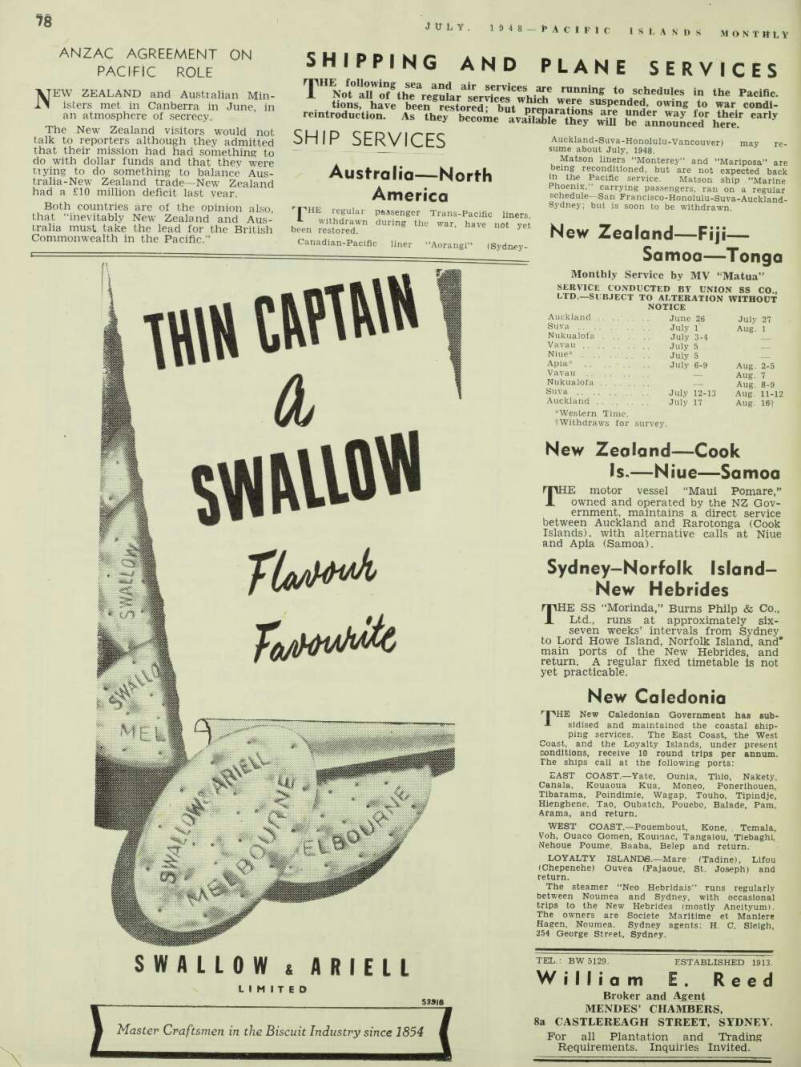
Pacific Role
NEW ZEALAND and Australian Min isters met in Canberra in June, in an atmosphere of secrecy.
The New Zealand visitors would not talk to reporters although they admitted that their mission had had something to do with dollar funds and that they were trying to do something to balance Aus tralia-New Zealand trade—New Zealand had a £lO million deficit last year.
Both countries are of the opinion also, that “inevitably New Zealand and Aus tralia must take the lead for the British Commonwealth in the Pacific.”
Samoa—Tonga
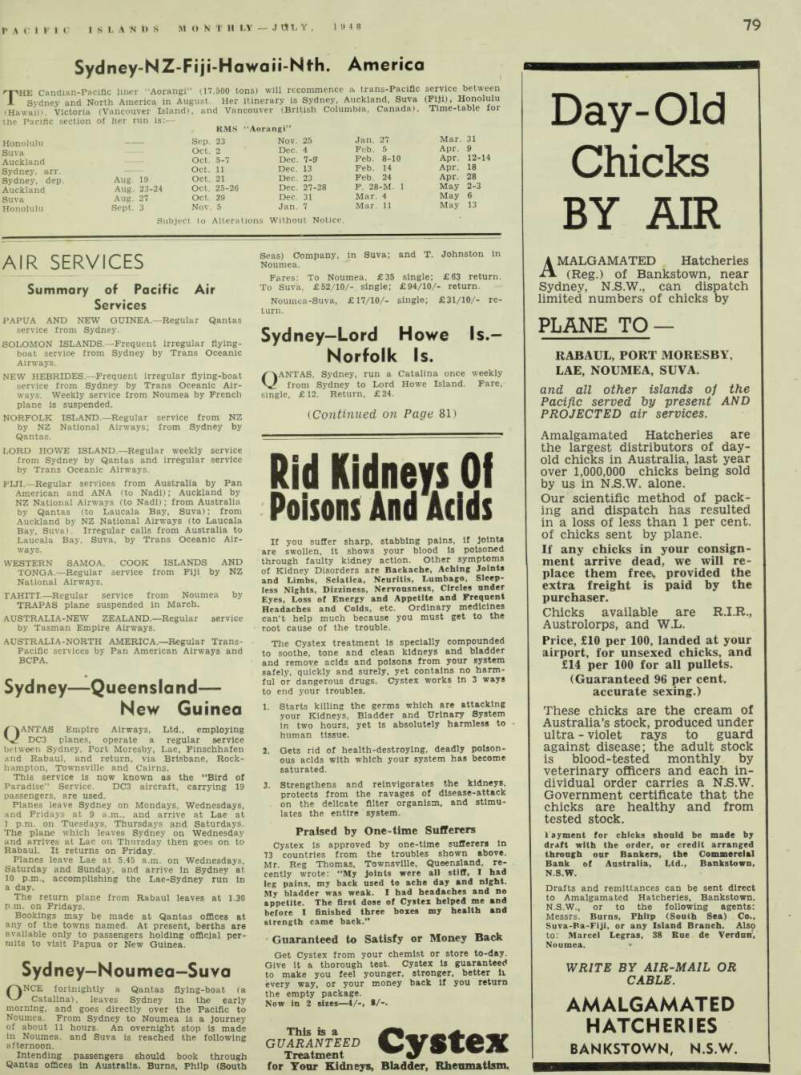

Shipping And Plane Services
reintroduction. As they become avaffl tt/S “ IZrf hm 1 * “' y
Ship Services
Australia—North
America
'T'HE regular passenger Trans-Pacific liners . withdrawn during the war, have not yet been restored. y Canadian-Pacific liner “Aorangi” (Sydney-
Auckland-Suva-Honolulu -Vancouver) mav re sume about July, 1948.
Matson liners “Monterey” and “Mariposa” are being reconditioned, but are not expected back In the Pacific service. Matson ship “Marine Phoenix.” carrying passengers, ran on a regular schedule—San Francisco-Honolulu-Suva-Auckland- Sydney; but is soon to be withdrawn.
New Zealand—Fiji—
Samoa—Tonga
Monthly Service by MV “Matua”
Service Conducted By Union Ss Co.,
Ltd.—Subject To Alteration Without
Notice
Auckland June 26 July 27 Suva July 1 Aug. 1 Nukualofa July 3-4 Vavau July 5 Niue- July 5 A P ia<: July 6-9 Aug. 2-5 Vavau Aug. 7 Nukualofa Aug. 8-9 Suva July 12-13 Aug. 11-12 Auckland July 17 Aug. 16f Time.
I Withdraws for survey.
New Zeoland—Cook
Is.—Niue—Samoa
rE motor vessel “Maui Pomare,” owned and operated by the NZ Gov ernment, maintains a direct service between Auckland and Rarotonga (Cook Islands), with alternative calls at Niue and Apia (Samoa).
Sydney-Norfolk Island-
New Hebrides
THE SS “Morinda,” Burns Philp & Co., Ltd., runs at approximately six seven weeks’ intervals from Sydney to Lord Howe Island, Norfolk Island, and* main ports of the New Hebrides, and return. A regular fixed timetable is not
yet practicable.
New Caledonia
r F'HE New Caledonian Government has sub -l sidised and maintained the coastal ship ping services. The East Coast, the West Coast, and the Loyalty Islands, under present conditions, receive 10 round trips per annum.
The ships call at the following ports: EAST COAST.—Yate, Ounia, Thio, Nakety, Canala, Kouaoua Kua, Moneo, Ponerlhouen, Tibarama, Poindimie, Wagap, Touho, Tipindje, Hienghene, Tao, Oubatch, Pouebo, Balade, Pam, Arama, and return.
WEST COAST.—Pouembout, Kone, Temala, Voh, Ouaco Gomen, Koumac, Tangaiou, Tiebaghi, Nehoue Poume, Baaba, Belep and return.
LOYALTY ISLANDS.—Mare (Tadine), Lifou (Chepenehe) Ouvea (Fajaoue, St. Joseph) and return.
The steamer “Neo Hebridais” runs regularly between Noumea and Sydney, with occasional trips to the New Hebrides (mostly Aneityum).
The owners are Societe Maritime et Manlere Hagen, Noumea. Sydney agents: H. C. Sleigh, 254 George Street, Sydney.
Sydney-N Z-Fiji-Hawaii-Nth. America
THE Candian-Pacific liner • Aorangi” (17,500 tons) will recommence a trans-Pacific service between Sydney and North America in August. Her itinerary is Sydney, Auckland, Suva (Fiji). Honolulu (Hawaii'. Victoria (Vancouver Island), and Vancouver (British Columbia, Canada). Time-table for the Pacific section of her run is:—
Air Services
Summary of Pacific Air
Services
PAPUA AND NEW GUlNEA.—Regular Qantas service from Sydney.
SOLOMON ISLANDS.—Frequent irregular flying boat service from Sydney by Trans Oceanic Airways.
NEW HEBRlDES.—Frequent irregular flying-boat service from Sydney by Trans Oceanic Air ways. Weekly service from Noumea by French plane is suspended.
NORFOLK ISLAND.—Regular service from NZ by NZ National Airways; from Sydney by Qantas.
LORD HOWE ISLAND.—Regular weekly service from Sydney by Qantas and irregular service by Trans Oceanic Airways.
FIJI. —Regular services from Australia by Pan American and ANA (to Nadi); Auckland by NZ National Airways (to Nadi); from Australia by Qantas (to Laucala Bay, Suva); from Auckland by NZ National Airways (to Laucala Bay, Suva). Irregular calls from Australia to Laucala Bay, Suva, by Trans Oceanic Air ways.
Western Samoa, Cook Islands And
TONGA. —Regular service from Fiji by NZ National Airways.
TAHITI. —Regular service from Noumea by TRAPAS plane suspended in March.
AUSTRALIA-NEW ZEALAND.—ReguIar service by Tasman Empire Airways.
AUSTRALIA-NORTH AMERICA.—Regular Trans pacific services by Pan American Airways and
Bcpa.
Sydney—Queensland—
New Guinea
QANTAS Empire Airways, Ltd., employing DC3 planes, operate a regular service between Sydney, Port Moresby, Lae, Finschhafen and Rabaul, and return, via Brisbane, Rock hampton, Townsville and Cairns.
This service is now known as the “Bird of Paradise’’ Service. DCS aircraft, carrying 19 passengers, are used.
Planes leave Sydney on Mondays, Wednesdays, and Fridays at 9 a.m., and arrive at Lae at 1 p.m. on Tuesdays, Thursdays and Saturdays.
The plane which leaves Sydney on Wednesday and arrives at Lae on Thursday then goes on to Rabaul. It returns on Friday.
Planes leave Lae at 5.45 a.m. on Wednesdays.
Saturday and Sunday, and arrive In Sydney at 10 p.m., accomplishing the Lae-Sydney run in a day.
The return plane from Rabaul leaves at 1.30 p.m. on Fridays.
Bookings may be made at Qantas offices at any of the towns named. At present, berths are available only to passengers holding official per mits to visit Papua or New Guinea.
Sydney-Noumea-Suva
fortnightly a Qantas flying-boat (a Catalina), leaves Sydney in the early morning, and goes directly over the Pacific to Noumea. From Sydney to Noumea is a journey of about 11 hours. An overnight stop is made in Noumea, and Suva is reached the following afternoon.
Intending passengers should book through Qantas offices in Australia. Burns, Phllp (South
Seas) Company, in Suva; and T. Johnston in Noumea.
Fares: To Noumea, £35 single: £63 return.
To Suva, £52/10/- single; £94/10/- return.
Noumea-Suva, £17/10/- single; £31/10/- re turn.
Sydney—Lord Howe ls.-
Norfolk Is.
QANTAS, Sydney, run a Catalina once weekly from Sydney to Lord Howe Island. Fare, single, £12. Return, £24.
(Continued on Page 81)
Rms
“Aorangi”
Honolulu Sep. 23 Nov. 25 Jan. 27 Mar. 31 Suva Oct. 2 Dec. 4 Feb. 5 Apr. 9 Auckland Oct. 5-7 Dec. 7-9 Feb. 8-10 Apr. 12-14 Sydney, arr.
Oct. 11 Dec. 13 Feb. 14 Apr. 18 Sydney, dep.
Aug. 19 Oct. 21 Dec. 23 Feb, 24 Apr. 28 Auckland Aug. 23- ■24 Oct. 25-26 Dec. 27-28 F. 28-M. 1 May 2-3 Suva Aug. 27 Oct. 29 Dec. 31 Mar. 4 May 6 Honolulu Sept. 3 Nov. 5 Jan. 7 Mar. 11 May 13 Subject to Alterations Without Notice.
Trans Oceanic Airways Pty., Ltd., 14 Martin Place. Sydney, run a large flying-boat fairly frequently between Sydney and Lord Howe Island.
Qantas run a land plane about once a fort night from Sydney to Norfolk Island. Fare, £22 single; £39/12/- return. (For Norfolk Island, see also under NZ National Airways.)
Noumea-Fiji-Tahiti
TRAPAS (a French company with headquarters in Noumea) runs an air service once a month from Noumea (New Caledonia), via Nadi (Fiji) and Aitutaki (Cook Islands) to Papeete (Tahiti), and return.
It was announced in January that this was to become a fortnightly service; but service was suspended in March owing to hurricane damage.
New Caledonia —
New Hebrides
A PLANE based on Noumea runs between Noumea and Port Vila (New Hebrides), with calls at Santo and other places as required, and returns, once each week. (It was suspended in March owing to hurricane damage.)
Pan-American —
Trans-Pacific Service
PAN-AMERICAN World Airways clippers now provide the following services in the South Pacific, using DC4 planes:— Planes leave Sydney every Wednesday and Saturday, and fly via Tontouta (New Caledonia), Nadi (Fiji), Canton Island. Honolulu, to San Francisco, and return along the same route, leaving ’Frisco every Saturday and Tuesday.
Planes leave Auckland every Friday and fly via Nadi, Canton Island, and Honolulu, to San Francisco: and leave ’Frisco for Auckland every Monday. Fares are given below, in Australian currency:—
(Time-tables and fares subject to alteration without notice.) To convert to Fiji currency, reduce above figures by about 10 per cent.
Free baggage allowance is 66 lb. per person.
Exoess at 1 per cent, of single fare for each kilogram of excess (1 ki10—2.2 lb.).
Sydney-Vancouver
BCPA Service
BRITISH Commonwealth Pacific Airlines Limited operate a three trips per fortnight trans-Pacific service from Sydney via Fiji, Canton Island, Honolulu and San
Single Return £ s. d. £ s. d Sydney-’Prisco 200 0 0 360 0 0 Sydney-Piji 55 0 0 99 1 3 Auckland-’Frisco .. 184 1 3 331 5 0 Auckland-PIJi 39 1 3 70 6 3 Piji-’Frisco .. ... 145 0 0 260 18 9
Piancisco, and a fortnightly service between Auckland and Vancouver, via the same air- Planes leave Sydney every Sunday evening and alternate Wednesdays, and Vancouver, on the southbound trip, every Sunday and alternate Thursdays. Planes leave Auckland every alter nate Wednesday and arrive in Vancouver the following Saturday. This southbound trip com-
mences from Vancouver on alternate Fridays Pares are (in Australian currency). Sydney- San Francisco, £2OO single and £360 return Auckland-Vancouver, £AI9B single- Auckland Nadi (Fiji) £A39 Skymasfcer aircraft carrying 38 passengers and a crew of 9 are used on the service.
NZ National Airways
South Pacific Services
Pacific services run by the New Zealand , „ National Airways Corporation are as follows: A i UC^ AND-LAUCALA bay (SUVA); A ‘ Sun derland flying-boat leaves Mechanics Bav Auckland, at 7 a.m. each Saturday for Laucala Bay, Suva (arrives 3.30 p.m.).
The aircraft departs from Laucala Bay Suva on the return journey at 7.30 a.m. each Monday' and arrives at Mechanics Bay. Auckland, at 4
Bay , (Suva) -Labasa (Vanua
LEVU). A Sunderland” flying-boat operates this service on a charter basis. A return trip is made between Laucala Bay and Labasa each Sunday
Auckland-Norfolk Island-Fi Ji-Tonga
Western Samoa-Cook Islands: A ‘
airliner leaves Whenuapai, Auckland, on alter nate Sundays at 8.30 a.m. (July 11 and 25 August 8) for Norfolk Island (arr. 12.30 p m dep. 12.1 a.m. Monday), Nadi (arr. 6.55 a.m.'' dep. 5.40 a.m. Tuesday), Nausori (arr. 6.30 am dep. 7.15 a.m.), Tonga (arr. 10.45 a.m., dep’. 11.45 a.m.), *Apia, Western Samoa (arr 4io P.m Monday, dep. 7.45 a.m. Tuesday), Aitutaki, Cook Islands (arr. 1.50 p.m., dep. 2.45 p.m.), and Rarotonga, Cook Islands (arr. 4.5 p.m.).
The aircraft departs from Rarotonga on the return journey at 7.30 a.m. on alternate Thurs days (July 15 and 29, August 12) for Aitutaki (arr. 8.50 a.m., dep. 9.45 a.m.), Apia, Western Samoa (arr. 3.35 p.m., dep. 8 a.m. Friday), Tonga (arr. 11.15 a.m. Saturday, dep. 12 15 p.m.), Nausori (arr. 3.10 p.m., dep 4.15 pm) Nadi (arr. 5.5 p.m., dep. 2 a.m. Sunday), Norfolk Island (arr. 8.10 a.m., dep. 1 p.m.), and When uapai, Auckland (arr. 5.45 p.m.).
An additional return service between Raro tonga and Aitutaki is operated on alternate Wednesdays when trafiic warrants. lnternational Date Line.
Auckland-Norfolk Island: A “Douglas”
airliner leaves Whenuapai, Auckland, every Sun day at 8.15 a.m. for Norfolk Island (arr. 12.15 p.m.), and departs on the return flight at 1.15 p.m., arriving at Whenuapai at 6 p.m. (This service is suspended at present due to the out break of poliomyelitis in New Zealand.) PARES, single (in NZ currency): Auckland to Norfolk, £l2/10/-; to Fiji, £2B/10/-; to Tonga, £3l; to Samoa, £34; to Aitutaki, £39; to Raro tonga, £39/10/-, Norfolk to Fiji, £l9. Fiji to Tonga, £B/15/-; to Samoa, £l3; to Aitutaki, £29/15/-; to Rarotonga, £3l. Samoa to Raro tonga, £l7/15/-; to Aitutaki, £l6/10/-; Suva to Labasa, £4/10/-. Return fares, less 10 per cent.
BOOKING OFFICES: Wellington, Govt. Life Bldg., Customhouse Quay; Auckland Airways House, Customs St.; Dunedin, 8-10 Manse St.; Christchurch, Union SS Co., 168 Hereford St.; Gisborne. 74 Peel St.; Palmerston Nth . 107 Broadway Ave.; Norfolk Is., Burns Philp Ltd.; Fiji, NAG; at Nadi and Suva; Burns Philp, Labasa; Tonga, Mrs. F. F. Melhose, Fou-amotu Airfield; W Samoa, Burns Philp (SS). Ltd., Apia; Cook Is., Mrs. P. McVeagh. Aitutaki and Mr. J. D. Campbell, Rarotonga.
Trans-Tasman Service
Sydney—Auckland
TASMAN Empire Airways, Ltd., operate a flying-boat service between Rose Bay, Sydney, and Mechanics Bay, Auckland. Large flying-boats, capable of carrying 30 passengers, are employed. The trip is comfortable, and takes approximately 8 hours.
The flying-boats leave both Sydney (6.30 a.m.) and Auckland (8 a.m.) every morning except Sundays. Six flights each way per week. Fares: £2B single; £5O/8/- return.
In addition, this flying-boat service is, at pre sent, supplemented toy a Skymaster service, details of which are available on application to TEA offices in Australia and New Zealand.
Bookings may be made at Tasman Empire Airways in Auckland and at Qantas Empire Air ways, Carrington Street. Sydney.
TOA Services
TRANS Oceanic Airways run the following Pacific services:— SYDNEY-LORD HOWE IS.: A regular fort nightly service with large four-engine flying boats from Rose Bay. Fare; £ll single; £2l return. Free baggage allowance 50 lb. Excess baggage and freight rate 6d. per lb.
SYDNEY-NEW HEBRIDES: A regular monthly
rvice with large four-engine flying-boats from dney. via Noumea (overnight stop), to Vila d Espiritu Santo. Pare: Sydney-Vila, £45; dney-Santo, £5O; Noumea-Vila. £l2/10/-; lumea-Santo. £lB. Freight: Sydney-Vila or nto, 2/- per lb.
Sydney-Solomon Islands: A Regular
anthly service from Sydney, via New Cale nia and New Hebrides to Tulagi, Solomon ands. This service is frequently extended to ngatou, in the Russell Islands, and calls are metimes made at Vanikoro, in the Santa Cruz •oup. Fares: Sydney-Tulagi, £75. Free bag ge allowance, 60 lb.; excess baggage and sight, 3/- per lb.
Advertisements & other items, pp. 80-84 (4 items)
78
JULY, 19 4 8 -tAclflc ISLANDS MONTHLY
m ttiu»
m -- : I l» s/> nr*
Mil
«s > " > I * . >» . m %s r mg * *%*%. ." * /V* 1 - *> m 5 £i^ % n 0
SWALLOW « A RIE L L
LIMITED
y 53916 Master Craftsmen in the Biscuit Industry since 1854
William E . Reed
TEL.: BW 5129. ESTABLISHED 1913.
Broker and Agent
MENDES’ CHAMBERS,
8a CASTLEREAGH STREET, SYDNEY.
For all Plantation and Trading Requirements. Inquiries Invited.
Day-Old
Chicks
BY AIR
Amalgamated Hatcheries
(Reg.) of Bankstown, near Sydney, N.S.W., can dispatch limited numbers of chicks by
PLANE TO
RABAUL, PORT MORESBY,
LAE, NOUMEA, SUVA.
and all other islands of the Pacific served by present AND PROJECTED air services.
Amalgamated Hatcheries are the largest distributors of dayold chicks in Australia, last year over 1,000,000 chicks being sold by us in N.S.W. alone.
Our scientific method of packing and dispatch has resulted in a loss of less than 1 per cent, of chicks sent by plane.
If any chicks in your consignment arrive dead, we will replace them free, provided the extra freight is paid by the purchaser.
Chicks available are R.1.R., Austrolorps, and W.L.
Price, £lO per 100, landed at your airport, for unsexed chicks, and £l4 per 100 for all pullets. (Guaranteed 96 per cent, accurate sexing.) These chicks are the cream of Australia’s stock, produced under ultra - violet rays to guard against disease; the adult stock is blood-tested monthly by veterinary officers and each individual order carries a N.S.W.
Government certificate that the chicks are healthy and from tested stock.
Payment for chicks should be made by draft with the order, or credit arranged through oar Bankers, the Commercial Bank of Australia, Ltd., Bankstown,
N.S.W.
Drafts and remittances can be sent direct to Amalgamated Hatcheries, Bankstown, N.S.W., or to the following agents: Messrs. Burns, Phiip (South Sea) Co., Suva-Ba-Fiji, or any Island Branch. Alsp to: Marcel Legras, 38 Rue de Verdun, Noumea.
WRITE BY AIR-MAIL OR
CABLE.
AMALGAMATED
HATCHERIES
BANKSTOWN, N.S.W.
Rid Kidneys Of
Poisons And Adds
If you suffer sharp, stabbing pains, If Joint* are swollen, it shows your blood Is poisoned through faulty kidney action. Other symptoms of Kidney Disorders are Backache, Aching Joint* and Limbs, Sciatica, Neuritis, Lumbago. Sleepless Nights. Dizziness, Nervousness, Circles under Eyes, Loss of Energy and Appetite and Frequent Headaches and Colds, etc. Ordinary medicines can’t help much because you must get to the root cause of the trouble.
The Cystex treatment Is specially compounded to soothe, tone and clean kidneys and bladder and remove acids and poisons from your system safely, quickly and surely, yet contains no harmful or dangerous drugs. Cystex works In 3 ways to end your troubles. 1. Starts killing the germs which are attacking your Kidneys, Bladder and Urinary System in two hours, yet Is absolutely harmless to human tissue. 2. Gets rid of health-destroying, deadly poisonous acids with which your system has become saturated. 3. Strengthens and reinvigorates the kidneys, protects from the ravages of disease-attack on the delicate filter organism, and stimulates the entire system.
Praised by One-time Sufferers
Cystex Is approved by one-time sufferer* In 73 countries from the troubles shown above.
Mr. Reg Thomas, Townsville, Queensland, recently wrote: “My joints were all stiff, I had leg pains, my back used to ache day and night.
My bladder was weak. I had headaches and no appetite. The first dose of Cystex helped me and before I finished three boxes my health and strength came back.”
Guaranteed to Satisfy or Money Back
Get Cystex from your chemist or store to-day.
Give it a thorough test. Cystex Is guaranteed to make you feel younger, stronger, better K every way, or your money back If you return the empty package.
Now in 2 sizes—4/-, S/-.
GUARANTEED CVStCX
Treatment fj W
for Your Kidneys, Bladder, Rheumatism,
THE NEW
ns m The New Freezer Shelf gives you • An extra refrigerated shelf. » More efficient cube freezing. • Better balanced cold circulation. • Designed shelf layout. • More convenient, roomy storage. ® Attractively-styled “double-door” cube racks.
FEATURED BY PREFECT!
SPECIFICATIONS
EXTERNAL DIMENSIONS—Height, 4 ft.
7in.; Width, 2ft. 3in.; Depth, 2ft. 31 in.; Door Swing. Ift. lliin.; Bottom Door Slide. Sin.
APPROX. STORAGE CAPACITY—S cubic
feet.
APPROX. STORAGE AREA—B. 6 SQ. ft.
STORAGE COMPT. FITTINGS—4 large
removable wire trays, glass defrost dish, cube trays and grids.
NETT WEIGHT—363 lbs.
PACKED WEIGHT—SIO lbs.
SHIPPING MEASUREMENT—43 cubic
feet.
GUARANTEE
The "Prefect" refrigeration unit is covered by a 5 year guarantee.
KEROSENE
REFRIGERATORS
No Service Troubles! Low operating costs!
Cold air is scientifically distributed with no "dead spots" in circulating cold—precious foods are kept at a lower and more wholesome temperature. Now available in all Prefect models, the Freezer Shelf is just another reason why Prefect is Australia's finest refrigeration investment. Icecube trays more conveniently located on the Freezer Shelf. Remember, Prefect stays silent —
lasts longer.
Distributors for Papua and New Guinea : COLYER WATSON PTYLTD., 22 BRIDGE STREET, SYDNEY.
Obtainable from COLYER WATSON Obtainable from MILLARS, LTD., (NEW GUINEA), LTD., Rabaul, Kaviang. Fiji, Tonga, Salamaua.
Hard to Get? us
FOR
1. TRADE TOBACCO 10.
2. LAP LAP MATERIAL H.
3. CANNED GOODS ,2 -
4. PERFUMERY 13 -
5. PRIMUS STOVES ]4
6. KEROLAMPS
7. SHOES, SANDALS , 5
8. UMBRELLAS
9. CHILDREN'S CLOTH- 17’
ING 18.
SADDLERY & HARNESS
HOME LIGHTING PLANTS
WINES AND SPIRITS
NON-ELECTRIC WASHING
MACHINES
PUMPS, IRRIGATION
PLANTS
CROCKERY
HAIRDRESSING SUPPLIES
HARDWARE
AIR CIRCULATORS
C 8 ° Castlereogh Street Hldlliv WV Sydney, Australia
ISLAND TRADERS
Cable and Telegraphic address: “MANSTOCKS.” SYDNEY Telephones: 8W7405, 8W1237, 85076, FM2766
ESTABLISHED 1930
WILLIAM H. WATSON
RAROTONGA, COOK ISLANDS
Wholesale and Retail Trader
LICENSED STAMP DEALER
Agent For:—
BRITISH TRADERS' INSURANCE CO.
CORONA Gr L. C. SMITH TYPEWRITERS
KAISER & FRAZER MOTOR CARS
B.S.A. CYCLES AND MOTOR CYCLES
AMERICAN LEAD PENCIL CO.
WHITES AVIATION LTD.
Manufacturers of: FOOTWEAR, ALL CLASSES SUITABLE FOR NATIVE TRADING . . . M.O.P. PRODUCTS, INCLUDING ROUND EAR-RING BLANKS AND BUTTON BLANKS Exporter of: “Rarotonga” Hula-Skirts.
Sea-Shell Necklaces.
M.O.P. Jewellery.
Island Produce.
Wholesale and Retail Inquiries Invited.
Prepared to Consider Agencies for all Class of Goods.
Importer of: Textiles.
General Hardware.
Fancy Goods.
General Merchandise.
Cable Address: “Watson” Rarotonga Bankers: Bank of New Zealand, Auckland.
A Limited Quantity Only
COLT PATTERN .45 cal. AUTOMATICS
SPECIAL TROPICAL FINISH.
At the all-tirae low price of £lO each. Postage extra. Powerful, accurate, they are a weapon you will be proud to own. Ammo, plentiful, 25/per 100.
Quality Firearms and Fishing Tackle. 143 ELIZABETH ST. (near Market St.), SYDNEY. Phone: MA 3540.
SI L RO H U
He didn't -forget
to kiss you
Honey!
Poor foolish wife—to trust just a bath, instead of capping it off with dependable Mum. m % , Your bath washes away past perspiration but it can’t safeguard you against the risk of future underarm odour.
Take just 30 seconds to smooth on Mum ; then you’ll be worry-free all day or evening. Mum guards charm.
You can use Mum even after dressing. It will not injure fabrics or irritate your skin.
Get Mum today.
TAKES THE ODOUR OUT OF PERSPIRATION
4541
79
PACIFIC ISLANDS MOtitHLI- JIHV, 1948
adji's Explosion
May Have ractical Results
From a Special Correspondent ICIENTISTS, I understand, are now • getting ready to sit in on New Guinea’s “big bang” at Tadji. In •itain and elsewhere they are interested, pecially since the Heligoland explosion letted their appetite for large ex osions.
Says Dr. E. C. Bullard. FRS, telling of e results that modern seismologists are (taming from earthquakes and ex osions, “I have been looking round the Drld for unwanted dumps of ammuni m and for people who will let them f. I find that it is less easv than you ight suppose to find suitable ones. People tve an understandable objection to loud ,ngs, and it is only in rather wild and mote places that one can get away with em.”
Hence the interest in the 3,000 tons bombs near Aitape, on the New Guinea Drth Coast. This is not just superficial terest in sheer destructiveness. Waves om an earthquake, or an explosion, avel at different speeds through dif rent kinds of rock, and usually go ster through the hard rocks. The time ,ey take to reach a given point shows e kind of rocks they have been through. ) the blast may give useful indirect idence of what lies below the surface cks.
Or, as Dr. Bullard puts it, “A study of ie parts of the earth that we cannot see ;epens our understanding of the parts lat we can see, the parts on which we ;pend for our minerals, our metals, and ir fuel.” And he reminds us that the ;epest mine in the world goes less than vo miles into the earth.
One valuable product of the earth it is Dped to find and develop in payable lantities in New Guinea is oil. Now hat Dr. Bullard has to say about the ismological developments in this regard
worth quoting.
“After the first world war,” he says, Jome Germans saw that seismology >uld be more than an academic science, id started to apply the methods de doped for the study of the interior of ie earth to the detailed examination of jology near the surface, and. in par cular, to the finding of oil. For these jplications of seismology small explosions ere used instead of earthquakes as the mrce of the waves. This work was mtinued in America, in Persia, and else here. The results have been outstand ig, and without them we should be even lorter of petrol than we are now.
“The success of this work suggested that rge explosions might be more useful lan earthquakes had been, in the study ’ the earth’s interior. The main dif mlty with an earthquake is that you d not know when or where it is going ) happen; so you cannot place your istrurnents where they will get the most seful records. You must keep them run
ning the whole time, and hope to record something useful when it comes. When an explosion is made deliberately, these difficulties do not occur. You know when and where the explosion will go off, and can get just what you want from it. In this way you can get more information from a ‘single large explosion than from dozens of ordinary earthquakes. The only difficulty is to arrange your explosion.”
So these “useless” bombs —3,000 tons as against 4,000 tons detonated in one enormous bang at Heligoland—may be of some use to Australia and New Guinea after all. When Heligoland went up, parties of seismologists were on the qui vive in all the surrounding countries, and beautifully clear records were obtained at most of the stations. No doubt equally elaborate preparations have been made to record New Guinea’s big bang.
Mr. and Mrs. B. B. Perryman, and Mr.
W H. Carpenter, of Messrs. W. R. Car penter & Co.. Ltd., left Sydney by the last “Malaita” for New Guinea. Mr. and Mrs. Perryman are returning to Rabaul and Mr. Carpenter is making an inspec tion of the New Guinea branches.
The wedding of Dr. P. M. Woods, Government Medical Officer in Madang, to Miss Daphne Camm, took place on June 30. at Madang. The bride arrived by air from Mackay that morning. Rev A A. Maahs performed the ceremony: Mr. J. K. McCarthy, District Officer, gave the bride away; Sister Pauline Moss, of the European Hospital, was bridesmaid; Mr. J. McLellan was best man; and Mrs.
K. Chambers arranged the bridal bouquet At the reception, Mr. and Mrs. J. K.
McCarthy received about 60 guests. An informal atmosphere was created by the buffet supper arranged and decorated by Mrs. R. Sourbee.
Advertisements & other items, p. 85 (2 items)
83
ACI F I C ISLANDS MONTHLY JULY. 1948
Itching Skin Germs
EYE LOTION
LONDON-SUVA
ECT s £V?p>
VIA A
c
PANAMA
<* For Sailings and Further Particulars Apply To:— BETHELL, GWYN & CO., BURNS, PHILP (SOUTH SEA) 138 LEADENHALL ST., CO *’ LTD ’’
LONDON, E.C.3. SUVA.
Itching Skin Germs Killed in 5 Days
Thanks to the discovery of an American physician, it is now possible to kill and remove the true cause of most skin troubles. Your skin has nearly 50 million tiny seams and pores where invisible germs and parasites can hide, and which are the true cause of terrible Itching, Cracking, Peeling, Burning, Ringworm, Acne, Psoriasis, Blackheads, Pimples, Foot Itch and other disfiguring blemishes.
Blemishes such as these make you look and feel embarrassed, unattractive and handicapped in life, both socially and in business. You can’t get rid of these disfigurements with ordinary treatments, which give only temporary relief, because they do not kill the germs or parasites responsible for your trouble. .
New Discovery Kills Cause
Former skin sufferers throughout the world are now praising Nixoderm, the discovery of a leading American skin specialist. This remarkable new preparation quickly penetrates into the pores of the skin and kills the germs and parasites responsible for your trouble in 7 minutes, stopping the itch almost instantly. At the same time, this wonderful preparation acts as a tonic and skin food, so that as the cause of your trouble is removed, your skin becomes soft, smooth and clear. This clear, healthy complexion will give you new charm and make it easy to win friends.
Praised by Doctors
Dr. T. A. Ellis, well-known physician of Toronto, Canada, recently stated; “Skin disorders caused by parasites, as many are, yiel* to Nixoderm. These parasites are invisible to the naked eye. They eat away the skin, forming ugly eruptions. Ordinary ointments or remedies fail completely, or give only temporary results because they do not reach the cause of the condition. It is this value about Nixoderm in attacking parasites which impresses me most favorably, and explains in large measure the success it enjoys over many stubborn cases.”
Guaranteed Results
Get Nixoderm to-day. Put it to the test. In a few minutes you will find that the itching has stopped ; and in 24 hours you can see for yourself that your skin is clearer. And it is guaranteed that, within one week, Nixoderm must make your skin soft, clear, smooth and attractive or money back on return of empty package. Get Nixoderm from your chemist or store to-day. The guarantee protects you. So don’t delay. - Get Nixoderm to-day.
Nixoderm
For Skin Sores, Pimples and Itch.
Index to Volume XVIII
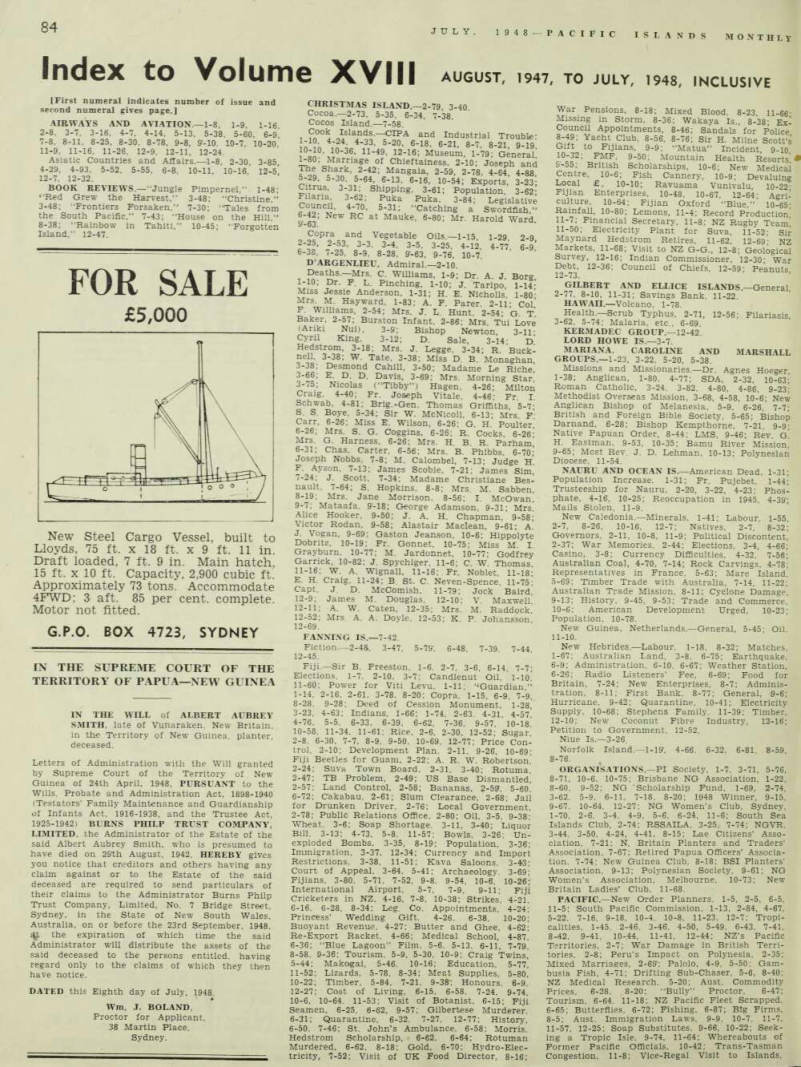
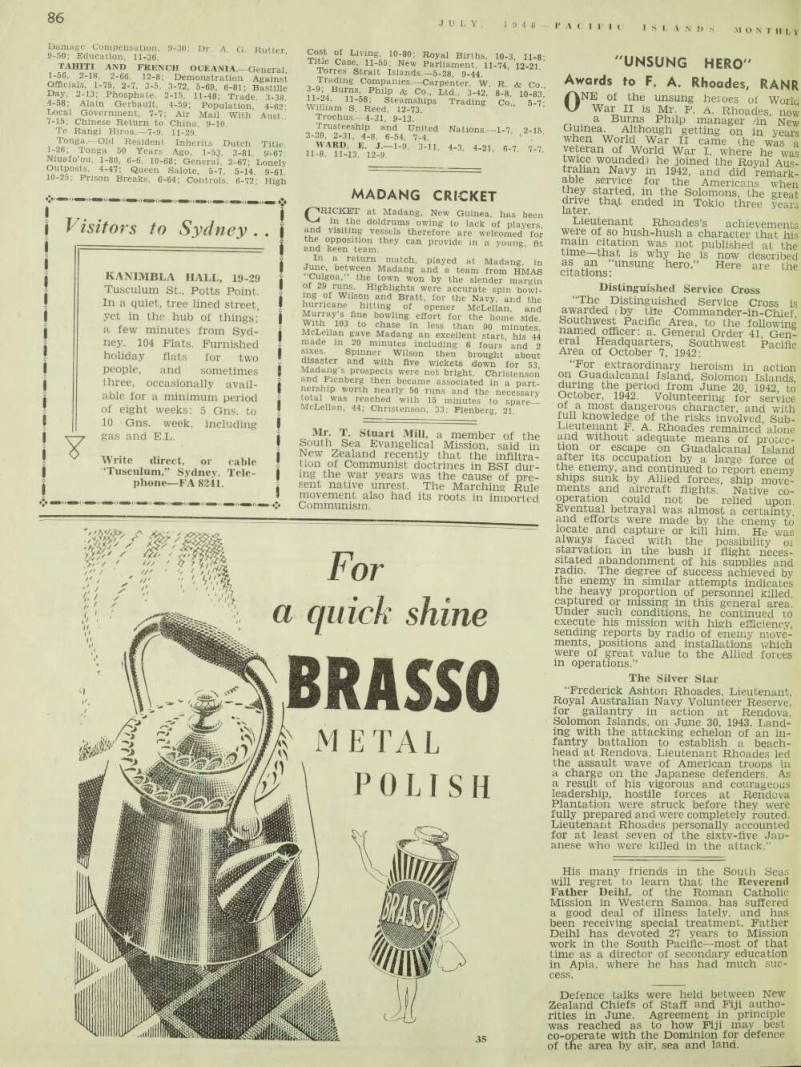
August, 1947, To July, 1948, Inclusive
[First numeral indicates number of issue and second numeral gives page.]
Airways And Aviation.—I-8, 1-9, 1-16
2- 3-7. 3-16. 4-7. 4-14. 5-13, 5-38. 5-60, 6-9 7- 8-11, 8-25, 8-30. 8-78, 9-8, 9-10. 10-7, 10-20 11- 11-16. 11-26. 12-9, 12-11, 12-24.
Asiatic Countries and Affairs.—l-8. 2-30, 3-85, 4-29, 4-93, 5-52, 5-55, 6-8, 10-11, 10-16. 12-s! 12- 12-32.
BOOK REVIEWS. —“Jungle Pimpernel,” 1-48; “Red Grew the Harvest,” 3-48; “Christine,” 3- “Frontiers Forsaken.” 7-30; “Tales from the South Pacific,” 7-43; “House on the Hill.” 8- “Rainbow in Tahiti,” 10-45; “Forgotten Island.” 12-47.
Christmas Island.—2-79 3-40
Cocoa.—2-73, 5-35, 6-34, 7-38 Cocos Island.—7-58. i ■^ slands - —CIPA and Industrial Trouble -1-10, 4-24, 4-33, 5-20, 6-18, 6-21, 8-7. 8-21 9-19 i°R(v’ T\Jr°' 3 ®’ 11-4 f’ 12 ' 16 ’ Museum - 1-79; General! 1- Marriage of Chieftainess, 2-10; Joseph and The Shark, 2-42; Mangaia, 2-59, 2-78. 4-64, 4-88. 5- 5-30, 5-64, 6-13, 6-16, 10-54; Exports, 3-23; Citrus, 3-31; Shipping, 3-61; Population, 3-62; Filana 3-62; Puka Puka. 3-84; Legislative 4 ’ 70, 5-31 ’ “ Catchin g a Swordfish,” &'63’ NeW RC at Mauke> 6 ' 80: Mr - Har °ld Ward, Copra and Vegetable Oils.—l-15, 1-29 2-9 2- 2-53, 3-3, 3-4, 3-5, 3-25, 4-12 4-77 6-9* 6- 7-25. 8-9, 8-28, 9-63, 9-76. 10-?’.
D’ARGENLIEU, Admiral.—2-10.
Deaths.—Mrs. C. Williams, 1-9; Dr. A. J. Borg I- Dr. F. L. Pinching, 1-10; J. Taripo, 1-14-’
Miss Jessie Anderson, 1-31; H. E. Nicholls. 1-80; Mrs. M. Hayward. 1-83; A. F. Parer. 2-11; Col F. Williams, 2-54; Mrs. J. L. Hunt. 2-54; G. T Baker, 2-57; Burston Infant. 2-86; Mrs. Tui Love (Anki Nui), 3-S’; Bishop Newton, 3-11- Cyril King. 3-12; D. Sale, 3-14; D Hedstrom, 3-18; Mrs. J. Legge. 3-34; R. Buck nell, 3-38; W. Tate, 3-38; Miss D. B. Monaghan 3- Desmond Cahill, 3-50; Madame Le Riche’ 3-66; E. D. D. Davis, 3-69; Mrs. Morning Star’ 3-75; Nicolas (“Tibby”) Hagen. 4-26; Milton Craig, 4-40; Fr. Joseph Vitale. 4-46; Fr. I.
Schwab, 4-81; Brig.-Gen. Thomas Griffiths, 5-7- S. S. Boye. 5-34; Sir W. McNicoll, 6-13; Mrs. F.
Carr, 6-26; Miss E. Wilson, 6-26; G. H. Poulter 6-26; Mrs. S. G. Coggins, 6-26; R. Cocks. 6-26' Mrs. G. Harness. 6-26; Mrs. H. B. R. Parham 6- Chas. Carter, 6-56: Mrs. B. Phibbs 6-70' Joseph Nobbs. 7-8; M. Calombel, 7-13; Judge H.
F. Ayson, 7-13; James Scobie, 7-21; James Sim, 7- J. Scott, 7-34; Madame Christiane Bes nault. 7-64; S. Hopkins. 8-8; Mrs. M. Sabben, 8- Mrs. Jane Morrison, 8-56; I. McOwan, 9- Mataafa, 9-18; George Adamson. 9-31; Mrs!
Alice Hooker, 9-50; J. A. H. Chapman, 9-58; Victor Rodan, 9-58; Alastair Maclean, 9-61; A.
J. Vogan, 9-69; Gaston Jeanson, 10-6; Hippolyte Dobritz, 10-19; Fr. Gonnet, 10-75; Miss M. I Grayburn. 10-77; M. Jardonnet, 10-77; Godfrey Garrick, 10-82; J. Spychiger. 11-6; C. W. Thomas, II- W. A. Wignall, 11-16; Fr. Noblet, 11-18; E. H. Craig. 11-24; B. St. C. Neven-Spence. 11-75; Capt. J. D. McComish, 11-79; Jock Baird. 12-9; James M. Douglas. 12-10; V. Maxwell! 12-11; A. W. Caten, 12-35; Mrs. M. Raddock. 12-52; Mrs. A. A. Doyle. 12-53; K. P. Johansson. 12-69.
Fanning Is.—7-42
Fiction.—2-48. 3-47, 5-79. 6-48. 7-39. 7-44 12-45.
Fiji.—Sir B. Freeston. 1-6. 2-7, 3-6. 6-14. 7-7; Elections. 1-7. 2-10. 3-7; Candlenut Oil. 1-10. 11-60: Power for Viti Levu. 1-11; “Guardian ” 1- 2-16. 2-61. 3-78. 8-20; Copra. 1-15, 6-9. 7-9, 8-28. 9-28; Deed of Cession Monument, 1-28 3- 4-63; Indians. 1-66; 1-74, 2-63. 4-31. 4-57, 4- 5-5. 6-33, 6-39. 6-62, 7-36. 9-57. 10-18. 10- 11-34. 11-61; Rice. 2-6, 2-30, 12-52; Sugar 2- 6-30, 7-7, 8-9, 9-50. 10-69. 12-77; Price Con trol, 2-10; Development Plan. 2-11. 9-26. 10-69; Fiji Beetles for Guam, 2-22; A. R. W. Robertson. 2-24; Suva Town Board, 2-31. 3-40; Rotuma. 2-47; TB Problem, 2-49; US Base Dismantled, 2-57; Land Control, 2-58; Bananas, 2-59, 5-60. 6-72; Cakabau. 2-61; Slum Clearance. 2-68: Jail for Drunken Driver. 2-76; Local Government. 2-78; Public Relations Office, 2-80; Oil, 3-5, 9-38: Wheat. 3-6; Soap Shortage. 3-11, 3-40; Liquor Bill. 3-13; 4-73. 5-8, 11-57; Bowls. 3-26; Un exploded Bombs. 3-35, 8-19; Population, 3-36; Immigration, 3-37, 12-34; Currency and Import Restrictions, 3-38, 11-51; Kava Saloons. 3-43; Court of Appeal. 3-64. 5-41; Archaeology. 3-69; Fijians. 3-80. 5-71. 7-52, 9-8. 9-54, 10-6. 10-26; International Airport, 5-7, 7-9, 9-11; Fiji Cricketers in NZ. 4-16, 7-8, 10-38; Strikes. 4-21. 6-16. 6-28, 8-34; Leg, Co. Appointments, 4-24; Princess’ Wedding Gift. 4-26. 6-38, 10-20; Buoyant Revenue. 4-27; Butter and Ghee, 4-62; Re-Export Racket. 4-66; Medical School, 4-87. 6-36; “Blue Lagoon” Film. 5-6. 5-13. 6-11, 7-79. 8-58. 9-36; Tourism. 5-9. 5-30, 10-9; Craig Twins. 5- Makogai, 5-46. 10-16; Education. 5-77, 11- Lizards, 5-78. 8-34; Meat Supplies. 5-80, 10-22; Timber, 5-84, 7-21, 9-38; Honours. 6-9. 12- Cost of Living, 6-15. 6-58. 7-24. 9-74. 10-6. 10-64. 11-53; Visit of Botanist, 6-15; Fiji Seamen, 6-25. 6-62, 9-57; Gilberbese Murderer. 6- Quarantine, 6-32. 7-27. 12-77; History. 6-50. 7-46; St. John’s Ambulance. 6-58: Morris.
Hedstrom Scholarship, 6-62. 6-64; Rotuman Murdered, 6-62, 8-18; Gold. 6-70; Hydro-Elec tricity* 7-52; Visit of UK Food Director, 8-16;
War Pensions, 8-18; Mixed Blood, 8-23 11-66- Missing in Storm, 8-36; Wakaya Is., 8-38; Ex- Council Appointments, 8-46; Sandals for Police 8-49; Yacht Club, 8-56, 8-76; Sir H. Milne Scott's Gift to Fijians, 9-9; “Matua” Incident, 9-10 10- PMF, 9-50; Mountain Health Resorts’ &-55; British Scholarships, 10-6; New Medical Centre, 10-6; Fish Cannery, 10-9; Devaluing Local £, 10-10; Ravuama Vunivalu 10-22- Fijian Enterprises, 10-48, 10-67, 12-64; Agri-’ culture, 10-64; Fijian Oxford “Blue,” 10-65- Rainfall, 10-80; Lemons, 11-4; Record Production’ 11- Financial Secretary, 11-8; NZ Rugby Team 11-50; Electricity Plant for Suva, 11-52; Sir Maynard Hedstrom Retires, 11-62, 12-69- NZ Markets, 11-68; Visit to NZ G-G., 12-8; Geological Survey, 12-16; Indian Commissioner, 12-30; War 1 2 "36 ’ Council of Chiefs, 12-59; Peanuts,
Gilbert And Ellice Islands.—Generai,
2- 8-10, 11-31; Savings Bank, 11-22.
HAWAll.—Volcano, 1-78.
Health.—Scrub Typhus. 2-71, 12-56; Filariasis 3- 5-74; Malaria, etc , 6-69
Kermadec Group.—I 2-42
Lord Howe Is.—3-7.
Mariana, Caroline And Marshall
Groups.—I-23, 3-22. 5-20, 5-38.
Missions and Missionaries.—Dr. Agnes Hoeger 1- Anglican, 1-80. 4-77; SDA, 2-32, 10-63; Roman Catholic, 3-24. 3-82. 4-80, 4-86, 9-23; Methodist Overseas Mission, 3-68, 4-58, 10-6; New Anglican Bishop of Melanesia, 5-9, 6-26, 7-7; British and Foreign Bible Society, 5-65; Bishop Darnand, 6-28; Bishop Kempthorne, 7-21, 9-9; Native Papuan Order, 8-44; LMS, 9-46; Rev. G H. Eastman. 9-53, 10-35; Bamu River Mission, 9-65; Most Rev. J. D. Lehman, 10-13; Polynesian Diocese, 11-54.
NAURU AND OCEAN IS.—American Dead, 1-31; Population Increase. 1-31; Fr. Pujebet, 1-44; Trusteeship for Nauru, 2-20, 3-22, 4-23; Phos phate, 4-16, 10-25; Reoccupation in 1945, 4-3S’; Mails Stolen. 11-9.
New Caledonia.—Minerals, 1-41; Labour, 1-55, 2- 8-26, 10-16, 12-7; Natives, 2-7, 8-32; Governors. 2-11, 10-8, 11-9; Political Discontent, 2- War Memories. 2-44; Elections, 3-4, 4-66; Casino, 3-8; Currency Difficulties, 4-32. 7-56; Australian Coal, 4-70, 7-14; Rock Carvings. 4-78; Representatives in France, 5-63; Mare Island. 5- Timber Trade with Australia, 7-14, 11-22; Australian Trade Mission. 8-11; Cyclone Damage, 9- History. 9-45, 9-53; Trade and Commerce. 10- American Development Urged, 10-23; Population. 10-78.
New Guinea, Netherlands.—General, 5-45; Oil, 11- New Hebrides.—Labour, 1-18. 8-32; Matches, 1-67: Australian Land, 3-8, 6-75; Earthquake. 6- Administration. 6-10. 6-67; Weather Station, 6-26; Radio Listeners’ Fee, 6-69; Food for Britain, 7-24; New Enterprises, 8-7; Adminis tration. 8-11; First Bank, 8-77; General, 9-6; Hurricane. 9-42; Quarantine. 10-41; Electricity Supply. 10-68; Stephens Family, 11-39; Timber, 12-10; New Coconut Fibre Industry. 12-16; Petition to Government. 12-52.
Niue Is.—3-26.
Norfolk Island. —1-1?, 4-66. 6-32, 6-81. 8-59, 8-76.
Organisations—Pi Society. 1-7. 3-71, 5-76,
8-71, 10-6. 10-75; Brisbane NG Association, 1-22, 8- 9-52; NG Scholarship Fund, 1-69, 2-74, 3- 5-9. 6-11. 7-18. 8-20; 1948 Winner, 9-15. 9- 10-64. 12-27: NG Women’s Club, Sydney, I- 2-6. 3-4. 4-9, 5-6. 6-24. 11-6; South Sea Islands Club, 2-74; RSSAILA, 3-25. 7-74; NGVR. 3-44. 3-50, 4-24, 4-41. 8-15; Lae Citizens’ Asso ciation, 7-21: N. Britain Planters and Traders’
Association, 7-67; Retired Papua Officers’ Associa tion. 7-74; New Guinea Club, 8-18; BSI Planters’
Association. 9-13; Polynesian Society, 9-61; NG Women’s Association, Melbourne. 10-73; New Britain Ladies’ Club, 11-68.
PACIFIC.—New Order Planners. 1-5, 2-5, 6-5, II- South Pacific Commission, 1-13, 2-84, 4-67, 5- 7-16, 9-18. 10-4. 10-8. 11-23. 12-7; Tropi calities, 1-45. 2-46. 3-46. 4-50, 5-49. 6-43. 7-41. 8-42. 9-41. 10-44. 11-41, 12-44; NZ’s Pacific Territories, 2-7; War Damage in British Terri tories, 2-8; Peru’s Impact on Polynesia, 2-35; Mixed Marriages. 2-69: Palolo, 4-9. 5-50: Gam busia Fish, 4-71; Drifting Sub-Chaser, 5-6, 8-40; NZ Medical Research. 5-20; Aust. Commodity Prices. 6-28. 8-20; “Bully” Proctor, 6-47; Tourism. 6-64. 11-18; NZ Pacific Fleet Scrapped, 6- Butterflies. 6-72; Fishing. 6-87; Big Firms, 8-5; Aust. Immigration Laws. 9-9, 10-7. 11-7, 11-57. 12-25; Soap Substitutes. 9-66, 10-22; Seek ing a Tropic Isle. 9-74, 11-64; Whereabouts of Former Pacific Officials. 10-42; Trans-Tasman Congestion, 11-8; Vice-Regal Visit to Islands,
11- 12-11, 12-28; Jap Goods. 11-32; Nature Motes, 12-46; Science Conference in NZ, 12-73, Papain.—B-51, 9-9, 11-18, 12-37.
Papua-NG-Provisional Administration. —Native Wages and Labour, etc., 1-9, 3-33, 9-5, 10-34, 10-35, 10-82, 11-62; Copra, 1-15, 2-13. 2-33, 3-4, 3-5 3-7. 4-11, 4-60, 5-17. 7-25, 9-9; Air Crashes, 1-16 2-75 4-20. 10-13, 12-36; Med. Students in Suva 1-19, 3-28; Gold, 1-19', 1-36, 2-8, 3-6, 4-38, 5-42 6-6, 6-7. 7-8. 8-8, 8-77, 9-7, 9-8, 10-9, 10-78, 10-82, 11-7 11-62; Paper-Making, 1-22, 7-21; Stray Japs, 1-26; Wau-Labu Road, 1-28; Reconstruction (General), 1-30, 1-61, 2-66, 3-4, 3-6, 4-76; Natives as Employers, 1-32; Public Service, 1-33, 2-23, 11-11, 12-28; Oil, 1-36, 2-11, 1-24, 5-6, 6-11, 6-56, 7-8, 9-6, 9-76, 10-6; Manus, 1-39, 1-69, 2-74. 3-25, 3-82. 8-26,' 9-9, 11-22; Leonard Murray, 1-40; Talk-Talk, 1-41, 2-41, 3-41, 1-45, 5-43, 6-41, 7-37. 8-37. 9-39, 10-39’, 11-37, 12- Paul Mason, 1-42, Pidgin English, 1-50; Island Trade, 1-52; The Term “Boy” is Tabu, 1- Rats, 1-59; Buka-Bougainville, 1-72, 1-76; Port Moresby. 1-74. 2-34, 3-27, 5-75, 6-30, 6-54, 7-70, 8-67, 9-73, 11-77; Tea Growing, 2-13; Shipping. 2-24, 3-9, 5-8, 9-58; Report to UN, 2- 7-22; Giant Snails, 2-33, 2-75, 6-71, 7-24, 12-40; War History, £-38. 3-73, 4-82, 5-52; Ca»rgo-Cult, 2-58, 7-62; Madang, 2-59, 7-59, 3- 9-48. 10-56, 11-59, 12-50; Aluminium Canoes, 2-64; False Teeth for Natives, 2-67; New Order, 2-68. 4-5, 9-5; Cocoa, 2-73, 5-35, 6-11, 10-10; Radio Installations at Moresby, 2-77, 12-55; O. Soltwedel, 2-80; Communism, 3-5, 5-15, 10-23; Commemoration Day, 3-8; Birds for Sydney Zoo, 3-11; Appeal to UNO, 3-14; Lavish Govt. Spending, 3-19, 4-38; Timber. 3-31, 5-28, 7-19’, 11-46; Moresby’s Luxury Hotel, 3-48; Rabaul and N. Britain, 3-63, 3-76; War Ceme teries, 3-69, 9-28, 10-15; History, 3-74. 4-58; Rice, 3-89; Meat Supplies, 4-5; Rubber, 4-7; H.
Alderman, KC, 4-15; N. Guinea Grievances, 4-18. 5-10; Customs Tariffs. 4-27; Commonwealth Dept.
Takes Over PWD, 4-40; Enemy Aliens’ Property, 4- Fr, Vitale. 4-46; Natives and European Clothing, 4-59. 6-87; Native Newspapers, 4-60; O. Rundnagel, 4-62; Errol Flynn, 4-64; Demora lisation of Natives Claimed, 4-68; Highland Natives Attack Missionary, 4-70; School of Pacific Administration, 4-74, 5-62, 6-6; 10-Year Plan. 4-77; Food for Britain, 4-93; War Widows, 5- Emirau Is., 5-16; Kokopo, 5-17; Adminis tration, 5-19, 8-6, 8-9; Amalgamation of Two Territories, 5-21, 9-10, 9-31, 12-9, 12-19; Japs Murder N. Ireland Residents, 5-29. 9’-65; New
Hotel for Wau, 5-36; Rattan Cane, 5-40; Port Moresby War Memorial, 5-41; Native War Dam age. 5-62; Tasman Islands, 5-82; Jungle-Juice Orgy, 6-9; “Garden Timber Case,” 6-10, 7-10, 8- 10-11. 11-13; Copra Sack Shortage, 6-13; Kavieng Club. 6-13; Contribution to AIF, 6-39; Nutmegs, 6-58, 11-47; Meat Embargo, 6-72; Shooting in Highlands Area, 6-74, 7-29; Finsch hafen, 6-80. 8-50, 9-16; “January 23,” 7-9; Cost of Living, 7-21, 7-29, 10-24; Lae Theatre, 7-53; Memorial to Queensland Flier, 7-68; Resurrecting Med. Equipment, 7-78; Cargo Pillage, 8-8; Stolen Building Materials. 8-10; Officials Jailed, 8-16, 9- Goldfields Pioneers, 8-17; Labour Party, 8- Moresby Electricity Charges, 9-11; CDC Sales, 9-33; Wewak and Sepik, 9-52, 10-78, 11-55; Tennis Championship, 9-56; Increased Transport Costs, 9-56; Eurasian Eyes on NG. 9-62; Indo nesian Castaways, 9-65; Visit of Eight Scientists, 9- Native Forger, 10-6; Aust. Gratuity Benefits, 10- Bank NSW, 10-10; Cosmopolitan Hotel. 10-10; Lae Hotel, 10-21; Alleged Abuse of Natives, 10-28, 11-9; Aust. Export Restrictions, 10- Lindenhafen, 10-75; Administrator, 11-51; Tadji Explosion. 11-54, 12-82; Murder of J. Scott, 11- 12-13; Production Control Board Dis banded, 12-10; First Woman Barrister, 12-22; Disrespect Shown Administrator, 12-23; Mumeng, 12- Chinese Consul, 12-8; Boat Building, 12-8.
Pitcairn Island. —1-43, 9-38, 10-16.
Rougier, Fr.—4-60, 5-48.
SAMOA. WESTERN.—Trusteeship Council Mission, 1-7, 2-15, 4-8; Harbour Works, 1-20; Church Funds, 1-35; Trade Boom, 2-18, 3-21, 5-36, 7-13, 7-21, 8-46; Dr. P. J. Monaghan, 2-24; New Police Chief, 2-25; Self-Government, 2-26, 3- 3-30. 4-22, 5-7, 8-33; Copra, 2-52, 9-38, 10-7; Casino Hotel, 3-11; Youths Steal Boat. 3-15, 4- 6-87, 8-36; Union with East Samoa. 3-18. 5- 6-40. 12-18; Banana Figs, 3-63; Medical Officers, 3-78, 9-30; History, 4-49; Nelson Memorial Hall, 5-26; Public Service, 5-28; Build ing Co., 5-34, 6-8; Radio Station, 5-36. 8-16; Births on “Matua,” 5-38; Retirement of I’iga Pisa. 5-41; Coconut Cream, 5-42; War Incident, 5-66; Two Fires, 5-76; Quarantine, 6-7. 6-33, 7- 11-48. 12-13; German Samoans, 6-7, 12-15; Cocoa, 6-34, 8-17; Cost of Living, 8-10; Roads. 8- Pigmies, 8-53, 11-58; Euronesians, 8-63; European Elections, 8-66, 9-27; Clerical Workers, 8-68; Health, ff-25; Observatory, 9-52; Legislative Assembly, 10-7, 10-49, 11-7; Education, 11-33.
Sampa, Eastern. —General, 5-7, 6-40, 9-40, 11- Ships and Shipping.—Kon Tiki Raft, 1-10, 2-9, 3- Pacific Ship Services (General), 1-11, 6-9, 7-17, 9-10, 9-35. 11-19, 11-50; “Nordkaperen,” 1- 2-69; “Barbary,” 1-20; “Mahiurangi,” 1-20; “Taipi,” 1-47; “Gippsland,” 1-68; “Viti,” 1-73, 9-35, 10-21, 11-40; Carpenter Line, 2-7; “Alone,” 2- 4-14; “Reynella,” 2-22; “Cyrena.” 2-22; “Alameda,” 2-33; “Morning Star,” 2-55; “Lina Maria,” 3-76; “SC 671.” 5-6, 8-40; “Matua,” 6- “Tagua,” 6-61; “Pagan,” 6-64; “Oiseau des lies,” 6-64; “Orohena,” 7-16; “Cheng Ho,” 7- “John Williams VI,” 8-8. 10-38; “Tiare Taporo,” 8-13; “Rabaul,” 8-22; “Batuna,” 8-26; “St. Francis,” 8-79, 9-82; “Ruena,” 9-11. 11-8; “Levuka,” bought by BPC, 9-67; “Taipan.” 9-68. 12- “Tereora,” 9-80; NG Ships Restored to Owners, 10-7: “Langlee Gale,” 10-8; “Maclaren- King II,” 10-63; “Bulolo,” 12-15; “Wakaya,” 12-66.
Stamp Collecting and New Issues. —2-23, 3-62, 4- 6-64, 9-35, 12-7.
Solomon Islands. —Ports of Entry. 1-32, 2-61, 5- 7-16, 7-56; Marching Rule, 1-66, 2-6, 2-13, 2-69, 3-71, 4-9, 4-64, 8-29; Labour, 2-16, 5-64, 9-24; US War Dead Removal, 4-32, 6-30, 7-26; Jap Captured, 4-32; Kuper Family. 4-65; Radio Station, 4-81; War Damage, 5-9, 9-66; Coat of Arms, 5-19; Copra, 5-20, 7-26; Shipping, 5-25, 8- 11-20, 12-27; Planters Return, 5-26: Advisory Council, 5-74; Infantile Paralysis and Quarantine. 6-14, 7-15. 10-59; War Cemetery, 6- Rehabilitation. 6-35; Administration, 6-67, 7- 7-64, 12-9; Gold, 9-24; American War
Damage Compensation. 9-30; Dr. A G Rutter 9- Education, 11-36. ‘ ’
Tahiti And French Oceania.—General,
1-56, 2-18, 2-66, 12-8; Demonstration Against Officials, 1-75, 2-7, 3-5, 3-72. 5-69, 6-81; Bastille Day, 2-13; Phosphate, 2-15, 11-48; Trade, 3-38 4-58; Alain Gerbault, 4-59; Population 4-62 •’
Local Government, 7-7; Air Mail With’ Aust ’ 7-15; Chinese Return to China, 9-10.
Te Rangi Hiroa.—7-9, U-29.
Tonga,—Old Resident Inherits Dutch Title, 1-26; Tonga 50 Years Ago, 1-53, 3-81. 9’-67 Niuafo’ou. 1-80, 6-6, 10-68; General, 2-67; Lonely Outposts, 4-47; Queen Salote, 5-7, 5-14. 9-61 10- Prison Breaks, 6-64; Controls, 6-72; High
Cost of Living, 10-80; Royal Births, 10-3, 11-8 Title Case, 11-55; New Parliament, 11-74, 12-21 Torres Strait Islands.—s-28, 9-44.
Trading Companies.—Carpenter. W. R & Co i L BIU i I ? S c„ Philp & Co > Ltd - 3-42, 8-8, 10-83,’ n ' 58; Steamships Trading Co., 5-7- William S. Reed. 12-73.
Trochus.—4-31, 9-13. rus t ee ship and United Nations.—l-7, 2-15 2-20, 2-31, 4-8, 6-54, 7-4. • ’
WARD. E. J.—l-9, 3-11, 4-3, 4-21 6-7 7-7 11-8, 11-13, 12-9. ’ ' 7 ’
Advertisements & other items, pp. 86-88 (2 items)
fgfdgdśg
IN THE SUPREME COURT OF THE
TERRITORY OF PAPUA—NEW GUINEA
IN THE WILL of ALBERT AUBREY
SMITH, late of Vunaraken. New Britain, in the Territory of New Guinea, planter, deceased.
Letters of Administration with the Will granted by Supreme Court of the Territory of New Guinea of 24th April, 1948, PURSUANT to the Wills. Probate and Administration Act, 1898-1940 (Testators’ Family Maintenance and Guardianship of Infants Act. 1916-1938, and the Trustee Act,
1925-19421 BURNS PHILP TRUST COMPANY,
LIMITED, the Administrator of the Estate of the said Albert Aubrey Smith, who is presumed to have died on 29th August, 1942. HEREBY gives you notice that creditors and others having any claim against or to the Estate of the said deceased are required to send particulars of their claims to the Administrator Burns Philp Trust Company, Limited, No. 7 Bridge Street.
Sydney, in the State of New South Wales.
Australia, on or before the 23rd September, 1948. %t the expiration of which time the said Administrator will distribute the assets of the said deceased to the persons entitled, having regard only to the claims of which they then have notice.
DATED this Eighth day of July, 1948,
Wm. J. BOLAND,
Proctor for Applicant, 38 Martin Place, Sydney.
NOW AVAILABLE
Pacific Islands Trade
Directory
1948-49 Edition . . . . 10/6 Apply to: Pacific Publications Pty., Ltd., G.P.O. Box 3408.
“ Where The
At all Leading Booksellers in Australia; at the Stores of Whitcomb & Tombs, Ltd., in New Zealand; at Caldwell’s Book Store, in Suva; from the Islands stores of Burns Philp & Co., Ltd.; and from Booksellers generally.
OR DIRECT FROM THE PUBLISHERS:
Pacific Publications Pty. Ltd.
UNION HOUSE, 247 GEORGE ST,, SYDNEY
Trade Winds
Blow”
Still available for your
entertainment . . .
This book of over 70 bright stories, articles and sketches, illustrated with cartoons and photographs, describes life in the South Seas as it has developed in the past decade.
It is written about Island people and places by those who know the islands —with the emphasis always on the amusing side of life.
A delightful gift-book for your friends. A source of entertainment to yourself.
PRICE
9/6 Posted * Collected by
R. W. Robson
and
Judy Tudor
Visitors to Sydney..
Y
KANIMBLA HALL, 19-29
Tusculum St., Potts Point.
In a quiet, tree lined street, yet in the hub of things;’ a few minutes from Sydney. 104 Flats. Furnished holiday flats for two people, and sometimes three, occasionally available for a minimum period of eight weeks: 5 Gns. to 10 Gns. week, including gas and E.L.
Write direct, or cable Tusculum,” Sydney. Telephone—FA 8241.
For a quick shine
BRASSO
METAL
P 0 LI S H
85
ACIFIC ISLANDS MONTH LY JULY, 1948
Madang Cricket
/CRICKET at Madang, New Guinea, has been V-4 in the doldrums owing to lack of players, and visiting vessels therefore are welcomed for the opposition they can provide in a young, fit and keen team.
T lu J return niatch > Played at Madang, in June, between Madang and a team from HMAS Culgoa,” the town won by the slender margin of 29 runs. Highlights were accurate spin bowl ing of Wilson and Bratt, for the Navy, and the hurricane hitting of opener McLellan, and Murray s fine bowling effort for the home side With 103 to chase in less than 90 minutes, McLellan gave Madang an excellent start, his 44 rnade in 20 minutes including 6 fours and 2 sixes. Spinner Wilson then brought about disaster and with five wickets down for 53 Madang's prospects were not bright. Christenson and Fienberg then became associated in a part nership worth nearly 50 runs and the necessary total was reached with 15 minutes to spare— McLellan, 44; Christenson, 33; Fienberg, 21.
Mr. T. Stuart Mill, a member of the South Sea Evangelical Mission, said in New Zealand recently that the infiltra tion of Communist doctrines in BSI dur ing the war years was the cause of pre sent native unrest. The Marching Rule movement also had its roots in imported Communism.
"Unsung Hero"
Awords to F. A. Rhoades, RANR
ONE of the unsung heroes of World War II Is Mr. F. A. Rhoades, now a Burns Philp manager /in New Guinea Although getting on in years when World War II came (he was veteran of World War I, where he was twice wounded) he joined the Royal Aus tralian Navy in 1942, and did remark able service for the Americans when they started, in the Solomons, the great drive ended in Tokio three years lei 101*.
Lieutenant Rhoades’s achievements were of so hush-hush a character that his mam citation was not published at the time that is why he is now described as an “unsung hero.” Here are the citations: Distinguished Service Cross “The Distinguished Service Cross is awarded (by the Commander-In-Chief Southwest Pacific Area, to the following named officer: a. General Order 41, Gen eral Headquarters, Southwest Pacific Area of October 7, 1942: “For extraordinary heroism in action on Guadalcanal Island, Solomon Islands, during the period from June 20 1942 to October, 1942. Volunteering for service of a most dangerous character, and with full knowledge of the risks involved, Sub- Lieutenant F. A. Rhoades remained alone and without adequate means of protec tion or escape on Guadalcanal Island after its occupation by a large force of the enemy, and continued to report enemy ships sunk by Allied forces, ship move ments and aircraft flights. Native co operation could not be relied upon.
Eventual betrayal was almost a certainty and efforts were made bv the enemy to locate and capture or kill him. He was always faced with the possibility oi starvation in the bush if flight neces sitated abandonment of his supplies and radio. The degree of success achieved by the enemy in similar attempts indicates the heavy proportion of personnel killed, captured or missing in this general area.
Under such conditions, he continued to execute his mission with high efficiency, sending reports by radio of enemy move ments, positions and installations which were of great value to the Allied forces in operations.”
The Silver Star “Frederick Ashton Rhoades, Lieutenant, Royal Australian Navy Volunteer Reserve, for gallantry in action at Rendova, Solomon Islands, on June 30, 1943. Land ing with the attacking echelon of an in fantry battalion to establish a beach head at Rendova, Lieutenant Rhoades led the assault wave of American troops in a charge on the Japanese defenders. As a result of his vigorous and courageous leadership, hostile forces at Rendova Plantation were struck before they were fully prepared and were completely routed.
Lieutenant Rhoades personally accounted for at least seven of the sixty-five Jap anese who were killed in the attack.”
His many friends in the South Seas will regret to learn that the Reverend Father Delhi, of the Roman Catholic Mission in Western Samoa, has suffered a good deal of illness lately, and has been receiving special treatment. Father Deihl has devoted 27 years to Mission work in the South Pacific —most of that time as a director of secondary education in Apia, where he has had much suc cess.
Defence talks were held between New Zealand Chiefs of Staff and Fiji autho rities in June. Agreement in principle was reached as to how Fiji may best co-operate with the Dominion for defence of the area by air, sea and land.
Notes from Doru (Papua) DARU, June 28.
WE listened last night to the opening of the new short-wave station in Port Moresby. One old hand interrupted the Administrator’s remarks from time to time with, “Why don’t we grow more rice 9”
The benefits of the station will only be realised when radios are available to the natives—there are none in this Division. . .
The unevangelised Fields Mission vessel “Maine 2” journeyed to Thursday Island recently and will there await stores from the South. Mr. and Mrs. Ron Teale, of the Mission were passengers.
A 40-ft. launch arrived early this month from Australia for Mr. L. Luff, who will use it in his business. Mr. T. A.
Wyborn brought the vessel up, and will m future reside at Daru.
Mr D Clancy, of Administrations Patrol Staff, is back in Daru after 15 months’ pioneer work at Lake Murray.
Local weather has been poor, and a small plane for Port Moresby remained here for two days, waiting for rain and winds to abate.
Advertisements & other items, p. 88 (1 item)
86
JULY, 19 4 8 PACIFIC r* I ANI)S MONTH!, Y
Quinine Neat!
When They Took Their
By D. H. Osborne.
IN the early days of the Papua gold fields, quinine was sold in ounce bottles, before tabloids were on the market. We used to dissolve it in cold tea. It was vile stuff to swallow. One Dutch chemist, in Java, used to put up an extra bitter lot.
One day I met an old miner, who asked for a dose of quinine. I was some
distance from my camp at the time. I said “I will send you half of the quinine in the camp.” He sent a native with me.
At the camp, there were two 1-ounce bottles, each with about 2 1 L > or 3 penny weights in them. I sent one bottle.
The next time I met the miner, he said: “You take large doses of quinine.”
“Good God! Did you take it in one dose?” I exclaimed.
“I dissolved it in half a pannikin of cold tea,” he said, “and I drank it for several days. I imagined I was walking on the air.” I told him he was lucky that he was not walking with the angels.
Oil Search in Papua
IWO of the British Empire’s most ex perienced oil men, Mr. J. M. Pattin son and Mr. R. S. Mackilligan, re cently visited the Australian Petroleum Company's permit area in Papua in company witn APC’s manager, Mr. L. A.
Pym.
As a result of this visit, oil-search in Papua will probably be speeded up.
Messrs. Pattinson and Mackilligan have now returned to London. It is under stood that they will recommend the use of five exploration rigs instead of three as at present.
Mr. Mackilligan said that it was more than possible that there was not one drop of workable oil in Papua-New Guinea.
There were what he described as “a few smells—but not even tantalising smells.”
However, if oil were not sought with vigour and every scientific aid, it would not be found at all.
The Acting Director of Education. Fiji, Mr. F. R, J. Davies, has resigned in order to take up a position with the New Zealand Education Department.
An amendment of the Gilbert and Ellice Customs Ordinance. recently gazetted, provides that duty must be paid on ail war disposals goods which re sidents in the Colony may acquire from sales and dumps within the Colony. Dur ing the war, a great many goods of all duty being charged, because they were kinds were taken into the Colony without for the armed services.
Advertisements & other items, p. 89 (2 items)
87
1* A(1 r I ( ISLANDS MONTII LY JULY, I'J 4 8
Merchants
TIME-PIECES
REPAIRED
We employ a Fully Qualified
Staff and we are equipped to undertake repairs of
WATCHES CLOCKS
MARINE CHRONOMETERS
We undertake Locksmithing, Key-cutting, etc.
Any goods sent to us by post are attended to promptly and with care.
NOEL LEVY
Victoria Parade, Suva, Fiji Phone 39. P.O. Box 88.
Cablegrams: “Noel,” Suva
PHILIPS
RADIO
LAE
TERRITORY OF NEW GUINEA
WHOLESALE
MERCHANTS
GENERAL AGENTS
REMINGTON
TYPEWRITER
FORWARDING, SHIPPING AND CUSTOMS AGENTS
POPE'S
PRODUCTS
Sole New Guinea Agents for: Commonwealth Insurance Company
RACO
ALUMINIUM
Islands Produce
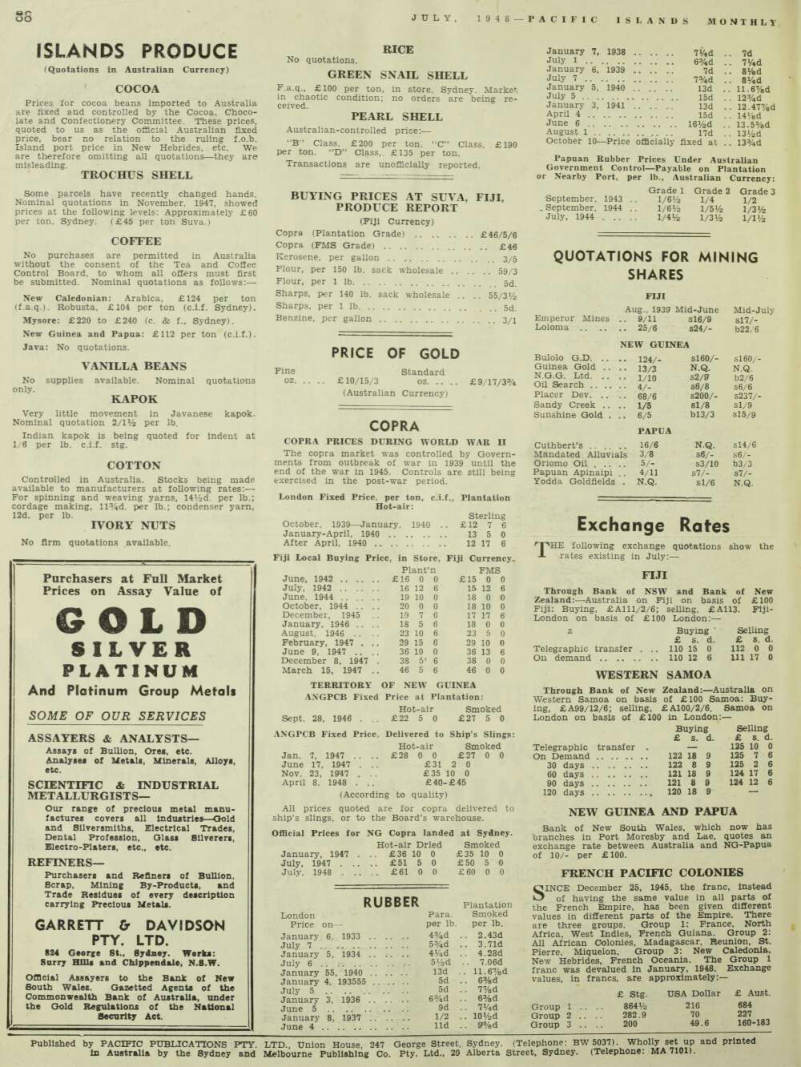
(Quotations in Australian Currency)
Cocoa
Prices for cocoa beans imported to Australia are fixed and controlled by the Cocoa, Choco late and Confectionery Committee. These prices, quoted to us as the official Australian fixed price, bear no relation to the ruling f.o.b.
Island port price in New Hebrides, etc. We are therefore omitting all quotations—they are misleading.
Trochus Shell
Some parcels have recently changed hands.
Nominal quotations in November, 1947, showed prices at the following levels: Approximately £6O per ton, Sydney. (£45 per ton Suva.)
Coffee
No purchases are permitted in Australia without the consent of the Tea and Coffee Control Board, to whom all offers must first be submitted. Nominal quotations as follows; New Caledonian; Arabica, £124 per ton (f.a.q.). Robusta, £lO4 per ton (c.i.f. Sydney).
Mysore: £220 to £240 (c. & f.. Sydney), New Guinea and Papua: £ll2 per ton (c.i.f.).
Java: No quotations.
Vanilla Beans
No supplies available. Nominal quotations only.
Kapok
Very little movement in Javanese kapok.
Nominal quotation 2/1% per lb.
Indian kapok is being quoted for indent at 1/6 per lb. c.i.f. stg.
Cotton
Controlled in Australia. Stocks being made available to manufacturers at following rates: — For spinning and weaving yarns, 14%d. per lb.; cordage making, ll%d. per lb.; condenser yam, 12d. per lb.
Ivory Nuts
No firm quotations available.
Rice
No quotations.
Green Snail Shell
P.a.q., £lOO per ton, in store, Sydney. Market in chaotic condition; no orders are being re ceived.
Pearl Shell
Australian-controlled price:— “B - ’ Class, £2OO per ton. “C” Class, £l9O per ton. “D” Class, £135 per ton.
Transactions are unofficially reported.
Buying Prices At Suva, Fiji,
Produce Report
(Fiji Currency) Copra (Plantation Grade) £46/5/6 Copra (FMS Grade) £46 Kerosene, per gallon 3/5 Flour, per 150 lb. sack wholesale .. .. .. 59/3 Flour, per 1 lb 53.
Sharps, per 140 lb. sack wholesale .. .. 55/3% Sharps, per 1 lb sa.
Benzine, per gallon 3/1
Advertisements & other items, p. 90 (1 item)
Price Of Gold
Fine Standard oz. .. .. £ 10/15/3 oz £9/17/3% (Australian Currency)
Copra
Prices During World War Ii
The copra market was controlled by Govern ments from outbreak of war in 1939 until the end of the war in 1945. Controls are still being exercised in the post-war period.
London Fixed Price, per ton. c.i.f., Plantation Hot-air:
Fiji Local Buying Price, in Store, Fiji Currency.
Territory Of New Guinea
ANGPCB Fixed Price at Plantation:
(According to quality) All prices quoted are for copra delivered to ship’s slings, or to the Board’s warehouse.
Official Prices for NG Copra landed at Sydney.
Sterling October. 1939—January, 1940 . . £12 7 6 January-April, 1940 13 5 0 After April, 1940 12 17 6
Plant’n FMS June, 1942 £16 0 0 £15 0 0 July, 1942 16 12 6 15 12 6 June, 1944 19 10 0 18 0 0 October, 1944 ... 20 0 0 18 10 0 December, 1945 .. 19 7 6 17 17 6 January, 1946 ... 18 5 6 18 0 0 August, 1946 ... 23 10 6 23 5 0 February, 1947 ... 29 15 6 29 10 0 June 9. 1947 ... 36 19 0 36 13 6 December 8. 1947 . 38 5’ 6 38 0 0 March 15, 1947 .. 46 5 6 46 0 0
Hot-air Smoked Sept. 28, 1946 . . . £22 5 0 £27 5 0 ANGPCB Fixed Price.
Delivered to Ship’s Slings: Hot-air Smoked Jan. 7, 1947 .. .. £28 0 0 £27 0 0 June 17, 1947 . .. £31 2 0 Nov. 23, 1947 . .. £35 10 0 April 8, 1948 . .. £40- -£45
Hot-air Dried Smoked January, 1947 . .. £36 10 0 £35 10 0 July, 1947 . .. £51 5 0 £50 5 0 July. 1948 . .. £61 0 0 £60 0 0
Rubber
Plantation
Papuan Rubber Prices Under Australian Government Control—Payable on Plantation or Nearby Port, per lb., Australian Currency:
London Para.
Smoked Price onper lb. per lb.
January 6. 1933 .. .. 4%d . . 2.43d July 7 . 5 3 Ad . . 3.71d January 5, 1934 . . . . 4y 4 d . . 4.28d July 6 , sy 2 d . . 7.06d January 55, , 1940 . . .. 13d . . 11.6 7 / 8 d January 4, 193555 .. .. 5d . . 6%d July 5 5d . . 7y 8 d January 3. 1936 . . .. 6%d . . 6%d June 5 9d . . 7V 4 d January 8, 1937 .. .. 1/2 . . lOVad June 4 lid . . 9 s /ad
January 7, 1938 ?y 4 d . . 7d July 1 6%d . . 7y 4 d January 6, 1939 7d . . 8 Vsd July 7 7%d . . 8V 4 d January 5, 1940 .. 13d . . 11.6%d July 5 15d . . 12 %d January 3. 1941 13d . . 12.47 7 / 8 d April 4 15d . . 14V 8 d June 6 .. .. 16y 2 d . . 13.5 5 /ad August 1 17d . . isy 2 d October 10 —Price officially fixed at . . 13%d
Grade 1 Grade 2 Grade 3 September, 1943 . 1/6% 1/4 1/2 . September. 1944 ., 1/6% 1/5% 1/3% July, 1944 1/4% 1/3% 1/1%
Quotations For Mining
Shares
Fiji
Aug.. 193? Mid-June Mid-July Emperor Mines .. 9/11 S16/9 sl7/- Loloma .. .. 25/6 s24/b22/6 Bulolo G.D. ..
New Guinea
• • 124/- S160/sl60/- Guinea Gold .. • • 13/3 N.Q.
N.Q.
N.G.G. Ltd. .. •• 1/10 s2/? b2/6 Oil Search .. .. •• 4/s6/8 s6/6 Placer Dev. ., •• 68/6 s200/s237/- Sandy Creek .. .. 1/5 Sl/8 sl/9 Sunshine Gold . .. 6/5 bl3/3 S15/9 Cuthbert’s .. ..
Papua
.. 16/6 N.Q.
S14/6 Mandated Alluvials 3/8 s6/s6/- Oriomo Oil . .. .. 5/- S3/10 b3/3 Papuan Apinaipi 4/11 s7/s7/- Yodda Goldfields . N.Q. sl/6 N.Q.
Exchange Rates
THE following exchange quotations show the rates existing in July:—
Fiji
Through Bank of NSW and Bank of New Zealand: —Australia on Fiji on basis of £lOO Fiji: Buying, £Alll/2/6; selling, £AII3. Flji- London on basis of £lOO London: —
Western Samoa
Through Bank of New Zealand:—Australia on Western Samoa on basis of £lOO Samoa; Buy ing, £ A99/12/6; selling, £AIOO/2/6. Samoa on London on basis of £lOO in London: —
New Guinea And Papua
Bank of New South Wales, which now has branches in Port Moresby and Lae, quotes an exchange rate between Australia and NG-Papua of 10/- per £lOO.
French Pacific Colonies
SINCE December 25, 1945, the franc, instead of having the same value in all parts of the French Empire, has been given different values in different parts of the Empire. There are three groups. Group 1: France, North Africa, West Indies, French Guiana. Group 2: All African Colonies, Madagascar, Reunion, St.
Pierre, Miquelon. Group 3: New Caledonia, New Hebrides, French Oceania. The Group 1 franc was devalued in January, 1948. Exchange values, in francs, are approximately:—
z Buying ' Selling £ s. d. £ s. d.
Telegraphic transfer . .. 110 15 0 112 0 0 On demand . . 110 12 6 111 17 0
Buying Selling £ s. d. £ s. d.
Telegraphic transfer . — 125 10 0 On Demand 122 18 9 125 7 6 30 days 122 8 9 125 2 6 60 days 121 18 9 124 17 6 90 days 121 8 9 124 12 6 120 days 120 18 9 —
£ Stg. USA Dollar £ Aust.
Group 1 .. .. 864V2 216 684 Group 2 . . . . 282.9 70 227 Group 3 .. .. 200 49.6 160-183
Advertisements & other items, pp. 90-92 (4 items)
88
JULY, 1948 PACIFIC ISLANDS MONTHLY
Published by PACIFIC PUBLICATIONS PTY. LTD., Union House, 247 George Street, Sydney. (Telephone: BW 5037). Wholly set up and printed in Australia by the Sydney and Melbourne Publishing Co. Pty. Ltd., 29 Alberta Street, Sydney. (Telephone; MA7101).
Silver
Purchasers at Full Market Prices on Assay Value of
6O L D
PLATINUM
And Platinum Group Metals
SOME OF OUR SERVICES
ASSAYERS & ANALYSTS—
Assays of Bullion, Ores, etc.
Analyses of Metals, Minerals, Alloys, etc.
SCIENTIFIC & INDUSTRIAL
METALLURGISTS—
Our range of precious metal manufactures covers all Industries—Gold and Silversmiths, Electrical Trades, Dental Profession, Glass Silverers, Electro-Platers, etc., etc.
REFINERS—
Purchasers and Refiners of Bullion, Scrap, Mining By-Products, and Trade Residues of every description carrying Precious Metals.
GARRETT & DAVIDSON
PTY. LTD.
824 George St., Sydney. Works: Sorry Hills and Chippendale, N.B.W.
Official Assayers to the Bank of New South Wales. Gazetted Agents of the Commonwealth Bank of Australia, under the Gold Regulations of the National Security Act.
tropical thirst...
To quench a
nn;i Hr A ''ewe fonV ° 4 e«TUIO •*
° 0r H £CO LIMITCO
‘VONBT >
Mb*-, «OSTRAtI« ~;!p
V When you’re hot and tired,
there is nothing quite so satisfying
and thirst quenching as a long, cold glass of “K. 8.” Your friends and guests, too, will ap-
preciate this really fine
Lager, for '‘Everybody
drinks K. 8.”
TOOTH’S
LAGER
M
ERCHANTS
. 6c SHIP OWNERS
Capitol £1,000,000
ESTABLISHED 1914
COPRA MERCHANTS & MILLERS
ASSOCIATED COMPANIES THROUGHOUT THE PACIFIC ISLANDS
Buyers and exporters of all kinds of Islands produce. Copra Merchants and Millers.
Agents for Australian, European and American Manufacturers. Distributors of every description of merchandise.
Thirty years of Pacific Islands development and service.
REGULAR
Head
CARGO
PACIFIC
w.
Office:
IN LONDON
W. R. CARPENTER & CO.
(LONDON) LTD.
Coronation House, 4 Lloyd’s Avenue, London, E.C.
IN NEW GUINEA
New Guinea Company Limited., Rabaul, Lae, Madang, Kavieng.
IN PAPUA
J. R. Clay & Co., Ltd.,
IN FIJI
W. R. Carpenter & Co. (Fiji) Ltd. ★
THE W.R.C. LINE
THE FIRST DIRECT AND
AND PASSENGER SERVICE BETWEEN EUROPE AND
ISLAND PORTS WAS ESTABLISHED BY
R. CARPENTER fir CO. LTD.
16 O'CONNELL STREET, SYDNEY.
DISTRIBUTING
AGENTS FOR:
Ford Motor Company of Canada.
Electrolux Refrigerators.
T. G. & C. Bolinders (Engines).
Chrysler Corporation.
Westinghouse Electrical Co.
Caterpillar Tractors.
Etc., Etc.
Cable Address:
CAMOHE.
Telephone: BW 4421.
Postal Address: P.O. Box No. 168, Sydney.