Pacific
Islands
Monthly
June 18, 1948
Vol. Xviii. No. 11.
Established 1930.
I Registered at the G.P.0., Sydney, for transmission by post as a newspaper ]
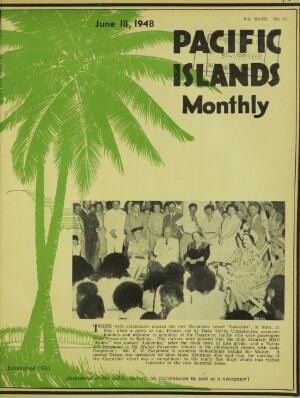
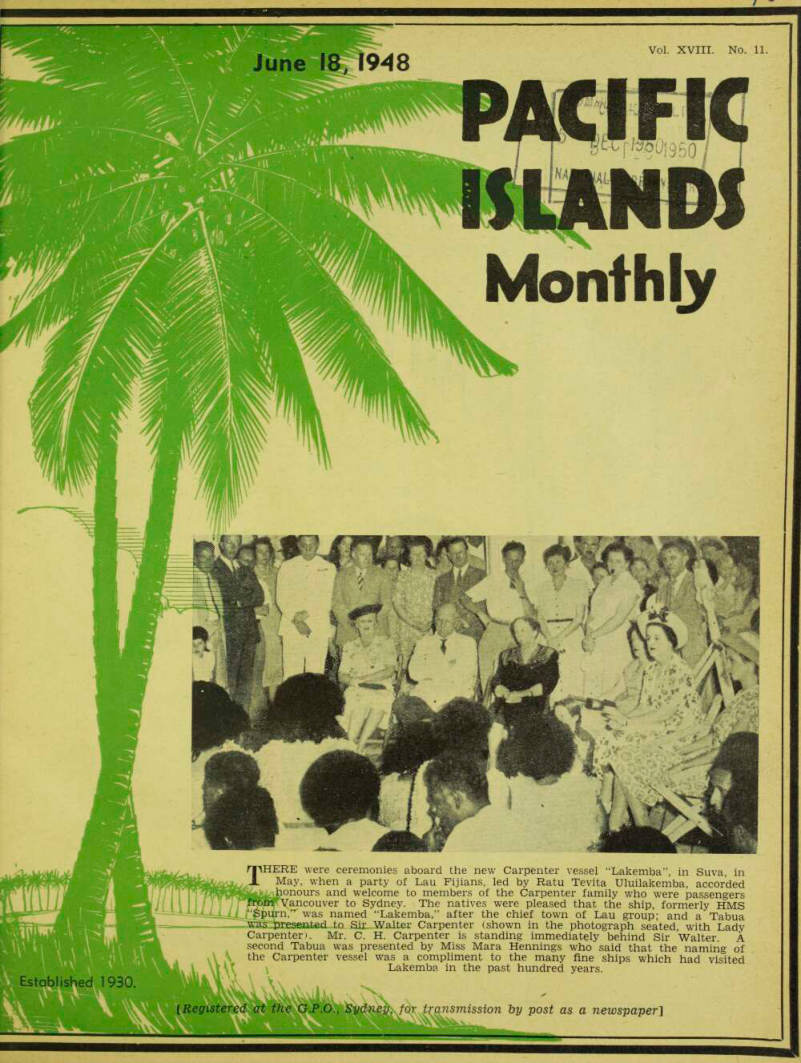
THERE were ceremonies aboard the new Carpenter vessel “Lakemba”, in Suva, in May, when a party of Lau Fijians, led by Ratu Tevita Uluilakemba, accorded honours and welcome to members of the Carpenter family who were passengers from Vancouver to Sydney. The natives were pleased that the ship, formerly HMS "Spurn," was named “Lakemba,” after the chief town of Lau group; and a Tabua was presented, to SirWalter Carpenter (shown in the photograph seated, with Lady Carpenter). Mr. C. H. Carpenter is standing immediately behind Sir Walter. A. second Tabua was presented by Miss Mara Hennings who said that the naming of the Carpenter vessel was a compliment to the many fine ships which had visited Lakemba in the past hundred years.
Advertisements & other items, pp. 2-4 (2 items)
Qantw
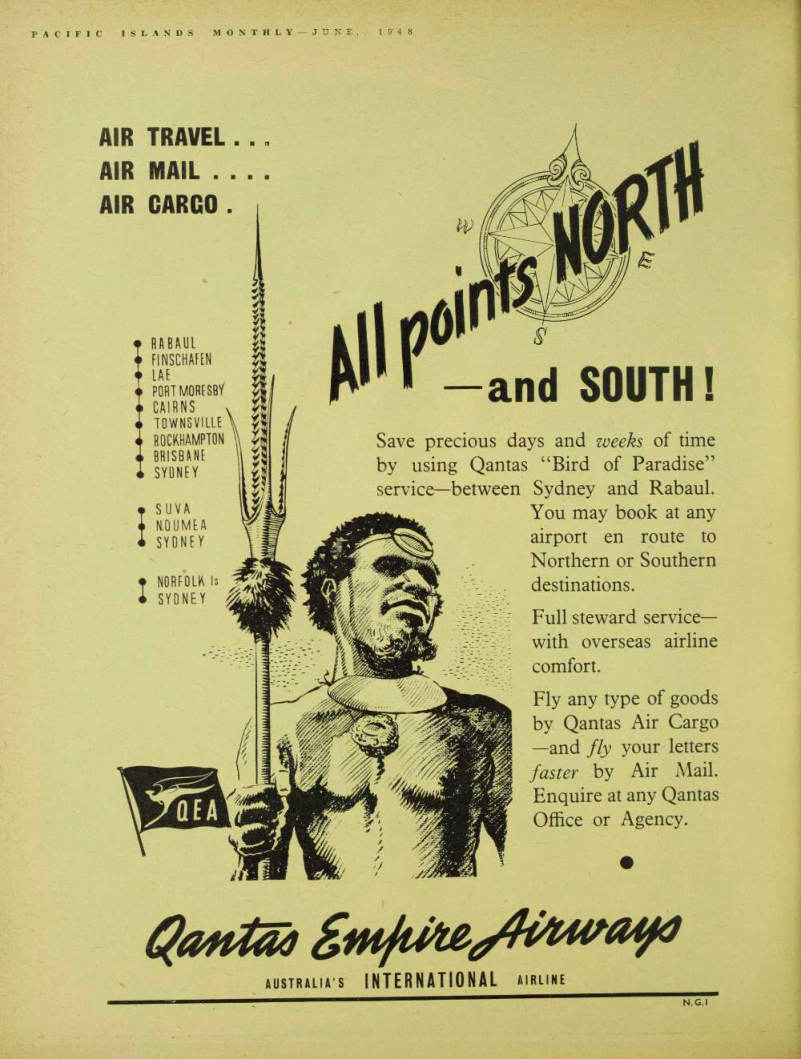
AIR TRAVEL . .
AIR MAIL . . .
AIR CARGO .
1
BRBAUI
FINSCHAfEN
LAE
PORT MORESBY
CAIRNS
TOWNSVILLE
ROCKHAMPTON
BRISBANE
SYDNEY
SUVA
NOUMEA
SYDNEY
NORFOLK Is
SYDNEY -
I ft was J*.
Va Va
and SOUTH!
Save precious days and weeks of time by using Qantas “Bird of Paradise” service—between Sydney and Rabaul.
You may book at any airport en route to Northern or Southern destinations.
Full steward service— with overseas airline comfort.
Fly any type of goods by Qantas Air Cargo —and fly your letters faster by Air Mail.
Enquire at any Qantas Office or Agency.
Qantw
AUSTRALIA'S INTERNATIONAL AIRLINE
N.G.I
s, =S Instant-lite Petrol Lantern 300 or 500 C.P 1
eman
LANTERNS IRONS STOVES
THE BEST OF
THEIR KIND
4 Speed-master Petrol Stove Coleman appliances have for many years been bringing better ways of living to
people everywhere. They bring greater
comfort and happiness with better light . . . easier, faster ironing . . . more convenient, more healthful heating . . .
better cooking.
Over forty years’ experience in producing
these appliances have made Coleman Products “The best of their kind.”
Coleman’s appliances include:— Petrol and Kerosene operated Lamps, Lanterns, Irons, Stoves, Portable Stoves, Brazing Torches and Blow Lamps.
Kerosene or Petrol Table or Hanging Lamp E . ■ • Coleman “530’
Pocket Stove Coleman Kerosene Iron 9 Kerosene 3 Burner Cooking Stove Instant-lighting portable Petrol Cooking Stove Representatives for the Pacific Islands; ROBERT GILLESPIE PTY. LTD. PEARCE * co LTD
SUVA
54a PITT STREET, SYDNEY FOR FIJI ISLANDS
7a Va % i I M y v| r.so.^, , iviaMr «-<■ - a«< -v, .iy >mmm%
BRONTE BRAND:
Chili Con Came Braised Steak and Onions Curried Beef Curried Mutton Steak and Onions Mutton and Peas Irish Stew Beef Steak Pudding Corned Beef Hash Corned Beef Loaf With Cereal Mutton Broth Mulligatawny Soup Tomato Soup Vegetable Soup
From
Australia’s
Finest Fat
Stock ...
From the finest fat stock and the rich-
est vegetables in Australia we produce
these high-grade canned meats and
soups. BRONTE BRAND meats,
hotmeals and soups are deliciously
flavoured and are made from
ONLY meats and vegetables
of the highest quality. . . . . ★
THE COLONIAL WHOLESALE MEAT CO.
PTY. LTD.
Canning Factory, State Abattoirs, Homebush Bay, Sydney.
N.S.W.
PHONES:
PHONE: UM 8436.
CABLE ADDRESS:
WOOLMILL. SYDNEY.
i p s wmm*
June, Isms Pactfic Islands Monthly
Advertisers
Aluminium Union, Ltd 61 Amplion (Aust.) Pty., Ltd. ... 23 Angliss & Co. ... 36 Atkins Pty., Ltd., Wm 33 Anchor Hocking Glassware ... 69 Atkins Kroll & Co. 61 Australian Block & Chain Co. Pty., Ltd 77 Amalgamated Hatcheries . . . 4D Australian Yeast Co 33 Bethell, Gwyn & Co 54 Brunton’s Flour . 34 Baker, W., Jno.
Pty., Ltd 34 Burns, Philp (New Hebrides), Ltd. . 15 Bank of NSW . . 16 Bank of NSW, Rabaul 63 Burns, Philp (NG), Ltd. ... 45 Boxley Pty., Ltd. . 26 Bell, Douglas ... 62 Burns, Philp Trust Co., Ltd 32 Budge, James, Pty., Ltd 77 Broomfields ... 34 BP (SS) Co. . . . 27 W. R. Carpenter & Co. (Fiji), Ltd. . 51 Caine’s Studios . . 50 Carpenter, Ltd.. W.
R cov. iv.
Colonial Wholesale Meat 2 Colyer Watson (New Guinea), Ltd. . . 53 Coronet Textile® Pty., Ltd. ... 64 Costello, Vince Garrick Hotel . . 29 “Cystex” ... 49 Copra Growers’
Union 57 Donaghy & Sons . 61 Donald, Ltd. A. B. 60 Davison Paints Pty., Ltd. ... 64 Dr. Williams Pink Pills 58 Dangar, Gedye & Malloch ... 3 Dunlop Rubber (A/sia), Ltd. . . 54 Ernest . Trading Corp 46 Electrolux Refrigerators . . 56 Garrett & Davidson 80 Gillespie Pty., Ltd., Robert ... 1, 19 Rob t. Gillespie (NG), Ltd. ... 79 Gilbey’s Gin ... 78 Gillespie’s Flour . 72 Glanz, A. ... 19 Gough & Co., E. J. 15 Grand Pacific Hotel 4 Grove & Sons, W.
H 20 Hardie Trading Co. (Spartan Paints) 17 Horlicks Malted Milk 35 Heinz & Co. Pty., Ltd., H. J. . . . 74 Hettig, August . . 71 Hemingway & Robertson ... 74 Ipana Tooth Paste 20 Ingrams Shaving Cream 24
S. Wentworth, Jackson ... 20 Jenkins Emporium 72 Kodak (Aust.) Pty.
Ltd. ... 70 Kolynos, Inc. ... 76 Kopsen & Co., Ltd. 22 Kerr Brothers ... 72.
Lockyer, Geo. J. . 28 Levy, Noel ... 18 Manstocks ... 63 Mail Publicity Co. (Magazine Subscriptions) . . 51 Merrillees, J. C., & Co. . 26 Maloney, N. P., & Co 64 Millers, Ltd., Suva 68 Miscellaneous . . .13 “Mum” Deodorant 66 “Mendaco” ... 75 Mcllraths Pty., Ltd. 26 Morris, Hedstrom, Ltd., Suva ... 12 Nelson & Robertson Pty., Ltd 60 “Nixoderm” ... 24 Papain 52 Pacific Is. Society 36 Pacific Islands Trading Co. ... 25 Pan American Air ways 14 “Pinkettes” ... 70 Pitt & Scott, Ltd. 55 Qantas Empire Air ways . . . cov. ii.
Queensland Insur ance Co 27 Robinson, G. H. . 46 Renton, G 79 Rose’s Eye Lotion. 16, 17 Rohu, Sil . . . . 22 Scott, Ltd., J. . .53 Shell Co 67 Southern Pacific Insurance Co. . . 23 Steamships Trading Co., Ltd 68 Sullivan & Co., C. 57 South Sea Islands Correspondence Club ... 66 Swallow & Ariell . 30 Taylor & Co., A. . 62 Tooth & Co., Ltd. . . . cov. iii.
Thornycroft (Aust.) Pty., Ltd. ... 62 Tilley’s Lamps . . 73 Tyneside Foundry & Engineering Co., Ltd ■ 52 Trans Oceanic Airways ... 59 Union Manufactur ing & Export Co. 50 Vacuum Oil Co., Ltd 31 ‘‘Vitalis” Hair Tonic ... 47 Ventura Trading Co. Pty., Ltd. . . 71 Watson, Wm. H. . 48 Wright & Co. ... 18 Harry West ... 75 Widdop, H., & Co., Ltd 55 Wunderlich, Ltd. . ,29 Wo o d s Great Peppermint Cure 48 Where The Trade Winds Blow . . 58 Wills, W. D. & H. 0 65 Wright & Co., Ltd., E 67 Yorkshire Insur ance Co., Ltd. . 15
M. Alfred Fourcade, accompanied by his wife, has arrived in Noumea by air from France via the US. Formerly chef de Cabinet to the Governor of New Caledonia and administrator with the D’Argenlieu mission and in the New Hebrides, he is now Agent-General of the French Banque de I’Union Metro politaine et Coloniale which he will rep resent in the Colony.
Advertisements & other items, p. 5 (1 item)
Nevertire
A “Package Line” Lighting
Plant you can install
yourself ...
The
NEVERTIRE
MINOR
10 LIGHT
32-Volt Plant
Complete with 16 2-Volt Cells.
Simplicity itself to install, and to operate, the “Nevertire Minor” will give you ample power for ten lights and to use a fan, vacuum cleaner, reading lamp, radio, cake-mixer, or other low-powered appliances. Supplied complete with easy-to-follow installation instructions, and the necessary accessories for 10 lights.
We have a comprehensive
Range of Pumps
of all Types
The “DGM”
Centrifugal
If you want a pump for any purpose there is a “D.G.M.” pump or outfit to suit y6ur requirements. Our range covers every need from the smallest model for household purposes to the powerful plants for irrigation.
And, in addition, “D.G.M.” engineers will gladly and freely give you any advice you need on any pumping proposition.
Dangar, Gedye, & Malloch Ltd.
10-14 YOUNG STREET, CIRCULAR QUAY, SYDNEY.
G.P.O. BOX 509. Tel. 86095
In This Issue:
Editorial: “The Brown Brother Com plex in World Affairs” 5 Maoris In—Other Polynesians Out— Extraordinary Interpretation of Australian Immigration Laws ... 6 New Assembly in Samoa—New Flag Raised 7 Record Fiji Production for 1947 ... 7 N. Guinea Gold Discovery Reported a “Fizzle” 7 Mr. Ward to Visit New Guinea ... 8 New Financial Secretary for Fiji .. 8 Second Royal Tongan Birth ... 8 Tasman Shipping Snarl 8 “Ruena” Refloated 8 Eric Feldt Replies to Dr. Hogbin .. 9 Vice-Regal Visit to Islands 9 Arrival of New New Caledonia Governor 9 Nauru and Ocean Is. Mails Stolen .. 9 To London by BCPA S Oil from Dutch New Guinea Soon .. 10 Inadequate Concessions Made to NG Public Service by Canberra ... 11 Mr. Ward Under Sharp Fire Over Garden Case 13 Pacific Air Services—Qantas Survey Flight to NH 16 New Zealand Seeks Tourists to South Seas 18 Gilbertese Strike On Ocean Is 18 Pacific Shipping Services —“Bulolo”
Back Soon 13 Ships and Planes for BSI —Belter Conditions Soon 20 Savings Bank for G& E Colony .. 22 South Pacific Commission Concludes First Meeting 23 BP’s Sell Out Futuna and Wallis Interests 24 TO A Flying-Boat Passengers In Fiji After Adventures 26 Sir Peter Buck Remains a British Citizen 29
Search for G & E Capital 30 Japanese Goods for Pacific Soon .. 32 Catholic Church in W. Samoa Did Not Appeal for School Funds .. 33 Suicide or Farming—Frightful Altern atives for Indian Boy 34 Missions Do Not Like BSI Plans for Education 36 Territories Talk-Talk 37 The Stephens Family of Ureiapa .. 39 Tale of a Little Ship 40 Tropicalities 41 The Evolution of a Sinabada .. .. 42 One Lone Czech —Two German Warships 43 Service Section 44 Bulolo Timber Leases Sought in 1925 By Morobe Resident 46 No Fortunes in NG Nutmegs .. .. 47 Makatea Production for Export Soars 48 Cook Is. Troubles 49 Fiji Imports from Sterling Areas — Restrictions Relaxed 51 Cost of Living Bonus for Fiji PS .. 53 Big Bang for Tadji 54 Origin of Polynesian Diocese 54 Fiji Liquor Bill Deliberations .. .. 57 Tongan Woman Still Banned by Australian Government 57 BP’s Again Earn Steady Profits ... 58 Madang Newsletter 59 Candlenut Oil Production in Fiji .. 60 Indians’ Place In Fiji .. ... 61 Misima Goldmines Cannot Get Labour 62 Notes From Eastern Samoa .. . .. 63 Fiji Products for NZ Food Processing 68 Plane and Shipping Services 70 Tongan Parliament Elected 74 The Month In Moresby 77 Commercial Markets, etc 80 OBITUARY: J. Spychiger, 6; Fr.
Noblet, 18; C. W. Thomas 16., E. H.
Craig, 24; P. D. McComish, 79.
Organisations: Ng Women’S’
Club of Sydney, 6; PI Society, 20; New Britain Ladies’ Club. 68
British Market For Fiji
Lemons
AN official inquiry was received by the Imperial Institute, London, in 1947, on behalf of a planter in Fiji re garding the possibility of a market for lemon juice in the United Kingdom. It was felt that should a reasonable outlet exist, other agriculturists in the Colony might be interested.
Following consultations with the Ministry of Food, information was given concerning the price that would be ob tainable for unconcentrated Fiji lemon juice of high quality, and it was advised that supplies should be offered to rhe Ministry if planters proved interested at the price indicated. As consideraDle quantities of lemon juice are imported into the United Kingdom mainly for the manufacture of soft drinks, there should be a continuing outlet here if the price is acceptable to producers.
More tentatively, the Fiji authorities also inquired concerning a market for lemon peel in brine and particulars were supplied regarding the method of its pre paration. it was observed that the peels are normally a by-product from other lemon processing and in the ordinary way the costs to the producer are the provision of casks and the labour of pre paration. Sicily is the chief producing area. Just now imports of the material are limited on account of the large amounts of sugar required in processing. —lmperial Institute’s Annual Report.
A daughter was born, on May 18, to Mr. and Mrs. N. B. Blood, of Finschhafen, New Guinea.
Advertisements & other items, p. 6 (1 item)
sT AVOt^
i»ki
ft o'* 6 *' ", -* S^ aS re0 U e ° atf e ° fr Q m >o - t;:- O b ' e ’ , 9 er <^‘ ol * 9 . yese^ 1 ' 9
Pacific Islands Monthly
The Newspaper-Magazine of the South Seas I Registered at the G.P.0., Sydney, for transmission by post as a newspaper]
Published Once Each Month and Circulated in Australia and New Zealand and in the following Pacific Territories and Islands Groups:
Australian Territory of Papua.
Trustee Territory (Australia) of New Guinea.
Australian Territory of Norfolk Island.
New Zealand Territory of Cook Islands, Trustee Territory (NZ) of Western Samoa.
British Colony of Fiji.
British Solomon Islands Protectorate.
British Protectorate of Tongan Islands.
British Crown Colony of Gilbert and Ellice Islands.
Trustee Territory of Nauru.
British and French Condominium of New Hebrides.
French Colony of New Caledonia.
French Colony of Oceania (Tahiti, etc.).
American Territory of Eastern Samoa.
American Territory of Hawaiian Islands.
Owned ond Produced by Pacific Publications Pty., Ltd., Union House, 247 George Street, Sydney.
Telephone: General Office and Advertising, BW 5037.
P.O. Box 3408
Registered Address for Telegrams, Radiograms, and Cables: “Pacpub,” Sydney.
Contributions.
Articles, Stories, and Photographs dealing with Pacific Islands subjects are invited and will be paid for on publication.
Subscription Rates.
Per Annum, Pre-paid, Including Postage.
In Australia, New Zealand, Fiji, New Guinea, Papua, Western Samoa, Cook Islands, Tonga, British Solomons, Gil bert and Ellice Colony, Nauru, and United Kingdom 15 0 Elsewhere 18 0 Single Copies 1 6
Editor and Publisher:
R. W. Robson, F.R.G.S.
Assistant Editor: JUDY TUDOR.
General Office: Union House, 247 George Street, Sydney. Telephone; BW 5037.
Advertising Manager: W. E. Rogers.
Representative In London.
J. T. Wallis, Coronation House, 4 Lloyds Avenue, London, E.C.3, from whom may be obtained copies of Pacific Islands Monthly, Pacific Is. Year Book, advertising schedules, etc.
Representative In U.S.A.
Pacific Islands Trading Co.,
244 California St., San Francisco, U.S.A.
Agents.
The following are authorised to receive sub scriptions for Pacific Islands Monthly:— Burns, Philp & Co., Ltd., and Burns Phllp (South Sea) Co., Ltd. All branches.
W. R, Carpenter & Co., Ltd. All branches.
Morris, Hedstrom, Ltd. All branches.
Steamships Trading Co., Papua. All branches.
W. M. Caldwell, Suva. Fiji.
Cook Islands Trading Co., Rarotonga, Cook Is.
Oscar Nordman, Papeete, Tahiti.
Islands Branches and Representatives of W. H.
Grove & Sons, Ltd., Auckland, New Zealand.
Ed. Pentecost, Noumea, New Caledonia.
Societe Gubbay Kerr et Cie, Noumea, New Caledonia.
Vol. Xviii. No. 11.
June 18, 1948
r 1/6 Per Copy Price ) Prepaid, p.a.: 15/- Aus. ( In USA, p.a.; $3.
The Brown Brother Complex
In World Affairs
THE development of a native policy, based on administrative super sensitiveness in relation to native welfare—to the exclusion of other and more urgent considerations—is not peculiar to the Australian Gov ernment in New Guinea. It is, in fact, a characteristic of Socialist planning in most European countries.
It has been especially noticeable in Whitehall; and there are some who see in it there the first steps in the disintegration of the British Empire.
There can be nothing wrong in placing the welfare of natives high among our obligations in colonial administration. But there is a right and a wrong time for the intro duction of new policies. And, em phatically, the extremely critical period following World War II was— and is—the wrong time in which to devote thought, time, energy and money to native welfare, when the call was upon all the Western nations to devote all their resources to the rehabilitation of their own people, and the solution of their politico economic problems.
SO far as Papua and New Guinea are concerned, there was little, if any thing wrong with the condition of the natives, up to the time of the Jap
invasion. All persons without bias, and with a real and practical know ledge of the Territories, will agree that the howling of Mr. Eddie Ward and his Planners about “native slavery and exploitation” in New Guinea was merely calculated and cunning political propaganda, de signed for the purposes of the Can berra Socialists. There was a call for prompt and positive action, and for the spending of large sums of money; but the call was on behalf of white settlers and European interests, and for the encouragement of their pioneering spirit and personal initia tive. Apart from some relief measures made necessary by the Jap occupation and the military operations, there was no urgent need to engage hun dreds of white officials and millions of money in the introduction of health, education and technical training activities for Stone Age natives, who were not at all dis satisfied with their lot.
To show the lack of logic and the cock-eyed thinking in Mr. Ward’s New Guinea policy, we need go no further than the events reported elsewhere in this issue. The white officials of the Territories, having tried everything else, have been
threatening to go on strike because their salaries are far too small to per mit them to live under the very high prices caused in the Territories by Mr. Ward’s carefully-designed econo mic system. And, while they have been deprived reasonable emolu ments for a year—Canberra began to fob them off, with sweet promises, in March, 1947—Mr. Ward has been spending enormous sums in the Ter ritories on native welfare.
According to recent official figures, Mr. Ward, in 1946-48, has spent, on wholly unnecessary war damage com pensation for natives, enough to give every man, woman and boy in the Papua-New Guinea public service an other £5OO per annum. No wonder the public servants, watching that orgy of useless expenditure, lost their patience and seriously considered a strike! With what tenderness the New Guinea public servants, feeling their shrunken purses, must regard the Brown Brother complex of Mr.
Ward!
BUT Papua-New Guinea must not imagine that this dislocation of a delicately - balanced post - war economy for the sake of Brown Brother is a fashion which belongs only to Australia. It is something that has run, like a vicious epidemic, all over the colonial Empire of the Socialist-controlled European nations; and its results have been disturbing and disastrous. Line up these events and consider them:—
• With a precipitancy that was akin to mania, Britain abandoned practically all her controls in the Middle East—Egypt, Palestine, Iraq— with the result that she has lost command over her priceless Suez Canal route to the East—otherwise called “the Life-line of Empire.” • With equally indecent haste, the British Socialist Government aban doned its controls in India, Burma and Ceylon, and thereby abandoned also—just when they were wanted most—vast fields of trade in which Britain’s sorely-pressed merchants and manufacturers had held certain advantages. @ Because British prestige has fallen so disastrously throughout Asia, there is growing tendency to revolt in countries still held by Britain—in Malaya, for example, where serious riots are reported, as this is written. • Because they were deserted by their Western allies, and not allowed to follow their own policy of quick decision, backed by a strong arm, the Dutch in Indonesia have been com pelled for two wasted years to engage in endless argument with so-called “Republicans”—wriggling and utterly untrustworthy little men, the pro ducts of a combination of ill-digested Westernism, Jap Chauvinism and Russian Communism. • Minor events in China, in Indo china, in Africa, in the Pacific, show the same amazing haste on the part of the Socialists (temporarily in charge of European countries) to dis sipate those countries’ colonial pos sessions by giving to the native inhabitants concessions and a degree of political freedom for which they were not ready and had never been prepared. • Finally, see what has happened in South Africa. That has been called an anti-British development.
It is—but not in the anti-Empire sense that is meant. It is most de finitely anti-British because, of the 10,000,000 people in the Union of South Africa, nearly 8,000,000 are coloured—some million being Bantu negroes, and 250,000 Indians.
The majority of the two million Europeans in South Africa voted anti-British to the extent that they do not approve of the British Socialist Government’s tenderness towards Brown Brother, and its eagerness to toss political freedom to coloured races who are not yet fit to exercise that privilege in a world where nations now are packed closely together. • And, last of all, gaze upon the “Australian Goodwill Mission,” sent by the ineffable Dr. Evatt to South east Asia, to distribute a few thou sand tons of food, and invite a handful of Asiatic students to accept scholarships at Australian institutions —all at the expense of the over taxed Australian citizens. Witness the naive astonishment of Evatt and Company when the Mission was greeted in Malaya with jeers which clearly meant: “Go back home—and take your White Australia policy with you!”
IT is only a phase. The Western world will recover from its mania for distributing political freedom among unready coloured races, just as Canberra in time will get over its Brown Brother complex. Not much harm will have been done in New Guinea, except that the development of European interests has been re tarded for some years; but there may be a sadly different story in relation to the British Empire.
This phase, however, despite its disturbing appearance, may have real value. It may serve to prove that political freedom, European model, cannot be handed out ad lib to Brown Brother, without disastrous conse quences to the rest of the world. That is something that must be done very gently and gradually, after a period of careful planning and preparation.
And it certainly should not be attempted in this critical period, when the world is trying so desper ately to recover from the unpre cedented destruction of its greatest war.
Polynesians Out!
Maoris In—Other Polynesians Out!
Extraordinary Interpretation of Australian Immigration Laws
THE Prime Minister of New Zealand has sent to the editor of the “Pacific Islands Monthly” the following let ter dated June 1, which is self-explana tory: “I have your letter of May 7, in which you refer to the recent discussions be tween the Governments of Australia and New Zealand in regard to the admission
of Maoris into Australia, and ask whether I would be prepared to intervene on behalf of other Polynesians.
“The only matters affecting immigra tion into Australia on which the New Zealand Government would be justified in making representations to the Gov ernment of Australia are those directly •affecting the interests of New Zealand.
It was on this ground that I asked the
Australian Minister of Immigration for information concerning a press report which indicated that Maoris were to be put under some greater restriction than other New Zealanders in regard to their entry into Australia.
“I am happy to say that the reply which I received (and which you will have seen in the press), confirmed my belief that the Minister’s statement rested on a misunderstanding and that the Australian Government have no inten tion of altering their past policy.
VI have no personal knowledge of other cases affecting Polynesians to which you refer, but it does not appear from your letter that they are matters with which the New Zealand Government could concern itself.”
IT will certainly be a matter of interest to the people of Western Samoa and Cook Islands —both of which are administered as Territories of NZ—to learn that their exclusion from Australia is not a matter with which the NZ Gov ernment will concern itself.
Presumably, Australia puts Samoans and Cook Islanders in the same category as Tongans; and a Tongan woman, married to a Britisher, has been ordered to leave Australia by September.
Tongans, Samoans, Cook Islanders and Maoris are all of the same blood—the highly-esteemed Polynesian race—but the Socialist gentlemen who run Australia and New Zealand are incapable, appar ently, of understanding the points that have been raised.
The action of the NZ Prime Minister, in denying responsibility for his Samoans and Cook Island Maoris, is really extra ordinary.
New Guinea Women's
Club Of Sydney
rE annual general meeting of the New Guinea Women’s Club of Sydney will be held in the Feminist Club Rooms, 77 King Street, Sydney, on Friday, July 16, at 7.30 p.m. A report of club activities of the past year will be presented to members and an election of officers for the following year will be held.
On July 1. at 10 a.m., members of the Club will meet at the Cenotaph in Martin Place to pay homage to the men who lost their lives on the ill-fated “Montevideo Maru,” in 1942. and elsewhere during the Pacific war.
On Anzac Day, Mrs. P. Forsyth, who is a returned World War I nursing sister, attended the Dawn Service and placed a wreath on the Sydney Cenotaph on behalf of the Club.
The American Tea which was held in the club rooms on May 14, helped club finances as well as providing an enioyable social occasion for members and their friends.
Territories Appointments
THE following have been appointed officers of the Royal Papuan Con stabulary: John Fisher, Alfred S.
Davies, John Grainger, Maxwell P. Duff, Peter J. Day, Harry H. Jackman.
Messrs. E. P. Holmes (chairman), J.
H. Jones, E. B. Bignold and W. R.
Humphries have been appointed mem bers of the Land Board of Papua; and Messrs. E. P. Holmes, J. H. Jones, and E. B. Bignold are members of the Land Board of New Guinea.
Messrs. R. W. H, Born and D. P.
Sheekey, have been appointed magis trates for Native Affairs in all districts.
Death of John Spychiger,
Notable Stamp Collector
Port Moresby, May 20.
THE death occurred at the European Hospital on May 16 of Mr. John Spychiger, a much respected Moresby “old hand.” The funeral was attended bv a large representative gather ing, including the Acting Administrator (Mr. Justice Phillips). The service was conducted by Rev. E. Ure, of London Missionary Society, an organisation which Mr. Spychiger had served nobly during his lifetime. Counting a love of fine music among his interests, Mr. Spy chiger was, un to the date of his death, choirmaster to the Mission choir at Poreporena.
Mr. Spychiger was born in Switzerland and went to Australia over 40 years ago.
For many years he worked in Port Moresby on the British New Guinea De velopment staff; and then for Burns Philp. As Secretary-Treasurer of Port Moresby Library Institute he rendered sterling service to the community. His great hobby was philately, and he was known throughout the world as an authority. He received probably the largest personal mail of any person in Moresby, and at the time of his death is believed to have assembled an out standing collection of stamps.
Samoa
New Assembly In
Quarantine Imposes Last-Minute Absence of the NZ Prime Minister
ON the eve of his departure for Western Samoa —where he was to have presided at the opening of the new Assembly and the raising of the new Samoan flag—the Prime Minister ol New Zealand, Mr. Fraser, was held up by unexpected quarantine restrictions, following the sudden recurrence of in fantile paralysis (poliomyelitis).
Meanwhile, the May issue of the “PIM” had announced that the Prime Minister had proceeded to Samoa to open the new Assembly—having assumed that newspaper licence which permits of a lively anticipation of events to come.
Naturally, we much regret the publica tion of an incorrect report. The cere monies took place early in June, as stated—but without the presence of the NZ Prime Minister.
ON June 2, the new Samoan flag was hoisted at the traditional seat of the old Samoan kings, Mulinu’u (western end of Apia), and a new West ern Samoan Legislative Assembly was opened—in which, for the first time, the elected representatives of the Euro peans and Samoans have an absolute majority.
The new flag, and the new Samoan national anthem, signify the new Samoan national consciousness and the beginning of a Samoan self-government —though, for some time, this will still remain under the guidance of the New Zealand Government.
It will be interesting to see how this experiment in self-government, sponsored bv the United Nations’ Trusteeship Coun cil and supported by the New Zealand Government, will work out.
At present, Western Samoa is in a most favourable position for a change in the political set-up, owing to unpre cedented economic prosperity, caused by the high prices of the main products, copra and cocoabeans. This trade has largely increased the revenues of the Government, and raised the standard of living of all communities. How long this favourable state of affairs will continue, nobody knows.
News was received recently that the price of cocoa beans on the USA and English markets has dropped from the all-time high of £270 per ton, f.o.ta., Apia, to £lBO. A similar drop in the price of copra would have an adverse effect on Samoan economy.
The raising of the new Samoan flag (a white cross in a red field, with the five-starred Southern Cross in a blue corner), alongside the New Zealand flag, took place on June 2, coincident with the opening of the new Legislative Assembly.
In the Assembly, the Samoans are re presented by the two Fautua (the Para mount High Chiefs, Tamasese and Mali etoa, who, with the High Commissioner, Colonel F. W. Voelcker, are also mem bers of the new Council of State) and 11 Samoan representatives; while the European community (actually about 5,000 Euronesians as against 70,000 Samoans) are represented by five mem bers (four United Citizens’ party and one Samoan Labour).
The celebrations in connection with these events occupied several days, and some 10,000 schoolchildren from outside districts were brought to Apia. Some 30,000 people assembled and an elaborate sports programme, including boat t and canoe races, took place while traditional Samoan ceremonial dances and songs formed part of the programme.
It was originally intended that the Prime Minister of New Zealand would raise the Samoan flag, while one of the Fautua raised the New Zealand flag.
New Flag Raised—lmpressive
Ceremonies
APIA, June 3.
THE new Samoan flag, indicating that Western Samoa now has been granted a substantial measure of self-government, was formally raised yesterday beside the New Zealand flag, in a series of ceremonies at Mulinu’u (the old Samoan town at the western end of Apia).
Although it was raining, about 12,000 Samoans assembled, as well as large numbers of the European community.
In the absence of the New Zealand Prime Minister (kept away, at the last moment, by a new outbreak of polio myelitis in NZ), the chief part was taken by the Administrator, Colonel F. W.
Voelcker, whose title now has been changed to High Commissioner. Colonel Voelcker arrived at 9 a.m., accompanied by Governor Huber and Commander Raimey, of American Samoa, and the two leading Samoan chiefs (Fautua), Hon. Tupua Tamasese and Hon. Malietoa Tanumafile 11. As the official party arrived the British and the United States anthems were played.
Introductory speeches, emphasising the historical and political importance of the occasion, were made by the High Com missioner and by Hon. Tamasese, on be half of the New Zealand and Samoan communities; various replies were made; and a kava ceremony took place.
After further addresses by the High Commissioner and Hon. Malietoa, at 10 a.m. the Samoan and the New Zea land flags were raised simultaneously— the former by the High Commissioner, and the latter by the Fautua. As the flags were raised, the assembly sang a new Samoan song, “The Flag of the Freedom of Samoa,” and a salute of 15 guns was fired.
A Samoan feast began at 11 a.m.; and from noon until 6 p.m. there were songs and dances by children from the vari ous schools. Festivities continued far into the night.
It was a notable day in the curiously checkered history of Western Samoa.
Mr. J. W. H. Allen, of the Audit De partment, Fiji, has been transferred to Malaya as Senior Assistant Auditor.
Reported Gold Discovery
A "Fizzle"
Reported Gold Discovery In New Guinea
THERE seems now to be no doubt that the so-called Highlands Gold-Rush, in New Guinea, is a complete fizzle.
It is said that there is one European in near Wabag, working on gold, but that there is nothing to justify a rush.
The reports which were circulated, and caused such a stir, were apparently the result of one rumour being built onto another equally unreliable—until the whole fabric toppled.
The truth probably is that the Wabag find was merely a valuable little deposit, suitable for a small syndicate, and that Messrs. Black, Leahy, Blood and Sear som were unfortunate in that the “rush” caused them to forfeit any chance they had of getting in on the new gold in a worth-while way.
Record Fijian
Production
Exports in 1947 Worth £6,142,000
C COINCIDENT with the publication or j the report of the Suva Chamber of Commerce for the calendar year 1947, came the Fiji Government’s an nouncement that, to take care of the higher cost of living, all Governmental service salaries had been raised 10 per cent. That will add some £60,000 to salaries, and bring the total to around £BOO,OOO per annum.
Fiji commercial interests took the an nouncement badly. An increase in public service salaries means pressure on all other employers to raise salaries and wages. Yet the prime factor in rais ing the cost of living in Fiji is taxation; and the present rates of taxation, accord ing to the new C of C report, shows an estimated Government surplus for the year of £370,000, making an accumulated surplus (since 1942) of £1,500,000. There seems to be a case for a reduction of taxation, rather than an increase in salaries.
Income tax receipts in 1946 were £447,080; estimated total for 1947, £630,000. Customs receipts were £1,013,574 in 1946; and £1,486,527 in 1947.
The trade of the Colony is remarkably good. Here are the export and import totals, year by year, since 1942. It will be noted that the surplus of visible ex ports over imports was resumed as soon as the war was over, and that 1947 pro duction was an all-time high.
The Colony’s three chief industries are sugar-growing, gold production and coco nut growing. This is how the exports of each have gone in recent years, with the total of the last peace-year thrown in as a comparison:—
The following interesting angles of Fiji trade are disclosed by the Chamber’s report.
The milling of copra in Suva was responsible for the consumption of 11,356 tons of copra, from which about 8,000 tons of oil were shipped to Europe, while 2,657 tons of coconut meal (stock food) were sent to New Zealand.
Of canned pineapples, 511,448 pounds, worth £15,896, were exported—compared with 874,241 pounds, worth only £17,070, in 1942. This industry was suspended in 1943-44.
Imports.
Exports. 1942 2,235,270 3,107,848 1943 2,714,339 2.413,9*74 1944 2,586,190 2.008.304 1945 2.621.403 2.174.237 1946 3,571,050 3,604,172 1947 5,116,386 6,142,802
Sugar Tons Value 1938 134,415 £ 1,338,183 1946 106,473 2,111,557 1947 112,433 2,840,307 1938 Gold Ounces 89,345 701,272 1946 68.859 657,527 1947 134,992 1,288,780 1938 Copra Tons 33,475* 270,915 1946 16,302 379,760 1947 25.406 966,246 in 20 years. 1938 Bananas Bunches 314,925 73,578 1946 173,868 49,988 1947 324,660 79,720
Dairy production is showing signs of revival, owing to the activity of farmers in the Tailevu district, who are now ap proaching their problems (selection of stock and rehabilitation of pastures) in a more scientific way.
Rubber weighing 237,674 pounds, worth £24,486 was produced in 1945.
But when the war ended, rubber prices slumped: and in 1947 production was under 70,000 lb.
Exports included 144 tons of green ginger, 551 tons of peanuts, 37 tons of candlenuts, 12,411 hides and 11,455 gallons of lemon juice.
Visit Territories
Mr. E. J. Ward To
THE Australian Minister for External Territories, Mr. Ward, and the Min ister for the Army, Mr. Chambers, accompanied by technical advisers, pro pose to visit the New Guinea mainland centres, and New Britain, when the pre sent session of Parliament ends —probably July.
Mr, Ward says he will look into the arrangements being made for the per manent joint administration of Papua and New Guinea, meet residents with grievances, and report to the Govern ment on the development of his new native policy and his plans for greater production.
Mr. Chambers will look over the Jap anese prison establishments in Rabaul and Port Moresby, and examine defence arrangements generally.
Mr. Ward was to have visited the Ter ritories in January at the Prime Min ister’s request, but the “Timber Leases” case kept him in Australia.
New Financial Secretary
For Fiji
From Our Own Correspondent
Suva, May 31.
MR. R. M. TAYLOR, Economic Adviser to the Government of Fiji, has been appointed Financial Secretary in succession to Captain A. R. W. Robert son, who is now Financial Secretary, Trinidad.
Mr. Taylor came to Fiji as Economic Adviser in June, 1947. Previously he was Deputy Commissioner of the United Kingdom National Savings Campaign, and during the war he was controller of finance and accounts at general head quarters, British Middle East Forces.
Second Royal Tongan
Birth
EIGHT days after a son had been born to Tongan Crown Prince Tugi and Princess Mata’aho Tugi, on May 4, a second Royal birth took place in the Kingdom. This was on May 12, when Princess Melenaite, wife of Prince Tuipelehake (John) gave birth to a daughter.
Prince John and Princess Melenaite were married last June at the same time as the Crown Prince and Princess.
Prince Tugi was to have attended the general conference of the Methodist Church, in Australia, in May. He was prevented from coming by his wife’s confinement. The Tongan delegate to the conference was the Rev. J. S.
Faubula.
Mr. Ken Nettleship, of the New Guinea Customs Service, for whom there was an inquiry in May PIM, is at present in the Repatriation Hospital, Concord, Sydney.
He suffered some disability as the result of war service. He may be communicated with at 7 Elizabeth Street, Sydney.
Trans-Tasman
Traffic Snarl.
How Socialists Have Dealt With South Pacific Travel in 1948
AFTER a ten months’ tour of Fiji Norfolk Island and New Zealand. Mr. and Mrs. G. Allen Innes returned to Sydney in early June.
Although they enjoyed their tour im mensely, Mrs Innes says that she now feels that they are competent authorities on the whole tourist problem—especially as it affects hotel accommodation As a sidelight on the difficulties that are encountered by all those who travel abroad to-day, it is interesting to note the round-about fashion in which the Inneses accomplished the formerly simple business of getting from one side of the Tasman to the other.
Although they made arrangements for this last leg of their journey last January, they were held up in New Zealand for weeks and finally made Sydney by flying from Auckland to Suva by New Zealand tvtac plane, there catching the Qantas Catalina, which on this occasion made a special detour to Vila (New Hebrides) on its way to Sydney via Noumea. This took three solid days of flying and cost £BO each, instead of eight hours’ flying (across the Tasman) at a cost of £2B per person.
Editorial Note
IT is stated that there are between three and four thousand Australians stranded in New Zealand waiting for trans-Tasman transport. The Union Company’s “Wahine,” which had been diverted from the Cook Strait run to the Tasman, was withdrawn some time ago and will not be brought back until about September. In the meantime there is no regular ship on the Tasman run—and will not be until “Wanganella” returns to the run, about October.
Several months ago. Tasman Empire Airways Sunderland flying-boats, which had been in service for about 18 months, were suddenly grounded for some real or fancied engine defect, and this threw Tasman qjr transport into confusion for some time. At present. Skymasters are making a trip a day each way and there fore this situation can be classed as normal, although from the point of view of whittling down the large waiting list of intending travellers from New Zealand, it cannot be called adequate.
The whole position of travel between Australia and New Zealand —a distance of about 1,200 miles—is absurd.
Almost three years after the war has ended there is not one ship on the regular run. And the air service, increased as it is on pre-war standards, is obviously quite incapable of dealing with it.
Before the war, scarcely a day passed when some ship did not leave or arrive in Sydney from New Zealand —Union Steamship Company, Huddart Parker, Oceanic Steamship Company, Cana dian Pacific, Shaw Saville— it was possible to get a Tas man passage from any of these steamship lines.
To-day there is nothing.
Tasman Empire Airways are coping with the chaotic position as well as they are able. The point is, however, why stop at TEA? This company is a Govern ment monopoly—that is “owned by the people’’—but should this be permitted when it is obvious that they cannot cope with the mass of people clamouring for passages across the Pacific?
Australian National Airways Pty., Ltd., the managing director of which over two years ago offered to start another trans-Tasman service at half the fare then charged by TEA, is to-day seeking affiliation with a Hongkong airline be cause it is not allowed by Socialist Gov ernment to employ its huge Australian organisation and equipment adequately in Australia.
Trans-Oceanic Airways, with several giant flying boats are anxious to accept charter flights anywhere in the world but are prevented from using their valuable equipment to best advantage by petty regulations and binding restrictions im posed by the Socialist governments of Britain, Australia and New Zealand.
Pan-American Airways and BOAC are forced into running a blind-alley service from North America to Auckland but are not permitted to do the obvious thing and fly the last link in the trans-Pacific-Aus tralasia route —that is, Auckland to Syd ney. nnHE trans-Tasman travel snarl has X worsened, if anything, in the past year, although to the commonsense realist the solution is simple enough.
Officially, however, the Governments concerned can do nothing about it.
Bureaucrats sit on their padded chairs, throw up their hands and exclaim that it Is unfortunate, but really outside their control —there are no ships, and the Gov ernment airlines are doing all they can.
In the meantime, the would-be traveller can stew in his own juice. Why does he want to travel, anyhow? He should stay home and pay his taxes and say nothing.
Travelling these days, is the sole prerog ative of perambulating politicians and overfed bureaucrats who are armed with the requisite “priorities” and an inex haustible amount of taxpayers’ money.
"Ruena" Refloated
THE 100-ton motor-vessel “Ruena” which was beached on Double Island Point on the North Queens land coast during a cyclone on March 26, was refloated on May 13. “Ruena” belongs to the Fairymead Sugar Company Pty., Ltd., which has extensive interests in the Solomons. They have been operat ing the ship for a little over a year and using her to run supplies between Sydney and their BSI plantations, via Bunda
berg, Queensland,
Much less damage had been done to the ship tfTan was at first feared and she left for the Solomons via Bundaberg on June 13.
This photograph, loaned by the Fairymead Sugar Co. Pty., Ltd., shows the “Ruena” beached on Double Island Point, with salvage operations in progress. As shown, it was necessary to build a float ing basin with sandbags.
Eric Feldt Replies to Dr
Dr. Hogbin
Letter to the Editor rE gravamen of the charge of Dr.
Hogbin against the whites who lived in New Guinea (May “PIM”) is that those whites thought themselves superior to the Melanesians, and acted accord ingly.
Let us admit that the charge is quite true—though some of the phenomena from which Dr. Hogbin’s conclusion derives need correction.
We did, and do, think ourselves superior —not by reason of pigmentation of the skin, or lack of it, but because of our superior achievements. The Melanesians failed to produce metal tools for their own use, were unable to make a building that would last more than a few years, had no medicines with which to cure their own ills, and could not even feed themselves adequately under the easiest of conditions. Nor have the Melanesians made any contributions to mathematics, science, art or philosophy.
To-day,. Melanesians use what the civilised races have produced, but the con verse does not happen. If Dr. Hogbin believes that a stone adze is superior to a bull-dozer, coconut better than beer, and the Cargo Cult a higher ethic than the Sermon on the Mount, he is entitled to his opinion; but most whites will adhere to their view that the whites are superior, else the words good and bad have no meaning.
AS regards the much discussed word, “boy,” there is a certain cynical amusement to be derived at finding that Dr. Hogbin does not know Pidgin.
Pidgin is not merely corrupt English; it is a language. It is derived mainly from English; but words in Pidgin, tnough pronounced as in English, some times have a different meaning. The Pidgin word “boi” is one such word. It does not mean boy (juvenile)—it means a native who is in employment.
A native who is not in employment is “kanaka.” Natives use the word “boi” amongst themselves; “mi velo boi” is a common expression. Ask any native who is under indenture what he will do when it is ended, and he will reply; “Mi go kanaka,” if he intends to return to his village and work no more. The word for boy (juvenile) is “munki.” If Dr.
Hogbin were in a French restaurant, would he refuse to use the word “garcon” if hs wanted to call the waiter?
DR. HOGBIN’S assertion that “natives showed no great keenness to enter employment, asked for higher wages and went on strike when these were re fused” does not tally with history. There was one strike, in Rabaul, for a day and a half, in 1929, and never another in the period of the Mandate before the Japs invaded. The number of natives under indenture increased from year to year. Some of us saw this with mis giving, as work was too popular, and drew too many natives away from their villages.
However, regarding the opinions of natives, it is unwise to saddle all with the views of a few, as opinions differ even amongst natives. If it is quoted, for in stance, that a native expressed himself as in favour of the indenture system, it would not be accepted by Dr. Hogbin as representative of all native thought.
It is also a fact that a native will often, to oblige, express the opinion that the questioner wants. Furthermore, recent experience colours opinion.
So if a native’s recent experience of Europeans has been contact with an anthropologist who lived in a village as one of themselves, such a native might genuinely come to the conclusion that
there is no superiority in the white man.
And, under the same circumstances, an anthropologist might sincerely believe that male sexual jealousy was involved in the white man’s attitude.
BUT, if natives thought so badly of us, why did they show such loyalty to us during the war? Could the deeds of Yauwika, Yali, Simogun and a host of others be born of a resentment against the white man? It is logical to believe that they risked their lives daily for men they disliked and despised?
How great was the loss when F. E.
Williams was killed on war service!
I am, etc.,
Eric Feldt.
Brisbane, 30/5/48.
Vice-Regal Visit to Islands
Islands
THE Governor-General of New Zealand, Sir Bernard Freyberg, VC, and Lady Freyberg, will visit the South Pacific Islands this winter.
They are expected to leave New Zea land, by air, for Fiji on June 29. In Suva they will pick up HMNZS “Bellona” which will then be in the course of her usual winter cruising programme.
The vice-regal party will visit Tonga, Niue, Cook Islands, Western Samoa and the Tokelau Group, as well as Fiji, be fore returning to New Zealand about the end of July.
By Bcpa
To London Via Canada
ANA Acquire Interest in Hongkong Airline
(COMMERCIAL flights from Sydney to J London via Canada in only six days are now possible.
Leaving Sydney by BCPA Skymaster, passengers reach Vancouver, Canada, four days later, after spending a full day in Fiji and Honolulu.
In Vancouver they connect with a North Star Airliner (Canadair-4) on the new Trans-Canada Airlines “coast-to coast” service, which in turn connects at Montreal with TCA’s trans-Atlantic service to London. A total distance of 14,318 miles is covered at an average of 2,386 miles per day.
During the whole trip, the passenger has no hotel fees—the stop-overs being in cluded in the fare paid in Australia, thus avoiding dollar expenditure.
It is of interest to note that when Aus tralian National Airways Pty., Ltd., ap plied to the Australian Government some months ago for a licence to fly from Australia to London via Mexico, their application was refused.
It was announced on June 6, that ANA had acquired an interest in a Hongkong airline—Cathay Pacific Airways, in which one of the oldest-established trading companies on the China coast, Butter field and Swire, are also interested.
Nauru And Ocean Mails
Stolen
BETWEEN the time they were put aboard the SS “Lochybank” at New castle, NSW, on April 15 and the steamer’s arrival in Nauru. 12 bags of mail for Nauru, and 11 bags for Ocean Island, were stolen and completely dis appeared.
Parcels and letters worth at least £l,OOO were lost, including communications from Europe and America.
The loss of their mails has caused great distress among the people of both islands.
This is the first time anything of the kind has happened.
Arrival Of New Governor
In Noumea
A CONSIDERABLE crowd gathered at the wharf at Noumea on May 10 to welcome the new governor of New Caledonia, M. Cournarie, on his arrival by the “Sagittaire.”
M. Cournarie’s career has been an in teresting one. He is a veteran of the first World War; and he has served in the French Foreign Legion, the Cavalry and other branches of the Army. He commenced his administrative career in 1920, in the French Cameroons and took a prominent part in the rallying of that territory to General de Gaulle’s forces.
In this he was associated with the famous General Leclerc, one of the greatest heroes of Free France.
In 1942 M. Cournarie was named Governor General of the colonies of French Equatorial Africa, The fact that
he is an officer of the Legion of Honour and Companion of the Order of Libera tion is proof of his excellent work.
In Noumea, on his arrival the Secretary General and the Commander of the local forces went on board to welcome him, afterwards conducting him ashore where military honours were paid to him. He was presented to prominent local resi dents including the members of the Assembly. The Mayor, M. Henri Sautot, himself an ex-Governor and hero of Free France, gave the customary speech of welcome to which M. Cournarie res ponded briefly, intimating his desire to work energetically for New Caledonia with the co-operation of all New Cale donians. He then proceeded to the War Memorial where he placed a wreath and then on to Government House to meet the retiring Governor, M. Parisot.
By his energetic words and bearing M.
Cournarie has, in a short time, created
a vtery good impression.-
F.E.D.
In two world wars, New Caledonians have played as patriotic a part and have suffered as heavily as their Pacific island friends and neighbours in British colonies.
The number of Caledonian servicemen killed in action, 1939-44, is now officially given as 108, of whom 77 were Euro peans and 31 natives. Of these. 77 served in the French Army and 31 with the Navy. In the 1914-18 war. 541 Cale donians died for France, mainly on Euro pean battlefields, where they had a fine record.
The Mayor of Noumea, M. Henri Sautot, with members of the Conseil General, welcomes the new Governor (dark uniform). —Photo by F. E. Dunn.
Oil Soon From Dutch New Guinea
Important New Industry to be Established
IT was announced in Batavia, NEI, on May 31, that it was expected that the New Guinea Petroleum Company would begin oil production in Dutch New Guinea next year.
The New Guinea Petroleum Co., was formed in 1934. It represents the Stan dard Oil Company, the Shell Company and the Atlantic Oil Company. It is therefore Dutch, British and American owned. In October, 1934, it was given a 75-years concession over the Vogelkop Peninsula, and it commenced immedi ately an intensive search for oil, using modern aid, including amphibious planes.
The area in which production will be gin is the extreme western tip of the Vogelkop Peninsula —that is, as far away as it is possible to be from the areas in which oil prospecting has been carried on in the Australian-New Guinea ter ritories.
It is encouraging, however, to know that oil in commercial quantities has been discovered in the great island of New Guinea and there is a reasonable hope that it will eventually be dis covered on the Australian side of the border.
Australian companies have been searching for oil, both in Papua and New Guinea, for the past 12 years. Oil Search Ltd., made extensive explorations in the Aitape-Torricelli area, and as far west as the Dutch border, from the mid
thirties right up until the Japanese in vasion. This work, which was finally in terrupted by enemy occupation of North ern New Guinea, has not been resumed since the war.
However, oil exploration work was re sumed after the war in western Papua, under the direction of the Australian Petroleum Co., Ltd. Drilling on the ex ploratory bore at Kariava, Papua, finally ceased on March 25, 1948, after it had reached a depth of almost 2 h miles. The company is now preparing to put down three other bores in Papua, at Hohoro, Upoia and Oroi.
THE importance of finding oil in New Guinea —Dutch or Australian —cannot be over-emphasised. Austra lasia and the South Pacific cannot any longer look with confidence to the USA or Mexico for supplies as supplies from those countries can be used in the Americas. Nor, while the present unrest exists in the Middle Eastern countries, can we hope to receive much oil from that quarter. At present, our only sure sources of supply are the Persian Gulf, Borneo and Sumatra.
The Dutch, in the Netherlands Indies, are doing all they can to get their oil industry back to its pre-war efficiency, after the fearful hiding it took during and immediately prior to the Japanese occupation. Reconstruction has been de layed by political unrest in the NEI, and
has not been helped by the Australian Government which permitted its wharfies to ban Dutch shipping from Australian ports. This ban has now been lifted and Australian manufacturers are graci ously permitted to supply the Indies with manufactured goods. Whether or not the NEI are still interested remains to be seen.
THE New Guinea Petroleum Company, which has had, it is believed, the assistance of the Dutch Govern ment, has had between 6,000 and 8,000 labourers and 300 Europeans employed at its bases at Sorong, Steenkool and Klamono. Four tanks, each of 5,000 tons capacity, will be built immediately to store crude oil for shipment.
It has been rumoured for years that oil in commercial volume had been dis covered in Dutch New Guinea and that the companies concerned could bring in new wells, whenever they wanted.
It is disappointing that no oil has been discovered in the Australian half of New Guinea which would, with the exception of North Borneo, be the only major oil field in the world on exclusively British territory. Nonetheless, oil production in Dutch New Guinea will be a step nearer that goal—and the nearer the oil field is to Australia and New Zealand at the present time, the more chances we have of getting supplies of this vital com modity.
A daughter was born on June 2, in Adelaide, South Australia, to Mrs. Ann Deland, wife of Dr. C. M. Deland of New Guinea.
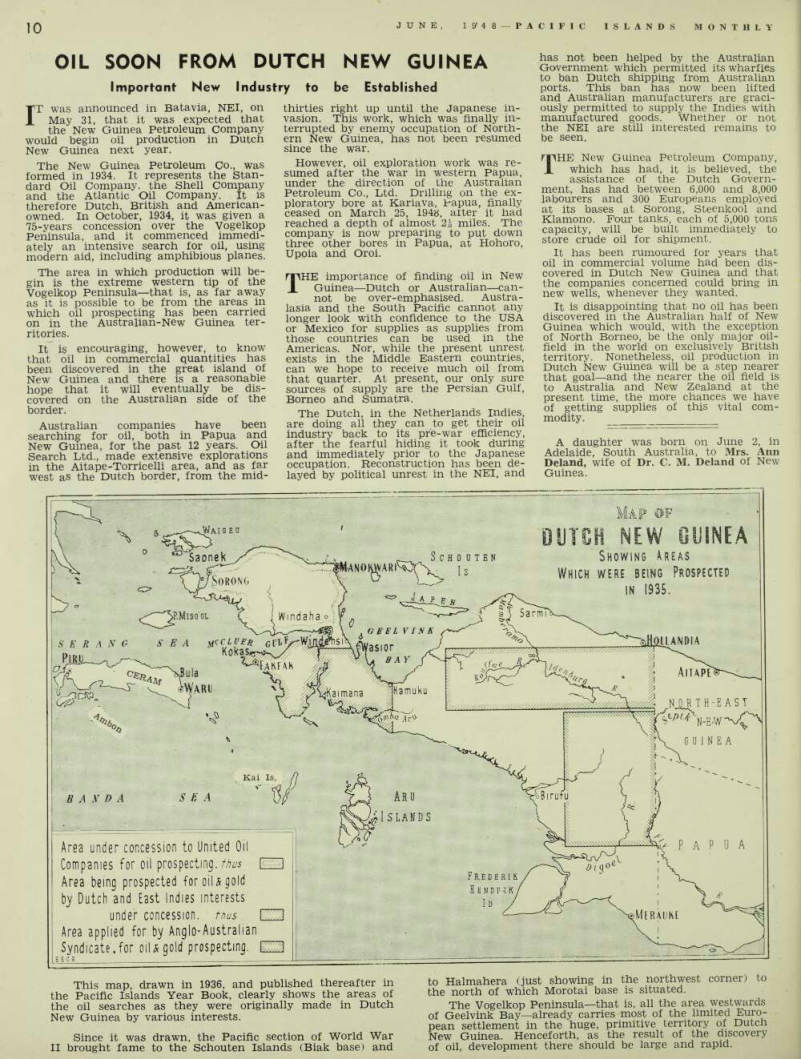
This map, drawn in 1936, and published thereafter in the Pacific Islands Year Book, clearly shows the areas of the oil searches as they were originally made in Dutch New Guinea by various interests.
Since it was drawn, the Pacific section of World War II brought fame to the Schouten Islands (Biak base) and
to Halmahera (just showing in the northwest corner) to the north of which Morotai base is situated.
The Vogelkop Peninsula—that is, all the area westwards of Geelvink Bay—already carries most of the limited Euro pean settlement in the huge, primitive territory of Dutch New Guinea. Henceforth, as the result of the discovery of oil, development there should be large and rapid.
Territories’ Officials Threaten
Direct Action Inadequate Concessions Made By Money-Wasters At Canberra
From a Special Correspondent
Port Moresby. June 5.
ANEW salary scale for public servants in Papua-New Guinea, to operate as from March 1, 1948, has been announced.
It had for some time been believed that the authorities were preparing new salary rates. The announcement was not made, however, until the Combined Council of the two Public Service Asso ciations had sent a long radio to the Prime Minister requesting immediate financial relief for members of the Public Service, and threatening direct action unless a satisfactory reply was immedi ately forthcoming.
The most important feature of the new rates is a temporary provision that married men, wnose wives and/or families are living in the Territory, will receive a minimum of £5OO per annum.
This represents a partial victory for the Public Service Associations in tneir fight to draw Canberra’s attention to the alarmingly high cost of living.
But the general reaction to the new rates is unenthusiastic. Further cables nave been sent to the Prime Minister; and unless satisfactory answers are re ceived it is considered likely that public servants will hold a stop-work meeting.
The present moves are the culmination of a long struggle for better conditions m the Papua-iNew Guinea Public Ser vice.
Messrs. Buttsworth and Burns LATE in 1946, officers of the Adminis tration at Port Moresby held a meeting to protest about their con ditions. Shortly afterwards, two classi fying officers, Mr. Burns, of the staff of tne Department of External Territories, and a retired civil servant from NSW, Mr. Buttsworth, visited the Territory for the purpose oi classifying the service and rixing salaries.
For long months after their visit public servants hopefully awaited publication of tne new classmcation and salary rates.
Cost of living was rising rapidly and salaries were becoming hopelessly inade quate, but officers of the Administration neld their peace; it was understood that the Buttsworth-Burns classification would be retrospective, and it was hoped that it would be fair.
Then, in mid-1947, came publication of the Buttsworth-Burns classification, which was to operate retrospectively as from March 1, 1947. It was a muddled, almost incomprehensible, document, and the salaries it specified were obviously inadequate.
The Public Service at first received it in disappointed silence. No-one could follow tne reasoning employed by Messrs Burns and Buttsworth, but everyone could see at a glance that the figures were unsatisfactory. They could not stand comparison with rates paid to Commonwealth officers in the Territory or with current cost of living figures; or with salaries in other colonial services Messrs. Buttsworth and Burns could have laid the foundation for a happy, efficient public service; instead, they dashed the hopes which had sustained officers of the Administration for so many months, and a^ 8 - r ?: vated the widespread discontent which was badly hampering the Admin
istration in its implementation of Austra lia’s new coiomai policy.
Situation Becomes Acute THE Public Service Associations could not accept the new rates as final, and a long, thorough battle was in itiated. The most obvious argument centred around the cost of living. Can berra apparently had no idea of the rul ing prices in local stores, and would not take anyone’s word for it.
The Public Service Associations there fore combined their resources to com pile a careml and accurate analysis of living costs, basing their formulae on those employed in fixing certain Northern Australian wages. They arrived at the alarming but by no means surprising figure of £55 per month as the minimum necessary to keep a family in port Moresby. They forwarded their findings to the authorities and urged appropriate action. None was forthcoming.
This year the situation has been fur ther deteriorating. Costs are still rising, houses and amenities are still desperately short, and conditions are still uncertain.
Over the past six months the Public Ser vice Associations have encountered many cases of officers whose savings have dis appeared and who have finally become involved in heavy debts to the stores.
These men have not been extravagant; their plight was inevitable.
Several months ago a new issue was in troduced —electricity charges. The Ad ministrator insisted that electricity in Port Moresby must be paid for by the consumers, who recently received their nrst accounts. Tne charges were amaz ing, amounting on tne average to £6/10/per month. Tne Public Service Associa tions, as well as other organisations, pro tested; but the authorities would not budge.
The charges came into force on April 16, 1048. Many people simply refused to pay.
“Strong Measures”
THERE was one hopeful sign—rumours had trickled through from Canberra to the effect that, as Mr. Buttsworth claimed to have based his salaries on those paid in the Commonwealth, Terri tory salaries would be increased by 25 percent, marginal allowances, as had been done last year with Commonwealth rates.
Such an increase would not assist lower paid officers appreciably, but would have been of some help. In some quarters it was hopefully suggested that Canberra was preparing salary increases even higher than those received by Com monwealth public servants.
These rumours had been current since the beginning of this year, but nothing had come through by the middle of May.
At an emergency meeting late in May the combined council of the Public Ser vice Associations decided to take strong measures immediately. They sent a 340words radio to the Prime Minister, traversing most of the facts outlined above, and demanding immediate satis faction on three points:— ■ The immediate application of Com monwealth marginal increases. ■ Relief from the exorbitant electri citv charcres.
■ Action to have cost of living allow ances brougfit to an appropriate level.
The Prime Minister was informed that unless satisfactory answers were received, public servants would hold Territory wide protest meetings on Thursday, June 3. The radio concluded with a statement tnat no mere formal acknowledgement would suffice.
A reply was received from Canberra on Saturday, May 30, in which it was stated that new salary rates were in the mail and would reach Moresby that day.
The £5OO minimum for married men was specifically referred to. The reply also indicated that the other questions raised by the combined Council would be at tended to.
Presumably the new salary scales had already been worked out before the Council sent its telegram.
The New Rates THE most welcome provision is the minimum of £5OO (exclusive of child allowance! for married officers who are maintaining wife and/or family in the Territory. Tne Government Sec retary has stated, however, that “this arrangement is to be a temporary one pending a determination based on a full-scale cost-of-living investigation.”
The news that there is to be “a full scale cost-of-living investigation” is also extremely welcome.
Apart from this provision, however, the increases are not generous and do not correspond with those gained last year by members of the Commonwealth ser
vice.
(Continued on page 75)
(Continued from Page II)
The largest increase is £96 for officers earning around £750. The figures dimi nish both above and below that figure.
Officers on £372 receive an increase of £lB. Most heads of Departments receive an increase of £5O, whereas Common wealth officers on similar salaries receive about £2OO. Sample increases are listed below:—
The Government Secretary has also made the following statement, the mean ing of which is not at all clear;— “A proposal is before the Minister re garding the commencing salary rate of members of the Papua and New Guinea Public Services, and also new appointees, as from March 1, 1947—i.e., the date from which the Buttsworth Classification operated. You will be further advised on this point.”
It has also been announced that an officer of the Department of External Territories will arrive at Port Moresby next week to assist in the interpretation and application of the new rates. Among other things, it is not clear whether officers due for an increment will move only to the minimum of their new range, or be credited with the increment on the new range.
Latest Developments THE combined Councils of the Public Service Associations have indicated that they are not satisfied with the new rates, nor on other matters raised in their radio. Further radios have been sent to Canberra, and the protest meet ings have been postponed one week (to June 10) pending a reply to the Associa tions’ latest submissions.
It is understood that the Public Ser vice Associations’ still demand:— ■ Further details of the proposed cost of living investigation, including an as surance that representatives of the Asso ciations will be allowed to give evidence ■ The introduction of a Public Ser vice Ordinance, which was promised as long ago as 1945, and which would pre sumably clarify superannuation rights, etc. ■ A finally satisfactory classification, with more adequate salary increases than have been provided, such increases to date back to March 1, 1947. instead of March 1, 1948. ■ The establishment of arbitration machinery. ■ The halving of electricity charges immediately.
As was urged in this journal nine months ago, the solution can only be an attractive basic salary with properly worked out cost of living variables. The present position remains confused and m some ways even ludricrous. Last month, for instance, applications were called for female counter-clerks in the local office of the Overseas Telecommu nications Commission at a salary of well over £5OO per annum. Typistes in the Administration have now moved onto what is nowadays regarded as the paltry salary of £312.
Protest Meeting ABOUT ISO members of the Public Service held a protest meeting in Port Moresby on June 10. It was :he first of its kind ever held in the Ferntory. Among other things, they isked for an immediate independent ;ost-of-livmg inquiry, and for allow inces retrospective to October 1945.
EDITORIAL NOTE; The cost of living
in Papua-New Guinea, compared with Australia, is very high, and far more than wipes out any advantage given by the absence there of income-tax, es pecially in the lower brackets. All Governments are parsimonious in rela tion to public service emoluments—they have got to be—but what can be said of an Administration that lavishly scatters millions of pounds of Australian taxpayers’ money among the natives of Papua-New Guinea, who don’t need it, and withholds, for so long, any kind of increase to Territories’ public servants, who need it desperately?
Present Raised Present Raised Salary to Salary to £ £ £ £ 300 312 372 390 408 426 462 498 588 642 642 714 714 786 762 858 786 882 810 882 834 900 858 900 1,000 1,050 1,050 1,100 1,250 1.300 1,350 1,350
"Matua" Passengers
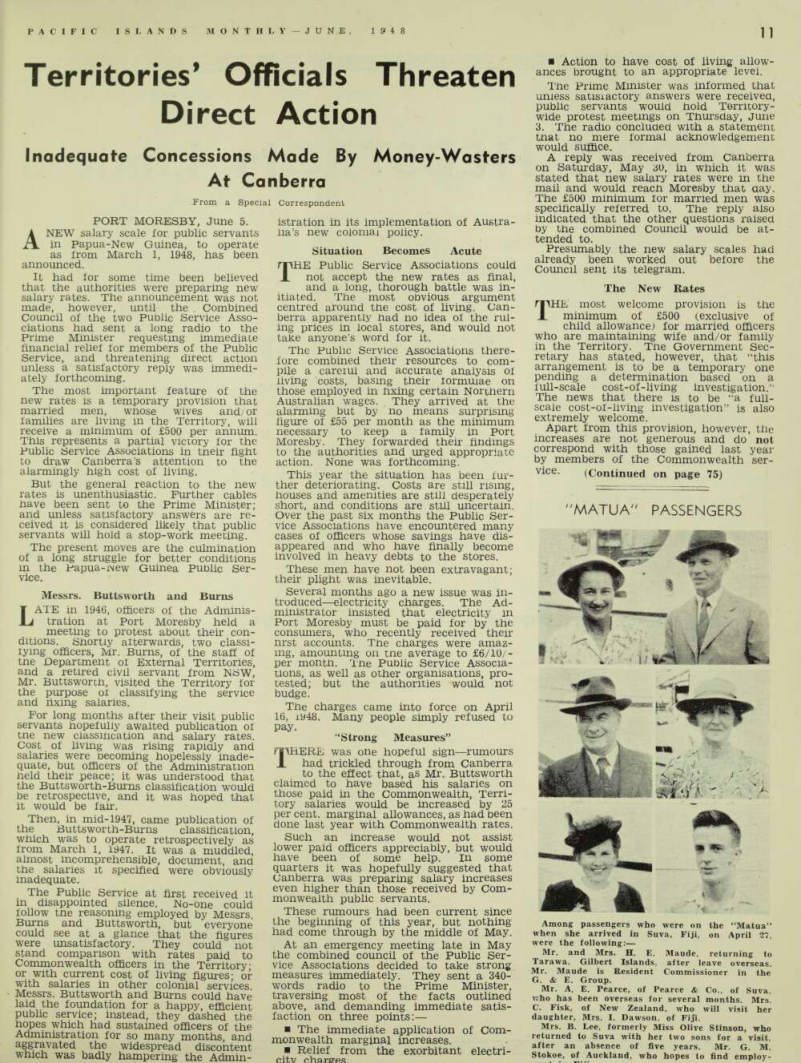
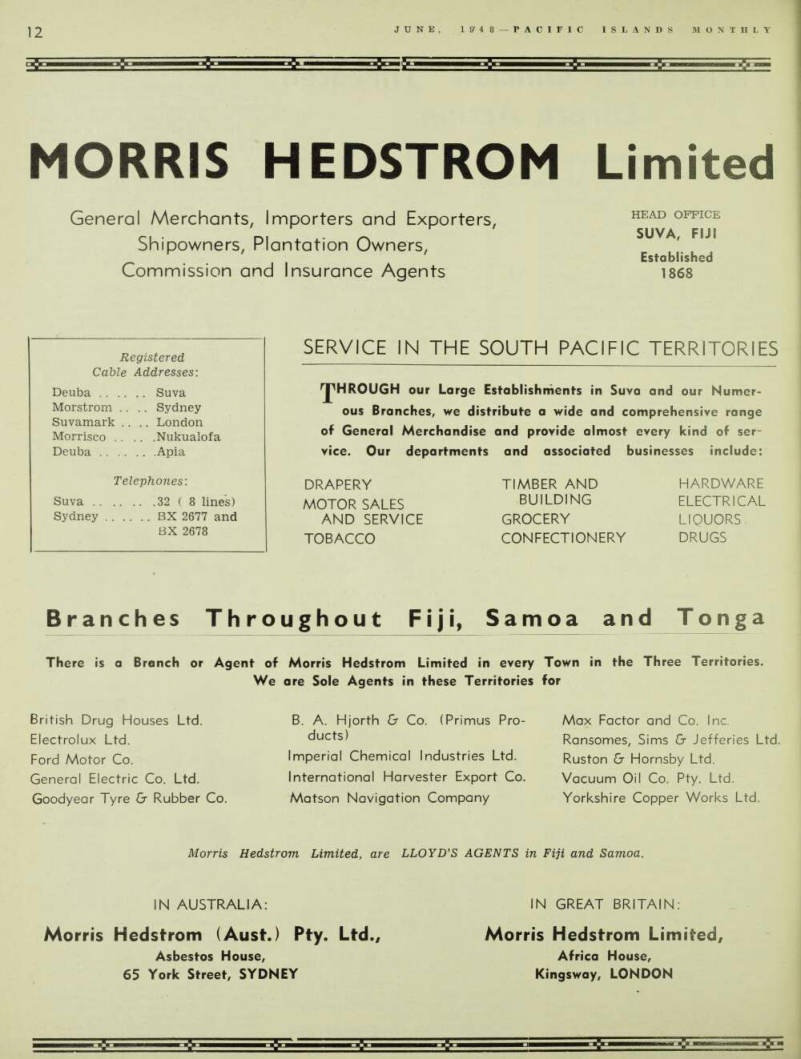
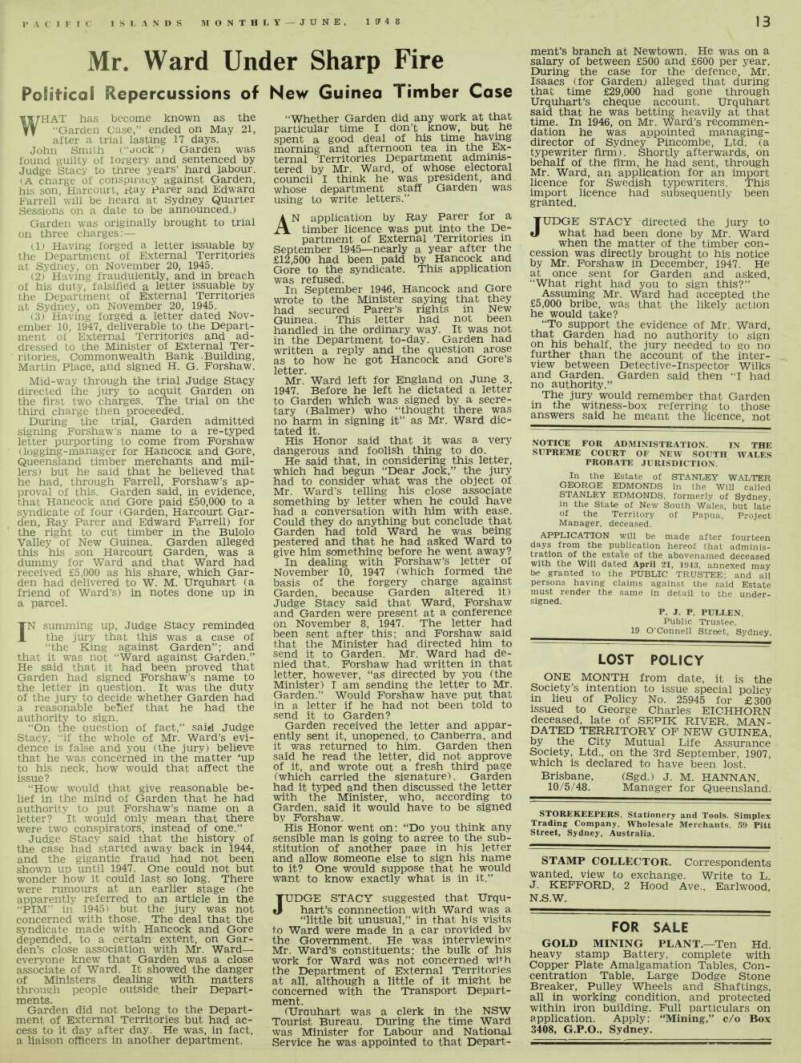
Among passengers who were on the “Matua” when she arrived in Suva, Fiji, on April 27, were the following:- Mr. and Mrs. H. E. Maude, returning to Tarawa, Gilbert Islands, after leave overseas.
Mr. Maude is Resident Commissioner in the G. & E. Group.
Mr. A. E. Pearce, of Pearce & Co., of Suva, who has been overseas for several months. Mrs.
C. Fisk, of New Zealand, who will visit her daughter, Mrs. I. Dawson, of Fiji.
Mrs. B. Lee, formerly Miss Olive Stinson, who returned to Suva with her two sons for a visit, after an absence of five years. Mr. G. M.
Stokoe, of Auckland, who hopes to find employ-
Advertisements & other items, p. 14 (1 item)
Morris Hedstrom Limited
General Merchants, Importers and Exporters,
Shipowners, Plantation Owners,
Commission and Insurance Agents
HEAD OFFICE
SUVA, FIJI
Established 1868
SERVICE IN THE SOUTH PACIFIC TERRITORIES
'J'HROUGH our Large Establishments in Suva and our Numerous Branches, we distribute a wide and comprehensive range of General Merchandise and provide almost every kind of service. Our departments and associated businesses include:
DRAPERY
MOTOR SALES
AND SERVICE
TOBACCO
TIMBER AND
BUILDING
GROCERY
CONFECTIONERY
HARDWARE
ELECTRICAL
LIQUORS
DRUGS
Branches Throughout Fiji, Samoa and Tonga
There is a Branch or Agent of Morris Hedstrom Limited in every Town in the Three Territories.
We are Sole Agents in these Territories for British Drug Houses Ltd.
Electrolux Ltd.
Ford Motor Co.
General Electric Co. Ltd.
Goodyear Tyre Gr Rubber Co.
B. A. Hjorth &• Co. (Primus Pro- Max Factor and Co. Inc, Ransomes, Sims & Jefferies Ltd.
Imperial Chemical Industries Ltd. Ruston & Hornsby Ltd.
International Harvester Export Co. Vacuum Oil Co. Pty. Ltd.
Matson Navigation Company Yorkshire Copper Works Ltd.
Morris Hedstrom Limited, are LLOYD'S AGENTS in Fiji and Samoa.
IN AUSTRALIA:
Morris Hedstrom (Aust.) Pty. Ltd.,
Asbestos House, 65 York Street, SYDNEY
IN GREAT BRITAIN:
Morris Hedstrom Limited,
Africa House, Kingsway, LONDON
Mr. Ward Under Sharp Fire
Political Repercussions of New Guinea Timber Case
WHAT has become known as the “Garden Case,” ended on May 21, after a trial lasting 17 days.
John Smith (“jock”j Garden was found guilty of forgery and sentenced by Judge Stacy to three years’ hard labour, i a charge of consoiracy against Garden, his son, Harcourt, Ray Parer and Edward Farrell will be heard at Sydney Quarter Sessions on a date to be announced.) Garden was originally brought to trial on three charges:— (1; Having forged a letter issuable by the Department of External Territories at Sydney, on November 20, 1945. (2; Having fraudulently, and in breach of his duty, falsified a letter issuable by the Department of External Territories at Sydney, on November 20, 1945. (3) Having forged a letter dated Nov ember 10, 1947, deliverable to the Depart ment of External Territories and ad dressed to the Minister of External Ter ritories, Commonwealth Bank Building, Martin Place, and signed H. G. Forshaw.
Mid-way through the trial Judge Stagy directed the jury to acquit Garden on the first two charges. The trial on the third charge then nroceeded.
During the trial. Garden admitted signing Forshaw’s name to a re-typed letter purporting to come from Forshaw (logging-manager for Hancock and Gore, Queensland timber merchants and mil lers) but he said that he believed that he had, through Farrell, Forshaw’s ap proval of this. Garden said, in evidence, that Hancock and Gore paid £50,000 to a syndicate of four (Garden, Harcourt Gar den, Ray Parer and Edward Farrell) for the right to cut timber in the Bulolo Valley of New Guinea. Garden alleged this his son Harcourt Garden, was a dummy for Ward and that Ward had received £5,000 as his share, which Gar den had delivered to W. M. Urquhart (a friend of Ward’s) in notes done up in a parcel.
IN summing up, Judge Stacy reminded the jury that this was a case of “the King against Garden”; and that it was not “Ward against Garden.”
He said that it had been proved that Garden had signed Forshaw’s name to the letter in question. It was the duty of the jury to decide whether Garden had a reasonable belief that he had the authority to sign.
“On the question of fact,” said Judge Stacy, “if the whole of Mr. Ward’s evi dence is false and you (the jury) believe that he was concerned in the matter ‘up to his neck, how would that affect the issue?
“How would that give reasonable be lief in the mind of Garden that he had authority to put Forshaw’s name on a letter? It wo'uld only mean that there were two conspirators, instead of one.”
Judge Stacy said that the history of the case had started away back in 1944, and the gigantic fraud had not been shown ud until 1947. One could not but wonder how it could last so long. There were rumours at an earlier stage (he apparently referred to an article in the “PIM” in 1945) but the jury was not concerned with those. The deal that the syndicate made with Hancock and Gore depended, to a certain extent, on Gar den’s close association with Mr. Ward— everyone knew that Garden was a close associate of Ward. It showed the danger of Ministers dealing with matters through people outside their Depart ments.
Garden did not belong to the Depart ment of External Territories but had ac cess to it day after day. He was, in fact, a liaison officers in another department.
“Whether Garden did any work at that particular time I don’t know, but he spent a good deal of his time having morning and afternoon tea in the Ex ternal Territories Department adminis tered by Mr. Ward, of whose electoral council I think he was president, and whose department staff Garden was using to write letters,”
AN application by Ray Parer for a timber licence was put into the De partment of External Territories in September 1945—nearly a year after the £12,500 had been paid by Hancock and Gore to the syndicate. This application was refused.
In September 1946, Hancock and Gore wrote to the Minister saying that they had secured Parer’s rights in New Guinea. This letter had not been handled in the ordinary way. It was not in the Department to-day. Garden had written a reply and the question arose as to how he got Hancock and Gore’s letter Mr.' Ward left for England on June 3, 1947. Before he left he dictated a letter to Garden which was signed by a secre tary (Balmer) who “thought there was no harm in signing it” as Mr. Ward dic tated it.
His Honor said that it was a very dangerous and foolish thing to do.
He said that, in considering this letter, which had begun “Dear Jock,” the jury had to consider what was the object of Mr. Ward’s telling his close associate something by letter when he could have had a conversation with him with ease.
Could they do anything but conclude that Garden had told Ward he was being pestered and that he had asked Ward to give him something before he went away?
In dealing with Forshaw’s letter of November 10, 1947 (which formed the basis of the forgery charge against Garden, because Garden altered it) Judge Stacy said that Ward, Forshaw and Garden were present at a conference on November 8, 1947. The letter had been sent after this; and Forshaw said that the Minister had directed him to send it to Garden. Mr. Ward had de nied that. Forshaw had written in that letter, however, “as directed by you (the Minister) I am sending the letter to Mr.
Garden.” Would Forshaw have put that in a letter if he had not been told to send it to Garden?
Garden received the letter and appar ently sent it, unopened, to Canberra, and it was returned to him. Garden then said he read the letter, did not approve of it, and wrote out a fresh third page (which carried the signature). Garden had it typed and then discussed the letter with the Minister, who, according to Garden, said it would have to be signed by Forshaw.
His Honor went on: “Do you think any sensible man is going to agree to the sub stitution of another page in his letter and allow someone else to sign his name to it? One would suppose that he would want to know exactly what is in it.”
JUDGE STACY suggested that Urqu hart’s connnection with Ward was a “little bit unusual,” in that his visits to Ward were made in a car nrovided bv the Government. He was interviewing Mr. Ward’s constituents; the bulk of his work for Ward was not concerned wfih the Department of External Territories at all, although a little of it might be concerned with the Transport Depart ment. (Urquhart was a clerk in the NSW Tourist Bureau. During the time Ward was Minister for Labour and National Service he was appointed to that Depart
merit’s branch at Newtown. He was on a salary of between £5OO and £6OO per year.
During the case for the defence, Mr.
Isaacs (for Garden) alleged that during that time £29,000 had gone through Urquhart’s cheque account. Urquhart said that he was betting heavily at that time. In 1946, on Mr. Ward’s recommen dation he was appointed managing director of Sydney Pincombe, Ltd. (a typewriter firm). Shortly afterwards, on behalf of the firm, he had sent, through Mr. Ward, an application for an import licence for Swedish typewriters. This import licence had subsequently been granted.
JUDGE STACY directed the jury to what had been done by Mr. Ward when the matter of the timber con cession was directly brought to his notice by Mr. Forshaw in December, 1947. He at once sent for Garden and asked, “What right had you to sign this?”
Assuming Mr. Ward had accepted the £5,000 bribe, was that the likely action he would take?
“To support the evidence of Mr. Ward, that Garden had no authority to sign on his behalf, the jury needed to go no further than the account of the inter view between Detective-Inspector Wilks and Garden. Garden said then “I had no authority,”
The jury would remember that Garden in the witness-box referring to those answers said he meant the licence, not
the authority, and suggested the answers did not quite mean what was suggested.
Royal Commission Suggested
A LEADING article in the “Sydney Morning Herald” of May 22, said, in part:— Although the verdict has been given and sentence passed in the Garden trial, questions of the greatest possible public moment remain to be cleared up. The transactions brought to light in this trial and their implications extend far beyond the Hancock and Gore affair.
Only a special inquiry by a Royal Com mission can get to the root of these unsavoury matters. It has been estab lished that Garden and his associates “were simply robbing Hancock and Gore of £50,000.” What is more, although their scheme was launched in 1944, it was not shown up until December last. That a “gigantic fraud” could thus be carried on for three years by a man, not a mem ber of the Civil Service, who enjoyed a privileged position and the personal friendship of the Minister, makes a searching investigation into the conduct of the Department of External Terri
tories imperative.
Mr. Ward has still to dispose satisfac torily of the grave accusations levelled against him. His evidence conflicted not only with Garden’s, but also with that of Mr. Forshaw. Nor would it be enough for Mr. Ward to show that he was not implicated in the conspiracy. The public will also demand to know a great deal more about other matters brought to light during the trial, but which were not pursued since they were not directly relevant to the charges against Garden.
Foremost among these is his relation ship with Mr. Urquhart, whose rapid rise in fortune was due to the efforts of the Minis'ter. Did Mr. Ward exert himself thus out of disinterested regard for Mr.
Urquhart and the firm of Sydney Pin combe or v/as there a quid pro quo? Only a Royal Commission with the widest pos sible terms of reference can clear up these questions, and the Prime Minister will be failing in his plain duty if he is not prompt to establish it. Meanwhile, it seems incredible that Mr. Ward should continue to hold office as a Minister of the Crown, or that Mr. Chifley should tolerate his doing so.
Mr. Ward s Suspension Sought
THERE was a similar demand from newspapers and public men all over Australia.
The joint executive of the Liberal and Country Parties demanded the suspen sion from office of the Minister for Ex ternal Territories pending the hearing of the court case involving Garden, Har court Garden, Ray Parer and Edward Farrell.
Because of this impending litigation the Opposition did not seek a debate in the House on Mr. Ward’s position, but the question was raised independently by private Liberal Party members.
During a Debate on Supply, on June 3, Mr. Cameron (Lib.) said that it was a time-honoured procedure in Democratic countries that as soon as a Minister’s administration is called into question that Minister withdraws from any de partment activity until his reputation and administration have been cleared.
Mr. Cameron reminded Mr. Chiflev that his predecessor, Mr. Curtin, had sus oended Mr. Ward in 1943 in what has become known as the “Brisbane Line case,”
The Prime Minister, however, refused to act. He said that he was completely satisfied with Mr. Ward’s honesty and that he was “not prepared to take the word of a convicted criminal, or the in nuendoes of any larrikin lawyer.”
This caused another storm.
Protest by Isaacs
MR. SIMON ISAACS, who had ap peared for J. S. Garden, said that he intended to refer Mr. Chiflev’s “larrikin-lawyer” comment to the Bar Council. He said that the remarks were made under Parliamentary privilege, and were contemptible.
Dr. S. G. Ross, with his wife and daughter, arrived in Sydney at the end of May, having travelled via Vancouver from Fanning Island, where he was medical officer for two years. Dr. Ross has contributed, to the Australian Medi cal Journal, some valuable scientific articles based on his observations in Fanning Island.
Mrs. J. Backhouse has returned to Rabaul after spending several months visiting her family and friends in Bris bane.
The French Union has agreed to a resolution moved by M. Bichon, New Caledonian representative, allotting 300.000,000 French francs (70,000,000 Pacific francs) to New Caledonia as a re lief fund for those who suffered in the cyclones and floods of January and March. The only opposition came from a Communist deputy who wanted the matter referred to a committee. It is expected that the National Assembly will sanction this grant, which already has the approval of the Council of the Re public. Caledonian representatives in Paris, Messrs. Lafleur and Gervolino, are actively supporting the measure.
Advertisements & other items, pp. 15-18 (1 item)
Notice For Administration. In The
SUPREME COURT OF NEW SOUTH WALES
PROBATE JURISDICTION.
In the Estate of STANLEY WALTER GEORGE EDMONDS in the Will called STANLEY EDMONDS, formerly of Sydney, in the State of New South Wales, but late of the Territory of Papua, Project Manager, deceased.
APPLICATION will be made after fourteen days from the publication hereof that administration of the estate of the abovenamed deceased with the Will dated April 21, 1943. annexed may be granted to the PUBLIC TRUSTEE; and all persons having claims against the said Estate must render the same in detail to the undersigned.
P. J. P. PULLEN.
Public Trustee. 19 O’Connell Street, Sydney.
LOST POLICY
ONE MONTH from date, it is the Society’s intention to issue special policy in lieu of Policy No. 25945 for £3OO issued to George Charles EICHHORN deceased, late of SEPIK RIVER, MAN-
DATED TERRITORY OF NEW GUINEA,
by the City Mutual Life Assurance Society, Ltd., on the 3rd September, 1907, which is declared to have been lost.
Brisbane, (Sgd.) J. M. HANNAN. 10/5/48. Manager for Queensland.
STOREKEEPERS, Stationery and Tools. Simplex Trading Company, Wholesale Merchants, 59 Pitt Street, Sydney, Australia.
STAMP COLLECTOR. Correspondents wanted, view to exchange. Write to L.
J. KEFFORD, 2 Hood Ave., Earlwood,
N.S.W.
FOR SALE
GOLD MINING PLANT.—Ten Hd.
heavy stamp Battery, complete with Copper Plate Amalgamation Tables, Concentration Table, Large Dodge Stone Breaker, Pulley Wheels and Shaftings, all in working condition, and protected within iron building. Full particulars on application. Apply: “Mining,” c/o Box 3408, G.P.0., Sydney.
% \ TO
SAN FRANCISCO
The Pacific is comfortably yours by Pan American Clipper.
The quickest way to the U.S.A.
Flights from Sydney
Every Wednesday
and Saturday at 11-59 p m-
to SAN FRANCISCO
0 , LOS ANGELES
via NEW CALEDONIA, FIJI.
CANTON is., HONOLULU
YOU RELAX in Pan American’s exclusive Sleeperette* (no extra fare)* Your roomy chair-lounge is foam-rubber soft . . . adjusts at button-touch to a restful bed-length.
You’ll arrive fresh for work or fun.
YOU SET traditional “Clipper comfort” service, delicious food, help with customs and currency problems, complete trip-planning aid. Call your Travel Agent or Pan American . . . world’s most experienced airline . . .
Mezzanine Floor, Hotel Australia, Sydney. Tel. BW 4701 Rue Jean Joures, Noumea, Bank of N.S.W. Building, Suva. * Trade Mark, Pan American Airways, Inc,
Pan American
World Airways t-'Uo System of Clippers Pan American Airways Inc. (Incorporated in U.S.A. Liability Limited)
THE
YORKSHIRE
INSURANCE
CO. LTD.
(Incorporated in England)
ALL CLASSES OF
INSURANCE
Including
Fire Motor Guarantee Accident Workers Marine Island Representatives:
PORT MORESBY: E. A. James
RABAUL: G. B. Black LAE: Morobe Transport Co. Ltd.
MADANG: R. MacGregor SUVA: Williams & Gosling Ltd.
NOUMEA: Y. Mortensen
NORFOLK ISLAND:
A. E. Martin
BURNS PHILP (New Hebrides) LTD.
Registered Office: VILA, NEW HEBRIDES Branch Office at SANTO
Exporters, Importers and General Merchants
(Retail and Wholesale) Commission, Shipping
and Customs Agents
Representatives for QUEENSLAND INSURANCE CO., LTD., and LLOYDS OF LONDON. Agents for SOCIETE DES PETROLES SHELL DES ILES FRANCAISES DU PACIFIQUE, and numerous overseas manufacturers of all classes of merchandise.
San Francisco Agents: Sydney Agents: Burns, Phllp Co. of San London Agents: Burns, Philp & Co., Ltd., Francisco, Burns, Philp & Co., Ltd., 7 Bridge Street. Matson Building, 35 Crutched Friars, E.C.3. 215 Market Street,
i* r* 1 Bond Street Sydney, Australia £* Xy ' j VTel. B 4167. Box 3615 G.P.O.
SUPPLIERS OF GENERAL MERCHANDISE TO LEADING FIRMS THROUGHOUT THE
PACIFIC ISLANDS
Exporters ... Importers ... . Manufacturers' Representatives Bankers: Bank of N.S.W. Bank of Adelaide. Comptoir Nat. d’Bscompte de Paris.
Cable Address; “SEAFOODS.” SYDNEY.
Codes: Bentley’s, 2nd and Comp. Phrase; A.8.C., sth and 6th; Peterson, 2nd and 3rd; Banking; Acme.
EYE LOTION
For Inflamed Eyes and Eyelids ... Sold Everywhere H. Rose & Co.. Pty. Ltd.. King Street. Sydney.
HOW THE “WALES” WORKS Branch Series No. 3
The Security Clerk
Mr. Angus Henry, Security Clerk, Hobart (Tas.) Branch.
Joined the Bank in 1926. Served in the R.A.A.F. 1940-46.
THE Security Clerk has two main functions.
He looks after any valuables (other than cash and credit instruments) entrusted to the safekeeping of the Branch by its customers, and he is responsible for the various documents (such as title deeds, life policies, bonds and guarantees) lodged with the Branch as security for advances.
His work is exacting but varied, extensive but interesting. He is constantly meeting and coping with new problems, and thus gaining the knowledge and experience which characterize "Wales” officers.
Consult and use
BANK OF
NEW SOUTH WALES
Incorpora t£d in New South Wales with limited liability
FI RST BANK IN AUSTRALIA
Pacific Air Services
Qantas Survey Flight to NH; TRAPAS May Resume in June
Prom Our Own Correspondent
Vila. May 11.
A Q ANT AS Catalina arrived at Vila on May 1, with a technical staff. They were on a survey flight and left on May 2. If conditions are favourable, the company may run a service to the New Hebrides with a Sunderland flying-boat. (Fortnightly service is to commence June 26.) The Trans Oceanic Airways flying boat arrived on May 8, after being delayed in Sydney for two days by a sudden whim of the Australian Department of Civil Aviation.
They left the same day for Espiritu Santo and the Solomons.
It is reported that Trapas intends to resume the weekly service between Noumea and the New Hebrides on June 10.
Death Of Mr. C. W. Thomas
Prom Our Own Correspondent
Suva, Mav 30.
AMONG the last (if not actually the last) of the people who saw the signing of the Deed of Cession and the hoisting of the Union Jack at Levuka in 1874, was Mr. Charles Wimbledon Thomas, who died at the Lautoka Hos pital on Mav 23. in his 86th year.
In the 1870’s, Mr. Thomas’s father was a lawyer at Levuka and he himself was an articled clerk for several years before going to Yaqara, in north-western Viti Levu, to raise cattle and horses on an estate owned by his father. Here he was later joined by his brother. Willie and in 1900, when the Colonial Sugar Refining Company started operations at Lautoka the Thomas brothers ooened butcher’s shops at Lautoka and Ba, supplying meat from Yaqara.
In 1911, Mr. Thomas was elected a member of the Legislative Council for the North-Western Division and held the seat for several terms. He spent a good deal of time at Levuka and in the 1920’s was made a life-member of the Ovalau Club. In recent years failing health had prevented his leaving Lautoka.
The funeral took nlace at the Lautoka Cemetery after a combined Church of England and Methodist service conducted bv the Rev. B. Oxenbridge and the Rev.
W. S. Pidgeon. at the house of Mr.
Thomas’s son, Mr. H. W. Thomas. A Masonic ceremonv was conducted by Mr, C. V. H. Thomas. The District Com missioner. Northern (Mr. C. Harley Nott) represented the Government.
Death of W. A. Wignall
Mr William Alfred Wignall Died
at Waverley, Sydney, on May 26.
He was born in England in 1859 and came to Australia in 1883. In 1884 he joined the then infant Colonial Sugar Refining Company, being Second Engineer in charge at the erection of the Rarawai mill.
In 1910, he left the Colonial Sugar Re fining Company to grow cane at the Touvila-Villa Plantation, Lautoko, until 1922, and then spent his retirement at 13 Gibson Street, Waverley.
The deceased is survived by his widow (the twin daughter of the late John and Mary Pfluger, who were amongst the earliest pioneers of Fiji), and five chil dren, Viria (Mrs. Johnson, West Aus tralia), Trevor (Gold Coast, Africa), George (Tavua, Fiji), Rose (Mrs. Webb, Newcastle), Robert (Randwick); and eleven grandchildren.
Advertisements & other items, p. 19 (1 item)
Heat-Resisting SILVER
IMPROVE YOUR OUTLOOK!
Two recommended products from the famous Spartan range of dependable paints and enamels—Spartan Quick Drying Enamel and Spartan Silver will brighten your surroundings. f ECONOMICAL . . DURABLE . . . WASHABLE . . NON-FADING For long-life surface protection to metal and wood. Dries to a smooth, outstanding, lustrous finish.
Quick-drying
ENAMEL
Transforms small or large rooms into delightful, charming places in which it will be a pleasure to work and live.
Recommended for a PERFECT
FINISH
J
T'Lk
/ A * Durable Spartan Quick-Drying Enamel is a high-grade, quick-drying finish designed for application by professional and amateur alike—to go on easily and with an exceptionally smooth flow that ensures a perfect surface. . . . Drying speed of Spartan Quick-Drying Enamel is carefully controlled to allow ample time for “joining up” on large wall areas—it is fast enough to permit the surface drying dust-free within 2 hours, and setting with a wear-resisting hardness overnight An outstanding heat-resisting paint that gives a greater area coverage than ordinary paihts. Protects metal work from moisture and corrosion. Easily applied to clean metal and wood surfaces of
STOVES, COPPERS, BATHS, HEATERS, GATES,
MACHINE EQUIPMENT, Etc.
t?. Jp smooth, outstanding, brilliant, silvery finish.
SEALS TAR, BITUMEN, GREASY SURFACES AND BLEEDING
COLOURS.
For large exterior surfaces—tanks, roofs or galvanised iron structures, Spartan ALKYDISED ALUMINIUM PAINT is recommended because of its extreme durability.
Agents: Fiji: COLONIAL TRADE DEVELOPMENT AGENCY OF FIJI P.O. Box 273, Suva.
Other Territories: Please Order Through Usual Channels.
SPARTAN PAINTS PTY., LIMITED
102-104 King Street, Melbourne, Victoria.
Heat-Resisting SILVER
N Si R VE IlilllU I
HEAT*RESISTING v QUICK DRYIN&
Engagement
THE engagement has been announced of Miss Valerie Josephine Hitchcock, only child of Captain E. P. Hitch cock, MC, DCM, Legion of Merit, and Mrs.
Hitchcock, of Lae, New Guinea, to Mr.
William Robert Bar Manson, third son of Mrs. T. Manson, Roseville, Sydney.
The marriage will take place in November. The couple will return to Lae, early dn the New Year.
NZ Airways Seek Tourists
For South Seas
Auckland, May 25.
RECENTLY, NZ daily papers have been carrying 3-column advertisements by NZ National Airways Corporation appealing to shivering New Zealanders to “plan a fascinating winter holiday to Samoa via Fiji and Tonga.”
For £6l/4/- one may fly to Samoa and back to New Zealand —expenses on land are additional, one presumes.
Whether there will be an influx of NZ tourists into Fiji, Tonga and Samoa re mains to be seen. As the NZ airliners are at present maintaining only a fort nightly service, the number of tourists is limited to the carrying capacity of one plane every 14 days.
EDITORIAL NOTE; Both Australia and NZ are full of people with a lot of money to spend on travel. The only reason why the beautiful South Sea islands—especially Fiji and Samoa—are not packed with tourists is that all the islands lack first-class hotel accommoda tion and transport organisation. Suva has some good hotels, but they are so constantly booked out by local traffic that they seldom have room for tourists.
Pawpaws And Papain
SOME South Pacific planters are show ing an interest in the possibility of producing, from the pawpaw tree, some of the papain which is now in de mand in the United States. There have been references to this matter in recent issues of the “PIM.”
One planter in Tonga wants to know where he may procure seeds of the short stemmed variety of pawpaw. We do not know. If any South Seas planter would send this information to us we should be grateful.
Gilbertese Strike On Ocean Island
Ocean Island
IT was reported from Suva on May 29, that a strike had started among Gilbertese labour on Ocean island on May 1 and was still unsettled.
About 1,100 Gilbertese employed by the British Phosphate Company were in volved and the company had found it necessary to suspend the remaining labour force of the island (mostly Chinese) consisting of about 100 men.
The strikers are demanding higher wages to meet increased cost of trade goods. They want £lO a month, or re patriation.
It was announced by the Western Pacific High Commission that the Resi dent Commissioner of the Gilbert and Ellice Island Group would visit Ocean island and attempt a reconciliation.
Nothing has been heard from Nauru, where a somewhat similar labour force is engaged on similar work.
Death Of Noumea
Priest
FATHER Noblet, who was attached to Noumea Cathedral, and was one of the best-known and best-loved priests in New Caledonia, where he edited the monthly Roman Catholic paper “La Vie Catholique,” recently died at Noumea.
The Rev. A. C. Hobson, chaplain for the Bishop in Polynesia, will make a three months’ tour of New Zealand parishes to inform church authorities there of mission activities in the Pacific island diocese in which he works.
Advertisements & other items, p. 20 (2 items)
Time-Pieces
REPAIRED
We employ a Fully Qualified
Staff and we are equipped to undertake repairs of
WATCHES CLOCKS
MARINE CHRONOMETERS
We undertake Locksmithing, Key-cutting, etc.
Any goods sent to us by post are attended to promptly and with care.
NOEL LEVY
Victoria Parade, Suva, Fiji Phone 39. P.O. Box 88.
Cablegrams: “Noel,” Suva
Propeller Shafting
for strength an
d long, reliable service
Monel shafts are renowned for their rugged strength, stiffness and freedom from whip. These characteristics are very important since a good, stiff shaft reduces vibration, transmits more power to propeller and thereby increases speed and efficiency. Of still greater importance is the fact that Monel retains these properties indefinitely, because Monel cannot rust and is not corroded by fresh or salt water. That is why a Monel shaft, stronger than others when new, is still in perfect condition after years of continuous service.
Complete information on the many marine uses of Monel will gladly he forwarded hy:
WRIGHT AND COMPANY
SOLE AUSTRALIAN DISTRIBUTORS OF MONEL.
81 CLARENCE STREET, SYDNEY, N.S.W. PHONE: BX 1211 (SIX LINES) Monel is a registered trade-mark covering a rich nickel alloy, mined in Canada and rolled in Great Britain.
Pacific Shipping
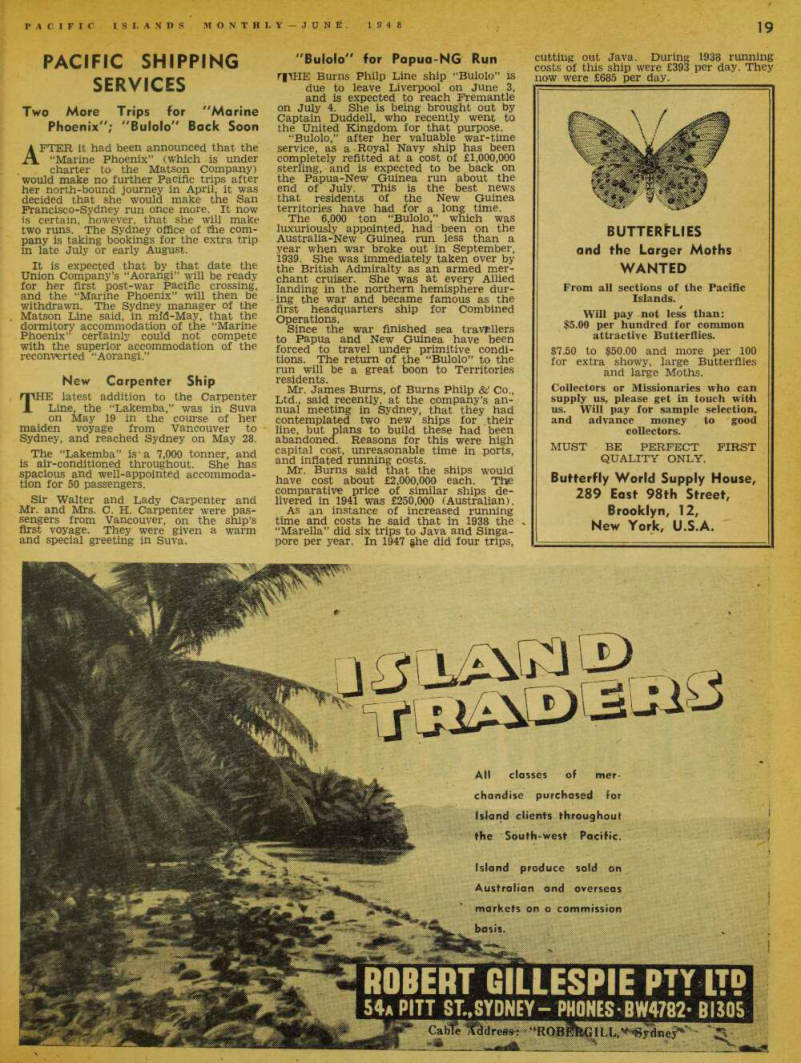
Services
Two More Trips for "Marine Phoenix"; "Bulolo" Back Soon
AFTER it had been announced that the “Marine Phoenix” (which is under charter to the Matson Company) would make no further Pacific trips after her north-bound journey in April, it was decided that she would make the San Francisco-Sydney run once more. It now is certain, however, that she will make two runs. The Sydney office of the com pany is taking bookings for the extra trip in late July or early August.
It is expected that by that date the Union Company’s “Aorangi” will be ready for her first post-war Pacific crossing, and the “Marine Phoenix” will then be withdrawn. The Sydney manager of the Matson Line said, in mid-May, that the dormitory accommodation of the “Marine Phoenix” certainly could not compete with the superior accommodation of the reconverted “Aorangi.”
New Carpenter Ship
THE latest addition to the Carpenter Line, the “Lakemba,” was in Suva on May 19 in the course of her maiden voyage from Vancouver to Sydney, and reached Sydney on May 28.
The “Lakemba” is a 7,000 tonner, and is air-conditioned throughout. She has spacious and well-appointed accommoda tion for 50 passengers.
Sir Walter and Lady Carpenter and Mr. and Mrs. C. H. Carpenter were pas sengers from Vancouver, on the ship’s first voyage. They were given a warm and special greeting in Suva.
"Bulolo" for Papua-NG Run
HPHE Burns Philp Line ship “Bulolo” is due to leave Liverpool on June 3, and is expected to reach Fremantle on July 4. She is being brought out by Captain Duddell, who recently went to the United Kingdom for that purpose.
“Bulolo,” after her valuable war-time service, as a Royal Navy ship has been completely refitted at a cost of £1,000,000 sterling, and is expected to be back on the Papua-New Guinea run about the end of July. This is the best news that residents of the New Guinea territories have had for a long time.
The 6,000 ton “Bulolo,” which was luxuriously appointed, had been on the Australia-New Guinea run less than a year when war broke out in September, 1939. She was immediately taken over by the British Admiralty as an armed mer chant cruiser. She was at every Allied landing in the northern hemisphere dur ing the war and became famous as the first headquarters ship for Combined Operations.
Since the war finished sea travellers to Papua and New Guinea have been forced to travel under primitive condi tions. The return of the “Bulolo” to the run will be a great boon to Territories residents.
Mr. James Burns, of Burns Philp &' Co., Ltd., said recently, at the company’s an nual meeting in Sydney, that they had contemplated two new ships for their line, but plans to build these had been abandoned. Reasons for this were high capital cost, unreasonable time in ports, and inflated running costs.
Mr. Burns said that the ships would have cost about £2,000,000 each. The comparative price of similar ships de livered in 1941 was £250,000 (Australian).
As an instance of increased running time and costs he said that in 1938 the “Marella” did six trips to Java and Singa pore per year. In 1947 §he did four trips,
cutting out Java. During 1938 running’ costs of this ship were £393 per day. They now were £685 per day.
The Pacific Islands Society
Sir Brian Freeston, Kcmg, Gov-
ernor of Fiji and High Commissioner for the Western Pacific, has graciously agreed to become Patron of the Pacific Islands Society.
Before a record gathering of the Society in May, the Rev. Richard Piper, of the Methodist Overseas Mission screened coloured films of Tongan people and scenery which he himself filmed during the Tongan Royal Wedding last year.
Members were glad to welcome, also, the Rev. F. S. Faubula, of Tonga, who spoke to them in English and Tongan.
Visitors included the Rev. E. T. Olds, President, NZ Methodist Conference; the Rev. C. F.Gribble, Director of Education, Tonga; the Rev. W. R. and Mrs. Steadman; the Rev. A. W. Amos, whose grandfather was a missionary in Tonga; the Rev. J. S. Faubula, Mesdames Colyer, Lucas Farleigh, Wood, Judy Tudor, Lamacraft,’ Mackay, Fuller, Chidgey, Trollope,
Middleton, Vaughan, Beasley; the Misses Joan Livingstone, Wood, Chidgey, Mackay; Messrs. Colyer, Page, Stuart Reay, Line, Beasley, New Members: Mrs. R. H. Lucas (nee Kathleen Morgan), Miss M. Kearney.
The June gathering of the Society will take the form of a cocktail party at History House, on Wednesday, June 22, from 5.15 to 7 p.m.
The Annual General Meeting of the Society will be held at History House, 8 Young Street, Sydney, on Wednesday, Juty 28,. at 7.45 p.m; Nominations for all officers of the Society are to be in the hands of the Honorary Secretary not later than Wednesday, July 7.
After the meeting, the Rev. W. K.
Deasey will give an illustrated address on “Norfolk Island”
Although he had gained his pilot’s licence only 18 days previously, Mr. S.
Jamieson, of Lae, New Guinea, won the navigation contest of ‘the Royal Aero Club of NSW on May 15.
Advertisements & other items, pp. 21-22 (1 item)
Robert Gillespie Pit It?
BUTTERFLIES
and the Larger Moths
WANTED
From all sections of the Pacific Islands. 0 Will pay not less than: $5.00 per hundred for common attractive Butterflies. $7.50 to $50.00 and more per 100 for extra showy, large Butterflies and large Moths.
Collectors or Missionaries who can supply us, please get in touch with us. Will pay for sample selection, and advance money to good collectors.
MUST BE PERFECT FIRST
QUALITY ONLY.
Butterfly World Supply House,
289 East 98th Street,
Brooklyn, 12,
New York, U.S.A.
m r r r All classes of merchandise purchased for island clients throughout the South-west Pacific. island produce sold on Australian and overseas markets on o commission basis.
ROBERT GILLESPIE PIT IT?
54a PITT SI, SYDNEY-PHONES-8W4782- BI SOS
Canine Address
Announcing Return Visit ...
S. WENTWORTH JACKSON
(FIO, SYD.)
OPTOMETRIST Cr OPTICIAN
185 Elizabeth Street, Sydney
Consultations:
PAPUA HOTEL, PORT MORESBY
15th - 31st JULY, 1948
HAVE YOUR EYES EXAMINED. MAKE AN «
APPOINTMENT NOW.
Apply The Manager, Papua Hotel, Port Moresby.
W. H.GROVE £ SONS
Limited
Established 1896.
AUCKLAND
Island Traders. po BOX 490 Telegraphic and Cable Address: “Grove", Auckland.
Entrust Your Orders to the Firm with Fifty Years Practical Experience in the Island' Trade.
Shippers of all classes of New Zealand products.
Representing English Manufacturers through-
out the Cook and Society Islands, Fiji, Tonga, Samoa, Niue, New Caledonia, New Guinea, etc.
In FIJI as—W. H. Grove & Sons (Fiji) Ltd.
Ships and Planes for the
Solomons Promised Better Conditions Should Assist Rehabilitation
COMMUNICATIONS between tne British Solomon Islands and the outside world—which have been in a deplorable condition since World War ll—may be substantially improved by the following arrangements:— The small Burns Philp motor vessel “Muliama,” which has been maintaining a temporary service between Sydney and the New Hebrides, will now inaugurate a regular service between Australia and the Solomons. She can take a small number of passengers.
A smaller vessel, owned by a Sydney Company, will probably start, in July, a fairly regular freight service between Sydney and the Solomons.
Commencing on June 26, Qantas will run a regular fortnightly service by Catalina flying-boat between Sydney, Noumea, Port Vila and Santo (New Hebrides); and this will be extended to Tulagi (Solomons) as soon as regular fuel supplies can be arranged.
Arrangements are under discussion under which Trans Oceanic Airways of Sydney hope to be allowed to run a flying-boat fairly regularly from Sydney to the Solomon Islands, via New Hebrides.
These arrangements should permit a more rapid rehabilitation of the BSI industry. The chief obstacle in the way of a shipping service has been the ab sence of back-loading; the Australian ships can carry in supplies, but there has been no freight offering for Australia— copra generally goes elsewhere.
A new arrangement now appears to be in contemplation, under which a small amount of BSI copra will come to Aus tralia, while a proportion of New Guinea copra—which hitherto has been strictly ear-marked for Australia—will be per mitted to go overseas. Australia, in making this concession, is helping to solve the problem of BSI communica tions.
Natives Should Work Out
Their Own Salvation
Letter to the Editor HAVING spent over 40 years in dif ferent groups of the South Sea Islands,, I could not help smiling when I read some recent articles about native welfare and their future.
These so-called “poor natives” have been, unfortunately, so overprotected and spoiled that they cannot now realise that their salvation lies in their own hands— not in moaning and complaining, but in guts and work.
Not only is a native bom apathetic and lazy, but he will be taught by tribal custom that work is a shameful thing.
All abhor effort.
Their brains work more cunningly than cleverly. They should be reminded more often that there is an inexorable natural law: Survival of the fittest.
Many former races have disappeared from this earth, with no loss to the universe.
I am, etc.,
“Abc”
New Hebrides, May 5, 1948.
The marriage of Miss Shirley Saltz man, of Brisbane, to Mr. Ron. McConnon will take place at the end of June, 1948.
They will live in Wau, New Guinea, where Mr. McConnon is engaged in gold mining.
Advertisements & other items, p. 23 (1 item)
Pleasant Smile
Don’t risk the loss
of a
JF your gums flash a warning tinge of “pink” on your tooth brush, consult your dentist .
There may be nothing seriously wrong . . . but don’t take chances ... let your dentist decide. He may explain “a simple case of sensitive gums gums robbed of work by to-day's soft and creamy foods" . His advice will probably be t( more work and resistance for lazy gums" and often, (< the helpful stimulation oj Ip ana Tooth Paste and massage".
Adopt this simple dental health routine : Brush your teeth with Ipana every morning and evening, followed by vigorous gum massage with Ipana bn the finger-tip. Gums become firmer, healthier; teeth brighter, more lustrous.
IPANA TOOTH PASTE
Savings Bank For G. & E.
ANEW Ordinance of the Gilbert and Ellice Islands Colony provides for the establishment of a Government Savings Bank within that Colony.
Branches will be opened wherever re quired; and the rate of interest on de posits will be fixed from time to time hv the High Commissioner for the Western Pacific.
Secretary-General Haumant, interim Governor of Tahiti, left for France via Canada by the Vairune in March. .
The Tahitian ship “Orohena,” which arrived in Papeete in February from the US to commence on mter-island service in the French archipelago, has been obliged to visit New Zealand for repairs as the Papeete dry-dock is not large enough.
The Manus Base
Formal Transfer In Mid-1948
ABOUT the end of June, or early in July, officials from the Australian Department of External Territories, and from the Papua-New Guinea Civil Administration, will proceed to Manus (Admiralty Islands, north of the New Guinea mainland) and there will form ally take over the great base—one of the biggest in the Pacific —constructed by the Americans during the war.
The United States had hoped to re tain control of that base, which would have been the southwestern bastion of the American defence system in the Pacific. But it was in Australian Man dated (or Trusteeship) Territory; and the Socialist gentlemen who now control Aus tralia, and try to strut upon the world’s stage as the representatives of “a Pacific power,” were cold to the American plan.
So the Americans decided to withdraw.
The Australian Navy will establish it self at Lombrum Point, former US naval seaplane base on Manus Island proper, and the RAAF at Momote, on Los Negros Island, where the Americans built fighter strips and bomber airfields cap able of taking the biggest planes.
An American commander and a small group of American officials, who are the only US personnel left out of a wartime population of about 120,000 at Manus, will formally hand over the base.
An administrative post will be re established at Lorengau, in about the same position as it was for 20 years be fore the Jap invasion.
A Canberra press “hand-out” says: “The Australian flag will then be kept flying to show that the Commonwealth has accepted responsibility for the terri tory and the native population. Schools, hospitals and courts of justice will be set up for the natives, who work on gardens and copra plantations.”
This blurb, of course, is the Socialists’ way of answering the criticism that, while the maintenance of the great base would not have embarrassed the United States, it will be a very great strain upon the more slender resources of Australia.
The Socialists are undertaking the task willingly, however, in order to protect and assist the natives.
The Socialists save their faces —and the Australian taxpayer pays!
N. Caledonian Timber
For Australia
WHEN he reported recently to the New Caledonian Council, M. Sarlin, local inspector of forests, revealed that an important Australian company is to work the Nepoui forests in the Chaine Centrale, The anticipated 20,000 cubic metres of timber cut this year would not be realised, however.
The Australians, he added, showed a great reluctance about working any tim bers save kauri and mountain pine.
Several other good Caledonian timbers were completely neglected by the Aus tralian market, and Australians were un willing to undertake the risk of exploit ing timber less well known.
So far they had suggested a price (1,325 francs per cubic metre) for kauri alone.
French Oceania exported 10,277 tons of phosphate and 5,952 tons of copra in the first six months of 1947. Figures for that period recently released show imports amounting to 189,000,000 francs and ex ports 142,000,000 francs. Copra produc tion has declined since 1946.
Advertisements & other items, p. 24 (1 item)
W. Kopsen 8 Co. Pty. Ltd.
A Limited Quantity Only
COLT PATTERN .45 cal. AUTOMATICS
SPECIAL TROPICAL FINISH.
At the all-time low price of £lO each. Postage extra. Powerful, accurate, they are a weapon you will be proud to own. Ammo, plentiful, 25/per 100.
Si a n i| I I Quality Firearms and Fishing
I L nU n U Tackle.
143 ELIZABETH ST. (near Market St.), SYDNEY. Phone: MA 3540.
AP2
INDOORS or OUT
BRILLIANT LIGHTING
WHEN & WHERE REQUIRED
The vapour lamps are the last word in efficiency in modern kerosene lighting. Burn for 10 hours on li pints kerosene. All spare parts available.
Obtainable in two models, the AP2 and HL7. Write for leaflet.
HL7
DEKOL
Guards Wood and Canvas from the Ravages of White Ants, Borers, Dry Rot, Mildew, etc.
DEKOL penetrates deeply, permanently protecting wood and fabrics from rot and attacks by fungi and insects. It ts simple to apply and when dry can be painted and varnished. DEKOL also prevents attack by marine borers on wood immersed in sea water.
DON'T WAIT
TILL THIS
HAPPENS.
n- Q Trade Inquiries Invited.
C.Q.R. ANCHORS
The light-weight anchor with three times the holding power of any other anchor. Designed for positive and quick the C.Q.R. anchor is two well-designed ploughshares welded together.
Write for another leaflet.
W. KOPSEN 8 CO. PTY. LTD.
SHIPCHANDLERS & MARINE ENGINEERS
376-380 KENT ST., SYDNEY. MA6336 (9 lines).
Cables: "KOPSEN” Sydney.
South Pacific Commission's First
Meeting
Committee Seeking A Home in Suva or Noumea
THE first session of the South Pacific Commission commenced in Sydney on May 11 (as reported in May “PIM”) and concluded on May 21. The six nations represented were Britain, France, United States, Holland, New Zea land and Australia, The meetings were held in camera, and were devoted mostly to matters of organisation.
Mr. J. R. Kerr assumed responsibility as acting Secretary-General, pending an appointment to that important posi tion by the Commission. The six sub scribing Governments have undertaken to submit names of suitable persons, from among whom a permanent Secre tary-General will be appointed.
Mr. J. R. Halligan, Senior Commis sioner from Australia, became chairman of the conference because Australia alphabetically is first on the list. Mr.
Halligan will hold office until the next meeting of the Commission, in October and the acting Secretary-General will work in co-operation with him.
"Mr. Raymond Watt assisted Mr. Kerr in the heavy organisational work during the Conference, and he is continuing to carry some of the burden of the Secre tariat.
France, being next on the alphabetical list, will supply the chairman of the Commission as from the October Confer ence.
It is expected that arrangements will have been completed by October which will enable the Commission to— (a) Set up a permanent staff; (b) Select headquarters in either Noumea or Suva;
(c) Appoint members of the Research Committee; (d) Take other steps required in order to provide the Commission with head ?uarters and a staff, and to get it unctioning.
IN an official statement issued on May 21, the Commission said that imme diate and active attention is to be given to: — Increased food production in the South Pacific to raise nutrition standards and exports; Copra output to be speeded up by use of more machinery; Fisheries research and improvement of present inadequate supplies; More ships, to encourage output and relieve goods shortages; Improvement of health of mothers and babies; Training of islanders in technical skill; Stimulation of education by radio and film strips; Spreading modern agricultural prac tice.
These and other projects are on the programme. Action has 'already begun by the appointment of an Acting Secre tary-General. Machinery has been set in motion to obtain people with the best scientific and technical knowledge to direct the South Pacific Research Coun cil.
A Working Committee which has been set up will carry on between sessions of the Commission. Among its tasks will be the selection, at a very early date, of a Secretary-General, a Deputy Secre
tary-General, a Deputy Chairman of the Research Council and full-time research workers. Salaries will range from £Stg.l,ooo to £Stg.2,ooo per annum. The Member Governments will receive appli cations.
The six governments are sharing all costs, A working fund of £40,000 has already been established.
The Commission’s next session will be held in Sydney on October 25.
A long-term project of the Commission
is to bring Pacific Islands peoples together in meetings where, by rubbing shoulders with eqch other, they may widen their horizons, discuss common problems and, as the people most concerned, advise the Commission of the directions in which it should go.
That is the end of the official report.
The American and British (Fiji) Delegations departed in the week-end following the termination of the Commission and the others within 24 hours after that.
All that was left was a series of important decisions requiring the attention
of a secretarial staff which had still to be appointed.
Noumea Or Sydney?
A COMMITTEE of the Commission will visit both Suva and Noumea at an early date, to seek headquarters for the Commission. It will be a difficult task. Both New Caledonia and Fiji are eager to provide Commission head quarters: but there is not 10 square feet of suitable accommodation vacant in Suva, and both places suffer from
lack of suitable overseas transport faci lities.
The New Caledonian authorities will suggest, as suitable headquarters, the ex-US Army’s great Pentagon building at Anse Vata, now in the possession of the Societe Touristique et Hoteliere. This company is not anxious to let the build ing and the four hectares of ground attached thereto for a long period, but will favour its sale, should the Commis sion agree to establish itself in Noumea.
Advertisements & other items, pp. 25-26 (1 item)
Amplioh
SPECIALISING IN
PACIFIC ISLAND INSURANCES
FIRE—MOTOR VEHICLE
MARINE—HULLS AND CARGO
EMPLOYER’S LIABILITY
BONDS—In accordance with
ADMINISTRATION ORDINANCES.
COPRA INSURED PROM DRIER
TO BUYER.
AND ALL OTHER CLASSES ARRANGED
AT LOWEST CURRENT RATES.
Established Agencies throughout the Territory of Papua and New Guinea.
Managing Agents: New Guinea Company, Limited.
Island Representative: G. D. A. Kent, Rabaul Branch.
SOUTHERN PACIFIC INSURANCE
CO., LTD.
HEAD OFFICE: 60 HUNTER STREET,
SYDNEY,
Flood your home with brilliant light!
Imagine it just flick a switch and on comes a flood of electric light. How the children and Mother will delight in this new pleasure which every home needs to be really restful and cheery!
With the Amplite Farm Lighting Unit, you can serve every room, and outhouses, grounds, garage— with pulsing current—even run a vacuum cleaner!
We would like you to have our buy.
Manufactured by —
aMPLIOh
Australasia Pty. Ltd.
• SOME QUICK FACTS
ABOUT THIS GREAT UNIT
• Light in weight. Plant weighs only 70 lbs. • Runs for 8-10 hours on one gallon of petrol. • Air-cooled, 4 cycle engine. • Run a few hours per week, will keep your batteries charged. • Electrical self-starting. No cranking of engine. pr
Messrs. AMPUON (A/ASIA) PTY., LTD.,
36-40 Parramatta Road, ( Camperdown, N.S.W. Dear Sirs: « Please let me have your Illustrated Farm Lighting Unit brochure, Publication APC7C.
YOU'LL FIND IT
FASCINATING
READING
Name Address
PIM," 9/47.
Pimples and Bad Skin Fought in 24 Hours
Since the discovery of Nlxoderm by an American physician it is no longer necessary for anyone to suffer from ugly, disgusting and disfiguring skin blemishes such as Eczema, Pimples, Rash, Ringworm, Psoriasis, Acne.
Blackheads, Scabies and Red Blotches. Don’t let a bad skin make you feel inferior and cause you to lose your friends. Clear your skin this new scientific way.
A New Discovery
Nixoderm is an ointment, but different from any ointment you have ever seen or felt. It is a new discovery, and is not greasy but feels almost like a powder when you apply It. It penetrates rapidly into the pores and fights the cause of surface skin blemishes. Nlxoderm contains 9 ingredients which fight skin troubles in these 3 ways. I.—lt fights and kills the microbes or parasites often responsible for skin disorders. 2.—lt stops itching, burning and smarting In 7 to 10 minutes, and cools and soothes the skin. 3. —It helps nature heal the skin clear, soft and velvety smooth.
Works Fast
mediately, clearing and healing your skin, mak'ne it softer, whiter and velvety smooth Because Nlxoderm is scientifically compounded to fight skin troubles. It works fast.
It stops the itching, burning and smarting In a few minutes, then starts to work 1m-
In Just a day or two your mirror will tell you that here at last is the scientific treatment you have been needing to clear your skin—the treatment to make you look more attractive, to help you win friends. Nlxoderm has brought clearer, healthier skins to thousands, such as Mr. Bob Weedon, Edmund Street, Fremantle, who writes: “I was troubled with pimples ever since I was 13, and have spent pounds and pounds on so-called cures without results. I then tried Nixoderm with astounding effect.
The pimples seemed to fade away, and after a week there was not the slightest trace of them.”
Satisfaction Guaranteed
Get Nixoderm from your chemist or store to-day. Look in the mirror in the morning and you will be amazed at the improvement.
Then just keep on using Nixoderm for one week and at the end of that time it must have made your skin soft, clear, smooth and magnetically attractive—must give you the kind of skin that will make you admired wherever you go, or you simply return the empty package and your money will be refunded in full. Get Nixoderm from your chemist or store to-day.
The guarantee protects you,
Nixoderm 2/- & 4/-
For Skin Sores, Pimples and Itch.
ISC 82
fpgratft*
aßVinc CREAJ 1
Tr LE GOES A LONG
Half a million shrewd shavers use Ingram's cool concentrated shaving cream for happy carefree shaving. Ingram's billows into a cloudbank of close lying, whisker wilting lather, and does your only face good. Ingram's is available at all chemists. 120 refreshingly smooth shaves for I/1 0.
HALF A MILLION SHREWD SHAVERS USE INGRAM’S SHAVING CREAM
BP's Sell Out Wallis
And Futuna Interests
BURNS Philp and CO, interests, long installed in the French-controlled Wallis and Futuna Islands, have been bought out by the Societe Cale donienne dTmportation et d’Exportation.
The tiny Wallis and Futuna Groups have been under French protection since 1910, and are attached to the New Cale donian administration, although, for commercial goods they have hitherto relied mainly on Fiji and Samoa. They are only a few hundred miles from these British Islands but 2,000 miles from Noumea. Their chief export trade is in copra. Population is about 7,500, of whom 5,300 are on Wallis and 2,200 on Futuna. The local administrator is usually a resident doctor—at present Medicin-Commandant Chaumet.
The Caledonian ship “New Hebridais” left Noumea on April 24 with 160 tons of merchandise for the two groups.
The local company’s manager in Futuna will be M. Victor Brial and on Wallis. M. Rene Petre. On her return the “Neo” will bring back to Noumea 300 tons of copra and about 50 Wallisian volunteers for the French Army.
Papuan Family
Death Of Mr. Ernest Henry
Craig
Third Generation Members of Old Papuan Family
AFTER a brief illness, Mr. Ernest Henrv Craig, of Sudest, Papua, died on May 11, at Samarai Hospital.
Mr. Craig was the third generation of an old nioneering family in Parma. His grand-father, Captain John Adam Craig, carried on the business of pearl fishing in Papuan waters, and it was he who took the first nioneers to Sudest to onen up gold mines. He was killed by natives on the Fly River in 1891. (Another renort states that he was killed by natives while nearlfishing off Sudest and his ship burnt to the water’s edge.) His father, Thomas Ernest Craig, soent most of his life in the Islands as a trader, and finally settled in Sudest. He and his wife are now domiciled in Samarai.
Ernest Craig was born in Cooktown.
North Queensland, and was educated at the Church of England Grammar School, Brisbane. He was well known in sporting circles, being a keen cricket and tennis enthusiast.
He is survived by his wife (who was former!v Miss Dell Mullin of Brisbane) and his seventeen-months-old son, Richard John Ernest Craig.
Miss Susan Ellis., daughter of Sir Howard and Lady Ellis, of Suva, Fiji, was one of 74 girls who made their debut before the Governor-General of New Zealand («ir Bernard Freyberg. VC) and Lady Frevberg. at Government House, Auckland, on Mav 1??.
Mrs. Maude Fry, who was a resident of Fiji for several years, and who more re cently fras been living in Australia, sailed from Sydney for England by the “Strath eden” at the end of May.
Advertisements & other items, pp. 27-28 (1 item)
Pacific Islands Trading Go.
CABLES: Pitco, San Francisco.
BANKERS: Bank of America, San Francisco.
244 California Street,
SAN FRANCISCO 11, CALIFORNIA, U.S.A.
MANUFACTURERS’ REPRESENTATIVES
RESIDENT BUYING AGENTS ;; MERCHANT EXPORTERS
Representing: American Lead Pencil Company - L. C. Smith Gr Corona Typewriters Inc.
General Time Instruments Corporation Western Clock Company Limited - Burgess Battery Company - 4 - Burgess Tools Limited - Marion Tools Corporation I. Sekine Company - Electric Chain Company of Canada Anchor-Hocking Glass Corporation Chicopee Manufacturing Corporation P. Gr K. Incorporated - Soho Tool Company Inc.
Adslide Projector Company American Mercantile Corporation Keystone --- Waterloo Manufacturing Company Ltd.
National Electric Manufacturing Co.
Products: Pencils, Fountain Pens, Erasers.
Typewriters, Adding Machines.
Watches, Clocks, Chronometers.
Watches, Clocks, etc.
Dry Batteries, Flashlights.
Axes, Cane Kniyes, Machetes, Hoes.
Axes, Hatchets, Hammers, Pliers.
Brushware, Toothbrushes.
Gold and Silver Chain, Jewellery.
Glassware, Ovenware, Dinnerware.
Plastic Insect Screening.
Fishing Tackle.
Bench Saws.
Film Projectors.
Collins Hacksaws.
Enamelware, Kitchenware, etc.
Garden Tractors, Disc Harrows.
Irons, Stoves, Refrigerators, etc.
CANNED FISH
COTTON TEXTILES
BUILDING MATERIALS
PETROLEUM PRODUCTS
FOODSTUFFS
GENERAL MERCHANDISE
We Supply The Trade Only —
Whatever your needs, write or cable for our prices
J. C. MERRILLEES
PTY. LTD.
General Island Merchants
PHOENIX BUILDFNG, 63 PITT ST., SYDNEY
Telegrams and Cables: MERRILLEES SYDNEY. Phone: 8W6064
McILRATH’S OFFER
Pure Orange Fruit Juice
in 28 oz. cans-per doz. 11/6
5 case lots, 11/- dox. 10 case lots, 10/6 doz.
Cases contain 24 cans Each can contains the juice of approximately 24 oranges. This fruit juice will maintain perfect condition for days if transferred to bottles or jars and kept in a cool place. Every tin is guaranteed.
McILRATH’S specialise in PACKING and SHIPPING individual orders to
PACIFIC ISLANDS RESIDENTS.
Write for our special export grocery price list All shipments are insured against pillage — theft — non-delivery.
McILRATH’S PTY. LTD.
Export Department, 202 Pitt Street, Sydney, Australia
Cables: “Islandex,” Sydney. ’Phone: MA4856
Boxley Pty. Ltd.
FIJI AGENTS: CORRIE & COMPANY, SUVA.
32-34 STEAMMILL STREET, SYDNEY
Please address all mail to G.P.O Box 3385, Sydney.
SUPPLIERS OF BUILDERS’ HARDWARE, TEXTILES, BISCUITS,
GENERAL MERCHANDISE.
It will pay you to look each month for our special offer.
See below for this month's special. 4
JUNE SPECIAL
Boxley’s I.D.L. Biscuits in the following delightful varieties:
SHORTBREAD
NON-PARIEL
LEMON DESSERT
GINGER NUTS
COCOANUT NUTTIES
TOA Fiying-Boat
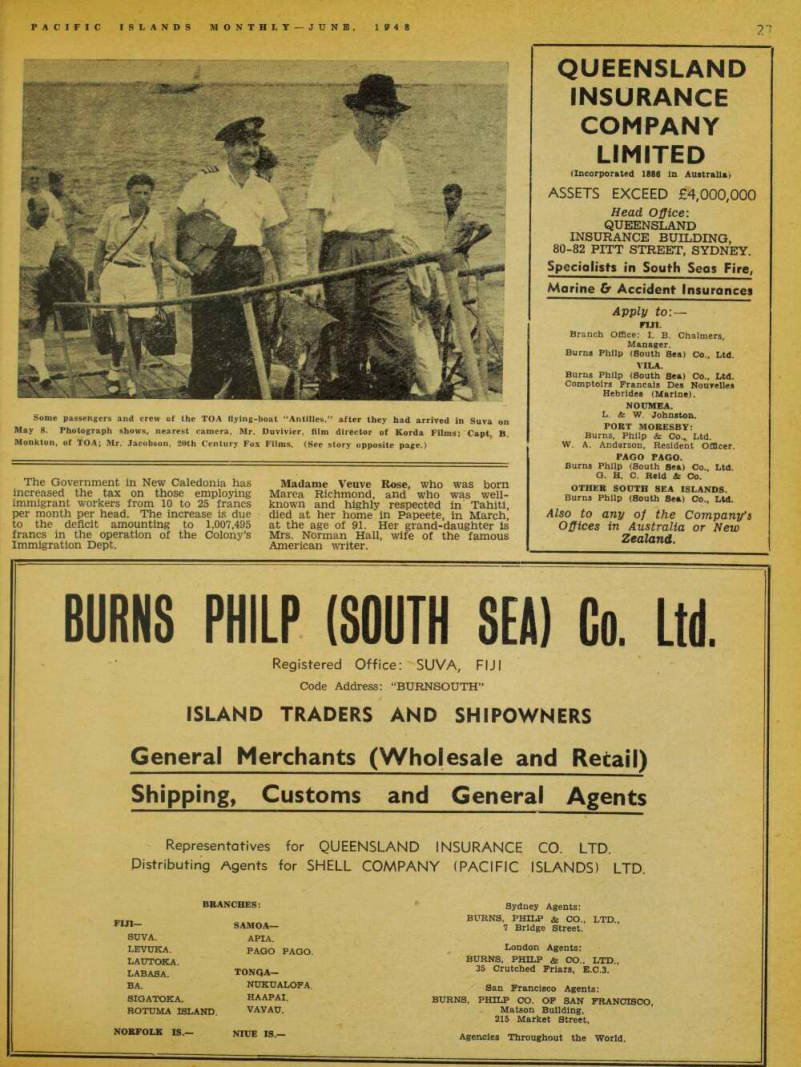
Passengers in Fiji Praise for Antilles Crew
From Our Own Correspondent
Suva, May 11.
AN adventure, but, at times, rather too much of a good thing, was the im pression which passengers in the Trans-Oceanic Airways Sunderland fly ing-boat “Antilles” gave when they ar rived at Laucala Bay, Fiji, on May 8 after an eventful flight from Tahiti by way of Samoa.
The general manager of the airline (Mr. B. W. Monkton), who was piloting the plane on the trip from Papeete to Apia, said that trouble occurred first in one engine, but the plane was able to continue quite comfortably on the re maining three. A second engine, how ever, showed signs of giving trouble and he decided to alight on the water near Tau Island, 75 miles from Pago Pago and 150 miles from the seaplane base near Ania. rather than cross the long ocean stretch to Western Samoa.
The passengers were landed on Tau in a longboat and after a stiff climb reached the house of the only Europeans at the island, Mr. and Mrs. Anderson.
Mr. Anderson is a former pharmacist’s mate in the United States Navy.
They were hospitably welcomed and next morning set off for Apia in an American patrol boat which had been sent from Pago Pago.
The American vessel stopped about eignt miles shore of the Upolu coast near .Apia, and the passengers again trans ferred to a launch, which towed a dinghy for the luggage, and ultimately arrived at Apia alter midnight.
The High Commissioner for Western Samoa (Lieutenant-Colonel F. W.
Voelcker) who was one of the passengers, provided accommodation at his official residence, Vailima, for the whole party.
In the meantime the flying-boat had been repaired at Tau, and next day it arrived in Apia, leaving for Suva on the following day. mHE passengers all gave the highest praise to Mr. Monkton’s skilful handling of the plane and said that complete confidence in the crew resulted in the absence of any suggestion of panic in the plane at any time.
The Sunderland’s flight to Tahiti was made primarily (as reported in the April “PIM”) to pick up a London Film unit of Sir Alexander Korda’s organisation which had been in Tahiti for a month making preliminary investigations for the filming in colour of Pierre Loti’s “Mar riage of Loti.”
There seems to have been a hold-up due to the fact that it has been impos sible to arrange for the exposed negative to be sent to California at regular inter vals—and colour film, it is said, has to be processed within 14 days.
This, incidentally, was one reason why the “Blue Lagoon” people worked in the Yasawa Group of Fiji. It was within fairly easy reach of Nadi airport and pro gress reports on the processed film from London were received throughout the unit’s stay in the islands. (See Photo., next Page.) The “Sagittaire,” which reached Papeete on April 23. landed 100 soldiers from Prance to reinforce the local garrison The move was considered necessary by the need to maintain order following recent incidents.
The Government in New Caledonia has increased the tax on those employing immigrant workers from 10 to 25 francs per month per head. The increase is due to the deficit amounting to 1,007,495 francs in the operation of the Colony’s Immigration Dept.
Madame Veuve Rose, who was born Marea Richmond, and who was well known and highly respected in Tahiti, died at her home in Papeete, in March, at the age of 91. Her grand-daughter is Mrs. Norman Hall, wife of the famous American writer.
Some passengers and crew of the TOA flying-boat “Antilles,” after they had arrived in Suva on May 8. Photograph shows, nearest camera, Mr. Duvivier, film director of Korda Films; Capt. B.
Monkton, of TOA; Mr. Jacobson, 20th Century Fox Films. (See story opposite page.)
Advertisements & other items, pp. 29-30 (1 item)
Borns Philp (South Sea) Co. Ltd.
QUEENSLAND
INSURANCE
COMPANY
LIMITED
(Incorporated 1886 In Australia*
ASSETS EXCEED £4,000,000
Head Office :
QUEENSLAND
INSURANCE BUILDING,
80-82 PITT STREET, SYDNEY.
Specialists in South Seas Fire,
Marine Cr Accident Insurances
Apply to:
FIJI.
Branch Office: I. B. Chalmers, Manager.
Burns Phllp (South Sea) Co., Ltd.
VILA.
Burns Phllp (South Sea) Co., Ltd.
Comptolrs Francals Des Nouvelles Hebrides (Marine).
NOUMEA.
L. & W. Johnston.
PORT MORESBY:
Burns, Phllp & Co., Ltd.
W. A. Anderson, Resident Officer.
PAGO PAGO.
Burns Phllp (South Sea) Co., Ltd.
G. H. C. Reid <fc Co.
OTHER SOUTH SEA ISLANDS.
Burns Phllp (South Sea) Co., Ltd.
Also to any of the Company's Offices in Australia or Hew
Zealand.
BORNS PHILP (SOUTH SEA) Co. Ltd.
ISLAND TRADERS AND SHIPOWNERS
General Merchants (Wholesale and Retail)
Shipping, Customs and General Agents
Representatives for QUEENSLAND INSURANCE CO. LTD.
Distributing Agents for SHELL COMPANY (PACIFIC ISLANDS) LTD.
Registered Office: SUVA, FIJI
Code Address: “BURNSOUTH”
BRANCHES:
Sydney Agents:
BURNS, PHILP & CO., LTD.,
7 Bridge Street.
FIJI-
SUVA.
LEVUKA.
LAUTOKA.
LABASA.
BA.
SIGATOKA.
ROTUMA ISLAND.
SAMOA—
APIA.
PAGO PAGO.
TONQA—
NUKUALOFA,
HAAPAI.
VAVAU.
San Francisco Agents:
BURNS, PHILP CO. OP SAN FRANCISCO,
Matson Building, 215 Market Street, London Agents:
BURNS, PHILP & CO., LTD.,
35 Crutched Friars, E.C.3.
NORFOLK IS.—
NIUE IS
Agencies Throughout the World.
GEORGE J. LOCKYER & COMPANY
CONSULTING ENGINEERS DOCKYARD MACHINERY
In association with GEORGE J. LOCKYER (For East) & CO. end GEORGE J. LOCKYER (Overseas) & CO.
ENGINEERING SUPPLIES, GENERAL HARDWARE EXPORTERS AND MERCHANTS Agents for the Finest Australian Liquors Aerated Water and Cordial Manufacturing Machinery, Bottling and Capping Machinery, etc.
TRACTOR TRACKS AND SPROCKETS.
CRAWLER TRACTORS.
HEAVY DUTY TRAILERS.
LIGHT TRAILERS.
ROADMAKING EQUIPMENT.
FORK LIFT TRUCKS.
MOBILE CRANES.
CRANES AND EXCAVATORS.
DIRECT COUPLED PUMP UNITS.
AIR COMPRESSORS.
COLD ROOMS.
REFRIGERATION AND ICE-MAKING
MACHINERY:
Cold Rooms, Ice Showers, Commercial Refrigerators in all sizes.
Complete Ice-Making Machinery.
POWER HOUSE;
Murphy 6-Cylinder Diesel Engine, Model M.E. 650, Engine No. 103188, 160 h.p., at 1,200 revs., direct coupled to E.M. Synchronous A.C. Generator, 60 cycle, 1,200 r.p.m., 106 K.W., 132.5 K.V.A., 127-220 volt, 348 amps, 3 phase, or 50 cycle, 1,000 r.p.m., 95 K.W., 118.7‘K.V.A., 230-400 volts, 172 amps, 3 phase. Generator fitted with E.M.
Synchrostat voltage regulator, lub. oil heat indicator broken, no Vqe belts on blower drive, no engine ampmeter; radiator and fan are available for this unit; engine fitted with electric starting.
All material available for immediate export.
Ruston 4-Cylinder Diesel Engine, 120 h.p., Size 4, Class C.V.R., Engine No. K 82631, direct coupled to Lawrence & Scott & Electromotor, Ltd., A.C. Generator, 80 K.W., volts 415 r.p.m. 300, 50 cycles, 3 phase, stator amps 140, exciter amps 25.4, rating cont., exciter volts.
Ruston 4-Cylinder Diesel Engine, 120 h.p., Size 4, Class C.V.R., Engine No. 182630, direct coupled to Lawrence Scott & Electromotor, Ltd., A.C. Generator, 80 K.W., 415 volts, 3 phase.
Lister 4-Cylinder Diesel Engine, 38 h.p., at 1,000 r.p.m., Engine No. 60/359, Spec. 38/4/31, direct coupled to A.S.E.A. A.C.
Generator, K.V.A. 25, volts 415, amps 35, cycles 50, 3 phase, rating continuous; Type G.A. 23, No. 399334, exciter volts 110, exciter amps 5, engine has hand starting; unit is complete.
Switch Board, fitted with: Rotary Synchroniser, Frequency Meter, 2 Voltmeters 500 volts, Ampmeter 20 amps., 3 Ampmeters 50 amps, 2 Ampmeters 150 amps (one has no pointer), 2 Ampmeters 200 amps., Ampmeter 250 amps, Ampmeter 300 amps, Ampmeter 400 amps, 2 Kilowatt Meters 12 0.K.W., Power Factor Meter, Frequency Meter, 44 to 56 cycles per second, and necessary Line Switches.
Overhead Running Gantry, fitted with 5-ton chain block.
Inside Fuel Service Tanks. • Outside Supply Tanks, approx. 400 galls, each, engine cooling system is comprised of 3,000 gall. galv. iron tank with sprays, spraying into pond; both Rustons and Lister are equipped with mufflers, but the Murphy has open exhausts.
• LAUNDRY EQUIPMENT:
Boilers, Washers, Tumblers, Water Pumps.
• NAUTICAL EQUIPMENT:
Buoys, Anchor Cable Chain, Sea Mules, Chrysler Marine Engines, Grey Marine Engines, Dock Cubes, Jewellery, Propeller Shafting, etc.
BAKERY EQUIPMENT:
Bakers’ Oil Burning Stoves, Dough Mixers.
9 METAL TUBING:
Galvanised, Black, Brass,, Copper and Steel.
• ELECTRICAL EQUIPMENT:
Generating Sets, Electric Motors, Refrigerating Units, Cool Rooms, Electric Light Turpentine Poles, Power Cable.
• HEAVY EQUIPMENT:
Stone Crushing Plants, Concrete Mixers, Air Compressors, Light and Heavy Trailers, Graders, Front End Loaders, Direct Coupled Pumps, Shovels, Booms, etc., Power Units Steam Boilers, Dump Waggons, Barber Green Ditchers, Rooters, Athey Waggons, Dozer Parts, etc.
EXACT REPLICA OF CANE KNIFE,
MADE IN AUSTRALIA.
The Largest Suppliers of Cane Knives in the World.
Photographs, Drawings. Schedules, will be Supplied by Return Mail to Genuine Clients.
HEAD OFFICE, 24 BOND ST. SYDNEY, N.S.W. 'Phones: UX6BOI, UA7196, BW6OIB All communications to be addressed to The General Manager, G.P.0., Box 4553, Sydney.
Bankers: Commonwealth Bank of Australia, Sydney.
Also Bank of N.S.W., Sydney.
Telegraphic and Cable Address: “LOCKMACH,” Sydney.
Sir Peter Buck Remains
A British Citizen
THERE have been persistent rumours of late throughout Maoridom that Sir Peter H. Buck (Te Rangihiroa), upon whom was conferred a knighthood in the Birthday Honours List of 1946, has become an American citizen (said Wellington, NZ, “Evening Post” in May).
While it has not been ventilated in the New Zealand press, the “Pacific islands Monthly” (a Sydney journal with a wide Pacific circulation) made mention of it in a recent issue.
New Zealand friends were surprised at this persistent report, and could not be lieve that Sir Peter, having accepted an honour from the King, (one that placed him in the same category as the late Sir James Carroll, as KCMG) would have relinquished his British citizenship.
However, it can be stated that Sir Peter is still a British citizen and intends to remain one. In an air-mail letter to hand he writes: “I had jdecided to re main a British subject before the knight hood was conferred upon me, and I pro pose to remain a British subject until the end of the chapter ... In spite of the evil days before the British Empire, there is something about the flag that stirs up the memories of one’s youth and training, and gives one a thrill of pride to belong to it.
“With regard to this matter of Ameri can citizenship you have my authority to say that it is definitely abandoned by me,” Sir Peter continued, “and that any rumours to the contrary are incorrect.”
Recapitulating the history of the move to make him a citizen of the United States, Sir Peter stated that he could not become one under the exist ing law, as an applicant had to be of more than 50 per cent. Caucasian extraction.
Despite the evidence of anthropologists to the contrary the Polynesians, he says, are still classed as Orientals. As Sir Peter is half Irish and half Maori he could, therefore, claim only 50 per cent.
Caucasian extraction.
Some friends, however, introduced the question in the Legislature of Hawaii.
That House passed a resolution asking Congress to admit him to American citizenship by a special Act of Congress.
The United States Attorney-General, however, reported unfavourably on the Bill, as President Roosevelt was opposed to special acts except under exceptional circumstances.
“Nevertheless, the Committee of the House of Representatives regarded my case as being exceptional and voted for it, but the bill evidently was lost in the mazes of the Senate and went no further.
However, I felt that I had made my gesture of appreciation to the United States, and I asked the Delegate to Con gress from Hawaii to drop the whole matter.
“I agreed with the late President, and like him held that a more comprehensive Act should be passed to admit Samoans and other Polynesians to American citizenship. Under the present Act the Samoans in American Samoa cannot be come American citizens. A Bill is now being brought before Congress to allow people of the Pacific to qualify. How ever, I had decided before the knighthood was conferred upon me to remain a British subject to the end of the chapter.”
Sir Peter’s statement is corroborated by earlier correspondence. He once de clared: “I was bom a British subject and intend to die a British subject!” The move to make him an American citizen took place during the war years, and did not progress beyond the Senate. It has not been revived since then. Sir peter however, would be the first to acknow ledge the great debt he owes to the
American people, who gave him not only the directorship of the Bernice P. Bishop Museum in Honolulu, and a Chair at Yale University, but also opportunities for research in the various fields in the Pacific, that would never have come his way if he had remained a public servant in New Zealand.
Sir Peter and Lady Buck are due in Auckland by the “Aorangi” in January.
The former will attend the Pan-Pacific Science Congress in Auckland and Christchurch, and together they will sub sequently tour the Dominion. This will be their first visit to New Zealand since 1935.
Advertisements & other items, p. 31 (1 item)
Tnc Garrick Hotel
m
For OLD Kitchens and New
You don't have to wait until you're building a new home to enjoy the advantages of a Wunderlich Stainless Steel Sink Unit . . . you can replace the outworn sink in your present home at once with a satin smooth hygienic unit, for stocks are available now.
I '6 of Made in standard lengths of 4 ft., 5 ft. and 6 ft. by wide the Wunderlich Unit is sturdily constructed Stainless Steel and is easy to instal.
Ask your local Hardware Merchant, 'phone MX 2411 write to Box 474, G.P.O. Sydney, for further details prices.
derticfv
INK, UNITS
IN STAINLESS STEEL
. or and
Tnc Garrick Hotel
v --H'-'ife
H ft
SUVA
FIJI
This well-known Hotel is centrally situated in Suva's main business quarter :: Modern accommodation provides comfort in all climatic conditions Only the best of Beers, Spirits and Wines is served Telephone: 80. VINCE COSTELLO, Proprietor.
Australia Has Nothing To
Fear From Islanders
From Our Own Correspondent
Suva, May 9.
THE uproar created by Australia’s Mr.
A. A. Cal well over the Maori ban, plus the instruction given to a high born Tongan lady married to a European, to move out of Australia, with her daughters, by September, has been fol lowed with intense interest in Fiji.
Fiji could have told Mr. Calwell that Polynesians, whether from New Zealand or elsewhere, are not at all likely to up set the White Australia policy at any time. Headaches of that sort would be
caused only by Asiatics, with their time honoured practice of squeezing in, taking possession as far as possible, increasing at a staggering rate, and then starting to squeeze other people out.
Mr. Cal well, as well as any other Aus tralians interested, should take a look at Fiji, some time.
Dr. Edouard Caillard, of New Cale donia, has been decorated with the Ameri can Liberty Medal with palm, for hazard ous work accomplished during the war in Europe. He is credited with having assisted in the escape of 87 Allied air men, whom he transported, sheltered and cared for.
Search for G. & E.
Capital Still Goes On
AFTER 31 years as engineer at the Cable Station on Fanning Island, Mr. C. W. Brent, with his wife and child, had an interesting cruise lately through the Gilbert Islands, on his way to Suva.
Mr. Bren'tJ reports that the Gilbert and Ellice Administration is still un decided regarding its future headquarters.
At present Bairiki, an islet in Tarawa lagoon, is being used; but there are only 58 acres on Bairiki and the place is cramped and inconvenient.
As a result of the great battle there in 1944, Betio islet (in Tarawa, close to Bairiki) is a wilderness; and it is un likely that that islet will be regarded now as offering any possibilities. Practically all the palms on Betio were destroyed, but young palms are now springing up gener ally. There are only a few natives there.
Building materials are being brought to Betio from other islands. There is a large quantity of American machinery lighting plants, road graders, cranes, lorries, and so forth—lying near the old wharf on Betio. This stuff was bought from the Americans by the G. and E.
Government, and there is a small work shop staff there trying to keep it in con dition. It should be useful and valuable, some day.
The cancellation of the plan to use Abemama atoll as headquarters came about when it was found that Abemama lagoon is not deep enough for the ships that are likely to maintain communica tions in the future.
It was believed in the Gilbert Islands that some decision might be reached when Mr. Maude (Resident Commissioner) returns from his long leave.
MR. BRENT said he left Fanning Island with regret. The community there is very isolated—but it is a contented and peaceful place. There is a staff of 10 Europeans, with their families, on the Cable Station, and they have 21 Chinese assistants—artisans, me chanics. servants, etc. There are very large coconut plantations on Fanning, owned by Burns Philp interests, and the plantations are looked after by a Euro pean manager with about 80 Gilbertese labourers. Their headquarters are 5 miles away, across the lagoon, from the Cable Station. The G. and E. Adminis tration is eager to buy the Fanning Island plantations, with a view to the settlement there of a section of the sur plus population of the Gilbert Islands; but Government and Burns Philp have not been able to agree on a price.
Mr. Brent’s ship made a call at some of the Phoenix Islands, whereon the G. and E. Government during the past 10 years has settled some thousands of Gilbertese (the Phoenix atolls previously were uninhabited). Mr. Brent got the impression that the Gilbertese are happy and prosperous in their new home.
Make Cargo-Handling
Fijian Wharf Labourers
Records
Suva. May 22.
rE waterfront system . favoured in Australia and New Zealand has. not been adopted by Suva’s Fijian wharf-labourers. On three occasions lately cargo has been handled in Suva at the rate of 800 tons a day. In the case of the ship “Wairata,” the rate was nearly 1,300 tons a day.
Advertisements & other items, pp. 32-34 (2 items)
Swallow & Ariell
in ■Km: * m m m M m mm St ■^smm
LIMITED
S3»i« 3 Master Craftsmen in the Biscuit Industry since 1854
NEW Mthiloil
GIVES..
• A CLEANER ENGINE
• PERFECT LUBRICATION
• LONGER ENGINE LIFE
• IMPROVED PERFORMANCE
• QUICKER STARTING
• COMPLETE PROTECTION AT
ALL SPEEDS & TEMPERATURES
KEEP YOUR ENGINE
Mobiloil clean
WTY. LTD. (INC, IN AUST.)
M 4714 m\
VACUUM
ASK FOR Mobiloil -THE WORLD'S QUALITY OIL
•THAT A'
A Brief Word
on a
"‘ c ™ e " Serious Subject task of the private executor and trustee is thankless, onerous and never-ending. It is a tax upon time, happiness and contentment of mind. It is a task few men would undertake had they any fore-knowledge of its exacting
implications.
Burns Philp Trust Company Ltd. is a solidly financed organisation comprising officers and executives of the highest probity: thoroughly experienced in the administration of Estates and trusts When an estate is adminstered by this Company, the future of its affairs does not depend upon the fallible judgment of one or two people, but upon the co-operative judgment of a large group of highly qualified experts; men of wisdom, integrity and wide experience.
The capital and assets of Burns Philp Trust Company Limited are available as security for the protection of your beneficiaries.
It is suggested that you write for a copy of a booklet entitled , “Hands That JSever Leave the Wheel”—a publication which explains fully the facilities and serving available through Burns Philp Trust Company Ltd.
Burns Philp Trust
COMPANY LIMITED
EXECUTOR • TRUSTEE • AGENT
HEAD OFFICE: 7 BRIDGE STREET, SYDNEY
BOARD OF DIRECTORS:
James Burns Joseph Mitchell P. I. W. Black Frederick Ewen Loxton Eric Priestley Lee MANAGER: L. S. Parker SECRETARY: E. R Overton, A.F.i.A.
P. T. W. Black Tel. BU 5901 Box 543, G.P.0., Sydney
Japanese Goods Soon?
Hongkong Businessmen Allege US- Sponsored Dumping Abroad
RESIDENTS of the Pacific islands who once paid pence for trade cotton goods, where they now must pay shillings, will be interested in the outcry now being made by Chinese businessmen who allege that cheap Japanese goods are being dumped on world markets with US consent.
Fearful of the competition of cheaper Japanese labour, the businessmen have organised a widespread propaganda cam paign reaching to London, Washington and Chinese communities overseas.
Daily editorials and statements in the vernacular press lend support to the pro test.
Most vociferous are the organisations of textile manufacturers, who seek to en list the support of their associates in China, Malaya, the Netherlands East In dies and London.
Their chief target is the United States and SCAP, which have been accused of fostering Japanese “economic aggression” for selfish reasons to the detriment of Chinese trade. They charge that this will ultimately ruin Hongkong’s newly resurgent textile industry, and they have asked for the restoration of prewar re strictions against Japanese imports.
One recent statement said that General MacArthur “is doing his utmost to de velop Japanese industries by increasing spindles to a total of 10,000,000 and help ing the Japanese dump their goods abroad by allowing them to settle their accounts in sterling.
The 400,000,000 yards of cotton cloth and other manufactured products that Japan has in stock will, in no time, flood the markets in Asia and Africa. This, it is alleged will undoubtedly drive both China and Great Britain to industrial destruction. „ The acting-chairman of the Chinese Manufacturers’ Association, declared the Japanese are being assisted by the Ameri can occupation authorities through the provision of essential materials, trans port and other trade facilities, while cheap labour is an important factor. He said Japanese goods are being distributed throughout the world by barter arrange ments, as well as sales in*US dollars and sterling.
This feeling, however, is by no means unanimous. Manufacturers have been warned that it is up to them to meet Japanese competition by modernising their plant and reducing overhead costs “without making demands on the liveli hood of the workers.”
Meanwhile, imports of Japanese goods into Hongkong itself continue to flourish, mainly in the textile field. Imports which last year totalled H 570,000,000 (m) have in the first quarter of 1948 already reached $21,000,000 and are steadily climbing.
WHETHER or not Pacific residents support General Mac Arthur’s Jap anese reconstruction plan, in theory, in practice few, either native or European, can be found who do not re gret the cheap Japanese goods readily available in the Islands before the war.
N. Hebrides Cotton Co.
A PARIS financial newspaper says that it has been decided to transfer the registered office of the French cotton company, known as the Compagnie Cotonniere des Nouvelles Hebrides, to Port Vila, and to transform the paid up capital of 12,000,000 francs into Pacific francs.
The company owns about 10,000 hec tares in New Hebrides, of which only 1,200 hectares are in actual production, but shortage of labour prevents the open ing up of undeveloped land.
°than SbTSS!* hundred^ys
Not An Appeal By Catholic Church Move for Secondary School In Samoa Is Explained
Letter to the Editor IN your March issue, an article entitled “Too Many White Collar Aspirants” discusses certain aspects of our edu cational problems in Western Samoa.
As to the first part of the article, I do not wish to make any comment, either for or against. However, the exaggera tions and errors of your anonymous con tributor in reference to the Catholic Mission call for a statement of the facts.
At the present time, the Catholic Mis sion has no Secondary School in Samoa.
The only Catholic Mission school which approaches Secondary standard is the Commercial School, conducted by the Sisters in Apia. Furthermore, the Catholic Mission has not made any de mand from anybody for “a large sum for the maintenance” of such a school.
The statement, that the Catholic Mis sion “has been appealing to the Samoans to agree to pay a special tax of 10/- per annum for a Matai (chief) and 5/- for a Taulealea (commoner) to help the Catholic High School,” is false. No such appeal has been made by the Catholic Mission, either directly or indirectly.
The matter has not even been mentioned in our Samoan monthly paper. It has never been referred to from the Cathedral pulpit here in Apia, nor has there been any appeal made in any Catholic church in an outside district.
It is a fact that an appeal is being made at present by the Samoans them selves, but the Catholic Mission is in no way responsible for this appeal. The Samoans themselves launched it on their own initiative.
THE NZ Government has been provid ing scholarships for secondary edu cation in NZ, but the Samoans wished to have facilities for such educa tion available here in Samoa. There fore, in July of last year, they approached Brother Borgia, the provincial of the Marist Brothers, asking him to open a secondary school in Samoa.
The Hon. Fautua invited the Brother Provincial to go to Lepea to discuss the matter with representatives of all West ern Samoa who were at that time meet ing in Lepea. The Brother Provincial met the chiefs and agreed to the proposal, but stated that he could not undertake to provide the building as the Marist Brothers were already launching out on a building programme of additions to the present primary school, and also propos ing to rebuild their residence, a dilapi dated wooden building which has been their home for the past sixty years!
In reply to this statement the chiefs accepted the Brother Provincial’s offer and declared that they would help to finance the project—i.e., they would take steps to provide both school building and accommodation for the additional num ber of brothers which would be necessary.
His Lordship Bishop Darnand was in formed of the desire of the chiefs, and agreed to the acceptance of the new school by the Brother Provincial.
This is the sum total of the activity of the Catholic Mission in this matter: the acceptance by the Brother Provincial of the request, on the terms stated above, and the agreement of the Bishop.
The Samoans then conducted the ap peal on their own initiative. They dis cussed it among themselves and, at a meeting in November, decided on a levy of 10/- per Matai and 5/- per taulealea, for this one year. This was their own arrangement, in accord with their customs, and is entirely their respon sibility.
The proposed school, of course will be conducted on the lines always by the Brothers in Apia-te., open to
°than SbTSS!* hundred^ys
the whole of one of his broadcast speeches to c th< ; JJ p P ea lL ft ter P nf Rt r elision education. He reminded Samoa that it was hig Qwn fami i y which had receiyed LMS Missionaries in 1830— referring
to this fact to emphasise his statement that the School Appeal was not being made by any mission, but was an appeal by the Samoans for the welfare of Samoa.
Likewise, the Fono of Faipule, when they met after Easter, discussed this matter among themselves, as something which was their own affair. They even made arrangements with the Adminis tration to use the facilities of Radio 2AP to urge some districts to complete their collections as soon as possible.
IP you wonder why the Samoans have taken their request to the Marist Brothers I would merely suggest that it is because of the record of the Brothers in Samoa.
A very large proportion of both the local European and the Samoan em ployees of the Government and private business firms are Old Boys of the Marist Brothers’ School, as are a num ber of native Pastors of the Protestant
Missions in Samoa. The Hon. Fautua, and tour ox the five members of the new Legislative Council, are also Old Boys of the School. The Catholic Mission, through the Marist Brothers, gives them, by its educational record, the feeling of permanence and satisfactory service which they desire. !f your anonymous contributor had wished t° do so, he could have learned that the Catholic plan” exists only in his imagination. The Catholic Mission did not suggest it, nor has it taken any s J e P s to further it, beyond agreeing to staff the proposed school. The Catholic Mission has made no appeal, because this is a Samoan affair, not a Catholic one I am, etc.,
S. J. Bourke. Sm.
Apia, May 6, 1948.
Advertisements & other items, pp. 35-36 (1 item)
William Atkins p«y. Ltd.
"Your Yeast
has No Rival"
From MADIRI. Fly River, via Daru, Papua, comes the following Testimonial to MALTO-PEPTONE DRIED YEAST: “For the Tropics, your Yeast has no rival. We have found it entirely satisfactory and are very pleased we learned of it." (Sgd.) T.H.
MALTO-PEPTONE
DRIED YEAST
is 100% Pure Yeast. It has been on the Market for 12 years and is GUARANTEED to retain its vitality for months in ANY Climate. Ready for use in a matter of minutes, and users claim that, through its aid, they can Bake Bread In SVfe hours! Trial Size Carton (2 oz,) 1/7 — Va lb. 2/8 — V 2 lb. 4/gr—all Post Free. Send Stamps, Postal Note, Money Order or Cheque for a supply—NOW! !
AUSTRALIAN YEAST CO.
Oakleigh, Victoria—Australia.
William Atkins p«y. Ltd.
Head Office, 449-451 KENT ST., SYDNEY
Iron & Steel Merchants-Engineers' Supplies
ESTABLISHED OVER 50 YEARS
Cable Addreee: WTLATKTN, Sydney.
Coach & Motor Hardware
STEEL DEPARTMENT
MILD STEEL:
Rounds, Squares, Flats, Half-rounds, Hexagons, Bevel, Shoeing, Tyre, Angles, Tees, Sheets, Plates, Girder Plates, Chequer Plates, Channels, Hoops, Etc.
BRIGHT STEEL:
Rounds, Squares, Hexagons.
Extra Special High Speed Tool Steel, Mining Steel, Blister Steel and Spring Steel, Rounds, Flats & Squares.
Bar Iron—All sections and sizes.
Engineers' Supplies: Set Screws, Studs, Metal Thread Screws, Coach Screws, Files, Cotter Pins, Bright and Black Bolts, Rivets, Etc., Hack Saw Blades.
Power Transmission Gear: Including Plummer Blocks, Couplings, Collars, Etc.
Coach and Motor Hardware: Axles, Springs, Wheelstuff, Duck, Paints.
Farriers' Supplies: Horse Nails, Anvils, Vices, Etc.
Motor-Trimmers and Motor Builders' & Motor Painters' Requirements Pacific Island Agents : Corrie & Co., Suva, Fiji DUCO Lacquers and DULUX Enamels—FAßßEX Motor Toppings and Leather Cloths, House & Decorators' Paints, Varnishes & Brushwore.
Sole Distributors of CHAMPION'S Decorators Paint Products.
Distributing Agents for BROLITE Lacquers, SYNFLEX Enamels end "POLYGLOSS" Finish.
VETERINARY
INSTRUMENTS
For Sheep and Cattle can be
Supplied Immediately
EARMARKERS.
SPEYING INSTRUMENTS.
BULLRINGS.
FIRE BRANDS.
EMASCULATORS.
W. JNO. BAKER
PTY. LTD.
3 Hunter Street, Sydney, N.S.W., Australia
PRODUCING UNIFORM GOOD RESULTS SINCE 1868
9m
ALWAYS ASK FOR IT
BROOMFIELDS Ltd.
Suppliers of
Building Hardware
General Hardware
Ship Chandlery
Paint Materials
WRITE DIRECT TO
Broomfields Ltd.
152 SUSSEX STREET, SYDNEY
Sole Agents for: P. H. MUNTZ & CO.’s 3-CROWN BRAND METAL
SHEATHING.
PEACOCK & BUCHANS’ ENGLISH READY-
MIXED PAINTS.
"I
Suicide or Farming!
Frightful Alternatives for Fiji-Indian Schoolboy
From Our Own Correspondent A M T , SUVA. May 17 N Indian schoolboy recently wrote to the Fiji Education Department to say that if the Department did not admit him to the Teacher’s Training College (which is already jammed full) he was left with the choice between suicide and farming.
This letter was quoted by the acting Director of Education (Mr. F. R. J Davies) in an address to the annual con ference of the Fiji Teachers’ Union, an Indian organisation.
Mr. Davies’s address followed a speech by the president of the union (Mr. Hari Charan) who said that while there were 14,000 Indian children at school, there were 17,000 Indians of school age with out schooling.
Getting on to somewhat familiar ground, Mr. Charan said that more Indian schools, more teachers, and more scholarships and bursaries for training teachers overseas were required.
Mr. Davies advised the conference (of 200 Indian teachers) to remember Fiji’s economic facts. In 1948 the proposed expenditure on education amounted to more than £250,000, and he isaid he hoped that the teachers who were asking for higher pay would sd[sk themselves what they were doing to raise the earn ing capacity of the people who were paying their salaries.
He said that Indian children were sent to school not so much to obtain a liberal education as to enable them to get away from the land and take their places with “white-collar” employees.
Mr. Davies quoted the boy who bracketed suicide with (farming and added that Fiji could hold only a limited number of “white-collar” workers.
Children, he said, should be taught to want to do something useful. In Fiji the most useful thing to be done was the growing or processing of food.
Indians Jailed For
Housebreaking
VICTIMS of a recent outbreak of housebreaking in the Labasa dis trict were: The Rev. G. H. Strick land. Dr. M. McCauley and Messrs. E. O.
Sundin. C. Curry and Evans.
A police round-up has now resulted in the appearance of the ringleader and three other men (all Indians) in Court.
The ringleader was jailed for four and a half years; one man for four years; a third for one year. The fourth was acquitted. • * The articles stolen, mainly household goods, were recovered.
Advertisements & other items, pp. 37-38 (1 item)
Horlicks
m Whots wrong, Jill ?
Why don't you join in ?
U Con‘t be bothered C tired E
MY JILL-A DUO !
Jill was
always left
out of things until . . .
AT TH£ DOCTOR'S
You see, Mrs Dawson, in addition to all their running around in the day-time, children use up energy during sleep in breathing other automatic actions. and children are growing all the time. Naturally, * if this call on their energy reserve isn’t built up they soon become listless, easily tired and inclined to lose weight. Put your girl onto HORLICKS. and 35
SO - EVERY
ft/ErHT
BEFORE BEP...
m \ k> <2
HORLICKS
will do the
same for
YOUR
youngster.
No use trying to
force her, darling .
She's not herself these days I'd better see Dr. Carson to-morrow.
Jill, you can't leave the table until you've eaten every scrap! n r i Children adore that rich malty flavour of Horlicks. And every delicious mouthful helps to build them up. Put them onto Horlicks right away. Ask for it by name
HORLICKS
HORLICKS
gives YOU...
PROTEIN
carbohydrate
VITAMINS A. Bi, Bi. D
mineral SALTS
CALCIUM
FAT
* Made with milk
The complete
BALANCED food drink ■v Look of Jill !
She's won again & per v.. j CH7-*
PACIFIC ISLANDS SOCIETY
Visitors from the Islands to Sydney (or those Interested In Islands affairs), are advised to communicate with the honorary secretary of the above Society, which has been formed to study the history, traditions, economics, and political developments of the Pacific Islands.
Regular monthly meetings are held at History House, 8 Young Street, Sydney.
Address for Correspondence:
THE PACIFIC ISLANDS SOCIETY,
Box 2454 MM., G.P.0., Sydney.
Disabled Ship Repaired
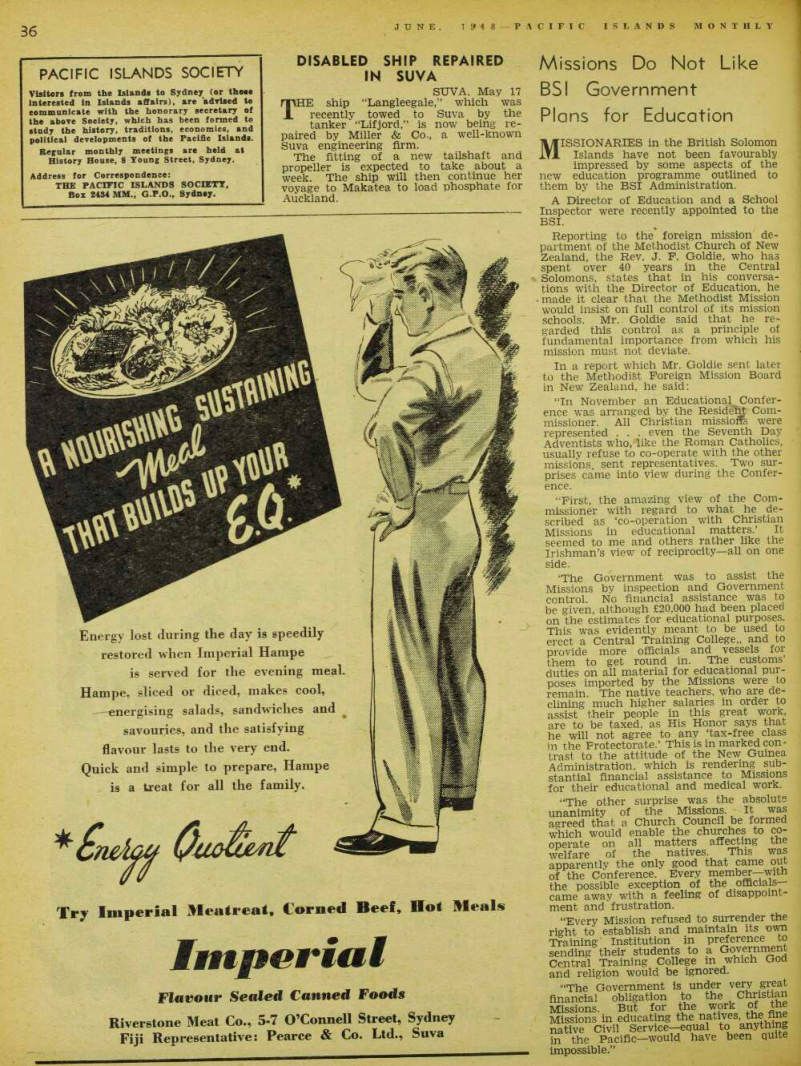
In Suva
Suva. May 17
THE ship “Langleegale,” which was recently towed to Suva by the tanker “Lifjord,” is now being re paired by Miller & Co., a well-known Suva engineering firm.
The fitting of a new tailshaft and propeller is expected to take about a week. The ship will then continue her voyage to Makatea to load phosphate for Auckland.
BSI Government
Missions Do Not Like BSI Government Plans for Education
MISSIONARIES in the British Solomon Islands have not been favourably impressed by some aspects of the new education programme outlined to them by the BSI Administration.
A Director of Education and a School Inspector were recently appointed to the
Bsi.
Reporting to the* foreign mission de partment of the Methodist Church of New Zealand, the Rev. J. F. Goldie, who has spent over 40 years in the Central Solomons, states that in his conversa tions with the Director of Education, he • made it clear that the Methodist Mission would insist on full control of its mission schools. Mr, Goldie said that he re garded this control as a principle of fundamental importance from which his mission must not deviate.
In a report which Mr. Goldie sent later to the Methodist Foreign Mission Board in New Zealand, he said: “In November an Educational Confer ence was arranged by the Resident Com missioner. All Christian missions were represented . . . even the Seventh Day Adventists who, like the Roman Catholics, usuallv refuse to co-operate with the other missions, sent representatives. Two sur prises came into view during the Confer ence.
“First, the amazing view of the Com missioner with regard to what he de scribed as ‘co-operation with Christian Missions in educational matters.’ It seemed to me and others rather like the Irishman’s view of reciprocity—all on one side. ‘The Government was to assist the Missions by inspection and Government control. No financial assistance was to be given, although £20,000 had been placed on the estimates for educational purposes.
This was evidently meant to be used to erect a Central Training College,, and to provide more officials and vessels for them to get round in. The customs’ duties on all material for educational pur poses imported by the Missions were to remain. The native teachers, who are de clining much higher salaries in order to assist their people in this great work, are to be taxed, as His Honor says that he will not agree to any ‘tax-free class in the Protectorate.’ This is in marked con trast to the attitude of the New Guinea Administration, which is rendering sub stantial financial assistance to Missions for their educational and medical work.
“The other surprise was the absolute unanimity of the Missions It was agreed that a Church Council be formed which would enable the churches to co operate on all matters affecting the welfare of the natives. This was apparently the only good that came out of the Conference. Every member—with the possible exception of the officials— came away with a feeling of disappoint ment and frustration.
“Every Mission refused to surrender the right to establish and maintain its own Training’ Institution in preference to sending their students to a Government Central Training College in which God and religion would be ignored.
“The Government is under very great financial obligation to the Christian Missions. But for the work of the Missions in educating the natives, the native Civil Service— equal to anything in the Pacific —would have been quite
impossible.”
Advertisements & other items, p. 38 (1 item)
Imperial
Energy lost during the day is speedily restored when Imperial Hampe is served for the evening meal.
Hampe, sliced or diced, makes cool, -energising salads, sandwiches and savouries, and the satisfying flavour lasts to the very end.
Quick and simple to prepare, Hampe is a treat for all the family.
Ouo&mt
« $ x Try Imperial Mealreal. Corned Beef, Hoi Meals
Imperial
Flavour Settled Canned Foods Riverstone Meat Co., 5-7 O’Connell Street, Sydney Fiji Representative: Pearce & Co. Ltd., Suva
Magazine Section
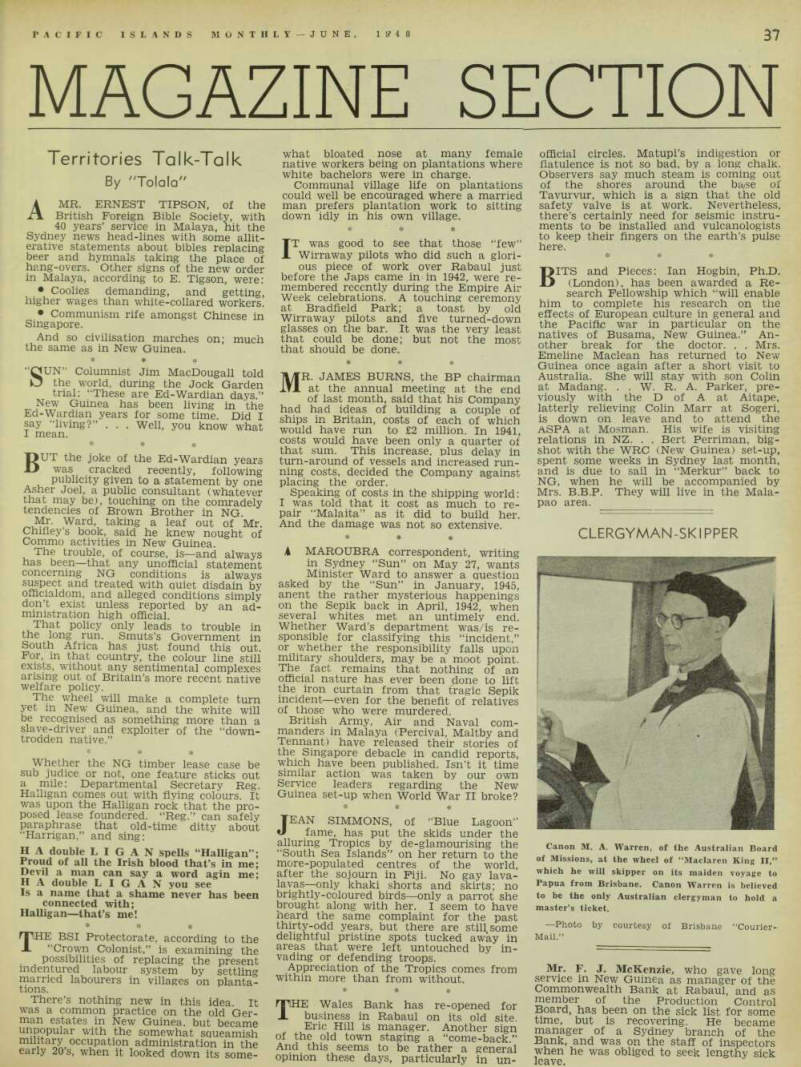
Territories Talk-Talk
By "Tolala"
Amr. Ernest Tipson, Of The
British Foreign Bible Society, with 40 years’ service in Malaya, hit the Sydney news head-lines with some allit erative statements about bibles replacing beer and hymnals taking the place of hang-overs. Other signs of the new order in Malaya, according to E. Tigson, were: • Coolies demanding, and getting, higher wages than white-collared workers. • Communism rife amongst Chinese in Singapore.
And so civilisation marches on; much the same as in New Guinea. * ♦ ♦ SUN” Columnist Jim MacDougall told the world, during the Jock Garden trial; “These are Ed-Wardian days.”
New Guinea has been living in the Ed-Wardian years for some time. Did I say “living?” . . . Well, you know what I mean. * * * BUT the joke of the Ed-Wardian years was cracked recently, following publicity given to a statement by one Asher Joel, a public consultant (whatever that may be), touching on the comradely tendencies of Brown Brother in NG.
Mr. Ward, taking a leaf out of Mr.
Chifley’s book, said he knew nought of Commo activities in New Guinea.
The trouble, of course, is—and always has been—that any unofficial statement concerning NG conditions is always suspect and treated with quiet disdain by officialdom, and alleged conditions simply don’t exist unless reported by an ad ministration high official.
That policy only leads to trouble in the long run. Smuts’s Government in South Africa has just found this out.
For, in that country, the colour line still exists, without any sentimental complexes arising out of Britain’s more recent native welfare policy.
The wheel will make a complete turn yet in New Guinea, and the white will be recognised as something more than a slave-driver and exploiter of the “down trodden native.” * * * Whether the NG timber lease case be sub judice or not, one feature sticks out a mile: Departmental Secretary Reg.
Halligan comes out with flying colours. It was upon the Halligan rock that the pro posed lease foundered. “Reg.” can safely paraphrase that old-time ditty about “Harrigan,” and sing: H A double L I G A N spells “Halligan”; Proud of all the Irish blood that’s in me; Devil a man can say a word agin me; H A double L I G A N you see Is a name that a shame never has been connected with; Halligan—that’s me! ♦ * * TIHE BSI Protectorate, according to the “Crown Colonist,” is examining the possibilities of replacing the present indentured labour system by settling married labourers in villages on planta tions.
There’s nothing new in this idea. It was a common practice on the old Ger man estates in New Guinea, but became unpopuiar with the somewhat squeamish military occupation administration in the early 20’s, when it looked down its some
what bloated nose at many female native workers being on plantations where white bachelors were in charge.
Communal village life on plantations could well be encouraged where a married man prefers plantation work to sitting down idly in his own village. * * * IT was good to see that those “few”
Wirraway pilots who did such a glori ous piece of work over Rabaul just before the Japs came in in 1942, were re membered recently during the Empire Air Week celebrations. A touching ceremony at Bradfield Park; a toast by old Wirraway pilots and five turned-down glasses on the bar. It was the very least that could be done; but not the most that should be done. * * * MR. JAMES BURNS, the BP chairman at the annual meeting at the end of last month, said that his Company had had ideas of building a couple of ships in Britain, costs of each of which would have run to £2 million. In 1941, costs would have been only a quarter of that sum. This increase, plus delay in turn-around of vessels and increased run ning costs, decided the Company against placing the order.
Speaking of costs in the shipping world: I was told that it cost as much to re pair “Malaita” as it did to build her.
And the damage was not so extensive. * * * i MAROUBRA correspondent, writing in Sydney “Sun” on May 27, wants Minister Ward to answer a question asked by the “Sun” in January, 1945, anent the rather mysterious happenings on the Sepik back in April, 1942, when several whites met an untimely end.
Whether Ward’s department was/is re sponsible for classifying this “incident,” or whether the responsibility falls upon military shoulders, may be a moot point.
The fact remains that nothing of an official nature has ever been done to lift the iron curtain from that tragic Sepik incident—even for the benefit of relatives of those who were murdered, British Army, Air and Naval com manders in Malaya (Percival, Maltby and Tennant) have released their stories of the Singapore debacle in candid reports, which have been published. Isn’t it time similar action was taken by our own Service leaders regarding the New Guinea set-up when World War II broke? * * * JEAN SIMMONS, of “Blue Lagoon” fame, has put the skids under the alluring Tropics by de-glamourising the “South Sea Islands” on her return to the more-populated centres of the world, after the sojourn in Fiji. No gay lava lavas —only khaki shorts and skirts; no brightly-coloured birds—only a parrot she brought along with her. I seem to have heard the same complaint for the past thirty-odd years, but there are still some delightful pristine spots tucked away in areas that were left untouched by in vading or defending troops.
Appreciation of the Tropics comes from within more than from without. * * * THE Wales Bank has re-opened for business in Rabaul on its old site.
Eric Hill is manager. Another sign of the old town staging a “come-back.”
And this seems to be rather a general opinion these days, particularly in un
official circles. Matupi’s indigestion or flatulence is not so bad, by a long chalk.
Observers say much steam is coming out of the shores around the base of Tavurvur, which is a sign that the old safety valve is at work. Nevertheless, there’s certainly need for seismic instru ments to be installed and vulcanologists to keep their fingers on the earth’s pulse here. ff * * BITS and Pieces: lan Hogbin, Ph.D, (London), has been awarded a Re search Fellowship which “will enable him to complete his research on the effects of European culture in general and the Pacific war in particular on the natives of Busama, New Guinea.” An other break for the doctor. . . Mrs.
Emeline Maclean has returned to New Guinea once again after a short visit to Australia. She will stay with son Colin at Madang. . . W. R. A. Parker, pre viously with the D of A at Aitape, latterly relieving Colin Marr at Sogeri, is down on leave and to attend the ASPA at Mosman. His wife is visiting relations in NZ. . . Bert Perriman, big shot with the WRC (New Guinea) set-up, spent some weeks in Sydney last month, and is due to sail in “Merkur” back to NG, when he will be accompanied by Mrs. 8.8. p. They will live in the Mala pao area.
Clergyman-Skipper
Mr. F. J. McKenzie, who gave long service in New Guinea as manager of the Commonwealth Bank at Rabaul, and as member of the Production Control Board, has been on the sick list for some time, but is recovering. He became manager of a Sydney branch of the Bank, and was on the staff of inspectors when he was obliged to seek lengthy sick leave.
Canon M. A. Warren, of the Australian Board of Missions, at the wheel of “Maclaren King II,” which he will skipper on its maiden voyage to Papua from Brisbane. Canon Warren is believed to be the only Australian clergyman to hold a master’s ticket. —Photo by courtesy of Brisbane “Courier- Mail.”
First Conference of the South Commission
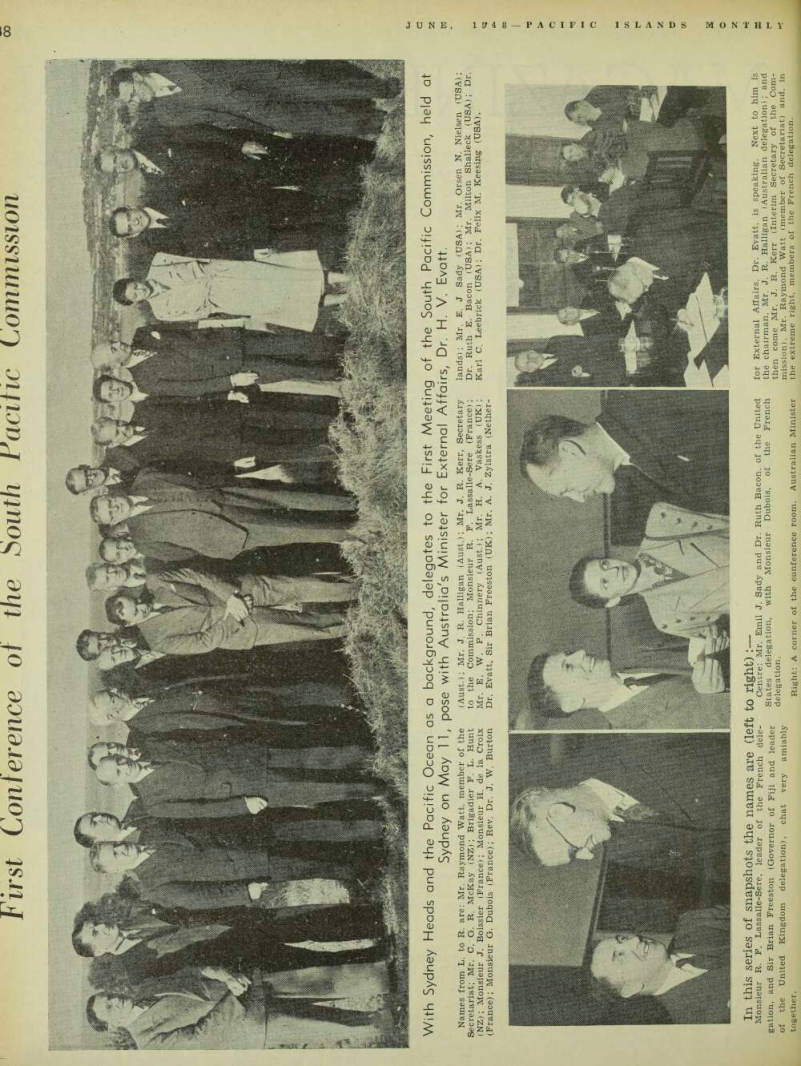
for External Affairs. Dr. Evatt, is speaking. Next to him is the chairman. Mr. J. R. Halligan (Australian delegation): and then come Mr. J. R. Kerr (Interim Secretary of the Com mission). Mr. Raymond Watt (member of Secretariat) and. in the extreme right, members of the French delegation.
In this series of snapshots the names are (left to right)
Centre: Mr. Emil J. Sa dy and Dr. Ruth Bacon, of the United States delegation, with Monsieur Dubois, of the French
delegation.
Right: A corner of the conference room. Australian Minister
Monsieur R. F. Lassalle-Sere. leader of the French dele gation, and Sir Brian Preeston (Governor of Fiji and leader of the United Kingdom delegation), chat very amiably
together.
With Sydney Heads and the Pacific Ocean as a background, delegates to the First Meeting o f the South Pacific Commission, held at Sydney on May 11, pose with Australia's Minister for External Affairs, Dr. H. V. Evatt.
lands); Mr. E. J Sady (USA); Mr. Orse n N. Nielsen (USA); Dr. Ruth E. Bacon (USA); Mr. Milton Shalleck (USA); Dr.
Karl C. Leebrick (USA); Dr. Felix M. Keesing (USA).
(Aust.): Mr. J R. Halligan (Aust.); Mr. J. R. Kerr, Secretary to the Commission: Monsieur R. F. Lassalle-Sere (France); Mr. E. W. P. Chinnery (Aust.); Mr. H. A. Vaskess (UK); Dr. Evatt, Sir Brian Freeston (UK); Mr. A. J. Zylstra (Nether-
Names from L. to R. are: Mr. Raymond Watt, member o f the Secretariat: Mr. C. G. R. McKay (NZ); Brigadier F. L. Hunt (NZ); Monsieur J. Boissier (France); Monsieur H. de la Croix (France); Monsieur G. Dubois (France); Rev. Dr. J. W. Burton
The Stephens Family of Urelapa
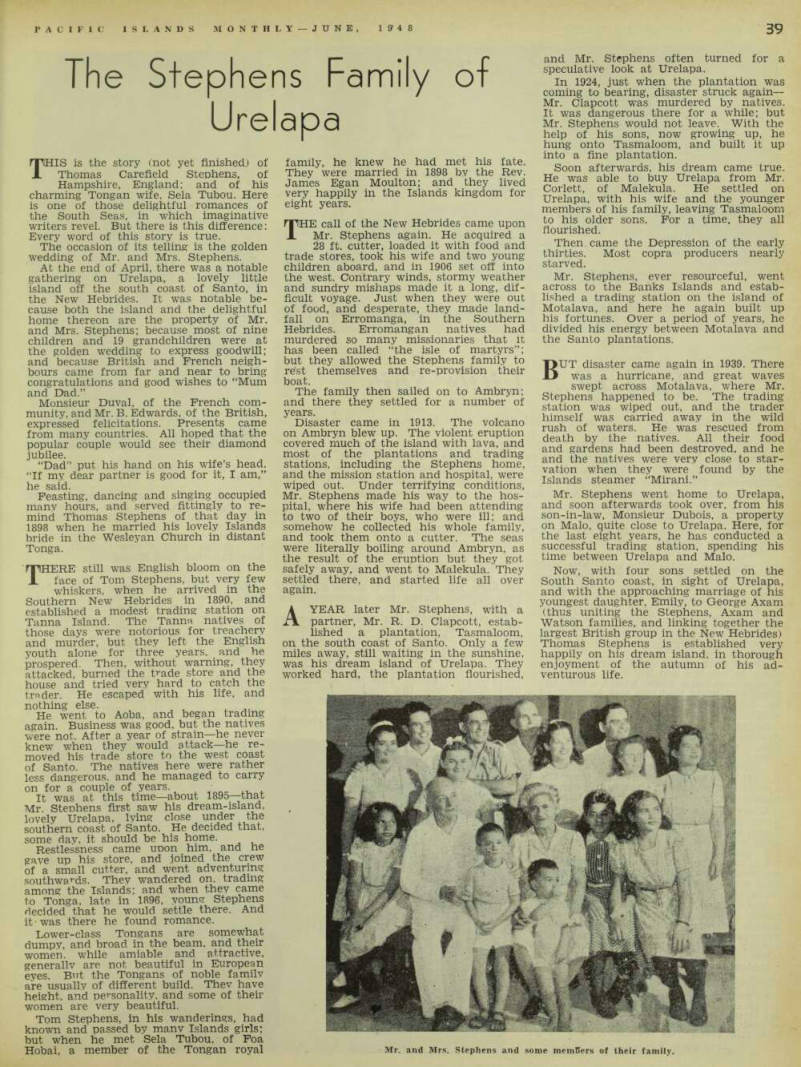
Urelapa
THIS is the story (not yet finished) of Thomas Carefield Stephens, of Hampshire, England: and of his charming Tongan wife, Sela Tubou. Here is one of those delightful romances of the South Seas, in which imaginative writers revel. But there is this difference: Every word of this story is true.
The occasion of its telling is the golden wedding of Mr. and Mrs. Stephens.
At the end of April, there was a notable gathering on Urelapa, a lovely little island off the south coast of Santo, in the New Hebrides. It was notable be cause both the island and the delightful home thereon are the property of Mr. and Mrs. Stephens; because most of nine children and 19 grandchildren were at the golden wedding to express goodwill; and because British and French neigh bours came from far and near to bring congratulations and good wishes to “Mum and Dad.”
Monsieur Duval, of the French com munity, and Mr. B. Edwards, of the British, expressed felicitations. Presents came from many countries. All hoped that the popular couple would see their diamond jubilee.
“Dad” put his hand on his wife’s head.
“If my dear partner is good for it, I am,” he said.
Feasting, dancing and singing occupied many hours, and served fittingly to re mind Thomas Stephens of that day in 1898 when he married his lovely Islands bride in the Wesleyan Church in distant Tonga.
THERE still was English bloom on the face of Tom Stephens, but very few whiskers, when he arrived in the Southern New Hebrides in 1890, and established a modest trading station on Tanna Island. The Tanna natives of those days were notorious for treachery and murder, but they left the English youth alone for three years, and he prospered. Then, without warning, they attacked, burned the Uade store and the house and tried very hard to catch the trader. He escaped with his life, and nothing else. .
He went to Aoba, and began trading again. Business was good, but the natives were not. After a year of strain—he never knew when they would attack —he re moved his trade store to the west coast of Santo. The natives here were rather less dangerous, and he managed to carry on for a couple of years.
It was at this time—about 1895—that Mr. Stephens first saw his dream-island, lovely Urelapa, lying close under the southern coast of Santo. He decided that, some day, it should be his home.
Restlessness came upon him, and he gave up his store, and joined the crew of a small cutter, and went adventuring southwards. They wandered on, trading among the Islands; and when they came to Tonga, late in 1896, young Stephens decided that he would settle there. And it • was there he found romance.
Lower-class Tongans are somewhat dumpy, and broad in the beam, and their women, while amiable and attractive, generally are not beautiful in European eyes. But the Tongans of noble family are usually of different build. Thev have height, and personality, and some of their women are very beautiful.
Tom Stephens, in his wanderings, had known and passed by many Islands girls; but when he met Sela Tubou, of Foa Hobai, a member of the Tongan royal
family, he knew he had met his fate.
They were married in 1898 by the Rev.
James Egan Moulton; and they lived very happily in the Islands kingdom for eight years.
THE call of the New Hebrides came upon Mr. Stephens again. He acquired a 28 ft. cutter, loaded it with food and trade stores, took his wife and two young children aboard, and in 1906 set off into the west. Contrary winds, stormy weather and sundry mishaps made it a long, dif ficult voyage. Just when they were out of food, and desperate, they made land fall on Erromanga, in the Southern Hebrides. Erromangan natives had murdered so many missionaries that it has been called “the isle of martyrs”; but they allowed the Stephens family to re'st themselves and re-provision their boat.
The family then sailed on to Ambryn; and there they settled for a number of years.
Disaster came in 1913. The volcano on Ambryn blew up. The violent eruption covered much of the island with lava, and most of the plantations and trading stations, including the Stephens home, and the mission station and hospital, were wiped out. Under terrifying conditions, Mr. Stephens made his way to the hos pital, where his wife had been attending to two of their boys, who were ill; and somehow he collected his whole family, and took them onto a cutter. The seas were literally boiling around Ambryn, as the result of the eruption but they got safely away, and went to Malekula. They settled there, and started life all over again.
A YEAR later Mr. Stephens, with a partner, Mr. R. D. Clapcott, estab lished a plantation, Tasmaloom, on the south coast of Santo. Only a few miles away, still waiting in the sunshine, was his dream island of Urelapa. They worked hard, the plantation flourished,
and Mr. Stephens often turned for a speculative look at Urelapa.
In 1924, just when the plantation was coming to bearing, disaster struck again— Mr. Clapcott was murdered by natives.
It was dangerous there for a while; taut Mr. Stephens would not leave. With the help of his sons, now growing up, he hung onto Tasmaloom, and built it up into a fine plantation.
Soon afterwards, his dream came true.
He was able to buy Urelapa from Mr.
Corlett, of Malekula. He settled on Urelapa, with his wife and the younger members of his family, leaving Tasmaloom to his older sons. For a time, they all flourished.
Then came the Depression of the early thirties. Most copra producers nearly starved.
Mr. Stephens, ever resourceful, went across to the Banks Islands and estab lished a trading station on the island of Motalava, and here he again built up his fortunes. Over a period of years, he divided his energy between Motalava and the Santo plantations.
BUT disaster came again in 1939. There was a hurricane, and great waves swept across Motalava, where Mr.
Stephens happened to be. The trading station was wiped out. and the trader himself was carried away in the wild rush of waters. He was rescued from death by the natives. All their food and gardens had been destroyed, and he and the natives were very close to star vation when they were found by the Islands steamer “Mirani.”
Mr. Stephens went home to Urelapa, and soon afterwards took over, from his son-in-law, Monsieur Dubois, a property on Malo, quite close to Urelapa. Here, for the last eight years, he has conducted a successful trading station, spending his time between Urelapa and Malo.
Now, with four sons settled on the South Santo coast, in sight of Urelapa, and with the approaching marriage of his youngest daughter, Emily, to George Axam (thus uniting the Stephens, Axam and Watson families, and linking together the largest British group in the New Hebrides) Thomas Stephens is established very happily on his dream island, in thorough enjoyment of the autumn of his ad venturous life.
Mr and Mrs. Stephens and some members of their family.
Tale of a Little Ship
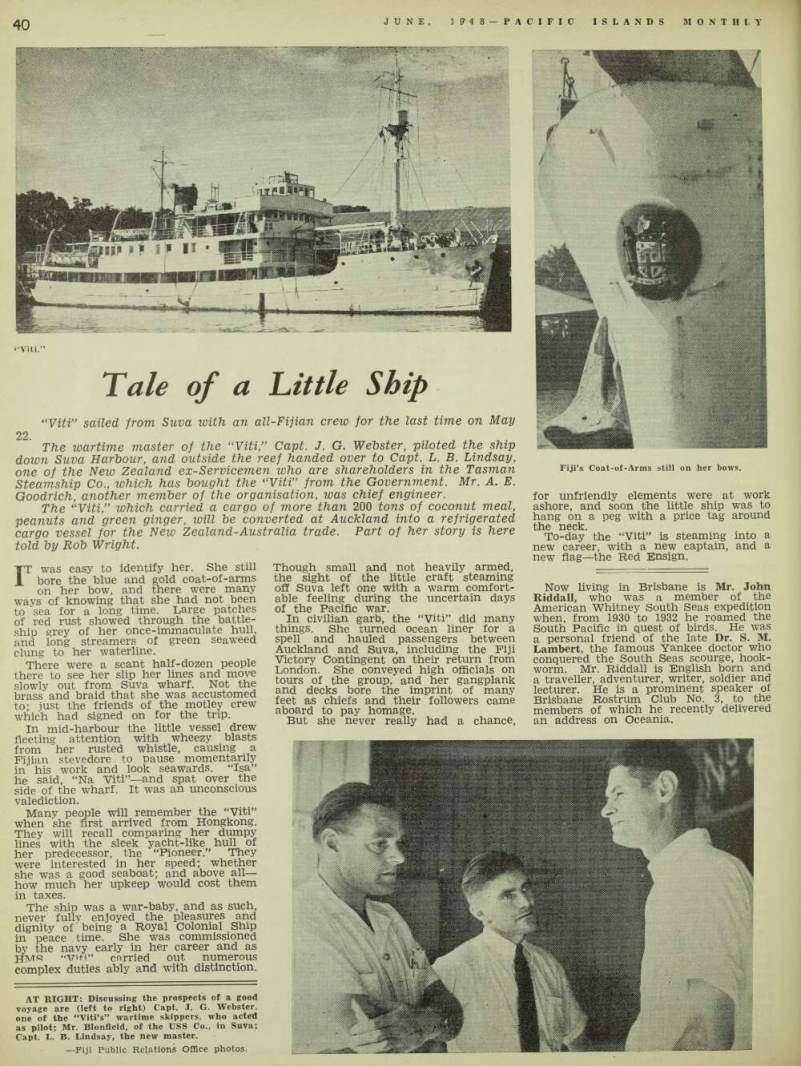
“Viti” sailed -from Suva with an all-Fijian crew for the last time on May 22 The wartime master of the “Viti” Capt. J. G. Webster, piloted the ship down Suva Harbour, and outside the reef handed over to Capt. L. B. Lindsay, one of the Neiv Zealand ex-Servicemen ivho are shareholders in the Tasman Steamship Co., which has bought the “Viti” from the Government. Mr. A. E.
Goodrich, another member of the organisation, was chief engineer.
The “Viti,” which carried a cargo of more than 200 tons of coconut meal, peanuts and green ginger, will be converted at Auckland into a refrigerated cargo vessel for the Hew Zealand-Australia trade. Part of her story is here told by Rob Wright.
IT was easy to identify her. She still bore the blue and gold coat-of-arms on her bow, and there were many ways of knowing that she had not been to sea for a long time. Large patches of red rust showed through the battle ship grey of her once-immaculate hull, and long streamers of green seaweed clung to her waterline.
There were a scant half-dozen people there to see her slip her lines and move slowly out from Suva wharf. Not the brass and braid that she was accustomed to; just the friends of the motley crew which had signed on for the trip.
In mid-harbour the little vessel drew fleeting attention with wheezy blasts from her rusted whistle, causing a Fijian stevedore to Pause momentarily in his work and look seawards. “Isa” he said, “Na Viti”—and spat over the side of the wharf. It was an unconscious valediction.
Many people will remember the “Viti” when she first arrived from Hongkong.
They will recall comparing her dumpy lines with the sleek yacht-like hull of her predecessor, the “Pioneer.” They were interested in her speed; whether she was a good seaboat; and above all— how much her upkeep would cost them in taxes.
The ship was a war-baby, and as such, never fullv enjoyed the pleasures and dignity of being a Royal Colonial Ship in peace time. She was commissioned by the navy early in her career and as HM« “Viti” carried out numerous complex duties ably and with distinction.
Though small and not heavily armed, the sight of the little craft steaming off Suva left one with a warm comfort able feeling during the uncertain days of the Pacific war.
In civilian garb, the “Viti” did many things. She turned ocean liner for a spell and hauled passengers between Auckland and Suva, including the Fiji Victory Contingent on their return from London. She conveyed high officials on tours of the group, and her gangplank and decks bore the imprint of many feet as chiefs and their followers came aboard to pay homage.
But she never really had a chance,
for unfriendly elements were at work ashore, and soon the little ship was to hang on a peg with a price tag around the neck To-day’ the “Viti” is steaming into a new career, with a new captain, and a new flag—the Red Ensign.
Now living in Brisbane is Mr. John Riddall, who was a member of the American Whitney South Seas expedition when, from 1930 to 1932 he roamed the South Pacific in quest of birds. He was a personal friend of the late Dr. S. M.
Lambert, the famous Yankee doctor who conquered the South Seas scourge, hook worm. Mr. Riddall is English born and a traveller, adventurer, writer, soldier and lecturer. He is a prominent speaker of Brisbane Rostrum Club No. 3, to the members of which he recently delivered an address on Oceania.
"viti."
AT RIGHT: Discussing the prospects of a good voyage are (left to right) Capt. J. G. Webster, one of the “Viti’s” wartime skippers, who acted as pilot; Mr. Blonfleld, of the USS Co., in Suva; Capt, L. B. Lindsay, the new master. —Fiji Public Relations Office photos.
Fiji’s Coat-of-Arms still on her bows.
Tropicalities
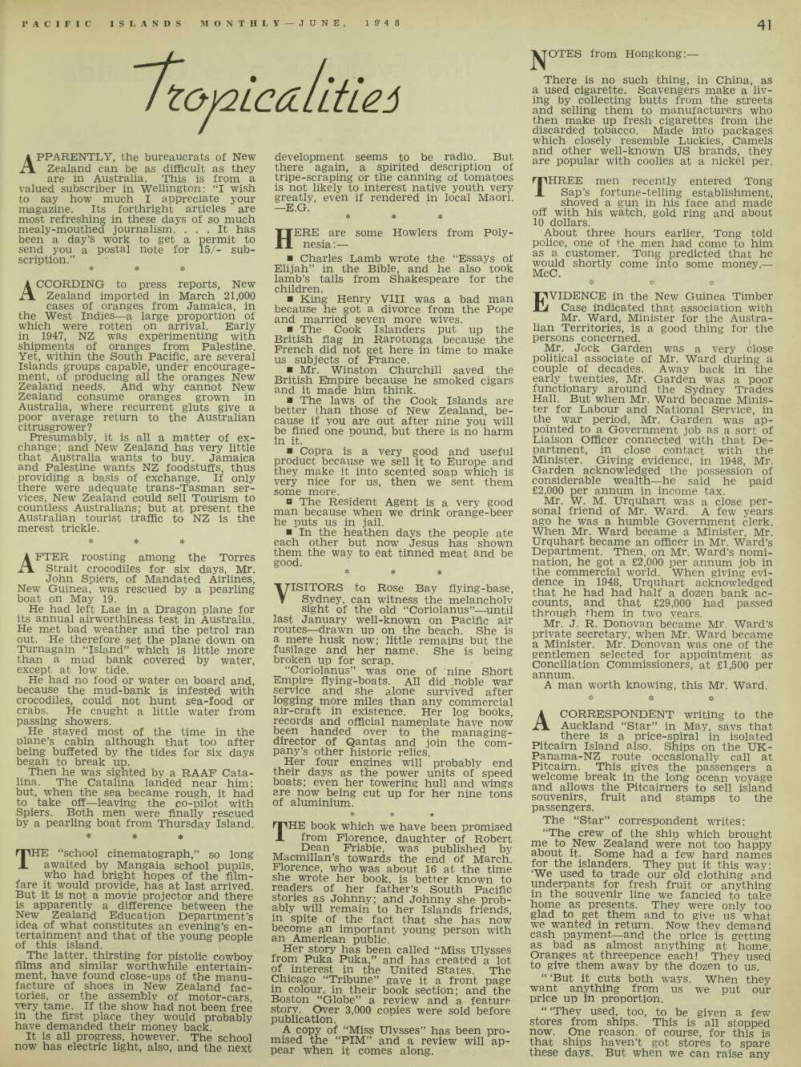
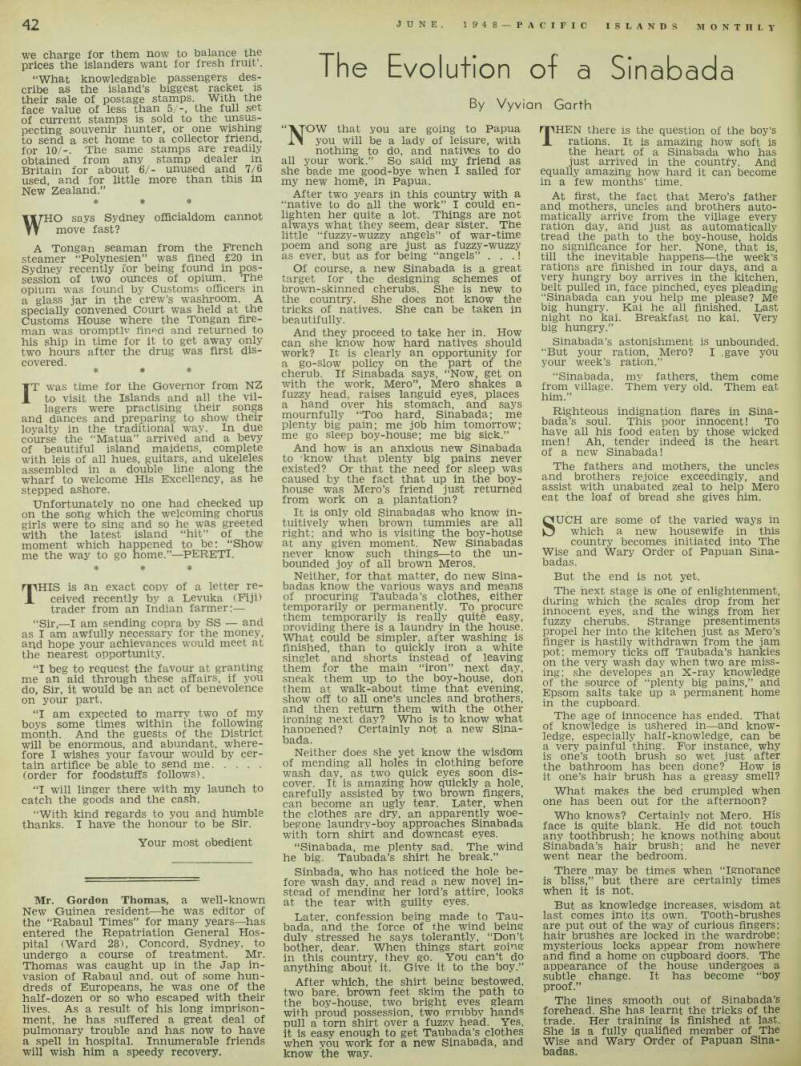
APPARENTLY, the bureaucrats of New Zealand can be as difficult as they are in Australia. This is from a valued subscriber in Wellington: “I wish to say how much I appreciate your magazine. Its forthright articles are most refreshing in these days of so much mealy-mouthed journalism. ... It has been a day’s work to get a permit to send you a postal note for 15/- sub scription.” * * * ACCORDING to press reports, New Zealand imported in March 21,000 cases of oranges from Jamaica, in the West Indies—a large proportion of which were rotten on arrival. Early in 1947, NZ was experimenting with shipments of oranges from Palestine, Yet, within the South Pacific, are several Islands groups capable, under encourage ment, of producing all the oranges New Zealand heeds. And why cannot New Zealand consume oranges grown in Australia, where recurrent gluts give a poor average return to the Australian citrusgrower?
Presumably, it is all a matter of ex change; and New Zealand has very little that Australia wants to buy. Jamaica and Palestine wants NZ foodstuffs, thus providing a basis of exchange. If only there were adequate trans-Tasman ser vices, New Zealand could sell Tourism to countless Australians; but at present the Australian tourist traffic to NZ is the merest trickle. * * * AFTER roosting among the Torres Strait crocodiles for six days, Mr.
John Spiers, of Mandated Airlines, New Guinea, was rescued by a pearling boat on May 19.
He had left Lae in a Dragon plane for its annual airworthiness test in Australia.
He met bad weather and the petrol ran out. He therefore set the plane down on Turnagain “Island” which is little more than a mud bank covered by water, except at low tide.
He had no food or water on board and, because the mud-bank is infested with crocodiles, could not hunt sea-food or crabs. He caught a little water from passing showers.
He stayed most of the time in the plane’s cabin although that too after being buffeted by the tides for six days began to break up.
Then he was sighted by a RAAF Cata lina. The Catalina landed near him; but, when the sea became rough, it had to take off—leaving the co-pilot with Spiers. Both men were finally rescued by a pearling boat from Thursday Island. * ♦ ♦ THE “school cinematograph,” so long awaited by Mangaia school pupils, who had bright hopes of the film fare it would provide, has at last arrived.
But it is not a movie projector and there is apparently a difference between the New Zealand Education Department’s idea of what constitutes an evening’s en tertainment and that of the young people of this island.
The latter, thirsting for pistolic cowboy films and similar worthwhile entertain ment, have found close-ups of the manu facture of shoes in New Zealand fac tories. or the assemblv of motor-cars very tame. If the show had not been free in the first place they would probably have demanded their money back.
It is all progress, however. The school now has electric light, also, and the next
development seems to be radio. But there again, a spirited description of tripe-scraping or the canning of tomatoes is not likely to interest native youth very greatly, even if rendered in local Maori. —E.G. * * * HERE are some Howlers from Poly nesia:— ■ Charles Lamb wrote the “Essays of Elijah” in the Bible, and he also took lamb’s tails from Shakespeare for the children. ■ King Henry VIII was a bad man because he got a divorce from the Pope and married seven more wives. ■ The Cook Islanders put up the British flag in Rarotonga because the French did not get here in time to make us subjects of France. ■ Mr. Winston Churchill saved the British Empire because he smoked cigars and it made him think. ■ The laws of the Cook Islands are better than those of New Zealand, be cause if you are out after nine you will be fined one pound, but there is no harm in it. ■ Copra is a very good and useful product because we sell it to Europe and they make it into scented soap which is very nice for us, then we "sent them some more. a The Resident Agent is a very good man because when we drink orange-beer he puts us in jail. ■ In the heathen days the people ate each other but now Jesus has shown them the wav to eat tinned meat and be good. * * * VISITORS to Rose Bay flying-base, Sydney, can witness the melancholy sight of the old “Coriolanus”—until last January well-known on Pacific air routes —drawn up on the beach. She is a mere husk now; little remains but the fusilage and her name. She is being broken up for scrap.
“Coriolanus” was* one of nine Short Empire flying-boats. All did noble war service and she alone survived after logging more miles than any commercial air-craft in existence. Her log books, records and official nameplate have now been handed over to the managing director of Qantas and join the com pany’s other historic relics.
Her four engines will probably end their days as the power units of speed boats; even her towering hull and wings are now being cut up for her nine tons of aluminium. * * * THE book which we have been promised from Florence, daughter of Robert Dean Frisbie, was published by Macmillan’s towards the end of March.
Florence, who was about 16 at the time she wrote her book, is better known to readers of her father’s South Pacific stories as Johnny; and Johnny she prob ably will remain to her Islands friends, in spite of the fact that she has now become an important young person with an American public.
Her story has been called “Miss Ulysses from Puka Puka,” and has created a lot of interest in the United States. The Chicago “Tribune” gave it a front page in colour, in their book section; and the Boston “Globe” a review and a feature story. Over 3,000 copies were sold before publication.
A copy of “Miss Ulysses” has been pro mised the “PIM” and a review will ap pear when it comes along.
from Hongkong:— There is no such thing, in China, as a used cigarette. Scavengers make a liv ing by collecting butts from the streets and selling them to manufacturers who then make up fresh cigarettes from the discarded tobacco. Made into packages which closely resemble Luckies, Camels and other well-known US brands, they are popular with coolies at a nickel per.
THREE men recently entered Tong Sap’s fortune-telling establishment, shoved a gun in his face and made off with his watch, gold ring and about 10 dollars.
About three hours earlier, Tong told police, one of the men had come to him as a customer. Tong predicted that he would shortly come into some money.— McC.
EVIDENCE in the New Guinea Timber Case indicated that association with Mr. Ward, Minister for the Austra lian Territories, is a good thing for the persons concerned. .
Mr. Jock Garden was a very close political associate of Mr. Ward during a couple of decades. Away back in the early twenties, Mr. Garden was a poor functionary around the Sydney Trades Hall. But when Mr. Ward became Minis ter for Labour and National Service, in the war period, Mr. Garden was ap pointed to a Government job as a sort of Liaison Officer connected with that De partment, in close contact with the Minister. Giving evidence, in 1948, Mr.
Garden acknowledged the possession of considerable wealth—he said he paid £2,000 per annum in income tax.
Mr. W. M. Urquhart was a close per sonal friend of Mr. Ward. A few years ago he was a humble Government clerk.
When Mr. Ward became a Minister, Mr.
Urquhart became an officer in Mr. Ward’s Department. Then, on Mr. Ward’s nomi nation, he got a £2,000 per annum job in the commercial world. When giving evi dence in 1948, Urquhart acknowledged that he had had half a dozen bank ac counts, and that £29,000 had passed through them in two years.
Mr. J. R. Donovan became Mr. Ward’s private secretary, when Mr. Ward became a Minister. Mr. Donovan was one of the gentlemen selected for appointment as Conciliation Commissioners, at £1,500 per annum.
A man worth knowing, this Mr. Ward.
A CORRESPONDENT writing to the Auckland “Star” in May, savs that there is a price-spiral in isolated Pitcairn Island also. Ships on the UK- Panama-NZ route occasionallv call at Pitcairn. This gives the passengers a welcome break in the long ocean voyage and allows the Pitcairners to sell island souvenirs, fruit and stamps to the passengers.
The “Star” correspondent writes: “The crew of the ship which brought me to New Zealand were not too happy about it. Some had a few hard names for the islanders. They put it this way; ‘We used to trade our old clothing arid underpants for fresh fruit or anything in the souvenir line we fancied to take home as presents. They were only too glad to get them and to give us what we wanted in return. Now thev demand cash payment—and the price is getting as bad as almost anything at home Oranges at threepence each! They used to give them away by the dozen to us.
“ ‘But it cuts both ways. When they want anything from us we put our price up in proportion.
“‘They used, too, to be given a few stores from ships. This is all stopped now. One reason, of course, for this is that ships haven’t got stores to spare these days. But when we can raise any
we charge for them now to balance the prices the islanders want for fresh fruit’.
“What knowledgable passengers des cribe as the island’s biggest racket is their sale of postage stamps. With the face value of less than 5/-, the full set of current stamps is sold to the unsus pecting souvenir hunter, or one wishing to send a set home to a collector friend, for 10/-. The same stamps are readily obtained from any stamp dealer in Britain for about 6/- unused and 7/6 used, and for little more than this in New Zealand.” * * * WHO says Sydney officialdom cannot move fast?
A Tongan seaman from the French steamer “Polynesien” was fined £2O in Sydney recently for being found in pos session of two ounces of opium. The opium was found by Customs officers in a glass jar in the crew’s washroom. A specially convened Court was held at the Customs House where the Tongan fire man was promptlv fined and returned to his ship in time for it to get away only two hours after the drug was first dis covered. * ♦ * IT was time for the Governor from NZ to visit the Islands and all the vil lagers were practising their songs and dances and preparing to show their loyalty in the traditional way. In due course the “Matua” arrived and a bevy of beautiful island maidens, complete with leis of all hues, guitars, and ukeleles assembled in a double line along the wharf to welcome His Excellency, as he stepped ashore.
Unfortunately no one had checked up on the song which the welcoming chorus girls were to sing and so he was greeted with the latest island “hit” of the moment which happened to be; “Show me the way to go home.” —PERETI. * * * THIS is an exact copy of a letter re ceived recently by a Levuka (Fiji) trader from an Indian farmer;— “Sir,—l am sending copra by SS and as I am awfully necessary for the money, apd hope your achievances would meet at the nearest opportunity.
“I beg to request the favour at granting me an aid through these affairs, if you do, Sir, it would be an act of benevolence on your part.
“I am expected to marry two of my boys some times within the following month. And the guests of the District will be enormous, and abundant, where fore I wishes your favour would by cer tain artifice be able to send me (order for foodstuffs follows).
“I will linger there with my launch to catch the goods and the cash.
“With kind regards to you and humble thanks. I have the honour to be Sir.
Your most obedient Mr. Gordon Thomas, a well-known New Guinea resident—he was editor of the “Rabaul Times” for many years—has entered the Repatriation General Hos pital (Ward 28), Concord, Sydney, to undergo a course of treatment, Mr.
Thomas was caught up in the Jap in vasion of Rabaul and, out of some hun dreds of Europeans, he was one of the half-dozen or so who escaped with their lives. As a result of his long imprison ment, he has suffered a great deal of pulmonary trouble and has now to have a spell in hospital. Innumerable friends will wish him a speedy recovery.
The Evolution of a Sinabada
By Vyvian Garth
“VTOW that you are going to Papua ll you will be a lady of leisure, with nothing to do, and natives to do all your work.” So said my friend as she bade me good-bye when I sailed for my new home, in Papua.
After two years in this country with a “native to do all the work” I could en lighten her quite a lot. Things are not always what they seem, dear sister. The little “fuzzv-wuzzy angels” of war-time poem and song are just as fuzzy-wuzzy as ever, but as for being “angels” . , .!
Of course, a new Sinabada is a great target for the designing schemes of brown-skinned cherubs. She is new to the country. She does not know the tricks of natives. She can be taken in beautifully.
And they proceed to take her in. How can she know how hard natives should work? It is clearly an opportunity for a go-slow policy on the part of the cherub. If Sinabada says, “Now, get on with the work, Mero”, Mero shakes a fuzzy head, raises languid eyes, places a hand over his stomach, and says mournfully “Too hard, Sinabada; me plenty big pain; me job him tomorrow; me go sleep boy-house; me big sick.”
And how is an anxious new Sinabada to 'know that plenty big pains never existed? Or that the need for sleep was caused by the fact that up in the boy house was Mero’s friend just returned from work on a plantation?
It is only old Sinabadas who know in tuitively when brown tummies are all right; and who is visiting the boy-house at any given moment. New Sinabadas never know such things—to the un bounded joy of all brown Meros.
Neither, for that matter, do new Sina badas know the various ways and means of procuring Taubada’s clothes, either temporarily or permanently. To procure them temporarily is really quite easy, providing there is a laundry in the house.
What could be simpler, after washing is finished, than to quickly iron a white singlet and shorts instead of leaving them for the main “iron” next day, sneak them up to the boy-house, don them at walk-about time that evening, show off to all one’s uncles and brothers, and then return them with the other ironing next day? Who is to know what happened? Certainly not a new Sina bada.
Neither does she yet know the wisdom of mending all holes in clothing before wash day, as two quick eyes soon dis cover. It is amazing how quickly a hole, carefully assisted by two brown fingers, can become an ugly tear. Later, when the clothes are dry, an apparently woe begone laundry-boy approaches Sinabada with torn shirt and downcast eyes.
“Sinabada, me plenty sad. The wind he big. Taubada’s shirt he break.”
Sinbada, who has noticed the hole be fore wash day. and read a new novel in stead of mendins her lord’s attire, looks at the tear with guilty eyes.
Later, confession being made to Tau bada, and the force of the wind being duly stressed he says tolerantly, “Don’t bother, dear. When things start going in this country, they go. You can’t do anything about it. Give it to the boy.”
After which, the shirt being bestowed, two bare, brown feet skim the path to the boy-house, two bright eves gleam with proud possession, two grubby hands pull a* torn shirt over a fuzzv head. Yes, it is easy enough to get Taubada’s clothes when you work for a new Sinabada, and know the way.
THEN there is the question of the boy’s rations. It is amazing how soft is the heart of a Sinabada who has just arrived in the country. And equally amazing how hard it can become in a few months’ time.
At first, the fact that Mero’s father and mothers, uncles and brothers auto matically arrive from the village every ration day, and just as automatically tread the path to the boy-house, holds no significance for her. None, that is, till the inevitable happens—the week’s rations are finished in four days, and a very hungry boy arrives in the kitchen, belt pulled in, face pinched, eyes pleading “Sinabada can you help me please? Me big hungry. Kai he all finished. Last night no kai. Breakfast no kai. Very big hungry.”
Sinabada’s astonishment is unbounded, “But your ration, Mero? I .gave you your week’s ration.”
“Sinabada, my fathers, them come from village. Them very old. Them eat him.”
Righteous indignation flares in Sina bada’s soul. This poor innocent! To have all his food eaten by those wicked men! Ah, tender indeed is the heart of a new Sinabada!
The fathers and mothers, the uncles and brothers rejoice exceedingly, and assist with unabated zeal to help Mero eat the loaf of bread she gives him.
SUCH are some of the varied ways in which a new housewife in this country becomes initiated into The Wise and Wary Order of Papuan Sina badas.
But the end is not yet.
The next stage is one of enlightenment, during which the scales drop from her innocent eyes, and the wings from her fuzzy cherubs. Strange presentiments propel her into the kitchen just as Mero’s finger is hastily withdrawn from the jam pot; memory ticks off Taubada’s hankies on the very wash day when two are miss ing; she developes an X-ray knowledge of the source of “plenty big pains,” and Epsom salts take up a permanent home in the cupboard.
The age of innocence has ended. That of knowledge is ushered in—and know ledge, especially half-knowledge, can be a very painful thing. For instance, why is one’s tooth brush so wet just after the bathroom has been done? How is it one’s hair brush has a greasy smell?
What makes the bed crumpled when one has been out for the afternoon?
Who knows? Certainlv not Mero. His face is quite blank. He did not touch any toothbrush; he knows nothing about Sinabada’s hair brush; and he never went near the bedroom.
There may be times when “Ignorance is bliss,” but there are certainly times when it is not.
But as knowledge increases, wisdom at last comes into its own. Tooth-brushes are put out of the way of curious fingers; hair brushes are locked in the wardrobe; mysterious locks appear from nowhere and find a home on cupboard doors. The appearance of the house undergoes a subtle change. It has become “boy proof.”
The lines smooth out of Sinabada’s forehead. She has learnt the tricks of the trade. Her training is finished at last.
She is a fully qualified member of The Wise and Wary Order of Papuan Sina badas.
One Lone Czech
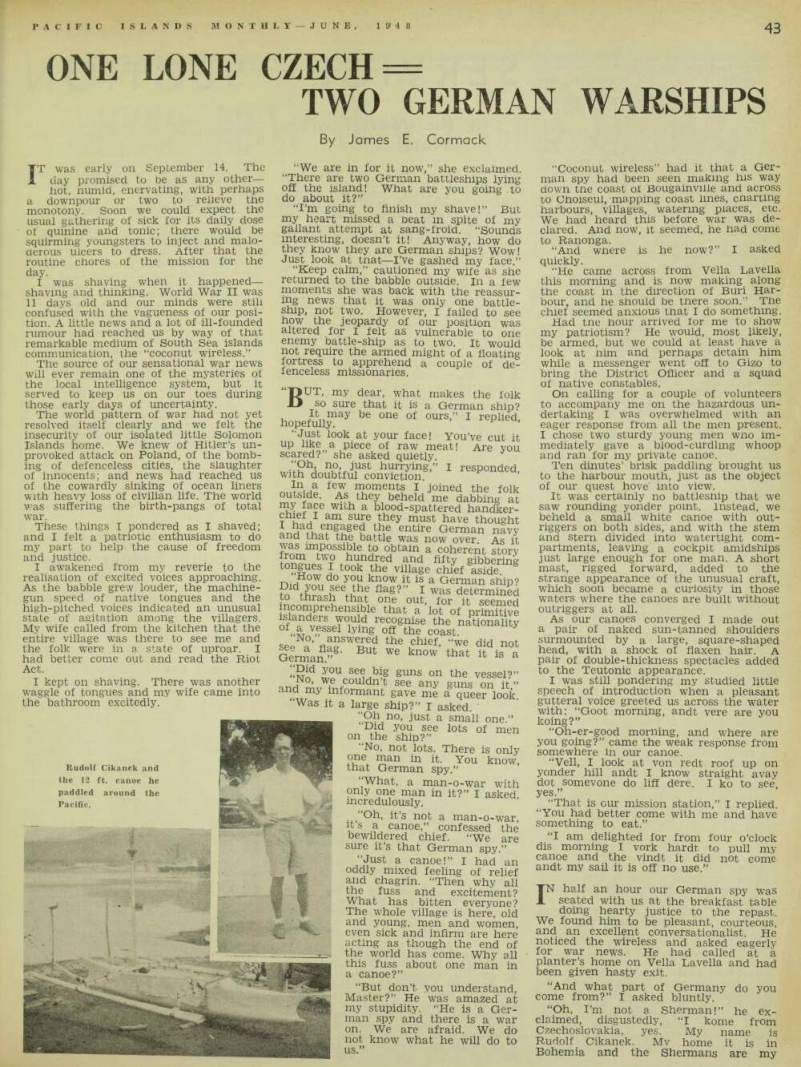
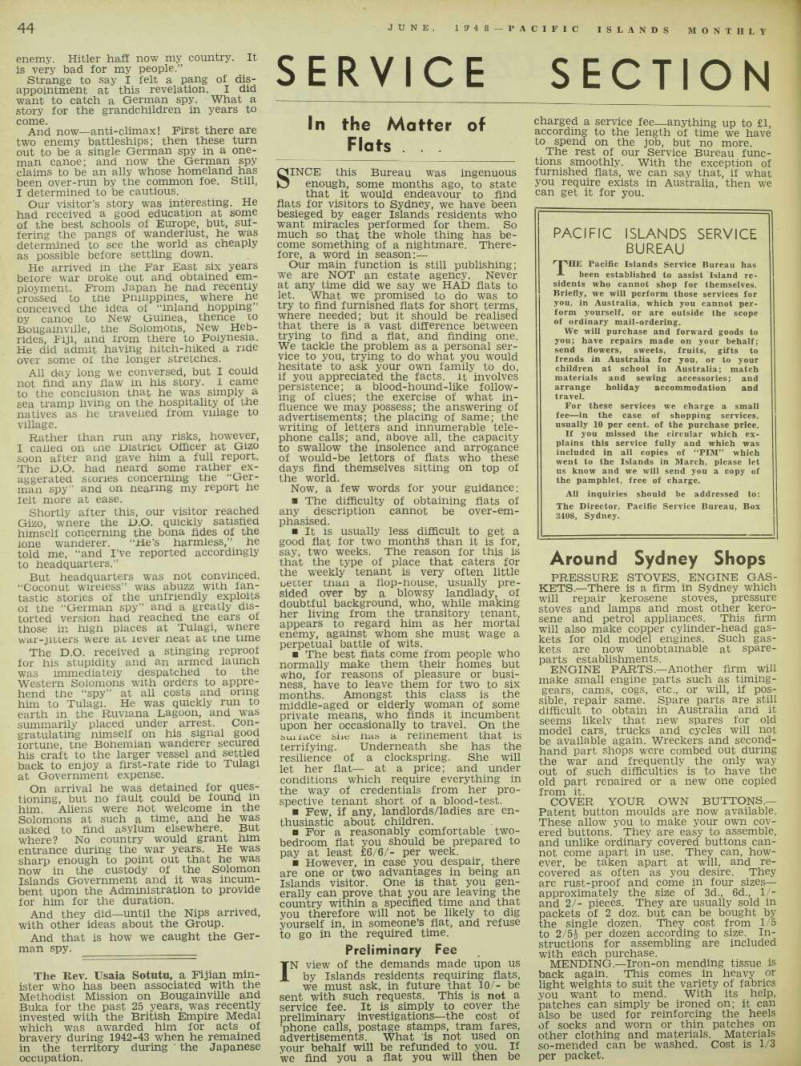
Two German Warships
By James E. Carmack
IT was early on September 14. The day promised to be as any other— hot, numid, enervating, with perhaps a downpour or two to relieve the monotony. Soon we could expect the usual gathering of sick for its daily dose of quinine and tonic; there would be squirming youngsters to inject and malo derous ulcers to dress. After that the routine chores of the mission for the day.
I was shaving when it happened— shaving and thinking. World War II was 11 days old and our minds were still confused with the vagueness of our posi tion. A little news and a lot of ill-founded rumour had reached us by way of that remarkable medium of South Sea islands communication, the “coconut wireless,”
The source of our sensational war news will ever remain one of the mysteries of the local intelligence system, but it served to keep us on our toes during those early days of uncertainty.
The world pattern of war had not yet resolved itself clearly and we felt the insecurity of our isolated little Solomon Islands home. We knew of Hitler’s un provoked attack on Poland, of the bomb ing of defenceless cities, the slaughter of innocents; and news had reached us of the cowardly sinking of ocean liners with heavy loss of civilian life. The world was suffering the birth-pangs of total war.
These things I pondered as I shaved; and I felt a patriotic enthusiasm to do my part to help the cause of freedom and justice.
I awakened from my reverie to the realisation of excited voices approaching.
As the babble grew louder, the machine gun speed of native tongues and the high-pitched voices indicated an unusual state of agitation among the villagers.
My wife called from the kitchen that the entire village was there to see me and the folk were in a state of uproar. I had better come out and read the Riot Act.
I kept on shaving. There was another waggle of tongues and my wife came into the bathroom excitedly.
“We are in for it now,” she exclaimed.
“There are two German battleships lying off the island! What are you going to do about it?”
“I’m going to finish my shave!” But my heart missed a beat in spite of my gallant attempt at sang-froid. “Sounds interesting, doesn’t it! Anyway, how do they know they are German ships? Wow!
Just look at tnat —I’ve gashed my face.”
“Keep calm,” cautioned my wife as she returned to the babble outside, in a few moments she was back with the reassur ing news that it was only one battle ship, not two. However, I failed to see how the jeopardy of our position was altered for I felt as vulnerable to one enemy battle-ship as to two. it would not require the armed might of a floating fortress to apprehend a couple of de fenceless missionaries.
“r>UT, my dear, what makes the folk J 3 so sure that it is a German ship? hopefiUl™ ay °“ e ° £ OUrS '” 1 replled> “Just look at your face! You’ve cut it up like a piece of raw meat! Are vou scared? she asked quietly. j lst hurr y in g,” I responded, with doubtful conviction.
In a few moments I joined the folk outside. As they beheld me dabbing at my face wiuh a blood-spattered handker chief ! am sure they must have thought ?w n ?S ge 2 entire nlvy and that the battle was now over As it w* 1 "?? 581 ? 6 obtaln a coherent story from two hundred and fifty gibbering tongues I took the village chief aside How do you know it is a German ship? flag? ” 1 was determined to thrash that one out, for it seemed incomprehensible that a lot of primitive islanders would recognise the nationality of a v » ssel lymg off the coast. se- a’ the , chief ’ “ we did not German.” g Bt we know that it is a “Sn d guns on the vessel?”
No, we couldn t see any guns on it ” and my informant gave me a quee? look.
“Was it a large ship?” I asked.
‘‘Oh no, just a small one.” ■Old see °f men on the ship?”
“No, not lots. There is only one man in it. You know, that German spy.”
“What, a man-o-war with ?nly one man in it?” I asked,
incredulously.
Oh, it’s not a man-o-war, it s a canoe,” confessed the bewildered chief. “We are sure it’s that German spy.”
“Just a canoe!” I had an oddly mixed feeling of relief and chagrin. “Then why all the fuss and excitement?
What has bitten everyone?
The whole village is here, old and young, men and women, even sick and infirm are here acting as though the end of the world has come. Why all this fuss about one man in a canoe?”
“But don’t you understand, Master?” He was amazed at my stupidity. “He is a Ger man spy and there is a war on. We are afraid. We do not know what he will do to us.”
“Coconut wireless” had it that a Ger man spy had been seen making his way down the coast of Bougainville and across to Choiseul, mapping coast lines, cnarting harbours, villages, watering places, etc.
We had heard this before war was de clared. And now, it seemed, he had come to Ranonga.
“And wnere is he now?” I asked quickly.
“He came across from Vella Lavella this morning and is now making along the coast in the direction of Buri Har bour, and he should be tnere soon.” The chief seemed anxious that I do something.
Had tne hour arrived for me to show my patriotism? He would, most likely, be armed, but we could at least have a look at nim and perhaps detain him while a messenger went off to Gizo to bring the District Officer and a squad of native constables.
On calling for a couple of volunteers to accompany me on the hazardous un dertaking I was overwhelmed with an eager response from all the men present.
I chose two sturdy young men wno im mediately gave a blood-curdling whoop and ran for my private canoe.
Ten dinutes’ brisk paddling brought us to the harbour mouth, just as the object of our quest hove’ into view.
It was certainly no battleship that we saw rounding yonder point. Instead, we beheld a small white canoe with out riggers on both sides, and with the stem and stern divided into watertight com partments, leaving a cockpit amidships just large enough for one man. A short mast, rigged forward, added to the strange appearance of the unusual craft, which soon became a curiosity in those waters where the canoes are built without outriggers at all.
As our canoes converged I made out a pair of naked sun-tanned shoulders surmounted by a large, square-shaped head, with a shock of flaxen hair, a pair of double-thickness spectacles added to the Teutonic appearance.
I was still pondering my studied little speech of introduction when a pleasant gutteral voice greeted us across the water with: “Goot morning, andt vere are you koing?”
“Oh-er-good morning, and where are you going?” came the weak response from somewhere in our canoe.
“Veil, I look at von redt roof up on yonder hill andt I know straight avay dot somevone do liff dere. I ko to see, yes.”
“That is our mission station,” i replied.
“You had better come with me and have something to eat.”
“I am delighted for from four o’clock dis morning I vork hardt to pull my canoe and the vindt it did not come andt my sail it is off no use.”
IN half an hour our German spy was seated with us at the breakfast table doing hearty justice to the repast.
We found him to be pleasant, courteous, and an excellent conversationalist. He noticed the wireless and asked eagerly for war news. He had called at a planter’s home on Vella Lavella and had been given hasty exit.
“And what part of Germany do you come from?” I asked bluntly.
“Oh, I’m not a Sherman!” he ex claimed, disgustedly, “I kome from Czechoslovakia, yes. My name is Rudolf Cikanek. Mv home it is in Bohemia and the Shermans are my
Rudolf Cikanek and the 12 ft. canoe he paddled around the Pacific.
enemy. Hitler haff now my country. It is very bad for my people.”
Strange to say I felt a pang of dis appointment at this revelation. I did want to catch a German spy. What a story for the grandchildren in years to come.
And now—anti-climax! First there are two enemy battleships; then these turn out to be a single German spy in a one man canoe; and now the German spy claims to be an ally whose homeland has been over-run by the common foe. Still, I determined to be cautious.
Our visitor’s story was interesting. He had received a good education at some of the best schools of Europe, but, suf fering the pangs of wanderlust, he was determined to see the world as cheaply as possible before settling down.
He arrived in the Far East six years belore war broke out and obtained em ployment. From Japan he had recently crossed to the Pfiifippines, where he conceived the idea of “inland hopping” by canoe to New Guinea, thence io Bougainville, the Solomons, New Heb rides, Fiji, and from there to Polynesia.
He did admit having hitch-hiked a ride over some of the longer stretches.
All day long we conversed, but I could not find any flaw in his story. 1 came to the conclusion that he was simply a sea tramp living on the hospitality of the natives as he travelled from village to village.
Rather than run any risks, however, I called on tne District Officer at Gizo soon after and gave him a full report.
The D.O. had neard some rather ex aggerated scones concerning the “Ger man spy” and on nearing my report he felt more at ease.
Shortly after this, our visitor reached Gizo, wnere the D.O. quickly satisfied himself concerning the bona fides of the lone wanderer. “He’s harmless,” he told me, “and I’ve reported accordingly
to headquarters.”
But headquarters was not convinced.
“Coconut wireless” was abuzz with fan tastic stories of the unfriendly exploits of the "German spy” and a greatly dis torted version had reached tne ears of those in hign places at Tulagi, wnere war-jliters were ac lever neat at cne time The D.O. received a stinging reproof for his stupidity and an armed launch was immediately despatched to the Western Solomons with orders to appre hend the “spy” at all costs and ormg him to Tulagi. He was quickly run to earth in the Ruviana Lagoon, and was summarily placed under arrest. Con gratulating nimself on his signal good lortune, tne Bohemian wanderer secured his craft to the larger vessel and settled back to enjoy a first-rate ride to Tulagi at Government expense.
On arrival he was detained for ques tioning, but no fault could be found in him. Aliens were not welcome in the Solomons at such a time, and he was asked to find asylum elsewhere. But where? No country would grant him entrance during the war years. He was sharp enough to point out that he was now in the custody of the Solomon Islands Government and it was incum bent upon the Administration to provide for him for the duration.
And they did—until the Nips arrived, with other ideas about the Group.
And that is how we caught the Ger man spy.
The Rev. Usaia Sotutu, a Fijian min ister who has been associated with the Methodist Mission on Bougainville and Buka for the past 25 years, was recently invested with the British Empire Medal which was awarded him for acts of bravery during 1942-43 when he remained in the territory during * the Japanese occupation.
Service Section
In the Matter of Flats . . .
SINCE this Bureau was ingenuous enough, some months ago, to state that it would endeavour to find flats for visitors to Sydney, we have been besieged by eager Islands residents who want miracles performed for them. So much so that the whole thing has be come something of a nightmare. There fore, a word in season:— Our main function is still publishing; we are NOT an estate agency. Never at any time did we say we HAD flats to let. What we promised to do was to try to find furnished flats for short terms, where needed; taut it should be realised that there is a vast difference between trying to find a flat, and finding one.
We tackle the problem as a personal ser vice to you, trying to do what you would hesitate to ask your own family to do, if you appreciated the facts, it involves persistence; a blood-hound-like follow ing of clues; the exercise of what in fluence we may possess; the answering of advertisements; the placing of same; the writing of letters and innumerable tele phone calls; and, above all, the capacity to swallow the insolence and arrogance of would-be letters of flats who these days find themselves sitting on top of the world.
Now, a few words for your guidance: ■ The difficulty of obtaining flats of any description cannot be over-em phasised. ■ It is usually less difficult to get a good flat for two months than it is for, say, two weeks. The reason for this is that the type of place that caters for the weekly tenant is very often little ueuer man a flop-house, usually pre sided over by a blowsy landlady, of doubtful background, who, while making her living from the transitory tenant, appears to regard him as her mortal enemy, against whom she must wage a perpetual battle of wits. ■ The best fiats come from people who normally make them their homes but who, for reasons of pleasure or busi ness, have to leave them for two to six months. Amongst this class is the middle-aged or elderly woman of some private means, who finds it incumbent upon her occasionally to travel. On the suriace she nas a refinement that is terrifying. Underneath she has the resilience of a clockspring. She will let her flat — at a price; and under conditions which require everything in the way of credentials from her pro spective tenant short of a blood-test. ■ Few, if any, landlords/ladies are en thusiastic about children. n For a reasonably comfortable two bedroom flat you should be prepared to pay at least £6/6/- per week. b However, in case you despair, there are one or two advantages in being an Islands visitor. One is that you gen erally can prove that you are leaving the country within a specified time and that you therefore will not be likely to dig yourself in, in someone’s flat, and refuse to go in the required time.
Preliminary Fee
IN view of the demands made upon us by Islands residents requiring flats, we must ask, in future that 10/- be sent with such requests. This is not a service fee. It is simply to cover the preliminarv investigations—the cost of ’phone calls, postage stamps, tram fares, advertisements. What is not used on your behalf will be refunded to you. If we find you a flat you will then be
charged a service fee—anything up to £l, according to the length of time we have to spend on the job, but no more.
The rest of our Service Bureau func tions smoothly. With the exception of furnished flats, we can say that, if what you require exists in Australia, then we can get it for you.
Around Sydney Shops
Pressure Stoves, Engine Gas
KETS. —There is a firm in Sydney which will repair kerosene stoves, pressure stoves and lamps and most other kero sene and petrol appliances. This firm will also make copper cylinder-head gas kets for old model engines. Such gas kets are now unobtainable at spare parts establishments.
ENGINE PARTS—Another firm will make small engine parts such as timing gears, cams, cogs, etc., or will, if pos sible, repair same. Spare parts are still difficult to obtain in Australia and it seems likely that new spares for old model cars, trucks and cycles will not be available again. Wreckers and second hand part shops were combed out during the war and frequently the only way out of such difficulties is to have the old part repaired or a new one copied from it.
Cover Your Own Buttons.—
Patent button moulds are now available.
These allow you to make your own cov ered buttons. They are easy to assemble, and unlike ordinary covered buttons can not come apart in use. They can, how ever, be taken apart at will, and re covered as often as you desire. They are rust-proof and come in four sizes— approximately the size of 3d., 6d,, 1/and 2/- pieces. They are usually sold in packets of 2 doz. but can be bought by the single dozen. They cost from 1/5 to 2/5 \ per dozen according to size. In structions for assembling are included with each purchase.
MENDING. —Iron-on mending tissue is back again. This comes in heavy or light weights to suit the variety of fabrics you want to mend. With its help, patches can simply be ironed on; it can also be used for reinforcing the heels of socks and worn or thin patches on other clothing and materials. Materials so-mended can be washed. Cost is 1/3 per packet.
Pacific Islands Service
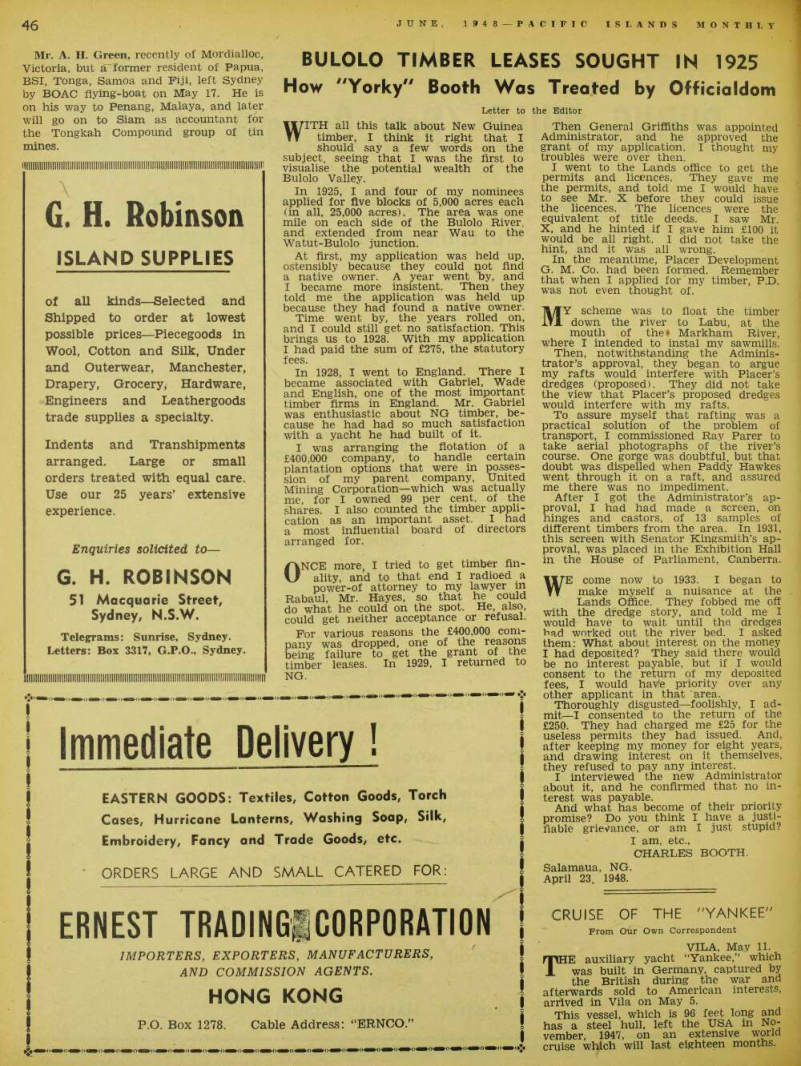
Bureau
MpHE Pacific Islands Service Bureau has -I- been established to assist Island re sidents who cannot shop for themselves.
Briefly, we will perform those services for you, in Australia, which you cannot per form yourself, or are outside the scope of ordinary mail-ordering.
We will purchase and forward goods to you; have repairs made on your behalf; send flowers, sweets, fruits, gifts to frends in Australia for you, or to your children at school in Australia; match materials and sewing accessories; and arrange holiday accommodation and travel.
For these services we charge a small fee —in the case of shopping services, usually 10 per cent, of the purchase price.
If you missed the circular which ex plains this service fully and which was included in all copies of “PIM” which went to the Islands in March, please let us know and we will send you a copy of the pamphlet, free of charge.
All inquiries should be addressed to: The Director, Pacific Service Bureau, Box 3408, Sydney.
Mr. A. 11. Green, recently of Mordialloc, Victoria, but a former resident of Papua, BSI, Tonga, Samoa and Fiji, left Sydney by BOAC flying-boat on May 17. He is on his way to Penang, Malaya, and later will go on to Siam as accountant for the Tongkah Compound group of tin mines.
Advertisements & other items, pp. 47-48 (1 item)
Burns Philp (New Guinea) Limited
General Merchants (Wholesale and Retail)
Shipping, Customs and General Agents
Head Office: PORT MORESBY, PAPUA
BRANCHES:
NEW GUINEA; Rabaul, Kokopo, Lae & Madang.
PAPUA: Soma rai.
REPRESENTATIVES FOR
AUSTRALIAN AGENTS
LONDON AGENTS:
SAN FRANCISCO AGENTS;
QUEENSLAND INSURANCE CO. LTD.
LLOYDS OF LONDON
BURNS PHILP TRUST CO. LTD.
BURNS, PHILP & CO. LTD.
All States.
BURNS, PHILP & CO. LTD.
“London House", 35 Crutched Friars, E.C.3.
BURNS, PHILP CO. OF SAN FRANCISCO INC. 510 Mat son Building.
Distributing Agents, Territory of Papua-New Guinea for
SHELL COMPANY OF AUSTRALIA LIMITED
Petroleum Products
GENERAL MOTORS CORPORATION
Chevrolet, Buick, Pontiac and Oldsmobile Cars Chevrolet and GMC Trucks Frigidaire Refrigerators
VAUXHALL MOTORS LIMITED
Vauxhall Cars and Bedford Trucks
R. A. LISTER & CO., BRISTOL
Producers of Petrol, Parrafin and Diesel Engines Pumps and Lighting plants
RUSTON HORNSBY LIMITED
Engines
CROSSLEY MARINE ENGINES
G. H. Robinson
ISLAND SUPPLIES
of all kinds—Selected and Shipped to order at lowest possible prices—Piecegoods in Wool, Cotton and Silk, Under and Outerwear, Manchester, Drapery, Grocery* Hardware, Engineers and Leathergoods trade supplies a specialty.
Indents and Transhipments arranged. Large or small orders treated with equal care.
Use our 25 years’ extensive experience.
Enquiries solicited to —
G. H. ROBINSON
51 Macquarie Street, Sydney, N.S.W.
Telegrams: Sunrise, Sydney.
Letters: Box 3317, G.P.0., Sydney.
Immediate Delivery!
EASTERN GOODS: Textiles, Cotton Goods, Torch Coses, Hurricone Lanterns, Washing Soap, Silk, Embroidery, Fancy and Trade Goods, etc.
ORDERS LARGE AND SMALL CATERED FOR:
ERNEST TRADINGICORPORATION
IMPORTERS, EXPORTERS, MANUFACTURERS,
AND COMMISSION AGENTS.
HONG KONG
P.O. Box 1278. Cable Address: “ERNCO.”
How "Yorky" Booth Was Treated by Officialdom
Bulolo Timber Leases Sought In 1925
Letter to the Editor
WITH all this talk about New Guinea timber, I think it right that I should say a few words on the subject, seeing that I was the first to visualise the potential wealth of the Bulolo Valley.
In 1925, I and four of my nominees applied for five blocks of 5,000 acres each (in all, 25,000 acres). The area was one mile on each side of the Bulolo River, and extended from near Wau to the Watut-Bulolo junction.
At first, my application was held up, ostensibly because they could not find a native owner. A year went by, and I became more insistent. Then they told me the application was held up because they had found a native owner.
Time went by, the years rolled on, and I could still get no satisfaction. This brings us to 1928. With my application I had paid the sum of £275, the statutory fees.
In 1928, I went to England. There I became associated with Gabriel, Wade and English, one of the most important timber firms in England. Mr. Gabriel was enthusiastic about NG timber, be cause he had had so much satisfaction with a yacht he had built of it.
I was arranging the flotation of a £400,000 company, to handle certain plantation options that were in posses sion of my parent company, United Mining Corporation—which was actually me, for I owned 99 per cent, of the shares. I also counted the timber appli cation as an important asset. I had a most influential board of directors arranged for.
ONCE more, I tried to get timber fin ality, and to that end I radioed a power-of attorney to my lawyer in Rabaul, Mr. Hayes, so that he could do what he could on the spot. He also, could get neither acceptance or refusal.
For various reasons the £400,000 com pany was dropped, one of the reasons being failure to get the grant of the timber leases. In 1929. I returned to NG.
Then General Griffiths was appointed Administrator, and he approved the grant of my application. I thought my troubles were over then.
I went to the Lands office to get the permits and licences. They gave me the permits, and told me I would have to see Mr. X before they could issue the licences. The licences were the equivalent of title deeds. I saw Mr.
X, and he hinted if I gave him £lOO it would be all right. I did not take the hint, and it was all wrong.
In the meantime, Placer Development G. M. Co. had been formed. Remember that when I applied for my timber, P.D. was not even thought of.
MY scheme was to float the timber down the river to Labu, at the mouth of the* Markham River, where I intended to instal my sawmills.
Then, notwithstanding the Adminis trator’s approval, they began to argue my rafts would interfere with Placer’s dredges (proposed). They did not take the view that Placer’s proposed dredges would interfere with my rafts.
To assure myself that rafting was a practical solution of the problem of transport, I commissioned Ray Parer to take aerial photographs of the river’s course. One gorge was doubtful, but that doubt was dispelled when Paddy Hawkes went through it on a raft, and assured me there was no impediment.
After I got the Administrator’s ap proval, I had had made a screen, on hinges and castors, of 13 samples of different timbers from the area. In 1931, this screen with Senator Kingsmith’s ap proval, was placed in the Exhibition Hall in the House of Parliament, Canberra.
WE come now to 1933. I began to make myself a nuisance at the Lands Office. They fobbed me off with the dredge story, and told me I would have to wait until the dredges had worked out the river bed. I asked them: What about interest on the money I had deposited? They said there would be no interest payable, but if I would consent to the return of my deposited fees, I would hav/e priority over any other applicant in that area.
Thoroughly disgusted—foolishly, I ad mit—l consented to the return of the £250. They had charged me £25 for the useless permits they had issued. And, after keeping my money for eight years, and drawing interest on it themselves, they refused to pay any interest.
I interviewed the new Administrator about it, and he confirmed that no in terest was payable.
And what has become of their priority promise? Do you think I have a justi fiable grievance, or am I just stupid?
I am, etc.,
Salamaua, NG.
April 23. 1948.
Charles Booth.
Cruise Of The "Yankee"
From Our Own Correspondent
Vila. May 11.
mHE auxiliary yacht “Yankee/’ which I was built in Germany, captured by the British during the war and afterwards sold to American interests, arrived in Vila on May 5.
This vessel, which is 96 feet long and has a steel hull, left the USA in No vember, 1947, on an extensive world cruise which will last eighteen months.
Nutmegs

No Fortunes In NG Nutmegs
(A Letter to the Editor) A FEW notes in reference to your paragraph in January “Pirn” on the discovery of nutmeg in New Guinea: No doubt this “present generation” in NG is finding out things. But, in case certain people may already be looking forward to making fortunes out of New Guinea nutmegs, the following may be of interest.
The NG nutmeg has been known and recorded for at least half a century.
Any tropical agricultural book dealing with nutmeg invariably makes reference to the large NG variety, and states that it is of little value. During the period 1918-21, I understand, “Kar Kar” Scnmidt and others, dried wild nutmeg at Kar Kar Island and found a small market for it in Sydney, owing to the cultivated article being, at that time, almost un procurable.
There are three varieties on Kar Kar which are also found on the mainland of New Guinea —difference being mostly in size and shape. The largest, when dried, is almost identical with the com mercial variety in appearance, but not in flavour which is the reason for its being of little value. There are large stands of that variety on Kar Kar.
Then there is the smaller variety, similar in shape and appearance and one quite small variety, oval in shape and about the size and shape of the acorn seed but more pointed at each end. Dur ing the mid 30’s, while I was employed by W. M. Middleton on Kar Kar, we dried a quantity of the large variety and sent samples They brought unfav ourable reports owing to lack of flavour etc., and definitely had no market value.
I later drew the attention of Father Hubers—resident priest at Kar Kar—to the nutmeg, and he passed on the in formation to the Sisters at Alexishafen.
Later, Father Hubers told me that they experimented with them and took to pickling the very small variety and that they were delicious. I, unfortunately, never had the chance of sampling them as my wanderings had taken me else where. Still, I hope commercial value can be found in the product, as it would mean quite a lot to New Guinea.
In conclusion, I must add that the tree is delightful in appearance and a worthy ornament to any tropical garden* al though like cocoa it appears to develop better under the shade of other trees.
I am, etc.,
J. West.
Brisbane, May. 1948.
Indian Mlc Speaks Out
Of Turn In Nz
Prom Our Own Correspondent
Suva. May 17
MR. AMI CHANDRA, is a nominated Indian member of the Legislative of Fiji. He came to Fiji in 1927, started a school in Suva, returned to India in 1935 and stayed two years.
He went to Auckland in 1946 to com plete his Diploma in Education.
Mr Chandra has now gone back to Auckland to complete his Master’s degree, and ip an interview with the Auckland Star he is reported to have said that Indians, Fijians and Europeans have dropped their communal differences in the effort to secure a greater measure of self-government for Fiji.”
Obviously a wishful thinker, Mr.
Chandra did not mention who empowered him to speak for the Fijian and Euro pean communities or, as a nominated member, for the Indians.
Eloping Lovers Took
Family Funds On Trip
Prom Our Own Correspondent
Suva, May 17
IN April, a young Indian couple—he handsome, unemployed and penniless, and she living with her parents be cause of her unwillingness to return to the husband of her parents’ choice — eloped from Suva to Lautokaj. They prudently took along the family funds, the young woman having access to the key of the money-box.
Her father went to Court about it and the magistrate, after hearing a great deal of evidence, said: “This case is too plain.”
The romantic pair have to return the amount claimed (£42) and find £6/167costs.
Mr. Ken Nicholson, a member of Fiji’s wartime RAF contingent, returned to Suva in May with his wife. He recently completed a course in the United King dom in flying control, and has been posted to the airports of Laucala Bay and Nausori as a control officer.
Advertisements & other items, p. 49 (1 item)
Sunproof your Hair
r>, y j w
The Tonic Hair Dressing
SUN, WIND and WATER really do their worst to your hair.
Hair-shielding scalp oils are baked out by the sun , washed out by water , dried out by the wind . . . but you can counteract all this by using Vitalis.
Vital is pure vegetable oils supplement your scalp oils, giving your hair and scalp that added protection.
' Massage Vitalis on your scalp : feel the pleasant tingle as you rout loose dandruff, check falling hair. Vitalis makes your scalp feel good, your hair look good. r It s
Quarter Million Tons
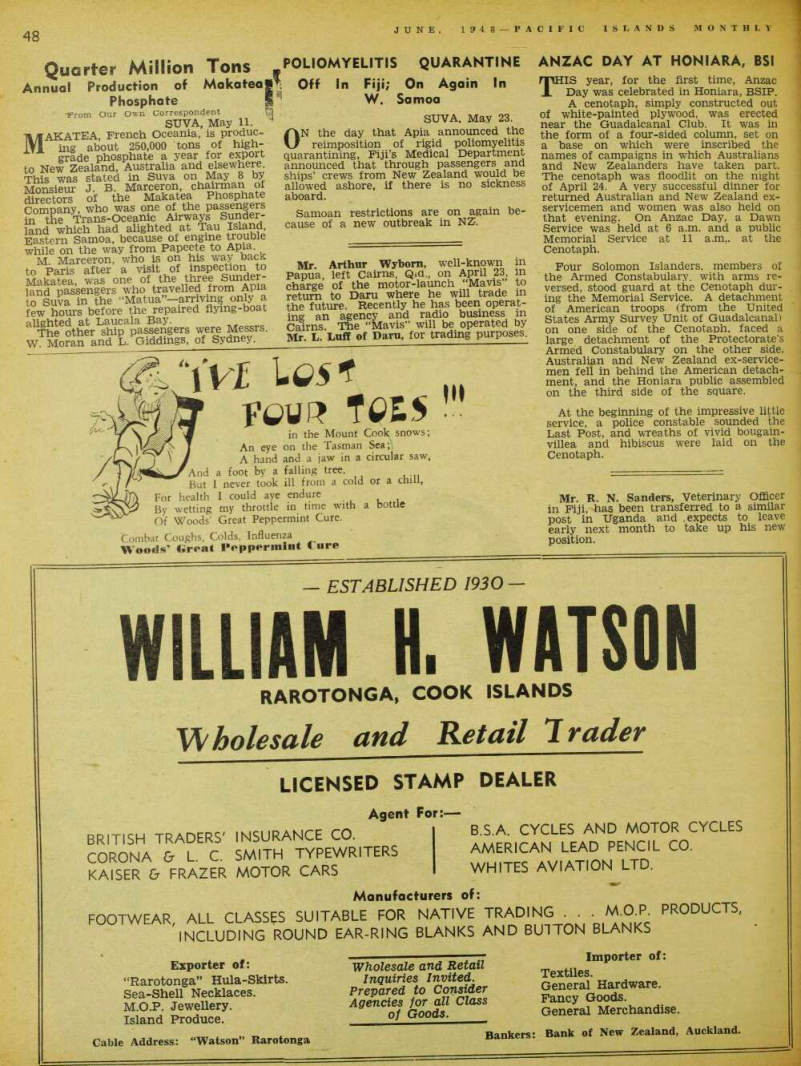
Annual Production of Makatea Phosphate
•From Our Own Correspondent
Suva, May 11.
MAKATEA, French Oceania, is produc ing about 250.000 tons of high grade phosphate a year for export to New Zealand, Australia and elsewhere This was stated in Suva on May 8 by Monsieur J. B. Marceron, chairman of directors of the Makatea Phosphate Company, who was one of the passengers in the Trans-Oceanic Airways Sunder land which had alighted at Tau Island Eastern Samoa, because of engine trouble while on the way from Papeete to Apia.
M Marceron, who is on his way back to Paris after a visit of inspection to Makatea, was one of the three Sunder land passengers who travelled from Apia to Suva in the “Matua”—arriving only a few hours before the repaired flying-boat alighted at Laucala Bay.
The other ship passengers were Messrs.
W. Moran and L. Giddmgs, of Sydney.
Poliomyelitis Quarantine
Off In Fiji; On Again In W. Samoa
Suva. May 23.
ON the day that Apia announced the reimposition of rigid poliomyelitis quarantining, Fiji’s Medical Department announced that through passengers and ships’ crews from New Zealand would be allowed ashore, if there is no sickness aboard.
Samoan restrictions are on again be cause of a new outbreak in NZ.
Mr. Arthur Wyborn. well-known in Papua, left Cairns, Qid., on April 23 in charge of the motor-launch “Mavis’ to return to Daru where he will trade m the future. Recently he has been operat ing an agency and radio business in Cairns. The “Mavis’’ will be operated by Mr. L. Luff of Daru, for trading purposes.
Anzac Day At Honiara, Bsi
rIS year, for the first time, Anzac Day was celebrated in Honiara, BSIP.
A cenotaph, simply constructed out of white-painted plywood, was erected near the Guadalcanal Club. It was in the form of a four-sided column, set on a base on which were inscribed the names of campaigns in which Australians and New Zealanders have taken part.
The cenotaph was floodlit on the night of April 24. A very successful dinner for returned Australian and New Zealand ex servicemen and women was also held on that evening. On Anzac Day, a Dawn Service was held at 6 a.m. and a public Memorial Service at 11 a.m,. at the Cenotaph.
Four Solomon Islanders, members of the Armed Constabulary, with arms re versed, stood guard at the Cenotaph dur ing the Memorial Service. A detachment of American troops (from the United States Army Survey Unit of Guadalcanal) on one side of the Cenotaph, faced a large detachment of the Protectorate’s Armed Constabulary on the other side.
Australian and New Zealand ex-service men fell in behind the American detach ment, and the Honiara public assembled on the third side of the square.
At the beginning of the impressive little service, a police constable sounded the Last Post, and wreaths of vivid bougain villea and hibiscus were laid on the Cenotaph.
Mr. R. N. Sanders, Veterinary Officer in Fiji, has been transferred to a similar post in Uganda and .expects to leave early next month to take up his new position.
Advertisements & other items, p. 50 (1 item)
William H. Watson
£ ...
FOUR tC£5 "
in the Mount Cook snows; An eye on the Tasman Sea; A hand and a jaw in a circular saw, r And a foot by a falling tree.
But I never took ill from a cold or a chill, For health I could aye endure By wetting my throttle in time with a bottle Of Woods’ Great Peppermint Cure.
Combat Coughs, Colds, Influenza Woods* lireat Peppermint Ture
ESTABLISHED 1930
WILLIAM H. WATSON
RAROTONGA, COOK ISLANDS
Wholesale and_ Trader
LICENSED STAMP DEALER
Agent
BRITISH TRADERS' INSURANCE CO.
CORONA & L. C. SMITH TYPEWRITERS
KAISER & FRAZER MOTOR CARS
B.S.A. CYCLES AND MOTOR CYCLES
AMERICAN LEAD PENCIL CO.
WHITES AVIATION LTD.
FOOTWEAR,
Manufacturers of: ALL CLASSES SUITABLE FOR NATIVE TRADING . . . M.O.P. PRODUCTS, INCLUDING ROUND EAR-RING BLANKS AND BUITON BLANKS Exporter of: “Rarotonga” Hula-Skirts.
Sea-Shell Necklaces.
M.O.P. Jewellery.
Island Produce.
Cable Address: “Watson” Rarotonga Wholesale and Retail Inquiries Invited.
Prepared to Consider Agencies for all Class of Goods.
Bankers: Importer of: Textiles.
General Hardware.
Fancy Goods.
General Merchandise.
Bank of New Zealand, Auckland.
An Analysis By An
Cook Islands'
Troubles
An Analysis By An Old Resident
Letter to the Editor COMPARING the PIM version of recent disturbances in Rarotonga with native eye-witness reports by reliable individuals, one wonders if your reporters on the spot have given the whole pic ture.
I do not think that “dumping Albert Henry in the lagoon” would materially improve the situation. Although Com munist-inspired propaganda may have reached this Group—l’ve never seen any —the grievances go deeper than any mere sudden rush of “isms” to the Cl head. An unbiassed observer sees the following faults; — The CIPA is too militant and insuf ficiently intellectual. It aims at reform; but the means taken to get reform are too crude and insolent to do anything but prejudice the person from whom better conditions are demanded.
Native living conditions are in dubitably bad; standards are low, poverty great. But if increases in income are simply followed, as is so far the case, by corresponding rises in the price of goods, there is no real benefit even when the CIPA gains a point. This should be ex amined, for the inflationary trend of the present has deadly possibilities. I seri ously believe that folk were better off, practically speaking, when oranges were 2/6 a case, than they are to-day at 11/-.
I am inclined to agree, within limits, that removal of non-Rarotongans from Rarotonga to their own home islands might be a good plan. But the important point is that they shouldn’t have been allowed to travel so easily to Rarotonga in the first place. As for the exodus to NZ, I consider it folly on the part of those responsible for its introduction. In time it will quite upset the balance of the Rarotonga population. The excuse of war-time necessity does not now pre vail. New Zealand can do without Islands labour when its own at last come to their senses and decide to work again in the factories** Conditions on the Makatea prosphate fields were at first not good, but the im provements since made—largely by the good efforts of the benevolent and maligned altruist. Major Ward —have altered the set-up radically, and Cl natives cannot be said to be “enslaved” — they go there because it suits them.
NEITHER Albert Henry nor Mr. Ward may be fairly described as trouble making “birds of passage.” Albert is of Aitutaki descent, and he possesses full rights as a Cl Polynesian. I have known him for twenty-two years. Major Ward is a wealthy European—l met him once— whose interest in Cl affairs is purely the result of a trip to the group, upon which he met and talked with discontented natives —more particularly veterans of the first World War, who, disabled or ill, had up to then been pensionless. They get money now for their disabilities — thanks to the “wicked,” “interfering”
Major! I have not seen any reference to that in Rev. J. Cormack’s article.
The Cl situation is not simple. There is so much of right on both sides, there are so many abuses needing immediate re form. that what is really needed is a Royal Commission. rpHE “trade union” idea, put forward J. both by the CIPA and the moderates, could not work successfully upon any island but Rarotonga. At Mangaia,
for instance, there is no “employer class”; and the few Europeans here, compelled by Union interests to pay exorbitant rates for field or building labour, would just let the project intended lapse, if it proved expensive beyond reason.
Upon this island of Mangaia, where every native has his own land and home, conditions do not call for as high a wage rate as in Rarotonga, where many have no permanent abode and depend upon working for a white man or company to live. To apply a “blanket” union rate, and to turn every white man desirous of employing natives on a job into an “ex ploiter” (to be well and truly soaked by the unionists!) is sheer absurdity in a community where the white population may total four or five in all.
Centralisation of native labour control in Rarotonga, and the creation there of arbitrary conditions affecting the whole Group, would be a major error. This writer was surprised to hear of Mani hikians getting 6/- a day (plus meals) for working the schooner. It looks good pay to me; the demand for eight shill ings, on such a poor and isolated island, would be regarded by Mangaians as ex cessive (I refer to the average man, not our Red Feds). In spite of the rise in expenses, six shillings a day in the Cooks is equal to a pound a day in Sydney.
I was also interested to note the re marks re “anti-European sentiments”
among the Polynesian population. The most anti-European Maori that I am acquainted with is my wife! But her antipathy to a certain type of haughty “haw-haw” is not founded on racial pre judice. We have been belittled, and even
actually insulted at times, by unpleasant whites. So what?
I am, etc.,
E.G.
Cook Islands, 20/4/48.
Recently the French authorities at Tontouta airfield confiscated a sum of £3O Australian and 40,082 US dollars (representing over two million francs) which was being taken out of the country by an Australian building contractor who had been engaged on construction work in Noumea. The position of Australians who contract to do work in New Cale donia needs clarifying as it is hardly con ceivable that Australians would go to the French colony to work for francs which they are unable to convert on returning to their own country.
Advertisements & other items, pp. 51-52 (1 item)
Day-Old
Chicks
BY AIR
Amalgamated Hatcheries
(Reg.) of Bankstown, near Sydney, N.S.W., can dispatch limited numbers of chicks by
PLANE TO
RABAUL, PORT MORESBY,
LAE, NOUMEA, SUVA.
and all other islands of the Pacific served by present AND PROJECTED air services.
Amalgamated Hatcheries are the largest distributors of dayold chicks in Australia, last year over 1,000,000 chicks being sold by us in N.S.W. alone.
Our scientific method of packing and dispatch has resulted in a loss of less than 1 per cent, of chicks sent by plane.
If any chicks in your consignment arrive dead, we will replace them free, provided the extra freight is paid by the purchaser.
Chicks available are R.1.R., Austrolorps, and W.L.
Price, £lO per 100, landed at your airport, for unsexed chicks, and £l4 per 100 for all pullets. (Guaranteed 96 per cent, accurate sexing.) These chicks are the cream of Australia’s stock, produced under ultra - violet rays to guard against disease; the adult stock is blood-tested monthly by veterinary officers and each individual order carries a N.S.W.
Government certificate that the chicks are healthy and from tested stock.
Payment for chicks should be made by draft with the order, or credit arranged through our Bankers, the Commercial Bank of Australia, Ltd., Bankstown,
N.S.W.
Drafts and remittances can be sent direct to Amalgamated Hatcheries, Bankstown, N.S.W., or to the following agents: Messrs. Burns, Phiip (South Sea) Co., Suva-Ba-Fiji, or any Island Branch. Also to: Marcel Legras, 38 Rue de Verdun, Noumea.
WRITE BY AIR-MAIL OR
CABLE.
AMALGAMATED
HATCHERIES
BANKSTOWN, N.S.W.
Rid Kidneys Of
Poisons And Adds
If you suffer sharp, stabbing pains, if Joint* are swollen, it shows your blood is poisoned through faulty kidney action. Other symptoms of Kidney Disorders are Backache, Aching Joints and Limbs, Sciatica, Neuritis, Lumbago, Sleepless Nights, Dizziness, Nervousness, Circles under Eyes, Loss of Energy and Appetite and Frequent Headaches and Colds, etc. Ordinary medicines can’t help much because you must get to the root cause of the trouble.
The Cystex treatment is specially compounded to soothe, tone and clean kidneys and bladder and remove acids and poisons from your system safely, quickly and surely, yet contains no harmful or dangerous drugs. Cystex works in 3 ways to end your troubles. 1. Starts killing the germs which are attacking your Kidneys, Bladder and Urinary System In two hours, yet is absolutely harmless to human tissue. 2. Gets rid of health-destroying, deadly poisonous acids with which your system has become saturated. 3. Strengthens and relnvigorates the kidneys, protects from the ravages of disease-attack on the delicate filter organism, and stimulates the entire system.
Praised by One-time Sufferers
Cystex Is approved by one-time sufferers in 73 countries from the troubles shown above.
Mr. Reg Thomas, Townsville, Queensland, recently wrote: “My joints were ail stiff, I had leg pains, my back used to ache day and night.
My bladder was weak. I had headaches and no appetite. The first dose of Cystex helped me and before I finished three boxes my health and strength came back."
Guaranteed to Satisfy or Money Back Get Cystex from your chemist or store to-day.
Give It a thorough test. Cystex Is guaranteed to make you feel younger, stronger, better U every way, or your money back if you return the empty package.
Now in 2 sizes—4/-, •/-.
GUARANTEED
Treatment
for Tour Kidneys, Bladder, Rheumatism.
Send us your orders for
DEVELOPING, PRINTING,
ENLARGING
We Sell Kodak Filins and Supplies Wholesale and Retail.
Caine's Studios, Suva
P.O. Box 8. (Estab. 1904) ’Phone 68.
SHIPPING NOW AVAILABLE
FROM NEW ZEALAND
TO NEW CALEDONIA, NEW HEBRIDES, SOLOMONS, NEW GUINEA,
AND ADJACENT AREAS.
A regular shipping service is now available to the Pacific Islands, not only for direct shipping, but also for Inter-Island work and on special charter for passengers and general cargo.
Three small vessels (250 tons) are available immediately, and are now operating. We will have a major vessel (3,000) available shortly, leaving New Zealand for the Western Pacific through to New Guinea, with cargo space available both outwards and return.
We can supply at fair prices and deliver promptly all classes of general merchandise, including Canned Meat, Dairy Produce, Vegetables, Clothing and Textiles, Footwear, Canvas Shoes, Jewellery, Silverware, Builders’ Hardware and all traders’ requirements.
We are buyers of all classes of Island Produce, and can provide immediate shipment for raw and processed materials, including native products, fruit, shells, timber, hides and skins, and scrap metals of all kinds.
Your further inquiries loill be welcomed.
UNION MANUFACTURING
& EXPORT CO. LTD.
G.P.O. Box 1060, Wellington, NEW ZEALAND Cables : “UMEC ” Wellington.
Branches at Auckland , Christchurch, Sydney, Melbourne.
Western Pacific Office, P.O. Box 78, Noumea.
Nth. Qld.-NG Shipping
Services
Cairns Chamber of Commerce And Papuan Planters' Assn.
Ask for Better Facilities
The Planters’ Association of Papua re cently wrote to the Cairns Chamber of Commerce enlisting its support in a matter which had been brought under the notice of the Minister for External Territories (Mr. E. J. Ward).
The Association, had asked the Min ister in a letter (a copy of which had been forwarded to the Cairns Chamber) that regular calls be made at Brisbane, Townsville and Cairns by vessels trading between Australia and the New Guinea territories.
It also requested that necessary space and accommodation for cargo and pas sengers to the Territories-be allocated for these ports.
It was pointed out that in a number of cases, supplies were more readily available in Queensland than in other States. This was particularly so with regard to canned meats, livestock and timber.
“Cargoes offering at Brisbane,” wrote the Association, “are frequently shut out owing to insufficient space being allo cated. Particularly is this difficulty ex perienced in the matter of livestock.” -The Minister was asked to take the matter up with the Directorate of Ship ping.
Cairns Chamber of Commerce agreed to whole-heartedly support the represen tations of the Panuan Association. It was decided to submit the Chamber’s view to the Minister for the Navy as well as to the Minister for External Terri tories.
Maori Rugby Team To
Tour Fiji
From Our Own Correspondent
4 Suva. May 13.
A LL difficulties previously reported be tween the New Zealand Rugby Union and its Maori Advisory, Board appear to have been eliminated and the Maori rep resentative team will sail for Fiji in the “Matua” in July.
It is probable that the team will go straight through to Apia, returning to Suva in the “Matua” for the tour of Fiji and then returning to New Zealand by plane, because the “Matua” will go off the Islands run for overhaul in August.
Samoa Trip Off
From Our Own Correspondent
Suva. May 23.
rE Maori Rugby team will leave Auckland for Suva in the “Matua” on July 19 and will return by plane about August 9Nineteen players and two managers are coming.
The proposal to extend the tour to Samoa has been abandoned.
The new post of Agricultural Educa tion Officer in Fiji has been filled by the appointment of Mr. R. L. Hartley, Senior Lecturer in Agriculture at the Durham County Council School of Agriculture.
He is exnected to arrive in Fiji in July.
His duties will include the supervision of agricultural education at the Teachers’
Training College and Government schools and the organisation of young farmers’ clubs in Fiji.
Fiji Relaxes Imports
From Sterling Areas
From Our Own Correspondent
Suva. May 21.
EXCEPT in, the case of certain specified goods, it is now possible for merchants in Fiji to import freely from sterling area sources. An Order issued recently by the Controller of Imports eliminates the need to apply for import licences except in the case of goods on the re stricted list and certain goods that are in short supply.
Restricted goods include most kinds of imported food and drink, cement, china ware, cutlery, glass, linen piece-goods, soap and lead. Most of these goods can be sold in hard-currency areas or are made from raw materials requiring a con siderable outlay of hard currency.
An official announcement on relaxation of import controls states that it is im perative that the Colony live within its means, and if the flow of imports rises to a level which endangers the Colony’s balance of payments, it will be necessary to introduce stringent controls to correct the situation.
M. Felix Reusselot. former Noumea lawyer and later judge at Tahiti, which he left for reasons of health, was re cently appointed a judge in the High Court of Appeal in the French territories in India. Another judicial appointment concerns M. Gasse, president of the High Court of Appeal in Tahiti, who is enroute to Noumea by the Sagittaire to take up a similar position in New Caledonia.
Administrator Visits
Kavieng
From a Special Correspondent THE Administrator of Papua-New Guinea, Colonel J. K. Murray, paid a very brief visit to Kavieng in late April, shortly before he left for Aus tralia to attend the South Seas Confer encc.
He arrived by Catalina at 3 p.m. on April 26 and departed for Port Moresby at 1 p.m. on the following day. During his visit he was the guest of District Officer and Mrs. W. J. Read.
At 9 a.m. on April 27, an investiture was held by Colonel Murray at which Captain H. J. Murray received the Mili tary Cross, Sergeant Maramun the Mili tary Medal and the father of Sergeant Makille, the British Empire Medal. The ceremony was atteneded by the residents of Kavieng and natives and luluais of the surrounding districts. Native police formed a guard of honour.
After the ceremony, Colonel Murray addressed the gathering on Government policy and, later, was entertained at morning tea provided by the ladies of Kavieng.
Colonel Murray also made available sufficient time for personal interviews with local townspeople and those planters who had been able to get in to Kavieng in time.
Since the French took over the Ton touta airport from the Americans they have established a ipost office ,and a school for 30 children. The airfield monument erected in January. 1937, cele brating the arrival there of the first plane from France, that of de Verneilh, Deve and Munch, was damaged during the war years and is to be repaired.
Monsieur Deilteil, Secretary General to the Government of New Caledonia, has been created a Chevalier of the Legion of Honour.
Advertisements & other items, p. 53 (1 item)
Machinery
American Magazines
Direct to You from the
Publishers. •
AMERICAN HOME 21/6
CHARM 32/6
COLLIERS’ WEEKLY 43/-
CORONET 18/9
FORTUNE 96/-
GLAMOUR 27/-
HOUSE & GARDEN 42/6
LADIES’ HOME JOURNAL 37/6
LIFE 49/-
LOOK 32/-
McGRAW-HILL DIGEST 31/3
MAGAZINE DIGEST 18/9
NATIONAL GEOGRAPHIC MAGAZINE .. 38/6
POPULAR MECHANICS 22/9
POPULAR PHOTOGRAPHY 26/6
READERS’ DIGEST 12/-
SATURDAY EVENING POST 68/9
SCIENTIFIC AMERICAN 40/-
SCIENCE ILLUSTRATED 62/6
TIME 96/-
VOGUE (20 numbers) 105/-
YACHTING 40/-
ESQUIRE 75/-
Rates are for one year and include all charges. Many other overseas
Art, Trade, Technical, Fashion and
Literary periodicals available.
ALL ORDERS AIR-MAILED TO
PUBLISHERS.
MAIL PUBLICITY CO., 175 PITT
STREET, SYDNEY, N.S.W.
mt A Hyster Crane at Work on Suva Wharves.
We Supply all Types of
“CATERPILLAR”
MACHINERY
WE ARE DISTRIBUTORS IN FIJI FOR
The Caterpillar Tractor
Company
Caterpillar Diesel Tractors Caterpillar Bulldozers Caterpillar Earth-movers Caterpillar Road Building and Maintenance Machines
ALL MADE BY “CATERPILLAR.”
Hyster Winches, Logging "Trocson" Excavators for use "Caterpillar" Diesel Marine Arches and Equipment with Caterpillar Tractors Engines, 34 to 135 BHP Continuous Rating Stocks of Spare Parts carried in Suva. Information available about Agricultural Implements Inquiries from anywhere gladly answered to suit Caterpillar Tractors.
W. R. CARPENTER & CO. (Fiji) Ltd. IT
New Electricity Plant
For Suva
From Our Own Correspondent
Suva. May 12.
rE Suva Town Board has accepted a tender of £58,840 (Australian cur rency) for a new AC electricity plant.
The successful tenderer is Ruston and Hornsby (Mist.) Pty., Ltd. Three other
tenders, ranging from £50,845 to £62,206, were received.
When this plant is installed it should put an end to Suva’s power difficulties, which have been acute since the war.
Native volunteers for the French Army are being recruited in New Caledonia. The period of engagement is 18 months, three, four, five or six years.
Centralising Fiji's
Provincial Schools
From Our Own Correspondent
Suva, May 9.
MR. L. N. BRADLEY, of Christchurch and Wanganui, New Zealand, has been appointed principal of Ratu Kadavulevu School, which is being estab lished as an intermediate school for Fijian boys at Lodoni. The school occu pies a site which incorporates the former Provincial School, Eastern plus an area made available to the school by Fijian villagers who moved their homes for this purpose.
Ratu Kadavulevu School will be a “feeder” for Queen Victoria School, the only Fijian secondary school ,and will draw students from all parts of the Group.
Queen Victoria School was emptied out of its home at Nasinu—where it had been established as part of the Fijian com memoration of Queen Victoria’s Golden Jubilee (1887)—when the buildings were requisitioned during the war. After be ing used later as a temporary tuberculosis hospital, it became the Government Teachers’ Training College.
Queen Victoria School is now in make shift quarters in north-eastern Viti Levu, but an official statement says that “it is hoped” that the school will ultimately be housed at Matavatucou, a few miles from Ratu Kadavulevu School.
An intermediate school for Fijian girls is being established at Sawani, on the site of the former Provincial School, South ern. The principal will be Miss Frances Charlton, of Auckland, and the first as sistant Miss E. C. Lound, who was formerly a teacher at the Suva Girls’
Grammar School.
Advertisements & other items, p. 54 (1 item)
Papain Wanted
To Planters and Traders in the
South Pacific Islands
We have Urgent Inquiries, by United States Interests, for Supplies of Papain (the Latex of the Paw-paw Tree).
The price offered is high, and the market firm. Here is a new means of increasing your income, at little cost and trouble. Pawpaw Trees can be “milked” a year after planting. Send your Inquiries to us—air-mail, where possible.
PACIFIC ISLANDS TRADING COMPANY
244 California Street, San Francisco 11, U.S.A.
CABLES and RADIOS: “PITCO,” San Francisco.
For the production of best quality WHITE COPRA a
CHULA
COPRA DRYERS
pp
BULK POWER DRYERS
FOR LARGE ESTATES
TYPE B.D.O — 6,000 NUTS PER 24 HRS.
TYPE 8.D.1—10,000 NUTS PER 24 HRS.
ALSO NATURAL DRAFT DRYERS
FOR SMALLER ESTATES
as
TYNESIDE FOUNDRY AND ENGINEERING CO. LTD.
LOW ELSWICK • NEWCASTLE UPON TYNE • ENGLAND • CABLES • FOUNDRY NEWCASTLE-ON-TYNE
Fiji Public Servants
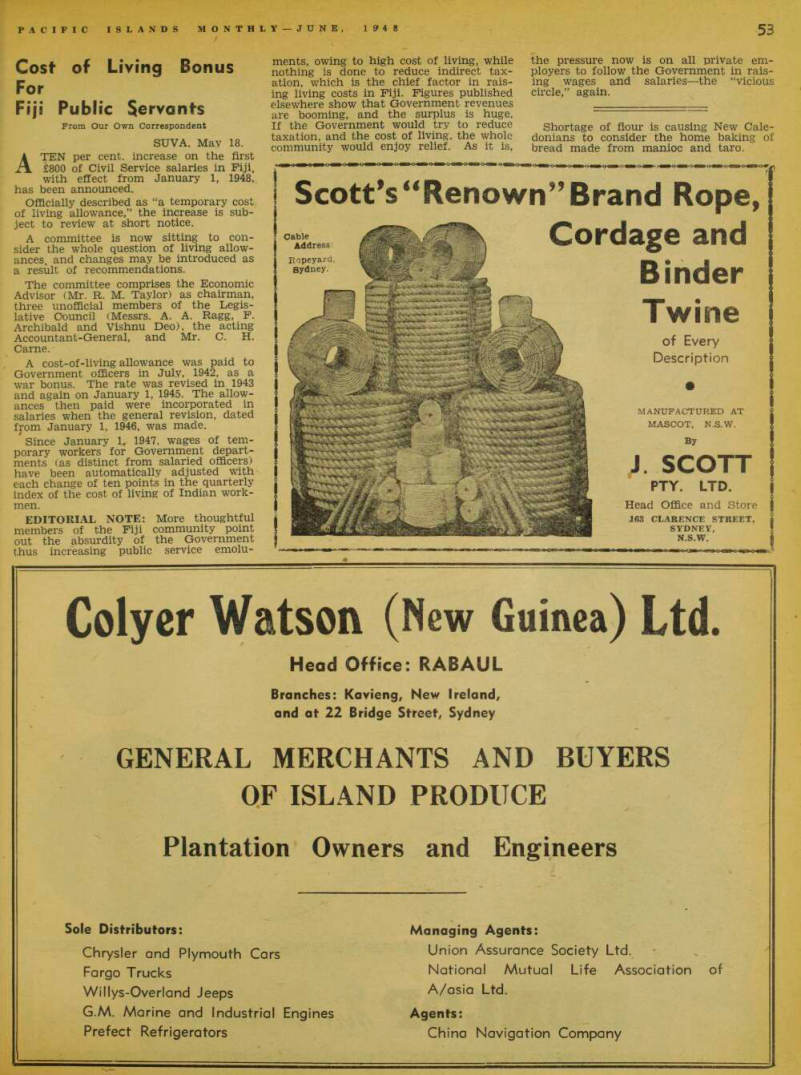
Cost of Living Bonus For Fiji Public Servants
Prom Our Own Correspondent
Suva, May 18.
ATEN per cent, increase on the first £BOO of Civil Service salaries in Fiji, with effect from January 1, 1948, has been announced.
Officially described as “a temporary cost of living allowance,” the increase is sub ject to review at short notice.
A committee is now sitting to con sider the whole question of living allow ances, and changes may be introduced as a result of recommendations.
The committee comprises the Economic Advisor (Mr. R. M. Taylor) as chairman, three unofficial members of the Legis lative Council (Messrs. A. A. Ragg, F.
Archibald and Vishnu Deo), the acting Accountant-General, and Mr. C. H.
Came.
A cost-of-living allowance was paid to Government officers in July, 1942, as a war bonus. The rate was revised in 1943 and again on January 1, 1945. The allow ances then paid were incorporated in salaries when the general revision, dated from January 1, 1946, was made. * Since January 1, 1947, wages of tem porary workers for Government depart ments (as distinct from salaried officers) have been automatically adjusted with each change of ten points in the quarterly index of the cost of living of Indian work men.
EDITORIAL NOTE: More thoughtful members of the Fiji community point out the absurdity of the Government thus increasing public service emolu
ments, owing to high cost of living, while nothing is done to reduce indirect tax ation, which is the chief factor in rais ing living costs in Fiji. Figures published elsewhere show that Government revenues are booming, and the surplus is huge.
If the Government would try to reduce taxation, and the cost of living, the whole community would enjoy relief. As it is,
the pressure now is on all private em ployers to follow the Government in rais ing wages and salaries —the “vicious circle,” again.
Shortage of flour is causing New Cale donians to consider the home baking of bread made from manioc and taro.
Advertisements & other items, p. 55 (1 item)
Colycr Watson (New Guinea) Ltd.
Scott’s “Renown” Brand Rope,
Cable Address: Ropeyard Sydney. ‘M : ' r ± : SK
Cordage and
Binder
Twine
of Every
Description
MANUFACTURED AT
MASCOT, N.S.W.
By
J. SCOTT
PTY. LTD.
Head Office and Store
-163 CLARENCE STREET,
SYDNEY,
N.S.W.
Colycr Watson (New Guinea) Ltd.
Head Office: RABAUL Branches: Kavieng, New Ireland, and at 22 Bridge Street, Sydney
GENERAL MERCHANTS AND BUYERS
OF ISLAND PRODUCE
Plantation Owners and Engineers
Sole Distributors: Chrysler and Plymouth Cars Fargo Trucks Willys-Overland Jeeps G.M. Marine and Industrial Engines Prefect Refrigerators Managing Agents: Union Assurance Society Ltd.
National Mutual Life Association A/asia Ltd.
Agents: China Navigation Company of
Big Bang At Tadji
N. Guinea's "Little Bikini"
LATER this year it is proposed to detonate about 3.000 tons of bombs which are now gathered together at Tadji Plantation near Aitape, North ern New Guinea.
With the exception of the atom bomb explosions, this is expected to be the biggest man-made explosion in the Pacific. Natives within a six-mile radius of Tadji will be evacuated, and numer ous listening posts and observation points will be manned by RAAF personnel for about 50 miles around, to record the effect of the explosion on the earth’s surface, on the sea and on the atmosphere. This data is of interest to scientists.
Origin of Polynesian
Diocese
THE Bishop in Polynesia, Rt. Rev. L.
S. Kempthorne, of Suva, is now in Britain, attending the Lambeth Conference. Meanwhile, his chaplain in Western Samoa, Rev. C. W. Whonsbon- Aston, tells the interesting story of how the Diocese of Polynesia was formed.
Mr. Whonsboti-Aston was recently in Ireland, at a place called Enniscorthy. In an article in the Polynesian Church Gazette, he says:— This is the part of Ireland of particular interest to Polynesia, The Diocese of Melanesia was ’born with the whole of the New Zealand
Church behind it; New Guinea Diocese saw its genesis from the acts of Aus tralia’s General Synod; but the Diocese of Polynesia owes its beginnings to the lone labours of William E. Floyd, whose early days were spent around Ennis corthy.
On Saturday morning we went down to the store owned by Mr. Buttle, whose name reminded me of the firm of Buttle’s in Sydney. He remembered some con nections that would lead us to Floyd’s relatives.
In the cool of the summer evening we motored to a very clean white and thatched farm cottage where two women folk relatives had but a hazy idea of their cousin, who had died nearly 40 years earlier. But a lead from them took us to Kilcormack to be greeted by a good old soul on two sticks, her hands twisted with arthritis. She brought out the old family photo album, with the apertures, from which burst another generation in beards and poke bonnets.
We established that the founder of the work in our Diocese was born in Gorey, a picturesque town on the Dublin side of Enniscorthy.
She told us an interesting story of the rescue of Floyd’s grandmother by some Roman Catholics in the terrible mas sacres that accompanied the Rebellion of 1798. The grandmother had a permanent injury to one arm caused when carrying Floyd’s father under that damaged wing to protect the babe’s life.
At Clone *it was interesting to meet a parishioner who remembered Floyd’s re turn to Ireland many years ago to raise funds for the beautiful church in Levuka and for the Indian Mission at Labasa.
As we returned from Kilcormack in the dusk, with the healthy smells of the farm life about us, there was a younger cousin with a discovery. It was an old photo
taken in Melbourne, years ago, and sent Home by Floyd’s parents—tfie photo of an Australian aborigine. Probably this gave Floyd his interest in the missionary world outside, for he left Melbourne in 1870, after his ordination there and his first Curacies, for Fiji, to become Chap lain and, later, first Vicar of Levuka,
Advertisements & other items, p. 56 (1 item)
%\ dunlop
LONDON-SUVA
V*
PANAMA V
For Sailings and Further Particulars Apply To:— BETHELL, GWYN & CO., BURNS, PHILP (SOUTH SEA) 138 LEADENHALL ST., co » LTD »
LONDON, E.C.3. SUVA.
Dunlop sporting equipment enjoys worldwide popularity amongst all players of sport. You can be sure, always, of getting the best products of their kind available when you specify Dunlop Tennis Rackets, Tennis Balls, Sports Shoes, Golf Balls and Bowls.
They're still difficult to obtain but keep asking for the Dunlop Brand. > ■■ *» ■ : "V 7 s/d'A'
?A;r ■ m
INLOP
jt-
%\ dunlop
D. 443
DUNLOP- flit Vubl&'i
Judgment In Tongan
Title Case
Nukualofa, April 20.
THE Judge of the Tongan Land Court, Mr. P. A. Richardson, gave judg ment to-day in the claim for the hereditary noble title of Malupo and estates pertaining thereto.
Malupo is the titular chief of the is land of ’Uiha in the Ha’apai Group.
Judgment was for defendant, the present holder of the title.
The claimant, Amipeliasi 'Ahokava, based his claim on the fact that he is a direct descendant of a senior branch of the Malupo family whereas the pres ent holder descends from a junior branch. Although the evidence estab lished the ground that claimant’s an cestor, through whom the claim was made, was only a half-brother of the Malupo who was holding the title when the Constitution was granted in 1875 and that, in accordance with Tongan custom a full-brother takes priority of place in order of succession over a half-brother, irrespective of the order of seniority of birth.
The present holder is a descendant of a younger brother of the 1875 Malupo.
An appeal to the Privy Council against the judgment of the Land Court has been made by the claimant, alleging that Tongan custom places more emphasis on the order of seniority of birth than of blood relationship.
First Post-War Wedding In
Wewak
Wewak, May 28.
THE war is over—the dove has turned up with the twig: Our first wedding since those sighed-for good old days.
Early in May, Miss Betty Canning, a fair lass from Caulfield, Victoria, came to marry Ken Field, of the Public Health Department, Wewak. When the awaited evening arrived, we all rolled along to the Sepik Club, all decked out (we and the Club) for the occasion.
There was ample evidence of several days’ preparation by the ladies. It was all there, and we still wonder where It came from —lighting and decorations, rows of seats, and tables groaning under everything one could wish to eat, not the least of these being a fully-fledged wedding cake from the expert hands of Rhona Blair. The simple ceremony was conducted by District Officer Niall, with Mrs. Peter Davies in attendance as matron of honour, and Bill McMahon as best man.
We feel quite proud of it all. if you Would be Wed, Wend your Way to Wewak!
Naval Visitors
HMAS “Culgoa” visited us recently.
A pleasant interlude of her stay was an invitation aboard, to partake of hospi tality and see a film one evening. Part of the entertainment was in getting there and back, there being other ways of going to the pictures than taking a tram into town. Jeep headlights on the beach, sounds of feminine doubt, dinghies out to the crash-boat, a good shower of rain, and then a swift run out to where lights were swinging gently, a mile off-shore, were the prelude to a cosy welcome in the wardroom.
Another naval craft, MSL7O7, has been in the vicinity for several weeks, en gaged in bomb-disposal work. In some respects, a little of this seems to go a long way.
Wewak’s air activities are looking up with the arrival from South of Bobby Gibbes’ new Auster in the charge of pilot Tom Briggs. This has resulted so far in the inauguration of a Tuesday ser vice to Lae.
Late DLO at Manus, Mr. G. Corlass, with Mrs. Corlass, daughter Jill and small son, have now taken up residence here. Visitors have included Mrs, Butler from Angoram, and Gerry McPhee, en route from Angoram to Sydney, where he is to join the benedicts. ,
Advertisements & other items, pp. 57-58 (1 item)
Diesel Engines By Wid D O P
We Will Buy
It For You
Any goods you may require from English shops or factories Purchased and Shipped.
Small or large orders catered for.
ALL SERVICES UNDER-
TAKEN FOR RESIDENTS
ABROAD.
PITT & SCOTT
LIMITED
(Established 1876) General Shipping and Buying Agents. 1/3, St. Paul's Churchyard, London, England Cables. Shipping London.
► -• '■••• ' •• ■' -* •■■■'■ • " • is (X-Type) 120 H.P.
Direct reversing ■&M DIESEL ENGINES BY WID D O P 5 H P TO 300 H P " "
H • WIDDOP & CO LTD
GREENGATE KEIGHLEY ENGLAND
Telephone: Keighley 3727-8 Telegrams: Widdop Keighley. Codes: A.B.C. 6th Edition, Bentley’s, Bentley’s Second
IBMUMI
W, r
CVS—B?
There is only one
ELECTROLUX
THE MODERN KEROSENE-OPERATED REFRIGERATOR
THAT ACHIEVES THE MIRACLE OF ICE FROM HEAT
Lasting Efficiency, Silent Operation, Streamlined Beauty
■ LJ .*■£ iiiiiHP a s Economically operated by kerosene, with a simple precision-built freezing unit that has no moving parts and is GUARANTEED FOR
FIVE (5) YEARS.
Obtainable from: W. R. CARPENTER (New Guinea), LTD.
Rabaul, Madang, Lae, Kavieng, Wau.
J. R. CLAY & CO., LTD., Port Moresby.
W. R. CARPENTER & CO. (Sol. Is,), LTD., Tulagi.
For New Hebrides, Butaritari, Noumea, New Caledonia. Apply—
W. R. CARPENTER & CO. LTD.
Model LKSSI Storage capacity: 5i cub. ft. (approx); shelf area, 9 sq. ft.; food shelves, six—five removable; 2 self-supporting when half drawn. Ice-making: Four trays—s lb. ice per freezing: 80 cubes. Fuel consumption: 1.8 pints kerosene per day (approx.).
Height: 4 ft. 10 in. Depth: 2 ft. 3i in.
Weight, unpacked, 434 lb. Packed, 700 lb.
Head Office; 16 O'Connell St., Sydney, N. S. Wales
Fiji Liquor Bill
More Deliberations On Fiji Liquor Bill
From Our Own Correspondent
Suva. May 23.
IT has been announced that, the Liquor Bill Select Committee (the Commis sioner of Police, Mr. I. E, Lucchinelli, chairman, Messrs. A. A. Ragg and H.
Maurice Scott. Ratu George Tuisawau and Joeli K. Ravai, and Messrs. Vishnu Deo and A. D. Patel) appointed in November to look after the Bill, has asked the Indian Advisory Committees throughout the Colony to submit their views.
The committees, which are Govern ment-appointed, will invite Indians in their respective districts to attend meet ings and express opinions on the Bill, which proposes to remove all the liquor restrictions on Indians but to re tain the permit-system for tjie Fijians.
A writer in the “Fiji Times” suggests that the Bill has stirred up more bitter ness and inter-racial strife and jealousy than any other in the recent history of Fiji, and should be referred to the South Pacific Commission, now in full opera tion. He objects also to the Indians be ing consulted when the Fijians will not be permitted a voice. Many months ago, when the Bill was first introduced, the Government stated that the Council of Chiefs had approved the Bill. It was sub sequently shown that the only liquor matter ever submitted to the Chiefs was whether or not the present Fiji permit system should be abandoned.
As a footnote to all this it may be mentioned that on May 22, a Chinese was fined £l5 for supplying whisky to three young Fijian girls. The girls, charged with drinking liquor, were each fined £l.
This case is quoted merely as an illus tration which seems to support the anti- Liquor Bill contention that, in view of the war and post-war record of Fiji’s Asiatics, the bootleg exploitation of the prohibited Fijian population would reach fantastic proportions if unlimited liquor were made available to any Indian who cared to get into the business.
Immigration Ban
Tongan Still Under Australian Immigration Ban
ALTHOUGH strong pleas have been made on behalf of the Tongan wife of Mr. Stewart Garrick of Perth, WA, the Australian Minister for Immi gration (Mr. Calwell) is adament, and says that, in accord with White Australia policy, she must leave Australia by Sentember. Mrs. Garrick, who is re lated to the Queen of Tonga, has two little girls—Joan (12) and Diana (8).
Stewart Garrick is a son of Dr. Rath Garrick, of Suva, and has spent much time in Fiji and the Polynesian islands.
Mr. and Mrs. Garrick passed through Sydney in 1946, on their way to India and Europe; but they were turned back by travel restrictions and went to live in Perth, where Dr. Garrick (who retired from active practice a couple of years ago) is now settled.
Friends still are protesting angrily that, if the Australian immigration laws have been held not to apply to Maoris, they equally should not apply to Tongans, who also are members of the Polynesian race.
Pan American Airways contemplate establishing an air parcels post service in the Pacific.
Copra Growers' Union
Of Fiji
ALL Copra Growers are urged to join this Union and form branches in all centres in the South Pacific. Planters! “Unity is Strength” —so guard your own interests.
The objects of the Union are:— (1) To unite all Copra Growers; to urge them to express their ideas; and to- have one concerted and strong medium through which to express their viewpoint in matters of price, markets, etc. (2) To investigate all matters of in terest in relation to by-products, offsets for hurricanes, etc. (3) To encourage research in regard to new uses for coconuts and associated products. (4) To inform Cop?li Growers of matters affecting their interests: to invite opinions, articles, ex periences, etc., from growers, for the information of other growers.
C. G. O. Parr.
Savu Savu, Fiji.
Mr. H. S. Barnett, Australian Consul in Noumea, has issued a statement explain ing the injustice of local allegations that Australia was taking advantage of the world shortage of wheat to profiteer at the expense of non-producing countries.
The statement, which runs to several hundred words, explains the policy of the Australian Wheat Board and international conditions, including the long-term con tracts with Great Britain and India.
Advertisements & other items, pp. 59-60 (1 item)
C. Sullivan Pty. Ltd.
Island Merchants
Over 30 years' experience in the Pacific Island Trade.
Expert Buying Service Original Invoices Furnished Sellers of Island Produce.
Represented in all Australian States, New Zealand, England, France, United States, etc.
BANKERS-: Bank of New South Wales, Comptoir National d’Escompte de Paris, Bank of New Zealand.
C. SULLIVAN PTY. LTD.
379 KENT STREET, SYDNEY
Telegrams & Cables: CHASULL, Sydney. Phone: MJ4657 (6 lines).
If You
Cannot Sleep
FEEL FIT FOR NOTHING.
You may be anaemic or bloodless, for this ailment plays havoc with your health and nervous energy. You feel terribly nervy; suffer headaches and dizzy spells, have poor appetite, cannot sleep at night —losing those precious hours of rest and recovery, essential for your health and fitness.
Many people have recovered from these miseries by taking Dr. Williams’ Pink Pills, which have reinvigorafed, strengthened their system# and banished the vague pains and weariness. Dr. Williams’ Pink Pills always help to enrich and increase the blood supply, giving beneficial help to the nerves, tissues and organs of the body. With enriched blood you cannot help feeling happier, sleeping better, becoming reinvigorated.
Stop anaemia making you a suffering invalid without delay. Take Dr. Williams’
Pink Pills and soon notice the difference in your eyes, skin, nerves and general health. At all chemists and stores.
BP's Again Earn Steady
Profits
THE 66th annual report of Burns philp & Co., Ltd., indicates a net profit for the year ended March 31 of £279,850. With £49,715 brought forward, a sum of £329,566 is available for dis tribution. It is proposed to dispose of this as follows—lo per cent, on the Company’s £2,000,000 of subscribed capi tal, £200,000; £50,000 added to Reserve Fund; and £79,566 carried forward.
An increasing proportion of this old established South Pacific trading com pany's activities has been transferred from trading, shipping and planting in the Pacific Islands to plain storekeeping in - the Australian States of Queensland and New South Wales; but there are no details published.
The profit for the year just ended compares favourably with the profits of previous years, showing that the change in the character of the Co.’s activities has not affected its earning powers.
The statement of Assets and Liabilities shows that this Company’s assets are now £9,025,300, which include the follow-
IT was announced in May that Messrs.
Burns Philp & Co., Ltd., had bought a controlling interest in S. Richardson & Co., Pty., Ltd., of Narrandera and Leeton, NSW.
ing:— £ Real and shipping property .. .. . . 2,359,317 Investments in other companies and Government loans . . .. 2,426,107 Shares in subsidiaries . .. 1,325,939 Cash on hand or at call .. .. . . .. 226.637 Stocks and produce .. . 1,596,937 Book debts, etc . . . . 780,811 Owing by subsidiaries .. .. . . . . 309,549 The main items in the statement of Liabilities are:— £ Issued capital . . . . 2,000,000 Reserve fund .. .. 1,300,000 Insurance fund, etc .. .. 1,986,710 Sundry creditors . . .. 1,511,481 Shipping, etc., a/cs in credit . . .. 1,397,955
Pygmies, Past And Present
Letter to the Editor rERE is no doubt that there once were pygmies in Western Samoa; but, unfortunately, these diminutive people of negrito type did not leave be hind them any bold, definite, enduring marks on stone, such as characterise other races. Their burial grounds were small and, because they were nomads, widely scattered. Their graves were marked only by heaps of small stones, usually by about 41 ft. x ft.
Some of the pygmies’ graves, which I examined in the Caroline Islands, con tained adzes and shells, but little else.
In Western Samoa, while seeking a source of water, inland in Upolu, and working down to the coast, digging where it seemed likely I might find water for plantation use, I had a hole put down about 32 ft. in a dry watercourse and there I came upon a native oven of burned earth. There we found seven stone adzes, very much smaller than the Samoan adzes of to-day, or the old adzes found in caves.
There are legends of pygmies in Hawaii, Tahiti, Samoa and New Cale donia; and, as most people know, there still are pygmies in New Guinea, or some islands off New Guinea, in Madagascar and in the Andaman Islands.
I am, etc., Western Samoa.
H. C. Reed
Mr. William Groves, Director of Educa tion in New Guinea—Papua, arrived in Melbourne on furlough in June.
Advertisements & other items, p. 60 (1 item)
Blow”
“Where The
At all Leading Booksellers in Australia; at the Stores of Whitcomb & Tombs, Ltd., in New Zealand; at Caldwells Book Store, in Suva; from the Islands stores of Burns Philp & Co., Ltd.; and from Booksellers generally.
OR DIRECT FROM THE PUBLISHERS:
Pacific Publications Pty. Ltd.
UNION HOUSE, 247 GEORGE ST., SYDNEY
Trade Winds
Blow”
Still available for your
entertainment . . .
This book of over 70 bright stories, articles and sketches, illustrated with cartoons and photographs, describes life in the South Seas as it has developed in the past decade.
It is written about Island people and places by those who know the islands—with the emphasis always on the amusing side of life.
A delightful gift-book for your friends. A source of entertainment to yourself.
Collected by
price R. W. Robson
9/6 ° nd
Posted Judy Tudor
Madang Newsletter
Prom a Special Correspondent
Madang. May 25.
A WELL-ATTENDED party was given to Sister Joyce Jones at the Club House prior to her going on leave.
The president of the Social Club, Mr.
George Tyrell, president of the Citizens’
Progress Association, Mr. Ben Hall, and District Officer Mr. J. K. McCarthy spoke on the sterling character of Sister Jones, stressing her kindness, devotion to duty and her courage during the evacuation of Madang, in 1942.
As a token of the esteem in which she is held in the district, a wallet of notes was presented to her. ♦ ♦ * Citizens and Progress Association met at the Madang Club recently when Town planning officials, visiting the district, outlined some ideas for Madang and an swered queries concerning the size of residential blocks and positions of build ings. Several residents discussed the erection of the Bailey bridge across the Meiro River and asked why this project had been discontinued. The nosition of the temporary sawmill close to the recrea tion grounds, residential area and hos pital was strongly criticised.
Dissatisfaction was expressed concerning mails, it being pointed out that some planes left Lae without carrying mail.
Citizens seemed satisfied with the ser vice provided by Madang post office. ♦ * * According to all reports, cost of living in Madang is considerably higher than elsewhere in the Territory. This is due to the excessively high costs of grocery lines and boy’s rations. ♦ * ♦ Mosquitoes are busy in Madang but the introduction of palludrine has done much to lower the incidence of malaria. ♦ ♦ ♦ A popular arrival to the town is Miss Joy James, who has taken charge of the post-office. Miss James and her mother travelled from Brisbane on the “Montoro” to join Mr. H. James, of BP’s staff. * ♦ ♦ Building attractive homes in Madang for Administration officials has ceased.
Recent erections are unattractive, incon venient and in some instances lacking in privacy. ♦ • * The acting-treasurer, Mr. J. Bourke, and two auditors. Mr. Gordon Farmer and Mr. P. George, recently had a busy week enjoying Madang hospitality in be tween serious consideration of the financial returns of the District.
Rumours are prevalent that the Com monwealth Savings Bank intends com mencing operations irr Madang. Residents feel the need for this is urgent. ♦ * ♦ Madang’s DLO, Mr. Hal Evans with Mrs. Evans and their two young daughters, returned to Madang on the “Montoro.”
The family is happy in its new home at Kahbobo, completed prior to their leave South. Mr. Evans’ relieving officer, Mr.
Jim White, was guest of honour at a party at the home of Mr. George Edwards prior to his departure. ♦ ♦ ♦ ADO, Lloyd Hurrell, of Bogia, who went to Lae recently on duty had an ad venturous return to Bogia by the “Koro ”
Madang’s trawler. When some distance U P the c ° ast , engine trouble set the boat adrift for ten hours.
Advertisements & other items, p. 61 (1 item)
VaMott»«>«y'
10 ROMANTIC SOUTH SEAS *
h LUXURY
FLYING BOAT!
•k ★
N6W ' T
I, GUINEA 1
• * \ <U<U r
SOLOMON
ISLANDS
I
i c: I
KEU
Hebrides ■ /.♦ ♦ C<«> ♦ 9 K££J Caledonia n
QIORrOLK.
HOWS 16 J
1
VaMott»«>«y'
14 MARTIN PLACE, SYDNEY
The Pacific Islands Service
1 \ Air Cruises to Passenger & Freight Services \ * Fiji • TONGA • ” OUMEA VIL^ (J . AITUTAKI . TAHITI
• TULAGI • LINGATU I
CHARTER AIRCRAFT available to all parts of the wor.
Araument Over Trial of Filipino
For N. Guinea Mirder
AUSTRALIAN authorities seem vague and indefinite in regard to the punishment of the man who murdered Mr. John Harcourt Scott in New Guinea earlv in the year.
N «rnt? U was murdered by a Filipino soldier in the service of the United States. The Australian-New Guinea officials began a magisterial inquiry; then
American officers stepped in and claimed that it was their duty to try the case; and re moved the soldier and material witnesses to the Philippines, In reply to a question in Parliament, Dr. Evatt, Australian Attorney-General) said that there was a dispute about juns diction; but the Australian Administra tion had been instructed that, as the crime was committed on Trustee territory, the trial should take place there. He did not know what had happened since.
New Industry In Fiji
Candlenut Oil
WHEN it was discovered that candle nut oil was almost as, Valuable as tung oil in the manufacture of paints, an enterprising Melbourne group estab lished, in 1946-7, a candlenut-crushing factory in Suva.
It is now crushing about 60 tons of nuts per month, and is producing about 22,500 gallons of oil per annum.
Having acquired new plant, the Com pany now could treble its production, but it cannot get the nuts. Candlenuts grow everywhere in Fiji; but the carefree Fijian native will not trouble to gather them, although the Company offers £7 per ton for them. So far, the company’s most regular and dependable supply comes from the adjoining group of Tonga.
Most of the Company’s production is now being used in Suva, in making paints; and a subsidiary company now is making roofing and other paints.
High Cost of Lavatories
In Suva
From Our Own Correspondent
Suva. May 17
rE Suva Town Board recently re ceived a document from the Director of Lands asking for £937 for the use of a piece of land in Gum ming Street on which public lavatories had been built in 1942. At that time Suva was crammed with New Zealand and American troops. The claim origin ated from the owners of the property.
To give itself time to recover, the Board held the letter .over “for further consideration;’
Advertisements & other items, p. 62 (2 items)
60
J U N E, 19 4 8 PACIFIC ISLANDS MONTHLY
A. B. Donald Ltd.
AUCKLAND
ISLAND TRADERS & GENERAL MERCHANTS
P.O. Box 1509. Cables & Telegrams, "Kingdom/' Auckland.
NELSON and ROBERTSON Pty. Ltd.
Established 1895
Shipowners - Brokers and
Islands Merchants
All classes merchandise purchased at Best Wholesale Prices. Original Invoices supplied to Island Clients. Cocoa Beans, Copra, Rubber, Trochus Shell and All Islands Produce Sold on Commission.
Entrust your requirements to the firm with fifty years' practical experience in the Pacific Islands.
NELSON & ROBERTSON
12 SPRING STREET, SYDNEY, AUSTRALIA
Telegraphic Address: IVAN, SYDNEY.
Indians' Place In
Fiji
Agitation to Share in Trusteeship Over Fijians
Prom Our Own Correspondent
Suva, May 19.
WHENEVER things get lively in Fiji’s Legislative Council on the thorny subject of the proclaimed para mountcy of Fijian interests in Fiji, it is a certainty that at some stage an Indian speaker will get up and say in a hurt tone that there is no justification for the assumption that the British are and should be the sole trustees for the Fijians.
In fact, one Indian Legislative Coun cillor has declared, more than once, that “the Indians in Fiji, as loyal subjects of the British Crown, have as much right to be regarded as trustees for the Fijians as have Europeans.”
This argument, such as it is, is the basis of an article published not long ago in New Asia, the official organ of the Indian Colonial Society, whose head quarters are at Madras. The article was written by New Asia’s correspondent in Fiji.
Referring to the Legislative Council debate on the implementation of the Deed of Cession (the debate, held in July, 1946, was a damp squib, as far as any long-range effect was concerned), New Asia’s Fiji correspondent says;— “All that we wish to say is that the Indian members took a very bold stand and, in a body, they mercilessly exposed the soi-diant trusteeship of the Euro pean community in Fiji. In this matter, the acting Secretary for Fijian Affairs (a Fijian) also by his able and very sen sible observations, could not see his way to support the motion on the principle that the Deed of Cession binds all, Euro peans and Indians alike.”
Actually the acting Secretary of Fijian Affairs, whom the correspondent des cribes as a Fijian, was the present District Commissioner, Southern, (Mr. j.
Judd). At the time of the debate the Secretary (Ratu Sir Lala Sukuna) was in England.
WITHOUT referring directly to last year’s abortive attempts by Indian delegates to the United Nations to get an Indian finger into the pie of British and American trusteeship and other territories, the article states.— “No one has come out of this (trustee ship) broil with clean hands. Even the United States, a champion of democracy, claimed ‘exclusive trusteeship’ over Jap anese mandated islands, and declared them to be strategic areas over which the Trusteeship Council has no power of in spection.
“This led to stout opposition from
Russia, and she refused to take her seat in the council. The outlook for trustee ship is thus doomed.”
This is padded with abuse of the Euro peans in Fiji and in South Africa, It ends with a quotation attributed to a native representative in the South Afri can Senate: — “It is by a general development—which must be carefully noted for their (Euro pean) own safety—that the coloured races in future stand together and re sist the conception of white supremacy.
Any attempt to perpetuate that concep tion must lead to increasing friction on a world scale, instead of on a national scale, as in the past.”
The point of quoting this article in New Asia is that it gives a good indica tion of the sort of Asiatic propaganda that is being handed out, not only to Indians in Fiji but, what is more signi ficant, to the Fijians.
As a footnote to the trusteeship ques tion, it may be noted that “The Times,”
London, on April 7, reported that after a commotion in Kenya a proposal to give the Indians in that colony equal political representation with the Euro peans had been abandoned. The oppo sition to the plan fought it on the ground that the Government had no right to extend to Oriental immigrants trusteeship of native peoples.
Kenya, it seems, is many years behind Fiji.
Passing through San Francisco on his way to France, M. Quesnot, who will rep resent Tahiti on the Council of the Re public, had discussions with Pan Ameri can Airways officials with a view to get ting the company to establish a line between Tahiti and the West Coast of the US.
Advertisements & other items, pp. 63-64 (1 item)
Aluminium Roofing
KANGAROO BRAND
Ropes,
Cordage,
and Twines for every purpose Backed by 86 years of service Manufactured hy:
M. DONAGHY AND SONS,
Pty. Ltd., Geelong and Sydney.
Fiji Representatives:
PEARCE AND CO.
LIMITED
P.O. BOX 237, SUVA
(Established 1906).
ATKINS, KROLL & CO.
IMPORTERS. EXPORTERS.
320 CALIFORNIA STREET
SAN FRANCISCO 4, CALIFORNIA.
Coble Address: Atisco, San Francisco.
General Exporters: South Sea Distributors:
FOODSTUFFS.
HARDWARE.
LUMBER.
TEXTILES.
MACHINERY.
Importers:
COPRA.
VANILLA BEANS,
COCOA BEANS.
SHELLS.
WILSON & CO.
Canned Meats.
B. P. GOODRICH CO.
Canvas Footwear.
A. SCHILLING & CO.
Coffee, Spices, Tea, Extracts.
THE GLIDDEN CO.
Paints & Varnishes.
Monthly Merchandise Bulletins upon Request.
Aluminium Roofing
Now available for shipment to Pacific Islands Aluminium Corrugated Roofing is rustless and is one of the lightest of all fabricated roofing materials.
This is a point worth remembering when considering freight costs. Heat due to solar radiation is considerably reduced when Aluminium roofing is used.
Inquiries to:-
ALUMINIUM UNION LIMITED
(Incorporated in the Dominion of Canada ) Largest Distributors of Aluminium and its alloys in the British Commonwealth OCEAN HOUSE, 34 MARTIN PLACE. SYDNEY, N.S.W.
A Member of the Aluminium Limited Group, Montreal, Canada
DOUGLAS BELL
Novel Architect ond Surveyor Detailed designs for all types of cargo ships for Island or general purpose—yachts’ and power cruisers.
Contracts Arranged and Supervised.
ROOM 112, 62 MARGARET STREET,
SYDNEY, N.S.W.
Phone: BX 1297. Box 4723, G.P.0., Sydney,
Allen Taylor & Co. Ltd.
COMMERCIAL ROAD, ROZELLE,
SYDNEY
Sawmillers ond Wholesale Suppliers of Hardwoods for Constructional Purposes GIRDERS ... PILES .. . POLES . . . SLEEPERS, Etc.
EXPORTING TO PACIFIC” ISLANDS SINCE 1893
0 a
RJ2. 18 H.P. MARINE DIESEL
Driving 21 in. x 1 siin.
Propeller at 740 RPM • Reliable • Efficient • Economical • Easy Starting
GOOD DELIVERIES
Stuart Turner
Marine Engines
li, 4 and 8 BHP Reduction Gear and Electric Starting Models available.
Light, Simple, Economical, General Purpose Units Suitable for 25-35 ft. craft.
Write for full particulars of our i complete range of engines to:
Thornycroft (Aust.) Pty., Ltd.
Cables: THORNMOTOR, Sydney.
New President Of Suva
Chamber Of Commerce
AT the Annual General Meeting of the Suva Chamber of Commerce, on May 27, Sir Maynard Hedstrom de clined nomination for the office of Presi dent; and Mr. T. Alport Barker, CBE, was elected to that office. Mr. Alport Barker, who is the owner and editor of the “Fiji Times,” has held many public offices in Fiji.
The new Vice-Presidents elected were, the Hon. John Trotter, MLC, and Mr. W.
Granger Johnson—managing directors respectively of Burns Philp (SS) Co., Ltd., and W. R. Carpenter & Co. (Fiji), Ltd.
Sir Maynard Hedstrom had held the office of President of the Chamber of Commerce for 25 years and, in that capacity, he has given the trading com munity of Fiji invaluable service. Among other things he had to deal with the special and peculiar problems created by the two world wars. The Chamber plans to recognise his fine service by enter taining him at a special dinner.
Held Up
Cannot Get Labour
Territories' Richest Mine Is Still Held Up
STEPS are being taken by Cuthbert’s Misima Goldmine Ltd., to scout bore the sulphide formations on the company’s valuable leases on Misima Island. The Company’s rich goldmine is situated in oxidised formations; but operations, from time to time, have shown intrusions of heavily mineralised sulphide ore, and it is thought that diamond drill ing may disclose -something interesting.
Shareholders are being invited to sub scribe £25,000 to a special fund, to make the exploration while awaiting full-scale gold production.
This Company’s mine—one of the rich est in the South Pacific—was suspended when the Jap invasion occurred; and the directors have not been able to resume mining on a payable scale because they simply cannot get labour. Before the war, they maintained a large native staff.
Since then, as a result of new policies introduced by the Australian Socialist Government, the Company can get only 85 to 100 labourers, instead of 250. The Company is still doing its utmost to enlist workers —but the natives, naturally, pre fer conditions around the towns, where the Administration continues lavish ex penditure, and where commercial firms are competing with each other in an at tempt to attract their own labour re quirements.
The Rev. W. F. McKenzie, who was born on an island in the New Hebrides which disappeared into the ocean in a tidal wave many years ago, has been elected Presbyterian Moderator for Queensland.
Notes From East
Samoa
A Pacific Islands resident, who was in American Samoa in April, sends the following interesting notes on conditions there: —
Sadie Thomson’S Inn
THIS famous building has now passed out of the hands of the Meredith family, of British and American Samoa. It was sold by sealed bid, in February, and the highest bid of 12,500 dollars, by Mr. Max Haleck, was accepted.
So he now owns the place; but he cannot yet occupy it, as the lease has another year to run. The lessee and his wife, Mr. and Mrs. Browne, are at present serv ing a prison sentence for accepting and selling government property, and Mr.
Browne refuses to relinquish his lease.
Mr. Haleck naturally is trying to get the lease cancelled, but so far has been un successful. Shades of Somerset Maug ham!
Flag Raising Day
APRIL 17 was the 48th anniversary of the day the American flag was first raised in Eastern Samoa, and it was celebrated, as usual, with parades and speeches, sports and boat races on the harbour, and dancing and singing com petitions. Large, happy crowds thronged the malae until a late hour.
In the course of speeches it was men tioned that the Government intends to instal a larger generating plant for electrifying the whole island, and also to launch an intensive campaign against filaria.
On April 26 the Governor and retinue will proceed by Navy craft to the Manua Group, to celebrate Flag-raising Day there
Visiting Ships
TWO American yachts have been in port at Pago. One is a small craft called the “Langsyne,” and the other a beautiful, big two-master, called “Yan kee.” The crew are young Americans wanting to see the world, and paying their snare of expenses.
The “Yankee’s” owners, I think, are Mr. and Mrs. I. Johnson, who are mak ing their fourth world tour. I under stand that from Pago the yacht goes to the Solomons.
There is a rumour that the “Corsair,” 3,000 ton yacht formerly owned by the late Pierpont Morgan, may visit Pago in October, on a Pacific cruise.
Visitor
MR. HAROLD GATTY was in Pago when I was there. One of us saw the stranger in civilian clothes, and asked one of the young American clerks in the supply depot who that was.
The reply came: “Him? Oh, that’s a guy called Gatty—he’s here about fish, or something.” Apparently young America has never heard of the famous navigator who helped their Wiley Post around the World.
War Veterans Return To
School
THE American scheme for allowing War Veterans to catch up on schooling lost during war years is being re peated in American Samoa. So there one sees young Samoan men, of between 20 and 30, trotting off to High School again, with the Government paying them approximately 120 dollars a month until they graduate. What an incentive to go to school! They don’t need jobs—and many of them get married on their school “fees.”
Wireless Stations
11TE heard the Apia broadcasting ff station very well in Pago, and as a rule their programmes are very good. Tutuila has a station which they call 2VUV, Armed Forces Radio Station—
but I do not think it is audible anywhere outside of Pago.
Price Of Copra
THE price of copra in Pago, as paid to the growers, is 10 cents per lb.,
and this works out at about £52 per long ton (American) and £62 per ton of 2,240 lb. Most of the copra comes from Manua and Swain’s Island. We were not impressed with the plantations we saw on Tutuila. They are sadly over grown, and the coconut trees that are visible are scraggy and badly chewed by the rhinoceros beetle, about which the local Agricultural Department (if one exists) does nothing.
HMAS “Arunta” left Sydney in early June for a goodwill cruise to New Cale donia, New Hebrides and Fiji. Flag offi cer in Charge of the Australian Squadron, Rear-Admiral Farncomb, is in command.
It is expected that the “Arunta” will re turn to Sydney in early July.
The Rev. J. D. Roberts, of Windsor Congregational Church, Brisbane will leave shortly for the Moru district (Papua) for mission work. He will be accompanied by his wife.
Advertisements & other items, pp. 65-66 (1 item)
Hard to Get? us
\. TRADE TOBACCO
2. LAP LAP MATERIAL
3. CANNED GOODS
4. PERFUMERY
5. PRIMUS STOVES
6. KEROLAMPS
7. SHOES, SANDALS
8. UMBRELLAS
9. CHILDREN'S CLOTH-
ING
Manstocks
FOR
10. SADDLERY & HARNESS
11. HOME LIGHTING PLANTS
12. WINES AND SPIRITS
13. NON-ELECTRIC WASHING
MACHINES
14. PUMPS, IRRIGATION
PLANTS ’
15. CROCKERY
16. HAIRDRESSING SUPPLIES
17. HARDWARE
18. AIR CIRCULATORS
8a Castlereagh Street, Sydney, Australia
ISLAND TRADERS
Cable and Telegraphic address: “MANSTOCKS,SYDNEY Telephones: 8W7405, 8W1237, 85076, FM2766
RABAUL. NEW GUINEA
Re-opening of Branch
The Bank of New South Wales is pleased to announce that its Branch at Rabaul, New Guinea, has been re-opened.
Mr. E. H. S. Hill has been appointed Manager of the Branch and complete banking facilities are available.
BANK OF
NEW SOUTH WALES
ESTABLISHED 18 17
Incorporated Mn New South Wales with limited liability
FOR SALE
7 h.p. Steam Boiler
Built for 120 lbs. pressure, to American specifications. Complete with Oil Burner, Oil Tank, and all fittings. A New Boiler, in Perfect Condition. Packed in crate, ready for shipping.
Price £2OO, F. 0.8., Sydney For further details, write to Box 4490, G.P.0., Sydney, N.S.W. Australia
Cfinldlted bij
DAVISON
For Troptccil conditions
Velvene Water Paint and Davison's Zinc Base Paints are used extensively throughout ' the islands and Mandated Territories on Government and Private buildings, giving full satisfaction under severe tropical conditions.
DAVISON PAINTS PTY. LTD.
BOX 24, AUBURN, N. S.W.
N. F. Maloney & Co.
'PHONE 268
PORT MORESBY
Cables, Radios, etc.: “Malco,” Port Moresby.
'PHONE 268
Customs, Shipping and Forwarding Agents
(Boat or Air): When ordering South, asks the Consignor to ship addressed your Brand or Name and Mark the Packages “PER MALONEY.” This will help us to give Fast and Speedy Delivery.
Licensed Auctioneers and Generol Commission Agents
We will sell anything you have to offer by Auction or Private Sale.
HOUSE, LAND, AND ESTATE AGENTS CHIEF AGENTS:—
NEW ZEALAND INSURANCE CO. LTD.
FIRE ACCIDENT MOTOR VEHICLE MARINE, ETC.
Importers and Exporters • Manufacturers Representatives • Managing Agents: Papuan Airlines Limited.
Australian Representatives: E. J. GOUGH & CO., 1 BOND STREET, SYDNEY
"No Clothes, No Taxes,
Please!"
An American Couple's Vain Search In the Pacific
A RESIDENT of Milkaukee, USA, and his wife, are seeking a home in the South Pacific where they may escape some of the restrictions and unpleasant ness of “civiliastion.” “We view the nude body as good and wholesome,” they write. “Our minds are clean —so were the natives, before the white man con taminated them.”
In asking the PIM for information'and advice, they say that these are their needs: • Climate: Healthful, with no un usual perils to health or safety like malaria, hookworm, etc., and warm the year around. • Soil: Fertile enough to grow a variety of plants and foods, so that good health can be maintained. • No laws, no taxes, no white men, no restrictions of any kind. • Natives, women as well as men, to wear nothing above the waist, and very little, if anything below it; and if possible to somewhat resemble whites. • Where we can live the year around nude, without being molested, and enjoy sunshine, freedom and fresh air, and the natural life.
We have told the Americans, with some regret, that there is no place in the South Pacific which can conform to these specifications. There seem to be clothes, laws and taxes everywhere, now.
Dr. Bruce Sinclair and Mrs. Sinclair, recently returned to New Guinea after leave in Australia.
Advertisements & other items, pp. 67-68 (1 item)
Capstan i.
grand cigarette
for all occasions-
-1
Capstan’s own blend
of fine Virgi
leaf cannot
be equalled
That’s why it’s always
TIME FOR A CAPSTAN
na V
RENO
Wi o
SYD
380PI-7.47
THE EMPIRE'S FAVOURITE CIGARETTE
"ISLAND LIFE"
Official organ of the S.S.l.C.C.—Calling Collectors, Correspondents and Penfriends throughout the South Sea Islands. Over 1,000 members. Write for your free copy and particulars to —
SOUTH SEA ISLANDS CORRESPOND-
ENCE CLUB,
NATUVU, FIJI.
-things yoi
just can't
mask, Pi'qeon !
n 9 i * Cute costume, slave girl.
But what good is your masquerade if underarm odour gives you away? Don’t take chances. Rely on Mum.
Tonight’s bath was fine . . . for washing away past perspiration. But to guard against future, underarm odour, play safe use Mum !
Snow-white Mum is gentle, harmless to skin and fabrics.
Mum gives sure protection against underarm odour all day or evening.
TAKES THE ODOUR OUT OF PERSPIRATION
Mum
MUM
4540
How to Solve Fiji's Racial Problem and Develop
This Rich Colony Old Half-Caste Resident Urges European Immigration
Letter to the Editor
A LETTER appeared in this paper re cently written by Major Willoughby Tottenham, of Savu Savu, Fiji, deal ing with a subject which, besides being delicate and involved, is one that has irked the brain and Patience of many a political thinker in these Islands. It was
his contention that the half-caste rep resented the happy compromise between European and native, and the one best suited to take the lead in the country.
The half-caste had knowledge of the mentality and language of both races which the full European or native could never hope to attain.
In direct contrast with this, a letter was published in your March issue by an alleged Fijian native, Raivoka, who gave his aspirations for the Fijian race, and described the menace of the half-caste.
When Raivoka writes of a full Fiuan. he is a little ill-informed of what a Fiuan really is, and I should suggest for him a considerable study of Fijian history. rE Fijian, of many centuries ago, was a short, woolly-haired type— what is usually termed a Melanesian or Pacific negro—who was, as far as we can determine, a mixture of the original negritos with other races of taller stature.
These others, judging by the facial characteristics of the modern Melanesian, came from very many races.
Some centuries ago. a superior, fair skinned race, of sea-faring and warlike habits, established themselves as the aristocracy of these very primitive and backward people and, of course, mixed with them. This intermingling went on for centuries, creating a half-caste upper class. The last century, in Fiji, the ad vent of the European coincided with a greater influx of this fair-skinned superior race—the Tongans—so that in some parts of Fiji the Polynesian type now far outnumbers the black, ugly, un intelligent Melanesian type; and all the ruling families of Fiji are direct, or in direct, descendants of these “foreigners.”
Durmo - last century, there was an in flux of Europeans to Fiji and, in accord ance with the usual procedure, they also mixed with the inhabitants. As is usual in the case of a sunerior invading race, these newcomers were able to take the highest ladies in the land to wife, and most of the old-fashioned half-caste families are descended from these unions.
Very many of the offsnring, however, reverted to the native rite in marriage and. after five or six generations, their total descendants must number tens ol thousands in a Fijian population of just over one hundred thousand, which does not leave much room for the Melanesian- Polynesian hybrid. Even some of the highest chiefs in Fiji to-day are direct descendants of the original Europeans.
Raivoka, for all he knows, may be de scended from one of these mixed unions, and perhaps can thank the European blood in him—if he is lucky enough to have any—for his mental ability.
Raivoka wants the Fijians to be a superior race; but the only superiority they ever had was from Tongan or Euro pean sources. He wants the Fijians to develop national pride and idealism, ana I suppose he wants the Europeans to train them, at the expense of the British taxpayer, as usual. With TB rushing like wild-fire through the race —thanks to laziness in providing better housing and food and to extensive kava-drmkmg bouts— lasting all night, in spite of new laws—the Fijians have little prospect of coming up to Raivoka standards or expectations.
Raivoka certainly attributes great strength to the small part-European Fijian community. The census, taken two years ago, showed an increase in ten years of only 839. and represents only
1.6 of the population of Fiji. When he writes of their great influence in Fijian customs and language he unconsciously pays tribute to the strength of their mixed blood. fTTHE same attitude that Raivoka holds JL was shown in the Tavua mines trouble last December, when between 800 and 900 full Fijians attacked some 50 half-castes individually, in their homes— and showed themselves up for what they are. With less fear of reprisals from the Government than if they attacked Europeans, the Fijians (worked up by a few leaders) reverted to type, and became the savages they are at heart, when they smashed the windows of the half-caste community, broke into their houses, beat the men with sticks, and attempted to ravage the women.
A lot could be told about this affair, which would do no credit to the Fijians or to the Government. The whole matter has been hushed up. as it reflects on the feeble Government policy. Many of the half-castes left the area, and found jobs in Suva, rather than risk again the results of a weak native policy.
In my remote district —and, I imagine, in all native districts of Fiji—the small half-caste minority are already voicing their fears about native action. They say that if the Fijians could do so much in the comparatively well-controlled dis trict of Tavua, there would be no chance whatever in these remote parts. The full European is too thick-skinned to feel the respect or fear of the native that the half-caste does —no doubt, owing to his better understanding of the native.
Raivoka praises the Hindu, whom in his ignorance he imagines to be the only Indian in Fiji. He doesn’t know there is a large number of half-caste Fijian- Indians in Fiji, and most of them Hindu- Indian offspring. rE bulk of the part-European element of Fiji are the descendants of the superior race that settled in Fiii. Thev made it nossible for all communities.
Lilian included, to live more like human beings, and to be able to visit friends in neighbouring villages without being clubbed for the oven. Above all they made it possible for natives like Raivoka to go to the schools of the people who brought about the happy compromise of European and native—and from there write about matters which he probably will never understand.
It was a good thing for New Zealand that the Maoris had not the knowledge and foresight of Raivoka in land matters, otherwise New Zealand to-day might be just what she was centuries ago—a land of swamps, impenetrable forests and wasteland —instead of a well developed little nation. We can thank Government tenderness for a shiftless race that Fiji to-day is a backward, undeveloped country.
It was not for the want of trying on the part of the pioneers of this country. Most of whom returned, broken-hearted to their own countries—or left the evidence of their existence in their half-caste progeny. It has long been forgotten that the part-Europeans here to-day represent the pathetic failure of a pioneering effort on the part of the Anglo-Saxon race, which strove to make this a country worth while. Thanks to unsympathetic Gov ernment, the colonising instinct and effort were frustrated.
The failure of European colonisation is not confined to the past. Every year sees more full and part-Europeans leav ing Fiji to seek opportunity in other countries. rnHE Government is apparently oblivious X to the possibilities of the country’s most desirable element, and goes seeking a solution to the racial question In its ignorance, it concentrates on its
archaic and useless policy of bolstering up the Fijian against the Indian —as if a Stone Age race could be sufficiently awakened to compete with a fully awake
Asiatic race, numerically superior in the Colony!
Better for the country, and better for the world, to see Fiji a teeming land of
tiny Indian hamlets and farms, producing for the hungry millions, than the almost stagnant country it now is! But better by far to see. it an agricultural and pastural paradise, as it would be if Government policy provided for a large influx of assisted European settlers, who would not only make this country an asset to Empire but would do far more for the native Fijians than can be done under present conditions. rm, piiii arl c crp thP rigMfVTandownUleSSTthly 6 were here when the Europeans arrived, is not sound. If Britain had withheld her annexation for another 50 years—and provided the Americans and French had not grabbed the country, as they were prepared to do vrhen Britain came in—then
another race would have been the land owners, whom Britain would have pro tected. I refer to the Tongans, who were over-running Fiji, and who would have conquered the whole of Fiji if Britain had not interceded.
Britain’s policy always has been to pro tect the land rights of the latest con querors—the people in possession—and, in accordance with that, the British them selves should have taken over Fijian lands.
Their insistence on leaving land rights to the shiftless Fijian Is having dis astrous consequences The time is almost here when Britain must first consider the European blood in the Colony, both part and full, and then provide for an influx of the white race, that always brings health and
prosperity to all concerned. Fiji then will be on her way to her rightful posi tion as the seat of Western civilisation in this part of the Pacific.
I am, etc..
Mixed Breed.
Fiji, April.
Advertisements & other items, pp. 69-70 (1 item)
dfsdf
You can
he MOTOR & iriT E THE SHELL COMPANY OF AUSTRALIA LIMITED (Inc. in Gt. Britain) 5471 J
Every Branch Of
ENGINEERING and BUILDING CONSTRUCTION
MILLERS LTD.
SUVA and LAUTOKA
Sawmillers and Timber Merchants; Shipwrights and Sailmakers; Joinery and Furniture Manufacturers; Upholsterers; Plumbers; Electricians; Hardware Merchants; Motor Dealers.
AGENCIES f;
Chevrolet, Bedford, Vauxhall, Nash Motors. Firestone Tyres.
Fetters Marine and Stationary Engines. G.E.C. Radio Sets.
British Australian Lead Manufacturers Pty., Ltd., Atlas Assurance Co., Ltd.
There is no need to send to Australia or New Zealand for Repairs or Replacements. We can give you a sound Quotation and guarantee First-Class Workmanship
Steamships Trading
Company Limited
PORT MORESBY
SAMARA!
PAPUA.
WHOLESALE & RETAIL MERCHANTS, SHIPOWNERS,
PLANTERS, ENGINEERS & SUP PROPRIETORS.
Customs, Shipping, Insurance, and Forwarding Agents.
MANAGING AGENTS AND VISITING REPRESENTA-
TIVES FOR COCONUT AND RUBBER ESTATES.
SYDNEY REPRESENTATIVES: Nelson & Robertson Pty. Ltd., 12 Spring Street.
Fiji Products For Nz
Food Processing
MR. J. R. Maddron, of the food pro cessing firm of Maddron Bros., Christchurch, NZ, visited Fiji in May to investigate the possibilities of obtaining raw materials in the Colony.
Maddron Bros, already sell peanut butter and salted peanuts made from Fiji-grown peanuts. While in Suva Mi\ Maddron made sample quantities of sago from palms grown at Naduruloulou.
He is interested also, in tapioca starch and in banana and pineapple products.
Ginger in brine has already been sent to the Dominion but difficulty is being experienced in obtaining sufficient casks.
Young ginger, required for processing, loses moisture quickly and could be shipped in the raw state only if a vessel were going direct from Suva to Christ church.
New Britain Ladies' Club
Holds Successful Ball
THE New Britain Ladies’ Club which was formed some months ago with headquarters in Rabaul, held a ball at the Cosmopolitan Hotel, Rabaul, on May 29. Called the Frangipanni Ball, in memory of the main event in the social calendar of pre-war Rabaul, its object was to raise funds for the build ing of club and rest rooms in the town.
Improvements In Rabaul
FROM a Rabaul resident returned home after a years’ absence: — “Rabaul has been improved out of sight in 12 months. There are a new Post Office and Customs House, new House Kiap, picture theatre, Customs sheds, wharf, and some 10 hp taxis. The heavy undergrowth has been cleared away from the roadsides, but the roads are very dusty.
“The equipment employed by the con structional people is neglected to an amazing degree—tractors, etc., lying out in the weather with no protection.
“The new building for the Bank of NSW is nearly complete.
“The stores seem to be well stocked up. BP’s are still a bit crowded, but Carpenters have enlarged the shop area, and catered for our comfort by install ing lounge chairs, etc., in the space be tween counters.
“The hotel has been much improved.
There is now a roomy bar and billiard room combined, and the dining-room has a neat wooden barrier separating it from the lounge and verandah.”
Mr. Leonard Moran, well-known to Polynesian people as the founder and long-term president of the Sydney Poly nesian Club, has now settled down happily in Tahiti. He praises the beauty of the country and the warm hospitality of the people; but complains somewhat of (a) prickly heat; (b) the peculiarities of French typewriters; (c) the obligation upon him to drink very hot coffee out of handle-less cups. En route, he spent some time in Fiji. His outstanding im pression of Fiji is the smell of Indian cooking which, he says prevails from Sigatoka to Ba, and right back to Suva again.
Advertisements & other items, p. 71 (1 item)
Pacific Islands Trading Company
ANCHOR HOCKING GLASSWARE
"The Most Famous Name In Glass"
Be assured of fast turn-
over for year-round
selling
All Big Sellers—Special Values and Low Prices
FIRE-KING OVEN GLASS
(Guaranteed) TUMBLERS (Plain and decorated)
LAMPS
OIL LAMPS (Bases only)
JUMBO ICED TEAS
KITCHEN GLASSWARE
FIRE-KING TABLEWARE
VASES
BANKS
CRYSTAL OCCASIONAL
PIECES
"HEAT-PROOF" JADE-ITE
Heat-resisting glass dinnerware in a pleasing opaque jade colour. The only line of its kind made in America. Jade-ite is made of the same heat-resisting material throughout. Will NOT "check" or "craze".
SPARKLING CRYSTAL
DECORATED WARE
FIRE-KING
Useful Items Good Quality
PACIFIC ISLANDS TRADING COMPANY
244 CALIFORNIA STREET, SAN FRANCISCO 11, CALIFORNIA, U.S.A.
EXPORTERS
OBTAINABLE AT YOUR STORE.
Copra Handling Charges
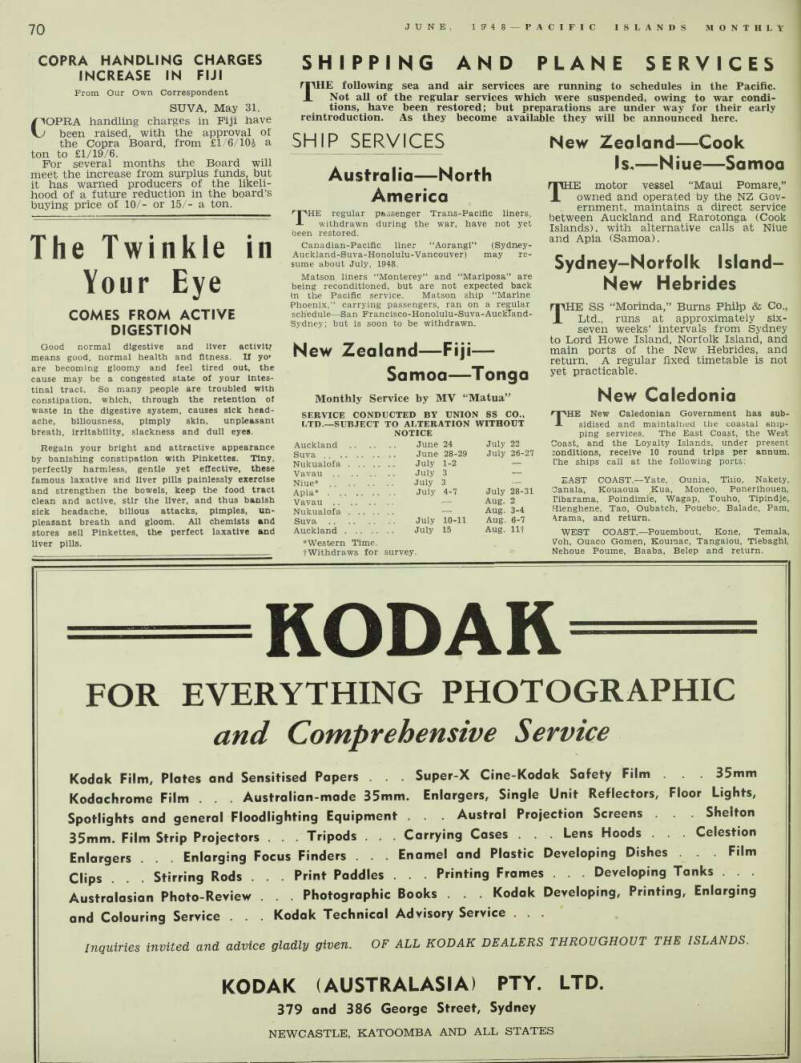
Increase In Fiji
From Our Own Correspondent
Suva, May 31.
CX>PRA handling charges in Fiji have J been raised, with the approval of the Copra Board, from £1 6/10 h a ton to £l/19/6.
For several months the Board will meet the increase from surplus funds, but it has warned producers of the likeli hood of a future reduction in the board’s buying price of 10/- or 15/- a ton.
Sydney-Norfolk Island-
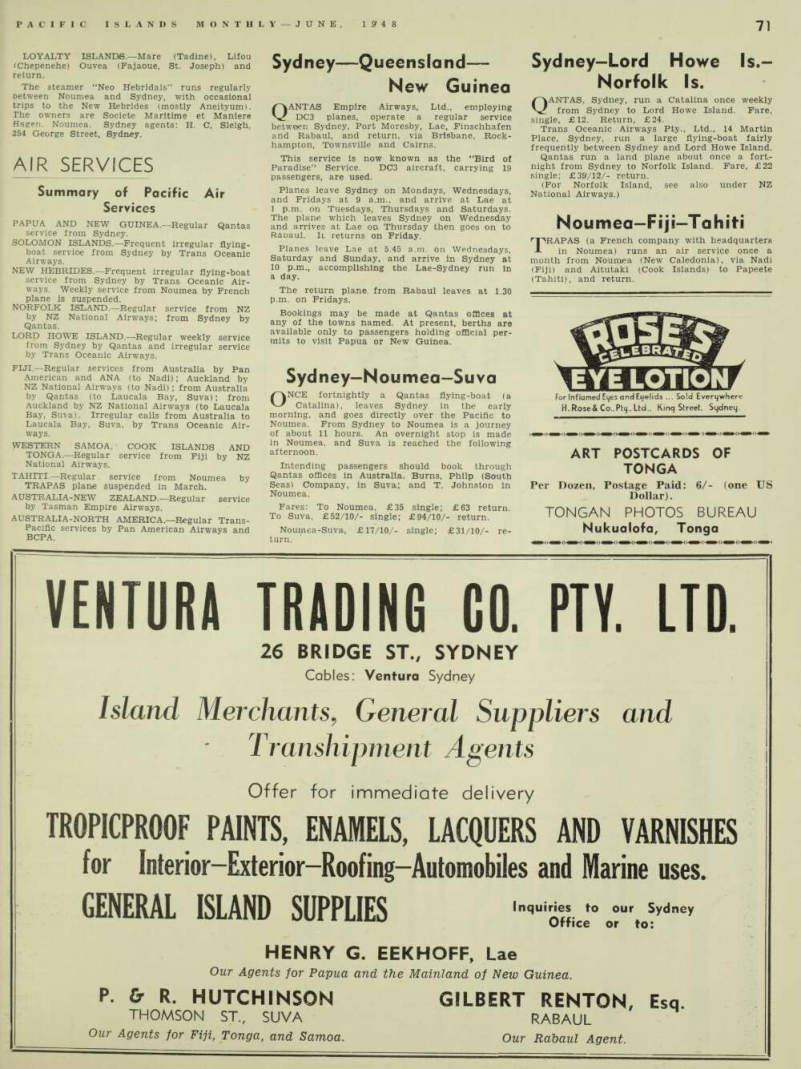
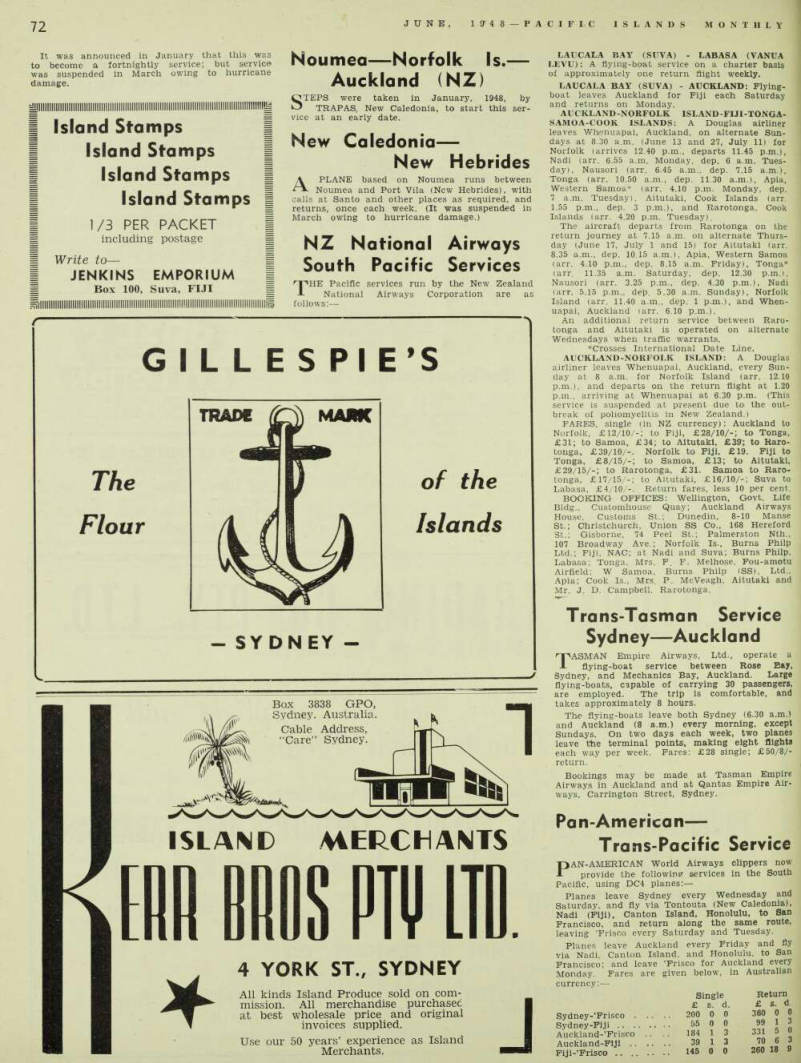
Shipping And Plane Services
THE following sea and air services are running to schedules in the Pacific.
Not all of the regular services which were suspended, owing to war condi tions, have been restored; but preparations are under way for their early reintroduction. As they become available they will be announced here.
Ship Services
Australia—North
America
THE regular passenger Trans-Pacific liners, withdrawn during the war, have not yet been restored.
Canadian-Pacific liner “Aorangi” (Sydney- Auckland-Suva-Honolulu-Vancouver) may re sume about July, 1948.
Matson liners “Monterey” and “Mariposa” are being reconditioned, but are not expected back in the Pacific service. Matson ship “Marine Phoenix,” carrying passengers, ran on a regular schedule —San Francisco-Honolulu-Suva-Auclirand- Sydney; but is soon to be withdrawn.
New Zealand—Fiji—
Samoa —Tonga
Monthly Service by MV “Matua”
Service Conducted By Union Ss Co.,
Ltd —Subject To Alteration Without
Notice
♦Western Time. tWithdraws for survey.
New Zeoland —Cook
Is.—Niue—Samoa
rpHE motor vessel “Maui Pomare,”
X owned and operated by the NZ Gov ernment, maintains a direct service between Auckland and Rarotonga (Cook Islands), with alternative calls at Niue and Apia (Samoa).
Sydney-Norfolk Island-
New Hebrides
THE SS “Morinda,” Burns Philp & Co., Ltd., runs at approximately six seven weeks’ intervals from Sydney to Lord Howe Island, Norfolk Island, and main ports of the New Hebrides, and return. A regular fixed timetable is not
yet practicable.
New Caledonia
THE New Caledonian Government has sub sidised and maintained the coastal ship ping services. The East Coast, the West Coast, and the Loyalty Islands, under present :ondltions, receive 10 round trips per annum.
The ships call at the following ports; EAST COAST. —Yate, Ounia, Thio, Nakety, Canala, Kouaoua Kua, Moneo, Ponerihouen, libarama, Poindimie, Wagap, Touho, Tipindje, Hienghene, Tao, Oubatch, Pouebo, Balade, Pam, 4rama, and return.
WEST COAST, —Pouembout, Kone, Temala, Voh, Ouaco Gomen, Koumac, Tangaiou, Tiebaghl, Nehoue Poume, Baaba, Belep and return.
Auckland . .
June 24 July 22 Suva July 26-27 Nukualofa ... . July 1-2 — Vavau July 3 — Niue* July 3 — Apia* . .. July 4-7 July 28-31 Vavau — Aug. 2 Nukualofa ... — Aug. 3-4 Suva July 10-11 Aug. 6-7 Auckland , .. July 15 Aug. lit
LOYALTY ISLANDS.—Mare (Tadine), Lifou iChepenehe) Ouvea (Fajaoue, St. Joseph) and return.
The steamer “Neo Hebridais” runs regularly between Noumea and Sydney, with occasional trips to the New Hebrides (mostly Aneityum).
The owners are Societe Maritime et Manlere Hagen. Noumea. Sydney agents: H. C. Sleigh, 254 George Street, Sydney.
Air Services
Summary of Pacific Air
Services
PAPUA AND NEW GUlNEA.—Regular Qantas service from Sydney.
SOLOMON ISLANDS.—Frequent irregular flying boat service from Sydney by Trans Oceanic Airways.
NEW HEBRlDES.—Frequent irregular flying-boat service from Sydney by Trans Oceanic Air ways. Weekly service from Noumea by French plane is suspended.
NORFOLK ISLAND.—Regular service from NZ by NZ National Airways; from Sydney by Qantas.
LORD HOWE ISLAND.—Regular weekly service from Sydney by Qantas and irregular service by Trans Oceanic Airways.
FIJI. —Regular services from Australia by Pan American and ANA (to Nadi); Auckland by NZ National Airways (to Nadi); from Australia by Qantas (to Laucala Bay, Suva); from Auckland by NZ National Airways (to Laucala Bay, Suva). Irregular calls from Australia to Laucala Bay, Suva, by Trans Oceanic Air ways.
Western Samoa. Cook Islands And
TONGA. —Regular service from Fiji by NZ National Airways.
TAHlTl.—Regular service from Noumea by TRAPAS plane suspended in March.
AUSTRALIA-NEW ZEALAND.—ReguIar service by Tasman Empire Airways.
AUSTRALIA-NORTH AMERICA.—Regular Trans pacific services by Pan American Airways and
Bcpa.
Sydney—Queensland—
New Guinea
QANTAS Empire Airways, Ltd., employing DC3 planes, operate a regular service between Sydney, Port Moresby, Lae, Finschhafen and Rabaul, and return, via Brisbane, Rock hampton, Townsville and Cairns.
This service is now known as the “Bird of Paradise” Service. DC3 aircraft, carrying 19 passengers, are used.
Planes leave Sydney on Mondays, Wednesdays, and Fridays at 9 a.m., and arrive at Lae at 1 p.m. on Tuesdays, Thursdays and Saturdays.
The plane which leaves Sydney on Wednesday and arrives at Lae on Thursday then goes on to Rabaul. li returns on Friday.
Planes leave Lae at 5.45 a.m. on Wednesdays, Saturday and Sunday, and arrive in Sydney at 10 p.m., accomplishing the Lae-Sydney run in a day.
The return plane from Rabaul leaves at 1.30 p.m. on Fridays.
Bookings may be made at Qantas offices at any of the towns named. At present, berths are available only to passengers holding official per mits to visit Papua or New Guinea.
Sydney-Noumea-Suva
ONCE fortnightly a Qantas flying-boat (a Catalina), leaves Sydney in the early morning, and goes directly over the Pacific to Noumea. From Sydney to Noumea is a journey of about 11 hours. An overnight stop is made in Noumea, and Suva is reached the following afternoon.
Intending passengers should book through Qantas offices in Australia. Burns, Phllp (South Seas) Company, in Suva; and T. Johnston In Noumea.
Fares: To Noumea, £35 single; £63 return.
To Suva, £52/10/- single; £94/10/- return.
Noumea-Suva, £l7/10/- single; £3l/10/- re turn.
Sydney—Lord Howe Is.—
Norfolk Is.
Q ANT AS, Sydney, run a Catalina once weekly from Sydney to Lord Howe Island. Fare, single, £l2. Return, £24.
Trans Oceanic Airways Pty., Ltd., 14 Martin Place, Sydney, run a large flying-boat fairly frequently between Sydney and Lord Howe Island.
Qantas run a land plane about once a fort night from Sydney to Norfolk Island. Fare, £22 single: £39712/- return. (For Norfolk Island, see also under NZ National Airways.)
Noumea—Fiji—Tahiti
'T'RAPAS (a French company with headquarters A in Noumea) runs an air service once a month from Noumea (New Caledonia), via Nadi (Fiji) and Aitutaki (Cook Islands) to Papeete (Tahiti), and return.
It was announced in January that this was to become a fortnightly service; but service was suspended in March owing to hurricane damage.
Noumea—Norfolk Is. —
Auckland (NZ)
were taken in January, 1948, by TRAPAS, New Caledonia, to start this ser vice at an early date.
New Caledonia—
New Hebrides
A PLANE based on Noumea runs between Noumea and Port Vila (New Hebrides), with calls at Santo and other places as required, and returns, once each week. (It was suspended in March owing to hurricane damage.)
NZ National Airways
South Pacific Services
THE Pacific services run by the New Zealand National Airways Corporation are as follows:
Laucala Bay (Suva) - Labasa (Vanua
LEVU): A flying-boat service on a charter basis of approximately one return flight weekly.
Laucala Bay (Suva) - Auckland: Flying
boat leaves Auckland for Fiji each Saturday and returns on Monday.
Auckland-Norfolk Island-Fiji-Tonga
SAMOA-COOK ISLANDS: A Douglas airliner leaves Whenuapai, Auckland, on alternate Sun days at 8.30 am. (June 13 and 27, July 11) for Norfolk (arrives 12.40 p.m., departs 11.45 p.m.), Nadi (arr. 6.55 a.m. Monday, dep. 6 a.m. Tues day), Nausori (arr. 6.45 a.m., dep. 7.15 a.m.), Tonga (arr. 10.50 a.m., dep. 11.30 a.m.), Apia, Western Samoa* (arr. 4.10 p.m. Monday, dep. 7 a.m. Tuesday), Aitutaki, Cook Islands (arr. 1.55 p.m., dep. 3 p.m.), and Rarotonga, Cook Islands (arr. 4.20 p.m. Tuesday).
The aircraft departs from Rarotonga on the return journey at 7.15 a.m. on alternate Thurs day (June 17, July 1 and 15) for Aitutaki (arr. 8.35 a.m., dep. 10.15 a.m.), Apia, Western Samoa (arr. 4.10 p.m., dep. 8.15 a.m. Friday), Tonga* (arr. 11.35 a.m. Saturday, dep. 12.30 p.m.), Nausori (arr. 3.25 p.m., dep. 4.30 p.m.), Nadi (arr. 5.15 p.m., dep. 5.30 a.m. Sunday), Norfolk Island (arr. 11.40 a.m., dep. 1 p.m.), and When uapai, Auckland (arr. 6,10 p.m.).
An additional return service between Raro tonga and Aitutaki is operated on alternate Wednesdays when traffic warrants. *Crosses International Date Line.
Auckland-Norfolk Island: A Douglas
airliner leaves Whenuapai, Auckland, every Sun day at 8 a.m. for Norfolk Island (arr. 12.10 p.m.), and departs on the return flight at 1.20 p.m., arriving at Whenuapai at 6.30 p.m. (This service is suspended at present due to the out break of poliomyelitis in New Zealand.) FARES, single (in NZ currency): Auckland to Norfolk, £l2/10/-; to Fiji, £2B/10/-; to Tonga, £3l; to Samoa, £34; to Aitutaki, £39; to Raro tonga, £39/10/-. Norfolk to Fiji, £l9. Fiji to Tonga, £B/15/-; to Samoa. £l3; to Aitutaki, £29/15/-; to Rarotonga, £3l. Samoa to Raro tonga, £l7/15/-; to Aitutaki, £l6/10/-; Suva to Labasa, £4/10/-. Return fares, less 10 per cent.
BOOKING OFFICES: Wellington, Govt. Life Bldg., Customhouse Quay; Auckland Airways House, Customs St.; Dunedin, 8-10 Manse St.; Christchurch, Union SS Co., 168 Hereford St.; Gisborne, 74 Peel St.; Palmerston Nth., 107 Broadway Ave.: Norfolk Is., Burns Philp Ltd.; Fiji, NAC; at Nadi and Suva; Burns Philp, Labasa; Tonga. Mrs. F. F. Melhose, Fou-amotu Airfield; W Samoa, Burns Philp (SS), Ltd., Apia; Cook Is., Mrs. P. McVeagh, Aitutaki and Mr. J. D. Campbell, Rarotonga.
Trans-Tasman Service
Sydney—Auckland
TASMAN Empire Airways, Ltd., operate a flying-boat service between Rose Bay, Sydney, and Mechanics Bay, Auckland. Large flying-boats, capable of carrying 30 passengers, are employed. The trip is comfortable, and takes approximately 8 hours.
The flying-boats leave both Sydney (6.30 a.m.) and Auckland (8 a.m.) every morning, except Sundays. On two days each week, two planes leave the terminal points, making eight flights each way per week. Pares; £2B single; £5O/8/return.
Bookings may be made at Tasman Empire Airways in Auckland and at Qantas Empire Air ways, Carrington Street, Sydney.
Pan-American —
Trans-Pacific Service
PAN-AMERICAN World Airways clippers now provide the following services in the South Pacific, using DC4 planes:— Planes leave Sydney every Wednesday and Saturday, and fly via Tontouta (New Caledonia), Nadi (Fiji), Canton Island, Honolulu, to San Francisco, and return along the same route, leaving ’Frisco every Saturday and Tuesday.
Planes leave Auckland every Friday and fly via Nadi, Canton Island, and Honolulu, to San Francisco; and leave ’Frisco for Auckland every Monday. Fares are given below, in Australian currency:—
Single Return £ s. d. £ s. d Sydney-’Prisco 200 0 0 360 0 0 Sydney-Piji 55 0 0 9? \ J Auckland-’Prisco .. .. 184 1 3 331 5 Auckland-PIJl 39 1 3 ® 3 Fiji-’Frisco .. ... 145 0 0 260 18 9
(Time-tables and fares subject to alteration without notice.) To convert to Fiji currency, reduce above figures by about 10 per cent.
Free baggage allowance is 66 lb. per person.
Excess at 1 per cent, of single fare for each kilogram of excess (1 ki10—2.2 lb.).
Sydney-Vancouver
BCPA Service
BRITISH Commonwealth Pacific Airlines Limited operate a three trips per fortnight trans-Pacific service from Sydney via Fiji, Canton Island, Honolulu and San
Francisco; and a fortnightly service between Auckland and Vancouver, via the same air ports.
Planes leave Sydney every Sunday evening and alternate Wednesdays, and Vancouver, on the southbound trip, every Sunday and alternate Thursdays. Planes leave Auckland every alter nate Wednesday and arrive in Vancouver the following Saturday. This southbound trip com mences from Vancouver on alternate Fridays.
Fares are (in Australian currency), Sydney- San Francisco, £2OO single and £360 return, Auckland-Vancouver, £AI9B single; Auckland- Nadi (Fiji), £A39.
Skymaster aircraft carrying 38 passengers and a crew of 9 are used on the service.
Advertisements & other items, pp. 72-76 (2 items)
Your Eye
The Twinkle in
COMES FROM ACTIVE
DIGESTION
Good normal digestive and liver activlt? means good, normal health and fitness. If yo f are becoming gloomy and feel tired out, the cause may be a congested state of your Intestinal tract. So many people are troubled with constipation, which, through the retention of waste in the digestive system, causes sick headache, biliousness, pimply skin, unpleasant breath, irritability, slackness and dull eyes.
Regain your bright and attractive appearance by banishing constipation with Pinkettes. Tiny, perfectly harmless, gentle yet effective, these famous laxative and liver pills painlessly exercise and strengthen the bowels, keep the food tract clean and active, stir the liver, and thus banish sick headache, bilious attacks, pimples, unpleasant breath and gloom. All chemists and stores sell Pinkettes, the perfect laxative and liver pills.
Kodak
FOR EVERYTHING PHOTOGRAPHIC
and Comprehensive Service
Kodak Film, Plates and Sensitised Papers . Super-X Cine-Kodak Safety Film 35mm Kodachrome Film . Australian-made 35mm. Enlargers, Single Unit Reflectors, Floor Lights, Spotlights and general Floodlighting Equipment . . Austral Projection Screens Shelton 35mm. Film Strip Projectors . . . Tripods Carrying Cases Lens Hoods Celestion Enlargers . . Enlarging Focus Finders . . . Enamel and Plastic Developing Dishes Film Clips . Stirring Rods . . Print Paddles .. . Printing Frames Developing Tanks Australasian Photo-Review . . . Photographic Books Kodak Developing, Printing, Enlarging and Colouring Service . . . Kodak Technical Advisory Service inquiries invited and advice gladly given. OF ALL KODAK DEALERS THROUGHOUT THE ISLANDS.
KODAK (AUSTRALASIA) PTY. LTD.
379 and 386 George Street, Sydney
NEWCASTLE, KATOOMBA AND ALL STATES
EYE LOTION
For Inflamed Eyes and Eyelids ... Sold Everywhere H.Rose&Co.,Pty.. Ltd.. King Street. Sydney.
ART POSTCARDS OF
TONGA
Per Dozen, Postage Paid: 6/- (one US Dollar).
TONGAN PHOTOS BUREAU
Nukualofa, Tonga
VENTURA TRADING GO. PTY. LTD.
26 BRIDGE ST., SYDNEY
Cables: Ventura Sydney
Island Merchants , General Suppliers and
Transhipment Agents
Offer for immediate delivery
TROPICPROOF PAINTS, ENAMELS, LACQUERS AND VARNISHES
for Interior-Exterior-Roofing-Automobiles and Marine uses.
GENERAL ISLAND SUPPLIES Inquiries to our Sydney
HENRY G. EEKHOFF, Lae
Our Agents for Papua and the Mainland of New Guinea.
P. & R. HUTCHINSON GILBERT RENTON, Esq.
THOMSON ST., SUVA RABAUL
Our Agents lor Fiji, Tonga, and Samoa. Our Agent.
Island Stamps
Island Stamps
Island Stamps
Island Stamps
1/3 PER PACKET
including postage Write to —
JENKINS EMPORIUM
Box 100, Suva, FIJI
GILLESPIE’S
The Flour
TRADE
MARK
of the Islands - SY DN ey -
Box 3838 GPO, Sydney. Australia.
Cable Address, “Care” Sydney.
iisi
ISLAND MERCHANTS
4 YORK ST., SYDNEY
All kinds Island Produce sold on commission. All merchandise purchased at best wholesale price and original invoices supplied.
Use our 50 years’ experience as Island Merchants.
J
TILLEY LASERS
BURN ORDINARY KEROSENE
The Modern Form of PORTABLE LIGHTING
PRODUCTION FOR EXPORT
WE ARE PLEASED TO INFORM OUR
FRIENDS OVERSEAS OF NEW AND
- IMPORTANT PREMISES ACQUIRED TO
FACILITATE PRODUCTION FOR EXPORT.
ALSO OUR POST-WAR MODELS ARE
NOW IN FULL PRODUCTION AND WILL
BE ON OFFER IN ALL PARTS OF THE
WORLD. TILLEY STANDARDS ARE MAIN-
TAINED AND INCORPORATED IN COM-
PLETELY MODERN DESIGNS OF LAMP^
BRENT WORKS, NEW BRENT WORKS,
HENDON, N.W.4 CRICKLEWOOD, N.W.2.
THE TILLEY LAMP CO. LTD., of ENGLAND ( London Offices and Showroom ; 33 SACKVILLE STREET, PICCADILLY, W.l.
REPRESENTATION :
MELBOURNE: T. H. Bentley, Pty. Ltd., 123-125 William Street, Melbourne, C.l.
TASMANIA : Mr. C. Sellars, 108 a Charles Street, Launceston.
FIJI : Mr. K. Witherington, 2 Burns Philp Buildings, Suva.
The Hey to Earning Power...
Sometimes men think that a general education or an elementary knowledge of business is enough to get ahead. But experience soon teaches that thorough, specialised training is just as necessary for success in business as it is in the professions of Law, Medicine or Dentistry. If you are interested in the many opportunities in the Business World ... if you seek responsibility, success and economic security, commence training now —in some specialised business subject. H.R.I. is available always to help and advise ambitious men and women. Write or wire for particulars and career information.
H.R.I. tutorial service is proved by the winning of more honours than all coaches in Australasia combined.
H.R.I. Career Training • ACCOUNTANCY e SECRETARYSHIP • COST ACCOUNTANCY • PRACTICAL BOOKKEEPING • MARKETING SELLING ADVERTISING ® BANKING • LOCAL GOVERNMENT EXAMS.
Hemingway Robertson Institute
Founded and Owned by Hemingway & Robertson Pty. Ltd.
Consulting Accountants :: :; Professional Tutors
126 BANK HOUSE, BANK PLACE. MELBOURNE
126 BARRACK HOUSE, 16 BARRACK STREET, SYDNEY 126/814
New Tongan Parliament
Elected
THE three-yearly election of members of the Tongan Parliament were held early in May. Three members are elected for Tongatapu (the island on which Nuku’alofa is situated) and near by islands, two for the Ha’apai Group, and two for the Vava’u Grouo (including Niuatoputapu Island, some 200 miles to the north).
The interest taken in these elections is indicated by the number of candidates standing—ten for the three Tongatapu seats, seven for Ha’apai, and 12 for Vava’u.
Molitoni Finau, one of the Kingdom’s Elder Statesmen, was returned at the head of the poll for Tongatapu.
The Nobles have yet to elect seven of their number to renresent them in the Parliament, the remaining members of which consist of the Premier and members of the Privy Council. A Speaker is nominated by the Sovereign.
Parliament will be opened on June 24 by Queen Salote.
A daughter was born in May to Marygowan and Frank Blundell, of Vau cluse, Sydney. Mrs. Blundell is the daughter of Mr, and Mrs. G. Allen Innes, who are well-known in Fiji and Papua- New Guinea.
In reply to a paragraph in April “PIM, 5 ’ that a ‘gentleman in Vancouver was seek ing a Pacific island for a Utopian settle ment, Browne’s Better Business, of Levuka, Fiji, advise us that they have two freehold islands for sale. We have tried to pass the information along— although we are not sure that the plan is anything more than an idle reporter’s dream.
Advertisements & other items, p. 76 (1 item)
flavour
te the
Here are the tenderest, sweetest peas you ever tasted . . . full of gardenfresh flavour . . . just as though you picked them out of your own garden today! They’re picked the moment they’re perfect. Cooked and packed the same day for you to enjoy all 0F r the year ’round. Two sizes —3O oz. (family £*7 size) and 16 oz. They’re at your store NOW!
GREEN
PEAS
B. St.C. Neven-Spence
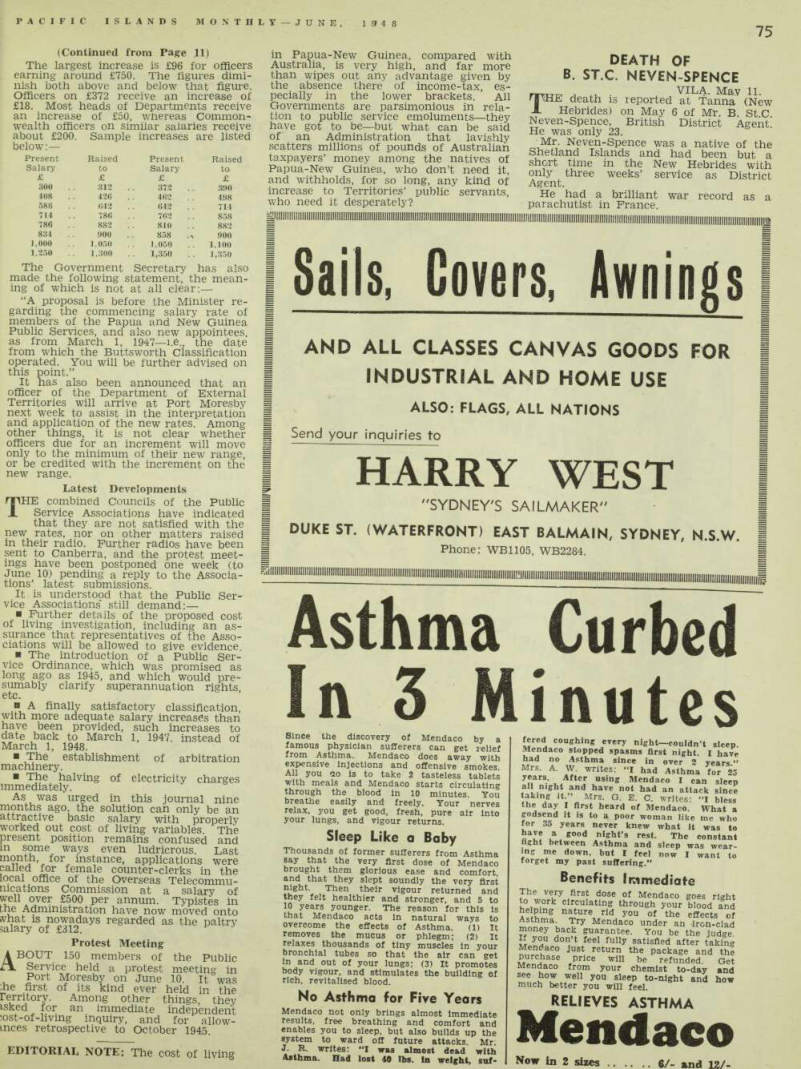
Death Of
T™ • Vila. May 11.
HE death is reported at Tanna (New Hebrides) on May 6 of Mr. B. St C Neven-Spence, British District Agent.
He was only 23, Mr. Neven-Spence was a native of the Shetland Islands and had been but a short time in the New Hebrides with only three weeks’ service as District Agent.
He had a brilliant war record as a parachutist in Prance.
Advertisements & other items, pp. 77-78 (1 item)
sdfd
Asthma Curbed In 3 Minutes
Since the discovery of Mendaco by a famous physician sufferers can get relief from Asthma. Mendaco does away with expensive Injections and offensive smokes.
All you ao is to take 2 tasteless tablets with meals and Mendaco starts circulating through the blood in 10 minutes. You breathe easily and freely. Your nerves relax, you get good, fresh, pure air Into your lungs, and vigour returns.
Sleep Like a Baby
Thousands of former sufferers from Asthma say that the very first dose of Mendaco brought them glorious ease and comfort, and that they slept soundly the very first night Then their vigour returned and they felt healthier and stronger, and 5 to 10 years younger. The reason for this Is that Mendaco acts in natural ways to overcome the effects of Asthma. (1) It removes the mucus or phlegm; (2) It relaxes thousands of tiny muscles in your bronchial tubes so that the air can get in and out of your lungs; (3) It promotes body vigour, and stimulates the building of rich, revitalised blood.
No Asthma for Five Years
Mendaco not only brings almost Immediate results, free breathing and comfort and enables you to sleep, but also builds up the system to ward oft future attacks. Mr.
J. R. writes; “1 was almost dead with Asthma. Dad lost 40 lbs. In weight, snf-
fered coughing every night—couldn’t sleep.
Mendaco stopped spasms first night. I have had no Asthma since in over 2 years ”
Mrs. A. W. writes: “I had Asthma for 25 y f. arS - After usin S Mendaco I can sleep al night and have not had an attack since taking it ” Mrs. G. E. C. writes: “I bless the day I first heard of Mendaco. What a godsend it is to a poor woman like me who for 35 years never knew what it was to . a 4 ffood . ni £ ht ’ s rest. The constant fight between Asthma and sleep was wearing me down, but I feel now I want to forget my past suffering.”
Benefits Immediate
The very first dose of Mendaco goes right to work circulating through your blood and helping nature rid you of the effects of T ry Mendaco under an -iron-clad money back guarantee. You be the judge.
H J°. D doi J t {eel f ully satisfied after taking Mendaco just return the package and the purchase price will be refunded. Get Mendaco from your chemist to-day and see how well you sleep to-night and how much better you will feel.
RELIEVES ASTHMA
Mendaco
In V
\ n j
1 f^rliD
OLl $l i
KOLYNOI
sAves
YOU
M
&SSS/
(& MICHIGAN (US.A.)
DENTIST CLAIMS
TEMPER-SETTING
UP A FLOW OF
CERTAIN
JUICES
CAN
CAUSE
DECAY/
DENTAL
SCIENCE HAS
PROVED
THAT GERMS
HIDDEN in CREVICES
CAUSE DECAY.
ANTISEPTIC KOLYNOS
PENETRATES
SURGICALLY
CLEANS OUT HIDDEN
DANGER SPOTS/.
IVIISI
£ >
pU msHßt
tAOUTHWASH/
* Roman women uses
MYRRH AS A
I MOUTHWASH /
kolynos
BRINGS SWEET
TO YOUR
BREATH
SPARKLING LUSTRE
TO YOUR TEETH.
f//
KOP"f
(pe* „ Vi=s
0/V /C/V I s
e %> CP & MB-20 c^ C
HE APACHE? Stop
&HAC/V
* RFFD TRADE MARK
ANACIN stops headaches faster because it contains an extra ingredient. It is a prescription for pain and aches. Always ask for ANACIN.
Moresby
The Month In
Prom Our Own Correspondent
Port Moresby June 5.
THE Administrator (Colonel J. K.
Murray) is still in Australia. It is understood that he has been on holiday in NSW since the end of the South Pacific Conference. Mr. Justice Phillips, who returned from Australia in mid-May, is Acting Administrator.
Mr. J. B. Me Adam, Secretary for Forests, is back at Konedobu again. Mr.
McAdam has been in and out of Sydney several times during the last few months as a witness in the “New Guinea Timber Lease case.” He will doubtless have to spend yet another period in Sydney as the second charge against Garden Si Co. is still to be heard.
Mr. W. C. Groves, Director of Educa tion, left for Australia on May 31, on Departmental business. Mr. J. H, McDonald, Assistant Director of District Services and Native Affairs, returned from leave during May.
Apart from these movements, the senior executives at Konedobu still seem to “have their heads down.” Shortage of staff is becoming their great headache —resignations are still numerous and re cruits hard to find. ■ ■ ■ THE “Montoro” and “Malaita” took a number of Administration officers on leave. Those who left on the “Montoro” included Mr. and Mrs. W. C.
Steele and infant, Mr. and Mrs. Sparks, Mr. and Mrs. G. Layt and family, Mr. and Mrs. O’Brien and infant, Mr. and Mrs. Hutchinson and infant, and Mr. and Mrs. L. Clout.
Mr. W. Watkins, of the Crown Law Office, left on the “Malaita.” Another ‘Malaita” passenger was Mr. Julian
Hughes, wh ° h & s been forced, by illhealth to relinquish his position as Deputy Prices Commissioner. ■ ■ ■ 117HATEVER their views on politics, i’ local residents are grateful to the
Port Moresby Branch of the Aus tralian Labour Party for bringing to the notice of the authorities the inconveni ences and irregularities which have for some time annoyed hospital outpatients.
It was the custom for the doctor to in spect bed patients before attending to
outpatients, with the result that, al though consulting hours were from 8 a.m. to 9 a.m., it was rare for the first person to receive attention before 8.30. It was also not uncommon lor late-comers to receive attention out of turn.
Now, as a result of the Branch’s repre sentations, consulting hours have been altered to 8.30-9.30 a.m. Outpatients will receive a numbered card on arrival, and will be required to answer to their num ber in strict rotation.
B ■ ■ 117 E have heard that Pax Trimm, the VT town’s sporting star, is packing up shortly and returning south. He will be missed —but sporting trophies may in future be more evenly distributed.
Partnered by Miss Joy Niness, Pax re cently won tne mixed doubles tournament conducted by the tennis club. In the men’s doubles he and Des. Sulivan, with a handicap of minus 40, .met Messrs.
Benzley and Moon in the final. It had to be abandoned at one set all because of failing light. Pax is, of course, local men’s singles champion. He is also pro minent in the cricket club’s averages, both as a bowler and batsman. ■ ■ ■ THE death of Mr. J. Spychiger (see elsewhere) has robbed Moresby of a very old identity. He will be mourned by many friends from pre-war Moresby who have not returned, as well as those who have returned. He will also be missed by stamp collectors all over the world.
Many people lost another friend in Mr. Cliff Kerr, of the Commonwealth Audit staff, who died suddenly while on leave in Queensland. Mr. Kerr was in Rabaul pre-war. He was only in his early thirties.
A QUESTION agitating Administration
officers in search of housing at the moment is—“ What has become of the housing committee?” Three houses at Konedobu have now been unoccupied for a considerable time, and no-one has been given permission to move in.
It is understood that the Housing- Committee has not met for some con siderable time. Perhaps the members have thrown in the sponge, for their job is thankless enough. Nevertheless, some information seems called for. ■ a ■ THE 230 ton motor vessel “Fair Wind” arrived in Moresby last week. She will be used for a survey of the Territory’s fishing resources, which is be ing sponsored by the Department of Agriculture, Stock and Fisheries. ■ ■ ■ THE Education Department has com menced construction of a sound proof recording room at Konedobu, to be used for preparing broadcasts and film-sound tracks. The Department re cently announced that plans for extend ing its film work were being held up by shortage of equipment. We have heard the more serious rumour that plans for extending educational work are being held up by a shortage of teachers. If there was ever a job worth doing, surely this is it!
Mr. C. St. Julian, who will shortly re tire from the post of Assistant Comp troller of Customs, Fiji, has been released from his appointment to take up the post of Secretary of the Copra Board, He suceeds Mr. C. W. Aidney, who re cently resigned as a result of ill-health.
Advertisements & other items, pp. 79-80 (1 item)
Budge
WORMGEARED
CHAIN HOISTS
The hand-operated Wormgeared Hoist is a gen eral purpose lifting device, compact and easy to handle. The Wormgear is designed to give com paratively high efficiency and long life. A simple and effective brake insures safe holding of the suspended load.
Available in rated capacities from 10 cwts. to 3 tons.
Also makers of: A.B.C. Electric Chain Holsts, V 2, 1, 2 tons capacity.
“Victor” Spurgeared Chain Hoists from 10 cwts. to 20 tons.
Triple Geared Chain Hoists from 10 cwts. to 20 tons.
Worm Geared Chain Hoists from 10 cwts. to 3 tons.
Weston Chain Blocks from 5 cwts. to 2 tons.
Shackles, Hooks, Sheave and Snatch Blocks.
AUSTRALIAN BLOCK & CHAIN CO.
PTY., LTD.
Robbs Road, WEST FOOTSCRAY, W. 12,
VICTORIA
Phones: MW 1373-74-75.
Telegraphic Address: "CHAINBLOCK,” MELBOURNE.
Correspondence to Box 34, FOOTSCRAY, W.ll, VICTORIA
TELEPHONES: LA5034-5-6
BUDGE
REFRIGERATION
EQUIPMENT
Commercial and Industrial Units
(not domestic) Ammonia and Methyl Chloride machines of large or small capacity.
The illustration is of a complete 30 cwt. Ice-making Plant, comprising twin, enclosed ammonia compressor, evaporative condenser, insulated ice tank, etc. It may be driven by a 10 h.p. electric motor or diesel engine.
Inquirers should mention dimensions of cold room (or cabinet) and amount of ice (if any) required per day.
JAMES BUDGE PTY. LTD.
Established 1890.
REFRIGERATION ENGINEERS
McEvoy Street, Alexandria,
Sydney
DON'T SAY |S I M
GIN DON'T SAY
DON'T SAY i I M
W
G-w- T
I M DON'T SAY
DON'T SAY © I M
GIN DON'T SAY
e wgs' >WAX y 1 N
G 1 M DON'T SAY
DON'T SAY ©ll%
Cl M DON'T SAY
DON'T SAY G I M
GIN DON'T SAY
0, uMwao X w
DON'T SAY GIN
DON'T SAY GIN
G>vwvvv> wma
I N DON'T SAY
DON'T SAY G 1 N
GIN DON'T SAY
DON'T SAY G I N
GIN DON'T SAY
DON'T SAY G I N
GIN DON'T SAY
DON'T SAY GIN
GIN DON'T SAY
DON'T SAY GIN
GIN DON'T SAY
DON'T SAY G I N
DON'T SAY G
G SAY
DON
IP DO
DON'T SAY © I M
SIM DON'T SAY
DON'T SAY GIM
DON'T SAY
J V S AY L, Ou % tTo Cq c
SAY
is rein e y
DONT SJT
GIM DON'T S
DON'T SAY G I M
DON'T SAY § I M
G SAY
DON
G D
T SAY
DONrTfPfc I M
DON'T SAY © I M
GIM DON'T SAY
DON'T SAY GIM
DON'T SAY
M Y S AY WiV *■*ol/ *lb I To * c Oc
SAY
* I'M e Y
T SAY
IN
DON'T SA
GIN DON'T
DON'T SAY GIN DON'T
Address all inquiries to: Telegrams and Cables: “GILBEYS ” Melbourne.
W. & A. OILBEY LTD.
Telegrams and Cables: “GILBEYS,” Sydney.
33 ROSSLYN STREET, WEST MELBOURNE.
109 REGENT STREET, SYDNEY.
Death Of Captain J. D.
Mccomish
THE death occurred on June 3 of Cap tain James Doran McComish, who was well known in French Oceania, Norfolk Island and Lord Howe Island as a botanist. Captain McComish, over many years, made extensive collections of botanical specimens in those and other South Pacific Islands and supplied plants to Sydney Botanical Gardens, and to Kew Gardens, in England. He made some original discoveries, and a number of plants were named after him, at Kew He also took a keen interest in the history of the Pacific Islands, and wrote many articles in connection therewith. Captain McComish was a veteran of the South African War and World War I, and was 67 when he died.
Advertisements & other items, p. 81 (1 item)
Gilbert Renton
AUCTIONEER, VALUER,
ESTATE AGENT.
Storage and Repository Travellers Sample Rooms For General Information and Service.
P.O. Box Rabaul, TNG
©= SI // 4 I uineas w*.
WHOLESALE
MERCHANTS
\9 S
pv^vt
t
GENERAL-AGENTS
o s D 9 0° O 9
O IOH
c£ $ 0° *9 Ihm* ' co te^s y 9>. o* r* 6 9 pp o \A> c 3
Islands Produce
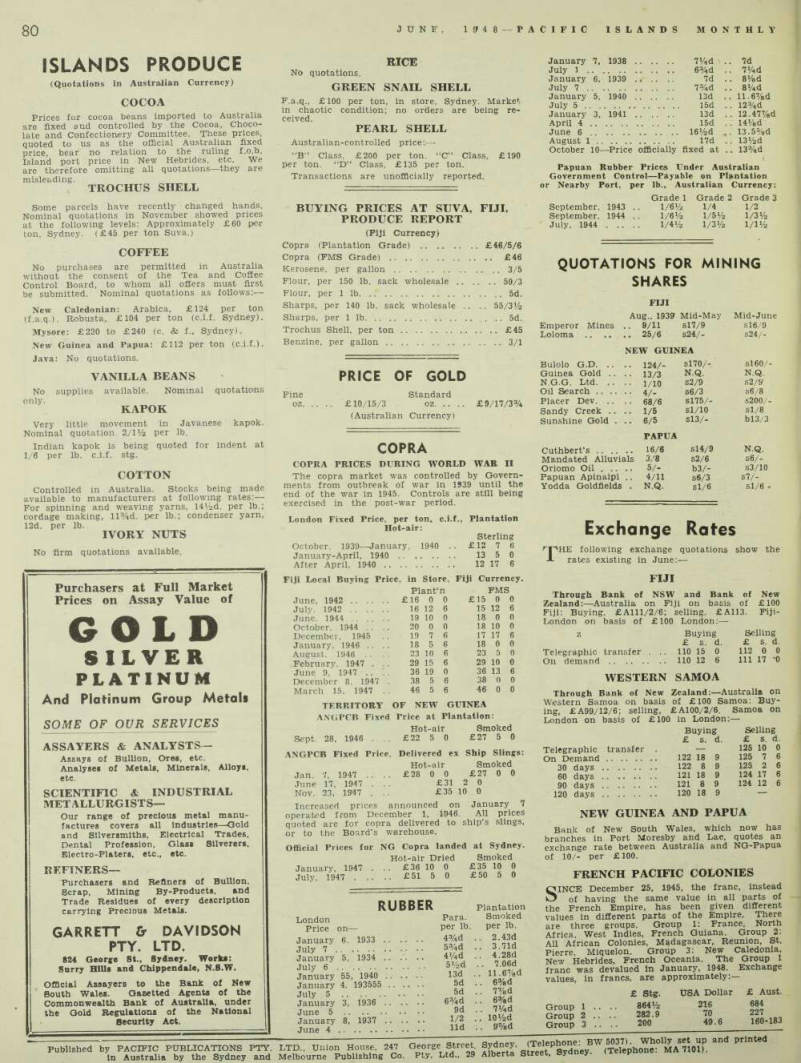
(Quotations in Australian Currency)
Cocoa
Prices for cocoa beans imported to Australia are fixed and controlled by the Cocoa, Choco late and Confectionery Committee. These prices, quoted to us as the official Australian fixed price, bear no relation to the ruling f.o.b.
Island port price in New Hebrides, etc. We are therefore omitting all quotations—they are misleading.
Trochus Shell
Some parcels have recently changed hands.
Nominal quotations in November showed prices at the following levels; Approximately £6O per ton, Sydney. (£45 per ton Suva.)
Coffee
No purchases are permitted in Australia without the consent of the Tea and Coffee Control Board, to whom all offers must first be submitted. Nominal quotations as follows: — New Caledonian: Arabica, £124 per ton (f.a.q.). Robusta, £lO4 per ton (c.i.f. Sydney).
Mysore: £220 to £240 (c. & f.. Sydney).
New Guinea and Papua: £ll2 per ton (c.i.f.).
Java: No quotations.
Vanilla Beans
No supplies available. Nominal quotations only.
Kapok
Very little movement in Javanese kapok.
Nominal quotation 2/IV 2 per lb.
Indian kapok is being quoted for indent at 1/6 per lb. c.i.f. stg.
Cotton
Controlled in Australia. Stocks being made available to manufacturers at following rates:— For spinning and weaving yarns, 14V 2 d. per lb.; cordage making, ll%d. per lb.; condenser yarn, 12d. per lb.
Ivory Nuts
No firm quotations available.
Rice
No quotations.
Green Snail Shell
P.a.q., £ 100 per ton, in store, Sydney. Market in chaotic condition; no orders are being re ceived.
Pearl Shell
Australian-controlled price:— “B” Class, £2OO per ton. “C” Class, £l9O per ton. “D” Class, £135 per ton.
Transactions are unofficially reported.
Buying Prices At Suva, Fiji,
Produce Report
(Fiji Currency) Copra (Plantation Grade) £46/5/6 Copra (FMS Grade) £46 Kerosene, per gallon 3/5 Flour, per 150 lb. sack wholesale 59/3 Flour, per 1 lb sd.
Sharps, per 140 lb. sack wholesale .. .. 55/3 V2 Sharps, per 1 lb . .. sd.
Trochus Shell, per ton £45 Benzine, per gallon 3/1
Advertisements & other items, p. 82 (1 item)
Price Of Gold
Fine Standard oz. .. £ 10/15/3 oz £9/17/3% (Australian Currency)
Copra
Prices During World War Ii
The copra market was controlled by Govern ments from outbreak of war in 1939 until the end of the war in 1945. Controls are still being exercised in the post-war period.
London Fixed Price, per ton, c.i.f., Plantation Hot-air:
Territory Of New Guinea
A'NGPCB Fixed Price at Plantation:
ANGPCB Fixed Price, Delivered ex Ship Slings:
Increased prices announced on January 7 operated from December 1, 1946. All prices quoted are for copra delivered to ship’s slings, or to the Board's warehouse.
Official Prices for NG Copra landed at Sydney.
October, 1939 —January, 1940 Sterling . £12 7 6 January-April, 1940 13 5 0 After April. 1940 .. 12 17 6 Fiji Local Buying Price in Store, Fiji Currency.
June, 1942 Plant’n £16 0 0 £15
Fms
0 0 July. 1942 16 12 6 15 12 6 June. 1944 19 10 0 18 0 0 October, 1944 . . 20 0 0 18 10 0 December, 1945 19 7 6 17 17 6 January, 1946 .. 18 5 6 18 0 0 August. 1946 23 10 6 23 5 0 February, 1947 . .. 29 15 6 29 10 0 June 9, 1947 . . 36 19 0 36 13 6 December 8. 1947 . 38 5 6 38 0 0 March 15. 1947 46 5 6 46 0 0
Hot-air Smoked Sept. 28. 1946 . .. £22 5 0 £27 5 0
Hot-air Smoked Jan. 7, 1947 ... £28 0 0 £27 0 0 June 17, 1947 ... £31 2 0 Nov. 23. 19'47 . .. £35 10 0
Hot-air Dried Smoked January, 1947 . £36 10 0 £35 10 0 July, 1947 . .. £51 5 0 £50 5 0
Rubber
i Papuan Rubber Prices Under Australian Government Control —Payable on Plantation or Nearby Port, per lb., Australian Currency:
Plantation
London Para.
Smoked Price on— per lb. per lb.
January July 7 . 6. 1933 .. .. 4%d . 53/ 4 d . . 2.43d . 3.71d January July 6 5. 1934 .. .. 4V 4 d . sy 2 d 4.28d . . 7.06d January 55, 1940 .. .. 13d . . 11.6 7 /sd January July 5 January June 5 January June 4 4, 193555 .. .. 3, 1936 .. .. 8, 1937 .. .. 5d . 5d . 6%d . 9d . 1/2 . lid . . 6%d . 7y 8 d . 6%d . 7 J / 4 d . 10V 2 d . 9' 5 /sd
January 7. 1938 7V 4 d . . 7d July 1 . . 7»/ 4 d January 6. 1939 7d . . SVad July 7 . 7%d . . 8V 4 d January 5. 1940 13d . . 11.6%d July 5 15d . . 12 %d January 3, 1941 13d . . 12.47 7 /ed April 4 15d . . 14Vad June 6 ISVad . . 13.5 s /ad August 1 17d . . 13V 2 d October 10—Price officially fixed at . . 13 3 / 4 d
Grade 1 Grade 2 Grade 3 September, 1943 . 1/6V 2 1/4 1/2 September, 1944 . 1/6 V2 1/5 V2 1/3 y 2 July. 1944 1/4 V 2 1/3 y 2 1/1 y 2
Quotations For Mining
Shares
Fiji
Aug.. 193?
Mid-May Mid-June Emperor Mines .. 9/11 S17/9 S16/9 Loloma .. .. s24/s24/- Bulolo G.D. ..
New Guinea
.. 124/- sl70/sl60/- Guinea Gold .. • • 13/3 N.Q.
N.Q.
N.G.G. Ltd. .. •• 1/10 s2/9 s2/9' Oil Search .. .. •• 4/- S6/3 s6/8 Placer Dev. .. •• 68/6 sl75/s200/- Sandy Creek .. .. 1/5 sl/10 sl/8 Sunshine Gold . .. 6/5 sl3/bl3/3 Cuthbert’s .. ..
Papua
.. 16/6 S14/9 N.Q.
Mandated Alluvials 3/8 s2/6 s6/- Oriomo Oil . .. .. 5/b3/- S3/10 Papuan Apinaipi .. 4/11 s6/3 s7/- Yodda Goldfields . N.Q. sl/6 sl/6 .
Exchange Rates
THE following exchange quotations show the rates existing in June: —
Fiji
Through Bank of NSW and Bank of New Zealand:—Australia on Fiji on basis of £lOO Fiji: Buying, £Alll/2/6; selling, £AII3. Fiji- London on basis of £lOO London: —
Western Samoa
Through Bank of New Zealand:—Australia on Western Samoa on basis of £lOO Samoa: Buy ing, £ A99/12/6; selling, £AIOO/2/6. Samoa on London on basis of £lOO in London: —
New Guinea And Papua
Bank of New South Wales, which now has branches in Port Moresby and Lae, quotes an exchange rate between Australia and NG-Papua of 10/- per £lOO.
French Pacific Colonies
SINCE December 25, 1945, the franc, instead of having the same value in all parts of the French Empire, has been given different values in different parts of the Empire. There are three groups. Group 1: France, North Africa, West Indies, French Guiana. Group 2: All African Colonies, Madagascar, Reunion, St.
Pierre, Miquelon. Group 3: New Caledonia, New Hebrides, French Oceania. The Group 1 franc was devalued in January, 1948. Exchange values, in francs, are approximately:—
z Buying Selling £ s. d. £ s, d.
Telegraphic transfer , .. 110 15 0 112 0 0 On demand 110 12 6 111 17 ‘0
Buying Selling £ s. d. £ s. d.
Telegraphic transfer . — 125 10 0 On Demand 122 18 9 125 7 6 30 days 122 8 9 125 2 6 60 days 121 18 9 124 17 6 90 days 121 8 9 124 12 6 120 days 120 18 9 —
£ Stg. USA Dollar £ Aust.
Group 1 .. .. 864y 2 216 684 Group 2 .. .. 282.9 70 227 Group 3 .. . . 200 49.6 160-183
Advertisements & other items, pp. 82-84 (3 items)
80
JUNE, 1348 PACIFIC ISLANDS MONTHLY
Published by PACIFIC PUBLICATIONS PTY. LTD.. Union House, 247 George Street. Sydney. s treet P PrintCd in Australia by the Sydney and Melbourne Publishing Co. Pty. Ltd.. 29 Alberta Street, Sydney, neicy
Gold
Purchasers at Full Market Prices on Assay Value of
SILVER
PLATINUM
And Platinum Group Metals
SOME OF OUR SERVICES
ASSAYERS & ANALYSTS—
Assays of Bullion, Ores, etc.
Analyses of Metals, Minerals, Alloys, etc.
SCIENTIFIC & INDUSTRIAL
METALLURGISTS—
Our range of precious metal manufactures covers all Industries—Gold and Silversmiths, Electrical Trades, Dental Profession. Glass Sllverers, Electro-Platers, etc., etc.
REFINERS—
Purchasers and Refiners of Bullion, Scrap, Mining By-Products. and Trade Residues of every description carrying Precious Metals.
GARRETT & DAVIDSON
PTY. LTD.
824 George St., Sydney. Works; Sorry Hills and Chippendale, N.S.W.
Official Assayers to the Bank of New South Wales. Gazetted Agents of the Commonwealth Bank of Australia, under the Gold Regulations of the National Security Act.
tropical thirst...
To quench a
*** co °o U / ♦ '> 0 !g«;ySiS'j!»i!- rt follr eo * soTrito •» /-I ■'“ • soiriiß • -
° Or H LCO UMfTCO
»vt>*e» > Australia ..f'g V K When you’re hot and tired,
there is nothing quite so satisfying
and thirst quenching as a long, cold glass of Your friends and guests, too, will ap-
preciate this really fine
Lager, for “Everybody
drinks K. 8.”
TOOTH’S
LAGER
M
ERCHANTS
OWNERS
Capital £1,000,000
ESTABLISHED 1914
COPRA MERCHANTS & MILLERS
BRANCHES THROUGHOUT THE PACIFIC ISLANDS
Buyers and exporters of all kinds of Islands produce. Copra Merchants and Millers.
Agents for Australian, European and American Manufacturers. Distributors of every description of merchandise.
Thirty years of Pacific Islands development and service.
REGULAR CARGO AND PASSENGER SERVICE BETWEEN EUROPE AND
PACIFIC ISLAND PORTS WAS ESTABLISHED BY
W. R. CARPENTER & CO. LTD.
Head Office: 16 O'CONNELL STREET, SYDNEY.
Cable Address:
CAMOHE.
Telephone: BW 4421.
Postal Address; P.O. Box No. 168, Sydney.