Pacific
Islands
Monthly
Vol. XIX. No. 1.
August, 1948
tablished 1930.
it tfy C.P.0. ; Syd7ie^Ml < k§nsmission by post as a newspaper
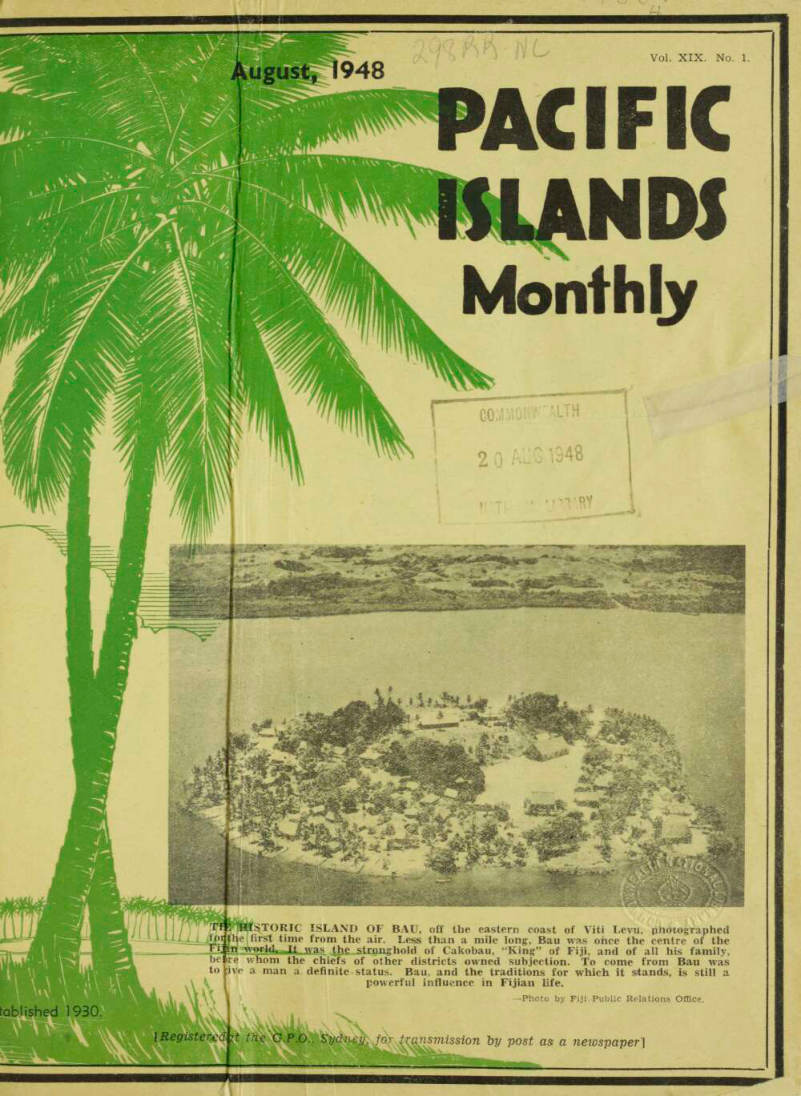
THE HISTORIC ISLAND OF BAU, off the east of Viti Levu. phouographed forthe first time from the air. Less than a mile long, Baau was once the centre of the Fijan world. It was the strongh of Cakobau, “King” of Fiji, and of all his family, befre whom the chiefs of other districts owned subjection. To come from Bau was to give a man a definite status. Bau, and the traditions for which it stands, is still a powerful influence in Fijian life. —Photo by Fiji Public Relations Office.
Advertisements & other items, pp. 2-4 (1 item)
Q&ntaij
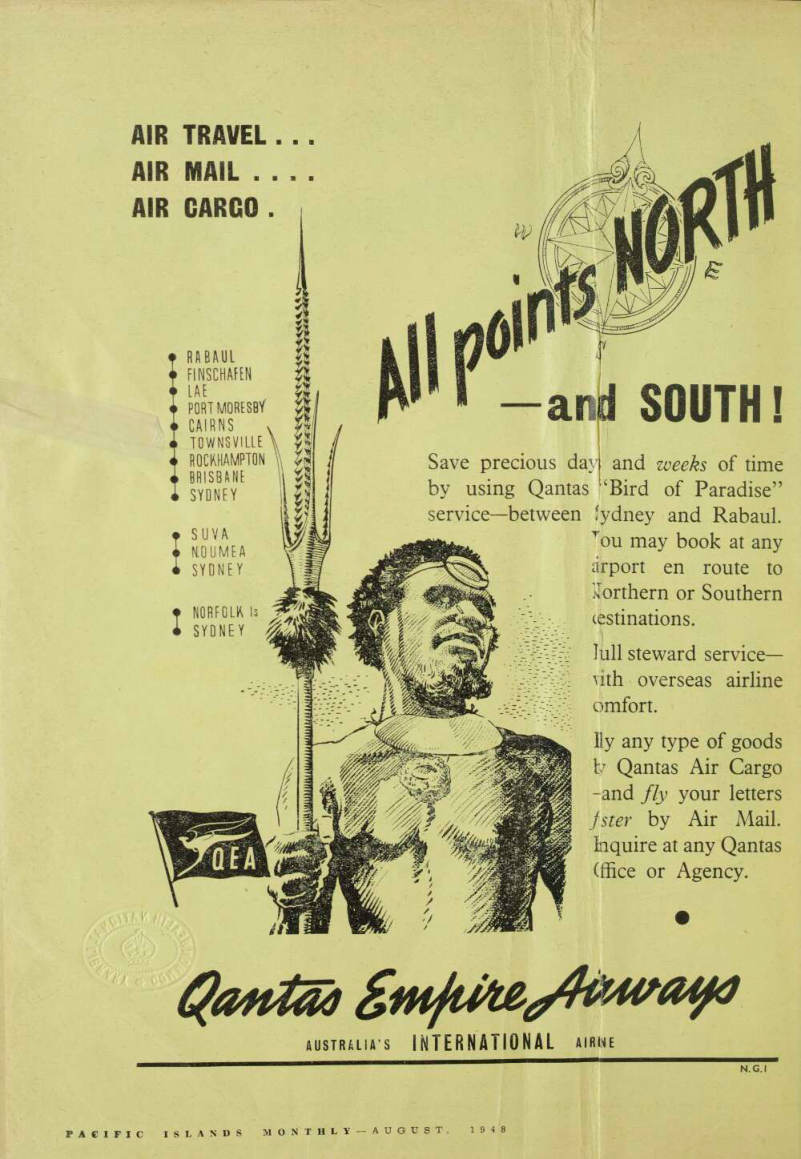
AIR TRAVEL . ..
AIR MAIL
AIR CARGO .
K
NORFOLK Is
SYDNEY
-- . got. m > *
f RABAUL
FINSCHAFEN
LAE
PORT MORESBY
CAIRNS
TOWNSVILLE \
4 ROCKHAMPTON \\ J
BRISBANE 11 M
SYDNEY
SUVA
N.OUMEA
SYDNEY
ard SOUTH I
Save precious day and weeks of time by using Qantas ‘Bird of Paradise” service—between Sydney and Rabaul. r ou may book at any arport en route to ilorthern or Southern testinations. lull steward service— vith overseas airline omfort. lly any type of goods b Qantas Air Cargo -and fly your letters jster by Air Mail.
Inquire at any Qantas (ffice or Agency.
Q&ntaij
Australia’s INTERNATIONAL airhe
N.G.I
AaA& yptifa
KEROSENE
Coleman’s fuel irons have dominated the field for over 30 years, and will continue to do so, for the experience they have gained has not been enjoyed by other makers.
Whichever you choose, petrol or kerosene, you can be sure you have the “Best of its kind.”
Kerosene Iron Requires preheating with methylated spirits I Petrol Iron This model requires no preheating.
Both these self-heating irons are streamlined and have hand protected air-cooled hoods. They are light, and perfectly balanced to eliminate fatigue.
The irons can be used in and out of doors as there are no wires or connections. The bodies are ventilated, the edges tapered for ironing pleats and around buttons, and additional heat is developed at points for fine ironing work. Efficient, simple, economical.
Representatives for the Pacific Islands:
ROBERT GILLESPIE PTY. LTD.
54a PITT STREET, SYDNEY
PEARCE & CO. LTD.
SUVA
FOR FIJI ISLANDS
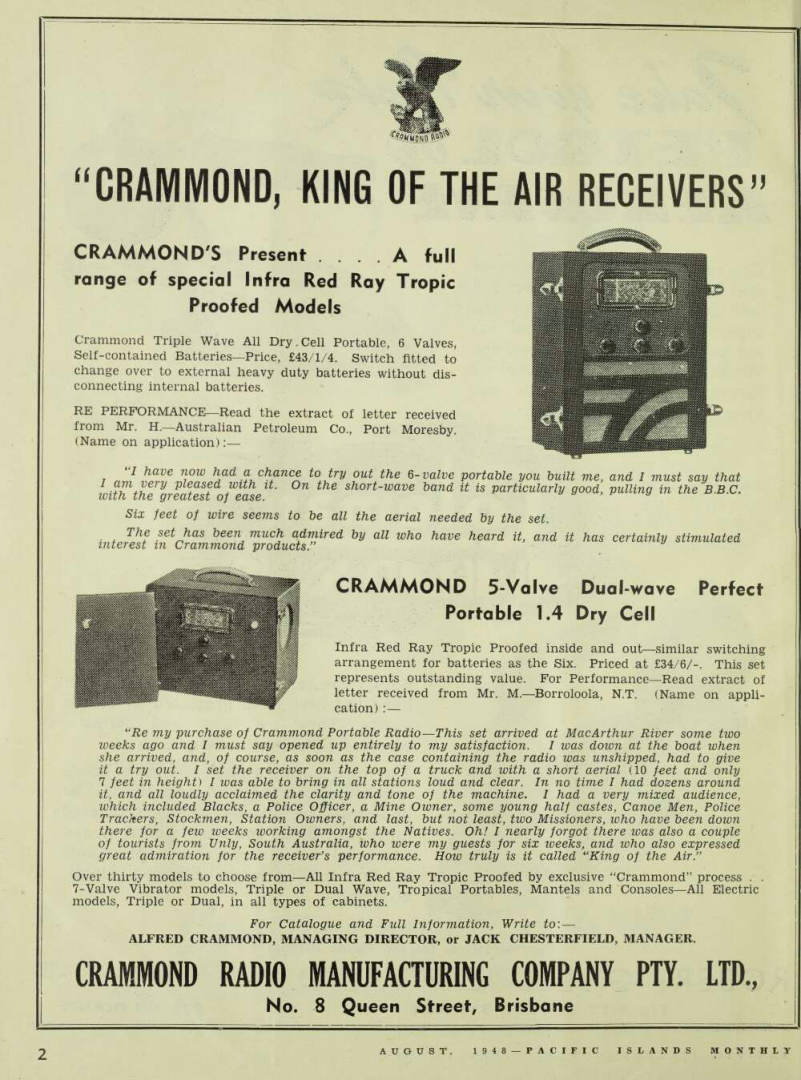
“CRAMMOND, KING OF THE AIR RECEIVERS”
CRAMMOND'S Present A full
range of special Infra Red Ray Tropic
Proofed Models
Crammond Triple Wave All Dry.Cell Portable, 6 Valves, Self-contained Batteries—Price, £43/1/4. Switch fitted to change over to external heavy duty batteries without disconnecting internal batteries.
RE PERFORMANCE—Read the extract of letter received from Mr. H.—Australian Petroleum Co., Port Moresby, (Name on application):— IP , „ 1 J} ave r ] 0w had a chance to try out the 6- valve portable you built me, and I must say that 1 •ih l ih 6ry ° n iJle short-wave band it is particularly good, pulling in the B.B.C. wizn LfhQr Cfi oj @cts@• Six feet of wire seems to be all the aerial needed by the set. . j. . se t has been much admired by all who have heard it, and it has certainly stimulated interest in Crammond products.
CRAMMOND 5-Valve Dual-wave Perfect
Portable 1.4 Dry Cell
Infra Red Ray Tropic Proofed inside and out—similar switching arrangement for batteries as the Six. Priced at £34/6/-. This set represents outstanding value. For Performance—Read extract of letter received from Mr. M.—Borroloola, N.T. (Name on application) : — “Re my purchase of Crammond Portable Radio—This set arrived at Mac Arthur River some two weeks ago and I must say opened up entirely to my satisfaction. I was down at the boat when she arrived, and, of course, as soon as the case containing the radio was unshipped, had to give it a try out. I set the receiver on the top of a truck and with a short aerial (10 feet and only 7 feet in height) I was able to bring in all stations loud and clear. In no time I had dozens around it, and all loudly acclaimed the clarity and tone of the machine. 1 had a very mixed audience, which included Blacks, a Police Officer, a Mine Owner, some young half castes, Canoe Men, Police Trackers, Stockmen, Station Owners, and last, but not least, two Missioners, who have been down there for a few weeks working amongst the Natives. Oh! I nearly forgot there was also a couple of tourists from Unly, South Australia, who were my guests for six weeks, and who also expressed great admiration for the receiver’s performance. How truly is it called “King of the Air.”
Over thirty models to choose from—All Infra Red Ray Tropic Proofed by exclusive “Crammond” process . . 7-Valve Vibrator models, Triple or Dual Wave, Tropical Portables, Mantels and Consoles—All Electric models, Triple or Dual, in all types of cabinets.
For Catalogue and Full Information, Write to: — ALFRED CRAMMOND, MANAGING DIRECTOR, or JACK CHESTERFIELD, MANAGER.
CRAMMOND RADIO MANUFACTURING COMPANY PTY. LTD.,
No. 8 Queen Street, Brisbane
Advertisers
Aluminium Union, Ltd. ... 57 Amphon (Aust.) Pty., Ltd. ... 70 Angliss & Co. . .53 Atkins Pty., Ltd., Wm 85 Anchor Hocking Glassware . . .73 Atkins Kroll & Co. 57 Alois Akun & Co. . 87 Australian Block & Chain Co. Pty., Ltd 55 Amalgamated Hatcheries ... 82 Australian Yeast Co 72 Bethell, Gwyn & Co. 27 Baker, W. Jno.
Pty., Ltd. ... 80 Brunton’s Flour . 80 Burns, Philp (New Hebrides), Ltd. . 13 Bank of NSW . . 14 Burns, Philp (NG) Ltd 49 Brasso (Reckitt & Coleman) ... 50 Burns, Philp Trust Co.. Ltd. ... 22 Budge, James, Pty., Ltd 63 Broomfields ... 82
Bp (Ss) Co. . . 35
W. R. Carpenter & Co. (Fiji), Ltd. . 67 Caine’s Studios . . 30 Carpenter, Ltd., W.
R. . . . . . cov. iv.
Colonial Wholesale Meat 15 Colyer Watson (New Guinea), Ltd. . . 51 Crammond Radio Pty., Ltd 2 Commonwealth Bank of Australia . 39-80 Costello, Vince, Garrick Hotel . . 66 China-New Guinea Mercantile Co. . 71 “Cystex” ... 28 Coleman’s Mustard 64 Donaghy & Sons . 70 Donald, Ltd.. A. B. 68 Davison Paints Pty., Ltd 78 Dettol (Reckitt & Coleman) ... 27 Dr. Williams Pink Pills ... 16 Dangar, Gedye & Malloch . . . . 3 Enmore Poultry Farm 37 Electrolux Refrigerators . . 33 Ford Sherington . . 58 Garrett & Davidson 88 Gillespie Pty., Ltd., Robert . . . 1 & 18 R o b t. Gillespie (NG), Ltd. ... 87 Gilhey’s Gin ... 52 Gillespie’s Flour . . 24 Gough & Co., E. J. 21 Grand Pacific Hotel 4 The Greaves Trad ing Co 83 Grove & Sons, W.
H 28 Harris Hutchinson Pty., Ltd. ... 19 Heinz & Co. Pty., Ltd., H J. . .32 Hettig; August . . 63 Hemingway & Robertson . . .64 Ipana Tooth Paste 25 Knaggs Rooney F.
Customs Agent . 81 Kraft-Walker Cheese Co. ... 37 Kodak (Aust.) Pty Ltd 16
Kolynos, Inc. ... 61 Kopsen & Co., Ltd. 54 Kerr Brothers ... 20 Lockyer, Geo. J. . 65 Manstocks ... 30 Mail Publicity Co. (Magazine Sub scriptions) . . .51 Merrilleies, J. C., & Co 26 Maloney, N. F., & Co 60 Millers, Ltd., Suva 68 Miscellaneous, 18, 23, 48, 80, 84, 85, 86 “Mum” Deodorant 34 “Mendaco” ... 74 Mcllraths Pty., Ltd. 63 Morris, Hedstrom, Ltd., Suva ... 12 National Airways Corporation ... 62 Nelson & Robertson Pty., Ltd 24 “Nixoderm” ... 35 Papain 50 Pacific Is. Society 34 Pacific Islands Trading Co. ... 36 Pan American Air ways 17 “Pinkettes” ... 76 Pitt & Scott, Ltd. . 57 Qantas Empire Airways . . .cov. ii.
Queensland Insur ance Co. . . .40 Robinson, G. H. . . 55 Renton, G 39 Rose’s Eye Lotion, 50, 31 Reckitt’s Blue . . 30 Reed, William E. . 86 Rohu, Sil . . . . 67 Scott, Ltd., J. . .74 Shell Co 86 Southern Pacific Insurance Co. . . 32 Steamships Trading Co., Ltd 66 Sullivan & Co., C. . 58 South Sea Island Correspondence Club 66 Spartan Paints Pty., Ltd. ... 29 Swallow & Ariell . 31 Taylor & Co., A. . 87 Tooth & Co., Pty., Ltd. . . cov. iii.
Thornycroft (Aust.) Pty., Ltd. ... 40 Tilley’s Lamps . . 56 Treacy Engineering Supply Co. Pty., Ltd 79 Tyneside Foundry & Engineering Co., Ltd 72 Trans Oceanic Airways . . .81 Union Manufactur ing & Export Co. 69 Vacuum Oil Co., Ltd. ... 77 “Vitalis” Hair Tonic 59 Vincent Chemical Co 20 Ventura Trading Co Pty.. Ltd. . 75-87 Watson. Wm. H. . 26 Harry West ... 21 Widdop, H., & Co., Ltd 84 Wenzel & Co. . , 13 Wright & Co. . . 76 Wills. W. D. & H. 0 38 Wunderlich Ltd. . 80 Wright & CO., Ltd., E. . . 72 Yorkshire Insur ance Co., Ltd. . . 13 Young, Harry J., Pty., Ltd. ... 23
The Noumea Chamber of Commerce considers that agreements made at the Geneva Trade Convention last October applied to New Caledonia, would con siderably increase current duties on goods; and as none of the raw or primary ex ports of the Colony are favoured, it is not m the interests of the Colony to agree to the Convention for the time being.
Advertisements & other items, p. 5 (1 item)
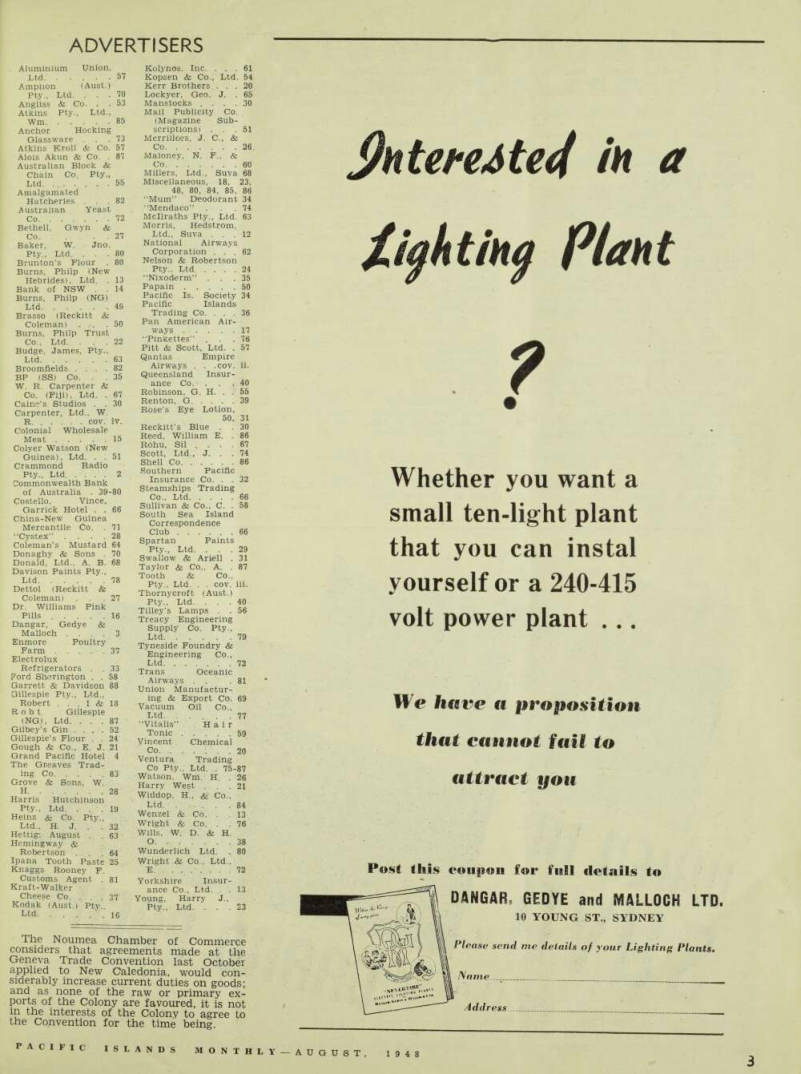
Xifhtiny Plant
%tenAte4
Whether you want a
small ten-light plant
that you can instal
yourself or a 240-415
volt power plant ...
We have « proposition that cannot fail to attract you Post this coupon for full details to 1(M- *• U " r f [ m\
DANGAR. GEDYE and MALLOCH LTD
10 YOUNG ST., SYDNEY
Please send me details of your Lighting Plants.
Name... ' Address
In This Issue:
Editorial; “Socialist Regime May Be Nearing End in New Guinea” .. 5 Bulolo’s First Posi-War Trip To New Guinea 6 Government Aid Sought For Blind Tongan 6 Copra Costs —Comparative Production Tables 7 Trusteeship Council Approves Papua- New Guinea Amalgamation ... 8 Flag Raising On Manus ..' 8 Winding Up Of PCB .. 8 Copra’s High Value —Malayan Was Over £lOO Per Ton In July ... 9 Nauru Riots —Clash With Chinese Workers 9 NG Timber Case Postponed 9 New “Tofua” For Islands Service .. 9 BGD Progress 9 Investigation Into Cost Of Living— Papua-N. Guinea PS Gains Point 10 Marshall Aid For New Caledonia .. 10 “New Statesman” Rubbish For Papua 11 Port Moresby Public Servants Review Progress Of Struggle for Better Deal 11 New Fiji Copra Bill—Opposition By Some Planters 13 France Will Foot Bill For Colonial Governors 13 New Procedure In Fiji Executive Council Appointment 13 Sandy Creek Gold Sluicing Ltd. — Operations Now Normal 14 W. Samoan Assembly Begins New Task 14 American Subsequential War Damage
Payments 16
Javanese Labour For New Caledonia 16 End of CIPA In Cook Islands Is Predicted 18 Fiji Copra Control —Extraordinary Powers Of Board 22 Calwell’s Ban —Bitterness In Central Pacific 23
Cost Of Australian Wheat In N.
Caledonia 23 Fiji Governor To Tour Group .. .. 26 Future Of Samarai Awaits Canberra Decisions 27 Trade Boom Continues In Western Samoa 28 Prevention Of Blackwater Fever ... 30 Vila’s Depot Barge Goes Stubborn On Voyage 31 Copra Crushing Planned For New Guinea 32 European Samoan Barred From Australia 34 Isle Of Pines For Tourists 37 No Room For Tourists—Acute Shortage of Hotel Accommodation In Suva 39 Price Control For Suva’s Vegetables 40 Plaques For NG War Graves 41 Territories’ Talk-Talk 41 Something Always Turns Up! .. .. 42 The Story of the Ba Rebellion ... 43 Bride From the South 43 Out of the Past —Photographs of Aneityum, New Hebrides 44 The Soliloquy Of a Fed-Up Trader .. 44 Tropicalities 45 Pacific Nature Notes 46 Book Review —Johnny Frisbie’s Story 47 Service Section 48 Report On the Solomon Islands —Dr.
Rutter Sums Up 50 When They Got Their Sunday’s Mixed —Rarotonga In 1897 53 How We Fixed a Leak 55 Madang News 57 Intermarriage In the Islands 58 Origin Of Tin Can Mail 59 Plane and Shipping Services 66 Mental Patient At Large In Moresby 70 Tokelau Stamps—First Day Issue ... 76 Bravery Awards For New Guinea Natives 76
Pilariasis Campaign In French Oceania 751 In Search of South Seas Glamour .! 78 1 Increased Expenditure On Health In W. Samoa 81 Golden Wedding Of Mr. and Mrs.
Charles Bentley Of Suva 82 W. Samoa Comes Of Age 83 Education In BSl—School Materials Duty Free 85 New Director Of New Caledonia Native Affairs 86 Commercial, Markets, etc 88 OBITUARY; Mrs. C. Hutchings, 7; H.
Milliard, 16; H. C. Reed, 26; R. A.
Vivian, 30; F. W. Blencowe, 31; Mrs.
Maria Devonshire, 59; C. Flinders Proctor, 60.
ORGANISATIONS: Papua-NG Public Service Assns., 11; New Guinea Scholarship Fund, 31; New Guinea Women’s Club Of Sydney, 74; Planters’
Assn. Of Papua, 80.
Miss Patricia C. Whitehouse, daughter of Mr. and Mrs. Ernest Whitehouse, now of Adelaide, SA, recently passed with credit in all subjects of the Nurses’ exam inations. She thereby won a gold medal.
Until the evacuation, Miss Whitehouse lived in Papua where her father was for 28 years with the Administration in the Trobriands, Samafai and Misima.
After 40 years’ residence in Papua, Mr.
James Driver has retired from his interests in the Territory, and has gone to live in Melbourne. Following three years’ evacuation, he returned to Milne Bay— only to experience, under the conditions created by the Australian Socialist Gov ernment, two years of the frustration and discouragement which have broken the hearts of so many elderly planters and traders in the Territories.
Advertisements & other items, p. 6 (1 item)
tttxw
m w
ta v s
Pacific Islands Monthly
The Newspaper-Magazine of the South Seas
L Registered at the G.P.0., Sydney, for transmission "by post as a newsp.aper ] Published Once Each Month and Circulated in Australia and New Zealand and in the following Pacific Territories and Islands Groups:
Australian Territory of Papua.
Trustee Territory (Australia) of New Guinea.
Australian Territory of Norfolk Island.
New Zealand Territory of Cook Islands, Trustee Territory (NZ) of Western Samoa.
British Colony of Fiji.
British Solomon Islands Protectorate.
British Protectorate of Tongan Islands.
British Crown Colony of Gilbert and Ellice Islands.
Trustee Territory of Nauru.
British and French Condominium of New Hebrides.
French Colony of New Caledonia.
French Colony of Oceania (Tahiti, etc.).
American Territory of Eastern Samoa.
American Territory of Hawaiian Islands.
Owned and Produced by Pacific Publications Pty Ltd., Union House, 247 George Street, Sydney.
Telephone: General Office and Advertising, BW 5037.
P.O. Box 3408
Registered Address for Telegrams, Radiograms, and Cables: “Pacpub,” Sydney.
Contributions.
Articles, Stories, and Photographs dealing with Pacific Islands subjects are invited and will be paid for on publication.
Subscription Rates.
Per Annum, Pre-paid, Including Postage.
In Australia. New Zealand, Fiji, New Guinea, Papua, Western Samoa, Cook Islands, Tonga, British Solomons, Gil bert and Ellice Colony, Nauru, and United Kingdom 15 o Elsewhere $3 18 0 Single Copies 1 g
Editor and Publisher:
R. W. Robson, F.R.G S.
Assistant Editor: JUDY TUDOR.
General Office: Union House, 247 George Street, Sydney. Telephone: BW 5037.
Advertising Manager: W. E. Rogers.
Representative In London.
J. T. Wallis, Coronation House, 4 Lloyds Avenue, London, E.C.3, from whom may be obtained copies of Pacific Islands Monthly, Pacific Is. Year Book, advertising schedules, etc.
Representative In U.S.A.
Pacific Islands Trading Co..
244 California St., San Francisco, U.S.A
Agents.
The following are authorised to receive sub scriptions for Pacific Islands Monthly:— Burns, Philp & Co., Ltd., and Burns Phllp (South Sea) Co., Ltd. All branches.
W. R. Carpenter & Co., Ltd. All branches.
Morris, Hedstrom, Ltd. All branches.
Steamships Trading Co., Papua. All branches.
W. M. Caldwell, Suva, Fiji.
Cook Islands Trading Co., Rarotonga, Cook Is.
Oscar Nordman, Papeete, Tahiti.
Islands Branches and Representatives of W. H.
Grove & Sons, Ltd., Auckland, New Zealand.
Ed. Pentecost, Noumea, New Caledonia.
Societe Gubbay Kerr et Cle, Noumea, New Caledonia.
Vol. Xix. No. 1.
August, 1948
f 1/6 Per Copy Price j Prepaid, p.a.: 15/- Aus. ( In USA, p.a.: $3.
Socialist Regime May Be Nearing Its
End In New Guinea
THE following was included in the A news broadcast from the ABC on Sunday morning, July 25: “The Minister for External Territories, Mr. Ward, has stated that the limit on expansion by white-men in New Guinea will be determined by the welfare of the natives. New plantations may be estab lished on T y with the approval of the Administration.
“Mr. Ward was replying to RSL com plaints that ex-Servicemen who did not live in the Territories before the war were not allowed to settle there. He said that people wanting to enter New Guinea or Papua must lodge a bond to ensure that they did not become a charge on the Administration and must be assured of a job, accommodation and transport.
“The acquisition of land was not actually forbidden, but the Administration would only allow the development of new areas if the welfare of the natives was not affected.”
There is nothing new in this. It is consistent with the policy which has been pursued by Mr. Ward ever since he became Australian Minister for Territories, and the Red Czar of New Guinea. But it is interesting to have this official pronouncement from the gentleman.
As a declaration of policy, it is like something out of dreamland—nebu lous, impractical and absurd. Euro pean enterprise and settlement can be kept out of New Guinea, of course
—but at a cruel and unjustifiable cost to the Australian taxpayer, and by sacrificing the safety of the Common wealth.
IN pre-Wardian days, European settlers mostly Australians-were encouraged to go into Papua and New Guinea, and develop the agri cultural and mineral resources of those huge islands. As a result, they produced large quantities of copra, rubber, cocoa, gold and shell; and the Government’s share of the nroceeds— derived from direct and indirect taxation—paid for all administration (which included the costs of supply ing various services for the benefit of the natives). Thus, the activities of planters, traders and miners all over the Territories did much towards “Europeanising” the natives, and towards providing the Territories with public utilities which were of great service in wartime.
The latter is an important con sideration. The Netherlands Indies, New Guinea and the Bismarck Archi pelago represent a nearly solid barrier between North Australia and the countless millions of Southern Asia, who now are becoming more Com munist every month, and who will come like a Red flood into the South Pacific, sooner or later. It is of supreme importance to Australia that
at least the nearer section of the barrier—eastern New Guinea and the Bismarck Islands—be developed and controlled by Australians, so that they may provide some sort of organisation that can be adapted for defence.
But under the Kings Cross planning of the present Territories Minister (a Kings Cross Planner is first cousin to a Bloomsbury Planner—and there is nothing in the long history of Eng land more calamitous than the accession to power of the Bloomsbury type of professional politician) Euro pean enterprise in the Territories is and has been sternly discouraged, the defence consideration ignored, and—failing adequate revenues from the Territories themselves the Aus tralian taxpayer has been and is being heavily called upon. In the year ended June 30, 1947, Australia contri buted some £2,000,000 to Territories administration, and in the year ended June 30, 1948, it will be found that the sum is nearer £3,000,000. Prior to the war and Wardism, the Territories cost Australia almost nothing.
All this is being done because, in the opinion of Mr. Ward, supported by some of his Ministerial colleagues and by a scintillating array of “advisers”—not one of whom had had any real practical experience of Territories conditions —the Territories must be kept as a close preserve for the primitive Melanesians who are the aboriginal inhabitants of the big islands. Mr. Ward and his supporters regard the Australians who pioneered Papua and New Guinea, tamed the '
head-hunters and established rich and valuable industries, as mere “profiteers” and “exploiters.” Mr.
Ward says that they “enslaved” the natives; and persons who challenge his dicta or criticise his policies are either ignored or described as “mouth pieces of vested interests.”
WITH the world literally clamouring for all the products of these tropical lands, there was every reason to expect, after the end of the Pacific war, the introduction of a Golden Age in New Guinea. From 1945 onwards there was—and still is—an extra ordinarily rich market for almost everything that the Territories could produce. There was enterprise avail able in the form of hundreds and thousands of young Australians, who, with encouragement, would very wil lingly have gone to these islands to establish themselves in both primary and secondary industries. And abun dant capital was provided in the fortuitous funds of the War Damage Commission—more than £12,000,000 accumulated as an insurance against possible loss through Jap invasion, and now available for rehabilitation purposes.
Had there been any intelligence, vision and real national purpose be hind the Wardist regime, Australia could have established in New Guinea, within five years of the Jap surrender, a large and flourishing Australian Colony, which would have strength ened her defences and her economy, and have been of immeasurable benefit to the indigenous natives.
But Mr. Ward and his team of Socialist dreamers chose instead the policy that already has cost the Aus tralian taxpayers £5,000,000, and that has demoralised the natives and broken the hearts of many of the Territories’ pioneer settlers. That generalisation is neither too sweeping nor too severe.
Mr. Ward, at first, tried to exclude altogether the big trading companies, the private ship owners and all young men who were eager to attempt a little pioneering on their own ac count. He set up a Production Con trol Board (to buy all the country’s produce and sell the producers all their requirements); and a Shipping Board, which made all sea transport a Government monopoly. He swept away the old native labour indenture system—which had been evolved in 20 years of trial and error, and which worked quite well for both whites and blacks—and put in its place a half baked product of anthropological planning, that is of little benefit to the natives and mostly an expensive embarrassment for the white em ployers. The years 1946 and 1947, which should have seen the beginning of great progress and prosperity in Papua and New Guinea, were a period of muddle and waste and extreme discouragement for everyone con cerned. including Administration officials.
The planters were discouraged be cause they could not get sufficient labour to rehabilitate their plan tations; they were forced to sell to
Mr. Ward, at Mr. Ward’s own price, the limited amount of copra they could produce, instead of getting the benefit of the world market; and they could not get enough transport from the Government either to shift their produce or to bring in their supplies.
The miners were discouraged because owing to lack of labour and transport, they could not get on with the re establishment of their valuable in dustry. The whole European com munity—and especially Mr. Ward’s own staff, the administrative officials —was unhappy and clamorously dis contented because the operation of the Wardist system sent all living costs sky-high.
THAT was in 1946 and 1947. The year 1948 has seen Mr. Ward in precipitate retreat. He has allowed the big trading companies to resume some of their operations. He is with drawing his control over sea trans port. He has announced the discon tinuance of the Production Control Board system—which means, presum ably, that control of copra production and sale will be restored eventually to the planters and the traders. He has been assailed by the public servants and threatened with a strike, if he does not recognise that the im possible living conditions he has created entitles them to some special consideration; and he is trying now to soothe them. But his pronounce ment of July 25 shows he still has a kick left.
UNLESS every sign and portent lies, the Australian Socialist Govern ment is on its way out. There will be a general election about July, 1949; and, within a year, we hone, a non- Socialist set-up in Canberra will introduce, in Papua and New Guinea, an administrative policy in which native welfare, European settlement, the establishment of industries, the encouragement of enterprise, and cer tain defence considerations will be brought into proper relation with each other, and in connection with which Australian financial obligations will be given some thought.
By 1950, we hope, the Australian Territories will have established a neat little political graveyard wherein there will be buried deep, under appropriate headstones, the Socialist policies of Mr. Eddie Ward, along with other unpleasant memories like •the Jap invasion and the timber getting enterprises of Mr. Jock Garden.
Mr. Ward’s pronouncements upon European enterprise in New Guinea, and the importance of sacrificing our interests to what he calls native wel ware, should not be taken out of focus. Within half a decade, we be lieve, “the Ed-Wardian era in New Guinea” will have taken its due and proper place as a strange episode in South Pacific history.
The Dutch ship “Tabian” called at Noumea, New Caledonia, in July, to re patriate the first 2,000 Javanese in dentured labourers who are returning to the Netherlands East Indies.
Bulolo’S First Post-War
Trip To New Guinea
AFTER an absence of nine years, mostly on war duties, the Burns Philp line motorship “Bulolo” tied up at her old berth at No. 10, Walsh Bay, Sydney, on July 24, She has been completely re fitted in the UK at Admiralty expense She was under charter to the Blue Funnel line on the voyage out, and brought passengers and cargo from Liver pool (England).
The “Bulolo” is due to sail from Sydney on her first post-war voyage to Papua and New Guinea, on August 17, again fly ing the BP “Thistle” house-flag.
She will sail on a five-weekly schedule, Australian waterside workers, industrial conditions and cargo-facilities permit ting. She will call regularly at Port Moresby, Lae, Rabaul, and Port Moresby, travelling via Brisbane (Qld.) on the out ward run only.
Blind Tongan
Government Aid Sought For a Blind Tongan
Letter to the Editor IHAVE tried for some time to get the Tongan Government to take care of Finau, a blind man, who is unable to work. Finally, I received an answer from Premier Ata, stating that the Minister of Police would go up to Vava’u and examine his case.
I met the Minister in his office in Vava’u and asked him if the Government would help this man. He said no, that
Finau could work; but when I asked him where, he couldn’t tell me. We feel strongly about this because we know that if it were not for the help given Finau by the European residents and the managers of the local firms he would have been dead long ago.
Last year the Governor of Vava’u made it known at a taxnayers’ meeting; that the Government had £160,000 invested in other lands. Some Tongans think that the Government is not doing its rightful duty to the people of Tonga when it sends the people’s money out of the Kingdom for someone else to benefit, while Tongans suffer for lack of medical supplies and help for the blind.
ll am, etc.,
S. P. Afuha'amango.
Neiafu, Vava’u, Tonga. 30/3/48.
Captain James Duncan, who resigned his position of harbourmaster at Rabaul, is now residing on his plantation at Kokopo. His eldest son, Group-Captain W. J. Duncan, is still with the China Re lief Mission at Canton.
Finau, the blind Tongan
Copra Costs
Revealing Figures By Papuan Coconut Planter
WHERE, in 1939, it cost £6/17/- per ton to produce copra on an estate in Papua and deliver it in Port Moresby, it now costs £3O/13/11 per ton.
The following figures are supplied by a Papuan plantation-owner, and cross checking shows that they are substantially correct. They represent a rise of over 400 per cent, in production costs in recent years; and while a large proportion of the increase is due to the Socialist conditions introduced into Papua by the Australian Government, the figures are of interest to all copra producers in the South Pacific:
Estimated Cost Of Production
Of Copra For Ensuing Twelve
Months (Assuming Full Require
Ments Of Natives Are Available)
Estate Manager’s Salary and Allowances
Equal to £3O/13/11 per ton.
Production of 262 tons represents the average output over the past four years.
In arriving at the above costs, no allowance or provision whatsoever has been made for depreciation on buildings, plant, amortisation reserve to cover life of property, or interest on capital outlay.
The following table compares the 1939 and 1948 costs of plantation commodities.
It is a little startling.
THE following is an analysis of planta tion native labour costs, to show where the enormous rises took place in this essential charge:
£ s. d.
Fares to and from Sydney .. .. 30 7 9 One Month’s leave pay per annum 35 0 0 Fares to and from plantation 7 0 0 Salary for 12 months 420 0 0 Bonus on 262 tons copra at 10/- per ton 131 0 0 Total £623 7 9 Wages £ s. d. 1 half-caste at £10 per month 120 0 0 Bonus on 2,800 bags copra at 3d. per bag 35 0 0 Total i E155 0 0 Expenses of 75 Natives Recruiting 375 0 0 Fares 225 0 0 Wages £9 per annum 675 0 0 Ration Issues 3,483 15 0 Working kit 347 16 3 Hospitalisation 78 15 0 Total £5,185 6 3 Plantation Expenses £ s. d Copra sacks, 262 tons at 38/2 per dozen (15 sacks to ton) .. 624 19 7 Twine at 2/- per hank 26 4 0 Needles (say) 10 0 Stencil ink, brushes, stencils, at 6d. per ton 6 11 0 Axes, knives, sarifs, kerosene, inward freights, passages, inward insurances, etc. (Average 12 months) at £23/16/8 p.m 286 0 0 Total £944 4 7 Various £ s. d.
Insurance on buildings and copra in store on the estate 35 0 0 Freights on 262 tons copra to Port Moresby at 55/- per ton 720 10 0 Marine insurance on 262 tons copra, valued at £35/10/- at £1 % 93 0 0 Government land rents .. 16 8 0 Maintenance of bungalows, buildings, driers, sheds, rail line and trucks 175 0 0 Plantation inspection: Head office expenses, stationery, general expenses 100 0 0 Total cost of producing 262 tons copra and delivering at Port Moresby £8,047 16 7
- Per Per Month Working Kit Annum (of 30 days) £ s. d. £ s. d. 1 blanket ,. .. 1 3 6 1 plate .. .. 1 8 1 pannikin .. 1 4 1 spoon .. .. 1 5 1 box or kit bag (estimated) . 15 0 2 ramies .. .. 6 0 1 rami (every two months) 18 0 1 mosquito net 1 5 10 Total ... 4 12 9 7 8 Wages 12 0 0 1 0 0 Recruiting .. . 5 0 0 8 4 S/O fees .. .. 3 0 3 Fares to and from 3 0 0 5 0 Insurance .. . 10 0 10 Hospitalisation 1 1 0 1 9 Rations: Per Week Rice, 7 lb. .. 3 6 Peas, If lb. . 11 Sharps, 3i lb. 2 4 Meat, 3 lb. 5 6 Sugar, 1 lb. . 7 Tea, 2 oz. 5 Salt 1 Edible fats . 1 6 Soap 2i Tobacco .. . 10 Matches 11 Vegetables . 1 9 Total .. . 17 8i 3 16 8 Plus 3\% loss in weights on rice, peas, sharps and sugar and 1% inedible overall (o n £46/9/-) ... 9 Equal for 12 months to .. £6 1 3 72 15 0
Plus additional 5 days to make 365-days year 5 10 Per unit per annum .. £73 0 10 Cost per day (300 working days per annum) .. .. 4 10:-
Commodity
1939 Price
1948
Price
Tobacco. Trade Wheatmeal. 150 lb. ..
Rice Matches Biscuits, Pilot Sugar Fish, Trade Flour Meats .. .. 8/8 .. .. 100/9 . .. 61/6 ,. .. 10/9 .. .. 54/3 Per lb per sack per 112 lb. per gross per 50 lb. tin . .. 35/11 ,. .. 84/per 70 lb. bag per case per 150 lb. sack 7/1 . .. 16/7 per dozen
Sait
Tea Soap Hessian (for baling rubber) Lamp Kerosene Power Kerosene Benzine Mosquito Nets per sack . .. 12/8 per cwt. 38/8 7 Vi ... 6/3 . .. 2/8Vi ... 3/1 . .. 3/5Vi per lb. per case per yd. 72 in. per gallon per gallon per gallon each 16 in. Knives (English) Copra Sacks Cartridges Axes % Blankets . .. 119/4 • .. 37/10 . .. 33/9 . .. 15/2 . .. 28/10 per dozen per dozen per hundred each each
Mariposa And Monterey
Us Government May Buy
IT was suggested in Washington in early August that the United States Govern ment was considering the purchasing of the Matson liners “Mariposa” and “Monterey.”
Those two luxury liners were on the Svdney-San Francisco run before the war and were well-known to Pacific travellers.
After war service they were put into dock on the American Pacific coast but recon version work stopped suddenly in 1947 when wages and costs indicated to the Company that they would make the ships an uneconomical proposition for the Pacific trade.
Later, the Mateon Company announced that the ships would be sold and that the “Marine Phoenix” would be withdrawn from the Pacific run after the Union Steamship Company’s “Aorangi” was back in operation.
“Aorangi,” after refitting in Sydney, had her ocean trials in early August and was due to leave Sydney for Vancouver on August 19.
In early August, officials of the US Maritime Commis»3ion were in San Francisco inspecting “Mariposa” and “Monterey.”
Death Of Mrs. C. Hutchings
THE death of Mrs. C. Hutchings occurred in July, at her home in Bingara, NSW. She was 76 and was born in the Rewa district of Fiji, the second daughter of one of Fiji’s earliest settlers, the late Mr. W. Abbott, of Rewa.
With her husband, she left Fiji about 20 years ago. Mr. Hutchings died 10 years ago.
During World War I she did a great deal of Red Cross work in Fiji and also nursed through the 1918 influenza epidemic.
She was an invalid for many years be fore her death. She leaves five eons and two daughters, all of whom were born in Fiji.
Trusteeship Council Approves Papua-New Guinea Plan
Comment Shows Amusing Ignorance of Conditions in Primitive Melanesia
THE plan for an “administrative mer ger” of the old Australian Territory of Papua and the Trust Territory of New Guinea was finally approved by the Trusteeship Council of the United Nations, on August 2, after it had been under discussion since July 8. (See article on page 9of July “PIM.”) The matter now goes to the Assembly.
The Council voted 8 to 1 (Russia dis senting, of course) in favour of the plan.
France, Belgium and Australia did not vote.
The plan is contained in a Bill which was presented to the Australian Parlia ment in June, and which- will be further dealt with in September. The Bill was reviewed on page 19 of July “PIM.”
The Bill cannot be proceeded with until it has been approved by the General Assembly of UNO. But that is a formal ity—the crucial vote was that taken by the Trusteeship Council. A small body of Australian advisers, led by Mr. R. J.
Halligan, secretary of the Department of External Territories (who returned by air late in July) presented the Australian case to the Council. According to frag mentary newspaper accounts, they met quite a lot of criticism.
MR. SAYRE (United States) said the merger plan was political in essence.
The Australians replied that the merger was merely administrative—the two ter ritories would definitely retain their separate identities. It was not a political union.
Philippines delegate wanted to know why there was no provision for native education. Mr. Halligan explained that provision for native education on a large scale would come from the machinery that the new Bill would create.
A suggestion by the Philippines delegate that Papua also be brought under Trustee Council control was promptly quashed.
Iraq and other delegates thought the proposed union was political, and chal lenged Australia’s right to proceed with the plan.
Russia could not see how the Council would be able to keep a close watch on New Guinea under the proposed union with Papua. Mr. Halligan gave an assur ance that separate statistics would be kept of each Territory, Some delegates said that the provision made for curfews between 9 p.m. and 6 a.m. indicated hatred and oppression of natives. This suggestion (very amusing to those who know the true position in New Guinea) was repudiated by Mr. Hal ligan and Mr. Forsyth.
Another discussion (also amusing to Territories residents) centred on native wages. Some delegates thought that the wage rate now provided by Australia (£AI per month) was far too low; and the Australian delegates (who so often have been cursed in the past two years for raising the rates) were at pains to explain to the Council why it is unneces sary and unwise to pay more to these primitive workers. They used almost the same arguments as were used against them, two years ago, when they were raising the natives’ wages.
United States urged greater participa tion by natives in the higher branches of government, and said the native labour indenture system should be abolished as soon as possible.
Philippines said that Australia should model her administration of New Guinea on the United States administration of Philippines, which was “a shining example of colonial administration.”
In its final report, the Council empha sised the need for maintaining the separ ate identity of the two territories, united for administrative purposes only; said that the wage rate for natives was still inadequate: commented on the illiteracy and political backwardness of the natives; and recommended that existing pro grammes for advancement of the terri tory should be extended and co-ordinated to comprise a general long-range plan for the progressive development of the inhabitants as a whole on an appropriate
constitutional foundation toward self government or independence.
Editorial Note.
MR. WARD and Mr. Halligan probably will agree with the “Sydney Morn ing Herald” comment that the Council’s references to native conditions are “unrealistic,” and that the report, though well-meaning in its comments, “discloses imperfect understanding of the primitive nature of the country and its inhabitants.”
The irony of the thing is that the ill informed and impractical statements of members of the Trusteeship Council are on all-fours with the views expressed, on various occasions, by the starry-eyed gentlemen who, in the shape of a Research Council, advised Mr. Ward on Territories policy in 1943-45. Mr. Ward accepted those views, four or five years ago, despite the jeers of people who really knew Territories conditions. Now Mr.
Ward’s men, in process of implementing his policy, are forced to defend them selves against the same kind of stupid, ignorant and impractical criticism.
The million or so natives in Papua and New Guinea are only one generation re moved from the headhunters and the naked savagery of most primitive Melan esia. In two or three generations more they may be sufficiently advanced to be entitled to European rates of wages and a dominating voice in their own govern ment. In the meantime—as Mr. Ward is now finding out, with every passing month—sympathetic care of them must be supplemented with practical common sense, and strict control. There was not much wrong with the policy of 1920-40, upon which Mr. Ward and his bunch of Research enthusiasts danced so furiously in 1942-43.
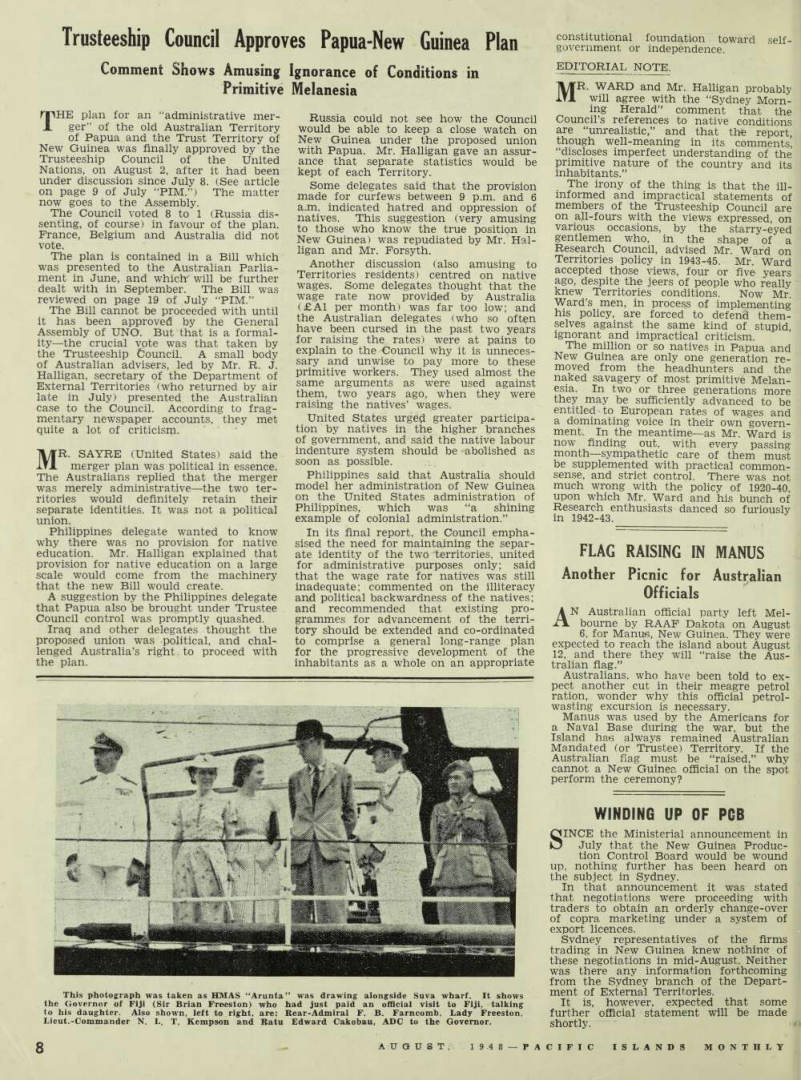
This photograph was taken as HMAS “Arunta” was drawing alongside Suva wharf. It shows the Governor of Fiji (Sir Brian FReeston) who had just paid an official visit to Fiji, talking to his daughter. Also shown, left to right, are: Rear-Admiral F. B. Farncomb, Lady Freeston, Lieut.-Commander N. L. T. Kempson and Ratu Edward Cakobau, ADC to the Governor.
Flag Raising In Manus
Another Picnic for Australian Officials
AN Australian official party left Mel bourne by RAAF Dakota on August 6. for Mamie, New Guinea. They were expected to reach the island about August 12, and there they will “raise the Aus tralian flag.”
Australians, who have been told to ex pect another cut in their meagre petrol ration, wonder why this official petrol wasting excursion is necessary.
Manus was used by the Americans for a Naval Base during the war, but the Island hae always remained Australian Mandated (or Trustee) Territory. If the Australian flag must be “raised,” why cannot a New Guinea official on the spot perform the ceremony?
Winding Up Of Pcb
SINCE the Ministerial announcement in July that the New Guinea Produc tion Control Board would be wound up, nothing further has been heard on the subject in Sydney.
In that announcement it was stated that negotiations were proceeding with traders to obtain an orderly change-over of copra marketing under a system of export licences.
Sydney representatives of the firms trading in New Guinea knew nothing of these negotiations in mid-August. Neither was there any information forthcoming from the Sydney branch of the Depart ment of External Territories.
It is, however, expected that some further official statement will be made shortly.
Copra’S High
Value
Malayan Was Over £100 per Ton In July
From a Special Correspondent
London, July 16.
THE Copra market here has been all over the place.
Philippines copra, after having been very firm during the early part of the year, shows signs of easing off. The price in the Philippines at the time of writ ing is 260 dollars FOB (£AB6) while about six weeks ago it was quoted 310 dollars (£AIO3). At the moment there are still certain sellers of Philippines copra at to day’s price.
The typhoon that hit the Philippines last Christmas was apparently the cause of the firmness during the first half of this year. Lots of trees were damaged and the supplies that have come in have been pretty small. It is expected that de liveries will increase from now onwards.
The Dutch East Indies have shown a small increase in production over last year.
There has been quite a business doing in Straits copra the last month or so.
Singapore is now a free port and this copra can be shipped from this teiritory without any restriction as to destination.
The prices ruling have been fairly high.
To-day the price is round about £95 (£A118). Clf. European ports. During April-May it was in the neighbourhood of £B4/£B5 (£AIOS/106). At the moment the Straits copra market seems a little quieter, in sympathy with the lower irnilippines market.
South Sea Copra.—We have heard rumours that there may be some relaxa tion of control. We should imagine, how ever, that the Australian Government will control the selling, although they may give producers possibly a little more freedom.
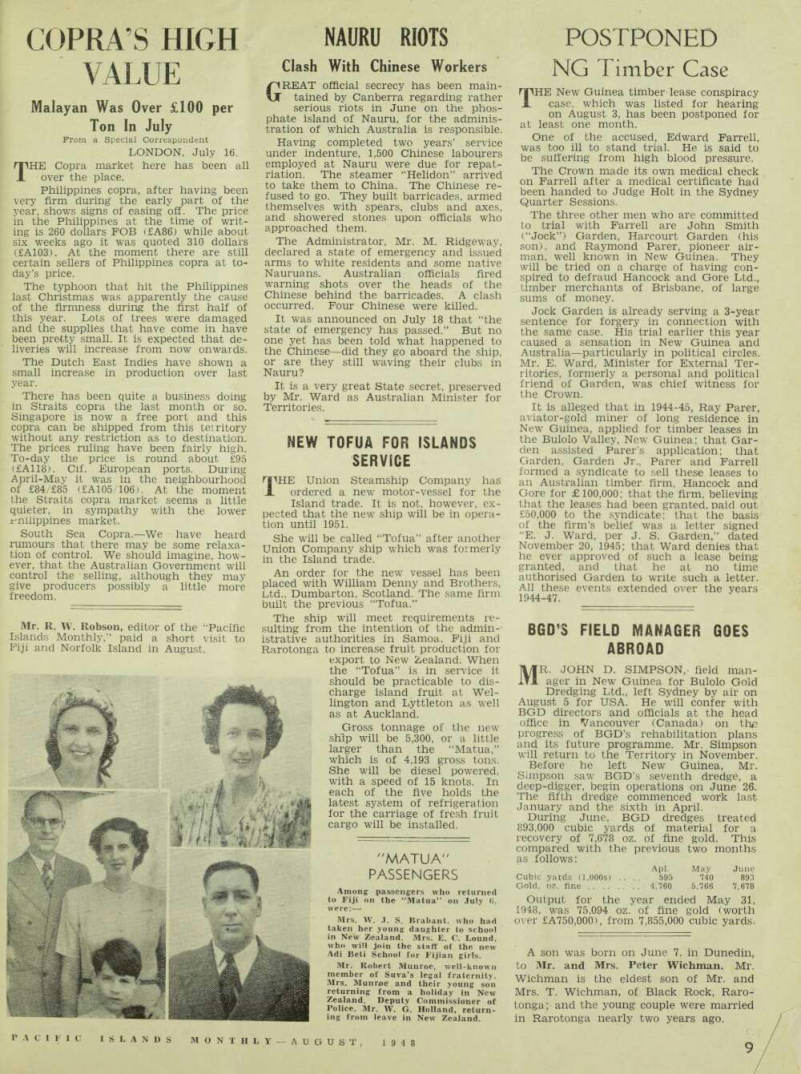
Mr. R. W. Robson, editor of the “Pacific Islands Monthly,” paid a short visit to Fiji and Norfolk Island in August.
Nauru Riots
Clash With Chinese Workers
GREAT official secrecy has been main tained by Canberra regarding rather serious riots in June on the phos phate island of Nauru, for the adminis tration of which Australia is responsible.
Having completed two years’ service under indenture, 1,500 Chinese labourers employed at Nauru were due for repat riation. The steamer “Helidon” arrived to take them to China. The Chinese re fused to go. They built barricades, armed themselves with spears, clubs and axes, and showered stones upon officials who approached them.
The Administrator, Mr. M. Ridgeway, declared a state of emergency and issued arms to white residents and some native Nauruans. Australian officials fired warning shots over the heads of the Chinese behind the barricades. A clash occurred. Four Chinese were killed.
It was announced on July 18 that “the state of emergency has passed.” But no one yet has been told what happened to the Chinese—did they go aboard the ship, or are they still waving their clubs in Nauru?
It is a very great State secret, preserved by Mr. Ward as Australian Minister for Territories.
Service
New Tofua For Islands
Union Steamship Company has ordered a new motor-vessel for the Island trade. It is not. however, ex pected that the new ship will be in opera tion until 1951.
She will be called “Tofua” after another Union Company ship which was formerly in the Island trade.
An order for the new vessel has been placed with William Denny and Brothers, Ltd., Dumbarton, Scotland. The same firm built the previous “Tofua.”
The ship will meet requirements re sulting from the intention of the admin istrative authorities in Samoa, Fiji and Rarotonga to increase fruit production for
export to New Zealand. When the “Tofua” is in service it should be practicable to dis charge island fruit at Wel lington and Lyttleton as well as at Auckland.
Gross tonnage of the new ship will be 5,300, or a little larger than the “Matua,” which is of 4,193 gross tons.
She will be diesel powered, with a speed of 15 knots. In each of the five holds the latest system of refrigeration for the carriage of fresh fruit cargo will be installed.
"Matua"
Passengers
Among passengers who returned to Fiji on the “Matua” on July 6, were:— Mrs. W. J. S. Brabant, who had taken her young daughter to school in New Zealand. Mrs. E, C. Lound, who will join the staff of the new Adi Beti School for Fijian girls.
Mr. Robert Munroe, well-known member of Suva’s legal fraternity, Mrs. Munroe and their young son returning from a holiday in New Zealand. Deputy Commissioner of Police, Mr. W. G. Holland, return ing from leave in New Zealand.
Postponed
NG Timber Case
THE New Guinea timber lease conspiracy case, which was listed for hearing on August 3, has been postponed for at least one month.
One of the accused, Edward Farrell, was too ill to stand trial. He is said to be suffering from high blood pressure.
The Crown made its own medical check on Farrell after a medical certificate had been handed to Judge Holt in the Sydney Quarter Sessions.
The three other men who are committed to trial with Farrell are John Smith (“Jock”) Garden, Harcourt Garden (his son), and Raymond Parer, pioneer air man. well known in New Guinea. They will be tried on a charge of having con spired to defraud Hancock and Gore Ltd., timber merchants of Brisbane, of large sums of money.
Jock Garden is already serving a 3-year sentence for forgery in connection with the same case. His trial earlier this year caused a sensation in New Guinea and Australia —particularly in political circles.
Mr. E. Ward, Minister for External Ter ritories, formerly a personal and political friend of Garden, was chief witness for the Crown.
It is alleged that in 1944-45, Ray Parer, aviator-gold miner of long residence in New Guinea, applied for timber leases in the Bulolo Valley, New Guinea; that Gar den assisted Parer’s application: that Garden, Garden Jr., Parer and Farrell formed a syndicate to sell these leases to an Australian timber firm, Hancock and Gore for £100,000; that the firm, believing that the leases had been granted, paid out £50,000 to the syndicate: that the basis of the firm’s belief was a letter signed “E. J. Ward, per J. S. Garden,” dated November 20, 1945; that Ward denies that he ever approved of such a lease being granted, and that he at no time authorised Garden to write such a letter.
All these events extended over the years 1944-47.
Bgd's Field Manager Goes
Abroad
MR. JOHN D. SIMPSON,- field man ager in New Guinea for Bulolo Gold Dredging Ltd., left Sydney by air on August 5 for USA. He will confer with BGD directors and officials at the head office in Vancouver (Canada) on th,e progress of BGD’s rehabilitation plans and its future programme. Mr. Simpson will return to the Territory in November.
Before he left New Guinea, Mr.
Simpson saw BGD’s seventh dredge, a deep-digger, begin operations on June 26.
The fifth dredge commenced work last January and the sixth in April.
During June, BGD dredges treated 893,000 cubic yards of material for a recovery of 7,678 oz. of fine gold. This compared with the previous two months as follows: Apl. May June Cubic yards (1,000 s) .. .. 595 740 893 Gold, oz. fine 4,760 5,766 7,678 Output for the year ended May 31, 1948, was 75,094 oz. of fine gold (worth over £A750,000), from 7,855,000 cubic yards.
A son was born on June 7. in Dunedin, to Mr. and Mrs. Peter Wichman. Mr.
Wichman is the eldest son of Mr. and Mrs. T. Wichman, of Black Rock, Raro tonga; and the young couple were married in Rarotonga nearly two years ago.
Investigation Into Cost
Of Living
Papua-NG Public Servants Gain Point
From a Special Correspondent
Port Moresby, August 3.
Minister for External Territories has approved an investigation into the cost of living in Papua-New Guinea.
The investigation has already been commenced. A Committee of three has been appointed, consisting of Mr. Gleeson B.Ec., of the Prices Department: Mr. H.
Gregory, Deputy Controller of Prices at Port Moresby; and Mr. R. Crawley, of the Department of External Territories. They arrived in Port Moresbv in mid-July.
Announcing this decision, which was apparently precipitated by the repeated pleas of public servants in the Territory, the Government Secretary stated that the investigation would be extended to other parts of the Territory as well as Port Moresby.
It was later announced that approval had been given for the introduction of legislation providing for permanent arbi tration machinery for Papua-New Guinea Public Servants. This legislation will probably be based on the Commonwealth Arbitration (Public Service) Act 1920- 1934, (A report of a meeting of Port Moresby Public Servants on August 5, is published on page 11 this issue).
Measles On Malaita
Prom a Special Correspondent RABAUL, August 1.
ABOUT a dozen children who arrived here recently on the “Malaita” have been detained in hospital as a re sult of a measles outbreak on the vessel Since being installed at the hospital another child has developed the disease, which means a prolonged isolation period for the rest.
Caledonia
Marshall Aid For New
rpHE French Minister for Colonies has X informed the New Caledonian ad ministration that the Colony will re ceive a grant of 655,000 dollars (32,750,000 Pacific francs) under the Marshall Plan to aid local production.
This will be additional to the 41,367,600 Pacific francs credit granted for the same purpose by the French Government. The Minister has also promised to make available a new quota of sterling in Sep tember.
Credits made available will, in the opinion of the New Caledonian General Council, be sufficient to cover import needs to the end of the year, and to make it possible to go ahead with an import programme for the first quarter of 1949
Progress Of Apg
THE Australasian Petroleum Company Pty., Ltd., reported in July that practically the whole of the machinery and equipment required for drilling at the new te»3t sites at Oroi, Upoia, and Hohoro in Papua, had been received from overseas. Construction work is well advanced at Oroi, where it is anticipated that drilling will commence within the next two months, to be fol lowed by commencement of drilling at Upoia and Hohoro.
Arrangements have been made for a British geophysical party to arrive in Papua in September to carry out a re fraction seismic survey of portions of the Company’s permit areas.
Cuthbert’s Misima Goldmines’
New Share Issue
THE directors of Cuthbert’s Misima Goldmine Ltd. have announced that they have extended the period of application for their new issue of 50,000 10/- shares.
Originally applications were to close on August 31. The date has now been ex tended until September 17.
Commission Is
The South Pacific
Fully Constituted
MEMBERS of the working commit! of the South Pacific Commisss will visit Suva and Noumea ab< the end of August to enquire whetl; facilities are available in either place the establishment there of the hes' quarters of the South Pacific Commissit The Commission held its first full me ing at its temporary headquarters, Georges Heights, Mosman, Sydney, in M last. Since then the constitution of t Commission has been properly comple* (as from July 29) by the acceptance : ae Agreement by the Parliament of t Netherlands. This means that the Coc mission is now accepted and supported the Governments of Britain, Unit.
States, France, Netherlands, Austrae and New Zealand.
The next meeting of the Commissi will be held in Sydney in October. A ] port on the respective merits of Suva at Noumea will be submitted by the Co]< mittee; and a choice of a site for hea quarters will then be made.
It appears to be the general opini that Suva is the most suitable place. E Suva, like Australian and New Zealaj cities, is desperately short of accomm dation; whereas it is believed there is mo room in Noumea, where there has be: considerable building.
French Pacific Shipping
Is Normal
THE first rush of post-war passenge for Europe from the French Pacii seems to have died down. The reces “Sagittaire” passenger list, with It passengers for Marseilles from Noumr and Australia and 85 from Papeete, approximately at pre-war level.
This ship loaded 2,700 tons of copra Vila, and about 1,000 tons in New Cal donia and is to take on another 1,2 tons at Papeete.
Apart from this the cargo consists 350 tons of coconut oil, 90 tons of cannu meat, 300 tons of nickel matte, 70 tons sandalwood, and 176 tons of trocas she
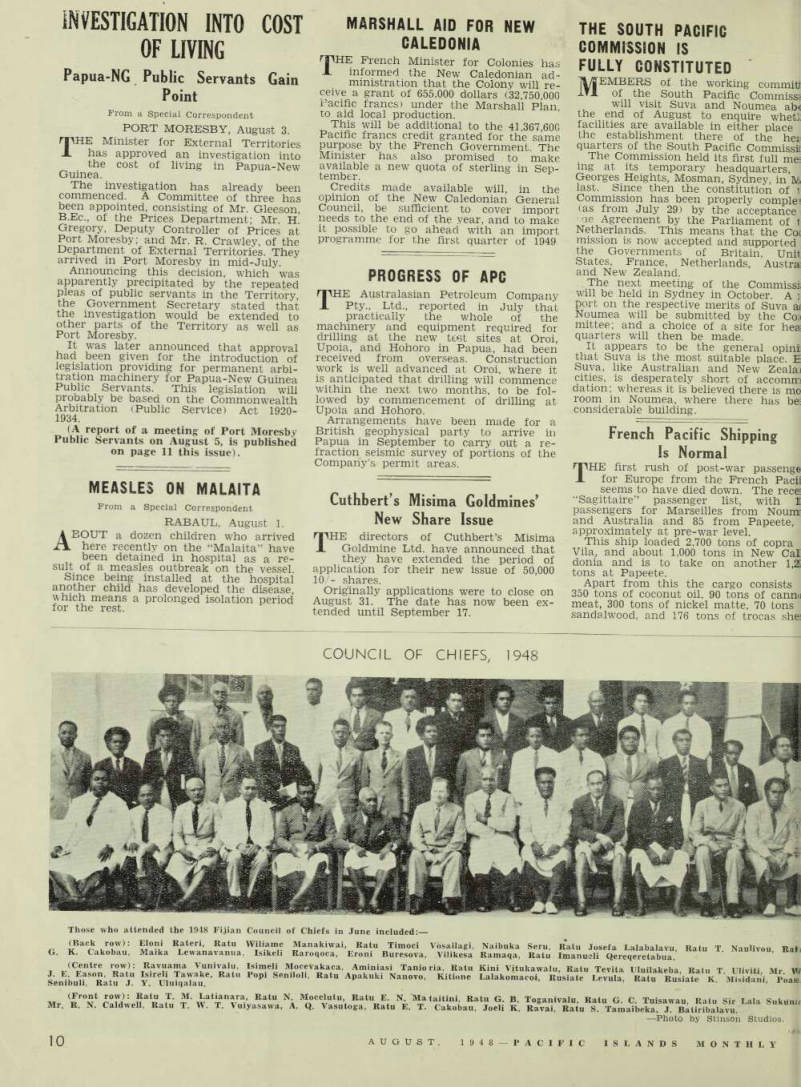
Council Of Chiefs, 1948
Those who attended the 1948 Fijian Council of Chiefs in June included:— (Back row): Eloni Rateri, Ratu Wiliame Manakiwai, Ratu Timoci Vosailagi, Naibuka Seru, Ratu Josefa Lalabalavu, Ratu T. Naulivou Rat[?] G. K. Cakobau, Maika Lewanavanua, Isikeh Raroqoca, Eroni Buresova, Vilikesa Ramaqa, Ratu Imanueli Qereqeretabua. (Centre row): Ravuama Vunicvalu, Isimeli Mocevakaca, Aminiiasi Tanio ria, Ratu Kini Vitukaqalu, Ratu Tevita Uluilakeba, Ratu Tliviti, Mr. W. [?] J. E. Eason, Ratu, Isireli Tawake, Ratu Popi Seniloli, Ratu Apakuki Nanovo, Kitione Lalakomacoi, Rusiate Levula, Rusiate K. Misidani, Poas[?] Senibuli, Ratu J. Y. Uluiqalau. (Front row): Ratu T. M. Latianara, Ratu N. Mocclutu, Ratu E. N. Ma taitini, Ratu G. B. Toganivalu, Ratu G. C. Tuisawau Ratu Sir Lala Snkin[?] Mr. R. N. Caldwell, Ratu T. W. T. Vuiyasawa, A. Q. Vasutoga, Ratu E. T. Cakobau. Joeli K. Ravai, Ratu S. Tamalibeka, J. Batiribalvu. —Photo by Stinson Studios.
Papua
‘New Statesman’ Rubbish For Papua Something More About That April 26 Broadcast
IT may be remembered that at 7.11 pm on April 26, there was broadcast from Port Moresby a thing described as “an extract from a commentary on over seas affairs,” which was a good example of cunning propaganda directed against the Western Democracies, and in favour of the Communist bloc.
We published a summary of this in triguing rubbish in the May issue; and, under the heading of “ABC Does Dirty Work for ‘Fellow Travellers’” we said: “This has, all over it, the marks of the most cunning type of Moscow propa gandist. But it is so subtle that it easily can be accepted as sound argument by the careless and uninstructed.”
The incident came under the notice of Mr. T. W. White, MP, and he asked questions about it in the Australian Par liament. After much delay, he received, late in July, a long letter about it from the Australian PMG, Senator Cameron, who made the following statements; The broadcast was actually part of a leading article from “New Statesman” of March 27, 1948, although it was not so described. It was read over 9PA by a Miss Dorothy Lloyd. The ABC “considered that the article, so far from giving sup port to Communism, was definitely opposed to it, and made specific sugges tions as to the best means by which Communism might be combatted in Western Europe.” The officer in charge at Port Moresby has been informed that unsigned articles must not be trans mitted in this fashion, and the ABC is sure that such an incident will not occur again.
The ABC sent also a full copy of the broadcast, as read by Miss Lloyd.
Editorial Note
AN examination of the full text of the broadcast shows that the summary of it, which we published in May. was an admirable summary—its chief fault being that it did not show how vicious, biassed and dangerous the broad cast actually was.
The broadcast did not advocate Com munism; but it did urge British people to steer clear of America and Russia, to identify themselves only with the demo cratic peoples of Western Europe, and to assist the Western European economic and social union to “maintain its faith in democracy and its struggle for Socialism.”
There is no essential difference between the Socialism that already is destroying the British Empire, and the economic and political set-up that Communist Russia is now trying to force upon the whole world. There seems little possi bility now of the w T orld escaping a ter rible war between the two irreconcilable ideologies—Russian Communist Totali tarianism, wherein the individual is enslaved by the State, and Western Democracy, which is the basis of all Anglo-American institutions, wherein the liberty of the individual is the first con sideration. That war is being thrust upon us by the Communist bloc of nations, led by Russia.
There is no compromise possible be tween these two ideologies—the British people must be on one side or the other.
If we do not support America in resisting
Russia’s plan to enslave the world, we shall be assisting the Russians. There can be no middle course. The “New Statesman” is a journal which promul gates the views of the it is not actually Red, it is very close to it. It supports academic Socialism, while nom inally opposing Communism—blithely ignoring the proved fact that there is no essential difference between logical Socialism and hard-and-fast Communism.
The “New Statesman” should just about
represent the political beliefs of the rank and file of the Australian Broadcasting Commission, which stands four-square for the dreadful governmental hotch potch called Chifley-ism. But that is no reason why the ABC should try to pro mulgate “New Statesman” views ai an apparently unguarded corner of its broadcasting area like Port Moresby.
It is to be hoped that this matter will be further ventilated in the Australian Parliament.
Port Moresby Public Servants Review Progress
of Fight Against Bad Conditions
From a Special Correspondent
Port Moresby. August 6.
ON August 5, over 200 members of the Papua-New Guinea public service at tended a meeting at the Konedobu Mess, Port Moresby, to hear a report on the activities of the Combined Council of the Public Service Associations of Papua and Papua-New Guinea. The secretary of the Council. Mr. J. H. Irvine, gave a comprehensive review of the long struggle for improved salaries and condi tions.
Salaries
THE first issue, Mr. Irvine said, had been the inadequacy of salary rates.
After the protest meeting held several months ago, increased salaries had been instantly forthcoming, but there was reason to believe that these increases had been worked out long before the pro test, which had merely expedited their announcement. Mr. Irvine expressed the view that the salary increases were not “marginal increases,” in that they bore no relation to recent “marginal increases” granted to Commonwealth public ser vants, but were merely “increases in salary.”
Mr. Irvine reviewed the various issues with which the Combined Council had concerned itself since the salary increases had been announced. As far as the in creases themselves were concerned, he stated that the Council was watching closely to see that there was no undue delay in making payments. The Council had also taken the view that, since the increases represented an official admission that the Buttsworth salary scales had been too low, these increases should be paid retrospectively from March 1, 1947, the date when the Butteworth scales came into operation, rather than from March 1, 1948, the date which in fact had been chosen. A letter from the Prime Min ister was later read, in which it was made clear that this demand had been rejected, on the ground that the Department of External Territories had “taken every factor into consideration” before deciding on March 1, 1948, as the date.
Cost Of Living
THE events leading up to the appoint ment of cost-of-living investigators were then reviewed. Mr. Irvine stated that the investigators, who had already begun their work in the Territory, were co-operative and willing, but were faced with a difficult and complex task.
From the correspondence which was read later, it appears that this Committee’s findings will in due course be referred to salary experts in Canberra, who will re view the whole question of public service salaries in the light of the Committee’s findings on the cost-of-living in Papua- New Guinea.
The vital question of a Public Service Ordinance was then discussed. It was
revealed that a draft Ordinance had been prepared, and was being thoroughly con sidered by representatives of the Com bined Council in conference with the Ad ministrator and the Government Secre tary. The arrival of a draft Ordinance was the result of continual pressure and could be regarded as a step forward.
Staff Shortages
SHORTAGE of staff had also been one of the matters with which the Com bined Council has concerned itself.
On this question Mr. Irvine said that it was impossible to expect results without numerical strength, and that under pre sent conditions it seemed equally hope less to expect large numbers of recruits.
Resignations from the service had been extremely high.
In the Prime Minister’s letter, however, Mr. Chifley replied to complaints of understaffing by pointing out that trained personnel were at the moment hard to find anywhere, that all employing author ities were experiencing similar difficulties, and that in view of these facts it was considered that the Department of Ex ternal Territories was doing all it could to obtain staff.
Electricity Charges
progress of the Council’s campaign . against the recently imposed increases in electricity and power charges was then reviewed. On this matter the Ad ministrator had been adamant, it was stated. The Minister had at first seemed sympathetic, but had finally decided to uphold the new charges.
In a letter he indicated that this de cision was based- on the Administrator’s insistence that the electricity supply in Port Moresby should pay its way, and on the views of Mr. F. G. Vidgen, Con troller of Works and Housing in the Ter ritory, who had expressed the opinion that the charges were not excessive, but that the causes of high accounts were “climatic conditions,” wastage, and the use of high-consumption domestic appli ances.
The meeting decided that members should pay their accounts, which most of them have refused to pay pending a Min isterial decision. Mr. Irvine said, how ever, that despite the Minister’s letter the matter was “not finished yet.”
Superannuation And
Arbitration
ON the question of superannuation, the Combined Council could not supply details of any developments. There was, however, considerable discussion of the superannuation issue, indicating that superannuation rights are of importance to members of the service.
Mr. Irvine also indicated that the battle to obtain arbitration machinery was also
(Continued on Page 78.)
not much further advanced. The Gov ernment Secretary had announced that an Ordinance was being prepared, based on Australian legislation. The views of the Associations on the question of abri tration machinery had been sought, but it was stated that the Combined Council wished to wait until it could view the draft Ordinance before expressing its detailed views.
The demand for the immediate appoint ment of a Commonwealth * Conciliation Commissioner until arbitration machinery could be permanently introduced had been rejected by the Prime Minister, largely on legal grounds.
Secondary School Education
MR. IRVINE then announced that assistance for parents sending their children to Australia for secondary schooling had at last been obtained, but the details were at some points obscure.
It was known, however, that fares of children from the Territory to Brisbane would be paid once a year, and that an allowance of £5O would be paid for main tenance of the children in Australia. It was not known whether this allowance would include the £26 at present being
paid for all children of public servants.
Nor were the age or qualifications for assistance yet known. Six bursaries will also be open to children of any residents of the Territory, whether they are public servants or not.
Housing
FINALLY, the vexed question of housing was discussed. It was, said Mr.
Irvine, “beyond a joke,” and yet he could not personally see a solution. The houses are simply not being built, partly because of the difficulty of obtaining materials from the Australian state authorities. The situation had been worsened by a farcical series of in efficient and semi-autocratic institu tions known as “Housing Boards.” The Housing Committee had recently been reconstituted, however, and some improve ment was expected.
Considerable discussion ensued, and speakers emphasised that the speedy erec tion of houses, rather than the improved functioning of the Housing Committee, must ultimately be the solution. A sug gestion was made that pressure be applied to the Forestry Department to enable timber to be cut from the stands in the Brown River area for use in Po:t Moresby.
At the conclusion of the meeting a vote of thanks was enthusiastically carried for Mr. Irvine’s work on behalf of public servants, and Mr. Rich and Mr. Nicholas were elected to act as joint-secretaries during the absence on leave of Mr. Irvine, who will be leaving for Australia shortly.
Advertisements & other items, p. 14 (1 item)
Morris Hedstrom Limited
General Merchants, Importers and Exporters,
Shipowners, Plantation Owners,
Commission and Insurance Agents
HEAD OFFICE
SUVA, FIJI
Established 1868 Registered Cable Addresses : Deuba Suva Morstrom ... Sydney Suvamark ... London Morrisco ... Nukualofa Deuba Apia Telephones : Suva 32 ( 8 lines) Sydney BX 2677 and BX 2678
SERVICE IN THE SOUTH PACIFIC TERRITORIES
our Large Establishments in Suva and our Numerous Branches, we distribute a wide and comprehensive range of General Merchandise and provide almost every kind of service. Our departments and associated businesses include:
DRAPERY
MOTOR SALES
AND SERVICE
TOBACCO
TIMBER AND
BUILDING
GROCERY
CONFECTIONERY
HARDWARE
ELECTRICAL
LIQUORS
DRUGS
Branches Throughout Fiji, Samoa and Tonga
There is a Branch or Agent of Morris Hedstrom Limited in every Town in the Three Territories.
We are Sole Agents in these Territories for British Drug Houses Ltd.
Electrolux Ltd.
Ford Motor Co.
General Electric Co. Ltd.
Goodyear Tyre Gr Rubber Co.
B. A. Hjorth Gr Co. (Primus Products) Imperial Chemical Industries Ltd.
International Harvester Export Co.
Matson Navigation Company Max Factor and Co. Inc.
Ransomes, Sims Gr Jefferies Ltd.
Ruston Gr Hornsby Ltd.
Vacuum Oil Co. Pty. Ltd.
Yorkshire Copper Works Ltd.
Morris Hedstrom Limited, are LLOYD’S AGENTS in Fiji and Samoa.
IN AUSTRALIA: IN GREAT BRITAIN;
Morris Hedstrom (Aust.) Pty. Ltd., Morris Hedstrom Limited, Asbestos House, Africa House, 65 York Street, SYDNEY Kingsway, LONDON
Vigorous Opposition
New Fiji Copra
Bill
Vigorous Opposition From Some Planters
SUVA, July 19.
EARLIER this month it was announced that a new copra Bill will be intro duced at the next session of the Fiji Legislative Council. It will provide for the establishment of a Copra Board and for the purchase, export and sale of copra by the Board, and for the control of the export of copra and of copra products.
To Mr. W. G. Johnson, managing director of W. R, Carpenter & Co. (Fiji) Ltd., who was principal campaigner against the now defunct first Copra Bill, this had the same effect as a trumpet on a warhorse. On July 15, Mr. Johnson vigorously gave voice at the Suva Cham ber of Commerce.
Mr. Johnson made it clear that he has no quarrel with the idea of a Copra Board, which is to consist of a chairman, the Secretary for Fijian Affairs, and not fewer than six members, of whom four are to be Government-nominated copra producers.
This. Mr. Johnson maintains, means that, by the use of the chairman’s cast ing vote, the Government could easily dominate the Board. At the next meet ing of the Chamber of Commerce he will introduce a motion asking for a modifi cation of the control proposed by the Government.
On July 13, Mr. Johnson, and Mr. D.
Sandiford (Qacivula Estate, Taveuni) and the recorded comments oi various well known planters, were on the air at ZJV Suva to announce the proposed forma tion of a copra producers’ incorporated association. Mr. Johnson hopes to have this in operation within three months.
France Will Foot Bill For
Colonial Governors
ANEW French law should do some thing to improve relations between Colonial peoples and metropolitan France.
From now on the French budget, through the Minister for Colonies, is to bear the expense of salaries paid to High Commissioners and Commissioners. Gov ernor-Generals and Governors, Secretary- Generals and Inspector-Generals and other high ranking officers of the Admin istrative Corps; also cost of transport of same officials between France and the Territories. France will also pay for up keep of gendarmeries. Items like travel within the Territories and “local” ex penses of Governors, etc., will continue to be a charge on local budgets.
Appointments
Fiji Executive Council
New Procedure in Next Appointments
SUVA, July 23.
TWO provisional appointments to the Executive Council of Fiji—those of Ratu George Tuisawau and Mr. K. B.
Singh, OBE—will end on July 28.
Before making recommendations to the King for the filling of the vacancies, the Governor (Sir Brian Freeston) is invit ing the five Fijian unofficial members of the Legislative Council and the five Indian members each to put forward one of their own numbers as a candidate for the Executive Council. The same pro cedure will be adopted in the case of the European members when a European vacancy occurs in the Executive Council.
The announcement of this new pro cedure makeG it clear, however, that it does not confer an absolute right of choice by the unofficial members of the Legislative Council, and that the dis cretion vested in the Governor to submit to the Secretary of State for the Colonies the names of such persons as he thinks suitable for appointment to the Executive Council remains unimpaired.
M. Henri Bonafous, a former councillor of the Noumea Municipal Council, died recently in Noumea at the age of 73. He had lived in New Caledonia since 1900.
Advertisements & other items, p. 15 (1 item)
Wenzel & Co.
THE
YORKSHIRE
INSURANCE
CO. LTD.
(Incorporated in England)
ALL CLASSES OF
INSURANCE
Including Fire Motor Guarantee Accident Workers Marine Island Representatives:
PORT MORESBY: E. A. James
RABAUL: G. B. Black LAE: Morobe Transport Co. Ltd.
MADANG: R. MacGregor SUVA: Williams & Gosling Ltd.
NOUMEA: Y. Mortensen
NORFOLK ISLAND:
A. E. Martin
BURNS PHILP (New Hebrides) LTD.
Registered Office: VILA, NEW HEBRIDES Branch Office at SANTO
Exporters, Importers and General Merchants
(Retail and Wholesale) Commission, Shipping
and Customs Agents
Representatives for QUEENSLAND INSURANCE CO., LTD., and LLOYDS OF LONDON. Agents for SOCIETE DES PETROLES SHELL DES ILES FRANCAISES DU PACIFIQUE, and numerous overseas manufacturers of all classes of merchandise.
San Francisco Agents: Sydney Agents: Burns, Philp Co. of San London Agents: Burns, Philp & Co.. Ltd., Francisco, Philp & Co., Ltd., 7 Bridge Street. Matson Building, 35 Crutched Friars, E.C.3. 215 Market Street,
WENZEL & CO.
EXPORT DISTRIBUTORS
255 CALIFORNIA STREET, SAN FRANCISCO 11, U.S.A.
CABLE ADDRESS “WENCO” ALL CODES
Operations Now Normal
Sandy Creek Gold Sluicing
Ltd.
SLUICING operations on the leases of Sandy Creek Gold Sluicing Ltd., in New Guinea, have now returned to the normal per-war level. This indicates that much progress has been made in the last six months: at the last annual general meeting on December 9, 1947, it was reported that the company had. to that date, made only one small clean up for the recovery of 68 oz. of gold from 2,300 yards of material treated.
From that date, however, until June 30, 1948, a number of small clean-ups were made for a further recovery of 591 oz. of gold from approximately 35,461 yards of treated jnaterial.
Mr. Harry Aiken, of the Australian Petroleum Coy., Port Moresby, recently arrived in Brisbane on leave. He was accompanied by his wife.
Miss Beryl Brainwood. of Sunnybank, Brisbane, was farewelled recently by her sister and friends in Brisbane before she left by plane for Port Moresby, where she was to marry Mr. Edward Biddle.
W. Samoan Assembly Begins
New Task Estimates Show Strong Financial Position of Territory
THE Western Samoan Assembly held its first business meeting (as distinct from the official opening on June 2) on June 8. And early in the piece it is clear that members are not taking their position lightly. Having been elected by the people to govern, this they evidently propose to do.
Somewhat to the surprise of those who know the Samoan set-up and the traditions by which it is normally gov erned, the rank and file Samoan members have shown no indication of following blindly the lead of the two Fautua, Tamasese and Malietoa. Recently, all of the Samoan members voted against the Fautua and defeated a motion which had been supported by them. This healthy in dependent spirit augers well for the suc cess of the new Assembly.
One of the first debates concerned the salaries and allowances of members.
According to the majority, insufficient had been allowed for these —particularly in respect of the two Fautua, or Paramount High Chiefs, Tamasese and Malietoa. As well as their other duties, these two men are now members of the Council of State.
The estimates for 1948-49 provide for a remuneration of £7OO per annum for each of them, but in the eyes of the Samoans this was not sufficient and it was finally agreed that it should be increased to £l,OOO per annum.
The estimates provide for £lOO per annum for each sitting member. Tms, also, was considered inadequate and sub sequently it was decided that in addition a “sitting allowance” of £l/1/- per day would be paid.
Estimates for 1948-49 AT a later session of the Assembly the whole of the estimates for 1948-49 were reviewed, debated and subse quently passed, with minor amendments amounting to a cut of £6,250 for the erection of new school buildings and Education Department offices.
The estimates budget for a small sur plus but if there is a continuation of the past year’s buoyant revenue, it is likely that it will, by July, 1949, be turned again into a large surplus.
In 1947-48 it was estimated that revenue would be £321,260; in actual fact it was £548,682. Expenditure for the same year was estimated to be £515,117; and pro bably due to the scarcity of materials) was only £359,285.
In the current year it is expected that revenue will be £452,755 and that expendi ture will be £446,129. Largest allocation goes to the Health Department which this year will get £93,658.
Caretaker Body
Suva Town Board Now Caretaker Body
From Our Own Correspondent SUVA, July 19.
SINCE July 9, when the Local Govern ment (Towns) Ordinance came into force, the Government-nominated Suva Town Board has been acting as a caretaker for the elected Suva Town Council of the future.
When the European and Indian elec toral rolls are completed and revised, an election will be held. No date has been fixed, but December has been suggested, in which case the new council will take office on January 1, 1949.
Advertisements & other items, pp. 16-17 (3 items)
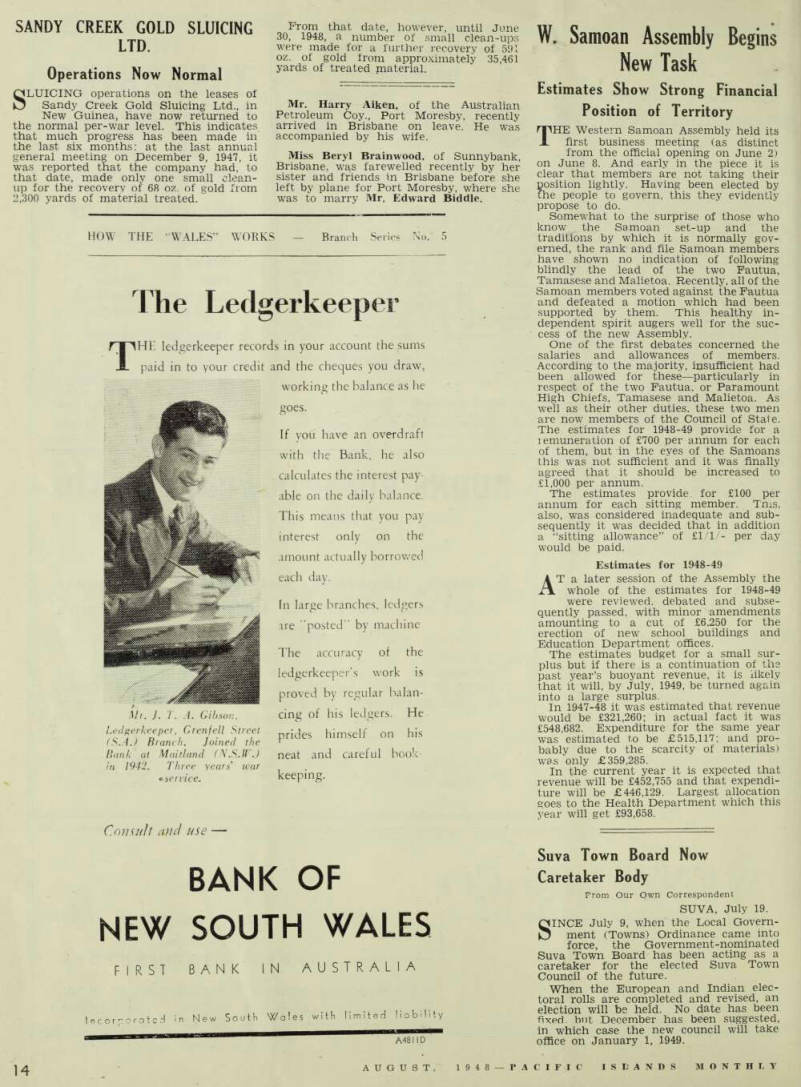
The Ledgerkeeper
HOW THE “WALES” WORKS
Branch Series No. 5
HE ledgerkeeper records in your account the sums paid in to your credit and the cheques you draw, working the balance as lie goes.
If you have an overdraft with the Bank, he also calculates the interest payable on the daily balance.
This means that you pay interest only on the amount actually borrowed
each day.
In large branches, ledgers are "posted” by machine The accuracy of the ledgerkeeper’s work is
proved by regular balan-
cing of his ledgers. He prides himself on his neat and careful book keeping. & m j. i 4. Gibson, Ledgerkeeper, Grenfell Street (S.A.) Branch. Joined the Bank at Maitland (N.5..K.) in 1942. Three years’ war •service.
Consult and use
BANK OF
NEW SOUTH WALES
FIRST BANK IN AUSTRALIA
Incorporated in New South Wales with limited liability
Acific Islands Monthly- A U G U S T . 1948
Australia’s
1 % r / Z % I #<♦ n j i r if m E i
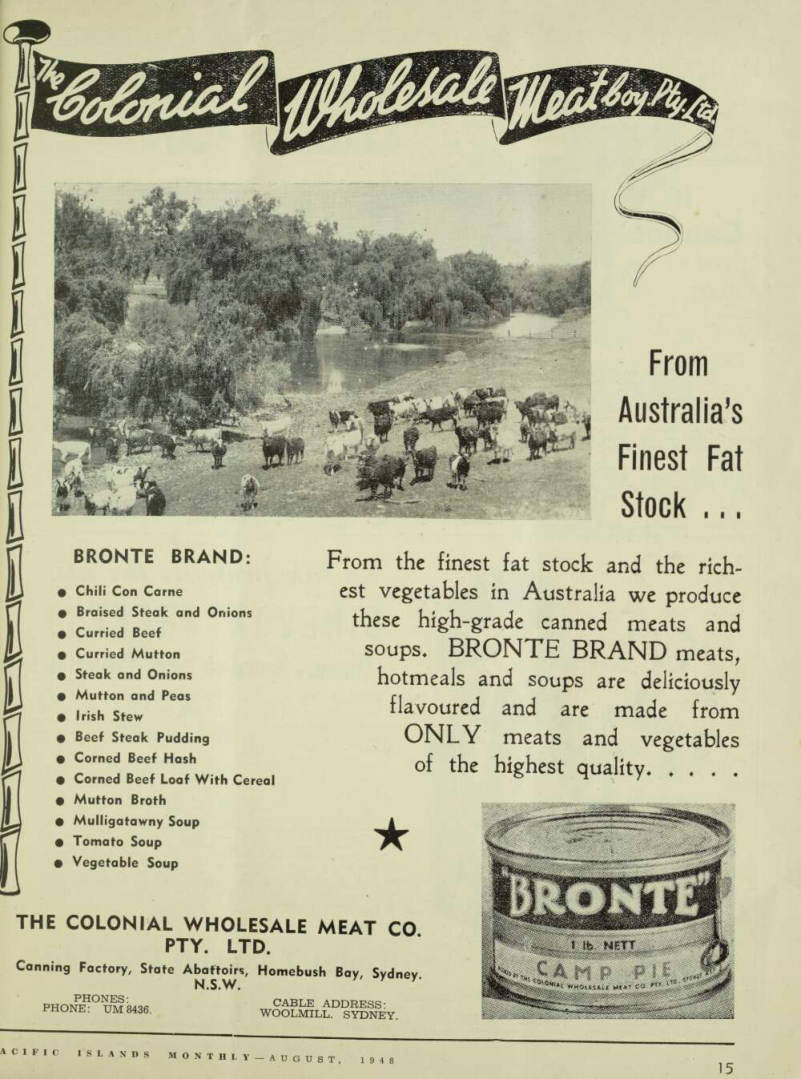
BRONTE BRAND
From
Australia’s
Finest Fat
Stock ~.
THE
Chili Con Came Braised Steak and Onions Curried Beef Curried Mutton Steak and Onions Mutton and Peas Irish Stew Beef Steak Pudding Corned Beef Hash Corned Beef Loaf With Cereal Mutton Broth Mulligatawny Soup Tomato Soup Vegetable Soup
COLONIAL WHOLESALE
PTY. LTD.
From the finest fat stock and the rich-
est vegetables in Australia we produce
these high-grade canned meats and soups. BRONTE BRAND meats, hotmeals and soups are deliciously flavoured and are made from ONLY meats and vegetables
of the highest quality
MEAT CO,
Conning Factory, State Abattoirs, Homebush Bay, Sydney,
N.S.W.
PHONES:
PHONE: UM 8436.
CABLE ADDRESS:
WOOLMILL. SYDNEY.
k HP
Correction
rpHE manufacturers of Prefect refrig erators wish to correct a mistake that appeared in their advertisement in July issue of “PIM.” They stated that their refrigerators were obtainable from Millers Ltd., of Salamaua. This should have read “Millers Ltd., Western Samoa.”
Death Of M. Milliard
>THE death has occurred in Bordeaux, 1 France, at the age of 68, of M. Henri Milliard, who went to Noumea, New Caledonia, at the age of 16, and who, for many years until his retirement at the end of the war, held the position of manager of the Establissements Ballande in Noumea and the New Hebrides. Part of the war period he spent in Sydney as he was out of favour with the Free French administration in the Colony.
M. Milliard, as head of the largest trad ing concern in the French Pacific, played a prominent part in colonial life. Be sides their stores and their shipping ventures, this Bordeaux firm of Ballande played a prominent part in nickel and chrome mining developments, often in close association with the Nickel Co.
Ballandes also own many of the best cattle ranches in New Caledonia, and this has at times made them a target for critic ism by small holders who were cultivat ing interior land.
M. Milliard was in his time President of the General Council, Vice-President of the Noumea Chamber of Commerce, Pre sident of the Neo Caledonienne Sports Club, the Veloce Club, the Societe Sportive (race club) of Magenta; and, pre-war, the French Government had re cognised his merits by making him a Chevalier of the Legion of Honour. He was also a prominent Catholic, and President of the Catholic Schools’ Association. It was only after the collapse of France in 1940 that he was criticised for alleged coolness to the Free French cause. He was frequently in Sydney where the Ballandes enterprises are well known. He was a French director of the Chagrin Chrome Co., run with Australian capital.
The LMS held an exhibition in Sydney on August 14.
American Subsequential
War-Damage Payments
THE United States War Department has paid out over £3 million in settlement of claims for damage done by Ameri can servicemen overseas.
This, it should be understood, has noth ing to do with payment for direct war damage sustained during battle operations in which Americans took part.
These payments may be of interest to residents of the Solomons and the Gilbert and Ellice Islands who have received no war-damage payments from Britain as yet.
It is likely, however, that the onus would be on claimants to prove their right to payment and it would, in most cases, he impossible to prove whether the damage was the direct result of war. or of sub sequent action of US troops.
Javanese Labour For New
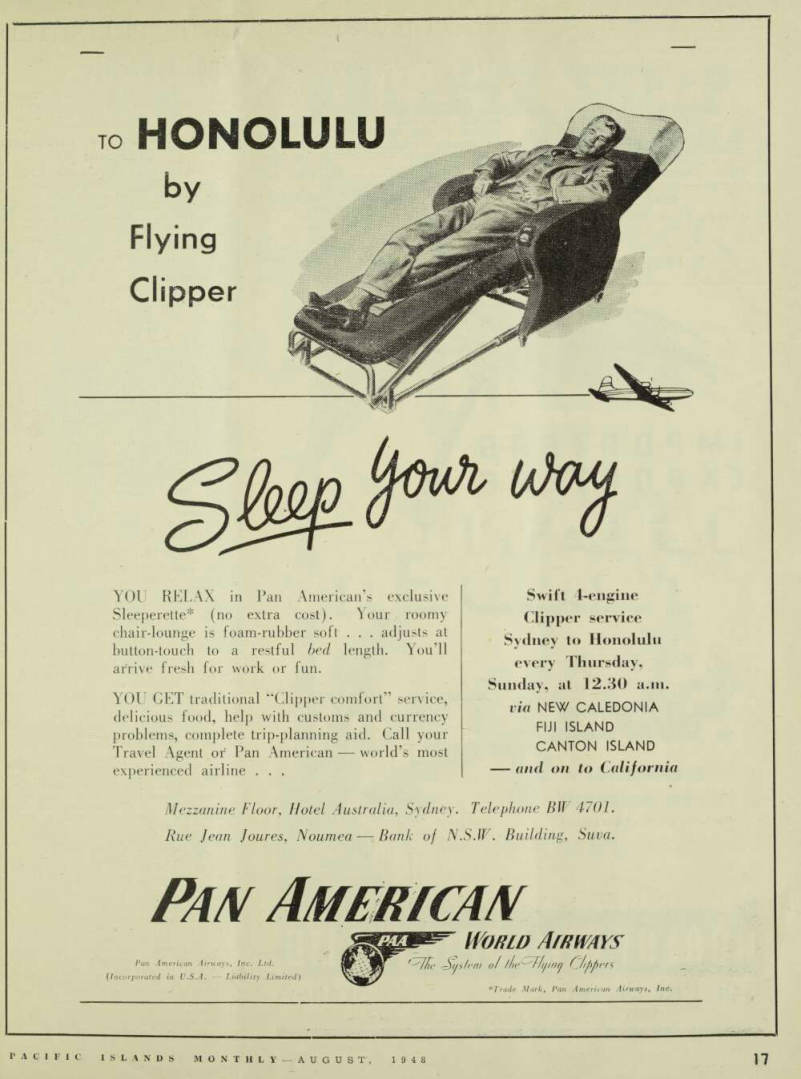
Caledonia
THE Netherlands East Indies Govern ment has agreed, in principle, to the renewal of recruiting of labour in the NEI for new Caledonia.
This is the outcome of a visit to the NEI of M. Henri Laflear, New Cale donian representative in the French Senate.
The engagement has been announced of Miss Breen McKenna to Dr. Kevin King, of Brisbane. Miss McKenna, who has been nursing in Brisbane, left by the “Montoro” recently for her home, Kanosia, near Port Moresby.
New price control regulations have been issued in New Caledonia. Imported goods are arranged in three categories accord ing to their relative importance to the country’s economy. The regulations affect foodstuffs and merchandise imported from Australia.
The Queensland Government intends setting up -the culture-pearl industry.
There is at present a world market for pearls, and the Government is anxious to exploit it. The proceeds of the in dustry will be used for the benefit of aborigines employed in the industry.
Advertisements & other items, pp. 18-20 (2 items)
Cinevox Prefect
If You
Cannot Sleep
FEEL FIT FOR NOTHING.
You may be anaemic or bloodless, for this ailment plays havoc with your health and nervous energy. You feel terribly uervy; suffer headaches and dizzy spells, have poor appetite, cannot sleep at night —losing those precious hours of rest and recovery, essential for your health and fitness.
Many people have recovered from these miseries by taking Dr. Williams’ Pink Pills, which have reinvigorated, strengthened their systems and banished the vague pains and weariness. Dr. W'lliams’ Pink Pills always help to enrich and increase the blood supply, giving beneficial help to the nerves, tissues and organs of the body. With enriched blood you cannot help feeling happier, sleeping better, becoming reinvigorated.
Stop anaemia making you a suffering invalid without delay. Take Dr. Williams’
Pink Pills and soon notice the difference in your eyes, skin, nerves and general health. At all chemists and stores.
AVAILABLE SOON . . .
Cinevox Bmm. and 16mm. Silent Projectors
Kodak presents the new
CINEVOX PREFECT
16mm, Sound-on-Film Projector
Entirely re-designed and incorporating many new and unique features, the Prefect is being praised by expert authorities for its superb sound quality, image
brilliance, and outstanding performance.
Some of its features and specifications are :— Operates from either A.C. or D.C. mains—weighs only 100 lbs. —stows into two cases—film capacity of 3,000 ft. —takes <5O-watt lamp—fitted with 2 in. f/2 projection lens—transmission by helical gears—geardriven motor —forced draft cooling system—cam and claw movement —amplifier frequency range of 100-7,000 c.p.5.—27-volt 1-amp. shockmounted exciter lamp operates from special hum-free source—single volume control system independent of exciter supply—full tone control with treble and base boost as required—dual 8 inch loud speaker units—push-pull power output stage delivers 14-watts—brilliant screen illumination permits projection up to 75 feet—phonograph records can be played or public address announcements can be made through amplifier system—power rewind incorporated in mechanism—simple film-threading—adjustable tilting device—power circuit interlock eliminates “false starts.’’
Enquiries Invited.
Kodak (A/asia) Pty. Ltd.
379 and 386 George Street, Sydney
Newcastle, Katoomba, and all States.
Pan American
to HONOLULU
by
Flying
Clipper
YOU RELAX in Pan American’s exclusive Sleeperette* (no extra cost). Your roomy chair-lounge is foam-rubber soft . . . adjusts at button-touch to a restful bed length. You’ll arrive fresh for work or fun.
YOU GET traditional “Clipper comfort” service, delicious food, help with customs and currency problems, complete trip-planning aid. Call your Travel Agent of Pan American world’s most experienced airline . . .
Swift 4-engine Clipper service Sydney t« Honolulu
every Thursday,
Sunday, at 12.30 a.in.
via NEW CALEDONIA
FIJI ISLAND
CANTON ISLAND
and on to California Mezzanine Floor , Hotel Australia , Sydney. Telephone BW 4701.
Rue Jean Joures, Noumea Bank of N.S.W. Building , Suva.
Pan American
Pan American Airways, Inc. Ltd. (Incorporated in U.S.A. Liability Limited)
World Afßmvs
rStfs/pni of Clippers
*Trade Mark, Pan American Airways, Inc,
For Sale Gold Mining Plant. Ten Hd. heavy Stamps Battery. Copper Amalgamation Tables.
Large Dodge type Breaker, and Gold production accessories. All in working condition. For particulars apply “Minng,” c/o Box 3408, G.P.0., Sydney.
IMPORTERS
EXPORTERS
All classes of merchandise purchased for Island clients throughout the South-west Pacific.
Island produce sold on Australian and overseas markets on a commission basis. mu
54a Pitt Street
i
Sydney
Cable Address: “ROBERGILL,” Sydney
End Of Cipa In Cook Is. Predicted

Opinion of Recent Traveller
THE following statement, published in Auckland “Star” of July 26, by an unnamed traveller confirms the opinion expressed in “PIM” during the last six or nine months:— Communist infiltration of the Cook Is lands Progressive Association had brought about the end of the Association, in the opinion of a visitor to Auckland who has spent many years in the islands.
When the Association began it was supported by many Europeans because they believed its aims were just and democratic. Later, however, sections of the Association tried to instil in the natives a suspicion and hatred of white people, and the whites withdrew their support.
The visitor said that he believed inter
ference by Auckland groups in the affairs of the Association had spelt the end of the Association, which could have brought many benefits to the natives.
New Delegation to Investigate
Conditions
SUBSEQUENTLY, a New Zealand Feder ation of Labour Delegation, consisting of Mr. W. B. Richards and Mr. K.
Baxter, proceeaeu to Rarotonga on the “Maui Pomare.” And on July 12, the Cook Islands Progressive Association in a message printed in the New Zealand press, indicated that it had had a change of heart. It was stated that, in future, it would concern itself with the welfare and economic progress of the Cook Is lands, rather than with industrial matters. This, of course, if it can be be lieved, means that the CIPA has gone into reverse and has retreated from the stand it took last year and which led to the iviarcn, 1948, fracas. On tnat occasion the CIPA had “forbidden” the working of any ships without its permission. When the “Wairuna” arrived, with much needed supplies, CIPA stated that they would neither work the ship, nor permit it to be worked. “Wairuna” subsequently went on its way without discharging. This was hailed as a CIPA victory and they pre pared to dispose of the “Wairata,” due about a week later, in the same manner.
Three days before the ship reached Raro tonga, however, a New Zealand plane ar rived and disgorged 14 New Zealand policemen. That was the end of the CIPA. They retired in disorder after making a feeble attempt to picket the wharf area with women supporters.
Albert Henry, CIPA leader, left Raro tonga at the end of March.
Growth of the CIPA
THE ideas behind' the CIPA are the same ideas that are besetting the minds of all progressive native people to-day. Largely, the unrest that exists in the Cook Islands is the result of war, and of the introduction, by American soldiers, of new concepts of life and thought and amenities. The problem is not peculiar to the Cook Islands, but is general to the whole Pacific area.
In the Cooks this natural reaction to war and the invasion of thousands of Servicemen, was aggravated by an up heaval in the economic life of the islands.
The agricultural economy upon which they had formerly existed had been dis turbed by the sudden lack of shipping, as well as by the incursion of foreign troops.
Out of the unrest in the Islands, and out of the determination of the islanders to improve their lot, there arose, in 1944, the Cook Islands Progressive Association.
It was, to a large extent, a political organ isation. with a membership of both natives and Europeans, and a head quarters at Auckland, not Rarotonga.
The CIPA claims to have the backing of 80 per cent, of the population of the Cook Islands. The New Zealand Admin istration in the Islands apparently proved slow to deal with the new spirit of the islanders, and when the association failed to get satisfaction it quickly turned to the mainland for aid.
Officials of the association back in Auckland were brought into contact with members of the New Zealand Communist Party, and soon Communists were acting as advisers. The secretary of the CIPA, Mr. Albert Henry, a Cook Island Maori, who lives at Auckland, has publicly re ferred to the assistance given to his asso ciation by Communists.
Mr. Henry was brought down to the annual conference of the New Zealand Federation of Labour at Wellington in
1946. Officials of the federation, and the Government realised that steps would have to be taken quickly to counteract Communist influence, for by this time not pnly were the islanders being encouraged in demands which their economy could probably not support, but they were ask pS’liament. in the NeW Zealand . The Federation of Labour, after hear ing Mr. Henry at its 1946 conference, de cided to send a delegation to the islands.
Mr. K. McL. Baxter, secretary of the federation, and Mr. T. F. Anderson, of the Seamen’s Union at Auckland, u a veiled to Raiotonga in July of that year Mr. Henry refused to accompany the dele gation as interpreter. The headquarters of his association at Auckland would not recognise the delegation. The same action was taken by the CIPA in the islands.
Messrs. Baxter and Anderson, with the help of co-operative Europeans and natives, but entirely without that of the CIPA, toured the islands seeking support for the formation of a Cook Islands in dustrial union of workers. They declared that this union, and this union alone, would be recognised by the Government.
They finally succeeded in getting sup port for the formation of a Cook Islands industrial union of workers, with an in itial membership given at 300.
From this point the battle was joined between the CIPA and the Cook Islands authorities. It culminated in the “Wairata” incident of March this year.
Since then, according to our correspon dent in the Cooks, they have gone quietly, although they refused to work the June “Maui Pomare,” leaving it to be worked by Union labour. There was also some disturbance in Aitutaki in May, when the CIPA decided that the schooner “Tiare Taporo” could not be worked. This diffi culty was got over by sending half a dozen New Zealand police who had re mained in Rarotonga, over to Aitutaki.
The CIPA again retired and “Tiare Taporo’’ was worked by Union labour.
It remains to be seen whether, in spite of Mr. Henry’s assurances of July 12, that the CIPA will cease to meddle in politics, whether the Cook Islands situa tion will straighten itself out. Left alone there is little doubt that commonsense will prevail and that industrial matters in the Cooks will return to normal—the real industrial element in the Islands is small, at any rate. Most Islanders are concerned with agriculture in one form or another. But it is doubtful if the Comrades, once having got a toe-hold in the Group, will relinquish it without a struggle.
When it was announced that the Fed eration of Labour would send a delega tion to the Cooks, the NZ Waterside Workers’ Union announced that they also would send a delegate—a Mr. A. Drennan who happens also to be chairman of the NZ Communist Party.
A dispute immediately developed in Auckland and finally, the Federation of Labour announced that it “firmly refused to allow Mr. Drennan to accompany the delegation appointed to investigate in dustrial conditions in the Cook Islands” on the grounds that it was not in the best interests of the trade union movement that individual unions should send re presentatives.
That is how the matter still stood on August 3, when the delegation left for the Cook Islands on the “Maui Pomare.” The next move appears to be up to the Com rades.
Last year the 17,000 Indian Muslims in Fiji sent 10,000 rupees (£RB47) to aid the Pakistan refugees. This was followed by nearly £lOO to clear up the balance of the relief fund organised by the Fiji Muslim League. This year another con tribution of more than 11.000 rupees has gone to Karachi.
Advertisements & other items, pp. 21-22 (1 item)
No Service Troubles! Low operating costs!
THE NEW
'S'
filial
w mi* > • ffsk i
s '% Bm
The New Freezer Shelf gives you • An extra refrigerated shelf. • More efficient cube freezing. • Better balanced cold circulation. • Designed shelf layout. • More convenient, roomy storage. • Attractively-styled “double-door” cube racks.
FEATURED BY PREFECT!
SPECIFICATIONS
EXTERNAL DIMENSIONS—Height, 4 It.
7in.; Width, 2ft. 3in.; Depth, 2ft. 3\ in.; Door Swing. Ift. ll£in.; Bottom Door Slide, Sin.
APPROX. STORAGE CAPACITY—S cubic
feet.
APPROX. STORAGE AREA—B. 6 Sd. ft.
STORAGE COMPT. FITTINGS—4 large
removable wire trays, glass defrost dish, cube trays and grids.
NETT WEIGHT—363 lbs.
PACKED WEIGHT—SIO lbs.
SHIPPING MEASUREMENT—43 cubic
feet.
GUARANTEE
The "Prefect" refrigeration unit is covered by a 5 year guarantee.
KEROSENE
REFRIGERATORS
No Service Troubles! Low operating costs!
Cold air is scientifically distributed with no "dead spots" in circulating cold—precious foods are kept at a lower and more wholesome temperature. Now available in all Prefect models, the Freezer Shelf is just another reason why Prefect is Australia's finest refrigeration investment. Icecube trays more conveniently located on the Freezer Shelf. Remember, Prefect stays silent —
lasts longer.
Distributors for Papua and New Guinea : COLYER WATSON PTY., LTD., 22 BRIDGE STREET, SYDNEY.
Obtainable from COLYER WATSON Obtainable from MILLERS, LTD., {NEW GUINEA), LTD., Rabaul, Kaviang. Fiji, Tonga, Western Samoa.
Box 3838 GPO, Sydney. Australia.
Cable Address, ‘Care” Sydney,
ISLAND MERCHANTS
4 YORK ST., SYDNEY
All kinds Island Produce sold on commission. All merchandise purchased at best wholesale price and original invoices supplied.
Use our 50 years’ experience as Island Merchants.
J
rj>R owe#
D m * AN
IMPORTANT
POINT TO
REMEMBER
is that genuine Vincent’s a.p.c contains the valuable ingredients, Aspirin, Phenacetin and Caffeine, in the same scientific proportions as the original hospital prescription.
Therefore, Vincent’s is a proved and fully accepted medical prescription!
'Mnu
FLU
s & COLDS
Headaches
ANDALLNERVE
& MUSCULAR
PAIN
TAKE
VtNCENTS 4PC
WITH CONFIDENCE
/The special treatment - provided by the better- rr~ / balanced formula of genuine Vincent’s a.p.c quickly relieves Colds, Influenza, Sore Throat, Laryngitis, Headache and nerve and muscular pain!
VINCE
YS
Holland-Wood Wedding
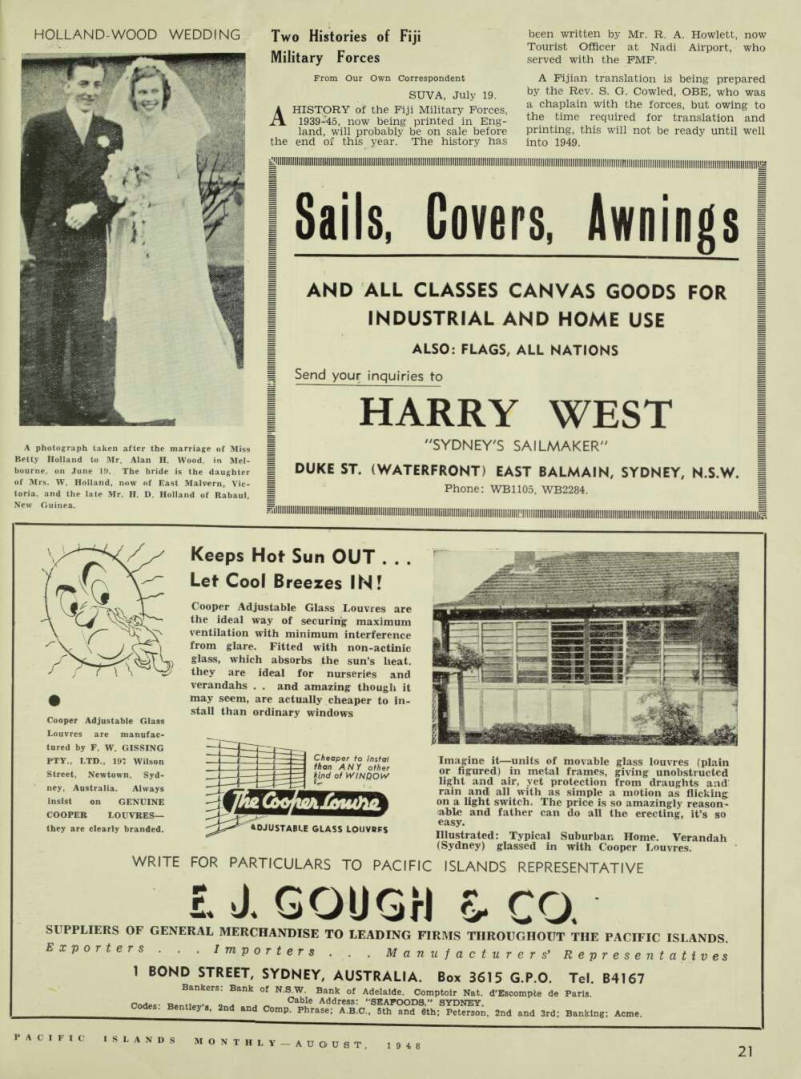
A photograph taken after the marriage of Miss Betty Holland to Mr. Alan H. Wood, in Mel bourne, on June 19. The bride is the daughter of Mrs. W. Holland, now of East Malvern, Vic toria, and the late Mr. H. D. Holland of Rabaul, New Guinea.
Military Forces
Two Histories of Fiji Military Forces
From Our Own Correspondent SUVA, July 19.
A HISTORY of the Fiji Military Forces, 1939-45, now being printed in Eng land, will probably be on sale before the end of this year. The history has
been written by Mr. R. A. Hewlett, now Tourist Officer at Nadi Airport, who served with the PMP.
A Fijian translation is being prepared by the Rev. S. G. Cowled, OBE, who was a chaplain with the forces, but owing to the time required for translation and printing, this will not be ready until well into 1949.
Advertisements & other items, pp. 23-24 (2 items)
21
PACIFIC ISLANDS MONTHLY- A U G U S T , 1948
Sails. Covers, Awnings
AND ALL CLASSES CANVAS GOODS FOR
INDUSTRIAL AND HOME USE
ALSO: FLAGS, ALL NATIONS
Send your inquiries to
HARRY WEST
"SYDNEY'S SAILMAKER"
DUKE ST. (WATERFRONT) EAST BALMAIN, SYDNEY, N.S.W.
Phone: WBIIOS, W 82284.
/ 0 a r Cooper Adjustable Glass Louvres are manufactured by F. W. GISSING PTY., LTD., 191 Wilson Street, Newtown, Sydney, Australia. Always insist on GENUINE
COOPER LOUVRES—
they are clearly branded.
WRITE
Keeps Hof Sun OUT . . .
Lef Cool Breezes IN!
Cooper Adjustable Glass Louvres are the ideal way of securing maximum ventilation with minimum interference from glare. Fitted with non-actinic glass, which absorbs the sun’s heat, they are ideal for nurseries and verandahs . . and amazing though it may seem, are actually cheaper to install than ordinary windows m 4 Cheaper to instal than ANY other kind of WtNQOW
ADJUSTABLE GLASS LOUVRPS
Imagine it—units of movable glass louvres (plain or figured) in metal frames, giving unobstructed light and air, yet protection from draughts and rain and all with as simple a motion as flicking on a light switch. The price is so amazingly reasonable and father can do all the erecting, it’s so easy.
Illustrated; Typical Suburban Home. Verandah (Sydney) glassed in with Cooper Louvres.
FOR PARTICULARS TO PACIFIC ISLANDS REPRESENTATIVE
£. J. GOUGrI S. CO.
SI PPLIERS OF GENERAL MERCHANDISE TO LEADING FIRMS THROUGHOUT THE PACIFIC ISLANDS.
Exporters . . . Importers . . . Manufacturers’ Representatives 1 BOND STREET, SYDNEY, AUSTRALIA. Box 3615 G.P.O. Tel. 84167 Bankers: Bank of N.S.W. Bank of Adelaide. Comptoir Nat. d’Escompie de Paris. „ Cable Address: “SEAFOODS.” SYDNEY Codes - Bentleys. 2nd and Comp. Phrase; A.8.C.. sth and 6th; PetersoA. 2nd and 3rd; Banking; Acme.
. 'THAT .
Jo m K.
The
This decision
rests with You
It is most unwise to postpone the appointment of your executor or trustee, and equally foolish to make a hasty choice from your closest friends. No one can say when an executor will be called on to serve. Nor is there any guarantee that he can carry out his duties at some future date. In fact, his appointment merely expresses a wish on your part. However, uncertainty as to the future can be set aside by appointing Burns Philp Trust Company Limited as executor and trustee. This capable and experienced organisation offers a permanent service to your beneficiaries, whose interests will be adequately safeguarded by able directors and efficient officers. The wise administration of your estate is assured by such an appointment.
Full details of the Company's services are explained in "Hands That Never Leave the Wheel." A complimentary copy of this interesting and informative booklet will be forwarded upon request.
DIRECTORS:
James Burns Joseph Mitchell P. T. W. Black Frederick Ewen Loxton Eric Priestley Lee MANAGER: L. S. Parker SECRETARY; E. R, Overton, A.F.I.A.
Burns Philp Trust
COMPANY LIMITED
EXECUTOR • TRUSTEE • AGENT
7 BRIDGE STREET, SYDNEY
Tel.; BU 5901 Box 543, 5.P.0., Sydney
BPS-48.
Fiji Copra Control
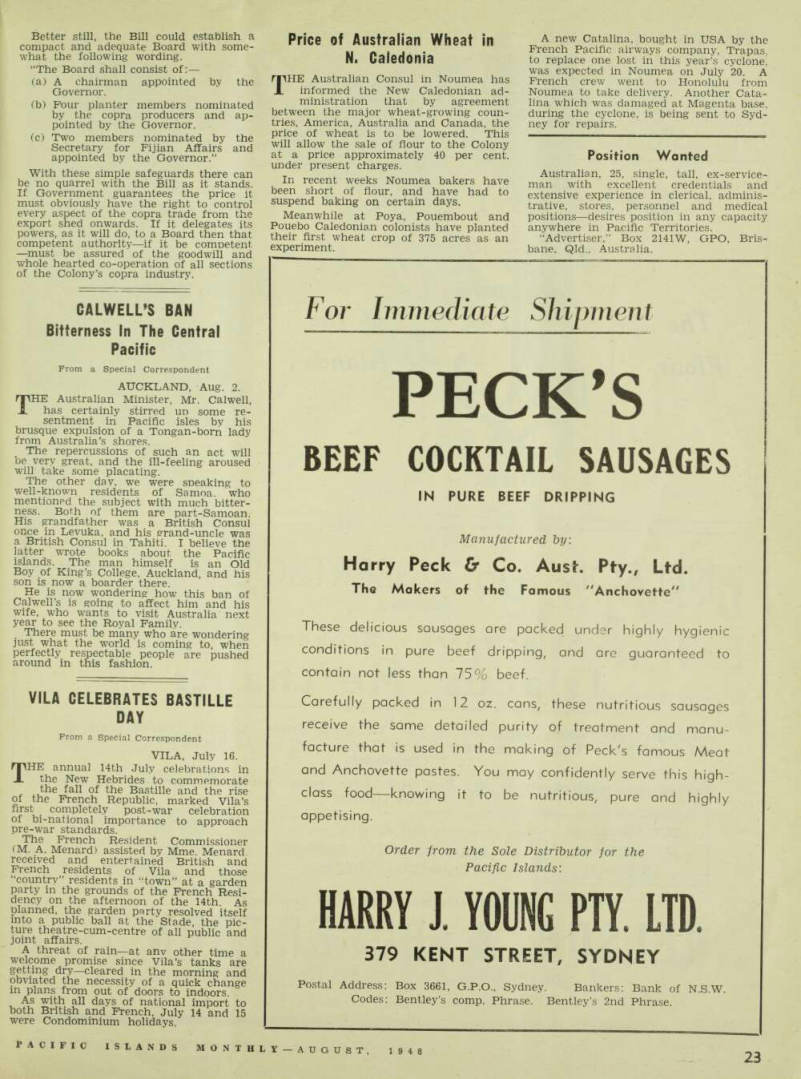
Extraordinary Powers of the Board
AS reported elsewhere, a stir has been caused in Fiji by the Government’s plan to set up a Copra Board, which is to control the sale and exnort of copra generally. ‘ p We have received the following letter on the sub J ect fr om Major Willoughby Tottenham, of Suva, who is a well-known planter, and a member of the Copra Board;— The composition of the Coora Board as published in Fiii Gazette No. 35 of July 23, must surely have disappointed copra producers, particularly paragraph 2 which gives the personnel of the Com mittee of Management. It is noted that none of the appointees named has any experience of plantation management or its finance.
Further, although the Board managed by that Committee will be an outright trading concern, handling some two million pounds’ worth of the planters’ commodity each vear, the producers need not necessarily be given anv information about the Board’s negotiations with the purchaser (the British Ministry of Food), or how the price accepted will comoare with world prices, and what freight handling, administrative charges, etc., are to cost.
In short, the Board may be as profli gate and inefficient as it likes, and yet cannot be called upon to give an account of its stewardship. For, although Section 12 of the Bill makes provision for the keeping of accounts and their auditing, the Governor-in-Council need only pub lish such details of those accounts “as he may deem fit.”
In effect, there has been set up a trad ing concern with an annual turnover of two million pounds, the directors of which are under no obligation to publish a de tailed annual balance-sheet unless they deem fit, and who are empowered to dis pose of private individuals’ assets to (if they deem fit) favoured customers on terms which could compare unfavourably with world prices.
Under the Bill the Board agrees to purchase at a price “as nearly as possible equivalent to that received.” So that, if it makes a bad bargain (it has been done between Governments —remember the re cent sale of Australian wheat to New Zealand for a long term at 5/9 a bushel) and out of the goodness of its heart sells your copra at £lO per ton, it need return you only, say, £9/10/-. This, admittedly, is an extreme and unlikelv contingency, but there is nothing in the Bill, and nothing the producer can do, to prevent such a generous gesture.
You could not even upset a Board which made so unprofitable a deal—nor could I, even though I happen to be a member of the Board. For. as now con stituted, the experts (the four copra pro ducers) can alwavs be dominated and over-ruled on any issue by laymen. Note that the Bill stipulates (Section 2, Estab lishment) that the Board shall consist . , . . “of not less than six other members appointed by the Governor, of whom four shall be copra producers.” Plainly, then, since the number of nroducers’ repre sentatives is fixed and the number of other members is a variable, the copra producers can never be in a majority; nor even be assured, under that phrasing, of eouita,bl° representation. Surelv. the section should read. . . . “six other mem bers appointed by the Governor of whom not less than four shall be coora pro ducers.” The transposition of the words “not less” would prevent any possibility of the Board being packed at any time.
Better still, the Bill could establish a compact and adequate Board with some what the following wording.
“The Board shall consist of: — (a) A chairman appointed by the Governor. (b) Four planter members nominated by the copra producers and ap pointed by the Governor. (c) Two members nominated by the Secretary for Fijian Affairs and appointed by the Governor,”
With these simple safeguards there can be no quarrel with the Bill as it stands.
If Government guarantees the price it must obviously have the right to control every aspect of the copra trade from the export shed onwards. If it delegates its powers, as it will do, to a Board then that competent authority—if it be competent —must be assured of the goodwill and whole hearted co-operation of all sections of the Colony’s copra industry.
Calwell’S Ban
Bitterness In The Central Pacific
Prom a Special Correspondent
Auckland, Aug. 2.
THE Australian Minister, Mr. Calwell, has certainly stirred un some re sentment in Pacific isles by his brusque expulsion of a Tongan-born lady from Australia’s shores.
The repercussions of such an act will be very great, and the ill-feeling aroused will take some placating.
The other day. we were speaking to well-known residents of Samoa, who mentioned the subject with much bitter ness. Both of them are part-Samoan.
His grandfather was a British Consul once in Levuka, and his erand-uncle was a British Consul in Tahiti. I believe the latter wrote books about the Pacific islands. The man himself is an Old Boy of King’s College, Auckland, and his son is now a boarder there.
He is now wondering how this ban of Calwell’s is going to affect him and his wife, who wants to visit Australia next year to see the Royal Family.
There must be many who are wondering just what the world is coming to, when perfectly respectable people are pushed around in this fashion.
Vila Celebrates Bastille
Day
Prom a Special Correspondent VILA, July 16.
THE annual 14th July celebrations in the New Hebrides to commemorate the fall of the Bastille and the rise of the French Republic, marked Vila’s first completely post-war celebration of bi-national importance to approach pre-war standards.
The French Resident Commissioner (M. A. Menard) assisted by Mme. Menard received and entertained British and French residents of Vila and those “country” residents in “town” at a garden party in the grounds of the French Resi dency on the afternoon of the 14th. As planned, the garden party resolved itself into a public ball at the Stade, the pic ture theatre-cum-centre of all public and joint affairs.
A threat of rain—at any other time a welcome promise since Vila’s tanks are getting dry—cleared in the morning and pbviated the necessity of a quick change in plans from out of doors to indoors.
As with all days of national import to both British and French. July 14 and 15 were Condominium holidays.
Price of Australian Wheat in
N. Caledonia
THE Australian Consul in Noumea has informed the New Caledonian ad ministration that by agreement between the major wheat-growing coun tries, America, Australia and Canada, the price of wheat is to be lowered. This will allow the sale of flour to the Colony at a price approximately 40 per cent, under present charges.
In recent weeks Noumea bakers have been short of flour, and have had to suspend baking on certain days.
Meanwhile at Poya, Pouembout and Pouebo Caledonian colonists have planted their first wheat crop of 375 acres as an experiment.
A new Catalina, bought in USA by the French Pacific airways company, Trapas, to replace one lost in this year’s cyclone, was expected in Noumea on July 20. A French crew went to Honolulu from Noumea to take delivery. Another Cata lina which was damaged at Magenta base, during the cyclone, is being sent to Syd ney for repairs.
Advertisements & other items, p. 25 (1 item)
Peck’S
Position Wanted Australian, 25, single, tall, ex-serviceman with excellent credentials and extensive experience in clerical, administrative, stores, personnel and medical positions—desires position in any capacity anywhere in Pacific Territories.
“Advertiser,” Box 2141 W, GPO, Brisbane, Qld., Australia.
For Immediate Shipment
PECK’S
BEEF COCKTAIL SAUSAGES
IN PURE BEEF DRIPPING
Manufactured by: Harry Peck & Co. Ausl. Pty., Ltd.
The Makers of the Famous "Anchovette"
These delicious sausages are packed under highly hygienic conditions in pure beef dripping, and are guaranteed to contain not less than 75% beef.
Carefully packed in 12 oz. cans, these nutritious sausages receive the same detailed purity of treatment and manufacture that is used in the making of Peck's famous Meat and Anchovette pastes. You may confidently serve this highclass food —knowing it to be nutritious, pure and highly appetising.
Order from the Sole Distributor for the Pacific Islands:
HARRY J. YOUNG PTY. LID.
379 KENT STREET, SYDNEY
Postal Address: Box 3661, G.P.0., Sydney. Bankers: Bank of N.S.W.
Codes: Bentley’s comp. Phrase. Bentley’s 2nd Phrase.
Proposed Film Of Samoa
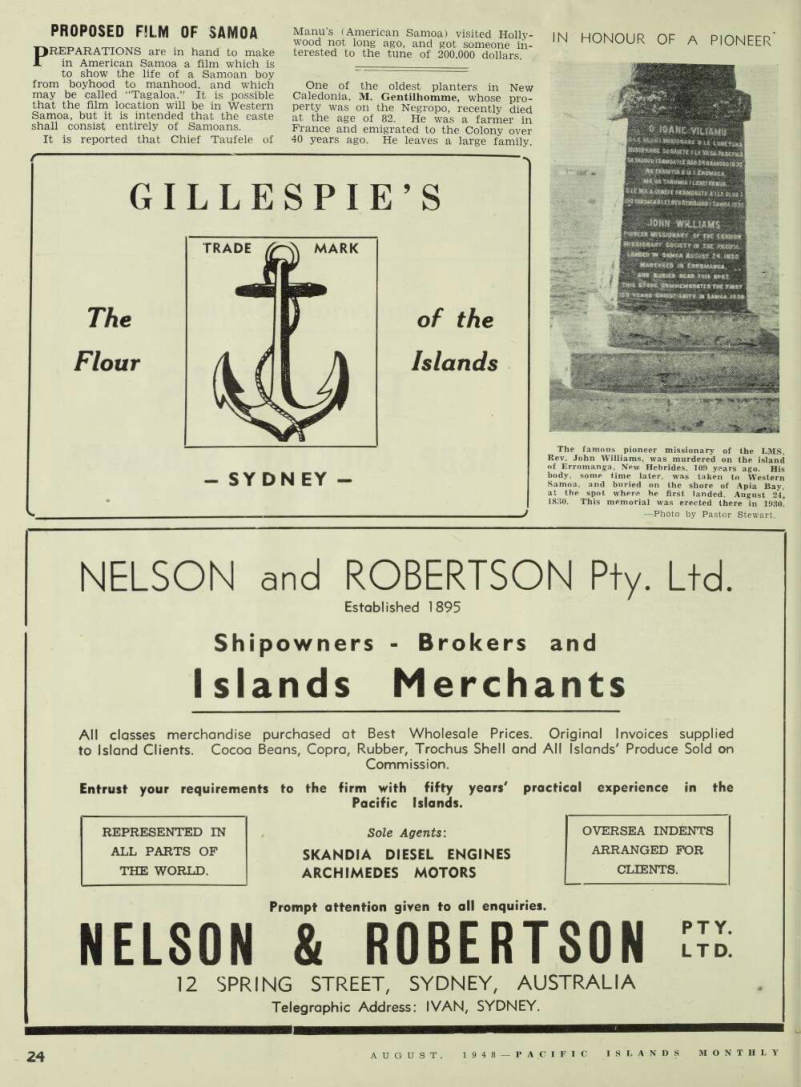
PREPARATIONS are in hand to make in American Samoa a film which is to show the life of a Samoan boy from boyhood to manhood, and which may be called “Tagaloa.” It is possible that the film location will be in Western Samoa, but it is intended that the caste shall consist entirely of Samoans.
It is reported that Chief Taufele of
Manu’s (American Samoa) visited Holly wood not long ago, and got someone in terested to the tune of 200.000 dollars.
One of the oldest planters in New Caledonia, M. Gentilhomme, whose pro perty was on the Negropo, recently died at the age of 82. He was a farmer in France and emigrated to the Colony over 40 years ago. He leaves a large family.
In Honour Of A Pioneer
The famous pioneer missionary of the LMS, Rev. John Williams, was murdered on the island of Erromanga, New Hebrides, 100 years ago. His body, some time later, was taken to Western Samoa, and buried on the shore of Apia Bay, at the spot where he first landed, August 24, 1830. This memorial was erected there in 1930.
Photo by Pastor Stewart.
Advertisements & other items, pp. 26-27 (2 items)
Nelson & Robertson Ks
GILLESPIE’S
The Flour
TRADE
MARK
of the Islands
- SY DN EY -
NELSON and ROBERTSON Pty. Ltd.
Established 1895
Shipowners - Brokers and
Islands Merchants
All classes merchandise purchased at Best Wholesale Prices. Original Invoices supplied to Island Clients. Cocoa Beans, Copra, Rubber, Trochus Shell and All Islands' Produce Sold on Commission.
Entrust your requirements to the firm with fifty years' practical experience in the Pacific Islands.
NELSON & ROBERTSON KS
12 SPRING STREET, SYDNEY, AUSTRALIA
Telegraphic Address: IVAN, SYDNEY.
Ipana
fTi w m CI I a V
egua r<l
ile !
A tinge of‘pink’ on your tooth brush is a warning to see your dentist. It may mean nothing serious, but let him be the judge He may explain that yours is simply a case of tender gums robbed of resistance by to-day’s soft foods. His advice will probably be “more work for lazy gums” and often “the helpful stimulation ot Ipana Tooth Paste and gum massage”.
Adopt this simple dental health rou tine Brush your teeth with Ipana every morning and evening, followed by vigorous gum massage with Ipana on the finger-tip . . . Teeth become brighter, more lustrous ; gums firmer, healthier; smiles more pleasing.
IPANA
TOOTH PASTE
4538b/G,
Fiji Governor To Tour Group
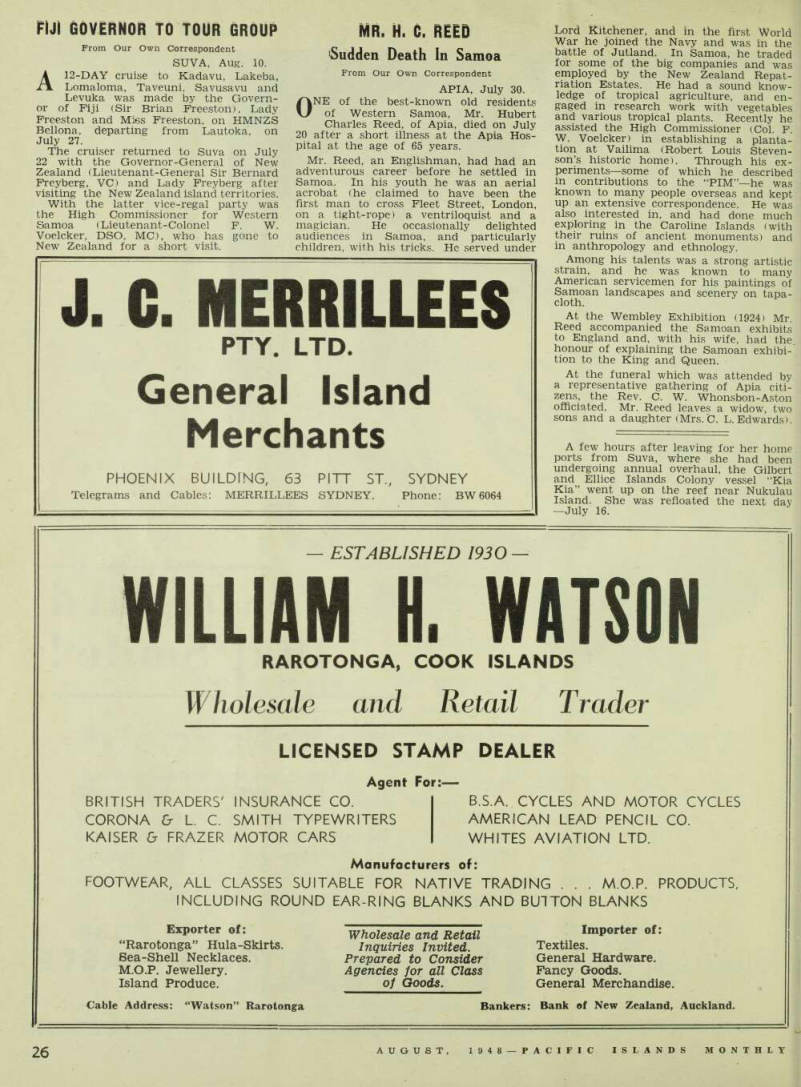
From Our Own Correspondent
Suva. Aug. 10.
A 12-DAY cruise to Kadavu, Lakeba, Lomaloma, Taveuni, Savusavu and Levuka was made by the Govern or of Fiji (Sir Brian Freeston), Lady Freeston and Miss Freeston, on HMNZS Bellona, departing from Lautoka, on July 27.
The cruiser returned to Suva on July 22 with the Governor-General of New Zealand (Lieutenant-General Sir Bernard Freyberg, VC) and Lady Preyberg after visiting the New Zealand island territories.
With the latter vice-regal party was the High Commissioner for Western Samoa (Lieutenant-Colonel F. W.
Voelcker, DSO, MC), who has gone to New Zealand for a short visit.
Mr. H. C. Reed
Sudden Death In Samoa
From Our Own Correspondent APIA, July 30.
ONE of the best-known old residents of Western Samoa, Mr. Hubert Charles Reed, of Apia, died on July 20 after a short illness at the Apia Hos pital at the age of 65 years.
Mr. Reed, an Englishman, had had an adventurous career before he settled in Samoa. In his youth he was an aerial acrobat (he claimed to have been the first man to cross Fleet Street, London, on a tight-rope) a ventriloquist and a magician. He occasionally delighted audiences in Samoa, and particularly children, with his tricks. He served under
Lord Kitchener, and in the first World War he joined the Navy and was in the battle of Jutland. In Samoa, he traded for some of the big companies and was employed by the New Zealand Repat riation Estates. He had a sound know ledge of tropical agriculture, and en gaged in research work with vegetables and various tropical plants. Recently he assisted the High Commissioner (Col. F.
W, Voelcker) in establishing a planta tion at Vailima (Robert Louis Steven son’s historic home). Through his ex periments—some of which he described in contributions to the “PlM”—he was known to many people overseas and kept up an extensive correspondence. He was also interested in, and had done much exploring in the Caroline Islands (with their ruins of ancient monuments) and in anthropology and ethnology.
Among his talents was a strong artistic strain, and he was known to many American servicemen for his paintings of Samoan landscapes and scenery on tapa cloth.
At the Wembley Exhibition (1924) Mr.
Reed accompanied the Samoan exhibits to England and, with his wife, had the honour of explaining the Samoan exhibi tion to the King and Queen.
At the funeral which was attended by a representative gathering of Apia citi zens, the Rev. C. W, Whonsbon-Aston officiated, Mr. Reed leaves a widow, two sons and a daughter (Mrs. C. L. Edwards).
A few hours after leaving for her home ports from Suva, where she had been undergoing annual overhaul, the Gilbert and Ellice Islands Colony vessel “Kia Kia” went up on the reef near Nukulau Island. She was refloated the next day —July 16.
Advertisements & other items, p. 28 (1 item)
William H. Watson
J. C. MERRILLEES
PTY. LTD.
General Island Merchants
PHOENIX BUILDING, 63 PITT ST., SYDNEY
Telegrams and Cables: MERRILLEES SYDNEY. Phone: BW 6064
— ESTABLISHED 1930 —
WILLIAM H. WATSON
RAROTONGA, COOK ISLANDS
Wholesale and Retail Trader
LICENSED STAMP DEALER
Agent For:—
BRITISH TRADERS 7 INSURANCE CO.
CORONA Cr L. C. SMITH TYPEWRITERS
KAISER & FRAZER MOTOR CARS
B.S.A. CYCLES AND MOTOR CYCLES
AMERICAN LEAD PENCIL CO.
WHITES AVIATION LTD.
Manufacturers of: FOOTWEAR, ALL CLASSES SUITABLE FOR NATIVE TRADING . . . M.O.P. PRODUCTS, INCLUDING ROUND EAR-RING BLANKS AND BUTTON BLANKS Exporter of: “Rarotonga” Hula-Skirts.
Sea-Shell Necklaces.
M.O.P. Jewellery.
Island Produce.
Wholesale and Retail Inquiries Invited.
Prepared to Consider Agencies for all Class of Goods.
Importer of: Textiles.
General Hardware.
Fancy Goods.
General Merchandise.
Cable Address: “Watson” Rarotonga Bankers: Bank of New Zealand, Auckland.
Samarai

Future Awaits Canberra Decisions
ALTHOUGH nearly three years have ex pired since the surrender of Japan and the end of the Pacific war, the little port of Samarai, on China Strait, at the eastern end of Papua, has not been rebuilt. The trading community long since resumed its activities, and Samarai is again distributing centre for eastern Papua and the numerous archipelagoes to the eastward; but there has been very little rebuilding—firms have been carry ing on in ex-military buildings and tem porary constructions.
During the period of the Jap invasion -1942 and part of 1943—the part of Samarai adjoining the water-front (the wharves and the business section) was obliterated.
Both hotels, the big stores of Burns Philp and Co., Steamships Trading Co., and Whitten Bros., as well as the goods-sheds and various smaller buildings, were de stroyed by bombs and fire. The residential section, extending eastward over ths small high island, was not destroyed.
The only permanent building put up so far is that of Messrs. A. H. Bunting, Ltd., who have been well established in the place of Whitten Bros., who did not re sume operations. Burns Philp & Co., Ltd. and Steamships Trading Co. Ltd., are carrying on actively, but under temporary conditions of much inconvenience.
Messrs. Bunting Ltd. and Burns Philp Ltd. erected quarters for their staffs. Otherwise there has been practically no building along the ravaged water-front. Lack of hotels is a serious inconvenience.
This, say residents, is due to the dither ing of the Administration and its apparent inability to make up its mind in relation
to the future of Samarai. it has been reported on a number of occasions that the Administration proposes to make a site in Milne Bay available as a port of shipment and administrative and distri buting centre, and that Samarai, in that respect, will be abandoned. Shipping men generally do not favour the latter plan much, because Samarai is a well sheltered port, with attractive and beautiful sur roundings, and it is right on China Strait, which is the main thoroughfare between a large part of the north-western Pacific Islands and Australia.
The Government has done no building at all. It has not even built an office for itself —it is still occupying the Memorial Hall, in spite of every effort by the non-official community to regain pos session of that desirable building.
Recent reports indicate that Quonset huts are being erected in Samarai to
accommodate men to erect the hew wharf.
If that is true, and if a new wharf is to be built, the period of uncertainty should be ended. It will then be assumed that the Government intends to use Samarai in future as an administrative and dis tributing centre, and private enterprise thereafter will quickly supply the neces sary accommodation.
The honour of selection for represent ative teams in two codes—cricket and hockey—has gone to Mr. H, Apted, of Suva, Fiji. He was a prominent mem ber of Fiji’s representative cricket team which toured New Zealand this year, and on July 17 he played centre-half in Fiji’s hockey team, which met Auckland at Suva.
Advertisements & other items, pp. 29-30 (1 item)
Dettol
LONDON-SUVA
ECT s £/x
<j\v «* 7 c>.
> PANAMA V
For Sailings and Further Particulars Apply To: BETHELL, GWYN & CO., BURNS, PIIILP (SOUTH SEA)
138 LEADENHALL ST., CO., LTD.,
LONDON, E.C.3. SUVA.
Tell me, doctor
can an antiseptic he pleasant and at the same time a powerful germicide ? 3 The efficiency of a germicide does not depend upon an unpleasant smell, a deep staining colour or a poisonous nature. c DettoT is a powerful germicide and yet it is non-poisonous. It is a clean, clear fluid with an agreeable smell, so pleasant to use that very many people add it to their bath.
DETTOL
THE MODERN ANTISEP TIC
THREE REASONS why ‘ Dettol ’ is now being used in all the leading hospitals of Great Britain and throughout the Empire. 1 ‘Dettol’ antiseptic is deadly to the germs that cause so many septic infections. 2 * Dettol ’ is non-poisonous and is kind and gentle to human tissues. 3 ‘Dettol’ is pleasant and agreeable and does not stain either linen or the skin.
B2
Rid Kidneys Of
Poisons And Acids
If you suffer sharp, stabbing pains, if Joints are swollen, it shows your blood is poisoned through faulty kidney action. Other symptoms of Kidney Disorders are Backache, Aching Joints and Limbs, Sciatica, Neuritis, Lumbago, Sleepless Nights, Dizziness, Nervousness, Circles under Eyes, Loss of Energy and Appetite and Frequent Headaches and Colds, etc. Ordinary medicines can’t help much because you must get to the root cause of the trouble.
The Cystex treatment is specially compounded to soothe, tone and clean kidneys and bladder and remove acids and poisons from your system safely, quickly and surely, yet contains no harmful or dangerous drugs. Cystex works in 3 ways to end your troubles. 1. Starts killing the germs which are attacking your Kidneys, Bladder and Urinary System in two hours, yet is absolutely harmless to human tissue. 2. Gets rid of health-destroying, deadly poisonous acids with which your system has become saturated. 3. Strengthens and reinvigorates the kidneys, protects from the ravages of disease-attack on the delicate filter organism, and stimulates the entire system.
Praised by One-time Sufferers
Cystex is approved by one-time sufferers in 73 countries from the troubles shown above.
Mr. Reg Thomas, Townsville, Queensland, recently wrote: “My joints were all stiff, I had leg pains, my back used to ache day and night.
My bladder was weak. I had headaches and no appetite. The first dose of Cystex helped me and before I finished three boxes my health and strength came back.”
Guaranteed to Satisfy or Money Back
Get Cystex from your chemist or store to-day.
Give it a thorough test. Cystex is guaranteed to make you feel younger, stronger, better iv every way, or your money back if you return the empty package.
Now in 2 sizes—4/-, i/-.
GUARANTEED CVStCX
Treatment W J for Your Kidneys, Bladder, Rheumatism.
W. H.GROVE & SONS
Limited
Established 1896.
AUCKLAND
Island Traders.
p.O. BOX 490.
Telegraphic and Cable Address: “Grove”, Auckland.
Entrust Your Orders to the Firm with Fifty Years Practical Experience in the Island Trade.
Shippers of all classes of New Zealand products.
Representing English Manufacturers through-
out the Cook and Society Islands, Fiji, Tonga, Samoa, Niue, New Caledonia, New Guinea, etc.
In FIJI as—W. H. Grove Cr Sons (Fiji) Ltd.
Trade Boom Continues
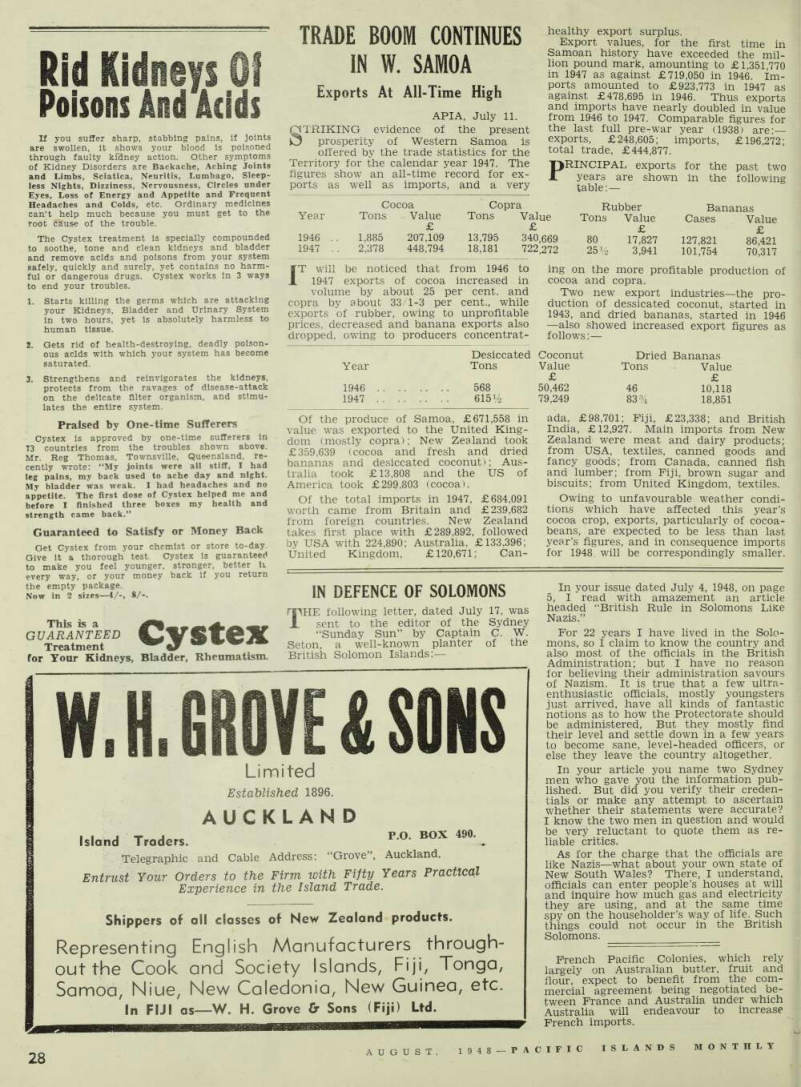
In W. Samoa
Exports At All-Time High
APIA, July 11.
QTRIKING evidence of the present O prosperity of Western Samoa is offered by the trade statistics for the Territory for the calendar year 1947. The figures show an all-time record for ex ports as well as imports, and a very
healthy export surplus.
Export values, for the first time in Samoan history have exceeded the mil lion pound mark, amounting to £1,351,770 in 1947 as against £719,050 in 1946. Im ports amounted to £923,773 in 1947 as against £478,695 in 1946. Thus exports and imports have nearly doubled in value from 1946 to 1947. Comparable figures for the last full pre-war year (1938) are:— exports, £248,605; imports, £196,272; total trade, £444,877.
PRINCIPAL exports for the past two years are shown in the following table:—
IT will be noticed that from 1946 to 1947 exports of cocoa increased in volume by about 25 per cent, and copra by about 33/1-3 per cent., while exports of rubber, owing to unprofitable prices, decreased and banana exports also dropped, owing to producers concentrat
ing on the more profitable production of cocoa and copra.
Two new export industries—the pro duction of dessicated coconut, started in 1943, and dried bananas, started in 1946 —also showed increased export figures as follows:
Of the produce of Samoa, £671,558 in value was exported to the United King dom (mostly copra); New Zealand took £359,639 (cocoa and fresh and dried bananas and desiccated coconut); Aus tralia took £13,808 and the US of America took £299,803 (cocoa).
Of the total imports in 1947, £684,091 worth came from Britain and £239,682 from foreign countries. New Zealand takes first place with £289,892, followed by USA with 224.890; Australia, £133,396; United Kingdom, £120,671; Can
ada, £98,701; Fiji, £23,338; and British India, £12,927. Main imports from New Zealand were meat and dairy products; from USA, textiles, canned goods and fancy goods; from Canada, canned fish and lumber; from Fiji, brown sugar and biscuits; from United Kingdom, textiles.
Owing to unfavourable weather condi tions which have affected this year’s cocoa crop, exports, particularly of cocoa beans, are expected to be less than last year’s figures, and in consequence imports for 1948 will be correspondingly smaller.
Cocoa Copra Rubber Bananas Year Tons Value Tons Value Tons Value Cases Value £ £ £ £ 1946 .. 1,885 207,109 13,795 340,669 80 17,827 127,821 86,421 1947 . . 2,378 448,794 18,181 722,272 25% 3,941 101,754 70,317
Desiccated Coconut Dried Bananas Year Tons Value £ Tons Value £ 1946 .. .. .. .. 568 50,462 46 10,118 1947 .. .. . . .. 615% 79,249 83% 18,851
In Defence Of Solomons
11HE following letter, dated July 17, was . sent to the editor of the Sydney “Sunday Sun” by Captain C. W.
Seton, a well-known planter of the British Solomon Islands: —
In your issue dated July 4, 1948, on page 5, I read with amazement an article headed “British Rule in Solomons Lite Nazis.”
For 22 years I have lived in the Solo mons, so I claim to know the country and also most of the officials in the British Administration: but I have no reason for believing their administration savours of Nazism, It is true that a few ultra enthusiastic officials, mostly youngsters just arrived, have all kinds of fantastic notions as to how the Protectorate should be administered, But they mostly find their level and settle down in a few years to become sane, level-headed officers, or else they leave the country altogether.
In your article you name two Sydney men who gave you the information pub lished. But did you verify their creden tials or make any attempt to ascertain whether their statements were accurate?
I know the two men in question and would be very reluctant to quote them as re liable critics.
As for the charge that the officials are like Nazis —what about your own state of New South Wales? There, I understand, officials can enter people’s houses at will and inquire how much gas and electricity they are using, and at the same time spy on the householder’s way of life. Such things could not occur in the British Solomons.
French Pacific Colonies, which rely largely on Australian butter, fruit and flour, expect to benefit from the com mercial agreement being negotiated be tween France and Australia under which Australia will endeavour to increase French imports.
Nou mea (New Caledonia) stores state that because of delay m the negotiations between the French commercial attache m Sydney and the Australian Government, butter supplies have not arrived.
There has also been a shortage of Australian potatoes, owing to a bad season.
Recentiy a ship from Saigon arrived with 3,500 tons of rice, of which 1,000 tons were to go on to Tahiti.
Mr. Depurtuis, a well-known planter of Vila, New Hebrides, arrived in Sydney in July, to obtain medical attention • Sir Arthur Grimble, formerly well known in the Pacific, has .retired from the position of Governor of the Windward Islands, West Indies. His successor is Mr R. H. D. Arundell, Assistant Chief Secre tary in Uganda.
Advertisements & other items, pp. 31-32 (1 item)
enamel'
IMPROVE YOUR OUTLOOK!
Two recommended products from the famous Spartan range of dependable paints and enamels— : Spartan Quick Drying Enamel and Spartan Silver will brighten your surroundings.
ECONOMICAL DURABLE WASHABLE NON-FADING
For long-life surface protection to metal and wood. Dries to a smooth, outstanding, lustrous finish. m 1111 nj2
Quick-drying
enamel'
Transforms small or large rooms into delightful, charming places in which it will be a pleasure to work and live.
Recommended for a PERFECT
FINISH
Durable Spartan Quick-Drying Enamel is a high-grade, quick-drying finish designed for application by professional and amateur alike —to go on easily and with an exceptionally smooth flow that ensures a perfect surface. . . . Drying speed of Spartan Quick-Drying Enamel is carefully controlled to allow ample time for “joining up” on large wall areas —it is fast enough to permit the surface drying dust-free within 2 hours, and setting with a wear-resisting hardness overnight. n*i
Heat-Resisting SILVER
An outstanding heat-resisting paint that gives a greater area coverage than ordinary paints. Protects metal work from moisture and corrosion. Easily applied to clean metal and wood surfaces of
STOVES, COPPERS, BATHS, HEATERS, GATES,
MACHINE EQUIPMENT, Etc.
Dries to a smooth, outstanding, brilliant, silvery finish.
SEALS TAR, BITUMEN, GREASY SURFACES AND BLEEDING
COLOURS.
For large exterior surfaces—tanks, roofs or galvanised iron structures, Spartan ALKYDISED ALUMINIUM PAINT is recommended because of its extreme durability.
Agents: Fiji: COLONIAL TRADE DEVELOPMENT AGENCY OF FIJI P.O. Box 273, Suva.
Other Territories: Please Order Through Usual Channels.
SPARTAN PAINTS PTY., LIMITED
102-104 King Street, Melbourne, Victoria.
iiIVER
Hard to Get? lr v *»
FOR
1. TRADE TOBACCO 10.
2. LAP LAP MATERIAL 11.
3. CANNED GOODS 12.
4. PERFUMERY 13.
5. PRIMUS STOVES ..
6. KEROLAMPS 14
7. SHOES, SANDALS , s
8. UMBRELLAS Jg
9. CHILDREN'S CLOTH- 17'
ing i 8;
SADDLERY & HARNESS
HOME LIGHTING PLANTS
WINES AND SPIRITS
NON-ELECTRIC WASHING
MACHINES
PUMPS, IRRIGATION
PLANTS
CROCKERY
HAIRDRESSING SUPPLIES
HARDWARE
AIR CIRCULATORS
Manstocks ,*r
ISLAND TRADERS
Cable and Telegraphic address; “MANSTOCKS” SYDNEY Telephones: 8W7405, 8W1237. 85076. FM2766
dazzling
whiteness For L S'V Always use Bvckitt 9 s Bny Blno in the last rinse the safe way to keep your linen a really good colour
Prevention Of Blackwater
Fever
''fHE fallowing stern note on black water and malaria fever was inserted in the Papua-New Guinea Gazette by the Director of Public Health in the Territory, Dr. J. T.
Gunther. It is self-explanatory.— SINCE the beginning of the Civil Ad ministration there have been four deaths from blackwater fever, a re cent one occurring in Sydney whilst an officer of the Administration was on leave Blackwater fever is a disease which is caused by repeated attacks of inade quately treated malignant tertian malaria Its onset is brought about eventually by certain physical changes such as sudden cold or by drugs, an important one of which is quinine. All suppressive drugs taken in their correct dosage such as;— Quinine, 5 grains ner dav, Mephacrine Hydrochloride (“Atebrin), 1 tablet per day, “Paludrine,” 1 tablet every three days, will definitely prevent the development of blackwater fever as these drugs in this dosage will, in almost all instances, com pletely suppress malignant tertian malaria. Dosages of the drugs less than those given will predispose towards that condition which allows blackwater fever to become established. If the drugs are not taken properly blackwater fever can be looked upon as a self-inflicted disease.
In those cases where circumstances do not allow the correct taking of a suppres sive drug, then the earliest and proper treatment of any malaria fever should be undertaken. At least 30 grains of quinine should be taken in the first day of the fever, and continued until the fever subsides.
“Paludnne” and “Atebrin” can also be used in the treatment of malaria fever, but should be done under the supervision of a trained person.
In conclusion, it is nointed out that blackwater fever still has a mortality rate in the vicinity of 25 per cent.
Death Of R. A. Vivian
THE death occurred on July 23 in Townsville of Mr. R. A. Vivian, formerly a prominent member of the Public Service of Papua. He was 70 years old.
Mr. Vivian was described as one of the “real old-time Papuans.” having gone to the Territory first in 1900. He entered the public service under Sir Hubert Mur ray, and became Government store keeper. Then he joined the field service, and served with distinction; and he was Resident Magistrate in the Gulf Divi sion of Papua when the Japanese in vasion of New Guinea compelled the evacuation of Papua in 1942. Mr. Vivian was a man of fine appearance and en gaging manner, and was very popular in the Territory. He retired, on pension, after the evacuation and went to reside at Magnetic Island, near Townsville.
Although he suffered much illness in recent years, he retained his cheery man ner and his warm friends until the end.
He was unmarried.
Advertisements & other items, p. 32 (1 item)
Caine's Studios, Suva
Send us your orders for
DEVELOPING, PRINTING,
ENLARGING
We Sell Kodak Films and Supplies Wholesale and Retail.
Caine's Studios, Suva
P.O. Box 8. (Estab. 1904) ’Phone 68.
Vila’S Depot Barge Goes
Stubborn On Last Voyage
r BLOWING is the story of the barge, “Mombah.” which left Brisbane on May 31, for Noumea, towed by the Australian tug “St. Giles” and loaded with 3,058 tons of coal for the Nickel Co. The “Mombah” had been bought by the Mes sageries Maritime Co. to serve as a depot in Vila for New Hebridean produce await ing shipment to France.
On June 10, when the two vessels were 83 miles from the Amedee lighthouse, Noumea, the engines of the “St. Giles” broke down and the tow ropes parted.
The motor vessel “Polynesien,” due to leave for the Hebrides, went to the aid of the “St. Giles” and brought her, in tow, to Noumea.
Meanwhile the “Mombah” was drifting towards the Queensland coast. On June 13, the small French coastal vessel “Phoque” (Captain Courtois), chartered by the Messageries Maritimes, was sent out to look after her with instructions to stick around until another tug could reach her from Australia. The “Momba’s” crew consisted of M. Valette and four native Lovalty islanders.
When the “Phoque” reached the “Mom bah” on June 14 she was about 160 miles from Noumea. On June 15 “Mombah” was still drifting at the rate of about 25 miles a dav, and Caotain Courtois cal culated that she was only 50 miles from the Darling group of reefs. He there fore boarded the “Mombah” from his launch with six native members of his crew, and got her in tow.
The tiny “Phoque” is only 200 tons, and she had taken in tow a weight of over 5,000 tons.
There followed two davs of storm and on June 18 the tow parted and the “Mom bah” started to drift all over again. When only 42 miles from the coastal reefs, Captain Courtois attempted to take her in tow again but the Australian tug “Car lock” hove in sight. With the “Mombah” in tow she reached Noumea on June 19.
Checking Marine Borer
Damage In N. Guinea
A SURVEY of marine borers in New Guinea waters has been carried out by the Australian CSIR. As a result of this, a report has been issued (Bulle tin 223) which shows how damage re sulting from the activites of these creatures can be checked.
The Bulletin, which can be obtained from the CSIR, provides information on the general nature of borer attack, the kind of borers responsible for damage in New Guinea waters, and a comprehensive list of resistent timbers and methods of protection of non-resistent timbers.
Write to the Secretary, Council of Scien tific and Industrial Research, Canberra.
Death Of F. W. Blencowe
THE death occurred at Madang Euro pean Hospital on July 16, of Mr. P. (Frank) W. Blencowe. He was a well-known and respected Territorian of ?6 years’ standing, and will be missed from Kar Kar Island, where he had been managing a coconut plantation for Mr.
W. M. Middleton.
In 1946, Mr. Blencowe became ill and was flown out of the Territory. Against medical advice, his love for the islands drove him back to his work.
During the war, Mr. Blencowe remained in the Territory to help in the production of fresh foods. His long experience in the Territory gave him an intimate know ledge of native customs and traditions.
New Guinea Scholarship Fund
DONATIONS to the New Guinea Mem
orial Scholarship Fund, since the
subscription list was last published, have been as follows: — Acknowledged to June 30 £3,538 3 1 Anonymous, Rabaul 250 Mr. and Mrs. W. M. English, Talasea, TNG 220 New Guinea miner, Namatanai,
Tng 500
£3,547 10 1
The new Fiji Government Printer, Mr. F. Stansfield, has arrived in the Colony. He was formerly Government Printer, Trinidad.
Mr. Reg. Cooper, prospector with Bulolo Gold Dredging Ltd., arrived in Sydney from New Guinea in June on three months' furlough. On the Morobe field now, BGD has six dredges at work, he said; Sunshine Gold Development Ltd. recently went into production, sluicing; and New Guinea Goldfields Ltd. is carry ing on its regular operations, with Koranga Gold Sluicing Ltd. tributing for it. The Sandy Creek Gold Sluicing Co.
Ltd, has also reached the production stage. Mr. Cooper is staying in the Western Suburbs, Sydney, with his sister, Matron Green.
Advertisements & other items, pp. 33-34 (2 items)
31
PACIFIC ISLANDS MONTHLY- A U G U S T , 1948
Sumjw 1
EYE LOTION
For Inflamed Etje* and Eyelids ... Sold Everywhere H. Rose iCo.,Pty, Lid., Kinq Street. Sydney.
a
SUMJW 1
m m WJ in & m \> •Se S3t <**
SWALLOW & ARIELL
LIMITED
I 53916 Master Craftsmen in the Biscuit Industry since 1854
tf\C
SPECIALISING IN
PACIFIC ISLAND INSURANCES
FIRE—MOTOR VEHICLE
MARINE—HULLS AND CARGO
EMPLOYER’S LIABILITY
BONDS—In accordance with
ADMINISTRATION ORDINANCES.
COPRA INSURED FROM DRIER
TO BUYER.
AND ALL OTHER CLASSES ARRANGED
AT LOWEST CURRENT RATES.
Established Agencies throughout the Territory of Papua and New Guinea.
Managing Agents: New Guinea Company, Limited.
Island Representative: G. D. A. Kent, Rabanl Branch.
SOUTHERN PACIFIC INSURANCE
CO., LTD.
HEAD OFFICE: 60 HUNTER STREET,
SYDNEY.
M m* K
off to Heinz!
—where all the 'Aristocrat* |o!
At the height of the season, when they’re at their very best Heinz pick the finest, fresh, red-ripe tomatoes they’re canned the same day! Choice spices are added to give Heinz Tomato Soup that famous flavour you know so well. It’s heart-warming and extra nourishing. The easy way to get compliments from your family is to get Heinz Tomato Soup TODAY !
HEINZ
TOMATO SOUP
1-0
wato
S OUp
S 7 F °oo a* 0F S 7
Copra Crushing Planned For New Guinea

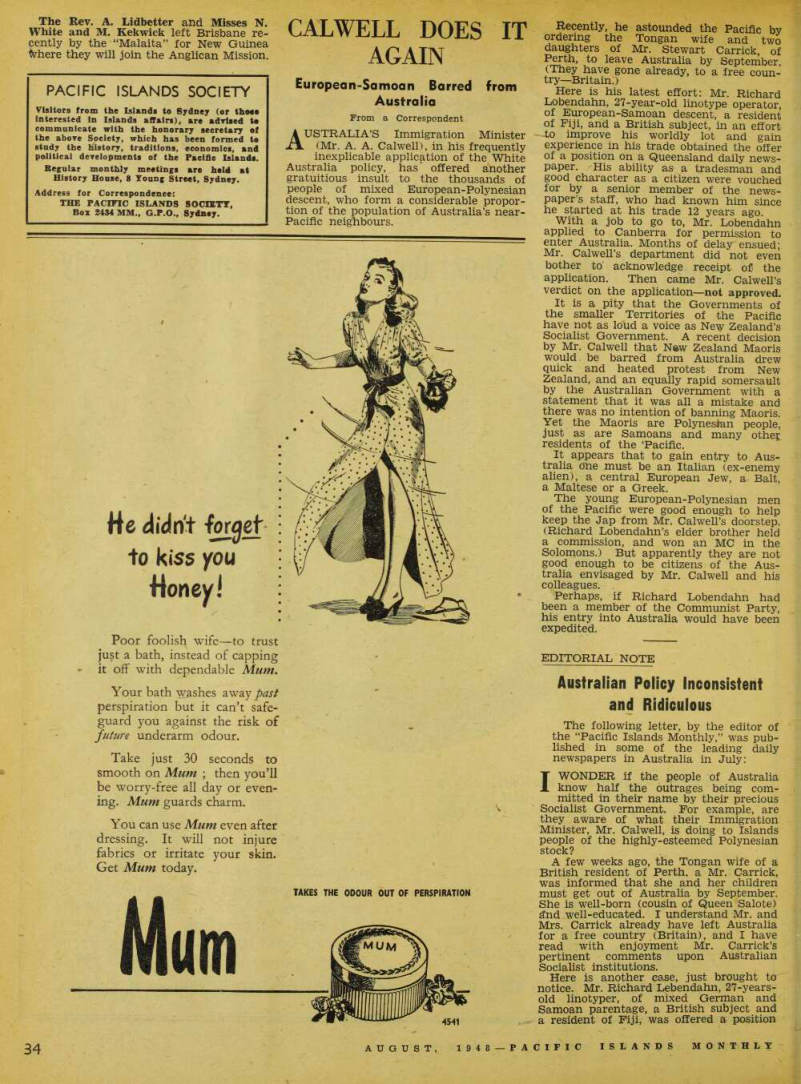
No Sign of World Parity For Australian Territory Planters
From a Special Correspondent
Canberra, July 27.
PROPOSALS are being prepared in Canberra for expanded treatment of copra grown in New Guinea. If the plans reach fruition they may have far reaching effects on Australian manufac ture of margarine, confectionery, biscuits and other vegetable oil products.
It is at present proposed to erect a big copra crushing plant in New Guinea to treat copra at the source instead of its having to be shipped to Australia. Apart from effecting large savings in treatment costs and shipping, by enabling oil to be extracted and shipped in drums, the big gest effect of the scheme will be greatly to increase supplies of vegetable oils available to Australian industry.
At present all copra has to be brought to Australia from New Guinea or else where, for crushing. Most of the crush ing plant in Australia is under the con trol of one firm, and the maximum crush ing capacity is only 44,000 tons a year.
Only in July 44,000 tons of copra sent from New Guinea to Sydney for crush ing. were exported to England because Australian crushing plants could not handle it.
The plans for New Guinea have not reached official levels yet, and because of international considerations (especially the attitude of UNO to Australia’s New Guinea trusteeship) some time may elapse before they do.
Editorial Note: The foregoing message from Canberra is fairly authoritative and very interesting—because of what it does not say. The outstanding question for New Guinea planters is not what Aus tralia or any other country will do with
their copra, but what they will pay for it. At present, Australia is compulsorily acquiring their copra, and paying them for it at rates very substantially under world parity. This system has been fol lowed since the inauguration of Mr.
Ward’s Socialist Administration. All the copra thus acquired has been consumed in Australia.
In other words, Australia —where prices are kept low by Government edicts—has been getting the benefit of the cheap copra; and getting it at the expense of the New Guinea planters, who live in a country which has to pay top world prices for everything. If the planters got world parity for their produce, they could not object to paying world parity for their supplies. As it is, they are being robbed by Australia in a really shocking way.
We may be sure that, while Socialism rules Australia, the Government will continue to purchase the bulk of New Guinea’s copra at rates substantially under world parity, (See article elsewhere in this issue on Copra’s value in different markets.) Mr. F. R. J. Davies, who has been Act ing Director of Education in Fiji, has resigned that office in order to become Officer in Charge of Islands Education in the Education Department of New Zealand. He expects to leave Suva in October, and his future duties will in clude supervision of education in NZ Territories in the Pacific and of all NZ teachers appointed to positions under the Fiji Government.
The Rev. A. Lidbetter and Misses N.
White and M. Kekwick left Brisbane reqently by the “Malaita” for New Guinea Miere they will join the Anglican Mission.
Advertisements & other items, pp. 35-36 (1 item)
Electrolux
There is only one
THE MODERN KEROSENE-OPERATED REFRIGERATOR
THAT ACHIEVES THE MIRACLE OF ICE FROM HEAT
Lasting Efficiency, Silent Operation, Streamlined Beauty
m I * Economically operated by kerosene, with a simple precision-built freezing unit that has no moving parts and is GUARANTEED FOR
FIVE (5) YEARS.
Obtainable from :
NEW GUINEA COMPANY, LIMITED.
Rabaul, Madang, Lae, Kavieng.
J. R. CLAY & CO., LTD., Port Moresby.
W. R. CARPENTER & CO. (Sol. Is.), LTD., Tulagi.
For New Hebrides, Butaritari, Noumea, New Caledonia. Apply—
W. R. CARPENTER & CO. LTD.
Model LKSSI Price £79/15/- FOB, Melbourne Storage capacity: 5i cub. ft. (approx); shelf area, 9 sq. ft.; food shelves, six—five removable; 2 self-supporting when half drawn. Ice-making; Four trays—s lb. ice per freezing: 80 cubes. Fuel consumption: 1.8 pints kerosene per day (approx.).
Height: 4 ft. 10 in. Depth: 2 ft. 3i in. weight, unpacked, 406 lb. Packed, 574 lb.
Head Office: 16 O'Connell St., Sydney, N. S. Wales
PACIFIC ISLANDS SOCIETY
Visitors from the Islands to Sydney (or thooo interested in Islands affairs), are advised to communicate with the honorary secretary of the above Society, which has been formed to study the history, traditions, economics, and political developments of the Faeifle Islands.
Regular monthly meetings are hold at History House, 8 Young Street, Sydney.
Address for Correspondence:
THE PACIFIC ISLANDS SOCIETY,
Box 3484 MM., G.F.0., Sydney.
He didn't forget
to kiss you
Poor foolish wife—to trust just a bath, instead of capping it off with dependable Mum .
Your bath washes away past perspiration but it can’t safeguard you against the risk of future underarm odour.
Take just 30 seconds to smooth on Mum ; then you’ll be worry-free all day or even-
ing. Mum guards charm.
You can use Mum even after dressing. It will not injure fabrics or irritate your skin.
Get Mum today.
Calwell Does It
Again
European-Samoan Barred from Australia
From a Correspondent AUSTRALIA’S Immigration Minister (Mr. A. A. Calwell), in his frequently inexplicable application of the White Australia policy, has’ offered another gratuitious insult to the thousands of people of mixed European-Polynesian descent, who form a considerable propor tion of the population of Australia’s near- Pacific neighbours.
Recently, he astounded the Pacific by ordering the Tongan wife and two daughters of Mr. Stewart Garrick, of Perth, to leave Australia by September. (They have gone already, to a free coun try—Britain.) Here is his latest effort: Mr. Richard Lobendahn, 27-year-old linotype operator, of European-Samoan descent, a resident of Fiji, and a British subject, in an effort to improve his worldly lot and gain experience in his trade obtained the offer of a position on a Queensland daily news paper. His ability as a tradesman and good character as a citizen were vouched for by a senior member of the news paper’s staff, who had known him since he started at his trade 12 years ago.
With a job to go to, Mr. Lobendahn applied to Canberra for permission to enter Australia. Months of delay ensued; Mr. Calwell’s department did not even bother to acknowledge receipt of the application. Then came Mr. Calwell’s verdict on the application—not approved.
It is a pity that the Governments of the smaller Territories of the Pacific have not as loud a voice as New Zealand’s Socialist Government. A recent decision by Mr. Calwell that Naw Zealand Maoris would be barred from Australia drew quick and heated protest from New Zealand, and an equally rapid somersault by the Australian Government with a statement that it was all a mistake and there was no intention of banning Maoris.
Yet the Maoris are Polynesian people, just as are Samoans and many othe£ residents of the 'Pacific.
It appears that to gain entry to Aus tralia one must be an Italian (ex-enemy alien), a central European Jew, a Balt, a Maltese or a Greek.
The young European-Polynesian men of the Pacific were good enough to help keep the Jap from Mr. Cal well’s doorstep. (Richard Lobendahn’s elder brother held a commission, and won an MG in the Solomons.) But apparently they are not good enough to be citizens of the Aus tralia envisaged by Mr. Calwell and his colleagues.
Perhaps, if Richard Lobendahn had been a member of the Communist Party, his entry into Australia would have been expedited.
Australian Policy Inconsistent
Editorial Note
Australian Policy Inconsistent and Ridiculous
The following letter, by the editor of the “Pacific Islands Monthly,” was pub lished in some of the leading daily newspapers in Australia in July: I WONDER if the people of Australia know half the outrages being com mitted in their name by their precious Socialist Government. For example, are they aware of what their Immigration Minister, Mr. Calwell, is doing to Islands people of the highly-esteemed Polynesian stock?
A few weeks ago, the Tongan wife of a British resident of Perth, a Mr. Garrick, was informed that she and her children must get out of Australia by September.
She is well-born (cousin of Queen Salote) £nd well-educated. I understand Mr. and Mrs. Garrick already have left Australia for a free country (Britain), and I have read with enjoyment Mr. Garrick’s pertinent comments upon Australian Socialist institutions.
Here is another case, just brought to notice. Mr. Richard Lebendahn, 27-years old linotyper, of mixed German and Samoan parentage, a British subject and a resident of Fiji, was offered a position
by a Queensland daily newspaper, but has been forbidden by Mr. Calwell to enter Australia —presumably because of his Samoan blood.
Tongans and Samoans are of the same race as the Maoris —and there are many Polynesians and thousands of part- Polynesians resident in Australia. When Mr. Calwell announced that Maoris were banned, he was sharply checked by the New Zealand Socialist Prime Minister, whose Government holds power through the votes of the four Maori members (the European members of the NZ Parliament are exactly divided between Socialists and non-Socialists). Mr. Calwell promptly somersaulted, and announced that Maoris could enter Australia.
I then wrote to the New Z-ealand Prime Minister, and asked him if he would use his good offices also on behalf of Polynesians generally, and of Samoans and Cook Islanders in particular. I re minded him that New Zealand is re sponsible for the government of Samoans and Cook Islanders, who are Polynesians, like the Maoris. Mr. Fraser replied in a letter which was a masterpiece of evasion—the effect of whiclv was that “it does not appear that they (other cases affecting Polynesians) are matters with which the New Zealand Government could concern itself.”
The Territories of Papua and New Guinea have been crippled economically by the Australian Socialist Government.
Mr. Ward defends his ban on European enterprise in New Guinea by emphasising Canberra’s passionate interest in the wellbeing of the natives. But the primitive New Guinea Melanesians racially are far below the Polynesians, who are treated by Mr. Calwell as undesirable.
Actually, Polynesians are generally more intelligent, dependable and loyal than the great majority of the Central and South Europeans whom Mr Calwell is so eagerly bringing into the Commonwealth.
Mr. Leo White, of White’s Aviation Ltd., Auckland, paid a short visit to Fiji to take a series of aerial photographs. He left for Australia on August 1.
A number of officers in the Fiji Posts and Telegraphs Department have recently
been promoted. Mr. H. Edmunds hae been appointed Accountant, Mr. W. E. Morrison has been appointed a Postmaster (Special Grade), and Mr. C. E. Mansell and Mr.
J. Wiley have been appointed Assistant Accountants.
Advertisements & other items, pp. 37-38 (2 items)
35
PACIFIC ISLANDS MONTHLY- A U G U S T . 194, 8
Burns Philp (South Sea) Co. Ltd.
Pimples and Bad Skin Fought in 24 Hours
Since the discovery of Nlxoderm by an American physician it Is no longer necessary for anyone to suffer from ugly, disgusting and disfiguring skin blemishes such as Eczema, Pimples, Rash, Ringworm, Psoriasis, Acne, Blackheads, Scabies and Red Blotches. Don’t let a bad skin make you feel Inferior and cause you to lose your friends. Clear your skin this new scientific way.
A New Discovery
Nlxoderm is an ointment, but different from any ointment you have ever seen or felt. It is a new discovery, and Is not greasy but feels almost like a powder when you apply It. It penetrates rapidly Into the pores and fights the cause of surface skin blemishes. Nlxoderm contains 9 Ingredients which fight skin troubles In these 3 ways. I.—lt fights and kills the microbes or parasites often responsible for skin disorders. 2.—lt stops Itching, burning and smarting In 7 to 10 minutes, and cools and soothes the skin. 3.—lt helps nature heal the skin clear, soft and velvety smooth.
Works Fast
mediately, clearing and healing your skin, making It softer, whiter and velvety smooth Because Nlxoderm Is scientifically compounded to fight skin troubles, It works fast.
It stops the Itching, burning and smarting In a few minutes, then starts to work 1m-
In just a day or two your mirror will tell you that here at last is the scientific treatment you have been needing to clear your skin—the treatment to make you look more attractive, to help you win friends. Nlxoderm has brought clearer, healthier skins to thousands, such as Mr. Bob Weedon, Edmund Street, Fremantle, who writes: "I was troubled with pimples ever since I was 13, and have spent pounds and pounds on so-called cures without results. I then tried Nlxoderm with astounding effect.
The pimples seemed to fade away, and after a week there was not the slightest trace of them.”
Satisfaction Guaranteed
Get Nlxoderm from your chemist or store to-day. Look In the mirror In the morning and you will be amazed at the Improvement.
Then Just keep on using Nlxoderm for one week and at the end of that time It must have made your skin soft, clear, smooth and magnetically attractive —must give you the kind of skin that will make you admired wherever you go, or you simply return the empty package and your money will be refunded In full. Get Nlxoderm from your chemist or store to-day.
The guarantee protects "you.
Nixodcrm 2/- & 4/-
For Skin Sores, Pimvles and Itch.
BURNS PHILP (SOUTH SEA) Co. Ltd.
Registered Office: SUVA, FIJI
Code Address: “BURNSOUTH”
ISLAND TRADERS AND SHIPOWNERS
General Merchants (Wholesale and Retail)
Shipping, Customs and General Agents
Representatives for QUEENSLAND INSURANCE CO. LTD.
Distributing Agents for SHELL COMPANY (PACIFIC ISLANDS) LTD.
BRANCHES:
FIJI—
SUVA.
LEVUKA.
LADTOKA.
LAB ASA.
BA.
SIGATOKA.
ROTUMA ISLAND.
NORFOLK IS.—
SAMOA—
APIA.
PAGO PAGO.
TONGA—
NUKUALOFA.
HAAPAI.
VAVAU.
NIUE IS.—
Sydney Agents:
BURNS, PHILP & CO., LTD.,
7 Bridge Street.
London Agents:
BURNS, PHILP & CO., LTD.,
35 Crutched Friars, E.C.3.
San Francisco Agents:
BURNS, PHILP CO. OF SAN FRANCISCO,
Matson Building, 215 Market Street, Agencies Throughout the World.
GP k
Isle of Pines for Tourists
Tourists
THE Isle of Pines, 30 miles from Noumea, reached through a net work of reefs, has in the past, been isolated, though it is, in fact, one of the loveliest isles of the Caledonian archipelago. It has an interesting history and a magnificent climate.
Now, an attempt is being made to at tract tourists, and the administration has agreed to subsidise the ship “Mollie Pas III,” belonging to that worthy old mariner Captain Pons, which will assure something like a regular service.
The Isle of Pines is the island where Captain Cook anchored during his second Pacific voyage, naming one little cay, Botany Isle. The place is remarkable for its giant limestone caves, for its extra ordinary mushroom-shaped rocks which litter the magnificent bay of Upi, for its big outrigger canoes which travel up to 15 knots an hour outside the reef, for its prehistoric mounds on the plateau which remind one of those on Salisbury Plain, and for its water supply from undersea springs coming right from the Caledo nian mainland.
In the 1850 s this island was a bone of contention between the British (who wanted it as a naval coaling station, and whose sandalwood traders, notably Pad don, Towns and Underwood, were firmly installed) and the French, The island is also famous for its remarkable prehis toric-looking Captain Cook pines; and recently it was in the news when natives found the wreck of the Sydney launch and the starving sailor, Cush whose mates had perished of famine while being blown across the Coral Sea.
There on the Isle, for nearly ten years (until a general amnesty was granted) between 2,000 and 3,000 exiles of the Paris Commune (of 1871) and a few hun
dred Arab survivors of the Kabyle Revolt of the 1870 s, were camped in three or four villages, the remains of which may still be seen. The Communards included many men of high intellectual attain ment, and they produced their own weekly newspaper, copies of which may still be seen in the Catholic Mission at Vao.
Attempts to escape to Australia were generally unsuccessful, but frequent, on one occasion a party of 19 who had fitted up an old boat, and who were led by a well-known Paris doctor, were drowned in a stormy passage through the reefs.
H.E.L.P.
"Oilseed Production In
New Guinea"
It was reported during March (says the “Crown Colonist” of May last) that the Australian Cabinet had approved sug gestions that New Guinea could be devel oped during the next five years to pro duce groundnuts, coconuts, and tea in quantities equal to Africa. It is under stood that some British experts may be switched from Tanganyika to New Guinea.
Editorial Note: Has anyone noticed signs in New Guinea of preparations for planting pea-nuts and tea on a scale to produce “quantities equal to Africa”? If so, the “PIM” would be grateful for in formation. Either, the “Crown Colonist” report is slightly exaggerated, or the NG Administration is displaying more than its usual reticence. ~•• The death occurred recently in Tahiti of Madame Vevue Rose, grandmother of Mrs. Norman Hall, wife of the famous writer. Madame Rose, whose maiden name was Maria Richmond, was aged 91, and was greatly esteemed.
Dr. Blanche Biggs, in July, proceeded from Tasmania to her Mission Station at Oro Bay, Northwest Papua, where she will be in charge of medical work. Her brother, Reverend A. E. Biggs, also of Tas mania, recently went as captain to the Lockhart River Mission in Northern Queensland.
Advertisements & other items, pp. 39-40 (1 item)
Cole’S
Tropic-Seasoned
CHICKENS
Pure WHITE LEGHORNS and
First-crosses: R.l. Red x W.L. or Australorp x W.L.
Bred in the sub-tropics and seasoned to your climate.
All Breeders guaranteed Government blood-tested. 25’s 50’s 100’s £ s. d. £ s. d. £ s. d.
W.L. .. 110 0 212 6 415 0 Crosses 1 11 6 2 15 0 500 Plus Air Freight
ED. COLE,
Enmore Poultry Farm, Cairns, N.Q.
Look for KRAFT
and find QUALITY
The unchanging quality of Kraft foods is a byword wherever fine foods find appreciation. In their constant vigilance over quality, Kraft experts have achieved even more than just that, for hand in hand with Kraft quality goes flavour perfection and food value of a very high order.
Wherever you see the name “Kraft”, buy confidently, and remember, “Red Feather” foods are made by Kraft too. No finer foods can be found.
Export Division,
Kraft Walker Cheese Co. Pty. Ltd.,
Riverside Ave., South Melbourne,
AUSTRALIA.
0* K
KRAFT
\ // S ■■ Three famous Kraft Foods notv available in full supply everywhere, VEGEMITE the delicious, healthful yeast extract. One of the richest known sources of the important Vitamin B complex. Strongly recommended in all areas where fresh vegetables are scarce. A little does a potver of good.
KRAFT CHEDDAR CHEESE a
creamy-smooth, choice processed cheddar.
Rich in Vitamins A, B and D, calcium, phosphorus, and other nutrients of milk.
Always fresh whether in the attractive blue can or in its hygienic foil wrapping. Not too sharp not too mild just too good for words.
BONOX pre-digested beef in its tastiest and most assimilable form. A valuable food for its high content of niacin (the anti-pellagric factor), and a powerful digestive stimulant. Dissolve in hot water for an appetising drink, or use as a spread or a flavouring for cooked dishes. Eat it and drink it for a lift I
yin ornate example of historical keys, this XVlth Century French key features the sporting motif in its club and animal carvings. It seems to have been the key to a Duke’s country lodge. v' mm. a F=> S
Tfe
key
e k to sure e n m o n i s
FINE CUT
NAVY CUT
TOBACCOS
or 1657.7.48
Tourists
No Room For
Acute Shortage of Hotel Accommodation in Suva
SUVA. Julv 19.
WHEN the NZNAC Sunderland brought 21 passengers from Auckland to Suva on July 17, and an NZNAC Douglas brought 17 from Tonga, Samoa and the Cook Group, and yet more people arrived in a Qantas plane from Australia, the authorities concerned looked des perately round for somewhere to put them.
Some were accommodated at the Laucala Bay air base; a few were pushed irlto private houses; and others found temporary berths aboard a ship in port.
While in Suva, the Auckland pro vincial hockey team—due to sail for home in the Matua on July 20—has been quartered at the clubrooms of the United Improvement Association, which will also shelter the Maori representative Rugby team which will arrive on July 21.
This illustrates Suva’s critical shortage of hotel accommodation, which is caused largely by the great many tenacious “per manents” in the hotels who cannot get alternative accommodation.
It is becoming a commonplace for people who book in at hotels without fix ing a period for their stay, to have to move out to the country to make room for previously booked-in arrivals.
Usually accommodation can be found at country hotels and the Tourist Officer at Nadi Airport is busily heading off arrivals with the advice that they must spend at least a few days touring the western and northern districts until accommodation can be found for them in Suva.
On July 16, the Tourist Bureau stated: “The principal need in Suva apparently is not to attract tourists but to try to accommodate those who arrive. A sur vey made yesterday and to-day shows that in Suva hotels not a single bed was available.”
A Tahiti Christening
QUITE a stir was created in Papeete one morning recently when bells be gan to ring, and the siren of the British steamer “Levernbank” began to bl<~>w. Anxious citizens g?fbov e d only to see Captain Gillies, of the “Levernbank,” and Miss Anatila Nord man, hurrying off in a car, carrying a small infant.
“What’s wrong?” yelled a citizen.
“Nothing’s wrong” retorted the Captain.
T am going to have this small nipper baptised—l am the godfather.” The in fant was the very new baby of Mr. and Mrs. Milton Nordman, and it had been decided to call it “Lurline” and to baptise it forthwith.
This solemn ceremony ended, a recep tion was held aboard the ship, where the Nordman family and the Captain lavishly entertained a large number of people.
As the “Levernbank” sailed out of the harbour for Makatea, the Captain shouted lam now linked with Tahiti—l will come back.”
Because of the inadequacy of Suva’s power supply, the ever-increasing de mands put upon it and the long wait for new plant from overseas, the Suva Town Board has asked the Fiii Govern ment to look into the question of re stricting the sale of electrical appliances.
Father Lepping, who recently returned to his mission station, has urged the agri cultural development of Pacific Islands to improve the living standards of the natives. Agricultural development, he said, would serve a two-fold purpose. The natives would be able to vary their diet and also, by exports, earn money for their own social advancement. Father Lepping is an American and is attached to the Bougainville Marist Mission.
The Whan Construction Co., Ltd., Suva, is the successful tenderer for the new Suva markets to be built on the wharf reclamation. The contract price is £24,986, subject to revision according to the rise or fall in the cost of materials and labour during the 15 months’ con struction period.
Advertisements & other items, pp. 41-42 (1 item)
Commonwealth JBank
Gilbert Renton
AUCTIONEER, VALUER,
ESTATE AGENT.
Storage and Repository Travellers Sample Rooms For General Information and Service.
P.O. Box Rabaul, TNG
WE p
CAN HELP YOU
With Full banking facilities at our Island Branches
RABAUL ... LAE
PORT MORESBY
MADANO
The Service links with our Branches throughout Australia, also our Agents and correspondents all over the world.
Commonwealth JBank
of Hustralia.
Every Branch of the Bank conducts Savings Bank business.
QUEENSLAND
INSURANCE
COMPANY
LIMITED
(Incorporated 1886 in Australia*
ASSETS EXCEED £4,000,000
Head Office :
QUEENSLAND
INSURANCE BUILDING,
80-82 PITT STREET, SYDNEY.
Speciolists In South Seas Fire,
Marine & Accident Insurances
Apply to:—
TUI.
Branch Office: I. B. Chalmers, Manager.
Burns Phllp (South Sea) Co., Ltd.
VILA.
Burns Phllp (South Sea) Co., Ltd.
Comptoirs Francals Des Nouvelles Hebrides (Marine).
NOUMEA.
L. & W. Johnston.
PORT MORESBY:
Burns, Phllp & Co., Ltd.
W. A. Anderson, Resident Officer.
PAGO PAGO.
Burns Phllp (South Sea) Co., Ltd.
G. H. C. Reid <b Co.
OTHER SOUTH SEA ISLANDS.
Burns Phllp (South Sea) Co., Ltd.
Also to any of the Company’s Offices in Australia or Hew Zealand.
1 Y 0 u
RJ2. 18 H P. MARINE DIESEL
i Driving 21 in. x 1 siin.
Propeller at 740 RPM • Reliable Efficient Economical v.~ • Easy Starting
GOOD DELIVERIES
Suitable for 25-35 ft. craft.
Stuart Turner
Marine Engines
li, 4 and 8 BHP Reduction Gear and Electric Starting Models available.
Light, Simple, Economical, General Purpose Units Write for full particulars of our complete range of engines to:
TKornycroft (Aust.) Pty., Ltd.
Cables: THORNMOTOR, Sydney.
Vegetables
Price Control For Suva’S
Indians Boycott of Market
Prom Our Own Correspondent SUVA, July 19.
IN response to public demand, control was this month reimposed on a limited range of prices of vegetables at the Suva market.
The result was a drastic reduction in the number of both vendors and vege tables at the Suva market because the Indians promptly clamped down a boy cott.
But when the “Fiji Times” recorded this, various Indians were unset and the Indian Farmers’ Association solemnly addressed a rebuke to the paper, saying that it was not a boycott at all—the Indians were simply staying away.
At other times all this might be diverting to the public of Suva, which greeted the return of price control with whoops of joy, but the sight of a solitary Chinese selling cabbages at a corner of the market normally packed with Indians and their wares, does not improve the public temper.
The Fijians and the Chinese are selling as usual, but the supply of staple vege tables like dalo (taro) is not within sight of meeting the demand—a fact of which the Indian organisers of the boycott are well aware.
The Indian Farmers’ Association has protested to the Colonial Secretary and the Controller of Prices, and the Con troller has intimated that he is prepared to discuss the question with the Asso ciation’s representatives.
But in the meantime the boycott is still on and the food situation for the lower-paid sections of Suva’s population is grim.
Plaques For Ng War Graves
IT has been reported that the possibility of earthquakes in the area has caused the Imperial War Graves Commission to abandon its plan for put ting marble heaastones on war graves in New Guinea and New Britain.
Bronze plaques will now be used.
According to a Commission official in Brisbane, headstones “would probably be shaken down.” He said that the Com mission had called tenders for 10,000 cast-bronze plaques, each 15 inches by 11 inches, for graves at Bomana (Port Moresby), Lae, and Bita-Paka (Rabaul).
The present intention is to remove the temporary crosses now on each grave, and lay a plaque carrying full particulars of each soldier buried there.
Bomana cemetery contains the graves of approximately 4,200 Australians who died at Milne Bay, Kokoda, Buna, Gona, Soputa and Bougainville. Lae holds 3,700 from the Wau-Salamaua, Finschhafen, Madang and Wewak campaigns, and the 1,600 buried near Rabaul are mainly from New Britain fighting.
These, it is reported, are the only ceme teries under the control of the Imperial War Graves Commission which will have bronze plaques.
MR. L. J. LOWTHER, manager of P. J.
Lowther & Son, Pty., Ltd., of Bris bane, said that the decision for plaques rather than headstones would not interfere with his firm’s recent £90,000 contract to supply marble headstones for Pacific war graves. The headstones would be required for war graves in Australia and islands other than New Guinea and New Britain.
The contract to complete the head stones would take three years, and, ac cording to Mr. Lowther, 800 had been completed.
Magazine Section
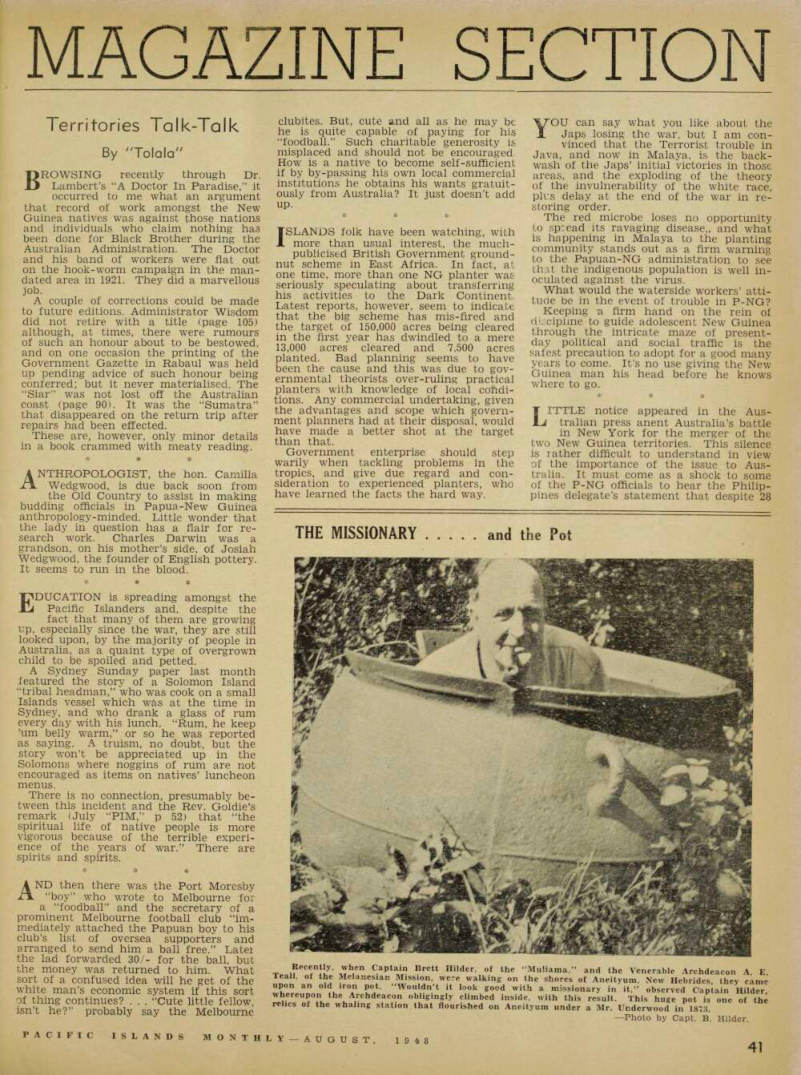
Territories Talk-Talk
By "Tolalo"
BROWSING recently through Dr.
Lambert’s “A Doctor In Paradise,” it occurred to me what an argument that record of work amongst the New Guinea natives was against those nations and individuals who claim nothing has been done for Black Brother during the Australian Administration. The Doctor and his band of workers were flat out on the hook-worm campaign in the man dated area in 1921. They did a marvellous job.
A couple of corrections could be made to future editions. Administrator Wisdom did not retire with a title (page 105) although, at times, there were rumours of such an honour about to be bestowed, and on one occasion the printing of the Government Gazette in Rabaul was held up pending advice of such honour being conferred; but it never materialised. The “Siar” was not lost off the Australian coast (page 90). It was the “Sumatra” that disappeared on the return trip after repairs had been effected.
These are, however, only minor details in a book crammed with meaty reading. * * * Anthropologist, the hon. Camilla Wedgwood, is due back soon from the Old Country to assist in making budding officials in Papua-New Guinea anthropology-minded. Little wonder that the lady in question has a flair for re search work. Charles Darwin was a grandson, on his mother’s side, of Josiah Wedgwood, the founder of English pottery.
It seems to run in the blood. * ♦ * EDUCATION is spreading amongst the Pacific Islanders and, despite the fact that many of them are growing up, especially since the war, they are still looked upon, by the majority of people in Australia, as a quaint type of overgrown child to be spoiled and petted.
A Sydney Sunday paper last month featured the story of a Solomon Island “tribal headman,” who was cook on a small Islands vessel which w&s at the time in Sydney, and who drank a glass of rum every day with his lunch. “Rum, he keep ’um belly warm,” or so he was reported as saying. A truism, no doubt, but the story won’t be appreciated up in the Solomons where noggins of rum are not encouraged as items on natives’ luncheon menus.
There is no connection, presumably be tween this incident and the Rev. Goldie’s remark (July “PIM,” p 52) that “the spiritual life of native people is more vigorous because of the terrible experi ence of the years of war.” There are spirits and spirits. « * * AND then there was the Port Moresby “boy” who wrote to Melbourne for a “foodball” and the secretary of a prominent Melbourne football club “im mediately attached the Papuan boy to his club’s list of oversea supporters and arranged to send him a ball free.” Latei the lad forwarded 30/- for the ball, but the money was returned to him. What sort of a confused idea will he get of the white man’s economic system if this sort of thing continues? . . . “Cute little fellow, isn’t he?” probably say the Melbourne
clubites. But, cute and all as he may be h . e LI ca ,P ab i e of Paying for his “foodball. Such charitable generosity is misplaced and should not be encouraged How is a native to become self-sufficient if by by-passing his own local commercial institutions he obtains his wants gratuitously from Australia? It just doesn’t add U P- ISLANDS folk have been watching, with more than usual interest, the muchpublicised British Government groundnut scheme in East Africa. In fact, at one time, more than one NG planter was seriously speculating about transferring his activities to the Dark Continent, Latest reports, however, seem to indicate that the big scheme has mis-fired and the target of 150,000 acres being cleared iSoOO 6 r a?rls y Tlear a e S d dW and led 7 5So a fcfes planted. Bad planning 3 seems to have been the cause and this was due to governmental theorists over-ruling practical planters with knowledge of local cofiditions. Any commercial undertaking, given the advantages and scope which government planners had at their disposal, would have made a better shot at the target than that.
Government enterprise should step wanly when tackling problems in the tropics, and give due regard and consideration to experienced planters, who have learned the facts the hard way.
can say what you like about the 1 japs losing the war, but lam con vinced that the Terrorist trouble in Java, and now in Malaya, is the back wash of the Japs’ initial victories in those areas, and the exploding of the theory of the invulnerability of the white race plus delay at the end of the war in re storing order.
The red microbe loses no opportunity spiead its ravaging disease,, and what *a firm warning
to^hS to S
t £ a t the indigenous i? fn
Elated Gainst the vfrns
what wo g uld waterside workers’ atti tU de be trouwf in P NG9 Keeping a firm Lnd guide adolescent New C hnei through the mtHcate o oSmt P oUt ‘ cal traffic P if X f e if S s \ P 0 re c C o me It’s New ™ head before s T ITTLE notice appeared in the Aus- Li tralian press anent Australia’s battle in New York for the merger of the two New Guinea territories. This silence is rather difficult to understand in view of the importance of the issue to Aus tralia. It must come as a shock to some of the P-NG officials to hear the Philip pines delegate’s statement that despite 28
THE MISSIONARY and the Pot
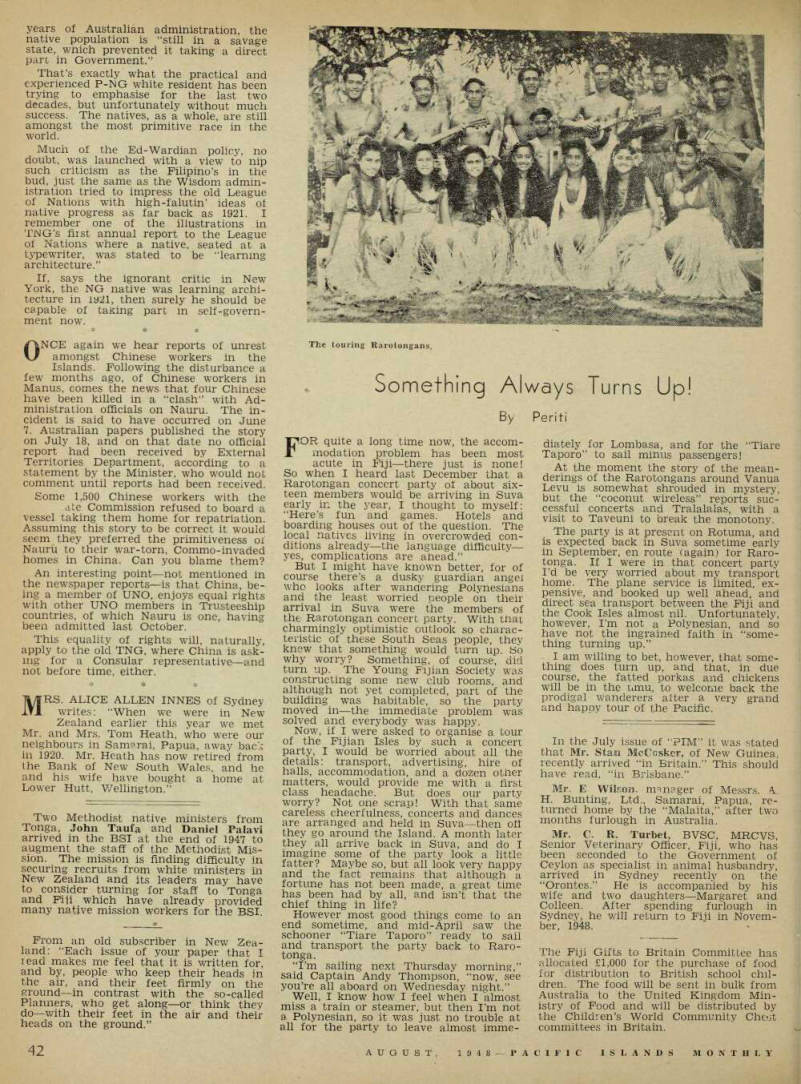
Recently, when Captain Brett Hilder,of the "Muliama," and the Venerable Archdeacon A. E.
Teall, of the Melanesian Mission, were walking on the shores of Aneityum. New Hebrides, they came upon an old iron pot. "Wouldn’t it look good with a missionary in it,” observed Captain Hilder, whereupon the Archdeacon obligingly climbed inside, with this result. This huge pot is one of the relics of the whaling station that flourished on Aneityum under a Mr. Underwood in 1873.
Photo by Capt. B. Hilder.
years of Australian administration, the native population is “still in a savage state, which prevented it taking a direct part in Government.”
That’s exactly what the practical and experienced P-NG white resident has been trying to emphasise for the last two decades, but unfortunately without much success. The natives, as a whole, are still amongst the most primitive race in the world.
Much of the Ed-Wardian policy, no doubt, was launched with a view to nip such criticism as the Filipino’s in the bud, just the same as the Wisdom admin istration tried to impress the old League of Nations with high-falutin’ ideas of native progress as far back as 1921. I remember one of the illustrations in TNG’s first annual report to the League of Nations where a native, seated at a typewriter, was stated to be “learning architecture.”
If, says the ignorant critic in New York, the NG native was learning archi tecture in 1921, then surely he should be capable of taking part in self-govern ment now. * ♦ * ONCE again we hear reports of unrest amongst Chinese workers in the Islands. Following the disturbance a few months ago, of Chinese workers in Manus, comes the news that four Chinese have been killed in a “clash” with Ad ministration officials on Nauru. The in cident is said to have occurred on June 7. Australian papers published the story on July 18, and on that date no official report had been received by External Territories Department, according to a statement by the Minister, who would not comment until reports had been received.
Some 1,500 Chinese workers with the ate Commission refused to board a vessel taking them home for repatriation.
Assuming this story to be correct it would seem they preferred the primitiveness of Nauru to their war-torn, Commo-invaded homes in China. Can you blame them?
An interesting point—not mentioned in the newspaper reports—is that China, be ing a member of UNO, enjoys equal rights with other UNO members in Trusteeship countries, of which Nauru is one, having been admitted last October.
This equality of rights will, naturally, apply to the old TNG, where China is ask ing for a Consular representative—and not before time, either. * * *
Mrs. Alice Allen Innes Of Sydney
writes: “When we were in New Zealand earlier this year we met Mr. and Mrs. Tom Heath, who were our neighbours in Sam?rai, Papua, away back in 1920. Mr. Heath has now retired from the Bank of New South Wales, and he and his wife have bought a home at Lower Hutt, Wellington.”
Two Methodist native ministers from Tonga, John Taufa and Daniel Palavi arrived in the BSI at the end of 1947 to augment the staff of the Methodist Mis sion. The mission is finding difficulty in securing recruits from white ministers in New Zealand and its leaders may have to consider turning for staff to Tonga and Fiji which have alreadv provided many native mission workers for the BSI. m Prom an old subscriber in New Zea land: “Each issue of your paper that I read makes me feel that it is written for, and by, people who keep their heads in the air, and their feet firmly on the ground—in contrast with the so-called Planners, who get along—or think they do—with their feet in the air and their heads on the ground.”
Something Always i urns Up!
By Periti
FOR quite a long time now, the accom modation problem has been most acute in Fiji—there just is none!
So when I heard last December that a Rarotongan concert party of about six teen members would be arriving in Suva early in the year, I thought to myself: “Here’s fun and games. Hotels and boarding houses out of the question. The local natives living in overcrowded con ditions already—the language difficulty— yes, complications are ahead.”
But I might have known better, for of course there’s a dusky guardian angel who looks after wandering Polynesians and the least worried people on their arrival in Suva were the members of the Rarotongan concert party. With that charmingly optimistic outlook so charac teristic of these South Seas people, they knew that something would turn up. So why worry? Something, of course, did turn up. The Young Fijian Society was constructing some new club rooms, and although not yet completed, part of the building was habitable, so the party moved in—the immediate problem was solved and everybody was happy.
Now, if I were asked to organise a tour of the Fijian Isles by such a concert party, I would be worried about all the details: transport, advertising, hire of halls, accommodation, and a dozen other matters, would provide me with a first class headache. But does our party worry? Not one scrap! With that same careless cheerfulness, concerts and dances are arranged and held in Suva —then off they go around the Island. A month later they all arrive back in Suva, and do I imagine some of the party look a little fatter? Maybe so, but all look very happy and the fact remains that although a fortune has not been made, a great time has been had by all, and isn’t that the chief thing in life?
However most good things come to an end sometime, and mid-April saw the schooner “Tiare Taporo” ready to sail and transport the party back 'to Raro tonga.
“I’m sailing next Thursday morning,” said Captain Andy Thompson, “now, see you’re all aboard on Wednesday night.”
Well, I know how I feel when I almost miss a train or steamer, but then I’m not a Polynesian, so it was just no trouble at all for the party to leave almost imme
diately for Lombasa, and for the “Tiare Taporo” to sail minus passengers!
At the moment the story of the mean derings of the Rarotongans around Vanua Levu is somewhat shrouded in mystery, but the “coconut wireless” reports suc cessful concerts and Tralalalas, with a visit to Taveuni to break the monotony.
The party is at present on Rotuma, and is expected back in Suva sometime early in September, en route (again) for Raro tonga. If I were in that concert party I’d be very worried about my transport home. The plane service is limited, ex pensive, and booked up well ahead, and direct sea transport between the Fiji and the Cook Isles almost nil. Unfortunately, however, I’m not a Polynesian, and so have not the ingrained faith in “some thing turning up.”
I am willing to bet, however, that some thing does turn up, and that, in due course, the fatted norkas and chickens will be in the umu, to welcome back the prodigal wanderers after a very grand and happy tour of the Pacific.
In the July issue of “PIM” it was stated that Mr. Stan McCcsker, of New Guinea, recently arrived “in Britain.” This should have read, “in Brisbane.”
Mr. E Wilson, manager of Messrs. A.
H. Bunting, Ltd., Samarai, Papua, re turned home by the “Malaita,” after two months furlough in Australia.
Mr. C. R. Turbet, BVSC, MRCVS, Senior Veterinary Officer, Fiji, who has been seconded to the Government of Ceylon as specialist in animal husbandry, arrived in Sydney recently on the “Orontes.” He is accompanied by his wife and two daughters—Margaret and Colleen. After spending furlough in Sydney, he will return to Fiji in Novem ber, 1948.
The Fiji Gifts to Britain Committee has allocated £l,OOO for the purchase of food for distribution to British school chil dren. The food will be sent in bulk from Australia to the United Kingdom Min istry of Food and will be distributed by the Children’s World Community Cheot committees in Britain.
The touring Rarotongans.
The Story of the Ba Rebellion
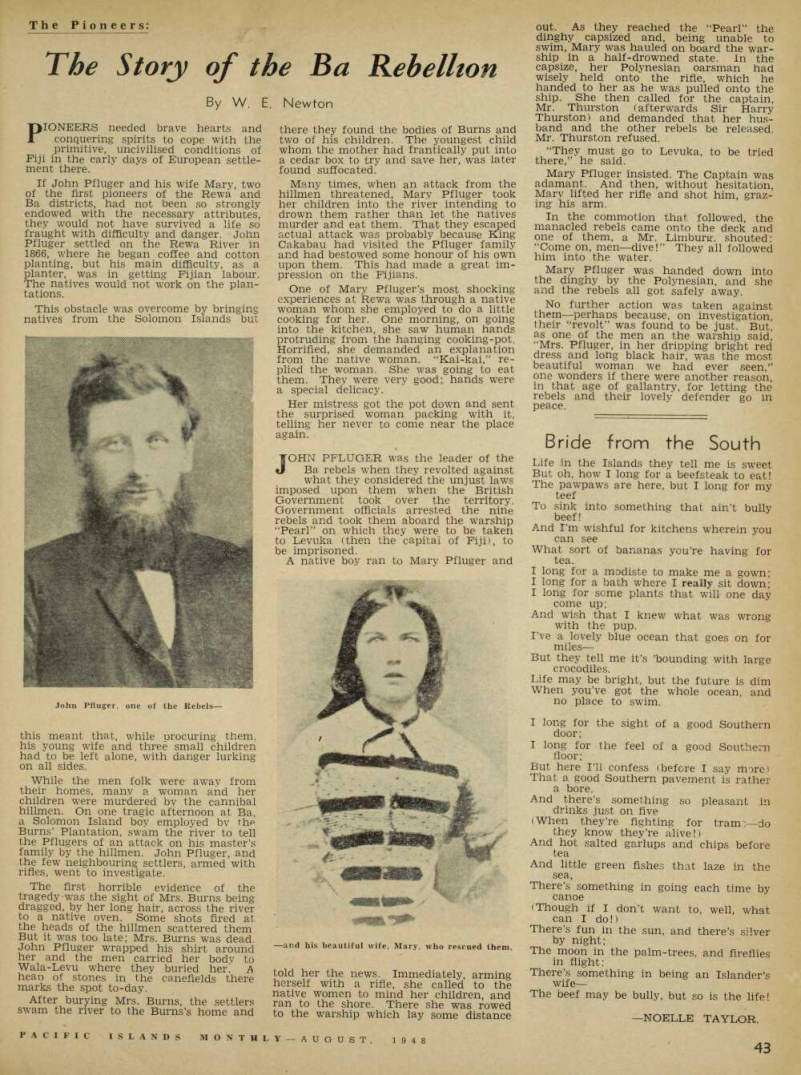
The Pioneers: The Story of the Ba Rebellion
By W. E. Newton
PIONEERS needed brave hearts and conquering spirits to cope with the primitive, uncivilised conditions of Fiji in the early days of European settle ment there.
If John Pfluger and his wife Mary, two of the first pioneers of the Rewa and Ba districts, had not been so strongly endowed with the necessary attributes, they would not have survived a life so fraught with difficulty and danger. John Pfluger settled on the Rewa River in 1866, where he began coffee and cotton planting, but his main difficulty, as a planter, was in getting Fijian labour.
The natives would not work on the plan tations.
This obstacle was overcome by bringing natives from the Solomon Islands but
this meant that, while orocuring them, his young wife and three small children had to be left alone, with danger lurking on all sides.
While the men folk were away from their homes, many a woman and her children were murdered by the cannibal hillmen. On one tragic afternoon at Ba, a Solomon Island boy employed bv thp Burns’ Plantation, swam the river to tell the Pflugers of an attack on his master’s family by the hillmen. John Pfluger, and the few neighbouring settlers, armed with rifles, went to investigate.
The first horrible evidence of the tragedy was the sight of Mrs. Burns being dragged, by her long hair, across the river to a native oven. Some shots fired at the heads of the hillmen scattered them But it was too late; Mrs. Burns was dead.
John Pfluger wrapped his shirt around her and the men carried her body to Wala-Levu where they buried her. A hean of stones in the canefields there marks the spot to-day.
After burying Mrs. Burns, the settlers swam the river to the Burns’s home and
there they found the bodies of Burns and two of his children. The youngest child whom the mother had frantically put into a cedar box to try and save her, was later found suffocated.
Many times, when an attack from the hillmen threatened, Mary Pfluger took her children into the river intending to drown them rather than let the natives murder and eat them. That they escaped actual attack was probably because King Cakabau had visited the Pfluger family and had bestowed some honour of his own upon them. This had made a great im pression on the Fijians.
One of Mary Pfluger’s most shocking experiences at Rewa was through a native woman whom she employed to do a little cooking for her. One morning, on going into the kitchen, she saw human hands protruding from the hanging cooking-pot.
Horrified, she demanded an explanation from the native woman. “Kai-kai,” re plied the woman. She was going to eat them. They were very good; hands were a special delicacy.
Her mistress got the pot down and sent the surprised woman packing with it, telling her never to come near the place again.
JOHN PFLUGER was the leader of the Ba rebels when they revolted against what they considered the unjust laws imposed upon them when the British Government took over the territory.
Government officials arrested the nine rebels and took them aboard the warship “Pearl” on which they were to be taken to Levuka (then the capital of Fiji), to be imprisoned.
A native boy ran to Mary Pfluger and
told her the news. Immediately, arming herself with a rifle, she called to the native women to mind her children, and ran to the shore. There she was rowed to the warship which lay some distance
out. As they reached the “Pearl” the dinghy capsized and, being unable to swim, Mary was hauled on board the war ship in a half-drowned state, in the capsize, her Polynesian oarsman had wisely held onto the rifle, which he handed to her as he was pulled onto the ship. She then called for the captain, Mr. Thurston (afterwards Sir Harry Thurston) and demanded that her hus band and the other rebels be released.
Mr. Thurston refused.
“They must go to Levuka, to be tried there,” he said.
Mary Pfluger insisted. The Captain was adamant. And then, without hesitation, Marv lifted her rifle and shot him, graz ing his arm.
In the commotion that followed, the manacled rebels came onto the deck and one of them, a Mr. Limburg, shouted: “Come on, men—dive!” They all followed him into the water.
Mary Pfluger was handed down into the dinghy by the Polynesian, and she and the rebels all got safely away.
No further action was taken against them—perhaps because, on investigation, their “revolt” was found to be just. But, as one of the men an the warship said!
“Mrs. Pfluger, in her dripping bright red dress and long black hair, was the most beautiful woman we had ever seen,” one wonders if there were another reason, in that age of gallantry, for letting the rebels and their lovely defender go in peace.
John Pfluger, one of the Rebels—
—and his beautiful wife, Mary, who rescued them.
Bride from the South
Life in the Islands they tell me is sweet But oh, how I long for a beefsteak to eat!
The pawpaws are here, but I long for my teef To sink into something that ain’t bully beef!
And I’m wishful for kitchens wherein you can see What sort of bananas you’re having for tea.
I long for a modiste to make me a gown; I long for a bath where I really sit down; I long for some plants that will one day come up; And wish that I knew what was wrong with the pup.
I’ve a lovely blue ocean that goes on for miles — But they tell me it’s ’bounding with large crocodiles.
Life may be bright, but the future is dim When you’ve got the whole ocean, and no place to swim.
I long for the sight of a good Southern door; I long for the feel of a good Southern floor; But here I’ll confess (before I say more) That a good Southern pavement is rather a bore.
And there’s something so pleasant in drinks just on five (When they’re fighting for tram:—do they know they’re alive!) And hot salted garlups and chips before tea And little green fishes that laze in the sea, There’s something in going each time by canoe (Though if I don’t want to, well, what can I do!) There’s fun in the sun, and there’s silver by night; The moon in the palm-trees, and fireflies in flight; There’s something in being an Islander’s wife— The beef may be bully, but so is the life!
Noelle Taylor.
Advertisements & other items, p. 45 (1 item)
43
PACIFIC ISLANDS MONTHLY— A U G U S T , 1948
Out of the Past...
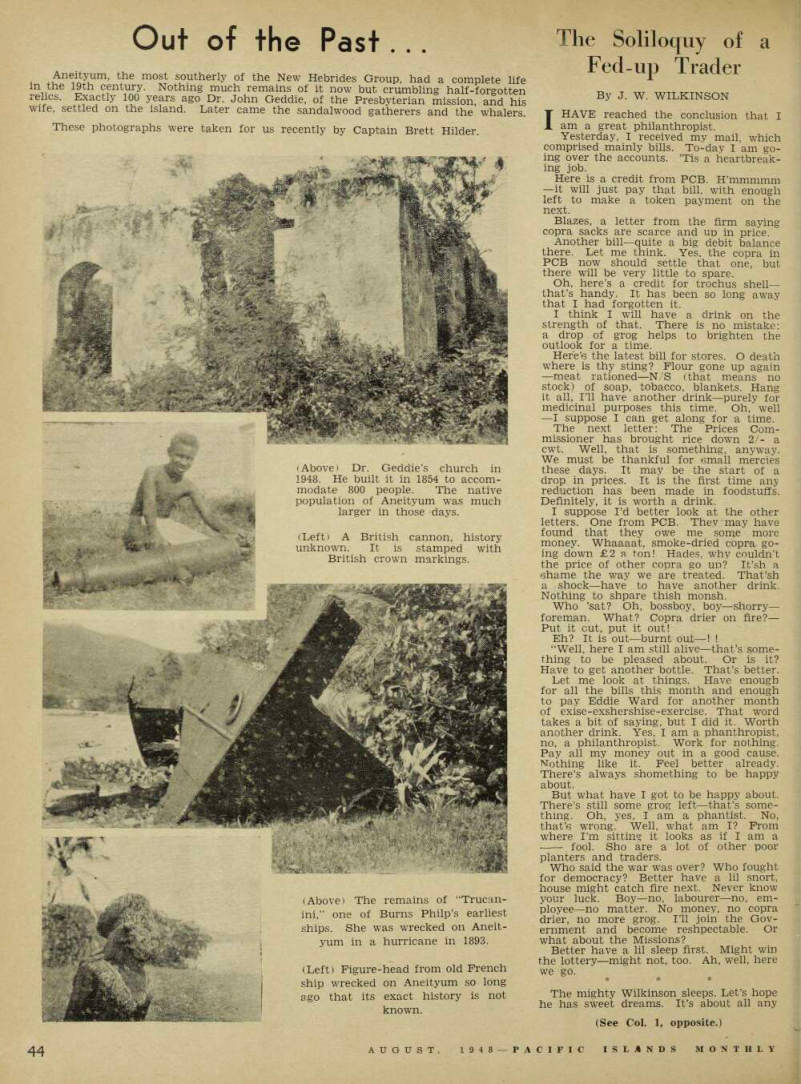
the most southerly of the New Hebrides Group, had a complete life in the 19th century. Nothing much remains of it now but crumbling half-forgotten relics. Exactly 100 years ago Dr. John Geddie, of the Presbyterian mission, and his wife, settled on the island. Later came the sandalwood gatherers and the whalers.
These photographs were taken for us recently by Captain Brett Hilder.
(Above) Dr. Geddie’s church in 1948. He built it in 1854 to accom modate 800 people. The native population of Aneityum was much larger in those days. (Left) A British cannon, history unknown. It is stamped with British crown markings.
(Above) The remains of “Trucan ini,” one of Burns Philp’s earliest ships. She was wrecked on Aneit yum in a hurricane in 1893. (Left) Figure-head from old French ship wrecked on Aneityum so long ago that its exact history is not known.
Fed-up Trader
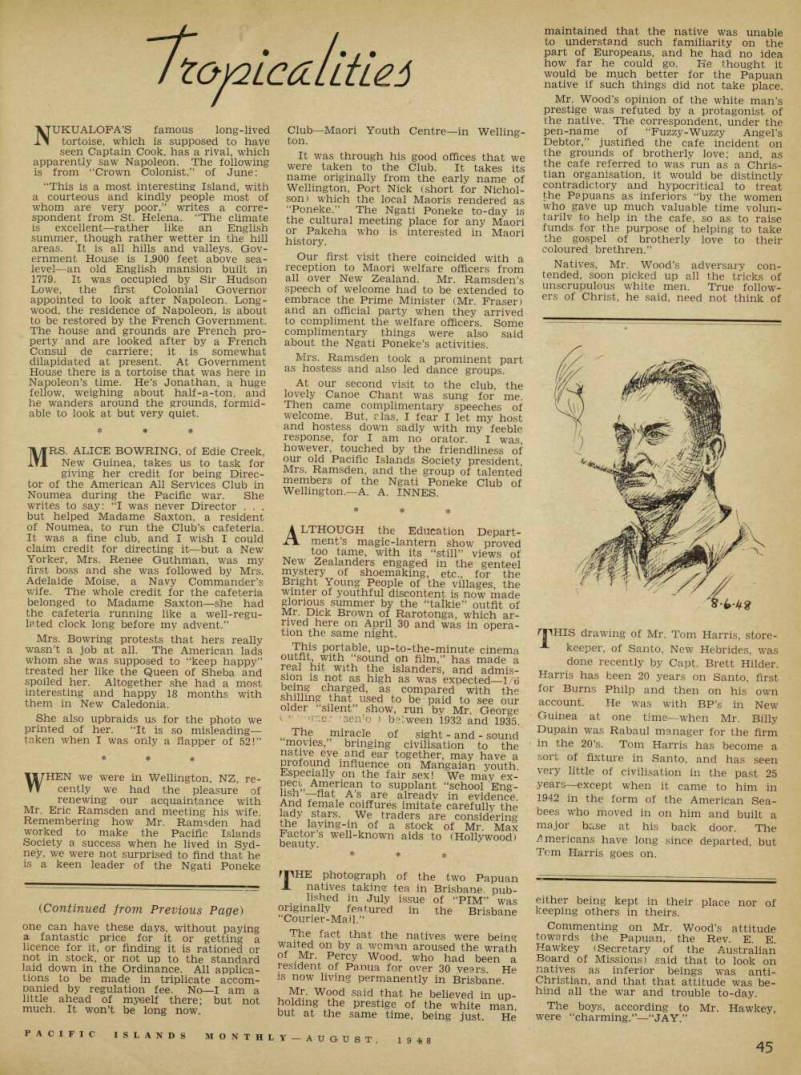
The Soliloquy of a Fed-up Trader
By J. W. Wilkinson
I HAVE reached the conclusion that I am a great philanthropist.
Yesterday, I received my mail, which comprised mainly bills. To-day I am go ing over the accounts. ’Tis a heartbreak ing job.
Here is a credit from PCB. H’mmmmm —it will just pay that bill, with enough left to make a token payment on the next.
Blazes, a letter from the firm saying copra sacks are scarce and un in price.
Another bill —quite a big debit balance there. Let me think. Yes. the copra in PCB now should settle that one, but there will be very little to spare.
Oh, here’s a credit for trochus shell— that’s handy. It has been so long away that I had forgotten it.
I think I will have a drink on the strength of that. There is no mistake: a drop of grog helps to brighten the outlook for a time.
Her'eVs the latest bill for stores. O death where is thy sting? Flour gone up again —meat rationed—N/S (that means no stock) of soap, tobacco, blankets. Hang it all, I’ll have another drink —purely for medicinal purposes this time. Oh, well —I suppose I can get along for a time.
The next letter: The Prices Com missioner has brought rice down 2/- a cwt. Well, that is something, anyway.
We must be thankful for email mercies these days. It may be the start of a drop in prices. It is the first time any reduction has been made in foodstuffs.
Definitely, it is worth a drink.
I suppose I’d better look at the other letters. One from PCB. They may have found that they owe me some more money. Whaaaat, smoke-dried copra go ing down £2 a ton! Hades, why couldn’t the price of other copra go un? It’sh a shame the way we are treated. That’sh a shock —have to have another drink.
Nothing to shpare thish monsh.
Who ’sat? Oh, bossboy, boy—shorry— foreman. What? Copra drier on fire? — Put it cut, put it out!
Eh? It is out —burnt out—! !
“Well, here I am still alive —that’s some thing to be pleased about. Or is it?
Have to get another bottle. That’s better.
Let me look at things. Have enough for all the bills this month and enough to pay Eddie Ward for another month of exise-exshershise-exercise. That word takes a bit of saying, but I did it. Worth another drink. Yes, I am a phanthropist, no, a philanthropist. Work for nothing.
Pay all my money out in a good cause.
Nothing like it. Feel better already.
There’s always shomething to be happy about.
But what have I got to be happy about.
There’s still some grog left —that’s some thing. Oh, yes, I am a phantist. No, that’s wrong. Well, what am I? From where I’m sitting it looks as if I am a fool. Sho are a lot of other poor planters and traders.
Who said the war was over? Who fought for democracy? Better have a lil snort, house might catch fire next. Never know your luck. Boy—no, labourer —no, em ployee—no matter. No money, no copra drier, no more grog. I’ll join the Gov ernment and become reshpectable. Or what about the Missions?
Better have a lil sleep first. Might win the lottery—might not, too. Ah, well, here we go. * * * The mighty Wilkinson sleeps. Let’s hope he has sweet dreams. It’s about all any
(See Col. 1, opposite.)
(Continued from Previous Page ) one can have these days, without paying a fantastic price for it or getting a licence for it, or finding it is rationed or not in stock, or not up to the standard laid down in the Ordinance. All applica tions to be made in triplicate accom panied by regulation fee. No—l am a little ahead of myeelf there; but not much. It won’t be long now.
Tropicalities
NUKUALOFA’S famous long-lived tortoise, which is supposed to have seen Captain Cook, has a rival, which apparently saw Napoleon. The following is from “Crown Colonist,” of June: “This is a most interesting Island, with a courteous and kindly people most of whom are very poor,” writes a corre spondent from St. Helena. “The climate is excellent —rather like an English summer, though rather wetter in the hill areas. It is all hills and valleys. Gov ernment House is 1,900 feet above sea level —an old English mansion built in 1779. It was occupied by Sir Hudson Lowe, the first Colonial Governor appointed to look after Napoleon. Long wood, the residence of Napoleon, is about to be restored by the French Government.
The house and grounds are French pro perty and are looked after by a French Consul de carriere; it is somewhat dilapidated at present. At Government House there is a tortoise that was here in Napoleon’s time. He’s Jonathan, a huge fellow, weighing about half-a-ton, and he wanders around the grounds, formid able to look at but very quiet. * ♦ ♦ MRS. ALICE BOWRING, of Edie Creek, New Guinea, takes us to task for giving her credit for being Direc tor of the American Ail Services Club in Noumea during the Pacific war. She writes to say: “I was never Director . . . but helped Madame Saxton, a resident of Noumea, to run the Club’s cafeteria.
It was a fine club, and I wish I could claim credit for directing it —but a New Yorker, Mrs. Renee Guthman, was my first boss and she was followed by Mrs.
Adelaide Moise, a Navy Commander’s wife. The whole credit for the cafeteria belonged to Madame Saxton—she had the cafeteria running like a well-regu lated clock long before my advent.”
Mrs. Bowring protests that hers really wasn’t a job at all. The American lads whom she was supposed to “keep happy” treated her like the Queen of Sheba and spoiled her. Altogether she had a most interesting and happy 18 months with them in New Caledonia.
She also upbraids us for the photo we printed of her. “It is so misleading— taken when I was only a flapper of 52!” * ♦ * WHEN we were in Wellington, NZ, re cently we had the pleasure of renewing our acquaintance with Mr. Eric Ramsden and meeting his wife.
Remembering how Mr. Ramsden had worked to make the Pacific Islands Society a success when he lived in Syd ney, we were not surprised to find that he is a keen leader of the Ngati Poneke
Club—Maori Youth Centre—in Welling ton.
It was through his good offices that we were taken to the Club. It takes its name originally from the early name of Wellington, Port Nick (short for Nichol son) which the local Maoris rendered as “Poneke.” The Ngati Poneke to-day is the cultural meeting place for any Maori or Pakeha who is interested in Maori history.
Our first visit there coincided with a reception to Maori welfare officers from all over New Zealand. Mr. Ramsden’s speech of welcome had to be extended to embrace the Prime Minister (Mr. Fraser) and an official party when they arrived to compliment the welfare officers. Some complimentary things were also said about the Ngati Poneke’s activities.
Mrs. Ramsden took a prominent part as hostess and also led dance groups.
At our second visit to the club, the lovely Canoe Chant was sung for me.
Then came complimentary speeches of welcome. But, alas, I fear I let my host and hostess down sadly with my feeble response, for I am no orator. I was however, touched by the friendliness of our old Pacific Islands Society president, Mrs. Ramsden, and the group of talented members of the Ngati Poneke Club of Wellington.—A. A. INNES. * * ♦ ALTHOUGH the Education Depart ment’s magic-lantern show proved too tame, with its “still” views of New Zealanders engaged in the genteel mystery of shoemaking, etc., for the Bright Young People of the villages, the winter of youthful discontent is now made glonous summer by the “talkie” outfit of Mr. Dick Brown of Rarotonga, which ar rived here on April 30 and was in opera tion the same night.
This portable, up-to-the-minute cinema outfit, with “sound on film,” has made a real hit with the islanders, and admis sion is not as high as was expected—l d being charged, as compared' with the shilling that used to be paid to see our older silent” show, run bv Mr. George ( v -'me; seme ) bstween 1932 and 1935. » Th ? miracle of sight - and - sound movies, bringing civilisation to the native eye and ear together, may have a profound influence on Mangaian youth Especially on the fair sex! We may ex- American to supnlant “school Eng —fiat A’s are already in evidence.
And female coiffures imitate carefully the lady stars. We traders are considering the laying-in of a stock of Mr. Max Factor’s well-known aids to (Hollywood) beauty. * * * THE photograph of the two Papuan X natives taking tea in Brisbane, pub lished in July issue of “PIM” was originally featured in the Brisbane Courier-Mail.”
The fact that the natives were beino' waited on by a woman aroused the wrath of Mr. Percy Wood, who had been a resident of Panua for over 30 years. He is now living permanently in Brisbane.
Mr. Wood said that he believed in up holdmg the prestige of the white man, but at the same time, being just. He
maintained that the native was unable to understand such familiarity on the part of Europeans, and he had no idea how far he could go. He thought it would be much better for the Papuan native if such things did not take place.
Mr. Wood’s opinion of the white man’s prestige was refuted by a protagonist of the native. The correspondent, under the pen-name of “Fuzzy-Wuzzy Angel’s Debtor,” justified the cafe incident on the grounds of brotherly love; and, as the cafe referred to was run as a Chris tian organisation, it would be distinctly contradictory and hypocritical to treat the Papuans as inferiors “by the women who gave up much valuable time volun tarilv to help in the cafe, so as to raise funds for the purpose of helping to take the gospel of brotherly love to their coloured brethren.”
Natives, Mr. Wood’s adversary con tended, soon picked up all the tricks of unscrupulous white men. True follow ers of Christ, he said, need not think of
7TIHIS drawing of Mr. Tom Harris, store “*■ keeper, of Santo, New Hebrides, was done recently by Capt. Brett Hilder.
Harris has been 20 years on Santo, first for Burns Philp and then on his own account. He was with BP’s in New Guinea at one time—when Mr. Billy Dupain was Rabaul manager for the firm in the 20’s. Tom Harris has become a sort of fixture in Santo, and has seen very little of civilisation in the past 25 years—except when it came to him in 1942 in the form of the American Sea bees who moved in on him and built a major base at his back door. The Americans have long since departed, but Tcm Harris goes on.
either being kept in their place nor of keeping others in theirs.
Commenting on Mr. Wood’s attitude towards the Papuan, the Rev. E. E.
Hawkey (Secretary of the Australian Board of Missions) said that to look on natives as inferior beings was anti- Christian, and that that attitude was be hind all the war and trouble to-day.
The boys, according to Mr. Hawkey,
were “charming.”
“Jay.”
Pacific Nature Notes
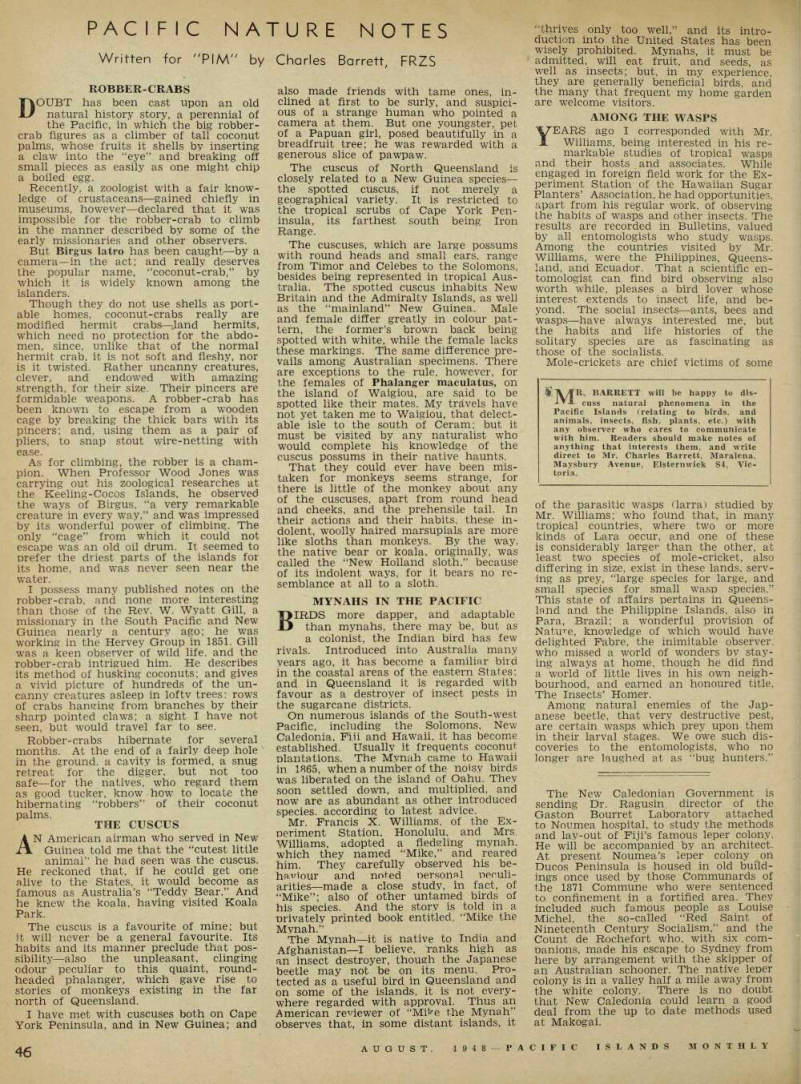
Written for "PIM" by Charles Barrett, FRZS
Robber-Crabs
DOUBT has been cast upon an old natural history story, a perennial of the Pacific, in which the big robber crab figures as a climber of tall coconut palms, whose fruits it shells by inserting a claw into the “eye” and breaking off small pieces as easily as one might chip a boiled egg.
Recently, a zoologist with a fair know ledge of crustaceans —gained chiefly in museums, however —declared that it was impossible for the robber-crab to climb in the manner described by some of the early missionaries and other observers.
But Birgus latro has been caught—by a camera—in the act; and really deserves the popular name, “coconut-crab,” by which it is widely known among the islanders.
Though they do not use shells as port able homes, coconut-crabs really are modified hermit crabs—land hermits, which need no protection for the abdo men, since, unlike that of the normal hermit crab, it is not soft and fleshy, nor is it twisted. Rather uncanny creatures, clever, and endowed with amazing strength, for their size. Their pincers are formidable weapons. A robber-crab has been known to escape from a wooden cage by breaking the thick bars with its pincers: and, using them as a pair of pliers, to snap stout wire-netting with ease.
As for climbing, the robber is a cham pion. When Professor Wood Jones was carrying out his zoological researches at the Keeling-Cocos Islands, he observed the ways of Birgus, “a very remarkable creature in every way,” and was impressed by its wonderful power of climbing. The only “cage” from which it could not escape was an old oil drum. It seemed to prefer the driest parts of the islands for its home, and was never seen near the water.
I possess many published notes on the robber-crab, and none more interesting than those of the Rev. W. Wyatt Gill, a missionary in the South Pacific and New Guinea nearly a century ago; he was working in the Hervey Group in 1851. Gill was a keen observer of wild life, and the robber-crab intrigued him. He describes its method of husking coconuts; and gives a vivid picture of hundreds of the un canny creatures asleep in loftv trees: rows of crabs hanging from branches by their sharp pointed claws; a sight I have not seen, but would travel far to see.
Robber-crabs hibernate for several months. At the end of a fairly deep hole in the ground, a cavity is formed, a snug retreat for the digger, but not too safe —for the natives, who regard them as good tucker, know how to locate the hibernating “robbers” of their coconut palms.
The Cuscus
AN American airman who served in New Guinea told me that the “cutest little animal” he had seen was the cuscus.
He reckoned that, if he could get one alive to the States, it would become as famous as Australia’s “Teddy Bear.” And he knew the koala, having visited Koala Park.
The cuscus is a favourite of mine; but it will never be a general favourite. Its habits and its manner preclude that pos sibility—also the unpleasant, clinging odour peculiar to this quaint, round headed phalanger, which gave rise to stories of monkeys existing in the far north of Queensland.
I have met with cuscuses both on Cape York Peninsula, and in New Guinea; and
also made friends with tame ones, in clined at first to be surly, and suspici ous of a strange human who pointed a camera at them. But one youngster, pet of a Papuan girl, posed beautifully in a breadfruit tree; he was rewarded with a generous slice of pawpaw.
The cuscus of North Queensland is closely related to a New Guinea species— the spotted cuscus, if not merely a geographical variety. It is restricted to the tropical scrubs of Cape York Pen insula, its farthest south being Iron Range.
The cuscuses, which are large possums with round heads and small ears, range from Timor and Celebes to the Solomons, besides being represented in tropical Aus tralia. The spotted cuscus inhabits New Britain and the Admiralty Islands, as well as the “mainland” New Guinea. Male and female differ greatly in colour pat tern, the former’s brown back being spotted with white, while the female lacks these markings. The same difference pre vails among Australian specimens. There are exceptions to the rule, however, for the females of Phalanger maculatus, on the island of Waigiou, are said to be spotted like their mates. My travels have not yet taken me to Waigiou, that delect able isle to the south of Ceram; but it must be visited by any naturalist who would complete his knowledge of the cuscus possums in their native haunts.
That they could ever have been mis taken for monkeys seems strange, for there is little of the monkey about any of the cuscuses, apart from round head and cheeks, and the prehensile tail. In their actions and their habits, these in dolent, woolly haired marsupials are more like sloths than monkeys. By the way, the native bear or koala, originally, was called the “New Holland sloth,” because of its indolent ways, for it bears no re semblance at all to a sloth.
Mynahs In The Pacific
BIRDS more dapper, and adaptable than mynahs, there may be, but as a colonist, the Indian bird has few rivals. Introduced into Australia many years ago, it has become a familiar bird in the coastal areas of the eastern States: and in Queensland it is regarded with favour as a destroyer of insect pests in the sugarcane districts.
On numerous islands of the South-west Pacific, including the Solomons, New Caledonia. Fiji and Hawaii, it has become established. Usually it frequents coconut plantations. The Mynah came to Hawaii in 1865, when a number of the noisy birds was liberated on the island of Oahu. They soon settled down, and multiplied, and now are as abundant as other introduced species, according to latest advice.
Mr. Francis X. Williams, of the Ex periment Station, Honolulu, and Mrs, Williams, adopted a fledgling mynah, which they named “Mike,” and reared him. They carefully observed his be haviour and noted personal peculi arities —made a close study, in fact, of “Mike”: also of other untamed birds of his species. And the story is told in a privately printed book entitled, “Mike the Mynah.”
The Mynah—it is native to India and Afghanistan—l believe, ranks high as an insect destroyer, though the Japanese beetle may not be on its menu. Pro tected as a useful bird in Queensland and on some of the islands, it is not every where regarded with approval. Thus an American reviewer of the Mynah” observes that, in some distant islands, it
“thrives only too well,” and its intro duction into the United States has been wisely prohibited. Mynahs, it must be admitted, will eat fruit, and seeds, as well as insects; but, in my experience, they are generally beneficial birds, and the many that frequent my home garden are welcome visitors.
Among The Wasps
YEARS ago I corresponded with Mr.
Williams, being interested in his re markable studies of tropical wasps and their hosts and associates. While engaged in foreign field work for the Ex periment Station of the Hawaiian Sugar Planters’ Association, he had opportunities, apart from his regular work, of observing the habits of wasps and other insects. The results are recorded in Bulletins, valued by all entomologists who study wasps.
Among the countries visited by Mr.
Williams, were the Philippines, Queens land, and Ecuador. That a scientific en tomologist can find bird observing also worth while, pleases a bird lover whose interest extends to insect life, and be yond. The social insects —ants, bees and wasps—have always interested me, but the habits and life histories of the solitary species are as fascinating as those of the socialists.
Mole-crickets are chief victims of some
of the parasitic wasps (larra) studied by Mr. Williams; who found that, in many tropical countries, where two or more kinds of Lara occur, and one of these is considerably larger than the other, at least two species of mole-cricket, also differing in size, exist in these lands, serv ing as prey, “large species for large, and small species for small wasp species.’’
This state of affairs pertains in Queens land and the Philippine Islands, also in Para, Brazil; a wonderful provision of Nature, knowledge of which would have delighted Pabre, the inimitable observer, who missed a world of wonders by stay ing always at home, though he did find a world of little lives in his own neigh bourhood, and earned an honoured title, The Insects’ Homer.
Among natural enemies of the Jap anese beetle, that very destructive pest, are certain wasps which prey upon them in their larval stages. We owe such dis coveries to the entomologists, who no longer are laughed at as “bug hunters.”
The New Caledonian Government is sending Dr. Ragusin. director of the Gaston Bourret Laboratory attached to Noumea hospital, to study the methods and lay-out of Fiji’s famous leper colony.
He will be accompanied by an architect.
At present Noumea’s leper colony on Ducos Peninsula is housed in old build ings once used by those Communards of the 1871 Commune who were sentenced to confinement in a fortified area. They included such famous people as Louise Michel, the so-called “Red Saint of Nineteenth Century Socialism,” and the Count de Rochefort who. with six com nanions, made his escape to Sydney from here by arrangement with the skipper of an Australian schooner. The native leper colony is in a valley half a mile away from the white colony. There is no doubt that New Caledonia could learn a good deal from the up to date methods used at Makogai.
Advertisements & other items, p. 48 (1 item)
lljAyfß. BARRETT will be happy to dis-
lljAyfß. BARRETT will be happy to disiVx cuss natural phenomena in the Pacific Islands (relating to birds, and animals, insects, fish, plants, etc.) with any observer who cares to communicate with him. Readers should make notes of anything that interests them, and write direct to Mr. Charles Barrett, Maralena, Maysbury Avenue, Elsiernwick S 4, Victoria.
Johnny Frisble's Story
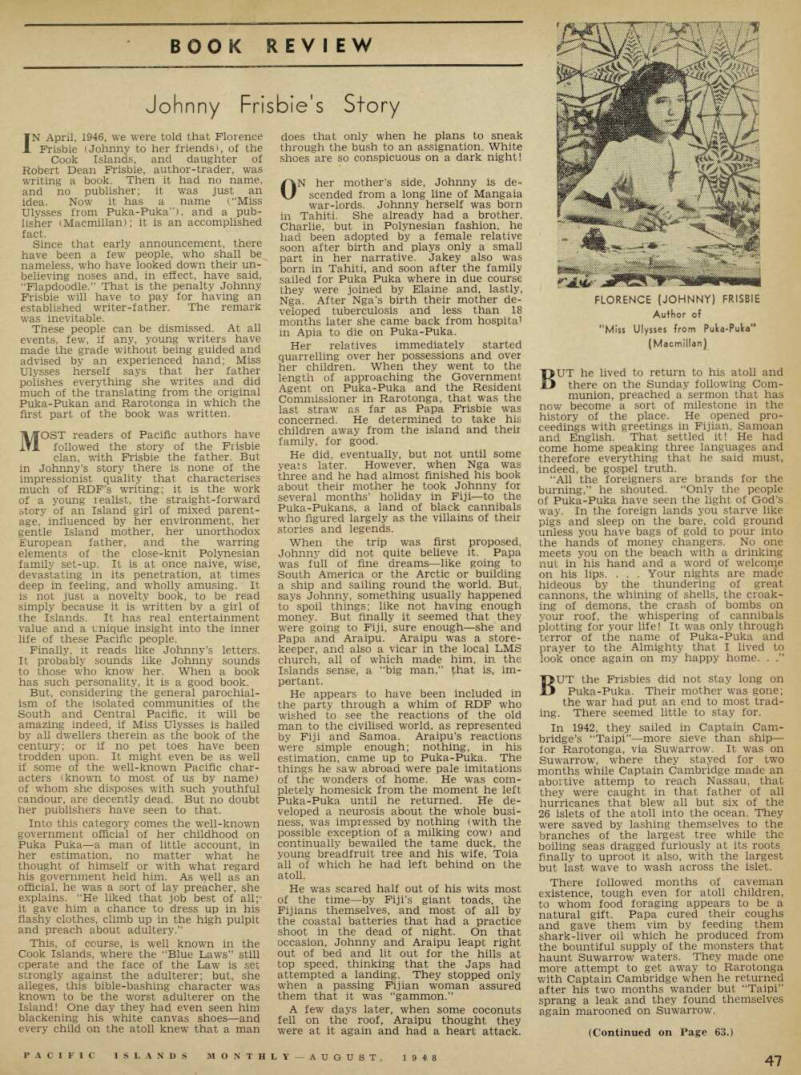
Book Review
IN April, 1946, we were told that Florence Frisbie (Johnny to her friends), of the Cook Islands, and daughter of Robert Dean Frisbie, author-trader, was writing a book. Then it had no name, and no publisher; it was just an idea. Now it has a name (“Miss Ulysses from Puka-Puka”), and a pub lisher (Macmillan); it is an accomplished fact.
Since that early announcement, there have been a few people, who shall be nameless, who have looked down their un believing noses and, in effect, have said, “Flapdoodle.” That is the penalty Johnny Frisbie will have to pay for having an established writer-father. The remark was inevitable.
These people can be dismissed. At all events, few, if any, young writers have made the grade without being guided and advised by an experienced hand; Miss Ulysses herself says that her father polishes everything she writes and did much of the translating from the original Puka-Pukan and Rarotonga in which the first part of the book was written.
MOST readers of Pacific authors have followed the story of the Frisbie clan, with Frisbie the father. But in Johnny’s story there is none of the impressionist quality that characterises much of RDF’s writing; it is the work of a young realist, the straight-forward story of an Island girl of mixed parent age, influenced by her environment, her gentle Island mother, her unorthodox European father, and the warring elements of the close-knit Polynesian family set-up. It is at once naive, wise, devastating in its penetration, at times deep in feeling, and wholly amusing. It is not just a novelty book, to be read simply because it is written by a girl of the Islands. It has real entertainment value and a unique insight into the inner life of these Pacific people.
Finally, it reads like Johnny’s letters.
It probably sounds like Johnny sounds to those who know her. When a book has such personality, it is a good book.
But, considering the general parochial ism of the isolated communities of the South and Central Pacific, it will be amazing Indeed, if Miss Ulysses is hailed by all dwellers therein as the book of the century; or if no pet toes have been trodden upon. It might even be as well if some of the well-known Pacific char acters (known to most of us by name) of whom she disposes with such youthful candour, are decently dead. But no doubt her publishers have seen to that.
Into this category comes the well-known government official of her childhood on Puka Puka —a man of little account, in her estimation, no matter what he thought of himself or with what regard his government held him. As well as an official, he was a sort of lay preacher, she explains. “He liked that job best of all;* it gave him a chance to dress up in his flashy clothes, climb up in the high pulpit and preach about adultery.”
This, of course, is well known in the Cook Islands, where the “Blue Laws” still operate and the face of the Law is set strongly against the adulterer; but, she alleges, this bible-bashing character was known to be the worst adulterer on the Island! One day they had even seen him blackening his white canvas shoes —and every child on the atoll knew that a man
does that only when he plans to sneak through the bush to an assignation. White shoes are so conspicuous on a dark night!
ON her mother’s side, Johnny is de scended from a long line of Mangaia war-lords. Johnny herself was born in Tahiti. She already had a brother.
Charlie, but in Polynesian fashion, he had been adopted by a female relative soon after birth and plays only a small part in her narrative. Jakey also was born in Tahiti, and soon after the family sailed for Puka Puka where in due course they were joined by Elaine and, lastly, Nga. After Nga’s birth their mother de veloped tuberculosis and less than 18 months later she came back from hospital in Apia to die on Puka-Puka.
Her relatives immediately started quarrelling over her possessions and over her children. When they went to the length of approaching the Government Agent on Puka-Puka and the Resident Commissioner in Rarotonga, that was the last straw as far as Papa Frisbie was concerned. He determined to take his children away from the island and their family, for good.
He did, eventually, but not until some yeais later. However, when Nga was three and he had almost finished his book about their mother he took Johnny for several months’ holiday in Fiji—to the Puka-Pukans, a land of black cannibals who figured largely as the villains of their stories and legends.
When the trip was first proposed, Johnny did not quite believe it. Papa was full of fine dreams—like going to South America or the Arctic or building a ship and sailing round the world. But. says Johnny, something usually happened to spoil things; like not having enough money. But finally it seemed that they were going to Fiji, sure enough—she and Papa and Araipu. Araipu was a store keeper, and also a vicar in the local LMS church, all of which made him. in the Islands sense, a “big man,” that is, im portant.
He appears to have been included in the party through a whim of RDF who wished to see the reactions of the old man to the civilised world, as represented by Fiji and Samoa. Araipu’s reactions were simple enough; nothing, in his estimation, came up to Puka-Puka. The things he saw abroad were pale imitations of the wonders of home. He was com pletely homesick from the moment he left Puka-Puka until he returned. He de veloped a neurosis about the whole busi ness, was impressed by nothing (with the possible exception of a milking cow) and continually bewailed the tame duck, the young breadfruit tree and his wife, Toia all of which he had left behind on the atoll.
He was scared half out of his wits most of the time —by Fiji’s giant toads, the Fijians themselves, and most of all by the coastal batteries that had a practice shoot in the dead of night. On that occasion, Johnny and Araipu leapt right out of bed and lit out for the hills at top speed, thinking that the Japs had attempted a landing. They stopped only when a passing Fijian woman assured them that it was “gammon.”
A few days later, when some coconuts fell on the roof, Araipu thought they were at it again and had a heart attack.
BUT he lived to return to his atoll and there on the Sunday following Com munion, preached a sermon that has now become a sort of milestone in the history of the place. He opened pro ceedings with greetings in Fijian, Samoan and English. That settled it! He had come home speaking three languages and therefore everything that he said must, indeed, be gospel truth.
“All the foreigners are brands for the burning,’’ he shouted. “Only the people of Puka-Puka have seen the light of God’s way. In the foreign lands you starve like pigs and sleep on the bare, cold ground unless you have bags of gold to pour into the hands of money changers. No one meets you on the beach with a drinking nut in his hand and a word of welcome on his lips. .. . Your nights are made hideous by the thundering of great cannons, the whining of shells, the croak ing of demons, the crash of bombs on your roof, the whispering of cannibals plotting for your life! It was only through terror of the name of Puka-Puka and prayer to the Almighty that I lived to look once again on my happy home. .
BUT the Frisbies did not stay long on Puka-Puka. Their mother was gone; the war had put an end to most trad ing. There seemed little to stay for.
In 1942, they sailed in Captain Cam bridge’s “Taipi”—more sieve than ship— for Rarotonga, via Suwarrow. It was on Suwarrow, where they stayed for two months while Captain Cambridge made an abortive attemp to reach Nassau, that they were caught in that father of all hurricanes that blew all but six of the 26 islets of the atoll into the ocean. They were saved by lashing themselves to the branches of the largest tree while the boiling seas dragged furiously at its roots, finally to uproot it also, with the largest but last wave to wash across the islet.
There followed months of caveman existence, tough even for atoll children, to whom food foraging appears to be a natural gift. Papa cured their coughs and gave them vim by feeding them shark-liver oil which he produced from the bountiful supply of the monsters that haunt Suwarrow waters. They made one more attempt to get away to Rarotonga with Captain Cambridge when he returned after his two months wander but “Taipi” sprang a leak and they found themselves again marooned on Suwarrow.
(Continued on Page 63.)
Florence (Johnny) Frisbie
Author of "Miss Ulysses from Puka-Puka" (Macmillan)
TAGUA” finally took them off—to Manihiki, where they were received like Royalty, in spite of the rags to which they had been reduced, and the fact that they had lost all their ready cash in the hurricane. Here they taught the Manihikians the songs and dances of Puka-Puka, Fiji and Samcia, made the acquaintance of Abel Williams and his good wife, and learned what war meant to the atolls.
For it was while they were at Mani hiki that Superman dropped in from the skies and, soon afterwards, a transport came and picked up most of the able bodied men on the atoll for work on nearby Penrhyn, where the Americans were building an aerodrome. (James Norman Hall based his story, “Lost Island” upon this piece of war-time destructive construction).
Superman was, of course, an American, He arrived unexpectedly in a seaplane while young Jakey and a party of Manihikians were headed sedately by sail-boat to a wedding party across the lagoon. Jakey alone had seen a plane but no one lost any time leaping over board, wedding finery and all.
When the plane landed, the hatch opened and Superman’s head popped out.
He was looking for a gent named Abel Williams. Did he happen to be swim ming around there any place?
“No, sir,” said Jakey, who was the only one who could speak English, but who also was hanging onto a coral head, up to his neck in water. “He’s in the village.’’
“Well, son, tell these bathing beauties to bring their boat up alongside before I get mad and start laying eggs.”
When Jakey translated this information literally there was complete panic. No
one had heard bombs referred to as eggs and they were more than ready to be lieve that a man who could appear out of the clouds in a plane might well be capable of making a nest on one of their bird islets and start laying eggs in it.
That seemed terrifying for some reason and they all stayed where they were.
“What in hell’s the matter?” yelled Superman, and Jakey replied: “They’re afraid you’ll lay those eggs, Mister. They never saw a man lay an egg before!”
Superman burst into laughter and the party relaxed. They retrieved their boat and rowed him ashore, where they got as close as possible to killing him with
kindness. Next day he signed on 120 men for work on Penrhyn Island.
(Continued Next Page)
SUPERMAN did his publicity work well oc Penrhyn and the fame of Manihiki hospitality was thus spread throughout the US Navy. When the Manihikians returned home after their three months’ labour, 11 American officers came with them. On this occasion, says Johnny, the celebration that followed made the welcome to Superman and the welcome to themselves, even added together and multiplied by 10, seem like a
funeral. One hundred and twenty Mani hikians had returned to their love-starved wives and sweethearts; eleven millionaires (the Americans) had landed with them Result: an explosion, Next morning. Johnny’s disillusionment was complete. The village was dead; the eleven officers almost so. They struggled to Abel’s place for their last meal. They were unshaven, their eyes bloodshot, their jaws hung down. They drank strong
coffee laced with rum, and every one of them “had his elbows on the table, which is very bad manners. Maybe they thought that no one would know the dif ference on a primitive island like Mani hiki. They must have been badly brought up. One of them ate with his mouth open, another one held his fork in his fist as though it was a fish spear, and a third one knocked his coffee cup over be cause he had left his spoon in his cup.
“We could see that Mrs. Williams was ashamed of her guests; but, nevertheless, after the meal, she gave them each a beautiful hat and a fan. We could hear them thanking her and promising to send her all kinds of wonderful presents; and we could see her weary smile. She had been hearing those kinds of promises since she was a little girl, but seldom had she received any of the fine presents. The same applies to my family.”
WE’LL leave Johnny there. If you are not narrow-minded you will like her book. Some day, perhaps there will be an English edition on sale in the South Pacific. We hope that it will sell a million copies—or at least sumcient to let her look at real civilisation, as she says she wishes to do. But just to look, and then return to her South Seas. We have nothing worth a damn for Johnny Prisbie in our set-up. There should be an important place for such a youngster in the New
Pacific.-
J.T.
(“Miss Ulysses from Puka-Puka.” Published by The Macmillan Company, New York. Price $3.)
Service Section
Around Sydney Shops
OPRING FEVERS: August is the month when “Spring Openings’’ compete with “Winter Clearances” (in the drapery world it is no longer the done thing to speak of “sales”). So far the clearances are winning in a canter, due, no doubt, to the fact that this is the first time that clothing has been coupon free for six years. Retailers are taking the opportunity to rid themselves of accumu lated stocks. You would be disappointed, however, if you expected bargains. The clothes may be old-fashioned, but the prices are not.
The director of one of Sydney’s largest emporiums, at great expense, have imported a collection of Christian Dior models which are calculated to set Aus tralia by the ears. In case you don’t know.
Christian Dior was the gentleman (French) who invented the New Look. On Australian standards, his collection is ridiculous, impractical for this part of the world, and looks exactly like some thing mother wore back in 1916. Never theless, at the gala, super-dooper open ing in Sydney on July 31, it was greeted as a sensation by the cafe-society of the town, who rolled up to gaze and to partake of the champagne buffet-supper Proceeds were in aid of the Food for Britain Fund.
One gown was described as a sheath of black wool with a horse-collar of taffeta. If anyone should fancy this num ber we will do our best for you, by direct representation.
SUBSIDIES: One of the things with which Australia was threatened by Papa Ben Chifley if they voted “No” at the referendum last May, was the removal of domestic subsidies. He has kept his pro mise and one of the commodities affected is woollen goods. The subsidy ended with July. About five months’ stocks are held by manufacturers, but when these are used up it is expected that woollen piece goods will increase in price by about 10/per yard; knitting wool by 6/- per pound.
There is a whisper that the subsidy may be revived. The steep increase in the cost of clothing which would result is likely to bring down the wrath of Aus tralia on the Government rather than on the Opposition—which was apparently the original idea of Chifley & Co.
SWIM SUITS: The beginning of August saw the release of the first 1948 swim-suits. In spite of the icy blasts from the mountains there were some takers.
If you have a pre-war model tucked away somewhere —resurrect it. No one will know the difference.
Bare middles, G-strings, and so-called French bathing-suits are out. One-piece costumes are the thing. In plain or printed satin lastex they are anything up to £5. In less glamorous fabrics they cost from 30/- up. Some of last season’s white elephants are selling for as little as 10/-.
Drive-Yourself Cars: Cars Can
be hired by the day, week or month, but like other things, the rates have gone up tremendously. As an example for those who contemplate this kind of holiday, we
quote one firm which offers 10 HP sedans at £lO/10/- per week. This allows for a maximum mileage of 150 miles. If this is exceeded in the week then an extra 7d. per mile is charged. Another firm which hires out American sedans quotes £l2/10 - per week. If you would like to trail a caravan along—which can be ex ceedingly pleasant—it would cost you a further £5 per week.
FOOD PARCELS: Food parcels for Britain, and indeed all parcels for Britain which are required to arrive there for Christmas, should be attended to now, without delay. It still takes months for these parcels to arrive at their destination, in spite of considerable complaint in Aus tralia.
Those who wish parcels to be sent to friends in Britain for Christmas presents should state whether or not they want a greeting card enclosed. The price of food parcels varies from 16 - to 27/-, which includes Australian postage of 5/10.
Advertisements & other items, pp. 50-52 (1 item)
Classified Advertisements
PACIFIC ISLANDS SERVICE
BUREAU
THE Pacific Islands Service Bureau has been established to assist Island residents who cannot shop for themselves.
Briefly, we will perform those services for you, in Australia, which you cannot perform yourself, or are outside the scope of ordinary mail-ordering.
We will purchase and forward goods to you; have repairs made on your behalf; send flowers, sweets, fruits, gifts to trends in Australia for you, or to your children at school in Australia; match materials and sewing accessories; and arrange holiday accommodation and travel.
For these services we charge a small fee —in the case of shopping services, usually 10 per cent, of the purchase price.
If you missed the circular which explains this service fully and which was included in all copies of “PIM” which went to the Islands in March, please let us know and we will send you a copy of the pamphlet, free of charge.
All inquiries should be addressed to: The Director, Pacific Service Bureau, Box 3408, Sydney.
CLASSIFIED ADVERTISEMENTS
Positions Vacant
Applications are invited for the position of General Secretary to the Planters and Traders’
Association of New Guinea. Salary, £BOO-£l,OOO (tax free), according to qualifications. Qualified Accountant with Secretarial and Commercial experience. Organising ability essential. Knowledge of tropics desirable. Returned Servicemen will receive preference. Single accommodation provided. Fare to Rabaul will be refunded after 12 months’ service and three months’ leave on full pay with return fare after two years. Applications will be strictly confidential and must be forwarded to “Selection Committee,’’ Planters and Traders’ Association, of New Guinea, Rabaul, not later than September 18. 1948.
Positions Wanted
Young man, aged 25, seeks position anywhere in Pacific, Two and a half years in Pacific islands, no ties of any sort, energetic and willing to do any job “Seeker,” c/o GPO Box 3408, Sydney.
Pacific Islands. Lae or Port Moresby, by Single Man, aged 34. 12 years General Stores Experience. First-class Drivermechanic; ex-Army Projectionist.
Present employed as a Carpenter on Housing Scheme. Preferably relieving Position. Reply to: Harry Morris, Lakes Street, Thirlmere, NSW.
Territories JP
Mr. Stanley A. Greenland, formerly of Papua public service, and now resident at “Selsdon,” 16 Macleay Street, Potts Point, Sydney, has been appointed a Justice of the Peace for the Territory of Papua-New Guinea —a fact worth noting by persons in Sydney who may require an official Territories signature.
Legal Notices
IN THE ESTATE of TOM GREENSLADE GOSS, late of Toma Plantation, Kokopo, in the Territory of New Guinea, Planter, deceased, intestate.
CREDITORS having claims against the estate of the abovenamed deceased, who died on the twenty-ninth day of August, 1942, are called upon to submit their claims verified by affidavit to Burns, Philp Trust Company, Limited, of 7 Bridge Street, Sydney, the Administrator of the abovenamed estate, within three months from the date of publication hereof after which time the Administrator will proceed to distribute the estate having regard only to claims of which it then shall have had notice in writing.
DATED this twenty-second day of July, 1948.
GREENWELL & YORK,
Solicitors for the Company,
SYDNEY.
IN THE ESTATE of EDWARD LAWLEY
PINCHING, late of Manguna, New Britain, in the Territory of New Guinea, Planter, deceased, intestate.
CREDITORS having claims against the estate of the abovenamed deceased, who died on the first day of July, 1942, are called upon to submit their claims verified by affidavit to Burns, Philp Trust Company, Limited, of 7 Bridge Street, Sydney, the Administrator of the abovenamed estate, within three months from the date of publication hereof, after which time the Administrator will proceed to distribute the estate having regard only to claims of which it then shall have had notice in writing.
Dated this twentysecond day of July, 1948.
GILBERT M. JOHNSTONE & CO.,
Proctors for the Company,
SYDNEY.
BURNS PHILP (New Guinea) LIMITED
General Merchants (Wholesale and Retail)
Shipping, Customs and General Agents
Head Office; PORT MORESBY, PAPUA
BRANCHES:
NEW GUINEA: Rabaul, Kokopo, Lae & Madang.
PAPUA; Samarai.
Distributing Agents, Territory of Papua-New Guinea for;
SHELL COMPANY OF AUSTRALIA LIMITED
Petroleum Products
GENERAL MOTORS CORPORATION
Chevrolet, Buick, Pontiac and Oldsmobile Cars
REPRESENTATIVES FOR:
QUEENSLAND INSURANCE CO. LTD.
LLOYDS OF LONDON
BURNS PHILP TRUST CO. LTD.
BURNS, PHILP & CO. LTD.
All States.
BURNS, PHILP & CO. LTD.
"London House", 35 Crutched Friars, E.C.3.
BURNS, PHILP CO. OF SAN FRANCISCO INC. 510 Matson Building.
AUSTRALIAN AGENTS:
LONDON AGENTS:
SAN FRANCISCO AGENTS:
Chevrolet and GMC Trucks Frigidaire Refrigerators
VAUXHALL MOTORS LIMITED
Vauxhall Cars and Bedford Trucks
R. A. LISTER fir CO., BRISTOL
Producers of Petrol, Parrofin and Diesel Engines Pumps and Lighting plants
RUSTON HORNSBY LIMITED
Engines
CROSSLEY MARINE ENGINES
EYE LOTION
For Inflamed Eyes and Eyelids ... Sold Everywhere H, Rose&Co., Pty.. Ltd.. Kinq Street. Sydney.
PAPAIN WANTED
To Planters and Traders in the
South Pacific islands
We have Urgent Inquiries, by United States Interests, for Supplies of Papain (the Latex of the Paw-paw Tree).
The price offered is high, and the market firm. Here is a new means of increasing your income, at little cost and trouble. Pawpaw Trees can be “milked” a year after planting. Send your Inquiries to us—air-mail, where possible.
PACIFIC ISLANDS TRADING COMPANY
244 California Street, San Francisco 11, U.S.A.
CABLES and RADIOS: “PITCO,” San Francisco.
r \ : ”:::!:;:s;;r : sskjp*^ 1 V isrt! , ' ■ - ' :
Brighten
the home with
BRASSO
METAL POLISH
J
Report On The Solomon Islands
Dr. Rutter Sums up the Problems at a London Press Conference
D R t G • RUTTER, who was the officer in charge of Methodist Mission health work in the Solomon
Islands for 10 years, and since the war, Chief Medical Officer in the Pro tectorate, returned with Mrs. Rutter to England in March. At a press con
ference at the Colonial Office, London,
on June 30, Dr. Rutter had this to say about the post-war era in BSI: THERE are only about 150 Europeans In the Solomons. About half the Euro pean population formerly living in Tulagi in the Eastern Solomons have now moved to the main island of Gaudal canal. Before the war life was rather primitive but since the American occupa tion we jhave inherited some of their amenities. We have some roads, our lives are now more mechanised than was the case before the war, we have inherited a pipe-water supply and electric light.
But, for persons living away from the capital, life is still primitive.
The question is often asked: What has been the effect of the war upon the native population of the Solomon Islands?
In the popular mind, the effect tends to be rather exaggerated, although in some cases, of course, there has been a pro found effect. But only a small propor tion of the native population ever saw a Japanese or American soldier. The population is scattered over a very wide area and not more than 10 per cent, had any contact at all with the American Forces. In those Forces excellent dis cipline maintained and there was a segregation of the Forces from the native population which minimised the effect of the occupation.
During the war there was a heavy re cruitment for the labour battalion. In some districts whole villages were des troyed in the war and there was an acute shortage of labour but that shortage is passing. The effect of the war upon the native population is far less than one would have imagined and I think the greater part of that effect will vanish in a reasonably short time.
There was the rise of the Marching Rule Movement which caused some poli tical disturbance. The origin of that phrase is obscure. It was an indepen dence movement, rather bound up with a refusal to work. Partly, its rise was as sociated with the social and economic conditions during the American occupa tion and partly with the general political unrest among native populations every where. At first it was regarded as a rather healthy type of independence movement. There was a tendency among the people to feel that the Americans had more to offer them than the British had but that tendencv has now practically gone. Having let the movement go on for some time, the Government then found that it had developed certain illegal ten dencies such as the setting up of auto nomous courts and the Government last year took a rather firm stand. Leaders of the movement were arrested and, where they had actuallv transgressed the law, were imprisoned. But there was no harshness. In fact, some of the leaders were sent to Fiji on observation courses to see for themselves the working of the Native Administration there.
The old capital, Tulagi, has been com pletely destroyed and a new capital is now being built at Guadalcanal, although it has the major disadvantage of not hav ing a good harbour. The site was selected partly because of its proximity to Hen derson Airfield and also because Guadal
canal is the island where future develop ment in agriculture, timber and gold mining is likely to occur. Very elaborate plans were made for the building of the new capital but we are faced with a great shortage of building materials and we have to make use of salvaged material already on the island. Certain materials have been brought in from outside, but these supplies are negligible.
The copra plantations, the staple in dustry of the islands, were destroyed and the industry has been faced with the necessity of making a fresh start. The only link with the outer world is a 300 tons steamer plying between the Solo mons and Suva. (The small Burns Philp motor vessel “Muliama” began a Sydney- Honiara service in July.) That is why the rehabilitation of the copra industry has been so slow. Churches, schools, etc., have been destroyed and there is great difficulty in getting sufficient salvaged material to get them going again.
THE type of administration in the Solomon Islands before the war was inadequate. An attempt is being made to establish a definite development scheme under the Colonial Development and Welfare Acts.
Different departments are being de veloped. One is the medical department which was woefully inadequate for its tasks before the war. But, as I have said, we have to deal with the requirements of a population scattered over a very wide area and so there are great difficulties in the way of administration and medical service. In the past year we have quad rupled our expenditure on medical work in the Solomons. The Education Depart ment, which is now being developed, did not exist before the war. The work was done by the missions and they did very good work indeed. Now, there is a
Director of Education and an inspectorate of schools.
The government is trying to expand communications through the purchase of some small ships.
Then there is the development of native administration. The Government is in ducing the native population to take a bigger share in, and greater responsibility for, the management of their own affairs.
There is development of native councils, native schools and, in certain areas, native taxation regulations by which, under the supervision of the District Commissioner, taxes are levied, collected and spent.
The shipping difficulty is the main problem. Once that is solved, the de velopment plans will go ahead. With in creasing mechanisation, even in copra making, production is likely to in crease.
American War Graves
Mission In Islands
From Our Own Correspondent SUVA, July 19.
THE American Army ship LST 711 is now in the course of a tour of the South Pacific with the American Graves Registration Service (Pacific Zone) Search and Recovery Expedition aboard.
The expedition, under the command of Lieutenant R. I. Trapp, USN, is making a final visit to the Islands in search of the remains of American Second World War dead, and after leaving Fiji will go to the New Hebrides, New Zealand, Aus tralia, New Britain, New Ireland, the Admiralty Islands, the Carolines, the Solomons, Santa Cruz, the Gilbert and Ellice Groups and the Marshalls.
The Maori representative Rugby team, which will travel to Fiji by plane, will arrive at Laucala Bay on July 21, and will leave again for Auckland on August 9, after playing a series of matches.
Advertisements & other items, pp. 53-54 (1 item)
(Cutmsfi)
American Magazines
Direct to You from the
Publishers.
AMERICAN HOME 21/6
CHARM 32/6
COLLIERS’ WEEKLY 52/6
CORONET 18/9
FORTUNE 96/-
GLAMOUR 27/-
HOUSE & GARDEN 42/6
LADIES’ HOME JOURNAL 37/6
LIFE 49/-
LOOK 32/-
McGRAW-HILL DIGEST 31/3
MAGAZINE DIGEST 18/9
NATIONAL GEOGRAPHIC MAGAZINE .. 38/6
POPULAR MECHANICS 22/9
POPULAR PHOTOGRAPHY 26/6
READERS’ DIGEST 12/-
SATURDAY EVENING POST 68/9
SCIENTIFIC AMERICAN 40/-
SCIENCE ILLUSTRATED 62/6
TIME 96/-
VOGUE (20 numbers) 105/-
YACHTING 40/-
ESQUIRE 75/-
Rates are for one year and include all charges. Many other overseas
Art, Trade, Technical, Fashion and
Literary periodicals available.
ALL ORDERS AIR-MAILED TO
PUBLISHERS.
MAIL PUBLICITY CO., 175 PITT
STREET, SYDNEY, N.S.W.
(cUTMSfI)
Wholesale & Retail Merchants. Shipowners. Sawmillers. General Engineers. Customs & Shipping
Agents.
Catering for all Plantation Supplies. Buyers of Island Produce. Plantation Owners & Managing Agents. ttith T v LTD-
COLTER- V/ATSOH B \ sban e.
Sydney, Melbourne, Agents for;— Australia-West Pacific Line China Navigation Co.
Canton Insurance Office Ltd.
Union Assurance Society Ltd.
National Mutual Life Assurance of A/sia Ltd.
Guinea Air Traders Ltd.
Steamships Trading Co.
Ltd.
Associated ITO .
C OUER.*SU C’churcVi-
Wellington, Distributing Agents in New’
Guinea for:— Chrysler & Plymouth Cars Fargo Trucks Hillman & Humber Cars. Commer Trucks.
Willys Overland Jeeps G.M. Marine & Industrial Engines Prefect Refrigerators Mallard Radios Hygeia Dissolvenators Snowflake Unsweetened Evaporated Milk Olympic Tyres & Cables
DON'T SAY GIN
GIN DON'T SAY
DON'T SAY G I N
GIN DON'T SAY
DON'T SAY SIM
GIM DON'T SAY
DON'T SAY GIN
GIN DON'T SAY
DON'T SAY GIN
GIN DON'T SAY
DON'T SAY GIN
I N DON'T SAY
DON'T SAY GIN
DON'T SAY G I N
GIN DON'T SAY
DON'T SAY gJM
GIN DON'T SAY
DON'T SAY (JIM
GIM DON'T SAY
DON'T SAY GIN
GIN DON'T SAY
DON'T SAY GIM
GIN DON'T SAY
DON'T SAY GIN
GIN DON'T SAY
DON'T SAY GIN
DON'T SAY GIN
LpON'T say
DON'T SAY G I N
G-wy Wjva w
1 N DON'T SAY
DON'T SAY GIM
DON'T SAY
N
DON
D Y S Ll ou IT* °Ur * C °C y<b ey T S &£S Qf *e
DON"
GIN DON'T S
DON'T SAY GIN
DON'T SAY G I N
G SAY
DO G 0 AY N
SAY
IN
'T SAY
DON'T SJPP*G I N
DON'T SAY GIM
GIM DON'T SAY
DON'T SAY GIN
DON'T SAY
N Y S AY * M H •Ibo I To * Co c Kt
SAY
♦ IM
T SAY
IN
DON'T
DON'T
GIN DON'T
DON'T SAY G 1
Address all inquiries to: Telegrams and Cables: "GILBETS,” Melbourne,
W. & A. GILBEY LTD.
Telegrams and Cables: “GELBEYS,” Sydney. 33 ROSSLYN STREET, WEST MELBOURNE. 109 REGENT STREET, SYDNEY.
Sundays Mixed
When They Got Their
An Amusing Incident In Rarotonga In 1897-9
By James E. Cormack
THE equanimity of Santa Claus was rudely shattered in 1899 when Cook Islands Parliament decreed that he should work double-time. As the poor fellow had neglected to organise, his ap peals were refused; even the New Zea land watersiders left him cold. For the first time in his ageless career this usually tranquil figure went his Yuletide rounds with a flea in his ear—two nights in succession.
Until the “Christmas Day Act” of 1899 this church notice appeared weekly in the local press: “English service will be held to-day, Sunday, at the London Missionary Society’s Church, Avarua, at 11 o’clock a.m. Service will be held at the Seventh-day Adventist Mission to morrow, Sunday. . . .”
It is hardly surprising that pioneer missionaries to Polynesia should have overlooked that imaginary line between today and tomorrow, for the 189th meri dian was not finally fixed as the Inter national Date-Line until 1884. The ap parent gain or loss of a day was not noticed; and, along with Tahiti, Samoa and other islands, the Cook Group fell into the error of living one day late.
Later, the French put things right in Tahiti, and Samoa also repaired the error; but the Cook Islands remained out of step, with the result that LMS services were held on the actual Saturday (locally called Sunday) and the Seventh day Adventists, who had been more care ful in their reckoning, observed the local Sunday, as this was in reality the seventh day of the week.
Little inconvenience was felt until the group began to find its place in the sun.
As trade increased, and ships came for Islands produce, local traders were faced with the absurdity of ships’ crews rest ing on the local Monday (which to them was Sunday) while the populace refused to work on their local Sunday. In many ways it was soon found embarrassing to be out of kilter with the world.
IN 1897, a petition signed by Father Bemadine and 21 other Europeans was presented to Parliament, re questing that that august assembly should “deliberate and adjust with all due care the day for the observance of Sunday in the Cook Islands. . . . Your Petitioners would now humbly pray that your honourable Parliament will, dining this session, give due consideration to this grave question, and enact that the cor rect day should be observed as Sunday in the Cook Islands, so that we are not isolated in this observance from the rest of the civilised world.”
The petition came before Parliament, and a deputation of honourable members was forthwith sent to wait upon Mr.
Hutchin of the LMS Mission, “asking him how It was that the wrong day had been given them.”
Mr. Hutchin replied that the first missionaries there had not dropped a day in crossing the 180th meridian, and that was how the mistake had occurred.
Parliament thrashed the matter out in heated debate and “ultimately it was decided that, as the present Sabbath had been observed ever since the landing of the first missionaries, it was not ad visable to alter it.” Native reasoning ran true to form.
THIS anachronism could not continue in a modern age. By 1899 the reins of government were more firmly held, and Lieut-Col. Gudgeon, the new
British Resident, decided to get Cook Islands onto the correct calendar by having two Christmas Days in that year.
5® Y22°Slss-J* R !!!K
. , Without further dallying the “Christmas Day Act” passed both houses, and received the signatures of Makea Ariki and the British Resident. The edict is P lain «* “An Act to regulate the Calendar and assimilate the days of the week and months to those of other countries east of the 180th degree of Longitude.
“Be it enacted by the Parliament ol the Cook Islands with the approval of the British Resident. <<Th ® short title of this Act shall be the ‘Christmas Day Act, 1899.’
“2.—The 25th and 26th of December of the New Zealand Calendar shall be ob served as the Christmas Day within the islands of the Cook Group and shall be treated as one day and be called the 25th day of December, 1899. It shall further be held that the day following the said 25th shall be Tuesday the 26th day of December ...”
As this became law, the entire commu
nity fell into line—all except Putaura and his disciples.
The LMS and the Catholics observed the actual first day of the week of east longitude, and the Seventh-day Adventists continued to observe the Biblical Sab bath, which now was called Saturday instead of Sunday, as previously.
PUTAURA, the dissentient, was a native pastor of the LMS Mission Because of his fanatical opposition to the corrected calendar, he was quickly unfrocked and out of a job. With him it was not a moral question of the correct da 3L O ?. w P r ship, for every man has the right to follow the dictates of his con science on this score.
Putaura set himself up as the final authority on the calendar, and opposed the rightful correction of time. He fool ishly incited a small following to flag rantly commit illegal acts on Sunday, for the sake of annoying the community.
For this he was brought before the High Court and fined a nominal sum.
Evidently, news of this rolled around the world; and, like the proverbial snow ball, it gathered as it went, until this sensational masterpiece of journalistic credulity appeared in all seriousness in an American paper under the startling caption, “Rarotongans Slaughtering The Europeans”: “Minneapolis, June 26.—A ‘Times’ special from Seattle, Washington, says* One of the strongest rebellions which has taken place in the last 100 years is in full swing in Rarotonga, a Pacific Island under British rule in the South Seas.
Advices from the Orient give full par ticulars of the progress of the uprising, which had spread over the whole island.
The natives are advancing on the Euro pean Settlement along the coast and are threatening the capital.
“If it were not for the war in South Africa and the Chinese disturbances, the rebellion would create worldwide com ment.
“The inhabitants of the island were originally brought in touch with civilisa tion through the efforts of missionaries sent out by the London Missionary Society. Through the disturbing effects of the 180th degree Longitude, the first arrivals to advance the cause of Chris tianity set the usual day, Sunday, for service. As is well known, at the degree of Longitude mentioned the days jump back twenty-four hours. Since discover ing their mistake the Christian leaders of the island attempted to rectify it. The move made the natives superstitious to a degree and, upon urging the change, the Christians aroused a sullen resentment.
Now this has changed to active hostilities and, thinking that the white people were deceiving them all along, the natives are murdering and butchering on all sides.
“The greatest carnage and rapine are being witnessed. Over fifty Europeans have already been killed. At the last reports they were fortifying various coun try towns, and were preparing for a des perate resistance. All the business houses and the Government headquarters on the island have adopted the new Sunday, and are siding with the whites.
“An appeal will be made for assistance from Great Britain, according to to day’s advice,”
We are wondering if Santa Claus put the yam around—for he was really an noyed, way back in ’99.
Among the 160 guests at the celebration of Prance’s National Day, July 14, in the Guild Cafe Theatre, Brisbane, were the retiring Governor of New Caledonia, M.
Parisot, and Madame Parisot; the Collec tor of Customs in New Caledonia. M. D.
Mascarf, and his wife; the Port Pilot of Noumea, M. Louis Le Fevre, and Madame Le Fevre; Commandant Louis Martineau and officers of the French motor vessel, “Monkay.”
Advertisements & other items, pp. 55-56 (1 item)
Ouo&tnt
K/"
P 9 Energy lost during the day is speedily restored when Imperial Hampe is served for the evening meal Hampe, sliced or diced, makes cool, energising salads, sandwiches and savouries, and the satisfying flavour lasts to the very end.
Quick and simple to prepare, Hampe is a treat for all the family.
Ouo&tnt
A** Try Imperial Meaireat, Corned Beef, Hot Meals
Imperial
Flavour Seated Canned Foods Riverstone Meat Co., 5-7 O’Connell Street, Sydney Fiji Representative: Pearce & Co. Ltd., Suva
Woven Wire for all Industry
COPRA DRYING TRAYS, FLOORS, Etc.
FRUIT DRYING TRAYS, MINING SCREENS.
Heavy Mosquito Gauze in Phosphor Bronze and other Metals Impervious to Salt Sea Air.
WIRE DOOR MATS AND GENERAL WIRE WORKS
E. WRIGHT & CO. LTD.
Office and Works: 148-152 Cleveland Street, Sydney, N.S.W.
Telegraphic Address: "Wrlghtmake,” Chippendale.
o* T V
ft Sr V;
INDOORS or OUT. ..
BRILLIANT LIGHTING
WHEN AND WHERE
REQUIRED
KAYEN
The All Australian Kerosene Pressure Lamp
DORMAN
MARINE DIESELS
British made quality power units 15 h.p. to 100 h.p. 6 models, all electric. Suitable for commercial, fishing or pleasure boats. Specification on request.
"I t 4"
Prevention is Better than Cure
*> - * €5
PREVENT DECAY WITH
DEKOL
Guards Wood and Canvas from the Ravages ©f WHita Anfs, Borers, Dry Rot, Mildew, Etc.
DEKOL penetrates deeply and permanently prefects wood and fabrics from rot and attacks by fungi and insects. it it simple to apply end when dry can be petated and varnished. DtKOL prevents attack by marine borers on wood immersed in sea water.
W. Kopsen & Co. Pty. Ltd.
SHIPCHANDLERS AND MARINE ENGINEERS
376-382 KENT STREET, SYDNEY. PHONE: MA6336 (9 lines).
Cables: ‘KOPSEN” Sydney.
How We Fixed
A Leak
A Memory of Old Papua
By C. O. Anderson
IN the year 1917 I found myself master of a small steamer on the Papuan coast. She was the “Wakefield,” be longing to the New Guinea Development Coy., recently established in Papua as a planting and trading concern. She was very old, and had been trading on the North Queensland coast for many years before coming to Papua. Her bottom plates had been wearing thin, and patches had to be put on at every annual overhaul .on the slip before the inspector would let her off.
At the latter end of her career, in the middle of 1918, I had to take her to Cape Nelson (on the NE coast of Papua) to pick up some four or five dozen re cruits for rubber tappers in the Central Division.
At Cape Nelson I had to wait for the recruits to arrive from inland and, on the second day there, I had dinner with the RM, and I returned to the “Wake field” at the wharf about 11 p.m.
In passing the afterpart of the engine room, on my way to my cabin (which was situated on the bridgedeck), I noticed some trickle of water below and, thinking some watercock had not been properly closed, I told the No. 1 engine-boy (who happened to be about) to slip down and investigate, and I proceeded to my cabin.
While I was in the act of undressing, the boy arrived and reported: “No Tau bada all together cock he all right, but water he come over on top aft on top of wall.”
There was a bulkhead in the after part of the engineroom, some 4 feet high.
There must have been a lot of water in the afterhold to seep over the bulkhead.
I rushed down to investigate, then I got the crew out to lift off the hatches. I found some five feet of water in the hold, which was quite empty of anything else.
Strangest of all, I could actually see a hole in the bottom when the lower hatch was removed. It was a beautiful moon light night, but in spite of that I could hardly believe my eyes.
TTGWEVER. I told a tall Papuan who JX happened to be near me to get down and put his foot on it. He called out: “He hole all right, Taubada.”
I bade him keep his foot on it and I went to rouse the engineer, who had been ashore with the trader, and evi dently had dined well, but not wisely— he was unresponsive to my shaking.
When I tried to tell him that the ship might be sinking, he grunted out: “So and so let her sink.” There was no time to argue, so I just pulled him out on to the floor and left him.
We had no steam up, and fires were out until the recruits turned up. I wanted the engineer to get steam up and the pumps to work; but, as it was, I decided to try and get some help from the RM.
The boy, keeping his foot on the hole, stopped the influx of water for the time and, after watching the rest of the crew baling, I noticed the water going down a little. So I set off up the hill again to the RM. He had not retired, and he very kindly supplied 15 police, with buc kets and tins, and came down with me himself.
I was surprised to note that the water in the hold had increased again in my absence—until I discovered that the en gineer had got down in,the water, kicked the boy away from the hole, and was hugely enjoying himself swimming about
in the cool water, which served to sober him up.
We got some rags stuffed into the hole and, with the added manpower, we soon caught up on the loss caused by the engineer’s little joke. Steam was got up and the pumps set going, and by day break we were able to fasten the discs (which the engineer had got ready) to the outside of the hull by a boy swim mer, and she was a tight steamer once more. I did not report the occurrence, because I knew we were due on the slip on reaching Port Moresby.
The recruits turned up the following day and we left, and had no sign of more leaks. It became necessary to go another trip to the west before going on the slip; so we decided that, as I had not reported on the happening in Sam arai when passing through, we would still keep it quiet. We made a good trip to Daru and back, and then went on the slip—for the last time as it proved, as the old boat was then scrapped and is now acting as a breakwater at Stewart’s Slip, Port Moresby.
The shipping inspector must have got “outside information” about the whole thing. He one day called me to his office and, after listening to my explanation, he remarked: “And you did not think that a small hole in a bottomplate was of enough importance to report?”
I said: “No. We had it fixed up securely and safely, as our successful voyage without any sign of leak proved.”
He let it go at that.
C. O. Anderson.
Mr. A. Foster, of the Printing and Stationery Department, Fiji, who has been awarded a scholarship under the Colonial Development and Welfare scheme, has left for the United Kingdom where he will spend three years at the London School of Printing.
The Rev. R. L. Challis, formerly a missionary in Rarotonga, arrived at Wellington, NZ, from England in July. He will take charge of the Congregational Union’s activities among Polynesians who have come to New Zealand. His head quarters will be in Auckland.
Mr. George Weller, well-known foreign correspondent of the “Chicago Daily News,” has been on a brief visit to Fiji.
Mr. Weller was last in the Colony as a war correspondent in 1943.
Advertisements & other items, pp. 57-58 (1 item)
Wormseared
G. H. Robinson
ISLAND SUPPLIES
of all kinds—Selected and Shipped to order at lowest possible prices—Piecegoods in Wool, Cotton and Silk, Under and Outerwear, Manchester, Drapery, Grocery, Hardware, Engineers and Leathergoods trade supplies a specialty.
Indents and Transhipments arranged. Large or small orders treated with equal care.
Use our 25 years’ extensive experience.
Enquiries solicited to—
G. H. ROBINSON
51 Macquarie Street, Sydney, N.S.W.
Telegrams: Sunrise, Sydney.
Letters: Box 3317, G.P.0., Sydney.
WORMSEARED
CHAIN HOISTS
The hand-operated Wormgeared Hoist is a general purpose lifting device, compact and easy to handle. The Wormgear is designed to give comparatively high efficiency and long life. A simple and effective brake insures safe holding of the suspended load.
Available in rated capacities from 10 cwts. to 3 tons.
Also makers of: A.B.C. Electric Chain Hoists, Vs, l, 2 tons capacity.
“Victor” Spurgeared Chain Hoists from 10 cwts. to 20 tons.
Triple Geared Chain Hoists from 10 cwts, to 20 tons.
Worm Geared Chain Holsts from 10 cwts. to 3 tons.
Weston Chain Blocks from 5 cwts. to 2 tons.
Shackles, Hooks, Sheave and Snatch Blocks.
AUSTRALIAN BLOCK & CHAIN CO.
PTY., LTD.
Robbs Road, WEST FOOTSCRAY, W. 12,
VICTORIA
Phones: MW 1373-74-75.
Telegraphic Address: “ CHAINS LOCK,” MELBOURNE.
Correspondence to Box 34, TOOTSCRAY, W.ll, VICTORIA.
TILLEY LAMPS
BURN ORDINARY KEROSENE
The Modern Form of PORTABLE LIGHTING
MW / i THE OWL IS PROVERBIALLY A WISE BIRD. SO BE SURE YOU FOLLOW HIS EXAMPLE! TILLEY LAMPS ARE SO SUCCESSFUL THAT COPIES OF THEM ARE BEING MARKETED. TILLEY LAMPS ARE MADE ONLY IN ENGLAND THE TILLEY LAMP CO. LTD., of ENGLAND
REPRESENTATION :
MELBOURNE : T. H. Bentley, Pty. Ltd., 123-125 William Street, Melbourne, Cl.
TASMANIA : Mr. C. Sellars, 108 a Charles Street, Launceston.
FIJI : Mr. K. Wltherington, 2 Burns Philp Buildings, Suva.
Madang News
From a Special Correspondent
Madang, July 25.
A.D.O. HURRELL and his wife, Mar garet, are now the parents of 1 a baby daughter. The child was born in Madang European Hospital.
The arrival of the “Yankee,” the American tourist brig, caused consider able interest here. Captained by the well-known author, Irving Johnston, the ship is a sailing vessel that was built in 1912 by the Germans. It was used in both wars as a training vessel until taken as a prize of war by the English.
Accompanying Mr. Johnston and his wife are a crew of journalists, travellers and photographers, including three women. The Johnstons’ 12-year-old son is on his third trip round the world.
In nine months since leaving Massa chusetts, this world cruise has included the Panama Canal, Hawaiian Islands, Tahiti, Pitcairn Island, Fiji, and the Solomon Islands. Wewak, Singapore, and Bangkok are next ports on. the list.
Judge Phillips was detained in Madang recently when the plane on which he was travelling to Wewak had to return to Lae for repairs.
At the annual meeting of the Madang Club, Mr. George Tyrell presided. Retir ing officers were re-elected and the Sec retary, Mr. Allan Clark, was given life membership in recognition of his efforts in supervising the erection of the Club building.
Some well known Madangites who re turned on the “Montoro” included Mr.
John Prince of the New Guinea Com pany; Miss Betty Schilling, of Matapai Plantation; Mrs. Luff of Siar Planta tion; Mrs. E. J. and Miss Wauchope of Awar; Mrs. Walker and Mr. W. M.
Middleton and his son and Mr. Geoff Bliss, of Dylup Plantation.
The American Lutheran Mission has started constructing the hospital at Amele. Already equipment and appli ances have been ferried across the Gum River. Mr. Yetmar is in charge of build ing operations, while it is understood that Dr. T. Braun will take on the work of medical superintendent.
The much overloaded Madang power house is now showing signs of strain resulting in continusl blackouts. Resi dents have been requested to use a mini mum amount of power. It is hoped that by this means we will continue to have
light until the new generators arrive to supply a heavier output.
First of the new T. type bungalows is being erected in Madang. General opin ion is that it is unsuitable for the tropics as it allows a maximum of glare, has insufficient space and a minimum of comfort for life in trying conditions.
Mr. Andrews, manager of the Madang branch of the Commonwealth Bank, arrived on the “Montoro.” He hopes to commence business on August 16 in tem porary premises erected by the New Guinea Company.
Mr. T. Warburton, local manager of Burns Philp (NG) Ltd., is off to Australia on leave. He will be relieved by Mr.
Douglas Ewing.
Mr. Len Barnard, of Bogia, has re signed from the Administration to take charge of a leper colony for the Seventh Day Adventist Mission.
Captain Brooks, RAN, Naval officer in charge. New Guinea, paid a short visit to Madang late in the month.
Mr. T. Render, of the New Guinea Company, left Madang for Australia on leave recently.
Advertisements & other items, p. 59 (1 item)
Aluminium Roofing
We Will Buy
It For You
Any goods you may require from English shops or factories Purchased and Shipped.
Small or large orders catered for.
ALL SERVICES UNDER-
TAKEN FOR RESIDENTS
ABROAD.
PITT & SCOTT
LIMITED
(Established 1876) General Shipping and Buying Agents. 1/3, St. Paul's Churchyard, London, England Cables. Shipping London.
(Established 1906).
ATKINS, KROLL & CO.
IMPORTERS.
320 CALIFORNIA STREET
SAN FRANCISCO 4, CALIFORNIA.
Cable Address: Atisco, San Francisco.
EXPORTERS.
General Exporters:
FOODSTUFFS.
HARDWARE.
LUMBER.
TEXTILES
MACHINERY.
Importers:
COPRA.
VANILLA BEANS.
COCOA BEANS.
SHELLS.
Monthly Merchandise
South Sea Distributors:
WILSON & CO.
Canned Meats.
B. P. GOODRICH CO.
Canvas Footwear.
A. SCHILLING & CO.
Coffee, Spices, Tea, Extracts.
THE GLIDDEN CO.
Paints & Varnishes.
Bulletins upon Request.
Aluminium Roofing
'U Now available for shipment to Pacific Islands Aluminium Corrugated Roofing is rustless and is the lightest of all fabricated roofing materials. This is a point worth remembering when considering freight costs. Heat due to solar radiation is substantially reduced when Aluminium roofing is used.
Inquiries tor-
UNION LIMITED
(Incorporated in the Dominion of Canada) Largest Distributors of Aluminium and its alloys in the British Commonwealth OCEAN HOUSE, 34 MARTIN PLACE, SYDNEY. N.S.W.
A Member of the Aluminium Limited Group, Montreal. Canada
ALUMINIUM
Electricity
Appeal To Suva To Save Electricity
From Our Own Correspondent SUVA. July 25.
THE Fiji Government having jibbed at the idea of restricting the sale of electrical appliances in Suva shops, the Suva Town Board has issued an appeal to the public to reduce the con sumption of electricity to a minimum.
Rationing is threatened if the appeal goes unheeded.
Judging by the lack of response to a previous appeal to conserve power, cuts of some sort are probably on the way.
The Fijian cricket tour of New Zealand this year resulted in a net profit of £7lO in New Zealand currency (about £639 Fijian) to the Fiji Cricket Association.
Intermarriage In The
Islands
Letter to the -Editor IN your issue of March, a Fijian reader, E. Raivoka, states that “any mis cegenation is criminal,” with regard to the intermarriage of Islanders and white persons. This appears to me a sweeping generalisation.
As one of the “accused,” and one who cheerfully pleads guilty in the first de gree, I would like to show a different view of this alleged “Pacific problem,” which here at Mangaia is no problem at all.
I assume that Fijian-Euronesians possess the same land rights as full blooded Fijians. If so, there should be no “half-caste problem.” Here at Mangaia, the child inherits the mother’s lands and has the same standing as both a Euro pean and a Maori. I can well imagine that a large, landless, unanchored half
caste community, keeping to itself as a group and perhaps despising the full blooded native as an inferior, is undesir able, both from native and Administra tion points of view. I have never seen such a group in the Cook Islands. I would say that it is not the racial mix ing, but the lack of “foundation,” in half-caste society, that is evil. As in dividuals, the Euronesians are no more “mongrels” than the “full-blooded” islanders. Half-castes with one white parent are usually very good types here; but even this, according to our Fijian critic, is so undesirable that the white man who marries a native girl should be deported.
Raivoka should surely be aware, with his obvious education and culture, that even the allegedly full-blooded native is not of pure Polynesian or Melanesian ancestry. The Fijians, like the Maori, are the product of racial blendings. The origin of the races was in the meeting of two distinct racial groups—Africans and Arabs, for example—by pure accident of navigation.
I must also disagree with the “PIM” editor’s suggestion that inter-marriage is, perhaps, “socially unwise.” Why is it?
We of Mangaia do not find this so.
The concluding editorial statement, that “natural law seems to offer no barrier whatever” to miscegenation is in accord with my own contention that Nature does not object to it, and there fore men should not call it a crime.
I am, etc.,
Edwin Gold.
Mangaia, May 5.
Mi*. R. L. Hartley, who has been appointed Agricultural Education Officer, Fiji, is due to sail from the United King dom on August 26.
Advertisements & other items, p. 60 (1 item)
C. Sullivan Pty. Ltd.
S*oas4, to^Cs Ctjs/xdr
GIOBITE
TRAVEL CASES
As manpower and raw materials available, increased quantities of Globltes will be manufactured. So ask first for Globitel Made by ford sherington ltd.
C. SULLIVAN PTY. LTD.
Island Me
Over 30 years' experience in the Pacific Island Trade.
Expert Buying Service Original Invoices Furnished Sellers of Island Produce.
Represented in all Australian States, New Zealand, England, France, United States, etc.
BANKERS: Bank of New South Wales, Comptoir National d’Escompte de Paris, Bank of New Zealand.
C. SULLIVAN PTY. LTD.
379 KENT STREET, SYDNEY
Telegrams & Cables: CHASULL, Sydney. Phone: MJ4657 (6 lines).
Origin of Tin Can Mail

Letter to the Editor 11HE Australian Broadcasting Commis sion asked me to do a brief News Review on the Tin Can Mail at the time that the population of Niua-foou was evacuated. It was based on an in terview given an Auckland newspaper many years before by Mr. Ramsay and on information given me personally by Ton gans who served with the Fijian scout ing units in the Solomons during the war.
It supplements the interesting and valu able explanation given by Count F. T.
Goedicke-Van Asten in the May issue of “PIM.” The five minute script read (in part):— Even people who have not travelled, have heard of Tin Can Island and its swimming postman. Authority on the service is English-born C. S. Ramsay, a frequent visitor to Auckland. He served with the New Zealanders in World War I, then became a trader. He has more recently managed the Morris Hedstrom store at Haapai. When he went to Niua’foou in 1921, he found that in the hurri cane season the people were deprived of communications for six months of the year.
Some years previously the mail had been sent from passing ships with rockets, but the mail was sometimes scorched in the process and the rockets set Are to the bush.
“I swam during the bad season!” Mr.
Ramsay says. “Owing; to interest shown by tourists, the captain of a ship asked me to keep it up. For ten years 1 con tinued the Tin Can Mail all the year round.”
Tongans give pride of place as post man to old Mr. Quensell, another trader.
He was succeeded by his son, C. Dugal Quensell, a half-caste whose Polynesian v,omo ic TnVnlp He Used to SWim OUt regularly with the mail from the time he was 10 or 12. To-day, he is a handsome, upstanding man, in his thirties, who runs a large store at Nukualofa.
Lacking anchorage, steamers at Tin Can Island anchor half a mile out. So the swim, demanding phvsical fitness, is one within the powers of o eood Austra lian life-saver. Shipping lines have co operated. and those on the regular Sydney-San Francisco run made it a point to cruise in the vicinity. On more than one occasion, ships have been flagged with a request for supolies when the islands only radio-set had conked out There’s no harbour and no beach, but the interest of travellers became keen, as the years went bv, and shioping lines felt they had “inherited the welfare” of the islanders.
Tin Can Island stamps, one may sup pose, will now mount greatly in value, but Pacific travellers will miss seeing the island post in operation.
I am, etc.,
H. E. L. Friday.
„ J Sydney, July 15.
Death Of
Mrs, Maria Devonshire
Prom Our Own Correspondent
Mangaia, Cl, May.
NEWS has been received here of the death in New Zealand, at the Tanoa Maori settlement (where her hus band is headteacher of the native school) of Mrs. Maria Utanga Devonshire, formerly of Rarotonga, Cook Islands.
The late Mrs. Devonshire (who was formerly a dental nurse in Cl) has family and tribal connections with prominent Mangaian and Rarotongan clans, and went to NZ just prior to World War II and later married. Mrs. Devonshire leaves one child, aged six, as well as her husband.
French Crews Strike in Noumea
THE crews of the French Ships “Sagit taire” and “Monkay” recently went on strike in Noumea, claiming that they should be paid in Pacific instead of French metropolitan francs while in the Pacific area. They claimed that they had been promised this before leaving Mar seilles.
The strike lasted for several days.
The strike on the “Sagittaire” held up the landing of urgently needed Australian flour, sugar, potatoes, onions. Later, al though the strike was not called off, the crew agreed to unload these goods.
Mr. R. N. Caldwell, CMG, MC, has been reappointed a member of the Executive Council cf Fiji for three years.
Indians Predominate In New Suva Building
New Suva Building
Prom Our Own Correspondent SUVA. July 19.
BUILDING applications to the Suva Town Board for the quarter ended June 30, 1948, represented a total value of £32,254. A large proportion of the applicants were Indians.
The largest individual item was for a tyre shop, valued at £3,300, for an Indian.
Next came a shop and living quarters, valued at £2,900, and two houses, valued at £2,500 and £2,000 respectively—all for Indians.
The only European applications which topped £l,OOO were for two extensions to industrial premises.
Advertisements & other items, p. 61 (2 items)
59
PACIFIC ISLANDS MoNTHLY- A u G U 8 T, 19 4.8
Vitalis
affects your
$3
use
% Ps * »* Wi M > •r ft* * *» : .
W.
MV 4515, TROPICAL and sub-tropical sun, winds, humidity plus sea-bathing all tend to make the hair dry, dull and brittle.
Get to the base of the trouble. Massage Vital is' hair-shielding pure vegetable oils on your scalp. This routs loose dandruff and helps retard falling hair.
Vitalis keeps the scalp in good condition and the hair looking vigorous, alive.
VITALIS
THE TONIC HAIR DRESSING
Hobu-Hobu And Munda,
Bsi
Letter to the Editor JUDGING by the triumphant chortle— “So that rather foxes that one, doesn’t it?” —with which he ends his letter in your December issue, it would be thought that Mr. Clemens had just succeeded in demolishing a series of argu ments put forward against the choice of Hobu Hobu as the war-time seat of Government in the Western Solomons.
Whereas, in point of fact, there has never been any objection in that respect, as, in the circumstances, Hobu Hobu was the obvious choice. There was no argument against it. neither at the time the de cision was made, nor in my letter in the September “PIM.” So Mr. Clemen’s letter is mainly an exercise in the ancient pas time of setting up straw men to knock them down again.
There is, however, and always has been, a strong body of opinion against the re tention of Hobu Hobu as the permanent, peacetime seat of Government in the Western Solomons for reasons given in my letter of September. Public opinion is unanimous in declaring for the re establishment of Gizo as District Head- Quarters and Chief Port for the Western Solomons.
The sole point made bv Mr. Clemens relates to the depth to which the Munda Bar channel was blasted bv our verv good friends the US Navy. I am glad to accept his correction that the depth was six fathoms and not 21 as I was informed at the time. I felt no need to Question the correctness of my information at the time, as I saw no deep-draught vessels using the Bar, but noticed that they con tinued to discharge and load outside at Sasavele, as heretofore. The US Navy blasted the bar channel, but it did not remove the maze of reefs which litter the
harbour, to which the bar channel -is merely the entrance from the open ocean.
So the night-marish conditions remain, as a harbour for big ships.
Finally. I am assured by an old local resident of Munda, who piloted two visit ing war-ships into Munda last year at mean tide, that the depth of water on the bar at that time, soundings taken by naval men, was 25 feet. (Rise and fall of tide hereabouts is from 3 to 5 feet, according to season.) Someone had better sound the Munda bar, officially.
I am, etc.,
Leslie P. Gill.
Munda, BSI, 1/5/1948.
C. Flinders Procter
Believed Dead
From Our Own Correspondent
Mangaia. Cl, May.
THE veteran trader, Charles F. Procter, whose “disappearance” in Rio de Janeiro, Brazil, has alarmed Cl friends since 1940, is now stated to be dead, though the manner and date of his passing are not yet clear, Mr. Procter was in trade on his own account at Tavaenga Village, Mangaia, for many years, and became wealthy after humble ami insignificant beginnings, dur ing which he endured considerable hard
ship.
After trading for 30 years, “Charlie,” as Mangaians knew him. decided to re tire, in 1931. After visiting relations in England, he and his young Mangaian wife, with one child then, sailed for Rio and settled in that city. Other children were born there.
With Mr. and Mrs. Procter went also two sons of a former nr’on at Mangaia.
One of these died of TB in Brazil.
It was evident from his last letters that [high taxation in New Zealand, where his ' investments were made, had consider ably reduced his income.
Auckland Hockey Team’S
Fiji Tour
From Our Own Correspondent SUVA, July 19.
OUTCLASSING Fiji in the only hockey test match, of the tour, the Auck land Provincial team which visited Fiji this month won by five goals to three at Suva on July 17.
On July 15, Auckland beat Suva B 6-0 and earlier had beaten Levuka 5-3, and Ba 5-4.
Auckland lost the first match of the tour, against Lautoka, and the last, against Suva A.
To Standard
Suva’S Cafes Are Up
From Our Own Correspondent SUVA. July 19.
ALLEGATIONS that Suva cafes were insanitary and a menace to health have been found to be without foundation. Dr. J. Taylor, Medical Officer for the area, recently made a special sur vey of the cafes and made the above report to the Suva Town Board.
The Suva cafe trade is in the hands of Indians and Chinese. Their premises are inspected twice a month and casual inspections are also made frequently.
The allegations had been made by an Indian newspaper.
Advertisements & other items, pp. 62-66 (3 items)
60
AUGUST, 1948-PA niFU ISLANDS MONTHLY
N. F. Maloney & Co.
PHONE 268 PORT MORESBY PHONE 268
Cables, Radios, etc.: “Malco,” Port Moresby.
Customs, Shipping and Forwarding Agents
(Boat or Air) : When ordering South, asks the Consignor to ship addressed your Brand or Name and Mark the Packages “PER MALONEY.” This will help us to give Fast and Speedy Delivery.
Licensed Auctioneers and General Commission Agents
We will sell anything you have to offer by Auction or Private Sale.
HOUSE, LAND, AND ESTATE AGENTS CHIEF AGENTS:—
NEW ZEALAND INSURANCE CO. LTD.
FIRE ACCIDENT MOTOR VEHICLE MARINE, ETC.
Importers and Exporters • Manufacturers Representatives • Managing Agents: Papuan Airlines, Limited.
Australian Representatives: E. J. GOUGH £r CO., 1 BOND STREET, SYDNEY
w. iM ml ui i 'M m
ACHING TEETH BY JABBING THEM WITH
COFFIN NAILS ! DENTISTS OF TO-DAY
TREAT TEETH SCIENTIFICALLY- KOLYNOS
CLEANS TEETH SURGICALLY. ACTIVE KOLYNOS
REMOVES DECAY-BREEDING FOOD DEPOSITS-
j L> r.
' iHTIStrr'MLLj tv j\(\
4 V.
N? k J m o
ROCK
■M BECAUSE OF BAD LIGHTING
IN THE SLIGO COUNTY
fM (EIRE) - BACK TOOTH
SUFFERERS ARE ABLE .
TO GET ATTENTION •
B ON BRIGHT
DAYS ONLY
FitUs£r
-.9 ■it k c ftJ .i y r
JS&L
Anc/en^ 5
FILLED TEETH WITH
CHIPS OF ROCK J don't
BE HARD ON YOUR TEETH
- REMOVE UGLY STAINS*
bring sparkle to your y % smile WITH KOLYNOS. kolynos SWEETENS
YOUR BREATH TOO !
U ft
KOLYNOS LASTS TWICE
44 LONG cib ORDINARY
TOOTHPASTE
BECAUSE ITS HIGHLY
CONCENTRATED
R£/A£
MCE'AH'/HC#
O/V PAY
S/RUSH /S
7>C£HTY
9 ‘O Q a
K4B-I8
STOP PAW FASTER/
ANACIN stops pain faster because it contains an extra ingredient. ANACIN is a prescription for pain. Keep it handy for those “difficult” days.
&NAC//K
Trade Mark
ONE OF THE WORLD S
WONDER-SIGHTS
Miles of
MOVING ICE
ft
See New Zealand’s
FRANZ JOSEF-GLACIER
From the Air !
NOWHERE else in the world can you see an eight-mile long river of ice framed in an evergreen setting of sub-tropical forest. Franz Josef is one of the scenic wonders of the world. Why not take the holiday you’ve promised yourself . . . relax in comfort, in scenic surroundings? Travel in comfort too, by N.A.C. aircraft that land you fresh and unweary two hundred yards from hotel door. m m
HOTEL ACCOMMODATION
Comfortable accommodation and attentive service is provided by the Government Tourist Department’s Hotel at the foot of the Glacier.
-AT YOUR SERVICE
New Zealand National Airways Corporation provides a network of air services throughout the Dominion and the South-west Pacific. General Agents in the Dominion for British Commonwealth Pacific Airlines and Trans-Australia Airlines. Booking Agents for Tasman Empire Airways, Qantas Empire Airways, the 8.0.A.C. and ether overseas airlines.
Offices and Agents throughout New Zealand and the South-west Pacific 37
ART POSTCARDS OF
TONGA
Per Dozen, Postage Paid: 6/- (one US Dollar).
TONGAN PHOTOS BUREAU
Nukualofa, Tonga
McILRATH’S OF SYDNEY
OFFER AT COMPETITIVE PRICES
Australian I. A. SUGAR
Best Plain FLOUR New Lever Lid Tins, 35 lb.
Cases contain 2 tins New Lever Lid Tins, 25 lb.
Cases contain 2 tins PURE ORANGE JUICE in 28 oz. cans per doz., 11/6 5-case lots 11/- doz. —10-case lots 10/6—Case contains Z 4 cans.
Mcllrath’s specialise in packing and shipping individual consignments to Pacific Islands Residents.
All shipments of general cargo are insured against pillage, theft, non-delivery.
McILRATH’S PTY. LTD.
Export Department, 202 Pitt Street, Sydney, Australia
TELEPHONES: LA5034-5-6
BUDGE
REFRIGERATION
EQUIPMENT
Commercial and Industrial Units (not domestic) Ammonia and Methyl Chloride machines of large or small capacity.
The illustration is of a complete 30 cwt. Ice-making Plant, comprising twin, enclosed ammonia compressor, evaporative condenser, insulated ice tank, etc. It may be driven by a 10 h.p. electric motor or diesel engine.
Inquirers should mention dimensions of cold room (or cabinet) and amount of ice (if any) required per day.
JAMES BUDGE PTY. LTD.
Established 1890.
REFRIGERATION ENGINEERS
McEvoy Street, Alexandria,
Sydney
The Key io Turn iny Tutrer ...
Sometimes men think that a general education or an elementary knowledge of business is enough to get ahead. But experience soon teaches that thorough, specialised training is just as necessary for success in business as it is in the professions of Law, Medicine or Dentistry. If you are interested in the many opportunities in the Business World ... if you seek responsibility, success and economic security, commence training now —in some specialised business subject. H.R.I. is available always to help and advise ambitious men and women. Write or wire for particulars and career information.
H.R.I. tutorial service is proved by the winning of more honours than all coaches in Australasia combined.
H.R.I. Career 1 Training • ACCOUNTANCY • SECRETARYSHIP • COST ACCOUNTANCY
• PRACTICAL BOOKKEEPING • MARKETING SELLING
ADVERTISING • BANKING • LOCAL GOVERNMENT EXAMS.
II 111 in«* n a r Robertson Insti t u t e Founded and Owned by Hemingway & Robertson Pty. Ltd.
Consulting Accountants :: Professional Tutors
126 BANK HOUSE, BANK PLACE, MELBOURNE
126 BARRACK HOUSE. 16 BARRACK STREET, SYDNEY 126/814
aX & hM Good food tastes all the better with
Colman's Mustard
Johnny Frisbie’s Story
63
Johnny Frisbie’s Story (Continued from page 47)
PACIFIC ISLANDS MONTHLY AUGUST, 1948
Present
Guadalcanal ... Past And
Letter to the Editor IT was enlightening to read the article “Recovery in the Solomons,” in January “Pim,” especially for any of the thousands of Allied servicemen who were among the 150,000 troops which swarmed over the Guadalcanal coastline four or five years ago.
I became first acquainted with Guadal canal in September, 1943, and, from a foxhole, had a worm’s eye view of the final week of air-raids by the Japs—end ing in two Jap bombers being shot down in flames by a daring Yank fighter pilot who dived in among the anti-aircraft gunfire. It was then a fine sight for the troops to see fifty or so Yank Liberator bombers coming in to land in the early afternoon, after dropping their bombs on Japs in Bougainville.
Your Honiara correspondent mentions that old-timers shake their heads over what will happen if the new capital of BSI gets a really bad nor’-west season.
A party of which I was a modest member came back to Guadalcanal from Treasury Island in a convoy of 300-ton ships to find a nor’-east storm raging and big waves breaking along the coastline. Our little ships rocked at anchor for three days. That was in January, 1944. May be, since your correspondent wrote, there has been a similar storm to test out the old wharves and new buildings.
In 1943-4. we enjoyed a lot of good bathing along the beaches near the site of Honiara. There were no beach in spectors then to enforce “neck-to-knee costumes.”
My last glimpse of Guadalcanal was in June 1944, when our tronsport, in perfect, calm weather, steamed through the Russell Islands and past Cape Esperance, and gave us a grandstand view of steep green hills covered in green kunai grass and of the palm-fringed shore littered with wrecks of Jap ships. From the sea, Guadalcanal looks delightful.
I am, etc.,
J.A.S.
Advertisements & other items, p. 67 (2 items)
Pacific Is Lands Monthly-August, 19 48
George J. Logkyer & Company
CONSULTING ENGINEERS
DOCKYARD MACHINERY
In association with GEORGE J. LOCKYER (Far East) & CO. and GEORGE J. LOCKYER (Overseas) €r CO.
ENGINEERING SUPPLIES, GENERAL HARDWARE EXPORTERS AND MERCHANTS Agents for the Finest Australian Liquors Aerated Water and Cordial Manufacturing Machinery, Bottling and Capping Machinery, etc.
TRACTOR TRACKS AND SPROCKETS.
CRAWLER TRACTORS.
HEAVY DUTY TRAILERS.
LIGHT TRAILERS.
ROADMAKING EQUIPMENT.
FORK LIFT TRUCKS.
MOBILE CRANES.
CRANES AND EXCAVATORS.
DIRECT COUPLED PUMP UNITS.
AIR COMPRESSORS.
COLD ROOMS.
REFRIGERATION AND ICE-MAKING
MACHINERY:
Cold Rooms, Ice Showers, Commercial Refrigerators in all sizes.
Complete Ice-Making Machinery.
POWER HOUSE:
Murphy 6-Cylinder Diesel Engine, Model M.E. 650, Engine No. 103188, 160 h.p., at 1,200 revs., direct coupled to E.M. Synchronous A.C. Generator, 60 cycle, 1,200 r.p.m., 106 K.W., 132.5 K.V.A., 127-220 volt, 348 amps, 3 phase or 50 cycle, 1,000 r.p.m., 95 K.W., 118.7 K.V.A., 230-400 volts, 172 amps, 3 phase. Generator fitted with E.M.
Synchrostat voltage regulator, lub. oil heat indicator broken, no Vee belts on blower drive, no engine ampmeter; radiator and fan are available for this unit; engine fitted with electric starting.
All material available for immediate export.
Ruston 4-Cylinder Diesel Engine, 120 h.p., Size 4, Class C.V.R., Engine No. K 82631, direct coupled to Lawrence & Scott & Electromotor, Ltd., A.C. Generator, 80 K.W., volts 415 r.p.m. 300, 50 cycles, 3 phase, stator amps 140, exciter amps 25.4, rating cont., exciter volts.
Ruston 4-Cylinder Diesel Engine, 120 h.p., Size 4, Class C.V.R Engine No. 182630, direct coupled to Lawrence Scott & Electromotor, Ltd., A.C. Generator, 80 K.W., 415 volts 3 phase.
Lister 4-Cylinder Diesel Engine, 38 h.p., at 1,000 r.p.m., Engine No. 60/359, Spec. 38/4/31, direct coupled to A.S.E.A. AC Generator, K.V.A. 25, volts 415, amps 35, cycles 50, 3 phase rating continuous; Type G.A. 23, No. 399334, exciter volts 110, exciter amps 5, engine has hand starting; unit is complete.
Switch Board, fitted with: Rotary Synchroniser, Frequency Meter, 2 Voltmeters 500 volts, Ampmeter 20 amps., 3 Ampmeters 50 amps, 2 Ampmeters 150 amps (one has no pointer), 2 Ampmeters 200 amps., Ampmeter 250 amps Ampmeter 300 amps, Ampmeter 400 amps, 2 Kilowatt Meters 12 0.K.W., Power Factor Meter, Frequency Meter 44 to 56 cycles per second, and necessary Line Switches.
Overhead Running Gantry, fitted with 5-ton chain block.
Inside Fuel Service Tanks.
Outside Supply Tanks, approx. 400 galls, each, engine cooling system is comprised of 3,000 gall. galv. iron tank with sprays, spraymg into pond; both Rustons and Lister are equipped with mufflers, but the Murphy has open exhausts.
• LAUNDRY EQUIPMENT:
Boilers, Washers, Tumblers, Water Pumps.
• NAUTICAL EQUIPMENT:
Buoys, Anchor Cable Chain, Sea Mules, Chrysler Marine Engines, Grey Marine Engines, Dock Cubes, Jewellery, Propeller Shafting, etc.
® BAKERY EQUIPMENT:
Bakers’ Oil Burning Stoves, Dough Mixers.
• METAL TUBING:
Galvanised, Black, Brass, Copper and Steel.
• ELECTRICAL EQUIPMENT:
Generating Sets, Electric Motors, Refrigerating Units, Cool Rooms, Electric Light Turpentine Poles, Power Cable.
• HEAVY EQUIPMENT:
Stone Crushing Plants, Concrete Mixers, Air Compressors, Light and Heavy Trailers, Graders, Front End Loaders, Direct Coupled Pumps, Shovels, Booms, etc., Power Units Steam Boilers, Dump Waggons, Barber Green Ditchers, Rooters, Athey Waggons, Dozer Parts, etc. £
EXACT REPLICA OF CANE KNIFE,
MADE IN AUSTRALIA.
The Largest Suppliers of Cane Knives in the World.
Photographs, Drawings , Schedules, will be Supplied by Return Mail to Genuine Clients.
HEAD OFFICE, 24 BOND ST. SYDNEY, N.S.W. 'Phones: UX 6801, UA7196, BW6OIB All communications to be addressed to The General Manager, G.P.0., Box 4553, Sydney.
Bankers: Commonwealth Bank of Australia, Sydney.
Also Bank of N.S.W., Sydney.
Telegraphic and Cable Address: “LOCKMACH,” Sydney.
Sydney-Norfolk Island-
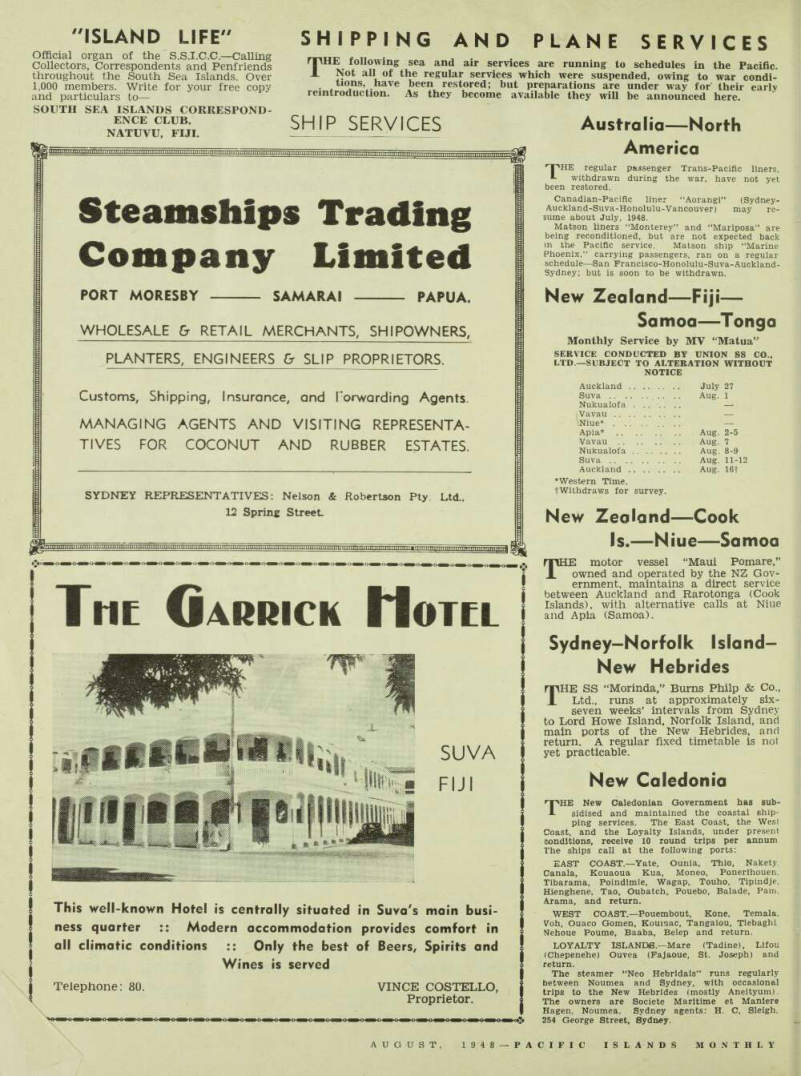
Shipping And Plane Services
mui? f n ii, . . r l m Xr * OI, ® WI “S ® ea and alr services are running to schedules in the Pacific, A all of the regular services which were suspended, owing to war Condi „ . ll ons, have been restored; but preparations are under way for their early remtroduction. As they become available they will be announced here.
Ship Services
Australia—North
America
'T'HE regular passenger Trans-Pacific liners, *■ withdrawn during the war, have not yet been restored.
Canadian-Pacific liner “Aorangi” (Sydney- Auckland-Suva-Honolulu-Vancouver) may re sume about July, 1948.
Matson liners “Monterey” and “Mariposa” are being reconditioned, but are not expected back in the Pacific service. Matson ship “Marine Phoenix,” carrying passengers, ran on a regular schedule —San Francisco-Honolulu-Suva-Auckland- Sydney; but is soon to be withdrawn.
New Zealand—Fiji—
Samoa—Tonga
Monthly Service by MV “Matua”
Service Conducted By Union Ss Co.,
Ltd —Subject To Alteration Without
Notice
New Zeoland—Cook
Is.—Niue—Samoa
mHE motor vessel “Maui Pomare,”
JL owned and operated by the NZ Gov ernment, maintains a direct service between Auckland and Rarotonga (Cook Islands), with alternative calls at Niue and Apia (Samoa).
Sydney-Norfolk Island-
New Hebrides
THE SS “Morinda,” Bums Philp & Co., Ltd., runs at approximately six seven weeks’ intervals from Sydney to Lord Howe Island, Norfolk Island, and main ports of the New Hebrides, and return. A regular fixed timetable is not
yet practicable.
New Caledonia
THE New Caledonian Government has sub sidised and maintained the coastal ship ping services. The East Coast, the West Coast, and the Loyalty Islands, under present conditions, receive 10 round trips per annum The ships call at the following ports: EAST COAST.—Yate, Ounia, Thio, Nakety, Canala, Kouaoua Kua, Moneo, Ponerthouen.
Tibarama, Poindlmie, Wagap, Touho, Tipindje, Hienghene, Tao, Oubatch, Pouebo, Balade, Pam, Arama, and return.
WEST COAST. —Pouembout, Kone, Temala, Voh, Ouaco Gomen, Koumac, Tangaiou, Tiebaghl Nehoue Poume, Baaba, Belep and return.
LOYALTY ISLANDS. —Mare (Tadine), Lifou fChepenehe) Ouvea (Fajaoue, St. Joseph) and return.
The steamer “Neo Hebridais” runs regularly between Noumea and Sydney, with occasional trips to the New Hebrides (mostly Aneityum) The owners are Societe Maritime et Manlere Hagen, Noumea. Sydney agents: H. C. Sleigh, 254 George Street, Sydney.
Auckland July 27 Suva Aug. 1 Nukualofa —i Vavau — Niue* — Apia* Aug. 2-5 Vavau Aug. 7 Nukualofa Aug. 8-9 Suva Aug. 11-12 Auckland ♦Western Time. tWlthdraws for survey.
Aug. 16t
Advertisements & other items, p. 68 (1 item)
The Garrick Notel
"ISLAND LIFE"
Official organ of the S.S.l.C.C.—Calling Collectors, Correspondents and Penfriends throughout the South Sea Islands. Over 1,000 members. Write for your free copy and particulars to —
SOUTH SEA ISLANDS CORRESPOND-
ENCE CLUB,
NATUVU, FIJI.
Steamships Trading
Company Limited
PORT MORESBY SAMARAI PAPUA.
WHOLESALE & RETAIL MERCHANTS, SHIPOWNERS,
PLANTERS, ENGINEERS Cr SLIP PROPRIETORS.
Customs, Shipping, Insurance, and forwarding Agents.
MANAGING AGENTS AND VISITING REPRESENTA-
TIVES FOR COCONUT AND RUBBER ESTATES.
SYDNEY REPRESENTATIVES: Nelson & Robertson Pty. Lt<L, 12 Spring Street
The Garrick Notel
"■ -a*
Hit
HI ■hp?
iff
m 4 * * &ay ' -
SUVA
FIJI
This well-known Hotel is centrally situated in Suva's main business quarter :: Modern accommodation provides comfort in all climatic conditions :: Only the best of Beers, Spirits and Wines is served Telephone: 80. VINCE COSTELLO, Proprietor.
Sydney—Queensland—
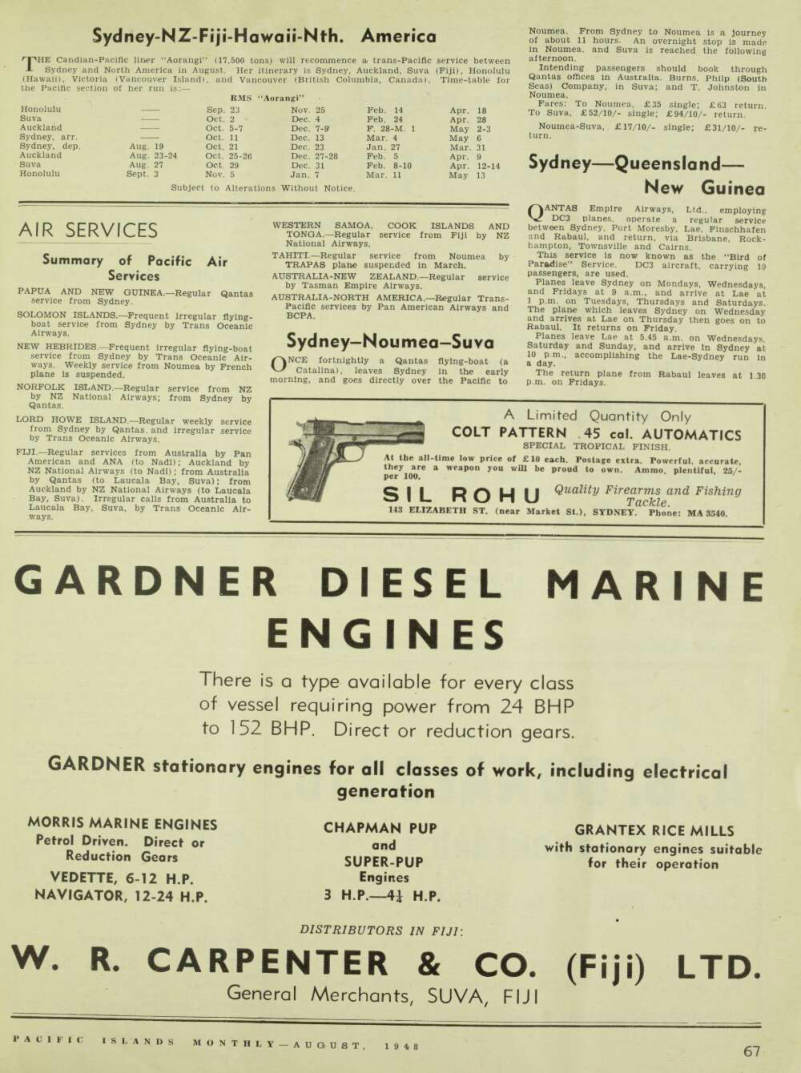
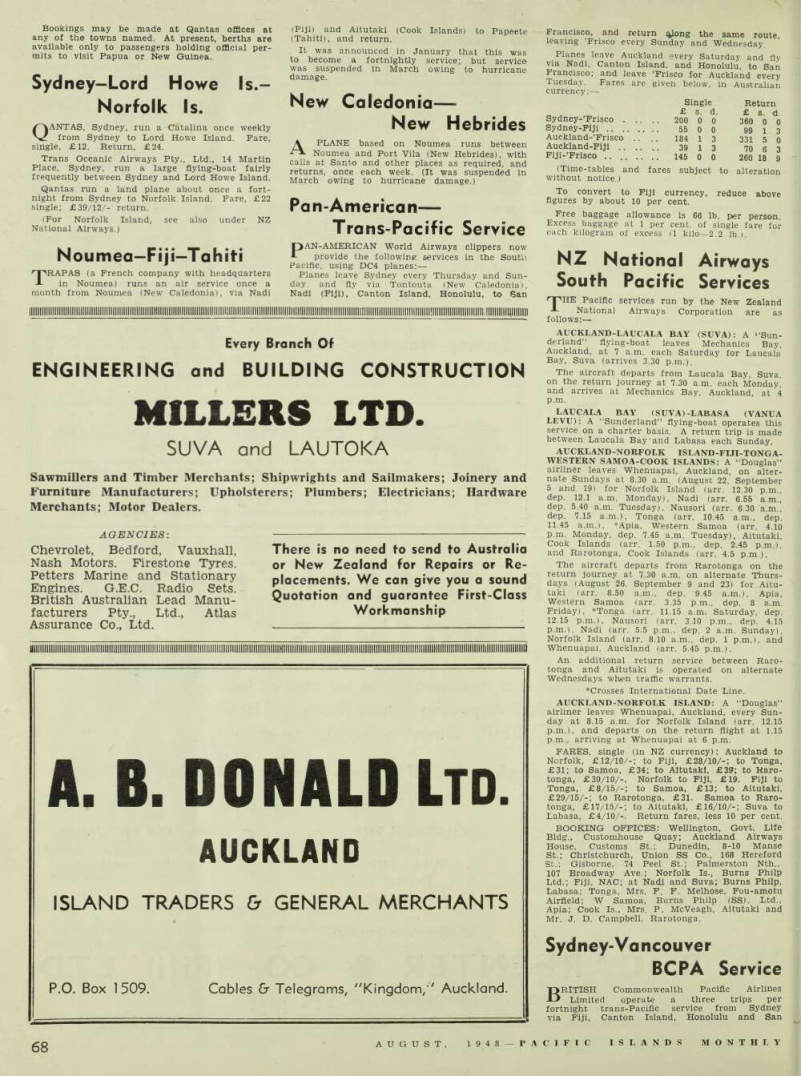
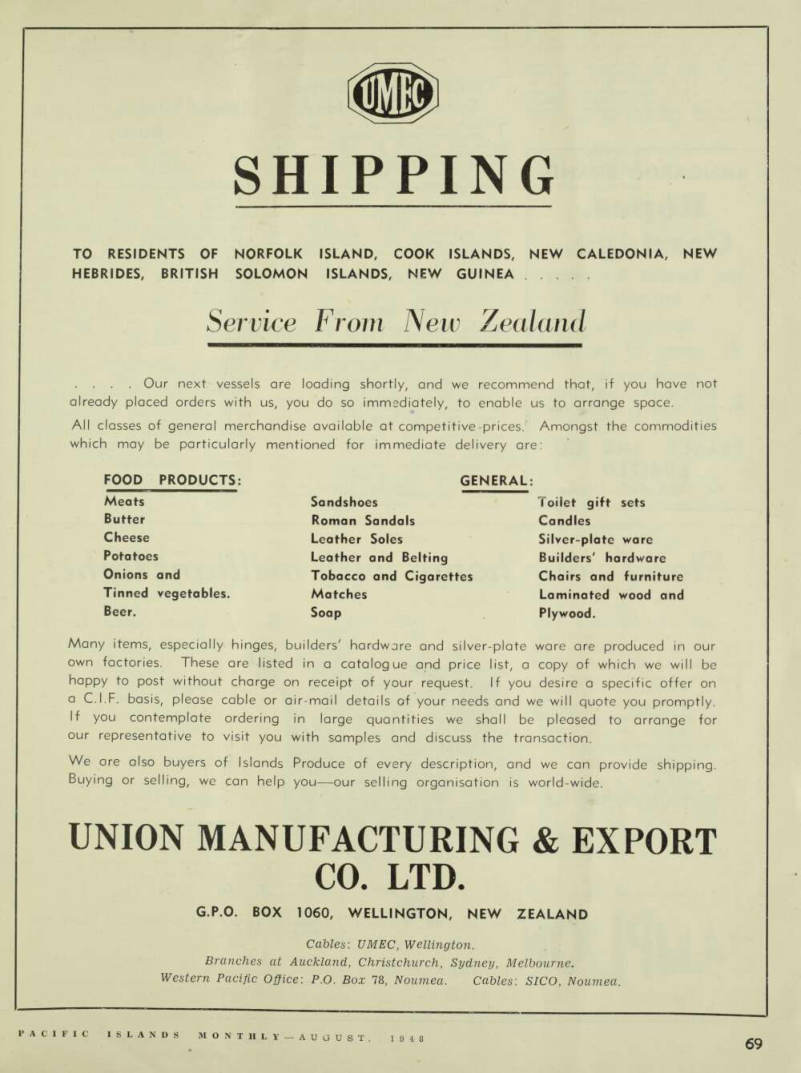

Sydney-NZ-Fiji-Hawoii-Nth. America
r T'HE Candian-Pacific liner “Aorangi” (17,500 tons) will recommence a trans-Paciflc service between J- Sydney and North America in August. Her itinerary is Sydney, Auckland, Suva (Fiji), Honolulu (Hawaii), Victoria (Vancouver Island), and Vancouver (British Columbia, Canada). Time-table for the Pacific section of her run is:—
Air Services
Summary of Pacific Air
Services
PAPUA AND NEW GUlNEA.—Regular Qantas service from Sydney.
SOLOMON ISLANDS.—Frequent irregular flying boat service from Sydney by Trans Oceanic Airways.
NEW HEBRlDES.—Frequent irregular flying-boat service from Sydney by Trans Oceanic Air ways. Weekly service from Noumea by French plane is suspended, NORFOLK ISLAND.—Regular service from NZ by NZ National Airways; from Sydney by Qantas.
LORD HOWE ISLAND.—Regular weekly service from Sydney by Qantas, and irregular service by Trans Oceanic Airways.
FlJl—Regular services from Australia by Pan American and ANA (to Nadi); Auckland by NZ National Airways (to Nadi); from Australia by Qantas (to Laucala Bay, Suva); from Auckland by NZ National Airways (to Laucala Bay, Suva). Irregular calls from Australia to Laucala Bay, Suva, by Trans Oceanic Air ways.
Samoa, Cook Islands And
TONGA.—Regular service from Fiji by NZ National Airways.
TAHlTl.—Regular service from Noumea by TRAPAS plane suspended in March.
AUSTRALIA-NEW ZEALAND.—ReguIar service by Tasman Empire Airways.
AUSTRALIA-NORTH AMERICA.—Regular Trans bppaC services by Pan American Airways and Q\//4 m pw_ KJ /\m iyi An Ciivn
jyaney MOUmCQ JU V Q
NCE fortnightly a Qantas flying-boat (a W Catalina), leaves Sydney in the early morning, and goes directly over the Pacific to
Noumea. From Sydney to Noumea is a Journey of about 11 hours. An overnight stop is made in Noumea, and Suva is reached the following afternoon.
Intending passengers should book through Qantas offices in Australia. Burns. Phllp (South Seas) Company, in Suva; and T. Johnston in Noumea.
Fares: To Noumea. £35 single; £63 return.
To Suva, £52/10/- single; £94/10/- return.
Noumea-Suva, £l7/10/- single; £3l/10/- re turn.
Sydney—Queensland—
New Guinea
QANTAS Empire Airways. Ltd., employing DCS planes, operate a regular service between Sydney. Port Moresby. Lae. Finschhafen and Rabaul, and return, via Brisbane, Rock hampton, Townsville and Cairns.
This service is now known as the '‘Bird of Paradise” Service. DC3 aircraft, carrying 19 passengers, are used.
Planes leave Sydney on Mondays, Wednesdays and Fridays at 9 a.m., and arrive at Lae at 1 p.m. on Tuesdays, Thursdays and Saturdays.
The plane which leaves Sydney on Wednesday and arrives at Lae on Thursday then goes on to Rabaul. It returns on Friday.
Planes leave Lae at 5.45 a.m. on Wednesdays Saturday and Sunday, and arrive in Sydney at 10 p.m., accomplishing the Lae-Sydney run in a day.
The return plane from Rabaul leaves at 1.30 p.m. on Fridays.
Rms
“Aorangi”
Honolulu — Sep. 23 Nov. 25 Feb. 14 Apr. 18 Suva — Oct. 2 Dec. 4 Feb. 24 Apr. 28 Auckland — Oct. 5-7 Dec. 7-9 F. 28-M. 1 May 2-3 Sydney, arr. — Oct. 11 Dec. 13 Mar. 4 May 6 Sydney, dep.
Aug. 19 Oct. 21 Dec. 23 Jan. 27 Mar. 31 Auckland Aug. 23- ■24 Oct. 25-26 Dec. 27-28 Feb. 5 Apr. 9 Suva Aug. 27 Oct. 29 Dec. 31 Feb. 8-10 Apr. 12-14 Honolulu Sept. 3 Nov. 5 Jan. 7 Mar. 11 May 13 Subject to Alterations Without Notice.
Bookings may be made at Qantas offices at any of the towns named. At present, berths are available only to passengers holding official per mits to visit Papua or New Guinea.
Sydney-Lord Howe Is.-
Norfolk Is.
QANTAS, Sydney, run a Catalina once weekly from Sydney to Lord Howe Island. Fare, single, £l2. Return, £24.
Trans Oceanic Airways Pty., Ltd., 14 Martin Place, Sydney, run a large flying-boat fairly frequently between Sydney and Lord Howe Island.
Qantas run a land plane about once a fort night from Sydney to Norfolk Island. Pare, £22 single: £39/12/- return. (For Norfolk Island, see also under NZ National Airways.)
Noumea-Fiji-Tahiti
TRAPAS (a French company with headquarters in Noumea) runs an air service once a month from Noumea (New Caledonia), via Nadi
(Fiji) and Aitutaki (Cook Islands) to Papeete (Tahiti), and return.
It was announced in January that this was to become a fortnightly service; but service was suspended in March owing to hurricane damage.
New Caledonia—
New Hebrides
A PLANE based on Noumea runs between Noumea and Port Vila (New Hebrides), with calls at Santo and other places as required, and returns, once each week. (It was suspended in March owing to hurricane damage.)
Pan-American—
Trans-Pacific Service
OAN-AMERICAN World Airways clippers now provide the following services in the South Pacific, using DC4 planes:— Planes leave Sydney every Thursday and Sun day and fly via Tontouta (New Caledonia), Nadi (Fiji), Canton Island, Honolulu, to San
Francisco, and return the same route, leaving ’Frisco every Sunday and Wednesday.
Planes leave Auckland every Saturday and fly via Nadi, Canton Island, and Honolulu, to San Francisco; and leave ’Frisco for Auckland every Tuesday. Fares are given below, in Australian currency:—
(Time-tables and fares subject to alteration without notice.) To convert to Fiji currency, reduce above figures by about 10 per cent.
Free baggage allowance is 66 lb. per person.
Excess baggage at 1 per cent, of single fare for each kilogram of excess (1 ki10—2.2 lb.).
NZ National Airways
South Pacific Services
nnHE Pacific services run by the New Zealand A National Airways Corporation are as follows;
Auckland-Laucala Bay (Suva): A ‘‘Sun
derland” flying-boat leaves Mechanics Bay, Auckland, at 7 a.m. each Saturday for Laucala Bay, Suva (arrives 3.30 p.m.).
The aircraft departs from Laucala Bay, Suva, on the return journey at 7.30 a.m. each Monday, and arrives at Mechanics Bay, Auckland, at 4 p.m,
Laucala Bay (Suva)-Labasa (Vanua
LEVU): A “Sunderland” flying-boat operates this service on a charter basis. A return trip is made between Laucala Bay and Labasa each Sunday.
Auckland-Norfolk Island-Fiji-Tonga
Western Samoa-Cook Islands: A “Douglas”
airliner leaves Whenuapai, Auckland, on alter nate Sundays at 8.30 a.m. (August 22, September 5 and 19) for Norfolk Island (arr. 12.30 p.m., dep. 12.1 a.m. Monday), Nadi (arr. 6.55 a.m., dep. 5.40 a.m. Tuesday), Nausori (arr. 6.30 a.m., dep. 7.15 a.m.), Tonga (arr. 10.45 a.m., dep. 11.45 a.m.), *Apia, Western Samoa (arr. 4.10 p.m. Monday, dep. 7.45 a.m. Tuesday), Aitutaki, Cook Islands (arr. 1.50 p.m., dep. 2.45 p.m.), and Rarotonga, Cook Islands (arr. 4.5 p.m.).
The aircraft departs from Rarotonga on the return journey at 7.30 a.m. on alternate Thurs days (August 26. September 9 and 23) for Aitu taki (arr. 8.50 a.m., dep. 9.45 a.m.), Apia, Western Samoa (arr. 3.35 p.m., dep. 8 a.m.
Friday), *Tonga (arr. 11.15 a.m. Saturday, dep. 12.15 p.m.), Nausori (arr. 3.10 p.m., dep. 4.15 p.m.), Nadi (arr. 5.5 p.m., dep. 2 a.m. Sunday).
Norfolk Island (arr. 8.10 a.m., dep. 1 p.m.). and Whenuapai, Auckland (arr. 5.45 p.m.).
An additional return service between Raro tonga and Aitutaki is operated on alternate Wednesdays when traffic warrants. ♦Crosses International Date Line.
Auckland-Norfolk Island: A “Douglas”
airliner leaves Whenuapai, Auckland, every Sun day at 8.15 a.m. for Norfolk Island (arr. 12.15 p.m.), and departs on the return flight at 1.15 p.m,, arriving at Whenuapai at 6 p.m.
PARES, single (in NZ currency): Auckland to Norfolk, £l2/10/-; to Fiji, £2B/10/-; to Tonga, £3l; to Samoa, £34; to Aitutaki, £39; to Raro tonga, £39/10/-. Norfolk to Fiji, £l9. Fiji to Tonga, £B/15/-; to Samoa, £l3; to Aitutaki, £29/15/-; to Rarotonga, £3l. Samoa to Raro tonga, £l7/15/-; to Aitutaki, £l6/10/-; Suva to Labasa, £4/10/-. Return fares, less 10 per cent.
BOOKING OFFICES: Wellington, Govt. Life Bldg., Customhouse Quay; Auckland Airways House, Customs St.; Dunedin, 8-10 Manse St.; Christchurch, Union SS Co., 168 Hereford St.; Gisborne, 74 Peel St.; Palmerston Nth., 107 Broadway Ave.; Norfolk Is., Burns Philp Ltd.; Fiji, NAC; at Nadi and Suva; Burns Philp, Labasa; Tonga, Mrs. F. F. Melhose, Fou-amotu Airfield; W Samoa, Burns Philp (SS), Ltd., Apia; Cook Is., Mrs. P. McVeagh, Aitutaki and Mr. J. D. Campbell, Rarotonga.
Sydney-Vancouver
BCPA Service
BRITISH Commonwealth Pacific Airlines Limited operate a three trips per fortnight trans-Paciflc service from Sydney via Fiji, Canton Island, Honolulu and San
Single Return £ s. d. £ s. d Sydney-’Frisco . .. 200 0 0 360 0 0 Sydney-Plji 99 1 3 Auckland-’Frisco .. 184 1 3 331 5 0 Auckland-FIJl .. .. 70 6 3 Fiji-’Prisco .. 260 18 9
Francisco; and a fortnightly service between Auckland and Vancouver, via the same air planes leave Sydney every Sunday evening and alternate Wednesdays, and Vancouver, on the southbound trip, every Sunday and alternate Thursdays. Planes leave Auckland every alter nate Wednesday and arrive in Vancouver the following Saturday. This southbound trip com mences from Vancouver on alternate Fridays.
Pares are (in Australian currency), Sydney- San Francisco, £2OO single and £360 return,
Auckland-Vancouver, £AI9B single; Auckland-
Nadi (Fiji), £A39.
Skymaster aircraft carrying 38 passengers and a crew of 9 are used on the service.
Trans-Tasman Service
Sydney—Auckland
r PASMAN Empire Airways, Ltd., operate a flying-boat service between Rose Eay Sydney, and Mechanics Bay. Auckland. Large flying-boats, capable of carrying 30 passengers, are employed. The trip is comfortable, and takes approximately 8 hours.
The flying-boats leave both Sydney (6.30 a.m.) and Auckland (8 a.m.) every morning except Sundays. Six flights each way per week. Fares: £2B single; £5O/8/- return.
In addition, this flying-boat service is, at pre sent, supplemented by a Skymaster service details of which are available on application to TEA offices in Australia and New Zealand.
Bookings may be made at Tasman Empire Airways in Auckland and at Qantas Empire Air ways, Carrington Street, Sydney.
TOA Services
r T'RANS Oceanic Airways run the following A Pacific services:— SYDNEY-LORD HOWE IS.: A regular fort nightly service with large four-engine flying boats from Rose Bay. Fare: £ll single: £2l return. Free baggage allowance 50 lb Excess baggage and freight rate 6d. per lb.
SYDNEY-NEW HEBRIDES: A regular monthly service with large four-engine flying-boats from Sydney, via Noumea (overnight stop), to Vila and Espiritu Santo. Fare: Sydney-Vila, £45; Sydney-Santo, £5O; Noumea-Vila, £l2/10/-; Noumea-Santo, £lB. Freight: Sydney-Vila or Santo, 2/- per lb.
Sydney-Solomon Islands: A Regular
monthly service from Sydney, via New Cale donia and New Hebrides to Tulagi, Solomon Islands. This service is frequently extended to Lingatou, in the Russell Islands, and calls are
sohietimes made at Vanikoro, in the Santa CrUZ Group. Fares: Sydney-Tulagi, £75. Free bag gage allowance, 60 lb.; excess baggage and freight, 3/- per lb.
Advertisements & other items, pp. 69-72 (2 items)
67
PACIFIC ISLANDS MONTHLY- A U G U S T , 19 4,8
Engines
A Limited Quantity Only
COLT PATTERN 45 cal. AUTOMATICS
SPECIAL TROPICAL FINISH.
At the all-time low price of £lO each. Postage extra. Powerful, accurate, they are a weapon you will be proud to own. Ammo, plentiful, 25/per 100. g| L RO H U Quality Firearms and Fishing 143 ELIZABETH ST. (near Market St.), SYDNEY. Phone: MA 3540.
GARDNER DIESEL MARINE
ENGINES
There is a type available for every class of vessel requiring power from 24 BHP to 152 BHP. Direct or reduction gears.
GARDNER stationary engines for all classes of work, including electrical
generation
CHAPMAN PUP GRANTEX RICE MILLS
an d with stationary engines suitable SUPER-PUP for their operation Engines
3 H.P.—4J H.P.
DISTRIBUTORS IN FIJI:
W. R. CARPENTER & CO. (Fiji) LTD.
General Merchants, SUVA, FIJI
MORRIS MARINE ENGINES
Petrol Driven. Direct or Reduction Gears
VEDETTE, 6-12 H.P.
NAVIGATOR, 12-24 H.P.
Every Branch Of
ENGINEERING and BUILDING CONSTRUCTION
MILLERS LTD.
SUVA and LAUTOKA
Sawmillers and Timber Merchants; Shipwrights and Sailmakers; Joinery and Furniture Manufacturers; Upholsterers; Plumbers; Electricians; Hardware Merchants; Motor Dealers.
AGENCIES:
Chevrolet, Bedford, Vauxhall, Nash Motors. Firestone Tyres.
Fetters Marine and Stationary Engines. G.E.C. Radio Sets.
British Australian Lead Manufacturers Pty., Ltd., Atlas Assurance Co., Ltd.
There is no need to send to Australia or New Zealand for Repairs or Replacements. We can give you a sound Quotation and guarantee First-Class Workmanship
A. B. DONALD Ltd.
AUCKLAND
ISLAND TRADERS & GENERAL MERCHANTS
P.O. Box 1509. Cables & Telegrams, "Kingdom/' Auckland.
(®|i
SHIPPING
TO RESIDENTS OF NORFOLK ISLAND, COOK ISLANDS, NEW CALEDONIA, NEW
HEBRIDES, BRITISH SOLOMON ISLANDS, NEW GUINEA
Service From New Zealand
. . . . Our next vessels are loading shortly, and we recommend that, if you have not already placed orders with us, you do so immediately, to enable us to arrange space.
All classes of general merchandise available at competitive-prices. Amongst the commodities which may be particularly mentioned for immediate delivery are: Many items, especially hinges, builders 7 hardware and silver-plate ware are produced in our own factories. These are listed in a catalogue and price list, a copy of which we will be happy to post without charge on receipt of your request. If you desire a specific offer on a C.I.F. basis, please cable or air-mail details of your needs and we will quote you promptly.
If you contemplate ordering in large quantities we shall be pleased to arrange for our representative to visit you with samples and discuss the transaction.
We ore also buyers of Islands Produce of every description, and we can provide shipping.
Buying or selling, we can help you—our selling organisation is world-wide.
UNION MANUFACTURING & EXPORT
CO. LTD.
G.P.O. BOX 1060, WELLINGTON, NEW ZEALAND
Cables: UMEC, Wellington.
Branches at Auckland, Christchurch, Sydney, Melbourne.
Western Pacific Office: P.O. Box 78, Noumea. Cables: SICO, Noumea.
KANGAROO BRAND
Ropes,
Cordage,
ond Twines for every purpose Backed by 86 years of service Manufactured by:
M. DONAGHY AND SONS,
Pty. Ltd., Geelong and Sydney.
Fiji Representatives:
PEARCE AND CO.
LIMITED
P.O. BOX 237, SUVA
Flood your home with brilliant light I t Imagine it just flick a switch and on comes a flood of electric light. How the children and Mother will delight in this new pleasure which every home needs to be really restful and cheery!
With the Amplite Farm Lighting Unit, you can serve every room, and outhouses, grounds, garage— with pulsing current —even run a vacuum cleaner!
We would like you to have our buy.
Manufactured by-
aMPLIOk
Australasia Pty. Ltd.
erm
YOU'LL FIND IT
FASCINATING
READING
• SOME QUICK FACTS
ABOUT THIS GREAT UNIT
9 Light in weight. Plant weighs only 70 lbs. ® Runs for 8-10 hours on one gallon of petrol. o Air-cooled, 4 cycle engine. • Run a few hours per week, will keep your batteries charged. • Electrical self-starting. No cranking of engine.
Messrs. AMPLION (A/ASIA) PTY., LTD.,
3G-40 Parramatta Road, Camperdown, N.S.W.
Dear Sirs: Please let me have your illustrated Farm Lighting Unit brochure, Publication APC7C.
Name Address
“PIM," 9/47.
Moresby
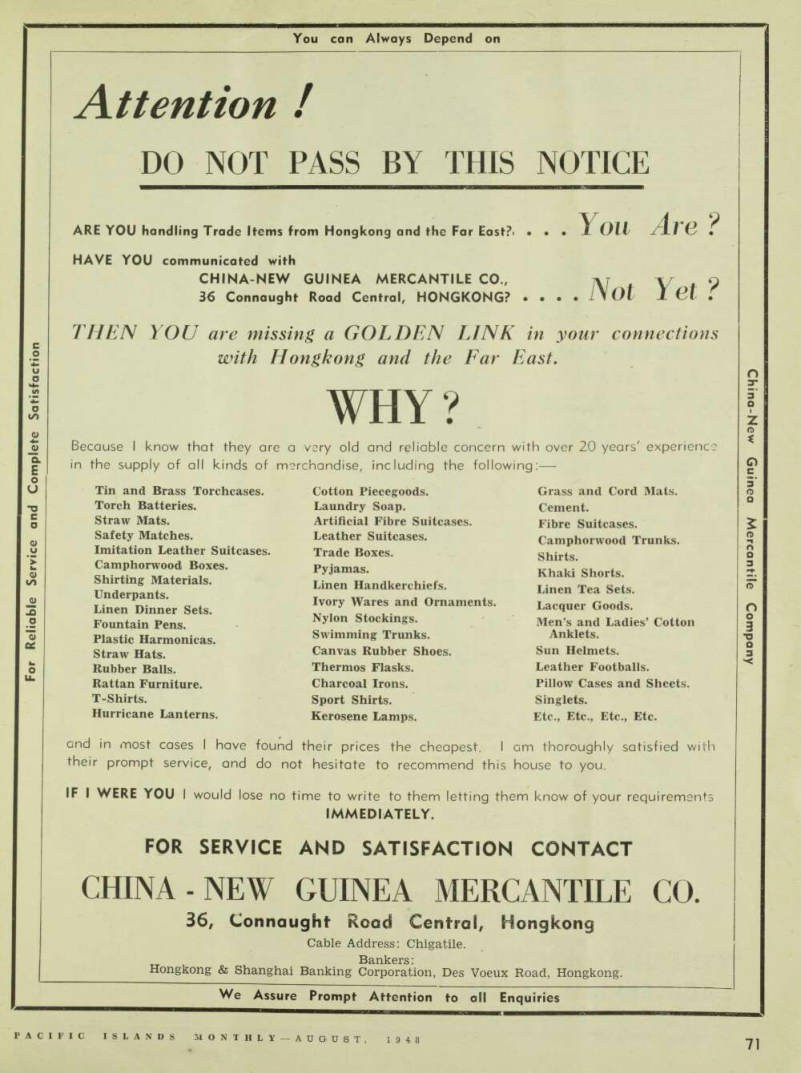

Mental Patient At Large In Moresby
From a Special Correspondent
Port Moresby, August 3.
1VJ IGHT llfe in Moresby has been con a? soon discovered from them that there Was said to be a homi- C i dal mania C at large. The houseboys’ stones may have differed in the number of people who were already supposed to have been murdered, but they all agreed that a native mental patient had escaped from the hospital, that he had stolen a that e he & was att<smPtS The police then broadcast an announce ment to the effect that a mental nntient had escaned fromthe S S na 9 e£^ a P e d lr0n ?„ the native hospital and had stolen a rifle and some ammuni tion, which had since been recovered R „ ’ nl ,‘ L i eQ ' Rumours that he had killed local natives W ere unfounded, they added; when Cap tured he was believed to be heading for Kokoda in an attempt to get back to Lae. He had been brought to Port Moresby for treatment.
The next night, however, he again appeared in the town area. He is still at large.
At the Brisbane Congregational Church on Sunday, July 14, a memorial service was held for the late Mrs. S. Schlencker who spent many years as a LMS Mis sionary in Papua with her husband, the Rev. H. P. Schlencker. The Rev. T. Rees Thomas who officiated, spoke of the ster ling character of Mrs. Schlencker.
The Methodist Missionary Society of NZ, has purchased the 41 ft. ketch “Mandalay at a cost of £2,450. The ketch will be used for mission work in the Solomons.
Advertisements & other items, pp. 73-74 (1 item)
China-New Guinea Mercantile Company
For Reliable Service and Complete Satisfaction
You can Always Depend on
Attention !
DO NOT PASS BY THIS NOTICE
ARE YOU handling Trade Items from Hongkong and the Far East?> • • • You Are HAVE YOU communicated with CHINA-NEW GUINEA MERCANTILE CO., ixj v Q 36 Connaught Road Central, HONGKONG? • • • • -\ol' Jl (it • THEN YOU are missing a GOLDEN LINK in your connections
with Hongkong and the Far East.
WHY?
Because I know that they are a very old and reliable concern with over 20 years' experience the supply of all kinds of merchandise, including the following:— Tin and Brass Torchcases.
Torch Batteries.
Straw Mats.
Safety Matches.
Imitation Leather Suitcases.
Camphorwood Boxes.
Shirting Materials.
Underpants.
Linen Dinner Sets.
Fountain Pens.
Plastic Harmonicas.
Straw Hats.
Rubber Balls.
Rattan Furniture.
T-Shirts.
Hurricane Lanterns.
Cotton Piecegoods.
Laundry Soap.
Artificial Fibre Suitcases.
Leather Suitcases.
Trade Boxes.
Pyjamas.
Linen Handkerchiefs.
Ivory Wares and Ornaments.
Nylon Stockings.
Swimming Trunks.
Canvas Rubber Shoes.
Thermos Flasks.
Charcoal Irons.
Sport Shirts.
Kerosene Lamps.
Grass and Cord Mats.
Cement.
Fibre Suitcases.
Camphorwood Trunks.
Shirts.
Khaki Shorts.
Linen Tea Sets.
Lacquer Goods.
Men’s and Ladies’ Cotton Anklets.
Sun Helmets.
Leather Footballs.
Pillow Cases and Sheets.
Singlets.
Etc., Etc., Etc., Etc. and in most cases I have found their prices the cheapest. I am thoroughly satisfied with their prompt service, and do not hesitate to recommend this house to you.
IF I WERE YOU I would lose no time to write to them letting them know of your requirements
IMMEDIATELY.
FOR SERVICE AND SATISFACTION CONTACT
CHINA-NEW GUINEA MERCANTILE CO.
36, Connaught Road Central, Hongkong
Cable Address: Chigatile.
Bankers: Hongkong & Shanghai Banking Corporation, Des Voeux Road, Hongkong.
We Assure Prompt Attention to ail Enquiries
China-New Guinea Mercantile Company
"Your Yeast
has No Rival"
From MADIRI, Fly River, via Daru, Papua, comes the following Testimonial to MALTO-PEPTONE DRIED YEAST: "For the Tropics, your Yeast has no rival. We have found it entirely satisfactory and are very pleased we learned of it.” (Sgd.) T.H.
MALTO-PEPTONE
DRIED YEAST
is 100% Pure Yeast. It has been on the Market for 12 years and is GUARANTEED to retain its vitality for months in ANY Climate. Ready for use in a matter of minutes, and users claim that, through its aid, they can Bake Bread In 3Vi hours! Trial Size Carton (2 oz.) 1/7 — l A lb. 2/B—Vi lb. 4/g—all Post Free. Send Stamps, Postal Note, Money Order or Cheque for a supply—NOW! !
AUSTRALIAN YEAST CO.
Oakleigh, Victoria—Australia.
BIGGER PRICES for BETTER COPRA !
when dried by Ihe scientific
process made possible by the
CHULA” Copra Dryer
. . . the most practical and efficient machine for drying nuts in bulk, which produces copra of a higher standard than that dried in the open, without discolouration, free from mould, thoroughly and evenly dried throughout. The “Chula" produces its two tons of copra every 24 hours, irrespective of the weather, and with a minimum ofdabour.
THE INVENTORS AND MANUFACTURERS OF
THE CHULA COPRA DRYER ALSO MAKE
DESICCATED COCONUT
MACHINERY
(Parers, Disintegrators, Sifters, Dryers)
TEA DRYERS
FISH
RUBBER
DRYERS
MACHINERY
(Continuous Sheeters, Crepeing Batteries)
TYNESIDE FOUNDRY &
ENGINEERING CO. LTD.
ELSWICK • NEWCASTLE-ON-TYNE • ENGLAND
Telegrams & Cables ; " FOUNDRY, NEWCASTLE-ON-TYNE " * Codes ; ABC, sth & 6th Eds ik V' XI ii*/
A NEW CATALOGUE
of the
CHULA"
COPRA DRYER
has just been printed.
Send for Your Copy!
Hema-Whippy Wedding
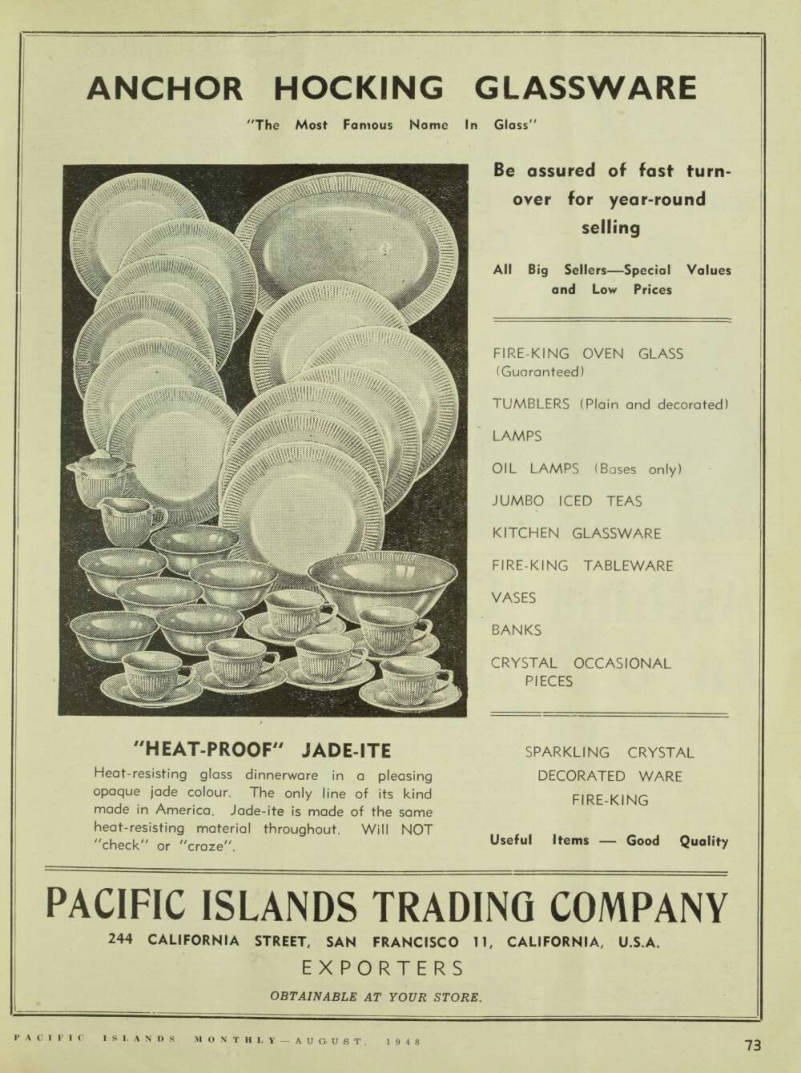
This photograph shows Mr. Enoch Hema, of Haapai, Tonga, and his bride, formerly Miss Adeline Whippy of Kasavu, Vanua Levu, Fiji, together with their bridal attendants. Mr. Hema recently graduated as a Minister in the Seventh Day Adventist Mission and has been, for the past few months, attending the SDA School at Tailevu, Fiji. Miss Adeline Whippy is the sixth
daughter of Mr. and Mrs. James Whippy, of Kasavu. She spent six years at the Australian Missionary College and has graduated as a trained teacher. Later she took up a position with the Fulton Mission School where she taught for three years. Mr. and Mrs. Hema hope to return to Tonga shortly.
Photo by Stinson Studios.
The Rev. Rodger Brown, of the Methodist Mission, left Brisbane recently for New Britain. He was accompanied by his wife and Miss F. J. Pearce a mis sionary Sister. Mr. Brown was the last missionary to escape from New Britain after the Japanese occupation in 1942.
He intends to rebuild his old mission station; the original one was destroyed during the war.
Advertisements & other items, pp. 75-76 (1 item)
Pacific Islands Trading Company
ANCHOR HOCKING GLASSWARE
"The Most Famous Name In Glass"
Be assured of fast turn-
over tor year-round
selling
All Big Sellers—Special Values and Low Prices
FIRE-KING OVEN GLASS
(Guaranteed) TUMBLERS (Plain and decorated)
LAMPS
OIL LAMPS (Bases only)
JUMBO ICED TEAS
KITCHEN GLASSWARE
FIRE-KING TABLEWARE
VASES
BANKS
CRYSTAL OCCASIONAL
PIECES
"HEAT-PROOF" JADE-ITE
Heat-resisting glass dinnerware in a pleasing opaque jade colour. The only line of its kind made in America. Jade-ite is made of the same heat-resisting material throughout. Will NOT "check" or "craze".
PACIFIC ISLANDS TRADING COMPANY
244 CALIFORNIA STREET, SAN FRANCISCO 11, CALIFORNIA, U.S.A.
EXPORTERS
SPARKLING CRYSTAL
DECORATED WARE
FIRE-KING
Useful Items Good Quality ml m -:=S M
OBTAINABLE AT YOUR STORE.
Scott’s“ Renown” Brand Rope,
Cable Address: Ropeyard.
Sydney.
SS y;Vv:
Cordage and
Binder
Twine
of Every
Description
MANUFACTURED AT
MASCOT, N.S.W.
By
J. SCOTT
PTY. LTD.
Head Office and Store
163 CLARENCE STREET,
SYDNEY,
N.S.W.
Asthma Curbed In 3 Minutes
fered coughing every night—couldn’t sleep.
Mcndaco stopped spasms first night. I have had no Asthma since in over 2 years.”
Mrs. A. W. writes: “I had Asthma for 25 years. After using Mendaco I can sleep all night and have not had an attack since taking it.” Mrs. G. E. C. writes: “I bless the day I first heard of Mendaco. What a godsend it is to a poor woman like me who for 35 years never knew what It was to have a good night’s rest. The constant fight between Asthma and sleep was wearing me down, but I feel now I want to forget my past suffering.”
Benefits Immediate
The very first dose of Mendaco goes right to work circulating through your blood and helping nature rid you of the effects of Asthma. Try Mendaco under an iron-clad money back guarantee. You be the judge.
If you don’t feel fully satisfied after taking Mendaco just return the package and the purchase price will be Get Mendaco from your chemist to-day and see how well you sleep to-night and how much better you will feel.
RELIEVES ASTHMA
Mendaco
Now in 2 sixes 6/- and 12/-
Since the discovery of Mendaco by a famous physician sufferers can get relief from Asthma. Mendaco does away with expensive Injections and offensive smokes.
All you ao is to take 2 tasteless tablets with meals and Mendaco starts circulating through the blood in 10 minutes. You breathe easily and freely. Your nerves relax, you get good, fresh, pure air into your lungs, and vigour returns.
Sleep Like a Baby
Thousands of former sufferers from Asthma say that the very first dose of Mendaco brought them glorious ease and comfort, and that they slept soundly the very first night. Then their vigour returned and they felt healthier and stronger, and 5 to 10 years younger. The reason for this is that Mendaco acts in natural ways to overcome the effects of Asthma, (1) It removes the mucus or phlegm; (2) It relaxes thousands of tiny muscles in your bronchial tubes so that the air can get in and out of your lungs; (31 It promotes body vigour, and stimulates the building of rich, revitalised blood.
No Asthma for Five Years
Mendaco not only brings almost immediate results, free breathing and comfort and enables you to sleep, but also builds up the system to ward off future attacks. Mr.
J R. writes; “I was almost dead with Asthma. Dad lost 40 lbs. in weight, saf-
New Guinea Club Completes
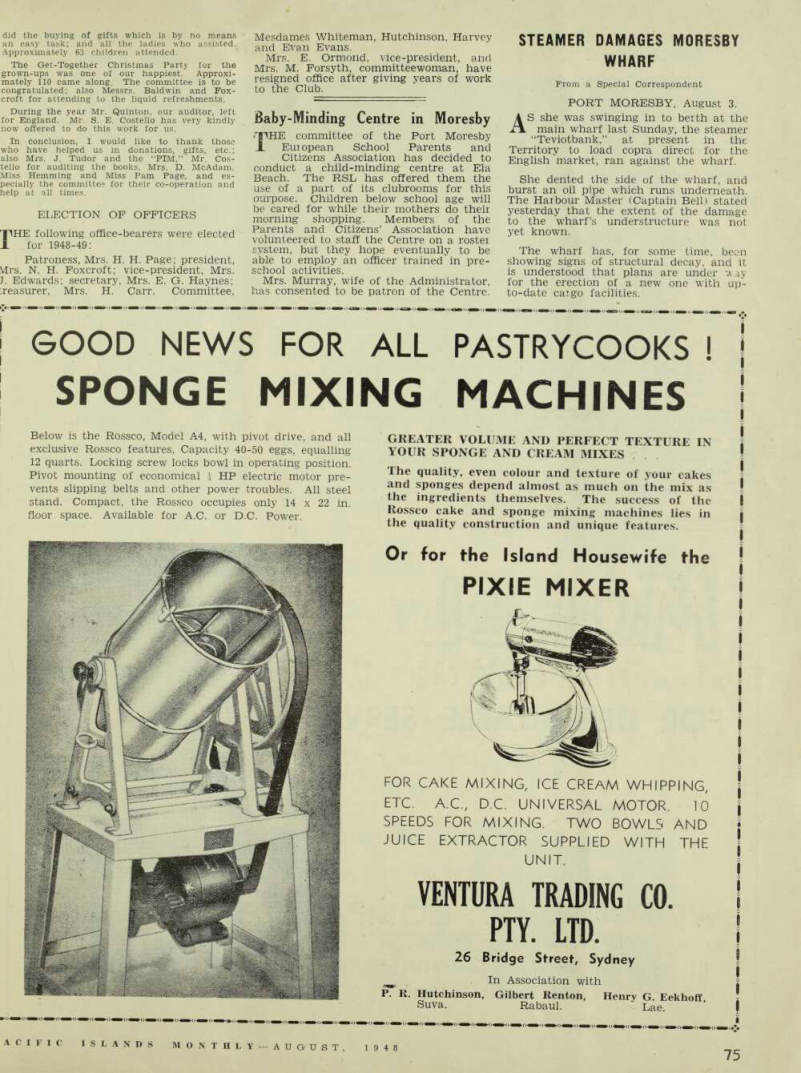
Seventh Year
FFiHE New Guinea Women’s Club of X Sydney held its 7th annual general meeting at 77 King Street, Sydney, on *i , K! ly V' Although membership has dwindled
since the war years, the Club is still a vigorous organisation and in a sound financial position. After numerous grants of assistance and other expenditure during the year, the credit balance in the general fund at June 30, 1948 was £359. In the Prisoners of War and Civilian Internees Fund, £2BO is brought forward into the current financial year.
In her report on the year’s activities, read at the meeting, Mrs. M. L. Foxcroft
the retiring president stated:—
AUR numbers now being greatly reduced, with vy so many returning to the Territory, our activities have not been as great as other years, but nevertheless we have carried on successfully with the good work with those willing workers who are still with us.
Soon after our last annual meeting Mrs. J.
Meldrum found it necessary to resign as vice president because of ill health. Mrs. E. Ormond was duly elected to fill the vacancy and Mrs.
Whiteman then filled Mrs. Ormond’s vacancy on the committee.
We were sorry when Mrs. H. Taylour also had to resign as treasurer, in December. She had done well in that capacity while in office. Then Mrs. Carr took the treasurer’s office whilst Mrs.
E. Haynes was elected secretary. Both ladies have done exceedingly well. Mrs. Hutchinson then joined the Committee.
Our rents were raised early this year by the Feminist Club because of increased costs.
We again communicated with Canberra re questing a complete list of the names of our men who enlisted in New Guinea and who made the supreme sacrifice. Their reply to this commu nication was that “they are unable to furnish us with this information.” We have now com municated with the Returned Soldiers’ Associa tion in Rabaul in the hope that they will be able to help us.
We wrote to Canberra requesting also that our civilian widows be placed on the same foot ing as the Servicemen’s widows respecting the allocation of £7O for furniture.
Their reply to this was as follows; “Representations you have made in this matter will be examined and further advice in regard thereto will be communicated to you as soon as practicable.”
Some time has elapsed and we have not heard anything further.
We are glad to have been able to give financial assistance to deserving cases. And, as we have quite a number of our New Guinea people now resident in England, it was decided to send them 10/- food parcels, which have been received with gratitude.
The Younger Set finalised its affairs during the year and generously donated the balance of their funds to our Club, the amount being £2O/17/8.
Our numbers at our Thursday morning meet ings have been greatly reduced in the last year, the average attendance being 17. which, in view of so many returning to the Territory is pleasing.
Numbers of our people visit us during their leave from New Guinea. We are happy to see them at all times. We have a country member ship for all those who are still interested and would like to remain members of the Club. They may do so for the payment of 10/- per annum.
Flowers have been sent or visits paid by members to anyone ill or in hospital immediately we knew their whereabouts.
During the year we paid homage to our dead by placing wreaths at the Cenotaph on January 23, April 25, and July 1.
Mrs. U. Adams generously acted on our be half in January in Rabaul by placing a wreath at the service held there.
Entertainment
WE have had several social gatherings during the year although our numbers are small. These brought our people together and have been quite successful. The Children’s Christmas party was again a great success.
Miss Brooks and her pupils delighted the kiddies and also adults with a wonderful pro gramme of singing and dancing.
Our thanks go also to the Feminist Club for the Christmas cake which they so kindly donated to the kiddies.
We thank all those people and firms who so generously made donations to make this partv a happy day for the children; also Mrs. for Christmas bush for decorating the room; Mesdames Edwards, Whiteman and Haynes who
did the buying of gifts which is by no means an easy task; and all the ladies who assisted.
Approximately 63 children attended.
The Get-Together Christmas Party for the grown-ups was one of our happiest. Approxi mately 110 came along. The committee is to be congratulated; also Messrs. Baldwin and Pox croft for attending to the liquid refreshments.
During the year Mr. Quinton, our auditor, left for England. Mr. S. E. Costello has very kindly now offered to do this work for us.
In conclusion, I would like to thank those who have helped us in donations, gifts, etc.; also Mrs. J. Tudor and the “PIM,” Mr. Cos tello for auditing the books. Mrs. D. McAdam, Miss Hemming and Miss Pam Page, and es pecially the committee for their co-operation and help at all times.
Election Of Officers
rHE following office-bearers were elected for 1948-49: Patroness, Mrs. H. H. Page; president,
Vlrs. N. H. Foxcroft; vice-president, Mrs.
J. Edwards: secretary, Mrs. E. G. Haynes; treasurer, Mrs. H. Carr. Committee,
Mesdames Whiteman, Hutchinson, Harvey and Evan Evans.
Mrs. E. Ormond, vice-president, and Mrs. M. Forsyth, committeewoman, have resigned office after giving years of work to the Club.
Baby-Minding Centre in Moresby
rHE committee of the Port Moresby European School Parents and Citizens Association has decided to conduct a child-minding centre at Ela Beach. The RSL has offered them the use of a part of its clubrooms for this purpose. Children below school age will be cared for while their mothers do their morning shopping. Members of the Parents and Citizens’ Association have volunteered to staff the Centre on a roster system, but they hope eventually to be able to employ an officer trained in pre school activities.
Mrs. Murray, wife of the Administrator, has consented to be patron of the Centre.
Steamer Damages Moresby
Wharf
Prom a Special Correspondent
Port Moresby, August 3.
AS she was swinging in to berth at the main wharf last Sunday, the steamer “Teviotbank,” at present in the Territory to load copra direct for the English market, ran against the wharf.
She dented the side of the wharf, and burst an oil pipe which runs underneath.
The Harbour Master (Captain Bell) stated yesterday that the extent of the damage to the wharf’s understructure was not yet known.
The wharf has, for some time, been showing signs of structural decay, and it is understood that plans are under way for the erection of a new one with up to-date cargo facilities.
Advertisements & other items, p. 77 (2 items)
75
ACIFIC ISLANDS MONTHLY AOODST, 1948
Sponge Mixing Machines
GOOD NEWS FOR ALL PASTRYCOOKS !
Below is the Rossco, Model A 4, with pivot drive, and all exclusive Rossco features, Capacity 40-50 eggs, equalling 12 quarts. Locking screw locks bowl in operating position.
Pivot mounting of economical \ HP electric motor prevents slipping belts and other power troubles. All steel stand. Compact, the Rossco occupies only 14 x 22 in. floor space. Available for A.C. or D.C. Power.
GREATER VOLUME AND PERFECT TEXTURE IN
YOUR SPONGE AND CREAM MIXES
The quality, even colour and texture of your cakes and sponges depend almost as much on the mix as the ingredients themselves. The success of the Rossco cake and sponge mixing machines lies in the quality construction and unique features.
Or for the Island Housewife the
PIXIE MIXER
u
FOR CAKE MIXING, ICE CREAM WHIPPING,
ETC. A.C., D.C. UNIVERSAL MOTOR. 10
SPEEDS FOR MIXING. TWO BOWLS AND
JUICE EXTRACTOR SUPPLIED WITH THE
UNIT.
VENTURA TRADING CO.
PTY. LTD.
26 Bridge Street, Sydney
ln Association with P. R. Hutchinson, Gilbert Renton, Henry G. Eekhoff Suva. Rabaul. Lae.
Guinea Natives
Bravery Awards For New
IT was announced in Canberra at the end of July that service awards had been made to five New Guinea natives.
Tarosi, of Sio, has been awarded the British Empire Medal (Civil Division).
Kuari, of Korua; Nagam, of Koirua; Parina, of Maprik, and Amarai, of No. 2 Aitape, received the King’s commenda tion.
Tokelau Stamps
And Some Hats
From Our Own Correspondent APIA, July 25.
THE former US Navy minesweeper, “Manua Tele,” owned by the natives of the American Samoan island of Manua, was recently chartered by the Western Samoan Administration. It took a shipment of the new Tokelau Island stamps to the three islands of the Tokelau Island group, which are about 300 miles north of Apia, and had the 115,000 sets of the new issue, mostly on first-day covers, stamped and despatched. This event has caused great interest in phila telic circles all over the world.
Mr. W. J. Taylor, Postmaster, of Apia, made the trip to supervise the transaction and Chief-Medical-Officer, Dr. H. C. Bliss, of Apia, and Secretary of Native Affaiis, Mr. H. J. Grattan, also made the trip on official business.
The bundles of mail were taken through the surf in outrigger canoes, a somewhat risky undertaking in the unfavourable weather prevailing at the time. Large quantities of the new stamp issue have been sold at New Zealand Post Offices.
The “Manua Tele” brought the usual consignment of Tokelau copra on her re turn, for which the islanders were paid the substantial new rate of 30/- per 100 lb. The only other industry in the three islands of the Tokelaus, the manufacture of hats and mats from Pandanus leaves, seems to have been affected by the high price of copra, as the islanders are unwill ing to bother with this sideline. Some hats brought back had increased in price from 7/- per hat to 16/- a hat.
Filariasis Campaign In
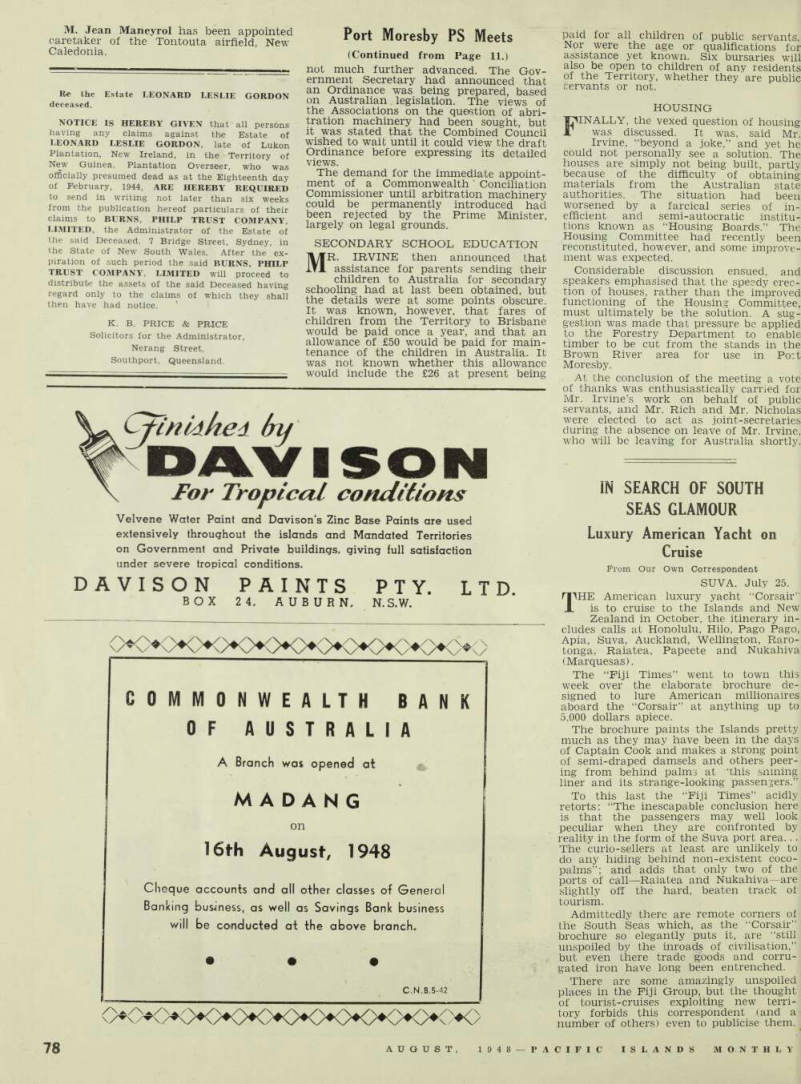
French Oceania
DR. HENRY BEYE, of the Department of Medical Bacteriology and Parasitology at the University of Southern California, visited Fiji in July to study the methods adopted in the Colony to combat filariasis. Dr. Beye, who is accompanied by his wife, is on his way to Tahiti, where he will assist in an anti-filariasis campaign which is to be undertaken by the Government of French Oceania.
The suggestion that the campaign should be launched was originally made by Mr. W. A. Robinson, an American citizen who has lived in Tahiti for some time, and who, with Mr. Cornelius Crane, of the United States, and local Tahiti residents, is contributing to the cost of the work.
The French Government have provided 5 million francs for the campaign and have arranged for the full-time services of Dr. Mille, Government Pathologist at Tahiti, to be made available. The co operation of the University of Southern California in the campaign was obtained through the efforts of Dr. James Knott, who, while serving with the United States forces in Fiji during the war, gave valu able assistance in the early stages oi anti-filariasis activities in Fiji. At his suggestion, Dr. Beye has come to Fiji to study the methods employed and the re sults obtained here.
Dr. Beye is particularly interested in the training school established by the Medical Department’s Senior Mosquito Inspector, Mr. D. W. Amos, in the way in which the Fijian inspectors operate in the villages, and in the educational methods employed.
M. Jean Maneyrol has been appointed caretaker of the Tontouta airfield, New Caledonia.
Advertisements & other items, pp. 78-80 (2 items)
Your Eye
The Twinkle in
COMES FROM ACTIVE
DIGESTION
Good normal digestive and liver activity means good, normal health and fitness. If yo« are becoming gloomy and feel tired out, the cause may be a congested state of your Intestinal tract. So many people are troubled with constipation, which, through the retention of waste In the digestive system, causes sick headache, biliousness, pimply skin, unpleasant breath, irritability, slackness and dull eyes.
Regain your bright and attractive appearance by banishing constipation with Pinkettes. Tiny, perfectly harmless, gentle yet effective, these famous laxative and liver pills painlessly exercise and strengthen the bowels, keep the food tract clean and active, stir the liver, and thus banish sick headache, bilious attacks, pimples, unpleasant breath and gloom. All chemists and stores sell Pinkettes, the perfect laxative and liver pills.
e:
propeller shafting
FOR DEPENDABLE SERVICE
Monel propeller shafting is renowned the world over for long, dependable service. Being strong and tough it withstands hard knocks, is highly resistant to corrosion, and guaranteed entirely rustless since Monel contains no iron. In service, Monel propeller shafting also quickly develops a mirror-like polish which reduces bearing and packing wear to a minimum.
Isn't this the kind of shafting you want in your boat? Then ask your boat builder to quote you to-day for a MONEL propeller shaft ... or 'phone
WRIGHT AND COMPANY
SOLE AUSTRALIAN DISTRIBUTORS OF MONEL.
81 CLARENCE STREET, SYDNEY, N.S.W.
PHONE: BXI2II (6 LINES)
Monel is a registered Trade Mark covering a rich nickel alloy, mined in Canada and rolled in Great Britain.
ms MiMrmn>...
wm «v
y7r/< a
Protect the eyes of youth with Laurel's soft, white light. "
Laurel Kerosene burns steadily and brightly to the last drop, because it contains no impurities to clog the wick.
There is no smoke nor any disagreeable odour. For efficiency and economy - Insist upon LAUREL KEROSENE.
Alt-PURPOSE
KEROSENE
For Lighting, Heating, Cooh , Cleaning, Freezing
Re the Estate LEONARD LESLIE GORDON
deceased.
NOTICE IS HEREBY GIVEN that all persons having any claims against the Estate of LEONARD LESLIE GORDON, late of Lukon Plantation, New Ireland, in the Territory of New Guinea, Plantation Overseer, who was officially presumed dead as at the Eighteenth day of February, 1944, ARE HEREBY REQUIRED to send in writing not later than six weeks from the publication hereof particulars of their
claims to BURNS, PHILP TRUST COMPANY,
LIMITED, the Administrator of the Estate of the said Deceased, 7 Bridge Street, Sydney, in the State of New South Wales. After the expiration of such period the said BURNS, PHILP TRUST COMPANY. LIMITED will proceed to distribute the assets of the said Deceased having regard only to the claims of which they shall then have had notice.
K. B. PRICE & PRICE
Solicitors for the Administrator, Nerang Street, Southport, Queensland.
O+inldked by
DAVISON
For Tropical conditions
Velvene Water Paint and Davison's Zinc Base Paints are used extensively throughout the islands and Mandated Territories on Government and Private buildings, giving full satisfaction under severe tropical conditions.
DAVISON PAINTS PTY. LTD.
BOX 24, AUBURN, N.S.W.
XXXXXXXXXXXXXX)
<>o<X><X><><><><><><>o<><>
Seas Glamour
In Search Of South
Luxury American Yacht on Cruise
From Our Own Correspondent SUVA. July 25. 11HE American luxury yacht “Corsair” is to cruise to the Islands and New Zealand in October, the itinerary in cludes calls at Honolulu, Hilo. Pago Pago, Apia, Suva, Auckland, Wellington, Raro tonga, Raiatea, Papeete and Nukahiva (Marquesas).
The “Fiji Times” went to town this week over the elaborate brochure de signed to lure American millionaires aboard the “Corsair” at anything up to 5,000 dollars apiece.
The brochure paints the Islands pretty much as they may have been in the days of Captain Cook and makes a strong point of semi-draped damsels and others peer ing from behind palms at ‘this shining liner and its strange-looking passengers.”
To this last the “Fiji Times” acidly retorts: “The inescapable conclusion here is that the passengers may well look peculiar when they are confronted by reality in the form of the Suva port area...
The curio-sellers at least are unlikely to do any hiding behind non-existent coco palms”; and adds that only two of the ports of call —Raiatea and Nukahiva —are slightly off the hard, beaten track of tourism.
Admittedly there are remote corners of the South Seas which, as the “Corsair” brochure so elegantly puts it, are “still unspoiled by the inroads of civilisation,” but even there trade goods and corru gated iron have long been entrenched.
There are some amazingly unspoiled places in the Fiji Group, but the thought of tourist-cruises exploiting new terri tory forbids this correspondent (and a number of others) even to publicise them.
Advertisements & other items, pp. 80-82 (2 items)
78
AUGUST, 1 9 4 8 -PACIFIC ISLANDS MONTHLY
Port Moresby PS Meets (Continued from Page 11.)
Ships For Sale
STEEL MOTOR VESSEL, DOUBLE RIVETED
M.V. "LATANI"
Construction f in. plate ship built 1938. All new equipment, engines, etc., at present being installed completion approx. 4 weeks, with permit to proceed to foreign port for registration.
DIMENSIONS:
Length 104 feet Beam 21 feet Depth Moulded 8 feet 6 ins.
Height of Hatch 33 ins.
Dimensions of Hatch 48 ft. long x 14 ft. wide Cargo hold measurements .. .. 66 ft. x2l ft. x 7 ft. 6 ins.
Double mast, two cargo winches tested to five (5) tons, fore and aft.
Power units, two new 115 h.p. Caterpillar Marine Diesel Engines 2 to 1 reduction. Auxiliary lighting set, 8 h.p. Ronaldson Tippet Diesel- New Native crew accommodation for’ard, Master and Officers aft.
Anchor windlass chain, etc., new and tested. Cargo carrying capacity, 200 ton dead weight. Cubic capacity, 10,647 cub. ft.
Price: £26,000 Sydney.
NEW MOTOR CARGO SHIP
Construction |" Steel Plate
DIMENSIONS:
Length B.P 75 feet Breadth Moulded 18 feet 2 ins.
Depth 9 feet 11 ins.
Draft (Loaded) 7 feet 9 ins.
Displacement, loaded, approx 125 tons Hold capacity 2,900 cub. feet Cargo capacity 73 tons For’ard Compartment available for light cargo 13 tons Total cargo with crew of three 86 tons Hatch 10 x 15 feet Mast, Oregon 45 feet x 12 ins. dia.
Proposed derrick S.W.L. 2 tons, length 26 feet, cargo winch 6 H.P. Kerosene engine lifting 1 ton straight pull at 120 feet per min., 2 tons double purchase.
Proposed power, 165 H.P. G.M. Diesel, 3 to 1 reduction and reverse gear, hydraulically operated from the bridge.
Propeller, Bronze, 36 x 24. Tail Shaft, steel with bronze sleeves, R.P.M., 500.
Accommodation: Cabin aft for crew of three. Toilet adjoining. Galley forward, and if desired accommodation for four men. Toilet room forward.
Price: £9,000 without engine.
ENGINES
One 9 H.P. Southern Cross 4 K.W. D.C. diesel generating set direct coupled 110-volt, together with 4 banks containing 8 cells of 2 V,-volt each. Price £2BO F.O.W.
Sydney. Engine in first class order and ready for immediate use.
Two only, 750 H.P. 6 cylinder direct reversing air blast injection Sulzer diesel Marine engines, suggest that H.P. at 350 R.P.M. critical speed as indicated by tachometer 380-408 R.P.M. Length approximately 20 ft., weight approximately 24 tons, engines have been surveyed. £4,500 F.O.W. Sydney.
One 200 H.P. Willans Robinson 300 R.P.M. diesel engine direct coupled to 90 K.W. 220-volt D.C. generator complete and in running order.
£3,500 F.O.W.
All items covered by 12 months insurance.
STEEL CARGO VESSEL
M.V. "DAPHNE"
DIMENSIONS:
Length 106 feet Beam 26 feet 6 ins.
Moulded Depth 10 feet Draft 3 ft. light Built during war and used as transport vessel New Guinea. Accommodation for’ard twenty (20) bunks.
Cargo Hold 45 feet x 26 feet x 8 feet 4 ins.
Hatch 22 feet x 8 feet 6 ins.
Capacity below decks 240 cub. tons Fitted with electric light equipment. Cargo winches, etc. Power units, two only, 100 H.P. Ronaldson Tippet Diesel.
Price: £B,OOO Sydney.
AGENCIES
In addition to ships, we are agents and distributors of Tile-making machinery, capacity to 16,000 interlocking concrete tiles per day.
Concrete Mixers. Pneumatic Drills. Petrol-driven Engines. Rock Breakers. Rock Crushers. Steam Engines and Boilers from 5 H.P. and upward to any size. Diesel Engines. Marine and Industrial from 5 H.P. to 1,000 H.P. Diesel Generating Sets, A.C. or D.C. currents, from 5 H.P. to 750 H.P.
For further particulars of ships or any item of machinery that you should require, write us for further information and quotation giving fullest details of your requirements.
TREACY ENGINEERING SUPPLY COMPANY PTY. LTD.
10 O'CONNELL STREET, SYDNEY. 'PHONE: BW 4152
VETERINARY
INSTRUMENTS
For Sheep and Cattle can be
Supplied Immediately
EARMARKERS.
SPEYING INSTRUMENTS.
BULLRINGS.
FIRE BRANDS.
EMASCULATORS.
W. JNO. BAKER
PTY. LTD.
3 Hunter Street, Sydney, N.S.W., Australia
PRODUCING UNIFORM GOOD RESULTS SINCE 1868
Flour
ALWAYS ASK FOR IT
Why not buy one NowS
Housewives in old fashioned homes as well as new can readily enjoy the advantages of a Stainless Steel Sink Unit . . . the gleaming hygienic finish that is easy to keep clean and sparkling. Save time and eliminate drudgery by installing a Wunderlich Stainless Steel Sink Unit; they are available for immediate delivery either 4 ft.. 5 ft. or 6 ft. long by I '6" wide; and they feature a bowl of generous dimensions.
Ask your local Hardware Merchant, 'phone MX 241 I, or write to Box 474, G.P.O. Sydney, for further information and prices.
/Pander tic
INK, UNITS
' IN STAIN LtSS ST-H.L
Papua
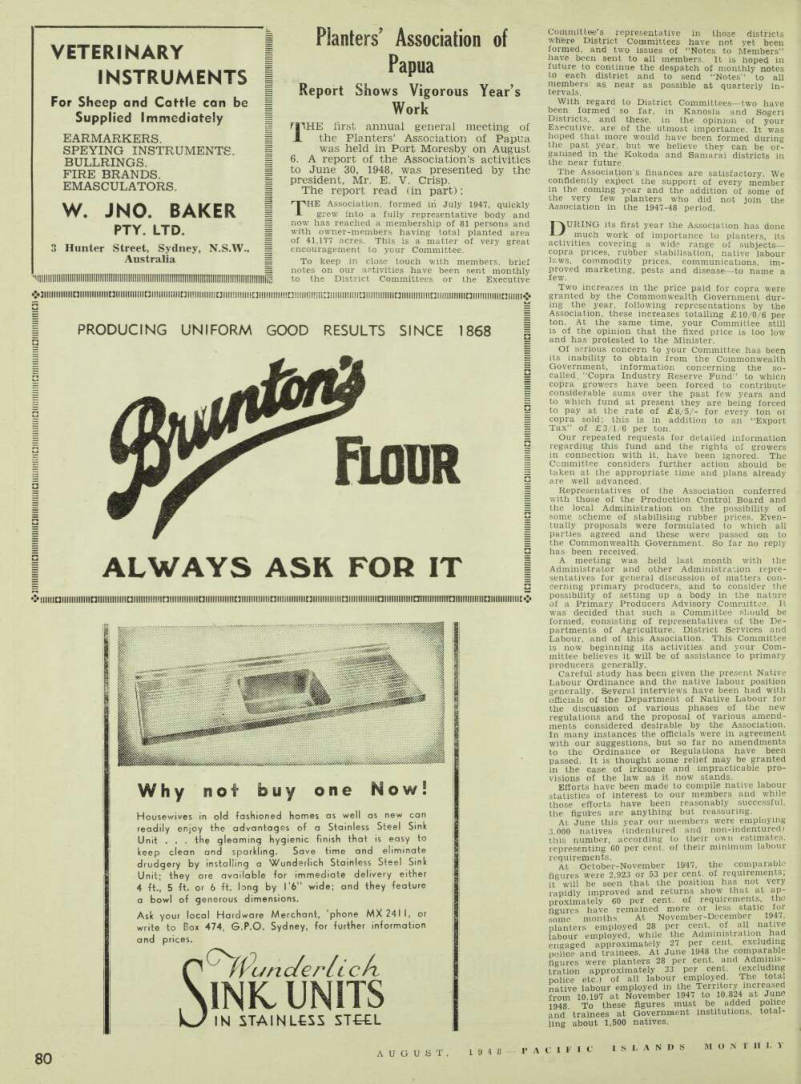
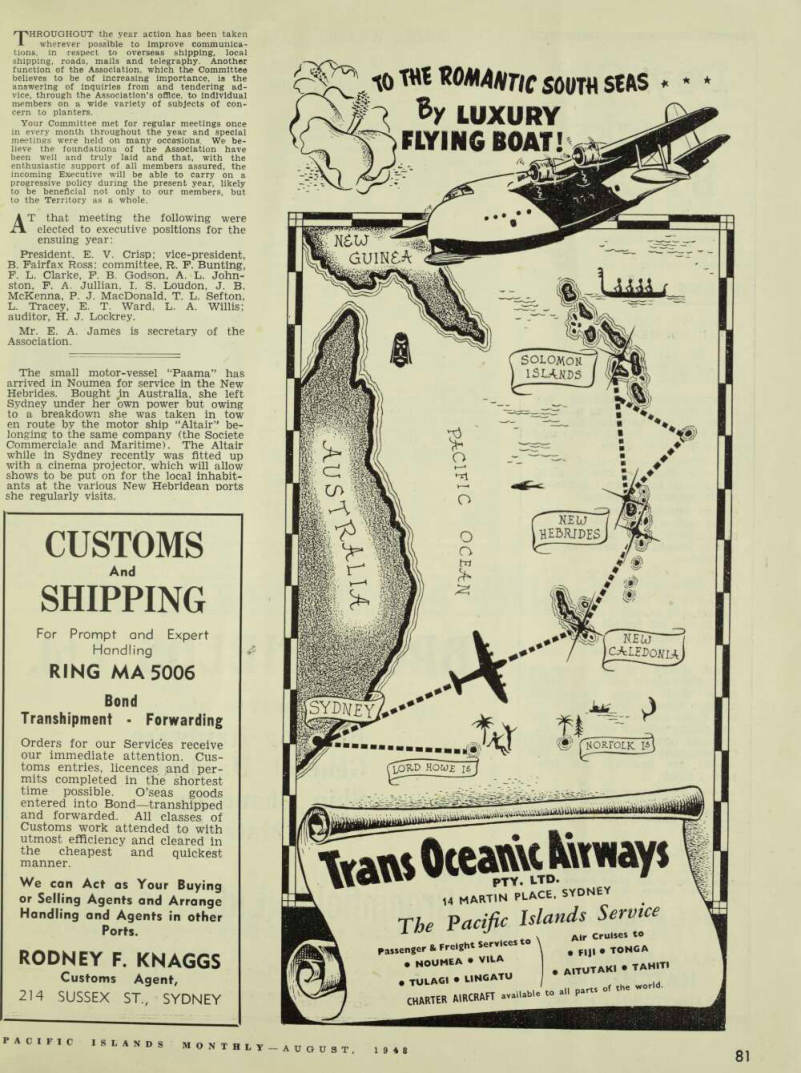
Planters' Association of Papua Report Shows Vigorous Year’s Work
rpHE first annual general meeting of JL the Planters’ Association of Papua was held in Port Moresby on August 6. A report of the Association’s activities to June 30, 1948, was presented by the president, Mr. E. V. Crisp.
The report read (in part): THE Association, formed in July 1947, quickly grew into a fully representative body and now has reached a membership of 81 persons and with owner-members having total planted area of 41,177 acres. This is a matter of very great encouragement to your Committee.
To keep in close touch with members, brief notes on our activities have been sent monthly to the District Committees or the Executive
Committee’s representative in those districts where District Committees have not yet been formed, and two issues of “Notes to Members” have been sent to all members. It is hoped in future to continue the despatch of monthly notes to each district and to send “Notes” to all members as near as possible at quarterly in tervals.
With regard to District Committees—two have been formed so far, in Kanosia and Sogeri Districts, and these, in the opinion of your Executive, are of the utmost importance. It was hoped that more would have been formed during the past year,, but we believe they can be or ganised in the Kokoda and Samarai districts in the near future.
The Association’s finances are satisfactory. We confidently expect the support of every member in the coming year and the addition of some of the very few planters who did not join the Association in the 1947-48 period. ■pvURING its first year the Association has done -L' much work of importance to planters, its activities covering a wide range of subjects— copra prices, rubber stabilisation, native labour laws, commodity prices, communications, im proved marketing, pests and disease—to name a few.
Two increases in the price paid for copra were granted by the Commonwealth Government dur ing the year, following representations by the Association, these increases totalling £lO/0/6 per ton. At the same time, your Committee still is of the opinion that the fixed price is too low and has protested to the Minister.
Of serious concern to your Committee has been its inability to obtain from the Commonwealth Government, information concerning the so called “Copra Industry Reserve Fund” to whicn copra growers have been forced to contribute considerable sums over the past few years and to which fund at present they are being forced to pay at the rate of £B/5/- for every ton of copra sold; this is in addition to an “Export Tax” of £3/1/6 per ton.
Our repeated requests for detailed information regarding this fund and the rights of growers in connection with it, have been ignored. The Committee considers further action should be taken at the appropriate time and plans already are well advanced.
Representatives of the Association conferred with those of the Production Control Board and the local Administration on the possibility of some scheme of stabilising rubber prices. Even tually proposals were formulated to which all parties agreed and these were passed on to the Commonwealth Government. So far no reply has been received.
A meeting was held last month with the Administrator and other Administration repre sentatives for general discussion of matters con cerning primary producers, and to consider the possibility of setting up a body in the nature of a Primary Producers Advisory Committee. It was decided that such a Committee should be formed, consisting of representatives of the De partments of Agriculture, District Services and Labour, and of this Association. This Committee is now beginning its activities and your Com mittee believes it will be of assistance to primary producers generally.
Careful study has been given the present Native Labour Ordinance and the native labour position generally. Several interviews have been had with officials of the Department of Native Labour for the discussion of various phases of the new regulations and the proposal of various amend ments considered desirable by the Association.
In many instances the officials were in agreement with our suggestions, but so far no amendments to the Ordinance or Regulations have been passed. It is thought some relief may be granted in the case of irksome and impracticable pro visions of the law as it now stands.
Efforts have been made to compile native labour statistics of interest to our members and while those efforts have been reasonably successful, the figures are anything but reassuring.
At June this year our members were employing 3 000 natives (indentured and non-indentured( this number, according to their own estimates, representing 60 per cent, of their minimum labour requirements.
At October-November 19'47, the comparable figures were 2,923 or 53 per cent, of requirements; it will be seen that the position has not very rapidly improved and returns show that at ap proximately 60 per cent, of requirements, the figures have remained more or less static for some months At November-December 1947, planters employed 28 per cent, of all native labour employed, while the Administration had engaged approximately 27 per cent, excluding police and trainees. At June 1948 the comparable figures were planters 28 per cent, and Adminis tration approximately 33 per cent, (excluding police etc.) of all labour employed. The total native labour employed in the Territory increased from 10,197 at November 1947 to 10,824 at June 1948 To these figures must be added police and ’ trainees at Government institutions, total ling about 1,500 natives.
THROUGHOUT the year action has been taken wherever possible to Improve communica tions, In respect to overseas shipping, local shipping, roads, mails and telegraphy. Another function of the Association, which the Committee believes to be of increasing importance, is the answering of inquiries from and tendering ad vice, through the Association’s office, to individual members on a wide variety of subjects of con cern to planters.
Your Committee met for regular meetings once in every month throughout the year and special meetings were held on many occasions. We be lieve the foundations of the Association have been well and truly laid and that, with the enthusiastic support of all members assured, the incoming Executive will be able to carry on a progressive policy during the present year, likely to be beneficial not only to our members, but to the Territory as a whole.
AT that meeting the following were elected to executive positions for the ensuing year; President, E. V. Crisp; vice-president, B. Fairfax Ross: committee, R. P. Bunting, F. L. Clarke, F. B. Godson. A. L. John ston, F. A. Jullian, I. S. Loudon, J. B.
McKenna, P. J. MacDonald. T. L. Sefton, L. Tracey, E. T. Ward, L. A. Willis; auditor, H. J. Lockrey.
Mr. E. A. James is secretary of the Association.
The small motor-vessel “Paama” has arrived in Noumea for service in the New Hebrides. Bought m Australia, she left Sydney under her own power but owing to a breakdown she was taken in tow en route by the motor ship “Altair” be longing to the same company (the Societe Commerciale and Maritime). The Altair while in Sydney recently was fitted up with a cinema projector, which will allow shows to be put on for the local inhabit ants at the various New Hebridean ports she regularly visits.
Advertisements & other items, pp. 83-84 (2 items)
81
PACIFIC ISLANDS MONTHfv a r. n« m « i H L Y AUGUST, 1948
By Luxury
<o§w TO Wf ROMANTIC SOUTH SEAS
FLYING BOAT!'
* ★ s4i • • & N£W'
It GUINEA
1 <I<UA r
SOLOMON
ISLANDS
Uebrjdes J
y
N£LJ
CALEDONIA
v>
r NORFOLK I*
H
LORD HQOJ£ is
£
Vat»0«»B!» , « 4 v 1
14 MARTIN PLACE. SYDNEY
The Pacific Islands Service
Air Cruises to
• FIJI • TONGA
• AITOTAKI • TAHITI
, all parts of the world.
CUSTOMS
And
SHIPPING
For Prompt and Expert Handling
RING MA 5006
Bond
Transhipment ■ Forwarding
Orders for our Services receive our immediate attention. Customs entries, licences ,and permits completed in the shortest time possible. O’seas goods entered into Bond—transhipped and forwarded. All classes of Customs work attended to with utmost efficiency and cleared in the cheapest and quickest manner.
We can Act as Your Buying or Selling Agents and Arrange Handling and Agents in other Ports.
RODNEY F. KNAGGS
Customs Agent,
214 SUSSEX ST., SYDNEY
Day-Old
Chicks
BY AIR
Amalgamated Hatcheries
(Reg.) of Bankstown, near Sydney, N.S.W., can dispatch limited numbers of chicks by
PLANE TO
RABAUL, PORT MORESBY,
LAE, NOUMEA, SUVA.
and all other islands of the Pacific served by present AND PROJECTED air services.
Amalgamated Hatcheries are the largest distributors of dayold chicks in Australia, last year over 1,000,000 chicks being sold by us in N.S.W. alone.
Our scientific method of packing and dispatch has resulted in a loss of less than 1 per cent, of chicks sent by plane.
If any chicks in your consignment arrive dead, we will replace them frees provided the extra freight is paid by the purchaser.
Chicks available are R.1.R., Austrolorps, and W.L.
Price, £lO per 100, landed at your airport, for unsexed chicks, and £l4 per 100 for all pullets. (Guaranteed 96 per cent, accurate sexing.) These chicks are the cream of Australia’s stock, produced under ultra - violet rays to guard against disease; the adult stock is blood-tested monthly by veterinary officers and each individual order carries a N.S.W.
Government certificate that the chicks are healthy and from tested stock.
Payment for chicks should be made by draft with the order, or credit arranged through our Bankers, the Commercial Bank of Australia, Ltd., Bankstown,
N.S.W.
Drafts and remittances can be sent direct to Amalgamated Hatcheries, Bankstown.
N.S.W., or to the following agents: Messrs. Burns, Philp (South Sea) Co., Suva-Ba-Fiji, or any Island Branch. Also to: Marcel Legras, 38 Rue de Verdun, Noumea.
WRITE BY AIR-MAIL OR
CABLE.
AMALGAMATED
HATCHERIES
BANKSTOWN, N.S.W.
Golden Wedding
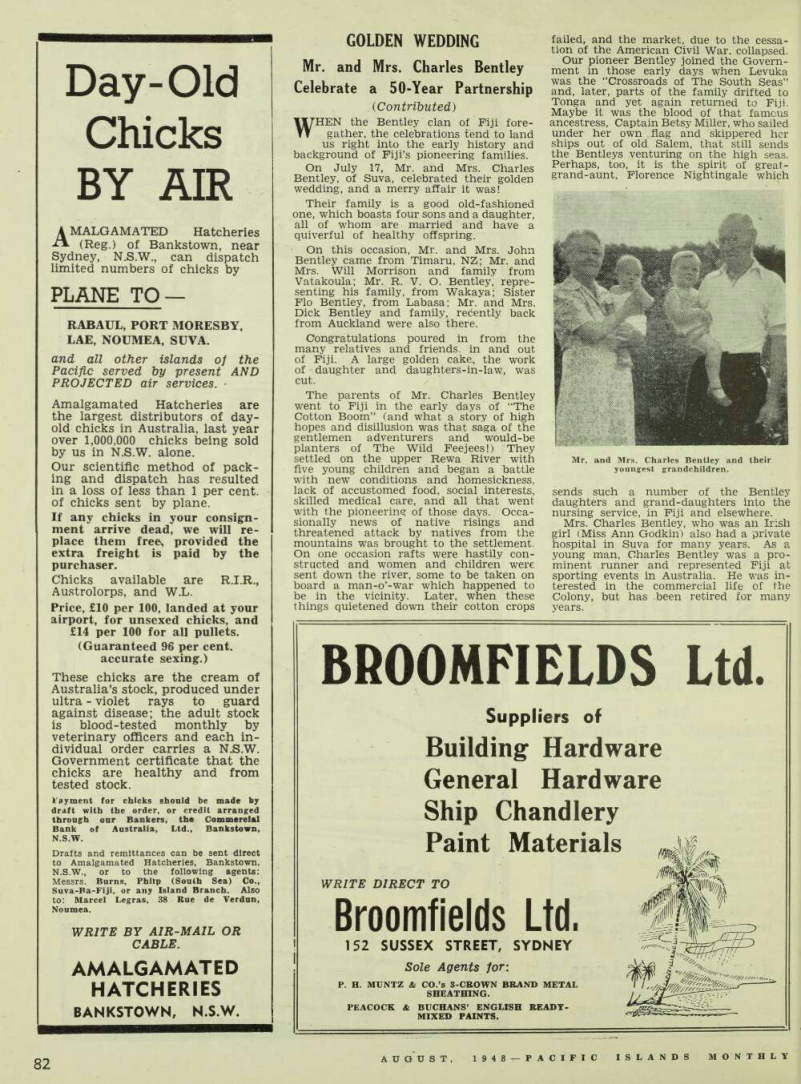
Mr. and Mrs. Charles Bentley Celebrate a 50-Year Partnership
( Contributed) WHEN the Bentley clan of Fiji fore gather, the celebrations tend to land us right into the early history and background of Fiji’s pioneering families.
On July 17, Mr. and Mrs. Charles Bentley, of Suva, celebrated their golden wedding, and a merry affair it was!
Their family is a good old-fashioned one, which boasts four sons and a daughter, all of whom are married and have a quiverful of healthy offspring.
On this occasion, Mr. and Mrs. John Bentley came from Timaru, NZ; Mr. and Mrs. Will Morrison and family from Vatakoula; Mr. R. V. O. Bentley, repre senting his family, from Wakaya; Sister Flo Bentley, from Labasa: Mr. and Mrs.
Dick Bentley and family, recently back from Auckland were also there.
Congratulations poured in from the many relatives and friends, in and out of Fiji. A large golden cake, the work of daughter and daughters-in-law, was cut.
The parents of Mr. Charles Bentley went to* Fiji in the early days of “The Cotton Boom” (and what a story of high hopes and disillusion was that saga of the gentlemen adventurers and would-be planters of The Wild Feejees!) They settled on the upper Rewa River with five young children and began a battle with new conditions and homesickness, lack of accustomed food, social interests, skilled medical care, and all that went with the pioneering of those days. Occa sionally news of native risings and threatened attack by natives from the mountains was brought to the settlement.
On one occasion rafts were hastily con structed and women and children were sent down the river, some to be taken on board a man-o’-war which happened to be in the vicinity. Later, when these things quietened down their cotton crops
failed, and the market, due to the cessa tion of the American Civil War. collapsed.
Our pioneer Bentley joined the Govern ment in those early days when Levuka was the “Crossroads of The South Seas” and, later, parts of the family drifted to Tonga and yet again returned to Fiji.
Maybe it was the blood of that famous ancestress, Captain Betsy Miller, who sailed under her own flag and skippered her ships out of old Salem, that still sends the Bentleys venturing on the high seas.
Perhaps, too, it is the spirit of great grand-aunt, Florence Nightingale which
sends such a number of the Bentley daughters and grand-daughters into the nursing service, in Fiji and elsewhere.
Mrs. Charles Bentley, who was an Irish girl (Miss Ann Godkin) also had a private hospital in Suva for many years. As a young man, Charles Bentley was a pro minent runner and represented Fiji at sporting events in Australia. He was in terested in the commercial life of the Colony, but has been retired for many years.
Mr. nd Mrs. Charles Bentley and their youngest grandchildren.
Advertisements & other items, p. 84 (1 item)
Broomfields Ltd.
Suppliers of Building Hardware General Hardware Ship Chandlery Paint Materials
WRITE DIRECT TO
Brootnfields Ltd.
152 SUSSEX STREET, SYDNEY
Sole Agents for: P. H. MUNTZ & CO.’s 3-CROWN BRAND METAL
SHEATHING.
PEACOCK & BUCHANS’ ENGLISH READT-
MIXED PAINTS.
Western Samoa Becomes Of Age
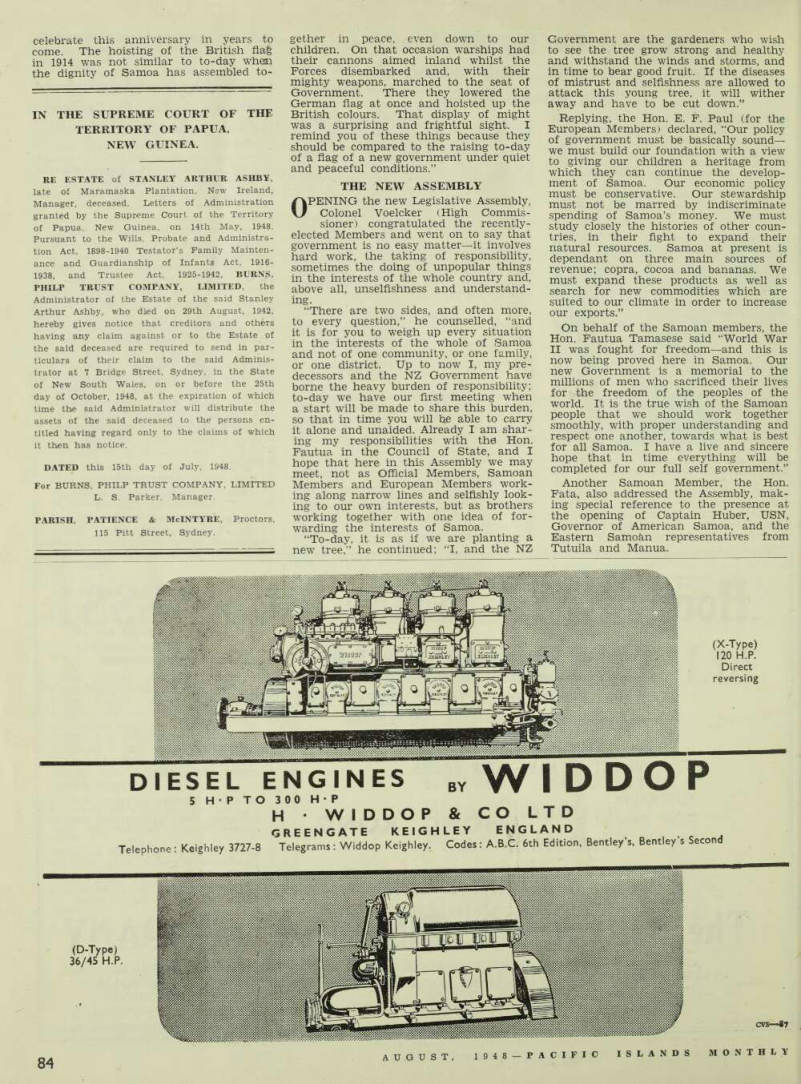
Notable Speeches at Flag-Raising Ceremony and Legislative Assembly Opening
TO mark the granting of partial self government for Western Samoa, im pressive ceremonies were held at Mulinu’u (near Apia) on June 1, when the new Samoan flag was hoisted beside the New Zealand ensign. The following day the new Legislative Assembly of offi cial and elected Europeans and Samoans was formally opened, also with consider able ceremonial.
During these two days, record crowds of Samoans, remarkably well behaved, flocked to Apia to celebrate the occasion with songs, feasts and festivities.
These events were briefly reported in the “PIM” in June issue.
The formal proceedings were charac terised by notable lengthy speeches delivered by officials, both Government and Samoan. Following are some extracts from the many addresses:—
“Partners’’
PRIOR to the flag-raising ceremony, Colonel F. W. Voelcker, the High Commissioner, said: “It is right and proper that these flags should fly together, for we are partners in this new enter prise. It is only by working side by side with love and understanding that the NZ Government as Trustee for Western Samoa and all who call these islands their home will achieve success. If we are to work together we must have mutual trust. New Zealand has no ad vantage to gain out of Samoa, except the satisfaction and happiness of being in a position to guide and support her until she can manage her own affairs.”
Some History
HON E. F. PAUL, representing the European citizens, recalled: “This is the fourth occasion that a Samoan flag has been raised at Mulinu’u. The first flag, that of King Malietoa Laupepa, was hoisted in 1873. The second flag was raised in 1875 by Colonel Steinberger, the United States’ Special Agent in Samoa at that time; and the third by King Malietoa Talavou in 1879. To-day, this emblem of Samoa is being raised under entirely different conditions. For history tells us that the previous flags were raised during time of strife and turmoil, whereas this flag unfurled to-day is to fly on the winds of peace.”
The Past
HIGH Chief Malietoa Tanumafili said: “Samoa, the love of God is wonder ful because the thing that existed in the past has now been returned to us. The crown of this day is the flag you now see waving over us—it is the goal of our efforts. Samoa had shed her blood over it; it is the reward of your work in days gone by. Alas! where are all those who sowed the seed with tears and are not present at the reaping? Let your hearts be present and let us all rejoice to-day, because our efforts have now been realised. The heroes of Samoa died for her freedom.”
Hon. Tualaulelei brought history to the min dof every listener when he stated “On August 29, 1914, the British flag was hoisted for the first time here in Samoa, and this important day has since been
commemorated every year. I mention this event, because of the importance also of this very day when the new Samoan flag is being hoisted, for we will likewise
celebrate this anniversary in years to come. The hoisting of the British flag in 1914 was not similar to to-day when the dignity of Samoa has assembled to
gether in peace, even down to our children. On that occasion warships had their cannons aimed inland whilst the Forces disembarked and, with their mighty weapons, marched to the seat of Government, There they lowered the German flag at once and hoisted up the British colours. That display of might was a surprising and frightful sight. I remind you of these things because they should be compared to the raising to-day of a flag of a new government under quiet and peaceful conditions.”
The New Assembly
OPENING the new Legislative Assembly, Colonel Voelcker (High Commis sioner) congratulated the recently elected Members and went on to say that government is no easy matter —it involves hard work, the taking of responsibility, sometimes the doing of unpopular things in the interests of the whole country and, above all, unselfishness and understand ing.
“There are two sides, and often more, to every question,” he counselled, “and it is for you to weigh up every situation in the interests of the whole of Samoa and not of one community, or one family, or one district. Up to now I, my pre decessors and the NZ Government have borne the heavy burden of responsibility; to-day we have our first meeting when a start will be made to share this burden, so that in time you will be able to carry it alone and unaided. Already I am shar ing my responsibilities with the Hon.
Fautua in the Council of State, and I hope that here in this Assembly we may meet, not as Official Members, Samoan Members and European Members work ing along narrow lines and selfishly look ing to our own interests, but as brothers working together with one idea of for warding the interests of Samoa.
“To-day, it is as if we are planting a new tree,” he continued; “I, and the NZ
Government are the gardeners who wish to see the tree grow strong and healthy and withstand the winds and storms, and in time to bear good fruit. If the diseases of mistrust and selfishness are allowed to attack this young tree, it will wither away and have to be cut down.”
Replying, the Hon. E. F. Paul (for the European Members) declared, “Our policy of government must be basically sound— we must build our foundation with a view to giving our children a heritage from which they can continue the develop ment of Samoa. Our economic policy must be conservative. Our stewardship must not be marred by indiscriminate spending of Samoa’s money. We must study closely the histories of other coun tries, in their fight to expand their natural resources. Samoa at present is dependant on three main sources of revenue; copra, cocoa and bananas. We must expand these products as well as search for new commodities which are suited to our climate in order to increase our exports.”
On behalf of the Samoan members, the Hon. Fautua Tamasese said “World War II was fought for freedom —and this is now being proved here in Samoa. Our new Government is a memorial to the millions of men who sacrificed their lives for the freedom of the peoples of the world. It is the true wish of the Samoan people that we should work together smoothly, with proper understanding and respect one another, towards what is best for all Samoa. I have a live and sincere hope that in time everything will be completed for our full self government.”
Another Samoan Member, the Hon.
Fata, also addressed the Assembly, mak ing special reference to the presence at the opening of Captain Huber, USN, Governor of American Samoa, and the Eastern Samo&n representatives from Tutuila and Manua.
Advertisements & other items, pp. 85-86 (1 item)
Hong Kong means BUSINESS!
Statutory Notice to Creditors
re WILLIAM CHARLES BOX, DECEASED.
NOTICE is hereby given that all creditors and other persons having any claims or demands upon or against the Estate of WILLIAM CHARLES BOX, late of Neipau Plantation, New Hanover, in the Territory of New Guinea, Planter, deceased, who died at sea while in the hands of the enemy on or about the first day of July, 1942, intestate, are hereby required to send in, in writing, not later than eight weeks from the publication hereof, particulars of their debts or claims verified by affidavit to BURNS,
PHILP TRUST COMPANY, LIMITED, the
Administrator of the real and personal estate of the said deceased at the office of the said Company at No. 7 Bridge Street, Sydney, in the State of New South Wales, in the Commonwealth of Australia. AND Notice is further given that after the expiration of such period the said Burns, Philp Trust Company, Limited, will proceed to distribute the assets of the said deceased amongst the persons entitled thereto having regard only to the debts or claims of which it shall then have had notice, and that it will not be liable for the assets or any part thereof so distributed to any person of whose debt or claim it shall not have had notice at the time of such distribution.
W. R. SCOTT & SCOTT,
Solicitors for the said Burns, Philp Trust Company, Limited, 359 Queen Street, Brisbane, Queensland.
Hong Kong means BUSINESS!
Hong Kong has numerous lines of merchandise which have a ready sale in your markets. No matter whether it is TEXTILES, HARD- WARE, FANCY GOODS, TOILET PREPARATIONS, CHINAWARE or any other line WE CAN GIVE YOU QUOTES.
Hong Kong is a big market for goods which you manufacture - -
SO LET US HAVE YOUR PRICES.
AUSTRALIA
NEW ZEALAND ' HONG
PACIFIC ISLANDS '
. AUSTRALIA
KONG NEW ZEALAND
' PACIFIC ISLANDS
For Inter-Empire Trade
The GREAVES TRADING COMPANY
606 CHINA BANK BUILDINGS,
QUEENS ROAD, CENTRAL HONG KONG.
Cables: GREAVES, Hong Kong.
BANKERS: The Hong Kong & Shanghai Banking Corporation.
328 ST. KILDA ROAD,
MELBOURNE, AUSTRALIA.
Cables: CHASJEN, Melbourne.
The Mercantile Bank of India.
IN THE SUPREME COURT OF THE
TERRITORY OF PAPUA,
NEW GUINEA.
RE ESTATE of STANLEY ARTHUR ASHBY,
late of Maramaska Plantation, New Ireland, Manager, deceased. Letters of Administration granted by the Supreme Court of the Territory of Papua, New Guinea, on 14th May, 1948.
Pursuant to the Wills, Probate and Administration Act, 1898-1940 Testator’s Family Maintenance and Guardianship of Infants Act, 1916- 1938, and Trustee Act, 1925-1942, BURNS,
PHILP TRUST COMPANY, LIMITED, the
Administrator of the Estate of the said Stanley Arthur Ashby, who died on 29th August, 1942, hereby gives notice that creditors and others having amy claim against or to the Estate of the said deceased are required to send in particulars of their claim to the said Administrator at 7 Bridge Street, Sydney, in the State of New South Wales, on or before the 25th day of October, 1948, at the expiration of which time the said Administrator will distribute the assets of the said deceased to the persons entitled having regard only to the claims of which it then has notice.
DATED this 15th day of July, 1948.
For BURNS, PHILP TRUST COMPANY. LIMITED
L. S. Parker, Manager.
PARISH, PATIENCE & McINTYRE, Proctors,
115 Pitt Street, Sydney.
(X-Type) 120 H.P.
Direct reversing
DIESEL ENGINES ~WIDDOP
5 H P TO 300 H• P
H • WIDDOP & CO LTD
GREENGATE KEIGHLEY ENGLAND ,
Telephone: Keighley 3727-8 Telegrams: Widdop Keighley. Codes: A.B.C, 6th Edition, Bentley's, Bentley s Sccon (D-Type) 36/45 H.P. m cl r
CVS—B?
Education In B.S.I.
School Materials Allowed In Duty-Free
IN June “PIM” an article was published on the topic of “Education in the Solomons”; it was a brief paraphrase of a report from Rev. J. F. Goldie, Chair man of the Methodist Mission of NZ.
Unfortunately, in abbreviating this an erroneous impression was given.
Whatever faults the BSIP Administra tion may have, it is unfair to say that they will not permit educational supplies to enter the Protectorate free of duty.
Bona fide school materials, scout equip ment and uniforms are allowed free of customs duty, but other materials such as calico, building materials, etc., which could be used for trading purposes or for any purpose other than education, are subject to duty.
With regard to building materials in particular, one can quite understand Mr.
Goldie’s grouse, since his Mission lost about £lOO,OOO in school buildings and equipment during the war. The Mission had a fine Training College at Kokeng golo; to-day, there remains nothing but bush. Many other schools suffered in like manner.
On the other hand, if the Administra tion were to allow any materials required by a Mission in to the group free of duty, the present small revenue available for rehabilitating the islands would be very appreciably reduced.
A further point liable to misinterpreta tion concerned the Educational Confer ence, which was called by the Director of Education. For the first time in the history of the Solomons all five Missions
assembled together, and after long and interesting discussions arrived at a sound joint policy which was acceptable to all.
On this aspect everyone, including Mr.
Goldie, expressed satisfaction and all con sidered a forward step had been made.
The proposed Government Training College made full provision for the spiri tual welfare of students from each Mis sion, under a system of self-contained Mission Colleges, the students attending
a central block for academic and instruc tional lectures and classes. This plan was accepted by the Missions unanimously, but a proviso was added that if at any future date a change in Government staff should result in a tendency to disregard the importance of an ethical background to education, each Mission retained the right to withdraw its students and to build its own training college.
Several members agreed with Mr.
Goldie that they would have liked to have had greater concessions in customs duty on imports, very naturally, and were disappointed when His Honour the Resi dent Commissioner, who had taken the Chair for the opening “on this historic occasion,” was adamant that no further concessions could be made. This should not be taken to mean that these mem bers were disappointed with the con
ference as a whole—the impression given by the article in June.
Later in the conference, a scheme was proposed which would have helped the Missions considerably in this matter of rehabilitating schools, but Mr. Goldie wanted the immediate lifting of customs duties, and would be satisfied with noth ing else.
The Missions have done, and are doing, a wonderful job in the Solomon Islands, and are doing it with very little money.
Consequently they had the complete sympathy of the Director of Education, who tried in every possible way to obtain funds with which to subsidise them in their educational work. His demands, however, were dismissed or pigeon-holed and no funds were forthcoming.
When it is considered that Australia assists its Mission helpers in Papua-New
Guinea to the tune of £40,000 annually, it will be realised that the Solomon Islands Missionaries are up against a tough proposition.
Such anomalies are dependent upon the clarity of vision of the local authori ties, and in some areas there has as yet been no dawning light of comprehension that education, properly formulated, provides the only solid foundation for a future which shall be balanced socially, morally and economically.
I am, etc.,
Coleman Porter.
Sydney, 22/7/1948. (EDITORIAL NOTE.—Mr. Coleman Porter, an Englishman, was appointed Director of Education in the Solomon Islands early in 1946, and he served in the Protectorate until he resigned last April. In a forthright address to mem bers of the Millions Club in Sydney on July 20 he severely criticised the BSI Administration, alleging that the Gov ernment had strangled the educational life of the Group to a point where he was forced to resign. He assailed the Administration as being “more concerned with the dignity of their position, the life of ease, and their future pensions rather than the betterment of the island people and rehabilitation of the area.”
Mr. Porter has since sailed for the United Kingdom.)
Advertisements & other items, pp. 87-88 (2 items)
85
PACIFIC ISLANDS MONTHLY- a U G U s T , 1948
William Atkins Pty. Ltd.
HONG KONG is far away, and this is the time to PREPARE
for your CHRISTMAS REQUIREMENTS.
• PEKING BRACELETS
• IVORY ORNAMENTS
• LINEN HANDKERCHIEFS
• SILK EMBROIDERED WARES
And various other Fancy Goods Please Contact
ALOIS AKUN & COMPANY
Pacific Islands Merchants Cotton Goods -- Textiles ■■ Trade Goods
180 NATHAN ROAD, KOWLOON, HONG KONG
Cable Address: ALOIS AKUN
William Atkins Pty. Ltd.
Head Office, 449-451 KENT ST., SYDNEY
Iron & Steel Merchanfs-Engineers' Supplies
ESTABLISHED OVER 50 YEARS
Coach fir Motor Hardware
MARK
TRADE
Cable Address: WTLATUTN, Sydaey.
—STEEL DEPARTMENT
MILD STEEL:
Rounds, Squores, Flats, Half-rounds, Hexagons, Bevel, Shoeing, Tyre, Angles, Tees, Sheets, Plates, Girder Plates, Chequer Plates, Channels, Hoops, Etc.
BRIGHT STEEL:
Rounds, Squares, Hexagons.
Engineers' Supplies: Set Screws, Studs, Metal Thread Screws, Coach Screws, Piles, Cotter Pins, Bright and Black Bolts, Rivets, Etc., Hack Saw Blades.
Power Transmission Gear: Including Plummer Blocks, Couplings, Collars, Etc.
Coach and Motor Hardware: Axles, Springs, WheeLstuff, Duck, Paints.
Farriers' Supplies: Horse Nails, Anvils, Vices, Etc.
Extra Special High Speed Tool Steel, Mining Steel, Blister Steel and Spring Steel, Rounds, Flats Cr Squares.
Bor Iron—All sections and sizes.
Motor-Trimmers and Motor Builders' & Motor Painters' Requirements Pacific Island Agents : Corrie & Co., Suva, Fiji OUCO Lacquers and DULUX Enamels—FAßßEX Motor Toppings and Leather Cloths, Mouse & Decorators' Paints, Varnishes & Brushware.
Sole Distributors of CHAMPION'S Decorators Paint Products.
Distributing Agents for BROLITE Lacquers, SYNFLEX Enamels and "POLYGLOSS" Finish.
TEL.: BW 5129. ESTABLISHED 1913.
William E. Reed
Broker and Agent
MENDES’ CHAMBERS,
8a CASTLEREAGH STREET, SYDNEY.
For all Plantation and Trading Requirements. Inquiries Invited.
IbQflfc
inn UJ
THE ROOTES GROUP
Recommend Exclusively
SHELL
MOTOR OIL
FOR ALL THEIR VEHICLES
SHELL) Yoo, too, can be sure of SHELL MOTOR OIL THE SHELL CO. OF AUST. LTD. (Inc. In Gt. Brit.)
LO 489 J
rf
New Director For New Caledonian
Native Affairs
NEW CALEDONIA’S new head of the Department for Native Affairs, M.
Lescan du Plessis, arrived from France by the “Sagittaire.” His official rank is Administrateur des Colonies, 2nd Class. The Cblony has not always had an official of this rank to look after this department. Usually the natives of the New Caledonian archipelago are allowed to live their tribal lives with a minimum of interference, though occasionally a tribal witch-doctor is called over the coals for carrying on his prohibited profession. (They flourished under the lap for all that).
It has been officially announced in Noumea that on a recent visit a US Aeronautical Inspector was of the opinion that the work now in progress on Tontouta airfield would not hinder air traffic. He also viewed favourably the projected Magenta airport, whose runway is to be extended to 1,800 metres.
Advertisements & other items, p. 88 (1 item)
For Leasing
“DATARU” PLANTATION, TABAR ISLAND,
NEW IRELAND DISTRICT
•‘DATARU” comprises approximately 257 hectares and the average pre-war yield of dried copra was estimated at 75 tons per annum from approximately 23,000 palms, but no warranty can be given.
TERMS OF LEASE:—
A lease for 3 years will be granted to an approved Lessee on a royalty basis of 50 per cent, net proceeds sale of copra over and above £2O per ton with a minimum annual payment of £175. Lessee will be responsible for all clearing and rehabilitation costs and for erection of necessary buildings. This cost has been taken into consideration when assessing production cost of £2O per ton referred to above.
Labour should be able to be recruited from local sources.
Address all applications and forward references (including financial references) to:— .
PERPETUAL TRUSTEE COMPANY (LIMITED)
BOX 4172 X G.P.O. SYDNEY N.S.W.
"torief lbout a G^mumsm Unked UP
Mr. Henry Speaks
The following letter from Mr. Albert Henry appeared in the Auckland “Star” on August 2. An article on the recent activities of the CIPA appears elsewhere in this issue.
I WAS astonished to read the opinions on the Cook Islands Progressive Asso ciation reported in your issue of July 26. It is a pity that your informant did not know the facts before making wild statements about “the Communistic infiltration of the Cook Islands Pro gressive Association.” This association is an economic and cultural organisation and does not, as such, hold any political doctrines or beliefs. All classes of re sponsible Cook Islanders are represented in its membership, including many chieftains who, like most of its members, neither in cultural matters nor economic interest favour the Communistic doctrine or in fact know what it is or anything about it. The statement made that sections of the association try to instil a suspicion and hatred of white people in the natives is ridiculous. There were some white people who wished to take charge of the association, but the natives desired to run their own association themselves. There is no justification whatever for suggesting that there is any hatred of white people in the Cook Islands. Again, far from its activities com ing to an end, as suggested, the associa tion is now making only a beginning of its work and has already approached the Government to obtain legislative assist ance to form a Producers’ Co-operative Society to enable the natives to market their produce. Unfortunately, it is only too easy to spread wrong impressions
"torief lbout a G^mumsm Unked UP
A. R. Henry
Trade Representative, Cook Islands Progressive Assn.
Production of Bulolo Gold Dredging Limited, New Guinea, for -July was 10,151 oz - fine gold from 1,027,000 cubic yards treated.
Advertisements & other items, p. 89 (2 items)
87
ACIFIC ISLANDS MONTHLY —AU<J U S T , ~,8
Fishing Nets
Allen Taylor & Co. Ltd.
COMMERCIAL ROAD, RO2ELLE,
SYDNEY
Sowmillers and Wholesale Suppliers of Hardwoods for Constructional Purposes GIRDERS . . PILES .. . POLES .. . SLEEPERS, Etc.
EXPORTING TO PACIFIC ISLANDS SINCE 1893
FISHING NETS
IMMEDIATE DELIVERY
Oxley Bros. Fishing Nets, 50 yds. Length, 2 in. Mesh, Knot to Knot, 72 in. Drop, Fully Corked and Leaded. Price, £B/10/-, F. 0.8., Sydney.
VENTURA TRADING CO. PTY., LTD.,
26 Bridge Street, Sydney
~€> UMieoy
pvT":
«> \ps \0
WHOLESALE MERCHANTS
GENERAL AGENTS
vV)
iAV^V
FORWARDING. SHIPPING £ C U STOMS AG E NTS •
Islands Produce
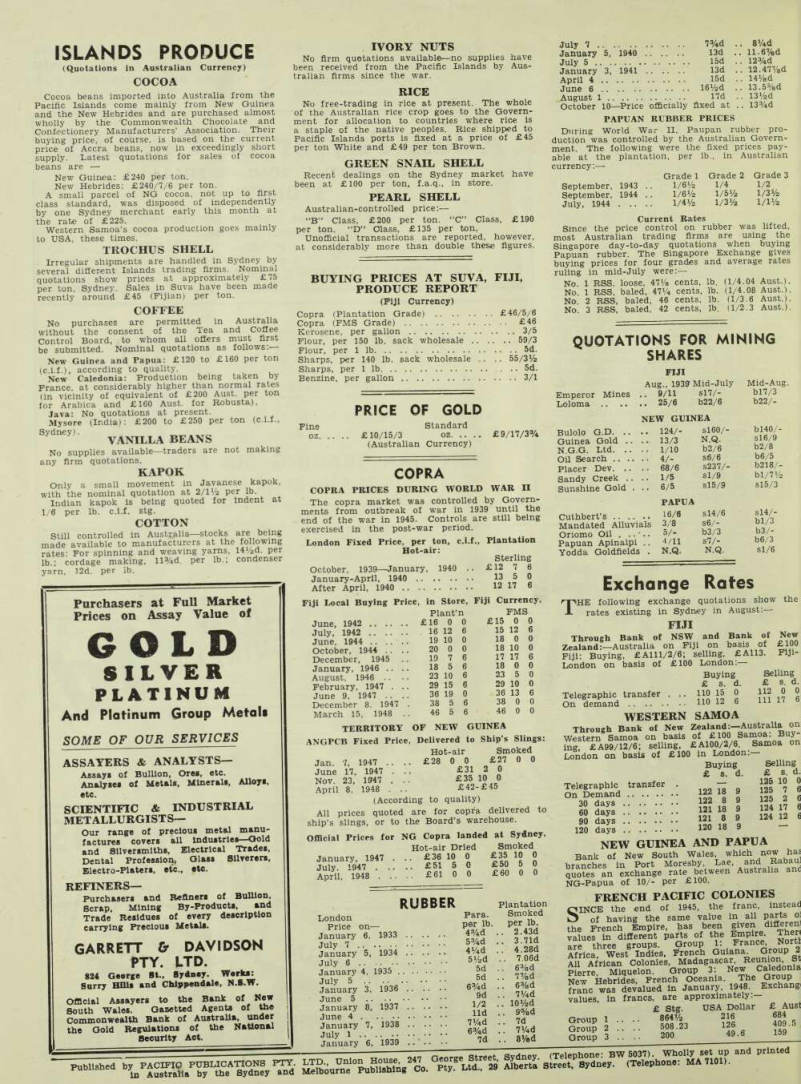
(Quotations in Australian Currency)
Cocoa
Cocoa beans imported into Australia from the Pacific Islands come mainly from New Guinea and the New Hebrides and are purchased almost wholly by the Commonwealth Chocolate and Confectionery Manufacturers’ Association. Their buying price, of course, is based on the current price of Accra beans, now in exceedingly short supply. Latest quotations for sales of cocoa beans are New Guinea: £240 per ton.
New Hebrides: £240/7/6 per ton.
A small parcel of NG cocoa, not up to first class standard, was disposed of independently by one Sydney merchant early this month at the rate of £225. .
Western Samoa’s cocoa production goes mainly to USA, these times.
Trochus Shell
Irregular shipments are handled in Sydney by several difierent Islands trading firms. Nominal quotations show prices at approximately £75 per ton, Sydney. Sales in Suva have been made recently around £45 (Fijian) per ton.
Coffee
No purchases are permitted in Australia without the consent of the Tea and Coffee Control Board, to whom all offers must first be submitted. Nominal quotations as follows: New Guinea and Papua: £l2O to £l6O per ton (c.i.f.), according to quality.
New Caledonia: Production being taken by France, at considerably higher than normal rates (in vicinity of equivalent of £2OO Aust. per ton for Arabica and £l6O Aust. for Robusta).
Java: No quotations at present.
Mysore (India): £2OO to £250 per ton (c.i.f.,
Vanilla Beans
No supplies available —traders are not making any firm quotations.
Kapok
Only a small movement in Javanese kapok, with the nominal quotation at 2/1 Va per lb.
Indian kapok is being quoted for Indent at 1/6 per lb. c.i.f. stg.
Cotton
Still controlled in Australia—stocks are being made available to manufacturers at the following rates: For spinning and weaving yarns, 14y 2 d. per lb.; cordage making, ll%d, per lb.; condenser yarn, 12d. per lb.
Ivory Nuts
No firm quotations available'—no supplies have been received from the Pacific Islands by Aus tralian firms since the war.
Rice
No free-trading in rice at present. The whole of the Australian rice crop goes to the Govern ment for allocation to countries where rice is a staple of the native peoples. Rice shipped to Pacific Islands ports is fixed at a price of £45 per ton White and £49 per ton Brown.
Green Snail Shell
Recent dealings on the Sydney market have been at £lOO per ton, f.a.q., in store.
Pearl Shell
Australian-controlled price:— “B” Class, £2OO per ton. “C” Class, £l9O per ton. “D” Class, £135 per ton.
Unofficial transactions are reported, however, at considerably more than double these figures.
Buying Prices At Suva, Fiji,
Produce Report
(Fiji Currency)
Copra (Plantation Grade) .. £46/5/6 Copra (FMS Grade) £46 Kerosene, per gallon . . .. 3/5 Flour, per 150 lb. sack wholesale .. .. .. 59/3 Flour, per 1 lb .. .. 5d.
Sharps, per 140 lb. sack wholesale .. .. 55/3% Sharps, per 1 lb . . .. 5d.
Benzine, per gallon
Advertisements & other items, p. 90 (1 item)
Price Of Gold
Fins Standard oz £lO/15/3 oz £9/17/3% (Australian Currency)
Copra
Prices During World War Ii
The copra market was controlled by Govern ments from outbreak of war in 1939 until the end of the war in 1945. Controls are still being exercised in the post-war period.
London Fixed Price, per ton, c.i.f., Plantation
Territory Of New Guinea
ANGPCB Fixed Price, Delivered to Ship’s Slings;
(According to quality) All prices quoted are for copra delivered to ship’s slings, or to the Board’s warehouse.
Official Prices for NG Copra landed at Sydney.
Hot-air: October, 1939—January, 1940 Sterling . £12 7 6 January-Aprll, 1940 . 13 5 0
After April, 1940 ..
12 17 6 Fiji Local Buying Price, in Store, Fiji Currency.
Plant’n
Fms
June, 1942 £16 0 0 £15 0 0 July. 1942 16 12 6 15 12 6 June. 1944 19 10 0 18 0 0 October, 1944 .. 20 0 0 18 10 0 December, 1945 19 7 6 17 17 6 January, 1946 .. 18 5 6 18 0 0 August, 1946 .. 23 10 6 23 5 0 February, 1947 . .. 29 15 6 29 10 0 June 9, 1947 . . 36 19 0 36 13 6 December 8. 1947 . 38 5 6 38 0 0 March 15, 1948 .. 46 5 6 46 0 0
Hot-air Smoked Jan. 7, 1947 ... £28 0 0 £27 0 0 June 17, 1947 ... £31 0 Nov. 23, 1947 . *38 W ® April 8, 1948 ... £42-£45
Hot-air Dried Smoked January, 1947 . .. £36 10 0 £35 10 0 Julv ’947 ... £51 5 0 £50 5 0 April, 1948 . .. .. £61 0 0 £60 0 0
Rubber
Papuan Rubber Prices
During World War 11, Paupan rubber pro duction was controlled by the Australian Govern ment. The following were the fixed prices pay able at the plantation, per lb., in Australian currency:—
Current Rates Since the price control on rubber was lifted, most Australian trading firms are using the Singapore day-to-day quotations when buying Papuan rubber. The Singapore Exchange gives buying prices for four grades and average rates ruling in mid-July were:—
Plantation
London Price on— Para, per lb.
Smoked per lb.
January 6, 1933 .
July 7 January 5, 1934 .
July 6 - 4%d . 5 3 / 4 d . 4V 4 d . 5V 2 d 5d . 2.43d . 3.71d . 4.28d . . 7.06d . 6%d July 5 January 3, 1936 .
June 5 January 8, 1937 .
June 4 . .. ..
January 7, 1938 .
July l January 6, 1939 , • • • •• 5d . 6 3 / 4 d . 9d . 1/2 . lid . 7»/ 4 d , 6%d , 7d . 7 7 /sd . 6%d ,. 7V 4 d . iov 2 d .. 9 5 /ed ,. 7d ,. 7V 4 d . . SVsd
July 7 7%d . . SV*d January 5, 1940 13d . . 11.6%d July 5 15d . . 12 3 Ad January 3, 1941 13d . . 12.47 7 /ad April 4 15d . . 14 1 /ed June 6 16Vzd . . 13.5%d August 1 17d . . 13V a d October 10 —Price officially fixed at . . 13%d
Grade 1 Grade 2 Grade 3 September, 1943 .
I/6V2 1/4 1/2 September, 1944 . 1/6 Vz 1/5 V 2 1/3 y 2 July, 1944 1/4 y 2 1/3 y 2 1/1%
No. 1
Rss,
loose, 47 Vb cents, lb. (1/4.04 Aust.).
No. 1
Rss.
baled, 47 V4 cents, lb. (1/4.08 Aust.) No. 2
Rss,
baled, 46 cents. lb. (1/3.6 Aust.) No. 3
Rss,
baled, 42 cents, lb. (1/2.3 Aust.)
Shares
Quotations For Mining
Fiji
Aug., 1939 Mid-July Mid-Aug.
Emperor Mines , ,. 9/11 sl7/bl7/3 Loloma ,. 25/6 b22/6 b22/- Bulolo G.D. ..
New Guinea
.. 124/- sl60/bl40/- Guinea Gold .. .. 13/3 N.Q. sl6/9 N.G.G. Ltd. .. 1/10 b2/6 b2/8 Oil Search .. .. s6/6 b6/5 Placer Dev. .. .. 68/6 s237/b218/- Sandy Creek .. .. 1/5 sl/9 bl/7y 2 Sunshine Gold . .. 6/5 sl5/9 S15/3 Cuthbert’s .. ..
Papua
.. 16/6 S14/6 sl4/bl/3 Mandated Alluvials 3,8 s6/- Oriomo Oil . .. .. 5/b3/3 b3/- Papuan Apinaipi .. 4/11 s7/b6/3 Yodda Goldfields . N.Q.
N.Q. sl/6
Exchange Rates
THE following exchange quotations show the rates existing in Sydney in August;
Fiji
Through Bank of NSW and Bank of New Zealand:— Australia on Fiji on basis of £lOO Fiji; Buying, £Alll/2/6; seUmg, £AII3. Fiji- London on basis of £lOO London:
Western Samoa
Through Bank of New Zealand:—Australia on Western Samoa on basis of £lOO Samoa. Buy- Sg £A99/12/6; selling. £AIOO/2/6. Samoa on London on basis of £lOO in London.
New Guinea And Papua
Bank of New South Wales which now has branches in Port Moresby, Lae, and Rabaul quotes an exchange rate between Australia anc NG-Papua of 10/- per £lOO.
French Pacific Colonies
SINCE the end of 1945, the franc, instead of having the same value in all parts o the French Empire, has been given differenl values in different parts of the Empire. Then are three groups. Group 1: France, Nortl Africa. West Indies, French Guiana. Group 2 All African Colonies, Madagascar Reunion St Pierre, Miquelon. Group 3 New Caledonia New Hebrides, French Oceania. The Group Sane was devalued in January, 1948. Exchange values, in francs, are approximately.—
Buying Selling £ s. d. £ s. d.
Telegraphic transfer . .. 110 15 0 112 0 0 On demand 110 12 6 111 17 6
Telegraphic transfer .
On Demand ,. .. ,. . • Buying £ s. d. 122 18 9 Selling £ s. d. 125 10 0 125 7 6 30 days 122 8 9 125 2 6 60 days 121 18 9 124 17 6 90 days • 121 8 9 124 12 6 120 days 120 18 9 —
£ Stg. USA Dollar £ Aust
S5:: B5i »
Grouo 3 . . 200 49.6 159
Advertisements & other items, pp. 90-92 (4 items)
Published ViSS. P ™' S<;u?ne lO PuS e ig 2^ Co- WW XS MA*™?. ““'
Gold
Purchasers at Full Market Prices on Assay Value of
SILVER
PLATINUM
And Platinum Group Metalt
SOME OF OUR SERVICES
ASSAYERS & ANALYSTS—
Assays of Bullion, Ores, etc.
Analyses of Metals, Minerals, Alloys, etc.
SCIENTIFIC & INDUSTRIAL
METALLURGISTS—
Our range of precious metal manufactures covers all industries—Gold and Silversmiths, Electrical Trades, Dental Profession, Glass Sllverers, Electro-Platers, etc., etc.
REFINERS—
Purchasers and Refiners of Bullion, Scrap, Mining By-Products, and Trade Residues of every description carrying Precious Metals.
GARRETT & DAVIDSON
PTY. LTD.
824 George St., Sydney. Works: Surry HUls and Chippendale, N.B.W.
Official Assayers to the Bank of New South Wales. Gazetted Agents of the Commonwealth Bank of Australia, under the Gold Regulations of the National Security Act.
August, i94«- p a c i f i c .slands monthly
farfhodi dri*"
To quench a
tropical thirst...
Mil
nma UL Hi f OnrV 4 • OTf i« c> • Jt. rr\ i i>i it
** CO LIMITED
*VON*y >
K 8.1.49 When you’re hot and tired, there is nothing quite so satisfying and thirst quenching as a long, cold glass of “K. 8.” Your friends and guests, too, will appreciate this really fine Lager, for “Everybody drinks K.B. V
TOOTH’S
LAGER
& yap: *
OWN
ERS
ERCHANTS
5 H M
Capitol £1,000,000
ESTABLISHED 1914
COPRA MERCHANTS & MILLERS
ASSOCIATED COMPANIES THROUGHOUT THE PACIFIC ISLANDS
Buyers and exporters of all kinds of Islands produce. Copra Merchants and Millers.
Agents for Australian, European and American Manufacturers. Distributors of every' description of merchandise.
Thirty years of Pacific Islands development and service.
REGULAR CARGO
PACIFIC
Head
W.
Office:
IN LONDON
w. R. CARPENTER & CO.
(LONDON) LTD.
Coronation House. 4 Lloyd’s Avenue, London, E.C.
IN NEW GUINEA
New Guinea Company Limited., Rabaul, Lae, Madang, Kavieng.
IN PAPUA
J. R. Clay & Co., Ltd.,
IN FIJI
W. R. Carpenter & Co. (Fiji) Ltd. ★
THE W.R.C. LINE
THE FIRST DIRECT AND
AND PASSENGER SERVICE BETWEEN EUROPE AND
ISLAND PORTS WAS ESTABLISHED BY
R. CARPENTER & CO. LTD.
16 O'CONNELL STREET, SYDNEY.
DISTRIBUTING
AGENTS FOR:
Ford Motor Company of Canada.
Electrolux Refrigerators.
T. G. & C. Bolinders (Engines).
Chrysler Corporation, Westinghouse Electrical Co.
Caterpillar Tractors.
Etc., Etc.
Cable Address-
CAMOHE.
Telephone: BW 4421.
Postal Address: P.O. Box No. 168, Sydney. pacific: islands monthly AUGUST, 1948