King of The Kermadecs
p. 44 · Read in the full issue
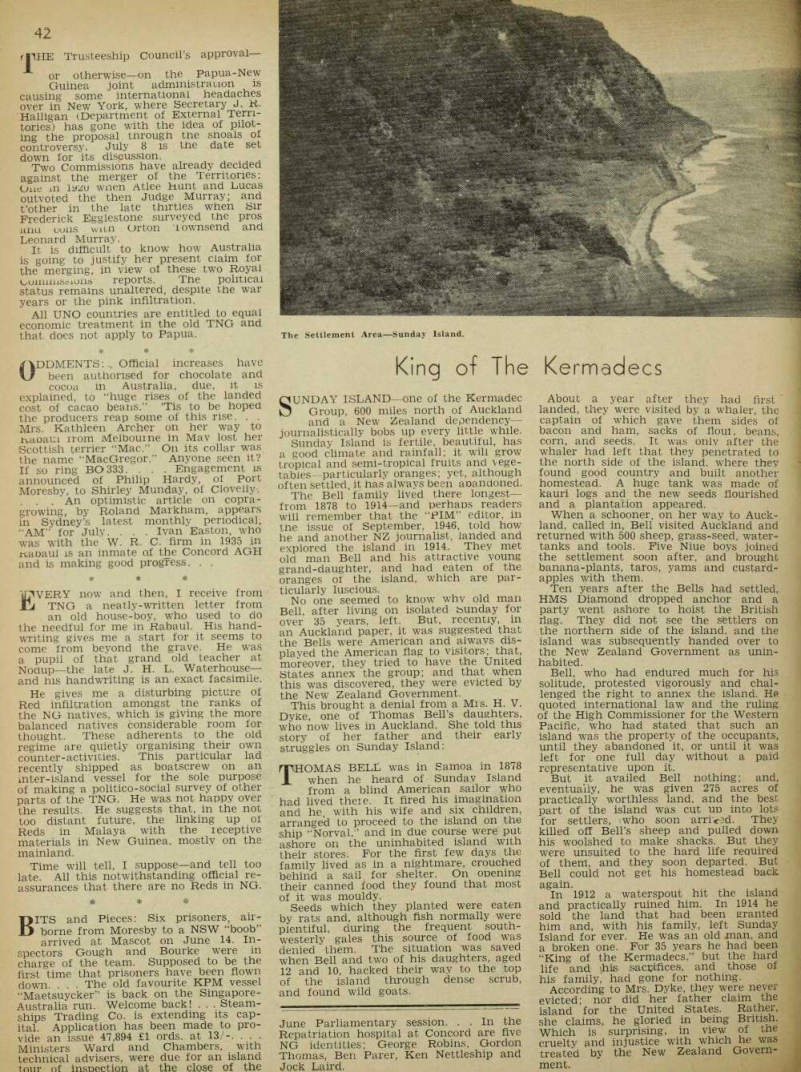
SUNDAY ISLAND—one of the Kermadec Group. 600 miles north of Auckland and a New Zealand dependency— journalistically bobs up every little while, Sunday Island is fertile, beautiful, has a good climate and rainfall: it will grow tropical and semi-tropical fruits and vege tabies_particularly oranges; yet, although often settled it has always been aoandoned.
The Bell ’ family lived there longest— from 1878 to 1914—and perhaps readers will remember that the “PIM” editor, in the issue of September, 1946, told how he and another NZ journalist, landed and explored the island in 1914. They met old man Bell and his attractive young grand-daughter, and had eaten of the oranges of the island, which are par ticularly luscious.
No one seemed to know why old man Bell, after living on isolated bunday for over 35 years, left. But, recently, in an Auckland paper, it was suggested that the Bells were American and always dis played the American flag to visitors; that, moreover, they tried to have the United States annex the group; and that when this was discovered, they were evicted by the New Zealand Government.
This brought a denial from a Mrs. H. V.
Dyke, one of Thomas Bell’s daughters, who now lives in Auckland. She told this story of her father and their early struggles on Sunday Island: THOMAS BELL was in Samoa in 1878 when he heard of Sunday Island from a blind American sailor who had lived there. It fired his imagination and he with his wife and six children, arranged to proceed to the island on the ship “Norval,” and in due course were put ashore on the uninhabited island with their stores. For the first few days the family lived as in a nightmare, crouched behind a sail for shelter. On opening their canned food they found that most of ft W as mouldy.
Seeds which they planted were eaten by rats and, although fish normally were plentiful during the frequent south westerly ’ gales this source of food was denied them. The situation was saved when Bell and two of his daughters, aged 12 and 10, hacked their way to the top of the island through dense scrub, and found wild goats.
About a year after they had first landed, they were visited by a whaler, the captain of which gave them sides of bacon and ham, sacks of floui, beans, corn, and seeds. It was only after the whaler had left that they penetrated to the north side of the island, where they found good country and built another homestead. A huge tank was made of kauri logs and the new seeds flourished and a plantation appeared.
When a schooner, on her way to Auck land, called in, Bell visited Auckland and returned with 500 sheep, grass-seed, water tanks and tools. Five Niue boys joined the settlement soon after, and brought banana-plants, taros, yams and custard apples with them.
Ten years after the Bells had settled, HMS Diamond dropped anchor and a party went ashore to hoist the British flag. They did not see the settlers on the northern side of the island, and the island was subsequently handed over to the New Zealand Government as unin habited.
Bell, who had endured much for his solitude, protested vigorously and chal lenged the right to annex the island. He quoted international law and the ruling of the High Commissioner for the Western Pacific, who had stated that such an island was the property of the occupants, until they abandoned it, or until it was left for one full day without a paid representative upon it.
But it availed Bell nothing; and. eventually, he was given 275 acres of practically worthless land, and the best part of the island was cut un into lots for settlers, who soon arrived. They killed off Bell’s sheep and pulled down his woolshed to make shacks. But they were unsuited to the hard life required of them, and they soon departed. But Bell could not get his homestead back again.
In 1912 a waterspout hit the island and practically ruined him. In 1914 he sold the land that had been granted him and, with his family, left Sunday Island for ever. He was an old man, and a broken one. For 35 years he had been “King of the Kermadecs,” but the hard life and \hife .sacrifices, and those of his family, had gone for nothing.
According to Mrs. Dyke, they were never evicted; nor did her father claim the island for the United States. Rather, she claims, he gloried in being British.
Which is surprising, in view of tne cruelty and injustice with which he was treated by the New Zealand Govern ment.
The Settlement Area—Sunday Island.