Magazine Section
pp. 43-44 · Read in the full issue
Territories Talk Talk
By "Tolala"
OLD Territorians will recall J. R.
Atcherley. He was in the Australian news last month, as a result of a charge laid against him in Canberra for indecent assault (he was convicted and received twelve months), as well as through a certain amount of notoriety he received when named by Jack Lang in the House of Representatives as a potential Communist.
Atcherley was a plantation overseer in the Expro board in the early ’twenties and was for a while stationed on a Earning plantation. It was he who started the ball rolling which resulted m 1923 in the Canning Inquiry into alleged forced labour and geneiai mal administration of the Native Affairs De partment.
In his plantation days he was nuts on criemicals and test-tubes and all that sort of gear and used to periodically blow tne place up. Some years later ne col lected a Chemistry diploma and eventu ally nis doctorate in science.
In the ’thirties he returned to NG in charge of a gold-prospecting concern witn ideas of doing big tnings where the old Nakanai massacre occurred. But 1 never heard of any bonanza being struck down tnat way. apparently before going to NG he had a bit of a record up his sleeve. * * THERE appeared to be pretty good team-work last month between the Federal Opposition and the Papua- New Guinea Public Servants. On one day, Minister Ward and Liberal member Tommy White crossed swords over a matter of unrest amongst the Territorian Public Servants, the former naturally uenymg any such imputations.
On the following day, cabled reports from Port Moresby made no secret oi the fact that 150 Public Servants there had held a stop-work meeting, protesting on the delay in holding an independent in quiry into the cost of living—amongst other things.
A case of telepathy, maybe.
That was before electric light meters were installed in private residences. One official makes a conservative estimate that his light bill will be in the vicinity of £l5 a month. Who has shares in the electric light company; and where do the dividends go? * ♦ ♦ MRS ALICE ALLEN INNES, writer and old Islands identity, recently re turned from a tour to Fiii and New Zealand, the long way round. Aerial transport lag from NZ to Australia neces sitated doubling back to Fiji in order to reach Australia. She got a modicum of publicity where ’ere she went, and in her usual happy manner gave New Guinea a good press. Folk like Alice Innes should be subsidised to travel round the world and work up a good impression of the Territories. She has the happy faculty of rising above the usual sordid, depressing criticisms which are so prevalent these days. There is still romance in New Guinea for Alice, and she has the happy knack of telling the world all about it, whether over the air or on the written page.
HAD an inquiry the other day from an old Territorian, who asked the origin of that obnoxious term, ‘ Huzzy Wuzzy,” as applied to the Papuan-New Guinea native carrier during the war.
As far as I can ascertain, it is taken from Kipling’s poem, “Huzzy Wuzzy,’ written to commemorate the bravery of the Sudanese when they “bruk a British square.” To quote a portion: So ’ere’s to you, Fuzzy Wuzzy, at your ’ome in the Sowdan; You’re a pore benighted ’eathen, but a first-class fightin’ man; And 'ere’s to you, Fuzzy Wuzzy, with your ’ayrick ’ead of ’air— You big, black, bounding beggar—for you bruk a British square.”
It’s a pity a more appropriate name couldn’t nave been coined as a result of World War II other than Fuzzy Wuzzy and Boong, both of which are anathema to Territorians.
“Boys” they have been, and “boys” they will remain despite popular nomenclatuie oy interlopers or official proclamations. (ED. NOTE; The term Fuzzv Wuzzy, in relation to New Guinea natives, developed during the Pacific war after an Australian soldier (who perhaps had read Kipling) wrote a jingle called “The Fuzzy Wuzzy Angels.” It was published in many Australian newspapers , and extolled the virtues of the native carriers on the Kokoda track.) * * * A BILL is to be brought before the House at Canberra, providing a joint administration for the Territories. It was stated in the Press that the Legislative Council would consist of twentyeight members, representing the missionaries, natives, non-European and European population. This, by-the-way, was advocated back in 1930 by the old “Rabaul Times,” and could have saved quite a
few heart-burnings had it been adopted —especially amongst the Asiatics, wno comprise a iair proportion of the non native population, me Bill also provides for the escabiisiiment of native courts ana village councils, Tnese ideas are produced now as tnougn they are babes of the Ed- Wardian period. Notnmg oi the kind, inese courts and councils were operating lor several years before Nippon took over in 1942, so they re nothing new.
There will be, of course, in the Legis lative Council personnel, a clear majority of four lor tne Administration, which will enable Canberra edicts to be raii roaded through the Chamber as in days of yore. . . . .
What the Bill should provide but doesn’t—is a representative in Canberra, on the same basis as the present Northern Territory Member in the House, Such a Member would snort-circuit many Territorial grievances, iney’u never be anything approaching contentment in the Territories until tms step is taken and complaints can reach Canberra direct without taking me long way round tnrougn Press or Opposition channels, mo WARDS the end of last month some f items were revealed from the Com monwealth Auditor-General’s Report dealing with unused balances of Com monwealth Trust Funds. Tne amount in these accounts totalled some £6* million. it was anticipated that the Government would receive a windfall of something like £l6 million. An itemised list of trust funds with unused balances did not, however, include the £5 million which the War Damage Commission anticipates be unexpended after all claims are ... , , , What will happen to the unexpended portion of this fund, built up from war insurance premiums. . . .Its going to be a knotty question.
(Continued Next rage)
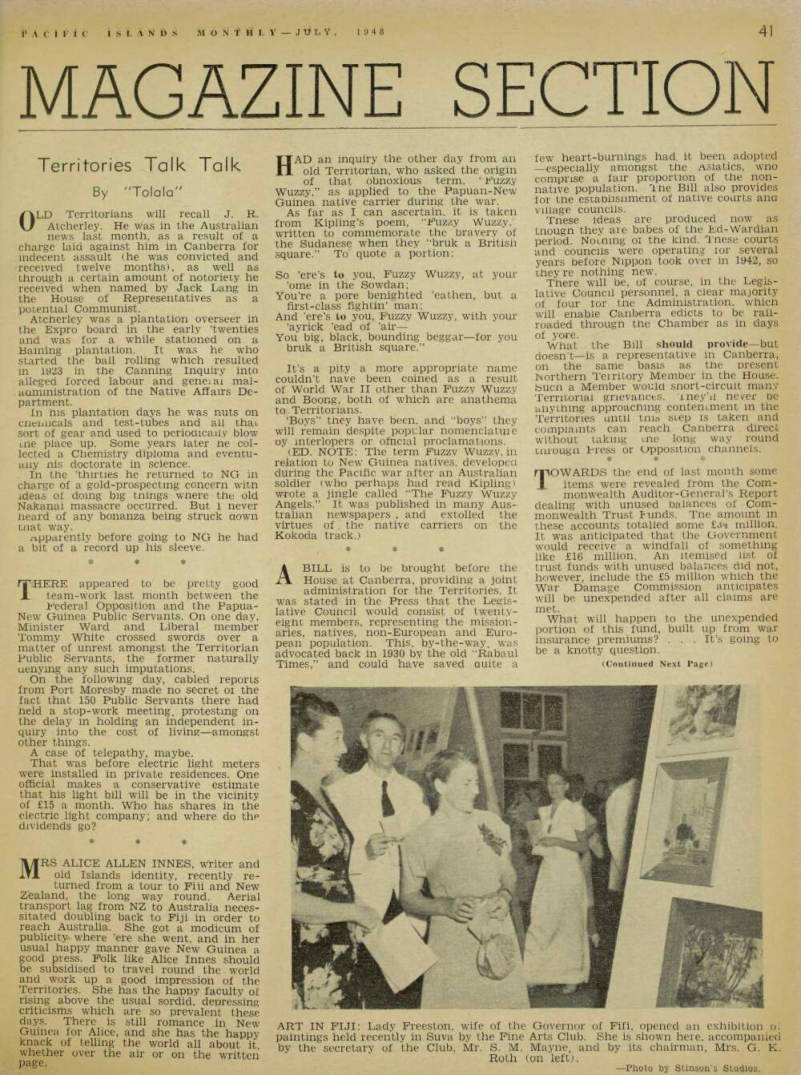
ART IN FIJI: Lady Freeston, wife of the Governor of Fifi, opened an exhibition of paintings held recently in Suva by the Fine Arts Club. She is shown here, accompanied by the secretary of the Club, Mr. S. M. Mayne, and by its chairman, Mrs. G. K.
Roth (on left). —Photo by Stinson’s Studios.
rpilE Trusteeship Council’s approval— or otherwise —on the Papua-New Guinea joint administration is causing some international headaches over in New York, where Secretary J. R.
Halligan (Department of External Terri tories) has gone with the idea of pilot ing the proposal tnrougn tne snoals of controversy. July 8 is tine date set down for its discussion.
Two Commissions have already decided against the merger of the Territories: Oue m wnen Atlee hunt and Lucas outvoted the then Judge Murray; and t’other in the late thirties when Sir Frederick Egglestone surveyed the pros ana cans wnn Orton Townsend and Leonard Murray.
It is difficult to know how Australia is going to justify her present claim for the merging, in view of these two Royal reports. The political status remains unaltered, despite the war years or the pink infiltration.
All UNO countries are entitled to equal economic treatment in the old TNG and that does not apply to Papua. * * * ODDMENTS: . Official increases have been authorised for chocolate and cocoa in Australia, due, it is explained, to “huge rises of the landed cost of cacao beans.” ’Tis to be hoped the producers reap some of this rise. . .
Mrs. Kathleen Archer on her way to Kaoaui irom Melbourne in Mav lost her Scottish terrier “Mac.” On its collar was the name “MacGregor.” Anyone seen it?
If so ring BO 333. . . . Engagement is announced of Philip Hardy, of Port Moresby, to Shirley Munday, of Clovelly. . . An optimistic article on copra growing, by Roland Markham, appears in Sydney’s latest monthly periodical, “AM” for July. . . . Ivan Easton, who was with the W. R. C. firm in 1935 in rtaDaul is an inmate of the Concord AGH and is making good progress. . . * * * EVERY now and then, I receive from TNG a neatly-written letter from an old house-boy, who used to do the needful for me in Rabaul. His hand writing gives me a start for it seems to come from beyond the grave. He was a pupil of that grand old teacher at Nodup—the late J. H. L. Waterhouse— and his handwriting is an exact facsimile.
He gives me a disturbing picture of Red infiltration amongst tne ranks of the NG natives, which is giving the more balanced natives considerable room for thought. These adherents to the old regime are quietly organising their own counter-activities. This particular lad recently shipped as boatscrew on an inter-island vessel for the sole purpose of making a politico-social survey of other parts of the TNG. He was not happy over the results. He suggests that, in the not too distant future, the linking up of Reds in Malaya with the receptive materials in New Guinea, mostly on the mainland.
Time will tell, I suppose—and tell too late. All this notwithstanding official re assurances that there are no Reds in NG. * * * BITS and Pieces: Six prisoners, air borne from Moresby to a NSW “boob” arrived at Mascot on June 14. In spectors Gough and Bourke were in charge of the team. Supposed to be the first time that prisoners have been flown down. , . . The old favourite KPM vessel “Maetsuycker” is back on the Singapore- Australia run. Welcome back! . . . Steam ships Trading Co. is extending its cap ital. Application has been made to pro vide an issue 47,894 £1 ords. at 13/-. . . .
Ministers Ward and Chambers, with technical advisers, were due for an island tour of insnection at the close of the
June Parliamentary session. . . In the Repatriation hospital at Concord are five NG identities: George Robins. Gordon Thomas, Ben Parer, Ken Nettleship and Jock Laird.