Tropicalities
pp. 46-47 · Read in the full issue
NOT long ago a Fijian police corporal noted that an Indian van was effectively blocking the stream of traffic in Nausori’s main street, while the driver was lost in conversation with a pedestrian.
When he came back to earth the driver found further progress obstructed by the corporal’s 6ft. 2in. Unconscious of impending doom, the Indian thereupon shattered the peace of the community with a series of tremendous blasts on the horn as an indication that the corporal was exacted to hop it.
The corporal did not hop it. He produced a pencil and informed the driver that there now two charges against him—one concerning illegal parking and the other concerning the totally unnecessary horn-blasting racket.
During the subsequent exchange of views, the Police officer noted the absence of a licence-disc on the windscreen— charge No. 3. And then he asked for the driver’s licence, which failed to materialise—Charge No. 4. At that the corporal called it a day.
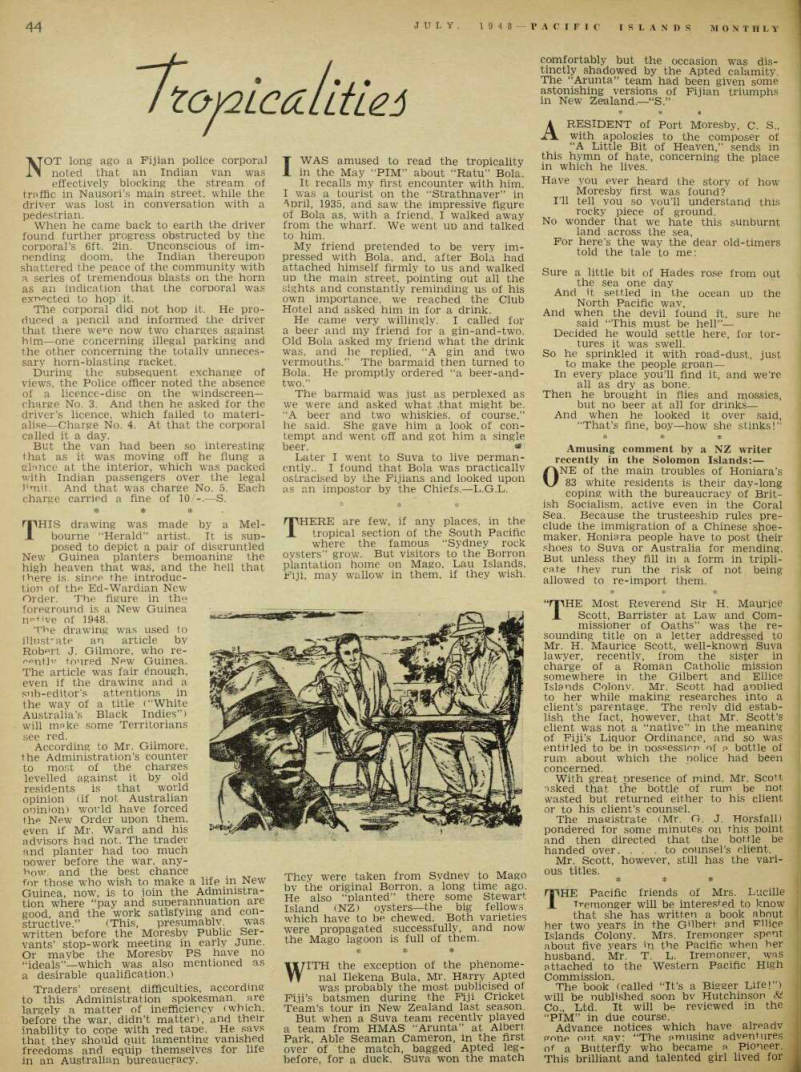
But the van had been so interesting that as it was moving off he flung a glnnce at the interior, which was packed with Indian passengers over the legal Unfit. And that was charge No. 5. Each charge carried a fine of 10/-.—S. * ♦ * THIS drawing was made by a Melbourne “Herald” artist. It is supposed to depict a pair of disgruntled New Guinea planters bemoaning the high heaven that was, and the hell that there is. since the introduction of the Ed-Wardian New
Order. The figure in the foreground is a New Guinea noHve of 1948.
The drawing was used to illustrate an article by Robert J. Gilmore, who re ',ontW toured New Guinea.
The article was fair Enough, even if the drawing and a sub-editor’s attentions in the way of a title (“White Australia’s Black Indies”) will make some Territorians see red.
According to Mr. Gilmore, the Administration’s counter to most of the charges levelled against it by old residents is that world opinion (if not Australian opinion) world have forced the New Order upon them, even if Mr. Ward and his advisors had not. The trader and planter had too much power before the war, any
v>ow. and the best chance for those who wish to make a life in New Guinea, now, is to join the Administra tion where “pay and superannuation are good, and the work satisfying and con structive.” (This, presumablv. was written before the Moresby Public Ser vants’ stop-work meeting in early June.
Or maybe the Moresby PS have no “ideals”—which was also mentioned as a desirable qualification.) Traders’ present difficulties, according to this Administration sppkesman. are largely a matter of inefficiency (which, before the war, didn’t matter), and their inability to cone with red tape. He savs that they should quit lamenting vanished freedoms and equip themselves for life in an Australian bureaucracy.
T WAS amused to read the tropicality 1. in the May “PIM” about “Ratu” Bola.
It recalls my first encounter with him.
I was a tourist on the “Strathnaver” in 4pril, 1935, and saw the impressive figure of Bola as, with a friend. I walked away from the wharf. We went up and talked to him.
My friend pretended to be very im pressed with Bola, and. after Bola had attached himself firmly to us and walked up the main street, pointing out all the sights and constantly reminding us of his own importance, we reached the Club Hotel and asked him in for a drink, He came very willingly. I called for a beer and my friend for a gin-and-two.
Old Bola asked my friend what the drink was, and he replied, “A gin and two vermouths.” The barmaid then turned to Bola. He promptly ordered “a beer-and two.”
The barmaid was just as perplexed as we were and asked what .that might be.
"A beer and two whiskies, of course.” he said. She gave him a look of con tempt and went off and got him a single beer. * Later I went to Suva to live perman ently.. I found that Bola was practically ostracised by the Fijians and looked upon as an impostor by the Chiefs.—L.G.L. 0 HPHERE are few, if any places, in the A tropical section of the South Pacific where the famous Sydney rock oysters grow. But visitors to the Borron plantation home on Mago, Lau Islands, may wallow in them, if they wish,
J h ey were taken from Sydney to Mago by therl some Stewart
Itad“ («Z. Toysters-Ure S °to| fellows:
which have to be chewed Both varieties were Propagated successfully now the Mago la & oon is full of tnem. * yjiriTH the exception of the phenome yy nal n e kena Bula, Mr. Harry Apted was probably the most publicised of Fiji’s batsmen during the Fiji Cricket Team’s tour in New Zealand last season, But when a Suva team recently played a team from HMAS “Arunta” at Albert Park, Able Seaman Cameron, in the first over of the match, bagged Apted leg before, for a duck. Suva won the match
comfortably but the occasion was dis tinctly shadowed by the Apted calamity.
The “Arunta” team had been given some astonishing versions of Fijian triumphs in New Zealand.—“S ” * * * A RESIDENT of Port Moresby, C. S., with apologies to the composer of “A Little Bit of Heaven,” sends in this hymn of hate, concerning the place in which he lives.
Have you ever heard the story of how Moresby first was found?
I’ll tell vou so you’ll understand this rocky piece of ground.
No wonder that we hate this sunburnt land across the sea, For here’s the way the dear old-timers told the tale to me: Sure a little bit of Hades rose from out the sea one day And it settled in the ocean up the North Pacific wav, And when the devil found it, sure he said “This must be hell”— Decided he would settle here, for tor tures it was swell.
So he sprinkled it with road-dust, just to make the people groan— In every place you’ll find it, and we’re all as dry as bone.
Then he brought in flies and mossies, but no beer at all for drinks— And when he looked it over said, “That’s fine, boy—how she stinks!” * * * Amusing comment by a NZ writer recently in the Solomon Islands:— ONE of the main troubles of Honiara’s 83 white residents is their day-long coping with the bureaucracy of Brit ish Socialism, active even in the Coral Sea. Because the trusteeship rules pre clude the immigration of a Chinese shoe maker, Honiara people have to post their shoes to Suva or Australia for mending.
But unless they fill in a form in tripli cate thev run the risk of not being allowed to re-import them. * * * “rpHE Most Reverend Sir H. Maurice X Scott, Barrister at Law and Com missioner of Oaths” was the re sounding title on a letter addressed to Mr. H. Maurice Scott, well-known Suva lawyer, recently, from the sister in charge of a Roman Catholic mission somewhere in the Gilbert and Ellice Islands Colony. Mr. Scott had applied to her while making researches into a client’s parentage. The renly did estab lish the fact, however, that Mr. Scott’s client was not a “native” in the meaning of Fiji’s Liquor Ordinance, and so was entitled to be in possession of a bottle of rum about which the police had been concerned.
With great presence of mind. Mr. Scott, nsked that the bottle of rum be not wasted but returned either to his client or to his client’s counsel.
The magistrate (Mr. G. J. Horsfall) pondered for some minutes on this point and then directed that the bottle be handed over. ... to counsel’s client.
Mr. Scott, however, still has the vari ous titles. * * * Pacific friends of Mrs. Lucille Tremonger will be interested to know that she has written a book about her two years in the Gilbert and hi lice Islands Colony. Mrs. Iremonger spent about five years in the Pacific when her husband, Mr. T. L. Iremonger, was attached to the Western Pacific High Commission.
The book (called “It’s a Bigger Life!”) will be published soon bv Hutchinson &!
Co., Ltd. It will be reviewed in the “PTM” in due course.
Advance notices which have already p-one out sav: “The amusing adventures ot a Butterfly who became a Pioneer.
This brilliant and talented girl lived for
over a year in a group of arid Pacific atolls (the Gilbert and Ellice Islands) before their capture by the Japanese.
Written with wit and humour, thought fulness and insight, these sparkling pages reveal a rich and attractive personality, and the ebullient style does not conceal her sterling qualities of courage, modesty and resourcefulness. Packed full of drama, action, bizarre incidents, well drawn characters and incisive comments, with plenty of good laughs throughout.
Illustrated with eight full page photo graphs and seventeen original line drawings by the author which are epi grams in themselves. 18/- net.”
Mrs. Iremonger wrote one other book (a cookery-book in Gilbertese, Ellice and English) while she was living in the G & E Colony. * * * A COLLECTION of attractive hand bags, the work of Pacilc Island women who are adherents of the London Missionary Society, was displayed recently in Auckland. One of the bags will be chosen and presented to Princess Margaret when she christens the “John
Williams VI” at a North of England shipyard in August.
All the bags are made from pandanus and are the result of competitions held in Niue, Samoa, Cook Islands and Gilbert Islands.
Some are of the fold-over, envelope type; others are small round ones.
The two judges who will choose Princess Margaret’s bag are former missionaries, Mrs. C. M. Dawson and Mrs. Bond Jones.
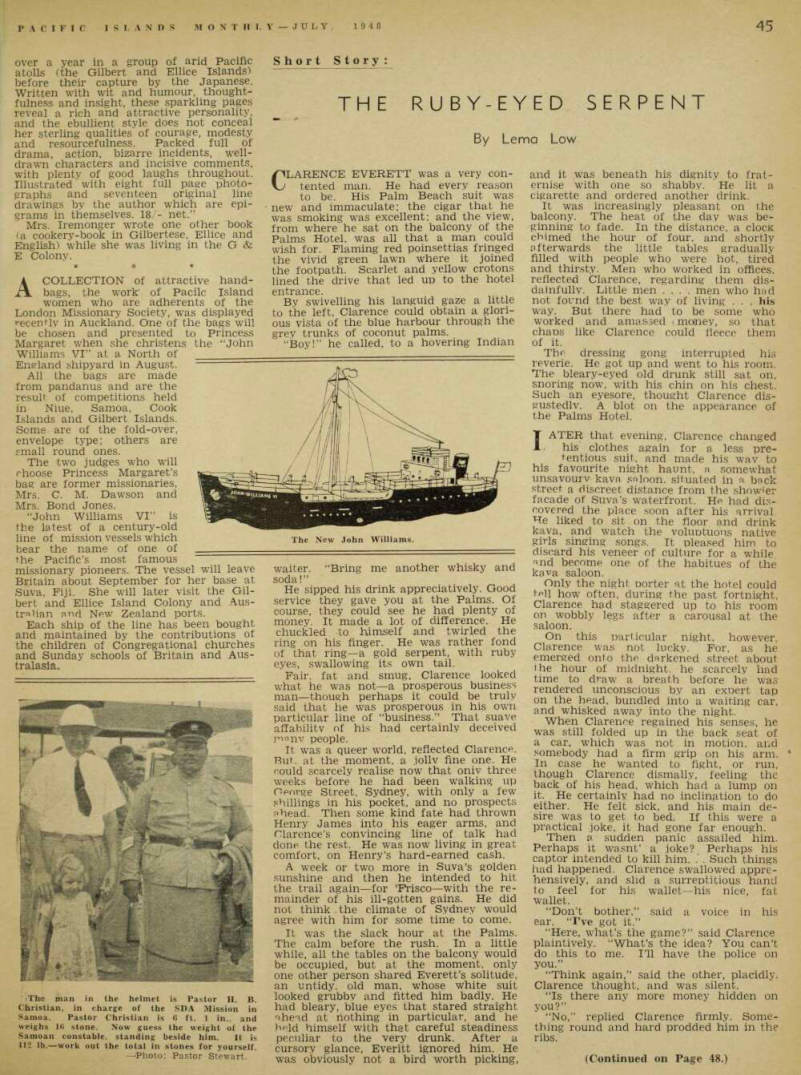
“John Williams VI” is the latest of a century-old line of mission vessels which bear the name of one of the Pacific’s most famous
missionary pioneers. The vessel will leave Britain about September for her base at Suva, Fiji. She will later visit the Gil bert and Ellice Island Colony and Aus tralian pnd New Zealand ports.
Each ship of the line has been bought and maintained by the contributions of the children of Congregational churches and Sunday schools of Britain and Aus tralasia.