Became King of the Atolls
pp. 50-60 · Read in the full issue
ROUGIER: Missiona Became King of the Atolls
ABOUT the time when, a few months ago, a “PIM” writer aroused anger and resentment by stating that Father Rougier was accompanied, on a Central Pacific tour by his beautiful daughter, another Rougier development was afoot. The heirs of Father Rougier, operating from Tahiti, were seeking a settlement with the British High Com missioner for the Western Pacific, in re gard to their respective rights in Christmas Island.
Naturally, a new generation is asking, who or what was Father Rougier?
There have been published some garbled and incomplete accounts of the colourful career of this unusual man. The follow ing story has been gathered from various sources—from bits and pieces published in the “PIM” over the last 15 years, a letter kindly written to us by Mr. L.
Lejeune, of Makogai, Fiji, and a num ber of notes supplied by Mr. ‘“Tommy'’
Horne, formerly of Suva, and now a re sident of Sydney. I think it is fairly complete. Where I am not sure of the sequence of events, I have said so.
Petries Emmanuel Rougier was born in Auvergne, France, on August 26, 1864, into a distinguished but impoverished family.
He was well educated, and spent two years in England and Spain. He became a Re ligious Marist in 1887, and a few months later he was ordained priest by Bishop Julian Vidal.
Dr. Vidal, after 13 years’ hard work as a missionary in Samoa, had gone to France, to be created the first Catholic Bishop of Fiji, and he selected a number of promising young men, including Rougier, to go with him into his new field.
ROUGIER arrived in Suva on August 28, 1888, and was sent directly to the Rewa district. His vigorous and vivacious personality, his passion for con verts, his activity and his magnificent red beard soon created for him a special place in that still primitive region. As a missionary, he accomplished much. He gathered; a
large native com munity to g e t h e r, e s tablished schools for boys and girls, and he built, at Naililili, a fine church o f blocks cut from the coral reef that
stands, still, as testimony to his energy and skill.
Typical of the man was his minor war against the Wesleyan Mission. The chief of Namosi, with numerous followers, de cided to renounce Wesleyanism and be come Catholic; and Father Rougier went to Namosi and baptised them —a great personal triumph. He collected all the Wesleyan Bibles in Namosi and replaced them with Catholic books.
As he was poling his punt home to Naililili, past the Wesleyan Mission, he could not contain his feelings; he tore up some of the Wesleyan books and scattered
the leaves along the Wesleyan foreshores.
Then, at Naililili, he made a glorious fire of the balance, and celebrated the occasion fittingly.
The indignant Wesleyans protested to the Governor; and, the Governor, of course, could not ignore this exhibition of sectarian feeling, and expressed his displeasure to Rougier’s Bishop, Dr. Vidal.
The Bishop probably had much admiration for his ardent young missionary priest; but, officially, he caned him.
ROUGIER had been 16 years on the Rewa, and had become an institu tion, when there arrived in Suva, about the end of 1904, a libere from New Caledonia—a broken, middle-aged man named Cecile. No one knows the crime that sent him to the He de Nou; but all agree that he had been a well-educated aristocrat.
There was no place for him in Suva, and he was sent out to Levuka and the Rewa, to two countrymen—Father Rougier, and a French planter from Mauritius, named Gaspard. Cecile was employed at first by Gaspard, but he soon formed a close association with Rougier. Cecile was a skilled artisan ,and he helped in the completion of the church. Both were Frenchmen of good birth and education, and had a good deal in common.
Then entered romance. Connected with the convent school on Rougier’s mission station there was an attractive Fijian girl, and she and Cecile became interested in each other. One learns little about this affair, but there is no doubt that the attachment was very strong.
Cecile decided that he would marry the native girl. Rougier, at first, opposed the idea: but as the couple apparently were determined to be together, he altered his decision, and performed the marriage ceremony. His action was not approved by Bishop Vidal, and he was repri manded.
Quite unexpectedly, in 1906, Cecile be came heir to a substantial property in France —he now was wealthy. He was an impractical man, with no knowledge of commerce and finance, and he put his affairs completely into the hands of his most trusted friend, Father Rougier. He asked Rougier to manage his estate for him, stipulating only that he and his Fijian wife should be properly provided for.
Rougier was a man of vision, and shrewd commonsense. He argued that if he did not look after Cecile and his wealth, Cecile probably would be fleeced by unscrupulous people. He, on the other hand, could use that fortune for the benefit of everyone concerned.
AT that time, practising in Suva, was a capable lawyer, Humphrey Barclay.
Rougier went to Barclay, placed the situation before him, and acted on his advice. As a result, Cecile assigned all his property to Rougier and (I think) Barclay, on condition that Rougier guaranteed Cecile’s economic security.
Within a very short time, the priest and the lawyer were making profitable use of the Cecile fortune. Everything was open, above-board and legal. Rougier was employing his new-found wealth for the prosecution of good works: but malici ous tongues were soon at work. Obviously, a person of evil mind could give a nasty
appearance to Father Rougier’s new activities.
For the third time, the Bishop found it necessary to intercede with the head strong missionary priest of Naililili. It was pointed out to Rougier that, as a member of a Religious Order, the inde pendent handling of money was forbidden to him. But Rougier stubbornly main tained that his case was an exceptional one, and sought a special dispensation in his favour. He found himself in direct conflict with his Bishop, and he left his mission charge on the Rewa.
This appears to have been about 1908.
Father Rougier, now a man of inde pendent means, proceeded to Prance, tak ing with him the young native wife of Cecile, who remained in Fiji.
HERE, there are gaps in the history of Rougier. 1 cannot ascertain whether Rougier was expelled from the Order before he left Fiji, or afterwards; or whether Cecile accompanied Rougier to France, and returned very soon, leaving his Fijian wife in France. But the cir cumstances suggest that Rougier left the Marist Order before he departed for France; that he went to France to pro test against his expulsion, and to per sonally examine the property he had acquired, through Cecile; and that he took Madame Cecile with him at Cecile’s wish, in order that he might present her properly to the Cecile family.
In 1910, Mr. “Tommy” Horne, of Suva, was living in Vancouver; and he was visited one day by Father Rougier, an old friend. Rougier was booked on a Canadian- Pacific liner, en route to Suva.
“Come down to the ship,” said the priest. “I have a surprise for you.”
On the ship, Mr. Horne was presented to Madame Cecile, formerly of the Rewa.
But what a change! The young wife who went away was an almost un sophisticated Fijian girl, simple in dress and deportment. This young woman was a product of the most expensive out fitters t in Paris. She had everything— pose, clothes, chic and sophistication. “She was a bit dark in complexion, but she was a real Parisienne,” said “Tommy.”
She looked blankly at Mr. Horne—she did not recognise him. Whereupon he gave her a merry greeting in Fijian.
In a moment, the Parisian pose was gone. She answered him delightedly in her own language, and demanded news of Fiji and the people she knew.
(Continued from page 57).
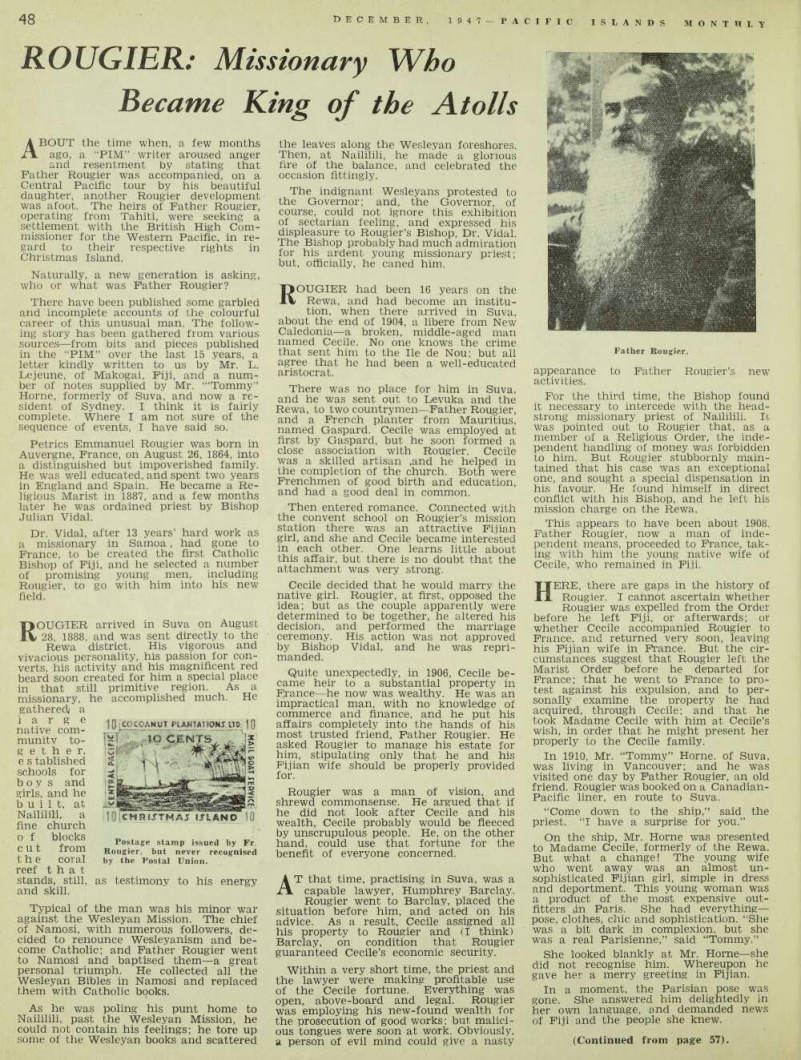
Postage stamp issued by Fr.
Rougier, but never recognised by the Postal Union.
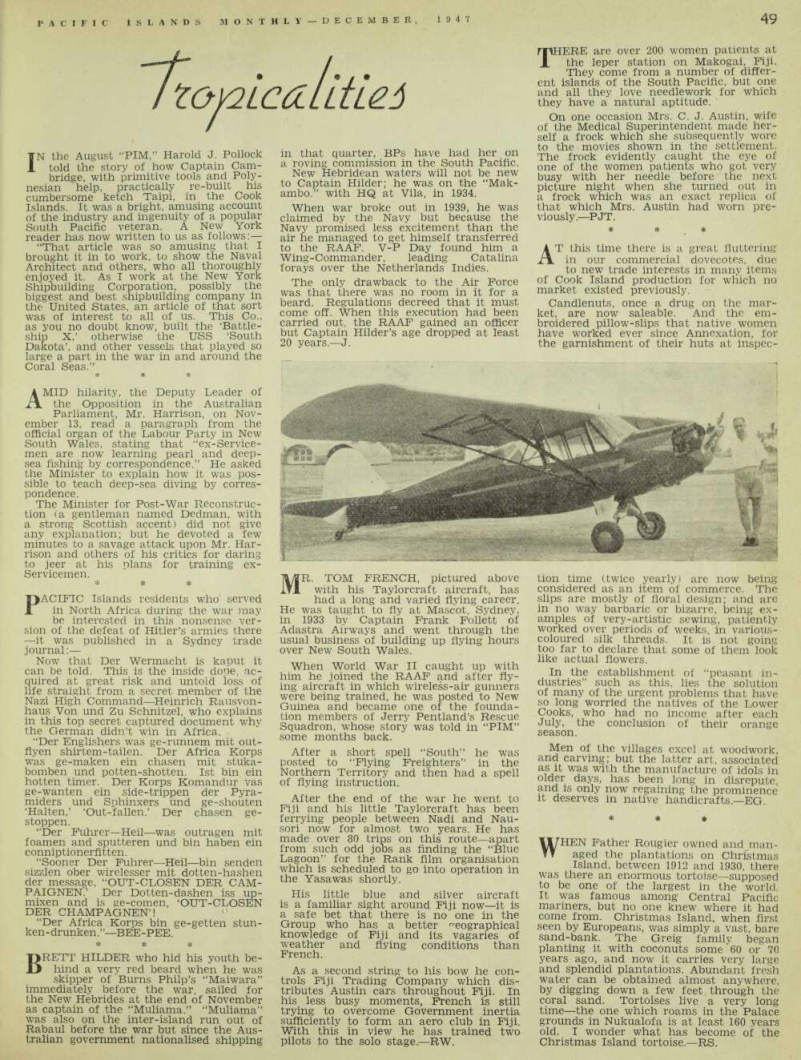
Father Rougier.
Madame Cecile returned to the Rewa district, and rejoined her husband. But his health had been failing, and he did not live much longer.
Writing in the “PIM” in 1944, H. W.
Garnett said that Madame Cecile received nothing from her husband’s estate — evidently the annuity which had been guaranteed to him by Rougier and Barclay died with him. Madame Cecile married a Fijian, and by him had several children. She was still alive in 1944, and was supported by her children —not by the Cecile estate.
FATHER ROUGIER did not resume residence in Fiji. He'travelled in the Islands, spent considerable time in France, and he soon became a successful man of business. Apparently, he and Barclay operated jointly, for a time. I remember publishing, in the “PIM,” about 15 years ago, an article which indicated that Rougier and Barclay eventually had to settle their joint affairs by litigation, but I have been unable to find the item.
While he was in France, Father Rougier used some portion of the wealth he now controlled to re-establish the estates of the Rougier family. Eventually, his nephew and nieces became his heirs.
Somewhere between 1908 and 1912, Father Rougier—l think, in association with Barclay—got possession of the plantations on Fanning and Washington Islands.
There are three large atolls out in the Central Pacific —Christinas, Washington and Fanning. The Greig family (remind us to tell the romantic story of the Greigs, sometime) pioneered all three.
When Europeans first saw them, they were covered by huge groves of healthy coconuts. The Greigs were the first planters. About 1906-7, the Greigs got into financial difficulties: and in July, 1907, it was announced that “after pro tracted litigation the Court ordered the sale of Washington and Fanning Islands, J. D. Dixon (Fiji) being sent to Fanning Island as Receiver.”
I cannot pick up the record, but it probably was at this period that Rougier acquired control over the plantations on both Fanning and Washington. By 1912 he definitely was in charge of Fanning Island.
In June, 1912, he sailed in the “Luka” from Fanning to Christmas, and made his first inspection there. He reported that only a quarter of the coconuts* planted by various speculators had sur vived a great drought, but the survivors were very healthy and would give a fine yield of copra, and a great deal of additional planting could be done. He clearly was eager to acquire Christmas.
Long before 1912, the Greigs planted Christmas; the planting was continued by Henderson and McFarlane; they sold to Levers Pacific Plantations Ltd., and the latter, just prior to Word War 1, sold to Central Pacific Plantations Ltd. (of 101 Leadenhall Street, London—governing director, Emanuel Rougier, of Les Isles Brionde, Haute-Loire, France).
Because I cannot get the records, I can only guess. But everyone knows how copra turned into gold during World War I; and I guess that Father Rougier, already rich, became much richer as the result of owning the Fanning, Washington and Christmas coconut plantations dur ing that period.
AFTER World War 1, Rougier appears to have sold his Fanning and Wash ington interests to a British company (the present owners) and, as owner of Christmas Island plantations, he settled
in Tahiti, “where the lived in baronial state in an old mansion surrounded by broad acres of coconut plantations. Dur ing many years there were few councils for the debate of civil and economic pro blems that did not invite Father Rougier to a seat of honour in the assembly.’
He maintained communication with Christmas by means of the 3-masted schooner, “Marechal Foch,” well known in Tahiti.
This was written of him by a man who knew him well: “All these money trans actions had made Father Rougier more a man of the world than a man of God.
He felt it himself, and gave up all work in connection with the Church. From that time (1908) until his death—that is, for over 20 years—he lived mostly in Papeete as a retired clergyman, saying Mass privately every day, and behaving with all the dignity of a refined gentle man.”
When he died— suddenly, from heart failure—on December 16, 1932, the “PIM”
said of him: “Since he arrived in the Colony some 15 years ago, Monsieur I’Abbe Rougier took a keen and courageous in terest in all matters affecting the public welfare, and unstintingly sacrificed his leisure for the good thereof. (Then fol lows a long list of the public positions he had held.) He was intensely interested in the introduction of beneficial flora and fauna, and maintained an extensive garden at Taaone; in this field alone his passing represents a very real loss to the Colony.” , , , . . .
Before Rougier died he had been joined in Tahiti by his nephew, also named Rougier, who became his heir, and who took charge of his business. Nephew Rougier was one of those courageous people who pressed for an official inquiry into the Kong Ah scandal, and someone fired shots at him as he was passing through Papeete in his car. The story of Kong Ah was so “hot”—it involved high personages, in Tahiti and France— that, lacking all the facts, the “PIM” did
not dare to publish anything about it when it broke in 1934.
When France collapsed, in 1940, the Rougier family apparently was caught up in the German occupation, and was not able to exercise supervision over its in terests in Christmas Island. Accordingly, the Gilbert and Ellice Islands Govern ment (Christmas, Fanning and Washing ton islands constitute a District of that Administration) took charge of the Christmas Island plantations, and pro duced copra. A few months ago, mem bers of the Rougier family arrived in Tahiti, and commenced inquiries, asking who had been looking after the planta tions, how much copra had been pro duced, and who got the benefit of it. Dis cussions are now in progress between the Rougier family and the British High Commissioner fov the Western Pacific.—