Where Cheerfulness is the Keynote
pp. 49-60 · Read in the full issue
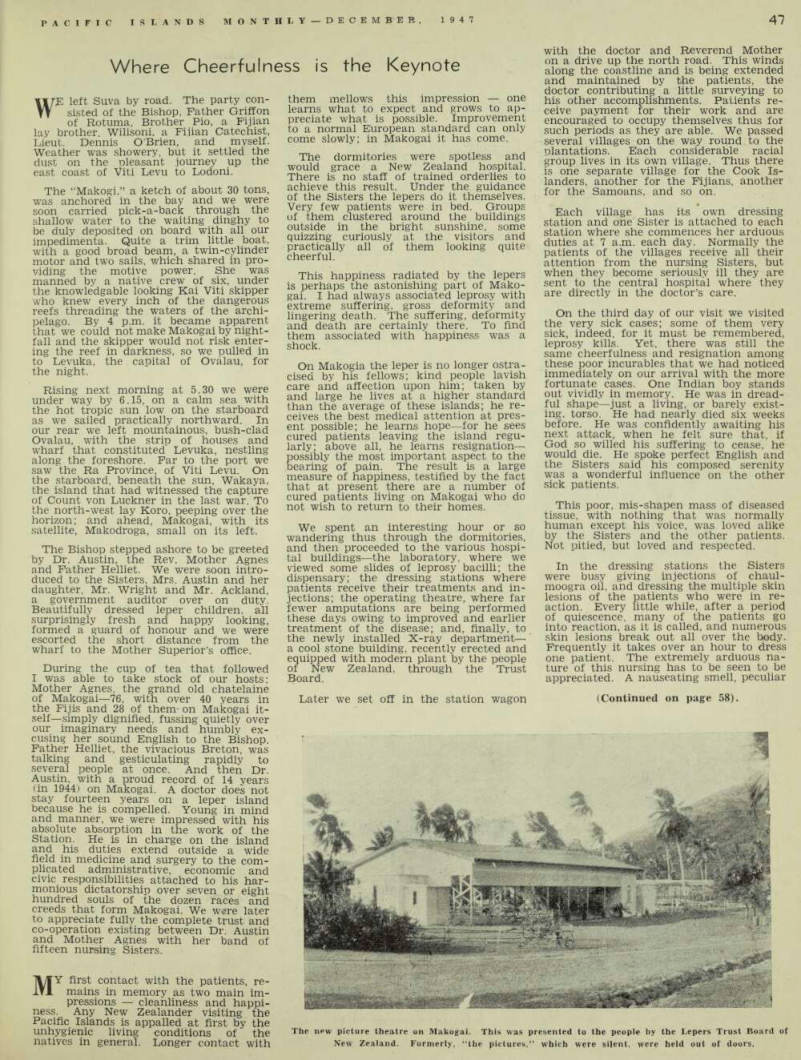
WE left Suva by road. The party con sisted of the Bishop, Father Griffon of Rotuma, Brother Pio, a Fijian lay brother. Wilisoni. a Fijian Catechist, Lieut. Dennis O'Brien, and myself.
Weather was showery, but it settled the dust on the pleasant journey up the east coast of Viti Levu to Lodoni.
The “Makogi,” a ketch of about 30 tons, was anchored in the bay and we were soon carried pick-a-back through the shallow water to the waiting dinghy to be duly deposited on board with all our impedimenta. Quite a trim little boat, with a good broad beam, a twin-cylinder motor and two sails, which shared in pro viding the motive power. She was manned by a native crew of six, under the knowledgable looking Kai Viti skipper who knew every inch of the dangerous reefs threading the waters of the archi pelago. By 4 p.m. it became apparent that we could not make Makogai by night fall and the skipper would not risk enter ing the reef in darkness, so we nulled in to Levuka, the capital of Ovalau, for the night.
Rising next morning at 5.30 we were under way by 6.15, on a calm sea with the hot tropic sun low on the starboard as we sailed practically northward. In our rear we left mountainous, bush-clad Ovalau, with the strin of houses and wharf that constituted Levuka, nestling along the foreshore. Far to the port we saw the Ra Province, of Viti Levu. On the starboard, beneath the sun, Wakaya, the island that had witnessed the capture of Count von Luckner in the last war. To the north-west lay Koro, peeping over the horizon; and ahead, Makogai, with its satellite, Makodroga, small on its left.
The Bishop stepped ashore to be greeted by Dr. Austin, the Rev. Mother Agnes and Father Helliet. We were soon intro duced to the Sisters, Mrs. Austin and her daughter, Mr. Wright and Mr. Ackland, a government auditor over on duty.
Beautifully dressed leper children, all surprisingly fresh and happy looking, formed a guard of honour and we were escorted the short distance from the wharf to the Mother Superior’s office.
During the cup of tea that followed I was able to take stock of our hosts: Mother Agnes, the grand old chatelaine of Makogai—76, with over 40 years in the Fijis and 28 of thenv on Makogai it self—simply dignified, fussing quietly over our imaginary needs and humbly ex cusing her sound English to the Bishop.
Father Helliet, the vivacious Breton, was talking and gesticulating rapidly to several people at once. And then Dr.
Austin, with a proud record of 14 years (in 1944) on Makogai. A doctor does not stay fourteen years on a leper island because he is compelled. Young in mind and manner, we were impressed with his absolute absorption in the work of the Station. He is in charge on the island and his duties extend outside a wide field in medicine and surgery to the com plicated administrative, economic and civic responsibilities attached to his har monious dictatorship over seven or eight hundred souls of the dozen races and creeds that form Makogai. We w*?re later to appreciate fullv the complete trust and co-operation existing between Dr. Austin and Mother Agnes with her band of fifteen nursing Sisters.
MY first contact with the patients, re mains in memory as two main im pressions cleanliness and happi ness. Any New Zealander visiting the Pacific Islands is appalled at first by the unhygienic living conditions of the natives in general. Longer contact with
them mellows this impression one learns what to expect and grows to ap preciate what is possible. Improvement to a normal European standard can only come slowly: in Makogai it has come.
The dormitories were spotless and would grace a New Zealand hospital.
There is no staff of trained orderlies to achieve this result. Under the guidance of the Sisters the lepers do it themselves.
Very few patients were in bed. Groups of them clustered around the buildings outside in the bright sunshine, some quizzing curiously at the visitors and practically all of them looking quite cheerful.
This happiness radiated by the lepers is perhaps the astonishing part of Mako gai. I had always associated leprosy with extreme suffering, gross deformity and lingering death. The suffering, deformity and death are certainly there. To find them associated with happiness was a shock.
On Makogia the leper is no longer ostra cised by his fellows; kind people lavish care and affection upon him; taken by and large he lives at a higher standard than the average of these islands; he re ceives the best medical attention at pres ent possible; he learns hope—for he sees cured patients leaving the island regu larly; above all, he learns resignation— possibly the most important aspect to the bearing of pain. The result is a large measure of happiness, testified by the fact that at present there are a number of cured patients living on Makogai who do not wish to return to their homes.
We spent an interesting hour or so wandering thus through the dormitories, and then proceeded to the various hospi tal buildings—the laboratory, where we viewed some slides of leprosy bacilli; the dispensary; the dressing stations where patients receive their treatments and in jections; the operating theatre, where far fewer amputations are being performed these days owing to improved and earlier treatment of the disease; and, finally, to the newly installed X-ray department— a cool stone building, recently erected and equipped with modern plant by the people of New Zealand, through the Trust Board.
Later we set off in the station wagon
with the doctor and Reverend Mother on a drive up the north road. This winds along the coastline and is being extended and maintained by the patients, the doctor contributing a little surveying to his other accomplishments. Patients re ceive payment for their work and are encouraged to occupy themselves thus for such periods as they are able. We passed several villages on the way round to the plantations. Each considerable racial group lives in its own village. Thus there is one separate village for the Cook Is landers, another for the Fijians, another for the Samoans, and so on. • Each village has its own dressing station and one Sister is attached to each station where she commences her arduous duties at 7 a.m. each day. Normally the patients of the villages receive all their attention from the nursing Sisters, but when they become seriously ill they are sent to the central hospital where they are directly in the doctor’s care.
On the third day of our visit we visited the very sick cases; some of them very sick, indeed, for it must be remembered, leprosy kills. Yet, there was still the same cheerfulness and resignation among these poor incurables that we had noticed immediately on our arrival with the more fortunate cases. One Indian boy stands out vividly in memory. He was in dread ful shape—just a living, or barely exist ing. torso. He had nearly died six weeks before. He was confidently awaiting his next attack, when he felt sure that, if God so willed his suffering to cease, he would die. He spoke perfect English and the Sisters said his composed serenity was a wonderful influence on the other sick patients.
This poor, mis-shapen mass of diseased tissue, with nothing that was normally human except his voice, was loved alike by the Sisters and the other patients.
Not pitied, but loved and respected.
In the dressing stations the Sisters were busy giving injections of chaul moogra oil, and dressing the multiple skin lesions of the patients who were in re action. Every little while, after a period of quiescence, many of the patients go into reaction, as it is called, and numerous skin lesions break out all over the body.
Frequently it takes over an hour to dress one patient. The extremely arduous na ture of this nursing has to be seen to be appreciated. A nauseating smell, peculiar
(Continued on page 58).
The new picture theatre on Makogai. This was presented to the people by the Lepers Trust Board of New Zealand. Formerly, “the pictures,” which were silent, were held out of doors.
to leprosy, emanates from their bodies, and, in the sweltering heat, the Sisters just toil on, hour after hour, until the job is done.
That day we made the three mile trip in the station waggon to the doctor’s resi dence at Nasau. The house is well situ ated on a headland overlooking the reef which encloses the two islands of Makogai and Wakaya. Mrs. Austin was a charm ing hostess and after dinner we repaired outside to admire the garden which hard labour had produced on that windswept headland from an unwilling few inches of soil. It seemed a monument to the patience and fortitude that has sustained her for fourteen years, faithfully sup porting her husband in his work and rearing a family in circumstances so far removed from the normal lot of a doctor’s wife.
The country about Nasau is more open and supports the herds that produce the
island s supply of milk. All the clean workers of Makogai live at the Nasau end, no lepers being allowed in the whole t 0 is the ba kery, where hundreds of loaves of bread are produced 0. silly* . it own little way Makogai is an ob ject lesson in this war-torn, hating world. A dozen widely differing races and religions, with a tremendous physical handicap, live together amicably, in fru with little obvious discipline except that which grows naturally out of the practice of Christian charity, kind ness and mutual understanding. vooi 10 Zealand visitor has every reason to fee! proud on Makogai. On all 18 remi nd e d that this, or that, New Zealand. Government issues are, of course, at a fairlv bare minimum, and the hard labours of Mr and tbe Leper Trust Board generosity of the people of New Zealand, are responsible for most of the amenities and little luxuries to be seen on the island; those little comforts often whfrh nt rJSL in our v, oyos t 0 80 *n uch ln raising the stan °JLH v - mg °? i2 oth Patients and the s^aff - New Zealand has Makogai—it is her leper island, and Makogai responds by taking New Zealanders right into its heart.