MAKOGAI-Pacific Paradise for
p. 48 · Read in the full issue
the Afflicted
MAKOGAI, so the story goes, was ac quired by “King” Cakabau, of Fiji, in one of his tribal wars. He sub sequently sold it to an Englishman, who stocked the island with sheep.
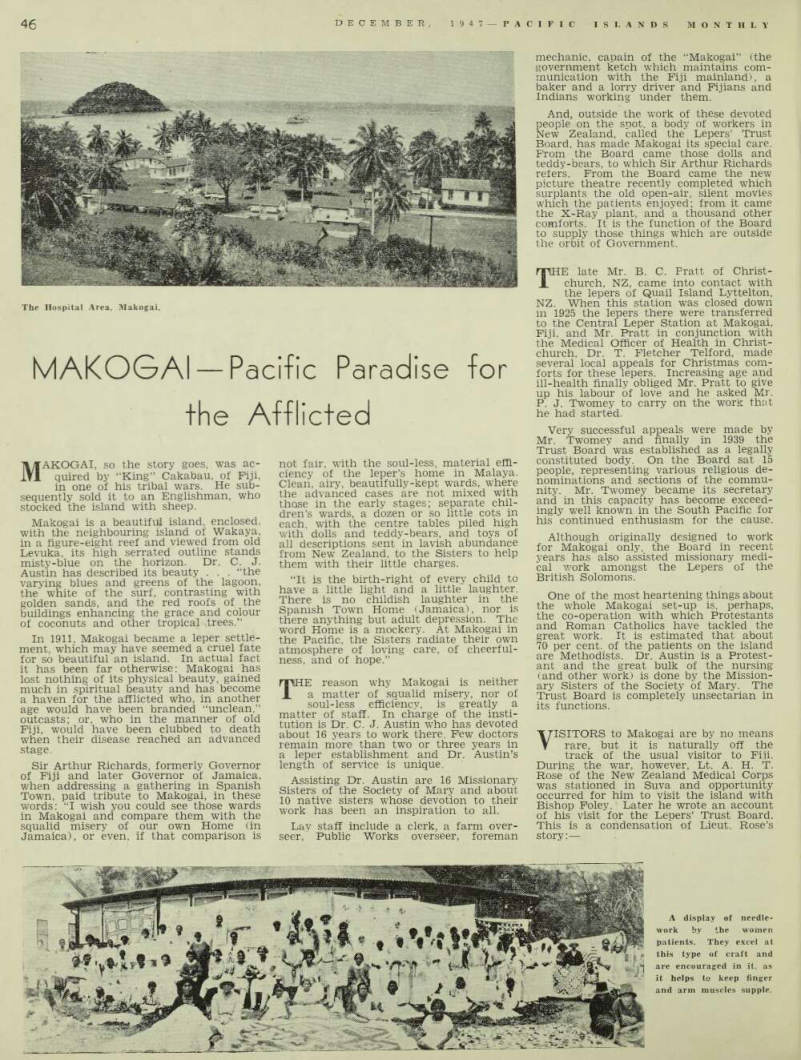
Makogai is a beautiful island, enclosed, with the neighbouring island of Wakaya, in a figure-eight reef and viewed from old Levuka, its high serrated outline stands misty-blue on the horizon. Dr. C. J.
Austin has described its beauty . . . “the varying blues and greens of the lagoon, the white of the surf, contrasting with golden sands, and the red roofs of the buildings enhancing the grace and colour of coconuts and other tropical trees.”
In 1911, Makogai became a leper settle ment, which may have seemed a cruel fate for so beautiful an island. In actual fact it has been far otherwise: Makogai has lost nothing of its physical beauty, gained much in spiritual beauty and has become a haven for the afflicted who, in another age would have been branded “unclean,” outcasts; or, who in the manner of old Fiji, would have been clubbed to death when their disease reached an advanced stage.
Sir Arthur Richards, formerly Governor of Fiji and later Governor of Jamaica, when addressing a gathering in Spanish Town, paid tribute to Makogai, in these words: “I wish you could see those wards in Makogai and compare them with the squalid misery of our own Home (in Jamaica), or even, if that comparison is
not fair, with the soul-less, material effi ciency of the leper’s home in Malaya.
Clean, airy, beautifully-kept wards, where the advanced cases are not mixed with those in the early stages; separate chil dren’s wards, a dozen or so little cots in each, with the centre tables piled high with dolls and teddy-bears, and toys of all descriptions sent in lavish abundance from New Zealand, to the Sisters to help them with their little charges.
“It is the birth-right of every child to have a little light and a little laughter.
There is no childish laughter in the Spanish Town Home (Jamaica), nor is there anything but adult depression. The word Home is a mockery. At Makogai in the Pacific, the Sisters radiate their own atmosphere of loving care, of cheerful ness, and of hope.’’ fIIHE reason why Makogai is neither X a matter of soualid misery, nor of soul-less efficiency, is greatly a matter of staff. In charge of the insti tution is Dr. C. J. Austin who has devoted about 16 years to work there. Few doctors remain more than two or three years in a leper establishment and Dr. Austin’s length of service is unique.
Assisting Dr. Austin are 16 Missionary Sisters of the Society of Mary and about 10 native sisters whose devotion to their work has been an inspiration to all.
Lay staff include a clerk, a farm over seer, Public Works overseer, foreman
mechanic, capain of the “Makogai” (the government ketch which maintains com munication with the Fiji mainland), a baker and a lorry driver and Fijians and Indians working under them.
And, outside the work of these devoted people on the spot, a body of workers in New Zealand, called the Lepers’ Trust Board, has made Makogai its special care.
From the Board came those dolls and teddy-bears, to which Sir Arthur Richards refers. From the Board came the new picture theatre recently completed which supplants the old open-air, silent movies which the patients enjoyed; from it came the X-Ray plant, and a thousand other comforts. It is the function of the Board to supply those things which are outside the orbit of Government. rE late Mr. B. C. Pratt of Christ church, NZ, came into contact with the lepers of Quail Island Lyttelton, NZ. When this station was closed down in 1925 the lepers there were transferred to the Central Leper Station at Makogai, Fiji, and Mr. Pratt in conjunction with the Medical Officer of Health in Christ church. Dr. T. Fletcher Telford, made several local appeals for Christmas com forts for these lepers. Increasing age and ill-health finally obliged Mr. Pratt to give up his labour of love and he asked Mr.
P. J. Twomey to carry on the work that he had started.
Very successful appeals were made by Mr. Twomey and finally in 1939 the Trust Board was established as a legally constituted body. On the Board sat 15 people, representing various religious de nominations and sections of the commu nity. Mr. Twomey became its secretary and in this capacity has become exceed ingly well known in the South Pacific for his continued enthusiasm for the cause.
Although originally designed to work for Makogai only, the Board in recent years has also assisted missionary medi cal work amongst the Lepers of the British Solomons.
One of the most heartening things about the whole Makogai set-up is, perhaps, the co-operation with which Protestants and Roman Catholics have tackled the great work. It is estimated that about 70 per cent, of the patients on the island are Methodists. Dr. Austin is a Protest ant and the great bulk of the nursing (and other work) is done by the Mission ary Sisters of the Society of Mary. The Trust Board is completely unsectarian in its functions.
VISITORS to Makogai are by no means rare, but it is naturally off the track of the usual visitor to Fiji.
During the war, however, Lt. A. H. T.
Rose of the New Zealand Medical Corps was stationed in Suva and opportunity occurred for him to visit the island with Bishop Foley. Later he wrote an account of his visit for the Lepers’ Trust Board.
This is a condensation of Lieut. Rose’s story:—
The Hospital Area, Makogai.
A display of needle work by the women patients. They excel at this type of craft and are encouraged in it, as it helps to keep finger and arm muscles supple.