Pacific
Islands
Monthly
December 16, 1947
Vol. Xviii. No. 5.
Established 1930.
. \ \ A I Registered at the G.P.0., Sydney.\f ortransmission by post as a newspaper]
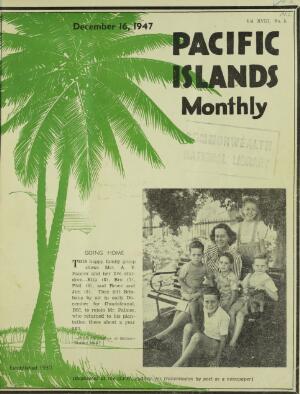
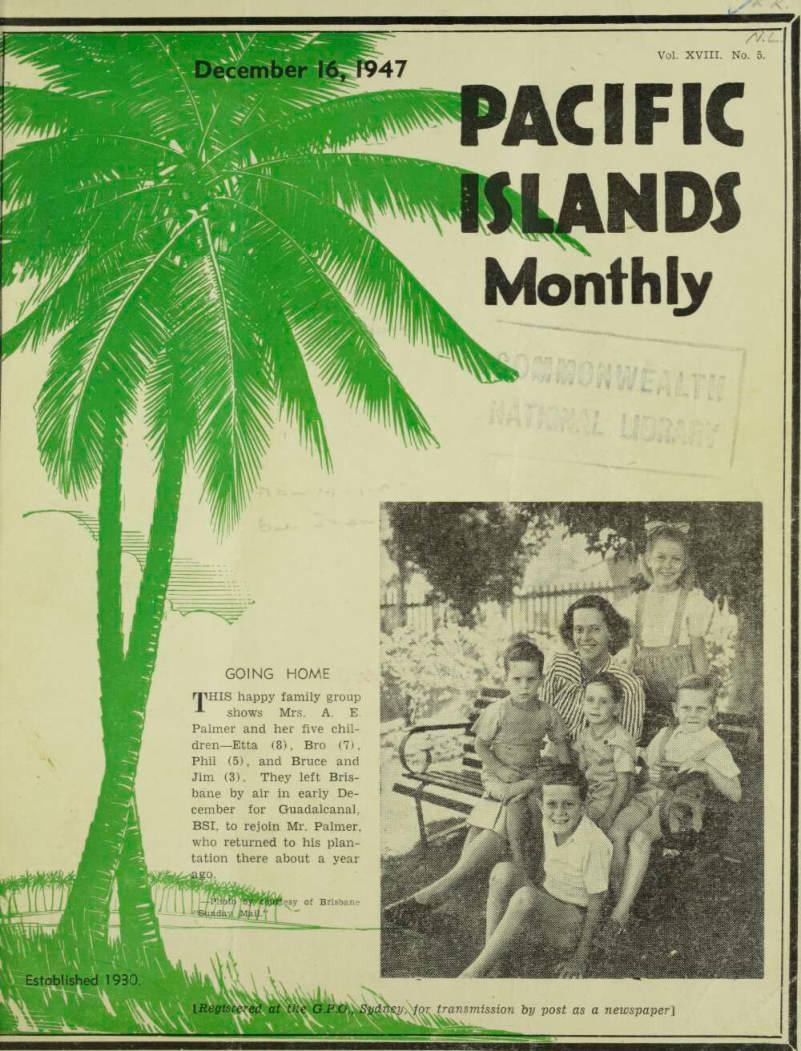
Going Home
THIS happy family group shows Mrs. A. E Palmer and her five chil dren —Etta (8), Bro (7), Phil (5), and Bruce and Jim (3). They left Bris bane by air in early De cember for Guadalcanal, BSI, to rejoin Mr. Palmer, who returned to his plan tation there about a year ago. -Photo by courtesy Brisbane "Sunday Mail."
Advertisements & other items, pp. 2-4 (2 items)
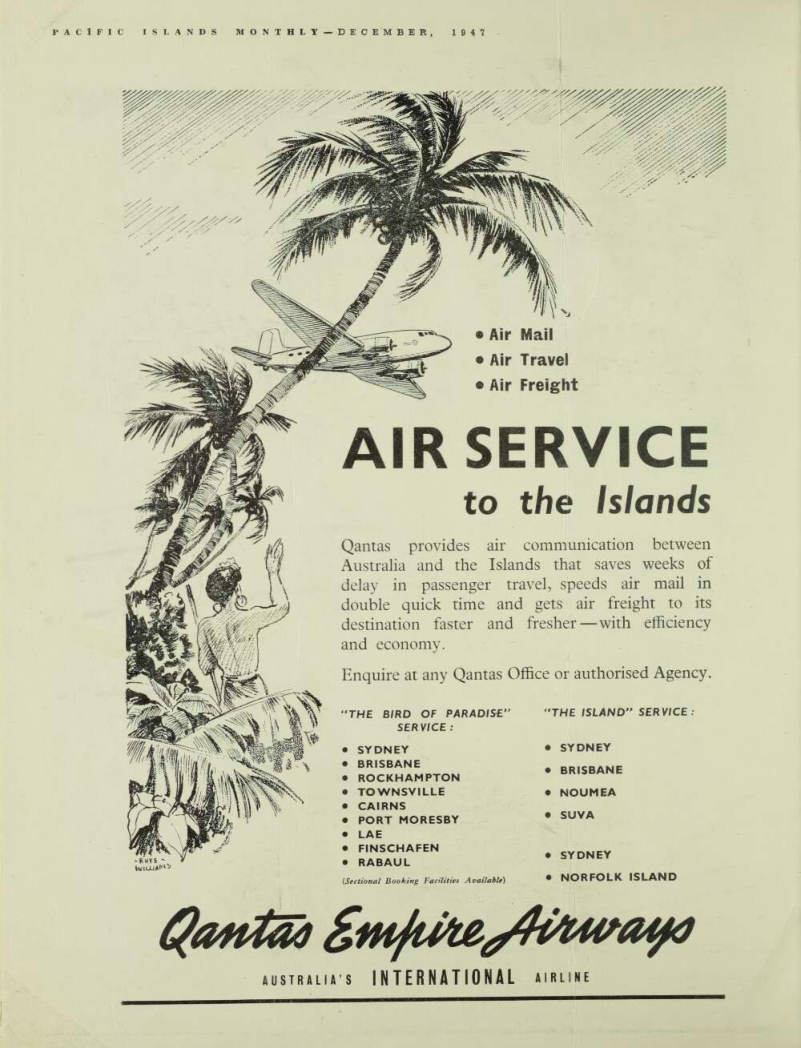
Air Service
f I \iu: Ik
• Air Mail
• Air Travel
• Air Freight
AIR SERVICE
to the Islands
Qantas provides air communication between
Australia and the Islands that saves weeks of delay in passenger travel, speeds air mail in double quick time and gets air freight to its
destination faster and fresher—with efficiency
and economy.
Enquire at any Qantas Office or authorised Agency.
THE BIRD OF PARADISE '
SERVICE :
o SYDNEY
• BRISBANE
• ROCKHAMPTON
• TOWNSVILLE
• CAIRNS
• PORT MORESBY
• LAE
• FINSCHAFEN
• RABAUL
(,Sectional Booking Facilities Available)
“THE ISLAND” SERVICE
• SYDNEY
• BRISBANE
• NOUMEA
• SUVA
• SYDNEY
• NORFOLK ISLAND
Australia's INTERNATIONAL airline
&i
40yeaMOxfiebwtce
v OeJtCncL eVefof
* i’v V** 11 kilil Jlllk liiiJ :s&v- A, IK F s
SsSt&*
... « • ■ *; Con be ossen' k b\ed U P te .beo» s 30 on 3 6 4c 11 r «; to se c°nd • se" e burns *•* * f aUO9 '* , Ol\ OO e .. n QUOt' hOU °nd vritt bod 1 « pints 0 . , minutes- 0 t wotet .« * pos.tron * •« fue \-seoi- * in * ‘“the tount toU ” „t and * ,tt ,ost-P r0 ° ot Primusother type*
Day after day, week
after week, for over 40 years Coleman's have specialised in making Stoves and Lamps. Is it any wonder, then, that
their products give
the utmost in satisfaction and service.
CO ffi&BU*
CO °K'HG tL
n, s , sr ove sto v e ° Ur ner n 9 no ZTo b ‘ e Sof efy s/l ° “ny '’«« .> un hut °ffyai each Urn*** o** 0 ** yC re ' n ° kes Has st °y* h fo, Jo ">°vo6/ e ,J:aht ed fuel
2a®-vir
Representatives for the Pacific islands:
ROBERT GILLESPIE PTY. LTD.
54a PITT STREET, SYDNEY
PEARCE & CO. LTD,
SUVA
FOR FIJI ISLANDS
I' i '.'j , ;• • ' ♦ iil&w w .
ClcJvke-fioois
... for all your Clothing Requirements
•i 1 5 « The impressive facade of Stirling Henry’s Underwear Factory.
Clarke-Jools are sole export agents for Stirling Henry, Ltd., Australia’s foremost spinners, knitters and weavers. Large range of all men’s and women’s knitted underwear, polo shirts, etc.
CLARKE-JOOLS
& Co. Pty., Ltd.
IMPORTERS, EXPORTERS
and Commission Agents We are prepared to submit original invoices.
Clarke-Jools also can supply any commodity you require in— Textiles Food Spirits Leather Hardware Electrical Goods <c-j>
ASBESTOS HOUSE
65 YORK STREET, SYDNEY
Cables: “Irvingjools X i ( c '■s c* c\ ’M • Shown above are views of Stirling Henry's Modern Factories.
2
DECEMBER, 1947 PACIFIC ISLANDS MONTtttt
Advertisers
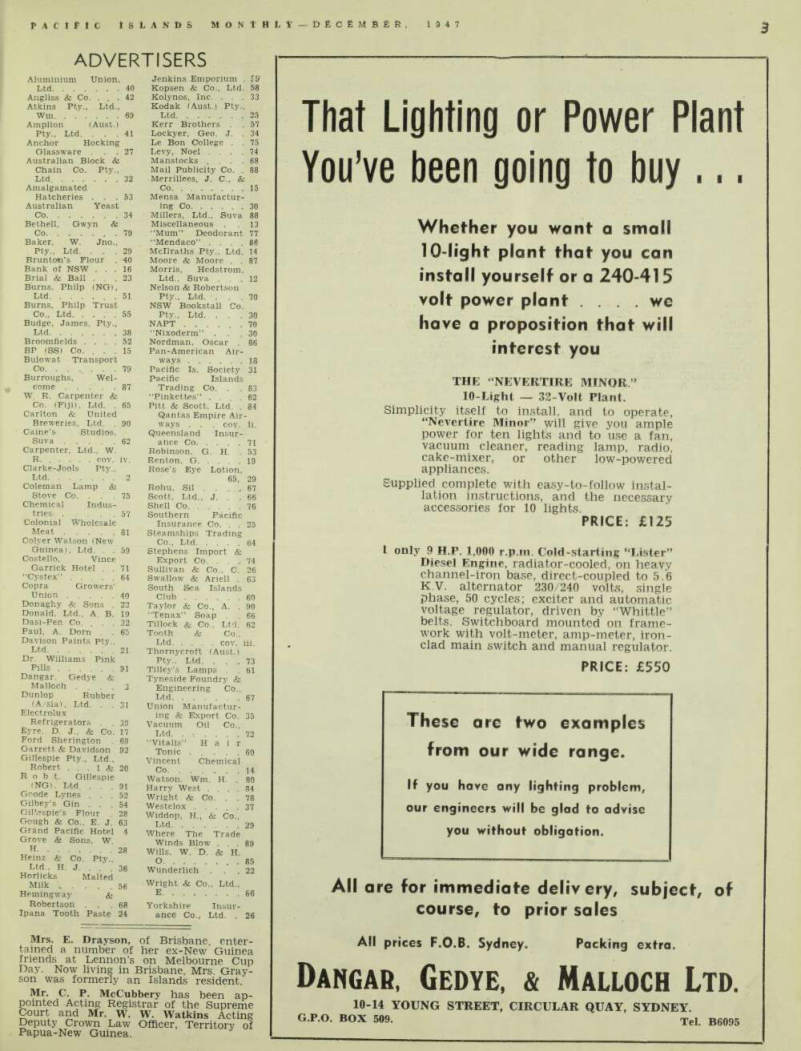
Aluminium Union, Ltd 40 Angliss & Co. ... 42 Atkins Pty., Ltd., Wm 69 Amplion (Aust.) Pty., Ltd. ... 41 Anchor Hocking Glassware ... 27 Australian Block & Chain Co. Pty., Ltd. 32 Amalgamated Hatcheries ... 53 Australian Yeast Co 34 Bethell, Gwyn & Co .79 Baker, W. Jno., Pty.. Ltd. ... 29 Brunton’s Flour . 40 Bank of NSW ... 16 Brial & Ball ... 23 Burns, Philp (NG), Ltd . 51 Burns, Philp Trust Co., Ltd 55 Budge, James, Pty., Ltd 38 Broomfields ... 52 BP (SS) Co. . . . 15 Bulowat Transport Co. ... 79 Burroughs, Wel come 87 W. R. Carpenter & Co. (Fiji). Ltd. . 65 Carlton & United Breweries, Ltd. . 90 Caine’s Studios, Suva 62 Carpenter. Ltd.. W.
R. . . . . . cov. iv.
Clarke-Jools Pty., Ltd 2 Coleman Lamp & Stove Co. . . .75 Chemical Indus tries 57 Colonial Wholesale Meat 31 Colyer Watson (New Guinea), Ltd. . . 59 Costello, Vince Garrick Hotel . . 71 “Cystex” 64 Copra Growers’
Union 40 Donaghy & Sons . 22 Donald. Ltd., A, B. 19 Dasi-Pen Co. ... 32 Paul, A. Dorn . . 65 Davison Paints Pty..
Ltd 21 Dr. Williams Pink Pills 91 Dangar. Gedye & Malloch ... 3 Dunlop Rubber (A/sia), Ltd. . . 31 Electrolux Refrigerators . . 39 Eyre. D. J., & Co. 17 Ford Sherington . 69 Garrett & Davidson 92 Gillespie Pty., Ltd., Robert . . . 1 & 20 Rob t. Gillespie (NG). Ltd. ... 91 Goode Lynes ... 52 Gilbey’s Gin ... 54 Gil’espie’s Flour . 28 Gough & Co.. E. J. 63 Grand Pacific Hotel 4 Grove & Sons. W H 28 Heinz & Co. Pty., Ltd.. H. J. . . .36 Horlicks Malted Milk 56
Hemingway &
Robertson ... 68 Ipana Tooth Paste 24
Jenkins Emporium . £&' Kopsen & Co., Ltd. 58 Kolynos, Inc. ... 33 Kodak (Aust.) Pty., Ltd 25 Kerr Brothers . 57 Lockyer, Geo. J. . 34 Le Bon College . . 75 Levy, Noel ... 74 Manstocks ... 68 Mail Publicity Co. . 88 Merrillees, J. C., & Co 15 Mensa Manufactur ing Co 30 Millers, Ltd., Suva 88 Miscellaneous . . 13 “Mum” Deodorant 77 “Mendaco” ... 86 Mcllraths Pty.. Ltd. 14 Moore & Moore . . 87 Morris, Hedstrom, Ltd., Suva ... 12 Nelson & Robertson Pty., Ltd. ... 70 NSW Bookstall Co.
Pty., Ltd. ... 30
Napt ... 70
“Nixoderm” ... 30 Nordman. Oscar 86 Pan-American Air ways 18 Pacific Is. Society 31 Pacific Islands Trading Co. . . 83 “Pinkettes” ... 62 Pitt & Scott, Ltd. . 84 Qantas Empire Air ways . . . cov. ii, Queensland Insur ance Co 71 Robinson. G. H. , 53 Renton, G. . . 19 Rose’s Eye Lotion, 65. 29 Rohu, Sil . , 67 Scott. Ltd., J. .66 Shell Co 76 Southern Pacific Insurance Co. . .25 Steamships Trading Co., Ltd 64 Stephens Import & Export Co. . . 74 Sullivan & Co.. C. 26 Swallow & Ariell . 63 South Sea Islands Club 60 Taylor & Co.. A. . 90 “Tenax” Soap . . 66 Tillock & Co., Ltd. 62 Tooth & Co..
Ltd. ... cov. iii.
Thornycroft (Aust.) Pty.. Ltd. ... 73 Tilley’s Lamps . . 61 Tyneside Foundry & Engineering Co., Ltd 67 Union Manufactur ing & Export Co. 35 Vacuum Oil Co..
Ltd. ... 72 “Vitalis” Hair Tonic ... 60 Vincent Chemical Co 14 Watson. Wm. H. . 80 Harry West ... 84 Wright & Co. . . 78 Westclox ... 37 Widdop, H., & Co., Ltd 29 Where The Trade Winds Blow ... 89 Wills. W. D. & H.
O . 85 Wunderlich ... 22 Wright & Co., Ltd., E 86 Yorkshire Insur ance Co., Ltd. . 26
Mrs. E. Drayson, of Brisbane, enter tained a number of her ex-New Guinea friends at Lennon’s on Melbourne Cup Day. Now living in Brisbane, Mrs. Gray son was formerly an Islands resident.
Mr. C. P. McCubbery has been ap pointed Acting Registrar of the Supreme Court and Mr. W. W. Watkins Acting Deputy Crown Law Officer, Territory of Papua-New Guinea.
Advertisements & other items, p. 5 (2 items)
3
pacific islands Mottttttf DficEMßfift, 1947
That Lighting or Power Plant
You’ve been going to buy...
Whether you wont a small
10-light plant that you can
install yourself or a 240-415
volt power plant ... we
hove a proposition that will
interest you
THE “NEVERTIRE MINOR.”
10-Eight 32-Volt Plant.
Simplicity itself to install, and to operate, “Neveriire Minor” will give you ample power for ten lights and to use a fan, vacuum cleaner, reading lamp, radio, cake-mixer, or other low-powered appliances.
Supplied complete with easy-to-follow installation instructions, and the necessary accessories for 10 lights.
PRICE: £125
l only 9 H.P. 1,000 r.p.m Cold-starting “Lister”
Diesel Engine, radiator-cooled, on heavv channel-iron base, direct-coupled to 5.6 KV. alternator 230/240 volts, single phase, 50 cycles; exciter and automatic voltage regulator, driven by “Whittle” belts. Switchboard mounted on framework with volt-meter, amp-meter, ironclad main switch and manual regulator.
PRICE: £550
These are fwo examples
from our wide range.
If you have any lighting problem, our engineers will be glad to advise you without obligation.
All are for immediate delivery, subject, of
course, to prior sales
All prices F. 0.8. Sydney. Packing extra.
Dangar, Gedye, & Malloch Ltd.
10-14 YOUNG STREET, CIRCULAR QUAY, SYDNEY.
G.P.O. BOX 509. Tel. 86095
In This Issue:
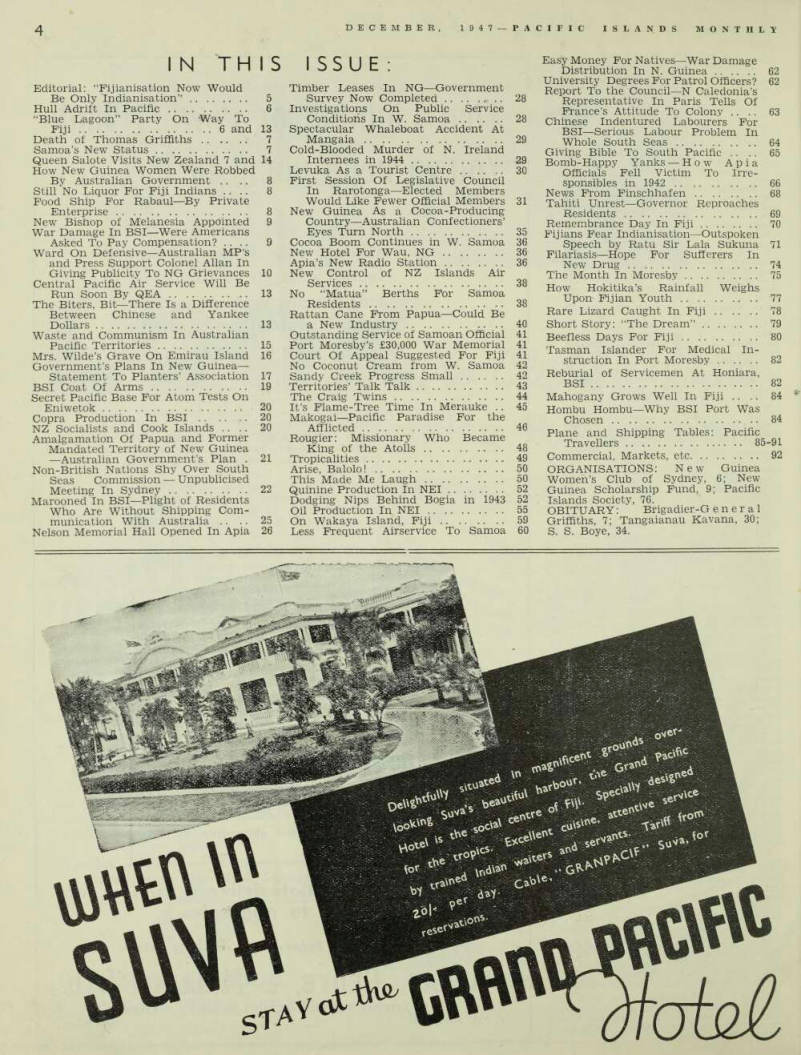
Editorial: “Fijianisation Now Would Be Only Indianisation” 5 Hull Adrift In Pacific 6 “Blue Lagoon” Party On Way To Fiji 6 and 13 Death of Thomas Griffiths 7 Samoa’s New Status 7 Queen Salote Visits New Zealand 7 and 14 How New Guinea Women Were Robbed By Australian Government ... 8 Still No Liquor For Fiji Indians ... 8 Food Ship For Rabaul —By Private Enterprise 8 New Bishop of Melanesia Appointed 9 War Damage In BSl—Were Americans Asked To Pay Compensation? ... 9 Ward On Defensive —Australian MP’s and Press Support Colonel Allan In Giving Publicity To NG Grievances 10 Central Pacific Air Service Will Be Run Soon By QEA 13 The Biters, Bit —There Is a Difference Between Chinese and Yankee Dollars 13 Waste and Communism In Australian Pacific Territories 15 Mrs. Wilde’s Grave On Emirau Island 16 Government’s Plans In New Guinea — Statement To Planters’ Association 17 BSI Coat Of Arms 19 Secret Pacific Base For Atom Tests On Eniwetok 20 Copra Production In BSI 20 NZ Socialists and Cook Islands ... 20 Amalgamation Of Papua and Former Mandated Territory of New Guinea —Australian Government’s Plan . 21 Non-British Nations Shy Over South Seas Commission Unpublicised Meeting In Sydney 22 Marooned In BSl—Plight of Residents Who Are Without Shipping Com munication With Australia .. .. 25 Nelson Memorial Hall Opened In Apia 26
Timber Leases In NG—Government Survey Now Completed 28 Investigations On Public Service Conditions In W, Samoa 28 Spectacular Whaleboat Accident At Mangaia 29 Cold-Blooded Murder of N. Ireland Internees in 1944 29 Levuka As a Tourist Centre 30 First Session Of Legislative Council In Rarotonga—Elected Members Would Like Fewer Official Members 31 New Guinea As a Cocoa-Producing Country—Australian Confectioners’
Eyes Turn North 35 Cocoa Boom Continues in W. Samoa 36 New Hotel For Wau, NG 36 Apia’s New Radio Station 36 New Control of NZ Islands Air Services 38 No “Matua” Berths For Samoa Residents 38 Rattan Cane From Papua —Could Be a New Industry 40 Outstanding Service of Samoan Official 41 Port Moresby’s £30,000 War Memorial 41 Court Of Appeal Suggested For Fiji 41 No Coconut Cream from W. Samoa 42 Sandy Creek Progress Small 42 Territories’ Talk Talk 43 The Craig Twins 44 It’s Flame-Tree Time In Merauke .. 45 Makogai—Pacific Paradise For the Afflicted 46 Rougier: Missionary Who Became King of the Atolls 48 Tropicalities 49 Arise, Balolo! 50 This Made Me Laugh 50 Quinine Production In NEI 52 Dodging Nips Behind Bogia in 1943 52 Oil Production In NEI 55 On Wakaya Island, Fiji 59 Less Frequent Airservice To Samoa 60
Easy Money For Natives —War Damage Distribution In N. Guinea 62 University Degrees For Patrol Officers? 62 Report To the Council —N Caledonia’s Representative In Paris Tells Of France’s Attitude To Colony ... 63 Chinese Indentured Labourers For BSI —Serious Labour Problem In Whole South Seas 64 Giving Bible To South Pacific ... 65 Bomb-Happy Yanks How Apia Officials Fell Victim To Irre sponsibles in 1942 66 News From Finschhafen 68 Tahiti Unrest —Governor Reproaches Residents 69 Remembrance Day In Fiji 70 Fijians Fear Indianisation—Outspoken Speech by Ratu Sir Lala Sukuna 71 Filariasis —Hope For Sufferers In New Drug 74 The Month In Moresby 75 How Hokitika’s Rainfall Weighs Upon Fijian Youth 77 Rare Lizard Caught In Fiji 78 Short Story; “The Dream” 79 Beef less Days For Fiji 80 Tasman Islander For Medical In struction In Port Moresby 82 Reburial of Servicemen At Honiara,
Bsi 82
Mahogany Grows Well In Fiji ... 84 Hombu Hombu —Why BSI Port Was Chosen 84 Plane and Shipping Tables: Pacific Travellers 85-91 Commercial, Markets, etc 92 ORGANISATIONS: New Guinea Women’s Club of Sydney, 6; New Guinea Scholarship Fund, 9; Pacific Islands Society, 76.
OBITUARY: Brigadier-G e n e r a 1 Griffiths, 7; Tangaianau Havana, 30; S. S. Boye, 34.
Advertisements & other items, p. 6 (1 item)
s ta y
Pacific Islands Monthly
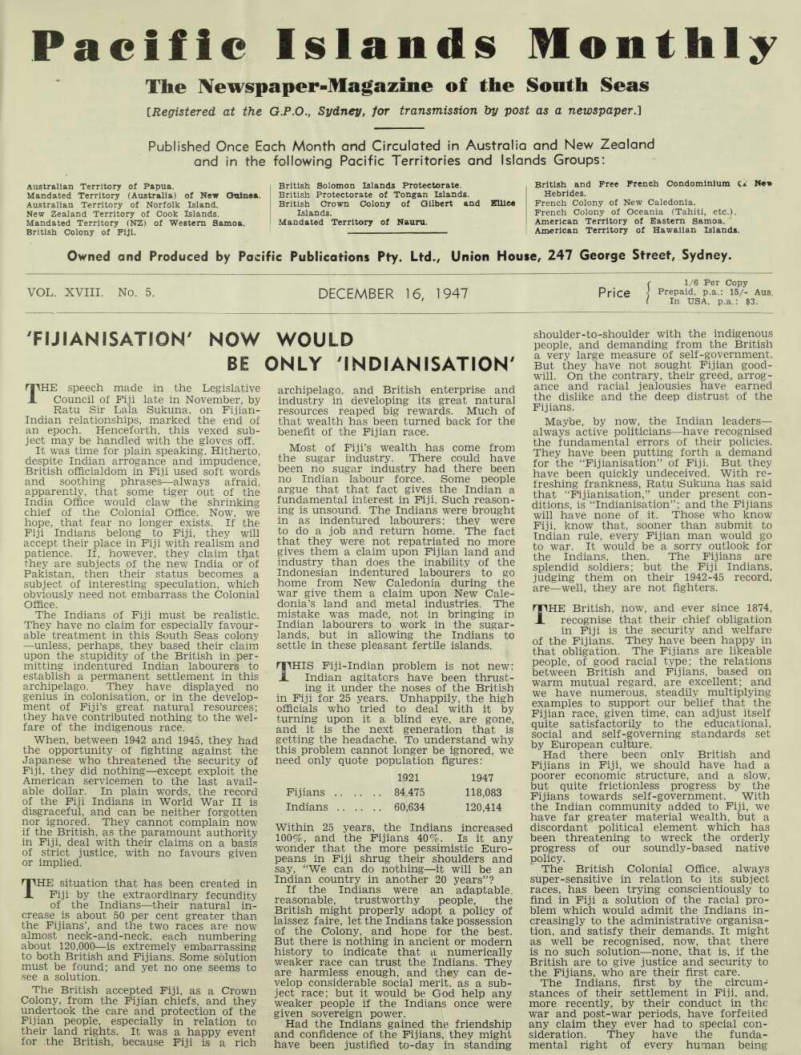
The Newspaper-Magazine of the South Seas [Registered at the G.P.0., Sydney, for transmission by post as a newspaper .]
Published Once Each Month and Circulated in Australia and New Zealand and in the following Pacific Territories and Islands Groups:
Australian Territory of Papua.
Mandated Territory (Australia) of New Guinea.
Australian Territory of Norfolk Island.
New Zealand Territory of Cook Islands.
Mandated Territory (NZ) of Western Samoa.
British Colony of FIJI.
British Solomon Islands Protectorate.
British Protectorate of Tongan Islands.
British Crown Colony of Gilbert and Ellice Islands.
Mandated Territory of Nauru.
British and Free French Condominium C* New Hebrides.
French Colony of New Caledonia.
French Colony of Oceania (Tahiti, etc.).
American Territory of Eastern Samoa.
American Territory of Hawaiian Islands.
Owned and Produced by Pacific Publications Pty. Ltd., Union House, 247 George Street, Sydney.
Vol. Xviii. No. 5.
December 16, 1947
r 1/6 Per Copy Price 1 Prepaid, p.a.: 15/- Aus. ( In USA, p.a.: $3.
'Fijianisation' Now Would
Be Only 'Indianisation'
THE speech made in the Legislative Council of Fiji late in November, by Ratu Sir Lala Sukuna, on Fijian- Indian relationships, marked the end of an epoch. Henceforth, this vexed sub ject may be handled with the gloves off.
It was time for plain speaking. Hitherto, despite Indian arrogance and impudence, British officialdom in Fiji used soft words and soothing phrases—always afraid, apparently, that some tiger out of the India Office would claw the shrinking chief of the Colonial Office. Now, we hope, that fear no longer exists. If the Fiji Indians belong to Fiji, they will accept their place in Fiji with realism and patience. If, however, they claim tl>at they are subjects of the new India or of Pakistan, then their status becomes a subject of interesting speculation, which obviously need not embarrass the Colonial Office.
The Indians of Fiji must be realistic.
They have no claim for especially favour able treatment in this South Seas colony —unless, perhaps, they based their claim upon the stupidity of the British in per mitting indentured Indian labourers to establish a permanent settlement in this archipelago. They have displayed no genius in colonisation, or in the develop ment of Fiji’s great natural resources; they have contributed nothing to the wel fare of the indigenous race.
When, between 1942 and 1945, they had the opportunity of fighting against the Japanese who threatened the security of Fiji, they did nothing—except exploit the American servicemen to the last avail able dollar. In plain words, the record of the Fiji Indians in World War II is disgraceful, and can be neither forgotten nor ignored. They cannot complain now if the British, as the paramount authority in Fiji, deal with their claims on a basis of strict justice, with no favours given or implied.
THE situation that has been created in Fiji by the extraordinary fecundity of the Indians —their natural in crease is about 50 per cent greater than the Fijians’, and the two races are now almost neck-and-neck, each numbering about 120,000 —is extremely embarrassing to both British and Fijians. Some solution must be found; and yet no one seems to see a solution.
The British accepted Fiji, as a Crown Colony, from the Fijian chiefs, and they undertook the care and protection of the Fijian people, especially in relation to their land rights. It was a happy event for .the British, because Fiji is a rich
archipelago, and British enterprise and industry in developing its great natural resources reaped big rewards. Much of that wealth has been turned back for the benefit of the Fijian race.
Most of Fiji’s wealth has come from the sugar industry. There could have been no sugar industry had there been no Indian labour force. Some people argue that that fact gives the Indian a fundamental interest in Fiji. Such reason ing is unsound. The Indians were brought in as indentured labourers: they were to do a job and return home. The fact that they were not repatriated no more gives them a claim upon Fijian land and industry than does the inability of the Indonesian indentured labourers to go home from New Caledonia during the war give them a claim upon New Cale donia’s land and metal industries. The mistake was made, not in bringing in Indian labourers to work in the sugar lands, but in allowing the Indians to settle in these pleasant fertile islands. rriHIS Fiji-Indian problem is not new: J. Indian agitators have been thrust ing it under the noses of the British in Fiji for 25 years. Unhappily, the high officials who tried to deal with it by turning upon it a blind eye, are gone, and it is the next generation that is getting the headache. To understand why this problem cannot longer be ignored, we need only quote population figures:
Within 25 years, the Indians increased 100%, and the Fijians 40%. Is it any wonder that the more pessimistic Euro peans in Fiji shrug their shoulders and say, “We can do nothing—it will be an Indian country in another 20 years”?
If the Indians were an adaptable, reasonable, trustworthy people, the British might properly adopt a policy of laissez faire, let the Indians take possession of the Colony, and hope for the best.
But there is nothing in ancient or modern history to indicate that a numerically weaker race can trust the Indians. They are harmless enough, and they can de velop considerable social merit, as a sub ject race; but it would be God help any weaker people if the Indians once were given sovereign power.
Had the Indians gained the friendship and confidence of the Fijians, they might have been justified to-day in standing
shoulder-to-shoulder with the indigenous people, and demanding from the British a very large measure of self-government.
But they have not sought Fijian good will. On the contrary, their greed, arrog ance and racial jealousies have earned the dislike and the deep distrust of the Fijians.
Maybe, by now, the Indian leaders — always active politicians—have recognised the fundamental errors of their policies.
They have been putting forth a demand for the “Fijianisation” of Fiji. But they have been quickly undeceived. With re freshing frankness, Ratu Sukuna has said that “Fijianisation,” under present con ditions, is “Indianisation”; and the Fijians will have none of it. Those who know Fiji, know that, sooner than submit to Indian rule, every Fijian man would go to war. It would be a sorry outlook for the Indians, then. The Fijians are splendid soldiers; but the Fiji Indians, judging them on their 1942-45 record, are—well, they are not fighters.
THE British, now, and ever since 1874, recognise that their chief obligation in Fiji is the security and welfare of the Fijians. They have been happy in that obligation. The Fijians are likeable people, of good racial type; the relations between British and Fijians, based on warm mutual regard, are excellent; and we have numerous, steadily multiplying examples to support our belief that the Fijian race, given time, can adjust itself quite satisfactorily to the educational, social and self-governing standards set by European culture.
Had there been only British and Fijians in Fiji, we should have had a poorer economic structure, and a slow, but quite frictionless progress by the Fijians towards self-government. With the Indian community added to Fiji, we have far greater material wealth, but a discordant political element which has been threatening to wreck the orderly progress of our soundly-based native policy.
The British Colonial Office, always super-sensitive in relation to its subject races, has been trying conscientiously to find in Fiji a solution of the racial pro blem which would admit the Indians in creasingly to the administrative organisa tion, and satisfy their demands. It might as well be recognised, now, that there is no such solution—none, that is, if the British are to give justice and security to the Fijians, who are their first care.
The Indians, first by the circum stances of their settlement in Fiji, and, more recently, by their conduct in the war and post-war periods, have forfeited any claim they ever had to special con sideration. They have the funda mental right of every human being
sdsdsdsdsd 1921 1947 Fijians .. .. . .. 84,475 118,083 Indians .. . . .. 60,634 120,414
to liberty and security; they should have channels through which they may make representations at any time to the governing authority; but, for the present, and for a long time to come, they should not be given any dominating share in the administrative machine. To let the 1947 Indian in on the government of Fiji would be sheer betrayal of the Fijians by the British. rpHERE seems to be only one policy left Jl for the British to follow in Fiji, and it calls for vision, purpose and strength—and for ruthlessness, if required.
It is the policy of giving intensive help to the Fijians, so that they may be equipped, as soon as is humanly possible, to govern their own country; and, mean while, to keep the Indians in their place.
The Indian may have some grounds for yapping at the British administrator in Fiji; but he cannot challenge the ultimate right of the Fijian to govern. The Fijian leaders already have shown that they are wise and shrewd; and, with British back ing, they will be quite capable of con trolling the Indian community.
But there is much to be done before such a policy can be fully implemented.
Fijian health qto improve the natural increase), Fijian education (to provide greater skill in handicrafts and in local government), Fijian land (to give a guarantee that native primary production takes its proper place in the Colony’s economy), and the selection and training of young Fijians for special work in in dustry, the professions and administra tion—there are the pressing tasks im mediately before the Fiji Government.
Train the Fijians to take the place of the British. The place of the Indians in the future Fiji then would depend entirely on the Indians themselves. Per haps the second or third generation of Fiji Indians will develop greater tolerance and more likeable qualities, so that they may co-operate with the British in estab lishing the true Fijian State.
The encouragement of the Fijians in this way is no pipe-dream. British men who have lived their lives in the tropics, and are wise in the ways of Fiji, have long since subscribed to this doctrine Lambert, Montague, Hoodless and other men saw the possibility when they built up the Suva Medical School, The directors of Morris Hedstrom Ltd. saw it when thev established their Fijian scholarship —alreadv, three or their young Fijians are receiving an English University training in New Zealand. The unpublicised man agers of the Colonial Sugar Refining Company saw it, too, when they intro duced the policy, many years ago, of making annual grants for Fiji educational needs.
The policy actually is there, already.
It needs only a clearer shape and purpose —and more of a punch.
Mr. Milton Nordman. son of Mr. Oscar G. Nordman, of Tahiti, was married on November 8 to Miss Marie Vernaudon, a daughter of a pioneer family of French Oceania. Milton Nordman served during the war in the Free French Naval Forces as a volunteer who responded to the call of General de Gaulle.
Rev. C. W. Whonsbon-Aston, who is in charge of the Anglican Church in Western Samoa, and who has been away on furlough in Europe since March last, arrived in Melbourne by “Tuscan Star” early in December, and will return to Samoa early in the new year. He is spending a month in Melbourne —most I v in hospital. On his way back, Mr.
Whonsbon-Aston visited Capetown and Durban, and was able to spend a few days in Rhodesia before rejoining his ship in Beira.
Hull Adrift
Strange Incident South of Hawaii
Papeete, Oct. 23.
SOMEWHERE between Hawaii and the Gilbert Islands an engine-less craft is drifting at the mercy of the waves.
Aboard her is one man. It is hoped that he and his craft will soon be reported in the Gilberts. This is the culmination of a remarkable story.
During the war two men arrived in Tahiti on a yacht called the “Thelma.”
They were subsequently arrested in Tahiti and sent back to New Zealand on the grounds that they were evading military service. The outcome of that procedure is not known; but, after the war, the owner returned to Papeete, and the “Thelma.”
He sailed the yacht to Honolulu, where he sold it. Then he purchased the former United States submarine chaser No. 671, loaded her with machinery for sale in Oceania and engaged 'the motor shjp “Taurua” to tow the craft (without en gines) to Tahiti. Tire “Taurua” left Papeete for Honolulu on September 6, and left Honolulu with “671” in tow early in October, When 250 miles out of Honolulu, the two vessels ran into heavy weather. The captain of the “Taurua” asked the owner of “671” to leave his ship, come aboard the “Taurua” and cut “671” adrift. The owner flatly refused. The , “Taurua’s” captain then obtained from the owner a document to say that he refused to board the “Taurua”; and the “Taurua” aban doned the tow, and proceeded to Papeete, arriving on October 19.
When “671” was last seen, the owner was rigging a sail on the helpless craft, The "Taurua” was also a submarine chaser but she is equipped with engines and can make 20 knots. Both vessels are registered as 139 tons gross. The “Taurua” has just been sold to a group in Tahiti who propose to use her in bring ing foodstuffs from the Austral and Mar quesas Islands. She has refrigerating capacity of 25 tons.
Apc Bore Reaches 10,000 Ft.
rE Australasian Petroleum Company Pty., Ltd., reports that, at November 1, 1947, drilling of the bore at Kariava, Papua, had reached 10,152 feet, depth drilled since October 1 being 525 feet.
This is the first time that a depth of 10,000 feet has been reached in drilling for oil in Australia or its Territories.
Blue Lagoon Party On
Way To Fiji
rE 60-foot motor yacht, “Viking Ahoy,” chartered for use for the Rank film, “Blue Lagoon,” to be filmed in Fiji, has left Brisbane for Suva.
It carries a crew of seven, including Alan Fish, of Auckland, NZ, who has been given a part in the picture. Bearded H, M. Frewen, owner, is travelling with her.
The producer, Mr. Frank Launder, the young English star, Miss Jean Simmons, the location manager, Mr. Leslie Gilliat, and others will fly from Sydney to Fiji in December, and the yacht will transport them from Lautoka to the Yasawas, the scene of their activities.
They will spend only eight weeks in Fiji. The 75 per cent tax imposed on American film earnings in Britain, to conserve dollar spending, also applies to other films made outside the British Isles, even when made in Empire countries, in order to rank as a home production, therefore, 75 per cent of the expenditure on “The Blue Lagoon” has to be spent in the British Isles.
Leslie Gilliat says he chose the Yasawas not alone for their beautiful beaches.
They wanted an island or a group that was not flat, and handy to Nadi airport.
Bergada-Bambridge
Wedding In Tahiti
THE marriage of Madamoiselle Yolande Bergada (daughter of Madame Alice Guilbert and niece of Mr. and Mrs.
Preston Moore) and Mons. Anthony Bam bridge (son of Madame and Mons. An thony Bambridge) on October 25, was one of the biggest social events in Tahiti for many years.
After the church ceremony nearly 1,000 people gathered under a large Tamarind tree on the Bambridge Estate, at Hamuta, about two miles from Papeete, and, per medium of heavily-laden tables, partook of the famous hospitality of the Bam bridge family.
New Guinea Women's Club
AFTER the Christmas Parties (Chil drens Party at 2.30 p.m. on Decem ber 19; Adults Cocktail Party on December 20, at 6.30 p.m.) the NG Women’s Club of Sydney will go into recess until Ist Thursday in February, 1948. Members will, however, meet at the Cenotaph as usual in the morning of January 23.
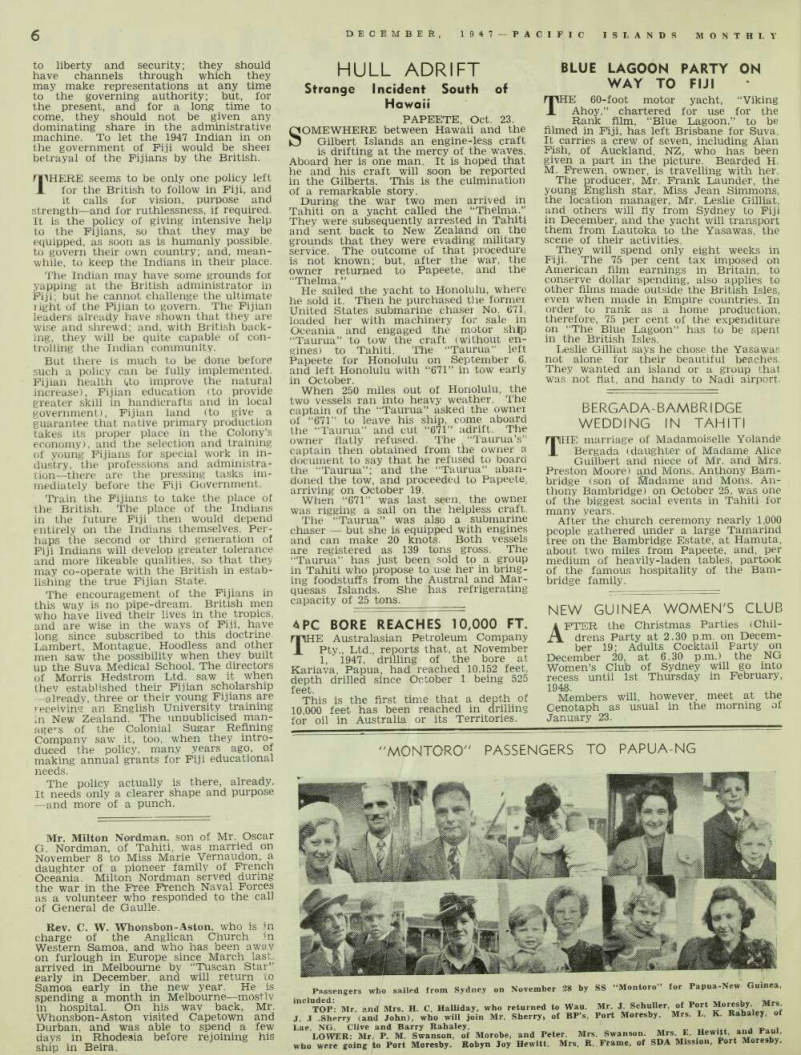
included:
"Montoro" Passengers To Papua-Ng
Passengers who sailed from Sydney on November 28 by SS “Montoro” for Papua-New Guinea,
TOP: Mr. and Mrs. H. C. Halliday, who returned to Wau. Mr. J Schuller, of Port M oresby. Mrs.
J. .J .Sherry (and John), who will join Mr. Sherry, of BP’s. Port Moresby. Mrs. L. K. Rahaley, of Lae, NG. Clive and Barry Rahaley.
LOWER: Mr. P. M. Swanson, of Morobe, and Peter. Mrs. Swanson. Mrs. E. Hewitt, and Paul, who were going to Port Moresby. Robyn Joy Hewitt Mrs. R. Frame, of SDA Mission, Port Moresby.
Griffiths
Death Of Thomas
N. Guinea's Best Administrator Remained Shortest Time There
BRIGADIER General Thomas Griffiths, CMG, CBE, DSO, former Adminis trator of New Guinea, died in Mel bourne on November 16, aged 82. Of all the high officials whom Australia has sent irito her Pacific Territories, he was held in the highest respect and esteem.
He was born in Wales; and in 1886, aged 21, many years before Federation In Australia, he joined the Victorian Per manent Military Force. When World War I came, he was already 49, and a captain in the Commonwealth Army.
Within four years, he was in the top rank of Australia’s soldiers, and com mandant at the London base, with dec orations won on Gallipoli and French battlefields famous for his organising ability, his tireless industry and his quiet efficiency.
Back in Australia, Griffiths was sent to New Guinea as Military Administrator, until a civil government was established; then he was sent on to the little com munity of Nauru, where he was Ad ministrator from 1921 until 1927. He undertook various jobs for the Common wealth Government within the next few years; and then he had three years, be tween 1931 and 1934, as Acting Adminis trator and Administrator in New Guinea.
At the age of 70, he retired.
GRIFFITHS was an exceptionally fine Administrator, who was sacrificed to political and bureaucratic Bumble dom. He should have been made Admin istrator of New Guinea, in 1921, instead of Wisdom what a different story it would have been in that Territory! He had sound ideas regarding economic de velopment and native welfare, and the strength to put them into effect; whereas Wisdom was merely a highly respected office-holder, without much vision or pur pose. The appointment of Griffiths to Nauru, and to other insignificant jobs in and around Australia, was a tragic waste of a good man.
In 1932, when Griffiths returned to New Guinea, he was 67, and was tired and somewhat disillusioned. Nonetheless, he turned to his new task with considerable enthusiasm none knew better than he what New Guinea could do, given half a chance. Within a year, he had public servants, miners, traders and missionaries pulling together in a manner never known before or since; and, because they were based on practical experience and were free from academic dreaming, his plans for native education and health were far better than anything produced in this present age of Planners.
But, after a while, his enthusiasm waned the spirit went out of his ac tivities. Quite suddenly and unexpec tedly, he gave up the job, and retired on superannuation to his pleasant home in East St. Kilda, where he lived very hap pily for another 13 years. In the manner typical of him, he would give no explana tion he always was loyal to his salt.
Except that, on one occasion, he told an old friend that “the Administrator of New Guinea could not be dictated to by Canberra office-boys.”
He was the only Australian Adminis trator of New Guinea who seemed likely to make a record comparable with that of Sir Hubert Murray, in Papua.
Sir Hubert was big enough, and had been sufficiently long in the job, to defy the Canberra- set-up; whereas “Tom” Grif fiths was too modest, and too old and tired, to talk to Canberra in the langu age that Canberra understands.
Samoa's New
Status
Provided In New Legislation
By New Zealand
rE change in the status of Western Samoa, from a mandate to a trustee ship territory in accordance with the international trusteeship system of the United Nations, was recognised by the Samoa Amendment Bill, which was introduced in the New Zealand House of Representatives on Novelnber 18.
The purpose of the Bill is to imple ment the first of a series of progressive steps towards the eventual grant of full government to the people of Western Samoa, and to remove the existing legal disability in regard to defence measures The Bill provides for the appointment of a High Commissioner and a Deputy- High Commissioner in place of an Ad ministrator and Deputy-Administrator, respectively, as at present; it establishes a Council or State comprising the High Commissioner and the Fautua with ad visory functions; abolishes the present Legislative Council and substitutes a Legislative Assembly to make ordinances for the peace, order and good government of Western Samoa and to dispose of the revenues of the territory.
America Perpetuates Political
Division of Archipelago
Wellington, Dec. 1.
W'.HEN the Samoa Amendment Bill was before the NZ Parliament late in November, Mr. F. W. Doidge, MP. made an interesting comparison between the new government which NZ is now setting up for Samoa, and the plan re commended by the UNO mission.
Mr. Doidge said the UNO mission was prepared to give the High Commissioner for Samoa fuller powers than the Bill proposed, and recommended that he should have exclusive rights to initiate Finance Bills, and the right of disallow ance over all measures passed by the Samoan Legislature. It seemed clear now that those powers would rest with the Government in Wellington.
The Prime Minister indicated that that was so.
Mr. Doidge said it was clear that the petitioners had the idea, some day, of making one nation of the Samoans, the petitioners asking that an end be put to the artificial division of the Samoan Islands, established, so it was claimed, without the consent of the Samoans. In 1898, following an inter national wrangle, Eastern Samoa passed under the control of the United States and Western Samoa went to Germany.
The United States held now that no union between the two divisions was pos sible because the United States had in corporated Eastern Samoa in the same way as it had incorporated Hawaii; and claimed, further, that the Trusteeship Council of UNO could not concern itself
with a group that had never been a mandate or a trust territory. The result was, that the Samoans, who were essen tially one in history, language and habits, were split under two flags.
“Having in mind the Samoan history of ancient feuds and rivalry it is well that we do plan for a gradual approach to full autonomy for the Samoans,” said Mr. Doidge. “We hope that these rival ries will not be revived, as their revival would hinder their advance to self government. There has been a wide measure of agreement between all the parties concerned —the UNO mission, New Zealand and the Samoans,
"Matua" Flies Tongan
Standard And Fiji's Methodist Head Sails For Home
Suva, Dec. 4.
WHEN the Union Company’s Islands ship “Matua” sailed from Suva for Auckland on November 30, she was flying the Royal Standard of Tonga.
Queen Salote was a passenger from Nukualofa to New Zealand. (See page 14.) The ship arrived at Suva on the pre vious day, and Queen Salote was a guest at Government House during her brief visit to Fiji.
There was a large crowd, Tongans and Fijians predominating, at the wharf when the Queen, accompanied by the Acting- Governor (Mr. J. F. Nicoll) and the secre tary for Fijian Affairs (Ratu Sir Lala Sukuna) returned to the “Matua” on the 30th.
Virtually the entire Tongan community of Suva was there to see the Queen.
Without detracting from the close tradi tional relationship between Tongans and Fijians, it can be said that a majority of the Fijians were at the wharf primarily to farewell another distinguished passen ger—the retiring head of the Methodist Church in Fiji, the Rev. William Green, who is retiring after 25 years’ distin guished service.
In Memory Of Rabaul
Tragedy
THE annual ceremony, wherein old Territorians pay tribute to the memory of the men lost in the Jap invasion of Rabaul, will take place at the Cenotaph, Sydney, on Friday Morn ing, January 23, at 8.15 a.m. Details can be obtained in Sydney by telephoning Mr. Clark, 82643.
About thirty New Caledonian cattle station owners have formed a union to uphold their rights. M. Andre Castex, who has a property near Hienghene and is also a Noumea dentist, is president.
Cattle raising is, next to mining, New Caledonia’s most important industry.
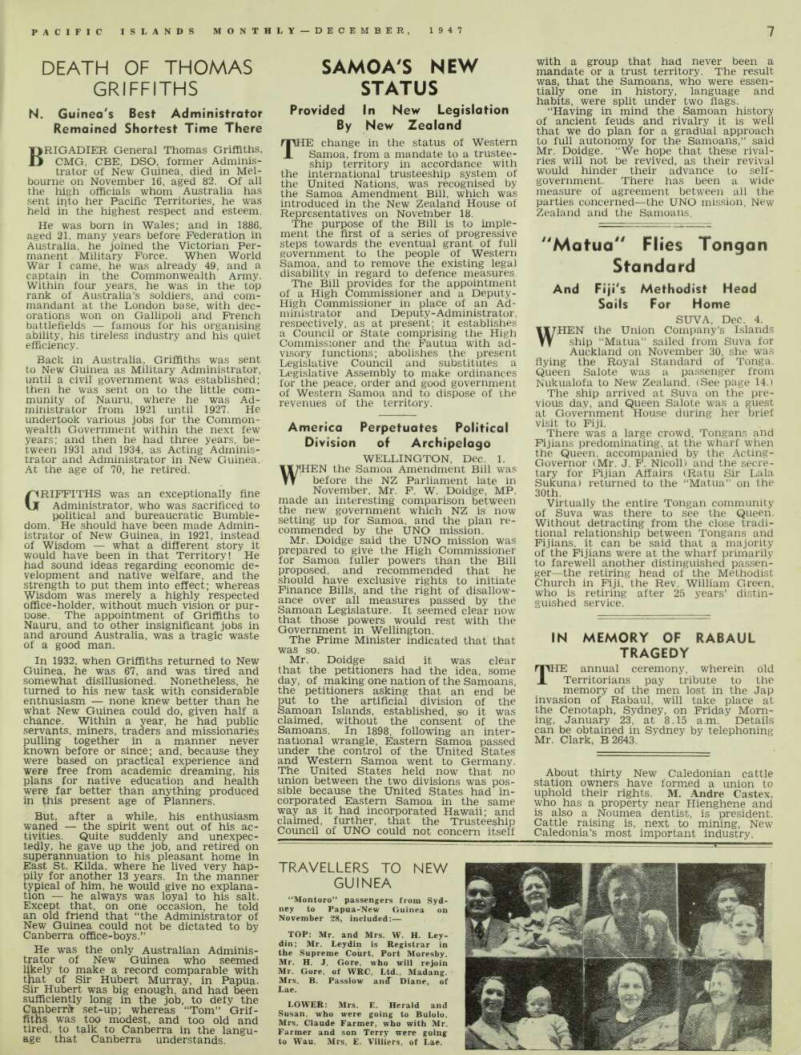
Travellers To New
Guinea
“Montoro” passengers from Syd ney to Papua-New Guinea on November 28, included:— TOP: Mr. and Mrs. W. H. Ley din; Mr. Leydin is Registrar in the Supreme Court, Port Moresby.
Mr. H. J. Gore, who will rejoin Mr. Gore, of WRC, Ltd., Madang.
Mrs, B. Passlow and Diane, of Lae.
LOWER: Mrs. E. Herald and Susan, who were going to Bulolo.
Mrs. Claude Farmer, who with Mr.
Farmer and son Terry were going to Wa0. Mrs. E. Villiers, of Lae.
By Australian Socialists
How NG Women Were Robbed
AN attempt to ventilate one of the really scandalous things which have been done to the neople of Papua and New Guinea caused the suspension of Mr. H. L. Anthony. MP. in the closing hours of the Australian Parliament, re cently.
When the Australian Government abandoned 300 civilians to the Japanese in Rabaul, early in 1942, it deprived many scores of women of their bread winners. Those women had been evacu ated from Rabaul at the end of 1941, but the men had to remain there, and they disappeared when the invasion oc curred. Their fate (they were lost on the “Montevideo Maru” in the middle of 1942) was not definitely known for two or three years.
In the meantime, the Australian Gov ernment paid to the dependants of these men a living allowance, which was called an advance, and recorded officially as re payable.
In due course, the deaths of the Rabau] men were proved, and their dependants thenceforth, received an official pension, A large number of those men were public servants, and their heirs were entitled to certain funds which had accumulated by way of superannuation. When those payments were made to the women con cerned, the Australian Government de ducted, from the amount due, the sums which had been paid to the women in 1942-45 as living allowance.
The monstrous injustice of this proce dure is apparent to anyone. The living allowances became pensions as from the time when the deaths of the men oc curred: the deaths occurred in practically every case in 1942; yet, because the deaths were not officially confirmed until 1944 or 1945, the women were penalised in the way described.
One who was treated in this way by the Australian Government, and whose case was mentioned by Mr. Anthony in making a strong protest against such a procedure, was Mrs. Harold Page, widow of the late Government Secretary.
When the Minister (Mr. Ward) was re plying to Mr. Anthony he turned his usual spate of abuse upon that gentle man and insisted that he had misrepre sented the position. It was clear that Mr. Anthony had done nothing of the sort the facts are as stated above.
Mr. Anthony tried to make a protest by way of personal explanation, but he was blocked by the Speaker Mr. Sol, Rosevear, who has become notorious for his practice of stepping down from the Chair to make bitter fighting speeches in support of the Socialist Government—and when Mr. Anthony continued to protest, the Speaker suspended him.
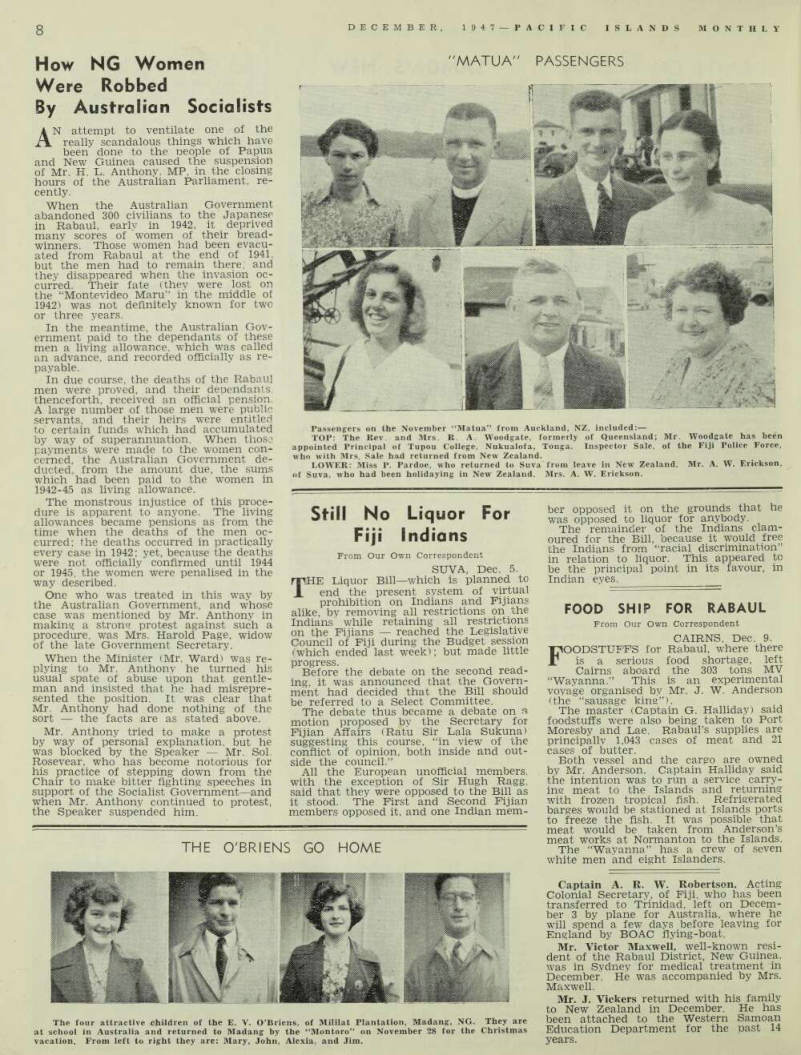
"Matua" Passengers
Passengers on the November “Matua” from Auckland, NZ, included: — TOP: The Rev. and Mrs. R. A. Woodgate, formerly of Queensland; Mr. Woodgate has been appointed Principal of Tupou College, Nukualofa, Tonga. Inspector Sale, of the Fiji Police Force, who with Mrs. Sale had returned from New Zealand.
LOWER: Miss P. Pardoe, who returned to Suva from leave in New Zealand. Mr. A. W. Erickson, of Suva, who had been holidaying in New Zealand. Mrs. A. W. Erickson.
Still No Liquor For Fiji Indians
Fiji Indians
, From Our Own correspondent
Suva, Dec. 5.
THE Liquor Bill—which is planned to end the present system of virtual prohibition on Indians and Fijians alike, by removing all restrictions on the Indians while retaining all restrictions on tjie Fijians reached the Legislative Council of Fiji during the Budget session (which ended last week); but made little progress.
Before the debate on the second read ing, it was announced that the Govern ment had decided that the Bill should be referred to a Select Committee.
The debate thus became a debate on a motion proposed bv the Secretary for Fijian Affairs (Ratu Sir Lala Sukuna) suggesting this course, “in view of the conflict of opinion, both inside and out side the council.”
All the European unofficial members, with the execution of Sir Hugh Ragg, said that they were opposed to the Bill as it stood. The First and Second Fijian members opposed it, and one Indian mem
ber opposed it on the grounds that he was opposed to liquor for anybody.
The remainder of the Indians clam oured for the Bill, because it would free the Indians from “racial discrimination” in relation to liquor. This appeared to be the principal point in its favour, in Indian eyes.
The O'briens Go Home
The four attractive children of the E. V. O’Briens, of Mililat Plantation, Madang, NG. They are at school in Australia and returned to Madang by the “Montoro” on November 28 for the Christmas vacation. From left to right they are: Mary, John, Alexia, and Jim.
Food Ship For Rabaul
From Our Own Correspondent
Cairns, Dec. 9.
FOODSTUFFS for Rabaul, where there is a serious food shortage, left Cairns aboard the 303 tons MV “Wayanna.” This is an experimental voyage organised by Mr. J. W. Anderson (the “sausage king”).
The master (Captain G. Halliday) said foodstuffs were also being taken to Port Moresby and Lae. Rabaul’s supplies are principally 1,043 cases of meat and 21 cases of butter.
Both vessel and the cargo are owned by Mr. Anderson. Captain Halliday said the intention was to run a service, carry ing meat to the Islands and returning with frozen tropical fish. Refrigerated barges would be stationed at Islands ports to freeze the fish. It was possible that meat would be taken from Anderson’s meat works at Normanton to the Islands.
The “Wayanna” has a crew of seven white men and eight Islanders.
Captain A. R. W. Robertson. Acting Colonial Secretary, of Fiji, who has been transferred to Trinidad, left on Decem ber 3 by plane for Australia, where he will spend a few days before leaving for England by BOAC flying-boat.
Mr. Victor Maxwell, well-known resi dent of the Rabaul District, New Guinea, was in Sydney for medical treatment in December. He was accompanied by Mrs.
Maxwell.
Mr. J. Vickers returned with his family to New Zealand in December. He has been attached to the Western Samoan Education Department for the past 14 years.
New Bishop Of
Melanesia
Appointment of Very Rev. S. G.
Caulton Who Already Knows BSI Well
A SUCCESSOR to Bishop W. H.
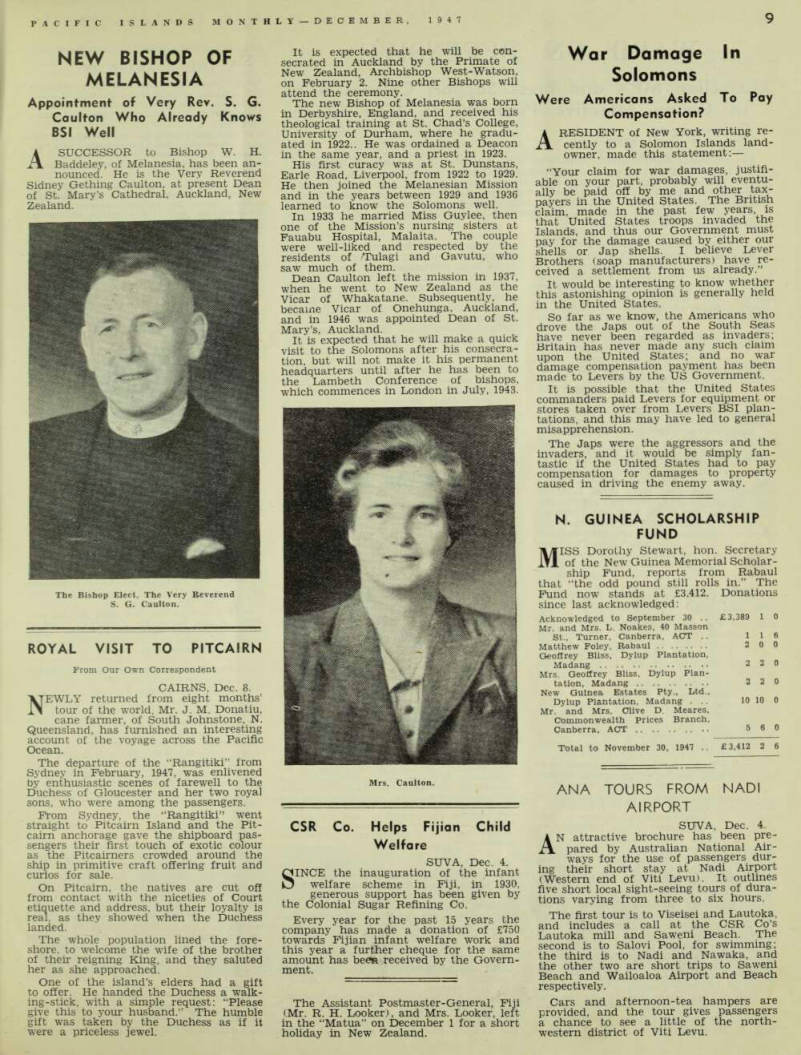
Baddeley, of Melanesia, has been an nounced. He is the Very Reverend Sidney Gething Caulton, at present Dean of St. Mary’s Cathedral. Auckland, New Zealand.
The Bishop Elect, The Very Reverend S. G. Caulton.
Royal Visit To Pitcairn
From Our Own Correspondent
Cairns, Dec. 8.
NEWLY returned from eight months' tour of the world. Mr. J. M. Donatiu, cane farmer, of South Johnstone, N.
Queensland, has furnished an interesting account of the voyage across the Pacific Ocean, The departure of the “Rangitiki” from Sydney in February, 1947, was enlivened by enthusiastic scenes of farewell to the Duchess of Gloucester and her two royal sons, who were among the passengers.
From Sydney, the “Rangitiki” went straight to Pitcairn Island and the Pit cairn anchorage gave the shipboard pas sengers their first touch of exotic colour as the Pitcairners crowded around the ship in primitive craft offering fruit and curios for sale.
On Pitcairn, the natives are cut off from contact with the niceties of Court etiquette and address, but their loyalty is real, as they showed when the Duchess landed.
The whole population lined the fore shore, to welcome the wife of the brother of their reigning King, and they saluted her as she approached.
One of the island’s elders had a gift to offer. He handed the Duchess a walk ing-stick, with a simple request: “Please give this to your husband.” The humble gift was taken by the Duchess as if it were a priceless jewel.
It is expected that he will be con secrated in Auckland by the Primate of New Zealand, Archbishop West-Watson, on February 2. Nine other Bishops will attend the ceremony.
The new Bishop of Melanesia was born in Derbyshire, England, and received his theological training at St. Chad’s College, University of Durham, where he gradu ated in 1922.. He was ordained a Deacon in the same year, and a priest in 1923.
His first curacy was at St. Dunstans, Earle Road, Liverpool, from 1922 to 1929.
He then joined the Melanesian Mission and in the years between 1929 and 1936 learned to know the Solomons well.
In 1933 he married Miss Guylee, then one of the Mission’s nursing sisters at Fauabu Hospital, Malaita. The couple were well-liked and respected by the residents of Tulagi and Gavutu, who saw much of them.
Dean Caulton left the mission in 1937, when he went to New Zealand as the Vicar of Whakatane. Subsequently, he became Vicar of Onehunga, Auckland, and in 1946 was appointed Dean of St.
Mary’s, Auckland.
It is expected that he will make a quick visit to the Solomons after his consecra tion, but will not make it his permanent headquarters until after he has been to the Lambeth Conference of bishops, which commences in London in July, 1943.
Mrs. Caulton.
CSR Co. Helps Fijian Child
Welfare
Suva, Dec. 4.
SINCE the inauguration of the infant welfare scheme in Fiji, in 1930, generous support has been given by the Colonial Sugar Refining Co.
Every year for the past 15 years the company has made a donation of £750 towards Fijian infant welfare work and this year a further cheque for the same amount has bee* received by the Govern ment.
The Assistant Postmaster-General, Fiji (Mr. R. H. Looker), and Mrs. Looker, left in the “Matua” on December 1 for a short holiday in New Zealand.
Solomons
War Damage In Solomons Were Americans Asked To Fay Compensation?
A RESIDENT of New York, writing re cently to a Solomon Islands land owner, made this statement: — “Your claim for war damages, justifi able on your part, probably will eventu ally be paid off by me and other tax payers in the United States. The British claim, made in the past few years, is that United States troops invaded the Islands, and thus our Government must pay for the damage caused by either our shells or Jap shells. I believe Lever Brothers (soap manufacturers) have re ceived a settlement from us already.”
It would be interesting to know whether this astonishing opinion is generally held in the United States.
So far as we know, the Americans who drove the Japs out of the South Seas have never been regarded as invaders; Britain has never made any such claim upon the United States; and no war damage compensation payment has been made to Levers by the US Government.
It is possible that the United States commanders paid Levers for equipment or stores taken over from Levers BSI plan tations, and this may have led to general
misapprehension.
The Japs were the aggressors and the invaders, and it would be simply fan tastic if the United States had to pay compensation for damages to property caused in driving the enemy away.
Fund
N. Guinea Scholarship
MISS Dorothy Stewart, hon. Secretary of the New Guinea Memorial Scholar ship Fund, reports from Rabaul that “the odd pound still rolls in.” The Fund now stands at £3,412. Donations since last acknowledged; Acknowledged to September 30 .. £3,389 1 0 Mr. and Mrs. L. Noakes, 40 Masson St., Turner, Canberra, ACT .. 116 Matthew Foley, Rabaul 2 0 0 Geoffrey Bliss, Dylup Plantation, Madang 220 Mrs. Geoffrey Bliss, Dylup Plan tation, Madang 220 New Guinea Estates Pty., Ltd., Dylup Plantation, Madang ... 10 10 0 Mr. and Mrs. Clive D. Meares, Commonwealth prices Branch, Canberra, ACT 560 Total to November 30, 1947 .. £3,412 2 6
Ana Tours From Nadi
Airport
Suva, Dec. 4.
AN attractive brochure has been pre pared by Australian National Air ways for the use of passengers dur ing their short stay at Nadi Airport (Western end of Viti Levu). It outlines five short local sight-seeing tours of dura tions varying from three to six hours.
The first tour is to Viseisei and Lautoka, and includes a call at the CSR Co’s Lautoka mill and Saweni Beach. The second is to Salovi Pool, for swimming; the third is to Nadi and Nawaka, and the other two are short trips to Saweni Beach and Wailoaloa Airport and Beach respectively.
Cars and afternoon-tea hampers are provided, and the tour gives passengers a chance to see a little of the north western district of Viti Levu.
Ward On Defensive
Australian MP's and Press Support Colonel Allan In Giving Effective Publicity to New Guinea Grievances
IJOLITICAL repercussions, stemming from Colonel H. T. Allan’s attendance £ at the RSL Conference in Canberra in October, have given New Guinea the largest slice of publicity since the Japanese invasion. As a result the Minister (Mr. Ward) will probably visit the Territory in the New Year Territorians will do well to take advantage of this visit when (or if) it occurs"
Any apathy on their part will be construed by the Minister as “satisfaction at what is being done.”
1N October, Colonel Allan was given per mission to represent Territories’ war veterans at the Federal Conference of the RSSAILA, then being held in Can berra. During this conference he criticised sharply the disabilities and frustrations which Europeans in the Territories, a large proportion of them returned service men, have suffered under the Ward regime. Colonel Allan created a great deal of interest among delegates, and with the Press, and as a result New Guinea grievances were prominently dis played in Australian newspapers.
One of the grievances concerned the Commonwealth Bank, in Rabaul, which at present has a monopoly there and which had refused planters an advance on their copra—a policy which has now been altered.
Mr. -Chifley, then in the process of see ing the Bank Nationalisation Bill on its stormy way through Federal Parliament, and, naturally, hyper-sensitive to such criticism coming at that time, sent for Colonel Allan and interviewed him in the presence of Mr. Ward and Mr. Anthony (CP). As a result of this interview, Mr.
Chifley promised that an investigation should be made into New Guinea’s griev ances and that reforms would follow.
With these assurances, Colonel Allan thereupon withdrew certain matters which were to have been discussed by the RSSAILA Congress, until the Prime Min ister had had time to take action.
C COLONEL Allan then returned to j Rabaul (November 5). Mr. Chifley apparently asked Mr. Ward to get on with the promised “investigation”; and Mr. Ward proceeded to stir up his bureaucrats, who went into their usual routine of denials and buck-passing.
Mr. Ward, backed by the Prime Min ister, thereupon lost no time in beginning his campaign of belittlement, directed mostly against Col. Allan, but including also Opposition members of the House who had ventilated New Guinea griev ances.
Most of Colonel Allan’s statements, par ticularly with regard to Europeans having to live in tents and other temporary accommodation, were, according to Messrs.
Ward and Chifley, “without foundation.”
Those who were complaining were a “few disgruntled planters.” Most residents of the Territories were “satisfied with what was being done for them.” This had been proved, said Mr. Ward, by investigations made by the Government Secretary, and a Mr. lan McDonald, of the Recon struction Department.
ON reaching Rabaul, Colonel Allan found that public affairs had de teriorated during his absence in Australia, due mostly to total cessation of shipping to that port, from Australia.
This he reported to Opposition Members White and Anthony, in Canberra, who promptly renewed in Parliament their at tacks on the New Guinea administration.
Considerable, space was given to the attacks by metropolitan newspapers, not reluctant to discredit Ward’s administra tion in New Guinea or anywhere else.
Territory s affairs and Territorians generally have had a poor press from Australian newspapers in recent years with the result that the Australian public (which is footing the bill for this ex pensive excursion into Socialism in the formerly rich New Guinea territory) is ignorant of and indifferent to the real state of affairs there. The poor press was mainly due to Australian newspaper indif ference and the belief that New Guinea is “not news”; and partly because men who have voiced complaints before have often been anxious to preserve their .anonymity through alleged fear of victimisation Colonel Allan apparently was prepared to risk reprisals. His distinguished record m both World Wars, his standing with the RSSAILA in New Guinea and Aus tralia, and his length of residence in New Guinea made him a figure not easy to ignore, anyway.
What he had to say about Mr. Ward’s New Guinea was taken up enthusiastic ally, and flung in Mr. Ward’s teeth with journalistic vigor, by the “Daily Tele graph” in Sydney, and the “Herald-Sun” group of newspapers in Melbourne, who since the defeat of the Cain Labour Gov ernment there in November have pulled no punches in a straight-out fight against socialisation.
Thereafter, Australian newspaper readers were treated, on the one hand, to Mr. Ward’s ceaseless campaign of denials and smears, backed by his officials who were evidently working overtime in Rabaul to prove that everything in that neck of the New Guinea woods was better than it had ever been; on the other hand, they had the renewed protests of Colonel Allan and other New residents who joined him, and the championing of the New Guinea cause by Messrs.
White and Anthony, in Canberra.
The wordy war culminated on No vember 28, when Mr. Anthony moved the adjournment in the House for the pur pose of discussing: The complete breakdown in the proper administration and provision of services in the Territories of Papua and New Guinea, and particularly the failure to provide reasonable living accommodation for many white men and women, the breakdown in continuity of fresh food supplies and essentials, and the unsym pathetic attitude of the responsible Minister towards Australians attempting to re-establish themselves in these Territories.
AS pointed out by Mr. Anthony in opening his speech, a period of two hours is usually devoted to a motion of this character. However, on .this occasion, the time was cut down to 50 minutes by a ruse of the Minister for In formation (Calwell) who took that oppor tunity to read a statement of 25 foolscap pages instead of moving for the printing of the paper, as is usually done.
“Instead of moving the gag,” said Mr.
Anthony, “the Government now adopts ‘smother’ tactics.”
He said his reason for moving the motion was because the people of New Guinea had no representation either in the Federal Parliament or in the Terri
tory itself; and because of misrepresenta tion on the part of both Mr. Ward and the Prime Minister, who had set out de liberately to discredit Colonel Allan and present him as an irresponsible, whose statements had no foundation.
Mr. Anthony warned the Minister that any attempt to victimise Colonel Allan for his outspokenness would be met, not only by the Federal Opposition, but by the Returned Soldiers’ League through out Australia.
Mr. White (Lib., Vic.) spoke in support of Mr. Anthony. He said that for over a year he had been pressing for a select committee to investigate affairs in Papua- New Guinea, but that his requests had been ignored, or answered with personal abuse. He said that he was prepared to go to the Territory at his own expense, and report what he saw.
Mr. Ward, in reply, employed his usual tactics: denial, personal abuse, references to the private business affairs of Opposi tion members, which had no bearing on the points at issue, and long-winded “plans for the future” —which Territorians have learned to expect from this Min ister, but which do nothing to satisfy their grievances of the present.
In defence of his policy, he said that 24 houses had been constructed in Port Moresby (these were constructed in 1946 at a cost of £2,400 each) and that 12 more
were planned. In Port Moresby, plans were in hand for the construction of a £lOO,OOO hydro-electric plant; earth-mov ing and road-making machinery was be ing sent from other islands to Port Moresby for road-making.
Presumably, in case Rabaul residents might feel, with justification, that these plans for Port Moresby gave point to their complaints of the Administration’s pro- Moresby attitude, he hastened to add that plans were well advanced for the con struction of a new workshop in Rabaul. (How a workshop is to solve Rabaul’s difficulties he did not state. They are un likely to provide housing for those living in tents and humpies, copra sacks for cm copra now lying at plantations, or fresh food.) Mr. Ward said that within a few days, both the “Montoro” and “Malaita” would be leaving for the Territories with several thousand tons of supplies. (He neglected to state, however, that “Montoro” had not made a visit to New Guinea since September; and the “Malaita,” on her last trip, had called only at Port Moresby and Samarai).
MR. WARD has an inexhaustible fount of words, which flow with sufficient ease to bamboozle his hearers. Many of the Wardists in Australia doubtless be lieve that their hero has created, in New Guinea, a heaven upon earth where everyone, with the exception of a few wicked planters who are no longer able to "exploit” the poor, down-trodden natives, enjoys unalloyed happiness.
The publicity that has been given New Guinea in recent weeks may. however, have found its mark among the not-so spellbound who have a right to wonder why it is necessary, two years after the war, to pour millions of Australian money into the once self-supporting Territory of New Guinea.
It has pleased Mr. Ward, in the past, to dismiss any criticism of his adminis tration in New Guinea, arrogantly, and with contempt. On this occasion, feeling the breeze of public disapproval, he was forced onto the defensive and. although it cannot be said that it made him more conciliatory in manner, that in itself is an achievement. 11HE debate on November 2 was pre maturely cut short after Mr. Ward had spoken when the Government applied the “gag.” The war, however, has been carried on by the newspapers, who have since printed a long radiogram from Colonel Allan, in Rabaul.
Colonel Allan, radioed, on December 4, that he was prepared to confirm all his statements and produce evidence at any inquiry. The seriousness of the position in Rabaul because of shortage of supplies had already resulted in his own firm hav ing to close down their trading agency because of lack of petrol, copra sacks, lubricating oil, etc. The scheduled arrival
of the “Malaita” on December 15, he said, would be too late to help many planters and traders who have also stopped operating, through lack of essential supplies.
He said tnat in order to test the truth of the Minister’s Parliamentary state ment that there were four months’ sup plies in the town, his partner on De cember 3 had applied to the District Officer for milk, flour, soap, petrol, lubricating oil and timber.
The DO had advised that some Army flour would be available when unloaded from the ship then in the harbour —but this flour was two years old. Army flaked soap was available, but was hard to dis solve. Fifty drums of petrol would be given to firms when the ship arrived, but was not then available, and tinned meat had been made available the previous day from Administration Stores —a course not usually adopted. The DO had been unable to provide or promise milk.
The local bakery, Col. Allan said, had advised that no bread would be available after December 5. He said that deep re sentment was felt in the town at the denial, by responsible officials, that these conditions existed.
Federal Parliament has now risen for the Christmas recess, during which Government members, no doubt, hope that the New Guinea question, with many others, will be conveniently forgotten by the Australian public.
The airing of New Guinea affairs in Parliament has achieved nothing in it self, because of the Minister’s attitude.
What is needed now is an official inquiry, which would establish, beyond all doubt, whether there was any basis for the allegations of Colonel Allan and other re sidents and organisations who have pre viously or since come forward.
If these people were upheld by public inquiry, then it should be ascertained why officials, sent to Rabaul by Mr. Ward, should have found it necessary to deny that such conditions existed. A list of people living in tents or humpies, for ex ample, was supplied by Col. Allan to Mr.
Anthony, who produced it in Parliament in reply to a challenge by Mr. Ward. Yet, although this same list had been sup plied to Mr. McDonald, in Rabaul, he in formed Mr. Ward that no Europeans were living in this way.
The chances of a Royal Commission, however, are slight. The present Gov ernment is notoriously reluctant to in quire into anything that might reflect discredit upon itself. A demand for an in quiry now is no more likely to bear fruit than did the demand for an inquiry into the circumstances surrounding the abandonment of several hundred civilians to the Japs in Rabaul, in early 1942.
Something, however, may be gained from the visit of the Minister—if this
visit is carried out in January as has been suggested. It will be less easy for Mr. Ward to airily dismiss complaints of frustrated planters, traders and miners in New Guinea, than it is for him so to do in the privileged sanctuary of Parliament House, Canberra.
This Started It:
r T' HE resolutions which Col. Allan originally 1 intended to bring before RSSAILA Congress in Australia, but which he withdrew from the agenda after his interview with Mr. Chifley were:— ® That the present ban on investigation into any prosecution for collaboration with the Japanese by natives be removed and that all such cases be examined and offenders brought to trial. • That the Uncontrolled Territories Ordinance be revised to permit of opening up of new gold bearing areas by persons approved by the Administrator, and that a system of Govern ment assistance to prospectors (as in Australia) be instituted. • That the basis of War Damage payments (i.e., 1942 book values) be reviewed and that all claims be paid on 1947 replacement values this being the present basis of payment by the New Guinea Administration for War Damage claims of natives. ® That natives who have completed a twelve months’ contract with an employer be permitted to sign on again if they so wish, instead of being compelled to return to their home areas and not permitted to work again for six months. ® That the Legislative Council of the Man dated Territory be revived, and that the non- Administrative members of the Council be elected by public vote and not by nomination by the Administrator. ® That the present restriction on the owner ship and use of watercraft over 25 tons be re moved and that returned soldiers be permitted to own and operate their own craft, irrespective of size. • That the present imposition of export duties and repayment of bounties on goods from Aus tralia to New Guinea (rice, wheatmeal, soap, cotton goods, flour and fats) be discontinued, and that New Guinea be treated as part of Australia and not as a foreign country. ® That the ban on export of baby food, un sweetened milk and cement, from Australia to New Guinea, be removed. © That more frequent shipping services be provided between Australia and New Guinea to ensure continuity of supplies of food and other necessities for European and native populations and to make available materials for housing and rehabilitation. • That copra, rubber and other primary pro ducts be paid for by the Production Board or other Government authority on world parity prices, or, failing that, in relation to the prices charged to Australian consumers.
Invitation for PM to “Try Rabaul Food"
“Try Rabaul Food"
DURING the height of the New Guinea controversy, the Melbourne “Herald” spoke by radio-phone to Miss Dorothy Stewart, who is manageress of the Cos mopolitan Hotel, Rabaul.
Miss Stewart is well known to Territori ans as the energetic secretary of the New Guinea Memorial Scholarship Fund. She is a young woman with a large bump of humour and a great deal of fighting spirit.
“Let the Prime Minister and the Min ister for Territories fly up here and try the food for themselves,” she told the “Herald.”
“See if they still think 90 per cent, of the locals’ claims are inaccurate after a few days on native vegetables.”
Miss Stewart explained that Rabaul had been out of fresh meat for two and a half months: there were no potatoes, no onions, no milk.
The last of the milk had gone two weeks before. Flour was “very low” and very poor. There was no benzine, no copra sacks for the planters.
There had been no beer for two months, but a few cigarettes were left.
Residents were living on canned meat, mainly “M & V” (meat and vegetables) and other service preparations, sweet potatoes, tomatoes, yams, and other native vegetables and tropical fruits.
They drank black tea or coffee —or water.
“No, we won’t starve.” said Miss Stewart, “But it’s getting awfully monotonous.”
Rabaul has been expecting a relief ship for weeks, she added. Now it seemed one would not arrive before mid-December.
Did she think they’d be able to hang out until it arrived?
Miss Stewart: “We’ll have to. that’s all Although, personally, I wouldn’t be sur prised if it didn’t turn up until March.”
Miss Stewart said that apart from the war she had been in and out of New Guinea for 20 years. She had been manageress of the Cosmopolitan since July. The number of guests at the hotel varied from 40 to 80. They were mainly business men visiting their plantations, planters visiting different parts of the Territory, commercial travellers and American crews down from Manus, where they were on survey work.
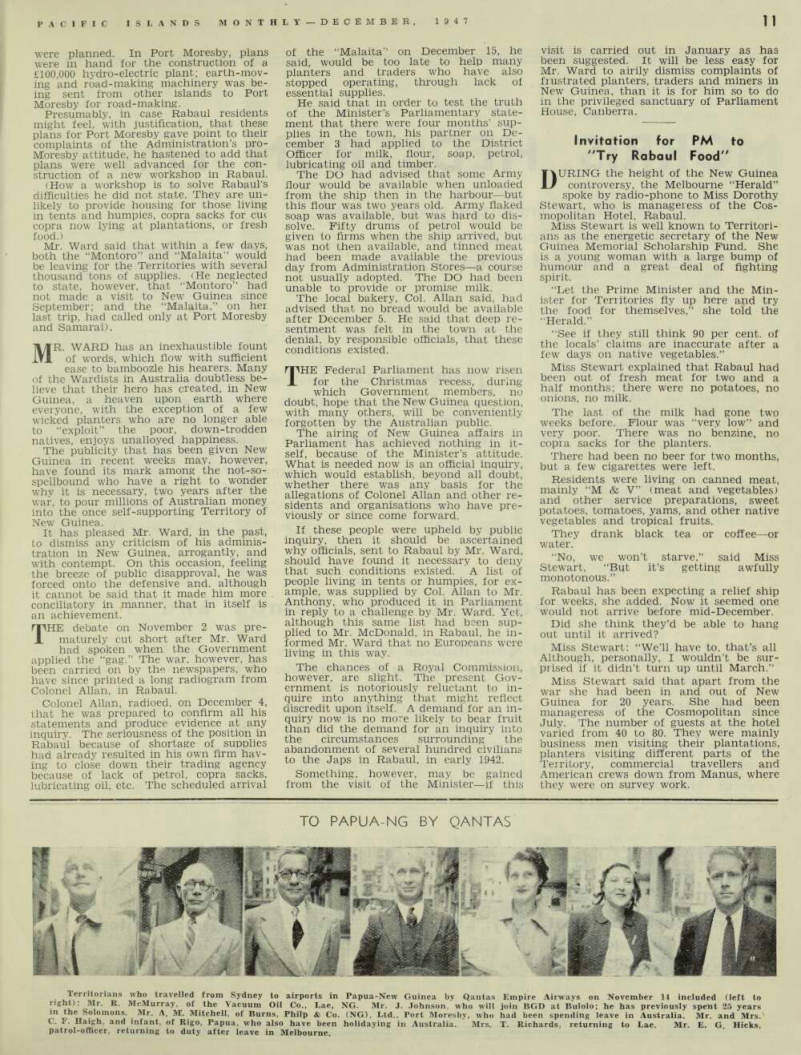
To Papua-Ng By Qantas
Territorians who travelled from Sydney to airports in Papua-New Guinea by Qantas Empire Airways on November 14 included (left to right): Mr. R. McMurray, of the Vacuum Oil Co., Lae, NG. Mr. J. Johnson, who will join BGD at Bulolo; he has previously spent 25 years i n the Solomons. Mr. A. M. Mitchell, of Burns, Philp & Co. (NG), Ltd., Port Moresby, who had been spending leave in Australia. Mr. and Mrs.
C. F. Haigh, and infant, of Rigo, Papua, who also have been holidaying in Australia. Mrs. T. Richards, returning to Lae. Mr. E. G Hicks, patrol-officer, returning to duty after leave in Melbourne.
Advertisements & other items, p. 14 (1 item)
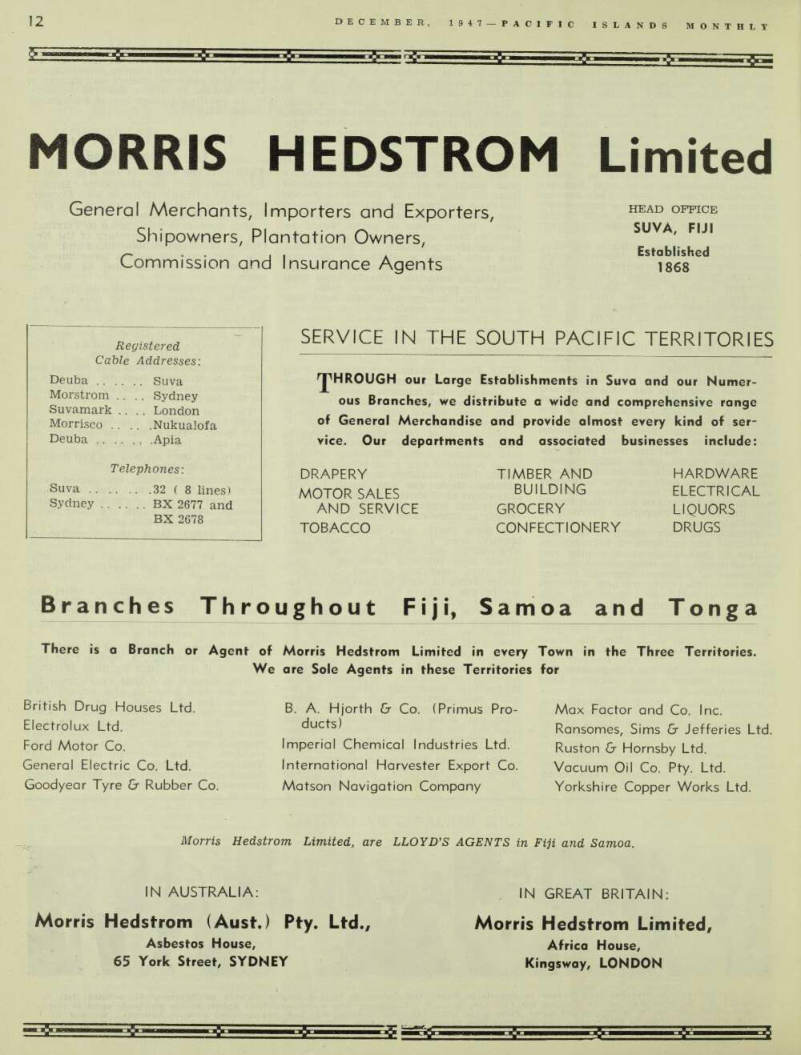
Morris Hedstrom Limited
General Merchants, Importers and Exporters,
Shipowners, Plantation Owners,
Commission and Insurance Agents
HEAD OFFICE
SUVA, FIJI
Established 1868
SERVICE IN THE SOUTH PACIFIC TERRITORIES
rpHROUGH our Large Establishments in Suva and our Numerous Branches, we distribute a wide and comprehensive range of General Merchandise and provide almost every kind of service. Our departments and associated businesses include:
DRAPERY
MOTOR SALES
AND SERVICE
TOBACCO
TIMBER AND
BUILDING
GROCERY
CONFECTIONERY
HARDWARE
ELECTRICAL
LIQUORS
DRUGS
Branches Throughout Fiji, Samoa and Tonga
There is a Branch or Agent of Morris Hedstrom Limited in every Town in the Three Territories.
We are Sole Agents in these Territories for British Drug Houses Ltd.
Electrolux Ltd.
Ford Motor Co.
General Electric Co. Ltd.
Goodyear Tyre £r Rubber Co.
B. A. Hjorth & Co. (Primus Products) Imperial Chemical Industries Ltd.
International Harvester Export Co.
Matson Navigation Company Max Factor and Co, Inc.
Ransomes, Sims Gr Jefferies Ltd.
Ruston & Hornsby Ltd.
Vacuum Oil Co. Pty. Ltd.
Yorkshire Copper Works Ltd.
Morris Hedstrom Limited, are LLOYD’S AGENTS in Fiji and Samoa.
IN AUSTRALIA:
Morris Hedstrom (Aust.) Pty. Ltd.,
Asbestos House, 65 York Street, SYDNEY
IN GREAT BRITAIN:
Morris Hedstrom Limited,
Africa House, Kingsway, LONDON
Glamorous Film Actress En
Route To Fiji
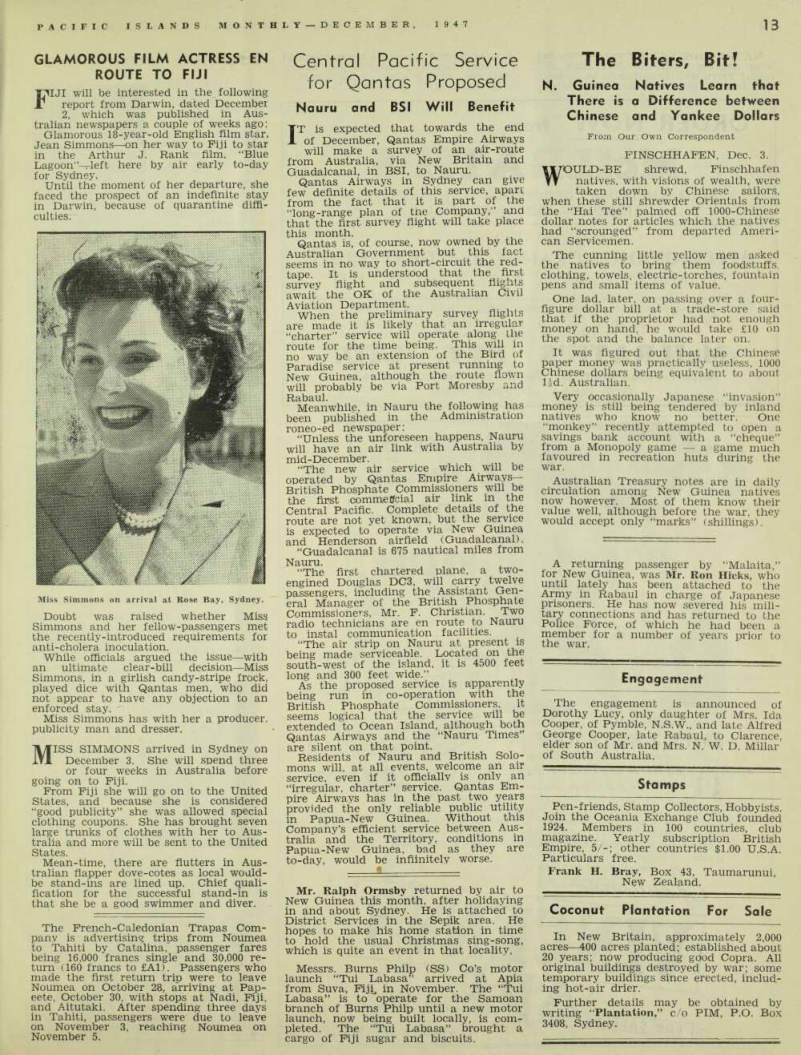
FIJI will be interested in following report from Darwin, dated December 2, which was published in Aus tralian newspapers a couple of weeks ago: Glamorous 18-year-old English film star, Jean Simmons —on her way to Fiji to star in the Arthur J. Rank film, “Blue Lagoon”—left here by air early to-day for Sydney.
Until the moment of her departure, she faced the prospect of an indefinite stay in Darwin, because of quarantine diffi culties.
Doubt was raised whether Miss Simmons and her fellow-passengers met the recently-introduced requirements for anti-cholera inoculation.
While officials argued the issue—with an ultimate dear-bill decision —Miss Simmons, in a girlish candy-stripe frock, played dice with Qantas men, who did not appear to have any objection to an enforced stay.
Miss Simmons has with her a producer, publicity man and dresser.
MISS SIMMONS arrived in Sydney op December 3. She will spend three or four weeks in Australia before going on to Fiji.
From Fiji she will go on to the United States, and because she is considered “good publicity” she was allowed special clothing coupons. She has brought seven large trunks of clothes with her to Aus tralia and more will be sent to the United States.
Mean-time, there are flutters in Aus tralian flapper dove-cotes as local would be stand-ins are lined up. Chief quali fication for the successful stand-in is that she be a good swimmer and diver.
The French-Caledonian Trapas Com pany is advertising trios from Noumea to Tahiti bv Catalina, passenger fares being 16,000 francs single and 30,000 re turn (160 francs to £AI). Passengers who made the first return trip were to leave Noumea on October 28, arriving at Pap eete, October 30, with stops at Nadi, Fiji, and Aitutaki. After spending three days in Tahiti, passengers were due to leave on November 3, reaching Noumea on November 5.
Miss Simmons on arrival at Rose Bay, Sydney.
for Qantas Proposed
Central Pacific Service for Qantas Proposed Nauru and BSI Will Benefit
IT is expected that towards the end of December, Qantas Empire Airways will make a survey of an air-route from Australia, via New Britain and Guadalcanal, in BSI, to Nauru.
Qantas Airways in Sydney can give few definite details of this service, apart from the fact that it is part of the “long-range plan of the Company,” and that the first survey flight will take place this month.
Qantas is, of course, now owned by the Australian Government but this fact seems in no way to short-circuit the red tape. It is understood that the first survey flight and subsequent flights await the OK of the Australian Civil
Aviation Department.
When the preliminary survey flights are made it is likely that an irregular “charter” service will operate along the route for the time being. This will in no way be an extension of the Bird of Paradise service at present runniiig to New Guinea, although the route flown will probably be via Port Moresby and Rabaul.
Meanwhile, in Nauru the following has been published in the Administration roneo-ed newspaper: “Unless the unforeseen happens, Nauru will have an air link with Australia by mid-December.
“The new air service which will be operated by Qantas Empire Airways— British Phosphate Commissioners will be the first commercial air link in the Central Pacific. Complete details of the route are not yet known, but the service is expected to operate via New Guinea and Henderson airfield (Guadalcanal).
“Guadalcanal is 675 nautical miles from Nauru.
“The first chartered plane, a two engined Douglas DC3, will carry twelve passengers, including the Assistant Gen eral Manager of the British Phosphate Commissioners, Mr. F. Christian. Two radio technicians are en route to Nauru to instal communication facilities.
“The air strip on Nauru at present is being made serviceable. Located on the south-west of the island, it is 4500 feet long and 300 feet wide.”
As the proposed service is apparently being run in co-operation with the British Phosphate Commissioners, it seems logical that the service will be extended to Ocean Island, although both Qantas Airways and the “Nauru Times’ are silent on that point.
Residents of Nauru and British Solo mons will, at all events, welcipme an air service, even if it officiallv is onlv ap “irregular, charter” service. Qantas Em pire Airways has in the past two years provided the only reliable public utility in Papua-New Guinea. Without this Company’s efficient service between Aus tralia and the Territory, conditions in Papua-New Guinea, bad as they are to-day, would be infiinitely worse. « Mr. Ralph Ormsby returned by air to New Guinea this month, after holidaying in and about Sydney. He is attached to District Services in the Sepik area. He hopes to make his home station in time to hold the usual Christmas sing-song, which is quite an event in that locality.
Messrs. Burns Philp (SS) Co’s motor launch “Tui Labasa” arrived at Apia from Suva, Fiji, in November. The “Tui Labasa” is to operate for the Samoan branch of Burns Philp until a new motor launch, now being built locally, is com pleted. The “Tui Labasa” brought a cargo of Fiji sugar and biscuits.
The Biters, Bit!
N. Guinea Natives Learn that There is a Difference between Chinese and Yankee Dollars
From Our Own Correspondent
Finschhafen, Dec. 3.
WOULD-BE shrewd, Finschhafen natives, with visions of wealth, were taken down by Chinese sailors, when these still shrewder Orientals from the “Hai Tee” palmed off 1000-Chinese dollar notes for articles which the natives had “scrounged” from departed Ameri can Servicemen.
The cunning little yellow men asked the natives to bring them foodstuffs, clothing, towels, electric-torches, fountain pens and small items of value.
One lad. later, on passing over a four figure dollar bill at a trade-store said that if the proprietor had not enough money on hand, he would take £lO on the spot and the balance later on.
It was figured out that the Chinese paper money was practically useless, 1000 Chinese dollars being equivalent to about lid. Australian.
Very occasionally Japanese “invasion” money is still being tendered by inland natives who know no better. One “monkey” recently attempted to open a savings bank account with a “cheque” from a Monopoly game a game much favoured in recreation huts during the war.
Australian Treasury notes are in daily circulation among New Guinea natives now however. Most of them know their value well, although before the war, they would accept only “marks” (shillings).
A returning passenger by “Malaita,” for New Guinea, was Mr. Ron Hicks, who until lately has been attached to the Army in Rabaul in charge of Japanese prisoners. He has now severed his mili tary connections and has returned to the Police Force, of which he had been a member for a number of years prior to the war.
Mr. Bob Clark, who for some years has been engaged with the Australian External Territories Department in Sydney, sails by the “Esperance Bay” for England
on December 19, where he hopes to spend a holiday and later make a tour of the Continent. Bob is a son of the late Hon.
R. L. Clark, MLC, of Rabaul.
Advertisements & other items, pp. 15-16 (1 item)
Stamps
Engagement
The engagement is announced of Dorothy Lucy, only daughter of Mrs. Ida Cooper, of Pymble, N.S.W., and late Alfred George Cooper, late Rabaul, to Clarence, elder son of Mr. and Mrs. N. W. D. Millar of South Australia.
Pen-friends, Stamp Collectors, Hobbyists.
Join the Oceania Exchange Club founded 1924. Members in 100 countries, club magazine. Yearly subscription British Empire, 5/-; other countries $l.OO U.S.A.
Particulars free.
Frank H. Bray, Box 43, Taumarunui, New Zealand.
Coconut Plantation For Sale In New Britain, approximately 2,000 acres—4oo acres planted: established about 20 years; now producing good Copra. All original buildings destroyed by war; some temporary buildings since erected, including hot-air drier.
Further details may be obtained by writing “Plantation,” c/o PIM, P.O. Box 3408, Sydney.
ORDER NOW from
McILRATH’S
YOUR CHRISTMAS GROCERIES—WINES—SPIRITS—
LIQUEURS—CIDER—CORDIALS
PURE FRUIT JUICES
APPLE-ORANGE-ORANGE and GRAPEFRUIT
(3/- value) 30 oz. cans !/• (per doz., 11/6) All shipments are insured against pillage, theft, non-delivery Write for our New Grocery, Wine and Spirit Price List.
Post Free hy Return Air-mail.
McILRATH’S PTY. LTD.
Export Department, 202 Pitt Street, Sydney, Australia Cable address: ROTUNDA. Sydney.
OVER 25
YEARS OF
PAIN
RELIEF!
SWIFT 3-WAY RELIEF
From HEADACHE and Nerve and Muscular Pain!
Vincent’s A.P.C Powders and Tablets & are a combination of three valuable medicinal ingredients and bring swift 3-way relief! Vincent’s A.P.C is prepared to the original hospital prescription containing Aspirin to relieve pain, Phenacetin to reduce temperature, Caffeine to stimulate the nervous system. Vincent’s A.P.C quickly relieves Headache, and all nerve and muscular pain! © N5.6D.14.
•poßjsgfinS
S/V
vTnTISS-
POWDERS & TABLETS
Tongan Queen In Nz
Nukualofa.
Nov. 21.
Her Majesty Queen Salote Tupou is leaving Tonga by to-day’s “Matua” on a long health holi day. She is not expected to be back here until March, next year.
She is travelling to Auckland, via Suva.
In Auckland the Queen will reside at St. Stephen Avenue. From Auckland she will visit Wellington, Rotorua and Ngarawahia.
After Auckland, she may take a trip to Australia to attend the Methodist Confer ence.
The Queen is ac companied by the Hon. Ulukalala (Governor of Vavau), who will act as her private secretary. A high ranked relative of the Roval Family,
Miss Tu’ilokamana Vi, goes with the party as maid-in-waiting. Two other maids will accompany the Queen as far only as Fiji.
HRH Crown Prince Tupouto’a-Tungi will act as Regent during the Queen's absence.
Photos show, top to bottom, Queen Salote; Hon. Uluka lala; Miss Vi.
Fiji Business Man Visits
N. Guinea
MR. A. E. T. CORRIE, governing director of the Sydney firm of Boxley Pty., Ltd., and well known director of Corrie &' Co., Suva, Fiji, left by Qantas plane on November 17, on a three weeks’ visit
to Papua and New Guinea.
Mr. Corrie is investigating con ditions in the territories with a view to opening new branches of Boxley Pty., Ltd., He said that a new company was formed recently in Fiji, known as Commercial En terprises (Fiji) Ltd., directors of which are Mr.
Corrie, Mr. C. H.
Hunt (Suva), and
Referring to conditions in the Colony, Mr. Corrie said that private enterprise was opening up a number of new in dustries. Machinery had been ordered from England for the production of candlenut oil, and something entirely new to Fiji was the production of “banana figs.’’ By a special process the banana is dried like a fig, and has a similar taste with an attractive banana flavour.
Commercial Enterprises (Fiji) Ltd., are interested in this new development and it is hoped to have banana figs packed in I lb. transparent cellulose con tainers and on the Australian market by Christmas.
Mr. Allan Doull (Auckland).
Australian Territories
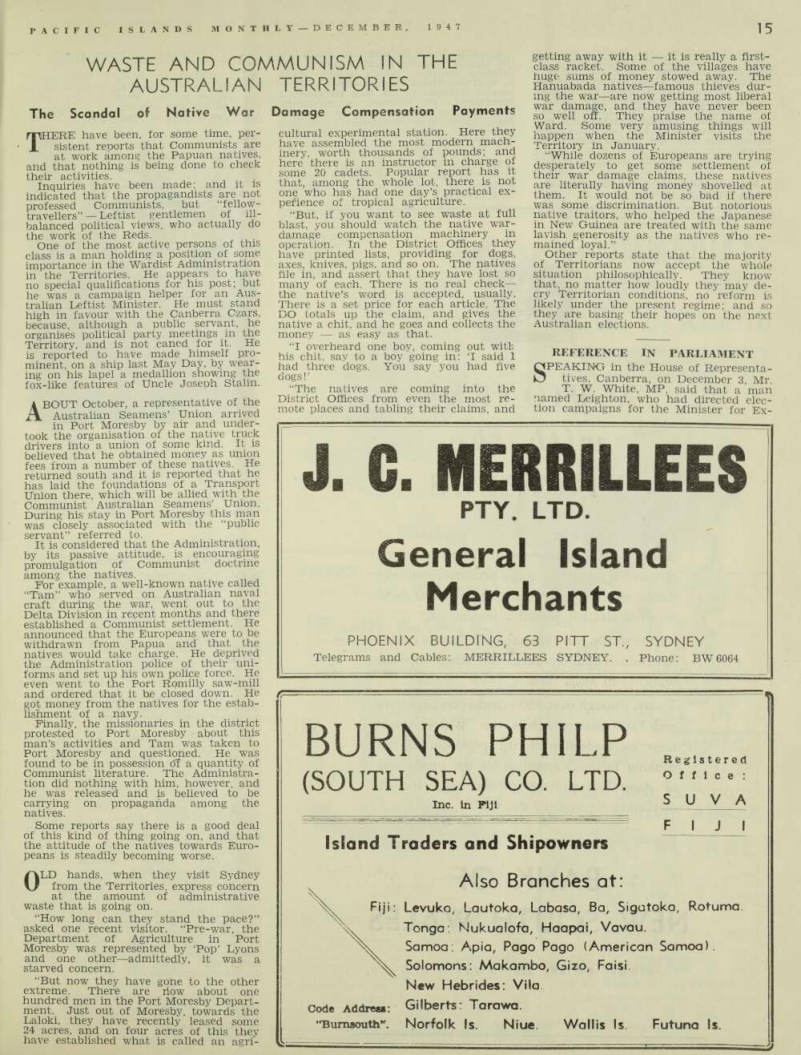
Waste And Communism In The
The Scandal of Native War Damage Compensation Payments
rERE have been, for some time, per sistent reoorts that Communists are at work among the Papuan natives, and that nothing is being done to check their activities.
Inquiries have been made; and it is indicated that the propagandists are not professed Communists, but “fellow travellers” Leftist gentlemen of ill balanced political views, who actually do the work of the Reds.
One of the most active persons of this class is a man holding a position of some importance in the Wardist Administration in the Territories. He appears to have no special qualifications for his post; but he was a campaign helper for an Aus tralian Leftist Minister. He must stand high in favour with the Canberra Czars, because, although a public servant, he organises political party meetings in the Territory, and is not caned for it. He is reported to have made himself pro minent, on a ship last May Day, by wear ing on his lapel a medallion showing the fox-like features of Uncle Joseph Stalin.
ABOUT October, a representative of the Australian Seamens’ Union arrived in Port Moresby by air and under took the organisation of the native truck drivers into a union of some kind. It is believed that he obtained money as union fees from a number of these natives. He returned south and it is reported that he has laid the foundations of a Transport Union there, which will be allied with the Communist Australian Seamens’ Union.
During his stay in Port Moresby this man was closely associated with the “public servant” referred to.
It is considered that the Administration, by its passive attitude, is encouraging promulgation of Communist doctrine among the natives.
For example, a well-known native called “Tam” who served on Australian naval craft during the war, went out to the Delta Division in recent months and there established a Communist settlement. He announced that the Europeans were to be withdrawn from Papua and that the natives would take charge. He deprived the Administration police of their uni forms and set up his own police force. He even went to the Port Romilly saw-mill and ordered that it be closed down. He got money from the natives for the estab lishment of a navy.
Finally, the missionaries in the district protested to Port Moresby about this man’s activities and Tam was taken to Port Moresby and questioned. He was found to be in possession dT a quantity of Communist literature. The Administra tion did nothing with him, however, and he was released and is believed to be carrying on propaganda among the natives.
Some reports say there is a good deal of this kind of thing going on, and that the attitude of the natives towards Euro peans is steadily becoming worse.
OLD hands, when they visit Sydney from the Territories, express concern at the amount of administrative waste that is going on.
“How long can they stand the pace?” asked one recent visitor. “Pre-war, the Department of Agriculture in Port Moresby was represented by ‘Pop’ Lyons and one other —admittedly, it was a starved concern.
“But now they have gone to the other extreme. There are ilow about one hundred men in the Port Moresby Depart ment. Just out of Moresby, towards the Laloki, they have recently leased some 24 acres, and on four acres of this they have established what is called an agri
.. . , . , cultural experimental station. Here they have assembled the most modern mach inery, worth thousands of pounds; and here there is an instructor in charge of some 20 cadets. Popular report has .t that, among the whole lot, there is not one who has had one day s practical ex pefience of tropical agriculture.
“But, if you want to see waste at full blast, you should watch the native war damage compensation machinery in operation. In the District Offices they have printed lists, providing for dogs. axes, knives, pigs, and so on. The natives file in, and assert that they have lost so many of each. There is no real check — the native’s word is accepted, usually.
There is a set price for each article. The DO totals up the claim, and gives the native a chit, and he goes and collects the money as easy as that.
“I overheard one boy, coming out with his chit, say to a boy going in: T said 1 had three dogs. You say you had five tions!’
“The natives are coming into the District Offices from even the most re mote places and tabling their claims, and
getting away with it it is really a first class racket. Some of the villages have huge sums of money stowed away. The Hanuabada natives—famous thieves dur ing the war—are now getting most liberal war damage, and they have never been so well off. They praise the name of Ward. Some very amusing things will happen when the Minister visits the Territory in January.
“While dozens of Europeans are trying desperately to get some settlement of their war damage claims, these natives are literally having money shovelled at them. It would not be so bad if there was some discrimination. But notorious native traitors, who helped the Japanese in New Guinea are treated with the same lavish generosity as the natives who re mained loyal.”
Other reports state that the majority of Territorians now accept the whole situation philosophically. They know that, no matter how loudly they may de cry Territorian conditions, no reform is likely under the present regime; and so they are basing their hopes on the next Australian elections.
Reference In Parliament
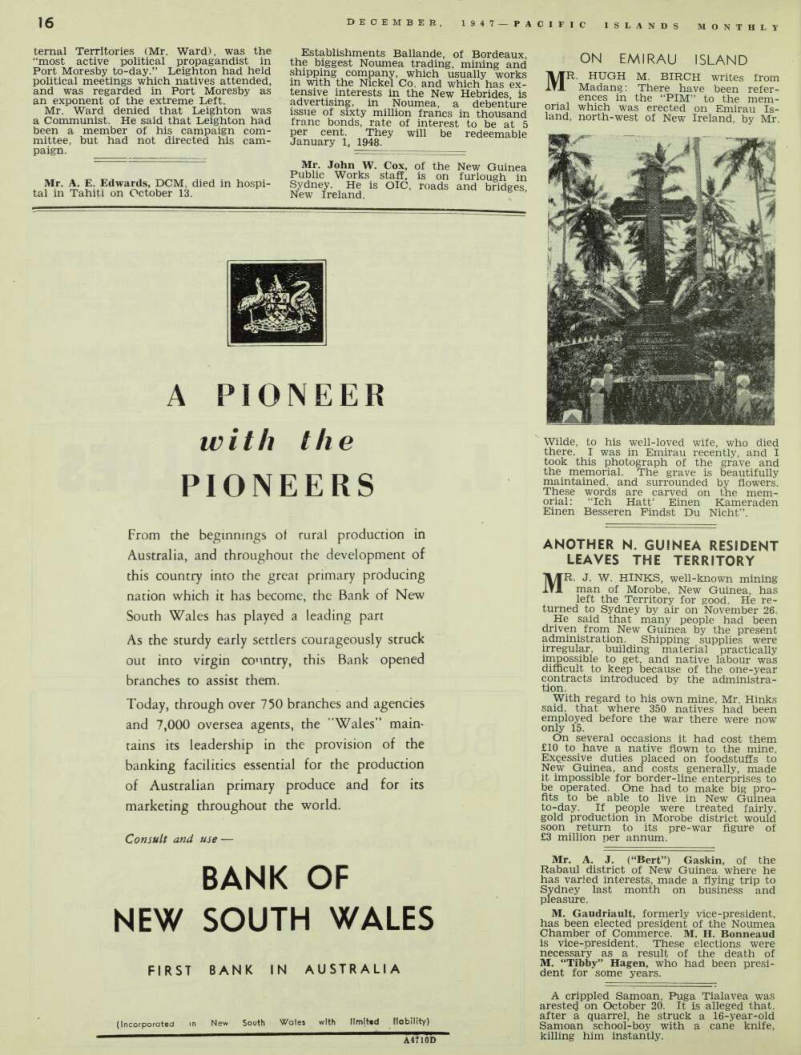
SPEAKING in the House of Representa tives, Canberra, on December 3, Mr.
T. W. White, MP, said that a man named Leighton, who had directed elec tion campaigns for the Minister for Ex
ternal Territories (Mr. Ward), was the “most active political propagandist in Port Moresby to-day.” Leighton had held political meetings which natives attended, and was regarded in Port Moresby as an exponent of the extreme Left.
Mr. Ward denied that Leighton was a Communist. He said that Leighton had been a member of his campaign com mittee, but had not directed his cam paign.
Mr. A. E. Edwards, DCM, died in hospi tal in Tahiti on October 13.
Establishments Ballande, of Bordeaux, the biggest Noumea trading, mining and shipping company, which usually works in with the Nickel Co. and which has ex tensive interests in the New Hebrides, is advertising, in Noumea, a debenture issue of sixty million francs in thousand franc bonds, rate of interest to be at 5 per cent. They will be redeemable January 1, 1948.
Mr. John W. Cox, of the New Guinea Public Works staff, is on furlough in Sydney. He is OIC, roads and bridges New Ireland.
Advertisements & other items, pp. 17-18 (1 item)
J. 0. Merrillees
PTY. LTD.
General Island Merchants
PHOENIX BUILDING, 63 PITT ST., SYDNEY
Telegrams and Cables: MERRILLEES SYDNEY. . Phone: 8W6064
BURNS PHILP
(SOUTH SEA) CO. LTD.
Inc. In Fiji island Traders and Shipowners Registered Office :
SUVA
FIJI
Code Address: “Bumsouth*.
Also Branches at: Fiji: Levuko, Lautoka, Labasa, Ba, Sigatoka, Rotuma.
Tonga: Nukualofa, Haapai, Vavau.
Samoa; Apia, Pago Pago (American Samoa).
Solomons: Makambo, Gizo, Faisi New Hebrides: Vila Gilberts: Tarawa.
Norfolk Is. Niue. Wallis Is Futuna Is.
A PIONEER
with
PIONEERS
From the beginnings of rural production in Australia, and throughout the development of this country into the great primary producing nation which it has become, the Bank of New South Wales has played a leading part As the sturdy early settlers courageously struck out into virgin country, this Bank opened branches to assist them.
Today, through over 750 branches and agencies and 7,000 oversea agents, the "Wales” maintains its leadership in the provision of the banking facilities essential for the production of Australian primary produce and for its
marketing throughout the world.
Consult and use
BANK OF
NEW SOUTH WALES
FIRST BANK IN AUSTRALIA
(Incorporated in New South Wales with limited Mobility) "" A4710D
On Emirau Island
MR. HUGH M. BIRCH writes from Madang: There have been refer . , ences in the “PIM” to the mem orial which was erected on Emirau Is land, north-west of New Ireland, by Mr.
Wilde, to his well-loved wife, who died there. I was in Emirau recently, and I took this photograph of the grave and the memorial. The grave is beautifully maintained, and surrounded by flowers.
These words are carved on the mem orial: “Ich Hatt’ Einen Kameraden Einen Besseren Findst Du Nicht”.
Another N. Guinea Resident
Leaves The Territory
MR. J. W. HINKS, well-known mining man of Morobe, New Guinea, has left the Territory for good. He re turned to Sydney by air on November 26.
He said that many people had been driven from New Guinea by the present administration. Shipping supplies were irregular, building material practically impossible to get, and native labour was difficult to keep because of the one-year contracts introduced by the administra tion.
With regard to his own mine, Mr. Hinks said, that where 350 natives had been employed before the war there were now only 15.
On several occasions it had cost them £lO to have a native flown to the mine.
Excessive duties placed on foodstuffs to New Guinea, and costs generally, made it impossible for border-line enterprises to be operated. One had to make big pro fits to be able to live in New Guinea to-day. If people were treated fairly, gold production in Morobe district would soon return to its pre-war figure of £3 million per annum.
Mr. A. J. (“Bert”) Gaskin, of the Rabaul district of New Guinea where he has varied interests, made a flying trip to Sydney last month on business and pleasure.
M. Gaudriault, formerly vice-president, has been elected president of the Noumea Chamber of Commerce. M. H. Bonneaud is vice-president. These elections were necessary as a result of the death of M. “Tibby” Hagen, who had been presi dent for some years.
A crippled Samoan, Puga Tialavea was on October 20. It is alleged that, after a quarrel, he struck a 16-year-old Samoan school-boy with a cane knife, killing him instantly.
Governments Plans In New Guinea
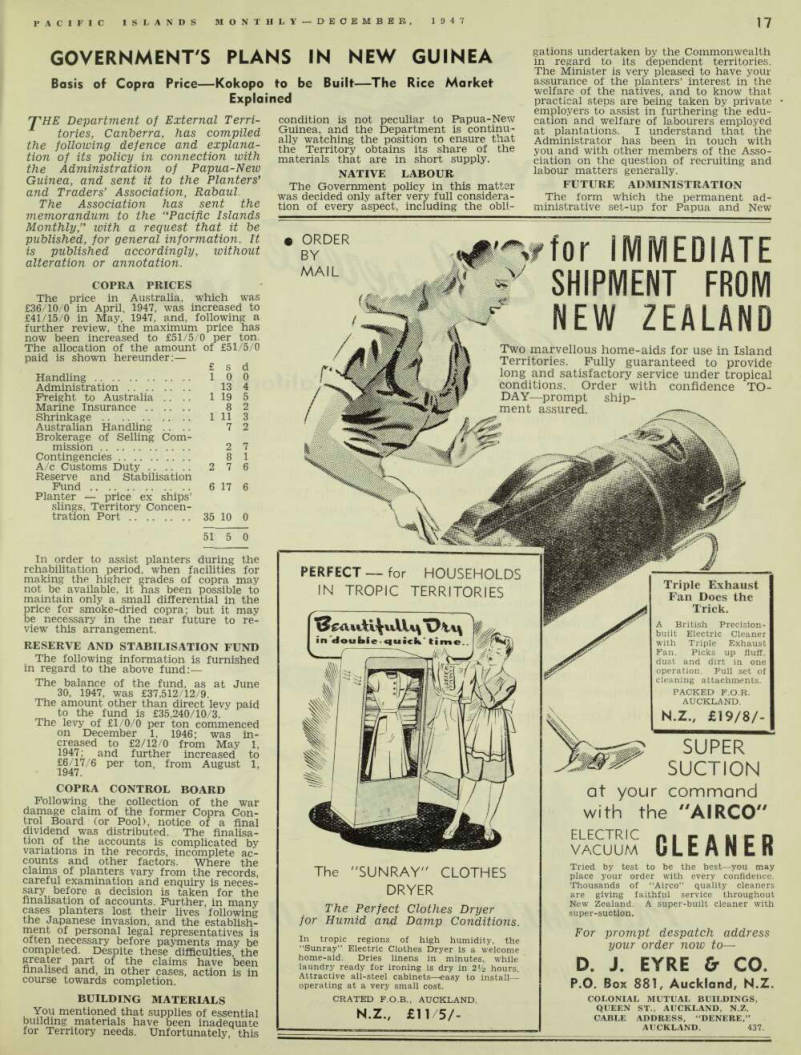
Basis of Copra Price-Kokopo to be Built—The Rice Market Explained
THE Department of External Terri tories, Canberra, has compiled the following defence and explana tion of its policy in connection with the Administration of Papua-New Guinea, and sent it to the Planters' and Traders' Association, Rabaul.
The Association has sent the memorandum to the “Pacific Islands Monthly ” with a request that it be published, for general information. It is published accordingly, without alteration or annotation.
Copra Prices
The price in Australia, which was £36/10/0 in April, 1947, was increased to £4l/15/0 in May, 1947, and, following a further review, the maximum price has now been increased to £5l/5/0 per ton.
The allocation of the amount of £5l/5/0 paid is shown hereunder: —
In order to assist planters during the rehabilitation period, when facilities for making the higher grades of copra may not be available, it has been possible to maintain only a small differential in the price for smoke-dried copra; but it may be necessary in the near future to re view this arrangement.
Reserve And Stabilisation Fund
The following information is furnished in regard to the above fund:— The balance of the fund, as at June 30, 1947, was £37,512/12/9.
The amount other than direct levy paid to the fund is £35,240/10/3.
The levy of £l/0/0 per ton commenced on December 1, 1946; was in creased to £2/12/0 from May 1, 1947; and further increased to £6/17/6 per ton, from August 1, 1947.
Copra Control Board
Following the collection of the war damage claim of the former Copra Con trol Board (or Pool), notice of a final dividend was distributed. The finalisa tion of the accounts is complicated by variations in the records, incomplete ac counts and other factors. Where the claims of planters vary from the records, careful examination and enquiry is neces sary before a decision is taken for the finalisation of accounts. Further, in many cases planters lost their lives following the Japanese invasion, and the establish ment of personal legal representatives is often necessary before payments may be completed. Despite these difficulties, the greater part pf the claims have been finalised and, in other cases, action is in course towards completion.
Building Materials
You mentioned that supplies of essential building materials have been inadequate for Territory needs. Unfortunately, this
condition is not peculiar to Papua-New Guinea, and the Department is continu ally watching the position to ensure that the Territory obtains its share of the materials that are in short supply.
Native Labour
The Government policy in this matter was decided only after very full considera tion of every aspect, including the obli
gations undertaken by the Commonwealth in regard to its dependent territories.
The Minister is very pleased to have your assurance of the planters’ interest in the welfare of the natives, and to know that practical stens are being taken by private employers to assist in furthering the edu cation and welfare of labourers employed at plantations. I understand that the Administrator has been in touch with you and with other members of the Asso ciation on the question of recruiting and labour matters generally.
Future Administration
The form which the permanent ad ministrative set-up for Papua and New
sdsd £ s d Handling 1 0 0 Administration sds 13 4 Freight to Australia .. .. 1 19 5 Marine Insurance sds 8 2 Shrinkage 1 11 3 Australian Handling .. .. sds 7 2 Brokerage of Selling Commission sds 2 7 Contingencies sds 8 1 A/c Customs Duty 2 7 6 Reserve and Stabilisation Fund 6 17 6 Planter — price ex ships’ slings, Territory Concentration Port 35 10 0
sds
51 5 0
Guinea should take has not yet been de termined. but you may be assured that full examination of all aspects will be made before a final decision is taken.
In this connection the views of your Association have been noted.
Fishing
In its approach to the question of authorising the dynamiting of fish, the Administration’s attiude has been in fluenced by consideration of the danger ous nature of the practice and its general effect on fishing grounds both native and other. The Administrator explained this in his recent letter to you.
Livestock
The Government and the Administra tion are fully alive to the need for re placing livestock destroyed during the war, and for the building up of herds in the Territory and action in this direc tion has been commenced with the im portation of selected stud stock. As the position in regard to shipping and materials improves larger scale opera tions will be possible.
A special Division of the Department of Agriculture, Stock and Fisheries has been established to handle this activity.
Kokopo
It is intended to push ahead with the establishment of Kokopo as the adminis trative centre of New Britain. Surveyors, town planning experts, engineers, etc., have already inspected the site and plans are being drawn up in collaboration with the Commonwealth Department of Works and Housing.
The Navy recently completed a hydro graphic survey, which was undertaken to provide information for the siting of a wharf at Kokopo.
In. the meantime, wharfage facilities will be maintained at Rabaul.
Shipping
Additional vessels and staff for the Coastal and Inter-Island Shipping Ser vice are steadily becoming available and within a reasonable period, it is expected that the Territory will be adequately served in all areas.
Your representations regarding the sea carriage of motor trucks have been brought to the notice of the Shipping authorities in the Territory, and every effort will be made by them to meet this and any similar request your members place before them.
The 25-tons limit on privately-owned vessels is based on a survey of the ton nages of vessels registered in the terri tories of Papua and New Guinea pre war. The figure is not inflexible and up ward variations have been approved in individual cases where the circumstances have been shown to warrant an increase.
Rice
The price of rice has been the subject of considerable enquiry since the restora tion of Civil Administration to Papua- New Guinea. It appears that rice sup plied to the Territory prior to the war came mainly from Rangoon and was cheaper than the Australian product, the comparative price being about £B, as against £24 per ton. These cheaper rices are no longer available and I am in formed that, even when conditions be come normal, they are unlikely to re turn to their pre-war price.
The price of rice to the Department of External Territories, and merchants handling allocations of rice in Papua-New Guinea, has now been fixed by the Com monwealth Prices Commissioner at £35/12/0 f.o.b. Sydney. There is no ex port levy or trade equalisation contribu tion, and freight, handling charges, duty, etc., incurred after the rice leaves the millers’ possession are the factors which bring the cost up to the higher figure payable in the Territory. Australian authorities in close contact with the sub ject state that the price of local rice, as
compared with world parities, is cheap, and supplies from other sources would be nearly double those charged for the Australian product.
The work of reconstruction and re habilitation .in the Territory, notwith standing tremendous difficulties, has achieved considerable success. The Government and the Administration, for their part, have had to attack a many sided problem and efforts have been dir ected towards assisting all inhabitants of the Territory consistent with the inter national obligations that Australia has accepted in respect of her dependent peoples.
Advertisements & other items, pp. 19-20 (1 item)
'Vfor Immediate
• ORDER
BY
/ -V
'Vfor IMMEDIATE
SHIPMENT FROM
NEW ZEALAND
Two marvellous home-aids for use in Island Territories. Fully guaranteed to provide long and satisfactory service under tropical conditions. Order with confidence TO-
DAY—prompt ship-
ment assured.
PERFECT for HOUSEHOLDS
IN TROPIC TERRITORIES
in double quick time.. l\
The "SUNRAY" CLOTHES
DRYER
The Perfect Clothes Dryer for Humid and Damp Conditions.
In tropic regions of high humidity, the “Sunray” Electric Clothes Dryer is a welcome home-aid. Dries linens in minutes, while laundry ready for ironing is dry in 2 V 2 hours.
Attractive all-steel cabinets—easy to install— operating at a very small cost.
CRATED F. 0.8., AUCKLAND.
N.Z., £ll/5/-
Triple Exhaust Fan Does the Trick.
A British Precisionbuilt Electric Cleaner with Triple Exhaust Fan. Picks up fluff, dust and dirt in one operation. Full set of cleaning attachments.
PACKED F.O.R.
AUCKLAND.
N.Z., £l9/8/-
SUPER
SUCTION
at your command
with the "AIRCO"
VACUUM GLEANER
Tried by test to be the best—you may place your order with every confidence.
Thousands of “Airco” quality cleaners are giving faithful service throughout New Zealand. A super-built cleaner with super-suction.
For prompt despatch address your order now to —
D. J. EYRE & CO.
P.O. Box 881, Auckland, N.Z,
COLONIAL MUTUAL BUILDINGS,
QUEEN ST., AUCKLAND, N.Z.
CABLE ADDRESS, “DENERE,”
AUCKLAND. 437.
FLY IN COMFORT
THE
WAY
. . by Clipper to Californio
Aboard the Flying Clippers you’re assured a comfortable trip, every minute of the way. Softly cushioned in your Sleeperette chair-lounge, you can stretch out in curtained privacy to rest
night or day.
Only Pan American offers you the Sleeperette . . . and at no extra cost.
From the moment you hoard your Clipper at Sydney till you step off in California, your every want is anticipated. A magazine to read as you relax ... a hot cup of coffee . . . you need only press a button for service.
And you’ll remember with pleasure the delicious meals we serve aloft. .Swift, 4-engine Clipper leaves Sydney Mezzanine Floor, Hotel Australia, Sydney Telephone BW 4701 $ *l’ *•’
Rue Jean Joures
NOUMEA
j $ $ $ ißank of N.S.W. Building
SUVA
every Wednesday and Saturday on high-speed schedules for San Francisco or Los Angeles via lovely Hawaii.
Your Travel Agent or Pan American can help you with passports, currency .exchange, etc., wherever you want to go. * * USA Patent applied for.
Pam Americas World Airways
-/le System of fie' F/jiny Clippers
Pan American Airways Inc. (Incorporated U.S.A. —Liability Limited).
A "Chief Pally Pilly Argent and
Bsi Coat Of Arms
A "Chief Pally Pilly Argent and Sable"
From Our Own Correspondent
Honiara, Nov. 18.
THE new British Solomon Islands coatof-arms, recently granted by the King, has made its first appearance.
It is on the ensign flown by the Govern ment vessel, “Kurimarau.”
Other Protectorate ships will shortly fly the new coat-of-arms, in the fly of their ensigns.
The coat-of-arms, designed here by two Administrative officers, consists of a formalised turtle on a red ground sur mounted by a black and white freize. Or, to quote the correct heraldic description —“Gules a Solomon Islands turtle erect and affrontee proper a chief pally-pilly argent and sable.”
Military and civil doctors, dentists and chemists recently met at Noumea Mili tary Club to form a New Caledonian Medical Association. The president is Dr. Trubert, who has a large practice in Noumea. Dr. Trubert recently paid a visit to Sydney. He was active in the de Gaulle movement in the Colony, where he was born, for his father was a military doctor who came out in the early days.
He is also a member of the General Council whose advice on local matters is particularly valued. He is to-day active on the committee which is seeking pub licity for New Caledonia as a tourist re sort. For some years he practised in Paris.
REMEMBRANCE Sunday,. November 9,
Rabaul Observes
Remembrance Sunday
From Our Samarai Correspondent RABAUL, November 10.
REMEMBRANCE Sunday,. November 9,
was observed here by a represent ative gathering.
The service was arranged by the sub branch of the RSS & AIL, and was held in the Rabaul cemetery. The Rev. C. W. J Mannering conducted the service and was assisted by the vice-president of the League, Mr. N. Smyth.
Over thirty people were present at the gathering, Mr. C. D. Bates (District Officer) representing the Administration, and Brigadier Neylan, MC, representing Bth Military District.
The service was short but impressive and concluded with the playing of the Last Post and Reveille.
Among those present were the Rev. G.
Young, the Rev. Chenwith, Mr. A. J. F.
Thomas, Mr. and Mrs. L. H. Corbett, Mr.
J. E. Leeuwin-Clark, Mr. S. Voysey, Mr. and Mrs. E. Britten, Mr. J. Gannon, Mr K. Brodie, Mr, and Mrs. A. E. Wilkinson, Mr. P. Mason, Miss N. Taylor, Mr and Mrs. J. Page, Mrs. N. Holland, Miss V.
Holden and Miss S. Kilminster.
Hagen Family As
Shipbuilders
A CERTAIN amount of desultory ship building has always been carried on in Noumea, New Caledonia, and the death of Mr. “Tibby” Hagen, recalls the long period that the Hagen family has been engaged in the shipping trade.
It was the Hagen family which owned and built the first Noumea-built steam ship, at the Evans shipyard.
The ship was named the “Cagou,” after the island’s most notable bird, which also figures on one or two of the Colony’s postage stamp issues.
She was launched on October 6, 1884, by the wife of Governor Le Boucher.
The year before, another Hagen vessel, the ketch “Ouvea,” with Captain Holbein and a native crew, was wrecked on the cresent-shaped reef at Ounia, on the way from Noumea to the Loyalty Islands. She also had been built in Noumea by Mr.
Evans. The South British Insurance Co. bought the wreck, and the goods on board,
for 25,000 francs.-
H.E.L.P.
Advertisements & other items, p. 21 (1 item)
A. B. Donald Ltd.
AUCKLAND
ISLAND TRADERS Gr GENERAL MERCHANTS
P.O. Box 1509. Cables & Telegrams, “Kingdom, ' Auckland.
Secret Base For
Tests
US Body Takes Over Eniwetok Atoll
ENIWETOK ATOLL, in the Marshall Islands, has been chosen by the United States Navy and the Atomic Energy Commission to be the site of what newspapers describe as “a super-secret atomic weapon testing-ground.”
The first post-war tests of the atomic weapons were carried out on Bikini Atoll, also in the Marshalls; and Bikini has not yet been given a clean bill of health — some parts of the islets are still radio active, and therefore probably fatal. But Bikini is not big enough for the large permanent establishment that is now planned.
There are only 145 natives on Ehiwetok, and they will be shifted to a permanent new home of their own choosing. There are hundreds of miles of open sea around Ehiwetok, so that there are no neighbours to be disturbed by the more or less hellish operations that will take place there.
Supply points for the large-scale con structional works to be immediately under taken on Eniwetok are at Honolulu, Johnston Island, and Kwajalein Atoll, in the Marshalls.
Eniwetok Atoll consists of the usual ring of islets —in this case, 30 in number —strung out along a circular reef that is 29 miles in diameter. It was discovered in 1794 by Captain Thomas Butler, and it was formerly called Brown Island.
Of the 97 passengers, who embarked in Sydney on “Montoro” on November 28, for New Guinea ports, 22 were male adults and 44 females. The number of children was 31.
Nz Socialists Want New
Working Conditions In
Cooks
NEW Zealand trade unionism is still concerning itself actively with Cook Islands matters. At the annual Fed eration of Labour meeting in Wellington, at the end of November, much time was devoted to the Cook Group and after a full discussion it was decided that: • The organised workers be granted wage increases relative to recent increases granted in New Zealand by the Court of Arbitration. • Cook Islands workers be granted im proved conditions of employment similar to those granted to New Zealand workers since 1945. • A request be made to the Minister for provision to be made granting preference to unionists in any industrial agreement made by. or on behalf of, the Cook Islands Industrial Union of Workers. • The national executive make repre sentations that the union bring down a register of the various categories of workers and that first preference be given to workers in the respective categories, provided that they are mem bers of the Union.
Despatches from the Cook Islands in dicate that the Islanders’ great need is not for fancy working conditions, as con ceived by New Zealand’s pink socialists, but for encouragement in a “back to the land” movement, and instruction in fruit and vegetable growing for the overseas market.
The present-day socialist, however, is much more interested in the theory of “working conditions,” than he is in the practical business of actual work.
Copra Production In The
Solomons
A 37-YEARS-OLD Brisbane company Solomon Islands Rubber Plantations Ltd., with an issued capital of £76,421, owning 60,500 coconut palms and 8,356 rubber trees, reports that the production of copra was recommenced in June last, after si> years of idleness. Rubber is not being produced.
The BSI Administration is taking all copra produced at £35 per ton, less 15 per cent, tax., which is far below world parity.
The directors intend to press for com pensation for damage sustained during the invasion and for losses suffered dur ing the long period of rehabilitation.
Mr. J. Darlington,, who is in charge of the company’s plantations, reports that labour is not plentiful, but indications are that the position may improve.
Nz Medical Research In
Pacific Is.
ORGANISED medical research is to be begun this summer in the Pacific islands administered by New Zea land.
An expedition, which will be formed from members of the research sections and teaching staff of the University Medical School in Dunedin, will go north in the University vacation. Their aim will be to make recommendations to the NZ Medical Research Council, on the most promising subjects for future research.
They will also survey the incidence of various diseases in the Islands.
Madame Boullanger and Miss Peggy Griffiths, of Noumea, were on holiday in Sydney in November.
Advertisements & other items, p. 22 (1 item)
54A Pitt St. Svdnev N.S.W.
IMPORTERS
EXPORTERS
m \ r> t r rrtr ALL CLASSES OF MERCHANDISE PURCHASED FOR ISLAND CLIENTS
THROUGHOUT THE SOUTH-WEST PACIFIC.
ISLAND PRODUCE SOLD ON AUSTRALIAN AND OVERSEAS MARKETS
ON COMMISSION BASIS.
BANKERS: BANK OF N.S.W.
COMPTOIR NATIONAL
DESCOMPTE DE PARIS
54a PITT ST. SVDNEV N.S.W.
CABLE ADDRESS.
“ROB ERG ILL"
PHONES BW 4782-B 1305
Territories' Union
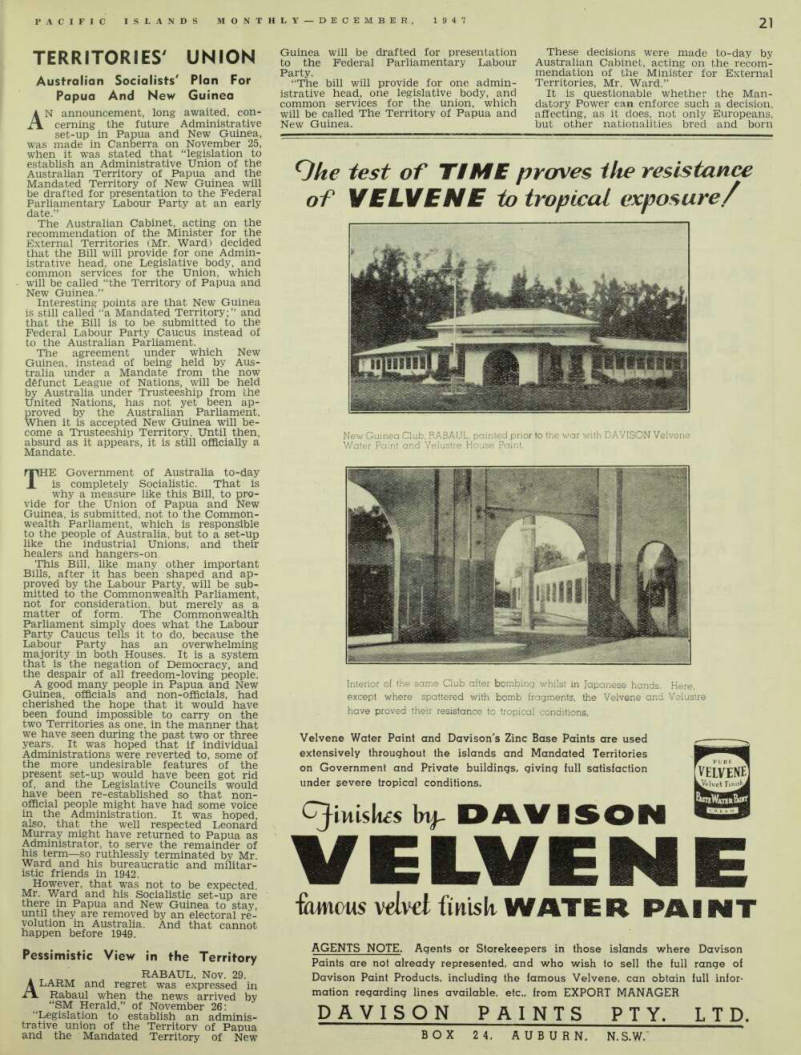
Australian Socialists' Plan For Papua And New Guinea
AN announcement, long awaited, con cerning the future Administrative set-up in Papua and New Guinea, was made in Canberra on November 25, when it was stated that “legislation to establish an Administrative Union of the Australian Territory of Papua and the Mandated Territory of New Guinea will be drafted for presentation to the Federal Parliamentary Labour Party at an early date.”
The Australian Cabinet, acting on the recommendation of the Minister for the External Territories (Mr. Ward) decided that the Bill will provide for one Admin istrative head, one Legislative body, and common services for the Union, which will be called “the Territory of Papua and New Guinea.”
Interesting points are that New Guinea is still called “a Mandated Territory;” and that the Bill is to be submitted to the Federal Labour Party Caucus instead of to the Australian Parliament.
The agreement under which New Guinea, instead of being held by Aus tralia under a Mandate from the now defunct League of Nations, will be held by Australia under Trusteeship from the United Nations, has not yet been ap proved by the Australian Parliament.
When it is accepted New Guinea will be come a Trusteeship Territory. Until then, absurd as it appears, it is still officially a Mandate. rE Government of Australia to-day is completely Socialistic. That is why a measure like this Bill, to pro vide for the Union of Papua and New Guinea, is submitted, not to the Common wealth Parliament, which is responsible to the people of Australia, but to a set-up like the industrial Unions, and their healers and hangers-on.
This Bill, like many other important Bills, after it has been shaped and ap proved by the Labour Party, will be sub mitted to the Commonwealth Parliament, not for consideration, but merely as a matter of form. The Commonwealth Parliament simply does what the Labour Party Caucus tells it to do, because the Labour Party has an overwhelming majority in both Houses. It is a system that is the negation of Democracy, and the despair of all freedom-loving people.
A good many people in Papua and New Guinea, officials and non-officials, had cherished the hope that it would have been found impossible to carry on the two Territories as one, in the manner that we have seen during the past two or three years. It was hoped that if individual Administrations were reverted to, some of the more undesirable features of the present set-up would have been got rid of, and the Legislative Councils would have been re-established so that non pfficial people might have had some voice in the Administration. It was hoped, also, that the well respected Leonard Murray might have returned to Papua as Administrator, to serve the remainder of his term—so ruthlessly terminated by Mr.
Ward and his bureaucratic and militar istic friends in 1942.
However, that was not to be expected.
Mr. Ward and his Socialistic set-up are there in Papua and New Guinea to stay, until they are removed by an electoral re volution in Australia. And that cannot happen before 1949.
Pessimistic View in the Territory
Rabaul. Nov. 29.
A LARM and regret was expressed in xl. Rabaul when the news arrived bv “SM Herald,” of November 26: “Legislation to establish an adminis trative union of the Territorv of Papua and the Mandated Territory of New
Guinea will be drafted for presentation to the Federal Parliamentary Labour Party.
“The bill will provide for one admin istrative head, one legislative body, and common services for the union, which will be called The Territory of Papua and New Guinea.
These decisions were made to-day by Australian Cabinet, acting on the recom mendation of the Minister for External Territories, Mr. Ward.”
It is questionable whether the Man datory Power can enforce such a decision, affecting, as it does, not only Europeans, but other nationalities bred and born
under the League of Nations Mandate.
Such a decision may have far-reaching effect by an appeal to the various consuls concerned.
If such legislation is carried there seems little hope for the future of the Man dated Territory. The Territory’s pre war prosperity—which made it self-sup porting—will never return, and it will be come the responsibility of the Australian tax payer to maintain, indefinitely, the Civil Administration and its Services.
This proposed legislation is another ex ample of Australian official ignorance of the economic potentialities of the Man dated Territory. It may result in a move to Diace facts before the Council of Non- Governing Countries, at Lake Success.
Advertisements & other items, pp. 23-24 (1 item)
Velvene
c Jlte test of TIME proves resistance
of VELVENEto tropical exposure/
New Guinea Club, RABAUL, painted prior to the war with DAVISON Velvene Water Paint and Velustre House Paint. n u ..
Interior of the same Club after bombing whilst in Japanese hands. Here, except where spattered with bomb fragments, the Velvene and Velustre have proved their resistance to tropical conditions.
Velvene Water Paint and Davison's Zinc Base Paints are used extensively throughout the islands and Mandated Territories on Government and Private buildings, giving full satisfaction under severe tropical conditions.
CJiiiUkcs \ny DAVISON
VELVENE
•famous velvet finish WATER PAINT
VELVENE
AGENTS NOTE. Agents or Storekeepers in those islands where Davison Paints are not already represented, and who wish to sell the full range of Davison Paint Products, including the famous Velvene, can obtain full information regarding lines available, etc., from EXPORT MANAGER
DAVISON PAINTS PTY. LTD.
BOX 24, AUBURN, N.S.W.
KANGAROO BRAND
Ropes,
Cordage,
and Twines for every purpose Backed by 86 years of service Manufactured hy :
M. DONAGHY AND SONS,
Pty. Ltd., Geelong and Sydney.
Fiji Representatives:
PEARCE AND CO.
LIMITED
P.O. BOX 237, SUVA
a?
NOW AVAILABLE
Modern, Beautiful
METAL CEILINGS
AT SURPRISINGLY MODERATE
COST
Hasten completion of your new home. We can supply and fix Metal Ceilings, efficiently and
promptly.
Phone MX 241 I, or write to G.P.O, Box 474.
WUNDERLICH LIMITED
Showrooms;
BAPTIST ST., REDFERN, SYDNEY
Branch at King Street, Newcastle.
ETAL CEILINGS
BtAJTirJi* PtRMANCNT • MODERN
Commission
Non-British Nations Shy Over S.P.
Unpublicised Conference Held in Sydney
rilHE mystery of the South Pacific Com a. mission was explained during the month. The body—created in Jan uary, 1947, by the efforts of the tireless Dr. Evatt, of Australia—is not function ing because it has not been accepted yet by the Governments of the non-British countries.
Australia has given the Commission some substance, and a name; but none of the other countries concerned —except perhaps New Zealand —is taking any active interest in the organisation.
Colonel John Kerr, director of the Aus tralian School of Tropical Administration, was appointed early in 1947 to act also as Organising Secretary of the Commission.
The Commission was to meet about July, 1947, but nothing was heard of it. Colonel Kerr, without explanation, accompanied Dr. Evatt to the United Nations meeting in September.
On November 11, Mr. T. W. White, in the Australian Parliament, sought infor mation about the apparently moribund Commission.
The Prime Minister simply hedged— there was no information. Colonel Kerr “has gone as an adviser to the Minister.’’
BUT, quite unexpectedly, it was an nounced that representatives of the countries concerned with the South Pacific Commission had commenced a series of meetings in Sydney on November 26. The Australian Prime Minister must have known on November 11 that that conference was arranged: but he said nothing—typical of the hole-and-corner methods followed by Australia in all such matters.
THE following attended the conference, which opened in Sydney on No vember 26: United States—Mr. Olsen Neilson.
Consul-General in Australia.
France.—M. de la Croix. Consul- General in Australia.
United Kingdom—Mr. G Kimber, official secretary in the office of the British High Commissioner, Canberra; and Mr. H. H, Vaskess, formerly Secretary of the High Commission of the Western Pacific, Suva (now retired and residing in Sydney).
The Netherlands—Dr. De Ranitz, of the Netherlands Legation in Australia; and Dr. Loosjes, of the Netherlands East Indies.
New Zealand—Mr. R. T. G. Patrick, Secretary of the NZ Department of Islands Territories; and Mr. R. Hunter Wade, of the NZ Department of External Affairs.
Australia. —Mr. J. R. Halligan, secre tary of the Department of External Ter ritories; and Mr. T. Pyman, of the De partment of External Affairs.
It will be noted that the only repre sentatives who came from overseas were those from New Zealand.
THE conference sat on Wednesday.
Thursday and Friday, November 26- 28, and the following bare announce ments were made: The conference agreed to a number of suggestions designed to expedite the work of the commission.
Delegates considered organisational matters connected with the establishment of the commission.
The United States, France, and the Netherlands have not yet ratified the South Pacific Commission Agreement, and the commission will not meet until they do so.
Editorial Note
THE only Governments which, up to date, have accepted the Agreement made in January t 1947, are the three Socialistic Governments of Australia, New Zealand and United Kingdom. ' As Australia, with some help from New Zealand, is virtually running—and financ ing—the South Pacific Commission, and as Australia’s policy in relation to Pacific Territories’ affairs is being clearly demon strated by the Wardist Administration in Papua-New Guinea —which is sharply pro native and anti-European—it is not sur prising that the Governments of United States, France and Holland are holding aloof.
None of those three countries can be impressed, at present, by British colonial policy, as presented by the daily pictures of events in the Middle East, India, Burma, Malaya, Ceylon—and New Guinea.
It is a pity, because the South Pacific Commission is a sound idea and, properly directed and supported, it could do an im mense amount of good in the South Pacific.
But Australian Minister Evatt cannot expect to keep his South Pacific Com mission and Wardist New Guinea within the same conception.
Mr. William Frew Watson, accompanied by his wife and ten-years-old daughter, arrived in Brisbane recently by plane from Suva. Formerly attached to the Income Tax Department, Brisbane. Mr.
Watson has been Assistant Commissioner for Internal Revenue in Suva tor nine years. After spending a short holi day in Brisbane, he will proceed to Hong kong to take up a similar position.
Advertisements & other items, pp. 25-26 (1 item)
Brial & Ball
Exporters Importers
Wish All their Pacific Islands Traders
a iflerrp Cfjristmas
anb
a 2|appp J2etu ©ear
Your enquiries through your usual channels will always receive our best attention
BRIAL & BALL
Importers— Exporters
31 QUEEN STREET,
MELBOURNE.
1 BOND STREET,
SYDNEY.
rr*“Tn 'cu
a&iee —
i !
TOOTH PAST
It's
You’ll agree, too, when you use IPANA. It’s refreshingly different, with a distinctive, pleasant taste, that makes your mouth feel grand.
IPANA’S cleaning and polishing qualities give you sparkling teeth and a sunny smile.
With massage, too, IPANA helps ensure firm, healthy gums so vital to sound teeth. iliilM iSS g °o d GUm s m w%: 4257
Marooned In Bsi
Plight of Residents Who Still Hove No Adequate Shipping Service
THE acute shipping position in the British Solomon Islands is to be relieved to the extent of one 60-ft. trawler.
Seven Fijians left Suva by air in November and subsequently picked the trawler up in Sydney. Their destina tion was Guadalcanal, via Queensland ports.
It has been stated that the trawler will be operated in BSI waters on be half of the Government. Its services no doubt will be acceptable to BSI residents, but its advent will by no means solve the local shipping position.
The Solomons have been virtually without shipping since the end of the war and the departure of the Americans.
The only relatively regular shipping connection is between Honiara and Suva, by a small Government vessel.
With Australia —which before the war provided BSI with its consumer goods and a regular 6-weekly surface mail service there is no regular connec tion whatsoever. Planters who have managed to return to the Protectorate have done so literally under their own steam by begging passages on small ves sels which chance took to Sydney.
The “Southern Cross” the small motor vessel of the Melanesian Mission, took about a dozen planters back to the Solo mons in March, 1946. Since then these people have been literally swallowed up in the mighty silence that surrounds the Solomons and all pertaining thereto, these days.
In February of this year the 85-ft. motor-ship “Ruena,” which belongs to
the Fairymead Sugar Co., Ltd., carried a number of the Company’s men back to their BSI plantations, and, as well, a number of private planters who were more than willing to work their pas sages back to the Protectorate. x LITTLE news has come out of the Solomons of any of these people, but what little there has been in dicates that their time is fully occupied in coping with the problems attendant upon lack of native labour, supplies and shipping and what is worse lack of the wherewithal for rehabilitating war-blasted plantations such as fellow planters in the Papua-New Guinea ter ritories enjoy through generous dis bursements from the Australian War Damage Fund.
How these people have managed to exist at all is one of the major miracles of the post-war era. There has, however, been a lightening of the clouds recently.
It is reported that the labour problem has been less difficult since the arrest of the leaders of the Marching Rule move ment fand that the “Moray Bank,” under charter to the British Government, has now completed calls at BSI ports and has picked up between 400 and 500 tons of copra that planters have managed to produce.
BEFORE the war the Burns Philp motor-ship “Malaita” maintained a regular 5£ weeks schedule between BSI ports and Sydney, via Rabaul. For this, Burns Philp were subsidised by the Commonwealth Government, to which the BSIP Government contributed an annual sum of £3,000. As well as the “Malaita” calls were made by the NDL steamer “Friderun,” by W. R. Car penter & Co. ships and by Japanese freighters.
The “Friderun” has now, of course, disappeared; likewise the Japanese
freighters, and trade in those quarters does not warrant calls by WRC ships.
The “Malaita” is now on the Sydney- Papua-New Guinea rup. It is operated by Burns Philp & Co., for the Australian Shipping Control Board. There is no indication that it will go back on the Solomons run.
At the end of November, the “Ruena” (Fairymead Sugar Co.) was again in Sydney undergoing minor repairs. She was expected to sail for BSI ports at an
early date. Mr. Leslie F, Gill will re turn to BSI on her.
A useful service from Sydney to New Caledonia, New Hebrides and, occasion ally, the Solomons, is provided by, the
Trans-Oceanic Company with a large flying-boat. At the end of October,, the plane carried 21 passengers, in comfort and safety, to Noumea and Vila. In the absence of ships, the service which is not on a regular schedule is appre ciated by Islanders.
Advertisements & other items, pp. 27-28 (1 item)
Kodak
SPECIALISING
IN
PACIFIC ISLAND INSURANCES
FIRE MOTOR VEHICLE
MARINE HULLS AND CARGO
EMPLOYER’S LIABILITY
GUARANTEES including those for—
DYNAMITE PERMITS.
RECRUITERS’ LICENCES.
DEFERRED WAGES
AND ALL OTHER CLASSES ARRANGED
AT LOWEST CURRENT RATES.
Established Agencies:
W. R. CARPENTER & CO., LTD.
Throughout the Territory of New Guinea.
SOUTHERN PACIFIC INSURANCE
CO., LTD,
HEAD OFFICE: 60 HUNTER STREET,
SYDNEY.
KODAK
FOR EVERYTHING PHOTOGRAPHIC
and Comprehensive Service
Kodak Film, Plates and Sensitised Papers . . . Super-X Cine-Kodak Safety Film . . . 35mm Kodachrome Film . Australian-made 35mm. Enlargers, Single Unit Reflectors, Floor Lights, Spotlights and general Floodlighting Equipment . . . Austral Projection Screens . . . Shelton 35mm. Film Strip Projectors . . Tripods .. . Carrying Cases . . . Lens Hoods . . . Celestion Enlargers Enlarging Focus Finders . . . Enamel and Plastic Developing Dishes . . . Film Clips Stirring Rods . . Print Paddles . . . Printing Frames . . . Developing Tanks Australasian Photo-Review Photographic Books . . . Kodak Developing, Printing, Enlarging and Colouring Service . . . Kodak Technical Advisory Service . . . inquiries invited and advice gladly given. OF ALL KODAK DEALERS THROUGHOUT THE ISLANDS.
KODAK (AUSTRALASIA) PTY. LTD.
379 and 386 George Street, Sydney
NEWCASTLE, KATOOMBA AND ALL STATES
THE
YORKSHIRE
INSURANCE
CO. LTD.
(Incorporated in England)
ALL CLASSES OF
INSURANCE
Including Fire Motor Guarantee Accident Workers Marine Island Representatives:
PORT MORESBY: E. A. James
RABAUL: G. B. Black LAE; Morobe 'Transport Co. Ltd.
MADANG: R. MacGregor SUVA: Williams & Gosling Ltd.
NOUMEA: Y. Mortensen
NORFOLK ISLAND:
A. E. Martin
ISLAND MERCHANTS
and AGENTS.
GENERAL MERCHANTS.
379 KENT ST., SYDNEY.
Cable & Telegraphic Address: <i Chasull ,> Sydney. (l v KC j * Shippers of all types of Merchandise to the Pacific Islands ° Representing Australian, British and American Manufacturers Of -J l fl. • Buyers for Leading Pacific Islands Traders • Sellers of Island Produce on Consignment • Importers, Distributors and Manufacturers of Foodstuffs, Softgoods, Textiles, Hardware, Tobaccos, Wines and Spirts, etc. yv U • ""Ultima" Kerosene Stoves and Heating Appliances • Distributors of High-grade Shirts, Pyjamas and Clothing ¥ • "'Southern Queen"
Canned Fruits * Forwarding and Transhipment Agents m im • Hill's English Cigarettes When in Sydney, call and see us!
Planters Return To Bsi By
Air
From Our Own Correspondent
Honiara, Nov. 18.
RESIDENTS who returned to BSI in the Trans-Oceanic flying boat “Antilles” recently, included Mr. and Mrs. C. V.
Hodgess, who have gone back to their plantation, Marau, on the Guadalcanal coast; Mr. H. C. Corrie, who intends to produce copra again at Vatu; Mr. Ken Dalrymple Hay, who has returned to Levers’ plantations in the Russells; and Mr. J. A. Johnstone.
Mrs. G. R. Younger has joined her hus band at Nono plantation, in the Russells, travelling via Rabaul and the last stage of her journey in the SDA vessel, “Ambon.”
In the last two or three months Qantas Airways have carried about 25 Javanese passengers to Sydney from Noumea on the way back to their homeland. A large number of Javanese made good money out of the US Forces during the war, making it possible for them to fly back home now that their contracts with the French have finished.
Australian officers and crew recently arrived in Noumea by Qantas plane to bring to Sydney a tug sold them from USA war stock.
Opened in Apia
Nelson Memorial Hall Opened in Apia
From Our Own Correspondent
Apia, Nov. 19.
AN impressive ceremony was held in Apia on Armistice Day, November 11.
In the presence of the Administrator and a representative gathering of re turned soldiers of the two World Wars and prominent citizens, the Memorial Hall in memory of the late O. F. Nelson was opened and handed over to the Re turned Services Association of Western Samoa, Inc. by the Nelson firm and family.
Mr. E. Annandale, managing director of O. F. Nelson & Co., Ltd., addressed the gathering and briefly traced the his tory and details of the plan, which origi nated in 1945 when local firms were asked by the returned soldiers to con tribute towards the purchase of the USO Recreation Hall from the US Gov ernment.
The firm of O. F. Nelson & Co., Ltd., had at once offered to buy, renovate and officially hand over the building to the returned soldiers as a suitable memorial to the late founder of the firm.
The firm’s offer was gratefully accepted.
Due, however, to the shortage of build ing materials it took much longer than expected to effect the necessary repairs.
Meanwhile the disastrous fire which des troyed the main premises of Messrs. O.
F. Nelson & Co., Ltd., necessitated the moving of the firm into temporary pre mises and through the generosity of the Returned Services Association their build ing was made available for this purpose and Messrs. O. F. Nelson were able to con tiue operations with the least possible disturbance.
The Right Hon. the Prime Minister of
New Zealand then approved of the grant of an area of land between the building and the Town Clock for the purpose of erecting a suitable memorial to the late Mr. O. F. Nelson. This memorial is to take the form of a large park for the use of the public and visitors to Samoa.
It will have a drinking fountain in the centre and possibly a children’s play ground within the area. This proposal has found the enthusiastic support of the Administrator who has promised all pos sible assistance. The project is to be carried out in the near future.
ON November 11, Mr. Annandale, read the scroll of dedication and, on behalf of O. F. Nelson & Co., Ltd., handed the address and key to Captain Jones, President of the Returned Services Association with best wishes for the success of the Asso ciation and its enjoyment from the use of the building. Mrs. R. Nelson-Moors, widow of the late O. F. Nelson then cut
the ribbon across the entrance to the building while the Administrator after addressing the gathering and particularly his old war comrades, unveiled a mem orial plaque, in the front of the building, to the late O. F. Nelson.
The function was successfully followed by a luncheon served by members of the Mothers’ Club in the new building. In the evening an opening dance was held.
Mr. Hilton Bell, the only white pearl diver operating in the Torres Strait, re cently discovered the biggest pearl since post-war pearling operations began. The pearl, which weighed 19i carats, was button-shaped, and would just pass through the neck of a beer bottle. Its value has not yet been assessed. It was reported that four attempts had been made by an islander in one night to steal the pearl from the hotel where Mr. Bell was staying in TI,
Advertisements & other items, p. 29 (1 item)
Pacific Islands Trading Company
ANCHOR HOCKING GLASSWARE
"The Most Famous Name In Glass" m V h m mm m am is Si
Be assured of fast turn-
over for year- round
selling
All Big Sellers—Special Values and Low Prices
FIRE-KING OVEN GLASS
(Guaranteed) TUMBLERS (Plain and decorated)
LAMPS
OIL LAMPS (Bases only)
JUMBO ICED TEAS
KITCHEN GLASSWARE
FIRE-KING TABLEWARE
VASES
BANKS
CRYSTAL OCC AS lON AL
PIECES
"HEAT-PROOF" JADE-ITE
Heat-resisting glass dinnerware in a pleasing opaque jade colour. The only line of its kind made in America. Jade-ite is made of the same heat-resisting material throughout. Will NOT "check" or "craze".
SPARKLING CRYSTAL
DECORATED WARE
FIRE-KING
Useful Items Good Quality
PACIFIC ISLANDS TRADING COMPANY
244 CALIFORNIA STREET, SAN FRANCISCO 11, CALIFORNIA, U.S.A.
EXPORTERS
OBTAINABLE AT YOUR STORE.
Guinea
Timber Leases In New Guinea Statement Soon, Says Minister
NEW GUINEA timber men are still waiting for a statement from the Australian Government concerning the future development of New Guinea’s timber resources.
Questions concerning this have been asked frequently by Opposition members in the Federal Parliament during the past year. The usual answer is that “a survey is being made.”
Those interested will be glad to know that the “survey has now been made.”
But whether or not leases will be made available to companies is still not known.
In October, Mr. Ward said that the sur vey- had been completed and a report was in the hands of the government. It was being “considered” and an “early statement” would be made.
Investigation Into Public
Service Conditions
From Our Own Correspondent
Apia, Nov. 15.
A JOINT committee representing the New Zealand Public Service Com missioner and the New Zealand Public Service Association arrived in Apia by air on October 20 last to report on salaries and general conditions in the Samoan Public Service.
The Committee consisted of Mr. A. G.
Rodda (chairman) of the Public Ser vice Commission staff, Mr. C. H. Quin, chief clerk, Island Territories Department, and Mr. J. Turnbull, general secretary of the Public Service Association. The latter two gentlemen have served terms in the Samoan Public Service and so are well conversant with conditions in the service.
During their stay of two weeks the committee thoroughly investigated con ditions in the Territory and obtained data regarding the greatly increased cost of living.
The committee has now left by air and is to submit a full report of its findings to the New Zealand Government.
Torres Islanders As Pearl
Divers
ACCORDING to the Queensland Minister for Health and Home Affairs, (Mr. Jones) Torres Strait Islanders are being trained to carry out dressed-diving in the pearling industry.
In pre-war days it was done by either Japanese or Malays; then not more than half a dozen islanders were employed in the pearling industry as dress divers.
To demonstrate that the Torres Is lander was capable and willing to use the diving suit, the State Government has fitted out two luggers to provide training for those islanders as dressed divers.
'Mr. Jones said that investigations re veal that approximately 30 islanders were now capable of winning shell from the beds in diving suits. Within a few months six to eight more luggers will be carrying diving equipment, and an order had been placed with an English firm for the most up-to-date engines and compressors.
Within a few years there should be sufficient divers amongst the islanders to obviate any necessity for the introduction of alien labour.—PEAßL.
Advertisements & other items, p. 30 (2 items)
28
DECEMBER, 1947 PACIFIC ISLANDS MONTH 1~ Y
1 Grove As
Limited
Estdtblished 1896.
AUCKLAND
(stand Traders. F.O Sox ion Telegraphic and Cable Address: “Grove”, Auckland.
Entrust Your Orders to the Firm with Fifty Years Practical Experience in the Island Trade.
Shippers of ail dosses of New Zealand product*.
Representing English Manufacturers through-
out the Cook and Society Islands, Fiji, Tonga, Samoa, Niue, New Caledonia, New Guinea, etc.
In FIJI at —W. H. Grove & Sons (Fiji) Lfrd.
GILLESPIE’S
The Flour
MARK
TRADE
of the Islands
- SY DN EY -
Spectacular Whaleboat
Accident At Mangaia
From Our Own Correspondent
Mangaia, Cl, Oct. 28.
THE dangerous coral-reef that encircles this island very nearly added to our regrettable list of whaleboat acci dents and fatalities during a recent call of the A/S “Tahitienne.”
When the “Tahitienne” called, sea conditions at the Oueroa landing were at their worst, with a “bad reef,” and a wind that caused the vessel to take six hours to cover as many miles to the anchorage (a misnomer here, as it is too deep to anchor off Oueroa Village).
In spite of adverse conditions, the Veitatei boat put out; but had no sooner got to the channel edge when an in coming surf swamped the whaleboat, capsied her in an extraordinary, cork screw fashion, and left her men struggling in deep water at the dangerous edge of the reef-platform.
One man, who had been injured in a previous accident, succeeded in swimming to the reef, and was picked out of the lagoon unhurt. The rest of the crew stayed by or on the upturned whaler, and after long and hard effort managed to right the boat and bale her out. The schooner, unable to offer aid, had to go to the Atuakoro harbour, so-called, at which anchorage conditions were a little safer; at Atuakoro, passengers (including the Rarotonga “tere”) and mails were landed after sunset, in driving rain, with much effort and discomfort.
Mr. Horrie Niall, District Officer at Wewak, New Guinea, arrived in Sydney from Madang in MV “Merkur” last month on holidays. He was accompanied by Mrs. Niall.
Cold-Blooded Murder
of N. Ireland Internees War Trial In Hongkong Reveals Fate of 23 Men
rE mystery surrounding the disap pearance of about a score of resi dents of New Ireland has now been partially cleared up. It was known that these men had been captured by the Japs in 1942, but they had not been sent to Rabaul and therefore apparently es caped the fate of internees there who were sent to Japan on the “Montevideo Maru,” and subsequently were lost when that ship was torpedoed by an American warship in June, 1942.
The nature of their fate, hpwever, will give no comfort to the relatives.
At the opening of a war crimes trial in Hongkong on November 24, it was stated that the Japanese in Kavieng used ju-jitsu and strangulation to mas sacre 23 Australian civilian internees in Kavieng, some time in 1942. The bodies were later weighted with cement and dumped in deep water.
Six Japanese are on trial for this crime. All are ex-Navy men and all pleaded not guilty. They are; Rear Admiral Tamura Ryukichi, Commander Yoshino Shozo. Lieut.-Commander Mori Kyoji. Lieutenants Mochizuki Highitaro and Suzuki Shozo, and Chief Petty Officer Horiguchi Yoshio.
Major A. D. Mackay, an Australian who prosecuted at the trial, said that after the war the accused conspired to conceal the fact that the massacre had ever taken place, and invented a story that the in ternees had been sent away on a ship which had been sunk before it reached Japan.
The 23 civilians had been interned near Kavieng after Japan had overrun New Ireland. They were mostly elderly men,
but one was a boy of 14 (the son of H.
J. Topal, who was also interned).
In March, 1942, Tamura ordered Yoshino to execute the foreign internees in the event of an Allied landing. The order was transmitted to Mori, who in March 1944, believed that an Allied landing was imminent. The execution order was therefore put into effect.
Mochizuki, Susuki and Horiguchi carried it out. (See also “Territories Talk-Talk,” this issue.)
Advertisements & other items, pp. 31-32 (1 item)
widdop
s
EYE LOTION
For Inflamed Eyes and Eyelids ... Sold Everywhere H.RoseiCo.,Pty,Ud., King Street. Sydney.
VETERINARY
INSTRUMENTS
For Sheep and Cattle can be
Supplied Immediately
EARMARKERS.
SPEYING INSTRUMENTS.
BULLRINGS.
FIRE BRANDS.
EMASCULATORS.
W. JNO. BAKER
PTY. LTD.
3 Hunter Street, Sydney, N.S.W., Australia
DIESEL ENGINES
widdop
5 H P TO 300 H P
H • WIDDOP & CO LTD
GREENGATE KEIGHLEY ENGLAND
Telephone; Keighley 3727-8 Telegrams: Widdop Keighley Codes: A.B.C. 6th Edition, Bentley’s, Bentley’s Second
pal
r % y Above: (D-Type) 36/45 H.P.
On left: (X-Type) 120 H.P.
Direct reversing
CVS —86
AMERICAN, ENGLISH AND AUSTRALIAN PERIODICALS
AND TRADE JOURNALS POSTED DIRECT TO YOU
The N.S.W. Bookstall Co. Pty. Ltd.
Can supply all available Oversea and Local Subscription Magazines. Let us know your requirements.
Subscription Lists Available on Application.
N.S.W. BOOKSTALL COMPANY PTY. LTD.
Market and Castlereagh Streets, Sydney, Australia
FOR SALE
to
Island Merchants and
Exporters
BISCUITS
suitable for natives or will manufacture to suit.
APPLY FOR SAMPLE, BOX 15, P. 0., WATERLOO.
Pimples and Bad Skin Fought in 24 Hours
Since the discovery of Nlxoderm by an American physician it is no longer necessary for anyone to suffer from ugly, disgusting and disfiguring skin blemishes such as Eczema, Pimples, Rash, Ringworm, Psoriasis, Acne, Blackheads, Scabies and Red Blotches, Don’t let a bad skin make you feel inferior and cause you to lose your friends. Clear your skin this new scientific way.
A New Discovery
Nixoderm is an ointment, but different from any ointment you have ever seen or felt. It is a new discovery, and Is not greasy but feels almost like a powder when you apply It. It penetrates rapidly into the pores and fights the cause of surface skin blemishes. Nlxoderm contains 9 ingredients which fight skin troubles in these 3 ways. I.—lt fights and kills the microbes or parasites often responsible for skin disorders. 2.—lt stops itching, burning and smarting in 7 to 10 minutes, and cools and soothes the skin. 3. —It helps nature heal the skin clear, soft and velvety smooth.
Works Fast
mediately, clearing and healing your skin, making It softer, whiter and velvety smooth.
Because Nlxoderm is scientifically compounded to fight skin troubles, it works fast.
It stops the Itching, burning and smarting In a few minutes, then starts to work im-
In Just a day or two your mirror will tell you that here at last is the scientific treatment you have been needing to clear your skin—the treatment to make you look more attractive, to help you win friends. Nixodenn has brought clearer, healthier skins to thousands, such as Mr. Bob Weedon, Edmund Street, Fremantle, who writes: “I was troubled with pimples ever since I was 13, and have spent pounds and pounds on so-called cures without results. I then tried Nixodenn with astounding effect.
The pimples seemed to fade away, and after a week there was not the slightest trace of them.”
Satisfaction Guaranteed
Get Nixoderm from your chemist or store to-day. Look in the mirror in the morning and you will be amazed at the improvement.
Then just keep on using Nixoderm for one week and at the end of that time it must have made your skin soft, clear, smooth and magnetically attractive—must give you the kind of skin that will make you admired wherever you go, or you simply return the empty package and your money will be refunded in full. Get Nixoderm from your chemist or store to-day.
The guarantee protects you.
Nixoderm 2/- &M-
For Skin Sores, Pimyles and Itch.
Centre
Levuka As A Tourist Centre Labour Shortage A Great Handicap
AN Australian visitor to Levuka, Fiji, writes: / The tourist possibilities of Levuka are most promising. As a centre of interest and beauty it has much to offer. A launch runs daily from Lodoni, on the Viti Levu coast, and small inter-island cutters and steamers leave Levuka for the outer islands at regular intervals.
Local launches may be hired to take parties fishing, or to nearby islands. The peaks of Ovalau, plantations, pineapple cannery, fine mission station and delight ful coastal road—all could offer a holiday of unuasual interest and at very moder ate rates.
While Levuka’s present hotel provides the cheapest accommodation one could wish for, it would not do for the modern tourist trade. It needs renovation and modern furnishings. The staff problem is acute a universal ailment which takes long to right itself. Anyway, a hotel which is probably 60 years old could scarcely hope to cope with tourist traffic unless a great deal were done to it.
There are many better sites for a hotel here—on the waterfront seems a better position.
I was amazed at the price of locally grown native vegetables and food. At the roadside market I was offered a poor variety of food at high prices. Two shillings were asked for 4 dalo (taro); bananas were eight for 6d.; coconuts four for 1/3; wilted Bilo (tapioca leaves used like spinach) was fairly plentiful; so were all species of local shell fish—but at 2/per leaf basket. Four small local crabs were 2/-.
Two young returned soldiers have, I believe, gone in for fishing in a large way. They have refrigeration and well equipped boats and should be a boon for local people. There was also one local man sufficiently far-seeing to send local fish to USA in a frozen condition, to have it canned. This week I tasted some of the Levuka canned fish, and it was equal to any imported fish. However, in spite of the fact that American capital is wil ling to invest 200,000 dollars in a fish can nery here, present labour conditions made the venture almost impossible.
Phosphate Island
Mangaian Chief Dies On Phosphate Island
From Our Own Correspondent
Mangaia, Cl.
THE death has been reported from the French phosphate workings at Makatea Island, of Tangianau Havana, District Chief of Tavaenga on Mangaia.
The late Havana (a hereditary rank) recently left here with the local labour army to work at the phosphate diggings.
The late District Governor was a son of A’ita’u Havana, and inherited O’ita’u’s position upon his decease some 7 years ago.
The Queen of Mangaia (an aunt) being next in line, the governorship is now held for the first time in history by a female, Mr. and Mrs. T. Hoel, of the Un evangelised Fields Mission at Madiri (mouth of the Fly River), Papua, arrived in Cairns, Queensland, by SS “Wandana” recently. Mr. Hoel is on 12 months vacation, which will be spent travelling in Victoria and, later, Canada.
First Session Of Legislative Council In
Rarotonga
Elected Members Would Like Fewer Official Members
Rarotonga, Nov. 10.
rpHE inaugural session of the newly JL constituted Cook Islands Legislative Council- was opened in Rarotonga on November 5, and is still sitting.
Representatives are present from most of the islands. They were elected by the various Island Councils earlier in the year. These elected representatives are:— Rarotonga, William Hugh Watson, Makea George Pa Karika Ariki, DCM, Piri Tekamu Maoate, Ua Turua; Aitu taki, Norman Mitchell; Atiu, Rangema tane Maka Kea Ariki; Mauke, Jane Tarare Ariki; Mangaia, Mateke John Trego Ariki; Manihiki, Tihau Nabala; and Penrhyn, Akatapuria.
As well as the 10 elected members there is a President of the Council in the per son of the Resident Commissioner and 10 official members appointed by the New Zealand Government. They are the Resi dent Agents of the various islands, plus the Directors of Education and Agricul ture x the Chief Medical Officer and the head of the Treasury Department. The four departmental heads were subse quently deemed to be superfluous by the elected members of the Council but whether they are “removed” (as recom mended) remains to be seen.
Apart from the honour of representing the peonle, the elected members will have several privileges, one of which is free travel on New Zealand railways and railway motor-road services.
AT the opening of the first session messages of goodwill were received from the Governor-General and Prime Minister of New Zealand. The NZ Government was officially represented by Mr. R. T. G. Patrick, Secretary of the Island Territories Department, Welling ton.
Early sessions were devoted to rules of procedure, adoption of Standing Orders, etc., for the future guidance of members.
Later sessions dealt with the current year’s estimates and requirements for next year.
It is hoped that the new Council will
be a means of expressing public opinion in the Cook Group as well as a means of ensuring a larger measure of self government. Island Councils com prised of the chiefs or Arikis have functioned- for many years but these acted merely in an advisory capacity.
For the first time this year, Island Coun cils have elected members to act with the Arikis, and it is from these elected members that representatives for the Legislative Council are selected. The Legislative body will exercise authority over the whole group and will have power to pass ordinances for peace, order and the good government of the Group.
As with similar bodies in other parts of the Pacific, so long as the official mem bers have the required numbers, the balance of power will rest with them.
But now the Cooks, through their Legis lative Council, have a voice which at least will be heard.
European Electors' Meeting in Rarotonga
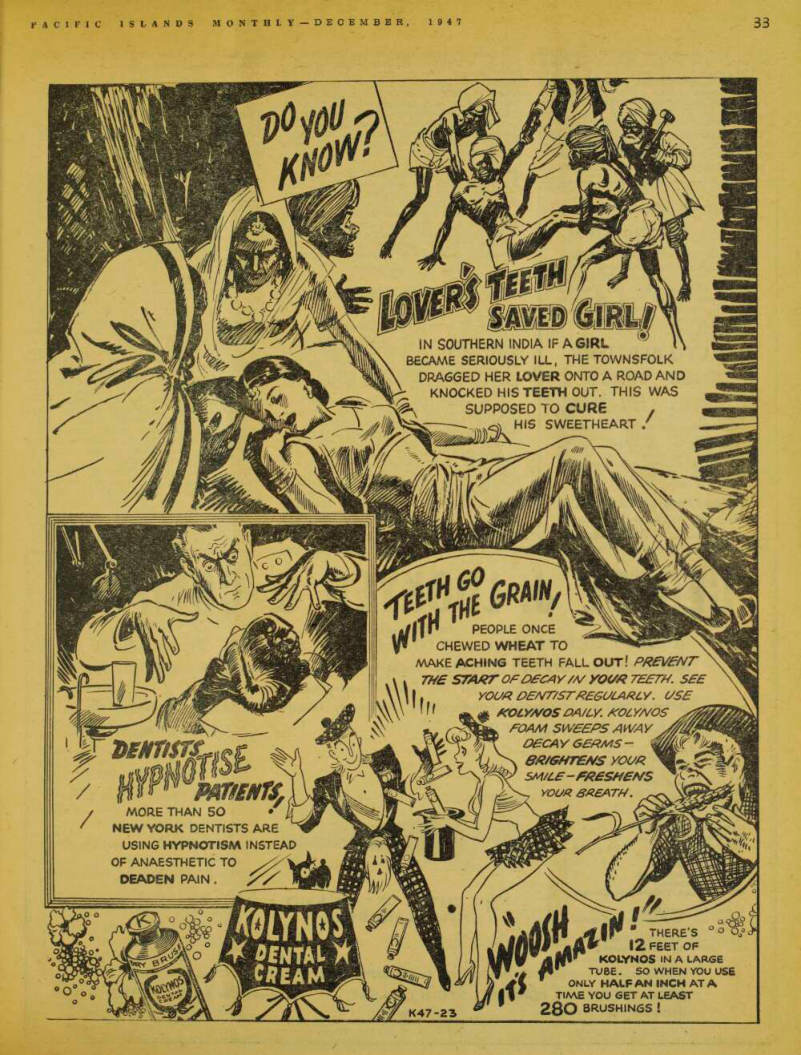
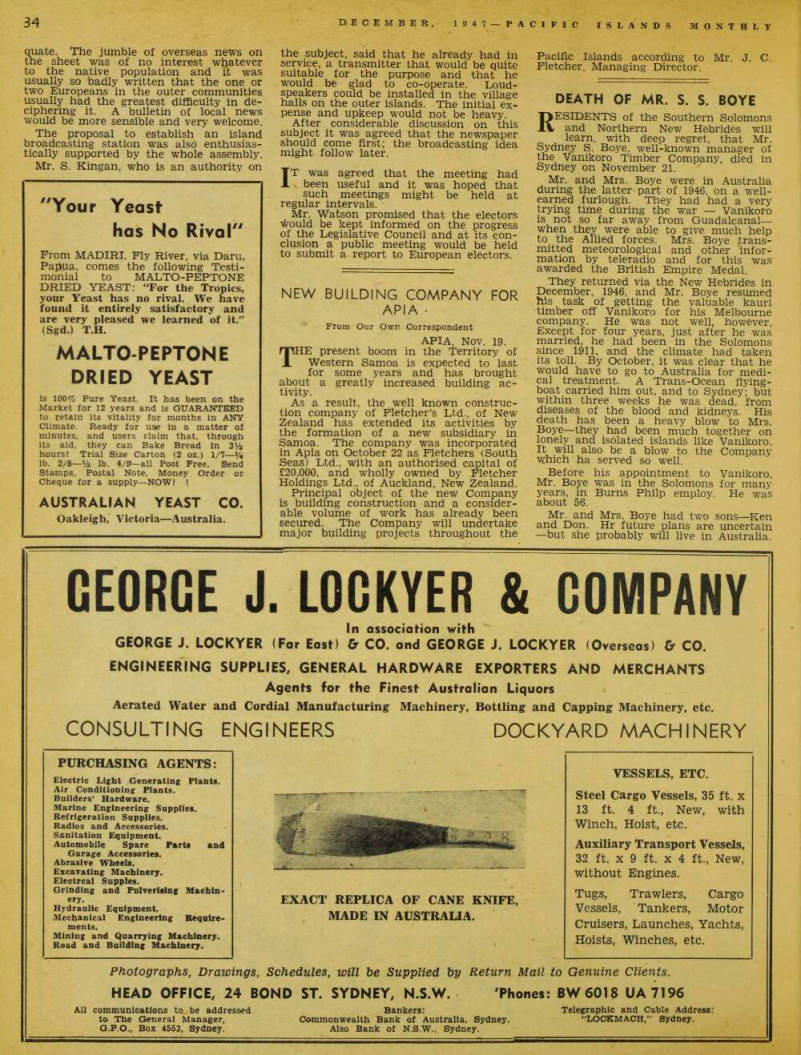
From Our Own Correspondent
Rarotonga, Nov. 17.
A European electors’ meeting was held in Rarotonga on November 7. It was convened by the European member for the Legislative Council. Mr.
Wm. H. Watson, for the purpose of dis cussing those matters which European residents wished to be placed before the Council which was then in session.
First matter under discussion was the proposal that -the four European ex officio members on the Legislative Coun cil should be removed.
According to Mr. Watson, the native members felt overwhelmed by the extra weight given the European side by these four officials (Chief Medical Officer, the Director of Agriculture, Director of Edu
cation, and the head of the Treasury Department). Mr. Watson said that he strojigly supported native members in
this view. These four officials should be on call whenever data was required from their particular departments, but their presence on the actual Council was not really necessary.
Mr. S. Kingan supported Mr. Watson but the majority of those present appeared to be in Deposition to the suggestion that they be'removed. Mr. W. Graham said he thought the views of Mr.
Watson pre-supposed a European bloc in voting strength, regardless of the merits of the case, and he felt that the matter could wait until such a situation arose.
Mr. J. Morgan said that the govern ment had already made it clear that it was necessary to hold a guiding rein until such time as the native leaders proved themselves capable of carrying greater responsibilities. Through the new Legis lative Council they were being ‘ given a greater share of the burden and as they proved themselves capable of bearing it so they would be given an increasing share in the responsibilities and adminis tration of their own islands. The matter could not be rushed at this stage, (Following this meeting, however, this matter was put to the vote in the Legis lative Council itself and a majority voted for the removal of the four ex-officio members.)
Election of European Member
MR. L. TRENN moved that the meeting affirm its belief that the European member of the Rarotonga Island Council be automatically the European member on the Legislative Council.
It was understood that this was origin ally intended, but it had somehow ap peared in the regulations that the Euro pean member on the Legislative Council had to be elected by the native members of the Island Council. Under these cir cumstances there was a strong danger of European residents not having a repre sentative on the Legislative Council.
Mr. Trenn’s motion received the sup port of the meeting.
All present agreed that a better water service was one of the most pressing needs of the community.
Mr. L. Cook urged that if there was to be a new water service a good supply should be given along the inland road.
If the people were to be urged “back to the land” they should be encouraged to build their homes on their plantations.
A good water supply would be a great in centive.
Mr. Trenn emphasised the need for improvements to all back roads as a means to opening up land and relieving the congested conditions in Avarua.
Public Health
MR. WATSON said that public health was his foremost interest. It was his intention to press for a separate
health department, with a health officer who would be solely concerned with such matters as housing, water, food sales, mosquito control, etc.
Mr. Reid drew a parallel between the rate of TB and the standard of living, showing that a low standard resulted in a high incidence of TB. He urged that some restriction should be placed on the erection of closely grouped, ramshackle buildings which fostered the disease.
Mr. Cook said that the influx of outer islanders, who lack land and belongings in Rarotonga, had much to do with the destitution one saw in some quarters and had also contributed to the crime com mitted on the island. These people were mainly responsible for the unhealthy col lection of ramshackle huts clustered round the main settlement.
Mr. J. H. Webb said that a simple answer to the housing-health problem would be to return the outer islanders to their own islands, where they would have their own land and more space.
Mr. R. Powell, however, defended the outer islanders. While agreeing that something should be done about the housing problem he did not agree with those people who considered them a use less lot of tramps, battening upon the Rarotongans. Generally speaking, the Rarotongans were an indolent type, not keen on work. The more hardy islanders were the workers, and provided much of the labour on the island. They were also practically the only fishermen on the island, even if they only fished for their own families.
Building houses of native materials was not so cheap as some people imagined owing to the short life of these perish able materials. Mr. Powell then ad vanced a suggestion that a cheap and plentiful permanent building material might be obtained by establishing a brick field. There were deposits of suitable clay for making bricks and tiles in Rarotonga.
Mr. ]&. Baker (Director of Agriculture), mentioned the possibilities of growing timber on the open hills that would assist in reforestation and provide building timber. Experiments were already in progress. He described the experimental farm which it is hoped to establish shortly. The plan is to introduce new economic and nutritious foods.
Mr. Morgan expressed the hope that some scheme of native land development might be introduced which would restore the economy and health of the people.
He cited the great improvements both in productivity and the health of the Maori people under the Government Native Land Scheme in NZ. There was also a need for development in the outer islands in other fruits besides oranges.
Mr. Trenn proposed a subsidy on dried milk to encourage the consumption of this vital food. All school children were al ready receiving a daily free milk ration but it would be a good thing to encourage everyone to drink milk for the sake of health.
The dusty state of Rarotonga’s roads was also discussed. Mr. Powell suggested that an estimate be obtained of the cost of sealing the road through the main settlement of Avarau with oil as had been carried out with success in New Zea land.
News-Sheet and Broadcasting
MR, TRENN said he was of the opinion that some sort of regular govern ment-subsidised newspaper or news-sheet should be produced. This need was urgent. There was plenty of propaganda in circulation to let the people know what was not being- done, but there was no means of countering this by telling them what was being done for them or what future plans were be ing made for their welfare.
The meeting was unanimously in agree ment with this proposal.
The daily news bulletin to the outer islands was, it was agreed, totally inade
quate. The jumble of overseas news on the sheet was of no interest whatever to the native population and it was usually so badly written that the one or two Europeans in the outer communities usually had the greatest difficulty in de ciphering it. A bulletin of local news would be more sensible and very welcome.
The proposal to establish an island broadcasting station was also enthusias tically supported by the whole assembly.
Mr. S. Kingan, who is an authority on
the subject, said that he already had in service, a transmitter that would be quite suitable for the purpose and that he would be glad to co-operate. Loud speakers could be installed in the village halls on the outer islands. The initial ex pense and upkeep would not be heavy.
After considerable discussion on this subject it was agreed that the newspaper should come first; the broadcasting idea might follow later.
IT was agreed that the meeting had been useful and it was hoped that such meetings might be held at regular intervals.
Mr. Watson promised that the electors would be kept informed on the progress of the Legislative Council and at its con clusion a public meeting would be held to submit a report to European electors.
Advertisements & other items, pp. 33-36 (1 item)
So/ Ontjfo ...
PACIFIC ISLANDS SOCIETY
Visitors from the Islands to Sydney (or those interested in Islands affairs), are adrlsed to communicate with the honorary secretary of the abore Society, which has been formed to study the history, traditions, economics, and political derelopments of the Pacific Islands.
Regular monthly meetings are held at History House, 8 Young Street, Sydney.
Address for Correspondence:
THE PACIFIC ISLANDS SOCIETY,
Box 2434 MM.. G.P.0., Sydney.
So/ Ontjfo ...
Snug Waterproofs, Thigh, Knee and Ankle Boots for wet weather wear in styles and sizes for men, women and children.
ALL THE YEAR ROUND
Dunlop Footwear is designed to relieve the jolts and fatigue of hard work and long wear and will be available soon in an extensive range of sizes and styles to suit every member of
the family.
Genuine Dunlop Kromhyd Soles guaranteed to out- Sport and Sandshoes for every wear two leather recreational occasion. soles.
Rubber heels for comfort and economy.
D-44*
DUNLOP
7pe^ rn»
r en
:/iA F. Pens, 5/6 to 60/3.
Prop. Pencils, 5/11 to 45/-.
Gift Sets, 23/9 to £6/11/-.
Ball Pens—Silver PI. — 50/3. 22ct. Gold-plated, 77/6. • New Nibs and repairs for all Pens.
SENT FOR FREE CATALOGUE
See the Specialists at . . . %
NE.AR MARTIN PI ACS
135 Pitt St., Sydney B 2514
WORMSEARED
CHAIN HOISTS
The hand-operated Wormgeared Hoist is a general purpose lifting device, compact and easy to handle. The Wormgear is designed to give comparatively high efficiency and long life. A simple and effective brake insures safe holding of the suspended load.
Available in rated capacities from 10 cwts. to 3 tons.
Also makers of: A.B.C. Electric Chain Hoists, V 2, 1, 2 tons capacity.
“Victor” Spurgeared Chain Hoists from -10 cwts. to 20 tons.
Triple Geared Chain Hoists from 10 cwts, to 20 tons.
Worm Geared Chain Hoists from 10 cwts. to 3 tons.
Weston Chain Blocks from 5 cwts. to 2 tons.
Shackles, Hooks, Sheave and Snatch Blocks.
AUSTRALIAN BLOCK €r CHAIN CO.
PTY., LTD.
Robbs Road, WEST FOOTSCRAY, W. 12,
VICTORIA
Phones: MW 1373-74-75.
Telegraphic Address: “CHAINBLOCK,” MELBOURNE.
Correspondence to Box 34, FOOTSCRAY, W.ll, VICTORIA.
Ur Cm T
IN SOUTHERN INDIA IF A GIRL
BECAME SERIOUSLY ILL, THE TOWNSFOLK
DRAGGED HER LOVER ONTO A ROAD AND
KNOCKED HIS TEETH OUT. THIS WAS
SUPPOSED TO CURE .
HIS SWEETHEART /
/ In c
MMmm
PfinEHTS.
MORE THAN 50 •
NEW YORK DENTISTS ARE
USING HYPNOTISM INSTEAD
OF ANAESTHETIC TO
DEADEN PAIN. ys
K
PEOPLE ONCE
CHEWED WHEAT TO
MAKE ACHING TEETH FALLOUT! PREVENT
THE START OP DECAY //V TOUR TEETH. SEE
YOUR OE/VT/STREGULARLY. USE
0 ROCY/VOS OA/LY. ROUYNOS
" ROAM SWEEPS AWAY
DECAY GERMS-
6R/GHTENS YOUR
SM/LE - FRESHENS
YOUR BREATH.
vm r»c
¥ JtNTALX
CffEAM
W ditn* KOLYNOS II
K 47-23
THERE S ° Q
FEET OF
KOLYNOS IN A LARGE
TUBE. SO WHEN YOU USE
ONLY HALF AN INCH AT A
TIME YOU GET AT LEAST
280 BRUSHIN6S !
"Your Yeast
has No Rival"
From MADIRI, Fly River, via Daru, Papua, comes the following Testimonial to MALTO-PEPTONE DRIED YEAST: "For the Tropics, your Yeast has no rival. We have found it entirely satisfactory and are very pleased we learned of it.” (Sgd.) T.H.
MALTO-PEPTONE
DRIED YEAST
Is 100% Pure Yeast. It has been on the Market for 12 years and is GUARANTEED to retain its vitality for months in ANY Climate. Ready for use in a matter of minutes, and users claim that, through its aid, they can Bake Bread in 3V2 hours! Trial Size Carton (2 oz.) 1/7 — V « lb. 2/B—Vs lb. 4/9 all Post Free. Send Stamps, Postal Note, Money Order or Cheque for a supply—NOW! !
AUSTRALIAN YEAST CO.
Oakleigh, Victoria—Australia.
GEORGE J. LOGKYER & COMPANY
In association with GEORGE J. LOCKYER (Far East) & CO. and GEORGE J. LOCKYER (Overseas) & CO.
ENGINEERING SUPPLIES, GENERAL HARDWARE EXPORTERS AND MERCHANTS Agents for the Finest Australian Liquors Aerated Water and Cordial Manufacturing Machinery, Bottling and Capping Machinery, etc.
CONSULTING ENGINEERS DOCKYARD MACHINERY
PURCHASING AGENTS:
Electric Light Generating Plants.
Air Conditioning Plants.
Builders’ Hardware.
Marine Engineering Supplies.
Refrigeration Supplies.
Radios and Accessories.
Sanitation Equipment.
Automobile Spare Parts and Garage Accessories.
Abrasive Wheels.
Excavating Machinery.
Electrcal Supples.
Grinding and Pulverising Machinery, Hydraulic Equipment.
Mechanical Engineering Requirements.
Mining and Quarrying Machinery.
Road and Building Machinery.
EXACT REPLICA OF CANE KNIFE,
MADE IN AUSTRALIA.
VESSELS, ETC.
Steel Cargo Vessels, 35 ft. x 13 ft. 4 ft., New, with Winch, Hoist, etc.
Auxiliary Transport Vessels, 32 ft. x 9 ft. x 4 ft., New, without Engines.
Tugs, Trawlers, Cargo Vessels, Tankers, Motor Cruisers, Launches, Yachts, Hoists, Winches, etc.
Photographs, Drawings, Schedules, will he Supplied by Return Mail to Genuine Clients.
HEAD OFFICE, 24 BOND ST. SYDNEY, N.S.W. 'Phones: BW6OIB UA7196 All communications to be addressed Bankers: Telegraphic and Cable Address: to The General Manager, Commonwealth Bank of Australia, Sydney. “LOCKMACH,” Sydney.
Q.P.0., Box 4553, Sydney. Also Bank of N.S.W., Sydney.
New Building Company For
Apia
From Our Own Correspondent
Apia, Nov. 19.
THE present boom in the Territory of Western Samoa is expected to last for some years and has brought about a greatly increased building ac tivity.
As a result, the well known construc tion company of Fletcher’s Ltd., of New Zealand has extended its activities by the formation of a new subsidiary in Samoa. The company was incorporated in Apia on October 22 as Fletchers (South Seas) Ltd., with an authorised capital of £20,000, and wholly owned by Fletcher Holdings Ltd., of Auckland, New Zealand.
Principal object of the new Company is building construction and a consider able volume of work has already been secured. The Company will undertake major building projects throughout the
Pacific Islands according to Mr. J. C.
Fletcher, Managing Director.
Death Of Mr. S. S. Boye
RESIDENTS of the Southern Solomons and Northern New Hebrides will learn, with deep regret, that Mr.
Sydney S. Boye, well-known manager of the Vanikoro Timber Company, died in Sydney on November 21.
Mr. and Mrs. Boye were in Australia during the latter- part of 1946, on a well earned furlough. They had had a very trying time during the war Vanikoro is not so far away from Guadalcanal— when they were able to give much help to the Allied forces. Mrs. Boye trans mitted meteorological and other infor mation by teleradio and for this was awarded the British Empire Medal.
They returned via the New Hebrides in December, 1946, and Mr. Boye resumed his task of getting the valuable kauri timber off Vanikoro for his Melbourne company. He was not well, however.
Except for four years, just after he was married, he had been in the Solomons since 1911, and the climate had taken its toll. By October, it was clear that he would have to go to Australia for medi cal treatment. A Trans-Ocean flying boat carried him out, and to Sydney; but within three weeks he was dead, from diseases of the blood and kidneys. His death has been a heavy blow to Mrs.
Boye—they had been much together on lonely and isolated islands like Vanikoro.
It will also be a blow to the Company which ha served so well.
Before his appointment to Vanikoro, Mr. Boye was in the Solomons for many years, in Burns Philp employ. He was about 56.
Mr. and Mrs. Boye had two sons—Ken and Don. Hr future plans are uncertain —but she probably will live in Australia.
Eyes Turn Northwards As Native Independence
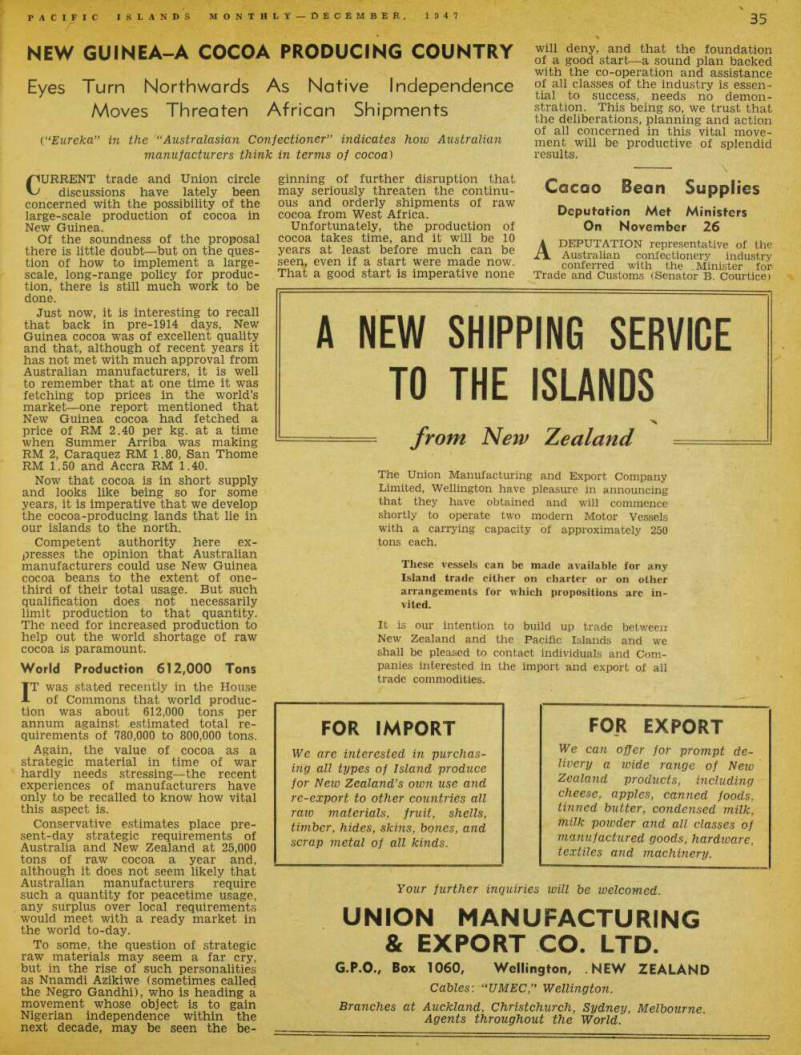
New Guinea-A Cocoa Producing Country
Eyes Turn Northwards As Native Independence Moves Threaten African Shipments
(“ Eureka” in the “Australasian Confectioner” indicates how Australian manufacturers think in terms of cocoa )
CURRENT trade and Union circle discussions have lately been concerned with the possibility of the large-scale production of cocoa in New Guinea.
Of the soundness of the proposal there is little doubt—but on the ques tion of how to implement a large scale, long-range policy for produc tion, there is still much work to be done.
Just now, it is interesting to recall that back in pre-1914 days, New Guinea cocoa was of excellent quality and that, although of recent years it has not met with much approval from Australian manufacturers, it is well to remember that at one time it was fetching top prices in the world’s market—one report mentioned that New Guinea cocoa had fetched a price of RM 2.40 per kg. at a time when Summer Arriba was making RM 2, Caraquez RM 1.80, San Thome RM 1.50 and Accra RM 1.40.
Now that cocoa is in short supply and looks like being so for some years, it is imperative that we develop the cocoa-producing lands that lie in our islands to the north.
Competent authority here ex presses the opinion that Australian manufacturers could use New Guinea cocoa beans to the extent of one third of their total usage. But such qualification does not necessarily limit production to that quantity.
The need for increased production to help out the world shortage of raw cocoa is paramount.
World Production 612,000 Tons IT was stated recently in the House of Commons that world produc tion was about 612,000 tons per annum against .estimated total re quirements of 780,000 to 800,000 tons.
Again, the value of cocoa as a strategic material in time of war hardly needs stressing—the recent experiences of manufacturers have only to be recalled to know how vital this aspect is.
Conservative estimates place pre sent-day strategic requirements of Australia and New Zealand at 25,000 tons of raw cocoa a year and, although it does not seem likely that Australian manufacturers require such a quantity for peacetime usage, any surplus over local requirements would meet with a ready market in the world to-day.
To some, the question of strategic raw materials may seem a far cry, but in the rise of such personalities as Nnamdi Azikiwe (sometimes called the Negro Gandhi), who is heading a movement whose object is to gain Nigerian independence within the next decade, may be seen the be
ginning of further disruption that may seriously threaten the continu ous and orderly shipments of raw cocoa from West Africa.
Unfortunately, the production of cocoa takes time, and it will be 10 years at least before much can be seen, even if a start were made now.
That a good start is imperative none
wdl den y’ and that the foundation of a good start—a sound plan backed with the co-operation and assistance of au classes of the industry is essen tial to success, needs no demon- This being so, we trust that the deliberations, planning and action of all concerned in this vital move ment will be productive of splendid results.
Cacao Bean Supplies
Deputation Met Ministers On November 26
A DEPUTATION representative of the Australian confectionery industry conferred with the Minister for Trade and Customs (Senator B. Courtice)
and the Minister for External Teritories (Mr. E. J. Ward, MHR) at Canberra on November 26 on Australia’s cacao bean supplies.
Messrs. R. S. Jackson (Federal presi dent) and P. J. Lucas (Federal secretary) represented the Federated Confec tioners’ Association of Australia, and Mr.
Samuel Johnson (secretary) the Com monwealth Chocolate & Confectionery Manufacturers’ Association. Senator T.
M, Nicholls, hon. secretary of the South Australian Branch of the Union, arranged the interview with the two Ministers.
The meeting follows a decision by the Federal Council of the Union in Adelaide some weeks ago to approach the Govern ment on cacao bean supplies for the industry. The Government was asked to investigate the possibilities of estab lishing the cacao bean industry in New and northern areas of Australia.
Prices Still Mounting
AUSTRALIAN chocolate manufac turers are alarmed at reports that American buyers are paying prices 40-50 per cent, in advance of last year for the 1947-48 world cacao bean crop.
It is considered too early yet to estimate the prices that will rule when the Aus tralian allocation is made, but it is thought that the eager and expensive buying by Americans makes it likely that prices will reach a record high. (Ed. Note: The outcome of the con ference is not known. It is likely, how ever. that Mr.* Ward dispensed his usual soothing phrases. No doubt he also told the representatives of the confectionery industry that all will be well when his plan for native agriculture is in full flower —perhaps in 2000 AD. Some planter in New Britain should take it upon him self to acquaint Australian confectioners of the real state of the planting indus try in New Guinea.)
Advertisements & other items, p. 37 (1 item)
A New Shipping Service
TO THE ISLANDS
■ from New Zealand
The Union Manufacturing and Export Company Limited, Wellington have pleasure in announcing that they have obtained and will commence shortly to operate two modern Motor Vessels with a carrying capacity of approximately 250 tons each.
These vessels can be made available for any Island trade cither on charter or on other arrangements for which propositions are invited.
It is our intention to build up trade between New Zealand and the Pacific Islands and we shall be pleased to contact individuals and Companies interested in the import and export oX all trade commodities.
FOR EXPORT
We can offer for prompt delivery a wide range of Neiv Zealand products, including cheese, apples, canned foods, tinned butter, condensed milk, milk powder and all classes of manufactured goods, hardware, textiles and machinery.
Your further inquiries will be welcomed.
UNION MANUFACTURING
& EXPORT CO. LTD.
G.P.0., Box 1060, Wellington, NEW ZEALAND Cables: “UMEC,” Wellington.
Branches at Auckland, Christchurch, Sydney, Melbourne.
Agents throughout the World.
FOR IMPORT
We are interested in purchasing all types of Island produce for New Zealand’s own use and re-export to other countries all raw materials, fruit, shells, timber, hides, skins, bones, and scrap metal of all kinds.
Cocoa Boom Continues
From Our Own Correspondent
Apia, Nov. 6.
WESTERN SAMOA’S cocoa boom is continuing; latest offers for cocoa beans are £230 per ton.
The Norwegian ship “Thor I” has just left here with 450 tons of cocoa for the San Francisco market, valued at over
£Loo,Ooo.
Owing to a shortage of Samoan food stuffs on one hand, and the high prices of cocoa and copra on the other hand, the export of bananas to New Zealand from Western Samoa has decreased ap preciably the last “Matua” taking only 6,000 instead of the usual 9-10,000 cases.
The export of dri-dated bananas has also fallen off.
Nei Timber Production
rE East Indonesian Minister for Economic Affairs, announced in Macassar recently that timber pro duction exceeded pre-war figures during the first half of 1947.
In South Borneo where one of the largest timber mills in the world is being built by a Dutch firm, experiments are being conducted with “sea floats-” A number of tree trunks, are collected in a dock and fastened together with heavy chains. After the walls of the dock, which are hinged to the bottom, are let down, the float is ready to be towed away. It is intended to attempt to tow strings of these floats from Borneo to Java.
During the occupation the Japanese conducted a similar experiment. Three floats left Borneo in tow for Japan, but only one reached there.
Mrs. Terry O’Sullivan of Brisbane, left bv plane recently to join her husband at Wau (NG).
Hotel For Wau
IT was notified in the New Guinea Gazette in November that Mr. J. M.
Bourke, of Lae, had applied for a liquor licence for a hotel he proposed to erect in Wau, to be called the Kaindi Hotel,
For Apia's New Broadcasting
Station
Major e. elliot lloyd, ed, who has been appointed officer in charge of the new Broadcasting Station, at Apia, Western Samoa, has been Manager of Radio Station 2YH, Napier, New Zea land.
Major Lloyd after serving with the NZEP, in the Pacific, was seconded in 1944 to the Colonial Office and served for fifteen months as Secretary to the Gilbert and Ellice Islands Colony Gov ernment. He then became British Repre sentative in the Condominium of Canton and Enderbury Islands, stationed at Can ton Island, and in 1946 he was appointed District Officer, Ocean Island. He re turned to New Zealand last May and took up duty in Napier.
The new station, which is being erected for the Samoan Government by the New Zealand Broadcasting Service, will broad cast on a frequency of 1,420 kilocycles, and it is hoped to have the station “on the air” before Christmas.
Mr. W. J. Hawthorne, of W. J. Haw thorne & Co., Samabula, Fiji, arrived in Sydney in November. He is seeking motor spares and tyres. He said that un less mechanical spare parts could be secured from Australia, road transport in Fiji and Tonga would become paralysed within six months. Cars and buses were lying idle all over the Islands because they could not be repaired.
Advertisements & other items, pp. 38-39 (2 items)
36
&SCSMBER, 194 t PACIFIC ISLANDS MONtttLY
Heinz
W\PvOt.
Hr, 57 A clever mother serves Heinz Spaghetti often . . . she gets the compliments . . . the family get that “satisfied feeling”.
It’s made of finest wheat, rich tomato sauce, choice cheese, piquant spices . . . a flavour all its own . . . any wonder it makes any dinner tasty.
HEINZ
SkacmjeZto
WESTCLOX
’VTEVER has performance been more trustworthy than in the beautiful Westclox of today . . . famous Big Ben and other spring wound clocks, electric clocks, wrist watches and pocket watches. When you buy your next clock or watch, look for the trade mark “Westclox” on the dial . . . your assurance of quality.
POCKET BEN A thin model watch with many features. Highly polished, plated finish; silvered dial; attractive numerals and hands. Unbreakable crystal.
SPUR Luminous A thin case, one-day alarm. Black finish with nickel trim. 41 inches square.
Steady alarm. Unique base.
Luminous dial.
CHIME ALARM
BIG
BEN
BIG BEN Chime Alarm The highest standard of alarm clock quality. Quiet tick and gentle two-voiced alarm. First there’s a gentle call, then if he’s not shut off. there’s a lusty shout. Dustproof attachments. 5 h inches high. Ivory finish with gold colour trim. Luminous dial. -w c 7 6 5 10 BABY BEN A smart looking alarm clock. 3'h inches high.
Quiet tick; steady alarm that rings loud or soft. Legible dial.
Two finishes . . . black with nickel trim, and ivory with gold colour trim. Made in plain and luminous dial.
LA SALLE A handsomely designed wrist watch. Chrome finish case, stainless steel back, curved to fit the wrist. Sturdy movement, regulated to run in any position. Equipped with conventional second hand; rustproof hairspring.
ORDER THROUGH YOUR LOCAL STORE
PACIFIC ISLANDS TRADING
COMPANY
244 CALIFORNIA STREET, SAN FRANCISCO, CAL., U.S.A.
Bankers: Bank of America (Main Office) San Francisco.
Cables:
PITCO
SAN FRANCI
New Control of Islands
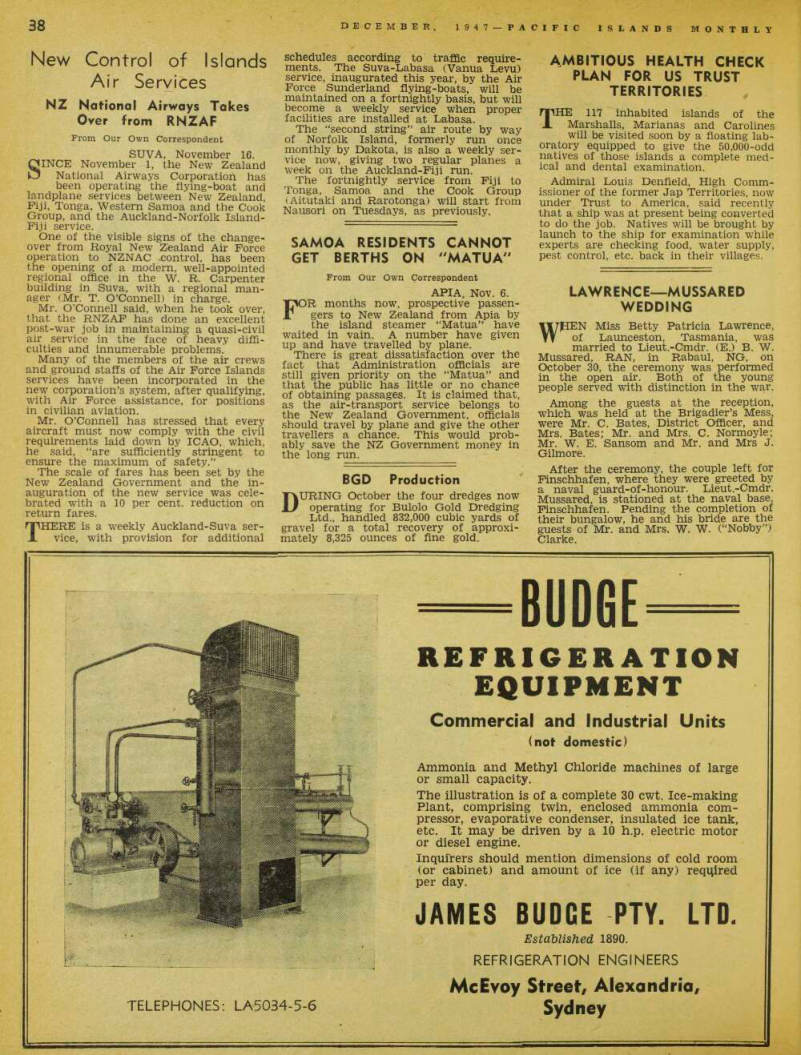
Air Services NZ National Airways Takes Over from RNZAF
From Our Own Correspondent SUVA, November 16.
SINCE November 1, the New Zealand National Airways Corporation has been operating the flying-boat and landplane services between New Zealand, Fiji, Tonga, Western Samoa and the Cook Group, and the Auckland-Norfolk Island- Fiji service.
One of the visible signs of the change over from Royal New Zealand Air Force operation to NZNAC control, has been the opening of a modern, well-appointed regional office in the W. R. Carpenter building in Suva, with a regional man ager (Mr. T. O’Connell) in charge.
Mr. O’Connell said, when he took over, that the RNZAF has done an excellent post-war job in maintaining a quasi-civil air service in the face of heavy diffi culties and innumerable problems.
Many of the members of the air crews and ground staffs of the Air Force Islands services have been incorporated in the new corporation’s system, after qualifying, with Air Force assistance, for positions in civilian aviation.
Mr. O’Connell has stressed that every aircraft must now comply with the civil requirements laid down by ICAO, which, he said, “are sufficiently stringent to ensure the maximum of safety.”
The scale of fares has been set by the New Zealand Government and the in auguration of the new service was cele brated with a 10 per cent, reduction on return fares.
THERE is a weekly Auckland-Suva ser vice, with provision for additional
schedules according to traffic require ments. The Suva-Labasa (Vanua Levu) service, inaugurated this year, by the Air Force Sunderland flying-boats, will be maintained on a fortnightly basis, but will become a weekly service when proper facilities are installed at Labasa.
The “second string” air route by way of Norfolk Island, formerly run once monthly by Dakota, is also a weekly ser vice now, giving two regular planes a week on the Auckland-Fiji run.
The fortnightly service from Fiji to Tonga, Samoa and the Cook Group (Aitutaki and Rarotonga) will start from Nausori on Tuesdays, as previously.
Samoa Residents Cannot
Get Berths On "Matua"
From Our Own Correspondent
Apia, Nov. 6.
FR months now, prospective passen gers to New Zealand from Apia by the island steamer “Matua” have waited in vain. A number have given up and have travelled by plane.
There is great dissatisfaction over the fact that Administration officials are still given priority on the “Matua” and that the public has little or no chance of obtaining passages. It is claimed that, as the air-transport service belongs to the New Zealand Government, officials should travel by plane and give the other travellers a chance. This would prob ably save the NZ Government money in the long run.
BGD Production
DURING October the four dredges now operating for Bulolo Gold Dredging Ltd., handled 832,000 cubic yards of gravel for a total recovery of approxi mately 8,325 ounces of fine gold.
Ambitious Health Check
Plan For Us Trust
Territories
THE 117 inhabited islands of the Marshalls, Marianas and Carolines will be visited soon by a floating lab oratory equipped to give the 50,000-odd natives of those islands a complete med ical and dental examination.
Admiral Louis Denfield, High Comm issioner of the former Jap Territories, now under Trust to America, said recently that a ship was at present being converted to do the job. Natives will be brought by launch to the ship for examination while experts are checking food, water supply, pest control, etc. back in their villages.
Lawrence—Mussared
Wedding
¥¥7pEN Miss Betty Patricia Lawrence, ff of Launceston, Tasmania, was married to Lieut.-Cmdr. (E.) B. W.
Mussared, RAN, in Rabaul, NG, on October 30, the ceremony was performed in the open air. Both of the young people served with distinction in the war.
Among the guests at the reception, which was held at the Brigadier’s Mess, were Mr. C. Bates, District Officer, and Mrs. Bates; Mr. and Mrs. C. Normoyle; Mr. W. E. Sansom and Mr. and Mrs J.
Gilmore.
After the ceremony, the couple left for Pinschhafen, where they were greeted by a naval guard-of-honour. Lieut.-Cmdr.
Mussared, is stationed at the naval base, Pinschhafen. Pending the completion of their bungalow, he and his bride are the guests of Mr. and Mrs. W. W. (“Nobby”) Clarke.
Advertisements & other items, pp. 40-42 (1 item)
Budge
i
TELEPHONES: LA5034-5-6
REFRIGERATION
EQUIPMENT
Commercial and Industrial Units
(not domestic) Ammonia and Methyl Chloride machines of large or small capacity.
The illustration is of a complete 30 cwt. Ice-making Plant, comprising twin, enclosed ammonia compressor, evaporative condenser, insulated ice tank, etc. It may be driven by a 10 h.p. electric motor or diesel engine.
Inquirers should mention dimensions of cold room (or cabinet) and amount of ice (if any) required per day.
JAMES BUDGE PTY. LTD.
Established 1890,
REFRIGERATION ENGINEERS
McEvoy Street, Alexandria,
Sydney
There is only one
ELECTROLUX
THE MODERN KEROSENE-OPERATED REFRIGERATOR
THAT ACHIEVES THE MIRACLE OF ICE FROM HEAT
Lasting Efficiency, Silent Operation, Streamlined Beauty
u V- Economically operated by kerosene, with a simple precision-built freezing unit that has no moving parts and is GUARANTEED FOR
FIVE (5) YEARS.
Obtainable from : W. R. CARPENTER (New Guinea), LTD.
Rabaul, Madang, Lae, Kavieng, Wau.
J. R. CLAY & CO., LTD., Port Moresby.
W. R. CARPENTER & CO. (Sol. Is.), LTD., Tulagi.
For New Hebrides, Butaritari, Noumea, New Caledonia. Apply— Model LKSSI Storage capacity: 5i cub. ft. (approx); shelf area, 9 sq. ft.; food shelves, six—five removable; 2 self-supporting when half drawn. Ice-making: Four trays—s lb. ice per freezing: 80 cubes. Fuel consumption: 1.8 pints kerosene per day (approx.).
Height: 4 ft. 10 in. Depth: 2 ft* in.
Weight, unpacked, 434 lb. Packed, 700 lb.
W. R. CARPENTER & CO. LTD. Head Office: 16 O'Connell St., Sydney, N. S. Wales
COPRA GROWERS 7 UNION
OF FIJI
ALL Copra Growers are urged to join this Union and form branches in all centres in the South Pacific. Planters! “Unity is Strength” —so guard your own interests.
The objects of the Union are:— (1) To unite all Copra Growers; to urge them to express their ideas; and to have one concerted and strong medium through which to express their viewpoint in matters of price, markets, etc, (2) To investigate all matters of interest in relation to by-products, offsets for hurricanes, etc. (3) To encourage research in regard to new uses for coconuts and associated products. (4) To inform Copra Growers of matters affecting their interests; to invite opinions, articles, experiences, etc., from growers, for the information of other growers.
C. G. O. PARR.
Savu Savu, Fiji.
PRODUCING UNIFORM GOOD RESULTS SINCE 1868
ALWAYS ASK FOR IT
s
ALUMINIUM PAINT
The use of Alpaste Aluminium Paint for the exterior coating of roofs, tanks, buildings and other structures provides protection and preservation from the attack of salt atmospheres, smoke, moisture and the acid atmoshere of industrial regions. Alpaste Aluminium Paint’s exceedingly smart appearance can be preserved for long periods without attention.
FOR COMPLETE PROTECTION
AND PRESERVATION
ALUMINIUM UNION
LIMITED
Incorporated in the Dominion of Canada (A Member of the Aluminium Limited Group, Montreal, Canada) Ocean House, 34 Martin Place, Sydney, N.S.W.
The largest distributors of aluminium and its alloys in the British Commonwealth * Registered Trade Mark
Rattan Cane From
Papua
Infant Industry Needs Some Official Help
IT has been suggested many times that Australia could establish a new in dustry in her tropical Territories by obtaining all her requirements of rattan cane from New Guinea and Papua. It is estimated that Australian requirements in cane for wicker-work of all descrip tions —especially furniture is equal to about 5,000 tons per annum. Before the war Australia obtained most of her re quirements from Indonesia (mostly Java) and paid approximately £3O per ton.
However, a young Australian who made an effort recently to develop this indus try found himself up against the usual blank wall of Australian official indiffer ence; and, up to date, he has had very little encouragement to proceed with his enterprise.
Mr. Ray Cavanagh trading as Islands Supplies, went to Samarai in May last, and proceeded to investigate the cane position. He found on the mainland, at the eastern end of Papua, large quantities of cane. There were anything between 50 to 100 varieties available and of these only 2 or 3 varieties are suitable for cur ing as rattan. However, there were large quantities of those varieties.
As it was impossible to make use of trained native labour under the present
labour conditions (one may nowadays in denture a boy for only one year, and it takes nearly a year to train him as a labourer) Mr. Cavanagh followed the system of organising teams of villagers as a labour corps. It was an expensive process three or four untrained village labourers were the equal of one trained labourer but he nevertheless was able to gather a few tons of cane, cure it (a process of drying extending over several weeks) and carry it to the beach for ship ment. Then he struck all sorts of trouble.
The coastal boats, running under the Socialistic control of the Australian Ship ping Board, practically refused to pick up his cane for transport to Samarai. He had great trouble in securing coastal transport, and tried to use barges.
He had similar trouble in securing shipment from Samarai to Sydney. The ships similarly under Commonwealth Socialistic control demurred against carrying the 15-feet long bundles of cane, even as deck cargo. The cured cane, inci dentally, requires a certain amount of pro tection from weather and rough handling, otherwise it deteriorates. In Port Mores by, Mr. Cavanagh had the pleasure of seeing his precious experimental cargo of cane swung from the ship to the wharf, while the ship was being loaded, and of seeing the cane bundles used on the wharf as a sort of fender for trucks and native labourers.
Mr. Cavanagh had much trouble in re lation to freight. He assumed that freight should not cost more than 81/per ton; but the Governmental powers argued for another rate equal to about £2B per ton.
The cane was tested carefully in Sydney and the reports were first-class. Aus tralian manufacturers will buy this cane in large quantities, if it is properly cured and shipped in lengths not less than 15 feet.
There is no doubt that there is here the basis of a sound little industry for Papua and New Guinea; but there is little prospect of that industry being de veloped unless Australian-New Guinea officialdom and especially that section of it which controls shipping makes some effort to assist the people who are prepared to risk their money and their time and effort in trying to organise something new.
It is noted that Messrs. Slazenger, in Australia, use 200 tons of cane a year in making tennis rackets and bats, and that the C. R. Maguire Company uses another 400 tons per annum in simple wicker-work.
Mrs. Elsie Zammitt (formerly Miss Luff) of Cairns, recently spent two months’ vacation with her parents at Daru, Papua.
Samoan Official
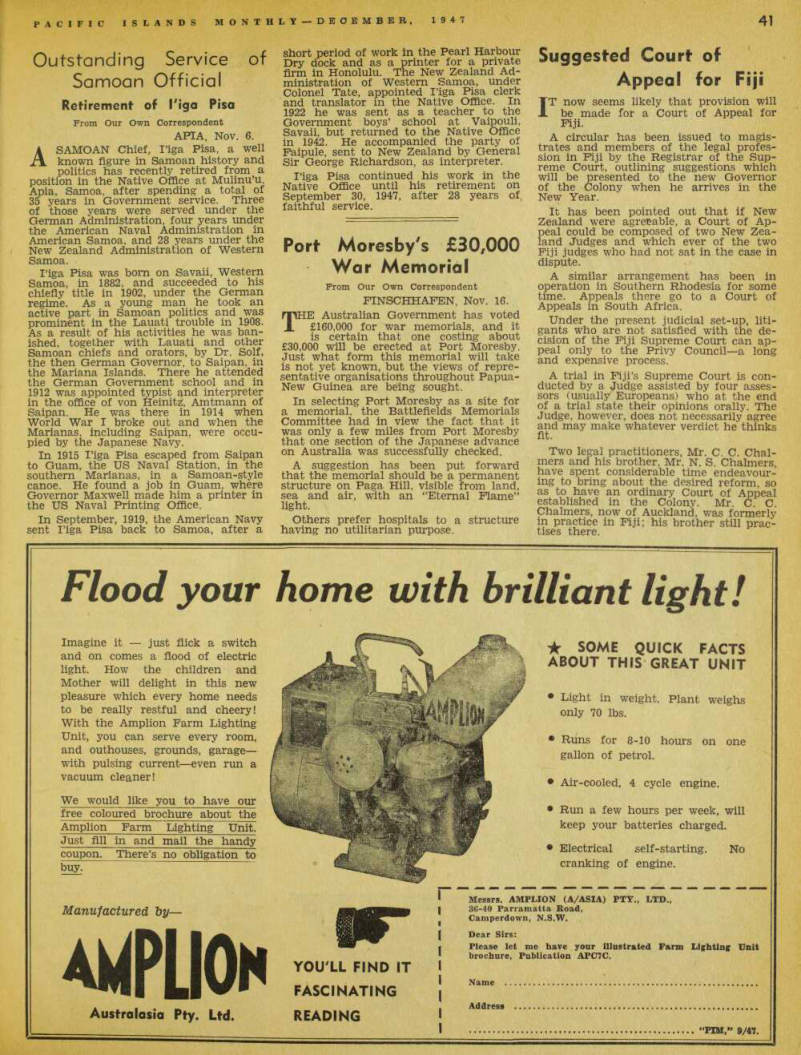
Outstanding Service of Samoan Official Retirement of I'iga Pisa
Prom Our Own Correspondent
Apia, Nov. 6.
A SAMOAN Chief, I’iga Pisa, a well known figure in Samoan history and politics has recently retired from a position in the Native Office at Mulinu’u, Apia, Samoa, after spending a total of 35 years in Government service. Three of those years were served under the German Administration, four years under the American Naval Administration in American Samoa, and 28 years under the New Zealand Administration of Western Samoa.
I’iga Pisa was born on Savaii, Western Samoa, in 1882, and succeeded to his chiefly title in 1902, under the German regime. As a young man he took an active part in Samoan politics and was prominent in the Lauati trouble in 1908.
As a result of his activities he was ban ished, together with Lauati and other Samoan chiefs and orators, by Dr. Solf, the then German Governor, to Saipan, in the Mariana Islands. There he attended the German Government school and in 1912 was appointed typist and interpreter in the office of von Heinitz, Amtmann of Saipan. He was there in 1914 when World War I broke out and when the Marianas, including Saipan, were occu pied by the Japanese Navy.
In 1915 I’iga Pisa escaped from Saipan to Guam, the US Naval Station, in the southern Marianas, in a Samoan-style canoe. He found a job in Guam, where Governor Maxwell made him a printer in the US Naval Printing Office.
In September, 1919, the American Navy sent I’iga Pisa back to Samoa, after a
short period of work in the Pearl Harbour Dry dock and as a printer for a private firm in Honolulu. The New Zealand Ad ministration of Western Samoa, under Colonel Tate, appointed I’iga Pisa clerk and translator in the Native Office. In 1922 he was sent as a teacher to the Government boys’ school at Vaipouli, Savaii, but returned to the Native Office in 1942. He accompanied the party of Faipule, sent to New Zealand by General Sir George Richardson, as interpreter.
I’iga Pisa continued his work in the Native Office until his retirement on September 30, 1947, after 28 years of faithful service.
Port Moresby's £30,000
War Memorial
Prom Our Own Correspondent
Finschhafen, Nov. 16.
rE Australian Government has voted £160,000 for war memorials, and it is certain that one costing about £30,000 will be erected at Port Moresby.
Just what form this memorial will take is not yet known, but the views of repre sentative organisations throughout Papua- New Guinea are being sought.
In selecting Port Moresby as a site for a memorial, the Battlefields Memorials Committee had in view the fact that it was only a few miles from Port Moresby that one section of the Japanese advance on Australia was successfully checked.
A suggestion has been put forward that the memorial should be a permanent structure on Paga Hill, visible from land, sea and air, with an “Eternal Flame” light.
Others prefer hospitals to a structure having no utilitarian purpose.
Appeal for Fiji
Suggested Court of Appeal for Fiji
IT now seems likely that provision will be made for a Court of Appeal for Fiji.
A circular has been issued to magis trates and members of the legal profes sion in Fiji by the Registrar of the Sup reme Court, outlining suggestions which will be presented to the new Governor of the Colony when he arrives in the New Year.
It has been pointed out that if New Zealand were agreeable, a Court of Ap peal could be composed of two New Zea land Judges and which ever of the two Fiji judges who had not sat in the case in dispute.
A similar arrangement has been in operation in Southern Rhodesia for some time. Appeals there go to a Court of Appeals in South Africa.
Under the present judicial set-up, liti gants who are not satisfied with the de cision of the Fiji Supreme Court can ap peal only to the Privy Council —a long and expensive process, A trial in Fiji’s Supreme Court is con ducted by a Judge assisted by four asses sors (usually Europeans) who at the end of a trial state their opinions orally. The Judge, however, does not necessarily agree and may make whatever verdict he thinks fit.
Two legal practitioners, Mr. C. C. Chal mers and his brother, Mr. N. S. Chalmers, have spent considerable time endeavour ing to bring about the desired reform, so as to have an ordinary Court of Appeal established in the Colony. Mr. C. C Chalmers, now of Auckland, was formerly in practice in Fiji; his brother still prac tises there.
Advertisements & other items, p. 43 (1 item)
aMPUOh
Flood your home with brilliant light!
Imagine it just flick a switch and on comes a flood of electric light. How the children and Mother will delight in this new pleasure which every home needs to be really restful and cheery!
With the Amplion Farm Lighting Unit, you can serve every room, and outhouses, grounds, garage— with pulsing current—even run a vacuum cleaner!
We would like you to have our buy.
Manufactured by —
aMPUOh
Australasia Pty. Ltd.
K
★ SOME QUICK FACTS
ABOUT THIS GREAT UNIT
• Light in weight. Plant weighs only 70 lbs. • Runs for 8-10 hours on one gallon of petrol. • Air-cooled, 4 cycle engine. • Run a few hours per week, will keep your batteries charged. • Electrical self-starting. No cranking of engine.
W
YOU'LL FIND IT
FASCINATING
READING
Messrs. AMPLION (A/ASIA) PTY., LTD.,
36-40 Parramatta Road, Camperdown, N.S.W.
Dear Sirs: Please let me have your illustrated Farm Lighting Unit brochure, Publication APC7C, Name Address
“PIM/’ 9/47,
No Coconut Cream from W
W. Samoa!
Prom our Own correspondent
Apia Nov 10
ANEW ZEALAND Company Which was to have begun operations last year manufacturing “cream” from coco nuts in Samoa has apparently given up the plan to choose Western Samoa as a base of operations.
With the present high price of copra it seems highly improbable that the product
of the coconut could be produced and placed on the market in competition with real cream.
Auckland (NZ) newspapers, however, announced on August 21, the registration of a new company “Cococream Limited,” with a capital of £3,000; Messrs. E. H.
Kl ll^ K Dawra ? t R. H. Ridler held 750 shares each, Ed. Note: The manufacture of cream from coconuts was first planned in 1945, when Mr. Dawrant visited Western Samoa. It was thought that the cream
could be processed, canned and landed on the fat-starved European market at low cost. Europe is still fat-starved, but little or no cream has been produced in Samoa.
Although it is understood that the New Zealand Government encouraged the pro motors, Western Samoa appeared, from the outset, to be an unfortunate choice as a production centre because of its dis tance from Europe and its inadequate labour supply.
USA As Pacific Power
DEFINING America’s policy in the Pacific, Mr. Francis B. Sayre, Pre sident of the United Nations Trustee ship Council, said in November that it was based upon two things.
Firstly, on a “forward-looking and pro gressive colonial policy” that would bring well-being and advancement to local in habitants, and Secondly, on a desire that non-self governing countries in the Pacific should play their part in maintaining peace and security.
The United States, Mr. Sayre said, was determined that Pacific islands should never again be permitted to serve as bases for aggression by militaristic countries.
Those island territories which posses potential bases for military action should be utilised for the common defence of the United Nations against any single state acting purely in its own interests.
MR. SAYRE was the leader of the UN delegation which visited Western Samoa in July and August to in vestigate the claims of the Samoans for self-government As reported in the No vember issue of PIM, while allowing for a large measure of self-determination for the Samoans, the UN mission recom mended that the New Zealand govern ment continue as the administering authority.
Sandy Creek Begins In A
Small Way
THE 12th annual report of the Directors of Sandy Creek Gold Sluicing Limited shows much the same state of affairs as is general to all New Guinea gold mining companies. Re habilitation of properties to the point where production can be resumed is slow, being hampered by lack of native labour and essential equipment for repairs, and lack of shipping from Australia.
Although the report deals only with financial affairs up to March 31, 1947, it states that between the end of the financial year and the meeting, on Oc tober 15, operations had begun in a very small way on the Sandy Creek property and that one small clean-up had been made in September, when 68 ounces of gold was recovered from approximately 2,300 yards of gravel.
Rehabilitation has been slower and more difficult on the company’s Watut property, chiefly owing to lack of road and air transport. Planes are now land ing at Slate Creek, however, which is only three miles from the Watut property, and a motor road has been constructed from the drome to within one mile of the workings. It was hoped that gold recovery would commence before the end of October. A sawmill has been installed in this area and this had played a big part in rehabilitation.
The company has an issued capital of £77,500 and a special reserve of £24,856.
It owes £8,686 to creditors, and has £16,220 cash on hand, so it is nicely placed for resumption of operations. Its few administrative costs during the year were covered by £238 received from in vestments.
Advertisements & other items, p. 44 (1 item)
Imperial
this Energising Satisfying Dish. ■<?
When your E.Q.'s* at its lowest after a hot, tiring day, relax and renew lost energy with delicious Imperial Hampe.
Cool, flavoursome and satisfying, Hampe served in Salads, Sandwiches or Savouries ranks first favourite with all the family. i Quick and simple to prepare, it's the ideal meal for hot days. * Energy Quotient.
Imperial
Try Imperial Meatreat, Corned Beef, Hot Meals, etc. 5h.33.47
Magazine Section
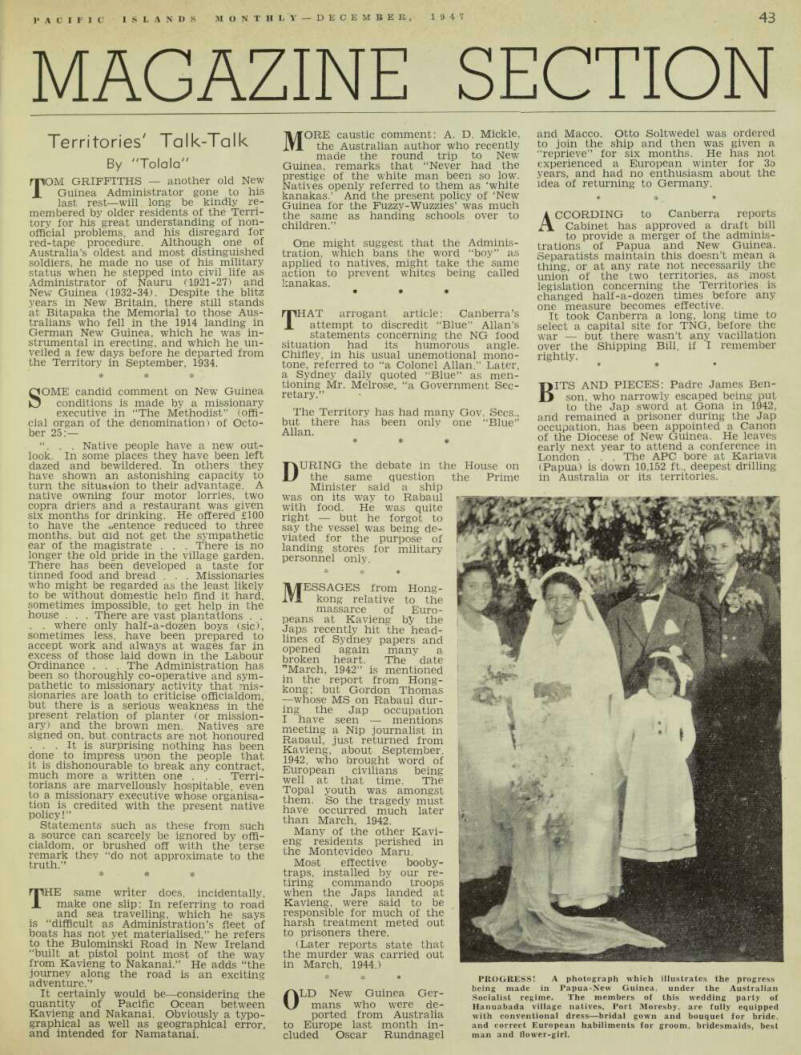
Territories ' Talk-Talk
By "Tolala"
TOM GRIFFITHS another old New Guinea Administrator gone to his last rest—will long be kindly re membered by older residents of the Terri tory for his great understanding of non official problems, and his disregard for red-tape procedure. Although one of Australia’s oldest and most distinguished soldiers, he made no use of his military status when he stepped into civil life as Administrator of Nauru (1921-27) and New Guinea (1932-34). Despite the blitz years in New Britain, there still stands at Bitapaka the Memorial to those Aus tralians who fell in the 1914 landing in German New Guinea, which he was in strumental in erecting, and which he un veiled a few days before he departed from the Territory in September, 1934. * * * SOME candid comment on New Guinea conditions is made by a missionary executive in “The Methodist” (offi cial organ of the denomination) of Octo ber 25; . Native people have a new out look. In some places they have been left dazed and bewildered. In others they have shown an astonishing capacity to turn the situation to their advantage. A native owning four motor lorries, two copra driers and a restaurant was given six months for drinking. He offered £lOO to have the sentence reduced to three months, but did not get the sympathetic ear of the magistrate . . . There is no longer the old pride in the village garden.
There has been developed a taste for tinned food and bread . . . Missionaries who might be regarded as the least likely to be without domestic helo find it hard, sometimes impossible, to get help in the house . . . There are vast plantations . . . . where only half-a-dozen boys (sic), sometimes less, have been prepared to accept work and always at wages far In excess of those laid down in the Labour Ordinance . . . The Administration has been so thoroughly co-operative and sym pathetic to missionary activity that mis sionaries are loath to criticise officialdom, but there is a serious weakness in the present relation of planter (or mission ary) and the brown men. Natives are signed on, but contracts are not honoured ... It is surprising nothing has been done to impress upon the people that it is dishonourable to break any contract, much more a written one . . . Terri torians are marvellously hospitable, even to a missionary executive whose organisa tion is credited with the present native policy!”
Statements such as these from such a source can scarcely be ignored by offi cialdom, or brushed off with the terse remark thev “do not approximate to the truth.” * * * THE same writer does, incidentally, make one slip: In referring to road and sea travelling, which he says is “difficult as Administration’s fleet of boats has not yet materialised.” he refers to the Bulomihski Road in New Ireland “built at pistol point most of the way from Kavieng to Nakanai.” He adds “the journey along the road is an exciting adventure.”
It certainly would be —considering the quantity of Pacific Ocean between Kavieng and Nakanai. Obviously a typo graphical as well as geographical error, and intended for Namatanai.
MORE caustic comment: A. D. Mickle, the Australian author who recently made the round trip to New Guinea, remarks that “Never had the prestige of the white man been so low.
Natives openly referred to them as ‘white kanakas.’ And the present policy of ‘New Guinea for the Fuzzy-Wuzzies’ was much the same as handing schools over to children.”
One might suggest that the Adminis tration, which bans the word “boy” as applied to natives, might take the same action to prevent whites being called kanakas. • ♦ • THAT arrogant article; Canberra’s attempt to discredit “Blue” Allan’s statements concerning the NG food situation had its humorous angle.
Chifley, in his usual unemotional mono tone, referred to “a Colonel Allan.” Later, a Sydney daily quoted “Blue” as men tioning Mr. Melrose, “a Government Sec retary.”
The Territory has had many Gov. Secs., but there has been onlv one “Blue”
Allan. * * * DURING the debate in the House on the same question the Prime
Minister said a ship was on its way to Rabaul with food. He was quite right but he forgot to say the vessel was being de viated for the purpose of landing stores for military personnel only. * * * MESSAGES from Hong kong relative to the massarce of Euro peans at Kavieng by the Japs recently hit the head lines of Sydney papers and opened again many a broken heart. The date "March, 1942” is mentioned in the report from Hong kong; but Gordon Thomas —whose MS on Rabaul dur ing the Jap occupation I have seen mentions meeting a Nip journalist in Raoaul, just returned from Kavieng, about September. 1942, who brought word of European civilians being well at that time. The Topal youth was amongst them. So the tragedy must have occurred much later than March, 1942.
Many of the other Kavi eng residents perished in the Montevideo Maru.
Most effective booby traps, installed by our re tiring commando troops when the Japs landed at Kavieng, were said to be responsible for much of the harsh treatment meted out to prisoners there. (Later reports state that the murder was carried out in March, 1944.) * * * OLD New Guinea Ger mans who were de ported from Australia to Europe last month in cluded Oscar Rundnagel
and Macco. Otto Soltwedel was ordered to join the ship and then was given a “reprieve” for six months. He has not experienced a European winter for 3b years, and had no enthusiasm about the idea of returning to Germany. ♦ * ♦ ACCORDING to Canberra reports Cabinet has approved a draft bill to provide a merger of the adminis trations of Papua and New Guinea.
Separatists maintain this doesn’t mean a thing, or at any rate not necessarily the union of the two territories, as most legislation concerning the Territories is changed half-a-dozen times before any one measure becomes effective.
It took Canberra a long, long time to select a capital site for TNG, before the war but there wasn’t any vacillation over the Shipping Bill, if I remember rightly. * * • BITS AND PIECES: Padre James Ben son, who narrowly escaped being put to the Jap sword at Gona in 1942, and remained a nrisoner during the Jap occupation, has been appointed a Canon of the Diocese of New Guinea. He leaves early next year to attend a conference in London . . . The APC bore at Kariava (Papua) is down 10,152 ft., deepest drilling in Australia or its territories.
PROGRESS! A photograph which illustrates the progress being made in Papua-New Guinea, under the Australian Socialist regime. The members of this wedding party of Hanuabada village natives, Port Moresby, are fully equipped with conventional dress —bridal gown and bouquet for bride, and correct European habiliments for groom, bridesmaids, best man and flower-girl.
The Craig
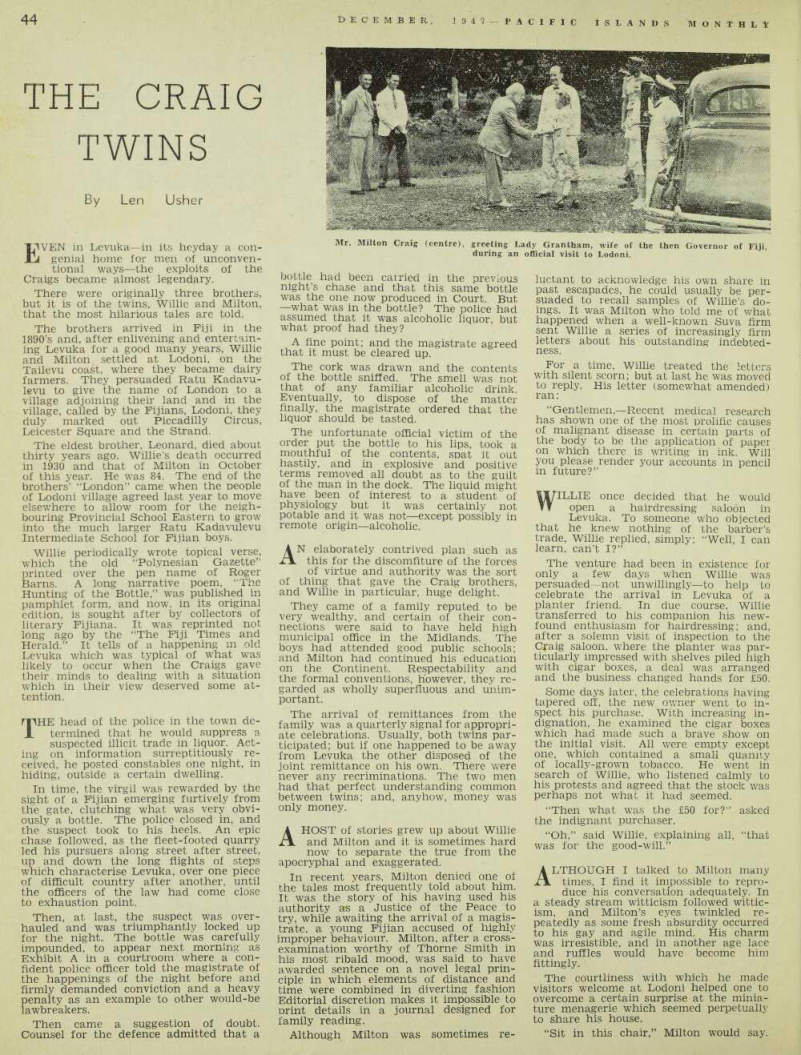
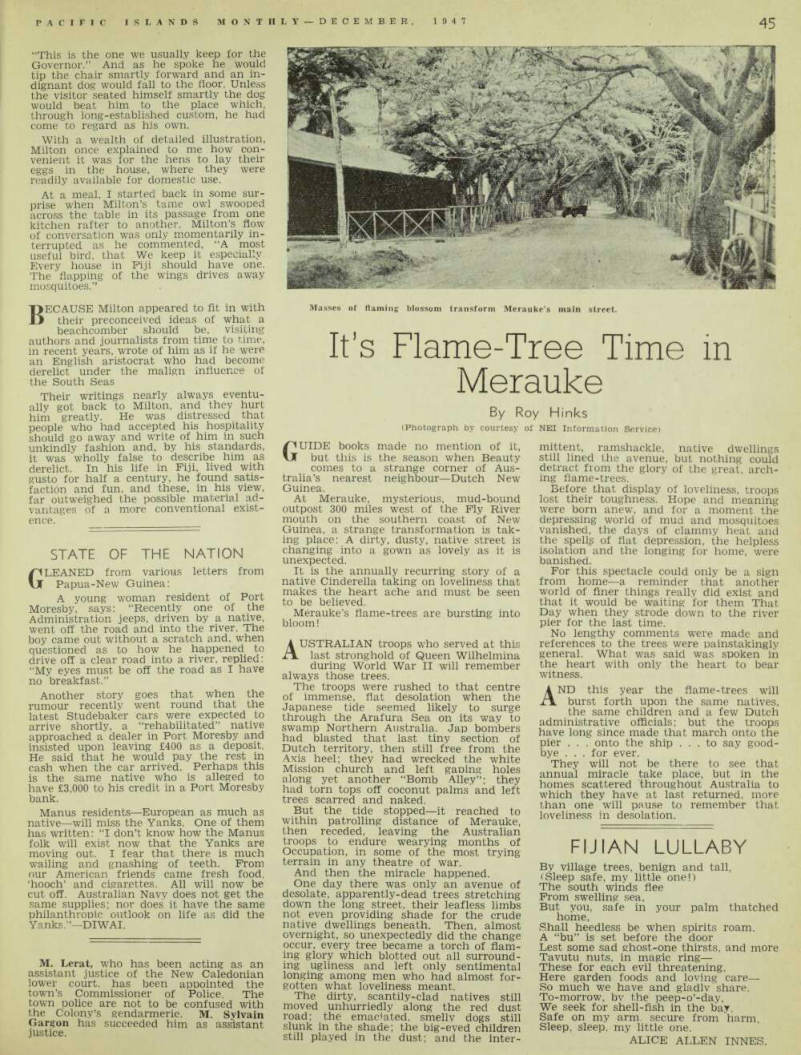
Twins
By Len Usher
in Levuka —in its heyday a con l genial home for men of unconven tional ways—the exploits of the Craigs became almost legendary.
There were originally three brothers, but it is of the twins, Willie and Milton, that the most hilarious tales are told.
The brothers arrived in Fiji in the 1890's and, after enlivening and entertain ing Levuka for a good many years, Willie and Milton settled at Lodoni. on the Tailevu coast, where they became dairy farmers. They persuaded Ratu Kadavu levu to give the name of London to a village adjoining their land and in the village, called by the Fijians, Lodoni. they duly marked out Piccadilly Circus, Leicester Square and the Strand.
The eldest brother, Leonard, died about thirty years ago. Willie’s death occurred in 1930 and that of Milton in October of this year. He was 84. The end of the brothers’ “London” came when the people of Lodoni village agreed last year to move elsewhere to allow room for the neigh bouring Provincial School Eastern to grow into the much larger Ratu Kadavulevu Intermediate School for Fijian boys.
Willie periodically wrote topical verse, which the old “Polynesian Gazette” printed over the pen name of Roger Barns. A long narrative poem. “The Hunting of the Bottle,” was published in pamphlet form, and now. in its original edition, is sought after by collectors of literary Fijiana. It was reprinted not long ago by the “The Fiji Times and Herald.” It tells of a happening in old Levuka which was typical of what was likely to occur when the Craigs gave their minds to dealing with a situation which in their view deserved some at tention. 11HE head of the police in the town de . termined that he would suppress a suspected illicit trade in liquor. Act ing on information surreptitiously re ceived, he posted constables one night, in hiding, outside a certain dwelling.
In time, the virgil was rewarded by the sight of a Fijian emerging furtively from the gate, clutching what was very obvi ously a bottle. The police closed in, and the suspect took to his heels. An epic chase followed, as the fleet-footed quarry led his pursuers along street after street, up and down the long flights of steps which characterise Levuka, over one piece of difficult country after another, until the officers of the law had come close to exhaustion point.
Then, at last, the suspect was over hauled and was triumphantly locked up for the night. The bottle was carefully impounded, to appear next morning as Exhibit A in a courtroom where a con fident police officer told the magistrate of the happenings of the night before and firmly demanded conviction and a heavy penalty as an example to other would-be lawbreakers.
Then came a suggestion of doubt.
Counsel for the defence admitted that a
bottle had been carried in the previous night’s chase and that this same bottle was the one now produced in Court. But —what was in the bottle? The police had assumed that it was alcoholic liquor, but what proof had they?
A fine point; and the magistrate agreed that it must be cleared up.
The cork was drawn and the contents of the bottle sniffed. The smell was not that of any familiar alcoholic drink.
Eventually, to dispose of the matter finally, the magistrate ordered that the liquor should be tasted.
The unfortunate official victim of the order put the bottle to his lips, took a mouthful of the contents, spat it out hastily, and in explosive and positive terms removed all doubt as to the guilt of the man in the dock. The liquid might have been of interest to a student of physiology but it was certainly not potable and it was not—except possibly in remote origin—alcoholic.
AN elaborately contrived plan. such as this for the discomfiture of the forces of virtue and authority was the sort of thing that gave the Craig brothers, and Willie in particular, huge delight.
They came of a family reputed to be very wealthy, and certain of their con nections were said to have held high municipal office in the Midlands. The boys had attended good public schools; and Milton had continued his education on the Continent. Respectability and the formal conventions, however, they re garded as wholly superfluous and unim portant.
The arrival of remittances from the family was a quarterly signal for appropri ate celebrations. Usually, both twins par ticipated; but if one happened to be away from Levuka the other disposed of the joint remittance on his own. There were never any recriminations. The two men had that perfect understanding common between twins; and, anyhow, money was only money.
A HOST of stories grew up about Willie and Milton and it is sometimes hard now to separate the true from the apocryphal and exaggerated.
In recent years, Milton denied one of the tales most frequently told about him.
It was the story of his having used his authority as a Justice of the Peace to try, while awaiting the arrival of a magis trate, a young Fijian accused of highly improper behaviour, Milton, after a cross examination worthy of Thorne Smith in his most ribald mood, was said to have awarded sentence on a novel legal prin ciple in which elements of distance and time were combined in diverting fashion Editorial discretion makes it impossible to nrint details in a journal designed for family reading.
Although Milton was sometimes re
luctant to acknowledge his own share in past escapades, he could usually be per suaded to recall samples of Willie’s do ings. It was Milton who told me of what happened when a well-known Suva firm sent Willie a series of increasingly firm letters about his outstanding indebted ness.
For a time, Willie treated the letters with silent scorn; but at last he was moved to reply. His letter (somewhat amended) ran: “Gentlemen,—Recent medical research has shown one of the most prolific causes of malignant disease in certain parts of the body to be the application of paper on which there is writing in ink. Will you please render your accounts in pencil in future?”
WILLIE once decided that he would open a hairdressing saloon in Levuka. To someone who objected that he knew nothing of the barber’s trade, Willie replied, simply; “Well, I can learn, can’t I?”
The venture had been in existence for only a few days when Willie was persuaded—not unwillingly—to help to celebrate the arrival in Levuka of a planter friend. In due course, Willie transferred to his companion his new found enthusiasm for hairdressing; and, after a solemn visit of inspection to the Craig saloon, where the planter was par ticularly impressed with shelves piled high with cigar boxes, a deal was arranged and the business changed hands for £5O, Some days later, the celebrations having tapered off, the new owner went to in spect his purchase. With increasing in dignation, he examined the cigar boxes which had made such a brave show on the initial visit. All were empty except one, which contained a small quanity of locally-grown tobacco. He went in search of Willie, who listened calmly to his protests and agreed that the stock was perhaps not what it had seemed.
“Then what was the £5O for?” asked the indignant purchaser.
“Oh,” said Willie, explaining all, “that was for the good-will.”
ALTHOUGH I talked to Milton many times, I find it impossible to repro duce his conversation adequately. In a steady stream witticism followed wittic ism, and Milton’s eyes twinkled re peatedly as some fresh absurdity occurred to his gay and agile mind. His charm was irresistible, and in another age lace and ruffles would have become him fittingly.
The courtliness with which he made visitors welcome at Lodoni helped one to overcome a certain surprise at the minia ture menagerie which seemed perpetually to share his house.
“Sit in this chair,” Milton would say.
Mr. Milton Craig (centre), greeting Lady Grantham, wife of the then Governor of Fiji, during an official visit to Lodoni.
“This is the one we usually keep for the Governor.” And as he spoke he would tip the chair smartly forward and an in dignant dog would fall to the floor. Unless the visitor seated himself smartly the dog would beat him to the place which, through long-established custom, he had come to regard as his own.
With a wealth of detailed illustration, Milton once explained to me how con venient it was for the hens to lay their eggs in the house, where they were readily available for domestic use.
At a meal, I started back in some sur prise when Milton’s tame owl swooped across the table in its passage from one kitchen rafter to another. Milton’s flow of conversation was only momentarily in terrupted as he commented, “A most useful bird, that We keep it especially.
Every house in Fiji should have one.
The flapping of the wings drives away mosquitoes.”
BECAUSE Milton appeared to fit in with their preconceived ideas of what a beachcomber should be, visiting authors and journalists from time to time, in recent years, wrote of him as if he were an English aristocrat who had become derelict under the malign influence of the South Seas Their writings nearly always eventu ally got back to Milton, and they hurt him greatly. He was distressed that people who had accepted his hospitality should go away and write of him in such unkindly fashion and, by his standards, it was wholly false to describe him as derelict. In his life in Fiji, lived with gusto for half a century, he found satis faction and fun, and these, in his view, far outweighed the possible material ad vantages of a more conventional exist ence.
State Of The Nation
GLEANED from various letters from Papua-New Guinea: A young woman resident of Port Moresby, says: “Recently one of the Administration jeeps, driven by a native, went off the road and into the river. The boy came out without a scratch and, when questioned as to how he happened to drive off a clear road into a river, replied: “My eyes must be off the road as I have no breakfast.”
Another story goes that when the rumour recently went round that the latest Studebaker cars were expected to arrive shortly, a “rehabilitated” native approached a dealer in Port Moresby and insisted upon leaving £4OO as a deposit, He said that he would pay the rest in cash when the car arrived. Perhaps this is the same native who is alleged to have £3,000 to his credit in a Port Moresby bank.
Manus residents —European as much as native —will miss the Yanks, One of them has written: “I don’t know how the Manus folk will exist now that the Yanks are moving out. I fear that there is much wailing and gnashing of teeth. From our American friends came fresh food, ‘hooch’ and cigarettes. All will now be cut off. Australian Navy does not get the same supplies; nor does it have the same philanthropic outlook on life as did the Yanks.’’—DlWAl.
M. Lerat, who has been acting as an assistant justice of the New Caledonian lower court, has been appointed the town’s Commissioner of Police. The town police are not to be confused with the Colony’s gendarmerie. M. Sylvain Gargon has succeeded him as assistant justice.
Masses of flaming blossom transform Merauke’s main street.
It’s Flame-Tree Time in Merauke
Merauke
By Roy Hinks
(Photograph by courtesy of NEI Information Service)
UIDE books made no mention of it, X but this is the season when Beauty comes to a strange corner of Aus tralia’s nearest neighbour—Dutch New Guinea.
At Merauke, mysterious, mud-bound outpost 300 miles west of the Fly River mouth on the southern coast of New Guinea, a strange transformation is tak ing place: A dirty, dusty, native street is changing into a gown as lovely as it is unexpected.
It is the annually recurring story of a native Cinderella taking on loveliness that makes the heart ache and must be seen to be believed.
Merauke’s flame-trees are bursting into bloom!
AUSTRALIAN troops who served at this last stronghold of Queen Wilhelmina during World War II will remember always those trees.
The troops were rushed to that centre of immense, flat desolation when the Japanese tide seemed likely to surge through the Arafura Sea on its way to swamp Northern Australia. Jap bombers had blasted that last tiny section of Dutch territory, then still free from the Axis heel; they had wrecked the white Mission church and left ganing holes along yet another “Bomb Alley”; they had torn tops off coconut palms and left trees scarred and naked.
But the tide stopped—it reached to within patrolling distance of Merauke, then receded, leaving the Australian troops to endure wearying months of Occupation, in some of the most trying terrain in any theatre of war.
And then the miracle happened.
One day there was only an avenue of desolate, apparently-dead trees stretching down the long street, their leafless limbs not even providing shade for the crude native dwellings beneath. Then, almost overnight, so unexpectedly did the change occur, every tree became a torch of flam ing glory which blotted out all surround ing ugliness and left only sentimental longing among men who had almost for gotten what loveliness meant.
The dirty, scantily-clad natives still moved unhurriedly along the red dust road; the emaciated, smelly dogs still slunk in the shade; the big-eyed children still played in the dust; and the inter -
mittent, ramshackle, native dwellings still lined the avenue, but nothing could detract from the glory of the great, arch ing flame-trees.
Before that display of loveliness, troops lost their toughness. Hope and meaning were born anew, and for a moment the depressing world of mud and mosquitoes vanished, the days of clammy heat and the spells of flat depression, the helpless isolation and the longing for home, were banished.
For this spectacle could only be a sign from home—a reminder that another world of finer things really did exist and that it would be waiting for them That Day when they strode down to the river pier for the last time.
No lengthy comments were made and references to the trees were painstakingly general. What was said was spoken in the heart with only the heart to bear witness.
AND this year the flame-trees will burst forth upon the same natives, the same children and a few Dutch administrative officials; but the troops have long since made that march onto the pier . . . onto the ship ... to say good bye . . . for ever.
They will not be there to see that annual miracle take place, but in the homes scattered throughout Australia to which they have at last returned, more than one will pause to remember that loveliness in desolation.
Fijian Lullaby
By village trees, benign and tall, (Sleep safe, my little one!) The south winds flee From swelling sea, But you, safe in your palm thatched home, Shall heedless be when spirits roam.
A “bu” is set before the door Lest some sad ghost-one thirsts, and more Tavutu nuts, in magic ring— These for each evil threatening.
Here garden foods and loving care— So much we have and gladlv share.
To-morrow, bv the peep-o’-day, We seek for shell-fish in the bay.
Safe on my arm. secure from harm, Sleep, sleep, my little one.
Alice Allen Innes.
MAKOGAI-Pacific Paradise for
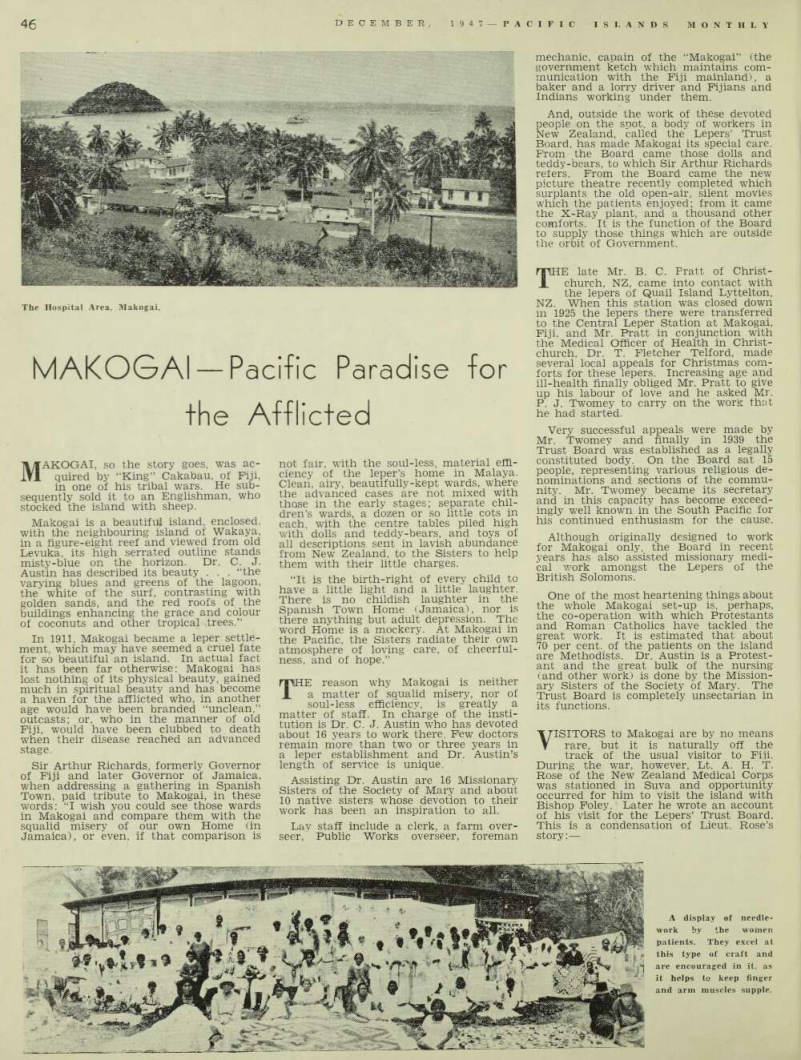
the Afflicted
MAKOGAI, so the story goes, was ac quired by “King” Cakabau, of Fiji, in one of his tribal wars. He sub sequently sold it to an Englishman, who stocked the island with sheep.
Makogai is a beautiful island, enclosed, with the neighbouring island of Wakaya, in a figure-eight reef and viewed from old Levuka, its high serrated outline stands misty-blue on the horizon. Dr. C. J.
Austin has described its beauty . . . “the varying blues and greens of the lagoon, the white of the surf, contrasting with golden sands, and the red roofs of the buildings enhancing the grace and colour of coconuts and other tropical trees.”
In 1911, Makogai became a leper settle ment, which may have seemed a cruel fate for so beautiful an island. In actual fact it has been far otherwise: Makogai has lost nothing of its physical beauty, gained much in spiritual beauty and has become a haven for the afflicted who, in another age would have been branded “unclean,” outcasts; or, who in the manner of old Fiji, would have been clubbed to death when their disease reached an advanced stage.
Sir Arthur Richards, formerly Governor of Fiji and later Governor of Jamaica, when addressing a gathering in Spanish Town, paid tribute to Makogai, in these words: “I wish you could see those wards in Makogai and compare them with the squalid misery of our own Home (in Jamaica), or even, if that comparison is
not fair, with the soul-less, material effi ciency of the leper’s home in Malaya.
Clean, airy, beautifully-kept wards, where the advanced cases are not mixed with those in the early stages; separate chil dren’s wards, a dozen or so little cots in each, with the centre tables piled high with dolls and teddy-bears, and toys of all descriptions sent in lavish abundance from New Zealand, to the Sisters to help them with their little charges.
“It is the birth-right of every child to have a little light and a little laughter.
There is no childish laughter in the Spanish Town Home (Jamaica), nor is there anything but adult depression. The word Home is a mockery. At Makogai in the Pacific, the Sisters radiate their own atmosphere of loving care, of cheerful ness, and of hope.’’ fIIHE reason why Makogai is neither X a matter of soualid misery, nor of soul-less efficiency, is greatly a matter of staff. In charge of the insti tution is Dr. C. J. Austin who has devoted about 16 years to work there. Few doctors remain more than two or three years in a leper establishment and Dr. Austin’s length of service is unique.
Assisting Dr. Austin are 16 Missionary Sisters of the Society of Mary and about 10 native sisters whose devotion to their work has been an inspiration to all.
Lay staff include a clerk, a farm over seer, Public Works overseer, foreman
mechanic, capain of the “Makogai” (the government ketch which maintains com munication with the Fiji mainland), a baker and a lorry driver and Fijians and Indians working under them.
And, outside the work of these devoted people on the spot, a body of workers in New Zealand, called the Lepers’ Trust Board, has made Makogai its special care.
From the Board came those dolls and teddy-bears, to which Sir Arthur Richards refers. From the Board came the new picture theatre recently completed which supplants the old open-air, silent movies which the patients enjoyed; from it came the X-Ray plant, and a thousand other comforts. It is the function of the Board to supply those things which are outside the orbit of Government. rE late Mr. B. C. Pratt of Christ church, NZ, came into contact with the lepers of Quail Island Lyttelton, NZ. When this station was closed down in 1925 the lepers there were transferred to the Central Leper Station at Makogai, Fiji, and Mr. Pratt in conjunction with the Medical Officer of Health in Christ church. Dr. T. Fletcher Telford, made several local appeals for Christmas com forts for these lepers. Increasing age and ill-health finally obliged Mr. Pratt to give up his labour of love and he asked Mr.
P. J. Twomey to carry on the work that he had started.
Very successful appeals were made by Mr. Twomey and finally in 1939 the Trust Board was established as a legally constituted body. On the Board sat 15 people, representing various religious de nominations and sections of the commu nity. Mr. Twomey became its secretary and in this capacity has become exceed ingly well known in the South Pacific for his continued enthusiasm for the cause.
Although originally designed to work for Makogai only, the Board in recent years has also assisted missionary medi cal work amongst the Lepers of the British Solomons.
One of the most heartening things about the whole Makogai set-up is, perhaps, the co-operation with which Protestants and Roman Catholics have tackled the great work. It is estimated that about 70 per cent, of the patients on the island are Methodists. Dr. Austin is a Protest ant and the great bulk of the nursing (and other work) is done by the Mission ary Sisters of the Society of Mary. The Trust Board is completely unsectarian in its functions.
VISITORS to Makogai are by no means rare, but it is naturally off the track of the usual visitor to Fiji.
During the war, however, Lt. A. H. T.
Rose of the New Zealand Medical Corps was stationed in Suva and opportunity occurred for him to visit the island with Bishop Foley. Later he wrote an account of his visit for the Lepers’ Trust Board.
This is a condensation of Lieut. Rose’s story:—
The Hospital Area, Makogai.
A display of needle work by the women patients. They excel at this type of craft and are encouraged in it, as it helps to keep finger and arm muscles supple.
Where Cheerfulness is the Keynote
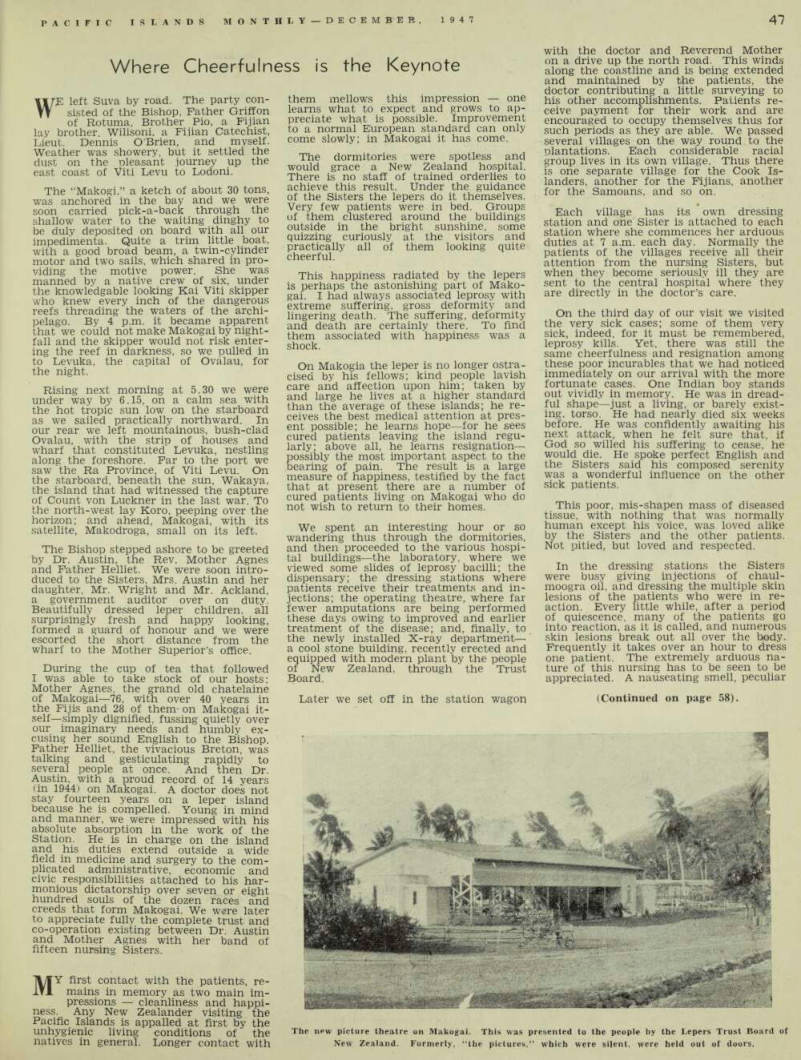
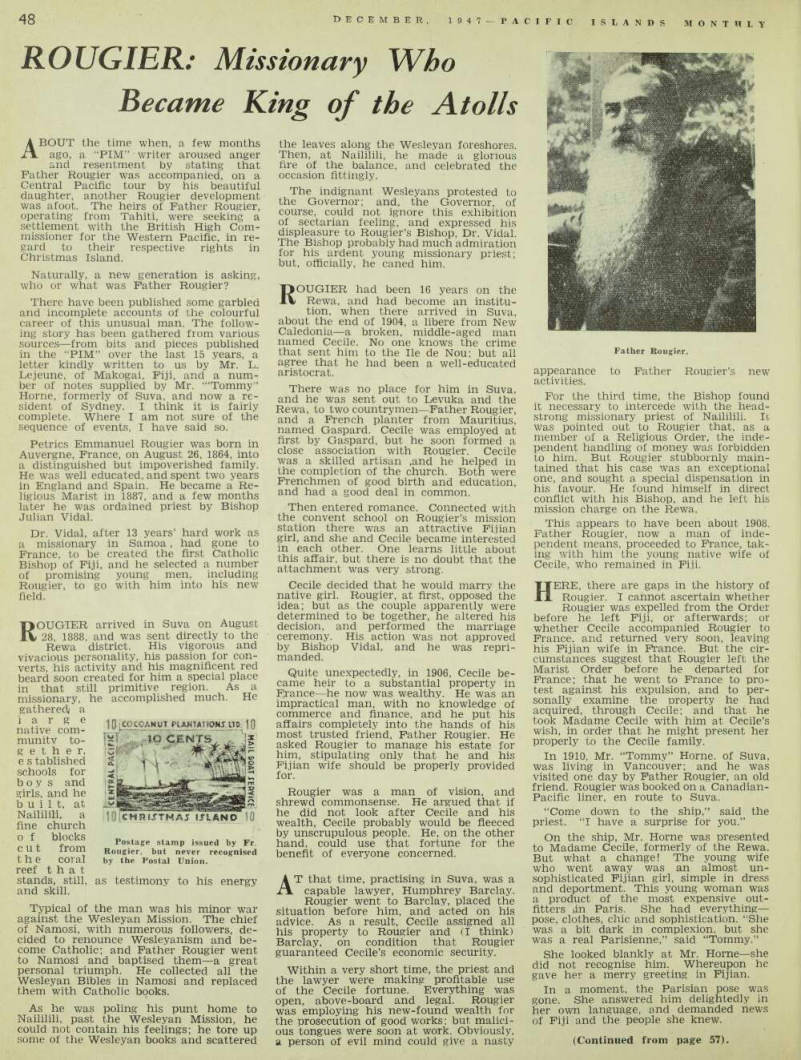
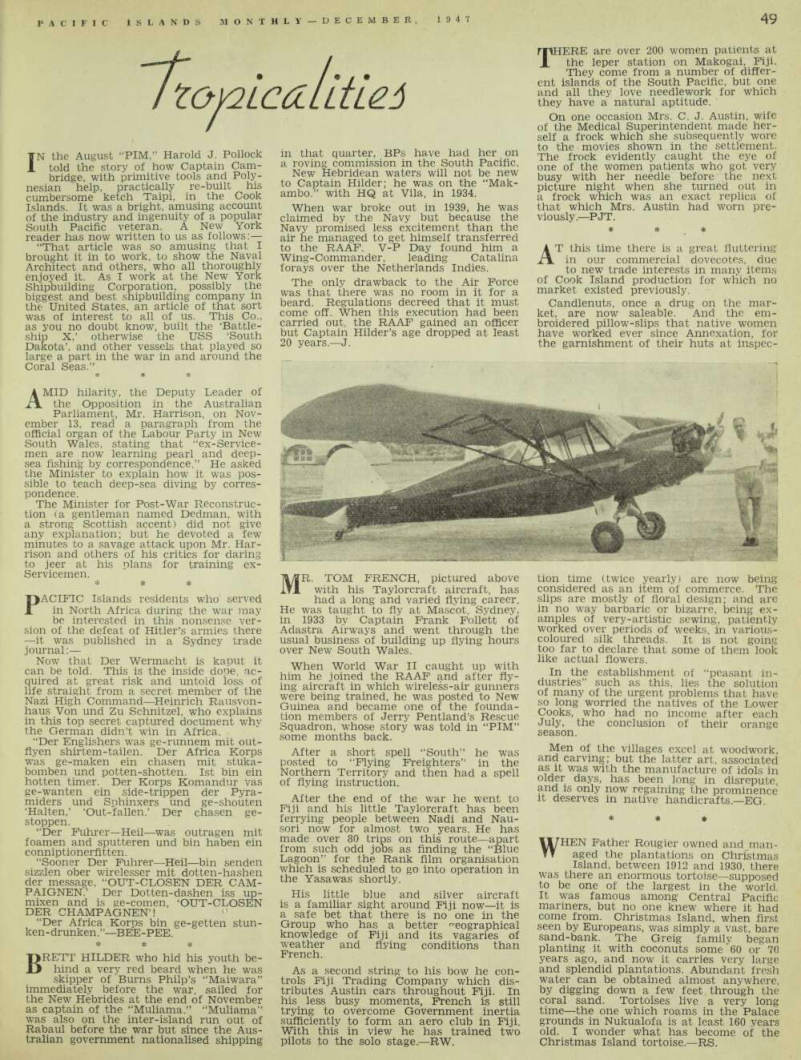
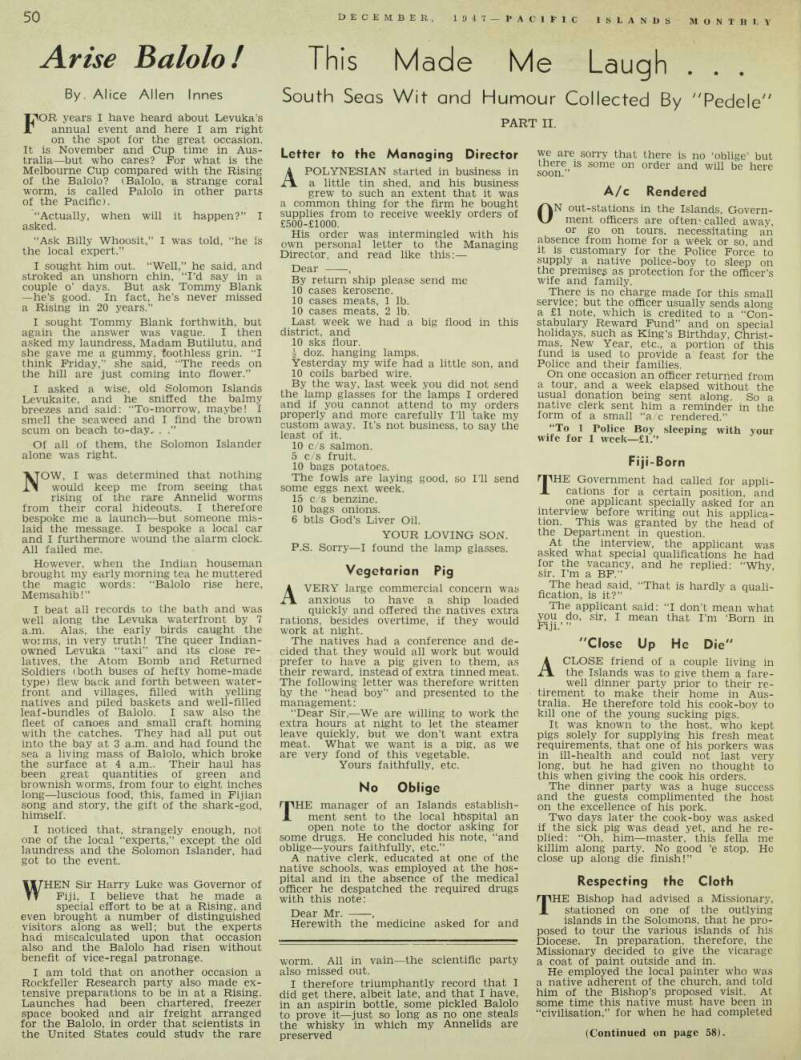
WE left Suva by road. The party con sisted of the Bishop, Father Griffon of Rotuma, Brother Pio, a Fijian lay brother. Wilisoni. a Fijian Catechist, Lieut. Dennis O'Brien, and myself.
Weather was showery, but it settled the dust on the pleasant journey up the east coast of Viti Levu to Lodoni.
The “Makogi,” a ketch of about 30 tons, was anchored in the bay and we were soon carried pick-a-back through the shallow water to the waiting dinghy to be duly deposited on board with all our impedimenta. Quite a trim little boat, with a good broad beam, a twin-cylinder motor and two sails, which shared in pro viding the motive power. She was manned by a native crew of six, under the knowledgable looking Kai Viti skipper who knew every inch of the dangerous reefs threading the waters of the archi pelago. By 4 p.m. it became apparent that we could not make Makogai by night fall and the skipper would not risk enter ing the reef in darkness, so we nulled in to Levuka, the capital of Ovalau, for the night.
Rising next morning at 5.30 we were under way by 6.15, on a calm sea with the hot tropic sun low on the starboard as we sailed practically northward. In our rear we left mountainous, bush-clad Ovalau, with the strin of houses and wharf that constituted Levuka, nestling along the foreshore. Far to the port we saw the Ra Province, of Viti Levu. On the starboard, beneath the sun, Wakaya, the island that had witnessed the capture of Count von Luckner in the last war. To the north-west lay Koro, peeping over the horizon; and ahead, Makogai, with its satellite, Makodroga, small on its left.
The Bishop stepped ashore to be greeted by Dr. Austin, the Rev. Mother Agnes and Father Helliet. We were soon intro duced to the Sisters, Mrs. Austin and her daughter, Mr. Wright and Mr. Ackland, a government auditor over on duty.
Beautifully dressed leper children, all surprisingly fresh and happy looking, formed a guard of honour and we were escorted the short distance from the wharf to the Mother Superior’s office.
During the cup of tea that followed I was able to take stock of our hosts: Mother Agnes, the grand old chatelaine of Makogai—76, with over 40 years in the Fijis and 28 of thenv on Makogai it self—simply dignified, fussing quietly over our imaginary needs and humbly ex cusing her sound English to the Bishop.
Father Helliet, the vivacious Breton, was talking and gesticulating rapidly to several people at once. And then Dr.
Austin, with a proud record of 14 years (in 1944) on Makogai. A doctor does not stay fourteen years on a leper island because he is compelled. Young in mind and manner, we were impressed with his absolute absorption in the work of the Station. He is in charge on the island and his duties extend outside a wide field in medicine and surgery to the com plicated administrative, economic and civic responsibilities attached to his har monious dictatorship over seven or eight hundred souls of the dozen races and creeds that form Makogai. We w*?re later to appreciate fullv the complete trust and co-operation existing between Dr. Austin and Mother Agnes with her band of fifteen nursing Sisters.
MY first contact with the patients, re mains in memory as two main im pressions cleanliness and happi ness. Any New Zealander visiting the Pacific Islands is appalled at first by the unhygienic living conditions of the natives in general. Longer contact with
them mellows this impression one learns what to expect and grows to ap preciate what is possible. Improvement to a normal European standard can only come slowly: in Makogai it has come.
The dormitories were spotless and would grace a New Zealand hospital.
There is no staff of trained orderlies to achieve this result. Under the guidance of the Sisters the lepers do it themselves.
Very few patients were in bed. Groups of them clustered around the buildings outside in the bright sunshine, some quizzing curiously at the visitors and practically all of them looking quite cheerful.
This happiness radiated by the lepers is perhaps the astonishing part of Mako gai. I had always associated leprosy with extreme suffering, gross deformity and lingering death. The suffering, deformity and death are certainly there. To find them associated with happiness was a shock.
On Makogia the leper is no longer ostra cised by his fellows; kind people lavish care and affection upon him; taken by and large he lives at a higher standard than the average of these islands; he re ceives the best medical attention at pres ent possible; he learns hope—for he sees cured patients leaving the island regu larly; above all, he learns resignation— possibly the most important aspect to the bearing of pain. The result is a large measure of happiness, testified by the fact that at present there are a number of cured patients living on Makogai who do not wish to return to their homes.
We spent an interesting hour or so wandering thus through the dormitories, and then proceeded to the various hospi tal buildings—the laboratory, where we viewed some slides of leprosy bacilli; the dispensary; the dressing stations where patients receive their treatments and in jections; the operating theatre, where far fewer amputations are being performed these days owing to improved and earlier treatment of the disease; and, finally, to the newly installed X-ray department— a cool stone building, recently erected and equipped with modern plant by the people of New Zealand, through the Trust Board.
Later we set off in the station wagon
with the doctor and Reverend Mother on a drive up the north road. This winds along the coastline and is being extended and maintained by the patients, the doctor contributing a little surveying to his other accomplishments. Patients re ceive payment for their work and are encouraged to occupy themselves thus for such periods as they are able. We passed several villages on the way round to the plantations. Each considerable racial group lives in its own village. Thus there is one separate village for the Cook Is landers, another for the Fijians, another for the Samoans, and so on. • Each village has its own dressing station and one Sister is attached to each station where she commences her arduous duties at 7 a.m. each day. Normally the patients of the villages receive all their attention from the nursing Sisters, but when they become seriously ill they are sent to the central hospital where they are directly in the doctor’s care.
On the third day of our visit we visited the very sick cases; some of them very sick, indeed, for it must be remembered, leprosy kills. Yet, there was still the same cheerfulness and resignation among these poor incurables that we had noticed immediately on our arrival with the more fortunate cases. One Indian boy stands out vividly in memory. He was in dread ful shape—just a living, or barely exist ing. torso. He had nearly died six weeks before. He was confidently awaiting his next attack, when he felt sure that, if God so willed his suffering to cease, he would die. He spoke perfect English and the Sisters said his composed serenity was a wonderful influence on the other sick patients.
This poor, mis-shapen mass of diseased tissue, with nothing that was normally human except his voice, was loved alike by the Sisters and the other patients.
Not pitied, but loved and respected.
In the dressing stations the Sisters were busy giving injections of chaul moogra oil, and dressing the multiple skin lesions of the patients who were in re action. Every little while, after a period of quiescence, many of the patients go into reaction, as it is called, and numerous skin lesions break out all over the body.
Frequently it takes over an hour to dress one patient. The extremely arduous na ture of this nursing has to be seen to be appreciated. A nauseating smell, peculiar
(Continued on page 58).
The new picture theatre on Makogai. This was presented to the people by the Lepers Trust Board of New Zealand. Formerly, “the pictures,” which were silent, were held out of doors.
to leprosy, emanates from their bodies, and, in the sweltering heat, the Sisters just toil on, hour after hour, until the job is done.
That day we made the three mile trip in the station waggon to the doctor’s resi dence at Nasau. The house is well situ ated on a headland overlooking the reef which encloses the two islands of Makogai and Wakaya. Mrs. Austin was a charm ing hostess and after dinner we repaired outside to admire the garden which hard labour had produced on that windswept headland from an unwilling few inches of soil. It seemed a monument to the patience and fortitude that has sustained her for fourteen years, faithfully sup porting her husband in his work and rearing a family in circumstances so far removed from the normal lot of a doctor’s wife.
The country about Nasau is more open and supports the herds that produce the
island s supply of milk. All the clean workers of Makogai live at the Nasau end, no lepers being allowed in the whole t 0 is the ba kery, where hundreds of loaves of bread are produced 0. silly* . it own little way Makogai is an ob ject lesson in this war-torn, hating world. A dozen widely differing races and religions, with a tremendous physical handicap, live together amicably, in fru with little obvious discipline except that which grows naturally out of the practice of Christian charity, kind ness and mutual understanding. vooi 10 Zealand visitor has every reason to fee! proud on Makogai. On all 18 remi nd e d that this, or that, New Zealand. Government issues are, of course, at a fairlv bare minimum, and the hard labours of Mr and tbe Leper Trust Board generosity of the people of New Zealand, are responsible for most of the amenities and little luxuries to be seen on the island; those little comforts often whfrh nt rJSL in our v, oyos t 0 80 *n uch ln raising the stan °JLH v - mg °? i2 oth Patients and the s^aff - New Zealand has Makogai—it is her leper island, and Makogai responds by taking New Zealanders right into its heart.
Became King of the Atolls
ROUGIER: Missiona Became King of the Atolls
ABOUT the time when, a few months ago, a “PIM” writer aroused anger and resentment by stating that Father Rougier was accompanied, on a Central Pacific tour by his beautiful daughter, another Rougier development was afoot. The heirs of Father Rougier, operating from Tahiti, were seeking a settlement with the British High Com missioner for the Western Pacific, in re gard to their respective rights in Christmas Island.
Naturally, a new generation is asking, who or what was Father Rougier?
There have been published some garbled and incomplete accounts of the colourful career of this unusual man. The follow ing story has been gathered from various sources—from bits and pieces published in the “PIM” over the last 15 years, a letter kindly written to us by Mr. L.
Lejeune, of Makogai, Fiji, and a num ber of notes supplied by Mr. ‘“Tommy'’
Horne, formerly of Suva, and now a re sident of Sydney. I think it is fairly complete. Where I am not sure of the sequence of events, I have said so.
Petries Emmanuel Rougier was born in Auvergne, France, on August 26, 1864, into a distinguished but impoverished family.
He was well educated, and spent two years in England and Spain. He became a Re ligious Marist in 1887, and a few months later he was ordained priest by Bishop Julian Vidal.
Dr. Vidal, after 13 years’ hard work as a missionary in Samoa, had gone to France, to be created the first Catholic Bishop of Fiji, and he selected a number of promising young men, including Rougier, to go with him into his new field.
ROUGIER arrived in Suva on August 28, 1888, and was sent directly to the Rewa district. His vigorous and vivacious personality, his passion for con verts, his activity and his magnificent red beard soon created for him a special place in that still primitive region. As a missionary, he accomplished much. He gathered; a
large native com munity to g e t h e r, e s tablished schools for boys and girls, and he built, at Naililili, a fine church o f blocks cut from the coral reef that
stands, still, as testimony to his energy and skill.
Typical of the man was his minor war against the Wesleyan Mission. The chief of Namosi, with numerous followers, de cided to renounce Wesleyanism and be come Catholic; and Father Rougier went to Namosi and baptised them —a great personal triumph. He collected all the Wesleyan Bibles in Namosi and replaced them with Catholic books.
As he was poling his punt home to Naililili, past the Wesleyan Mission, he could not contain his feelings; he tore up some of the Wesleyan books and scattered
the leaves along the Wesleyan foreshores.
Then, at Naililili, he made a glorious fire of the balance, and celebrated the occasion fittingly.
The indignant Wesleyans protested to the Governor; and, the Governor, of course, could not ignore this exhibition of sectarian feeling, and expressed his displeasure to Rougier’s Bishop, Dr. Vidal.
The Bishop probably had much admiration for his ardent young missionary priest; but, officially, he caned him.
ROUGIER had been 16 years on the Rewa, and had become an institu tion, when there arrived in Suva, about the end of 1904, a libere from New Caledonia—a broken, middle-aged man named Cecile. No one knows the crime that sent him to the He de Nou; but all agree that he had been a well-educated aristocrat.
There was no place for him in Suva, and he was sent out to Levuka and the Rewa, to two countrymen—Father Rougier, and a French planter from Mauritius, named Gaspard. Cecile was employed at first by Gaspard, but he soon formed a close association with Rougier. Cecile was a skilled artisan ,and he helped in the completion of the church. Both were Frenchmen of good birth and education, and had a good deal in common.
Then entered romance. Connected with the convent school on Rougier’s mission station there was an attractive Fijian girl, and she and Cecile became interested in each other. One learns little about this affair, but there is no doubt that the attachment was very strong.
Cecile decided that he would marry the native girl. Rougier, at first, opposed the idea: but as the couple apparently were determined to be together, he altered his decision, and performed the marriage ceremony. His action was not approved by Bishop Vidal, and he was repri manded.
Quite unexpectedly, in 1906, Cecile be came heir to a substantial property in France —he now was wealthy. He was an impractical man, with no knowledge of commerce and finance, and he put his affairs completely into the hands of his most trusted friend, Father Rougier. He asked Rougier to manage his estate for him, stipulating only that he and his Fijian wife should be properly provided for.
Rougier was a man of vision, and shrewd commonsense. He argued that if he did not look after Cecile and his wealth, Cecile probably would be fleeced by unscrupulous people. He, on the other hand, could use that fortune for the benefit of everyone concerned.
AT that time, practising in Suva, was a capable lawyer, Humphrey Barclay.
Rougier went to Barclay, placed the situation before him, and acted on his advice. As a result, Cecile assigned all his property to Rougier and (I think) Barclay, on condition that Rougier guaranteed Cecile’s economic security.
Within a very short time, the priest and the lawyer were making profitable use of the Cecile fortune. Everything was open, above-board and legal. Rougier was employing his new-found wealth for the prosecution of good works: but malici ous tongues were soon at work. Obviously, a person of evil mind could give a nasty
appearance to Father Rougier’s new activities.
For the third time, the Bishop found it necessary to intercede with the head strong missionary priest of Naililili. It was pointed out to Rougier that, as a member of a Religious Order, the inde pendent handling of money was forbidden to him. But Rougier stubbornly main tained that his case was an exceptional one, and sought a special dispensation in his favour. He found himself in direct conflict with his Bishop, and he left his mission charge on the Rewa.
This appears to have been about 1908.
Father Rougier, now a man of inde pendent means, proceeded to Prance, tak ing with him the young native wife of Cecile, who remained in Fiji.
HERE, there are gaps in the history of Rougier. 1 cannot ascertain whether Rougier was expelled from the Order before he left Fiji, or afterwards; or whether Cecile accompanied Rougier to France, and returned very soon, leaving his Fijian wife in France. But the cir cumstances suggest that Rougier left the Marist Order before he departed for France; that he went to France to pro test against his expulsion, and to per sonally examine the property he had acquired, through Cecile; and that he took Madame Cecile with him at Cecile’s wish, in order that he might present her properly to the Cecile family.
In 1910, Mr. “Tommy” Horne, of Suva, was living in Vancouver; and he was visited one day by Father Rougier, an old friend. Rougier was booked on a Canadian- Pacific liner, en route to Suva.
“Come down to the ship,” said the priest. “I have a surprise for you.”
On the ship, Mr. Horne was presented to Madame Cecile, formerly of the Rewa.
But what a change! The young wife who went away was an almost un sophisticated Fijian girl, simple in dress and deportment. This young woman was a product of the most expensive out fitters t in Paris. She had everything— pose, clothes, chic and sophistication. “She was a bit dark in complexion, but she was a real Parisienne,” said “Tommy.”
She looked blankly at Mr. Horne—she did not recognise him. Whereupon he gave her a merry greeting in Fijian.
In a moment, the Parisian pose was gone. She answered him delightedly in her own language, and demanded news of Fiji and the people she knew.
(Continued from page 57).
Postage stamp issued by Fr.
Rougier, but never recognised by the Postal Union.
Father Rougier.
Madame Cecile returned to the Rewa district, and rejoined her husband. But his health had been failing, and he did not live much longer.
Writing in the “PIM” in 1944, H. W.
Garnett said that Madame Cecile received nothing from her husband’s estate — evidently the annuity which had been guaranteed to him by Rougier and Barclay died with him. Madame Cecile married a Fijian, and by him had several children. She was still alive in 1944, and was supported by her children —not by the Cecile estate.
FATHER ROUGIER did not resume residence in Fiji. He'travelled in the Islands, spent considerable time in France, and he soon became a successful man of business. Apparently, he and Barclay operated jointly, for a time. I remember publishing, in the “PIM,” about 15 years ago, an article which indicated that Rougier and Barclay eventually had to settle their joint affairs by litigation, but I have been unable to find the item.
While he was in France, Father Rougier used some portion of the wealth he now controlled to re-establish the estates of the Rougier family. Eventually, his nephew and nieces became his heirs.
Somewhere between 1908 and 1912, Father Rougier—l think, in association with Barclay—got possession of the plantations on Fanning and Washington Islands.
There are three large atolls out in the Central Pacific —Christinas, Washington and Fanning. The Greig family (remind us to tell the romantic story of the Greigs, sometime) pioneered all three.
When Europeans first saw them, they were covered by huge groves of healthy coconuts. The Greigs were the first planters. About 1906-7, the Greigs got into financial difficulties: and in July, 1907, it was announced that “after pro tracted litigation the Court ordered the sale of Washington and Fanning Islands, J. D. Dixon (Fiji) being sent to Fanning Island as Receiver.”
I cannot pick up the record, but it probably was at this period that Rougier acquired control over the plantations on both Fanning and Washington. By 1912 he definitely was in charge of Fanning Island.
In June, 1912, he sailed in the “Luka” from Fanning to Christmas, and made his first inspection there. He reported that only a quarter of the coconuts* planted by various speculators had sur vived a great drought, but the survivors were very healthy and would give a fine yield of copra, and a great deal of additional planting could be done. He clearly was eager to acquire Christmas.
Long before 1912, the Greigs planted Christmas; the planting was continued by Henderson and McFarlane; they sold to Levers Pacific Plantations Ltd., and the latter, just prior to Word War 1, sold to Central Pacific Plantations Ltd. (of 101 Leadenhall Street, London—governing director, Emanuel Rougier, of Les Isles Brionde, Haute-Loire, France).
Because I cannot get the records, I can only guess. But everyone knows how copra turned into gold during World War I; and I guess that Father Rougier, already rich, became much richer as the result of owning the Fanning, Washington and Christmas coconut plantations dur ing that period.
AFTER World War 1, Rougier appears to have sold his Fanning and Wash ington interests to a British company (the present owners) and, as owner of Christmas Island plantations, he settled
in Tahiti, “where the lived in baronial state in an old mansion surrounded by broad acres of coconut plantations. Dur ing many years there were few councils for the debate of civil and economic pro blems that did not invite Father Rougier to a seat of honour in the assembly.’
He maintained communication with Christmas by means of the 3-masted schooner, “Marechal Foch,” well known in Tahiti.
This was written of him by a man who knew him well: “All these money trans actions had made Father Rougier more a man of the world than a man of God.
He felt it himself, and gave up all work in connection with the Church. From that time (1908) until his death—that is, for over 20 years—he lived mostly in Papeete as a retired clergyman, saying Mass privately every day, and behaving with all the dignity of a refined gentle man.”
When he died— suddenly, from heart failure—on December 16, 1932, the “PIM”
said of him: “Since he arrived in the Colony some 15 years ago, Monsieur I’Abbe Rougier took a keen and courageous in terest in all matters affecting the public welfare, and unstintingly sacrificed his leisure for the good thereof. (Then fol lows a long list of the public positions he had held.) He was intensely interested in the introduction of beneficial flora and fauna, and maintained an extensive garden at Taaone; in this field alone his passing represents a very real loss to the Colony.” , , , . . .
Before Rougier died he had been joined in Tahiti by his nephew, also named Rougier, who became his heir, and who took charge of his business. Nephew Rougier was one of those courageous people who pressed for an official inquiry into the Kong Ah scandal, and someone fired shots at him as he was passing through Papeete in his car. The story of Kong Ah was so “hot”—it involved high personages, in Tahiti and France— that, lacking all the facts, the “PIM” did
not dare to publish anything about it when it broke in 1934.
When France collapsed, in 1940, the Rougier family apparently was caught up in the German occupation, and was not able to exercise supervision over its in terests in Christmas Island. Accordingly, the Gilbert and Ellice Islands Govern ment (Christmas, Fanning and Washing ton islands constitute a District of that Administration) took charge of the Christmas Island plantations, and pro duced copra. A few months ago, mem bers of the Rougier family arrived in Tahiti, and commenced inquiries, asking who had been looking after the planta tions, how much copra had been pro duced, and who got the benefit of it. Dis cussions are now in progress between the Rougier family and the British High Commissioner fov the Western Pacific.—
R. W. Robson.
Tropicalities
IN the August “PIM,” Harold J. Pollock told the story of how Captain Cam bridge, with primitive tools and Poly nesian help, practically re-built his cumbersome ketch Taipi, in the Cook Islands. It was a bright, amusing account of the industry and ingenuity of a popular South Pacific veteran. A New York reader has now written to us as follows: — “That article was so amusing that I brought it in to work, to show the Naval Architect and others, who all thoroughly enjoyed it. As I work at the New York Shipbuilding Corporation, possibly the biggest and best shipbuilding company in the United States, an article of that sort was of interest to all of us. This Co., as you no doubt know, built the ‘Battle ship X,’ otherwise the USS ‘South Dakota’, and other vessels that played so large a part in the war in and around the Coral Seas.” * * * AMID hilarity, the Deputy Leader of the Opposition in the Australian Parliament, Mr. Harrison, on Nov ember 13, read a paragraph from the official organ of the Labour Party in New South Wales, stating that “ex-Service men are now learning pearl and deep sea fishing by correspondence.” He asked the Minister to explain how it was pos sible to teach deep-sea diving by corres pondence.
The Minister for Post-War Reconstruc tion (a gentleman named Dedman, with a strong Scottish accent) did not give any explanation; but he devoted a few minutes to a savage attack upon Mr. Har rison and others of his critics for daring to jeer at his plans for training ex- Servicemen. * * * PACIFIC Islands residents who served in North Africa during the war may be interested in this nonsense ver sion of the defeat of Hitler’s armies there —it was published in a Sydney trade journal:— Now that Der Wermacht is kaput it can be told. This is the inside dope, ac quired at great risk and untold loss of life straight from a secret member of the Nazi High Command—Heinrich Rausvon haus Von und Zu Schnitzel, who explains in this top secret captured document why the German didn’t win in Africa.
“Der Ehglishers was ge-runnem mit out flyen shirtem-tailen. Der Africa Korps was ge-maken ein chasen mit stuka bomben und potten-shotten. Ist bin ein hotten timer. Der Korps Komandur vas ge-wanten ein side-trippen der Pyra mided und Sphinxers und ge-shouten ‘Halten,’ ‘Out-fallen.’ Der chasen ge stoppen.
“Der Fuhrer—Heil—was outragen mit foamen and sputteren und bin haben ein conniptionerfitten.
“Sooner Der Fuhrer —Heil—bin senden sizzlen ober wirelesser mit dotten-hashen der message, “OUT-CLOSEN DER CAM PAIGNED Der Dotten-dashen iss up mixen and is ge-comen, ‘OUT-CLOSEN
Der Champagnen’!
“Der Africa Korps bin ge-getten stun ken-drunken.”—BEE-PEE. * * * BRETT HILDER who hid his youth be hind a very red beard when he was skipper of Burns Philp’s “Maiwara” immediately before the war, sailed for the New Hebrides at the end of November as captain of the “Muliama.” “Muliama” was also on the inter-island run out of Rabaul before the war but since the Aus tralian government nationalised shipping
.. . . , . . , „ m that quarter, BPs have had her on a roving commission in the South Pacific. 4. Het3r^jn w £ ters to Captain Hilder; he was on the Makambo. with HQ at Vila, in 1934, When war broke out in 1939, he was claimed by the Navy but because the Navy promised less excitement than the air he managed to get himself transferred to the RAAF. V-P Day found him a Wing-Commander, leading Catalina forays over the Netherlands Indies.
The only drawback to the Air Force was that there was no room in it for a beard. Regulations decreed that it must come off. When this execution had been carried out, the RAAF gained an officer but Captain Hilder’s age dropped at least 20 years.—J.
MR. TOM FRENCH, pictured above with his Taylorcraft aircraft, has had a long and varied flying career, He was taught to fly at Mascot. Sydney, in 1933 by Captain Frank Follett of Adastra Airways and went through the usual business of building up flying hours over New South Wales. ir ... TT , , ...
When World War II caught up with him he joined the RAAF and after flying aircraft in which wireless-air gunners were being trained, he was posted to New Guinea and became one of the foundation members of Jerry Pentland’s Rescue Squadron, whose story was told in “PIM” some months back.
After a short spell “South” he was posted to “Plying Freighters” in the Northern Territory and then had a spell of flying instruction.
After the end of the war he went to Fiji and his little Taylorcraft has been ferrying people between Nadi and Nausori now for almost two years. He has made over 80 trips on this route—apart from such odd jobs as finding the “Blue Lagoon” for the Rank film organisation which is scheduled to go into operation in the Yasawas shortly. tt-i-.li.ii-, , , His little blue and silver aircraft is a familiar sight around Fiji now—it is a safe bet that there is no one in the Group who has a better geographical knowledge of Fiji and its vagaries of FrpnrvT and flymg conditions than rrencn.
As a second string to his bow he controls Fiji Trading Company which distributes Austin cars throughout Fiji. In his less busy moments, French is still trying to overcome Government inertia sufficiently to form an aero club in Fiji.
With this in view he has trained two pilots to the solo stage.—RW.
rnHERE are over 200 women patients at JL the leper station on Makogai, Fiji.
They come from a number of differ ent islands of the South Pacific, but one and all they love needlework for which they have a natural aptitude.
On one occasion Mrs. C. J. Austin, wife of the Medical Superintendent made her self a frock which she subsequently wore to the movies shown in the settlement.
The frock evidently caught the eye of one of the women patients who got very busy with her needle before the next picture night when she turned out in a frock which was an exact replica of that which Mrs. Austin had worn pre viously—PJT. ♦ ♦ ♦ AT this time there is a great fluttering in our commercial dovecotes, due to new trade interests in many items of Cook Island production for which no market existed previously.
Candlenuts, once a drug on the mar ket, are now saleable. And the em broidered pillow-slips that native women have worked ever since Annexation, for the garnishment of their huts at inspec
tion time (twice yearly) are now being considered as an item of commerce. The slips are mostly of floral design; and are in no way barbaric or bizarre, being ex amples of very-artistic sewing, patiently worked over periods of weeks, in various coloured silk threads. It is not going too far to declare that some of them look like actual flowers.
In the establishment of “peasant in dustries” such as this, lies the solution of many of the urgent problems that have so long worried the natives of the Lower Cooks, who had no income after each July, the conclusion of their orange season.
Men of the villages excel at woodwork, and carving: but the latter art, associated as it was with the manufacture of idols in older days, has been long in disrepute, and is only now regaining the prominence it deserves in native handicrafts.—EG. * ♦ * WHEN Father Rougier owned and man aged the plantations on Christmas Island, between 1912 and 1930, there was there an enormous tortoise—supposed to be one of the largest in the world.
It was famous among Central Pacific mariners, but no one knew where it had come from. Christmas Island, when first seen by Europeans, was simply a vast, bare sand-bank. The Greig family began planting it with coconuts some 60 or 70 years ago, and now it carries very large and splendid plantations. Abundant fresh water can be obtained almost anywhere, by digging down a few feet through the coral sand. Tortoises live a very long time—the one which roams in the Palace grounds in Nukualofa is at least 160 years old. I wonder what has become of the
Christmas Island tortoise.
RS.
Arise Balol!
By. Alice Allen Innes
years I have heard about Levuka’s annual event and here I am right on the spot for the great occasion.
It is November and Cup time in Aus tralia—but who cares? For what is the Melbourne Cup compared with the Rising of the Balolo? (Balolo, a strange coral worm, is called Palolo in other parts of the Pacific).
“Actually, when will it happen?” I asked.
“Ask Billy Whoosit,” I was told, “he is the local expert.”
I sought him out. “Well,” he said, and stroked an unshorn chin, “I’d say in a couple o’ days. But ask Tommy Blank —he’s good. In fact, he’s never missed a Rising in 20 years.”
I sought Tommy Blank forthwith, but again the answer was vague. I then asked my laundress, Madam Butilutu, and she gave me a gummy, toothless grin. “I think Friday,” she said, “The reeds on the hill are just coming into flower.”
I asked a wise, old Solomon Islands Levukaite, and he sniffed the balmy breezes and said: “To-morrow, maybe! I smell the seaweed and I find the brown scum on beach to-day. .
Of all of them, the Solomon Islander alone was right.
NOW, I was determined that nothing would keep me from seeing that rising of the rare Annelid worms from their coral hideouts. I therefore bespoke me a launch —but someone mis laid the message. I bespoke a local car and I furthermore wound the alarm clock.
All failed me.
However, when the Indian houseman brought my early morning tea he muttered the magic words: “Balolo rise here, Memsahib!”
I beat all records to the bath and was well along the Levuka waterfront by 7 a.m. Alas, the early birds caught the woims, in very truth! The queer Indian owned Levuka “taxi” and its close re latives, the Atom Bomb and Returned Soldiers (both buses of hefty home-made type) flew back and forth between water front and villages, filled with yelling natives and piled baskets and well-filled leaf-bundles of Balolo. I saw also the fleet of canoes and small craft homing with the catches. They had all put out into the bay at 3 a.m. and had found the sea a living mass of Balolo, which broke the surface at 4 a.m.. Their haul has been great quantities of green and brownish worms, from four to eight inches long—luscious food, this, famed in Fijian song and story, the gift of the shark-god, himself.
I noticed that, strangely enough, not one of the local “experts,” except the old laundress and the Solomon Islander, had got to the event.
WHEN Sir Harry Luke was Governor of Fiji, I believe that he made a special effort to be at a Rising, and even brought a number of distinguished visitors along as well; but the experts had miscalculated upon that occasion also and the Balolo had risen without benefit of vice-regal patronage.
I am told that on another occasion a Rockfeller Research party also made ex tensive preparations to be in at a Rising.
Launches had been chartered, freezer space booked and air freight arranged for the Balolo, in order that scientists in the United States could study the rare
worm. All in vain—the scientific party also missed out.
I therefore triumphantly record that I did get there, albeit late, and that I have, in an aspirin bottle, some pickled Balolo to prove it —just so long as no one steals the whisky in which my Annelids are preserved
This Made Me Laugh . . .
South Seas Wit and Humour Collected By "Pedele"
Part 11.
Letter to the Managing Director
A POLYNESIAN started in business in a little tin shed, and his business grew to such an extent that it was a common thing for the firm he bought supplies from to receive weekly orders of
£5Oo-£Looo.
His order was intermingled with his own personal letter to the Managing Director, and read like this:— Dear , By return ship please send me 10 cases kerosene. 10 cases meats, 1 lb. 10 cases meats, 2 lb.
Last week we had a big flood in this district, and 10 sks flour. 2 doz. hanging lamps.
Yesterday my wife had a little son, and 10 coils barbed wire.
By the way, last week you did not send the lamp glasses for the lamps I ordered and if you cannot attend to my orders properly and more carefully I’ll take my custom away. It’s not business, to say the least of it. 10 c/s salmon. 5 c/s fruit. 10 bags potatoes.
The fowls are laying good, so I’ll send some eggs next week. 15 c/s benzine. 10 bags onions, 6 btls God’s Liver Oil.
Your Loving Son.
P.S. Sorry—l found the lamp glasses.
Vegetarian Pig
AVERY large commercial concern was anxious to have a ship loaded quickly and offered the natives extra rations, besides overtime, if they would work at night.
The natives had a conference and de cided that they would all work but would prefer to have a pig given to them, as their reward, instead of extra tinned meat.
The following letter was therefore written by the “head boy” and presented to the management; “Dear Sir, —We are willing to work the extra hours at night to let the steamer leave quickly, but we don’t want extra meat. What we want is a pig, as we are very fond of this vegetable.
Yours faithfully, etc.
No Oblige
rpHE manager of an Islands establish- J. ment sent to the local hospital an open note to the doctor asking for some drugs. He concluded his note, “and oblige—yours faithfully, etc.”
A native clerk, educated at one of the native schools, was employed at the hos pital and in the absence of the medical officer he despatched the required drugs with this note; Dear Mr. , Herewith the medicine asked for and
we are sorry that there is no ‘oblige’ but there is some on order and will be here soon.”
A/c Rendered
ON out-stations in the Islands, Govern ment officers are of ten • called away, or go on tours, necessitating an absence from home for a week or so, and it is customary for the Police Force to supply a native police-boy to sleep on the premises as protection for the officer’s wife and family.
There is no charge made for this small service; but the officer usually sends along a £1 note, which is credited to a “Con stabulary Reward Fund” and on special holidays, such as King’s Birthday, Christ mas, New Year, etc., a portion of this fund is used to provide a feast for the Police and their families.
On one occasion an officer returned from a tour, and a week elapsed without the usual donation being sent along. So a native clerk sent him a reminder in the form of a small “a/c rendered.”
“To 1 Police Boy sleeping with vour wife for 1 week—£l.”
Fiji-Born
THE Government had called for appli cations for a certain position, and one applicant specially asked for an interview before writing out his applica tion. This was granted by the head of the Department in question.
At the interview, the applicant was asked what special qualifications he had for the vacancy, and he replied; “Why, sir. I’m a BP.”
The head said, “That is hardly a quali fication, is it?”
The applicant said: “I don’t mean what you do, sir, I mean that I’m ‘Born in Fiji.’ ”
"Close Up He Die"
A CLOSE friend of a couple living in the Islands was to give them a fare well dinner party prior to their re tirement to make their home in Aus tralia. He therefore told his cook-boy to kill one of the young sucking pigs.
It was known to the host, who kept pigs solely for supplying his fresh meat requirements, that one of his porkers was in ill-health and could not last very long, but he had given no thought to this when giving the cook his orders.
The dinner party was a huge success and the guests complimented the host on the excellence of his pork.
Two days later the cook-boy was asked if the sick pig was dead yet, and he re plied: “Oh, him—master, this fella me killim along party. No good ’e stop. He close up along die finish!”
Respecting the Cloth
THE Bishop had advised a Missionary, stationed on one of the outlying islands in the Solomons, that he pro posed to tour the various islands of his Diocese. In preparation, therefore, the Missionary decided to give the vicarage a coat of paint outside and in.
He employed the local painter who was a native adherent of the church, and told him of the Bishop’s proposed visit. At some time this native must have been in “civilisation,” for when he had completed
(Continued on page 58).
Bishops otSyf 4,16 insoription: “ FOT
His Discharge
DURING the influena epidemic in Fiii (1 ? 18 '? 19) the na tives died whole sale, due to the fact that they are usually terrified of the hospital and look upon it as a place where one is sent to . O* l ® of this writer’s messengers at tended the office running a nigh tempera ture but wouldn’t go to one of the many hospitals which had been established to cope with the epidemic, until forced to do so.
After three or four days, the messenger returned to his duties, much to my sur prise, and informed me that he had been discharged from the hospital. I knew this to be untrue as he still had a high temperature, so I threatened to have him sent back again. Then he informed me that he would go and get his “piece of paper” (discharge). He produced it—his temperature chart which he had taken before he walked out of hospital. He died a few days later.
Beer Not So Good
WHEN I was in the Solomons, I ex perienced a shortage of beer in my ice box, due to my house-boy being partial to a “cold one” every now and then. It was decided, therefore, to “doctor” a bottle. I drank some myself, then filled up the bottle with calomel and epsom salts, and re-sealed it.
It eventually disappeared—and so did my house-boy for a day or two. When he returned I inquired why he had not come to work, and his reply was, “Master, me been sick too much. Belly belong me walk all about along this two days.”
I asked him what made him so ill and he replied that he thought it was the hot weather.
I informed him I thought it was “cold beer too much,” and he laughed and said: “No more, master —me finish along bottle beer. He no good along boy.”
Thenceforth my beer stock remained intact and I was able to get a cold bottle when I wanted one.
Advertisements & other items, pp. 52-53 (2 items)
50
December, 1947 pacific islanbs month t, y
Burns Philp (New Guinea) Limited
General Merchants (Wholesale and Retail)
Shipping, Customs and General Agents
Head Office: PORT MORESBY, PAPUA
Branches: SAMARAI, PAPUA.
RABAUL, LAE, MADANG, T.N.G.
REPRESENTATIVES FOR:
AUSTRALIAN AGENTS:
LONDON AGENTS:
SAN FRANCISCO AGENTS:
LLOYDS OF LONDON
QUEENSLAND INSURANCE CO. LTD.
BURNS, PHILP Cr CO. LTD.
All States.
BURNS, PHILP & CO. LTD.
"London House", 35 Crutched Friars, E.C.3.
BURNS, PHILP CO. OF SAN FRANCISCO INC. 510 Matson Building.
Distributing Agents, Territory of Papua-New Guinea for:
SHELL COMPANY OF AUSTRALIA LIMITED
Petroleum Products
GENERAL MOTORS CORPORATION
Chevrolet, Buick, Pontiac and Oldsmobile Cars Chevrolet and GMC Trucks Frigidaire Refrigerators
VAUXHALL MOTORS LIMITED
Vauxhall Cars and Bedford Trucks
R. A. LISTER & CO., BRISTOL
Producers of Petrol, Parrafin and Diesel Engines Pumps and Lighting plants
RUSTON HORNSBY LIMITED
Engines
CROSSLEY MARINE ENGINES
Quinine Production In
Indonesia
NINETY per cent, of the cinchona producing areas of Java are now under Dutch control. Most Dutch quinine factories have begun to operate again, including the large factory at Bandoeng.
Since the Japanese capitulation it has been possible to export a quantity of cinchona bark and quinine which was larger than the estimated annual world consumption. Before the war Indonesia produced 90 per cent, of the world out
put.
Dodging Nips Behind Bogia
Grim Days In the Mountains In 1943
By Dan Power - Section II
1 BECAME QIC of the area, then, and my staff consisted of two 2/6 Ind. Co. fellows, three signallers, and two police boys (Consts. Nassawan and Tiam) and seven other natives (Biaka, Matiti, Sioni, Ramiki, Damisili, Aramu and Gallimu). I had the three camps (Apanam, Karment and Kummera) to look after.
Kummera is in the Schraeder Ranges.
It was an abandoned camp of AIB, and I had the wireless set and signallers there.
I knew the Nips were getting closer to me daily. The local natives were notify ing me at all times that the Nips were here, there and everywhere. I had to go out and patrol the areas mentioned to find out whether the rumours were true or false.
The local natives were out to made trouble. They knew that I did not have the required staff to look after three camps. They were trying to make everybody panic, and leave a camp un guarded so they could steal and destroy.
The natives did manage to practically destroy Karment one day. The camp was being guarded by one of the signallers, as well as natives Biaka, Matiti, Sioni, Ramiki and Damisili. Local natives rushed to the camp and informed the signaller that the Nips had arrived at Apanam, killed me and were then on their way to Karment.
The mutton-headed signaller grabbed his rifle and made for the bush, first ordering two of the natives to bring a cartridge case of money with them. The other three natives knew what they were doing. They grabbed their rifles and walked along the track to Kummera, to see if the rumour were true or false.
When they found out that it was false they returned to Karment, and they had to find this useless individual in the bush and tell him that there were' no Nips about.
Needless to say, while stores base at Karment was left unguarded, the local natives just stole and destroyed practic ally the lot. That was the reason they said that there were Nips about.
It was at that time that a bomb was dropped near Apanam camp and wounded a couple of village natives. I had what was left at Karment camp moved to Kummera camp, and then myself and party only had Apanam and Kummera to look after We had to be on the alert at all times because of the local natives; all of us had to do our turn at sentrv duty every night. The local natives had forT toith” n 6ye fOT “ eye ’ a tooth One time, an American aircraft flew oyer the Schraeder ranges. The gunner cleaned his guns out, and some of the bullets landed in a native village. The natives maintained that they were at tacked by a white man, so they would attack a white man. I managed to get on to them in time and tell them that the aircraft belonged to the Nips.
Another time, a white man passing through my camps shot a pig belonging to a village native. The next thing I knew was that one of my houses at Apanam had some fire arrows in it, and very little in the way of goods were saved.
I had to leave half the natives at Kummera with the two signallers and half at Apanam with the other three men at all times.
I did patrols myself and had to make do with one boy on each patrol. The last long patrol I did was in July, 1943, when I walked right through to near Tangum (about 22 miles from Bogia beach). I certainly did not stay around there for too long, as the Nips knew that I was about.
It was on that patrol that the Nips sent me a note per medium of village natives to come and give myself up, or I would be shot as a spy. The reply that I sent back cannot be put in print. I did that patrol with only one boy, and I managed alright.
The local natives were too consistent with reports that there were Nips in the vicinity, and I was kept busy finding out if the reports were true or not. The two 2/6 Ind. Co. fellows certainly did a good job of work assisting me.
It was not long before natives and my self were just about exhausted.
On August 7, 1943, I was at Apanam with the two 2/6 Ind. Co. fellows, one signaller, Const. Tiam and natives Sioni, Damisili and Ramiki. There were quite a number of local natives in the camp also.
Late in the afternoon I received a re port from local natives that there were Nips in the vicinity. This time, they were walking from Madang and heading for Atemble. (Atembje was five hours’ walk from Apanam). 1 REALISED that if this report were true, I could expect a visit from the Nips in about two days. I intended to go to Atemble myself the following morn ing and find out if there was anything doing this time.
It was at 0800 hours, the following morn ing, that I found out that the report was true, alright, and I had miscalculated a little as to when they would arrive. They had already arrived and had the Apanam camp surrounded.
We were fortunate that the camp was on the bank of the Asai River and that was our means of escape.
The three whites, and natives Sioni and Ramiki managed to escape quick and lively. I was delayed in escaping and lost a lot of skin and my glasses in do ing so. My rifle and revolver also got lost in the river.
After being washed down the river I landed on the opposite bank, and wandered around in the bush dodging Nips for the remainder of the day. I slept in the bush that night, near to Apanam camp, and it certainly did rain a great deal.
It was Sunday morning when I was sur prise-attacked, and it was on Tuesday afternoon that I arrived at Kummera.
The camp was deserted, and practically everything destroyed or looted by local natives. I had not seen such a mess in all my life. I wondered where everybody was.
Shortly after I arrived, a couple of local natives came and told me that four white men and seven natives had left the day before to walk further inland. The fifth white man had passed through Kummera just about an hour or so before I did, had found out that 'the others had gone on and had followed. I could not find out too much as to what had happened, as the local natives could not talk “Pidgin.”
I WAS in rather a bad way, very sick and sore, nearly blind, had no fire arms, had no communication with the outside world, and I decided that the best thing I could do was to follow the others.
Then I heard a shout, and five of my natives (Const. Nassawan, Biaka, Matiti, Ramiki and Gallimu) turned up, and it was good to see them.
Their story was as follows; Sunday, at 0800 hours, Apanam camp was attacked.
The three whites, and natives Sioni and Ramiki, had escaped and had met on the Apanam-Kummera track. The two natives were sent on ahead to Kummera to notify the signallers of what had happened.
They arrived at Kummera that same night, and I have yet to find out just how they did it in that time. As soon as they arrived at Kummera, the signaller sent a wireless message to headquarters, Bena Bena.
On Monday, at about 0800 hours, two of the whites arrived at Kummera; the third one (Pte. Curran Smith, of 2/6 Ind.
Co.) had been left on the road to follow on later. It appears that he removed his boots so as the Nips would not follow boot prints, and had jiggered up his feet.
As soon as these men arrived, a message was sent over the air to headquarters, Bena Bena. A reply was received shortly afterwards and, after it was decoded, the four whites told the natives that as there were Nips about they had to evacuate and make for Chimbu.
The fellows must have been in a panic because they would not even wait for lunch, which was already cooked. They very hurriedly packed up a few articles and evacuated the camp, and camped for the night several miles away. It was during the night that the local natives could be heard talking in the mountains and the four whites thought that they were Nips. My natives knew that tney were not Nips.
Anyhow, during the night the whites disarmed most of my natives, picked up their packs and ran away, leaving the natives to make their own arrangements.
THE natives were in rather a bad way; they were in hostile territory, had Nips behind them, and they had very little in the way of firearms. They de cided to make their way back to the Ramu River, try and cross it and get in with some friendly natives. They wanted to avoid all tracks, so as to dodge any Nips that were about. Tuesday after noon they found themselves near Kum mera camp, so they sent Const. Nassawan
up to see if there were any Nips about and, if the place was clear, to get some thing to eat. He came up about an hour after I had arrived. I think that they maintained that I looked better than a Nip at that time.
Of the seven who had been together, two were missing (Sioni and Aramu).
That made four boys missing, two at Apanam and two in the mountains.
The natives could not tell what was the message that headquarters sent back, but it was just after it was decoded that the walk to Chimbu started. The natives did not see anything of Pte. Curran Smith, seeing that they had avoided all tracks.
ICAME to the conclusion that the party had been ordered to go to Chimbu and all I could do was to follow on. I was sorry about having four boys missing.
We set off the following morning, each one carrying as much foodstuffs as he could. I managed to get some of the local natives to carry a patrol box of rations.
During the afternoon we arrived at the site where the four whites had so hurriedly departed and left the natives.
I decided to make camp for the night and that all natives and myself should eat as much of the rations as we could out of the patrol box. The natives who had carried it had gone back to their villages and I knew that. we could not get any more to carry the following day.
I knew that there was a place called Chimbu somewhere in the highlands, about a fortnight’s walk away. I had no idea where it was, but I was in hopes of eventually finding it. We were not very well equipped for the journey. The natives had one or two spare lap laps; about two had a shirt each; all I had on was an old pre-war shirt, a pair of shorts, a pair of
pre-war shoes and a cap that belonged to a police boy. We had no blankets or anything in that line. Everything like that was among the loot that disappeared at Kummera.
It was while we were eating as much as we could, bully beef and sausages fried ud in the nan nlentv of armv biscuits tinned fruit etc that we heard some
vSsls in thp vlcinitv
vicinity.
IT proved to be Pte. Curran Smith, being escorted by two local natives. He had got lost in the mountains, and was making his way back to the Ramu and trustmg to luck that he could get in with some friendly natives who would look after him. He was hungry, and was going to bed down in the bush for the night, when the two natives found him and let him know by signs that I was still alive and was close by.
He was in a very bad way. He was dressed in a singlet, a pair of trousers, a handkerchief tied round his head, no boots, no skin on the soles of his feet.
He also had a poisoned hand and fever.
He was also very hungry; and we were able to attend to that part satisfactorily for him, I managed to find him a pair of boots and I gave him my socks.
The following day we started off into the unknown and it was during that day that Sioni caught us up. He had found natives who had told him that I was alive, so he followed our tracks and caught us up.
FOR the next eight days we just kept on and on, up and down mountains — plenty of rain and leeches, and cold as charity. Pte. Curran Smith nearly died a couple of times on the way over.
At the end of that time we arrived at Nangham, and were met by the ANGAU lieutenant and a couple of signallers who had only arrived from Mount Hagen that day. stayed a couple of days at Nangham al ? d m< ?y ed on to Chimbu and Bena Bena.
Along the road we began to collapse from exposure, one after the other, and had t 0 be carried by local natives. we were , n a dlfferent part Qf New Guinea, the natives were different and the roads were somewhat level.
It was on arrival at Chimbu that I met the four whites from Kummera, and It was then that I found out that instead of being ordered to evacuate Kummera they had deserted and deliberately left Pte. Curran Smith to his fate, and on arrival at Chimbu they had reported him killed. They also stated that I had been killed and that ah natives had deserted hafPbeen killed but RJfL tne otner two tales 1 y aw vf laise was a shock to them all when we turned up at Chimbu alive. on arrival at Bena Bena there was an inquiry into the desertion, and the culprits were sent to Port Moresby. pte Curran Smith was at once flown to Australia to a hospital.
T FULLY expected to get the opportunity J[ of recuperating and also getting my eye attended to and then sent back to carry on with the job. As is usual in a headquarters, there are generally men there who have not been out in the field and do not know what is going on, but they think they do and they make things uncomfortable for men that do do a job of work.
The same happened in this case I was given no opportunity to recuperate and I had to eventually have my eyes at tended to privately, and pay out of my own pocket. The Army just ignored me and my eye.
M°re it was the hardest thing in the world to get an issue of clothing, blanket, mosquio net or anything; it was not believed that I had been with ANGAU for eighteen a f V 8 ? 68 !'?!
fo^hl%el7o?more
t received no Armv ration c TnotoadSf be ing sent back to my arXwhe?e I coufd have done a job of work, I was sent back t 0 supervise a line of sli useless Papuan natives cutting grass -j|/r Y natives whom I left in Bena Bena.
Ivl nnt Tnc+ooH
iTA s "**3?^^S^SSEißrtESSSrt
thelr bard , w °rk and faithful service, they were forced to sign on with ANGAU, and were sent to work immediately and were given no chance to recuperate.
There are probably some who wonder why I bitterly regret ever joining up with a menagerie like ANGAU. That happens to be one of the reasons; and I had many reasons more between then and the time 1 was aiscna^ ea last year As for the three natives who were miss ing m August, 1943, I have found out since what happened to them. Both Const. Tiam and Damisih were captured at Apanam that morning, but they were m hopes that they would try a * ld foll £w me and the Japs could follow them. They walked to Bogia and re mamed there until the Australian troops moved m later on.
Aramu was lost in the mountains when
the deserters ran away and he was killed by mountain natives.
The Japs were led in on to my camp at Apanam that morning by some Atemble natives and two boys who used to be with us and deserted with the last batch to join the Nips. The reason why those natives led the Nips in is only known to a few of us and cannot be put in print.
Advertisements & other items, pp. 54-56 (2 items)
Broomfields Ltd.
Two Wonderful Gifts
THE "HOLD IT" DOOR
STOP AND SASH FASTENER
The ideal means to fix a half-open door in the position desired.
Security for pushing windows, cannot be opened from outside.
THE "NEW POCKET
HANDY"
A handy little instrument for 10 different uses. Samples posted to you for 2/6 each.
Retailer, ask for special offers at GOODE LYNES, 62 Swanston Street, MELBOURNE, C.l.
BROOMFIELDS Ltd.
Suppliers of Building Hardware General Hardware Ship Chandlery Paint Materials
WRITE DIRECT TO
Broomfields Ltd.
152 SUSSEX STREET, SYDNEY
Sole Agents for : P. H. MUNTZ & CO.’s 3-CROWN BRAND METAL
SHEATHING.
PEACOCK & BUCHANS’ ENGLISH READY-
MIXED PAINTS.
Day-Old
Chicks
BY AIR
Amalgamated Hatcheries
(Reg.) of Bankstown, near Sydney, N.S.W., can dispatch limited numbers of chicks by
PLANE TO
RABAUL, PORT MORESBY,
LAE, NOUMEA, SUVA.
and all other islands of the Pacific served hy present AND PROJECTED air services.
Amalgamated Hatcheries are the largest distributors of dayold chicks in Australia, last year over 1,000,000 chicks being sold by us in N.S.W. alone.
Our scientific method of packing and dispatch has resulted in a loss of less than 1 per cent, of chicks sent by plane.
If any chicks in your consignment arrive dead, we will replace them frees provided the extra freight is paid by the purchaser.
Chicks available are R.1.R., Austrolorps, and W.L.
Price, £lO per 100, landed at your airport, for unsexed chicks, and £l4 per 100 for all pullets. (Guaranteed 96 per cent, accurate sexing.) These chicks are the cream of Australia’s stock, produced under ultra - violet rays to guard against disease; the adult stock is blood-tested monthly by veterinary officers and each individual order carries a N.S.W.
Government certificate that the chicks are healthy and from tested stock.
Payment for chicks should be made by draft with the order, or credit arranged through our Bankers, the Commercial Bank of Australia, Ltd., Bankstown,
N.S.W.
Drafts and remittances can be sent direct to Amalgamated Hatcheries, Bankstown.
N.S.W., or to the following agents: Messrs. Burns, Philp (South Sea) Co., Suva-Ra-Fiji, or any Island Branch. Also to: Marcel Legras, 38 Rue de Verdun, Noumea.
WRITE BY AIR-MAIL OR
CABLE.
AMALGAMATED
HATCHERIES
BANKSTOWN, N.S.W.
G. H. Robinson
ISLAND SUPPLIES
of all kinds—Selected and Shipped to order at lowest possible prices—Piecegoods in Wool, Cotton and Silk, Under and Outerwear, Manchester, Drapery, Grocery, Hardware, Engineers and Leathergoods trade supplies a specialty.
Indents and Transhipments arranged. Large or small orders treated with equal care.
Use our 25 years’ extensive experience.
Enquiries solicited to—
G. H. ROBINSON
51 Macquarie Street, Sydney, N.S.W.
Telegrams: Sunrise, Sydney.
Letters: Box 3317, G.P.0., Sydney.
DON'T SAY G I M DON'T SAY © J M DON'T SAY G I N GIN DON'T SAY G SAY GIN DON'T SAY DON'T SAY GIN DOrV SAY G I M GIN DON'T SAY G/ m 1 DON'T SAY
DON'T SAY GIN
GIN DON'T SAY
DON'T SAY GIN
GIN DON'T SAY
DON'T SAY GIN!
GIN DON'T SAY
DON'T SAY GIN DON'T
GIN DON'T SAY G I N DON'T Si DON'T SAY GIN DON'T SAY GIN DON m D Y S AY
II QU
Ibo IT* * C ° c Kt 4fls s y<*i * **is ey V£S r *sh T
SAY
IN
T SAY
JIN
Telegrams and Cables: "GILBEYS,” Melbourne.
Address all inquiries to:
W. & A. GILBEY LTD.
109 REGENT STREET, SYDNEY.
Telegrams and Cables: “GILBEYS,” Sydney.
33 ROSSLYN STREET, WEST MELBOURNE.
Political Upheaval
Oil Production In Nei
Slow Rehabilitation Due to Political Upheaval
fpHE political disturbances in the X Netherlands East Indies in the last two years have considerably retarded the rehabilitation of oil fields there, which pre-war supplied Australasia with about 70 per cent, of its needs.
Best progress has been made in Tara kan where production has been about one-third that of pre-war and larger than could be coped with for storage and ship ping purposes.
In Java onlv a small fraction of pre war output was achieved in 1946 and no figures are available for this year. It is unlikely that there has been any im provement, however.
The largest pre-war source of East Indies oil was, of course, Sumatra which produced 4 million tons. When the Japanese invasion of the Indies was im minent the Dutch applied a scorched earth policy to some of the largest in stallations in Sumatra. However, the Royal Dutch Shell refinery near Palem bang was ready for use last February al though, due to the general unrest in the Indies, it is doubtful if production has yet begun.
The Backward March Of
Time
Prom Our Own Correspondent
Suva. Nov. 10.
rE Suva Chamber of Commerce, at its October meeting, bewailed the fact that closing time for airmail letters to New Zealand was 4 p.m., on Mondays. This, said the Chamber, meant considerable bustling about in Suva offices on Mondays. Why could the Post Office not make it 5 p.m.?
Before the Post Office had a chance to think of an answer, the new regional office of the new New Zealand National Airways Corporation announced that the Suva-Auckland planes would in future leave Suva on Mondays instead of Tues days. Result: Letter mails close at 4 p.m. on Sundays, and the effect in Suva offices on Saturday morning is too dreadful to describe.
Coincidence!
Prom Our Own Correspondent
Suva, Nov. 10,
WHEN charged at the Sigatoka Magis trate’s Court recently with killing a bull with intent to steal, an In dian was sentenced to two years’ hard labour.
Five months ago, another Indian, on trial in the Suva Supreme Court for manslaughter, after he had caused the death of a woman and serious injuries to her husband, by driving a bus while drunk, received the same penalty.
Mr. R. T. G. Patrick, secretary of the New Zealand Department of Islands Territories, moved around rapidly in No vember. On the sth he was in Rarotonga, at the opening of the inaugural meeting of the new Cook Islands Legislative Coundl On the 20th, he was back in Wellington, New Zealand. On the 26th he was in Sydney, representing New Zealand at an unpublicised meeting of the South Pacific Regional Commission.
Advertisements & other items, pp. 57-60 (3 items)
a major anxiety
-rvm* o & A** ea
Relief from
Even the most expert and conscientious individual executor is subject to accident, illness and incapacitation.
Continuity of administration and uninterrupted attention to your estate and your beneficiaries are of paramount importance. Both can be positively assured by appointing this Company your sole Executor or as co-Executor with your present appointee. An interesting explanatory booklet will be forwarded on request.
DIRECTORS:
James Burns. Joseph Mitchell. P, T. W. Black.
Frederick Ewen Loxton. Eric Priestley Lee.
MANAGER: L. S. Parker.
SECRETARY: E. R. Overton, A.F.I.A.
BURNS PIIIIP TRUST
COMPANY
LIMITED
EXECUTOR
TRUSTEE
AGENT
7 BRIDGE STREET, SYDNEY
TELEPHONE; BU 5901. Bo * M 3. G.P.0., Sydney
BPI .45
I can't keep up with them now!
But it wasn't always like this. One day I was having my hair done, when ...
I ■fried to help Hilda, but she was alwaqs too tired . nervq.too.
Ida never s< lOwadaq see m Oh. she's faded right out of the picture H.
AT THE DOCTOR’S
I don't know what to do Youd better see Dr. Green You haven't been qourself atoll latelq. othe in m darl 7 Miss Grant, qour sqmptomsA indicate' NlGHT STARVATION You probablq don’t realise it. but while qou sleep. i|Ou must replace energq lost during the daq Even during the night qour heart and lungs continue their work. Naturallq. unless this energq .is replaced, qou’re bound to wake tired ... become nervq I recommend
HORLICKS
■i F 7-7 % Reg N 6 1
That advice
put me right I And
HORLICKS will do the
same for YOU!
DELICIOUS Horlicks helps you wake up with new reserves of vigour and power. Drink Horlicks and change Night-Starvation to radiant vitality.
Horlicks keeps you fit while it guards against Night-Starvation. Ask for Horlicks by name. * Made with milk
protein
CARBOHYDRATE
vitamins a, Bf , B, ✓
mineral salts
* CALCIUM
HORLICKS NIGHT STARVATION
KERR RROS. PTY. LTD.
4 YORK STREET, SYDNEY
ASSEMBLY HALL,
Island Merchants and
50 YEARS 7 PRACTICAL EXPERIENCE IN ISLAND REQUIREMENTS All kinds of Island Produce sold on commission at best prices. Liberal advances on consignments. All merchandise for Island Requirements purchased at best wholesale price and original invoices supplied.
BANKERS: AGENTS FOR AIR SERVICE;
Commonwealth Bank of Australia, Head Office, Trans Ocf*nic Airways Pty., Ltd.
Sydney. Sunderland Flying Boats to pacific Islands — Comptoir National d’escompte de Paris, Sydney. charters arranged any place.
KERR BROS. PTY. LTD. for integrity, stability and dependability.
Address mail: Box 3838. G.P.0., Sydney, Australia.
Cable Address:
"CARE” SYDNEY.
Codes: ABC 6th & 7th.
BENTLEYS COMPLETE
PHRASE.
BENTLEYS SECOND
PHRASE.
Agents
PEST Controllers..
Ants, Flies, Mosquitoes, Silverfish, White Ants,
Cockroaches and Bugs Scientifically Eliminated
ANT CONTROL.
For all types of ants, including white ants (4 per cent. D.D.T.)
PEST CONTROL.
Spray for control of flies, mosquitoes, silverfish, etc. (contains D.D.T. and Pyrethrum)
VERMIN POWDER.
For cockroaches, bugs and silverfish (4 per cent. D.D.T.)
Chemical Industries
LAE, T.N.G.
Manufacturers of COSMETIC OILS, DYES
AND POWDERS, AGRICULTURAL
SPRAYS AND D.D.T. PREPARATIONS
BRIUIANTINE
fsß
I
PRODUCT OF
CHEMICAL INDUSTRIES
LAE. NEWGUINEA
Sole Distributors for Papua
BURNS PHILP & CO., LTD.
• The need is urgent—support the Food for Britain Appeal.
From WHOA !
SIMPLEX
MARINE ENGINES
3, 5 and 10/12 h.p. Suitable for all crafts from 14-32 ft. The 5 and 10 h.p. are supplied with built-in reverse gear. All Australian made. Prices and specifications on request.
C.Q.R. ANCHORS
The lightweight anchor with three times the holding power of any other anchor. No more efficient tool for quick and positive “dig-in” has ever been found than the ploughshare. The C.Q.R. is two well designed ploughshares welded together. Write for C.Q.R. Anchor leaflet.
r. GO.'
. KOPBEH 4 GO. PTV. LTD.
Have EVERYTHING for Boats
FISHING
TACKLE
Our new Pishing Department has been opened to provide the utmost service and satisfaction in all classes of fishing gear. Marlin Gut lines, Fishkil Nylon Twist, Geisha Wire Traces, Linen and Cotton lines. Rangoon and Split Cane Rods, Reels and numerous other lines.
KAYEN PRESSURE LAMPS
The all Australian made vapour lamps— reliable—efficient—safe—easy to operate.
Burns for 10 hours on VA pints of kerosene. The lamp illustrated is of 300 C.P. and is the table model (HL7): the allpurpose lamp (AP2) is windproof and ideal for outdoor work. Burn ordinary kerosene. Write for illustrated leaflet.
SHIPCHANDLERS & MARINE ENGINEERS
376-382 KENT STREET, SYDNEY. PHONE: MA 6336 (9 lines).
Cables: “KOPSEN” Sydney.
57
ROUGIER
(Continued from page 48).
PACIFIC tfcLANbfe M6NI Hit - DECEMBER, 1947
58
THIS MADE ME LAUGH
(Continued from page 50).
DECEMBER, 1947 PACIFIC ISLANDS MONTHLY
M AKOGAI: PAG IFIC PAR AD ISE (Continued from page 47).
On Wakaya
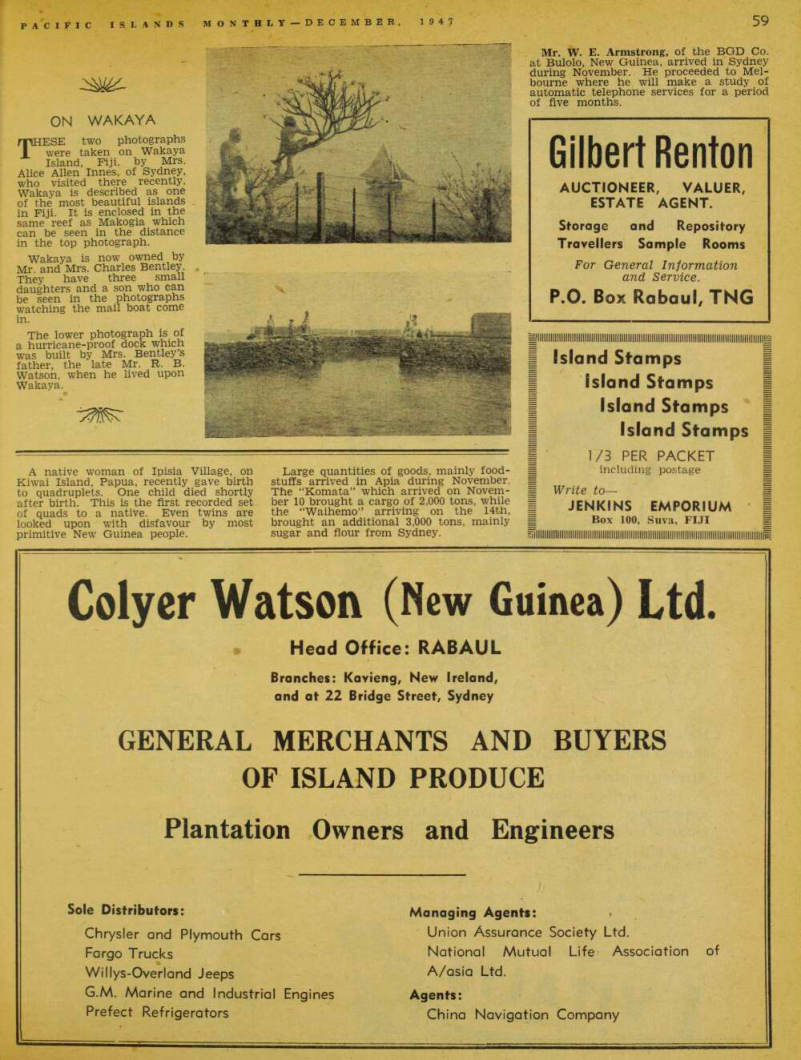
rESE two photographs
were taken on Wakaya Island, Fiji, by Mrs.
Alice Allen Innes, of Sydney, who visited there recently.
Wakaya is described as one of the most beautiful islands in Fiji. It is enclosed in the same reef as Makogia which can be seen in the distance in the top photograph.
Wakaya is now owned by Mr. and Mrs. Charles Bentley They have three small daughters and a son who can be seen in the photographs watching the mail boat come in.
The lower photograph is of a hurricane-proof dock which was built by Mrs. Bentley’s father, the late Mr. R. B.
Watson, when he lived upon Wakaya.
A native woman of Ipisia Village, on Kiwai Island, Papua, recently gave birth to quadruplets. One child died shortly after birth. This is the first recorded set of quads to a native. Even twins are looked upon with disfavour by most primitive New Guinea people.
Large quantities of goods, mainly food stuffs arrived in Apia during November, The “Komata” which arrived on Novem ber 10 brought a cargo of 2,000 tons, while the “Waihemo” arriving on the 14th, brought an additional 3,000 tons, mainly sugar and flour from Sydney.
Mr. W. E. Armstrong, of the BGD Co. at Bulolo, New Guinea, arrived in Sydney during November. He proceeded to Mel bourne where he will make a study of automatic telephone services for a period of five months.
Probate of the will of the late Mr.
Peter Carl Munster, formerly of Manus, New Guinea, has been granted to Mrs.
Anna Munster and her solicitor, Mr. J.
Irwin Cromie. Mr. Munster, a well known planter, disappeared completely after the Japs invaded Manus in 1942, and his death is now presumed.
Advertisements & other items, pp. 61-62 (2 items)
Colycr Watson (New Guinea) Ltd.
Gilbert Renton
AUCTIONEER, VALUER,
ESTATE AGENT.
Storage and Repository Travellers Sample Rooms For General Information and Service.
P.O. Box Rabaul, TNG
Island Stamps
island Stamps
Island Stamps
Island Stamps
1/3 PER PACKET
including postage Write to—
JENKINS EMPORIUM
Box 100, Suva, FIJI
Colycr Watson (New Guinea) Ltd.
• Head Office: RABAUL Branches: Kavieng, New Ireland, and at 22 Bridge Street, Sydney
GENERAL MERCHANTS AND BUYERS
OF ISLAND PRODUCE
Plantation Owners and Engineers
Sole Distributors: Chrysler and Plymouth Cars Fargo Trucks Willys-Overland Jeeps G.M. Marine and Industrial Engines Prefect Refrigerators J Managing Agents: Union Assurance Society Ltd.
National Mutual Life Association of A/asia Ltd.
Agents: China Navigation Company
SOUTH SEA ISLANDS CLUB
Social Evening
Every Friday at Union Jack House, 5 Hamilton St. (just off Bridge St.) Sydney Ballroom Dancing . . . Special Islands Dances and Songs Islands Visitors Welcome.
-SklJuUd a&t
SJuHVM t pyt /"
*3
Nfc
HEALTHY
NEAT-LOOKING
HAIR
4 /< u h \ TN \ 7A (y.
P A 3Z, He’s found the key that unlocks the door to social success and popularity.
Attractive girls take pride in being seen with him . . . a well-groomed escort. He studies his appearance , . . knows the value of first impressions . . . realises the advantage of handsome, well-kept hair. So he uses VITALIS, and the “60-second drill”. 1 50 Seconds to Rub—Clr- O 10 Seconds to Comb and 1 culation quickens thus Brush—Hair has a lustre scalp stimulation gives hair —no objectionable "patent-^ a chance. leather" look. 3304 the hoir dresses scalp— the ulates S tin*
kf ktiS
LESS FREQUENT AIR SERVICE
TO SAMOA
Na National Airways Takes Over
° wn Corres P°“dent
APIA, Nov. 19.
MAIN result of the taking over of the RNZAF Pacific Air Service by the NZ National Airways Corporation, on November 1, is that Western Samoa will have only a fortnightly service in stead of a weekly service as previously.
It is hoped that increasing traffic caused by the inadequate passenger ac comodation on the only regular inter
kf ktiS
intending passengers from Samoa alone) may induce the Airways corporation to re-establish the weekly service at an earlv date. *
interesting Origin of
Fiji's Banana Is
From China
interesting Origin of Pacific Foodstuff
W[HY do the Fijians apply the name “China’ to their bananas, which apparently constitute one of their indigenous foodstuffs?
The answer—given to us by Mr. Thomas Horne, of Suva—is interesting, and re presents a forgotten item of history.
In pre-European days, in Fiji, there was no banana as we know it to-day. There was only plantain. It was a common article of Fiji food, and was called Vundi, and it was in three main varieties, called Vundi Waiwai, Vundi Dina and Vundi Soso.
A British representative in China, in the latter part of last century, was favourably impressed with a type of banana found there—small, but of excel lent flavour, and a good food. He took the banana to England, where it was cultivated in hot-houses.
After the London Missionary Society had established its first stations in the South Pacific, and when it was about to despatch its first vessel, “John Williams I,” the Cavendish banana from China was given to the Society, for cultivation in the South Seas.
The plants were placed aboard the ship, but they were not tended as they might have been; and when the ship arrived in Apia, Western Samoa, they seemed to be dead and useless, and were thrown onto a rubbish heap.
But the banana is not easily killed; and one of the LMS missionaries named Hardie —his descendants now live in Sydney noticed that some green leaves were still showing, and he planted them out and saved them.
That was the actual origin of the good banana in the South Pacific. The plant soon spread over all the adjoining groups and, as it was generally known that it caifce from China, the natives in some places caled it “China banana,” or simply “China.”
“China” quickly became a favourite food in Fijian. Then this small, well flavoured banana was crossed with a large, coarse banana from the West In dies called Gros Michel, with the result that we got the big, delicious, nicely flavoured fruit known far and wide as Fiji bananas. But the Fijians have an other name for them ‘Vei-ma-ma,” which means “half and half” (half China banana and half Gros Michel), PEOPLE in the South-west Pacific, who have tasted only the coarse, ill-favoured varieties grown in Northeast Australia, do not know what a real banana is like. The best fruit probably comes from Fiji and Samoa, although there are some very agreeable, small varieties grown in New Guinea and the Solomons.
About 13 years ago, Australia, in order to hold her flour trade with Fiji, agreed to admit 40,000 centals of Fiji bananas to the Australian market. The fruit was snapped up eagerly, at high prices. But the Australian banana-growers put up a mighty howl, and got after their politi cians; and the latter, by various devices, succeeded in shutting out the Fiji fruit.
The Australian laws still permit the entry of Fiji bananas, to a limited extent; but let the Fijian exporter try it on, and see what will happen to their shipments!
Yet Fiji still buys large quantities of Aus tralian flour.
Mr. Roy McGregor, well-known business man from the Madang district of New Guinea, arrived in Sydney in November by Catalina, and expects to spend a few weeks’ holiday in NSW, combining busi ness with pleasure.
Mr. Peter Cameron, of the British Solomon Islands administrative service arrived in Sydney by Trans-Oceanic flying-boat on December 1. He is on his way to the United Kingdom. He recently inherited £60,000 from his mother and his aunt. After two months special leave on this account, he will return to BSI.
Advertisements & other items, pp. 63-64 (1 item)
Tilley Lamps
BURN ORDINARY KEROSENE
The Modern Form of PORTABLE LIGHTING
PRODUCTION FOR EXPORT
WE ARE PLEASED TO INFORM OUR
FRIENDS OVERSEAS OF NEW AND
IMPORTANT PREMISES ACQUIRED TO
FACILITATE PRODUCTION FOR EXPORT.
ALSO OUR POST-WAR MODELS ARE
NOW IN FULL PRODUCTION AND WILL
BE ON OFFER IN ALL PARTS OF THE
WORLD. TILLEY STANDARDS ARE MAIN-
TAINED AND INCORPORATED IN COM-
PLETELY MODERN DESIGNS OF LAMPS
BRENT WORKS, NEW BRENT WORKS,
HENDON, N.W.4 CRICKLEWOOD, N.W.2.
THE TILLEY LAMP CO. LTD., of ENGLAND London Offices and Showroom : 33 SACKVILLE STREET, PICCADILLY, W.l.
REPRESENTATION :
MELBOURNE : T. H. Bentley, Pty. Ltd*, 123-125 William Street, Melbourne, C.l.
TASMANIA : Mr. C. Sellars, 108 a Charles Street, Launceston.
FIJI : Mr. K. Witherington, 2 Burns Philp Buildings, Suva.
Send us your orders for
DEVELOPING, PRINTING,
ENLARGING
We Sell Kodak Films and Supplies Wholesale and Retail.
Caine's Studios, Suva
P.O. Box 8. (Estab. 1904) ’Phone 68.
The Twinkle in
Your Eye
COMES FROM ACTIVE
DIGESTION
Good normal digestive and liver activity means good, normal health and fitness. If yo* are becoming gloomy and feel tired out, the cause may be a congested state of your Intestinal tract. So many people are troubled with constipation, which, through the retention of waste in the digestive system, causes sick headache, biliousness, pimply skin, unpleasant breath, irritability, slackness and dull eyes.
Regain your bright and attractive appearance by banishing constipation with Pinkettes. Tiny, perfectly harmless, gentle yet effective, these famous laxative and liver pills painlessly exercise and strengthen the bowels, keep the food tract clean and active, stir the liver, and thus banish sick headache, bilious attacks, pimples, unpleasant breath and gloom. All chemists and stores sell Pinkettes, the perfect laxative and liver pills.
Tillock Cr Co. Pty. Ltd.
Kent and Liverpool Streets, Sydney,
ISLAND TRADERS SINCE 1875
and Manufacturers of
AUNT MARY'S BAKING POWDER
AUNT MARY'S TOMATO SAUCE
AUNT MARY'S TOMATO SOUP
AUNT MARY'S TOMATO JUICE
AUNT MARY'S TOMATO PUREE
and other Pure Food Products INVITES inquiries from merchants trading in and with the Islands.
CABLE ADDRESS: TILLOCK, SYDNEY
Natives
Easy Money For
War Damage Distribution in New Guinea
LAE, Nov. 29.
THE lavish manner in which so-called “war damage compensation” is being scattered among the natives is an indication of the huge sums which Aus tralia has to spare. It is estimated that, already, scores of thousands of pounds are “socked away” by natives—and the money is still rolling in.
I visited Finschhafen a few days ago, and I could have cried to see the once thriving plantations reverting to bush.
Natives will not work. They are re ceiving something like £60,000 in that area, as War Damage at post-war prices.
We Europeans received nothing like this in comparison. We were given pre-war rates, less deterioration, which to-day is nothing like the replacement value.
The native’s word is taken without question. If he says he had 20 pigs at £5 each—well, it’s OK with the Government.
What is more hurtful among natives is the fact that their own tribesmen, who joined up with a Japanese Police Force and caused the death of hundreds of natives and Europeans, are treated the same as those who were loyal to us. No effort is being made to punish those who were traitors, not only to us, but to their own people.
Major W. B. Ayris (formerly of Wau, TNG) looking as young as ever, recently spent a few weeks’ holiday in Sydney, from North Queensland, where station life apparently agrees with him. A por tion of his holiday was spent out at the old-time centre of Cobbitty, where Mr.
David Campbell (also an old Edie Creek veteran) is running the guest-house “Pomare.”
Mr. Peter Lazarus, only son of Mr. and Mrs. L. S. Lazarus, of Suva, Fiji, was married in Brisbane recently to Miss Beryl M. Dixon, youngest daughter of Mr. and Mrs. W. J. Dixon, Townsville. Mr.
Lazarus is attached to the ABC reporting staff, and is well known in the Southern States for his broadcasting work in plays and talks. Brisbane will be the future home of the couple.
University Degrees for Patrol Officers?
Patrol Officers?
Raising the Academic Status of the Mosman School
Letter to the Editor RECENT changes in the composition of the Council of the School of Pacific Administration, in Sydney, which is training recruits to the Papua-New Guinea administrative service, should place the School’s affairs in sound hands.
The new Chairman is Professor R. C.
Mills, one of Australia’s leading academic and educational authorities, who is in charge of the Commonwealth Office of Education, which is apparently to have some say in School affairs. Territorians will watch the future progress of the School with interest, for it is anticipated that its new council will keep a close check on academic standards and effi ciency.
As it is the professed ambition of some members of the School’s staff to have its courses given “degree status” in the new National University at Canberra, and as the first two-year course, just commenced, is an obvious stepping stone to such an ambition, the School’s academic standards and staffing merit close study—not only because there is any great likelihood that the National University will offer cheap degrees, but because such ambitions indi cate that perhaps the School is being rated too highly bv its staff and its sup porters.
The principle of pre-vocational training for Administrative personnel is sound and a degree course at a University would doubtless be valuable, for Univer sities do not award degrees cheaply. It does not follow, however, that it would be desirable, or even possible, for a Uni versity to take over the present School set-up and recognise its courses as degree courses.
There are two alternatives available; the establishment of a University course administered by a University on its own terms, or the establishment of an inde pendent school sponsored by the Admin istration on the Administration’s own terms.
If a University were to undertake the provision of a suitable course for Admin istrative personnel its scope would very probably be wider, the teaching would not be specifically directed to the vocational purpose, and the academic standards re quired would have to conform with those operating throughout Australian univer sities; staff would have to measure up to University staff requirements and it is possible that under these conditions the parties interested would not want “de gree status” so ardently. And it is even possible that the proportion of recruits capable of passing a degree course would be small.
All that is required to make the present school an efficient administrative asset is an improvement in the quality of the staffing, firmer direction from a compe tent council, and the removal of its un warranted complacency about its own standards. Several of the staff are very competent persons; but some of them are youngsters who appear to have no quali fications in what is, after all, a highly specialised field.
The notion that the school, as at pres ent constituted, could award university degrees seems to be a pipe-dream of some of its associates. Those interested in preserving academic standards should see to that. As a private teaching organi sation, however, the school could possibly be more specifically useful.
I am, etc.,
University
Port. Moresby, November 20.
Council
Report To The
N. Caledonia's Representative in Paris Tells of French Attitude to Colony's Problems
WHEN he returned from Paris recently, New Caledonia’s representative in the French Upper House (Council and Republic), Monsieur Henri Lafleur, a Noumea business man specially interested in mining, gave a long resume of the French attitude to questions affecting the Colony.
He said that the National Assembly had delayed adopting the new bill giving greater power to the General Council be cause of more pressing matters, including the future constitution of Algeria. The Caledonian bill would be considered when the Chamber sat again in November.
The financial agreement made with France, by which the latter would re lease foreign currency to adjust the Colony’s trade balance would prove satis factory only if the Colony was prepared to work hard to produce and export.
Otherwise it was of no value. New Cale donia was still importing far too much and producing far too little. Small in dustries should be encouraged to the utmost. Otherwise the Colony would enter on a period of greater restrictions than she had ever known.
M. Lafleur mentioned as new possibil ities local production of sugar, rum, wheat and flour, tinned vegetables, fish and fruit.
The metropolis had agreed to pay for urgent undertakings such as Noumea sani tation and water schemes, a new hospital and sanatorium, and water for bush town ships.
The Mayor of Noumea, M. Sautot, who was present, pointed out how urgent such modernisation schemes were. Prance should be asked to supply sewerage pipes at the earliest possible date, r ONE matter that is causing much heart burning locally is a rumour that has reached Noumea from outside, that the Pacific franc is to be devalued. Such action would destroy New Caledonian faith in France, which promised that the Pacific franc would be fixed at the present level.
M. Lafleur, reviewing the French financial situation, pointed out that it was far from good. Yet he did not think that the fears expressed in Noumea about the Pacific franc were well founded. The Government, he said, understood the Colony’s geographical situation and knew that devaluation would be disastrous to local economy. All the same it would be well for the General Council to make its voice heard on the matter.
A debate ensued, and it was decided that the President of the Council should communicate the feeling of the Colony’s population to the French authorities.
M. Lafleur has been busily occupied trying to find a supply of coolie labour for the Caledonian mines in particular, also for coffee and agriculture. He admitted that unfortunately his efforts so far had brought no result of the kind desired.
Nowadays it was not possible to recruit Javanese in the Dutch East Indies or in Timor; also they would have to abandon hope of getting Indo-Chinese, Japanese or Koreans. It might be possible to get workers from India or Italy, but such labour would only be suitable for agriculture, not for mining.
The only solution for the mines was Chinese labour. It seemed, from information available, that this source of supply would provide suitable labour if workers were recruited in certain provinces and by people well acquainted with the Colony’s needs, The Council decided to bring the matter to the attention of the Labour Commission for study and recommenda tion. It was understood that labour con tracts would be for three-year periods, and that the Chinese would be re patriated at the conclusion of their term
and not permitted to stay. Many mines were now closed or about to close for want of labour. Agriculture, too, was in desperate plight.
M. Lafleur mentioned the possibility that New Caledonia might be chosen in stead of Australia as a permanent home of the South Pacific Commission con sisting of US, Dutch, Australian, New Zealand and French representatives. The US Army’s former Pentagon Building at Anse Vata, which formerly housed the entire Army’s administrative staff, would adequately house the Commission, it was stated.
The proposed Noumea Casino, M. Lafleur added, could not come into being without foreign capital. Americans and Aus tralians were already becoming interested in the project.
The board of directors would be 75 per cent. French and 25 per cent. Australian and American.
Advertisements & other items, pp. 65-66 (1 item)
sift
AUSTRALIA’S MOST POPULAR
THIN CAPTAIN BISCUITS
cm
sift
■tU
SWALLOW & ARIELL
LIMITED
S/954
HESTER CRAFTSMEN IN THE BISCUIT INDUSTRY
L '-vS»MCE'IBS4'' >C
■J h I I ** Bond Street, Sydney, Australia £* \l* Jy * j |"| V Tel. B 4167. Box 3615 G.P.O.
SUPPLIERS OF GENERAL MERCHANDISE TO LEADING FIRMS THROUGHOUT. THE
PACIFIC ISLANDS
Exporters ... Importers ... . Manufacturers' Representatives Bankers: Bank of N.S.W. Bank of Adelaide. Comptoir Nat. d’Escompte de Paris.
Cable Address: “SEAFOODS,” SYDNEY.
Codes: Bentley’s, 2nd and Comp. Phrase; A.8.C., sth and 6th; Peterson, 2nd and 3rd; Banking; Acme.
Rid Kidneys Of
Poisons And Adds
If you suffer sharp, stabbing pains, If Joints are swollen, it shows your blood is poisoned through faulty kidney action. Other symptoms of Kidney Disorders are Backache, Aching Joints and Limbs, Sciatica, Neuritis, Lumbago, Sleepless Nights, Dizziness, Nervousness, Circles under Eyes, Loss of Energy and Appetite and Frequent Headaches and Colds, etc. Ordinary medicines can’t help much because you must get to the root cause of the trouble.
The Cystex treatment is specially compounded to soothe, tone and clean kidneys and bladder and remove acids and poisons from your system safely, quickly and surely, yet contains no harmful or dangerous drugs. Cystex works in 3 ways to end your troubles. 1. Starts killing the germs which are attacking your Kidneys, Bladder and Urinary System in two hours, yet is absolutely harmless to human tissue. 2. Gets rid of health-destroying, deadly poisonous acids with which your system has become saturated. 3. Strengthens and reinvigorates the kidneys, protects from the ravages of disease-attack on the delicate filter organism, and stimulates the entire system.
Praised by One-time Sufferers
Cystex is approved by one-time sufferers in 73 countries from the troubles shown above.
Mr. Reg Thomas, Townsville, Queensland, recently wrote: “My joints were all stiff, I had leg pains, my back used to ache day and night.
My bladder was weak. I had headaches and no appetite. The first dose of Cystex helped me and before I finished three boxes my health and strength came back.”
Guaranteed to Satisfy or Money Back Get Cystex from your chemist or store to-day.
Give it a thorough test. Cystex is guaranteed to make you feel younger, stronger, better lv every way, or your money back if you return the empty package.
Now in 2 sizes—4/-, •/-.
GUARANTEED CVStCX
Treatment
for Your Kidneys, Bladder, Rheumatism.
Steamships Trading
Company Limited
PORT MORESBY
SAMARA)
PAPUA.
WHOLESALE & RETAIL MERCHANTS, SHIPOWNERS,
PLANTERS, ENGINEERS & SLIP PROPRIETORS.
Customs, Shipping, Insurance, and Forwarding Agents.
MANAGING AGENTS AND VISITING REPRESENTA-
TIVES FOR COCONUT AND RUBBER ESTATES.
SYDNEY REPRESENTATIVES: Nelson & Robertson Pty. Ltd., 12 Spring Street
Rarotonga "Tere" Visits
Mangaia
From Our Own Correspondent
Mangaia, Oct. 24.
LOCAL hen and pigs have had an other of their “Black Fridays,” as sociated with the entertainment of distinguished visitors from other islands, in Mangaian manner.
This time, the “tere” is from Takuvaine, in Rarotonga, and consists of some 30 persons, having both Rarotongan and Mangaian tribal connections, under the leadership of chieftainess Karika Vaine, The visitors accommodated at Tavaenga Village, have already enlivened considerably the somewhat dull social at mosphere of this isle with dances, etc.
Their band is notably superior to any local music. This “tere,” which came over by the “Tahitienne,” has arranged to re turn by the same vessel in late No vember.
Miss Peggy Layden of the Australian Consulate, Noumea, recently flew to Suva, and thence to Auckland, to spend her vacation.
Solomons?
Chinese For The
Whole Question of Labour for Pacific Territories is Receiving Serious Consideration
THE question of whether Levers Pacific Plantations Ltd. will continue to op erate its important chain of coco nut plantations in the British Solomon Islands, or will abandon these apparently valuable properties owing to lack of an adequate labour force, has remained un answered for over two years.
Lack of labour and of transportation in the Solomons has preventd the re establishment of the copra industry. The lack of copra cargoes has discouraged the development of any kind of shipping communication. (See article elsewhere in this issue).
It now appears, however, that Levers have no intention of abandoning the plantations—instead, they will endeavour to bring an adequate force from outside the Group.
For some time now, discussions have been under way between Levers and the British authorities, under which it is pro posed to import between 600 and 700 Chinese labourers, from Hongkong. If it was planned to bring in Asiatics from al most any other Territory, there might be difficulties, in the present state of world politics. But Hongkong is a British Colony, and the Chinese labourers from there would have British passports.
This BSI experiment will be watched with great interest by British, French, Australian and New Zealand adminis trative officials, because —owing to post war developments in their Territories similar to those in the Solomons —there is everywhere a great shortage of labour.
If the Pacific Islands cannot call upon the bottomless labour reservoir in Asia, so as to maintain their planting and other industries, then there is no econ omic future in the Pacific Islands.
Most European Governments to-day— especially the Socialistic administrations in power at present—are extremely sen sitive on the subject of transporting Asiatic labour into Islands Territories — where-some of the idealists imagine that the natives might develop self-govern ment and a nationalistic spirit. But that is a passing phase.
It must become a plain choice between Islands Territories which will become economically healthy and self-supporting, and Territories which, like New Guinea, become a kind of laboratory for anthrop ologists and social planners, and a heavy financial burden upon the country ad ministering them.
The only danger is that imported Asiatic labour may not be kept under strict indenture, and foreign communities may become established. Once estab lished, it is almost impossible to remove them —as has been shown in Fiji, Tahiti and New Guinea.
The only exception occurred in West ern Samoa. There, following the collapse of the repatriation clauses of the inden ture system, a considerable community, half-Chinese, half Samoan, took root; but the New Zealand Government, be tween 1930 and 1945, took a ruthless course and shipped most of the Chinese away. The half-castes remain however.
The British Phosphate Commission uses large numbers of Chinese to work the phosphate deposits on Nauru and Ocean Island. This system has been operated quite satisfactorily over many years probably because the Commis sion has scrupulously observed the re
patriation clauses of the labour con tracts.
Even if it is not considered wise to bring in Asiatics for coconut culture in the Islands, they must be considered as a means of keeping the Islands mining industries going especially the gold mines in Jtfew Guinea, and the nickel and chrome mines in New Caledonia.
Hitherto, the French have worked the New Caledonian mines with inden tured Javanese, and the New Hebrides plantations with Tonkinese. Owing to circumstances created by the war, it is not expected that these types of labourers will be available in the future, and it has been reported that French interests have been giving serious thought to the possibility of using indentured Japanese labour.
Mangaian Teachers Hold
2Nd "Strike" Meeting
From Our Own Correspondent
Mangaia, Cl.
That little-known “trade union,” the Cl Teachers’ Guild, is beginning to make its “mana” felt in educational circles. Whether the CIPA is at the back of pedagogic discontent is anybody’s guess until battle is joined.
A month or two ago the local native teachers, alleging dissatisfaction with conditions of duty and discipline, held a “stop-short” meeting, at which all the staff but two declared for a strike.
The European headteacher managed to avert this disruption of the usually-calm schedule.
Now, an alleged reduction in senior teachers’ salaries has again aroused Guild wrath; and a problem for the Adminis tration seems about to develop at Mangaia.
Giving The Bible To The
South Pacific
rE British and Foreign Bible Society has now translated the Bible or sections of the Bible, into over 1,000 distinct languages.
Recently the Council of the Society in Australia, which is responsible for work in the islands of the South Pacific, New Guinea and French Indo-China, published a small book (“Living Languages”) with the object of making the work of the society better known.
The book was written by William H.
Rainey, Commonwealth Secretary of the Society and a Fellow of the Royal Geo graphical Society.
He points out that no people, no matter how primitive or backward, lack lan guage, and that every language has a word for their own particular god or gods, Mr. Rainey stresses the fact that it is the missionary who learns the new lan guage and does the work of translating, the Society only publishes the work.
Therefore, through Mr. Rainey’s story, we learn much of the translation work of members of various Missionary Societies.
Greatest difficulty has been encountered in the South-west Pacific area where there are literally hundreds of languages, some of which are understood by only a small group of people. The Society does not approve of the use of Pidgin English for Bible translation purposes and in every case has endeavoured to select a widely understood dialect as the lingua franca of a specific area. For example the Blanche Bay dialect has been used to serve in New Guinea, the Rabaul-Kokopo area and, as well, the Duke of Yorks, New Ireland and New Hanover. Similarly, Dobuan has been used as a lingua franca for a large part of Papua.
"Oceania"
mfiE December issue of “Oceania” (a X quarterly devoted to study of the native peoples of Australia, New Guinea and the Pacific Islands) is more than usually interesting. The chief articles are:— Effects of the Pacific War in the Mark ham Valley, New Guinea, by K. E. Read.
Childbirth Among the Aranda, Central Australia, by J. de Vidas.
Papua Religion in a New Guinea Vil lage, by H. lan Hogbin.
A New Religious Cult in Fiji, by A. C.
Cato.
Folk Tales from Netherlands New Guinea, by P. Drabbe.
Mr. N. Herd, who was Chief Judge in Western Samoa for 9 years, has gone to Palmerston North, New Zealand, as stipendiary magistrate.
Advertisements & other items, pp. 67-68 (1 item)
“Caterpillar”
5 0 E S
SYI
LOTI
for Inflaaasd Er«t and Eyelids
SOLD EVZITWIIIK
H. A. *»»♦ A C*. Pty. LtL. Kiss t. Sydaw WANTED: Back numbers of the “Pacific Islands Monthly.” Have many duplicates for exchange. Will exchange American magazines for newspapers and magazines of the Pacific Islands and British Colonial Empire. Orders taken for subscriptions to American magazines—no foreign exchange difficulties —write for details to PAUL A. DORN, Agent, Los Angeles 36, California.
'X o T\ m*
We Supply all Types of
“CATERPILLAR”
MACHINERY
WE ARE DISTRIBUTORS IN FIJI FOR
The Caterpillar Tractor
Company
Caterpillar Diesel Tractors Caterpillar Bulldozers Caterpillar Earth-movers Caterpillar Road Building and Maintenance A Hyster Crane at Work on Suva Wharves.
Machines
ALL MADE BY “CATERPILLAR.”
Hyster" Winches, Logging Arches and Equipment Tracson" Excavators for use with Caterpillar Tractors "Caterpillar" Diesel Marine Engines, 34 to 135 BHP Continuous Rating Stocks of Spare Parts carried in Suva. Information available about Agricultural Implements Inquiries from anywhere gladly answered to suit Caterpillar Tractors.
W. R. CARPENTER & CO. (Fiji) Ltd. VT
Refreshing
as a plunge
into a lagoon!
SOAP
Germicidal
and fragrant
TENAX TOILET SOAP is
a rapid safeguard against external skin infections, yet it is soothing and kind to the most sensitive skin —even a baby’s!
ORDER TENAX FROM
YOUR ISLAND SUP-
PLIERS. STOCKS ARE
PLENTIFULLY AVAIL-
ABLE.
Scott V'Renown” Brand Rope,
Cordage and
Binder
Twine
of Every
Description
Address: Ropeyard, Sydney. .v*. ail M
MANUFACTURED AT
MASCOT, N.S.W.
J. SCOTT
PTY. LTD.
Head Office and Store
163 CLARENCE STREET.
SYDNEY,
N.S.W.
Bomb-Happy Yanks
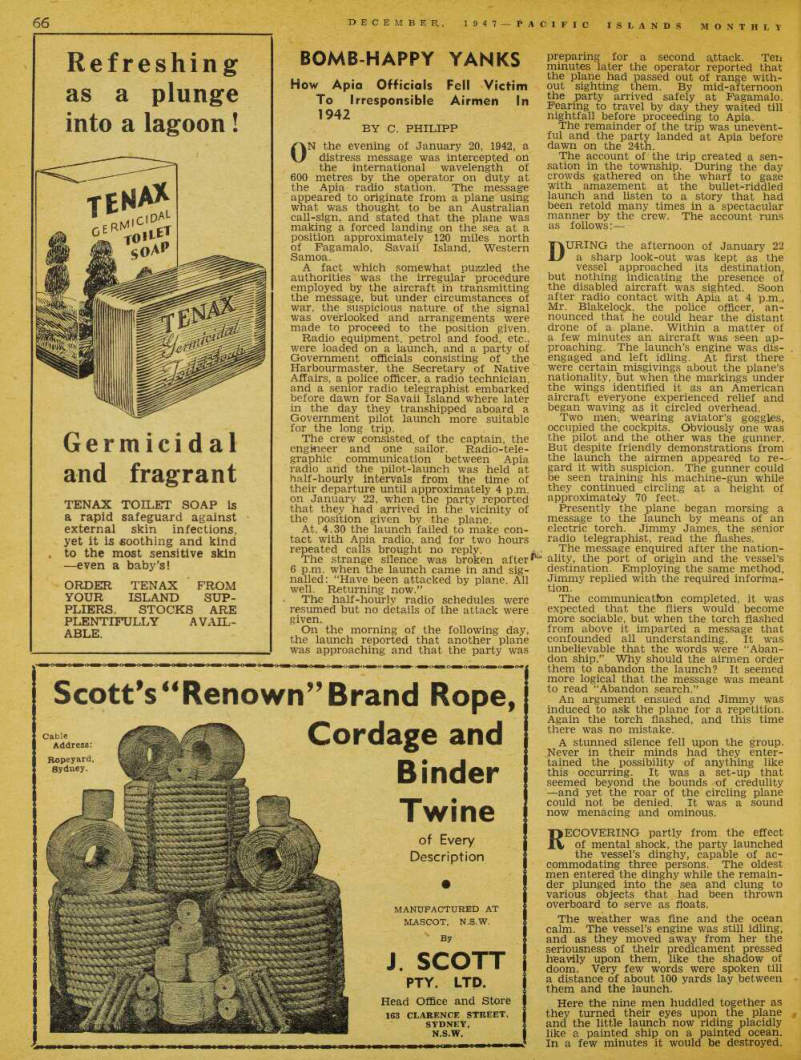
H ow Apia Officials Fell Victim To Irresoonsible Airmen In 1942
By C. Philipp
ON the evening of January 20, 1942, a distress message was intercepted on the international wavelength of 600 metres by the operator on duty at the Apia radio station. The message appeared to originate from a plane using what was thought to be an Australian call-sign, and stated that the plane was making a forced landing on the sea at a position approximately 120 miles north of Fagamalo, Savaii Island, Western Samoa.
A fact which somewhat puzzled the authorities was the irregular procedure employed by the aircraft in transmitting the message, but under circumstances of war, the suspicious nature of the signal was overlooked and arrangements were made to proceed to the position given.
Radio equipment, petrol and food, etc., were loaded on a launch, and a party of Government officials consisting of the Harbourmaster, the Secretary of Native Affairs, a police officer, a radio technician, and a senior radio telegraphist embarked before dawn for Savaii Island where later in the day they transhipped aboard a Government pilot launch more suitable for the long trip.
The crew consisted, of the captain, the engineer and one sailor. Radio-tele graphic communication between Apia radio and the pilot-launch was held at half-hourly intervals from the time of their departure until approximately 4 p.m. on January 22, when the party reported that they had arrived in the vicinity of the position given by the plane.
At. 4.30 the launch failed to make con tact with Apia radio, and for two hours repeated calls brought no reply.
The strange silence was broken after'' 6 p.m. when the launch came in and sig nalled: “Have been attacked by plane. All well. Returning now.”
The half-hourly radio schedules were resumed but no details of the attack were given.
On the morning of the following day, the launch reported that another plane was approaching and that the party was
preparing for a second attack. Ten minutes later the operator reported that the plane had passed out of range with out sighting them. By mid-afternoon the party arrived safely at Fagamalo.
Pearing to travel by day they waited till nightfall before proceeding to Apia.
The remainder of the trip was unevent ful and. the party landed at Apia before dawn on the 24th.
The account of the trip created a sen sation in the township. During the day crowds gathered on the wharf to gaze with amazement at the bullet-riddled launch and listen to a story that had been retold many times in a spectacular manner by the crew. The account runs as follows: DURING the afternoon of January 22 a sharp look-out was kept as the vessel approached its destination, but nothing indicating the presence of the disabled aircraft was sighted. Soon after radio contact with Apia at 4 p.m., Mr. Blakeloqk, the police officer, an nounced that he could hear the distant drone of a plane. Within a matter of a few minutes an aircraft was seen ap proaching. The launch’s engine was dis engaged and left idling. At first there were certain misgivings about the plane’s nationality, but when the markings under the wings identified it as an American aircraft everyone experienced relief and began waving as it circled overhead.
Two men-, wearing aviator’s goggles, occupied the cockpits. Obviously one was the pilot and the other was the gunner.
But despite friendly demonstrations from the launch the airmen appeared to re-gard it with suspicion. The gunner could be seen training his machine-gun while they continued circling at a height of approximately 70 feet.
Presently the plane began morsing a message to the launch by means of an electric torch. Jimmy James, the senior radio telegraphist, read the flashes.
The message enquired after the nation ality, the port of origin and the vessel’s destination. Employing the same method, Jimmy replied with the required informa tion.
The communication completed, it was expected that the fliers would become more sociable, but when the torch flashed from above it imparted a message that confounded all understanding. It was unbelievable that the words were “Aban don ship.” Why should the airmen order them to abandon the launch? It seemed more logical that the message was meant to read “Abandon search.”
An argument ensued and Jimmy was induced to ask the plane for a repetition.
Again the torch flashed, and this time there was no mistake.
A stunned silence fell upon the group.
Never in their minds had they enter tained the possibility of anything like this occurring. It was a set-up that seemed beyond the bounds of credulity —and yet the roar of the circling plane could not be denied. It was a sound now menacing and ominous.
RECOVERING partly from the effect of mental shock, the party launched the vessel’s dinghy, capable of ac commodating three persons. The oldest men entered the dinghy while the remain der plunged into the sea and clung to various objects that had been thrown overboard to serve as floats.
The weather was fine and the ocean calm. The vessel’s engine was still idling, and as they moved away from her the seriousness of their predicament pressed heavily upon them, like the shadow of doom. Very few words were spoken till a distance of about 100 yards lay between them and the launch.
Here the nine men huddled together as they turned their eyes upon the plane and the little launch now riding placidly like a painted ship on a painted ocean.
In a few minutes it would be destroyed.
And when this was accomplished, what then?
Would the mad airmen stop with this or would they decide to finish them off in cold blood? It was a terrifying thought that strained their nerves to breaking point.
The plane described a wide circle and climbed to a greater height. Then flying directly in line with the launch, it swooped down and released a bomb which struck the sea and exploded some fifty feet from the target. Repeating the manoeuvre, a second bomb was dropped.
But evidently the fliers were amateurs in this game. The bomb landed no nearer to the target than did the first one. Hav ing thus exhausted their supply of bombs, the airmen commenced to strafe the vessel with explosive bullets. rE minutes seemed like hours as they watched the progress of these activi ties. Under the strain of nervous tension one of the older men on the dinghy cracked up. Producing a pocket knife, with the purpose of committing suicide, he cried: “By God! I can endure this no longer!” But he was restrained before he could use it. One of the other senior men, with tears in his eyes, made what he believed to be his last speech, requesting that should any of the others reach Apia alive they were to convey a message to his wife and family.
McLaughlan, the radio technician, re lated afterwards that during those moments of waiting all the years of his young life flashed before him with an understanding such as he had never ex perienced before.
Thus in a spirit of resignation they gave themselves up to their fate. And yet it would seem as though Providence had meant that no harm should come to any of them on that day.
Wisps of smoke were rising from the launch, and the airmen, believing that they had done a good job, discontinued
the strafing. The final moment had come. Flying no more than twenty feet above the sea, the plane headed directly toward them. Some of the men watched it approach, but others chose to close their eyes.
Then, instead of the burst of machine gun fire and the hot sting of bullets, a voice was heard yelling above the din of the motor: “Sorry, boys! Cheerio!”
In a few minutes the plane disappeared in the distance, leaving the small party dazed and alone in the golden glow of a tropical sunset.
IT was close to six o’clock when the party returned aboard the launch and found a small fire in the engine room. The deck and the sides were rid dled with bullets.
Evidently the sacks of copra, carried in the hold for ballast, had prevented most of the bullets from penetrating the bottom of the vessel. Damage to the en gine was not serious, and within twenty •minutes repairs were effected, the engine started, and the dash for home com menced. The radio equipment was also repaired and contact was made at once with Apia radio.
Anticipating a possible return of the plane, no lights were shown on board during the night and the party engaged themselves in constructing a raft capable of carrying food and water.
On the following morning, when the second plane was seen it seemed that they were in for another ordeal; but their fears were soon dispelled when the plane passed out of range without sighting them. The remainder of the trip was uneventful.
“Who were the airmen?” I asked Mac one evening over a glass of beer. “Were they Japs using a plane with American markings on the wings?”
“Jans be damned!” he said. “Japs would have made short work of us. No, they were Americans, and the SOS was a bait put across to catch twirps. We were the twirps.”
“But what was the reason for the attack after you had given them your identity.”
Mac shrugged his shoulders. “Only the good Lord knows the answer to that one.
It is one of the unsolved mysteries of the Pacific War.”
The Noumea Bulletin de Commerce, speaking on behalf of Free Frenchmen in New Caledonia, describes Australian war time Minister McEwan’s declaration in the Commonwealth Parliament that it was he who was responsible for getting New Caledonia to rally to General de Gaulle as “pure fantasy.” The paper adds that neither directly nor indirectly did the Australian Minister induce Cale donians to rally to Free France.
Advertisements & other items, p. 69 (1 item)
“Chula
A Limited Quantity Only
COLT PATTERN .45 cal. AUTOMATICS
SPECIAL TROPICAL FINISH.
At the all-time low price of £lO each. Postage extra. Powerful, accurate, they are a weapon you will be proud to own. Ammo, plentiful, 25/per 100.
Si a n i_j a i Quality Firearms and Fishing
I L KU Pi U Tackle.
143 ELIZABETH ST. (near Market St.), SYDNEY. Phone: MA 3540.
For the production of best quality WHITE COPRA
“CHULA
' COPRA DRYERS
BULK POWER DRYERS
FOR LARGE ESTATES
TYPE B.D.O — 6,000 NUTS PER 24 HRS.
TYPE B.D. I—lo,ooo NUTS PER 24 HRS.
ALSO NATURAL DRAFT DRYERS
FOR SMALLER ESTATES
m • /
TYNESIDE FOUNDRY AND ENGINEERING CO. LTD.
LOW ELSWICK NEWCASTLE UPON TYNE • ENGLAND • CABLES • FOUNDRY NEWCASTLE-ON-TYNE
Finschhafen
News Items From
From Our Own Correspondent
Finschhafen, Nov. 29.
NOT-SO-MANY years hence one might see a fat, ebony-coloured Mayor of Finschhafen, adorned with robes of office, strutting magnificiently along Keenan’s Avenue en route for t)ivine Service at St. Angau’s Cathedral, followed by a retinue of white-shirted “village councillors.”
The arboreal splendour of the drive leading to Administration Headquarters at Gagidu Point rivals pre-war Rabaul, and that galaxy of floral display along Marine Parade is a splash of vivid colour.
But, why “beautify” Finschhafen? Dis tinguished, well-travelled visitors have already spoken eulogistically of its charms. * * * Major S. A. Merritt, OC, US War
Graves, Finschhafen, has nearly com pleted his job of disinterring the thous ands of American heroes who were buried locally.. The entire War Graves Unit will be leaving shortly for Manila. The jolly Major, who has had 28 years in the US Army, will be much missed by local re sidents. *>* * "
I am told by an Administration Officer that “Cargo Cult,” which had gained considerable sway inland in the Hube area, has now died a natural death. ♦ * * Now that so many of the naval officers from HMAS “Tarangau” (Finschhafen Naval Base) have their wives with them, social functions are in order. One of the best local parties recently was when Finschhafen’s most eligible bachelor, Mr.
Leslie J. G. Stomann, popular Govern ment Engineer, with his friend Fred Golton, “Tarangau’s” famous chef, cele brated their combined birthdays. Gehring
Hall was packed to capacity, but the chief attraction with the large cool, semi-open air garage, adorned with coconut fronds, which served for drinking, eating and conviviality.
Traditional naval barriers were broken down by officers and# wives mingling freely with the Petty Officers and ratings.
Beer flowed, and the fun went on until 4 a.m. * * * It is reported that Mr. and Mrs. J. R.
Keenan will be going on leave early in the New Year and that they are going to Africa for a trip. * * * An accident occurred on the main high way near Administration Headquarters on November 23, when a jeep containing several naval ratings crashed into a tree in broad daylight. One rating was seri ously injured and had to be flown to Aus tralia for treatment. * * * Deputising for the Administrator, Mr.
J. H. Jones, Director of District Services and Native Affairs, visited Finschhafen with the Director of Public Health, Dr.
J. T. Gunther, on November 20. I over heard that he was non-plussed on enter ing the sacred precincts of the Sub district Office, for verandah and approaches were gaily bedecked with red, white and blue bunting and bamboos, while a huge Australian flag fluttered in the breeze. But, alas; a police-boy said it was “sumting belong King, two fella, Masta Jones!” It was the occasion of the marriage of Princess Elizabeth, also! * * * I saw half-a-dozen ladies at the Lutheran Mission making the trickiest of women’s hats, handbags and belts from the leaves of the coconut palm and the pandanus. It was the outcome of the instruction they received recently from a Miss Archer, Administration handicrafts expert. The natives should take to this class of work readily, but it will have to be confined to certain selected areas for fear of spoiling trading. * * * Patrol Officer Barry T. Copley, Sio Police Post, who has been transferring that station to Wasu, further up the coast, was brought to the R. N. Sick Bay, Finschhafen, recently by special vessel, suffering from a poisoned ankle. He has now returned to Wasu. * * * I’m tipping that Finsch. will have one or two shocks in store for Lae when the boys from the Butibum area come up for a few days’ sport at Christmas. Despite the strain of social activities, the men and women at Finschhafen keep them selves remarkably fit with swimming, tennis and bicycle riding. ** * * There are no outward signs of the Naval base getting ready to move to Manus. The air-strip here will always be maintained. We have an excellent water service that supplies overseas ships. It is to be hoped that Mr. Ward will not over look Finschhafen’s claims when he chooses a capital.
Mr. Dan Power, formerly of ANGAU, and now a resident of Kokopo district, New Guinea, has been awarded the Military Medal for what he calls “dodg ing the Nips in Madang on the night of December 18, 1942.” The police boy who accompanied him was awarded the Loyal Service Medallion. The second instal ment of an article describing Mr. Power’s experiences during the Jap invasion ap pears in this issue, on page 52.
Advertisements & other items, p. 70 (2 items)
68
DECEMBER, 1 947 PACIFIC ISLANDS- MONT HI i
Hard to Get? 7r v US
The Key to Earning . . .
Sometimes men think that a general education or an elementary knowledge of business is enough to get ahead. But experience soon teaches that thorough, specialised training is just as necessary for success in business as it is in the professions of Law, Medicine or Dentistry. If you are interested in the many opportunities in the Business World ... if you seek responsibility, success and economic security, commence training now —in some specialised business subject. - H.R.I. is available always to help and advise ambitious men and women. Write or wire for particulars and career information.
H.R.I. tutorial service is 'proved by the winning of ,more honours than all coaches in Australasia combined.
H.R.I. Career Training • ACCOUNTANCY • SECRETARYSHIP • COST ACCOUNTANCY
• PRACTICAL BOOKKEEPING • MARKETING SELLING
ADVERTISING • BANKING • LOCAL GOVERNMENT EXAMS.
H eminguaT Robert§»n Institute
Founded and Owned by Hemingway & Robertson Pty. Ltd.
Consulting Accountants ;; ;: Professional Tutors
126 BANK HOUSE, BANK PLACE, MELBOURNE
126 CHALFONT CHAMBERS, 142 PHILLIP STREET. SYDNEY 126/814
Hard to Get? 7r v US
FOR
1. TRADE TOBACCO 10.
2. LAP LAP MATERIAL 11.
3. CANNED GOODS 12.
4. PERFUMERY 13.
5. PRIMUS STOVES ..
6. KEROLAMPS l4 '
7. SHOES, SANDALS . s
8. UMBRELLAS 15
9. CHILDREN'S CLOTH- 17'
ING 1 s'
SADDLERY & HARNESS
HOME LIGHTING PLANTS
WINES AND SPIRITS
NON-ELECTRIC WASHING
MACHINES
PUMPS, IRRIGATION
PLANTS
CROCKERY
HAIRDRESSING SUPPLIES
HARDWARE
AIR CIRCULATORS
Manstocks Sydney, Australia
ISLAND TRADERS
Cable and Telegraphic address: “MANSTOCKS,” SYDNEY Telephones: 8W7405, 8W1237, 85076, FM2766
Official Visit To
Mare Island
TIHE French Army commander in New Caledonia, Colonel Labadie, accom panied by his wife, has been paying an official visit to Mare in the Loyalty Group where they were received and en tertained by the Resident and by grand chief Naisseline.
Naisseline always does the honours in the grand manner, and there were 1,500 natives present at the displays at his headquarters which was so badly blown about in last year’s cyclone.
Mare has always contributed a large percentage of its young men to France as soldiers and sailors. The island, under Naisseline, is splendidly run and contri butes a valuable supply of garden pro duce and oranges to the Noumea market.
Mare men and women are the best native workers in Noumea.
The island presents a picture of what a native territory can be when government is left in the hands of a chief proud of his ancestry and the abilities of his tribes.
Mare is one of the happiest places in the Pacific to-day. I saw a great deal of this beautiful island during wartime visits with Captain Simms of the Aus tralian schooner “Evaleeta,” then working for the US Army.
Naisseline’s lively and intelligent sister, known as The Dada, is a popular and de lightful personality with the qualities of a lady who would grace any royal court in the world.
On Mare, more blest than many isles because it is not the monopoly of any single Christian church, the people were first trained to trades and to sport by the old English missionaries who were on terms of great friendship with Naisseline’s father and grandfather.
To-day, one frequently sees the men playing cricket; and it is not unknown for the women to get up a game among
themselves.-
H.E.L.P
Governor Reproaches
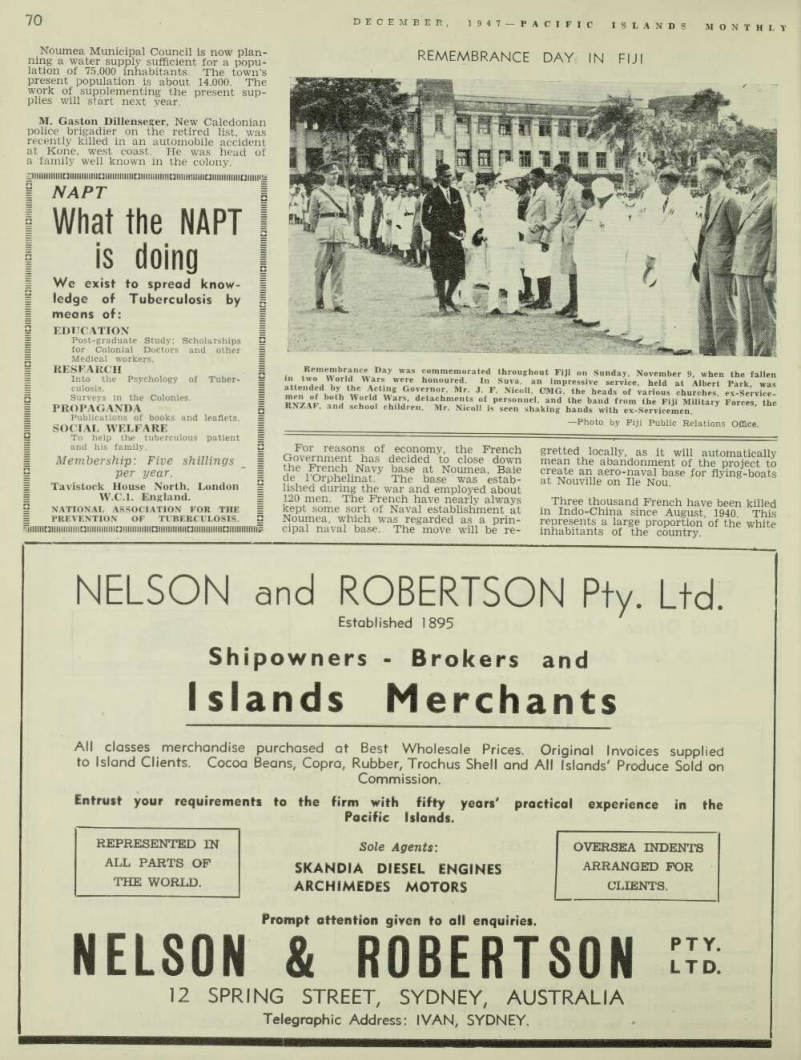
Tahiti Unrest
Governor Reproaches Residents
Hictnrhnnpp which took nlace when
i- in h?’ force
rom ’ a shin of oklrHXnSn the Tahiti h^ r °®^ n a t ls was Gh” B manifStation of DuWlcmirest aS on the ° The SlfnwtnD- S a translation of a nrothe Governor a P fter by the alter he had ordered some further arr sts
Jop u t MSv saf hiffiS
d Public order but g??co^t^ g t he Govtenor security of the country ne uov_ Sa Committee and aSested those susits activities
besides which
are now a matter of study, the inspirers
of disorder had intended to carry out certain outrages, in particular incendiar ism in the town.
“Fortunately, certain people saw the gravity of the situation. They opposed these criminal projects, which would have obliged the Government to intervene openly with armed force. That is the reason why such people have been allowed to remain at liberty, and their attitude will be borne in mind when these matters come up for trial.
“The Governor deplores the fact that so large a portion of the population did not take into account the grave danger which menaced the country, and therefore took the view that the employment of armed force was not entirely justified.
“Without its employment, it is certain that the growing disorder would have resulted in a rapid deterioration of the situation to a position infinitely worse that that to which an end has been put.
“It is for this reason that the Govern ment decided to restore order and to maintain it by all the means at its dis
posal.”
Noumea Municipal Council is now plan ning a water supply sufficient for a popu lation of 75,000 inhabitants. The town’s present population is about 14,000. The wprk of supplementing the present sup plies will start next year.
M. Gaston Dillenseger, New Caledonian police brigadier on the retired list, was recently killed in an automobile accident at Kone, west coast. He was head of a family well known in the colony.
Advertisements & other items, pp. 71-72 (1 item)
Wlllla
YOU FLY
USE
£
SHTWHBHT IUOBtOI
Finished in woven-sfriped, waterproofed canvas, with leather-bound edges, Airway Cases are available in limited supply, but production is increasing.
Made by FORD SHERINGTON LTD.
Wholesale only
Wlllla
I I
Atkins
Pty. Ltd.
Head Office, 449-451 KENT ST., SYDNEY
Iron & Steel Merchants-Engineers' Supplies
Coach & Motor Hardware
ESTABLISHED OVER 50 YEARS
TRADE
ARK
Cable Address: WTLATKIN, Sydney.
STEEL DEPARTMENT
MILD STEEL:
Rounds, Squares, Flats, Half-rounds, Hexagons, Bevel, Shoeing, Tyre, Angles, Tees, Sheets, Plates, Girder Plates, Chequer Plates, Channels, Hoops, Etc.
BRIGHT STEEL:
Rounds, Squares, Hexagons.
Extra Special High Speed Tool Steel, Mining Steel, Blister Steel and Spring Steel, Rounds, Flats Gr Squares.
Bar Iron—All sections and sizes.
Engineers' Supplies: Set Screws, Studs, Metal Thread Screws. Coach Screws, Files, Cotter Pins, Bright and Black Bolts, Rivets, Etc., Hack Saw Blades.
Power Transmission Gear: Including Plummer Blocks, Couplings, Collars, Etc.
Coach and Motor Hardware: Axles, Springs, Wheelstuff, Duck, Paints.
Farriers' Supplies: Horse Nails, Anvils, Vices, Etc.
Motor-Trimmers and Motor Builders' & Motor Painters' Requirements Pacific Island Agents : Corrie & Co., Suva, Fiji DUCO Lacquers and DULUX Enamels—FAßßEX Motor Toppings and Leather Cloths, House & Decorators' Paints, Varnishes & Brushware.
Sole Distributors of CHAMPION'S Decorators Paint Products.
Distributing Agents for BROLITE Lacquers, STHFLEX Enamels end "POLYGLOSS" Finish.
NAPT
What the NAPT
is doing
We exist to spread know-
ledge of Tuberculosis by
means of:
EDUCATION
Post-graduate Study: Scholarships for Colonial Doctors and other Medical workers.
RESEARCH
Into the Psychology of Tuberculosis.
Surveys in the Colonies.
PROPAGANDA
Publications of books and leaflets.
SOCIAL WELFARE
To help the tuberculous patient and his family.
Membership: Five shillings
per year.
Tavistock House North, London W.C.I. England.
NATIONAL ASSOCIATION FOR THE
PREVENTION OF TUBERCULOSIS.
NELSON and ROBERTSON Pty. Ltd.
Established 1895
Shipowners - Brokers and
Is] an d s Merchants
All classes merchandise purchased at Best Wholesale Prices. Original Invoices supplied to Island Clients. Cocoa Beans, Copra, Rubber, Trochus Shell and All Islands 7 Produce Sold on Commission.
Entrust your requirements to the firm with fifty years 7 practical experience in the Pacific Islands. ■ wuctmuii yirvn iu Ml! enquiries.
NELSON & ROBERTSON
12 SPRING STREET, SYDNEY, AUSTRALIA
Telegraphic Address: IVAN, SYDNEY.
Remembrance Day In Fiji
For reasons of economy, the French Government has decided to close down the French Navy base at Noumea, Bale de I’Orphelinat. The base was estab lished during the war and employed about 120 men. The French have nearly always kept some sort of Naval establishment at Noumea, which was regarded as a prin cipal naval base. The move will be re
gretted locally, as it will automatically mean the abandonment of the project to create an aero-naval base for flying-boats at Nouville on He Nou.
Three thousand French have been killed in Indo-China since August, 1940 This represents a large proportion of the white inhabitants of the country.
Remembrance Day was commemorated throughout Fiji on Sunday, November 9, when the fallen in two World were honoured. In Suva , an impressive service, held at Albert Park, was attended by the Acting Governor, Mr. J. F. Nicoll, CMG, the heads of various churches, ex-Servicemen of both World Wars, detachments of personnel, and the band from the Fiji Military Forces, the RNZAF, and school children, Mr. Nicoll is seen shaking hands with ex-Servicemen. —Photo by Fiji Public Relations Office.
Fijian Leader
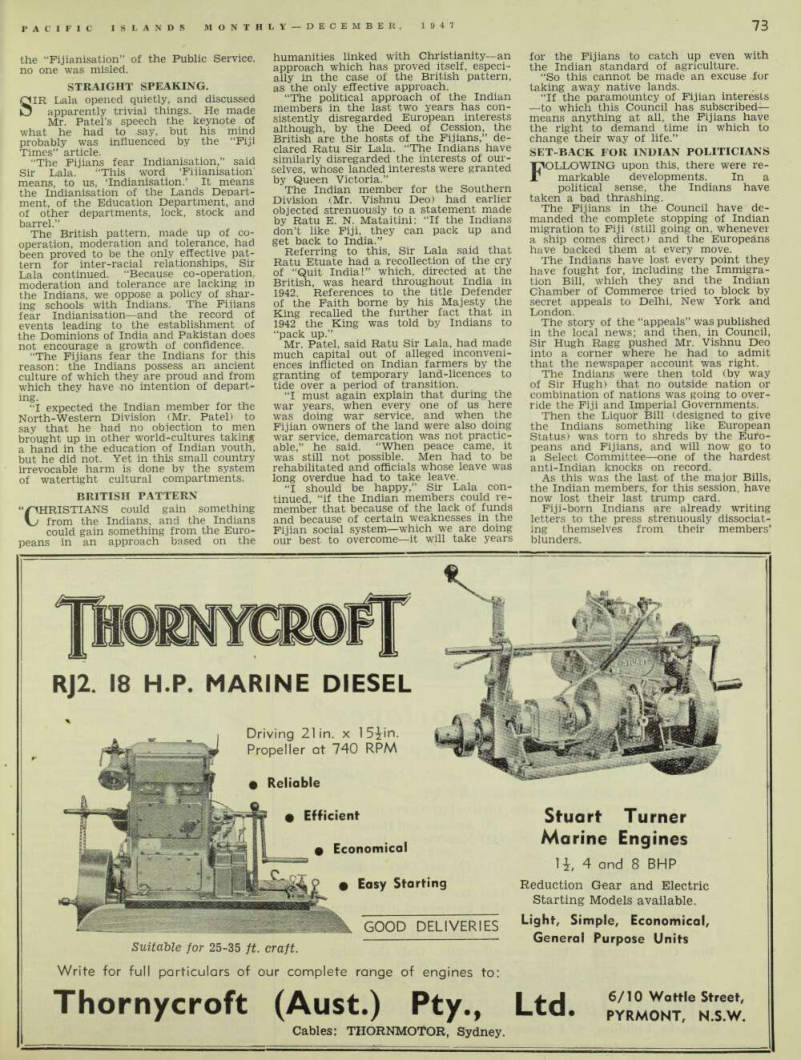
'We Fijians Fear Indianisation'
Indians Rebuffed After Frank Speech By Famous Fijian Leader
Suva. Dec. 2.
A SERIES of the hardest rebuffs ever re ceived by Indian politicians in the Legislative Council of Fiji in a single session fell on the live Indian members during the recent protracted Budget sit ting.
It is hard to say just where the Indians overstepped the line. But, wherever it was, a more important fact was that the Indians, even more confidently clamorous than usual, seemed to ignore the exist ence of such a line and ran into trouble almost as soon as the adjourned debate on the Appropriation Bill was resumed.
Outside the Council, Indian political circles have made no bones about laying the blame for what they appear to regard as a disaster at the door of the press; and the virulence of the attacks on the “Fiji Times” in at least one Indian publi cation has been astonishing.
Certainly, the diminutive “Fiji Times” had the temerity to denounce (by implica tion —not editorially) what had been generally accepted as a more or less in advertent Indian statement of an Indian plan that, at some unspecified date, there should be absolute Indian domination of Fiji, under some form of control called “self-government.”
That Indian trouble-makers cherish this ambition has been common knowledge for years. But it has never before been ack nowledged; and the fact that it has now come out in black and white seems to have enraged certain sections far more than the fact that they have been unable to deny one word of the presentation of the Indians’ various ambitions in the “Fiji Times,”
Indian “Requirements”
I ATE in November, on the second day i of the resumed sitting, the “Fiji Times” printed the following under the headlines, “Amazing List of Indians’
Requirements in Colony”; To help in “moulding the destiny of Fiji,” the Indians want: Hundreds of schools; Hundreds of teachers; Fertile land (because the Indian agita tion which led to the demarcation of re serves has not, apparently, worked out entirely to Indian plans); Drastic cuts (if not elimination) of “iniquitious” taxation of Indians; Advances to operate Indian farms.
Reduction (at least) of various Indian trading licence fees (tailors, jewellers, etc.); “Opening up” of the Civil Service; End of “European monopoly” in the
higher gosts;
End of “racial discrimination” (not liquor this time —Civil Service again); End of Civil Service “imnorts”—de scribed as “raw recruits” —from New Zealand and Australia.
Stirring-up of Agricultural Department: Scrapping of parts of the Education Plan (backed by many Indians last year); More scholarships (for non-Europeans, but with emphasis on Indian needs); Universal suffrage (male and female); Civil Service salary cuts (affecting only salaries over £5OO a year); Indian (and Fijian) police officers in the higher police posts; and, lastly, Implementation of Great Britain’s stated aim of bringing Colonial territories along the road to self-government—but not, of course Fijian self-Government based on Fiji for the Fijians. (One of the main reasons for the demand for schools and teachers was admittedly the need for
equipping Indians for “self-government” in Fiji.) These demands, statements or sugges tions have been made in the- Legislative Council by Indian members in the last two days.
There was nothing particularly sensa tional —as journalism goes to-day—in either the story or the presentation, but the public reaction was marked. It was felt that the time had arrived for a political show-down with the Indian com munity,
Indian Hopes In Fiji.
ON the following day, in the Legislative Council, an historic speech was made by Ratu Sir Lala Sukuna, who is not only the most distinguished living Fijian, but is probably also the one man in Fiji’s four large communities who at tains the status of a statesman, accord ing to British standards.
It should be explained, as background to Sir Lala’s speech, that a number of Indians in Fiji, and Fiji Indians overseas, are insisting that they are “Fijians.” The claim is treated by native Fijians with quiet contempt—the Fijians know that behind it is the Indians’ ceaseless hope that they will some day be allowed by the British to rule Fiji. Europeans similarly reject the claim because they suspect that the Indians —especially those who are residing temporarily in New Zealand —are trying to cash in on the fine war record of the Fijian people, and the popularity in New Zealand of Fijian servicemen.
Sir Lala’s speech was preceded by one by the Indian representative, Mr. A. D.
Patel. As usual, Mr. Patel bewailed the plight of the Indians—including a section
of the traders who made fortunes during the war —and when he blandly demanded
the “Fiiianisation” of the Public Service, no one was misled
Straight Speaking.
SIR Lala opened quietly, and discussed annarentlv trivial things He made Mr Patel’s sneech the keynote of whnt h’p had to sav but his mind probably was influenced by the “Fiji Times” article. .“The Fijians fear Indlanisation.” said Sir Lala. “This word ‘Fiiianisation al^dianisati(m^ofl^l^l<^ndJ t DeDartment of the Education Department, and of other departments lock stock and barrel” aepartmenl:s ’ 10CK ’ SLOCK ana The' British pattern, made up of cooperation moderation and tolerance, had been proved to be the only effective pattern for inter-racial relationships, Sir Lala continued. “Because co-operation. moderation and tolerance are lacking in the Indians we oppose a policy of sharing schools’ with Indians. The Fijians fear Indlanisation—and the record of events leading to the establishment of the Dominions of India and Pakistan does not encourage a growth of confidence.
“The Fijians fear the Indians for this reason- the Indians possess an ancient culture of which they are proud and from which they have no intention of departing “I expected the Indian member for the North-Western Division (Mr. Patel) to say that he had no objection to men brought up in other world-cultures taking a hand in the education of Indian youth, but he did not. Yet in this small country irrevocable harm is done by the system of watertight cultural compartments.
British Pattern
“/CHRISTIANS could gain something V; from the Indians, and the Indians could gain something from the Europeans in an approach based on the
humanities linked with Christianity—an approach which has proved itself, especi ally in the case of the British pattern, as the only effective approach.
“The political approach of the Indian members in the last two years has con sistently disregarded European interests although, by the Deed of Cession, the British are the hosts of the Fijians,” de- Glared Ratu Sir Lala. “The Indians have
w^osl
selves, whose landed interests were grantea Member for the Southern Division (Mr. Vishnu Deo) had earlier objected strenuously to a statement made by Ratu E. N. Mataitini: “If the Indians don’t like Fiji, they can pack up and get back to India.”
Referring to this, Sir Lala said that Ratu Etuate had a recollection of the cry of “Quit India!” which, directed at the British, was heard throughout India in 1942. References to the title Defender of the Faith borne by his Majesty the King recalled the further fact that in 1942 the King was told by Indians to “pack up.”
Mr. Patel, said Ratu Sir Lala, had made much capital out of alleged inconveni ences inflicted on Indian farmers by the granting of temporary land-licences to tide over a period of transition.
“I must again explain that during the war years, when every one of us here was doing war service, and when the Fijian owners of the land were also doing war service, demarcation was not practic able,” he said. “When peace came, it was still not possible. Men had to be rehabilitated and officials whose leave was long overdue had to take leave.
“I should be happy,” Sir Lala con tinned, “if the Indian members could re member that because of the lack of funds and because of certain weaknesses in the Fijian social system—which we are doing our best to overcome—it will take years
for the Fijians to catch up even with the Indian standard of agriculture.
“So this cannot be made an excuse for taking away native lands.
“if the paramountcy of Fijian interests —to which this Council has subscribed— means anything at all, the Fijians have the right to demand time in which to change their way of life.”
Set-Back For Indian Politicians
FOLLOWING upon this, there were re ... dpvplonmpnts in n political sense, the Indians have taken a bad thrashing, The Fijians m the Council have de manded the complete stopping of Indian migration to Fiji (still going on whenever a ship comes direct) and the Europeans have backed them at every move, The Indians have lost every point they have fought for including the Immigra tion Bill, which they and the Indian Chamber of Commerce tried to block by secret appeals to Delhi, New York and London. ...
The story of the appeals was published in the local news; and then, in Council, Sir Hugh Ragg pushed Mr. Vishnu Deo into a corner where he had to admit that the newspaper account was right, The Indians were then told (by way of Sir Hugh) that no outside nation or combination of nations was going to over ride the Fiji and Imperial Governments.
Then the Liquor Bill (designed to give the Indians something like European Status) was torn to shreds by the Euro peans and Fijians, and will now go to a Select Committee—one of the hardest anti-Indian knocks on record, As this was the last of the major Bills, the Indian members, for this session, have now lost their last trump card.
Fiji-born Indians are already writing letters to the press strenuously dissociat ing themselves from their members’ blunders.
Advertisements & other items, pp. 73-75 (1 item)
The Garrick Hotel
QUEENSLAND
INSURANCE
COMPANY
LIMITED
(Incorporated 1886 In Australia)
ASSETS EXCEED £4,000,000
Head Office:
QUEENSLAND
INSURANCE BUILDING,
80-82 PITT STREET, SYDNEY.
Specialists in South Seas Fire,
Marine Cr Accident Insurances
Apply to: —
FIJI.
Branch Office; I. B. Chalmers, Manager.
Burns Phllp (South Sea) Co., Ltd.
VILA.
Burns Phllp (South Sea) Co., Ltd.
Comptolrs Prancals Des Nouvelles Hebrides (Marine).
NOUMEA.
L. Sc W. Johnston.
PORT MORESBY:
Burns, Phllp St Co., Ltd.
W. A. Anderson, Resident Officer.
PAGO PAGO.
Burns Phllp (South Sea) Co., Ltd.
G. H. C. Reid Sc Co.
OTHER SOUTH SEA ISLANDS.
Burns Phllp (South Sea) Co., Ltd.
Also to any of the Company's Offices in Australia or Hew Zealand.
The Garrick Hotel
i * ml m m
SUVA
FIJI
I his well-known Hotel is centrally situated in Suva's main business quarter :: Modern accommodation provides comfort in all climatic conditions :: Only the best of Beers, Spirits and Wines is served Telephone: 80. VINCE COSTELLO, Proprietor.
£
ms me p
I7W Jrnt a
Protect the eyes of youth with Laurel's "soft, white light."
Laurel Kerosene burns steadily and brightly to the last drop, because it contains no impurities to clog the wick.
There is no smoke nor any disagreeable odour. For and economy - Insist upon LAUREL KEROSENE. %
VACUUM
OUAIITT PRODUCT
f n 0 0
RJ2. 18 H.P. MARINE DIESEL
* Driving 21 in. x 1 siin.
Propeller at 740 RPM • Reliable Efficient • Economical • Easy Starting - r
GOOD DELIVERIES
Suitable for 25-35 ft. craft.
Stuart Turner
Marine Engines
H, 4 and 8 BHP Reduction Gear and Electric Starting Models available.
Light, Simple, Economical, General Purpose Units Write for full particulars of our complete range of engines to:
Thornycroft (Aust.) Pty., Ltd.
Cables: THORNMOTOR, Sydney. 6/10 Wattle Street,
PYRMONT, N.S.W.
Bsi Advisory Council Meets
From Our Own Correspondent
Honiara. Nov. 18.
THE Solomon Islands Protectorate Ad visory Council met last week at Honiara, after a formal opening by the Resident Commissioner (Col. O. C Noel). Official members are the Chief Magistrate and Legal Adviser (Mr. W. T.
Charles), who was sworn-in on this occasion; the Senior Medical Officer (Dr A. G. Rutter) and the Commissioner of Works (Mr. Paul Burns). Non-official members are Mr. G. R. Younger, Capt.
C. W. Seton and the Yen. H. V. C.
Reynolds, who was sworn in as repre sentative of the Bishop of Melanesia.
Their deliberations will not be made public until the issue of the formal pub lished report.
Mr. Bruno Kroening has applied for Australian Naturalisation. He has spent 14 years in New Guinea and nine in Aus-
Filariasis
New Hope For S. Pacific Sufferers
T long last, there is hope for
sufferers from filariasis, that
unpleasant mosquito-borne disease which affects so many people, Euro peans and natives, in the South Seas, and which so often takes the un
sightly form of elephantiasis. It is
estimated that, in all tropical regions of the world, there o.re over 100,000,000
fflaria sufferers.
friend of the “PIMP Col R. H. Garity, of the Augusta Military Academy, Virginia, who was with the American military forces in the South Pacific during the war, has kindly sent us the following article which was published in the “New York Times” of October 25, 1947: ANEW family of compounds that have been tested on human subjects and found to be effective against disease producing organisms never satisfactorily treated before was reported yesterday by two Puerto Rican scientists at the close of a two-day conference on filariasis conducted by the New York Academy of Sciences.
The new compounds are a group, known to chemists as piperazines, that have never before been tested extensively for their therapeutic calue. Attention was focused on them yesterday by a report that one of the group, when given orally, causes rapid disappearance of micro filariae (embyronic parasites) from the bloodstream.
Microfilariae are tiny organisms asso ciated with filariasis, a tropical disease that has an estimated 15,000,000 to 200,000,000 sufferers.
Dr. Lowell T. Coggeshall, chairman of the department of medicine and dean of the division of biological sciences at the University of Chicago, presided at the meeting.
Progress in Test Hailed AT the close of the meeting Dr. Cog geshall said: — “This discovery marks new progress in chemotherapy. A series of drugs has
been found to be effective against organ isms that; we have heretofore had little success with. The final answer to the problem of controlling filariasis has not been found but the evidence presented here is most promising, an enormous stride.”
The Puerto Rican scientists are Dr. J.
Oliver-Gonzalez and Dr. D. Santiago- Stevenson from the School of Tropical Medicine in San Juan. They presented clinical records covering twenty-six cases in which they found that by oral admin istration of the piperazine ‘‘in all in stances the number of micro-filariae was markedly reduced by the second day of treatment.”
Further administration of the com pound, they reported, caused a greater de crease in the microfilariae count in the bloodstream until in all twenty-six cases the reduction in count ranged from 77.8 to 100 per cent., with one exception. In ten out of the twenty-six cases the re duction amounted to 100 per cent.
The latest examinations, made 160 days after the treatment, revealed that “50 per cent, of the patients who received the highest dose were entirely negative for microfilariae,” and that “all other cases, except two, still had very low counts,” they said.
Filariasis is transmitted by mosquitoes.
Dr. Santiago-Stevenson said about 3 per cent, of the Puerto Rico population is infected. Debility and lassitude, accom panied with a low-grade fever and swel ling of the Ivmph modes, are the general symptoms of the disease.
In its end effects filariasis causes elephantiasis, in which a monstrous swel ling of the limbs or internal organs re sults.
Might Become “Clinical Cure”
Dr. Santiago-Stevenson Said That
if the cases under observation still have a negative microfilariae count a year from now, the piperazine treat ment might be considered a “clinical cure” for filariasis.
The piperazine compound tested in Puerto Rico was developed by Dr. R. I.
Hewitt and associates of the Lederle Laboratories Division of the American Cyanamid Company. Close co-operation among Lederle Laboratories and Columbia University, Western Reserve University of Minnesota, as well as a number of other institutions, resulted in the tests being conducted in Puerto Rico, where the disease is endemic, Dr. Hewitt said.
Dr. Coggeshall, a specialist in tropical diseases, during the war directed research on filariasis, as well as malaria, to safe guard the health of members of the armed forces in the South Pacific and other tropical regions.
In the past, complex compounds of arsenic, antimony and other metals have been used to combat the disease. The re sults of using these compounds were des cribed at the symposium as “unsatisfac tory.”
Dr. Coggeshall said that the develop ment of the piperazine compound for filariasis, besides opening up new possi bilities for treatments of other diseases, has three principal advantages; the com pound does decrease the microfilariae count, it can be given orally so that the inconvenience and discomfort of in jection are done away with, and it is not toxic and is easily tolerated by patients.
Mr, S. Paisley, a well-known plantation manager in the Buka and Madang dis tricts of New Guinea before the war. has returned to the Territory by “Malaita” to take over the management of Baniu estate in Bougainville. He was accom panied by Mrs. Paisley.
Among the passengers on the Qantas flying-boat “Coriolanus,” which passed through Brisbane recently from Suva and Noumea, were Mr. and Mrs. H. H. Hodg son, of Vatukoula Mines, Fiji.
Advertisements & other items, p. 76 (2 items)
74
DECEMBER, i947-PACIEJC ISLANDS MONTHLY
Stephens Import and Export Co.
TIME-PIECES
REPAIRED
We employ a Fully Qualified
Staff and we are equipped to undertake repairs of
WATCHES CLOCKS
MARINE CHRONOMETERS
We undertake Locksmithing, Key-cutting, etc.
Any goods sent to us by post are attended to promptly ‘and with care.
NOEL LEVY
Victoria Parade, Suva, Fiji Phone 39. P.O. Box 88.
Cablegrams: “Noel,” Suva
What are your shortages ?
STEPHENS IMPORT AND EXPORT CO.
HIDES, SKINS AND LIVESTOCK SUPPLIERS AND SHIPPERS We are suppliers of the following.-
CROCKERY: HOTEL AND DOMESTIC SUPPLIES.
(9) Saddles and Harness. (10) Non-Electric Washing Machines. (11) Tubular Chrome Furniture. (12) Tools, Machinery. (13) Pumps and Stationary Engines. (14) Home Lighting Plants.
Rum, Gin, Liqueurs, Whisky and all spirits. Only the finest Australian and Imported brands stocked.
All orders personally attended to and shipped promptly.
Stephens Import and Export Co.
Dymocks Building, 424 George Street, Sydney, Australia (1) Trade Goods. (2) Primus Stoves. (3) Foodstuffs. (4) Umbrellas. (5) Manchester Lines. (6) Perfumery. (7) Wines. (8) Radios.
The Month In
Moresby
LOCAL discontent has obviously not been communicated to the pre-natal world, for the birth-rate is still rapidly accelerating. The hospital is now running a weekly welfare clinic to care for new arrivals. * * * THOSE who returned to the Territory in the early days of the Provisional Administration are now due for leave.
The large exodus from the Territory of recent weeks includes Mr. Stan Willis, well-known Moresby identity; Mr. W.
Cottrell-Dormer, Director of Agriculture; Mr. W. R. Humphries, Director of Native Labour: and Mr. A. E. Watkins, Resident Magistrate. * * * IF resignations are any guide, all does not seem well with local ABC Station 9PA. Earlier this year two an nouncers left to join the Administration; soon after, Announcer Bob Smith fol lowed suit. The latest to leave is the news-roundsman, Mr. A. McCormack. * * * MORESBY’S Administrative offices are buzzing with speculation about the future of the Territories.
The recent extension of Colonel J. K.
Murray’s term “for a period of twelve months, or until such time as the Papua- New Guinea Act is no longer in force,” does not give any indication as to future policy. Some, however, interpret it as an indication that the provision of a per manent administration is in the offing others point out that it implies a possibility that such a move may not occur for twelve months or more.
But whenever the move is made, it is now widely accepted that there will be a combined administration. A mere handful of the old diehards, who still hope for separation and a return to the good old days,” think otherwise.
Our tip is for a combined administra tion—soon! * • * POLICEMEN are rated highly in the present Adiministration. A recent advertisement offered to police officers a minimum salary of £438, plus cost of living, plus free uniforms. And the most junior European policeman may now command the proud title of Assist ant Sub-Inspector.
Mere clerks in Government service, however, must start on £372, and Patrol- Officers move to £4OB on qualifying at the end of two years. Under present con ditions and cost of living, no one would suggest that the policemen are over- Sf lc lh in comparing salary ranges it be said that they are over- T !? e or * ly Qualifications mentioned in the advertisement are service in the permanent army, navy or fire brigade.
These are considered “desirable.” * * * VACANCIES for 20 Native Labour In spectors were also advertised re cently. The salary range for a NLI is £642-714, which is similar to that of an ADO. or a District Education, Forestry or Agricultural Officer. as specified in the gazette * * * THE Administrator and a party of officials were to visit Manus, New Ireland and the north-western islands in early November, but Colonel Murray was confined to bed, under medical orders. Mr. J. H. Jones, Acting Director of District Services and Native Affairs, made the trip instead, and was appointed a Deputy of the Administrator
for the purpose. Dr. J. T. Gunther, Director of Public Health, also went on this inspection. * * * ON “Cup Night,” the Royal Papuan Constabulary Band and the Pore prena Choir gave a concert, in aid of the Red Cross, at the RSL club rooms, Ela Beach. The evening was successful and the performance of a high standard.
It was /noticeable, however, that few of the residents of Konedobu attended; with daily parades at all hours, even the most ardent lovers of brass among them have recently had a surfeit. * * * ON November 6, a group of people who styled themselves the “Barnacles,” assembled at the RSL club to “chin over” old times. To qualify for admission one had to have been in Moresby twenty years ago. The evening brought many
old-timers together—none of the ladies seemed to mind revealing their twenty years’ residence in the Territory.
Mr. and Mrs. N. Whitely, of New Guinea, were staying at the Bellevue Hotel, Brisbane, during November.
Advertisements & other items, p. 77 (1 item)
Coleman
MAKE MONEY AT HOME
Cast ornaments and novelties for friends, gift shops and stores Our new Postal Course, "M ode r n Moulding Arts,” makes it so easy. Send stamp for details. Start a home business. Dept. 15 Le Bon College (Regd.) Box 279 Haymarket P. 0., Sydney. £
For all lighting
Coleman
WORLD-WIDE
'Pravm Z>cfac*teCedkU&f
the finest . . for ail the latest in cooking and heating appliances you can be sure with COLEMAN. Wherever you may be there is a Coleman dealer to serve you with dependable COLEMAN appliances and service.
The Coleman Lamp
and Stove Company Limited
TORONTO, CANADA
CHICAGO. U. S. A,
Foot Racing In
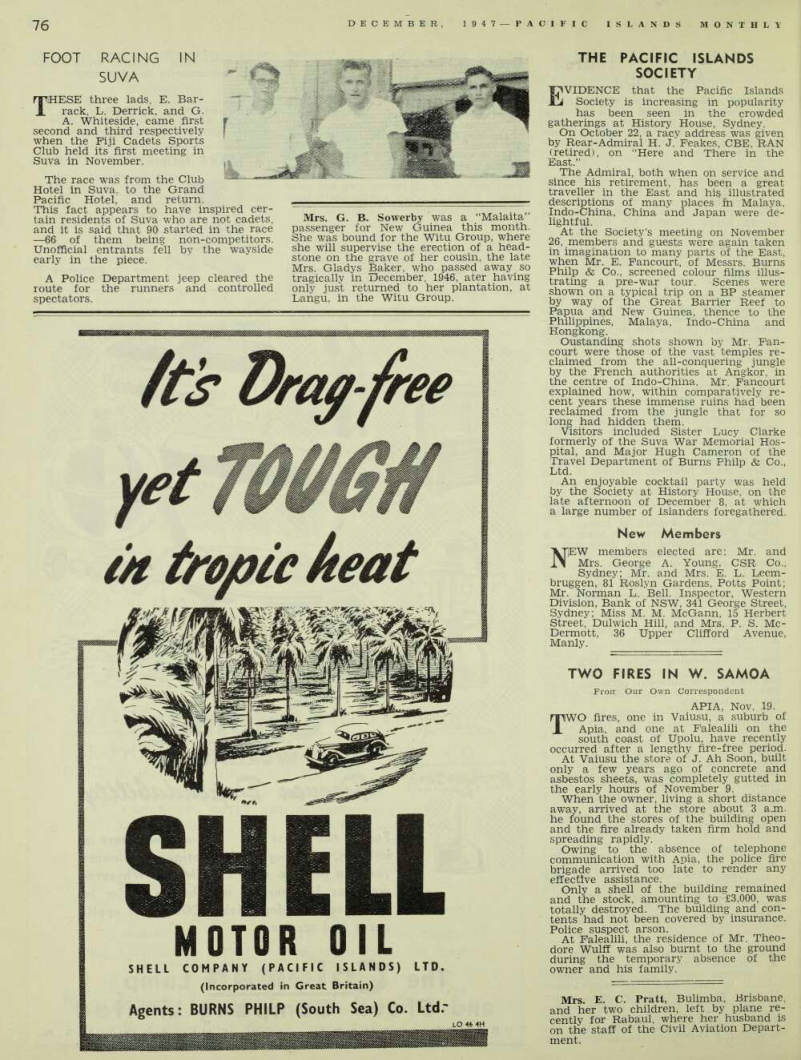
Suva
THESE three lads, E. Bar rack, L. Derrick, and G.
A. Whiteside, came first second and third respectively when the Fiji Cadets Sports Club held its first meeting in Suva in November.
The race was from the Club Hotel in Suva, to the Grand Pacific Hotel, and return.
This fact appears to have inspired cer tain residents of Suva who are not cadets, and it is said that 90 started in the race —66 of them being non-competitors.
Unofficial entrants fell by the wayside early in the piece ' A Police Department jeep cleared the route for the runners and controlled spectators.
„ „ „ , „ Mrs. G. B. Sowerby was a Malaita passenger for New Guinea this month.
She was bound for the Witu Group, where she will supervise the erection of a head stone on the grave of her cousin, the late Mrs. Gladys Baker, who passed away so tragically in December. 1946, ater having only just returned to her plantation, at Langu, in the Witu Group.
The Pacific Islands
Society
EVIDENCE that the Pacific Islands Society is increasing in popularity has been seen in the crowded gatherings at History House, Sydney.
On October 22, a racy address was given by Rear-Admiral H. J. Feakes, CBE, RAN (retired), on “Here and There in the East.”
The Admiral, both when on service and since his retirement, has been a great traveller in the East and his illustrated descriptions of many places in Malaya, Indo-China, China and Japan were de lightful.
At the Society’s meeting on November 26, members and guests were again taken in imagination to many parts of the East, when Mr. E. Fancourt, of Messrs. Burns Philp & Co., screened colour films illus trating a pre-war tour. Scenes were shown on a typical trip on a BP steamer by way of the Great Barrier Reef to Papua and New Guinea, thence to the Philippines, Malaya, Indo-China and Hongkong.
Oustanding shots shown by Mr. Fan court were those of the vast temples re claimed from the all-conquering jungle by the French authorities at Angkor, in the centre of Indo-China. Mr. Fancourt explained how, within comparatively re cent years these immense ruins had been reclaimed from the jungle that for so long had hidden them.
Visitors included Sister Lucy Clarke formerly of the Suva War Memorial Hos pital, and Major Hugh Cameron of the Travel Department of Burns Philp & Co., Ltd.
An enjoyable cocktail party was held by the Society at History House, on the late afternoon of December 8, at which a large number of islanders foregathered.
New Members
NEW members elected are: Mr. and Mrs. George A. Young, CSR Co., Sydney; Mr. and Mrs. E. L. Leem bruggen, 81 Roslyn Gardens, Potts Point; Mr. Norman L. Bell. Inspector, Western Division, Bank of NSW, 341 George Street, Sydney; Miss M. M. McGann, 15 Herbert Street, Dulwich Hill, and Mrs. P. S. Mc- Dermott, 36 Upper Clifford Avenue, Manly.
Two Fires In W. Samoa
Frorr Our Own Correspondent
Apia, Nov. 19.
TWO fires, one in Vaiusu, a suburb of Apia, and one at Falealili on the south coast of Upolu, have recently occurred after a lengthy fire-free period.
At Vaiusu the store of J. Ah Soon, built only a few years ago of concrete and asbestos sheets, was completely gutted in the early hours of November 9.
When the owner, living a short distance away, arrived at the store about 3 a.m. he found the stores of the building open and the fire already taken firm hold and spreading rapidly.
Owing to the absence of telephone communication with Apia, the police fire brigade arrived too late to render any effective assistance.
Only a shell of the building remained and the stock, amounting to £3,000, was totally destroyed. The building and con tents had not been covered by insurance.
Police suspect arson.
At Falealili, the residence of Mr. Theo dore Wulff was also burnt to the ground during the temporary absence of the owner and his family.
Mrs. E. C. Pratt, Bulimba, Brisbane, and her two children, left by plane re cently for Rabaul, where her husband is on the staff of the Civil Aviation Depart ment.
Advertisements & other items, p. 78 (1 item)
ft's Draff free
m tropic /teat
'Pm ' V I i sr r >• ♦/■/i
MOTOR OIL
SHELL COMPANY (PACIFIC ISLANDS) LTD.
(Incorporated In Great Britain) Agents: BURNS PHILP (South Sea) Co. Ltd.'
Weighs
How Hokitika's Rainfall Weighs Upon Fijian Youth Absurdities of System Under Which N. Zealand Supervises Colony's Exams
'THIS article was contributed by an irate Fiji parent. It was sent in order that it might amuse “PIM ” readers —and it certainly is amusing.
But the writer sent, also, a set of the examination papers, and the latter bear out the points of the following criticism.
Surely, the time is come for some kind of reform. The Fiji-New Zealand education arrangement has been in operation for some years, and no doubt served a useful purpose. But Fiji now has a definite life of its own —it has no more connection with Neio Zealand, culturally or politically, than it has with Australia or Canada —and it is absurd that young Fiji- Europeans should be tied up in this way to the Socialistic Dominion.
The political implications of one set of questions quoted below are plain. The NZ Socialists may use the NZ education system to influence the minds of NZ children, if New Zea landers generally permit it. But why should Fiji children be submitted to the same cunning design?
If Fiji, as Britain’s most important Crown Colony, cannot run its own examination system, it should go for assistance to some other British tropical country, rather than to isolated and class-conscious New Zealand.
IT was not until I perused the papers set for “School Certificate Examina tion, 1947,” that I fully realised how completely our Fiji Education Depart ment is dominated by New Zealand.
As far as the Mathematics, Chemistry, Geometry & Trigonometry, and English papers were concerned, the standard ap pears good. As I could not answer many of the questions, perhaps I could go fur ther and say that the standard is high.
The two papers which intrigued me most were those in respect to history and geography. In my school days history questions were along the lines of “What was the date of the Battle of Hastings”: or “How many wives had Henry Eighth:” or “How did Bloody Mary get her name;” but the history paper before me was on very different lines.
It was more like a General Knowledge Quiz.
For instance: Section C No. 5 (b) read, “Very briefly, compare Sir William Beveridge’s plan for social reform in Britain with our own social security scheme.”
The candidate, if he took the words “our own” literally, could not answer any thing other than briefly—he or she would merely have to write: “No comparison nossible. because we have no such scheme in Fiji.”
Section D, No. 14 reads: “Show how the establishment and development of the dairy industry in New Zealand has been helped by land legislation, the application of science, and organisation for manufac turing and marketing.”
If the word “Fiji” were substituted for the words “New Zealand,” I am sure Government, particularly the Agricultural Department, would glean some useful and instructive ideas.
IN the same Section question No. 15 reads: ‘Choose any County, or Borough, or City Council, or Town Board, and explain its organisation and work. What are the democratic principles involved in local government?”
In answering this question, a candidate could really spread himself. We have a Town Board, we also have Road Boards, and what is more useful, but in shorter supply, floor-boards. A child would find it difficult, however, to deal eloquently with the latter part of question No. 15, since the democratic principles involved in local government were dished in Fiji when the candidate was in napkins.
Section D. question No. 16 absolutely appealed to me. It reads “Describe and account for, first, the ties which in the past have bound New Zealand closely to
Britain; and, second, the changes which, since about 1930, have taken place in New Zealand’s relationships with Britain. Do you think the ties have been weakened or strengthened by these changes?
For the benefit of candidates in Fiji, I would have substituted the word “Fiji” for Britain, and let the pupils give full play to their imaginations. They could have enlarged for instance, on the ar rangement made with New Zealand to have all fruit purchased f.o.b. Suva, the idea being to give the people of NZ cheaper fruit.
LEAVING the History paper, we turn to the Geography questions. The candidate is supplied with an aerial photograph of part of New Zealand, and he is required to answer five questions about it. They are as follows:
(a) Is the photo taken looking eastward or westward? (b) How has the land in the foreground been built? (c) What was the native vegetation on the hills in the background? (d) What kind of farming do you think is being carried on in the foreground? (e) To what use are the hills in the background being put? (f) What is the use of the trees grow ing in the foreground? Why are there none across the river-bed?
As I am not a Government official or an employee of the CSR Company, it is extremely unlikely that my children will have an opportunity of viewing the won derful farming areas of New Zealand— at least, not at my expense. They will have to fight for their livelihood “on the beaches, in the houses, on the streets, and in the hills” (thank you, Mr. Churchill) in Fiji.
Why could not the Education Depart ment of Fiji substitute an aerial photo graph of parts of Fiji, showing, for in stance, banana plantations on the Waini buka River overgrown with mile-a minute, or neglected coconut plantations on Vanua Levu. or barren hillsides, with the question “Why does this look like that?”
Or perhaps a photo of stringy, scrub cattle standing against overgrown graz ing lands, and ask the question “what is the result of this?” The answer could be very brief to this latter nicture: “Beefless Days!”
To add variety to the questions, what about a photo of the Nausori and Nadi Aerodromes, and the candidate asked to compare the relative merits of these two places? I have no doubt that “out of the mouths of babes,” and as a result of their clear, unbaised minds, a good deal of useful and constructive criticism would become available for the Air Conference, which is sitting, or should be sitting—
probably in British Guiana and so de cide this contentious question.
IN this same Geography paper, Section C, No. 9 (b) gives a table of average monthly rainfall in inches in four New Zealand places, and the candidate is asked to explain, briefly, the effect of the rainfall on the native vegetation of Napier and Hokitika.
I have never heard of Hokitika, neither have my children. We do not know how to pronounce it, either, since New Zea land, unlike Fiji, dops not alter the spel ling of its native names, to make them more easily pronounceable by nit-wit visitors.
Why could not the question have taken the form of a comparison of the rain fall in Suva with, say, Lautoka, during the wet (or rainy) season? rpHE papers in this Examination were X obviously set for New Zealand chil dren attending schools in New Zea land, and marked in New Zealand. There is no mention of Fiji or territories under its control, for the benefit of candidates educated in Fiji.
Advertisements & other items, p. 79 (1 item)
-Hips aren't
1 & m V.
big problem, Honey
I YOU CAN TAKE your mind off your hips, dearie! No one finds fault with your figure!
You’d be smart to exercise a little more care about personal charm. Being streamlined, you know, won’t protect you against underarm odour. Or lessen the offence when others find you guilty of it.
So keep on trusting your bath— for past perpiration but put your trust in Mum to prevent risk of future underarm odour.
Creamy, snowy-white Mum smooths on in 30 seconds. Keeps you fresh and free from underarm odour all day or evening.
Mum is gentle—harmless to skin and fabrics. So why take chances when you can be sure with Mum?
Ask for it today.
MUM
TAKES THE ODOUR OUT OF PERSPIRATION
One Pleasant Evening In
Finschhafen
Finschhafen, Dec. 1.
FINSCHHAFEN’S naval and civilian communities assembled at Coconut Grove on November 29 and drank cold ale in a delightful, open-air beer garden.
A full moon and starry sky, with giant coconut trees standing out in bold relief, and glimpses of moon-swept ocean waters, made a scene enchanting and romantic.
There was a brilliantly-lit dais, es pecially constructed for dancing, with coloured lights encircling the flag-be decked railings.
Expensively-gowned women, in flowing evening frocks, ate “barbecue” steak and sausages. There was a myriad of deli cacies.
Host was Lieut. E. Blau, RAN, and he was ably assisted by his charming wife Their newly-erected bungalow was de clared open by Captain C. H. Brooks (Naval Officer in Charge, New Guinea) who. assisted by the Warrant Shipwright, drove a bent, rusty nail into a window sash with a 14-lb. hammer! But the anti cipated speech was not forthcoming, and the popular, bearded Captain smilingly adjourned to the strains of “Why was he born so beautiful?”
Rare Lizard Caught
In Fiji
Suva, Dec. 4.
(CONFLICTING stories of an unusual J reptile on the small island of Yadua Tabu, which lies about 15 miles to the west of Vanua Levu, Fiji, have been set at rest by its capture.
Variously described as an enormous vampire flying-bat, a mongoose, and “a beast of unknown species,” the reptile turned out to be a “Vokai,” or lizard of the iguanide family. Its correct name is “Brachylophus Fusciatus.”
The lizard, which measured 2 ft. 5i in. long, with a body of ten inches and the remainder tail, was identified by Mr. H.
T. B. Hall, the Senior Veterinary Officer, as being peculiar to Tonga and Fiji, al though its occurrence is extremely rare.
It is being preserved and will be handed over to the Fiji Museum.
Mr. and Mrs. J. L. Froggatt, previously of Port Moresby, have now taken up their residence at St. Helen’s Research station, near Campbelltown, NSW.
Advertisements & other items, p. 80 (1 item)
Wright And Company
A l=i e;
propeller shafting
FOR DEPENDABLE SERVICE
Monel propeller shafting is renowned the world over for long, dependable service. Being strong and tough it withstands hard knocks, is highly resistant to corrosion, and guaranteed entirely rustless since Monel contains no iron. In service, Monel propeller shafting also quickly develops a mirror-like polish which reduces bearing and packing wear to a minimum.
Isn't this the kind of shafting you want in your boat? Then ask your boat builder to quote you to-day for a MONEL propeller shaft ... or 'phone
WRIGHT AND COMPANY
SOLE AUSTRALIAN DISTRIBUTORS OF MONEL.
81 CLARENCE STREET, SYDNEY, N.S.W.
PHONE: BXI2II (6 LINES)
Monel is a registered Trade Mark covering a rich nickel alloy, mined in Canada and rolled in Great Britain.
The Dream
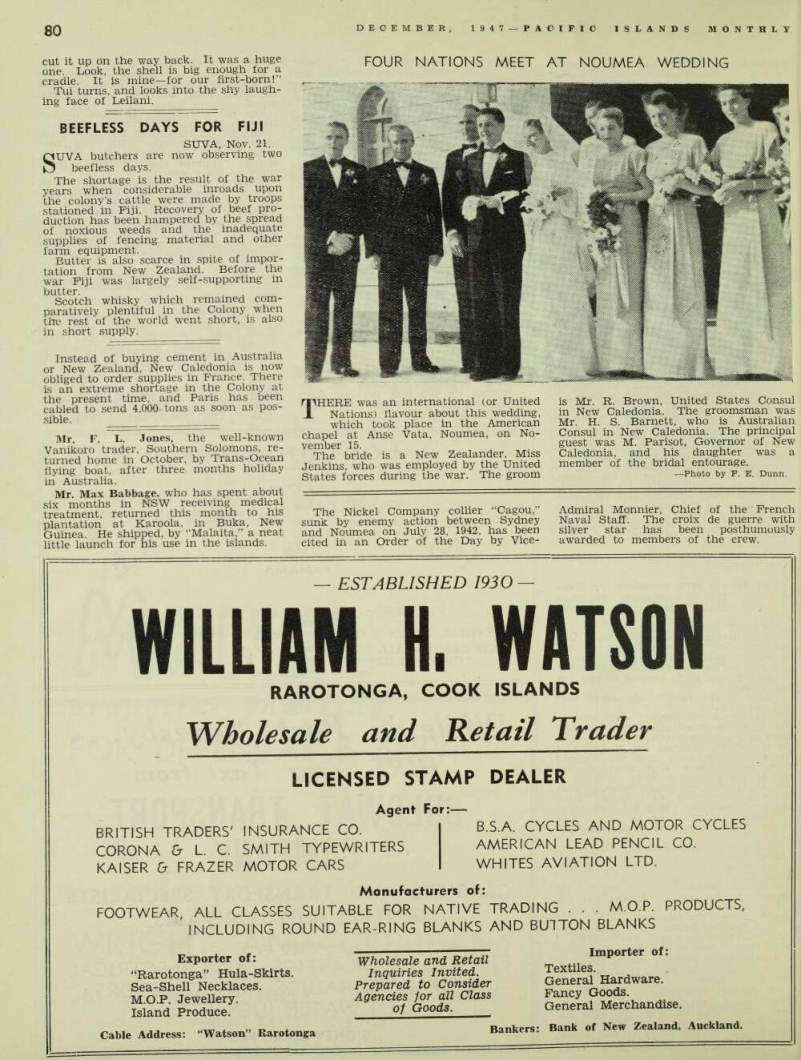
Short Story:
By Kim Sutherland
LEILANI glances at her old father with large sceptical eyes.
“Silly one!” she laughs. “You are old and your head is full of dreams. This last one is as meaningless as most of the others.”
“No. no!” implores old Viliame. “It is an ill omen. You must not go! Do you hear? You must not go!” His voice rises and breaks.
“I hear, but I am going,” Leilani laughs gaily. She walks unconcerned from the bure. her head high and her straight back gracefully erect. On the beach she meets her friends, Emosi, Toto and Voi.
Toto and Emosi are young men with strong muscular bodies, carefree laughing faces. Voi, like Leilani, is gracious in movement and full of gay vitality. Hap pily the four friends push the canoe into the lapping waters of the lagoon.
Unheeded, Viliame calls frantically. He beats the earthen floor with his stick, full of exasperation at his helplessness.
Troubled and angry, he reflects upon his inability to prevent his headstrong daughter from going against his will to dive for shellfish beyond the reef.
He tries painfully to reach the door, but Leilani has gone. Not even by force could he have stopped her, for she is full made and powerful and he a wizened cripple. She has scoffed at his dream, but it is no scpffing matter, for the dream had been vivid, ominous and prophetic.
He, Viliame of the great age and great affliction, is gifted with the power of visions, for being so very old he now lives sometimes in this world and sometimes in the one beyond.
“The dream, the dream,” he mutters with agitation.
JUST then a form darkened the door way. The old man starts. His weak eyes strain hopefully in the dim light.
“Leilani?” he cries.
“No, Viliame. Leilani has gone fish ing,” says Tui, his son-in-law to be. Tui is young, thoughtful beyond his years, and will one day be the Ratu of his tribe.
The old man rocks himself to and Iro, and groans.
“What is the matter, old one?” asks Tui, perturbed.
“The dream, the dream,” wails Viliame.
Tui is at once attentive, for Viliame’s fame as a prophet is known far and wide.
He it was who foretold the drowning of Tinoni, and the very next day Tinoni’s over-turned canoe had been washed ashore, but never a trace of his bodv.
“Tui!” The old man’s voice is sud denly joyous. “You are the one! Run, man, call her back! Stop her, stop her!”
“Leilani, father? It’s too late. The canoe is halfway across the lagoon,” replies Tui.
Viliame, suddenly beside himself, roars, “Then shout. Wave! Do something!”
Tui, uneasy now, savs, “They wouldn’t hear. The wind’s inshore.”
Viliame’s breath becomes quick. He moans and his gnarled hands beat the air in desperation.
“The dream, the dream—”
“Tell me the dream,” says Tui, squat ting, eager to hear, yet half afraid of what the old man might tell him.
Viliame leans forward, his hands slack about his stick. He seems crumpled, pas sive and resigned.
“It was a swift dream,” he says. “I saw Leilani and her friends approach the reef She stood up laughing, with her scarlet sulu flapping in the wind. Then she dived. As the water cleared again I saw a long white belly gleam. I was
horror-struck. Bubbles gushed to the surface. Then blood, her blood, stained the troubled waters. I waited, my throat tight with fear. I could not move or dive to help her. I was powerless. Suddenly Leilani’s head broke the v/ater. Her face showed hideously distorted with agony and fear. She gripped the side of the canoe, her lacerated arms streaming blood. Her friends leapt to help her.
Before they could haul her up, the shark —for it was a shark —whipped through the water and sunk his vicious jaws into her thigh. Leilani screamed. Toto—you know Toto—lifted her into the canoe.”
The old man’s lips quiver, and unheeded tears run down his face.
“Her friends paddled frantically to the shore. When they landed, Leilani’s mutilated body lay almost awash in her own blood.”
TUI, carried away by the old man’s vivid description, springs up. He shakes the old man savagely. His legs tremble at the sudden fear that clutches at his heart.
“Did she die? Did she die?”
Viliame does not answer at once, “Tell me! Answer, can’t you?” Tui’s imploring voice is harsh with growing dread.
The old man seems to wake from a trance. Slowly he shakes his head.
“No, no—in the dream she lives —lives, maimed and crippled—” His voice fades to a whisper. Tui just catches the last words. “Maimed and crippled by a shark as I was—”
There is a long tense silence. Each man is wrapped in his own thoughts— one sunk in the past, with its tragic memories, the other numbed by the threat of a tragic future. An hour passes, but the men remain silent. Each knows that the other is waiting. Waiting in terrible anxiety for the fishing party to return.
At last a loud cry is heard from the beach, Tui, his poise completely shat tered, rushes headlong from the bure, leaving the old man desperately agog He races to the beach, where people are gathering near the water’s edge. He shoves his way wildly through them.
Suddenly he stops, transfixed, blanching There in front of him is the canoe, its floor crimson with blood.
Deaf and blind to all but the horror of it, he is not at first aware of a soft hand laid upon his arm, nor the familiar voice in his ear.
“Look, Tui! Toto caught a turtle. He
cut it up on the way back. It was a huge one. Look, the shell is big enough for a cradle. It is mine—for our first-born!”
Tui turns, and looks into the shy laugh ing face of Leilani.
Advertisements & other items, p. 81 (1 item)
tf*ECT
LONDON-SUVA
\V VIA <(
PANAMA
C <* For Sailings and Further Particulars a pply To:— BETHELL, GWYN & CO.. BURNS, PHILP (SOUTH SEX)
138 LEADENHALL ST., CO., LTD.,
LONDON, E.C.3. SUVA.
While in Port Mo . . .
HIRE Your Taxi from
BULOWAT TRANSPORT
COMPANY
CARRIERS AND TRANSPORT SPECIALISTS
GENERAL MOTOR REPAIRS
—Agenfs for—
CRYSTALITE PLASTICS, ALL ELECTRICAL
EQUIPMENT, RADIOS, REFRIGERATORS
HOT WATER JUGS, ETC.
SIDNEY COOK, PROP.
Beefless Days For Fiji
Suva, Nov. 21.
SUVA butchers are now observing two beef less days.
The shortage is the result of the war years when considerable inroads upon the colony’s cattle were made by troops stationed in Fiji. Recovery of beef pro duction has been hampered by the spread of noxious weeds and the inadequate supplies of fencing material and other farm equipment.
Butter is also scarce in spite of impor tation from New Zealand. Before the war Fiji was largely self-supporting in butter.
Scotch whisky which remained com paratively plentiful in the Colony when tile rest of the world went short, is also in short supply.
Instead of buying cement in Australia or New Zealand, New Caledonia is now obliged to order supplies in France. There is an extreme shortage in the Colony at the present time, and Paris has been cabled to send 4,000 tons as soon as pos sible.
Mr. F. L. Jones, the well-known Vanikoro trader, Southern Solomons, re turned home in October, by Trans-Ocean flying boat, after three months holiday in Australia.
Mr. Max Babbage, who has spent about six months in NSW receiving medical treatment, returned this month to his plantation at Karoola. in Buka, New Guinea. He shipped, by “Malaita,” a neat little launch for his use in the islands.
The Nickel Company collier “Cagou,” sunk by enemy action between Sydney and Noumea on July 28, 1942, has been cited in an Order of the Day by Vice-
Admiral Monmer, Chief of the French Naval Staff. The croix de guerre with silver star has been posthumously awarded to members of the crew.
Four Nations Meet At Noumea Wedding
THERE was an international (or United Nations) flavour about this wedding, which took place in the American chapel at Anse Vata, Noumea, on No vember 15.
The bride is a New Zealander. Miss Jenkins, who was employed by the United States forces during the war. The groom
is Mr. R. Brown, United States Consul in New Caledonia. The groomsman was Mr. H. S. Barnett, who is Australian Consul in New Caledonia. The principal guest was M. Parisot, Governor of New Caledonia, and his daughter was a member of the bridal entourage. —Photo by F. E. Dunn.
Advertisements & other items, pp. 82-83 (1 item)
William H. Watson
ESTABLISHED 1930
RAROTONGA, COOK ISLANDS
Wholesale and Retail Trader
LICENSED STAMP DEALER
Agent For:
BRITISH TRADERS' INSURANCE CO.
CORONA & L. C. SMITH TYPEWRITERS
KAISER & FRAZER MOTOR CARS
Manufacturers of: FOOTWEAR, ALL CLASSES SUITABLE FOR NATIVE TRADING . . . MO P. PRODUCTS, ' INCLUDING ROUND EAR-RING BLANKS AND BUITON BLANKS
B.S.A. CYCLES AND MOTOR CYCLES
AMERICAN LEAD PENCIL CO.
WHITES AVIATION LTD.
Exporter of; “Rarotonga” Hula-Skirts.
Sea-Shell Necklaces.
M.O.P. Jewellery.
Island Produce.
Cable Address: “Watson” Rarotonga Wholesale and Retail Inquiries Invited.
Prepared to Consider Agencies for all Class of Goods.
Bankers: Importer of: Textiles.
General Hardware.
Fancy Goods.
General Merchandise.
Bank of New Zealand, Auckland.
Va Vj r A I
BRONTE BRAND
Chili Con Came Braised Steak and Onions Curried Beef Curried Mutton Steak and Onions Mutton and Peas Irish Stew Beef Steak Pudding Corned Beef Hash Corned Beef Loaf With Cereal Mutton Broth Mulligatawny Soup Tomato Soup Vegetable Soup
From
Australia’s
Finest Fat
Stock,..
From the finest fat stock and the rich est vegetables in Australia we product these high-grade canned meats anc soups. BRONTE BRAND meats hotmeals and soups are deliciously flavoured and are made frorr
ONLY meats and vegetables
of the highest quality. . , . ★
THE COLONIAL WHOLESALE MEAT CO.
PTY. LTD.
Canning Factory, State Abattoirs, Homebush Bay, Sydney.
N.S.W.
PHONES:
UM 8436. UM 6666
CABLE ADDRESS:
WOOLMILL. SYDNEY.
t
jAtip WW4
Tasman Islander For PM Medical Instruction
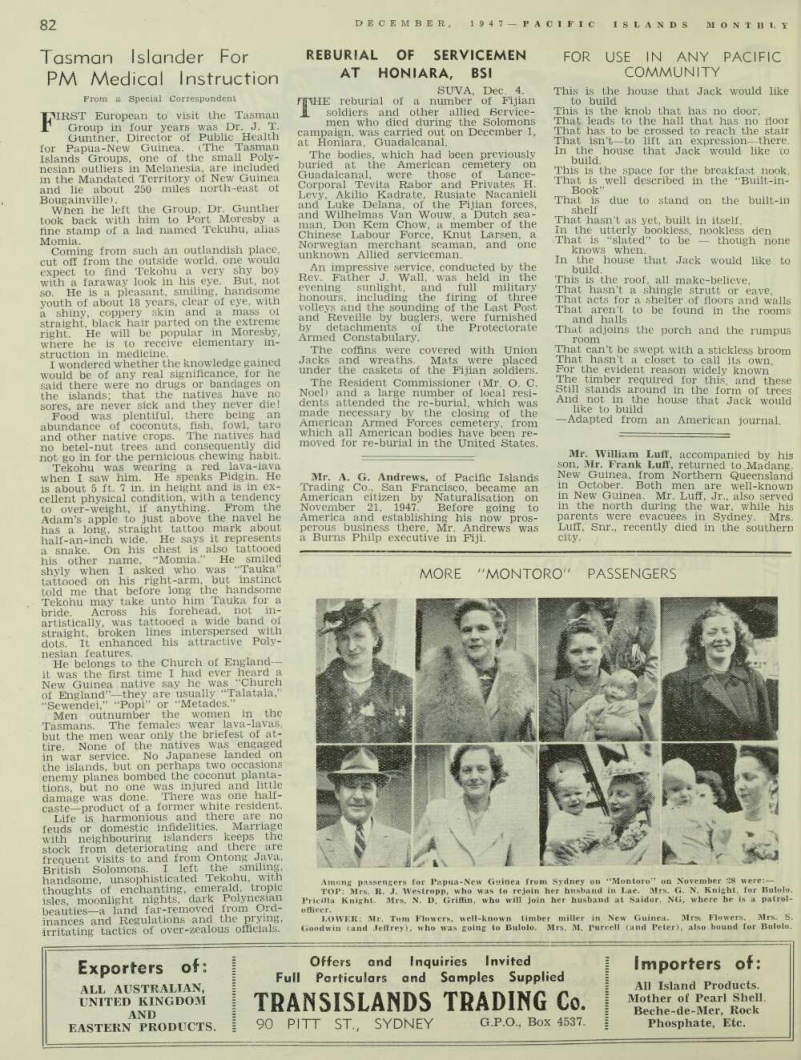
PM Medical Instruction
From a Special Correspondent IMRST European to visit the Tasman Group in four years was Dr. J. T.
Gunther, Director of Public Health for Papua-New Guinea. (.The Tasman Islands Groups, one of the small Poly nesian outliers in Melanesia, are included in the Mandated Territory of New Guinea and lie about 250 miles north-east of Bougainville).
When he left the Group, Dr. Gunther took back with him to Port Moresby a fine stamp of a lad named Tekuhu, alias Momia.
Coming from such an outlandish place, cut off from the outside world, one would expect to find Tekohu a very shy boy with a faraway look in his eye. But, not so. He is a pleasant, smiling, handsome youth of about 18 years, clear of eye, with a shiny, coppery skin and a mass of straight, black hair parted on the extreme right. He will be popular in Moresby, where he is to receive elementary in struction in medicine.
I wondered whether the knowledge gained would be of any real significance, for he said there were no drugs or bandages on the islands; that the natives have no sores, are never sick and they never die!
Food was plentiful, there being an abundance of coconuts, fish, fowl, taro and other native crops. The natives had no betel-nut trees and consequently did not go in for the pernicious chewing habit.
Tekohu was wearing a red lava-lava when I saw him. He speaks Pidgin. He is about 5 ft. 7 in. in height and is in ex cellent physical condition, with a tendency to over-weight, if anything. From the Adam’s apple to just above the navel he has a long, straight tattoo mark about half-an-inch wide. He says it represents a snake. On his chest is also tattooed his other name, “Momia.” He smiled shyly when I asked who was “Tauka” tattooed on his right-arm, but instinct told me that before long the handsome Tekohu may take unto him Tauka for a bride. Across his forehead, not in artistically, was tattooed a wide band of straight, broken lines interspersed with dots. It enhanced his attractive Poly nesian features.
He belongs to the Church of England— it was the first time I had ever heard a New Guinea native say he was “Church of England”—they are usually “Talatala,”
“Sewendei,” “Popi” or “Metades.”
Men outnumber the women in the Tasmans. The females wear lava-lavas, but the men wear only the briefest of at tire. None of the natives was engaged in war service. No Japanese landed on the islands, but on perhaps two occasions enemy planes bombed the coconut planta tions, but no one was injured and little damage was done. There was one half caste—product of a former white resident.
Life is harmonious and there are no feuds or domestic infidelities. Marriage with neighbouring islanders keeps the stock from deteriorating and there are frequent visits to and from Ontong Java, British Solomons. I left the smiling, handsome, unsophisticated Tekohu, with thoughts of enchanting, emerald, tropic isles, moonlight nights, dark Polynesian beauties—a land far-removed from Ord inances and Regulations and the prying, irritating tactics of over-zealous officials.
Reburial Of Servicemen
At Honiara, Bsi
Suva, Dec. 4.
rE reburial of a number of Fijian soldiers and other allied Service men who died during the Solomons campaign, was carried out on December 1, at Honiara, Guadalcanal.
The bodies, which had been previously buried at the American cemetery on Guadalcanal, were those of Lance- Corporal Tevita Rabor and Privates H.
Levy, Akilio Kadrate, Rusiate Nacanieli and Luke Delana, of the Fijian forces, and Wilhelmas Van Wouw, a Dutch sea man, Don Kem Chow, a member of the Chinese Labour Force, Knut Larsen, a Norwegian merchant seaman, and one unknown Allied serviceman.
An impressive service, conducted by the Rev. Father J. Wall, was held in the evening sunlight, and full military honours, including the firing of three volleys and the sounding of the Last Post and Reveille by buglers, were furnished by detachments of the Protectorate Armed Constabulary.
The coffins were covered with Union Jacks and wreaths. Mats were placed under the caskets of the Fijian soldiers.
The Resident Commissioner (Mr. O. C.
Noel) and a large number of local resi dents attended the re-burial, which was made necessary by the closing of the American Armed Forces cemetery, from which all American bodies have been re moved for re-burial in the United States.
Mr. A. G. Andrews, of Pacific Islands Trading Co., San Francisco, became an American citizen by Naturalisation on November 21, 1947. Before going to America and establishing his now pros perous business there, Mr. Andrews was a Burns Philp executive in Fiji.
For Use In Any Pacific
Community
This is the house that Jack would like to build This is the knob that has no door, That leads to the hall that has no floor That has to be crossed to reach the stair That isn’t—to lift an expression—there, In the house that Jack would like to build.
This is the space for the breakfast nook, That is well described in the “Built-in- Book”
That is due to stand on the built-in shelf That hasn’t as yet, built in itself, In the utterly bookless, nookless den -That is “slated” to be though none knows when.
In the house that Jack would like to build.
This is the roof, all make-believe, That hasn’t a shingle strutt or eave, That acts for a shelter of floors and walls That aren’t to be found in the rooms and halls That adjoins the porch and the rumpus room That can’t be swept with a stickless broom That hasn’t a closet to call its own, For the evident reason widely known The timber required for this, and these Still stands around in the form of trees And not in the house that Jack would like to build —Adapted from an American journal, Mr. William Luff, accompanied by his son, Mr. Frank Luff, returned to.Madang,.
New Guinea, from Northern Queensland in October. Both men are well-known in New Guinea. Mr. Luff, Jr., also served in the north during the war, while his parents were evacuees in Sydney. Mrs.
Luff, Snr., recently died in the southern
city.
More "Montoro" Passengers
Among passengers for Papua-New Guinea from Sydney on “Montoro" on November 28 were:— TOP: Mrs. R. J. Westropp, who was to rejoin her husband in Lae. Mrs. G. N. Knight, for Bulolo.
Pricilla Knight. Mrs. N. U. Griffin, who will join her husband at Saidor, NG, where he is a patrol offieer.
LOWER: Mr. Tom Flowers, well-known timber miller in New Guinea. Mrs. Flowers. Mrs. S.
Goodwin (and Jeffrey), who was going to Bulolo. Mrs. M. Purcell (and Peter), also bound for Bulolo.
Advertisements & other items, pp. 84-85 (1 item)
Transislands Trading Co.
Exporters of:
ALL AUSTRALIAN,
UNITED KINGDOM
AND
EASTERN PRODUCTS
Offers and Enquiries invited FuEl Particulars and SampEes Supplied
TRANSISLANDS TRADING Co.
90 PITT ST., SYDNEY G.P.0., Box 4537.
importers of:
All Island Products.
Mother of Pearl Shell.
Beche-de-Mer, Rock Phosphate, Etc.
Cables: Bankers: PITCO, SAN FRANCISCO. BANK OF AMERICA, SAN FRANCISCO.
PACIFIC ISLANDS TRADING CO.
Manufacturers ’ Representatives
244 CALIFORNIA ST., SAN FRANCISCO 11, CAL.
FEATURING GLASSWARE
DINNER SETS
OVENWARE
TUMBLERS
PITCHERS
BOWLS
CUPS
SAUCERS
JUGS
WINE GLASSES
SALAD DISHES
VASES
SALTS & PEPPERS
COCKTAIL GLASSES
CASSEROLES
NUT DISHES
PLATES
ICED TEA SETS
JUICE SETS
WATER SETS
KEROSENE LAMPS
Also: BURNERS, WICKS, LAMP GLASSES (All Types),
COMPLETE LAMPS.
ii m. ’A sm m m >a rjj m m ■ft. m ft msmm 'Spi*a >v m m a it m m.
V to* s I n m m* r i o %
ORDER THROUGH YOUR USUAL CHANNELS
Mahogany Grows Well
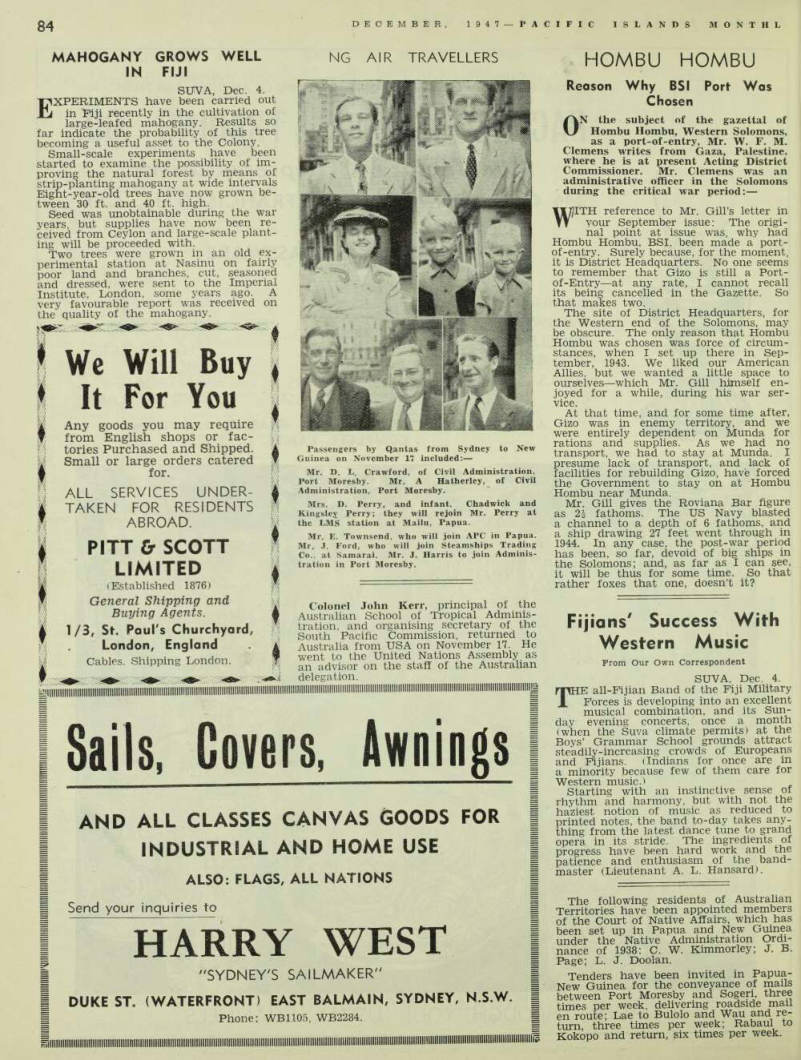
In Fiji
Suva, Dec. 4.
EXPERIMENTS have been carried out in Fiji recently in the cultivation of large-leafed mahogany. Results so far indicate the probability of this tree becoming a useful asset to the Colony.
Small-scale experiments have been started to examine the possibility of im proving the natural forest by means of strip-planting mahogany at wide intervals Eight-year-old trees have now grown be tween 30 ft. and 40 ft. high.
Seed was unobtainable during the war years, but supplies have now been re ceived from Ceylon and large-scale plant ing will be proceeded with.
Two trees were grown in an old ex perimental station at Nasinu on fairly poor land and branches, cut, seasoned and dressed, were sent to the Imperial Institute, London, some years ago. A very favourable report was received on the quality of the mahogany.
Ng Air Travellers
Colonel John Kerr, principal of the Australian School of Tropical Adminis tration. and organising secretary of the South Pacific Commission, returned to Australia from USA on November 17. He went to the United Nations Assembly as an advisor on the staff of the Australian delegation.
Passengers by Qantas from Sydney to New Guinea on November 17 included: — Mr. D. L. Crawford, of Civil Administration, Port Moresby. Mr. A Hatherley, of Civil Administration, Port Moresby.
Mrs. D. Perry, and infant. Chadwick and Kingsley Perry; they will rejoin Mr. Perry at the LMS station at Mailu, Papua.
Mr. E. Townsend, who will join APC in Papua.
Mr. J. Ford, who will join Steamships Trading Co., at Samarai. Mr. J. Harris to join Adminis tration in Port Moresby.
Hombu Hombu
Reason Why BSI Port Was Chosen
ON the subject of the gazettal of Hombu Hombu, Western Solomons, as a port-of-entry, Mr. W. F. M.
Clemens writes from Gaza, Palestine, where he is at present Acting District Commissioner. Mr. Clemens was an administrative officer in the Solomons during the critical war period:— TlfllTH reference to Mr. Gill’s letter in W Your September issue: The origi nal point at issue was, why had Hombu Hombu, BSI, been made a port of-entry. Surely because, for the moment, it is District Headquarters. No one seems to remember that Gizo is still a Port of-Entry—at any rate, I cannot recall its being cancelled in the Gazette. So that makes two.
The site of District Headquarters, for the Western end of the Solomons, may be obscure. The only reason that Hombu Hombu was chosen was force of circum stances, when I set up there in Sep tember, 1943. We liked our American Allies, but we wanted a little space to ourselves —which Mr. Gill himself en joyed for a while, during his war ser vice.
At that time, and for some time after, Gizo was in enemy territory, and we were entirely dependent on Munda for rations and supplies. As we had no transport, we had to stay at Munda. I presume lack of transport, and lack of facilities for rebuilding Gizo, have forced the Government to stay on at Hombu Hombu near Munda.
Mr. Gill gives the Roviana Bar figure as 2 h fathoms. The US Navy blasted a channel to a depth of 6 fathoms, and a ship drawing 27 feet went through in 1944. In any case, the post-war period has been, so far, devoid of big ships in the Solomons; and, as far as I can see, it will be thus for some time. So that rather foxes that one, doesn’t it?
Fijians' Success With Western Music
Western Music
From Our Own Correspondent
Suva, Dec. 4.
rE all-Fijian Band of the Fiji Military Forces is developing into an excellent musical combination, and its Sun day evening concerts, once a month (when the Suva climate permits) at the Boys’ Grammar School grounds attract steadily-increasing crowds of Europeans and Fijians. (Indians for once are in a minority because few of them care for Western music.i Starting with an instinctive sense of rhythm and harmony, but with not the haziest notion of music as reduced to printed notes, the band to-day takes any thing from the latest dance tune to grand opera in its stride. The ingredients of progress have been hard work and the patience and enthusiasm of the band master (Lieutenant A. L. Hansard).
The following residents of Australian Territories have been appointed members of the Court of Native Affairs, which has been set up in Papua and New Guinea under the Native Administration Ordi nance of 1938: C. W. Kimmorley; J. B.
Page; L. J. Doolan.
Tenders have been invited in Papua- New Guinea for the conveyance of mails between Port Moresby and Sogeri, three times per week, delivering roadside mail en route; Lae to Bulolo and Wau and re turn, three times per week; Rabaul to Kokopo and return, six times per week.
Advertisements & other items, pp. 86-87 (3 items)
84
DECEMBER, 1947 PACIFIC ISLANDS MONTHL
Sails, Covers. Awnings
Wc Will Buy
It For You
Any goods you may require from English shops or factories Purchased and Shipped.
Small or large orders catered for.
ALL SERVICES UNDER-
TAKEN FOR RESIDENTS
ABROAD.
PITT Cr SCOTT
LIMITED
(Established 1876) General Shipping and Buying Agents. 1/3, St. Paul's Churchyard, London, England
Sails, Covers. Awnings
AND ALL CLASSES CANVAS GOODS FOR
INDUSTRIAL AND HOME USE
ALSO; FLAGS, ALL NATIONS
Send your inquiries to
HARRY WEST
"SYDNEY'S SAILMAKER"
DUKE ST. (WATERFRONT) EAST BALMAIN, SYDNEY, N.S.W.
Phone; WBIIOS, W 82284.
Capstan
is a
grand cigarette
for all occasions-
Capstan’s own blend
of fine Virginia
leaf cannot
be equalled
.0 Wi .
SYD
That’s why it’s always
TIME FOR A CAPSTAN
380PI-7.47
THE EMPIRE'S FAVOURITE CIGARETTE
Amendments To Fiji Tariff
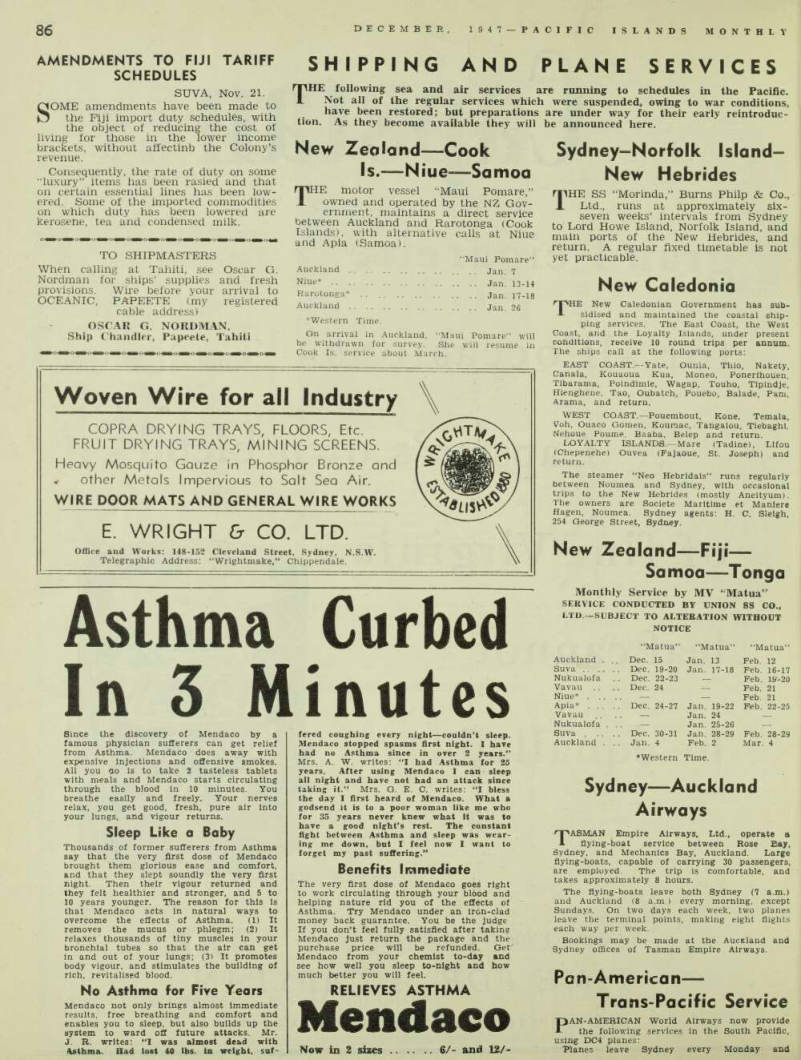
Schedules
Suva, Nov. 21.
SOME amendments have been made to the Fiji import duty schedules, with the object of reducing the cost of living for those in the lower income brackets, without aflectinb the Colony’s revenue.
Consequently, the rate of duty on some “luxury” items has been rasied and that on certain essential lines has been low ered. Some of the imported commodities on which duty has been lowered are kerosene, tea and condensed milk.
Samoa—Tonga
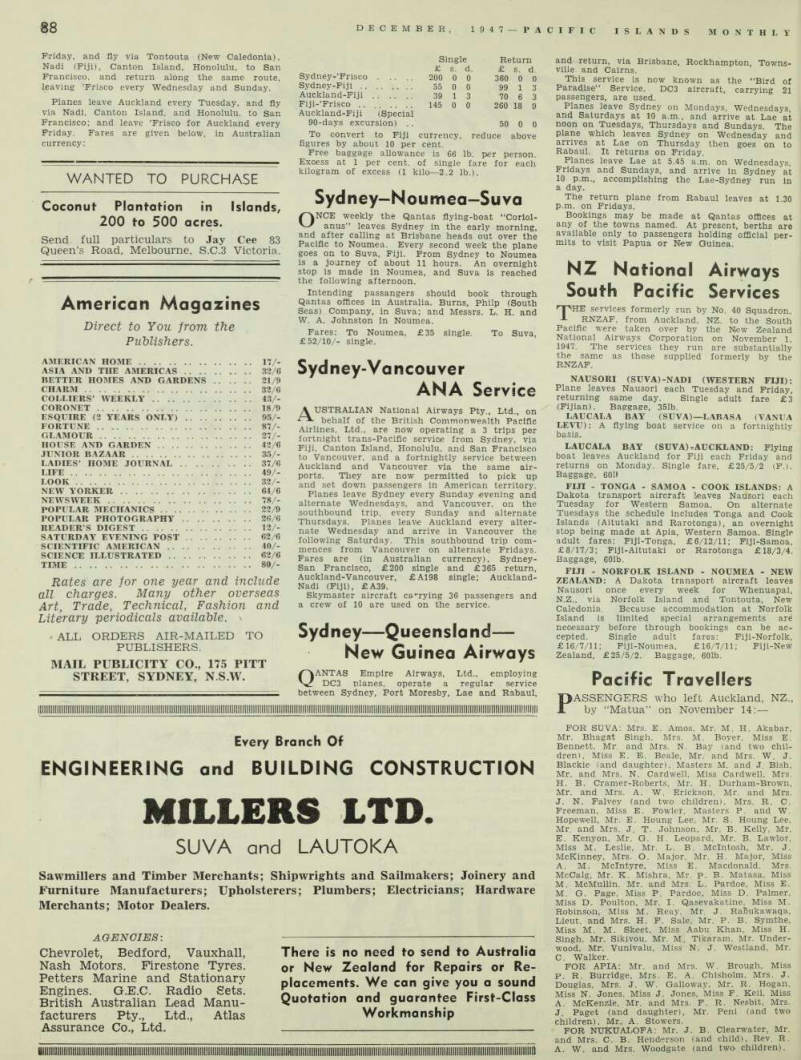
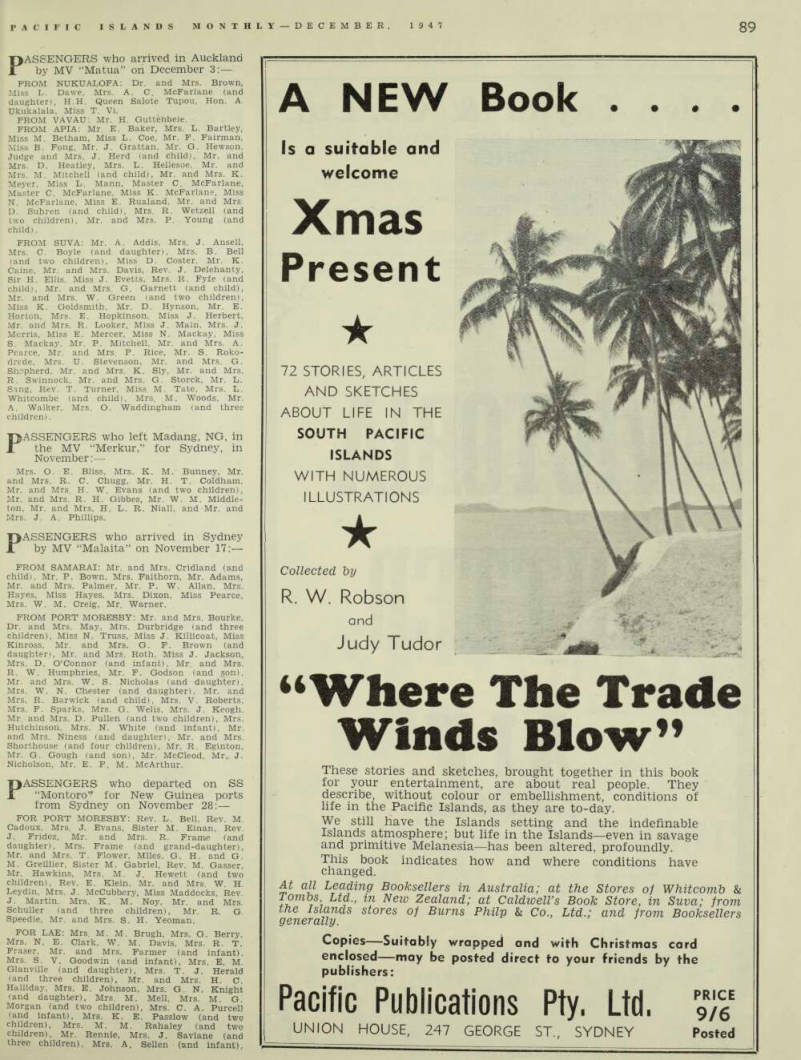
Shipping And Plane Services
THE following sea and air services are running to schedules in the Pacific.
Not all of the regular services which were suspended, owing to war conditions, have been restored; but preparations are under way for their early reintroduc tion. As they become available they will be announced here.
New Zeoland—Cook
Is.—Niue—Samoa
THE motor vessel “Maui Pomare,” owned and operated by the NZ Gov ernment, maintains a direct service between Auckland and Rarotonga (Cook Islands), with alternative calls at Niue and Apia (Samoa).
On arrival in Auckland, “Maui Pomare” will be withdrawn for survey. She will resume in Cook Is. service about March.
Sydney-Norfolk Island-
New Hebrides
11HE SS “Morinda,” Burns Philp & Co., Ltd., runs at approximately six seven weeks’ intervals from Sydney to Lord Howe Island, Norfolk Island, and main ports of the New Hebrides, and return. A regular fixed timetable is not
yet practicable.
New Caledonia
THE New Caledonian Government has sub sidised and maintained the coastal ship ping services. The East Coast, the West Coast, and the Loyalty Islands, under present conditions, receive 10 round trips per annum.
The ships call at the following ports: EAST COAST.—Yate, Ounia, Thio, Nakety, Canala, Kouaoua Kua, Moneo, Ponerthouen, Tibarama, Poindimie, Wagap, Touho, Tlpindje, Hienghene, Tao, Oubatch, Pouebo, Balade, Pam, Arama, and return.
WEST COAST. —Pouembout, Kone, Temala, Voh, Ouaco Gomen, Kouraac, Tangaiou, Tiebaghi, Nehoue Poume, Baaba, Belep and return.
LOYALTY ISLANDS.—Mare (Tadine), Llfou (Chepenehe) Ouvea (Pajaoue, St. Joseph) and return.
The steamer “Neo Hebrldais” runs regularly between Noumea and Sydney, with occasional trips to the New Hebrides (mostly Aneityum).
The owners are Societe Maritime et Manlere Hagen, Noumea. Sydney agents: H. C. Sleigh, 254 George Street, Sydney.
New Zealand—Fiji—
Samoa—Tonga
Monthly Service by MV “Matua”
Service Conducted By Union Ss Co.,
Ltd.—Subject To Alteration Without
Notice
Sydney—Auckland
Airways
TASMAN Empire Airways, Ltd., operate a flying-boat service between Rose Bay, Sydney, and Mechanics Bay, Auckland. Large flying-boats, capable of carrying 30 passengers, are employed. The trip Is comfortable, and takes approximately 8 hours.
The flying-boats leave both Sydney (7 a.m.) and Auckland (8 a.m.) every morning, except Sundays. On two days each week, two planes leave the terminal points, making eight flights each way per week.
Bookings may be made at the Aucxland and Sydney offices of Tasman Empire Airways.
Pan-American—
Trans-Pacific Service
PAN-AMERICAN World Airways now provide the following services in the South Pacific, using DC4 planes: Planes leave Sydney every Monday and
“Maui Pomare”
Auckland 7 Niue* 13-14 Rarotonga* .. 17-18 Auckland 26 *Western Time.
“Matua”
“Matua”
“Matua”
Auckland .
Dec. 15 Jan. 13 Feb. 12 Suva 19-20 Jan. 17-18 Feb. 16-17 Nukualofa . Dec. 22-23 Feb. 19-20 Vavau .. . Dec. 24 Feb. 21 Niue* . .. ,. — Feb. 21 Apia* ... .
Dec. 24-27 Jan. 19-22 Feb. 22-25 Vavau .. — Jan. 24 Nukualofa . — Jan. 25-26 Suva . .. . . Dec. 30-31 Jan. 28-29 Feb. 28-29 Auckland . .
Jan. 4 Feb. 2 Mar. 4 ♦Western Time.
Friday, and fly via Tontouta (New Caledonia), Nadi (Fiji), Canton Island, Honolulu, to San Francisco, and return along the same route, leaving ’Frisco every Wednesday and Sunday.
Planes leave Auckland every Tuesday, and fly via Nadi, Canton Island, and Honolulu, to San Francisco; and leave ’Frisco for Auckland every Friday. Fares are given below, in Australian currency:
To convert to Fiji currency, reduce above figures by about 10 per cent.
Free baggage allowance is 66 lb. per person.
Excess at 1 per cent, of single fare for each kilogram of excess (1 ki10—2.2 lb.).
Sydney-Noumea-Suva
ONCE weekly the Qantas flying-boat “Corlol anus” leaves Sydney in the early morning, and after calling at Brisbane heads out over the Pacific to Noumea. Every second week the plane goes on to Suva, Fiji. From Sydney to Noumea is a journey of about 11 hours. An overnight stop is made in Noumea, and Suva is reached the following afternoon.
Intending passangers should book through Qantas offices in Australia. Burns, Philp (South Seas) Company, in Suva; and Messrs. L. H. and W. A. Johnston in Noumea.
Fares: To Noumea, £35 single. To Suva, £52/10/- single.
Sydney-Voncouver
ANA Service
AUSTRALIAN National Airways Pty., Ltd., on behalf of the British Commonwealth Pacific Airlines. Ltd., are now operating a 3 trips per fortnight trans-Pacific service from Sydney, via Fiji, Canton Island, Honolulu, and San Francisco to Vancouver, and a fortnightly service between Auckland and Vancouver via the same air ports. They are now permitted to pick up and set down passengers in American territory.
Planes leave Sydney every Sunday evening and alternate Wednesdays, and Vancouver, on the southbound trip, every Sunday and alternate Thursdays. Planes leave Auckland every alter nate Wednesday and arrive in Vancouver the following Saturday. This southbound trip com mences from Vancouver on alternate Fridays.
Fares are (in Australian currency), Sydney- San Francisco, £2OO single and £365 return, Auckland-Vancouver, £AI9B single; Auckland- Nadi (Fiji), £A39.
Skymaster aircraft carrying 36 passengers and a crew of 10 are used on the service.
Sydney—Queensland—
New Guinea Airways
QANTAS Empire Airways, Ltd., employing DC3 planes, operate a regular service between Sydney, Port Moresby, Lae and Rabaul,
and return, via Brisbane, Rockhampton, Towns ville and Cairns.
This service is now known as the “Bird of Paradise” Service, DC3 aircraft, carrying 21 passengers, are used.
Planes leave Sydney on Mondays, Wednesdays, and Saturdays at 10 a.m., and arrive at Lae at noon on Tuesdays, Thursdays and Sundays. The plane which leaves Sydney on Wednesday and arrives at Lae on Thursday then goes on to Rabaul. It returns on Friday.
Planes leave Lae at 5.45 a.m. on Wednesdays, Fridays and Sundays, and arrive in Sydney at 10 p.m., accomplishing the Lae-Sydney run in a day.
The return plane from Rabaul leaves at 1.30 p.m. on Fridays.
Bookings may be made at Qantas offices at any of the towns named. At present, berths are available only to passengers holding official per mits to visit Papua or New Guinea.
NZ National Airways
South Pacific Services
npHE services formerly run by No. 40 Squadron.
A RNZAF, from Auckland, NZ. to the South Pacific were taken over by the New Zealand National Airways Corporation on November 1. 1947. The services they run are substantially the same as those supplied formerly by the
Rnzaf.
Nausori (Suva)-Nadi (Western Fiji):
Plane leaves Nausori each Tuesday and Friday, returning same day. Single adult fare £3 (Fijian). Baggage, 351 b.
Laucala Bay (Suva)—Labasa (Vanua
LEVU): A flying boat service on a fortnightly basis.
Laucala Bay (Suva) R Auckland: Flying
boat leaves Auckland for Fiji each Friday and returns on Monday. Single fare, £25/5/2 (F.).
Baggage, 6011 FIJI - TONGA - SAMOA - COOK ISLANDS: A Dakota transport aircraft leaves Nausori each Tuesday for Western Samoa. On alternate Tuesdays the schedule includes Tonga and Cook Islands (Aitutaki and Rarotonga), an overnight stop being made at Apia, Western Samoa. Single adult fares: Flji-Tonga, £6/12/11; Fiji-Samoa, £B/17/3; Fiji-Aitutaki or Rarotonga £lB/3/4.
Baggage, 601 b.
FIJI - NORFOLK ISLAND - NOUMEA - NEW ZEALAND: A Dakota transport aircraft leaves Nausori once every week for Whenuapai, N.Z., via Norfolk Island and Tontouta, New Caledonia. Because accommodation at Norfolk Island is limited special arrangements are necessary before through bookings can be ac cepted. Single adult fares: Fiji-Norfolk, £l6/7/11; Fiji-Noumea, £l6/7/11; Fiji-New Zealand, £25/5/2. Baggage, 601 b.
Pocific Travellers
PASSENGERS who left Auckland, NZ„
by “Matua” on November 14:— FOR SUVA: Mrs. E. Amos, Mr. M. H. Akabar, Mr. Bhagat Singh, Mrs. M. Boyer. Miss E.
Bennett. Mr. and Mrs. N. Bay (and two chil dren), Miss E. E. Beale, Mr. and Mrs. W. J.
Blackie (and daughter), Masters M. and J. Bish, Mr. and Mrs. N. Cardwell, Miss Cardwell, Mrs.
H. B. Cramer-Roberts, Mr. H. Durham-Brown, Mr. and Mrs. A. W. Erickson, Mr. and Mrs.
J. N, Palvey (and two children). Mrs. R. C.
Freeman, Miss E. Fowler, Masters P. and W.
Hopewell, Mr. E. Houng Lee, Mr. S. Houng Lee, Mr. and Mrs. J. T. Johnson, Mr. B. Kelly, Mr.
E. Kenyon, Mr. G. H. Leopard, Mr. B. Lawlor, Miss M. Leslie, Mr. L. B. Mclntosh, Mr. J.
McKinney, Mrs. O. Major, Mr. H. Major, Miss A. M. Mclntyre, Miss E, Macdonald. Mrs.
McCaig, Mr. K. Mishra, Mr. p. B. Matasa, Miss M. McMullin, Mr. and Mrs. L. Pardoe, Miss E.
M. G. Page. Miss P. Pardoe, Miss D. Palmer, Miss D. Poulton, Mr. I. Qasevakatine. Miss M.
Robinson, Miss M. Reay, Mr. J. Raßukawaqa, Lieut, and Mrs. H. F. Sale, Mr. P. B. Symthe, Miss M. M. Skeet, Miss Aabu Khan, Miss H.
Singh, Mr. Sikivou, Mr. M. Tikaram. Mr. Under wood, Mr. Vunivalu, Miss N. J. Westland, Mr.
C. Walker.
FOR APIA: Mr. and Mrs. W. Brough, Miss P. R. Burridge, Mrs. E. A. Chisholm. Mrs. J.
Douglas, Mrs. J. W. Galloway. Mr. R. Hogan.
Miss N. Jones, Miss J. Jones, Miss F. Keil, Miss A. McKenzie, Mr. and Mrs. F. R. Nesbit, Mrs.
J. Paget (and daughter), Mr. Peni (and two children), Mr. A. Stowers.
FOR NUKUALOFA: Mr. J. B. Clearwater, Mr. and Mrs. C. B. Henderson (and child). Rev. R.
A. W. and Mrs. Woodgate (and two children).
Single Return £ s. d. £ s. d.
Sydney-’Frisco 200 0 0 360 0 0 Sydney-Piji 55 0 0 99 1 3 Auckland-Fiji 39 1 3 70 6 3 Fiji-’Frisco 145 0 0 260 18 9 Auckland-Fiji (Special 90-days excursion) .. 50 0 0
PASSENGERS who arrived in Auckland by MV “Matua” on December 3: — PROM NUKUALOFA: Dr. and Mrs. Brown, Miss L. Dawe, Mrs. A. C. McFarlane (and daughter), H.H. Queen Salote Tupou, Hon. A Ukukalala, Miss T. Vi.
FROM VAVAU; Mr. H. Guttenbeie.
FROM APIA: Mr. E. Baker, Mrs. L. Bartley, Miss M. Betham, Miss L. Coe, Mr. F. Fairman, Miss B. Fong, Mr. J. Grattan, Mr. G. Hewson, Judge and Mrs. J. Herd (and child), Mr. and Mrs. D. Heatley, Mrs. L. Hellesoe, Mr. and Mrs. M. Mitchell (and child), Mr. and Mrs. K.
Meyer, Miss L. Mann, Master C. McParlane, Master C. McFarlane, Miss K. McFarlane, Miss N. McFarlane, Miss E. Rualand, Mr. and Mrs.
D. Suhren (and child), Mrs. R. Wetzeil (and two children), Mr. and Mrs. P. Young (and child).
FROM SUVA: Mr. A. Addis, Mrs. J. Ansell, Mrs. C. Boyle (and daughter), Mrs. B. Bell (and two children), Miss D. Coster. Mr. K.
Caine, Mr. and Mrs. Davis, Rev. J. Delehanty, Sir H. Ellis, Miss J. Evetts, Mrs. R. Pyfe (and child), Mr. and Mrs. G. Garnett (and child), Mr. and Mrs. W. Green (and two children), Miss K. Goldsmith, Mr. D. Hynson, Mr. E.
Horton, Mrs. E. Hopkinson, Miss J. Herbert, Mr. and Mrs. R. Looker, Miss J. Main, Mrs. J.
Morris, Miss E. Mercer, Miss N. Mackay, Miss S. Mackay, Mr. P. Mitchell, Mr. and Mrs. A.
Pearce, Mr. and Mrs. P. Rice, Mr. S. Roko drede, Mrs. U. Stevenson, Mr. and Mrs. G.
Shepherd, Mr. and Mrs. K. Sly, Mr. and Mrs.
R. Swinnock, Mr. and Mrs. G. Storck, Mr. L.
Sang, Rev. T. Turner, Miss M. Tate, Mrs. L.
Whitcom'oe (and child), Mrs. M. Woods, Mr.
A. Walker, Mrs. O. Waddingham (and three children).
PASSENGERS who left Madang, NG, in
the MV “Merkur,” for Sydney, in November: — Mrs. O. E. Bliss, Mrs. K. M. Bunney, Mr. and Mrs. R. C. Chugg, Mr. H. T. Coldham, Mr. and Mrs. H. W. Evans (and two children), Mr. and Mrs. R. H. Gibbes, Mr. W. M. Middle ton, Mr. and Mrs. H. L. R. Niall, and Mr. and Mrs. J. A. Phillips.
PASSENGERS who arrived in Sydney by MV “Malaita” on November 17:— FROM SAMARAI: Mr. and Mrs. Cridland (and child), Mr. P. Bown, Mrs. Faithorn, Mr. Adams, Mr. and Mrs. Palmer, Mr. P. W. Allan, Mrs.
Hayes, Miss Hayes, Mrs. Dixon, Miss Pearce, Mrs. W. M. Creig, Mr. Warner.
FROM PORT MORESBY: Mr. and Mrs. Bourke, Dr. and Mrs. May, Mrs. Durbridge (and three children), Miss N. Truss, Miss J. Killicoat, Miss Kinross, Mr. and Mrs. G. F. Brown (and daughter), Mr. and Mrs. Roth. Miss J. Jackson, Mrs. D. O’Connor (and infant), Mr. and Mrs.
R. W. Humphries, Mr. F. Godson (and son), Mr. and Mrs. W. S. Nicholas (and daughter), Mrs. W. N. Chester (and daughter). Mr. and Mrs. R. Barwick (and child). Mrs. V. Roberts, Mrs. F. Sparks, Mrs. G. Welis, Mrs. J. Keogh.
Mr. and Mrs. D. Pullen (and two children), Mrs.
Hutchinson. Mrs. N. White (and infant), Mr. and Mrs. Niness (and daughter), Mr. and Mrs.
Shorthouse (and four children), Mr. R. Eginton, Mr. G. Gough (and son), Mr. McCleod, Mr. J.
Nicholson, Mr. E. F, M. McArthur.
PASSENGERS who departed on SS “Montoro’" for New Guinea ports from Sydney on November 28: — FOR PORT MORESBY: Rev. L. Bell. Rev. M, Cadoux, Mrs. J. Evans, Sister M. Einan, Rev.
J. Fridez, Mr. and Mrs. R. Frame (and daughter), Mrs. Frame (and grand-daughter), Mr. and Mrs. T. Flower. Miles. G. H. and G.
M. Greillier, Sister M. Gabriel, Rev. M. Gasser, Mr. Hawkins, Mrs. M. J. Hewett (and two children), Rev. E. Klein, Mr. and Mrs. W. H.
Leydin, Mrs. J. McCubbery, Miss Maddocks, Rev.
J. Martin, Mrs. K. M. Noy, Mr. and Mrs.
Schuller (and three children), Mr. R. G.
Speedie, Mr. and Mrs. S. H. Yeoman.
FOR LAE: Mrs, M. M. Brugh, Mrs. G. Berry.
Mrs. N. E. Clark, W. M. Davis, Mrs. R. T.
Fraser, Mr. and Mrs. Parmer (and infant).
Mrs. S. V. Goodwin (and infant), Mrs. E. M.
Glanville (and daughter), Mrs. T. J. Herald (and three children), Mr. and Mrs. H. C.
Halliday, Mrs. E. Johnson, Mrs. G. N. Knight (and daughter), Mrs. M. Mell, Mrs. M. G.
Morgan (and two children), Mrs. C. A. Purcelj (and infant), Mrs. K. E. Passlow (and two children), Mrs. M. M. Rahaley (and two children), Mr. Rennie, Mrs. J. Saviane (and three children), Mrs. A. Sellen (and infant).
Mr. and Mrs. E. Steeples, Mrs. E. E. Villiers.
Mrs. V. M. Westropp.
FOR MADANG: Miss M. E. Broadhurst, Mrs J. M. Gore, Mrs. J. Griflfen, Mrs. D. Murphy.
Mr. J. O’Brien, E. J. O’Brien, Miss M. I.
O’Brien. Miss A. D.'J. O’Brien, Mrs. J. Sherry (and three children), Mr. and Mrs. P. M.
Swanson (and infant), Mr. and Mrs. W. H.
Wright (and infant).
PASSENGERS who left Sydney by MV
“Malaita” on December 6:— FOR SAMARAI: Mr. F. Allen. Misses R. D. and V. R. Grant, Master V. Gabriel, Rev. W, E. Moren, Miss E. Pedrick, Mrs. J. Robinson (and child), Master G. Shotton, Mr. L. C.
Searle (and three children), FOR RABAUL: Sister M. Agatha, Mrs. D. M.
Bakewell (and child). Mrs. E. J. Bourke (and childi. Mrs. K. Bloxham (and child). Mr. M.
E. Babbage, Dr. Bourke, Mrs. M. Culnane, Mrs E. C. Campbell. Mr. E. J. Carter, Sister M.
Colomba, Mr. and Mrs. D. Dobbinson, Mr. J.
R. Dixon, Sister M. Eliza, Miss Y. Goodwin, Mr. and Mrs. R. H. Hicks, Mrs. C. H. Heyen (and children). Sister Henrietta, Rev. Bro. J.
A Jassmeyerl, Sister M. Jeremia, Miss A Kuster (and five children), Master K. Kramer, Rev. J. Krady, Mrs. A. J. Long. Rev. J. Moore.
Sister M. Martha, Mr. W. M. Malpass, Rev, W. E. Moren, Mrs. J. M. Mossman (and daughter), Mr. S. M. Martin. Mr. and Mrs. S M. Pasley. Mr. T. Prince, Mr. E. R. Reece, Mrs. M. Renton, Mrs. F. Rowe, Mr. and Mrs R. J. Robb, Rev. A. Reusken, Mr. J. Ryder.
Mrs. F. A. Sowerby.
PASSENGERS who left Papua-New
Guinea by Qantas Airways on:—
NOV. 5; Mr. J. D. Carruthers, Mr. S. Kearley.
Mr. J. Read. Mr. N. O’Neill, Mr. H. F. Butler, Mr. P. Hinds, Miss Hinds, Sister Cecilia, Major Denny, Miss Tonkin, Mr. Granger.
NOV. 8: Mr. A. J. Gaskin, Mr. E. Kerim, Mr. K. West, Mr. J. Anderson, Mrs. J.
Anderson. Mr. D. Bates, Mr. L. Clark, Major Poster. Mrs. Maynard. Mr. A. G. Emmett. Mrs.
L. Whitehead, Mr. K. Darlberg. Mr. McAdam, Mr. Watson. Mr. Kearney, Mr. Keys. Mr. R. E.
Dwyer.
NOV. 9: Mrs. C. Brereton, Mr. W. Lussick, Mr. H. Wall, Mr. L. Hockey, NOV. 10: Mr. and Mrs. Annan. Mr. Stewart, Mr. Mylechrane, Mr. Thurston, Mr. Thiele, Mrs.
Mylechrane (and infant), Mr. C. Haydon. Mr.
Torrington, Mr. W. Burns, Mr. A. E. Davies.
NOV. 13: Mr. S. Jones. Mr. R Stevens. Mrs.
Stevens (and infant). Master Stevens. Mr.
Cavenagh, Mr. J. Cox, Mr. L. Clarke. Mr.
Fairfax Ross.
NOV. 14; Mrs. L, Lane (and infant), Mr D.
McDonald. Mr. M. Cameron. Mr, A. J Bretag, Mr. D. Anderson, Mr. R. Warren, Mr. R. M.
Flaherty, Mr. R. Ford. Mr. N. Mason. Mr. L.
Boyce, Mr, N. Hewsan, Mr. F, Lynch, Mr. A.
Campbell. Mr. S. Walshaw, Mr. C. Johnson, Mr. C. O. Brown.
NOV. 15: Mr. A. M. Dempster. Mr. J.
Greaves, Mr. N. Wertheim.
NOV. 16: Mr. F. Shaw, Mr. Dillon. Mr.
Scales, Mr, F. Pelchen. Mr, E. Crisp, Mrs. R.
Crisp, Mr. F. Jullian. Mrs. F. Jullian. Mr.
McArthy. Mr, H. O’Brien. Mr. E. Smith. Mr.
McGowan.
NOV. 19; Mr. C. D. Lega. Mr. R. E. Emery, Mrs, Emery (and infant), Mr. H. Steele. Sister J Cannon, Mr. W. A. Ovenstone. Mr. J. Grim shaw, Mr. B, Lea, Mrs. Lea, Mr. W. Smith, Mrs. H. Doak, Master J. Doak. Mr. J. Arthur, Mr. R. Murray, Mr. E. Clark. Bishop Strong.
NOV. 21: Capt. J. Duncan, Mr. V. Maxwell, Mrs. M. Maxwell. Mr. C. Mr. A.
Singleton, Mr. Loneragan, Mr. Hanrahan, Mrs.
Ellis, Mr. Mason, Miss M. Scott, Mr. Duff. Capt.
Kyngdom, Mr. Antidensen.
NOV. 23: Mrs. Mitchell, Miss Mitchell, Mrs.
Kriewaldt, Miss Kriewaldt, Miss A, Lowry. Mr.
D. K. Bennett. Mrs. D. K. Bennett (and in fant). Mr. Chui Leong. Mr. A. Abbie, Mr. A. E.
Hosie, Mr. Ellis-Neely, Mr. E. Wauchope, Mr.
G. Evan.
NOV. 27: Mr. C. Lambert. Mr. G. McLure, Mr. J. Martin. Miss Meddury. Mrs. Foley (and infant), Mr. C. Bourke, Mr. J. Rainey, Mr. T.
Miller. Mrs. A. Leydin, Mr. F. Leydin, Mrs. F.
Stewart, Mr. E. Williams.
NOV. 28; Mr. B. O’Connor. Mr. E. T. Corrie, Mrs. C. Collins. Mr. H. G. Hyde. Mr. E. R.
Stapleton, Mr. R. Muirhead, Mr. J. C. Harper, Mr. R, E. Dowling, Mr. E. W. Strange.
NOV. 30; Mr. G. Lamm, Mr. M. J. Hard castle, Mr. J. C. Powell, Mr. J. Lyons, Mrs.
Perichon, Mr. B. Webb, Mrs. B. Webb. Mr. L.
Moore, Mrs. Mathieson, Mr. D. Ewing.
PASSENGERS who left Australia for
Papua-New Guinea by Qantas Air
ways on;— NOV. 7: Capt. L. P. Berkefeld, Mr. J. C.
Fraser, Mr. F. P. Werrin, Miss S. R. Slater, Mr. A. Skene-Smith, Mr. A. R. McGregor, Mr.
W. A. Hartley, Mrs. G. A. Warner (and in fant), Miss Warner.
NOV. 10: Mr. G. Barton, Miss P. J. Moss, Mr. E. J. Bowden, Mr. L. F. Bugg, Mr. R.
Maloney.
NOV. 12: Mr. A. K. Walker, Mr. G. D. Millar, Mrs. G. Harvey, Mrs. M. Kelly, Mr. A. Long, W/O Spratt, Mr. C. Fitter, Mr. D. Larnach, Capt. P. Byrne, Mile. C. De Massignac, Mrs.
Phillips (and infant), Miss Phillips.
NOV. 14: Mr. A. Metzner, Mrs. T. Richards, Mr. Johnson. Mr. R. McMurray, Mr. C. F.
Haigh, Mrs. C. Haigh (and infant), Mr. A. M.
Mitchell, Mr. E. G. Hicks.
NOV. 19: Mr, A. J. Gaskin. Miss J. Browne, Mrs. C. Averell. Mr. J£. F. Graham. Miss O.
Simpson, Mrs. K. Searle (and infant), Mr. L.
Morris. Mrs. L. Morris (and infant), RTr. L.
Dwyer.
NOV. 21: Mrs. E. Palmer. Mr. R. Humphries, Mrs. B. Blair. Miss J. Meebury, Mr. P. Maloney, Mr. L. Vialls, Mr. H. Smith. Mr. Young- Whitford, Mr. M. Hayman, Mr. A. Arthur, Master Wilson, Mr. J. Abernathy.
NOV. 24: Mr. R. Duncan, Mr. W. Anderson, Miss B, Jackson, Mr. N. Wright. Mr. J. Car michael. Mr. J. Livingston, Mr. P. Jessup. Mr.
W. Granger.
NOV, 26: Mrs. H. Allan, Mrs. Munro, Master D. Munro. Mrs. J. Poole (and infant). Miss L.
Christie. Master Prideaux, Mrs. G. Helpin (and infant), Master R. Helpin, Mr. C. Rouse, Mrs.
C. Rouse.
NOV. 28: Mr. S. Cameron. Mr. J, White.
Mrs. G. Gregson, Mr. E. Sutton. Master N.
Stephens, Mr. T. Bayliss, Mr. W. Wood. Dr. M.
Granger. Mr. L. Andrews, Dr. E. Graggs.
DEC. 1; Sister J. Gannon, Mr. E. Crisp. Mr.
D. Garton, Miss M. Nixon, Master P. Nixon, Mr. J. Ernst, Master E. Cowley, Mrs. B.
Matheson, Mrs. A. Wren, Mr. McWhinney.
DEC 2; Mr. N, O’Neil, Mr. R. Dunlop. Mr.
W. Hanrahan, Mrs. Hammond (and infant), Miss A. Burns, Mr. F. Jullian, Mr. E. Thomas.
Advertisements & other items, pp. 88-92 (3 items)
Advertisement
TO SHIPMASTERS
When calling at Tahiti, see Oscar G.
Nordman for ships’ supplies and fresh provisions. Wire before your arrival to OCEANIC, PAPEETE (my registered cable address)
OSCAR G. NORDMAN,
Ship Chandler, Papeete, Tahiti
Advertisement
Asthma Curbed In 3 Minutes
fered coughing every night—couldn’t sleep.
Mendaco stopped spasms first night. I have had no Asthma since in over 2 years.”
Mrs. A. W. writes; “I had Asthma for 25 years. After using Mendaco I can sleep all night and have not had an attack since taking it.” Mrs. G. E. C. writes: “I bless the day I first heard of Mendaco. What a godsend it is to a poor woman like me who for 35 years never knew what it was to have a good night’s rest. The constant fight between Asthma and sleep was wearing me down, but I feel now I want to forget my past suffering.”
Benefits Immediate
The very first dose of Mendaco goes right to work circulating through your blood and helping nature rid you of the effects of Asthma. Try Mendaco under an iron-clad money back guarantee. You be the judge If you don’t feel fully satisfied after taking Mendaco just return the package and the purchase price will be refunded. Get"
Mendaco from your chemist to-day and see how well you sleep to-night and how much better you will feel.
RELIEVES ASTHMA
Mendaco
Now in 2 sizes 6/- and 12/-
Since the discovery of Mendaco by a famous physician sufferers can get relief from Asthma. Mendaco does away with expensive Injections and offensive smokes.
All you ao is to take 2 tasteless tablets with meals and Mendaco starts circulating through the blood in 10 minutes. You breathe easily and freely. Your nerves relax, you get good, fresh, pure air into your lungs, and vigour returns.
Sleep Like a Baby
Thousands of former sufferers from Asthma say that the very first dose of Mendaco brought them glorious ease and comfort, and that they slept soundly the very first night. Then their vigour returned and they felt healthier and stronger, and 5 to 10 years younger. The reason for this is that Mendaco acts in natural ways to overcome the effects of Asthma. (1) It removes the mucus or phlegm; (2) It relaxes thousands of tiny muscles in your bronchial tubes so that the air can get in and out of your lungs; (31 It promotes body vigour, and stimulates the building of rich, revitalised blood.
No Asthma for Five Years
Mendaco not only brings almost Immediate results, free breathing and comfort and enables you to sleep, but also builds up the system to ward off future attacks. Mr.
J. R. writes: “I was almost dead with Asthma. Had lost 40 lbs. in weight. saf-
Sketofax
0 ✓ FROM MOSQUITOES SANDFLIES and OTHER BITING INSECTS t £ ifP ia)
trau
(A^ S * CO r JS
po r^
urR o'J &m |l " s vP>' iV ; *- i m. o« -
ho^ s sm^ m
i»*& bay IF y- -r r\ 3
’SKETOFAX 1 IS THE EFFECTIVE KEPELLEXT
FOR MOSQLTTOES. SANDFLIES AND OTHER HITING INSECTS You will enjoy the mosquito-free evenings and nights that ‘Sketofax’ brings you . . . the happy carefree days hiking and picnicking in the hush without the irritating mosquito to spoil your pleasure . . . and the days at the waterside without the painful misery of sandfly bites. Here at last is the repellent cream that will give you protection from these tiresome insects. ‘Sketofax’ is a fragrant, easily applied non-greasy cream, effective for many hours after application and most economical in use.
Apply before retiring at night or before setting forth for a day in the ‘outdoors’. Be sure you have your tube of ‘Sketofax’ handy at all times.
SKETOFAX
INSECT REPELLENT CREAM
CONTAINS D.M.P (DIMETHYL PHTHALATE)
WHAT IS
SKETOFAX*
‘SKETOFAX’ is a
product of recent research and con • tains D.M.P. ( DiMethyl Phthalate).
‘SKETOFAX’ has
passed the most exacting tests and exhaustive trials before being finally issued to the public.
IDEAL FOR:
PICNICS HIKING
FISHING GARDENING
AND IN THE HOME
BRAND
AVAILABLE EVERYWHERE
IN TUBES SUITABLE FOR
HANDBAG OR POCKET
BURROUGHS WELLCOME & CO. PRODUCT
2s BURROUGHS WELLCOME & CO. (AUSTRALIA) LTD.
WANTED TO PURCHASE
Coconut Plantation in Islands,
200 to 500 acres.
Send full particulars to Jay Cee 83 Queen’s Road, Melbourne, 5.C.3 Victoria.
American Magazines
Direct to You from the Publishers.
AMERICAN HOME 17/-
ASIA AND THE AMERICAS 32/6
BETTER HOMES AND GARDENS 21/9
CHARM 32/6
COLLIERS’ WEEKLY 43/-
CORONET 18/9
ESQUIRE (2 YEARS ONLY) 95/-
FORTUNE 87/-
GLAMOUR 27/-
HOUSE AND GARDEN 42/6
JUNIOR BAZAAR 35/-
LADIES’ HOME JOURNAL 37/6
LIFE 49/-
LOOK 32/-
NEW YORKER 64/6
NEWSWEEK 78/-
POPULAR MECHANICS 22/9
POPULAR PHOTOGRAPHY 26/6
READER’S DIGEST 12/-
SATURDAY EVENING POST 62/6
SCIENTIFIC AMERICAN 40/-
SCIENCE ILLUSTRATED 62/6
TIME 80/-
Rates are for one year and include all charges. Many other overseas
Art, Trade, Technical, Fashion and
Literary periodicals available.
ALL ORDERS AIR-MAILED TO
PUBLISHERS.
MAIL PUBLICITY CO., 175 PITT
STREET, SYDNEY, N.S.W.
Every Branch Of
ENGINEERING and BUILDING CONSTRUCTION
MILLERS LTD.
SUVA and LAUTOKA
Sawmillers and Timber Merchants; Shipwrights and Sailmakers; Joinery and Furniture Manufacturers; Upholsterers; Plumbers; Electricians; Hardware Merchants; Motor Dealers.
AGENCIES :
Chevrolet, Bedford, Vauxhall, Nash Motors. Firestone Tyres.
Fetters Marine and Stationary Engines. G.E.C. Radio Sets.
British Australian Lead Manufacturers Pty., Ltd., Atlas Assurance Co., Ltd.
There is no need to send to Australia or New Zealand for Repairs or Replacements. We can give you a sound Quotation and guarantee First-Class Workmanship
A NEW Book . . . .
Is a suitable and
welcome
Xmas
Present
72 STORIES, ARTICLES
AND SKETCHES
ABOUT LIFE IN THE
SOUTH PACIFIC
ISLANDS
WITH NUMEROUS
ILLUSTRATIONS
★ Collected by
R. W. Robson
and
Judy Tudor
. * f#Y'. ■ r#
“Where The Trade
Winds Blow”
These stories and sketches, brought together in this book for your entertainment, are about real people. They describe, without colour or embellishment, conditions of life in the Pacific Islands, as they are to-day.
We still have the Islands setting and the indefinable Islands atmosphere; but life in the Islands—even in savage and primitive Melanesia—has been altered, profoundly.
This book indicates how and where conditions have changed.
At all Leading Booksellers in Australia; at the Stores of Whitcomb & Tombs Ltd., in New Zealand; at Caldwell’s Book Store, in Suva; from the Islands stores of Burns Philp & Co,, Ltd.; and from Booksellers generally.
Copies—Suitably wrapped and with Christmas card enclosed—may be posted direct to your friends by the publishers:
Pacific Publications Ply. Ltd. 7%
UNION HOUSE, 247 GEORGE ST., SYDNEY Posted
Allen Taylor & Co. Ltd.
COMMERCIAL ROAD, ROZELLE,
SYDNEY
Sowmillers and Wholesale Suppliers of Hardwoods for Constructional Purposes GIRDERS . . . PILES . , . POLES . . . SLEEPERS, Etc.
EXPORTING TO PACIFIC” ISLANDS SINCE 1893
VICTORIA
BITTER
ALE
o
SIEVES IT
CARLTON & UNITED BREWERIES LIB.
HI
90
bfeCEMBER, 1947 FACtFIC IfeLA M b S MONTHLY
Timber For Tng Mission
From Our Own Correspondent TIMBER to reconstruct buildings at the Catholic Mission at Alexishafen, which was damaged in Japanese air raids during the war, is now being loaded on the mission’s 300-tons motor vessel, “Stella Maris.” The ship will take about 250 tons of timber and 50 tons of steel rails. .
The original “Stella Maris” was sunk by bombs while anchored in Alexishafen in 1942. The ship now used by the mis sion was purchased from the Disposals Commission.
A large amount of timber, also bought from the Army, belonging to the mission, is stored at the Cairns wharves. Most of it will be taken to Alexishafen in a number of voyages by the “Stella Maris.”
The master of the ship is Captain P.
Byrne, an irishman. The first mate is a Russian, and the chief engineer, a Canadian. The rest of the ship’s com pliment is made up of 20 New Guinea seamen.
The Rev. Brother Malachy, a 74-year old, New Zealand-born Marist Brother who h§s spent 50 years in Samoa and Fiji, has now retired and has returned to New Zealand. Recently he has been teaching at Rewa Rewa, Fiji.
Mr. and Mrs. J. Beveridge, recently re turned from a visit to England. Mr.
Beveridge is attached to the Department of Agriculture in the British Solomon Islands. During the war he served with the rank of Captain in the local force of native scouts which was attached to the US Army. ♦
It has been notified in the “Gazette” that, in addition to Christmas Day, Box ing Day and New Year’s Day, the follow ing days are to be observed as public holidays in Papua and New Guinea: Saturday, December 27; Friday, January 2; Saturday, January 3. January 2 is be ing observed as a public holiday in New Guinea in lieu of January 26 (which is Anniversary Day down south).
Advertisements & other items, p. 93 (2 items)
91
F A C I E I C ISLANDS MONTHLY DECEMBER, 1947
pvTW;
When Worried
Tired,Sleepless
AND YOU FEEL RUN-DOWN
Worry Is Inescapable. Everyone has a share of It more or less. The great trouble about worry is that It plays havoc with your health and fitness if you let it. You become mentally and bodily weary, depressed; cannot sleep at night, lose appetite and begin to feel a nervous breakdown is impending. That starts the vicious circle. You worry, become run-down and nervy, and that makes you worry more than ever.
Meet your troubles all the way by reinvigorating your system and keeping it fit and well by taking Dr. Williams’ Pink Pills. These pills help to restore the red corpuscles and iron content of the blood to their normal quantity.
This enables life-giving oxygen and nourishment to be carried to the nerves, organs and tissues of the body. In that way you become invigorated, strengthened by Dr. Williams’ Pink Pills, the vague aches and pains disappear and you are fit again to deal confidently with all your worries. At chemists and stores.
V; Wf*V 6 - Jr H/utW^C4y
pvTW;
*> w s \ «S?“-
wholesale merchants
GENERAL AGENTS
TV? \^ X CO* *o* **
• FORWARDING, SHIPPING 6 CUSTOMS A
Islands Produce
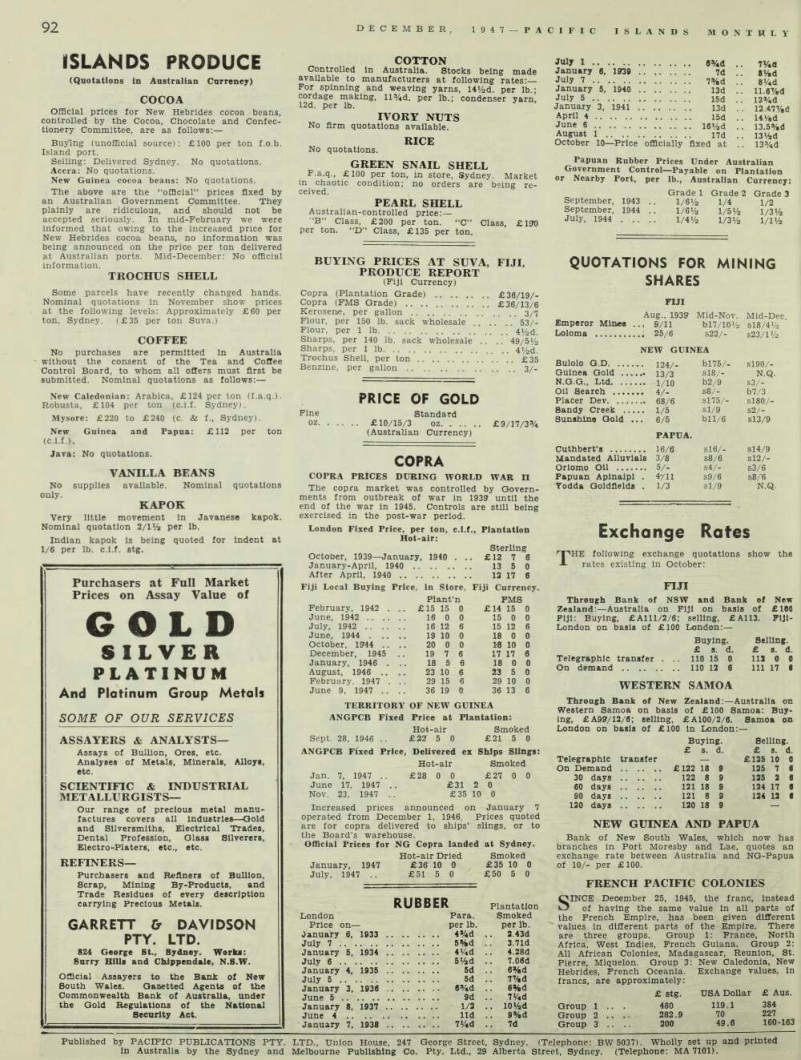
(Quotations in Australian Currency)
Cocoa
Official prices for New Hebrides cocoa beans, controlled by the Cocoa, Chocolate and Confec tionery Committee, are as follows:— Buying (unofficial source): £100 per ton f.o.b.
Island port.
Selling: Delivered Sydney. No quotations.
Accra: No quotations.
New Guinea cocoa beans: No quotations.
The above are the “official” prices fixed by an Australian Government Committee. They plainly are ridiculous, and should not be accepted seriously. In mid-February we were informed that owing to the increased price for New Hebrides cocoa beans, no information was being announced on the price per ton delivered at Australian ports. Mid-December: No official information.
Trochus Shell
Some parcels have recently changed hands.
Nominal quotations in November show prices at the following levels: Approximately £60 per ton, Sydney. (£35 per ton Suva.)
Coffee
No purchases are permitted In Australia without the consent of the Tea and Coffee Control Board, to whom all offers must first be submitted. Nominal quotations as follows;— New Caledonian: Arabica, £124 per ton (f.a.q.).
Robusta, £104 per ton (c.i.f. Sydney).
Mysore: £220 to £240 (c. & f., Sydney).
New Guinea and Papua: £112 per ton (c.i.f.).
Java: No quotations.
Vanilla Beans
No supplies available. Nominal quotations only.
Kapok
Very little movement In Javanese kapok.
Nominal quotation 2/1 Vi per lb.
Indian kapok Is being quoted for Indent at 1/6 per lb. c.i.f. stg.
Cotton
Controlled in Australia. Stocks being made available to manufacturers at following rates: For spinning and weaving yarns, 14y 2 d. per lb ; cordage making, 113/ 4 d, per lb.; condenser yarn 12d. per lb.
Ivory Nuts
No firm quotations available.
Rice
No quotations.
Green Snail Shell
F.a.q., £IOO per ton, in store, Sydney. Market in chaotic condition; no orders are being re ceived.
Pearl Shell
Australian-controlled price:— "B” Class, £2OO per ton. “C” Class, £l9O per ton. “D” Class, £135 per ton.
Buying Prices At Suva, Fiji,
Produce Report
(Fiji Currency) Copra (Plantation Grade) Copra (FMS Grade) Kerosene, per gallon Flour, per 150 lb. sack wholesale Flour, per 1 lb Sharps, per 140 lb. sack wholesale .
Sharps, per 1 lb . £36/19/- . £36/13/6 .. .. 53/- . .. 49/51/2 Trochus Shell, per ton .. ..
Benzine, per gallon .. .. 3/-
Advertisements & other items, p. 94 (1 item)
Price Of Gold
Pine Standard 02 £10/15/3 oz £9/17/3% (Australian Currency)
Copra
Prices During World War Ii
The copra market was controlled by Govern ments from outbreak of war in 1939 until the end of the war in 1945. Controls are still being exercised in the post-war period.
London Fixed Price, per ton, c.1.f., Plantation Hot-air:
Territory Of New Guinea
ANGPCB Fixed Price at Plantation:
Increased prices announced on January 7 operated from December 1, 1946. Prices quoted are for copra delivered to ships’ slings, or to the Board’s warehouse.
Official Prices for NG Copra landed at Sydney.
October, 1939—January, 1940 Sterling . £12 7 6 January-April, 1940 .. 13 5 0 After April, 1940 .. .. 12 17 6 Fiji Local Buying Price, in Store, Fiji Currency.
Plant’n
Fms
February, 1942 ... £15 15 0 £14 15 0 June, 1942 16 0 0 15 0 0 July, 1942 16 12 6 15 12 6 June, 1944 19 10 0 18 0 0 October, 1944 .. .. 20 0 0 1-8 10 0 December, 1945 .. 19 7 6 17 17 6 January, 1946 . .. 18 5 6 18 0 0 August, 1946 ., 23 10 6 23 5 0 February, 1947 . .. 29 15 6 29 10 0 June 9, 1947 .. .. 36 19 0 36 13 6
Sept. 28, 1946 ..
Hot-air Smoked £22 5 0 £21 5 0 ANGPCB Fixed Price, Delivered ex Ships Slings: Jan. 7, 1947 ..
Hot-air Smoked £28 0 0 £27 0 0 June 17, 1947 .. £31 2 0 Nov. 23, 1947 .. £35 10 0
Hot-air Dried Smoked January, 1947 £36 10 0 £35 10 0 July, 1947 .. £51 5 0 £50 5 0
Rubber
Plantation
Papuan Rubber Prices Under Australian Government Control—Payable on Plantation or Nearby Port, per lb., Australian Currency:
London Para.
Smoked Price onper lb. per lb.
January 6. 1933 .. .. 2.43d July 7 . .. .. 5%d 3.71d January 5. 1934 .. .. .. .. 4V«d 4.28d July 6 . .. .. 5Vid 7.06d January 4. 1935 .. .. ... 5d 6%d July 5 . ... 5d 7%d January 3, 1936 . .. 6%d June 5 ... 9d 7V«d January 8, 1937 .. .. .. lOVfed June 4 .. .. lid 9%d January 7, 1938 .. .. ... 7V*d .. 7d
July 1 8%d .. 7V4fl January 6, 1939 7d . 8V»d July 7 7%d .. 8V«d January 5, 1940 13d .. 11.8 7 /.d July 5 15d .. I2%d January 3, 1941 13d .. i2.47 7 /.d April 4 15d .. 14 Ved June 6 16»/ 2 d .. I3.5%d August 1 17d .. UVid October 10—Price officially fixed at .. 13 3 / 4 d
Grade 1 Grade 2 Grade 3 September, 1943 . 1/61/2 1/4 1/2 September, 1944 . i/6 y 2 I/51/2 I/31/2 July, 1944 . .. . 1/41/2 I/31/2 1/1 i/a
Quotations For Mining
Shares
Fiji
Aug.. 1939 Mid-Nov.
Mid-Dec.
Emperor Mines . .. 9/11 blT/lO/i S18/4V2 Loloma .. 25/6 s22/- S23/1V2 Bulolo G.D
New Guinea
.• 124/- bl75/sl90/- Guinea Gold si 8/- N.Q.
N.G.G., Ltd b2/9 s3/- Oil Search s8/b7/3 Placer Dev .. 68/6 S175/sl80/- Sandy Creek ... .. 1/5 sl/9 s2/- Sunshine Gold .. . 6/5 bll/6 S13/9 Cuthbert’s
Papua.
. . 16/6 sl6/- S14/9 Mandated Alluvlals 3/8 s8/6 sl2/- Orlomo Oil .. 5/s4/s3/6 Papuan Aplnaipl . 4/11 S9/6 s8/6 Yodda Goldfields . 1/3 sl/9 N.Q.
Exchange Rates
THE following exchange quotations show the rates existing in October;
Fiji
Through Bank of NSW and Bank of New Zealand;—Australia on Fiji on basis of £100 FIJI: Buying, £Alll/2/6; selling, £A113. F1J1- London on basis of £100 London: —
Western Samoa
Through Bank of New Zealand; —Australia on Western Samoa on basis of £100 Samoa: Buy ing, £ A99/12/6; selling. £A100/2/6. Samoa on London on basis of £100 In London:—
New Guinea And Papua
Bank of New South Wales, which now has branches in Port Moresby and Lae, quotes an exchange rate between Australia and NG-Papua of 10/- per £lOO.
French Pacific Colonies
SINCE December 25, 1945, the franc, instead of having the same value in all parts of the French Empire, has been given different values in different parts of the Empire. There are three groups. Group 1: France, North Africa, West Indies, French Guiana. Group 2: All African Colonies, Madagascar, Reunion, St.
Pierre, Miquelon. Group 3: New Caledonia, New Hebrides, French Oceania. Exchange values, In francs, are approximately:
Buying. Selling. £ s. d. £ 8. d.
Telegraphic transfer . .. 110 15 0 112 0 0 On demand 110 12 6 111 17 •
Buying.
Selling. £ 5. d. £ s. d.
Telegraphic transfer — £125 10 0 On Demand £122 18 9 125 7 8 30 days 122 8 9 125 2 6 60 days 121 18 9 124 17 6 90 days 121 8 9 124 12 e 120 days 120 18 9 —
£ stg. USA Dollar £ Aus.
Group 1 .. . 480 119.1 384 Group 2 .. .. 282.9 70 227 Group 3 .. .. 200 49.6 160-163
Advertisements & other items, pp. 94-96 (3 items)
92
DECEMBER, 1 9 4 7 — PACIFIC ISLANDS MONTHLY
Published by PACIFIC PUBLICATIONS PTY. LTD., Union House, 247 George Street, Sydney. (Telephone: BW 5037). Wholly set up and printed in Australia by the Sydney and Melbourne Publishing Co. Pty. Ltd., 29 Alberta Street, Sydney. (Telephone: MA7101).
Gold
Purchasers at Full Market Prices on Assay Value of
SILVER
PLATINUM
And Platinum Group Metals
SOME OF OUR SERVICES
ASSAYERS & ANALYSTS—
Assays of Bullion, Ores, etc.
Analyses of Metals, Minerals, Alloys, etc.
SCIENTIFIC & INDUSTRIAL
METALLURGISTS—
Our range of precious metal manufactures covers all Industries—Gold and Silversmiths, Electrical Trades, Dental Profession, Glass Silverers, Electro-Platers, etc., etc.
REFINERS—
Purchasers and Refiners of Bullion, Scrap, Mining By-Products, and Trade Residues of every description carrying Precious Metals.
GARRETT 6- DAVIDSON
PTY. LTD.
824 George St., Sydney. Works: Surry Hills and Chippendale, N.S.W.
Official Assayers to the Bank of New South Wales. Gazetted Agents of the Commonwealth Bank of Australia, under the Gold Regulations of the National Security Act.
tropical thirst...
To quench a
*** li i > » ' / *c -ing 0 « am mtt m Kt.l.M When you’re hot and tired,
there is nothing quite so satisfying
and thirst quenching as a long, cold glass of “K. 8.” Your friends and guests, too, will ap-
preciate this really fine
Lager, for “Everybody
drinks K. 8.”
TOOTHS
LAGER
M
ERCHANTS
. & SHIP OWNERS
Capital £1,000,000
ESTABLISHED 1914
if
COPRA MERCHANTS & MILLERS
BRANCHES THROUGHOUT THE PACIFIC ISLANDS
Buyers and exporters of ail kinds of Islands produce. Copra Merchants and Millers.
Agents for Australian, European and American Manufacturers. Distributors of every description of merchandise.
Thirty years of Pacific Islands development and service.
REGULAR CARGO AND PASSENGER SERVICE BETWEEN EUROPE AND
PACIFIC ISLAND PORTS WAS ESTABLISHED BY
Heod
W. R. CARPENTER & CO. LTD.
Office: 16 O'CONNELL STREET,
SYDNEY
Cable Address:
CAMOHE.
Telephone; RW 4421.
Postal Address: P.O. Box No. 168, Sydney.