Islands
Pacific
Monthly
November 18, 1947
Vol. Xviii. No. 4.
Established 1930.
IRegistered at the G.P.0., by post as a newspaper ]
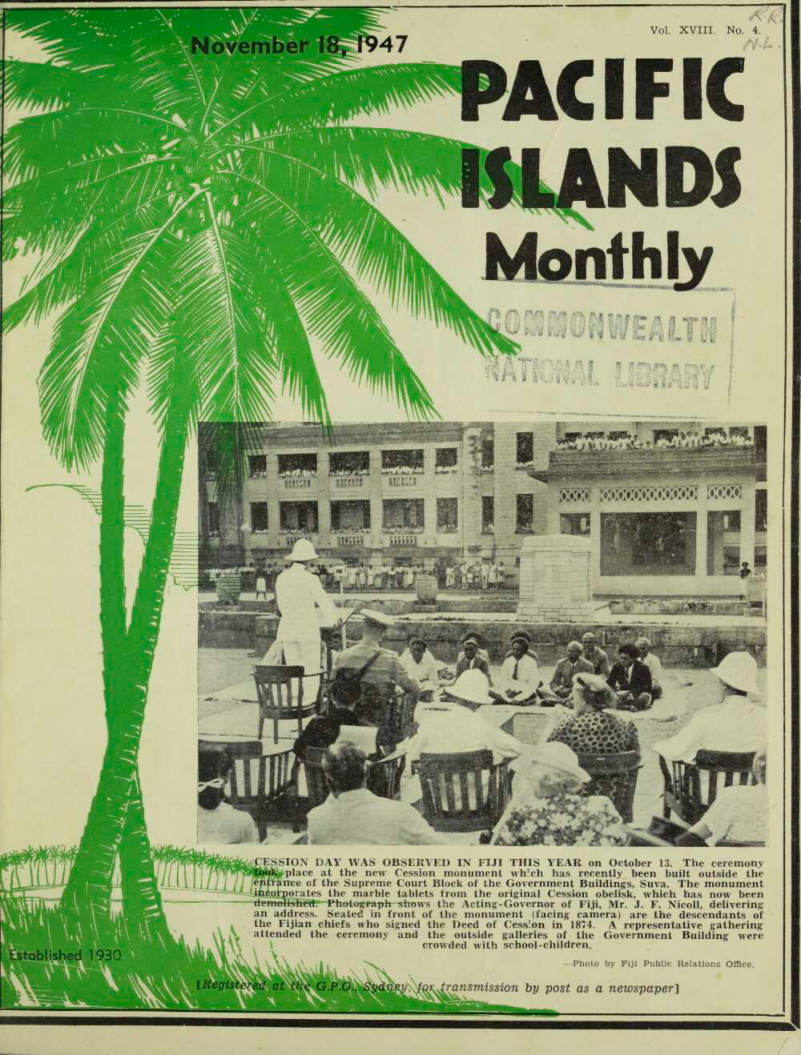
ON DAY WAS OBSERVED IN FIJI THIS YEAR on October 13. The ceremony took place at the new Cession monument which has recently been built outside the entrance of the Supreme Court Block of the Government Buildings, Suva. The monument incorporates the marble tablets from the original Cession obelisk, which has now been demolished. Photograph shows the Acting-Governor of Fiji, Mr. J. F. Nicoll, delivering an address. Seated in front of the monument (facing camera) are the descendants of the Fijian chiefs who signed the Deed of Cession in 1874. A representative gathering attended the ceremony and the outside galleries of the Government Building were crowded with school-children.
Photo by Fiji Public Relations Office.
Advertisements & other items, pp. 2-4 (1 item)
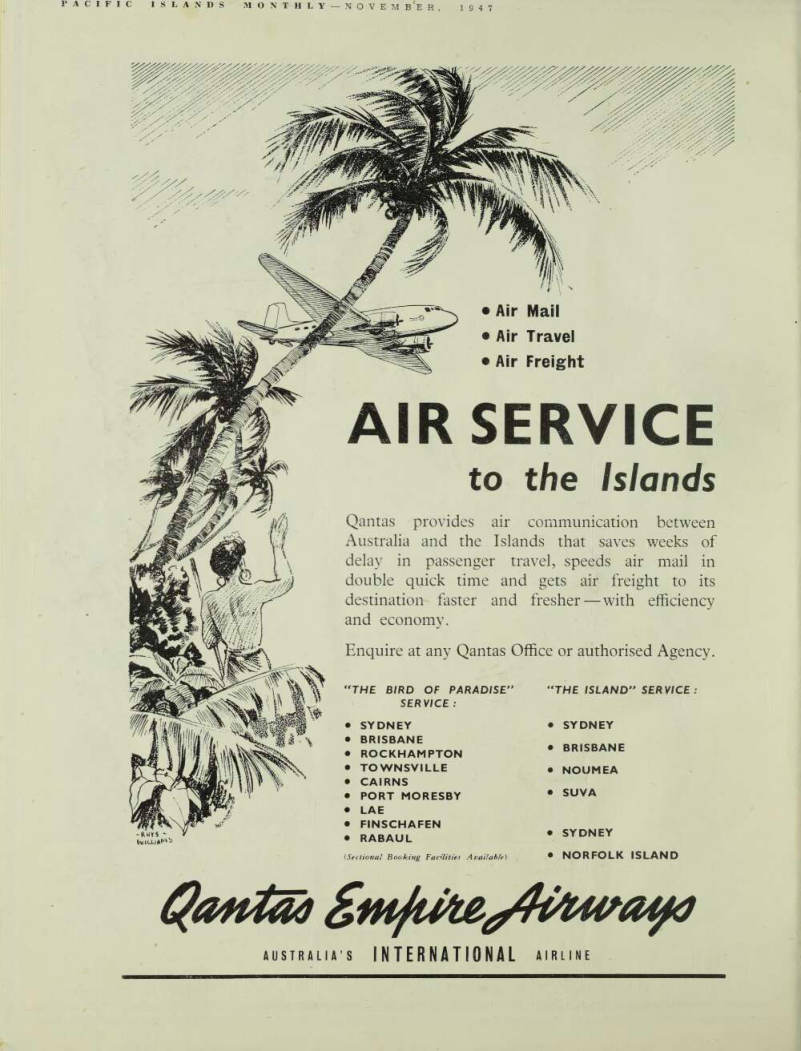
Air Service
V \ I
RHYS '
UiIUjASSS
• Air Mail
• Air Travel
• Air Freight
AIR SERVICE
to the Islands
Qantas provides air communication between
Australia and the Islands that saves weeks of delay in passenger travel, speeds air mail in double quick time and gets air freight to its
destination faster and fresher —with efficiency
and economy.
Enquire at any Qantas Office or authorised Agency.
"THE BIRD OF PARADISE *
SERVICE :
• SYDNEY
• BRISBANE
• ROCKHAMPTON
• TOWNSVILLE
• CAIRNS
• PORT MORESBY
• LAE
• FINSCHAFEN
• RABAUL
(Sectional Booking Facilities Available )
"THE ISLAND ” SERVICE
• SYDNEY
• BRISBANE
• NOUMEA
• SUVA
• SYDNEY
• NORFOLK ISLAND
Australia’s INTERNATIONAL airline
9 9 9 9* -r-wjiKi.. v* \^ : yr- 8 I -'if jjbJ| I -iL... i' - / / X / \ \ >£ Con be set up ready for use in a few seconds.
For its size this new Coleman Stove is
amazing. Although
only 81 in. high and 4i in. wide it boils a pint of water inside 5 minutes.
It is made of corrosion-resistant metal . . . lights instantly . . . needs no priming . . burns any kind of petrol and cannot spill fuel even when tipped over.
Telescopic case makes two handy cooking utensils. The pot supports at top fold in for packing.
Representatives for the Pacific Islands:
ROBERT GILLESPIE PTY. LTD.
54a PITT STREET, SYDNEY
PEARCE & CO. LTD,
SUVA
FOR FIJI ISLANDS
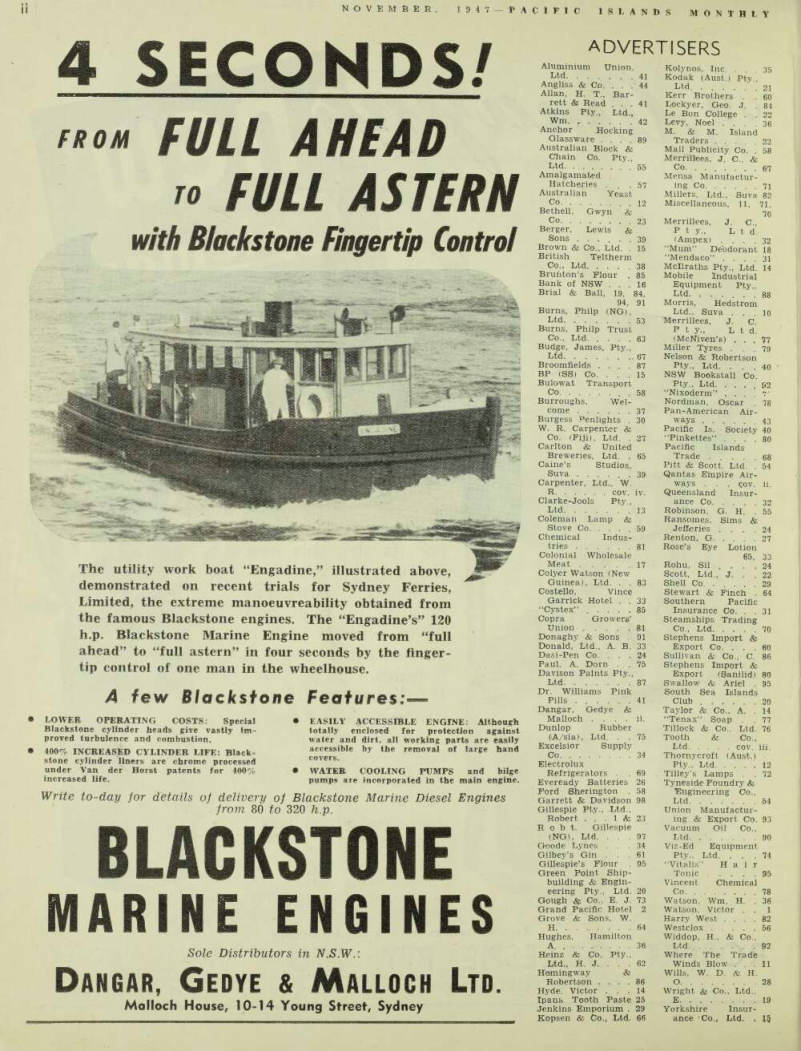
4 SECONDS'
»« FULL AHEAD
« FULL ASTCRH
with Blackstone Fingertip Control
f - ■ ■- , ■s'”
The utility work boat “Engadine,” illustrated above, demonstrated on recent trials for Sydney Ferries, Limited, the extreme manoeuvreability obtained from the famous Blackstone engines. The “Engadine’s” 120 h.p. Blackstone Marine Engine moved from “full ahead” to “full astern” in four seconds by the fingertip control of one man in the wheelhouse.
A few Blackstone Features: —
LOWER OPERATING COSTS: Special
Blackstone cylinder heads give vastly improved turbulence and combustion.
400% INCREASED CYLINDER LIFE: Black=
stone cylinder liners are chrome processed under Van der Horst patents for 400% increased life.
• EASILY ACCESSIBLE ENGINE: Although
totally enclosed for protection against water and dirt, all working parts are easily accessible by the removal of large hand covers. • WATER COOLING PUMPS and bilge pumps are incorporated in the main engine.
Write to-day for details of delivery of Blackstone Marine Diesel Engines from 80 to 320 h.p.
BLACKSTONE
MARINE ENGINES
Sole Distributors in N.S.W. :
Dangar, Gedye s Malloch Ltd
Malloch House, 10-14 Young Street, Sydney
Advertisers
Aluminium Union.
Ltd 41 Angliss & Co. . . .44 Allan, H. T., Bar rett & Read ... 41 Atkins Pty., Ltd., Wm. 42 Anchor Hocking Glassware ... 89 Australian Block & Chain Co. Pty..
Ltd 55 Amalgamated Hatcheries ... 57 Australian Yeast Co 12 Bethell, Gwyn & Co 23 Berger, Lewis & Sons ... 39 Brown & Co., Ltd. . 15 British Teltherm Co., Ltd 38 Bruhton’s Flour . 85 Bank of NSW ... 16 Brial & Ball, 19, 84, 94. 91 Burns, Philp (NG).
Ltd 53 Burns, Philp Trust Co., Ltd. ... 63 Budge, James, Pty., Ltd 67 Broomfields ... 87 BP (SS) Co. . . . 15 Bulowat Transport Co . 58 Burroughs, Wel come 37 Burgess Penlights . 30 W. R. Carpenter & Co. (Fiji), Ltd. . 27 Carlton & United Breweries, Ltd. . 65 Caine’s Studios, Suva ... 39 Carpenter, Ltd., W.
R cov. iv.
Clarke-Jools Pty., Ltd 13 Coleman Lamp & Stove Co. ... 59 Chemical Indus tries 81 Colonial Wholesale Meat 17 Colyer Watson (New Guinea), Ltd. . . 83 Costello, Vince Garrick Hotel . . 33 “Cystex” ... 85 Copra Growers’
Union 81 Donaghy & Sons . 91 Donald, Ltd., A. B. 33 Dasi-Pen Co. ... 24 Paul, A. Dorn , . 75 Davison Paints Pty., Ltd .87 Dr, Williams Pink Pills 41 Dangar, Gedye & Malloch . . . . ii.
Dunlop Rubber (A./sia), Ltd. . . 75 Excelsior Supply Co 34 Electrolux Refrigerators . 69 Eveready Batteries 26 Ford Sherington . 58 Garrett & Davidson 98 Gillespie Pty., Ltd..
Robert ... 1 & 23 R o b t. Gillespie (NG). Ltd. ... 97 Goode Lynes ... 34 Gilbey’s Gin ... 61 Gillespie’s Flour . 95 Green Point Ship building & Engin eering Pty., Ltd. 20 Gough & Co.. E. J. 73 Grand Pacific Hotel 2 Grove & Sons, W.
H 64 Hughes, Hamilton A. 36 Heinz & Co. Pty., Ltd., H. J. . . . 62 Hemingway & Robertson ... 86 Hyde. Victor ... 14 Ipana Tooth Paste 25 Jenkins Emporium . 29 Kopsen & Co., Ltd. 66
Kolynos, Inc, ... 35 Kodak (Aust.) Pty., Ltd. ... 21 Kerr Brothers . . 60 Lockyer, Geo. J. . 84 Le Bon College . . 22 Levy, Noel ... 36 M. & M. Island Traders 22 Mail Publicity Co. . 58 Merrillees, J. C., & Co. . 67 Mensa Manufactur ing Co 71 Millers. Ltd.. Suva 82 Miscellaneous, 11, 71. 70 Merrillees, J. c., Pty., L t d’. (Ampex) ... 32 “Mum” Deodorant 18 “Mendaco” ... 31 Mcllraths Pty., Ltd. 14 Mobile Industrial Equipment Pty., Ltd. ... 88 Morris, Hedstrom Ltd., Suva . . ; 10 Merrillees, J. C.
Pty., Ltd. (McNiven’s) ... 77 Miller Tyres ... 79 Nelson & Robertson Pty., Ltd. ... 40 NSW Bookstall Co.
Pty., Ltd. ... &2 “Nixoderm” ... 7- Nordman, Oscar . 78 Pan-American Air ways 43 Pacific Is. Society 40 “Pinkettes” ... 80 Pacific Islands Trade ... 68 Pitt & Scott, Ltd. . 54 Qantas Empire Air ways . . . qov. ii.
Queensland Insur ance Co 32 Robinson. G. H. . 55 Ransomer, Sims & Jefferies ... 24 Renton, G 27 Rose’s Eye Lotion 65, 33 Rohu, Sil . . . . 24 Scott, Ltd., J. . ,22 Shell Co. ... 29 Stewart & Finch . 64 Southern Pacific Insurance Co. . .31 Steamships Trading Co., Ltd 70 Stephens Import & Export Co. ... 60 Sullivan & Co., C. 86 Stephens Import & Export (Sanilid) 80 Swallow & Ariel . 95 South Sea Islands Club 20 Taylor & Co.. A. . 14 “Tenax” Soap . . 77 Tillock & Co., Ltd. 76 Tooth & Co..
Ltd cov. iii.
Thornycroft (Aust.) • Pty., Ltd 12 Tilley’s Lamps . . 72 Tyneside Foundry & Engineering Co., Ltd .64 Union Manufactur ing & Export Co. 93 Vacuum Oil Co., Ltd 90 Viz-Ed Equipment Pty.. Ltd. ... 74 “Vitalis” Hair Tonic 95 Vincent Chemical Co 78 Watson. Wm. H. . 36 Watson. Victor . . 1 Harry West ... 82 Westclox 56 Widdop, H.. & Co..
Ltd. 92 Where The Trade Winds Blow ... 11 Wills. W. D. & H. 0 28 Wright & Co., Ltd..
E 19 Yorkshire Insur ance Co., Ltd. . 15
Advertisements & other items, p. 5 (1 item)
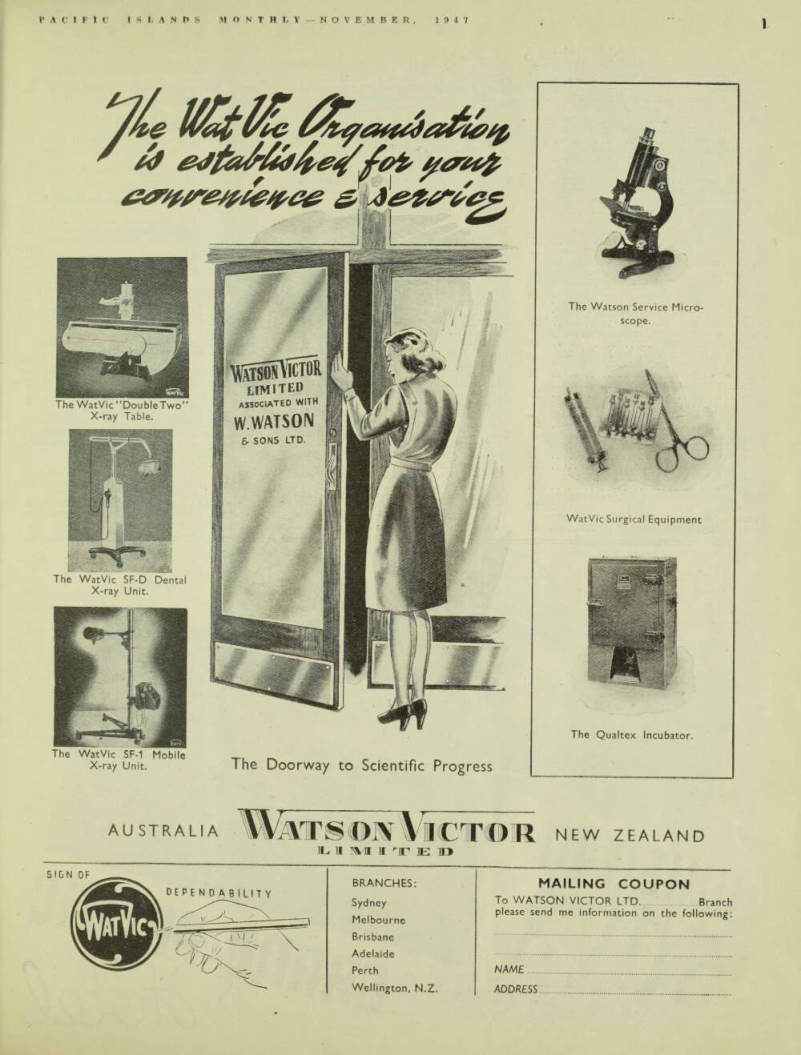
WotSOm ViICT®!! n
/ e At The WatVic“DoubleTwo’
X-ray Table.
The Wat Vic SF-D Dental X-ray Unit. m 3 r &
ICTOR
atson
limited
associated WITH
W. WATSON
& SONS LTD.
The Watson Service Microscope. *u Wat Vic Surgical Equipment The Qualtex Incubator, The Wat Vic SF-1 Mobile X-ray Unit.
The Doorway to Scientific Progress
AUSTRALIA
WotSOm ViICT®!! n
IL. II M II TT E 113
EW ZEALAND
SIGN OF
dependability
BRANCHES:
Sydney Melbourne Brisbane Adelaide Perth Wellington, N.Z.
MAILING COUPON
To WATSON VICTOR LTD. Branch
please send me information on the following:
NAME
ADDRESS.
In This Issue:
Editorial: “Mr. Ward Will Visit His Kingdom” 3 Pacific Travellers (in pictures) 4, 7 & 8 Shall We Coo to the Socialistic Tiger? 5 Plenty of Fresh Meat in New Guinea Soon—Sydney Business Man’s New Enterprise 5 Fiji Airport Decision Still Awaited .. 6 Big Profit for Papuan Trading Firm 7 Papuan Rubber Industry in Jeopardy 7 Guinea Airways Driven out of Darwin Service by Australian Government 7 Another Plan for Samoa UN Mission’s Recommendations ... 8 Brilliant Fiji Girl’s Success in USA 9 “Marching Rule” —And Their Flag .. 9 No Help for NG Copra Producers .. 11 How Joseph Wulf Missed the “Alone” 14 New French Air Service—Tahiti to Noumea 14 NZ National Airways Corporation Takes Over 14 Mr. Alderman, KC, in the News- Memories of Territorians’ War time Claims 15 Nauru Phosphate—Gradual Recovery of the Industry 16 An Investigation Will be Made Into New Guinea Servicemen’s Griev ances 18 Accident to Bristol Freighter at Wau, NG 20 Mr. Ward Will Visit New Guinea in New Year—Will Choose Capital Site 21 Strike at Nadi Airport, Fiji 21 Swift Moves for Reform in Western Samoa 22 Nauru Is Now In “Trust” 23 Cook Is. Watersiders’ Aggressive Spirit 24 New Legislative Council Appointments In Fiji 24 Plenty of Money in Fiji—High Imports and High Revenue 27
Fiji’s Gift to Princess Elizabeth .. 26 East Indies Timber—Source of Enormous Supplies Shut Off ... 29 Fiji’s Tax-Dodgers Cost Government £13,000 31 Is USA Buying South Seas Trochus? 31 Removal of 4,000 US Dead from Guadalcanal Battlefields 32 Attempts to Overcome New Cale donia’s Currency Difficulties ... 32 Mr. Henry (CIPA) Decants Soothing Phrases in Rarotonga 33 No New Hotel for Suva 38 Another £3,000,000 for Australian Pacific Territories 38 Two Years Ago on Nauru —Few Remembered Anniversary of Re occupation 39 Enemy Aliens’ Property—Australian Laws Liberal 40 New Guinea Volunteer Rifles —Part II of List 41 Territories’ Talk-Talk 45 He Tamed a Papuan Tribe—Fr.
Vitale’s 55 years with the Mekeos 46 Tonga’s Lonely Outposts—A Visit to Abandoned Niuafo’ou 47 When the Samoans Went Under ground 48 Tropicalities 50 Tropical Cat in a Tropical Garden .. 51 This Made Me Laugh—South Seas’
Humour ...» 52 Fiji Indians’ “Hardship”—CSß Chief Does Not See Evidence of It ... 57 Early Days in Papua—Monckton’s Two Patrols 58 Boys In Boots —NZ Natives Now May Wear Anything 59 Alain Gerbault's Last Resting Place 59 The Lae “Garamut” 60 Shortage of Copra Sacks Hits Pro ducers 60 Father Rougier Died a Priest—A Correction 61
Fiji’s Butter War—Dilemma for Dairy Industry 62 Cession Day Ceremony at New Memorial 63 When Errol Flynn Was a Gold Miner 64 “Marching Rule” Leaders on Trial in
Bsi 64
Under the Union Jack —Kuper Family
In Bsi 65
Re-Export Racket Is To Stop In Fiji 66 Mystery of the South Pacific Com mission 67 Representative of New Caledonia In Paris 67 Recipes for Island Cooks 68 Cook Islands Council Inaugural Meeting 70 Gambusia Eat Mosquito Larvae ... 71 Fiji’s Liquor Bill—Churches Protest .. 73 Back to School Movehient In Papua- New Guinea 74 Solomon Island Conditions —Natives Healthier but Sullen 75 Survey of New Guinea —Lack of Shipping and Food but Other Conditions Improving 76 Anglican Missionaries Now in Papua 77 NG’s Ten-Year Plan —How Is It Going? 77 Rock Carvings In New Caledonia Point to Pre-Melanesian Inhabit ants 78 Anxious Days for Yule Island Mission 80 Dodging Nips Behind Bogia .. .. 82 Where the NMP’S Come From—Dr.
Hoodless’ Fascinating Story .. .. 87 Nothing Wrong With Fiji’s Factories —NZ Official Concludes Survey .. 91 Netherlands Indies Is Settling Down 93 Shippirig and Plane Services; Pacific Travellers 94, 97 Markets, Commercial, etc 98 OBITUARY: Nicolas (“Tibby”) Hagen, 26; Milton Craig, 40; Mde. Louis Gulchard, 64; Fr. I. Schwab, 81.
ORGANISATIONS: New Guinea Women’s Club, Sydney, 9; Royal Geographical Society, Brisbane, 29.
Advertisements & other items, p. 6 (1 item)
sT avoS>^
W* •
5 ; ' v*"'"
A ?^' C a -s u ° Svi va , w d es>6" ed Sp« c ' a Y s eW'c«
tir'«
. ser'*" I*' 1 *' - rS s >N^' ter U*'°
ar' {oX
C»o' e-
er 4a^ |i P e
Pacific Islands Monthly
The Newspaper-Magazine of the South Seas
[Registered at the G.P.0., Sydney, for transmission by post as a newspaper .] Published Once Each Month and Circulated in Australia and New Zealand and in the following Pacific Territories and Islands Groups:
Australian Territory of Papua.
Mandated Territory (Australia) of New Oalnea.
Australian Territory of Norfolk Island.
New Zealand Territory of Cook Islands.
Mandated Territory (NZ) of Western Samoa.
British Colony of FIJI.
British Solomon Islands Protectorate.
British Protectorate of Tongan Islands.
British Crown Colony of Gilbert and Ellice Islands. * Mandated Territory of Nauru.
British and Free French Condominium c* N«« Hebrides.
French Colony of New Caledonia.
French Colony of Oceania (Tahiti, etc.).
American Territory of Eastern Samoa.
American Territory of Hawaiian Islands.
Owned and Produced by Pacific Publications Pty. Ltd., Union House, 247 George Street, Sydney.
Telephones: General Office and Advertising, BW 5037.
P.O. Box 3408
Registered Address for Telegrams, Radiograms, and Cables: "Pacpub”, Sydney.
Contributions.
Articles, Stories, and Photographs dealing with Pacific Islands subjects are invited and will be paid for on publication.
Subscription Rates.
Per Annum, Pre-paid, Including Postage.
In Australia, New Zealand, Fiji, New Guinea, Papua, Western Samoa, Cook Islands, Tonga, British Solomons, Gil bert and Ellice Colony, Nauru, and United Kingdom : 15 0 Elsewhere 18 0 Single copies 1 6
Editor and Publisher:
R. W Robson. F.R.G.S.
Assistant Editor: JUDY TUDOR.
General Office: Union House, 247 George Street, Sydney. Telephone: BW 5037.
Advertising Manager: W. E. Rogers.
Representative In London,
J. T. Wallis, Coronation House, 4 Lloyds Avenue, London, E.C.3, from whom may be obtained copies of Pacific Islands Monthly, Pacific Is. Year Book, advertising schedules, etc.
Representative In U.S.A.
Pacific Islands Trading Co.,
244 CALIFORNIA ST.. SAN FRANCISCO, U S.A.
Agents.
The following are authorised to receive sub scriptions for Pacific Islands Monthly:— Burns, Phllp & Co., Ltd., and Burns Phllp (South Sea) Co., Ltd. All branches.
W. R. Carpenter <fc Co., Ltd. All branches.
Morris, Hedstrom, Ltd. All branches.
Steamships Trading Co., Papua. All branches W. M. Caldwell, Suva, FIJI.
Cook Islands Trading Co., Rarotonga, Cook Is.
A. C. Rowland, Papeete, Tahiti.
Islands Branches and Representatives of W. H.
Grove <fc Sons, Ltd., Auckland, New Zealand.
Ed. Pentecost, Noumea, New Caledonia.
Soclete Gubbay Kerr et Ole, Noumea, N. Caledonia.
T. A. Wyborn, 12a Alpln Street, Cairns.
Vol. Xviii. No. 4.
November 18, 1947
r 1/6 Per Copy Price ] Prepaid, p.a.: 15/- Aus ( In USA, p.a.; $3.
Mr. Ward Will View His Kingdom
AT an early date—“early in the New Year,” says Canberra—the Hon. E. J. Ward, Minister in Charge of Australia’s Pacific Territories, will travel north to inspect the Socialistic paradise he has created in Papua and New Guinea.
It is an old saying that if one puts a beggar on horseback, he will ride to the devil. In other words, if you give an inexperienced man control of an important establishment, he prob ably will wreck it. Mr. Ward, a Leftist thinker of fixed ideas, without any background of business experi ence, administrative skill or know ledge of living conditions in the tropics, was given dictatorial powers over the hitherto prosperous Terri tories; and he has certainly ridden them to the devil. Here, carefully listed, are his major accomplish ments:— He has placed a halter around the neck of Big Business, by limiting the trading operations of the firms, so that the distribution of goods to Europeans and natives is under re striction. They may not handle the Islands’ main agricultural product (copra), and they have no control over shipping.
As part of his plan of throttling Big Business, he has created the Production Control Board, which compulsorily acquires all copra pro duced, and pays the grower whatever price it thinks fit; and he has taken charge of all shipping, both overseas
and coastal, so that sea-trans portation within the Territories is a Government monopoly.
He has destroyed the old native labour indenture system—evolved in 40 years of practical co-operation between Administration and em ployers—and has put in its place another native labour system, that is the product of his own violently prejudiced mind in combination with ideas presented by a carefully-chosen group of impractical missionaries and idealistic anthropologists. The result is an undependable, ex pensive and less efficient labour supply.
He is spending between £2,000,000 and £3,000,000 per annum—funds provided by overtaxed Australia—on a policy designed to convert the Stone Age people of Papua and New Guinea into intelligent peasant farmers, and to push European planters, miners and traders out of the Territories, altogether.
Mr. Ward has been carrying out this general plan for five years. One could see his hand at work between 1942 and 1945. It was not a free hand, because the Army was in occupation, and it could do little more than sketch the design. But as soon as the war was over, and the military marched out, Mr. Ward’s plans came quickly into effect; and in 1946 and 1947 we have seen a huge and expensive organisation created for the benefit and glorification of
Fuzzy-wuzzy, while non-official Euro pean settlers, and Private Enterprise generally, has been taking a fearful hiding.
MANY of us, in our innocence, knowing nothing of the capa bilities of Mr. Ward, had foreseen a period of prosperity and progress in Papua and New Guinea. We knew that all the natural products of the country would be in great demand, that their prices would be high, and that the majority of the returned Europeans, through the compensation provided by the fortuitously-conceived War Damage Commission, would be well equipped to take fullest advan tage of these conditions.
A post-war boom in New Guinea seemed inevitable; and we believed that, by the time it was over, New Guinea would be developed, settled, staffed and equipped to play its im portant part in the defence of Aus tralia—as a great natural barrier between an empty white continent, and the hungry masses of over crowded Asia.
Instead of that, under the bright pink Socialism of Mr. Ward, we have two Territories which have become the home of two thousand depressed Europeans, one million bewildered natives, and an economy which is kept going only on funds generously shovelled out of the Australian Treasury by Ministerial incompetents who know nothing of the value of money.
Mr. Ward, of course, would describe the foregoing as Fascist nonsense—
the mere outpourings of the mouth piece of Big Business. He insists that he has applied his talents and his powers to rescuing the natives from virtual slavery, and the European settlers from the grip of the mono polistic Big Firms.
In actual fact, his policy in New Guinea is simply a part of the Aus tralian Socialist Government’s attack upon Private Enterprise generally.
The difference is that in Australia, the people can kick back—as in the Victorian election. In New Guinea, they are unrepresented in Parlia ment, voiceless and powerless.
THERE were plenty of opportunities for reform in New Guinea. The Territories which the Japs invaded at the end of 1941 were no colonial models —no great praise was given to Australian administration. Beyond any doubt, the Big Firms had mono polistic powers which were capable of abuse. Unquestionably, there was need for a new native policy, so that our use of native labour would become part of a system under which the natives generally would be assisted towards education, better health, technical training and a gradually improved standard of living. Aus tralia’s native policy in the Territories was not all it should have been; but it was not the hand-maiden of in dustrial slavery, as Mr. Ward has so frequently alleged.
The evils and abuses in New Guinea were not nearly sufficient to justify the socialistic revolution which Mr.
Ward engineered and directed. They could and should have been dealt with by a moderate Administration, working in close association with the experienced non-official Europeans in the Territories, and especially the planters and the missionaries. In 1940, the Australian Government, like the great majority of Europeans in the two Territories, had a keen appreciation of Australia’s Territorial obligations, and would have honoured them.
THIS writer, before 1940, travelled all over Papua and New Guinea —as well as over most South Pacific Territories—and he saw nothing in the nature of abuse of power or in justice to the natives, sufficient to raise an outcry about. The adminis trative policies had many short comings, which he stressed in articles published at the time; but nothing to justify a revolution.
The two Territories despite those shortcomings, made good progress be tween 1920 and 1940—sufficient to support the statement that if Aus tralia had followed her policies—with certain important amendments— after 1945, both European and native interests would have been properly taken care of.
Perhaps the Big Firms were too strong in certain directions; but it must be remembered that no task of pioneering and organisation—such as was called for in New Guinea—can be successfully undertaken except by
powerful financial interests, motivated by a prospect of big profits. Mr.
Ward’s present set-up in New Guinea could no more pioneer developmental progress in that great primitive country than it could fly to the moon.
In the two years since the Jap sur render let Mr. Ward loose in New Guinea we have seen more blunder ing, more chaos, and more monstrous social injustice in the Territories than we saw in the two decades prior to the war.
We had hoped to see the Europeans of New Guinea, who suffered so cruelly in the invasion, compensated by the benefits of a substantial “boom.” Instead, they have become the victims of the political accident which let a team of Socialistic doctrinaires and anthropological dreamers loose upon the country. Is it any wonder that the best of New Guinea’s pioneer settlers are now preparing to migrate to the British African colonies, where the qualities of personal initiative and private enterprise are appreciated, and the native policy is framed by realists?
THE people of New Guinea will be interested in seeing Australia’s Mr. Ward. They must not expect to meet either a charlatan or a fool.
Mr. Ward is a man of unusual quality—he probably is the most able man in the Canberra Government.
He is widely read, he has—when he wishes—suave and charming man ners, and his private life is un impeachable.
But he probably is the most dangerous man in public life in Aus tralia. That is because his judgment is coloured and twisted by his hates, and his hates form the background of his political life. He is a section alist run amok. He does not plan for the good of all classes—only for one class. In his view, there can be only one class of people in the world worthy of his consideration, and they are those who subscribe to his Marxist ideas—all others are Fascists, ex ploiters, criminals or nitwits, and must on no account be tolerated.
When he is treated in similar fashion by others, he puts on a show of fury that is a most interesting revelation of character. Somewhere in his early life he must have suf fered great social injustice, so that, to the zeal of the true reformer, he has added the blind passion of a man consistently thwarted. And that is a pity, because “Eddie” Ward, over and above it all, is a man of great natural ability, who really could have done for his fellow-men something immensely more impressive than he has accomplished so far in the Terri tories.
As it is, the turn of the political wheel probably will soon throw him back into the oblivion of opposition, where he will be able to accomplish nothing. When he returns to power, probably with the next turn of the nolitical wheel, he will be too old to be of much use—or danger,
Air Travellers To Ng
rE company’s pet psycho-analyst was testing the IO of the lad from back o’Lautoka. “If,” he asked the young fellow, “somebody came up behind you and cut off your right ear with a knife, what effect would that have on you?”
“Wouldn’t be able to hear so well, sir,” replied the youth.
“And if,” continued the analyst, “another man came up later and cut off your left ear, what effect would that have on you?”
“Wouldn’t be able to see so well, sir,” was the reply.
The learned man looked up signifi cantly; shook his head and murmured, “As I thought. Definitely lacking!”
Turning back to the youth he asked: “Why would it affect your sight?” Came the reply:— “Me hat’d fall down over me eyes, sir.”
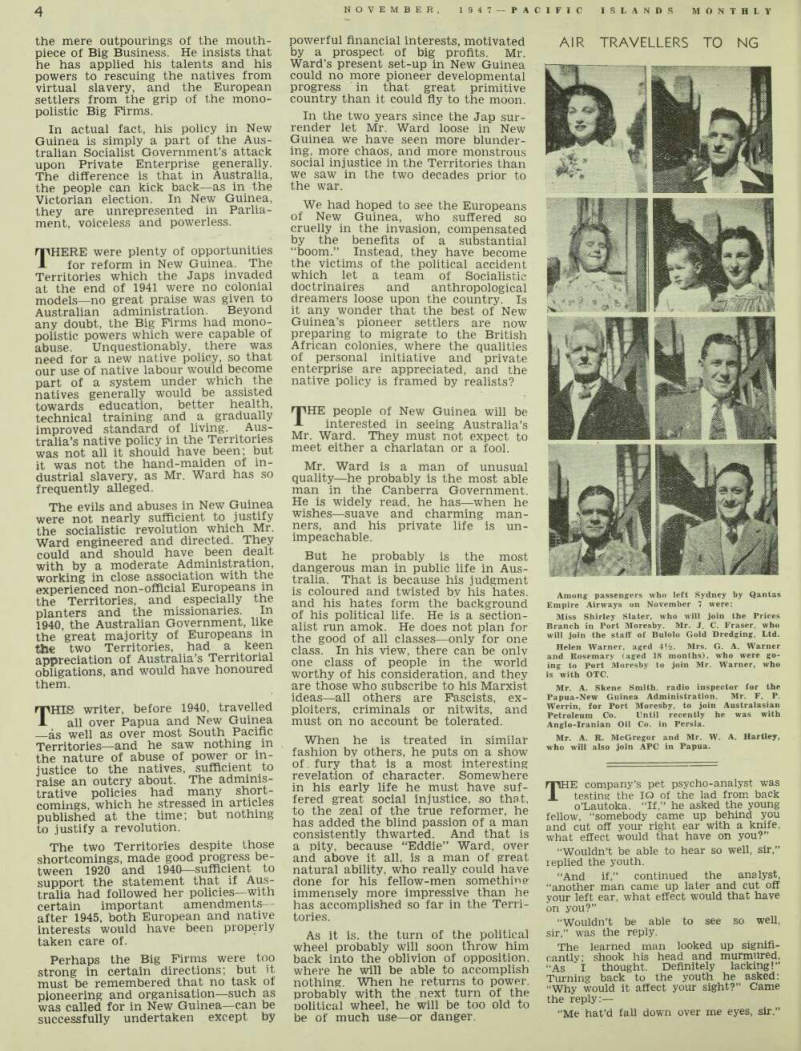
Among passengers who left Sydney by Qantas Empire Airways on November 7 were: Miss Shirley Slater, who will join the Prices Branch in Port Moresby. Mr. J. C. Fraser, who will join the staff of Bulolo Gold Dredging, Ltd.
Helen Warner, aged 4½. Mrs. G. A. Warner and Rosemary (aged 18 months), who were go ing to Port Moresby to join Mr. Warner, who is with OTC.
Mr, A. Skene Smith, radio inspector for the Papua-New Guinea Administration. Mr. F. P.
Werrin, for Port Moresby, to join Australasian Petroleum Co. Until recently he was with Anglo-Iranian Oil Co. in Persia.
Mr. A. R. McGregor and Mr. W. A. Hartley, who will also join APC in Papua.
Sweeping The Seas
Nearly 200 Vessels Damaged, in Vast Mine Cleaning-up Job
LITTLE has been said about it; but intensive mine-sweeping opera tions have been proceeding off the North Queensland coast for over two years; and the seas there are now comparatively safe for Australian- New Guinea shipping.
As soon as the Japanese threat to Australia developed, in 1942, Austra lian mine-layers laid many mine fields across the tracks likely to be used by enemy vessels, and these traps were carefully maintained for three years. Then the Australian Navy had the heartbreaking task of sweeping up thousands of mines, and rendering them harmless. Much re mains to be done: but the worst of the task is over. The cost of the mine-sweeping, in human life, has been heavy.
A LARGE and complicated mine sweeping operation, making European waters safe for the unre stricted movement of shipping, is nearing completion.
For two years the fleets of 13 nations have been co-operating in tjiis work, with the largest share fall ihg to the lot of Britain’s Royal Navy.
When the war ended, Europe’s coastal waters were sown with at least 600,000 mines of varying types.
Now after two years patient labour, always under the threat of sudden danger, 140,000 square miles of sea are entirely clear.
In May, 1945, an international Mine Clearance Board was formed with headquarters at the Admiralty in London, and progress reports of the work controlled and planned from this point have been passed to an international routing authority, also situated in London. There, in structions are issued for the safety and guidance of all shipping. 2,000 vessels have made up the international mine sweeping fleet which has operated in four main zones, the East Atlantic, the Mediterranean and Black Sea. the Baltic and the Kattegat and Bal tic approaches. British ships have worked in each zone and the whole task has been supervised from Lon don.
The fleet always operates in flot-
illas of eight ships each, which, in reasonable weather conditions, clear 25 square miles a day, working at an effective sweeping speed of 8 to 9 knots.
The difficulty of the task is vividly illustrated by just one example.
Magnetic mines equipped with de layed firing devices must be swept over no fewer than 15 times before they detonate.
Nearly 200 vessels have been either sunk or damaged while engaged on
this work of making the seas safe for other ships, but since the work began two years ago there has not been a single human casualty.
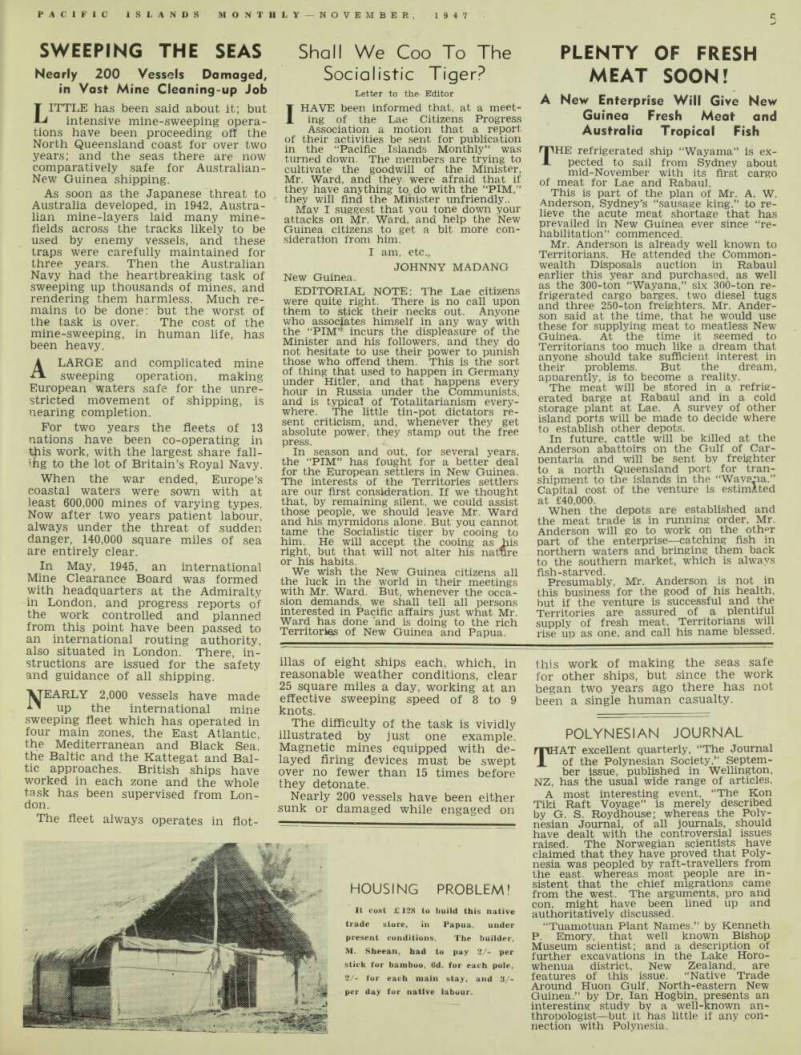
Housing Problem!
It cost £128 to build this native trade store, in Papua. under present conditions. The builder, M. Sheean, had to pay 2/- per stick for bamboo, 6d. for each pole, 2/- for each main stay, and 3/per day for native labour.
Socialistic Tiger?
Shall We Coo To The Socialistic Tiger?
Letter to the Editor IHAVE been informed that, at a meet ing of the Lae Citizens Progress Association a motion that a report of their activities be sent for publication in the “Pacific Islands Monthly” was turned down. The members are trying to cultivate the goodwill of the Minister.
Mr. Ward, and they were afraid that if they have anything to do with the “PIM,” they will find the Minister unfriendly..
May I suggest that you tone down your attacks on Mr. Ward, and help the New Guinea citizens to get a bit more con sideration from him.
I am, etc.,
Johnny Madang
New Guinea.
EDITORIAL NOTE: The Lae citizens were quite right. There is no call upon them to stick their necks out. Anyone who associates himself in any way With the “PIM” incurs the displeasure of the Minister and his followers, and they do not hesitate to use their power to punish those who offend them. This is the sort of thing that used to happen in Germany under Hitler, and that happens every hour in Russia under the Communists, and is typical of Totalitarianism every where. The little tin-pot dictators re sent criticism, and, whenever they get absolute power, they stamp out the free press.
In season and out, for several years, the “PIM” has fought for a better deal for the European settlers in New Guinea.
The interests of the Territories settlers are our first consideration. If we thought that, by remaining silent, we could assist those people, we should leave Mr. Ward and his myrmidons alone. But you cannot tame the Socialistic tiger by cooing to him. He will accept the cooing as his right, but that will not alter his natfire or his habits.
We wish the New Guinea citizens all the luck in the world in their meetings with Mr. Ward. But, whenever the occa sion demands, we shall tell all persons interested in Pacific affairs just what Mr.
Ward has done and is doing to the rich Territories of New Guinea and Papua.
Meat Soon!
Plenty Of Fresh
A New Enterprise Will Give New Guinea Fresh Meat and Australia Tropical Fish
THE refrigerated ship “Wayama” is ex pected to sail from Sydney about mid-November with its first cargo of meat for Lae and Rabaul.
This is part of the plan of Mr. A. W.
Anderson, Sydney’s “sausage king.” to re lieve the acute meat shortage that has prevailed in New Guinea ever since “re habilitation” commenced.
Mr. Anderson is already well known to Territorians. He attended the Common wealth Disposals auction in Rabaul earlier this year and purchased, as well as the 300-ton “Wayana,” six 300-ton re frigerated cargo barges, two diesel tugs and three 250-ton freighters. Mr. Ander son said at the time, that he would use these for supplying meat to meatless New Guinea. At the time it seemed to Territorians too much like a dream that anyone should take sufficient interest in their problems. But the dream, apoarently, is to become a reality.
The meat will be stored in a refrig erated barge at Rabaul and in a cold storage plant at Lae. A survey of other island ports will be made to decide where to establish other depots.
In future, cattle will be killed at the Anderson abattoirs on the Gulf of Car pentaria and will be sent by freighter to a north Queensland port for tran shipment to the islands in the “Wayajia.”
Capital cost of the venture is estimated at £40,000.
When the depots are established and the meat trade is in running order, Mr.
Anderson will go to work on the part of the enterprise—catching fish in northern waters and bringing them back to the southern market, which is always fish-starved.
Presumably, Mr. Anderson is not in this business for the good of his health, but if the venture is successful and the Territories are assured of a plentiful supply of fresh meat. Territorians will rise up as one, and call his name blessed.
Polynesian Journal
rAT excellent quarterly, “The Journal of the Polynesian Society,” Septem ber issue, published in Wellington, NZ, has the usual wide range of articles.
A most interesting event, “The Kon Tiki Raft Voyage” is merely described by G. S. Roydhouse; whereas the Poly nesian Journal, of all journals, should have dealt with the controversial issues raised. The Norwegian scientists have claimed that they have proved that Poly nesia was peopled by raft-travellers from the east, whereas most people are in sistent that the chief migrations came from the west. The arguments, pro and con, might have been lined up and authoritatively discussed.
“Tuamotuan Plant Names.” by Kenneth P. Emory, that well known Bishop Museum scientist; and a description of further excavations in the Lake Horo whenua district, New Zealand, are features of this issue. “Native Trade Around Huon Gulf, North-eastern New Guinea.” by Dr. lan Hogbin, presents an interesting study by a well-known an thronologist—but it has little if any con nection with Polynesia.
Fiji Airport Decision
Still Awaited
■ From Our Own Correspondent
Suva. Oct. 23.
IT is still not known whether Nadi, which has again been in the news, will be Fiji’s international airport.
Almost civil war broke out last year in Fiji between factions who favoured either Nadi in the “dry zone” and about 150 miles by road from Suva, the capital; or Nausori, in the wet zone but only about 17 miles from Suva.
The question has, however, been pon dered upon by international air experts and the final decision rests with them.
They have, to date, been so pondering for 18 months. So far without result.
In the meantime Pan American Airways and Australian National Airways con tinue to use Nadi.
Recently Nadi was again news when members of the Nadi Aerodrome Workers Union went on strike (see elsewhere this issue); they are still on strike at this writing.
Services are, however, being maintained with a scratch staff and everything is reported “quiet.”
Airfield For Niue
AFijLLY equipped expedition will leave New Zealand about April, 1948, to construct an aerodrome on Niue Island. It is hoped that the work will be finished during the dry season, which ends about November.
The New Zealand Public Works De- Sartment is planning the expedition to le island, the present white population of which is under ten.
Work on the aerodrome was deferred for this season because of the difficulty of obtaining the material and manpower.
The airstrip will be 5,000 feet in length.
Mangaia's Share In Good
Copra Prices
Mangaia, Sep. 18.
rE amazing new price of fourpence per pound now being offered for this island’s copra once a drug on the market is having the usual interesting repercussions.
One firm has offered 3d. per pound, at store; a competitive firm is willing to go the whole 4d.. on a FOB basis. A third factor is the Island Council’s “aronga mana” which, at writing, have arrogated to themselves, as chiefs, the right to for bid the villagers to sell their copra save through channels indicated by this rul ing body.
So far, growers have accepted neither the 3d. nor the 4d. The position is as usual when produce fetches good money; fear of the chiefs’ wrath prevents the producers taking advantage of the favour able market, which may be lost for lack of freedom in dealing. Legally, there is no reason why the individual should not sell his wares to whom he pleases.
The Cook Islands Progress Association is cited as a possible fourth market for Cl copra, and its adherents talk of a steamer being chartered specially to lift the local product, and at a price that will eclipse all others.
Miss Z. Brock and Miss R. Griffiths of the Methodist Overseas Mission in Fiji were both on leave in Australia in October. Miss Brock is on the staff of the hospital at Ba, and Miss Griffiths is in charge of the Methodist Indian Girls’ School, Suva. Both are New Zea landers and will go on there after their Australian holiday.
Advertisements & other items, p. 10 (1 item)
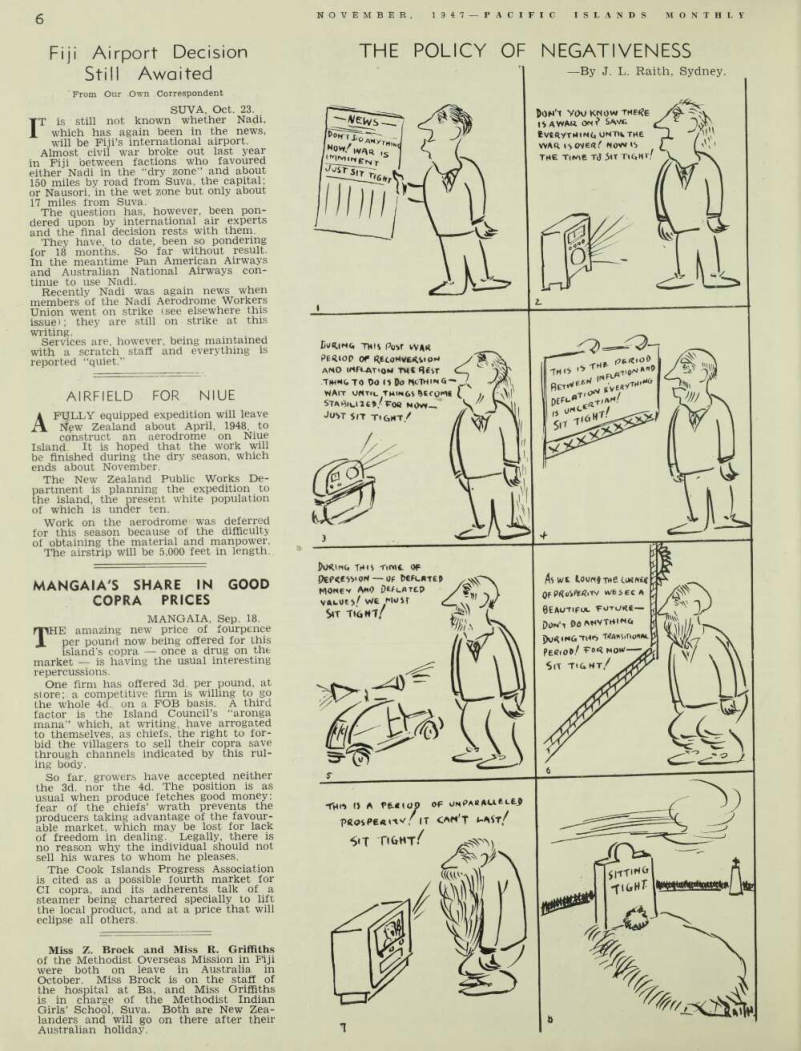
The Policy Of Negativeness
By J. L. Raith, Sydney.
Company
Big Profit
For Papuan Trading Company
IN the year ended July 31, 1947; Steam ships Trading Co.. Ltd., (the 23-years old trading, planting and shipping company which is BP’s only serious com petitor in Papua) made a record profit of £34.314. and is paying a 10 per cent, divi dend on both preference and ordinary capital. This company faced complete ruin in 1942-44, during the Jap invasion; but thanks to the tenacity of the direc tors. and substantial war damage com pensation. it is now in a very sound posi tion. The develooment is best shown by quoting the balance-sheet figures before and after the war;—
Although Papua-New Guinea is now under a form of Wardist Socialisation, in which transportation and all trading in major products are government mono polies. the fact remains that the Wardist Administration is spending annually in the Territories between £2,000,000 and £3 000,000 of Australian taxpayers’ money.
A large proportion of that rich stream must find its way into ordinary trading channels. Therefore, despite Socialist disabilities, a concern like STC should do very well, while the regime lasts.
Liabilities
1939 1947 £ £ Issued Capital 142.143 193,633 General Reserve . 25,800 100.000 Other Reserves 9,000 25.000 Staff Fund ■— 10.000 Total of Shareholders' Funds 185,06ft 353.800 Creditors 45.211 57.527
Assets
£ £ 1939 1947 Land. Buildings. Ships.
Plant 34.232 72.527 Investments . . . . 8.434 43.276 Plantations 31.473 60,093 Cash, at Bank. etc. — 29,524/ Debtors 37.942 70.987 Merchandise 64,723 101,330 Goods in Transit , * 16.445 Net Profit for Year . . 17.994 34.314 ♦Included in merchandise.
In Jeopardy
Papuan Rubber Industry In Jeopardy Negotiations Being Made For A Stabilised Price
THE Papuan rubber industry is not sharing in the boom of most South Pacific products. This was made clear by Mr. E. V. Crisp, chairman of Steamships Trading Company, at the annual meeting in Port Moresby this month.
The rubber industry in Papua would run a great risk of incurring losses if it was not assisted, he said.
Negotiations with the Department of External Territories, for Papua’s entire output of rubber to be sold in Australia at a stabilised price, giving a reasonable return to growers, were now being con ducted by a committee representing the local Administration, the Production Con trol Board, and the Papua Planters’
Association.
If the industry was to survive, Mr. Crisp said, some form of assistance either by way of relief from the duty of 2d. a lb. imposed on the rubber entering Australia or by a guaranteed minimum price would have to be given.
The price of rubber had declined during the year to a level at which it was im possible for Steamships Trading to pro duce at a profit. Native labour was scarce, and it has been decided to cease production and to reduce staffs to a minimum necessary for maintenance of the properties.
by Government
Guinea Airways
Driven Out of Darwin Service
/GUINEA AIRWAYS, LTD., has been \J forced by the Australian Govern ment out of the Adelaide-Darwin air service which they pioneered in the 30’s. This run has been monopolised by the Australian Government-owned Trans-Australia Airlines, and G'Air’s licence to operate was to have expired on October 31.
At first the Commonwealth Governmen refused to renew this licence thereby rendering the company not liable for compensation as a going concern forced out of business ,by the Commonwealth.
After pressure had been brought to ben on the Commonwealth Attorney-General’s Department by the Premier of South Australia, Mr. Plavford. the licence was extended until December 31, 1947.
Subsequently it was announced that the Federal Government and Guinea Airways had come to “an amicable settlement” and that G’Air would cease operation on the Adelaide-Darwin route forthwith.
Local services of the company from Adelaide will continue. /GUINEA AIRWAYS LTD. went into \J operation in New Guinea in 1927, freighting cargo and carrying pas sengers between Lae and the Morobe goldfields centres. It made large profits in the early years but when the gold industry in Morobe became more or less stabilised and profits dropped in the middle thirties, G’Air began to look else where. It was then that they pioneered the Adelaide-Darwin route. They were subsequently given a subsidy to carry overseas mail between Darwin and the southern states, and this service de veloped into a money-spinner.
The company continued its operations in New Guinea until the entry of Japan into the war put an end to that activity.
Some of their planes and equipment there were lost in air raids. It was intended that the company should start up again after hostilities ceased; but last year it was decided that conditions in the Terri tory, and future prospects, did not war rant this. All interests were therefore withdrawn to Australia.
Now that the company has fallen to the nationalising scythe in Australia, the once large and vigorous organisation is left with a few South and Central Aus tralia local routes.
The chairman of directors of the com pany, Mr. S. Powell, said that share holders would be advised of the com pany’s intentions shortly. He stated that the Adelaide-Darwin route made a profit of £lB,OOO last year.
From Apia To Vanikoro
Tale of a Stolen Launch
Apia, Nov. 6
THE large launch stolen from Apia, Western Samoa, on August 24, by a party of young Samoans, was wrecked on a reef off Vanikoro, Southern Solomon Islands.
The Fiji police advised Apia police to this effect, and said that the Chinese Samoan, Ah Siu, who was captain, and four Samoans, were being sent to Suva, whence they would be returned to Samoa. The launch was owned by A.
G. Smyth & Co., and had a cargo of pro visions.
The retiring general manager of the Colonial Sugar Refining Co. in Fiji, Mr.
H. King Irving, was farewelled at a dinner given by the Rewa Indian Foot ball Association, in October. He was presented with a framed address.
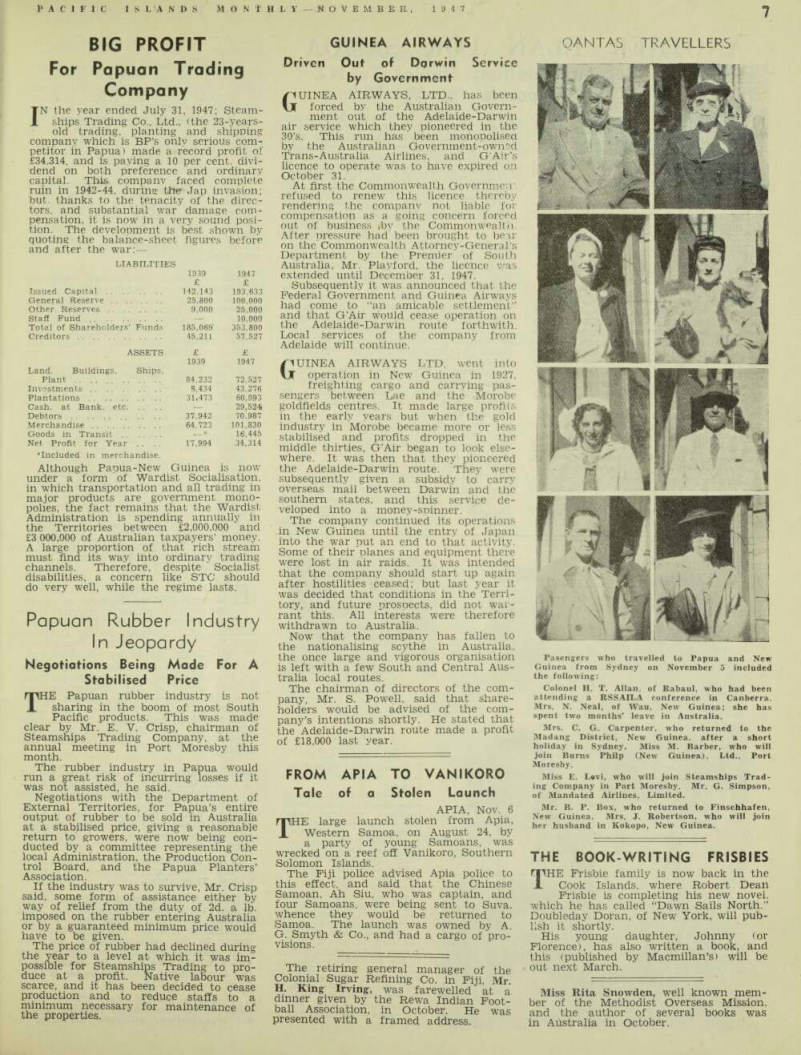
Qantas Travellers
Pasengers who travelled to Papua and New Guinea from Sydney on November 5 included the following: Colonel H. T. Allan, of Rabaul, who had been attending a RSSAILA conference in Canberra.
Mrs. N. Neal, of Wau, New Guinea; she has spent two months’ leave in Australia.
Mrs. C. G. Carpenter, who returned to the Madang District, New Guinea, after a short holiday in Sydney. Miss M. Barber, who will join Burns Philp (New Guinea), Ltd., Port Moresby.
Miss E. Levi, who will join Steamships Trad ing Company in Port Moresby. Mr. G. Simpson, of Mandated Airlines, Limited.
Mr. B. P. Box, who returned to Finschhafen, New Guinea. Mrs. J. Robertson, who will join her husband in Kokopo, New Guinea.
The Book-Writing Frisbies
THE Frisbie family is now back in the Cook Islands, where Robert Dean Frisbie is completing his new novel, which he has called “Dawn Sails North.”
Doubleday Doran, of New York, will pub lish it shortly.
His young daughter, Johnny (or Florence), has also written a book, and this (published by Macmillan’s) will be out next March.
Miss Rita Snowden, well known mem ber of the Methodist Overseas Mission, and the author of several books was in Australia in October.
Another Plan For Samoa
Mission's Recommendations Similar To NZ
Proposals
(See Also Article on Page 22)
AN examination of the report of the Trusteeship Council mission on its investigation in Samoa, made available to the press on October 12, shows that the plan favoured by the mission is very similar to the plan put forward recently by the New Zealand Governmen t The mission made its inquiry in Western Samoa in July and August last; and the members of the mission were Mr.
F. B. Sayre (United States), M. Pierre Ryckmans (Belgium) and Dr. Eduardo Cruz Coke (Chile).
The following are the chief recommendations:— (1) At the head of the Government of Western Samoa should be a representative of New Zealand and a representative or representatives of the inhabitants of Samoa sitting together as a Council of State or High Council. Until the Samoans decide otherwise, the Samoan representative should be the Fautua acting as a body. The New Zealand representative should preside over the council and should have a new title, perhaps High Commissioner. (2) The Samoan members of the Council of State should have the right to initiate legislation on all matters except those reserved to the New Zealand Government and to advise the High Commissioner in all matters relating to the territory’s government and welfare, including the appointment of the heads of executive departments. (3) The New Zealand representative should have the fullest possible authority
from the New Zealand Government, should preside over the Government of Samoa, should have the exclusive right to initiate financial bills, and should have a right of disallowance over all measures passed by the local Legislature, It may be advisable for him to have special emergency powers of legislation. (4) The present Legislative Council should be replaced by a Legislative Assembly, with all powers of legislation, in which Samoans should have an absolute majority. (5) The New Zealand Government, continuing as the administering auth ority under the trusteeship system, should have reserved to it powers con cerning the adoption of amendments to the Constitution, external relations, de fence, currency, loans, control of foreign exchange, audits of public accounts and the discharge of the responsibilities con ferred on New Zealand by the United Nations Charter and the trusteeship agreement. The High Commissioner should have the right of vetoing all measures passed by the Legislative As sembly, but that right should be ex ercised sparingly and all instances of its use should be reported to the Trus teeship Council. mHE mission also recommends that the X Fono should be retained in its present form as an advisory body, that until a tradition of public service has been developed the executive de partments should remain under New Zealand authority, and that boards of health, education and others, all having
Samoan representation, should be est ablished.
“The development and constitutional recognition of an adequate system of popular local government, which should be brought into appropriate relation ship with the central authority, is essen tial to progress in self-government,” the report says. “Village councils should have the right to make local by-laws, subject to approval by the central auth ority. In the criminal field they should be confined to minor offences.
“The possibility of development of a city or town government for Apia should be carefully studied. The responsibilities of Samoan associate judges in cases affecting Samoans should be increased.
Constitutional recognition should be given to acknowledge Samoan custom and tradition.
THE present distinction between Samoans and Europeans seems un necessary and should be gradually abolished in favour of a distinction be tween permanent and non-permanent residents. The foreign population would need special protection, though not special privileges.
“The most deep-seated grievances is the privileged situation accorded to Europeans. This is aggravated by the arbitrary distinction made in the law It clearly cannot be remedied by Gov ernment alone, but the Government can, at least, eliminate from legislation and from administrative practice all discrim ination based exclusively on colour. ‘The mission encountered strong criti cisms of the existing personnel situation.
Salaries and other conditions of appoint ment were said to involve discrimination against local people and to provide them with little opportunity, training or ad vancement. A public service authority should be established for the territory.
Preference in appointment should be given to residents of the territory as far as possible.
EVERY effort should be made through research and development to extend the export products beyond their present limited range. The research facilities of the South Pacific Commis sion will help. An efficient Department of Agriculture should be set up.
“The request that New Zealand act as protector and adviser represents the general desire of the resident popula tion, but changes in the present system of administration are desired. New Zea land has done much for Samoa, in spite of the fact that there have been only ten years where fruitful activity was possible.”
THE mission reports that it could not deal with the request in the Samoan petition for considering the ending of the “unnatural division” of the Samoan islands into two groups because Eastern Samoa was not a trust territory and did not come within the Trustee ship Council’s competence.
It has drawn two main inferences from its observations and hearings, the mission states. They are: — (1) It is the Samoans’ natural desire to see their own leaders at the head of their Government and they will not be satisfied with any piecemeal improve ments in the existing system, but only with dramatic and fundamental changes which would give them the feeling that the Government they live under is their own. (2) In its present stage the develop ment of the traditional Samoan politi cal organisation, although providing a
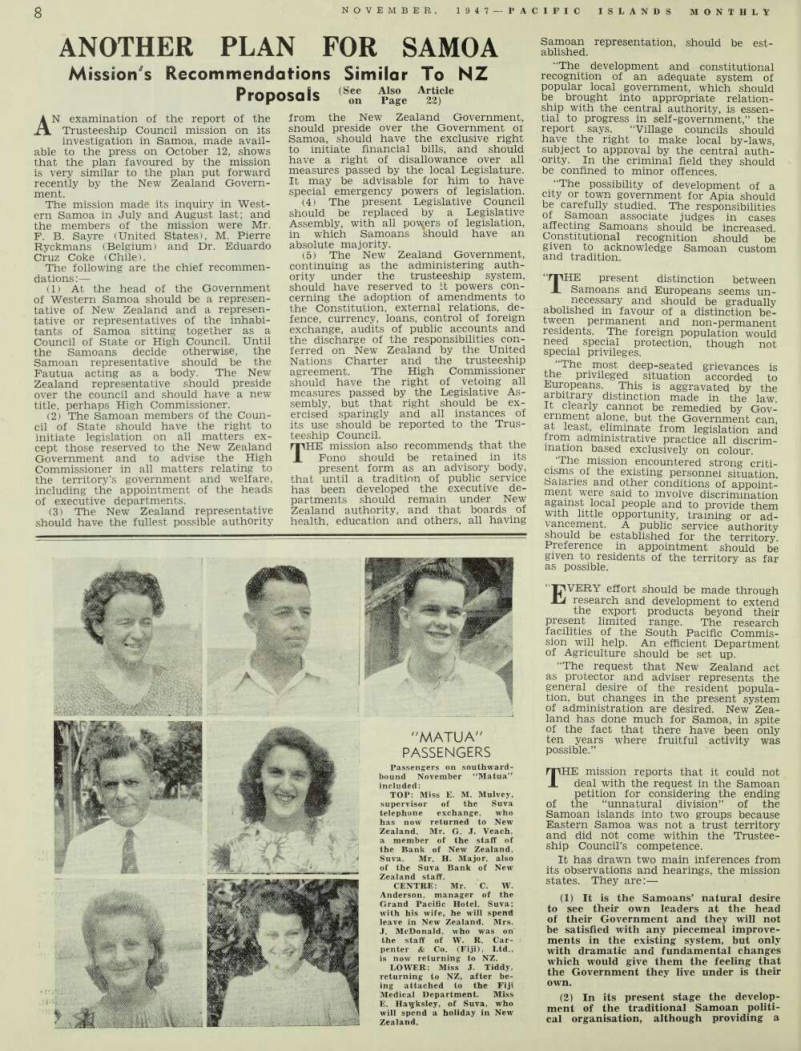
"Matua"
Passengers
Passengers on southward bound November “Matua” included: TOP: Miss E. M. Mulvey, supervisor of the Suva telephone exchange, who has now returned to New Zealand. Mr. G. J. Veach. a member of the staff of the Bank of New Zealand, Suva. Mr. H. Major, also of the Suva Bank of New Zealand staff.
Centre: Mr. C. W.
Anderson, manager of the Grand Pacific Hotel, Suva; with his wife, he will spend leave in New Zealand. Mrs.
J. McDonald, who was on the staff of W. R. Car penter & Co. (Fiji), Ltd., is now returning to NZ.
LOWER: Miss J. Tiddy, returning to NZ, after be ing attached to the Fiji Medical Department. Miss E. of Suva, who will spend a holiday in New Zealand.
suitable basis for eventual self-govern ment, is still somewhat immature politi cally in the terms of the requirements and standards of modern government.
The Samoan leaders themselves realised this fact when they asked that the New
N. Guinea Women's Club
Of Sydney
rE Sydney New Guinea Women’s Club will hold two Christmas parties this year. They are:— CHILDREN’S PARTY which will be held in the Feminist Club Rooms, 77 King Street, Sydney from 2.30 p.m. to 4 p.m. on Friday, December 19. Over 100 chil dren will be entertained.
COCKTAIL PARTY for adults in Feminist Club, on Saturday, December 20, at 6.30 p.m. All New Guinea residents in Sydney at that time are cordially in vited to attend. A charge of 2/- will be made for refreshments.
Donations To Children's Party
DONATIONS received by the Club towards cost of the children’s Christ mas party are as follows:
Zealand Government act as protector and advisor.
The New Zealand Government, through a speech in Parliament, made its views on Samoa’s future known two days De fore the mission left Apia. The mission noted that the plans were closely in line with its own.
£ s d Colyer Watson Pty., Ltd. . .. 10 10 0 W. R. Carpenter & Co., Ltd. 3 3 0 Burns Phllp & Co., Ltd. .. 2 2 0 Mrs. J. T. Allan, Rabaul .. 2 0 0 Pacific Islands Monthly .. 2 2 0 Total 17 0
Brilliant Fiji Girl's
Success In Usa
MISS MACKIE McCOWN of Fiji is now a student of John Hopkins University, Baltimore, USA. She is doing surgery.
Miss McCown is a daughter of Mr. and Mrs. A. G. McCown, of Ovalau. She went to the Girls’ Grammar School in Suva and later to school in America.
At the University of Texas, she gradu ated BA, and BSc. She returned to Fiji for a year and then entered her name for one of eleven vacancies at John Hopkins. Out of 1,300 candidates she was one of the chosen.
She went into residence at John Hop kins this year. The course will take five years after which she will return to practise in Fiji.
Rising Of The Palolo
THAT strange annual phenomenon, the appearance of the Palolo, that mys terious sea-worm that is regarded by natives and Europeans alike as a great delicacy, was this year a month late.
Almost always, it occurs, in Samoa, in the last quarter of the October moon.
Like all else, it is more clostly now.
Once, it retailed in Apia at from 6d, to 1/- per ofu; it is sold, this year, at 1/6 to 2/-, Pried in butter and onions, and served on crisp toast with a sorinkling of lime-juice, it is a delicious dish.
'Marching Rule'
First-Hand Notes On Strange Social Phenomenon In Solomons
“rriHE difficult situation created in the X Solomon Islands by the ‘Marching Rule’ (Marxian Law) movement has been handled by the British Adminis tration with characteristic patience and tolerance: and, as a result, the trouble is not likely to be serious. They allowed time to lake care of an awkward thing that had developed out of wartime con ditions, and their patience has been com pletely justified.”
That was the summary of the BSI situation given by Major H. S. Robinson, secretary of the Melanesian Mission, who returned to Sydney recently after a two months’ visit to the Group, during which he visited all the main Islands and out lying archipelagoes.
“No one seemed able to explain the origin of the Movement. It appears to have a Communist flavour—yet there was no trace of anyone having visited the Solomons to spread Communism among the natives. The Movement apparently began as the result of careless talk by some sections of United States troops,” said Major Robinson. ‘‘One must not re gard natives as fools. They may have difficulty in expressing themselves to white people bul they can follow con versations between white people with considerable intelligence and draw con clusions accordingly. There is no doubt that the spectacle of United States soldiers with large amounts of money had a profoundly disturbing effect on the majority of natives, who had been accustomed to thinking only in terms of their wages—namely, 20/- per month. The Marching Rule Movement started origin ally among some villages in Malaita, but during the past two years spread steadily over all Malaita, and on Ysabel, and to some extent on Guadalcanal and the other Islands.
“When we steamed in the ‘Southern Cross’ along the north-west coast of Malaita,” said Major Robinson, “we were much interested to see a line of forty three native houses (we counted them) all sited and completed with military pre cision—a very neat and workmanlike job —and all empty. They had been erected by followers of the Marching Rule Cult in the belief that cargoes of goods were coming to them from across the sea, and these were to be the store-houses for the goods. They are still there and still empty—a very remarkable picture.”
Major Robinson said that as a result of the measures taken against the leaders of the Movement much life had gone out of the organisation and little more trouble was expected.
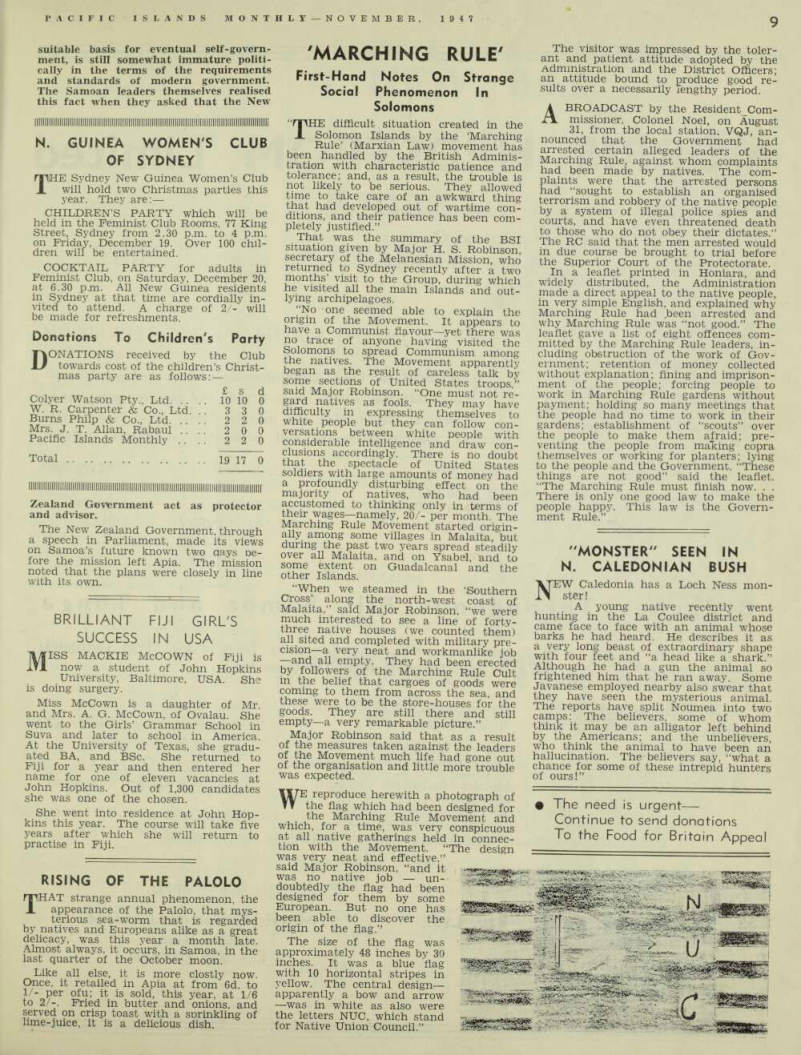
WE reproduce herewith a photograph of the flag which had been designed for the Marching Rule Movement and which, for a time, was very conspicuous at all native gatherings held in connec tion with the Movement. “The design was very neat and effective,”
said Major Robinson, “and it was no native job un doubtedly the flag had been designed for them by some European. But no one has been able to discover the origin of the flag.”
The size of the flag was approximately 48 inches by 30 inches. It was a blue flag with 10 horizontal stripes in yellow. The central design— apparently a bow and arrow —was in white as also were the letters NUC, which stand for Native Union Council.”
The visitor was impressed by the toler ant and patient attitude adopted by the Administration and the District Officers; an attitude bound to produce good re sults over a necessarily lengthy period.
A BROADCAST by the Resident_Com missioner, Colonel Noel, on August 31, from the local station, VQJ, an nounced that the Government had arrested certain alleged leaders of the Marching Rule, against whom complaints had been made by natives. The com plaints were that the arrested persons had “sought to establish an organised terrorism and robbery of the native people by a system of illegal police spies and courts, and have even threatened death to those who do not obey their dictates.”
The RC said that the men arrested would in due course be brought to trial before the Superior Court of the Protectorate.
In a leaflet printed in Honiara, and widely distributed, the Administration made a direct appeal to the native people, in very simple English, and explained why Marching Rule had .been arrested and why Marching Rule was “not good.” The leaflet gave a list of eight offences com mitted by the Marching Rule leaders, in cluding obstruction of the work of Gov ernment; retention of money collected without explanation; fining and imprison ment of the people: forcing people to work in Marching Rule gardens without payment; holding so many meetings that the people had no time to work in their gardens: establishment of “scouts” over the people to make them afraid; pre venting the people from making copra themselves or working for planters; lying to the people and the Government. “These things are not good” said the leaflet.
“The Marching Rule must finish now. . .
There is only one good law to make the people happy. This law is the Govern ment Rule.”
"Monster" Seen In
N. Caledonian Bush
NEW Caledonia has a Loch Ness mon ster!
A young native recently went hunting in the La Coulee district and came face to face with an animal whose barks he had heard. He describes it as a very long beast of extraordinary shape with four feet and “a head like a shark.”
Although he had a gun the animal so frightened him that he ran away. Some Javanese employed nearby also swear that they have seen the mysterious animal The reports have split Noumea into two camps: The believers, some of whom think it may be an alligator left behind by the Americans; and the unbelievers, who think the animal to have been an hallucination. The believers say, “what a chance for some of these intrepid hunters of ours!”
The need is urgent— Continue to send donations To the Food for Britain Appeal
Advertisements & other items, p. 14 (1 item)
Morris Hedstrom Limited
General Merchants, Importers and Exporters,
Shipowners, Plantation Owners,
Commission and Insurance Agents
HEAD OFFICE
SUVA, FIJI
Established 1868
SERVICE IN THE SOUTH PACIFIC TERRITORIES
r pHROUGH our Large Establishments in Suva and our Numerous Branches, we distribute a wide and comprehensive range of General Merchandise and provide almost every kind of service. Our departments and associated businesses include:
DRAPERY
MOTOR SALES
AND SERVICE
TOBACCO
TIMBER AND
BUILDING
GROCERY
CONFECTIONERY
HARDWARE
ELECTRICAL
LIQUORS
DRUGS
Branches Throughout Fiji, Samoa and Tonga
There is a Branch or Agent of Morris Hedstrom Limited in every Town in the Three Territories.
We are Sole Agents in these Territories for British Drug Houses Ltd.
Electrolux Ltd.
Ford Motor Co.
General Electric Co. Ltd.
Goodyear Tyre Gr Rubber Co.
B. A. Hjorth Gr Co. (Primus Products) Imperial Chemical Industries Ltd.
International Harvester Export Co.
Matson Navigation Company Max Factor and Co. Inc.
Ransomes, Sims Gr Jefferies Ltd.
Ruston Gr Hornsby Ltd.
Vacuum Oil Co. Pty. Ltd.
Yorkshire Copper Works Ltd.
Morris Hedstrom Limited, are LLOYD'S AGENTS in Fiji and Samoa.
IN AUSTRALIA;
Morris Hedstrom (Aust.) Pty. Ltd.,
Asbestos House, 65 York Street, SYDNEY
IN GREAT BRITAIN:
Morris Hedstrom Limited,
Africa House, Kingsway, LONDON
No Help For NG Copra-
Growers Only One Bank in Rabaul
rE continued absence of adequate shipping, plus an acute shortage of sacks probably the. result of the huge demand for the Australian wheat harvest recently placed the planters of New Britain and New Ireland in an embarrassing position.
They were able to cut copra those with sufficient labour and there is a clamorous market for copra, now worth about £4O per ton. But, without sacks or ships, the planters could not get their copra to market. Unless they had finan cial resources, this meant that they could not continue to buy supplies.
Colonel “Blue” Allan, in Sydney in October, pointed out the plight of the planters. The socialisation of New Guinea means that there is only one agency to buy copra the Government controlled Production Control Board. The Board floes not advance against copra on the plantation. Owing to the same policy, there is only one bank in Rabaul, the Commonwealth; and that Bank will not finance the planters in connection with their held-up copra. If there had been a Bank of New South Wales in Rabaul, or if the big firms had been allowed to deal in copra, the planters would have been financed at once The Government would not assist the Bank of New South Wales to become re-estab lished in Rabaul. It owned the only sawmill in the district, and it would not make timber available.
These statements were published: and Mr. T. W. White, MP, got details and asked the Prime Minister a series of questions, in Parliament.
Mr. Chifley’s reply was typical. He said that the Commonwealth Bank had in many instances made advances to New Guinea planters before they had dis posed of their copra to the Production Control Board. He had no knowledge of complaints that the Commonwealth Bank had refused accommodation to planters If
details were supplied of particular cases he would have inquiries made.
The Comonweallh Bank was the only bank now represented in Rabaul, he said.
It was not known why the Bank of New South Wales had not been re-established at Rabaul but the Administrator had re ported the bank made no request for timber for that purpose.
Miss T. Richardson of the Methodist Mission, Solamo, Papua, arrived in Sydney on six months’ leave in October.
Advertisements & other items, pp. 15-16 (1 item)
Xmas
A NEW Book .
Is a suitable and
welcome
Xmas
Present
72 STORIES, ARTICLES
AND SKETCHES
ABOUT LIFE IN THE
SOUTH PACIFIC
ISLANDS
WITH NUMEROUS
.ILLUSTRATIONS
Collected by
R. W. Robson
and
Judy Tudor
M ~or 'k
“Where The Trade
Winds Blow”
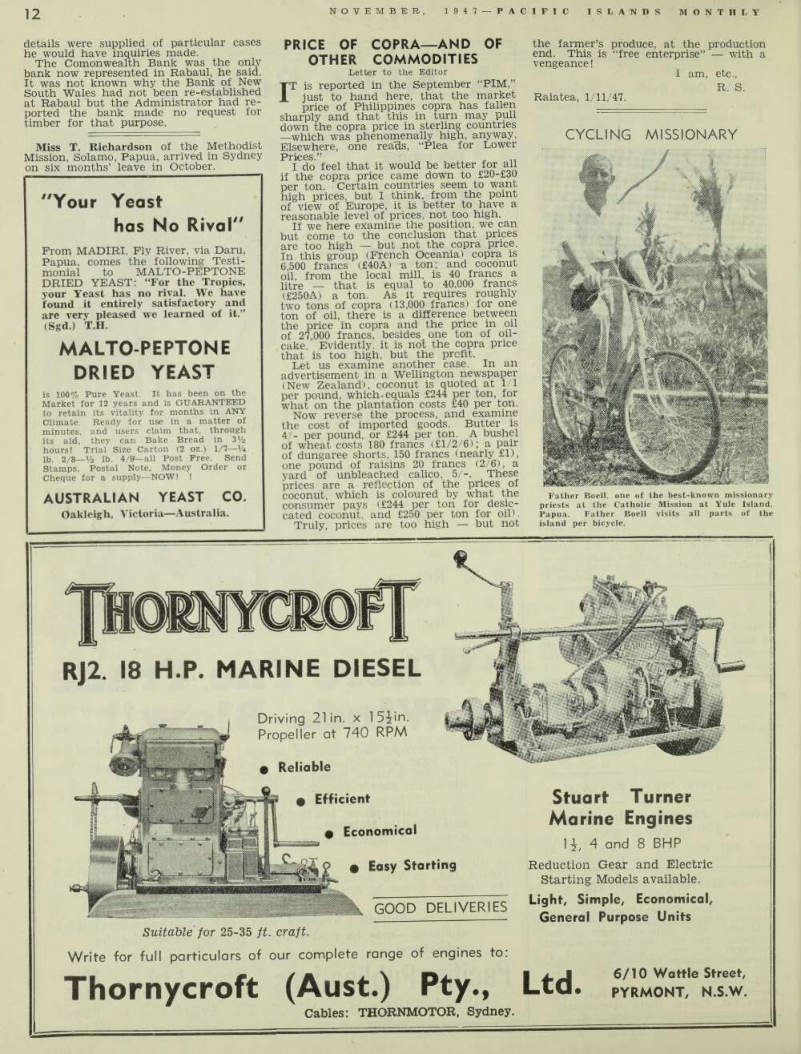
These stories and sketches, brought together in this book tor your entertainment, are about real people. They describe without colour or embellishment, conditions of life in the Pacific Islands, as they are to-day. still have the Islands setting and the indefinable Islands atmosphere; but life in the Islands—even in savage and primitive Melanesia—has been altered, profoundly. changed* i n£ hcates how and where conditions have Tomh\ L rZ din l B H? ks % lle t s ™ Australia; at the Stores of Whitcomb & the Islands ItnZt Zealand;at Caldwell’s Book Store, in Suva; from generally 1 nS Philp & and f rom Booksellers Copies—Suitably wrapped and with Christmas card enclosed may be posted direct to your friends by the publishers:
Pacific Publications Pty. Ltd.
UNION HOUSE, 247 GEORGE ST., SYDNEY
PRICE
9/6 Posted
Returns Thanks
MR. K. R. HAMILTON wishes to thank all kind friends in Port Moresby for their messages and thoughtfulness in his recent bereavement.
Engagement
The engagement is announced in Port Moresby, of Lyle, daughter of Mr. and Mrs. D. Dempster, of Sydney, to Roy Hansen, previously of Mackay, Queensland.
WANTED TO PURCHASE
Coconut Plantation in Islands,
200 to 500 acres.
Send full particulars to Jay Cee 83 Queen’s Road, Melbourne, 5.C.3 Victoria.
POSITION WANTED
Merchant Navy Officer (nautical), German pending naturalisation, 36, single, Protestant, with eighteen years of sea experience, including three years aboard auxiliary schomiers, requires casual or permanent position connected with seafarmg Go everywhere except Netherland Indies, Please write with details to Post Office Box 258, Cairns, North Queensland.
"Your Yeast
has No Rival"
From MADIRI, Fly River, via Daru, Papua, comes the following Testimonial to M ALTO-PEPTONE DRIED YEAST: “For the Tropics, your Yeast has no rival. We have found it entirely satisfactory and are very pleased we learned of it.” (Sgd.) T.H.
MALTO-PEPTONE
DRIED YEAST
is 100% Pure Yeast. It has been on the Market for 12 years and is GUARANTEED to retain its vitality for months in ANY Climate. Ready for use in a matter of minutes, and users claim that, through its aid, they can Bake Bread in 3Vz hours! Trial Size Carton (2 oz.) 1/7—Va lb. 2/8— Va lb. 4/9T— all Post Free. Send Stamps, Postal Note, Money Order or Cheque for a supply—NOW! !
AUSTRALIAN YEAST CO.
Oakleigh, Victoria —Australia.
T 0 c G
RJ2. 18 H.P. MARINE DIESEL
Driving 21 in. x 1 siin.
Propeller at 740 RPM • Reliable Efficient • Economical 9 • Easy Starting \ Stuart Turner
Marine Engines
li, 4 and 8 BHP Reduction Gear and Electric Starting Models available.
GOOD DELIVERIES Li * ht ' Si , m P le ' Ec ° n ° n ; i£al ' General Purpose Units Suitable for 25-35 ft. craft.
Write for full particulars of our complete range of engines to:
Thornycroft (Aust.) Pty., Ltd. 6,0
PYRMONT, N.S.W.
Cables: THORNMOTOR, Sydney.
Price Of Copra—And Of
Other Commodities
Letter to the Editor IT is reported in the September “PIM,” just to hand here, that the market price of Philippines copra has fallen sharply and that this in turn may pull down the copra price in sterling countries —which was phenomenally high, anyway.
Elsewhere, one reaTis, “Plea for Lower Prices I do feel that it would be better for all if the copra price came down to £2O-£3O per ton. Certain countries seem to want high prices, but I think, from the point of view of Europe, it is better to have a reasonable level of prices, not too high.
If we here examine the position, we can but come to the conclusion that prices are too high but not the copra price.
In this group (French Oceania) copra is 6,500 francs (£4OA) a ton; and coconut oil, from the local mill, is 40 francs a litre that is equal to 40,000 francs (£2SOA) a ton. As it requires roughly two tons of copra (13,000 francs) for one ton of oil, there is a difference between the price in copra and the price in oil of 27,000 francs, besides one ton of oil cake. Evidently, it is not the copra price that is too high, but the profit.
Let us examine another case. In an advertisement in a Wellington newspaper (New Zealand), coconut is quoted at 1/1 per pound, which .equals £244 per ton, for what on the plantation costs £4O per ton.
Now reverse the process, and examine the cost of imported goods. Butter is 4/- per pound, or £244 per ton. A bushel of wheat costs 180 francs (£l/2/6); a pair of dungaree shorts, 150 francs (nearly £1), one pound of raisins 20 francs (2/6), a yard of unbleached calico. 5/-. These prices are a reflection of the prices of coconut, which is coloured by what the consumer pays (£244 per ton for desic cated coconut, and £250 per ton for oil).
Truly, prices are too high but not
the farmer’s produce, at the production end. This is “free enterprise” with a vengeance!
I am> e tc.,
R. S.
judatea. 1/11/47.
Advertisements & other items, pp. 16-17 (2 items)
Cycling Missionary
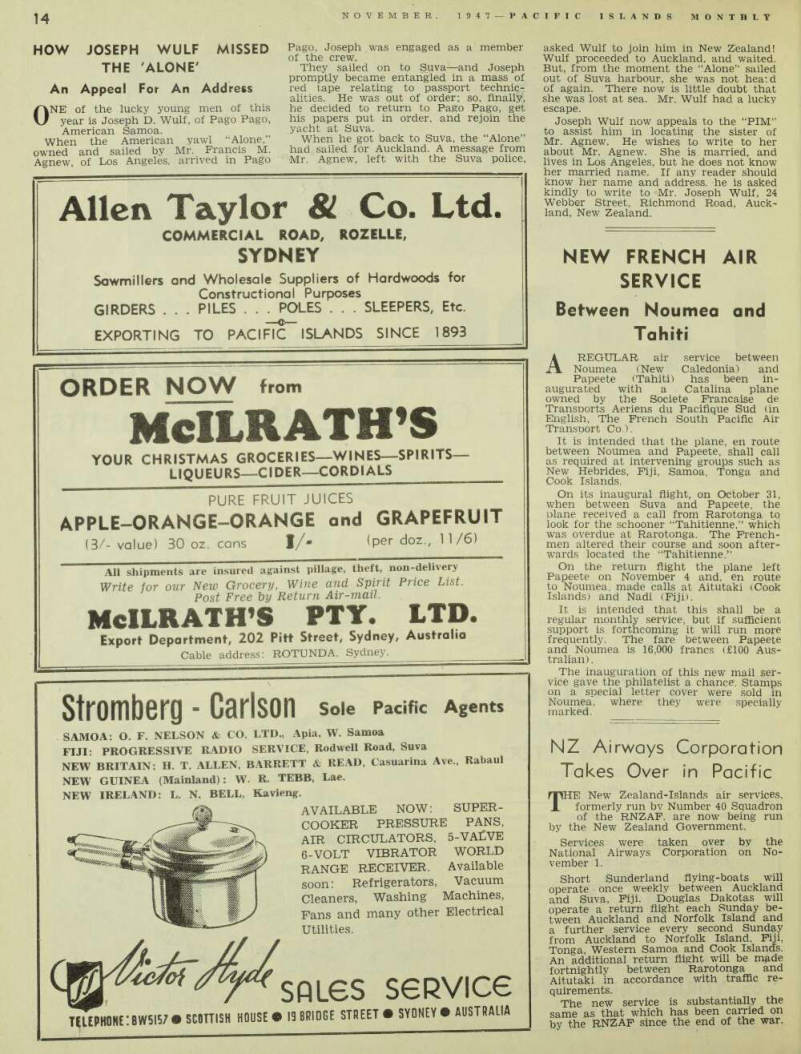
Father Boell, one of the best-known missionary priests at the Catholic Mission at Yule Island, Papua. Father Boell visits all parts of the island per bicycle.
io- CtahJze -Jl&c£s
w ™ • •
. for all your Clothing Requirements
SSi n* 9 • The impressive facade of Stirling Henry’s Underwear Factory.
Clarke - Jools are sole export agents for Stirling Henry, Ltd., Australia’s foremost spinners, knitters and weavers. Large range of all men’s and women’s knitted underwear, polo shirts, etc.
CLARKE-JOOLS
& Co. Pty., Ltd.
IMPORTERS, EXPORTERS
and Commission Agents We are prepared to submit original invoices.
Clarke-Jools also can supply any commodity you require in— Textiles Food Spirits Leather Hardware Electrical Goods
4c-Jt
ASBESTOS HOUSE
65 YORK STREET, SYDNEY
Cables: “Irvingjools.”
O i r & & & & Lm & • Shown above ~r e views of Stirling Henry's Modern Factories.
How Joseph Wulf Missed
The 'Alone'
An Appeal For An Address
ONE of the lucky young men of this year is Joseph D. Wulf, of Pago Pago, American Samoa.
When the American yawl “Alone,” owned and sailed by Mr. Francis M.
Agnew, of Los Angeles, arrived in Pago
Pago, Joseph , was engaged as a member of the crew.
They sailed on to Suva—and Joseph promptly became entangled in a mass of red tape relating to passport technic alities. He was out of order; so, finally, he decided to return to Pago Pago, get his papers put in order, and rejoin the yacht at Suva.
When he got back to Suva, the “Alone” had sailed for Auckland. A message from Mr. Agnew, left with the Suva police,
asked Wulf to join him in New Zealand!
Wulf proceeded to Auckland, and waited.
But, from the moment the “Alone” sailed out of Suva harbour, she was not heard of again. There now is little doubt that she was lost at sea. Mr. Wulf had a lucky escape.
Joseph Wulf now appeals to the “PIM” to assist him in locating the sister of Mr. Agnew. He wishes to write to her about Mr. Agnew. She is married, and lives in Los Angeles, but he does not know her married name. If any reader should know her name and address, he is asked kindly to write to Mr. Joseph Wulf, 24 Webber Street, Richmond Road, Auck land, New Zealand.
Service
New French Air
Between Noumea and Tahiti
A REGULAR air service between Noumea (New Caledonia) and Papeete (Tahiti) has been in augurated with a Catalina plane owned by the Societe Prancaise de Transnorts Aeriens du Pacifique Sud (in English, The French South Pacific Air Transport Co).
It is intended that the plane, en route between Noumea and Papeete, shall call as required at intervening groups such as New Hebrides, Fiji, Samoa, Tonga and Cook Islands.
On its inaugural flight, on October 31, when between Suva and Papeete, the plane received a call from Rarotonga to look for the schooner “Tahitienne,” which was overdue at Rarotonga. The French men altered their course and soon after wards located the “Tahitienne.”
On the return flight the plane left Papeete on November 4 and, en route to Noumea, made calls at Aitutaki (Cook Islands) and Nadi (Fiji).
It is intended that this shall be a regular monthly service, but if sufficient support is forthcoming it will run more frequently. The fare between Papeete and Noumea is 16,000 francs (£lOO Aus tralian) .
The inauguration of this new mail ser vice gave the philatelist a chance. Stamps on a special letter cover were sold in Noumea, where they were specially marked.
NZ Airways Corporation
Takes Over in Pacific
rE New Zealand-Islands air services, formerly run bv Number 40 Squadron of the RNZAF. are now being run by the New Zealand Government.
Services were taken over by the National Airways Corporation on No vember 1.
Short Sunderland flying-boats will operate once weekly between Auckland and Suva, Fiji. Douglas Dakotas will operate a return flight each Sunday be tween Auckland and Norfolk Island and a further service every second Sunday from Auckland to Norfolk Island. Fiji, Tonga, Western Samoa and Cook Islands.
An additional return flight will be made fortnightly between Rarotonga and Aitutaki in accordance with traffic re
quirements.
The new service is substantially the same as that which has been carried on by the RNZAF since the end of the war.
Advertisements & other items, p. 18 (1 item)
Mcilrath’S
Allen Taylor Co. Ltd.
COMMERCIAL ROAD, ROZELLE,
SYDNEY
Sawmillers and Wholesale Suppliers of Hardwoods for Constructional Purposes GIRDERS . . . PILES . . . POLES , . . SLEEPERS, Etc.
EXPORTING TO PACIFIC” ISLANDS SINCE 1893
ORDER NOW from
McILRATH’S
YOUR CHRISTMAS GROCERIES —WINES—SPIRITS —
LIQUEURS —CIDER —CORDIALS
PURE FRUIT JUICES
APPLE-ORANGE-ORANGE and GRAPEFRUIT
(3/- value) 30 oz. cans I/* (per doz., 11/6) AH shipments are insured against pillage, theft, non-delivery Write tor our New Grocery, Wine and Spirit Price List.
Post Free by Return Air-mail .
McILRATH’S PTY. LTD.
Export Deportment, 202 Pitt Street, Sydney, Austroho Cable address: ROTUNDA. Sydney.
Stromberg - Carlson Sole Pacific Agents
SAMOA; O. F. NELSON & CO. LTD., Apia, W. Samoa FIJI: PROGRESSIVE RADIO SERVICE, Rodwell Road, Suva NEW BRITAIN: H. T. ALLEN, BARRETT & READ, Casuarina Ave., Rabaul NEW GUINEA (Mainland): W. R. TEBB, Lae.
NEW IRELAND: L. N. BELL, Kavieng.
TELEPHONE 18W5157# SCOTTISH HOUSE • 13 BRIDGE STREET • SYDNEY •
AVAILABLE NOW: SUPER-
COOKER PRESSURE PANS,
AIR CIRCULATORS, 5-VACVE
6-VOLT VIBRATOR WORLD
RANGE RECEIVER. Available soon: Refrigerators, Vacuum Cleaners, Washing Machines, Fans and many other Electrical Utilities.
soles
Mr. Alderman, Kc
Memories of Territorians' Claims Against the Australian Army, 1942-3
rOSE residents of New Guinea and Papua who were “evacuees” in Aus tralia in 1942 and 1943, and who were trying desperately to get some kind of compensation from the Australian Army, will have vivid memories of a gentleman called Alderman.
Before the regular Australian troops arrived from the Middle East, the Aus tralian Armv authorities sent all sorts of ragtag and bobtail to Papua, and these units, in addition to taking and using for Army purposes anything which they though might be useful, did a very thor ough job of plain looting and wanton -destruction.
The unfortunate owners lodged claims for compensation; and the Army ap pointed this Adelaide lawyer, Mr. Aider man, to visit the affected areas and settle the claims. When it came to arguing about the value of services or property, Mr. Aldreman entered into his work with enthusiasm, and many of the wretched “evacuees” had to admit themselves completely brow-beaten. We know of cases where they were driven by Alder-, man into accepting settlements which crippled them financially. Some evacuees came out of the war more or less ruined; but Alderman was richly rewarded.
The following is an extract from a newspaper report of a debate in Canberra in mid-October:— MR. LANG referred to what he called the “Alderman affair.” He said Mr. Alderman was an Adelaide lawyer specialising in political lobbying and was “a very slick operator.”
During 1942-43 Mr. Alderman attached himself to the then Minister for the Army, Mr. Forde, and put in a lot of time around Darwin (and Port Moresby). As a result he presented the Government with a bill of costs for £6,450.
He charged for 93 days in operational and bombed areas at 20 guineas a day, for 259 days spent in Sydney and Mel bourne at 15 guineas a day and, in addi tion, he charged travelling expenses for the 352 days at 30/- a day.
Eventually he agreed to settle his claim for £6,000.
It was not surprising, therefore, to find Mr. Alderman interesting himself in land sales control.
Mr. Alderman was a professional man and, he understood, was associated with business. He had come to Canberra on behalf of a certain airline company—it was not TAA.
The Prime Minister (Mr. Chifley) said when he engaged a KC he was never too happy about his accounts they all looked very big to him. He was given to understand that Mr. Alderman was a KC in Adelaide.
Mr. Alderman had dealt with the posi
tion in New Guinea and had done a splendid job. He had never heard any charge against Mr. Alaerman of being a “crook lawyer.” If that charge was made the Law Institute would, no doubt, have something to say.
Alderman Incident of 1943
By R. W. Robson
IHAVE a lively recollection of an in cident of the winter of (I think) 1943, when half a dozen members of the executive of the Pacific Territories Association, after months of vain effort to secure some relief for “evacuees,” ob tained an interview with Mr. Alderman.
It was a cold, wet night; and the interview took place in the dreary Teachers Federation Hall, in Phillip Street, Sydney. The time fixed was 7.30 p.m. but there was no sign of Mr.
Alderman.
I had obtained permission from the executive to listen in to this discussion, on condition that I remained in the background. I had been writing savagely on the activities of this gentleman, and I was rather anxious to have a look at him.
While we were waiting I was observ ing the men from Papua and New Guinea —mostly evacuated planters, miners and businessmen, too old for war service. The strain of the events of the past two black years had taken its toll. They apparently had lost their tropical homes and every thing therein; they did not know what was before them; and they shivered in the chill of the unheated hall.
(Continued on Next Page )
AND then all bright and cheerful, Mr, Alderman and a companion bustled in He apologised for being late.
He had broken away from his dinner in the comfortable Hotel Australia in order to meet them “I gave up my icecream and my coffee in order to meet vou men ” he said I well ’remember how my gorge rose as I regarded his pink and well-fed appearance he did not look as if he had ever missed a dinner in his life—and contrasted it with the quiet misery of the men who had been awaiting his gracious coming.
They got to business. Mr. Alderman talked and talked. His main theme was
the generosity of the Australian Labour Government in conceding compensation at all, and the unreasonableness of the “evacuees” in insisting on such excessive values for their looted and battered property, when they were lucky to be getting anything at all The Association men had their facts lined up, but they had not a chance against this glib lawyer He dazzled them with argument, twisted their words against them.
I was supposed to stay quiet; but presently the discussion reached a point when I had either to speak, or burst.
So I challenged the gentleman on one of his more outrageous arguments against
the “evacuees.” He thought I was another “evacuee,” all ready to be danced on. and he replied with condescension and assurance.
So I let him have it, with both barrels.
I told him what decent men thought of his bosses, and his methods, and what I thought of his policy of paring down every claim to the bare bones, irrespective of is merits.
He got heated, and answered sharply; and as I had no favours to ask of him.
I was just as sharp.
Then I informed him that I had no standing there that I was merely an observer and I asked him not to hold my outburst against the Association, and departed.
Mr. Alderman, as I expected, did not appear to mend his procedure to the end, he treated those unhappy property owners as the prosecuting counsel treats the suspected delinquent in the dock.
The Canberra bureaucrats may have thought highly of Mr. Alderman, and maybe, in Adelaide, he is a good citizen and an esteemed father. But, somehow, I felt that all my choicest thoughts con cerning him were justified when, later, I heard about his bill for £6,450, and his charge of 20 guineas per day, plus 30/travelling expenses, for his precious ser vices in “operational and bombed areas.'
Advertisements & other items, p. 19 (1 item)
Burns Philp
THE
YORKSHIRE
INSURANCE
CO. LTD.
(Incorporated in England)
ALL CLASSES OF
INSURANCE
Including
Fire Motor Guarantee Accident Workers Marine Island Representatives:
PORT MORESBY: E. A. James
RABAUL: G. B. Black LAE: Morobe Transport Co. Ltd.
MADANG: R. MacGregor SUVA: Williams & Gosling Ltd.
NOUMEA: Y. Mortensen
NORFOLK ISLAND:
A. E. Martin
BURNS PHILP
Registered
(SOUTH SEA) CO. LTD. ° l,,ce:
Inc. in FIJI SUVA island Traders and Shipowners \Also Branches at: Fiji: Levuka, Lautoka, Labasa Ba, Sigatoka, Rotuma.
Tonga: Nukualofa, Haapai, Vavau.
Samoa: Apia, Pago Pago (American Samoa).
Solomons: Makambo, Gizo, Faisi.
New Hebrides: Vila.
Code Address; Gilberts: Tarawa.
"Bumsouth". Norfolk Is. Niue. Wallis Is. Futuna Is.
Sole Australian Concessionaries :
GEORGE BROWN & CO. PTY. LTD.
267 Clarence Street, Sydney.
Designs for new Ultimate models have been completed but production has been retarded, due to a few remaining difficulties in raw materials.
Models should be available some time during 1947. They will be well worth waiting for. Watch for further announcements.
SERVICE: Servicing of all kinds of radio sets, amplifiers and Rola speakers will continue to be available.
Gradual Recovery of
Nauru Phosphate
Gradual Recovery of Production
ACCORDING to evidence given by Mr, Bankes Amery, United Kingdom commissioner on the British Phos phates Commission, before the Committee on Public Accounts, in London, in October, phosphates production from Nauru Is land should overtake the present de mands from Australia and New Zealand in about three years. . i At present, said Mr. Amery, Australian and New Zealand requirements were about 1,100,000 tons a year, but as a re sult of damage done during the Japanese occupation of the island it was not ex pected that the output for the last finan cial year would be more than 230,000 tons.
This would be stepped up progressively by about 300,000 tons a year until by 1950 it was hoped the output from the island works would be sufficient to meet the full requirements of the two Dominions.
Mr. Amery said the import of phos phate by Australia and New Zealand was limited at present to some extent by the capacity of manufacturers in the two Dominions to produce and deliver super phosphates from the raw material.
The main preoccupation of the com mission was to obtain sufficient supplies to meet the demand from Australia and New Zealand, and also from the United Kingdom if the need ever arose. There was no demand now from the United Kingdom because it cost too much to ship phosphate from Nauru to Britain.
Fiji Cricketers For New
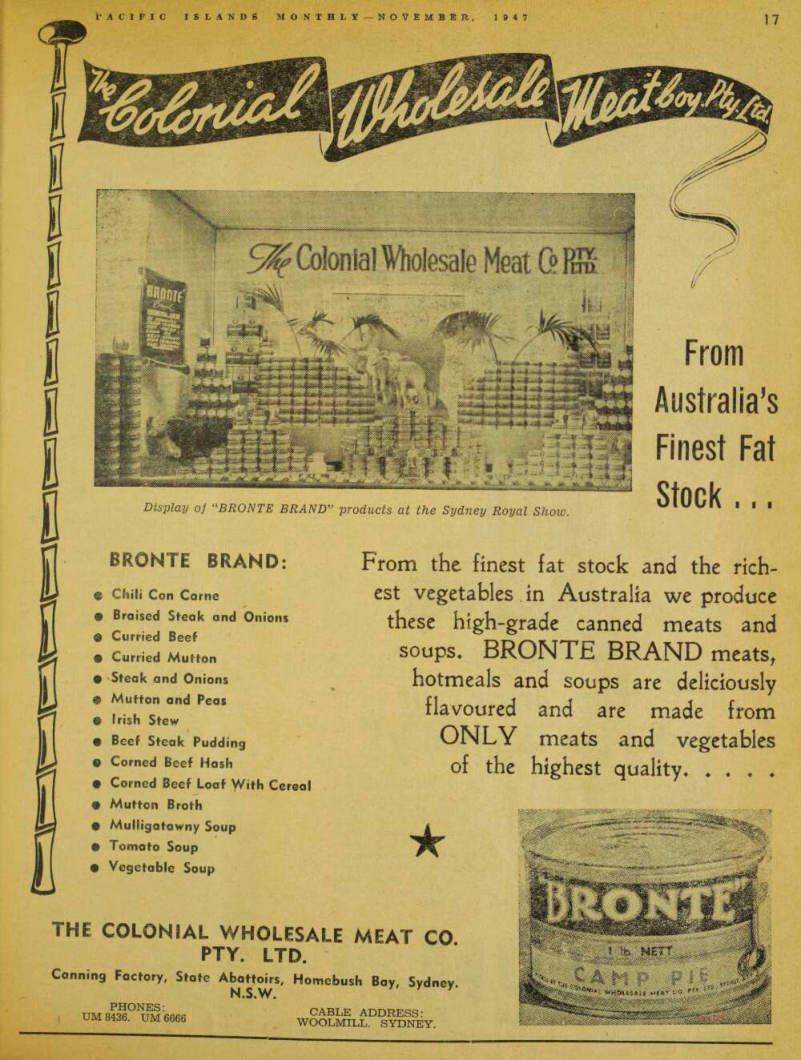
Zealand
ANEW ZEALAND newspaper says that it is expected that a team of Fijian cricketers will tour New Zealand during the coming season Disappointed at the inability of the Indian cricket team (now in Australia) to fit in a tour of New Zealand, the New Zealand Cricket Council has been making every endeavour to bring some overseas side to New Zealand this summer. Should the Fijians be able to make the trip their appearance in New Zealand, it is thought, would give the game a substantial fillip.
The Fijians are good cricketers. In fact, as “tearaway” bowlers and as fields men they are reputed to have no superiors anywhere in the world.
The Rev. R. A. Woodgate, 8.A., B.ED„ and Mrs. Woodgate, with their children, Helen and Rodger, are now bound for Nukualofa, Tonga. Mr. Woodgate will succeed the Rev. E. V. Newman, 8.A., 8.D., B.Litt., as the principal of Tupou College, Nafualu. He goes out from the Queensland Methodist Conference, but has this year resided at the George Brown College in Sydney, where he has com pleted the Missionary Training Course.
The following have recently been appointed Lands Commissioners in the Gilbert and Ellice Islands Colony by the Acting High Commissioner of the Western Pacific: Mr. B. C. Cartland (Chief Land Commissioner); Mr. P. B. Laxton, Mr.
M. M. Townsend; and Mr. A. C. Lake.
Advertisements & other items, pp. 20-22 (2 items)
Bank Of
LEADING
SINCE 1817
Back in the days when Australia was in its infancy, the Bank of New South Wales provided the pioneer merchants and farmers with all essential banking facilities.
Today, this Bank is still the first trading bank: first established —first in the number of branches serving the public —first in the amount of deposits entrusted to it by the public first in the volume of advances to the community.
One hundred and thirty years of honourable tradition and banking experience lie behind the services offered by this Bank.
Consult and use
BANK OF
NEW SOUTH WALES
FIRST BANK IN AUSTRALIA
(Incorporated in New South Wales with limited liability) A4709d
Stock...
T Z % % I m
esale Meat C°
a o r - PI -4' *4 Display of “BRONTE BRAND” products at the Sydney Royal Show.
From
Australia’s
Finest Fat
Stock...
BRONTE BRAND:
9 Chili Con Came 9 Braised Steak and Onions 9 Curried Beef 9 Curried Mutton 9 Steak and Onions @ Mutton and Peas 9 Irish Stew 9 Beef Steak Pudding 9 Corned Beef Hash 9 Corned Beef Loaf With Cereal 9 Mutton Broth 9 Mulligatawny Soup 9 Tomato Soup 9 Vegetable Soup From the finest fat stock and the rich-
est vegetables in Australia we produce
these high-grade canned meats and
soups, BRONTE BRAND meats,
hotmeals and soups are deliciously
flavoured and are made from
ONLY meats and vegetables
of the highest quality, . . , . ★
THE COLONIAL WHOLESALE MEAT CO
PTY. LTD.
Canning Factory, State Abattoirs, Homebush Boy, Sydney
N.S.W. 1
PHONES:
UM 8436. UM 6666
CABLE ADDRESS:
WOOLMILL. SYDNEY.
Ca M s.
R in*# Mi- I*-' eri vmusut
c
Mips aren't
big problem,Honey!
YOU CAN TAKE your mind off your hips, dearie! No one finds fault with your figure!
You’d be smart to exercise a little more care about personal charm. Being streamlined, you know, won’t protect you against underarm odour. Or lessen the offence when others find you guilty of it.
So keep on trusting your bath— for past perpiration but put your trust in Mum to prevent risk of future underarm odour.
Creamy, snowy-white Mum smooths on in 30 seconds. Keeps you fresh and free from underarm odour all day or evening.
Mum is gentle—harmless to skin and fabrics. So why take chances when you can be sure with Mum?
Ask for it today.
MUM
TAKES THE ODOUR OUT OF PERSPIRATION
Colonel Allan Brings N. Guinea Grievances Before
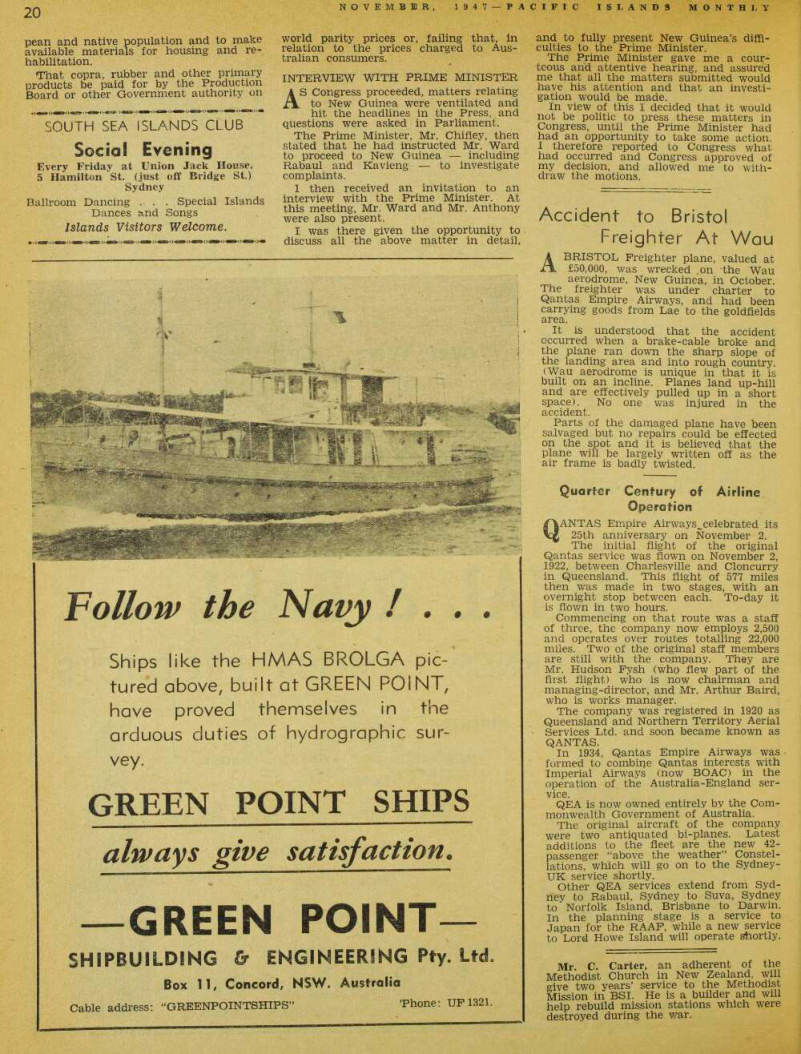
" An Investigation Will Be Made"
Colonel Allan Brings N. Guinea Grievances Before Australian Prime Minister
A FINE job of work has been done on behalf of the non-official residents of Papua and New Guinea by Colonel H. T. (“Blue”) Allan, well known resident of the Mandated Territory.
Acting on behalf of the war veterans of New Guinea, Colonel Allan went from Rabaul to Sydney a few weeks ago, and sought permission to attend the Returned Soldiers Conference in Canberra at the end of October, where he might present the grievances of the Territories veterans.
Permission was given, and Colonel Allan prepared his brief carefully. He was given a good hearing by the Con ference, and he placed before the Con ference, very effectively, a series of state ments wherein he outlined the handi caps, disabilities and monstrous injustices under which Europeans have suffered in the Territories under the Wardist regime, since the end of the war. The news papers gave him much attention —practically every day, a New Guinea griev ance was prominently displayed.
Owing to the popular revolt in Aus tralia against the Chifley Government’s plan to nationalise the banks, Mr. Chifley reacted sharply to Colonel Allan’s public disclosure of the plight of copra-growers in New Britain and New Ireland. Because of lack of ships and bags, the growers cannot get their copra to market. Because the Government has a monopoly of copra-buying and banking in Rabaul, the growers there could not get any advance against their unshipped copra. Colonel Allan said that if the big firms had been allowed to buy copra, or if a private bank had been operating in Rabaul instead of the Commonwealth Bank, the growers would have immediately received finan cial help, on the security of their copra.
This was an example of what a govern ment banking monopoly meant.
The Prime Minister thereupon sent for Colonel Allan, and interrogated him in the presence of what is reported to have been a resentful Mr. Ward (Minister in charge of Territories). As a result of a long interview, some reforms are likely to be made in the -administration of the Territories, and Mr. Ward is to make a special visit to the Territories at an early date—and in the course of that visit he will go to New Britain and New Ireland.
As the result of what was done by Colonel Allan and the Returned Soldiers Conference the unhappy Australian Territories received more publicity and more Governmental attention within a few hours than they had obtained in all the black years since 1942.
Canberra Resolutions In Detail
COLONEL ALLAN left for the Terri tories by plane on November 5.
Before he departed he kindly sup plied us, at our request, with the following report of proceedings at Canberra: — 1 was given a very warm welcome in Canberra by the delegates, from all the States, to this, the 32nd Annual Congress.
This was the first time that New Guinea has been represented. The following resolutions, submitted by me on behalf of New Guinea, were carried: —
Repat Benefits
rAT the Commonwealth Government be requested to make available to Returned Soldiers in New Guinea all the benefits of repatriation now avail able to ex-Service personnel in Australia, by providing regulations and machinery suited to the different conditions obtain ing in New Guinea.
Available Land
rAT the present policy of no further alienation of land in New Guinea be reviewed, to permit of returned soldiers (not former residents) becoming settled in New Guinea; and that the present system of permits to enter New Guinea be revised to allow of new ex- Service settlers entering the country.
(Continued on Next Page)
Timber Industry
rAT the present ban on the granting of timber leases in New Guinea be reviewed with a view to permitting returned Servicemen to take up timber country and ensure sufficient supplies of timber for:— (a) Rehabilitation of New Guinea, (b) Assisting rehabilitation and hous ing schemes for returned soldiers in Australia. (c) Conserving dollars.
Status Of Ng Branch
rE following request was submitted for discussion: “That in all future Annual Congresses of the RSS & AILA, the Mandated Territory of New Guinea Branch be entitled to represen tation as a State Branch with power to vote.”
As a result of discussion the following resolution was passed: “"That the Fed eral Executive investigate and report to next Federal Congress upon the standing of the New Guinea Branch and similar branches. The Executive shall have re gard to the membership, geographical position and disabilities which may occur as a result of these branches being con stituted as at present.”
As a result of this, New Guinea will be invited to send a delegate to all future Congresses, and matters submitted will be proposed by arrangement with any of the State delegates. In effect, we have secured representation without power to vote, and have the right to submit our application for a vote at any future Con gress.
I regard this as most important for our future, and I do not think that it much matters whether we have a vote or not.
The following matters were put on the Agenda paper for submission to Congress
but were withdrawn - by me, owing to later developments:
New Guinea Matters
rAT the present ban on investigation into any prosecution for collabora tion with the Japanese by natives be removed and that all such cases be examined and offenders brought to trial.
That the Uncontrolled Territories Ordi nance be revised to permit of opening up of new gold bearing areas by persons approved by the Administrator, and that a system of Government assistance to prospectors (as in Australia) be instituted.
That the basis of War Damage pay ments (i.e. 1942 book values) be reviewed and that all claims be paid on 1947 re placement values—this being the present basis of payment by the New Guinea Administration for War Damage claims of natives. .
That natives who have completed a twelve-months’ contract with an em ployer be permitted to sign on again if they so wish, instead of being com
pelled to return to their home areas and not permitted to work again for six months.
That the Legislative Council of the Mandated Territory be revived, and that the non-Administrative members of the Council be elected by public vote and not by nomination by the Administrator.
That the present restriction on the ownership and use of watercraft over 25 tons be removed and that returned soldiers be permitted to own and operate their own craft, irrespective of size.
That the present imposition of export duties and repayment of bounties on goods from Australia to New Guinea (rice, wheatmeal, soap, cotton goods, flour and fats) be discontinued, and that New Guinea be treated as part of Australia and not as a foreign country.
That the ban on export of baby food, unsweetened milk and cement, from Aus tralia to New Guinea, be removed.
That more frequent shipping services be provided between Australia and New Guinea to ensure continuity of supplies of food and other necessities for Euro
pean and native population and to make available materials for housing and rehabilitation.
That copra, rubber primary products be paid for by the Production Board or other Government authority on
world parity prices or, failing that in relation to the prices charged to Aus trahan consumers.
Interv Iew With Prime Minister
AS Congress proceeded, matters relating to New Guinea were ventilated and hit the headlines in the Press, and questions were asked in Parliament.
The Prime Minister, Mr. Chifley, then stated that he had instructed Mr. Ward to proceed to New Guinea including Rabaul and Kavieng to investigate complaints. 1 then received an invitation to an interview with the Prime Minister. At meeti Mr Ward and Mr Anthony wer e alsQ present i was there given the opportunity to discuss all the above matter in detail,
and to fully present New Guinea’s diffi culties to the Prime Minister.
The Prime Minister gave me a cour teous and attentive hearing, and assured me that all the matters submitted would have his attention and that an investi gation would be made.
In view of this I decided that it would not be politic to press these matters in Congress, until the Prime Minister had had an opportunity to take some action.
I therefore reported to Congress what had occurred and Congress approved of my decision, and allowed me to with draw the motions.
Advertisements & other items, pp. 23-24 (1 item)
Brial & Ball
Woven Wire for all Industry
COPRA DRYING TRAYS, FLOORS, Etc.
FRUIT DRYING TRAYS, MINING SCREENS.
Heavy Mosquito Gauze in Phosphor Bronze and other Metals Impervious to Salt Sea Air.
WIRE DOOR MATS AND GENERAL WIRE WORKS
E. WRIGHT £r CO. LTD.
Office and Works: 148-152 Cleveland Street, Sydney, NSW Telegraphic Address: “Wrlghtmake,” Chippendale.
BRIAL & BALL
present
mi
BARNES FAMOUS PRODUCTS
Macaroni Cheese.
Spaghetti in Tomato Sauce with Cheese.
Baked Beans in Tomato Sauce.
Vegetable Soup.
Green Peas.
Tomato Soup.
SOLE DISTRIBUTING AGENTS FOR PACIFIC ISLANDS-
BRIAL & BALL
31 QUEEN ST., MELBOURNE.
1 BOND ST., SYDNEY.
m m
SOUTH SEA ISLANDS CLUB
Social Evening
Every Friday at Union Jack House, 5 Hamilton St. (just off Bridge St.) Sydney Ballroom Dancing . . . Special Islands Dances and Songs Islands Visitors Welcome.
m- . %
Follow the
0 0 0 Ships like the HMAS BROLGA pictured above, built at GREEN POINT, have proved themselves in the arduous duties of hydrographic survey.
GREEN POINT SHIPS
always give satisfaction.
—GREEN POINT—
SHIPBUILDING & ENGINEERING Pty. Ltd.
Box 11, Concord, NSW. Australia Cable address: “GREENPOINTSHIPS” ’Phone: UP 1321.
Accident to Bristol
Freighter At Wau
A BRISTOL Freighter plane, valued at £50,000, was wrecked .on the Wau aerodrome, New Guinea, in October.
The freighter was under charter to Qantas Empire Airways, and had been carrying goods from Lae to the goldfields area.
It is understood that the accident occurred when a brake-cable broke and the plane ran down the sharp slope of the landing area and into rough country. (Wau aerodrome is unique in that it is built on an incline. Planes land up-hill and are effectively pulled up in a short space). No one was injured in the accident.
Parts of the damaged plane have been salvaged but no repairs could be effected on the spot and it is believed that the plane will be largely written off as the air frame is badly twisted.
Quarter Century of Airline
Operation
QANTAS Empire its 25th anniversary on November 2.
The initial flight of the original Qantas service was flown on November 2, 1922, between Charlesville and Cloncurry in Queensland. This flight of 577 miles then was made in two stages, with an overnight stop between each. To-day it is flown in two hours.
Commencing on that route was a staff of three, the company now employs 2,500 and operates over routes totalling 22,000 miles. Two of the original staff members are still with the company. They are Mr. Hudson Fysh (who flew part of the first flight) who is now chairman and managing-director, and Mr, Arthur Baird, who is works manager.
The company was registered in 1920 as Queensland and Northern Territory Aerial Services Ltd. and soon became known as
Qantas.
In 1934, Qantas Empire Airways was formed to combine Qantas interests with Imperial Airways (now BOAC) in the operation of the Australia-England ser vice.
QEA is now owned entirely by the Com monwealth Government of Australia.
The original aircraft of the company were two antiquated tai-planes. Latest additions to the fleet are the new 42passenger “above the weather” Constel lations, which will go on to the Sydney- UK service shortly.
Other QEA services extend from Syd ney to Rabaul, Sydney to Suva, Sydney to Norfolk Island, Brisbane to Darwin.
In the planning stage is a service to Japan for the RAAF, while a new service to Lord Howe Island will operate shortly.
Mr. C. Carter, an adherent of the Methodist Church in New Zealand, will give two years’ service to the Methodist Mission in BSI. He is a builder and will help rebuild mission stations which were destroyed during the war.
Permanent Capital
Mr. Ward Will Visit
New Guinea
And Choose Site For Permanent Capital
RESIDENTS of Papua-New Guinea will be delighted to learn that the Min ,, ister for External Territories, Mr.
Ward, probably will visit the Territory early in the new year. No doubt oppor tunity will be taken by citizens aid public bodies there to meet Mr. Ward and direct his attention towards some of the re finements of life as they exist to-day in that native paradise.
Mr. Ward, himself, made the announce men of his impending visit to the Ter ritory in the Federal Parliament, Can berra, on October 14. He said that dur ing his visit he will go into the question of a permanent capital and the Aus tralian government’s decision on this point will subsequently be announced.
Mr. Ward did not make'it clear whether the capital to which he referred is the capital of New Guinea —the old Mandate —or the capital of the combined Ter ritories of Papua-New Guinea, which at present are governed under the Pro visional Administration set-up.
Certain questions affecting Trusteeship territories have not yet been settled by the United Nations; and, meantime it is difficult to see upon what basis the Aus tralian government can set up permanent combined administration. There is con siderable agitation in the old Mandated Territory to-day—particularly in New Britain for deliverance from Port Moresby control. Territorians claim that they are being sacrificed to Papua which,
some reason, appears to have caught the eye of Australian officialdom.
THIS will be Mr. Ward’s first visit to New Guinea. He paid a two weeks' visit to Papua during the war, as the guest of the Army. It was after this historic event that the Wardist New Order for natives was introduced. It Is hoped that the choice of a capital, which is scheduled to follow his second visit, will have happier results than did the Minister’s first visitation. Territorians, now wise in the ways of politicians, will not expect it, however. It will be re membered that when Mr. Hughes was entrusted with the task of finding an alternative capital to Rabaul, back before World War 11, he plumped for Salamaua.
No one. was ever able to understand why.
No doubt Mr. Ward’s New Year visit will be the usual official picnic, complete with crowds of cheering, well-laundered natives diverted from their lawful, and not so angelic occasions, to pretty-up the New Deal shop-front: with all plans Tor his comfort and convenience made well in advance and —miracle for New Guinea, 1948—adhered to. What goes on behind the scenes won’t be the Minister’s busi ness.
But it is pleasant to play with the thought of a Mr. Ward somehow being shanghai-ed and dumped way up the Sepik River with, maybe, six cranky natives, and instructions to get himself out. Or abandoned on an overgrown plantation without transport, labour or stores, and asked to produce copra for the starving world.
Of such things are planters’ dreams made. It is scarcely possible that any thing so unfortunate and realistic could happen to the man who made New Guinea safe for Fuzzy Wuzzy. freed the slaves from the evil machinations of pre datory planters, and tied a tin-can to the tail of the exploiters.
Strike In Fiji
Nadi Airport Workers Have A Week Off
Suva, Nov. 3.
yLTHEN the New Zealand Public Works ▼ T Department, the largest single em ployer of labour at Nadi Airport, dismissed a Fijian and an Indian, 220 of the 375 local employees went on strike.
The hold-up lasted a week, during which the essential services were maintained by non-striking personnel, and Europeans from the staffs of the various organisa tions operating at the airport.
The two dismissed men were a Fijian assistant cook, and an Indian power house worker. The Nadi Aerodrome Workers’ Union maintained that the men had been dismissed unjustly.
The Unionists on strike included Fijians, part-Europeans, Indians and Chinese. The Union’s joint secretaries are both Indians, as is the legal adviser.
The Commissioner of Labour (Mr. C. S.
Reay) flew to Nadi on the first day of the strike. Mr. Reay is reported to be an earnest supporter of trade union ism in Fiji; but there is no indication that he got anywhere with his equally earnest unionists at Nadi. Tind he re turned to Suva with the end of the strike still not in sight.
The end was announced on November 1, but beyond an unofficial report that one of the dismissed men had been re instated there has been no statement on the terms of the settlement.
Mr. A. G. McCown, of Ovalau, Fiji, re turned to the Colony from USA in October. He said there was great in dustrial unrest in America and a large amount of unemployment.
The Rev. and Mrs. E. V. Newman, of the Free Wesleyan Church of Tonga, plan to leave Tonga at the end of the year, after four years’ service. Church mem bers in Tonga have sent a message to the Methodist Mission Board in Sydney, speaking in warmest terms of the work Mr. Newman and his wife have performed during their stay in the Kingdom.
Advertisements & other items, pp. 25-26 (1 item)
KODAK (Australasia) PTY. LTD.
Important Announcement.
has pleasure in announcing that Kodak Film and ail photographic materials are now available to amateur photographers throughout the islands, and may be secured through any of the following Kodak Dealers:
PAPUA
B.N.G. Trading Co. Ltd., Port Moresby.
Burns Philp (New Guinea) Ltd., Port Moresby, Samarai.
Steamship Trading Co., Port Moresby.
G. G. Smith & Co., Port Moresby.
NEW GUINEA
Burns Philp (New Guinea) Ltd., Lae, Madang Rabaul.
Kwock Cheong, F. L., Rabaul.
Kwong King Lung, Rabaul.
Sam, Leo, Rabaul.
Morris, Hedstrom, Ltd., Suva, Lautoka, Ba, Tavua, Vatukoula, Nausori, Sigatoka, Nandi, Labasa, Levuka, Penang, Navua.
TONGA
Burns Philp (South Sea) Co. Ltd., Nukualofa, Haapai, Vavau.
Jones, Mrs. E. M., Nukualofa.
Morris, Hedstrom Ltd., Nukualofa, Vavau.
SAMOA
Burns Philp (South Sea) Co. Ltd., Apia, Pago Pago.
Morris, Hedstrom Ltd., Apia.
NEW HEBRIDES
Burns Philp (South Sea) Co. Ltd., Vila.
FIJI
Burns Philp (South Sea) Co. Ltd, Suva, Levuka Lautoka, Labasa, Ba, Sigatoka, Rotuma.
Caine, F. W, & Co, Suva.
Mouat’s Pharmacy, Suva.
Prasad’s Studios, Lautoka, Suva.
Stinson Studios, Suva.
Swann & Co, A. J, Suva W. R. Carpenter & Co, Ltd, Suva.
SAVAGE ISLANDS
Burns Philp (South Sea) Co. Ltd, Niue.
COOK ISLANDS
Hopkins, S, Rarotonga.
LORD HOWE ISLAND
Thompson, O. C.
NORFOLK ISLAND
Burns Philp (South Sea) Co. Ltd.
NEW CALEDONIA
Ventrillon Freres, Noumea.
Big Profits in Toys and Dolls
Special Postal Course in soft toy craft.
Course includes patterns for lovely dolls and cute animals. All materials available. Start home business. Full or part time. Send stamp for FREE BOOK “Modern Money-Making Crafts.” Dept. 15, Le Bon College (Regd.), Box 279 Haymarket, Sydney.
Scott's “Renown” Brand Rope,
Cordage and
Binder
Twine
Cable Address: Ropeyard, Sydney. - Si
of Every
Description
MANUFACTURED AT
MASCOT, N.S.W.
J. SCOTT
PTY. LTD.
Head Office and Store
163 CLARENCE STREET,
SYDNEY,
N.S.W.
Hard to Get? us
FOR
1. TRADE TOBACCO
2. LAP LAP MATERIAL
3. CANNED GOODS
4. PERFUMERY
5. PRIMUS STOVES
6. KEROLAMPS
7. SHOES, SANDALS
8. UMBRELLAS
9. CHILDREN'S CLOTH-
ING
10. SADDLERY & HARNESS
11. HOME LIGHTING PLANTS
12. WINES AND SPIRITS
13. NON-ELECTRIC WASHING
MACHINES
14. PUMPS, IRRIGATION
PLANTS
15. CROCKERY
16. HAIRDRESSING SUPPLIES
17. HARDWARE
18. AIR CIRCULATORS
jßt 8a Castlereagh Street.
M3IISIU%KS Sydney, Australia
ISLAND TRADERS
Cable and Telegraphic address: “MANSTOCKS/’ SYDNEY Telephones: 8W7405, 8W1237, 85076, FM2766
Swift Moves For Reform In Western
Samoa
Samoans Inclined To Seek Union With Eastern
Samoa
(See also “UNO Mission’s Report,” elsewhere in this issue.)
AN important statement, bearing upon political and administrative condi tions in Western Samoa (a Trustee Territory of New Zealand) was made in the New Zealand Parliament on October 20 by the Prime Minister (Mr. Fraser).
The history of events in 1946-47 may be recounted, at this stage.
The Samoan chiefs, speaking on behalf of the Samoan people, refused to sub scribe to the Trusteeship Agreement which replaced the League of Nations Mandate, under which New Zealand gov
erned Western Samoa. The chiefs, in stead, appealed to the Trusteeship Coun cil of the United Nations for a larger measure of self-government and a closer union between Western Samoa and Eastern Samoa (American) which are in habited by the people of the same race.
The Trusteeship Council, while ap proving the Agreement, appointed a special mission of inquiry, to proceed to Samoa and investigate the position on the spot. The mission was in Samoa in July and August, and returned in Sep tember to the United States to report to a meeting of the Trusteeship Council in November.
Meanwhile, on August 27, after the mission had completed its inquiry, but before it could report, the New Zealand Government announced a far-reaching and comprehensive change in the Western Samoan Administrative system —details on page 27 of September “PIM.”
It was claimed that this would give the Samoans the largest practicable measure of self-government, and answer'most of their claims for reform.
The Samoans, early in September, in dicated that, pending the report by the UN mission, they were not interested m the New Zealand Government’s plan, OUR Apia correspondent, writing on October 15, said: The UNO Mission’s report has been received by the Administration here, and has been dis tributed among those interested. The re port is generally on the lines of the New Zealand proposals, and therefore has greatly disappointed the Samoans, be cause it does not give them immediately the self-government they had fervently hoped for. It is too early yet to judge the Samoan’s reaction, but I expect that they will blame the NZ Government for failure to get self-government. • There is some indication that tne Samoans now will submit to the Trus teeship Council a request that Western Samoa be united with Eastern Samoa, and that the trusteeship for the united territory be placed in the hands of the United States. This is only a rumour— but it is given some colour by a recent visit to Pago Pago, American Samoa, of High Chief Tamasese, who conferred with the high chiefs there. Probably, a gen eral Fono of Samoan leaders will be called to discuss the UN report. rE next development was the NZ Prime Minister’s announcement, on October 20, that legislation giving effect to certain of the Government’s pr<p posals for constitutional changes in Western Samoa will be introduced dur ing the present session of the NZ Parlia ment; and a committee to report on part of the general plan has already gone to Samoa.
Mr Fraser said the Government was gratified to find that the report of the United Nations Mission did not differ on any fundamental issue from the proposals announced by Mr. Nash. There were differences in the- detailed recommenda tions, but these were few and relatively unimportant. The mission’s report would come before the Trusteeship Council at its next meeting in November but could not receive the final approval of United Nations till the 1948 session of the General Assembly.
It was not desirable to hold up the proposed constitutional changes for this length of time and the NZ Government therefore proposed to give effect to as many of them as possible during the
current session of Parliament. These would include the establishment of a Council of State, changes in the com position of the local legislature and the transfer to it of increased powers and responsibilities.
There were other desirable steps to be taken which require further discussion with the Samoan people. These were the establishment of a system of local government and the creation of an in dependent Public Service Commission in New Zealand.
These measures would be implemented by a further amendment of the Samoa Act in 1948.
Committee To Report
SOME time ago, said the Prime Minister, a joint committee representative of the Public Service Commission and the New Zealand Public Service Associa tion had been appointed to report to the Commission on salaries and general con ditions of employment in the Samoan public service.
Under the new form of control con templated by the Government, these matters would cease to be the responsi bility of the Public Service Commission, but as the change would not become effective for another 12 months, it was felt that the proposal to send the com mittee to Samoa should not be delayed or abandoned.
Its recommendations would enable the Commission to make any adjustments which might be immediately necessary because of changes in the cost of living or the existence of anomalies and would be equally valuable to the new Public Ser vice authority whervit began to function.
The committee, which comprises Mr. A.
G. Rodda, of the Public Service Commis sion staff (chairman), Mr. C. H. Quinn, chief clerk, Island Territories Depart ment, and Mr. J. Turnbull, general sec retary of the Public Service Association, left for Apia by air on October 18.
Advertisements & other items, p. 26 (1 item)
22
November, 1947—facific islands monthly
Nauru Is Now In
Trust'
Development Directs Attention To Difficult Problem of TNG
fTIHE phosphate island of Nauru, taken ± from Germany in 1914 and handed over to Britain, Australia and New Zealand in 1920, under joint Mandate, by the League of Nations, is now to be held in trust by the same three countries, under a Trusteeship Agreement approved on October 17 by the Trusteeship Council of the United Nations. Voting was 9 to 2, in favour.
The Communist bloc, led by Russia, offered the usual footling objections— unexplained, except by the fact that it is the purpose of the Reds to cause delay and irritation at the world court—but the great majority of the nations ap proved.
The Australian Administrator of Nauru, Mr M Ridgway who left the island September for New York—was present at the United Nations General Assembly session, to assist the Australian delegate (Dr. Eyatt) with information and advice.
He will be absent from Nauru for several weeks. «,? au F u is stm described officially as a ‘Mandated Territory” and that, ap parently will be its status until the Trusteeship Agreement has been accepted by the Parliaments of Britain, Australia and New Zealand.
New Guinea Problem
IN a similar way, New Guinea is still a Mandated Territory. The New Guinea Agreement has been ac cepted by UNO; but it cannot be called a Trustee Territory until slow-moving offi
cialdom has had the Agreement accepted by the Australian Parliament.
When that time corned, Australia will have to decide whether the present set up (Papua-New Guinea Provisional Ad ministration) is to continue; or whether we are to revert to an Australian Ad
ministration of Papua, and a Trustee ship Administration of New Guinea.
There are no complications in the case of Nauru; but there definitely is a head ache in relation to Papua-New Guinea.
Some jurists and administrative authori ties argue that it will not be possible to govern the two Territories in one ad ministration, no matter how desirable that course may be from the viewpoint of convenience and efficiency.
Advertisements & other items, p. 27 (1 item)
Robert Gillespie Pit Lip
LONDON-SUVA
ECT .
\v Vl* A
C
PANAMA
<> For Sailings and Further Particulars *.pply To: —
BETHELL, GWYN & CO.,
138 LEADENHALL ST.,
LONDON, E.C.3.
BURNS, PHILP (SOUTH SLA)
CO., LTD.,
SUVA.
» * A. - I %vV OH it All classes of merchandise purchased for Island clients throughout the South-west Pacific.
Island produce sold on Australian and overseas markets on a commission basis.
ROBERT GILLESPIE PIT LIP
54a PITT ST..SYDNEY - PHONESBW47B2- 81305
Legislative Council
Appointments In Fiji
Prom Our Own Correspondent
Suva, Oct. 19.
GOVERNMENT nominations to the Legislative Council of Fiji have been announced as follows: Sir Hugh Ragg; Mr. S. H. Wilson; Mr. M. S. Buksh; Mr. Ami Chandra.
Sir Hugh Ragg was formerly European elected member for the North-Western Division. He did not contest the seat at the recent election.
Mr. Wilson comes from Vanua Levu and it is assumed that he will represent copra-planters on the Council.
The Council’s next sitting will be open on October 31.
Mr. Honebein, the Rev. and Mrs. S.
Schroer, and two children, and the Rev. and Mrs. Freyberg, of the Lutheran Mission, have returned from the mission field, New Guinea, to Australia, because of ill health. Mr. Honebein has embarked for San Francisco, en route for Canada, his home country. The other missionaries are at present in Sydney receiving medi cal attention.
Is Aggressive
Waterside Spirit
Modern Ideas In Cook Islands
Prom Our Own Correspondent
Rarotonga, Oct. 22.
CONFIRMATION was received on October 21 of the affiliation of the Cook Islands Workers’ Union with the NZ Federation of Labour.
A tense situation has existed here dur ing the past two weeks in connection with the intended visit of the auxiliary schooner “Tagua.” The “Tagua” is under charter to the Public Works Department, and was due at Rarotonga with & cargo of public works materials.
When it became known that the De partment had considered unloading the vessel with its own labour, the Cl Pro gress Association rose in protest, and let it be known that if necessary they would be prepared to blockade the wharf and do battle to defend what they re garded as their right to handle all incom ing cargo.
All PWD employees are members of the new Cl Workers’ Union.
To avoid any friction, the visit of the “Tagua” was cancelled, and the vessel was sent to Apia, Western Samoa, to unload.
Mr. Tautu Anerau. local secretary of the CIPA, is at present in Auckland—for the purpose, it is reported, of studying Auckland waterfront methods. (EDITORIAL NOTE; The Cook Islands people can look forward to interesting events, if Auckland waterside methods are to be introduced to their isles. The Auckland waterside workers are notorious throughout the Pacific for their lazi ness, slowness and general non-coopera tiveness. Like the Sydney dockers, they are more or less directed by Communists, and imagine that their mission in life is to cripple the shipping industry.)
Roll Of Ngvr
A CORRESPONDENT in the Bulolo district of New Guinea has informed us that a copy of the Mainland Section of the roll of the NGVR is in existence, but “most of the NGVR re cords were destroyed during the burn ing of the Wau-Bulolo Valley in August, 1942. The remainder were carried with us up the Bulldog Trail and into Papua, and eventually were handed over to Queensland and New Guinea Records Office, at Warwick, Queensland.”
We complete in this issue the publica tion of as full a roll of the NGVR as we have been able to compile. It appears to contain all the mainland names, but we fear that many of the New Britain and New Ireland names are missing. We have been unable to obtain the New Britain and New Ireland section of the roll. There may not be one in existence.
Progress Of Oil Drilling.
In Papua
THE Australasian Petroleum Company Ptv Ltd., reported on September 30, that to date the drilling of their bore in Kariava, Papua, had reached 9,627 feet.
Five hundred odd feet had been drilled in the previous month.
Part of two new drilling rigs which have been on order overseas for some time have now arrived in Australia and constructional work at the drilling sites in Papua is proceeding.
Advertisements & other items, pp. 28-30 (2 items)
results
F. Pens, 5/6 to 60/3.
Prop. Pencils, 5/11 to 45/-.
Gift Sets, 23/9 to £6/11/-.
Ball Pens—Silver Pl. 50/3. 22ct. Gold-plated, 77/6. • New Nibs and repairs for all Pens.
SENT FOR FREE CATALOGUE
See the Specialists at . . . %
NEAR MARTIN PtACE
135 Pitt St., Sydney 82514
A Limited Quantity Only
COLT PATTERN 45 cal. AUTOMATICS
SPECIAL TROPICAL FINISH.
At the all-time low price of £lO each. Postage extra. Powerful, accurate, they are a weapon you will be proud to own. Ammo, plentiful, 25/per 100.
Si i naU I I Quality Firearms and Fishing
I L nU M U Tackle.
143 ELIZABETH ST. (near Market St.), SYDNEY. Phone: MA 3540,
Perfect
results
The Illustration shows the “Victory". a popular light all - steel plough, combining maximum strength with minimum weight and draught. in any class of soil can be obtained with one implement or other in the wide selection which we offer Our range covers share and disc ploughs for animal and tractor draught, cultivators, disc harrows, planters, etc.
ansomes
PLOUGHS and
IMPLEMENTS
Ransomes other manufactures Include band, horse and motor lawn mowers, aerodrome equipment, etc. Write for Illustrated literature and all information.
MORRIS, HEDSTROM LTD.,
Suva Lautoka Ba.
Made by; RANSOMES, SIMS & JEFFERIES, LTD., IPSWICH, ENG.
re {resj , "' ( l%
cl a^
5* M'f 7
TOOTH PAST
N i
It's
re {resj , "' ( l%
:#• ife .* k You’ll agree, too, when you use IPANA. It’s refreshingly different, with a distinctive, pleasant taste, that makes your mouth feel grand.
IPANA’S cleaning and polishing qualities give you sparkling teeth and a sunny smile.
With massage, too, IPANA helps ensure firm, healthy gums so vital to sound teeth.
G °o£ ■
sums':
'* 4257
When you can
see.
you’re safe ! m 7> % **»•- & Jg
eVEREADy
TRADE-MARK
FLASHLIGHT
BATTERIES
give longer life.
Look for the Dateline
DEPENDABLE, ECONOMICAL, POWERFUL.
Hagen
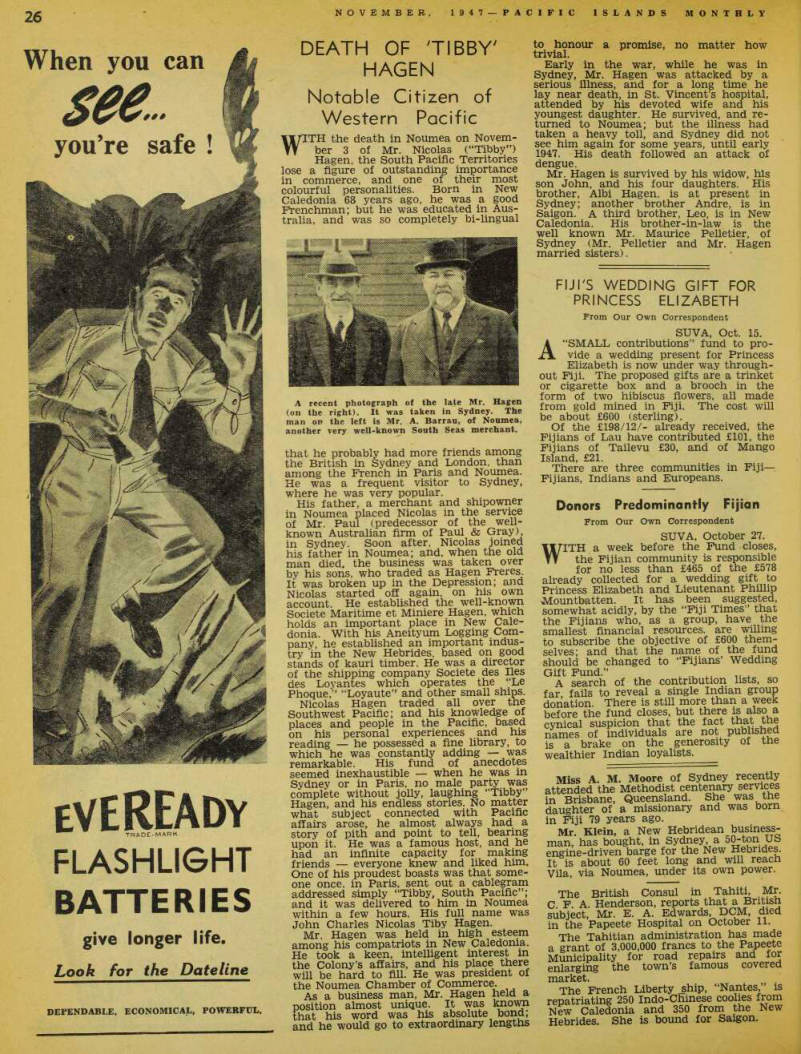
Death Of 'Tibby'
Notable Citizen of Western Pacific
WITH the death in Noumea on Novem ber 3 of Mr, Nicolas (“Tibby”) Hagen, the South Pacific Territories lose a figure of outstanding importance in commerce, and one of their most colourful personalities. Born in New Caledonia 68 years ago, he was a good Frenchman; but he was educated in Aus tralia, and was so completely bi-lingual
that he probably had more friends among the British in Sydney and London, than among the French in Paris and Noumea.
He was a frequent visitor to Sydney, where he was very popular.
His father, a merchant and shipowner in Noumea placed Nicolas in the service of Mr. Paul (predecessor of the well known Australian firm of Paul & Gray), in Sydney. Soon after, Nicolas joined his father in Noumea; and, when the old man died, the business was taken over by his sons, who traded as Hagen Freres.
It was broken up in the Depression; and Nicolas started off again, on his own account. He established the well-known Societe Maritime et Miniere Hagen, which holds an important place in New Cale donia. With his Aneityum Logging Com pany, he established an important indus try In the New Hebrides, based on good stands of kauri timber. He was a director of the shipping company Societe des lies des Loyantes which operates the “Le Phoque,” “Loyaute” and other small ships.
Nicolas Hagen traded all over the Southwest Pacific; and his knowledge of places and people in the Pacific, based on his personal experiences and his reading he possessed a fine library, to which he was constantly adding was remarkable. His fund of anecdotes seemed inexhaustible when he was in Sydney or in Paris, no male party was complete without jolly, laughing “Tibby”
Hagen, and his endless stories. No matter what subject connected with Pacific affairs arose, he almost always had a story of pith and point to tell, bearing upon it. He was a famous host, and he had an infinite capacity for making friends everyone knew and liked him.
One of his proudest boasts was that some one once, in Paris, sent out a cablegram addressed simply “Tibby, South Pacific”; and it was delivered to him in Noumea within a few hours. His full name was John Charles Nicolas Tiby Hagen.
Mr. Hagen was held in high esteem among his compatriots in New Caledonia.
He took a keen, intelligent interest in the Colony’s affairs, and his place there will be hard to fill. He was president of the Noumea Chamber of Commerce.
As a business man, Mr. Hagen held a position almost unique. It was known that his word was his absolute bond; and he would go to extraordinary lengths
to honour a promise, no matter how trivial.
Early in the war, while he was in Sydney, Mr. Hagen was attacked by a serious illness, and for a long time he lay near death, in St. Vincent’s hospital, attended by his devoted wife and his youngest daughter. He survived, and re turned to Noumea; but the illness had taken a heavy toll, and Sydney did not see him again for some years, until early 1947. His death followed an attack of dengue.
Mr. Hagen is survived by his widow, his son John, and his four daughters. His brother, Albi Hagen, is at present in Sydney; another brother Andre, is in Saigon. A third brother, Leo, is in New Caledonia. His brother-in-law is the well known Mr. Maurice Pelletier, of Sydney (Mr. Pelletier and Mr. Hagen married sisters).
A recent photograph of the late Mr. Hagen (on the right). It was taken in Sydney. The man on the left is Mr. A. Barrau, of Noumea, another very well-known South Seas merchant.
Princess Elizabeth
Fiji's Wedding Gift For
From Our Own Correspondent
Suva, Oct. 15.
A “SMALL contributions” fund to pro vide a wedding present for Princess Elizabeth is now under way through out Fiji. The proposed gifts are a trinket or cigarette box and a brooch in the form of two hibiscus flowers, all made from gold mined in Fiji. The cost will be about £6OO (sterling).
Of the £l9B/12/- already received, the Fijians of Lau have contributed £lOl, the Fijians of Tailevu £3O, and of Mango Island, £2l.
There are three communities in Fiji— Fijians, Indians and Europeans.
Donors Predominantly Fijian
From Our Own Correspondent SUVA, October 27.
WITH a week before the Fund closes, the Fijian community is responsible for no less than £465 of the £578 already collected for a wedding gift to Princess Elizabeth and Lieutenant Phillip Mountbatten. It has been suggested, somewhat acidly, by the “Fiji Times” that the Fijians who, as a group, have the smallest financial resources, are willing to subscribe the objective of £6OO them selves; and that the name of the fund should be changed to “Fijians’ Wedding Gift Fund.” ...
A search of the contribution lists, so far fails to reveal a single Indian group donation. There is still more than a week before the fund closes, but there is also a cynical suspicion that the fact that the names of individuals are not published is a brake on the generosity of the wealthier Indian loyalists.
Miss A. M. Moore of Sydney recently attended the Methodist centenary services in Brisbane, Queensland. She was the daughter of a missionary and was born in Fiji 79 years ago.
Mr. Klein, a New Hebridean business man, has bought, in Sydney, a 50-ton US engine-driven barge for the New Hebrides.
It is about 60 feet long and will reach Vila, via Noumea, under its own power.
The British Consul in Tahiti, Mr.
C F. A. Henderson, reports that a British subject, Mr. E. A. Edwards, DCM, died in the Papeete Hospital on October 11.
The Tahitian administration has made a grant of 3,000,000 francs to the Papeete Municipality for road repairs and for enlarging the town’s famous covered market.
The French Liberty jhip, “Nantes,” is repatriating 250 Indo-Chinese coolies from New Caledonia and 350 from the New Hebrides. She is bound for Saigon.
Plenty Of Money
In Fiji
High Imports are Reflected In Colony's Revenues
From Our Own Correspondent
Suva. Nov. 3.
CUSTOMS and income tax returns in Fiji have been so much higher than the 1947 Budget estimates that a surplus of £369,388 is shown in the re vised estimates, instead of the original estimate of £62,022, said the Acting-Gov ernor (Mr. J. P. Nicoll) in his address at the opening of the Budget session of the Legislative Council.
Customs revenue alone, said the Act ing-Governor, is now expected to produce no less than £430,000 more than was originally estimated, because imports have been greater in quantity and higher in price than was anticipated, while the re vised estimate for income tax is about £130,000 more than the original estimate because of the high level of business activities in 1946.
There were some substantial increases in the estimates of expenditure, but on the other hand the continued scarcity of materials and machinery, and delays in the fulfilment of orders placed overseas, have made it impossible to carry out the full programme of works for which pro vision was made.
These deferred items amount to about £lBO,OOO and in consequence the esti mated surplus of £369,388 can be regarded as inflated by that amount.
The Government is budgeting for a small surplus of £5,661 in 1948—revenue at £2,307.944 and expenditure £2,302,283. It is anticipated that imports will shrink considerably, but that income tax col lections will increase.
There is increased money for health, education and public works, including £114,000 for road and bridge construc tion. and £llB,OOO for maintenance.
Papua And Ng Customs
Tariffs
11TE occasionally are asked for copies Ml of the Customs Tariff now in opera tion in the Australian Territories of Papua and New Guinea.
There is no new tariff. The tariffs which were in force in the Territories, when civil administration ceased in early 1942, were restored, when civil adminis tration was restored, and are now in operation.
The tariffs are published in the “Pacific Islands Year Book,” pages 215 and 314.
The Papuan tariff is substantially the same as published; but the New Guinea tariff has been altered in some directions by amendments made in 1941.
Useful Compilation
mHE “Monthly Notes” of the Australian School of Pacific Administration, Mosman Svdnev ha<; had it«? title altered to %oShPacifl?!” and is dis tributed through the post as a periodical.
Its purpose, apparently, is to make avail able a com P of current news and views relating to the problems of admin istration of South Pacific Territories, Material is re-published, with due and proper acknowledgment, from all sorts and conditions of periodicals except the “Pacific Islands Monthly!” However, despite that handicap, the well-edited compilation should be of value to the administrative staff of Papua and New Guinea
Pen Friends Wanted
Mr. Hobby Moore, Po Box 5062,
College Station, Texas, USA, who is especially interested in conditions in the South Pacific Islands, would like to correspond with someone in the Islands who could tell him about living condi tions there, from actual observation. He is a College student, and his major study is geology.
The Rev. C. H. Cranswick celebrated, on November 1, the 30th anniversary of his consecration as a Bishop. He became Bishop of Gippsland (Vic.) in 1917 and had the oversight of the Diocese for 25 years. In 1942, he was invited to take (and accepted) the position of Chairman of the Australian Board of Missions. He has been asked to continue in office until the end of 1950. He has had experience in Australia, England, and in missionary work in India.
Advertisements & other items, pp. 31-32 (1 item)
Gardner Diesel Marine
AUCTIONEER, VALUER,
ESTATE AGENT.
Storage and Repository Travellers Sample Rooms For General Information and Service.
P.O. Box Rabaul, TNG
GARDNER DIESEL MARINE
ENGINES
There is a type available for every class of vessel requiring power from 24 BHP to 152 BHP. Direct or reduction gears.
GARDNER stationary engines for all classes of work, including electrical
generation
MORRIS MARINE ENGINES
Petrol Driven. Direct or Reduction Gears
VEDETTE, 6-12 H.P.
NAVIGATOR, 12-24 H.P.
CHAPMAN PUP
and
SUPER-PUP
Engines
3 H.P * — H.P.
GRANTEX RICE MILLS
with stationary engines suitable for their operation
DISTRIBUTORS IN FIJI:
W. R. CARPENTER & CO. (Fiji) LTD.
General Merchants, SUVA, FIJI
is a
Capstan
grand cigarette
for all occasions-
Capstan’s own blend
of fine Virginia
leaf cannot
be equalled
BNv W! o
SYDN
That’s why it’s always
TIME FOR A CAPSTAN
THE EMPIRE'S FAVOURITE CIGARETTE
380P1-7.47
East Indies Timber
Sources of Enormous Supplies Shut Off By Disturbed Conditions
IT was announced in May last that Australian timber merchants in terested in floating a company to ex ploit coniferous forests in South Borneo had been advised by the NEI Govern ment to resubmit proposals made some time previously, but held in abeyance pending a political settlement in Indo nesia.
After that, fighting began in Java, and nothing more appears to have been done.
In view of the acute timber shortage in Australia, the following brief resume, listing the most important timber varieties of Indonesia, may be of interest.
Indonesia is one of the most densely wooded countries in the world. Over 480,000 square miles are covered by forests, offering an ample choice of splendid timbers. In Borneo and Sumatra, in particular, virgin forests abound.
In some regions, over 60 per cent, of the forests belong to the Dipterocarp species; 60 per cent, of others consist of Camphor-wood (Dryobolanops Gaertn).
There are also forests of which 50 per cent, of the trees produce the famous Iron-wood (Belian, Eusideroxylon Zwageri). It has been estimated that as much as 500,000,000 of this latter variety occurs in Borneo alone.
On the island of Java, about 2,000,000 acres are covered with teak forests. Java teak is known the world over for its fit ness for shipbuilding, construction of rail way-carriages, coopery, house building, furniture, sleepers, etc.
Belian, or Borneo Iron-wood (Eusi deroxylon Zwageri, balau, damar laut, pooti, Shorea spec.) and Marbau (Intsia spec.) produce hard, heavy and very dur able timber, suitable for all purposes de manding great strength, resistance and durability. It is used in constructing joists, beams, sleepers, bridges, ship building, etc.
Belian is, owing to its resistance against teredos, in great demand for construc tions in sea-water. Other timbers even more resistant to the attacks of teredos, are lara or nani (Metrosideros spec.) and kolaka (Parinarium crymbosum). A useful product of Belian is the so-called “sirap,” a wooden title for roofing.
Benoean (so-called Borneo teak, Shorea spec.) is closely related to Balau, although it is in general, slightly lighter in weight than the latter. It is also a strong, durable timber and, owing to its attractive appearance, is in great demand for furniture and wainscoting.
Camphor-wood (dryobalanops spec.) and Lagan or Kroewing (Dipterocarpus spec.), known by the name of “apitong” in the Philippine Islands, are two of the most important varieties of the Diptero carpaceae family. They yield strong timbers which are easily worked and can be used where great solidity is essential.
The timber is particularly suitable for floors and solid roofing.
A timber, which was exported in large quantities before the war, is the so called Poenak (Tetramerista glabra), a rather heavy and hard kind of timber of a yellowish colour, which is very suitable for all kinds of heavy construction work.
Red Meranti is the collective name for a number of Shorea varieties yielding a reddish wood of a very pleasing appear ance. The heavy kinds in particular are excellent for furniture, wainscoting, doors, veneer and other fancy work.
Large quantities of these species are shipped from the Philippines under the name of Red Lauan, or Philippines mahogany.
Bawang wood, from Borneo, is also very suitable for making furniture, wains
coting, railway-carriages, etc. This kind of wood, however, belongs to the Meliaceae family, as does the genuine mahogany.
Also excellent for furniture are the so called Indian oak (Quercus sp. div.) and Macassar ebony (Diospyros spec.), which has a fine grain and beautiful marking.
Solomon Islanders
IN his address on “The Solomon Islands’’ before a large gathering of members of the Royal Geographical Society in Brisbane, on October 24, the Rev. A. Hedley Abbott said that it had been found that the Solomon Islander was capable of considerable development.
If wisely planned and handled by the Government and missionaries, he thought the post-war training of the natives should give the Solomon Islanders the opportunity for which they were now ready.
Mr. Abbott lived in the Solomons from 1904 to 1920; and during World War I, was acting-secretary to the Resident Commissioner and Magistrate.
He is now living in Wooloowin, Bris bane,
A New Caledonian nurse, Mil© Marcelle Jorda, who served with the French ex peditionary corps in Indo-China, has been awarded the Croix de Guerre with star, for exceptional devotion to duty during 18 months’ hostilities. The award states that in the course of rebel attacks, and in country infested with rebels, she showed a remarkable disregard for danger. She is now in Paris.
Advertisements & other items, pp. 33-34 (2 items)
Shell
Island Stamps
Island Stamps
Island Stamps
Island Stamps
1/3 PER PACKET
including postage Write to—
JENKINS EMPORIUM
Box 100, Suva, FIJI
When the climb is very severe
SHELL
MOTOR OIL
guards your engine
BEFORE TOURING, YOUR
GARAGE OR SERVICE STATION
DRAIN, FLUSH AND REFILL YOUR
ENGINE WITH SHELL MOTOR OIL
THE SHELL COMPANY OF AUST. LTD
(Incorporated in Gt. Britain)
• ■ $ ' (2 ' Mo 246
UiE STANDARD BURGESS
No. Z CELLS
% A / No 92
lUI
BURGESS
yAlMit/U batter* / (1) / Breathtaking Beauties! Burgess introduces two popular pocket penlights . . . coupled with the allure of the world's most beautiful girls! m
LONG
LASTING
BATTERIES
FOR
EVERY
PURPOSE
UM ■ A PAIR OF POPULAR, FAST SELLING POCKETLIGHTS ON NEW ALLURING DISPLAY CARDS: (1) Sfreomstyled Penlight No. 246. . . polished to a bright and glistening finish. Equipped with pocket clip . . . Lock-on type switch. A Burgess first! (2) Rich maroon and chrome Penlight No. 92 ... a sturdy metal case with pocket clip and lock-on switch
AVAILABLE FROM YOUR LOCAL STORE OR
PACIFIC ISLANDS TRADING COMPANY
244 CALIFORNIA ST., SAN FRANCISCO 11, CAL., U.S.A.
Cable Address: PITCO
30
NOVEMBER, 1941 PACIFIC ISLANDS MONtHL?
Cost Fiji Treasury
Indian Tax Dodgers
Cost Fiji Treasury £13,000
From Our Own Correspondent
Suva, Oct. 19.
A COMMITTEE’ to investigate the in cidence of taxation in Fiji and to make recommendations for adjust ments was set up last year. Its report, issued as a Council Paper, has now been released Nothing drastic is recommended. In deed, the report states that although the committee appealed through both press and radio for persons concerned to state their views, very few bothered to do so.
The obvious conclusion is that there is not much wrong with the incidence of taxation.
What does concern the committee, as well as a good many other people, how ever, is the apparent inability of the Taxation Department to collect from in come-tax-dodgers. In Fiji this class is almost exclusively Asiatic.
The committee believes that the revenue loss (compared with the 1946 approved estimates) of £13,972, could be recovered by strengthening the income tax inspection staff. Members of the Suva Chamber of Commerce have already pointed out that substantial sums are lost to the Treasury because many In dian traders will not or cannot keep books in English and are thus able to flummox the inspectors An Indian member of the committee, however, put forward a unique suggestion that this loss could also be recovered by “a slight increase of 2d. or 3d. in the company rate of income tax.”
The report advocates no changes in the present rates or levels of individual in come tax and company tax. It suggests that the possibilities of land taxation be investigated and that the Post and Tele graph Department be placed on a com mercial footing.
Pilotage and wharfage dues should be increased, the committee believes, and the exemption of copra from Port and Cus toms service tax should be abolished, the tax itself being raised from 1 per cent, to 2 per cent.
Other recommendations are a reduc tion on the royalty on gold and silver and the ultimate withdrawal of the royalty; depreciation to be allowed on buildings, industrial and agricultural plant and houses and the licensing of all trading concerns to be taken over by the Gov ernment from local authorities. committee strongly recommends the establishment of a Statistical Records Office.
"Strong Measures" Sought
PJIHE committee made these observa- X tions:— “It is safe to assume that there are more successful attempts at evasion of income tax than there are failures, and if the figures for 1944 and 1945 are any guide, we can conclude only that enor mous sums must have been lost to the operative 8 ” 1100 Ordinance first became The report shows that in 1944, 1,229 Europeans paid £76,616 in income and . The °nly penalty was £5 (from one taxpayer). . same ear 625 Indians paid frH 58 io? J axes —and £13,077 in penalties SSIJifi 83 . tax Payers a percentage of P lt i i o! R t0 i o a^p^ers of 24 - 10 P er cent.
In 1945,. 1,319 Europeans paid £57.814 with £5BO in penalties from five taxpayers a t( & al of 561 Indians paid £35,204, with penalties of £4,605 from 83 taxpayers (13.08 per cent.).
The Chinese record was: In 1944, 168 paid £12,746 with £1,064 in penalties from 40 08.35 per cent.); and in 1945, 159 paid £2,925, with £1,620 in penalties from 41 (55.38 per cent.).
The committee recommends “strong measures,” to check such losses.
Is USA Buying Trochus?
Need of a South Pacific Button Industry
From a Special Correspondent ABOUT 23 sacks of trochus from the Hienghene region (east coast) of New Caledonia were recently seized on arrival at Noumea for being below the minimum size. Such fishing is in excusable because enforced wartime in activity has resulted in the many hun dreds of miles of reef round the island being particularly well stocked with shell which is well above the required mini mum.
USA is apparently paying a handsome price for this shell which pre-war used to go to Japan. But what Noumea needs and what Sydney industrialists might be well advised to investigate is a button factory in Noumea to treat local «hell and export the meat to the Orient. (Ed. Note: This indicates a different state of affairs to that reported from the New Guinea Territories in July. It was stated then that, while pearl-shell was in great demand, it was extremely diffi cult to dispose of trochus, the explana tion being, apparently, that the button industries in Japan and Czecho-Slovakia had been destroyed during the war.
Many NG traders had (in July) accumu lated large stocks of trochus but were at that time, unable to find a market for ’it.) A US ship recently landed, in Noumea, the US mission which will search for the bodies of men of the American Forces reported missing in the Pacific. The graves of two US fliers have been found in the bush by two young French Scouts, who notified the US Consul. They contain the bodies of the pilot and the observer of a small plane which crashed at Mont Mou in the Chaine Centrale about May, 1942—the first plane lost on the island.
The two Scouts led a party to the spot where the bodies were exhumed and taken on board to join the remains of six other dead from other Pacific Islands.
Tokelau Postage Stamps
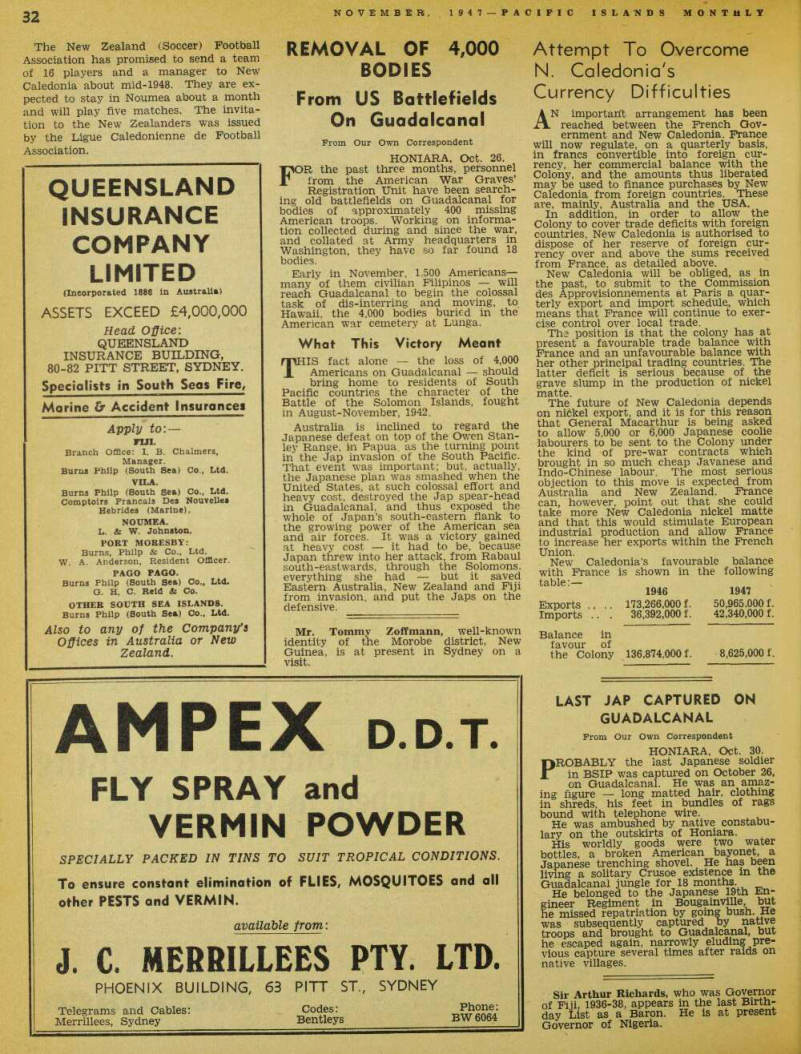
Letter to the Editor 1 THINK that in your September article about Tokelau Islands postage stamps you are somewhat wide of the mark.
These small atolls are not a depen dency of Western Samoa, or even of New Zealand. They are a distinctly separate British possession, which the United Kingdom Government has empowered the Governor-General of New Zealand to administer. Surely it was constitutionally wrong for them to use the postage stamps of a Mandated (now a Trust) territory.
The new issue is in three small values only, from id. to 2d. Could this not be taken as evidence of a desire to issue only stamps that are needed, and to avoid profiteering from philatelists?
The 1,400 people of the Tokelau Islands have really no right to use anyone’s stamps but their own. True, they are few. But what of Pitcairn Island?
I am, etc.,
C. G. R. Mckay.
Whangerei, NZ. Oct. 13, 1947.
The New Zealand (Soccer) Football Association has promised to send a team of 16 players and a manager to New Caledonia about mid-1948. They are ex pected to stay in Noumea about a month and will play five matches. The invita tion to the New Zealanders was issued by the Ligue Caledonienne de Football Association.
Advertisements & other items, pp. 35-36 (1 item)
Asthma, Bronchitis Coughing,
SPECIALISING
IN
PACIFIC ISLAND INSURANCES
FIRE MOTOR VEHICLE
MARINE HULLS AND CARGO
EMPLOYER’S LIABILITY
GUARANTEES including those for—
DYNAMITE PERMITS.
RECRUITERS’ LICENCES
DEFERRED WAGES
AND ALL OTHER CLASSES ARRANGED
AT LOWEST CURRENT RATES.
Established Agencies:
W. R. CARPENTER & CO., LTD.
Throughout the Territory of New Guinea.
SOUTHERN PACIFIC INSURANCE
CO., LTD.
HEAD OFFICE; 60 HUNTER STREET
SYDNEY.
Asthma, Bronchitis Coughing, Curbed in 3 Minutes
Do you have attacks of Asthma or Bronchitis so bad that you can't sleep? Do you feel weak unable to work, and have to be careful not to take cold and can’t eat certain foods?
No matter how long you have suffered or what you have tried, there is new hope for you In a doctor’s prescription called Mendaco No dopes, no smokes, no injections, no atomizer All you do Is take two tasteless tablets at meals and In 3 minutes Mendaco starts working through your blood, aiding nature to remove phlegm, promote free easy breathing and bring sound sleep the first night, so that you soon feel years younger and stronger.
No Asthma in 2 Years
Mendaco not only brings almost Immediate comfort and free breathing but builds up the system to ward off future attacks. For Instance, J. Richards, Hamilton, Ont„ Canada, had lost 40 lbs., suffered coughing every night, couldn't sleep. Mendaco stopped Asthma
spasms first night and he has had none since In over two years.
Money Bock Guarantee
The very first dose of Mendaco goes right to work circulating through your blood and helping nature relieve you of the effects of Asthma. Try Mendaco under an Iron-clad money back gaurantee. You be the Judge. If you don’t feel fully satisfied after taking Mendaco Just return the empty package and the full purchase price will be refunded. Get Mendaco from your chemist to-day and see how well you sleep to-night and how much better you feel to-morrow. The guarantee protect^
RELIEVES ASTHMA
Mendaco
Now in 2 sizes ... 6/- and 12/-
QUEENSLAND
INSURANCE
COMPANY
LIMITED
(Incorporated 1886 In Australia)
ASSETS EXCEED £4,000,000
Head Office:
QUEENSLAND
INSURANCE BUILDING,
80-82 PITT STREET, SYDNEY.
Speciolists in South Seas Fire,
Marine fir Accident Insurances
Apply to:—
tul Branch Office: I. B. Chalmers, Manager.
Burns Phllp (South Sea) Co., Ltd.
VILA.
Burns Phllp (South Sea) Co., Ltd.
Comptolrs Francals Des Nouvelles Hebrides (Marine).
NOUMEA.
L. Si W. Johnston.
PORT MORESBY:
Burns, Phllp & Co., Ltd.
W. A. Anderson, Resident Officer.
PAGO PAGO.
Burns Phllp (South Sea) Co., Ltd.
G. H. C. Reid Si Co.
OTHER SOUTH SEA ISLANDS.
Burns Phllp (South Sea) Co., Ltd.
Also to any of the Company's Offices in Australia or Hew Zealand.
AMPEX D.D.T.
FLY SPRAY and
VERMIN POWDER
SPECIALLY PACKED IN TINS TO SUIT TROPICAL CONDITIONS.
To ensure constant elimination of FLIES, MOSQUITOES and all other PESTS and VERMIN. available from :
J. C. MERRILLEES PTY. LTD.
PHOENIX BUILDING, 63 PITT ST., SYDNEY
Telegrams and Cables: Merrillees, Sydney Codes: Bentleys Phone: BW 6064
From US Battlefields
Removal Of 4,000
Bodies
From US Battlefields On Guadalcanal
From Our Own Correspondent
Honiara, Oct. 26,
17K>R the past three months, personnel from the American War Graves’
Registration Unit have been search ing old battlefields on Guadalcanal for bodies of approximately 400 missing American troops. Working on informa tion collected during and since the war, and collated at Army headquarters in Washington, they have so far found 18 bodies.
Early in November, 1.500 Americans— many of them civilian Filipinos will reach Guadalcanal to begin the colossal task of dis-interring and moving, to Hawaii, the 4,000 bodies buried in the American war cemetery at Lunga.
What This Victory Meant
rIS fact alone the loss of 4,000 Americans on Guadalcanal should bring home to residents of South Pacific countries the character of the Battle of the Solomon Islands, fought in August-November, 1942.
Australia is inclined to regard the Japanese defeat on top of the Owen Stan ley Range, in Papua as the turning point in the Jap invasion of the South Pacific.
That event was important; but, actually, the Japanese plan was smashed when the United States, at such colossal effort and heavy cost, destroyed the Jap spear-head in Guadalcanal, and thus exposed the whole of Japan’s south-eastern flank to the growing power of the American sea and air forces. It was a victory gained at heavy cost it had to be, because Japan threw into her attack, from Rabaul south-eastwards, through the Solomons, everything she had but it saved Eastern Australia, New Zealand and Fiji from invasion, and put the Japs on the defensive.
Mr. Tommy Zoffmann, well-known identity of the Morobe district, New Guinea, is at present in Sydney on a visit.
Currency Difficulties
Attempt To Overcome N. Caledonia's Currency Difficulties
AN important arrangement has been reached between the French Gov ernment and New Caledonia. Prance will now regulate, on a quarterly basis, in francs convertible into foreign cur rency, her commercial balance with the Colony, and the amounts thus liberated may be used to finance purchases by New Caledonia from foreign countries. These are, mainly, Australia and the USA.
In addition, in order to allow the Colony to cover trade deficits with foreign countries, New Caledonia is authorised to dispose of her reserve of foreign cur rency over and above the sums received from France, as detailed above.
New Caledonia will be obliged, as in the past, to submit to the Commission des Approvisionnements at Paris a quar terly export and import schedule, which means that France will continue to exer cise control over local trade.
The position is that the colony has at present a favourable trade balance with France and an unfavourable balance with her other principal trading countries. The latter deficit is serious because of the grave slump in the production of nickel matte.
The future of New Caledonia depends on nickel export, and it is for this reason that General Macarthur is being asked to allow 5,000 or 6,000 Japanese coolie labourers to be sent to the Colony under the kind of pre-war contracts which brought in so much cheap Javanese and Indo-Chinese labour. The most serious objection to this move is expected from Australia and New Zealand. France can, however, point out that she could take more New Caledonia nickel matte and that this would stimulate European industrial production and allow France to increase her exports within the French Union.
New Caledonia’s favourable balance with France is shown in the following table:—
1946 1947 Exports .. .. 173,266,000 f. 50,965,000 f.
Imports .. . 36,392,000 f. 42,340,000 f.
Balance in favour of the Colony 136.874,000 f. 8,625,000 f.
Guadalcanal
Last Jap Captured On
Prom Our Own Correspondent
Honiara, Oct. 30.
PROBABLY the last Japanese soldier in BSIP was captured on October 26, on Guadalcanal. He was an amaz ing figure long matted hair, clothing in shreds, his feet in bundles of rags bound with telephone wire.
He was ambusned by native constabu lary on the outskirts of Honiara.
His worldly goods were two water bottles, a broken American bayonet, a Japanese trenching shovel. He has been living a solitary Crusoe existence in the Guadalcanal jungle for 18 months.
He belonged to the Japanese 19th En gineer Regiment in Bougainville but he missed repatriation by going bush. He was subsequently captured by native troops and brought to Guadalcanal, but he escaped again, narrowly eluding pre vious capture several times after raids on native villages.
Sir Arthur Richards, who was Governor of Fiii, 1936-38, appears in the last Birth day List as a Baron. He is at present Governor of Nigeria.
Mr. Henry Decants Soothing Phrases
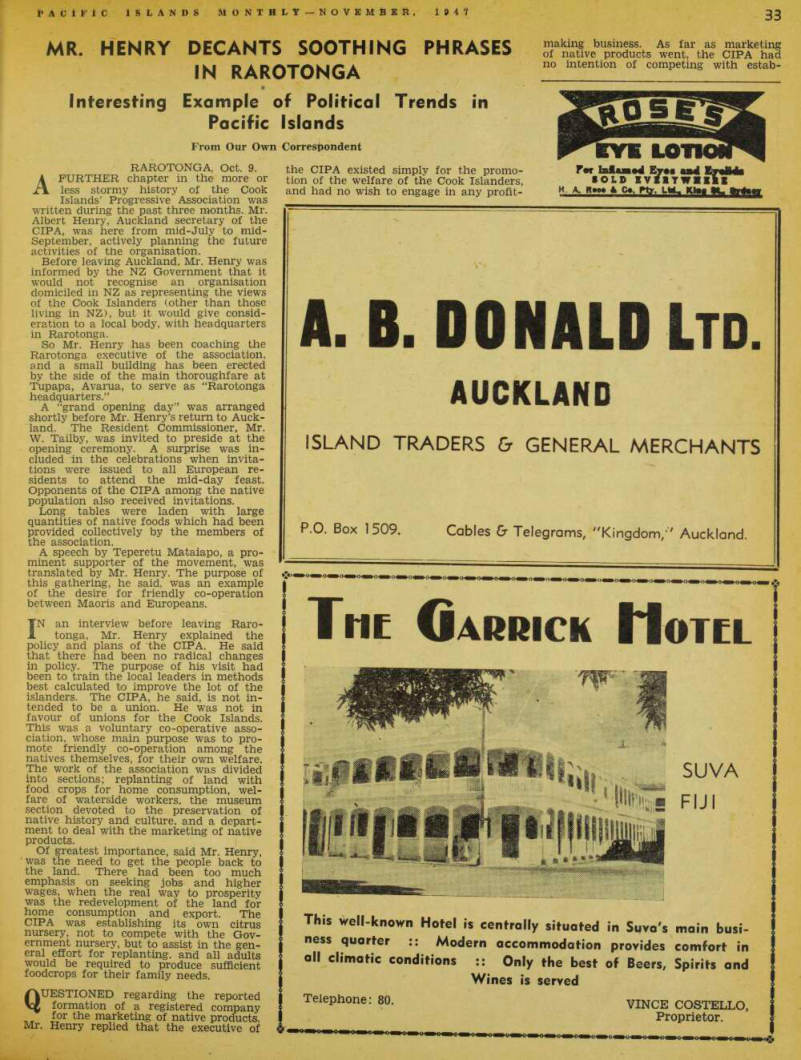

In Rarotonga
Interesting Example of Political Trends in Pacific Islands
From Our Own Correspondent
Rarotonga, Oct. 9.
A FURTHER chapter in the more or less stormy history of the Cook Islands’ Progressive Association was written during the past three months. Mr.
Albert Henry, Auckland secretary of the CIPA, was here from mid-July to mid- September, actively planning the future activities of the organisation.
Before leaving Auckland, Mr. Henry was informed by the NZ Government that it would not recognise an organisation domiciled in NZ as representing the views of the Cook Islanders (other than those living in NZ), but it would give consid eration to a local body, with headquarters in Rarotonga.
So Mr. Henry has been coaching the Rarotonga executive of the association, and a small building has been erected by the side of the main thoroughfare at Tupapa, Avarua, to serve as “Rarotonga headquarters,”
A “grand opening day” was arranged shortly before Mr. Henry’s return to Auck land. The Resident Commissioner, Mr.
W. Tailby, was invited to preside at the opening ceremony. A surprise was in cluded in the celebrations when invita tions were issued to all European re sidents to attend the mid-day feast.
Opponents of the CIPA among the native population also received invitations.
Long tables were laden with large quantities of native foods which had been provided collectively by the members of the association.
A speech by Teperetu Mataiapo, a pro minent supporter of the movement, was translated by Mr. Henry. The purpose of this gathering, he said, was an example of the desire for friendly co-operation between Maoris and Europeans.
IN an interview before leaving Raro tonga, Mr. Henry explained the policy and plans of the CIPA. He said that there had been no radical changes in policy. The purpose of his visit had been to train the local leaders in methods best calculated to improve the lot of the islanders. The CIPA, he said, is not in tended to be a union. He was not in favour of unions for the Cook Islands.
This was a voluntary co-operative asso ciation, whose main purpose was to pro mote friendly co-operation among the natives themselves, for their own welfare.
The work of the association was divided into sections; replanting of land with food crops for home consumption, wel fare of waterside workers, the museum section devoted to the preservation of native history and culture, and a depart ment to deal with the marketing of native products.
Of greatest importance, said Mr. Henry, was the need to get the people back to the land. There had been too much emphasis on seeking jobs and higher wages, when the real way to prosperity was the redevelopment of the land for home consumption and export. The CIPA was establishing its own citrus nursery, not to compete with the Gov ernment nursery, but to assist in the gen eral effort for replanting, and all adults would be required to produce sufficient foodcrops for their family needs.
QUESTIONED regarding the reported formation of a registered company for the marketing of native products, Mr. Henry replied that the executive of
the CIPA existed simply for the promo tion of the welfare of the Cook Islanders, and had no wish to engage in any profit
making business. As far as marketing of native products went, the CIPA had no intention of competing with estab
lished business in Rarotonga; but, in the case of any products in which local busi nesses are not interested, the CIPA would do its best to find a market and facilitate shipment in the interest of the producers.
In any case, the CIPA was a voluntary institution and the people would still be free to do business with whoever they pleased.
As an example, he said, he had in vestigated the possibility of marketing dried bananas and had actually secured a trial order for fifty tons, if they could be produced. Local concerns had shown no interest in dried bananas, so this was a new line that might be developed. (Mr. Henry is not quite correct here.
Local businessmen thoroughly investi gated the possibilities of dried bananas four years ago. There was a ready market for very large quantities, if they could be produced, but there was a lack of in terest by native growers).
Mr. Henry said there was no intention of establishing retail stores in Rarotonga, as this would be against their non-profit principles. They knew that it was not possible to run stores without making a profit. On the other hand, they would probably import a quantity of staple goods, so that the natives could obtain these essential commodities at only a small percentage above cost, to cover ex penses.
MR. HENRY was asked if J;here_was feny anti-European prejudice in the CIPA. He replied emphatically that there was none—it was fully appreciated that close co-operation between the two races was necessary for the future wel fare of the islands. Any Enropean was welcome to associate himself with the
Cipa.
It was pointed out to Mr. Henry that it had been difficult for the majority of Europeans to feel kindly disposed towards the CIPA on account of what had fre quently been referred to as “gangster” methods and apparent antagonism in dealing with Europeans generally.
Mr. Henry admitted that he had learned of many incidents of which he did not approve. They were not the result of directions from headquarters. Many mis takes in the past could be attributed to members of the crews of visiting NZ ships, who, mistaking the CIPA for a trade union had advised courses of action which sometimes had unfortunate results. Local enthusiasts, not always clear regarding procedure, had been over-zealous on occasion. This was the reason for his visit—to train local leaders in the best methods to promote friendly co-operation between all parties.
In a voluntary statement, Mr. Henry said: “Regarding this talk about Com munism—l am not a Communist and I do not even know much about Commun ism, I am actually a member of the NZ Labour Party. All I can say is that the Auckland Communist Party has been our best friend. We are prepared to accept help from anyone who is prepared to give it, and I have found the Auckland Com munists most sincere and helpful gentle men,”
Our Correspondent’S
Comments
IF Mr. Henry is sincere in his desire for friendly 90-operation, then he has been rather badly let down in the past by some of his local disciples.
Traders are sceptical of the “free-trade” theory, bearing in mind the matter of the “pu-pu.” A year or so back, when there was still a brisk demand for these strings of small sea-shells, the CIPA let it be known that all “pu-pu” should be brought to them for marketing. Traders reported that women customers furtively produced strings of “pu-pu” from the folds of their clothing, with the remark that they would get into trouble with the CIPA if it were known that they were offering them for sale.
It is well-known, also, that the CIPA is envious of the extensive trade that has been developed during the past year by a local firm for the heretofore worthless candlenuts.
During the past two years, this question of whether there is an anti-European tendency in Rarotonga has given us much concern. Europeans who have been resident in the group from 10 to 50 years say they have noticed no change of heart among 'their own particular circle of native acquaintances, and they share the opinion that if there is anti-Europeanism now, it is the result of propaganda.
We have heard such phrases as “Raro tonga for the Rarotongans”—“We want all Europeans out of the Cook Islands.”
There are, and always have been a few European-haters here. The Islanders have had good reason to dislike some few Europeans with whom they have had dealings. We ourselves have a hearty dislike for those individuals of our own race who “let us down.” On the other hand, there are many rational Maoris who agree that there are “good and bad Europeans as well as good and bad Maoris,” and leave it at that.
A tally of the permanent European re sidents of the Cook Islands reveals that an extraordinarily high percentage have Polynesian or part-Polynesian wives each
with a number of charming children. In practically all cases, these men are either the proprietors or managers of businesses or are Administration officials.
AN interesting aspect is that the cream of Rarotonga’s youth—especially females—are still leaving Rarotonga in increasing numbers to seek a per manent new life in New Zealand. The Exodus is limited only by the restricted shipping accommodation.
The majority are simply anxious to go to a white man’s country and become as “European” as possible. It is difficult to believe that it is the youth of the islands that desires “the islands for the islan ders.” Not on this particular island, any way In a recent discussion on what might happen if all Europeans were removed from the Cook Islands, it was suggested
that one could go to history for the an swer. Whatever good or bad influences the white brought, it is true that before their coming, life in these islands was one precarious round of bloody feuding and inter-tribal warfare. These hereditary feuds, rivalries and jealousies have never been forgotten—and there are intense new ones. If the islands reverted to the natives, the Rarotongans would be at each other’s throats before the last boatload of Europeans was over the horizon.
Worthy though it may be, there is not much hope for the CIPA dream of an all-embracing native co-operative society in the kind of happy island paradise never yet seen outside of Hollywood.
Editorial Note: Dump Him In
The Lagoon!
IF Mr. Henry is not a Communist —and one must accept his statement that he is not—he belongs politically to the even more undesirable and dangerous category of “fellow travellers”—that cock eyed class of post-war planners who pro fess friendship and admiration for Com munists.
Mr. Henry’s Rarotongan activities, and the statements with which he wound them up, have all the hallmarks of Com munist propaganda. We have here a great outpouring of soothing phrases, to cover up an effort to undermine and de stroy the old order, and wipe out in dividualism and private enterprise in favour of another system which leads surely towards totalitarianism. Gentle men of this type are busy to-day all over Asia and Africa, trying to stir up the coloured races against the Europeans, and all that Western Democracy stands for. Perhaps they are not Communists— but they surely carry the blessing of the Reds.
There can be no friendship between the good Britishers of Rarotonga (or any
where else) and wandering busybodies who describe Communists as “our best friends.” If the responsible people of Rarotonga had really understood what is going on in the world to-day they would have replied to Mr. Henry’s impudent invitation to a goodwill feast by dumping him into the nearest lagoon.
The world is moving rapidly to a final deadly struggle between Individualism and Totalitarianism, between personal freedom and State-directed slavery, be tween the community that is based on decent family life, and the community that is modelled on the antheap and fowlyard.
We dare not close our eyes to what is going on—if we do, we shall be caught unprepared by the Reds, and mankind easily then might go into another Dark Age. It is 25 years since I first saw these lines in a London newspaper; Satan, wishing to debase humanity, Crossed Lust with Greed, and Hate with Vanity; Mated their offspring, and thus brought to birth The Bolshie-Communist, the foulest breed on earth.
They seemed far-fetched then. To-day, they warn us of a deadly danger.
There can be no compromise with the Bolshie-Communist, or his tent-bearer, the “fellow traveller.” When he comes whispering around your peaceful Islands communities, don’t waste any time on him —dump him in the lagoon.—RWß.
Captain Orme Denny, at one time one of Guinea Airways most popular pilots on the New Guinea goldfields, and now occupying an executive position with Qantas Empire Airways, made a visit to his old flying haunts last month. He returned to Sydney by plane from Lae on October 16.
Advertisements & other items, pp. 37-41 (2 items)
A. B. Donald Ltd.
SJLO
EYE
LO Ft Iblui*4 Etm u
SOLD EVIITWKII
w L *- HIM m. m
A. B. DONALD Ltd.
AUCKLAND
ISLAND TRADERS & GENERAL MERCHANTS
P.O. Box 1509. Cables & Telegrams, "Kingdom, ' Auckland.
The Garrick Hotel
Ai ms* §
SUVA
FIJI
This well-known Hotel is centrally situated in Suva's main business quarter :: Modern accommodation provides comfort in all climatic conditions :: Only the best of Beers, Spirits and Wines is served Telephone: 80. VINCE COSTELLO, Proprietor.
Two Wonderful Gifts
THE "HOLD IT" DOOR
STOP AND SASH FASTENER
The ideal means to fix a half-open door in the position desired.
Security for pushing windows, cannot be opened from outside.
THE "NEW POCKET
HANDY"
A handy little instrument for 10 different uses. Samples posted to you for 2/6 each.
Retailer, ask for special offers at GOODE LYNES, 62 Swanston Street, MELBOURNE, C.l.
The Most Extensive Manufacturers in the British Empire of
RUBBER STAMPS.
INKS, STENCILS,
Marking Devices,
ACME STAMP PADS
OFFICE S STATIONERY SUPPLIES
1 r samm We also Manufacture & Supply a Complete Line of
LIMEWASHING AND
SPRAYING MACHINES
for all purposes.
Let us know your requirements and we will quote by return.
WRITE FOR OUR GENERAL CATALOGUE
Limewashing Machine
EXCELSIOR SUPPLY CO. PTY. LTD.
278 Post Office Place,
MELBOURNE, VIC.
HEAD OFFICE :
160 BROADWAY,
Formerly known as George St., West,
SYDNEY, N.S.W.
50 Victoria Street,
WELLINGTON, N.Z.
M V' % u rs
While OPERATING
ON AN OBSTRUCTION
the eye of a 19 /ears old
GIRL A SURGEON IN OSAKA
V (JAPAN) FOUND A SET OF
IO MINIATURE /
teeth
BRUSH ID DAILY/
is* fXA IN t* a is® A crocodile in a private zoo
TOWNSVILLE (QUEENSLAND) WONT
EAT UNTIL ITS OWNER CLEANS ITS
TEETH- WITH AN ORDINARY TOOTH-
BRUSH. KEEP VOUR TEETH SURO/CALtV
CLEAN ANTISEPTIC^
] KOLV/VOS
WHITENS YOUr/tEETH -
SWEETENS VOUR
BREATH.
/» ipjNOS l V'
lono a^%freo "
O gRUSd 15
allv°
nbbo. z
ffw&
Hiii
V 0 €)> K 47-24.
OPTICAL
PRESCRIPTIONS
Accurately and Faithfully Dispensed. (Quick Service by Air Mail) All inquiries promptly and courteously answered. Send me your Optical problems.
All Manner of Repairs Quickly Executed. Moderate Prices.
HAMILTON A. HUGHES,
Dispensing Optician. 30-32 Castlereagh St., Sydney.
Telephone . . . B 5950. (In Samuels Super Drug Store, opposite Hotel Australia.)
ESTABLISHED 1930
WILLIAM H. WATSON
RAROTONGA, COOK ISLANDS
Wholesale and Retail Trader
LICENSED STAMP DEALER
Agent For:—
BRITISH TRADERS' INSURANCE CO.
CORONA & L. C. SMITH TYPEWRITERS
KAISER & FRAZER MOTOR CARS
B.S.A. CYCLES AND MOTOR CYCLES
AMERICAN LEAD PENCIL CO.
WHITES AVIATION LTD.
Manufacturers of: FOOTWEAR ALL CLASSES SUITABLE FOR NATIVE TRADING . . . MO P. PRODUCTS, 'INCLUDING ROUND EAR-RING BLANKS AND BUITON BLANKS Exporter of: “Rarotonga” Hula-Skirts.
Sea-Shell Necklaces.
M.O.P. Jewellery.
Island Produce.
Cable Address; “Watson” Rarotonga Wholesale and Retail Inquiries Invited.
Prepared to Consider Agencies tor all Class of Goods.
Importer of: Textiles.
General Hardware.
Fancy Goods.
General Merchandise.
Bankers; Bank of New Zealand, Auckland.
0 ✓ FROM MOSQITITOFS. SVMIHIFS and OTIIFIC lIITIX, INSECTS s sC
LfP
IA ■
tp* u
m
cof* 0
<a* ft***
SS-S
V* C^r 5
U GHS <*SV* y :
rR° 0 U , ■*
IMS
e>s d<»n A*** go* >-° *o* 0 kJ ✓
WHAT IS
'SKETOFAX’ IS THE EFFECTIVE REPELLENT
FOR MOSQUTOES, SWhUIhS AND OTHER BITING INSECTS You will enjoy the mosquito-free evenings and nights that ‘Skelofax’ brings you . . . the happy carefree days hiking and picnicking in the hush without the irritating mosquito to spoil your pleasure . . . and the days at the waterside without the painful misery of sandfly Idles. Here at last is the repellent cream that will give you protection from these tiresome insects.
Sketofax is a fragrant, easily applied non-greasy cream, effective for many hours after application and most economical in use.
Apply before retiring at night or before setting forth for a day in the ‘outdoors’. Be sure you have your tube of ‘Skelofax’ handy at all times.
SKETOFAX
INSECT REPELLENT CREAM
CONTAINS D.M.P (DIMETHYL
SKETOFAX’
‘SKETOFAX’ is a
product of recent research and contains D.M.P. (DiMethyl Phthalate).
‘SKETOFAX’ has
passed the most exacting tests and exhaustive trials before being finallyissued to the public.
IDEAL FOR:
PICNICS HIKING
FISHING GARDENING
AND IN THE HOME
BRAND
AVAILABLE EVERYWHERE
IN TUBES SUITABLE FOR
HANDBAG OR POCKET
BURROUGHS WELLCOME & CO. PRODUCT
ft BURROUGHS WELLCOME J CO. (AUSTRALIA) LTD.
34
1947 tACIPIC ISLANDS MONTBLt
November,
No New Hotel For Suva
Suva. Oct. 27
AN hotel, to. cost a minimum of £lOO,OOO, was to have been built by Morris, Hedstrom, Ltd., at the corner of Rodwell and Robertson Roads (near Burns, Philp), Suva. It is learned now, however, that the plan has been dropped because the company has been unable to complete “arrangements re lating to certain details of the proposal” with the Government.
No further details are available from the company.
Mr. Pat Gilsen and his young son re cently returned to Port Moresby by air after a short visit to Brisbane, Queens land.
Another £3,000,000 For Her
Territories
Australian Bureaucrats Continue Their Fantastic Spending In the Islands
A DISSECTION of the Estimates of Revenue and Expenditure, presented to the Australian Parliament in September, shows that Australia this year is spending between £2,000,000 and £3,000,000 in her Pacific Territories— mostly Papua and New Guinea. The fol lowing figures are copied from the docu ment: — Grant towards expenses, in cluding native welfare, de velopment, war damage and reconstruction £2,350,000 Consolidation of laws of the Territories 18,250 Contribution towards Chair of Anthropology, University of Sydney 1.750 Grant wherewith to buy “Dis posals” equipment 30,000 School of Pacific Adminis tration 12.000 Cost of shipping .. .. 200,000 Payments on account of former Administrations 24,000 Clearing secondary growth on reopened plantations Library services • • 3,000 Restoration of land and roads 40,000 Native training and reconstruc tion in Papua and New Guinea 130,000 Making a total being spent directly within the Territories in current financial year of £2,909,000 But that is not the full account of what Australia is spending on her Pacific Islands Territories this year. The fol lowing items may be added: Payments to air-mail contractors £75,000 New Guinea civilian war pensions and education benefits 20,000
Contribution to cost of South .
Pacific Commission 30,000 Interest on old Papuan and New Guinea loans 8,390 Norfolk Island expenses 4,000 Cost of Department of External Territories 52,000 Subsidy to shipping and surface mail services 12,000 Total of Indirect’Costs £201,390 That makes a grand total of Australia’s expenditure on her Pacific Territories and interests in this current year of £3,110,390.
An examination of the same official documents shows that the startling figures we quoted in last issue (taken from the New Guinea Gazette), as the total of governmental expenditure in Papua and New Guinea in 1946-47 correctly presented the position. Some £2,000,000 of Australian taxpayers’ funds (over and above £600,000 raised by local taxation) were disbursed in the Terri tories in that year. The Canberra docu ment shows that most of it went away .under the following heads:— Restoration and re-establish ment expenses £500,000 War damage compensation to natives 200,000 Clearing secondary growth from plantations 10,060 Miscellaneous services 1,518,538 Shipping service 179,534 These items are so vaguely stated, and are scattered through so many divisions of the compilation, that any real critic ism of them is impossible.
That, of course, is the way it is planned.
The planners and the bureaucrats ride high in the saddle, spending Australian funds with a free and lavish hand, and there seems to be nothing the unfortun ate Australian tax payer can do about it.
Fiji Escapes Drastic
Import Cuts
Suva, Oct. 27
FIJI will not suffer such severe re strictions of imports, from the sterling area, as was feared when the currency and economic crisis first developed in Great Britain.
It has been officially announced that drastic restrictions will not be placed upon imports which are regarded as essential for the purpose of maintaining production (known in Fiji as ‘‘incentive goods”), provided that they originate in the sterling area.
At the same time, imports will be held down to the minimum of essential re quirements by the import licence system.
Mr Walter Edwin Vivish, whp was born’in London 83 years ago, died in Tahiti in October. He arrivedm Tahiti by the American brigantine Tahiti in 1885 and he had a large family. It is recalled that the ‘‘Tahiti,” loaded with Gilbertese, bound for Peruvian planta tions, turned turtle in a cyclone with heavy loss of life.
Advertisements & other items, p. 42 (1 item)
Thermometers
TIME-PIECES
REPAIRED
We employ a Fully Qualified
Staff and we are equipped to undertake repairs of
WATCHES CLOCKS
MARINE CHRONOMETERS
We undertake Locksmithing, Key-cutting, etc.
Any goods sent to us by post are attended to promptly and with » care.
NOEL LEVY
Victoria Parade, Suva, Fiji Phone 39. P.O. Box 88.
Cablegrams: “Noel,” Suva
NOW AVAILABLE WITHIN
SIX WEEKS OF ORDERING !
★ TELTHER MDIAL
THERMOMETERS
MANUFACTURERS TO: N.Z.
Railways, State Hydro and Public Works Depts., etc.
This British Company has modern equipped factory in the manufacture of all types Temperature Instruments. recently built a New Zealand for of Industrial Dial High Standard—Temperature Controlled Con- tact, Rigid Stem and Capillary Type Write for Thermometers, etc., etc., can now be details and manufactured ? n^!!,P a ‘( h^ d " lth ' leaflets. m SIX weeks of receipt ot order.
The
BRITISH TELTHERM Co. Ltd.
NEWMARKET. AUCKLAND.
NEW ZEALAND.
CABLES; TELTHERM NEWMARKET
408.
Two Years Ago On
Nauru
Few Remembered the Anniversary of the Reoccupation on September 14
(From the “Nauru Times”) NAURU, Sept. 20 NOT Many people remembered that last Sunday, September 14, was the second anniversary of the reoccupa tion of Nauru. That is not surprising, perhaps, because only a sprinkling of the Australians who landed that day now remain, and among the Nauruans, more than half the population was then away in Truk.
Some facts about the reoccupation may be of interest. The actual surrender of the Japs took place on September 13, aboard the frigate HMAS Diamantina which escorted the two vessels conveying occupation troops from Torokina in Bougainville. The surrender instrument was signed by Brigadier J. R. Stevenson, DSO, on behalf of the Allies, and Naval Capt. Soeda for the Japanese. Included in the party at the surrender table was the present Administrator of Nauru, Mr.
M. Ridgway and this writer.
The Union Jack was hoisted with full ceremony on the old golf course, on the afternoon of the 14th. A guard of honour consisting of naval and military troops and a squad of Gilbert and Ellice Island native police paraded for the oc casion. Most of the native and Chinese population witnessed the ceremony.
THE boat harbour was lined with cheering Chinese, Nauruans and Gilbertese as the reconnaissance party under Lt-Col. J. L. A. Kelly DSO, accompanied by army officers and Mr.
W. V. Bott, made their initial survey on the afternoon of the 13th. Before the landing barge reached the shore the party felt certain that there were no Europeans on the island, as the only person who Mr. Bott recognised in the throng awaiting them was Mr. Ma Nai Fai, the present Government Chinese interpreter.
The landing party excercised remark able control when they set foot on the shore. The stench was indescribable and before they could reach the joyful islanders they were covered from head to foot with swarms of flies.
AFTER exchanging greetings of wel come the party proceeded along the road in the direction of the canti lever. The scene of desolation was typi cal of a battle-field or a town that had been battered for two years, but one of the worst features was the incredible filth. The air reeked with the smell of human excreta which was stored in drums encountered every ten yards or so, and thousands of rotten pumpkins exuded a sickening odour. (The Japs using the collected excreta as manure were growing pumpkins as a staple food.) The medical officer with the party ex pressed fears of an epidemic among the occupation forces if stationed amid such surroundings.
One of the first actions of the force commander was to organise a hygiene squad. Japanese, under Australian guards, were armed with DDT sprays and the settlement area was thoroughly sprayed. J Preliminary investigations revealed that °J. seven Europeans who remained after the evacuation in 1942, five died on Nauru and the other two, the Rev fibers Kayser and Clivaz, had been sent to the Carolines.
Natives and Chinese reported that the former were executed after the first Allied raid on Nauru on March 25, 1943.
The Japanese, however, insisted the five Europeans were killed by a bomb which fell in their midst.
There were only 591 Nauruans on the island, as 1,202 of them had been sent to the Carolines in mid-1943. There were 166 Chinese and 837 Gilbertese.
The Japs who surrendered comprised 2,681 troops, and 1,054 Jap and Korean labourers.
Besides the persons already mentioned in this article, others who travelled with the occupation expedition and who are
still on Nauru are: Messrs. R. B. Kirk, E. Cameron, T. H. Cude, H. Town and K. L. Wells.
Advertisements & other items, p. 43 (1 item)
Finishes
Send us your orders for
DEVELOPING, PRINTING,
ENLARGING
We Sell Kodak Films and Supplies Wholesale and Retail.
Caine's Studios, Suva
P.O. Box 8. (Estab. 1904) ’Phone 68.
' ?/ V .. k. . f :: ■■ ' #iiiiif • , t v ;S'V''
Trop
Formulae
Every Berger finish must withstand lest after test to prove worthy of the Berger label , . , every product must satisfy the Berger technicians and chemists that it will meet the challenge of all climates from tropic heat to arctic cold.
'Sm&J
FINISHES
KEEP ON KEEPING ON!
Commonwealth Dept. Takes
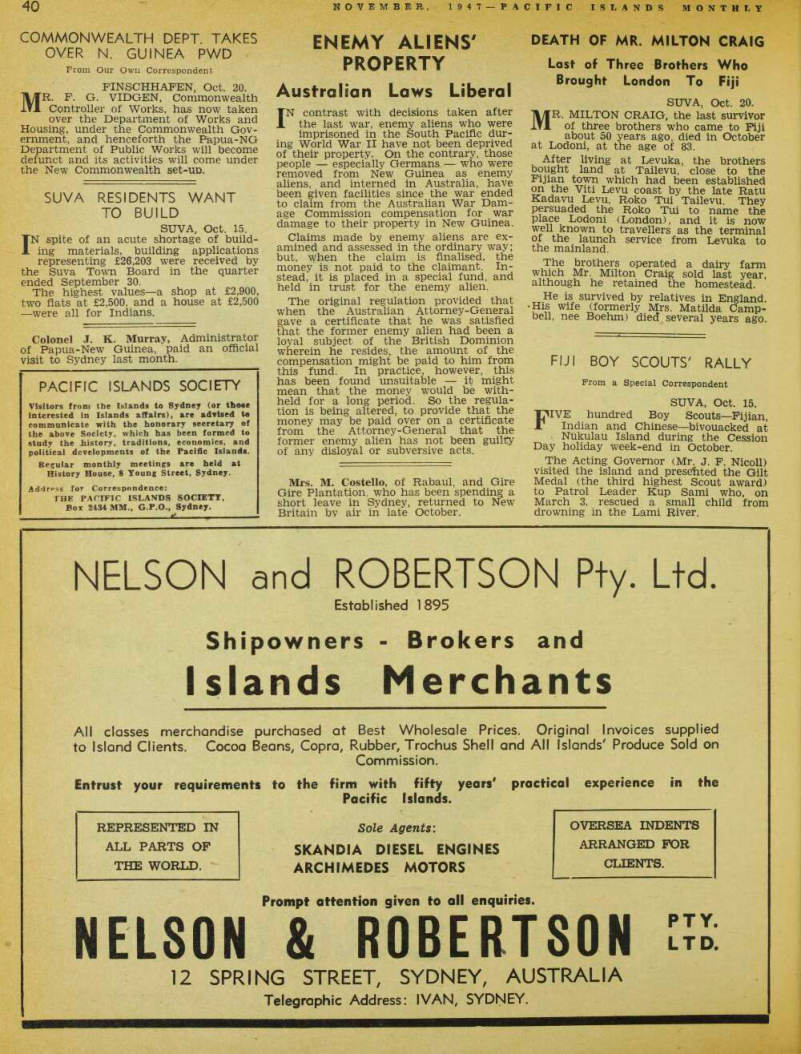
Over N. Guinea Pwd
From Our Own Correspondent
Finschhafen, Oct. 20.
MR. F. G. VIDGEN, Commonwealth Controller of Works, has now taken over the Department of Works and Housing, under the Commonwealth Gov ernment, and henceforth the Papua-NG Department of Public Works will become defunct and its activities will come under the New Commonwealth set-up.
Suva Residents Want
To Build
Suva, Oct. 15.
IN spite of an acute shortage of build ing materials, building applications representing £26,203 were received by the Suva Town Board in the quarter ended September 30.
The highest values —a shop at £2,900, two flats at £2,500, and a house at £2,500 —were all for Indians.
Colonel J. K. Murray, Administrator of Papua-New Guinea, paid an official visit to Sydney last month.
Enemy Aliens'
Property
Australian Laws Liberal
IN contrast with decisions taken after the last war, enemy aliens who were imprisoned in the South Pacific dur ing World War II have not been deprived of their property. On the contrary, those people especially Germans who were removed from New Guinea as enemy aliens, and interned in Australia, have been given facilities since the war ended to claim from the Australian War Dam age Commission compensation for war damage to their property in New Guinea.
Claims made by enemy aliens are ex amined and assessed in the ordinary way; but, when the claim is finalised, the money is not paid to the claimant. In stead, it is placed in a special fund, and held in trust for the enemy alien.
The original regulation provided that when the Australian Attorney-General gave a certificate that he was satisfied that the former enemy alien had been a loyal subject of the British Dominion wherein he resides, the amount of the compensation might be paid to him from this fund. In practice however, this has been found unsuitable it might mean that the money would be with held for a long period. So the regula tion is being altered, to provide that the money may be paid over on a certificate from the Attorney-General that the former enemy alien has not been guilty of any disloyal or subversive acts.
Mrs. M. Costello, of Rabaul, and Gire Gire Plantation, who has been spending a short leave in Sydney, returned to New Britain by air in late October.
Brought London To Fiji
Death Of Mr. Milton Craig
Last of Three Brothers Who Brought London To Fiji
Suva, Oct. 20.
MR. MILTON CRAIG, the last survivor of three brothers who came to Fiji about 50 years ago, died in October at Lodoni, at the age of 83.
After living at Levuka, the brothers bought land at Tailevu, close to the Fijian town which had been established on the Viti Levu coast by the late Ratu Kadavu Levu, Roko Tui Tailevu. They persuaded the Roko Tui to name the place Lodoni (London), and it is now well known to travellers as the terminal of the launch service from Levuka to the mainland.
The brothers operated a dairy farm which Mr. Milton Craig sold last year, although he retained the homestead.
He is survived by relatives in England. •His wife (formerly Mrs. Matilda Camp bell, nee Boehm) died several years ago.
Fiji Boy Scouts' Rally
From a Special Correspondent
Suva. Oct. 15.
FIVE hundred Boy Scouts—Fijian,
Indian and Chinese—bivouacked at Nukulau Island during the Cession Day holiday week-end in October.
The Acting Governor (Mr. J. F. Nicoll) visited the island and presented the Gilt Medal (the third highest Scout award) to Patrol Leader Kup Sami who, on March 3, rescued a small child from drowning in the Lami River.
Advertisements & other items, p. 44 (1 item)
Nelson & Robertson "I
PACIFIC ISLANDS SOCIETY
Visitors from the Islands to Sydney (or thooe interested in Islands affairs), are advised to communicate with the honorary secretary of the above Society, which has been formed to study the history, traditions, economics, and political developments of the Pacific Islands.
Regular monthly meetings are held at History House, 8 Young Street. Sydney.
Address for Correspondence:
THE PACIFIC ISLANDS SOCIETY,
Box 2434 MM„ G.P.0., Sydney.
NELSON and ROBERTSON Pty. Ltd.
Established 1895
Shipowners - Brokers and
Islands Merchants
All classes merchandise purchased at Best Wholesale Prices. Original Invoices supplied to Island Clients. Cocoa Beans, Copra, Rubber, Trochus Shell and All Islands' Produce Sold on Commission.
Entrust your requirements to the firm with fifty years' practical experience in the Pacific Islands.
Prompt attention given to all enquiries.
NELSON & ROBERTSON "I
12 SPRING STREET, SYDNEY, AUSTRALIA
Telegraphic Address: IVAN, SYDNEY.
N. Guinea Volunteer Rifles
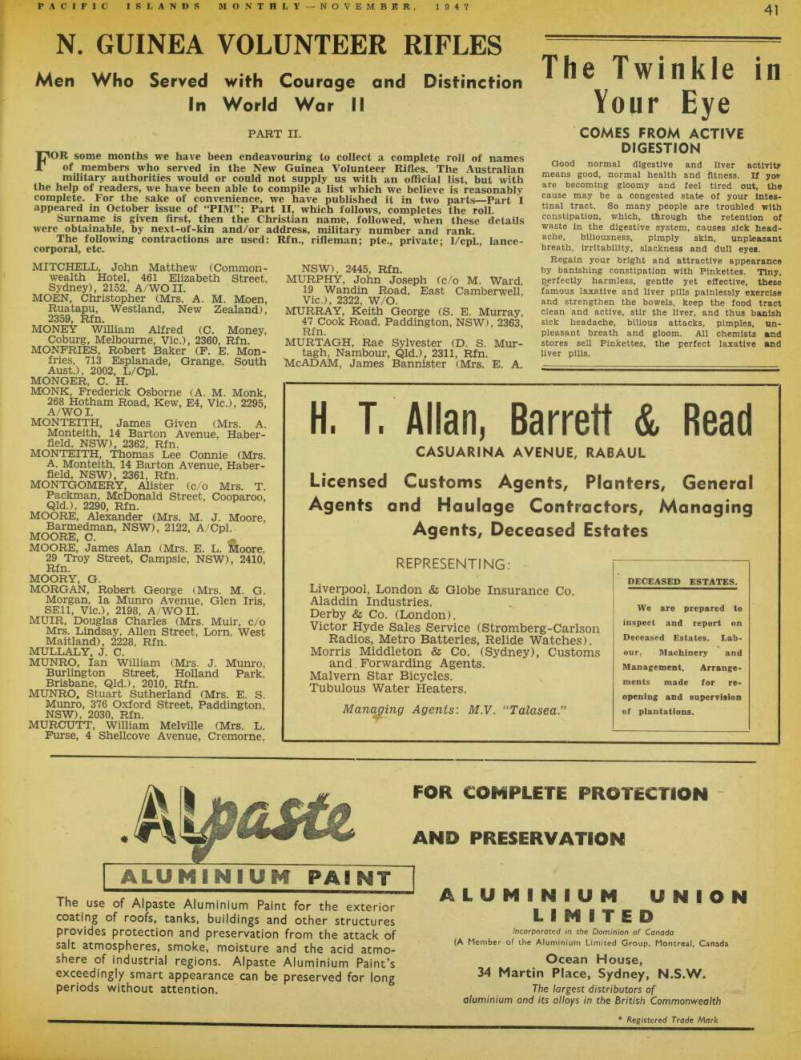
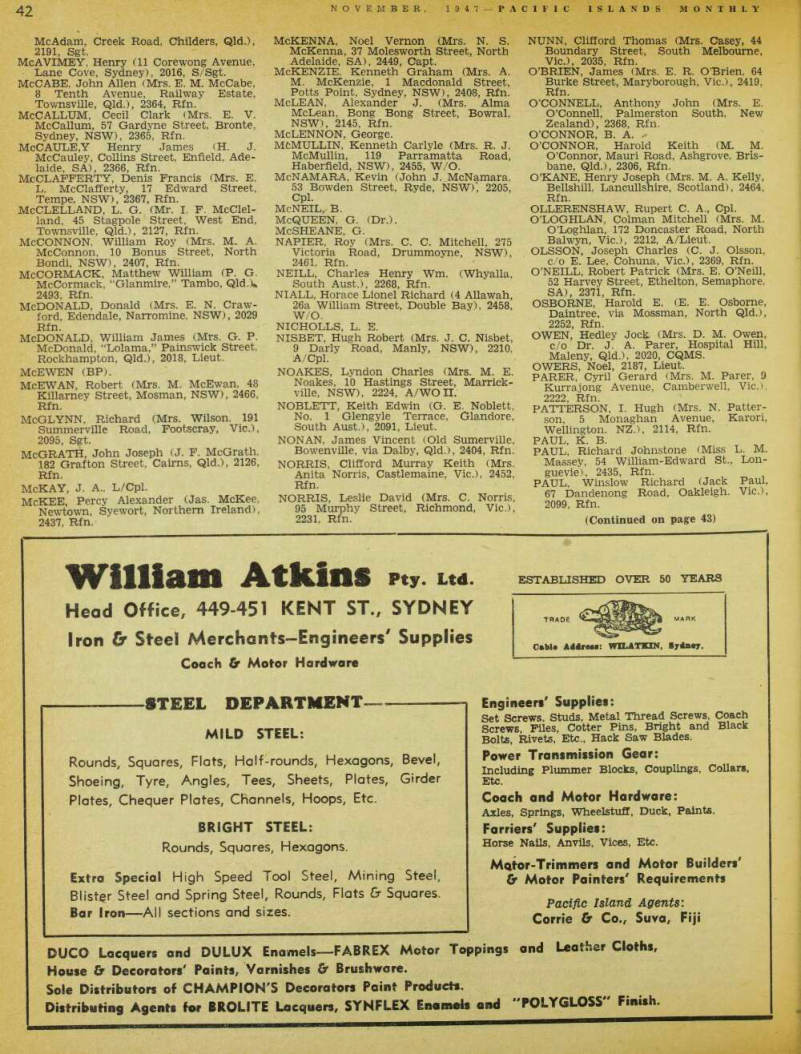
Men Who Served with Courage and Distinction In World War II
Part 11.
FOR some months we have been endeavouring to collect a complete roll of names of members who served in the New Guinea Volunteer Rifles. The Australian military authorities would or could not supply us with an official list, but with the help of readers, we have been able to compile a list which we believe is reasonably complete. For the sake of convenience, we have published it in two parts—Part I appeared in October issue of “PIM”; Part 11, which follows, completes the roll.
Surname is given first, then the Christian name, followed, when these details were obtainable, by next-of-kin and/or address, military number and rank.
The following contractions are used: Rfn., rifleman; pte., private; I/cpl., lance corporal, etc.
MITCHELL, John Matthew (Common wealth Hotel, 461 Elizabeth Street, Sydney), 2152, A/WOII.
MOEN, Christopher (Mrs. A. M. Moen, Ruatapu, Westland, New Zealand), 2359, Rfn.
MONEY William Alfred (C. Money, Coburg, Melbourne, Vic.), 2360, Rfn.
MONFRIES, Robert Baker (F. E. Mon fries, 713 Esplanade, Grange, South Aust.), 2002, L/Cpl.
Monger, C. H.
MONK, Frederick Osborne (A. M. Monk, 268 Hotham Road, Kew, E 4, Vic.), 2295,
A/Wo I.
MONTEITH, James Given (Mrs. A.
Monteith, 14 Barton Avenue, Haber field, NSW), 2362, Rfn.
MONTEITH, Thomas Lee Connie (Mrs.
A. Monteith, 14 Barton Avenue, Haber field, NSW), 2361, Rfn.
MONTGOMERY, Alister (c/o Mrs. T.
Packman, McDonald Street, Cooparoo, Qld,), 2290, Rfn.
MOORE, Alexander (Mrs. M. J. Moore, Barmedman, NSW), 2122, A/Cpl.
Moore, C. „
MOORE, James Alan (Mrs. E. L. Moore, 29 Troy Street, Campsie, NSW), 2410, Rfn.
Moory, G.
MORGAN, Robert George (Mrs. M. G.
Morgan, la Munro Avenue, Glen Iris,
Seii, Vic.), 2198, A/Woii.
MUIR, Douglas Charles (Mrs. Muir, c/o Mrs. Lindsay, Allen Street, Lorn, West Maitland), 2228, Rfn.
Mullaly, J. C.
MUNRO, lan William (Mrs. J. Munro, Burlington Street, Holland Park, Brisbane, Qld.), 2010, Rfn.
MUNRO, Stuart Sutherland (Mrs. E. S.
Munro, 376 Oxford Street, Paddington.
NSW), 2030, Rfn.
MURCUTT, William Melville (Mrs. L.
Furse, 4 Shellcove Avenue, Cremorne,
NSW), 2445, Rfn.
MURPHY, John Joseph (c/o M. Ward, 19 Wandin Road, East Camberwell, Vic.), 2322, W/O.
MURRAY, Keith George (S. E. Murray, 47 Cook Road, Paddington, NSW), 2363, Rfn.
MURTAGH, Rae Sylvester (D. S. Mur tagh, Nambour, Qld.), 2311, Rfn.
McADAM, James Bannister (Mrs. E. A.
McAdam, Creek Road, Childers, Qld.), 2191, Sgt.
McAVIMEY, Henry (11 Corewong Avenue, Lane Cove, Sydney), 2016, S/Sgt.
McCABE, John Allen (Mrs. E. M. McCabe, 8 Tenth Avenue, Railway Estate, Townsville, Qld.), 2364, Rfn.
McCALLUM, Cecil Clark (Mrs. E. V.
McCallum, 57 Gardyne Street, Bronte, Sydney, NSW), 2365, Rfn.
McCAULE.Y Henry James (H. J.
McCauley, Collins Street, Enfield, Ade laide, SA), 2366, Rfn.
McCLAFFERTY, Denis Francis (Mrs. E.
L. McClafferty, 17 Edward Street, Tempe, NSW), 2367, Rfn.
McClelland, L. G. (Mr. I. F. McClel land, 45 Stagpole Street, West End, Townsville, Qld.), 2127, Rfn.
McCONNON, William Roy (Mrs. M. A.
McConnon, 10 Bonus Street, North Bondi, NSW), 2407, Rfn.
McCORMACK, Matthew William (P. G.
McCormack, “Glanmire,” Tambo, Qld.)* 2493, Rfn.
MCDONALD, Donald (Mrs. E. N. Craw ford, Edendale, Narromine, NSW), 2029 Rfn.
McDonald, William James (Mrs. G. P.
McDonald, “Lolama,” Painswick Street, Rockhampton, Qld.), 2018, Lieut.
Mcewen (Bp).
McEWAN, Robert (Mrs. M. McEwan, 48 Killarney Street, Mosman, NSW), 2466, Rfn.
McGLYNN, Richard (Mrs. Wilson, 191 Summerville Road, Footscray, Vic.), 2095, Sgt.
McGRATH, John Joseph (J. F. McGrath, 182 Grafton Street, Cairns, Qld.), 2126, Rfn.
Mckay, J. A., L/Cpl.
McKEE, Percy Alexander (Jas. McKee, Newtown, Syewort, Northern Ireland), 2437, Rfn.
McKENNA, Noel Vernon (Mrs. N. S.
McKenna, 37 Molesworth Street, North Adelaide, SA), 2449, Capt.
McKENZIE, Kenneth Graham (Mrs. A.
M. McKenzie, 1 Macdonald Street, Potts Point, Sydney, NSW), 2408, Rfn.
McLEAN, Alexander J. (Mrs. Alma McLean, Bong Bong Street, Bowral, NSW), 2145, Rfn.
McLENNON, George.
MCMULLIN, Kenneth Carlyle (Mrs. R. J.
McMullin, 119 Parramatta Road, Haberfield, NSW), 2455, W/O.
McNAMARA, Kevin (John J. McNamara, 53 Bowden Street, Ryde, NSW)' 2205, Cpl.
Mcneil, B.
mcqueen, g. (Dr.).
Mcsheane, G.
NAPIER, Roy (Mrs. C. C. Mitchell, 275 Victoria Road, Drummoyne, NSW), 2461, Rfn.
NEILL, Charles Henry Wm. (Whyalla, South Aust.), 2268, Rfn.
NIALL, Horace Lionel Richard (4 Allawah, 26a William Street, Double Bay), 2458, W/O.
Nicholls, L. E.
NISBET, Hugh Robert (Mrs. J. C. Nisbet, 9 Darly Road, Manly, NSW), 2210, A/Cpl.
NOAKES, Lyndon Charles (Mrs. M. E.
Noakes, 10 Hastings Street, Marrick ville, NSW), 2224, A/WOII.
NOBLETT, Keith Edwin (G. E. Noblett, No. 1 Glengyle Terrace, Glandore, South Aust.), 2091, Lieut.
NONAN. James Vincent (Old Sumerville, Bowenville, via Dalby, Qld.), 2404, Rfn.
NORRIS, Clifford Murray Keith (Mrs.
Anita Norris, Castlemaine, Vic.), 2452, Rfn.
NORRIS, Leslie David (Mrs. C. Norris, 95 Murphy Street, Richmond, Vic.), 2231, Rfn.
NUNN, Clifford Thomas (Mrs. Casey, 44 Boundary Street, South Melbourne, Vic.), 2035, Rfn.
O’BRIEN, James (Mrs. E. R. O’Brien, 64 Burke Street, Maryborough, Vic.), 2419, Rfn.
O’CONNELL, Anthony John (Mrs. E.
O’Connell, Palmerston South, New Zealand), 2368, Rfn.
O’Connor, B. A.
O’CONNOR, Harold Keith (M. M.
O’Connor, Mauri Road, Ashgrove, Bris bane, Qld.), 2306, Rfn.
O’KANE, Henry Joseph (Mrs. M. A. Kelly, Bellshill, Lancullshire, Scotland), 2464, Rfn.
OLLERENSHAW, Rupert C. A., Cpl.
O’LOGHLAN, Colman Mitchell (Mrs. M.
O’Loghlan, 172 Doncaster Road, North Balwyn, Vic.), 2212, A/Lieut.
OLSSON, Joseph Charles (C. J. Olsson, c/o E. Lee, Cohuna, Vic.), 2369, Rfn.
O’NEILL, Robert Patrick (Mrs. E. O’Neill, 52 Harvey Street, Ethelton, Semaphore, SA), 2371, Rfn.
OSBORNE, Harold E. (E. E. Osborne, Daintree. via Mossman, North Qld.), 2252, Rfn.
OWEN, Hedley Jock (Mrs. D. M. Owen, c/o Dr. J. A. Parer, Hospital Hill, Maleny, Qld.), 2020, CQMS.
OWERS, Noel, 2187, Lieut.
PARER, Cyril Gerard (Mrs. M. Parer, 9 Kurrajong Avenue, Camberwell, Vic.), 2222, Rfn.
PATTERSON, I. Hugh (Mrs. N. Patter son, 5 Monaghan Avenue, Karori, Wellington. NZ.), 2114, Rfn.
Paul, K. B.
PAUL, Richard Johnstone (Miss L. M.
Massey, 54 William-Edward St., Lon guevie), 2435, Rfn.
PAUL, Winslow Richard (Jack Paul, 67 Dandenong Road, Oakleigh. Vic.), 2099, Rfn.
(Continued on page 43)
PAULEY, Albert Edward (T. J. Pauley, St. Bathans, New Zealand), 2370, Rfn.
PEARCE, Hedley Henson (Mrs. S. K.
Pearce, 18 Mcllwrick Street, Windsor.
Vic.), 2469, Rfn.
Pearson, V. F.
PEDDIE, Bryce, 2444, Rfn.
PENGLASE, Nicholas (c/- V. C. Hayden, 27 Carlingford Road, Epping. NSW), 2456, W/O.
PERCY, John Graham (Mrs. E. Percy, 15 Ainslee Street, Kingsford, NSW), 2153 Rfn
Perichon, L. J.
PETERS, Edgar William (5 St. Albans, 84 Drumalbyn Road, Bellevue Hill, Sydney.)
Peterson, J.
PHILIP, Frederick (68a Pittwater Street, Paddington, NSW), 2024, Rfn.
PHILLIPS, R. H. D. (Mrs. J. K. Philips, 28 Gould Avenue, Petersham, NSW), 2296, Lieut.
Phillpott, W. H.
r M B
Pickering, M B.
PIKE, Thomas Edward (S. Pike, Kemp sey, NSW), 2411, Rfn.
PIPER, Percy Victor (Mrs. L. E. Piper, Fitzroy, Street, Abbotsford, NSW), 2089, Rfn.
PLUMMER, H. 0., Sergeant.
POLAND, John McEvoy (Mrs. M.
Poland, 227 Crawford Road, Inglewood, WA.), 2373, Rfn.
POLAND, Leo Daniel (Mrs. M. Poland, 37 Carlisle Street, Rose Bay, NSW), 2374, Rfn.
POLLARD, Walter Thomas (Mrs. N. M.
Pollard, 45 Drummond Street, Belmore, NSW), 2375, Rfn.
POWER, Leonard Aubrey (R. B. Power, 21 Clissold Street, Ashfield, NSW), 2376, Rfn.
PLUMB, Reginald Wesley (17 Talimba Flats, 29 Prince Street, Randwick, NSW), 2021, Lieut.
Pollard, L. J., Sgt.
POWELL, Terrence James Bennett (Mrs.
T. J. Powell, 78 Wagner Road, Clay field, Brisbane, Qld.), 2149, Cpl.
PRIEBE, John N., 2283, Rfn.
PRIEBE, Oscar Edmund, 2273, Sgt.
PRYKE, Leo Brandon (Mrs. W. A.
Pryke, 57 York Roatl, Bondi Junction, NSW), 2256, Rfn.
PURCELL, Francis J. (Mrs, C. A. M.
Purcell, 208 The Gordon, 117 Macleay Street, Potts Point, NSW), 2085, Cpl.
PURVES, John George (Mrs. Darrel Purves. Bellingen, North Coast, NSW), 2048, Rfn.
RANKIN (Govt. Stores).
RAIN, Keith (Mrs. Nance Rain, c/- Mrs.
D. Kirkwood, Elwood Road, Ashgrove, Qld.), 2175, Rfn.
RAYNER. Garth Richard (F. R. Rayner, 10 Wilona Avenue, North Sydney), 2047, A/Cpl.
REALY, Thomas J. (Box 191, P. 0., Bowen, Qld.), 2254, Rfn.
REASON, Charles Alfred, 2174, Rfn.
REID. John, 2083, Rfn.
Renton, A.
RENTON, G. (Snr.), Armourer Sgt.
Renton. G. (Jnr.).
Reynolds, J. A.
Reynolds, R.
RICH, Percy Simon (Mrs. D. M. Rich, 119 James Street, Leichhardt, NSW), 2101, L/Cpl.
RICHARDSON, Ivor Sidney Murray (Mrs. B. V. Richardson. 10 Ivanhoe Street. Marrickville. NSW). 2292, Rfn.
ROBERTS, Pat (Mrs. I. Roberts, Northam. Western Aust.), 2377, Rfn.
ROBERTSON, Gilbert Stuart (Mrs. E. A.
Robertson, 7 Ashfield Street, Sandy Bav. Hobart. Tasmania), 2243, A/Sgt.
ROBINS. G. T. (W. Robins, Lae), 98, Rfn.
ROBINSON. A. L. , , „ .
RONDAL. Forrest (D. F. Rondal, Mam Road, Anpin. NSW), 2107, Rfn.
ROSE, Frederick George (Mrs. Lorna Rose. 12 Beach Street, Balgowlah, Svdnev. NSW), 2105, Sgt.
Ross. H.
Rowe, H. H.. 2312. Rfn.
Rowe. W. M.. 2309, Rfn.
ROWLANDS. Edward Walden (D. H.
Rowlands, Watsonville, Nth.), 2499.
Rftl. . „ ROWSE. John William (Mrs. A. Rowse. c /_ Mrs. J. Campbell. 13 Duntroon Street. Nelson Park. Sydney), 2378, Rfn.
RUSH. Thomas William, 2288. Rfn.
RUSSELL. Gordon (Mrs. Cecily Russell, c/- Miss O’Brien, “Lumeah”. 70 Wame Street, Willington, New Zealand, 2167.
Sgt.
Ryan. A. M.. Cpl.
RYAN F. W. (Schoolteacher).
RYANi Leo P. (Timothy Ryan 27 Char lotta Street, Richmond, Vic.), 2263.
SAKER, Ron Arnold (Mrs. F M. Saker, 126 Benboyd Road, Neutral Bay, NSW), 2060, L/Cpl.
Sanders, E. H., 2178, Rfn.
(Continued on Page 54)
SAUNDERS, Lionel C.
SAVAGE, James (Mrs. G. B. Savage, Tamworth, NSW), 2379, Rfn.
Seale, H. P.
SCHARKE, E. G. (T. J. Scharke, c - Mrs. McKenzie, Angoston, South Aust.), 2480, Rfn.
Schmidt, A.
SCHULTZ, Mark (Mrs. Hilda Schultz, 47 Fifteenth Avenue, Hull, England), 2500, Rfn.
SCOTT, John Harcourt (J. C. Scott, 14 Murray Street, Bronte, Sydney), 2046, Rfn.
SEE TO ON (c/- New Guinea Trade Agents, Sydney), 2496, Rfn.
SHANAHAN, Thomas Joseph (Mrs. M. J.
Shanahan, 23 Beach Road, Bondi, NSW), 2139, Rfn.
SHAND, Francis H. Werner (Mrs. G. M.
Shand, c/- Mrs. L. M. Grant, 46 Lind say Street, Ashgrove, Qld.), 2481, Rfn.
SHARP, Alfred (Mrs. G. Sharp, 424 McCauley Street, Albany, NSW), 2303, Rfn.
SHAW, Frank Reginald (Mrs. H. M.
Shaw, 6 Oxford Street, Merrylands, NSW), 2159, Pte.
SHAW, John Arthur (Mrs. R. E. Shaw, Lamington, South Qld.), 2236, Rfn.
SHAY, John Charles (Mrs. Margaret Shay, 403 Annerley Road, Annerley, Brisbane, Qld.), 2068, Rfn.
SHEATH, Abel Richmond (Mrs. E.
Sheath, 56 Cameron Street, Bexley, NSW). 2380, Rfn.
SHERRINGHAM. John Alfred (Mrs., K.
Sherringham, 15, Rose Street, Annan dale. NSW), 2109, Cpl.
SHERRINGHAM, Wright (W. Sherring ham. c/- Police Station, Burwood, NSW), 2400, Rfn.
SHERRY, John Joseph (Mrs. Helene Sherry, 378 Liverpool Road, Ashfield, NSW), 2484, Rfn.
SHERWIN, Vernon Henry (Mrs. M. R.
Sherwin, 32 Kentora Avenue, Prospect North Adelaide), 2199, Capt.
Shoobridge, Ivan.
SHUI HONG, 2448, Lieut.
SHUTT, H. M. (Mrs. R. Shutt, 157 Gale Road, Maroubra, NSW), 2230, Rfn.
SHUTT, Leslie (Mrs. Marjorie Shutt, 157 Gale Road, Maroubra, NSW), 2134, Rfn.
Simms, E. C. 2313, Rfn.
SIMMONS, Albert Tapley (Mrs. B. T.
Simmons, c/- Head Office, Bank of New South Wales, Sydney), 2118, Lieut.
SIMPSON, John Drysdale (Mrs. C. S.
Simpson, c/- Mrs. J. Walsh, 8 Archer Street, Newtown, Hobart, Tas.), 2075, Lieut.
SIMPSON, Victor Francis (Mrs. M.
Simpson, 161 Falcon Street, North Syd ney), 2381, Rfn.
SIMPSON, Warren Hasting (W. H.
Simpson, 15 Lone Pine Parade, Matra- Ville), 2415, Rfn.
SINGLE, Henry Vallach (A. W. V.
Single, Boonaldoon, via Mudgee, NSW), 2317, Rfn.
SKELLEY, Edwin James (E. H. Skelley, 105 Tulley Street, Townsville, Qld.), 2382, Rfn.
Skillen, R. W.
SKINNER, J. B. (not attested), 2299, Rfn.
SKITCH, A. F. (Chas. E. Skitch, Murray Bridge, South Aust.), 2170, Pte.
SLEE, Ernest John (c/- Post Office, Toogoolawa), 2078, Rfn.
SMART, Angus Arthur (Mrs. Anne Smart, Milton, NSW), 2034, Rfn.
SMITH, Clifford Henry (Mrs. E. M. Smith, No. 2 Flat, 184 Birrell Street, Waverley,
Nsw), 2383, W/011.
SMITH, Errol James (A. Smith c/- Miss E. Martin, 67 Clarence Street, Sydney, NSW), 2384, Rfn.
SMITH, Frank.
Smith, J. W.
SMITH, Roland, A. (A. E. Smith, 35 Hunt Street, Anderson’s Bay, Dunedin, New Zealand), 2058, Rfn.
SPENCE, Edward (Mrs. E. Spence, 110 Payton Avenue, Punchbowl, NSW), 2135, Cpl.
Spensley, G. W.
STANBURY, Richard Norman (Mrs. M.
L. Stanbury, 260 Branstone Terrace, Harston, Brisbane, Qld.), 2253, Rfn.
STASINOWSKY, Lawrence Victor (Mrs.
A. C. Stasinowsky, Tarrington, via Hamilton, Vic.), 2316, Rfn.
STEWART, Alistair M. (Mrs. J. Stewart, c/- Mrs. J. Axon, Racecourse, Sugar mill, Mackay, Qld.), 2439, Rfn.
Stewart, G. D.
STEWART, Selwyn (Mrs. E. H. Stewart, Nimbin, via Lismore, NSW), 2385, Rfn.
STILL, Frederick Neville (Mrs. J. Still, 19 Edgar Street, ,'Chatswood, NSW), 2386, Rfn.
Stokie, J.
STRACHAN, Allan (Mrs. R. Macgregor, 6-8 Macleay Gardens, Potts Point, Sydney, NSW), 2165, Rfn.
Strathearn, A. J.
Street, J. L.
Strong, H.
STRONG, Henry Beverly (47 Reisling Street. Corowa, NSW), 2310, Rfn.
SULLIVAN, James Francis (Miss J. Sul livan, 120 Oxford Street, Sydney), 2387, Rfn.
Sully. V. H., Sgt.
SUTHERLAND, Alexander John (Mrs.
M. L. Sutherland, 907 Dana Street, Ballarat, Victoria), 2033, Lieut.
SUTHERLAND, George Attchinson, 2486, Rfn.
SUTTON, Ronald Hasting (41 Musgrave Street, Mosman, NSW), 2031, Cpl.
SWANSON, Melville Charles (N. C.
Swanson, Misima, Papua), 2422, Rfn.
SWANSON, Peter Munro (Mrs. P, Swanson Jr., 61 Curtis Road, Balmain, NSW), 2206, Rfn.
Tait, R.
TANNUS, Joseph (Peter Tannus, Madang, TNG), 2431, Rfn.
TAYLOR, Ronald (E. A. Taylor, c/- Mrs.
B .Plate, Box 8, Georgetown, via Cairns, Qld.), 2026, L/Cpl.
Taylour, H.
THAI, Chan Kim, 2428, Rfn.
THOMAS, John Richards (Mrs. D. A.
Thomas, Semaphore, South Aust.), 2182, Rfn.
THORNELY, Ernest Alexander (Mrs. I.
A. Thornely, 21 Brighton Road, St.
Kilda, Vic.), 2124, Ffn.
Thornwaite, R. G., Cpl.
THWAITES, Lindsay Ernest (Mrs. L. E.
Thwaites, Camberwell, Vic.), 2184, L./Cpl.
TIEMAN, Eric (Mrs. G. S. Tieman, 20 Flood Street, Clovelly, Sydney), 2475, Rfn.
TINNION, William John (Mrs. L. Poland, 37 Carlisle Street, Rose Bay, NSW), 2154, Rfn.
Tracy, Leo.
TREGALLIS, John R. (W. H. Tregallis, 143 North Road, Elsternwick, Vic.), 2132, Rfn.
TREMBATH, Albert Wilbur (A. W.
Trembath, Dentist, Townsville, Qld.), 2118, Capt.
TROJAOLA, Francisco (F. Trojaola, Alava, Aramayome, Spain), 2388, Rfn.
TUCKEY, George Charlton (Mrs. P. K.
Tuckey, 34 Dawson Street, Croydon, NSW), 2247, Cpl.
TUCKEY, Philip Ambrose (Mrs. C. H.
Tuckey, “Ashton”, Valley Road, Spring wood, NSW), 2242, Lieut.
TURNER, Victor Alexander, 2502, Rfn.
Umphellby, D.
VAGG, Alan George (Mrs. H. D. Vagg, 87 High Street, Prahran, Vic.), 2146, Lieut.
VANDENBERG, Richard Henry (J. W.
Vandenberg, Castlereagh Street, Syd ney, NSW), 2054 L/Sgt.
VEAL, Alfred Martin Hosking (Mrs. I. C.
Veal, Geelong Road, Footscray, Vic.), 2248, L./Cpl.
VENNING, Frank.
VERNON, Richard Edward (R. E. Ver non, Cardwell, Queensland), 2003, Rfn.
VERNON, William Bailey (Mrs. D. D.
Vernon, 351 Arden Street, Coogee, NSW), 2141, Rfn.
VICKERY, Frank Tiplin (Mrs. D. M.
Vickery, c/- A. Discher, 41 Charles Street, Innisfail, Queensland), 2412, Rfn.
WAKEFIELD, Donald A. (Mrs. M. B.
Wakefield, 25 Bargery Avenue, Home bush, NSW), 2389, Rfn.
WALES, A. Baden (Mrs. S. Hawkins, Leitchville, Vic.), 2049, Rfn.
WALES, Hector Rankin (Mrs. H. R.
Wales 1 Dainsbury, Newcastle Street, Rose Bay, NSW), 2260, Rfn.
WALKER, Garth.
WALKER, Raymond Frederick Wallace (Victoria Avenue, Chelmer, Brisbane, Qld.), 2104, Rfn.
WALLACE, Leslie (Mrs. L. A. Wallace, 87 Banna Avenue, Gfiffith, NSW), 2472, Rfn.
WALLACE. William, 2488, Rfn.
Walsh. T. R.
Walter, H. W.
Warrick. M. J., L./Cpl.
WASHINGTON, George (H. J. Wash ington, Kabaira Plantation, Rabaul), 2297,* Rfn.
Watch, N. B. (Dr), Maj.
Waterman, F. A.
WATSON, Robert F, (45 Messiter Street, Campsie, NSW), 2079, Sgt.
Wayne, R. N.
WEIDENHOFER, Ray Thistleton Mrs.
J. G. Weidenhofer, 331 Argyle Street, Hobart, Tas.), 2181, Rfn.
WEST, Jack, 2164, Rfn.
WETTIG, Norman Albert (A. S. Wettig, 38 Flood Street, Bondi, NSW), 2438, Rfn.
WHARTON, George Horace (Miss Eliz.
Wharton, 11a Boanville Avenue,
Vaucluse, NSW), 2036, Rfn.
WHELAN, Ivan Edmund (F, J. Whelan, c/- Hotel Grand Central, Clarence Street, Sydney, NSW), 2038, Rfn.
Whitbread, R. C. S., L./Cpl.
WILSON, Charles (Mrs. C. A. Wilson, Esperance, Western Aust.), 2391, Rfn.
WHITE, Francis Joseph (Mrs. Iris M.
White, 50 Nelson Street, Sandringham, Vic.), 2087, Cpl.
WHITE, Geoffrey John (N. H. White, Slate Creek, NSW), 2390, Rfn.
WHITE, Sydney Wilfred (Alfred Noah White, Biggenden, Qld.), 2050, Rfn.
WHITTAKER, George K. (Mrs. S. K.
Whittaker, 55 Perry Street, North Bundaberg, Qld.), 2270, A/WOII.
WHOLEY, John Patrick (Mrs. Lilian Wholey, 11 Drane Street, Clayfield, Brisbane, Qld.), 2320, Rfn.
WHYTE, Robert (Mrs. F. A. Whyte, “Chipchase”, Greenwich Road, Green wich, NSW), 2043, Sgt.
WILKINS, W. J. (Mrs. M. M. Wilkins, Queensland Hotel, Barmedman, NSW), 2302, Rfn.
WILLIS, Frank Paxton (Mrs. Emma Willis, 59 Spit Road, Mosman, NSW), 2009, Rfn.
WILTON, John (Mrs. M. M. Wilton, 157 Gale Road, Maroubra, Sydney, NSW), 2073, Rfn.
WOOD, Alan Maxwell (Mrs. A. M. Wood, 8 Garden Street, Essendon, Victoria), 2155, L./Cpl.
WOOD, Davis (Mrs. S. M. Wood, 80 Campbell Street, Rockhampton, Qld.), 2213, A./Sgt.
WOOD, Eric Percy (Mrs. M. A. Wood, 118 Charlton Road, Newmarket, New Zealand), 2503, Rfn.
WOOD, Frederick Victor, 2223, Rfn.
WOOD. Raymond E., 2324, Rfn.
WOODHILL, Philip (Died in the AIF).
WOODMAN, Keith Roy (Mrs. G. E.
Woodman, 24 Beach Street, Coogee, NSW), 2240, Sgt.
WOODS, Charles C., 2308, Rfn.
WOOLLEY, John M. (Mrs. E. Woolley, 79 Spence Street, Cairns, Qld.), 2051, Rfn.
WRIGHT, James L. (Mrs. M. Wright, 92 Macleay Street, Potts Point, NSW), 2207, L./Cpl.
Yarrington, W.
Youlden, R. M.
ZACHER, Arthur Frederick (E. G.
Zacher, Balaclava, South Aust.), 2487, Rfn.
ZIEGELER, Desmond John (c/- A.
Ziegeler, Lithgow News, Portland.
NSW), 2007, Rfn.
ZOFFMAN, Thomas (Mrs. B. N. Zoff man, c/- Post Office, Taralga, via Goulburn, NSW), 2413, A./Sgt.
Bishop Cranswick, chairman of the Australian Board of Missions, accom panied by Cannon Warren, arrived in Brisbane recently from Sydney. They travelled overland by utility truck, carry mg materia! for the 68 ft. 6 in. mission boat, “McLaren King,” which is being built at Bulimba (Brisbane). Cannon Warren, who has a master’s certificate, will pilot the boat when she leaves for Papua, and a native crew from the Torres Straits or Papua will man it. On arrival at Samarai, the “McLaren King” will be handed over to the New Guinea Mission. It is expected that the boat will leave Brisbane about the end of February next.
The Rev. W. Green, of the Methodist Mission, Fiji, has completed a term of 10 years’ service in the Colony. With Mrs. Green and their family he will re turn to New Zealand at the end of this year. A number of farewell parties have already been given in their honour.
Advertisements & other items, pp. 45-48 (1 item)
H. T. Allan, Barrett & Read
The Twinkle in
Your Eye
COMES FROM ACTIVE
DIGESTION
Good normal digestive and liver activity means good, normal health and fitness. If yov are becoming gloomy and feel tired out, the cause may be a congested state of your intestinal tract. So many people are troubled with constipation, which, through the retention of waste in the digestive system, causes sick headache, biliousness, pimply skin, unpleasant breath, irritability, slackness and dull eyes.
Regain your bright and attractive appearance by banishing constipation with Plnkettes. Tiny, perfectly harmless, gentle yet effective, these famous laxative and liver pills painlessly exercise and strengthen the bowels, keep the food tract clean and active, stir the liver, and thus banish sick headache, bilious attacks, pimples, unpleasant breath and gloom. All chemists and stores sell Pinkettes, the perfect laxative and liver pills.
H. T. Allan, Barrett & Read
CASUARINA AVENUE, RABAUL
Licensed Customs Agents, Planters, General
Agents and Haulage Contractors, Managing
Agents, Deceased Estates
REPRESENTING:
Liverpool, London & Globe Insurance Co.
Aladdin Industries.
Derby & Co. (London).
Victor Hyde Sales Service (Stromberg-Carlson Radios, Metro Batteries, Relide Watches).
Morris Middleton & Co. (Sydney), Customs and. Forwarding Agents.
Malvern Star Bicycles.
Tubulous Water Heaters.
Managing Agents : M.V. “Talasea”
DECEASED ESTATES.
We are prepared to inspect and report on Deceased Estates. Labour, Machinery and Management. Arrangements made for reopening and supervision of plantations.
ALU MINIUM PAI NT
The use of Alpaste Aluminium Paint for the exterior coating of roofs, tanks, buildings and other structures provides protection and preservation from the attack of salt atmospheres, smoke, moisture and the acid atmoshere of industrial regions. Alpaste Aluminium Paint’s exceedingly smart appearance can be preserved for long periods without attention.
FOR COMPLETE PROTECTION
AND PRESERVATION
ALUMINIUM UNION
LIMITED
Incorporated in the Dominion of Canada (A Member of the Aluminium Limited Group, Montreal, Canada Ocean House, 34 Martin Place, Sydney, N.S.W.
The largest distributors of aluminium and its alloys in the British Commonwealth * Registered Trade Mark
William Atkins p* y . Ltd.
Head Office, 449-451 KENT ST., SYDNEY
Iron & Steel Merchants-Engineers' Supplies
Coach & Motor Hardware
ESTABLISHED OVER 50 YEARS
TRADE MARK
Cable Address: WTLATK3N, Sydney.
—STEEL DEPARTMENT——
MILD STEEL:
Rounds, Squares, Flats, Half-rounds, Hexagons, Bevel, Shoeing, Tyre, Angles, Tees, Sheets, Plates, Girder Plates, Chequer Plates, Channels, Hoops, Etc.
BRIGHT STEEL:
Rounds, Squares, Hexagons.
Extra Special High Speed Tool Steel, Mining Steel, Blister Steel and Spring Steel, Rounds, Flats & Squares.
Bar Iron— All sections and sizes.
Engineers' Supplies:
Set Screws. Studs, Metal Thread Screws, Coach Screws, Files, Cotter Pins, Bright and Black Bolts, Rivets, Etc., Hack Saw Blades.
Power Transmission Gear: Including Plummer Blocks, Couplings, Collars, Etc.
Coach and Motor Hardware: Axles, Springs, Wheelstufl, Duck, Paints.
Farriers' Supplies: Horse Nails, Anvils, Vices, Etc.
Mator-Trimmers and Motor Builders' fir Motor Painters' Requirements Pacific Island Agents : Corrie fir Co., Suva, Fiji DUCO Lacquers and DULUX Enamels—FAßßEX Motor Toppings and Leather Cloths, House & Decorators' Paints, Varnishes & Brushware.
Sole Distributors of CHAMPION'S Decorators Point Products.
Distributing Agents for BROLITE Lacquers, SYNFLEX Enamels and "POLYGLOSS" Finish.
Pan American
Flying Clippers
serve a//
the Pacific*
t' VERY HOUR of the day or night, great -i-> four-engine Clippers are winging across the Pacific on regular schedules. Wherever you want to go in the Pacific or in the world —Pan American can take you, swiftly and in comfort. From Alaska to Australia from China to California—travellers board Flying Clippers for destinations a few hours or around-the-world away.
Pan American operates more Pacific flights, logs more Pacific miles and carries more transpacific passengers than any other airline.
Travelling sunny Pacific routes with Pan American, you will be cushioned in the soft foam rubber of your Sleeperette** chairlounge. You’ll be served delicious meals enjoy service that has become a tradition with Pan American, the world’s most experienced airline. Call your Travel Agent or our nearest office. * * USA Patent apt lied hr With the travel luxury of.
Pam American
World Airways
C7 Jfre System o/ Clippers
■ this Energising Satisfying D sh .-r A When your E.Q.'s* at its lowest after a hot. tiring day. relax and renew lost energy with delicious Imperial Hampe.
Cool, flavoursome and satisfying. Hampe served in Salads.
Sandwiches or Savouries ranks first favourite with all the* family.
Quick and simple to prepare, it's the ideal meal for hot days. * Energy Quotient .
Try Imperial Meatreat, Corned Beef, Hot Meals, etc.
Magazine Section
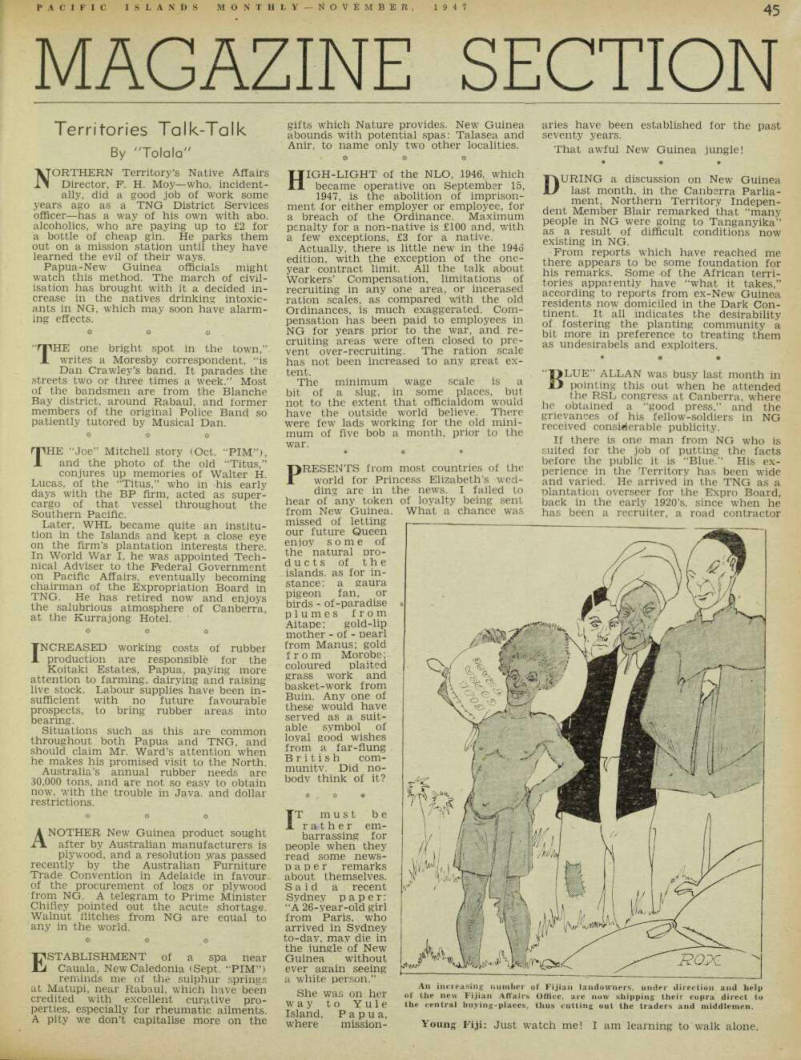
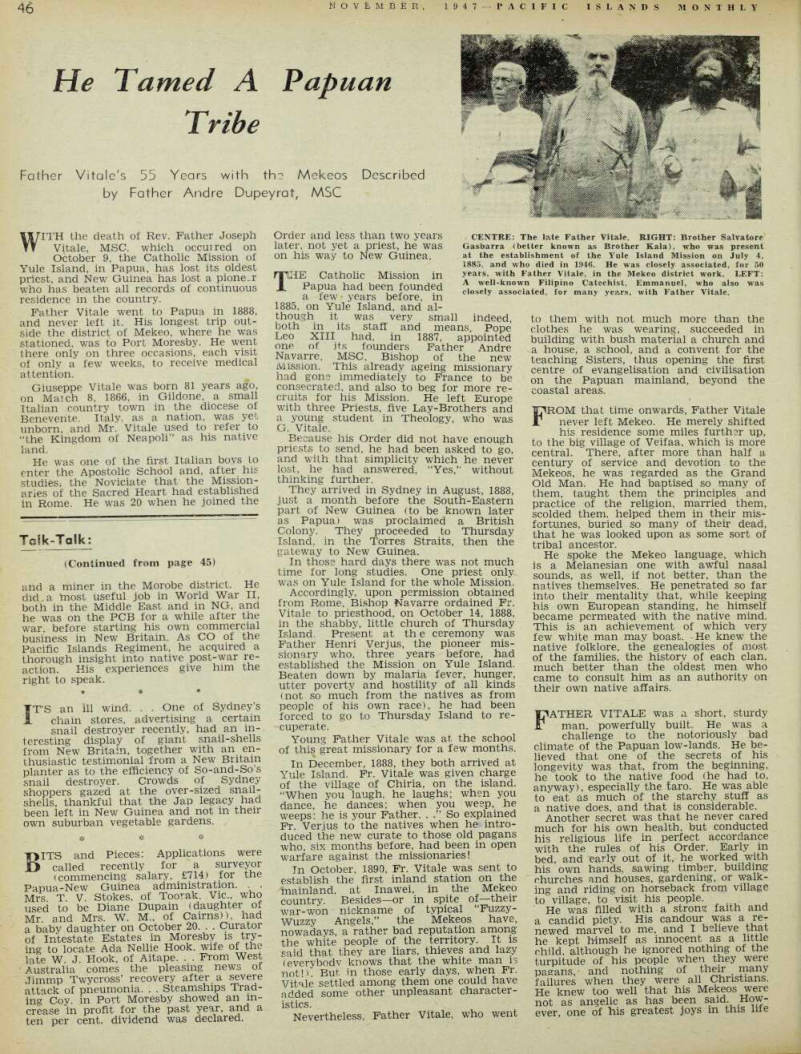
Territories Talk-Talk
By "Tolala"
NORTHERN Territory’s Native Affairs Director, F. H. Moy—who, incident ally, did a good job of work some years ago as a TNG District Services officer —has a way of his own with abo. alcoholics, who are paying up to £2 for a bottle of cheap gin. He parks them out on a mission station until they have learned the evil of their ways.
Papua-New Guinea officials might watch this method. The march of civil isation has brought with it a decided in crease in the natives drinking intoxic ants in NG, which may soon have alarm ing effects. * THE one bright spot in the town,” writes a Moresby correspondent, “is Dan Crawley’s band. It parades the streets two or three times a week.” Most of the bandsmen are from the Blanche Bay district, around Rabaul. and former members of the original Police Band so patiently tutored by Musical Dan. * * THE “Joe” Mitchell story (Oct. “PIM”), and the photo of the old “Titus,” conjures up memories of Walter H.
Lucas, of the “Titus,” who in his early days with the BP firm, acted as super cargo of that vessel throughout the Southern Pacific.
Later, WHL became quite an institu tion in the Islands and kept a close eye on the firm’s plantation interests there.
In World War I, he was appointed Tech nical Adviser to the Federal Government on Pacific Affairs, eventually becoming chairman of the Expropriation Board in TNG. He has retired now and enjoys the salubrious atmosphere of Canberra, at the Kurrajong Hotel. * * * INCREASED working costs of rubber production are responsible for the Koitaki Estates, Papua, paying more attention to farming, dairying and raising live stock. Labour supplies have been in sufficient with no future favourable prospects, to bring rubber areas into bearing.
Situations such as this are common throughout both Papua and TNG, and should claim Mr. Ward’s attention when he makes his promised visit to the North.
Australia’s annual rubber needs are 30,000 tons, and are not so easy to obtain now, with the trouble in Java, and dollar restrictions.
ANOTHER New Guinea product sought after by Australian manufacturers is plywood, and a resolution was passed recently by the Australian Furniture Trade Convention in Adelaide in favour of the procurement of logs or plywood from NG. A telegram to Prime Minister Chifley pointed out the acute shortage.
Walnut flitches from NG are equal to any in the world. * * * Establishment of a spa near Cauala, New Caledonia (Sept. “PIM”) reminds me of the sulphur springs at Matupi, near Rabaul, which have been credited with excellent curative pro perties, especially for rheumatic ailments.
A pity we don’t capitalise more on the
gifts which Nature provides. New Guinea abounds with potential spas: Talasea and Anir, to name only two other localities. * * u- High-light of the nlo, 1946, which became operative on September 15, 1947, is the abolition of imprison ment for either employer or employee, for a breach of the Ordinance. Maximum penalty for a non-native is £lOO and, with a few exceptions, £3 for a native.
Actually, there is little new in the 1946 edition, with the exception of the one year contract limit. All the talk about Workers’ Compensation, limitations of recruiting in any one area, or incerased ration scales, as compared with the old Ordinances, is much exaggerated. Com pensation has been paid to employees in NG for years prior to the war, and re cruiting areas were often closed to pre vent over-recruiting. The ration scale has not been increased to any great ex tent.
The minimum wage scale is a bit of a slug, in some places, but not to the extent that officialdom would have the outside world believe. There were few lads working for the old mini mum of five bob a month, prior to the war. ♦ * ♦ PRESENTS from most countries of the world for Princess Elizabeth’s wed ding are in the news. I failed to hear of any token of loyalty being sent from New Guinea. What a chance was
missed of letting our future Queen enjoy some of the natural pro ducts of the islands, as for in stance ; a gaura pigeon fan, or birds - of-paradise plumes from Aitape; gold-lip mother - of - pearl from Manus; gold from Morobe; coloured plaited grass work and basket-work from Buin. Any one of these would have served as a suit able symbol of loyal good wishes from a far-flung British com munity. Did no body think of it? * * * IT must be rather em barrassing for people when they read some news paper remarks about themselves.
Said a recent Sydney paper: “A 26-year-old girl from Paris, who arrived in Sydney to-day. may die in the jungle of New Guinea without ever again seeing a white person.”
She was on her way to Yule Island, Papua, where mission
aries have been established for the past seventy years.
That awful New Guinea jungle! * * * DURING a discussion on New Guinea last month, in the Canberra Parlia ment, Northern Territory Indepen dent Member Blair remarked that “many people in NG were going to Tanganyika” as a result of difficult conditions now existing in NG.
From reports which have reached me there appears to be some foundation for his remarks. Some of the African terri tories apparently have “what it takes,” according to reports from ex-New Guinea residents now domiciled in the Dark Con tinent. It all indicates the desirability of fostering the planting community a bit more in preference to treating them as undesirabels and exploiters. * ♦ • "DLUE” ALLAN was busy last month in I) pointing this out when he attended the HSL congress at Canberra, where he obtained a “good press,” and the grievances of his fellow-soldiers in NG received considerable publicity.
If there is one man from NG who is suited for the job of putting the facts before the public it is “Blue.” His ex perience in the Territory has been wide and varied. He arrived in the TNG as a plantation overseer for the Expro Board, back in the early 1920’5, since when he has been a recruiter, a road contractor
An increasing number of Fijian landowners, under direction and help of the new Fijian Affairs Office, are now shipping their copra direct to the central buying-places, thus cutting out the traders and middlemen.
Young Fiji: Just watch me! I am learning to walk alone.
and a miner in the Morobe district. He did a most useful job in World War 11, both in the Middle East and in NG. and he was on the PCB for a while after the war, before starting his own commercial business in New Britain. As CO of the Pacific Islands Regiment, he acquired a thorough insight into native post-war re action. His experiences give him the right to speak. ♦ * * IT’S an ill wind. . . One of Sydney’s chain stores, advertising a certain snail destroyer recently, had an in teresting display of giant snail-shells from New Britain, together with an en thusiastic testimonial from a New Britain planter as to the efficiency of So-and-So’s snail destroyer. Crowds of Sydney shoppers gazed at the over-sized snail shells, thankful that the Jap legacy had been left in New Guinea and not in their own suburban vegetable gardens. * * * BITS and Pieces: Applications were called recently for a surveyor (commencing salary, £714) J ov the Papua-New Guinea administration. . .
Mrs T. V. Stokes, of Toorak. Vic., who used to be Diane Dupain (daughter of Mr. and Mrs. W. M., of Cairns)), had a baby daughter on October 20. . . Curator of Intestate Estates in Moresby is try ing to locate Ada Nellie Hook, wife of the late W. J. Hook, of Aitape. . . From West Australia comes the pleasing news of Jimmp Twycross’ recovery after a severe attack of pneumonia. . . Steamships Trad ing Coy. in Port Moresby showed an in crease in profit for the past year, and a ten per cent, dividend was declared.
Advertisements & other items, p. 49 (1 item)
45
1* A C I F I C ISLANDS MONTHLY NOVEMBER, 194?
He Tamed A Papuan
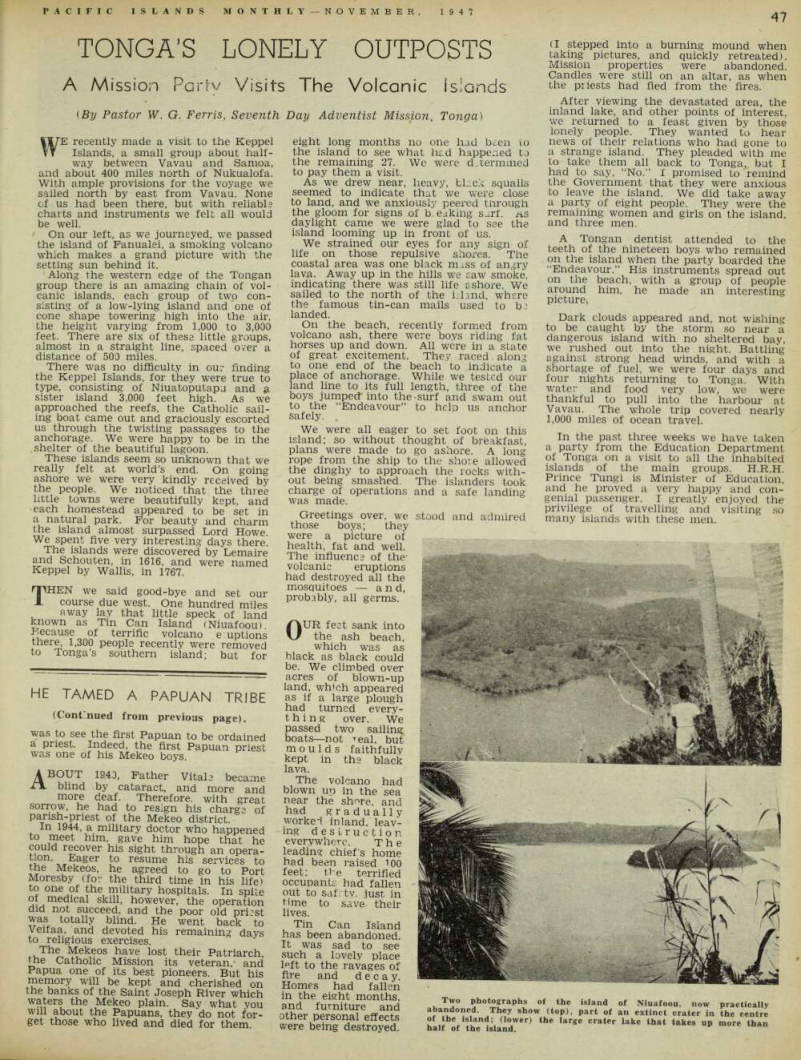
Tribe
Father Vitale's 55 Years with the Mekeos Described by Father Andre Dupeyrat, MSC
WITH the death of Rev. Father Joseph Vitale, MSC, which occurred on October 9, the Catholic Mission of Yule Island, in Papua, has lost its oldest priest, and New Guinea has lost a pioneer who has beaten all records of continuous residence in the country.
Father Vitale went to Papua in 1888, and never left it. His longest trip out side the district of Mekeo. where he was stationed, was to Port Moresby. He went there only on three occasions, each visit of only a few weeks, to receive medical attention.
Giuseppe Vitale was born 81 years ago, on Match 8, 1866, in Gildone, a small Italian country town in the diocese of Benevente. Italy, as a nation, was yet unborn, and Mr. Vitale used to refer to “the Kingdom of Neapoli” as his native land.
He was one of the first Italian boys to enter the Apostolic School and, after his studies, the Noviciate that the Mission aries of the Sacred Heart had established in Rome. He was 20 when he joined the
Order and less than two years later, not yet a priest, he was on his way to New Guinea. rIE Catholic Mission in Papua had been founded a few years before, in 1885, on Yule Island, and al
though it was very small indeed, both in its staff and means. Pope Leo XIII had. in 1887, appointed one of its founders Father Andre Navarre. MSC. Bishop of the new Mission. This already ageing missionary had gone immediately to France to be consecrated, and also to beg for more re cruits for his Mission. He left Europe with three Priests, five Lay-Brothers and a young student in Theology, who was G. Vitale.
Because his Order did not have enough priests to send, he had been asked to go, and with that simplicity which he never lost, he had answered, “Yes,” without thinking further.
They arrived in Sydney in August, 1888, just a month before the South-Eastern part of New Guinea (to be known later as Papua) was proclaimed a British Colony. They proceeded to Thursday Island, in the Torres Straits, then the gateway to New Guinea.
In those hard days there was not much time for long studies. One priest only was on Yule Island for the whole Mission.
Accordingly, upon permission obtained from Rome. Bishop Navarre ordained Fr.
Vitale to priesthood, on October 14, 1888, in the shabby, little church of Thursday Island. Present at th e ceremony was Father Henri Verjus, the pioneer mis sionary who, three years before, had established the Mission on Yule Island.
Beaten down by malaria fever, hunger, utter poverty and hostility of all kinds (not so much from the natives as from people of his own race), he had been forced to go to Thursday Island to re cuperate.
Young Father Vitale was at the school of this great missionary for a few months.
In December, 1888, they both arrived at Yule Island. Fr. Vitale was given charge of the village of Chiria, on the island. •‘When you laugh, he laughs; when you dance, he dances; when you weep, he weeps: he is your Father. . .” So explained Fr. Versus to the natives when he intro duced the new curate to those old pagans who, six months before, had been in open warfare against the missionaries!
In October, 1890, Fr. Vitale was sent to establish the first inland station on the mainland, at Inawei, in the Mekeo country. Besides —or in spite of —their war-won nickname of typical “Fuzzy- Wuzzy Angels,” the Mekeos have, nowadays, a rather bad reputation among the white people of the territory. It is said that they are liars, thieves and lazy (everybody knows that the white man is not!i But in those early days, when Fr.
Vitale settled among them one could have added some other unpleasant character - Nevertheless, Father Vitale, who went
to them with not much more than the clothes he was wearing, succeeded in building with bush material a church and a house, a school, and a convent for the teaching Sisters, thus opening the first centre of evangelisation and civilisation on the Papuan mainland, beyond the coastal areas.
FROM that time onwards, Father Vitale never left Mekeo. He merely shifted his residence some miles further up, to the big village of Veifaa, which is more central. There, after more than half a century of service and devotion to the Mekeos, he was regarded as the Grand Old Man. He had baptised so many of them, taught them the principles and practice of the religion, married them, scolded them, helped them in their mis fortunes, buried so many of their dead, that he was looked upon as some sort of tribal ancestor.
He spoke the Mekeo language, which is a Melanesian one with awful nasal sounds, as well, if not better, than the natives themselves. He penetrated so far into their mentality that, while keeping his own European standing, he himself became permeated with the native mind.
This is an achievement of which very few white man may boast. He knew the native folklore, the genealogies of most of the families, the history of each clan, much better than the oldest men who came to consult him as an authority on their own native affairs.
FATHER VITALE was a short, sturdy man, powerfully built. He was a challenge to the notoriously bad climate of the Papuan low-lands. He be lieved that one of the secrets of his longevity was that, from the beginning, he took to the native food (he had to, anyway), especially the taro. He was able to eat as much of the starchy stuff as a native does, and that is considerable.
Another secret was that he never cared much for his own health, but conducted his religious life in perfect accordance with the rules of his Order. Early in bed, and early out of it, he worked with his own hands, sawing timber, building churches and houses, gardening, or walk ing and riding on horseback from village to village, to visit his people.
He was filled with a strong faith and a candid piety. His candour was a re newed marvel to me, and I believe that he kept himself as innocent as a little child, although he ignored nothing of the turpitude of his people when they were pagans, and nothing of their . many failures when they were all Christians.
He knew too well that his Mekeos were not as angelic as has been said. How ever, one of his greatest joys in this life
CENTRE: The late Father Vitale. RIGHT: Brother Salvatore Gasbarra (better known as Brother Kala), who was present at the establishment of the Yule Island Mission on July 4, 1885, and who died in 1946. He was closely associated, for 50 years, with Father Vitale, in the Mekeo district work. LEFT: A well-known Filipino Catechist. Emmanuel, who also was closely associated, for many years, with Father Vitale.
was to see the first Papuan to be ordained a priest. Indeed, the first Papuan priest was one of his Mekeo boys.
ABOUT 1943, Father Vitale became blind by cataract, and more and more deaf. Therefore, with great sorrow, he had to resign his charge of parish-priest of the Mekeo district.
In 1944, a military doctor who happened to meet him, gave him hope that he could recover his sight through an opera tion. Eager to resume his services to the Mekeos, he agreed to go to Port Moresby (for the third time in his life) to one of the military hospitals. In spite of medical skill, however, the operation did not succeed, and the poor old priest was totally blind. He went back to Veifaa, and devoted his remaining davs to religious exercises.
The Mekeos have lost their Patriarch, the Catholic Mission its veteran, and Papua one of its best pioneers. But his J£ e T ory will be kept and cherished on the banks of the Saint Joseph River which waters the Mekeo plain. Say what you will about the Papuans, they do not for get those who lived and died for them.
Advertisements & other items, p. 50 (1 item)
46
November, 1947 -pacific islands monthly
Tdk-Talk: (Continued from page 45)
Tonga’S Lonely Outposts
A Mission Party Visits The Volcanic Islands
(By Pastor W. G. Ferris, Seventh Day Adventist Mission, Tonga)
WE recently made a visit to the Keppel Islands, a small group about half way between Vavau and Samoa, and about 400 miles north of Nukualofa.
With ample provisions for the voyage we sailed north by east from Vavau. None of us had been there, but with reliable charts and instruments we felt all would be well.
On our left, as we journeyed, we passed the island of Fanualei, a smoking volcano which makes a grand picture with the setting sun behind it.
Along the western edge of the Tongan group there is an amazing chain of vol canic islands, each group of two con sisting of a low-lying island and one of cone shape towering high into the air, the height varying from 1,000 to 3,000 feet. There are six of these little groups, almost in a straight line, spaced over a distance of 500 miles.
There was no difficulty in our finding the Keppel Islands, for they were true to type, consisting of Niuatoputapu and a sister island 3,000 feet high. As we approached the reefs, the Catholic sail ing boat came out and graciously escorted us through the twisting passages to the anchorage. We were happy to be in the shelter of the beautiful lagoon.
These islands seem so unknown that we really felt at world’s end. On going ashore we were very kindly received by the people. We noticed that the three httle towns were beautifully kept, and each homestead appeared to be set in a natural park. For beauty and charm the island almost surpassed Lord Howe We spent five very interesting days there The islands were discovered by Lemaire and Schouten, in 1616. and were named Keppel by Wallis, in 1767.
THEN we said good-bye and set our course due west. One hundred miles away lay that little speck of land known as Tin Can Island (Niuafoou).
Because of terrific volcano e uptions there, 1,300 people recently were removed to Tonga’s southern island; but for
eight long months no one had been to the island to see what had happened to the remaining 27. We were determined to pay them a visit.
As we drew near, heavy, black squalls seemed to indicate that we were close to land, and we anxiously peered through the gloom for signs of Peeking surf, as daylight came we were glad to see the island looming up in front of us.
We strained our eyes for any sign of life on those repulsive shores. The coastal area was one black mass of angry lava. Away up in the hills we saw smoke, indicating there was still life ashore. We sailed to the north of the island, where the famous tin-can mails used to ba landed.
On the beach, recently formed from volcano ash, there were boys riding fat horses up and down. All were in a state of great excitement. They raced along to one end of the beach to indicate a place of anchorage. While we tested our land line to its full length, three of the boys jumped into the surf and swam out to the “Endeavour” to help us anchor safely. .
We were all eager to set foot on this island; so without thought of breakfast, plans were made to go ashore. A long rope from the ship to the shore allowed the dinghy to approach the rocks with out being smashed. The islanders took charge of operations and a safe landing was made.
Greetings over, we stood and admired those boys; they
were a picture of health, fat and well.
The influence of the volcanic eruptions had destroyed all the mosquitoes and, probably, all germs.
OUR feat sank into the ash beach, which was as black as black could be. We climbed over acres of blown-up land, which appeared as if a large plough had turned every thing over. We passed two sailing boats—not but moulds faithfully kept in tha black lava.
The volcano had blown up in the sea near the shore, and had gradually worked inland, leav ing destruction everywhere. The leading chief s home had been raised 100 feet: the terrified occupants had fallen out to safety, just in time to save their lives.
Tin Can Island has been abandoned.
It was sad to see such a lovely place left to the ravages of fire and decay.
Homes had fallen in the eight months, and furniture and other personal effects were being destroyed.
(I stepped into a burning mound when taking pictures, and quickly retreated).
Mission properties were abandoned.
Candles were still on an altar, as when the piiests had fled from the fires.
After viewing the devastated area, the inland lake, and other points of interest, we returned to a feast given by those lonely people. They wanted to hear news of their relations who had gone to a strange island. They pleaded with me to take them all back to Tonga, but I had to say, “No.” I promised to remind the Government that they were anxious to leave the island. We did take away a party of eight people. They were the remaining women and girls on the island, and three men.
A Tongan dentist attended to the teeth of the nineteen boys who remained on the island when the party boarded the “Endeavour.” His instruments spread out on the beach, with a group of people around him, he made an interesting picture.
Dark clouds appeared and, not wishing to be caught by the storm so near a dangerous island with no sheltered bay, we rushed out into the night. Battling against strong head winds, and with a shortage of fuel, we were four days and four nights returning to Tonga. With water and food very low, we were thankful to pull into the harbour at Vavau. The whole trip covered nearly 1,000 miles of ocean travel.
In the past three weeks we have taken a party from the Education Department of Tonga on a visit to all the inhabited islands of the main groups. H.R.H.
Prince Tungi is Minister of Education, and he proved a very happy and con genial passenger. I greatly enjoyed the privilege of travelling and visiting so many islands with these men.
Two photographs of the island of Niuafoou. now practically abandoned. They show (top), part of an extinct crater in the centre of the island; (lower0 the large crater lake that takes up more than half of the island.
Advertisements & other items, p. 51 (1 item)
47
PACIFIC ISLANDS MONTHLY— NOVEMBER, 1947
HE TAMED A PAPUAN TRIBE
(Continued from previous page).
The Samoans Went Underground
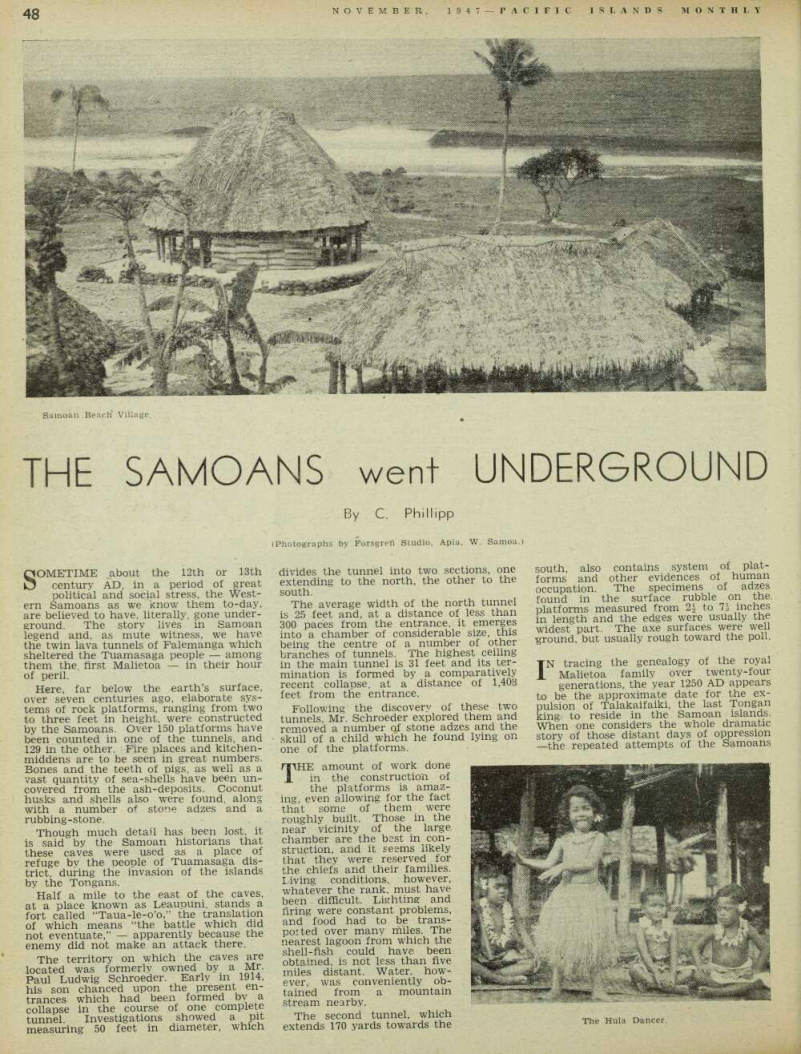
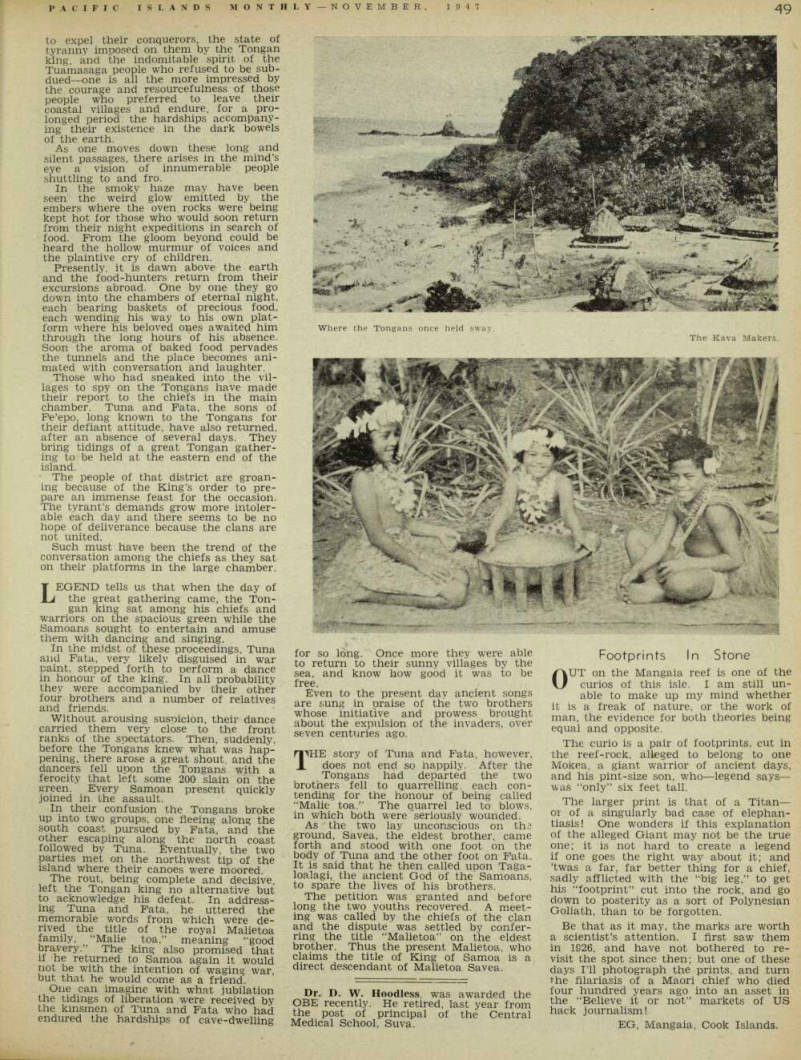
By C. Phillipp
(Photographs by Forsgreh Studio, Apia, W. Samoa.)
SOMETIME about the 12th or 13th century AD, in a period of great political and social stress, the West ern Samoans as we know them to-day, are believed to have, literally, gone under ground. The story lives in Samoan legend and, as mute witness, we have the twin lava tunnels of Falemanga which sheltered the Tuamasaga people among them the first Malietoa in their hour of peril.
Here, far below the earth’s surface, over seven centuries ago, elaborate sys tems of rock platforms, ranging from two to three feet in height, were constructed by the Samoans. Over 150 platforms have been counted in one of the tunnels, and 129 in the other. Fire places and kitchen middens are to be seen in great numbers.
Bones and the teeth of pigs, as well as a vast quantity of sea-shells have been un covered from the ash-deposits. Coconut busies and shells also were found, along with a number of stone adzes and a rubbing-stone.
Though much detail has been lost, it is said by the Samoan historians that these caves were used as a place of refuge by the oeople of Tuamasaga dis trict, during the invasion of the islands by the Tongans.
Half a mile to the east of the caves, at a place known as Leauouni, stands a fort called “Taua-le-o’o,” the translation of which means “the battle which did not eventuate,” apparently because the enemy did not make an attack there.
The territory on which the caves are located was formerly owned by a Mr.
Paul Ludwig Schroeder. Early in 1914, his son chanced upon the present en trances which had been formed bv a collapse in the course of one complete tunnel. Investigations showed a pit measuring 50 feet in diameter, which
divides the tunnel into two sections, one extending to the north, the other to the south.
The average width of the north tunnel is 25 feet and, at a distance of less than 300 paces from the entrance, it emerges into a chamber of considerable size, this being the centre of a number of other branches of tunnels. The highest ceiling in the main tunnel is 31 feet and its ter mination is formed by a comparatively recent collapse, at a distance of 1,408 feet from the entrance.
Following the discovery of these two tunnels, Mr. Schroeder explored them and removed a number of stone adzes and the skull of a child which he found lying on one of the platforms.
riIHE amount of work done a in the construction of the platforms is amaz ing, even allowing for the fact that some of them were roughly built. Those in the near vicinity of the large chamber are the m con struction, and it seems i!kely that they were reserved for the chiefs and their families, Living conditions, however, whatc h £md been difficult. Eiebtmg and firing were constant problems, and to ! rbflps The ported over IThe 1 The SheU hare been obtained, is not less than five miles distant water, how ever was conven i e ntly ob tained from a mountain s t ream nearbv stream nearoy.
The second tunnel, which extends 170 yards towards the
south, also contains system of plat forms and other evidences of human occupation. The specimens of adzes found in the surface rubble on the. platforms measured from to 71 inches in length and the edges were usually the widest part. The axe surfaces were well -ground, but usually rough toward the poll.
IN tracing the genealogy of the royal Malietoa family over twenty-four generations, the year 1250 AD appears to be the approximate date for the ex pulsion of Talakaifaiki, the last Tongan king to reside in the Samoan islands.
When one considers the whole dramatic story of those distant days of oppression —the repeated attempts of the Samoans
Samoan Beach Village.
The Hula Dancer.
to expel their conquerors, the state of tyrannv imoosed on them by the Tongan king, and the indomitable spirit of the Tuamasaga people who refused to be sub dued—one is all the more impressed by the courage and resourcefulness of those people who preferred to leave their coastal villages and endure, for a pro longed period the hardships accompany ing their existence in the dark bowels of the earth.
As one moves down these long and silent passages, there arises in the mind’s eye a vision of innumerable people shuttling to and fro.
In the smoky haze may have been seen the weird glow emitted by the embers where the oven rocks were being kept hot for those who would soon return from their night expeditions in search of food. From the gloom beyond could be heard the hollow murmur of voices and the plaintive cry of children.
Presently, it is dawn above the earth and the food-hunters return from their excursions abroad. One by one they go down into the chambers of eternal night, each bearing baskets of precious food, each wending his way to his own plat form where his beloved ones awaited him through the long hours of his absence.
Soon the aroma of baked food pervades the tunnels and the place becomes ani mated with conversation and laughter.
Those who had sneaked into the vil lages to spy on the Tongans have made their report to the chiefs in the main chamber. Tuna and Fata, the sons of Fe’epo, long known to the Tongans for their defiant attitude, have also returned, after an absence of several days. They bring tidings of a great Tongan gather ing to be held at the eastern end of the island.
The people of that district are groan ing because of the King’s order to pre pare an immense feast for the occasion.
The tyrant’s demands grow more intoler able each day and there seems to be no hope of deliverance because the clans are not united.
Such must have been the trend of the conversation among the chiefs as they sat on their platforms in the large chamber.
LEGEND tells us that when the day of the great gathering came, the Ton gan king sat among his chiefs and warriors on the spacious green while the Samoans sought to entertain and amuse them with dancing and singing.
In the midst of these proceedings, Tuna and Fata, very likely disguised in war paint, stepped forth to perform a dance in honour of the king. In all probability they were accompanied by their other four brothers and a number of relatives and friends.
Without arousing suspicion, their dance carried them very close to the front ranks of the spectators. Then, suddenly, before the Tongans knew what was hap pening, there arose a great shout, and the dancers fell upon the Tongans with a ferocity that left some 200 slain on the ereen. Every Samoan present quickly joined in the assault.
In their confusion the Tongans broke up into two groups, one fleeing along the south coast pursued by Fata, and the other escaping along the north coast followed by Tuna. Eventually, the two parties met on the northwest tip of the island where their canoes were moored.
The rout, being complete and decisive, left the Tongan king no alternative but to acknowledge his defeat. In address ing Tuna and Fata, he uttered the memorable words from which were de rived the title of the royal Malietoa family, “Malie toa,” meaning “good bravery.” The king also promised that if he returned to Samoa again it would not be with the intention of waging war, but that he would come as a friend.
One can imagine with what jubilation the tidings of liberation were received by the kinsmen of Tuna and Fata who had endured the hardships of cave-dwelling
for so long. Once more they were able to return to their sunny villages by the sea, and know how good it was to be free.
Even to the present day ancient songs are sung in oraise of the two brothers whose initiative and prowess brought about the expulsion of the invaders, over seven centuries ago. mHE story of Tuna and Fata, however, X does not end so happily. After the Tongans had departed the two brothers fell to quarrelling, each con tending for the honour of being called “Malic toa.” The quarrel led to blows, in which both were seriously wounded.
As the two lay unconscious on th 3 ground, Savea, the eldest brother, came forth and stood with one foot on the body of Tuna and the other foot on Fata.
It is said that he then called upon Taga loalagi, the ancient God of the Samoans, to spare the lives of his brothers.
The petition was granted and before long the two youths recovered. A meet ing was called by the chiefs of the clan and the dispute was settled by confer ring the title “Malietoa” on the eldest brother. Thus the present Malietoa, who claims the title of King of Samoa is a direct descendant of Malietoa Savea.
Dr. D. W. Hoodless, was awarded the QBE recently. He retired, last year from the post of principal of the Central Medical School, Suva.
Footprints In Stone
OUT on the Mangaia reef is one of the curios of this isle. I am still un able to make up my mind whether it is a freak of nature, or the work of man, the evidence for both theories being equal and opposite.
The curio is a pair of footprints, cut in the reef-rock, alleged to belong to one Mokea, a giant warrior of ancient days, and his pint-size son, who —legend says— was “only” six feet tall.
The larger print is that of a Titan— or of a singularly bad case of elephan tiasis! One wonders if this explanation of the alleged Giant may not be the true one; it is not hard to create a legend if one goes the right way about it; and ’twas a far, far better thing for a chief, sadly afflicted with the “big leg,” to get his “footprint” cut into the rock, and go down to posterity as a sort of Polynesian Goliath, than to be forgotten.
Be that as it may, the marks are worth a scientist’s attention. I first saw them in 1826, and have not bothered to re visit the spot since then; but one of these days I’ll photograph the prints, and turn the filariasis of a Maori chief who died four hundred years ago into an asset in the “Believe it or not” markets of US hack journalism!
EG, Mangaia, Cook Islands.
Where the Tongans once held sway
The Kava Makers.
Tropicalities
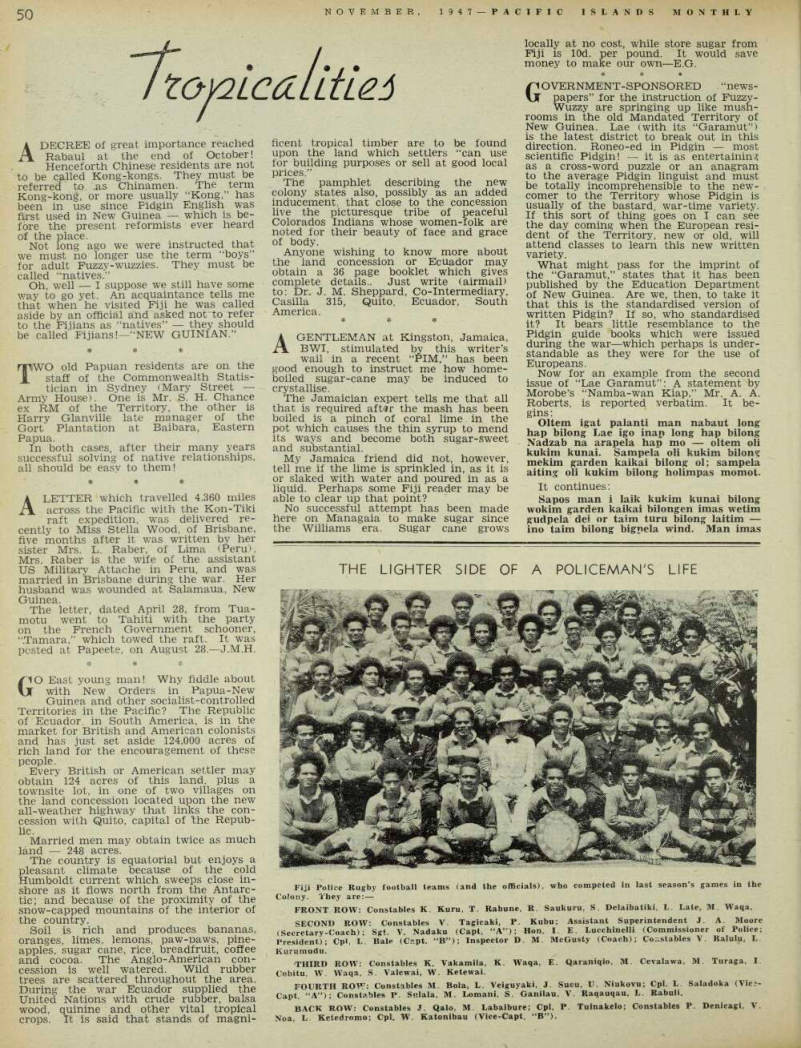
A DECREE of great importance reached Rabaul at the end of October!
Henceforth Chinese residents are not to be palled Kong-kongs. They must be referred to .as Chinamen. The term Kong-kong, or more usually “Kong,” has been in use since Pidgin English was first used in New Guinea which is be fore the present reformists ever heard of the place.
Not long ago we were instructed that we must no longer use the term “boys” for adult Fuzzy-wuzzies. They must be called “natives/’
Oh, well I suppose we still have some way to go yet. An acquaintance tells me that when he visited Fiji he was called aside by an official and asked not~to refer to the Fijians as “natives” they should be called Fijians!—“NEW GUINIAN.” * * * TWO old Papuan residents are on the staff of the Commonwealth Statis tician in Sydney (Mary Street Army House). One is Mr. S. H. Chance ex RM of the Territory, the other is Harry Glanville late manager of the Gort Plantation at Baibara, Eastern Papua.
In both cases, after their many years successful solving of native relationships, all should be easy to them! ♦ * * A LETTER which travelled 4,360 miles across the Pacific with the Kon-Tiki raft expedition, was delivered re cently to Miss Stella Wood, of Brisbane, five months after it was written by her sister Mrs. L. Raber, of Lima (Peru).
Mrs. Raber is the wife of the assistant US Military Attache in Peru, and was married in Brisbane during the war. Her husband was wounded at Salamaua, New Guinea.
The letter, dated April 28, from Tua motu went to Tahiti with the party on the French Government schooner, “Tamara,” which towed the raft. It was posted at Papeete, on August 28—J.M.H. * * * CIO East young man! Why fiddle about 1 with New Orders in Papua-New Guinea and other socialist-controlled Territories in the Pacific? The Republic of Ecuador, in South America, is in the market for British and American colonists and has just set aside 124,000 acres of rich land for the encouragement of these people.
Every British or American settler may obtain 124 acres of this land, plus a townsite lot, in one of two villages on the land concession located upon the new all-weather highway that links the con cession with Quito, capital of the Repub lic.
Married men may obtain twice as much land 248 acres.
The country is equatorial but enjoys a pleasant climate because of the cold Humboldt current which sweeps close in shore as it flows north from the Antarc tic; and because of the proximity of the snow-capped mountains of the interior of the country.
Soil is rich and produces bananas, oranges, limes, lemons, paw-paws, pine apples, sugar cane, rice, breadfruit, coffee and cocoa. The Anglo-American con cession is well watered. Wild rubber trees are scattered throughout the area.
During the war Ecuador supplied the United Nations with crude rubber, balsa wood, quinine and other vital tropical crops. It is said that stands of magni
ficent tropical timber are to be found upon the land which settlers “can use for building purposes or sell at good local prices.”
The pamphlet describing the new colony states also, possibly as an added inducement, that close to the concession live the picturesque tribe of peaceful Colorados Indians whose women-folk are noted for their beauty of face and grace of body.
Anyone wishing to know more about the land concession or Ecuador may obtain a 36 page booklet which gives complete details.. Just write (airmail) to; Dr. J. M. Sheppard, Co-Intermediary, Casilla 315, Quito, Ecuador, South America. * * * A GENTLEMAN at Kingston, Jamaica, BWI, stimulated by this writer’s wail in a recent “PIM,” has been good enough to instruct me how home boiled sugar-cane may be induced to crystallise.
The Jamaician expert tells me that all that is required aftdr the mash has been boiled is a pinch of coral lime in the pot which causes the thin syrup to mend its ways and become both sugar-sweet and substantial.
My Jamaica friend did not, however, tell me if the lime is sprinkled in, as it is or slaked with water and poured in as a liquid. Perhaps some Fiji reader may be able to clear up that point?
No successful attempt has been made here on Managaia to make sugar since the Williams era. Sugar cane grows
locally at no cost, while store sugar from Fiji is lOd. per pound. It would save money to make our own—E.G. * * *
Government-sponsored “news
papers” for the instruction of Fuzzy- Wuzzy are springing up like mush rooms in the old Mandated Territory of New Guinea. Lae (with its “Garamut”) is the latest district to break out in this direction. Roneo-ed in Pidgin most scientific Pidgin! it is as entertaining as a cross-word puzzle or an anagram to the average Pidgin linguist and must be totally incomprehensible to the new comer to the Territory whose Pidgin is usually of the bastard, war-time variety.
If this sort of thing "goes on I can see the day coming when the European resi dent of the Territory, new or old, will attend classes to learn this new written variety.
What might pass for the imprint of the “Garamut,” states that it has been published by the Education Department of New Guinea. Are we, then, to take it that this is the standardised version of written Pidgin? If so, who standardised it? It bears little resemblance to the Pidgin guide books which were issued during the war —which perhaps is under standable as they were for the use of Europeans.
Now for an example from the second issue of “Lae Garamut”: A statement by Morobe’s “Namba-wan Kiap,” Mr. A. A.
Roberts, is reported verbatim. It be gins: Oltem igat palanti man nabaut long hap bilong Lae igo inap long hap bilong Nadzab na arapela hap mo oltem oil kukim kunai. Sampela oil kukim bilong mekim garden kaikai bilong ol; sampela aiting oli kukim bilong holimpas momot.
It continues: Sapos man i laik kukim kunai bilong wokim garden kaikai bilongen imas wetim gudpela dei or taim turu bilong laitim ino taim bilong bignela wind. Man imas
The Lighter Side Of A Policeman's Life
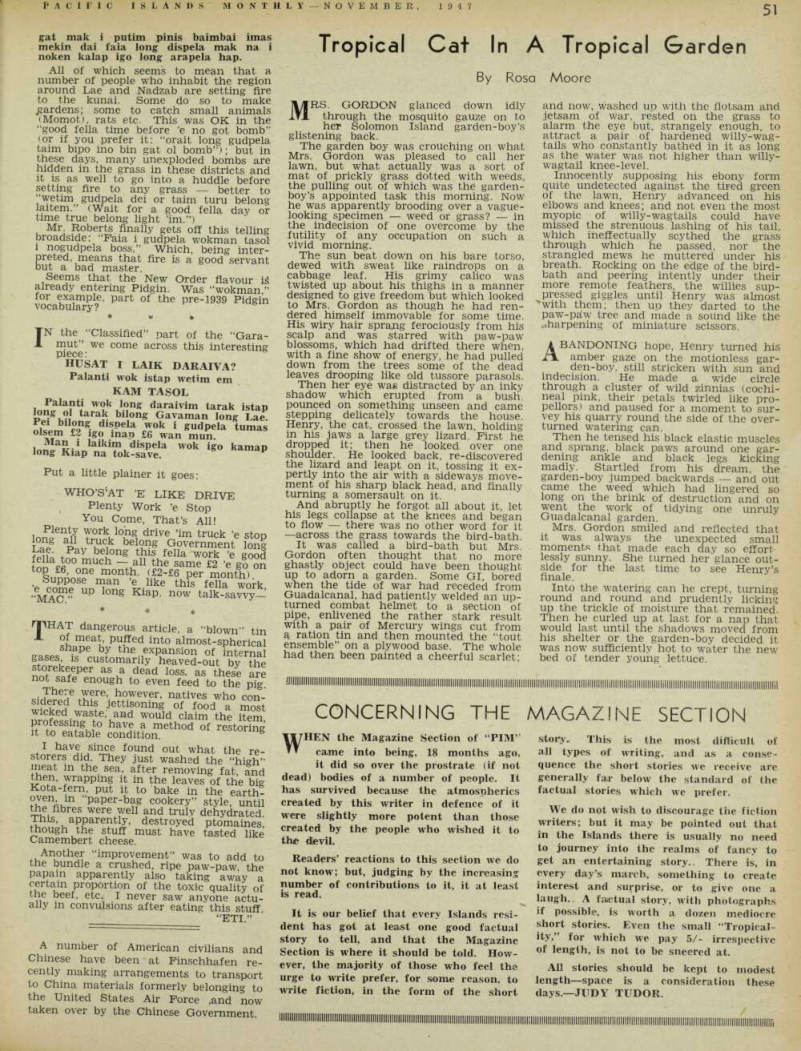
Fiji Police Rugby football teams (and the officials), who competed In last season s games In the Colony. They are:— FRONT ROW: Constables K. Kuru, T. Rabune. R. Saukuru, S. Delaibatiki, L. Late, M. Waqa.
SECOND ROW: Constables V. Tagicaki, P. Kubu; Assistant Superintendent J. A Moore (Secretary-Coach); Sgt. V. Nadaku (Capt. “A”); Hon. I. E. Lucchinelli (Commissioner of Police; President); Cpl. L. Bale (Capt. “B”): Inspector D. M McGusty (Coach); Constables V. Ralulu, L.
Kurumudu.
THIRD ROW: Constables K. Vakamila, K. Waqa, E. Qaraniqio, M. Cevalawa. M. Turaga, I Cobitu, W. Waqa, S. Valewai, W. Ketewai.
FOURTH ROW: Constables M. Bola, L. Veiguyaki, J. Sucu, U. Niukovu; Cpl. L Saladoka (Vice- Capt. “A”); Constables P, Sulala, M. Lomani, S. Ganilau, V. Raqauqau, L. Rabuli, BACK ROW; Constables J. Qalo, M. Labaibure; Cpl. P. Tuinakelo; Constables P. Denicagi, V.
Noa, L. Ketedromo; Cpl. W. Katonibau (Vice-Capt. “B”).
gat mak i putim pinis baimbai imas mekin dai faia long dispela mak na i noken kalap igo long arapela hap.
All of which seems to mean that a number of people who inhabit the region around Lae and Nadzab are setting fire to the kunai. Some do so to make gardens; some to catch small animals • Momot), rats etc. This was OK in the “good fella time before ’e no got bomb” (or if you prefer it: “orait long gudpela taim bipo ino bin gat ol bomb”); but in these days, many unexploded bombs are hidden in the grass in these districts and it is as well to go into a huddle before setting fire to any grass better to “wetim gudpela dei or taim turu belong laitem.” (Wait for a good fella day or time true belong light ’im.”) Mr Roberts finally gets off this telling broadside: “Faia i gudpela wokman tasol i nogudpela boss,” Which, being inter preted, means that fire is a good servant but a bad master.
Seems that the New Order flavour iS already entering Pidgin. Was “wokman,” for example, part of the pre-1939 Pidgin vocabulary? * * * IN the “Classified” part of the “Gara mut” we come across this interesting piece:
Husat I Laik Daraiva?
Palanti wok istap wetim em
Kam Tasol
Palanti wok long daraivim tarak istap tarak bilong Gavaman long Lae. rwa*, e * iumas lo Kiap' n*a' k.k-save*" W ° k kama *> Put a little plainer it goes:
Who’Sat ’E Like Drive
Plenty Work ’e Stop You Come, That’s All!
Y ork , drive ’ im truck ’e stop l°il g tr K C i k bel 9P£ Government long fSfo * Pay be Jp n g this fella work ’e good much ab the same £2 ’e go on top £6, one month. (£2-£6 per month) Suppose man ’e like this fella work UP long Kiap ’ now talk-savvy— * * * T HAT dangerous article, a “blown” tin A of meat, puffed into almost-spherical shape by tne expansion of internal gases, is customarily heaved-out by the storekeeper as a dead loss, as these are not safe enough to even feed to the pig. .^ be ", e were, however, natives who con sidered this jettisoning of food a most wicked wa ste, and would claim the item ft r °to eSfble con V d e ition method ° f ! have since found out what the re storers did. They just washed the “high” meat in the sea, after removing fat, and then, wrapping it in the leaves of the big Kota-fern put it to bake in the earth- P a P er-b ag cookery” style, until tb e fibres were well and truly dehydrated.
X h^’v, a P£ arently ’ destroyed ptomaines, though the stuff must have tasted like Camembert cheese.
Another “improvement” was to add to the bundle a crushed, ripe paw-paw, the papain apparently also taking away a certain proportion of the toxic quality of the beef, etc. I never saw anyone actu ally m convulsions after eating this stuff.
“Eti.”
A number of American civilians and Chinese have been at Finschhafen re cently making arrangements to transport to China materials formerly belonging to the United States Air Force ,and now taken over by the Chinese Government.
Tropical Cat In A Tropical Garden
MRS. GORDON glanced down idly through the mosquito gauze on to her Solomon Island garden-boy’s glistening back.
The garden boy was crouching on what Mrs. Gordon was pleased to call her lawn, but what actually was a sort of mat of prickly grass dotted with weeds, the pulling out of which was the garden boy’s appointed task this morning. Now he was apparently brooding over a vague looking specimen weed or grass? in the indecision of one overcome by the futility of any occupation on such a vivid morning.
The sun beat down on his bare torso, dewed with sweat like raindrops on a cabbage leaf. His grimy calico was twisted up about his thighs in a manner designed to give freedom but which looked to Mrs. Gordon as though he had ren dered himself immovable for some time.
His wiry hair sprang ferociously from his scalp and was starred with paw-paw blossoms, which had drifted there when, with a fine show of energy, he had pulled down from the trees some of the dead leaves drooping like old tussore parasols.
Then her eye was distracted by an inky shadow which erupted from a bush, pounced on something unseen and came stepping delicately towards the house.
Henry, the cat, crossed the lawn, holding in his jaws a large grey lizard. First he dropped it; then he looked over one shoulder. He looked back, re-discovered the lizard and leapt on it, tossing it ex pertly into the air with a sideways move ment of his sharp black head, and finally turning a somersault on it.
And abruptly he forgot all about it, let his legs collapse at the knees and began to flow there was no other word for it —across the grass towards the bird-bath.
It was called a bird-bath but Mrs.
Gordon often thought that no more ghastly object could have been thought up to adorn a garden. Some GI, bored when the tide of war had receded from Guadalcanal, had patiently welded an up turned combat helmet to a section of pipe, enlivened the rather stark result with a pair of Mercury wings cut from a ration tin and then mounted the “tout ensemble’’ on a plywood base. The whole had then been painted a cheerful scarlet-
By Rosa Moore
and now, washed up with the flotsam and jetsam of war, rested on the grass to alarm the eye but, strangely enough, to attract a pair of hardened willy-wag tails who constantly bathed in it as long as the water was not higher than willy wagtail knee-level.
Innocently supposing his ebony form quite undetected against the tired green of the lawn, Henry advanced on his elbows and knees; and not even the most myopic of willy-wagtails could have missed the strenuous lashing of his tail, which ineffectually scythed the grass through which he passed, nor the strangled mews he muttered under his breath. Rocking on the edge of the bird bath and peering intently under their more remote feathers, the willies sup pressed giggles until Henrv was almost > with them; then up they darted to the paw-pdw tree and made a sound like the sharpening of miniature scissors, A BANDONING hope, Henry turned his amber gaze on the motionless gar den-boy, still stricken with sun and indecision. He made a wide circle through a cluster of wild zinnias (cochi neal pink, their petals twirled like pro pellors) and paused for a moment to sur vey his quarry round the side of the over turned watering can Then he tensed his black elastic muscles and sprang, black paws around one gar dening ankle and black legs kicking madly. Startled from his dream, the garden-boy jumned backwards and out came the weed which had lingered so long on the brink of destruction and on went the work of tidying one unrulv Guadalcanal garden y Mrs. Gordon smiled and reflected that it was always the unexpected small moments that made each day so effort lessly sunny. She turned her glance out side for the last time to see Henry’s finale. [y into the watering can he crept, turning round and round and prudently licking up the trickle of moisture that remained, Then he curled up at last for a nap that would last until the shadows moved from his shelter or the garden-boy decided it was now sufficiently hot to water the new bed of tender young lettuce.
Concerning The Magazine Section
WHEN the Magazine Section of “PIM” came into being. 18 months ago, it did so over the prostrate (if not dead) bodies of a number of people. It has survived because the atmospherics created by this writer in defence of it were slightly more potent than those created by the people who wished it to the devil.
Readers’ reactions to this section we do not know; but, judging by the increasing number of contributions to it, it at least is read.
It is our belief that every Islands resi dent has got at least one good factual story to tell, and that the Magazine Section is where it should be told. How ever, the majority of those who feel the urge to write prefer, for some reason, to write fiction, in the form of the short
stopy- This is the most difficult of all types of writing, and as a conse quence the short stories we receive arc generally far below the standard of the factual stories which we prefer.
We do not wish to discourage the fiction writers; but it may be pointed out that in the Islands there is usually no need to journey into the realms of fancy to get an entertaining story.. There is, in every day’s march, something to create interest and surprise, or to give one a laugh.. A factual story, with photographs if possible, is worth a dozen mediocre short stories. Even the small “Tropical ity,” for which we pay 5/- irrespective of length, is not to be sneered at.
All stories should be kept to modest length—space is a consideration these
clays.
Judy Tudor.
This Made Me Laugh ...
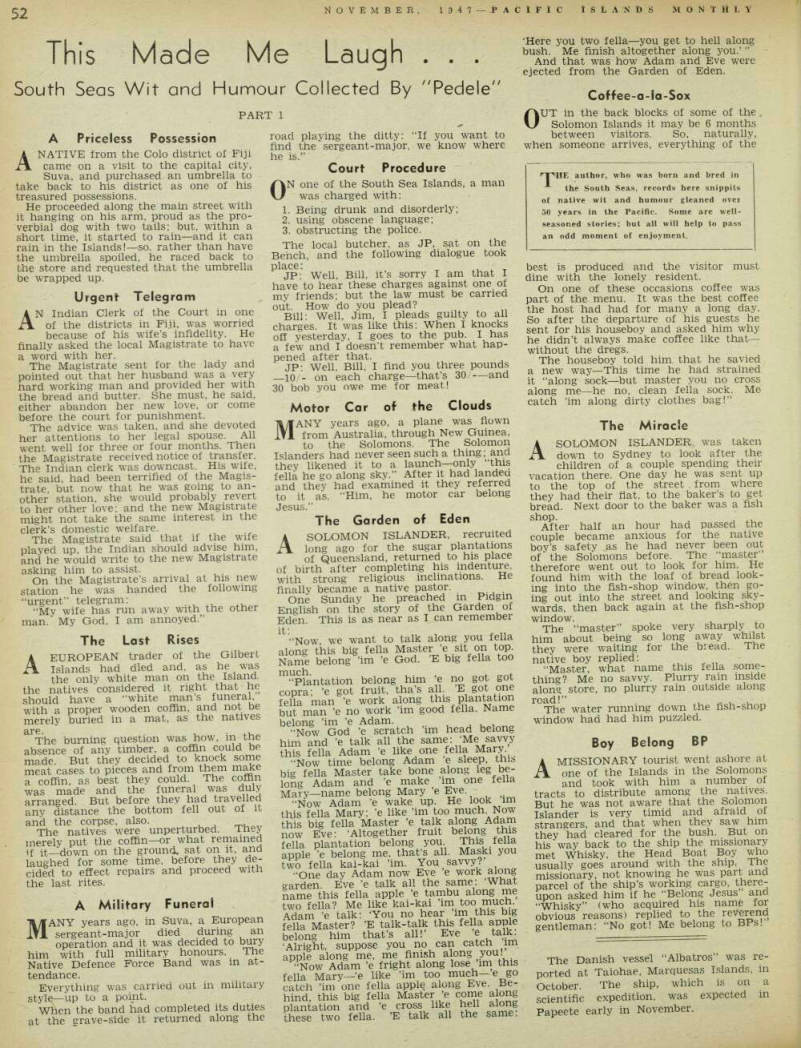
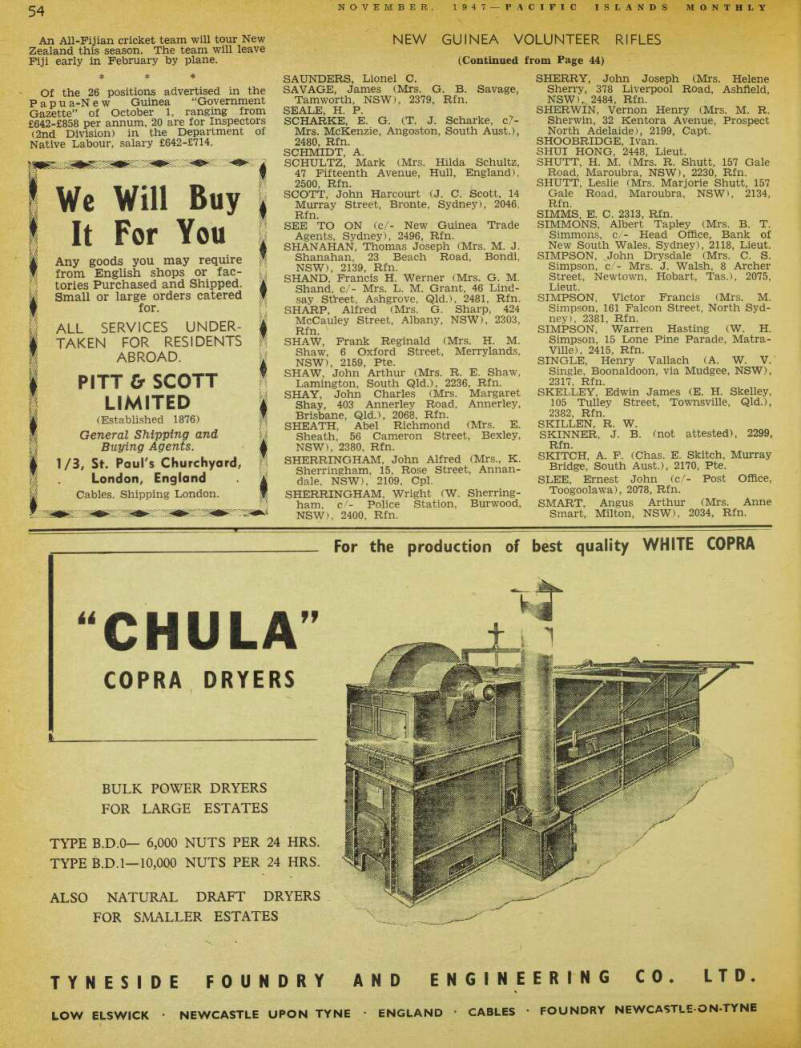
South Seas Wit and Humour Collected By "Pedele"
Part 1
A Priceless Possession
A NATIVE from the Colo district of Fiji came on a visit to the capital city, Suva, and purchased an umbrella to take back to his district as one of his
treasured possessions.
He proceeded along the main street with it hanging on his arm, proud as the pro verbial dog with two tails: but, within a short time, it started to rain—and it can rain in the Islands! —so. rather than have the umbrella spoiled, he raced back to the store and requested that the umbrella be wrapped up.
Urgent Telegram
AN Indian Clerk of the Court in one of the districts in Fiji, was worried because of his wife’s infidelity. He finally asked the local Magistrate to have a word with her.
The Magistrate sent for the lady and pointed out that her husband was a very hard working man and provided her with the bread and butter. She must, he said, either abandon her new love, or come before the court for punishment.
The advice was taken, and she devoted her attentions to her legal spouse. All went well for three or four months. Then the Magistrate received notice of transfer.
The Indian clerk was downcast. His wife, he said, had been terrified of the Magis trate, but now that he was going to an other station, she would probably revert to her other love; and the new Magistrate might not take the same interest in the clerk’s domestic welfare.
The Magistrate said that if the wife played up, the Indian should advise him, and he would write to the new Magistrate asking him to assist.
On the Magistrate’s arrival at his new station he was handed the following “urgent” telegram: “My wife has run away with the other man. My God. I am annoyed.”
The Lost Rises A EUROPEAN trader of the Gilbert Islands had died and. as he was the only white man on the Island, the natives considered it right that he should have a “white man’s funeral, with a proper wooden coffin, and not be merely buried in a mat, as the natives al The burning question was how, in the absence of any timber, a coffin could be made. But they decided to knock some meat cases to pieces and from them make a coffin, as best they could. The coffin was made and the funeral was duly arranged. But before they had travelled any distance the bottom fell out of it and the corpse, also. ‘ The natives were unperturbed. They merely put the coffin—or what remained if if—down on the ground, sat on it, and laughed for some time, before they de cided to effect repairs and proceed with the last rites.
A Military Funeral
MANY years ago, in Suva, a European sergeant-major died during an operation and it was decided to bury him with full military honours. The Native Defence Force Band was m at tendance.
Everything was carried out in military style—up to a point.
When the band had completed its duties at the grave-side it returned along the
road playing the ditty: “If you want to find the sergeant-major, we know where he is.”
Court Procedure
ON one of the South Sea Islands, a man was charged with: 1. Being drunk and disorderly; 2. using obscene language; 3. obstructing the police.
The local butcher, as JP, sat on the Bench, and the following dialogue took P lace: T , . JP; Well, Bill, it’s sorry I am that I have to hear these charges against one of my friends; but the law must be carried out. How do you plead?
Bill- Well. Jim, I pleads guilty to all charges. It was like this: When I knocks off yesterday, I goes to the pub. I has a few and I doesn’t remember what hap pened after that.
JP; Well, Bill, I find you three pounds —lO - on each charge—that’s 30/—and 30 bob you owe me for meat!
Motor Cor of the Clouds
MANY years ago, a plane was flown from Australia, through New Guinea, to the Solomons. The Solomon Islanders had never seen such a thing; and they likened it to a launch—only “this fella he go along sky.” After it had landed and they had examined it they referred to it as, “Him, he motor car belong Jesus.”
The Garden of Eden
A SOLOMON ISLANDER, recruited long ago for the sugar plantations of Queensland, returned to his place of birth after completing his indenture, with strong religious inclinations. He finally became a native pastor. .
One Sunday he preached m Pidgin English on the story of the Garden of Eden. This is as near as I can remember 11 “Now, we want to talk along you fella along this big fella Master ’e sit on top Name belong ’im ’e God. E big fella too belong him ’e no got got conra ■ ’e got fruit, tha’s all. E got one fella man ’e work along this plantation but man ’e no work ’im good fella. Name belong ’im ’e Adam.
“Now God ’e scratch ’im head belong him and ’e talk all the same: ‘Me savvy this fella Adam ’e like one fella Mary.
“Now time belong Adam ’e sleep, this big fella Master take bone along leg be long Adam and ’e make ’im one fella Mary—name belong Mary ’e Eve.
“Now Adam ’e wake up. He look im this fella Mary; ’e like ’im too much Now this big fella Master ’e talk along Adam now Eve: ‘Altogether fruit belong this fella plantation belong you. This fella apple ’e belong me, that’s all. Maski you two fella kai-kai ’im. You savvy?
“One day Adam now Eve e work along garden. Eve ’e talk all the same: ‘What name this fella apple ’e tambu along me two fella? Me like kai-kai ’im too much.
Adam ’e talk: ‘You no hear ’im this big fella Master? ’E talk-talk this fella apple belong him that’s all!’ Eve etalk. ‘Alright, suppose you no can catch im apple along me, me finish along you!
“Now Adam ’e fright along lose im this fella Mary—’e like ’im too much—e go catch ’im one fella apple along Eve. Be hind, this big fella Master ’e come a ong plantation and ’e cross like hell along these two fella. ’E talk all the same.
‘Here you two fella—you get to hell along bush. Me finish altogether along you.’ ”
And that was how Adam and Eve were ejected from the Garden of Eden.
Coffee-a-la-Sox
OUT in the back blocks of some of the Solomon Islands it may be 6 months between visitors. So, naturally, when someone arrives, everything of the
'T'HE author, who was born and bred in A the South Seas, records here snippits of native wit and humour gleaned over 50 years in the Pacific. Some are well seasoned stories; but all will help to pass an odd moment of enjoyment.
best is produced and the visitor must dine with the lonely resident.
On one of these occasions coffee was part of the menu. It was the best coffee the host had had for many a long day.
So after the departure of his guests he sent for his houseboy and asked him why he didn’t always make coffee like that — without the dregs.
The houseboy told him. that he savied a new way—This time he had strained it “along sock—but master you no cross along me—he no, clean fella sock. Me catch ’im along dirty clothes bag!”
The Miracle
A SOLOMON ISLANDER was taken down to Sydney to look after the children of a couple spending their vacation there. One day he was sent up to the top of the street from where they had their flat, to the baker’s to get bread. Next door to the baker was a fish shop. , After half an hour had passed the couple became anxious for the native boy’s safety as he had never been out of the Solomons before. The “master” therefore went out to look for him. He found him with the loaf ot bread look ing into the fish-shop window, then go ing out into the street and looking sky wards, then back again at the fish-shop window. , .
The “master” spoke very sharply to him about being so long away whilst they were waiting for the bread. The native boy replied: “Master, what name this fella some thing? Me no savvy. Flurry ram inside along store, no plurry rain outside along road!”
The water running down the fish-shop window had had him puzzled.
Boy Belong BP
AMISSIONARY tourist went ashore at one of the Islands in the Solomons and took with him a number of tracts to distribute among the natives.
But he was not aware that the Solomon Islander is very timid and afraid of strangers, and that when they saw him they had cleared for the bush. But on his way back to the ship the missionary met Whisky, the Head Boat Boy who usually goes around with the ship. The missionary, not knowing he was part and parcel of the ship’s working cargo, there upon asked him if he “Belong Jesus and “Whisky” (who acquired his name for obvious reasons) replied to the reverend gentleman: “No got! Me belong to BPs!
The Danish vessel “Albatros” was re ported at Taiohae, Marquesas Islands, in October. The ship, which is on a scientific expedition, was expected in Papeete early in November.
An All-Fijian cricket team will tour New Zealand this season. The team will leave Fiji early in February by plane, * * * Of the 26 positions advertised in the Pa p u a-N e w Guinea “Government Gazette” of October 1, ranging from £642-£B5B per annum, 20 are for Inspectors (2nd Division) in the Department of Native Labour, salary £642-£714.
Advertisements & other items, pp. 57-60 (3 items)
Burns Philp (New Guinea) Limited
General Merchants (Wholesale and Retail)
Shipping, Customs and General Agents
Head Office: PORT MORESBY, PAPUA
Branches: SAMARA I, PAPUA,
RABAUL, LAE, MADANG, T N G.
REPRESENTATIVES FOR:
AUSTRALIAN AGENTS:
LONDON AGENTS:
SAN FRANCISCO AGENTS:
LLOYDS OF LONDON
QUEENSLAND INSURANCE CO. LTD.
BURNS, PHILP fr CO. LTD.
All States.
BURNS, PHILP & CO. LTD.
"London House", 35 Crutched Friars, E.C.3.
BURNS, PHILP CO. OF SAN FRANCISCO INC. 510 Matson Building.
Distributing Agents, Territory of Papua-New Guinea for:
SHELL COMPANY OF AUSTRALIA LIMITED
Petroleum Products
GENERAL MOTORS CORPORATION
Chevrolet, Buick, Pontiac and Oldsmobile Cars Chevrolet and GMC Trucks Frigidaire Refrigerators
VAUXHALL MOTORS. LIMITED
Vauxhall Cars and Bedford Trucks
R. A. LISTER & CO., BRISTOL
Producers of Petrol, Parrafin and Diesel Engines Pumps and Lighting plants
RUSTON HORNSBY LIMITED
Engines
CROSSLEY MARINE ENGINES
We Will Buy
It For You
Any goods you may require from English shops or factories Purchased and Shipped.
Small or large orders catered for.
ALL SERVICES UNDER-
TAKEN FOR RESIDENTS
ABROAD.
PITT & SCOTT
LIMITED
(Established 1876) General Shipping and Buying Agents. 1/3, St. Paul's Churchyard, London, England Cables. Shipping London.
For the production of best quality WHITE COPRA kk
CHULA
COPRA DRYERS
BULK POWER DRYERS
FOR LARGE ESTATES
TYPE B.D.O — 6,000 NUTS PER 24 HRS.
TYPE 8.D.1—10,000 NUTS PER 24 HRS.
ALSO NATURAL DRAFT DRYERS
FOR SMALLER ESTATES
k
TYNESIDE FOUNDRY AND ENGINEERING CO. LTD.
LOW ELSWICK * NEWCASTLE UPON TYNE * ENGLAND * CABLES * FOUNDRY NEWCASTLE-ON-TYNE
G. H. Robinson
ISLAND SUPPLIES
of all kinds—Selected and Shipped to order at lowest possible prices—Piecegoods in Wool, Cotton and Silk, Under and Outerwear, Manchester, Drapery, Grocery, Hardware, Engineers and Leathergoods trade supplies a specialty.
Indents and Transhipments arranged. Large or small orders treated with equal care.
Use our 25 years’ extensive experience.
Enquiries solicited to —
G. H. ROBINSON
51 Macquarie Street, Sydney, N.S.W.
Telegrams: Sunrise, Sydney.
Letters: Box 3317, G.P.0., Sydney.
S 7
WORMGEARED
CHAIN HOISTS
The hand-operated Wormgeared Hoist is a general purpose lifting device, compact and easy to handle. The Wormgear is designed to give comparatively high efficiency and long life. A simple and effective brake insures safe holding of the suspended load.
Available in rated capacities from 10 cwts. to 3 tons.
Also makers of :
A.B.C. Electric Chain Holsts, V 2, 1, 2 tons capacity.
“Victor” Spurgeared Chain Hoists from 10 cwts. to 20 tons.
Triple Geared Chain Hoists from 10 cwts, to 20 tons.
Worm Geared Chain Hoists from 10 cwts. to 3 tons.
Weston Chain Blocks from 5 cwts. to 2 tons.
Shackles, Hooks, Sheave and Snatch Blocks.
AUSTRALIAN BLOCK Cr CHAIN CO,
PTY., LTD.
Robbs Road, WEST FOOTSCRAY, W. 12,
VICTORIA
Phones: MW 1373-74-75.
Telegraphic Address: “CHAINBLOCK,” MELBOURNE.
Correspondence to Box 34, FOOTSCRAY, W.ll, VICTORIA.
WESTCLOX
NEVER has performance been more trustworthy than in the beautiful Westclox of today . . . famous Big Ben and other spring wound clocks, electric clocks, wrist watches and pocket watches. When you buy your next clock or watch, look for the trade mark “Westclox” on the dial . . . your assurance of quality. u POCKET BEN A thin model watch with many features. Highly polished, plated finish; silvered dial; attractive numerals and hands. Unbreakable crystal.
SPUR Luminous A thin case, one-day alarm. Black finish with nickel trim. 4i inches square.
Steady alarm. Unique base.
Luminous dial.
BIG
BEN
BIG BEN Chime Alarm The highest standard of alarm clock quality. Quiet tick and gentle two-voiced alarm. First there’s a gentle call, then if he’s not shut off. there’s a lusty shout. Dustproof attachments. inches high. Ivory finish with gold colour trim. Luminous dial. & 10 BABY BEN A smart looking alarm clock. 3’i inches high.
Quiet tick; steady alarm that rings loud or soft. Legible dial.
Two finishes . . . black with nickel trim, and ivory with gold colour trim. Made in plain and luminous dial.
LA SALLE A handsomely designed wrist watch. Chrome finish case, stainless steel back, curved to fit the wrist. Sturdy movement, regulated to run in any position. Equipped with conventional second hand; rustproof hairspring.
ORDER THROUGH YOUR LOCAL STORE
PACIFIC ISLANDS TRADING
COMPANY
244 CALIFORNIA STREET, SAN FRANCISCO, CAL., U.S.A Bankers: Bank of America (Main Office) San Francisco.
Cables:
PITCO
SAN FRANCISCO
54
NOVEMBER, 1947-PACIFIC ISLANDS MONTHLY
NEW GUINEA VOLUNTEER RIFLES
(Continued from Page 44)
55
PACIFIC MONTHLY NOVEMBER, 1947
Fiji Indians' "Hardship"
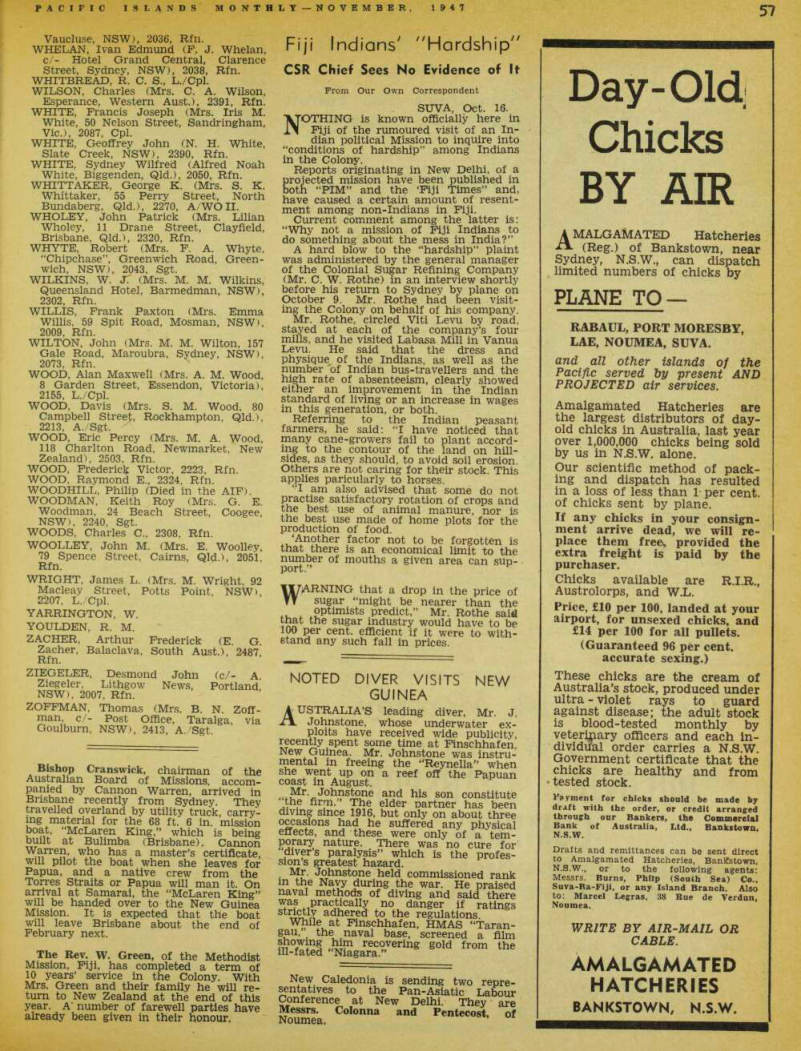
CSR Chief Sees No Evidence of It
From Our Own Correspondent
Suva, Oct. 16.
NOTHING is known officially here in Fiji of the rumoured visit of an In dian political Mission to inquire into “conditions of hardship” among Indians in the Colony.
Reports originating in New Delhi, of a projected mission have been published in both “PIM” and the ‘Fiji Times” and, have caused a certain amount of resent ment among non-Indians in Fiji.
Current comment among the latter is: “Why not a mission of Fiji Indians to do something about the mess in India?”
A hard blow to the “hardship” plaint was administered by the general manager of the Colonial Sugar Refining Company (Mr. C. W. Rothe) in an interview shortly before his return to Sydney by plane on October 9. Mr. Rothe had been visit ing the Colony on behalf of his company.
Mr. Rothe, circled Viti Levu by road, stayed at each of the company’s four mills, and he visited Labasa Mill in Vanua Levu. He said that the dress and physique of the Indians, as well as the number of Indian bus-travellers and the high rate of absenteeism, clearly showed either an improvement in the Indian standard of living or an increase in wages in this generation, or both.
Referring to the Indian peasant farmers, he said: “I have noticed that many cane-growers fail to plant accord ing to the contour of the land on hill sides, as they should, to avoid soil erosion.
Others are not caring for their stock. This applies paricularly to horses.
“1 am also advised that some do not practise satisfactory rotation of crops and the best use of animal manure, nor is the best use made of home plots for the production of food. xJ4 no , ther fa ctor not to be forgotten is that there is an economical limit to the number of mouths a given area can sup port.” H WARNING that a drop in the price of sugar “might be nearer than the .. * optimists predict,” Mr. Rothe said that the sugar industry would have to be 100 per cent, efficient if it were to with stand any such fall in prices.
Noted Diver Visits New
Guinea
AUSTRALIA’S leading diver, Mr. J.
Johnstone, whose underwater ex ploits have received wide publicity, recently spent some time at Finschhafen, New Guinea. Mr. Johnstone was instru mental in freeing the “Reynella” when she went up on a reef off the Papuan coast in August. 4 Mr. Johnstone and his son constitute the firm.” The elder partner has been diving since 1916, but only on about three occasions had he suffered any physical effects, and these were only of a tem porary nature. There was no cure for divers paralysis” which is the profes sion’s greatest hazard.
Mr. Johnstone held commissioned rank in the Navy during the war. He praised naval methods of diving and said there was practically no danger if ratings adhered to the regulations.
While at Finschhafen, HMAS “Taran gau, the naval base, screened a film showing him recovering gold from the ill-fated “Niagara.”
New Caledonia is sending two repre sentatives to the Pan-Asiatic Labour Conference at New Delhi. They are Messrs. Colonna and Pentecost, of Noumea.
Advertisements & other items, p. 61 (1 item)
Day-Old
Chicks
BY AIR
Amalgamated Hatcheries
(Reg.) of Bankstown, near Sydney, N.S.W., can dispatch limited numbers of chicks by
PLANE TO
RABAUL, PORT MORESBY,
LAE, NOUMEA, SUVA.
and all other islands of the Pacific served by present AND PROJECTED air services.
Amalgamated Hatcheries are the largest distributors of dayold chicks in Australia, last year over 1,000,000 chicks being sold by us in N.S.W. alone.
Our scientific method of packing and dispatch has resulted in a loss of less than 1 per cent, of chicks sent by plane.
If any chicks in your consignment arrive dead, we will replace them frees provided the extra freight is paid by the purchaser.
Chicks available are R.1.R., Austrolorps, and W.L.
Price, £lO per 100, landed at your airport, for unsexed chicks, and £l4 per 100 for all pullets. (Guaranteed 96 per cent, accurate sexing.) These chicks are the cream of Australia’s stock, produced under ultra - violet rays to guard against disease; the adult stock is blood-tested monthly by veterinary officers and each individual order carries a N.S.W.
Government certificate that the chicks are healthy and from • tested stock.
Payment for chicks should be made by draft with the order, or credit arranged through our Bankers, the Commercial Bank of Australia, Ltd., Bankstown.
N.S.W.
Drafts and remittances can be sent direct to Amalgamated Hatcheries, BanKstown, N.S.W., or to the following agents: Messrs. Burns, Philp (South Sea) Co..
Suva-Ba-Fiji, or any Island Branch. Also to: Marcel Legras, 38 Eue de Verdun, Noumea.
WRITE BY AIR-MAIL OR
CABLE.
AMALGAMATED
HATCHERIES
BANKSTOWN, N.S.W.
Lively Trade In Tahiti
From Our Own Correspondent PAPEETE, October 20.
LARGE cargoes of valuable produce continue to leave French Oceania.
The “Michael Kerr” left for Bordeaux, France, on October 15, with 3,000 tons of copra, and 10 tons of vanilla beans. Other copra cargoes have left re cently. Despite a reported recession in the world copra market, the copra price in France remains at the highest level.
Large cargoes of phosphate rock from Makatea are still going to New Zealand.
The “Rabaul” recently discharged here nearly a million super feet of lumber from Canada.
Early Days In
Papua
Monckton's Two Patrols
SOME more early Papua history is con tributed by Mr. D. H. Osborne, of Samarai: Captain C. A. W. Monckton was not the firse white man to penetrate inland in Eastern Papua miners and bird collectors had been inland, years earlier.
Three white men lived with the natives on the Chirima for several months about the time of Mr. Green’s murder at the Government Station, Tamata..
Monckton was at first engaged in min ing on Woodlark. Later, he was ap pointed to the Government Service, and opened a station at Tufi. He did good work in bringing the coastal natives under Government control, and he stamped out tribal warfare among the villages.
There is a strip, maybe 50 miles wide, along the coast which is inhabited. Then there is a strip, of 50 miles width, or more, that is uninhabited. One can travel for days, there, without seeing any trace of human beings.
Several thousand feet up in the moun tains, you will find the mountain people.
Hundreds of square miles of Papua are without a native. No doubt, at some time, Papua had a much larger native popula tion. One can travel for days through jungle where the timber is all small.
You will find a few acres of big trees, or a strip of big trees, a chain or so wide, that had been a boundary line between two tribes. The reason why so few big trees can be seen in this Papuan jungle is that the trees once had been cleared, for village gardens. Big timber takes a long time to grow.
PAPUA was once inhabited by a dif ferent race to Fuzzy-Wuzzy that is indicated by the different articles dug up by miners.
On the Aikora, Jack Murphy dug up a stone flying lizard. It had been carved out of stone, and had four legs, two wings, a head and a tail. Monckton sent it to the British Museum; also, a battle-axe Jimmy Judge found on the Yodda. The lizard was 30 feet under-ground, in a
terrace some distance above the present water-course.
Peter Buce found a pestle; it would have taken a strong man to handle it.
A big mortar, cut out of solid stone, was found on the Aikora. It was too large for Monckton to move it may have been used for cleaning grain.
Davy James dug up a pestle on the Lakekamu a couple of feet long, and about six inches in diameter. That in dicates that these natives were spread over large areas of the country.
Any person who wishes to find out how much of Papua is populated can do so by taking a plane and spending a few hours in the air. I would compare it to an ordinary envelope, with a postage stamp on it; the stamp would represent the occupied land.
MONCKTON did two long patrols. One was when he and Rev. Percy Money ascended Mount Albert Edward.
Before setting out on the latter trip, he made two base camps. One was at my camp, about 20 miles from Tamata; the other was on the Aikora, at some miners’ camp, four days’ march further inland.
Mr. Money was a member of the Angli can Mission, Papua.
They woulc| have liked a miner to have joined them, but it was not convenient for any one to go. They invited me, but my boots were worn out no others in the store at Tamata.
They were about a month on the moun tain trip, and they camped a night with me on their return. They had the skin of an uncommon duck, shot on one of the lakes, and the skin of a kuskus, with heavy fur. They had a few specimens of plants. Money was a draughtsman, and had sketched some of the mountain peaks.
Monckton’s second big patrol was from Tamata to the Waria River, up the river, over the divide, and down the Lakekamu to the coast, near Port Moresby. He re turned over the Gap, to Buna.
Billy Little was his partner when he left Tamata I don’t know if Little crossed the range, or not.
When Monckton arrived in Moresby, the Commonwealth Government had taken over Papua. Captain Barton had been graned leave, and Sir Hubert Mur ray was acting-Governor.
Monckton was a New Zealander, and disliked Australians. He resigned from the service and returned to his native land. He was popular with the miners, and wrote to several of them afterwards.
He joined the NZ Forces in World War I, and it is repotted that he died after returning from active service.
John Hunt Centenary
In Fiji
WHEN the annual Synod of the Methodist Church in Fiji met early in October, occasion was taken to celebrate the centenary of the printing of the first copy of the New Testament into the Fijian language. (“PIM,” Oc tober issue). This translation was the work of the Rev. John Hunt, of Viwa.
A capacity public meeting was held in the Suva Town Hall on October 8 to celebrate the event. The Chairman, Rev.
W. Green, explained the occasion of the gathering; speakers included Rev. N. H.
Wright (Indian Synod), Rev. Mr. Palmer (representing the British and Foreign Bible Society), Ratu Nacaniela Mataika and Rev. A. R. Tippett, FLS. Musical items were supplied by Ballantine Memorial Schools, Annesley Girls’ School and a quartet from the Theological Students.
Highlight of the evening was the three act pageant which outlined the history of the Bible and its ultimate translation into Fijian.
Advertisements & other items, p. 62 (1 item)
Bulowat Transport
American Magazines
Direct to You from the Publishers.
Rates are for one year and include all charges. Many other overseas Art, Trade, Technical, Fashion and Literary periodicals available.
ALL ORDERS AIR-MAILED TO
PUBLISHERS.
MAIL PUBLICITY CO., 175 PITT
STREET, SYDNEY, N.S.W.
While in Port Moresby. . .
HIRE Your Taxi from
BULOWAT TRANSPORT
COMPANY
CARRIERS AND TRANSPORT SPECIALISTS
GENERAL MOTOR REPAIRS
—Agents for —
CRYSTALITE PLASTICS, ALL ELECTRICAL
EQUIPMENT, RADIOS, REFRIGERATORS,
HOT WATER JUGS, ETC.
SIDNEY COOK, PROP.
Boys In Boots

N. Guinea Natives Now May "Wear Anything”-and They Do?
From Our Own Correspondent
Finschhafen, Oct. 20.
MANY Papua-New Guinea natives look attractive enough in their lava lavas or lap-laps; some of them have pleasing features, slim, athletic bodies, and, give colour to the place, es pecially when they swagger along with an hibiscus or some other vividly-coloured flower in their thick, curly mops of hair.
It is a sorry sight, however, to see so many of the “boys” now slouching around in Army boots many sizes too small for them. They look ridiculous, particularly when they wear long trousers as well.
A flat-footed native can look well in a loin cloth just as the Hanuabada belles, with their full bosoms and grass skirts, add attraction to Port Moresby.
But when they foolishly and hideously ape the white man, they look incongru ous.
Even the wearing of a shirt is detri mental to a native’s health. Essential Vitamin D is absorbed from the sun’s rays, and before the war it was an offence in the Mandated Territories for a male native to wear anything on the upper part of his body.
Although the Administration has now decreed 4 that a native may wear anything he wishes, old residents, who love the country, resent any alteration in native attire. One reason is that it holds them to ridicule among visitors to the Territory.
Last Resting Place Of
Lone Yachtsman
Alain Gerbault's Remains Taken From Timor To Bora Bora
BORA-BORA, French Oceania, is to be the last resting place of Alain Ger bault, noted lone ocean yachtsman and writer. He died in Timor during the Pacific war.
A simple tomb is to be built on the island of Bora-Bora. The head of the committee who will attend to the matter is Admiral Lemonnier, of the French Navy.
Among the last * words Gerbault ever penned was a request to be buried at Bora-Bora, “with, for tomb, a simple marae of coral, on a little point of land overlooking the sea, in a cleared space with, above it, a single ironbark tree, it is to this spot that I would wish to be carried, if I am not permitted to disap pear with my ship or to be interred with her under the sea.”
His Last Voyage
Papeete. Sep. 23
rpO-DAY, the French sloop “Dumont A D’Urville” sailed from Papeete, carrying the remains of the famous French author-traveller, Alain Gerbault, which had been brought from Timor.
They are being taken for interment to Bora-Bora, in accordance with Gerbault’s last wish.
Mrs. Robert Sass, formerly Miss Joan Cherry, of Brisbane, who was married recently, has made Lae her new home Her husband is an engineer with Guinea Air Traders, Ltd. The couple spent their honeymoon at the new Papua Hotel, Port Moresby.
Mr. Ronald H. Garvey, MB£, Administrator at St. Vincent, Windward Islands. was created CMG in the last Birthday
Honours. He is well known in Fiji and the British Pacific Territories, where he filled several important posts.
Advertisements & other items, p. 63 (1 item)
r/r^y^^r//
Airway Cases, In woven-striped, waterproofed canvas with leather-bound edges, are made for flying. The supply is limited . . . but increasing!
Made by FORD SHERINGTON LTb.
Wholeiale only
/ ► m cq^ e
Coleman
WORLD-WIDE
For all the finest ... for all the latest in lighting, cooking and heating appliances you can be sure with COLEMAN. Wherever you may be there is a Coleman dealer to serve you with dependable COLEMAN appliances and service.
The Coleman Lamp
and Stove Company Limited
TORONTO, CANADA
CHICAGO,
U. S. A-
a*S5 Shaß £ oS
'Niuspepa Biong Yupela'
Welcome To The Lae 'Garamut'
From Our Own correspondent raf r>pt in
/Considerable Been
vy made on the Morobe goldfield area since civilians were permitted to re turn. Pioneering had to start all oyer again; but now the larger gold-mining companies hope soon to be in full pro duction. Populations have grown, and for a long time there has been need of a newspaper, circulating the district of Morobe, the Central Highlands District, and the district of Madang.
So No. 1 of Volume 1 of the “Lae
Garamut,” which was published by the Education Department, Lae, on October 11, is welcome. It is a 5-page newspaper roneod on foolscap paper. In half-inch block letters, “Lae Garamut” stands out in bold relief at the top of a stencilled village scene. Undulating country slopes
a*S5 Shaß £ oS
“Namanula” a flag denotes the nerve centre of Administration headquarters, The lea^ing ar ticle is headed, “Gud dei o lgeta man, meri na pikinini! Niuspepa bilong yupela!” Then it says, in Pidgin, that the No j “kiap” (District Officer' belongs altogether Morobe District, Mr.
A A Roberts, ’e talk. . . chief of t he editorial staff is Mr. J. C.
Doonar. pre-war and present-day member of the Education Department, who left
Wau when war broke out to join the A.I.F. He saw service in the Middle East.
The sub-leader, entitled, “Lukaut gud long kaikai,” is an endeavour to instil into the native mind the urgent need to conserve rice and meat in view of the serious shortage of foodstuffs. It is a rather pessimistic item, intimating that the natives will starve unless they plant up their gardens.
Then there is a section on “Sikul Nius” (School News), and reports from the Rabaul School. Arrivals and departures of Administration officials receive some prominence, and there are two advertise ments seeking motor drivers at £2 to £6 per month and a native messenger for “Haus Bank No. 1.” If any “boy” would “like” this class of work he is beseeched to call on “Masta bilong Bank,” who ' ‘iken mekim sitaret.” “Shipping Nius” yives the comings and departures of islands steamers, and there is reference to the tough time the “Reynella” and “Cyrena” had when they ran aground on reefs off the Papuan border.
The feature of the “journal” is a full page of “Football Nius,” giving short de scriptions of how “Kompaund” beat “Dis trikt Offis —Boskuru,” and how Sgt.
Toniwa won the game for “Polis” v.
Qantas. The players’ names and dis tricts are given.
It is expected that Europeans will con tribute in basic English, and this may be a start in teaching natives simple English, which is favourable to the pre sent Administration’s policy.
Copra Producers
Shortage of Sacks Hits Copra Producers
From Our Own Correspondent RABAUL. October 22.
AT the present time, the following items are unprocurable here: Copra sacks, twine, fresh meat, trade meats, milk, cheese, building materials of all de scriptions, petrol and lubricating oils.
Most of these shortages are due to a breakdown in shipping services; but in the case of bags and twine it is possible that the trouble is caused—and will grow worse—because of the record wheat harvest in Australia. Although the authorities in Australia have known for months that a bumper crop would be harvested they have apparently left it until this late date to make adequate arrangements for coping with it.
Repercussions in all Australian primary industries which use bags and sacks, will be severe and it could spell disaster to the copra growers of the Territories —it is unlikely that our needs will be met when sacks are needed urgently in Australia, where farmers have votes and are thus able to deal with muddling politicians.
Planters soon will not be able to market their produce, although it is known that there was a large consignment of copra sacks in store in Sydney awaiting ship ment. But with Australian politicians now running round in circles trying to find sacks for wheat, there is no cer tainty that they will reach New Guinea.
Bad feeling is created here in New Britain (and New Ireland and Bougain ville) by the fact that Port Moresby has at least 50 per cent, more Australian shipping than do we. Moresby is the happy-hunting ground of public servants; the main copra producing areas of the Territory are New Britain, New Ireland and Bougainville, yet we will be lucky to get two ships before Christmas—even then Moresby and Samarai will have first call on the vessels.
Advertisements & other items, p. 64 (2 items)
60
novembe a; i&u-tAcmt! islands monthly
Kerr Bros. Ptv. Lib.
•‘SANARY
SEAL”
An essential refined modern convenience for unsewered areas.
CONVENIENTLY PORTABLE
An entirely new conception of hygienic sanitation.
Completely Odourless. F. 0.8, PRICE, £6/10/-.
Presented by
Stephens Import & Export Go.
424 GEORGE STREET, SYDNEY. MA1982.
KERR BROS. PTV. LIB.
Address mail: Box 3838, G.P.0., Sydney, Australia.
Cable Address:
“CARE” SYDNEY.
4 YORK STREET, SYDNEY
ASSEMBLY HALL,
Codes: ABC 6th & 7th.
BENTLEYS COMPLETE
PHRASE.
BENTLEYS SECOND
PHRASE,
Island Merchants and Agents
50 YEARS' PRACTICAL EXPERIENCE IN ISLAND REQUIREMENTS All kinds of Island Produce sold on commission at best prices. Liberal advances on consignments. All merchandise for Island Requirements purchased at best wholesale price and original invoices supplied.
BANKERS:
Commonwealth Bank of Australia, Head Office.
Sydney.
Comptoir National d’escompte de Paris, Sydney.
AGENTS FOR AIR SERVICE:
Trans Oceanic Airways Pty., Ltd, Sunderland Flying Boats to pacific Islands— charters arranged any place.
KERR BROS. PTY. LTD. for integrity, stability and dependability.
Rougier Died A Priest
Correction of a Report
rE writer of an article published in the “PIM” of June last, and des cidbing “Fanning Island Memories, used tnese words; “Once Father Emmanuel Rougier, the South Seas millionaire, who had been a French Roman Catholic Priest and had married a Tahitienne, came ashore from the ‘Luka.’ He had his daughter with him . . . one of the loveliest girls I have eV |lnce en tken we have received letters
though g he°hi/left Mk
missionary priest, retained his status in the Church, and was never married; and this correction was made in the “PIM” of October. ...
We now have received a letter from Madame Alice Rougier Calamy, written in Tahiti on October 10. Madame Calamy protests most energetically against this grievous slur on the memory of her uncle, the late Reverend Father Rougier. She states that Father Rougier remained a priest to the end of his life that he never renounced his status as a Roman Catholic Father; that he was never married; and that, of course, he had
no children . .
She says that Father Rougier did visit Fanning Island after World War I. He was accompanied on that occasion by one of his nieces, Madame Calamys sister, who became the wife of Dr. Boulagnon, of Paulhaguet, Haute Loire, France, and she gives the name and address of her sister, who is now a resident of Bordeaux.
She says she cannpt understand why so lamentable an insinuation was made
gainst the memory of Father Rougier— a little enquiry would have shown the utter falseness of such a report. i~|LD residents of Fiji recall the unusual vJ story of Father Rougier.
Some 40 years ago, he was a missionary priest on the Rewa River, at the eastern end of Viti Levu, and he there met and befriended a Frenchman named Cecile.
Cecile is believed to have escaped from the French convict establishment in New Caledonia, and his connections in France were wealthy and important. Father
heated hiS'to mtrry 0 a blau-
Wh ° m he had fall6n m consequence of a disagreement with his bishop, Father Rougier left the ser vice of the Catholic Church; and it was then that Cecile showed his goodwill by making substantial funds available to the priest. Father Rougier purchased the lease of Fanning Island, and one or two other islands in that area, and when copra became valuable during and after World War I, he benefited substantially He settled in Tahiti, where he became an important figure in commerce. He was held in high regard in Tahiti where he conducted himself always as befitted one who regarded himself still as a priest h oly orders. He made considerable gifts to charity and to his church.
Advertisements & other items, pp. 65-66 (2 items)
S fh e W yLS|° "iwaTtoS
FATHER ROUGIER—AND AN
APOLOGY
Letter to the Editor I WAS astonished to receive your letter with reference to statements made by me concerning the late Father
Emmanuel Rougier in my article, “Fan ning Island Memories,” in your June issue. In my writings concerning Father Rougier I had no thought whatsoever of casting anv slur on his memory or hurt ing anyone’s feelings. I gave what I believed to be a true statement of fact, Between 1915 and 1916, when I was about 19 years old, I was stationed as wireless operator on Fanning Island.
One afternoon the auxiliary schooner “Luka” arrived at the island, and Father Rougier and a young lady came ashore, with members of the crew, r m et and conversed ns best- r mnid
S fh e W yLS|° "iwaTtoS
Rougier was no longer a Roman Catholic Driest that he hadb£romP ggSffi had married a ladv *nd that the voung fadv wfth hhn was
daughte? Y I wis
a iSrtime b^^nvestmentsinth?so, h
seas and that he waf th? own?? Af
Christmas Island neaT Fanning ° f
? Z? island, near Fanning, 1 addressed the young lady, in Father Rougier’s presence, as “Mademoiselle Rougier/’ and so did other members of the staff, and we were not corrected by Father Rougier, the young lady herself, or by an Y° n e else. i personally escorted the young lady about the island took her to wireless house and showed her the set took her to the beach at the lagoon and on the ocean and was generally much in her company. All the time I addressed her as “Mam’selle Rougier,” and she did not correct me; nor did Father Rougier. I £ ad no reason to doubt that she was “Mamselle Rougier.”
Because Father Rougier was a famous
character in the South Seas, I naturally referred to this memory of him in my article which article was based on a similar reference I made to Father Rougier in my book of reminiscences, “Veil of Time.”
I had no intention whatsoever of caus ing any injury or casting any slur on the memory of Father Rougier, or of the young lady, or on any of their relatives or friends. My only thought was to mention having met a very interesting and famous South Seas personage.
I offer my sincere and unreserved apologies to those whose feelings I have unintentionally hurt by my statement— to the wife of Dr. Boulagnon (whom I now understand was the young lady on Fanning Island, and the niece—not the daughter—of Father Rougier), and to Madame Alice Calamy, of Tahiti, to the French gentleman who wrote to the “PIM” from the New Hebrides and whose letter appeared in the October issue—to these and to all other relatives, friends and associates of the late Father Rougier and his family connections.
I am, etc.,
MORWELL HODGES.
Victoria.
Gw Mt
DON'T SAY
I M DON'T SAY GIN
N DON'T SAY G SAY
DON'T SAY ©IN
GIN DON'T SAY
DON'T SAY G I N D
GW MT
I M DON'T SAY
DON'T SAY GIN
GIN DON'T SAY
DON'T SAY GIU
GIN DON'T SAY
DON'T SAY GIN DON'T
GIN DON'T SAY G I N DON'T
DON'T SAY GIN DON'T SAY GIN
DON'T SAY GIN
GIN DON'T SAY
DON'T SAY G I M
DON'T SAY
N Y
DON
G S AY G/<V
L, OO
N H
WHS
iTo °Ur * Co
SAY
a *ls s ya* * ey IN SK, £s r ‘sb Q -0e
T SAY
IN
DON'T
Telegrams and Cables: “GILBETS,” Melbourne.
Address all inquiries to:
W. & A. GILBEY LTD.
33 ROSSLYN STREET, WEST MELBOURNE. 109 REGENT STREET, SYDNEY.
Telegrams and Cables: “GILBEYS,” Sydney.
Tahiti's Population
THE population of Tahiti has increased from 36,327 in 1926, to 55,734 in 1946 —or nearly 20,000 in 20 years.
The present population includes 772 French born elsewhere, and 47,611 French and natives born in the colony. Chinese number 6,385, British 500 and Americans 103. While the British have increased from 225 in the last ten years, the US citizens have declined from 176. The biggest increase is in the Chinese popu lation.
Butter Or Ghee?
Dilemma For Fiji Dairy Industry
Suva, Oct. 27.
rE three-sided butter war has ended.
The Rewa factory will continue to produce butter instead of turning over to ghee. The Government will be asked to allow the Rewa factory to charge a price closer to that permitted for im ported New Zealand butter namely, 2/7 per pound.
The parties interested in the war were the suppliers of milk to the dairy factory, who objected strongly to the local fixed price of 2/- per pound and announced that, if the price was not raised, the factory would make the more profitable ghee (which is in strong demand by the Indian population) instead of butter; the directors of the Rewa Co-operative Dairy Company, who took no early part in the controversy; and the European, Euro nesian and some Fijian communities, who eat butter, and want it to remain at as low a price as possible.
The Fiji Price Controller, on October 23, raised the local butter price to 2/1 and 2/2, according to district. The dairy sup pliers insisted that that was not enough.
The Rewa Company thereupon began to advertise for containers for ghee, which it proposed to market.
Then the directors stepped in. After consultations with the Government, they announced in the “Fiji Times”: “The Company wishes to announce that no statement that the company in tends to cease manufacturing butter was authorised by the Directors. The Com pany intends to manufacture butter as in the past.”
The Directors will now appeal against the price fixed by the Controller.
Oscar Rundnagel Free
Again After 8 Years
A FORMER well-known resident of New Guinea, Mr. Oscar Rundnagel, is residing in Sydney at present, after eight years spent in an Australian internment camp. He does not plan to return to New Guinea he hopes to get away presently to Ecuador, in South America, where remarkable inducements are being offered to Northern Europeans to settle on the land.
The case of Mr. Rundnagel is typical of these unfortunate Germans who settled in New Guinea in the old “German days” —prior to World War 1. He was interned as an enemy alien in 1914, and when that war was over, all his property was ex propriated. He went away to other countries, spent several years in South America, re-established himself economi cally, and returned to New Guinea, to the service of W. R. Carpenter & Co.
During this period, he did not obtain British naturalisation; and so he was one of a considerable number of people of German birth who were gathered in, in 1939-40, and interned as enemy aliens.
When the crisis of World War II was past, many of these enemy aliens were released; others got out when Germany surrendered; but Mr. Rundnagel was one of a small group who were suspected of Nazi sympathies, and were kept in the camp for two years after the war ended, pending deportation. The idea of depor tation apparently has been abandoned, now, and the last of the group were re leased recently.
A visitor to Suva, Fiji, Mr. J. P. Riordan, of Auckland, died suddenly in October at the Metropole Hotel, Suva, while spend ing a holiday there with his wife. He suf fered from heart trouble but up to the time of his death appeared to be in normal health.
Advertisements & other items, p. 66 (1 item)
Heim
L V
I STD 1869
braised
STEW
"7 VARIETIES
hraTT?
Braised
Taste it yourself, first opportunity.
It’s delicious tip-top Heinz quality. Present nation - wide advertising campaign will link up with Counter and Window displays. Your customers will want Heinz Braised Beef Stew. It’s good business to be well stocked.
HEIM
0«« O' 57 "‘•mm**
Beef Stew
HBSI3a
Cession Day Ceremony
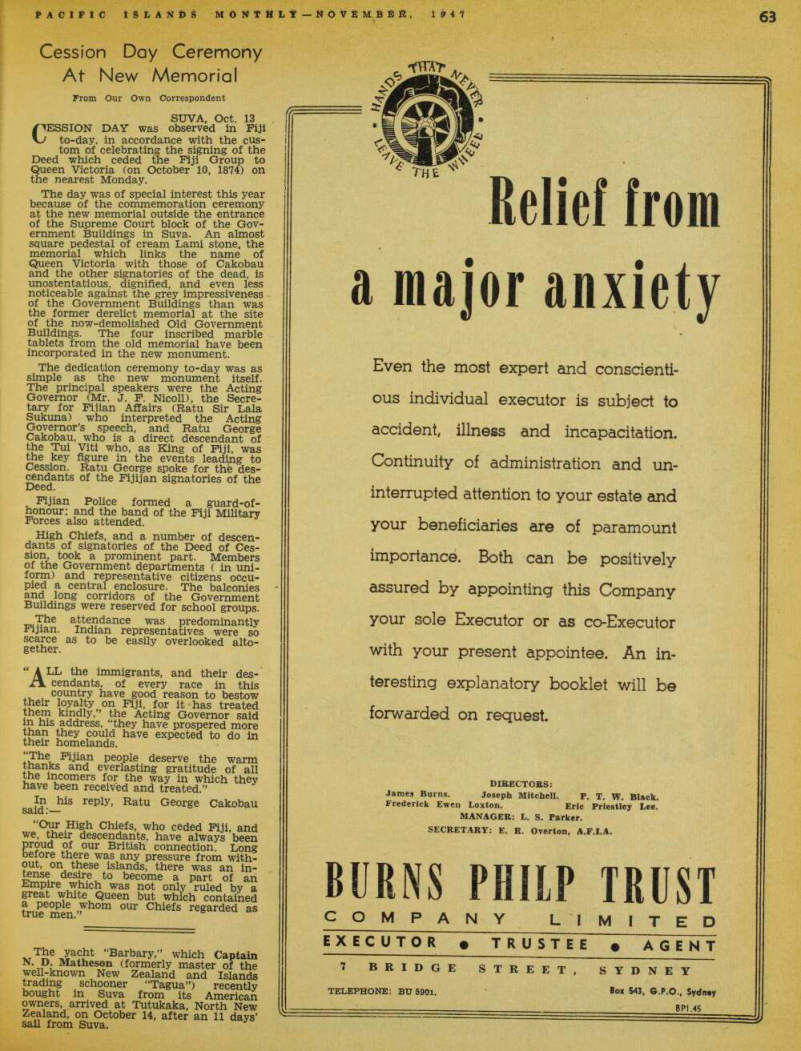
At New Memorial
From Our Own Correspondent
Suva. Oct. 13
CESSION DAY was observed in Fiji to-day, in accordance with the cus tom of celebrating the signing of the Deed which ceded the Fiji Group to Queen Victoria (on October 10, 1874) on the nearest Monday.
The day was of special interest this year because of the commemoration ceremony at the new memorial outside the entrance of the Supreme Court block of the Gov ernment Buildings in Suva. An almost square pedestal of cream Lami stone, the memorial which links the name of Queen Victoria with those of Cakobau and the other signatories of the dead, is unostentatious, dignified, and even less noticeable against the grey impressiveness of the Government Buildings than was the former derelict memorial at the site of the now-demolished Old Government Buildings. The four inscribed marble tablets from the old memorial have been incorporated in the new monument.
The dedication ceremony to-day was as simple as the new monument itself.
The principal speakers were the Acting Governor (Mr. J, F. Nicoll), the Secre tary for Fijian Affairs (Ratu Sir Lala Sukuna) who interpreted the Acting Governor’s speech, and Ratu George Cakobau, who is a direct descendant of the Tui Viti who, as King of Fiji, was the key figure in the events leading to Cession. Ratu George spoke for the des cendants of the Fijijan signatories of the Deed.
Fijian Police formed a guard-of honour: and the band of the Fiji Military Forces also attended.
High Chiefs, and a number of descen dants of signatories of the Deed of Ces sion, took a prominent part. Members of the Government departments ( in uni form) and representative citizens occu pied a central enclosure. The balconies and long corridors of the Government Buildings were reserved for school groups.
The attendance was predominantly Fijian. Indian representatives were so scarce as to be easily overlooked alto gether.
“ALL the immigrants, and their des cendants, of every race in this country have good reason to bestow their loyalty on Fiji, for it has treated them kindly,” the Acting Governor said m his address, “they have prospered more than they could have expected to do in their homelands.
“The Fijian people deserve the warm thanks and everlasting gratitude of all the incomers for the way in which they have been received and treated.”
In his reply, Ratu George Cakobau said : i —• Hi l h Chi e fs v who ceded Fiji, and we, their descendants, have always been proud of our British connection. Long before there was any pressure from with out, on these islands, there was an in tense desire to become a part of an Empire which was not only ruled by a great white Queen but which contained a people whom our Chiefs regarded as true men.”
“ B arbary, ’’ which Captain N. D. Matheson (formerly master of the well-known New Zealand and Islands trading schooner “Tagua”) recently bought in Suva from its American owners, arrived at Tutukaka, North New Zealand, on October 14, after an 11 da vs’ sail from Suva.
Advertisements & other items, p. 67 (1 item)
a major anxiety
TffXT o
Relief from
Even the most expert and conscientious individual executor is subject to accident, illness and incapacitation.
Continuity of administration and uninterrupted attention to your estate and your beneficiaries are of paramount importance. Both can be positively assured by appointing this Company your sole Executor or as co-Executor with your present appointee. An interesting explanatory booklet will be forwarded on request.
DIRECTORS:
Janies Burns. Joseph Mitchell. P. T. W. Black.
Frederick Ewen Loxton, Eric Priestley Lee.
MANAGER: L. S. Parker.
SECRETARY: E. R. Overton, A.F.I.A.
BURNS PHIIP TRUST
COMPANY
LIMITED
EXECUTOR * TRUSTEE
AGENT
1 BRIDGE STREET, SYDNEY
TELEPHONE: BU 5901. Box 543, G.P.0., Sydney
BPI .45
When Errol Flynn Was
A NG Gold-Miner
Finschhafen, Oct. 20.
PRACTICALLY no sooner had Bill Fleming arrived at Finschhafen on a business trip than an old admirer handed him a tennis racquet and asked him to display some of his erstwhile form. The tall, athletic, Warden’s Cup winner of pre-war Wau days soon brought his effective backstroke into play and won all his sets, despite the fact that he had not played for nine months.
Back in the rip-snorting, gold boom days on the Mofobe Gold-field, in the early 30’s, Errol Flynn, Hollywood film star, when he wasn’t mining, recruiting, working for the Administration or private enterprise, card-playing or ticking up debts, used frequently to come down to Wau from his claim on Edie Creek and stay at Bill’s house.
Both were bachelors in those happy
days of cheap, efficient native labour and of continuous beer supply. Right along side the house were two tennis courts.
Errol was an all-round good sports man, both actually and temperamentally, and this compensated for his minor delin quencies. He had a charming manner, spoke with culture, was handsome, tall and well-built though, wearing shorts on the court, he looked “beef to the ankles.” He was a first-rate boxer and an excellent tennis player, later winning the championship at Hollywood.
But in those early days Bill Fleming was often too good for Errol, and more than once he beat Flynn at singles, fre quently early on Sunday mornings before breakfast.
It is good to see some of the “old timers” retaining something of their youthful prowess.
Mr. Claude Rouse, of Nubia plantation in the Wewak area, with Mrs. Rouse, arrived recently in Sydney on leave.
Marching Rule
Leaders
On Trial In BSI
From Our Own Correspondent
Honiara, Oct. 29.
rE Marching Rule movement, which recently sent the overseas Press into such a hysteria of false reports, is now somewhat disillusioned as it watches its arrested keymen being sentenced here by the High Commissioner’s Court for illegal practices. Sentences have so far ranged up to two years’ imprisonment.
The real leaders have not yet come up for trial.
Thirty-five prisoners, gathered-in dur ing unopposed mass arrests since late in August, have been tried not, as the Judicial Commission emphasises, as mem bers of the movement called Marching Rule, but for breaking the law by setting up illegal courts and imprisoning and fining other natives.
Many arrests were made on complaints preferred by Solomon Islanders.
Originating among the traditional trouble-makers, the Malaitans, Marching Rule was originally out for better condi tions aims recognised as legitimate by the BSIP Government. But it speedily developed into a racket, with “boss” men victimising non-adherents and extorting money and labour, in some cases threat ening death.
Marching Rule illegal “ courts have attempted to displace Government-spon sored native courts presided over by dis trict headmen appointed by Government in consultation with local natives, who deal with minor offences and offences against native customary law.
Mangaian Labourers Sail
For Phosphate Isle
From Our Own Correspondent
Mangaia, Sep.
fIIHE long-hoped for chance to go to X the French “phosphate island” of Makatea, at last materialised. A large group of workers from the various districts of Mangaia left recently by the French-owned steamer that serves the phosphate island and the Tuamotus.
Cl native labour has worked at Maka tea for several years now, but this is the first contingent to go direct from Man gaia, where, up to now, the Island Coun cil has objected to the departure of local youth for service in French territory. The phosphate diggings had a bad name be fore conditions were altered. At that time, the worker took his own risk of illness or incapacitation; and if any acci dent occurred, it meant loss of pay. The improved conditions and wages of the pre sent day have given the Rarotongans satisfaction. There is great competition for the jobs on Makatea.
A regrettable feature of the emigra tion, however, is the impossibility of ob taining field-workers, and house-builders for “contract” jobs, on Mangaia, the cream of Mangaian man-power now hav ing departed for a term of two years.
Centenarian Dead In
N. Caledonia
NEW CALEDONIA’S oldest inhabitant, Madame Louis Guichard, died in Noumea on October 3 at the age of over 100. She was born in the island of Reunion on April 20, 1847, and she was married in that colony in the year of the Franco-Prussian War (1870).
Two years later she and her husband came to New Caledonia. Her family numbered three children, 14 grandchild ren and 12 great grandchildren. She had always enjoyed excellent health and a clear memory of Caledonian events, in cluding the native revolt of 1878.
Advertisements & other items, p. 68 (2 items)
64
NOVEMBER, 1 94 7 PACIFIC ISLANDS MONtHLV
W. H. Grove £ Sons
Available for regular
shipment from
• TEXTILES
• REFRIGERATORS
• TRADE GOODS
• CANNED FOODS
All orders promptly attended to
Cable “VIVIANPAT”
STEWART & FINCH
19 HUNTER STREET, SYDNEY
W. H. GROVE £ SONS
Limited
Established 1896.
AUCKLAND
(stand Traders, po. Box 495.
Telegraphic and Cable Address: “Grove”, Auckland.
Entrust Your Orders to the Firm with Fifty Years Practical Experience in the Island Trade.
Shippers of call dosses of New Zealand products.
Representing English Manufacturers through-
out the Cook and Society Islands, Fiji, Tonga, Samoa, Niue, New Caledonia, New Guinea, etc.
In FIJI as—W. H. Grove & Song (Fiji) Ltd.
The Kuper Family An Influence For Good in BSI
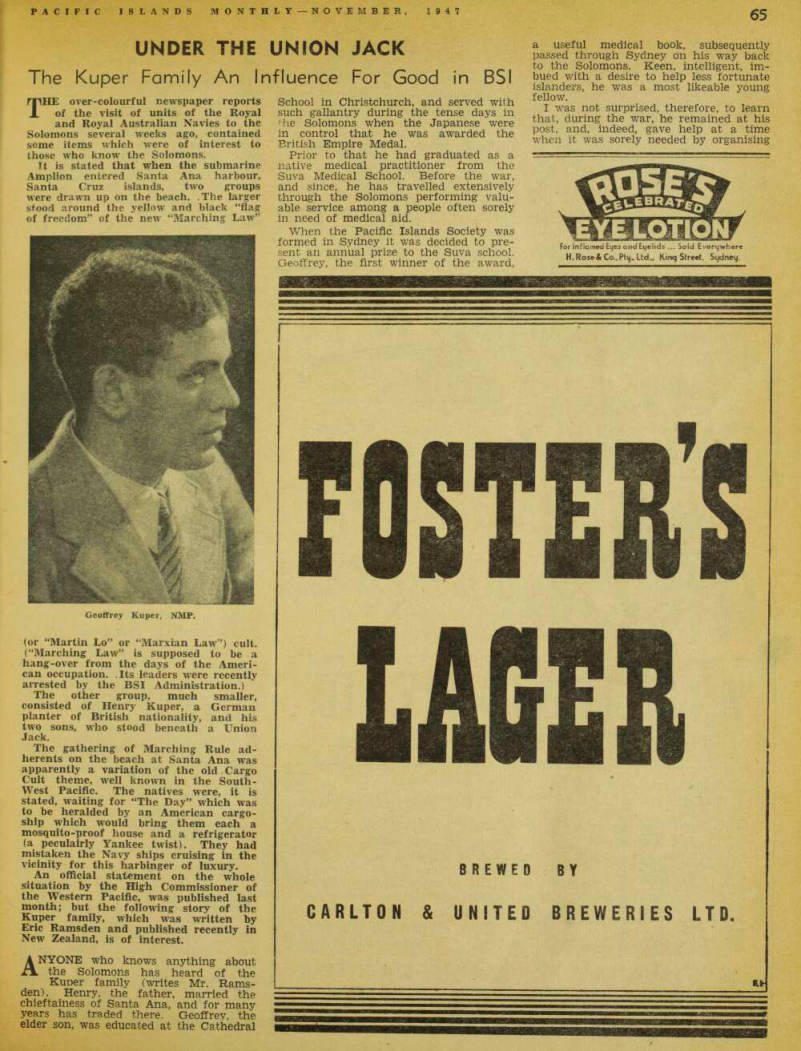
Under The Union Jack
THE over-colourful newspaper reports of the visit of units of the Royal and Royal Australian Navies to the Solomons several weeks ago, contained some items which were of interest to those who know the Solomons.
It is stated that when the submarine Amplion entered Santa Ana harbour, Santa Cruz islands, two groups were drawn up on the beach. .The larger stood around the yellow and black “flag of freedom” of the new “Marching Law”
(or “Martin Lo” or “Marxian Law”) cult. (“Marching Law” is supposed to be a hang-over from the days of the Ameri can occupation. .Its leaders were recently arrested by the BSI Administration.) The other group, much smaller, consisted of Henry Kuper, a German planter of British nationality, and his two sons, who stood beneath a Union Jack.
The gathering of Marching Rule ad herents on the beach at Santa Ana was apparently a variation of the old Cargo Cult theme, well known in the South- West Pacific. The natives were, it is stated, waiting for “The Day” which was to be heralded by an American cargo ship which would bring them each a mosquito-proof house and a refrigerator (a peculairly Yankee twist). They had mistaken the Navy ships cruising in the vicinity for this harbinger of luxury.
An official statement on the whole situation by the High Commissioner of the Western Pacific, was published last month; but the following story of the Kuper family, which was written by Eric Ramsden and published recently in New Zealand, is of interest.
ANYONE who knows anything about the Solomons has heard of the Kuper family (writes Mr. Rams den). Henry, the father, married the chieftainess of Santa Ana, and for many years has traded there. Geoffrey, the elder son, was educated at the Cathedral
School in Christchurch, and served with such gallantry during the tense days in <he Solomons when the Japanese were in control that he was awarded the British Empire Medal.
Prior to that he had graduated as a native medical practitioner from the Suva Medical School. Before the war, and since, he has travelled extensively through the Solomons performing valu able service among a people often sorely in need of medical aid.
When the Pacific Islands Society was formed in Sydney it was decided to pre sent an annual prize to the Suva school.
Geoffrey, the first winner of the award,
a useful medical book, subsequently passed through Sydney on his way back to the Solomons. Keen, intelligent, im bued with a desire to help less fortunate islanders, he was a most likeable young fellow.
I was not surprised, therefore, to learn that, during the war, he remained at his post, and, indeed, gave help at a time when it was sorely needed by organising
Geoffrey Kuper, NMP.
an intelligence movement. If the Japanese could have laid hands on Geoffrey Kuper, his fate would have been decided instantly. Therefore, it was good to learn that Geoffrey was assisting his father and brother to keep the British flag flying in Santa Ana the other day.
One of the best books on the Pacific written in recent years is Dr. S. M. Lambert’s “A Doctor in Paradise.” Thousands of native folk owe their lives to Dr. Lambert. Perhaps his most fitting memorial, and certainly a very useful one, is the Medical School he established at Suva, where Geoffrey and others were prepared for work in the field.
In the book he makes several references to the Kuper family. When he first met them, Geoffrey and his brother were running wild, absolutely naked, he says, on the beach. Their mother, who posed for the visitor’s camera, was “bare from the top of her head to the waistband of her lavalava, and around her neck were shark’s teeth, and a long pen-
cil of polished shell ran through the septum of her nose.” “Tenderly,” he wrote, “she picked up the children and told me they were nice boys, but not strong.”
Dr. Lambert found them suffering from hookworm, and dosed them with chenopoium. Both grew into “fine” husky lads,” and it was at the sugges tion of the American that Henry Kuper eventually decided to send his elder son to the medical training school, “I have another picture,” said the author. “It is of a good-looking boy, very collegiate in a tweed suit and striped necktie. He would be hard to recognise as the naked child in the first picture.”
Such was the background of Geoffrey Kuper.
The boy who was destined to win a coveted medical prize went through the usual tribal initiation among his mother’s people. For six months he stayed in the ceremonial house, among the ancestral canoes and skulls. Priests came to his
pagan retreat to instruct him in ritual, which included house building, fishing, and the preparation of a yam and taro garden.
But when he became a graduate prac titioner, he had been away so long from his mother’s people that he had for gotten their language, the roots of which are definitely Polynesian, Geoffrey spoke the English of a public school boy.
“His father, a very progressive Euro pean,” says Dr. Lambert, “wanted his son to have the best of our civilisation.
He was right, I think, for Geoffrey is doing fine work in the Solomons.”
Advertisements & other items, pp. 69-70 (1 item)
Ye Lotion
M
For Inflcmed Eyes and Eyelids ... Sold Everywhere H. Rosei Co.,Pty. Ltd.. King Street. Sydney.
CARLTON
BREWED BY
UNITED BREWERIES LTD.
From WHOA!
SIMPLEX
MARINE ENGINES
3, 5 and 10/12 h.p. Suitable for all crafts from 14-32 ft. The 5 and 10 h.p. are supplied with built-in reverse gear. All Australian made. Prices and specifications on request.
C.Q.R. ANCHORS
The lightweight anchor with three times the holding power of any other anchor. No more efficient tool for quick and positive “dig-in” has ever been found than the ploughshare. The C.Q.R. is two well designed ploughshares welded together. Write for C.Q.R. Anchor leaflet.
to GO!
W. KOPSEN & CO. PTV. LTD.
Have EVERYTHING for Boats
FISHING
TACKLE
Our new Fishing Department has been opened to provide the utmost service and satisfaction in all classes of fishing gear. Marlin Gut lines, Fishkil Nylon Twist, Geisha Wire Traces, Linen and Cotton lines, Rangoon and Split Cane Rods, Reels and numerous other lines. ►O4
KAYEN PRESSURE LAMPS
The all Australian made vapour lamps— reliable —efficient—safe—easy to operate.
Burns for 10 hours on IV* pints of kerosene. The lamp illustrated is of 300 C.P. and is the table model (HL7); the allpurpose lamp (AP2) is windproof and ideal for outdoor work. Burn ordinary kerosene. Write for illustrated leaflet.
SHIPCHANDLERS & MARINE ENGINEERS
376-382 KENT STREET, SYDNEY. PHONE: MA6336 (9 lines).
Cables: “KOPSEN” Sydney.
Stop
Re-Export Racket Is To Stop Imported Goods Were Going From Fiji to New Zealand
From Our Own Correspondent
Suva, Oct. 27.
IN future it will not be so easy for Fiji residents, or visitors to the . Colony, to supply their New Zealand friends with scarce or rationed goods ex- Fiji. Many of these goods are to be con trolled, and an export licence will be necessary before they can be sent out of the country.
In April, 18 cases of assorted liquor were sent out of Fiji to New Zealand by a single ship; and in August the same ship carried 83 cases.
In the last few months such re-exports from Fiji have included cases of white shirts, drapery, tyres, wire netting, new cars and even porcelain baths all very scarce items in the socialistic paradise of New Zealand. A proportion of these goods, which should be Fiji’s, had been secured from dollar sources.
It has been noticeable, also, that hurri cane lanterns and kerosene lamps and stoves all of which are essential for people in the remoter parts of the islands —began to disappear when power shor tages developed in the Dominion as a result of its Government being unable to induce miners to hew sufficient coal.
Norfolk Is. Has A New
Picture Show
MR. C. H. L. BAMFORD of Burnt Pine, Norfolk Island, has opened a new picture show on that island. Resi dents now enjoy a new programme every Saturday night, and are enthusiastic at having their own local movies.
Mr. Bamford’s first programme (“Tar zan’s Secret Treasure” starring Johnny Weissmuller and Maureen O’Sullivan plus a Laurel and Hardy comedy) was a great success. His second programme (“An other Thin Man”) was well attended in spite of the fact that a cyclonic storm raged during the entire screening of the programme.
Programmes are air-freighted from Metro-Goldwyn-Mayer, Brisbane, by RNZAF plane.
The many friends of Mr. and Mrs. S. S.
Boye, of Vanikoro, Southern Solomon Islands, will learn with regret that early in November Mr. Boye was brought from Vanikoro by plane to Sydney, where he entered hospital for observation. His ill ness has not been diagnosed, but he is seriously unwell. Mr. Boye is the man ager of the Victorian company which mills and exports the kauri pine on Vanikoro —now an important industry.
Mrs. Boye assisted the Allies in maintain ing communications during the critical days of the war in the Solomons, and her services were specially recognised. She accompanied Mr. Boye to Sydney.
Mystery of South Pacific Commission
South Pacific Commission
THE present condition and future pur pose of the South Pacific Com mission is becoming more and more of a mystery.
It was a creation of Dr. Evatt (Aus tralian “Foreign Minister”); and the fact that it has disappeared into obscurity means either that the Australian Minister has become tired of his toy, or that the other countries concerned (Britain, United States, France, Holland, New Zealand) have declined to take the plan very seri ously, and are not co-operating.
The Conference was held in Canberra last January, attended by all countries with Territorial interests in the South Pacific, and it was then agreed that a Commission should be established, the main purpose of which appeared to be a co-ordination of administrative policy in the South Pacific Territories.
It was proposed then that the head quarters of the Commission should be in Suva—a natural centre of the Pacific; but Australia fought for Port Moresby, which all other countries re garded as extremely unsuitable. Finally, as a compromise, it was decided that Sydney should be the temporary head quarters of the Commission for six months, within which period it was arranged the meeting of the Commission should take place.
Dr. Evatt placed the headquarters of the Commission in the School of Pacific Administration at St. George’s Heights, Mosman, Sydney, and appointed Colonel John Kerr as organising secretary. Since that time, although much more than six months have passed, not one word has been published about the organisation or
plans'of the South Pacific Commission.
It was noted that when Dr. Evatt left recently for the United Nations Confer ence, in New York, he took with him Colonel Kerr; but, despite questions by the press, he declined to state whether Colonel Kerr was travelling as organis ing secretary of the Commission, or merely as a member of Dr. Evatt’s staff.
To Represent N. Caledonia
In Paris
rE New Caledonian General Council has elected Colonel Maurice Bichon to act as the Colony’s third repre sentative in Paris where he will sit as a member of the Assembly of the French Union. He is classed politically as an independent.
Col. Bichon left the Colony 20 years
ago as a sergeant in the French Army.
He fought with distinction throughout World War II in France, including Dun kirk, North Africa, Alsace and Germany, and latterly he was with the French Forces in Indo-China. He was awarded the Legion d’Honneur, the Croix de Guerre with four stars and one palm, and the Colonial Medal. He has recently been in Noumea on leave.
Four doctors arrived in Noumea, New Caledonia, by the “Sagittaire” recently.
They were Dr. Commandant Ragusian, who will direct the Gaston Bourret Laboratory; Dr. Captain Douvier, who will replace Dr. Bousquet at the nickel village of Thio; Dr. Captain Lestrade, who will join the Noumea Hospital staff and who will be the official doctor for public officials; and Dr: Lieut. Boube, who is un attached.
Advertisements & other items, p. 71 (2 items)
67
PACIFIC ISLANDS M O N T H L t NOVEMBER, 1947
J. C. Merrillees
PTY. LTD.
General Island Merchants
PHOENIX BUILDING, 63 PITT ST., SYDNEY
Telegrams and Cables: MERRILLEES SYDNEY. Phone: 8W6064
BUDGE
REFRIGERATION and
ICE MAKING
EQUIPMENT
COMMERCIAL AND INDUSTRIAL
UNITS
(not domestic) Ammonia and Methyl Chloride machines of large or small capacity.
The illustration is of a small (nine 28 lb. blocks) electric, Methyl Chloride Icemaking plant.
Enquirers should mention dimensions of cold room (or cabinet) and of amount of ice (if any) required per day; also if electric motqr or internal combustion engine is to be included.
JAMES BUDGE PTY. LTD.
REFRIGERATION ENGINEERS
McEvoy Street, Alexandria, Sydney
Established 1890 3 r,
Recipes For Islands Cooks
A COMMENDABLE and apparently successful effort has been made by the ladies of Vila, New Hebrides, to raise money for the “Food for Britain” and the French “Sons of the Fallen”
Funds, by compiling, producing and sel ling (5/- each) a book entitled “Island Recipes.”
The purpose of the book is not so much to show anyone how to cook as to tell them what to cook, when one is living in the Islands. Some 24 New Hebrides ladies contributed the recipes, and the latter prove how one may make effective use of local fruits, vegetables, fish and game such as coconuts, bananas, oranges, pine apples, limes, avocada pears, soursop, paw-paws, oysters, prawns, turtles, yams, fish, crabs, pigeons, wild duck, eggplant, breadfruit, corn, manioc, okra, pumpkin, sweet potatoes, grenadillas, mangoes, arrowroot, chokoes, etc.
The book is neatly divided into sec tions, ranging from Beverages to Savouries, from Soups to Pickles, and it is well indexed. The work of organisation and production was done by Mesdames A. M. Blandy and M. O. Blackwell, who are to be congratulated on their achieve ment and commended for their initiative.
The funds have benefited well, and Pacific Islands residents have been pro vided with a very useful compilation.
Mr. Kaimund Denis Cahill, who was accidentally killed in the Morobe Dis trict of New Guinea on August 31, was employed by the Works and Housing De partment as a Transport Driver between Lae and Wau, and he had only just turned 19 years of aee. His body was taken by air to Port Moresby and buried at Konedobu, in the same grave as his grandmother (Mrs. A. R. Pechotsch). He was the son of Sub-Inspector and Mrs.
Norrie Cahill; and, as a member of a pioneer family, he was highly esteemed not only by Europeans but by natives of the Territory as was made evident by the large attendance at the funeral of both natives and half-castes.
Demoralisation Of Ng Natives

What The Wardist Regime Has Accomplished
Letter to the Editor
IHAVE been familiar with Madang for a number of years now. I have been here before, during and since the war.
Before the war, the native administra tion system was very good, although there was room for improvement. During the war the situation was hot so good, on
Present Day
The native now has his set hours of work and they are much shorter than pre-war. Whether he is being worked by an efficient overseer or not, he can work only if he feels inclined. If he wants to smoke, chew betel-nut, sit down, cook himself a meal, or absent himself from the job, he can do so and take as long as he likes over it. In a case like this, his pay and food still go on.
For any neglect of duty, or for giving cheek to an overseer, he is not charged before the local police-master—he can just please himself.
He is allowed to walk about freely at night, and he can sleep in any house that he likes.
The lights in native houses can be on all night and the native can make as much noise as he likes all night.
The natives can gamble as much as they like now. Most of them have plenty of money and many are up all night gambling and they are too tired to do a job of work the following day.
Any native can wear just any sort of clothing he likes. Some of them limp along with boots on, some wear military hats Nazi fashion, and some with long trousers, certainly do look “specimens.”
A native can now sfreak just how he likes, and can be as cheeky as he likes to any white man.
The police boys these days are mostly ornaments about the town. Some are out all night gambling, or have boys in their barracks, gambling. Some are of an undesirable class.
Monsieur Fourcade, former Chef de Cabinet of Governor Tallec in New Cale donia, and prior to that head of the civilian staff of the d‘Argenlieu mission, and the French official in the New Hebrides, has left Paris to attend the Asiatic Labour Conference in New Delhi as French Government representative.
A gentleman who entered Papua a few months ago as an employee of the Public Works Department got away from the Territory iust one hon ahead of the police, after passing about £l5O worth of worth less cheques. A warrant for his arrest, on charges of forgery and theft, is now circulating Australia.
account of mission influence, general humbug on behalf of the Army and troops fraternising with natives.
Since the war the situation has become ridiculous. I am now in Madang and I have been studying the difference between the native of to-day and the native of pre-war, with this result:—
Pre-War
The native had his set hours of work, and he did his job during those hours.
If he was worked by an efficient over seer, he did his work without any trouble.
He was allowed little concessions, if he wanted a smoke, or wanted to go for a drink, or attend to the calls of nature he could do so, providing he did not take too long.
If he played about on the job, did not obey orders, or was cheeky to an over seer. he could be sent to the local police master and charged with neglect of duty, or whatever the case may be.
It was compulsory for him to have per mission in writing before he’d be absent from his house at night. That permis sion only allowed him to be out until 11 p.m.. It was compulsory for him to sleep in his own house after that hour.
It was compulsory for all lights to be out in native houses at 11 p.m.. After that hour the native was to be silent so as to give both white and black a chance to have a night’s rest.
It was illegal for any native to gamble with cards. Any native caught could be given three months in prison.
The usual dress for a native boy was the lap-lap of regulation length. He could, if he wished, wear a short pair of trousers or trunks underneath. Only natives who were working around mach inery were allowed to wear short trousers for safety. A sweater or flannel, or even a shirt, could be worn at night-time, or up in the highlands, for warmth.
A native always treated and spoke to a white man with respect. If he did not do so, there was the local police master to deal with the matter.
There was a native constabulary that did do a good job of work. These police boys used to patrol the place at night and arrest any native out without per mission, out after hours, gambling, etc.
There were such things as discipline, and the prestige of the white man.
These are things of the past. The troops lowered the prestige of the white man when they were here; and some of the new men who have come in under the Ward regime have not improved the position.
I do not blame any of the old-timers for leaving New Guinea for other parts.
I think a great deal of New Guinea myself but I expect to be leaving for abroad soon. I have remained here since the war, in the hopes that conditions would improve and we could get back somewhat to pre-war standards. But things are getting worse.
The longer this ridiculous set-up lasts, the longer it is going to be for the old timers to get the country civilised again.
If there is not an improvement soon, it will be too late. The natives themselves realise that the set-up is no good, and are looking to the old-timers to do their part. Unfortunately, the old-timers are kept in the background.
Any number of the natives have asked me to take the job of Assistant District or Patrol Officer around their areas. They know that I would maintain discipline and get the area under control, and that is what they want. They prefer me to these inexperienced cadets that are about these days. Needless to say, the Admin istration would not give me a job like that, because I am an old-timer, and I know more about the country and the natives than all of these cadets put to gether.
Thanks to Mr. Ward and his offsiders,
the New Guinea native of to-day is just a big-headed native that cannot help himself, and just has to drift with the tide. In his own heart he wants to get out of that groove and he is depend ing on old-timers to help him. Unfor tunately, I see no opportunity of any of us old-timers doing it.
I am, etc.,
“Old Timer”
Madang, NG.
October 23. 1947.
Advertisements & other items, pp. 72-74 (2 items)
Pacific Islands
TRADE
A substantial New Zealand Company is commencing trading operations to the Pacific Islands, and has purchased modern motor cargo vessels which will operate out from New Zealand ports and as a feeder service in the Islands.
Inquiries are now invited from active and competent men both to man these vessels and to operate the necessary store stations and establishments in the Islands.
Seafaring men, certificated officers, engineers and others are required, also men with accountancy and storekeeping knowledge and other skilled tradesmen including timber workers and bushmen.
There will be some opportunities within the Organisation for members to work on a co-operative basis and to participate in profits in addition to wages. Applicants would therefore need to have some capital available for investment, although no very large sum would be required.
The Company has completed all preliminary surveys and has concessions awaiting immediate development. This is an outstanding opportunity for those men who are looking for a new outlet where their own energy and ambition will have unlimited scope.
Apply in the first instance to— “lsland Trading,”
Care CHARLES HAINES
ADVERTISING AGENCY, Wellington.
Electrolux
There is only one
THE MODERN KEROSENE-OPERATED REFRIGERATOR
THAT ACHIEVES THE MIRACLE OF ICE FROM HEAT
Lasting Efficiency, Silent Operation, Streamlined Beauty
•' at Economically operated by kerosene, with a simple precision-built freezing unit that has no moving parts and is GUARANTEED FOR
FIVE (5) YEARS.
Model LKSSI Obtainable from : W. R. CARPENTER (New Guinea), LTD.
Rabaul, Madang, Lae, Kavieng, Wan.
J. R. CLAY & CO., LTD., Port Moresby.
W. R. CARPENTER & CO. (Sol. Is.), LTD., Tulagi.
For New Hebrides, Butaritari, Noumea, New Caledonia. Apply— Storage capacity: 5i cub. ft. (approx); shelf area, 9 sq. ft.; food shelves, six—five removable; 2 self-supporting when half drawn. Ice-making: Four trays—s lb. ice per freezing: 80 cubes. Fuel consumption 1.8 pints kerosene per day (approx.).
Height: 4 ft. 10 in. Depth: 2 ft. in.
Weight, unpacked, 434 lb. Packed, 700 lb.
CARPENTER & CO. LTD. Head Office: 16 O'Connell St., Sydney, N. S. Wales
Re the Estate of JOHN KENNETH VICARS GRIFFIN usually known as Peter Griffin late of Rabaul in New Guinea, Plantation Auditor and Inspector
deceased. LETTERS OF ADMINISTRA-
TION with the Will annexed granted by the Supreme Court of New South Wales on the 17th day of October, 1947. PURSUANT to the Wills Probate and Administration Act 1898-1940; Testator’s Family Maintenance and Guardianship of Infants Act, 1916-1938; and Trustee Act, 1925- 1942: The PUBLIC TRUSTEE the administrator with the will annexed of the estate of the said JOHN KENNETH VICARS GRIFFIN usually known as Peter Griffin who became missing on the 18th day of February, 1944, and is for official purposes presumed to be dead hereby gives notice that creditors and others having any claim against or to the Estate of the said deceased, are required to send particulars of their claims to the said PUBLIC TRUSTEE at 19 O’Connell Street, Sydney, on or before the 10th day of January, 1948, at the expiration of which time the said Public Trustee will distribute the assets of the said deceased to the persons entitled, having regard only to the claims of which he then has notice.
M. C. NOTT,
Public Trustee.
Steamships Trading
Company Limited
PORT MORESBY
SAMARA I
PAPUA.
WHOLESALE & RETAIL MERCHANTS, SHIPOWNERS,
PLANTERS, ENGINEERS & SLIP PROPRIETORS.
Customs, Shipping, Insurance, and Forwarding Agents.
MANAGING AGENTS AND VISITING REPRESENTA-
TIVES FOR COCONUT AND RUBBER ESTATES.
SYDNEY REPRESENTATIVES: Nelson & Robertson Pty. Ltd., 12 Spring Street
Unpleasant Incident In NG
Missionary Attacked
Unpleasant Incident In NG Highlands
From Our Own Correspondent LAE. Oct. 22.
THE Reverend Father Schaeffer, of. the Catholic Mission, Chimbu, Central New Guinea, was attacked by a mob of young men, some 80 strong, as he was passing along the main road, which runs through the Lutheran Mission at Kero wagi, on October 16.
The offenders proved to be “students” at the Lutheran Mission there. One wonders what they are taught. Loyalty to the king and respect for constituted authority do not appear to be among the subjects.
Speedy action by the Assistant District Officer resulted in half a dozen ring leaders being consigned to the calaboose for a term of six months, while many others were fined.
A strong guard of native police is be ing maintained in the vicinity of Kero wagi so that all sections of the com munity may use the roads without molestation.
Canon W. G. Thomas was welcomed home on October 6, in St. Paul’s Cathedral, Melbourne, Vic. He gave a vivid picture of the life and work of the Diocese of New Guinea as he had seen it during the past year. He spent four months as Rector of Port Moresby, and then travelled over most of the diocese.
Inaugural Meeting
Cook Islands
Council
From Our Own Correspondent
Rarotonga, Oct. 9.
rE inaugural session of the Legislative Council of the Cook Islands will commence late in October or early in November, according to thq arrival of the outer island representatives.
The Prime Minister has sent regrets that neither he nor Mr. Osborne can attend. If possible. Mr. R. T. G. Patrick, OBE, Secretary of Islands Territories, will represent the NZ Government, The Legislative Council will consist of:—(a) 10 unofficial members elected by the Island Councils, (b) 10 official mem bers appointed by the Governor General of New Zealand, (c) The Resident Com missioner, who will be President of the Council.
The ten unofficial members who have been elected by the Island Council are:— Rarotonga: William Hugh Watson, Makea George Pa Karika Ariki, DCM, Piri Tekamu Maoate, Ua Turua.
Aitutaki: Norman Mitchell.
Atiu: Rangematane Maka Kea Ariki.
Mauke: Jane Tarare Ariki.
Mangaia: Mateke John Trego Ariki.
Manihiki: Tihau Nabala.
Penrhyn: Akatapuria.
The ten official members are likely to be: Chief Medical Officer; Director of Agriculture; Education Officer; Treas urer; Acting Resident Agent of Aitutaki; and Resident Agents of Atiu, Mauke, Mangaia, Manihiki and Rakahanga, and Penrhyn Island.
The Government has approved of elected members of the Legislative Coun cil being granted free travel on the NZ Railways, including the NZ Road Motor Services.
The title of “Honourable” has been ap proved for use by Members of Legislative Council of the Cook Islands during their term of office, and within the limits of the Cook Islands.
N. Caledonia Will Get
More Australian Coal
rE president of the New Caledonian General Council, Monsieur H. Bon neaud, and the Inspector General of the Nickel Co., M. Coste, recently re turned to Noumea from Australia, where they discussed coal supplies for the Noumea nickel smelters with Common wealth authorities. During a stay of a fortnight they saw various Ministers and representatives of industry, and report some success.
It is hoped now that the Pt. Doniambo smelters will be able to resume production in part, and that arrangements will be made for the “Sagittaire” to carry coal to Noumea, supplementing the supplies brought by the Nickel Co’s old colliers, now reduced, as a result of the war, to two.
The French officials reported a request from Australia for timber which the Commonwealth needs badly. The Colony will make an effort in this direction and subsequently the General Council resolved to export 10,000 cubic metres of timber to Australia.
It is possible that the Commonwealth will take also 40 per cent, ferro-nickel which is produced by the Nickel Com pany’s electric smelters at Yate. and a supply of iron ore up to 50,000 tons for the first year.
They Eat Mosquito
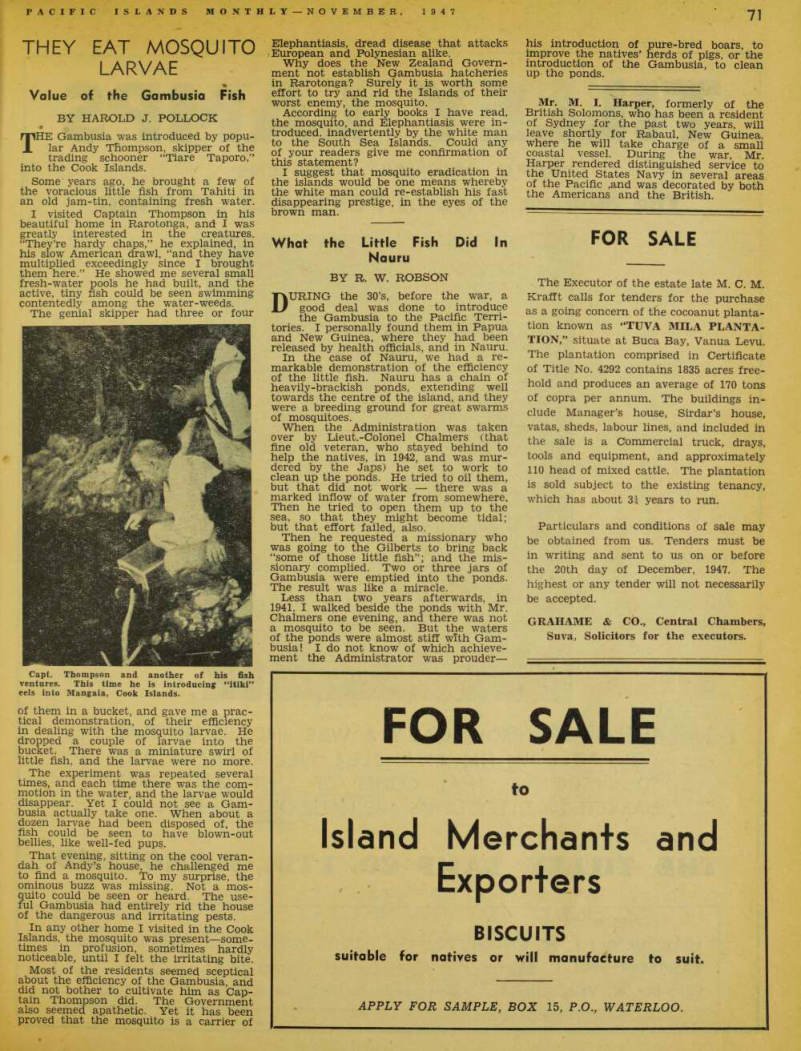
Larvae
Value of the Gambusia Fish
By Harold J. Pollock
THE Gambusia was introduced by popu lar Andy Thompson, skipper of the trading schooner “Tiare Taporo,’’ into the Cook Islands.
Some years ago, he brought a few of the voracious little fish from Tahiti in an old jam-tin, containing fresh water.
I visited Captain Thompson in his beautiful home in Rarotonga, and I was greatly interested in the creatures.
“They’re hardy chaps,’’ he explained, in his slow American drawl, “and they have multiplied exceedingly since I brought them here.” He showed me several small fresh-water pools he had built, and the active, tiny fish could be seen swimming contentedly among the water-weeds.
The genial skipper had three or four
of them in a bucket, and gave me a prac tical demonstration, of their efficiency in dealing with the mosquito larvae. He dropped a couple of larvae into the bucket. There was a miniature swirl of little fish, and the larvae were no more.
The experiment was repeated several times, and each time there was the com motion in the water, and the larvae would disappear. Yet I could not see a Gam busia actually take one. When about a dozen larvae had been disposed of, the fish could be seen to have blown-out bellies, like well-fed pups.
That evening, sitting on the cool veran dah of Andy’s house, he challenged me to find a mosquito. To my surprise, the ominous buzz was missing. Not a mos quito could be seen or heard. The use ful Gambusia had entirely rid the house of the dangerous and irritating pests.
In any other home I visited in the Cook Islands, the mosquito was present—some times in profusion, sometimes hardly noticeable, until I felt the irritating bite.
Most of the residents seemed sceptical about the efficiency of the Gambusia, and did not bother to cultivate him as Cap tain Thompson did. The Government also seemed apathetic. Yet it has been proved that the mosquito is a carrier of
Elephantiasis, dread disease that attacks European and Polynesian alike.
Why does the New Zealand Govern ment not establish Gambusia hatcheries in Rarotonga? Surely it is worth some effort to try and rid the Islands of their worst enemy, the mosquito.
According to early books I have read, the mosquito, and Elephantiasis were in troduced, inadvertently by the white man to the South Sea Islands. Could any of your readers give me confirmation of this statement?
I suggest that mosquito eradication in the islands would be one means whereby the white man could re-establish his fast disappearing prestige, in the eyes of the brown man.
Capt. Thompson and another of his fish ventures. This time he is introducing “itiki” eels into Mangaia, Cook Islands.
What the Little Fish Did In
Nauru
By R. W. Robson
DURING the 30’s, before the war, a good deal was done to introduce the Gambusia to the Pacific Terri tories. I personally found them in Papua and New Guinea, where they had been released by health officials, and in Nauru.
In the case of Nauru, we had a re markable demonstration of the efficiency of the little fish. Nauru has a chain of heavily-brackish ponds, extending well towards the centre of the island, and they were a breeding ground for great swarms of mosquitoes.
When the Administration was taken over by Lieut.-Colonel Chalmers (that fine old veteran, who stayed behind to help the natives, in 1942, and was mur dered by the Japs) he set to work to clean up the ponds. He tried to oil them, but that did not work there was a marked inflow of water from somewhere.
Then he tried to open them up to the sea, so that they might become tidal; but that effort failed, also.
Then he requested a missionary who was going to the Gilberts to bring back “some of those little fish’’; and the mis sionary complied. Two or three jars of Gambusia were emptied into the ponds.
The result was like a miracle.
Less than two years afterwards, in 1941, I walked beside the ponds with Mr.
Chalmers one evening, and there was not a mosquito to be seen. But the waters of the ponds were almost stiff with Gam busia! Ido not know of which achieve ment the Administrator was prouder—
his introduction of pure-bred boars, to improve the natives’ herds of pigs, or the introduction of the Gambusia, to clean up the ponds.
Mr. M. I. Harper, formerly of the British Solomons, who has been a resident of Sydney for the past two years, will leave shortly for Rabaul, New Guinea, where he will take charge of a small coastal vessel. During the war, Mr.
Harper rendered distinguished service to the United States Navy in several areas of the Pacific ,and was decorated by both the Americans and the British.
Advertisements & other items, pp. 75-76 (1 item)
Exporters
FOR SALE
The Executor of the estate late M. C. M.
Krafft calls for tenders for the purchase as a going concern of the cocoanut plantation known as “TUVA MILA PLANTA- TION,” situate at Buca Bay, Vanua Levu.
The plantation comprised in Certificate of Title No. 4292 contains 1835 acres freehold and produces an average of 170 tons of copra per annum. The buildings include Manager’s house, Sirdar’s house, vatas, sheds, labour lines, and included in the sale is a Commercial truck, drays, tools and equipment, and approximately 110 head of mixed cattle. The plantation is sold subject to the existing tenancy, which has about 34 years to run.
Particulars and conditions of sale may be obtained from us. Tenders must be in writing and sent to us on or before the 20th day of December. 1947. The highest or any tender will not necessarily be accepted.
GRAHAME & CO., Central Chambers, Suva, Solicitors for the executors.
FOR SALE
to
Island Merchants and
Exporters
BISCUITS
suitable for natives or will manufacture to suit.
APPLY FOR SAMPLE, BOX 15, P. 0., WATERLOO.
TILLEY LAMPS
BURN ORDINARY KEROSENE
The Modern Form of PORTABLE LIGHTING r THE OWL IS PROVERBIALLY A WISE BIRD, SO BE SURE YOU FOLLOW HIS EXAMPLE! TILLEY LAMPS ARE SO SUCCESSFUL THAT COPIES OF THEM ARE BEING MARKETED. TILLEY LAMPS ARE MADE ONLY IN ENGLAND THE TILLEY LAMP CO. LTD., of ENGLAND
REPRESENTATION :
MELBOURNE : T. H. Bentley, Pty. Ltd., 123-125 William Street, Melbourne, C.I.
TASMANIA : Mr. C. Sellars, 108 a Charles Street, Launceston.
FIJI : Mr. K. Witherington, 2 Burns Philp Buildings, Suva.
'Mystery' Liquor
Bill
All Fiji Churches Join In Strong Protest
From Our Own Correspondent
Suva, Nov. 3.
rE heads of the Anglican, Roman Catholic, Methodist, Presbyterian and Seventh Day Adventist Churches, with those of the London Missionary So ciety and the Assemblies of God—every Christian denomination represented in Fiji—are signatories to a formidable petition which protests vigorously against the controversial Liquor Bill. The Bill proposes to remove every one of the pre sent liquor restrictions on the Indians, while maintaining the permit-system for the Fijians.
It is the first time in Fiji’s history that every denomination, Protestant and Catholic, has joined in a single, united move.
In their petition, the Church leaders spare no one’s feelings. They ask the Legislative Council to scrap the Liquor Bill and to maintain the status quo. If this course is not adopted, they ask that the plan for removing the Indian re strictions be dropped. If this second re quest should also fail, they ask that the Bill be referred to a select or special committee of the Legislative Council, The widespread fear that the Bill, if it is passed, will open the door to a vast, organised and ruthless Indian bootlegging racket throughout the “dry” Fijian villages finds full expression in the petition.
The petitioners “find it difficult to understand what reasons have dictated
such a policy which, in their opinion, strikes at the very root of the spirit of the Deed of Cession, which quite recently the Legislative Council of Fiji unanim ously agreed should be upheld in the interests of the native Fijians.
“Those who know of the dangers of illicit traffic in liquor in the Colony to day realise the still further adverse effect of the proposed legislation upon the Fijians,” the petition continues,
Indian Bootleg Menace
“'VTO police force in the Colony could ll possibly control the illicit traffic in liquor by the Indians, nor could the police cope with the lawlessness that will arise if the Bill becomes law, and it is not an exaggeration to say that such lawlessness will result in grievous and permanent harm to the Fijian race.”
Quoting a report in the “Fiji Times” of March 7, in which it was stated that the former Governor (Sir Alexander Grantham) had said that the Council of Chiefs had approved the Bill by an over whelming majority, the petitioners state that this report took them by surprise.
They had been informed some weeks earlier that the Bill, as a Bill, had never been discussed by the Council of Chiefs, but that the point submitted to the Chiefs merely dealt with the question of whether it was advisable or not to retain the permit system governing the con sumption of liquor by Fijians.
In his address at the opening of the Legislative Council, on October 31, the Acting-Governor (Mr. J. F. Nicoll) said: “When considering this matter (the Liquor Bill) I would ask honourable mem bers to bear in mind that there is a problem to be faced, and that if the pre sent proposals of the Government are not acceptable, I hope members will put for ward alternative proposals aimed at solving this problem.”
“What Problem?”
TO this a majority of the non-Indian public of Fiji are asking: “What problem?”
On the same day, the “Fiji Times” editorially attacked the Bill—not for the first time —and, in regard to the petition, said that “if the Government, in the face of public opinion, forces the Bill through in its present form, the Secretary of State surely cannot ignore this combined plea, which is concerned with the welfare of the Native race and which is so strongly supported.”
Like the petitioners and the public, the paper is at a loss to understand what motive is behind a measure “which seems so unwise and so unnecessary.”
The air of mystery in which the Liquor Bill has been wrapped by cryptic Gov ernment references is doing a great deal to wreck whatever inter-racial cordiality well-meaning, but unpractical official speakers have been able to build up.
The popular idea is that the Govern ment has been pushed into the Liquor Bill, regardless of consequences, by Indian equality-agitators; or that the whole thing ‘is a desperate move for more revenue.
Neither motive could be described as creditable in the circumstances. If there is a worthier reason for the Govern ment’s persistence over the Liquor Bill, the public have not been told about it.
The astonishing statement of a year ago —that the Bill is part of the Govern ment’s policy of “removing racial discrim ination and protecting the Fijian people” —has not been accepted at all.
Liquor Duties Up
PEOPLE who expected that, If the Liquor Bill were pushed through the Legislative Council, the Customs duties on imported beer, spirits and wines would be increased
soon afterwards were jolted when the duties were increased, on the motion of the Controller of Customs, on the first day of the council’s sitting.
The duty on beer was increased by 2d. a bottle, or 1/- a gallon, and the increases on wine and spirits were considerably heavier. The effect of these increases, as well as of increases made simultaneously on tobacco and cigarettes, petrol, drugs and medicines, on the controlled retail prices has not yet been announced.
Comparatively slight cuts were made in the duties on tea, kerosene and tinned milk.
Advertisements & other items, pp. 77-78 (1 item)
I J. Gougri S. Co.
r Cooper Adjustable Glass Louvres are manufactured by F. W. GISSING PTY., LTD., 197 Wilson Street, Newtown, Sydney, Australia. Always insist on GENUINE
COOPER LOUVRES—
they are clearly branded.
Keeps Hot Sun OUT . . .
Let Cool Breezes IN!
Cooper Adjustable Glass Louvres are the ideal way of securing maximum ventilation with minimum interference from glare. Fitted with non-actinic glass, which absorbs the sun’s heat, they are ideal for nurseries and verandahs . . and amazing though ? t may seem, are actually cheaper to install than ordinary windows Cheaper to insfal than ANY other kind of WINQOW
ADJUSTABLE GLASS LOUVRFS
Imagine it—units of movable glass louvres (plain or figured) in metal frames, giving unobstructed light and air, yet protection from draughts and rain and all with as simple a motion as flicking on a light switch. The price is so amazingly reasonable and father can do all the erecting, it’s so easy.
Illustrated: Typical Suburban Home. Verandah (Sydney) glassed in with Cooper Louvres.
WRITE FOR PARTICULARS TO PACIFIC ISLANDS REPRESENTATIVE
I J. GOUGrI S. CO.
SUPPLIERS OF GENERAL MERCHANDISE TO LEADING FIRMS THROUGHOUT THE PACIFIC ISLANDS.
Exporters . . . Importers . . . Manufacturer s’ Representatives 1 BOND STREET, SYDNEY, AUSTRALIA. Box 3615 G.P.O. Tel. 84167 Bankers: Bank of N.S.W. Bank of Adelaide. Comptoir Nat. d’Escompte de Paris.
Cable Address: “SEAFOODS,” SYDNEY.
Codes: Bentley’s, 2nd and Comp, Phrase; A. 8.0., sth and 6th; Peterson, 2nd and 3rd; Banking; Acme.
Motion Picture Entertainment
now available to Island
Residents!
IMMEDIATE
DELIVERY
cmvox
16mm
Sound - On - Film
PROJECTORS
“Movies” are now available as a welcome amenity for Pacific areas! We have the equipment, the leading motion picture producers have the film supplies and there is an excellent opportunity for enterprising island residents to provide this much-needed entertainment and at the same time make it a profitable career. The Cinevox “Exhibitor” (shown above) operates from AC or DC power supply or from mobile power units. It is portable and can be operated by anyone after a minimum of tuition. Thoroughly dependable, it gives perfect reproduction under all conditions; comprises dual projectors and sound heads with high gain high-fidelity amplifiers, including multiple speakers in special baffle cases—ensuring maximum audiefice coverage.
ORDER NOW from the Export Distributors;
VIZ-ED EQUIPMENT (Export) Ply. Ltd.
149 Castlereagh St., Sydney. MA9516
Cables: "VIZ-ED, SYDNEY"
At Right:
CINEVOX "SENIOR"
This is the ideal equipment for schools, missions, etc., and is widely used throughout Australia by State schools, religious bodies, and commercial organisations.
P
CINEVOX
wholly designed and built in
Australia by
PRECISION ENGINEERING GO. PTY. LTD.
PADDINGTON, N.S.W.
In Papua-NG
Back-to-School Movement In Papua-NG Australian Taxpayers Foot The Bill
Letter to the Editor DON’T the Australian taxpayers kick about anything, these days? Or don’t they know that they are sup porting the Australian School of Pacific Administration and all who attend it?
If I may be pardoned for mentioning the good old days, I would like to point out that before the New Order hit us, it was considered sufficient if cadet officers of the district Services department attended after a period of probation in the Territory a course at Sydney University.
Now all and sundry attend “The School.” Mind you. it is an ill wind that blows nowhere, and three to six months in Sydney with all expenses paid are not to be lightly turned down. Some of my friends in Civil Administration actually enjoy it.
Somewhere between 40 and 50 “students” have just completed their course and have returned to this land of coons and coconuts to relax after their strenuous studies. They incluude Assis tant District Officers, clerks and even typists. No totalitarian state ever went further in indoctrinating its adherents.
I am, etc.,
“Dumbell”
Madang, October 30, 1947.
He Has "Had" Lae
From Our Own Correspondent
Brisbane, Oct. 30.
BECAUSE of impossible conditions in New Guinea, Mr. B. F. Pearson, a former police sub-inspector, has re signed. He and his wife recently re turned to Australia by Qantas plane.
Mrs. Pearson said that she was sadly disillusioned with New Guinea. It was a single man’s country. The high cost of living without any proportionate in crease in salary, made it hopeless for a married couple to live comfortably in some parts of the Territories. A loaf of bread, she said, had cost 2/6, and a pound of butter, when it could be obtained, cost 3/4.
At Lae they depended on incoming ships for fresh food supplies, but the town was more often without meat than with it.
According to Mr. Pearson, the admin istration-sponsored native market in Lae had not been a success. Certain officials got most of the tropical fruits and vege tables. What was left over went to civi lians.
Mr Pearson said there had been little improvement fh the housing position in New Guinea during the six months he had been there.
Solomon Islands
Conditions
Natives Much Healthier But Sullen Towards Europeans
“fTtHERE has been a remarkable advance X in the condition of the natives in the British Solomon Islands during the nast 20 years,” said Major H. S.
Robinson, Secretary of the Melanesian Mission, on his return to Sydney recently from a lengthy visit to the Group.
Major Robinson first visited these Islands in 1926, and then he saw an appalling amount of sickness. A great many of the natives suffered from terrible tropical ulcers. To-day the native people generally are not only very much more healthy, but they seem to have a much better spirit. Splendid work has been done on the medical side by all the estab lished missions, and by the Administra tion. The visitor was impressed with the organisation and enthusiasm of the Senior Medical Officer, Doctor Rutter, and his assistant, Doctor MacGregor.
It was impossible to exaggerate the value of the work being done by the Native Medical Practitioners. The only trouble there was that there were not nearly enough NMP’s.
The Administration has many problems on its hands and is doing good work in the circumstances; but it is gravely han dicapped by lack of labour, materials of all kinds and shipping. rE Administration had a special prob lem in the present attitude of the natives towards Enropeans and the
demand for labour. “Twenty years ago when I first visited the Solomons, and even later, in the 30’s, it was a pleasure to meet these people when one landed almost anywhere on an Island beach.
They would greet one eagerly, carry one’s bag gladly offer any service that they could to show that one was welcome and held in high esteem. To-day, in some places, they offer no welcome at all — they are withdrawn and sullen. This is all the result of conditions created by the Japanese invasion and the battles which followed; but I am hopeful that this sullenness will pass away, under the patience and understanding being shown by the Government.”
He found much Administrative activity at Honiara limited, however, by lack of labour and material but there was little doing at Tulagi, where there still is a radio station. Some European plan tations have recommenced the production of copra, but generally European industry awaits the re-establishment of transport and other facilities.
“As a visitor who is very conscious that I do not know all there is to be known, I got the impression that the local Ad ministration is obliged to refer, far too much, and too many minor things, to some higher authority perhaps Suva, or probably London. The average visitor would say that this is a mistake that those highly qualified and experienced men on the spot there are quite capable of dealing with all except major matters, and that they should be left alone to carry on the Administration without hin drance from Headquarters. I got a very good impression of the calibre of the majority of the officials in the Solomons —but I did feel that they are not being given sufficient authority in carrying out their local duties.
A GREAT deal of medical work remains to be done in this archipelago, said Major Robinson; and one of the most heartening things he had seen was the appearance of native women nurses, well qualified after four years of inten sive hospital training. This represented a very important advance it meant that the old native tabu, which pre vented native men from accepting mini stration at the hands of native women, was being broken down. The ultimate solution of the native health problem in the Solomons undoubtedly lay in the hands of the trained natives themselves —in the work of NMP’s and native hos pital nurses, in the villages.
The work of the missions is being gravely handicapped by increasing costs.
“The Melanesian Mission has been run ning the motor vessel ‘Southern Cross’ 24 hours per day, and 7 days a week, in an attempt to assist in the solution of the transport difficulties in this group,” said Major Robinson; “but I am afraid that we are going to find ourselves in trouble. Our income under present con ditions simply cannot cope with the ever increasing costs and that is a problem that is common to all BSI mission organi sations.”
Advertisements & other items, p. 79 (1 item)
Dunlop
WANTED: Back numbers of the “Pacific Islands Monthly.” Have many duplicates for exchange. Will alzo exchange American magazines for newspapers and magazines of the Pacific Islands and British Colonial Empire. Orders taken for subscriptions to American magazines—no foreign exchange difficulties —write for details to PAUL A. DORN. Agent, Los Angeles 36, California.
* * Since 1888, when John Boyd Dunlop produced the first practical pneumatic tyre, the Dunlop organisation has striven to further the interests and development of transport.
Today, there is hardly a vehicle bicycle or aeroplane, horse-drawn waggons, motor car or truck that does not run more smoothly, silently, efficiently and economically because of Dunlop Tyres.
DUNLOP
Ut ili£
D 446
DUNLOP
AUSTRALIA
(INC
VIC .)
Have Fiji Indians Changed
Their Tune?
WHILE there are no grounds what ever for supposing that Indian political and other aims and am bitions in Fiji have been lowered, the last two months have seen a marked change in the behaviour of the formerly aggres sive gentlemen who pervade Suva’s shops and offices. This change is particularly noticeable in the attitude of young In dians towards Europeans.
The answer is not hard to find. The young Indians read the overseas cables in the newspapers avidly and, the march
of “free” India since August 15 has made deflating reading.
The day after Nehru’s pronouncement that his head “hung in shame” an In dian shopkeeper told this correspondent: “The news is worse and worse. It is a blow to our young men. They expected very big things when India was free.”
A son was born on September 4, in Port Moresby, to the Rev. and Mrs. Leslie Allen of the London Missionary Society, Uriki, Papua.
Sister E. M. Simmons left Australia re cently to join the nursing service of the Methodist Overseas Mission in Fiji.
Survey Of New
Guinea
Apart From Acute Shortage of Shipping and Fresh Food Con ditions Are Improved
From Our Own Correspondent LAE, Nov. 6. rpHE Morobe District, generally, is suf- X fering from shortage of essential commodities, such as soap, rice, milk, fresh foods, tobacco, canned meats, flour, and several other lines of less import ance. * * * This is due to the dislocation of ship ping. and as there is flour for only ten days’ supply, a bread famine is ex pected. * * * The Works and Housing Department are doing a good job on the roads here— already the plan is beginning to take shape. But there seems to be some un certainty regarding their relationship with our Public Works Department.
Hs * Milford Haven and vicinity is still in the condition in which it was left by the military. Old barbed-wire fences, and broken-down vehicles are a blot on the landscape. The approach to the Customs shed is through pools of stagnant water. * * * No decision has been arrived at in re gard to a permanent site for the Hotel Cecil, which is still housed in native material ex-Army houses, now in a state of collapse. Mrs. Stewart is erecting a refreshment room on the former site of the hotel, or adjacent to it. This should serve a useful purpose, especially for those patrons of the Venning and Starr Picture Show, which is nearing completion. * * * The wrecking of the Bristol freight carrier at Wau is a great loss. It was due to the breaking of a wire connecting the brakes. Heavily loaded, it ran down the Wau drome out of control, and is a total wreck. * * * Around Lae, there are a fair number of new houses being erected on the newly surveyed site along the road south of the drome. Naturally, timber and pre fabricated parts, formerly used for mil itary camps, are being used .for these homes. The Yalu Sawmill can now sup ply 10 per cent, of its production to the public, an arrangement made by the Works and Housing Department. This will materially assist. * * ♦ It is understood that the New Guinea Citizens’ Association, now 70 strong, have made application to the Minister for External Territories for the granting of a timber concession to anyone able to erect a mill and produce timber. There is reason to believe that this application will receive favourable consideration, in order to meet present needs in regard to the erection of per manent homes. * * * As yet, no building of a permanent nature has been done on the site of the New Township area, and no building sites have been allocated. This means that the township is spreading in conformity with the old site of Lae, and is regarded locally as of a permanent nature. There have been whispers of “resumption” of the “flat,” on which Lae is built, but as no good purpose would be served by a resumption, residents are settling down on the assumption that they will not be disturbed. * * * A Citizens’ Association has been formed
at Wau, and is growing in numbers.
Other districts are forming similar asso ciations, and it is hoped that this will be come Territory-wide, with a view to amal gamation in one federation. * * * A start has been made on the devia tion on the Labu-Wau Road, that will connect up with the proposed bridge cross ing the Markham River at a point near Nadzab, on south bank. The road from Lae will be widened, and in time connect up with the bridge and thus a crossing over the Markham will be effected, and the present bad portion of the road will be by-passed, doing away with the need of the barge-ferry at present operating at Labu, near the mouth of the Markham. * * * The Labu-Wau Road is in fair condi tion now, as the work has been taken in hand seriously by the Works and Hous ing Department, who have a fair num ber of tip-trucks and machinery in opera tion, * * * Visitors passing through from Rabaul, by plane, state that conditions there, as regards food and essential commodities, are even worse than here. Madang is also in a bad way, through lack of ship ping. * * * Nothing is now heard of the “new township” of Lae. Possibly the whole scheme will be “pigeon-holed.” No one loses any sleep over it. * * * The litter of war is gradually disappear ing. Many AIF men who obtained their discharge here, and accepted Government work, have now returned to Australia —not having been temperamentally suited for “Islands Life,” with its demands on en durance and patience. It may be coin cidence, but there have been practically no thefts of motor parts, tyres, etc., for some time. Such thefts were foreign to this part of the world in pre-war days.
All round, there has been a great im provement in essential services. Our main worry now seems to be lack of ship ping and food.
Advertisements & other items, p. 80 (1 item)
Itching Skin Germs
Killed in 3 Days
Praised by Doctors
Dr. T. A. Ellis, well-known physician of Toronto, Canada, recently stated: “Skin disorders caused by parasites, as many are, yiel* 1 to Nixoderm. These parasites are invisible to the naked eye. They eat away the skip, forming ugly eruptions. Ordinary ointments or remedies fall completely, or give only temporary results because they do not reach the cause of the condition. It is this value about Nixoderm in attacking parasites which impresses me most favorably, and explains in large measure the success it enjoys over many stubborn cases."
Guaranteed Results
Get Nixoderm to-day. Put It to the test. In a few minutes you will find that the itching has stopped, and in 24 hours you can see for yourself that your skin is clearer. And it is guaranteed that, within one week, Nixoderm must make your skin soft, clear, smooth and attractive or money back on return of empty package. Get Nixoderm from your chemist or store to-day. The guarantee protects you. So don’t delay. Get Nixoderm to-day.
Nixoderm &V-
For Skin Sores, Pimples and Itch.
Thanks to the discovery of an American physician, It Is now possible to kill and remove the true cause of most skin troubles. Your skin has nearly 50 million tiny seams and pores where invisible germs and parasites can hide, and which are the true cause of terrible Itching, Cracking, Peeling, Burning, Ringworm, Acne, Psoriasis, Blackheads, Pimples, Foot Itch and other disfiguring blemishes.
Blemishes such as these make you look and feel embarrassed, unattractive and handicapped in life, both socially and in business. You can’t get rid of these disfigurements with ordinary treatments, which give only temporary relief, because they do not kill the germs or parasites responsible for your trouble. .
New Discovery Kills Cause
Former skin sufferers throughout the world are now praising Nlxoderm, the discovery of a leading American skin specialist. This remarkable new preparation quickly penetrates into the pores of the skin and kills the germs and parasites responsible for your trouble in 7 minutes, stopping the itch almost instantly. At the same time, this wonderful preparation acts as a tonic and skin food, so that as the cause of your trouble is removed, your skin becomes soft, smooth and clear. This clear, healthy complexion will give you new charm and make it easy to win fnenda.
Tillock & Co. Pty. Ltd.
Kent and Liverpool Streets, Sydney,
ISLAND TRADERS SINCE 1875
and Manufacturers of
AUNT MARY'S BAKING POWDER
AUNT MARY'S TOMATO SAUCE
AUNT MARY'S TOMATO SOUP
AUNT MARY'S TOMATO JUICE
AUNT MARY'S TOMATO PUREE
and other Pure Food Products INVITES inquiries from merchants trading in and with the Islands.
CABLE ADDRESS: TILLOCK, SYDNEY
Anglican Missionaries
In Papua
THE Anglican Mission in Papua now has 38 missionaries serving in the field. Stations and personnel are as follows: Bishop: The Right Rev. P. N. Strong, M.A., Dogura.
Boianai: Rev. J. Andersen, Mrs.
F. H. T. Lane.
Dewade: The Yen. Archdeacon S. R. M.
Gill.
Dogura: Canon J. D. Bodger, Rev.
Stanley T. Purcell, Miss. E. M. Devitt, Miss Dorothea Stephens, Sister M.
Rawlings, Miss Dorothy Smith.
Doubina: Miss M. Kerwick, Miss E. M. G. Somerville.
St. Aidan’s College: Canon O. J. Brady, Horace F. Klower.
Eroro: Rev. R. L. Newman. Mrs. New man, Sister Jean Henderson, Miss Madeline Swan.
Gona: Canon James Benson.
Isivita: Rev. J. H. Sydney Smith.
Menapi: Rev. Norman Cruttwell, Sister E. Bromhall, Eric Wood.
Muwawa: Rev. R. A. B. Nicholls, Mrs.
Nicholls.
Port Moresby: Rev. Harold Palmer.
Samarai: The Yen. Archdeacon A. J.
Thompson (Vicar-General) and Mrs.
Thompson.
Sangara: Rev. D. J. Taylor, Mrs. Taylor, Miss Margaret de Bibra.
Sefoa: Rev. G. David Hand.
Taupota: Canon A. P. Jennings, Sister Dorothea Tomkins.
Wamira: Miss Lilian M. Caswell.
Wanigella: Rev. Hugh Andrew, Sister Helen Roberts, Miss Emily Clarke.
NG's 10-Years' Plan
What Has Happened To It ?
IT was reported in Canberra many weeks ago that an inter-departmental com mittee, appointed by the Govern ment of Australia, was considering de tails of a ten-year plan for the develop ment of Papua-New Guinea.
Like the South Pacific Commission plan, nothing further has been heard of it since the Ministerial announcement.
It has either been pigeon-holed, in the best bureaucratic manner; or it is hidden away somewhere, behind official red-tape and bureaucratic smoke-screens.
Copra In Ceylon
IN his speech opening the Coconut Con ference, held at Colombo, Mr. D. S.
Senanayake, Minister of Agriculture and Lands, said that coconut products were at present fetching comparatively high prices, owing to the world shortage of fats and oils, but there had been an alarming decline in the volume of pro duction in Ceylon. Exports of coconut products which in 1944 totalled, in terms of copra over 176,000 tons, fell in 1946 to only 97,000 tons, and the figure for 1947 was likely to be even lower The decline was mainly due to years of neglect ot cultivation, manuring and replanting The producer could hardly be blamed for this, because the prices prevailing since the last depression left him no margin —Colonial Review. e Meli Tukai, Fijian Missionary in North returned to Fiji with his wife r l n . n September. He has been m North Australia for 10 years and his furlough was long overdue.
Advertisements & other items, p. 81 (1 item)
Msniven3
Refreshing
as a plunge
into a lagoon!
mi
Germicidal
and fragrant
TENAX TOILET SOAP la
a rapid safeguard against external skin infections, yet it Is soothing and kind to the most sensitive akin —even a baby’s!
ORDER TENAX FROM
YOUR ISLAND SUP-
PLIERS. STOCKS ARE
PLENTIFULLY AVAIL-
ABLE.
MSNIVEN3
PURE ICE CREAM
IN THE PACIFIC:-
ANNOUNCE that until refrigeration ships .. t 0 Pacific Island runs, we are unable to ship McNIVEN S ICE CREAM to our Island clients. We expect refrigeration ships to resume schedules early in 1948, and we welcome any enquiries for the latest information.
Advance orders accepted.
For the fullest information apply to:
J. C. MERRILLEES PTY. LTD.
PHOENIX BUILDING. 63 PITT ST., SYDNEY
BUILDING,
Telegrams and Cables: Merrillees, Sydney Codes: Bentleys BW 6064 Phone:
The Rock Carvings
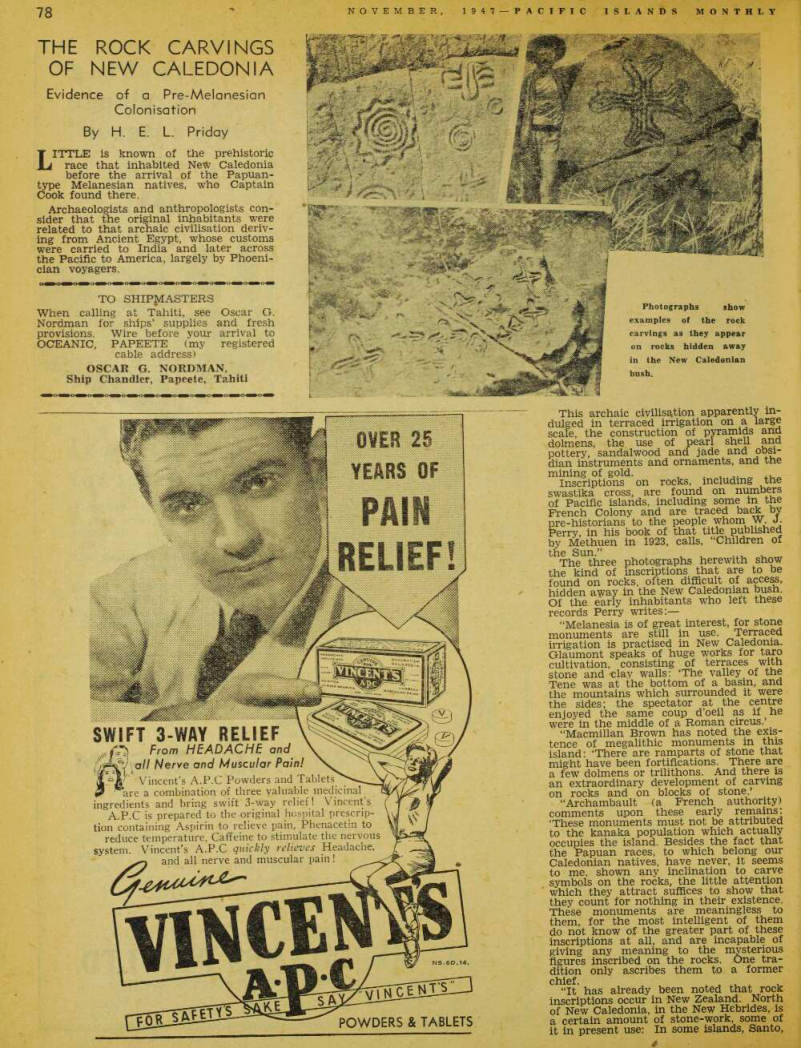
Of New Caledonia
Evidence of a Pre-Melanesian Colonisation
By H. E. L. Friday
LITTLE is known of the prehistoric race that inhabited New Caledonia before the arrival of the Papuan type Melanesian natives, who Captain Cook found there.
Archaeologists and anthropologists con sider that the original inhabitants were related to that archaic civilisation deriv ing from Ancient Egypt, whose customs were carried to India and later across the Pacific to America, largely by Phoeni cian voyagers.
This archaic civilisation apparently in dulged in terraced irrigation on a large scale, the construction of pyramids and dolmens, the use of pearl shell and pottery, sandalwood and jade and obsi dian instruments and ornaments, and the mining of gold. , , . „ ..
Inscriptions on rocks, including the swastika cross, are found on numbers of Pacific islands, including some in the French Colony and are traced back by pre-historians to the people whom W. J.
Perry, in his book of that title published by Methuen in 1923, calls, “Children of the Sun.” , ... .
The three photographs herewith show the kind of inscriptions that are to be found on rocks, often difficult of access, hidden in the New Caledonian bush.
Of the early inhabitants who left these records Perry writes;— “Melanesia is of great interest, for stone monuments are still in use. Terraced irrigation is practised in New Caledonia.
Glaumont speaks of huge works for taro cultivation, consisting of terraces with stone and clay walls; ‘The valley of the Tene was at the bottom of a basin, and the mountains which surrounded it were the sides; the spectator at the centre enjoyed the same coup d’oeil as if he were in the middle of a Roman circus.’
“Macmillan Brown has noted the exis tence of megalithic monuments in this island: ‘There are ramparts of stone that might have been fortifications. There are a few dolmens or trilithons. And there is an extraordinary development of carving on rocks and on blocks of stone.’
“Archambault (a French authority) comments upon these early remains; ‘These monuments must not be attributed to the kanaka population which actually occupies the island. Besides the fact that the Papuan races, to which belong our Caledonian natives, have never, it seems to me. shown any inclination to carve symbols on the rocks, the little attention which they attract suffices to show that they count for nothing in their existence.
These monuments are meaningless to them, for the most intelligent of them do not know of the greater part of these inscriptions at all, and are incapable of giving any meaning to the mysterious figures inscribed on the rocks. One tra dition only ascribes them to a former chief. .
“It has already been noted that rock inscriptions occur in New Zealand. North of New Caledonia, in the New Hebrides, is a certain amount of stone-work, some of it in present use: In some islands, Santo,
Photographs show examples of the rock carvings as they appear on rocks hidden away in the New Caledonian bush.
Malo and Malekula, an important feature of the ritual of the secret societies is the erection of a dolmen-like stone structure consisting of a table-stone resting on stone supports, on which a new member stands when he is killing a pig.”
PERRY notes that the best native houses in New Caledonia used to be pyramidal in shape, and suggests that the present-day natives have copied some of their customs from the earlier inhabitants. Though the sun cult is now a thing of the past, he draws attention to the fact that when a Caledonian chief dies his tribe says “The Sun has set.”
Native tradition still has it that before the white man came a great trade in jade and obsidian, reminding one of that done with the South Island of New Zea land by the Maoris, was carried bn from (I understand) mainly southern New Caledonia; and that sandalwood was ex ported before the white man came to monopolise the trade.
I think anthropologists would do well to have a look at the 16 or 17 mounds,
legends about these mounds and are un able to explain theirpresence - It lea^t when I was there I was liable to find anything about oriests at the mission believe them to be D?ehlstlrkt I have also been told of stone watch towers on Walpole Island, which are un explained
rather like those in the Salisbury Plain- Stonehenge area of Britain, which dot the centre of the plateau on the isle of pines, surrounding the strip used by the US Air Force during the war. (The strip needed no making or levelling because it 18la ?. din S ground) The local natives apparently have no
Advertisements & other items, pp. 82-84 (1 item)
Vince
TO SHIPMASTERS
When calling at Tahiti, see Oscar G.
Nordman for ships’ supplies and fresh provisions. Wire before your arrival to OCEANIC, PAPEETE (my registered cable address)
OSCAR G. NORDMAN,
Ship Chandler, Papeete, Tahiti
m
OVER 25
YEARS OF
PAIN
f
SWIFT 3-WAY RELIEF
rom HEADACHE and Nerve and Muscular Pain!
Vincent’s A.P.C Powders and Tablets a combination of three valuable medicinal ingredients and bring swift 3-way relief! Vincent’s A.P.C is prepared to the-original hospital prescription containing Aspirin to relieve pain, Phenacetin to reduce temperature, Caffeine to stimulate the nervous system. Vincent’s A.P.C quickly relieves Headache, and all nerve and muscular pain! ana ail ucivc am
VINCE
jvl)
vjHSXSS-
POWDERS & TABLETS
r\ \ m rnm ■
after MILE
OF Tires for
trucks,
automobiles,
buses
EXTRA WEAR
now added to
cool - running
Nlllllß
TIRES
New type, stronger construction.
New wide, flatter tread. Longer mileage. Maximum traction.
Peak skid resistance. Greater protection against bruises.
MORE TIRE FOR YOUR MONEY
AfctllcV Accessories and Repair Materials are dependable!
Consistently high in quality, this complete line has been developed to meet every automotive need.
Radiator hose Radiator cleaner Radiator solder Noc-out adjustable hose clamps Vulcanizing patch and valve stem clamp Tire camelback (passenger and truck) Full circle curing tubes f&i 818, Sk m
TUBE REPAIR KIT
CONTENTS
I—s" x 19" Strip rubber 80—114" Sq. bevel cut patches 20—l 1 / 4"x2" Oval bevel cut patches I—l 4 Pt. bottle cement I—Carborundum buffer
PACIFIC ISLANDS TRADING COMPANY
244 CALIFORNIA STREET, SAN FRANCISCO 11, CALIFORNIA, U. S. A.
When Worried
Tired,Sleepless
AND YOU FEEL RUN-DOWN
Worry Is Inescapable. Everyone has a share of it more or less. The great trouble about worry is that it plays havoc with your health and fitness if you let it. You become mentally and bodily weary, depressed; cannot sleep at night, lose appetite and begin to feel a nervous breakdown is impending. That starts the vicious circle. You worry, become run-down and nervy, and that makes you worry more than ever.
Meet your troubles all the way by reinvigorating your system and keeping it fit and well by taking Dr. Williams’ Pink Pills. These pills help to restore the red corpuscles and iron content of the blood to their normal quantity.
This enables life-giving oxygen and nourishment to be carried to the nerves, organs and tissues of the body. In that way you become invigorated, strengthened by Dr. Williams’ Pink Pills, the vague aches and pains disappear and you are fit again to deal confidently with all your worries. At chemists and stores.
What are your shortages ?
STEPHENS IMPORT AND EXPORT CO.
HIDES, SKINS AND LIVESTOCK SUPPLIERS AND SHIPPERS We are suppliers of the fallowing.-
CROCKERY: HOTEL AND DOMESTIC SUPPLIES.
(9) Saddles and Harness. (10) Non-Electric Washing Machines. (11) Tubular Chrome Furniture. (12) Tools, Machinery. (13) Pumps and Stationary Engines. (14) Home Lighting Plants.
Rum, Gin, Liqueurs, Whisky and all spirits. Only the finest Australian and Imported brands stocked.
All orders personally attended to and shipped promptly.
Stephens Import and Export Co.
Dymocks Building, 424 George Street, Sydney, Austrolia (1) Trade Goods. (2) Primus Stoves. (3) Foodstuffs. (4) Umbrellas. (5) Manchester Lines. (6) Perfumery. (7) Wines. (8) Radios.
Mission
Anxious Days For The Yuli Island
Funds Run Out - "Gemma" Is Wrecked —35 New Missionaries Arrive And There Is No War. Damage Compensation
THIS is a time of crisis for one of the oldest missions in the Southwest Pacific the Roman Catholic Mis sion in Papua, which has its headquarters at Yule Island, and is conducted by the Order of the Sacred Heart.
Yule Island, and its far-spread mission stations in Papua, escaped serious damage at the hands of the Japs. The enemy landed in Northeast Papua, and climbed the Owen Stanley Range, and fossicked around the Central plateau of New Guinea, perilously close to the Mission made mule-tracks which might have led him over the mountains onto the Gulf of Papua. But he never actually got into the part of Papua that matters —the part that lies southward of the central moun tain range.
That, in a sense, was bad for the Catholic mission, because it meant that there was little war damage compensation for the organisation. The £12,000,000 Australian fund with its generous allot ments, saved most of the industries and institutions in New Guinea and Eastern Papua from ruin. Nominally, they were compensated for war damage. Actually, the welcome cash made up to them the loss from disorganisation, lack of labour, increased costs, and the socialisation of the Territories.
The establishment based on Yule Is land suffered all those losses but, as it had no actual war damage, it got nothing.
Because, owing to lack of labour, it could not operate its plantations, stores and workshops, it could not maintain its revenues, and it had also to buy outside many goods which it formerly produced itself. It became desperately short of all
kinds of goods. Most serious of all, the generous grants which it formerly re ceived from the headquarters of the Order in France were cut off in 1940. The Mission Treasury at Yule Island became cruelly short of essential funds.
So the man in charge of the Papua Mission, Bishop Andre Sorin, MSC, de cided upon heroic measures. He appealed for more helpers; he arranged that the mission should extend its activities in two important directions in the moun tains, among the Kunimaipa cannibals, and in the Purari delta, country, among the mud-dwellers; and he sent one of the most valued men, Father Andre Dupeyrat, a French scholar with skill in English writing and lecturing, away to Australia and the United States, to raise funds.
FATHER DUPEYRAT, en route to Sydney, spent a few days in Port Moresby. In port was the staunch old mission launch “Gemma,” 40 feet tong, which had maintained communica tion between Yule Island and Moresby for years. Father Dupeyrat, after an in tensive search through Moresby stores, was able to locate many goods of which the mission stations were in urgent need.
He bought flour, rice, petrol scores of articles and he stood on the wharf and waved farewell as the deeply-laden “Gemma” took off on the 70 miles trip to Yule Island . “Well, they have enough to carry on,” he said to himself. “Now for some money-raising in Australia, so that we can buy more.”
Three days later he received the stag gering news that the “Gemma” had been blown onto a coral reef near Yule Island on September 14, and boat and cargo were a complete loss. The engine had “conked” soon after leaving Moresby, but the master, Brother George, carried on under sail. Despite his skill and long experience, he was caught in a freakish wind and current, and thrown on a reef.
He and his five native sailors escaped by swimming.
It looked like paralysis for the Yule Island establishment. Not only were they without essential transport the “Gemma” was their only powered boat— but they actually were without essential supplies.
The Bishop and his helpers rallied, however, and decided to carry on, some how. Temporary measures were taken to relieve the mission stations, and Father Dupeyrat was sent away South, on his now most urgent task of raising funds.
FATHER DUPEYRAT is now at work in Sydney, where his headquarters are the Mission Procure, Waltham Street, Coogee. He is telling the story of Yule Island and spreading his appeal far and wide; and donations are begin ning to roll in.
Thus encouraged, he has brought a new boat to take the place of the “Gemma.”
She is being re-conditioned, ready for despatch from Sydney to Papua before the end of the year; but, as the Father remarks piously, “God alone knows how she is going to be paid for.”
JUST a fortnight after the calamitous loss of the “Gemma,” there arrived in Sydnev, from France, en route to Papua, no less than 18 new mission aries a response to Bishop Sorin’s appeal for additional personnel. They represented a new economic problem for the harassed Yule Island people: but the latter said nothing. They gave the new comers a warm welcome in Sydney, and sent them on their way to Papua. The following five Fathers left by the “Mala ita” on October 17:— Rev. Victor Perrocheau, who previously was 10 years in Papua, became blind at Terapo (in the swampy region between the Lakekamu and Tauro rivers). was sent to France for treatment in 1939, and there was trapped by the war. He has been appointed Religious Superior of the MSC in the Papuan Mission.
Rev. Pierre Guichet, from Britanny, who was for five years a prisoner of war in Germany.
Rev. Gabriel Perchet, from Vendee.
Rev. Alphonse Rinn, from Alsace.
Rev. Charles Gremaud, from Switzer land.
The Rev. Fathers Louis Willem (Alsace) and Michel Gasser (Switzerland) have re mained temporarily in Australia to im prove their knowledge of English, before going to Papua.
In addition to these members of the Sacred Heart Mission, Papua is receiving five young Frenchmen who are to work there for a certain number of years, without pay of any kind. They were among many who responded to the Bishop's appeal for men of all trades to give this service, to compensate for the present lack of Lay Brothers.
Seven nuns five Sacred Heart and two of the enclosed Order of Carmelites— also are going to Papua—six have sailed.
One is an Australian, the Rev. Mother M.
Rosa, who for 10 years was the Superior at Yule Island. After the war, she made a visit to France, and has been seriously ill, and now is in hospital in Sydney.
Two Irish Sisters recently arrived in Sydney, and will follow the others soon to Yule Island.
Another group from Prance, including four priests, one voluntary worker, and two French Carmelite Nuns, are expected in Sydney about November 20, en route to Prance.
Also, three French ladies have been accepted to enter the native Order of Papuan Sisters, founded at Yule Island, in 1918. One Mdlle. Genevieve Coussad de Massignac, is a member of an aristo cratic French family, and is 25 years old She is to be the Mother of the Papuan Sisters, succeeding Mother Solange Bazin de Jessey who arrived in Papua in 1932, and died from scrub typhus in 1942.
Two Australian lay workers, James Thompson, of Sydney, engineer, and Morns Fncker, of Melbourne, agriculare alS ° going to the Papua Altogether, the new personnel for Papua numbers 35 11 Priests, 1 Brother. « 5 Carmelite Nuns, 3 Ladies and 8 Voluntary Workers. 24 are French, 5 Australian, 4 Swiss and 2 Irish.
Little wonder that there is a note of S Cy h. m^ app ?f ls made for funds by Father Dupeyrat. But the Mission wdl carry on. and will be success tul J h at is guaranteed by its fine rex Sl ?o e was established on Yule Island 62 years ago.
Sister Elsie Wilson, of the Methodist Overseas Mission was in Adelaide, SA, on leave in September prior to her departure for New Guinea.
Death Of Fr. I. Schwab
Of Sepik River
WE have received word from the Roman Catholic Mission at Alexishafen, New Guinea, that the Rev. Father I.
Schwab, who returned to his station on the Sepik River early this year, died in Madang hospital in October. The Mission writes: “We mourn his death, which was a great loss to many natives who regarded him as their common father. It is also a great loss to the Mission, which has now one zealous pioneer less; and you, no doubt, will regret the loss of one of the contributors to your magazine.”
Father Schwab, although probably known to only a few Territorians person ally, was usually responsible for one or two small stories in the “PIM” each month. Generally, they were in praise of one or another of his good friends at Angoram, or dealt with some aspect of native life in the large Sepik District.
He was a keen anthropologist, and was connected with some of the European Scientific bodies.
A spasmodic pen acquaintance was struck up between him and this writer about 1944, through a mutual friend who helped him, I understand, to escape from the Japanese after being cut off by them on the Sepik River for over a year; and because of a shared interest in the natives of New Guinea. Somehow—possibly be cause of his sometimes quaint English— the impression was gained that Fr Schwab was an elderly man. However when he called upon us about a year ago on his way back to New Guinea after two years or more as an evacuee in Tas mania, he proved to be far from elderly, although of not particularly robust appearance.
He was one of a party who took the small mission vessel “Stella Maris II'’ from Sydney to Alexishafen. They arrived there early in the New Year and Father Schwab was subsequently sent to his old stamping-ground, the Sepik River, and from there, as the months went by, he sent us bits and pieces of local news, stories of natives, and odd angles on some of their customs.
A few months ago he suffered a severe attack of malaria, from which he apparently did not fully recover.
I think Father Schwab was German,
or perhaps Austrian. I do not know for certain, and he did not speak of himself.
But he was our good friend: we learn of
his passing with real regret.
J.T.
Bsip Government Uses
Radio
From Our Own Correspondent
Honiara, Oct. 20.
BSIP Government, on October 17, in troduced the first of a series of weekly local news broadcasts from the Government-owned radio station.
VQJ, at Honiara. Reception throughout the Group was reported as excellent and the scheme was welcomed.
Copra Growers' Union
Of Fiji
ALL Copra Growers are urged to join this Union and form branches in all centres in the South Pacific. Planters! “Unity is Strength” —so guard your own interests.
The objects of the Union are; (1) To unite all Copra Growers; to urge them to express their ideas; and to have one concerted and strong medium through which to express their viewpoint in matters of price, markets, etc. (2) To investigate all matters of in terest in relation to by-products, offsets for hurricanes, etc. (3) To encourage research in regard to new uses for coconuts and associated products. (4) To inform Copra Growers of matters affecting their interests; to invite opinions, articles, ex periences, etc., from growers, for the information of other growers
C. G. O. Parr.
Savu Savu, Fiji.
The Swedish ship “Albatross” recently arrived in Tahiti, from the Marquesas, with a scientific expedition of eleven persons.
Advertisements & other items, pp. 85-86 (1 item)
PEST Controllers..
Ants, Flies, Mosquitoes, Silverfish, White Ants,
Cockroaches and Bugs Scientifically Eliminated
ANT CONTROL.
For all types of ants, including white ants (4 per cent. D.D.T.)
PEST CONTROL.
Spray for control of flies, mosquitoes, silverfish, etc. (contains D.D.T. and Pyrethrum)
VERMIN POWDER.
For cockroaches, bugs and silverfish (4 per cent. D.D.T.)
Chemical Industries
LAE, T.N.G.
Manufacturers of COSMETIC OILS, DYES
AND POWDERS, AGRICULTURAL
SPRAYS AND D.D.T. PREPARATIONS
BRILIIANTINE
w f 1
PRODUCT OF
CHEMICAL INDUSTRIES
LAE. NEWGUINEA
Sole Distributors for Papua
BURNS PHDLF & CO.. LTD
F. J. MORGAN
PTT., LTD.
12 Allen St., Granville,
N.S.W.
MANUFACTURERS AND
EXPORTERS OF:
Beekeepers Foundation and Apiary Appliances, Dental Supplies, Artificial Teeth, Wax Floor and Furniture Polishes, Disinfectant Preservative in non-Stain and Wood-stain Colours.
BUYERS OF WAXES AND RESINS.
LABORATORY SERVICE: Soil Testing and Investigation of All Natural* Growth for Commercial Uses, BANKERS: Commonwealth Bank of Australia Homebush, N.S.W.
Every Branch Of
ENGINEERING and BUILDING CONSTRUCTION
MILLERS LTD.
SUVA ond LAUTOKA
Sawmillers and Timber Merchants; Shipwrights and Sailmakers; Joinery and Furniture Manufacturers; Upholsterers; Plumbers; Electricians; Hardware Merchants; Motor Dealers.
AGENCIES:
Chevrolet, Bedford, Vauxhall, Nash Motors. Firestone Tyres.
Fetters Marine and Stationary Engines. G.E.C. Radio Sets.
British Australian Lead Manufacturers Pty., Ltd., Atlas Assurance Co., Ltd.
There is no need to send to Australia or New Zealand for Repairs or Replacements. We can give you a sound Quotation and guarantee First-Class Workmanship
Sails, Covers, Awnings
AND ALL CLASSES CANVAS GOODS FOR
INDUSTRIAL AND HOME USE
ALSO: FLAGS, ALL NATIONS
Send your inquiries to
HARRY WEST
"SYDNEY'S SAILMAKER"
DUKE ST. (WATERFRONT) EAST BALMAIN, SYDNEY, N.S.W.
Phone: WBIIOS, W 82284.
Dodging 'Nips' Behind Bogia
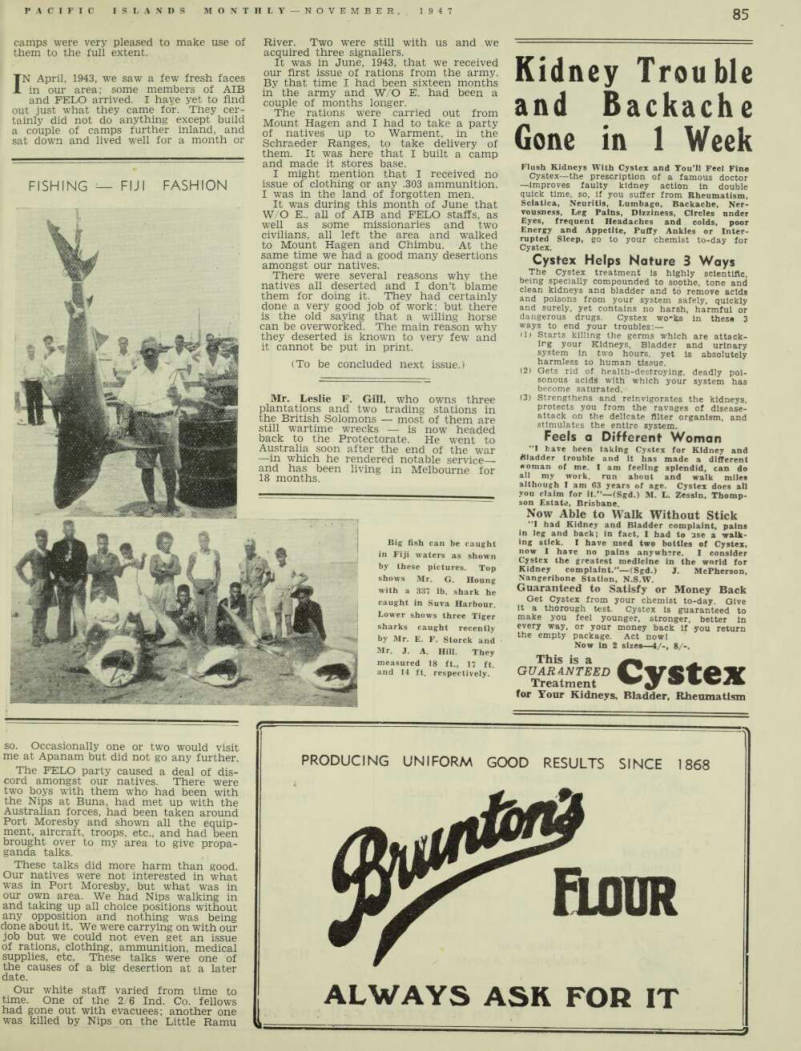
Black Days In New Guinea In 1942-3
By Dan Power-Section I
WHEN the Japs attacked Pearl Harbour I was working as an aviation en gineer at Wewak, NG; and, weeks later, I was one of the crowd on that ridiculous supposed compulsory evacua tion, up the Sepik and Arafundi Rivers.
The evacuation was about the most mismanaged affair that I have ever been connected with, and it was only a matter of days before most of us realised that something drastic was going to happen.
I was only with the party a couple of weeks and two friends and I made our way down both rivers and down the coast, a short distance to Nubia plantation, on Hansa Bay.
We were right about something drastic
going to happen. It was after we left Angoram that the Sepik massacre hap pened.
When the three of us arrived at Nubia plantation we took stock of the situation.
The position was as follows: Three men were still living on their plantations along the Bogia Coast, Two men were on the Ramu River, about 26 miles from the mouth, and they were carrying on gardening, etc. All missionaries were on their stations.
There was only one Administration official in the area and he was in the bush trying to build up evacuation camps and keep the natives under control. He had a man from one of the plantations (whom I will allude to as Mr. E.) as his assistant. 1 FOUND that there was_ nothing much I could do at that moment, except wait with my friends on Nubia planta tion until something turned up. I did find out that all of the Administration staff, and practically everybody else, had done some record runs from Madang to the mountains when a few bombs were dropped on January 21, 1942.
All who remained in Madang were a few NGVR fellows. I contacted these in the hope of being able to join in with them; but I had not been attested and they were not in touch with headquarters.
The Nips had occupied Salamaua and Lae by this time, and there was no way of finding out if Wau or Bulolo were occupied or not. We had a receiving set and sometimes we managed to hear the news.
During March, 1942, the Administra tion official, whom I will allude to as Mr.
B.) arrived on the coast from the bush.
He and I discussed the situation and I decided to join him as a patrol officer until such times as I could get out and join up with some service. We were out of touch with the outside world and did not know what was happening.
The natives in the Bogia area were get ting out of control. They had been led to believe that the days of white govern ment were finished, and that New Guinea coinage was useless as currency.
There was plenty of work to be done, building up evacuation camps and plant ing up gardens inland just in case there was an enemy landing and we could get every body away safely. That was Mi*. B’s idea, and practically everybody in the area took it as a huge joke. I noticed that when the Nips did land, later on, most of them who did dogde the Nips were very pleased to make use of the evacuation camps.
Mr. 8., Mr. E. and I carried on in that area for some months. We took it, turn about, to be in the bush and on the coast.
By the end of the year we had evacuation camps and large gardens at Josefstahl, and Sirinibu, gardens at Atemble. We drove cattle from the coast to Josestahl; made our own salt out of sea-water on the beach; collected shell on the beach and carried it all inland to Sirinibu and Atemble. and shell are currency in, on and beyond the Ramu River.
Josef stahl is three days’ walk further in, and on the Ramu River.
While we were at Bogia we sometimes saw a fresh face. One of the men from the Ramu used to call in sometimes on his way to Madang in his small boat.
IT was during July, 1942, that we had a few visitors for a few days. Mr.
McColl, Bill Tripling and party dropped
in to see us on their way from the Ninigo Jslands to Madang. (See “PIM,” March, 1947). Having them with us for a few days brightened us up a great deal: it had been some considerable time since we had seen anybody outside our own circle. We were not receiving any rations at all, and we just had to live off the land—what we could grow, what we could shoot and what we could buv off local village natives. If anybody maintains that it is impossible to live off the land in New Guinea, I can contradict him:
*°r a lons P. me -
While building up the evacuation camps we also carried out patrols and let the natives know tnat there was still a white government functioning, and they soon realised that New Guinea coinage was still currency, •. , We had some former Police boys, and nwn d bnp E of h nnti^s—most of mine e
Iw I^/b2 S Ayr^rnb? I ™cfbot
1 k ew the M b District It was during - the month of Aueust 1942 That we received some news from Mad’ane - A former District Officer had walked overfrom Port Ssby to Madang He wT then a captain in ANGAU and was in touch with the times.
The unit ANGAU had been formed in Port Moresby and New Guinea men were required for it.
Mr. 8., being an Administration official, was automatically in it, with rank of lieutenant: and Mr. E. and I were given the opportunity of joining up as privates, as from the time we had been doing Government work. I made the mistake, then, by making my way to Madang, being medically examined by a mission doctor, and being attested in ANGAU.
Later on, I bitterly regretted ever joining up with such an outfit. At the time I was attested, the rate of pay for a private was six shillings per day, plus food, cloth-
ing and accommodation. I just had to live as I had been doing for months, off the land, and wear my own pre-war clothes.
ON the night of December 18, 1942, I was aboard the MV “Edith,” in the middle of Madang Harbour, when the Nip made a landing. There was another man with me, Pte. B. E. Rasmussen (usually known as Rass) who had recently walked over from Port Moresby and was returning to the Bogia area with me.
When we both arrived at Alexishafen, Rass decided to walk along the coast to Bogia, and I decided to travel per “Edith.”
I only took five boys with me and Rass had the remainder.
Both of us managed to dodge the Nips that night, but I was in Bogia over a week before Rass arrived.
When I arrived at Bogia, there was a panic on, thanks to Lieut. X. The “Edith” and a couple of other small boats were taken safely into the Ramu River by one of my Nubia friends, and one of the men from the Ramu.
I collected all of my natives and what ever gear that I could and set off to take all into Sirinibu. Lieutenant X was go ing to stay behind but he was only half an hour behind me. One of the planta tion-owners came out with us; he was not interested in remaining on his planta tion now, as there were Nips about.
After I arrived at Sirinibu, I went down the Ramu River, near to the mouth, to bring up one of the small boats. One of the men from there came back with me.
WHEN I arrived back in Sirinibu, near the end of January, 1943, I could see that there was a lot of trouble in the air. Administration officials from the Sepik district had brought Chinese evacuees and natives through Sirinibu and
Atemble. They cleaned up all of the food stuffs in my gardens, and also the gardens of local natives; they also created a great deal of chaos amongst the natives in the Sirinibu-Atemble area.
The party moved on and made their way to Chimbu, via Musark, Guaibi and Bundi. I only wished that they had taken all their party with them. Instead, they left some of the Chinese at Sirinibu. and I fell for the job of looking after them.
These Chinese were the most quarrel some, laziest, good-for-nothing individuals I have ever had anything to do with. I had to feed and look after them, to the best of my ability, and they were not con tent to live off the land like we had to do, but were demanding tea, sugar, tinned milk, rice, etc—articles that I had not seen myself for over a year. If I man aged to shoot a pig or a few birds they wanted the lot —they did not seem to realise that I had a line of natives to feed as well as them.
At the beginning of February, 1943, Lieut. X got into a fever again. I had to collect the Chinese, some of my natives, and what gear I could, and make my way further inland, rig up some shelters, and await events.
We walked for two days, and finally arrived at Apanam, at the foot of the Schraeder Ranges. The natives around this area were the hostile pigmy type, and I had to keep my eye on them. I had to erect houses, start planting gardens, try and contact local natives, and buy native vegetables off them, try to shoot pigs and birds, and then look after those confounded Chinese. Not one of them made any attempt to give a hand to do anything and they were very quarrelsome with one another.
It was not long, owing to the attitude of Lieut. X., before some of the natives from our lines deserted and went down to the Nips. They knew that we could
not follow them that far. These desertions made things very inconvenient for P x lent ? work to jJPi needed all the native labour we could get.
DURING the month of February, 1943, I heard, per medium of local natives. that there was a party a white men in the Schraeder ranges, heading our way. I could not make out what this was all about. There were no known tracks
in there and no white man had been in there very far.
Four days later I collected some police boys, went up into the mountains, and located the party. It turned out to be Joe Searson and five men of the 2/6 Ind. Co.
They had blazed the trail from Mount Hagen. They had a wireless set, a list of instructions, etc. What pleased me most was that I received some letters—the first for fourteen months. It was just
luck that Joe brought the letters, because he had it in writing that both Rass and I were presumed killed, about ten weeks earlier.
I escorted the party to my camp at Apanam, and Rass and I entertained them to the best our ability. The trouble was that all we could celebrate with was pure, unadulterated water.
Instructions had come from Head quarters that all missionaries and other civilians were to be evacuated. Most of the missionaries were with the Nips, and nothing could be done about them. One man who had remained on his plantation had been captured.
About a week after. Joe’s party arrived, a party left Apanam for Mount Hagen.
This party consisted of some of Joe’s party, Lieut. X., Rass, all the Chinese, and some missionaries. I was very pleased to see the last of some of them.
Just at this time, Pte E. was promoted to W/O and I was promoted to Sgt.
W/O E. took charge of the area and our staff consisted of four of the 2/6 Ind. Co. fellows, a few police boys and other natives who had remained with us.
We were very busy for months, doing patrols, evacuating missionaries and other civilians. In addition to evacuees in our own area, we had a good many from the Sepik district.
We thtfke in Bogia were given instruc tions that in the event of a landing we were not to leave our post to assist any who had elected to remain at their own risk. There were eleven months during 1942 when they could have been evacuated easily. After the Nips landed and the instructions came out to evacuate all, it certainly made things awkward. It was not long before most roads were closed and we had an awful time. All who had laughed about Lieut. B’s evacuation
camps were very pleased to make use of them to the full extent.
IN April, 1943, we saw a few fresh faces in our area; some members of AIB and FELO arrived. I have yet to find out just what they came for. They cer tainly did not do anything except build a couple of camps further inland, and sat down and lived well for a month or
so. Occasionally one or two would visit me at Apanam but did not go any further.
The FELO party caused a deal of dis cord amongst our natives. There were two boys with them who had been with the Nips at Buna, had met up with the Australian forces, had been taken around Port Moresby and shown all the equip ment, aircraft, troops, etc., and had been brought over to my area to give propa ganda talks.
These talks did more harm than good.
Our natives were not interested in what was in Port Moresby, but what was in our own area. We had Nips walking in and taking up all choice positions without any opposition and nothing was being done about it. We were carrying on with our job but we could not even get an issue of rations, clothing, ammunition, medical supplies, etc. These talks were one of the causes of a big desertion at a later date.
Our white staff varied from time to time. One of the 2/6 Ind. Co. fellows had gone out with evacuees: another one was killed by Nips on the Little Ramu
River. Two were still with us and we acquired three signallers.
It was in June, 1943, that we received our first issue of rations from the army.
By that time I had been sixteen months in the army and W/O E. had been a couple of months longer.
The rations were carried out from Mount Hagen and I had to take a party of natives up to Warment, in the Schraeder Ranges, to take delivery of them. It was here that I built a camp and made it stores base.
I might mention that I received no issue of clothing or any ,303 ammunition.
I was in the land of forgotten men.
It was during this month of June that W/O E., all of AIB and FELO staffs, as well as some missionaries and two civilians, all left the area and walked to Mount Hagen and Chimbu. At the same time we had a good many desertions amongst our natives.
There were several reasons why the natives all deserted and I don’t blame them for doing it. They had certainly done a very good job of work: but there is the old saying that a willing horse can be overworked. The main reason why they deserted is known to very few and it cannot be put in print. (To be concluded next issue.) Mr. Leslie F. Gill, who owns three plantains and two trading stations in the British Solomons most of them are still wartime wrecks is now headed back to the Protectorate. He went to Australia soon after the end of the war —in which he rendered notable service— and has been living in Melbourne for 18 months.
Advertisements & other items, pp. 87-88 (1 item)
Colycr Watson (New Guinea) Ltd.
Head Office: RABAUL Branches: Kavieng, New Ireland, and at 22 Bridge Street, Sydney
GENERAL MERCHANTS AND BUYERS
OF ISLAND PRODUCE
Plantation Owners and Engineers
Sole Distributors: Managing Agents: Chrysler and Plymouth Cars Union Assurance Society Ltd, Fargo Trucks National Mutual Life Association of Willys-Overland Jeeps A/asia Ltd.
G.M. Marine and Industrial Engines Agents: Prefect Refrigerators China Navigation Company
31 QUEEN STREET, MELBOURNE
TIBALDI
Continental Smallgoods
CANNED
MORTADELLA
A Real Delicacy
SALAMI
Specially waxed and wrapped in greaseproof paper for tropical climates.
Sole Distributing Agents ;for the Pacific Islands :
BRIAL & BALL
- 1 BOND STREET, SYDNEY
GEORGE J. LOGKYER & COMPANY
In association with
GEORGE J. LOCKYER (Far East) & CO. and GEORGE J. LOCKYER (Overseas) & CO.
ENGINEERING SUPPLIES, GENERAL HARDWARE EXPORTERS AND MERCHANTS
Agents for the Finest Australian Liquors
Aerated Water and Cordial Manufacturing Machinery, Bottling and Capping Machinery, etc.
CONSULTING ENGINEERS DOCKYARD MACHINERY
PURCHASING AGENTS:
Electric Light Generating Plants.
Air Conditioning Plants.
Builders’ Hardware.
Marine Engineering Supplies.
Refrigeration Supplies.
Radios and Accessories.
Sanitation Equipment.
Automobile Spare Parts and Garage Accessories.
Abrasive Wheels.
Excavating Machinery.
Electrcal Supples.
Grinding and Pulverising Machinery.
Hydraulic Equipment.
Mechanical Engineering Requirements.
Mining and Quarrying Machinery.
Road and Building Machinery.
EXACT REPLICA OF CANE KNIFE,
MADE IN AUSTRALIA.
VESSELS, ETC.
Steel Cargo Vessels, 35 ft. x 13 ft. 4 ft., New, with
Winch, Hoist, etc.
Auxiliary Transport Vessels,
32 ft. x 9 ft. x 4 ft., New,
without Engines.
Tugs, Trawlers, Cargo
Vessels, Tankers, Motor
Cruisers, Launches, Yachts,
Hoists, Winches, etc.
Photographs, Drawings ,Schedules, will be Supplied by Return Mail to Genuine Clients.
HEAD OFFICE, 24 BOND ST. SYDNEY, N.S.W. 'Phones: BW6OIB UA 7196 All communications to be addressed to The General Manager, G.P.0., Box 4553, Sydney.
Bankers: Commonwealth Bank of Australia, Sydney.
Also Bank of N.S.W., Sydney.
Telegraphic and Cable Address: •‘LOCKMACH,” Sydney.
Fishing Fiji Fashion
Big fish can be caught in Fiji waters as shown by these pictures. Top shows Mr. G. Houng with a 337 lb. shark he caught in Suva Harbour.
Lower shows three Tiger sharks caught recently by Mr. E. F. Storck and Mr. J. A. Hill. They measured 18 ft., 17 ft. and 14 ft. respectively.
Advertisements & other items, p. 89 (1 item)
Kidney Trouble
and Backache
Gone in 1 Week
Flush Kidneys With Cystex and You’ll Feel Fine Cystex—the prescription of a famous doctor —lmproves faulty kidney action in double quick time, so, if you suffer from Rheumatism, Sciatica, Neuritis, Lumbago, Backache, Nervousness, Leg Pains, Dizziness, Circles under Eyes, frequent Headaches and colds, poor Energy and Appetite, Puffy Ankles or Interrupted Sleep, go to your chemist to-day for Cystex.
Cystex Helps Nature 3 Ways
The Cystex treatment Is highly scientific, being specially compounded to soothe, tone and clean kidneys and bladder and to remove acids and poisons from your system safely, quickly and surely, yet contains no harsh, harmful or dangerous drugs. Cystex wo-ks in these 3 ways to end your troubles;— Starts killing the germs which are attacking your Kidneys, Bladder and urinary system In two hours, yet is absolutely harmless to human tissue. (2) Gets rid of health-destroying, deadly poisonous acids with which your system has become saturated. (3) Strengthens and reinvigorates the kidneys, protects you from the ravages of diseaseattack on the delicate filter organism, and stimulates the entire system.
Feels a Different Woman
"I have been taking Cystex for Kidney and Bladder trouble and it has made a different woman of me. I am feeling splendid, can do all my work, run about and walk miles although I am 63 years of age. Cystex does all you claim for it.”—(Sgd.) M. L. Zessin, Thompson Estate, Brisbane.
Now Able to Walk Without Stick
“I bad Kidney and Bladder complaint, pains in leg and back; in fact, I had to use a walking stick. I have used two bottles of Cystex, now I have no pains anywhere. I consider Cystex the greatest medicine in the world for Kidney complaint.”—(Sgd.) J. McPherson, Nangeribone Station, N.S.W.
Guaranteed to Satisfy or Money Back
Get Cystex from your chemist to-day. Give it a thorough test. Cystex Is guaranteed to make you feel younger, stronger, better in every way, or your money back If you return the empty package. Act now I Now in 2 sizes—4/-, 8/-.
This is a
GUARANTEED CVCTPV
Treatment
for Your Kidneys, Bladder, Rheumatism
PRODUCING UNIFORM GOOD RESULTS SINCE 1868
ALWAYS ASK FOR IT
Missionaries For The
Gilberts
rOM the large party of French Mis sionaries of the Order of the Sacred Heart, who arrived recently in Sydney by the “Sagittaire,” three Priests and one Brother have gone to the Gil
bert Islands. They left Sydney on November 11 by the phosphate ship “Trienza,” via Ocean Island.
Three more missionary priests for the Gilbert Islands Mission (two Frenchmen and one Swiss) arrived in Sydney in November, and will go on by the first available ship.
World-Wanderer's Early
Memories Of Pacific
A MAN who has roamed adventurously across the world, and spent some colourful years among the Pacific Islands, is Mr. Richard E. Vernon, now living quietly at Cardwell. North Queens land.
He yas born in Brisbane, but he was away across the Pacific at least 50 years ago. He lived in Rarotonga when Mr.
Moss was British Resident there. Henri Nicholson then published “Te Torea,”
Snow and Dodge ran the store, and old Captain Taylor had a store near the beach.
Mr. Vernon traded out of Tahiti—to Rarotonga, Atiu and Aitutaki, in the Cooks. He remembered that A. von Nagel had a store on Atiu. Later, he was in the Philippines, and prospected for gold on Luzon. The lure of gold took him to many places.
In more recent years, with his son, he worked a couple of claims on the Black Cat Creek, 6i hours’ walk from Wau. He had previously prospected for gold in America, Australia and Africa. He made some good money—but lost it, looking for more. At one time he was manager of a plantation at Mombasa, East Africa. He was wounded in a rebellion in Mexico, wounded in the Boer War, and he was a member of the United States Ist Corps of Engineers in the Philippines.
Mr. Vernon’s son, Richard Edward Vernon, who was born in Brisbane and educated at the Brisbane Grammar School, had an interest in a plantation in New Guinea. He was killed by the Japs, in the Markham Valley, during the fight ing in New Guinea in 1942.
Advertisements & other items, p. 90 (1 item)
C®B<mlfe» Pte IM
YOUR FUTURE CAREER . . .
Merchants, Accountants, Secretaries, Bankers and Business Managers .. . all hold responsible positions with commensurate salaries. You too can enhance your prospects in this ever-expanding commercial field, which yields abundant returns to those with adequate qualifications. H.R.I. prepare ambitious men and women for all business positions from junior to senior executive. Tuition is practical authoritative up-to-date time saving . . . and certain in its successful results. The H.R.I. is available always to advise you write or wire for information free and without obligation.
H.R.I. tutorial service is proved by the winning of more honours than all coaches in Australasia combined.
H.R.I. Career Training • ACCOUNTANCY • SECRETARYSHIP • COST ACCOUNTANCY
• PRACTICAL BOOKKEEPING • MARKETING SELLING
ADVERTISING • BANKING • LOCAL GOVERNMENT EXAMS.
Hemingway Robertson 1 nstltut e
Founded and Owned by Hemingway & Robertson Pty. Ltd.
Consulting Accountants :: :: Professional Tutors 1 2 6 1 2 6
BANK HOUSE. BANK
CHALFONT CHAMBERS. 142
PLACE. MELBOURNE
PHILLIP STREET, SYDNEY
126/815
ISLAND MERCHANTS
and AGENTS.
GENERAL MERCHANTS
C®B<mlfe» Pte IM
* Shippers of all types of Merchandise to the Pacific Islands • Representing Australian, British and American Manufacturers rr r r ui mi
rj i irKCJ
• Buyers for Leading Pacific Islands Traders • Sellers of Island Produce on Consignment
379 KENT ST., SYDNEY.
Cable & Telegraphic Address : “ Chasull ” Sydney, • Importers, Distributors and Manufacturers of Foodstuffs, Softgoods, Textiles, Hardware, Tobaccos, Wines and Spirts, etc. • "Ultima" Kerosene Stoves and Heating Appliances • Distributors of
High-grade Shirts,
Pyjamas and Clothing J/J - 0 • "Southern Queen' Canned Fruits m • Forwarding and Transhipment Agents N a b , ft / , m/i • Hill's English Cigarettes When in Sydney, call and see us!
Come From
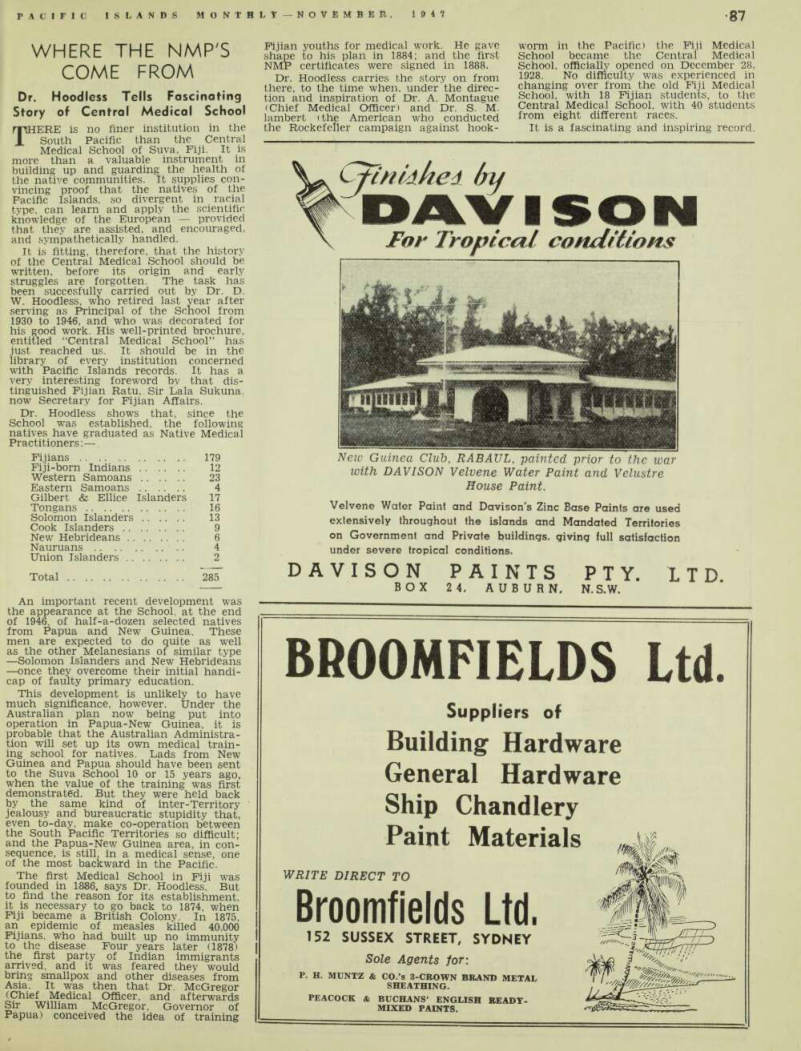
Where The Nmp's
Dr. Hoodless Tells Fascinating Story of Central Medical School
rERE is no finer institution in the South Pacific than the Central Medical School of Suva, Fiji. It is more than a valuable instrument in building up and guarding the health of the native communities. It supplies con vincing proof that the natives of the Pacific Islands, so divergent in racial type, can learn and apply the scientific knowledge of the European provided that they are assisted, and encouraged, and sympathetically handled.
It is fitting, therefore, that the history of the Central Medical School should be written, before its origin and early struggles are forgotten. The task has been succesfully carried out by Dr. D.
W. Hoodless, who retired last year after serving as Principal of the School from 1930 to 1946, and who was decorated for his good work. His well-printed brochure, entitled “Central Medical School” has just reached us. It should be in the library of every institution concerned with Pacific Islands records. It has a very interesting foreword bv that dis tinguished Fijian Ratu. Sir Lala Sukuna. now Secretary for Fijian Affairs.
Dr. Hoodless shows that, since the School was established, the following natives have graduated as Native Medical Practitioners:—
An important recent development was the appearance at the School, at the end of 1946, of half-a-dozen selected natives from Papua and New Guinea. These men are expected to do quite as well as the other Melanesians of similar type —Solomon Islanders and New Hebrideans —once they overcome their initial handi cap of faulty primary education.
This development is unlikely to have much significance, however. Under the Australian plan now being put into operation in Papua-New Guinea, it is probable that the Australian Administra tion will set up its own medical train ing school for natives. Lads from New Guinea and Papua should have been sent to the Suva School 10 or 15 years ago, when the value of the training was first demonstrated. But they were held back by the same kind of inter-Territory jealousy and bureaucratic stupidity that, even to-day, make co-operation between the South Pacific Territories so difficult; and the Papua-New Guinea area, in con sequence, is still, in a medical sense, one of the most backward in the Pacific.
The first Medical School in Fiji was founded in 1886, says Dr. Hoodless. But to find the reason for its establishment, it is necessary to go back to 1874, when Fiji became a British Colony. In 1875, an epidemic of measles killed 40,000 Fijians, who had built up no immunity to the disease Four years later (1878) the first party of Indian immigrants arrived, and it was feared they would bring smallpox and other diseases from Asia. It was then that Dr. McGregor (Chief Medical Officer, and afterwards Sir William McGregor, Governor of Papua) conceived the idea of training
Fijian youths for medical work. He gave shape to his plan in 1884; and the first NMP certificates were signed in 1888.
Dr. Hoodless carries the story on from there, to the time when, under the direc tion and inspiration of Dr. A. Montague (Chief Medical Officer) and Dr. S. M. lambert (the American who conducted the Rockefeller campaign against hook
worm in the Pacific) the Fiji Medical School became the Central Medical School, officially opened on December 28, 1928. No difficulty was experienced in changing over from the old Fiji Medical School, with 18 Fijian students, to the Central Medical School, with 40 students from eight different races.
It is a fascinating and inspiring record.
Fijians 179 Fiji-born Indians 12 Western Samoans 23 Eastern Samoans 4 Gilbert & Ellice Islanders 17 Tongans 16 Solomon Islanders 13 Cook Islanders 9 New Hebrideans 6 Nauruans 4 Union Islanders 2 Total 285
Advertisements & other items, p. 91 (1 item)
Broomfields Ltd.
C fin liked by
DAVISON
For Tropical conditions
New Guinea Club, RABAUL, painted prior to the war with DAVISON Velvene Water Paint and Velustre House Paint.
Velvene Water Paint and Davison's Zinc Base Paints are used extensively throughout the islands and Mandated Territories on Government and Private buildings, giving full satisfaction under severe tropical conditions.
DAVISON PAINTS PTY. LTD
BOX 24, AUBURN. N.S.W.
BROOMFIELDS Ltd.
Suppliers of
Building Hardware
General Hardware
Ship Chandlery
Paint Materials
WRITE DIRECT TO
Broomfields Ltd.
152 SUSSEX STREET, SYDNEY
Sole Agents for : P. H. MUNTZ & CO.’s 3-CROWN BRAND METAL
SHEATHING.
PEACOCK & BUCHANS’ ENGLISH READY-
MIXED PAINTS.
Mi
The "Aronga Mana" Go
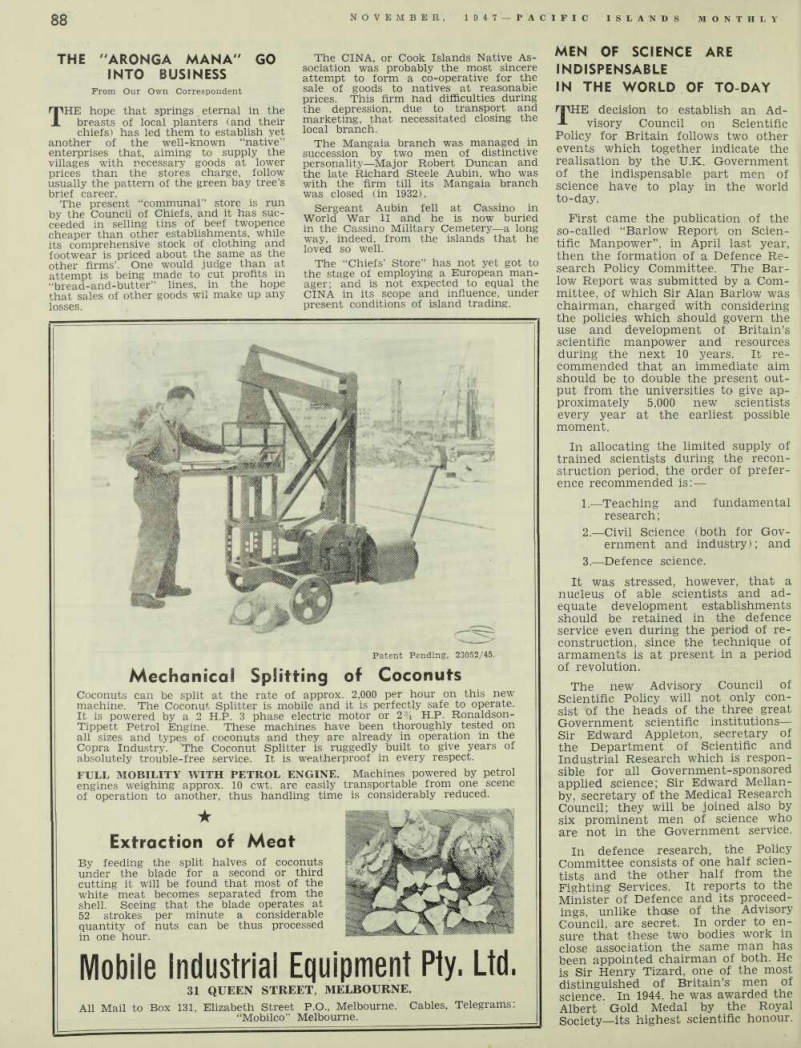
In To Business
From Our Own Correspondent THE hope that springs , eternal in the breasts of local planters (and their chiefs) has led them to establish yet another of the well-known “native” enterprises that, aiming to supply the villages with necessary goods at lower prices than the stores charge, follow usually the pattern of the green bay tree’s brief career. hv T t h h. ofSf and St i°t r has S su™ by the Council of Chiefs, and it nas sue ceeded m selling tins of cheaper than other establisfiments, wfiile its comprehensive stock of clothing and footwear is priced about the same as the other firms’. One would judge than at attempt is being made to cut profits in “bread-and-butter” lines, in the hope that sales of other goods wil make up any losses
The CINA, or Cook Islands Native As sociation was probably the most sincere attempt to form a co-operative for the sale of goods to natives at reasonable prices. This firm nad difficulties during the depression, due to transport and marketing, that necessitated closing the local branch, The Mangaia branch was managed in succession by two men of distinctive personality—Major Robert Duncan and the late Richard Steele Aubin, who was with the firm till its Mangaia branch was closed (in 1932).
Sergeant Aubin fell at Cassino in World War n and he is now buried in the Cassino Military Cemetery—a long wnv inHppH from thp islands that hp ™y, indeed from the islands that he lovea 50 wen - The “Chiefs’ Store” has not yet got to the stage of employing a European man ager; and is not expected to equal the CINA in its scope and influence, under present conditions of island trading.
Men Of Science Are
Indispensable
In The World Of To-Day
THE decision to establish an Ad visory Council on Scientific Policy for Britain follows two other events which together indicate the realisation by the U.K. Government of the indispensable part men of science have to play in the world to-day.
First came the publication of the so-called “Barlow Report on Scien tific Manpower”, in April last year, then the formation of a Defence Re search Policy Committee. The Bar low Report was submitted by a Com mittee, of which Sir Alan Barlow was chairman, charged with considering the policies which should govern the use and development of Britain’s scientific manpower and resources during the next 10 years. It re commended that an immediate aim should be to double the present out put from the universities to give ap proximately 5,000 new scientists every year at the earliest possible moment.
In allocating the limited supply of trained scientists during the recon struction period, the order of prefer ence recommended is:— I.—Teaching and fundamental research; 2.—Civil Science (both for Gov ernment and industry); and 3.—Defence science.
It was stressed, however, that a nucleus of able scientists and ad equate development establishments should be retained in the defence service even during the period of re construction, since the technique of armaments is at present in a period of revolution.
The new Advisory Council of Scientific Policy will not only con sist of the heads of the three great Government scientific institutions— Sir Edward Appleton, secretary of the Department of Scientific and Industrial Research which is respon sible for all Government-sponsored applied science; Sir Edward Mellan by, secretary of the Medical Research Council; they will be joined also by six prominent men of science who are not in the Government service.
In defence research, the Policy Committee consists of one half scien tists and the other half from the Fighting Services. It reports to the Minister of Defence and its proceed ings, unlike those of the Advisory Council, are secret. In order to en sure that these two bodies work in close association the same man has been appointed chairman of both. He is Sir Henry Tizard, one of the most distinguished of Britain’s men of science. In 1944, he was awarded the Albert Gold Medal by the Royal Society—its highest scientific honour.
Advertisements & other items, pp. 92-94 (3 items)
Mobile Industrial Equipment Ply. Ltd.
0h
; *vjr
% Patent Pending, 23052/45.
Mechanical Splitting of Coconuts
Coconuts can be split at the rate of approx. 2,000 per hour on this new machine. The Coconut Splitter is mobile and it is perfectly safe to operate.
It is powered by a 2 H.P. 3 phase electric motor or 2% H.P. Ronaldson- Tippett Petrol Engine. These machines have been thoroughly tested on all sizes and types of coconuts and they are already in operation in the Copra Industry. The Coconut Splitter is ruggedly built to give years of absolutely trouble-free service. It is weatherproof in every respect.
FULL MOBILITY WITH PETROL ENGINE. Machines powered by petrol engines weighing approx. 10 cwt. are easily transportable from one scene of operation to another, thus handling time is considerably reduced. ★
Extraction of Meat
By feeding the split halves of coconuts under the blade for a second or third cutting it will be found that most of the white meat becomes separated from the shell. Seeing that the blade operates at 52 strokes per minute a considerable quantity of nuts can be thus processed in one hour.
Mobile Industrial Equipment Ply. Ltd.
31 QUEEN STREET, MELBOURNE.
All Mail to Box 131, Elizabeth Street P. 0., Melbourne. Cables, Telegrams: “Mobilco” Melbourne.
Pacific Islands Trading Company
ANCHOR HOCKING GLASSWARE
'The Most Famous Name In Glass" m
"HEAT-PROOF" JADE-ITE
Heat-resisting glass dinnerware in a pleasing opaque jade colour. The only line of its kind made in America. Jade-ite is made of the-same heat-resisting material throughout. Will NOT "check" or "craze".
Be assured of fast turnover for year- round
selling
All Big Sellers—Special Values and Low Prices
FIRE-KING OVEN GLASS
(Guaranteed) TUMBLERS (Plain and decorated)
LAMPS
OIL LAMPS (Bases only)
JUMBO ICED TEAS
KITCHEN GLASSWARE
FIRE-KING TABLEWARE
VASES
BANKS
CRYSTAL OCCASIONAL
PIECES
SPARKLING CRYSTAL
DECORATED WARE
FIRE-KING
Useful Items Good Quality
PACIFIC ISLANDS TRADING COMPANY
244 CALIFORNIA STREET, SAN FRANCISCO 11, CALIFORNIA, U.S.A.
EXPORTERS
OBTAINABLE AT YOUR STORE.
m$ AXE R
_f(S1 4 Tit.
Protect the eyes of youth with Laurel s soft, white light.
Laurel Kerosene burns steadily and brightly to the last drop, because it contains no impurities to clog the wick.
There is no smoke nor any disagreeable odour. For efficiency and economy Insist upon LAUREL KEROSENE.
L 4b 3
VACUUM
PRODUCT
QUAIITT
90
NoVEMfetefe, 1947 PACIFIC ISLANDS) MONTHLY
Flying
Scientist's Seek Smoother
Passengers Cannot Yet Travel At High Speeds in New Jet-Propelled Aircraft
MANY of the world’s aviation secrets have been held, at one time or another, behind the guarded walls and hedges of the Royal Air craft Establishment at Farnborough, 32 miles south-west of London, . To day, the Establishment is investi gating for the United Kingdom Government a phenomenon known to the scientists as “The Gust Case.”
When an ordinary airliner, travel ling at the present common speeds of 200 to 250 miles an hour, hits an air bump in a cloud, or when flying in turbulent and stormy air, all that happens, in all but the really excep tional case, is a relatively gentle lurch. The whole business comes under the heading of an unpleasant nuisance rather than a real danger to life and limb.
The development of jet engines, however, means that erasing speeds of 450 and 500 miles per hour are being planned and heights of 30,000 and 40,000 feet are now scheduled to carry the airliners of the not far distant future.
At these speeds the air bump will certainly not be a steady lurch, but a violent kick, or worse. The differ ence of the impact with an air gust between the ordinary type of present twin-engined passenger plane and a very modern fast one may be 250 m.p.h.; and smacking into disturbed air at nearly 10 miles a minute is enough to break both aircraft and passenger.
Spitfire Supplies the Data SO, several times a week, a Spitfire aircraft, is now taking off from the Farnborough airfield. To look at, it is an ordinary Spitfire of the type which became so familiar during World War 11, but, inside, there is an array of special instruments which record the weight, frequency and rate of build-up of gusts up to a height of 30,000 feet or more.
Each flight adds fresh data which is forwarded to a committee, pre sided over by Air Vice-Marshal Sir Basil Embry, which includes famous scientists, designers and Government officials who realise that, until “the gust case” is conquered, high sneed high altitude flying may be frus trated.
Meanwhile, Britain’s Ministry of Supply has also stated that work on the effects of gusts on civil aircraft and their passengers will soon be started by British Airline Corpora tions. As an interim measure a Lancaster has been fitted up with a device which may soften down the gust impact. If this works it will be fitted into Britain’s 350 m.p.h. 130ton giant jet liner, the Bristol Brabazon I.
How soon you will be able to fly at 500 m.p.h. may depend upon that
little Spitfire carrying out the experi ments and the findings of the scientific committee now meeting in London.
Nothing Wrong With Fiji
Factories
NZ Official Concludes Survey
MR. H. E. MOSTON, formerly secretary of the New Zealand Labour Depart ment, who has been in Fiji for the last three months, on a special mission planned by the Fijian Government, re turned to Wellington, at the end of October.
His task was to inquire into factory conditions in Fiji and bring them into line with those in other countries, es pecially in respect to safety precautions and conditions likely to contribute to ill health.
Mr. Moston, said that there was not, fundamentally, anything seriously amiss in the conduct of factories in Fiji. As the result of contact with American and other troops during the war, there had been some requests for better conditions from Fijian and Indian workers.
The three big industries in the group were sugar growing and refining, con trolled by the Colonial Sugar Refining Company Mr. Moston considered that this firm treated its employees very well —the copra industry and gold mining.
It is anticipated that Mr. Carl Swen son, one of the executives of Messrs. A.
B. Donald & Co. in Papeete, will be ap pointed Consul for Sweden in Tahiti. At present the British Consul at Papeete acts as Consul for the Kingdom of Sweden.
Special French distinctions were re cently conferred upon the following for long and good service in French Oceania: Mile. Emilie Debrie, director of the Protestant school at Uturoa; Brother Jean Talvat, director of the Catholic Boys School in Papeete; and M. Taataroa Maoni, director of the Public School at Mataiea.
Advertisements & other items, p. 95 (1 item)
Brial & Ball
KANGAROO BRAND
Ropes,
Cordage,
and Twines for every purpose Backed by 86 years of service Manufactured hy:
M. DONAGHY AND SONS,
Pty. Ltd., Geelong and Sydney. &iji Representatives :
PEARCE AND CO.
LIMITED
P.O. BOX 237, SUVA
BRIAL & BALL
present . . .
“SOPRANA”
BULK PACKED
Macaroni
NUMBERS AVAILABLE :
31 Queen St., Melbourne. 1 Bond St., Sydney
Shipping
100,000 Tons of New Shipping Launched in October
IN October four launchings alone produced over 100,000 tons of new British shipping, or roughly the same total as the monthly target which had been set for the whole of the U.K. shipbuilding industry.
When she went down the slipways on October 14, the new 31,000 tons Orient liner “Orcades” had the dis tinction of being the largest new passenger vessel launched anywhere in the world since the end of the war, but almost ready even then for launching before the end of the month was the still larger “Caronia,” of 34,000 tons. The other two ships to leave the stocks were the “Edin
burgh Castle” (28,500 tons) and the “Uruguay Star” (12,000 tons).
The “Orcades” is expected to enter the English-Australia run early next year.
Back to the service to Australia last month went the famous “Esper ance Bay,” noted in the tourist trade before 1939 and later as a trooper the Germans often wrongly claimed to have sunk during the war. Wall send shipworkers spent nine months in reconverting the “Esperance Bay” and in fitting many improvements, including a new ventilation system.
Two other pre-war liners returned to sea in October—the “Canton” on the Hong Kong route, and the “Ormonde.” re-entering the Austra lian service as an emigrant ship. Re conversion work on the “Ormonde” cost £270,000 sterling.
British Tonnage Up To 14,000,000 Now MORE than 300 ships, most of them motor vessels, are at present under construction or on order in British yards for overseas account.
They range from 200 ton lighters to a 21,000 whaling factory and three passenger liners each of 18,000 tons.
Almost every class of ship is repre sented—light ships, fishing trawlers, coal and timber carriers, motor tugs, tankers and passenger-cargo ships.
The list promises full activity for the British shipbuilding industry for many months to come.
The total tonnage on order in Britain for overseas is estimated at a figure very close to one and a half million tons. Provided the steel is available, these orders may all be completed within two years. Their total value is over £40,000,000 sterling.
N. Guinea Food For Britain
PLANS to produce peanuts and beef in New Guinea are included in the Overseas Resources Development Bill, which the Food Minister (Mr.
Strachey) explained in the House of Commons recently.
The New Guinea scheme will be con trolled by the Oversea Food Corporation, which will be established, with a capital of £5O million, to promote development schemes in the Dominions.
It mav have been “explained” in Lon don; but it is a complete mystery in non-official circles in Canberra and Sydney.
Advertisements & other items, p. 96 (1 item)
widdop
AMERICAN, ENGLISH AND AUSTRALIAN PERIODICALS
AND TRADE JOURNALS POSTED DIRECT TO YOU
The N.S.W. Bookstall Co. Pty. Ltd.
Can supply all available Oversea and Local Subscription Magazines. Let us know your requirements.
Subscription Lists Available on Application.
N.S.W. BOOKSTALL COMPANY PTY. LTD.
Market and Castlereagh Streets, Sydney, Australia
DIESEL ENGINES
widdop
5 H P TO 300 H P
H • WIDDOP & CO LTD
GREENGATE KEIGHLEY ENGLAND
Telephone: Keighley 3727-8 Telegrams: Widdop Keighley Codes; A.B.C. 6th Edition, Bentley’s, Bentley’s Second Above:
(D-Type)
36/45 H.P.
On left:
(X-Type)
120 H.P.
Direct reversing
Settling Down
Netherlands Indies Settling Down Dutch Continue Quietly To Take Control
rE conflict in Java is being steadily reduced to its correct focus.
The world is beginning to realise that it is not as so often claimed bv bodies like the Communist-led dockers union of Australia a struggle by down trodden native patriots against a ruth less Imperial power; but that it is actu ally a very unpleasant revolt against the Dutch authority by an irresponsible semi-Communist organisation of Java nese, brought into being by the Japs during the Jap occupation.
The revolt would never have gone as far as it has, or attained the dignity of a “Republican Government.” had Hol land not been so badly let down in 1945-46 by the British Socialist Govern ment. The Dutch, at the end of 1945, were all ready to police the huge Terri tory, restore order and industry, and root out the semi-criminal rebel elements But the British, who nominally had charge of this area, listened to the blan dishments of the rebels’ Communist friends and more or less recognised the “Republican Government.”
Therefore the British Socialists and not the Dutch, who were helpless in the face of British military strength: nor the “Republicans.” who were merelv doing what they had been taught bv the Japs to do; nor the Australian Socialist Gov ernment. which was simplv obeying the orders of the waterside Communists —is responsible for the period of disorder, murder, robberv and rapine which fol lowed. It is all in a line with the extra ordinary mess which the same British Socialist Government has made in In dia and Palestine, Burma and Cevlon — and wherever the experienced British administrator has been compelled by Lon don to give wav to the squalling agitator for native rierhts. We have the same sort of thing in Wardist New Guinea only in a lesser form, because Fuzzv-wuzzy is a very nrimitive person, and does not understand what is expected of him by his gesticulating Commo. friends.
The United Nations has carefully dodged the issue in relation to Indonesia.
Commonsense is in the ascendant, and UNO is quietlv handing over the situation for liquidation by the Dutch. A small delegation renresenting three countries, United States, Australia and Belgium, was asked to investigate and try and induce the parties in Java to cease fighting and settle matters peacefully. It is now at work in Java.
The Dutch are behaving with tact and care. They are doin? everything pos sible to meet UNO wishes; but they are not giving up an acre of the country they have taken from the rebels.
There now is order and a rapid return to normal conditions throughout the vast region of the Netherlands Indies, except m the comparatively small section of Java where the “Republicans” still are dommant. That area is becoming ever more restricted, and the struggle is de veloping into one between Dutch forces doing police duty, and scattered bands of armed rebels, sheltering in the hills. The two large trading communities, Chinese and i ndlans - whom the “Republicans” robbed and murdered during some two ye ar s. have gladly accepted the rule of the Dutch, and the protection of a regu lar government. And their influence is great.
A son was born to the Rev. and Mrs.
J. Flentje, of the Methodist Overseas Mission, at Rabaul, New Guinea, in Sep tember. Mr. Flentje is superintendent of the mission at Nakanai,
British Newspapers And
Periodicals Air Mailed
To Australia
NOT generally known is the fact that the United Kingdom Information Offices in Australia maintain refer ence libraries of newspapers, magazines, periodicals, white papers, and bulletins and reports on a myriad subjects by vari ous British Governmental authorities.
The Important fact is that they come by air mail and are thus available for reference in Australia within eight to twelve days of publication. For instance, the Sydney office (which is in Prudential Building, Martin Place) has on file copies of “The Daily Express,” “The Daily Graphic,” “The Daily Herald,” “The Daily Mail,” “The Daily Mirror,” “The Daily Telegraph,” “London Times,” “The
News Chronicle,” “Manchester Guardian” and “Glasgow Herald” up to about a week earlier, and the weekly newspapers “The Church Times,” “Manchester Guardian Weekly,” “Observer” and “Sunday Times” little over a week old.
An assortment of weekly and monthly magazines and periodicals is also avail able within a week or so of publication.
Among these are “Aeroolane,” “Autocar,”
“British Medical Journal,” “The Builder,”
“The Economist,” “Education,” “Every body’s,” “Flight,” “Illustrated London News,” “Kinematograph,” “The Listener,”
“London Calling,” “The Motor,” “The Motor Cycle,” “Nature,” “New Statesmen and Nation,” “Punch.” “Spectator,”
“Sphere,” “Time and t’ide,” “Times Edu cational and Tjterarv Supplements,”
“World’s Press News,” “Economic Record,”
“Journal of the Society of Arts,” “Aero nautics,” “Britannia and Eve,” etc.
Advertisements & other items, p. 97 (1 item)
A New Shipping Service
TO THE ISLANDS
from New Zealand
The Union Manufacturing and Export Company Limited, Wellington have pleasure in announcing that they have obtained and will commence shortly to operate two modern Motor Vessels with a carrying capacity of approximately 250* tons each.
These vessels can be made available for any Island trade either on charter or on other arrangements for which propositions are invited.
It is our intention to build up trade between New Zealand and the Pacific Islands and we shall be pleased to contact individuals and Companies interested in the import and export of all trade commodities.
Your further inquiries will be welcomed.
UNION MANUFACTURING
& EXPORT CO. LTD.
G.P.0., Box TO6O, Wellington, NEW ZEALAND Cables: (i UMECf Wellington.
Branches at Auckland, Christchurch, Sydney, Melbourne.
Agents throughout the World.
FOR IMPORT
FOR EXPORT
We are interested in purchasing all types of Island produce for New Zealand’s own use and re-export to other countries all raw materials, fruit, shells, timber, hides, skins, bones, and scrap metal of all kinds.
We can offer for prompt delivery a wide range of New Zealand products, including cheese, apples, canned foods, tinned butter, condensed milk, milk powder and all classes of manufactured goods, hardware, textiles and machinery.
Sydney—Noumea—Suva
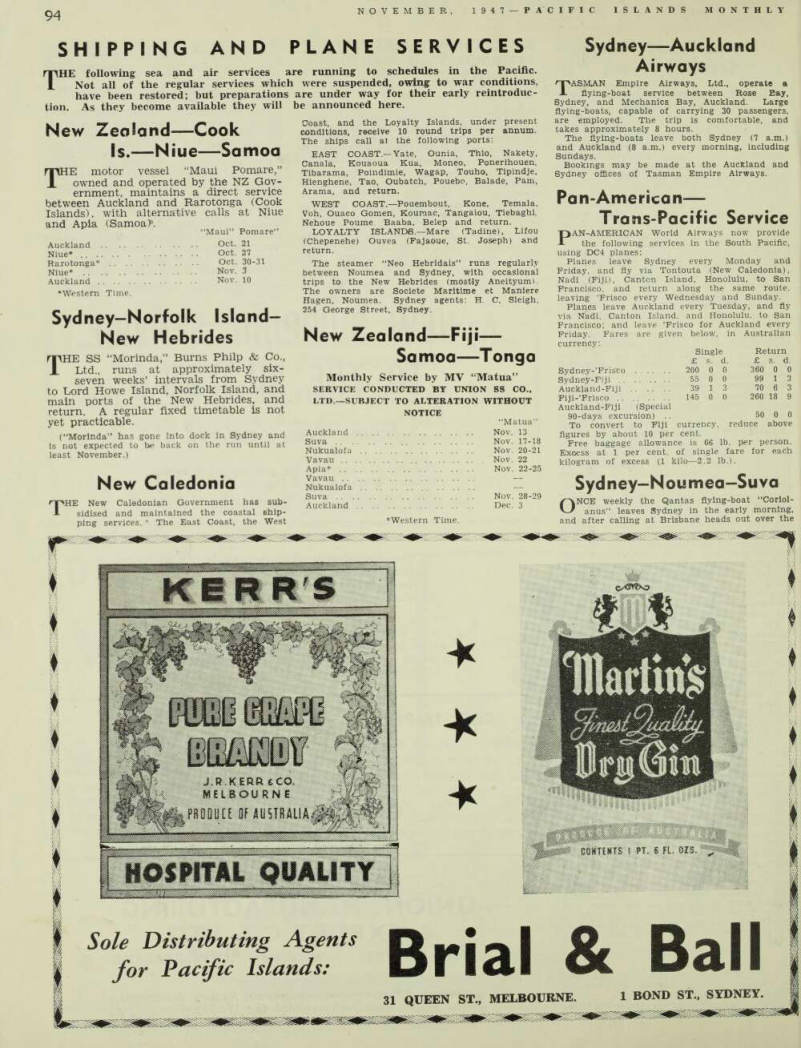
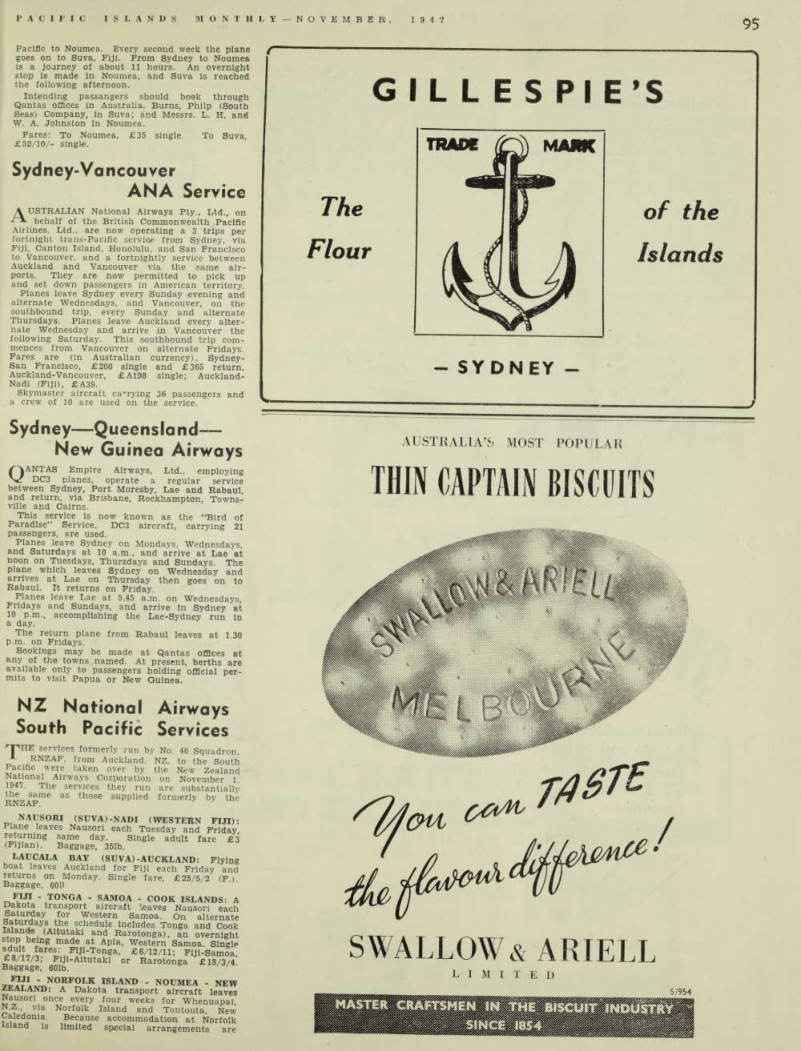
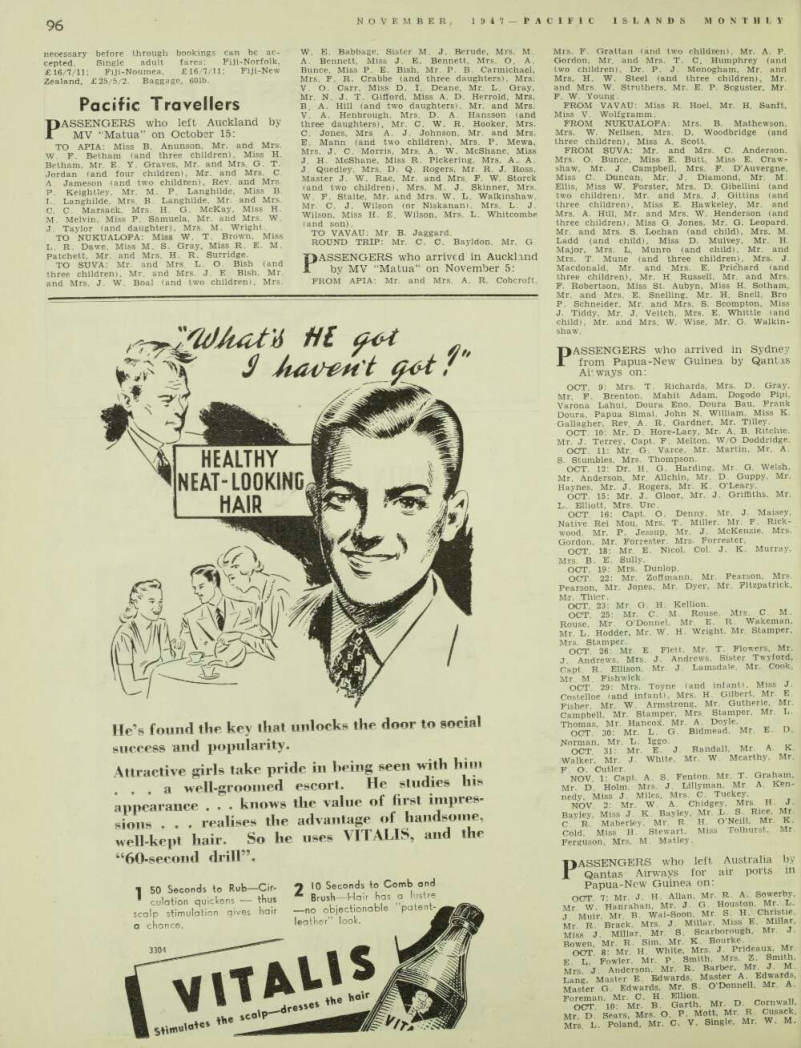
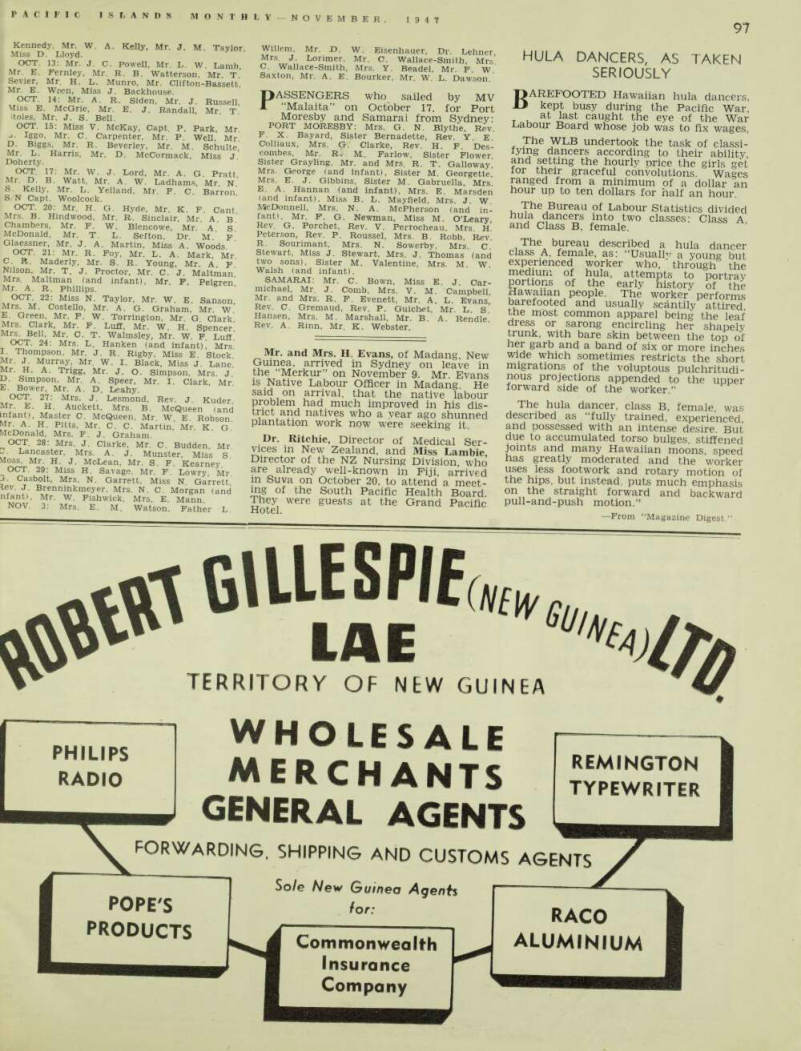
Shipping And Plane Services
THE following sea and air services are running to schedules in the Pacific.
Not all of the regular services which were suspended, owing to war conditions, have been restored; but preparations are under way for their early reintroduc tion. As they become available they will be announced here.
New Zealand—Cook
Is.—Niue —Samoa
rpHE motor vessel “Maui Pomare,”
I owned and operated by the NZ Gov ernment, maintains a direct service between Auckland and Rarotonga (Cook Islands), with alternative calls at Niue and Apia (SamoaX “Maui” Pomare”
Auckland Oct. 21 Niue* Oct. 27 Rarotonga* Oct. 30-31 Niue* Nov. 3 Auckland Nov. 10 •Western Time.
Sydney—Norfolk Island-
New Hebrides
THE SS “Morinda,” Burns Philp & Co., Ltd., runs at approximately six seven weeks’ intervals from Sydney to Lord Howe Island. Norfolk Island, and main ports of the New Hebrides, and return. A regular fixed timetable is not
yet practicable.
(“Morinda” has gone Into dock In Sydney and is not expected to be back on the run until at least November.)
New Caledonia
THE New Caledonian Government has sub sidised and maintained the coastal ship ping services. * The East Coast, the West
Coast, and the Loyalty Islands, under present conditions, receive 10 round trips per annum.
The ships call at the following ports: EAST COAST.—Yate, Ounia, Thio, Nakety, Canala, Kouaoua Kua, Moneo, Ponerihouen, Tibarama, Poindimie, Wagap, Touho, Tipindje, Hienghene, Tao, Oubatch, Pouebo, Balade, Pam, Arama, and return.
WEST COAST. —Pouembout, Kone, Temala, Voh, Ouaco Gomen, Koumac, Tangaiou, Tiebaghi, Nehoue Poume. Baaba. Belep and return.
LOYALTY ISLANDS.—Mare (Tadine), Lifou (Chepenehe) Ouvea (Fajaoue, St. Joseph) and return.
The steamer “Neo Hebridais” runs regularly between Noumea and Sydney, with occasional trips to the New Hebrides (mostly Aneityum) The owners are Societe Maritime et Manlere Hagen, Noumea. Sydney agents: H. C. Sleigh, 254 George Street, Sydney.
New Zealand—Fiji—
Samoa—Tonga
Monthly Service by MV “Matua”
Service Conducted By Union Ss Co.,
Ltd.—Subject To Alteration Without
Notice
Sydney—Auckland
Airways
TASMAN Empire Airways. Ltd., operate a flying-boat service between Rose Bay, Sydney, and Mechanics Bay, Auckland. Large flying-boats, capable of carrying 30 passengers, are employed. The trip is comfortable, and takes approximately 8 hours.
The flying-boats leave both Sydney (7 a.m.) and Auckland (8 a.m.) every morning, including Sundays.
Bookings may be made at the Auckland and Sydney offices of Tasman Empire Airways.
Pan-American —
Trans-Pacitic Service
PAN-AMERICAN World Airways now provide the following services in the South Pacific, using DC4 planes; Planes leave Sydney every Monday and Friday, and fly via Tontouta (New Caledonia), Nadi (Fiji), Canton Island, Honolulu, to San Francisco, and return along the same route, leaving ’Frisco every Wednesday and Sunday.
Planes leave Auckland every Tuesday, and fly via Nadi, Canton Island, and Honolulu, to San Francisco: and leave ’Frisco for Auckland every Friday. Fares are given below, in Australian currency:
To convert to Fiji currency, reduce above figures by about 10 per cent.
Free baggage allowance is 66 lb. per person.
Excess at 1 per cent, of single fare for each kilogram of excess (1 ki10—2.2 lb.).
Sydney—Noumea—Suva
ONCE weekly the Qantas flying-boat "Corlol anus” leaves Sydney in the early morning, and after calling at Brisbane heads out over the
“Matua"
Auckland Nov. 13 Suva Nov. 17-18 Nukualofa Nov. 20-21 Vavau Nov. 22 Apia* Nov. 22-25 Vavau — Nukualofa — Suva Nov. 28-29 Auckland Dec. 3 ♦Western Time.
Single Return £ s. d. £ s. d.
Sydney-’Frisco 200 0 0 360 0 0 Sydney-Fiji 55 0 0 99 1 3 Auckland-Fiji 39 1 3 70 6 3 Fiji-’Prisco 145 0 0 260 18 9 Auckland-Fiji (Special 90-days excursion) . . 50 0 0
Pacific to Noumea. Every second week the plane goes on to Suva, Fiji. From Sydney to Noumea is a journey of about 11 hours. An overnight stop is made in Noumea, and Suva is reached the following afternoon.
Intending passangers should book through Qantas offices in Australia. Burns, Philp (South Seas) Company, in Suva; and Messrs. L. H. and W. A. Johnston in Noumea.
Fares: To Noumea, £35 single. To Suva, £52/10/- single.
Sydney-Voncouver
ANA Service
AUSTRALIAN National Airways Pty., Ltd., on behalf of the British Commonwealth Pacific Airlines, Ltd., are now operating a 3 trips per fortnight trans-Pacific service from Sydney, via Fiji, Canton Island, Honolulu, and San Francisco to Vancouver, and a fortnightly service between Auckland and Vancouver via the same air ports. They are now permitted to pick up and set down passengers in American territory.
Planes leave Sydney every Sunday evening and alternate Wednesdays, and Vancouver, on the southbound trip, every Sunday and alternate Thursdays. Planes leave Auckland every alter nate Wednesday and arrive in Vancouver the following Saturday. This southbound trip com mences from Vancouver on alternate Fridays.
Fares are (in Australian currency), Sydney- Ban Francisco, £2OO single and £365 return, Auckland-Vancouver, £AI9B single; Auckland- Nadi (Fiji), £A39.
Skymaster aircraft carrying 36 passengers and a crew of 10 are used on the service.
Sydney—Queensland—
New Guinea Airways
QANTAS Empire Airways, Ltd., employing DCS planes, operate a regular service between Sydney, Port Moresby, Lae and Rabaul, and return, via Brisbane, Rockhampton, Towns ville and Cairns.
This service is now known as the “Bird of Paradise” Service. DCS aircraft, carrying 21 passengers, are used.
Planes leave Sydney on Mondays, Wednesdays, and Saturdays at 10 a.m., and arrive at Lae at noon on Tuesdays, Thursdays and Sundays. The plane which leaves Sydney on Wednesday and arrives at Lae on Thursday then goes on to Rabaul. It returns on Friday.
Planes leave Lae at 5.45 a.m. on Wednesdays, Fridays and Sundays, and arrive in Sydney at 10 p.m., accomplishing the Lae-Sydney run in a day.
The return plane from Rabaul leaves at 1.30 p.m. on Fridays.
Bookings may be made at Qantas ofllces at any of the towns named. At present, berths are available only to passengers holding official per mits to visit Papua or New Guinea.
NZ National Airways
South Pacific Services
r P HE services formerly run by No. 40 Squadron, . RNZAF. from Auckland. NZ. to the South Pacific were taken over by the New Zealand National Airways Corporation on November 1. 1947. The services they run are substantially the same as those supplied formerly by the
Rnzaf.
Nausori (Suva)-Nadi (Western Fiji);
Plane leaves Nausori each Tuesday and Friday returning same day. Single adult fare £3 (Fijian). Baggage, 351 b.
Laucala Bay (Suva)-Auckland; Flying
boat leaves Auckland for Fiji each Friday and returns on Monday. Single fare, £25/5/2 (F ) Baggage, 6011 FIJI - TONGA - SAMOA - COOK ISLANDS: A Dakota transport aircraft leaves Nausori each SSSSf 87 /v, 0r Western Samoa. On alternate schedule Includes Tonga and Cook f 5! (Aitutaki and Rarotonga), an overnight stop being made at Apia, Western Samoa. Single £ d 8 U / I l fc 7/? re wHi F l J i i f'T o^ a ’ £ 6/12/11 : Piji-Samoa, £B/17/3, Fiji-Altutaki or Rarotonga £lB/3/4 Baggage, 601 b.
' NORFOLR ISLAND - NOUMEA - NEW ZEALAND: A Dakota transport aircraft leaves Nausori once every four weeks for Whenuapai, N.Z., via Norfolk Island and Tontouta, New Caledonia, Because accommodation at Norfolk Island is limited special arrangements are
necessary before through bookings can be accepted. Single adult fares: Fiji-Norfolk, £l6/7/11' Fiji-Noumea, £l6/7/11; Fiji-New Zealand, £25/5/2. Baggage, 601 b. . r, m— a*
rQC I tic S raVCBlerS
PASSENGERS who left Auckland by MV l< Matua” on October 15: TO APIA- Miss B Anunson Mr. and Mrs.
W F itham “and th?ee children). Miss H.
Beth am, Mr. E. Y. Graves. Mr. and Mrs. G. T.
Jordan (and fo Jl r t^ dd ’
P SSy Mr. M. pTangSde, Miss B.
'r rrr d L Mrs M r f r g G hll McK M ay S'. Me“n Mrs's P. SaLela,' Mr and Mrs. w!
J. Taylor (and daughter), Mrs. M. Wright.
TO NUKUALOFA; Miss W. T. Brown. Miss L. R. Dawe. Miss M. S. Gray, Miss R. E. M. patchett, Mr. and Mrs. h. R. Surridge.
TO SUVA: Mr. and Mrs. L. O. Bish (and three children), Mr. and Mrs. J. E. Bish, Mr. and Mrs. J. W. Boal (and two children), Mrs.
W. E, Babbage. Sister M, J, Berude, Mrs. M, A. Bennett, Miss J. E. Bennett, Mrs. O. A.
Bunce, Miss P. E. Bish, Mr. P. B. Carmichael, Mrs. F. R. Crabbe (and three daughters), Mrs.
V. O. Carr, Miss D. I. Deane, Mr. L. Gray, Mr. N. J. T. Gifford, Miss A. D. Herrold, Mrs.
B. A. Hill (and two daughters), Mr. and Mrs.
V. A. Henbrough, Mrs. D. A. Hansson (and three daughters), Mr. C. W. R. Hooker, Mrs. c. Jones, Mrs, A. J. Johnson. Mr. and Mrs.
E - Mann < and two children), Mrs. P. Mewa, Morris, Mrs. A. W. McShane, Miss
D% Ross'
Master J. W. Rae, Mr. and Mrs. F. W. Storck •and two children), Mrs. M J Skinner. Mrs.
Mr. p 6. st rwZ„ a t M^Jna„ L ,-.
Wilson. Miss H. E. Wilson, Mrs. L, Whitcombe ,a ,J d Jaeeard Snm TOIF Mr C C Bavldon Mr G ROUND TRIP. Mr. C. C. Bayldon. Mr. G TJASSENGERS who arrived in Auckland Y hv MV “Mntua” nn November V * by MV Matua on iNOVemoer 0.
FROM APIA: Mr. and Mrs. A. R. Cobcroft,
Mrs. F. Grattan (and two children), Mr. A, P.
Gordon, Mr, and Mrs. T. C. Humphrey (and two children), Dr. P. J. Monogham, Mr. and Mrs. H. W. Steel (and three children), Mr. and Mrs. W. Struthers, Mr. E. P. Scguster, Mr.
F. W. Young.
FROM VAVAU: Miss R. Hoel, Mr. H. Sanft, Miss V. Wolfgramm.
FROM NUKUALOFA; Mrs. B. Mathewson, Mrs. W. Neilsen, Mrs. D. Woodbridge (and three children), Miss A. Scott.
FROM SUVA; Mr. and Mrs. C. Anderson.
Mrs. O. Bunce, Miss E. Butt, Miss E. Craw shaw, Mr. J. Campbell, Mrs. F. D’Auvergne, Miss C. Duncan, Mr. J. Diamond, Mr. M.
Ellis, Miss W. Forster, Mrs. D. Gibellini (and two children), Mr. and Mrs. J. Gittins (and three children), Miss E. Hawkeley, Mr. and Mrs. A. Hill, Mr. and Mrs. W. Henderson (and three children), Miss G. Jones, Mr. G. Leopard.
Mr. and Mrs. S. Lochan (and child), Mrs. M.
Ladd (and child), Miss D. Mulvey, Mr. H.
Major, Mrs. L. Munro (and child), Mr. and Mrs. T. Mune (and three children), Mrs. J.
Macdonald. Mr. and Mrs. E. Prichard (and three children), Mr. H, Russell. Mr. and Mrs.
F. Robertson, Miss St. Aubyn, Miss H. Sotham, Mr. and Mrs. E. Snelling, Mr. H. Snell, Bro P. Schneider, Mr. and Mrs. S. Scompton, Miss J. Tiddy, Mr. J. Veitch, Mrs. E. Whittle (and child), Mr. and Mrs. W. Wise, Mr. G. Walkin shaw.
PASSENGERS who arrived in Sydney
from Papua-New Guinea by Qantas
Ah ways on: OCT. 9: Mrs. T. Richards, Mrs. D. Gray.
Mr. F. Brenton. Mahit Adam. Dogodo Pipi, Varona Lahui, Doura Eno, Doura Bau, Frank Doura, Papua Simai, John N. William. Miss K.
Gallagher, Rev. A. R. Gardner, Mr. Tilley.
OCT. 10: Mr. D. Hore-Lacy, Mr. A. B. Ritchie.
Mr. J. Terrey, Capt. F. Melton, W/O Doddridge.
OCT. 11: Mr. G. Varce, Mr. Martin, Mr. A.
S. Stumbles, Mrs. Thompson.
OCT. 12: Dr. H. G. Harding, Mr. G. Welsh, Mr. Anderson, Mr. Allchin, Mr. D. Guppy. Mr.
Haynes, Mr. J. Rogers, Mr. K. O’Leary.
OCT. 15: Mr. J. Gloor, Mr. J. Griffiths, Mr.
L. Elliott, Mrs. Ure.
OCT. 16: Capt. O. Denny, Mr. J. Maisey, Native Rei Mou. Mrs. T. Miller. Mr. F. Rick wood, Mr. P. Jessup, Mr. J. McKenzie. Mrs.
Gordon, Mr. Forrester. Mrs. Forrester.
OCT. 18; Mr. E. Nicol. Col. J. K. Murray.
Mrs. B. E. Sully.
OCT. 19: Mrs. Dunlop.
OCT. 22: Mr. Zoffmann. Mr. Pearson. Mrs.
Pearson, Mr. Jones, Mr. Dyer, Mr. Fitzpatrick, Mr. Thter.
OCT. 23: Mr, G. H. Kellion.
OCT. 25: Mr. C. M. Rouse, Mrs. C. M, Rouse, Mr. O’Donnel, Mr. E. R. Wakeman, Mr. L. Hodder, Mr. W. H. Wright, Mr, Stamper, Mrs. Stamper.
OCT 26: Mr. E. Flett. Mr. T. Flowers, Mr.
J Andrews. Mrs. J. Andrews. Sister Twyford, Capt. R. Ellison. Mr. J. Lamsdale. Mr. Cook, Mr. M. Fishwick.
OCT. 29: Mrs. Toyne (and infant). Miss J.
Costelloe (and infant), Mrs. H. Gilbert. Mr. E.
Fisher, Mr. W. Armstrong. Mr. Guthene, Mr.
Campbell, Mr. Stamper. Mrs. Stamper, Mr. L.
Thomas, Mr. Hancox. Mr. A. Doyle.
OCT. 30: Mr. L. G. Bidmead, Mr, E. D.
Norman, Mr. L. Iggo. . Tjr OCT 31: Mr. E. J. Randall, Mr. A. K.
Walker. Mr. J. White. Mr. W. Mcarthy. Mr.
F. O. Cutler. „ .
NOV 1: Capt. A. S. Fenton. Mr. T. Graham, Mr. D. Holm, Mrs. J Lillyman. Mr. A. Ken nedy, Miss J. Miles, Mrs. C. Tuckey.
NOV. 2: Mr. W. A. Chidgey. Mrs. H. J.
Bayley. Miss J K Bayley. Mr, L. S. Rice. Mr.
C. R. Maberley. Mr. R. H. O’Neill, Mr. K.
Cold. Miss H. Stewart. Miss Tolhurst, Mr.
Ferguson, Mrs. M. Matley.
PASSENGERS who left Australia by
Qantas Airways for air ports in
Papua-New Guinea on: OCT. 7: Mr. J. H, Allan. Mr. R. A. Sowerby, Mr W. Hanrahan, Mr. J. G. Houston. Mr. X. j Muir Mr B. Wai-Soon. Mr. S. H. Christie.
Mr R Brack. Mrs. J. Millar. Miss E. Millar, Miss J. Millar. Mr, S. Scarborough, Mr. J.
Bowen Mr. R. Sim, Mr. K. Bourke.
OCT 8' Mr H. White. Mrs. J. Pndeaux. Mr.
E. L. ' Fowler. Mr. P. Smith. Mrs. Z. Smith, Mrs. J. Anderson, Mr. R. Barber, Mr J. M.
Lang, Master E. Edwards, Master A Edwards, Master G. Edwards. Mr. S. O Donnell, Mr. A.
Foreman, Mr. C. H. Ellion.
OCT 10: Mr. B. Garth. Mr. D. Cornwall, Mr D.’ Sears, Mrs. O. P. Mott. Mr. R. Cusack, Mrs, L. Poland, Mr. C. V. Single, Mr. W. M.
Kennedy, Mr. W. A. Kelly. Mr, J. M. Taylor Miss D. Lloyd.
OCT. 13: Mr. J. C. Powell, Mr. L. W. Lamb Mr. E. Fernley, Mr. R. B. Watterson, Mr. T.’
Sevier, Mr. H. L. Munro, Mr. Clifton-Bassett Mr. E. Wren, Miss J. Backhouse.
OCT. 14: Mr. A. R. siden, Mr. J. Russell Miss B. McGrie, Mr. E. J. Randall, Mr T ■toles, Mr. J. S. Bell.
OCT. 15: Miss V. McKay, Capt. P. Park, Mr j. Iggo, Mr. C. Carpenter, Mr. P. Well, Mr.
D. Biggs, Mr. R. Beverley, Mr. M. Schulte, Mr. L. Harris, Mr, D. McCormack, Miss J Doherty.
OCT. 17: Mr. W. J. Lord, Mr. A. G. Pratt Mr. D, B. Watt, Mr. A. W. Ladhams, Mr. N S. Kelly. Mr. L. Yelland, Mr. F. C. Barron S/N Capt. Woolcock.
OCT. 20: Mr. H. G. Hyde, Mr. K. F. Cant Mrs. B. Hindwood, Mr. R. Sinclair, Mr. A. B.
Chambers, Mr. F. W. Blencowe, Mr. A s McDonald, Mr. T. L. Sefton, Dr. M.‘ p' Glaessner, Mr. J. A. Martin, Miss A. Woods.
OCT. 21; Mr. R. Foy, Mr. L. A. Mark Mr C. R. Maderly, Mr. S. R. Young, Mr. A. p' Nilson, Mr. T. J. Proctor, Mr. C. J. Maltman Mrs. Maltman (and infant), Mr. F. Pelgren' Mr. A. R. Phillips.
OCT. 22: Miss N. Taylor, Mr. W. E. Sanson Mrs. M. Costello, Mr. A. G. Graham, Mr. W.
E. Green, Mr. F. W. Torrington, Mr. G Clark Mrs. Clark, Mr. F. Luff, Mr. W. H. Spencer!
Mrs. Bell, Mr. C. T. Walmsley, Mr. W. F. Luff. t 24: Mrs> L - Hanken (and infant)! Mrs!
I. Thompson, Mr. J. R. Rigby. Miss E. Stock Mr. J. Murray, Mr. W. I. Black, Miss J. Lane!
Mr. H. A. Trigg, Mr. J. o. Simpson, Mrs. J D. Simpson, Mr. A. Speer, Mr. I. Clark, Mr E. Bower, Mr. A. D. Leahy.
OCT. 27: Mrs. J. Lesmond, Rev. J. Kuder Mr. E. H. Auckett, Mrs. B. McQueen (and infant), Master C. McQueen, Mr W E Robson Mr. A. H. Pitts, Mr. C. C. Martin, Mr. K G McDonald, Mrs. P. J. Graham.
OCT. 28: Mrs. J. Clarke, Mr. C. Budden, Mr.
Lancaster, Mrs. A. J. Munster, Miss S.
Moss, Mr. H. J. McLean, Mr. S. P. Kearney OCT. 29; Miss H. Savage, Mr. F. Lowry, Mr y. Casbolt, Mrs. N. Garrett, Miss N Garrett lev. j. Brenninkmeyer. Mrs. N. C. Morgan (and nfant), Mr. W. Fishwick, Mrs. E. Mann NOV. 3: Mrs. E. M. Watson, Father L.
Willem, Mr. D, w. Elsenhauer, Dr. Lehner Mrs. J. Lorimer. Mr. O. Wallace-Smith. Mrs’
C. Wallace-Smith, Mrs. Y. Beadel. Mr. F. W Saxton, Mr. A. E. Bourker. Mr. W. L. Dawson.
PASSENGERS who sailed by MV “Malaita” on October 17. for Port Moresby and Samarai from Sydney: PORT MORESBY: Mrs. G. N. Blythe, Rev.
F. X. Bayard, Sister Bernadette, Rev. Y E Colliaux, Mrs. G. Clarke, Rev. H. F. Des combes, Mr. R, M. Farlow, Sister Flower Sister Grayling, Mr. and Mrs. R. T. Galloway, Mrs. George (and infant). Sister M. Georgette Mrs. E. J. Gibbins, Sister M. Gabruella, Mrs E. A. Hannan (and infant), Mrs. E. Marsden (and infant), Miss B. L. Mayfield, Mrs. J W McDonnell, Mrs. N. A. McPherson (and in fant), Mr. F. G. Newman, Miss M. O’Leary, Rev. G. Porchet, Rev. V. Perrocheau. Mrs. H.
Peterson, Rev. P. Roussel, Mrs. B. Robb, Rev R. Sourimant, Mrs. N. Sowerby, Mrs. C.
Stewart, Miss J. Stewart, Mrs. J. Thomas (and two sons), Sister M. Valentine, Mrs. M. W.
Walsh (and infant).
SAMARAI: Mr. C. Bown, Miss E. J. Car michael, Mr. J. Comb. Mrs. V. M. Campbell Mr. and Mrs. R. P. Evenett, Mr. A. L. Evans,’
Rev. C. Gremaud, Rev. P. Guichet, Mr. L. S.
Hansen, Mrs. M. Marshall, Mr. B. A. Rendle Rev. A. Rinn, Mr. K. Webster.
Mr. and Mrs. H. Evans, of Madang. New Guinea, arrived in Sydney on leave in the “Merkur” on November 9. Mr. Evans is Native Labour Officer in Madang He said on arrival, that the native labour problem had much improved in his dis trict and natives who a year ago shunned plantation work now were seeking it.
Dr. Ritchie, Director of Medical Ser vices in New Zealand, and Miss Lambie, Director of the NZ Nursing Division who are already well-known in Fiji, arrived in Suva on October 20, to attend a meet ing of the South Pacific Health Board They were guests at the Grand Pacific Hotel.
Advertisements & other items, pp. 98-101 (1 item)
Brial & Ball
tf b D D 'CL rv c n n 3 ■ CO. m
MELBOURNE rIS
nmm wmmmk %
HOSPITAL QUALITY j
* SL3 t mnm i ?t. 6 fl ozs.
50/tf Distributing Agents
for Pacific Islands:
Brial & Ball
31 QUEEN ST., MELBOURNE. 1 BOND ST., SYDNEY.
GILLESPIE’S
The Flour of the Islands
- SYDNEY -
TRADE
MARK
AUSTRALIA’S MOST POPULAR
THIN CAPTAIN BISCUITS
I cm. /
SWALLOW& ARIELL
MASTER JN THE BISCUir if4DolTßp>
HI
S JuUWM't '"
\Vt ~~y
HEALTHY
NEAT-LOOKING
HAIR
/ > &\ H -V>^N mi
dsv3
m He’s found the key that unlocks the door to social success and popularity.
Attractive girls take pride in being seen with him , e a well-groomed escort. He studies his appearance . . . knows the value of first impressions . . . realises the advantage of handsome, well-kept hair. So he uses VITALIS, and the ‘ ,4 60-second drill”. 1 50 Seconds to Rub—Cir- 7 10 S . eco " ds to L Coml ; °" d • culation quickens thus Brush— Hair has a lustre scalp stimulation gives hair —no objectionable patenta chance. father' look. A 3304 V the bo»r dre**®* the \otes Sti tnu
°' LL faE ,fw^%
TERRITORY OF NEW GUINEA
*>ir 0
PHILIPS
RADIO
WHOLESALE
MERCHANTS
GENERAL AGENTS
REMINGTON
TYPEWRITER
FORWARDING. SHIPPING AND CUSTOMS AGENTS
Sole New Guinea Agents for:
POPE'S
PRODUCTS
RACO
ALUMINIUM
Commonwealth Insurance Company
Hula Dancers, As Taken
Seriously
BAREFOOTED Hawaiian hula dancers, kept busy during the Pacific War. at last caught the eye of the War .Labour Board whose job was to fix wages, The WLB undertook the task of classi fying dancers according to their ability, and setting the hourly nrice the girls get for their graceful convolutions. Wages ranged from a minimum of a dollar an hour up to ten dollars for half an hour. , Th e Bureau of Labour Statistics divided hu i, a <J ancers into two classes; Class A and Class B, female. ’
The bureau described a hula dancer class A. female, as: “Usuallv a young but experienced worker who, * through the medium of hula, attempts to portray portions of the early history of the Hawaiian people. The worker performs barefooted and usually scantily attired the most common apparel being the leaf dress or sarong encircling her shapely trunk, with bare skin between the top of her garb and a band of six or more inches wide which sometimes restricts the short migrations of the voluptous pulchritudi nous projections appended to the upper forward side of the worker.”
The hula dancer, class B, female, was described as “fully trained, experienced and possessed with an intense desire But due to accumulated torso bulges, stiffened joints and many Hawaiian moons, speed has greatly moderated and the worker uses less footwork and rotary motion of the hips, but instead, puts much emphasis on the straight forward and backward pull-and-push motion.” —From “Magazine Digest."
Islands Produce
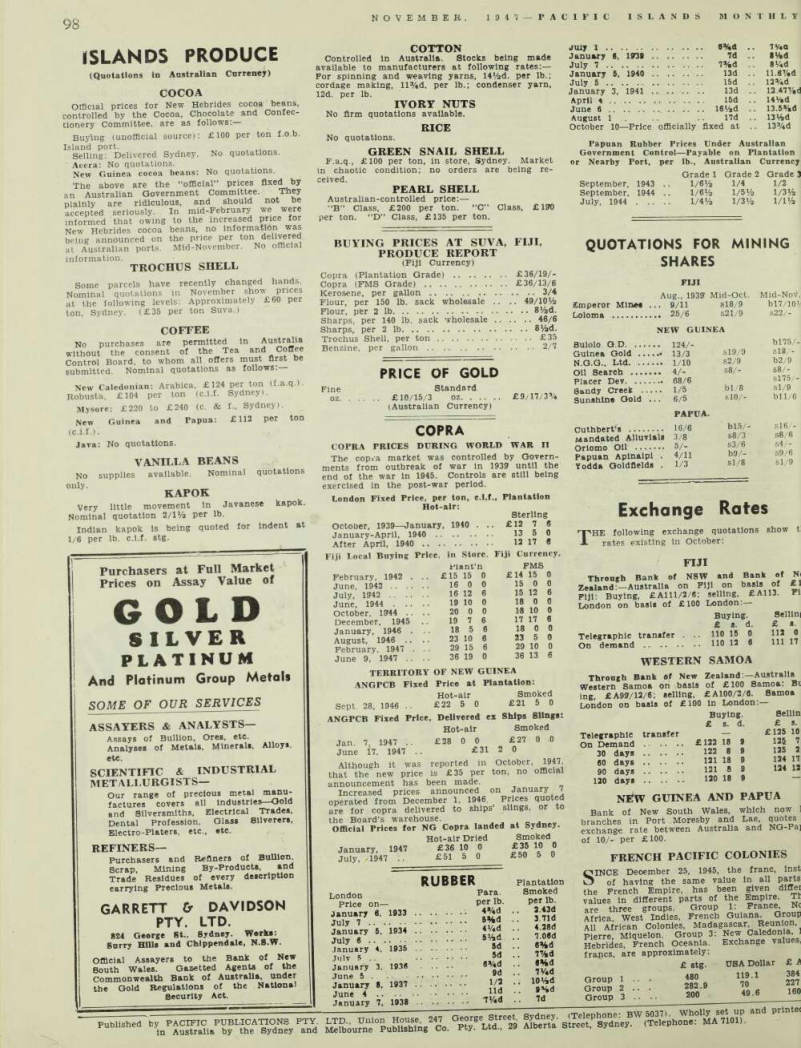
(Quotations in Australian Currency)
Cocoa
Official prices for New Hebrides cocoa beans, controlled by the Cocoa, Chocolate and Confec tionery Committee, are as follows: — Buying (unofficial source): £lOO per ton f.o.b.
Island port. , ... „ Selling; Delivered Sydney. No quotations.
Accra: No quotations.
New Guinea cocoa beans: No quotations.
The above are the “official” prices fixed by an Australian Government Committee. They plainly are ridiculous, and should not be accepted seriously. In mid-February we were informed that owing to the increased price for New Hebrides cocoa beans, no information was being announced on the price per ton delivered at Australian ports. Mid-November. No official information.
Trochus Shell
Some parcels have recently changed hands.
Nominal quotations in November show prices at the following levels; Approximately £6O per ton, Sydney. (£35 per ton Suva.)
Coffee
No purchases are permitted In Australia without the consent of the Tea and Coffee Control Board, to whom all offers must first be submitted. Nominal quotations as follows; New Caledonian: Arabica, £124 per ton (f.a.q.).
Robusta, £lO4 per ton (c.i.f. Sydney).
Mysore; £220 to £240 (c. & f., Sydney).
New Guinea and Papua: £ll2 per ton (c.i.f.).
Java: No quotations.
Vanilla Beans
No supplies available. Nominal quotations only.
Kapok
Very little movement In Javanese kapok.
Nominal quotation 2/1 Va per lb.
Indian kapok Is being quoted for Indent at 1/6 per lb. c.i.f. stg.
Cotton
Controlled in Australia. Stocks being made available to manufacturers at following rates;— For spinning and weaving yarns, 14%d. per lb.; cordage making, ll 3 /<d. per lb.; condenser yarn, 12d. per lb.
Ivory Nuts
No firm quotations available.
Bice
No quotations.
Green Snail Shell
F.a.q., £lOO per ton, in store, Sydney. Market in chaotic condition; no orders are being re ceived.
Pearl Shell
Australian-controlled price:— "B” Class, £2OO per ton. “C” Class, £l9O per ton. "D” Class, £135 per ton.
Buying Prices At Suva, Fiji,
Produce Report
(Fiji Currency)
Copra (Plantation Grade) £36/19/- Copra (FMS Grade) £36/13/6 Kerosene, per gallon 3/4 Flour, per 150 lb. sack wholesale .. .. 49/10V2 Flour, pfer 2 lb BVad.
Sharps, per 140 lb. sack wholesale 46/6 Sharps, per 2 lb SVad.
Trochus Shell, per ton £35 Benzine, per gallon 2/7
Advertisements & other items, p. 102 (1 item)
Price Of Gold
Pine Standard oz £lO/15/3 oz £9/17/3* (Australian Currency)
Copra
Prices During World War Ii
The copra market was controlled by Govern ments from outbreak of war in 1939 until the end of the war in 1945. Controls are still being exercised in the post-war period.
London Fixed Price, per ton, c.i.f., Plantation Hot-air:
Territory Of New Guinea
ANGPCB Fixed Price at Plantation: Hot-air Smoked Sept. 28, 1946 . . £22 5 0 £2l 5 0 ANGPCB Fixed Price, Delivered ex Ships Slings: Hot-air Smoked Jan. 7. 1947 .. £2B 0 0 £27 0 0 June 17, 1947 .. £3l 2 0 Although it was reported in October, 1947. that the new price is £35 per ton, no official announcement has been made.
Increased prices announced on January 7 operated from December 1, 1946. Prices quoted are for copra delivered to ships’ slings, or to the Board’s warehouse. . , c . M Official Prices for NG Copra landed at Sydney.
October, 1939—January, 1940 Sterling . £12 7 6 January-April, 1940 .. 13 5 0 After April, 1940 .. .. 12 17 6 Fiji Local Buying Price.
In Store.
Fiji Currency, Flant’n
Fms
February, 1942 . .. £15 15 0 £14 15 0 June, 1942 16 0 0 15 0 0 July. 1942 16 12 6 15 12 6 June, 1944 19 10 0 18 0 0 October. 1944 .. 20 0 0 18 10 0 December, 1945 19 7 6 17 17 6 January, 1946 . .. 18 5 6 18 0 0 August, 1946 .. 23 10 6 23 5 0 February, 1947 . .. 29 15 6 29 10 0 June 9. 1947 .. .. 36 19 0 36 13 6
Hot-air Dried Smoked January, 1947 July, 1947 .. £36 10 0 £51 5 0 £35 10 0 £50 5 0
Rubber
Papuan Rubber Prices Under Australian Government Control —Payable on Plantation or Nearby Port, per lb., Australian Currency
Plantation
London Price on- January 6.
July 7 .. mas . ..
Para, per lb. ... 4»/ 4 d Smoked per lb. 3.43d 1Q34 .. .. BHd ... 4V<d 3 71d 4.28d July 6 .. 1935 .. .. bVid Bd 7.0fld 6Hd January 4, July 5 ..
January 3, June 5 . ... Bd 7%d 1936 1937 8%d .. .. 9d ... 1/3 «%d 7V«d .. lOVid January 8, June 4 1938 .. .. lid ... 7V*d 9Sd 7d January 7,
July 1 8%d .. 7V»Q January 6, 19G9 7d Sftd July 7 7%d .. 8V!»d January 5, 1940 13d .. 11.6%d July 5 15d 12»Ad January 3, 1941 13d 12.47%d April 4 15d .. 14V«d June 6 16Vad .. 13.5“/«d August 1 17d .. 13%d October 10 —Price officially fixed at .. 13 3 /4d
Grade 1 Grade 2 Grade 3 September, 1943 .. l/6V a 1/4 1/2 September, 1944 .. I/6V2 l/SVa l/3Va July, 1944 1/4 Vi 1/3% 1/lVa
Shares
Quotations For Mining
Fiji
Aug., 1939 Mid-Oct.
Mid-NoV.
Emperor Mine* .. .. 9/11 S18/9 bl7/10V Loloma .. 25/6 S21/9 s22/-
New Guinea
Bulolo G D . 124/bl75/- S19/9 sl8/- N.G.G., Ltd s2/9 b2/9 Oil Search s8/s8/- Placer Dev sl75/- Sandy Creek ... .. 1/5 bl/8 sl/9 Sunshine Gold .. . 6/5 slO/bl 1/6
Papua.
Cuthbert's bl5/sl6/- Mandated Alluvlals 3/8 s8/3 s8 6 Orlomo OH s3/6 S4/- Papuan Aplnalpl . 4/11 b9/s9/6 Yodda Goldfields . 1/3 sl/8 sl/9
Exchange Rates
THE following exchange quotations show t rates existing in October;
Fiji
Through Bank of NSW and Bank of N< Zealand:— Australia on Fiji on basis of £1 FIJI: Buying, £Alll/2/6; selling. £AII3. Fl London on basis of £lOO London:
Western Samoa
Through Bank of New Zealand; —Australia Western Samoa on basis of £lOO Samoa: Bi Ing, £A99/12/6; selling, £AIOO/2/6. Samoa London on basis of £lOO in London:
Nfiw Guinea And Papua
Bank of New South Wales, which now ] branches in Port Moresby and Lae, quotes exchange rate between Australia and NG-Pa] of 10/- per £lOO.
French Pacific Colonies
SINCE December 25, 1945, the franc, Inst of having the same value in all parts the French Empire, has been given differ values in different parts of the Empire. Tt are three groups. Group 1: Prance, Nc Africa, West Indies, French Guiana. Group All African Colonies, Madagascar. Reunion.
Pierre Miquelon. Group 3; New Caledonia, 1 Hebrides. French Oceania. Exchange values, frapcs, are approximately:
Buying.
Bel Uni £ s. d. £ 8.
Telegraphic transfer .
On demand .. 110 15 0 .. 110 12 6 112 111 0 17
Buying.
Beilin £ s. d. £ s.
Telegraphic transfer — £125 10 On Demand £122 18 9 125 7 30 days 122 8 9 125 2 60 days 121 18 9 124 17 90 days 121 8 9 124 12 120 days 120 18 9
£ stg. USA Dollar £ A Gr0UP I '' ‘ 282 9 “S 1 227 SSS s m > 6 »
Advertisements & other items, pp. 102-104 (3 items)
Published ™ ‘WT- S£ti' A tlO if, “*
98
NOVEMBER, 1947 PACIFIC ISLANDS MONTHLY
Gold
Purchasers at Full Market
Prices on Assay Value of
SILVER
PLATINUM
And Platinum Group Metals
SOME OF OUR SERVICES
ASSAYERS & ANALYSTS—
Assays of Bullion, Ores, etc.
Analyses of Metals. Minerals. Alloys, etc.
SCIENTIFIC & INDUSTRIAL
METALLURGISTS—
Our range of precious metal manufactures covers all Industries —Gold and Silversmiths, Electrical Trades.
Dental Profession, Glass Sllverers, Electro-Platers, etc., etc.
REFINERS—
Purchasers and Refiners of Bullion.
Scrap, Mining By-Products, and Trade Residues of every description carrying Precious Metals.
GARRETT & DAVIDSON
PTY. LTD.
824 George St.. Sydney. Works: Sorry Hills and Chippendale, N.B.W.
Official Assayers to the Bank of New South Wales. Gazetted Agents of the Commonwealth Bank of Australia, under the Gold Regulations of the National Security Act.
fw n/iodi </"* ks
To quench a
tropical thirst...
-ing CP 1 a- :/ A Onr =H When you’re hot and tired, there is nothing quite so satisfying and thirst quenching as a long, cold glass of ”K.B. Your friends and guests, too, will appreciate this really fine
Lager, for “Everybody
drinks
TOOTH’S
LAGER
m §54
MERCHANTS, & SHIP OWNERS
Capital £1,000,000
ESTABLISHED 1914
it ★
COPRA MERCHANTS & MILLERS
BRANCHES THROUGHOUT THE PACIFIC ISLANDS
Buyers and exporters of all kinds of Islands produce. Copra Merchants and Millers.
Agents for Australian, European and American Manufacturers. Distributors of every description of merchandise.
Thirty years of Pacific Islands development and service.
IN LONDON:
W. R. Carpenter & Co. (London), Ltd., Coronation House, 4 Lloyd’s Avenue, London, E.C. ★
REGULAR CARGO
PACIFIC
THE W.R.C. LINE
THE FIRST DIRECT AND
AND PASSENGER SERVICE
DISTRIBUTING
AGENTS FOR :
Ford Motor Company of Canada.
Electrolux Refrigerators.
T. G. & C. Bolinders (Engines).
Chrysler Corporation.
Westinghouse Electrical Co.
Caterpillar Tractors.
Etc., Etc.
AND
Head
W.
Office:
BETWEEN EUROPE
ISLAND PORTS WAS ESTABLISHED BY
R. CARPENTER & CO. LTD.
16 O'CONNELL STREET, SYDNEY.
Cable Address:
CAMOHE.
Telephone: BW 4421.
Postal Address: P.O. Box No. 168, Sydney.