Pacific
Islands
Monthly
October 17, 1947
Vol. Xviii. No. 3.
Established 1930.
IRegistered at the G.P.0., Sy^^: x tQxJjansmission hy post as a newspaper ]
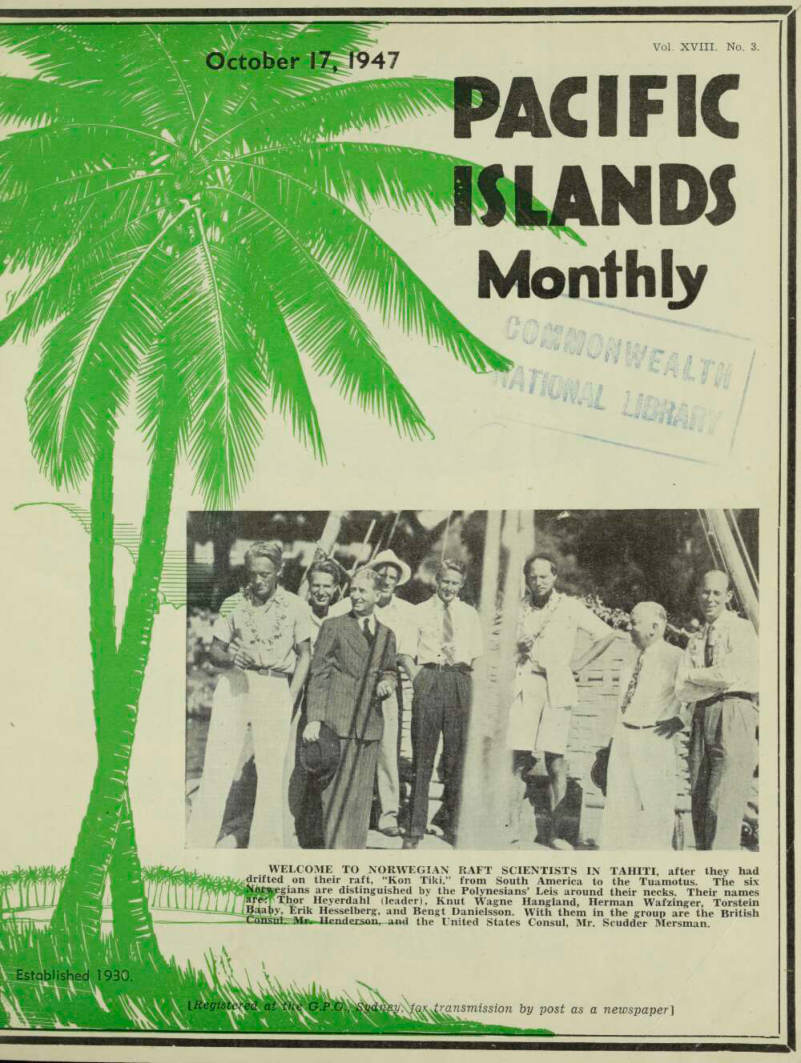
WELCOME TO NORWEGIAN RAFT SCIENTISTS IN TAHITI, after they had drifted on their raft, “Kon Tiki,” from South America to the Tuamotus. The six Norwegians are distinguished by the Polynesians’ Leis around their necks. Their names are: Thor Heyerdahl (leader), Knut Wagne Hangland, Herman Wafzinger, Torstein Baaby, Erik Hesselberg, and Bengt Danielsson. With them in the group are the British Consul, Mr. Henderson, and the United States Consul, Mr. Scudder Mersman.
Advertisements & other items, pp. 2-4 (2 items)
Qaritai Smfute c/ 4i^n/a^o
mtape ?k
MEW
JRELAND
TEft ™ F NE w CU 1 N S^jfef
TERR I T oEy';
frSALAMAUA
'*s& IF oF / PORT Zmsk
MORESBY
LAE
HU ON C UIF
iROBRIAHD Is
BUNA
coo
NOUGH I.
ANGA
FEN I
N>s AN BU
BOUGAINVILLE
SOLOMON
if
JSI
MILNE BAH
2a RA * LOUISIAOt A FLC H T
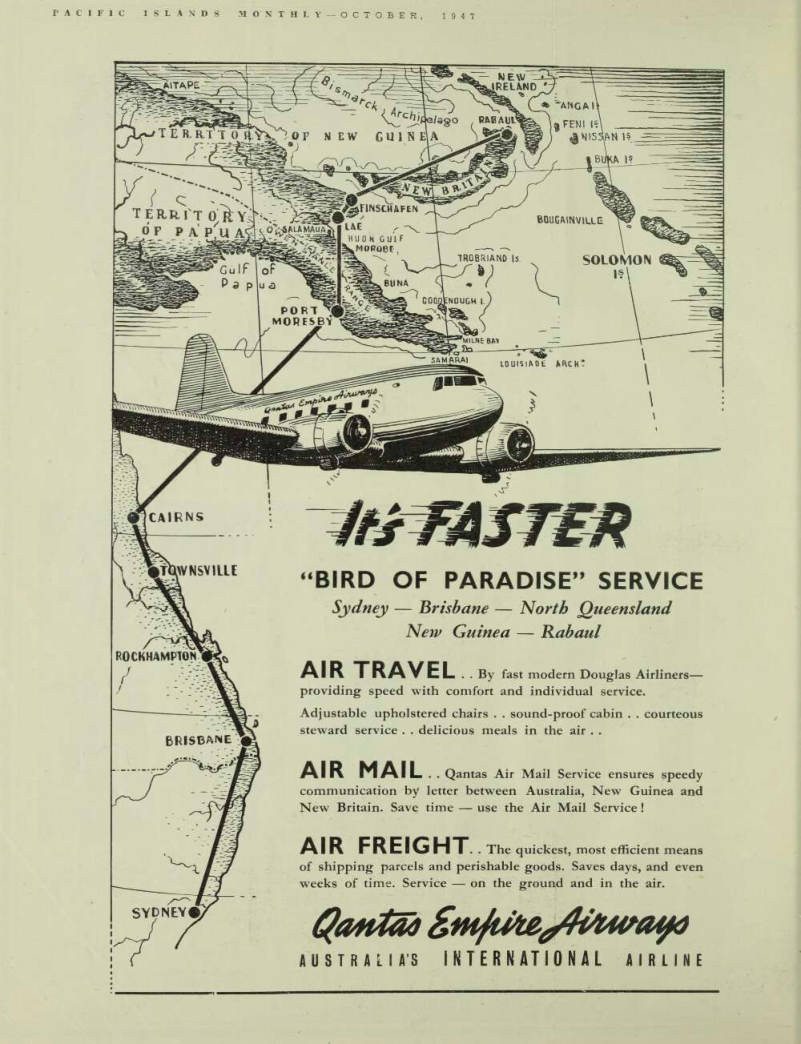
“BIRD OF PARADISE” SERVICE
Sydney Brisbane North Queensland
Rabaul
&ggSZ*?T
CAIRNS
New Guinea
ROCKHAMPTON
BRISBANE
SYDNEY
AIR TRAVEL .By fast modern Douglas Airliners — providing speed with comfort and individual service.
Adjustable upholstered chairs . . sound-proof cabin . . courteous steward service . . delicious meals in the air . .
AIR MAIL . Qantas Air Mail Service ensures speedy communication by letter between Australia, New Guinea and New Britain. Save time use the Air Mail Service!
AIR FREIGHT . The quickest, most efficient means of shipping parcels and perishable goods. Saves days, and even weeks of time. Service on the ground and in the air.
Qaritai Smfute c/ 4i^n/a^o
Ail SIR A MAS INTERNATIONAL AIRLINE
DAYLIGHT
/ / / * I cy / C/ / The outstanding features in all Coleman’s Lanterns have proved their value by active performance over forty years.
Coleman’s Petrol or Kerosene Lamp with large enamelled reflector.
Coleman’s Petrol and Kerosene Lamps in 300 and 500 C.P.
DARK
rt ■ % 1 * s y ✓ ✓ / Coleman’s Kerosene Table Lamp can be used as hanging Lamp Coleman Lanterns are made stronger to last longer:
Pyrex heat-resisting globes
protect the mantles ... pressure-tested brass fonts that will not rust . . builtin automatic tip-cleaning needles . . . shut-off valves to avoid constant repumping each time lantern is
lighted. Safe, Steady Brilli-
ance in or out of doors.
Representatives for the Pacific Islands:
ROBERT GILLESPIE PTY. LTD.
54a PITT STREET, SYDNEY
PEARCE & CO. LTD
SUVA
FOR FIJI ISLANDS
/ FROM MOS<|IITOFS. SWIIH.IIS :iml OTHFK RITIM. INSECTS . > \ ■ .V w W if SO ia
trai-
(ads
js CO : ME M
ico
vV.
VN/^ fed C* i u^ HS c0 rP fi* (in rR° s vp B u Y** W*
Ho?** Shan?
•I.^ V v VA 2T
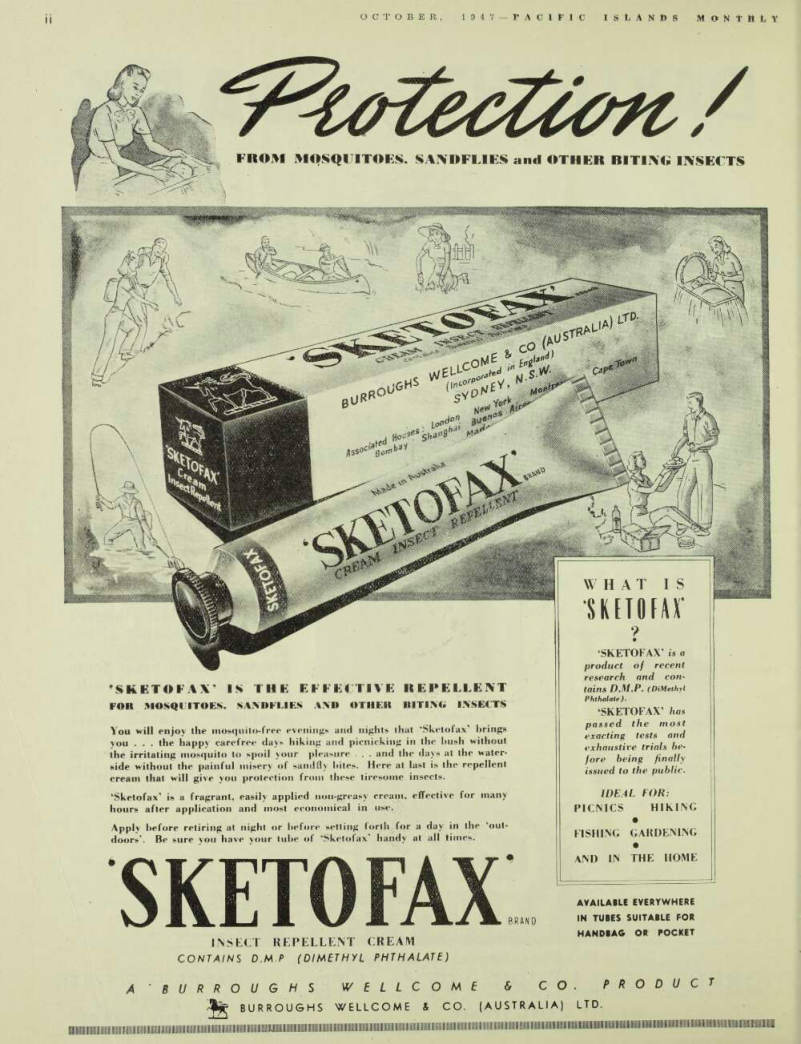
SKETOFAX
’SKETOFAX’ IS THE EFFECTIVE It EPELLENT
FOR MOSQUITOES. SANDFLIES AND OTHER BITING INSECTS You will enjoy ihe mosquito-free evenings and nights that ‘Sketofax’ brings you . . . the happy carefree days hiking and picnicking in the hush without the irritating mosquito to spoil your pleasure . . . and the days at the waterside without the painful misery of sandfly lutes. Here at last is the repellent cream that will give you protection from these tiresome insects. ‘Sketofax’ is a fragrant, easily applied non-greasy cream, effective for many hours after application and most economical in use.
Apply before retiring at night or before setting forth for a day in the ‘outdoors’. Be sure vou have your tube of ‘Sketofax’ handy at all times.
SKETOFAX
INSECT REPELLENT CREAM
CONTAINS D.M.P (DIMETHYL PHTHALATE)
‘SKETOFAX’ is a
product of recent research and con • tains D.M.P. (DiMethyl Phthalate).
‘SKETOFAX’ has
passed the most exacting tests and exhaustive trials before being finally issued to the public.
IDEAL FOR:
PICNICS HIKING
FISHING GARDENING
AND IN THE HOME
BRAND
AVAILABLE EVERYWHERE
IN TUBES SUITABLE FOR
HANDBAG OR ROCKET
BURROUGHS WBLLCOM£ 6 CO. RRO D U C IS BURROUGHS WELLCOME & CO. (AUSTRALIA) LTD.
Ii
OCTOBER. 1947 PACIFIC ISLANDS MoNtHLT
Advertisers
Andrews Labora tories 89 Angliss & Co. ... 40 Allen, H. T.. Bar rett & Read ... 23 Atkins Pty., Ltd., Wm 72 Australian Block & Chain Co. Pty., Ltd 38 Amalgamated Hatcheries ... 73 Amplion (Aust.) Pty.. Ltd 75 Australian Yeast Co 66 Baker. W. Jno. . . 21 Bethell, Gwyn & Co 50 Brial & Ball (Paris Office) 58 Brown & Co., Ltd. . 15 Brunton’s Flour . . 14 Bank of NSW ... 16 Brial & Ball ... 19 Brial & Ball (Barnes Products) 12 Burns, Philp Trust Co.. Ltd 24 Brial & Ball (Tibaldi) ... 28 Budge, James, Pty., Ltd 37 Brial & Ball (Soprana) ... 81 Broomflelds ... 56 Brial & Ball (Gin and Brandy) . . 25 BP (SS) Co. . . . 15 Bulowat Transport Co 63 Burroughs, Wel come ii.
Burgess Penlights . 57 W. R. Carpenter & Co. (Fiji), Ltd. . 59 Carlton & United Breweries, Ltd. . 49 Caine’s Studios, Suva 51 Carpenter, Ltd., W.
R cov. iv.
Coleman Lamp & Stove Co 51 Chemical Indus tries ... 23 Colyer Watson (New Guinea), Ltd. . . 21 Costello, Vince, Garrick Hotel . . 50 “Cystex” 56 Copra Growers’
Union 73 Donaghy & Sons . 58 Donald, Ltd., A. B. 30 Paul, A. Dorn . . 60 Davison Paints Pty., Ltd 18 Dr. Williams Pink Pills 52 Dangar, Gedye & Malloch ... 1 Dunlop Rubber (A/sia), Ltd. , . 27 Electrolux Refrigerators . . 39 Eveready Batteries 36 Ford Sherington . 85 Garrett & Davidson 90 Gillespie Pty., Ltd..
Robert . . i. & 22 R o b t. Gillespie (NG), Ltd. ... 88 Gilbey’s Gin ... 55 Gillespie’s Flour . 26 Green Point Ship building & Engin eering Pty.. Ltd. 13 Gough & Co.. E. J. 52 Grand Pacific Hotel 2 Grove & Sons, W.
H 24 Heinz & Co., Pty., Ltd., H. J. . . . 77 Hemingway & Robertson ... 26 Horlicks Malted Milk 29 Hyde, Victor ... 14 Ipana Tooth Paste 20 Jenkins Emporium . 49 Kopsen & Co.. Ltd. 31
Kodak (Aust.) Pty., Ltd 69 Kerr Brothers . . 58 Locky?r. Geo. J. . 35 Le Bon College . . 55 Levy, Noel . . . .81 M. & M. Island Traders ... 84 Mail Publicity Co. . 35 Merrillees, J. C.. & Co 12 . Mensa Manufactur ing Co 30 Millers, Ltd.. Suva 28 , Miscellaneous ... 11 Merrillees, J. C., Pty.. Ltd. (Ampex) ... 27 Mum” Deodorant 87 Mendaco” . ... 76 i Icllraths Pty., Ltd. 14 Mobile Industrial Equipment Pty., Ltd. 33 Morgan, P. J., & Co 19 Morris, Hedstrom Ltd., Suva ... 10 Merrillees, J. C. j 3 t y., L t d. «McNiven’s) . 63 Miher Tyres .53 Metro - Goldwyn - M.iyer 17 Nelson & Robertson Pty., Ltd 61 NSW Bookstall Co.
Pty., Ltd 74
Napt 54
“Nixoderm” ... 71 Nordman. Oscar . 74 Pacific Is. Society 40 “Pinkettes” . . . 77 Pitt & Scott, Ltd. . 74 proprietary Products 76 Qantas Empire Air ways . cov. ii.
Queensland Insur ance Co 84 Robinson, G. H. .36 Reed, Proudman, Elworthy Pty., Ltd 65 Renton, G 63 Rose’s Eye Lotion 33, 60 Rohu, Sil 31 Scott, Ltd.. J. . .85 Shell Co. . . . 64 Stewart & Finch . 37 Southern Pacific Insurance Co. . . 22 Steamships Trading Co., Ltd. ... 85 Stephens Import & Export Co. ... 67 Sullivan & Co., C. 54 Swallow & Ariel . 62 South Sea Islands Club 26 Taylor & Co.. A. . 62 “Tenax” Soap . . 67 Tillock & Co., Ltd. 38 Tooth & Co..
Ltd cov. iii.
Thornycroft (Aust.) Pty.. Ltd. ... 66 Tilley’s Lamps . . 83 Tyneside Foundry & Engineering Co., Ltd 86 Union Manufactur ing & Export Co. 34 Vacuum Oil Co., Ltd 32 “Vitalis” "* H a i r Tonic ... 68 Vincent Chemical Co. 30 Watson, Wm. H. . 82 Harry West ... 60 Westclox ... 79 Widdop, H.. & Co., Ltd 78 Wright & Co. . . .80 Wills. W, D. & H.
O . 70 Wunderlich ... 89 Wright & Co.. Ltd..
E 64 Yorkshire Insur ance Co., Ltd. . 15
• The need is urgent—support the Food for Britain Appeal.
Advertisements & other items, p. 5 (1 item)
That Lighting or Power Plant
You’ve been going to buy...
Whether you wont a small 10-light plant that you can
install yourself or a 240-415
volt power plant , we
have a proposition that will
interest you
THE “NEVERTIRE MINOR.”
10-Liffht 32-Volt Plant.
Simplicity itself to install, and to operate, “Neveriire Minor” will give you ample power for ten lights and to use a fan, vacuum cleaner, reading lamp, radio, cako-mixer, or other low-powered appliances.
Supplied complete with easy-to-follow installation instructions, and the necessary accessories for 10 lights.
PRICE: £125
% l only 9 H.P. 1,000 r.p.m. Cold-starting “Lister”
Diesel Engine, radiator-cooled, on heavy channel-iron base, direct-coupled to 5.6 K.V. alternator 230/240 volts, single phase, 50 cycles; exciter and automatic voltage regulator, driven by “Whittle” belts. Switchboard mounted on framework with volt-meter, amp-meter, ironclad main switch and manual regulator.
PRICE: £550
These are two examples
from our wide range.
If you have any lighting problem, our engineers will be glad to advise you without obligation.
All are for immediate delivery, subject, of
course, to prior sales
All prices F. 0.8. Sydney. Packing extra.
Dangar, Gedye, & Malloch Ltd.
10-14 YOUNG STREET, CIRCULAR QUAY, SYDNEY.
G.P.O. BOX 509. TVI Rfinns
In This Issue:
Editorial: “Copra Growers Choice- Socialist Bureaucrat or Inter national Monopoly” 3 New Caledonian Candidates for Pans
Assembly f
Samoans and UNO Report 5 Copra Price in French Oceania .. 5 Is there Any Oil in Fiji? 5 Two More Arrests Over Papeete In cident • • 5 Dislocation of Public Works in Rabaul 6 Fourth BGD Dredge Operating ... 6 Fiji Wheat —Interesting Experiments 6 Inflation in Cook Islands 6 £4 per ton! —Grudging Allowance to NG Copra Producers 7 No Freehold on Lord Howe Island .. 7 Fiji Election Results 7 N. Hebrides Land—Does Australia Still Own Large Areas? 8 N. Caledonia’s Casino .. 8 Commemoration Day at Bitapaka .. 8 Parent Carpenter Co. Transfers In terests • 9 Death of Paramount Ariki of Cook Is. 9 Another Breakdown in New Guinea Shipping 9 New Guinea Birds for Sydney Zoo .. 11 Mr. Ward is Back 11 Soap Shortage in Fiji 11 Death of Bishop Newton 11 Liquor for Indians—None for Fijians 13 Would Like to Be Free of Australia- New Guinea Residents 14 Samoan Youth in Search of Ad venture on the High Seas ... 15 Pan American’s Multiple Services Across the North Pacific 16 Australian Airlines to Norfolk and Lord Howe • 16 East and West Samoa—Np Sign that Powers will Permit Unity 18 Orgy of Government Spending in Papua—N. Guinea —£2 Million from Australian Taxpayers .. .. 19 Samoa Still Gathering Dollars—High
Prices Received for Copra and Cocoa 21 Soviet Delegates Take a Crack at Nauru 22 Giant Snails in Marshalls. Too ... 22 No Reprieve for Fiji’s Cession Obelisk 23 Arrowroot and Pineapples from Cook Islands 23 Massacred! —Fate of New Guinea Missionaries 24 Lever Bros. Still Growing 24 Manus will be Bottomless Sink for Australian Money 25 NG Returned Servicemen to Fight Canberra 25 Pineapple Cup Singles Bowling Champion of South Seas 26 Notes from Australian Territories .. 27 NG Medical Students—Administrator Thanks Suva 28 Thefts of Cocoa from Samoan Planters 28 NZ and UNO Plans for Government of Samoa 30 Re-establishing Citrus Industry in Cook Islands 31 Saw-Milling On the Sepik 31 New Native Labour Ordinance Comes Into Force in Papua—N. Guinea 33 Fiji Population Survey 36 Permits Necessary to Enter Fiji ... 37 Missing off Viti Levu Coast 38 Unrestricted Trade in French Pacific Possessions 38 Currency Restrictions in Fiji 38 Who Owns Christmas Island Copra? 40 Territories’ Talk-Talk 41 Romance in Commerce—The Story of Mr. Joseph Mitchell of Burns Philp 42 Lament for the Kava Saloons ... 43 Into Battle With the NGVR 44 We Call it Civilisation —Story in Rhyme 45 Tropicalities 46 Short Story: “Base Traders, Pty.” .. 47 Book Reviews 48
Moresby’s Luxury Hotel 49 New Guinea Volunteer Rifles—List of Members 50 No Relief for Cook Islands Shipping Problem 61 Cook Islands Population Shows an Increase 62 Niue Stamp Sales Soaring 62 New Britain Notes 63 Samoan Banana Figs 63 Fiji Harmony for NZ Audience ... 63 Court of Appeal for Fiji? 64 “Kon Tiki” Raft Men 67 Centenary of Translation of Bible into Fijian 68 Navy Showed The Flag in the Solo mons—No Participation in March ing Rule Arrests 71 Tahiti’s “Etat de Siege” 72 Papua 47 Years Ago 74 Samoa Seeks Supplies 76 Man Overboard! 77 Samoa Needs Medical Officers ... 78 “Weekly Guardian” and Electors’ As sociation 78 Pampered Natives and Muddled Economics in Fiji 80 More Capital for APC 82 News from Puka Puka 84 Patient Work of Dutch Beginning to Show Results in NEI 85 Shipping and Plane Services; Pacific Travellers 86-88 Growing Dry Rice in New Guinea .. 88 Bikini Natives Want to Return Home 89 Commercial Markets, etc 90 Organisations; New Guinea Women’s Club, 4; Africa Star Smoko. 30; NG Scholarship Funt, 62. PI Society, 71.
Obituary; Mde. L. Guichard, 6; Mrs.
E. T. Love, 9; Bishop Newton, 11; Cyril King, 12; D. Sale, 14; A. D.
Hedstrom, 16; Mrs. J. Legge, 35; W. Tate, 38; Miss D, B. Monaghan, 38; D. Cahill, 50; Mde. Le Riche, 66; E. D. D. Davis, 69; Mrs.
Morning Star, 75; J. H. Rawnsley, 82.
Advertisements & other items, p. 6 (2 items)
2
OCTOBER, 1947 PACIFIC MONTHLY
ser^ oOS -
ta v
I m\ PA i 6^ ct ' *•"’ V>‘ .■,,«■«*f r *■«-* Suva * , w .. Sp® 0 ' 1 " , e rM' ce . * <* „ ,■» ** s °r e " e '' t * e ?£* itti** 6 o bVe ’ .1 d^‘ K v
(((OS®
Pacific Islands monthly
The Newspaper-Magazine of the South Seas
[Registered at the G.P.0., Sydney, for transmission by post as a newspaper .] Published Once Each Month and Circulated in Australia and New Zealand and in the following Pacific Territories and Islands Groups:
Australian Territory of Papua.
Mandated Territory (Australia) of New Guinea.
Australian Territory of Norfolk Island.
New Zealand Territory of Cook Islands.
Mandated Territory (NZ) of Western Samoa.
British Colony of FIJI.
British Solomon Islands Protectorate.
British Protectorate of Tongan Islands.
British Crown Colony of Gilbert and Ellice Islands.
Mandated Territory of Nauru.
British and Free French Condominium of New Hebrides.
French Colony of New Caledonia.
French Colony of Oceania (Tahiti, etc.).
American Territory of Eastern Samoa.
American Territory of Hawaiian Islands.
Owned and Produced by Pacific Publications Pty. Ltd., Union House, 247 George Street, Sydney.
Telephones: General Office and Advertising, BW 5037.
P.O. Box 3408
Registered Address for Telegrams, Radiograms, and Cables: “Pacpub”, Sydney.
Contributions.
Articles, Stories, and Photographs dealing with Pacific Islands subjects are invited and will be paid for on publication.
Subscription Rates.
Per Annum, Pre-paid, Including Postage.
In Australia, New Zealand, Fiji, New Guinea, Papua, Western Samoa, Cook Islands, Tonga, British Solomons, Gil bert and Ellice Colony, Nauru, and United Kingdom .. 15 0 Elsewhere 18 o Single copies 1 6
Editor and Publisher:
R. W Robson. P.R.G.S.
Assistant Editor: JUDY TUDOR.
General Office: Union House, 247 George Street, Sydney. Telephone: BW 5037.
Advertising Manager; W. E. Rogers.
Representative In London.
J. T. Wallis, Coronation House, 4 Lloyds Avenue, London, E.C.3, from whom may be obtained copies of Pacific Islands Monthly, Pacific Is. Year Book, advertising schedules, etc.
Representative In U.S.A.
Pacific Islands Trading Co.,
244 CALIFORNIA ST.. SAN FRANCISCO, U S.A.
Agents.
The following are authorised to receive sub scriptions for Pacific Islands Monthly:— Burns, Phllp & Co., Ltd., and Burns Phllp (South Sea) Co., Ltd. All branches.
W. R. Carpenter <fe Co., Ltd. All branches.
Morris, Hedstrom, Ltd. All branches.
Steamships Trading Co., Papua. All branches.
W. M. Caldwell, Suva, Fiji.
Cook Islands Trading Co., Rarotonga, Cook Is.
A. C. Rowland, Papeete, Tahiti.
Islands Branches and Representatives of W. H.
Grove <fc Sons, Ltd., Auckland, New Zealand Ed. Pentecost, Noumea, New Caledonia.
Societe Gubbay Kerr et Cle, Noumea, N. Caledonia.
T. A. Wyborn, 12a Alpln Street, Cairns.
Vol. Xviii. No. 3.
October 17, 1947
r 1/6 Per Copy Price ] Prepaid, p.a.: 15/- Aus. ( In USA, p.a.: $3.
International Monopoly
Copra-Grower's Choice: Socialistic Bureaucrat or International Monopoly
rOSE fortunate coconut planters in the Pacific Islands who are able to get labour and transport are reap ing a rich harvest. The world is desperately short of nearly every kind of foodstuff; and the demand for coconut oil and meal and other coconut products is so great that, despite a sharp recession in the Manila market, the copra price remains high and very profitable.
Practically all coconut planters in the Pacific—except those in the Australian Territories of Papua and New Guinea, the British Territory of the Solomon Islands, and the Dutch Territory of Java —are getting the full benefit of a hungry market. The unfortunate owners in the Australian and British Territories are, of course, being crippled by the policies of Socialist Governments in Australia and Britain; and a disturbance that has a similar origin is similarly crippling the planters in a large section of the East Indies.
But that is a political story. In all Territories not controlled by political planners, and where economic law is allowed to operate, the coconut planters are reaping substantial benefits, after the lean years of World War 11.
If there is any lesson to be learned from the history of the last 30 years, it is that the copra market is uncertain and undependable. Yet if the law of supply and demand were allowed to operate, the coco nut planters need have no fears.
But the free operation of that law—
which is vital to the economic health of the whole world—is not permitted, be cause the nations of the world, up to date, are either playing around with Socialistic organisation, or they have shown themselves incapable of controlling International combines.
One International combine has the coconut industry by the throat; and, whenever that greedy and soulless organ isation considers the time ripe, it will squeeze most of the life out of the copra industry again, as it has done before.
THE control of the world’s supply of edible oils (both vegetable and animal) passed into the hands of the Unilever combine somewhere between 1920 and 1930. That combine became so powerful that it established itself strongly in at least a dozen countries and manipulated, to suit its own purpose, the markets wherein the world’s produc tion of coconut oil, as well as all other vegetable and many animal oils, like tallow and whale oil, were presented for sale.
Scientific discoveries allowed industrial chemists to take the odour and the roughness out of vegetable and animal oils, which hitherto had not been able to compete with sweet oils like the pro duct of the coconut; and so, literally within a decade, it was found that the consumers of edible oils (makers of soap and margarine, confectionery, etc.) were not confined to one or two oils, but could
use a wide range of products. The buyers of edible oils leaped upon these dis coveries with howls of glee; and, as the buying and distribution of such oils had become an International monopoly, mostly in the hands of Unilever, the pro ducers of vegetable and animal oils soon found that they were in for a squeeze.
The combine, having got control of edible oil distribution throughout the world, simply arranged the markets to suit itself. It played coconut oil against whale oil, soya bean oil against tallow, cottonseed oil against palm oil, and so on, so that —as was demonstrated often during the 30’s —the selling prices of all those products were kept down to an average calculated to give the utmost possible profit to the various and in numerable manufacturing enterprises which the combine controls.
HHHE story of Unilever—the monstrous A thing that grew out of the Quaker controlled enterprise at Pt. Sun light—has been told many times, and it need not be repeated here. It is suf ficient to say that it is one of the world’s most powerful monopolies, blocking millions of producers off from any market controlled by the law of supply and de mand, and able, through its complete establishments in various countries, to defy national governments.
National governments, on occasion, have given their attention to this dangerous creation; but when any of them planned to take measures against Unilever, Unilever simply suspended its market operations in that country, or withdrew altogether ,and carried on its
activities from other countries where it was not being “interefered with.”
World War II did not seriously dis organise this powerful monopoly. It had important branches, for example, in such war-torn countries as Germany and Holland and, no doubt, suffered grievous losses there: but its main structure re mains as strong and, presumably, as merciless as ever.
Perhaps, when UNO gets over its teething troubles, and really becomes effective, it will make some attempt to control International combines of the character of Unilever. But. up to date, Unilever seems as powerful as it was in 1939, and, presumably, it is just as ready to manipulate the edible oils markets when world production comes a little nearer to meeting world demand.
TT is indeed ironic that this world-wide * wave of Socialist Government —which, fundamentally, came into existence as a sort of unconscious revolt of the masses against ruthless international money-power—should have created for the coconut planter conditions almost as oppressive as those created, pre-war, by the International combine.
For example, look at what is happen ing in New Guinea. The nlanter there is getting, despite everything, a high and profitable price for his copra. But his operations are restricted bv a sharp short age of labour and transport, deliberate!v created by a Socialistic Administration as part of its campaign against private enterprise: therefore, he is not getting from his plantation the tonnage that, in other circumstances, would have given him a very rich reward from which he could have built a reserve: and the same Socialist Government as the sole buyer and distributor of his copra is coolly robbing him of several pounds per ton.
If the planter had the open choice be tween the Private Enterprise system, with Unilever sitting on top of the market, and the Socialistic system, with one-eyed bureaucrats fixing the reward of his labour, there is little doubt which he would choose.
Actually, there should be no need for choice. If there were anv sanity in the world, and true democracy were function ing, the combined nations would neither tolerate the existence of International monstrosities like Unilever nor submit to the blundering administration of rose pink politicians of the Australian vintage.
Under present conditions, there is noth ing certain in the future for the coconut planter. For at least another two or three years, while the world is so desperatelv short of foodstuffs, there should be a good market for copra: but as soon as produc tion begins to catch up with demand, and the Socialists have been moved on, the market manipulations of Unilever probably will be seen again.
For these reasons it is desirable that coconut planters should get together, and examine the world situation, and see if there is some way in which they can secure for themselves an alternative to the
20-years-old procedure of merely selling their copra to the first trader who is pre pared to buy it at a price that is a re flection of the Unilever-controlled world market. There must be some way out. If there is not, then there will not be suf ficient profit in the growing of coconuts to make it worth the attention of men of industry, enterprise and vision.
New Guinea Women's
Club Of Sydney
SOCIAL EVENING: The New Guinea Women’s Club of Sydney will hold a games and card evening at the Feminist Club, 77 King Street, on October 24.
Admission is 2/6 which includes supper.
Children’S Christmas Party;
Tentative arrangements have been made to hold the Children’s Party this year on December 22. Pinal announcement as to date will be made in November. In the meantime the Club would be glad of donations towards giving ex-New Guinea kiddies a treat on this day.
Country Membership: The Club
has decided to extend membership to ex residents of New Guinea who live out of Sydney and to actual residents of the Territories. Full “country membership” will be 10/- per year. It is felt that many women who have returned to New Guinea wish to retain their connection with the Sydney club. During leave periods in Sydney full club facilities will, of course, be available to out-of-town members.
Engineering Shop On Old
Jap Ship Interesting Enterprise Near Lae
rE war-battered Jap transport “Myoko Maru,” near Lae, is to be converted into engineering workshops and residence for Mr. John F. Hoile and his brother.
When the Japs were attacking the Salamaua-Buna area, the Allies bombed the “Myoko Maru,” and the Japs beached her on the Lae side of Malahang. She settled on an even keel, and, later, she provided accommodation for thousands of American and Australian troops, mov ing north. At first, only her nose touched the shore; but as the years passed, the sea receded, and the old ship is now almost entirely surrounded by shingle.
Hoile Brothers say that, in their naval workshop, they will specialise on mach inery for hydro-electric plants, and par ticularly lighting plants for plantations, mines, etc.
N. Caledonian Candidates
For Paris Assembly
rUR candidates, all of them New Cale donian by birth, had offered them selves for selection as the represen tative of the Colony at the Assembly of the French Union in Paris, when nomi nations closed on October 4.
They are Lieut-Colonel Bichon, now spending his army leave in Noumea; Dr.
Jean Huet, son of the late M. A. Huet. a Noumea businessman and General Coun cillor; M. Andre Surleau, a colonial ad ministrator, now in Paris; M. Edouard Berge, of the Society of Underwriters, also domiciled in Paris.
The result of the election will not be known until after the General Council meeting in Noumea in mid-October.
Late News
Ward Admits Withholding £6
Per Ton From Planters
IN the Australian Parliament, on October 15, the Territories Minister.
Mr. Ward, was pressed by Mr. T. W.
White to explain why his Board failed to pay New Guinea planters the full mar ket value of their copra. (See article, page 7.) Mr. Ward admitted that £6 per ton is being withheld from planters. The money is being put into a “Market Stabilisa tion Fund,” to be used ultimately, it was hoped, for the benefit of planters.
Mr. White, referring to planters’ troubles, pointed out that native labourers could not be bound by contract for more than a year. Yet the Austra lian Government, bringing out Polish servicemen to work in Tasmania in sisted on a much longer and stricter labour contract.
Immigration Minister Calwell replied to Mr. White’s effective point with a typical outburst of abuse.
Porf Moresby Buildings
IN the Australian Parliament, Mr. T.
W. White is to give notice of a series of questions, dealing with numerous contracts for buildings in Panua given by Mr. Ward’s Department to the Sydney Construction firm of John Stubbs & Son.
The Spear Of Kanune
IN the famous funeral cave in Mangaia. called Piri-te-Ume-Ume, is preserved a heathen weapon of great renown, the Spear of Kanune.
Kanune was Mangaia’s “Goliath” of heathen times. He is said to have been 8 feet tall; the spear is over 20 feet long, and resembles an ebony curtain rod. To its use in tribal war a grisly legend attaches. The Titan was wont to spear the foe, like spitted fish, six at a time! Then, resting the butt of the pike on the ground, Kanune would use leverage and his own giant muscles to swing the spitted fish into the air, the great spear then becoming a sort of standard or rallying-point for his side.
Tradition declares that this frightful sight generally panicked the foe.
While doing the gory deed. Goliath could not pay much attention to his own safety; so a bodyguard of picked war riors supported him against rear attack, and also kept a watch for javelin thrown from a distance.
Kanune was killed' at last, like Or lando the Furious, and his guard with him. —EC, Mangaia.
Two American yachts, which have been holidaying in Tahiti, the “Island Girl,” and the “Karl Chriss,” have departed on their return voyages to the United States.
They will travel via the Marquesas Is lands and Hawaii.
The Administrator of Nauru, Mr. M.
Ridgway, was in Australia during Sep tember for discussions on island matters with the External Territories Department in Canberra. Mrs. Ridgway accom panied him.
Mr. Duncan Campbell has sold his shipbuilding business at Kinaro, near Samarai, Eastern Papua, and has settled down in Cairns, North Queensland.
Report
Samoans Were
Waiting
For UN Mission's Report
rE plan of the New Zealand Govern ment to introduce far-reaching ad ministrative reforms in Western Samoa—see page 26 of September “PIM,” and page 54 of this issue—was commu nicated to the leaders of the Samoan people by Wellington, and an expression of Samoan native views was invited.
The subject was discussed by the Samoans at a meeting on September 2, a few days after the deoarture of the Trusteeship Mission of' the United Nations.
'The Samoans did not reach any defi nite decision in regard to the NZ Gov ernment plan. It is reported they prefer not to commit themselves until they know the nature of the report of the Trusteeship Mission which—it is expected —will be presented to the Trusteeship Council in November.
The Administrator, Colonel F, W. Voel cker, left by plane on September 5 for Wellington, where he reported personally to the NZ Prime Minister.
Trusteeship Mission Submits
Its Report
rpHE Trusteeship Mission’s report on JL Western Samoa, expected in Novem ber, was presented on October 13.
It recommends to the Trusteeship Council of UNO that Western Samoa be granted a considerably larger measure of self-government and that the New Zealand Government should continue to act as “protector and adviser.”
As the NZ Government, on August 26, announced a new system of administra tion in Western Samoa, giving the Samoans a much bigger voice in govern ment, the decisions of the Trusteeship Council probably will be only formal in character.
Report Of Busy
Communists In Papua
. Rabaul, Oct. 9.
T is reported here, on good authority, that two European Communists arrived recently in Port Moresby and settled down among the native Papuans m their principal village, Hanuabada.
The report goes further and says that these men did not have a proper permit to enter the Territory, and that they are preaching Communism to the natives.
We know that extraordinary things happen in this Socialist-ridden Territory but surely that is not permitted.
Copra From Rabaul
Crabaul, Oct. 1.
ONSIDERABLE progress in plantation work has taken place recently in the New Britain area, and on her last trip the “Montoro” took away a large cargo of copra. PCB copra sheds are almost full again.
A steady flow of Sepik natives has been arriving at Rabaul. w. R. Carpenter & Co., Ltd., and some private planters have chartered a “Catalina” to fly these “boys” m, as this method of transport has been found more economical than by ship when all delays are taken into account.
Tahiti has recently purchased New Zealand blood stock including 4 stallions ;n/ ( io? g i, bu i ls,^ a sc 9F e of c °ws, 31 pigs md 124 head of poultry. H 6
Copra Price in French
Oceania
REPLYING to complaints by the New Caledonian representative in Paris CM. Roger Gervolino) that France was paying a much higher price for copra imports from the Philippines than from New Caledonia or the New Hebrides, the Minister for Overseas Territories stated:— “The price of Pacific copra is fixed for Tahiti on ruling world market prices.
Supplies from New Caledonia are i per cent, lower, and from the Hebrides per cent, lower than Tahitian. This corresponds with the practice before the war. If one considers the Philippines price as constituting the world price, it is still wise to follow with reasonable prudence any sudden rise in order not to be caught by any sudden slump likely to dislocate Pacific economy. The de partment increased the price of Tahitian copra from 4,750 to 6,000 francs last November, and again to 8.100 francs on January 1. Afterwards the price of Philippines copra climbed to 235 dollars.
The department refused to follow this T, lse I?, Oceania believing it excessive, and f he l Philippine price had. in fact fallen l*ist May to 160 dollars (apparently F. 0.8.).
Fiji Table Tennis
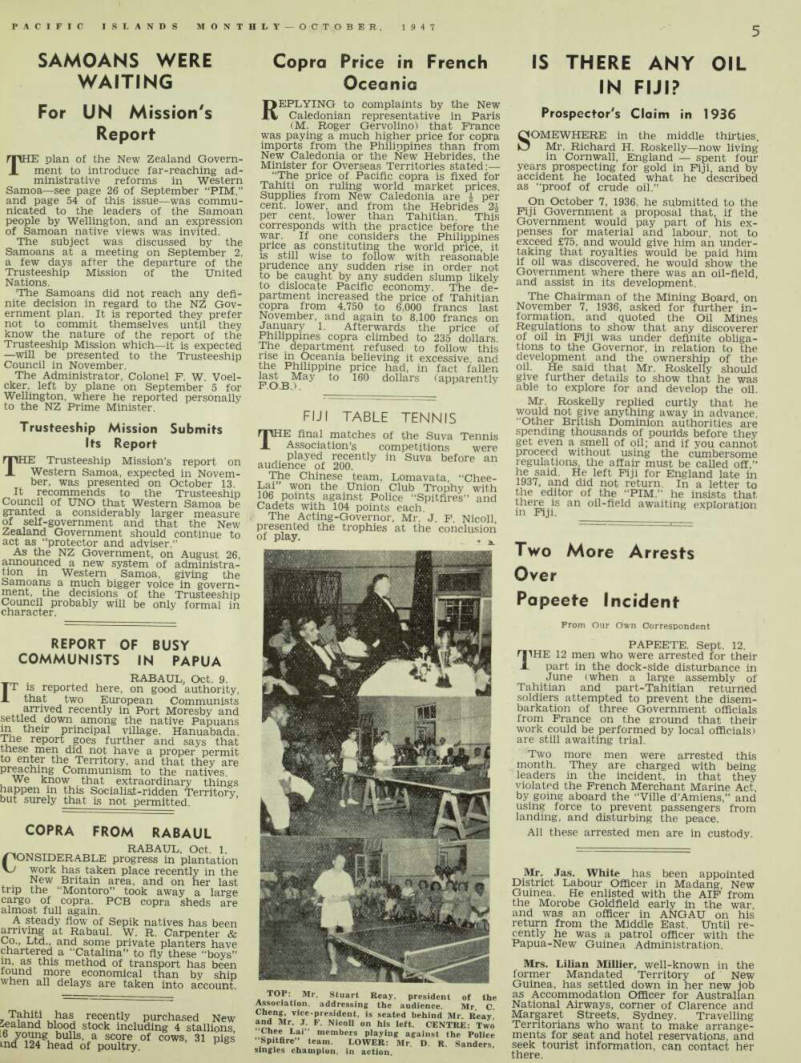
npHE final matches of the Suva Tennis A Association’s competitions were played recently in Suva before an audience of 200.
The Chinese team, Lomavata, “Chee- Lai” won the Union Club Trophy with 106 points against Police “Spitfires” and Cadets with 104 points each.
The Acting-Governor, Mr. J. F Nicoll presented the trophies at the conclusion of play.
TOP: Mr. Stuart Beay, president of the Association, addressing the audience. Mr. C.
Cheng, vice-president, is seated behind Mr. Reay, and Mr. J. F. Nicoll on his left. CENTRE; Two "Chee Lai” members playing against the Police "Spitfire” team. LOWER: Mr. D R. Sanders singles champion, in action.
In Fiji?
Is There Any Oil
Prospector's Claim in 1936
SOMEWHERE in the middle thirties, Mr. Richard H. Roskelly—now living in Cornwall, England spent four years prospecting for gold in Fiji, and by accident he located what he described as “proof of crude oil.”
On October 7, 1936, he submitted to the Fiji Government a proposal that, if the Government would pay part of his ex penses for material and labour, not to exceed £75, and would give him an under taking that royalties would be paid him if oil was discovered, he would show the Government where there was an oil-field, and assist in its development.
The Chairman of the Mining Board, on November 7, 1936, asked for further in formation, and quoted the Oil Mines Regulations to show that any discoverer of oil in Fiji was under definite obliga tions to the Governor, in relation to the development and the ownership of the oil. He said that Mr. Roskelly should give further details to show that he was able to explore for and develop the oil.
Mr. Roskelly replied curtly that he would not give anything away in advance.
"Other British Dominion authorities are spending thousands of pounds before they get even a smell of oil; and if you cannot proceed without using the cumbersome regulations, the affair must be called off,” he said. He left Fiji for England late in 1937, and did not return. In a letter to the editor of the “PIM.” he insists that there is an oil-field awaiting exploration in Fiji.
Papeete Incident
Two More Arrests Over Papeete Incident
From Our Own Correspondent
Papeete. Sept. 12.
l2 men who were arrested for their part in the dock-side disturbance in June (when a large assembly of Tahitian and part-Tahitian returned soldiers attempted to prevent the disem barkation of three Government officials from France on the ground that their work could be performed by local officials) are still awaiting trial.
Two more men were arrested this month. They are charged with being leaders in the incident, in that they violated the French Merchant Marine Act, by going aboard the “Ville d’Amiens,” and using force to prevent passengers from landing, and disturbing the peace.
All these arrested men are in custody.
Mr. Jas. White has been appointed District Labour Officer in Madang, New Guinea. He enlisted with the AIF from the Morobe Goldfield early in the war, and was an officer in ANGAU on his return from the Middle East. Until re cently he was a patrol officer with the Papua-New Guinea Administration.
Mrs. Lilian Millier, well-known in the former Mandated Territory of New Guinea, has settled down in her new job as Accommodation Officer for Australian National Airways, corner of Clarence and Margaret Streets, Sydney. Travelling Territorians who want to make arrange ments for seat and hotel reservations, and seek tourist information, can contact her there.
Dislocation of Public
Paralysis In Rabaul
Dislocation of Public Works
Rabaul, Oct. 4.
mHE way in which the “Merkur” was X delayed recently—the local natives would not work on Saturday or Sun day—is typical of the paralysis that has fallen upon everything in recent weeks.
Administration activities on roads, hous ing, electric-light, telephone line con struction and road maintenance, all seem to have come to a dead end.
The construction of the telephone line to Kokopo, which at first made remark able speed, has petered out at various points. Jungle growth is prolific in New Guinea —like time and tide it waits for no man—and it looks as if someone will, when the present paralysis passes, have to institute a search party to find the bits and pieces of the telephone line.
Telephone posts, complete with count less insulators were, some time ago, laid along the Kokopo-Rabaul roadway, in preparation for erection. Now, most of the insulators have disappeared, either through the careless driving of irre sponsible motorists, who have run over them, or the natives have added their quota of destruction.
The Commonwealth Works and Hous ing Commission appear to have recently superseded the Territory’s Public Works Department. The Commission staff have been sitting down at Kokopo for the past 12 months, in anticipation of great Ad ministrative activity around Kokopo. Re cently, however, there seems to have been some alteration in the scheme, because the Public Works Department—which was recently doing a fine job of work —has become entangled with the Works and Housing Commission; and, between the two of them, all progress seems to have ceased.
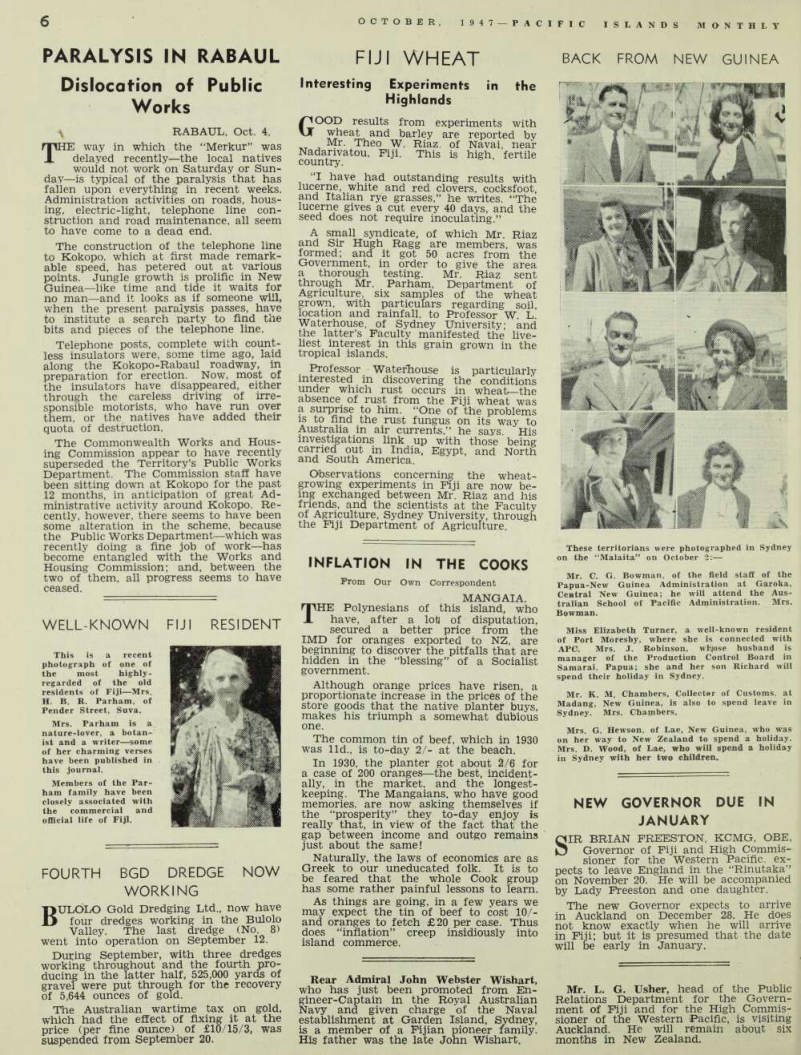
Well-Known Fiji Resident
This is a recent photograph of one of the most highly regarded of the old residents of Fiji—Mrs.
H. B. R. Parham, of Pender Street, Suva.
Mrs. Parham is a nature-lover, a botan ist and a writer —some of her charming verses have been published in this journal.
Members of the Par ham family have been closely associated with the commercial and official life of Fiji.
Fourth Bgd Dredge Now
Working
BULOLO Gold Dredging Ltd., now have four dredges working in the Bulolo Valley. The last dredge (No. 8) went into operation on September 12.
During September, with three dredges working throughout and the fourth pro ducing in the latter half, 525,000 yards of gravel were put through for the recovery of 5,644 ounces of gold.
The Australian wartime tax on gold, which had the effect of fixing it at the price (per fine ounce) of £lO/15/3, was
suspended from September 20.
Fiji Wheat
Interesting Experiments in the Highlands
GOOD results from experiments with wheat and barley are reported by . Mr. Theo W. Riaz of Navai, near Nadanvatou, Fiji. This is high fertile country.
“I have had outstanding results with lucerne, white and red clovers, cocksfoot, and Italian rye grasses,” he writes. “The lucerne gives a cut every 40 days, and the seed does not require inoculating.”
A small syndicate, of which Mr. Riaz and Sir Hugh Ragg are members, was formed; and it got 50 acres from the Government, in order to give the area a thorough testing. Mr. Riaz sent through Mr. Parham, Department of Agriculture, six samples of the wheat grown, with particulars regarding soil, location and rainfall, to Professor W. L.
Waterhouse, of Sydney University; and the latter’s Faculty manifested the live liest interest in this grain grown in the tropical islands.
Professor Waterhouse is particularly interested in discovering the conditions under which rust occurs in wheat—the absence of rust from the Fiji wheat was a surprise to him. “One of the problems is to find the rust fungus on its way to Australia in air currents.” he says. His investigations link up with those being earned out in India, Egypt, and North and South America.
Observations concerning the wheat growing experiments in Fiji are now be ing exchanged between Mr. Riaz and his friends, and the scientists at the Faculty of Agriculture, Sydney University, through the Fiji Department of Agriculture.
Inflation In The Cooks
Prom Our Own Correspondent
Mangaia.
THE Polynesians of this island, who have, after a loti of disputation, secured a better price from the IMD for oranges exported to NZ, are beginning to discover the pitfalls that are hidden in the “blessing” of a Socialist government.
Although orange prices have risen, a proportionate increase in the prices of the store goods that the native planter buys, makes his triumph a somewhat dubious one.
The common tin of beef, which in 1930 was lid., is to-day 2/- at the beach.
In 1930, the planter got about 2/6 for a case of 200 oranges—the best, incident ally, in the market, and the longest keeping. The Mangaians, who have good memories, are now asking themselves if the “prosperity” they to-day enjoy is really that, in view of the fact that the gap between income and outgo remains just about the same!
Naturally, the laws of economics are as Greek to our uneducated folk. It is to be feared that the whole Cook group has some rather painful lessons to learn.
As things are going, in a few years we may expect the tin of beef to cost 10/and oranges to fetch £2O per case. Thus does “inflation” creep insidiously into island commerce.
Rear Admiral John Webster Wishart, who has just been promoted from Eh gineer-Captain in the Royal Australian Navy and given charge of the Naval establishment at Garden Island, Sydney, is a member of a Fijian pioneer family.
His father was the late John Wishart.
Back From New Guinea
These territorians were photographed in Sydney on the “Malaita” on October 2: — Mr. C. G. Bowman, of the field staff of the Papua-New Guinea Administration at Garoka, Central New Guinea; he will attend the Aus tralian School of Pacific Administration. Mrs.
Bowman.
Miss Elizabeth Turner, a well-known resident of Port Moresby, where she is connected with A PC. Mrs. J. Robinson, whose husband is manager of the Production Control Board in Samarai, Papua; she and her son Richard will spend their holiday in Sydney.
Mr. K. M. Chambers, Collector of Customs, at Madang, New Guinea, is also to spend leave in Sydney. Mrs. Chambers.
Mrs. G. Hewson, of Lae, New Guinea, who was on her way to New Zealand to spend a holiday.
Mrs. D. Wood, of Lae, who will spend a holiday in Sydney with her two children.
New Governor Due In
January
Sir Brian Freeston, Kcmg, Qbe,
Governor of Fiji and High Commis sioner for the Western Pacific, ex pects to leave England in the “Rinutaka” on November 20. He will be accompanied by Lady Freeston and one daughter.
The new Governor expects to arrive in Auckland on December 20. He does not know exactly when he will arrive in Fiji; but it is presumed that the date will be early in January, Mr. L. G. Usher, head of the Public Relations Department for the Govern ment of Fiji and for the High Commis sioner of the Western Pacific, is visiting Auckland. He will remain about six months in New Zealand.
£4 Per Ton
Grudging Allowance To NG Copra Planters
WHEN it became known, at the end of July, that the Australian con sumers of copra were being charged by the Australian New Guinea Produc tion Control Board at the rate of £5l/5/0 per ton for first-grade (£5O/5 0 for smoked), an advance of approximately £3 per ton, Territories planters were jubi lant—they assumed, naturally, that they would get most of the benefit.
It was announced, in September, two months after the rise, that they were to get another £4 per ton!
Until the wholesale nrice was raised in July, the following was the position of copra produced in New Guinea and Papua:— Per Ton Allowed by Production Control Board (the Australian Gov ernment in another form) to planters, at ship’s slings or to Board’s store .. £3l 2 0 Sold by Board to manufac turers in Australia, about £42 0 0 Which meant that, after pay ing freight and handling charges, the Board was making a profit of say ... £7OO Sipes the July-September re-arrange ment, the position is as follows, as near as can be ascertained:— Per Ton Allowed by Board to planters £35 2 0 Sold by Board to Manufac turers in Australia, first grade £5l 5 0 Showing a net profit to Board of about £l2 0 0 We have assumed that it does not cost more than £4 per ton to carry and sell the copra in Australia. But even if it costs £6 per ton to carry and distribute, the Board is still hanging on to a profit that is not justified by circumstances— that amounts, in plain language, to bare faced robbery of the Territories planters.
The Australian Government is taking, in profit, out of a system of trading that it has forced upon planters, a larger amount per ton than the world market w r as paying altogether for copra in the years just prior to World War 11.
MR. WARD, and gentlemen of his poli tical kidney, probably will say that the Production Control Board is only grabbing a profit that, in the Bad Old Days, would have been taken by the Big Firms. That may have been so.
But, under the old system, the Big Firms did turn back a portion of their profits into the Territories for the bene fit of the Territories. We at least got efficient shipping services and reasonably cheap goods.
As shown elsewhere in this issue, the Australian Government is nouring two millions per annum of Australian public funds into the Territories—but not for the benefit of the non-official white resi dents.
The Territories planters are not being given a fair chance to build up reserves out of these rich copra rates; and when the crash comes—as come it surely will under these Socialistic muddlers—private enterprise will be left with insufficient protection It will be small consolation to Mr. John Planter, struggling to carry on the nlantation that represents his life work, to know that Fuzzy-Wuzzy is living in a more or less model house, learning to become a tea-planter, and sending his tmxqm daughters to a Government dress absurd’ scho °l—° r something equally REPLY-See Late News,
No Freehold On Lord
Howe Island
SPEAKING in the NSW State Assembly at the beginning of the month, Mr.
Sheehan, Minister for Lands, said that he had refused requests for the purchase of freehold property on Lord Howe Island (a NSW dependency, off the Australian coast.) Such sales, he said, would never be permitted. Land on the island was Crown property; and there always was a possibility of the island be ing seized, some time, for use as an enemy base for operations against Aus tralia’s chief port.
Sympathetic consideration would be given, he stated, to the Lord Howe Islanders’ plea for a review of the “per missive occupancy” tenure under which land on the island is now held.
French Air Service In
Pacific
rE local New Caledonian air compay, Trapas, announces the price of air passages to the New Hebrides. Single fares from Noumea to Vila are 2 000 francs and to Santo 3,000 francs. Return tickets carry a reduction of 5 per cent, and are available for three months The governor of New Caledonia, Mon sieur Parisot, recently flew to the Wallis Group by Trapas plane. This was the first time that Noumea and Wallis have been linked by a commercial service Wallis, of course, although inhabited by Polynesians, is a French governed terri tory administered, not as part of French Oceania, but by the New Caledonian ad ministration. The natives there recently showed hostility to the French Resident— a matter which no doubt the Governor had in mind in flying there. % Finschhafen, New Guinea, welcomed recently Mrs. J. R. Palmer, attractive bnae of Mr. “Ambrose” Palmer, popular member of the Government Stores staff.
Advertisements & other items, p. 11 (1 item)
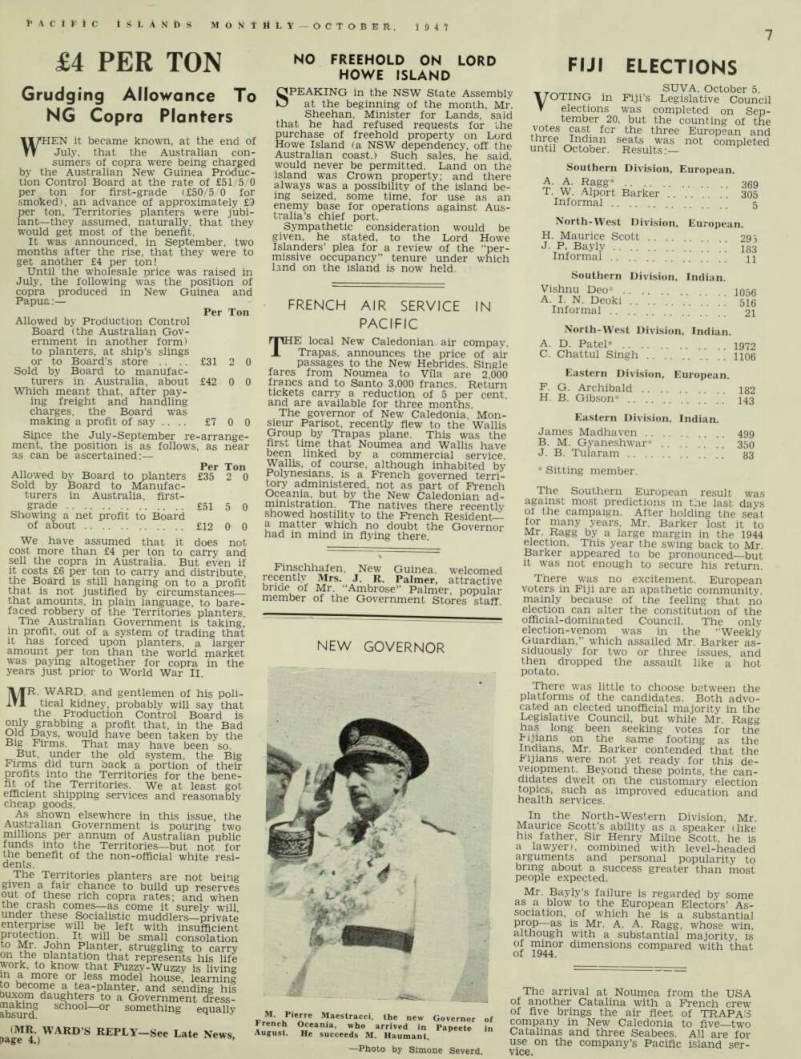
New Governor
M. Pierre Maestracci, the new Governor of trench Oceania, who arrived in Papeete in August. He succeeds M. Haumant. —Photo by Simone Severd.
Fiji Elections
V SUVA, October 5.
OTING in Fiji’s Legislative Council elections was completed on Sep tember 20, but the counting of the votes cast fcr the three European and thl l^ e seats was not completed until October. Results:— Southern Division, European.
A. A. Ragg* 369 T. W. Alport Barker 305 Informal 5 North-West Division. European.
H. Maurice Scott ... 293 J.P. Bayly ” 183 Informal n Southern Division, Indian.
Vishnu Deo* 1056 A. I. N. Deoki ’ ’ ‘' 516 Informal 21 North-West Division, Indian.
A. D. Patel* 1972 C. Chattul Singh !! 1106 Eastern Division, European.
F. G. Archibald 132 H. B. Gibson* 143 Eastern Division, Indian.
James Madhaven 499 B. M. Gyaneshwar* .. 350 J. B. Tularam 33 * Sitting member.
The Southern European result was against most predictions in the last days ol the campaign. After holding the seat for many years, Mr. Barker lost it to Mr. Ragg by a large margin in the 1944 election. This year the swing back to Mr.
Barker appeared to be pronounced—but it was not enough to secure his return.
There was no excitement. European voters in Fiji are an apathetic community, mainly because of the feeling that no election can alter the constitution of the official-dominated Council. The only election-venom was in the “Weekly Guardian,’’ which assailed Mr. Barker as siduously for two or three issues, and then dropped the assault like a hot potato.
There was little to choose between the platforms of the candidates. Both advo cated an elected unofficial majority in the Legislative Council, but while Mr. Ragg has long been seeking votes for the Pijians on the same footing as the Indians, Mr. Barker contended that the Fijians were not yet ready for this de velopment. Beyond these points, the can didates dwelt on the customary election topics, such as improved education and health services.
In the North-Western Division, Mr Maurice Scott’s ability as a speaker dike his father, Sir Henry Milne Scott, he is a lawyer), combined with level-headed arguments and personal popularity to bring about a success greater than most people expected.
Mr. Bayly’s failure is regarded by some as a blow to the European Electors’ As sociation, of which he is a substantial Prop is Mr. A. A. Ragg, whose win, although w T ith a substantial majority, is of minor dimensions compared with that of 1944.
The arrival at Noumea from the USA of another Catalina with a French crew of five brings the air fleet of TRAPAS company in New Caledonia to five—two Catalmas and three Seabees. All are for use on the company’s Pacific island ser-
Advertisements & other items, p. 11 (1 item)
7
I* aci P t c Islands MONtiILV 6ctober, 1&47
N. Hebrides Land
Does Australia Own Large Areas?
BACK before the turn of the century, before the New Hebrides Condomi nium functioned, there was operat ing in the New Hebrides a company called the Australasian New Hebrides Co. It acquired very extensive land and trading rights throughout the Group.
Somewhere about 1900 it got into diffi culties and was taken over by Bums Philp & Co., Ltd. It was carried on for some time by BP and then it was washed up. Its assets included titles to tens of thousands of acres of virgin land, much of it water-front, in most of the Islands of the group. Its titles were not very good, perhaps—but they were quite as good as any other titles then extant.
Sir James Burns was an ardent patriot and was eager to see British people settled in that Group. He therefore pre sented to the new Commonwealth of Australia all the Company’s rights and titles in that New Hebrides land. The Australian Government accepted the gift and is believed to be still the nominal owner of those large areas.
For many years—right up until the late 30’s —the Australian Government subsidised an Australian solicitor, who lived in Port Vila and prosecuted the Australian Government’s blaim to legal title before the Condominium Court set up to deal with claims to land titles, and which has been functioning in that res pect ever since the establishment of the Condominium.
On the assumption that the future of the New Hebrides Condominium is un certain, and in view of the present Aus tralian Government’s eager interest in Pacific affairs, it would be interesting to know the position of those Australian Government land interests in the New Hebrides.
Costellos Mines Ltd., No. 9 lease, at Vatukouia, Fiji, known as Aloha Central, has been acquired by the Emperor Mines Ltd., whose lands virtually sur round it. Ore obtained by open-cut mining, is being delivered to Emperor treatment works. The consideration was 14,000 shares in Emperor, paid to 6/-.
N. Caledonia's Casino
rE construction of a Casino at Anse Vata Beach, Noumea, is linked with the construction of a modern hotel of 150 bedrooms with bathrooms attached, for which plans are already prepared.
Foreign as well as French capital is interested in the scheme, which should give a great impetus to the tourist traffic.
The Casino will be in the same grounds as the hotel, and besides gambling rooms will include a dance hall and a theatre.
There will be tennis courts and golf links.
The site is that of the former US Army camp with is great central Pentagon Building. The building area is three hectares (about 71 acres) adjoining a magnificent stretch of sandy beach, look ing out across picturesque coral islets to wards the Amedee lighthouse and reef about nine miles away. Being linside the great barrier reef, the beach does not provide surfing facilities.
To carry out the plans, the Societe Touristique et Hoteliere is increasing its capital from two to ten million francs, by the sale of shares valued at 10 000 francs each to Caledonian subscribers.
It will be recalled that, just before the war with Japan, a hotel representa tive of Pan American Airways spent some time in New Caledonia investigating pos sibilities of a large hotel at Anse Vata, and he is understood to have reported favourably on the project. There was also some talk of making a seaplane base at I’Orphelinat Bay nearby, on the main land, instead of at He Nou.
The growing use of landplanes has turned attention to the possibility of an airfield at Magenta, just back of Noumea, enlarged to take the largest planes. At present, Pan American planes are using Tontouta airfield, over 30 miles away, and passengers travelling to or from Aus tralia usually see Noumea from the air only.
Miss Pat McCarthy, daughter of Judge McCarthy of the Cook Islands High Court, created great interest at Oriental Bay.
Wellington, recently when she launched her native canoe. The canoe, which is a 21-ft. outrigger, came from Pukapuka and was sent by her father. It was as sembled at Oriental Bay by Cook Is landers then in Wellington.
Commemoration Day At
Bitapaka
From a Special Correspondent
Rabaul, Sep. 20.
IN memory of those who fell in the landing at Bitapaka in September, 1914, a ceremony was held at the Memorial Stone on September 15.
A gathering of approximately 40 mem bers of the Rabaul and Kokopo Sub-
Branches of the RSS & AIL A, and their friends paid their respect by, “Standing in Silence” and placing wreaths on the Memorial Stone.
Wreaths were laid by Mr. A. J. Gaskin on behalf of the Rabaul Sub-Branch RSS & AIL A; Mr. W. Dishon on behalf of the Administration; and by Capt. J, Duncan on behalf of the Rabaul Masonic Lodge.
Several other private wreaths were laid.
Much credit is due to the Administra tion Officials, Messrs. Dishon and Dix for the orderly appearance of the Mem orial Stone and the surroundings, and to Mesdames Dix and Searl for the beauti ful wreaths seen at the ceremony.
The young Misses Thomas and Pennefather, daughters of New Guinea residents of long standing, placing wreaths on the Memorial Stone.
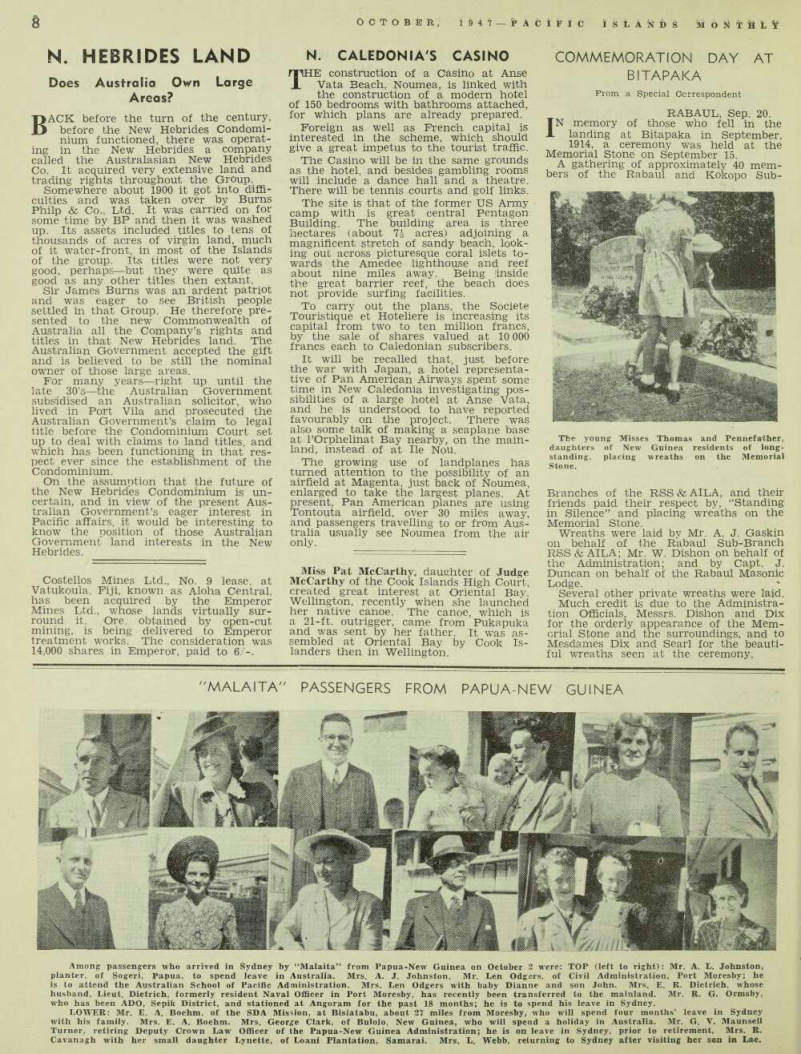
"Malaita" Passengers From Papua-New Guinea
Among passengers who arrived in Sydney by “Malaita” from Papua-New Guinea on October 2 were: TOP (left to right): Mr. A. L. Johnston, planter, of Sogeri, Papua, to spend leave in Australia. Mrs. A. J. Johnston. Mr. Len Odgers, of Civil Administration, Port Moresby; he is to attend the Australian School of Pacific Administration. Mrs. Len Odgers with baby Dianne and son John. Mrs, E. R. Dietrich, whose husband, Lieut. Dietrich, formerly resident Naval Officer in Port Moresby, has recently been transferred to the mainland. Mr. R. G. Ormsby, who has been ADO, Sepik District, and stationed at Angoram for the past 18 months; he is to spend his leave in Sydney.
LOWER: Mr. E. A. Boehm, of the SDA Mission, at Bisiatabu, about 27 miles from Moresby, who will spend four months’ leave in Sydney with his family. Mrs. E. A. Boehm. Mrs. George Clark, of Bulolo, New Guinea, who will spend a holiday in Australia. Mr. G. V. Maunsell Turner, retiring Deputy Crown Law Officer of the Papua-New Guinea Administration; he is on leave in Sydney, prior to retirement. Mrs. R.
Cavanagh with her small daughter Lynette, of Loani Plantation, Samarai. Mrs, L. Webb, returning to Sydney after visiting her son in Lae.
Advertisements & other items, p. 12 (1 item)
8
OCTOBER, 1947 PACIFIC ISLANDS MONT S L ¥
Parent Carpenter
CO.
Non-Australian Interests Transferred
ONE effect of the Australian Socialist Government’s ceaseless attack upon private enterprise is seen in the way in which public companies, with facilities for doing so, are shifting their operations out of Australia. W. R. Carpenter & Co.
Ltd., is a good example of this.
Formerly, that was the main trading company of the group. Now it is little more than a holding company. All non- Australian activities have been trans ferred to non-Australian companies— there are separate Carnenter companies now operating in New Guinea, Fiji, Gil bert and Ellice Colony, and Canada.
The narent Company, in the year ended June 30, made £71,043. which is £3,317 better than 1946. The balance-sheet shows that investments in subsidiaries, which totalled £490,859 in 1946, are now £905,271. The subscribed capital of the parent Company is £775,000, and reserves, used in the business, total £320,000. It remains one of the favourite companies of the investing public and its shares are quoted at a high premium.
Figures for New Caledonian mineral production for the six months to July 31, show a severe decline in nickel matte production at Noumea smelters. Only 670 tons of matte were produced, com pared with 1,774 tons for the same period in 1946, and a pre-war average of well over that figure. Ore production, how ever, at 82.944 tons (made up of 56,4:0 tons of nickel ore, 23,159 of chrome and 2.705 of gypsum for smelting purposes) showed an increase from 67,108 tons in the 1946 period.
Popular Official Leaves
Tonga
This is Mr. J. K. Brownlees, who left Tonga in August, after six years in the Kingdom as Secretary to the Tongan Government. Previously he served in BSI and has now been transferred to a post in Nigeria. After taking his Arts degree at Oxford, Mr. Brownlees studied law and is a Barrister-at-Law of the Inner Temple.
London. Later he joined the Colonial Service, which brought him to the South Pacific. Tonga will miss this popular and courteous official. He carries with him the best wishes of all sections of the community. —Photo by Hettig.
Death of Paramount
Ariki Mrs. Love of Rarotonga and New Zealand
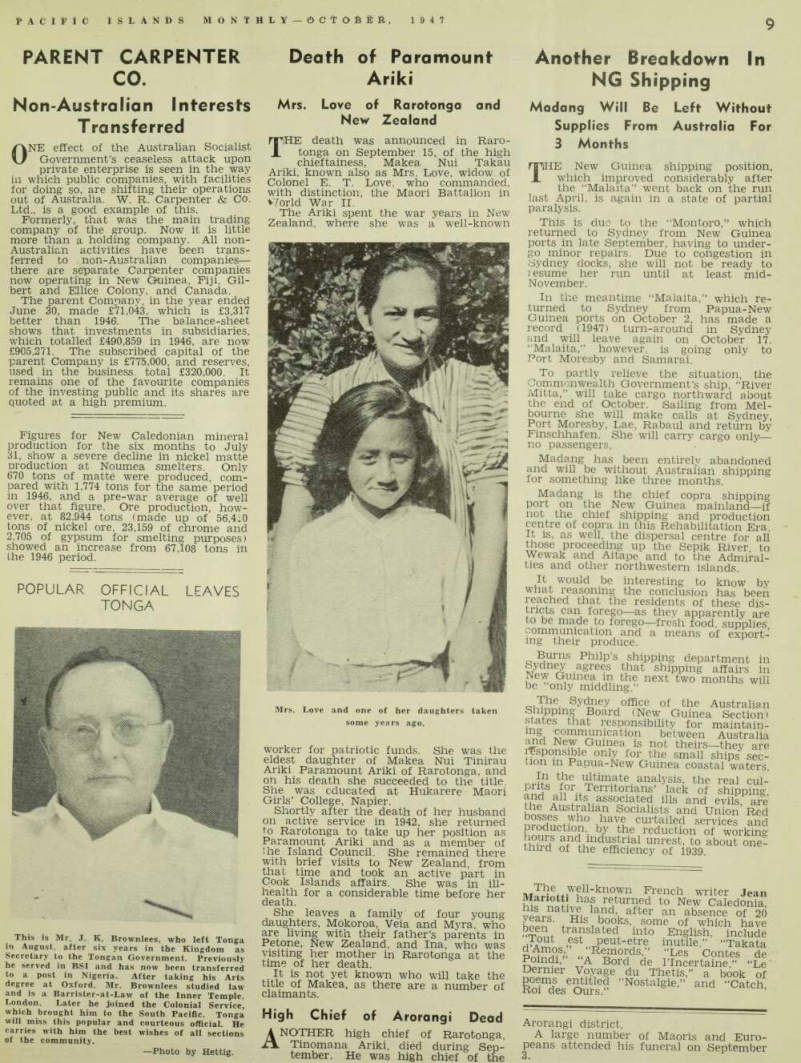
THE death was announced in Raro tonga on September 15, of the high chieftainess, Makea Nui Takau Ariki, known also as Mrs. Love, widow of Colonel E. T. Love, who commanded, with distinction, the Maori Battalion in World War 11.
The Ariki spent the war years in New Zealand, where she was a well-known
worker for patriotic funds. She was the eldest daughter of Makea Nui Tinirau Ariki Paramount Ariki of Rarotonga, and on his death she succeeded to the title.
She was educated at Hukarere Maori Girls’ College, Napier.
Shortly after the death of her husband on active service in 1942, she returned to Rarotonga to take up her position as Paramount Ariki and as a member of the Island Council. She remained there with brief visits to New Zealand, from that time and took an active part in Cook Islands affairs. She was in ill health for a considerable time before her death.
She leaves a family of four young daughters, Mokoroa, Veia and Myra, who are living with their father’s parents in Petone, New Zealand, and Ina, who was visiting her mother in Rarotonga at the time of her death.
It is not yet known who will take the title of Makea, as there are a number of claimants.
High Chief of Arorangi Dead
ANOTHER high chief of Rarotonga, Tinomana Ariki, died during Sep tember. He was high chief of the
Arorangi district.
A large number of Maoris and Euro peans attended his funeral on September 3.
Mrs. Love and one of her daughters taken some years ago.
NG Shipping
Another Breakdown In
Madang Will Be Left Without Supplies From Australia For 3 Months
THE New Guinea shipping position, which improved considerably after the “Malaita” went back on the run last April, is again in a state of partial paralysis.
This is due to the “Montoro,” which returned to Sydney from New Guinea ports in late September, having to under go minor repairs. Due to congestion in Sydney docks, she will not be ready to ] esume her run until at least mid- November.
In the meantime “Malaita,” which re turned to Sydney from Papua-New Guinea ports on October 2, has made a record (1947) turn-around in Sydney and will leave again on October 17.
“Malaita,” however, is going only to Port Moresby and Samarai.
To partly relieve the situation, the Commonwealth Government’s ship, “River Mitta,” will take cargo northward about the end of October. Sailing from Mel bourne she will make calls at Sydney, Port Moresby, Lae, Rabaul and return by Finschhafen. She will carrv cargo only— no passengers.
Madang has been entirely abandoned and will be without Australian shipping for something like three months.
Madang is the chief copra shipping port on the New Guinea ’mainland—if not the chief shipping and production centre of copra in this Rehabilitation Era It is, as well, the dispersal centre for all those proceeding up the Sepik River to Wewak and Aitape and to the Admiral ties and other northwestern islands.
It would be interesting to know by what reasoning the conclusion has been reached that the residents of these dis tricts can forego—as they apparently are to be made to forego—fresh food, supplies communication and a means of export ing their produce.
Philp’s shipping department in Sydney agrees that shipping affairs in New Guinea m the next two months will be “only middling.”
The Sydney office of the Australian Shippmg Board (New Guinea Section) states that responsibility for maintain communication between Australia amd New Guinea is not theirs—they are responsible only for the small ships sec tion in Papua-New Guinea coastal waters. _j£ t f he ul tim .ate analysis, the real cul pnts for Terntonans’ lack of shipping a £ d 1111I 111 , lts . associated ills and evils, are hnL^ Ust l alia i n Social ists and Union Red bosses who have curtailed services and h I J he , reduction of working thirl? jJ?4r3 ndu JL tr . lal unrest > to about one third of the efficiency of 1939.
French writer Jean Manctti has returned to New Caledonia vpnr? atl Tj- la i? d ’, after an absence of 20 years, His books, some of which have “Trvnt tra ? slated into English, include M St « P eut -etre inutile,” “Takata Les Contes de Pomdi, A Bord de I’lncertaine,” “Le ’
Dernier Voyage du Thetis,” a book of Ro^dVours 6 ” ‘‘ N ° Stalgie ’’’ a nd “Catch,
Advertisements & other items, pp. 13-14 (3 items)
9
PACIFIC ISLANDS MONTHLV OCtOfifift, 1947
10
bCTOBER, 194?- PACIFIC ISLANDS MONThL'V
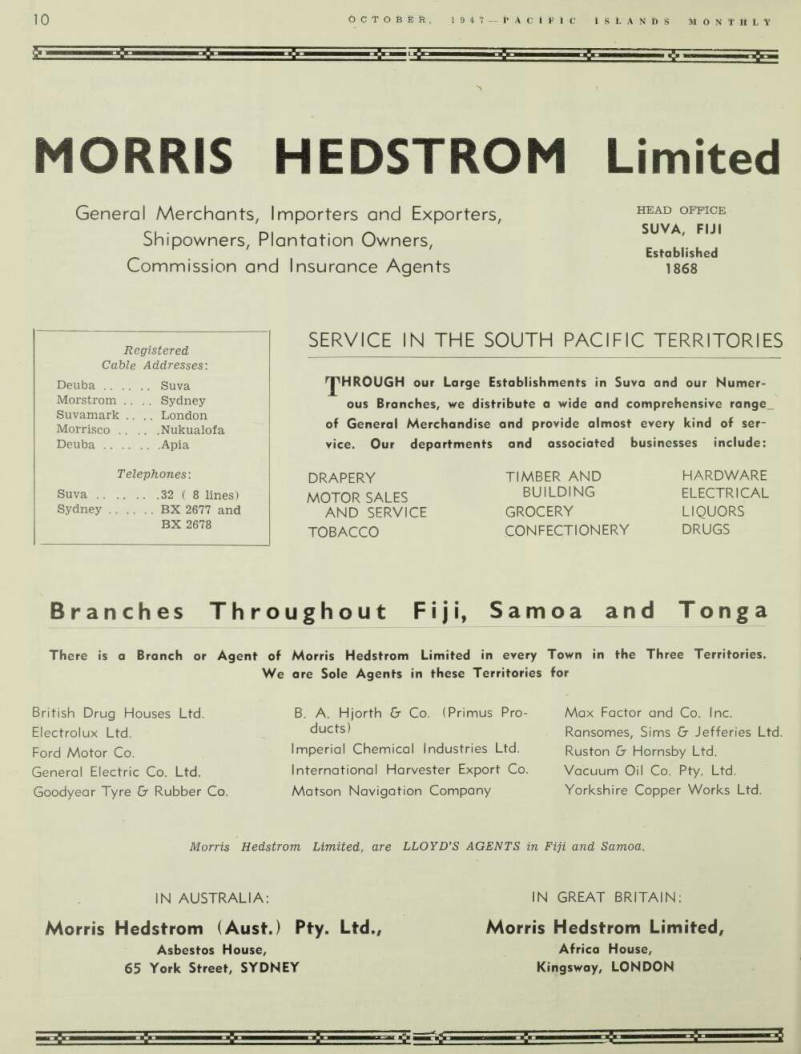
Morris Hedstrom Limited
General Merchants, Importers and Exporters,
Shipowners, Plantation Owners,
Commission and Insurance Agents
HEAD OFFICE
SUVA, FIJI
Established 1868
SERVICE IN THE SOUTH PACIFIC TERRITORIES
r J I HROUGH our Large Establishments in Suva and our Numerous Branches, we distribute a wide and comprehensive range of General Merchandise and provide almost every kind of service. Our departments and associated businesses include:
DRAPERY
MOTOR SALES
AND SERVICE
TOBACCO
TIMBER AND
BUILDING
GROCERY
CONFECTIONERY
HARDWARE
ELECTRICAL
LIQUORS
DRUGS
Branches
Throughout Fiji, Samoa and
Tonga
Agent of Morris Hedstrom Limited in every Town in the Three Territories.
We are Sole Agents in these Territories for There is a Branch or British Drug Houses Ltd.
Electrolux Ltd.
Ford Motor Co.
General Electric Co. Ltd.
Goodyear Tyre Gr Rubber Co.
B. A. Hjorth Gr Co. (Primus Products) Imperial Chemical Industries Ltd.
International Harvester Export Co.
Matson Navigation Company Max Factor and Co. Inc.
Ransomes, Sims Gr Jefferies Ltd.
Ruston Gr Hornsby Ltd.
Vacuum Oil Co. Pty. Ltd.
Yorkshire Copper Works Ltd.
Morris Hedstrom Limited, are LLOYD'S AGENTS in Fiji and Samoa.
IN AUSTRALIA:
Morris Hedstrom (Aust.) Pty. Ltd.,
Asbestos House, 65 York Street, SYDNEY
IN GREAT BRITAIN:
Morris Hedstrom Limited,
Africa House, Kingsway, LONDON
New Guinea Birds For Sydney Zoo
A NUMBER of rare birds-of-paradise from the Mt. Hagen district of New Guinea, four species of which have never before been out of the Mandated Territory alive, arrived in Sydney on the "Malaita” early in October. They are portion of a consignment of birds and animals collected by Mr. John Hallstrom, Jr. They will be featured in the New Guinea section of the Taronga Zoological Park and Aquarium.
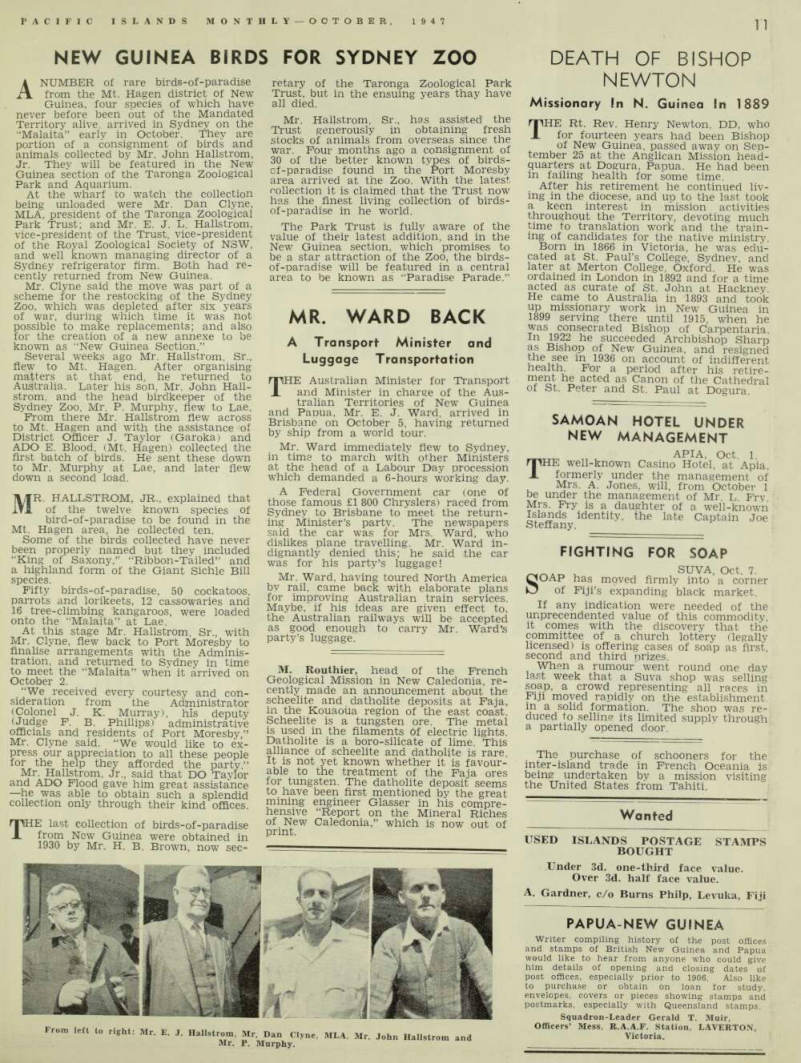
At the wharf to watch the collection being unloaded were Mr. Dan Clyne, MLA, president of the Taronga Zoological Park Trust; and Mr. E. J. L. Hallstrom, vice-president of the Trust, vice-president of the Royal Zoological Society of NSW, and well known managing director of a Sydney refrigerator firm. Both had re cently returned from New Guinea.
Mr. Clyne said the move was part of a scheme for the restocking of the Sydney Zoo, which was depleted after six years of war, during which time it was not possible to make replacements; and also for the creation of a new annexe to be known as “New Guinea Section.”
Several weeks ago Mr. Hallstrom, Sr., flew to Mt. Hagen. After organising matters at that end, he returned to Australia. Later his son, Mr. John Hall strom, and the head birdkeeper of the Sydney Zoo, Mr. P. Murphy, flew to Lae.
From there Mr. Hallstrom flew across to Mt. Hagen and with the assistance of District Officer J. Taylor (Garoka) and ADO E. Blood, (Mt. Hagen) collected the first batch of birds. He sent these down to Mr. Murphy at Lae, and later flew down a second load.
MR. HALLSTROM, JR., explained that of the twelve known species of bird-of-paradise to be found in the Mt. Hagen area, he collected ten.
Some of the birds collected have never been properly named but they included “King of Saxony,” “Ribbon-Tailed” and a highland form of the Giant Sichle Bill species.
Fifty birds-of-paradise, 50 cockatoos, parrots and lorikeets, 12 cassowaries and 16 tree-climbing kangaroos, were loaded onto the “Malaita” at Lae.
At this stage Mr. Hallstrom, Sr., with Mr. Clyne, flew back to Port Moresbv to finalise arrangements with the Adminis tration, and returned to Sydney in time to meet the “Malaita” when it arrived on October 2.
“We received every courtesy and con sideration from the Administrator (Colonel J. K. Murray), his deputy (Judge F. B. Phillips) administrative officials and residents of Port Moresby”
Mr. Clyne said. “We would like to ex press our appreciation to all these people for the help they afforded the party ”
Mr. Hallstrom, Jr., said that DO Taylor and ADO Flood gave him great assistance —he was able to obtain such a splendid collection only through their kind offices.
THE last collection of birds-of-paradise from New Guinea were obtained in 1930 by Mr. H. B. Brown, now sec-
retary of the Taronga Zoological Park Trust, but in the ensuing years thay have all died.
Mr. Hallstrom, Sr., has assisted the Trust generously in obtaining fresh stocks of animals from overseas since the war. Four months ago a consignment of 30 of the better known types of birds of-paradise found in the Port Moresby area arrived at the Zoo. With the latest reflection it is claimed that the Trust now has the finest living collection of birds of-paradise in he world.
The Park Trust is fully aware of the value of their latest addition, and in the New Guinea section, which promises to be a star attraction of the Zoo, the birds of-paradise will be featured in a central area to be known as “Paradise Parade.”
From left to ri ght: Mr. E. J. Hallstrom, Mr. Dan Clyne, MLA, Mr. John Hallstrom and Mr. P. Murphy.
Mr. Ward Back
A Transport Minister and Luggage Transportation
THE Australian Minister for Transport and Minister in charge of the Aus tralian Territories of New Guinea and Papua, Mr. E. J. Ward, arrived in Brisbane on October 5. having returned by ship from a world tour.
Mr. Ward immediately flew to Sydney, in time to march with other Ministers at the head of a Labour Day procession which demanded a 6-hours working day.
A Federal Government car (one of those famous £1 800 Chryslers) raced from Sydney to Brisbane to meet the return ing Minister’s party. The newspapers said the car was for Mrs. Ward, who dislikes plane travelling. Mr. Ward in dignantly denied this; he said the car was for his party’s luggage!
Mr. Ward, having toured North America by rail, came back with elaborate plans for improving Australian train services.
Maybe, if his ideas are given effect to, the Australian railways will be accepted as good enough to carry Mr. Ward’s party’s luggage.
M. Routhier, head of the French Geological Mission in New Caledonia, re cently made an announcement about the scheelite and datholite deposits at Faja, in the Kouaoiia region of the east coast.
Scheelite is a tungsten ore. The metal is used in the filaments Of electric lights.
Datholite is a boro-silicate of lime. This alliance of scheelite and datholite is rare.
It is not yet known whether it is favour able to the treatment of the Faja ores for tungsten. The datholite deposit seems to have been first mentioned by the great mining engineer Glasser in his compre hensive “Report on the Mineral Riches of New Caledonia,” which is now out of print.
Newton
Death Of Bishop
Missionary (n N. Guinea In 1889
THE Rt. Rev. Henry Newton, DD, who for fourteen years had been Bishop of New Guinea, passed away on Sep tember 25 at the Anglican Mission head quarters at Dogura, Papua. He had been in failing health for some time.
After his retirement he continued liv ing in the diocese, and un to the last took a keen interest in mission activities throughout the Territory, devoting much time to translation work and the train ing of candidates for the native ministry.
Born in 1866 in Victoria, he was edu cated at St. Paul’s College, Sydney, and later at Merton College. Oxford. He was ordained in London in 1892 and for a time acted as curate of St. John at Hackney.
He came to Australia in 1893 and took up missionary work in New Guinea in 1899 serving there until 1915, when he was consecrated Bishop of Carpentaria.
In 1922 he succeeded Archbishop Sharp as Bishop of New Guinea, and resigned the see in 1936 on account of indifferent health. For a period after his retire ment he acted as Canon of the Cathedral of St. Peter and St. Paul at Dogura.
Samoan Hotel Under
New Management
Apia, Oct. 1
THE well-known Casino Hotel, at Apia, formerly under the management of Mrs. A. Jones, will, from October 1 be under the management of Mr L Fry Mrs. Fry is a daughter of a well-known Isiands identity, the late Captain Joe Steffany.
Fighting For Soap
Suva, Oct. 7.
OAP has moved firmly into a corner of Fiji’s expanding black market.
If any indication were needed of the unprecendented value of this commodity, it comes with the discovery that the committee of a church lottery (legally licensed) is offering cases of soap as first, second and third prizes.
When a rumour went round one day last week that a Suva shop was selling soap, a crowd representing all races in Fiji moved rapidly on the establishment in a solid fprmation. The shoo was re duced to selling its limited supply through a partially opened door.
The purchase of schooners for the inter-island trade in French Oceania is being undertaken by a mission visiting the United States from Tahiti.
Advertisements & other items, p. 15 (1 item)
Wanted
USED ISLANDS POSTAGE STAMPS
BOUGHT
Under 3d. one-third face value.
Over 3d. half face value.
A. Gardner, c/o Burns Philp, Levuka, Fiji
PAPUA-NEW GUINEA
Writer compiling history of the post offices and stamps of British New Guinea and Papua would like to hear from anyone who could give him details of opening and closing dates of post offices, especially prior to 1906. Also like to purchase or obtain on loan for study, envelopes, covers or pieces showing stamps and postmarks, especially with Queensland stamps.
Squadron-Leader Gerald T. Muir, Officers’ Mess, R.A.A.F. Station, LAVERTON, Victoria.
Death Of Mr. Cyril King
WHEN Mr. Cyril King, of Levuka, died suddenly on September 21, there disappeared one of the best known and most popular men in Fiji, and the South Seas. He had lived all his long life in Levuka, and he had been the most prominent citizen of the old town and had taken part in all its communal acti vities. He was sometimes referred to as “the King of Levuka”; and the double meaning was justified.
He was Chairman of Levuka Town Board, Chairman of the Chamber of Commerce, President of the Ovalau Club, Chairman of the Sports Committee; and he held various other public positions.
For years, Cyril King and his father ran the well known old Fiji newspaper, the “Polynesian Gazette”; but when the population shifted away from the old
capital to Suva, the newspaper, like the town, slowly decayed. After his father died, Cyril and his brothers carried it on; but finally they sold it to the Indians.
The “Gazette” was discontinued, and the plant was taken to Lautoka, where it still prints an Indian newspaper.
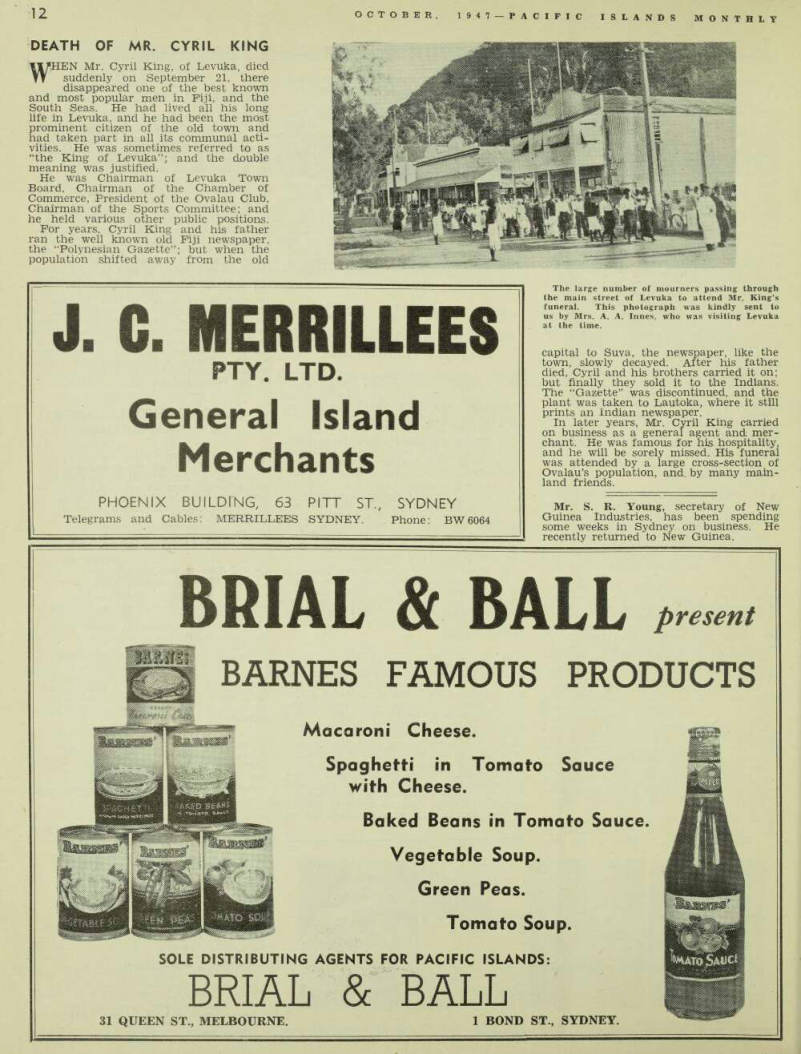
In later years, Mr. Cyril King carried on business as a general agent and mer chant. He was famous for his hospitality, and he will be sorely missed. His funeral was attended by a large cross-section of Ovalau's population, and by many main land friends.
Mr. S. R. Young, secretary of New Guinea Industries, has been spending some weeks in Sydney on business. He recently returned to New Guinea.
The large number of mourners passing through the main street of Levuka to attend Mr. King’s funeral. This photograph was kindly sent to us by Mrs. A. A. Innes, who was visiting Levuka at the time.
Advertisements & other items, p. 16 (1 item)
Brial & Ball
J. C. MERRILLEES
PTY. LTD.
General Island Merchants
PHOENIX BUILDING, 63 PITT ST., SYDNEY
Telegrams and Cables; MERRILLEES SYDNEY. Phone: 8W6064
BRIAL & BALL
present
m m ■
BARNES FAMOUS PRODUCTS
Macaroni Cheese.
Spaghetti in Tomato Sauce with Cheese.
Baked Beans in Tomato Sauce.
Vegetable Soup.
Green Peas.
Tomato Soup.
SOLE DISTRIBUTING AGENTS FOR PACIFIC ISLANDS:
BRIAL & BALL
31 QUEEN ST., MELBOURNE.
1 BOND ST., SYDNEY.
msmsm
Sharp Argument In
Fiji
Liquor For Indians: None For Fijians
From Our Own Correspondent
Suva, Oct. 6.
rE Liquor Bill, which, before it was deferred last vear, caused consider able commotion, will come before the November sitting of the Legislative Council of Fiji.
Its main feature is that it will remove all the present permit-restrictions at present imposed oh the consumption of liquor bv Indians. At the same time, it maintains the rigidly-enforced permit system for the Fijians.
In an address to the Legislative Coun cil, the former Governor. Sir Alexander Grantham, surprisinglv described this as part of the Government’s policy of re moving racial discrimination a state ment which stirred newspaper correspon dents to a kind of frenzv.
For the most part, a controversy, a year ago, was waged over the argument that, by removing racial discrimination as between Indian and European, the Government was unforgivably deepening discrimination between Fijian and Indian, as well as between Fijian and everyone else.
Referred To Chiefs
rE Bill was held up and referred to the Council of Chiefs as a matter affecting the Fijian race. The Council of Chiefs was quite happy about the Bill.
Opponents of the Bill, however, were not satisfied, maintaining that if all and sundry among the Indians were freed from restrictions, and if the Fijians— barring, of course, the chiefs and the very limited number of commoners who can obtain permits—are prohibited, the way will be cleared for a splendid boot legging racket in adulterated liquor for Fijians, organised and run by enterpris ing Indians from Suva and other centres.
There is little doubt that such a menace will develop; and if the organi sation to stop it is no more successful than the efforts to cope with the Indian black-marketeers who to-day are making a good thing out of rice, sharps and other Indian foodstuffs, the danger to the Fijians will be much greater, economi cally and otherwise, than open selling of liquor.
Missions Intervene
rEN the missions came on the scene and united in a petition to the Secretary of State for the Colonies —a move which was the immediate cause of the deferring of the Bill.
No official statement has been made on the fate of the missions’ protest, which was based mainly on objections to the big proposed extension of liquor-con sumplioh; but the fact that the Bill has been republished indicates that the pro test has failed in London.
If, as is probable, the Liauor Bill goes through, it will be a freely-quotaole ex ample of legislation enacted in the face of bitter opposition from an unusually comprehensive cross-section of Fiji’s mixed population.
The missions are against it; all the Indian leaders are against it on religious or economic grounds; a vocal section of the Europeans is against it for various reasons—that most frequently-voiced being the obvious Indian-Fijian distinc tion, expressed on such lines as: “If the Indian riff-raff in Suva is to be entrusted with the ‘privilege’ of getting drunk when it wants to, and if the Fijians are not capable of supporting a similar “privi
lege,’ why in heaven’s name were the Fijians entrusted with all the most modern lethal weapons during the war?”
Enforced Cleavage
FINALLY, the Fijians, outside the chiefly and near-chiefly ranks, are resentful, not only at the distinction drawn between themselves and the more disreputable types of Indian, but also at the perpetuation of an enforced cleavage between chief and commoner in an age when everyone is screaming about equality and non-discrimination.
On this subject, as on others, the pro nouncements of the Council of Chiefs are not received by a large section of the Fijian masses with the unquestioning faith of former days. Sooner or later— and it would be wiser to be sooner—some means will have to be found to give
the Fijians a more effective voice in the control of their own affairs.
The idea that the example of the In dian, who has achieved “equality” in most things by a combination of shrewd scheming and clamorous agitation, may have been noted by the alert among the Fijians does not seem to have occurred to the higher official circles.
The Liquor Bill, which suggests that the equality-demanding Indian section has got away with it again, is not likely to improve public relationships in Fiji.
Mr. J. S. McKenzie, chief accountant for Colyer, Watson, Ltd., proceeded on a business trip to Rabaul at the end of last month.
Advertisements & other items, pp. 17-18 (1 item)
Green Point-
Follow the .
Ships like the HMAS BROLGA pictured above, built at GREEN POINT, have proved themselves in the arduous duties of hydrographic survey.
GREEN POINT SHIPS
always give satisfaction.
GREEN POINT-
SHIPBUILDING & ENGINEERING Pty. Ltd.
Box 11, Concord, NSW. Australia Cable address: “GREENPOINTSHIPS” ’Phone: UF1321.
PRODUCING UNIFORM GOOD RESULTS SINCE 1868
ALWAYS ASK FOR IT
ORDER NOW from
McILRATH’S
YOUR CHRISTMAS GROCERIES—WINES—SPIRITS—
LIQUEURS—CIDER—CORDIALS
PURE FRUIT JUICES
APPLE-ORANGE-ORANGE and GRAPEFRUIT
(3/- value) 30 oz. cans I/* (per doz., 11/6) All shipments are insured against pillage, theft, non-delivery Write -for our New Grocery, Wine and Spirit Price List.
Post Free by Return Air-mail.
McILRATH’S PTY. LTD.
Export Department, 202 Pitt Street, Sydney, Australia Cable address: ROTUNDA, Sydney.
Stromberg - Carlson s«ie pacific A g e«s SAMOA: O. F. NELSON & CO. LTD., Apia, W. Samoa FIJI: PROGRESSIVE RADIO SERVICE, Rodwell Road, Suva NEW BRITAIN: H. T. ALLEN, BARRETT & READ, Casuarina Ave., Rabanl NEW GUINEA (Mainland): W. R. TEBB, Lae.
NEW IRELAND: L. N. BELL, Kavieng.
TELEPHONE 18W5157 • SCOTTISH HOUSE • 19 BRIDGE STREET • SYDNEY • AUSTRALIA
AVAILABLE NOW: SUPER-
COOKER PRESSURE PANS,
AIR CIRCULATORS, 5-VALVE
6-VOLT VIBRATOR WORLD
RANGE RECEIVER. Available soon: Refrigerators, Vacuum Cleaners, Washing Machines, Fans and many other Electrical Utilities.
N. Guinea May Appeal
Would Be Free Of
Australia
To Uno
AMOTION that a select committee be apointed to inquire into Australia’s administration of Papua and New Guinea is at present before the Austra lian House of Representatives at Can berra.
It has been debated on a couple of occasions and adjourned—but the general effect of the debate is to show how ill informed are the members of the Aus tralian Parliament concerning conditions in the New Guinea area, for which they are responsible.
The motion was submitted by Mr. T.
V. White, of Victoria, one of the few men in the House who really does understand Territories affairs. He gave an effective description of the New Guinea set-up — an unwieldy public service, most lavishly supplied with Australian money, trying to provide a score of untimely amenities for primitive natives who are not yet out of the Stone Age, while European planters, miners and traders —apparently because they are individualists engaged in private enterprise—are either ignored altogether, or are subjected to all kinds of Social istic disabilities.
Mr. Anthony, a NSW Country Party member who also is a regular champion of white Islanders’ rights, said that he had received correspondence from Lae, indicating that New Guinea residents proposed to appeal to the United Nations against the treatment they were receiv ing from the Australian Government.
It was clear, he said, that although much was planned for the natives, the white population was not being consi dered at all. The letter claimed that white men had been discouraged in their attempts to establish plantations. It was a reflection on the Australian Govern ment that Lae residents had to netition for protection from their own Govern ment.
In the absence abroad of the External Territories Minister, Mr. Ward, a Gov ernmental reply was attempted by the Army Minister, .Mr Chambers, He pre sented the usual outworn excuses and ar guments—that the New Guinea natives had given magnificent services to the Allies in the war; that thousands had been killed and most of their property destroyed; that boys trained by the mis sions were highlv intelligent, and capable of taking the places of white men in stores, but while white men received £4 and £5 per week, the poor native got only a few shillings per month; and no one should criticise the Australian Gov ernment for wishing to give the natives just recompense for their war services.
Which indicates such a completely ill informed, ill-balanced and prejudiced Governmental view of conditions in New Guinea that it is little wonder the un happy European residents there are prepared to appeal to the United Nations in order to escape from Australia!
Unusual Accident
Suva, Oct. 6.
MR. DAVID SALE' was kiled and Mr.
Jack Thaggard was injured when they were hit by the locomotive of a sugar train, near the Labasa Hospital, on Vanua Levu. The men are believed to have been sitting on the railway line.
The accident occured in the early morn ing, and the locomotive could not stop in time, owing to wet rails and the weight of a heavy load of cane.
P-Ng Travellers
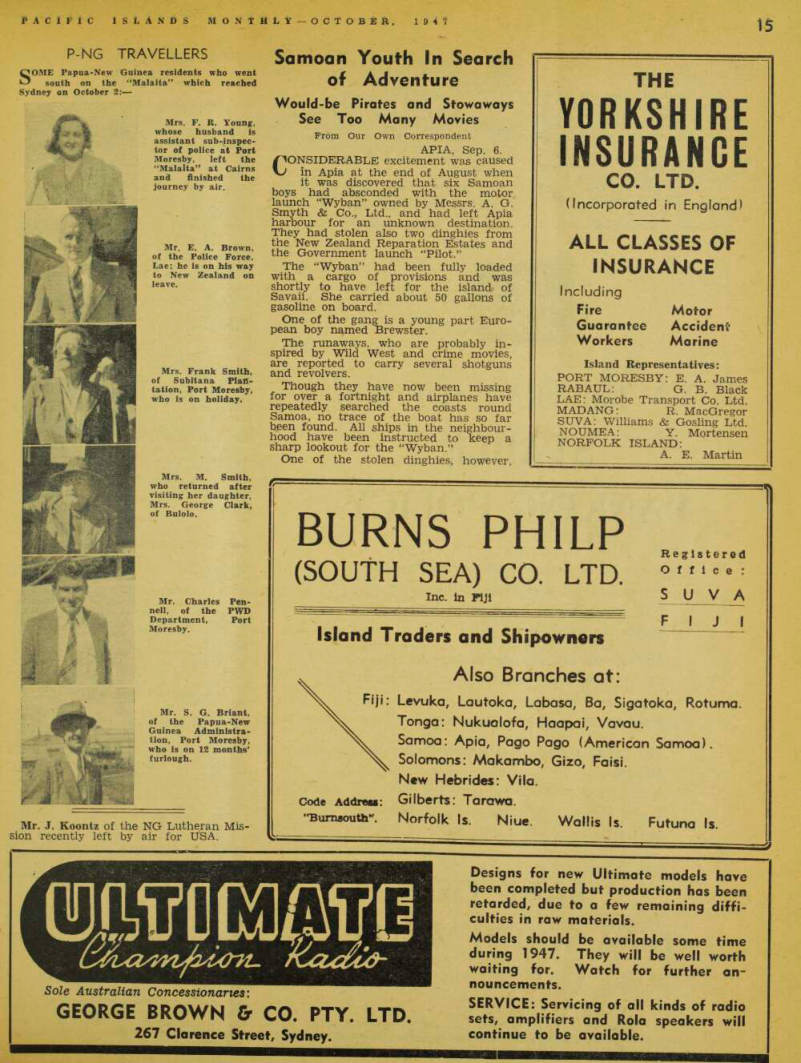
SOME Papua-New Guinea residents who went south on the “Malaita” which reached Sydney on October 2:—
Mr. J. Koontz of the NG Lutheran Mis sion recently left by air for USA.
Mrs. F. R. Young, whose husband is assistant sub-inspec tor of police at Port Moresby, left the “Malaita” at Cairns and finished the journey by air.
Mr. E. A. Brown, of the Police Force, Lae; he is on his way to New Zealand on leave.
Mrs. Frank Smith, of Subitana Plan tation, Port Moresby, who is on holiday.
Mrs. M. Smith, who returned after visiting her daughter, Mrs. George Clark, of Bulolo.
Mr. Charles Pen nell, of the PWD Department, Port Moresby.
Mr. S. G. Briant, of the Papua-New Guinea Administra tion, Port Moresby, who is on 12 months’ furlough.
Samoan Youth In Search
of Adventure Would-be Pirates and Stowaways See Too Many Movies
From Our Own Correspondent
Apia, Sep. 6.
CONSIDERABLE excitement was caused in Apia at the end of August when it was discovered that six Samoan boys had absconded with the motor launch “Wyban” owned by Messrs. A. G.
Smyth & Co., Ltd., and had left Apia harbour for an unknown destination.
They had stolen also two dinghies from the New Zealand Reparation Estates and the Government launch “Pilot,”
The “Wyban” had been fully loaded with a cargo of provisions and was shortly to have left for the island of Savaii. She carried about 50 gallons of gasoline on board.
One of the gang is a young part Euro pean boy named Brewster.
The runaways, who are probably in spired by Wild West and crime movies, are reported to carry several shotguns and revolvers.
Though they have now been missing for over a fortnight and airplanes have repeatedly searched the coasts round Samoa, no trace of the boat has so far been found. All ships in the neighbour hood have been instructed to keep a sharp lookout for the “Wyban.”
One of the stolen dinghies, however,
was found beached on the coast of Savaii at Saleloga, where it had probably been carried by the current. rE call of the British steamship “Em pire Honduras” at Apia was also marked by some excitement. On the eve of her departure several members of the crew were involved in an affray with Samoan taxi drivers.
After she had left with 1,600 tons of copra on board consigned to the British Food Ministry, she had to return to port when it was discovered that not less than five Samoan boys had hidden on board as stowaways.
The boys were handed over to the Samoan Police and will be prosecuted for their attempt to seek adventure on the high seas.
Mr. G. D. Chamberlain, Chief Secretary, Western Pacific High Commission, left Suva by plane on October 7 to make brief visits to the British Solomon Islands Pro tectorate and the New Hebrides Con dominium.
Mr. Gordon Clarke, manager for the PCB at Madang, New Guinea, arrived in Sydney on leave in October.
Advertisements & other items, pp. 19-20 (1 item)
iTflliM
THE
YORKSHIRE
INSURANCE
CO. LTD.
(Incorporated in England)
ALL CLASSES OF
INSURANCE
Including Fire Motor Guarantee Accident Workers Marine Island Representatives:
PORT MORESBY: E. A. James
RABAUL: G. B. Black LAE: Morobe Transport Co. Ltd.
MADANG: R. MacGregor SUVA: Williams & Gosling Ltd.
NOUMEA: Y. Mortensen
NORFOLK ISLAND:
A. E. Martin
BURNS PHILP
(SOUTH SEA) CO. LTD.
Inc. In Fiji Island Traders and Shipowners Registered Office :
SUVA
FIJI
\Also Branches at; Fiji: Levuka, Lautoka, Labasa, 80, Sigatoka, Rotuma.
Tonga: Nukualofa, Haapal, Vavau.
Samoa: Apia, Pago Pago (American Samoa).
Solomons: Makambo, Gizo, Faisi.
New Hebrides: Vila.
Code Address: Gilberts: Tarawa.
"Bumsouth*. Norfolk Is. Niue. Wallis Is. Futuna Is.
u
iTflliM
iT Sole Australian Concessionaries :
GEORGE BROWN & CO. PTY. LTD.
267 Clarence Street, Sydney.
Designs for new Ultimate models have been completed but production has been retarded, due to a few remaining difficulties in raw materials.
Models should be available some time during 1947. They will be well worth waiting for. Watch for further announcements.
SERVICE: Servicing of all kinds of radio sets, amplifiers and Rola speakers will continue to be available.
130 YEARS OF
STABLE
BANKING POLICY
* A quarter of a century before representative government was introduced in the colony of New South Wales, the Bank of New South Wales was established.
Through all the constitutional and administrative changes of the past 130 years, this Bank has adapted its services to the ever changing economic needs of the community.
The Bank's stable and progressive policy has
safe-guarded its depositors, supported its
borrowers in good and bad times and has been a vital factor in the maintenance of financial stability in times of economic stress. \
BANK OF
NEW SOUTH WALES
FIRST BANK IN AUSTRALIA
/ (Incorporated in New South Wales with limited liability)
Across The North
Pacific Pan-American's Multiple Services
Hong Kong, Sep. 26.
HONG KONG will have five Clipper Days a week, starting September 27, when the Colony becomes the ter minus of a new Pan American Trans pacific service direct with San Francisco, and at the same time becomes another link in Pan American’s global airline.
Under the new schedule there will be three flights weekly in each direction over the strategic, all-weather, Central Pacific route. The schedule is as foUows: Saturdays: Clipper arrives from San Francisco, via Manila, in the afternoon.
Sundays: The same ship leaves for San Francisco, via Manila, in the morn ing. Another Clipper arrives from San Francisco, Via Tokio and Shanghai, in the afternoon.
Mondays: Clipper leaves in the morn ing for Bangkok and Calcutta, connect ing there with Constellations for New York, via the Mediterranean and Europe.
Tuesdays: Two Clippers arrive in the morning, one from San Francisco via Manila, and the other from New York via Calcutta and Bangkok.
Wednesdays: Both Clippers leave for the US in the morning, one via Manila and the other via Shanghai, Tokyo, Wake and Honolulu.
All Clippers operating via Hong Kong will be equipped with private sleeperette accommodation.
Pare on the new San Francisco-Hong Kong run will be US 726 dollars andi on the Hong Kong-Calcutta run US 230 dollars.
Australian Airlines to Norfolk
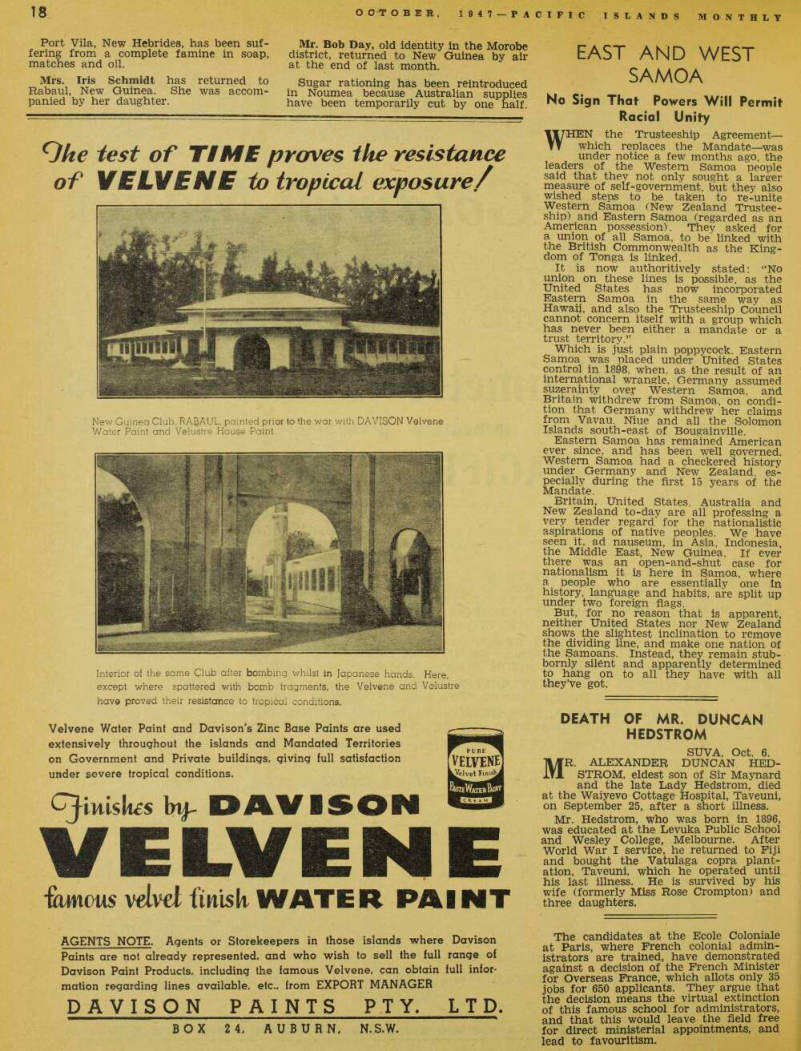
Norfolk and Lord Howe
fIIHE Commonwealth Government X probably through Government owned Qantas will start services between Australia and Lord Howe Is land and Australia and Norfolk Island soon.
Both services will run from Sydney. It is expected that a Lancastrian will be used on the Norfolk Island route, and a Catalina on the Lord Howe run. It is expected that one trip will be run each fortnight.
There is, at present, an air link be tween Norfolk Island and Auckland, which is patronised by New Zealand tourists. The Australian Minister for Air, Mr, Drakeford, who made the an nouncement concerning the Australian Government’s intentions, seemed to think that once Australia began a service to the island, the New Zealand service would cease.
Why this should be so is hard to imagine. Norfolk Island is closer to New Zealand than to Australia and the island has been making an income out of NZ visitors. Australia, on the other hand, produces everything that can be produced on Norfolk and therefore denies to the island an Australian market for its products.
There was some suggestion a month or two ago that Norfolk should come under NZ Administration. From the Island’s point of view, this would have many advantages.
The gunboat “Dumont d’Urville,” which was sent to the New Hebrides to quieten the 800 Indo-Chinese seeking to return to their own country, left 12 French sailors at Vila to handle the demonstrators be fore proceeding to Santo, where the de monstrators were more numerous.
Port Vila, New Hebrides, has been suf fering from a complete famine in soap, matches and oil.
Mrs. Iris Schmidt has returned to Rabaul, New Guinea. She was accom panied by her daughter.
Mr. Bob Day, old identity in the Morobe district, returned to New Guinea by air at the end of last month.
Sugar rationing has been reintroduced in Noumea because Australian supplies have been temporarily cut by one half.
Advertisements & other items, pp. 21-22 (1 item)
Metto-Goldwyn-M.ayet
if J iniiiiHiiHiiiHiiiiiniiinii n n aßiaa be^
PRESENTS THE LATEST
DEVELOPMENT IN
MOTION PICTURES ...
16 Millimetre Sound Films
Now available for immediate presentation throughout the
PACIFIC ISLANDS
• ?STf?, ay ’ trough the genius of science and the foresight of Metro-Goldwyn-Mayer, the motion to you—wherever y° u ma y be - Metro-Goldwyn-Mayer announces the immediate WORLD’S FIL^— in black-and-white and Technicolour: “MRS. MINIVER,”
WALTZ, A WEIGH,” “THIRTY SECONDS OVER TOKIO,” “MEET ME “PAPTATM? THE GREEN YEARS,” “THE VALLEY OF DECISION,”
‘ EANE>OM HARVEST,” “GASLIGHT,” “WATERLOO BRIDGE,”
GOOD-BYE MR. CHIPS and literally hundreds of other screen classics. rwmr GRMTEST STARS. —You will see the screen’s outstanding personalities: Clark GARSON, Spencer TRACY, Van JOHNSON, Gene KELLY, Esther WILLIAMS Lana TURNER, Walter PIDGEON, Robert TAYLOR and many more.
THE WORLD’S FINEST FEATURETTES— Presenting Pete Smith . . . John Nesbitt Carey Wilson . . . and the ever-popular “Tom and Jerry” Technicolour Cartoons. ™ E y^°Tv? LD o? BEST ACTION DRAMAS— Produced by the Republic Studios, and distributed by M-G-M. Starring Gene Autry, Roy Rogers and the screen’s top action stars.
THE WORLD’S LATEST NEWS PICTURES —bro ught to the screen by Metro News.
These are the advantages of 16 mm: • A normal programme of one feature and short subjects gives approximately two hours’ screening. New programmes can be supplied at the rate of one or two per week to approved situations not competing with established theatres, • Special selections of short subjects are available for screenings to natives. • Equipment is available from America or Australia.
M-G-M will pass on your enquiries to manufacturers in whichever country you prefer. • 16mm equipment is small and compact, weighing approximately 80 lbs. & & • All 16mm film is NON-INFLAMMABLE. Programmes can be safely screened in halls without fireproof projection boxes or in open air. • 16mm film is light in weight, and cheap to freight.
A complete programme weighs only about 20 lbs. • French communities may have, in addition to the normal English programmes, about six features per year with French dialogue. • 16mm is ideal for isolated communities ... it can be inexpensively freighted by air . . . Mining companies and Plantation Owners will find it one of their best assets in improving industrial relations with employees ... In addition to entertainment, educational and instructional films can be screened. Address your enquiries now to: 16mm DIVISION, METRO-GOLDWYN-MAYER Pty., Ltd., 20-28 CHALMERS ST., SYDNEY
AUSTRALIA
iiiimiiiin iihiiiiii n iiiiiHiiiiiHiiiiniiiiniiiii ■ill
lIHIIIIII
9 he test of proves ike resistance
of VELVE to tropical e
New Guinea Club, RABAUL, painted prior to the war with DAVISON Velvene Water Paint and Velustre House Paint.
Interior of the same Club after bombing whilst in Japanese hands. Here, except where spattered with bomb fragments, the Velvene and Velustre have proved their resistance to tropical conditions.
Velvene Water Paint and Davison's Zinc Base Paints are used extensively throughout the islands and Mandated Territories on Government and Private buildings, giving full satisfaction under severe tropical conditions.
C}inisl,« hf. DAVISON
VELVENE
■faiVKUS velvet finish WATER PAINT
r PURE 1
VELVENE
EinislU AGENTS NOTE. Agents or Storekeepers in those islands where Davison Paints are not already represented, and who wish to sell the full range of Davison Paint Products, including the famous Velvene, can obtain full information regarding lines available, etc., from EXPORT MANAGER
DAVISON PAINTS PTY. LTD.
BOX 24, AUBURN, N.S.W.
Samoa
East And West
No Sign That Powers Will Permit Racial Unity
¥I7iHEN the Trusteeship Agreement— TT which replaces the Mandate—was under notice a few months ago, the leaders of the Western Samoa people said that thev not only sought a larger measure of self-government, but they also wished steps to be taken to re-unite Western Samoa (New Zealand Trustee ship) and Eastern Samoa (regarded as an American possession). They asked for a union of all Samoa, to be linked with the British Commonwealth as the King dom of Tonga is linked.
It is now authoritively stated: “No union on these lines is possible, as the United States has now incorporated Eastern Samoa in the same way as Hawaii, and also the Trusteeship Council cannot concern itself with a group which has never been either a mandate or a trust territory.”
Which is just plain poppycock. Eastern Samoa was placed under United States control in 1898. when, as the result of an international wrangle, Germany assumed suzerainty over Western Samoa, and Britain withdrew from Samoa, on condi tion that Germany withdrew her claims from Vavau. Niue and all the Solomon Islands south-east of Bougainville.
Eastern Samoa has remained American ever since, and has been well governed.
Western Samoa had a checkered history under Germany and New Zealand, es pecially during the first 15 years of the Mandate.
Britain, United States, Australia and New Zealand to-day are all professing a very tender regard for the nationalistic aspirations of native peoples. We have seen it, ad nauseum, in Asia, Indonesia, the Middle East, New Guinea, if ever there was an open-and-shut case for nationalism it is here in Samoa, where a people who are essentially one In history, language and habits, are split up under two foreign flags.
But, for no reason that is apparent, neither United States nor New Zealand shows the slightest inclination to remove the dividing line, and make one nation of the Samoans. Instead, they remain stub bornly silent and apparently determined to hang on to all they have with all they’ve got.
Death Of Mr. Duncan
Hedstrom
Suva, Oct. 6.
Mr. Alexander Duncan Hed
STROM, eldest son of Sir Maynard and the late Lady Hedstrom, died at the Waiyevo Cottage Hospital, Taveuni, on September 25, after a short illness.
Mr. Hedstrom, who was born in 1896, was educated at the Levuka Public School and Wesley College, Melbourne. After World War I service, he returned to Fiji and bought the Vatulaga copra plant ation, Taveuni, which he operated until his last illness. He is survived by his wife (formerly Miss Rose Crompton) and three daughters.
The candidates at the Ecole Coloniale at Paris, where French colonial admin istrators are trained, have demonstrated against a decision of the French Minister for Overseas France, which allots only 35 jobs for 650 applicants. They argue that the decision means the virtual extinction of this famous school for administrators, and that this would leave the field free for direct ministerial appointments, and lead to favouritism.
Orgy Of Government Spending In
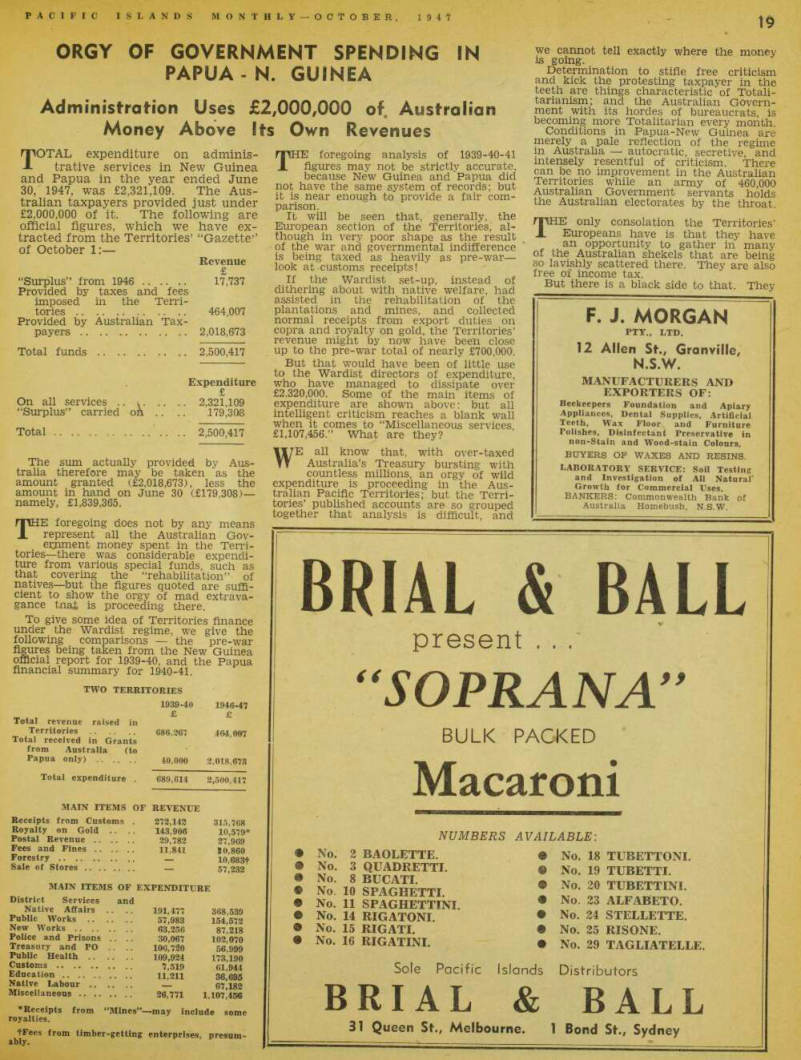

Papua - N. Guinea
Administration Uses £2,000,000 of. Australian Money Above Its Own Revenues
rTAL expenditure on adminis trative services in New Guinea and Papua in the year ended June 30, 1947, was £2,321,109. The Aus tralian taxpayers provided just under £2,000,000 of it. The following are official figures, which we have ex tracted from the Territories’ “Gazette’’ of October 1:
The sum actually provided by Aus tralia therefore may be taken as the amount granted (£2,018,673), less the amount in hand on June 30 (£179,308) namely, £1,839,365. fITHE foregoing does not by any means X represent all the Australian Gov . eminent money spent in the Terri tories—there was considerable expendi ture from various special funds, such as that covering the “rehabilitation” of natives—but the figures quoted are suffi cient to show the orgy of mad extrava gance tnat is proceeding there.
To give some idea of Territories finance under the Wardist regime, we give the following comparisons the pre-war figures being taken from the New Guinea official report for 1939-40, and the Papua financial summary for 1940-41.
fIIHE foregoing analysis of 1939-40-41 JL figures may not be strictly accurate, because New Guinea and Papua did not have the same system of records; but it is near enough to provide a fair com parison.
It will be seen that, generally, the European section of the Territories, al though in very poor shape as the result of the war and governmental indifference is being taxed as heavily as pre-war— look at customs receipts!
If the Wardist set-up. instead of dithering about with native welfare, had assisted in the rehabilitation of the plantations and mines, and collected normal receipts from export duties on copra and royalty on gold, the Territories’ revenue might by now have been close up to the pre-war total of nearly £700,000.
But that would have been of little use to the Wardist directors of expenditure, who have managed to dissipate over £2,320,000. Some of the main items of expenditure are shown above: but all intelligent criticism reaches a blank wall when it comes to “Miscellaneous services. £1,107,456.” What are they?
WE all know that, with over-taxed Australia’s Treasury bursting with countless millions, an orgy of wild expenditure is proceeding in the Aus tralian Pacific Territories; but the Terri tories’ published accounts are so grouped together that analysis is difficult, and
we cannot tell exactly where the money is going.
Determination to stifle free criticism and kick the protesting taxpayer in the teeth are things characteristic of Totali tarianism; and the Australian Govern ment with its hordes of bureaucrats, is becoming more Totalitarian every month Conditions in Papua-New Guinea are merely a pale reflection of the regime in Australia autocratic, secretive, and intensely resentful of criticism. There can be no improvement in the Australian Territories while an army of 460,000 Australian Government servants holds the Australian electorates by the throat.
THE only consolation the Territories’
Europeans have is that they have an opportunity to gather in many of the Australian shekels that are being so lavishly scattered there. They are also free of income tax.
But there is a black side to that. They
“Surplus” from 1946 Provided by taxes and fees imposed in the Territories Provided by Australian Taxpayers Revenue £ 17,737 464,007 2,018,673 Total funds 2.500,417 On all services .. i. .
“Surplus” carried on .
Expenditure £ . .. 2,321,109 . .. 179,308 Total 2,500,417
Two Territories
1939-40 1946-47 £ £ Total revenue raised in Territories 686,367 464,007 Total received in Grants from Australia (to Papua only) 40,000 2,018,673 Total expenditure . 689,614 2,500,417
Main Items Of
Revenue
Receipts from Customs .
Royalty on Gold Postal Revenue Fees and Fines Forestry Sale of Stores 272,142 143,906 29,782 11,841 315,768 10,579* 27,969 110,860 10,683t 57,232
Main Items Of Expenditure
District Services and Native Affairs Public Works New Works Police and Prisons ..
Treasury and PO . .
Public Health Customs Education Native Labour Miscellaneous .. .. .. 191,477 57,983 63,256 30,067 106,720 109,924 7,519 11,211 26,771 368,539 154,572 87,218 102,070 56,999 173,190 61,944 36,695 67,182 1,107,456 ♦Receipts from “Mlnes”royalties. -may include some tFees from timber-getting enterprises, ably. presum-
may not pay tax on income—but they are all being ferociously taxed on all their daily requirements which are im ported—that is, on at least 90 per cent, of all requirements. Meanwhile (see article elsewhere) the Australian Govern ment is grabbing some £3 or £4 per ton at least of the money that should be going to copra-growers in the Territories.
If this orgy of spending in the Aus tralian Territories had been attended by encouragement of private enterprise, it might have achieved ultimate good. The European individualists there could have used the money that came their way to establish some flourishing industries.
But the Wardist regime hates private enterprise and individualism in all its forms; and mainly by withholding transport and labour it has contrived to knock the spirit out of most of the Territories non-official white civilians.
It is a fantastic set-up but it will go on so long as there is Socialist control' in Australia.
Miss Vivian Thwaite, a well-known identity in Administration circles before the war, and who now is connected with the National Library movement in the Territory, arrived in Sydney recently on leave.
Captain Sandy Meldrum brought MV “Salamaua” to Sydney on October 9 with a cargo of disposals goods from Madang, New Guinea.
Mr. C. W. Rothe, general manager of the Colonial Sugar Refining Company, has been in Fiji to inspect the company’s activities in the Colony. Although this is his first visit since he became general manager three years ago, Mr. Rothe is no stranger to Fiji. He was on the staff of the company’s Lautoka mill in 1914 and 1915 and has paid two brief visits to the Colony since then.
Advertisements & other items, pp. 23-24 (1 item)
Brial & Ball
F. J. MORGAN
PTY., LTD.
12 Allen St., Granville,
N.S.W.
MANUFACTURERS AND
EXPORTERS OF:
Beekeepers Foundation and Apiary Appliances, Dental Supplies, Artificial Teeth, Wax Floor and Furniture Polishes, Disinfectant Preservative in non-Stain and Wood-stain Colours.
BUYERS OP WAXES AND RESINS.
LABORATORY SERVICE: Soil Testing and Investigation of All Natural’
Growth for Commercial Uses.
BANKERS: Commonwealth Bank of Australia Homebush, N.S.W.
BRIAL & BALL
V present . ..
“SOPRANA”
BULK PACKED
Macaroni
NUMBERS AVAILABLE:
9 No. 2 BAOLETTE.
@ No. 3 QUADRETTI.
9 No. 8 BUCATI.
9 No 10 SPAGHETTI.
9 No. 11 SPAGHETTINI.
• No. 14 RIGATONI.
• No. 15 RIGATI.
• No. 16 RIGATINI.
Sole Pacific
BRIAL
9 No. 18 TUBETTONI.
9 No. 19 TUBETTI.
9 No. 20 TUBETTINI.
9 No. 23 ALFABETO.
• No. 24 STELLETTE.
9 No. 25 RISONE.
• No. 29 TAGLIATELLE.
Islands Distributors
& BALL
31 Queen St., Melbourne. 1 Bond St., Sydney
f vu
TOOTH PASTE
Its
i You’ll agree, too, when you use IPANA. It’s refreshingly different, with a distinctive, pleasant taste, that makes your mouth feel grand.
IPANA’S cleaning and polishing qualities give you sparkling teeth and a sunny smile.
With massage, too, IPANA helps ensure firm, healthy gums so vital to sound teeth. 1 lliil "A t;v
'FOR
G oo L U * ■■
G UMs):
whp m
4257
and Copra
Samoa Gathering
Dollars
High Price of Cocoa and Copra
Apia, Oct. 2.
r[E rainy season this year has set in earlier than usual and heavy rains have fallen during the last few weeks, accompanied by strong winds.
The rainy season is normally expected to set in at Palolo time which this year falls on October 8.
European and Samoan cocoa-planters are looking forward to a very good crop, to be picked ‘shortly. With cocoa quoted at £215 per ton f.o.b. Apia, cocoa-planters doubtless constitute the most prosperous class in the Territory. The high cost of living bothers them little, their only complaint being that it has become in creasingly difficult to find a sufficient supply of Samoan plantation-labour.
While the world, including Britain and Australia, is suffering from a dollar shortage, the Territory of Western Samoa, owing to its exports to the USA of cocoa and copra, has large dollar surpluses.
Only a portion of the dollar credits for cocoa and copra can be used for the im portation of American goods; but Samoan importers hope that in spite of increasing restrictions in New Zealand against importation of American goods, Samoa will be allowed to continue the import of goods from the USA, which are difficult or impossible to obtain from other sources. There would be little ob jection, however, against restrictions on luxury and unessential goods.
The Joys Of Life In
New Guinea
A CORRESPONDENT, writing in early October, said there were no beer supplies in Madang, New Guinea, but plenty of spirits and tobacco were available.
A leg of lamb cost 16/-, and 9/- was the cost of a cabbage. Butter prices ranged from 3/- to 4/- a lb., while tea was 7/2 a lb.
Madang, however, now enjoys the ad vantage of electric lighting.
Mr. A. G. D. Walton, who has been acting-schoolmaster and acting-post master at Nauru, left the island in Sep tember for Australia.
During the last week in August, Mrs.
R. M. Best was married to Mr. G. E.
Markey at the LMS church in Nauru.
Both are residents of the island.
According to Mr. D. J. Rooney (Cons truction Superintendent) Brisbane, three quarters of the applicants for tax-free jobs in Papua-New Guinea offered by the Works and Housing Department, were ex-Servicemen. Labour, he said, was re quired particularly for Kokopo and Lae.
Advertisements & other items, pp. 25-26 (1 item)
Colycr Watson (New Guinea) Ltd.
VETERINARY
INSTRUMENTS
For Sheep and Cattle can be Supplied Immediately
EARMARKERS.
SPEYING INSTRUMENTS.
BULLRINGS.
FIRE BRANDS.
EMASCULATORS.
W. JNO. BAKER
PTY. LTD.
3 Hunter Street, Sydney, N.S.W., Australia
Colycr Watson (New Guinea) Ltd.
Head Office: RABAUL Branches: Kavieng, New Ireland, and at 22 Bridge Street, Sydney
GENERAL MERCHANTS AND BUYERS
OF ISLAND PRODUCE
Plantation Owners and Engineers
Sole Distributors: Chrysler and Plymouth Cars Fargo Trucks Willys-Overland Jeeps G.M. Marine and Industrial Engines Perfect Refrigerators Managing Agents: Union Assurance Society Ltd.
National Mutual Life Association of A/asia Ltd.
Agents: China Navigation Company
SPECIALISING
IN
PACIFIC ISLAND INSURANCES
FIRE MOTOR VEHICLE
MARINE HULLS AND CARGO
EMPLOYER’S LIABILITY
GUARANTEES including those for —
DYNAMITE PERMITS.
RECRUITERS’ LICENCES.
DEFERRED WAGES
AND ALL OTHER CLASSES ARRANGED
AT LOWEST CURRENT RATES.
Established Agencies:
W. R. CARPENTER & CO., LTD.
Throughout the Territory of New Guinea.
SOUTHERN PACIFIC INSURANCE
CO., LTD.
HEAD OFFICE: 60 HUNTER STREET,
SYDNEY.
Soviet Delegates
Take A Crock At Nauru
WHEN the Trusteeship agreement for Nauru was being considered by a sub-committee of the UNO General Assembly at the beginning of October, the Russian delegate said that when the Trusteeship agreement for New Guinea was before the sub-committee last year, Australian delegates stated that the natives of that country were still in the Stone Age. Now. however, the people of Nauru were described as being “far ad vanced.” and 100 per cent, literate.
Despite this difference between the native inhabitants of these two countries, said the Russian delegate; there was virtually no difference between the New Guinea and Nauru Agreements.
The Australian delegate. Dr. Evatt, addressing the sub-committee, pointed out that the island of Nauru was making an important contribution to world food, because Nauru phosphates wefe vital to food production in Australia and New Zealand. Australia, said Dr. Evatt, would probably export 120 million bushels of wheat from her 1947-48 crop.
He also drew the sub-committee’s at tention to the fact that the natives of Nauru were assured of an entirely sat isfactory standard of living and adequate social services as a result of these phosphate deposits, and the way in which thev are administered. (Actually, the natives of Nauru and Ocean Islands are the richest Islanders in the Pacific. As communities, they draw royalties on every ton of phosphatic rock that is mined. The Russians, of course, were merely seeking a stick wherewith to beat the hated Anglo-American dog. If
they had pursued the matter, they would have found in Nauru and Ocean Island conditions relating to native welfare which they must have praised.)
Marshalls
Pests Left By Japs
Giant Snails in the Marshalls
NEW GUINEA is not alone in having a plague of giant snails.
The Japs left them behind in the Marshalls, too, and now they have in creased a thousand-fold and are doing hundreds of thousands of pounds worth of damage in Rota, Saioan, Tinian, Pon ape, Truk and other islands of the group.
They have now spread, in some way, to Guam, and officials there fear that they may even reach the USA.
They can live for days without food and, as they are bi-sexual, a single snail can start a colony. It is thought that they have been carried unnoticed in packing crates and native canoes from one island to another.
The Japs introduced the snails into the Marshalls for the same reason that they introduced them to New Guinea— as a food supply. When fully matured, they can measure up to eight inches long; and as up to 300 eggs are produced at one time, and the snails mature at four months, the magnitude of the invasion can be imagined.
Coconut Bug
At the same time as the snail plague appeared, the coconut trees on Tinian <and 'Saipan, and some of the smaller islands, have been attacked by a bug which is quickly killing them. American agricultural officers are trying to stop its spread to other islands.
Advertisements & other items, p. 26 (1 item)
Robert Gillespie Ptv.Ltd
IMPORTERS
EXPORTERS
mm r ALL CLASSES OF MERCHANDISE PURCHASED FOR ISLAND CLIENTS
THROUGHOUT THE SOUTH-WEST PACIFIC.
ISLAND PRODUCE SOLD ON AUSTRALIAN AND OVERSEAS MARKETS
ON COMMISSION BASIS.
ROBERT GILLESPIE PTV.LTD
BANKERS: BANK OF N.S.W.
COMPTOIR NATIONAL
D’ESCOMPTE DE PARIS
54a PITT ST. SVDNEV N.S.W.
CABLE ADDRESS:
“ROBERGILL"
PHONES BW 4782-B 1305
No Reprieve For Cession
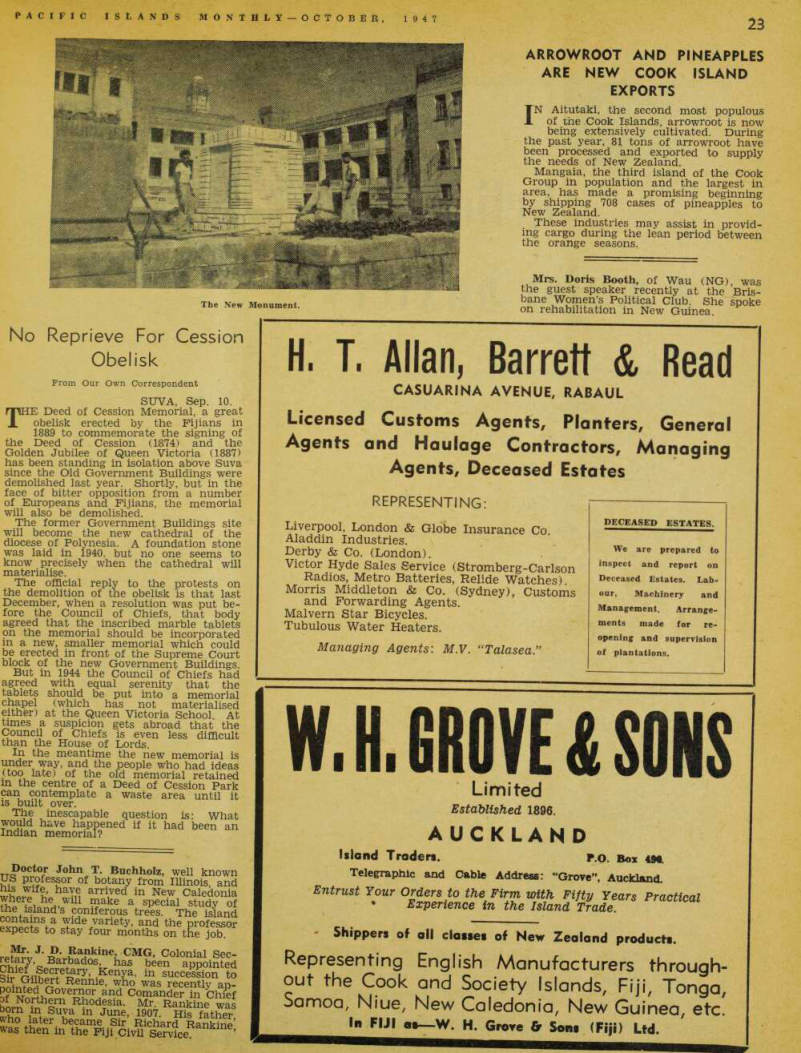
Obelisk
From Our Own Correspondent
Suva, Sep. 10.
rE Deed of Cession Memorial, a great obelisk erected by the Fijians in 1889 to commemorate the signing of the Deed of Cession (1874) and the Golden Jubilee of Queen Victoria (1887) has been standing in isolation above Suva since the Old Government Buildings were demolished last year. Shortly, but in the face of bitter opposition from a number of Europeans and Fijians, the memorial will also be demolished.
The former Government Buildings site will become the new cathedral of the diocese of Polynesia. A foundation stone was laid in 1940, but no one seems to know precisely when the cathedral will materialise.
The official reply to the protests on the demolition of the obelisk is that last December, when a resolution was put be fore the Council of Chiefs, that body agreed that the inscribed marble tablets pn the memorial should be incorporated in a new, smaller memorial which could be erected in front of the Supreme Court block of the new Government Buildings.
But in 1944 the Council of Chiefs had agreed with equal serenity that the tablets should be put into a memorial chapel (which has not materialised either) at the Queen Victoria School At times a suspicion gets abroad that the Council of Chiefs is even less difficult than the House of Lords.
In the meantime the new memorial is under way, and the people who had ideas (too late) of the old memorial retained in the centre of a Deed of Cession Park can contemplate a waste area until it is built over.
The inescapable question is: What would have happened if it had been an Indian memorial?
Doctor John T. Buchholz, well known US professor of botany from Illinois and hay n arri , ved in New Caledonia i?io h % wlll ake a special study of the islands coniferous trees. The island wide variety, and the professor expects to stay four months on the job.
Mr. J. D. Rankine, CMG, Colonial Sec ®arbados - has been appointed §i> 10 riihprf 0 T? ry ’ . Ken £ a ’ in succession to Renme ’ who was recently ap ?? l AT te^Governor and Comander in Chief af Northern Rhodesia. Mr. Rankine was born in Suva in June, 1907. His father nr?° b ecame Sir Richard Rankine’ was then in the Fiji Civil Service.
The New Monument.
Arrowroot And Pineapples
Are New Cook Island
Exports
IN Aitutaki, the second most populous of the Cook Islands, arrowroot Is now being extensively cultivated. During the past year, 81 tons of arrowroot have been processed and exported to supply the needs of New Zealand.
Mangaia, the third island of the Cook Group in population and the largest in area, has made a promising beginning by shipping 708 cases of pineapples to New Zealand.
These industries mav assist in provid ing cargo during the lean period between the orange seasons.
Mrs. Doris Booth, of Wau (NG), was the guest speaker recently at the Bris bane Women’s Political Club. She spoke on rehabilitation in New Guinea
Advertisements & other items, pp. 27-28 (1 item)
W, H. Grove & Sons
H. T. Allan, Barrett & Read
CASUARINA AVENUE, RABAUL
Licensed Customs Agents, Planters, General
Agents and Haulage Contractors, Managing
Agents, Deceased Estates
REPRESENTING:
Liverpool, London & Globe Insurance Co.
Aladdin Industries.
Derby & Co. (London).
Victor Hyde Sales Service (Stromberg-Carlson Radios, Metro Batteries, Relide Watches) Morris Middleton & Co. (Sydney), Customs and Forwarding Agents.
Malvern Star Bicycles.
Tubulous Water Heaters.
Managing Agents: M.V. “Talasea.”
DECEASED ESTATES.
We are prepared to inspect and report on Deceased Estates. Labour, Machinery and Management. Arrangements made for reopening and supervision of plantations.
W, H. GROVE & SONS
Limited
Established 1896.
AUCKLAND
island Traders. r.o. Box 49t Telegraphic and Cable Address: “Grove”, Auckland, Entrust Your Orders to the Firm with Fifty Years Practical ' Experience in the Island Trade.
Shippers of oil classes of New Zealand products.
Representing English Manufacturers through-
out the Cook and Society Islands, Fiji, Tonga, Samoa, Niue, New Caledonia, New Guinea, etc. ® —W. H. Grove fir Sons (Fiji) Ltd.
31
Relief from
a major anxiety
Even the most expert and conscientious individual executor is subject to accident, illness and incapacitation.
Continuity of administration and uninterrupted attention to your estate and your beneficiaries are of paramount importance. Both can be positively assured by appointing this Company your sole Executor or as co-Executor with your present appointee. An interesting explanatory booklet will be forwarded on request.
DIRECTORS:
James Burns. Joseph Mitchell. P. T. W. Black.
Frederick Ewen Loxton. Eric Priestley Lee.
MANAGER: L. S. Parker.
SECRETARY: E. R. Overton, A.F.I.A.
BURNS PHILP TRUST
COMPANY LI M I T E D
EXECUTOR ♦ TRUSTEE » AGENT
7 BRIDGE STREET, SYDNEY
TELEPHONE: BU 5901. B ° X M 3, ® Sydney
BPI .45
if
Massacred!
New Report on Fate of NG Missionaries
A CORRESPONDENT in Madang, New Guinea, says that an authentic re port of the fate of a large number of missionaries of that district has at last been received. They were known to have been sent away on a Japanese ship in March, 1943. It now is reported that they were massacred.
In previous issues of “PIM,” these missionaries have been listed as “Missing —presumed dead.’’ Native rumours as to their fate were many and contradictory.
One rumour was that they were landed on an island in the Manus group and then lined up and shot into the sea. This seems now to' have a bearing on the truth.
The official report from the War Crimes Commission states: “On March 16, 1943, 26 missionaries were brought aboard the destroyer Akisaki as it lay off the shore of Kariru, near Wewak.
“The destroyer then sailed north eastward some 300 miles to Manus and halted at the port of Lorengau, at the east end of the island, where another 30 to 40 Europeans and Asiatics were taken aboard.
“Some time after steaming away from Lorengau, the ship’s captain received orders from the headquarters of the Eighth Japanese Fleet, at Rabaul, to clear the Akisaki’s deck of all enemy aliens.
“Missionaries and other civilians were lined up at the ship’s stern and bound with ropes to the rail. Japanese soldiers took aim with rifles and machine-guns.
Orders barked. Guns rattled. Bodies fell.
“One by one the slain were hurled overboard in the churning wake of the Akisaki. One Chinese child is known to have been thrown into the sea alive.”
The full investigation of the War Crimes Commission has not yet been completed, however. It is known that 38 missionaries are missing—the fate of only 26, as stated above, has been established.
There are, as well, five missionaries who were evacuated from the Sepik River to Wewak about this time and who also disappeared.
Lever Bros. Still Growing
IT has been reported from London that Lever Brothers’ interests have acquired the entire capital stock of a leadmg American cosmetic firm. , .
The deal has been put through by the American company, Lever Brothers Com pany, Cambridge, Mass., and the newly acquired firm is Harriet Hubbard Ayer Inc., with its subsidiary, Harriet Hubbard Ayer Laboratories Inc. . , Harriet Hubbard Ayer is one of America’s best advertised cosmetic manu facturers. It is understood that it will continue to function as a separate and independent unit. Although Levers specialise in the manufacture of soap, toothpaste and margarine, this is the company’s first incursion into the cosmetic bl This S fs the second big American venture of the company in recent years. In 1944, it purchased the Pepsodent Company.
The engagement is announced of Miss Gertrude Gurau, eldest daughter of Mr. and Mrs A M. Gurau, of Apia, Samoa, to Mr. James Buckingham of Gisborne, New Zealand. Mr. Buckingham is on the staff of the Civil Aviatiqn Department of NZ, at Nadi Airport, Pin. He served with the RNZAP in the Pacific during the war.
Advertisements & other items, p. 28 (1 item)
24
OCTOBER, 1 9 4 ? TACIEIC iSLANbS MONTHLY
Australia Trapped
In Manus
To Be Bottomless Sink For Socialists' Millions
mHE Manus Naval Base will be handed A over by the Americans in December to the Australian Navy, according to a carefully prepared “hand-out” from the Australian Department of the Navy on September 29.
The “hand-out” continued:— “The Australian Government during the negotiations for taking over Manus from the United States announced that it would welcome arrangements for joint use of the island by United States forces in the future on a reciprocal basis. The United States was not prepared to keep Manus up to full standard as a naval base, and if Australia had not taken the base over it would have been reduced to skeleton maintenance status.
“Government plans for the base are that it will have built for it a garrison town, and Navy personnel posted there will be able to take their families during their terms of service on the island. To bring the base up to proper standards an anti-submarine net would have to be erected and electrical, installations and roads put back into first-class order.” 11THICH is nothing more or less than f? prevarication. The plain truth is that the Americans were quite pre pared to hold and maintain the great base, as a bastion of American-Austra lian defence against Asia, on condition that they were given possession of these few square miles of Territory.
The babbling little men who now direct the destinies of Australia; 5, instead of thanking God for this development—
which would have eased both their pockets and their minds in relation to future defence stood high upon their territorial “rights,” and insisted that Australian sovereignty should not be in vaded.
The replied simply by mak ing all preparations to withdraw. Then the politicians backed down, and offered hurriedly to share the base with the United States. So far as is known, the Americans would not even discuss the matter.
Australia already is bending under a terrific weight of taxation—the heaviest in the world, and the most stupidly con ceived—and Manus represents merely an other few millions added to the load.
Australia, in spite of her Socialist dictators’ inexhaustible capacity for spending money, cannot maintain the Manus base as it should be maintained, if it is to be of real use. Manus, like the rest of the New Guinea Territory, will become mererly a bottomless sink for Australian money.
Progress!
From Our Own Correspondent
Suva, Sep. 10.
rpwo ramshackle, insanitary shacks J. which somehow housed 11 Indians were demolished recently at the order of the Suva Town Board, The site of the hovels now is occupied by a bell-tent in which, as far as is known, all the 11 now find accommoda tion!
A quarantine has been imposed by the medical authorities of American Samoa against passenger traffic from and to Western Samoa, owing to the incidence of whooping cough in the latter territory.
To Fight
NG Returned Soldiers To Fight At Canberra Conference
fJTHE claims of returned Servicemen in JL New Guinea to a much larger meas ure of Australian Government sym pathy and practical help than they have had will be brought before the Conference of the Australian Returned Soldiers League by Colonel H. T. Allan, at Can berra on October 28/31.
Colonel Allan has been authorised to represent the Lae Branch at the Confer ence; and he expects authority to repre sent other branches before he goes to Canberra.
The New Guinea returned soldiers will ask for a larger measure of Australian support in rehabilitation especially in relation to the price allowed for copra and for the restoration of the Legislative Council system, in some form, so that Europeans residing in the Australian Territories may have some voice in pub lic affairs.
At the present time, Europeans in Aus tralian Territories get little consideration from the Administration. They pay heavy indirect taxes, are kept short of labour and transport, and are robbed by the Australian Government of £3 or £4 per ton on the price paid for their copra; and all their complaints are either ignored or treated very casually by bureaucrats and politicians..
A tragic accident occurred in Samoa when a truck-driver killed his own child, aged four. Mr. J. Gascoigne, employed by the Gold Star Transport Co., of Apia, was backing his lorry into a garage and was unaware that his child was playing in the back of the truck.
Mr. W. F. Watson who has been Assis tant Commissioner of Inland Revenue in Fiji has been appointed to a similar posi tion in Hongkong.
Miss Joan Voelcker, daughter of the Ad ministrator of Western Samoa, Lieut- Colonel F. W. Voelcker, was married on September 19 to Petty-Officer H. Crockett, RNZN. Lieut-Colonel Voelcker visited New Zealand for the wedding.
Advertisements & other items, pp. 29-30 (1 item)
Brial & Ball
I
1C ■ D D'C
r%, »' S*
J.R.KERRgCO.
MELBOURNE
k !*»»#« OMy«yuA«M?S' :
SWTAL QUALITY
(><WO & J c
CONTINTS t PT. 6 R. OZS.
•So/e Distributing Agents
for Pacific Islands:
Brial & Ball
31 QUEEN ST., MELBOURNE.
1 BOND ST.. SYDNEY.
* a 1
SOUTH SEA ISLANDS CLUB
Social Evening
Every Friday at Union Jack House, 5 Hamilton St. (just off Bridge St.) Sydney Ballroom Dancing . . . Special Islands Dances and Songs Islands Visitors Welcome.
More Niue Plaited Ware
For Australia
INCLUDED in the 3,560 mailbags of native plaited ware shipped from Niue Island in 1946-47 (and worth £19,652) was a large quantity exported to Australia.
Native baskets by the tens of thousands are staple exports from Niue, where there is a lack of fertile soil for growing the fruit crops which are the main exports of Samoa and the Cook Islands.
Niue Island’s exports to Australia for the year jumped up to £6,142 —an in crease of nearly 400 per cent. This was largely accounted for by the market found for Niue plaited ware.
Plaited ware valued at £19,652 was worth more than all other Niue exports together, but copra exports were valued at £10,179, bananas at £5,335 and sweet potatoes at £292.
Pineapple Cup
Singles Bowling Championship of South Seas
By “Jack High”
THE premier bowling contest of the South Seas was played during the August Bank Holiday week-end. on the Suva Bowling Club’s green. It is open to Fiji. Tonga and Samoa. This year all bowling clubs in Fiji, except one, were represented. Suva was represented by 8 players; Vatukoula, 6; Rewa, 5; Lautoka, 2; Levuka. 2; and Ba, 1.
H. Edmunds (Suva), G. J. Smith (Vatukoula), J. Daly (Lautoka) and W.
Smith (Levuka) entered the semi-finals.
The two Smiths reached the final and eventually played one of the best singles games ever seen on the Suva green. The game was won with the last bowl played by G. J. Smith. W. Smith was actually lying two up until the last bowl was played.
The winner was congratulated on his second win in the Pineapple Cup contest, and the loser was equally sympathised with in his very close defeat in a second attempt. He is a young plaver and com peted in 1946 for the first time.
Winners of the Cup since it was pre sented by the Pacific Biscuit Company, Suva, in 1928, are; 1928 <te 1939 C. C. Clark (Suva) 1929-30-31 S. J. Pickett (Levuka) 1936 1943 H. H. Adcock (Suva) 1937-38 R. W. Steward (Suva) 1945 & 1947 .. G. J. Smith (Vatukoula) 1932 R. C. Wilson (Ba) 1933 W. Thompson (Lautoka) 1934 G. L. Perks (Suva) 1935 E. C. Dobell (Suva) 1940 L. F. Garnett (Suva) 1941 S. W. Meeks (Suva) 1942 A. W. Goodfellow (Suva) 1944 W. E. McGowan (Suva) 1946 C. H. Came (Suva) During 20 years. 14 individual players have been successful in holding the trophy for one year.
Mr. Ralph Ortnsby. ADO from the Wewak area, arrived' in Sydney by MV “Malaita” this month on leave.
Mr. Keith Chambers, of the New Guinea Customs Department, who has been stationed at Madam? arrived in Sydney by “Malaita” recently on leave.
Mr. Dan Anthonsen, well-known en gineer of New Guinea was holidaying in Sydney in October. He expects to re turn to New Guinea shortly in one 'Of the Administration’s re-conditioned ships.
Mr. C. R. Taylor, formerly of the Burns, Philp shipping staff at Cairns, Qld., has been transferred to Port Moresby, Papua, where he will be in charge of the shipping department.
Mr. Len Odgers, Chief Clerk of the District Services Department in Port Moresby, arrived in Sydney by MV “Malaita” this month on leave. He was accompanied by his wife.
Mr. G. V. Maunsell Turner, of the Crown Law Office at Port Moresby, arrived in Sydney by “Malaita” in October to soend his recreation leave in NSW. He was accompanied by his daughter, Miss Elizabeth Maunsell Turner, who has been attached to the APC staff in Port Moresby.
The Administrator of Western Samoa, Colonel F. W. Voelcker, who has been on an official visit to New Zealand, expected to return to Apia early in October.
Colonel Volcker, during his stay, in New Zealand twice broadcast historical and political descriptions of Western Samoa and the Samoan people, over all New Zealand stations.
Advertisements & other items, p. 30 (1 item)
G I L L E S Pi
The Key to Earning Power. . .
Sometimes men think that a general education or an elementary knowledge of business is enough to get ahead. But experience soon teaches that thorough, specialised training is just as necessary for success in business as it is in the professions of Law, Medicine or Dentistry. If you are interested in the many opportunities in the Business World ... if you seek responsibility, success and economic security, commence training now —in some specialised business subject. H.R.I. is available always to help and advise ambitious men and women. Write or wire for particulars and career information.
H.R.I. tutorial service is •proved by the ivinning of more honours than all coaches in Australasia combined.
H.R.I. Career Training • ACCOUNTANCY • SECRETARYSHIP • COST ACCOUNTANCY
• PRACTICAL BOOKKEEPING • MARKETING SELLING
ADVERTISING • BANKING • LOCAL GOVERNMENT EXAMS.
Hemingway Robertson Institute
Founded and Owned by Hemingway & Robertson *Pty. Ltd.
Consulting Accountants :; :: Professional Tutors
126 BANK HOUSE, BANK PLACE. MELBOURNE
126 CHALFONT CHAMBERS. 142 PHILLIP STREET, SYDNEY 126/814
G I L L E S PI The Flour
- SYDNEY -
TRAM
MARX
’S of the Islands
Notes
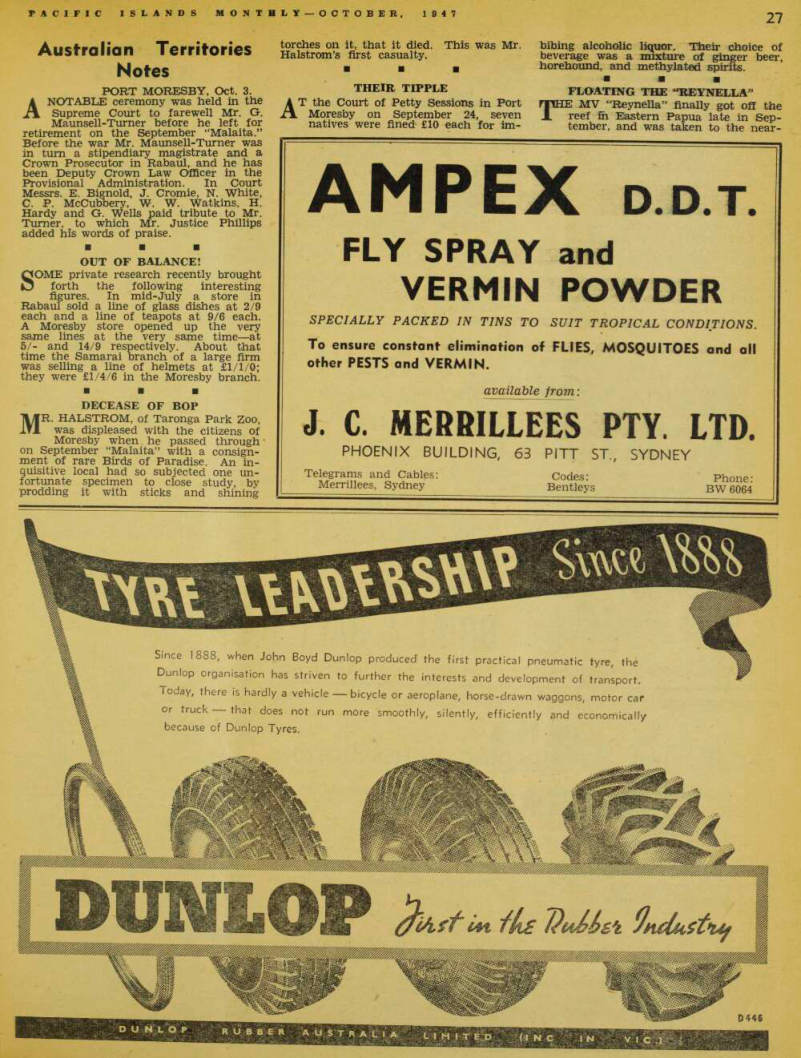
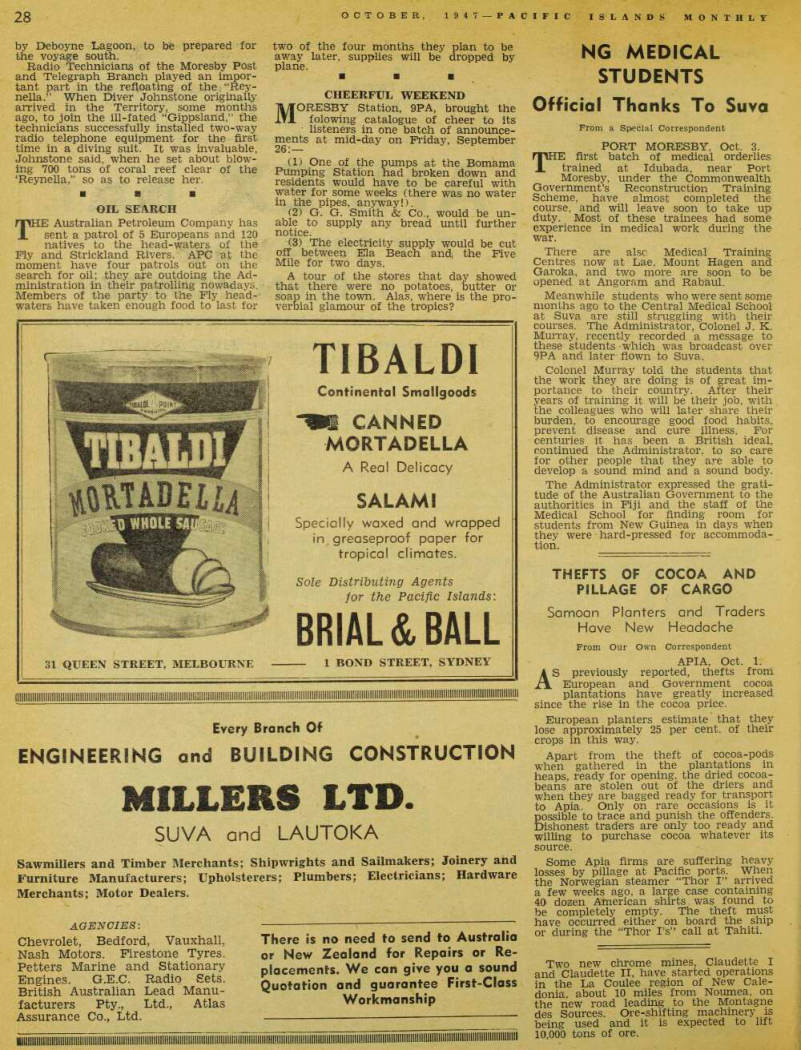
Australian Territories Notes
Port Moresby, Oct. 3.
A NOTABLE ceremony was held in the Supreme Court to farewell Mr. G.
Maunsell-Turner before he left for retirement on the September “Malaita.”
Before the war Mr. Maunsell-Turner was in turn a stipendiary magistrate and a Crown Prosecutor in Rabaul, and he has been Deputy Crown Law Officer in the Provisional Administration. In Court Messrs. E. Bignold, J. Cromie, N. White, C. P. McCubbery, W. W. Watkins, H.
Hardy and G. Wells paid tribute to Mr.
Turner, to which Mr. Justice Phillips added his words of praise. ■ ■ ■
Out Of Balance!
SOME private research recently brought forth the following interesting figures. In mid-July a store in Rabaul sold a line of glass dishes at 2/9 each and a line of teapots at 9/6 each.
A Moresby store opened up the very same lines at the very same time—at 5/- and 14/9 respectively. About that time the Samara! branch of a large firm was selling a line of helmets at £l/1/0; they were £l/4/6 in the Moresby branch. ■ ■ ■
Decease Of Bop
MR. HALSTROM, of Taronga Park Zoo, was displeased with the citizens of Moresby when he passed through on September “Malaita” with a consign ment of rare Birds of Paradise. An in quisitive local had so subjected one un fortunate specimen to close study, by prodding it with sticks and shining
torches on it, that it died. This was Mr.
Halstrom’s first casualty. ■ ■ ■
Their Tipple
AT the Court of Petty Sessions in Port Moresby on September 24, seven natives were fined £lO each for im
bibing alcoholic liquor. Their choice of beverage was a mixture of ginger beer, horehound, and methylated spirits. ■ a ■
Floating The "Reynella”
fIYHE MV “Reynella” finally got off the A reef m Eastern Papua late in Sep tember, and was taken to the near
by Deboyne Lagoon, to be prepared for the voyage south.
Radio Technicians of the Moresby Post and Telegraph Branch played an important part in the refloating of the “Reynella.” When Diver Johnstone originally arrived in the Territory, some months ago, to join the ill-fated “Gippsland,” the technicians successfully installed two-way radio telephone equipment for the first time in a diving suit. It was invaluable, Johnstone said when he set about blowmg 700 tons of coral reef clear of the Reynella, so as to release her. ■ a ■ r>TT
Oil Search
rE Australian Petroleum Company has sent a patrol of 5 Europeans and 120 natives to the head-waters of the Fly and Strickland Rivers. APC at the moment have four patrols out on the search for oil; they are outdoing the Administration in their patrolling nowadays, Members of the party to the Fly headwaters have taken enough food to last for
two of the four months they plan to be away later, supplies will be dropped by plane. ■ ■ ■
Cheerful Weekend
MORESBY Station, 9PA, brought the folowing catalogue of cheer to its listeners in one batch of announce ments at mid-day on Friday, September 26: (1) One of the pumps at the Bomama Pumping Station had broken down and residents would have to be careful with water for some weeks (there was no water in the pipes, anyway!), (2) G, G. Smith & Co., would be un able to supply any bread until further notice. (3) The electricity supply would be cut off between Ela Beach and, the Five Mile for two days.
A tour of the stores that day showed that there were no potatoes, butter or soap in the town. Alas, where is the pro verbial glamour of the tropics?
Advertisements & other items, pp. 31-32 (1 item)
Dunlop I.
AM REX d.d.t.
FLY SPRAY and
VERMIN POWDER
SPECIALLY PACKED IN TINS TO SUIT TROPICAL CONDITIONS.
To ensure constant elimination of FLIES, MOSQUITOES and all other PESTS and VERMIN. available from:
l C. MERRILLEES PTY. LTD.
PHOENIX BUILDING, 63 PITT ST., SYDNEY
Telegrams and Cables: Codes: Phone: Merrlllees, Sydney Bentleys BW 6064
Since 1888, when John Boyd Dunlop produced the first practical pneumatic tyre, the Dunlop organisation has striven to further the interests and development of transport.
Today, there is hardly a vehicle bicycle or aeroplane, horse-drawn waggons, motor car or truck— that does not run more smoothly, silently, efficiently and economically because of Dunlop Tyres, \v
DUNLOP i.
D 448
RUBBER AUS7
RAL I A
(I N C
I T E,;p
v i e v.
2.: V
31 QUEEN STREET, MELBOURNE
TIBALDI
Continental Smallgoods
CANNED
MORTADELLA
A Real Delicacy
SALAMI
Specially waxed and wrapped in. greaseproof paper for tropical climates.
Sole Distributing Agents for the Pacific Islands:
BRIAL & BALL
1 BOND STREET, SYDNEY
Every Branch Of
ENGINEERING and BUILDING CONSTRUCTION
MILLERS LTD.
SUVA ond LAUTOKA
Sawmillers and Timber Merchants; Shipwrights and Sailmakers; Joinery and Furniture Manufacturers; Upholsterers; Plumbers; Electricians; Hardware Merchants; Motor Dealers.
AGENCIES:
Chevrolet, Bedford, Vauxhall, Nash Motors. Firestone Tyres.
Fetters Marine and Stationary Engines. G.E.C. Radio Sets.
British Australian Lead Manufacturers Pty., Ltd., Atlas Assurance Co., Ltd.
There is no need to send to Australia or New Zealand for Repairs or Replacements. We can give you a sound Quotation and guarantee First-Class Workmanship
Students
Ng Medical
Official Thanks To Suva
Prom a Special Correspondent
Port Moresby. Oct. 3.
rE first batch of medical orderlies trained at Idubada, near Port Moresby, under the Commonwealth Government’s Reconstruction Training Scheme, have almost completed the course, and will leave soon to take up duty. Most of these trainees had some experience in medical work during the war.
There are also Medical Training Centres now at Lae, Mount Hagen and Garoka, and two more are soon to be opened at Angoram and Rabaul.
Meanwhile students who were sent some months ago to the Central Medical School at Suva are still struggling with their courses. The Administrator, Colonel J. K.
Murray, recently recorded a message to these students which was broadcast over 9PA and later flown to Suva.
Colonel Murray told the students that the work they are doing is of great im portance to their country. After their years of training it will be their job, with the colleagues who will later share their burden, to encourage good food habits, prevent disease and cure illness. For centuries it has been a British ideal, continued the Administrator, to so care for other people that they are able to develop a sound mind and a sound body.
The Administrator expressed the grati tude of the Australian Government to the authorities in Fiji and the staff of the Medical School for finding room for students from New Guinea in days when they were hard-pressed for accommoda tion.
Thefts Of Cocoa And
Pillage Of Cargo
Samoan Planters and Traders Have New Headache
Prom Our Own Correspondent
Apia, Oct. 1.
AS previously reported, thefts from European and Government cocoa plantations have greatly increased since the rise in the cocoa price.
European planters estimate that they lose approximately 25 per cent, of their crops in this way.
Apart from the theft of cocoa-pods when gathered in the plantations in heaps, ready for opening, the dried cocoa beans are stolen out of the driers and when they are bagged ready for transport to Apia. Only on rare occasions is it possible to trace and punish the offenders.
Dishonest traders are only too ready and willing to purchase cocoa whatever its source.
Some Apia firms are suffering heavy losses by pillage at Pacific ports. When the Norwegian steamer “Thor I” arrived a few weeks ago, a large case containing 40 dozen American shirts was found to be completely empty. The theft must have occurred either on board the .ship or during the “Thor I’s” call at Tahiti.
Two new chrome mines, Claudette I and Claudette 11, have started operations in the La Coulee region of New Cale donia, about 10 miles from Noumea, on the new road leading to the Montagne des Sources. Ore-shifting machinery is being used and it is expected to lift 10,000 tons of ore.
Advertisements & other items, pp. 33-34 (1 item)
Cook*?
MU'/ A m Mummy never* wanfs to do
anything with
us nowadays.
Dad
Commg.darling ?
No Ido «N ee to m go ng down m K But not so long ago I was right out of the picture. t m * ■J They went off wifhoul me again Mother Darling, what s come over you lately ? No energy.. red don't Why ner Dr you see Chari es * m m
LATER
Gee. its fun you re here hen M um 3*. I - >5.
ATTHe VOCTORS-
Mrs Hughes,
, your symptoms
I indicate' night starvation'' ./yk
You probably don't realise it, but while you sleep you \VJIL} must replace energy lost p■ \
during the day Even ji
during the night your
heart and lungs continue their work Naturally, unless this energy is
replaced you’re bound to
wake ti red... becom e nervy. I recommend
HORLICKS .
% I. % Vv X* K- Each glass of Horlicks* before bed gives you ...
Protein essential to the growth and development of every part of the body.
Without protein to form body and tissue cells, growth cannot take place, and then wear and tear resulting from our daily activities is not made good.
Pat almost entirely derived from milk; an efficient source of energy and also of vitamins A and D.
Carbohydrate chiefly maltose and dextrin (perhaps the best source of quick energy) and lactose, which is of great value to young children.
Mineral Salts —to help in building tissue and in regulating body activities. These mineral salts include: Calcium —of which there is a deficiency in many Australian diets yet is so necessary for building p sound bone and good teeth.
Vitamins A B, B, and D— I each fulfilling its own special I job in the maintenance of j*-... sound nutrition. horlicks!
Made with milk.
F 7-4
HORLICKS STARVATION
FOR SALE
to / -
Island Merchants and
Exporters
BISCUITS
suitable for natives or will manufacture to suit.
APPLY FOR SAMPLE, BOX 15, P. 0., WATERLOO.
OVER 20
YEARS OF
PAIN
SWIFT 3-WAY RELIEF
1 From HEADACHE and ,all Nerve and Muscular Pain!
Vincent’s A.P.C Powders and Tablets r are a combination of three valuable medicinal ? ingredients and bring swift 3-way relief! Vincents A.P.C is prepared to the original hospital prescription containing Aspirin to relieve pain, Phenacetin to reduce temperature, Caffeine to stimulate the nervous system. Vincent’s A.P.C quickly relieves Headache, and all nerve and muscular pain!
NT
POWDERS & TABLETS
New Government
Of Samoa
NZ and UNO Plans
rE plan for a new system of govern ment in Western Samoa, announced by the New Zealand Government on August 27, and reported in September “PIM,” has had a certain amount of attention during the month.
Speaking in the New Zealand Parlia ment on September 18, Mr. F. W. Doidge, MP, said that the Government had taken an extraordinary course in bringing down a plan for far-reaching political changes in Samoa, while conditions in Samoa were under review by a special mission of the Trusteeship Council, which had not yet delivered its report.
The NZ Prime Minister, Mr. Fraser, replied at length to the criticism, but made no point other than saying that the NZ Government would welcome any recommendations made by the Trustee ship Council for an improved adminis tration, and the Government had in tended no discourtesy.
Mr. Doidge asked: Do you expect the Trusteeship Council’s mission to concur in the Government’s proposals?
Mr. Fraser: I cannot say. But I do not imagine that there will be any wide diversity of opinion.
The Government has not indicated the date of the introduction of the proposed legislation.
Local Reaction
¥¥7|HEN Lieut-Colonel F. W. Voelcker, TT Administrator of Western Samoa, was in New Zealand in September he discussed with the Prime Minister details of the plan for a larger measure of self-government for the Samoans.
It is expected that Samoan leaders will ask that this plan will not be put into operation until the report of the United Nations Commission on Samoa is pub lished.
Commendation By Mission
“fTIHE New Zealand Government has X done much for the people of Western Samoa, but much remains still un done, and if future progress is to be assured, fundamental changes will be in order,” said Mr. Francis B. Sayre, in an interview in New York on the work of the Trusteeship Mission, which he headed in Western Samoa.
“The New Zealand Government is con vinced of this, and the Prime Minister has already announced the Government’s desire to move forward.”
Mr. Sayre added that the mission’s re port was ready for printing and would be in the hands of Trusteeship Council members before the council session in November.
"Africa Star" Smoko 1 In
Rabaul
RABAUL ex-servicemen who are entitled to wear the African Star, rneMn the ruins of the old New Guinea Club, on September 6, for an informal smoko.
Only short notice was given but the function appears to have been an un qualified success. Those present ex pressed the hope that a similar gathering will be held each year.
The organisers point out that this is not in opposition to the RSL or any other servicemen’s organisation—that it is “just a gathering together of chaps who have something in common and who would like to swop yarns and recall ‘battles’ that took place in Cairo and Alexandria.”
Among those present were Messrs. Tony Corlass, V. Pearson, Allan Gordon, H.
Read, J. Gilmour, Jr., “Nip” Bourke, J.
Clayton and J. Parry.
Industry
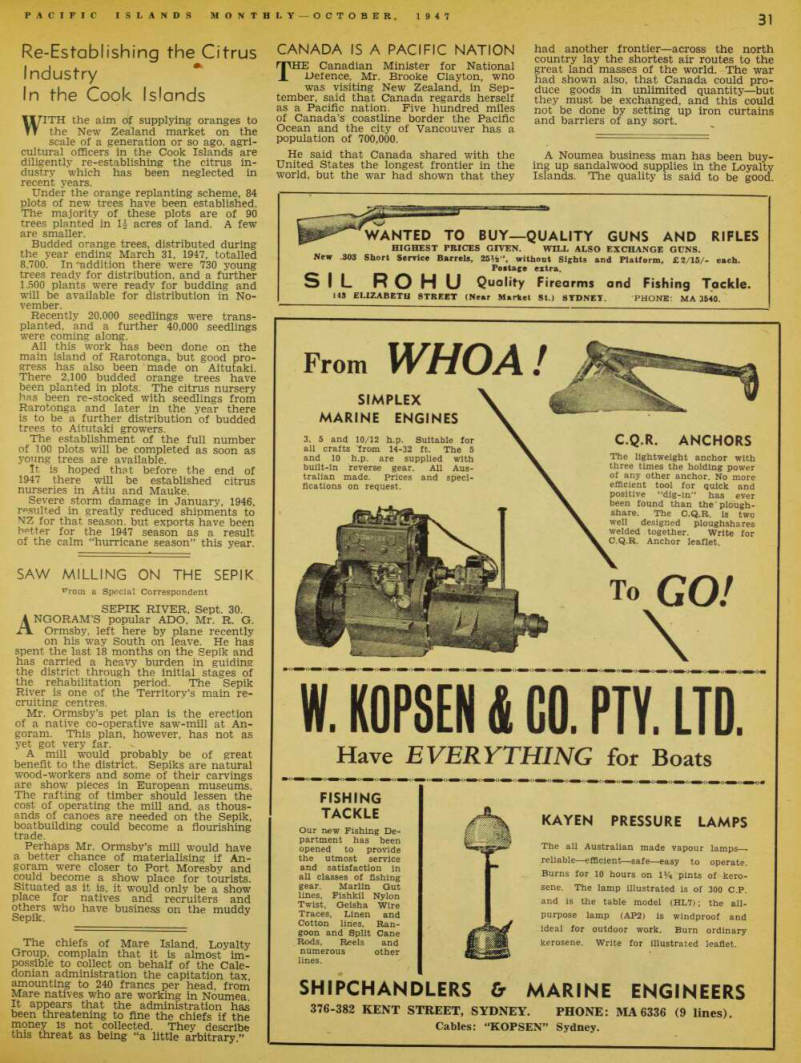
Re-Establishing the Citrus Industry In the Cook Islands
WITH the aim of supplying oranges to the New Zealand market on the scale of a generation or so ago, agri cultural officers in the Cook Islands are diligently re-establishing the citrus in dustry which has been neglected in recent years.
Under the orange replanting scheme, 84 plots of new trees have been established.
The majority of these plots are of 90 trees planted in 1J acres of land. A few are smaller.
Budded orange trees, distributed during the year ending March 31, 1947, totalled 8,700. In ‘addition there were 730 young trees ready for distribution, and a further 1.500 plants were ready for budding and will be available for distribution in No vember.
Recently 20,000 seedlings were trans planted, and a further 40,000 seedlings were coming along.
All this work has been done on the main island of Rarotonga, but good pro gress has also been made on Aitutaki.
There 2.100 budded orange trees have been planted in plots. The citrus nursery has been re-stocked with seedlings from Rarotonga and later in the year there is to be a further distribution of budded trees to Aitutaki growers.
The establishment of the full number of 100 plots will be completed as soon as young trees are available.
It is hoped that before the end of 1947 there will be established citrus nurseries in Atiu and Mauke.
Severe storm damage in January, 1946, resulted in greatly reduced shipments to NZ for that season, but exports have been better for the 1947 season as a result of the calm “hurricane season” this year.
Saw Milling On The Sepik
a Special Correspondent
Sepik River. Sept. 30.
ANGORAM’S popular ADO, Mr. R. G.
Ormsby, left here by plane recently on his way South on leave. He has spent the last 18 months on the Sepik and has carried a heavy burden in guiding the district through the initial stages of the rehabilitation period. The Sepik River is one of the Territory’s main re cruiting centres.
Mr. Ormsby’s pet plan is the erection of a native co-operative saw-mill at An goram. This plan, however, has not as yet got very far.
A mill would probably be of great benefit to the district. Sepiks are natural wood-workers and some of their carvings are show pieces in European museums.
The rafting of timber should lessen the cost of operating the mill and, as thous ands of canoes are needed on the Sepik, boatbuilding could become a flourishing trade.
Perhaps Mr. Ormsby’s mill would have a better chance of materialising if An goram were closer to Port Moresby and could become a show place for tourists.
Situated as it is, it would only be a show place for natives and recruiters and others who have business on the muddy Sepik.
The chiefs of Mare Island, Loyalty Group, complain that it is almost im possible to collect on behalf of the Cale donian administration the capitation tax, amounting to 240 francs per head, from Mare natives who are working in Noumea.
It appears that the administration has been threatening to fine the chiefs if the money is not collected. They describe this threat as being “a little arbitrary”
Canada Is A Pacific Nation
THE Canadian Minister for National Defence, Mr. Brooke Clayton, wno was visiting New Zealand, in Sep tember, said that Canada regards herself as a Pacific nation. Five hundred miles of Canada’s coastline border the Pacific Ocean and the city of Vancouver has a population of 700,000.
He said that Canada shared with the United States the longest frontier in the world, but the war had shown that they
had another frontier—across the north country lay the shortest air routes to the great land masses of the world. The war had shown also, that Canada could pro duce goods in unlimited quantity—but they must be exchanged, and this could not be done by setting up iron curtains and barriers of any sort.
A Noumea business man has been buy ing up sandalwood supplies in the Loyalty Islands. 'The quality is said to be good.
Advertisements & other items, pp. 35-36 (1 item)
W. Kopsen 4 Go. Ptv. Ltd
WANTED TO BUY—QUALITY GUNS AND RIFLES
HIGHEST PRICES GIVEN, WILL ALSO EXCHANGE GUNS.
New ,303 Short Service Barrels, 25*4", without Sights and Platform, £2/15/- each.
Postage extra.
SI L RO H U Quality Firearms and Fishing Tackle. 143 ELIZABETH STREET (Near Market St.) SYDNEY.
PHONE; MA 3540.
From WHOA
SIMPLEX
MARINE ENGINES
3, 5 and 10/12 h.p. Suitable for all crafts "from 14-32 ft. The 5 and 10 h.p. are supplied with built-in reverse gear. All Australian made. Prices and specifications on request.
C.Q.R. ANCHORS
The lightweight anchor with three times the holding power of any other anchor. No more efficient tool for quick and positive “dig-in” has ever been found than the ploughshare. The C.Q.R. is two well designed ploughshares welded together. Write for C.Q.R. Anchor leaflet.
t« CO!
W. KOPSEN 4 GO. PTV. LTD
Have EVERYTHING for Boats
FISHING
TACKLE
Our niew Fishing Department has been opened to provide the utmost service and satisfaction in all classes of fishing gear. Marlin Gut lines, Fishkil Nylon Twist, Geisha Wire Traces, Linen and Cotton lines, Rangoon and Split Cane Rods, Reels and numerous other lines.
SHIPCHANDLERS &
KAYEN PRESSURE LAMPS
The all Australian made vapour lamps reliable—efficient—safe—easy to operate.
Burns for 10 hours on IV4 pints of kerosene. The lamp illustrated is of 300 C.P. and is the table model (HL7); the allpurpose lamp (AP2) is windproof and ideal for outdoor work. Burn ordinary kerosene. Write for illustrated leaflet.
MARINE ENGINEERS
376-382 KENT STREET, SYDNEY. PHONE: MA 6336 (9 lines).
Cables: “KOPSEN” Sydney.
LAUREL KEROSENE
Your refrigerator will operate more efficiently and economically on Laurel - the cleanest, purest kerosene you can buy. Laurel burns steadily to the last drop, without smoke or smell. It is the perfect kerosene for refrigeration.
VACUUM OIL COMPANY PTY. LTD. (Incorp. in Aust.) L 4642
VACUUM
QUALITY PRODUCT
Restrictive !
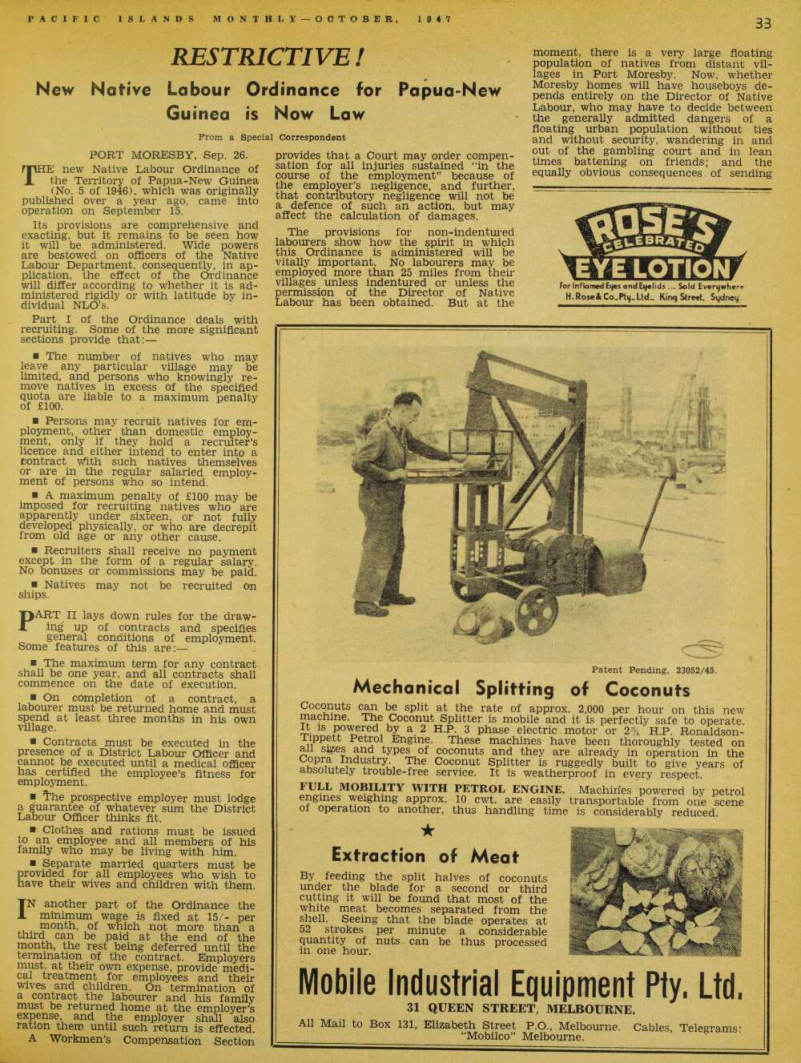
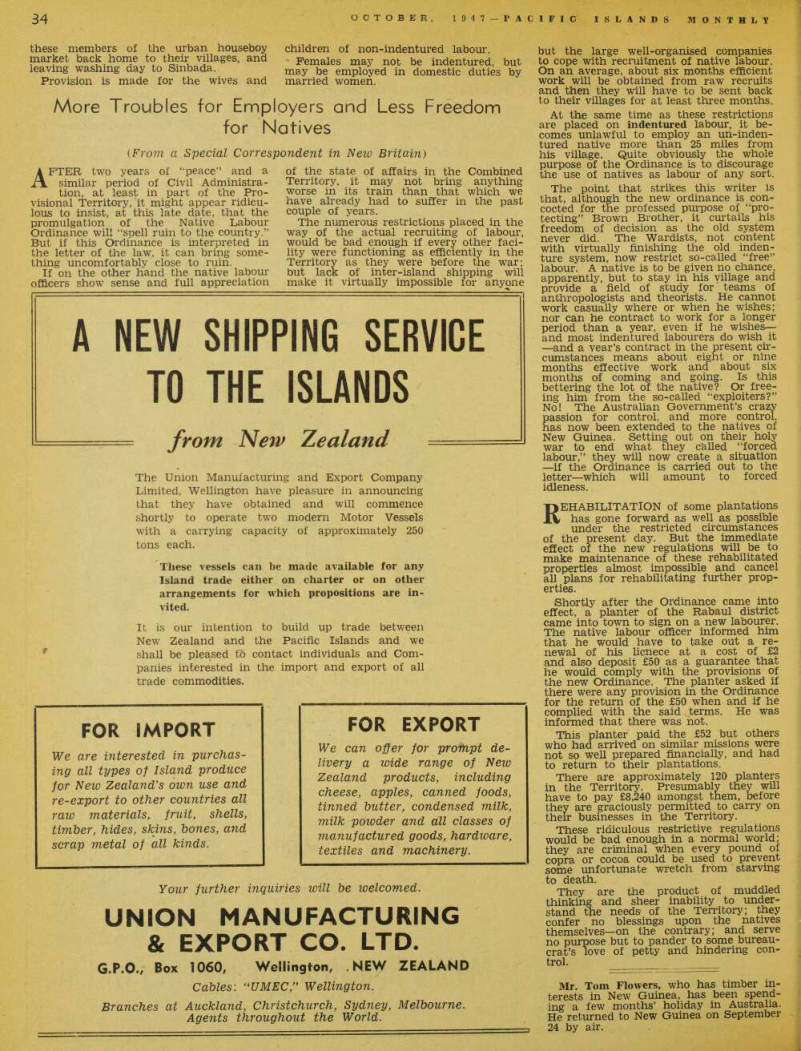
New Native Labour Ordinance for Papua-New Guinea is Now Law
Prom a Special Correspondent
Port Moresby, Sep. 26.
fIIHE new Native Labour Ordinance of X the Territory of Papua-New Guinea (No. 5 of 1946), which was originally published over a year ago, came into operation on September 15.
Its provisions are comprehensive and exacting, but it remains to be seen how it will be administered. Wide powers are bestowed on officers of the Native Labour Department, consequently, in ap plication, the effect of the Ordinance will differ according to whether it is ad ministered rigidly or with latitude by in dividual NLO’s.
Part I of the Ordinance deals with recruiting. Some of the more significant sections provide that:— ■ The number of natives who may leave any particular village may be limited, and persons who knowingly re move natives in excess of the specified quota are liable to a maximum penalty of £lOO. ■ Persons may recruit natives for em ployment, other than domestic employ ment, only if they hold a recruiter’s licence and either intend to enter into a contract v/ith such natives themselves or are in the regular salaried employ ment of persons who so intend. ■ A maximum penalty of £lOO may be imposed for recruiting natives who are apparently under sixteen, or not fully developed physically, or who are decrepit from old age or any other cause. ■ Recruiters shall receive no payment except in the form of a regular salary.
No bonuses or commissions may be paid. ■ Natives may not be recruited on ships.
PART II lays down rules for the draw ing up of contracts and specifies general conditions of employment.
Some features of this are:— ■ The maximum term for any contract shall be one year, and all contracts shall commence on the date of execution. ■ On completion of a contract, a labourer must be returned home and must spend at least three months in his own village. ■ Contracts must be executed in the presence of a District Labour Officer and cannot be executed until a medical officer has certified the employee’s fitness for employment. ■ I?he prospective employer must lodge a guarantee of whatever sum the District Labour Officer thinks fit. ■ Clothes and rations must be issued to an employee and all members of his family who may be living with him. ■ Separate married quarters must be provided for all employees who wish to have their wives and children with them.
IN another part of the Ordinance the minimum wage is fixed at 15/- per ... of which not more than a third can be paid at the end of the month, the rest being deferred until the termination of the contract. Employers must, at their own expense, provide medi cal treatment for employees and their wives and children. On termination of a contract the labourer and his family must be returned home at the employer’s expense and the employer shall also ration them until such return is effected.
A Workmen’s Compensation Section
provides that a Court may order compen sation for all injuries sustained “in the course of the employment” because of the employer’s negligence, and further, that contributory negligence will not be a defence of such an action, but may affect the calculation of damages.
The provisions for non-indentured labourers show how the spirit in which this Ordinance is administered will be vitally important. No labourers may be employed more than 25 miles from their villages unless indentured or unless the permission of the Director of Native Labour has been obtained. But at the
moment, there is a very large floating population of natives from distant vil lages in Port Moresby. Now, whether Moresby homes will have houseboys de pends entirely on the Director of Native Labour, who may have to decide between the generally admitted dangers of a floating urban population without ties and without security, wandering in and £ of 0 f O S?J^ blirig ’ tune ® battening on friends; and the equally obvious consequences of sending
these members of the urban houseboy market back home to their villages, and leaving washing day to Smbada.
Provision is made for the wives and
children of non-indentured labour, Females may not be indentured, but may be employed in domestic duties by married women.
Advertisements & other items, p. 37 (1 item)
Mobile Industrial Equipment Ply. Ltd.
HE For Inflamed Eqes and Eyelids ... Sold Everywherr H.Rosc&Co..Pty. Lid.. Kinq Street. Sydney.
... &. n ■ mt.. %P%> ft; «> Patent Pending, 23052/45.
Mechanical Splitting of Coconuts
Coconuts can be split at the rate of approx. 2,000 per hour on this new machine. The Coconut Splitter is mobile and it is perfectly safe to operate, It is Powered by a 2 H.P. 3 phase electric motor or 2% H.P. Ronaldsonnppett Petrol Engine. These machines have been thoroughly tested on an sizes and types of coconuts and they are already in operation in the Copra Industry The Coconut Splitter is ruggedly built to give years of absolutely trouble-free service. It is weatherproof in every respect.
FULL MOBILITY WITH PETROL ENGINE. Machiries powered by petrol engines weighing approx. 10 cwt. are easily transportable from one scene of operation to another, thus handling time is considerably reduced
Extraction of Meat
By feeding the split halves of coconuts under the blade for a second or third cutting it will be found that most of the white meat becomes separated from the shell. Seeing that the blade operates at 52 strokes per minute a considerable quantity of nuts can be thus processed in one hour.
Mobile Industrial Equipment Ply. Ltd.
31 QUEEN STREET, MELBOURNE.
All Mail to Box 131, Elizabeth Street P. 0., Melbourne. Cables, Telegrams- “Mobilco” Melbourne.
More Troubles for Employers and Less Freedom
for Natives
(From a Special Correspondent in New Britain)
AFTER two years of “peace” and a similar period of Civil Administra tion, at least in part of the Pro visional Territory, it might appear ridicu lous to insist, at this late date, that the promulgation of the Native Labour Ordinance will “soell ruin to the country.”
But if this Ordinance is interpreted in the letter of the law, it can bring some thing uncomfortably close to ruin.
If on the other hand the native labour officers show sense and full appreciation
of the state of affairs in the Combined Territory, it may not bring anything worse in its train than that which we have already had to suffer in the past couple of years.
The numerous restrictions placed in the way of the actual recruiting of labour, would be bad enough if every other faci lity were functioning as efficiently in the Territory as they were before the war; but lack of inter-island shipping will make it virtually impossible for anyone
but the large well-organised companies to cope with recruitment of native labour.
On an average, about six months efficient work will be obtained from raw recruits and then they will have to be sent back to their villages for at least three months.
At the same time as these restrictions are placed on indentured labour, it be comes unlawful to employ an un-inden tured native more than 25 miles from his village. Quite obviously the whole purpose of the Ordinance is to discourage the use of natives as labour of any sort.
The point that strikes this writer is that, although the new ordinance is con cocted for the professed purpose of “pro tecting” Brown Brother, it curtails his freedom of decision as the old system never did. The Wardists, not content with virtually finishing the old inden ture system, now restrict so-called “free” labour. A native is to be given no chance, apparently, but to stay in his village and provide a field of study for teams of anthropologists and theorists. He cannot work casually where or when he wishes; nor can he contract to work for a longer period than a year, even if he wishes— and most indentured labourers do wish it —and a year’s contract in the present cir cumstances means about eight or nine months effective work and about six months of coming and going. Is this bettering the lot of the native? Or free ing him from the so-called “exploiters?”
No! The Australian Government’s crazy passion for control, and more control, has now been extended to the natives of New Guinea. Setting out on their holy war to end what they called “forced labour,” they will now create a situation —if the Ordinance is carried out to the letter—which will amount to forced idleness.
Rehabilitation of some plantations
has gone forward as well as possible under the restricted circumstances of the present day. But the immediate effect of the new regulations will be to make maintenance of these rehabilitated properties almost impossible and cancel all plans for rehabilitating further prop erties.
Shortly after the Ordinance came into effect, a planter of the Rataaul district came into town to sign on a new labourer.
The native labour officer informed him that he would have to take out a re newal of his licnece at a cost of £2 and also deposit £5O as a guarantee that he would comply with the provisions of the new Ordinance. The planter asked if there were any provision in the Ordinance for the return of the £5O when and if he complied with the said terms. He was informed that there was not.
This planter paid the £52 but others who had arrived on similar missions were not so well prepared financially, and had to return to their plantations.
There are approximately 120 planters in the Territory. Presumably they will have to pay £8,240 amongst them, before they are graciously permitted to carry on their businesses in the Territory.
These ridiculous restrictive regulations would be bad enough in a normal world; they are criminal when every pound of copra or cocoa could be used to prevent some unfortunate wretch from starving to death.
They are the product of muddled thinking and sheer inability to under stand the needs of the Territory; they confer no blessings upon the natives themselves—on the contrary; and serve no purpose but to pander to some bureau crat’s love of petty and hindering con trol.
Mr. Tom Flowers, who has timber in terests in New Guinea, has been spend ing a few months’ holiday in Australia.
He returned to New Guinea on September 24 by air.
Advertisements & other items, p. 38 (1 item)
A New Shipping Service
TO THE ISLANDS
= = from New Zealand ==
The Union Manufacturing and Export Company Limited, Wellington have pleasure in announcing that they have obtained and will commence shortly to operate two modern Motor Vessels with a carrying capacity of approximately 250 tons each.
These vessels can be made available for any Island trade either on charter or on other arrangements for which propositions are invited.
It is our intention to build up trade between New Zealand and the Pacific Islands and we shall be pleased to contact individuals and Companies interested in the import and export of all trade commodities.
FOR IMPORT
We are interested in purchasing all types of Island produce for New Zealand’s own use and re-export to other countries all raw materials, fruit, shells, timber, hides, skins, bones, and scrap metal of all kinds.
FOR EXPORT
We can offer for prompt delivery a wide range of New Zealand products, including cheese, apples, canned foods, tinned butter, condensed milk, milk powder and all classes of manufactured goods, hardware, textiles and machinery.
Your further inquiries will be welcomed.
UNION MANUFACTURING
& EXPORT CO. LTD.
G.P.0., Box 1060/ Wellington, NEW ZEALAND Cables : “UMEC,” Wellington.
Branches at Auckland, Christchurch, Sydney, Melbourne.
Agents throughout the World.
Death Of Mrs. J. Legge
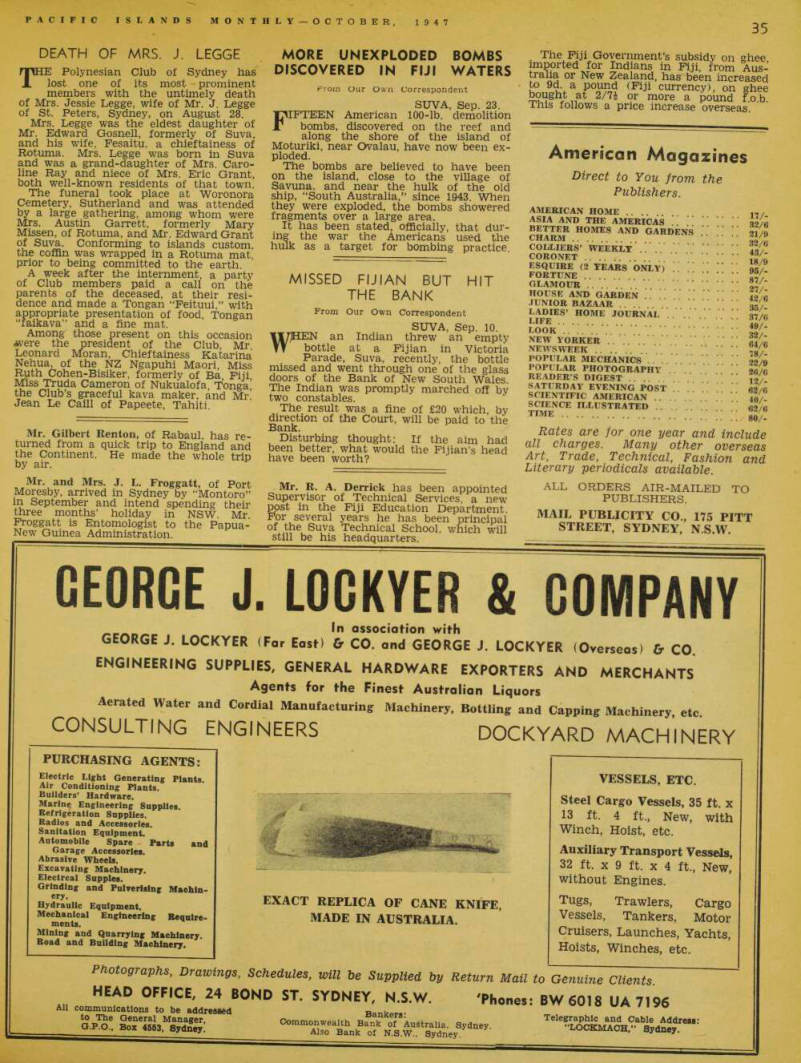
rpHE Polynesian Club of Sydney has X lost one of its most prominent members with the untimely death of Mrs. Jessie Legge, wife of Mr. J. Legge of St. Peters, Sydney, on August 28.
Mrs. Legge was the eldest daughter of Mr. Edward Gosnell, formerly of Suva, and his wife, Fesaitu, a chieftainess of Rotuma. Mrs. Legge was born in Suva and was a grand-daughter of Mrs. Caro line Ray and niece of Mrs. Eric Grant, both well-known residents of that town.
The funeral took place at Woronora Cemetery, Sutherland and was attended by a large gathering, among whom were Mrs. Austin Garrett, formerly Mary Missen, of Rotuma, and Mr. Edward Grant of Suva. Conforming to islands custom, the coffin was wrapped in a Rotuma mat, prior to being committed to the earth.
A week after the internment, a party of Club members paid a call on the parents of the deceased, at their resi dence and made a Tongan “Feituui,” with appropriate presentation of food, Tongan “raikava” and a fine mat.
Among those present on this occasion *vere the president of the Club, Mr Leonard Moran, Chieftainess Katarina Nehua, of the NZ Ngapuhi Maori, Miss Ruth Cohen-Bisiker, formerly of Ba Fiji Miss Truda Cameron of Nukualofa, Tonga! the Club’s graceful kava maker, and Mr Jean Le Caill of Papeete, Tahiti.
Mr. Gilbert Renton, of Rabaul, has re turned from a quick trip to England and the Continent. He made the whole trip by air.
Mr. and Mrs. J. L. Froggatt, of Port Moresby, arrived in Sydney by “Montoro” in September and intend spending their three months’ holiday in NSW. Mr Froggatt is Entomologist to the Papua- New Guinea Administration.
More Unexploded Bombs
Discovered In Fiji Waters
From Our Own Correspondent
Suva, Sep. 23.
FIFTEEN American 100-lb. demolition bombs, discovered on the reef and along the shore of the island of Moturiki, near Ovalau, have now been ex ploded.
The bombs are believed to have been on the island, close to the village of Savuna, and near the hulk of the old ship, “South Australia,” since 1943. When they were exploded, the bombs showered fragments over a large area.
It has been stated, officially, that dur ing the war the Americans used the hulk as a target for bombing practice.
Missed Fijian But Hit
The Bank
From Our Own Correspondent
Suva, Sep. 10.
IIfIHEN an Indian threw ah empty TT bottle at a Fijian in Victoria Parade, Suva, recently, the bottle missed and went through one of the glass doors of the Bank of New South Wales.
The Indian was promptly marched off by two constables.
The result was a fine of £2O which, by direction of the Court, will be paid to the Bank.
Disturbing thought: If the aim had been better, what would the Fijian’s head have been worth?
Mr. R. A. Derrick has been appointed Supervisor of Technical Services, a new post in the Fiji Education Department.
For several years he has been principal of the Suva Technical School, which will still be his headquarters.
. The Fiji Government’s subsidy on ghee imported for Indians in Fiji, from Aus traha or New Zealand, has been increased to 9d. a pound (Fiji currency), on ghee bought at 2/7} or more a pound f“b This follows a price increase overseas.
Advertisements & other items, pp. 39-40 (1 item)
George J. Logkyer & Company
American Magazines
Direct to You from the
Publishers.
AMERICAN HOME ... 17/
ASIA AND THE AMERICAS
BETTER HOMES AND GARDENS . . :: 21/9
COLLIERS’ WEEKLY . 5o/ 6
CORONET
ESQUIRE (2 YEARS ONLY) . I//
FORTUNE ... J®'
glamour y/r
HOUSE AND GARDEN . 7o /a
JUNIOR BAZAAR ... ij?
LADIES’ HOME JOURNAL . 37 /6
look . . . ; . "/■
NEW YORKER f/'
NEWSWEEK rj?
POPULAR MECHANICS 22/»
POPULAR PHOTOGRAPHY ofl/fi
READER’S DIGEST ... 12/
SATURDAY EVENING POST
SCIENTIFIC AMERICAN 7k/
SCIENCE ILLUSTRATED <52/ 6
TIME 80/-
Rates are for one year and include all charges. Many other overseas
Art, Trade, Technical, Fashion and
Literary periodicals available.
ALL ORDERS AIR-MAILED TO
PUBLISHERS.
MAIL PUBLICITY CO., 175 PITT
STREET, SYDNEY, N.S.W.
GEORGE J. LOGKYER & COMPANY
In association with GEORGE J. LOCKYER (Far East) & CO. and GEORGE J. LOCKYER (Overseas) & CO.
ENGINEERING SUPPLIES, GENERAL HARDWARE EXPORTERS AND MERCHANTS
Agents for the Finest Australian Liquors
Aerated Water and Cordial Manufacturing Machinery, Bottling and Capping Machinery, etc.
CONSULTING ENGINEERS DOCKYARD MACHINERY
PURCHASING AGENTS:
Electric Light Generating Plants.
Air Conditioning Plants.
Builders’ Hardware.
Marine Engineering Supplies.
Refrigeration Supplies.
Radios and Accessories.
Sanitation Equipment.
Automobile Spare Parts and Garage Accessories.
Abrasive Wheels.
Excavating Machinery.
Electrcal Supples.
Grinding and Pulverising Machinery.
Hydraulic Equipment.
Mechanical Engineering Requirements.
Mining and Quarrying Machinery.
Road and Building Machinery.
EXACT REPLICA OF CANE KNIFE,
MADE IN AUSTRALIA.
Photographs, Drawings, Schedules, will he Supplied by Return Mail HEAD OFFICE, 24 BOND ST. SYDNEY, N.S.W. 'Phones
VESSELS, ETC.
Steel Cargo Vessels, 35 ft. x 13 ft. 4 ft., New, with Winch, Hoist, etc.
Auxiliary Transport Vessels,
32 ft. x 9 ft. x 4 ft., New, without Engines.
Tugs, Trawlers, Cargo
Vessels, Tankers, Motor
Cruisers, Launches, Yachts,
Hoists, Winches, etc.
All communications to be addressed to The General Manager, G.P.0., Box 4563, Sydney.
Bankers: Commonwealth Bank of Australia, Sydney Also Bank of N.S.W., Sydney. to Genuine Clients.
\ BW 6018 UA 7196
Telegraphic and Cable Address: "LOCKMAOH,” Sydney.
When you can
see...
you’re safe ! »
eVEREADy
TRADE-MARK
FLASHLIGHT
BATTERIES
give longer life.
Look for the Dateline
DEPENDABLE, ECONOMICAL, POWERFUL.
G. H, Robinson
ISLAND SUPPLIES
of all kinds—Selected and Shipped to order at lowest possible prices—Piecegoods in Wool, Cotton and Silk, Under and Outerwear, Manchester, Drapery, Grocery, Hardware, Engineers and Leathergoods trade supplies a specialty.
Indents and Transhipments arranged. Large or small orders treated with equal care.
Use our 25 years’ extensive experience.
Enquiries solicited to —
G. H. ROBINSON
51 Macquarie Street, Sydney, N.S.W.
Telegrams; Sunrise, Sydney.
Letters: Box 3317, G.P.0., Sydney.
Fiji Population
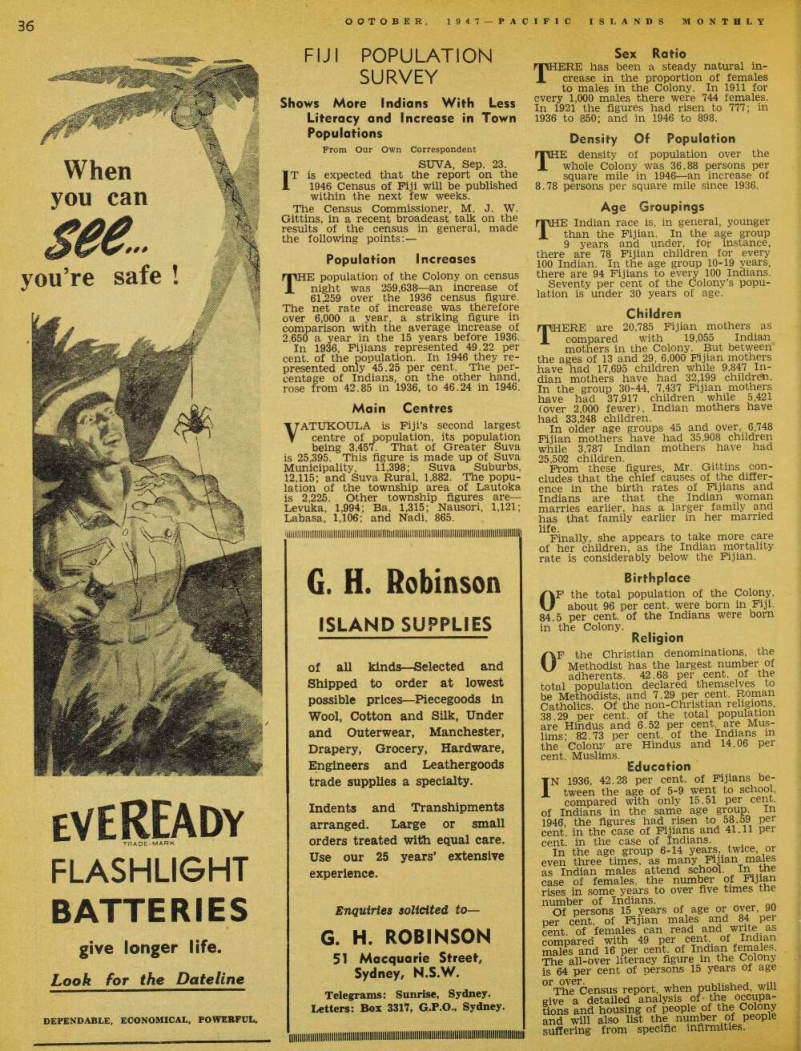
Survey
Shows More Indians With Less Literacy and Increase in Town Populations
From Our Own Correspondent
Suva, Sep. 23.
IT is expected that the report on the 1946 Census of Fiji will be published within the next few weeks.
The Census Commissioner, M. J. W.
Gittins, in a recent broadcast talk on the results of the census in general, made the following points;—
Population Increases
rE population of the Colony on census night was 259,638 —an increase of 61,259 over the 1936 census figure.
The net rate of increase was therefore over 6,000 a year, a striking figure in comparison with the average increase of 2,650 a year in the 15 years before 1936.
In 1936, Fijians represented 49.22 per cent, of the population. In 1946 they re presented only 45.25 per cent. The per centage of Indians, on the other hand, rose from 42.85 in 1936, to 46.24 in 1946.
Main Centres
YATUKOULA is Fiji’s second largest centre of population, its population being 3,457. That of Greater Suva is 25,395. This figure is made up of Suva Municipality, 11,398; Suva Suburbs, 12,115; and Suva Rural, 1,882. The popu lation of the township area of Lautoka is 2,225. Other township figures are— Levuka, 1,994; Ba. 1,315; Nausori, 1,121; Labasa, 1,106; and Nadi, 865.
Sex Ratio
rERE has been a steady natural in crease in the proportion of females to males in the Colony. In 1911 for every 1,000 males there were 744 females.
In 1921 the figures had risen to 777; in 1936 to 850; and in 1946 to 898.
Density Of Population
rpHE density of population over the X whole Colony was 36.88 persons per square mile in 1946—an increase of 8.78 persons per square mile since 1936.
Age Groupings
rE Indian race is, in general, younger than the Fijian. In the age group 9 years and under, for instance, there are 78 Fijian children for every 100 Indian. In the age group 10-19 years, there are 94 Fijians to every 100 Indians.
Seventy per cent of the Colony’s popu lation is under 30 years of age.
Children
rERE are 20,785 Fijian mothers as compared with 19,055 Indian mothers in the Colony. But between the ages of 13 and 29, 6,000 Fijian mothers have had 17,695 children while 9,847 In dian mothers have had 32,199 children.
In the group 30-44, 7,437 Fijian mothers have had 37,917 children while 5,421 (over 2,000 fewer), Indian mothers have had 33,248 children.
In older age groups 45 and over, 6,748 Fijian mothers have had 35,908 children while 3,787 Indian mothers have had 25,502 children.
From these figures, Mr. Gittins con cludes that the chief causes of the differ ence in the birth rates of Fijians and Indians are that the Indian woman marries earlier, has a larger family and has that family earlier in her married life.
Finally, she appears to take more care of her children, as the Indian mortality rate is considerably below the Fijian.
Birthplace
OF the total population of the Colony, about 96 per cent, were born in Fiji. 84.5 per cent, of the Indians were born in the Colony.
Religion
OF the Christian denominations, the Methodist has the largest number of adherents. 42.68 per cent, of the total peculation declared themselves to be Methodists, and 7.29 per cent. Roman Catholics. Of the non-Christian religions, 38.29 per cent, of the total population are Hindus and 6.52 per cent are Mus lims- 82.73 per cent, of the Indians m the Colon;/ are Hindus and 14.06 per cent. Muslims.
Education
IN 1936, 42.28 per cent, of Fijians be tween the age of 5-9 went to school, compared with only 15.51 per cent, of Indians in the same age group. In 1946, the figures had risen to 58 59 per cent, in the case of Fijians and 41.11 per cent, in the case of Indians.
In the age group 6-14 years, twice, or even three times, as many Fijian males as Indian males attend school. In the case of females, the number of Fijian rises in some years to over five times tne number of Indians.
Of persons 15 years of age or over, 90 ner cent, of Fijian males and 84 per cent, of females can read and write as compared with 49 per cent of Indian males and 16 per cent of Indian females The all-over literacy figure in the Colony is 64 per cent of persons 15 years of age ° r The Census report, when published, will give a detailed analysis of the occupa tions and housing of people of the Colony and will also list the number of people suffering from specific infirmities.
Enter Fiji
Permits Necessary to Enter Fiji New Immigration Bill For Legislative Council
Suva, Sep. 23.
ANEW Immigration Bill, to be pre sented at the next session of Fiji’s Legislative Council, has been pub lished.
It will in future be an offence for any persons to whom the Bill applies to enter the Colony without a permit, which may be a transit permit for passengers in transit, a resident’s nermit for persons in tending to stay more than 12 months, or a visitors permit valid for 12 months.
Certain classes of persons are exempted from the provisions of the Bill. These include British subjects born or domi ciled in Fiji.
The Bill provides that the Governor shall have power to exempt visitors or any class of visitors from the necessity for obtaining a permit.
The Principal Immigration Officer is given complete discretion, subject to the direction of the Governor, as to whether or not permits will be issued. (Editorial Note: Before the war, in order to enter Fiji it was necessary to have a valid Passport and one’s return fare. During the war it was necessary to have special permission—a permit. Per mits were, however, discontinued soon after hostilities ceased. Now, apparently, they are to be re-introduced. The pas sion for all Governments for more and more restrictions, dressed up as “permits,” ‘regulations,” and “controls,” is extra ordinary. It would be interesting to know what benefit the Colony of Fiji will de rive from the issuing of such “permits to enter,” Presumably the new Bill is not designed to simplify travel.)
The Archbishop of Sydney, the Most Rev. H. W. K. Mowll, and a Fijian Methodist minister, the Rev. Setariki Tuilovoni, were among the delegates at the International Missionary Council’s recent meeting at Whitby, Ontario, Canada. When the Archbishop passed through Fiji in early September on his way back to Sydney, he spoke warmly of the excellent impression created at the conference by the Fijian minister and his work. The Rev. Setariki Tuilovoni
later went to England at the request of the World Sunday School Association to attend a conference at Birmingham, and he is now lecturing in the United States in association with the American Method ist Missionary Society. He expects to re turn to Fiji in November.
Mr. F. E. M. Warner, at present at tached to the Registrar-General’s De partment. Suva, Fiji, has now been ap pointed Marketing Officer with the local Agriculture Department.
Advertisements & other items, p. 41 (1 item)
Budge
Available for regular shipment from Australia.
• CANNED FOODS
• TRADE GOODS
• TEXTILES, “Lap lap”
All orders promptly attended to
Cable "VIVIANPAT”
STEWART & FINCH
19 HUNTER STREET, SYDNEY
TELEPHONES:
LA5034-5-6
BUDGE
REFRIGERATION
EQUIPMENT
Commercial and Industrial Units
(not- domestic) Ammonia and Methyl Chloride machines of large or small capacity.
The illustration is of a complete 30 cwt. Ice-making Plant, comprising twin, enclosed ammonia compressor, evaporative condenser, insulated ice tank, etc. It may be driven by a 10 h.p. electric motor or diesel engine.
Inquirers should mention dimensions of cold room (or cabinet) and amount of ice (if any) required per day.
JAMES BUDGE PTY. LTD.
Established 1890.
REFRIGERATION ENGINEERS
MeEvoy Street, Alexandria,
Sydney
Missing Off Viti Levu
Coast
From Our Own Correspondent
Suva, Sep. 10.
DESPITE searches by plane and by parties of police and local boy scouts, no trace has been found of Mr. Raymond Bucknell, a well-known farmer and fisherman, and his Fijian as sistant, Alaveti Tukana, of Kadavu. They disappeared while on a launch journey near the mouth of the Sigatoka River.
Wreckage and the engine of the launch were subsequently found inside the river mouth and it is believed that the boat may have been smashed by heavy seas.
Mr. N. Guinio, who was reported in the July “PlM’’ to be instructing the Sepik River natives (New .Guinea) in the art of crocodile-skinning, returned to his headquarters in Cairns in August. After a week in civilisation he went off again for more crocodiles, this time to Cape York Peninsula. He believes that croco dile-hunting in Papua and New Guinea could become an important industry.
Mr W. W. A. Miller departed from Sydney recently for the Gilbert and Ellice Group, where he will join the Adminis tration staff.
Miss Marjorie Tully of Cairns. Qld., will shortly leave for Lae, New Guinea, where she will marry Mr. Charges Boat, of the Civil Aviation Department.
Unrestricted Trade
In French Pacific Possessions
TAHITI, during the first nine months of 1946 exported far more than she imported. The favourable Tahitian balance of trade amounted to about 28 million francs. The exports amounted to 178,000,000 valued at 191,000,000 francs, principally phosphates from Makatea Is land sent to Australia and New Zealand and copra sent to France and the USA.
For the" nine months the Colony imported 20,000 tons of merchandise valued at 164,000,000 francs.
Luxury goods from France have been pouring into Tahiti and New Caledonia, and in New Caledonia expensive wines and perfumes are at least as readily ob tainable as necessities of life, although this Colony has an adverse trade balance.
Besides French manufactured cars, ex pensive automobiles from the USA have also been arriving in Noumea, which has far more automobile traffic than ever be fore, with apparently a complete absence of petrol restrictions. Caledonians expect a bad slump to hit the colony in the not too disant future, particularly if nothing is done to increase nickel exports and keep the Noumea smelters in full pro duction. During the first six months of 1947, New Caledonia had a trade deficit of 195,000,000 francs, shown as follows;
Quantity Value Imports 36,408 tons 270,000,000 francs Exports 16.932 tons 75,000,000 francs
Currency Restrictions
Operate In Fiji
From Our Own Correspondent
Suva, Sep. 23.
FROM August 22 until September 9, no import licences were issued by the Government of Fiji, and since Sep tember 9, licences have been granted only for essential goods which are urgently needed.
This is the first major effect, in Fiji, of the world currency crisis.
The Government has stated that an announcement in regard to the Colony’s import policy in general, will be made “as soon as possible.”
Death Of Mr. W. Tate
rE death occurred on September 6 in Fiji of Mr. William Tate, a well known and well respected Fiji resi dent. He was born in Suva and was 67.
He was educated in Victoria, and in 1911 joined the clerical staff of the Pub lic Works Department in Fiji. He re tired in 1939, but in 1940 rejoined the Government service as a temporary war time official.
Mr Tate is survived by his wife (who was Miss Elspeth Woolley) and by one son and three daughters.
Death Of Miss D. B. Monaghan

rE death occurred at Suva on Sep tember 14 of Miss D. B. Monaghan.
She arrived in Fiji from Australia in 1923 on a holiday visit. She returned three years later to settle in the Colony.
She was an active member of the com mittee of the Suva Circulating Library and during the war was on the committee of the New Zealand Club, which was established to provide for the welfare of servicemen on leave in Suva.
Mr. Arthur Ethell, a former public ser vant in New Guinea, returned to the Territory in September, to take over management of the Bubuleta Nabene and Hihila Estates plantations, at Milne Bay.
Mr. Ethell took with him a 35-foot Raised Deck motor boat, which he will use to carry copra from his plantations; and with him were his crew members (Arthur McDonald, John Struthers and coloured boy Sam Bowden). Whilst in Cairns, Mr. Ethell lectured at the Rotary Club, on the present administration of the Ter ritories and he compared it—unfavourably —with the pre-war administration.
Advertisements & other items, pp. 42-44 (2 items)
Wormgeared
Tillock & Co. Pfy. Ltd.
Kent and Liverpool Streets, Sydney,
ISLAND TRADERS SINGE 1875
and Manufacturers of
AUNT MARY'S BAKING POWDER
AUNT MARY'S TOMATO SAUCE
AUNT MARY'S TOMATO SOUP
AUNT MARY'S TOMATO JUICE
AUNT MARY'S TOMATO PUREE
and other Pure Food Products INVITES inquiries from merchants trading in and with the Islands.
CABLE ADDRESS: TILLOCK, SYDNEY
WORMGEARED
CHAIN HOISTS
The hand-operated Wormgeared Hoist is a general purpose lifting device, compact and easy to handle. The Wormgear is designed to give comparatively high efficiency and long life. A simple and effective brake insures safe holding of the suspended load.
Available in rated capacities from 10 cwts. to 3 tons.
Also makers of: A.B.C. Electric Chain Hoists, y 2, 1, 2 tons capacity.
“Victor” Spurgeared Chain Hoists from 10 cwts. to 20 tons.
Triple Geared Chain Hoists from 10 cwts. to 20 tons.
Worm Geared Chain Hoists from 10 cwts. to 3 tons.
Weston Chain Blocks from 5 cwts. to 2 tons.
Shackles, Hooks, Sheave and Snatch Blocks.
AUSTRALIAN BLOCK & CHAIN CO.
PTY., LTD.
Robbs Road, WEST FOOTSCRAY, W. 12,
VICTORIA
Phones: MW 1373-74-75.
Telegraphic Address: “CHAINBLOCK.” MELBOURNE.
Correspondence to Box 34, FOOTSCRAY, W.ll, VICTORIA.
Electrolux
There is only one
THE MODERN KEROSENE-OPERATED REFRIGERATOR
THAT ACHIEVES THE MIRACLE OF ICE FROM HEAT
Lasting Efficiency, Silent Operation, Streamlined Beauty
Economically operated by kerosene, with a simple precision-built freezing unit that has no moving parts and is GUARANTEED FOR
FIVE (5) YEARS.
Obtainable from : W. R. CARPENTER (New Guinea), LTD.
Rabaul, Madang, Lae, Kavieng, Wau.
J. R. CLAY & CO., LTD., Port Moresby.
W. R. CARPENTER & CO. (Sol. Is.), LTD., Tulagi.
For New Hebrides, Butaritari, Noumea, New Caledonia. Apply— Model LKSSI Storage capacity: 5i cub. ft. (approx) shelf area, 9 sq. ft.; food shelves, six—fiv€ removable; 2 self-supporting when hal drawn. Ice-making: Four trays—s lb. ice per freezing: 80 cubes. Fuel consumption 1.8 pints kerosene per day (approx.) Height: 4 ft. 10 in. Depth: 2 ft; 3± in, Weight, unpacked, 434 lb. Packed, 700 lb W. R* CARPENTER fir CO. LTD. Head Office: 16 O'Connell St., Sydney, N. S. Wales
PACIFIC ISLANDS SOCIETY
Visitors from the Islands to Sydney (or those interested in Islands affairs), are advised to communicate with the honorary secretary of the above Society, which has been formed to study the history, traditions, economics, and political developments of the Pacific Islands.
Regular monthly meetings are held at History House, 8 Young Street, Sydney.
Address for Correspondence:
THE PACIFIC ISLANDS SOCIETY,
Box 2434 MM., G.P.0., Sydney.
mid
this Energising Satisfying Dish. <r \ m When your E.Q.'s* at Its lowest after a hot, tiring day, relax and renew lost energy with delicious Imperial Hampe.
Cool, flavoursome and satisfying, Hampe served in Salads, Sandwiches or Savouries ranks first favourite with all the family.
Quick and simple to prepare, It's the Ideal meal for hot days. * Energy Quotient.
Try Imperial Meatreat, Corned Beef, Hot Meals, etc.
Sh .33.47
Imperial
Who Owns Christmas Is.
Copra?
A STRANGE situation seems to have developed in conection with the ownership of the plantations on Christmas Island, which is part of the Gilbert &' Ellice Islands Colony.
When the late Father Rougier retired from his charge as a Catholic missionary in Fiji, and took over the administration of important properties in the central and eastern Pacific, with headquarters in Tahiti, he held among other things a 99 years’ lease over Christmas Island. This property was administered along with other interests he controlled in the neigh bouring islands of Washington and Fan ning.
When World War II spread over the Pacific, these arrangements were more or less disorganised and somehow—just how has not been explained—the Gilbert & Ellice Islands Government took charge of the Christmas Island coconut plantations, which have an area of 15,000 acres. Sixty Gilbertese labourers, working under the direction of the Government Agent on Christmas Island, Major A. D. Sinclair, recently produced 700 tons of copra in 11 months, worth about £25,000.
Meanwhile there has arrived in Tahiti a Monsieur and Madame Calamy.
Madame Calamy is a sister of Monsieur Emmanuel Rougier, who apparently is the heir of the late Father Rougier and who therefore is the owner of the lease of Christmas Island.
Their representative has written to the editor of the “Pacific Islands Monthly” asking for the name of the “Australian firm” which has been running the Christ mas Island plantation in the absence of Monsieur Rougier. They wish to know who has been managing the coconut plan tation during World War 11, how much copra was produced and what became of it. The “PIM” of course could only refer the enquirer to the Secretary of the West ern Pacific High Commission in Suva, Fiji.
It does appear extraordinary that the nominal owners of the lease of Christmas Island should not have been aware of what has happened on the island in recent years in the production of the now valuable copra.
Australians Appointed To
Suva Town Board
From Our Own Correspondent
Suva, Sep. 10
rREE Australians have, received Suva Town Board appointments. They are: — Mr. H. A. Webb, formerly Town Plan ner with the Cumberland County Town Planning Council, who has arrived from Sydney as Suva Town Engineer; Mr. A. Mclntosh (Lane Cove Municipal Council) who has been appointed Assis tant Town Ehgineer; Mr. R. W. Balfour (Brunswick City Council, Melbourne) who has been ap pointed senior clerk in the Town Clerk’s office.
Fantastic Price For
Soap In Fiji
Prom Our Own Correspondent
Suva, Sep. 10.
mHE local soap shortage resulted in X sales of ordinary washing soap at 7/a bar and of soap-flakes at 10/- a packet at a recent Suva auction.
Normal prices: 1/2 to l/6i and 1/- res pectively. (Editorial Note: This seems absurd, in view of the fact that Fiji grows coconuts and anyone can make serviceable soap out of coconut oil and caustic. The catch is that all countries are short of caustic.)
Magazine Section
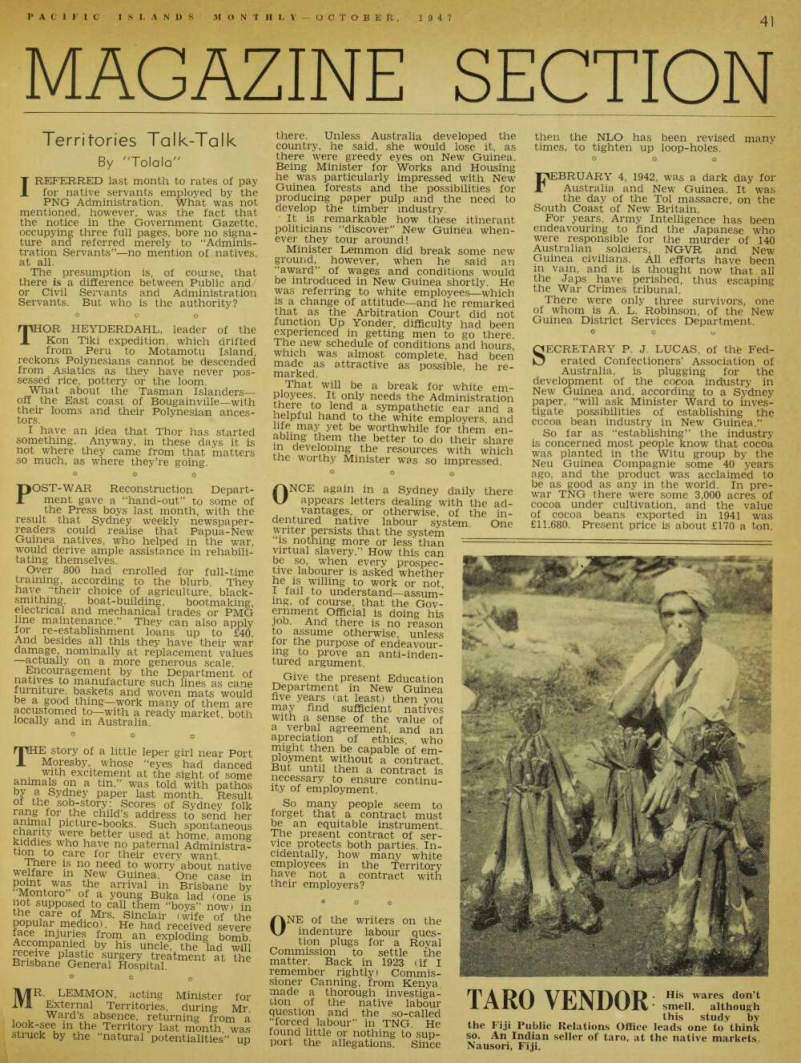
Territories Talk-Talk
By "Tolala"
I REFERRED last month to rates of pay for native servants employed by the PNG Administration. What was not mentioned, however, was the fact that the notice in the Government Gazette, occupying three full pages, bore no signa ture and referred merely to “Adminis tration Servants” —no mention of natives, at all.
The presumption is, of course, that there is a difference between Public and or Civil Servants and Administration Servants. But who is the authority? mHOR HEYDERDAHL, leader of the X Kon Tiki expedition, which drifted from Peru to Motamotu Island, reckons Polynesians cannot be descended from Asiatics as they have never pos sessed rice, pottery or the loom.
What about the Tasman Islanders— off the East coast of Bougainville—with their looms and their Polynesian ances tors.
I have an idea that Thor has started something. Anyway, in these days it is not where they came from that matters so much, as where they’re going. ❖ ❖ £
POST-WAR Reconstruction Depart
ment gave a “hand-out” to some of the Press boys last month, with the result that Sydney weekly newspaper readers could realise that Papua-New Guinea natives, who helped in the war, would derive ample assistance in rehabili tating themselves.
Over 800 had enrolled for full-time training, according to the blurb. They have “their choice of agriculture, black smithing. boat-building, bootmaking, electrical and mechanical trades or PMG line maintenance.” They can also apply for re-establishment loans up to £4O.
And besides all this they have their war damage, nominally at replacement values actually on a more generous scale Encouragement by the Department of natives to manufacture such lines as cane furniture, baskets and woven mats would be a good thing—work many of them are accustomed to—with a ready market, both locally and in Australia.
THE story of a little leper girl near Port Moresby, whose “eyes had danced . with excitement at the sight of some animals on a tin,” was told with pathos it Sydney paper last month. Result of the sob-story: Scores of Sydney folk rang for the child’s address to send her animal picture-books. Such spontaneous charity were better used at home, among kiddies who have no paternal Administra tor care for their every want.
There is no need to worry about native welfare in New Guinea. One case in point was the arrival in Brisbane bv Montoro of a young Buka lad (one is not supposed to call them “boys” now) in the care of Mrs. Sinclair (wife of the popular medico). He had received severe face injuries from an exploding bomb.
Accompanied by his uncle, the lad will rfr C i«h V 6 pl^stic surgery treatment at the Brisbane General Hospital.
MR. LEMMON, acting Minister for
External Territories, during Mr
Ward s absence, returning from a look-see in the Territory last month was struck by the “natural potentialities” up
there. Unless Australia developed the country, he said, she would lose it, as there were greedy eyes on New Guinea.
Being Minister for Works and Housing he was particularly impressed with New Guinea forests and the possibilities for producing paper pulp and the need to develop the timber industry.
It is remarkable how these itinerant politicians “discover” New Guinea when ever they tour around!
Minister Lemmon did break some new ground, however, when he said an “award” of wages and conditions would be introduced in New Guinea shortly. He was referring to white employees—which is a change of attitude—and he remarked that as the Arbitration Court did not function Up Yonder, difficulty had been experienced in getting men to go there.
The new schedule of conditions and hours which was almost complete, had been made as attractive as possible, he re marked.
That will be a break for white em ployees. It only needs the Administration there to lend a sympathetic ear and a helpful hand to the white employers, and life may yet be worthwhile for them en abling them the better to do their share m developing the resources with which the worthy Minister was so impressed.
ONCE again in a Sydney daily there appears letters dealing with the ad vantages, or otherwise, of the in dentured native labour system One
writer persists that the system “is nothing more or less than virtual slavery.” How this can be so, when every prospec tive labourer is asked whether he is willing to work or not, I fail to understand—assum ing, of course, that the Gov ernment Official is doing his job. And there is no reason to assume otherwise, unless tor the purpose of endeavour ing to prove an anti-inden tured argument.
Give the present Education Department in New Guinea five years (at least) then you may find sufficient natives with a sense of the value of a verbal agreement, and an apreciation of ethics, who might then be capable of em ployment without a contract.
But until then a contract is necessary to ensure continu ity of employment.
So many people seem to forget that a contract must be an equitable instrument.
The present contract of ser vice protects both parties. In cidentally, how many white employees in the Territory have not a contract with their employers? v ONE of the writers on the indenture labour ques tion plugs for a Royal Commission to settle the matter. Back in 1923 (if I remember rightly) Commis sioner Canning, from Kenya made a thorough investiga tion of the native labour question and the so-called “forced labour” in TNG. He found little or nothing to sup port the allegations. Since
then the NLO has been revised many times, to tighten up loop-holes.
FEBRUARY 4, 1942, was a dark day for Australia and New Guinea. It was the day of the Tol massacre, on the South Coast of New Britain.
For years, Army Intelligence has been endeavouring to find the Japanese who were responsible for the murder of 140 Australian soldiers, NGVR and New Guinea civilians. All efforts have been in vain, and it is thought now that all the Japs have perished, thus escaping the War Crimes tribunal.
There were only three survivors, one of whom is A. L. Robinson, of the New Guinea District Services Department. jJ: ..
SECRETARY P. J. LUCAS, of thfc Fed erated Confectioners’ Association of Australia, is plugging for the development of the cocoa industry in New Guinea and, according to a Sydney paper, “will ask Minister Ward to inves tigate possibilities of establishing the cocoa bean industry in New Guinea.’’
So far as “establishing” the industry is concerned most people know that cocoa was planted in the Witu group by the Neu Guinea Compagnie some 40 years ago, and the product was acclaimed to be as good as any in the world. In pre war TNG there were some 3,000 acres of cocoa under cultivation, and the value of cocoa beans exported in 1941 was £11.680. Present price is about £l7O a ton.
TARO VENDOR : smell. although
this study by the Fiji Public Relations Office leads one to think so. An Indian seller of taro, at the native markets.
Nausori, Fiji.
Advertisements & other items, p. 45 (1 item)
41
I‘AClllC ISLANDS MONTHLY OCtOBEfe, 194?
ROMANCE IN COMMERCE: The story of
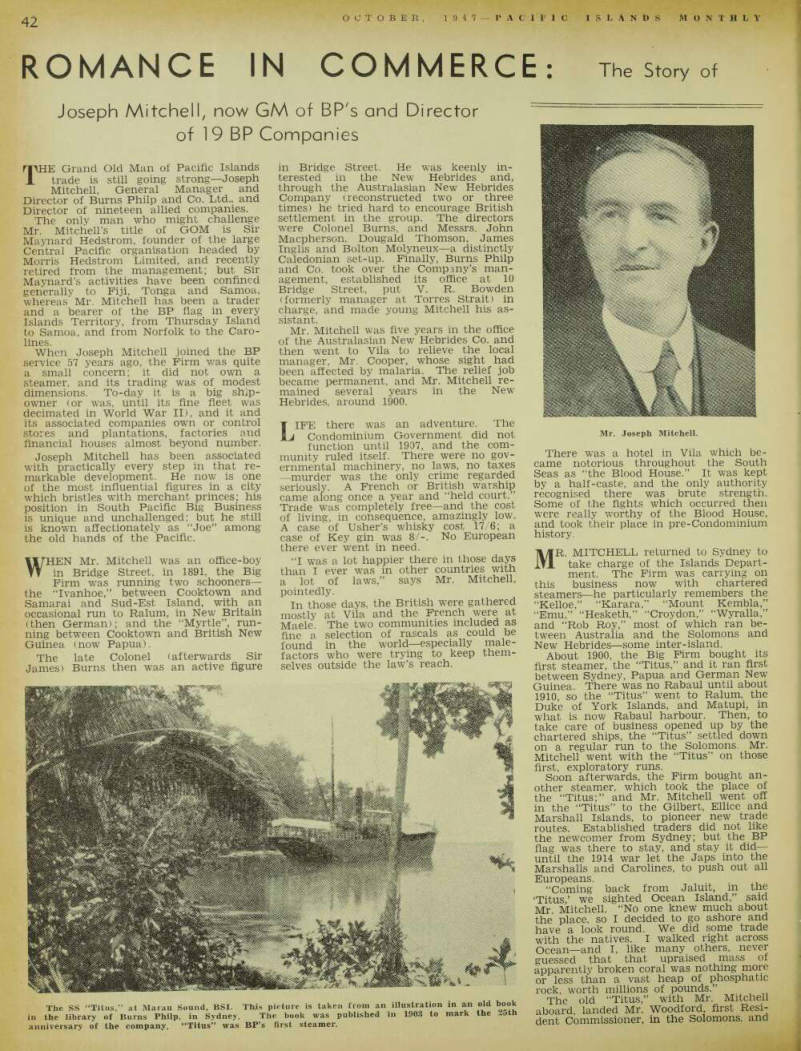
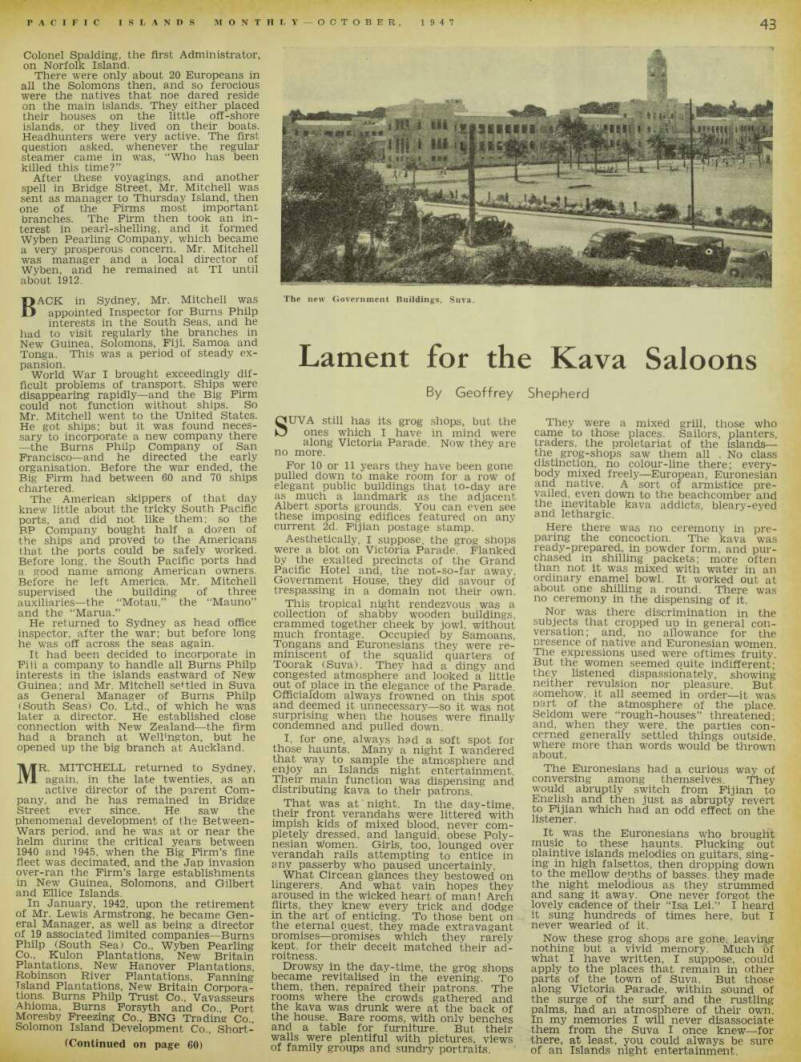
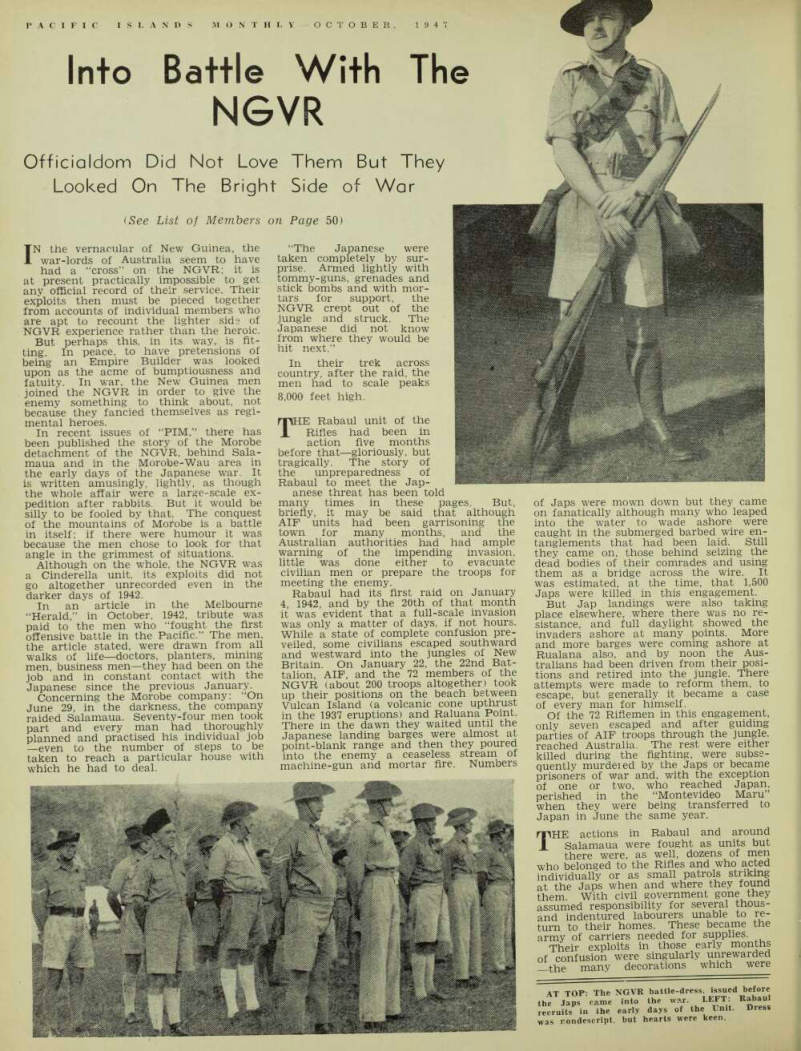
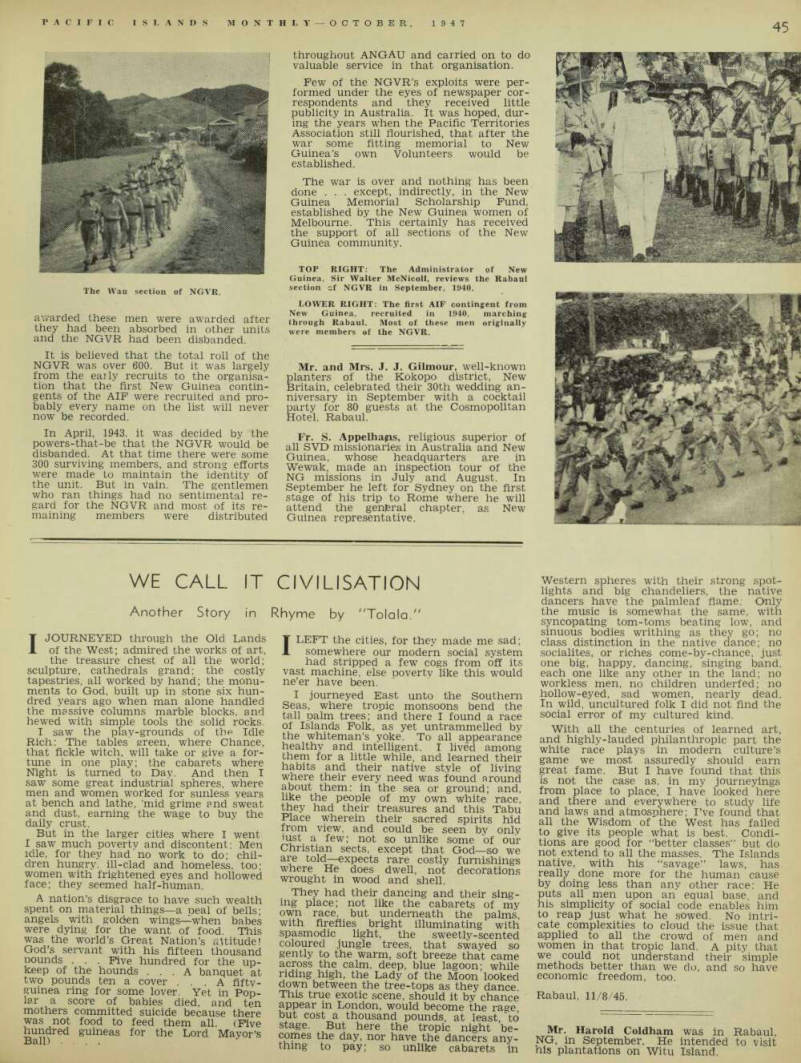
Joseph Mitchell, now GM of BP's and Director of 19 BP Companies
mHE Grand Old Man of Pacific Islands X trade is still going strong—Joseph Mitchell, General Manager and Director of Burns Philp and Co. Ltd., and Director of nineteen allied companies.
The only man who might challenge Mr. Mitchell’s title of GOM is Sir Maynard Hedstrom, founder of the large Central Pacific organisation headed by Morris Hedstrom Limited, and recently retired from the management; but Sir Maynard's activities have been confined generally to Fiji, Tonga and Samoa, whereas Mr. Mitchell has been a trader and a bearer of the BP flag in every Islands Territory, from Thursday Island to Samoa, and from Norfolk to the Caro lines.
When Joseph Mitchell joined the BP service 57 years ago, the Firm was quite a small concern; it did not own a steamer, and its trading was of modest dimensions. To-day it is a big ship owner (or was, until its fine fleet was decimated in World War II), and it and its associated companies own or control stores and plantations, factories and financial houses almost beyond number, Joseph Mitchell has been associated with practically every step in that re markable development. He now is one of the most influential figures in a city which bristles with merchant princes; his position in South Pacific Big Business is unique and unchallenged: but he still is known affectionately as “Joe” among the old hands of the Pacific.
WHEN Mr. Mitchell was an office-boy in Bridge Street, in 1891, the Big Firm was running two schooners — the “Ivanhoe,” between Cooktown and Samarai and Sud-Est Island, with an occasional run to Ralum, in New Britain (then German); and the “Myrtle”, run ning between Cooktown and British New Guinea (now Papua).
The late Colonel (afterwards Sir James) Burns then was an active figure
in Bridge Street. He was keenly in terested in the New Hebrides and, through the Australasian New Hebrides Company (reconstructed two or three times) he tried hard to encourage British settlement in the group. The directors were Colonel Burns, and Messrs. John Macpherson, Dougald Thomson, James Inglis and Bolton Molyneux—a distinctly Caledonian set-up. Finally, Burns Philp and Co. took over the Company’s man agement, established its office at 10 Bridge Street, put V. R. Bowden (formerly manager at Torres Strait) in charge, and made young Mitchell his as sistant.
Mr, Mitchell was five years in the office of the Australasian New Hebrides Co. and then went to Vila to relieve the local manager, Mr. Cooper, whose sight had been affected by malaria. The relief job became permanent, and Mr. Mitchell re mained several years in the New Hebrides, around 1900.
LIFE there was an adventure. The Condominium Government did not function until 1907, and the com munity ruled itself. There were no gov ernmental machinery, no laws, no taxes —murder was the only crime regarded seriously. A French or British warship came along once a year and “held court.”
Trade was completely free—and the cost of living, in consequence, amazingly low.
A case of Usher’s whisky cost 17/6; a case of Key gin was 8/-. No European there ever went in need.
“I was a lot happier there in ttmse days than I ever was in other countries with a lot of laws,” says Mr. Mitchell,
pointedly.
In those days, the British were gathered mostly at Vila and the French were at Maele. The two communities included as fine a selection of rascals as could be found in the world—especially male factors who were trying to keep them selves outside the law’s reach.
There was a hotel in Vila which be came notorious throughout the South Seas as “the Blood House.” It was kept by a half-caste, and the only authority recognised there was brute strength.
Some of the fights which occurred then were really worthy of the Blood House, and took their place in pre-Condominium history.
MR. MITCHELL returned to Sydney to take charge of the Islands Depart ment. The Firm was carrying on this business now with chartered steamers—he particularly remembers the “Kelloe,” “Karara,” “Mount Kembla,”
“Emu,” “Hesketh,” “Croydon,” “Wyralla,” and “Rob Roy,” most of which ran be tween Australia and the Solomons and New Hebrides —some inter-island.
About 1900, the Big Firm bought its first steamer, the “Titus,” and it ran first between Sydney, Papua and German New Guinea. There was no Rabaul until about 1910, so the “Titus” went to Ralum, the Duke of York Islands, and Matupi, in what is now Rabaul harbour. Then, to take care of business opened up by the chartered ships, the “Titus” settled down on a regular run to the Solomons. Mr.
Mitchell went with the “Titus” on those first, exploratory runs.
Soon afterwards, the Firm bought an other steamer, which took the place of the “Titus;” and Mr. Mitchell went off in the “Titus” to the Gilbert, Ellice and Marshall Islands, to pioneer new trade routes. Established traders did not like the newcomer from Sydney; but the BP flag was there to stay, and stay it did — until the 1914 war let the Japs into the Marshalls and Carolines, to push out all Europeans.
“Coming back from Jaluit, in the ‘Titus,’ we sighted Ocean Island,” said Mr. Mitchell. “No one knew much about the place, so I decided to go ashore and have a look round. We did some trade with the natives. I walked right across Ocean—and I, like many others, never guessed that that upraised mass of apparently broken coral was nothing more or less than a vast heap of phosphatic rock, worth millions of pounds.”
The old “Titus,” with Mr. Mitchell aboard, landed Mr. Woodford, first Resi dent Commissioner, in the Solomons, and
The SS “Titus,” at Marau Sound, BSI. This picture is taken from an illustration in an old book in the library of Burns Philp, in Sydney. The book was published in 1903 to mark the 25th anniversary of the company. “Titus” was BP’s first steamer.
Mr. Joseph Mitchell.
Colonel Spalding, the first Administrator, on Norfolk Island.
There were only about 20 Europeans in all the Solomons then, and so ferocious were the natives that noe dared reside on the main islands. They either placed their houses on the little off-shore islands, or they lived on their boats.
Headhunters w T ere very active. The first question asked, whenever the regular steamer came in was, “Who has been killed this time?”
After these voyagings, and another spell in Bridge Street, Mr. Mitchell was sent as manager to Thursday Island, then one of the Firms most important branches. The Firm then took an in terest in pearl-shelling, and it formed Wyben Pearling Company, which became a very prosperous concern. Mr. Mitchell was manager and a local director of Wyben, and he remained at TI until about 1912.
BACK in Sydney, Mr. Mitchell was appointed Inspector for Burns Philp interests in the South Seas, and he had to visit regularly the branches in New Guinea, Solomons, Fiji, Samoa and Tonga. This was a period of steady ex pansion.
World War I brought exceedingly dif ficult problems of transport. Ships were disappearing rapidly—and the Big Firm could not function without ships. So Mr. Mitchell went to the United States.
He got ships; but it was found neces sary to incorporate a new company there —the Burns Philp Company of San Francisco—and he directed the early organisation. Before the war ended, the Big Firm had between 60 and 70 ships chartered.
The American skippers of that day knew little about the tricky South Pacific ports, and did not like them; so the BP Company bought half a dozen of the ships and proved to the Americans that the ports could be safely worked.
Before long, the South Pacific ports had a good name among American owners.
Before he left America, Mr. Mitchell supervised the building of three auxiliaries —the “Motau,” the “Mauno” and the “Mama.”
He returned to Sydney as head office inspector, after the war; but before long he was off across the seas again.
It had been decided to incorporate in Fiji a company to handle all Burns Philp interests in the islands eastward of New Guinea: and Mr. Mitchell settled in Suva as General Manager of Burns Philp (South Seas) Co. Ltd., of which he was later a director. He established close connection with New Zealand —the firm had a branch at Wellington, but he opened up the big branch at Auckland.
MR. MITCHELL returned to Sydney, again, in the late twenties, as an active director of the parent Com pany, and he has remained in Bridge Street ever since. He saw the phenomenal development of the Between- Wars period, and he was at or near the helm during the critical years between 1940 and 1945, when the Big Firm’s fine fleet was decimated, and the Jap invasion over-ran the Firm’s large establishments in New Guinea, Solomons, and Gilbert and Ellice Islands.
In January, 1942, upon the retirement of Mr. Lewis Armstrong, he became Gen eral Manager, as well as being a director of 19 associated limited companies—Burns Philp (South Sea) Co.. Wyben Pearling Co., Kulon Plantations, New Britain Plantations, New Hanover Plantations, Robinson River Plantations, Fanning Island Plantations, New Britain Corpora tions. Burns Philp Trust Co., Vavasseurs Ahioma, Burns Forsyth and Co., Port Moresby Freezing Co., BNG Trading Co., Solomon Island Development Co., Short
(Continued on page 60)
land Island Plantations, Choiseul Planta tions, Freehold Estates, T. Edmondson and Co.. Mates Ltd.
In his 57 years of service, Mr. Mitchell has seen the Firm grow from quite a small concern into a parent company with assets of over £8,000,000, exercising control over other organisations with assets worth at least a similar amount.
The South Pacific Ocean often is called the region of romance. There are few developments based on the Pacific which are of a more romantic character than the story of Burns Philp and Co. Ltd which embraces the life-story of Joseph Mitchell.
HIS reminiscences include many curious sidelights on life in the Pacific at the turn of the century.
There is, for instance, the story of the
printed notes. The Firm’s activities were growing rapidly, and neither buyers nor sellers could get currency for the machinery of exchange, when straight-out barter was impracticable. So the Firm simply printed its own paper money, for use in New Hebrides, Papua and the Solomons. The notes were mostly of £1 and £5 denominations. But the differ ence in figures meant nothing to the natives—to them a note was just a note.
So, to avoid confusion, the Firm printed a very big red “5” in the middle of the £5 notes.
Any kind of silver circulated then in the uncivilised New Hebrides. Value of a coin was fixed by its size in relation to the Australian florin.
The Firm was carrying the mails around the New Hebrides. As the New Hebrides then was a completely free country, it had neither Post Office nor postage stamps. So the Firm got its mail-carrying revenue by printing its own stamps, of Id. and 2d. value, and these were in use until the shrewd Government of New South Wales became restive. Finally, it was arranged that the NSW Government should get the postal revenue and subsidise BP ships to carry mails, and the BP postage stamps were to be withdrawn. That was the be ginning of the Australian subsidy (now a Commonwealth affair) of the Islands ships run regularly by Burns Philp and Co., Ltd.
The Australian New Hebrides Company, of which Mr. Mitchell was manager in Vila before 1900, was eventually absorbed and wiped out by Burns Philp and Co., Ltd.; and its assets included tens of thousands of acres of virgin land, much of it with water frontages, situated in the various islands of the group. Sir James Burns was anxious that these lands should eventually provide a home for British settlers; so he handed over all the Company’s titles to the then new Commonwealth Government of Australia, in the hope that Australia would en courage British settlement. Australia accepted the gift, and for many years maintained, in Port Vila, a solicitor whose job was to prosecute the Australian claims to land titles before the slowly-function ing Condominium Land Court. As far as is known, Australia is still the nominal owner of these lands.
Mr. Mitchell knew the Islands races well, long before the eager Planners of even knew that Islands races existed. He says that the Polynesians always were a friendly and intelligent people and they soon learned to become storekeepers, clerks, etc. But the Melanesians of 50 years ago, in the Solomons and in New Guinea were wild and primitive and often very dangerous.
As the years passed, and the Islands of the Western Pacific were penetrated by traders and planters the Melanesians gradually became quieter, until now, they are comparatively harmless —a good ex ample of the civilising influence of com merCe.
Mr. Mitchell married Miss Irene Sheppard in 1897, and she accompanied him on most of those interesting pioneer trips around the South Pacific Islands— to the then primitive Solomons, Gilberts and Marshalls. She always afterwards took the keenest interest in the develop ment of those now important Territories.
Mr. Mitchell is himself a native of Picton, New South Wales, and he was educated at the nearby Camden Grammar School.
There have been more protests in the Conseil General of New Caledonia against the burden of indirect taxation levied on the Colony by the administration. “We are entering upon a period of crisis, said one member, “and already there are signs of unemployment. The mining in dustry (particularly nickel) is in a pre carious position, and this industry repre sents 80 per cent of our general economy/'
Lament for the Kava Saloons
By Geoffrey Shepherd
SUVA still has its grog shops, but the ones which I have in mind were along Victoria Parade. Now they are no more.
For 10 or 11 years they have been gone pulied down to make room for a row of elegant nubile buildings that to-day are as much a landmark as the adjacent Albert sports grounds. You can even see these imposing edifices featured on any current 2d. Fijian postage stamp.
Aesthetically, I suppose the grog shops were a blot on Victoria Parade. Flanked by the exalted precincts of the Grand Pacific Hotel and, the not-so-far away, Government House, they did savour of trespassing in a domain not their own.
This tropical night rendezvous was a collection of shabby wooden buildings. crammed together cheek by jowl, without much frontage. Occupied by Samoans.
Tongans and Euronesians they were reminiscent of the squalid quarters of Toorak (Suva). They had a dingy and congested atmosphere and looked a little out of place in the elegance of the Parade.
Officialdom always frowned on this spot and deemed it unnecessary—so it was not surprising when the houses were finally condemned and pulled down.
I for one alwavs harJ q snnt fnr those haunts. Many a night I wandered that way to sample the atmosphere and enjoy an Islands night entertainment Their main function was dispensing and distributing kava to their patrons That was at night. In the day-time, their front verandahs were littered with impish kids of mixed blood, never completely dressed, and languid, obese Polynesian women. Girls, too, lounged over verandah rails attempting to entice in any passerby who paused uncertainly.
What Circean glances they bestowed on lingerers. And what vain hopes they aroused in the wicked heart of man! Arch flirts, they knew every trick and dodge in the art of enticing. To those bent on the eternal quest, they made extravagant promises—promises which they rarely kept, for their deceit matched their adroitness.
Drowsy in the day-time, the grog shops became revitalised in the evening. To them, then, repaired their patrons. The rooms where the crowds gathered and the kava was drunk were at the back of the house. Bare rooms, with only benches and a table for furniture. But their walls were plentiful with pictures, views of family groups and sundry portraits.
They were a mixed grill, those who came to those places. Sailors, planters, traders, the proletariat of the islands— the grog-shops saw them all . No class distinction, no colour-line there: every body mixed freely—European, Euronesian and natlv e. A sort of armistice pre vailed, even down to the beachcomber and inevitable kava addicts, bleary-eyed and lethargic.
Here there was no ceremony in pre paring the concoction. The kava was ready-prepared, in powder form, and pur chased in shilling packets; more often tha P not was mixed with water in an ordinary enamel bowl. It worked out at about one shilling a round. There was n o ceremony in the dispensing of it.
Nor was there discrimination in the subjects that cropped up in general con versation; and, no allowance for the presence of native and Euronesian women, The expressions used were oftimes fruity.
But women seemed quite indifferent; s^enec i dispassionately, showing neither revulsion nor pleasure. But. somehow, it all seemed in order—it was p art tlle a tmosphere of the place, Seldom were “rough-houses” threatened; and - when they were, the parties con cerned generally settled things outside, more than words would be thrown , The Euronesians had a curious way of conversing among themselves. They would abruptly switch from Fijian to rev ,l rt w * llc * l had an odd effect on the It . was the Euronesians who brought music to these haunts. Plucking out plaintive islands melodies on guitars, sing in £ in high falsettos, then dropping down to the mellow depths of basses, they made the night melodious as they strummed and sang it away. One never forgot the lovely cadence of their “Isa Lei.” I heard it sung hundreds of times here, but I never wearied of it.
Now these grog shoos are gone. leaving nothing but a vivid memory. Much of what I have written, I suppose, could apply to the places that remain in other parts of the town of Suva. But those along Victoria Parade, within sound of the surge of the surf and the rustling palms, had an atmosphere of their own.
In my memories I will never disassociate them from the Suva I once knew—for there, at least, you could always be sure of an Islands night entertainment.
The new Government Buildings, Suva.
Into Battle With The
Ngvr
Officialdom Did Not Love Them But They Looked On The Bright Side of War
(See List of Members on Page 50)
IN the vernacular of New Guinea, the war-lords of Australia seem to have had a “cross” on the NGVR: it is at present practically impossible to get any official record of their service. Their exploits then must be pieced together from accounts of individual members who are apt to recount the lighter side of NGVR experience rather than the heroic.
But perhaps this, in its way, is fit ting. In peace, to have pretensions of being an Empire Builder was looked upon as the acme of bumptiousness and fatuity. In war, the New Guinea men joined the NGVR in order to give the enemy something to think about, not because they fancied themselves as regi mental heroes.
In recent issues of “PIM,” there has been published the story of the Morobe detachment of the NGVR, behind Sala maua and in the Morobe-Wau area in the early days of the Japanese war. It is written amusingly, lightly, as though the whole affair were a large-scale ex pedition after rabbits. But it would be silly to be fooled by that. The conquest of the mountains of Mofobe is a battle in itself: if there were humour it was because the men chose to look for that angle in the grimmest of situations.
Although on the whole, the NGVR was a Cinderella unit, its exploits did not go altogether unrecorded even in the darker days of 1942.
In an article in the Melbourne “Herald,” in October, 1942, tribute was paid to the men who “fought the first offensive battle in the Pacific.” The men, the article stated, were drawn from all walks of life—doctors, planters, mining men, business men—they had been on the job and in constant contact with the Japanese since the previous January.
Concerning the Morobe company; “On June 29, in the darkness, the company raided Salamaua. Seventy-four men took part and every man had thoroughly planned and practised his individual job —even to the number of steps to be taken to reach a particular house with which he had to deal.
“The Japanese were taken completely by sur prise. Armed lightly with tommy-guns, grenades and stick bombs and with mor tars for support, the NGVR crept out of the jungle and struck. The Japanese did not know from where they would be hit next.”
In their trek across country, after the raid, the men had to scale peaks 8,000 feet high. mHE Rabaul unit of the X Rifles had been in action five months before that —gloriously, but tragically. The story of the unpreparedness of Rabaul to meet the Jap
anese threat has been told many times in these pages. But, briefly, it may be said that although AIF units had been garrisoning the town for many months, and the Australian authorities had had ample warning of the impending invasion, little was done either to evacuate civilian men or prepare the troops for meeting the enemy.
Rabaul had its first raid on January 4, 1942, and by the 20th of that month it was evident that a full-scale invasion was only a matter of days, if not hours.
While a state of complete confusion pre veiled, some civilians escaped southward and westward into the jungles of New Britain. On January 22, the 22nd Bat talion, AIF, and the 72 members of the NGVR (about 200 troops altogether) took up their positions on the beach between Vulcan Island (a volcanic cone upthrust in the 1937 eruptions) and Raluana Point.
There in the dawn they waited until the Japanese landing barges were almost at point-blank range and then they poured into the enemy a ceaseless stream of machine-gun and mortar fire. Numbers
of Japs were mown down but they came on fanatically although many who leaped into the water to wade ashore were caught in the submerged barbed wire en tanglements that had been laid. Still they came on, those behind seizing the dead bodies of their comrades and using them as a bridge across the wire. It was estimated, at the time, that 1,500 Japs were killed in this engagement.
But Jap landings were also taking place elsewhere, where there was no re sistance, and full daylight showed the invaders ashore at many points. More and more barges were coming ashore at Rualana also, and by noon the Aus tralians had been driven from their posi tions and retired into the jungle. There attempts were made to reform them, to escape, but generally it became a case of every man for himself.
Of the 72 Riflemen in this engagement, only seven escaped and after guiding parties of AIF troops through the jungle, reached Australia. The rest were either killed during the fighting, were subse quently murdered by the Japs or became prisoners of war and, with the exception of one or two, who reached Japan, perished in the “Montevideo Maru” when they were being transferred to Japan in June the same year.
THE actions in Rabaul and around Salamaua were fought as units but there were, as well, dozens of men who belonged to the Rifles and who acted individually or as small patrols striking at the Japs when and where they found them With civil government gone they assumed responsibility for several thous and indentured labourers unable to re turn to their homes. These became the army of carriers needed for supplies.
Their exploits in those early months of confusion were singularly unrewarded —the many decorations which were
AT TOP: The NGVR battle-dress, issued before the Japs came into the war. LEFT: Rabaul recruits in the early days of the Unit. Dress was nondescript, but hearts were keen.
awarded these men were awarded after they had been absorbed in other units and the NGVR had been disbanded.
It is believed that the total roll of the NGVR was over 600. But it was largely from the early recruits to the organisa tion that the first New Guinea contin gents of the AIF were recruited and pro bably every name on the list will never now be recorded.
In April, 1943, it was decided by the powers-that-be that the NGVR would be disbanded. At that time there were some 300 surviving members, and strong efforts were made to maintain the identity of the unit. But in vain. The gentlemen who ran things had no sentimental re gard for the NGVR and most of its re maining members were distributed
throughout ANGAU and carried on to do valuable service in that organisation.
Few of the NGVR’s exploits were per formed under the eyes of newspaper cor respondents and they received little publicity in Australia. It was hoped, dur ing the years when the Pacific Territories Association still flourished, that after the war some fitting memorial to New Guinea’s own Volunteers would be established.
The war is over and nothing has been done . . . except, indirectly, in the New Guinea Memorial Scholarship Fund, established by the New Guinea women of Melbourne. This certainly has received the support of all sections of the New Guinea community.
TOP RIGHT: The Administrator of New Guinea. Sir Walter McNicoll, reviews the Rabaul section cf NGVR in September, 1940.
LOWER RIGHT: The first AIF contingent from New Guinea, recruited in 1940, marching through Rabaul. Most of these men originally were members of the NGVR.
Mr. and Mrs. J. J. Gilmour, well-known planters of the Kokopo district, New Britain, celebrated their 30th wedding an niversary in September with a cocktail party for 80 guests at the Cosmopolitan Hotel, Rabaul.
Fr. S. Appelhafis, religious superior of all SVD missionaries in Australia and New Guinea, whose headquarters are in Wewak, made an inspection tour of the NG missions in July and August. In September he left for Sydney on the first stage of his trip to Rome where he will attend the general chapter, as New Guinea representative.
The Wau section of NGVR.
We Call It Civilisation
Another Story in Rhyme by "Tolala."
I JOURNEYED through the Old Lands of the West; admired the works of art, the treasure chest of all the world; sculpture, cathedrals grand: the costly tapestries, all worked by hand; the monu ments to God, built up* in stone six hun dred years ago when man alone handled the massive columns marble blocks, and hewed with simple tools the solid rocks.
I saw the pfav-grounds of the Idle Rich: The tables green, where Chance, that fickle witch, will take or give a for tune in one play; the cabarets where Night is turned to Day. And then I saw some great industrial spheres, where men and women worked for sunless years at bench and lathe, ’mid grime and sweat and dust, earning the wage to buy the daily crust.
But in the larger cities where I went I saw much poverty and discontent: Men idle, for they had no work to do; chil dren hungry, ill-clad and homeless, too; women with frightened eyes and hollowed face; they seemed half-human.
A nation’s disgrace to have such wealth spent on material things—a peal of bells; angels with golden wings—when babes were dying for the want of food This was the world’s Great Nation’s attitude' God’s servant with his fifteen thousand pounds . . . Five hundred for the up keep of the hounds ... A banquet at two pounds ten a cover . . a fiftv guinea ring for some lover. Yet in Pop lar a score of babies died, and ten mothers committed suicide because there was not food to feed them all. (Five hundred guineas for the Lord Mayor’s Ball) -
I LEFT the cities, for they made me sad; somewhere our modern social system had stripped a few cogs from off its vast machine, else novertv like this would ne’er have been.
I journeyed East unto the Southern Seas, where tropic monsoons bend the tall palm trees; and there I found a race of Islands Polk, as yet untrammelled by the Whiteman’s yoke. To all appearance healthy and intelligent. I lived among them for a little while, and learned their habits and their native style of living where their every need was found around about them: in the sea or ground; and, like the people of my own white race, they had their treasures and this Tabu Place wherein their sacred spirits hid from view, and could be seen by only iust a few; not so unlike some of our Christian sects, except that God—so we are told—expects rare costly furnishings where He does dwell, not decorations wrought in wood and shell.
They had their dancing and their sing ing place; not like the cabarets of my own race, but underneath the palms, with fireflies bright illuminating with spasmodic light, the sweetly-scented coloured jungle trees, that swayed so gently to the warm, soft breeze that came across the calm, deep, blue lagoon; while riding high, the Lady of the Moon looked down between the tree-tops as they dance.
This true exotic scene, should it by chance appear in London, would become the rage but cost a thousand pounds, at least, to stage. But here the tropic night be comes the day, nor have the dancers any thing to pay; so unlike cabarets in
Western spheres with their strong spot lights and big chandeliers, the native dancers have the palmleaf flame. Only the music is somewhat the same, with syncopating tom-toms beating low, and sinuous bodies writhing as they go; no class distinction in the native dance; no socialites, or riches come-by-chance, just one big, happy, dancing, singing band, each one like any other in the land; no workless men, no children underfed; no hollow-eyed, sad women, nearly dead.
In wild, uncultured folk I did not find the social error of my cultured kind.
With all the centuries of learned art, and highly-lauded philanthropic part the white race plays in modern culture’s game we most assuredly should earn great fame. But I have found that this is not the case as, in my journeyings from place to place, I have looked here and there and everywhere to study life and laws and atmosphere; I’ve found that all the Wisdom of the West has failed to give its people what is best. Condi tions are good for “better classes” but do not extend to all the masses. The Islands native, with his “savage” laws, has really done more for the human cause by doing less than any other race: He puts all men upon an equal base, and his simplicity of social code enables him to reap just what he sowed. No intri cate complexities to cloud the issue that applied to all the crowd of men and women in that tropic land. A pity that we could not understand their simple methods better than we do, and so have economic freedom, too.
Rabaul, 11/8/45.
Mr. Harold Coldham was in Rabaul, NG, in September. He intended to visit his plantations on Witu Island
Tropicalities
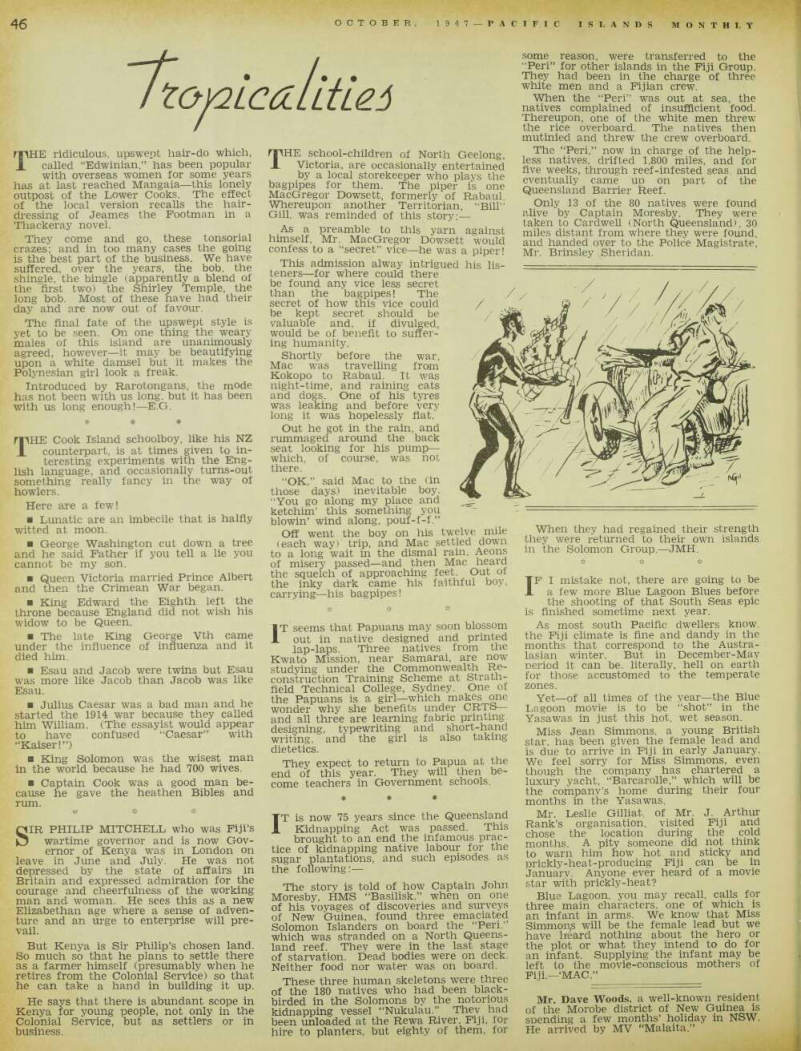
mHE ridiculous, upswept hair-do which, X called “Edwinian,” has been popular with overseas women for some years has at last reached Mangaia—this lonely outpost of the Lower Cooks. The effect of the local version recalls the hair dressing of Jeames the Footman in a Thackeray novel.
They come and go, these tonsorial crazes: and in too many cases the going is the best part of the business. We have suffered, over the years, the bob. the shingle, the bingle (apparently a blend of the first two) the Shirley Temple, the long bob. Most of these have had their day and are now out of favour.
The final fate of the upswept style is yet to be seen. On one thing the weary males of this island are unanimously agreed, however—it may be beautifying upon a white damsel but it makes the Polynesian girl look a freak.
Introduced by Rarotongans, the mode has not been with us long, but it has been with us long enough!—E.G. * * ♦ THE Cook Island schoolboy, like his NZ counterpart, is at times given to in teresting experiments with the Eng lish language, and occasionally turns-out something really fancy in the way of howlers.
Here are a few! ■ Lunatic are an imbecile that is halfly witted at moon. ■ George Washington cut down a tree and he said Father if you tell a lie you cannot be my son. ■ Queen Victoria married Prince Albert and then the Crimean War began. ■ King Edward the Eighth left the throne because England did not wish his widow to be Queen. ■ The late King George Vth came under the influence of influenza and it died him. ■ Esau and Jacob were twins but Esau was more like Jacob than Jacob was like Esau. ■ Julius Caesar was a bad man and he started the 1914 war because they called him William. (The essayist would appear to have confused “Caesar” with “Kaiser!”) b King Solomon was the wisest man in the world because he had 700 wives. b Captain Cook was a good man be cause he gave the heathen Bibles and rum. * * $ SIR PHILIP MITCHELL who was Fiji’s wartime governor and is now Gov ernor of Kenya was in London on leave in June and July. He was not depressed by the state of affairs in Britain and expressed admiration for the courage and cheerfulness of the working man and woman. He sees this as a new Elizabethan age where a sense of adven ture and an urge to enterprise will pre vail.
But Kenya is Sir Philip’s chosen land.
So much so that he plans to settle there as a farmer himself (presumably when he retires from the Colonial Service) so that he can take a hand in building it up.
He says that there is abundant scope in Kenya for young people, not only in the Colonial Service, but as settlers or in business.
THE school-children of North Geelong, Victoria, are occasionally entertained by a local storekeener who plays the bagpipes for them. The piper is one MacGregor Dowsett, formerly of Rabaul Whereupon another Territorian, “Bill”
Gill, was reminded of this story;— As a preamble to this yarn against himself. Mr. MacGregor Dowsett would confess to a “secret” vice—he was a piper!
This admission alway intrigued his lis teners —for where could there
be found any vice less secret than the bagpipes! The secret of how this vice could be kept secret should be valuable and, if divulged, would be of benefit to suffer ing humanity.
Shortly before the war, Mac was travelling from Kokopo to Rabaul. It was night-time, and raining cats and dogs. One of his tyres was leaking and before very long it was hopelessly flat.
Out he got in the rain, and rummaged around the back seat looking for his pump— which, of course, was not there.
“OK,” said Mac to the (in those days) inevitable boy.
“You go along my place and ketchim’ this something you blowin’ wind along, pouf-f-f ”
Off went the boy on his twelve mile (each way) trip, and Mac settled down to a long wait in the dismal rain. Aeons of misery passed—and then Mac heard the squelch of approaching feet. Out ot the inky dark came his faithful boy, carrying—his bagpipes! * * * IT seems that Papuans may soon blossom out in native designed and printed lap-laps. Three natives from the Kwato Mission, near Samarai, are now studying under the Commonwealth Re construction Training Scheme at Strath field Technical College, Sydney. One of the Papuans is a girl—which makes one wonder why she benefits under CRTS — and all three are learning fabric designing, typewriting and short-hand writing, and the girl is also taking dietetics.
They expect to return to Papua at the end of this year. They will then be come teachers in Government schools. ♦ * * IT is now 75 years since the Queensland Kidnapping Act was passed. This brought to an end the infamous prac tice of kidnapping native labour for the sugar plantations, and such episodes as the following;— The story is told of how Captain John Moresby, HMS “Basilisk.” when on one of his voyages of discoveries and surveys of New Guinea, found three emaciated Solomon Islanders on board the “Peri.” which was stranded on a North Queens land reef. They were in the last stage of starvation. Dead bodies were on deck.
Neither food nor water was on board.
These three human skeletons were three of the 180 natives who had been black birded in the Solomons by the notorious kidnapping vessel “Nukulau.” Thev had been unloaded at the Rewa River, Fiji, for hire to planters, but eighty of them, for
some reason, were transferred to the “Peri” for other islands in the Fiji Group.
They had been in the charge of three white men and a Fijian crew.
When the “Peri” was out at sea, the natives complained of insufficient food.
Thereupon, one of the white men threw the rice overboard. The natives then mutinied and threw the crew overboard.
The “Peri,” now in charge of the help less natives, drifted 1,800 miles, and for five weeks, through reef-infested seas, and eventually came un on part of the Queensland Barrier Reef.
Only 13 of the 80 natives were found alive by Captain Moresby. They were taken to Cardwell (North Queensland), 30 miles distant from where they were found, and handed over to the Police Magistrate, Mr. Brinsley Sheridan.
When they had regained their strength they were returned to their own islands in the Solomon Group.—JMH. * * * IF I mistake not, there are going to be a few more Blue Lagoon Blues before the shooting of that South Seas epic is finished sometime next year.
As most south Pacific dwellers know, the Fiji climate is fine and dandy in the months that correspond to the Austra lasian winter. But in December-May period it can be, literally, hell on earth for those accustomed to the temperate zones.
Yet—of all times of the year—the Blue Lagoon movie is to be “shot” in the Yasawas in just this hot, wet season.
Miss Jean Simmons, a young British star, has been given the female lead and is due to arrive in Fiji in early January.
We feel sorrv for Miss Simmons, even though the company has chartered a luxury yacht, “Barcarolle,” which will be the companv’s home during their four months in the Yasawas.
Mr. Leslie Gilliat, of Mr. J. Arthur Rank’s organisation, visited Fiji and chose the location during the cold months. A pity someone did not think to warn him how hot and sticky and prickly-heat-producing Fiji can be in January. Anyone ever heard of a movie star with prickly-heat?
Blue Lagoon, you may recall, calls for three main characters, one of which is an infant in arms. We know that Miss will be the female lead but we have Ireard nothing about the hero or the plot or what they intend to do for an infant. Supplying the infant may be left to the movie-conscious mothers of Fiji.—‘MAC.”
Mr. Dave Woods, a well-known resident of the Morobe district of New Guinea is spending a few months’ holiday in NSW.
He arrived by MV “Malaita.”
Base Traders, Proprietary
Short Story: Base Traders, Proprietary
By Bryan Kenwood
LONG AL completed his purchases at the Canteen Issue Point, and drove his truck around to the tent lines at the rear. He pulled up in front of the second row, and sought the third tent.
There were two freshly vacated nail holes in the pole of the tent; the homely name plate, “TRADER TOM” was absent from its accustomed place.
“Owshegoin’. Tom!” called Al.
A grunt was the sole response.
“Spine bashin’. eh?”
“Yeah. I’m full of remorse to-day,” re plied Tom, wearily.
"Well, snap out of it! How about those six Hagen axes you promised me for to-day?”
Tom got up slowly, as though a great effort were involved. “ ‘Hagen’ axes— huh!” he said, “Longun, I have a con fession to make. You’re one of me mates.
I can’t lie to you any longer. Those ‘Hagen’ axes I’ve been selling you were made right here in Lae.
“But, I can explain everything,” he hastened to add. He was disappointed with life; he must unburden himself to someone, even a hitherto trusting client. ♦ ♦ ♦ YOU know Mambu? The Old Man’s native driver? The Old Man’s a bit pally with some high-up in ANGAU; that’s how it happens he has a native driver. Well, this Mambu is no beginner at commerce. Those ‘Hagen’ axes were made by local talent, under his direction.
Mambu has workshops back in Butibum village. just over the river here.
His boongs get the stones out of the river bed, and take ’em around to Base En gineers. The chaps there grind ’em down into axe-heads. Then the boongs take ’em back to the village, and put the handles and basket-work on, and shine ’em all up with boot polish.
“They’re no native curios, Longun.
They’re put together on the production line like tomahawks are back home . . .
Anyway, it’s all over now. I’ve given the game away.”
Al seated himself on an upturned
packing case. “A quitter, eh?” he said, “though confidentially, I don’t know why that Colonel of yours hasn’t closed your shop before. Still, I guess you cleaned up some cash while you lasted.”
“Profits? Chickenfeed!” Tom was con temptuous. “No, the old man didn’t close me up. I bought him. See, a cobber of mine at the 199th Workshops makes little model fighter planes—rough castings, like this one here. Ten bob’s his price to outsiders, but I buy a lot at seven and six each. Now it seems our Colonel has a little sideline of his own—finishing these planes off, polishing, engraving in signia. and so on. I sell ’em to him at five bob. A dead loss, I know, but it’s worth it. Protection money! Anyhow, it kept me open for business, and making a fair thing, as I thought, on axes, skirts, bows an’ arrows, and so forth.
“But one day, a Yank officer comes in to collect his poison dart blow pipe. (I made it myself, that one). Well, he buys this lump of bamboo all right but he spots one of these rough metal planes.
“ ‘Say’, he inquires, ‘You make these up too?’
“I tell him no, I only job 'em out in the casting. But he’s interested enough to dash out to his jeep, and bring back a completed one. Well, it’s neat enough, with the star and panels marked on the sides and wings; but nothing to go raving over, I think. So I look unimpressed, and I say, how much?
“ ‘This is no ordinary model pursuit plane,’ he says. ‘This is real native han dicraft, entirely made by a boy in the New Guinea Infantry. It’ll show my folks back in the States how these natives catch on to modern ideas. Six pounds.’
“Six pounds, Longun, for a job like this one, just a little bit polished up! So I say, where’d you get it? Well, it seems he got it from this boong soldier’s brother, a boy driving an Australian officer in a jeep. This boy can only speak Pidgin, but the way he says things it’s easy to understand.
“Well, I begin to smell some rats.
Mambu, I think, with that almost pure English Pidgin that he puts on. But I don’t say anything; just keep the wheels of industry turning quietly, as usual.
“And then, a couple of days ago when Im on duty in the office, an ANGAU patrpl-officer comes in. He says he’ll be out in the bush for a month or so, and can he buy a few things to last him over?
Whfie I’m fixing him up, I get him talk ing about the intelligence of the boongs.
He’s a bit caustic at the expense of cer tain Fuzzy-wuzzy Angels, but admits there are some coons about with plenty of smart ideas.
“ ‘Your CO’s driver, for instance,’ he says, and I wait for the info. Well, what he tells me makes me feel ashamed.
“This patrol bloke knows Mambu, And he estimates that Mambu averages ten pounds a week from his curio factory alone. But a week or two ago he banked an extra £IOO with the District Officer; and three days afterwards, another £9O!
“ ‘Where he gets these amounts I don’t know,’ says this ANGAU man. ‘But the Major in charge of the Native Police vouches for the boy, so it must be legi timate. I’ve got an idea that Mambu is selling direct to the Yanks.’
“Well, I make a few discreet inquiries, and sure enough, this mean old Colonel of ours is selling those rough cast planes he gets cheap from me to Mambu for ten bob each! Then it seems Mambu takes the planes back to another depart ment of his plant at Butibum, and has
them brightened up, and the marking put on. When a few are finished, he hides them in the jeep, and then sells them, one at a time, with this soldier-brother story, to individual Yanks. I looked in his tool box, and found six of them ready for sale. £36, Longun, just for a little bit of original organising!
“I got so disgusted with my own lousy efforts, I ripped down the “Trader Tonr’
RECENT reports of a Native’s offer of employment to a European in Lae recalls this incident of the war years in the Territory. The scene is Malahang, Lae; the year 1944.
sign, and bunged it away into the coco nuts behind the camp. If a boong can make ten pounds a week steady, with an occasional £IOO on the side, hell! What sort of a chance do I stand? He’d be paying me wages next!” ♦ ♦ • A WOOLLY black head peeped around the corner into the tent.
“Mastah, me like talkim you long catchim something!”
“Oh, shut up that gabble!” wailed Tom “You’ve ruined me, and now, you like catchim something!”
But Mambu continued imperturbably shedding his Anglicized Pidg;in like a mask. “Mastah Tom, I hear that you are wholesaling cast metal planes to Colonel Dudrop at five pound a gross.
Now the Colonel jobs them to me for as much as ten!—That’s no good to me. 111 deal with you direct—six pounds a gross, eh? I want to cut the middleman out of this racket!”
“Then go to the 199th Workshops!
Out of here, you heathen so-and-so!” cried Tom.
Mambu went but Long A 1 followed him.
They might do business. There was the matter of six “Hagen” axes outstanding.
Long Al, too, would exclude the middle man!
Tropic Night
WHEN watch upon this night I keep (I cannot sleep, I cannot sleep), Each little sound I count and keep.
The crickets string an endless round Of bead-like noises, sound on sound, With never ending to each round.
A tocsin on the bath’s dull tin Marks each slow drip the tap drops in, The slow lake swelling in the tin.
A nightbird tries a nervous note Within its hoarse nocturnal throat, And then adds still another note.
From the sad stirring of the sea, It might be crying quietly— Faint sobbing from an unquiet sea.
And nearest is the silly flop Of moths which from the lamps heat drop, Only to seek it more—and flop.
Now stirs the wind and all the trees Lean in an animated frieze— This restless night with silvered trees Guadalcanal, BSI.
R.M.
Another Old Yarn
Letter to the Editor IN your issue of June last, among “Fanning Island Memories,” a writer mentions the arrival at the island, in 1915, of Father E. Rougier—which is quite all right. But where it is all wrong is when he adds that the worthy visitor had married a Tahitienne, and had his daughter with him on the schooner “Luka.”
As one who knew Father Rougier well, may I state here, quite plainly, that he never married. As to the lovely girl to whom your correspondent lost his heart, I can give definite proof that she was not his daughter at all. She might have been another passenger on the “Luka” for all we know; a perfect stranger to Father Rougier. And so goes overboard another old yarn.
I am, etc.,
Fiji, 15/9/47.
Seventy.
Mr. W. Washington, well-known planter of New Britain, was married on Sep tember 25, in Rabaul to Miss Dorothy Kent, of Rockhampton, Queensland. The bride, who had no relations in New Guinea, was given away by Mr. W. Bailey.
Mr. and Mrs. G. Ord were best-man and matron of honour. Thirty-seven guests were entertained at the Cosmopolitan Hotel later.
Book Reviews
They Watched The Defeat of Japan
Experience of Mission Sisters Who Were Imprisoned By Invasion, 1942-45
FOR four years, after the end of 1941, we knew something of what was happening on our side of the Pacific battle-fronts. We could piece events to gether, connect the story of the American-Australian advance, discern something of the over-all strategy that directed the activities of our fighting ser vices.
But we knew nothing at all of what was happening behind the blank curtain of the battle-fronts. How were the Japs feeling and behaving? Did they, after the tide turned in the Battle of the Coral Sea, discern the shape of things to come —the stalemate forced upon them by our growing air and sea power, the para lysis of their forces by the “leap-frogging” tactics of MacArthur, the bitter taste of utter defeat?
Here, two years after Japan sur rendered. is the answer. It is a new book caled “Red Grew the Harvest,” and it is the collected experiences of the Catholic missionary Sisters of the Order of the Sacred Heart—very cleverly ar ranged and edited, so as to make an al most connected story.
Many of these missionary Sisters were overwhelmed in the rush of the Jap in vaders, and spent years as prisoners.
Their stories are simple and factual; — they describe their daily lives under the heel of the Jap—but they tell us a great deal of what was hidden from us in 1942- 45. They witnessed the deterioration and collapse of the Jap.
The book, apart from its intense human interest, is a valuable contribution to the history of the Pacific War. Every man and woman who was involved in the war will accept it as a revealing story. I, who for nearly four years prepared radio commentaries upon the progress of the Pacific war, have found it a most fas cinating document: it has given me the other side of the pictures which I so often described over BBC and ABC.
HERE, for example, is an intimate, de tailed description of how the great mission station at Vunapope, near Rabaul, was destroyed.
In the beginning the missionaries, from this favourable situation, saw the Jap anese enter Rabaul in January, 1942. and overwhelm its defenders. They watched our fort at Praed Point being blown to pieces. They submitted to a swarm of excited Japanese, who overran the Mis sion and who tried to separate them into Australians and Americans, Germans and French and Dutch. There is a quaint interlude here while Jap scholars wrestle feverishly with the difference between “Dutch” (enemies) and “Deutsch” (allies), and confess their inability to pronounce “Irish.” The Mission was looted, partly handed over to Jap soldiery, and the in mates put under strict discipline.
At the end of April, 1942, following feverish military activity, they counted 45 warships leaving Rabaul, southwards.
“God save Australia!” was their prayer.
A week later they watched again, while battered transports limped back and un loaded the dishevelled and defeated re presentatives of Dai Nippon. The Japs used all their artifice to conceal the re sult of the Battle of the Coral Sea; but even the simple missionaries could read the signs.
The Japs now displayed a very nasty temper. The missionaries were treated with ever-increasing harshness. Eighteen
military and Methodist Mission nurses, who had taken refuge at Vunapope were sent off hurriedly to Japan—they were rescued in Yokohama three years later.
“Round about this time (July. 1942) there was again much military activity.
Officers came to inquire if there were roads over the Owen Stanley Range. We feigned complete ignorance of New Guinea and left them to work out their own plans. They did and the result was a nearly successful effort to take Port Moresby.”
The Japs were very near to taking Port Moresby—but never by using that track across the Owen Stanleys. The danger lay, not in the thrust through Buna, Gona and Kokoda, but in the attack through Milne Bay. If the Milne Bay expedition had succeeded, and the Japs had got around onto the south coast of Papua, with bases in the Milne Bay-Samarai area, it would have been most difficult to hold Port Moresby and the North Queensland ports.
“Once again we saw their forces leave Rabaul . . . Once again only the battered remnants of the force that had set out returned to our shores. The mangled and broken bodies of the survivors of Buna Bay and Kokoda were landed on our beach at Vunapope. If ever a batch of men looked the picture of misery and defeat, they did.”
IN August and September, 1942, the prisoners at Vunapope saw the sea and air forces of the enemy go away again in great strength, this time to the Solomons, and soon they saw the signs of Japan’s third defeat in the South Seas —at Guadalcanal.
Following on that, the Japs took pos session of the big buildings at Vunapope for use as hospitals, while the missionaries were sent into barbed-wire enclosures.
Henceforward, American and Austra lian planes began to attack Rabaul, with increasing frequency and deadly ferocity, and the unhappy missionaries, aided by willing natives, dug a series of deep tunnels into nearby hills. By the end of 1943, they were spending some of their days and' all their nights in those hot and foul holes.
The missionaries watched the Japs use the Vunapope buildings as store-houses for munitions, under the sign of the Red Cross. But the Allies somehow learned of it—and our planes towards the end of 1943 literally wiped out every building.
The terror and horror of those bombard ments are impressively described. Gar dens and farms were gone—the problem of feeding over 300 persons now was seri ous.
Day by day, they watched the oblitera tion of the once pretty little town of Rabaul.
The missionaries, in June, 1944, were transferred to the deep, wet. gloomy Ramale Valley, several miles inland from Vunapope. Here, they were fairly free from bombs, but until they got their gardens going, they lived under conditions of great misery, often approaching star vation. Later, they had native foods, coconuts, beans and bananas. But the lack of meat was felt severely—some of them ate the flesh of cats, dogs and snakes. They were in desperate need of clothes. The death-rate was heavy.
Early in September, 1945, there were loud “coo-ee’s” from the top of Ramale Valley. Australian troops had come at
last to lead them to safety and comfort, and end nearly four years of horror.
PAPUA escaped actual invasion. We learn, however, how Japanese bom bers forced the evacuation of the great mission station at Yule Island early in 1942—the missionaries were taken across to the mainland, and up a creek to an inland station.
The buildings on Yule thereafter be came the headquarters of an American Air Force Radar Unit. Aerodromes were built there.
Terapo, 120 miles west of Port Moresby, became a busy military centre—the un loading depot for the heavy equipment for the building of the Bulldog-Wau road. This road was to be used to attack the Japs in New Guinea from Wau—but the success of the coastal campaign, in Northeastern Panua, caused the abandon ment of that plan.
THERE is an interesting account of events on Nauru—from the disas trous sinking of the five ships around the phosphate island by German raiders at the end of 1940, right up to the evacuation of the Europeans and Chinese by the Fighting French destroyer “Triomphant” in late February, 1942.
Here is the story of how 400 Chinese and many Europeans were packed onto the destroyer, and their great sufferings in the tropic heat as the little ship raced down to Port Sandwich, in the New Hebrides, and unloaded her complement onto the waiting “Trienza,” one of the phosphate ships which survived the Nauru raid. The Nauru contingent were then left in comparative coolness to recover from their ordeal in Port Sandwich while the Frenchmen dashed away north again, to rescue a small party of Europeans and 200 Chinese from Ocean Island. These also were put aboard the “Trienza,” and all of them were taken direct to Brisbane Tribute fittingly is naid to the men who voluntarily stayed behind to help th,s natives, and all of whom with one ex ception were murdered bv the Japs—let their names never be forgotten ON NAURU—Lieut-Colonel F. R. Chal mers, administrator: Dr. B. H. Quin.
Government Medical Officer: Mr. W. H.
Shugg, Medical assistant: Mr. F. Harmer, engineer and Mr. W. H. Doyle, overseer.
(Continued on page 61)
of British Phosphate Commission’s staff; Father Kayser and Father Clivaz, of the MSC Mission.
On Ocean Island—Mr. C. Cart
wright, Government Secretary; Mr. Third, radio operator; Mr. Lindsay Cole and Mr. Arthur Mercer, of the British Phos phate Commission staff, Father Pujebet and Brother Brummel, of the MSC mis sion.
The only one who escaped was Father Clivaz. Both fathers were sent from Nauru to hard labour in the Carolines, and Father Kayser succumbed. Some how, Father Clivaz, very weak, got away to another island, where there were Spanish Jesuit missionaries, with whom he could converse only in Latin.
They saved his life.
The Japs retained on Ocean Island only about 150 native and Chinese men, whom they used as labourers. They had killed the Europeans—Father Pujebet was murdered in the hospital, where the Japs experimented on him with deadly injec tions; Brother Brummel was similarly used as a human guinea-pig, but he es caped from hospital. Thereafter, he dis appeared entirely. On August 9. 1945, the Japs massacred all those natives? and Chinese, except one Gilbertese lad, who feigned death, hid in a hole in the rocks, and escaped—to tell the frightful story.
FINALLY, there is the story of what happened in the Gilbert Islands (especially Tarawa, Abaiang and Abemama) after the Europeans left and the Japs came in, trapping a large num ber of the missionaries. It follows the same pattern—little monkey-men danc.ng around with bayonets, hoisting their flags, pushing helpless women around and making obseisance to strange gods; and
then, when they found themselves menaced by the growing strength of America, and bombs showered upon them from the air, they turned around and savagely murdered their 22 helpless prisoners 17 New Zealand soldiers, and five old European residents of the Gilberts one of the Pacific war’s most horrible crimes.
The mission sisters from Tarawa took refuge on Abaiang, and returned to Tarawa only when they were on the point of being murdered by their Jap guards, and obliged to flee across the open sea.
The first voice they heard when they got into Tarawa lagoon was that of a British officer warning them of danger and, soon after, they were succoured by a gallant company of United States Marines. They had arrived, by chance, immediately after the Americans had won the terrible Battle of Tarawa.
The Mission Sisters on Abemama were similarly rescued by United States Marines. The Marines pressed the Jap defenders of Abemama hard; and the latter, deeming their situation hopeless, committed mass suicide.
Again and again, in this book, the Mission Sisters praise the unvarying courtesy and kindliness of the soldiers, sailors and airmen of the United States and Australia.
The book is published, at 15/-, by Pel legrini and Co., of Sydney.
R. W. Robson.
Nauru’s Food For Britain Fund has now in hand £367. Of this sum £lBB was raised at a Gala Carnival Night which was held recently.
For Young Needlewomen
IF you want to give your small daughter (and yourself, probably) a lot of fun, buy her “Christine” (Book 1).
The Christine method of needlework was established by Miss Alice M. Booth, a qualified teacher of needlework and kindergarten. She has done a great deal of work among sick and crinpled children in hospitals in New South Wales and her experience encouraged her to put her method into a series of books. So'now we have the first of them —Christine.
Christine is a baby doll and the in structions for making her a complete wardrobe —woollies and frocks and pan tees, and even a Bunny Rug—are pre sented in the form of a story. Junior Miss may need some help from mother, but generally the sewing and knitting is not beyond the capacitv of an eight or nine-years-old. Most little girls like making doll’s clothes: Christine will tell them how and there are also some real paper-patterns included just like mother’s!
Miss Booth hopes to bring out other books in the series; one for a baby-boy doll and another for a school-girl doll, and later more advanced sewing instruc tions for older girls.
“Christine” costs 2/6 plus 2hd. postage.
It is obtainable onlv from Miss Alice M.
Booth herself, Box 63, North Sydney,
Nsw.
Moresby's Luxury
Hotel
A Ten-Years' Job, But At Last It Is Complete!
From Our Own Correspondent
Port Moresby, Sep. 30.
rE new Papua Hotel, Port Moresby, has at last been opened to the public.
On September 26, leading citizens of the town were entertained by the Direc tors and Management of the Port Moresby Freezing Company, owners of the hotel, at a cocktail party in the lounge of the new establishment.
The Papua Hotel will provide visitors with an unexpected oasis of luxury in the otherwise ramshackle wastes of New Guinea. There is accommodation for 44 guests, and dining room accommodation for 120. It should relieve the pressure on Hotel Moresby which has borne the brunt of the rehabilitation era.
The ceilings of the new hotel are painted a soft green, and the walls cream. A spacious dining room and lounge occupy most of the ground floor, with an entrance hall, modern reception ist’s desk and wide carpeted stairway separating them. Glass louvres are used throughout for ventilation, and a modern public address system has been installed for pag'ing patrons.
Bedrooms are furnished in gay floral chintz and are painted cream.
At the cocktail party, Mr. E. J. Frame the Managing Director of Port Moresby Freezing Co., said that the new hotel was first conceived in 1937, but not until 1941 was the actual building completed. In November, 1941, a similar function to that then taking place had been planned to introduce residents to the first luxury hotel in New Guinea, but the party, for obvious reasons, was never held.
During the war the building was used by various branches of the services and the interior fittings were ruined, al though the exterior of the building had escaped damage.
A contract for renovations and repairs had been let to John Stubbs & Sons in September 1946. The work had cost a sum which would stagger guests. The whole history of the hotel, Mr. Frame concluded, could be summed up thus; “Never has so little been accomplished in so long, and for so much.”
The Administrator, Colonel J. K. Mur ray, in reply said that such an amenity as the new hotel was indeed welcome. He expressed the hope that similar buildings would be erected at Lae and “somewhere on the Gazelle Peninsula.” He pointed out, however, that in considering the hardships of the present day, we must remember that we had spent six years destroying our comforts, and could not regain them all in so short a time. The pepple concerned with these things were doing their best, and contractors, such as Stubbs & Sons, were doing a good job under very bad conditions. rpHE town’s citizenry then proceeded X with the pleasant task of enjoying the company’s hospitality; at 8 o’clock there were still abundant signs of life.
The guest list was a veritable Moresby Whos Who. Among a small percentage of the throng, which this writer managed to sight were the Administrator and Mrs.
Murray, Mr. Justice Phillips and Mrs.
Phillips, Mr. R. Melrose, Mr. W. Cottrel- D °rmer, Dr. and Mrs. J. Gunther, Mr. and Mrs. T. Byme, Mr. E. Bignold, Mr. a,nd Mrs. J. H. Jones, Mr. and Mrs. E.
A. James, Mr. O. J. Leighton, Mr. and Mrs. Basil Kirke, Mr. and Mrs. R. Purler Dr and Mrs. May, Dr. Refshauge, Mr!
J. Gnmshaw, Mr. and Mrs. McDonald Richardson; Mr. and Mrs. J. I. Cromie Inspector and IVJrs. Gough. Mr. and Mrs!
W. N. M. Chester, the Claude and Ivan Champions, Mr. and Mrs. John Lyons, Father McEncroe, Mr. N. A. White, Mr. and Mrs. J. Harper, Mr, and Mrs. E. V.
Crisp, Mr. and Mrs. E. P. Holmes, Mr. and Mrs. M. Rich, Mrs. W. C. Groves, and Mr. M. Trones, Mrs. W. R. Humph ries, Mr. A. Timperley, Mr. and Mrs. L.
Tracey and Mr. and Mrs. S. E. Reilly.
Of all the thousand greetings with which New Zealand overwhelmed Field- Mailshall Lord Montgomery, the one he is most likely to remember was received at Bulls, a North Island town* The people there gave him a present of butter; asked him to convey their regards to Cowes, in England; and offered to bet that theirs were the only Bulls in the world that produced butter!
Advertisements & other items, p. 53 (1 item)
Bitter
Island Stamps
Island Stamps
Island Stamps
Island Stamps
1/3 PER PACKET
including postage Write to —
JENKINS EMPORIUM
Box 100, Suva, FIJI
VICTORIA
BITTER
ALE
o iliac* it
CARLTON & UNITED BREWERIES LTt.
Death Of Desmond Cahill
MR. DES CAHILL was killed early in September at Blue’s Point, on the road between Wau and Edie Creek, New Guinea, when the vehicle he was in fell over a precipitous cliff. Young Cahill was only 20 years of age and he recently entered the service of Bulolo Gold Dredg ing Ltd. A popular lad, he was born in Port Moresby, and was the son of Mr. and Mrs. P. D. Cahill, well-known resi dents of Papua. Mr. Cahill was in charge of the Gaol at Samarai before the war and he now occupies a similar position in Port Moresby.
Mr. E. F. Bishton, Officer-in-Charge of Overseas Tele-communications. Rabaul, left Rabaul, New Guinea, at short notice on August 29 after being advised that his mother was ill in Sydney. Unfor tunately, she died before ne could reach her.
N. Guinea Volunteer Rifles
Men Who Served with Courage and Distinction In World War II
Part I
WHEN World War II commenced, in 1939, the New Guinea Volunteer Rifles occupied an inconspicuous place in. the British military organisa tion. Armies in Europe were preparing to take part in the greatest struggle in human history. In New Guinea, at the other end of the world, a few hundred men —mostly veterans of World War I, who had resolved to maintain their war time knowledge and sense of discipline, in case of emergency—gripped their old
rifles a little more firmly, and went on with their simple training.
But a little more than two years later, a major front of World War II had been opened in the Southwest Pacific, and the NGVR were now in the front line. The Japs had over-run Southeast Asia, and were striking savagely southwards, at Australia, New Zealand and Fiji.
The NGVR never fought as a unit— they never got the chance. The Japs came smashing into New Guinea long before the Allies could organise any real resistance there. The NGVR became in volved merely as a series of small sec tions, in Rabaul, Lae, Salamaua and Wau, mixed in with the few Australian forces who were there when the Jap anese arrived. They played their part as well as they could, especially in Rabaul; but their story did not really commence until well on in 1942.
Then, as the Americans came across the Pacific from the north-east, and the battle-seasoned Australian divisions ar rived from the Middle East, resistance stiffened in the Southwest Pacific, and we began to fight back. There suddenly was a demand —more urgent every day —for men with military training, who * knew the country and the natives. They were needed for a score of services— for scouting and guiding, controlling transport and directing labour, operating small boats and showing raw white men how to deal with tropical conditions.
It was then that the men of the NGVR really came into their own. They were invaluable —and Americans and Aus tralians made full use of them.
F <OR some reason, the Australian Army authorities seemed never to look with favour upon the NGVR—no high officer ever gave to the little unit the high praise that was its due. Even the records of the NGVR were not kept faithfully—when we sought the full roll, in order to publish it, all sorts of ob stacles were placed in our way by the Brass Hats, and when we pressed the matter, we were told that the records had been lost.
With great trouble, we have collected the following list. From one source— which we cannot disclose, otherwise an official would be punished by typical Australian bureaucrats—we obtained a “mainland” list that is complete; and to that list we have added Rabaul names supplied to us from time to time by readers. We do not vouch for its ac curacy. Some names probably are miss ing, and some of the men named herein possibly were not members of the NGVR; but, in the absence of official help, it is as nearly complete as we can make it.
In these lists, the surname is given first, then the Christian names, then the address or next-of-kin, and then the man’s military number and rank. The following contractions are used: Rfn, rifleman; pte, private; 1/cpl, lance- cor poral; and so on.
ABRAHAM, George (George Abraham, c/o PO, Whyalla, S. Aust.), 2305, Sgt.
ADAMS, James (Harry Adams, Lower Hutt, New Zealand), 2474, Rfn.
AH YEE (c/o New Guinea Trade Agents, Sydney), 2493, Rfn.
ALLEN, Robert Grant Gothing (Miss A.
G. G. Allen, 190 Fullerton Road, High gate, Adelaide, South Aust.), 2111, L/Sgt.
ALLEN, William (Anne Allen, 23 Braddon Street, Mortlake, Sydney), 2325. Rfn.
Allentorn, J. P., 2162, Pte.
Allsop, Ken C.
AMOORE, Reginald Hastings (Mrs. E. N.
Amoore, 16 Osmond Terrace, Norwood, South Aust.), 2059, Rfn.
ANDERSON, lan G. (Mrs. Mary Anderson, 25 Woodstock Street, Bondi Junction, NSW), 2119, Rfn.
ANTHONY, Arthur Mercer (Mrs. A. M.
Anthony, c/o 159 Male Street, North Brighton, Vic.), 2171, Rfn.
ANTHONY, Colin Lancelot (Mrs. M. I.
Anthony, 56 Mt. St. John Avenue, Epsom, Auckland, New Zealand), 2262, Lieut.
ARCHER, Geoffrey Roy (A. Archer, 1 Bedigo Street, Hampton, Vic.), 2423, Rfn.
Archer, J. C., Sgt.
ARMISTEAD, John Harley Leeson, 2279, A/Cpl.
ARMSTRONG, William Everard (Mrs.
Ellen Armstrong, Hampton Court, King’s Cross, NSW). 2064, Rfn.
ASHTON, Lawrence Edward (Mrs. M.
Ashton, New South Head Road, Edge cliff, NSW), 2200, Sgt.
ASHTON, Sydney.
ASH WELL. Brian Mark (E. G. Ash well, c/o Mrs. O. Trottman, Campbell Street, Smithfield, NSW), 2014, Rfn.
ASHWELL, Richard J. B. (E. G. Ashwell, c/o Mrs. Trottman, Campbell Street, Smithfield. NSW). 2239, Cpl.
AUSTIN, Cyril Arnold (Mrs. C. A. Austin, 33 Sloan Street, Summer Hill, Sydney,
Nsw), 2241, L/Cpl.
AVERY, Ernest Arthur (Kogarah, Sydney, NSW), 2040, Rfn.
BAKER, Eustace George Wolsford (Mrs.
D. C. Baker, “Rosemount,” 103 Wamerah Avenue, Darlinghurst, NSW), 2125, Cpl.
BAKER, Kevin Lawrence (Mrs. P. J.
Baker, 9 Learmonth Street, Hamilton, Vic.), 2226, Cpl.
BALDIE, Dudley William (Mrs. G. W.
Baldie, Box 30, PO, Auburn, Western Aust.), 2108, Cpl.
BALLAM, George Elliott (Mrs. M. Ballam, 39 Beresford Road, Homebush, Sydney, NSW), 2416, Rfn.
BANNIGAN, John Lindsay (Mrs. I. M.
Bannigan, No. 1 Blythwood Road, West Mitcham, South Aust.), 2209, Rfn.
BANNON, Roy Lester (Shellharbour, NSW), 2424, Rfn.
BARKER, Adrian (41 Robertson Road, Centennial Park, Sydney, NSW), 2185, Rfn.
BARKER, James William (41 Robertson Road, Centennial Park, Sydney, NSW), 2005, A/S Sgt.
BARNES, Claude W., 2307, Cpl.
BARNES, George Peter William (Mrs. G.
Barnes, 39 Albert Parade, Ashfield, NSW), 2189, Rfn.
BARNETT, Archibald Arthur Leslie, 2491, Rfn.
BARNETT. Frederick Roy (B. L. Barnett, 13 Carlysle Avenue, Mont Albert, Vic.), 2284, A/Sgt.
Barrell, T. R., 2314, Rfn.
Barrie, J.
Bartlett, J. W., Cpl.
BARTLETT, Stanley T. (Mrs. A. J.
Bartlett, Empire Hotel, Young, NSW), 2136, Rfn.
Bath, V. G.
BATZE, Adolf (Agnes F. Batze, c/o Wilson Hart, Flinders Street, Towns ville, Qld.), 2477 Rfn.
BATZE, William, 2476, Rfn.
BAYLEY, Samuel Victor, 2264, Rfn.
Beckett, H. J.
BEHRENDORFF, Leonard Hubert, 2490, Rfn.
BELL, John Gordon (Mrs. Mona Peadon,
c/o D. H. Baxter, Merchandise Dept.
BP & Co., Ltd., Sydney), 2494, Rfn.
BELL, Oswell Henry (Mrs. V. A. Bell, c/o Mrs. C. Hedley, I Hall Avenue, Oathuhu, Auckland, New Zealand), 2326, Rfn.
BELL, Phillip Harold B. (Mrs. D. G. Bell.
Boswell Terrace, Manly, Brisbane, Qld.), 2425, Rfn.
BELL, Robert Ernest (Mrs. M. E. Bell, Parket Street, Ayr, Qld.), 2327, Rfn.
BELL, Wilbur Thompson (Mrs. J. Bell, 47 Spofforth Street, Cremorne, Syd ney), 2321, Cpl.
BELLHOUSE, Albert Arthur (29 Cran view Avenue, Wagga, NSW), 2417, Rfn.
BENSLEY, Neville Henry (Mrs. N. H.
Henley, 26 Wallace Street, Willoughby,
Nsw), 2245, L/Cpl.
BERGIN, Maxwell Wulfgang (Mrs. M. W.
Bergin, Box 2191, TGPO, Melbourne, .
Vic.), 2293, Rfn.
BERGSTRAND, Lars Waldemar (Mrs. A.
Bergstrand, Kvarnado, Sweden), 2426, Rfn.
Bernard, B.
Best, S. R.
Biffin, J.
BIRD, Norris Miervyn (Mrs. S. C. Buch anan, 32 Hillcrest Avenue, Enfield, NSW), 2394, Rfn.
Bird, R. A., Cpl.
BIRRELL. James Arthur (W. Birrell, Public School, Emu Plains, NSW), 2201, Cpl.
Bischoff. C. R.
BISSAKER, Blake Charles (C. E. Bis saker, 125 Cabarite Road, Cabarite,
Qld.), 2096, A/Woii.
BLACK, Henry Harold (Mrs. V. Black, Box 11, Murgon, Qld.), 2289, Rfn.
BLACKETT, Thomas George, 2492, Rfn.
BLACKLEY. William Brewster (Mrs. M.
Blackley, Wisdom Street, Guildford, Sydney), 2354, Rfn.
BLACKMAN, Christian Harley (Mrs. E.
E. Blackman, 27 Carrington Street, Bexley, NSW), 2090, Rfn.
BLAKE, Charles William (Mrs. F. Blake, c/o Bank of NSW, Sydney), 2052, Cpl.
BLAKE. Henry George (Mrs. A. Blake, Post Office, Port Douglas, Qld.), 2215, Rfn.
BLAKEY, Edward John (Mrs. M. H.
Blakey, 1 Epping Avenue, Eastwood, Sydney), 2356, Rfn.
BLANDEN, Oswell Percy T 63 Citizen Street, Goulburn, NSW), 2451, W/O.
BLESTOWE, Claude Trevelyn Bernard (Mrs. G. Blestowe, 49 Cambridge Avenue, Bankstown, NSW), 2150, S/Sgt.
BLISS, Geoffrey Edward (Mrs. Olga E.
Bliss, 10 Grant Street, East Malvern, Vic.), 2037, Cpl.
BLOXHAM. Alfred Austin (Mrs. H. T.
Bloxham, Ashdown, Elizabeth Bay Road. Elizabeth Bay, NSW), 2450, Rfn.
BOARD. Alan Eric (Mrs. Elsie Board, 51 O’Connell Street, Kogarah, Sydney), 2447, Lieut.
Boisen, F. N.
BOREHAM, Harold (Mrs. C. M. Boreham, c/o Mrs. D. Parker, Flower Street, Nundah, Qld.), 2081, Rfn.
BOREHAM, Robert Lewis, 2258, Rfn.
BOURKE, Joseph Michael (Mrs. J. A.
Bourke, c/o Mrs. J. C. Horne. Wick ham Street, Ayr, Qld.), 2232, Rfn.
BOWDEN, Ernest St. Lawrence (Mrs. M.
J. Bowden, Scott Street, Karinda, Qld.), 2467, Rfn.
BOYD, Duncan (Mrs. G. Boyd, 87 Gould Street. Ayr, England), 2395, Rfn.
Brain, R. M.
BRANCH, Leonard Joseph (Mrs. S.
Branch, Gray Street, West End, Bris bane, Qld.), 2329, Rfn.
BRECHIN, Ronald Frank (Gurney Road, Dulwich, via Tassmore, South Aust.), 2427, Rfn.
BRENNAN, Joseph (J. L. Brennan, 20 Summer Hill Avenue, East Melbourne, SES, Vic.), 2446, Rfn.
BREWER, Charles George (193 Avoca Street, Randwick, NSW), 2148, Rfn.
BROWN, John McGill (Mrs. L. B. Brown, 528 Old South Head Road, Bellevue Hill, NSW), 2208, Rfn.
BROWNE, Reginald (Mrs. D. E. Browne, 7 Cross Road, Kingswood, South Aust.), 2414, Rfn.
BRUGH, James Gow (Mrs. M. B. Brugh, c/o Bank New South Wales, Head Office, Sydney, NSW), 2257, Rfn.
BRUSH, Charles, 2271, Rfn.
BRYANT, Nelson Ainsley (Mrs. S. I.
Bryant, 79a Verdun Street, Bexley, Sydney), 2330, Rfn.
Bryen, F.
BUDDEN. Charles Maxwell (W. C.
Budden), 2028, Rfn.
BUDDEN, Garnet Henry (Mrs. E.
Budden, Tingha, NSW), 2352, Rfn.
BUDDEN, Walter Collin (Tingha, NSW), 2233, Rfn.
BURDEN, Bruce John (Mrs. I. Burden, 23 Searle Street, Petersham, Sydney), 2123, Rfn.
BURNS, Sidney Francis (Mrs. L. I. Burns, Aronia Court, Frederick Street, Rock dale, NSW), 2331, Cpl.
BURTON, Stanley L. (Mrs. D. G. Burton, c/o Mrs. R. F. Burton, Beatrice Street, Atherton, Qld.), 2116, Rfn.
BYRNE, Archie Leeder (C. E. Byrne, Clarence Street, Sydney, NSW), 2287, A/Cpl.
BYRNE, Arthur James (P. J. Byrne, 104 Floss Street. Hurlstone Park, Sydney, NSW), 2225, Pte.
Cahill, W.
CAMPBELL, Samuel John (Wm. Camp bell, “Malolo,” Pier Avenue, Shorn cliffe, Brisbane, Qld.), 2057, Cpl.
Cardew, R.
CARGILL, Andrew Hutton (J. G. Cargill, 11 East Murray Field, Bannockburn, Sterling), 2396, Rfn.
CARPENTER, Charles Mileham, 2276, Sgt.
Carruthers, J. D., Sgt.
Carson, L. W.
OAVALIERI, Carlo Lugarno (Mrs. Cava lieri, Windermere Avenue, Northmead, NSW), 2234, Rfn.
CAVANAUGH, James (Mrs. F. Cava naugh, Clovass PO, Richmond River, NSW), 2192, Rfn.
Challis, B. G.
CHAMBERS, Dalkeith George Noel (Mrs.
Joan Chambers, 11 Bena Avenue, Murumbeena, Vic.), 2483, Rfn.
CHAMBERS. Keith.
Chambers, O. P. P.
CHAPMAN, Walter Harrison (Mrs. B. E.
Chapman, c/o W. Billet, 39 Burch Road, Burnie, Tasmania), 2138, Rfn.
CHISHOLM, John Gordon (Mrs. J. G.
Chisholm, Pakenham, Vic.), 2120, Pte.
CHOU LAI, Bruno, 2430, Rfn.
CHUGG, Ronald Christopher (Mrs. H.
Chugg, 5 Caroline Street, Hawthorn East, Vic.), 2176, Rfn.
Chui Kitt, Leo, 2429, Rfn.
CLAMMER, Ronald Charles (12 Stoke Street, Newington Common, London.
England), 2459, W/O.
CLARK, Alan.
CLARK, Edward (Addison Street, Goul burn, NSW), 2084, Rfn.
CLARK, Frederick W. (W. W. Clark, 9 Tires Flat, Huston Street, Manly, NSW), 2272, Rfn.
Clark, H. L.
Clark, I.
CLARK, John (Mrs. J. C. Clark, “Scodia,”
Queen Street, Edmonton, Qld.), 2355, Rfn.
CLARK, John Francis (157 Alma Road, East St. Kilda, Vic.), 2463, W/O.
CLARKE, Arthur Leslie (Mrs. G. M.
Clarke, No. 9 Hamilton Avenue, Bal larat, Vic.), 2351, Rfn.
Clarke, A. W., A/Sgt.
CLARKE, Douglas A. (Sidney Clarke, PO Box 4, Thangool, Callide Valley Line, Qld.), 2117, Rfn.
Clarke. G. A., Cpl.
COCKRAN, George E. (Geo. Cockran, 140 Nelson Road, Box Hill, Vic.), 2246, Rfn.
Coe, P. E. R.
COOK, Clive H., 2216, Rfn.
COOKE, Sam Bertram John, 2278, Rfn.
Corbett, L. H.
Corfe, L. C., Sgt.
COSTELLOE, John Amery, 2462, Rfn.
Costelloe, S. E., Cpl.
COX. George Morris (Mrs. C. Grove, 16 Nester Road. Woodford Green, Essex, England), 2332, Rfn.
COX, John Wesley, 2285, Rfn.
CRAWFORD, Lionel Joseph (Joseph Crawford, Fawcette Plains, Kyogle, NSW), 2103, Sgt.
CREARY, Jack (Mrs. F. J. Creary, Collingwood Street, Manly, NSW), 2077, Rfn.
Crisp, R. H., Cpl.
CROMIE, James Irwin (c/o W. O. Burt, 25 Hill Street, Toorak, Vic.), 2071, Rfn.
CUNNINGHAM, David, 2166, Rfn.
CURRIE, Francis John (Mrs. L. Currie, 257 Concord Road, Concord, Sydney, NSW), 2420, Rfn.
CURRIE, James William (Mrs. J. W.
Currie, Molguilah, via Benalla, Vic.), 2183, Rfn.
DABINETT, Ralph Francis (31 Whatan Road, St. Peters, Sydney), 2266, Rfn.
Darbyshire, C., Cpl.
DAVIES, Haydn Garland (E. C. Davies, cr. High and Roswell Streets, Wil loughby, NSW), 2160, Cpl.
Davies, R.
DAVIS, Arthur W. F. (Mrs. H. Davis, Newcastle-on-Tyne, England), 2333, Rfn.
DAY, Percy Robert Harding (Mrs. E. A.
M. Day, c/o Bank of New South Wales, Head Office, Sydney), 2334, Rfn.
Deacon, L. A.
de RUDETT, Henry Ralph (Mrs. S. L. de Rudett, 1 Rosebery Avenue, Five Dock, NSW), 2186, Rfn. de RUSETT, Frederick Davis (Mrs. Edna de Rusett, 19 Burnell Street, Drum moyne, NSW), 2251, Rfn.
Dickens, D. J., L//Cpl.
Dix, L. C.
DODD, John William (Parnell, New Zea- _J T 2008, Rfn.
DOLAN, Harry (Torbanlea, Maryborough, Vic ) 2397, Rfn.
DORAN, John Stephen H. (J. H. Doran, 22 Cliff Street, Watson’s Bay, NSW), ™??r 3 0 5^,S£ n - T TT , SSXSFt?’u J - ?; c P h DOYLE, Robert William (Patrick Doyle, ™-?x™ d ert ’ Qld>)> 2229> Rfn - „ R ° bert , Bruce .’ 2992 > Sgt.
DUNWOODIE, Alan Kirby (D, B. Dunwoodie, 2 Elm Street, Bowral, NSW), T 223 *?’ R £ n - „
Gwy Rr ’ R -
(]N JC, D P M ’ MM) - ED William Manning (Mrs. W. M.
Edwards, 2 Natal Avenue, Edithvale, Sl4, Vic.), 2000, Major. w an i 8y , (Mrs - E - ¥’
Eekhoff, Wood and Nicholson Streets, Galley via Brisbane, Qld.), 2080, Rfn. iijiNorjiDJiiL, E.
ELDRED, Cyril A (100 Kurraba Road, Kurraba Pomt, Neutral Bay, Sydney), ELLIS, Thomas William (Mrs. H. Ellis, 9i2o C Rfn ern ROad ’ Durmdah ’ tta/SSK ’ 2 t 4 1 2, EMERY, John Ransome (Mrs. J. R.
I 4 r ßfif amPbolltOWn ’ South Aust - ) ’
EMERY, Robert Eustace (Mrs. E. R. ?nrn er Lf CampbelltoWn ’ SoUth AusU ’ 2001, Sgt.
ERSKINE, Henry Herbert (Mrs. E.
Erskme, c/o Mrs. F. H. Mills, 8 Hamilton Street, Rose Bay. Sydney), 2195, 1
Etty, C. R.
EVANS, Albert C. (46 Edgeville Avenue, Botany, NSW), 2238, Cpl.
EVANS, Hallen William (59 Glen Road.
Mornington, Dunedin, New Zealand), 2173, Rfn.
Evans, T. E.
Evans, W. J., Cpl.
FARMER. Gordon.
FARMER, Henry Leslie (Mrs. H. L, Farmer, c/o Public Trustees, Melbourne, Vic.), 2179, CQMS.
FARR, Hilary John William (Mrs. H.
Farr, 7 Chapman Street, Forest Lodge, Sydney, NSW), 2211, Sgt.
FEGENT, Herbert Lindsay Grant (Mrs.
H. E. Fegent, 481 Pt. Nepean Road, Prankston, Vic.), 2093, Lieut.
Feetum, R.
FERRIES. Dudley H. (Mrs. D. K. Ferries. c/0 Mrs - B - Godfrey, 526 Lydiard Street, Ballarat, Vic.), 2218, Rfn.
FIELD, Lieut. Col. (CO).
Filan, S. H.
FII J CR > Leslie Allan (H. Finch, 26 Abbotsford Street, Kensington, NSW), 2304, Rfn. „ .
Fisher, N. H., Cpl.
FITZPATRICK, Daniel P. (Commercial Hotel, Flinders Street, Townsville, Lawrence (50 West WT Sydney) * 2398 > Rfn - FLEMING, William H., 2261, Rfn.
Plorance, V.
F W Qld) E 2338 Rfn G R ’ LeWiS ’
FORRESTER, Hugo William, 2053, Rfn.
FORSYTH, Henry Noel (Miss Thelma Forsyth, address unknown), 2157, Rfn.
FRANKLIN, Robert Irving (Mrs. Jean Franklin, Bmgara, NSW), 2471, Rfn.
FRASER-PRASER. Alllstair Stuart. 2004, pr aqpp n_i or . D w - Fraser, oih ) °9ftfiQ S pfn Sandgate> Bri sbane, FRASER Briire (Mr* M ivr pvocnr
S RWer NSw/'2421, Rfn.
FRASER, J. R. W. (J. Fraser, 80 Eliza beth Street, Tighes Hill, Newcastle), 2217, Rfn.
FRASER, Robert Bruce (S/Sgt. Fraser R.
Q 69254). 2498, Rfn.
FREEMAN, Albany Mervyn (Mrs. J. I.
Freeman, c/o Mrs. W. Small, Fitzroy Street, Croydon, NSW), 2063, Rfn.
FROSSER, Harold Mervyn (Mrs. L. A.
Frosser, 19 Monmouth Road, West bourne Park, Adelaide, SA), 2275, Sgt.
FRY, William Henry (Mrs. A. Fry, 27 Cairds Avenue, Bankstown, NSW), 2032, Cpl.
FULLER. Alan Lindley, 2255, Rfn.
FURLBORN, Daniel Ernest, 2267, Rfn.
GARDENER, Humphrey Brian (H. R.
Gardener, “Storneway,” Relbia, Tas.), 2102, Lieut.
GARTRELL, Edward J, (Mrs. J. E. G.
Gartrell, 140 Stewart Street, Bathurst), 2399, Rfn.
GAR YEN, A. V. (Geo. Carven, c/o Fire Station. Townsville, Qld.), 2163, Pte.
Garwood, H. F., L/Cpl.
GAUDE, Eric Gustav (Mrs. E. Gaude, 39 Florence Street, Teneriife, Brisbane, Qld.), 2339, Rfn.
GAZZARD, Albert E., 2143, Rfn.
GEE, Clarence Morville (Mrs. Z. E. Gee, c/o Bank of New South Wales, O’Connell Street, Sydney), 2341, Rfn.
GEE, Gilbert Morville (Mrs. Gee, c/o Whatmore, Gee & Co., 14 Spring Street, Sydney), 2088, Rfn.
Geldard, G. A.
GENTLE, Leonard Roy (O. C. Gentle, Woolgoolg, NSW). 2340, Rfn.
GIBB, Eric Edward (W. T. Gibb, Park Road, Concord, NSW), 2065, Rfn.
GIBSON, Alfred Keith (Mrs. H. W.
Gibson, Bellgrave Street, Petersham, NSW), 2342, Rfn.
GIELIS, Leopold Henry (Mrs. D. E. C.
Gielis, 1012 Stanley Street, Brisbane, Qld.), 2343, Rfn. .
Gilbert, C. F. R.
GILCHRIST, Victor Henry (E. V. Gil christ, Invercargill, New Zealand), 2039, Sgt.
GILLINGWATER, Norman Aris (Mrs. B.
Gillingwater, Gulf Parade,- Brighton, SA), 2344, Rfn.
GILLINGWATER. Reginald Percival (Mrs. L. M. Gillingwater, 106 Ward Street, North Adelaide, SA), 2151, S/Sgt.
GLEESON, Edmund Joseph, 2097, Rfn.
GLOVER, John Alfred Ellis (A. W. H.
Glover, 12 Closeburn Avenue, Prahran, Vic.), 2042, CSM.
GLOVER, John Corbett (Royal Hotel, Albury), 2460, W/O.
GLUYAS, Arthur Denis (13 Moonbria Street, Narremburn, NSW), 2457, W/O.
GOAD, John Crayston. 2274, Rfn.
GOAD, D. Malcolm, 2291, Rfn.
GOLDIE, Robert (Mrs. A. M. Goldie. 55 Park Street, Aberdeen, Scotland), 2013, Rfn.
GOODWIN, James Harold (Mrs. S. V.
Goodwin, 117 Macleay Street, Potts Point, NSW), 2094, L/Cpl.
GOODWIN. John Arthur (Mrs. B. J.
Goodwin. 5 Brunswick Street, Fortitude Valley, Brisbane, Qld.), 2353, Rfn.
Goodwyn, H. R.
Gordon, V. M. I„ L/Cpl.
GORRINGE, Kenneth R. (Mrs. A. S.
Gorringe, off Collins Street, North Narrabeen NSW), 2180, Rfn.
Goss, T. G.
GRAHAM, Archibald McArthur (Mrs.
Alice Graham, Cox’s Road, North Ryde, NSW), 2022, Cpl.
GRAHAME, Lynne C., Rfn.
GRANT, William Lloyd (A. W. Grant, 22 Donald Street, Hamilton, NSW), 2345, Rfn.
Gray, A. N, Sgt.
Gray, I. A. W., 2269, Rfn.
GREEN, Archie Robert (Mrs. J. I. Green, 8 Tahlee Street, Burwood, NSW), 2319, Rfn.
GRIEVE, Nathaniel (Mrs. K. Grieve, 30 Taylor Street, Darlinghurst, NSW), 2156, Sgt.
GRIFFITHS, George Charles (Mrs. A. A.
Griffiths, No. 9 Flat, “Tranton,” 181 Parramatta Road, Haberfield, NSW), 2441, Rfn.
GRIFFITHS, Robert E. (Mrs. R. E.
Griffiths, c/o J. Panden, Austinmer, South Coast, NSW), 2130, A/Cpl.
GRIFFITHS, William Alfred (Mrs. I. I.
Griffiths, c/o Mrs. Sorenson, Stratton Terrace, Manly, Qld.), 2440, Rfn.
GROSS, Klem Bassett (Mrs. G. M. Gross, 47 Mosley Street, Glenelg, South Aust.), 2418, Rfn.
Haig, J. D.
HALFORD. Frederick H. (Mrs. A. E.
Good, 6 Jordan Street, Malvern, Vic.), 2401, Rfiv HALL, Alfred Robert (Mrs. I. N. Hall, 164 Marrickville Road, Marrickville, NSW), 2350, Rfn.
Hallows, W. M., L/Cpl.
HANCOCK, C. (Mrs. M. V. Hancock, 2 Beckett Street, Hamilton South, New castle. NSW), 2131, Rfn.
HANRAHAN, John Patrick (Mrs. I. P.
Hanrahan, 16 Piccardy Street, Dune dine, New Zealand), 2402, Rfn.
HANRAHAN, W. Rupert, 2056, Rfn.
HARDAKER, Leslie Herbert (Mrs. D. F.
Plumb, 17 Talimba Flats, 29 Prince Street, Randwick, NSW), 2203, Rfn.
HARRIS, Horace Lennox (Mrs. Hugh Harris, Hunters Plains, Corryong, Vic.), 2219, Rfn.
HART, Roy Arthur (Mrs. Dinah Hart, No. 9 Aynesley Hall, Central Avenue, Manly, NSW), 2177, Rfn.
HARTLEY, Lionel Cecil John (Mrs. E.
M. Hartley, 13 Mountjoy Street, Petrie Terrace, Brisbane, Qld.), 2221, Rfn.
Harvey, A. M., Sgt.
Haslam, F.
Hatton, G. W.
Hawes, A. A. P., L/Cpl.
HAWNT, Edmund Anderson (Mrs. Kitty Hawnt, 7 Kings Avenue, Roseville, Sydney), 2121, Rfn.
HAYDON, Clifford C. B. (W. A. Haydon, 22 Carey Street, Manly, NSW), 2473.
Rfn.
HAYWOOD, William Joseph (Mrs. W.
Haywood, 81 Hill Street, Orange, NSW), 2220, Rfn.
Heinicke, L. W„ Cpl.
HELBIG, Martin S. (Mrs. E. F. Helbig, c/o Rev. A. Simpfendorfer, Haden, Qld.), 2479, Rfn.
HELTON, William Victor R. F. (Mrs. E.
M. Helton, Burleigh Heads, Qld.), 2403, Rfn.
HENDERSON, John. 2142, Rfn.
HENDY, Bruce George, 2098, Rfn.
HENRY, Ernest C. R., Rfn.
HENRY, Leo (12 Nelson Terrace, Timaru, New Zealand), 2045, Rfn.
HENRY, Maurice (Mrs. L. Henry, Waita huma, Otaga, New Zealand), 2346, Rfn.
HERALD, Edmund Richard (Mrs. T. J.
Herald, 33 Bayview Street, Bronte, NSW), 2249, Rfn.
HETHERINGTON, Hector Alexander, 2485, Rfn.
Hewson. R. G., Cpl.
HICKS, Ronald Herbert (Mrs. Norma Hicks, Tumbi Umbi, Wyong, NSW), 2454, W/O.
HIGGINS, Lindsay James (Mrs. G. L.
Higgins, Harrowby Street, Corinda, Qld.), 2237, Rfn.
HILL, Gilbert Melville (Mrs. M. E. Hill, 70 Oberon Street, Randwick, NSW), 2453, W/O.
HILL, Henry Charles (Mrs. H. C. Hill,
54 Bryce Road, Maroubra, NSW), 2250, Rfn.
HILL, Walter Hume (Mrs. E. M. Hill, 91 Canterbury Road, Canterbury, NSW), 2193, Cpl.
HINDMAN, Alfred William (A. C. Hind man, 7 Hampden Road, Five Dock, Sydney), 2194, Rfn.
HITCHCOCK, Ernest Pither (Mrs. A. F.
Hitchcock, 17 Outer Crescent, North Brighton, Vic.), 2076, Lieut.
HOCKEY, Frederick David (Mrs. G.
Hockey, 80 Duke Street, Campsie,
Nsw), 2128, L/Cpl.
HODGSON, Colin George (Mrs. R.
Hodgson, 121 Sydney Road, Manly, NSW), 2115, Rfn.
Hollowell, J. D., L/Sgt.
HOOPER, George Halford (T. Hooper, 4 Rose Street, Darlington), 2318, Rfn.
Hopkins, E. R.
Houghton, C. W.
Hufton, P., Cpl.
HUGHES, William Morris (Mrs. M.
Hughes, Orange, NSW), 2405, Rfn.
HURL, Charles Daniel (Margaret Hurl, 3 Kings Park Mansions, Perth, Western Aust.), 2265, CQMS.
HUXLEY, Richard James (R. R. Huxley, 26 Wallace Street, Willoughby, NSW), 2161, Pte.
INGOLD, Charles William (Mrs. E. F. In gold, Freshwater, Cairns), 2432, Rfn.
JACOBSEN, Carl Mallesch (Miss E, Jacobsen, Flat No. 11, Breighmore,
Roslyn Gardens, Darlinghurst, NSW), 2282, Rfn.
Jacobsen, F. A.
JENKIN, Robert Hayden (H. E. Jenkin, 192 Fullerton Road, Highgate, Adel aide, South Aust.), 2015, Rfn.
JENTZBCH, August Emil (Mrs. E. S. A.
Jentzsch, 43 Charters Towers Road, Townsville, Qld.), 2235, Rfn.
JENYNS, Edmund William (Mrs. D. D.
Jenyns, c/o Bank of New South Wales, Queen Street, Brisbane, Qld.), 2017, Major.
JEUNE, Phillip Charles (c/o Bank of New South Wales, Hunter Street, Sydney), 2044, Rfn.
JOHNS, William Henry (Mrs. W. H.
Johns, South Australian Hotel, Broken Hill, NSW), 2067, Rfn.
JOHNSON (Bank of New South Wales).
JOHNSON, Norman Edison, 2501, Rfn.
Jones, C. A.
JONES, Henry Charles R. (Mrs. D. M.
Jones, 89 Henry Street, Punchbowl, NSW), 2406, Rfn.
JOSCH, Christian John (Christian Josch, Toolleen Hotel, Toolleen, Vic.), 2133, Rfn.
KEENAN, Francis Freebourne, 2197, Rfn.
KEENAN, George Frederick, 2315, Rfn.
KEENAN, James F. (Francis Keenan, Creek Road, Karina, Belmont, Bris bane), 2011, Rfn.
KEENAN, Thomas Albert (F. Keenan, Creek Road, Karina, Qld.), 2110, Rfn.
KENNEDY, Alfred J. (Mrs. E. J. Ken nedy, c/o H. T. Kennedy, Grove Street, Cairns, Qld.), 2300, Sgt.
Kennedy, R. L., Lieut.
KENSETT, Sidney Charles (22 Beach Road, Darling Point, Sydney, NSW), 2443, Rfn.
Kent, G. D. A., Cpl.
KERR, George Moffatt (c/o Catholic Service Bureau, Melbourne, Vic.), 2082, Rfn.
KERR, Richard lan (Mrs. M. E. Kerr, Captain’s Flat, NSW), 2347, Rfn.
Kilner, C. G.
KING, William Robert, 2277, Rfn.
KINSEY, John Gordon (W. Kinsey, Innisfail, Qld.), 2214, Rfn.
KIRKLAND, Alan Rankin (Thos. Kirk land, Deucher, Main South Line, Qld.), 2023, A/Cpl.
KISSICK, Leslie James (W. Kissick, Roma, Qld.), 2348, Rfn.
KUSTER, Lustav Thomas (Mrs. G. T.
Kuster, 23 Braddon Street, Mortlake, Vic.), 2437, Rfn.
LANDS, Carl (70 Arthur Street, Payn ham, South Aust.), 2190, Rfn.
LANE, Alfred William (Mrs. R. M. Lane, 31 Lane Street, Wentworthville, NSW), 2019, Lieut.
LANE, George May (Mrs. H. M. Lane, 56 Portland Street, Enfield, Sydney), 2478, Rfn.
LANE, Leslie (Mrs. G. H. Lane, Station
Street, Wentworthville, NSW), 2006, L/Cpl.
Lannen, W. H.
LATCHFORD, Edward James (Mrs. E.
Latchford, Darling Street, Cowra, NSW), 2074, Pte.
LAURANCE, Roy Kingston (c/o 21 Ham bury Street, Kalgoorlie, WA), 2027, Rfn.
Lawler, B. F., Cpl.
Lawrence, S. A.
LEAHY, Daniel Joseph (Mrs. Ellen Leahy, 31 Beechworth Road, Pymble, NSW), 2497, Rfn.
LEAHY, Patrick Joseph (31 Beachworth Road, Pymble, NSW), 2465, Rfn.
LEATHER, Frederick Lewis (F. L. Leather, c/o Mr. Perry, Bundaberg, Qld.), 2113, Rfn.
LEAHY, James Luby (Mrs. J. C. Leahy, c/o Bank of New South Wales, Sydney), 2349, Rfn.
LE BAS, Edward Bowen Keith (Robt.
Le Bas, PO Box 376, Cairns, Qld.), 2470, Rfn.
Ledger, W. A.
LEGA, Christian, David (Mrs. C. D. Lega, 37 Lancelot Street, Five Dock, Sydney), 2158, Sgt.
LEGA, Thomas W. (Joseph Lega, 17 Thomas Street, Redfern, NSW), 2244; Cpl.
LESLIE, John A. (Mrs. E. H. Leslie, c/o Dr. H. C. Beckett, 283 Cleveland Street, Redfern, NSW), 2140, Cpl.
LEE, Albert Ernest (Mrs. E, J. Lee, c/o Mrs. F. R. Farmer, 216 Parramatta Road, Homebush, NSW), 2086, A/C
Qms.
LESMOND, Frederick John (Mrs. L. M.
Lesmond, 3 Jutland Avenue, Gladstone Estate, Wollongong, NSW), 2106, A/Cpl.
LEWIS, T. deC., Cpl.
LINDLEY, Richard Thomas (Mrs. R. T.
Lindley, 50 Park Road, Milton, Bris bane, Qld.), 2072, Rfn.
LINDSAY, A. W. J. W. (1 Little Avenue, East Balmain, NSW), 2012, Rfn.
LLOYD, Frederick H. (P. H. Lloyd, 37 Westbourne Street, Drummoyne, NSW), 2137, Rfn.
LOCUMSEN, Chistian Seven Julius, 2055, A/Lieut.
LOWE, Richard Douglas (Mrs. Nance Lowe, Flat 4, 28 Albert Street, Peter sham, NSW), 2070, Rfn.
LOWNEY, Edward L. (Mrs. P. T. Lowney, Wyrallabour, 183 Avoca Street, Rand wick, NSW), 2298, Rfn.
LUCAS, Roy Howard (Mrs. R. K. Lucas, 35 Fontainebleau Street, Sans Souci, NSW), 2204, Rfn.
LUFF, Frank Henry (Mrs. R. A. Luff, c/o Central Police Station, Sydney, NSW), 2489, Rfn.
LUFF, Geoffrey William, 2169, Rfn.
LUMB, Harold (W. Lumb, 171 Richmond Street, Handsworth, Sheffield, Eng land), 2062, Rfn.
LYON, Francis Leonard (A, D. Lyon, c/o E. G. Parker, Flower Street, Nundah, Brisbane, Qld.), 2025, Cpl.
LYON, H. McM. (4 San Diego, Knox Street, Double Bay, NSW), 280518, Capt.
Macadam, E. G.
MACGOWAN, William L., Private Medical Detail 180.
Macgregor, K. A., Sgt.
Macgregor, Roy (Mrs. F. P. Mac
gregor, 6-8 Macleay Gardens, Potts Point, Sydney), 2168, Rfn.
Maclean, Lan.
MACSWEEN, lan Roy (Mrs. H. G. Mac sween, c/o Mrs. Currey, Frederick Street, Ashfield, NSW), 2409, Rfn.
MAINWARING, Edward (Mrs. Rose Mainwaring, Macquarie Avenue, Camp belltown, NSW), 2100, T/Capt.
Mainwaring, C. E. C., L/Sgt.
MALCOLM, Alexander Lionel (Mount Evelyn, Vic.), 2287, Rfn.
MALONEY, Daniel Vincent (H. J.
Maloney, Maclean, NSW), 2357, Rfn.
MANSON, Donald Sinclair (D. S. Manson, “Torbank,” Gladstone Street, Cooparoo, Qld.), 2358, Rfn.
MARKANEN, Armas, 2433, Rfn.
MARLAY, Arthur Noel (E. A. B. Marlay, 170 Old Cleveland Road, Cooparoo, Qld.), 2323, S/Sgt. Y
Marlay, M.
Marshall, J. D.
MARSHALL, William H., 2301, Cpl.
MARTENS, Henry Theodore (G. W.
Martens, 14 Thornville Street, North Bundaberg, Qld.), 2066, Rfn.
Mater, C. S. P.
MAURANT, Ross Albert (A. S. Maurant, Post Office, Yackandandah, Vic.), 2468, Rfn.
MAYOS, Frederick Walter, 2281, Cpl.
MAYOS, James E. (T. W. Mayos, Forest End, Warragul, Vic.), 2286, Rfn.
MAYOS, William Danzil Philpotts, 2280, Rfn.
MAZLIN, Percy James (c/o Bank of New South Wales, Head Office, Sydney, NSW), 2259, Rfn.
MEARS, Charles (Mrs. Anne, Taylor address unknown), 2061, Rfn.
MELVILLE, Donald Vincent (Mrs. A. E Abbot, c/o T. Lee, Bowerin, Western Aust.), 2147, Cpl.
Middleton, V. C., Cpl.
MILLAR, Claude John (Mrs. Jean Millar, 157 Portrush Road, Glenungan, SA), 2482, Rfn.
Mills, B. H., 2112, Rfn.
MILLS, Richard L. (Mrs. J. T. Mills, No. 1 Hurlamere Road, Takapuna, Auck land, New Zealand), 2196, Rfn.
Minns, W. J., L/Cpl.
MITCHELL, Dudley Mcßae (Mrs. D. M.
Mitchell, 17 Oxford Avenue, Banks town, NSW), 2129, Rfn. (The remainder of this List will be published in November Issue of “PIM”.)
Advertisements & other items, pp. 54-64 (3 items)
The Garrick Notel
LONDON-SUVA
y)VB-E ct S£*
\V v, A K/ c
PANAMA
For Sailings and Further Particulars *vply To:—
BETHELL, GWYN & CO.,
138 LEADENHALL ST.,
LONDON, E.C.3.
BURNS, PHILP (SOUTH SLA)
CO., LTD.,
SUVA.
The Garrick Notel
'•Hv-hv
• 9> <*&&* m * !; >
SUVA
FIJI
This well-known Hotel is centrally situated in Suva's main business quarter Modern accommodation provides comfort in all climatic conditions :: Only the best of Beers, Spirits and Wines is served Telephone: 80.
VINCE COSTELLO,
Proprietor.
Coleman
Send us your orders for
DEVELOPING, PRINTING,
ENLARGING
We Sell Kodak Films and Supplies Wholesale and Retail.
Caine's Studios, Suva
P.O. Box 8. (Estab. 1904) ’Phone 68.
H -e>o C?
For light! u. s. a
Coleman
WOKLO-WSDE
*Defae*tdcviii£ty
the finest . . . for all the latest in 1/ cooking and heating appliances you can be sure with COLEMAN. Wherever you may be there is a Coleman dealer to serve you with dependable COLEMAN appliances and service.
The Coleman lamp
and Stove Company Limited
TORONTO, CANADA
CHICAGO,
When Worried
Tired,Sleepless
AND YOU FEEL RUN-DOWN
Worry is Inescapable. Everyone has a share of It more or less. The great trouble about worry is that it plays havoc with your health and fitness if you let it. You become mentally and bodily weary, depressed; cannot sleep at night, lose appetite and begin to feel a nervous breakdown is Impending. That starts the vicious circle. You worry, become run-down and nervy, and that makes you worry more than ever.
Meet your troubles all the way by reinvigoratlng your system and keeping it fit and well by taking Dr. Williams’ Pink Pills. These pills help to restore the red corpuscles and iron content of the blood to their normal quantity.
This enables life-giving oxygen and nourishment to be carried to the nerves, organs and tissues of the body. In that way you become invigorated, strengthened by Dr. Williams’ Pink Pills, the vague aches and pains disappear and you are fit again to deal confidently with all your worries. At chemists and stores.
fflisir,
r A Concord, Sydney, Home Built with “Rapid” Blocks
“RAPID” CONCRETE BLOCK & BRICK
MOULDING MACHINES
AN IMMEDIATE SOLUTION FOR HOME BUILDERS
® Capacity, 3 blocks per minute. ® Semi-automatic—no tamping quired. • Water tanks —well linings. res Priced to suit home-builders. • Hundreds in use. • For all building purposes.
WRITE FOR PARTICULARS TO PACIFIC ISLANDS REPRESENTATIVE
£. J. GOUGrI S. CO.
SUPPLIERS OF GENERAL MERCHANDISE TO LEADING FIRMS THROUGHOUT THE PACIFIC ISLANDS.
Exporters ■ ■ ■ Importers . . . Manufacturer s’ Representatives 1 BOND STREET, SYDNEY, AUSTRALIA. Box 3615 G.P.O. Tel. 84167 Bankers: Bank of N.S.W. Bank of Adelaide. Comptoir Nat. d’Escompte de Paris.
Cable Address: “SEAFOODS.” SYDNEY.
Codes; Bentley's. 2nd and Comp. Phrase; A.8.C., sth and 6th; Peterson, 2nd and 3rd; Banking, Acme.
MILE
after MILE
OF
EXTRA WEAR
now added to
cool - running
MILLER
TIRES
Tires for
trucks,
automobiles,
buses
New type, stronger construction.
New wide, flatter tread. Longer mileage. Maximum traction.
Peak skid resistance. Greater protection against bruises.
MORE TIRE FOR YOUR MONEY
Miller Accessories and Repair Materials are dependable!
Consistently high in quality, this complete line has been developed to meet every automotive need.
Radiator hose Radiator cleaner Radiator solder Noc-out adjustable hose clamps Vulcanizing patch and valve stem clamp Tire camelback (passenger and truck) Full circle curing tubes hose Tire pump blies Self curing cements and patches Weld rite vulcanizing patch Weld rite valve steam heat units Fractional horsepower belts Rubber solvent Friction tape Windshield wiper tubing Air bags Fan belts Rubber mallets Cord fabrics Tire paint Tire and tube repair kits gfejaffg
fii
m
TUBE REPAIR KIT
CONTENTS
I—s" x 19" Strip rubber 80—114" Sq. bevel cut patches 20—114" x 2" Oval bevel cut patches I—l 4 Pt. bottle cement I—Carborundum buffer
Exporters
PACIFIC ISLANDS TRADING COMPANY
244 CALIFORNIA STREET, SAN FRANCISCO 11, CALIFORNIA, U. S. A.
HEALTH
HORIZON
A quarterly magazine especi-
ally for Overseas Readers Current issue includes:
ASTHMA.
R. J. S. McDowall
LEPROSY TO-DAY.
George Campbell
GAME PRESERVATION AND
HUMAN WELFARE.
J. B. Davey Five shillings per year .
Tavistock House North, Tavistock Square, London, W.C.L England
ISLAND MERCHANTS
and AGENTS.
GENERAL MERCHANTS.
Ply® lyM
A/ r \ * Shippers of all types of \\ " Merchandise to the Pacific Islands • Representing Australian, British and American Manufacturers rr r f -J iff • Buyers for Leading Pacific Islands Traders • Sellers of Island Produce on Consignment
379 KENT ST., SYDNEY.
Cable & Telegraphic Address: “ Chasull” Sydney. • Importers, Distributors and Manufacturers of Foodstuffs, Softgoods, Textiles, Hardware, Tobaccos, Wines and Spirts, etc. • Forwarding and Transhipment Agents & m \ n) "Ultima" Kerosene Stoves and Heating Appliances • Distributors of
High-grade Shirts,
Pyjamas and Clothing • "Southern Queen' Canned Fruits • Hill's English Cigarettes When in Sydney, call and see us!
Big Profits In Toys and Dolls
Special Postal Course in soft toy craft.
Course includes patterns for lovely dolls and cute animals. All materials available. Start home business. Full or part time. Send stamp for FREE BOOK “Modern Money-Making Crafts.” Dept. 15, Le Bon College (Regd.), Box 279 Haymarket, Sydney.
DON'T SAY G I f% T DON'T SAY G I N DON'T SAY G I N G fi N DON'T SAY G I
DON'T SAY GIN DOH
GIN DON'T SAY G
DON'T SAY GIMd
GI
•ONT SAY GIN DON'T SAY
DON'T SAY G I
DON'T SAY
m Y S AY 3/Az £/0 //.
N If. -Or*. o
SAY
Svw,, JA'/r*.
IN St/.l u
SAY
111
DON'T SAY
DON'T SAY G I M
GIN DON'T SAY
DON'T SAY GIN
GIN DON'T SAY
DON'T SAY GIN DON'T
G I M DON'T SAY G I M DON'T DON'T SAY GUM DON'T SAY G 1 M DON'T Address all inquiries to:
W. & A. GILBEY LTD.
Telegrams and Cables: “GILBEYS,” Melbourne
33 ROSSLYN STREET, WEST MELBOURNE.
Telegrams and Cables: “GILBEYS,’* Sydney.
109 REGENT STREET. SYDNEY.
Rid Kidneys Of
Poisons And Adds
If you suffer sharp, stabbing pains, If Joints are swollen, it shows your blood Is poisoned through faulty kidney action. Other symptoms of Kidney Disorders are Backache, Aching Joints and Limbs, Sciatica, Neuritis, Lumbago, Sleepless Nights, Dizziness, Nervousness, Circles under Eyes, Loss of Energy and Appetite and Frequent Headaches and Colds, etc. Ordinary medicines can’t help much because you must get to the root cause of the trouble.
The Cystex treatment Is specially compounded to soothe, tone and clean kidneys and bladder and remove acids and poisons from your system safely, quickly and surely, yet contains no harmful or dangerous drugs, Cystex works In 3 ways to end your troubles, 1. Starts killing the germs which are attacking your Kidneys, Bladder and Urinary System in two hours, yet Is absolutely harmless to human tissue. 2. Gets rid of health-destroying, deadly poisonous acids with which your system has become saturated. 3. Strengthens and reinvigorates the kidneys, protects from the ravages of disease-attack on the delicate filter organism, and stimulates the entire system.
Praised by One-time Sufferers Cystex is approved by one-time sufferers In 73 countries from the troubles shown above.
Mr. Reg Thomas, Townsville, Queensland, recently wrote: “My joints were all stiff, I had leg pains, my back used to ache day and night.
My bladder was weak. 1 had headaches and no appetite. The first dose of Cystex helped me and before I finished three boxes my health and strength came back.”
Guaranteed to Satisfy or Money Back Get Cystex from your chemist or store to-day.
Give it a thorough' test. Cystex Is guaranteed to make you feel younger, stronger, better lx every way. or your money back If you return the empty package.
Now in 2 sizes—4/-, %/-.
GUARANTEED CVStCX
Treatment for Your Kidneys, Bladder, Rheumatism,
BROOMFIELDS Ltd.
Suppliers of
Building Hardware
General Hardware
Ship Chandlery
Paint Materials WRITE direct to
Broomfislds Ltd.
152 SUSSEX STREET, SYDNEY
Sole Agents for: P. H. MUNTZ & CO.’s 3-CROWN BRAND METAL
SHEATHING.
PEACOCK & BUCHANS’ ENGLISH READY-
MIXED PAINTS.
w ♦ No 246 UjE standard burgess
No. 2 CELLS
i £ ✓ 97.
IP'III
3
hal
m i; ■> 9 (1)
LONG
LASTING
m
BATTERIES
FOR
EVERY
PURPOSE
Breathtaking Beauties! Burgess introduces two popular pocket penlights . . . coupled with the allure of the world's most beautiful girls!
A PAIR OF POPULAR, FAST SELLING POCKETLIGHTS ON NEW ALLURING DISPLAY CARDS: (1) Streamstyied Penlight No. 246. . . polished to a bright and glistening finish. Equipped with pockel clip . . . Lock-on type switch. A Burgess first! (2) Rich maroon and chrome Penlight No. 92 ... a sturdy metal case with pocket clip and lock-on switch
AVAILABLE FROM YOUR LOCAL STORE OR
PACIFIC ISLANDS TRADING COMPANY
244 CALIFORNIA ST., SAN FRANCISCO 11, CAL.. U.S.A.
Cable Address: PITCO
KANGAROO BRAND
Ropes,
Cordage,
and Twines for every purpose Backed by 86 years of service Manufactured by:
M. DONAGHY AND SONS,
Pty. Ltd., Geelong and Sydney.
Fiji Representatives :
PEARCE AND CO.
LIMITED
P.O. BOX 237, SUVA
KERR BROS. PTY. LTD.
4 YORK STREET, SYDNEY
ASSEMBLY HALL,
Address mail: Box 3838, G.P.0., Sydney, Australia.
Cable Address:
"CABE” SYDNEY,
Codes: ABC 6th & 7th.
BENTLEYS COMPLETE
PHRASE.
BENTLEYS SECOND
PHRASE.
Island Merchants and Agents
50 YEARS 7 PRACTICAL EXPERIENCE IN ISLAND REQUIREMENTS All kinds of Island Produce sold on commission at best prices. Liberal advances on consignments. All merchandise for Island Requirements purchased at best wholesale price and original invoices supplied.
BANKERS: AGENTS FOR AIR SERVICE;
Commonwealth Bank of Australia, Head Office. Trans Oceanic Airways Pty., Ltd.
Sydney. Sunderland Plying Boats to pacific Islands— Comptoir National d’escompte de Paris, Sydney. charters arranged any place.
KERR BROS. PTY. LTD. for integrity, stability and dependability.
Melbourne Office:
31 QUEEN STREET.
BRIAL & BALL ,s ™
IMPORTERS AND EXPORTERS
We have pleasure in Announcing that our newly established PARIS OFFICE will gladly attend to your requirements from EUROPE.
DIRECT SHIPMENTS ARRANGED.
FOR FURTHER DETAILS APPLY TO OUR SYDNEY OR MELBOURNE OFFICE
GARDNER DIESEL MARIN
3
ENGINES
There is a type available for every class of vessel requiring power from 24 BHP to 152 BHP. Direct or reduction gears.
GARDNER stationary engines for all classes of work, including electrical generation
CHAPMAN PUP GRANTEX RICE MILLS
an d with stationary engines suitable SUPER-PUP for their operation Engines
3 H.P.—4i H.P.
DISTRIBUTORS IN FIJI :
W. R, CARPENTER & CO. (Fiji) LTD.
General Merchants, SUVA, FIJI
MORRIS MARINE ENGINES
Petrol Driven. Direct or Reduction Gears
VEDETTE, 6-12 H.P.
NAVIGATOR, 12-24 H.P.
WANTED: Back numbers of the “Pacific Islands Monthly.” Have many duplicates for exchange. Will also exchange American magazines for newspapers and magazines of the Pacific Islands and British Colonial Empire. Orders taken for subscriptions to American magazines—no foreign exchange difficulties —write for details to PAUL A. DORN, Agent, Los Angeles 36, California.
srf
fiLOTI
For la*a»»4 £▼•• a»d Er*B4s
lOLC EVIITWBEII
h 4 C«. rty. Kl«g fL. jy*iiy
PEST Controllers ..
Ants, Flies, Mosquitoes, Silverfish, White Ants,
Cockroaches and Bugs Scientifically Eliminated
ANT CONTROL.
For all types of ants, including white ants (4 per cent. D.D.T/)
PEST CONTROL.
Spray for control of flies, mosquitoes, silverfish, .etc. (contains D.D.T. and Pyrethrum)
VERMIN POWDER.
For cockroaches, bugs and silverfish (4 per cent. D.D.T.)
Chemical Industries
LAE, T.N.G.
Manufacturers of COSMETIC OILS, DYES
AND POWDERS, AGRICULTURAL
SPRAYS AND D.D.T. PREPARATIONS
m m Sole Distributors for Papua
BURNS PHILP & CO„ LTD.
Sails, Covers, Awnings
AND ALL CLASSES CANVAS GOODS FOR
INDUSTRIAL AND HOME USE
ALSO: FLAGS, ALL NATIONS
Send your inquiries to
HARRY WEST
"SYDNEY'S SAILMAKER"
DUKE ST. (WATERFRONT) EAST BALMAIN, SYDNEY, N.S.W.
Phone: WBIIOS, W 82284.
60
OCTOBER, 1947 PACIFIC ISLANDS MONTHLY
romance in commerce (Continued from Page 42)
No Relief For Cook Is.
Shipping Problems
mHERE is still no successor in sight for X the “Maui Pomare.”
Owned and operated by the New Zea land Government, she is generally con ceded to have outlived her usefulness.
“Too little and too late,” —the phrase used of some of the British efforts in the early stages of World Wars I and II —applies in much the same way to “Maui Pomare.”
She is too old and too slow to be a suit able link between New Zealand and the Cook Islands.
The “Maui Pomare” proved invaluable during the war years when the “Matua ” commissioned in 1936 for the Cook Islands trade, was diverted to the Auckland-Suva- Apia-Tonga trade, and no other ship was available for the Cook Islands. But a ship is now required which would be faster and more modern, with greater carrying capacity and ability to maintain a more frequent service.
The Cook Island trade is complicated by its seasonal nature. During the orange season, large quantities of fruit are available for shipment, but for the remainder df the year payable cargoes of other fruit and produce are not offer ing.
“Maui Pomare” was able to cope with all citrus fruit available for shipment in 1946—a hurricane year—but in a normal year she cannot lift the tropical fruit which finds a ready market in New Zea land.
All efforts to buy a suitable ship to replace the “Maui Pomare” have, how ever, been in vain.
Mr. and Mrs. R. Neville, of Nauru, were in New Zealand on leave with their children in September.
Advertisements & other items, p. 65 (2 items)
61
PACIFIC ISLANDS MONTHLY OCTOBER, 1947
THEY WATCHED THE DEFEAT OF JAPAN
(Continued from Page 48)
Nelson & Robertson Ss
NELSON and ROBERTSON Pty. Ltd.
Established 1895
Shipowners - Brokers and
Islands Merchants
All classes merchandise purchased' at Best Wholesale Prices. Original Invoices supplied to Island Clients. Cocoa Beans, Copra, Rubber, Trochus Shell and All Islands 7 Produce Sold on Commission.
Entrust your requirements to the firm with fifty years' practical experience in the Pacific Islands.
Sole Agents'.
SKANDIA DIESEL ENGINES
ARCHIMEDES MOTORS
Prompt attention given to all enquiries.
NELSON & ROBERTSON SS
12 SPRING STREET, SYDNEY, AUSTRALIA
Telegraphic Address: IVAN, SYDNEY.
OVERSEA INDENTS
ARRANGED FOR
CLIENTS.
REPRESENTED IN
ALL PARTS OF
THE WORLD.
Ng Scholarship
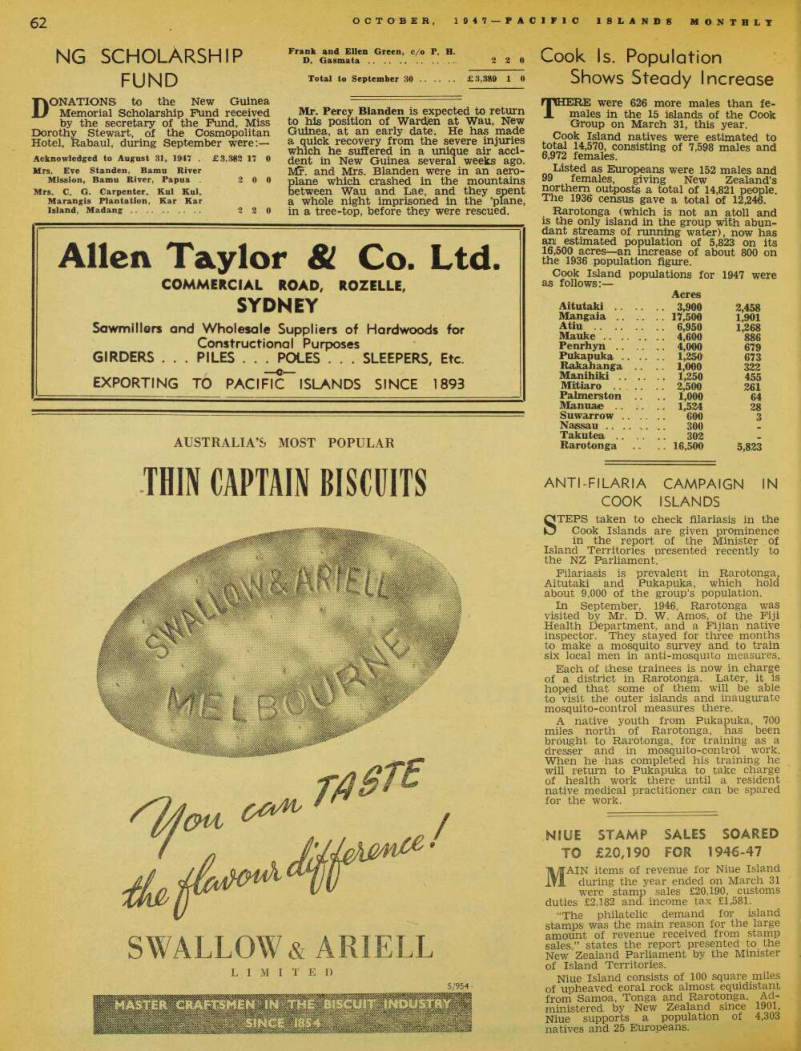
Fund
DONATIONS to the New Guinea Memorial Scholarship Fund received by the secretary of the Fund, Miss Dorothy Stewart, of the Cosmopolitan Hotel, Rabaul, during September were:— Acknowiedged to August si, 1947 . £3,382 17 o Mrs. Eve standen, Bamu River Mission, Bamu River, Papua 200 Mrs. c. g. Carpenter, Kui Kui, Marangis Plantation, Kar Kar island, Madang 220
Frank and Ellen Green, c/o P. H.
D. Gasmata 2 2 0 Total to September 30 £3,389 1 0 Mr. Percy Blanden is expected to return to his position of Warden at Wau, New Guinea, at an early date. He has made a quick recovery from the severe injuries which he suffered in a unique air acci dent in New Guinea several weeks ago.
Mr. and Mrs. Blanden were in an aero plane which crashed in the mountains between Wau and Lae, and they spent a whole night imprisoned in the ’plane, in a tree-top, before they were rescued.
Shows Steady Increase
Cook Is. Population Shows Steady Increase
rPHERE were 626 more males than fe- JL males in the 15 islands of the Cook Group on March 31, this year.
Cook Island natives were estimated to total 14,570, consisting of 7,598 males and 6,972 females.
Listed as Europeans were 152 males and 99 females, giving New Zealand’s northern outposts a total of 14,821 people.
The 1936 census gave a total of 12,246.
Rarotonga (which is not an atoll and is the only island in the group with abun dant streams of running water), now has an estimated population of 5,823 on its 16,500 acres—an increase of about 800 on the 1936 population figure.
Cook Island populations for 1947 were as follows:
Acres Aitutaki .. .. 3,900 2,458 Mangaia . . .. . . 17,500 1,901 Atiu . . .. . . .. 6,950 1,268 Malike . . . . 886 Penrhyn .. . . .. 4,000 679 Pukapuka ..
Rakahanga .. . . 1,250 . . . . 1,000 673 322 Manihiki .. .. . . 1,250 455 Mitiaro . . . . 2,500 261 Palmerston .. .. 1,000 64 Manuae .. .. .. 1,524 28 Suwarrow .. ... 600 3 Nassau .. .. ... 300 Takutea ... 302 Rarotonga . . 16,500 5,823
Anti-Filaria Campaign In
Cook Islands
STEPS taken to check filariasis in the Cook Islands are given prominence in the report of the Minister of Island Territories presented recently to the NZ Parliament.
Filariasis is prevalent in Rarotonga, Aitutaki and Pukapuka, which hold about 9,000 of the group’s population.
In September, 1946, Rarotonga was visited by Mr. D. W. Amos, of the Fiji Health Department, and a Fijian native inspector. They stayed for three months to make a mosquito survey and to train six local men in anti-mosquito measures.
Each of these trainees is now in charge of a district in Rarotonga. Later, it is hoped that some of them will be able to visit the outer islands and inaugurate mosquito-control measures there.
A native youth from Pukapuka, 700 miles north of Rarotonga, has been brought to Rarotonga, for training as a dresser and in mosquito-control work.
When he has completed his training he will return to Pukapuka to take charge of health work there until a resident native medical practitioner can be spared for the work.
Niue Stamp Sales Soared
To £20,190 For 1946-47
MAIN items of revenue for Niue Island during the year ended on March 31 were stamp sales £20,190, customs duties £2,182 andx income tax £1,581.
“The nhilatelic demand for island stamps was the main reason for the large amount of revenue received from stamp sales,” states the report presented to the New Zealand Parliament by the Minister of Island Territories.
Niue Island consists of 100 square miles of upheaved coral rock almost equidistant from Samoa, Tonga and Rarotonga. Ad ministered by New Zealand since 1901, Niue supports a population of 4,303 natives and 25 Europeans.
Advertisements & other items, p. 66 (1 item)
Thin Captain Biscuits
Allen Taylor & Co. Ltd.
COMMERCIAL ROAD, ROZELLE,
SYDNEY
Sowmillers ond Wholesole Suppliers of Hardwoods for Constructional Purposes GIRDERS . . . PILES . . . POLES . . . SLEEPERS, Etc.
EXPORTING TO PACIFIC ISLANDS SINCE 1893
AUSTRALIA’S MOST POPULAR
THIN CAPTAIN BISCUITS
(/CiM' Oil /
SWALLOW & ARIELL
LIMITED
S/954
New Britain Notes
Rain Labour and Radio Com munications All missing!
From Our Own Correspondent
Rabaul, Sep. 17.
RABAUL has had no rain for six weeks.
Practically the only water supply at present comes from the shallow wells that the Japs sank during their occupation. This water is not good.
The Administration apparently intends to do nothing in the matter of a per manent water supply. The excuse is that Kokopo will some day be the residential centre.
If the Administration really intends to make Kokopo the Administrative centre of this island then an enormous amount of money is being wasted in erecting buildings in Rabaul.
Until this week it was possible to re sign native labour after an indenture term of one year if the natives in question were willing to do so. The introduction of a new ordinance now expressly forbids this and the natives must be returned to their village after one year for a period of at least three months before again being indentured.
This strikes the severest blow possible at industry in these islands and will be a disaster to many producers who are trying to rehabilitate their properties.
Every endeavour possible has been made by various New Guinea public bodies to avert this disaster, but the Australian Government has refused to consider their appeals. rnHE Administration, at an enormous JL cost, is installing radio-telephone centres throughout the Papua-NG Territory. The cost involved will run in to well over a quarter million pounds.
These radio-telephone centres have, how ever, proved a failure wherever they have been installed. Inexperienced operators and the management generally are to blame. There is no reliable means of inter-island radio communication other than that of the few radio stations that were recently taken over by the Overseas Telecommunication Commission from the Amalgamated Wireless (A/sia) Ltd.
The Administration radio stations, commonly known as the RTC are in variably out of action and, in some cases, it takes weeks to get a message trans mitted over the system. According to re ports, the Administration proposes that this system shall operate exclusively throughout the Islands.
Investigation by a reliable authority on installation of an efficient system of radio-communication is overdue.
Banana Figs
Chance For Samoan Industry
. Apia, Oct. 1.
DRIED bananas or banana figs, com mercially named “Dri-dated bananas” as manufactured by the Government concern. New Zealand Re paration Estates, should command a market in New Zealand and elsewhere when the dollar crisis prevents importa tion of dried Californian fruit into New Zealand.
NZ Reparation Estates have a large stock of dri-dated bananas on hand at present, and in this sideline have made a good profit, amounting to some £B,OOO, during last year.
The establishment of an up-to-date hospital in Tahiti, as well as a sana torium, is made possible by a French official grant of 25.000,000 francs. Plans are to be prepared.
Fijian Harmony For Nz
Radio Audience
TEN Fijian students recently went on the air in Auckland, NZ, when they broadcast a programme of Island harmony over station IZB.
All the young men are students at Auckland University College or the Teachers’ Training College. Five are ex army officers of the Fiji Military Forces, two are Middle East veterans, one is a graduate of the Central Medical School in Suva and two are Morris Hedstrom Scholarship winners.
The programme was compered by Ravuama Vunivalu—one of the MH scholarship holders.
During the competition of the Auck land Musical Society, held in September, four of the ten, Volavola, George, Sikivou and Rahukawaga made up a quartette which secured second place in the quartette vocal section.
France has released a sum from Govt, funds sufficient to allow Tahiti to import consumer goods for some little time to come. Recently 400 tons of sugar arrived from Guadeloupe.
The Civil Administration of Papua-New Guinea is now taking an active interest in the Manus Base. While on Circuit at Manus, Mr. Justice Phillips represented the Administrator at important confer ences with Admiral Sir Louis Hamilton, of the British Navy. Early in September another party of Administration officials, including the Administrator, Dr. Gunther (Director of Health), and Mr. Pearsall (of the Administrator’s office), left for
Manus on the “Shoalhaven.” Mr. Wilmot, of the British Council, also did the trip.
Monsieur Louis Catalan who for 25 years has been Belgian Consul in Noumea, has been promoted Officer of the Order of the Crown, by the Belgian Regent, Prince Charles. M. Catalan is in business in Noumea as a wine merchant.
Advertisements & other items, pp. 67-68 (1 item)
H? Nivens
Gilbert Renton
AUCTIONEER, VALUER,
ESTATE AGENT.
Storage and Repository Travellers Sample Rooms For General Information and Service.
P.O. Box Rabaul, TNG
H? NIVENS
PURE ICE CREAM
IN THE PACIFIC:-
VI/’E WISH TO ANNOUNCE that until refrigeration ships return to Pacific Island runs, we are unable to ship McNIVEN'S ICE CREAM to our Island clients. We expect refrigeration ships to resume schedules early in 1948, and we welcome any enquiries for the latest information.
Advance orders accepted.
For the fullest information apply to:
J. C. MERRILLEES PTY. LTD.
PHOENIX BUILDING, 63 PITT ST., SYDNEY
Telegrams and Cables: Codes: 8W6064 Merrillees, Sydney Bentleys Phone:
While in Port Moresby. . .
HIRE Your Taxi from
BULOWAT TRANSPORT
COMPANY
CARRIERS AND TRANSPORT SPECIALISTS
GENERAL MOTOR REPAIRS
—Agents for—
CRYSTALITE PLASTICS, ALL ELECTRICAL
EQUIPMENT, RADIOS, REFRIGERATORS,
HOT WATER JUGS, ETC.
SIDNEY COOK, PROP.
Woven Wire for all Industry
COPRA DRYING TRAYS, FLOORS, Etc.
FRUIT DRYING TRAYS, MINING SCREENS.
Heavy Mosquito Gauze in Phosphor Bronze and other Metal! Impervious to Salt Sea Air.
WIRE DOOR MATS AND GENERAL WIRE WORKS
E. WRIGHT & CO. LTD.
Office and Works: 148-152 Cleveland Street, Sydney, N.S.W.
Telegraphic Address: “Wrightmake,” Chippendale.
o* T V
f- Or £
* **• MB 8 w : When the climb is very severe
MOTOR OIL
guards your engine
BEFORE TOURING,
GARAGE OR SERVICE STATION
DRAIN, FLUSH AND REFILL YOUR
ENGINE WITH SHELL MOTOR OH.
THE SHELL COMPANY OF AUST. LTD.
(Incorporated in Gt. Britain) E
Court of Appeal For Fiji?
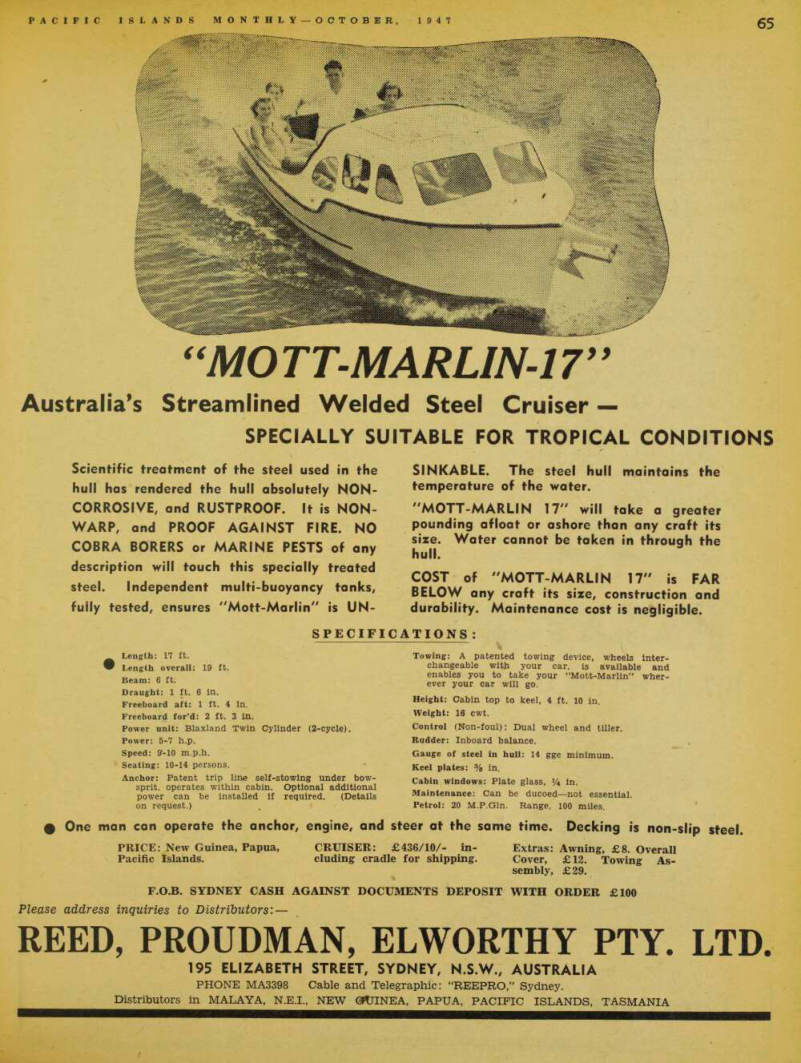
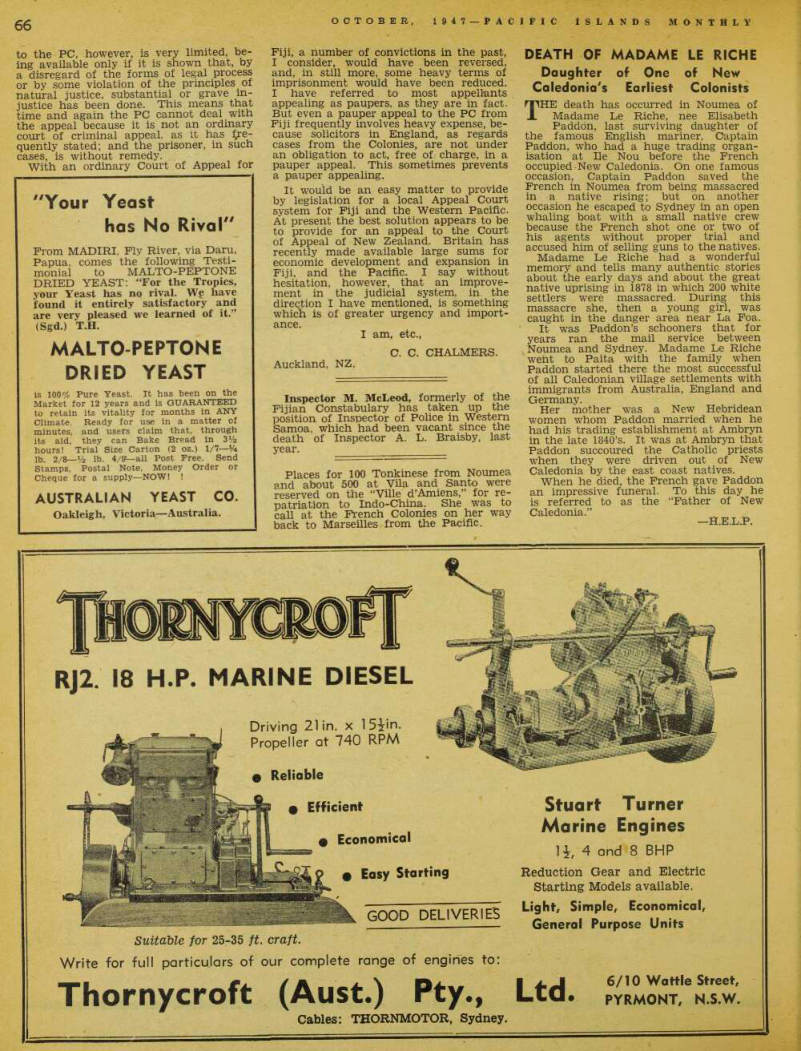
'J'HE following letter appeared in the
“Solicitors’ Journal,” London, on July 5, 1947. It was written Toy Mr. C.
C. Chalmers, formerly a legal prac titioner in Suva, Fiji, now of Auck land, NZ. His brother, Mr. N. S.
Chalmers, has a law practice in Suva at the present time. Both are en deavouring to bring about the estab lishment of an ordinary Court of
Appeal for Fiji and the Western
Pacific. Their reasons for this are stated in the following letter : AS a former active member of the Bar of Fiji, and now of New Zealand, and as one born in Fiji, and having a special interest in the progress of that Colony, I desire to draw public attention, in England, to the continued lack of a Court of Appeal for Fiji and the Western Pacific At present the only right of appeal is to the Privy Council, which is of a very limited character, and so expensive as generally to be prohibitive. I think in a number of Colonies provision has now been made for a local Court of Appeal, with the retention of the Privy Council as the final appellate Court.
In the case of Western Samoa, under mandate to New Zealand, there has been for many years a right of appeal from the High Court to the Supreme Court of New Zealand. But Fiji and the Western Pacific are still unprovided for in this respect, and there is urgent need for an ordinary Court of Appeal. Especially is this so in the case of crimes, and, in particular, capital cases, committed by natives and Indians, of whom there are now over 200,000 in Fiji. They constitute nine-tenths of the population.
I will now show how Fiji’s judicial system operates as regards crimes by that section of the community. Apart from Magistrates’ Courts (of which there is a new. elaborate and unnecessary system of three grades'), there is the Supreme Court of Fiji, formerly consisting of a Chief Justice, and now of a Puisne Judge as well.
When an accused person is committed for trial by a Magistrate, he is then tried before either the Chief Justice, or the Puisne Judge, with the aid of what are called “assessors,” four in capital cases, and two in all other cases. The presiding judge may, for “special reasons, order trial before a jury of seven, but this rarely, if ever, happens. These assessors, moreover, are chosen bv the Chief Justice himself, according to their education and character, from the list of jurors; and they are invariably from the small Euro pean section of the Colony, because only persons who earn more than £l5O yearly and have a competent knowledge of Eng lish, can become jurors.
At the conclusion of the trial, the assessors state their opinion orally; but— and that is the extraordinary provision —the presiding judge is not bound to con form to the assessors’ opinions! In certain cases he has given a verdict contrary to their opinions. It is true to say, there fore, that a native or Indian, charged with, say, a capital offence, may be con victed by a judge alone. The prisoner s only remedy, if he wishes to appeal, is to petition the PC for special leave, and. in most instances, there is also a petition for leave to appeal as a pauper. There have been several of such Fiji appeals in recent years.
IF leave to appeal is granted, the appeal proper comes on later. As much as two years can elapse before an appeal is heard and meantime the prisoner is languishing in jail. The right of appeal
to the PC, however, is very limited, be ing available only if it is shown that, by a disregard of the forms of legal process or by some violation of the principles of natural justice, substantial or grave in justice has been done. This means that time and again the PC cannot deal with the appeal because it is not an ordinary court of criminal appeal, as it has fre quently stated; and the prisoner, in such cases, is without remedy.
With an ordinary Court of Appeal for
Fiji, a number of convictions in the past, I consider, would have been reversed, and, in still more, some heavy terms of imprisonment would have been reduced.
I have referred to most appellants appealing as paupers, as they are in fact.
But even a pauper appeal to the PC from Fiji frequently involves heavy expense, be cause solicitors in England, as regards cases from the Colonies, are not under an obligation to act, free of charge, in a pauper appeal. This sometimes prevents a pauper appealing.
It would be an easy matter to provide by legislation for a local Appeal Court system for Fiji and the Western Pacific.
At present the best solution appears to be to provide for an appeal to the Court of Appeal of New Zealand. Britain has recently made available large sums for economic development and expansion in Fiji, and the Pacific. I say without hesitation, however, that an improve ment in the judicial system, in the direction I have mentioned, is something which is of greater urgency and import ance.
I am, etc.,
C. C. Chalmers.
Auckland, NZ.
Inspector M. McLeod, formerly of the Fijian Constabulary has taken up the position of Inspector of Police in Western Samoa, which had been vacant since the death of Inspector A. L. Braisby, last year.
Places for 100 Tonkinese from Noumea and about 500 at Vila and Santo were reserved on the “Ville d’Amiens,” for re patriation to Indo-China. She was to call at the French Colonies on her way back to Marseilles from the Pacific.
Advertisements & other items, pp. 69-70 (1 item)
“Mo Tt-Marlin-17”
m [
Australia’s Streamlined Welded Steel Cruiser
SPECIALLY SUITABLE FOR TROPICAL CONDITIONS
Scientific treatment of the steel used in the hull has rendered the hull absolutely NON-
CORROSIVE, and RUSTPROOF. It is NON-
WARP, and PROOF AGAINST FIRE. NO
COBRA BORERS or MARINE PESTS of any
description will touch this specially treated
steel. Independent multi-buoyancy tanks,
fully tested, ensures "Matt-Marlin" is UN-
SINKABLE. The steel hull maintains the
temperature of the water.
"MOTT-MARLIN 17" will take a greater
pounding afloat or ashore than any craft its size. Water cannot be taken in through the
hull.
COST of "MOTT-MARLIN 17" is FAR
BELOW any craft its size, construction and
durability. Maintenance cost is negligible.
SPECIFI
Length: 17 ft. ® Length overall: 19 ft.
Beam: 6 ft.
Draught: 1 ft. 6 in.
Freeboard aft: 1 ft. 4 in.
Freeboard for’d: 2 ft, 3 in.
Power unit: Blaxland Twin Cylinder (2-cycle).
Power: 5-7 h.p.
Speed: 9-10 m.p.h.
Seating: 10-14 persons.
Anchor: Patent trip line self-stowing under bowsprit. operates within cabin. Optional additional power can be installed If required. (Details on request.) 9 One man can operate the anchor, engine, and PRICE: New Guinea, Papua, CRUISER: Pacific Islands. eluding: crad
ATIONS :
Towing: A patented towing device, wheels interchangeable with your car, is available and enables you to take your “Mott-Marlln” wherever your car will go.
Height: Cabin top to keel, 4 ft. 10 in.
Weight: 16 cwt.
Control (Non-foul): Dual wheel and tiller.
Rudder: Inboard balance.
Gauge of steel in hull: 14 gge minimum.
Keel plates: % in.
Cabin windows: Plate glass, V* in.
Maintenance: Can be ducoed —not essential.
Petrol: 20 M.P.GIn. Range, 100 miles. steer at the same time. Decking is non-slip steel. £436/10/- in- Extras: Awning:, £B. Overall le for shipping. Cover, £l2. Towing Assembly, £29.
F. 0.8. SYDNEY CASH AGAINST DOCUMENTS DEPOSIT WITH ORDER £lOO Please address inquiries to Distributors :
REED, PROUDMAN, ELWORTHY PTY.
195 ELIZABETH STREET, SYDNEY, N.S.W., AUSTRALIA
PHONE MA3398 Cable and Telegraphic: “REEPRO,” Sydney.
Distributors in MALAYA, N.E.1., NEW OtTINEA, PAPUA, PACIFIC ISLANDS, TASMANIA
LTD.
"Your Yeast
has No Rival"
From MADIRI, Fly River, via Dam, Papua, comes the following Testimonial to M ALTO-PEPTONE DRIED YEAST: “For the Tropics, your Yeast has no rival. We have found it entirely satisfactory and are very pleased we learned of it.” (Sgd.) T.H.
MALTO-PEPTONE
DRIED YEAST
is 100% Pure Yeast. It has been on the Market for 12 years and is GUARANTEED to retain its vitality for months in ANY Climate. Ready for use in a matter of minutes, and users claim that, through its aid, they can Bake Bread in 3V2 hours! Trial Size Carton (2 oz.) 1/7—Vi lb. 2/8 —V 2 lb. 4/ff— all Post Free. Send Stamps, Postal Note, Money Order or Cheque for a supply—NOW! !
AUSTRALIAN YEAST CO.
Oakleigh, Victoria —Australia.
Death Of Madame Le Riche
Daughter of One of New Caledonia's Earliest Colonists
THE death has occurred in Noumea of Madame Le Riche, nee Elisabeth Paddon, last surviving daughter of the famous English mariner, Captain Paddon, who had a huge trading organ isation at He Nou before the French occupied New Caledonia. On one famous occasion, Captain Paddon saved the French in Noumea from being massacred in a native rising; but on another occasion he escaped to Sydney in an open whaling boat with a small native crew because the French shot one or two of his agents without proper trial and accused him of selling guns to the natives.
Madame Le Riche had a wonderful memory and tells many authentic stories about the early days and about the great native uprising in 1878 in which 200 white settlers were massacred. During this massacre she, then a young girl, was caught in the danger area near La Foa.
It was Paddon’s schooners that for years ran the mail service between Noumea and Sydney. Madame Le Riche went to Paita with the family when Paddon started there the most successful of all Caledonian village settlements with immigrants from Australia, England and Germany.
Her mother was a New Hebridean women whom Paddon married when he had his trading establishment at Ambryn in the late 1840’s. It was at Ambryn that Paddon succoured the Catholic priests when they were driven out of New Caledonia by the east coast natives.
When he died, the French gave Paddon an impressive funeral. To this day he is referred to as the “Father of New Caledonia.”
H.E.L.P.
Advertisements & other items, p. 70 (1 item)
TKornycroft (Aust.) Pty., Ltd.
T m 0 D
RJ2. 18 H.P. MARINE DIESEL
Driving 21 in. x 1 siin.
Propeller at 740 RPM Reliable CU a ■
Stuart Turner
Marine Engines
H, 4 and 8 BHP Reduction Gear and Electric Starting Models available. good deliveries Li 9 hf ' s ; m D ple ' Eeono ™ ieal ' . General Purpose Units • Efficient • Economical • Easy Starting Suitable for 25-35 ft. craft.
Write for full particulars of our complete range of engines to:
TKornycroft (Aust.) Pty., Ltd.
Cables: THORNMOTOR, Sydney. 6/10 Wattle Street,
PYRMONT, N.S.W.
Kon Tiki Men
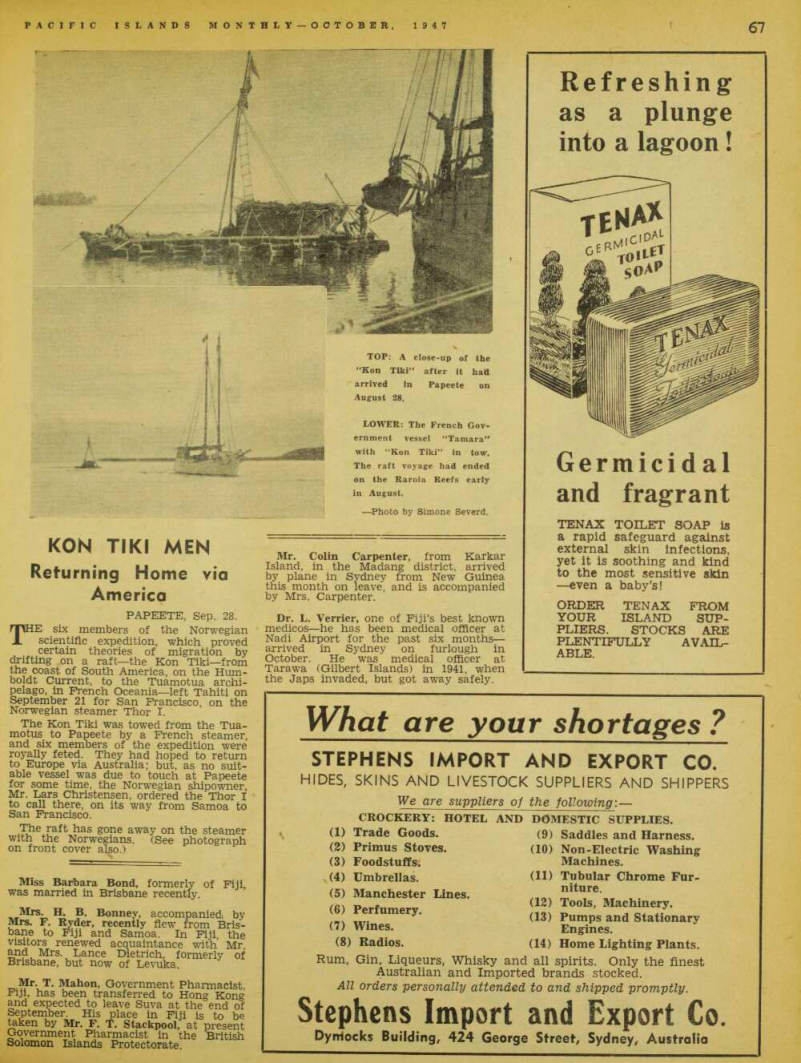
Returning Home via America
Papeete, Sep. 28.
rnHE six members of the Norwegian X scientific expedition, which proved certain theories of migration by drifting on a raft—the Kon Tiki—from the coast of South America, on the Hum boldt Current, to the Tuamotua archi pelago, in French Oceania—left Tahiti on September 21 for San Francisco, on the Norwegian steamer Thor I.
The Kon Tiki was towed from the Tua motus to Papeete by a French steamer, and six members of the expedition were royally feted. They had hoped to return to Europe via Australia; but, as no suit able vessel was due to touch at Papeete for some time, the Norwegian shipowner, Mr. Lars Christensen, ordered the Thor I to call there, on its way from Samoa to San Francisco.
The raft has gone away on the steamer with the Norwegians. (See photograph on front cover also.) Miss Barbara Bond, formerly of Fiji, was married in Brisbane recently. ?• Bonney, accompanied by Mrs. F. Ryder, recently flew from Bris bane to Fiji and Samoa. In Fiji, the visitors renewed acquaintance with Mr. and Mrs. Lance Dietrich, formerly of Brisbane, but now of Levuka.
Mr. T. Mahon, Government Pharmacist, Fiji, has been transferred to Hong Kong and expected to leave Suva at the end of September. His place in Fiji is to be taken by Mr. F. T. Blackpool, at present Government Pharmacist in the British Solomon Islands Protectorate,
Mr. Colin Carpenter, from Karkar Island, in the Madang district, arrived by plane in Sydney from New Guinea this month on leave, and is accompanied by Mrs. Carpenter.
Dr. L. Verrier, one of Fiji’s best known medicos —he has been medical officer at Nadi Airport for the past six months— arrived in Sydney on furlough in October. He was medical officer at Tarawa (Gilbert Islands) in 1941, when the Japs invaded, but got away safely.
TOP: A close-up of the “Kon Tiki” after It had arrived in Papeete on August 28.
LOWER: The French Gov ernment vessel “Tamara” with “Kon Tiki” in tow.
The raft voyage had ended on the Raroia Reefs early in August. —Photo by Simone Severd.
Advertisements & other items, p. 71 (1 item)
F Tena*
Refreshing
as a plunge
into a lagoon!
f TENA*
TO e ft
Germicidal
and fragrant
TENAX TOILET SOAP is
a rapid safeguard against external skin Infections, yet it is soothing and kind to the most sensitive skin —even a baby’s!
ORDER TENAX FROM
YOUR ISLAND SUP-
PLIERS. STOCKS ARE
PLENTIFULLY AVAIL-
ABLE.
What are your shortages ?
STEPHENS IMPORT AND EXPORT CO.
HIDES, SKINS AND LIVESTOCK SUPPLIERS AND SHIPPERS We are suppliers of the following :—
CROCKERY: HOTEL AND DOMESTIC SUPPLIES.
(1) Trade Goods. (2) Primus Stoves. (3) Foodstuffs. (4) Umbrellas. (5) Manchester Lines. (6) Perfumery. (7) Wines. (8) Radios. (9) Saddles and Harness. (10) Non-Electric Washing Machines. (11) Tubular Chrome Furniture. (12) Tools, Machinery. (13) Pumps and Stationary Engines. (14) Home Lighting Plants.
Rum, Gin, Liqueurs, Whisky and all spirits. Only the finest Australian and Imported brands stocked.
All orders personally attended to and shipped promptly.
Stephens Import and Export Co.
Dyiriocks Building, 424 George Street, Sydney, Australia
Fijian Bible
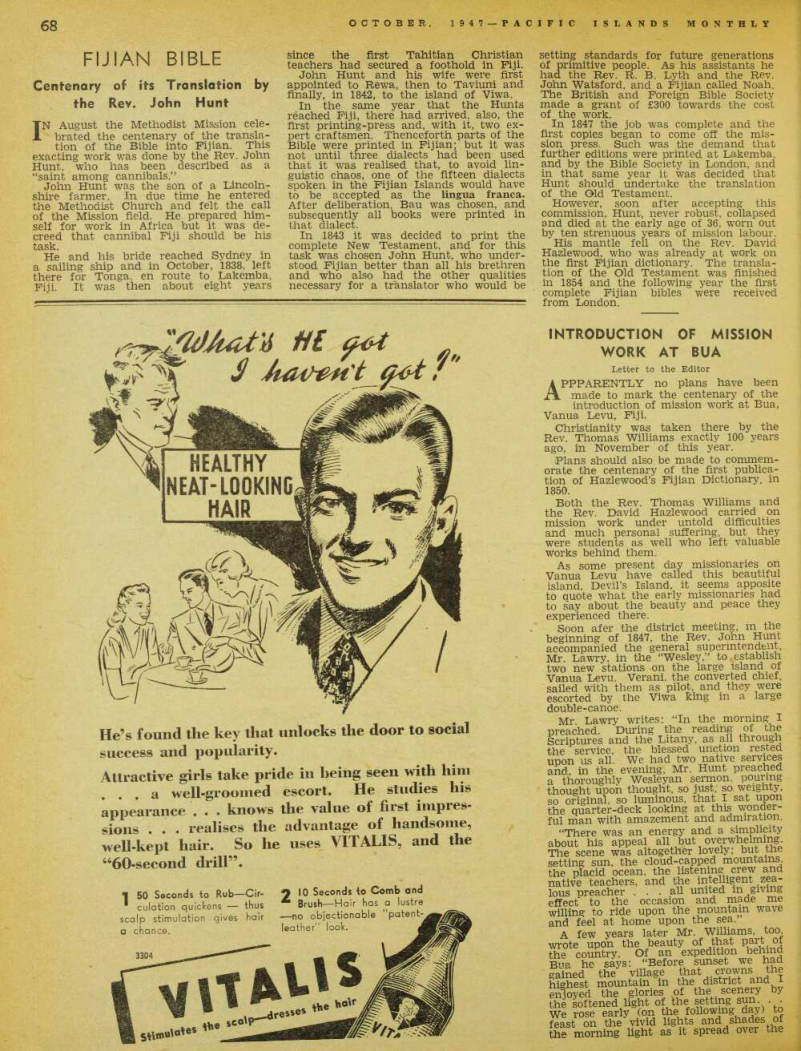
Centenary of its Translation by the Rev. John Hunt
IN August the Methodist Mission cele brated the centenary of the transla tion of the Bible into Fijian. This exacting work was done by the Rev. John Hunt, who has been described as a “saint among cannibals.”
John Hunt was the son of a Lincoln shire farmer. In due time he entered the Methodist Church and felt the call of the Mission field. He prepared him self for work in Africa but it was de creed that cannibal Fiji should be his task.
He and his bride reached Sydney in a sailing ship and in October, 1838, left there for Tonga, en route to Lakemba, Fiji. It was then about eight years
since the first Tahitian Christian teachers had secured a foothold in Fiji.
John Hunt and his wife were first appointed to Rewa, then to Taviuni and finally, in 1842, to the island of Viwa. in the same year that the Hunts reached Fiji, there had arrived, also, the first printing-press and, with it, two ex pert craftsmen. Thenceforth parts of the Bible were printed in Fijian; but it was not until three dialects had been used that it was realised that, to avoid lin guistic chaos, one of the fifteen dialects spoken in the Fijian Islands would have to be accepted as the lingua franca, After deliberation, Bau was chosen, and subsequently all books were printed in that dialect.
In 1843 it was decided to print the complete New Testament, and for this task was chosen John Hunt, who under stood Fijian better than all his brethren and who also had the other qualities necessary for a translator who would be
setting standards for future generations of primitive people. As his assistants he had the Rev. R. B. Lyth and the Rev.
John Watsford, and a Fijian called Noah.
The British and Foreign Bible Society made a grant of £3OO towards the cost of the work.
In 1847 the job was complete and the first copies began to come off the mis sion press. Such was the demand that further editions were printed at Lakemba and by the Bible Society in London, and in that same year it was decided that Hunt should undertake the translation of the Old Testament.
However, soon after accepting this commission, Hunt, never robust, collapsed and died at the early age of 36, worn out by ten strenuous years of mission labour.
His mantle fell on the Rev. David Hazlewood, who was already at work on the first Fijian dictionary. The transla tion of the Old Testament was finished in 1854 and the following year the first complete Fijian bibles were received from London.
Introduction Of Mission
Work At Bua
Letter to the Editor APPPARENTLY no plans have been made to mark the centenary of the introduction of mission work at Bua, Vanua Levu, Fiji.
Christianity was taken there by the Rev, Thomas Williams exactly 100 years ago, in November of this year.
Plans should also be made to commem orate the centenary of the first publica tion of Hazlewood’s Fijian Dictionary, in 1850.
Both the Rev. Thomas Williams and the Rev. David Hazlewood carried on mission work under untold difficulties and much nersonal suffering, but they were students as well who left valuable works behind them.
As some present day missionaries on Vanua Levu have called this beautiful island, Devil’s Island, it seems apposite to quote what the early missionaries had to say about the beauty and peace they experienced there.
Soon afer the district meeting, in the beginning of 1847, the Rev. John Hunt accompanied the general superintendent, Mr. Lawry, in the “Wesley,” to establish two new stations on the large island of Vanua Levu. Verani, the converted chief, sailed with them as pilot, and they were escorted by the Viwa king in a large double-canoe.
Mr Lawry writes: “In the morning I preached. During the reading of the Scriptures and the Litany, as all through the service, the blessed unction rested upon -us all. We had two native services and, in the evening, Mr. Hunt preached a thoroughly Wesleyan sermon, pouring thought unon thought, so just, so weighty, so original, so luminous, that I sat upon the quarter-deck looking at this wonder ful man with amazement and admiration.
“There was an energy and a simplicity about his appeal all but overwhelming The scene was altogether lovely; but the setting sun, the cloud-capped mountains, the placid ocean, the listening crew and native teachers, and the intelligent zea lous preacher ... all united in giving effect to the occasion and made me willing to ride upon the mountain wave and feel at home upon the sea.
A few years later Mr. Williams, too, wrote upon the beauty of that part of the country. Of an expedition behind Bua he says; “Before sunset we had gained the village that crowns the highest mountain in the district and I enjoyed the glories of the scenery by the softened light of the setting sun . .
We rose early (on the following day) to feast on the vivid lights and shades of the morning light as it spread over the
mountains ... all the beauties of yes terday were increased by a barque and a schooner, working out of the bay.”
I am, etc.,
(Mrs.) H. B. R. Parham.
Suva, Fiji. August 28.
Advertisements & other items, p. 72 (1 item)
*7* Wjuu'6 Hi
v-i-
HEALTHY
NEAT-LOOKING
HAIR
A / dZ\ m\: M H \W £5 He’s found the key that unlocks the door to social success and popularity.
Attractive girls take pride in being seen with him . . a well-groomed escort. He studies his appearance . . • knows the value of first impressions . . . realises the advantage of handsome, well-kept hair. So he uses VITALIS, and the “60-second drill”. 1 50 Seconds to Rub—Cir- O 10 Seconds lo Coml ? and 1 culation quickens thus * Brush— Hair has a lustre scalp stimulation gives hair —no objectionable patenter chance, leather look. 3304 V hair scolp" areS ‘ f u\o* es Stiw
Lae War Cemetery
Praised
MRS. C. H. R. MACLEAN, well-known pre-war resident „of the Rabaul District, New Guinea, returned to the Territory in June. Mr. Maclean was one of those who were lost in the “Montevideo Maru.”
Mrs. Maclean intends to spend some time, at first, with her son Colin, who is in charge of the sub-district of Saidor, near Madang. Later, she will go on to New Britain to stay with her other two sons who have opened up plantations there.
Mrs. Maclean writes of her favourable impression of the Lae war cemetery.
She says: “I was amazed at the perfect condition and the manner in which the whole place has been cared for. It is in a lovely spot with trees as a back ground. The well-kept grass, bordered by gay coleus, etc., the graves with their snow-white crosses placed without re gard to creed or rank, make one thank ful and appreciative of the job that has been done by the War Graves Commis sion. The Ausrtalian flag, which waves above it, brought the realisation of what a different story might have been told but for the gallantry of those men who lie there, and their comrades in arms.”
Early Man In Fiji
Analysis of Evidence Secured by American Professor
IN a letter to Professor E. W. Gifford, of the University of California, the editor of the “PIM” said, referring to the professor’s recent archaeological work in Fiji: “I assume from what you have said that your excavations do supply evidence of the early establishment there of a pre-Polynesian or pre-Melanesian race.”
To this, the American scientist has very courteously replied as follows: — “The most that I can say for the evidence unearthed is that it indicates an early horizon of culture in Viti Levu; but to say that it is pre-Polynesian or pre- Melanesian is going too far at the pre sent state of our knowledge, and would pre-suppose the existence of other races in Fiji, for which as far as I can see there is no evidence.
“Late Fijian pottery suggests somewhat that of the New Hebrides and of New Britain. The early Fijian pottery is paralleled in part by that from Shortland Island, in the Solomons. However, there may be a big time gap between my early Fijian material and the modern Short land Island material.
“In time, I hope to make further com parisons and perhaps get more light on the possible origin of the early material which I uncovered.
“Meanwhile, I think it is idle to specu late over pre-Polynesian and pre- Melanesian inhabitants in Viti Levu.
Fijian legend speaks of a race of short people in the highlands at the time of the arrival of the ancestors of the Fijians. Possibly these might be pygmies, but again I obtained no evidence.
“An anthropometric survey of the pre sent-day inhabitants might yield evid ence of pygmy admixture, since the inlanders are shorter in stature than the coast people. Since pygmies do not make pottery, it is idle to speculate as to my early pottery having been made by pygmies. Unfortunately, no skeletal re mains were found in association with it.
“The nearest pygmies to Fiji at the present time are those of Espiritu Santo, New Hebrides. Pygmy culture both in Africa and the Pacific is of low status, and lacks any indigenous pottery making.
Any attempts at pottery-making to-day among pygmies are due to extraneous in fluences.”
Death Of E. D. D. Davis
rE death occurred on MV “Malaita,” as the vessel was approaching Sydney Heads on the return journey from New Guinea this month, of Mr.
Edward David Duffy Davis, a Native Labour Inspector of the Administration at Port Moresby. He had been ailing for some time and was going to Sydney to obtain medical treatment. Prior to the war, Mr. Davis was employed by the APC in Papua and was well and favour ably known throughout the Territory. He originally came from England and so far as is known, he had no relations in Australia.
Mr. and Mrs. Max Miller, who intend to settle in Australia, left Suva in the “Marine Phoenix” recently. Mr. Miller was one of Fiji’s outstanding swimmers and at a brief ceremony at the Suva Sea Baths on September 14 a presentation was made to him on behalf of the Fiji Swimming and Water Polo Association by last year’s president of the association, Mr. L. G. Usher.
Advertisements & other items, pp. 73-74 (1 item)
Kodak
FOR EVERYTHING PHOTOGRAPHIC
J
and Comprehensive Service
Kodak Film, Plates and Sensitised Papers . . . Super-X Cine-Kodak Safety Film . . . 35mm Kodachrome Film Australian-made 35mm. Enlargers, Single Unit Reflectors, Floor Lights, Spotlights and general Floodlighting Equipment . . . Austral Projection Screens . . . Shelton 35mm. Film Strip Projectors . Tripods . . . Carrying Cases . . . Lens Hoods . . . Celestion Enlargers Enlarging Focus Finders . . . Enamel and Plastic Developing Dishes . . . Film Clips Stirring Rods Print Paddles . . . Printing Frames . . . Developing Tanks Australasian Photo-Review Photographic Books . . . Kodak Developing, Printing, Enlarging and Colouring Service . . . Kodak Technical Advisory. Service . . .
Inquiries invited and advice gladly given. OF ALL KODAK DEALERS THROUGHOUT THE ISLANDS,
KODAK (AUSTRALASIA) PTY. LTD.
379 and 386 George Street, Sydney
NEWCASTLE, KATOOMBA AND ALL STATES
is a
grand cigarette
for all occasions-
Capstan’s own blend
of fine Virginia
leaf cannot
be equalled
£ H W x j m That's why it's always
TIME FOR A CAPSTAN
THE EMPIRE'S FAVOURITE CIGARETTE
Flag In
Navy Showed The Flag In British Solomons Did Not Participate In Marching Rule Arrests
STATEMENT which clears up the Solomon Island situation was issued in Suva on September 25, by
the Acting High Commissioner for
the Western Pacific, Mr. J. F. Nicoll.
Misleading and exaggerated reports
of the part played by the Royal and Royal Australian Navies in the recent
arrest, in BSI, of Marching Rule
leaders have appeared in the Aus tralasian Press. The, Navies were, in
fact, showing the flag, nothing more.
They had no part in the arrests.
Mr. NicolVs statement said: IN consequence of a defiant attitude on the part of the leaders of the Marching Rule movement, with the announced intention of causing disturb ances, it became necessary to effect the arrest of certain of these leaders. Their activities were upsetting the law-abiding section of the population and it was clear that a violent clash between the March ing Rule movement and its opposition would probably eventuate. These arrests have all been carried out by the local administration without any incidents of violence.
In pursuance of the usual policy of showing the flag, HMAS Warramunga visited Honiara between September 3 and 6, in the course of a routine cruise which was arranged some months ago and which had no relation to the activities of the Marching Rule movement. In order to provide a steadying influence following the period when most of the arrests mentioned above were carried out, arrangements were made for HMS Con test (a destroyer) to visit Malaita where the Marching Rule movement is largely concentrated, on September 4, and to re main in the area until September 15.
Although “Contest” took no part in the arrests of the leaders, her presence was most useful and in particular the admir able and tactful bearing of her officers and ratings contributed substantially to restoring confidence. In consequence the local administration was enabled to stabi lise the position more quickly than would otherwise have been possible.
On September 10 and 11, the submarine HMS Amphion in the course of a routine cruise paid a brief visit to Santa Ana, a small island with a population of about 300 people situated in the south east of the Protectorate. The aircraft carrier HMS Theseus wearing the flag of Rear Admiral Creasy, and accompanied by the destroyer HMS Cockade are at present passing through the Solomon Islands area in the course of their return to their base at Hong Kong following a visit to Australia and New Zealand.
It is emphasised that the mission of these warships was and is to show the flag only and that they were not sent there for punitive purposes. As has been stated, the arrests of certain Marching Rule leaders have been carried out en tirely by the resources of the local ad ministration and that no violent incidents occurred.
The latest reports show that the poli tical situation in the Protectorate is im proving satisfactorily.
Lieut. Col. Felix Broche, who com manded the French Pacific Battalion, and who was killed at Bir Hacheim in 1942, has been posthumously appointed a Chevalier of the Legion d’Honneur.
Dr. Mackaness' Interesting
Stevenson's Link With
Australia
Dr. Mackaness' Interesting Address to PI Society
THERE has been a marked improve ment in the attendances at the monthly meetings of the Pacific Is lands Society of Sydney in recent months, due as much to the popularity of the president, Major C. A. Swinbourne. as to post-war interest in the Pacific Islands.
At the monthly meeting on September 24, Dr. George Mackaness spoke to a capacity gathering in History House on “Molokai, Samoa, Sydney and Robert Louis Stevenson.”
Dr. Mackaness is a keen collector of Stevensoniana, as well as an authority on RLS. In dealing with the literary and historical links between Sydney and the Pacific Islands, created by the famous author’s visits to New South Wales in the late 80’s and early 90’s, the speaker aroused particular interest in the “Damien Letter,” which was written and first published in Sydney about March, 1890. This particular edition of Steven son’s bitter attack on Dr. Hyde, in de fence of Father Damien and his work among the lepers at Molokai is now very valuable.
Another rare piece, said Dr. Mackaness, was a booklet called. “An Object of Pity,” published about 1892 and bearing the in scription, “Imprinted at Amsterdam.”
This was written by Stevenson and his guests, including Lady Jersey, wife of the then Governor of New South Wales dur ing the latter’s visit to Apia. It was written in friendly derision of the British Consul in Apia at that time, who in dulged in frenzied flutterings when Lady Jersey insisted upon visiting one of Samoa’s warring chiefs.
Although this booklet was virtually un procurable—only about 25 copies were originally printed—Dr. Mackaness was lucky enough to secure a copy some years ago. This subsequently was found to be Lady Jersey’s own copy.
VISITORS included: Mrs. P. D. Mc- Carthy, Miss Moseley, Mrs. Judy Tudor, Mr. and Mrs. Leembruggen, Miss E. Seppelt, Messrs. Arnold Cookson, Norman Bell and Vaskess Jr.
In August, through the courtesy of the Film Section of the Education Depart ment and the New Zealand Tourist Bureau, several excellent sound films were screened before members of the society, and further films of a similar character are promised.
On Sunday afternoon, October 19, the Society holds a garden party, at the hospitable home of Mrs. E. Marie Irvine, 15 Manning Road, Edgecliff.
On October 22, the usual monthly meet ing and social gathering of the Society will be held at History House, 8 Young Street, Circular Quay, Sydney.
Rear-Admiral H. J. Peakes. CBE, RAN (Retired), will be Guest-speaker. His sub ject will be, “Here and There in the East.”
New Members
VTEW members elected: Mrs. G. G. Ker -11 mode; Mrs. Frost; Miss E. Seppelt; Mrs. R. F. Swinbourne; Miss Loloma Swinbourne; Mr. and Mrs. A. R. Gibbes and Mr. R. L. Bamfather Hilary Bates, the young daughter of District Officer and Mrs. C. Bates of Rabaul had a fortunate escape recently when the jeep in which she was riding overturned, down an 80 feet drop. The native driver threw Hilary clear and then jumped himself, when he realised that the jeep was out of control.
Miss Pamela Bakewell of Rabaul has announced her engagement to Mr.
Michael Foley, Patrol Officer, of Gas mata, New Ireland.
Nurse Haggelthorn of the European Hospital Rabaul has become engaged to Mr. H. Prince, of the staff of Burns Philp (New Guinea) Ltd., Rabaul.
Miss Betty Lawrence, of Rabaul, re cently announced her engagement to Commander B. Mussared, of Finsch hafen, New Guinea.
Advertisements & other items, p. 75 (1 item)
Fought in 24 Hours
Pimples and Bad Skin Fought in 24 Hours
Since the discovery of Nlxoderm by an American physician It is no longer necessary for anyone to suffer from ugly, disgusting and disfiguring skin blemishes such as Eczema, Pimples, Rash, Ringworm, Psoriasis, Acne, Blackheads, Scabies and Red Blotches. Don’t let a bad skin make you feel inferior and cause you to lose your friends. Clear your skin this new scientific way.
A New Discovery
Nlxoderm is an ointment, but different from any ointment you have ever seen or felt. It is a new discovery, and is not greasy but feels almost like a powder when you apply It. It penetrates rapidly into the pores and fights the cause of surface skin blemishes. Nlxoderm contains 9 Ingredients which fight skin troubles In these 3 ways. I.—lt fights and kills the microbes or parasites often responsible for skin disorders. 2.—lt stops itching, burning and smarting In 7 to 10 minutes, and cools and soothes the skin. 3.—lt helps nature heal the skin clear, soft and velvety smooth.
Works Fast
mediately, clearing and healing your skin, making It softer, whiter and velvety smooth Because Nlxoderm is scientifically compounded to fight skin troubles, It works fast.
It stops the Itching, burning and smarting in a few minutes, then starts to work lm-
In Just a day or two your mirror will tell you that here at last is the scientific treatment you have been needing to clear your skin—the treatment to make you look more attractive, to help you win friends. Nixoderm has brought clearer, healthier skins to thousands, such as Mr. Bob Weedon, Edmund Street, Fremantle, who writes: "I was troubled with pimples ever since I was 13, and have spent pounds and pounds on so-called cures without results. I then tried Nixoderm with astounding effect.
The pimples seemed to fade away, and after a week there was not the slightest trace of them.”
Satisfaction Guaranteed
Get Nixoderm from your chemist or store to-day. Look in the mirror In the morning and you will be amazed at the Improvement.
Then Just keep on using Nixoderm for one week and at the end of that time it must have made your skin soft, clear, smooth and magnetically attractive—must give you the kind of skin that will make you admired wherever you go, or you simply return the empty package and your money will be refunded in full. Get Nixoderm from your chemist or store to-day.
The guarantee protects you.
Nixoderm 2/- & 4/-
For Skin Sores, Pimples and Itch .
Tahiti's "Etat de Siege"
By J. Holley
Tahiti, July 10.
mHE unrest and general dissatisfaction X so prevalent in the world to-day, were demonstrated here recently.
When the SS “Ville d’Amiens” arrived, bringing a small number of “fonction aires” from Prance to occupy administra tive and executive positions in the Colony, the returned soldiers (Tahitians) forcibly prevented them from landing. The police and soldiery seemed sympathetic, for they too are Tahitians.
The returned men claimed that these French officials were sent to Tahiti with no experience of Islands conditions or of the Polynesian people, to occupy posi tions which Tahitians themselves should occupy. Moreover the Frenchmen were always paid a far larger salary than the Tahitians.
The Administration, of course, had its side; and in the little Administration daily paper, “Bulletin de Presse,” was a full page explanation of the position headed “Appel a la population.”
However the first round went to the Tahitians as the “fonctionaires” did not land on arrival. But instead of the “Ville d’Amiens” steaming off on its way with the unwanted “fonctionaires” she lay out in the harbour in a tantalising fashion day after day, and everyone wondered what would happen next.
Rumours were rife, and the coconut wireless worked overtime. Some said the Governor had sent to France for a war ship; others that the “fonctionaires” were being landed secretly, at night, and so on.
Suddenly, after four days of speculation the Government Early in the morning of June 28, the block of build ings which includes the Stuart Hotel was
Ks Ss
marines, with rifles and tommy-guns. At the corners were military trucks, bearing machine guns and crews. The Marines are practically all French, and are by far the mos £ important and efficient “force” in the Colony. The soldiers are all conscript Tahitians, k A s - mall b i? at le £ “™ e d .’Aliens,” £mgmg ashore the “fonctionaires” and their wives. They were escorted by armed Marm£S t° the hotel - No shots were fired, and there were no unpleasant incidents, although rumour had it that the returned Tah itian soldiers and y ’ .
The Ville d Amiens left immediately, An amusing sidelight, typical of native nonchalance, is that a police guard was left at the hotel and while he was loungmg at the entrance in the evening one of the “fonctionaires” calmly walked out ofthe hotel and disappeared dorm the hto th° P stehs and Xn he did not come back went down and said to the policeman; “Hey! M. Blank has just gone QUt of the hotel why did you J let hi m leave?” native policeman replied “How A* 1 ® ?hat tJhen was ! that ™ere are so many other guests at the hotel. Well if he s gone, there sno need for me to stay here now. And he went * Less than a week after the successful landing of the “fonctionaires” there was another notice in the “Press ” proclaimmg an “Etat de siege”—which is the equivalent of martial law.
The notice stated that a plot against the safety of the Administration had been discovered and that twelve arrests had been made. The notice also said that anyone disturbing the peace in any way
would be immediately arrested and a crowd would, if necessary, be dispersed by force of arms.
Civil law will be resumed only when the authorities are quite certain that public peace and tranquillity is assured.
No Further Trouble In
Tahiti
THE three officials-from France, whose arrival in Tahiti at the end of June precipitated a crisis there, have taken up their posts without any further trouble.
It will be remembered that the Tahitians (mostly returned soldiers of mixed blood) demonstrated against the new arrivals.
They claimed that all minor adminis trative posts should be filled by Tahiti born people, and for some days they would not allow the officials and their wives to come ashore.
However, Governor Haumant acted with firmness. The officials finally were disembarked and half a dozen of the Tahitian ringleaders were arrested. The Tahiti community generally remained perfectly calm.
In New Caledonia
DISCONTENTED New Caledonian officials recently staged a brief strike against their present conditions of employment and asked for the introduc tion of price control. Representatives of their Union met the governor’s repre sentatives and the Conseil General. The Union proposed a general strike, a move which would have unfortunate reper cussions on the life of Noumea and the Colony. The Conseil General has issued a reply to a communication by the Union published in the local press.
Advertisements & other items, p. 76 (2 items)
72
O C T O BE R, 1947 PACIFIC ISLANDS MONTHLY
WUlia
I I
Atkins Pty. Ltd.
Head Office, 449-451 KENT ST., SYDNEY
Iron Cr Steel Merchanfs-Engineers' Supplies
Coach fir Motor Hardware
ESTABLISHED OVER 50 YEARS
Ciblt Address: WXLATKIN, Sydney.
STEEL DEPARTMENT
MILD STEEL:
Rounds, Squares, Flats, Half-rounds, Hexagons, Bevel, Shoeing, Tyre, Angles, Tees, Sheets, Plates, Girder Plates, Chequer Plates, Channels, Hoops, Etc.
BRIGHT STEEL:
Rounds, Squares, Hexagons.
Extra Special High Speed Tool Steel, Mining Steel, Blister Steel and Spring Steel, Rounds, Flats & Squares.
Bar Iron—All sections and sizes.
Engineers' Supplies: Set Screws, Studs, Metal Thread Screws, Coach Screws, Piles, Cotter Pins, Bright and Black Bolts, Rivets, Etc., Hack Saw Blades.
Power Transmission Gear; Including Plummer Blocks, Couplings, Collars, Etc.
Coach and Motor Hardware: Axles, Springs, Wheelstuff, Duck, Paints.
Farriers' Supplies: Horse Nails, Anvils, Vices, Etc.
Motor-Trimmers ond Motor Builders' fir Motor Painters' Requirements Pacific Island Agents : Corrie fir Co., Sura, Fiji DUCO Lacquers end DULUX Enamels—FAßßEX Motor Toppings and Leather Cloths, House & Decorators' Paints, Varnishes & Brushware.
Sole Distributors of CHAMPION'S Decorators Paint Products.
Distributing Agents for BROLITE Lacquers, SYNFLEX Enamels and "POLYGLOSS'" Finish.
Sing-Sing At Scarlet Beach
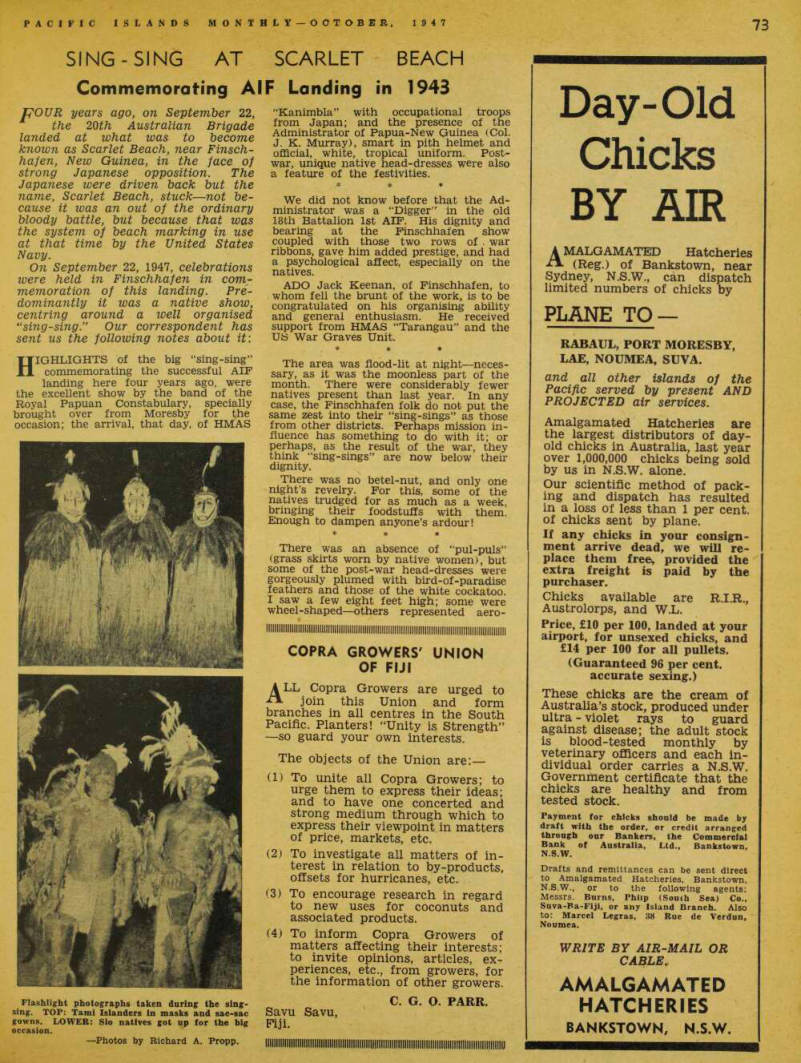
Commemorating AIF Landing in 1943
pOUR years ago, on September 22, the 20 th Australian Brigade landed at what was to become known as Scarlet Beach, near Finsch hafen, New Guinea, in the face of strong Japanese opposition. The Japanese were driven back but the name, Scarlet Beach, stuck—not be cause it was an out of the ordinary bloody battle, but because that was the system of beach marking in use at that time by the United States Navy.
On September 22, 1947, celebrations were held in Finschhafen in com memoration of this landing. Pre dominantly it was a native show, centring around a well organised “ sing-sing ” Our correspondent has sent us the following notes about it: Highlights of the big “sing-sing” commemorating the successful AIF landing here four years ago, were the excellent show by the band of the Royal Papuan Constabulary, specially brought over from Moresby for the occasion; the arrival, that day, of HMAS
“Kanimbla” with occupational troops from Japan; and the presence of the Administrator of Papua-New Guinea (Col.
J. K. Murray), smart in pith helmet and official, white, tropical uniform. Post war, unique native head-dresses were also a feature of the festivities. * * * We did not know before that the Ad ministrator was a “Digger” in the old 18th Battalion Ist AIF. His dignity and bearing at the Finschhafen show coupled with those two rows of . war ribbons, gave him added prestige, and had a psychological affect, especially on the natives.
ADO Jack Keenan, of Finschhafen, to whom fell the brunt of the work, is to be congratulated on his organising ability and general enthusiasm. He received support from HMAS “Tarangau” and the US War Graves Unit. * ♦ ♦ The area was flood-lit at night—neces sary, as it was the moonless part of the month. There were considerably fewer natives present than last year. In any case, the Finschhafen folk do not put the same zest into their “sing-sings” as those from other districts. Perhaps mission in fluence has something to do with it; or perhaps, as the result of the war, they think “sing-sings” are now below their dignity.
There was no betel-nut, and only one night’s revelry. For this, some of the natives trudged for as much as a week, bringing their foodstuffs with them.
Enough to dampen anyone’s ardour! * • * There was an absence of “pul-puls” (grass skirts worn by native women), but some of the post-war head-dresses were gorgeously plumed with bird-of-paradise feathers and those of the white cockatoo.
I saw a few eight feet high; some were wheel-shaped—others represented aero-
Flashlight photographs taken during the sing sing. TOP: Tami Islanders in masks and sac-sac gowns. LOWER: Sio natives got up for the big occasion. —Photos by Richard A. Propp.
Copra Growers' Union
Of Fiji
All Copra Growers are urged to join this Union and form branches in all centres in the South Pacific. Planters! “Unity is Strength" —so guard your own interests.
The objects of the Union are:— (1) To unite all Copra Growers; to urge them to express their ideas; and to have one concerted and strong medium through which to express their viewpoint in matters of price, markets, etc. (2) To investigate all matters of in terest in relation to by-products, offsets for hurricanes, etc. (3) To encourage research in regard to new uses for coconuts and associated products. (4) To inform Copra Growers of matters affecting their interests; to invite opinions, articles, ex periences, etc., from growers, for the information of other growers.
C. G. O. Parr.
Savu Savu, Fiji.
planes, with large wing span—all made of feathers. * * * Forlorn, lonely, but terribly conceited, I saw an ex-police-bpy clad in well-ironed
white trousers highly polished tan mili tary boots, a smart necktie, and one of his master’s snow-white, laundered shirts, over which he wore an Army nurse’s tunic.
Poor, unfortunate wretch! He stood aloof, unwanted, despised. Not even his “one talks” would associate with him! * * ♦ Among the visiting ladies were Mrs.
J. K. Murray, wife of the Administrator; Mrs. Ivan Champion, from Port Moresby, and Miss Ela Gofton, from Lae.
District Officer A. A. Roberts came over from Lae and addressed the large as sembly of natives in Pidgin through a loudspeaker. He was accompanied by Mrs. Roberts.
Mr. R. A. Colyer, director of Messrs.
Colyer, Watson (New Guinea) Ltd., made a four-weeks’ business trip to New Guinea in August-September. This firm has now opened a branch at Kavieng, New Ireland, where the old Islands identity, Mr. “Soldier” Williams, is man ager.
Advertisements & other items, pp. 77-78 (1 item)
Day-Old
Chicks
BY AIR
Amalgamated Hatcheries
(Reg.) of Bankstown, near Sydney, N.S.W., can dispatch limited numbers of chicks by
PLANE TO
RABAUL, PORT MORESBY,
LAE, NOUMEA, SUVA.
and all other islands of the Pacific served by present AND PROJECTED air services.
Amalgamated Hatcheries are the largest distributors of dayold chicks in Australia, last year over 1,000,000 chicks being sold by us in N.S.W. alone.
Our scientific method of packing and dispatch has resulted in a loss of less than 1 per cent, of chicks sent by plane.
If any chicks in your consignment arrive dead, we will replace them free, provided the extra freight is paid by the purchaser.
Chicks available are R.1.R., Austrolorps, and W.L.
Price, £lO per 100, landed at your airport, for unsexed chicks, and £l4 per 100 for all pullets. (Guaranteed 96 per cent, accurate sexing.) These chicks are the cream of Australia's stock, produced under ultra - violet rays to guard against disease; the adult stock is blood-tested monthly by veterinary officers and each individual order carries a N.S.W.
Government certificate that the chicks are healthy and from tested stock.
Payment for chicks should be made by draft with the order, or credit arranged through our Bankers, the Commercial Bank of Australia, Ltd., Bankstown,
N.S.W.
Drafts and remittances can be sent direct to Amalgamated Hatcheries, Bankstown, N.S.W., or to the following agents: Messrs. Burns, Phiip (South Sea) Co..
Suva-Ba-Fiji, or any Island Branch. Also to: Marcel Legras, 38 Rue de Verdun, Noumea.
WRITE BY AIR-MAIL OR
CABLE .
AMALGAMATED
HATCHERIES
BANKSTOWN, N.S.W.
We Will Buy
It For You
Any goods you may require from English shops or factories Purchased and Shipped.
Small or large orders catered for.
ALL SERVICES UNDER-
TAKEN FOR RESIDENTS
ABROAD.
PITT & SCOTT
LIMITED
(Established 1876) General Shipping and Buying Agents. 1/3, St. Paul's Churchyard, London, England Cables. Shipping London.
TO SHIPMASTERS
When calling at Tahiti, see Oscar G.
Nordman for ships’ supplies and fresh provisions. Wire before your arrival to OCEANIC, PAPEETE (my registered cable address)
OSCAR G. NORDMAN,
Ship Chandler, Papeete, Tahiti
AMERICAN, ENGLISH AND AUSTRALIAN PERIODICALS
AND TRADE JOURNALS POSTED DIRECT TO YOU
The N.S.W. Bookstall Co. Pty. Ltd.
Can supply all available Oversea and Local Subscription Magazines. Let us know your requirements.
Subscription Lists Available on Application.
N.S.W. BOOKSTALL COMPANY PTY. LTD.
Market and Castlereagh Streets, Sydney, Australia
A. B. DONALD Ltd.
AUCKLAND
ISLAND TRADERS & GENERAL MERCHANTS
P.O. Box 1509, Cables & Telegrams, "Kingdom/ 7 Auckland.
Papua Of 47 Years
Ago
Only 16 Survivors of Community of 450 In 1900
(Contributed)
OFFICIAL records show that in 1900 there were approximately 345 gold miners in the then “Possession of British New Guinea,” with probably an other 105 persons comprising Govern ment officials, missionaries, and other occupations—in all, about 450 of a Euro pean population within an area about the size of Victoria. In 1907 as the Territory of Papua it had increased to 690, Euro pean population, possibly to reach its zenith in 1925 with a population of 1,452.
Strangely enough, only two residents of Port Moresby (the capital) and there abouts have survived—they who, jocularly, used to refer to Samarai as “The Village.”
The only residents who, in 1900, came within the framework of British New Guinea and still survive are:— Miss E. Challman, of Anglican Mission; later, Mrs. A. H. Bunting, widow. Now a grandmother, who has returned to Samarai.
Miss Synge, of Anglican Mission; later, Mrs. Benson, resident of Queensland.
Miss E. Mahony, of Samarai; later Mrs.
C. Owen-Turner, widow. Now a grand mother, who is still in Australia, Miss K. Mahony, of Samarai, later Mrs. G. Leitch, now Mrs. Driver. Now a grandmother, who is still in Australia.
Miss Tagula Mahony (absentee). Now nursing in Sydney. (These three “Mahony’s” are the daughters of Mrs. E. Mahony, known as “Momma” to the natives of Sudest, or Tagula Island, where she ruled as “Queen.”) Miss A. von Bremen, later Mrs. T. Craig, now a grandmother.
Miss S. Clunn, later Mrs. E. Oldham, now a grandmother; a resident of Sydney.
Miss Betty Wisdell, later, Mrs. Roger son.
Thomas Craig. Returned to Samarai.
D. Harry Osborne. Now in Samarai, trying to return to Rossel Island.
Chas. Gifford, then gold-mining at Woodlark (Murua) Island. Now resident at Magnetic Island, North Queensland.
Ernie Evenett. Returned to Samarai.
R. A. Vivian. Now resident at Mag netic Island, North Queensland.
L. P. B. Armit. Returned to Port Moresby.
H. W. Champion, OBE. Now a resident of Sydney.
E. Benstead. Now a resident of Sydney.
Emori Moce, 66-year-old mailroom assistant at the Suva Post Office, has been awarded the Imperial Service Medal. He was on the mailroom staff from 1921 until 1942, when he retired on a pension, and he returned to work in 1943, when the manpower shortage was becoming acute.
An official statement says: “He has been noted as an unfailingly reliable officer with an outstanding sense of duty.”
Mr. L. G. Usher, Public Relations Officer, Fiji, has left for six months’ vaction leave to New Zealand. During his absence, Mr. R. A. Hewlett is acting Public Relations Officer.
Mr. H. O. E. Palmer has been appointed chairman of the Levuka Township Board to fill the vacancy caused by the death of Mr. Cyril King.
Damage estimated at £2.000 was caused by a fire at the Health Office and Town Board building in Lautoka, Fiji, believed to have been caused by an electrical fault.
Plastic Surgery For
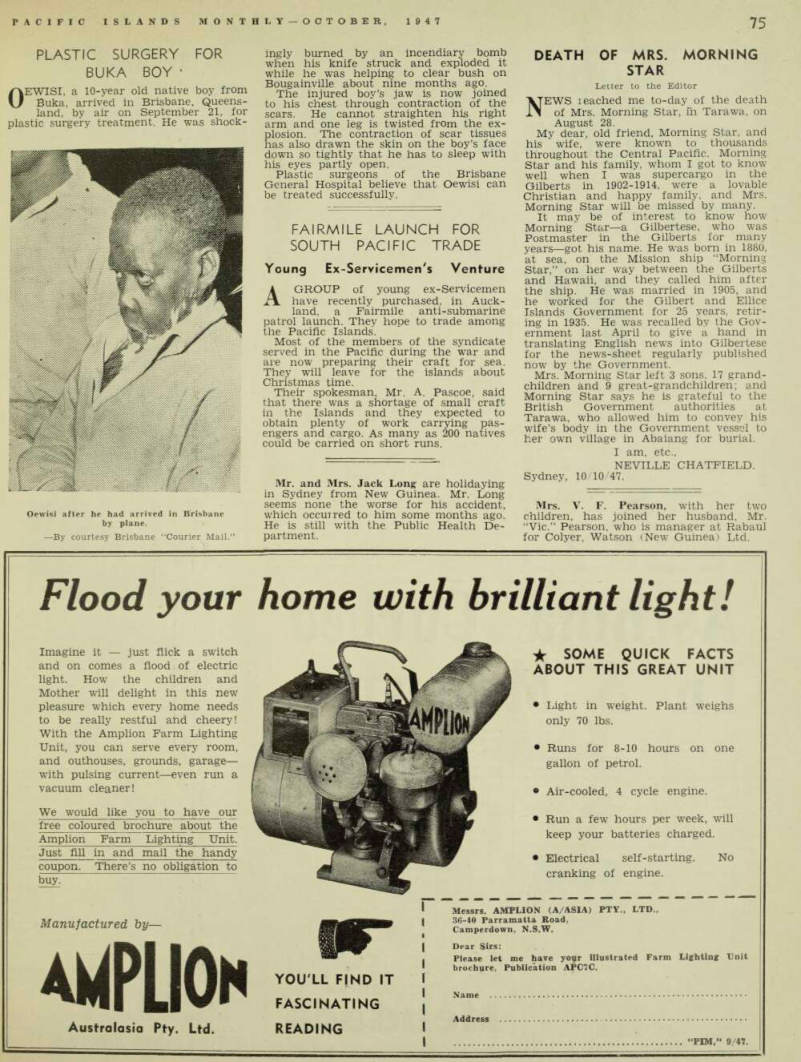
Buka Boy
.• . a 10-year old native boy from V/ Buka, arrived in Brisbane, Queens land, by air on September 21, for plastic surgery treatment. He was shock-
ingly burned by an incendiary bomb when his knife struck and exploded it while he was helping to clear bush on Bougainville about nine months ago.
The injured boy’s jaw is now joined to his chest through contraction of the scars. He cannot straighten his right arm and one leg is twisted from the ex plosion. The contraction of scar tissues has also drawn the skin on the boy’s face down so tightly that he has to sleep with his eyes partly open.
Plastic surgeons of the Brisbane General Hospital believe that Oewisi can be treated successfully.
Oewisi after he had arrived in Brisbane by plane. —By courtesy Brisbane “Courier Mail.”
Fairmile Launch For
South Pacific Trade
Young Ex-Servicemen's Venture
A GROUP of young ex-Servicemen have recently purchased, in Auck land, a Fairmile anti-submarine patrol launch. They hope to trade among the Pacific Islands.
Most of the members of the syndicate served in the Pacific during the war and are now preparing their craft for sea.
They will leave for the islands about Christmas time.
Their spokesman, Mr. A. Pascoe, said that there was a shortage of small craft in the Islands and they expected to obtain plenty of work carrying pas engers and cargo. As many as 200 natives could be carried on short runs.
Mr. and Mrs. Jack Long are holidaying in Sydney from New Guinea. Mr. Long seems none the worse for his accident, which occurred to him some months ago.
He is still with the Public Health De partment.
Death Of Mrs. Morning
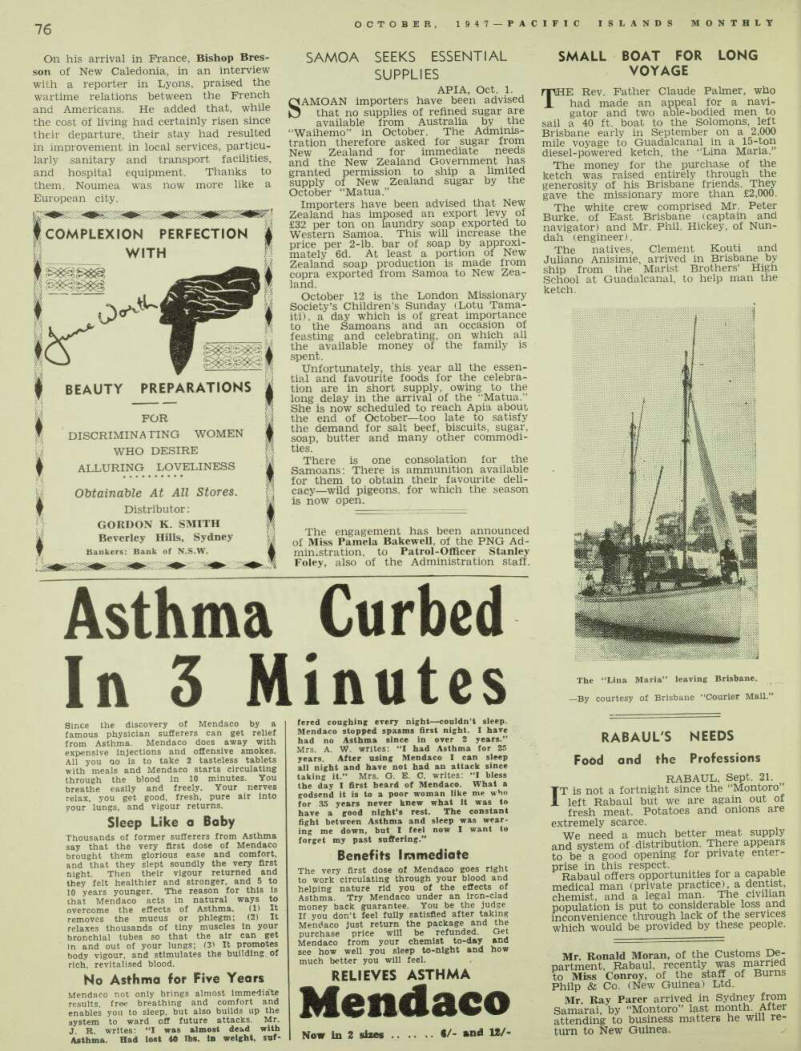
Star
Letter to the Editor NEWS leached me to-day of the death of Mrs. Morning Star, m Tarawa, on August 28.
My dear, old friend, Morning Star, and his wife, were known to thousands throughout the Central Pacific. Morning Star and his family, whom I got to know well when I was supercargo in the Gilberts in 1902-1914. were a lovable Christian and happy family, and Mrs.
Morning Star will be missed by many.
It may be of interest to know how Morning Star —a Gilbertese, who was Postmaster in the Gilberts for many years—got his name. He was born in 1880, at sea, on the Mission ship “Morning Star," on her way between the Gilberts and Hawaii, and they called him after the ship. He was married in 1905, and he worked for the Gilbert and Ellice Islands Government for 25 years, retir ing in 1935. He was recalled by the Gov ernment last April to give a hand in translating English news into Gilbertese for the news-sheet regularly published now by the Government.
Mrs. Morning Star left 3 sons. 17 grand children and 9 great-grandchildren; and Morning Star says he is grateful to the British Government authorities at Tarawa, who allowed him to convey his wife’s body in the Government vessel to her own village in Abaiang for burial.
I am, etc..
Neville Chatfield.
Sydney, 10 10/47.
Mrs. V. F. Pearson, with her two children, has joined her husband. Mr.
“Vic.” Pearson, who is manager at Rabaul for Colyer, Watson (New Guinea) Ltd.
On his arrival in France, Bishop Bres son of New Caledonia, in an interview with a reporter in Lyons, praised the wartime relations between the French and Americans. He added that, while the cost of living had certainly risen since their departure, their stay had resulted in improvement in local services, particu larly sanitary and transport facilities, and hospital equipment. Thanks to them, Noumea was now more like a European city.
Advertisements & other items, pp. 79-80 (1 item)
amPLIOk
Flood your home with
t Imagine it just flick a switch and on comes a flood of electric light. How the children and Mother will delight in this new pleasure which every home needs to be really restful and cheery!
With the Amplion Farm Lighting Unit, you can serve every room, and outhouses, grounds, garage— with pulsing current —even run a vacuum cleaner!
We would like you to have our buy.
Manufactured by —
-3*
amPLIOk
Australasia Pty. Ltd.
w
YOU'LL FIND IT
FASCINATING
READING
★ SOME QUICK FACTS
ABOUT THIS GREAT UNIT
• Light in weight. Plant weighs only 70 lbs. • Runs for 8-10 hours on one gallon of petrol. • Air-cooled, 4 cycle engine. • Run a few hours per week, will keep your batteries charged. • Electrical self-starting. No cranking of engine.
Messrs. AMPLION (A/ASIA) PTY., LTD.,
36-40 Parramatta Road, Camperdown, N.S.W, Dear Sirs: Please let me have your illustrated Farm Lighting Unit brochure, Publication APCJC.
Name Address
“PIM," 9/47.
COMPLEXION PERFECTION
WITH
BEAUTY PREPARATIONS
FOR
DISCRIMINATING WOMEN
WHO DESIRE
ALLURING LOVELINESS
Obtainable At All Stores.
Distributor:
GORDON K. SMITH
Beverley Hills, Sydney Bankers: Bank of N.S.W.
Samoa Seeks Essential
Supplies
Apia Oct 1
r, AMO AN importers have been advised that n 0 supplies of refined sugar are available from Australia by the “Waihemo” in October. The Adminis tration therefore asked for sugar from New Zealand for immediate needs and the New Zealand Government has granted permission to ship a limited supply °£»/r N^ w „ Zealanc * sugar by the October “Matua.”
Importers have been advised that New Zealand has imposed an export levy of £32 per ton on laundry soap exported to Western Samoa. This will increase the price per 2-lb. bar of soap by approxi mately 6d. At least a portion of New Zealand soap production is made from copra exported from Samoa to New Zea land, October 12 is the London Missionary Society’s Children’s Sunday (Lotu Tama iti), a day which is of great importance to the Samoans and an occasion of feasting and celebrating, on which all the available money of the family is Unfortunately, this year all the essen tial and favourite foods for the celebra tion are in short supply, owing to the long delay in the arrival of the “Matua.”
She is now scheduled to reach Apia about the end of October—too late to satisfy the demand for salt beef, biscuits, sugar, S oap, butter and many other commodi ties.
There is one consolation for the Samoans: There is ammunition available for them to obtain their favourite deli cacy—wild pigeons, for which the season is now open. , .
The engagement has been announced Qf Miss Pamela Bakewell, of the PNG Ad ministration, to Patrol-Officer Stanley Foley, also of the Administration staff.
Small Boat For Long
Voyage
rE Rev. Father Claude Palmer, who had made an appeal for a navi gator and two able-bodied men to sail a 40 ft. boat to the Solomons, left Brisbane early in September on a 2,000 mile voyage to Guadalcanal in a 15-ton diesel-powered ketch, the “Lina Maria.”
The money for the purchase of the ketch was raised entirely through the generosity of his Brisbane friends. They gave the missionary more than £2,000.
The white crew comprised Mr. Peter Burke, of East Brisbane (captain and navigator) and Mr. Phil. Hickey, of Nun dah (engineer).
The natives, Clement Kouti and Juliano Anisimie, arrived in Brisbane by ship from the Marist Brothers’ High School at Guadalcanal, to help man the ketch.
The “Lina Maria” leaving Brisbane. —By courtesy of Brisbane “Courier Mail.”
Rabaul's Needs
Food and the Professions
Rabaul, Sept. 21.
IT is not a fortnight since the “Montoro” left Rabaul but we are again out of fresh meat. Potatoes and onions are extremely scarce.
We need a much better meat supply and system of distribution. There appears to be a good opening for private enter prise in this respect.
Rabaul offers opportunities for a capable medical man (private practice), a dentist, chemist, and a legal man. The civilian population is put to considerable loss and inconvenience through lack of the services which would be provided by these people.
Mr. Ronald Moran, of the Customs De partment, Rabaul, recently was married to Miss Conroy, of the staff of Burns Philp & Co. (New Guinea) Ltd.
Mr Ray Parer arrived in Sydney from Samarai, by “Montoro” last month. After attending to business matters he will re turn to New Guinea.
Advertisements & other items, p. 80 (1 item)
Asthma Curbed
In 3 Minutes
fered coughing every night—couldn’t sleep.
Mendaco stopped spasms first night. I have had no Asthma since in over 2 years.”
Mrs. A. W. writes: ‘‘l had Asthma for 25 years. After using Mendaco I can sleep all night and have not had an attack since taking it.” Mrs. G. E. C, writes: “I bless the day I first heard of Mendaco. What a godsend it is to a poor woman like me who for 35 years never knew what It was to have a good night's rest. The constant fight between Asthma and sleep was wearing me down, but I feel now I want to forget my past suffering.”
Benefits Immediate
The very first dose of Mendaco goes right to work circulating through your blood and helping nature rid you of the effects of Asthma. Try Mendaco under an iron-clad money back guarantee. You be the judge If you don’t feel fully satisfied after taking Mendaco just return the package and the purchase price will be refunded. Get Mendaco from your chemist to-day and see how well you sleep to-night and how much better you will feel.
RELIEVES ASTHMA
Mendaco
Now In 2 sizes •/- and 12/-
Since the discovery of Mendaco by a famous physician sufferers can get relief from Asthma. Mendaco does away with expensive injections and offensive smokes.
All you ao is to take 2 tasteless tablets with meals and Mendaco starts circulating through the blood in 10 minutes. You breathe easily and freely. Your nerves relax, you get good, fresh, pure air into your lungs, and vigour returns.
Sleep Like a Baby
Thousands of former sufferers from Asthma say that the very first dose of Mendaco brought them glorious ease and comfort, and that they slept soundly the very first night. Then their vigour returned and they felt healthier and stronger, and 5 to 10 years younger. The reason for this Is chat Mendaco acts in natural ways to overcome the effects of Asthma. (1) It removes the mucus or phlegm; (2) It relaxes thousands of tiny muscles In your bronchial tubes so that the air can get in and out of your lungs; (31 It promotes body vigour, and stimulates the building of rich, revitalised blood.
No Asthma for Five Years
Mendaco not only brings almost immediate results, free breathing and comfort and enables you to sleep, but also builds up the system to ward off future attacks. Mr.
J. R. writes: “I was almost dead with Asthma. Had lost 40 lbs. in weight, saf-
Man Overboard!
By J. Rolley.
11THEN the 45-ton schooner “Vaitere,” ff belonging to Etablissments Donald, Tahiti, left Papeete on July 4, for Hiva’oa, in the Marquesas Group, she encountered rough weather right from the start.
The second day out, conditions on board were pretty uncomfortable and although there was not a very strong wind, there was quite a current and the waves were big and boisterous. The “Vaitere” was making some tremendous lurches at times, and nearly all the passengers, who had begun to feel sea sick the day before, were decidedly worse.
One extra bad roll sent almost every movable object hurtling over to the port bulkheads. The chair in which I was sit ting skated across the deck and smashed in three pieces as it banged me into the handrail, which I grabbed to save my self from going over the side. At the same time a young seaman, aged years, whose name was Snopy Teriiero, who was lying asleep on the cabin top was hurled clean overboard and I saw him pass astern as I was clutching tight to the rail.
Forgetting that I was amongst French speaking people, I yelled out, “Man Over board.”
One or two looked at me in mild astonishment for a few seconds, but soon understood when I began shouting in French and pointing overboard at Snopy, who was bobbing up and down in the angry-looking waves like the proverbial cork.
The captain immediately gave orders to the Tahitian helmsman to swing the schooner around and a life-buoy was thrown out. But we had gone too far for it to be of any use.
Several of us stood on the hand rail as the “Vaitere” curved round in a big circle, on the look out, and soon we spotted the young fellow, appearing and disappearing in the waves as he swam with determined strokes towards the “Vaitere.”
The captain, who was at the telegraph, shouted out and told the young chap not to swim, and the cry was taken up by others: “Ne nage pas!”
Nevertheless the boy kept on swim ming. Perhaps he could not hear or per haps fear urged him on.
The captain skilfully manoeuvred the schooner’s lumbering bulk near enough for one of the crew to throw out another life-buoy, tied to a rope this time.
Snopy was hauled aboard after what must have been a frightening experience.
However, except for a bruise on his shoulder where he had hit the rail as he was shot overboard, he seemed none the worse for his involuntaiy deep sea dip.
The whole incident lasted only about fifteen minutes and was soon, apparently, forgotten by all. Except, perhaps, by Snopy.
Appreciation
Suva, Oct. 7.
WfIEN speaking at the winding-up of the Suva Table Tennis Association’s first season, the President (popu lar Mr. C. S. Reay) politely thanked the Commissioner of Labour for the loan of his office and some chairs, for committee meetings. Mr. Reay fills both positions.
The French Resistance Medal has been posthumously awarded to a New Cale donian volunteer. Marcel Exbroyat. He was killed on May 12, 1944, in the Italian campaign.
The growth of air traffic to and from New Caledonia is revealed by the latest figures released in Noumea covering the fiist six months of this year. These show that 505 of the 1,232 passengers who landed, came by air. Of the total new arrivals, 246 were foreigners. The Colony lost 320 people who returned to France, and gained 406 from that country, most of whom travelled by ship. But most of the passengers to and from Australia and New Zealand moved by air, these being in the majority of cases, Caledonians who had been permitted to travel for health reasons.
Advertisements & other items, p. 81 (1 item)
Heinz
The Twinkle in
Your Eye
COMES FROM ACTIVE
DIGESTION
Good normal digestive and liver activity means good, normal health and fitness. If yo» are becoming gloomy and feel tired out, the cause may be a congested state of your Intestinal tract. So many people are troubled with constipation, which, through the retention of waste in the digestive system, causes sick headache, biliousness, pimply skin, unpleasant breath, irritability, slackness and dull eyes.
Regain your bright and attractive appearance by banishing constipation with Pinkettes. Tiny, perfectly harmless, gentle yet effective, these famous laxative and liver pills painlessly exercise and strengthen the bowels, keep the food tract clean and active, stir the liver, and thus banish sick headache, bilious attacks, pimples, unpleasant breath and gloom. All chemists and stores sell Pinkettes, the perfect laxative and liver pills.
r ' Vm
AUZ <
Because of its quality and flavour . . .
Heinz Spaghetti is a favorite with everyone! This month, in all leading newspapers, and national journals, housewives will see Heinz Spaghetti advertisements. To get your share of this business keep ample stocks of Heinz Spaghetti on your shelves.
HEINZ
Samoa Needs Medical
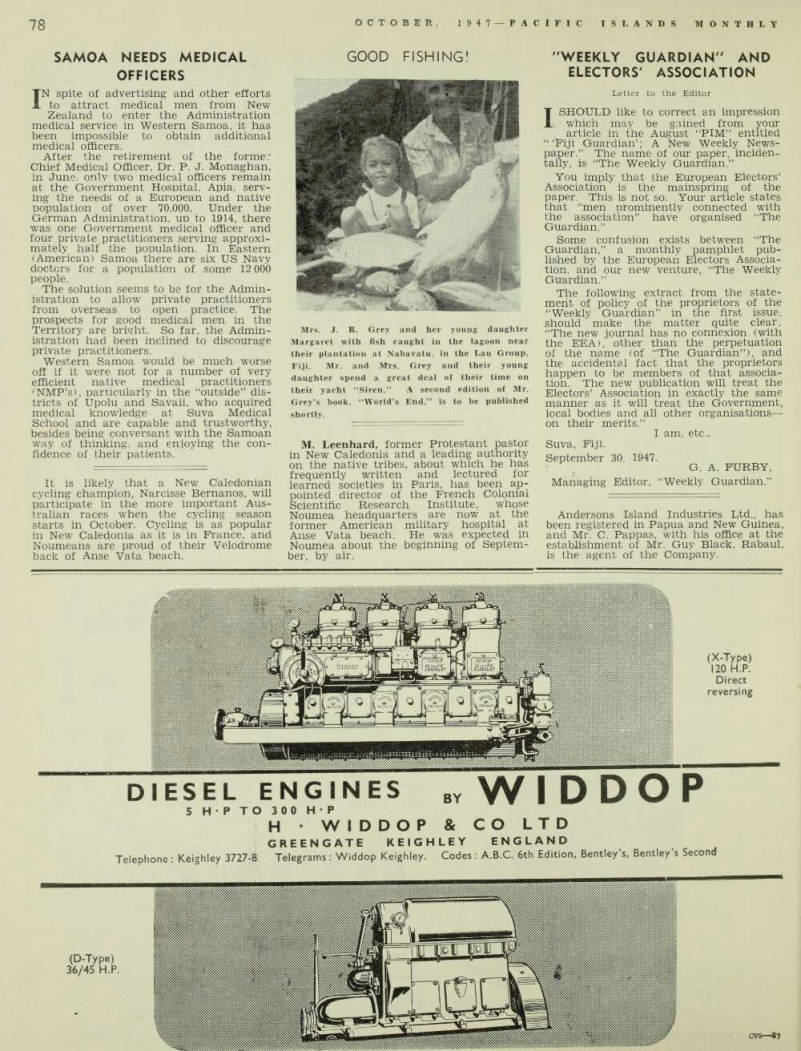
Officers
IN spite of advertising and other efforts to attract medical men from New Zealand to enter the Administration medical service in Western Samoa, it has been impossible to obtain additional medical officers.
After the retirement of the forme?
Chief Medical Officer. Dr. P. J. Monaghan, in June, only two medical officers remain at the Government Hospital, Apia, serv ing the needs of a European and native population of over 70.000. Under the German Administration, ud to 1914, there was one Government medical officer and four private practitioners serving approxi mately half the population. In Eastern (American) Samoa there are six US Navy doctors for a population of some 12 000 people.
The solution seems to be for the Admin istration to allow private practitioners from overseas to open practice. The prospects for good medical men in the Territory are bright. So far. the Admin istration had been inclined to discourage private practitioners.
Western Samoa would be much worse off if it were not for a number of very efficient native medical practitioners 'NMP's), particularly in the “outside” dis tricts of Upolu and Savaii, who acquired medical knowledge at Suva Medical School and are capable and trustworthy, besides being conversant with the Samoan way of thinking, and enjoying the con fidence of their patients.
It is likely that a New Caledonian cycling champion, Narcisse Bernanos, will participate in the more important Aus tralian races when the cycling season starts in October. Cycling is as popular in New Caledonia as it is in France, and Noumeans are proud of their Velodrome back of Anse Vata beach.
Good Fishing!
M. Leenhard, former Protestant pastor in New Caledonia and a leading authority on the native tribes, about which he has frequently written and lectured for learned societies in Paris, has been ap pointed director of the French Colonial Scientific Research Institute, whose Noumea headquarters are now at the former American military hospital at Anse Vata beach. He was expected in Noumea about the beginning of Septem ber, by air.
Mrs, J. R. Grey and her young daughter Margaret with fish caught in the lagoon near their plantation at Nabavatu, in the Lau Group, Fiji. Mr. and Mrs. Grey and their young daughter spend a great deal of their time on their yacht “Siren.” A second edition of Mr.
Grey’s book, “World’s End,” is to be published shortly.
"Weekly Guardian" And
Electors' Association
Letter to the Editor I SHOULD like to correct an impression which may be gained from your article in the August “PIM” entitled “‘Fiji Guardian’; A New Weekly News paper.” The name of our paper, inciden tally, is “The Weekly Guardian.”
You imply that the European Electors’
Association is the mainspring of the paper. This is not so. Your article states that “men orominently connected with the association” have organised “The Guardian.”
Some confusion exists between “The Guardian,” a monthly pamphlet pub lished by the European Electors Associa tion, and our new venture, “The Weekly Guardian.”
The following extract from the state ment of policy of the proprietors of the “Weekly Guardian” in the first issue, should make the matter quite clear.
“The new journal has no connexion (with the EE A), other than the perpetuation of the name (of “The Guardian”), and the accidental fact that the proprietors happen to be members of that associa tion. The new publication will treat the Electors’ Association in exactly the same manner as it will treat the Government, local bodies and all other organisations— on their merits.”
I am, etc., Suva, Fiji.
September 30.. 1947.
G. A. Furby
Managing Editor, “Weekly Guardian.”
Andersons Island Industries Ltd., has been registered in Papua and New Guinea, and Mr. C. Pappas, with his office at the establishment of Mr. Guy Black, Rabaul, is the agent of the Company.
Advertisements & other items, pp. 82-83 (1 item)
Widdop
m 3 (X-Type) 120 H.P.
Direct reversing
DIESEL ENGINES
5 H P TO 300 H P BY
WIDDOP
H • WIDDOP & CO LTD
GREENGATE KEIGHLEY ENGLAND
Telephone: Keighley 3727-8 Telegrams : Widdop Keighley. Codes: A.B.C. 6th Edition. Bentley’s, Bentley’s Second
(D-Type) 36/45 H.P. r
CVS — 87
WESTCLOX
NEVER has performance been more trustworthy than In the beautiful Westclox of today . . . famous Big Ben and other spring wound clocks, electric clocks, wrist watches and pocket watches. When you buy your next clock or watch, look for the trade mark “Westclox” on the dial . . . your assurance of quality.
POCKET BEN A thin model watch with many features. Highly polished, plated finish; silvered dial; attractive numerals and hands. Unbreakable crystal.
SPUR Luminous A thin case, one-day alarm. Black finish with nickel trim. 4i inches square.
Steady alarm. Unique base.
Luminous dial.
BIG
BEN
BIG BEN Chime Alarm The highest standard of alarm clock quality. Quiet tick and gentle two-voiced alarm. First there’s a gentle call, then if he’s not shut off. there’s a lusty shout. Dustproof attachments. 5 h inches high. Ivory finish with gold colour trim. Luminous dial. «,« i 10/©\ i
£» * WESTCLOX % -
* V J' & * 6 5 10 BABY BEN A smart looking alarm clock. 3‘i inches high.
Quiet tick; steady alarm that rings loud or soft. Legible dial.
Two finishes . . . black with nickel trim, and ivory with gold colour trim. Made in plain and luminous dial.
LA SALLE A handsomely designed wrist watch. Chrome finish case, stainless steel back, curved to fit the wrist. Sturdy movement, regulated to run in any position. Equipped with conventional second hand; rustproof hairspring.
ORDER THROUGH YOUR LOCAL STORE
PACIFIC ISLANDS TRADING
Bankers; Bank of America (Main Office) San Francisco.
COMPANY
Cables;
PITCO
SAN FRANCISCC
244 CALIFORNIA STREET, SAN FRANCISCO, CAL., U.S.A.
Pampered Natives and
Muddled Economics Fiji Resdent Does Not Like The Writing On The Wall
Letter to the Editor REFERRING to a comment by Mr. Pat Costello which appeared in an issue of “PIM” this vear, I should like to substantiate his theory—or. rather, col lection of facts that our economic policy is fallacious in the extreme. The issue is, how long are the British tax payers going to be complacent in the idealistic policy of their Government of subsidising their dependencies?
The period of this spasm of conscience that se'ems to have assailed the Labour Governments, concerning their obliga tions towards their subject races, must certainly hinge upon the economic situa tion. The position in Fiji is probably typical of that which prevails throughout the British Empire. There is no sign of a tong view in the Government economic policy being followed.
The Civil Service leads the country in high salaries. The PWD employees here have received ridiculous rises in wages, and a reduction in working hours, money is lavished on native administration, child welfare, town planning and educa tion.
Many of these things are necessary, and many unnecessary; but, whatever the case may be, the money still pours out and, although people talk of the in evitable depression, few realise where this money 'comes from and what sacri flees it means to those who indirectly provide it.
Taking the political situation as a whole to-dav in*Fiji, monev is no object.
The economic aspect is completely over shadowed by minor political problems dealing indirectly with the all-important
issue, the Deed of Cession—that accusing scrap of paper which directs attention to our duty to our charges, the Fijians.
INCIDENTALLY, what are our obliga tions to the Fijians? I have read the Deed of Cession, and see there only unconditional surrender by the natives of any rights they might have had, so as to save themselves from foreign domination (FTench, American or Tongan).
Thev chose —that is, if they had any part of the choosing, which is doubtful — the least of several evils (if British domi nation could be called evil). Judging by its doting policy towards the natives here —in common, evidently, with its policy everywhere—it is anything but evil —except to itself, as an over-indulgent blood donor to the world in general.
Fiji has only been able to exist, from the beginning, as an economic unit, by depending on a special product—first it was cotton, then copra, now it has sugar, copra and gold.
Yet, from the beginning, the Fijians have never been compelled to share in the labour obligations of this economic set-up which made their existence pos sible as free people. The labour position was so acute in the old days that thous ands of foreign (Indian) labour had to be indentured—and now the Indian prob lem is the official bogey.
With New Zealand and Australia and America and other members of the Can berra Conference harping about things concerning which they have only the slightest knowledge, the natives of the Pacific have become the centre of un precedented attention —which contrary to the theories of these well-wishers abroad —is resulting only in growing contempt among the natives for the white man’s law and opening the way for a state of anarchy in the future. This is due to native belief that the changes—notice able even in remote parts—are due, not
to the new laws of the white man, but to his growing impotence. This is a re gion where the natives still practise black-magic in their everyday life, and visualise no control but force.
Meanwhile, the economic issue is at stake. While little is being done to brighten the prospects of the future, everything is being done to make them gloomy. The Labourites, when out of power , have always been so eloquent on economics; but, now in power, they are typical of the working man, with so much money and looking for somewhere to spend it.
Where is it going to end —as end it must? The British tax-payer will even tually demand a say in the allocation of his hard-earned money, which the British Labour Government lias seen fit to serve out so magnanimously.
I am,etc.,
Gauna Vou
Fiji. 16 8 1947.
Future Of The Maori Race
AN outstanding NZ Maori leader, Sir Apirana Ngata, said recently that a great future lay ahead of the Pacific, and that New Zealand; was on the way to becoming the centre of the Poly nesian peoples.
At a gathering of Maoris in Wellington, Sir Apirana, who is also a former Cabinet Minister, said the nations of the world paid scant attention to the Pacific before 1941. But that had changed. To-day, the eyes of the world were upon it.
He said the Maoris were rapidly grow ing in numbers, and that inside the next half-century they would increase by from five to six hundred thousand. He made an appeal to them to take a bigger part in the economic, social and commercial life of New Zealand, and to keep alive their native traditions and bring about a full revival of Maori culture.
Advertisements & other items, p. 84 (2 items)
80
OCTOBER, i94t-i> ACIFic ISLANDS MONfttLT
for SHAFTS ...and SAFETY
Reliability is the major consideration when selecting propeller shafting. By installing Monel, you take the surest precaution against breakdown at a critical moment.
Monel shafts are exceptionally strong and tough--they withstand blows which would hopelessly spring shafts of other materials. Their great rigidity reduces whip and vibration to a minimum, whilst in service, Monel quickly develops a mirror-like finish which prolongs the life of both packing and bearings. In addition, Monel cannot rust and is not corroded by prolonged immersion in fresh or salt water.
Complete information on the many marine uses of Monel will gladly be forwarded by:
WRIGHT AND COMPANY
SOLE AUSTRALIAN DISTRIBUTORS OF MONEL
81 CLARENCE STREET, SYDNEY : : : : : 'Phone: BXI2II (Six Lines) : Monel is a registered trade-mark covering a rich nickel ■ alloy, mined in Canada and rolled in Great Britain,
Whisky
One Bottle Of
A 50-Years-Old Memory
By F. T. Goedicke-Van Asten
IN 1895, I was the proprietor of the only hotel in Nukualofa. This is the story of how I hoodwinked the European policeman of the Tonga Police Force.
The “good old djays” in Tonga, when a hotelkeeper could sell a bottle of liquor to a native and not be prosecuted are now gone. A law prohibiting the sale of liquor to natives had been passed, then, but was not enforced. The Tongans were well behaved at that time, and no drunkenness was visible.
In 1895, the Tonga Government em ployed in their regular police force a European policeman, at a salary of £5O per annum. He also got a prisoner as ser vant, and a piece of land where he could plant his yams.
Policeman X was a regular customer at my hotel, but a bad payer. After he had been warned, several times, that his credit would be stopped if he did not settle his account, and he took no notice, his credit was stopped. To take his revenge, he told several people that he would watch me selling liquor to natives, and would have me prosecuted.
AT about this time there arrived the SS “Upolu,” from Sydney. She had on board a new clerk, Jimmy Green, for the firm of Forsyth, Schulz & Co., at Nukualofa. A few days later this clerk reported to Mr. H. Schulz, his manager, that someone had stolen his black coat. The manager sent for Police man X, and toldi him to call all the Niue boys together, and have their boxes searched. (In those days, the firms in Tonga employed many Niue boys as labourers.) In the first box Mr. X opened, he found a bottle of whisky. He took the bottle to the manager, and told him where he had found it. “Take the bottle away,” said the manager. “We are not looking for whisky, but for a black coat.”
Mr. X, not being satisfied, rushed with the bottle to the Premier’s office, and told the Premier he had found it in a box belonging to a Niuean who had told him he had bought it from “Fred” (my Tongan name) and that he wanted me prosecuted.
The Premier told Mr. X to send the Niue boy to his office.
At the Premier’s office, the boy said: “I had a letter from my father at Niue, who is sick, and has been told to drink every morning a glass of milk with a spoonful of whisky added. As there is no liquor in Niue, I bought this bottle to send it by Captain Ross, but Captain Ross did not go to Niue on this trip, so I kept it in my box to be sent by first chance.”
The Premier said; “As it is for medi cine, there will be no prosecution. Leave the bottle here and, when Captain Ross sails for Niue the next time, come here and take it away.”
This arrangement did not suit Mr. X— he still told people that he would catch me selling liquor to natives. So to be even with Mr. X, I played a trick on him.
I went into the bar, and took down a bottie of Dewars Whisky and also an empty one. I filled the empty one with tea, and added water until it had the same color as whisfey, corked it, and placed a new cap on it, making it appear as a new bottle of whisky. I wrapped the bottle in paper, placed it in my hand bag, and marched with it to the Premier’s office.
“Good morning Mr. Premier,” I said, I hear you have a bottle of whisky here which was found in a box belonging to a Niuean, who said that he had bought u /join me. Could I have a look at the bottle, to see if it is the same kind as I sell at my hotel?”
The Premier placed the bottle on the table in front of me. I opened my nand bag, brought out my bottle, and placed it beside the other, viewing it very critically. I pointed; out that both bottles had the same label and, as I was the only one in Nukualofa who sold “Dewars”
Whisky, it must have been bought from me.
The Premier told me what the Niuean had said, and he had arranged to leave the bottle there until Captain Ross was going to Niue.
After this conversation,, I made a few surreptitious movements, and placed the bottle of whisky in my handbag and left the bottle of tea on the table, A WEEK later was New Year’s Eve.
The clerk of the Post Office, de Lambert, called at the Premier’s house to wish him a happy New Year.
The Premier lamented that he had not a d£op in the house to drink the old year out. But, wait! He called his ser vant, Makuka, and sent him for the bottle of whisky.
Ana, the Premier’s wife, fetched three tumblers, a jug of water and a corkscrew.
When Makuka returned, de Lambert took upon himself the honour opened the bottle, half filled the tumblers with the nectar, and the Premier’s wife added water. They took up their glasses, Tonga fashion, to wish each other a Happy New Year.
No sooner had the Premier got his mouth full of the supposed nectar than he spat it out, crying “Kaka Peleti he sells tea to the Niues.”
Not to be disappointed, he sent Makuka to the hotel with four dollars, for 2 bottles of whisky and to tell Feleti to send whisky, but no tea.
I gave Makuka the whisky, and added a bottle of Champagne, wth a note wish ing the Premier a Happy New Year.
A few months later de Lambert came to the hotel to buy a bottle, saying “Give me whisky, but not tea.” I asked what he meant, and he said “I know all about you—you are selling tea to the Niues”
I told him not to talk nonsense and then he told me what had happened on New Year’s Eve.
Now, Leo the Niuean, Henry Schulz (manager for Forsyth, Schulz & Co.)
Jimmy Green (their clerk) Sateki (Premier) his clerk (Buletele, who be came, later on, Premier Tuivakana) de Lambert (Post Office Clerk) Makuka (Premier’s servant) Ana (wife of Sateki) —all have gone to meet their maker.
Only two are left Feleti, the one-time hotelkeeper, and European Policeman X. r ihe latter has long gone to a country where they have prohibition.
Advertisements & other items, p. 85 (2 items)
81
fc>ACiPic islands monthly October, 1947
freshest powdered milk
TIME-PIECES
REPAIRED
We employ a Fully Qualified
Staff and we are equipped to undertake repairs of
WATCHES CLOCKS
MARINE CHRONOMETERS
We undertake Locksmithing, Key-cutting, etc.
Any goods sent to us by post are attended to promptly and with care.
NOEL LEVY
Victorio Parade, Suva, Fiji Phone 39. P.O. Box 88.
Cablegrams: “Noel,” Suva
See if COWLAC isn’t the Creamiest,
freshest powdered milk
you’ve ever tasted!
One 12-oz. can of Cowlac Dried Milk gives you half a gallon of farm-fresh milk, containing nearly half a pint of cream.
Order through your usual channels.
A TRUFOOD PRODUCT
ORDER FROM
BRIAL and BALL
31 Queen St., Melbourne 1 Bond St., Sydney
totawfc
s opput $
\st^ s
p&C\O c
HOW
pA
CREAM
RICH
Full ii 3 D R ig o* Ua
LTD
ms AU
CM.I
Sydney Couple Join
Mission At Chimbu
LAST July a Sydney woman and her husband left their home, to under take two years’ work at the Roman Catholic mission at Mengindi, near Chimbu, Central New Guinea. They are Mr. and Mrs. A. B. Fauth, whose home in Strathfield was open house for Divine Word Fathers in Sydney during the war.
Learning of the need of the mission at Chimbu for women helpers, and that mission Sisters had not been permitted to go to Chimbu, Mrs. Fauth determined to do something about it.
As a married woman accompanying her husband she had less difficulty in secur ing a permit to enter this area than had the nuns and, once that difficulty had been overcome, she advertised for a nurse and a teacher to help in the work.
The nurse has not been forthcoming, but a Miss Dorothy Prior secured two years leave of absence from the Victorian Education Department and has gone with the Fauths.
Mrs. Fauth hopes that when their two-years’ term in Chimbu is up they wil have prepared the way sufficiently for Canberra to grant permission for the Sisters to continue their work there.
More Capital For Apc
Karlova Bore Down Nearly Two Miles
rE Australasian Petroleum Company Pty., Ltd., reports that, as at August 30, 1947, drilling of the bore at Kariava, Papua, had reached 9,117 feet, the depth drilled since August 2, being -579 feet. The total depth of the bore is now just under two miles.
To provide funds for an expanded future drilling programme, the Company is taking steps to increase its nominal capital from £2,000,000 by the issue of 750,000 new £1 shares to the shareholding Companies.
The Company’s programme for 1948 in cludes the drilling of another deep test after the completion of the Kariava bore, and two to four other holes to a depth of approximately 6,000 feet, with two new rigs which are now being purchased and shipped to Port Moresby.
Geological and geographical survey work will also be continued during 1948.
The Company’s exclusive rights to prospect for petroleum over an area of 9,894 square miles in Papua and 8 918 square miles in the Mandated Territory, have been extended for three years from July 1. 1947.
The death occurred on October 10. of Mr. Joseph Henry Rawnsley, of Raglan Street, Manly, Svdney. He was the father of Mr. Bert Rawnsley, previously of Rabaul and now with the BP Head Office staff. The late Mr. Rawnsley who was 80 years of age at the time of his death, was a visitor to Rabaul on several occasions.
SS “River Mitta” is due to sail from Sydney for Port Moresby, Lae and Rabaul early in November.
Squandering Of Australian
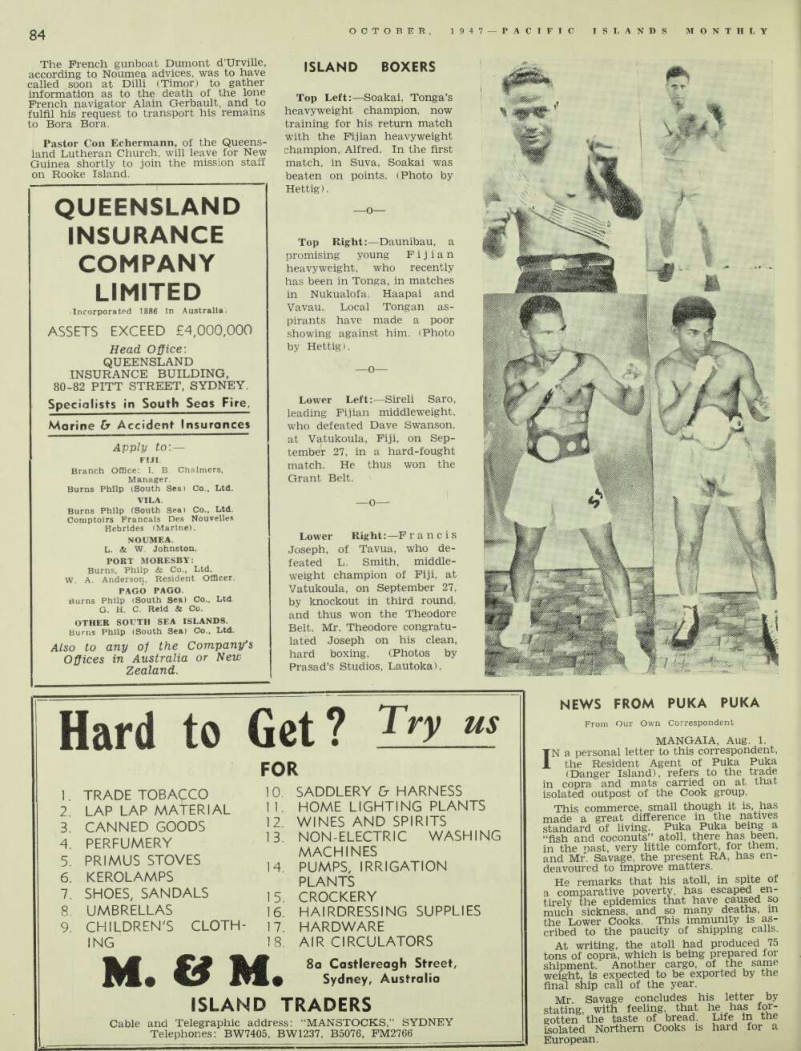
Millions
IN the years immediately before World War 11, the External Affairs Depart ment of Australia cost, annually, a comparatively few thousand pounds.
Then Australia’s Dr. H. V. Evatt be came Minister for External Affairs, and set out to make himself a great inter national figure. He has been strutting upon the world stage, now, for more than three years, and scattering Australian Missions, and Consulates and Legations across four continents; and this is what the development of Dr. Evatt’s ego has cost the heavilv-burdened Australian taxpayers: 1944-45, £257,202; 1945-46, £600,500; 1946-47, £1,431,000; and it was formally announced in Canberra recently that this year the “Minister for Foreign Affairs’’ and his Department will cost £1,845,000.
Australia’s foreign trade has increased enormously in the last two years; but that is due directly to post-war economic con ditions in the world, and has nothing to do with Dr. Evatt. Australia has been noisily represented at every international conference in recent years; but the fact contributes nothing to Australian welfare and comfort, and it leaves the great majority of Australians cold and disin terested.
Mr. Tom Procter, Jr., proceeded to Madang, New Guinea, this month where he will fill a position in the WRC work shops.
Mrs. J. Peterson, of Lae, New Guinea, returned to the Territory on the “Malaita” on October 15. She was ill when she left Lae several months ago and has since spent six weeks in hospital in Sydney.
She has now recovered and will rejoin her husband who is manager of Burns Philp (New Guinea) Ltd., in Lae.
The French gunboat Dumont d’Urville, according to Noumea advices, was to have called soon at Dilli (Timor) to gather information as to the death of the lone French navigator Alain Gerbault, and to fulfil his request to transport his remains to Bora Bora.
Pastor Con Echermann, of the Queens land Lutheran Church, will leave for New Guinea shortly to join the mission staff on Rooke Island.
Advertisements & other items, pp. 86-88 (2 items)
82
OCTOBER, 194'? HciHC ISLANDS MONTHLY
William H. Watson
ESTABLISHED 1930
RAROTONGA, COOK ISLANDS
Wholesale and Retail
LICENSED STAMP DEALER
Agent For:—
BRITISH TRADERS' INSURANCE CO.
CORONA & L. C. SMITH TYPEWRITERS
KAISER & FRAZER MOTOR CARS
B.S.A. CYCLES AND MOTOR CYCLES
AMERICAN LEAD PENCIL CO.
WHITES AVIATION LTD,
Manufacturers of: FOOTWEAR, ALL CLASSES SUITABLE FOR NATIVE TRADING . . . M.O.P. PRODUCTS, INCLUDING ROUND EAR-RING BLANKS AND BUTTON BLANKS Exporter of: “Rarotonga” Hula-Skirts.
Sea-Shell Necklaces.
M.O.P. Jewellery.
Island Produce.
Cable Address: “Watson” Rarotonga Wholesale and Retail Inquiries Invited.
Prepared to Consider Agencies for all Class of Goods.
Bankers: Importer of: Textiles.
General Hardware.
Fancy Goods^ General Merchandise.
Bank of New Zealand, Auckland.
TILLEY LAMPS
BURN ORDINARY KEROSENE
The Modern Form of PORTABLE LIGHTING
r u* M > TltlEV LA BEsiiei
/!Ui STR6E
NOON,, W.«
THE OWL IS PROVERBIALLY A WISE BIRD. SO BE SURE YOU FOLLOW HIS EXAMPLE! TILLEY LAMPS ARE SO SUCCESSFUL THAT COPIES OF THEM ARE BEING MARKETED. TILLEY LAMPS ARE MADE ONLY IN ENGLAND THE TILLEY LAMP CO. LTD., of ENGLAND
REPRESENTATION :
MELBOURNE : T. H. Bentley, Pty. Ltd., 123-125 William Street. Melbourne, Cl.
TASMANIA ; Mr. C. Sellars, IoBa Charles Street, Launceston.
FIJI : Mr. K. Witherington, 2 Burns Philp Buildings, Suva.
QUEENSLAND
INSURANCE
COMPANY
LIMITED
Incorporated 1886 In Australia.
ASSETS EXCEED £4,000,000
Head Office:
QUEENSLAND
INSURANCE BUILDING,
80-82 PITT STREET, SYDNEY.
Specialists in South Seos Fire,
Marine £r Accident Insurances
Apply to:
FIJI
Branch Office: I. B. Chalmers, Manager.
Burns Phllp (South Sea) Co.. Ltd.
VILA.
Burns Phllp (South Sea) Co., Ltd.
Comptoirs Prancals Des Nouvelles Hebrides (Marine).
NOUMEA.
L. & W, Johnston.
PORT MORESBY:
Burns, Phllp & Co., Ltd.
W. A. Anderson, Resident Officer.
PAGO PAGO.
Burns Phllp (South Sea) Co., Ltd G. H. C. Reid & Co.
OTHER SOUTH SEA ISLANDS.
Burns Phllp (South Sea) Co., Ltd.
Also to any of the Company's Offices in Australia or Hew
Zealand.
Hard to Get? Tr v us
FOR
]. TRADE TOBACCO 10.
2. LAP LAP MATERIAL 11.
3. CANNED GOODS
4. PERFUMERY 13 -
5. PRIMUS STOVES ]4
6. KEROLAMPS
7. SHOES, SANDALS 15
8. UMBRELLAS 16
9. CHILDREN'S CLOTH- 17.
ING 18.
M. & M.
SADDLERY & HARNESS
HOME LIGHTING PLANTS
WINES AND SPIRITS
NON-ELECTRIC WASHING
MACHINES
PUMPS, IRRIGATION
PLANTS
CROCKERY
HAIRDRESSING SUPPLIES
HARDWARE
AIR CIRCULATORS
8a Castlereogh Street, Sydney, Australia
ISLAND TRADERS
Cable and Telegraphic address: “MANSTOCKS.” SYDNEY Telephones: 8W7405, 8W1237. 85076, FM2766
Island Boxers
Top Left: —Soakai, Tonga’s heavyweight champion, now training for his return match with the Fijian heavyweight champion, Alfred. In the first match, in Suva, Soakai was beaten on points. (Photo by Hettig). o— Top Right:—Daunibau, a promising young Fijian heavyweight, who recently has been in Tonga, in matches in Nukualofa, Haapai and Vavau. Local Tongan as pirants have made a poor showing against him. (Photo by Hettig). o— Lower Left:—Sireli Saro, leading Fijian middleweight, who defeated Dave Swanson, at Vatukoula, Fiji, on Sep tember 27, in a hard-fought match. He thus won the Grant Belt. —o— Lower Right:—Francis Joseph, of Tavua, who de feated L. Smith, middle weight champion of Fiji, at Vatukoula, on September 27, by knockout in third round, and thus won the Theodore Belt. Mr. Theodore congratu lated Joseph on his clean, hard boxing. (Photos by Prasad’s Studios, Lautoka).
News From Puka Puka
From Qur Own Correspondent
Mangaia, Aug. 1.
IN a personal letter to this correspondent, the Resident Agent of Puka Puka (Danger Island), refers to the trade in conra and mats carried on at that isolated outpost of the Cook group.
This commerce, small though it is, has made a great difference in the natives standard of living. Puka Puka being a “fish and coconuts’’ atoll, there has been, in the cast, very little comfort, for them, and Mr. Savage, the present RA, has en deavoured to improve matters.
He remarks that his atoll, in spite of a comparative poverty, has escaped en tirely the epidemics that have caused so much sickness, and so many deaths, in the Lower Cooks. This immunity is as cribed to the paucity of shipping calls.
At writing, the atoll had produced 75 tons of conra, which is being prepared for shipment.' Another cargo, of the same weight, is expected to be exported by the final ship call of the year.
Mr Savage concludes his letter by stating, with feeling, that he has for gotten the taste of bread. Life in the isolated Northern Cooks is hard for a European.
East Indies
Patient Work By Dutch Now Beginning to Show Happy Results
rE half-hearted attempts of United Nations representatives to interfere in the Dutch campaign for restoring orderliness to the Netherlands Indies have more or less petered out. They were undertaken only at the instigation of certain Socialist Governments —like that of Australia, which obeyed the directions of the dock workers’ union, which in turn is under the domination of pro- Indonesian Communists.
A fact-finding committee from UNO, which went to the Indies to ascertain which side disobeyed the UNO “Cease Fire”—the Dutch, or the rebel Javanese set-un —reported that both disobeyed; which meant that the situation was “As you were.” The Socialists yelled for action, but the world generally became bored with the whole “Indonesian prob lem.”
Meanwhile, slowly, steadily and pati ently, the Dutch are policing the archi pelago, restoring order and industry in most of the area, and are driving the so-called Republican Government (the insurgent, Communist-dominated Java nese) into a part of Java which weekly decreases in size. If they are given a reasonable chance, they soon will wipe outthe Republican organisation (or dis organisation) altogether, and peace and reasonable comfort will return to the archipelago.
It is clear that the Dutch are honour ing their pledge, that they eventually will establish in the Netherlands! Indies a Federal form of Indonesian self-govern ment, to be part of the Dutch Empire.
They have encouraged the formation of independent administrations in various sections of the Indies—there now are autonomous governments in Borneo, in East Indonesia, in Sumatra and, in West Java, steps are being taken to form an other. All except the “Republicans” (Central and Southern Java) adhere to the Dutch, and are co-operating with the Dutch quite happilv in establishing the Federation.
RESTORATION of industries is pro ceeding and commerce is beginning to look healthy.
Dutch, Indonesian and American in vestors are co-operating in the develop ment of nickel mines in the Kollaka district of the South Celebes The Unilever company is working with the Dutch on a plan for growing peanuts on the island of Halmahera, and in Sorong (Dutch New Guinea). Another project is the construction of sugar factories in the Southwest Celebes, with a capacity of 20,000 tons per harvest. The Dutch have resumed the Sadang irrigation scheme in Southwest Celebes, planned to irrigate 175,000 acres and lift rice pro duction from 470,000 to 600.000 tons In recent months, about 25,000 labourers (out of 100,000 formerly employed there) have returned to the Sumatra tobacco plantations on Sumatra’s east coast.
If only the bumble-footed noliticians svill keep themselves out of the picture, md let the Dutch handle the situation, peace and order may soon be restored to :his important section of Indonesia.
Mr. Gilbert Renton returned to Rabaul ast week, after a quick trio to England.
Je, like many others, is filled with ad miration for the spirit of old England rle has news of Dr. Watch, who has set ded in Uganda, South Africa. The Doctor minks Uganda a mighty fine country and )emg better governed than New Guinea,’
Advertisements & other items, p. 89 (1 item)
Steamships Trading
STSAVf wi
USE
YOU
0.
ghtwught
Finished in woven-striped, waterproofed canvas, with leather-bound edges, Airway Cases are available in limited supply, but production is increasing.
Made by FORD SHERINGTON LTD.
Wholesale only
Scott’s “Renown” Brand Rope,
Cordage and
Cable Address - Ropeyard Sydney.
' *** n¥mW a. s»
Binder
Twine
of Every
Description
MANUFACTURED AT
MASCOT. N.S.W
J SCOTT
PTY. LTD.
Head Office and Store
163 CLARENCE STREET.
SYDNEY,
N.S.W.
Steamships Trading
Company Limited
PORT MORESBY
SAMARA!
PAPUA
WHOLESALE & RETAIL MERCHANTS, SHIPOWNERS,
PLANTERS, ENGINEERS & SLIP PROPRIETORS.
Customs, Shipping, Insurance, and Forwarding Agents
MANAGING AGENTS AND VISITING REPRESENTA-
TIVES FOR COCONUT AND RUBBER ESTATES.
SYDNEY REPRESENTATIVES: Nelson & Robertson Pty. Ltd.. 12 Spring Street.
Sydney-Norfolk Islond-
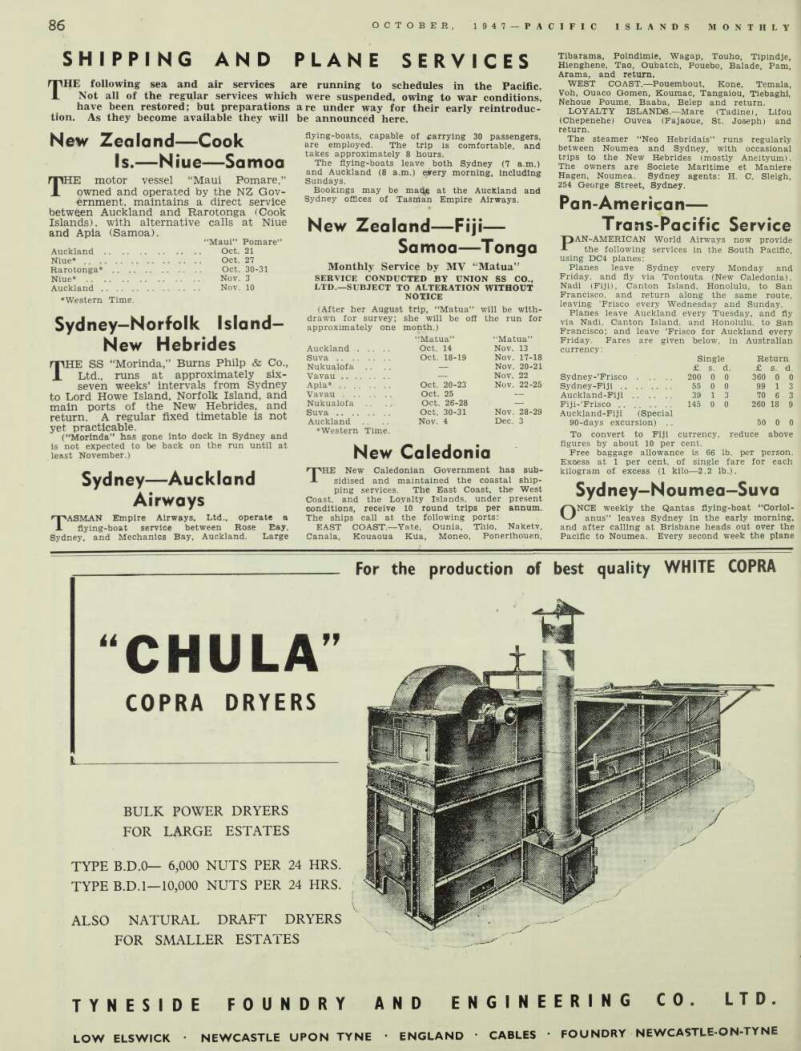
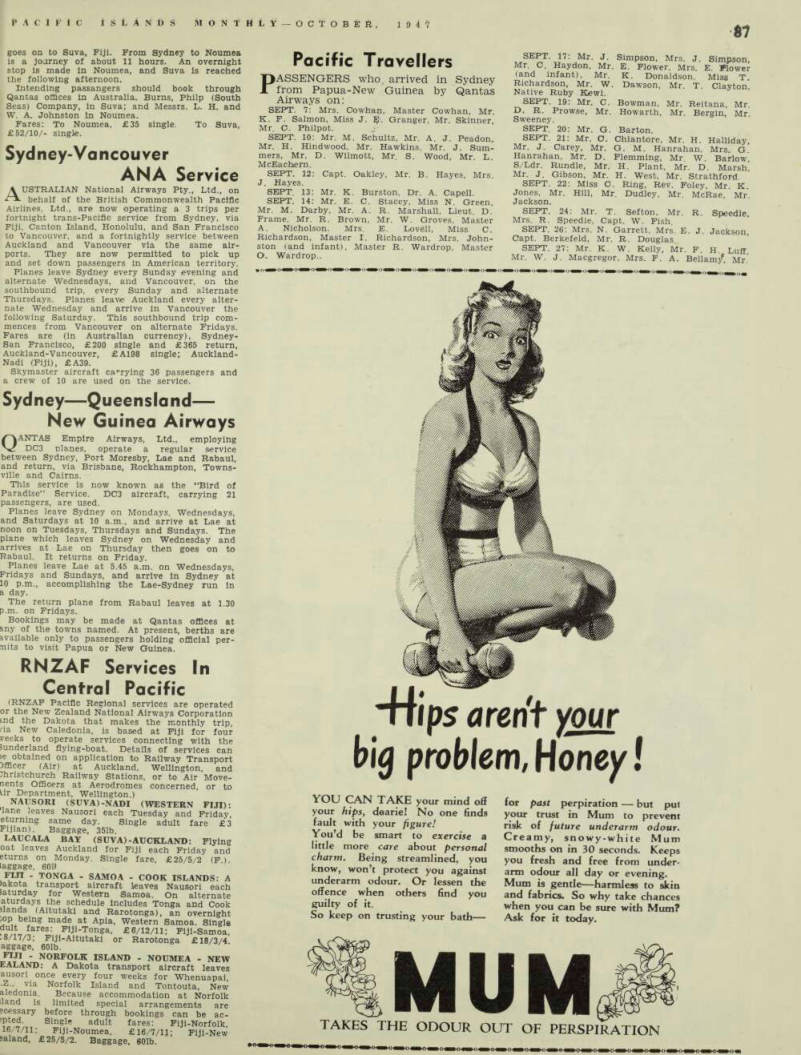
Shipping And Plane Services
THE following sea and air services are running to schedules in the Pacific.
Not all of the regular services which were suspended, owing to war conditions, have been restored; but preparations are under way for their early reintroduc tion. As they become available they will be announced here.
New Zealand—Cook
Is.—Niue—Samoa
rE motor vessel “Maui Pomare,” owned and operated by the NZ Gov ernment, maintains a direct service between Auckland and Rarotonga (Cook Islands), with alternative calls at Niue and Apia (Samoa).
Sydney-Norfolk Islond-
New Hebrides
THE SS “Morinda,” Burns Philp & Co., Ltd., runs at approximately six seven weeks’ intervals from Sydney to Lord Howe Island. Norfolk Island, and main ports of the New Hebrides, and return. A regular fixed timetable is not yet practicable. ("Morinda” has gone into dock in Sydney and is not expected to be back on the run until at least November.)
Sydney—Auckland
Airways
TASMAN Empire Airways. Ltd., operate a flying-boat service between Rose Bay.
Sydney, and Mechanics Bay, Auckland. Large
flying-boats, capable of carrying 30 passengers, are employed. The trip is comfortable, and takes approximately 8 hours.
The flying-boats leave both Sydney (7 a.m.) and Auckland (8 a.m.) every morning, including Sundays.
Bookings may be made at the Auckland and Sydney offices of Tasman Empire Airways.
' Jit
New Zealand—Fiji—
Samoa—Tonga
Monthly Service by MV “Matua”
Service Conducted By Union Ss Co.,
Ltd.—Subject To Alteration Without
Notice
(After her August trip, “Matua” will be with drawn for survey; she will be off the run for approximately one month.)
New Caledonia
THE New Caledonian Government has sub sidised and maintained the coastal ship ping services. The East Coast, the West Coast, and the Loyalty Islands, under present conditions, receive 10 round trips per annum.
The ships call at the following ports: EAST COAST.—Yate, Ounia, Thio, Nakety, Canala, Kouaoua Kua, Moneo, Ponerihouen,
Tibarama, Poindimie, Wagap, Touho, Tipindje, Hienghene, Tao, Oubatch, Pouebo, Balade, Pam, Arama, and return.
WEST COAST. —Pouembout, Kone, Temala, Voh, Ouaco Gomen, Koumac, Tangaiou, Tiebaghl, Nehoue Poume, Baaba, Belep and return.
LOYALTY ISLANDS.—Mare (Tadine), Lifou (Chepenehe) Ouvea (Fajaoue, St. Joseph) and return.
The steamer "Neo Hebridais” runs regularly between Noumea and Sydney, with occasional trips to the New Hebrides (mostly Aneityum).
The owners are Societe Maritime et Maniere Hagen, Noumea. Sydney agents: H. C. Sleigh, 254 George Street, Sydney.
Pan-American—
Trans-Pacific Service
PAN-AMERICAN World Airways now provide the following services in the South Pacific, using DC4 planes: Planes leave Sydney every Monday and Friday, and fly via Tontouta (New Caledonia), Nadi (Fiji), Canton Island, Honolulu, to San Francisco, and return along the same route, leaving ’Frisco every Wednesday and Sunday.
Planes leave Auckland every Tuesday, and fly via Nadi, Canton Island, and Honolulu, to San Francisco; and leave ’Frisco for Auckland every Friday. Fares are given below, in Australian currency:
To convert to Fiji currency, reduce above figures by about 10 per cent.
Free baggage allowance is 66 lb. per person.
Excess at 1 per cent, of single fare for each kilogram of excess (1 ki10—2.2 lb.).
Sydney-Noumeo-Suvo
ONCE weekly the Qantas flying-boat "Corlol anus” leaves Sydney in the early morning, and after calling at Brisbane heads out over the Pacific to Noumea. Every second week the plane
“Maui” Pomare”
Auckland Oct. 21 Niue* Oct. 27 Rarotonga* Oct. 30-31 Niue* Nov. 3 Auckland Nov. 10 ♦Western Time.
“Matua”
“Matua”
Auckland Oct. 14 Nov. 13 Suva Oct. 18-19 Nov. 17-18 Nukualofa .. — Nov. 20-21 Vavau — Nov. 22 Apia* Oct. 20-23 Nov. 22-25 Vavau Oct. 25 — Nukualofa Oct. 26-28 — Suva Oct. 30-31 Nov. 28-29 Auckland Nov. 4 Dec. 3 ♦Western Time.
Single Return £ s. d. £ s. d.
Sydney-’Frisco 200 0 0 360 0 0 Sydney-Piji 55 0 0 99 1 3 Auckland-Piji 39 1 3 70 6 3 Fiji-’Frisco 145 0 0 260 18 9 Auckland-Fiji (Special 90-days excursion) .. 50 0 0
goes on to Suva, Fiji. Prom Sydney to Noumea is a joarney of about 11 hours. An overnight stop is made In Noumea, and Suva is reached the following afternoon.
Intending passangers should book through Qantas offices in Australia. Burns, Philp (South Seas) Company, in Suva; and Messrs. L. H. and W. A. Johnston In Noumea.
Fares: To Noumea, £35 single. To Suva, £52/10/- single.
Sydney-Voncouver
ANA Service
AUSTRALIAN National Airways Pty., Ltd., on behalf of the British Commonwealth Pacific Airlines, Ltd., are now operating a 3 trips per fortnight trans-Paciflc service from Sydney, via Fiji, Canton Island, Honolulu, and San Francisco to Vancouver, and a fortnightly service between Auckland and Vancouver via the same air ports. They are now permitted to pick up and set down passengers in American territory.
Planes leave Sydney every Sunday evening and alternate Wednesdays, and Vancouver, on the southbound trip, every Sunday and alternate Thursdays. Planes leave Auckland every alter nate Wednesday and arrive in Vancouver the following Saturday. This southbound trip com mences from Vancouver on alternate Fridays.
Pares are (in Australian currency), Sydney- San Francisco, £2OO single and £365 return, Auckland-Vancouver, £AI9B single; Auckland- Nadi (Fiji), £A39.
Skymaster aircraft carrying 36 passengers and a crew of 10 are used on the service.
Sydney—Queensland—
New Guinea Airways
QANTAS Empire Airways, Ltd., employing DC3 planes, operate a regular service between Sydney, Port Moresby, Lae and Rabaul, and return, via Brisbane, Rockhampton, Towns ville and Cairns.
This service is now known as the “Bird of Paradise” Service. DC3 aircraft, carrying 21 passengers, are used.
Planes leave Sydney on Mondays, Wednesdays, and Saturdays at 10 a.m., and arrive at Lae at noon on Tuesdays, Thursdays and Sundays. The plane which leaves Sydney on Wednesday and arrives at Lae on Thursday then goes on to Rabaul. It returns on Friday.
Planes leave Lae at 5.45 a.m. on Wednesdays, Fridays and Sundays, and arrive In Sydney at 10 p.m., accomplishing the Lae-Sydney run In a day.
The return plane from Rabaul leaves at 1.30 p.m. on Fridays.
Bookings may be made at Qantas offices at any of the towns named. At present, berths are available only to passengers holding official per nits to visit Papua or New Guinea.
RNZAF Services In
Central Pacific
(RNZAF Pacific Regional services are operated or the New Zealand National Airways Corporation ind the Dakota that makes the monthly trip, da New Caledonia, is based at Fiji for four veeks to operate services connecting with the Sunderland flying-boat. Details of services can ie obtained on application to Railway Transport Officer (Air) at Auckland, Wellington, and Christchurch Railway Stations, or to Air Move aents Officers at Aerodromes concerned, or to iir Department, Wellington.)
Nausori (Suva)-Nadi (Western Fiji);
lane leaves Nausori each Tuesday and Friday eturning same day. Single adult fare £3 Fijian). Baggage, 351 b.
Laucala Bay (Suva)-Auckland: Plying
oat leaves Auckland for Fiji each Friday and eturns on Monday. Single fare, £25/5/2 (F ) laggage, 6011 FIJI - TONGA - SAMOA - COOK ISLANDS: A >akota transport aircraft leaves Nausori each Saturday for Western Samoa. On alternate aturdays the schedule includes Tonga and Cook slands (Aitutaki and Rarotonga), an overnight /op being made at Apia, Western Samoa. Single
I 1 Plji-Tonga, £6/12/11; Fiji-Samoa,
.8/17/3; Piji-Aitutaki or Rarotonga £lB/3/4 aggage, 601 b.
FIJI - NORFOLK ISLAND - NOUMEA - NEW EALAND: A Dakota transport aircraft leaves ausori once every four weeks for Whenuapai, ■Z., via Norfolk Island and Tontouta, New aledonia. Because accommodation at Norfolk land is limited special arrangements are scessary before through bookings can be ac- Single adult fares: Fiji-Norfolk, 16/7/11; Fiji-Noumea, £l6/7/11; Fiji-New saland, £25/5/2. Baggage, 601 b.
Pacific Travellers
PASSENGERS who. arrived in Sydney
from Papua-New Guinea by Qantas
Airways on:
SEPT. 7: Mrs. Cowhan, Master Cowhan, Mr.
K. F. Salmon, Miss J. $. Granger, Mr. Skinner, Mr. O. Philpot.
SEPT. 10: Mr. M. Schultz, Mr. A. J. Peadon.
Mr. H. Hindwood, Mr. Hawkins, Mr. J. Sum mers, Mr. D. Wilmott, Mr. S. Wood, Mr. L.
McEachern.
SEPT, 12: Capt. Oakley, Mr. B. Hayes, Mrs.
J. Hayes.
SEPT. 13: Mr. K. Burston, Dr. A. Capell.
SEPT. 14: Mr. E. C. Stacey, Miss N. Green, Mr. M. Darby, Mr. A. R. Marshall, Lieut. D.
Frame, Mr. R. Brown, Mr. W. Groves, Master A. Nicholson. Mrs, E. Lovell, Miss C.
Richardson, Master I. Richardson, Mrs. John ston (and infant), Master R. Wardrop, Master O. Wardrop..
SEPT. 17: Mr. J. Simpson, Mrs. J. Simpson Mr. C. Haydon, Mr. E. Flower, Mrs. E. Mower (a.nd infant), Mr. K. Donaldson, Miss T.
Richardson, Mr. W. Dawson, Mr. T. Clayton Native Ruby Kewi.
SEPT. 19: Mr. C. Bowman, Mr. Reitana, Mr.
D. R. Prowse, Mr. Howarth, Mr. Bergin, Mr Sweeney.
SEPT. 20: Mr. G. Barton.
SEPT. 21: Mr. O. Chiantore, Mr. H. Halliday Mr. J. Carey, Mr. G. M. Hanrahan, Mrs. G.’
Hanrahan, Mr. D. Flemming, Mr. W. Barlow, S/Ldr. Rundle, Mr. H. Plant, Mr. D. Marsh, Mr. J. Gibson, Mr. H. West, Mr. Strathford.
SEPT. 22: Miss C. Ring, Rev. Foley, Mr. K.
Jones, Mr. Hill, Mr. Dudley, Mr. Mcßae, Mr Jackson.
SEPT. 24: Mr. T. Sefton. Mr. R. Speedie Mrs. R. Speedie, Capt. W. Fish, SEPT. 26: Mrs. N. Garrett, Mrs. E. J. Jackson Capt. Berkefeld, Mr. R. Douglas SEPT. 27: Mr. K. W. Kelly, Mr. F. H, Luff Mr. W. J. Macgregor, Mrs. F. A. Bellamjf, Mr
K. Dutch. Miss D. Lloyd, Mr. H. Rich, Mr.
K. Hamilton, Mr. S. Jamieson.
SEPT. 28: Mr. A. J. Hoile, Mr. J. G. Matchett, Mr. H. G. James, Mr. K. Williamson, Mr. A.
Easter.
SEPT. 30: S/Ldr. Smith, Mr. D. McDermott, Mrs. A. Ewing, Miss H. Ewing. Mr. D.
Cameron.
OCT. 1: Mr. C. A. Jones, Mr. R. Beverley.
OCT. 3; Miss V. McKay, Mr. W. E. Sansom.
OCT. 4: Mr. C. G. Carpenter, Mrs. C. G.
Carpenter, Mr. L. Morris, Mr. J. Flowers.
OCT. 5: Mr. McEachern, Mr. M. Hayman, Miss V. Thwaite.
PASSENGERS who left Australia by
Qantas Airways for air-ports in Papua-
New Guinea on: SEPT. 10; Mrs. E. J. Jackson, Mr. J. Clarke, Mr. E. Bonnett, Mr. F. Cullen, Mrs. V. F.
Pearson (and infant). Master R. Pearson, Mr.
W. A. Smith, Mr. E. Bishton, Mrs. Longmore (and infant), Mr. K. Roberts, Mrs. K. Roberts, Miss I. Rigg, Mr. T. J. Perkins, SEPT. 12: Mr. N. T. Strettles, Mr. D. W.
Kirtin, Mr. V. Blackwell, Mrs. M. Lesmond (and infant), Mr. R. C. Steedman, Mr. J. Rowe, Miss E. Lyndon, Mr. L. Villiers, Mrs. V. Osborne, Mr. R. R. Arnel, Mr. G. W. Bryant, Mr. F. N.
Rolfe,. Miss Y. Darmody, Mr. A. K. Armistead.
SEPT. 15: Mr. A. Johnson, Mr. J. Heau champs, Mr. E. McArthur, Mr. J. R. Vicary, Mr. F. Jones, Mr. E. Guider, Miss E. C.
Edwards.
SEPT. 17: Mrs. M. Williams (and infant), Mr. C. Carter, Mr. K. West, Mrs. Schmidt, Miss C. Schmidt, Mr. K. T. Horne, Mr. G. N.
Sinden, Mr. J. M. Terrey, Mr. F. A. Skinner.
SEPT, 19: Mr. F. W. Saunders, Mr. N.
Bidder. Mr. McCready, Dr. Gray Washington.
Mr. G. F. Edwards, Mrs. Edwards, Mr. D. A.
Cameron, Mr. J. Bell, Mr. L. Grahame, Mr. E.
W. Anderson.
SEPT. 20: Mr. E. R. Wilson. Mr. H. H.
Saunders, Mr. Clyne, Mr. Hallstrom. Mr. A.
Drummond, Mr. W. J. Chung, Mr. J. Johnston.
Mr. A. W. Anderson. Mr. J. Anderson.
SEPT. 22: Mrs. J. Thomas, Mr. E. H. Wolter, Mr. R. Pearce, Mr. F. L. Nystrom, Mr. R. D.
Brown, Mr. H. Reaby, Mr. H. Hindwood, Brig.
A. E. Brown, Mr. J. A. Maisey, Mr. J. Fitz gerald, Mr. J. R. Kennedy.
SEPT. 23: Mr. M. W. Brightwell, Mr. J. P.
Cahill, Mr. B. D. Lawes, Mr. W. S. Mattick, Mr. B. B. Nicholson, Mr. T. J. Leabeater, Mr.
J. A. Butterworth, Mr. M. W, Doherty, Mr. F.
E. Kay, Mr. D. J. Kingston, Mr. J. H. Simon, Mr. G. H. Steege, Mrs, J. Steege, Miss D. Y.
Masters. Mr. K. I. Chester, Mr. Wiggett.
SEPT. 24: Mr. E. R. Hawkins, Mr. A. B.
Ritchie, Mr. J. S. McKenzie, Mr. H. D. Simon, Mr. T. B. Lloyd, Mr. W. Winter, Mr. J.
Harper, Mr. K. Smith, Mr. W. P. Jefford, Mr.
H. Roy, Mr. T. Flower.
SEPT. 26: Mr. H. James, Mr. C. Siddall, Mr.
W. C. Groves, Mr. D. Long, Mr. C. G. Crossley, Mr. T. W. Dixon, Miss Z. Sheppard. Miss F.
Esserman, Miss J. S. Gibson, Capt. P. Oakley, Miss P. Jarman.
SEPT. 27: Miss B. A. McLachlan, Mr. D. E.
Kelaart. Mr. D. N. Maclean, Mr. D. Holden, Mr. p. J. Brosgarth. Mr. K. Coulson. Mr. D.
W. Gumming, Miss V. P. Brien, Mr. J. G.
Wasley, Mr. W. H. Dew, Mr. W. Kelly.
SEPT. 29: Mrs. T. K. McNamara, Mr. and Mrs. E. Upton (and child), Mr. K. Dalberg, Mr. L. P. Irwin, Rev. W. H. Rainey, Mr. H.
Hamilton, Mr. J. P. Davidson.
SEPT. 30: Mr. K. Goddard, Mr. R. Day. Mr.
J. Johnston, Mr. B. Tainsh, Miss E. Reape, Mr. D. Lockwood. Mr. E. Wright, Mrs. Wash ington Gray, Mr. K. Levy.
SEPT. 30: Mr. K. Goddard, Mr. R. Day, Mr.
J. Johnston, Mr. B. Tainsh, Miss E. Heape, Mr. D. Lockwood, Mr. E. Wright, Mrs. Wash ington Gray, Mr. K. Levy.
OCT. 1; Mrs. C. Sellers (and infant), Mrs. J.
Lamb. Mr. H. C. Avenell, Mrs. O. Ness, Mrs.
J. Ireland. Mr. G. Renton, Mr. W. T. Baxter, Mr. J. G. Hopkins. Mr. K. Chambers, Mrs.
Chambers (and infant), Miss R. Breen. Mrs. L.
Dwyer (and infant), Miss C. Dwyer, Mr. W. C.
Norgate.
OCT. 3: Mr. L. A. Edwards, Mr. W. Pellizzaro, Mr. A. Fern, Mr. C. Haydon, Mr. F. J.
Ballagh. Mrs. Ballagh. Mr. G. K. Morris, Miss D. Mortlock, Mr. S. H. Fearon, Mr. F. Heaney, Miss G. E. Marden, Mr. Fienberg, Mr. K. M.
Florentine.
OCT. 6: Mr. G. Upton, Mr. P. s. Barnes, Dr.
H. G. Harding, Mr. H. A. Mettan, Mr. L. J.
Sweeney.
PASSENGERS who arrived in Sydney by MV “Malaita” from New r Guinea ports on October 2: — FROM MADANG: Mr. K. Chambers, Mr. and Mrs. G. Clarke, Mr. R. G. Ormsby, Mr. C. E.
Pennell.
FROM LAE: Mrs. E. Bowman, Mr. C. Birch, Mr. and Mrs. B. A. Brown, Mrs. A. W. Clarke, Mr. W. M. Davis, Mr. J. E. Hallstrom, Mrs. G.
Hewson. Mr. J. P. Murphy, Mr. I. M. O’Connor, Mr. L. H. Parry, Mrs. M. Smith, Mr. H. T.
Trainor, Mr. H. G. Tudor, Mrs. E. I. Webb, Mr. and Mrs. Davis (and two children).
FROM SAMARA!; Mrs. B. L. Cavanagh (and child), Mr. E. D. Davis, Miss E. A, Downs, Mr. M. E. Ford, Mr. C. Hennings, Mrs. G.
Robinson (and son).
FROM PORT MORESBY: Mr. and Mrs. E.
Boehm (and children), Mr. S. G. Briant, Mrs.
J. Brinkley, Mrs. J. V. Dietrich, Mrs. V.
Frame, Mr. and Mrs. A. Johnston (and son), Mr. G. Maunsell Turner, Miss I. McArthur, Mr. and Mrs. L. Odgers (and child), Mrs. A. M.
Smith, Miss E. D. Turner.
PASSENGERS who arrived in Sydney by SS “Montoro” from Papua-New Guinea ports on September 20:— FROM RABAUL: Mr. H. Baker, Mr. J. W.
Bartlett, Mr. A. Brown, Sgt. B. B. Brown, Mrs.
L. V. Burke, Pte. K. Copping, Mrs. M. A.
Comley, Oliver Francis Choi, Mr. L. W. Davis, Mr. and Mrs. J. V. Dowling, Capt. and Mrs.
J. Ellis, Mr. J. A. Griffin, Mr. J. W. Handley.
Major and Mrs. R. Hicks, Mr. A. H. Hill, W/O C. F. Hobler, Timothy See To Hong, Mr. S. C.
Kensett, Pte. E. C. King, Pte. R. I. Lindwood, Mrs. C. McCausland. Mr. A. D. Mickle, Mr.
A. Palmer, Mr. and Mrs. J. H. Parry, Mrs.
R. M. Radley, Capt. A. E. Rout, Mrs. E. M.
Richards, Mrs. M. D. Smith, Miss H. M.
Savage, Mrs. M. Sinclair, Mrs. W. White.
FROM SAMARA!; Brother B. Gormley, Miss I. Kent, Miss E. Somerville, Mr. R. J. Parer,
Peni and Wife Malili, Mrs. M. Stubbs, Rev.
W. G. Thomas.
FROM PORT MORESBY; Mrs. E. Bennett, Mr.
H. G. Carr, Mrs. L. Crouch, Miss D. Cunning ham, Mrs M. R. Curtis, Mr. K. W. Dyer, Mrs.
G. Evans. Mr. R. F. Field, Mr. K. R. Fisher, Mrs. N. E. Fraser, Mr. and Mrs. J. L. Frog gatt, Mr. D. S. Grove, Mr. A. E. Guthrie, Mrs.
I. Howie, Mrs. L. H. Laws, Mrs. A. Little, Mr.
R. R. McLennan, Mr. W. Peirce, Mrs. G. Porch, Mr. G. A. Radford, Mrs. O. L. Thomas, Mr. and Mrs. C. Turley, Miss p. Wessell, Oweisi, Kamitz.
Advertisements & other items, pp. 90-92 (2 items)
Chula
For the production of best quality WHITE COPRA
COPRA DRYERS
v t
BULK POWER DRYERS
FOR LARGE ESTATES
TYPE B.D.O — 6,000 NUTS PER 24 HRS.
TYPE B.D. I—lo,ooo NUTS PER 24 HRS.
ALSO NATURAL DRAFT DRYERS
FOR SMALLER ESTATES
1
TYNESIDE FOUNDRY AND ENGINEERING CO. LTD.
LOW ELSWICK • NEWCASTLE UPON TYNE • ENGLAND • CABLES • FOUNDRY NEWCASTLE-ON-TYNE
m fi
-Hips aren't
big problem, Honey !
YOU CAN TAKE your mind off your hips, dearie! No one finds fault with your figure!
You’d be smart to exercise a little more care about personal charm. Being streamlined, you know, won’t protect you against underarm odour. Or lessen the offence when others find you guilty of it.
So keep on trusting your bath— for past perpiration but put your trust in Mum to prevent risk of future underarm odour.
Creamy, snowy-white Mum smooths on in 30 seconds. Keeps you fresh and free from underarm odour all day or evening.
Mum is gentle—harmless to skin and fabrics. So why take chances when you can be sure with Mum?
Ask for it today.
MUM
TAKES THE ODOUR OUT OF PERSPIRATION
I » n % fra uestea/ =,
MERCHANTS
WHOLESALE
\9s oV\'\
GENERAL AGENTS
o 9 v *> <* r*m e 9 P c o 0 *o* TO** 9 C° fO* iavH 0 . or i 9 V>^
tt*s
9> r 1 6 t h P 9 i* |A o c vv> tyv & FORWARDING. SHIP PIN 6 fi CUSTOMS AGENTS •
88
OCTOBER, 194? PACIFIC ISLANDS MONtHLT
Growing "Dry" Rice In
New Britain
ACCORDING to an article in the “North Queensland Register,’’ dry rice is now being grown : in New Britain.
It is stated that this rice was intro duced by the Japs, who grew and har vested it extensively. It is supposed to be fast growing, good bearing and re quires little rainfall. Planters are re ported to be growing it to feed native labour, as cost of rice from Australia is prohibitive.
A planter from Bougainville,,, however, has never heard of experiments with dry rice and does not know anyone who is growing it. , But. he says, as planters in that dis trict are finding it harder to get labour than to get rice, perhaps that is not sur prising.
Bikini Natives Want To
Return Home
NATIVES of Bikini atoll (the scene of the US atom bomb tests over a year ago) are homesick and want to go bctck US Navy exports, however, have con vinced them that it is still too dangerous to do so. Conditions are said to be safe ashore but water in the lagoon (in which the second bomb was exploded under water on July 25, 1946) is tisll radio active.
Before the experiments were made, the Bikini islanders were taken to Rongerik, where the United States government had built sturdy homes for them ,and provided them with rations.
Although Europeans can see little dif ference between Bikini and Rongerik, the islanders themselves invest their old home with special delights. Rongerik, they say, grows inferior bananas, and the coconuts take longer to ripen.
Bad Assault Case In
Tahiti
Papeete, Sept. 12.
A FRENCHWOMAN, cycling to Papette on Sunday evening, September 7, after visiting friends at Punaauia, was attacked by five hoodlums, who violated her and stole her purse, contain ing some 8,000 francs. A car which came along caused the hoodlums to run away.
She was picked up and taken to Papeete, almost unconscious. The police have been out on the search, and the arrest of the criminal gang is expected soon.
Tohiti has been remarkably free of that kind of crime, and we all hope for an early arrest aand stern justice.
Miss Edna Mullins, eldest daughter of Mr. and Mrs. J. Mullins, of Nauru, was married in the Roman Catholic Mission at Arubo, Nauru, in August, to Mr.
George Fargas, of Brisbane. Miss May Mullins and Miss Shirley Kirk were bridesmaids, and Mr. J. Brown was best man.
'Had' N. Guinea
N. Britain Planter Has 'Had' N. Guinea
Mr. Dyson Hore-Lacy, Whose
Garua Plantation, in the Talasea district of New Britain, is one of the show-places of New Guinea, has returned to Sydney from a brief visit, and says that he does not intend to live in the Territory any longer. A competent man ager will carry on at Garua, and he has sold his Ulatawa oroperty (in the Kokopo district) to Mrs. Greenwood.
Mr Hore-Lacy. who has been president of the Planters’ Association for some time in New Britain, has now resigned that office, and Mr. Vic Pennefather has
taken over the reins of that organisa tion.
“Under present conditions I find it im possible to remain in New Guinea,’’ said Mr. Hore-Lacy, “and there are quite a number of others with the same idea.’’
He intends residing on the land in Vic toria.
Mr. Raleigh Farlow, District Officer at Buka Passage, who has been spending a few months’ leave in Sydney, returned to New Guinea by air last week.
The young Caledonian volunteer, Marc Moutry, who was killed at Bir Hakeim with the Pacific Battalion, has posthum ously been awarded the French Resis tance Medal.
Advertisements & other items, p. 93 (1 item)
Andrew’S
QUININE TABLETS
Gr. per 1,000 95/- Gr. 4-2 per 500 50/-
QUININE
SULPHATE POWDER B.P.
Per oz. . . . 6/6
PACKED AND POSTED.
Compendium and further literature obtainable from
ANDREW'S LABORATORIES
15 HAMILTON STREET, SYDNEY
Manufacturers of Drugs and Fine Chemicals
UTILITY CANS that
withstand hard use
WUNDERLICH CORRUGATED CANS fabric-
ated in steel and HOT-DIP GALVANIZED are 4 ideal for Home, Factory, Farm and general use.
These strong cans are excellent as rodent-proof containers for grain and fodder. As waste receptacles the cans can be kept hygienically clean always!
FOUR SIZES AVAILABLE: 10. 16.
24 and 32 gals, capacity.
Van c/?r/ir/t
(IRRIGATED CANS
vJ UTILITY CANS TOR GLNtRAL USt
YOUR
LOCAL HARDWARE
STORE CAN SUPPLY
OR OBTAIN THESE
r D n o aC D Ure^^ by „ Wun < Jer,ich Limited, Redfern, Sydney. Tel.: MX 2411. &.P.O. Box 474. Branches: Newcastle. N.S.W., and Interstate Capitals.
Islands Produce
(Quotations in Australian Currency)
Cocoa
Official prices for New Hebrides cocoa beans, controlled by the Cocoa, Chocolate and Confec tionery Committee, are as follows: — Buying (unofficial source): £IOO per ton f.o.b.
Island port.
Selling: Delivered Sydney. No quotations.
Accra: No quotations.
New Guinea cocoa beans: No quotations.
The above are the "official” prices fixed by an Australian Government Committee. They plainly are ridiculous, and should not be accepted seriously. In mid-February we were informed that owing to the increased price for New Hebrides cocoa beans, no information was being announced on the price per ton delivered at Australian ports. Mid-July: No official in formation.
Trochus Shell
Some parcels have recently changed hands.
Nominal quotations in September show prices at the following levels; Approximately £6O per ton, Sydney.
Coffee
No purchases are permitted in Australia without the consent of the Tea and Coffee Control Board, to whom all offers must first be submitted. Nominal quotations as follows: — New Caledonian: Arabica, £124 per ton (f.a.q.).
Robusta, £lO4 per ton (c.i.f. Sydney).
Mysore: £220 to £240 (c. & f., Sydney).
New Guinea and Papua: £ll2 per ton (c.i.f.).
Java: No quotations.
Vanilla Beans
No supplies available. Nominal quotations only.
Kapok
Very little movement in Javanese kapok.
Nominal quotation 2/1 Va per lb.
Indian kapok is being quoted for Indent at 1/6 per lb. c.i.f. stg.
Cotton
Controlled in Australia. Stocks being made available to manufacturers at following rates:— For spinning and weaving yarns, 14V 2 d. per lb.; cordage making, H%d. per lb.; condenser yarn, 12d. per lb.
Ivory Nuts
No firm quotations available.
Rice
No quotations.
Green Snail Shell
F.a.q., £100 per ton, in store, Sydney. Market in chaotic condition; no orders are being re ceived.
Pearl Shell
Australian-controlled price:— ‘B’* Class, £200 per ton. “C” Class, £ 19P0 per ton. “D” Class, £135 per ton.
Buying Prices At Suva, Fiji,
Produce Report
(Fiji Currency) Copra (Plantation Grade) £36/19/- Copra (FMS Grade) £36/13/6 Kerosene, per gallon 3/4 Flour, per 150 lb. sack wholesale .. .. 49/10 Vz Flour, per 2 lb SVfed.
Sharps, per 140 lb. sack wholesale 46/6 Sharps, per 2 lb SVid.
Trochus Shell, per ton £25 Benzine, per gallon 2/7
Advertisements & other items, p. 94 (1 item)
Price Of Gold
Pine Standard oz. . .. £10/15/3 oz £9/17/3% (Australian Currency)
Copra
Prices During World War Ii
The copra market was controlled by Govern ments from outbreak of war in 1939 until the end of the war in 1945. Controls are still being exercised in the post-war period.
London Fixed Price, per ton, c.1.f., Plantation Hot-air:
Sterling October, 1939—January, 1940 ... £12 7 6 January-April, 1940 13 5 0 Alter April, 1940 12 17 6 Fiji Fixed Price, per ton, f.o.b., Fiji Currency; Plant’n FMS February, 1942 ... £15 15 0 £14 15 0 June, 1942 16 0 0 15 0 0 July, 1942 16 12 6 15 12 '6 June, 1944 19 10 0 18 0 0 October. 1944 ... 20 0 0 18 10 0 December, 1945 .. 19 7 6 17 17 6 January, 1946 ... 18 5 6 18 0 0 August, 1946 ... 23 10 6 23 5 0 February. 1947 ... 29 15 6 29 10 0 June 9, 1947 ... 36 19 0 36 13 6
Territory Of New Guinea
ANGPCB Fixed Price at Plantation: Hot-air Smoked Sept. 28, 1946 . . £22 5 0 £21 5 0 ANGPCB Fixed Price, Delivered ex Ships Slings: Hot-air Smoked Jan. 7, 1947 .. £28 0 0 £27 0 0 June 17, 1947 .. £31 2 0 Although it is reported (October 15, 1947) that the new price is £35 per ton, no official announcement has been made.
Increased prices announced on January 7 operated from December 1, 1946. Prices quoted are for copra delivered to ships’ slings, or to the Board’s warehouse.
Official Prices for NG Copra landed at Sydney.
Hot-air Dried Smoked January, 1947 £36 10 0 £35 10 0 July, 1947 .. £51 5 0 £50 5 0
Rubber
Plantation
Papuan Rubber Prices Under Australian Government Control—Payable on Plantation or Nearby Port, per lb., Australian Currency;
London Para.
Smoked Price onper lb. per lb.
January o. 1933 .. .. ... 4%d 2.43d July 7 .. .. .. 5Hd 3.71d January 5, 1934 .. .. .. .. 4V«d 4.28d July 6 . . .. .. 6Vad 7.06d January 4, 1935 .. .. ... 6d 6%d July 5 .. ... 5d 7%d January 3. 1936 . . . 6»/4d 8Hd June 5 .. .. .. 9d 7V«d January 8, 1937 .. .. ... 1/2 .. 10M»d June 4 .. .. .. lid 9Hd January 7. 1938 .. . . ... 7Vid 7d
July 1 .. 7y<o January 8, 1939 8Vkd July 7 ..
SVid January 5, 1940 13d .. 11.6 7 /«d July 5 .. 15d .. 12 3 / 4 d January 3, 1941 . .. 12 47 7 / 8 d April 4 . . .. l4V«d June 6 .. 16»/ a d .. 13.5»4d August 1 17d .. 13Vfcd October 10- -Price officially fixed at .. 13 3 / 4 d
Grade 1 Grade 2 Grade 3 September, 1943 . 1/6 % 1/4 1/2 September, 1944 . 1/6% 1/5 % 1/3% July, 1944 . .. . 1/4% 1/3% 1/1%
Quotations For Mining
Shares
Fiji
Aug., 193?
Mid-Sept.
Mid-Oct.
Emperor Mines . .. 9/11 sl8/10y 2 S18/9 Loloma .. 25/6 b22/- S21/9 Bulolo G.D
New Guinea
,. 124/- bl65/- Guinea Gold ...
N.Q.
S19/9 N.G.G., Ltd b3/- S2/9 Oil Search b8/6 s8/- Placer Dev bl53/6 Sandy Creek ... .. 1/5 sl/7y 2 bl/8 Sunshine Gold .. . 6/5 s9/3 SlO/- Cuthbert’s
Papua,
bl4/6 bl5/- Mandated Alluvlals 3/8 b8/s8/3 Orlomo Oil .. 5/b4/s3/6 Papuan Aplnalpl . 4/11 blO/b9/- Yodda Goldfields . 1/3 bl/9 sl/8
Exchange Rates
THE following exchange quotations show the rates existing in October:
Fiji
Through Bank of NSW and Bank of Now Zealand:—Australia on FIJI on basis of £lOO Fiji; Buying. £Alll/2/6; selling, £AII3. FIJI - on basis of £lOO London: —
Western Samoa
Through Bank of New Zealand; —Australia on Western Samoa on basis of £lOO Samoa: Buy ing, £A99/12/6; selling, £AIOO/2/6. Samoa on London on basis of £lOO in London:—
New Guinea And Papua
Bank of New South Wales, which now has branches in Port Moresby and Lae, quotes an exchange rate between Australia and NG-Papua of 10/- per £lOO.
French Pacific Colonies
SINCE December 25, 1945, the franc, Instead of having the same value in all parts of the French Empire, has been given different values in different parts of the Empire. There are three groups. Group 1: France, North Africa, West Indies, French Guiana. Group 2: All African Colonies, Madagascar, Reunion, St.
Pierre, Miquelon. Group 3: New Caledonia, New Hebrides, French Oceania. Exchange values, In francs, are approximately:
Buying. Selling. £ s. d. £ s. d.
Telegraphic transfer ... 110 15 0 112 0 0 On demand 110 12 6 111 17 1
Buying.
Selling. £ s. d. £ s. d.
Telegraphic transfer — £125 10 0 On Demand ., .. .. £122 18 9 125 7 6 30 days 122 8 9 125 2 6 60 days 121 18 9 124 17 6 90 days 121 8 9 124 12 6 120 days 120 18 9 —
£ stg. USA Dollar £ Aus.
Group 1 .. . 480 119.1 384 Group 2 .. . - 282.9 70 227 Group 3 .. .. 200 49.6 160-163
Advertisements & other items, pp. 94-96 (3 items)
90
OCTOBER, 19 41 PACIFIC ISLANDS MONTHLY
Published by PACIFIC PUBLICATIONS PTY. LTD., Union House, 247 George Street. Sydney. (Telephone: BW 5037). Wholly set up and printed in Australia by the Sydney and Melbourne Publishing Co. Pty. Ltd., 29 Alberta Street, Sydney. (Telephone: MA7101).
Gold
Purchasers at Full Market Prices on Assay Value of
SILVER
PLATINUM
And Platinum Group Metals
SOME OF OUR SERVICES
ASSAYERS & ANALYSTS—
Assays of Bullion, Ores, etc.
Analyses of Metals, Minerals, Alloys, etc.
SCIENTIFIC & INDUSTRIAL
METALLURGISTS—
Our range of precious metal manufactures covers all Industries—Gold and Silversmiths, Electrical Trades, Dental Profession, Glass Sllverers, Electro-Platers, etc., etc.
REFINERS—
Purchasers and Refiners of Bullion, Scrap. Mining By-Products, and Trade Residues of every description carrying Precious Metals.
GARRETT 6- DAVIDSON
PTY. LTD.
824 George St., Sydney. Works: Sorry Hills and Chippendale, N.S.W.
Official Assayers to the Bank of New South Wales. Gazetted Agents of the Commonwealth Bank of Australia, under the Gold Regulations of the National Security Act.
At^todi
To quench a
tropical thirst...
A CO O*.
D « •r) - A 11 4 eoTTieo 0 P r® e ' ' ■ " 4' v When you’re hot and tired, there is nothing quite so satisfying and thirst quenching as a long, cold glass of **K.B.“ Your friends and guests, too, will appreciate this really fine Lager, for “Everybody drinks K. 8.”
TOOTHS
LAGER
I
MERCHANTS, & SHIP OWNERS
Capital £1,000,000
ESTABLISHED 1914
'A' ★
COPRA MERCHANTS & 'MILLERS
BRANCHES THROUGHOUT THE PACIFIC ISLANDS
Buyers and exporters of all kinds of Islands pro- -luce. Copra Merchants and Millers.
Agents for Australian, European and American Manufacturers. Distributors of every description of merchandise.
IN LONDON:
W. R. Carpenter & Co. (London), Ltd., Coronation House, 4 Lloyd’s Avenue, London, E.C. ★
DISTRIBUTING
AGENTS FOR :
Ford Motor Company of Canada.
Electrolux Refrigerators.
T. G. & C. Bolinders (Engines).
Chrysler Corporation.
Westinghouse Electrical Co.
Thirty years of Pacific Islands development and service.
THE W.R.C. LINE
Caterpillar Tractors.
Etc., Etc.
THE FIRST DIRECT AND
REGULAR CARGO AND PASSENGER SERVICE BETWEEN EUROPE
PACIFIC ISLAND PORTS WAS ESTABLISHED BY
AND
I
W. R. CARPENTER fir CO. LTD.
Head Office: 16 O'CONNELL STREET, SYDNEY.
Cable Address:
CAMOHE.
Telephone* Postal Address.
BW 4421. P.O. Box No. 168, Sydney. (