Pacific
Islands
Monthly
Vol. Xviii. No. 2.
September 17, 1947
Wished 1930.
L Registered at the transmission by post as a newspaper]
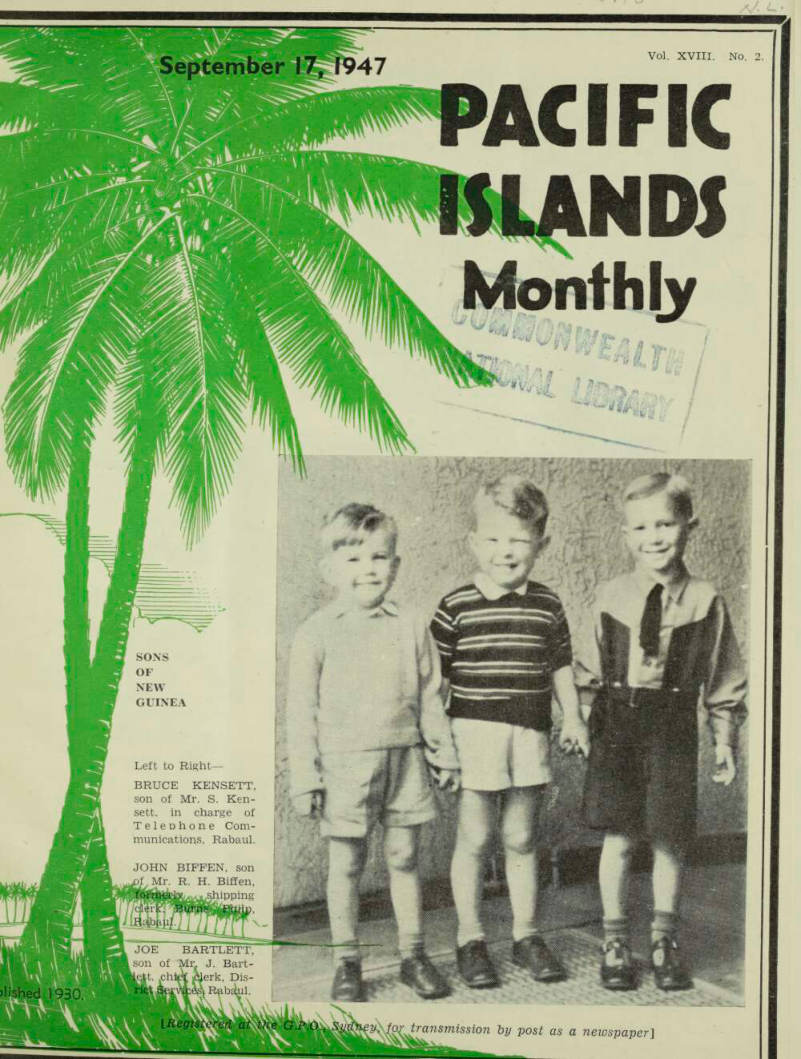
Sons
OF
New
Guinea
Left to Right—
Bruce Kensett,
son of Mr. S. Ken sett. in charge of Telenhone Com munications, Rabaul.
John Biffen, Son
of Mr. R. H. Biffen, formerly shipping clerk, Burns Philp,
Rabaul.
Joe Bartlett,
son of Mr. J. Bart lelt, chief clerk, Dis
rict Service, Rabaul.
Advertisements & other items, pp. 2-4 (1 item)
Qatttaa Sm/utzyUtwaya
I E RRTT 0 f.
’OF N E
•J
\f "••Zy NTSSSif^
y < e '^,r
terri'toky-n:
or Ck
GU 1 N
NEW
IRELAND
/ago R&BAUL'
fe-SALAMAUAj
tr.lF oF /
PORT
MORESBY'
i
IpFINSCH&FE
LAE
MORoet
TROBRIAHD
BUNA
COO
NOUGM
MILNE
BM So
ANGA
FENI
VJ»S
N is
BOUGAINVILLE
SOLOMON
If
RAI IOUUIAOt AHCKT
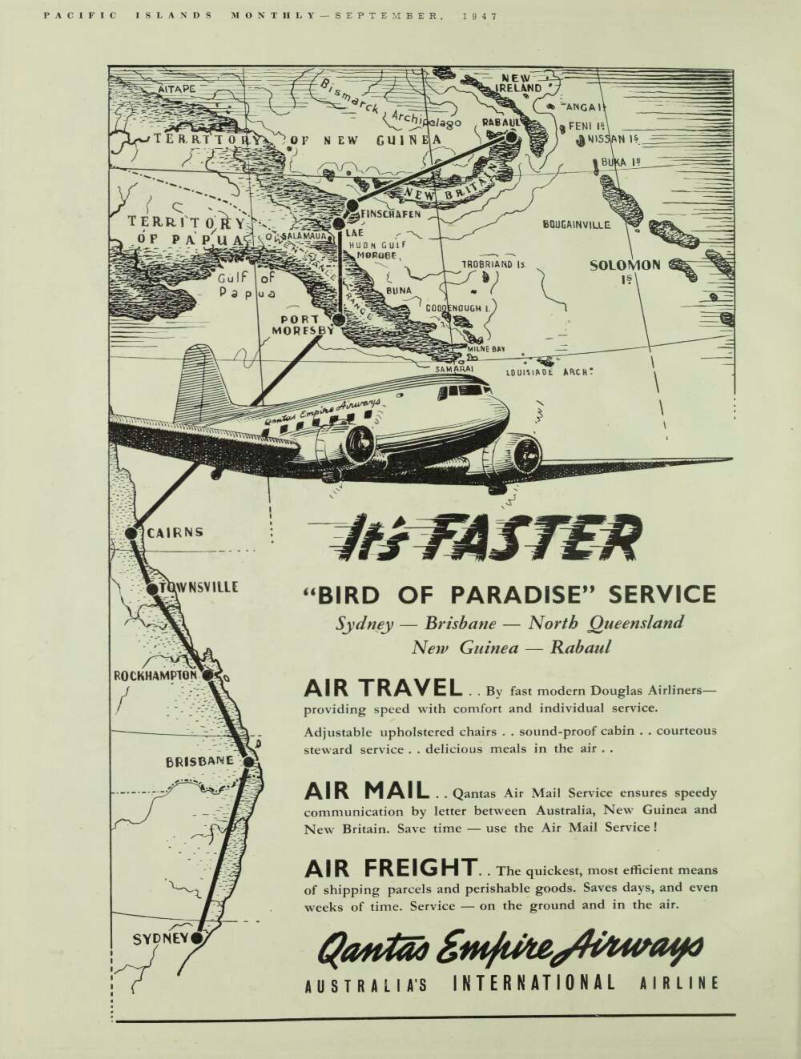
“BIRD OF PARADISE” SERVICE
Sydney Brisbane North Queensland
New Guinea Rabaul
CAIRNS
ROCKHAMPTON
BRISBANE
SYDNEY
AIR TRAVEL .By fast modern Douglas Airliners — providing speed with comfort and individual service.
Adjustable upholstered chairs . . sound-proof cabin . . courteous steward service . . delicious meals in the air . .
AIR MAIL . Qantas Air Mail Service ensures speedy communication by letter between Australia, New Guinea and New Britain. Save time use the Air Mail Service!
AIR FREIGHT . The quickest, most efficient means of shipping parcels and perishable goods. Saves days, and even weeks of time. Service on the ground and in the air.
Qatttaa Sm/utzyUtwaya
AUSTRALIA'S INTERNATIONAL AIRLINE
AaAe yppob
PETROL ofy
KEROSENE
Coleman’s fuel irons have dominated the field for over 30 years, and will continue to do so, for the experience they have gained has not been enjoyed by other makers.
Whichever you choose, petrol or kerosene, you can be sure you have the “Best of its kind."
Kerosene Iron Requires preheating with methylated spirits - I Petrol Iron This model requires no preheating.
Both these self-heating irons are streamlined and have hand protected air-cooled
hoods. They are light, and perfectly
balanced to eliminate fatigue.
The irons can be used in and out of doors as there are no wires or connections. The bodies are ventilated, the edges tapered for ironing pleats and around buttons, and additional heat is developed at points for fine ironing work. Efficient, simple, economical.
Representatives for the Pacific Islands: ROBERT GILLESPIE PTY. LTD. PEARCE & CO. LTD.
■“ * SUVA
S4a PITT STREET. SYDNEY FOR FIJI ISLANDS
*1 f
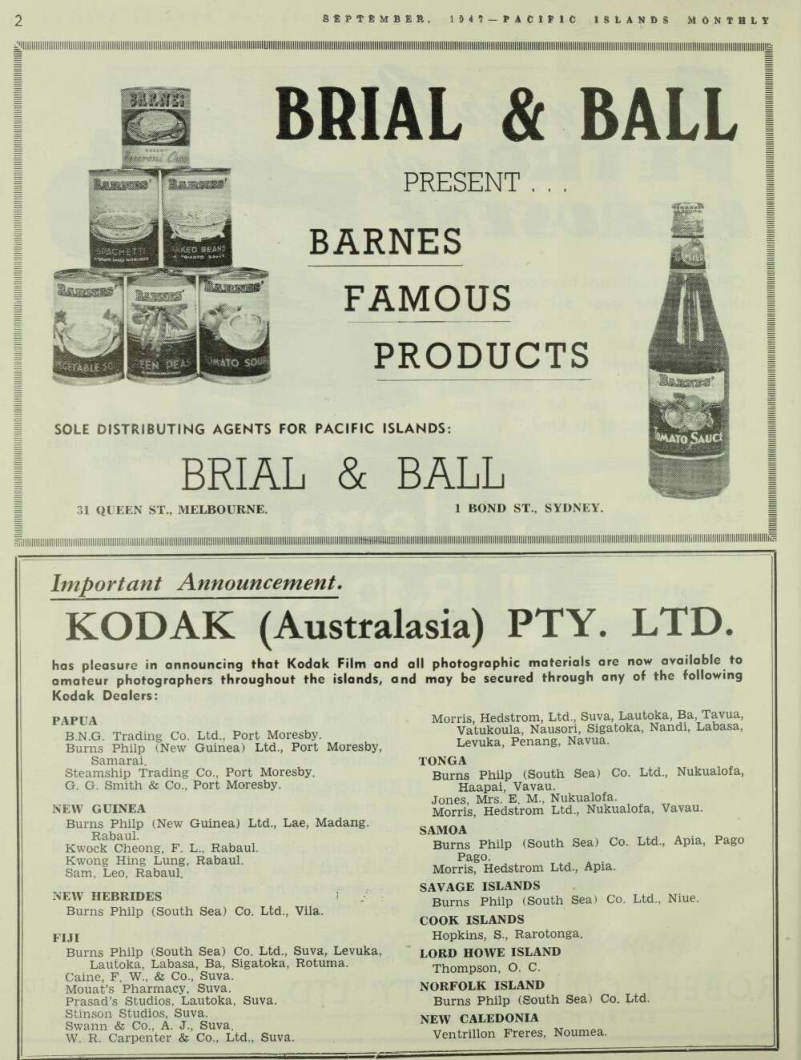
BRIAL & BALL
PRESENT
BARNES
FAMOUS
PRODUCTS
SOLE DISTRIBUTING AGENTS FOR PACIFIC ISLANDS:
BRIAL & BALL
1
31 QUEEN ST., MELBOURNE.
1 BOND ST., SYDNEY.
Important Announcement.
KODAK (Australasia) PTY. LTD.
has pleasure in announcing that Kodak Film and all photographic materials are now available to amateur photographers throughout the islands, and may be secured through any of the following Kodak Dealers:
PAPUA
B.N.G. Trading Co. Ltd., Port Moresby.
Burns Philp (New Guinea) Ltd., Port Moresby, Samarai.
Steamship Trading Co., Port Moresby.
G. G. Smith & Co., Port Moresby.
NEW GUINEA
Burns Philp (New Guinea) Ltd., Lae, Madang.
Rabaul.
Kwock Cheong, F. L., Rabaul.
Kwong King Lung, Rabaul.
Sam, Leo, Rabaul.
NEW HEBRIDES T /
Burns Philp (South Sea) Co. Ltd., Vila.
FIJI
Burns Philp (South Sea) Co. Ltd., Suva, Levuka, Lautoka, Labasa, Ba, Sigatoka, Rotuma.
Caine, F. W., & Co., Suva.
Mouat’s Pharmacy, Suva.
Prasad’s Studios, Lautoka, Suva, Stinson Studios, Suva.
Swann & Co., A. J., Suva.
W. R. Carpenter & Co., Ltd,, Suva.
Morris, Hedstrom, Ltd., Suva, Lautoka, Ba, Tavua, Vatukoula, Nausori, Sigatoka, Nandi, Labasa, Levuka, Penang, Navua.
TONGA
Burns Philp (South Sea) Co. Ltd., Nukualofa, Haapai, Vavau.
Jones, Mrs. E. M., Nukualofa.
Morris, Hedstrom Ltd., Nukualofa, Vavau.
SAMOA
Burns Philp (South Sea) Co. Ltd., Apia, Pago Pago.
Morris, Hedstrom Ltd., Apia.
SAVAGE ISLANDS
Burns Philp (South Sea) Co. Ltd., Niue.
COOK ISLANDS
Hopkins, S., Rarotonga.
LORD HOWE ISLAND
Thompson, O. C.
NORFOLK ISLAND
Burns Philp (South Sea) Co. Ltd.
NEW CALEDONIA
Ventrillon Freres, Noumea.
Advertisers
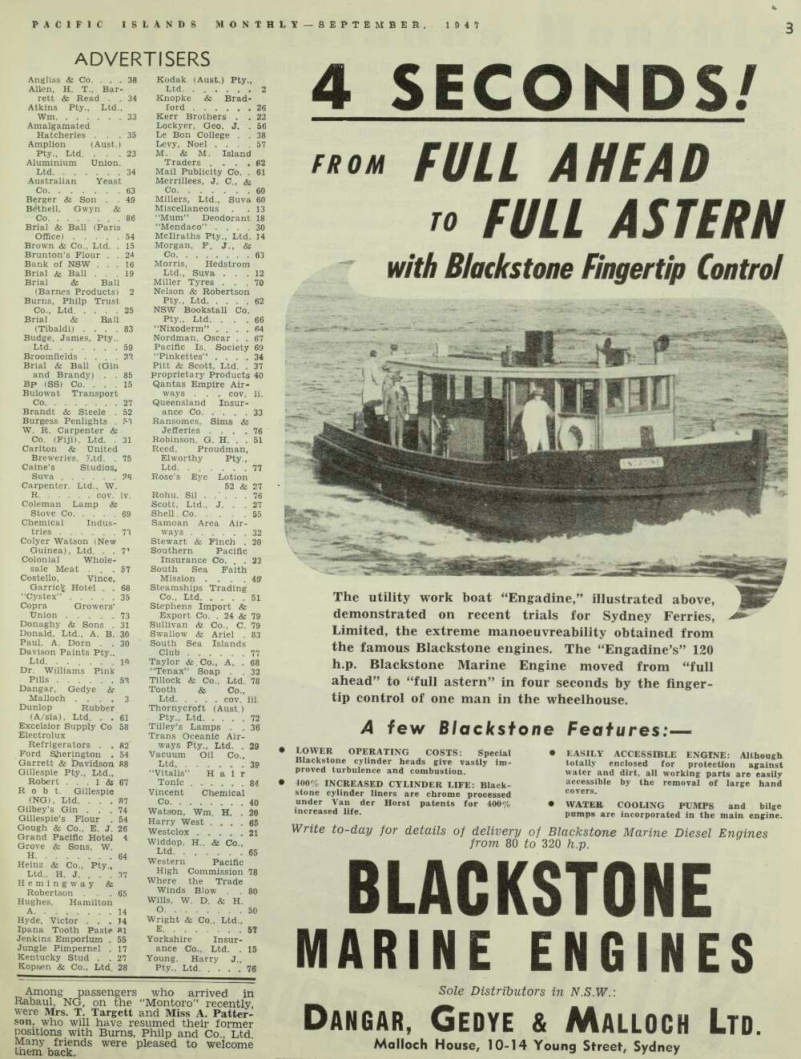
Angliss & Co. ... 38 Allen, H. T., Bar rett & Read . . 34 Atkins Pty., Ltd., Wm 33 Amalgamated Hatcheries ... 35 Amplion (Aust.) Pty., Ltd. ... 23 Aluminium Union, Ltd 34 Australian Yeast Co 63 Berger & Son . . 49 Bethell, Gwyn & Co 86 Brial & Ball (Paris Office) 54 Brown & Co., Ltd. . 15 Brunton’s Flour . . 24 Bank of NSW ... 16 Brial & Ball ... 19 Brial & Ball (Barnes Products) 2 Burns, Philp Trust Co., Ltd 25 Brial & Ball (Tibaldi) ... 83 Budge, James, Pty..
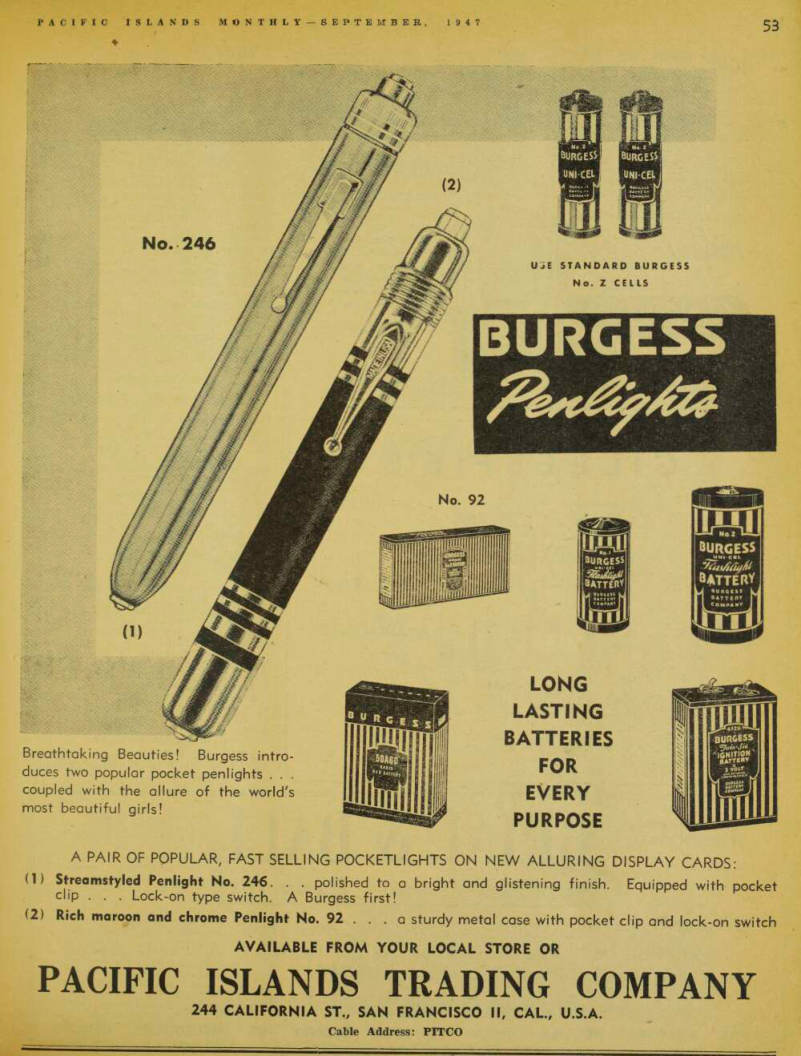
Ltd 59 Broomfields ... 22 Brial & Ball (Gin and Brandy) . . 85 Bp (SS) Co. . . . 15 Bulowat Transport Co 27 Brandt & Steele . 52 Burgess Penlights . 53 W. R. Carpenter & Co. (Fiji), Ltd. . 31 Carlton & United Breweries, 7.,td. . 75 Caine’s Studios, Suva 28 Carpenter. Ltd., W.
R cov. iv.
Coleman Lamp & Stove Co 69 Chemical Indus tries 73 Colyer Watson (New Guinea), Ltd. . . 7 1 Colonial Whole sale Meat ... 57 Costello, Vince, Garrick Hotel . . 68 “Cystex” 35 Copra Growers’
Union 73 Donaghy & Sons . 31 Donald, Ltd., A. B. 30 Paul, A. Dorn . . 30 Davison Paints Pty..
Ltd. ... 10 Dr. Williams Pink Pills 52 Dangar, Gedye & Malloch ... 3 Dunlop Rubber (A/sia), Ltd. . . 61 Excelsior Supply Co 58 Electrolux Refrigerators . . 82 Ford She ring ton . 54 Garrett & Davidson 88 Gillespie Pty., Ltd., Robert . . . 1 & 67 R o b t. Gillespie (NG), Ltd. ... 87 Gilbey’s Gin ... 74 Gillespie’s Flour , 54 Gough & Co., E. J. 26 Grand Pacific Hotel 4 Grove & Sons, W.
H 64 Heinz & Co., Pty., Ltd.. H. J. . . . .37
Hemingway &
Robertson ... 65 Hughes, Hamilton A 14 Hyde, Victor ... 14 Ipana Tooth Paste 81 Jenkins Emporium . 55 Jungle Pimpernel . 17 Kentucky Stud . . 27 Kopsen & Co., Ltd. 28
Kodak (Aust.) Pty., Ltd 2 Knopke & Brad ford 26 Kerr Brothers . . 22 Lockyer, Geo. J. . 56 Le Bon College . . 38 Levy, Noel ... 57 M. & M. Island Traders ... 62 Mail Publicity Co. . 61 Merrillees, J. C., & Co 60 Millers, Ltd., Suva 60 Miscellaneous . . 13 “Mum” Deodorant 18 “Mendaco” ... 30 Mcllraths Pty., Ltd. 14 Morgan, F. J., & Co 63 Morris, Hedstrom Ltd., Suva ... 12 Miller Tyres ... 70 Nelson & Robertson Pty., Ltd 62 NSW Bookstall Co.
Pty., Ltd. ... 66 “Nixoderm” ... 64 Nordman, Oscar . . 67 Pacific Is. Society 69 “Pinkettes” ... 34 Pitt & Scott, Ltd. . 37 proprietary Products 40 Qantas Empire Air ways . . . cov. ii.
Queensland Insur ance Co 33 Ransomes, Sims & Jefferies ... 76 Robinson, G. H. . . 51 Reed, Proudman, El worthy Pty., Ltd. 77 Rose’s Eye Lotion 52 & 27 Rohu, Sil . . . . .76 Scott, Ltd., J. . .27 Shell Co 55 Samoan Area Air ways 32 Stewart & Finch . 20 Southern Pacific Insurance Co. . . 23 South Sea Faith Mission . . . . 4ff Steamships Trading Co., Ltd. ... 51 Stephens Import & Export Co. . 24 & 79 Sullivan & Co., C. 79 Swallow & Ariel . 83 South Sea Islands Club 77 Taylor & Co., A, . 68 “Tenax” Soap . . 32 Tillock & Co., Ltd. 78 Tooth & Co., Ltd cov. iii.
Thornycfoft (Aust ) Pty., Ltd 72 Tilley’s Lamps . . 36 Trans Oceanic Air ways Pty., Ltd. . 29 Vacuum Oil Co., Ltd 39 “Vitalis” Hair Tonic 84 Vincent Chemical Co 40 Watson, Wm. H. . 20 Harry West ... 65 Westclox 21 Widdop, H.. & Co., Ltd. 65 Western Pacific High Commission 78 Where the Trade Winds Blow . . 80 Wills, W. D. & H. 0 50 Wright & Co., Ltd., E 57 Yorkshire Insur ance Co., Ltd. . 15 Young. Harry J., Pty., Ltd 76
Advertisements & other items, p. 5 (1 item)
Blackstone
4 SECONDS/
«•* FULL AHEAD
ro FULL ASTERN
with Blackstone Fingertip Control
m ■ fa* ' - ; ?
The utility work boat “Engadine,” illustrated above, demonstrated on recent trials for Sydney Ferries, Limited, the extreme manoeuvreability obtained from the famous Blackstone engines. The “Engadine’s” 120 h.p. Blackstone Marine Engine moved from “full ahead” to “full astern” in four seconds by the fingertip control of one man in the wheelhouse.
A few Blackstone Features: —
• LOWER OPERATING COSTS: Special
Blackstone cylinder heads give vastly Improved turbulence and combustion.
• 400% INCREASED CYLINDER LIFE: Black-
stone cylinder liners are chrome processed under Van der Horst patents for 400% increased life.
Write to-day for details of delivery from 80
• EASILY ACCESSIBLE ENGINE: Although
totally enclosed for protection against water and dirt, all working parts are easily accessible by the removal of large hand covers. • WATER COOLING PUMPS and bilge pumps are incorporated in the main engine.
Blackstone Marine Diesel Engines 320 h.p.
BLACKSTONE
MARINE ENGINES
Sole Distributors in N.S.W.:
Dangar, Gedye & Mai.loch Ltd.
Malloch House, 10-14 Young Street, Sydney
Among passengers who arrived in Rabaul, NG, on the “Montoro” recently were Mrs. T. Targett and Miss A. Patterson, who will have resumed their former positions with Bums, Philp and Co., Ltd Many friends were pleased to welcome tnem back.
In This Issue:
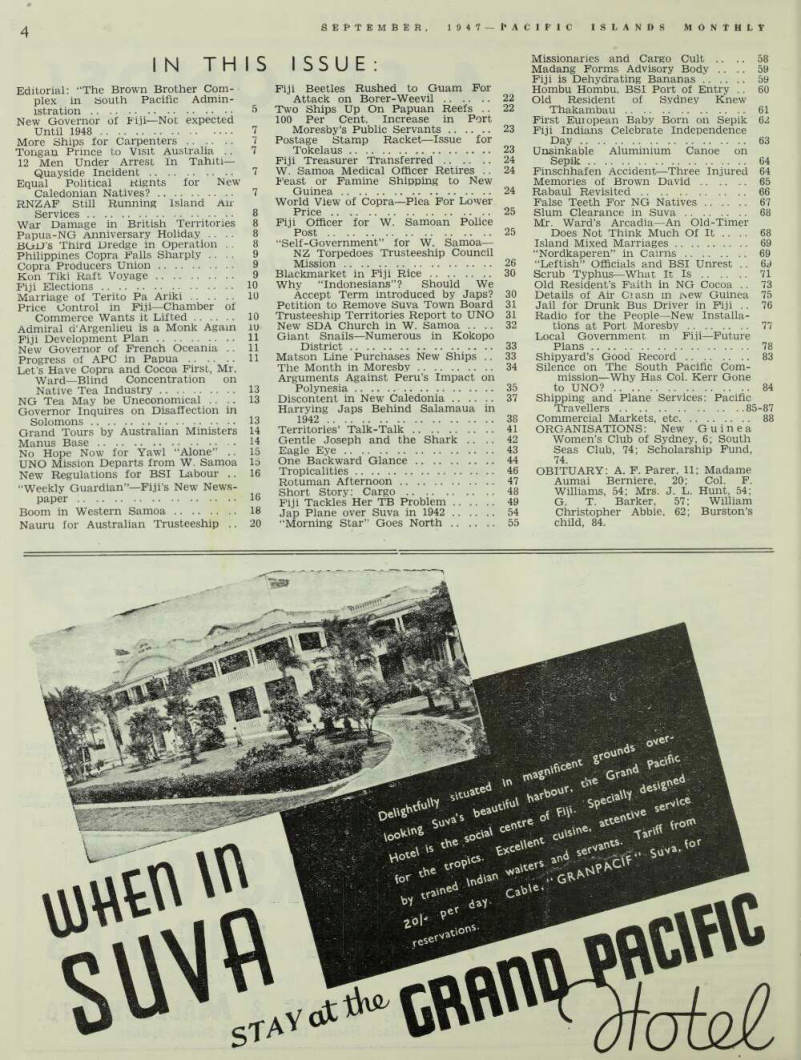
Editorial: “The Brown Brother Com plex in south Pacific Admin istration •*> New Governor of Fiji—Not expected Until 1948 7 More Ships for Carpenters 7 Tongan Prince to Visit Australia .. 7 12 Men Under Arrest In Tahiti— Quayside Incident 7 Equal Political Rights for New Caledonian Natives? 7 RNZAF Still Running Island Air Services 8 War Damage in British Territories 8 Papua-NG Anniversary Holiday ... 8 BGD’s Third Dredge in Operation .. 8 Philippines Copra Falls Sharply ... 9 Copra Producers Union 9 Kon Tiki Raft Voyage 9 Fiji Elections 10 Marriage of Terito Pa Ariki 10 Price Control in Fiji—Chamber of Commerce Wants it Lifted 10 Admiral d’Argenlieu is a Monk Again iu Fiji Development Plan 11 New Governor of French Oceania .. 11 Progress of APC in Papua 11 Let’s Have Copra and Cocoa First, Mr.
Ward —Blind Concentration on Native Tea Industry 13 NG Tea May be Uneconomical ... 13 Governor Inquires on Disaffection in Solomons 13 Grand Tours by Australian Ministers 14 Manus Base 14 No Hope Now for Yawl “Alone” .. 15 UNO Mission Departs from W. Samoa 15 New Regulations for BSI Labour .. 16 “Weekly Guardian” —Fiji’s New News paper 16 Boom in Western Samoa 18 Nauru for Australian Trusteeship .. 20
Fiji Beetles Rushed to Guam For Attack on Borer-Weevil 22 Two Ships Up On Papuan Reefs .. 22 100 Per Cent. Increase in Port Moresby’s Public Servants 23 Postage Stamp Racket —Issue for Tokelaus 23 Fiji Treasurer Transferred 24 W. Samoa Medical Officer Retires .. 24 Feast or Famine Shipping to New Guinea 24 World View of Copra—Plea For Lower Price 25 Fiji Officer for W. Samoan Police Post 25 “Self-Government” for W. Samoa— NZ Torpedoes Trusteeship Council Mission 26 Blackmarket in Fiji Rice 30 Why “Indonesians”? Should We Accept Term introduced by Japs? 30 Petition to Remove Suva Town Board 31 Trusteeship Territories Report to UNO 31 New SDA Church in W. Samoa ... 32 Giant Snails —Numerous in Kokopo District 33 Matson Line Purchases New Ships .. 33 The Month in Moresby 34 Arguments Against Peru’s Impact on Polynesia 35 Discontent in New Caledonia 37 Harrying Japs Behind Salamaua in 1942 38 Territories’ Talk-Talk 41 Gentle Joseph and the Shark .. .. 42 Eagle Eye 43 One Backward Glance 44 Tropicalities 46 Rotuman Afternoon 47 Short Story: Cargo 48 Fiji Tackles Her TB Problem 49 Jap Plane over Suva in 1942 54 “Morning Star” Goes North 55
Missionaries and Cargo Cult .. .. 58 Madang Forms Advisory Body ... 59 Fiji is Dehydrating Bananas 59 Hombu Hombu, BSI Port of Entry .. 60 Old Resident of Sydney Knew Thakambau 61 First European Baby Born on Sepik 62 Fiji Indians Celebrate Independence Day 63 Unsinkable Aluminium Canoe on Sepik 64 Finschhafen Accident —Three Injured 64 Memories of Brown David 65 Rabaul Revisited 66 False Teeth For NG Natives 67 Slum Clearance in Suva 68 Mr. Ward’s Arcadia —An Old-Timer Does Not Think Much Of It ... 68 Island Mixed Marriages 69 “Nordkaperen” in Cairns 69 “Lettish” Officials and BSI Unrest .. 69 Scrub Typhus—What It Is 71 Old Resident’s Faith in NG Cocoa .. 73 Details of Air Crasn m i\ew Guinea 75 Jail for Drunk Bus Driver in Fiji .. 76 Radio for the People—New Installa tions at Port Moresby 77 Local Government m Fiji—Future Plans 78 Shipyard’s Good Record 83 Silence on The South Pacific Com mission—Why Has Col. Kerr Gone to UNO? 84 Shipping and Plane Services: Pacific Travellers 85-87 Commercial Markets, etc 88 ORGANISATIONS: New Guinea Women’s Club of Sydney, 6; South Seas Club, 74; Scholarship Fund, 74.
OBITUARY; A. F. Parer. 11; Madame Aumai Berniere, 20; Col. F.
Williams, 54; Mrs. J. L. Hunt, 54; G. T. Barker, 57; William Christopher Abbie, 62; Burston’s child, 84.
Advertisements & other items, p. 6 (2 items)
4
SEPTEMBER, IHt-PACItIC ISLANDS MONTHLY
,ed '"*** C^e.- G^
m* m AS oVer ' W v 0 ** A ?^' C .. to»& n ' f . e 6T» nd d ' , » s . , e nW e ° . e a^ e 0 „ (ro^ - o c\a' , c vi' s '° “Vi*'*
he **■»** r *,«><
,ef d V'
Pacific Islands Monthly
The Newspaper-Magazine of the South Seas [Registered at the G.P.0., Sydney, for transmission by post as a newspaper.]
Published Once Each Month and Circulated in Australia and New Zealand and in the following Pacific Territories and Islands Groups:
Australian Territory of Papua.
Mandated Territory (Australia) of New Guinea.
Australian Territory of Norfolk Island.
New Zealand Territory of Cook Islands.
Mandated Territory (NZ) of Western Samoa.
British Colony of Fiji.
British Solomon Islands Protectorate.
British Protectorate of Tongan Islands.
British Crown Colony of Gilbert and Ellice Islands.
Mandated Territory of Nauru,
Brltish and Free French Condominium of New Hebrides.
French Colony of New Caledonia.
French Colony of Oceania (Tahiti, etc.).
American Territory of Eastern Samoa.
American Territory of Hawaiian Islands.
Owned and Produced by Pacific Publications Pty. Ltd. Union House, 247 George Street, Sydney.
Vol. Xviii. No. 2.
September 17, 1947
r 1/6 Per Copy Price ] Prepaid, p.a.: 15/- Aus ( In USA, p;a.: $3.
The Brown Brother Complex
In South Pacific Administration
mHERE is no reason why the natives of J- the South Pacific Islands should not be assisted to take charge, eventually, of both the administrative and economic structures of their Territories. No one will argue, seriously, that there is not upon us an obligation to do everything within reason to raise the natives to that standard.
But there is no call upon us to do this thing in a hurry, now, while the world is passing through the most serious politico-economic sickness in its history.
The present haste of our Planners to confer full citizenship and political free dom and various other embarrassing privileges upon Brown Brother, is symp tomatic of the madness that is sweeping across half the nations of the world.
To give point to that contention, let us take a quick survey of conditions in the South Pacific Territories.
IN the Australian Territories of Papua and New Guinea, the fanatical Ward ist Administration is spending annually anything from £1,000,000 to £3,000,000 of Australian taxpayers’ money upon its plan for making a gentlemanly planter out of Fuzzy-Wuzzy, while it generally ignores the claims of the white planters, traders and miners for help and rehabi litation. There is a-considerable amount of economic distress in the Australian Territories, although the markets have never offered a higher price than they offer to-day for copra and gold—New Guinea’s two chief products. That is directly due to the confusion created in the Territories by Canberra’s bumble footed Socialist politicians.
Why did not the Australian Govern ment concentrate upon the urgent task of restoring New Guinea’s war-torn in dustries and re-establishing in their plantations, mines and stores the Euro peans who had suffered so much? Why did it treat the European claims with indifference, while assembling huge amounts of money and battalions of “experts” to undertake a grandiloquent scheme of educating and caring for the natives, for which there was no urgent demand? The answer is “Politics.”
Mr. Ward and his friends really are not particularly concerned about Fuzzy-
Wuzzy; but, as they always will seize upon any stick calculated to beat the dog they hate so much—poor old Private Enterprise—they were very glad of this chance to “put the boot into” the planters and traders and other natural enemies of Socialism.
IN the British Solomon Islands, as the result of the pusillanimous policy fol lowed by the British Colonial Office under Socialist direction during the past two years, a large section of the population of primitive natives is get ting out of hand. These Melanesians were disturbed by the Jap invasion; but they were far more deeply affected by their contacts with the half million or more of careless white servicemen who followed the Japs.
Their tendency to develop a form of nationalism was encouraged when the newly-arrived young men of the Col onial Office, instead of handling them with strength and commonsense, turned upon them the same kind of bleating goodwill as has destroyed British prestige in the Middle East and turned India into a shambles.
The British Solomons never had much economic value; but at least they could produce a lot of good copra, almost as useful as gold, in these unhappy days.
But the Colonial Office has been so pre occupied with its Brown Brother plans that it has done practically nothing to wards European rehabilitation in the group, and few, if any, planters have been re-established. Instead of the plan tations producing an increasing volume of copra to assist British trade in this crisis we have the spectacle of the Act ing High Commissioner flying hurriedly in from Suva to investigate the “March ing Rule” movement—which has been allowed to grow from some sort of vil lage mumbo-jumbo into a fanatical or ganisation with an apparent threat to the safety of Europeans.
The Solomons Fuzzy-Wuzzy is no more ready for self-government than is his New Guinea counterpart. We may not forget that, within the memory of men still living, these Melanesian communi ties were complete savages—treacherous head-hunters more often than not. Even our precious New Statesmen, now trying
to fasten Socialism in a day upon forms of national organisation which were evolved in a thousand years of indivi dualism, should not be so impractical as to imagine that they can, by babbling sweetly of brotherhood, turn the head hunter of yesterday into the smoothly functioning agriculturist of to-morrow. r RTHER east, in Western Samoa, we have the spectacle of the New Zealand Socialist Government rushing in with a plan for limited self-govern ment for the natives, while the Trustee ship Council mission is still struggling with another plan framed with the same objective.
Sooner or later the Samoans will get the self-government to which they are entitled by their good racial qualities.
Why this frantic hurry to equip them right now with some new form of ad ministration? Why now, while the world is convulsed with other problems—which call for all the genius of the white race, if a solution is to be found before com plete disaster falls upon Western civili sation?
Elsewhere in the Pacific there are other indications of the preoccupation of the London-Canberra-Wellington Socialists with native welfare —while the plight of millions of white people poses problems from which the Socialists more or less run away.
BUT, to see the real effect of Socialism’s Brown Brother complex, we must look at Asia and the Middle East. The things we see there are enough to bring black despair into the hearts of all good Britishers who are proud of their coun try’s glorious history and of her mag nificent, unequalled record in the field of colonial administration.
Our Socialists gave freedom to Egypt, after having saved that nation from the horrors of Nazi invasion. Ever since, the Egyptians have been screeching at the British over the Sudan, and spitting upon our flag.
Although warned by every man who knew Asia that our withdrawal would mean a holocaust, the British Socialist Government insisted on destroying our organisation in India and handing over all responsibility there to native govern ments. It was to be a Socialist gesture that would echo magnificently down the ages. The throat-cutting began in earnest within 48 hours of the embarka tion of our troops and, at this writing,
Hindus and Moslems are busily murder ing each other on an incredible scale.
There is a similar picture in the Neth erlands Indies. Holland, crippled partly by her Socialists at home and partly by the influence of the British Socialists, was unable for years to really deal with the situation created in Java by the Japs and the so-called Indonesian Re public. When finally the Dutch got to grips with that gang of noisy and treach erous rebels, they were checked by Soci alist influences exerted through the United Nations—a procedure in which Australia played a truly ignoble part.
To-day, the Dutch are trying valiantly to restore order in their vast Territory, and to put an end to the orgy of blood shed, oppression and robbery in which the rebel Javanese have indulged: but they are being embarrassed by constant interference from UNO.
WHY cannot the nations of the world understand that, for the majority of the coloured races, there is only one law which the masses understand —and that is the law of the clenched fist? We people of the West have learned, in a thousand years of social struggle, to accept the law of reason, f he force of moral obligation. But the majority of coloured folk have not yet reached this stage of human evolution —as they now are busily demonstrating in India, Java and elsewhere.
Of course, as human beings, they are entitled to complete freedom that is fundamental. But if their freedom means that, as in India, they create a reign of terror, or endanger the orderliness of the world, then they must be kept under restraint. And our point if that the majority of these coloured people have been quite properly kept under restraint by the Western nations; and they may be released from that restraint only very carefully and by degrees, as they prove themselves fit for nationhood.
These Socialist Governments are try ing to do in a year what properly can be accomplished, with care, in a cen tury.
ALL this hysterical concern for the welfare of Brown Brother will, in the end, do far more harm than good.
This flare-up of Socialist Government is a passing phase. It is part of the world’s post-war sickness, and it will dis appear presently. It will be replaced by sane and well-balanced administration which will be concerned, not with sec tions, but with the welfare of people as a whole; not with idealistic plans for educating Brown Brother and freeing him from the thraldom of the “exploit ers,” but in assisting the coloured races to form independent nations in such a way that they will not endanger the world’s peace and good government.
The spectacle of what is happening to day in the world will almost certainly induce the next series of Western Gov ernments, reacting against this orgy of Socialism, to reimpose upon the coloured races a grim discipline for their own good and the good of the world generally.
The pendulum that is pushed too far one way tends naturally to swing too far the other way. Mr. Ward should remem ber that in relation to New Guinea.
Ng Women's Club Of Sydney
THE New Guinea Women’s Club of Sydney held a successful American Tea on August 29. in the Club Rooms, 77 King Street. Each member brought a gift and purchased one, with the result that the club benefited to the extent of £lO. Several New Guinea visitors were there and were given an enthusiastic welcome.
A card and games night will be held on October 24. at 77 King Street. Admission will be 2/6, which includes supper.
Those wishing to make up fours for bridge, or parties for other games should ring Mrs. N. Foxcroft, LX 1778.
To "Pim" Contributors
BECAUSE of rising production costs in the printing industry, it is essential that the time of skilled operators should not be wasted. Therefore, “PIM” contributors are asked to observe these Rules: ■ Write on one side of the paper ONLY. ■ Leave plenty of space between lines —if typing, double or treble space. ■ Type if possible: if not, write clearly in ink—NEVER pencil.
Manuscripts are frequently rejected because writers fail to observe one or all of these rules. Neglect of Rule 2—the most exasperating from the sub-editor’s point of view—is most frequent.
Late News
Arrests in Solomons SUVA, Sept. 10 THE Acting High Commissioner for Western Pacific (Mr. Nicoll) has re turned to Suva after investigating the “Marching Rule” situation in the British Solomons.
A number of members of “Marching Rule” have been arrested on charges of failure to obey summonses from Govern ment Courts.
Fiji's Rice Price is Raised
SUVA, Sept. 2 THE maximum retail price of rice in Fiji has been increased from 3£d. a pound (the controlled price in force since 1944) to sd. a pound.
“As most people in the Colony are aware, there has been great difficulty re cently in obtaining rice at the controlled price, and a black market has been oper ating,” savs an official statement. .
No maximum wholesale prices have been fixed for rice and padi.
Mr. Sid Wood. Fox Movietone camera man has been in Port Moresby for some time making newsreel shots and docu mentaries on New Guinea. He has travelled throughout the Territory. His shots in Moresby include the Bomana War cemetery, the Police Training School at Sogeri, and the Education Department’s secondary school at Sogeri. He also went down the coast to make a record of the bore for oil at Kariava. which is now down over 9,000 feet.
Another Hopeless Dawn
The Australian Minister for Pacific Territories (Mr. Ward) is rising over the eastern horizon— he is now on his way back to King’s Cross, Sydney, from a visit to the United States, Canada, Ireland, Geneva, Germany, Western Europe generally, and the United Kingdom. He was accom panied by Mrs. Ward, a private secretary, various officials, and Senator Stan Amour (who created front-page news by being put off the ANA plane at San Francisco); and it is reported that a good time was bad by all. But the harassed producers of New Guinea and Papua, enjoying none of the benefits which are being lavished upon the natives, regard the rising of this particular sun with no enthusiasm.
According to his last-published schedule, the Minister for the Australian Territories, author of the plan for making a proud and self-sufficient planter out of Fuzzy-wuzzy, is due in Sydney on September 28.
Cartoon by Gill.
Not Expected Until 1948
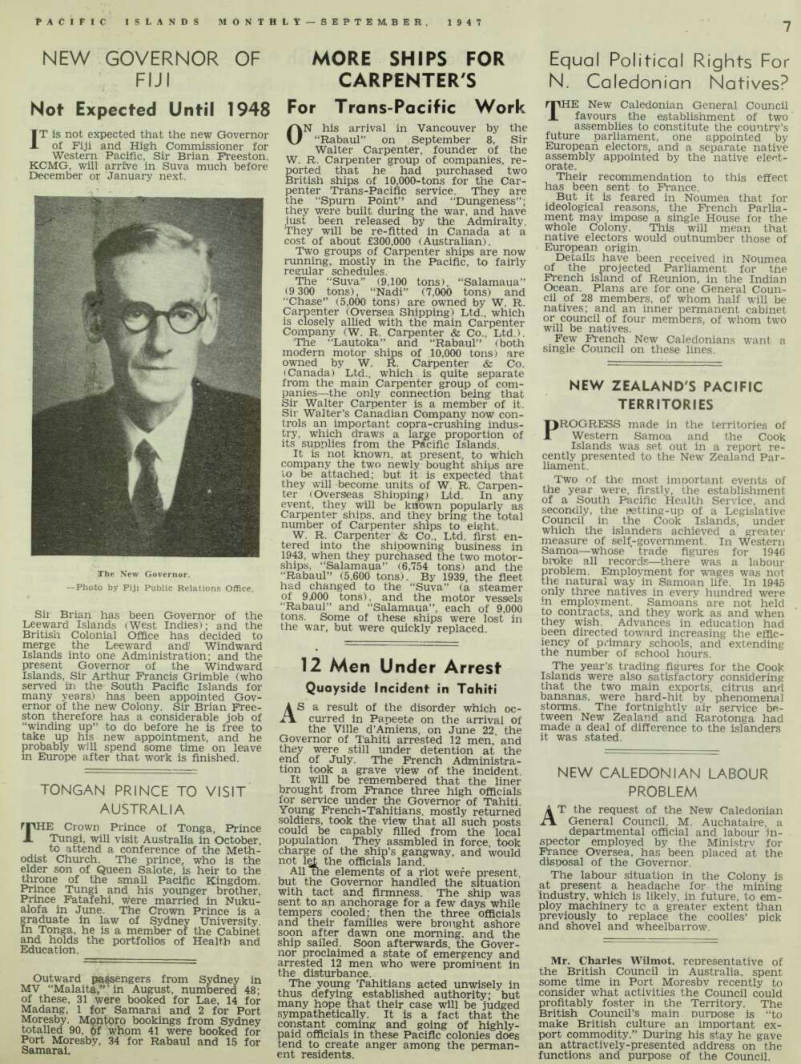
New Governor Of
Fiji
IT is not expected that the new Governor of Fiji and High Commissioner for Western Pacific, Sir Brian Freeston, KCMG, will arrive in Suva much before December or January next.
Sir Brian has been Governor of the Leeward Islands (West Indies); and the British Colonial Office has decided to merge the Leeward and/ Windward Islands into one Administration; and the present Governor of the Windward Islands, Sir Arthur Francis Grimble (who served hi the South Pacific Islands for many years) has been appointed Gov ernor of the new Colony. Sir Brian Free ston therefore has a considerable job of “winding up” to do before he is free to take up his new appointment, and he probably will spend some time on leave m Europe after that work is finished.
The New Governor.
Photo by Fiji Public Relations Office.
Tongan Prince To Visit
Australia
rpHE Crown Prince of Tonga, Prince X Tungi, will visit Australia in October, to attend a conference of the Meth odist Church. The prince, who is the elder son of Queen Salote, is heir to the throne of the small Pacific Kingdom.
Prince Tungi and his younger brother, Prince Fatafehi, were married in Nuku alofa in June. The Crown Prince is a graduate in law of Sydney University.
In Tonga, he is a member of the Cabinet and holds the portfolios of Health and Fkiucation.
Outward passengers from Sydney in MV “Malaita,” in August, numbered 48; of these, 31 were booked for Lae, 14 for Madang, 1 for Samarai and 2 for Port Moresby. Montoro bookings from Sydney totalled 90, 6f whom 41 were booked for Port Moresby, 34 for Rabaul and 15 for Samarai.
More Ships For
Carpenter's
For Trans-Pacific Work
ON his arrival in Vancouver by the “Rabaul” on September 8, Sir Walter Carpenter, founder of the W. R. Carpenter group of companies, re ported that he had purchased two British ships of 10,000-tons for the Car penter Trans-Pacific service. They are the “Spurn Point” and “Dungeness”; they were built during the war, and have just been released by the Admiralty.
They will be re-fitted in Canada at a cost of about £300,000 (Australian).
Two groups of Carpenter ships are now running, mostly in the Pacific, to fairly regular schedules.
The “Suva” (9,100 tons), “Salamaua” (9 300 tons), “Nadi” (7,000 tons) and “Chase” (5,000 tons) are owned by W. R.
Carpenter (Oversea Shipping) Ltd., which is closely allied with the main Carpenter Company (W. R. Carpenter & Co., Ltd.).
The “Lautoka” and “Rabaul” (both modern motor ships of 10,000 tons) are owned by W. R. Carpenter & Co. (Canada) Ltd., which is quite separate from the main Carpenter group of com panies—the only connection being that Sir Walter Carpenter is a member of it.
Sir Walter’s Canadian Company now con trols an important copra-crushing indus try, which draws a large proportion of its supplies from the Pacific Islands.
It is not known, at present to which company the two newly bought ships are to be attached: but it is expected that they will become units of W. R. Carpen ter (Overseas Shipping) Ltd. In any event, they will be known popularly as Carpenter ships, and they bring the total number of Carpenter ships to eight.
W. R. Carpenter & Co., Ltd. first en tered into the shioowning business in 1943, when they purchased the two motor ships, “Salamaua” (6,754 tons) and the “Rabaul” (5,600 tons). By 1939, the fleet had changed to the “Suva” (a steamer of 9,000 tons), and the motor vessels “Rabaul” and “Salamaua”, each of 9,000 tons. Some of these ships were lost in the war, but were quickly replaced.
12 Men Under Arrest
Quayside Incident in Tahiti
A S a result of the disorder which oc- A curred in Papeete on the arrival of the Ville d’Amiens, on June 22. the Governor of Tahiti arrested 12 men, and they were still under detention at the end of July. The French Administra tion took a grave view of the incident It will be remembered that the liner brought from France three high officials for service under the Governor of Tahiti Young French-Tahitians, mostly returned soldiers, took the view that all such posts could be capably filled from the local population They assmbled in force, took charge of the ship’s gangway, and would not Id. the officials land.
All The elements of a riot were present, but the Governor handled the situation with tact and firmness. The ship was sent to an anchorage for a few days while tempers cooled; then the three officials and their families were brought ashore soon after dawn one morning, and the ship sailed. Soon afterwards, the Gover nor proclaimed a state of emergency and arrested 12 men who were prominent in the disturbance.
The young Tahitians acted unwisely in thus defying established authority; but many hope that their case will be judged sympathetically. It is a fact that the constant coming and going of highly paid officials in these Pacific colonies does tend to create anger among the perman ent residents.
Equal Political Rights For N
N. Caledonian Natives?
THE New Caledonian General Council favours the establishment of two assemblies to constitute the country’s future parliament, one appointed by European electors, and a separate native assembly appointed by the native elect orate.
Their recommendation to this effect has been sent to FVance.
But it is feared in Noumea that for ideological reasons, the French Parlia ment may impose a single House for the whole Colony. This will mean that native electors would outnumber those of European origin.
Details have been received in Noumea of the projected Parliament for the French island of Reunion, in the Indian Ocean. Plans are for one General Coun cil of 28 members, of whom half will be natives: and an inner permanent cabinet or council of four members, of whom two will be natives.
Few French New Caledonians want a single Council on these lines.
New Zealand's Pacific
Territories
PROGRESS made in the territories of Western Samoa and the Cook Islands was set out in a report re cently presented to the New Zealand Par liament.
Two of the most important events of the year were, firstly, the establishment of a South Pacific Health Service, and secondly, the setting-up of a Legislative Council in the Cook Islands, under which the islanders achieved a greater measure of self-government. In Western Samoa —whose ’ trade figures for 1946 broke all records—there was a labour problem. Employment for wages was not the natural way in Samoan life. In 1945 only three natives in everv hundred were in employment. Samoans are not held to contracts, and they work as and when they wish. Advances in education had been directed toward increasing the effic iency of primary schools, and extending the number of school hours.
The year’s trading figures for the Cook Islands were also satisfactory considering that the two main exports, citrus and bananas, were hard-hit by phenomenal storms. The fortnightlv air service be tween New Zealand and Rarotonga had made a deal of difference to the islanders it was stated.
New Caledonian Labour
Problem
AT the request of the New Caledonian General Council. M. Auchataire, a departmental official and labour in spector employed by the Ministry for France Oversea, has been placed at the disposal of the Governor.
The labour situation in the Colony is at present a headache for the mining industry, which is likely, in future, to em ploy machinery tc a greater extent than previously to replace the coolies’ pick and shovel and wheelbarrow.
Mr. Charles Wilmot, representative of the British Council in Australia, spent some time in Port Moresby recently to consider what activities the Council could profitably foster in the Territory. The British Council’s main purpose is “to make British culture an important ex port commodity.” During his stay he gave an attractively-presented address on the functions and purpose of the Council.
Island Services
Rnzaf Still Runs
TRANSFER of control of the Island air services from RNZAF to the NZ National Airways Corporation will be delayed about one month. It was ex pected that the change-over would be made about the beginning of September.
Delay is due, principally, to the diffi culty of having the service aircraft (Dakotas, Lodestars and Sunderlands) converted to civil aviation requirements, and issued with certificates of airworthi ness. Lodestars and Dakotas are being converted in Australia. Work on the Sunderlands is undertaken at Hobsonville near Auckland.
In the meantime, Dakota services from Auckland to Norfolk Island, Fiji, Samoa, Tonga and Cook Islands and the Sunder land service to Suva, are being carried on by No. 40 (Transport) Squadron, RNZAF, as usual.
The extent to which New Zealand pro poses to take charge of civil aviation in Fiji is indicated by a recent advertise ment calling for applications for the fol lowing positions:— Area Controller at Nadi, £585 p.a.
Senior Control Officer at Nadi. £535.
Control Officers at Nadi, Nausori and Laucala Bay, £485.
Assistant Control Officers at Nadi and Laucala Bay. £435.
Watch supervisor at Nadi, £435.
Watchkeepers at Nadi, £4OO.
Location allowances of from £145 to £l7O are to be paid to men in Fiji, with further allowances for wives and child ren.
It is reported that since the New Zea land civil aviation took over Nadi air port, in March last, conditions there have considerably improved. Until then, trans pacific travellers, pausing there for a night’s rest, were given most primitive and comfortless accommodation.
War Damage in British
Territories Claims to be Assessed
IN confirmation of the statements made in the “PIM” several months ago, it was announced from London early in September that the Colonial Office had set up. in Fiji, a War Damage Claims Commission to register and assess all claims for property lost or damaged dur ing the war in the British Solomon Islands or the Gilbert and Ellice Colony.
Persons desirous of lodging claims should follow the procedure set <put in an advertisement on page 78, this Issue.
It was explained, early this year, that the fact that such claims had been re ceived and assessed placed upon the British Government no obligation to pay the claims. It was stated that payments probably would be contingent upon re paration payments being received by Britain from Japan.
The position regarding reparations may be clarified when the nations concerned finalise the Peace Treaty with Japan, now under consideration in New York.
Papua-New Guinea
Anniversary Holiday
PAPUA and New Guinea will both have a holiday on September 15, this year, although each Territory will be cele brating a different occasion.
New Guinea will be celebrating the an niversary of the capture of the Territory from the Germans on September 12, 1914.
Papua, on the other hand, will be com memorating the 4th day of September, which is the anniversary of the founda tion of the “Possession of British New Guinea.”
The holiday has been fixed for Sep tember 15, for the sake of convenience and residents will thus have a long week end, whichever occasion they celebrate.
Air Service For French
Sw Pacific Colonies
rR the first time in fifteen years, a plane carrying the French tricolor recently paid a visit to the New Hebrides.
This was the Catalina belonging to the Trapas Company. It was on a pre liminary visit of inspection to Santo, and Vila, from its Noumea headquarters.
At Santo, the pilot (M. Pierre Del aunay) and the crew were feted by the local resident (M. Chardonnet) and planters, and at Vila by French Con dominium Resident (M. Menard) and the inhabitants.
The plane is soon to start a permanent service of two or three trips a month, linking these places.
Trapas is short for Transports Aeriens du Pacifique Sud.
New Csr Co. Chief Manager
This is Mr. E. H.
Griffiths, formerly of the Colonial Sugar Refining Co. staff at Lautoka, Fiji, who has been promoted to the position of chief manager of the company in Fiji in succession to Mr. H.
King Irving.
Bgd Now Has Three
Dredges Operating
BULOLO Gold Dredging Ltd., now have three of their eight dredges oper ating in the Bulolo Valley, NG. No. 3 went into production on July 19.
Dredges No. 1 and 2 operated through out July and. during August, the three dredges handled 591,000 yards of gravel for 6,107 ounces of gold.
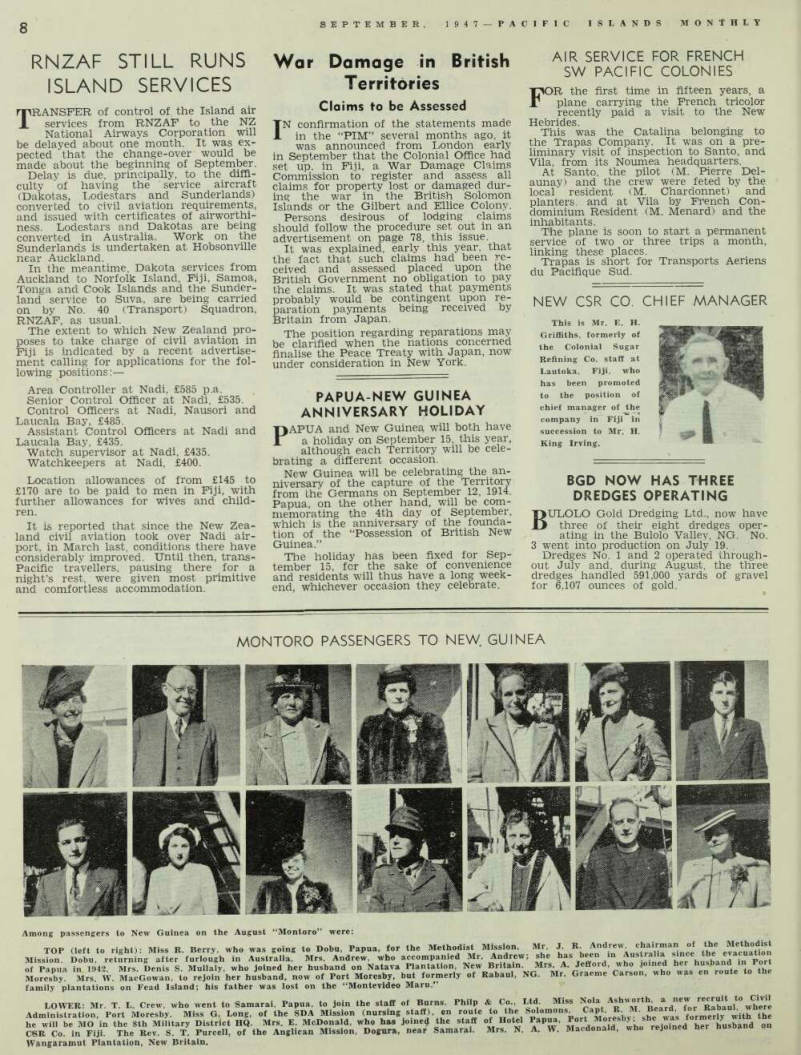
Montoro Passengers To New Guinea
Among passengers to New Guinea on the August “Montoro” were: TOP (left to right): Miss R. Berry, who was going to Dobu, Papua, for the Methodist Mission. Mr. J. R. Andrew, chairman of the Methodist Mission, Dobu, returning after furbough in Australia, Mrs. Andrew, who accompanied Mr. Andrew; she has been in Australia since the evacuation of Papua in 1942. Mrs. Denis S. Mullaly, who joined her husband on Natava Plantation, New Britain. Mrs. A. Jefford, who joined her husband in port Moresby. Mrs. W. MacGowan, to rejoin her husband, now of Port Moresby, but formerly of Rabaul, NG. Mr. Graeme Carson, who was en route to the family plantations on Fead Island; his father was lost on the “Montevideo Maru."
LOWER: Mr. T. L. Crew, who went to Samarai, Papua, to join the staff of Burns, Philp & Co., Ltd. Miss Nola Ashworth, a new recruit to Civil Administration, Port Moresby. Miss G. Long, of the SDA Mission (nursing staff), en route to the solomons. Capt. R. M. Beard, for Rabaul, where he will be MO in the 8th Military District HQ. Mrs. E. McDonald, who has joined the staff of Hotel Papua, port Moresby; she was formerly with the CSR Co. in Fiji. The Rev. S. T. Purcell, of the Anglican Mission, Dogura, near Samarai. Mrs. N. A. W. Macdonald, who rejoined her husband on Wangaramut Plantation, New Britain.
No Dollars to Buy The Surplus
Philippines Copra Falls Sharply
IT is possible to see, in a sudden sharp decline in the market for two Pacific products—copra and trocas —a reflec tion of the “dollar crisis.”
Private advice from Manila states that copra prices in the Philippines have dropped from £72 down to about £32 a ton (Australian currency).
Reason for this phenomenal decrease is said to be the fact that the US market has reached saturation point as a result of the strenuous efforts made by Filipino producers after the war. High pressure tactics to rehabilitate the damaged planta tions were introduced by employing many thousands of Japanese POW’s, with the result that the pre-war annual copra pro duction was increased by about 25,000 tons. US markets were unable to absorb this surplus.
Non-dollar countries were buying Philippines’ copra until the world financial crisis developed. Now, because that copra has to be paid for in dollars, and the sterling countries are short of dollars, the Philippines price tends to slump. This, in turn, may pull down the copra price pre vailing in sterling countries —which was phenomenally high, anyway.
Trocas Under A Cloud.
The collapse of the trocas market (it Is now about £6O a ton, Sydney) is due, according to experts, to the absence of tne usual pre-war market for this com modity in Japan, France and Central Europe, The Australian demand for trocas is limited owing to the very restricted button industry there. Unstable labor conditions in Australia do not favour the expansion of the industry.
The sterling-dollar crisis seems to have made this already uncertain market even more dull.
A demand from the limited button making factories in Australia and America lifted the price for a time; but their needs seem to have been met. There is an enormous, world-wide demand for the finished article; but. with the limited factories available, the tendency seems to be to turn elsewhere—to plastics, for ex ample—for requirements.
By the time Australian and Ameri can shell-workers have increased their capacity, or the European and Jap factories come back into operation, the world-market for finished shell buttons, etc., may have been wiped out in favour of other products.
If the Australian Government had spent some of its lavish millions on establisning shell-button-making from trocas in New Guinea, instead of wasting them on im practical Fuzzy-Wuzzy policies, some real and permanent good might have been achieved. As it is, the trocas industry, one of the best stand-bys of the Pacific planter and trader, is in danger of dis appearing altogether.
Producers
Union of Copra Producers Movement Started in Fiji
THE following resolution was carried unanimously at a meeting of Savu savu planters (Fiji) held at the end 01 June:— .yj ew o£ the urgent and important £ avi ? g some organisation to speak officially for the copra industry as a whole, and with full authority from fii c 2P ra grower s, big or small, to address thP on all matters affecting the welfare of the industry.;—
(1) It is proposed that this meeting of copra growers agree to form them selves into a union to be known as the Copra Growers’ Union of Fiji. (2) It is proposed that through our secretary and the press, we urge all copra growers to form unions in their several districts and at a later date to call a conference of growers in Suva, or other centre, to draft the Constitution of a Fiji wide union, to elect an Executive Committee, and to fix the fees of the Union.”
The following officers were then elected:— Chairman, Mr. S. H. Wilson.
Vice-chairman, Mr. D Simpson Committee, Messrs R. Haynes, S. Simp son and A. Lepper.
Secretary, Mr. C, G. O. Parr.
Trustees, Messrs. R Haynes and R.
Lepper.
It was agreed that subscriptions be based on production and that as a first measure the fee be at the rate of 1/per ton. All members present gave a donation of £5 each to establish a work ing fund.
The Government has recognised the movement andi the promoters are waiting for reports from other centres.
The promoters are preparing material on “copra” and “copra growers’ interests” which they hope to put over the air and through the press.
During the past year, over 100 Renault cars and about 100 more cars and trucks of French manufacture have reached New Caledonia as part of the not as yet, very considerable French export drive.
"Kon Tiki" Raft Voyagers
Now In Tahiti
THE six young Norwegian “Kon Tiki” raft scientists, led by Mr. Thor Heyerdahl, arrived in Papeete on August 28. They had made the journey from Raroia Reefs, where they had gone aground earlier in the month, in the French Government vessel “Tamara.”
The raft was towed.
The Norwegians were trying to estab lish the possibility of pre-Inca inhabi tants of Peru having reached the Poly nesian Islands now known as French Oceania, using nothing but primitive balsa rafts and the Humbolt Current, which sweeps westward from Peru.
On their raft, which they called “Kon Tiki” after the ancient Peruvian Sun god, they left Callao, Peru, on April 29, and they completed 4,360 miles drift to the Tuamotu Group in 102 days.
The raft was badly damaged on the Raroia Reefs. Natives found the men and took them to their island, about six miles away, from which they were later rescued by the French Government vessel.
Having proved the feasability of drift voyages by the ancients from South America to South-eastern Polynesia, the scientists will now return to Norway by way of the United States.
Madame Boucher, of Farino, New Caledonia, has received official notifica tion that her son, Rene Gabriel, was shot by the Germans in France on August 14, 1944. He left Noumea prior to the war, and during it he served with the French Army with the rank of sergeant. He was captured and later released by the Germans, but immediately joined the Re sistance Movement. He thus joined the honoured ranks of war heroes. The news of his death reached his mother through the services of M. Henri Lafleur, New Caledonia’s Councillor of the Republic, now in Paris.
New Zealand on holiday.
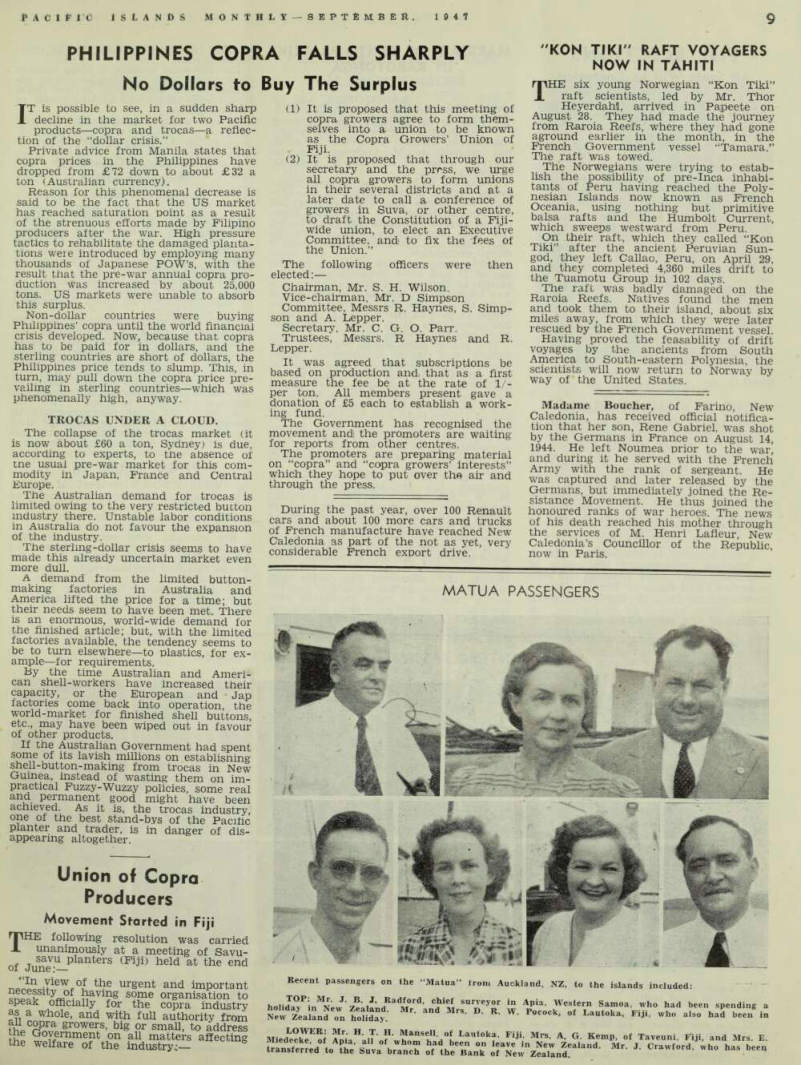
Matua Passengers
Recent passengers on the “Matua” from Auckland, NZ, to the Islands included: TOP: Mr. J. B. J. Radford, chief surveyor in Apia, Western Samoa, who had been spending a holiday in New Zealand. Mr. and Mrs. D. R. W. Pocock, of Lautoka, Fiji, who also had been in
LOWER: Mr. H. T. H. Mansell, of Lautoka, Fiji, Mrs. A. G. Kemp, of Taveuni, Fiji, and Mrs. E.
Miedecke, of Apia, all of whom had been on leave in New Zealand. Mr. J. Crawford, who has been transferred to the Suva branch of the Bank of New Zealand.
Fiji Elections
All Seats Will be Contested
SUVA, Sept. 1 ALL six seats are to be contested in the elections for membership of the Legislative Council of Fiji, which will be held later this year.
In the Southern Division, the sitting European member, Mr. A. A. Ragg, will be opposed by Mr. Alport Barker, who held the seat for many years before the last election. The sitting Indian member, Mr. Vishnu Deo, will be opposed by Mr.
A. I. N. Deoki.
Sir Hugh Ragg is not seeking re-elec tion as European member for the North- Western Division, and the seat is to be contested by Mr. J. P. Bayly, a former member of the Council, and by Mr. H.
Maurice Scott. The sitting Indian mem ber for the North-Western Division. Mr.
A. D. Patel, will be opposed by Mr. C.
Chattur Singh.
In the Eastern Division, the sitting European member, Mr. H. B. Gibson, will be opposed by Mr. F. G. Archibald. The sitting Indian member, Mr. B. M. Gyan eshwar, will have two opponents, Mr. J.
Madhaven and Mr. J. B. Tularam. Mr.
Tularam is also a former member of the Council.
He Is A Monk Again
Admiral thierry d’argenlieu, who figured in sensational episodes in the French Pacific Colonies in the black days of World War 11, when there was a bitter struggle, under the surface between the Vichy-ites and the Fighting French, re-entered monastic life on July 16. He had been a distinguished Serviceman in World War I, and then he entered a monastery, which he left in 1939 to fight for France.
It was recently announced that Mr. C.
C. Marsack, Stipendiary Magistrate of Palmerston North, New Zealand, has been appointed Chief Judge of Western Samoa.
He will succeed Mr. J. R. Herd, the present Chief Judge, who is to return to New Zealand at the end of this year.
Marriage Of Terito Pa Ariki
In Rarotonga
From Our Own Correspondent
Rarotonga, Aug. 28
THE most interesting Rarotongan wed ding in many years was celebrated on August 20, when the young chieftainess Terito i Terai Tai Te Ariki, was married to M. Georges Tamarua Peyroux, a son of the late M. Jean D.
Peyroux.
Terito Pa Ariki, as she is more com monly known, is chieftainess of the his toric Ngatangiia district, which is the ancestral settlement of the great Poly nesian warrior-navigator Tangiia, who led the first Polynesians who landed in Rarotonga and from whom Terito is a direct descendant.
Terito went to New Zealand at the age of 11 and after completing her edu cation at Hukurere College, Napier, she was employed on the staff of the Native Land Court until she returned to Raro tonga in 1944 at the age of 21 to claim her hereditary title. Her father died when she was a child.
The young chieftainess has poise and dignity and made a charming bride.
The wedding ceremony, conducted by the Rev. W. G. Murphy, took place in the LMS church at Ngatangiia, which stands near to the lagoon and faces the surf edged passage through which many great sailing canoes came and went on the epic voyages of the past.
Five bridesmaids and two flower girls attended the bride. Best man was Mr.
Wm. H. Watson, whose wife is a sister of the bridegroom.
A large number of European residents including the Resident Commissioner, Mr. W. Tailby with Mrs. Tailby, attended the ceremony and were afterwards enter tained at the reception organised by the Pa Ariki and Makea Nui Ariki families.
Congratulatory messages were received from the Prime Minister of New Zealand, Mr. Fraser and Mr. A. G. Osborne (Par liamentary Secretary) and Mrs. Osborne.
During the afternoon the bride and bridegroom sat on the verandah and re ceived presents of mats, decorated bed spreads and other gifts from the Raro tongans which were presented with
flourish and speech-making in the trad itional manner The following evening a large number of European and Rarotongan guests at tended a ball and supper at the Royal Hall at the invitation of the family of the bridegroom.
Price Control in Fiji
Chamber of Commerce Wants it Lifted
From Our Own Correspondent SUVA, Sept. 1 BECAUSE a black market in sharps (imported for the Indian commun ity) is developing, Suva Chamber of Commerce, at its August meeting, de cided to oppose the heavy Government subsidies on sharps and flour.
The black market, it is claimed, is likely to affect the cost of living indices of Indian workmen on which Government wages are based.
The Chamber of Commerce has also launched an attack on price control gen erally on the grounds that the task of administering and supervising universal control is beyond the Government’s powers. The large stores find the system “onerous to the last degree” and “the difficulties of avoiding an offence against
the law practically insuperable”.
A list of 30 or 40 necessities will be drawn up, and it will be suggested that control be retained on these items but lifted from all other commodities.
Fined 33,000 Fr.!
A WELL-KNOWN resident of Tahiti, a merchant, M. Robert Charon, gave a radio address in Papeete on May 9. He spoke his mind freely on matters of public interest.
His remarks were resented by High Authority. His case was considered, and he was fined a total of 33,000 francs for having insulted the Governor. No appeal was allowed.
M. Charon sailed for France in July.
It is expected that, in Paris, he will chal lenge both the verdict and the severity of the punishment.
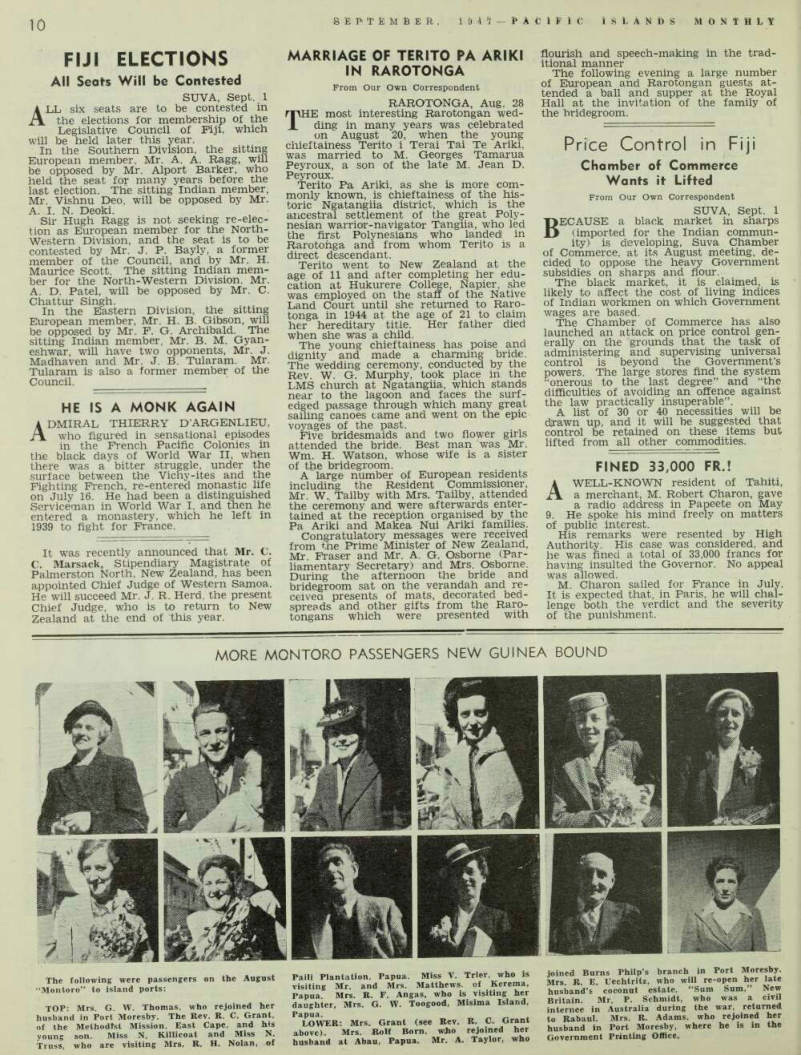
More Montoro Passengers New Guinea Bound
The following were passengers on the August "Montoro” to island ports: TOP: Mrs. G. W. Thomas, who rejoined her husband in Port Moresby. The Rev. R. C. Grant, of the Methodist Mission, East Cape, and his young son. Miss N. Killicoat and Miss N.
Truss, who are visiting Mrs. R. H. Nolan, of
Paili Plantation, Papua. Miss V. Trier, who is visiting Mr. and Mrs. Matthews, of Kerema, Papua. Mrs. R. F. Angas, who is visiting her daughter, Mrs. G. W. Toogood, Misima Island, Papua.
LOWER: Mrs. Grant (see Rev, R. C. Grant above). Mrs. Rolf Born, who rejoined her husband at Abau, Papua. Mr. A. Taylor, who
joined Burns Philp’s branch in Port Moresby.
Mrs. R. E. Uechtritz, who will re-open her late husband’s coconut estate. “Sum Sum,” New Britain. Mr. P. Schmidt, who was a civil internee in Australia during the war, returned to Rabaul. Mrs. R. Adams, who rejoined her husband in Port Moresby, where he is in the Government Printing Office.
Vale "Fonce" Parer
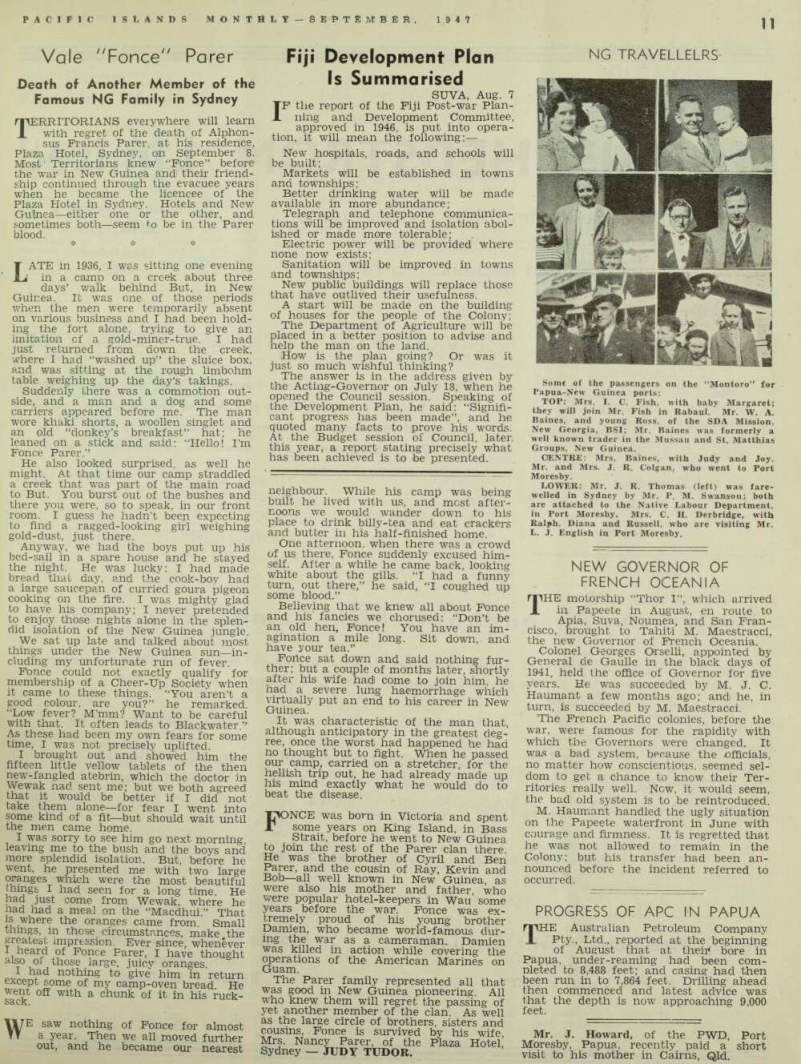
Death of Another Member of the Famous NG Family in Sydney
TERRITORIANS everywhere will learn with regret of the death of Alphon sus Francis Parer, at his residence, Plaza Hotel, Sydney, on September 8.
Most' Territorians knew “Fonce” before the war in New Guinea and) their friend ship continued through the evacuee years when he became the licencee of the Plaza Hotel in Sydney. Hotels and New Guinea —either one or the other, and sometimes both —seem to be in the Parer blood.
LATE in 1936. I was sitting one evening in a camp on a creek about three days’ walk behind But. in New Guinea. It was one of those periods when the men were temporarily absent on various business and I had been hold ing the fort alone, trying to give an imitation cf a gold-miner-true. I had just returned from down the creek, where I had “washed up” the sluice box, and was sitting at the rough limbohm table weighing up the day’s takings.
Suddenly there was a commotion out side, and a man and a dog and some carriers appeared before me. The man wore khaki shorts, a woollen singlet and an old “donkey’s breakfast” hat; he leaned on a stick and said: “Hello! I’m Fonce Parer.”
He also looked surprised, as well he might. At that time our camp straddled a creek that was part of the main road to But. You burst out of the bushes and there you were, so to speak, in our front room. I guess he hadn’t been expecting to find a ragged-looking girl weighing gold-dust, just there.
Anyway, we had the boys put up his bed-sail in a spare house and he stayed the night. He was lucky: I had made bread that day, and the cook-boy had a large saucepan of curried goura pigeon cooking on the fire. I was mighty glad to have his company; I never pretended to enjoy those nights alone in the splen did isolation of the New Guinea jungle.
We sat up late and talked about most things under the New Guinea sun—in cluding my unfortunate run of fever.
Ponce could not exactly qualify for membership of a Cheer-Up Society Vhen it came to these things. “You aren’t a good colour, are you?” he remarked.
“Low fever? M’mm? Want to be careful with that. It often leads to Blackwater.”
As these had been my own fears for some time, I was not preciselv uplifted.
I brought out and show’ed him the fifteen little vellow tablets of the then new-fangled atebrin, which the doctor in Wewak nad sent me; but we both agreed that it would be better if I did not take them alone—for fear I went into some kind of a fit—but should wait until the men came home.
I was sorry to see him go next morning, leaving me to the bush and the boys and more splendid isolation. But, before he went, he presented me with two large oranges which were the most beautiful things I had seen for a long time. He had just come from Wewak, where he nad had a meal on the “Macdhui.” That is where the oranges came from. Small things, in those circumstances, make the greatest impression. Ever since, whenever I heard of Fonce Parer, I have thought al t° i_ of large, juicy oranges.
I had nothing to give him in return except some of my camp-oven bread. He went off with a chunk of it in his ruck-
Sb.Ck,
WE saw nothing of Fonce for almost a year. Then we all moved further out, and he became our nearest
neighbour. While his camp was being built he lived with us, and most after noons we would wander down to his place to drink billy-tea and eat crackers and butter in his half-finished home.
One afternoon, when there was a crowd of us there, Fonce suddenly excused him self. After a while he came back, looking white about the gills. “I had a funny turn, out there,” he said, “I coughed up some blood.”
Believing that we knew all about Fonce and his fancies we chorused: “Don’t be an old hen, Fonce! You have an im agination a mile long. Sit down, and have your tea,”
Fohce sat down and said nothing fur ther; but a couple of months later, shortly after his wife had come to join him, he had a severe lung haemorrhage which virtually put an end to his career in New Guinea.
It was characteristic of the man that, although anticipatory in the greatest deg ree, once the worst had happened he had no thought but to fight. When he passed our camp, carried on a stretcher, for the hellish trip out, he had already made up his mind exactly what he would do to beat the disease. rNCE was born in Victoria and spent some years on King Island, in Bass Strait, before he went to New Guinea to join the rest of the Parer clan there.
He was the brother of Cyril and Ben Parer, and the cousin of Ray, Kevin and Bob—all well known in New Guinea, as were also his mother and father, who were popular hotel-keepers in Wau some years before the war. Fonce was ex tremely proud of his young brother Damien, who became world-famous dur ing the war as a cameraman. Damien was killed in action while covering the operations of the American Marines on Guam.
The Parer family represented all that was good in New Guinea pioneering. All who knew them will regret the passing of yet another member of the clan. As well as the large circle of brothers, sisters and cousins, Fonce is survived by his wife Mrs. Nancy Parer, of the Plaza Hotel,’
Sydney JUDY TUDOR.
Fiji Development Plan
Is Summarised
Suva, Aug. 7
IF the report of the Fiji Post-war Plan ning and Development Committee, approved in 1946, is put into opera tion, it will mean the following:— New hospitals, roads, and schools will be built; Markets will be established in towns and townships: Better drinking water will be made available in more abundance; Telegraph and telephone communica tions will be improved and isolation abol ished or made more tolerable; Electric power will be provided where none now exists; Sanitation will be improved in towns and townships; New public buildings will replace those that have outlived their usefulness.
A start will be made on the building of houses for the people of the Colony; The Department of Agriculture will be placed in a better position to advise and help the man on the land.
How is the plan going? Or was it just so much wishful thinking?
The answer is in the address given by the Acting-Governor on July 18, when he opened the Council session. Speaking of the Development Plan, he said: “Signifi cant progress has been made”, and he quoted many facts to prove his words.
At the Budget session of Council, later, this year, a report stating precisely what has been achieved is to be presented.
Ng Travellelrs
Some of the passengers on the “Montoro” for Papua-New Guinea ports: TOP: Mrs. I. C. Fish, with baby Margaret; they will join Mr. Fish in Rabaul. Mr. W. A.
Baines, and young Ross, of the SDA Mission, New Georgia, BSI; Mr. Baines was formerly a well known trader in the Mussau and St. Matthias Groups, New Guinea.
CENTRE: Mrs. Baines, with Judy and Joy.
Mr. and Mrs. J. R. Colgan, who went to Port Moresby.
LOWER: Mr. J. R. Thomas (left) was fare welled in Sydney by Mr. P. M. Swanson; both arc attached to the Native Labour Department, in Port Moresby. Mrs. C. H. Derbridge, with Ralph, Diana and Russell, who are visiting Mr.
L. J. English in Port Moresby.
New Governor Of
French Oceania
riIHE motorship “Thor I”, which arrived X in Papeete in August, en route to Apia, Suva, Noumea, and San Fran cisco, brought to Tahiti M. Maestracci, the new Governor of French Oceania.
Colonel Georges Orselli, appointed by General de Gaulle in the black days of 1941, held the office of Governor for five years. He was succeeded by M. J. C.
Haumant a few months ago; and he, in turn, is succeeded by M. Maestracci.
The French Pacific colonies, before the war, were famous for the rapidity with which the Governors were changed. It was a bad system, because the officials, no matter how conscientious, seemed sel dom to get a chance to know their Ter ritories really well. New, it would seem, the bad old system is to be reintroduced.
M. Haumant handled the ugly situation on the Papeete waterfront in June with courage and firmness. It is regretted that he was not allowed to remain in the Colony; but his transfer had been an nounced before the incident referred to occurred.
Progress Of Arc In Papua
THE Australian Petroleum Company Pty., Ltd., reported at the beginning of August that at their? bore in Papua, under-reaming had been com pleted to 8,488 feet; and casing had then been run in to 7,864 feet. Drilling ahead then commenced and latest advice was that the depth is now approaching 9,000 feet.
Mr. J. Howard, of the PWD, Port Moresby, Papua, recently paid a short visit to his mother in Cairns, Qld.
Advertisements & other items, p. 14 (2 items)
12
September, igU-tAcitic Islands monthly
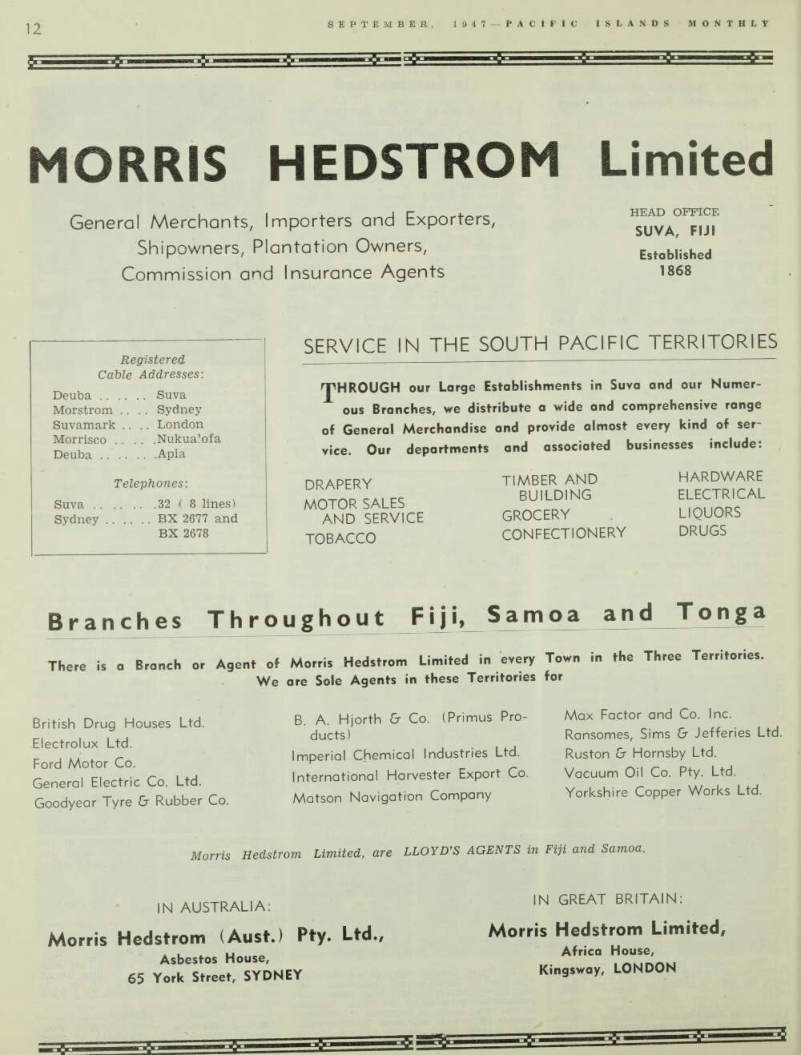
Morris Hedstrom Limited
General Merchants, Importers and Exporters,
Shipowners, Plantation Owners,
Commission and Insurance Agents
HEAD OFFICE
SUVA, FIJI
Established 1868
SERVICE IN THE SOUTH PACIFIC TERRITORIES
rj'HROUGH our Large Establishments in Suva and our Numerous Branches, we distribute a wide and comprehensive range of General Merchandise and provide almost every kind of service. Our deportments and associated businesses include:
DRAPERY
MOTOR SALES
AND SERVICE
TOBACCO
TIMBER AND
BUILDING
GROCERY
CONFECTIONERY
HARDWARE
ELECTRICAL
LIQUORS
DRUGS
Branches Throughout Fiji, Samoa and Tonga
There is a Branch or Agent of Morris Hedstrom Limited in every Town in the Three Territories.
We are Sole Agents in these Territories for British Drug Houses Ltd.
Electrolux Ltd.
Ford Motor Co.
General Electric Co. Ltd.
Goodyear Tyre Gr Rubber Co.
B. A. Hjorth & Co. (Primus Products) Imperial Chemical Industries Ltd.
International Harvester Export Co.
Matson Navigation Company Max Factor and Co. Inc.
Ransomes, Sims & Jefferies Ltd Ruston £r Hornsby Ltd.
Vacuum Oil Co. Pty. Ltd.
Yorkshire Copper Works Ltd.
Morris Hedstrom Limited , are LLOYD’S AGENTS in Fiji and Samoa.
IN AUSTRALIA:
Morris Hedstrom (Aust.) Pty. Ltd./
Asbestos House, 65 York Street, SYDNEY
IN GREAT BRITAIN:
Morris Hedstrom Limited, Africa House, Kingsway, LONDON
Let's Have Copra
And Cocoa First, Mr. Ward!
Blind Concentration on "Native
Industries" Still the Keynote
MR. WARD, Australian Minister for External Territories, has been in Canada and USA, studying rail transportation with a view to brighten ing up Australian railways. (He is, of course, also Minister for Transport.) North American efficiency in this line, has inspired him to lyrical newspaper phrases and some rosy dreams, which is perhaps ironical when one remembers that American railways are run by pri vate enterprise.
But he has not entirely forgotten his alternate role of Guardian of Native Rights.
In Washington on August 25, he found time to state that, some day, Australia might become independent of India for tea, and South America for coffee, by growing these commodities in Papua and New Guinea. An English tea expert was now on his way to Papua-New Guinea, he said. He would determine likely tea growing areas.
Mr. Ward said that although climate and soil in the Territories were suitable for sugar and pineapple production, these would not be grown as they would com pete with Australia’s own home industries.
What Mr. Ward did not state to American journalists was that the tea enterprise (and probably coffee) was to be based on native industry. The Mt.
Hagen area is the location favoured for the tea experiment. This area is closed to European settlement (and even visitors) and it is hoped that the local natives will- be induced to take part in the Government-sponsored industry. It is expected that the establishment of the tea industry, in this way, will take any thing up to 50 years.
First-grade coffee is already grown in the Wau district of New Guinea and has been grown in New Britain and in Papua.
In Papua an attempt was made by Sir Hubert Murray to interest the Papuans in the coffee industry, but with indiffer ent success.
While there is no reason why the Aus tralian government should not try to build up native interest in these two branches of agriculture, this is certainly not the time to make this the corner stone of administrative agricultural policy.
While these long-range experiments are claiming priority attention, the estab lished industries of the Territories copra and cocoa are languishing for want of Administration support and sym pathy.
Never before has there been such op portunity and incentive for increased pro duction of these products both are bringing record prices in the hungry world of to-day. If the Australian gov ernment and the New Guinea Adminis tration were 100 per cent, behind Euro pean planters in the Territories, they could be doing a service to mankind, to the planters, and to the Australian Government. Instead, we have the spec tacle of Mr. Ward babbling in Washing ton, not of the good industries that are already in existence, but of tea and C9ffee, which he intends to pin, willy nilly, upon the Mt. Hagen natives. Even if the Hagen area proves suitable for tea, the Hagen natives have the normal amount of cussedtness and damn-all atti tude to sustained labour, and it has yet to be proved that they can be deeply stirred by the task of providing Australia with its tea requirements.
Tea and coffee are pleasant beverages;
but NG copra and cocoa really could help to fill the empty bellies of Europe.
NG Tea May Be
"Uneconomical"
From a Special Correspondent
Port Moresby, Aug. 16
THERE are good tea-growing areas in Papua-New Guinea; but it is uncer tain whether tea cultivation would prove an economic proposition.
So, said Mr. G. Wyndham, an expert on tea production, with experience in India and Ceylon, after he had completed a survey of Papua and New Guinea on behalf of the Australian External Ter ritories Department.
He was, he said, Impressed with some of the valleys in the Central Highlands, especially around Mt. Hagen. Tea would also grow, in his opinion, in the Gairaina Valley, south of Lae, and at Sogeri, in the foothills of the Owen Stanleys, be hind Moresby. Sogeri is at present a good rubber district. It was believed that the highlands would yield the best quality tea, but that Sogeri would yield more to the acre.
Drawbacks to any tea production scheme were: Lack of easy transport, building materials, labour and fuel for the driers. There are, in Mr. Wynd ham’s opinion possible answers to the fuel problem—hydro-electric power in the highlands, and timber adjacent to Gair aina. But it was more difficult to predict the future of the labour market in those localities: or the question of transport.
If these difficulties could be overcome, however, there was no reason why New Guinea should not supply the Australian market with high-grade tea. (EDITORIAL NOTE: The fact that an expert has cast doubts upon the tea in dustry being an economic success prob ably is sufficient to inspire the Australian Territories Department to go forward im mediately with its pet scheme for intro ducing a native lea-growing industry.
If it were sincere in wishing to provide Australian tea-drinkers with New Guinea grown tea, it would provide facilities for would-be European growers, parallel to those it will provide for natives—if not in the “closed” highland area, then in Sogeri and Gairaina. In this way it would be possible to develop in New Guinea, within the lifespan of men now living, a healthy tea industry.)
Bastille Day In Oceania
THE French National Fete in Tahiti, postponed from July 14 to July 27 on account of an influenza epidemic cpmmenced simultaneously with the ar n7arl “ Papeete of the first of the bodies Tahitian soldiers who died in World War 11. The bodies, buried in Europe, are now being disinterred and sent to their home country for re-burial Im pressive ceremonies attended the arrival of the remains of these honoured sons of France.
Bastille Day was celebrated in the usual way The Tricolour was raised at the Governor (M. Haumant) attended by veterans of World Wars I a Sr.V» and in the presence of a large official and civilian gathering, placed a wreath upon the Soldiers Memorial Later, with a salute of 21 guns, the festivities commenced, and continued throughout the ensuing two days.
United States Air Force planes recently transported, from Brisbane, 116 civilians hired for work on Guam. Seventeen of them were girls who will work as record and research clerks.
Inquiry by Acting
Disaffection In
Solomons
Inquiry by Acting Governor
THE Acting Governor of Fiji and High Commissioner for Western Pacific, Mr. J. F. Nicol. left Suva by air on August 28 to investigate conditions in the Solomons, whence have come reports that the “Marching Rule” movement may develop into actual conflict with the Administration.
Reports have reached Fiji of the set ting up of illegal native courts and of refusal to recognise Government Courts.
There has also been cases of calculated defiance of district officers. The main disaffected area is North Malaita.
It was notified, by proclamation in a recent issue of the Western Pacific Gazette, that copra in the Gilbert and Ellice Islands may not be exported except under an export license.
Advertisements & other items, pp. 15-16 (1 item)
Positions Wanted
Stenographer-Clerk, 25, four years’ experience in Islands. Would like to learn of any suitable vacancy occurring in any Territory in which this magazine circulates. Good references. Will pay own fare. Replies to Sept. (1) c/o Box 3408.
G.P.0., Sydney.
Three young New Zealanders (married) with £3,000 capital, desire positions, or will purchase business in Islands. Several years’ experience in wholesale and retail business, also accountancy. We are not afraid of hard work and are prepared to consider separate or collective propositions. Will try anything where married men’s accommodation is available.
Reply to “Energy,”
P.O. Box 570, Christchurch, New Zealand.
Wanted
PAPUA-NEW GUINEA
Writer compiling history of the post offices and stamps of British New Guinea and Papua would like to hear from anyone who could give him details of opening and closing dates of post offices, especially prior to 1906. Also like to purchase or obtain on loan for study, envelopes, covers or pieces showing stamps and postmarks, especially with Queensland stamps.
Squadron-Leader Gerald T. Muir, Officers’ Mess, R.A.A.F. Station, LAVERTON, Victoria.
Any reader of “PIM” who has a spare copy of Monthly Notes (produced by the Australian School of Pacific Administration), Vol. 1., No. 1.. and Vol. I. No. 5, would he kindly communicate with Rev.
I. Schwab, ANGORAM, New Guinea?
USED ISLANDS POSTAGE STAMPS
BOUGHT
Under 3d. one-third face value.
Over 3d. half face value.
A. Gardner, c/o Burns Philp, Levuka, Fiji
Births
DOWSETT —On July 29, at North Geelong, to Mr. and Mrs. J. H. MacGregor Dowsett, 157 Melbourne Road, North Geelong, Victoria—a daughter, Robin.
On July 16, at St. Helen’s Maternity Hospital, Melbourne, to Mr. and Mrs. H.
Van Oudheusden (formerly Patricia Pyne, of Haapai, Tonga) a daughter, Kerry Anne.
OPTICAL
PRESCRIPTIONS
Accurately and Faithfully Dispensed. (Quick Service by Air Mail) All inquiries promptly and courteously answered. Send me your Optical problems.
All Manner of Repairs Quickly Executed. Moderate Prices.
HAMILTON A. HUGHES,
Dispensing Optician. 30-32 Castlereagh St., Sydney.
Telephone . . . B 5950. (In Samuels Super Drug Store, opposite Hotel Australia.)
ORDER NOW from
McILRATH’S
YOUR CHRISTMAS GROCERIES —WINES—SPIRITS —
LIQUEURS —CIDER —CORDIALS
PURE FRUIT JUICES
APPLE-ORANGE-ORANGE and GRAPEFRUIT
(3/-value) 30 oz. cans I/* (per doz., 11/6) All shipments are insured against pillage, theft, non-deliver> Write tor our New Grocery, Wine and Spirit Price List.
Post Free by Return Air-mail.
McILEATH’S PTY. LTD.
Export Department 202 Pitt Street, Sydney, Australia Cable address: ROTUNDA, Sydney.
Stromberg - Carlson Sole Pacific Agents
SAMOA: O. F. NELSON & CO. LTD., Apia, W. Samoa FIJI: PROGRESSIVE RADIO SERVICE, Rodwell Road, Suva NEW BRITAIN: H. T. ALLEN, BARRETT & READ, Casuarina Ave., Rabaul Available now; Air Circulators, 5-Valve 6-Volt Vibrator World Range Receiver. Available soon:
REFRIGERATORS, VACUUM
CLEANERS, WASHING MACH-
INES. FANS AND MANY OTHER
ELECTRICAL UTILITIES.
"r-ELIDE WATCHES. Imported movement and cases.
SHOCKPROOF AND WATERPROOF.
nvt/.ec/cfrj'c f SflL€S S6RVIC6
UUPHDNE;BWSIS7* SCOTTISH HOUSE • 19 BRIDGE STREET • SYDNEY • AUSTRALIA
Grand Tours
By Australian Ministers
AUSTRALIAN Ministers have been enjoying some gorgeous picnics lately at the expense of the Australian taxpayers.
While the average Australian citizen has been wrestling at home with Gov ernmental incompetence, industrial dis ruption and the heaviest taxation in the world, some six or seven Australian Min isters, complete with lady wives and well groomed entourage, have been conspicu ous in the capitals of Europe and North America.
Of particular interest to Islanders have been the tours of Mr. Johnstone, Aus tralian Minister for the Interior, who made a personal and official call upon the Portuguese Governor of Timor, and Mr.
Riordan, Australian Minister for the Army, who has been away up througn New Guinea to inspect the great naval base abandoned by the Americans in Manus. , _. .
Why Mr. Johnstone should pay a State
call upon Portuguese Timor, no one knows. But everyone knows why he paid no call upon Dutch Timor—a few miles away—the very Red Watersiders’ Union, which practically dictates the foreign policy of the Australian Government, has declared war upon the Dutch, and blood brotherhood with the insurgent Javanese.
Mr. Johnstone decided also that it was important he should inspect two tiny islands in the Timor Sea, which apparently belong to Australia—but so insignificant are they that they are not mentioned in the Australian Year Book or shown on any map. He could easily have travelled cheaply and quickly to those places by air. Instead, he went forth grandilo quently and most expensively in an Aus tralian warship, attended by the usual little party of happy officials.
Because Australia nagged the United States to the point of exasperation on the subject of the ownership of Manus Bass, where the Americans had spent an enormous sum, all American forces were withdrawn north of the equator in June- July, and Australia was left to do as she liked with Manus. The Australian “Foreign Minister” (Dr. Evatt), the Public Works Minister and the Army Minister have all gone to have a look at the place—and now are saying that it is going to be very expensive to maintain.
Ordinary people would have decided that it is quite beyond Australia’s means; but these Socialist Ministers, with their remarkable talent for tossing around the millions contributed by Australia’s groan ing taxpayers, indicate that they are go ing to try to maintain the base, Mr. Riordan could easily and cheaply have flown there, but that is beneath th Q dignitv of an Australian Trades Hall politician. He went to Manus in the cruiser “Australia,” with the usual merry party of officials.
Meanwhile, New Guinea’s very own Australian Minister. Mr. Ward, having thoroughly toured Western Europe and North America, is making his leisurely way back across the Pacific, bubbling with plans for establishing new agricultural in dustries for the natives of New Guinea. (See article elsewhere).
As thev say in Australia, “join the Labour Party and see the world—in luxury.”
Manus Base
Funny Story Department:
Cost of Australian Establishment Enormous, Says Minister
WHEN he arrived in Cairns, Queens land recently, after inspecting the former US Naval Base at Manus, Admiralty Islands, the Australian Min ister for the Navy, Mr. Riordan said that enormous expenditure would be necessary to make Manus a first-class Reconstruction of the base on the Aus tralian pattern could be started with the remnants of the buildings and equipment left behind by the Americans and by moving nart of the RAN base on Dregar Island (KG). Manv of the buildings on Manus and the water purification plant were in good order, said the Minister, but the jungle was fast claiming cleared
£Itgb,S
Mr’ Riordan is not telling us a thing.
Readers are recommended to look at tne cover picture, “PIM”, for August This was Manus when it was in full fighting trim and under the control of the United States, who spent millions in constructing the base during the war. Australia could have had the United States Navy per manently established on Manus, with great benefit to herself; but Government shilly-shally and Dr. Evatt s exaggerated
College Students Will Have
Fun In South Seas
(They Hope)
TAHITI and the South Seas generally have not lost their appeal to seekers after glamour and adventure, in July 19, young college students set out from Los Angeles to sail to French Oceania on a 110-ft. converted US Navy sub-chaser.
They took with them 15,000 gallons of fuel oil, and, for trading with the natives,
cartons of cigarettes, mirrors, beads and other trade goods. They also took heavy shark-fishing gear and nets.
Apart from shark-fishing and trading they just “plan to have fun.”
Mrs. E. H. Allen, who, as Sister Edith Frost, was a nurse in the Islands before her marriage, recently visited Australia after nine years in England. During the war, she was attached to the Observer Corps in Scotland. Her husband, a Commander of the RN, is now stationed in Hong Kong,
New Regulations Issued
Bsi Labour
A COMPREHENSIVE set of Native Labour Regulations, running to 107 clauses, to cover generally the em ployment of natives in the British Solo mon Islands, was published in the West ern Pacific High Commission Gazette of August 1.
There is nothing of a startling charac ter in the Regulations. Compared with the revolutionary compilation which Aus tralia brought into operation, next door, in New Guinea, they are mild. But they do seem to wrap a lot of unnecessary red tape around the simple employer-native labourer relationship which existed in BSI prior to 1940.
Recruiters will in future be licensed; and no man may recruit “on spec”— he must operate for a recognised em ployer. No native under 18 may be re cruited. Government officials—who exer cise a great dbal of power under these regulations—will not permit recruiting in any district unless they are satisfied that the removal of the young men will not harm the community.
Employers generally are obliged to pro vide their native employees with rations, housing, medical care, and so forth, on a prescribed scale; but it is left to the Resident Commissioner to make rules governing the rates of wages, the periods for which contracts of service may be entered into, the scale of rations, char acter of housing, repatriation, etc.—that is, most of the things that really matter in relation to native labour.
If a native works more than nine hours in any one day, or more than 50 hours in any week, he must be paid overtime rates. Normally, he must not work on Saturday afternoon, Sunday, or public holidays.
"Weekly Guardian"
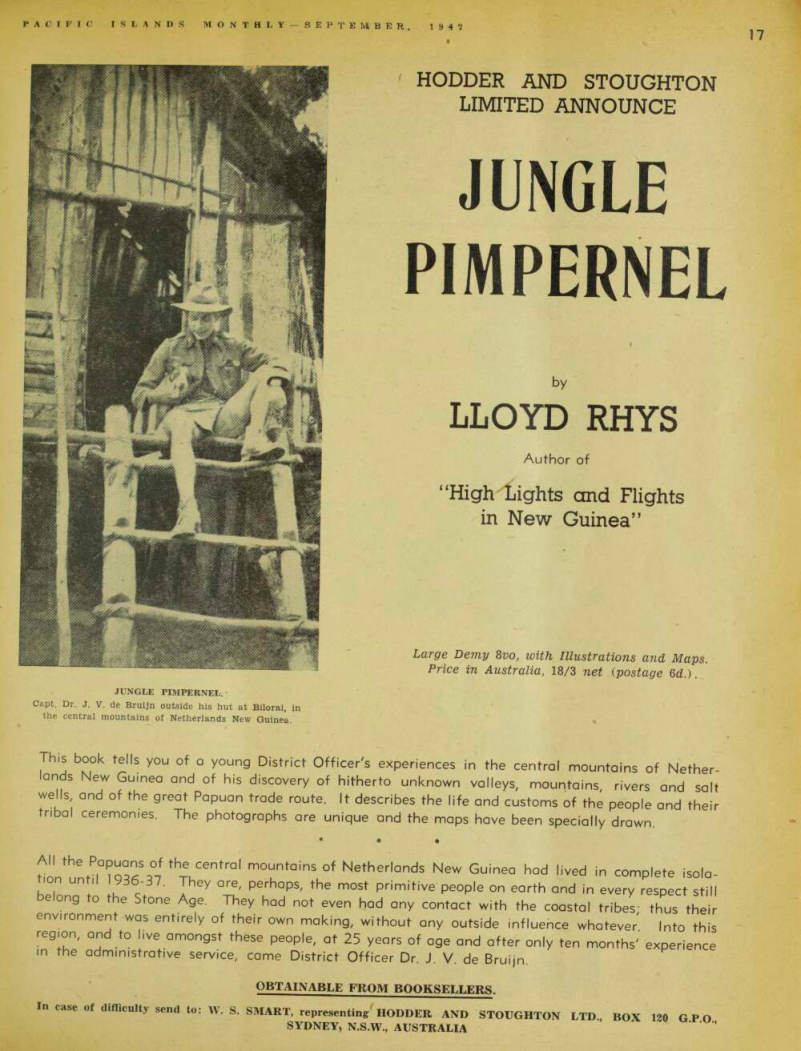
A New Newspaper in Fiji
THE' Weekly Guardian, a new news paper for Fiji, made its appearance in Suva on August 29.
Its first issue is not impressive—prob ably due to the consistent bad luck of the promoters. First, their printing machinery was delayed by strikes and so forth; and then, when they got it as sembled, they discovered a grave error in part of it, which involved further serious delay. Rather than announce a further postponement, they rushed out their first issue under great difficulties, and hoped for the best—not a good thing with any periodical because, in news papers as in anything dependant on pub lic favour, first impressions are often lasting.
The naper discloses a good literary standard and a keen sense of news. But the promoters, in my opinion, make a mistake in allowing their first issue to be too anti-Alport Barker.
There always are a lot of people who are sure they can show an editor how to run his newspaper—l would feel that I am failing if they did not peck fre quently at me—and the editor of the Fiji Times has critics a-plenty. But Mr.
Alport Barker, nonetheless, is a well known and highly respected figure in the public life of Fiji; and his long and honourable record, and proved readiness at all times to give personal service to the Colony, more than balance the weight of any criticism of his newspaper.
However, free competition is the heart and soul of the system of private enter prise, which we all defend; and plenty of competition cannot do much harm to the newspaper industry anywhere We wish the “Weekly Guardian” plenty of readers, some luck, and good fighting weather. —RWR. rae
ideas of the importance of his place in world affairs, wearied the Americans, who have now packed up and gone.
Australia has neither the money nor the Naval personnel to maintain Manus as it would have been maintained under the Americans. While Mr. Riordan is making noises like a Cabinet Minister and “planning” this and that, the jungle will be winning in a comfortable canter.
Australia is now committed to a 40-hours week; the New Guinea bush goes on growing all the time.
Advertisements & other items, pp. 17-18 (2 items)
Confidential
PERSONAL
and
These two words are the essence of banking service.
Branch Managers of the "Wales" take a close personal interest in their clients, for the development of the Bank's business depends primarily on the progress and prosperity of its clientele.
All "Wales" officers are under pledge of secrecy regarding the affairs of the Bank's customers.
If you have any financial or business problems, why not talk them over with a trained and experienced banker? The Manager of your local Branch of the Bank would like you to consult him and there is no charge for this service.
Consult and use
BANK OF
NEW SOUTH WALES
FIRST BANK IN AUSTRALIA
incorporated in New South Wales with limited liability
Pimpernel
m 4 i v € ■ ■
JUNGLE PIMPERNEL.
Capt, Dr. J. v. de Bruijn outside his hut at Bilorai, in the central mountains of Netherlands New Guinea.
HODDER AND STOUGHTON
LIMITED ANNOUNCE
JUNGLE
PIMPERNEL
» by
LLOYD RHYS
Author of
“High Lights and Flights
in New Guinea”
Large Demy B vo, with Illustrations and Maps.
Price in Australia, 18/3 net (postage 6 d.). i h '! b K? k S y ° U ° f ° y ° Ung District officer 's experiences in the central mountains of Netherlands New Guinea and of his discovery of hitherto unknown valleys, mountains, rivers and salt wells and of the great Papuan trade route. It describes the life and customs of the people and their tribal ceremonies. The photographs are unique and the maps have been specially drawn.
AM the Papuans of the central mountains of Netherlands New Guinea had lived in complete isola- LT , ul 37 I 6y °'f' perhops ' the most Primitive people on earth and in every respect still ng o the Stone Age, They had not even had any contact with the coastal tribes; thus their environment was entirely of their own making, without any outside influence whatever Into this region, and to live amongst these people, at 25 years of age and after only ten months'’ experience in the administrative service, came District Officer Dr. J. V. de Bruijn.
OBTAINABLE FROM BOOKSELLERS.
In case of difficulty send to: W. S. SMART, representing HODDER AND STOUGHTON LTD., BOX 130 GPO
SYDNEY, N.S.W., AUSTRALIA
All Hope Now Gone For
Yawl "Alone"
HOPE has now been abandoned for the yawl “Alone/’ which is more than three months overdue at Auckland.
The “Alone” was owned by Mr. Francis Agnew, a young American. He left Panama in early 1946 on a leisurely cruise around the world. His wife accom panied him to the Galapagos, Marquesas and Tahiti, and then returned to Panama.
Mr. Agnew then went on alone to Eastern Samoa, via some of the French islands. In Pago he was joined by Mr.
Joseph Wulf, who accompanied him to Suva, where they landed in March, 1947.
“Alone” stayed in Suva for the hurri cane season and, on May 2, left for Auck land on the second phase of the journey, which Mr. Agnew thought would bring him back to Panama by the end of 1948.
From Suva he was accompanied by Mr.
T. Bish, of Fiji.
Nothing has been heard of the “Alone,” or her crew, since she left Fiji. It was expected that she would reach Auckland about three weeks out from Suva. The weather at this time was fairly good although some rough seas were reported near the Kermadec Group, north of Auckland.
Planes and ships were instructed to keep a look out for “Alone,” but without result.
The Danish yacht “Nordkaperen,” which visited Suva about the same time as “Alone,” in the course of a world cruise, has reported from Cairns that no trace of the “Alone” had been sighted, although the “Nordkaperen” sailed 200 miles off her Suva-Cairns course in order to search.
French Phosphate
THE phosphate traffic between the French island of Makatea and New Zealand shows no sign of diminu tion. Two ships, the “Samkey” and “Saminver”, were in Papeete in July, en route to Makatea to load phosphate for New Zealand.
In this way Tahiti, unable to procure necessary manufactured goods and food stuffs from France, is able to buy from New Zealand.
Western Samoa
Departure of UNO Mission
Prom Our Own Correspondent
Apia, Aug. 20.
THE Commission from the Trusteeship Council of UNO, which has been in Western Samoa since the end of June examining the petition of the Samoan people for a larger measure of self-government, left Samoa yesterday en route for the United States.
The members of the Commission ap plied themselves very industriously to their task and have interviewed hundreds of people in all parts of the Territory.
Their visit ended in a round; of farewell functions, cocktail parties and last im pressions.
The Commission will make an exhaus tive report. Prom what I have seen of the members I do not think they are likely to be bamboozled by the ambitious schemes and airy dreams of some of the people who discussed with them the future of Samoa.
The Samoans are still very confident that they will get self-government im mediately but no European shares their optimism.
An American ship visited Nauru in early August with a party who investigated the fate of US airmen lost on the island during the war. The party also arranged to collect the remains of those buried in the American Cemetery in the Boe district.
Advertisements & other items, p. 19 (1 item)
Burns Philp
THE
YORKSHIRE
INSURANCE
CO. LTD.
(Incorporated in England)
ALL CLASSES OF
INSURANCE
Including
FIRE
GUARANTEE
WORKERS
MOTOR
ACCIDENT
MARINE
Island Representatives:
PORT MORESBY: E. A. James
RABAUL: G. B. Black LAE: Morobe Transport Co. Ltd.
MADANG: R. MacGregor
BURNS PHILP
(SOUTH SEA) CO. LTD.
Inc. In Fiji Island Traders and Shipowners Registered Office :
SUVA
FIJI
\Also Branches at: Fiji: Levuka, Lautoka, Labasa, Ba, Sigatoka, Rotuma.
Tonga: Nukualofa, Haapai, Vavau.
Samoa: Apia, Pago Pago (American Samoa).
Solomons: Makambo, Gizo, Faisi.
New Hebrides: Vila.
Code Address: Gilberts: Tarawa.
"Burnsouth*. Norfolk Is. Niue. Wallis Is. Futuna Is.
UvvcisynfeurTt. rCcuzt&-
Sole Australian Concessionaries :
GEORGE BROWN & CO. PTY. LTD.
267 Clorence Street, Sydney.
Designs for new Ultimate models have been completed but production has been retarded, due to a few remaining difficulties in raw materials.
Models should be available some time during 1947. They will be well worth waiting for. Watch for further announcements.
SERVICE: Servicing of all kinds of radio sets, amplifiers and Rola speakers will continue to be available.
Polynesian Culture Lost
In Tahiti
MR ROBERT GIBBINGS, an English Author recentlv in Polynesia, claims that all" trace of the old and social system has lahitiby the Wench and Chinese, but that Western Samoa has escaped’ a similar tragedy. There the Samoans take pride in their tradi tions in which they have been supported by the New Zealand Government.
During a recent boxing match at the Tivoli Theatre Apia, between two Samoans one of the contenders was hit on Ishe jugular vein. He was taken to hospital where he died without regaining consciousness. On the same day a Samoan youth of Apia, after quarrelling with his sister took some of the poisonous weed called by the Samoans ■'ava New Guinea dissolved in a bottle of home brew. His body was found next morning under the stairs of a nearby European building. Cases of suicide are rare among Samoans.
Samoa
Boom In Western
Reflected in Annual Statistics
THE boom being enjoyed by Western Samoa, as a result of the high prices of copra and cocoa, is reflected in the statistics in the Administrator’s annual report.
The following figures show the condi tion of the Post Office Savings Bank, and refer to the years ended March 31, 1946 and 1947 respectively:—
The fall in native depositors’ balances is probably due to the natives’ recent heavy purchases of newly imported motor vehicles.
It is interesting to note the proportion of persons of the three communities now employed by the Administration:
Between 1925 and 1932 revenue was between £lOO,OOO and £150,000 p.a, with annual deficits ranging up to £4O 000 Thence, up to 1942, the revenue was about the same, with budgets generally balanced.
Thenceforward, with high produce price and “dollar prosperity,” revenue doubled, and annual surpluses have produced an accumulated 'credit of £417,758. most of which is invested in New Zealand.
Most of the revenue (about £265,000 of it) comes from Customs. Direct taxes (mostly a tax on stores) produce nearly £40,000 p.a.
In the calendar year 1946, imports were £478,695, and exports £719,050 —an all time record. labour There are 290 Chinese labourers re maining in Samoa, of whom 38 are restricted free settlers; 226 are in active employment, on private cocoa plantations and on NZ Estates rubber plantations. have expressed a wish to return to China, numbering 126, will be repatriated when shipping is available.
Of Melanesian labourers, only 63 remain now in Samoa. There is also a small labour force of 22 Niueans.
Education
A TOTAL of 9,720 pupils attend Admin istration primary schools throughout the group. The European Adminis tration School at Ifi Ifi. Apia. counts 7 pupils; while Mission schools are attended by 20,523 pupils.
A total of 34 Samoan and oart-Samoan bovs and girls are holders of New Zealand Government scholarships, and are study ing in New Zealand.
Health
THE state of public health is com
paratively good, and n 9 epidemics
occurred during the period.
The infant mortality rate in 1946 was M 05 ner 1 000 births, and, though higher ?£o-n thp rate for 1945 (53.8. an all-time record lowf wls the second lowest for 26 years. (Conttauea Nex , p aße i
1946 1947 Number of Depositors 4,382 4,725 Deposited .. . £265,534 260,780 Samoan Depositors .. . 3,3U 3,670 Samoan Deposits ... £32,096 £29,395
1946 1947 Europeans 74 69 Euroneslans 101 147 Samoans 759 077 Revenue £284.292 £334,838 Expenditure £235.169 £242,329
Advertisements & other items, p. 20 (1 item)
-Hips aren't
t
big problem, Honey!
'OU CAN TAKE your mind off our hips, dearie! No one finds ault with your figure! foil’d be smart to exercise a ittle more care about personal harm. Being streamlined, you now, won’t protect you against inderarm odour. Or lessen the >ffence when others find you juilty of it. >o keep on trusting your bath— for past perpiration but put your trust in Mum to prevent risk of future underarm odour.
Creamy, snowy-white Mum smooths on in 30 seconds. Keeps you fresh and free from underarm odour all day or evening.
Mum is gentle—harmless to skin and fabrics. So why take chances when you can be sure with Mum?
Ask for it today.
MUM
TAKES THE ODOUR OUT OF PERSPIRATION
Population
QN March 31, 1947, population was:
Population Since NZ Received Mandate
The following are the quantities and values of the Territory’s chief exports.
They cover the calendar year 1946: Copra 13,795 tons £340,669 Cocoa 1,885 tons £207,109 Bananas 172,823 O/s £86,421 Rubber 80 tons £17,827 Dess. Coconut 568 tons £50,462 Dried Bananas .. .. 46 tons £lO,llB Imports came principally from New Zealand, £172,487; Australia, £73,806; Britain, £107,268; Canada, £23,503; United States, £65,858.
Exports to those countries were: NZ, £269,504; Australia, £11,964; Britain, £216,843; Canada, £69,639; USA, £145,253.
1946 1947 Europeans 366 372 Euroneslans .. .. 5.045 5,034 Samoans 63,243 65,695 Chinese 301 296 Melanesians .. .. 75 63 Total 69,030 71,460
1921 19*47 Europeans and Euronesians .. 2,066 5.406 Samoans 33,336 66,695 Chinese 1,290 296 Melanesians 465 63
"Red Rubber" In The
Belgian Congo
JUST before the outbreak of World War 11, I received a letter from a cousin of mine, Edgar Canisius, son of Dr. Can isius, one-time Consul-General for the USA in Apia, Samoa.
Canisius had retired from the employ of the Congo Free State, and he con firmed the terrible stories told about the condition of the natives—especially in the portions termed the State Domain, where strangers are seldom admitted.
Canisius, who accompanied Major Lothair (commander of the Belgian troops in the Congo) on his earlier ex pedition after rubber, says 900 natives were killed in six weeks during that ex pedition; while a smaller expedition, com manded by a Belgian Lieutenant, killed 300 natives in three weeks.
Canisius further declared that the so cahed punitive expeditions are in reality rubber-squeezing raids, conducted with such iniquitous methods that the natives are in a constant state of revolt. The natives are practically forced to work the rubber at the muzzle of rifles, and they receive 2 cents per pound for what is sold at 75 cents at Antwerp.
Thousands of natives had fled to the bush, where they lived like wild animals.
Along the jungle paths the bodies of those who had died of starvation were frequent sights. H Edgar Canisius was in New Britain in 1888 and then was employed by Mrs. For sayth, otherwise known as “Queen Emma"
F. T. Goedicke-Van Asten, Tonga.
A Tahitian aristocrat, Arii-Paea fS so £ of the lat€ Hinoi, died at his home m Pirae on July 25 SL W^in ei S ployed in , the p ost Office, and T' J ell kn S >wn an d esteemed. He left a widow and 14 adult children.
L e ? nce Brault, a well-known SJJJSeJ 1 la .wyor and a former mayor of Papeete sailed recently by the “Wairata”
tojoinhisfamily in Oaklands, California,
he was Consul for Norway in Charon~ a positlon now held b Y M. Robert
Mr. G. T. Roscoe, principal of the Charters Towers State High and Intermediate School (Qld.), has been ap-
pointed inspector-in-charge of the gen eral division of the Education Depart ment of Papua-New Guinea
Mr. and Mrs. Allen Innes left Sydney in August for a six months’ holiday in Fiji and New Zealand. This well-known island couple met in Fiji when they were youngsters. Later they became even better known in Papua and the Morobe district of New Guinea. They will spend the next few months in Fiji and will then go on to New Zealand for the summer.
The death occurred recently of Madame Aumai Berniere, widow of the late Mon sieur Berniere, formerly a highly re
spected official of Papeete. Madame Berniere was Mademoiselle Donat, and was born and reared in Tahiti.
Miss Ela Gofton, of Lae (NG), re cently spent three months in South Queensland.
Colour-conscious? The curiosity of many Brisbaneites was aroused recently at the sight of one of their young blonde flappers being escorted in the city by two “Fuzzy-Wuzzies”, from New Guinea.
Advertisements & other items, pp. 21-22 (1 item)
Opnidhed by
DAVISON
For Troptca.l conditions
Velvene Water Faint and Davison's Zinc Base Paints are usee! extensively throughout the islands and Mandated Territories on Government and Private buildings, giving full satisfaction under severe tropical conditions.
DAVISON PAINTS PT Y. LTD
BOX 24. AUBURN. N.S.W.
§Mri v -.M ii.' <• SfMOUHA > ,|p
iv / MACARONI .
I «
i— NffTOap*"
r p wmmmimWi
VESMICEL
«5 m
wmm
•>v~ :.s ■ f;: ■ ' Sole Distributing Agents for the Pacific Islands:
BRIAL & BALL
31 QUEEN STREET,
MELBOURNE.
’Phone: MU4837.
1 BOND STREET,
SYDNEY.
•Phone: BUSBOO.
Available for regular
shipment from
• CROCKERY
• TEXTILES, “Lap lap”
• CANNED FOODS
• TOYS, SCOOTERS
All orders promptly attended to
Cable “VTVIANPAT”
STEWART & FINCH
19 HUNTER STREET, SYDNEY
ESTABLISHED 1930
WILLIAM H. WATSON
RAROTONGA, COOK ISLANDS
Wholesale and Retail Trader
LICENSED STAMP DEALER
Agent For:—
BRITISH TRADERS' INSURANCE CO.
CORONA & L, C. SMITH TYPEWRITERS
KAISER & FRAZER MOTOR CARS
B.S.A. CYCLES AND MOTOR CYCLES
AMERICAN LEAD PENCIL CO.
WHITES AVIATION LTD.
Manufacturers of: FOOTWEAR, ALL CLASSES SUITABLE FOR NATIVE TRADING . MOP. PRODUCTS, INCLUDING ROUND EAR-RING BLANKS AND BUTTON BLANKS Exporter of; “Rarotonga” Hula-Skirts.
Sea-Shell Necklaces.
M.O.P. Jewellery.
Island Produce.
Cable Address: “Watson” Rarotonga Wholesale and Retail Inquiries Invited.
Prepared to Consider Agencies for all Class of Goods. -Bankers: Importer of: Textiles.
General Hardware.
Fancy Goods.
General Merchandise.
Bank of New Zealand, Auckland.
Trusteeship
Nauru For Australian Trusteeship Reported Request to the United Nations
IT was reported in the New Zealand press in August (and later denied by the Australian High Commissioner) that Australia would shortly ask the United Nations to give her sole admin istrative rights in Nauru.
Nauru, which was formerly German, was a League of Nations Mandate held by Britain, Australia and New Zealand in partnership and administered by Aus tralia on behalf of the other two partners.
With the exception of Palestine, whose fate remains in the balance. Nauru is the last of the old Mandated Territories to be proposed for UN trusteeship.
Nauru’s usefulness is. of course, due entirely to her phosphate deposits which are worked, as are those on Ocean Island, by the British Phosphate Com mission. Nauru and its problems bear little relation to those of Australia’s other Pacific possessions. Neither does Ocean Island bear much resemblance to the rest of the Gilbert and Ellice Islands Colony, of which it is a part. The sensible thing would be to have these two phos phate-bearing islands under one admin istration. But that appears unlikely at the present time.
Mrs. Doris Fitzpatrick, whose husband is a PMG official at Sumarai, Papua, was killed on the Mission Beach Road, Tully (Qld.), on August 24. A lorry re turning from the beach conveying Mrs.
Fitzpatrick and eight others overturned about three miles from the town.
Advertisements & other items, p. 23 (1 item)
Westclox
NEVER has performance been more trustworthy than in the beautiful Westclox of today . . . famous Big Ben and other spring wound clocks, electric clocks, wrist watches and pocket watches. When you buy your next clock or watch, look for the trade mark “Westclox” on the dial . . . your assurance of quality.
POCKET BEN A thin model watch with many features. Highly polished, plated finish; silvered dial; attractive numerals and hands. Unbreakable crystal.
SPUR Luminous A thin case, one-day alarm. Black finish with nickel trim. 4i inches square.
Steady alarm. Unique base.
Luminous dial.
BIG
BEN
BIG BEN Chime Alarm The highest standard of alarm clock quality. Quiet tick and gentle two-voiced alarm. First there’s a gentle call, then if he’s not shut off. there’s a lusty shout. Dustproof attachments. 5 1 inches high. Ivory finish with gold colour trim. Luminous dial. iO BABY BEN A smart looking alarm clock, 3ft inches high.
Quiet tick; steady alarm that rings loud or soft. Legible dial.
Two finishes . . . black with nickel trim, and ivory with gold colour trim. Made in plain and luminous dial.
LA SALLE A handsomely designed wrist watch. Chrome finish case, stainless steel back curved to fit the wrist. Sturdy movement, regulated to run in any position. Equipped with conventional second hand; rustproof hairspring.
ORDER THROUGH YOUR LOCAL STORE
PACIFIC ISLANDS TRADING
Bankers: Bank of America (Main Office) San Francisco.
COMPANY
Cables:
PITCO
SAN FRANCISCO
244 CALIFORNIA STREET, SAN FRANCISCO, CAL,, U.S.A.
Correction
Mott-Marlin Metal Cruisers
IN August “PIM” it was stated that Mott-Marlin cruisers were equipped with an “engine-operated bilge pump.”
This was an error.
Owing to the metal construction of the cruisers, no water is taken into the bilges at all. A small hand-pump is supplied, to be used if water splashes in over the side. This has been found to be all that is necessary.
Mr. Robert Shennan, with his son, Mr.
Noel Shennan, ex-RAAF, have returned to New Guinea after an absence of several years. Both are employed by Bulolo Gold Dredging Limited.
A list of clergymen who are registered in the Territory of New Guinea to cele brate marriages, appearing in a recent issue of the Papua-New Guinea Gazette, shows there is a total of 119, of whom 85 are Roman Catholics, 21 Lutherans, 9 Methodists and 4 Church of England.
Australia’s national beverage tea — costs 6/9 a lb. in Port Moresby and whisky £lO/13/- a case. The lowly orange has been selling there at 9/6 a dozen!
During 1946, 554 passengers landed in Noumea by air—the majority flying from Australia and New Zealand —and 2,028 by ship. Departures during the year were by air, 608; and by ship, 1,328; making a total of 1,936. Arrivals, therefore, out numbered departures by 646.
Fiji Beetles Rushed
To Guam Call for Help Against Borer-Weevil
From Our Own Correspondent SUVA. August 24.
THE United States Navy recently sent a request through Honolulu, to Fiji, for a consignment of Plaesius javanus beetles to cope with weevil-borer in newly established banana plantations on Guam.
A Fijian laboratory assistant from the local Department of Agriculture went to Waimaro and in five days collected 460 beetles, which were brought to Suva, fed on fresh beefsteak and packed in moss for the plane journey from Nadi to Honolulu, by Pan-American Airways.
At Honolulu, the beetle-box was trans ferred to a Navy plane which left within half an hour, reaching Guam 22 hours later.
The time taken to move the beetles from the banana plantations of the Waidina River, Viti Levu. to Guam, was five days.
The entomologist at the Hawaiian Sugar Planters’ Association’s experimental station (Dr. Pemberton) has written to the Director of Agriculture, Fiji, saying: “I do not know of a similar instance in which a beneficial insect has been trans ported from one country to another, over such a long distance, so quickly and sat isfactorily. We wish to thank you most heartily and to congratulate you on the service you have rendered us in this pro ject.”
Plaesius javanus beetles were first brought to Fiji from Java in 1913 by the then Government Entomologist, Mr. J. F.
Jepson.
Two Ships Up On
Papuan Reefs
WHILE berthing at Langemak, Finsch hafen, NO, on July 25, the MV “Reynella” damaged about 50 feet of the wharf. After loading about 8,000 tons of old war equipment for southern buyers, she left for Sydney on August 11.
A few days later she was up on a coral reef off eastern Papua. Efforts were made to float her off by blasting the reef from beneath, but were of no avail. A naval tug reached the ship on August 23 and on the same day the salvage tug “Tancred” was despatched from Brisbane, to her aid.
Passengers were transfered to the “Merkur” after the “Reynella” had been on the reef for 10 days.
The Shell Company tanker “Cyrena” is also aground off the Trobriands, Eastern Papua. A Royal Navy rescue tug has left Singapore to give assistance, which involves, among other things, the re moval of “Cyrena’s” oil cargo.
A daughter (Robin) was born to Mrs.
H. H. MacGregor Dowsett, in Geelong, Victoria, on July 29. Mr. Dowsett, for merly well-known in the Rabaul District, New Guinea, has bought two shops in that town. He hopes, however, to return to New Guinea at some future date.
At a Brest court martial recently, a cabin boy was given a life sentence for murdering the chief carpenter on board the French gunboat “La Grandiere” dur ing a Pacific cruise last year. The tragedy occurred while the ship was in New Cale donian waters.
Advertisements & other items, p. 24 (1 item)
Kerr Bros. Ptv. Ltd.
Address mail: Box 3838, G.P.0., Sydney, Australia.
Cable Address:
“CARE” SYDNEY.
4 YORK STREET, SYDNEY
ASSEMBLY HALL,
Codes: ABC 6th & 7th.
BENTLEYS COMPLETE
PHRASE.
BENTLEYS SECOND
PHRASE.
Island Merchants and Agents
50 YEARS 7 PRACTICAL EXPERIENCE IN ISLAND REQUIREMENTS All kinds of Island Produce sold on commission at best prices. Liberal advances on consignments. All merchandise for Island Requirements purchased at best wholesale price and original invoices supplied.
BANKERS: AGENTS FOR AIR SERVICE;
Commonwealth Bank of Australia, Head Office, Trans Oceanic Airways Pty., Ltd ; Sydney. Sunderland Flying Boats to pacific Islands— Comptoir National d’escompte de Paris. Sydney. charters arranged any place.
KERR BROS. PTY. LTD. for integrity, stability and dependability.
BROOMFIELDS Ltd
Suppliers of
Building Hardware
General Hardware
Ship Chandlery
Paint Materials
WRITE DIRECT TO
Broomfields Ltd.
152 SUSSEX STREET, SYDNEY
Sole Agents for: P H. MUNTZ & CO.’s 3-CROWN BRAND METAL
SHEATHING.
PEACOCK & BUCHANS’ ENGLISH READY-
MIXED PAINTS.
100 Per Cent.!
Moresby's Increase in Public Servants
Letter to the Editor PRELIMINARY census figures show that the population of Port Moresby rose from 600 in 1939 to nearly 1400 in 1946.
No new industries have been started in the vicinity of Moresby, and those elsewhere in the Territory are running on half-throttle or not at all.
This increase in town population can only be in the Civil Service.
Australia is reputedly short of man power, despite Mr. Calwells’ efforts around the European and North African ghettos.
Surely the increase in local population would be better employed in Australia, producing something to eat, wear, or use.
Or they might relieve those members of the Waterside Workers’ Union who are rushing off to enlist in the Indonesian Army.
I am, etc.,
G. T. Gemmell.
Mariboi Estate, Papua.
August 3, 1947.
Bastile Day celebrations in Papeete were postponed until July 27, because of a severe outbreak of influenza. Although, generally, not of a severe nature, the epidemic invaded almost every household; and business in Papeete, in the early part of July, was at a standstill.
Postage Stamp
Racket
Special Issue For Tokelaus— Pop. 1,000!
THE postage stamp racket has extended even to the far Tokelaus. The Group—which itself is nearly small enough to go on a postage stamp—is a dependency of Western Samoa, which is in the care of New Zealand. There are only 1,000 natives on Tokelaus’ three small atolls.
Ever since the Tokelau (or Union) Islands were detached from the Gilbert and Ellice Colony and attached, for greater convenience, to Samoa, they have used Samoan postage stamps—a simple and proper arrangement. The quiet Poly nesians of the Tokelaus do not use a stamp per person per annum.
Now, some genius in Wellington has arranged for the issue of id., Id. and 2d. stamps, designed and printed especially for the Tokelaus; and they are to be on sale, from April next in the chief towns of New Zealand and in Apia. Probably, they will be on sale also in the Tokelaus: but it is obvious that they are not being issued for the Tokelaus, but in order that some New Zealand Department may gather in a few thousand easy pounds from the world’s devoted stamp collectors.
Most of the Pacific Territories Govern ments have engaged in this racket from time to time, and enriched their coffers accordingly. It will go on, presumably, so long as stamp collectors are prepared to lend themselves to the business.
Mr. E, J. Thomsett has been appointed a director of W. R. Carpenter & Co. (Fiji), Ltd.
Burns Philp (New Guinea) Limited, which was incorporated in Papua on September 18. 1946, has been registered m New Gumea as “a foreign company,” with headquarters in Mango Avenue,
Keddrui.
Advertisements & other items, p. 25 (2 items)
23
PACIFIC 'ISLANDS MONTH I. Y SEPTEMBER, 1947
Akpliok
SPECIALISING
IN
PACIFIC ISLAND INSURANCES
FIRE MOTOR VEHICLE
MARINE HULLS AND CARGO
EMPLOYER’S LIABILITY
GUARANTEES including those for—
DYNAMITE PERMITS.
RECRUITERS’ LICENCES
DEFERRED WAGES
AND ALL OTHER CLASSES ARRANGED
AT LOWEST CURRENT RATES.
Established Agencies;
W. R. CARPENTER & CO., LTD.
Throughout the Territory of New Guinea.
SOUTHERN PACIFIC INSURANCE
CO., LTD.
HEAD OFFICE: 60 HUNTER STREET
SYDNEY.
Flood your home with brilliant light!
Imagine it just flick a switch and on comes a flood of electric light. How the children and Mother will delight in this new pleasure which every home needs to be really restful and cheery!
With the Amplion Farm Lighting Unit, you can serve every room, and outhouses, grounds, garage— with pulsing current—even run a vacuum cleaner!
We would like you to have our buy.
Manufactured by—
aKPLIOk
Australasia Pty. Ltd.
NR
★ SOME QUICK FACTS
ABOUT THIS GREAT UNIT
• Light in weight. Plant weighs only 70 lbs. • Runs for 8-10 hours on one gallon of petrol. ° Air-cooled, 4 cycle engine. • Run a few hours per week, will keep your batteries charged. • Electrical self-starting. No cranking of engine. ir
YOU'LL FIND IT
FASCINATING
READING
I I • I I I I I I I
Messrs. AMPLION (A/ASIA) PTY., LTD.,
36-40 Parramatta Road, Camperdown, N.S.W. wear oirs; Please let me have your illustrated Farm Lighting Unit brochure. Publication APC7C.
Name Address
Fiji Treasurer
Transfer to Trinidad Announced
RESIDENTS of the Central Pacific have learned with regret of the impending departure of the Fiji Colonial Treas urer, Captain A. R. W. Robertson, who has been promoted to the office of Finan cial Secretary of the Crown Colony of Trinidad and Tobago, in the West Indies.
He has been a high official of Fiji, and a member of the Executive and Legislative Councils, since 1939, and his ability and courtesy gained for him many loyal friends.
He filled many posts during the diffi cult war years. In January, 1947, with Fiji’s Governor, he attended the confer ence in Australia which formed the South Seas Regional Commission. Since Sir Alexander Grantham’s transfer to Hong kong, he has acted as Colonial Secretary, while the Colonial Secretary (Mr. Nicol) is acting as Governor. Captain Robert son probably will remain in Fiji until November or December.
Captain Robertson was assistant Treas urer in Gold Coast, 1929-36. and Deputy
Treasurer in British Guiana, 1936-39. He took a keen interest in military organisa tion in West Africa, and was captain in the Gold Coast Defence Force.
W. Samoa's Medical Officer
Retires
DR. P. J. MONAGHAN, for over 20 years medical officer and Chief Medi cal Officer of the Samoan Adminis tration, retired in June last and is at present on leave in Rarotonga.
Before he left he was the guest at numerous farewell functions given by the Hospital Staff and the Administration as well as by many personal friends. In the last King’s Birthday honours he was awarded the OBE in recognition of his services to the Territory.
He intends to leave the Islands for New Zealand later this year.
Dr. J. Lopdell has been appointed Chief Medical Officer in Samoa, to succeed Dr.
P, J. Monaghan.
Advertisements & other items, p. 26 (1 item)
To Ng
Feast or Famine Shipping
Malaita and Montoro Running Neck and Neck to Territories ' Ports
IT is doubtful if there is any plan be hind the despatch of the two ships now on the Sydney-New Guinea run (“Montoro” and “Malaita”). But if there is, it shows lamentable lack of imagina tion in some official.
Since the “Malaita” came out of a Syd ney dock, in April, this year, and went back on this run, she has made a trip to the New Guinea territories about once every two months. Her sailing date, however, has been within a few days of
that of the Montoro, with the result that New Guinea is in a state of either a feast or a gradually intensifying famine before the next visit of the two ships two months later. “Malaita” and “Montoro” are the only ships carrying refrigerated cargo, mail and general cargo to the Aus tralian territories.
Presumably this schedule is not planned, but like Topsy, just happened. “Malaita,” which was in dock for years, chanced to come out and be ready for service about the time “Montoro” was also scheduled for a north-bound trip out of Sydney.
As the turn-around in Ports, under the Australian Socialist Government and the New Order in Papua-New Guinea, now takes approximately three times lon S e r than before the war. Malaita and “Montoro” have continued to run a neck and-neck service to the Islands—and probably will continue to do so until the Sydney wharfies or some other unforeseen circumstance delays one or the other of them.
It is of course, a waste of time to point out here that before the war, when Burns, Philp and other shipping companies were permitted to run their own ships, shipping time-tables were arranged so that the Pacific territories were provided with a service every few weeks. This met Ter ritorians’ convenience as regards mails, food, stores, and transport in a way that orgy-or-famine tactics of the present set-up do not.
Maior E. B. Ayris, a well known resi dent of pre-war Wau, NG, is now busy on a sheep-station in Central Queensland Through an accident, he has lost the use of his right fore-finger (he came out of the Boer War with two smashed wrists) , hi,t hp savs he can still express lurid political views with the aid of a type writer.
The Late A. R. Parry
THE question of whether the late Mr.
A. R. Parry, Medical Assistant, of Rabaul, was or was not a member of New Guinea Volunteer Rifles, has arisen in connection with the settlement of his estate. Mr. Parry was one of those lost on the “Montevideo Maru.”
The Australian Army authorities do not appear to have an official roll of the NGVR—at any rate, they will not make it available.
Anyone who can say with certainty that Mr. Parry was (or was not) a member of NGVR is requested to kindly write to Messrs. R. Thornton and Son, solicitors, 185 Elizabeth Street, Sydney.
Advertisements & other items, p. 26 (2 items)
24
SEPTEMBER, 1 9 4 7 - P A C I F I C ISLANDS MONTHLY
Stephens Import and Export Co,
PRODUCING UNIFORM GOOD RESULTS SINCE 1868
ALWAYS ASK FOR IT
What are your shortages ?
STEPHENS IMPORT AND EXPORT CO.
HIDES, SKINS AND LIVESTOCK SUPPLIERS AND SHIPPERS We are suppliers of the following :—
CROCKERY; HOTEL AND DOMESTIC SUPPLIES.
(1) Trade Goods. (2) Primus Stoves. (3) Foodstuffs. (4) Umbrellas. (5) Manchester Lines. (6) Perfumery. (7) Wines. (8) Radios. (9) Saddles and Harness. (10) Non-Electric Washing Machines. (11) Tubular Chrome Furniture. (12) Tools, Machinery. (13) Pumps and Stationary Engines. (14) Home Lighting Plants.
Rum, Gin, Liqueurs, Whisky and all spirits. Only the finest Australian and Imported brands stocked.
All orders personally attended to and shipped promptly.
Stephens Import and Export Co,
Dymocks Building, 424 George Street, Sydney, Australia
World View Of
Copra
Plea For Lower Prices
From a Special Correspondent
London, Aug. 20.
THERE is little of interest I can write to you, as things are very upside down. The main difficulty to busi ness seems to be the currency question and how we are going to solve this is a bit of a problem. I cannot help feeling that in the long run we may get lower prices for produce, as one or two countries are trying to sell, but the consuming countries are unable to buy because they are short of currency.
It would appear that at the moment America holds the whin hand in finance, and it is up to the Americans to assist the world by a judicious handling of their financial position. However, one cannot see how prices of commodities'' can be kept at the present high level for any length of time if people have not the money to pay for them.
While I do not wish to see prices for such articles as copra down to the figure ruling in the 1930’5, I do feel that it would be better for all if the copra price came down to £2O/£3O.
At the present moment, I feel that most commodities are unduly high. This, also, m inclined to make the general worker a httie discontented, as he can get so little for his money, and if prices were to come down to a more reasonable level where he could get better value for his money, perhaps he would take a little more interest and put more energy into his work. Certain countries seem to want high prices, but I think, from the point of view of Europe, it is better to have a reasonable level of prices—not too high. .The production of copra in the Philip pines continues to improve, and increased allocations have been made this year The price ruling in February and March ln J he neighbourhood of 250 dollars f.o.b. To-day, there are sellers at 137 dollars, f.o.b.
The production in the Dutch East In dies has also increased, and the Dutch are now trying to sell copra to other have allocations from the lEPC of Dutch East Indies copra.
Fiji Officer For W
W. Samoan Police Post
From Our Own Correspondent
Suva, Aug. 20.
A SUCCESSOR to the late A. L. Brais by, Inspector of Police for Western Samoa, has recently been appointed.
He is Mr. M. McLeod, who will retire from the Fiji Police on August 22, after nearly 27 years service. i i oined force in November, 1920, Mr. McLeod has been stationed in many parts of Fiji. He is one of the Colony s most respected and popular police officers. • ro S * r JY alte o r 9, arpei l ter ’ founder of W. R. & Co., Ltd., made a brief call «wo£i7i» the Carpenter Line ship on en Vancouver, on r? and 2 V . He entertained the Acting Governor of Fiji (Mr. j. p. Nicoll) ActimJ 1 rnioiu i° Claud Seton), the Acting Colonial Secretary (Mr. A R w Robertson) and a number of heads of Rabaur ,rmS at & luncheon on board the
Dr. Major Ginieys, surgeon at the Noumea Hospital during the period 1937- 1947, and Mme. Ginieys, have returned to France. He gave the Colony fine ser vice, and his departure causes very real regret.
Advertisements & other items, pp. 27-28 (1 item)
a major anxiety
, -THAT
Relief from
Even the most expert and conscientious individual executor is subject to accident, illness and incapacitation.
Continuity of administration and uninterrupted attention to your estate and your beneficiaries are of paramount importance. Both can be positively assured by appointing this Company your sole Executor or as co-Executor with your present appointee. An interesting explanatory booklet will be forwarded on request.
DIRECTORS:
James Burns. Joseph Mitchell. p. t. W. Black Frederick Ewen Loxton. Eric Priestley Lee.’
MANAGER: L. S. Parker.
SECRETARY: E. R. Overton, A.F.I.A.
BURNS PHILP TRUST
c ° M p any limited EX EC UTOR « TRUSTEE « AGENT
7 BRIDGE STREET, SYDNEY
TELEPHONE: BU 5901. Box 543, G.P.0., Sydney
Day-Old Chicks
and
Stock
Acclimatised and blood tested by veterinary officers. High-class White Leghorns Chicks: £4/10/- per 100 £2/10/- per 50 £l/7/6 per 25
INQUIRIES SOLICITED
Knopke & Bradford
Anderson Street, CAIRNS, Queensland
r m r Cooper Adjustable Glass Louvres are manufactured by F. W. GISSING pTY., LTD., 197 Wilson Street, Newtown, Sydney, Australia. Always insist on GENUINE
COOPEE LOUVRES—
they are clearly branded.
Keeps Hot Sun OUT . . .
Let Cool Breezes IN!
Cooper Adjustable Glass Louvres are the ideal way of securing maximum ventilation with minimum interference from glare. Fitted with non-actinic glass, which absorbs the sun’s heat, they are ideal for nurseries and verandahs . . and amazing though it may seem, are actually cheaper to install than ordinary windows Cheaper to instal than ANY other kind of WINQOW 1
ADJUSTABLE GLASS LOUVBFS
Imagine it—units of movable glass louvres (plain or figured) in metal frames, giving unobstructed light and air, yet protection from draughts and rain all with as simple a motion as flicking on a light switch. The price is so amazingly reasonable and father can do all the erecting, it’s so easy.
Illustrated: Typical Suburban Home. Verandah (Sydney) glassed in with Cooper Louvres.
WRITE FOR PARTICULARS TO PACIFIC ISLANDS REPRESENTATIVE
£. J. GOUGH & CO.
SUPPLIERS OF GENERAL MERCHANDISE TO LEADING FIRMS THROUGHOUT THE PACIFIC ISLANDS.
Exporters . .■ Importers . . . Manufacturers’ Representatives 1 BOND STREET, SYDNEY, AUSTRALIA. Box 3615 G.P.O. Tel. 84167 Bankers- Bank of N.S W. Bank of Adelaide. Comptoir Nat. d’Escompte de Paris.
Cable Address: “SEAFOODS.” SYDNEY. . Wonklno .. Arme Codes; Bentleys, 2nd and Comp. Phrase; A.8.C., 6th and 6th; Peterson, 2nd and 3rd, Banking, Acme.
"Self-Government" For Western Samoa
NZ Cabinet Torpedoes Trustee Council Mission
ON August 27, just when the mission from the Trusteeship Council of the United Nations was departing from Samoa after some eight weeks of inquiry there, the Acting Prime Minister an nounced in the New Zealand Parliament the details of a new system of Govern ment for Western Samoa.
The plan is very interesting, from more than one viewpoint; but the remarkable thing is that the New Zealand Govern ment should have chosen this moment to announce it.
The announcement could have been made a year ago, when the Trusteeship Agreement was submitted to the parties concerned; otherwise it should have been withheld until the United Nations Mission had had a chance of preparing its report for the Trusteeship Council.
Disinterested observers', the world over, will see only one reason for this dis courtesy to the Trusteeship Council — namely, that the New Zealand Govern ment is so eager to claim political kudos for its Samoan reforms that it decided to publicise its plan before the UNO Mission had any opportunity of formulat ing anything of a similar character.
The war ended in August, 1945, and the United Nations —which clearly was to re place the League of Nations and the Man date system—came into existence im mediately thereafter. One of the United Nations instrumentalities was the Trustee ship Council and one of the Council’s duties was to take over the Mandates.
By October, 1946, the New Zealand Gov ernment had prepared, for submission to the United Nations and the Trustee ship Council, a trusteeship agreement to
take the place of the League of Nations “C Class” Mandate covering Western Samoa. There were consultations with the Samoan peoples’ representatives be fore this agreement went forward to the United Nations. That clearly was the occasion when the NZ Government should have announced the scope and nature of administrative changes, if changes were contemplated. The agreement as drafted by NZ was accepted by United Nations and Trusteeship Council.
The native Samoans refused the agree ment, and demanded a larger measure of self-government. Their refusal, and their demand, also went forward to the United Nations. That provided the NZ Govern ment with another opportunity to an nounce concessions and changes, but Wellington was silent.
The Trusteeship Council considered the Samoans’ petition, and announced, early in 1947, the appointment of a Mission to make inquiries in Western Samoa, and report. The Mission arrived in Samoa at the end of June, made what appears to have been a very complete, thorough in vestigation; and now, after its inquiries are finished, but before it can formulate a report, the NZ Government un expectedly announces its far-reaching re forms.
TO put it mildly, it is an extraordinary thing for the NZ Government to do.
Before the United Nations can con sider, upon the basis of the Mission’s report, the practicability of acceding to the Samoans’ request for the largest possible measure of self-government, the NZ Government’s idea of what may be
the largest practicable measure of self government will have been introduced.
The Acting Prime Minister said that the necessary legislation will be passed this session.
If the NZ Parliament has any sense of the fitness of things, it will compel the Government to hold up its plan until Parliament has had an opportunity of considering, in association with it, the report of the UNO Mission. The latter may suggest important modifications in, or additions to, the former.
There is, for example, the very ticklish question of the union of Eastern and Western Samoa. There is not a word about that from United States (Eastern Samoa) or NZ (Western Samoa).
Why should the Samoans and their archipelago (both homogeneous in char acter) be permanently divided because of silly, petty jealousies between the white nations?
Both NZ and USA make grandiloquent gestures to indicate their tender regard for the wishes and well-being of these native peoples; but when any question relating to the division of Samoa is raised, they are both of them aloof, and very coy, and silent. What hypocrites these politicians are!
The New Plan in Detail
THERE is little that can be said against the NZ plan itself for the future government of Western Samoa. It has been carefully thought out, and effectively takes care of the strongest argument against Samoan self-Govern ment—namely, that the Samoans are not yet equipped to exercise the full functions of self-government, in all respects. Here is the plan: The Administration of Western Samoa becomes the Government of Western Samoa.
The title of the official appointed by the NZ Government to govern the Ter ntory etumges from Administrator to High Commissioner.
The High Commissioner will be advised on all important matters of policy bv a which will comprise the High Commissioner, and the three Fautua or leading chiefs, who are the acknow ledged leaders of the natives. The first such Council, then, will consist of Lieut - V ° elcker - DSO, QBE, MC, Uhl t^hrp^ fa U Tam^ ese and Malietoa (the three leading chiefs).
The Council of State may be added to Pnnrf nf^^ n^f^ on made by the bers nf f tb?T Ul ® w d the Samoa n mem bers of the Legislature, sitting together. renlflppS r6 Kf, nt L T egi s lat i ve Council will be by a Leglslature ’ composed as
Europeans
5 ’ aiultiuffriT 1 Eur ° Pean communit^ 6 ' D?D C a I ?tmp^ emberS • ( P resumab, y heads of 11. Total.
Samoans
I" ore) members of Council of State. 11. Members nominated by the Fono of Faipule. 14. Total.
President
The High Commissioner, ex-offlcio, who will have only a casting vote.
Generally, the Legislature will have powers in relation to all matters
fsfow£g-— h 6 Territory, excepting the
External affairs. Defenrp Control of the Public Service.
Currency and banking. Immigration.
Imposition of discriminatory customs duties.
Currency and banking.
All matters affecting the premia,tivp
of the Crown and titles to Crown lands.
Any decisions on these matters by the Legislature would have to have NZ sanction before becoming law.
The Fono of Faipule, or Samoan Ad visory Council, which consists of 41 rep resentatives of Samoan districts, will re main constituted as at present.
An independent authority will be set up in Samoa to control the public service, which will be removed from the control of the NZ Public Service Commission;
and it will seek means to promote local Europeans and Samoans to positions of authority as soon as possible.
THAT is the plan, in outline. Obviously, it must be filled in with considerable detail before it can be put into operation.
It evidently is the intention of NZ that the internal government of the country shall be in the hands of the Samoans, ex cept in the directions in which power is speciflcially reserved to NZ. There is to be a majority of Samoans in the Legis lature; and, except that he will be the president of that body, the High Commissioner has no chance of filtering down any harsh decision of the Legislature. Surely, it would have been wise to provide, somewhere —either in the hands of the High Commissioner or in the NZ Executive Council —a power of veto. The need for it might arise very rarely; but, on that rare occasion, the need would be urgent. The knowledge that the veto power was latent some
where might serve to chasten the fiery spirit of the new Samoan legislators.
Something should be done to clarify the position of the Euronesians—the “local-born”, as they are called in Samoa --otherwise, the half-caste.
Apparently, with the knowledge that any Euronesian may claim European status, it is intended that they shall be classified, for election and legislature pur poses, as Europeans. A feature of Samoan life is the large and growing community of Euronesians —attractive a'nd intelligent people who are entitled, on their own qualities, to all the best that life in Samoa can provide for them.
The relations between the constantly increasing community of Euronesians and the small and dwindling band of pure Europeans always have been cordial. Yet, conceivably, a position could arise— especially if the “European” positions in the Legislature are to be filled by Euronesians—in which European pro perty-holders could be cruelly persecuted.
The NZ draughtsmen would be wise at this stage to give serious thought to that angle.
Evidently, it is the intention of the NZ Socialists to abandon this rich and beautiful Territory entirely to the Samoans—no effort is to be made to encourage European private enterprise to engage in its accursed practice of ex ploitation and profit-making. Yet Euro pean enterprise and capital, on a limited scale, could do a tremendous amount for Samoa and the Samoans. Look at what it has done already.
Every Samoan to-day is comparatively rich, and the Territory Government has an accumulated surplus of half a million pounds, because the German “exploiters,” in the years before 1914, encouraged Euro peans to go in there and establish coconut and cocoa plantations. The Samoans now have learned how to produce copra, and cocoa, and bananas; but a strong back bone of European enterprise was necessary to initiate that process; and it will be necessary if the process is to continue.
But the gallant planners of the NZ Trades Halls cannot be expected to accept any such reactionary proposition!
Advertisements & other items, pp. 29-30 (2 items)
27
PACIFIC ISLANDS MONtltlV - BSMBMBBR, i 9 4 t
Company
THE KENTUCKY STUD
Bernage Street, Toowoomba
Breed and deal in Arab horses, Shetland ponies
and High-Class Saddle Hacks
ORDERS TAKEN FOR:
PURE-BREO PIGS, JERSEY AND ILLAWARRA HEIFERS
Any Inquiries will be Appreciated and will Receive Our Best Attention.
For further particulars apply to:—
THE MANAGER,
P.O. Box 319, Toowomba, Qld.
TELEGRAMS:
Kentucky Stud, Toowoomba
TELEPHONE:
696 Toowoomba
Scott’s “Renown” Brand Rope,
Cordage and
Binder
Twine
of Every
Description
Cable Address: Ropeyard.
Sydney. 151
MANUFACTURED AT
MASCOT, N.S.W.
J. SCOTT
PTY. LTD.
Head Office and Store
163 CLARENCE STREET,
SYDNEY,
N.S.W.
While in Port Moresby, , ,
HIRE Your Taxi from
BULOWAT TRANSPORT
COMPANY
CARRIERS AND TRANSPORT SPECIALISTS
GENERAL MOTOR REPAIRS
—Agents for—
CRYSTALITE PLASTICS, ALL ELECTRICAL
EQUIPMENT, RADIOS, REFRIGERATORS,
HOT WATER JUGS, ETC.
SIDNEY COOK, PROP.
Send us your orders for
DEVELOPING, PRINTING,
ENLARGING
We Sell Kodak Films and Supplies Wholesale and Retail.
Caine's Studios, Suva
P.O. Box 8. (Estab. 1904) ’Phone 68.
unit * 1. The finest wood and canvas preservative known, prevents decay, dry rot and eradicates white ants and borers in wood and canvas; supplied green or colourless. Prices from 12/- per gallon, smaller tins available. 2.
C.Q.R. ANCHORS, British invention made in Australia. Three times the holding power, easy to handle and available in all sizes from 13 lb. to 140 lb. Ask for price list. 3. KAYEN KEROSENE LAMPS are the finest Australian-made lamps; burn kerosene and provide 300 C.P. light without flickering. All brass containers. All spares made in Australia easily and cheaply available. Made in Handsome Table Lamp as illustrated or in All Purposes Lamp and Lantern. Ask for illustrated leaflets 4.
SIMPLEX MARINE ENGINES—
3, 5, and 10/12 H.P. sizes. Suitable for all craft from 14 to 32 feet long; 5 and 10 H.P. supplied with built-in reverse gear. All Australian-made. Price and specifications on request.
Ask for comprehensive price list of hoatgear and specialty hardware lines.
W. KOPSEN & CO. PTY. LTD.
380 Kent Street, Sydney ''koptos'^ney”
Cricket Interest In Madang
GREAT interest is being taken in cricket, in Madang, New Guinea.
Two teams usually take the field every Saturday Administration against the Rest, with the honours to date usually going to Administration.
On August 2, however, the teams were Possibles against Probables. This was the first in a series of matches to chose a team to play against Lae.
Probables, (Banks, Meek, Wright, Mc- Lellan, Johnstone. Trow. Longmore, Mc- Carthy, Chambers. Deland, Duncan) won the toss and batted first. Their score was 132 for the Ist innings of which Banks made 32, Wright 42 and Long more 19.
Before the end of play there was time for only eight of the Possibles (Limkin, Fienberg, Paul, Waugh, Patterson, Hall, Edwards, Butler) to face the Probable bowlers. Hall and Butler were not out and the day closed with the Possible score at 6 for 112. Highest scores were made by Fienberg 21, Patterson 27 and Waugh 28.
From the bowling angle McLellan was outstanding for the Probables; Paul for the Possibles.
Mr. Murray K. Phillips, who was re lieving at Government Stores, Finsch hafen, NG, returned to Wewak on August 19. He was given a farewell party by Administration officers prior to his de parture.
Advertisements & other items, pp. 30-31 (2 items)
28
SEPTEMBER, 1947 BACIPIC ISLANDS MONTHLY
Fhvcht
..:.4
jmm- >
s 1 ■ . i I .
XT' s
fHVCHT
$> V • ■ * R :! , %l?A V, 1/ For full information and rates appl to: T.O.A. Traffiic Office, 100 Th Strand Arcade, George Street Sydney. MA 9578.
In Port Moresby: Steamships Trad mg Co. In Suva; CORRIE & CC In New Hebrides: GUBBAI FRERES. New Zealand: All office Union Steamship Co. of N.Z. Ltd.
Attractive Rates • Luxurious Accommodation • Four Motor Safety
Black-Market In Fiji Rice
SUVA. August 20.
ALTHOUGH the ban on the consump tion of rice by Fijians and Euro peans (in order to leave Fiji pro duction for the traditional rice eaters of the Colony) was lifted some time ago, rice is still scarce in Fiji. Recently how ever the “Fiji Times” alleged that a profitable black-market was being run by some Indians and that it was changing hands for as much as £B6 per ton. (The fixed price is £2B Fijian).
No rice is being imported these days.
Before the war, a great deal came from Burma and sold at 2*id. per lb. (£23 per ton).
Why "Indonesians"?
We Should Not Accept o Term Introduced by the Japs
By Gordon Thomas, who spent 1942-45 as a Prisoner of the Japs in Rabaul
THERE have been many words coined during World War 11, as there also were during the first world con flagration.
Of all the phrases and etymological creations, perhaps the word “Indonesian” has been most flagrantly misused and wrongly applied—more especially during the recent rebellion in the Netherlands East Indies, with its repercussions felt as far distent as the Svdnev water-front, where unionist symnathles have been, and still are manifested in favour of the so called “Republican army.”
We read daily of the progress, or other wise. of the “Indonesians.” which, of course, means Javanese rebels. The name “Indonesian,” as applied to this section of the Javanese population, is misleading.
Actually before the war one seldom heard the term “Indonesia” used, even in a geographical sense, and much less with reference to a particular race of
people. It was the Japanese, during their southward thrust, and their term of occupancy of Malaya, NEI and New Guinea, who used the word “Indonesians” as applied to the native population of the East Indies; and it was they who intro duced a term signifying a political rather than a geographical section of the Western Pacific.
In pre-war days, the people of Aus tralia would have referred to the present “Republican army” in the NEI as Javanese. True, the locale of their activ ities is in Indonesia, but the trouble area is confined to only a small portion of the East Indies (part of Java), and this makes the term erroneous.
A concise definition of “Indonesia” is: A term used to indicate a group of islands variously known as the East Indian Archipelago, the East Indies and the Philippines.”
Geographically it embraces eight in sular areas: Madagascar; Sumatra group; North part of Malacca peninsula; Java, Madura and Bali; Celebes; Borneo; Philippines: islands between 120 and 130 degrees East Longitude.
From the extent of the area to which Indonesia refers it certainly appears in appropriate to apply that name to a people—in a political sense—who occupy only a portion of the island of Java.
DURING the Spanish war it would have been incongruous to have de scribed either faction as “Europeans.”
In referring to a section of the Samoan populace, for instance, we would scarcely apply the general term Polynesians to them—unless, of course, we were speak ing of a certain trait or characteristic common to all Polynesians.
Incidentally, it is interesting to note at this period of political tribulation in Java that, during the war years, when the Japanese army transferred prisoners of-war captured in the NEI to New Guinea, the majority of the Javanese, in their deep-green uniforms, were allowed to move about Rabaul unhampered, wearing their side-arms. They did little work; whereas the prisoners-of-war from neighbouring islands Amboina and Celebes—were disarmed and put to menial tasks. The reason was obvious. The Javanese were openly pro-Japanese; the Amboinese were loyal to the uniform they wore. .The same preferential treatment was accorded the Sikhs, amongst the Indian prisoners captured at Singapore, and brought to Rabaul. Other Indian prisoners suffered a grim time, as the war crimes tribunal later found.
Post-war events—the rebels in Java, the reprecussions in the partitioning of India —have but proved what the observer behind the Japanese lines could foresee during the war years.
LET us drop that Japanese-sponsored term, “Indonesian.” as applied to the natives of Java, realising that it has always been accepted more as a geographical than a political term.
What's the matter with the word Javanese, anyway? Doesn’t it sound im pressive enough? Or is “Indonesian” more to the liking of an adolescent folk, to counteract their natural inferiority com plex in their dealings with world nations?
Or is it, after all, merely another indication of present-day slip-shod journalese?
All Javanese are Indonesians, certainly; but all Indonesians are not Javanese, though the rebels would probably like to create the impression that they are.
Advertisements & other items, p. 32 (1 item)
A. B. Donald Ltd.
WANTED: Back numbers of the “Pacific Islands Monthly.” Have many duplicates for exchange. Will alss exchange American magazines for newspapers and magazines of the Pacific Islands and British Colonial Empire. Orders taken for subscriptions to American magazines—no foreign exchange difficulties —write for details to PAUL A. DORN, Agent, Los Areplos 36. California.
Asthma, Bronchitis Coughing, Curbed in 3 Minutes
Do you have attacks of Asthma or Bronchitis so bad that you can’t sleep? Do you feel weak, unable to work, and have to be careful not to take cold and can’t eat certain foods?
No matter how long you have suffered or what you have tried, there is new hope for you in a doctor’s prescription called Mendaco.
No dopes, no smokes, no Injections, no atomizer.
All you do is take two tasteless tablets at meals and in 3 minutes Mendaco starts working through your blood, aiding nature to remove phlegm, promote free easy breathing and bring sound sleep the first night, so that you soon feel years younger and stronger.
No Asthma in 2 Years
Mendaco not only brings almost immediate comfort and free breathing but builds up the system to ward off future attacks. For Instance, J. Richards, Hamilton, Ont.. Canada, had lost 40 lbs., suffered coughing every night, couldn’t sleep. Mendaco stopped Asthma
spasms first night and he has had none since In over two years.
Money Back Guarantee
The very first dose of Mendaco goes right to work circulating through your blood and helping nature relieve you of the effects of Asthma. Try Mendaco under an iron-clad money back gaurantee. You be the Judge. If you don’t feel fully satisfied after taking Mendaco Just return the empty package and the full purchase price will be refunded. Get Mendaco from your chemist to-day and see how well you sleep to-night and how much better you feel to-morrow. The guarantee protects
RELIEVES ASTHMA
Mendaco
Now In 2 sizes . . . 6/- and 12/-
A. B. DONALD Ltd.
AUCKLAND
ISLAND TRADERS & GENERAL MERCHANTS
P.O. Box 1509. Cables & Telegrams, "Kingdom/ 7 Auckland.
Petition To Remove Suva
Town Board
Prom Our Own Correspondent
Suva, Aug. 24.
SUVA Town Board is satisfied that it has done its duty by Suva citizens, even if 292 Fiji residents are not.
A petition, stating that the Board’s methods of conducting affairs did not warrant the confidence of the towns people, was promoted by Messrs. W. G.
Johnson MIC. A. A. Ragg MLC, and R.
Munro, and was signed by 292 people some months ago. It was sent to the Governor of Fiji and was sent by the Government to the Board, for comment.
At the August meeting of the Board, where the petition was discussed it was decided that, although it was believed that the Board had done its duty, it would disband if the Governor felt that it had failed in any way.
The chairman of the Board (Mr, Alport Barker) pointed out that of the 292 sig natories of the petition, only 70 appeared in the Suva rate book, and many of them lived outside the town boundaries.
The petition, by the time it reached the Board, hadi lost a great deal of its point. It is now known that the Govern ment intends shortly to re-establish Suva as a municipality, with an elected (in stead of nominated) council. The life of the present Board is therefore limited.
The municipal council system was abandoned over ten years ago, in the governorship of Sir Murchison Fletcher, ecause of the difficulties and embarrass ments created by the Indians’ demand for a common roll. The same difficulties exist to-day; but there has been a great change of heart and outlook in Whitehall. It already has manifested: itself in Asia.
The fate of Suva is a small thing com pared with the recent disastrous events In India, Egypt, Burma, etc.
Report To Uno
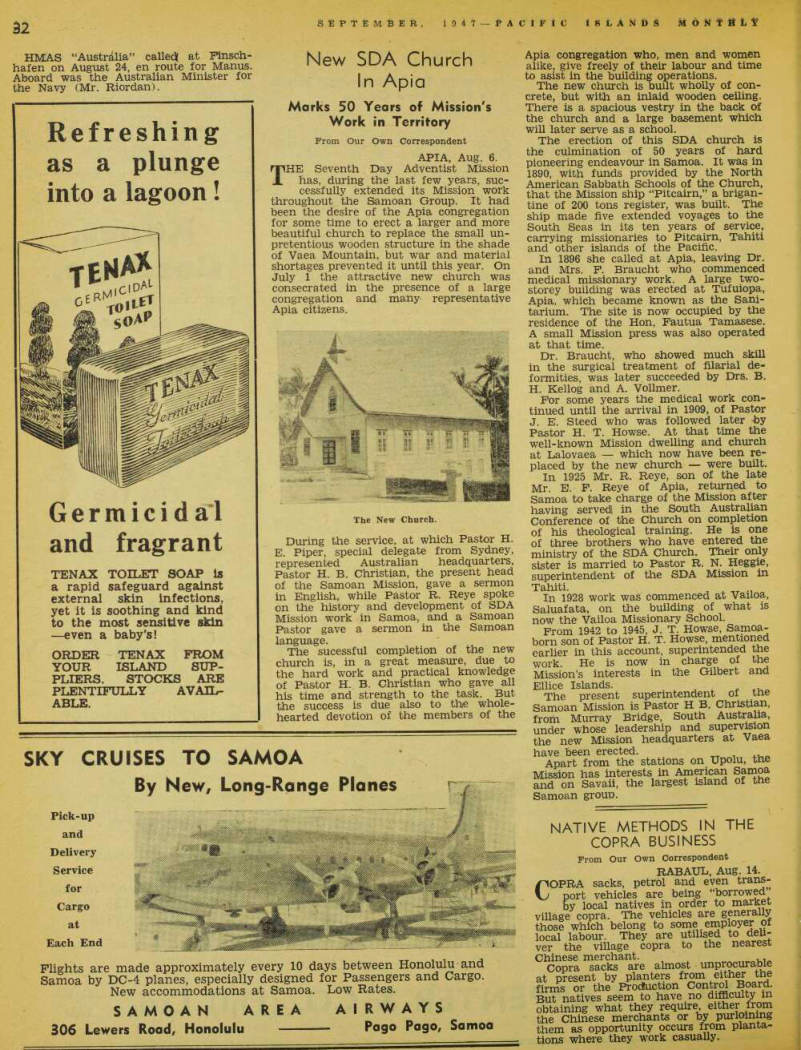
Headaches for Departmental Heads In Papua-New Guinea
From a Special Correspondent
Port Moresby, Aug. 26.
SENIOR officers at Administration head quarters, Moresby, have gone to earth. Reason is the annual report for the Trusteeship Council of the United Nations.
The Trusteeship Council has submitted a draft questionnaire for the compilation of reports, which runs into about 50 pages and covers every possible aspect of colo nial administration. Full answers to every part of the questionnaire would require a large research staff (which Papua-New Guinea has not got), years of effort and would produce something about the size of the Encyclopaedia Britannica.
Such a report would be valuable; but it seems likely that the report for the current year, as far as New Guinea is concerned, will have to be a compromise between pre-war sketchiness and post war verbosity.
It will be interesting to see, also, just how much is by-passed by other Trustee governments, under the excuse of lack of time and facilities.
It is understood that some of the questions are very pointed UNO is more concerned in obtaining an accurate Picture of the Territories than was the ermanent Mandates Commission of the League of Nations. But it is also likely that the individual Territories will be more concerned about their colonial re putations.
The sub-committee which drafted the UNO questionnaire was under the direc tion of Mr. E. W. P. Chinnery, formerly Director of District Services and Native
Affairs and Government Anthropologists in the Territory of New Guinea.
Mr. Chinnery knows all the questions.
It remains for the Trusteeship Territories to provide the right answers.
The Fiji Royal Gazette announces that Mr. A. W. Small has been granted a com mission as a justice of the peace in respect of the Northern District.
HMAS “Australia” calledf at Finsch hafen on August 24, en route for Manus.
Aboard was the Australian Minister for the Navy (Mr. Riordan).
Advertisements & other items, pp. 33-34 (2 items)
31
PACIFIC ISLANDS MONTHLt SkPTEMBEII. 194?
Ropes,
KANGAROO BRAND
Cordage,
and Twines for every purpose Backed by 86 years of service Manufactured by:
M. DONAGHY AND SONS,
Pty. Ltd., Geelong and Sydney.
Fiji Representatives:
PEARCE AND CO.
LIMITED
P.O. BOX 237, SUVA
a ij w
nri
■ n KMAtm.' %
We Supply all Types of
“CATERPILLAR”
MACHINERY
A Hyster Crane at Work on Suva Wharves.
WE ARE DISTRIBUTORS IN FIJI FOR
The Caterpillar Tractor
Company
Caterpillar Diesel Tractors Caterpillar Bulldozers Caterpillar Earth-movers Caterpillar Road Building and Maintenance Machines
ALL MADE BY “CATERPILLAR.”
'Hyster" Winches, Logging Arches and Equipment Tracson" Excavators for use with Caterpillar Tractors 'Caterpillar" Diesel Marine Engines, 34 to 135 BHP Continuous Rating Stocks of Spare Parts carried in Suva. Information available about Agricultural Implements Inquiries from anywhere gladly answered to suit Caterpillar Tractors.
W, R. CARPENTER & CO. (Fiji) Ltd.
SUVA
FIJI
Refreshing
as a plunge
into a lagoon!
c ida l
0E RN Io,tET
soap
B
Germi c i d a 1
and fragrant
TENAX TOILET SOAP is
a rapid safeguard against external skin infections, yet it is soothing and kind to the most sensitive skin —even a baby’s!
ORDER TENAX FROM
YOUR ISLAND SUP-
PLIERS. STOCKS ARE
PLENTIFULLY AVAIL-
ABLE.
SKY CRUISES TO SAMOA
Pick-up and Delivery Service for Cargo at Each End
By New, Long-Range Planes
m ■ Flights are made approximately every 10 days between Honolulu and Samoa by DC-4 planes, especially designed for Passengers and Cargo.
New accommodations at Samoa. Low Rates.
SAMOAN AREA AIRWAYS
306 Lowers Road, Honolulu Pago Pago, Samoa
In Apia
New SDA Church In Apia Marks 50 Years of Mission's Work in Territory
From Our Own Correspondent
Apia, Aug. 6.
THE Seventh Day Adventist Mission has, during the last few years, suc cessfully extended its Mission work throughout the Samoan Group. It had been the desire of the Apia congregation for some time to erect a larger and more beautiful church to replace the small un pretentious wooden structure in the shade of Vaea Mountain, but war and material shortages prevented it until this year. On July 1 the attractive new church was consecrated in the presence of a large congregation and many representative Apia citizens.
During the service, at which Pastor H.
E. Piper, special delegate from Sydney, represented Australian headquarters, Pastor H. B. Christian, the present head of the Samoan Mission, gave a sermon in English, while Pastor R. Reye spoke on the history and development of SDA Mission work in Samoa, and a Samoan Pastor gave a sermon in the Samoan language.
The sucessful completion of the new church is, in a great measure, due to the hard work and practical knowledge of Pastor H. B. Christian who gave all his time and strength to the task. But the success is due also to the whole hearted devotion of the members of the
Apia congregation who, men and women alike, give freely of their labour and time to asist in the building operations.
The new church is built wholly of con crete, but with an inlaid wooden ceiling.
There is a spacious vestry in the back of the church and a large basement which will later serve as a school.
The erection of this SDA church is the culmination of 50 years of hard pioneering endeavour in Samoa. It was in 1890, with funds provided by the North American Sabbath Schools of the Church, that the Mission ship “Pitcairn,” a brigan tine of 200 tons register, was built. The ship made five extended voyages to the South Seas in its ten years of service, carrying missionaries to Pitcairn, Tahiti and other islands of the Pacific.
In 1896 she called at Apia, leaving Dr. and Mrs. F. Braucht who commenced medical missionary work. A large two storey building was erected at Tufuiopa, Apia, which became known as the Sani tarium. The site is now occupied by the residence of the Hon, Fautua Tamasese.
A small Mission press was also operated at that time.
Dr. Braucht, who showed much skill in the surgical treatment of filarial de formities, was later succeeded by Drs. B.
H. Kellog and A. Vollmer.
For some years the medical work con tinued until the arrival in 1909, of Pastor J. E. Steed who was followed later by Pastor H. T. Howse. At that time the well-known Mission dwelling and church at Lalovaea which now have been re placed by the new church were built.
In 1925 Mr. R. Reye, son of the late Mr E. F. Reye of Apia, returned to Samoa to take charge of the Mission after having servedl in the South Australian Conference of the Church on completion of his theological training. He is one of three brothers who have entered the ministry of the SDA Church. Their only sister is married to Pastor R. N. Heggie, superintendent of the SDA Mission in Tahiti. , . „ In 1928 work was commenced at Vailoa, Saluafata, on the building of what is now the Vailoa Missionary School.
From 1942 to 1945, J. T. Howse, Samoa born son of Pastor H. T. Howse, mentioned earlier in this account, superintended the work. He is now in charge of the Mission’s interests in the Gilbert and Ellice Islands. . J . , .. 0 The present superintendent of the Samoan Mission is Pastor H B. Christian, from Murray Bridge, South Australia, under whose leadership and supervision the new Mission headquarters at Vaea have been erected.
Apart from the stations on Upolu, the Mission has interests in American Samoa and on Savaii, the largest island of the Samoan group.
The New Church.
Copra Business
Native Methods In The
From Our Own Correspondent
Rabaul, Aug. 14.
COPRA sacks, petrol and even trans port vehicles are being “borrowed by local natives in order to market village copra. The vehicles are generally those which belong to some employer of local labour. They are utilised to deli ver the village copra to the nearest Chinese merchant. Copra sacks are almost unprocurable at present by planters from either the firms or the Production Control Board.
But natives seem to have no difficulty in obtaining what they require either from the Chinese merchants or by purloining them as opportunity occurs from planta tions where they work casually.
Advertisements & other items, p. 34 (1 item)
32
SEPTEMBER, 1 9 4 t PACIFIC 1 8 L A N b S MOKf
Giant Snails
Numerous in Kokopo District, NG
THE snails released in New Britain by the Jap invaders as a source of food are now very numerous in parts of the Kokopo district, reports Mr. R. G.
Withy, who has returned to Australia after managing Mr. Oscar Rondahl’s plantation, Makurapau, for twelve months.
He brought with him a collection of snail shells. The largest is nearly 7 inches long, and is so hard that its pointed end will puncture a jeep tyre.
“Kabunga, Mr. Jack Reid’s plantation, three miles from my place, appears to have been one of the spots where the Japs released their pets and they cer tainly multiplied. are huge num bers of them about, of all sizes. They do a lot of damage to native taro, and kau kau, and similar cultivated plants.
“They do not travel fast we timed them, and we found that the average is 5 inches a minute but they do even tually arrive; and they now can be found everywhere, over a wide area.
“We have noticed, however, that they cannot live in the hot sun. They flourish in the cool, moist undergrowth; but they avoid clearings. As soon as they are exposed to the direct rays of the sun they just stretch out and die. Therefore, plantations that are kept properly cleared do not suffer. It is the native gardens that are in danger.”
Mr. Withy, who spent five years in the Solomons with Levers, has “given New Guinea away.” He declares that under present conditions, as created by the Wardist Administration, there is no place in the Australian Territories for private enterprise.
Dr. Bruce Sinclair, of the NG medical services, was in Sydney on holidays from the Territory in September.
Another "Alameda"
Memories of 50 Years Ago
MR. OSCAR G. NORDMAN, of Tahiti, writes interestingly: My old friend. Dan Mehigan, formerly purser on the liner “Monterey,” and now Assistant Claim Agent in the Matson office in San Francisco, informs me that the Matson Line has acquired the steamer liner “Shoshone.” and will rename her “Alameda.” in memory of an other liner of that name, once well known in San Francisco, Auckland and Sydney.
The old “Alameda” had quite a deal to do with the “good old days” in the South Pacific, Robert Louis Stevenson made many voyages on the “Mariposa” and “Alameda,” and several of his famous Vailima Letters were written on those ships. It was while he was travelling on the “Mariposa” that he gained a knowledge of Christmas Island, and of tales then current of great treasure cached there; and he is said to have then got the idea which later blossomed out as “Treasure Island.”
In those good old days, life in Honolulu, Auckland, Samoa and Tahiti revolved around the service provided by the “Mari posa” and “Alameda.”
Mr. T. L. Crawford sailed from Sydney on the “Montoro” in August to take up duties in Samarai. Papua, in the store section of Bums, Philp &* Co.. Ltd.
Amongst passengers on the August “Montoro,” for Rabaul from Sydney was Mr. H. C. Coldham on a visit to his plan tation at Bali Island, in the Witu group which is being managed by Mr. Harry (“Blue”) Murray. Mr. Coldham reports that his property is well on the way to good production and the labour situation is in hand.
Advertisements & other items, p. 35 (1 item)
William Atkins Ptjr. Ltd.
QUEENSLAND
INSURANCE
COMPANY
LIMITED
(Incorporated 1886 In Australia)
ASSETS EXCEED £4,000,000
Head Office :
QUEENSLAND
INSURANCE BUILDING,
80-82 PITT STREET, SYDNEY.
Speciolists in South Seas Fire,
Marine & Accident Insurances
Apply to:—
njL Branch Office: I. b. Chalmers, Manager.
Burns Phllp (South Sea) Co., Ltd.
VILA.
Burns Phllp (South Sea) Co., Ltd.
Comptoirs Francais Des Nouvelles Hebrides (Marine).
NOUMEA.
L. Si W. Johnston.
PORT MORESBY;
Burns, Phllp & Co., Ltd.
W. A. Anderson, Resident Officer.
PAGO PAGO.
Burns Phllp (South Sea) Co., Ltd.
Q. H. C. Reid Sc Co.
OTHER SOUTH SEA ISLANDS.
Burns Phllp (South Sea) Co., Ltd.
Also to any of the Company's Offices in Australia or New
Zealand.
William Atkins Ptjr. Ltd.
Head Office, 449-451 KENT ST., SYDNEY
Iron & Steel Merchants-Engineers' Supplies
Coach tr Motor Hardware
ESTABLISHED OVER 50 YEARS
STEEL DEPARTMENT
MILD STEEL;
Rounds, Squares, Flats, Half-rounds, Hexagons, Bevel, Shoeing, Tyre, Angles, Tees, Sheets, Plates, Girder Plates, Chequer Plates, Channels, Hoops, Etc.
BRIGHT STEEL:
Rounds, Squares, Hexagons.
Engineers' Supplies: Set Screws. Studs, Metal Thread Screws, Coach Screws, Files, Cotter Pins, Bright and Black Bolts, Rivets, Etc., Hack Saw Blades.
Power Transmission Gear: Including Plummer Blocks, Couplings, Collars.
Coach and Motor Hardware: Axles, Springs, Wheelstufl, Duck, Paints.
Farriers' Supplies: Horse Nails, Anvils, Vices, Etc.
Extra Special High Speed Tool Steel, Mining Steel, Blister Steel and Spring Steel, Rounds, Flats £r Squares.
Bar Iron—All sections and sizes.
Motor-Trimmers and Motor Builders' Cr Motor Painters' Requirements Pacific Island Agents: Corrie fir Co., Suva, Fiji DUCO Lacquers and DULUX Enamels—FAßßEX Motor Toppings and Leather Cloths, House & Decorators' Paints, Varnishes tj Brushware.
Sole Distributors of CHAMPION'S Decorators Paint Products.
Distributing Agents for BROLITE Lacquers, SYNFLEX Enamels and "POLYGLOSS" Finish.
Moresby
The Month In Moresby
From a Special Correspondent MORESBY is a melancholy town. The daily round comprises an endless exchange of grouches, of which August managed to conjure up all the old regulars: No water, no beer, no cigar ettes, little fresh food, no transport, no houses, temperamental houseboys, whim sical electricity supply, and so on.
This writer tried to seek solace in com munion with the waves; but the baths were invariably covered in oil and the tide was always out at Ela Beach.
Even the elements turned nasty. The Doldrums prematurely smothered the cool south-easters, and two ships were so fed up that they went aground rather than continue the struggle. “Ob that this too sullied flesh would melt! .
IIffIHILE melancholy Jaques sat on the MM beach and thus bemoaned the cost of living, a faint sound of hope echoed along the dismal shore from the direction of the Customs House. Jaques was incredulous. Could it be true? The local Deputy Prices Commissioner had reduced the price of petrol by 4Jd.! f* * * IYHE usual quota of visitors braved the local ague in the month just past.
Mr. E. P. Eltham, Director of Indus trial Training for the Department of Post-war Reconstruction, came to inspect the reconstruction training facilities. Rev.
A. Gardiner, General Secretary of the Methodist Overseas Mission in Australia, dropped off en route to Rabaul. He was Chief Chaplain in the RAAF during the war, and recently inspected the Fijian Mission field. Dr. Capell, the gifted lin guist and expert on New Guinea langu ages, passed through en route to the Highlands to study the local language structure. • • • THE Rev. Percy Chatterton is another linguist in the spotlight. Mr. Chat terton, a well-known member of the LMS, returned ofter 12 months’ leave in England to resume his work at Delena.
He is the accepted authority on the Motu language.
LOCALS were amused to hear that Mr.
Lemmon, the Commonwealth Minis ter for Works and Housing, plans to visit the Territory soon to inspect “major works projects” and to “investigate the possibility of finding timber for Austra
lian building work.” Reminds one of the needle in the haystack. • • • THE Anglican Ladies Guild is doing good work for the Church on the Hill. The ladies have conducted several highly successful street stalls at which the natives swoop on most lines before the stall has been opened many minutes. The Guild also conducted a successful fancy-dress ball, the first of its kind in post-war Moresby. The star of the evening though ignored by the diplomatic judges was a gentleman wearing nought but a stiff, white shirt front, a pair of trousers, a bell-topper, a monstrous gold watch chain, and the flamboyant badge of office of a “Hanua bada Village Councillor, 1950.”
Three generations of the John Lyons family shared the honours as a Jewish immigrant family, complete with parrot and cage.
POPULAR Mr. Bill Wyatt, manager of Gerald Smith’s store, is showing en terprise of a high order: on picture nights he provides a theatre bar, with drinks and sweets, which is very much patronised. He has also opened a new
Your Eye
The Twinkle in Your Eye
Comes From Active
Digestion
Good normal digestive and liver activity means good, normal health and fitness. If yov are becoming gloomy and feel tired out, the cause may be a congested state of your intes tinal tract. So many people are troubled with constipation, which, through the retention of waste in the digestive system, causes sick head ache, biliousness, pimply skin, unpleasant breath, irritability, slackness and dull eyes.
Regain your bright and attractive appearance by banishing constipation with Pinkettes. Tiny, perfectly harmless, gentle yet effective, these famous laxative and liver pills painlessly exercise and strengthen the bowels, keep the food tract clean and active, stir the liver, and thus banish sick headache, bilious attacks, pimples, un pleasant breath and gloom. All chemists and stores sell Pinkettes, the perfect laxative and liver pills.
bakery, and is finding it difficult to supply all the orders. fTIHE Education Department’s first film X screening in Hanuabada Village at tracted an audience of over 1,500.
The audience thoroughly enjoyed the show, but some of their reactions were unexpected.
A film of bearded primitives from Northern Australia, for instance, did not bring forth the fraternal sympathy one might expect. The Stone Age aborigines provoked uproarious laughter from the Corrugated-iron Age Hanuabadans, who considered them “all the same Koiaris,” the backward hill people behind Moresby.
One youth thought they must be the fierce Sepik natives someone had been telling him about.
THE Australian Minister for the Navy, Mr. Riordan, and Admiral Sir Louis Hamilton, spent the night at Govern ment House, Moresby, on their return trip from Manus to Australia. With “HMAS Warramunga” in port at the same time, the town took on quite a nautical air.
Advertisements & other items, p. 36 (1 item)
H. T. Allan, Barrett & Read
CASUARINA AVENUE, RABAUL
Licensed Customs Agents, Planters, General
Agents and Haulage Contractors, Managing
Agents, Deceased Estates
REPRESENTING:
Liverpool, London & Globe Insurance Co.
Aladdin Industries.
Derby & Co. (London).
Victor Hyde Sales Service (Stromberg-Carlson Radios, Metro Batteries, Relide Watches).
Morris Middleton & Co. (Sydney), Customs and Forwarding Agents.
Malvern Star Bicycles.
Tubulous Water Heaters.
Managing Agents'. M.V. “Talasea
DECEASED ESTATES.
We are prepared to inspect and report on Deceased Estates. Labour, Machinery and Management. Arrangements made for reopening and supervision of plantations.
I I
ALUMINIUM PAINT
The use of Alpaste Aluminium Paint for the exterior coating of roofs, tanks, buildings and other structures provides protection and preservation from the attack of salt atmospheres, smoke, moisture and the acid atmoshere of industrial regions. Alpaste Aluminium Paint’s exceedingly smart appearance can be preserved for long periods without attention.
FOR COMPLETE PROTECTION
AND PRESERVATION
ALUMINIUM UNION
LIMITED
Incorporated in the Dominion of Canada (A Member of the Aluminium Limited Group, Montreal, Canada Ocean House, 34 Martin Place, Sydney, N.S.W.
The largest distributors of aluminium and its alloys in the British Commonwealth * Registered Trade Mark
Polynesia
Peru's Impact On
Arguments Against a Theory
By A. C. Rowland
THE anthropologist who is floating in the sea between the coast of Peru and French Oceania is, in my opinion, trying to reproduce an event which did not happen.
The fact that the Inca road-builders had abandoned, and had eventually lost, the arts of ship-building and navigation, does not prove that the Peruvians of the pre-Inca Period were so ignorant that they did not know how to use the high way of the sea.
When railways were established in the United States, the craft of ship-building became almost a lost art: and river trans portation declined to the vanishing point.
The bulk of US overseas commerce was carried in ships flying the British flag.
The Gambier islanders—descendants of the great Polynesian navigators—had lost the art of canoe and shin-building when Europeans first visited that archipelago The expeditions from South America may have occurred five thousand or more years ago. Then, as in the case of the Polynesians, the memory and location of then: ancestral home-land may have faded from the knowledge of later gen erations, born and bred on the islands.
The average young person in the Western States of North America knows nothing and cares less about the State and town in the East whence his grand parents migrated three-quarters of a century ago. West of the Mississippi River the immortal Washington is re membered only as the boy who cut down «w«5 her] 7 tree ’ rather than as the “Father of His Country.”
The early Peruvians undoubtedly be- J« Ve A Q th i e i7 L f nd rT 2. f - the Sun -?°d to be In the West. Their expeditions were nnt b fn bl m,S ieS f t "i ed Primages that set thiir of Paradise; perhaps to offer their sacrifices and prayers for protection enemies menacing their nation irom the north.
The Maya of Yucatan (if my memory e l rr) h !? d the belief that their had . departed by sea to of . the Sun - an d would, fe y ’ return - The massive structures age !’ on,. Eas ter Island, represent some great petition to the Hosts of °n (what may in that far-off of 7 seel}5 ee1 considered) the out-post of the Land of the Sun.
A student should not lose sight of the fact that the very late period, when European exploration was undertaken, was an era of decline of many once highly developed civilisations in remote parts of the world. This has been especi ally true on the two continents of the Western Hemisphere. Only recently has serious study been given to that rich achaeological treasure-house.
I attended school with a gentleman of pure Spanish descent who was born in Yucatan, The complete disappearance of the Maya civilisation and the condition of the modern Maya—as he has described it —is a perfect example of what hap pened to the pre-Inca Peruvian, his culture and his language.
A recent letter from my old friend indicates that the modem citizen of Mexico has come to regard Cortez and the Conquistadors as a minor incident, compared with the ATA avalanche. The city of Mexico, apparently, has become the Whoopee Capital of the World.
Mrs. E. M. McDonald has taken up duties as housekeeper in the Port Moresby Hotel, Papua.
Advertisements & other items, pp. 37-38 (2 items)
35
PACIFIC ISLANDS MONTH L Y SEPTEMBER, 1947
Day-Old
Chicks
BY AIR
A MALGAMATED
(Reg.) of Bankstown, near Hatcheries Sydney,’ N.S.W., can limited numbers of chicks dispatch
PLANE TO
RABAUL, PORT MORESBY,
LAE, NOUMEA, SUVA.
and all other islands of the Pacific served by present AND PROJECTED air services.
Amalgamated Hatcheries are the largest distributors of dayold chicks in Australia, last year over 1,000,000 chicks being sold by us in N.S.W. alone.
Our scientific method of packing and dispatch has resulted in a loss of less than 1 per cent, of chicks sent by plane.
If any chicks in your consignment arrive dead, we will replace them frees provided the extra freight is paid by the purchaser.
Chicks available are R.1.R., Austrolorps, and W.L.
Price, £lO per 100, landed at your airport, for unsexed chicks, and £l4 per 100 for all pullets. (Guaranteed 96 per cent, accurate sexing.) These chicks are the cream of Australia’s stock, produced under ultra - violet rays to guard against disease; the adult stock is blood-tested monthly by veterinary officers and each individual order carries a NJS.W Government certificate that the chicks are healthy and from tested stock.
Payment for chicks should be made by draft with the order, or credit arranged through our Bankers, the Commercial Bank of Australia, Ltd., Bankstown,
N.S.W.
Drafts and remittances can be sent direct to Amalgamated Hatcheries, Bankstown, N.S.W., or to the following agents: Messrs. Burns, Philp (South Sea) Co..
Suva-Ba-Fiji, or any Island Branch. Also to: Marcel Legras, 38 Rue de Verdun, Noumea.
WRITE BY AIR-MAIL OR
CABLE.
AMALGAMATED
HATCHERIES
BANKSTOWN, N.S.W.
Kidney Trouble
and Backache
Gone in 1 Week
Flush Kidneys With Cystez and Ton’ll Feel Fine Cystex—the prescription of a famous doctor —improves faulty kidney action In double quick time, so, if you suffer from Rheumatism, Sciatica, Neuritis, Lumbago, Backache, Nervousness, Leg Pains, Dizziness, Circles under Eyes, frequent Headaches and colds, poor Energy and Appetite, Puffy Ankles or Interrupted Sleep, go to your chemist to-day for Cystex.
Cystex Helps Nature 3 Ways
The Cystex treatment Is highly scientific, being specially compounded to soothe, tone and clean kidneys and bladder and to remove acids and poisons from your system safely, quickly and surely, yet contains no harsh, harmful or dangerous drugs. Cystex wo-ks In these 3 ways to end your troubles:— (1) Starts killing the germs which are attacking your Kidneys, Bladder and urinary system In two hours, yet Is absolutely harmless to human tissue. (2) Gets rid of health-destroying, deadly poisonous acids with which your system has become saturated. (3) Strengthens and reinvigorates the kidneys, protects you from the ravages of diseaseattack on the delicate filter organism, and stimulates the entire system.
Feels a Different Woman
“I have been taking Cystex for Kidney and Bladder trouble and it has made a different woman of me. I am feeling splendid, ean do all my work, run about and walk miles although I am 63 years of age. Cystex does all you claim for it.”— (Sgd.) M. L. Zessln, Thompson Estate, Brisbane.
Now Able to Walk Without Stick ‘T had Kidney and Bladder complaint, pains n leg and back; in fact, I had to use a walking stick. I have used two bottles of Cystez, now I have no pains anywhere. I consider Cystex the greatest medicine in the world for Kidney complaint.”—(Sgd.) J. McPherson, Nangenbone Station, N.S.W.
Guaranteed to Satisfy or Money Back
Get Cystex from your chemist to-day. Give 1* * thorou f h test. Cystex Is guaranteed to make you feel younger, stronger, better In «very way, or your money back If you return the empty package. Act now!
Now in 2 sizes—4/-. 8/-.
This is a
GUARANTEED [TVCI'PV
Treatment ™
for Your Kidneys, Bladder, Rheumatism
TILLEY LAMP:
BURN ORDINARY KEROSENE
The Modern Form of PORTABLE LIGHTING
PRODUCTION FOR EXPORT
WE ARE PLEASED TO INFORM OUR
FRIENDS OVERSEAS OF NEW AND
IMPORTANT PREMISES ACQUIRED TO
FACILITATE PRODUCTION FOR EXPORT.
ALSO OUR POST-WAR MODELS ARE
NOW IN FULL PRODUCTION AND WILL
BE ON OFFER IN ALL PARTS OF THE
WORLD. TILLEY STANDARDS ARE MAIN-
TAINED AND INCORPORATED IN COM-
PLETELY MODERN DESIGNS OF LAMPS
BRENT WORKS, NEW BRENT WORKS,
HENDON, N.W.4 CRICKLEWOOD, N.W.2.
THE TILLEY LAMP CO. LTD., of ENGLAND London Offices and Showroom = 33 SACKVILLE STREET, PICCADILLY, W.l.
REPRESENTATION :
MELBOURNE ; T. H. Bentley, Pty. Ltd., 123-125 William Street, Melbourne. Cl.
TASMANIA ; Mr. C. Sellars, 108 a Charles Street, Launceston.
FIJI ; Mr. K. Witherington, 2 Burns Philp Buildings, Suva.
New Coledonia

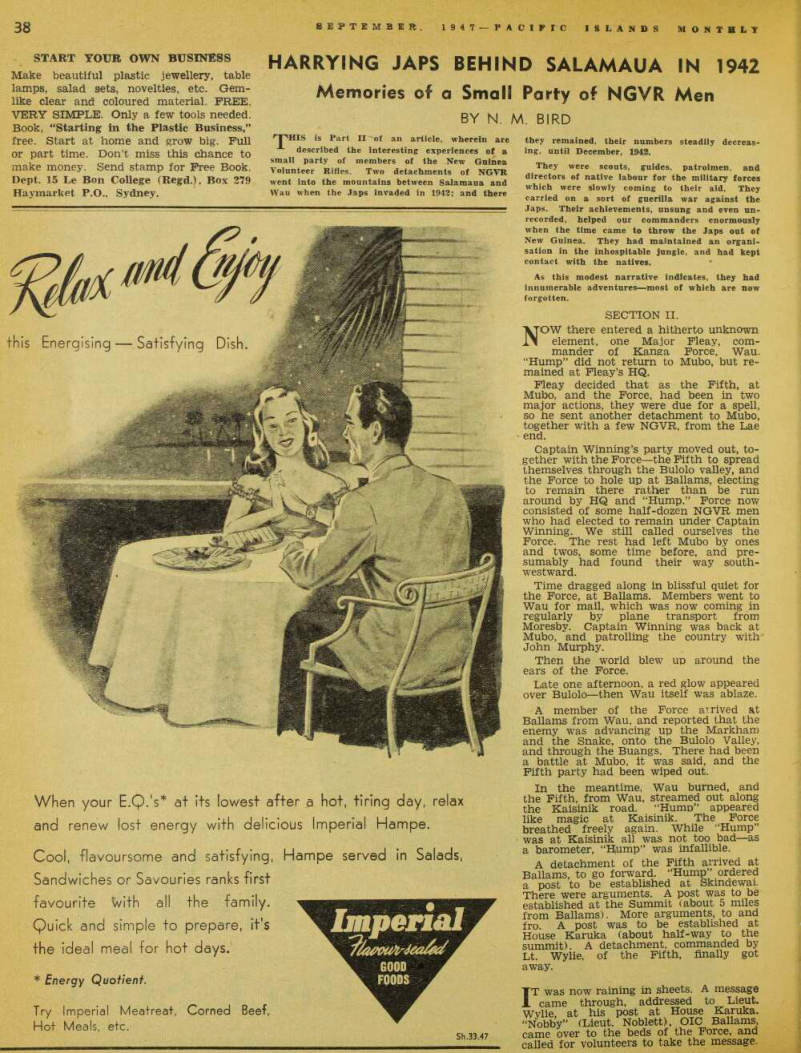
Discontent in
Resentment at Continued Rule and Tax Levies From Metropolitan France
POLITICAL restlessness in the French Pacific possessions is not confined to French Oceania (“PIM” August). In New Caledonia a movement for a larger measure of self-government is gaining ground, due to the fact that promises of decentralisation of government have not been promptly honoured by metropolitan Prance.
In early October, 1946, the French National Assembly decided that, after July 1, 1947, the colonial Councils-General would have greater powers in administer ing the territories they represent. At the time, there were howls of protest from the local assemblies that the old curtailment of their power should drag on for that length of time, and energetic protests were made. Nothing was done, however; and now that July 1. 1947, has come and gone without any move from Paris, the general opinion is that it is high time that some concrete action was taken.
Noumea’s newspaper “Bulletin de Com merce” says: “It is promised that the powers of local assemblies are no longer to be determined by decrees . . . We are awaiting the law which will determine our New Caledonian liberties and will state under what terms the representa tives of the population will be free to administer their country. Will this law conform in spirit and in letter to Article 87, which states that overseas territories are to be administered freely by Councils elected by universal suffrage or will it be
limited once more to one of those dilatory and ambiguous texts which will allow the offices of the Rue Oudinot (in Paris) to hold us on a leash like the little pom eranian dog that trots behind the Mar quise on the Parisian boulevards?
“New Caledonia can no longer be con sidered a political minor. The fact that this colony is the only one peopled by French people in the French Empire, as well as the normal evolution of events, justifies the granting of a more liberal constitution.”
"VIEW CALEDONIAN residents have re cently been angered by a law im posed upon them by Metropolitan France whereby they will be liable for five million francs per year for a ten year period (beginning this year) as a contribution to damages suffered by the French Union during the war. This 50 million francs levy, which has been im posed without their consent, will be paid by the 22,000 taxpayers of the Colony.
Another grievance of colonists is the long leave given to French officials, at the colonists’ expense. It is pointed out that New Caledonia is a healthy country, and that it is therefore unnecessary for officials to be given six months’ leave every two years six months which stretches into 10 months, with travelling time between Noumea and France.
New Caledonia is hoping to establish a spa in the Valley of Crouen, near Canala (east coast) New Caledonia, where there are some sulphur springs. An in vestigation committee has reported fav ourably to the General Council which supports the plan. A doctor is to study the region and money is likely to be set aside for a 15-room hotel.
Start Your Own Business
Make beautiful plastic jewellery, table lamps, salad sets, novelties, etc. Gem like clear and coloured material. FREE.
VERY SIMPLE. Only a few tools needed.
Book, “Starting in the Plastic Business,” free. Start at home and grow big. Full or part time. Don’t miss this chance to make money. Send stamp for Free Book.
Dept. 15 Le Bon College (Regd.), Box 279 Haymarket P. 0., Sydney.
Advertisements & other items, pp. 39-40 (1 item)
Heinz
in For Inflamed Eyes and Eyelids ... Sold Everywhere H. Rose & Co.. Pty_ Ltd.. Kinq Street. Sydney.
We Will Buy
It For You
Any goods you may require from English shops or factories Purchased and Shipped.
Small or large orders catered for.
ALL SERVICES UNDER-
TAKEN FOR RESIDENTS
ABROAD.
PITT & SCOTT
LIMITED
I Established 1876) General Shipping and Buying Agents. 1/3, St. Paul's Churchyard, London, England Cables. Shipping London.
J ■
WIN*
eSTD 1869
BRAISED
STEW
VARIETIES
Braised
Taste it yourself, first opportunity.
It’s delicious tip-top Heinz quality. Present nation - wide advertising campaign will link up with Counter and Window displays. Your customers will want Heinz Braised Beef Stew. It’s good business to be well stocked.
HEINZ
57 ITl**
Beef Stew
HBSISn
this Energising Satisfying Dish. k * J&; \ When your E.Q.'s* at its lowest after a hot, tiring day, relax and renew lost energy with delicious Imperial Hampe.
Cool, flavoursome and satisfying, Sandwiches or Savouries ranks first favourite with all the family.
Quick and simple to prepare, It's the ideal meal for hot days. * Energy Quotient.
Try Imperial Meatreat, Corned Beef, Hot Meals, etc.
Hampe served in Salads,
Imperial
5h.33.47
Harrying Japs Behind Salamaua In 1942

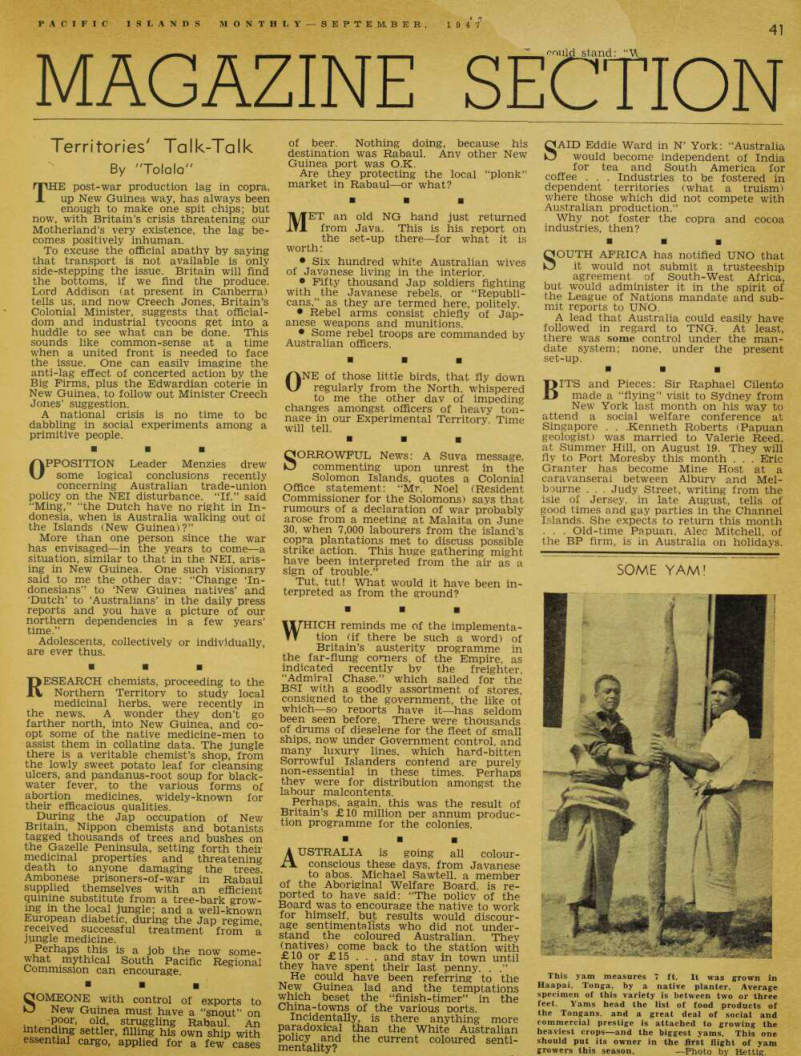
Memories of a Small Party of NGVR Men
By N. M. Bird
r I A HIS is Part II of an article, wherein are described the interesting experiences of a small party of members of the New Guinea Volunteer Rifles. Two detachments of NGVR w'ent into the mountains between Salamaua and Wau when the Japs invaded in 1942; and there
they remained, their numbers steadily decreas ing, until December, 1942.
They were scouts, guides, patrolmen, and directors of native labour for the military forces which were slowly coming to their aid. They carried on a sort of guerilla war against the Japs. Their achievements, unsung and even un recorded, helped our commanders enormously when the time came to throw the Japs out of New Guinea. They had maintained an organi sation in the inhospitable jungle, and had kept contact with the natives.
As this modest narrative indicates, they had innumerable adventures—most of which are now forgotten.
Section 11.
NOW there entered a hitherto unknown element, one Major Fleay, com mander of Kanga Force, Wau.
“Hump” did not return to Mubo, but re mained at Fleay’s HQ.
Fleay decided that as the Fifth, at Mubo, and the Force, had been in two major actions, they were due for a spell, so he sent another detachment to Mubo, together with a few NGVR, from the Lae end.
Captain Winning’s party moved out, to gether with the Force —the Fifth to spread themselves through the Bulolo valley, and the Force to hole up at Ballams, electing to remain there rather than be run around by HQ and “Hump.” Force now consisted of some half-dozen NGVR men who had elected to remain under Captain Winning. We still called ourselves the Force. The rest had left Mubo by ones and twos, some time before, and pre sumably had found their way south westward.
Time dragged along in blissful quiet for the Force, at Ballams. Members went to Wau for mail, which was now coming in regularly by plane transport from Moresby. Captain Winning was back at Mubo, and patrolling the country with John Murphy.
Then the world blew up around the ears of the Force.
Late one afternoon, a red glow appeared over Bulolo —then Wau itself was ablaze.
A member of the Force arrived at Ballams from Wau, and reported that the enemy was advancing up the Markham and the Snake, onto the Bulolo Valley, and through the Buangs. There had been a battle at Mubo, it was said, and the Fifth party had been wiped out.
In the meantime, Wau burned, and the Fifth, from Wau, streamed out along the Kaisinik road. “Hump” appeared like magic at Kaisinik. The Force breathed freely again. While “Hump” was at Kaisinik all was not too bad —as a barometer, “Hump” was infallible.
A detachment of the Fifth arrived at Ballams, to go forward. “Hump” ordered a post to be established at Skindewai.
There were arguments. A post was to be established at the Summit (about 5 miles from Ballams). More arguments, to and fro. A post was to be established at House Karuka (about half-way to the summit). A detachment, commanded by Lt. Wylie, of the Fifth, finally got away.
IT was now raining in sheets. A message came through, addressed to Lieut.
Wvlie. at his post at House Karuka.
“Nobby” (Lieut. Noblett), QIC Ballams, came over to the beds of the Force, and called for volunteers to take the message.
Beds creaked —but no one was hurt in the rush. Finally, Archie Graham, amid a few pithy comments, volunteered to go.
Archie’s friend (me) spoke up to say that Archie was not fit to be trusted alone on such a night, or any other night, and that he’d go with Archie, to look after him.
The Force held a hurried conference and made plans to be effective in certain circumstances, and the pair set out for House Karuka, with a lighted lantern.
Both knew the location of House Karuka, and the turn-off could not be missed, even on such a night as this. A large Karuka palm grew beside the road, and one large root arched out over the road at barely head height.
The pair slipped and floundered along the road in the pouring rain, with the lighted lantern —this last to give Wylie’s sentry, on the road warning of their approach. (Wylie’s detachment were rather trigger-happy). The turn-off was reached, after the pair had fallen on the lantern, crushing it into the mud.
There was no sentry. We debated the. advisability of climbing up to the house, with the possibility of being shot by Wylie’s party. We decided to push on to the Summit, sleep, and return to look for the sentry at daylight.
Reaching Summit, we found the house occupied by one lone and scared native.
He had come from Mubo the previous day.
The pair slept, and arose betimes to greet a pair of Wylie’s men, sneaking along the road. They seemed surprised to see the pair—they had expected Nips.
One of Wylie’s men had heard Nippon drilling at the Summit in the early morn ing.
THE rest of the Force arrived —all five of them. We decided to push on to Skindewai, to give whatever assistance was possible to men of the Fifth now coming up from Mubo.
Some distance along the road, the Force met a long fine of native carriers, and two Vickers guns were among the loads carried. We pushed on, passing numbers of the Fifth and had word of Lieutenants Hicks and Demerick. We reached Skindewai, to find more of the Fifth arriving, and pulling out for Ballams, but Dick Demerick had not arrived.
The Force decided to sleep at Skinde wai and go forward to find Demerick in the morning.
However, Dick came in late p.m., with the true story of the evacuation of Mubo.
There had been no fight, and no Nips.
Someone —to this day unidentified —had spread the alarm that the place was sur rounded by Nips—and the Fifth just went away from them.
The Sgt. i.c. (Vickers) at Gadagasul was located and questioned, and con gratulated on getting his guns out. He stated that those seen bv the Force were not his; they were from Mubo. His were at Gadagasul, in the pits, covered with water-proof sheets—he had had no time to get them out, so he took out the locks and threw them away.
The Fifth now were all accounted for, and they left for Ballams next morning.
The Force gathered up what stores had not been trampled into the mud and hid them in the bush, returned to Ballams — to hear of the flight of transports which had arrived from Moresby and circled the drome. But they could not land —our men had blown a lot of holes in the drome before they left.
The retreat to Moresby was checked.
Major Fleay returned to a ridge above Kaisinik and made camp, collecting his scattered troops, and later reoccupying what was left of Wau. “Hump” was still at Kaisinik. The Force smiled, their faith in his powers as a barometer justified.
THE Force remained at Ballams. Wylie brought his men in from House Karuka.
A couple of days passed. Major Fleay ordered a post to be established at Skin dewai, and he said that the Force were to go forward and set up an OP at Mubo.
The Fifth moved to Skindewai, accom panied by the Force.
Archie Graham and Fred Leather went down to the saddle, followed by this writer, with a few natives, salvaging gear from the road, where it had been dropped by the “retreating” Fifth.
Archie and Fred reached the Saddle without seeing any sign of Nippon. They were met at the hospital above the Saddle by this writer. Archie and Fred decided to sleep at the hospital and go to Mubo in the morning. The writer returned to the house at Gadagasul with his loaded natives, reaching it at dark, in pourmg rain. , , Having no change, I peeled my clothes off and gave them to the natives to dry, and seating myself on a box, thought fully pulled close to the fire by the natives. I suddenly realised the nature of the box and opened it. It was a Vickers spare-parts box—one of a pair in
(Continued on page 51)
the house—filled with the usual spare parts for Vickers, including spare bolts.
I visited the guns next morning. They were in good condition under their water proof covers, only the locks being miss ing. So the Sgt. i.c. Vickers had been right; he had thrown the locks away. I returned to Skindewai next day and carried in the salvaged gear, and carried on with this job for some days after.
Archie and Fred went on to Mubo, to see Nippon occupy Mubo.
Nippon seemed unable to believe his luck, and was very suspicious. The last time he had seen Mubo, he got the father of a thrashing.
Archie and Fred returned to Skindewai and reported, and moved out again to establish an OP behind Mubo. at Nippon’s back door, just across the Buiapal Creek and on the slope of the Mat Mat ridge.
The other end of the ridge was occupied by Nippon, in our Force’s old Vickers position. I was left to run supplies to the Force.
The Force now consisted of Archie Graham, Geoff White, Bruce Frazer, Gordon Kinsey. Albert Pauley, Fred Leather and this writer.
A VICKERS was set up at Wrights Creek, about half an hour’s walk from Skindewai, and the Fifth sent a party every day to man it. The war commenced at 7 a.m. sharp, and ended at 5 p.m., when the Fifth returned to Skindewai for food and sleep, taking the lock of the Vickers with them to prevent Nippon breaking any rules as to when the war should start. Overtime was strictly taboo.
Leaving Skindewai behind and pro ceeding warily (the Vickers party had an unhappy habit of setting booby traps on the track when they came in at night) the writer set out with a load of supplies for the Force.
Passing the Vickers’ post, I was asked if I had brought the lock for the Vickers I had not.
Returning hurriedly in the afternoon— to get in before the Fifth set their booby traps—l called out and asked who had been the bunny to go back for the lock.
No answer. A shrewd suspicion was satisfied when I climbed up to the gun and investigated. There was no lock' The fifth now discarded the Vickers and ‘ set up a post at the house at Gadagasul (the house of the Vickers’ Spare Parts) This post was manned by a party who were relieved every seven days Nippon paid a visit, but the Fifth were absent. Nippon left things as he found them, except to move a booby trap to another position. Luckily, this was located and no one was hurt.
Captain Winning had been at Busama when Mubo was evacuated, and now he returned to Bulwa via the Buangs but -“e was laid UP with very bad feet. He later came to Skindewai. and prepara tions were made for a raid on Mubo.
COLONEL FLEAY (he had been pro moted) came to Skindewai (his furthest move to date) and mud maps were made to help him grasp the details of the area. In spite of protests by Norm Winning and others, including the Force he ruled that the attack must be made from the main road, the raiding twtof y iv/r 3 , se P a **ate at the turn-off to the Mat Mat, half to go on to Mubo, the others to go up the zig-zag to the Mat Mat. Both parties were to be covered bv Bren gunners on Vickers Ridge. Both at tacks were to be made upljill The party moved in. Reaching the tum off to the Mat Mat zig-zag, the oartv 5 unJP’nSS ?’S eill 0f the Fifth. tetS Lt. and MM) taking the party for Mubo, \
and Pleay himself in command of Mat Mat party.
Billy Drysdale (Lt. of the Fifth) who was leading, stepped on a land mine, and was blown into the air. The party pulled Bill to the side of the track, where his wounds were dressed. Matey (one of Drysdale’s men) walked onto a second mine, on the first lap of the zig zag Luckily, he was blown clear and not seri ously hurt.
Nippon swarmed like a bee-hive, and Colonel Fleay yelled that the party was off and went along the Waipali road, followed by some of the Fifth Norm Winning, with what he had left of his party, carried Bill out and got him over the Bitoi bridge. Bill O’Neill in the meantime, checked the Japs on the main road, with a bitter fire.
The writer picked up Bill Drysdale, with the few natives he had with him to carry spare ammunition, and got him to the Saddle Here Captain Winning set up a l Ll pP t - O’Neill’s party get a U P fbc road to Gadagasul.
The Japs caught up with us, and there was a brief brush at the Saddle. The natives who were carry j on. Later they moved out d6d Loyalty Medals - The Fifth Lieut. Drysdale died a while later, while being carried. The writer and his natives 111I 11 ? 1 01 P Gadagasul, near a Pho™ baniboo, digging his grave with sharpened sticks and one small knife.
We caught up with the Fifth at Skinde wai, and a conference was held and heads counted. Drysdale was dead, two were wounded and Fleay was missing. He was o ca ‘ ed m m l I? 3 ? later by a selrch paTty C ?, t —t l6 had taken the old the Gadtgaluf trail Wa ‘ Pali> inStead of Op he TS r °livH, ma T in S d at „ Mubo in the arrived in w£, J nde f> end ent Co. now MajOTMa“adS UPder COmmand of TT was now decided that a small party A go to some point between Mubo and Komiatum, and clean up a Nip patrol or two, including any enemy supply 3 lines that might come along. y
The whole area raised its eyebrows was* to'comprise* 5 Captain Norm 1 Winning Major Macadle, the Major’s batman Lieut. Dick Demerick, a sergeant from the * L
Sixth, another from the Fifth, and the writer.
This suicide party duly left, and camped beside a small creek on a hillside below Waipali. During that night it rained.
Sheets of water swept down the hillside and washed out the suicide party.
Next morning, after a debate, it was decided to cross Waipali Bridge in the afternoon, when there was small chance of our being seen by a Nip patrol. Gear was dried during the wait, and the party moved out, following the small creek to the Bitoi. This creek had been washed out, twenty feet wide, by the heavy rain the previous night.
The Bitoi was found to be a raging torrent, with logs and rafts of debris be ing swept along. The bridge was gone.
Major Macadie had complained of a sore throat the previous day. I diagnosed his trouble as MUMPS.
It was decided to try to fell a tree across a narrow place in the gorge, while I went higher up, to try and locate an old bridge I had known there, years before.
Leaving a few natives to hack at the selected tree with one small tomahawk, I moved up the gorge—to meet there a native, with a written message from Geoff White, stating that Nippon had located their OP and had chased out the Force, which was now at Waipali.
I returned to the others with the sad news, and it was decided to move up to Waipali and hear the full story, to await the falling of the flood in the Bitoi, and to give Mac’s mumps a chance to settle down.
At Waipali, a conference was held, and it was decided to call off the suicide stunt and return to Skindewai. In a couple of days, Major Macadie was able to move around, and the party (now including the Force) left for Skindewai.
HERE, a further conference decided to abandon Skindawai as a forward camp. The houses were demolished, and our complete party left for Wau. It was now mid-December, 1942.
In Wau, the Force met many NGVR from Lae end, enroute to Australia on leave.
The Force accommodated itself in Bernard Smith’s house, and dreamed dreams of leave “South” and daily fare welled the NGVR who were being taken out by air transport to Moresby.
But it wasn’t as easy as that. Colonel Fleay objected strongly to the NGVR go ing out; and when the Force was all that remained of the NGVR, he posted an order that no more were to leave the area. Marsden, medico for Kanga Force, and MacCracken, of the Sixth, responded nobly—and the last of the Force gaily entered transports for Moresby, and their well-earned leave “South.”
All, that is—alas and alas —but the writer. He remained, to hear later of the disbanding of the NGVR.
The Battle of Wau has already been well described. The Force had no part in it. It is not their story.
So ended the Force. It was a sad, mad, ill-fed, ill-clad and undisciplined rabble, maddened by frustration, who climbed mountains, swam rivers and waded swamps in all weathers, day or night; who performed, more or less cheerfully, the jobs allotted them. Now, their ex ploits are forgotten and unsung. Vale, the Force.
Advertisements & other items, pp. 40-42 (2 items)
38
SEPTEMBER, 1947 PACIPTC ISLANDS MONTHLY
You'll always
get the best
\aav
from the
PLUME
m
pump
A m Today, Plume is the best motor spirit you can buy. And as soon as world conditions permit, the Plume Pump will lead in serving the highest quality motor spirits, made by revolutionary methods developed by the world’s largest research staff. So form the habit now of going to the Plume Pump, where you'll always get the best motor spirit.
VACUUM
QUALITY PRODUCT^
VACUUM OIL COMPANY PTY. LTD. [Incorporated in Australia]
COMPLEXION PERFECTION
WITH
BEAUTY
PREPARATIONS
FOR
DISCRIMINATING WOMEN
WHO DESIRE
ALLURING LOVELINESS
Obtainable At All Stores.
Distributor:
GORDON K. SMITH
Beverley Hills, Sydney Bankers: Bank of N.S.W.
OVER 25
YEARS OF
PAIN
f
SWIFT 3-WAY RELIEF
j From HEADACHE and Nerve and Muscular Pain!
Vincent’s A.P.C Powders and Tablets * *are a combination of three valuable medicinal ingredients and bring swift 3-way relief! Vincent’s A.P.C is prepared to the original hospital prescription containing Aspirin to relieve pain, Phenacetin to reduce temperature, Caffeine to stimulate the nervous system. Vincent’s A.P.C quickly relieves Headache, and all nerve and muscular pain!
VWC|
■poirsASQS
NT C c
POWDERS & TABLETS
Magazine Section
Territories' Talk-Talk
By "Tolala"
THE post-war production lag in copra, up New Guinea way, has always been enough to make one spit chips; but now, with Britain’s crisis threatening our Motherland’s very existence, the lag be comes positively inhuman.
To excuse the official apathy by saying that transport is not available is only side-stepping the issue. Britain will find the bottoms, if we find the produce.
Lord Addison (at present in Canberra) tells us, and now Creech Jones. Britain’s Colonial Minister, suggests that official dom and industrial tycoons get into a huddle to see what can be done. This sounds like common-sense at a time when a united front is needed to face the issue. One can easily imagine the anti-lag effect of concerted action by the Big Firms, plus the Edwardian coterie in New Guinea, to follow out Minister Creech Jones’ suggestion.
A national crisis is no time to be dabbling in social experiments among a primitive people. ■ ■ ■ OPPOSITION Leader Menzies drew some logical conclusions recently concerning Australian trade-union policy on the NEI disturbance. “If,” said “Ming,” “the Dutch have no right in In donesia, when is Australia walking out of the Islands (New Guinea)?”
More than one person since the war has envisaged—in the years to come—a situation, similar to that in the NEI, aris ing in New Guinea. One such visionary said to me the other day; “Change ‘ln donesians” to ‘New Guinea natives’ and ‘Dutch’ to ‘Australians’ in the daily press reports and you have a picture of our northern dependencies in a few years’ time.”
Adolescents, collectively or individually, are ever thus. ■ ■ ■ RESEARCH chemists, proceeding to the Northern Territory to study local medicinal herbs, were recently in the news. A wonder they don’t go farther north, into New Guinea, and co opt some of the native medicine-men to assist them in collating data. The jungle there is a veritable chemist’s shop, from the lowly sweet potato leaf for cleansing ulcers, and pandanus-root soup for black water fever, to the various forms of abortion medicines, widely-known for their efficacious qualities.
During the Jap occupation of New Britain, Nippon chemists and botanists tagged thousands of trees and bushes on the Gazelle Peninsula, setting forth their medicinal properties and threatening death to anyone damaging the trees.
Ambonese prisoners-of-war in Rabaul supplied themselves with an efficient quinine substitute from a tree-bark grow ing in the local jungle; and a well-known European diabetic, during the Jap regime received successful treatment from a jungle medicine.
Perhaps this is a job the now some what mythical South Pacific Regional commission can encourage. ■ ■ ■ SOMEONE with control of exports to New Guinea must have a “snout” on . P9°r, old, struggling Rabaul. An intending settler, filling his own ship with essential cargo, applied for a few cases
of beer. Nothing doing, because his destination was Rabaul. Any other New Guinea port was O.K.
Are they protecting the local “plonk” market in Rabaul —or what? ■ ■ ■ MET an old NG hand just returned from Java. This is his report on the set-up there —for what it is worth: • Six hundred white Australian wives of Javanese living in the interior. • Fifty thousand Jap soldiers fighting with the Javanese rebels, or “Republi cans,” as they are termed here, politely. • Rebel arms consist chiefly of Jap anese weapons and munitions. • Some rebel troops are commanded by Australian officers. ■ ■ ■ ONE of those little birds, that fly down regularly from the North, whispered to me the other day of impeding changes amongst officers of heavy ton nage in our Experimental Territory. Time will tell. ■ ■ ■ SORROWFUL News: A Suva message, commenting upon unrest in the Solomon Islands, quotes a Colonial Office statement: “Mr. Noel (Resident Commissioner for the Solomons) says that rumours of a declaration of war probably arose from a meeting at Malaita on June 30, when 7,000 labourers from the island’s copra plantations met to discuss possible strike action. This huge gathering might have been interpreted from the air as a sign of trouble.”
Tut, tut! What would it have been in terpreted as from the ground? ■ ■ ■ 11THICH reminds me of the implementa ▼ ? tion (if there be such a word) of Britain’s austerity programme in the far-flung comers of the Empire, as indicated recently bv the freighter “Admiral Chase,” which sailed for the BSI with a goodly assortment of stores, consigned to the government, the like ot which—so reports have it—has seldom been seen before. There were thousands of drums of dieselene for the fleet of small ships, now under Government control, and many luxury lines, which hard-bitten Sorrowful Islanders contend are purely non-essential in these times. Perhaps they were for distribution amongst the labour malcontents.
Perhaps, again, this was the result of Britain’s £lO million per annum produc tion programme for the colonies. ■ ■ ■ AUSTRALIA is going all colour conscious these days, from Javanese to abos. Michael Sawtell. a member of the Aboriginal Welfare Board, is re ported to have said: “The policy of the Board was to encourage the native to work for himself, but results would discour age sentimentalists who did not under stand the coloured Australian. They (natives) come back to the station with £lO or £l5 . . . and stay in town until they have spent their last penny. . .”
He could have been referring to the New Guinea lad and the temptations which beset the “finish-timer” in the Chum-towns of the various ports.
Incidentally, is there anything more paradoxical than the White Australian policy and the current coloured senti
mentality?
SAID Eddie Ward in N’ York: “Australia would become independent of India for tea and South America for coffee . . . Industries to be fostered in dependent territories (what a truism) where those which did not compete with Australian production.”
Why not foster the copra and cocoa industries, then? ■ ■ ■ SOUTH AFRICA has notified UNO that it would not submit a trusteeship agreement of South-West Africa, but would administer it in the spirit of the League of Nations mandate and sub mit reports to UNO.
A lead that Australia could easily have followed in regard to TNG. At least, there was some control under the man date system; none, under the present set-up. ■ ■ ■ BITS and Pieces: Sir Raphael Cilento made a “flying” visit to Sydney from New York last month on his way to attend a social welfare conference at Singapore . . .Kenneth Roberts (Papuan geologist) was married to Valerie Reed, at Summer Hill, on August 19. They will fly to Port Moresby this month . . . Eric Granter has become Mine Host at a caravanserai between Albury and Mel bourne . . . Judy Street, writing from the isle of Jersey, in late August, tells of good times and gay parties in the Channel Islands. She expects to return this month . . . Old-time Papuan. Alec Mitchell, of the BP firm, is in Australia on holidays.
Some Yam!
This yam measures 7 ft. It was grown in Haapai, Tonga, by a native planter. Average specimen of this variety is between two or three feet. Yams head the list of food products of the Tongans. and a great deal of social and commercial prestige is attached to growing the heaviest crops—and the biggest yams. This one should put its owner in the first flight of yam growers this season. Photo by Hettig.
Gentle Joseph and the Shark
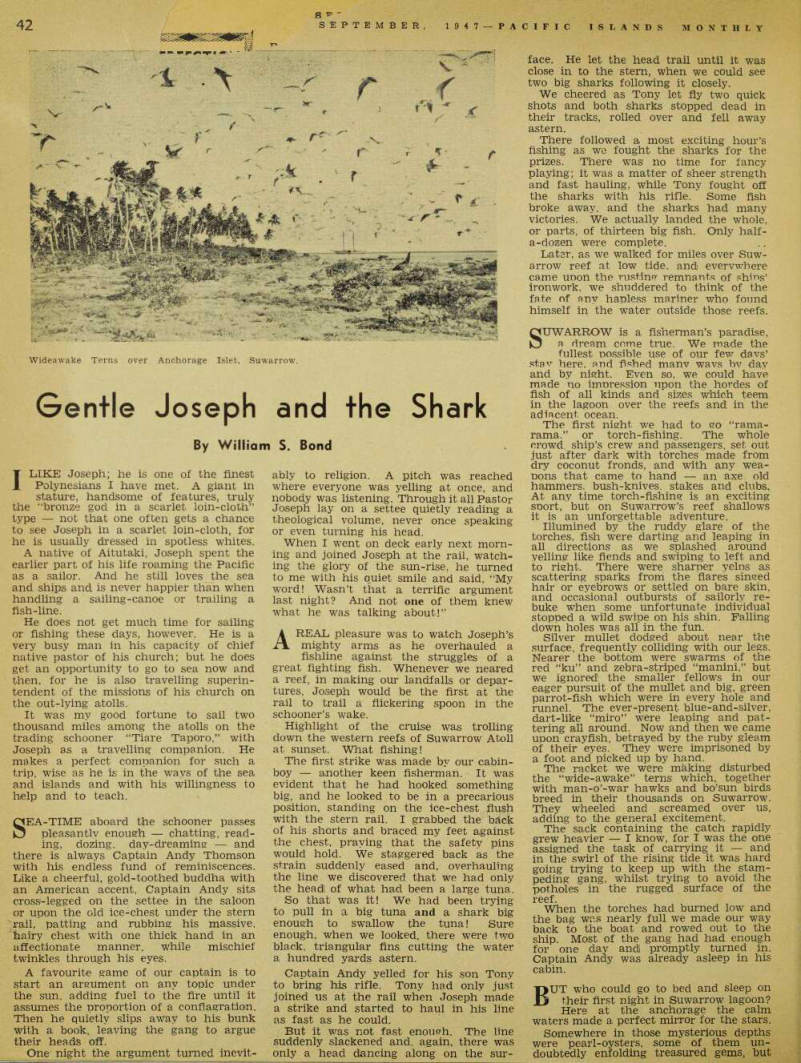
By William S. Bond
ILIKE Joseph; he is one of the finest Polynesians I have met. A giant in stature, handsome of features, truly the “bronze god in a scarlet loin-cloth” type not that one often gets a chance to see Joseph in a scarlet loin-cloth, for he is usually dressed in spotless whites.
A native of Aitutaki, Joseph spent the earlier part of his life roaming the Pacific as a sailor. And he still loves the sea and ships and is never happier than when handling a sailing-canoe or trailing a fish-line.
He does not get much time for sailing or fishing these days, however. He is a very busy man in his capacity of chief native pastor of his church; but he does get an opportunity to go to sea now and then, for he is also travelling superin tendent of the missions of his church on the out-lying atolls.
It was my good fortune to sail two thousand miles among the atolls on the trading schooner “Tiare Taporo,” with Joseph as a travelling companion. He makes a perfect companion for such a trip, wise as he is in the ways of the sea and islands and with his willingness to help and to teach.
SEA-TIME aboard the schooner passes pleasantly enough chatting, read ing, dozing, day-dreaming and there is always Captain Andy Thomson with his endless fund of reminiscences.
Like a cheerful, gold-toothed buddha with an American accent, Captain Andy sits cross-legged on the settee in the saloon or upon the old ice-chest under the stern rail, patting and rubbing his massive, hairy chest with one thick hand in an affectionate manner, while mischief twinkles through his eyes.
A favourite game of our captain is to start an argument on any topic under the sun. adding fuel to the fire until it assumes the proportion of a conflagration.
Then he quietly slips away to his bunk with a book, leaving the gang to argue their heads off.
One night the argument turned inevit
ably to religion. A pitch was reached where everyone was yelling at once, and nobody was listening. Through it all Pastor Joseph lay on a settee quietly reading a theological volume, never once speaking or even turning his head.
When I went on deck early next morn ing and joined Joseph at the rail, watch ing the glory of the sun-rise, he turned to me with his quiet smile and said, “My word! Wasn’t that a terrific argument last night? And not one of them knew what he was talking about!”
AREAL pleasure was to watch Joseph’s mighty arms as he overhauled a fishline against the struggles of a great fighting fish. Whenever we neared a reef, in making our landfalls or depar tures, Joseph would be the first at the rail to trail a flickering spoon in the schooner’s wake.
Highlight of the cruise was trolling down the western reefs of Suwarrow Atoll at sunset. What fishing!
The first strike was made by our cabin boy another keen fisherman. It was evident that he had hooked something big, and he looked to be in a precarious position, standing on the ice-chest flush with the stern rail. I grabbed the back of his shorts and braced my feet against the chest, praying that the safety pins would hold. We staggered back as the strain suddenly eased and, overhauling the line we discovered that we had only the headl of what had been a large tuna.
So that was it! We had been trying to pull in a big tuna and a shark big enoueh to swallow the tuna! Sure enough, when we looked, there were two black, triangular fins cutting the water a hundred yards astern.
Captain Andy yelled for his son Tony to bring his rifle. Tony had only just joined us at the rail when Joseph made a strike and started to haul in his line as fast as he could.
But it was not fast enough. The line suddenly slackened and. again, there was only a head dancing along on the sur
face. He let the head trail until it was close in to the stem, when we could see two big sharks following it closely.
We cheered as Tony let fly two quick shots and both sharks stopped dead in their tracks, rolled over and fell away astern.
There followed a most exciting hour’s fishing as we fought the sharks for the prizes. There was no time for fancy playing; it was a matter of sheer strength and fast hauling, while Tony fought off the sharks with his rifle. Some fish broke away, and the sharks had many victories. We actually landed the whole, or parts, of thirteen big fish. Only half a-dozen were complete.
Later, as we walked for miles over Suw arrow reef at low tide, and) everywhere came unon the rusting remnants of shins’ ironwork, we shuddered to think of the fate of any hapless mariner who found himself in the water outside those reefs.
SUWARROW is a fisherman’s paradise, a dream come true. We made the fullest possible use of our few davs’ stav here, and fished manv wavs bv day and by night. Even so, we could have made no imnression upon the hordes of fish of all kinds and sizes which teem in the lagoon over the reefs and in the adiacent ocean.
The first night we had to go “rama rama.” or torch-fishing. The whole crowd, ship’s crew and passengers, set out just after dark with torches made from dry coconut fronds, and with any wea nons that came to hand an axe old hammers, bush-knives, stakes and clubs.
At any time torch-fishing is an exciting snort, but on Suwarrow’s reef shallows it is an unforgettable adventure.
Illumined by the ruddy glare of the torches, fish were darting and leaping in all directions as we snlashed around yelling like fiends and swiping to left and to right. There were sharper yelns as scattering sparks from the flares singed hair or eyebrows or settled on bare skin, and occasional outbursts of sailorly re buke when some unfortunate individual stopned a wild swipe on his shin. Falling down holes was all in the fun.
Silver mullet dodged about near the surface, frequently colliding with our legs.
Nearer the bottom were swarms of the red “ku” and zebra-striped “manini,” but we ignored the smaller fellows in our eager pursuit of the mullet and big, green parrot-fish which were in every hole and runnel. The ever-present blue-and-silver, dart-like “miro” were leaping and pat tering all around. Now and then we came upon crayfish, betrayed by the ruby gleam of their eyes. They were imprisoned by a foot and picked up by hand.
The racket we were making disturbed the “wide-awake” terns which, together with man-o’-war hawks and bo’sun birds breed in their thousands on Suwarrow.
They wheeled, and screamed over us, adding to the general excitement.
The sack containing the catch rapidly grew heavier I know, for I was the one assigned the task of carrying it and in the swirl of the rising tide it was hard going trying to keep up with the stam peding gang, whilst trying to avoid the potholes in the rugged surface of the reef.
When the torches had burned low and the bag was nearly full we made our way back to the boat and rowed out to the ship. Most of the gang had had enough for one day andl promptly turned in.
Captain Andy was already asleep in his cabin.
BUT who could go to bed and sleep on their first night in Suwarrow lagoon?
Here at the anchorage the calm waters made a perfect mirror for the stars.
Somewhere in those mysterious depths were pearl-oysters, some of them un doubtedly enfolding treasured gems, but
Wideawake Terns over Anchorage Islet, Suwarrow.
they were well-guarded by the countless marauding sharks.
Just over there was the gloomy sil houette of Anchorage Islet. It was just a sand-bank, covered with scrub and coconut trees and looked innocent enough by daylight as I had contemplated it while sheltering from the heat of noon day in the remains of “Ropati” Frisbie’s little tree house, perched in the broken branches of the stunted “tamanu” trees.
These had saved the lives of Ropati and his family of “Cowboys” and his com panions during the great hurricane of 1942. But at night it was strangely remi niscent of the many tales of pirates, buried treasure, violent death, skeletons and ghosts with which it is surrounded.
The next two hours provided a fitting climax to the evening. I made a four some with three other tireless fishermen, Pastor Joseph, Kaina the cabin-boy, and Timi the engineer. We fished from the stern of the schooner for the fine big, red schnapper which the natives call “mu.” We soon had a good collection— but for every fish we caught we hooked several sharks.
IT was sometime after midnight when our fun was rudely interrupted by a shocking blast emanating from the dark companionway just behind our backs.
Aboard the “Tiare Taporo” a shocking blast heralds the approach of Captain Andy Thomson and indicates that he is annoyed about something. I am not able to quote our captain verbatim, but it was, in effect, a strongly worded request that would we (unprintable) gentlemen kindly desist from this (sanguinary) fishing— for were we not making his noble ship look like an (unmentionably) stinking trawler—and who was going to eat all that much fish anyway? And, what was more, how could a good, honest, hard working sea-captain sleep with (stricty censored) sharks smashing about just over his bunk!?
N<pt being able to think of appropriate replies at the moment, we could only gulp and nod. We stood as men thunder struck until Captain Andy once more merged with the gloom.
He had hardly disappeared before we were brought back to our senses by a startled whisper from Joseph.
“Oh!” he gasped, “There’s something on my line it’s a shark! A big one!” As he spoke he cast horrified glances in the Direction of the companionway.
“Well,” we said, “Guess we’ll have to bring it m but quietly does it.”
Joseph’s powerful hands overhauled the line, and a final heave swung a heftv shark over the rail. It was the biggest catch of the night.
Lowering it gently to the deck, Joseph placed one foot on its tail to prevent it flapping, and reached for the club.
We leapt forward and stayed his hand- Ssshh! Not that way!”
Joseph grasped the shark’s throat with one hand and started to twist the hook Irom its jaw. We were all glancing ner vously over our shoulders.
When the hook was clear Joseph straightened up. lifting the struggling shark by its tail with both hands. Looking round, his gaze settled on a large iron Srv!l«i?V^ He u St^ ted a mi S ht y swing to whack the shark’s head. .. Again we sprang forward with anxious shushes and stayed his hand: “No! No' —Not that way!”
Joseph started another swing for the teak rail.
“No! Nq! Not there!”
Tiring of this clowning, the shark be gan struggling and snapping furiously.
Joseph changed one hand to the scruff of its neck and raised it to arm’s length overhead, pivoting wildly.
It was more than gentle Pastor Joseph
could stand: “Well what the hell shall I do with the bloody thing?” he exploded Then, with the strength of desperation he hurled it far out into the starry night’
Eagle Eye
By Bill Smith
ME mate called ’im “Eagle Eye,” an’
Eagle Eye ’e was, ever since.
We was up roun’ Wareo way, look in’ fer some coons fer the claim, when we comes right on top of Eagle Eye sittin ’down under a big tree and lookin’ up at the sky.
“Look, Joe,” I says to me mate. “There’s a bloke that’s ‘long-long’—must be one of them deserters from the Yanks.”
So I goes up to Eagle Eye, an’ I says, polite-like, “ ’Ow’s it goin’, an’ ow’s the stars this beutiful spring mornin?” ’E gits up right away an, ’all smilin, ’e comes over to me and outs out ’is paw an’ says in a very refined voice, “I am very well, indeed, thank you,’’ an’ ’e re marked on the weather an’ I could see right away that ’e was a bloke what ’ad ’ad some schoolin’.
“I am collecting birds for the Taronga Park Zoo,” ’e went on. an’ ’e said there was more birds around than there ever was before the war an ’all the zoos all over the world was singin’ out for them. ’E said the boys put some sticky stuff on the logs, and the birds got stuck an’ couldn’t get away.
Well, me mate an’ I thought 'e was puttin ’a swifty over. An’ then ’e goes on an ’says most of ’em was caught of a night when the boys went up tne trees with a shoot-lamp and catches ’em, while they was asleep.
Joe gives me a dig in the ribs an’ I winks me eye, an’ we still thought ’e might ’ave been one of them deserters what ‘ad fallen for the Maries or was shell shock or done something what ’e shouldn’t ’ave.
So ’e asks us to go down to ’is camp an’ ’e was fair dinkum alrite. for ’e had 40 odd birds in little wooden cages, and they was that wild they was flyin’ round and round, hittin ’their sharp-pointed beaks against the sides that much you could ’ear ’em a mile away.
Most of ’em was birds-of-paradise that me an’ Joe had seen a lot while we was out recrootin’, an’ ’e ’ad some very pretty little king-birds and some parrots and a white cuckatoo and a big, fat fowl, what was almost too ’eavy to fly an’ he said ’e was a Caskade. ’E used to get away on Eagle Eye now and agin, but ’e couldn’t fly much an ’e always managed to turn up again roun’ about kai time— ’e was an artful ole bird, alrite. But you should ’ave seen ’im when ’e was fly in slow and low: ’E ’ad a marvellous scarlet belly, an’ when ’e was perched in ’is cage ’e reminded me of some ’aughty duchess, ’e ’ad that cunnin’ look in ’is eye.
I ast Eagle Eye weren’t it cruel to keep them birds locked up, an’ ’e says ’twas alrite. When they got down to the zoo they would ’ave plenty of good kai an' be looked after an’ allowed to fly round a lot, an’ ’e says when they got old they never ’ad no enemies in the zoo to kill ’em off like they did in the bush an’ they never ad to fossick for their kai-kai.
OLD Eagle Eye was up at_ daybreak feedin’ them birds an’ cleanin’ out the cages, an’ ’e never stopped all day. The coons used to get presents for bringin ’in the birds, but they never ’eard of zoos, an’ they was always bringin’
in the big fat balus, for kai kai, an’ when Eagle Eye roused ’em an’ give a tomeawk for a tiny little, pretty bird, they reckoned ’e was long-long, an’ they couldn’t make it out at all. “Fashion belong ’im, ’ they used to say. ’E give the birds paw paw, corn, ants’ nests an’ pandanus an’ ’e said never get pandanus in a cut, for its pains near to Kill, so I won’t in future. Well, them birds did get through some kai alrite.
When ’e got down to Finsch, I ’eard the Navy used to give ’im dozens of eggs, an’ ’e used to mix ’em up with currants and biscuits an’ give ’em a regular blow-out.
They never died on ’im. ’e said. ’E told us all about Lord Rochchild who ’e collected for, an’ ’ow e was nuts on collectin’ anything, an’ ’ow e used to give a pound for a flea, if it was big enough.
Old Eagle Eye ’ad been all over the world collectin’ all sorts of birds an’ animals. ’E reckon ’e knew more about the birds in New Guinea than any coon. ’E didn’t like the boys this side—’e said the Papuan boys was better at catchin’ the birds.
So ’e shakes ’ands with me and Joe, an’
Joe forgets ’isself an ’says, ‘Good-bye, Eagle Eye, plesed ter ’ave met yer.”
“Ay, cut it out, Joe!” I says, an I gives ’im a nudge.
Joe says, “Sorry, Mr. Shaw Mayer,” 1 knew that was ’is name, for ’e put it in me book, so I could tell the missus.
An’ old Eagle Eye only laughed, like ’e always did, an’ ’e says, “That’s quite alrite, Joe, the natives call me much worse names than that.” ’E was a sport, alrite.
In Honolulu
The Mynah bird is an arrogant thing, With robin’s head and black-bird’s wing.
With stolen song from yellow bill His tender notes entrance you, ’till A croak he gives, like laughter mean, And struts and hops across the green.
Carol Kapp.
San Jose, Calif.
The Marist Brothers’ Indian School in Suva, Fiji, was 50 years old on August 23. The original school, with 10 scholars, was opened by the first Vicar Apostolic of Fiji (Bishop Vidal) at the instigation of Brother Alphonsus, who is still an en ergetic figure in Suva. The school now has more than 500 Indian boys and appli cations for entrance are constantly being refused owing to shortage of accommoda tion. The first head-master was the late Brother Columba, who was succeeded by Brother Claudius.
Mr. J. J. (Jack) Sherry, who has been attached to W. R. Carpenter & Co., Ltd , for the past few months, has now gone back to his old firm, Burns, Philp & Co., Ltd. At the end of August he left for Port Moresby, where he is relieving accountant. He will later proceed to BP’s Madang branch.
Glance
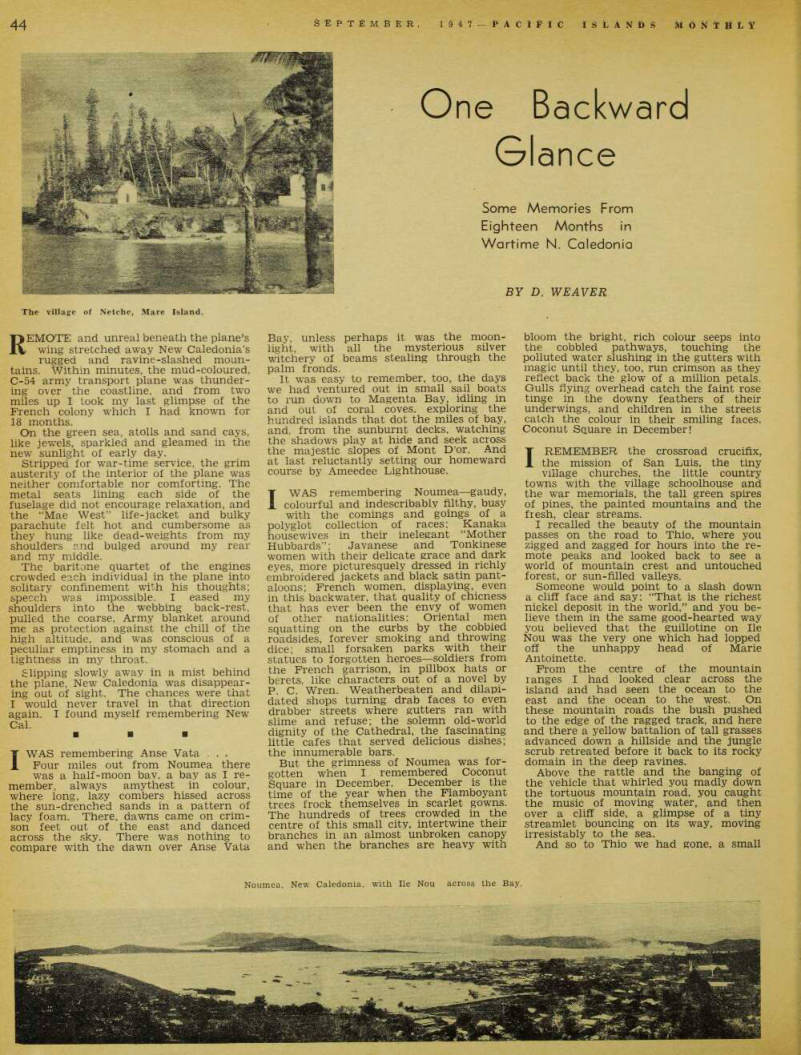
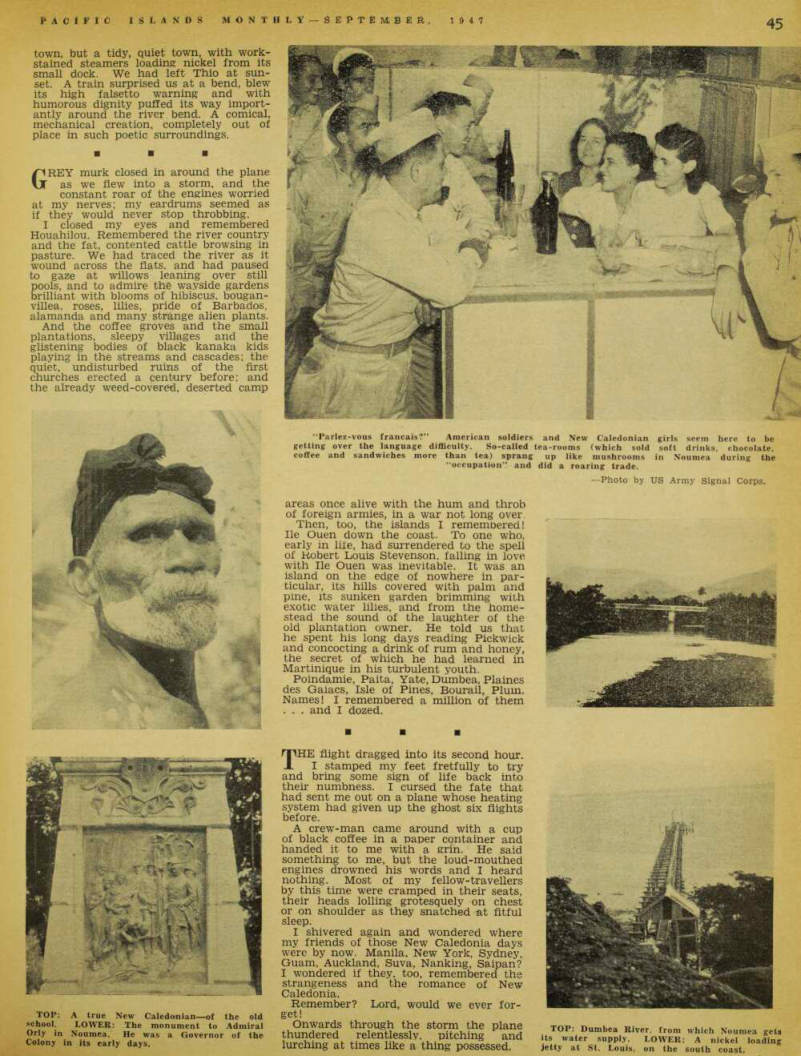
One Backward Glance
Some Memories From Eighteen Months in Wartime N. Caledonia
By D. Weaver
REMOTE and unreal beneath the plane’s wing stretched away New Caledonia’s rugged and ravine-slashed mountains. Within minutes, the mud-coloured, C-54 army transport plane was thundering over the coastline and from two miles up I took my last glimpse of the French colony which I had known for 18 months On the green sea atolls and sand cays, like jewels, sparkled and gleamed in the new sunlight of early day.
Stripped for war-time service, the grim austerity of the interior of the plane was neither comfortable nor comforting. The metal seats lining each side of the fuselage did not encourage relaxation, and the “Mae West” life-jacket and bulky parachute felt hot and cumbersome as they hung like dead-weights from my shoulders and bulged around my rear and my middle.
The baritone quartet of the engines crowded each individual in the plane into solitary confinement with his thoughts; speech was impossible. I eased my shoulders into the webbing back-rest, pulled the coarse, Army blanket around me as protection against the chill of the high altitude, and was conscious of a peculiar emptiness in my stomach and a tightness in my throat. sunning slowly away in a mist behind the plane, New Caledonia was disappearing out of sight. The chances were that I would never travel in that direction a fra in T found mvself rememberins New again, i louna mysen rememoenng rview mam IWAS remembering Anse Vata ...
Four miles out from Noumea there was a half-moon bay. a bay as I remember always amythest in colour, where long lazy combers hissed across the sun-drenched sands in a pattern of lacv foam There dawns came on crimson feet "out of the east and danced across the sky. There was nothing to compare with the dawn over Anse Vata
Bay, unless perhaps it was the moonlight, with all the mysterious silver witchery of beams stealing through the palm fronds. i It was easy to remember, too, the days we had ventured out in small sail boats to run down to Magenta Bay, idling in and out of coral coves, exploring the hundred islands that dot the miles of bay, and, from the sunburnt decks, watching the shadows play at hide and seek across the majestic slopes of Mont Dor. And at last reluctantly setting our homeward course by Ameedee Lighthouse.
T WAS remembering Noumea—gaudy, J. colourful and indescribably filthy, busy with the comings and goings of a polyglot collection of races: Kanaka housewives in their inelegant “Mother Hubbards”: Javanese and Tonkinese women with their delicate grace and dark eyes, more picturesquely dressed in richly embroidered jackets and black satin pantaloons; French women, displaying, even in this backwater, that quality of chicness that has ever been the envy of women of other nationalities: Oriental men squatting on the curbs by the cobbled roadsides, forever smoking and throwing dice; small forsaken parks with their statues to forgotten heroes—soldiers from the French garrison, in pillbox hats or berets, like characters out of a novel by P. C. Wren. Weatherbeaten and dilapidated shops turning drab faces to even drabber streets where gutters ran with sUme refuse; the so i emn old-world dignity of the Cathedral, the fascinating little cafes that served delicious dishes; the innumerable bars.
But the grimness of Noumea was forgotten when I remembered Coconut Square in December. December is the time of the year when the Flamboyant trees frock themselves in scarlet gowns.
The hundreds of trees crowded in the centre of this small city, intertwine their branches in an almost unbroken canopy and when the branches are heavy witn
bloom the bright, rich colour seeps into the cobbled pathways, touching the polluted water slushing in the gutters with magic until they, too, run crimson as they reflect back the glow of a million petals, Gulls flying overhead catch the faint rose tinge in the downy feathers of their underwings, and children in the streets catch the colour in their smiling faces.
Coconut Square in December! j REMEMBER the crossroad crucifix, the m i SS i o n of San Luis, the tiny village churches, the little country towns with the village schoolhouse and the war memorials, the tall green spires of pines, the painted mountains and the fresh, clear streams.
I recalled the beauty of the mountain passes on the road to Thio. where you zigged and zagged for hours into the re mote peaks and looked back to see a world of mountain crest and untouched forest, or sun-filled valleys, Someone would point to a slash down a cliff face and say: “That is the richest nickel deposit in the world,” and you be lieve them in the same good-hearted way you believed that the guillotine on He Nou was the very one which had lopped off the unhappy head of Marie Antoinette.
From the centre of the mountain ranges I had looked clear across the island and had seen the ocean to the east and the ocean to the west. On these mountain roads the bush pushed to the edge of the ragged track, and here and there a yellow battalion of tall grasses advanced down a hillside and the jungle scrub retreated before it back to its rocky domain in the deep ravines, Above the rattle and the banging of the vehicle that whirled you madly down the tortuous mountain road, you caught the music of moving water, and then over a cliff side, a glimpse of a tiny streamlet bouncing on its way, moving irresistably to the sea.
And so to Thio we had gone, a small
The village of Netche, Mare Island.
Noumea, New Caledonia, with He Nou across the Bay.
town, but a tidy, quiet town, with work stained steamers loading nickel from its small dock. We had left Thio at sun set. A train surprised us at a bend, blew its high falsetto warning and with humorous dignity puffed its way import antly around the river bend. A comical, mechanical creation, completely out of place in such poetic surroundings, ■ ■ ■ GREY murk closed in around the plane as we flew into a storm, and the constant roar of the engines worried at my nerves; my eardrums seemed as if they would never stop throbbing.
I closed my eyes and remembered Houahilou. Remembered the river country and the fat, contented cattle browsing in pasture. We had traced the river as it wound across the flats, and had paused to gaze at willows leaning over still pools, and to admire the wayside gardens brilliant with blooms of hibiscus, bougan villea, roses, lilies, pride of Barbados, alamanda and many strange alien plants.
And the coffee groves and the small plantations, sleepy villages and the glistening bodies of black kanaka kids playing in the streams and cascades: the quiet, undisturbed ruins of the first churches erected a century before: and the already weed-covered, deserted camp
areas once alive with the hum and throb of foreign armies, in a war not long over Then, too, the islands I remembered!
He Ouen down the coast. To one who, early in life, had surrendered to the spell of Robert Louis Stevenson, falling in love with He Ouen was inevitable. It was an island on the edge of nowhere in par ticular, its hills covered with palm and pine, its sunken garden brimming with exotic water lilies, and from the home stead the sound of the laughter of the old plantation owner. He told us that he spent his long days reading Pickwick and concocting a drink of rum and honey, the secret of which he had learned in Martinique in his turbulent youth.
Poindamie, Paita, Yate, Dumbea, Plaines des Gaiacs, Isle of Pines, Bourail, Plum.
Names! I remembered a million of them . . . and I dozed. ■ ■ ■ THE flight dragged into its second hour.
I stamped my feet fretfully to try and bring some sign of life back into their numbness. I cursed the fate that had sent me out on a plane whose heating system had given up the ghost six flights before.
A crew-man came around with a cup of black coffee in a paper container and handed it to me with a grin. He said something to me, but the loud-mouthed engines drowned his words and I heard nothing. Most of my fellow-travellers by this time were cramped in their seats, their heads lolling grotesquely on chest or on shoulder as they snatched at fitful sleep.
I shivered again and wondered where my friends of those New Caledonia days were by now. Manila. New York, Sydney, Guam, Auckland, Suva, Nanking, Saipan?
I wondered if they, too, remembered the strangeness and the romance of New Caledonia.
Remember? Lord, would we ever for get!
Onwards through the storm the plane thundered relentlessly, pitching and lurching at times like a thing possessed.
TOP: A true New Caledonian—of the old school. LOWER: The monument to Admiral Orly in Noumea. He was a Governor of the Colony in its early days.
"Parlez-vous francais?” American soldiers and New Caledonian girls seem here to be getting over the language difficulty. So-called tea-rooms (which sold soft drinks, chocolate, coffee and sandwiches more than tea) sprang up like mushrooms in Noumea during the “occupation” and did a roaring trade.
Photo by US Army Signal Corps.
TOP: Dumbea River, from which Noumea gets its water supply. LOWER: A nickel loading jetty at St. Louis, on the south coast.
Advertisements & other items, p. 46 (1 item)
44
SEPTEMBER., 194?—PAClFlC ISLANDS MONTHLY
Tropicalities
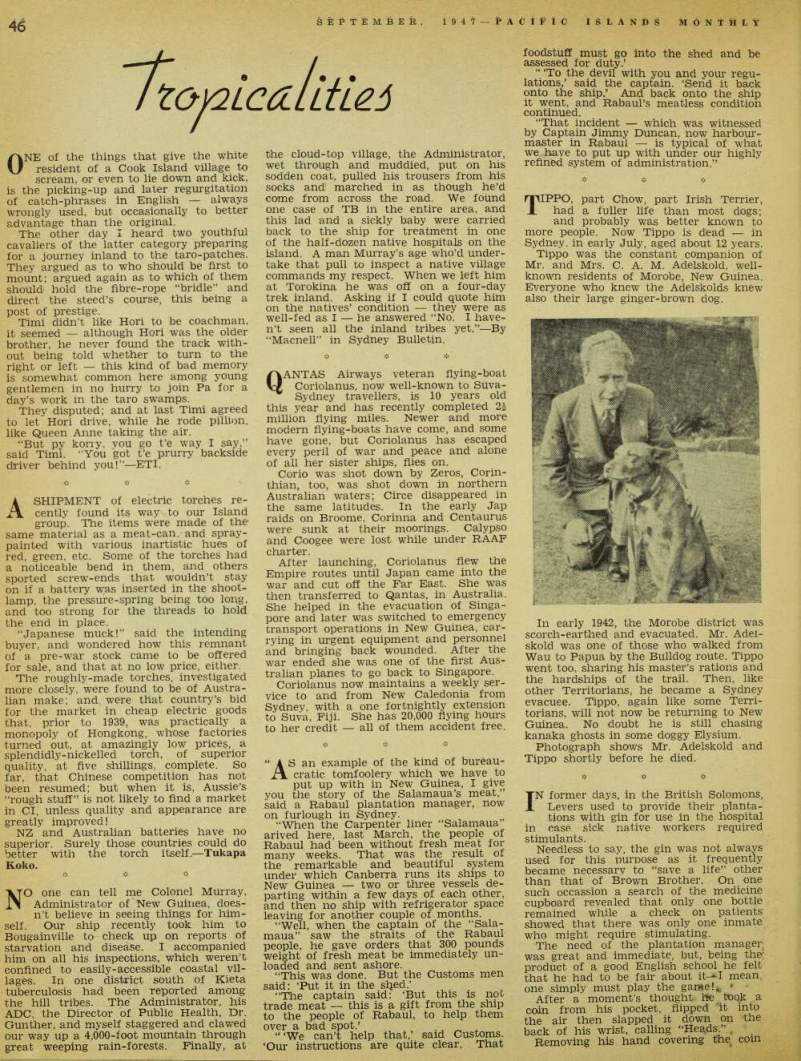
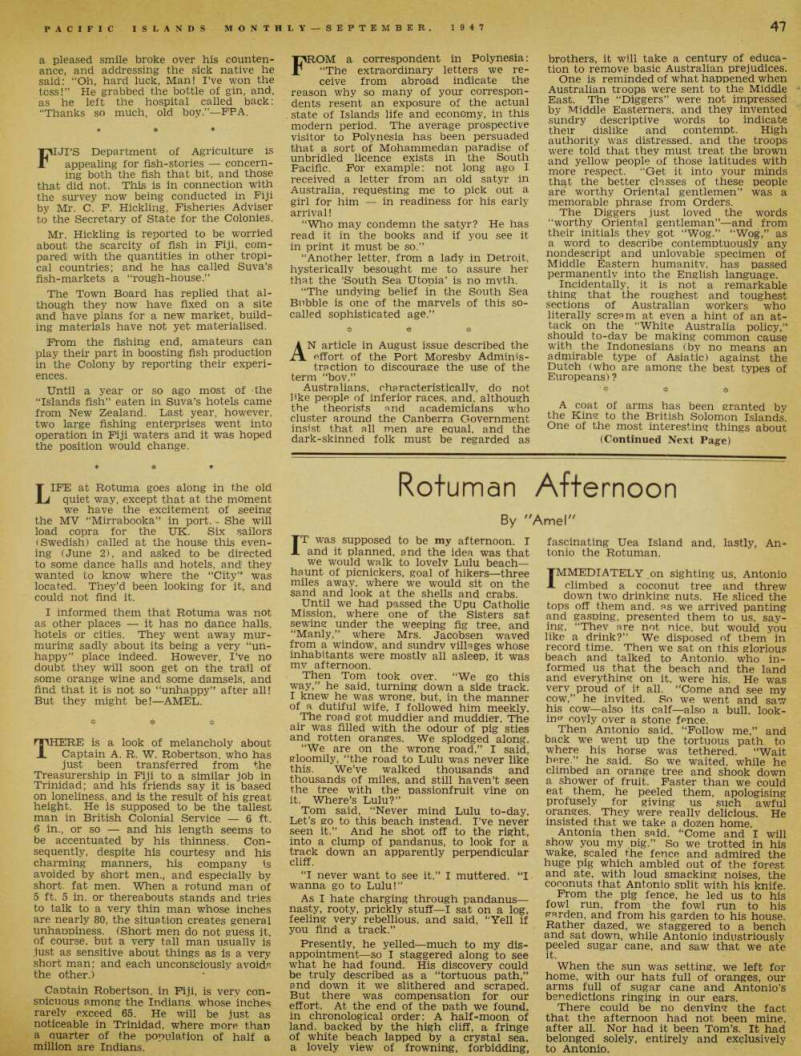
ONE of the things that give the white resident of a Cook Island village to scream, or even to lie down and kick, is the picking-up and later regurgitation of catch-phrases in English always wrongly used, but occasionally to better advantage than the original.
The other day I heard two youthful cavaliers of the latter category preparing for a journey inland to the taro-patches.
They argued as to who should be first to mount; argued again as to which of them should hold the fibre-rope “bridle” and direct the steed’s course, this being a post of prestige.
Timi didn’t like Hori to be coachman, it seemed although Hori was the older brother, he never found the track with out being told whether to turn to the right or left this kind of bad memory is somewhat common here among young gentlemen in no hurry to join Pa for a day’s work in the taro swamps.
They disputed; and at last Timi agreed to let Hori drive, while he rode pillion, like Queen Anne taking the air.
“But py korry, vou go t’e way I say,” said Timi. “You got t’e prurry backside
dtriver behind you!”
Eti.
A SHIPMENT of electric torches re cently found its way to our Island group. The items were made of the same material as a meat-can, and spray painted with various inartistic hues of red, green, etc. Some of the torches had a noticeable bend in them, and others sported screw-ends that wouldn’t stay on if a battery was inserted in the shoot lamp. the pressure-spring being too long, and too strong for the threads to hold the end in place.
“Japanese muck!” said the intending buyer, and wondered how this remnant of a pre-war stock came to be offered for sale, and that at no low price, either.
The roughly-made torches, investigated more closely, were found to be of Austra lian make; and were that country’s bid for the market in cheap electric goods that, prior to 1939, was practically a monopoly of Hongkong, whose factories turned out, at amazingly low prices, a splendidly-nickelled torch, of superior quality, at five shillings, complete. So far, that Chinese competition has not been resumed; but when it is, Aussie’s “rough stuff” is not likely to find a market in Cl, unless quality and appearance are greatly improved!
NZ and Australian batteries have no superior. Surely those countries could do
better with the torch itself.-
Tukapa
Koko.
NO one can tell me Colonel Murray, Administrator of New Guinea, does n’t believe in seeing things for him self. Our ship recently took him to Bougainville to check up on reports of starvation and disease. I accompanied him on all his inspections, which weren’t confined to easily-accessible coastal vil lages. In one district south of Kieta tuberculosis had been reported among the hill tribes. The Administrator, his ADC. the Director of Public Health, Dr.
Gunther, and myself staggered and clawed our way up a 4,000-foot mountain through great weeping rain-forests. Finally, at
the cloud-top village, the Administrator, wet through and muddied, put on his sodden coat, pulled his trousers from his socks and! marched in as though he’d come from across the road. We found one case of TB in the entire area, and this lad and a sickly baby were carried back to the ship for treatment in one of the half-dozen native hospitals on the island. A man Murray’s age who’d under take that pull to inspect a native village commands my respect. When we left him at Torokina he was off on a four-day trek inland. Asking if I could quote him on the natives’ condition they were as well-fed as I— he answered “No. I have n’t seen all the inland tribes yet.”—By “Macnell” in Sydney Bulletin. ❖ ❖ ❖
QANTAS Airways veteran flying-boat
Coriolanus, now well-known to Suva- Sydney travellers, is 10 years old this year and has recently completed 2h million flying miles. Newer and more modern flying-boats have come, and some have gone, but Coriolanus has escaped every peril of war and peace and alone of all her sister ships, flies on.
Corio was shot down by Zeros, Corin thian, too, was shot down in northern Australian waters; Circe disappeared in the same latitudes. In the early Jap raids on Broome, Corinna and Centaurus were sunk at their moorings. Calypso and Coogee were lost while under RAAF charter.
After launching, Coriolanus flew the Empire routes until Japan came into the war and cut off the Far East. She was then transferred to Qantas, in Australia.
She helped in the evacuation of Singa pore and later was switched to emergency transport operations in New Guinea, car rying in urgent equipment and personnel and bringing back wounded. After the war ended she was one of the first Aus tralian planes to go back to Singapore.
Coriolanus now maintains a weekly ser vice to and from New Caledonia from Sydney, with a one fortnightly extension to Suva, Fiji. She has 20,000 flying hours to her credit all of them accident free.
“AS an example of the kind of bureau cratic tomfoolery which we have to put up with in New Guinea, I give you the story of the Salamaua’s meat,” said a Rabaul plantation manager, now on furlough in Sydney.
“When the Carpenter liner “Salamaua’ arived here, last March, the people of Rabaul had been without fresh meat for many weeks. That was the result of the remarkable and beautiful system under which Canberra runs its ships to New Guinea two or three vessels de parting within a few days of each other, and then no ship with refrigerator space leaving for another couple of months.
“Well, when the captain of the “Sala maua” saw the straits of the Rabaul people, he gave orders that 300 pounds weight of fresh meat be immediately un loaded and sent ashore.
“This was done. But the Customs men said: ‘Put it in the sljed.’
“The captain said: ‘But this is not trade meat this is a gift from the ship to the people of Rabaul, to help them over a bad spot.’ .
“‘We can’t help that,’ said Customs. ‘Our instructions are quite clear. That
foodstuff must go into the shed and be assessed for duty.’
“ ‘To the devil with you and your regu lations,’ said the captain. ‘Send it back onto the ship.’ And back onto the ship it went, and Rabaul’s meatless condition continued.
“That incident which was witnessed by Captain Jimmy Duncan, now harbour master in Rabaul is typical of what we have to put up with under our highly refined system of administration.”
TIPPO, part Chow, part Irish Terrier, had a fuller life than most dogs; and probably was better known to more people. Now Tippo is dtead in Sydney, in early July, aged about 12 years.
Tippo was the constant companion of Mr. and Mrs. C. A. M. Adelskold, well known residents of Morobe, New Guinea.
Everyone who knew the Adelskolds knew also their large ginger-brown dog.
In early 1942, the Morobe district was scorch-earthed and evacuated. Mr. Adel skold was one of those who walked from Wau to Papua by the Bulldog route. Tippo went too, sharing his master’s rations and the hardships of the trail. Then, like other he became a Sydney evacuee. Tippo, again like some Terri torians, will not now be returning to New Guinea. No doubt he is still chasing kanaka ghosts in some doggy Elysium.
Photograph shows Mr. Adelskold and Tippo shortly before he died.
IN former days, in the British Solomons, Levers used to provide their planta tions with gin for use in the hospital in case sick native workers required stimulants.
Needless to say, the gin was not always used for this purpose as it frequently became necessary to “save a life” other than that of Brown Brother. On one such occassion a search of the medicine cupboard revealed that only one bottle remained while a check on patients showed that there was only one inmate who might require stimulating.
The need of the plantation manager; was great and immediate, but, being the product of a good English school he felt that he had to be fair about it—l mean, one simply must play the game!*, * After a moment’s thought- he took a coin from his pocket, flipped ‘it into the air then slapped it down on the back of his wrist, calling “Heads.” r Removing his hand covering the com
a pleased smile broke over his counten ance, and addressing the sick native he said: “Oh, hard luck, Man! I’ve won the toss!” He grabbed the bottle of gin, and, as he left the hospital called back:
“Thanks so much, old boy.”
Fpa.
FIJI’S Department of Agriculture is appealing for fish-stories concern ing both the fish that bit, and those that did not. This is in connection with the survey now being conducted in Fiji by Mr. C. F. Hickling, Fisheries Adviser to the Secretary of State for the Colonies.
Mr. Hickling is reported to be worried about the scarcity of fish in Fiji, com pared with the quantities in other tropi cal countries; and he has called Suva’s fish-markets a “rough-house.”
The Town Board has replied that al though they now have fixed on a site and have plans for a new market, build ing materials have not yet materialised.
From the fishing end, amateurs can play their part in boosting fish production in the Colony by reporting their experi ences.
Until a year or so ago most of the “Islands fish” eaten in Suva’s hotels came from New Zealand. Last year, however, two large fishing enterprises went into operation in Fiji waters and it was hoped the position would change. ♦ 9 • LIFE at Rotuma goes along in the old quiet way, except that at the moment we have the excitement of seeing the MV “Mirrabooka” in port. - She will load copra for the UK. Six sailors (Swedish) called at the house this even ing (June 2), and asked to be directed to some dance halls and hotels, and they wanted to know where the “City” was located. They’d been looking for it, and could not find it.
I informed them that Rotuma was not as other places it has no dance halls, hotels or cities. They went away mur muring sadly about its being a very “un happy” place indeed. However, I’ve no doubt they will soon get on the trail of some orange wine and some damsels, and find that it is not so “unhappy” after all!
But they might be!
Amel.
THERE is a look of melancholy about Captain A. R. W. Robertson, who has just been transferred from the Treasurership in Fiji to a similar job in Trinidad; and his friends say it is based on loneliness, and is the result of his great height. He is supposed to be the tallest man in British Colonial Service 6 in., or so and his length seems to be accentuated by his thinness. Con sequently, despite his courtesy and his charming manners, his company is avoided by short men., and especially by short fat men. When a rotund man of 5 ft. 5 in. or thereabouts stands and tries to talk to a very thin man whose inches are nearly 80, the situation creates general unhanpiness. (Short men do not guess it, of course, but a very tall man usually is just as sensitive about things as is a very short man; and each unconsciously avoids the other.) Captain Robertson, in Fiji, is very con snicuous among the Indians, whose inches rarely exceed 65. He will be just as noticeable in Trinidad, where more than a Quarter of the population of half a million are Indians,
FROM a correspondent in Polynesia: “The extraordinary letters we re ceive from abroad indicate the reason why so many of your correspon dents resent an exposure of the actual state of Islands life and economy, in this modern period. The average prospective visitor to Polynesia has been persuaded that a sort of Mohammedan paradise of unbridled licence exists in the South Pacific. For example: not long ago I received a letter from an old satyr in Australia, requesting me to pick out a girl for him in readiness for his early arrival!
“Who may condemn the satyr? He has read it in the books and if you see it in print it must be so.”
“Another letter, from a lady in Detroit, hysterically besought me to assure her that the ‘South Sea Utopia’ is no myth.
“The undying belief in the South Sea Bubble is one of the marvels of this so called sophisticated age.”
AN article in August issue described the effort of the Port Moresby Adminis traction to discourage the use of the term “boy.”
Australians, characteristically, do not bke people of inferior races, and, although the theorists end academicians who cluster around the Canberra Government insist that all men are eaual. and the dark-skinned folk must be regarded as
brothers, it will take a century of educa tion to remove basic Australian prejudices.
One is reminded of what happened when Australian troops were sent to the Middle East. The “Diggers” were not impressed by Middle Easterners, and they invented sundry descriptive words to indicate their dislike and contempt. High authority was distressed, and the troops were told that they must treat the brown and yellow people of those latitudes with more respect. “Get it into your minds that the better classes of these people are worthy Oriental gentlemen” was a memorable phrase from Orders.
The Diggers just loved the words “worthy Oriental gentleman”—and from their initials they got “Wog.” “Wog,” as a word to describe contemptuously any nondescript and unlovable specimen of Middle Eastern humanity, has passed permanently into the English language.
Incidentally, it is not a remarkable thing that the roughest and toughest sections of Australian workers who literally scream at even a hint of an at tack on the “White Australia policy,” should to-day be making common cause with the Indonesians (by no means an admirable type of Asiatic) against the Dutch (who are among the best types of Europeans) ? * * 9 A coat of arms has been granted by the King to the British Solomon Islands.
One of the most interesting things about
(Continued Next Page)
it is the archaic language of the “Gazette” notification: “Know Ye therefore that We of Our Prince Grace and Special Favour have granted and assigned and by these Presents do grant and assign the follow ing Armorial Ensigns for the said British Solomon Islands Protectorate that is to say, for Arms, Gules a Solomon Islands Turtle erect and affrontee proper a Chief Palypily Argent and Sable as the same are in the painting hereunto annexed more plainly depicted to be borne for the said British Solomon Islands Protectorate upon Seals, Shields, Banners, Flags or otherwise according to the Laws of Arms.” >5 * RECENT “PIM” references to sales of mother-of-pearl buttons at 1/9 each have made me regret a lost oppor tunity. During the war I had a large stock of these, intended originally for pyjama coats; and foolishly sold them— they were about the size of a penny—at two for 3d. (pre-war price was 1/- c&zen).
So, if “PIM” reoort be true, I’ve lost 1/7'i on each pearly disc; but, in any case, I fancy the Cook Island Price Control Deartment would have something to say about 1/9 per button.
By the same token, this writer had in stock the very last elastic in the Cl when it was utterly unobtainable in even the big stores, as a result of Japan’s siezure of supplies in the East. This was posi tives scrambled for at 3d. a yard; and could have been sold, with equal ease,
at 3/-.
E.G.
Advertisements & other items, p. 48 (1 item)
46
SEPTEMBER, 1 9 4 7 -PACIf IC ISLANDS MONTHLY
Rotuman Afternoon
By "Amel"
IT was supposed to be my afternoon. I and it planned, and the idea was that we would walk to lovelv Lulu beach haunt of picnickers, goal of hikers—three miles away, where we would sit on the sa nd and look at the shells and crabs. _,F n til we had passed the Upu Catholic Mission, where one of the Sisters sat sewmg ,V nde £ the wee P in S tree, and Manly, where Mrs. Jacobsen waved from a window, and sundry villages whose inhabitants were mostly all asleep, it was m rnu er £ oon - , , Then Tom took over. “We go this way, he said, turning down a side track, ! knew he was wrong, but, in the manner ota dutiful wife, I followed him meekly, The road got muddier and muddier. The air was filled with the odour of pig sties and rotten oranges. We splodged along, “We are on the wrong road.” I said, gloomily, “the road to Lulu was never like this. We’ve walked thousands and thousands of miles, and still haven’t seen the tree with the passionfruit vine on it. Where’s Lulu?”
Tom said, “Never mind Lulu to-day.
Let’s go to this beach instead. I’ve never seen it.” And he shot off to the right, into a clump of pandanus, to look for a track down an apparently perpendicular cliff.
“I never want to see it.” I muttered. “I wanna go to Lulu!”
As I hate charging through pandanus— nasty, rooty, prickly stuff—l sat on a log, feeling very rebellious, and said, “Yell if vou find a track ” y ‘ Presently, he yelled—much to my disappointment—so I staggered along to see what he had found. His discovery could be truly described as a “tortuous path,” and down it we slithered and scraped.
But there was compensation for our effort. At the end of the path we found, in chronological order: A half-moon of land, backed by the high cliff, a fringe of white beach lapped by a crystal sea. a lovely view of frowning, forbidding,
fascinating Uea Island and, lastly, An tonio the Rotuman.
TMMEDIATELY on sighting us, Antonio 1. climbed a coconut tree and threw down two drinking nuts. He sliced the tops off them and. as we arrived panting and gasping, presented them to us. say ing, “Thev are not nice, but would you like a drink?” We disposed of them' in record time. Then we sat on this glorious beach and talked to Antonio, who in formed us that the beach and the land and everything on it. were his. He was very proud of it all. “Come and see my cow,” he invited. So we went and saw his cow—also its calf—also a bull, look ino- coyly over a stone fence Then Antonio said. “Foliow me,” and back we went up the tortuous path to where his horse was tethered. “Wait here.” he said. So we waited, while he climbed an orange tree and shook down a shower of fruit. Faster than we could eat them, he peeled them, apologising profusely for giving us such awful oranges. They were really delicious He insisted that we take a dozen home Antonia then said. “Come and I will show you my pig.” So we trotted in his wake, scaled the fence and admired the huge pig which ambled out of the forest and a te, with loud smacking noises, the coconuts that Antonio split with his knife. f™i led , US *. to 5- S Srdpn U ?nrt f frnm KWowfol , ru £. hls p/tw’ g ™ dei i hls u OUS I‘ Rather dazed, we staggered to a bench and sat down, while Antonio industriously peeled sugar cane, and saw that we ate it.
When the sun was setting, we left for home, with our hats full of oranges, our arms full of sugar cane and Antonio’s benedictions ringing in our ears, There could be no denying the fact that the afternoon had not been mine, after all. Nor had it been Tom’s. It had belonged solely, entirely and exclusively to Antonio.
Cargo
Short Story:
By Lorna Crouch
HE was an old man and he sat alone on the verandah of his house. The dirty village stretched before him, to the right and to the left of him.
A dozen filthy dogs lay easily in the sun below him, too weak to move much half starved, and sick with running sores.
A few small children played near them.
The old man smiled. They were his grandchildren; fine children, too. His sons worked for the Government and wore white men’s clothing and rode to and from their work in jeeps the Government sent for them.
If he thought of the village in the bush where he dug native vegetables daily and ate fresh fish, he did not think over long. His sons earned good money and always he had tea and sugar and soft white bread, and plenty of it. It was good food white man’s food. A lot of it came in tins, on the ships that came every month laden with cargo for the white man.
He frowned. He remembered the fable that the white man’s cargo rightly be longed to the native man, and that his ancestors put it on the ships. It was the white man who always went on board first and changed the names on the cargo from theirs to those of the well-known stores. True. It came to their land. It was theirs. And so it was right that they were now getting some of it. But the Government made you work for it.
One day it would not be necessary to work. Thousands were waiting for the day when the native would find himself master of the magic that produced ships from the far horizons filled with this good cargo for Papua.
AS he pondered a smartly-clad young white woman walked through the village. She was smiling. She turned towards the shore. She saw a motor-boat speeding across the harbour, churning the water into a foam. Two native canoes, the wind filling their sails, were also racing. In a moment there was a collision. . Screaming, the girl dropped her head m her hands. “Jim!” she called. “Jim, oh Jim!” nat i v .es were swimming about.
Then the white man came up from under neath his boat, and struck out for the shore. He swam well, and reached the shore before the natives. The girl ran to him.
“I saw you coming and I came to meet you. I had lunch with Joyce. I saw you from her verandah. But this is awful!”
He only laughed. “I sold it this morning to some native chaps who live in this village. They paid the money to me in cash. It’s their funeral not mine!”
“Will the boat be damaged?” She walked beside him up the road towards the town. They turned and watched the bottom of the sunken boat sway about on the reef.
An old man hobbled down the road. He was gesticulating. They could hear a few of the words he spoke in broken English.
“You Mr. Roland? You bring my boys’ boat? No good! No good!” he shouted.
“Better get out of here, Cecile. He must be the father of the men. He was evidently exoecting me.”
“Oh, quickly, then.” The girl was trembling. Dozens of natives were run ning up and down the road between them and the old man Suddenly a jeep appeared. “Thank Heaven!” Jim said as he assisted Cecile on board. “You’re here just in time,” he said to the white man. “Thought I was about to be hung, drawn and quartered!”
They climbed in. The jeep sped on to wards the town.
IT was night. The boys had cleared the large dining room and turned off the lights.
Jim and Cecile sat on the verandah of their friend’s house. “Stop worrying about that boat. You may be sure with all those natives they would soon have it fixed. I told the police what happened and then I told the men to whom I had sold it.”
“They didn’t like it, did they?” The girl was still nervous.
“No. But it wasn’t my fault, and that old man looked mighty dangerous. They might have frightened you badly if I hadn’t got away then. Just you think about the two hundred pounds I got for it.
We’ll be able to go South soon, for our leave.”
IN the village, by the light of the moon, the men sat around the old man in his grimy chair. They listened to him. He had seen much of the country.
“The boat is no good. The money is ours by right.” He kept repeating it until it sank into the stimulated minds of the betel-nut chewers. They started to shout. They became silent again.
“It is time,” said the old man, “It is time, the white man shared his secret with us. I have had a dream. J dreamt that this house was filled with money and we bought all the things from the stores that we wanted. My ancestors told me in the dream that all the money in Papua rightly belongs to us, to us!” His voice reached a high pitch in the cres
cendo of his excitement. “Why does the white man get his cargo without working for it?” He bent forward in the moon light, an unearthly look upon his wrinkled face, his eyes gleaming.
No one moved. The dogs slept. The small crowd of men and women, sitting on the ground, seemed transfixed. Across the road, a ukelele tinkled, and some girls, their grass skjrts swaying, linked arm in arm, wandered past, singing. One of the listening men snook his head.
“That is old talk, Noe; that is old talk.
They talk like that in the far villages, but it is not true. I know. I have been to school.”
No one took any notice of him, and he slowly stretched himself and went away. The old man continued to talk.
More betel-nut was passed around.
Cargo, and the white man’s secret of how to get it! So much tinned food. So many clothes. Cars. Trucks. Blankets ‘‘My boat is no good!” The cry came suddenly from the back of the crowd.
“Where is my money? The money that belongs to me?” The old man’s talk at last had its effect on the young man in the white trousers and shirt, and boots.
“I go to get my money!”
In a flash he was gone. The others stared after him. The moon waned and gradually the village fell asleep. In the early morning, a native slinped through the back of the village to avoid the ever watchful police-boys on the road. In his pocket was £2OO in notes. The white man sleeps deeply, he thought. And his money is easy to find.
WAKING to a tap on the door of his room, Jim stretched himself. Cecile was still asleep. She looked pale.
The leave South would do her good The boy brought in the tea. Jim moved his clothes from the table beside him to make room for the cup. He patted the pocket book in the pocket of his shirt. He would have to pay that money into the bank at once. It felt thin He opened it. The notes had gone.
He sat there for a time, dazed. No leave! He hadn’t a record of the numbers of the notes. In disgust he threw the empty book on the floor.
They spent a month waiting for the coastal boat to take them back to the plantation. He now had no money for leave. The natives had been too quick for the police this time.
In the cool of the morning Cecile and he sat in deck chairs on the verandah.
One of the European police came smartly up the steps, “I’ve a surprise for you!” he said as he removed his hat and sat down with them. A faint wave of hope swept Jim and then, as quickly, faded away. He watched the officer’s face, Cecile was smiling at him. Something had happened. She felt sure of that.
“We’ve something to show you at the police station.’
“The thief?” Jim spoke quickly. “Surely not!”
“No. The notes.”
“Notes?”
“Yes.” The officer laughed. “But they are forgeries. We knew some had come up from North Queensland and we’ve been on the look-out for them for some time. The notes that native paid to you were forgeries.” His fingers drummed a cheerful tattoo on the small table top.
“Heaven knows where he got them from.
He won’t tell yet. But he’s the man who bought your boat. He tried to get rid of them yesterday. They’re your notes. They’ve been soaked in salt water.
He’s practically admitted he stole them from you. The motor boat is yours again.
I happen to know she’s in good running order.”
The old man sat in his chair and watched the children and the dogs play beside the straggling village path. He was ashamed. The police had put his son in gaol. What did the white man want with money? It was bad, anyway.
Advertisements & other items, p. 50 (1 item)
48
SEPTEMBER, 1947 PACIFIC ISLANDS MONTHLY
TROPICAL I TIES
(Continued from previous page)
Fiji Tackles Her TB
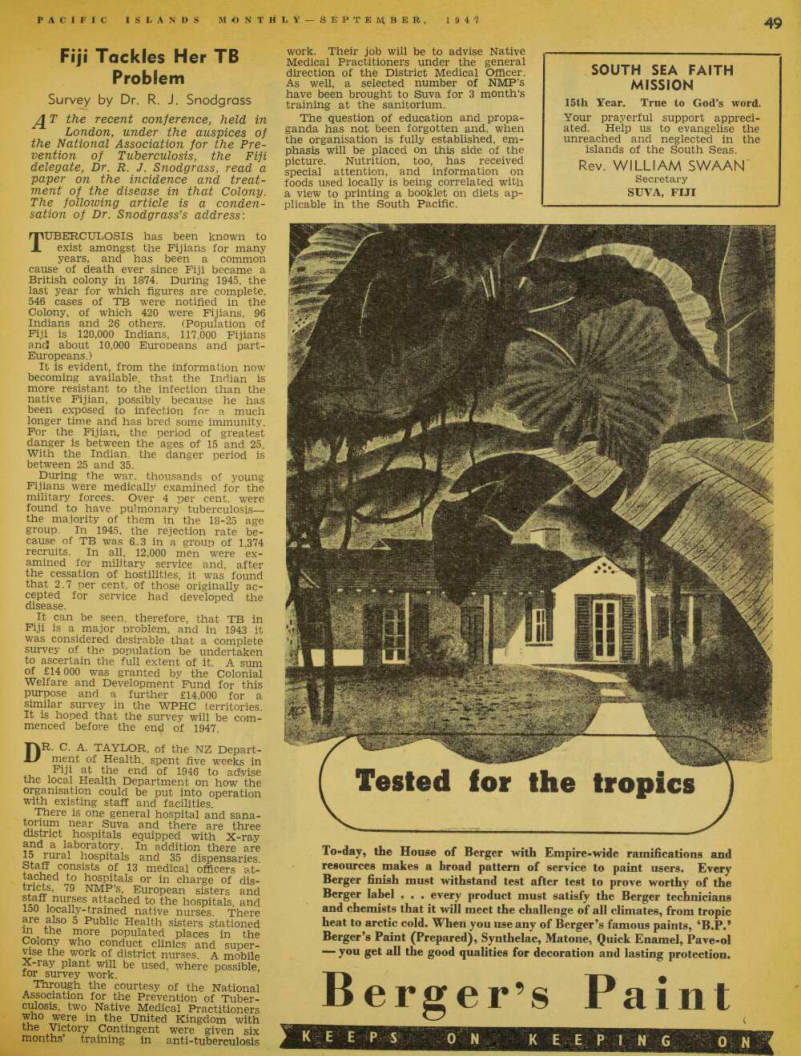
Problem
Survey by Dr. R. J. Snodgrass
T the recent conference, held in London, under the auspices of the National Association for the Pre vention of Tuberculosis, the Fiji delegate, Dr. R. J. Snodgrass, read a paper on the incidence and treat ment of the disease in that Colony.
The following article is a conden
sation of Dr. Snodgrass’s address :
Tuberculosis has been known to exist amongst the Fijians for many years, and has been a common cause of death ever since Fiji became a British colony in 1874. During 1945, the last year for which figures are complete, 546 cases of TB were notified in the Colony, of which 420 were Fijians, 96 Indians and 26 others. (Population of Fiji is 120,000 Indians, 117,000 Fijians and about 10,000 Europeans and part- Europeans.) It is evident, from the information now becoming available, that the Indian is more resistant to the infection than the native Fijian, possibly because he has been exposed to infection for a much longer time and has bred some immunity.
For the Fijian, the period of greatest danger is between the ages of 15 and 25, With the Indian, the danger period is between 25 and 35.
During the war. thousands of young Fijians were medically examined for the military forces. Over 4 per cent, were found to have pulmonary tuberculosis— the majority of them in the 18-25 age group. In 1945. the rejection rate be cause of TB was 6.3 in a group of 1 374 recruits. In all, 12,000 men were ex amined for military service and, after the cessation of hostilities, it was found that 2.7 per cent, of those originally ac cepted for service had developed the disease.
It can be seen, therefore, that TB in Fiji is a major problem, and in 1943 it was considered desirable that a complete survey of the population be undertaken to ascertain the full extent of it. A sum of £l4 000 was granted bv the Colonial Welfare and Development Fund for this purpose and a further £14,000 for a similar survey in the WPHC territories.
It is hoped that the survey will be com menced before the end of 1947.
DR. C. A. TAYLOR, of the NZ Depart ment of Health, spent five weeks in Fiji at the end of 1946 to advise the local Health Department on how the organisation could be put into operation with existing staff and facilities.
There is one general hospital and sana torium near Suva and there are three district hospitals equipped with X-ray and a laboratory. In addition there are 15 rural hospitals and 35 dispensaries.
Staff consists of 13 medical officers at tached to hospitals or in charge of dis tncts, 79 NMP’s, European sisters and ?™. nurses attached to the hospitals, and 150 locally-trained native nurses. There are also 5 Public Health sisters stationed in the more populated places in the Coiony who conduct clinics and super vise the work of district nurses. A mobile X-ray plant will be used, where possible, for survey work.
Through the courtesy of the National Association for the Prevention of Tuber cntosis, two Native Medical Practitioners who were in the United Kingdom with the Victory Contingent were given six months’ training in anti-tuberculosis
work. Their job will be to advise Native Medical Practitioners under the general direction of the District Medical Officer.
As well, a selected number of NMP’s have been brought to Suva for 3 month’s training at the sanitorium.
The question of education and propa ganda has not been forgotten and, when the organisation is fully established, em phasis will be placed on this side of the picture. Nutrition, too, has received special attention, and information on foods used locally is being correlated with a view to printing a booklet on diets ap plicable in the South Pacific.
Advertisements & other items, pp. 51-54 (3 items)
Berger’s Paint
SOUTH SEA FAITH
MISSION
15th Year. True to God’s word.
Your prayerful support appreciated. Help us to evangelise the unreached and neglected in the islands of the South Seas.
Rev. WILLIAM SWAAN
Secretary
SUVA, FIJI
m :: ::
Tested for the tropics
To-day, the House of Berger with Empire-wide ramifications and resources makes a broad pattern of service to paint users. Every Berger finish must withstand test after test to prove worthy of the Berger label . . . every product must satisfy the Berger technicians and chemists that it will meet the challenge of all climates, from tropic heat to arctic cold. When you use any of Berger’s famous paints, ‘B.P.’
Berger’s Paint (Prepared), Synthelac, Matone, Quick Enamel, Pave-ol you get all the good qualities for decoration and lasting protection.
Berger’s Paint
K EEPSONKE E P I N G 0 N < \\
is a
Capstan
grand cigarette
for all occasions-
Capstan’s own blend
of fine Virginia
leaf cannot
be equalled
ST' Wi o That’s why it’s always \
TIME FOR A CAPSTAN
THE EMPIRE'S FAVOURITE CIGARETTE
G. H. Robinson
ISLAND SUPPLIES
of all kinds—Selected and Shipped to order at lowest possible prices—Piecegoods in Wool, Cotton and Silk, Under and Outerwear, Manchester, Drapery, Grocery, Hardware, Engineers and Leathergoods trade supplies a specialty.
Indents and Transhipments arranged. Large or small orders treated with equal care.
Use our 25 years’ extensive experience.
Enquiries solicited to—
G. H. ROBINSON
51 Macquarie Street,
Sydney, N.S.W.
Telegrams: Sunrise, Sydney.
Letters: Box 3317, G.P.0., Sydney.
Steamships Trading
Company Limited
PORT MORESBY
SAMARA!
PAPUA.
WHOLESALE & RETAIL MERCHANTS, SHIPOWNERS,
PLANTERS, ENGINEERS & SLIP PROPRIETORS
Customs, Shipping, Insurance, and I Warding Agents.
MANAGING AGENTS AND VISITING REPRESENTA-
TIVES FOR COCONUT AND RUBBER ESTATES.
SYDNEY REPRESENTATIVES: Nelson Robertson Pty. Ltd., 12 Spring Street,
s E ss s
LOTI
Tm Ermt *b4 Ey«fcSi4*
SOLD EVEITWKKIK
H. A. A C*. rty LtL. Kigg H.
When Worried
Tired,Sleepless
AND YOU FEEL RUN-DOWN
Worry is Inescapable. Everyone has a share of It more or less. The great trouble about worry is that it plays havoc with your health and fitness if you let it. You become mentally and bodily weary, depressed: cannot sleep at night, lose appetite and begin to feel a nervous breakdown is impending. That starts the vicious circle. You worry, become run-down and nervy, and that makes you worry more than ever.
Meet your troubles all the way by reinvigorating your system and keeping it fit and well by taking Dr. Williams’ Pink Pills. These pills help to restore the red corpuscles and iron content of the blood to their normal quantity.
This enables life-giving oxygen and nourishment to be carried to the nerves, organs and tissues of the body. In that way you become invigorated, strengthened by Dr. Williams’ Pink Pills, the vague aches and pains disappear and you are fit again to deal confidently with all your worries. At chemists and stores.
& ft * £27/5/- F. 0.8. (packing inc.)
NEW!
Kerosene-
Paraffin
RANGE
(4-Burner Pressure Cooker) Styled in a Modern Manner.
Designed for Utmost Efficiency and Economy of Operation.
MOTTLED GREEN FINISH WITH INBUILT OVEN
BRANDT & STEELE
Merchants, and Distributors
FAYWORTH HOUSE, 381 PITT STREET, SYDNEY,
AUSTRALIA Cable Address; Bransteel.
50
SEPTEMBER, 1 947 PACIFIC ISLANDS MONTttLt
51
PACIFIC ISLANDS MONTHLY SEPTEMBER. 1947
HARRYING THE JAPS
(Continued from page 40)
W. Samoa Ships Large
Quantities Of Copra
Prom Our Own Correspondent
Apia, Aug. 12.
THE fact that the “Matua” was delayed a fortnight by the wharf labourers' dispute in Auckland has made sup plies of essential foodstuffs in Apia run low again. “Matua” is expected to arrive in Apia on or about the 15th; she has on board a large shipment of English goods transhipped at Suva fr’om, the “Taranaki.” In addition to the Matua, three more overseas steamers are expected at the end of the month to pick up copra and cocoa.
The arrival of ships to load copra is welcomed by Apia merchants. At the present time copra storage sheds here are filled to capacity.
Copra cutting has recently speeded up, the incentive being a recent rise m the local copra price, which now stands at £46/14/- per ton f.o.b.
The Apia price paid to producers for small quantities is 25/9 per 100 lb.
The “Bulletin de Commerce” of Nou mea recently announced that a regional meteorological station is being installed at Noumea, under the direction of M.
Mangeney, engineer of the French Meteorology Corps, who from Paris a few months ago. The French Government is behind the undertaking and will pay for installation and upkeep.
M. Mangeney has worked for six years in Equatorial Africa. The Noumea sta tion will be on top of a hill at the Fau bourg Blanchot (suburb overlooking Magenta) on ground made available by the municipality. It will use modern French equipment, including radar and will operate day and night, issuing fore casts and bulletins useful to aircraft, shipping and agriculture. It is expected that six assistants will be recruited this vear Noumea will thus become ah important link in the meteorological chain in the South and South-West Pacific.
Advertisements & other items, p. 55 (1 item)
Pacific Islands Trading Company
■ m ♦ .
EfftS?
No 246
UJ E STANDARD BURGESS
No. Z CELLS
r* No 92
raxi
m m y
lull
i 0 (1) it
LONG
LASTING
BATTERIES
FOR
EVERY
PURPOSE
IM Breathtaking Beauties! Burgess introduces two popular pocket penlights . . . coupled with the allure of the world's most beautiful girls!
A PAIR OF POPULAR, FAST SELLING POCKETLIGHTS ON NEW ALLURING DISPLAY CARDS: (1) Streamstyled Penlight No. 246. . . polished to a bright and glistening finish. Equipped with pocke clip . . . Lock-on type switch. A Burgess first! (2) Rich maroon and chrome Penlight No. 92 ... a sturdy metal case with pocket clip and lock-on switch
AVAILABLE FROM YOUR LOCAL STORE OR
PACIFIC ISLANDS TRADING COMPANY
244 CALIFORNIA ST., SAN FRANCISCO 11, CAL., U.S.A.
Cable Address: PITCO
Suva, May 22, 1942!
There Was A Jap Plane Over
From Our Own Correspondent
Suva, Aug. 20.
rLLOWING the recent publication in the New Zealand and Australian press of an interview with a Japanese airman Lieut. Susuma Ito, at Iwakune, Intelligence records kept in Fiji during the war have confirmed the fact that that officer did pilot a reconnaissance
aircraft over Suva on May 22, 1942. The plane, which was attached to Submarine 121, flew over Auckland on May 24, and over Sydney on May 29.
As a sequel, on the night of May 31- June 1, Japanese midget submarines attacked Sydney Harbour.
Miss J. Ferrier and Mr. M. O. Mcllwain have joined the staff of the Port Moresby Freezing Works.
Building Boom Now In
W. Samoa
From Our Own Correspondent
Apia, Aug. 12.
AS a result of the present trade boom in Western Samoa, and prospects of expansion and continuing high prices for cocoa and copra, a great deal of build ing is going on, or is contemplated, in Apia. This should improve the appear ance of the town.
The large, new premises of Morris Hed strom Ltd., are rapidly taking shape op posite the Apia Customs House. Build ing is under the supervision of Mr. J.
Gaffney.
Sir James Fletcher, head of the Fletcher Construction Company of New Zealand, recently paid the Territory another visit to complete the registration of a new Samoan subsidiary which will undertake work here. The new company has ac quired several sites in and near Apia where houses for employees will be erected, and it is also intended to build a joinery and a brick works. The timber resources of Savaii will be utilised for furniture which will be exported to New Zealand.
Death Of Fiji Pioneers
Col. Williams and Mrs. J. L. Hunt
(COLONEL Prank Williams, wiio lived j in Fiji for 75 years, died in August, in Suva at the age of 81. He was with the Union Steamship Company for 41 years, from 1891. He went overseas with the Fiji Labour Corps in the First World War, after which he founded the stevedoring firm of Williams and Gosling.
He was appointed honorary colonel of the Fijian Labour Corps in the Second World War.
He is survived by his wife and a family of ten.
THE death occurred, in August, of Mrs.
J. L. Hunt, who came to Fiji with her parents in the early 90’s from Mackay, Queensland. Her father, Mr. R.
E. Donaldson, was manager of the Koro nivia sugar estate.
After their marriage in 1896, Mr. and Mrs. Hunt took over this estate and lived there until Mr. Hunt’s death in 1937, when Mrs. Hunt moved to Suva.
She is survived by a son, Mr. lan Hunt, of Labasa, and two daughters, Mrs. G.
D Hill and Miss Nancy Hunt, both of Suva.
Mr. F. D. Cody has been appointed Refuelling Officer for the Shell Company at Port Moresby.
Advertisements & other items, p. 56 (1 item)
Brial & Ball
IMpm
i o i Airway Casas, fa wovan-striped, waterproofed eanvw with leather-bound edges, ara made for flying. The supply is limited . . . but increasing!
Mode by FORD SHERINGTON LTD.
Wholesale only
iGP G
ILLESPIE’S
The Flour of the Islands
- SYDNEY -
TRADE
MARK
Melbourne Office:
31 QUEEN STREET.
BRIAL & BALL
Importers and Exporters
Sydney Office:
1 BOND STREET.
WE HAVE PLEASURE IN ANNOUNCING THAT OUR NEWLY ESTABLISHED PARIS OFFICE WILL GLADLY ATTEND TO
YOUR REQUIREMENTS FROM EUROPE.
DIRECT SHIPMENTS ARRANGED.
FOR FURTHER DETAILS APPLY TO OUR SYDNEY OR MELBOURNE OFFICE
Guinea
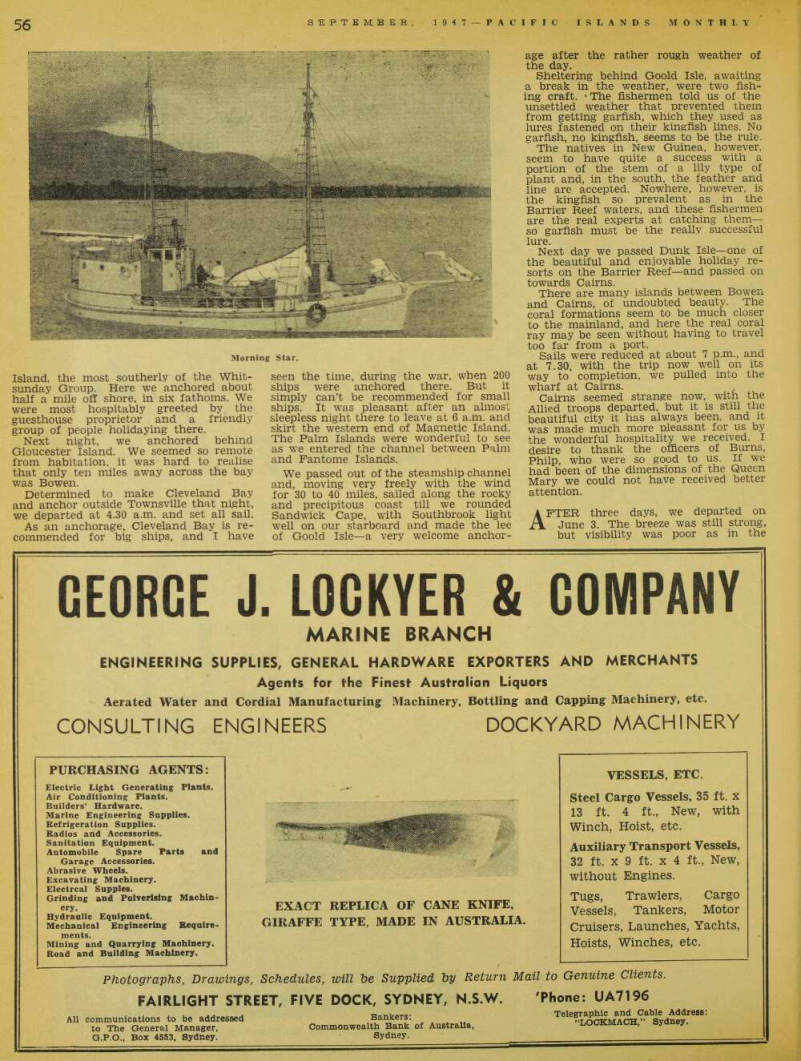
North To New
"Morning Star," New Mission Ship, Has a Quick Run
[From notes made by Cecil O’Dea, Sydney solicitor and yachtsman, who skippered the “Morning Star” from Taree, NSW, to Eastern Papua].
“H/|ORNING Star” she was called, and It! there she was alongside the old wharf at Harrington (at the entrance of the Manning River, on the North Coast of New South Wales), as sturdily built as any such craft could be, embodying ideas which should make her an ideal all-purpose vessel for the Catholic Mission in waters of Eastern Papua.
Here was the culmination of many months of planning by Rev. Father J.
Dwyer, MSC, in charge of Eastern Papuan Catholic Mission, and of good, honest, solid work put into her by Mr, Bill Ryan, boat-builder, of Taree. who accompanied us on our trip to Sidea, where she was handed on to the Mission.
The bar at Harrington, in a stiff breeze, is rather dangerous. So. anxious to leave whilst the light south-easterly made the bar passable, we worked dav and night loading stores. On May 12, 1947, at high tide, we stemmed the swell on the bar and, at 1,30 p.m., set a course up the coast for Bundaberg, Queensland.
For three nights and days we had a grey sky, with frequent rain squalls and a rising wind and sea. Apart from a roll expected in a small craft, the “Star” (as we called her) convinced us of her sea worthy qualities.
It was with relief, howeven that we approached the leads at Wide Bay, which guided us over the bar into still waters of that beautiful water-wav separating Great Sandy (or Fraser) Island from the coast of Queensland.
The Straits lead to Hervey Bay. With sail, and the Vivian engine doing its best, we sailed through and, at 6 p.m., on May 17, crossed the bar at Bunda berg. The rain had ceased, but darkness came quickly: and, as the river had been filled with silt from recent floods, the danger of stranding obliged us to anchor.
Next morning, the pilot took us up stream. We were given a great welcome at Bundaberg, which has a deserved re putation for hospitality.
IT was cold and misty on May 21 when we left Bundaberg. The sea was still rough, and the wind fresh. Under main and mizzen, jib and forestaysail, we were soon logging over eight knots.
At 5.30 p.m., sail was taken off and we approached that beautiful small-boat anchorage. Pancake Creek, in the lee of Bustard Head, upon which the light house is perched, a guide to all ships passing or making for Gladstone Harbour.
Next day, in cloudy weather and dis turbed water, our course took us to the lee of Keppel Islands, where we anchored at 5 p.m. in 3 fms. This was a good holding ground but a most uncomfort able anchorage.
On the evening of the 23rd, we anchored in the quiet and peaceful waters of Port Clinto, after an anxious crossing of a very disturbed bar.
Rain still persisted next day and pre vented us from appreciating the beauty of the Islands we were coming to. and the grand ruggedness of the coast. The Percys, and especially Middle Islands, are a favourite anchorage for fishing folk and there was a new boat of the kingfish fleet in the bay when we dropped our pick at 4 p.m.
After tea, the owner of the craft came
over in his dinghy and, as usual, was a great type of small-boat man. He told us of the tragic sight he witnessed when a boat in the fleet, which was trolling a school of kingfish, struck a floating mine and, with a terrific explosion, boat and the three men were blown to pieces.
WHAT an enchanting spot we anchored in next night, at Scawfel Island!
It is one of many islands in a group that stretches to the Whitsunday Group.
The bay is about two miles long, by one mile wide, with sandy beaches on the southern and eastern sides, and there is perfect protection from the south westerly or easterly or southerly winds, with a good holding bottom of mud in four to five fathoms, half a mile off a sandy beach.
The thickly-wooded hills, which easily might be called small-timbered mountains, were made more pleasant by the de parture of the rain and the call of in numerable birds from the hill-sides, and
the flight of myriads of ducks as they passed overhead into the centre of the isle.
Next morning, May 26, only a short journey lay ahead of us to Lindeman
Island, the most southerly of the Whit- Sunday Group. Here we anchored about half a mile off shore, in six fathoms. We were most hospitably greeted by the guesthouse proprietor and a friendly group of people holidaying there.
Next night we anchored behind Gloucester Island We seemed so remote from habitation, it was hard to realise that only ten miles away across the bay was Bowen.
Determined to make Cleveland Bay and anchor outside Townsville that night, we departed at 4.30 a.m. and set all sail.
As an anchorage, Cleveland Bay is recommended for big ships, and I have
seen the time, during the war, when 200 ships were anchored there. But it simply can’t be recommended for small ships. It was pleasant after an almost sleepless night there to leave at 6 a.m. and skirt the western end of Magnetic Island.
The Palm Islands were wonderful to see as we entered the channel between Palm and Fantome Islands. we passed out of the steamship channel and, moving very freely with the wind for 30 to 40 miles, sailed along the rocky and precipitous coast till we rounded Sandwick Cape, with Southbrook light well on our starboard and made the lee of Goold Isle—a very welcome anchor-
age after the rather rough weather of the day.
Sheltering behind Goold Isle, awaiting a break in the weather, were two fish ing craft. -The fishermen told us of the unsettled weather that prevented them from getting garfish, which they used as lures fastened on their kingfish lines. No garfish, no kingfish, seems to be the rule.
The natives in New Guinea, however, seem to have quite a success with a portion of the stem of a lily type of plant and, in the south, the feather and line are accepted. Nowhere, however, is the kingfish so prevalent as in the Barrier Reef waters, and these fishermen are the real experts at catching them — so garfish must be the really successful lure.
Next day we passed Dunk Isle—one of the beautiful and en.ioyable holiday re sorts on the Barrier Reef—and passed on towards Cairns.
There are many islands between Bowen and Cairns, of undoubted beauty. The coral formations seem to be much closer to the mainland, and here the real coral ray may be seen without having to travel too far from a port.
Sails were reduced at about 7 p.m., and at 7.30, with the trip now well on its way to completion, we pulled into the wharf at Cairns.
Cairns seemed strange now, with the Allied troops departed, but it is still the beautiful city it has always been, and it was made much more pleasant for us by the wonderful hospitality we received. I desire to thank the officers of Burns, Philp, who were so good to us. If we had been of the dimensions of the Queen Mary we could not have received better attention, AFTER three days, we departed on June 3. The breeze was still strong, but visibility was poor as in the
Morning Star.
out of Cairns, and 25 days from Taree, having spent seven days of this in port.
short, rough chop, we ran through Graf ton Passage. Having been warned about the inconsistencies of the set near Bougainville Reef, I set a course to pass 20 miles off. We travelled well at night, the fresh wind sending us along in great style, with a considerable roll to let us know we were at sea.
By noon on June 5, the breeze had dropped and the sea was getting smoother.
I hoped early in the morning to pick ujd_ South Cape.
At 7 o’clock on June 6, land was sighted on our starboard bow—the eastern end of Papua. The wind had dropped, but it was still cloudy and over cast with intermittent showers. It was difficult to pick up the lighthouse on Badila Bedda Bedda and, in order to be on tne safe side, we ran in behind Suau and were very pleased we did so, for what a beautiful Strait it is, coming through this deep, narrow passage. A most fertile island, peopled by friendly folk —our first glimpse of the inhabitants of New Guinea. We towed a becalmed lakatoi round to Suau on our way, about two miles, and at the village there was another craft desirous of a tow to Samarai.
It was a wet trip, what with the surge and speed of our craft and the chop of the waves, and the frequent torrential down-pours, but they didn’t seem to mind. Their destination was Kwato Mission and, in spite of the towed craft coming adrift on one occasion, we brought them safely to their friends. We passed through the almost unbelievable beauty of the passage between Kwato and Rogeia, with the f ertile hilly volcanic soil of the green hills. We rounded Rogeia, and there was Samarai, with Father J. Dwyer, MSC, and Father J.
Loomey, MSO, to welcome us. We had arrived at our destination three days
Advertisements & other items, pp. 57-58 (1 item)
ash'rp /
Island Stamps
Island Stamps
Island Stamps
Island Stamps
1/3 PER PACKET
including postage Write to—
JENKINS EMPORIUM
Box 100, Suva, FIJI
yours /or f/te
ash'rp /
*vS ■i r \
SEALED - TO BE SURE
The Shell Company of Australia, Limited (Incorporated in Great Britain),
GEORGE J. LOCKYER & COMPANY
MARINE BRANCH
ENGINEERING SUPPLIES, GENERAL HARDWARE EXPORTERS AND MERCHANTS
Agents for the Finest Australian Liquors
Aerated Water and Cordial Manufacturing Machinery, Bottling and Capping Machinery, etc.
CONSULTING ENGINEERS DOCKYARD MACHINERY
PURCHASING AGENTS:
Electric Light Generating Plants.
Air Conditioning Plants.
Builders’ Hardware.
Marine Engineering Supplies.
Refrigeration Supplies.
Radios and Accessories.
Sanitation Equipment.
Automobile Spare Parts and Garage Accessories.
Abrasive Wheels.
Excavating Machinery.
Electrcal Supples.
Grinding and Pulverising Machinery.
Hydraulic Equipment.
Mechanical Engineering Requirements.
Mining and Quarrying Machinery.
Road and Building Machinery.
Photographs, Drawings,
EXACT REPLICA OF CANE KNIFE,
GIRAFFE TYPE, MADE IN AUSTRALIA.
VESSELS, ETC.
Steel Cargo Vessels, 35 ft. x 13 ft. 4 ft., New, with
Winch, Hoist, etc.
Auxiliary Transport Vessels,
32 ft. x 9 ft. x 4 ft., New,
without Engines.
Tugs, Trawlers, Cargo Vessels, Tankers, Motor Cruisers, Launches, Yachts, Hoists, Winches, etc.
Schedules, will he Supplied hy Return Mail to Genuine Clients.
FAIRLIGHT STREET, FIVE DOCK, SYDNEY, N.S.W. 'Phone; UA7196 All communications to be addressed Bankers: to The General Manager, Commonwealth Bank of Australia, G.P.0., Box 4553, Sydney. Sydney.
Telegraphic and Cable Address: “LOCKMACH,” Sydney.
Us Base In Fiji Now
Dismantled
From our own correspondent
Suva, Aug. 20.
n 7 f h "‘ a “ the caretaker, and oddments oi water towers and oil tanks, are all that remain of thej array of buildings and installations.
After the withdrawal of the American naval forces, the base was taken over by the sth Fijian Battalion and later by a Guards Company until late last year, when it was handed over to the Public works Department.
Death Of Curator Of
Suva Museum
Mr. G. T. Barker
From Our Own Correspondent SUVA, August 20.
AMONG several widely-known Fiji people whose deaths have occurred in recent weeks was Mr. George Thomas Barker, who for 17 years has been curator of the Fiji Museum, Suva.
Mr. Barker was the son of Mr. and Mrs. T. W. Barker, who arrived in Fiji in 1885. He was born in 1872.
Partly through research and partly through experience in the remoter parts of Fiji, he became an authority on Fijian history, language, traditions and customs. Except for several years in the 90’s, spent in gold-prospecting in WA, he spent all his life in the Colony.
Mr. Alport Barker, owner of the “Fiji Times,’’ is a brother of the deceased. Mrs.
T. P. Nicholson, of Suva, is a sister.
Advertisements & other items, pp. 59-60 (1 item)
Equal to the World’s Best
Woven Wire for all Industry
COPRA DRYING TRAYS, FLOORS, Etc.
FRUIT DRYING TRAYS, MINING SCREENS.
Heavy Mosquito Gauze in Phosphor Bronze and other Metals Impervious to Salt Sea Air.
WIRE DOOR MATS AND GENERAL WIRE WORKS
E. WRIGHT & CO. LTD.
Office and Works: 148-152 Cleveland Street, Sydney, N.S.W.
Telegraphic Address; “Wrightmake,” Chippendale. <S>*L £ ✓ '
Equal to the World’s Best
Throughout Australia and Overseas there ii on ever-increasing demand for a
COLONIAL & BRONTE
HIGH-GRADE CANNED MEATS
There is no better quality—none more wholesome.
TRADE MEATS FOR THE ISLANDS
order
“COLONIAL” BRAND
Roast, Corned and Boiled Beef Packed in 6,5, 4,3, 2, 1 lb. and 12 oz. tins.
Also Corned Beef in 12 oz. Taper Tins.
Roost, Corned and Boiled Mutton. 1 lb. and 12 oz. tins.
Choice Dripping 36 lb., 2 lb., 1 lb. tins, and 1 lb. packets. i is .5 am Under present conditions it is wise to ensure that you have ample stocks of all our lines .
The Colonial Wholesale Meat Coy* Pty. Ltd*
30 GROSVENOR STREET, SYDNEY
TIME-PIECES
REPAIRED
We employ a Fully Qualified
Staff and we are equipped to undertake repairs of
WATCHES CLOCKS
MARINE CHRONOMETERS
We undertake Locksmithing, Key-cutting, etc.
Any goods sent to us by post are attended to promptly and with care.
NOEL LEVY
Victoria Parade, Suva, Fiji Phone 39. P.O. Box 88.
Cablegrams: “Noel,” Suva
The Most Extensive Manufacturers in the British Empire of
RUBBER STAMPS,
INKS, STENCILS,
Marking Devices,
ACME STAMP PADS
OFFICE & STATIONERY SUPPLIES
o-iHao (>• ■? G i, 8 0 ? 9 6 A 8 I m-9 Ql 3 5 31PG5 We also Manufacture & Supply a Complete Line of
LIMEWASHING AND
SPRAYING MACHINES
for all purposes.
Let us know your requirements and we will quote by return.
WRITE FOR OUR GENERAL CATALOGUE
Limewashing Machine
EXCELSIOR SUPPLY CO. PTY. LTD.
278 host Office Place,
MELBOURNE, VIC.
HEAD OFFICE :
160 BROADWAY,
Formerly known at Oeorge St., West,
SYDNEY. N.S.W.
50 Victoria Street,
WELLINGTON, N.Z.
Cargo Cult
Of Missionaries and Cargo Cult
Letter to the Editor AS a missionary of the Sepik District of 15 years’ standing, I would like to reply briefly to “New Guineaite,” who wrote about cargo cult, Yali, and other related subjects in the July issue of “PIM.”
Cargo cult, under various names, has existed for years—and still exists—right up the Ramu and Sepik rivers and as far as Wewak and Kariru, and probably further. Any experienced patrol-officer can tell New Guineaite this. There were also, between 1935 and the outbreak of the war, scientific studies made of the subject in these districts.
Early this year, I interviewed a planter of this area, a patrol-officer, and a missionary. All agreed that there had been a great revival of the cult recently and that around Bogia it had almost amounted to a rebellion. The planter had himself come upon a mysterious night session of the adherents and for several days afterwards his boys refused to work.
As far as Madang is concerned, Colonel Woodman could have given New Guinea ite some useful information about the cult.
With regard to Yali. I myself inter viewed this native, near Bogia, early this
year. From what he told me I gathered that his purpose was to mould native opinion into believmg that it was only tnrough hard, sustained work that wealth could be achieved; and that easy acquisi tion through cargo-cult was a myth.
New Gumeaite says that missionaries did nothing for the country during the war. The fact is that no other section of the New Guinea community paid a higher price in lives sacrificed than did the missionary body. I will not give de tails of material help given fleeing Euro peans by missionaries who stayed at their posts, nor of the war service of missionaries of all denominations. These things are known by those who matter; and are believed by the unbiased.
New Guineaite takes us to task for getting free labour from the natives be fore the war. It is the custom all over the world for non-commercial enterprises, such as church bodies, to arrange collec tions and erect schools and churches by voluntary contributions of the adherents.
Why should New Guinea be an exception?
New Guineaite does not believe in education for the natives. But if there had been no mission education of natives in New Guinea, who would have read and interpreted the propaganda pamph lets dropped in millions to the natives in enemy-held territory during the war? In this way the natives were encouraged to carry on without help from Europeans.
I know of one catechist, at least, who was beheaded by the Japs for picking up, and reading to his village, a pamphlet dropped by our forces.
In conclusion, I should like to quote from Sir Hubert Murray. In one of his writings, Sir Hubert says that after the inevitable disappearance of old native customs and beliefs, the native is like a rudderless ship unless the missionary is there to help him.
“It seems to me,” continues Sir Hubert, “that many people, in their objection to theological dogma, allow themselves to under-rate the enormous moral and social force of Christianity, and consequently underestimate the effect of Christian missions among native races; and I am glad to see that Dr. Rivers, in the collection of essays to which I have so often referred, gives expression to the view which most British administrators have always held. ‘Experience,’ he says, ‘has amply shown that Christianity is capable of giving the people an interest in life which can take the place of that due to their indigenous religion.’”
I am. etc.,
Missionary.
Wewak, NG, 26/8/47.
Sales Control Of Fiji
Crown Land Leases
From Our Own Correspondent
Suva. Aug. 16.
A STATEMENT of policy regarding the control of dealings in Crown land leases has been made by the Gov ernment of Fiji.
This policy is aimed primarily at pre venting an undue increase in the selling price of leases of Crown land or the use of such leases for speculative purposes, or the sale of any lease at an uneconomic price. A secondary purpose is the elimi nation of the payment of any premiums of speculative or inflation value and to discourage except for genuine com mercial purposes the sub-leasing of Crown land.
Mr. H. W. Quinton, formerly of New Guinea Treasury Staff, Rabaul, has been transferred to the Commonwealth Audi tor-General’s Office, London and left Sydney for London in August.
Advertisements & other items, p. 60 (1 item)
58
1 9 4 1 P A C I F t C ISLANDS M O tt f H L If
Advisory Body
Madang Forms Own Advisory Body Hopes to Co-operate With Local Administration
BY reforming the pre-war organisation known as the Madang and Distirct Progressive Association, tho residents of Madang. New Guinea, have constituted a sort of unofficial Advisory Council to the local Administration.
As well as the usual office-bearers, the Association will have a representative of each of the three missions which function in the District and a representative of the Native Affairs Department to be appointed by the District Officer.
At a meeting held in Madang on August 7. the chair was taken by Mr.
B. G. Hall, who was a prominent official of the organisation before the war. He gave the assembly a rough outline of the pre-war activities of the body, pointing out that although efforts were made then to assist and co-operate with the Admin istration on civil matters, this offer met with practically no response. However, with a New Order functioning in the Territory, citizens could, perhaps, assume that their civic rights as citizens would receive a little more consideration.
Mr. Hall then called upon the District Officer. Mr. J. K. McCarthy, to address the meeting, and state as far as possible his interpretation of the Government’s policy, as far as the private individual was concerned.
Mr. McCarthy outlined the fundamental design of his Administration, and then stated that he was prepared to co-operate with the Association, and seek their ad vice on public matters, so far as was
consistent with the Administration policy as laid down for him by higher authority.
Officers elected were as follows; Pre sident, Mr. B. G. Hall: vice-president, Mr.
W. Cahill; secretary, Mr. F. James; assistant-secretary, Mr. R. Wiedenhofer; treasurer, Mr. R. Wiedenhofer; committee, Sister J. Jones, Mr. W. Wright, Mr. T.
Warburton, Mr. R. Chugg, and Mr. G. E.
Bliss. There would also be represent atives from the RC Mission, SDA Mission, Lutheran Mission, the Native Affairs’
Dept., and the Chinese community.
The meeting was not attended by any representatives of the Missions but it was expected that they would show the necessary interest in civic affairs, as missions played a large part in the economic life of the Territory.
At the conclusion of the meeting, Mr.
Hall thanked Mr. McCarthy for his offer of co-operation and assured him that the efforts of the citizens would be directed towards community good.
Fiji, Too, Is Drying
Bananas
From Our Own Correspondent
Suva, Aug. 16.
A BANANA-DEHYDRATING plant has started up in Suva with, according to the owner, Mr. B. Proweller, heavy orders in hand and more in sight.
World-wide distribution Is planned.
The bananas are dehydrated whole, in stead of being split into three as in the Samoan banana-drying process, and are wrapped in coloured cellophane with dis tinctive Fijian labels.
Bananas were being canned in Suva as long ago as the 1880’s; and there was a small but prosperous dried-banana In dustry at Levuka. 30 years ago. Both industries have long since disappeared.
Teachers' Bonus Was A
Departmental "Boner"
From Our Own Correspondent
Mangaia, July.
THERE was great rejoicing here re cently among the school staffs when the Education Department of Cl announced that a bonus, amounting to as much as £4O, would be paid to senior teachers. The reasons for this sudden burst of official generosity were not made clear; but the disbursement duly took place, and an orgy of spending followed.
It is now discovered that the bonus was paid in error; and the money paid to the senior teachers has to the very great dissatisfaction of their “union ” the Cl Teachers’ Guild been debited to their salary accounts. As a result, the nedagogues who got the largest bonus now face the longest term in re funding it, at £1 per month!
There is. however, a brighter side to this tragedy of error. Certain members of the staff, whose services have been dispensed with, may now chuckle because they, before leaving, drew the “bonus”; and now, being out of the Department’s employ, are exempt from the loss of one pound a month to pay it back!
The writer felt, and expressed, at the time, a suspicion that someone had blundered it is not customary for the NZ Government to throw largesse around in the Cooks, where no one can vote in the NZ elections, in spite of the Group being allegedly a part of New Zealand.
To the writer’s mind, the Administra tion would have been better advised to let the bonus stand, and charge it to overhead expenses, rather than “lose face” In the manner described.
The price of petrol in Fiji was increased by 2d. to 2/7 a gallon on August 22.
Advertisements & other items, p. 61 (2 items)
59
HLT SEPTEMBER, 1947
PACIFIC ISLANDS MON
Equipment
BUDGE REFRIGERATION and
ICE MAKING
COMMERCIAL AND INDUSTRIAL
UNITS
(not domestic) Ammonia and Methyl Chloride machines of large or small capacity.
The illustration is of a small (nine 28 lb. blocks) electric. Methyl Chloride Icemaking plant.
Enquirers should mention dimensions of cold room (or cabinet) and of amount of ice (if any) required per day; also if electric motor or internal combustion engine is to be included.
Si
JAMES BUDGE PTY. LTD.
REFRIGERATION ENGINEERS
McEvoy Street, Alexandria, Sydney
Telephones; LA 5034-5-6 ' Established 1890
Hombu Hombu, Bsi,
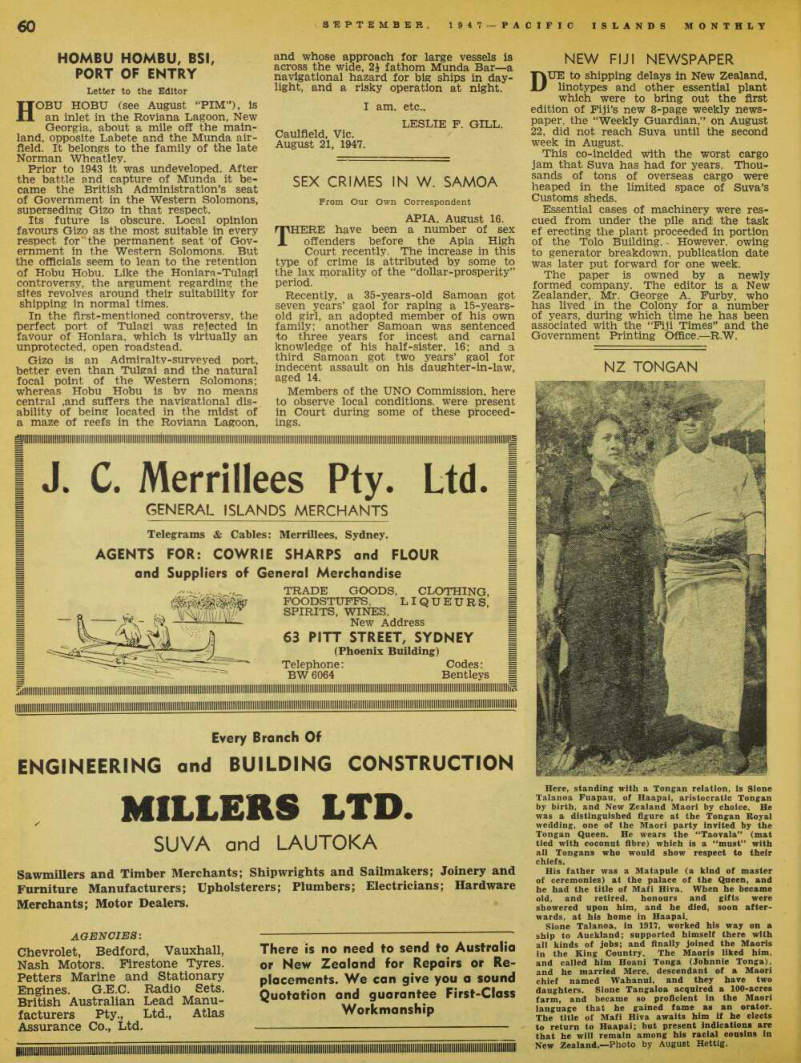
Port Of Entry
Letter to the Editor HOBU HOBU (see August “PIM”), is an inlet in the Roviana Lagoon, New Georgia, about a mile off the main land, opposite Labete and the Munda air field. It belongs to the family of the late Norman Wheatley.
Prior to 1943 it was undeveloped. After the battle and capture of Munda it be came the British Administration’s seat of Government in the Western Solomons, superseding Gizo in that respect.
Its future is obscure. Local opinion favours Gizo as the most suitable in every respect for the permanent seat of Gov ernment in the Western Solomons. But the officials seem to lean to the retention of Hobu Hobu. Like the Honiara-Tulagi controversy, the argument regarding the sites revolves around their suitability for shipping in normal times.
In the first-mentioned controversy, the perfect port of Tulagi was rejected in favour of Honiara, which is virtually an unprotected, open roadstead.
Gizo is an Admiralty-surveyed port, better even than Tulgai and the natural focal point of the Western Solomons; whereas Hobu Hobu is bv no means central ,and suffers the navigational dis ability of being located in the midst of a maze of reefs in the Roviana Lagoon,
and whose approach for large vessels is across the wide, 2i fathom Munda Bar—a navigational hazard for big ships in day light, and a risky operation at night.
I am, etc..
Leslie F. Gill.
Caulfield, Vic.
August 21, 1947.
Sex Crimes In W. Samoa
Prom Our Own Correspondent APIA. August 16.
THERE have been a number of sex offenders before the Apia High Court recently. The increase in this type of crime is attributed by some to the lax morality of the “dollar-prosperity” period.
Recently, a 35-years-old Samoan got seven years’ gaol for raping a 15-years old girl, an adopted member of his own family; another Samoan was sentenced to three years for incest and carnal knowledge of his half-sister, 16; and a third Samoan got two years’ gaol for indecent assault on his daughter-in-law, aged 14.
Members of the UNO Commission, here to observe local conditions, were present in Court during some of these proceed ings.
New Fiji Newspaper
DUE to shipping delays in New Zealand, linotypes and other essential plant which were to bring out the first edition of Fiji’s new 8-page weekly news paper, the “Weekly Guardian,” on August 22, did not reach Suva until the second week in August.
This co-incided with the worst cargo jam that Suva has had for years. Thou sands of tons of overseas cargo were heaped in the limited space of Suva’s Customs sheds.
Essential cases of machinery were res cued from under the pile and: the task ef erecting the plant proceeded in portion of the Tolo Building. - However, owing to generator breakdown, publication date was later put forward for one week.
The paper is owned by a newly formed company. The editor is a New Zealander, Mr. George A. Furby, who has lived in the Colony for a number of years, during which time he has been associated with the “Fiji Times” and the
Government Printing Office.-
R.W.
Nz Tongan
Here, standing with a Tongan relation, is Sione Talanoa Fuapau, of Haapai, aristocratic Tongan by birth, and New Zealand Maori by choice. He was a distinguished figure at the Tongan Royal wedding, one of the Maori party invited by the Tongan Queen. He wears the “Taovala” (mat tied with coconut fibre) which is a “must” with all Tongans who would show respect to their chiefs.
His father was a Matapule (a kind of master of ceremonies) at the palace of the Queen, and he had the title of Mafi Hiva. When he became old, and retired, honours and gifts were showered upon him, and he died, soon after wards, at his home in Haapai.
Sione Talanoa, in 1917, worked his way on a ship to Auckland; supported himself there with all kinds of jobs; and finally joined the Maoris in the Ring Country. The Maoris liked him, and called him Hoani Tonga (Johnnie Tonga), and he married Mere. descendant of a Maori chief named Wahanui, and they have two daughters. Sione Tangaloa acquired a 100-acres farm, and became so proficient in the Maori language that he gained fame as an orator.
The title of Mafi Hiva awaits him if he elects to return to Haapai; but present indications are that he will remain among his racial cousins in New Zealand. Photo by August Hettig.
Advertisements & other items, p. 62 (1 item)
J. C. Merrillees Pty. Ltd.
GENERAL ISLANDS MERCHANTS
Telegrams & Cables; Merrillees. Sydney.
AGENTS FOR: COWRIE SHARPS and FLOUR
and Suppliers of General Merchandise T. u
TRADE GOODS, CLOTHING,
FOODSTUFFS. LIQUEURS,
SPIRITS, WINES.
New Address
63 PITT STREET, SYDNEY
(Phoenix Building) Telephone: Codes: BW 6064 Bentleys
ENGINEERING and BUILDING CONSTRUCTION
MILLERS LTD.
SUVA and LAUTOKA
Sawmillers and Timber Merchants; Shipwrights and Sailmakers; Joinery and Furniture Manufacturers; Upholsterers; Plumbers; Electricians; Hardware Merchants; Motor Dealers.
AGENCIES:
Chevrolet, Bedford, Vauxhall, Nash Motors. Firestone Tyres.
Fetters Marine and Stationary Engines. G.E.C. Radio Sets.
British Australian Lead Manufacturers Pty., Ltd., Atlas Assurance Co., Ltd.
There is no need to send to Australia or New Zealand for Repairs or Replacements. We can give you a sound Quotation and guarantee First-Class Workmanship
Knew Thakombau!
Old Resident of Sydney
THERE is a man actively engaged in business in Sydney to-day who grew Sea Island cotton in the Lau Islands in 1871, and who shook hands with King Thakombau in Lomaloma in 1873. He is J. E. P. Ducker, now approaching his 89th birthday.
About 1840, a missionary called Rev.
William Moore went to Fiji and estab lished himself among the primitive natives. He was followed by another missionary, Rev. Millard; and those two men married the two sisters of Mr. J. P.
M. Ducker, who lived in Australia.
In the late 60’s, owing to the American Civil War, there was a boom in cotton growing in the Islands; and the mis sionaries urged Mr. Ducker to go to Fiji, and plant cotton. With his family (which included J. E. P. Ducker, then a youth) he embarked in Sydney on the “Sea Witch,” 64 tons, and they left in 1869, in a southwest gale, by which they logged 192 knots the first day. 204 the next, and 211 the next they were in Levuka in 14 days.
From Levuka, the Duckers went to the Lau group, and began planting Sea Island cotton on Lomaloma. Lau had been conquered by the Tongans. A rather fine character named Ma’afu was Tongan Governor, and Europeans were welcome and well treated. There was plenty of money about and the Duckers got 4/2 per pound for their cotton. Then came a new Governor Maafi. a surly gentleman who did not like whites, and life in Lau became uncomfortable.
Mr. J. P. M. Ducker was one of a depu tation which urged Commodore Good enough, commander of a British squad
ron, to ask the British Government to accede to King Thakambau’s plea for British protection. When this was granted, King Thakambau went in his own little ship to Lomaloma, and re possessed the group from the Tongans.
Young J. E. P. Ducker was one of those who shook hands with the famous Canni bal King, nearly three-quarters of a cen tury ago.
WHEN the American War was over, and planting was resumed, the cotton price in Fiji fell to 1/- per pound, and the good times passed.
Young Ducker returned to Australia in 1875 72 years ago but to-day, at nearly 89, he still remembers events in Fiji very clearly.
“Ma’afu had a very fine cutter,” he said. “It was so fast that nothing there abouts could touch it. Here in Sydney there was a family called Manton great sailing people. Two of the young Mantons got away from Sydney in a very fast yacht called the ‘Zarifa,' and they eventually turned up in Lau. They chal lenged Ma’afu to a race but the old Governor was wily, and suspicious.
Finally, they offered him a substantial start. If he won, he was to get the ‘Zarifa.’ If they won, they were to get the lovely little island of Thithia, about 35 miles from Lomaloma.
“They literally sailed rings around the Governor’s boat, and the Governor paid up. The Mantons got their island, other brothers came, and the Mantons were planters in Thithia and Lomaloma for several years.”
Another of the Ducker brothers, A. R.
W. Ducker, is also well and hearty, at 871. There must be something in the Fiji air.
Delayed telegram rate between Noumea and Australia (minimum of 25 words) is now 7.911 francs a word.
Mrs, A. Bowring, who has been in hospital in Australia for some months, has now been discharged and is once again enjoying good health. She intends to return to the Morobe district this month.
The death occurred on July 7, 1947, of William Christopher Abbie, in the US Marine Hospital at Baltimore, USA. Mr.
Abbie was a well-known personality on the Morobe goldfields before the war.
Advertisements & other items, pp. 63-64 (1 item)
Dunlop
American Magazines
Direct to You from the
Publishers.
AMERICAN HOME 17/-
ASIA AND THE AMERICAS 32/6
BETTER HOMES AND GARDENS 21/9
CHARM 32/6
COLLIERS’ WEEKLY 43/-
CORONET 18/9
ESQUIRE (2 YEARS ONLY) 95/-
FORTUNE 87/-
GL AMOUR 27/-
HOUSE AND GARDEN 42/6
JUNIOR BAZAAR 35/-
LADIES’ HOME JOURNAL 37/6
LIFE 49/-
LOOK 32/-
NEW YORKER 64/6
NEWSWEEK .. ‘ 78/-
POPULAR MECHANICS 22/9
POPULAR PHOTOGRAPHY 26/6
READER’S DIGEST 12/-
SATURDAY EVENING POST 62/6
SCIENTIFIC AMERICAN 40/-
SCIENCE ILLUSTRATED 62/6
TIME 80/-
Rates are for one year and include
all charges. Many other overseas
Art, Trade, Technical, Fashion and
Literary periodicals available.
ALL ORDERS AIR-MAILED TO
PUBLISHERS.
MAIL PUBLICITY CO., 175 PITT
STREET, SYDNEY, N.S.W.
Since 1888, when John Boyd Dunlop produced the first practical pneumatic tyre, the Dunlop organisation has striven to further the interests and development of transport.
Today, there is hardly a vehicle bicycle or aeroplane, horse-drawn waggons, motor car or truck that does not run more smoothly, silently, efficiently and economically because of Dunlop Tyres.
DUNLOP
in "fits 9ncUi,st f Uf
Hard to Get? us
FOR
ING 18.
M. & M.
SADDLERY & HARNESS
HOME LIGHTING PLANTS
WINES AND SPIRITS
NON-ELECTRIC WASHING
MACHINES
PUMPS, IRRIGATION
PLANTS
CROCKERY
HAIRDRESSING SUPPLIES
HARDWARE
AIR CIRCULATORS
8a Castlereagh Street, Sydney, Australia
ISLAND TRADERS
Cable and Telegraphic address: “MANSTOCKS,” SYDNEY Telephones: 8W7405, 8W1237, 85076, FM2766
NELSON and ROBERTSON Pty. Ltd.
Established 1895
Shipowners - Brokers and
Islands Merchants
All classes merchandise purchased at Best Wholesale Prices. Original Invoices supplied to Island Clients. Cocoa Beans, Copra, Rubber, Trochus Shell and All Islands 7 Produce Sold on Commission.
Entrust your requirements to the firm with fifty years' practical experience in the Pacific Islands.
NELSON & ROBERTSON RS
12 SPRING STREET, SYDNEY, AUSTRALIA
Telegraphic Address: IVAN, SYDNEY.
Rhys Healey
First European Baby
On Sepik River
A Son for Mr. and Mrs.
Rhys Healey
A SON has been born to Mr. and Mrs.
L. R. Healey at Angoram, Sepik River, New Guinea.
The birthday of the child, July 30, was
a red-letter day for the Sepik River generally, and Angoram in particular, be cause we can state without fear of con tradiction that this is the first occasion upon which a European baby has been born in this area of mud and mosquitoes, Mr. Healey is the exceedingly popular local Medical Assistant. Mrs. Healey has been no less popular as our local post mistress, office-typist and good companion to her husband “Dokta Ris” as the natives call him. Together the Healeys have dispensed a hospitality that is greatly appreciated in an area more usually given over entirely to bachelors.
Interest in the anticipated addition to the Healey household has been mounting for months in a way that would probably have tickled the fancy of the late Bret Harte. Speculation as to the probable size and sex of the child had been a topic of some magnitude and money changed hands in support of individual hunches.
Although belonging to the medical fra ternity. Mr. Healey forecast the time a fortnight late and also erroneously fore cast that the child would be a girl.
Due to the modern conveniences of radio and air transport, Dr. Mclnerney was able to fly in from Wewak and Mrs.
E. D. Robinson was rushed to the scene as a nurse.
The European population of Angoram, miners, recruiters and the rest, celebrated the occasion fittingly. Assistant District Officer R. G. Ormsby made a fine gesture by opening a bank account for the baby with £lO he had previously won that amount from the infant’s father in a bet that it would be a boy and others
added to it.-
Mossie.
Mr. Paul (Karkar) Schmidt has re turned to Rabaul, on a visit to Mr.
Eidelbach, on the North Coast of New Britain.
Advertisements & other items, p. 64 (1 item)
62
SEPTEMBER, i 9 4 7 - PACItiC ISLANDS MONTHLY
Fiji Indians Celebrate
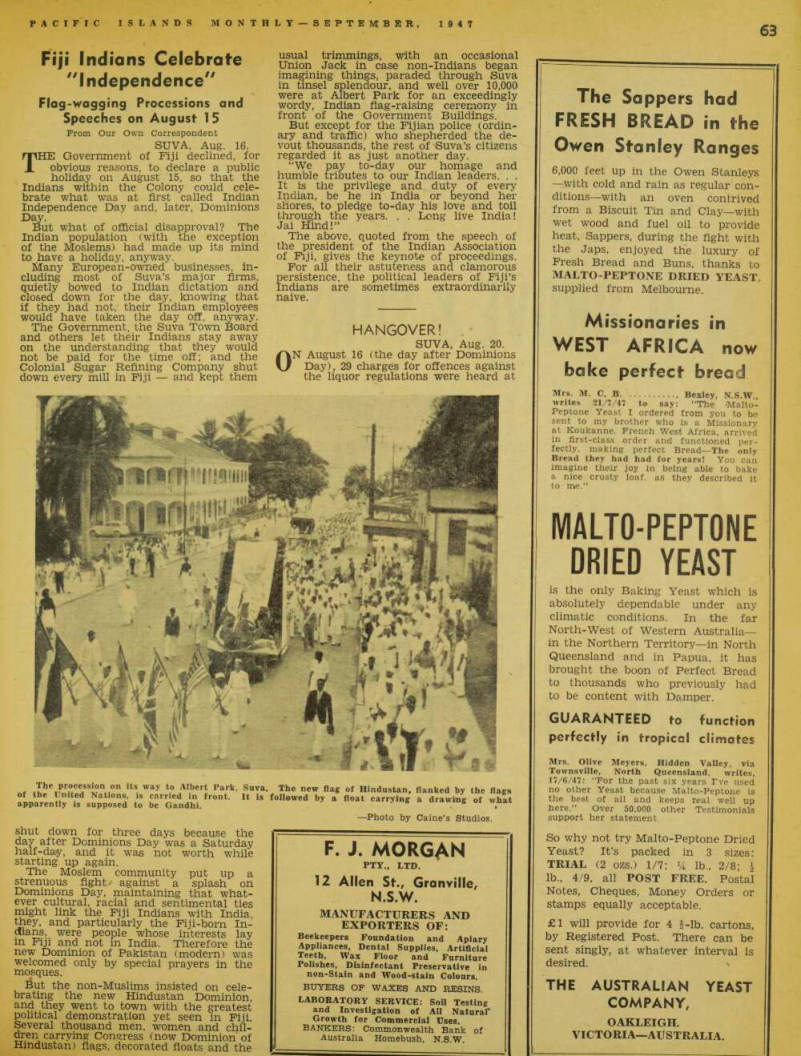
"Independence"
Flag-wagging Processions and Speeches on August 15
From Our Own Correspondent
Suva, Aug. 16.
THE Government of Fiji declined, for obvious reasons, to declare a public holiday on August 15, so that the Indians within the Colony could cele brate what was at first called Indian Independence Day and, later, Dominions Day.
But what of official disapproval? The Indian population (with the exception of the Moslems) had made up its mind to have a holiday, anyway.
Many European-owned businesses, in eluding most of Suva’s major firms, quietly bowed to Indian dictation and closed down for the day, knowing that if they had not, their Indian employees would have taken the day off, anyway.
The Government, the Suva Town Board and others let their Indians stay away on the understanding that they would not be naid for the time off; and the Colonial Sugar Refining Company shut down every mill in Fiji and kept them
shut down for three days because the day after Dominions Day was a Saturday half-day, and it was not worth while starting up again.
The Moslem community put up a strenuous fight- against a splash on Dominions Day, maintaining that what ever cultural, racial and sentimental ties might link the Fiji Indians with India, they, and particularly the Fiji-born In dians, were people whose interests lay m Fiji and not m India. Therefore the new Dominion of Pakistan (modern) was welcomed only by special prayers in the mosques.
But the non-Muslims insisted on cele brating the new Hindustan Dominion, and they went to town with the greatest political demonstration yet seen in Fiji.
Several thousand men, women and chil dren carrying Congress (now Dominion of Hindustan) flags, decorated floats and the
usual trimmings, with an occasional Union Jack in case non-Indians began imagining things, paraded through Suva in tinsel splendour, and well over 10,000 were at Albert Park for an exceedingly wordy, Indian flag-raising ceremony in front of the Government Buildings, But except for the Fijian police (Srdin ary and traffic) who shepherded the de vout thousands, the rest of Suva’s citizens regarded it as just another day.
“We pay to-day our homage and humble tributes to our Indian leaders. . .
It is the privilege and duty of every Indian, be he in India or beyond her shores, to pledge to-day his love and toil through the years. . . Long live India!
Jai Hind!”
The above, quoted from the speech of the president of the Indian Association of Fiji, gives the keynote of proceedings.
For all their astuteness and clamorous persistence, the political leaders of Fiji’s Indians are sometimes extraordinarily naive.
The procession on its way to Albert Park, Suva. The new flag of Hindustan, flanked by the flags of the United Nations, is carried in front. It is followed by a float carrying a drawing of what apparently is supposed to be Gandhi.
Photo by Caine’s Studios.
Hangover!
Suva, Aug. 20.
ON August 16 (the day after Dominions Day), 29 charges for offences against the liquor regulations were heard at
the Suva Magistrate’s Court. Twentyone of the charges concerned Indians. . .. . . .. , ** X™ of Indians who erammed Suva on■ i, 5, i. 2 l u ls a yejT. m e^ e J a te total of lapses.
But the point is that In Jan correspondents in the local press had been earnestly- announcing for weeks that no young Indian would debase himself by entering hotel bars on such a day!
While Indian national flags broke out like a rash all over the Indian-populated areas of Fiji, at Lautoka the newlyformed Fiji Indian Congress was firing off telegrams of congratulation to Pandit Nehru, Mr. Jinnah and even Mr. Attlee.
So was the Labasa flag-hoisting assembly —but they overlooked Mr. Attlee.
Advertisements & other items, pp. 65-66 (1 item)
Malto-Peptone
The Sappers had
FRESH BREAD in the
Owen Stanley Ranges
6,000 feet up in the Owen Stanleys —with cold and rain as regular conditions—with an oven contrived from a Biscuit Tin and Clay—with wet wood and fuel oil to provide heat, Sappers, during the fight with the Japs, enjoyed the luxury of Fresh Bread and Buns, thanks to
MALTO-PEPTONE DRIED YEAST,
supplied from Melbourne.
Missionaries in
WEST AFRICA now
bake perfect bread
Mrs. M. C. B Bexley, N.S.W., writes 21/7/47 to say: "The -Malto- Peptone Yeast I ordered from you to be sent to my brother who Is a Missionary at Koukanne. French West Africa, arrived in first-class order and functioned perfectly. making perfect Bread—The only Bread they had had for years! You can imagine their joy in being able to bake a nice crusty loaf, as they described it to me.’’
MALTO-PEPTONE
DRIED YEAST
is the only Baking Yeast which is absolutely dependable under any climatic conditions. In the far North-West of Western Australia— in the Northern Territory—in North Queensland and in Papua, it has brought the boon of Perfect Bread to thousands who previously had to be content with Damper.
GUARANTEED to function
perfectly in tropical climates
Mrs. Olive Meyers, Hidden Valley, via Townsville, North Queensland, writes, 17/6/47: "For the past six years I’ve used no other Yeast because Malto-Peptone is the best of all and keeps real well up here.” Over 50,000 other Testimonials support her statement.
So why not try Malto-Peptone Dried Yeast? It’s packed in 3 sizes: TRIAL (2 ozs.) 1/7: % lb., 2/8; i lb., 4/9, all POST FREE. Postal Notes, Cheques, Money Orders or stamps equally acceptable. £1 will provide for 4 I-lb. cartons, by Registered Post. There can be sent singly, at whatever interval is desired.
THE AUSTRALIAN YEAST
COMPANY,
OAKLEIGH.
VICTORIA—AUSTRALIA.
F. J. MORGAN
PTY., LTD.
12 Allen St., Granville,
N.S.W.
MANUFACTURERS AND
EXPORTERS OF:
Beekeepers Foundation and Apiary Appliances, Dental Supplies, Artificial Teeth, Wax Floor and Furniture Polishes, Disinfectant Preservative in non-Stain and Wood-stain Colours.
BUYERS OF WAXES AND RESINS.
LABORATORY SERVICE: Soil Testing and Investigation of All Natural* Growth for Commercial Uses.
BANKERS: Commonwealth Bank of Australia Homebush, N.S.W.
W. H. GROVE & SONS
Limited
Established 1896.
AUCKLAND
Island Trader*. FO - Box 49t - Telegraphic and Cable Address: “Grove”, Auckland.
Entrust Your Orders to the Firm with Fifty Years Practical Experience in the Island Trade.
Shippers of all classes of New Zealand products.
Representing English Manufacturers through-
out the Cook and Society Islands, Fiji, Tonga, Samoa, Niue, New Caledonia, New Guinea, etc.
In FIJI ai—W. H. Grove & Seni (Fiji) Ltd.
Itching Skin Germs Killed in 3 Days
Praised by Doctors
Dr. T. A. Ellis, well-known physician of Toronto, Canada, recently stated: “Skin disorders caused by parasites, as many are, to Nixoderm. These parasites are Invisible to the naked eye. They eat away the skin, forming ugly eruptions. Ordinary ointments or remedies fail completely, or give only temporary, results because they do not reach the cause of the condition. It is this value about Nixoderm in attacking parasites which impresses me most favorably, and explains In large measure the success it enjoys over many stubborn cases.”
Guaranteed Results
Get Nixoderm to-day. Put It to the test. In a few minutes you will find that the Itching has stopped, and in 24 hours you can see for yourself that your skin is clearer. And it is guaranteed that, within one week, Nixoderm must make your skin soft, clear, smooth and attractive or money back on return of empty package. Get Nixoderm from your chemist or store to-day. The guarantee protects you. So don’t delay. Get Nixoderm to-day.
Nixoderm z/.&v-
For Skin Sores, Pimples and Itch.
Thanks to the discovery of an American physician, it Is now possible to kill and remove the true cause of most skin troubles. Your skin has nearly 50 million tiny seams and pores where invisible germs and parasites can hide, and which are the true cause of terrible Itching, Cracking, Peeling, Burning. Ringworm, Acne, Psoriasis, Blackheads, Pimples, Foot Itch and other disfiguring blemishes.
Blemishes such as these make you look and feel embarrassed, unattractive and handicapped in life, both socially and in business. You can’t get rid of these disfigurements with ordinary treatments, which give only temporary relief, because they do not kill the germs or parasites responsible for your trouble. .
New Discovery Kills Cause
Former skin sufferers throughput the world are now praising Nlxoderm, the discovery of a leading American skin specialist. This remarkable new preparation quickly penetrates into the pores of the skin and kills the germs and parasites responsible for your trouble in 7 minutes, stopping the itch almost instantly. At the same time, this wonderful preparation acts as a tonic and skin food, so that as the cause of your trouble is removed, your skin becomes soft, smooth and clear. This clear, healthy complexion will sdve vou new charm and make It to win friends.
p en Friends Wanted
H/fR. CLYDE B. CLEMENS would like M pen friends in the South Pacific, especially in the New Hebrides and New Caledonia. He served in the Pacific with the us p orces during the war and would like to learn more about this area, H is address is 326 North Ridgeland Ave., oak Park, Illinois, USA.
T|/|R. Kevin Williams, Of 25 Rofe
Street, Leichhardt, Sydney, would like pen friends in the Pacific. He is particularly interested in aviation, admin istrative problems, and stamp collecting'.
Mr. John Thomas sailed last month for p o rt Moresby, Papua. He has been appointed DLO at Abau.
Unsinkable Aluminium
Canoe "Keram Kitty " on the Sepik
ANEW type of vessel made its appear ance on the Sepik River, New Guinea, recently. It is an Indian war canoe made of aluminium, and is now christened “Keram Kitty.”
The canoe was manufactured by the Grumman Aircraft Engineering Company in St. Paul, Minnesota, USA and was sent as a gift of the St. Agnes Mission Club in St. Paul to Father W. Saiko, of the RC mission at Keram River (a tributary of the Sepik).
Father Saiko comes from St. Paul and arrived in New Guinea in September, 1945.
At that time he was stationed in Wewak and he became champion truck driver of the district, logging 12,000 miles without accident.
When he was transferred to the Sepik, he appealed to his home town for an Indian canoe and it duly arrived at the end of July.
The canoe is 18 feet long, with a 3-ft. beam, and it draws only 3 or 4 inches of water, which makes it ideal for negotiat ing those creeks which are mostly swamp.
It weighs only 87 pounds, and could, therefore, if necessary, be transported from the Sepik River across the divide to the source of Papua’s Fly River by no more than two natives.
It has two built-in airchambers, which make it unsinkable; and if it does turn over it will right itself. It is wide enough to permit of a chair being erected in it, and stable enough to allow the traveller to work awav at a typewriter
while in transit-
“Mossie.”
Three Injured In
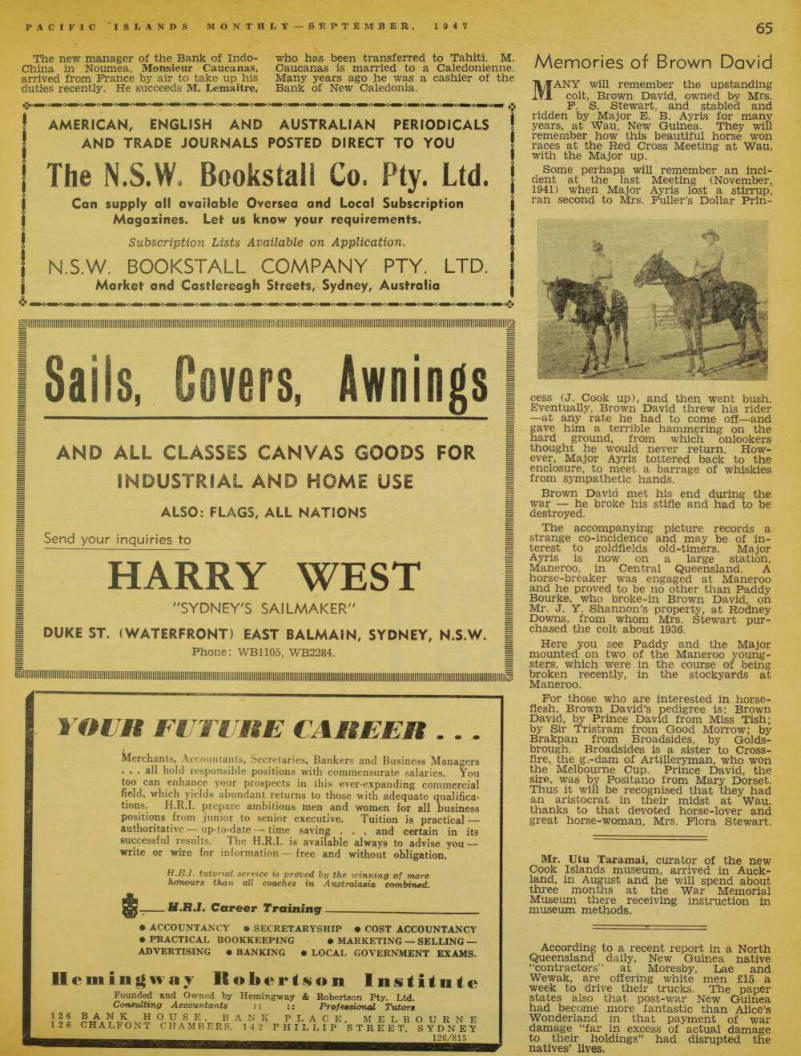
Finschhafen Accident
From a Special Correspondent LAE. August 15.
A WELL-KNOWN and pouular pre-war New Guinea resident. Mr. J. L.
Bannigan, was involved in a serious motor accident near Maple Bridge, Finsch hafen, New Guinea, on August 14. He was travelling in a jeep with Mr. W.
Thomson and a naval rating when it crashed into a heavy truck driven by Father E. Misik, SVD, American Army chaplain, stationed at Pinschhafen. Mr.
Bannigan received a broken arm. He was scheduled to go on leave with his wife and three children by the next day’s “Reynella” (after completing his busi ness in connection with the large Ameri can Army dump which he had taken over), but was prevented from doing this by his injuries.
Mr. Thompson is a new arrival in the Territory. He received a broken collar bone, a broken arm, knee injuries necessitating an operation and a punctured lung. Latest reports are that he is making steady progress. Father Misik escaped with mild shock, but the naval rating received serious injuries.
Mr. B. B. Perriman returned to Sydney from an inspection visit to New Guinea.
He will shortly go back to New Guinea, where he will take up residence in the Rabaul-Kokopo area. Mr. Perriman is general manager-director of W. R. Car penter (New Guinea) Ltd.
Mr. John Leuwin-Clark, who was at tached for some months to the PCB in Rabaul, and has been spending a few months’ holiday in Sydney, proceeds to Rabaul this month to take up a position with Messrs. Colyer, Watson (New Guinea) Ltd.
The new manager of the Bank of Indo- China in Noumea, Monsieur Caucanas, arrived from Prance by air to take up his duties recently. He succeeds M. Lemaitre,
who has been transferred to Tahiti. M.
Caucanas is married to a Caledonienne.
Many years ago he was a cashier of the Bank of New Caledonia.
Memories of Brown David
MANY will remember the upstanding colt, Brown David, owned by Mrs.
F. S. Stewart, and stabled and ridden by Major E, B, Ayris for many years, at Wau. New Guinea. They will remember how this beautiful horse won races at the Red Cross Meeting at Wau, with the Major up.
Some perhaps will remember an inci dent at the last Meeting (November, 1941) when Major Ayris lost a stirrup, ran second to Mrs. Fuller’s Dollar Prin-
cess (J. Cook up), and then went bush.
Eventually, Brown David threw his rider —at any rate he had to come off—and gave him a terrible hammering on the hard ground, from which onlookers thought he would never return. How ever, Major Ayris tottered back to the enclosure, to meet a barrage of whiskies from sympathetic hands.
Brown David met his end during the war he broke his stifle and had to be destroyed.
The accompanying picture records a strange co-incidence and may be of in terest to goldfields old-timers. Major Ayris is now on a large station, Maneroo, in Central Queensland. A horse-breaker was engaged at Maneroo and he proved to be no other than Paddy Bourke, who broke-in Brown David, on Mr. J. Y. Shannon’s property, at Rodney Downs, from whom Mrs. Stewart pur chased the colt about 1936.
Here you see Paddy and the Major mounted on two of the Maneroo young sters. which were in the course of being broken recently, in the stockyards at Maneroo.
For those who are interested in horse flesh, Brown David’s pedigree is; Brown David, by Prince David from Miss Tish; by Sir Tristram from Good Morrow; by Brakpan from Broadsides, by Golds brough. Broadsides is a sister to Cross fire, the g.-dam of Artilleryman, who won the Melbourne Cup. Prince David, the sire, was by Positano from Mary Dorset.
Thus it will be recognised that they had an aristocrat in their midst at Wau, thanks to that devoted horse-lover and great horse-woman, Mrs. Flora Stewart.
Mr. Utu Taramai, curator of the new Cook Islands museum, arrived in Auck land, in August and he will spend about three months at the War Memorial Museum there receiving instruction in museum methods.
According to a recent report in a North Queensland daily, New Guinea native “contractors” at Moresby, Lae and Wewak, are offering white men £l5 a week to drive their trucks. The paper states also that post-war New Guinea had become more fantastic than Alice’s Wonderland in that payment of war damage “far in excess of actual damage to their holdings” had disrupted the natives’ lives.
Advertisements & other items, p. 67 (1 item)
Sails, Covers, Awnings
AMERICAN, ENGLISH AND AUSTRALIAN PERIODICALS
AND TRADE JOURNALS POSTED DIRECT TO YOU
The N.S.W. Bookstall Co, Pty. Ltd.
Can supply all available Oversea and Local Subscription Magazines. Let us know your requirements.
Subscription Lists Available on Application.
N.S.W. BOOKSTALL COMPANY PTY. LTD.
Market and Castlereagh Streets, Sydney, Australia
Sails, Covers, Awnings
AND ALL CLASSES CANVAS GOODS FOR
INDUSTRIAL AND HOME USE
ALSO: FLAGS, ALL NATIONS
Send your inquiries to
HARRY WEST
"SYDNEY'S SAILMAKER"
DUKE ST. (WATERFRONT) EAST BALMAIN, SYDNEY, N.S.W.
Phone: WBIIOS, W 82284.
YOUR FUTURE CAREER
Merchants, Accountants, Secretaries, Bankers and Business Managers ... all hold responsible positions with commensurate salaries. You too can enhance your prospects in this ever-expanding commercial field, which yields abundant returns to those with adequate qualifications. H.R.I. prepare ambitious men and women for all business positions from junior to senior executive. Tuition is practical authoritative up-to-date time saving . . . and certain in its successful results. The H.R.I. is available always to advise you write or wire for information free and without obligation.
H.R.I. tutorial service is proved by the winning of more honours than all coaches in Australasia combined.
H.R.I. Career Training • ACCOUNTANCY • SECRETARYSHIP • COST ACCOUNTANCY
• PRACTICAL BOOKKEEPING • MARKETING SELLING
ADVERTISING • BANKING • LOCAL GOVERNMENT EXAMS.
Hemingway Robertson Institute
1 2 6 12 6 Founded and Owned by Hemingway & Robertson Pty. Ltd.
Consulting Accountants :: ;: Professional Tutors
BANK HOUSE. BANK
CHALFONT CHAMBERS, 142
PLACE, MELBOURNE
PHILLIP STREET, SYDNEY
126/815
Rabaul Revisited
(By a former Resident.)
AS an old timer in this part. I was interested to visit and view the new, up and coming, Rabaul.
Landing at Malaguna and coming to town via Malaguna Avenue I was shocked to see only the sawn-off trunks of the fine spreading trees that used to decorate the road. Mango Avenue and Yarra Avenue are pretty ragged too. It would be a fine idea to replant trees along Malaguna Avenue and lessen the awful glare of the daytime.
Dust is Public Enemy No. 1, in Rabaul.
Two days after rain dust rises in clouds from the rough, corrugated roadways, behind the speeding motorist. And do they speed! I would say there was no difference between European, Chinese and native drivers in that respect. Nor did I notice a super-abundance of road courtesy. . .
It seems to me that with plenty of water available the whole of the North West Pacific being at the door that a motor waterwaggon (for roads only, of course!) might well be instituted and kept constantly on the job. John Citizen does his best to help abate the dust nuis ance by swallowing a lot and by collect ing a lot more in his eyes, ears, nose and throat, but it often takes him to hospital.
As one rattles aloug the mam roads, listening to the shouted remarks of the driver, one wonders why the same roads are not kept graded. One sighs for the tar-sealed and almost dustless roads of old Rabaul. I can still see, in my mindfs eye former Director of Public Works Knox, viewing with satisfaction, his work in that direction. . , A fine building, which is to be the new Rabaul freezer, is now in the course of erection. Good progress is being made
and the citizens are looking forward to its opening and to ships with refrig erator cargo at regular intervals. Women and children need fresh foodis here.
The present landing places along the waterfront are poor. It requires an ac tive and wary man to jump over wrecks, shakv pontoons, jetties with missing planks, etc., in order to reach his ship.
Preparations are being made to put a good pontoon bridge into position.
Inter-island shipping is a joke. Its hard to say when, how or where a ship will tak£ one. A week or two behind scheduled date of sailing is quite usual and passengers go back to their hotels and gnash their dentures in desperation.
One man told me that he started by going aboard one ship on the 19th of the month, and finally got away on the 14th of the next month! Then, at time of departure, the ship was delayed 20 minutes while an “engine boy” finished sea bathing in the vicinity. No passenger is supposed to make more than three unsuccessful attempts to reach his or her home! It isn’t cricket!
An oasis in the desert, is the New Britain Club in Mango Avenue. There tired and dusty business men gather in late afternoon, and have one or maybe two in order to wash down some pul verised Rabaul, which has been gathered during the day. 'Then lively conversa tion takes place among the beer mugs and tobacco smoke: Deals are put through differences adjusted, and fresh ones arise, but usually one can float over all obstacles on a high tide of ale! ’Twas ever thus, however, in clubs and pubs and places where they sing!
Mr. Leigh Wild, Administration official from New Guinea, has returned to the Territory after a short holiday in Aus tralia.
Tahiti's Speech
Good and Bad Languages
From Our Special Correspondent
Tahiti. July 30.
ONE satisfying thing the isolation of the war and post-war periods has accompanied, has been the re establishment of the French of Paris as the official language of French Oceania.
During a long period, French “after the school of Los Angeles Atte Bowe” was so commonly heard in and about Papeete, that the purity of the local speech was threatened.
Members of old Tahiti families, whose ancestors were pupils of LMS Missionaries, have resolutely preserved the King’s English, notwithstanding the impact of the Ohio dialect and the extraordinary dialects of Australia and New Zealand, The Chinese have awakened to com prehension that the Cantonese and Hakka are provincial dialects. Accord ingly, the Mandarin speech is taught in the local Chinese schools.
Classic Tahitian is still heard in the churches and meeting-houses and appears on the pages of official documents. The colloquial Tahitian has improved in quality during the period. The absurd gibberish, known as “Parau Tinito” (Chinese Tahitian) has been abandoned.
Young Chinese merchants are learning a speech which is more in conformity with the Tahitian idiom.
Miss Denise Elaine Judd, only child of the late Colonel C. C. Judd and Mrs.
Judd (Now Mrs. Frank McCormack) is to marry Captain D. H. Crompton, of the Australian Staff Corps in Melbourne, in December. The Judd family lived for many years in New Guinea.
Advertisements & other items, p. 68 (1 item)
Widdop
DIESEL ENGINES
BY
5 H P TO 300 H P
H • WIDDOP & CO LTD
GREENGATE KEIGHLEY ENGLAND
Telephone: Keighley 3727-8 Telegrams: Widdop Keighley Codes: A.B.C. 6th Edition, Bentley’s, Bentley’s Second M pW v- P Above: (D-Type) 36/45 H.P.
On feft: (X-Type) 120 H.P.
Direct reversing Va —6
False Teeth For N.G.
Natives Civilisation Marches On!
CIVILISATION is not the only cause of bad teeth. Some New Guinea natives have sufficient dental decay and other mouth disorders to inspire the dental department of the Lutheran Mission at Finschhafen to fit them out with dentures. And for this the mission is well-equipped.
“I was amazed on arrival at Finsch hafen to find that the Lutheran Mission had dental facilities equal to anything I have seen in Australia,” said Mr. C. A.
Brumm, mission dental officer, formerly of Brisbane, who is now in charge of the elaborate dental clinic at the Lutheran Mission Hospital, Finschhafen. The modern equipment, including X-ray, was purchased from the Army.
Natives will get exactlv the same treat ment as Europeans, and will be supplied with dentures equal to anything procur able in Australia. ‘‘They’ll get teeth worth £2O in Syd ney,” Mr, Brumm said, “but, of course, they’ll be supplied at greatly reduced prices!”
Many natives come to the hospital with mouth diseases, and with teeth in very bad condition, and in a great number of cases they need extractions. It is customary to let their gums harden before fitting a set of teeth.
When told that Mr. Alan McCay, a pre-war Dental Surgeon of Wau, New Guinea, had made a special study of the betel-nut in its effect on native’s teeth, as a thesis for his doctor’s degree in dentistry, proving that, in his opinion, it had no beneficial effect, Mr. Brumm seemed non-committal. He admitted, however, that the chewing of betel nut might keep the teeth free from decay, but, unfortunately, the natives have no sense of mouth hygiene and the tissue is broken down by filth. He said he was trying to get natives to refrain from chewing the betel nut; some had pro mised to do so, but it was difficult for them to give up the habit. Judging from nearby villages he had visited, he said, natives were most eager to get dental treatment.
Great Changes In One
Pacific Group
TIMES have changed even here in Haapai.
Haapai, part of the Kingdom of Tonga, is a scattered archipelago of about 50 islands, of which 20 are inhabited. It is considered that the name is derived from “Savai’i” the island in Samoa from which the ancient Tongans probably came.
Before World War II each of these in habited islands had one, two or more trading stations. In Lifuka, the seat of the Haapai government, there were 10 stores. To-day, not one trading station exists on any of those islands; and in Lifuka there are now only three stores —Burns Philp, Morris Hedstrom and G.
Riechelmann.
If one looks into any of these stores, he will find empty shelves kerosene, matches, tobacco, sugar, flour and corned beef are, most of the time, unprocurable.
Textiles, such as calico or other soft goods, make their appearance only once or twice in a year.
Not only are these stores empty, but the cash box of the Haapai Copra Board is very often empty too, so that often they have to suspend copra-weighing for weeks at a time.
When I arrived in Haapai, in 1885,
there were over 100 Europeans in the Haapai Group. To-day, Haapai can count only five in Lifuka, besides one Father and two Sisters of the Catholic Mission. On all the other islands of the Haapai group, only one other European is still alive your humble servant and correspondent,—F. T. GOEDICKE-VAN
Asten.
The large US Navy camp known as the Receiving Station, lying on the slopes back of Anse Vata beach, has been bought by the Colony of New Caledonia and is to house 250 people. Large families are to be given priority in the huts formerly used as US officers’ quarters. The move should do something to lessen the local housing shortage.
M. Georges Bailly, acting Port-Captain of Papeete, left Tahiti for United States in June. M. Bailly, in San Francisco, will inspect one or two schooners which
the French Government contemplates buying for transport purposes in French Oceania.
The French-operated Catalina belong ing to the Societe Francaise de Transports Aeriens du Pacifique Sud has arrived at its Noumea base. There is a flying crew of four, two radio operators and two mechanics. The plane should be a boon to French communication services in the area.
Advertisements & other items, p. 69 (1 item)
Exporters
TO SHIPMASTERS
When calling at Tahiti, see Oscar G.
Nordman for ships’ supplies and fresh provisions. Wire before your arrival to OCEANIC, PAPEETE (my registered cable address)
OSCAR G. NORDMAN,
Ship Chandler, Papeete, Tahiti
IMPORTERS
EXPORTERS
All classes of merchandise purchased for island clients throughout the South-west Pacific.
Island produce sold on Australian and overseas markets on a commission basis.
54a Pitt Street
Cable Address: “ROBERGILL,” Sydney
Sydney
Slum Clearance In Suva
From Our Own Correspondent
Suva, Aug. 17.
DESPAIRING of Suva’s crammed slum areas, the Town Board has notified the Government that it proposes to grant no further extensions for tem porary buildings after December 31, 1947.
Prior to this discussion the board had decided not to enforce closing orders in the case of dwelling-places (sometimes they cannot be called houses, or even huts), but at the August meeting mem bers were undecided if this were alto gether wise. It was suggested that the demolition of these places, if carried far enough, might send a proportion of the slum-dwellers back to the country and might stop the unceasing drift from the country to Suva.
An interesting sidelight on the local building problem is that while materials for houses and repairs are almost unpro curable, the Government wishes to spend at least £20,000 on an abattoir for Suva.
VHien the Town Board was asked for its opinion on this, several members sug gested that such a thing is an extrava gance. The Board finally side-stepped the issue leaving an expression of opinion to the new municipality which is to be created.
Mr. Ward's Arcadia
And What an Old-Timer Thinks About It
Letter to the Editor YOUR Mr. Ward has stated that, pre war, the New Guinea natives had to work 55 hours per week, under in denture; whereas, under his merciful regime, they now work only 44 hours weekly, and no indenture —and they have no difficulty in getting boys.
It is quite true that the Administration do not employ indentured boys—but many of the boys they do employ think they are indentured. I was employed myself by the Administration for a few months, and I saw the system in opera tion. Police boys, doctor boys, driver boys and other technicians, when being engaged by the Administration, were given a paper to put their thumb print on. Thus the boys go through the same formalities as they do when signing a contract of service. They are led to be lieve that the paper that they put the thumb-print on is a contract, whereas it is only a record of service.
There are about 400 boys employed by the Administration here in Madang, do
ing what 50 boys would have done under pre-war conditions. I notice them going lazily to their work at 8 a.m. each day. They cover in two hours a distance which, pre-war, they would have walked over in 20 minutes. This is not surpris ing, seeing that so many of them stay up all night, gambling. You should see them cutting grass! I imagine that the average labourer employed by the Administration does about 10 hours’ work per week, in stead of the 44 hours Mr. Ward talks about.
With that labour force, the town should be in good order. At the present time (July, 1947) it is not. The road that was built by the Army is in a poor condition; the small culverts and bridges are broken; there is long grass all over the place; many bomb craters are not filled in and are a breeding-place for mosquitoes.
Thanks to Mr. Ward, there is no such thing now as labour discipline, or white man prestige. Anyone with any know ledge of a coloured country knows that such conditions will lead only to chaos.
I notice the effect of Administration labour-line laziness and cheekiness upon the labour employed by private persons— these natives tend to become lazy, and in solent, and unmanageable, too. What else can one expect?
I saw an outrageous thing here re cently. A jeep was being driven along a main road out of Madang—it had a European driver, a white passenger, and a native. Without warning, an Admin istration jeep, driven by a native and carrying two Administration officials, turned out of a side road and smashed into the private jeep. The native driver admitted that he did not slow down or take precautions: yet the charge against him was dismissed. Why? The only reason we know is that native drivers are in very short supply. The private owner had to have his jeep repaired at his own expense, and his injured passenger had to pay his own hospital bill.
This country is being run now at a cost of millions per annum to the Aus tralian taxpayers, the natives have been ruined, and industry and commerce are in a chaotic state. We fought to get rid of the Jap menace—we now have a wouse one here, of our own creation. Few of the old-timers here can see any future in New Guinea, and I think there soon will be an exodus. I suppose that is what Mr. Ward wants.
Ward-ism is only a passing phase—but the evil that he has done in this country unfortunately will live long after he is politically dead and buried.
I am, etc.,
Disgusted N. Guinea-Ite
Madang, August 8..
Mrs. W. L. McGowan was a “Montoro” passenger last month, proceeding to Port Moresby, Papua, where she will join her husband, who is an architect in the Public Works Dept.
Felise Betaz, a former clerk of the courts in Noumea, Bourail and Vila, who when New Hebrides Frenchmen rallied to Free France refused to recognise the de Gaulle Government was shot as a traitor in France on June 11. The main charge against him was that, in July, 1944. at a French court-martial, he had urged a sentence of death upon three members of the Resistance who were subsequently shot at Marseilles. Betaz who was 67 years of age, was arrested under the Sautot regime and held at Camp Est on He Nou, Noumea harbour. He was later allowed to leave for Indo-China with other anti-de-Gaullists, and had reached France via Saigon. He was not a New Caledonian, but came from the Pas-de- Calais region.
Advertisements & other items, p. 70 (1 item)
The Garrick Hotel
Allen Taylor 81 Co. Ltd.
COMMERCIAL ROAD, ROZELLE,
SYDNEY
Sawmiilers and Wholesale Suppliers of Hardwoods for Constructional Purposes GIRDERS . . PILES .. . POLES .. . SLEEPERS, Etc
EXPORTING TO PACIFIC ISLANDS SINCE 1893
The Garrick Hotel
m*
SUVA
Il|l |'|| S
' * PtK-« FIJI
This well-known Hotel is centrally situated in Suva's main business quarter :: Modern accommodation provides comfort in all climatic conditions :: Only the best of Beers, Spirits and Wines is served Telephone: 80, VINCE COSTELLO, Proprietor.
Island Mixed Marriages

Letter to the Editor YOUR Rabaul correspondent, in PIM of May, expresses a certain dis pleasure—the general opinion, pre sumably, of the white community—at marriages in his locality between white men and native or Chinese girls, and a similar union with a half-caste.
May I suggest that he is unwise in criticising these unions? Nowadays, with European women defeminised into a sort of sham male addicted to tobacco and alcohol, it is highly likely that the more natural behaviour of the ladies of allegedly inferior racial category attracted the lonely planter, who might not expect any woman of his own race to live out of reach of a cocktail bar or dance-hall, nor to share with him any of his hard ships.
What needs considering is that the Territorians concerned wedded girls of the Territory. From Nature's point of view, this may be a more satisfactory arrangement than a marriage between a white man and a white woman. Neither is an attractive Asiatic girl, with the inbred modesty and obedience of Eastern women, to be despised as a life-partner.
In the last analysis, white men do not marry white women because they will not come to the lonely outposts of civilisa tion. And that is not the Territorially fault —let the women of his race regain their ancient pioneer-spirit and settle in the Territories; and then men will marry them rather than natives.
I am, etc..
Edwin Gold.
Mangaia, Cook Island.
July 20. [ED. NOTE. —Mr. Gold speaks with the viewpoint of Polynesia. The position is quite different in New Guinea, where tnere are adequate reasons why European men do not marry native women. There were few, if any, European-Chinese marriages in pre-war New Guinea, not because of European discrimination but because neither party desired it. More over, there is no dearth of pioneering women in New Guinea (or Australia); soifie of them, widowed in the last war, are now running their own plantations in isolated areas. Morally, the record of Europeans in the New Guinea territories has been exceptional—consequently the half-caste problem there, in comparison with other Pacific territories, is virtually nil].
BSI Agitators
"Leftist" Officials And BSI Agitators
“H/fUCH of the labour trouble in the 111 British Solomons,” said an old re sident of the Protectorate, “is due to the attitude adopted by the numerous young officials now arriving from the Old Country, and who for the most part have been inoculated with the Socialist virus.
There are now over 150 officials in the group, where in pre-war days there were only about 50.”
The correct post-war policy, he con tinued, should have been one embracing strong disciplinary measures among the natives.
In referring to the activities of the “Marching Rule” movement, which has received considerable publicity, he said that a circular had been issued by two leaders of the movement stating that no native would work for less than £l2 a month. One of the leaders is a mission native, educated at Bundaberg, Queens land, while the other is an ex-sergeant major of police.
"Nordkaperen" In Cairns
Mr. William Schell, Ex Usa
Army Captain, recently stepped off the Danish yacht, “Nordkaperen”, at Cairns (Qld.). He joined the yacht as a crew member in the Virgin Islands, travelling by way of Panama, Galapagos, Tuamotu and Tahiti to Samoa.
He left the yacht at Pago Pago, but rejoined her again in Suva and continued on to Australia.
Mr. Schell intends leaving the “Nord keperen” in Cairns and will return to Suva where he hopes to buy a small boat of his own to take back to the States.
“Nordkaperen” is 13 months out from Copenhagen. The owner-skipper, Captain Carl Nielsen and his crew, Paul and Knud Larson, speak highly of the hos pitality of Fiji residents and the Suva Yacht Club. They would like to thank
them, through the “PIM” for a pleasant 21 months’ visit.
Dr. Neville Anderson of Sydney, has volunteered as a medical missionary with the LMS.
Advertisements & other items, pp. 71-72 (2 items)
69
pacific Islands mon t Ht l y September, i 9 4 t
Coleman
PACIFIC ISLANDS SOCIETY
Visitors from the Islands to Sydney (or these interested in Islands affairs), are advised to communicate with the honorary secretary of the above Society, which has been formed to study the history, traditions, economics, and political developments of the Pacific Islands.
Regular monthly meetings are held at History House, 8 Young Street, Sydney.
Address for Correspondence;
THE PACIFIC ISLANDS SOCIETY.
Box 2434 MM., G.P.0., Sydney.
ZJ ft
Coleman
WORLD-
*De£ 9ft 0 For all lighti ng the finest ... for all the latest in j, cooking and heating appliances you can be sure with COLEMAN. Wherever you may be there is a Coleman dealer to serve you with dependable COLEMAN appliances and service.
The Coleman Lamp
and Stove Company Limited
TORONTO, CANADA
I C A G O,
U. S. A.
MILE
after MILE
OF
Tires for
trucks,
automobiles,
buses
EXTRA WEAR
now added to
cool - running
MIILER
TIRES
New type, stronger construction.
New wide, flatter tread. Longer mileage. Maximum traction.
Peak skid resistance. Greater protection against bruises.
MORE TIRE FOR YOUR MONEY
Miller Accessories and Repair Materials are dependable!
Consistently high in quality, this complete line has been developed to meet every automotive need.
I Radiator hose Radiator cleaner Radiator solder Noc*out adjustable hose clamps Vulcanizing patch and valve stem clamp Tire camelback (passenger and truck) Full circle curing tubes Tire pump hose assemblies Self curing cements and patches Weld rite vulcanizing patch Weld rite valve steam heat units Fractional horsepower belts Rubber solvent Friction tape Windshield wiper tubing Air bags Fan belts Rubber mallets Cord fabrics Tire paint Tire and tube repair kits
TUBE REPAIR KIT
CONTENTS
I—s" x 19" Strip rubber 80—1 Va" Sq. bevel cut patches 20—1*4" x 2" Oval bevel cut patches I —\/ A Pt. bottle cement I—Carborundum buffer
Exporters
PACIFIC ISLANDS TRADING COMPANY
244 CALIFORNIA STREET, SAN FRANCISCO 11, CALIFORNIA, U. S. A.
Scrub Typhus
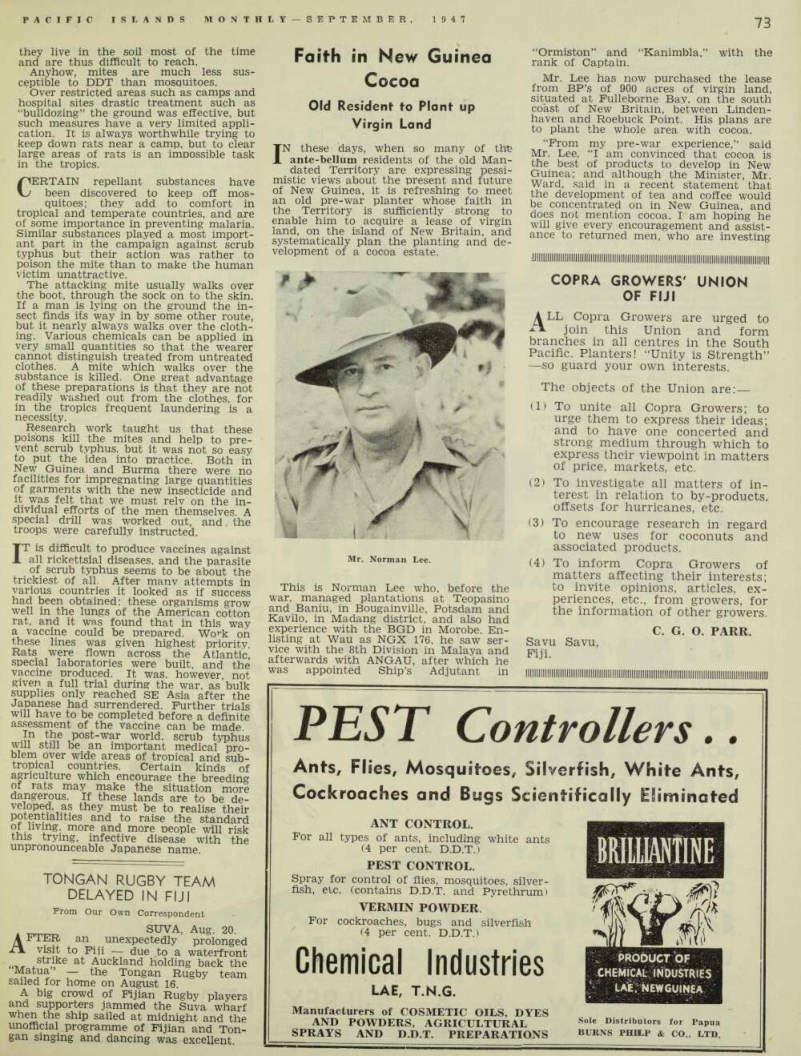
We Know Its Cause But Not Its Cure—Yet
.. , . . , . rr ...
THIS article, reprinted from Health Horizon /’ is by Kenneth Mellanby, QBE, MA, ScD, Reader in Medical Entomology at the University of T nnrinr) Vnh’nnl ni Trnryirnl MorlirinP tie served with the typhus Research Laboratory, SEAC. He was recently appointed Principal of the University College which is to be established in Nigeria This article on scrub typhus will be of particular interest to residents in Papua, New Guinea, and the Solomons, where the cause and high mortality rate of the disease were well known in the 30’s. In a region where fevers of various kinds and intensities are almost the norm, and men land women) live great isolation, often far from medical aid, it is probable that there were even more cases of “Japanese River Fever” was it rZL 9 d neraUV Call6d th6n) tHan Residents 'ot these areas are still Residents of these areas are stm contracting the disease. Secondary growth which has sprung up around plantations, abandoned during the war, appears to be a happy huntingaround for the mite or bush moka grouna jor me mue, or ousn moiza.
BEFORE 1940, not one person in a thousand in Britain had ever heard of scmb typhus, or disease” as it should more properly be called. Even in medical circles, most
people were rather hazy about it, and few would consider that it could ever present an important problem of practical hygiene.
Scrub typhus was first described by Japanese medical authorities as occur ring in Japan and Formosa. Later it was found in Malaya, Indo-China, the Netherlands’ East Indies, New Guinea and the adjacent islands, and in the north of Queensland, in Australia. Although it was known to be widespread, and although the Japanese had stated that a case mortality as high at 50 per cent, of those developing the disease might be expected, the total number of actual cases had been small, particularly among Europeans.
Everyone had anticipated that malaria would play a major part in any tropical campaign in the war, and these expecta tions were fully justified. Both in New Guinea and Burma during the first year after Pearl Harbour, malaria claimed more victims than the Japanese, or than all the other diseases put together.
But after that a remarkable thing happened. As a result of researches carried out in many countries it was found possible to control malaria, and in New Guinea, for instance, where the in cidence had been 4,000 admissions to hospital per 1,000 troops a year (i.e., on an average every man had four attacks each year), the rate of admission to hos pital for malaria dropped to 50 cases per 1.000 (i.e., to one-eightieth of the previous level).
Malaria had ceased to be a major medical problem, and scrub typhus, which had previously been overshadowed, now revealed its importance. Not only had malaria decreased but (particularly in New Guinea) improved treatment almost com pletely eliminated deaths from that disease; whereas the number of deaths from scrub typhus remained high.
During the period when almost every one had malaria, and when our forces
were retreating and living under terrible conditions, many cases of scrub typhus must have passed unrecognised. In the same way, among the natives of these countries where malaria is endemic, any fever is usually ascribed to that cause, and scrub typhus is overlooked.
To the average soldier, there was some thing mysterious and rather sinister about scrub typhus. He knew about malaria, how it was caused and how pre vented. He realised that by applying the measures he had been taught he could do a great deal to keep himself free from infection, and he knew that even if he be came infected, his chances of a complete recovery were good.
But about scrub typhus he had heard very little, and his officers were equally ignorant. There seemed to be little that a man could do himself. If anyone did develop the disease it was known that he was in for an extremely serious illness which might well prove fatal.
ALL this was bad for military morale.
The military authorities decided that something drastic must be done.
Much basic knowledge about scrub typhus was available, and active research had been in progress at the outbreak of war, particularly in Malaya. But there were many gaps in our knowledge. It was not possible for our scientists to put for ward practical recommendations in detail which they could guarantee would control the disease.
For this reason, American. Australian and British research teams were sent to work in the main centres of incidence, and further fundamental investigation was carried out in the laboratories in Britain It may be as well to explain just what this disease—scrub typhus—is, from the victim’s point of view.
Infection is due to the bite of an in fected mite, a tiny creature closely re
lated to the harvest mite of Britain. The bite usually passes unnoticed, particularly in a country where one is attacked by mosquitoes and other noxious pests at all hours of the day and night.
After an incubation periocj of about ten days, symptoms appear. Often the site where the bite took place becomes a characteristic little ulcer. The patient has a high temperature, a severe headache and often a generalised rash.
In the second week various complica tions of a nervous or pulmonary nature are common, and the patient is critically ill. Deaths may be as high as 50 per cent., though the overall figure for our forces was in the region of*lo per cent.
So far no satisfactory curative drug has been found, though several substances have given promising results. The best treatment is good nursing, and for that reason nursing sisters were sent to the furthest forward medical units in Burma, so that those with scrub typhus did not have to be subjected l to the very arduous journeys to base hospitals.
THE GERM which causes scrub typhus is a “rickettsia,” a form of life barely visible under the microscope and in some ways intermediate between the filter-passing viruses and ordinary bacteria. Other different kinds of rickettsiae cause louse-borne typhus, tick- and flea-typhus. Rickettsiae cannot be cultured in the laboratory except as parasites on living material, which means that making vaccine is difficult. These difficulties have been overcome in the case of several rickettsial diseases, and it is even possible that a scrub typhus vaccine which has been produced may prove effective; It has been mentioned that what we call the vector, that is to say, the living creature which conveys the infection to
man, is a mite. These creatures live in the soil, and most of their life history is quite independent of man. The adult mite is only a couple of millimetres long and the immature stages are even smaller.
The eggs are laid in the soil, and from them hatch the six-legged larvae, and these, so far as we are concerned, form the important phase. These larvae attack warm-blooded hosts, mammals or birds.
The types which transmit scrub typhus seem normally to prey on rats, and man is generally attacked more by chance than by choice. The larvae becomes firmly at tached to its victim, the rat, and it feeds on the tissue fluids, not on the blood.
Often large orange patches due to hun dreds of tiny attached mites may be found in the ears of rats where the disease is common.
The whole process of feeding takes about, three days, after which the en gorged larva detaches itself and burrows into the earth to transform into a further stage called the nymph, from which the adult insect is eventually produced.
It is important to note that the mite attacks a warm-blooded host only once in the whole life cycle; this means that the rickettsiae of scrub typhus must be pre sent in the eggs of the mite even before they are laid; a case of hereditary trans mission!
Rats are the usual hosts of these mites, and these animals seem to give little skin reaction to the bites, unlike man who usually develops severe irritation when he is attacked. The rats mav also serve as a reservoir of the disease, and most wild species of rats seem well able to tolerate the rickettsia so that they can infect further mites without themselves suffer ing the symptoms of the disease. But as hereditary transmission in the mite occurs, the disease can continue without any need to pass through the blood of the rat. Certainly, the disease can exist
without the presence of man, who seems to be an accidental victim rather than an essential link in the chain of trans mission.
Our troops in the East often got the impression that scrub typhus was a Jap anese “secret weapon” which had been de liberately left behind by the retreating enemy.
This was not the case, though the Jap anese army did something indirectly to increase the danger of the disease. The commonness of these mites largely de pends on the number of rats. Now, the hygiene of the Japanese army left much to be desired, and rats became very abundant around their dirty camps. As the rat population increased so the mites became more abundant, and where in fection with scrub typhus existed, the risk of its spread increased, too.
THE facts about the disease and its transmission had been suspected, but lacked full confirmation, and the first task of the research teams was to establish or refute these conclusions.
The next task was to prevent infection.
In other diseases, such as malaria, pro tection is obtained by a whole series of measures of various importance. And even when an infected mosquito has suc cessfully bitten, drugs prevent the parasite from having its effect.
We had to try to find similar weak links in the chain of scrub typhus infection.
A study of the life of the mites taught us a great deal about their habits, and something about the type of terrain most likely to be infested, but we learned little which would enable us to get rid of the creatures over a wide area.
It is possible to clear considerable tracts of country of mosquitoes by spraying the insecticide DDT from aeroplanes, but in areas where mites also existed, this treat ment had no marked effect upon them;
they live in the soil most of the time and are thus difficult to reach.
Anyhow, mites are much less sus ceptible to DDT than mosquitoes.
Over restricted areas such as camps and hospital sites drastic treatment such as “bulldozing” the ground was effective, but such measures have a very limited appli cation. It is always worthwhile trying to keep down rats near a camp, but to clear large areas of rats is an impossible task in the tropics.
CERTAIN repellant substances have been discovered to keep off mos quitoes: they add to comfort in tropical and temperate countries, and are of some importance in preventing malaria.
Similar substances played a most import ant part in the campaign against scrub typhus but their action was rather to poison the mite than to make the human victim unattractive.
The attacking mite usually walks over the boot, through the sock on to the skin.
If a man is lying on the ground the in sect finds its way in by some other route, but it nearly always walks over the cloth ing. Various chemicals can be applied in very small quantities so that the wearer cannot distinguish treated from untreated clothes. A mite which walks over the substance is killed. One great advantage of these preparations is that they are not readily washed out from the clothes, for in the tropics frequent laundering is a necessity.
Research work taught us that these poisons kill the mites and help to pre vent scrub typhus, but it was not so easy to put the idea into practice. Both in New Guinea and Burma there were no facilities for impregnating large quantities 9f garments with the new insecticide and it was felt that we must relv on the in dividual efforts of the men themselves. A special drill was worked out, and the troops were carefully instructed.
IT is difficult to produce vaccines against all rickettsial diseases, and the parasite of scrub typhus seems to be about the trickiest of all. After many attempts in various countries it looked as if success had been obtained: these organisms grow well in the lungs of the American cotton rat, and it was found that in this way a vaccine could be prepared. on these lines was given highest priority Rats were flown across the Atlantic, special laboratories were built, and the vaccine produced. It was. however, not given a full trial during the war, as bulk supplies only reached SE Asia after the Japanese had surrendered. Further trials will have to be completed before a definite assessment of the vaccine can be made. * n Postwar world, scrub typhus will still be an important medical pro blem over wide areas of tropical and sub tropical countries. Certain kinds of agriculture which encourage the breeding of rats may make the situation more dangerous. If these lands are to be de veloped, as they must be to realise their potentialities and to raise the standard of living, more and more people will risk this trying, infective disease with the unpronounceable Japanese name.
Advertisements & other items, pp. 73-74 (1 item)
Colycr Watson (New Guinea) Ltd.
Head Office: RABAUL Branches: Kavieng, New Ireland, and at 22 Bridge Street, Sydney
GENERAL MERCHANTS AND BUYERS
OF ISLAND PRODUCE
Plantation Owners and Engineers
Sole Distributors: Chrysler and Plymouth Cars Fargo Trucks Willys-Overland Jeeps G.M. Marine and Industrial Engines Prefect Refrfgerators Managing Agents: Union Assurance Society Ltd.
National Mutual Life Association of A/asia Ltd.
Agents: China Navigation Company
OFF
thok
RJ2. 18 H.P. MARINE DIESEL
Driving 21 in. x 1 5iin.
Propeller at 740 RPM • Reliable m Efficient • Economical • Easy Starting
Stuart Turner
Marine Engines
1±, 4 and 8 BHP Reduction Gear and Electric Starting Models available.
GOOD DELIVERIES Li * ht ' S ; n ’ p,e ' Eco 1 " omiea, ' — General Purpose Units Suitable for 25-35 ft. craft.
Write for full particulars of our complete range of engines to:
Thornycroft (Aust.) Pty., Ltd.
Cables: THORNMOTOR, Sydney. 6/10 Wattle Street
PYRMONT, N.S.W.
Tongan Rugby Team
Delayed In Fiji
From Our Own Correspondent
A, Suva, Aug. 20.
FTER an unexpectedly prolonged visit to Fiji due to a waterfront . stnke at Auckland holding back the Matua” the Tongan Rugby team sailed for home on August 16.
A big crowd of Fijian Rugby players and supporters jammed the Suva wharf when the ship sailed at midnight and the unofficial programme of Fijian and Ton gan singing and dancing was excellent
N pre-war &tg“S
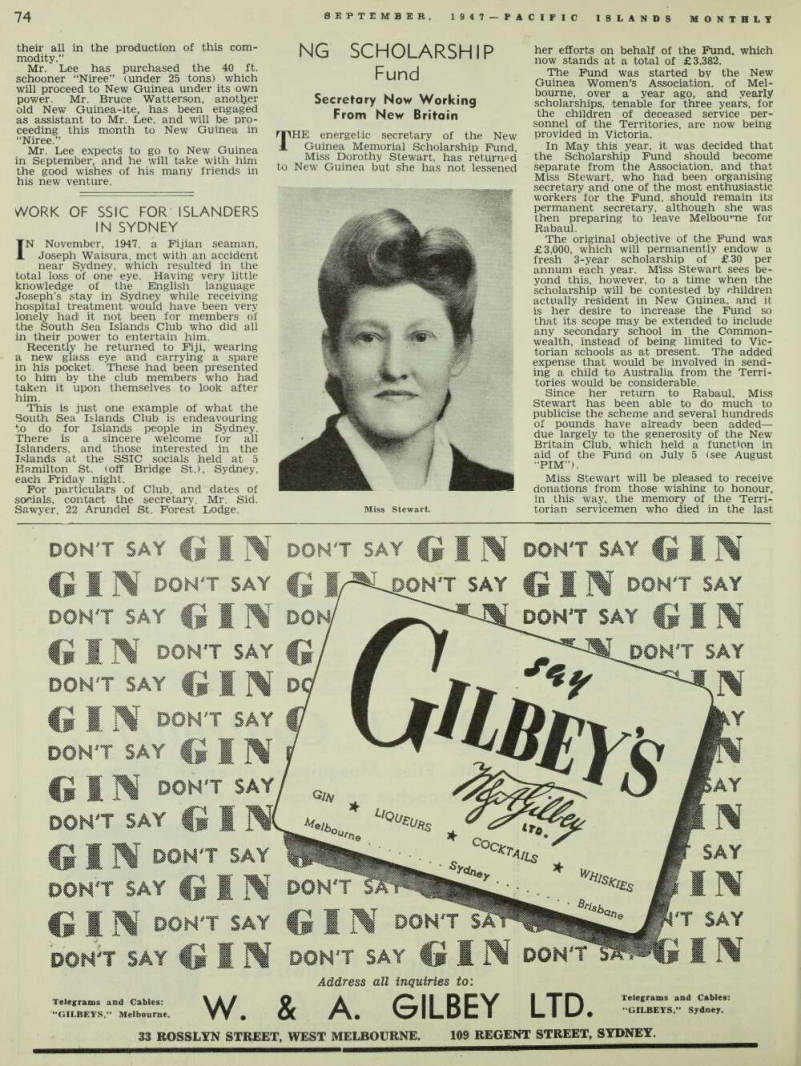
Faith in New Guinea Cocoa Old Resident to Plant up Virgin Land
TN these days, when so many ot thfe I j. w i, -j . uwx ante-bellum residents of the old Man-
the Ter?itory a to fand’ e on New a |rl^ Vl and syrtematicX Plan the and development ot a cocoa estate.
This is Norman Lee who. before the war, managed plantations at Teopasino and Banin, in Bougainville, Potsdam and Kavilo, in Madang district, and also had experience with the BGD in Morobe. En listing at Wau as NGX 176. he saw ser vice with the Bth Division in Malaya and afterwards with ANGAU, after which he was appointed Ship’s Adjutant in
“Ormiston” and “Kanimbla,” with the rank of Captain.
Mr. Lee has now purchased the lease from BP’s of 900 acres of virgin land, situated at Fulleborne Bay. on the south coast of New Britain, between Linden haven and Roebuck Point. His plans are to plant the whole area with cocoa.
“From my pre-war experience,’’ said Mr. Lee, “I am convinced that cocoa is the best of products to develop in New Guinea: and although the Minister, Mr.
Ward, said in a recent statement that the development of tea and coffee would be concentrated on in New Guinea, and does not mention cocoa. I am hoping he will give every encouragement and assist ance to returned men, who are investing
Mr. Norman Lee.
their all in the production of this com modity,”
Mr. Lee has purchased the 40 ft. schooner “Niree” (under 25 tons) which will proceed to New Guinea under its own power. Mr. Bruce Watterson, another old New Guinea-ite, has been engaged as assistant to Mr. Lee. and will be pro ceeding this month to New Guinea in “Niree.”
Mr. Lee expects to go to New Guinea in September, and he will take with him the good wishes of his many friends in his new venture.
Advertisements & other items, p. 75 (1 item)
PEST Controllers..
COPRA GROWERS 1 UNION
OF FIJI
ALL Copra Growers are urged to join this Union and form branches in all centres in the South Pacific. Planters! “Unity is Strength” —so guard your own interests.
The objects of the Union are:— (1) To unite all Copra Growers; to urge them to express their ideas; and to have one concerted and strong medium through which to express their viewpoint in matters of price, markets, etc. (2) To investigate all matters of interest in relation to by-products, offsets for hurricanes, etc. (3) To encourage research in regard to new uses for coconuts and associated products. (4) To inform Copra Growers of matters affecting their interests; to invite opinions, articles, experiences, etc., from growers, for the information of other growers.
C. G. O. PARR.
Savu Savu, Fiji.
PEST Controllers..
Ants, Flies, Mosquitoes, Silverfish, White Ants,
Cockroaches and Bugs Scientifically Eliminated
ANT CONTROL.
For all types of ants, including white ants (4 per cent. D.D.T.)
PEST CONTROL.
Spray for control of flies, mosquitoes, silverfish, etc. (contains D.D.T. and Pyrethrum)
VERMIN POWDER
For cockroaches, bugs and silverfish (4 per cent. D.D.T.)
Chemical Industries
LAE, T.N.G.
Manufacturers of COSMETIC OILS, DYES
AND POWDERS, AGRICULTURAL
SPRAYS AND D.D.T. PREPARATIONS
-t
ffl
n m Sole Distributors for Papua
BURNS PHILP & CO., LTD.
Work Of Ssic For Islanders
In Sydney
IN November, 1947, a Fijian seaman, Joseph Waisura, met with an accident near Sydney, which resulted in the total loss of one eye. Having very little knowledge of the English language Joseph's stay in Sydney while receiving hospital treatment would have been very lonely had it not been for members of the South Sea Islands Club who did all in their power to entertain him.
Recently he returned to Fiji, wearing a new glass eye and carrying a spare in his pocket. These had been presented to him by the club members w T ho had taken it upon themselves to look after him.
This is just one example of what the South Sea Islands Club is endeavouring to do for Islands people in Sydney.
There is a sincere welcome for all Islanders, and those interested in the Islands at the SSIC socials held at 5 Hamilton St. (off Bridge St.), Sydney, each Friday night.
For particulars of Club, and dates of socials, contact the secretary, Mr. Sid.
Sawyer, 22 Arundel St. Forest Lodge.
Ng Scholarship
Fund Secretory Now Working From New Britain
THE energetic secretary of the New Guinea Memorial Scholarship Fund, Miss Dorothy Stewart, has returned to New Guinea but she has not lessened
her efforts on behalf of the Fund, which now stands at a total of £3.382.
The Fund was started by the New Guinea Women’s Association, of Mel bourne, over a year ago, and yearly scholarships, tenable for three years, for the children of deceased service per sonnel of the Territories, are now being provided in Victoria.
In May this year, it was decided that the Scholarship Fund should become separate from the Association, and that Miss Stewart, who had been organising secretary and one of the most enthusiastic workers for the Fund, should remain its permanent secretary, although she was then preparing to leave Melbourne for Rabaul.
The original objective of the Fund was £3,000, which will permanently endow a fresh 3-year scholarship of £3O per annum each year. Miss Stewart sees be yond this, however, to a time when the scholarship will be contested by children actually resident in New Guinea, and it is her desire to increase the Fund so that its scope may be extended to include any secondary school in the Common wealth, instead of being limited to Vic torian schools as at present. The added expense that would be involved in send ing a child to Australia from the Terri tories would be considerable.
Since her return to Rabaul, Miss Stewart has been able to do much to publicise the scheme and several hundreds of pounds have already been added — due largely to the generosity of the New Britain Club, which held a function in aid of the Fund on July 5 (see August
“Pim”).
Miss Stewart will be pleased to receive donations from those wishing to honour, in this way, the memory of the Terri torian servicemen who died in the last
Miss Stewart.
war. Cheques should be made out to the New Guinea Memorial Scholarship Fund and sent to Miss D. Stewart, Cos
mopolitan Hotel, Rabaul. New Guinea.
Latest Donations
DONATIONS to’ the Fund received since the list was last published on May 30, are as follows: Donations acknowledged-previously £3,038 16 0 Mrs. Joan Hay, Leura, NSW ... 150 Chas. H. Sturgeon (no address given) 200 Lorna Gilbert, St. Kilda, Vic. (proceeds sale of knitting) .. 713 6 Rev. A. P H. Freund, c/o R. W.
Tebb, Lae, TNG 200 Joyce Jones, European Hospital, Madang, TNG 3 10 0 D. I. McAlpin, Govt. Secretary’s Dept., Port Moresby 110 J. P. Houghton, c/o W.R.C. & Co., Rabaul 100 Mr. and Mrs. E. J. Frame, Port Moresby. Papua 550 Mr. and Mrs. K. C. Douglas. St.
Remo Plantation, New Britain 2 2 0 lan S. Levy, c/o P.W.D. Work shops. Rabaul 220 New Britain Club, Rabaul (as shown August “PIM”) 316 2 6 Total to August 31. 1947 .. £3.382 17 0
Advertisements & other items, p. 76 (1 item)
Fi I M Don't Say £
DON'T SAY G M DON'T SAY © 1 N C» I N DON'T SAY fj SAY
iIK
DON'T SAY GIN D
G 1 N DON'T SAY
DON'T SAY G I M
fii I W DON'T SAY
DON'T SAY film
d M DON'T SAY
DON'T SAY filN DON'T
G 1 M DON'T SAY Gll\ DON'T 1
DON'T SAY GIN DON'T SAY 6IM
DON'T SAY 1 M
SIM DON'T SAY
DON'T SAY SIM
DON'T SAY
M Y
DON
S Gift IN
VQU.
W*s eJb iTc °Ur *
C °C K
SAY
T *tis * *Hi S
I IN
®y
T SAY
DON'T
Telegrams and Cables: “GILBEYS,” Melbourne Address all inquiries to:
W. & A. GILBEY LTD.
33 ROSSLYN STREET, WEST MELBOURNE. 109 REGENT STREET, SYDNEY.
Telegrams and Cables: “GILBEYS,” Sydney.
Details of Air Crash
in N. Guinea
From Our Brisbane Correspondent THIS is the full story of the Dragon Rapide crash between Lae and Bulolo, on July 15, reported in Aug ust “PIM ’. It differs somewhat from that account and is told bv Mrs. Doris Booth who recently arrived in Brisbane from New Guinea.
For 21 hours, suffering frightful bruises and severe fractures and abrasions, the passengers, Mr. and Mrs. O. P. Blanden, were forced to stay in the plane, perched on top of a 120 foot tree. They could feel the plane slowly slipping off, but could do nothing about it.
The pilot was thrown through the pers pex in the nose of the plane, and landed in a ravine 150 ft. below. He got up, with only a small bone broken in the base of his spine, and walked away to seek help.
Mr. and Mrs, Blanden were knocked un conscious when the plane hit the tree.
When they regained consciousness, they attracted the attention of natives, who immediately went off and brought help from a Government station, three miles away. Two men from the station climbed up the tree into the plane. After inject ing morphia into the two injured pas sengers, they sat up all night with them.
The next morning, two men from the goldfields, including a doctor, came to the rescue. They tied the plane to the tree, then lowered Mr. and Mrs. Blanden diown in wire baskets.
The day after the Blandens were res cued, the tree, with the plane still at tached, collapsed.
Mrs. Blanden’s arm was broken in three places, and one ear nearly severed.
Mr. Blanden suffered an impacted fracture of the shoulder, fracture of the ankle, and severe injuries to his face.
Every bone of his face was broken, leav mg no piece larger than a thumb-nail intact. He is now undergoing, in Aus tralia, extensive plastic operations on his face.
M. Joseph Quesnot, newly elected Councillor of the Republic, left Tahiti early in August for Paris, where he will represent French Oceania in the national Parliament.
"Millions Of Snails"
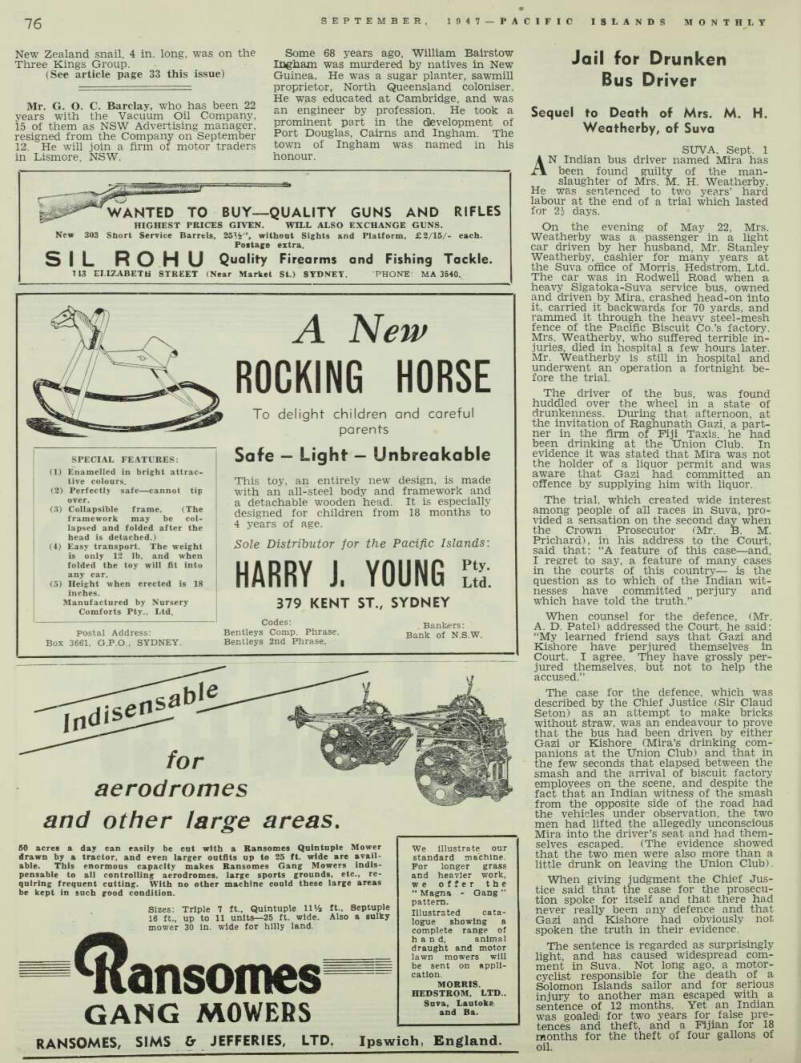
THERE now are countless millions of snails in New Ireland and New Britain, said Flight-Sergeant J. R.
Begg, in Christchurch, NZ. He has just returned from New Guinea after making a search for the remains of New Zealand airmen lost there in the war.
He said that the snails are now a menace to native food supplies; that, after a shower, there are about three snails to every square foot of roadway in New Britain; and that the larger shells do not even crack under the weight of a jeep.
Their Scientific History
THE manner in which the giant snails, achatina fulica, spread throughout the East and down into the Pacific
from their original home in Zanzibar, in the Indian Ocean, was described to “NZ Herald”, by Mr. A, W. B. Powell, assistant director of the Auckland Museum. Mr.
Powell said the snails were no longer to be found in Zanzibar. About 1810 they were accidentally introduced to Mauritius and Madagascar and then they were car ried in coffee plants to Ceylon and Ben gal.
They rapidly spread throughout India by climbing on trains and falling off over the country, and they gradually reached Burma, Malaya, Borneo and Sarawak.
The snails had reached Hong Kong when war broke out, and the Japanese, real ising their food value, introduced them into their mandated islands and later into New Britain and New Ireland.
Mr. Powell said that the largest land snail, 9 in. long, was to be found on the Gold Coast of West Africa. The largest
New Zealand snail, 4 in. long, was on the Three Kings Group. (See article page 33 this issue) Mr. G. O. C. Barclay, who has been 22 years with the Vacuum Oil Company, 15 of them as NSW Advertising manager, resigned from the Company on September 12. He will join a firm of motor traders in Lismore, NSW.
Some 68 years ago, William Bairstow Ingham was murdered by natives in New Guinea. He was a sugar planter, sawmill proprietor, North Queensland coloniser.
He was educated at Cambridge, and was an engineer by profession. He took a prominent part in the (Development of Port Douglas, Cairns and Ingham. The town of Ingham was named in his honour.
Advertisements & other items, pp. 77-78 (1 item)
Fosters
LAGER
BREWED BY
CARLTON & UNITED BREWERIES LTD.
WANTED TO BUY—QUALITY GUNS AND RIFLES
HIGHEST PRICES GIVEN. WILL ALSO EXCHANGE GENS.
New 303 Short Service Barrels, 25W, without Sights and Platform, £2/15/- each.
Postage extra.
S I L R O H U Quality Firearms and Fishing Tackle. 113 ELIZABETH STREET (Near Market St.) SYDNEY.
PHONE MA 3540.
A New
ROCKING HORSE
To delight children and careful
parents
Safe — Light — Unbreakable
This toy, an entirely new design, is made with an all-steel body and framework and a detachable wooden head. It is especially designed for children from 18 months to 4 years of age.
Sole Distributor for the Pacific Islands :
HARRY J, YOUNG a
379 KENT ST., SYDNEY
< -" 0c^es: Bankers: Postal Address: Bentleys Comp. Phrase. Bank of N S W Box 3661, G.P.O., SYDNEY. Bentleys 2nd Phrase.
SPECIAL FEATURES:
(1) Enamelled in bright attrac- j tive colours. (2) Perfectly safe—cannot tip over. (3) Collapsible frame. (The 1 framework may be collapsed and folded after the head is detached.) (4) Easy transport. The weight j is only 12 lb. and when folded the toy will fit into any car. (5) Height when erected is 18 inches.
Manufactured by Nursery Comforts Pty., Ltd.
ble
et\ sa
|nd«i
for
aerodromes
and other large
SO acres a day can easily be cot with a Ransomes Quintuple Mower drawn by a tractor, and even larger outfits up to 25 ft. wide are available. This enormous capacity makes Ransomes Gang Mowers indispensable to all controlling aerodromes, large sports grounds, etc., requiring frequent cutting. With no other machine could these large areas be kept in such good condition.
Sizes: Triple 7 ft.. Quintuple UVa ft.. Septuple 16 ft., up to 11 units—2s ft. wide. Also a sulky mower 30 In. wide for hilly land.
ansomes
GANG MOWERS
We Illustrate our standard machine.
For longer grass and heavier work, we offer the “ Magna - Gang ” pattern.
Illustrated catalogue showing a complete range of hand, animal draught and motor lawn mowers will be sent on application.
MORRIS,
HEDSTROM, LTD..
Suva, Lautoke and Ba.
RANSOMES, SIMS & JEFFERIES, LTD. Ipswich, England.
Bus Driver
Jail for Drunken Bus Driver Sequel to Death of Mrs. M. H.
Weatherby, of Suva
SUVA, Sept. 1 AN Indian bus driver named Mira has been found guilty of the man slaughter of Mrs. M. H. Weatherby.
He was sentenced to two years’ hard labour at the end of a trial which lasted for 21 days.
On the evening of May 22, Mrs.
Weatherby was a passenger in a light car driven by her husband, Mr. Stanley Weatherby, cashier for many years at the Suva office of Morris, Hedstrom, Ltd.
The car was in Rodwell Road when a heavy Sigatoka-Suva service bus, owned and driven by Mira, crashed head-on into it, carried it backwards for 70 yards, and rammed it through the heavy steel-mesh fence of the Pacific Biscuit Co.’s factory.
Mrs. Weatherby, who suffered terrible in juries, died in hospital a few hours later.
Mr. Weatherby is still in hospital and underwent an operation a fortnight be fore the trial.
The driver of the bus, was found huddled over the wheel in a state of drunkenness. During that afternoon, at the invitation of Raghunath Gazi, a part ner in the firm of Fiji Taxis, he had been drinking at the Union Club. In evidence it was stated that Mira was not the holder of a liquor permit and was aware that Gazi had committed an offence by supplying him with liquor.
The trial, which created wide interest among people of all races in Suva, pro vided a sensation on the second day when the Crown Prosecutor (Mr. B. M.
Prichard), in his address to the Court, said that; “A feature of this case—and, I regret to say, a feature of many cases in the courts of this country— is the question as to which of the Indian wit nesses have committed perjury and which have told the truth.”
When counsel for the defence, (Mr.
A. D. Patel) addressed the Court, he said: “My learned friend says that Gazi and Kishore have perjured themselves in Court. I agree. They have grossly per jured themselves, but not to help the accused.”
The case for the defence, which was described by the Chief Justice (Sir Claud Seton) as an attempt to make bricks without straw, was an endeavour to prove that the bus had been driven by either Gazi or Kishore (Mira’s drinking com panions at the Union Club) and that in the few seconds that elapsed between the smash and the arrival of biscuit factory employees on the scene, and despite the fact that an Indian witness of the smash from the opposite side of the road had the vehicles under observation, the two men had lifted the allegedly unconscious Mira into the driver’s seat and had them selves escaped. (The evidence showed that the two men were also more than a little drunk on leaving the Union Club).
When giving judgment the Chief Jus tice said that the case for the prosecu tion spoke for itself and that there had never really been any defence and that Gazi and Kishore had obviously not spoken the truth in their evidence.
The sentence is regarded as surprisingly light, and has caused widespread com ment in Suva. Not long ago, a motor cyclist responsible for the death of a Solomon Islands sailor and for serious injury to another man escaped with a sentence of 12 months. Yet an Indian was goaledi for two years for, false pre tences and theft, and a Fijian for 18 months for the theft of four gallons of oil.
Caught Up In Two Wars
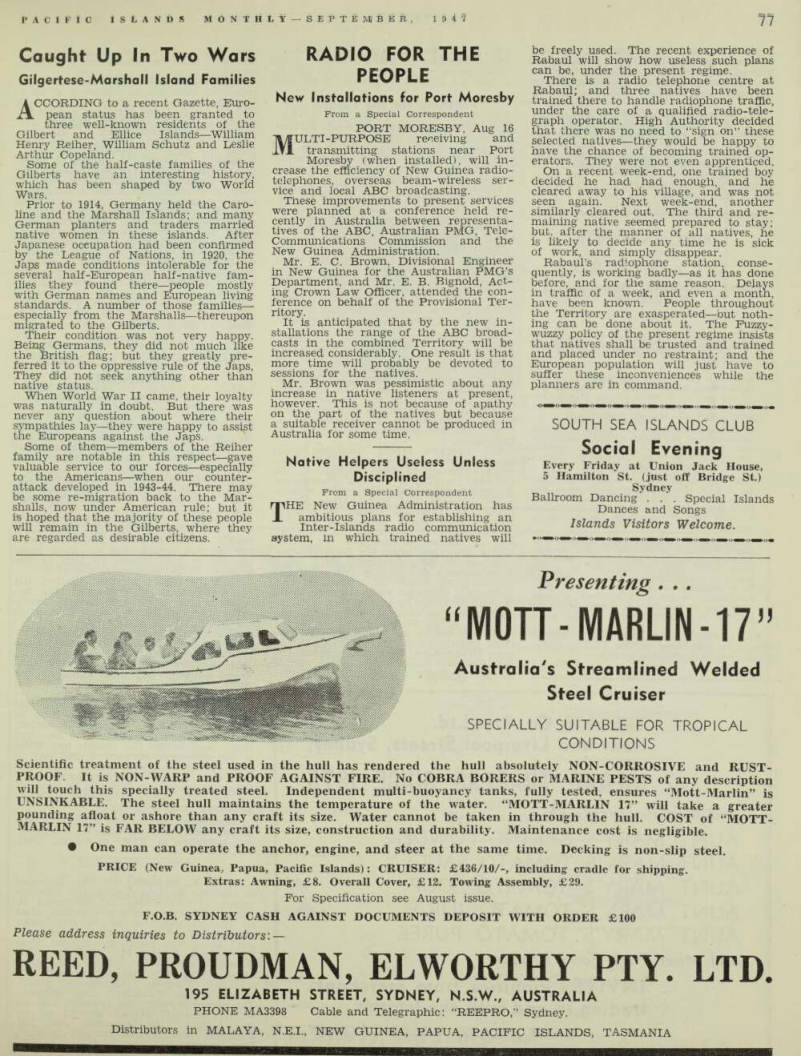
Gilgertese-Marshall Island Families
ACCORDING to a recent Gazette, Euro pean status has been granted to three well-known residents of the Gilbert and Ellice Islands —William Henry Reiher, William Schutz and Leslie Arthur Copeland.
Some of the half-caste families of the Gilberts have an interesting history, which has been shaped by two World Wars.
Prior to 1914, Germany held the Caro line and the Marshall Islands; and many German planters and traders married native women in these islands. After Japanese occupation had been confirmed by the League of Nations, in 1920, the Japs made conditions intolerable for the several half-European half-native fam ilies they found there —people mostly with German names and European living standards. A number of those families— especially from the Marshalls—thereupon migrated to the Gilberts.
Their condition was not very happy.
Being Germans, they did not much like the British flag; but they greatly pre ferred it to the oppressive rule of the Japs, They did not seek anything other than native status.
When World War II came, their loyalty was naturally in doubt. But there was never any question about where their sympathies lay—they were happy to assist the Europeans against the Japs.
Some of them —members of the Reiher family are notable in this respect—gave valuable service to our forces—especially to the Americans—when our counter attack developed in 1943-44. There may be some re-migration back to the Mar shalls, now under American rule; but it is hoped that the majority of these people will remain in the Gilberts, where they are regarded as desirable citizens.
Radio For The
People
New Installations for Port Moresby From a Special Correspondent
Port Moresby, Aug 16
MULTI-PURPOSE receiving and transmitting stations near Port Moresby (when installed), will in crease the efficiency of New Guinea radio telephones, overseas beam-wireless ser vice and local ABC broadcasting.
These improvements to present services were planned at a conference held re cently in Australia between representa tives of the ABC, Australian PMG, Tele communications Commission and the New Guinea Administration.
Mr. E. C. Brown, Divisional Engineer in New Guinea for the Australian PMG’s Department, and Mr. E. B. Bignold, Act ing Crown Law Officer, attended the con ference on behalf of the Provisional Ter ritory.
It is anticipated that by the new in stallations the range of the ABC broad casts in the combined Territory will be increased considerably. One result is that more time will probably be devoted to sessions for the natives.
Mr. Brown was pessimistic about any increase in native listeners at present, however. This is not because of apathy on the part of the natives but because a suitable receiver cannot be produced in Australia for some time.
Native Helpers Useless Unless
Disciplined
From a Special Correspondent THE New Guinea Administration has ambitious plans for establishing an Inter-Islands radio communication system, in which trained natives will
be freely used. The recent experience of Rabaul will show how useless such plans can be, under the present regime.
There is a radio telephone centre at Rabaul; and three natives have been trained there to handle radiophone traffic, under the care of a qualified radio-tele graph operator. High Authority decided that there was no need to “sign on” these selected natives —they would be happy to have the chance of becoming trained op erators. They were not even apprenticed.
On a recent week-end, one trained boy decided he had had enough, and he cleared away to his village, and was not seen again. Next week-end, another similarly cleared out. The third and re maining native seemed prepared to stay; but, after the manner of all natives, he is likely to decide any time he is sick of work, and simply disappear.
Rabaul’s radiophone station, conse quently, is working badly—as it has done before, and for the same reason. Delays in traffic of a week, and even a month, have been known. People throughout the Territory are exasperated—but noth ing can be done about it. The Fuzzy wuzzy policy of the present regime insists that natives shall be trusted and trained and placed under no restraint; and the European population will just have to suffer these inconveniences while the planners are in command.
The growing of watercress in the Noumea-New Caledonia area is now pro hibited, and those who neglect to clear their property of cress are threatened with five days’ imprisonment and a small fine.
Mr. Robert Ernest Griffiths was found dead on Manam Island, off the New Guinea coast, on July 25. He was en gaged in recruiting labour for one of the firms at the time of his death. Some of the circumstances were suspicious, but official opinion is that death was acci dental. He leaves a widow, two daughters and a son to mourn his death.
Advertisements & other items, p. 79 (1 item)
“Mott-Marlin-17”
SOUTH SEA ISLANDS CLUB
Social Evening
Every Friday at Union Jack House, 5 Hamilton St. (just off Bridge St.) Sydney Ballroom Dancing . . . Special Islands Dances and Songs Islands Visitors Welcome.
Presenting . . .
“MOTT-MARLIN-17”
Australia's Streamlined Welded
Steel Cruiser
SPECIALLY SUITABLE FOR TROPICAL
CONDITIONS
Scientific treatment of the steel used in the hull has rendered the hull absolutely NON-CORROSIVE and RUST- PROOF It is NON-WARP and PROOF AGAINST FIRE. No COBRA BORERS or MARINE PESTS of any description will touch this specially treated steel. Independent multi-buoyancy tanks, fully tested, ensures “Mott-Marlin” is UNSINKABLE. The steel hull maintains the temperature of the water. “MOTT-MARLIN 17” will take a greater pounding afloat or ashore than any craft its size. Water cannot be taken in through the hull. COST of “MOTT- MARLIN 17” is FAR BELOW any craft its size, construction and durability. Maintenance cost is negligible. • One man can operate the anchor, engine, and steer at the same time. Decking is non-slip steel.
PRICE (New Guinea, Papua, Pacific Islands): CRUISER: £436/10/-, including cradle for shipping.
Extras: Awning, £B. Overall Cover, £l2. Towing Assembly, £29.
For Specification see August issue.
F. 0.8. SYDNEY CASH AGAINST DOCUMENTS DEPOSIT WITH ORDER £lOO Please address inquiries to Distributors'. —
REED, PROUDMAN, ELWORTHY PTY. LTD.
195 ELIZABETH STREET, SYDNEY, N.S.W., AUSTRALIA
PHONE MA3398 Cable and Telegraphic: “REEPRO,*’ Sydney.
Distributors in MALAYA, N.E.1., NEW GUINEA, PAPUA, PACIFIC ISLANDS, TASMANIA
Public Notice
War Losses in Gilbert and Ellice Islands Colony and British Solomon Islands Protectorate The following statement is issued by the Office of the High Commissioner for the Western Pacific; A Claims Commission has been set up to register and assess claims for property lost or damaged as a result of the War in the Gilbert and Ellice Islands Colony and the British Solomon Islands Protectorate.
It is emphasised that the registration and assessment of the claims by the Commission does not commit the Government of the Western Pacific High Commission to the payment of compensation.
Copies of the forms on which applications are to be made are obtainable from the Claims Commissioner, Mr. W. Ramsay Main, Chartered Accountant. Box 200, Suva, Fiji, or from District Officers in the Territories concerned.
Claims will be considered only in respect of damage or loss amounting to five pounds, Australian Currency, or more. Separate claim forms must be submitted by or on behalf of each individual, Company or Firm.
If a claimant has property in more than one District in the same Territory, a single claim may be submitted in respect of all the property in that Territory.
All correspondence concerning claims
should be addressed to The Claims Com
missioner, Box 200, Suva, Fiji.
In Fiji
Local Government In Fiji Planning for the Future
AN enlarged system of local govern ment for Fiji was outlined in a re port submitted last year to the Fiji Government by Mr. Harold Cooper, before his transfer to West Africa. The plan is now under consideration.
The plan recently was briefly described by the Fiji Public Relations Officer, Mr.
Usher. We give the following extracts.
Local government in the Islands generally is now a subject receiving a great deal of attention.
There are three important communities in Fiji—the Fijians, who own the land; the Europeans, who direct the adminis tration and the principal industries; and the recently-arrived Indians, who have no place in Fiji as of right, but who already control most of the small trading organi sation, and a great deal of peasant agri culture.
Fijian natives already have a compre hensive system of local government in the councils that discuss the affairs of in dividual villages; the “tikina councils” that deal with the affairs of tikinas (or combinations of villages); the provincial councils, which consider the affairs of orovinces or combinations of tikinas; and in the administrative and judicial organi sation set up under the Fijian Affairs Ordinance.
Mr. Cooper’s report therefore deals primarily with areas of non-Fijian settle ment —although he looks forward to the eventual merging of all local government institutions into one Colony-wide svstem.
He proposes that Rural Areas, Urban Areas and Counties should be created.
Rural Areas would consist of suitable combinations of non-Fijian settlements, and he Quotes as examples the settle ments strung out along the Sabeto Valley, or those fringing Savusavu Bay. Each Rural Area would have a council of five members, all elected on a common roll, unless the Governor should choose to fill one or more seats by nomination, or to re serve them for candidates of one race.
Urban Areas would be centres of the type now known as townships, but with their boundaries somewhat enlarged. In each Urban Area there would be an Ur ban Council, consisting of three elected Indian members, three European mem
bers, either elected or nominated, and not moie than two additional nominated members.
Each Rural and Urban Council would nominate members to represent it on a County Council, on which there would also be up to three members nominated by the Governor, and from three to five Fijian members nominated by the Pro vince. Each County Council would have power to make by-laws for the whole County. It would also impose a basic rate, which would be supplemented by grants from the Central Government.
Mr. Cooper suggests some of the duties of the various Councils. They might pro vide schools, take measures to safeguard public health, provide dispensaries and child welfare facilities, maintain roads, markets, cemeteries and libraries, attend to the relief of distress, maintain the smaller water supplies, control parks and recreation grounds and community centres, and help in Urban and Regional planning.
The Councils, centres of community life in town and country areas, would be kept fully occupied.
At Mangaia
Incidence Of Filariasis
Prom Our Own Correspondent
Mangaia. May 21.
THE recent spell of very cold and wet weather here re-awakenei in our lymphatics the lurking filaria para site, with which probably every adult Mangaian is infected.
Upon this island the lymphatic obstruc tions do not develop to an elephantoid stage; but there is a sort of fever, very like that of the “rheumatic” variety, ac companied by great pain. It, apparently, does not endanger the lives or general health of the patient. The limb pains can be very severe, and in some cases the leg or arm cannot be bent at the joint while the parasite is active.
With the return of warm weather, the pains disappear, the reddened skin be comes normal again, and there is then a surface peeling that has some likeness to the aftermath of scarlet fever.
So far, no means has been invented for the destruction, in the bloodstream, of the mosquito-borne parasite from which all these troubles spring. An injection that would achieve this, without killing the “host,” has long been waited for, but Science seems to be baffled so far!
It is curious also that a trip to a cold country is recommended as a cure, or rather suppression, of the infestation; cold weather in the Islands is the very thing that brings the trouble on! What is the difference between a cold day in N.Z. and a Mangaian winter day? And why does an 80-degrea temperature re lieve the condition? It would be interest ing to have Science’s answer to these questions, often asked in Cl. (Ed. Note: An article entitled. “The Cause, Prevention and Cure of Filariasis” was published in “PIM” in August, 1944).
Mr. T. L. McAdam, who was Collector of Customs in Rabaul when the Japs in vaded, is now living in retirement in Perth, WA. He was one who had what he himself describes as “a very lucky escape”. When the “everv man for him self” order was given, he trekked from Rabaul out to Put Put, and there fell in with some soldiers and a radio oper ator. Thev were able to get onto the schooner “Poseidon”; thence they trans ferred to the “Leander”; and, although Jap planes infested the heavens, and an enemy air-craft carrier showed up on the horizon, the schooner was not molested, and they eventually reached Port Moresby.
Advertisements & other items, p. 80 (2 items)
78
I9U-PACir 1C ISLANDS MONTHLY
SEPTEMBER,
Island Traders Since 1875
Tillock & Co. Pty. Ltd.
Kent and Liverpool Streets, Sydney,
and Manufacturers of
AUNT MARY'S BAKING POWDER
AUNT MARY'S TOMATO SAUCE
AUNT MARY'S TOMATO SOUP
AUNT MARY'S TOMATO JUICE
AUNT MARY'S TOMATO PUREE
and other Pure Food Products INVITES inquiries from merchants trading in and with the Islands.
CABLE ADDRESS: TILLOCK, SYDNEY
Coconuts and Loneliness
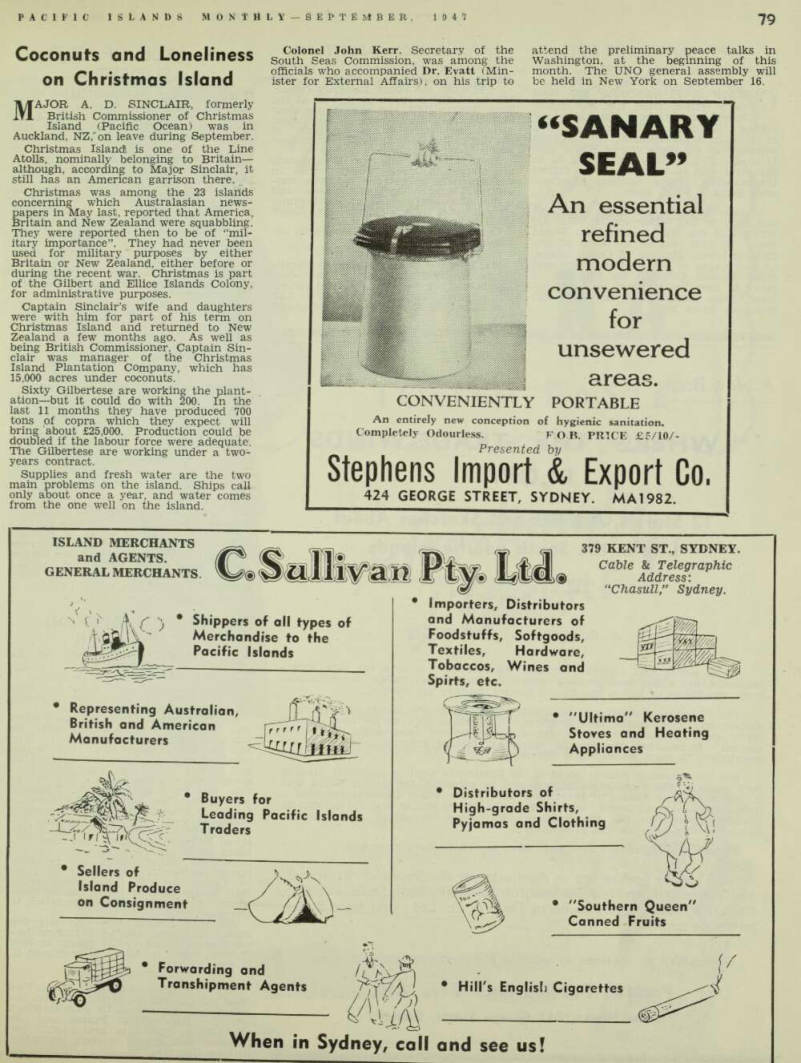
on Christmas Island
Major a. d. Sinclair, formerly British Commissioner of Christmas Island (Pacific Ocean) was in Auckland, NZ.'on leave during September.
Christmas Islandl is one of the Line Atolls, nominally belonging to Britain— although, according to Major Sinclair, it still has an American garrison there.
Christmas was among the 23 islands concerning which Australasian news papers in May last, reported that America, Britain and New Zealand were squabbling.
They were reported then to be of “mil itary importance”. They had never been used for military purposes by either Britain or New Zealand, either before or during the recent war. Christmas is part of the Gilbert and Ellice Islands Colony, for administrative purposes.
Captain Sinclair’s wife and daughters were with him for part of his term on Christmas Island and returned to New Zealand a few months ago. As well as being British Commissioner, Captain Sin clair was manager of the Christmas Island Plantation Company, which has 15,000 acres under coconuts.
Sixty Gilbertese are working the plant ation—but it could do with 200. In the last 11 months they have produced 700 tons of copra which they expect will bring about £25,000. Production could be doubled if the labour force were adequate.
The Gilbertese are working under a two years contract.
Supplies and fresh water are the two main problems on the island. Ships call only about once a year, and water comes from the one well on the island.
Colonel John Kerr, Secretary of the South Seas Commission, was among the officials who accompanied Dr. Evatt (Minister for External Affairs), on his trip to
attend the preliminary peace talks in Washington, at the beginning of this month. The UNO general assembly will be held in New York on September 16.
Advertisements & other items, p. 81 (1 item)
Stephens Import & Export Co,
“SANARY
SEAL”
An essential refined modern convenience for unsewered areas.
CONVENIENTLY PORTABLE
An entirely new conception of hygienic sanitation.
Completely Odourless. F O R. PRICE £5/10/- Presented by
Stephens Import & Export Co,
424 GEORGE STREET, SYDNEY. MA1982.
-•••■V ...
ISLAND MERCHANTS
and AGENTS.
GENERAL MERCHANTS.
C® 5Jli v*(Mi
Pirn
379 KENT ST., SYDNEY.
Cable & Telegraphic Address: ,t Chasull, ,> Sydney. jk C ) • Shippers of all types of iimlA Merchandise to the Pacific Islands • Representing Australian, British and American Manufacturers
r^Ccf
-i iff • Buyers for Leading Pacific Islands Traders • Sellers of Island Produce
on Consignment
Importers, Distributors and Manufacturers of Foodstuffs, Softgoods, Textiles, Hardware, Tobaccos, Wines and Spirts, etc. y v .’.V' “Ultima" Kerosene Stoves and Heating Appliances • Distributors of High-grade Shirts, Pyjamas and Clothing 0 • “Southern Queen' Canned Fruits • Forwarding and
Transhipment Agents
/&> & m - m • Hill's English Cigarettes When in Sydney, call and see us!
Cart. Sanders Is Still
Doing An Army Job In Fiji
(Captain S. F. Sanders Mc (And
J Bar) retired from the Fiji Police Force last October, after 26 years’ service. He held, at the time the rank of Assistant Superintendent, but had been seconded at the beginning of World War II to the Fiji Military Forces and is, in fact, still with that Force, now as Officer Commanding, Heavy Artillery Mainten ance Section, FMF, Suva.
Captain Sanders joined the Fiji Con stabulary in 1921 after serving with the NZEF and the BEF in the First World War. In 1926, during the time of the Chinese labour disputes on Ocean Island, he had a tour of duty in the Gilbert and Ellice Islands Colony. He expected to retire to New Zealand last year but in stead. finds himself back in Suva, still doing an Army job.
Information About Fiji
AN excellent idea was put into practice by the Government of Fiji on July 31 when the Public Relations Officer.
Mr. L. G. Usher, went on the air at the Suva Station ZJV, and broadcast a clear and informative summary of the Papers which had been “laid on the table” of the Legislative Council during the current session.
There often is far more information of interest in these “Papers” than in a dozen debates; yet the reporters con centrate usually on the debates, and dodge the heavy task of intelligently summarising the “Papers”. Mr. Usher made an excellent job of it.
This system could be followed with ad vantage in bigger countries.
Mr. Jack Bannigan, well-known identity in the Morobe district, arrived in Sydney last month for medical treatment follow ing an unfortunate jeep accident at Lae.
Mr. Bannigan is making good progress.
Sudest
A Tale Of Old
THE following may read like a fairy tale —but it is quite true.
In the early days, on Sudest Island, there arrived an old man named Bob Olgier. He was a Canadian by birth, and had been an alluvial miner in his youth. On Sudest, he discovered gold in a creek that had been missed by other miners, and settled down there.
He employed his native neighbours to make a big garden and, when the crop were fit to harvest, all were invited to help themselves. Old Bob was very proud of his garden—and he stood No. 1 with his neighbours.
They gave him, or sold him. a young woman—not a princess! Later a son and heir was born. Bob was very proud of his son, because he had a birth-mark, the same as he.
All was bright and happy—and this went on for some years. In the mean time, the natives abandoned the task of making gardens of their own—they lived on Bob’s garden. Then came evil days.
The gold cut out —and also Bob’s cash, and the natives would not work in his garden without pay. His son died, and the mother went home to her relatives.
The hungry natives began abusing old Bob, because there were no gardens.
Several years passed before their gardens were back to normal again.
Thence forward, Bob lived on the generosity of a white neighbour, Billy Lamb. When Bob died, the natives said he was no good—he had humbugged them, they said, and made them lose their gardens.
Billy Lamb was American by birth. He was a keen business man and he started a native store. When the gold cut out he built up a business that is a going concern to-day, in the name of Tagula Plantations. When Billy died, the natives said he was a good, white man —he had made a big store and there they could
buy “plenty something.”
D. H. Osborne.
Old-Timer Soltwedel
Is Free Again
A WELL-KNOWN resident of the Morobe section of New Guinea, Mr.
Otto Soltwedel, arrived in Sydney at the end of August. He had just been released from Tatura camp, Victoria, after eight years of internment.
Mr. Soltwedel was in New Guinea when war broke out in September, 1939, He left Germany, for New Guinea, in 1912, and had not returned there; but he was regarded as a man with Nazi sympathies, and he was interned in 1939. Many Ger mans were released at the end of the war, two years ago; but Mr. Soltwedel was among those retained “for deporta tion”. In response to the strong protest ations of many friends, officialdom be came all elusive and hush-hush—it in sisted it knew something that mere civ ilians could not guess at, and must not know. So “Soltie”—as he was generally known in New Guinea—kicked his heels in Tatura for two more weary years.
But finally he was given his freedom, without further threat of deportation to Germany.
His long incarceration has left few marks upon him, and he is looking for ward eagerly to an early return to New Guinea, where he hopes to re-engage in mining.
Mrs. Paul Klein, or Espiritu Santo, New Hebrides, arrived in Sydney at the be ginning of the month by Pan-American clipper, after visiting Prance and the USA. She expects to return with her husband this month to their plantation in New Hebrides.
Advertisements & other items, pp. 82-84 (2 items)
Blow”
A New Book
“WHERE THE TRADE-WINDS
72 Stories, Articles and Sketches About
Life in the South Pacific Islands
WITH NUMEROUS ILLUSTRATIONS
Collected by
R. W. ROBSON and JUDY TUDOR
These stories and sketches, brought together in this book for your entertainment, are about real people. They describe, without colour or embellishment, conditions of life in the Pacific Islands, as they are to-day.
The “Islands of Romance” have suffered much at the hands of peripatetic writers and irresponsible film directors. The places and people they picture rarely exist outside a cinema studio, and the fevered imagination of literary morons. Nonetheless, the Islands which our fathers knew fully deserved the description, “a place where life is different.”
But the charming Islands world of the Nineteenth Century has been changed very much by the Twentieth Century—and by no event more than World War II which brought masses of Servicemen into places which formerly regarded a kava party as a great crowd. We still have the Islands setting and the indefinable Islands atmosphere; but life in the Islands—even in savage and primitive Melanesia—has been altered, profoundly.
This book may indicate how and where conditions have changed.
At all Leading Booksellers in Australia; at the Stores of Whitcomb and Tombs Ltd., in New Zealand; at Caldwell's Book Store, in Suva; from the Islands stores of Burns Philp Cr Co. Ltd.; and from Book-
sellers generally.
Copies may be obtained by sending 9/6 direct to the Publishers:
Pacific Publications Pty. Ltd.
Union House, 247 George Street, Sydney
Tooth Past
nr
T" W'*T*
i f ■ ■ rp- ¥' :V '■ > \ ' \ ■ : "'r l I M
It's
You’ll agree, too, when you use IP ANA. It’s
refreshingly different, with a distinctive, pleasant
taste, that makes your mouth feel grand.
IPANA’S cleaning and polishing qualities
give you sparkling teeth and a sunny smile.
With massage, too, IPANA helps ensure firm, healthy gums so vital to sound teeth.
G On for °Fr
mp 4s
Modern Refrigeration for the South Sea Islands
The ELECTROLUX kerosene operated
REFRIGERATOR
MARVEL
OF
MODERN
SCIENCE
n Iftss
THE
MIRACLE
OF
ICE
FROM
HEAT
ELECTROLUX offers economical, modern and completely efficient
REFRIGERATION FOR ISLANDS' HOMES.
FREEZES CONTINUOUSLY WHILE SMALL LAMP BURNS.
Freezing controlled by simply regulating height of flame. Uses only i gallon of kerosene per week, MOTORLESS ... NO PARTS TO GET OUT OF ORDER.
MODEL LKSSO
Capacity: 5.5 cubic feet.
GUARANTEED FOR TWO YEARS
• Write to your Local Distributor for prices and full details.
OBTAINABLE FROM ALL W. R. CARPENTER & CO. LTD.
BRANCHES THROUGHOUT THE ISLANDS
Representation in Papua and New Hebrides,
S‘ ati # pTr^nnef.
Shipyard's Good
Record
Building Ships From Scratch In Wartime
A REMARKABLE war-time perfor mance was put ud by Green Point Naval Dockyard, Sydney, whose ad vertisements recently have been directed to Pacific Islands shipowners.
Immediately after the Japs invaded the South Pacific, early 1942, a private com pany, under Australian Navy direction, created a new organisation to mass-pro duce Fairmile natrol vessels—fast little ships 112 feet long, which chased submar ines, strafed barges, shot up enemy shore installations, fought raiding aircraft and led landing parties ashore.
Plans were made in February, 1942; in April, the site was selected at Mortlake, Parramatta River, Sydney; timber, work men, buildings, slipways, machinery fol lowed with incredible speed; the first keel was laid in September; the hull was afloat in November; the first Fairmile was commissioned in January, 1943. With rhythmic precision, vessel followed vessel at fortnightly intervals—l 2 were under construction at once. In December, 1943. the 20th little shin was delivered—a most remarkable record.
Subsequently, with the same smooth efficiency and astonishing speed, this yard produced 17 Fast Supply vessels for the Americans, and 22 trawler type ships for the Australian Navy.
Latterly, the Australian Navy took the yard into its own control, with Mr. C. E.
B. Boden as managing agent; and in 1947 the Australian Government leased Green Point to Mr. Boden as a going concern, and he is now running it as managing
director of Green Point Shipbuilding and f E^ oen f ng . Ltd ; J* 16 ya f d I > as facilities for all kinds of ship construction fast efflcient W work a reC ° rd ( ° r last, efficient work.
An event ot cultural importance to Port Moresby and the Territories generally, was the recent arrival of the Officer In charge of Library Services in the
Territory, Mr. Parnell It is undersionri he will Plan three main regional hbra?^ at Lae, Rabaul and Moresby f
S‘ ati pTr^nnef.
Moresby library already has a good range books, many of which were taken over from Army Education. Future require-
LibraryCanberraNational
in nart of th» T ?in'??« llb T a S at Ha Beach the H9I ..Sfth 8 ?i ub half ’ RSL uses the other
Advertisements & other items, p. 85 (1 item)
Tibaldi
31 QUEEN STREET, MELBOURNE
Continental Smallgoods
“Wi CANNED
MORTADELLA
A Real Delicacy
SALAMI
Specially waxed and wrapped in greas-proof paper for tropical climates.
Sole Distributing Agents for the Pacific Islands:
BRIAL & BALL
1 BOND STREET, SYDNEY
/{ T HISTORY BEHIND THE SWALLOW
% 4 * -A
SWALLOW $ ARIELL
LIMITED
leaders in the biscuit industry SINCE 1854 «irtu iua ar rat mnmj iwuuw t uitu nun nioomu. uiu. ins ict chin
THE LOST HERD
In the year 1788, Governor Phillip sat drafting a despatch to England. In it he had to report the loss of 4 cows and 2 bulls, almost the entire dairying stock of the Colony.
As this mishap was in the nature of a major
calamity, Governor Phillip wrote gloomily,
“Part of the live stock, small as it was, has been lost—the loss will not easily be repaired.”
Fate however, decided otherwise. Ten years later, a huntsman discovered the beasts 30 miles away at a place since called Cowpastures. In the intervening 10 years they had multiplied to such an extent that before his amazed eyes ranged a herd of 60 fine cattle.
Today, Australia’s famous dairy herds produce for export alone over 124 million pounds of butter, and more than 59 million pounds of milk per annum.
Since the days of its inception the famous firm of Swallow & Ariell has exercised the greatest care in selecting only the finest ingredients for Swallow & Ariell products. From Australia’s finest dairy herds comes the rich milk and cream used in the manufacture of Swallow & Ariell delicacies.
Babe's Tragic Death
THE four months’ old son, Peter, of Mr. and Mrs. J. Burston, of Madang, died on board the liner “Merkur” as it was nearing Sydney on September 6. Death is reported to have Been caused by suffocation. According to reports, Mrs. Burston discovered the child lying unconscious in his cot. She immediately secured assistance but, despite efforts by the ship’s doctor, the child did not re gain consciousness.
Mr. Jack Burston, who was a pre-war resident of the Territory, is a brother of Mrs. Ward Oakley and Miss O. Burston.
Dr. Languyon, who has been in charge of the bacteriological department in Noumea, New Caledonia, recently returned to France.
Silence On The South Pacific Commission
Dr. Evatt Does Not Explain Why Colonel Kerr Has Gone to UNO
A REMARKABLE silence has fallen upon the subject of the South Pac ific Regional Commission.
Representatives of the six countries (Britain, United States, Australia. New Zealand, Prance and Holland), at the in vitation of Australia, assembled in Can berra in January last, and formed the Commission. This had been the pet plan of Dr. Evatt, Australian “Foreign Min ister”—he advanced it first when Aus tralia and New Zealand made their Pact in relation to Pacific affairs, about 1944.
The main object of the Commission is the study of all matters affecting the South Pacific Islands in common, and
the co-ordination of the administration policies of the six countries named —all of which have territorial responsibilities in the South Pacific.
The plan was accented, the Commission was formed, and Dr. Evatt was applauded.
There was some liveliness when Aus tralia tried to induce the other countries to agree that the headquarters of the Commission should be Sydney, or alterna tively, Port Moresby. But there are many important Territories outside the Aus tralian sphere; and non-Australian countries were determined that the Aus tralian tail should not wag the whole Pacific dog.
It was finally agreed that Sydney should be the headquarters for six months; and that the Commission should assemble in Sydney in June or July, 1947, and select a location of the Commission, and take various other decisions needed to make the Commission function. The delegates disoersed, and soon afterwards Colonel John Kerr, principal of the School of Tropical Administration, Syd ney, was appointed Organising Secretary, pro tern.
Since then, there has not been one word from Dr. Evatt or anyone else con cerning the Commission. The Commis sion did not assemble in Sydney, in July, as was arranged in January.
Dr. Evatt, of course, is the directing force of this new organisation; and he has been exceedingly busy with world affairs.
Early in September, an ANA Trans pacific plane was diverted from ordinary traffic and, on orders from Canberra, was held at the disposal of Dr. Evatt, who was headed for a United Nations session in New York. Ordinarily, this plane carries 36 passengers. Australian tax payers sadly watched it take off with Dr. Evatt, Mrs. Evatt, the usual bunch of officials —about 10 altogether.
Included in Dr. Evatt’s party was Colonel John Kerr, organising secretary of the South Pacific Commission. News paper reporters wanted to know what this meant—was the Commission plan to be dealt with in some way by UNO? But the Australian “Foreign Minister” had nothing to say.
Although Australians are paying for it all —Australia is footing most of the South Pacific Commission bill—Aus tralians are not permitted to know more than what their ponderous trade-union dictators think is good for them.
Mr. C. Saunders, general manager of Australian Petroleum Co. Pty., Ltd., has accepted the position of London manager of the newly-formed Middle East Pipe line Co. He left Melbourne in mid- Aug ust. His nlace, in Australia, will be taken by Mr. L* A. Pye, of Anglo-Iraman Oil Co., Ltd., who is expected to arrive in Australia early next year.
Owing to the stranding of the steamer “Reynella” off Eastern Papua, passengers were transferred to MV “Merkur ’ and arrived in Sydney on September 6. They included; Mrs. F. M. Gilmore (and child), Mr and Mrs. A. J. Long, Miss O. Welch man, Miss M. C. Crampton, Major L. J.
Kvngdon, Messrs. M. Fyfe, R. J. o.
Schmidt, S. E. Goudie, N. W. Brain, W D.
Goodsir R. G. Bowmaker, A. Steele, E J M. Dermott, J. W. Welch H A.
Honebin, J. Dickie, A. H. Mitchell, Chow Kin, See Too May King, _Ho Sang Lai Wah, Lai Ming, Lai Kui, Quan Kong, Ouan toor, Kwan How Yuan, Sa Kai Young. Un Kit, Pi Suen, Pi Ling.
Advertisements & other items, p. 86 (1 item)
''X $ Aai a*t
o>f '
HEALTHY
NEAT-LOOKING
HAIR
/ 1 (£\ 6/ £4 He’s found the key that unlocks the door to social success and popularity.
Attractive girls take pride in being seen with him . . a well-groomed escort. He studies his appearance . . . knows the value of first impressions . . . realises the advantage of handsome, well-kept hair. So he uses VIIALIS, and the “60-second drill”. 150 Seconds to Rub—Cir- 2 10 Sec ° nds to Comh . and 1 culation quickens thus * Brush— Hair has a lustre scalp stimulation gives hair —no objectionable patenta c hance. leather" look. J 3304 V hair f \atcs Sttmu
Sydney-Vancouver
Shipping And Plane Services
THE following sea and air services are running to schedules in the Pacific.
Not all of the regular services which were suspended, owing to war conditions, have been restored; but preparations are under way for their early reintroduc ti°n. As they become available they will be announced here.
New Zealand—Cook
Is.—Niue—Samoa
THE motor vessel “Maui Pomare,” owned and operated by the NZ Gov ernment, maintains a direct service between Auckland and Rarotonga (Cook Islands), with alternative calls at Niue and Apia (Samoa).
Sydney-Norfolk Island-
New Hebrides
THE SS “Morinda,” Burns Philp & Co., Ltd., runs at approximately six seven weeks’ intervals from Sydney to Lord Howe Island. Norfolk Island, and main ports of the New Hebrides, and return, A regular fixed timetable is not yet practicable. (“Morinda” has gone into dock in Sydney and is not expected to he back on the run until at least November.)
Sydney—Auckland
Airways
'T'ASMAN Empire Airways, Ltd., operate q A flying-boat service between Rose Bay Sydney, and Mechanics Bay. Auckland. Large flying-boats, capable of carrying 30 passengers, are employed. The trip is comfortable, and takes approximately 8 hours.
The flying-boats leave both Sydney (7 a.m.) and Auckland (8 a.m.) every morning, including Sundays.
Bookings may be made at the Auckland and Sydney offices of Tasman Empire Airways.
New Zealand—Fiji—
Samoa—Tonga
Monthly Service by MV ‘ Matua”
Service Conducted By Union Ss Co.,
Ltd.—Subject To Alteration Without
Notice
(After her August trip, “Matua” will be with drawn for survey; she will be off the run for approximately one month.) Auckland .. Sept. 25 Oct. 25 Nov. 25 Suva .. .. Sept. 29-30 Oct. 29-30 Nov. 29-30 Nukualofa .. Nov. 1-2 Vavau ... Nov. 3 Apia* .. Oct. 1-4 Nov. 3-6 Dec. 1-4 Vavau .. .. Oct. 6 Dec. 6 Nukualofa .. Oct. 7-8 Dec. 7-8 Suva .. .. Oct. 10-11 Nov. 9-10 Dec. 10-11 Auckland .. Oct. 15 Nov. 14 Dec. 15 ♦Western Time.
New Caledonia
THE New Caledonian Government has sub sidised and maintained the coastal ship ping services. The East Coast, the West Coast, and the Loyalty Islands, under present conditions, receive 10 round trips per annum.
The ships call at the following ports; EAST COAST.—Yate, Ounia, Thio, Nakety, Cana la, Kouaoua Kua, Moneo, Ponerihouen, Tibarama, Poindimie, Wagap. Touho, Tipindje, Hienghene. Tao, Oubatch, Pouebo, Balade, Pami Aratna, and return.
WEST COAST,—Pouembout, Kone, Temala,
Voh, Ouaco Gomen, Koumac, Tangaiou, Tiebaghl, Nehoue Poume, Baaba, Belep and return.
LOYALTY ISLANDS.—Mare (Tadine), Lifou (Chepenehe) Ouvea (Fajaoue, St. Joseph) and return.
The steamer “Neo Hebridals” runs regularly between Noumea and Sydney, with occasional trips to the New Hebrides (mostly Aneityum).
The owners are Societe Maritime et Manlere Hagen, Noumea. Sydney agents: H. C. Sleigh, 254 George Street, Sydney.
Pan-American—
Trans-Pacific Service
■pAN-AMERICAN World Airways planes are f - now running twice weekly between Sydney and San Francisco, and a weekly service between Auckland and San Francisco. Both services go via New Caledonia, Nadi (Fiji), Canton Island and Hawai’i. Skymaster planes are used.
Planes leave Sydney every Sunday and Thurs day and San Francisco every Wednesday and Friday. Planes leave Auckland northbound every Wednesday and 'Frisco, southbound to Auckland, every Friday.
Fares are approximately the same as ANA (See below.) Free baggage allowance is 55 lb. Excess at 1 per cent, of the one-way fare for each kilogram of excess (1 kilo = 2.2 lb.).
Sydney-Vancouver
ANA Service
A USTRALIAN National Airways Pty., Ltd., on . behalf of the British Commonwealth Pacific Airlines, Ltd., are now operating a weekly trans-Paclfic service from Sydney, via Fiji, Can ton Island. Honolulu, and San Francisco to Vancouver, and a fortnightly service between Auckland and Vancouver via the same air ports. They are now permitted to pick up and set dcwn passengers in American territory.
Planes leave Sydney every Sunday evening and Vancouver, on the southbound trip, every Thursday. Planes leave Auckland every alter nate Thursdays and arrive in Vancouver the
following Sunday. This southbound trip com mences from Vancouver on alternate Saturdays.
Fares are (in Australian currency), Sydney- San Francisco, £2OO single and £365 return, Auckland-Vancouver, £AI9B single; Auckland- Nadi (Fiji), £A39.
Skymaster aircraft carrying 36 passengers and a crew of 10 are used on the service.
Sydney-Noumea-Suva
ONCE weekly the Qantas flying-boat “Coriol anus” leaves Sydney in the early morning, and after calling at Brisbane heads out over the Pacific to Noumea. Every second week the plane goes on to Suva, Fiji. From Sydney to Noumea is a journey of about 11 hours. An overnight stop is made in Noumea, and Suva is reached the following afternoon.
Intending passangers should book through Qantas offices in Australia. Burns, Philp (South Seas) Company, in Suva; and Messrs. L. H. and W. A. Johnston in Noumea.
Fares: To Noumea, £35 single. To Suva, £52/10/- single.
Sydney—Queensland—
New Guinea Airways
QANTAS Empire Airways, Ltd., employing DC3 planes, operate a regular service between Sydney, Port Moresby, Lae and Rabaul, and return, via Brisbane, Rockhampton, Towns ville and Cairns.
This service is now known as the “Bird of Paradise” Service, DC3 aircraft, carrying 21 passengers, are used.
Planes leave Sydney on Mondays. Wednesdays, and Saturdays at 10 a.m., and arrive at Lae at noon on Tuesdays, Thursdays and Sundays. The plane which leaves Sydney on Wednesday and arrives at Lae on Thursday then goes on to Rabaul. It returns on Friday.
Planes leave Lae at 5.45 a.m. on Wednesdays, Fridays and Sundays, and arrive in Sydney at 10 p.m., accomplishing the Lae-Sydney run in a day.
The return plane from Rabaul leaves at 1.30 p.m. on Fridays.
Bookings may be made at Qantas offices at any of the towns named. At present, berths are available only to passengers holding official per mits to visit Papua or New Guinea.
RNZAF Services In
Central Pacific
(RNZAF Pacific Regional services are operated (or the New Zealand National Airways Corporation and the Dakota that makes the monthly trip, via New Caledonia, is based at Fiji for four weeks to operate services connecting with the Sunderland flying-boat. Details of services can be obtained on application to Railway Transport Officer (Air) at Auckland, Wellington, and Christchurch Railway Stations, or to Air Move ments Officers at Aerodromes concerned, or to Air Department, Wellington.)
Nausori (Suva)-Nadi (Western Fiji);
Plane leaves Nausori each Tuesday and Friday, returning same day. Single adult fare £3 (Fijian). Baggage, 351 b.
Laucala Bay (Suva)-Auckland: Flying
boat leaves Auckland for Fiji each Friday and returns on Monday. Single fare, £25/5/2 (F.).
Baggage, 60H
FIJI - TONGA - SAMOA - COOK ISLANDS: A Dakota transport aircraft leaves Nausori each Saturday for Western Samoa. On alternate Saturdays the schedule includes Tonga and Cook Islands (Aitutaki and Rarotonga), an overnight stop being made at Apia, Western Samoa. Single adult fares: Flji-Tonga, £6/12/11; Fiji-Samoa, £B/17/3; Fiji-Aitutaki or Rarotonga £lB/3 A Baggage, 601 b.
FIJI - NORFOLK ISLAND - NOUMEA - NEW ZEALAND: A Dakota transport aircraft leaves Nausori once every four weeks for Whenuapai, N.Z., via Norfolk Island and Tontouta, New Caledonia. Because accommodation at Norfolk Island is limited special arrangements are necessary before through bookings can be ac cepted. Single adult fares: Fiji-Norfolk, £l6/7/11; Fiji-Noumea, £l6/7/11; Fiji-New Zealand, £25/5/2. Baggage, 601 b.
Pacific Travellers
PASSENGERS who left Auckland pe: -
MV “Matua” on August 9: TO SUVA: Miss J. C. Abel. Mrs. C. B Andrews (and infant). Miss M. Aickin, Mrs. A.
L. Barnfather (and two children), Mrs. A. L Barnes. Mr. E. A. Corby, Mrs. A. Connolly.
Mr. H. D. Connolly, Mr. J. G. B. Crawford, Mrs. M. L. Crane, Mrs. C. S. Day, Mr. A. P.
S. Day, Mrs. G. M. Davies, Mrs. A. Eastgate (and daughter), Miss B. V. Eyre, Mrs. L. E.
Farquhar, Mrs. L. Hughes. Mr. and Mrs. A. L.
Hill, Mrs. H. M. Holland, Mrs. H. K. Irving, Mr. W. Jensen, Mrs. J. M. Jensen, Miss M.
C. Kerrigan, Mr. and Mrs. R. D. S. Kemp, Mrs. C. C. Kemp (and two children), Misses D.
M. and E. M. Kemp, Mrs. R. Kirk, Mrs. D.
Leys, Mr. M. C. Linwood, Lou Choy, Manga Dharam Singh, Mrs. N. A. Morgan (and three children). Mr. J. F. McDermott, Mr. H. T. H.
Mansell, Mr. R. Mounsey, Miss M. E. Maybin, Mrs. C. M. Mawson, Mrs. M. L. Mackay, Miss M. T. Magee, Mrs. A. Powell (and daughter), Mr. C. G. Palmer, Mr. and Mrs. G. R. W.
Pocock, Miss M. F. Paterson, Mr. H. R. Prit chard. Mrs. A. O. Ryan, Mr. H. C. Russell.
Ram Oudh Sharma, Mr. W. A. Richards, Mr. and Mrs. G. Radley, Miss T. Radley, Mrs. A.
M. T. Rusden, Mrs. P. M. Richards (and two children), Shiv Ram, Miss E. M. Smith. Mr.
K. A. Stuart, Miss G. M. Salt, Mrs. J. F. M.
Secchi, Mrs. P. Thompson, Mr. T. A. Terry, Mrs. N. J. Von Pein.
TO APIA: Miss L. Ahmu, Miss T. S. Bernard, Master E. J. Bernard, Miss L. L. Coe, Mr. L.
P. Churton, Miss L. Pong, Mrs. D. C. Mann (and two children), Mrs. C. Meredith, Miss E.
Mindecke, Miss E. Ruland, Mr. and Mrs. J. B.
J. Radford, Mr. and Mrs. W. B. Struthers, Tpr.
T. S. Young, Mr. T. Yandall.
TO NIUE: Mr. R. H. Head, Mr. A. J. Jacobsen, Mrs. H. Larsen, Mr. P. J. Walsh.
TO VAVAU: Miss R. Sanft.
To Nukualofa; Mr. J. Vea.
ROUND TRIP: Mr. P. A. Mason, Mr. E. W.
Thurgood.
PASSENGERS who arrived in Auckland, NZ, by MV “Matua” on September 4; FROM APIA; Mr. R. Allen, Mr. T. Ah Heen, Mr. I. H. Carruthers, Mr. H. Dickinson, Mr.
V Greenwood, Miss A. Lane, Mr. M. Manning, Mr. H. Mitchell, Master D. McFarland, Mr. H.
Phineas, Mrs. J. Paget. Miss A. Paget, Mrs. L.
Russell, Mrs. N. Raymond (and two children),
Mr. I. Tisch, Mr. R. Wills, Miss R. Wetzeli.
FROM NIUE: Mr. H. T. Duane, Miss A.
Jessep, Master J. Haeatama, Mr. L. K. Pitt, Mr. Fossa. Miss U. Taumochega. Mr. Viliamu.
FROM NUKUALOFA; Mr. J. K. Brownlees, Mr. and Mrs. R. Harrison (and two, children).
Mrs. H. Wolfgramm (and four children).
FROM SUVA: Mr. G. Anderson /Mr. and Mrs.
W. Brain, Miss R. Bahn, Miss V. Balgowan.
Rev. A. Cato, Mr. A. Corby, Mr. and Mrs. N.
EriCksen, Mrs. D. French (and daughter). Mr. and Mrs. H. Freeson, Miss M. Gatward, Mr. O.
Grant, Mrs. W. Gibson, Mrs. A. Goodwin, Miss B. Hilton. Mr. J. Hunt, Mrs. G. Hall, Miss F.
Harman, Mrs. R. Jones (and two children), Mr. and Mrs. O. Jenkins,, Mr. and Mrs. J.
Jensen, Mr. and Mrs. R. Kemp, Mr. A. Kadeer, Miss G. Lewis, Mr H. Lee, Mr. D. Leslie, Mr.
A. Martenson. Mr. R. Mounsey, Mrs. B. Mac- Donald. Miss M. McGill, Mrs. G. McMillan, Mrs.
E. Noonan. Mr. C. Palmer, Mr, P. Rostier, Miss C. Robin. Mr. J. Russell, Miss J. Rodan, Miss M. Riley, Mrs. M. Scoles (and child). Mr. and Mrs. J. Seabrook (and daughter), Mr. W. Sache, Mrs. L. Seal. Mrs. W. Terry, Mr. H. Wade.
ROUND TRIP: Mr. P. Mason, Mr. E. Thur good.
PASSENGERS by SS “Montoro” from Sydney to New Guinea ports on
August 13:
FOR PORT MORESBY: Mrs. R. Adams (and two children), Miss N. Ashworth, Mrs. P. A.
Born, Mrs. J. Burke, Rev. Binois, Mrs. J.
Collins, Mr. and Mrs. F. M. Colgan, Mrs. Der bridge (and three children), Mr. and Mrs. W.
Hetherington, Mrs. R. Hubble, Mrs., Miss and Master Jefford, Miss Killicoat, Mr. F. Keys, Mr. J. Kearney, Mrs. B. McGowan (and two sons). Miss D. M. Massey, Mrs. E. M. McDonald, Mr. Miles, Mr. and Mrs. B. Oberdorf (and four children), Mrs. P. Spark, Mrs. O. L. Thomas, Miss Truss, Miss D. Trier, Mr. A. Taylor, Mr.
J. R. Thomas.
FOR SAMARAI: Mr. A. Alexander, Mrs. Angas, Rev. and Mrs. J. R. Andrew, Miss M. Berry, Mr. P. Buchanan. Mr. A. Crawford, Mr. E. D.
Davis, Rev. and Mrs. R. V. Grant (and two children), Miss J. Pollock, Rev. Purcell, Mr. R.
D. Smith.
FOR RABAUL: Rev. F. Allotte, Capt. R. Beard.
Mr. and Mrs. W. A. Baines (and three children), Rev. P. Caffeaux, Mr. H. Coldham, Mr. G.
Carson, Sister Edelgardia, Mrs. I. C. Fisher (and infant), Mr. J. Handley, Sister Hyacintha, Sister Imina, Miss G. Long, Rev. p. Lohr, Mrs. D.
Mullaly, Mrs. R. B. McDonald (and child), Rev.
J. McConville, Mr. A. Mickle, Sister Potentiana, Mrs. Ross, Mr. Rothery, Rev. J. Rossel, Rev. H.
Simmonds, Mr. P. Schmidt, Mrs. R. M. Shaw, Sister Theodoberta, Mrs. R. G. Uechtritz, Mrs.
Underwood, Mrs. C. Younger.
PASSENGERS by MV “Malaita” for New Guinea ports from Sydney on
August 11:
FOR PORT MORESBY; Miss Munday, Mr. L.
Smith.
FOR SAMARAI: Miss R. P. Lumley.
FOR LAE: Mrs. E. Anderson, Mrs. M. K.
Bates, Mrs. K. G. Chalker, Mrs. J. Clarke, Mrs.
A. W. Clark, Mr. W. M. Davis, Mrs. L. M.
Gillingwater, Mr. L. E. Geue, Mrs. D. Hunter, Mr. L. A. Heppner, Mrs. F. C. James, Mr. F.
Koop, Mrs. E. J. Lee, Mrs. R. H. Leslie (and two children), Mrs. E. D. Noblett (and two children), Miss K. O’Callaghan, Mr. J. M.
Partridge, Mrs. A. Reynolds, Mrs. M. Russell, Miss C. Somerville, Mrs. M. Smith, Mrs. L. A.
Streeter, Mrs. P. Shaw (and two children), Mr.
M. C. Sawade, Miss D. R. Thomas.
FOR MADANG: Rev. G. Bus, Mrs. M. V.
Corrigan, Rev. F. Cebulla, Miss N. Green, Rev.
P A. N. Ottenheym, Rev. M. A. van Styn, Mr. D, C. Trow, Mr. W. Thompson, Mrs. C.
W. Wilson (and daughter), Mrs. J. F. Wieden hafer (and two children), Miss M. Yates.
PASSENGERS who left Papua-New
Guinea for airports in Australia by
Qantas Airways on:
AUG. 1: Mrs. Schmidt, Miss Schmidt, Mr. K.
Harrison, Mrs. O. Harrison, Miss M. Harrison, Miss A. Harrison, Mr. A. J. Foreman.
AUG. 2: Mr. C. W. Nielson, Mr. D. McErlane.
AUG 3: Mr. R. B. Duncan, Mr. P. J. West, Mr Gallagher, Mr. H. Ballagh, Mr. B. Macky, Capt. E. Gilbert. Mr. P. Smith, Mr. R. Plath, Mr. A. McAleb, Mr. C. Grifflng.
AUG. 6: Mrs. P. Blandon, Miss H. Blandon, Miss M. Blandon, Mrs. Thomas, Mrs. D. E.
Booth, Mr. D. Jamieson, Mr. J. Jamieson, Mr.
R. J. Averell, Mr. C. Kenry, Mr, G. Quinn, Mrs. M. Mason. Mr. E. Thomas, Mrs. E. Levi, Mr. W. Traill.
AUG. 7: Mr. A. L. Dyer (and child), Mr. H.
A Dyer (and child), Mrs. E. S. Dyer, Mr. Pen man, Mr. Mcßae, Mr. Silverman, Mr. A. Chap pat, Mr. A. W. Anderson, Mr. N. Glaessner Mr. R. strange.
AUG. 8: Capt. A. J. Judge, Mr. R. S. Judge Mr. F. F. Pullen, Mr. W. G. Williams. Mr f’
J. Chapman, Mr. le Clercq, Mr. H. D. Simon, Mr. McKenzie.
AUG. 9; Mrs. M. Voysey, Mr. J. Licciardo.
AUG. 10: Mr, D. V. Faulkner, Mr. H. J.
Farmer, Mr. L, H. Perris, Mr. S. C. Haines Mr. S. Young, Stoker F. B. Homey, Mr J Rooklyn, Miss J. Bredis, Mr. A. J. Bearruf, Mr, J. Bell.
AUG. 11: Mr, G. Young, Mr. C. Birrell, Miss C, Harris, Mr. Henderson, Mr. P. H. Sweeney Mr. Whitney, Mr. R. McNaught, Mr. A. Hili.
AUG. 13: Mr. R. Swallow, Mr. R. D. Brown Mr. L. W. Young, Mr. Steeples, Mr. Hallstrom.
Mr. H. Moore, Mr. W. Dobson, Mr. W. Green Mr. E. Grant.
AUG. 15: Major Duval, Mr. j. Grahan, Lt.-Col Brock. Mr. E. Bergin, Mr. Coventry, Major Dick, Mr. A. Maxwell.
AUG. 16: Miss J. McDonald, Mr. N. V Crisp.
AUG. 17; Mr. J. Butcher, Mr. J. O’Neill, Mr.
K. Dalberg, Mr. I. Irwin. Mr. Maggs, Mr. Upton, Mrs. Rutherford. Miss Rutherford, Sister Jones, Mr. Boyle, Mr. Butcher, Mr. Dalberg, Mr. Irvine.
AUG. 21: Mrs. W. Carrington, Miss Carring ton, Miss Walters. Mr. J. O’Neill, Mr. W. Taylor, Mr. R. Taylor, Mr. R. Atkins. Mr. H. Hall, Mr F. Lyon. Mr. Kingdon, Mr. F. Morelli, Mr. R.
Sheppherd. Mr. N. Mason, Mr. Warren.
AUG. 22: Mrs. M. Costello, Miss Jupp, Mr. E.
Best.
AUG. 24: Miss P. Saunders, Mr. R. Rae, Mr.
Lord. Mr. R. Westhoven.
AUG. 27; Mrs. N. Neal, Dr. N. E. Goldsworthy.
Mr. G. E. McKay, Mr. Newcomb, Mr. K. M.
Core. Miss N. P. Ashworth, Mr. V. Keogh, Mr.
J. A. Kennedy.
AUG. 28: Mr. Baskett, Mr. Pearce.
AUG. 29: Mr. E. Bishton.
AUG. 30: Mr. A. A. Johnstone.
AUG. 31: Mr. L. Hill, Mr. J. Bannigan, Mrs J. Bannigan. Master T. Bannigan, Master M Bannigan. Mr. R. a. Laws, Mr. F. J. Ballagb, Mrs. A. B. Wiles, Mr. Maude, Mr. Eltham, Mr.
W. Leydin, Mr. Drummond.
SEPT. 3: Mr. and Mrs. J. Schacht (and in fant). Dr. Washington-Gray, Mrs. Washington- Gray, Mr. D. Mackay, Mr. J. Thurston, Mr. A.
Joel, Mr. L. Bridgeland. Mr. Drinkwater, Mi
Gilsenan (and infant), Miss A. Burns, L. C Roberts.
SEPT. 5; Mr. R. A. Colyer, Pastor H. White.
SEPT. 6: Rev. and Mrs. S. Schroer (and two infants), Mrs. P. Frsyberg, Mr. B. L. Swanson.
PASSENGERS who left Sydney fo air
ports in Papua-New Guinea by QarUas
Airways on:
AUG. 5: Miss D. Henslowe, Miss V. Simpson Mr. N. G. Wilson, Mr. J. A. Butler. Mr. E. P.
Haas. Mrs. A. G. Holt, Mrs. A. Cotman, Mr.
J, Dickie. Mr, H. Thornton, Mr. H. M. Ross, Mr. J. Hallstrom.
AUG. 6: Dr. J. Akerman, Mrs. Akerman Master Akerman, Mrs. D. Fraser (and infant> Mr. J. Anderson, Mr. C. Palmer. Mr J Badhy Mr. W. Fishwick, Mr. A. M. Westhoven. Mr’
R. M. Llewellyn.
AUG. 8: Mrs. Lane (and infant), Mr A Field Rev. Wolber, Mrs. Wolber, Miss T. Drews. Rev J. G. Horrolt. Mr. J. T. McNeil. Mr A Trounson. Mr. Fitzpatrick, Mr. E. C. Brown Mr. Lord. Mrs. M. Byrne.
AUG. 11: Mr. R. j. McClelland. Miss O Harris Miss E. Matthias. Miss D. Diemar. Mr L Gibbs, Mr. A. S. Haynes. Mr. E. Bignold, Mr F. B. Cody.
AUG. 12: Mr, D. G. Bosgard. Mr. R. Cheese man, Mrs. E. Kentwell, Mr. L. T. McGowan Mr. S. Pearsall. Rev. A. Valentine, Mr r’
Webb.
AUG. 13: Mr E. Wood. Mrs. D. Wood (and infant), Mrs. I. Forrester (and infant). Mr.
Chow Chung Yui. Mr. H. J. Gregory. Mr. J.
Smith. Mrs. M. Smith. Mr. L. T. Haynes, Mr.
C. E. Knife. Mr. W. Browne. Mr. H. M.
Stewart, FI./Lieut A Starkey, Mr. G. Jordon.
AUG. 15; Miss J. Commins. Mr. R A Laws Mr. A. R. Auld. Mr. E P. Evans, Mr g’
Welsh. Mr. J. Myers. Mr. W. McDonald. Mr J. Thurston. Mr. D McKay. Miss M. V. Henlen Mr. C. Verey, Col. J. Murray, AUG. 18: Dr. A. Capell, Mr. S. J. Hill, Miss Richardson, Master Richardson, Master Nicholson Master R. Wardrop. Master A. Wardrop, Mr!
H. Rich. Mr. A A Meers. Mr W. S Pauli Mr. S. Norgren, Mr. R. J. Ward.
AUG. 20; Mrs. G. Ralph, Mr. A. Bridges, Mrs B. Morgan (and infant), Miss V. Morgan, Master M. Morgan. Miss J. Morgan. Mr. R s’
Came. Mrs. Came. Mr. M. L. Coomber, Miss B. Wright.
AUG. 22: Mr, C. Cavalieri, Mrs. j. Garrick Mr. P. Elllson-Neely, Mr. D. D. Condit, Mr. K.’
D. O’Hara Mrs. G. Walmsley (and infant).
Miss J. Walmsley. Master P. Walmsley, Mr J E. Turner, Dr. R. Scragg, Miss J. Parle. ’
AUG. 25: Mr, J. B. Gallagher, Miss V. Hitch cock, Miss B. Sinclair, Mr. J. P. Durbridge Mr. J. Ward, Mrs. N. Bunting, Mr. J. Bradley Mr. B. P. Eltham, Col. N. L. Maude, Mi E V 5l ris P- Mr. G. W. Dyer, Mr. S. E. Bradfield.’
Mr. F, G. Richter, Mr. C. B. Poole.
AUG. 26: Mr. J. R. Christensen. Mr. L. A.
Charters, Mr. A. J. Ramsay, Mr. O. E Thiele Sister J. Jones, Mr. J. A. Stitt, Mr! L, F.’
Roe. Mrs. H. Shean, Mr. R. Meares, Mr. G.
McKenzie, Mr. G. Coventry, Mr. L. McEacliern Mr. W. H. F. Stephens, Capt. R. Vance.
AUG. 27: Mr. J. Sherry, Mr. D. Kohn, W/O Dalkan, Mrs. E. H. Morgan (and infant). Mr E. H. Morgan. Miss R. B. Malkin, Major W Parkinson, S/Ldr. Rundle.
AUG. 29: Mr. J. Spurr. Mr. C. J. Morel. Mr.
E. Strange, Mr. A. B. Morrison, Mr G. Vance Mrs. M. Driver (and infant). Miss S. Driver’
Miss A. Driver, Mr. L. Wild. Mr. T. M Weston’
Mr. A. Murray, Miss E. J. Walker, Mr Will mott.
SEPT. 1: Mr. D. Wilson, Mr. C. R Wood Miss H. Edwards, Mrs. W. T. Riley Mrs d' R. Cromie.
SEPT. 2: Mr. A. T. Smith, Mr. J. A. Corliss Mr. W. T. Tarrant. Mr. C. J. McKlaren Mr’
A. B. Williams, Mr. McQuillen, Mr. Claveranne Rev. Brother J. Foley.
SEPT. 3: Mrs. F. C. Heath, Mr. E. J. Edgelev Mr. J. P. Black, Mr. D. S. Hore-Lacy. Mr r’
R. Bell. Mr. E. T. Millington, Mr. J Meir Mr. M. F. Heilbrown. ’
SEPT. 5; Mr. R. R. McGregor, Mrs. McCulloch (and infant), Mrs. I, G. Bland (and child) Master Bland, Mr. N. Hill, Dr. N. Fisher Mr’
G. H. McLauchlin. Mr. G. W. Scarfe Mr B Perriman, Mr. W. N. Hammond, Mr D R Vaughan, Mr. S. V. Davis.
SEPT. 8: Mrs. S. Emmenck, Mr W J MacGregor, Mr. R. Carr, Mr. R. L. Cummings!
Mr. E. J. Neilson, Mr. D. Cuppy, Mr. T. Dudley Mr. H. G. Care, Mr. G. H. Gibson, Mr L T Jeffs.
SEPT. 9; Mr. D. V. Faulkner, Mr B. J Til brook, Mr. L. Jessup, Mr. W. P. White Mr F. Robson. Mr. M. R. Bushell, Mr. R. Melrose’
Rev. R. Perry
Advertisements & other items, pp. 87-89 (2 items)
Brial & Ball
s F
ERR
CO
MEL
bourne : MmiUUk mmi
HOSPITAL QUALITY
Sole Distributing Agents
for Pacific Islands:
* * I iniiPiiiiii ::: ' mnm i pt. g r, ozs.
Brial & Ball
31 QUEEN ST., MELBOURNE. 1 BOND ST., SYDNEY
LONDON-SUVA
<j\N VIA
> PANAMA
For Sailings and Further Particulars pply To: BETHELL, GWYN & CO., BURNS, PHILP (SOUTH SEA) 138 LEADENHALL ST., CO - LTD ’
LONDON, E.C.3. SUVA.
h, *
WHOLESALE
MERCHANTS
GENERAL AGENTS
& $ 6s 5V § $
LAE
TERRITORY OF NEW GUINEA
PHILIPS RADIO
REMINGTON
TYPEWRITERS
SOLE NEW GUINEA
AGENTS FOR
POPE'S PRODUCTS
RACO ALUMINIUM
COMMONWEALTH
INSURANCE CO.
FORWARDING, SHIPPING AND CUSTOMS AGENTS
87
PACIFIC ISLANDS MONttiLlf SEMfillßEft, 1947
Islands Produce
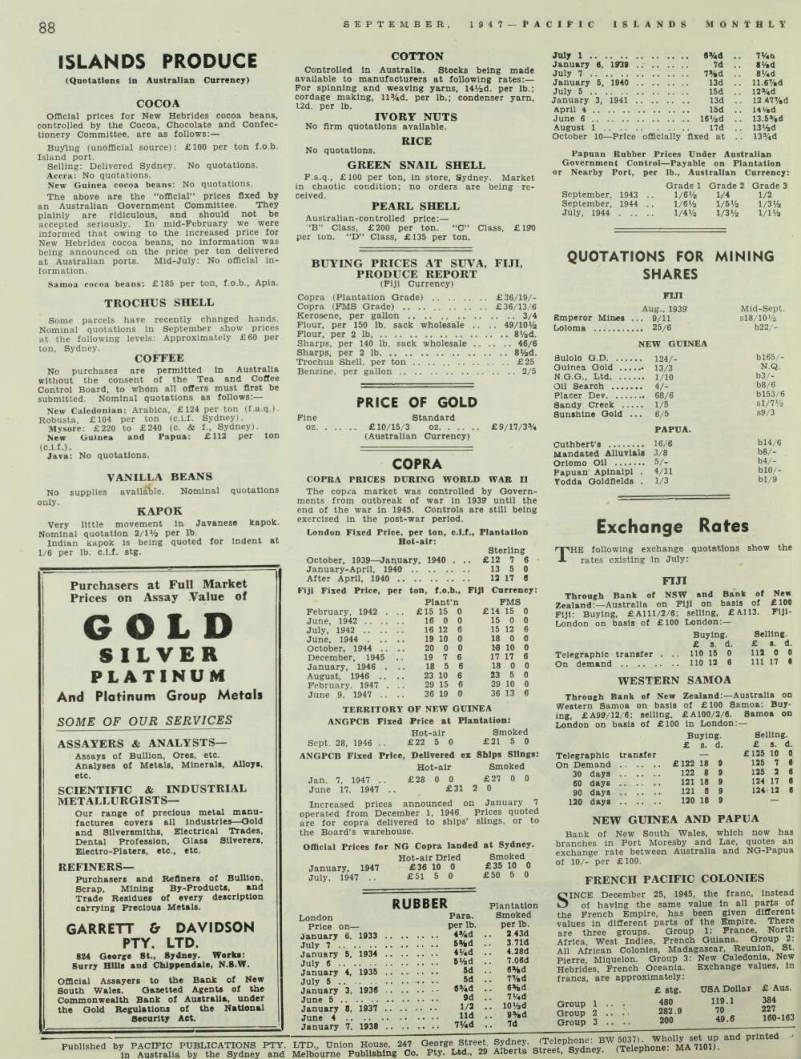
(Quotations in Australian Currency)
Cocoa
Official prices for New Hebrides cocoa beans, controlled by the Cocoa, Chocolate and Confec tionery Committee, are as follows; — Buying (unofficial source); £lOO per ton f.o.b.
Island port.
Selling: Delivered Sydney. No quotations.
Accra: No quotations.
New Guinea cocoa beans: No quotations.
The above are the “official” prices fixed by an Australian Government Committee. They plainly are ridiculous, and should not be accepted seriously. In mid-February we were informed that owing to the increased price for New Hebrides cocoa beans, no information was being announced on the price per ton delivered at Australian ports. Mid-July; No official in formation.
Samoa cocoa beans: £lB5 per ton, f.0.b., Apia.
Trochus Shell
Some parcels have recently changed hands.
Nominal quotations in September show prices at the following levels: Approximately £6O per ton, Sydney.
Coffee
No purchases are permitted in Australia without the consent of the Tea and Coffee Control Board, to whom all offers must first be submitted. Nominal quotations as follows: — New Caledonian: Arabica, £124 per ton (f.a.q.).
Robusta, £lO4 per ton (c.i.f. Sydney).
Mysore: £220 to £240 (C. & f., Sydney).
New Guinea and Papua: £ll2 per ton (c.i.f.).
Java: No quotations.
Vanilla Beans
No supplies available. Nominal quotations only.
Kapok
Very little movement in Javanese kapok.
Nominal quotation 2/1 »/ 2 per lb.
Indian kapok is being quoted for Indent at 1/6 per lb. c.i.f. stg.
Cotton
Controlled in Australia. Stocks being made available to manufacturers at following rates:— For spinning and weaving yarns, 14y 2 d. per lb.; cordage making, ll%d. per lb.; condenser yarn, 12d. per lb.
Ivory Nuts
No firm quotations available.
Rice
No quotations.
Green Snail Shell
F.a.q., £lOO per ton, in store, Sydney. Market in chaotic condition; no orders are being re ceived.
Pearl Shell
Australian-controlled price:— ‘B” Class, £2OO per ton. “C” Class, £l9O per ton. “D” Class, £135 per ton.
Buying Prices At Suva, Fiji,
Produce Report
(Fiji Currency) Copra (Plantation Grade) £36/19/- Copra (PMS Grade) £36/13/6 Kerosene, per gallon 3/4 Flour, per 150 lb. sack wholesale .. .. 49/lOVfe Flour, per 2 lb BV 2 d.
Sharps, per 140 lb. sack wholesale 46/6 Sharps, per 2 lb 8y 2 d, Trochus Shell, per ton £25 Benzine, per gallon 2/5
Advertisements & other items, p. 90 (1 item)
Price Of Gold
Pine Standard oz £lO/15/3 OZ £9/17/3% (Australian Currency)
Rubber
Copra
Copra Prices During World War Ii
The copra market was controlled by Govern ments from outbreak of war in 1939 until the end of the war in 1945. Controls are still being exercised in the post-war period.
Papuan Rubber Prices Under Australian Government Control —Payable on Plantation or Nearby Port, per lb., Australian Currency:
London Fixed Price, per ton, c.I.f.
Hot-air: October, 1939—January, 1940 . ..
January-April, 1940 After April, 1940 , Plantation Sterling £12 7 6 13 5 0 12 17 6 Fiji Fixed Price, per ton, f.o.b., Fiji Currency: Plant’n February, 1942 ... £15 15 0 June, 1942 16 0 0 July, 1942 16 12 6 June, 1944 19 10 0 October, 1944 ... 20 0 0 December. 1945 .. 19 7 6 January, 1946 ... 18 5 6 August, 1946 ... 23 10 6 February, 1947 ... 29 15 6 June 9. 1947 ... 36 19 0
Fms
£14 15 0 15 0 0 15 12 6 18 0 0 18 10 0 17 17 6 18 0 0 23 5 0 29 10 0 36 13 6
Territory Of New Guinea
ANGPCB Fixed Price at Plantation: Hot-air Sept. 28, 1946 .. £22 5 0 Smoked £21 5 0 ANGPCB Fixed Price, Delivered ex Ships Slings: Hot-air Smoked Jan. 7, 1947 .. £28 0 0 June 17, 1947 ,. £31 £27 0 0 2 0 Increased prices announced on January 7 operated from December 1, 1946. Prices quoted are for copra delivered to ships’ slings, or to the Board’s warehouse.
Official Prices for NG Copra landed at Sydney.
Hot-air Dried January, 1947 £36 10 0 July, 1947 .. £51 5 0 Smoked £35 10 0 £50 5 0
London Price January .Inly 7 mg 1933
Rubber
Para, per lb. 4%d Plantation Smoked per lb. 2.43d 6%d 3.71d 5, 1934 4V 4 d 4.28d July 6 5M«d .. 7.06d In mi arv 4, 3^ 1935 1930 5d 6%d July 5 .
T an n n tv 5d 0y 4 d .. 7 7 /td .. 6%d u ttllUQl J June 5 January 9d 7V 4 d 8, 7. 1937 1938 1/2 .. lOMjd June 4 January lid 7V 4 d 9%d 7d
July 1 8%d .. 7V4& January 8. 1939 7d .. 8V«d July 7 7%d .. 8V«d January 5, 1940 13d .. 11.6 7 /«d July 5 15d .. 12%d January 3, 1941 13d .. 12 47 7 /«d April 4 I5d .. l4V«d June 6 16 ‘/ad .. 13.5»/«d August 1 17d .. 13‘/id October 10 —Price officially fixed at .. 13 3 /4d
Grade 1 Grade 2 Grade 3 September, 1943 .. I/6V2 1/4 1/2 September, 1944 .. I/6V2 l/SVa 1/3% July, 1944 I/41/2 I/31/2 I/I1/2
Quotations For Mining
Shares
Fiji
Aug., 193?
Mid-Sept.
Emperor Mines . .. 9/11 slS/lOVi Loloma .. 25/6 b22/- Bulolo G.D
New Guinea
.. 124/bl65/- Guinea Gold ... •• 13/3 N.Q.
N.G.G., Ltd .. 1/10 b3/- Oil Search .. 4/b8/6 Placer Dev , .. 68/6 bl53/6 Sandy Creek ... .. 1/5 •s 1/7 Vi Sunshine Gold ., .. 6/5 s9/3 Cuthbert’s
Papua.
.. 16/6 bl4/6 Mandated Alluvlals 3/8 b8/- Orlomo Oil b4/- Papuan Aplnalpl . 4/11 blO/- Yodda Goldfields . 1/3 bl/9
Exchange Rates
THE following exchange quotations show the rates existing in July:
Fiji
Through Bank of NSW and Bank of New Zealand:— Australia on FIJI on basis of £lOO FIJI: Buying, £Alll/2/6; selling, £AII3. FIJI- London on basis of £lOO London: —
Western Samoa
Through Bank of New Zealand: —Australia on Western Samoa on basis of £lOO Samoa: Buy ing, £ A99/12/6; selling. £AIOO/2/6. Samoa on London on basis of £lOO in London; —
New Guinea And Papua
Bank of New South Wales, which now has branches in Port Moresby and Lae, quotes an exchange rate between Australia and NG-Papua of 10/- per £lOO.
French Pacific Colonies
SINCE December 25, 1945, the franc, instead of having the same value in all parts of the French Empire, has been given different values in different parts of the Empire. There are three groups. Group 1: Prance, North Africa, West Indies, French Guiana. Group 2: All African Colonies, Madagascar, Reunion, St.
Pierre, Miquelon. Group 3: New Caledonia, New Hebrides, French Oceania. Exchange values, in francs, are approximately:
Buying. Selling. £ s. d. £ s. d.
Telegraphic transfer . .. 110 15 0 112 0 0 On demand 110 12 6 111 17 8
Buying.
Selling. £ s. d. £ 8. < 1.
Telegraphic transfer — £125 10 0 On Demand £122 18 9 125 7 0 30 days 122 8 9 125 2 0 60 days 121 18 9 124 17 0 90 days 121 8 9 124 12 0 120 days 120 18 9 —
£ stg. USA Dollar £ Aus.
Group 1 .. . 480 119 1 384 Group 2 .. . 282.9 70 227 Group 3 .. • ■ 200 49.6 160-163
Advertisements & other items, pp. 90-92 (3 items)
88
SEPTEMBER. 1947 PACIFIC ISLANDS MONTHLY
Published by PACIFIC PUBLICATIONS PTY. LTD., Union House, 247 George Street Sydney. (Telep: BW Print6d in Australia by the Sydney and Melbourne Publishing Co. Pty. Ltd., 29 A.berta Street, Sydney, uetepuuu
Gold
Purchasers at Full Market Prices on Assay Value of
SILVER
PLATINUM
And Platinum Group Metals
SOME OF OUR SERVICES
ASSAYERS & ANALYSTS—
Assays of Bullion, Ores, etc.
Analyses of Metals, Minerals, Alloys, etc.
SCIENTIFIC & INDUSTRIAL
METALLURGISTS—
Our range of precious metal manufactures covers all Industries—Gold and Silversmiths, Electrical Trades, Dental Profession, Glass Sllverers, Electro-Platers, etc., etc.
REFINERS—
Purchasers and Refiners of Bullion, Scrap, Mining By-Products, and Trade Residues of every description carrying Precious Metals.
GARRETT & DAVIDSON
PTY. LTD.
824 George Bt., Sydney. Works: Surry HIUs and Chippendale, N.B.W.
Official Assayers to the Bank of New South Wales. Gazetted Agents of the Commonwealth Bank of Australia, under the Gold Regulations of the National Security Act.
tropical thirst...
To quench a
faery body drink 5
% fl t n 10 * Borneo s KB.*.4* When you’re hot and there is nothing quite so satisfying and thirst quenching as a long, cold glass of “K. 8." Your friends and guests, too, will appreciate this really fine Lager, for “Everybody drinks K. 8.”
TOOTH’S
LAGER
Capital £1,000,000
ESTABLISHED 1914
COPRA MERCHANTS & MILLERS
BRANCHES THROUGHOUT THE PACIFIC ISLANDS
Buyers and exporters of all kinds of Islands produce. Copra Merchants and Millers.
Agents for Australian, European and American Manufacturers. Distributors of every description of merchandise.
IN LONDON:
W. R. Carpenter & Co. (London), Ltd., Coronation House, 4 Lloyd’s Avenue, London, E.C. ★
DISTRIBUTING
AGENTS FOR:
Ford Motor Company of Canada.
Electrolux Refrigerators.
T. G. & C. Bolinders (Engines).
Chrysler Corporation.
Westinghouse Electrical Thirty years of Pacific Islands development and service.
THE W.R.C. LINE
Co.
Caterpillar Tractors.
Etc., Etc.
THE FIRST DIRECT AND L
REGULAR CARGO AND PASSENGER SERVICE BETWEEN EUROPE
PACIFIC ISLAND PORTS WAS ESTABLISHED BY
AND
W. R. CARPENTER & CO. LTD.
Head Office: 16 O'CONNELL STREET, SYDNEY.
Cable Address:
CAMOHE.
Telephone * Postal Address.
BW 4421. P.O. Box No. 168, Sydney.