Islands
Pacific
Monthly
August 18, 1947
Vol. Xviii. No. 1.
lished 1930.
{Registered at the GI t by post as a newspaper']
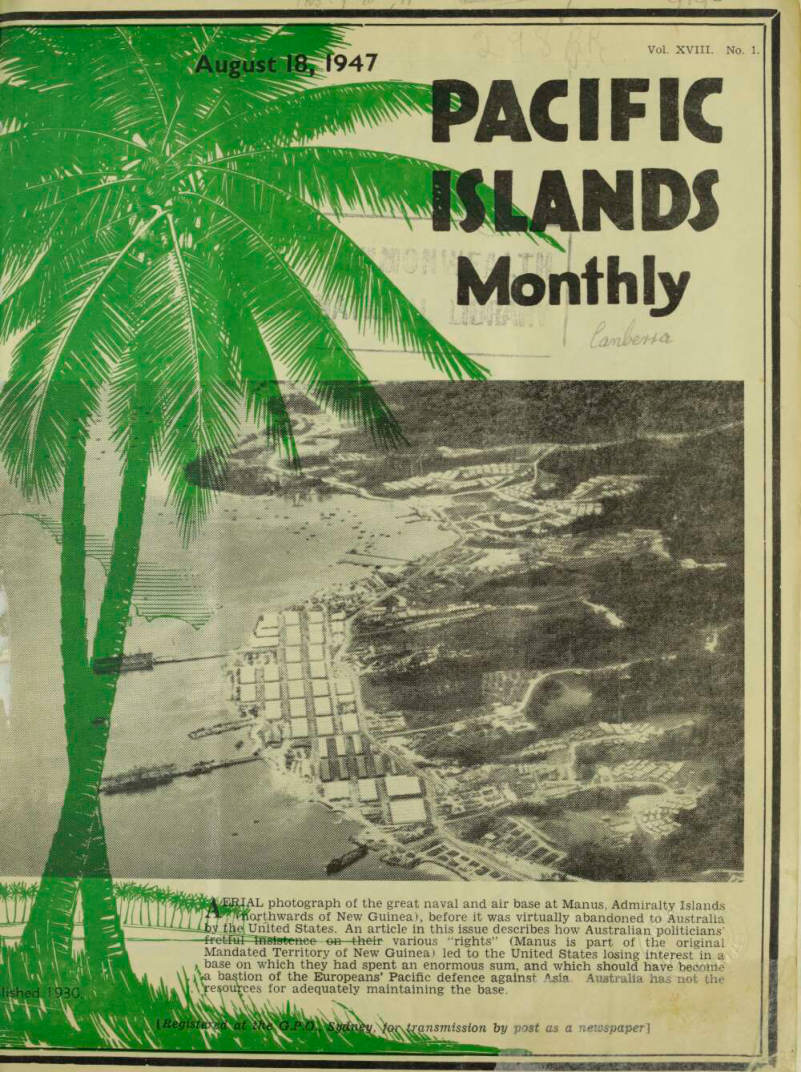
AERIAL photograph of the great naval and air base at Manus, Admiralty Islands horthwards of New Guinea), before it was virtually abandoned to Australia by the United States. An article in this issue describes how Australian politicians’ fretful inoistence on their various “rights” (Manus is part of the original Mandated Territory of New Guinea) led to the United States losing interest in a base on which they had spent an enormous sum, and which should have become a bastion of the Europeans’ Pacific defence against Asia Australia has not the resources for adequately maintaining the base.
Advertisements & other items, pp. 2-4 (2 items)
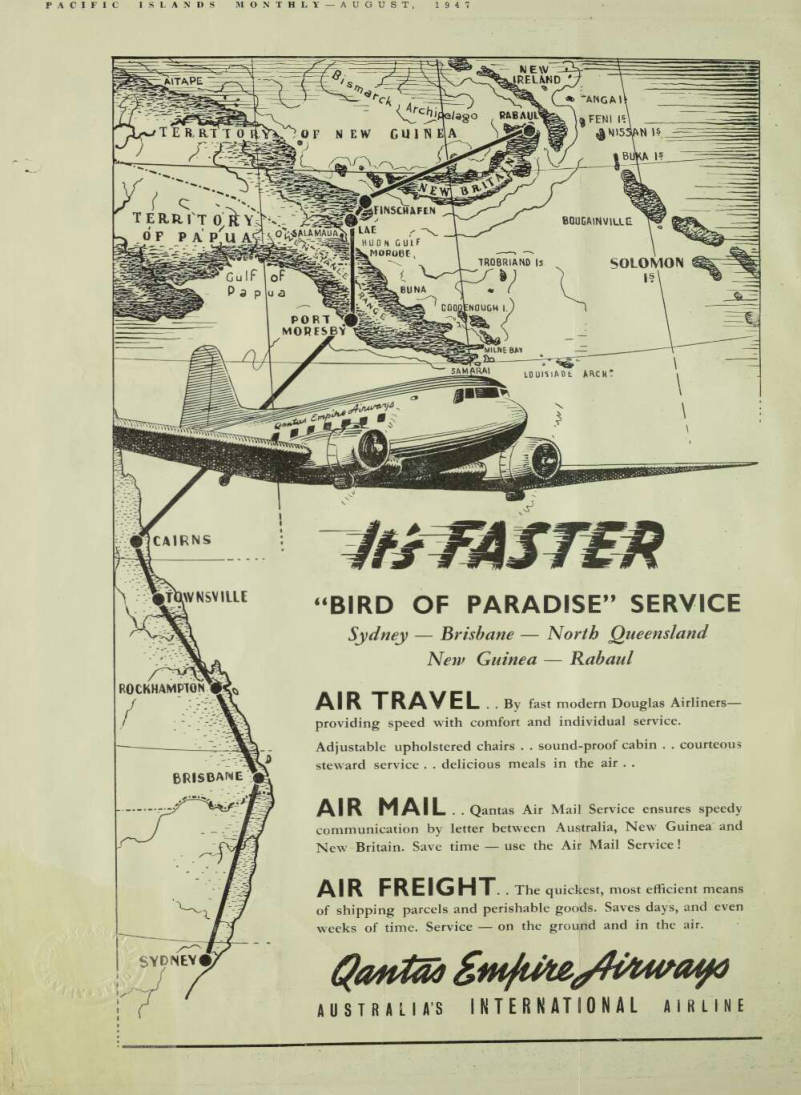
Qanfa} £mftke l /HMvay<i
AITAPE
ftc k T E RRT T 0 OF NEW CUIN
RABAUIS
SS&i
FENI I*
ls - j =~ 'wm V 1?
Q
TERR.I T (£|tY'i
OP PA pfu
OfrSAUMAUA,
u-Vv
IF oF
Pa p u a FT ue
HU 0 N GII I F
MORO6C,
BOUGAINVILLE
TROBRIAHD Is
I
BUNA
:v
SOLOMON
If / PO
MORESBY'
COOQENOUGH I.
*RAI
10 HIS IA 0 t ARCH?
Jfcj= ,'i*s
CAIRNS
ROCKHAMPTONYP^
/ ft ‘
BRISBANE
<""v ,‘l
SYDNEY'
‘X
“BIRD OF PARADISE” SERVICE
Sydney Brisbane North Queensland
New Guinea Rahaul
AIR TRAVEL .By fast modern Douglas Airliners— providing speed with comfort and individual service.
Adjustable upholstered chairs . . sound-proof cabin . . courteous steward service . . delicious meals in the air . .
AIR MAIL . Qantas Air Mail Service ensures speedy communication by letter between Australia, New Guinea and New Britain. Save time use the Air Mail Service!
AIR FREIGHT . The quickest, most efficient means of shipping parcels and perishable goods. Saves days, and even weeks of time. Service on the ground and in the air.
Qanfa} £mftke l /HMvay<i
AUSTRALIA’S INTERNATIONAL AIRLINE
" IRONS PEF
PERFECTLY
Coleman’s Petrol and Kerosene Lamps in 300 and 500 C.P.
Coleman’s Kerosene Table Lamp can be used as hanging Lamp r ; mm: 1 It took 40 years' intensive specialisation to bring the Coleman Petrol Iron to its present state of perfection. Coleman
Irons require no preheating, they light
instantly and can be used either indoors or outdoors.
Coleman’s Petrol or Kerosene Lamp with large enamelled reflector.
The ventilated body prevents sides from scorching light fabrics and the ventilated lid keeps the handle cool.
O Tapered edge for ironing pleats and around buttons. 3P oin t e d heel gives wrinkle-proof ironing on back and forward strokes. 4 Built-in cleaning needle, cleans gas - tip automatically, without turning off iron and also regulates heat.
eman
Representatives for the Pacific Islands
ROBERT GILLESPIE PTY. LTD.
PEARCE & CO LTD
Cl IV A
54a PITT STREET, SYDNEY
FOR FIJI ISLANDS
W -IF
t k y kt kf w
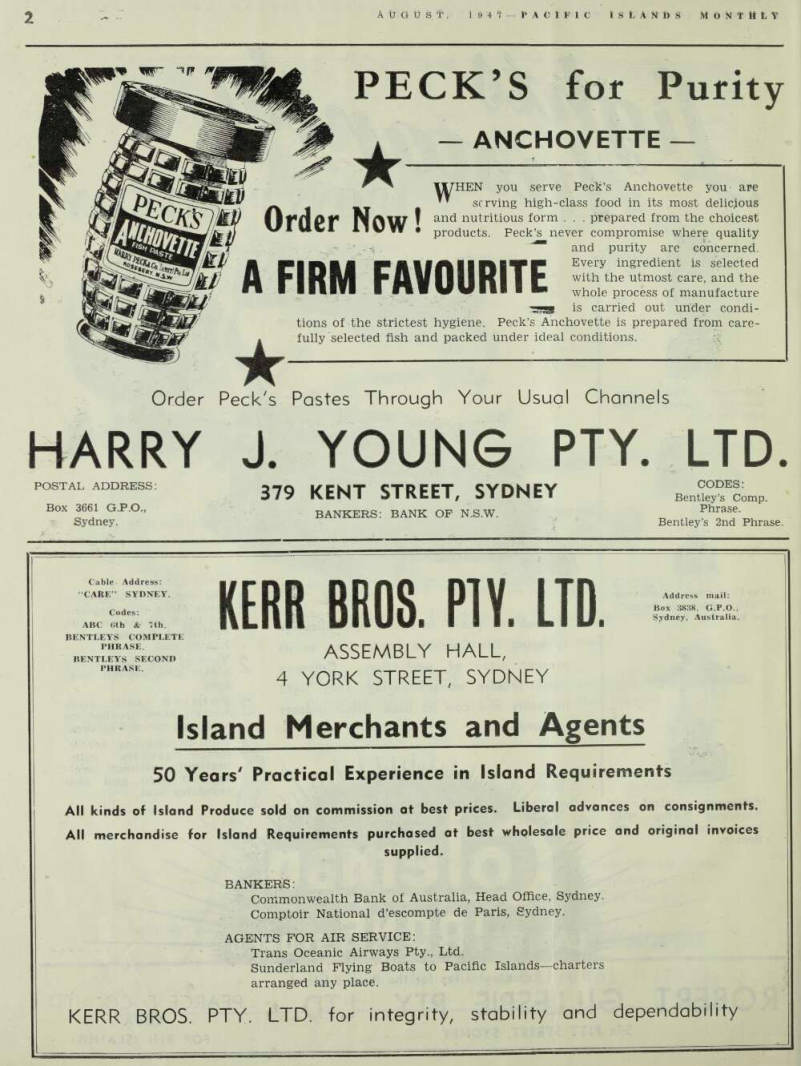
PECK’S for Purity
ANCHOVETTE
11THEN you serve Peck’s Anchovette you are ” serving high-class food in its most delicious and nutritious form . . . prepared from the choicest products. Peck’s never compromise where quality and purity are concerned.
Every ingredient is selected with the utmost care, and the whole process of manufacture ’sga is carried out under conditions of the strictest hygiene. Peck’s Anchovette is prepared from carefully selected fish and packed under ideal conditions.
Order Now!
A FIRM FAVOURITE
Order Peck's Pastes Through Your Usual Channels
HARRY J. YOUNG PTY. LTD.
POSTAL ADDRESS:
Box 3661 G.P.0., Sydney.
379 KENT STREET, SYDNEY
BANKERS: BANK OF N.S.W.
CODES:
Bentley’s Comp.
Phrase.
Bentley’s 2nd Phrase.
Cable Address:
“CARE” SYDNEY.
Codes: ABC Oth & 7th.
BENTLEYS COMPLETE
PHRASE.
BENTLEYS SECOND
PHRASE.
KERR BROS. PIY. LTD.
ASSEMBLY HALL,
4 YORK STREET, SYDNEY
Island Merchants and Agents
i-I ■ - - " ■ 1 50 Years' Practical Experience in Island Requirements All kinds of Island Produce sold on commission at best prices. Liberal advances on consignments.
All merchandise tor Island Requirements purchased at best wholesale price and original invoices
supplied.
BANKERS:
Commonwealth Bank of Australia, Head Office, Sydney.
Comptoir National d’escompte de Paris, Sydney.
AGENTS FOR AIR SERVICE:
Trans Oceanic Airways Pty., Ltd.
Sunderland Flying Boats to Pacific Islands—charters arranged any place.
KERR BROS. PTY. LTD. for integrity, stability and dependability
2
A U Ci U S T , 1 9 4 ! - • t A C 1 f i C ISLANDS MONTHLY
Advertisers
Angliss & Co. ... 38 Allen. H. T., Bar rett Sc Read . . 23 Atkins Pty., Ltd., Wm 67 Amalgamated Hatcheries ... 39 Andrews Laboratories . 68 Aluminium Union, Ltd 23 Baker, W.. Jno. . 28 Bethell, jGwyn & Co. 68 Brown & Co., Ltd. . 15 Brunton’s Flour . . 75 Bank of NSW ... 16 Brial & Ball ... 19 Burns, Philp Trust Co., Ltd 35 Budge, James, Pty., Ltd 34 Broomfields ... .80 BP (SS) Co. . . . 15 Bulowat Transport Co, . 64 Burgess Penlights . 25 W. R. Carpenter Sc Co. (Fiji), Ltd. . 69 Carlton Sc United Breweries. Ltd. . 55 Caine’s Studios, Suva 61 Carpenter, Ltd., W.
R cov. iv.
Coleman Lamp & Stove Co. ... 32 Colyer Watson (New Guinea), Ltd. : . 31 Costello, Vince, Garrick Hotel . . 36 Cole. Ed. 36 “Cystex” ... 33 Crosse & Blackwell, Ltd 63 Donaghy & Sons . 86 Donald. Ltd., A. B. 66 Paul, A. Dorn . . 70 Davison Paints Pty.. Ltd 14 Dr. Williams Pink Pills 80 Dangar, Gedye & Malloch 3 Dunlop Rubber (A/sia), Ltd. . . 40 Eveready Batteries 33 Electrolux Refrigerators . . 65 Ford Sherington . 51 Poster. J. B. . . .83 Garrett & Davidson 88 Gillespie Pty., Ltd..
Robert ... 1 & 61 R o b t. Gillespie (NG). Ltd. ... 85 Gilbey’s Gin ... 50 Gillespie’s .Flour . 87 Gough & Co.. E. J. 59 Grand Pacific Hotel 4 Grove & Sons, W.
H 30 Heinz & Co. Pty., Ltd.. H. J. . . . 29
Hemingway Sc
Robertson ... 20 Hughes, Hamilton A. 29 Humphries, Jack . 16 Hyde, Victor ... 14 Ipana Tooth Paste 27 Jenkins Emporium . 55 Kentucky Stud. 74 & 19 Kopsen Sc CO., Ltd. 73
Kodak,.(Aust.) Pty.,
Ltd.' . . . . .17 Knopke & Brad ford 56 Kerr- Brothers . . 2 Lockyer. Qeo. J, , 53 Le Bon College . . 53 Levy, Noel ... 75 M & M. Island Traders ... 72
Mail Publicity Co. . 24 Merrillees, J. C., & Co 63 Millers. Ltd., Suva 18 Miscellaneous . 13 “Mum” Deodorant 79 “Mendaco” ... 71 Mcllraths Pty.. Ltd. 30 Morgan. F. J.. & Co 87 Morris, Hedstrom Ltd., Suva ... 12 Miller Tyres ... 54 Nelson & Robertson Pty., 'Ltd. ... 51 NSW Bookstall Co.
Pty.. Ltd. ... 23 “Nixoderm” ... 74 Nordman, Oscar . 87 Pacific Islands Trading Co. . . 31 Pacific Is. Society 67 “Pinkettes” ... 34 Pitt & Scott. Ltd. . 53 Proprietary Products 17 Qantas Empire Air ways . . . cov. ii.
Queensland Insur ance Co 71 Robinson, G. H. . . 66 Reed, Proudman, El worthy Pty., Ltd. 57 Rose’s Eye Lotion 22, 59 Rohu, Sil . . . . 79 Scott, Ltd., J. . .86 Shell Co 28 Samoan Area Air ways 82 South Sea Islands Correspondence Club 58 Southern Pacific Insurance Co. . . 26 South Sea Faith Mission 69 Steamships Trading Co., Ltd 83 Stephens Import & Export Co. ... 76 Stokoe Motors Pty., Ltd 22 Sullivan Sc Co., C. 56 Swallow & Ariel . 26 South Sea Islands Club 62 Taylor & Co., A. . 84 “Tenax” Soap . . 84 Tillock & Co., Ltd. 64 Tooth & Co., Ltd cov. iii.
Thonsycroft (Aust.) Pty., Ltd. ... 24 Tilley’s Lamps . . 37 Trans Oceanic Air ways Pty., Ltd. . 81 Vacuum Oil Co., Ltd 21 “Vitalis” Hair Tonic . . , . .77 Vincent Chemical Co 18 Watson, Wm. H. . 58 Harry West . . , .72 Wright & Co. ... 78 Westclox 60 Widdop. H., & Co., Ltd 70 Where the Trade Winds Blow ... 52 White’s Aviation, Ltd 73 Wills. W. D. & H.
O 49 Wright & Co., Ltd..
E 76 Wunderlich ... 62 Yorkshire Insur ance Co., Ltd. . 15 Young, Harry J., Pty.. Ltd. ... 2
Mr. Percy Woods, formerly a resident oi Papua for 30 years, is now living ner manently in West End. Brisbane, with ar V? m °ther. He was a planter m the Territory, but considers that the low price of copra now being paid the producer . offered no inducement for Planters to -return to what was once a payable Islands industry.
Advertisements & other items, p. 5 (2 items)
3
pacific islands monthl tr AUGtJST, i & 4 ?
That Lighting or Power Plant
You’ve been going to buy...
Whether you want a small
10-light plant that you can
install yourself or a 240-415
volt power plant we
have a proposition that will
interest you
THE “NEVERTIRE MINOR.”
10-Light 32-Volt Plant.
Simplicity itself to install, and to operate, “Nevertlre Minor” will give you ample power for ten lights and to use a fan, vacuum cleaner, reading lamp, radio, cake-mixer, or other low-powered appliances.
Supplied complete with easy-to-follow installation instructions, and the necessary accessories for 10 lights.
PRICE: £125
l only 9 H.P. 1,000 r.p.m. Cold-starting “Lister”
Diesel Engine, radiator-cooled, on heavy channel-iron base, direct-coupled to 5.6 K.V. alternator 230/240 volts, single phase, 50 cycles; exciter and automatic voltage regulator, driven by “Whittle” belts. Switchboard mounted on framework with volt-meter, amp-meter, ironclad main switch and manual regulator.
PRICE: £550
These are two examples
from our wide range.
If you have any lighting problem, our engineers will be glad to advise you without obligation.
All are for immediate delivery, subject, of
course, to prior sales
All prices F. 0.8. Sydney. Packing extra.
Dangab, Gedye, & Malloch Ltd.
10-14 YOUNG STREET, CIRCULAR QUAY, SYDNEY.
G.P.O. BOX 509. T>l
In This Issue:
Editorial: “New Order Planners Bring Chaos to Exhausted World ’
Western Samoan Government —Inquiry Mission Receives Chiefs’
Plans Fiji Elections —Sir Hugh Ragg Retires Anti-Dutch —Australia, led by Wharf- Labourers, Wants Closer Relations with Asia New Pacific Airway from Hawaii to Samoa .., ANA Will be out of Trans-Pacific Service Next April— to Operate on own Account Meeting of Pacific Air Transport Council Classification of Native Workers, and Wages, in Papua-New Guinea ...
Kon-Tiki Raft Reaches French Oceania —Peruvian Influenc? on Early Polynesia Candlenut Oil Industry Now “Pro tected” in Fiji Cook Is. Reds—Challenge by Gov ernment Union Pacific Shipping Position Shows No Improvement Hydro-Electric Power for Viti Levu South Pacific Regional Commission — Some Fiji Public Men Critical . .
“Fiji Guardian” —New Newspaper for Colony Copra—Price Still Rising Another Dragon Plane Crash in New Guinea A Third Flag in the New Hebrides Future of Norfolk Island BGD Production Figures Papuan Medical Students Fail at Central Medical School Blasting Coral from Apia Harbour Paper Makers and Kurukuru Grass- Keen Interest in Papua Material
America in Micronesia—Four Gover -5 norships Under US Admiral ... 23 Count van Asten —Old Dutch title for Tongan Resident 25 7 More Japs discovered in New Guinea 26 7 Czar of the Oil Industries —Unilever is Prominent Again 29 Kokopo Smiles Again—Good Progress 8 in Rehabilitation 3D Increased Nauru Population 31 8 Hombu-Hombu, on New Georgia, is Now BSI Port of Entry 32 New Scheme of Salaries for Papua— -9 NG Officials are Unpopular ... 33 Search for Gold and Oil in Northern 9 New Guinea 36 Australian Shipping Board May be 9 Liable for Cargo Pillage 36 Dr. Agnes Hoeger, Lutheran Missionary, Returns to New Guinea 38 10 Australian Politicians Missed the Bus in Manus Negotiations 39 10 New Caledonia’s Minerals 40 Plea for Leonard Murray 40 10 Territories’ Talk-Talk 41 “That Sawn-off Mason Bay” 42 11 Near-Disaster off Pitcairn 43 11 “Father Push-Bike” 44 "[Topicalities 45 13 Tale of “Taipi” 46 C Can Fish 47 14 Book Review —Dutch Jungle-Watcher 15 in Netherlands New Guinea . . .. 48 Tirpitz Knows Now—New Guinea 16 Economics in Pidgin 50 18 Poverty for Cook Is. Maoris 52 19 Canberra is Killing Islands Trade .. 52 19 When “Boys” are Not to be “Boys”— A New Edict bv Moresby's Planners 55 19 Japs for New Caledonia? 55 20 New Guinea Rats —Tree-Climbing and Kunai Species 56 22 More Coconuts for Bougainville ... 59
Only Trouble in Permanent in New Guinea 61 No Takers for Lae Terrace 61 How NGVR Hung on near Mubo in 1942-Raids and Alarms in New Guinea Jungles 62 Fiji Indians Appeal to India for Better Status and Living Conditions ... 66 Naval Medicos Save Islanders’ Lives 66 “Masinga Rule” 66 New Hebrides has No Matches 67 No Tropic Nymph, No Pearls, No Oil— “Gippsland” founders off Papuan Coast 68 “Oiseau des Isles” Saved from Reef 68 New Guinea is Still a Mandate ... 69 Australian Minister to Visit Manus v. 69 News and Notes from Buka-Bougain ville 72 “Viti” May be laid up 73 The Month in Moresby 74 Sharp Disorder in Tahiti —Returned Servicemen Lead Demonstration 75 Trouble on Wallis Island 76 Official Tour of Buka-Bougainville .. 77 Ominous Noises from Hawaii’s Volcano 78 High Cost of Former Indian In dentured Labour 79 Museum for Cook Islands 79 Deserted Niuafo’ou 80 Weddings, Engagements of Islands’
Interest 82 Shipping and Plane Services; Pacific Travellers 84-86 Commercial Markets, etc 88
Obituary:
Mrs. C. Williams, 9; Dr. J. A.
Borg, 10; Dr. F. L, Pinching, 10; J. Taripo, 14; Mrs. Jessie Anderson, 31; Harold E. Nicholls, 80.
Organisations:
Pacific Islands Society, 7: NG- Brisbane Assn , 22; NG Scholarship Fund, 69; NG Women’s Club of Sydney, 70.
Advertisements & other items, p. 6 (1 item)
* ~ ovef'
* ovef' . ce „t V ei , a*®** o ed i. be»^" U i f\\'- V „«xe ser V ® , ce" ue „ e » w .„ (ro^ w , o C'»' c , cuW" 6, ■X»r'" c, ***• s ' er 4%
Pacific Islands Monthly
The Newspaper-Magazine of the South Seas [Registered at the G.P.0., Sydney, for transmission by post as a newspaper .]
Published Once Each Month and Circulated in Australia and New Zealand and in the following Pacific Territories and Islands Groups:
Australian Territory of Papua.
Mandated Territory (Australia) of New Guinea.
Australian Territory of Norfolk Island.
New Zealand Territory of Cook Islands.
Mandated Territory (NZ) of Western Samoa.
British Colony of Fiji.
British Solomon Islands Protectorate.
British Protectorate of Tongan Islands.
British Crown Colony of Gilbert and Ellice Islands.
Mandated Territory of Nauru.
British and Free French Condominium of Hebrides.
French Colony of New Caledonia.
French Colpny of Oceania (Tahiti, etc.).
American Territory of Eastern Samoa.
American Territory of Hawaiian Islands.
Owned and Produced by Pacific Publications Pty. Ltd., Union House, 247 George Street, Sydney.
Telephones: General Office and Advertising, BW 5037.
P.O. Box 3408
Registered Address for Telegrams, Radiograms, and Cables: ‘Pacpub”, Sydney.
Contributions.
Articles, Stories, and Photographs dealing with Pacific Islands subjects are invited and will be paid for on publication
Subscription Rates,
Per Annum, Pre-pair!, Including Postage.
In Australia, New Zealand, Fiji, New Guinea, Papua, Western Samoa, Cook Islands, Tonga, British Solomons, Gil bert and Ellice Colony, Nauru, and United Kingdom . . 15 0 Elsewhere 18 0 Single copies 1 6
Editor and Publisher;
Fl W Robson. F.R.G.S.
Assistant Editor; JUDY TUDOR.
General Office: Union House, 247 George Street.
Sydney. Telephone: BW 5037.
Advertising Manager: W. E. Rogers.
Representative In London.
J. T. Wallis, Coronation House, 4 Lloyds Avenue, London, EC.3, from whom may be obtained copies of Pacific Islands Monthly, Pacific Is. Year Book, advertising schedules, etc.
Representative In U.S.A.
Pacific Islands Trading Co.,
244 CALIFORNIA ST., SAN FRANCISCO, U S.A.
Agents.
The following are authorised to receive sub scriptions for Pacific Islands Monthly:— Burns, Philp & Co., Ltd., and Burns Phllp (South Sea) Co., Ltd. All branches.
W. R. Carpenter «fe Co., Ltd. All branches.
Morris, Hedstrom, Ltd. All branches.
Steamships Trading Co., Papua. All branches.
W. M. Caldwell. Suva, FIJI.
Cook Islands Trading Co., Rarotonga, Cook Is.
A. C. Rowland, Papeete, Tahiti.
Islands Branches and Representatives of W. H.
Grove & Sons, Ltd., Auckland, New Zealand.
Ed. Pentecost, Noumea, New Caledonia.
Societe Gubbay Kerr et Ole, Noumea, N. Caledonia.
T. A. Wyborn. 12a Alpln Street, Cairns.
Vol. Xviii. No. 1.
August 18, 1947
f 1/6 Per Copy Price Prepaid, p.a.: 15/- Aus. ( In USA, p.a.: $3.
Exhausted World
New Order Planners Bring Chaos to an Exhausted World
W ELL-MEANING theorists in British Empire Governments, without any apparent agreement or official announce ment, are following a clear policy of en couraging and stimulating the idea of nationalism among the dependant col oured races in Empire countries.
This, already, within two years, has brought about great political changes— India, Egypt, Burma, for example—and the ferment is working increasingly in other British-Asiatic countries such as Malaya and Ceylon. Had it not been for the encouragement given to the Indo nesian visionaries by our theorists in Canberra, Wellington and London, there would have been no challenge to Dutch authority in the East Indies.
If this furtive,, blundering and ill conceived policy is not checked—or at least brought out into the open and given a thorough dusting—it easily may mark the beginning of the disintegration of the greatest Empire the world yet has known.
Very few coloured races are ready yet to take their places in the society of nations under conditions of complete freedom. Any sudden introduction of such countries as Egypt, India, Burma, Indonesia, Cambodia, etc., as sovereign States is not going to assist in bringing about that universal peace for which all mankind supposedly is striving; but it almost certainly will provide new breed ing grounds for unruly and irrespon sible elements and new cockpits for war. fPHE world seems to have gone mad on the subject of racialism. Parliaments,
newspapers and the forum of the air are over-run by impractical professors and starry-eyed claquers with a brotherhood complex, who somehow have hypnotised the otherwise sane Western democracies into an acknowledgment that they have been holding, in serfdom, various peoples with dark and yellow skins and the hearts of angels!—who must now, forth with, be given free nationhood and a name.
We are being called despots, Imperial ists, exploiters. The really glorious record of our colonisation which, within 500 years, tamed Asia, the Americas, Africa and the Islands of the Pacific —so that, in the 20th century, one might walk prac tically all. over the world unarmed and unharmed—is spat upon, and the fine qualities of human endeavour which created Empires have become the subject of ribald jesting.
Of course, we did not go out as cru saders, or for any altruistic reason. Of course, the flag followed the trader. It was the lure of gain which took the European merchantman across uncharted seas to face all kinds of perils among all kinds of uncivilised peoples.
The dominant quality of human nature is selfishness—always has been and always will be. The Western European nations cleverly harnessed that trait— the “profit motive”—to the service of the State. Thus the industrial era, the era of great colonial expansion, when men developed their finest qualities in mechanical invention and industrial or
ganisation, in crossing the oceans, taming the wilderness and conquering bar barians, went hand in hand with the creation of magnificent social structures based on strength, achievement, justice, and the rights of the common man.
WESTERN civilisation is no namby pamby thing. It frankly recognises that the maximum of human effort can be secured only by an appeal to human selfishness: that social orderliness can be achieved only if the strong will take charge of the weak. That is what is called the system of free private enter prise. But, under Western civilisation, private enterprise is not really free. It may operate only if it recognises certain obligations: the obligation to sustain and protect the weak, and scrupulously give justice to all men.
That is why the system of Western Democracy conquered the world and brought mankind to its finest achieve ments. It tempered strength with mercy; concealed ruthlessness without which the majority of men will drift to lower living standards —in a velvet glove. That system was achieved in thousands of years of social evolution. Abandon it and mankind, beyond any question of doubt, will go into a Dark Age.
True, Western civilisation took much from the lands it conquered; but it also gave much. In not one country invaded and occupied by the Europeans in the last 500 years was there already estab lished any form of government which acknowledged the fundamental rights of the common men. In some cases the comman man enjoyed some degree of security and comfort; but nearly always he w’as merely the chattel of an over
lord, something to be trodden upon, en slaved and sacrificed, at will.
The European nations,- and especially the British, brought to every race over whieh they unfurled their flags some form of orderliness, security and common justice. The peoples were given medical service, education and religion; to their lands were introduced roads and ports, public services and wealth-producing in dustries.
SUCCEEDING generations of these subject races, having imbibed from their masters a little education, a little technical knowledge, some idea of or derly government, and a little Marxism, are now howling for national freedom; and the bumblefooted New Planners of London, Paris and Canberra are listen ing to their howls and hastening to greet them as brothers.
Suppose that all these peoples were given full freedom and national respon sibility. Let us see what would happen.
India is dividing itself between Hindu stan and Pakistan; and, as the British move out, an orgy of throat-cutting begins. Whoever imagined that those mutually antagonistic races could live together in peace? Not only will there‘be fearful fighting within India: but bad internal conditions inevitably will make the country a breeding ground lor greater wars and one of her richest markets is lost to Britain.
Burma is to get “independence.” The country is torn between savagely con tending parties who already have com menced murdering each other’s leaders.
In Malaya, now crying for independ ence, there are three mutually antagon istic communities —Malays, Indians and Chinese; they will be at each other’s throats as soon as British rule is with drawn. It is the same in Ceylon, with its Tamil and Christian minorities, and in North Borneo and Sarawak where the dominant Chinese and Malays are a min ority in the population.
We have the example of Indonesia right under our eyes, British and Ameri can New Planners abandoned the Dutch after the Dutch had given to us, in 1942- 45, every ounce of their strength; and the Jap-inspired Indonesians temporarily took possession. Under Dutch rule, these people were orderly, economically and politically secure. Since 1945, under In donesian rule, the country has been a shambles, a place of disorder, famine, murder and panic. All the Chinese and most of the Indonesians now pray daily for the complete restoration of Dutch rule; but our “Great Western Demo cracies” are moving to hamstring the Dutch.
We might range over all Asia and much of Africa and multiply these ex amples endlessly. A little thought is enough to show that we dare not, for the sake of human orderliness and world peace, intoxicate these unprepared people with too copious draughts of the heady wine of freedom.
Nationhood and complete freedom they must have eventually; but the prepara tion of a people for self-government is a slow process. Any attempt by the New Planners to hurry the process will lead only to disaster, political and economic;
and already we see political - and econ omic disasters without number develop ing. within our sight.
HERE in the Pacific we have little to worry us, compared with the terri fying picture presented by the events of the bigger world.
There is a problem in Samoa —which is being discussed by th.e Samoans with typical Polynesian courtesy, and for which a solution undoubtedly will be found.
There is a sharp racial problem in Fiji —but so long as the British are left alone, to combine strength and wisdom with plain justice, Fiji will remain happy —the problem there actually is incapable of solution, anyway—except by Dr. Mal thus.
There is a kind of problem in Papua- New Guinea —but it is only the mischiev ous creation of the amateur New Plan ners of Canberra and eventually will dis appear—along with Mr. Ward.
MANY observers looking out on the frantic world of August, 1947 exactly 33 years after the Kaiser drove the nations into World War I—are in despair. They cannot understand that this dreadful confusion in economics and in politics, which seems to be carrying us rapidly into World War 111. is merely the impact of muddled thinking on post-war problems of an attempt by Marxist planners to do by State instrumentalities what can be achieved only by individual ism.
It is no time for despair. If they are not caught bending the British peoples presently will throw the poor little well meaning demagogues out of Whitehall.
Canberra and Wellington, and drag their crippled governmental machines out of the morass and will build again—build something that again will be the admira tion of the world. A great and glorious Britain surely will arise out of this mess —if in the meantime we are not caught bending by the assembling hordes of Tar tary.
ONE hundred years ago Macaulay had occasion to thus rebuke the poet Southey (who, like present-day dreamers, was all for Socialism and the brother hood of man): “It is not the intermeddling of Mr.
Southey’s idol, the omniscient and omnipotent State, but by the produce and energy of the people that England has hitherto been carried forward in civilisa tion; and it is to the same prudence and the same energy that we now look with comfort and good hope.
“Our rulers will best promote the im provement of the nation by strictly con fining themselves to their own legitimate duties, by leaving capital to find its most lucrative course, commodities their fair price, industry and intelligence their natural reward, idleness and folly their natural punishment; by maintaining peace, by defending property, by diminish ing the price of law, and by observing strict economy in every department of State. Let the Government do this; the people will assuredly do the rest.”
At St. Peter’s Church, Lautoka, Fiji, 6>n Julv 12 Miss Jean Brandon Snowsill. only daughter of Mrs. J. M. Snowsill. was married to Mr. Stanley Buckle, of Sydney.
Fiji Travellers
Among passengers who left Suva by flying-boat for Australia on August 1 were:— TOP: Mr. and Mrs. A. P. Dyason, who Were going to Australia on leave. Mr. Dyason is principal of the Fulton Mission School.
CENTRE: Mrs. E. S. Moore, who was making a business trip to Australia. Mrs. M. Johnston, returning to Australia, after two years’ service with the Western Pacific High Commission.
LOWER: Mr. H. E. Piper, vice-president of the Seventh Day Adventist Union, who has been attending conferences in Tonga, Samoa, and Fiji. Mrs. K, Curry, of Queensland, who is a cousin of the Costello brothers, of Fiji.
New Governor of Fiji
Sir Leslie Freeston
riIHE appointment of Sir Leslie Brian JL Freeston as Governor of Fiji and High Commissioner for the Western Pacific was announced on August 7. He is at present Governor of the Leeward Islands, West Indies.
Sir Leslie was born in 1892, educated at Oxford, served in World War I, and joined the Colonial Office in 1919. He was engaged during the first 15 years of his service there mostly on special com missions, in the course of which he visited Ceylon, the Far East, the West Indies and various parts of Africa.
Sir Walter Carpenter and Mr. C. H.
Carpenter, directors of the Carpenter group of companies (now based, on Aus tralia New Guinea, Fiji and Canada) left Sydney on August 14 for Vancouver. They will remain indefinitely in Canada. Mr.
R B Carnenter who returned from Canada a few months ago, will be the princinal resident Director in Australia, for the present.
Mr. Keith Colyer, of Colyer, Watson <NG) Ltd, proceeded from Sydney to Rabaul on a business trip at the begin ning of July.
Government
Western Samoan
Inquiry Mission Receives Chiefs' Plans
From a Special Correspondent
Apia, Aug. 1
THE mission of inquiry from the Trusteeship Council of the United Nations, in' July, visited many dis tricts of Western Samoa and made one chd!-t visit to Tonga, to observe, at first band, the operation there of a large measure of self-government.’
The mission will return to America this month where it is expected to submit its report and recommendations, in about four* months’ time.
After much discussion, the Western Samoan Chiefs have submitted 1o the mission their plan for the future govern ment of the Territory. It embraces the following main points;— (1) The three fautua (high chiefs who are official advisers to the Administra tion) to be recognised as the head of the Government. . .. (2) Forty-one “representatives of tne Samoans,” otherwise the 41 faipulc, to form the actual Government, with the addition of three or four European re presentatives at a ratio of 12 to 1, according to population. The heads of departments would attend meetings, but would have no voting powers. (3) A representative of New Zealand to hold the 'power of veto, but this would be so hedged with restrictions that it would be virtually non-existent in the event of the chiefs expressing the opinion that the power of veto should not apply to matters affecting Samoans. (4) Health, education, public works, finance and public service committees, in all of which Europeans would have predominance, to be appointed to advise the Government. (5) All Crown estates should be “re turned to the Samoans for the coming generations because the population was growing but not the land.”
THE last proposal concerns principally New Zealand Reparations Estates, an area taken over by the New Zealand Government from the fonflf»r German owners after World War I. No recent statistics are available to show what area of land is at present in nonrSamoan hands, but the last official figures gave Samoan lands as over 80 per cent, of the total. These figures, however, are 20 years old, and in that Deriqd sizeable areas have returned to Samoan ownership. Further, of the fer tile land in Samoan hands, only a frac tion is cultivated.
Immediate self-government is by no means the unanimous desire of the Samoan people as a whole. Certain dis (ricts have firmly dissociated themselves from the petition to the United Nations.
Presentation of Samoan Case
Gives Bad Impression
IT would not surprise me to know that the Trustee Council Mission has not received a good impression of the native Samoans in relation to their re quest for self-government which is what the Mission came here to inquire into.
Our visitors. I think, were astonished to find that the natives’ political demands were not induced by any social or ec onomic disadvantages to which they have
been exposed by the New Zealand Ad ministration. On the contrary, the Samoans have never been better off, economically. They are a happy and healthy people, they are increasing rapidly in numbers and, what with public works, water supplies, new industries and medical services, the NZ administration has raised the standard of living very much, compared with 20 or 30 years ago.
Why, then, the natives demand 1 for immediate self-government especially in view of the firm opinion expressed by the great majority of Europeans and Euronesians that any, far-reaching ad ministrative changes now would lead only to confusion and chaos? The latter say frankly that the present demand arises mostly from the personal ambitions of a few power-hungry chiefs.
The Europeans and Euronesians admit that, sooner or later, Samoa must be self governed; but, to avoid all kinds of com plications, the introduction of self government should be a slow and cautious process.
It is much to be regretted that the Samoans in ipresenting their case to the Mission, made use of some aggres sive showmanship. It was most unwise of them to revive the old Mau atmos phere, and to demonstrate in the blue and-white striped lava-lavas of the old Mau days. Some sections of them tried to influence the Mission by threats—they said that if they did not get immediate self-government there was danger of a “fight.”
The Mission was not favourable im pressed.
Whoever was responsible for this kind of display should have his wings severely clipped. It misrepresented the Samoans (who are now quiet and law-abiding), and it suggested to the overseas observers that the natives are not vet qualified for self-government in a world where they must live in close communitv with Euro peans and Euronesians.
Applications are being called bv Aus tralian External Territories Department for a Licensed Surveyor for duty with the Lands. Mines and Survey Department in Papua-New Guinea. Salary com mences at £714.
Sir Hugh Ragg, Retires
Fiji Elections
SUVA. August 6.
THE Legislative Council, which ended its last session on July 31, was formerly dissolved by the Acting- Governor on August 1.
Nominations for the elected Members close on August 25; and the polling for South and Northwest Divisions will take place on September 20. and for East (which includes numerous islands) be tween September 15 and 22.
Sir Hugh Ragg announced that, after 21 years’ membership, he would not seek re-election. Tributes to his good ser vice, and the happy relations he had maintained with everyone, have been paid by representatives of all Parties.
Pacific Islands Society
THE following, on July 23, were elected office-bearers of the Pacific Islands Society which has had a very active and successful year:— PATRON: His Excellency Sir Alexander Grantham, KCMG.
PRESIDENT: Major C. A. Swinbourne, OBE (Mil.).
VICE-PRESIDENTS; Dr. George Mackaness.
OBE. MA. Messrs. Guy D. Biaxland, Claude Israel, F. D. McCarthy, and Alfred E. Stephen.
HON. SECRETARY: Miss Betty Matheson.
ASST. HON. SECRETARY: Mr. C. Price Coni grave.
COUNCIL: Mrs. M. S. Williamson, Miss Doris Peters, Major C. M. Southey, Messrs. H. C.
Monckton, Hubert Sabben, OBE. Alfred E.
Stephen, and Alfred E. Sturt.
HOSTESS: Mrs. R. W. G. Gosset. ASST.
HOSTESSES: Mesdames E. Marte Irvine and G.
Mackaness
Hon. Auditor: Mr. R. H. Clarke.
NEW MEMBERS: Mrs. E. W. Fenner. The Queen’s Club, Sydney: Mr. and Mrs. A. G.
Carver. Sydney; Mrs. E. Spence, 22 Eltham Avenue, Darling Point.
A Native Fisheries Commission has been set up under the Fisheries Ordin ance of Fiji. The members are the Secre tary for Fijian Affairs (Ratu Sir Lala Sukuna), Mr. G. K. Roth and Setariki M.
Koto.
Air Travellers To New Guinea
Recent Qantas Airways travellers from Sydney to airports in Papua- New Guinea included (top left to lower right): Mr. W. R. Plunkett, who was going to Port Moresby to join the staff of APC, Ltd. Mr.
W. V. Bryen. of W. R. Carpenter & Co., Ltd., who was returning to Rabaul after an absence of some years. Mr. C. Black, who was making a business visit to Papua.
Mr. B. Ferreira and Mr. T. Ford, who were going to Port Moresby en route to Milne Bay. (See also Page 83)
Anti-Dutch!
Australia Joins Egyptian "Wags"
and Indian "Reds" in Seeking
Close Relations With Indonesians
PACIFIC Islands neonle who depend for world news upon some Australian newspapers and Australian radio may get a cockeyed idea of recent events in Java. The radio because it is under Government domination, and the news papers mostly because of ignorance and prejudice, have generally taken sides with the Australian Dockers’ Union in their war against the Dutch.
The following summary is taken from a dozen reliable sources.
After more than six months of shuffling, lying and orevarication. the “Indonesian Republican Government” (created by the Japanese in Java out of war-time dis order) was informed by the Dutch, at the end of June that, if it did not forth with honour the Agreement it had en tered into at Cheribon, Dutch forces would take the steps necessary to restore order to the Territory.
Between Julv 1 and 15 the Indonesians made various nromises—and broke them all.
Thereupon, about Julv 16. the Dutch moved rapidly into action. Within a few days, the Indonesian “Army” was running in all directions. As town after town was occupied bv the Dutch, the native Indonesians and the Chinese communities (there are, in Java, 3,000,000 Chinese, who have been brutally treated by the Republicans) made demonstrations of welcome. There was only sporadic fight ing. The Indonesians however set fire to much property, including oil-wells in Sumatra. They murdered hundreds of Chinese, and countless numbers of natives whcm they suspected of sympatising with the Dutch.
JUST when it seemed that the Dutch would restore order in the Indies, in quick time, there were international complications.
The Indonesians are Communist-sup ported. So also are the dockworkers of Australia. The latter got other Red unions to join with them in imposing a ban '.<n everything Dutch, in order to help the Indonesians.
The bumble-footed trade union poli ticians who comprise the Australian Government instead of condemning this impudent declaration of war against Holland, actually made common cause with the Reds. They ran yelling to UNO, asking for “intervention in the dispute”— which meant nothing more or less than intervention against the Dutch.
The United Nations is moribund. Russia has used her veto in the Security Council so regularly and consistently during the past year that UNO has done virtually nothing it is paralysed by the Reds.
However, Australia’s move enthusi astically supported bv various Asiatic nations was not supported by Britain and other Empire countries: and it was set aside in favour of a proposal of mediation, not by the United Nations, but by the United States.
The UN demanded a “cease fire” while America investigated. Both Dutch and Indonesians ordered a cease fire on Aug ust 4; but fighting continued intermit tently thereafter. The Dutch charged the Indonesians with ignoring the order —and, if recent historv is any guide, they probably were right. The Indonesians are trying to force UNO to appoint an international commission of inquiry.
The American investigator was expected in Java about August 12.
Meanwhile the following things have happened:— The overwhelming majority of the native peoples in the Netherlands Indies outside Java, and a large prooortion of those in Java, and all the Chinese have expressed sympathy with the Dutch, and their hope that the latter will restore order in the country.
Having found that all they could do for the Indonesians was cancelled out by the Indonesians’ own untrustworthiness, the Labour and other parties of the Left, in Holland, placed themselves wholly be hind the Dutch Government, in carrying on its task in Java.
Greatly embarrassed by repercussions from the ban on Dutch shipping, the Australian Prime Minister demanded at least a part-removal of the ban; and, when this paper went to press, he was getting into holts with the various Red ruled unions on the matter.
“Wog” mobs in Egypt, anti-British elements in India, and Communists generally, were making common cause with Australia in a. campaign against the Dutch. All other Western European countries were either silent, or were sym pathetic with the Dutch.
The people of the Commonwealth with their “White Australia” complex, must feel very happy about the associations to which they have been committed by a combina tion of aggressive Communist unions and Government weakness!
A New Pacific
Airway
Hawaii to Samoa
From John Williams
HONOLULU. August 1.
REGISTERED in Pago Pago and Hawaii, and financed and managed entirely by Samoan interests. Samoan Area Airways have succeeded in blazing a new commercial air trail in the Central Pacific.
This may be ground-work for closer co operation between British. American and French air interests.
Four successful round-flights already have been made between Honolulu and Pago Pago (American Samoa) with a DC-4 chartered from Pacific Overseas Airlines of Honolulu. The company is purchasing its own DC-4, and a Catalina flying boat, which will be used to pioneer new routes from Pago Pago to the south and east.
The entire operations of the company are under the strict regulations of the US Civil Aeronautics Administration.
Veteran American air crews are employed, but wherever possible Samoans are used ro assist them. Samoan hostesses add a distinct charm to the air cruises.
Sadie Thompson’s Inn, at Pago Pago, has been modernised and extended for the use of visitors who have, too, the choice of new native huts at various places‘ if they want “to go native.”
President of the new concern is Lawrence M. Coleman, who was born and educated at Pago Pago, and specialised in business courses at Honolulu. San Fran cisco, New York and Washington, D.C.
His brother-in-law. Peter E. Reid, is secretary-treasurer. Mr. Reid is manag ing director of G. H. C. Reid Co., the old-established general merchants of Pago Pago. Mrs. Reid is local agent of the Airways.
United States naval authorities have greatly assisted the company. Former
Governor, Captain H. A. Hansen, set the ball rolling. To-day’s officials who are helping to open the Central Pacific to this new traffic are: Governor of Ameri can Samoa, Captain Vernon Huber; cap tain of the yard. Commander W. J.
Germershausen; Attorney-General, Com mander W. J. Bivens: Senior Medical officer, Captain V. G. Colvin; chief Customs officer, Lt. Joseph Eikam; and operations officer, Lt. A. G. Trube, jr.
Mr, Coleman, who is in charge of the company’s office at Honolulu, is supervis ing the purchase of additional equipment and the establishment of a branch office at Los Angeles, California. The or ganised Samoan community at Honolulu and the Hawaii Visitors’ Bureau (a non profit, community agency) are assisting Mr. Coleman to publicise the objectives of the new airline.
A distinguished New Caledonian is visiting Noumea after an absence of 20 years. He is Lieut.-Col. Maurice Bichon, who holds the Legion of Honour and the Croix de Guerre with four citations. He was captured in the early part of the war, but was later able to rally the French Forces, with whom he fought in Italy and France. After serving with the occupation forces in Germany, he joined General Leclerc’s expeditionary force in Indo-China.
A whaleboat containing three native men. one woman and three children, which left Rakahanga for Manihiki (a distance of 25 miles) on July 12, failed to reach its destination and has been re ported missing. The auxiliary ketch ‘New Golden Hind” was despatched from Rarotonga to conduct a search and aircraft have been asked to keep a 1c <k out: but so far no report has been nude of the missing ooat.
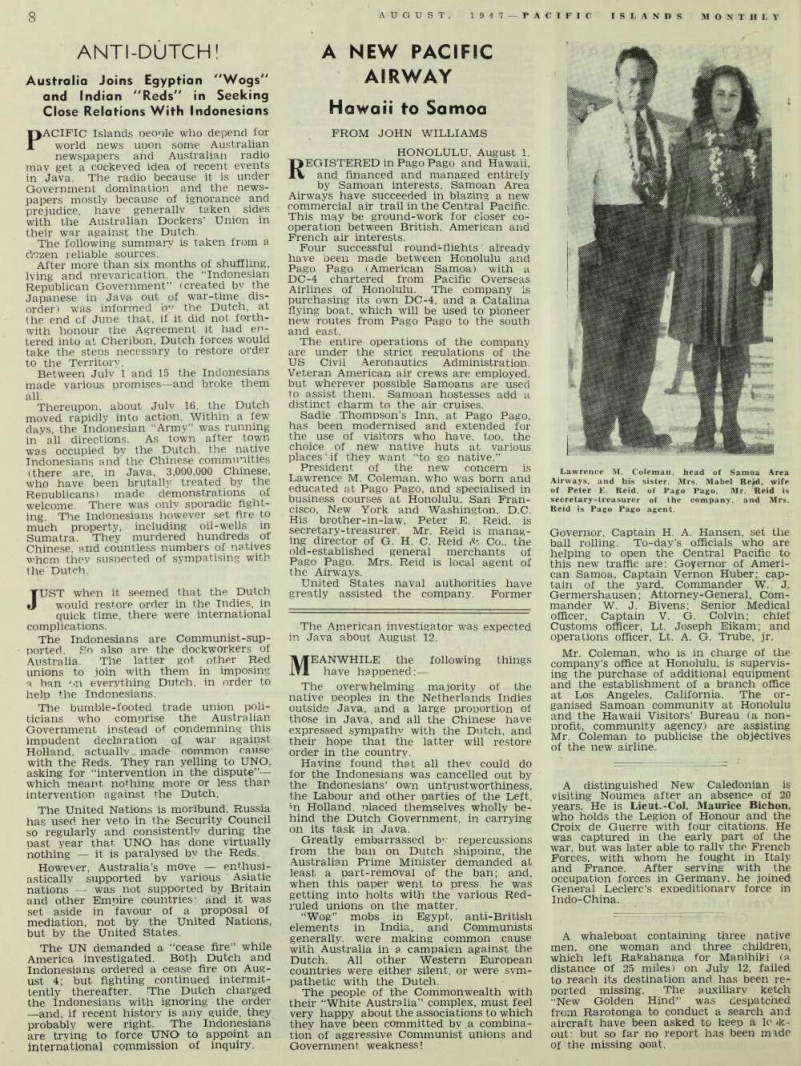
Lawrence M. Coleman, head of Samoa Area Airways, and his sister, Mrs. Mabel Reid, wife of Peter E. Reid, of Pago Pago. Mr. Reid is secretary-treasurer of the company, and Mrs.
Reid is Pago Pago agent.
UK and Dominion Governments Will
ANA WILL BE OUT OF TRANS PACIFIC
Service Next April
UK and Dominion Governments Will Then Run Own Organisation
BRITISH Commonwealth Pacific Air lines will take over the Sydney- North America, and Auckland-North America air service next April.
At present this service is being run by Australian National Airways Pty., Ltd., under contract with BCPA. Their con tract ends in April and will not be re newed.
BCPA was registered under the NSW Companies Act last year, but so far. has been kept as a shadow organisation, with a registered office and a secretary, but no staff. Nominal capital was £1,000,000 and stock is held by the Australian gov ernment (50 per cent.); New Zealand (30 per cent.), and United Kingdom (20 per cent.). Mr. A. W. Coles, who is also chief executive officer of the Australian Government’s internal air company, Trans Australian Airways, is chairman of BCPA.
It has been stated that BCPA expect no difficulty in taking over from ANA.
ANA has recently been permitted to pur chase two new Skymasters for the trans pacific service and it is understood that these can be acquired by BCPA at will.
TAA will have its new Convairs in opera tion by next April and then presumably also will pass over its Skymasters for the trans-Pacific service.
Simultaneously with the announcement that BCPA would take over, Captain A.
A. Barlow, who has been largely con cerned with the flight operations of ANA’s trans-Pacific run, resigned from that company and joined BCPA as manager of the new organisation.
THE new development is in keeping with 6 the intention of the Socialist governments of Australia, New Zea land and United Kingdom to control all airways.
Australia now controls Qantas Empire Airways and the trans-Pacific service,
New Zealand controls Tasman Empire Airways, its internal airways and some South Pacific services; and the United Kingdom controls BOAC and allied services.
Trans Australia Airways which was the Australian Government’s answer to a High Court decision against the national isation of internal airways—received a foundation grant of £3,000,000 from Aus tralian public funds and has subsequently received every aid, financial and political, that it is possible for the Government to put its way. It is the expressed intention of the Government to push private air companies from the skyways, if possible.
Latest broadside in this campaign is the introduction, at the end of July, of a Government levy on all planes using aerodrome facilities in Australia.
Trans-Australia Airlines completes its first year in October, but so far there has been no statement as to its financial position, although pertinent questions have been asked, both in and out of Parliament, and there is some uneasiness that taxpayers’ money is being used to finance this effort to break private air line enterprise.
AUSTRALIAN National Airways Pty., Ltd,, has had a long and excellent record in Australian aviation. It was due to this company’s enterprise and organisation that BCPA was able to in augurate the service last year the shadow company, at that time, had neither the machines nor the ground or ganisation for such an undertaking.
It is unlikely, however, that the man aging director of ANA (Captain Ivan Holyman) was unaware that, once the pioneering period had passed, the ser vice would be run by BCPA on its own account. But apart from surmounting the problems associated with every pioneer venture, ANA may yet have come out best in the trans-Pacific service: the problems of that service are likely to increase rather than diminish.
Pan American Airways run a parallel trans-Pacific service, twice weekly be tween Sydney and North America, in comparison with BCPA’s single service; and once weekly from Auckland, in comparison with BCPA service once a fortnight. There must, however, be a limit to the number of passengers who are prepared to pay over £2OO to cross the Pacific, and once the post-war boom seriously begins to wane and trans-Pacific shipping is restored to something ap proaching its former frequency, the main tenance of any trans-Pacific air service might well become a headache for its operators.
North Pacific Policies
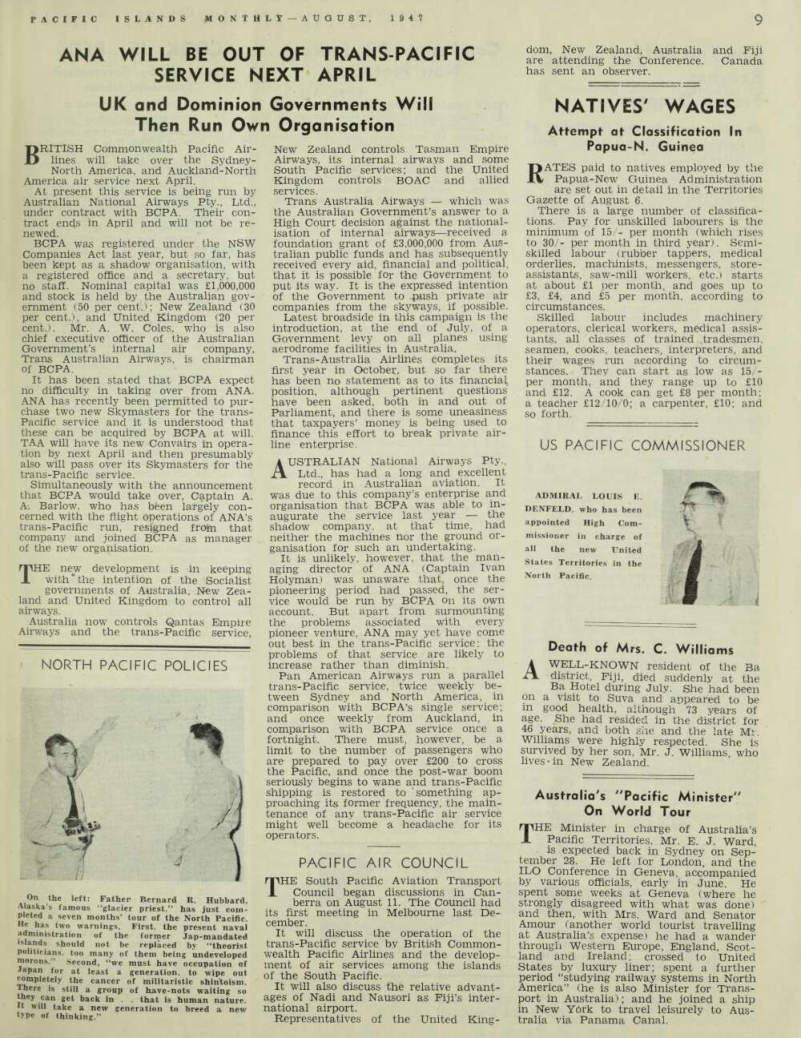
On the left: Father Bernard R. Hubbard.
Alaska’s famous “glacier priest,” has just com pleted a seven months’ tour of the North Pacific.
He has two warnings. First, the present naval administration of the former Jap-mandated islands should not be replaced by “theorist politicians, too many of them being undeveloped morons.” Second, “we must have occupation of Japan for at least a generation, to wipe out completely the cancer of militaristic shintoism. there is still a group of have-nots waiting so they can get back in . . that is human nature, it will take a new generation to breed a new type of thinking.”
Pacific Air Council
THE South Pacific Aviation Transport Council began discussions in Can berra on August 11. The Council had its first meeting in Melbourne last De cember.
It will discuss the operation of the trans-Pacific service by British Common wealth Pacific Airlines and the develop ment of air services among the islands of the South Pacific.
It will also discuss the relative advant ages of Nadi and Nausori as Fiji’s inter national airport.
Representatives of the United King
dom, New Zealand, Australia and Fiji are attending the Conference. Canada has sent an observer.
Natives' Wages
Attempt at Classification In Papua-N. Guinea
RATES paid to natives employed by the Papua-New Guinea Administration are set out in detail in the Territories Gazette of August 6.
There is a large number of classifica tions. Pay for unskilled labourers is the minimum of 15/- per month (which rises to 30/- per month in third year). Semi skilled labour (rubber tappers, medical orderlies, machinists, messengers, store assistants, saw-mill workers, etc.) starts at about £1 per month, and goes up to £3, £4, and £5 per month, according to circumstances.
Skilled labour includes machinery operators, clerical workers, medical assis tants, all classes of trained tradesmen, seamen, cooks, teachers, interpreters, and their wages run according to circum stances. They can start as low as 15/per month, and they range up to £lO and £l2. A cook can get £8 per month; a teacher £l2/10/0; a carpenter. £10; and so forth.
Advertisements & other items, p. 11 (1 item)
Us Pacific Commissioner
ADMIRAL LOUIS E.
DENFELD, who has been appointed High Com missioner In charge of all the new United States Territories in the North Pacific.
Death of Mrs. C. Williams
A WELL-KNOWN resident of the Ba district, Fiji, died suddenly at the Ba Hotel during July. She had been on a visit to Suva and appeared to be in good health, although 73 years of age. She had resided in the district for 46 years, and both she and the late Mi Williams were highly respected. She is survived by her son, Mr. J. Williams, who lives-in New Zealand.
Australia's "Pacific Minister"
On World Tour
THE Minister in charge of Australia’s Pacific Territories, Mr. E. J. Ward, is expected back in Sydney on Sep tember 28. He left for London, and the ILO Conference in Geneva, accompanied by various officials, early in June. He spent some weeks at Geneva (where he strongly disagreed with what was done) and then, with Mrs. Ward and Senator Amour (another world tourist travelling at Australia’s expense) he had a wander through Western Europe, England, Scot land and Ireland; crossed to United States by luxury liner; spent a further period “studying railway systems in North America” (he is also Minister for Trans port in Australia); and he joined a ship in New Ybrk to travel leisurely to Aus tralia via Panama Canal.
French Oceania
Kon-Tiki Raft Reaches French Oceania Drift Voyage Proves Possibility of Peruvian Influence on Early Polynesia
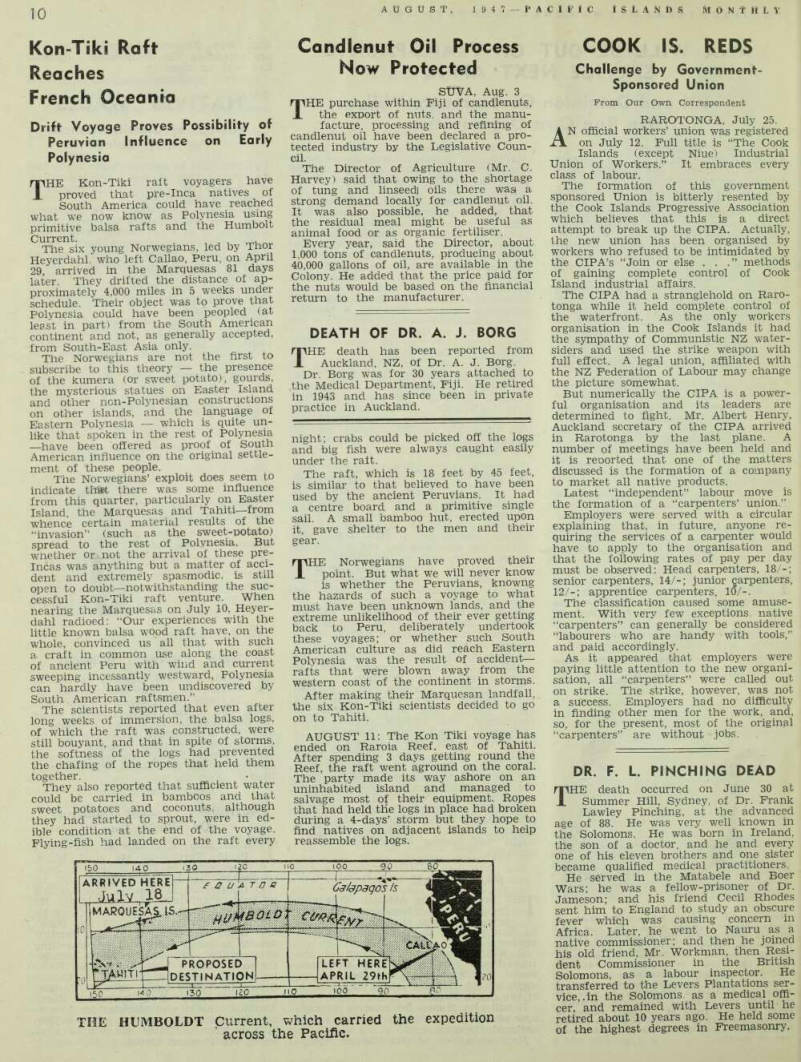
THE Kon-Tiki raft voyagers have proved that pre-Inca natives of South America could have reached what we now know as Polynesia using primitive balsa rafts and the Humbolt Current. , The six young Norwegians, led by Thor Heyerdahl, who left Callao, Peru, on April 29, arrived in the Marquesas 81 days later. They drifted the distance of ap proximately 4,000 miles in 5 weeks under schedule. Their object was to prove that Polynesia could have been peopled (at least in part) from the South American continent and not, as generally accepted, from South-East Asia only.
The Norwegians are not the first to subscribe to this theory the presence of the kumera (or sweet potato), gourds, the mysterious statues on Easter Island and other non-Polynesian constructions on other islands, and the language of Eastern Polynesia which is quite un like that spoken in the rest of Polynesia —have been offered as proof of South American influence on the original settle ment of these people.
The Norwegians’ exploit does seem to indicate that there was some influence from this quarter, particularly on Easter Island, the Marquesas and Tahiti—from whence certain material results of the “invasion” (such as the sweet-potato) spread to the rest of Polynesia. But whether or not the arrival of these pre- Incas was anything but a matter of acci dent and extremely spasmodic, is still open to doubt— notwithstanding the suc cessful Kon-Tiki raft venture. When nearing the Marquesas on July 10, Heyer dahl radioed: “Our experiences with the little known balsa wood raft have, on the whole, convinced us all that with such a craft in common use along the coast of ancient Peru with wind and current sweeping incessantly westward, Polynesia can hardly have been undiscovered by South American raftsmen.”
The scientists reported that even after long weeks of immersion, the balsa logs, of which the raft was constructed, were still bouyant, and that in spite of storms, the softness of the logs had prevented the chafing of the ropes that held them together.
They also reported that sufficient water could be carried in bamboos and that sweet potatoes and coconuts, although they had started to sprout, were in ed ible condition at the end of the voyage.
Flying-fish had landed on the raft every
night; crabs could be picked off the logs and big fish were always caught easily under the raft.
The raft, which is 18 feet by 45 feet, is similar to that believed to have been used bv the ancient Peruvians. It had a centre board and a primitive single sail. A small bamboo hut, erected upon it, gave shelter to the men and their gear.
THE Norwegians have proved their point. But what we will never know is whether the Peruvians, knowng the hazards of such a voyage to what must have been unknown lands, and the extreme unlikelihood of their ever getting back to Peru, deliberately undertook these voyages; or whether such South American culture as did reach Eastern Polynesia was the result of accident— rafts that were blown away from the western coast of the continent in storms.
After making their Marquesan landfall, the six Kon-Tiki scientists decided to go on to Tahiti.
AUGUST 11: The Kon Tiki voyage has ended on Raroia Reef, east of Tahiti.
After spending 3 days getting round the Reef, the raft went aground on the coral.
The party made its way ashore on an uninhabited island and managed to salvage most of their equipment. Ropes that had held the logs in place had broken during a 4-days’ storm but they hope to find natives on adjacent islands to help reassemble the logs.
THE HUMBOLDT Current, which carried the expedition across the Pacific.
Candlenut Oil Process
Now Protected
StTVA, Aug. 3 THE purchase within Fiji of candlenuts, the export of nuts, and the manu facture, processing and refining of candlenut oil have been declared a pro tected industry by the Legislative Coun cil.
The Director of Agriculture (Mr. C.
Harvey) said that owing to the shortage of tung and linseedi oils there was» a strong demand locally for candlenut oil.
It was also possible, he added, that the residual meal might be useful as animal food or as organic fertiliser.
Every year, said the Director, about 1,000 tons of candlenuts, producing about 40,000 gallons of oil, are available in the Colony. He added that the price paid for the nuts would be based on the financial return to the manufacturer.
Death Of Dr. A. J. Borg
THE death has been reported from Auckland, NZ, of Dr. A. J. Borg.
Dr. Borg was for 30 years attached to the Medical Department, Fiji. He retired in 1943 and has since been in private practice in Auckland.
Cook Is. Reds
Challenge by Government- Sponsored Union
From Our Own Correspondent
Rarotonga, July 25.
AN official workers’ union was registered on July 12. Full title is “The Cook Islands (except Niue) Industrial Union of Workers.” It embraces every class of labour.
The formation of this government sponsored Union is bitterly resented by the Cook Islands Progressive Association which believes that this is a direct attempt to break up the CIPA. Actually, the new union has been organised by workers who refused to be intimidated by the CIPA’s “Join or else ...” methods of gaining complete control of Cook Island industrial affairs.
The CIPA had a stranglehold on Raro tonga while it held complete control of the waterfront. As the only workers organisation in the Cook Islands it had the sympathy of Communistic NZ water siders and used the strike weapon with full effect. A legal union, affiliated with the NZ Federation of Labour may change the picture somewhat.
But numerically the CIPA is a power ful organisation and its leaders are determined to fight. Mr. Albert Henry, Auckland secretary of the CIPA arrived in Rarotonga by the last plane. A number of meetings have been held and it is reoorted that one of the matters discussed is the formation of a company to market all native products.
Latest “independent” labour move is the formation of a “carpenters’ union.”
Employers were served with a circular explaining that, in future, anyone re quiring the services of a carpenter would have to apply to the organisation and that the following rates of pay per day must be observed; Head carpenters, 18/-; senior carpenters, 14/-; junior carpenters, 12/-; apprentice carpenters, 10/-.
The classification caused some amuse ment. With very few exceptions, native “carpenters” can generally be considered “labourers who are handy with tools,” and paid accordingly.
As it appeared that employers were paying little attention to the new organi sation, all “carpenters” were called out on strike. The strike, however, was not a success. Employers had no difficulty in finding other men for the work, and, so, for the present, most of the original “carpenters” are without jobs.
Dr. F. L. Pinching Dead
THE death occurred on June 30 at Summer Hill, Sydney, of Dr. Frank Lawley Pinching, at the advanced age of 88. He was very well known in the Solomons. He was born in Ireland, the son of a doctor, and he and every one of his eleven brothers and one sister became qualified medical practitioners.
He served in the Matabele and Boer Wars; he was a fellow-prisoner of Dr.
Jameson; and his friend Cecil Rhodes sent him to England to study an obscure fever which was causing concern in Africa. Later, he went to Nauru as a native commissioner; and then he joined his old friend, Mr. Workman, then Resi dent Commissioner in the British Solomons, as a labour inspector. He transferred to the Levers Plantations ser vice, .in the Solomons, as a medical offi cer, and remained with Levers until he retired about 10 years ago. He held some of the highest degrees in Freemasonry.
Advertisements & other items, p. 12 (1 item)
10
AUGUST, 1947 fACIfIC ISLANDS MONTHLY
Pacific Shipping Position Shows
No -Improvement
Industrial Disputes, Rising Costs and Shorter Hours Put Companies on the Spot
ALTHOUGH the shipping services be tween Australian and ' < Papua-New Guinea have shown considerable improvement since the “Malaita” came out of dock and went on to the Sydney- Port Moresby-Samarai-Rabaul run, thus relieving the “Montoro.” which does mainland ports in New Guinea, the over all shipping position in the Pacific is worse, if anything, than during the war.
Sydney-North American Ser
VICES: It was announced in July that the two Matson liners, “Monterey” and “Mariposa,” which are being refitted in San Francisco, will not return to the Pacific trade until well on in 1948. It was hoped that these ships which have been in dock for over a year, would be back before the end of this year. Work was suspended on them in mid-July while the company made new plans. Originally it was intended to modernise these ships from the waterline, but reasons given for suspension of this work were: In creased costs in labour and materials, in dustrial hold-ups and the uncertain effect of air competition across the Pacific. It is estimated that operating costs on voyages have increased 106 per cent.— the cargo handling rate in Auckland, NZ, for example, is only half the pre-war figure.
The “Marine Phoenix” is at present maintaining a fairly regular schedule from Sydney to San Francisco. She carries only “priority” passengers and is usually unable to pick up or set down pasengers at intermediate Islands ports.
The “Aorangi,” which belongs to Cana dian-Australasian, an affiliate of the Union Company, is refitting in Sydney and was to be back on the Sydney-Van couver run in February 1948. No pro gress reports on this vessel have been issued for some time, but it is expected that it will be much later in the year before she is ready.
In July there was a “blackleg” of 2,000 Australians waiting for passages from America to Australia.
TASMAN SERVICE: There is no ser vice between Sydney and New Zealand at the present time. It is expected, how ever, that the “Wahine,” which was on the run earlier in the year and was then withdrawn, will be back on this service in September. Tasman Empire Airways is at present the only means of passen ger communication between the two countries.
AUSTRALIA-FIJI: There is no regular passenger shipping service between Aus tralia and Fiji, and other South Pacific ports. Before the war, this was ade quately taken care of by the Matson ships and the Canadaian -Australian line.
P/u^xri Z T^ LAND ’ FIJI AND SOUTH
Pacific Island Ports: The Matua
continues to maintain a five or six weekly schedule between Auckland, Suva, ionga, Apia, and return. Owing mostly to labour unruliness, delay is experienced Sli h L- urn " around in Auckland, other wise this ship could maintain a four weekly schedule. io3? atua ” should have sailed from Auck and on July 29, but was held up by a waterside workers’ dispute and was
still in Auckland on August 4. Water siders, who refused to lay dunnage in one of her holds, were dismissed. Subse quently they did not answer the call to load her. Meantime, island passen gers were left kicking their heels in Auckland. After this trip of “Matua,” she will be withdrawn for annual sur vey and expects to be back on the run about the begining of October.
The Government vessel “Maui Pomare” is maintaining a passenger and freight service between Auckland and the Cook Islands, with occasional calls at other Groups. The NZ Government has been unsuccessfully trying to purchase a larger and more suitable vessel.
Sydney-Norfolk Island-Lord
HOWE-NEW HEBRIDES; Because the “Morinda,” the regular steamer on this run, has had to go into dock for over haul these islands will be without pas senger services for about three months.
The small BP ship “Muliama” will carry essential supplies to these islands; but the only passenger communication will be between Norfolk Island and New Zealand, which is served by a RNZAF Dakota airservice.
New Shipping
Service
Auckland-Norfolk Is.-N. Caledonia
small, twin-screw motor-vessel “Rosalie,” 250 tons Captain E. G.
Couldrey, was scheduled to sail from Auckland on August 15, to in augurate a new monthly service between Auckland, Norfolk Island and New Cale donia.
The vessel was bought from NZ War Assets Realisation Board by Union Manu facturing and Export Co., Ltd., of Wel lington, and is being run by Irving Clarke Ltd., of Auckland, as managing agents.
She will carry general merchandise to Norfolk Island and New Caledonia, and will take back to New Zealand timber and copra (from New Caledonia) and fruits and tropical vegetables from Nor folk Island.
Norfolk Island has no trade with Aus tralia worth mentioning and, apart from the “Morinda,” no communication with outside, except a fortnightly call from a plane flying between Auckland and Fiji.
While the Administrator of NI and the Prime Minister of NZ, with the simple veracity of politicians, have been denying that NZ has any thought or intention of taking NI over from Australia, Auck land commercial interests have quietly stepped in and provided a long-needed freight service, which will probably make Norfolk Island a NZ Teritory in all but name.
The United States Atomic Energy Commission announced on July 24 that it was establishing proving grounds in the Pacific for experiments and tests of atomic weapons. Location is not indi cated.
Power For Viti Levu
Fiji Inquiring Into Hydro-Electric Plans
A CONSULTING engineer, Mr. H.
Vickerman, of Wellington, NZ, will proceed to Fi.li soon, to investigate various plans for hyrdo-electric installa tions in Fiji, and report upon same to the Government of Fiji.
Especially will he inquire into possibili ties in Viti Levu which, with its heavy rainfall and big rivers falling sharply out of the mountans into the coastal plain, seems to have been designed by nature for the development of hyrdo-electric power.
In the middle ’thirties, when the Vatou koula gold-mine industry was being developed, rival interests (some headed by Sir Charles Marr, MP, of Australia, and some by the Hon. E. G. Theodore, director of the new gold enterprises) in vestigated the possibilities of hydro electric power in Viti Levu; but, for some reason (ascribed by some to political an tagonisms) nothing came of these plans, and the gold industry installed its own powerful generating plant, driven by oil engines.
Hydro-electric plans were not dealt with during the war period.
IN November, 1946, the subject was re vived by a memorandum to the Government from the Director of Works, who said he sought a river cap able of being harnessed to give 15,000 h.p. He discussed various schemes, and his memorandum has aroused some con troversy.
There seem to be three schemes in Viti Levu. These are:— 1. —Central Viti Levu—(a) Upper Siga toka (Vuka-ni-Manu). (b) Wai-ni- Vodi Creek (Mua-ni-Savu Levu Falls), (c) Wai-ni-Savu Levu Creek (Vau Falls).
These schemes were closely investigated by two Sydney engineers, Messrs. A. G.
Gibson and H. G. Foxall, under Sir Charles Marr’s directions, in 1935-36, and they were favourably impressed with at least one of them The Works Director says their catchment is too small and the cost of making them accessible by road would be enormous. This has been sharply contradicted by Mr. Theo D.
Riaz, of Navai, who claims to know the country well, and has had it undter ob servation for a long period. It is con tended that power generated here could be economically reticulated over all Viti Levu—and especially to the sugar mills and airfields, to the gold-mine in dustry at Tavua, and to Suva. 2.—Nadi River. This location is well to the westward of the island. It is des cribed as a promising possibility for Nadi, Lautoka and Ba. 3.—Navua River. This is on the south side of Viti Levu. It is strongly favoured by the Works Director, who says it can be readily dammed to give a large reser voir, that it has a good catchment, and that from a generating station there power could be distributed to Navua, to Suva and to the Rewa Delta (Nausori, etc.).
Experts always disagree. To the plain layman, the idea of placing the power station at a central point, from which it could feed light and power to the whole of the island, seems sound. But accessibility is important; and catch ment, of course, is vital.
Advertisements & other items, pp. 13-14 (2 items)
11
FAciFie islands monthly august. 194?
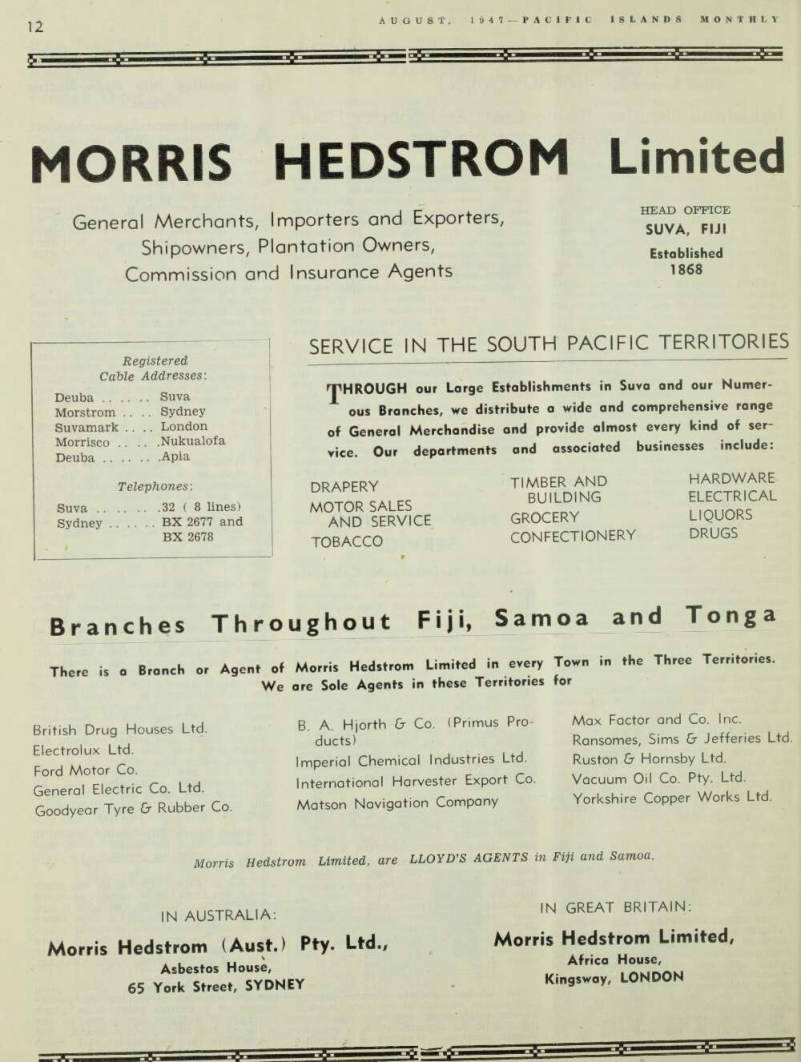
Morris Hedstrom Limited
General Merchants, Importers and Exporters,
Shipowners, Plantation Owners,
Commission and Insurance Agents
HEAD OFFICE
SUVA, FIJI
Established 1868 Registered Cable Addresses : Deuba Suva Morstrom .. .. Sydney Suvamark ... London Morrisco Nukualofa Deuba Apia
SERVICE IN THE SOUTH PACIFIC TERRITORIES
'pHROUGH our Large Establishments in Suva and our Numerous Branches, we distribute a wide and comprehensive range of General Merchandise and provide almost every kind of service. Our deportments and associated businesses include:
TIMBER AND
BUILDING
GROCERY
CONFECTIONERY
HARDWARE
ELECTRICAL
LIQUORS
DRUGS
Branches Throughout Fiji, Samoa and Tonga
There is a Branch or Agent of Morris Hedstrom Limited in every Town in the Three Territories We are Sole Agents in these Territories for British Drug Houses Ltd.
Electrolux Ltd.
Ford Motor Co.
General Electric Co, Ltd.
Goodyear Tyre & Rubber Co.
B. A. Hjorth & Co. (Primus Products) Imperial Chemical Industries Ltd.
International Harvester Export Co.
Matson Navigation Company Max Factor and Co. Inc.
Ransomes, Sims & Jefferies Ltd Ruston & Hornsby Ltd.
Vacuum Oil Co. Pty. Ltd.
Yorkshire Copper Works Ltd.
Morris Hedstrom Limited , are LLOYD’S AGENTS in Fiji and Samoa.
IN AUSTRALIA:
Morris Hedstrom (Aust.) Pty, Ltd* f
\ Asbestos House, 65 York Street, SYDNEY
IN GREAT BRITAIN:
Morris Hedstrom Limited,
Africa House, Kingsway, LONDON
South Pacific Regional
Commission
No Indication of When Organisation Will Function
EXCEPT for an interesting debate in the Legislative Council of Fiji, re ported hereunder, very little has hap pened in relation to the South Pacific Regional Council, since that body was formed in Canberra in February by rep resentatives of British Empire countries, United States, France and Holland.
The delay probably is due to the greatly disturbed condition of all the countries primarily concerned.
It was announced in February, soon after the delegates dispersed, that an organising secretary would be appointed; and that matters of procedure would have attention, such as the selection of a Secretary-General, and preparations for the first meeting of the Commission, which would take place in Sydney in June or July. (The Canberra Conference re solved that, pending the selection of a headquarters site, headquarters should be in Sydney; but that a headquarters site should be selected within six months of
the Agreement coming into force).
In April, Colonel John Kerr, principal of the School of Pacific Administration, Sydney, was appointed to act as Or ganiser-Secretary. Premises for the pre liminary staff and organisation of the Commission have been provided near the School of Tropical Administration, St.
George’s Heights, Mosman, Sydney.
That, so far as is known, is all that has happened.
There is no indication of when the Commission will hold its first meeting.
There has been no announcement by the Australian Minister (Dr Evatt), who was responsible for the creation of the Com mission—probably because half the Aus tralian Ministers are travelling abroad at the present time, and their absence has thrown a tremendous burden ol work upon Ministers at home. (Dr. Evatt, in cidentally, is not at home—he is absent on a brief visit to Japan.)
Some Fiji Public Men Critical of Commission
AMOTION by Mr. A. A. Ragg, Euro pean-elected member or the Southern Division, protesting strongly against Fiji’s inclusion in the ambit of operations of the South Pacific Regional Com mission, was defeated in the Legislative Council on July 25, by 19 votes to 11.
Of the 19 opponents, 16 were official members of the Council. The remain ing three came from the ranks of the Fijian members. All the European and Indian unofficial members and one of the Fijian members voted for the motion.
Mr. Ragg based his attack on the Com mission on three main grounds: ■ He objected to the inclusion of Fiji in the Commission’s sphere of operations without the prior consent of the people of the Colony. ■ He contended that Fiji was more ad vanced politically and economically than Territories such as New Guinea and the Solomon Islands, and would therefore be held back by association in the Com mission with such Territories. ■ He expressed the fear that the Com mission would eventually cease to be merely advisory and consultative, and that its recommendations would become mandatory, resulting in the loss of the independence of the territories concerned.
Apprehension that the Commission would be dominated by Australia and New Zealand was emphasised by Sir Hugh Ragg, European-elected member for the North-Western Division, and by Mr. W. G.
Johnson, one of the European nominated members.
Mr. Johnson said that the people of Fiji were awakened, politically and economically, and the Colony was already considerably past some of the stages from which it was inferred by overseas political leaders it was being saved.
“We do not wish to be held back by association with more backward peoples, nor do we wish to be rushed forward too quickly,” Mr. Johnson said.
Sir Hugh Ragg quoted International Labour Organisation conventions which had been incorporated in the Labour Bill passed the previous day by the Council as an example of the findings of an ad visory body being considered binding on participating territories, and he said that there was wide-spread apprehension that the recommendations of the South Paicific Commission would also eventually be con sidered mandatory, thus opening the way
for interference in the affairs of Fiji by the neighbouring dominions.
MR A. D. PATEL, Indian-elected member for the North-western Division, criticised the membership of the Commission on the grounds that while the Governments of Great Britain, Australia, New Zealand and the United States of America were democratic, those of France and Holland were reactionary.
He suggested that India should participate in the Commission.
The Acting-Governor. Mr. J. F. Nicoll, pointed out that the agreement consti tuting the Commission specified that only those Powers with dependent territories in the South Pacific could take part.
Mr. H. B. Gibson, European elected member for the Eastern Division, said that the members were jealous of the dignity of Legislative Council, and felt that they should have been consulted be fore matters affecting Fiji were discussed at the Canberra Conference.
Dr. J. C. R. Buchanan (who. besides being Director of Medical Services in Fiji, is the executive head of the South Pacific Health Service) said that a lesson he had learned from 60,000 miles of travel in the Pacific, and from many years spent in the Colonial Service, was that when any Territory was too proud to take ad vantage of the experience of others in any sphere it was extremely likely that it would fall behind, despite the ingenuity and skill of its own people. He agreed that conditions varied, from one South Ps'hfic country to another, but he would not acknowledge that all the problems facing these countries were dissimilar.
General principles which had been proved elsewhere were applicable to each.
Dr. Buchanan recalled the help given by the Rockefeller Foundation in the early stages of the Central Medical School; and he paid a warm tribute to New Zea land’s assistance in maintaining a pool of nursing sisters for hospitals in Fiji.
THE Acting Colonial Secretary, Mr.
A. R. W. Robertson, said that the motion could not be accepted by the Government. He thought that the mem bers who had supported it had shown undue uneasiness. The Agreement estab lishing the Commission was quite straight forward. It stated plainly that the functions of the Commission were to be consultative and advisory. Political and
constitutional matters were specifically excluded, and arguments based on fear of political intereference in the Colony’s in ternal affairs were therefore groundless.
In replying to the debate, Mr. Ragg said that Great Britain had a tendency at present to shed political responsibility, and that others were willing to receive the plums as they fell. He realised that the Commission Agreement excluded political matters: but, when economic forces obtruded, political domination was the result.
Mr. Ragg said that in the Commission the majority would rule: and he believed that this would eventually result in direct interference in the affairs of Fiji, leav ing the liberties and rights of the people to become mere ninepins to be bowled over whenever it suited the sovereign Powers.
M. Joseph Cruciani, member of a pro minent Corsican family, has been ap pointed head of the New Caledonian judiciary. He played a great part in freeing Corsica. In 1943 he was deported to Italy but escaped and joined the Ital ian Resistance movement in Tuscany.
Next, called to Algiers by the French had appointed a lieutenant-colonel, he became Government Commissioner n Corsica.
Government grants to five New Cale donian students in France, amounting to 8500 French francs per month, have besn renewed for the coming scholastic year.
They are made to Messrs. Guy Dubois, Marc Fonquernie, Theodore Siret, Jacques Laplagne and Camille Bastien. Other scholarships have been awarded m Messrs. Roger Liezour, Maurice Costa, Philippe Busiau and Mile, de la Ville, who left Noumea for France recently by the Ville de Strasbourg.
Mrs. Jack McLean has returned to Queensland after some months in Port Moresby, where her husband is Wing- Commander J. McLean, of the RAAF.
The Missionary Sisters of the Society of Mary, recently bought Mr. D. B. Cos tello’s home and property at Muanikau, near Suva, Fiji, for conversion to a con vent, to be known as St, Mary’s. There are 70 Missionary Sisters of the Society of Mary in Fiji. Of these, 18 are em ployed by the Medical Department as nursing sisters at the Central Leper Station at Makogai. The remainder un dertake educational work at various Roman Catholic mission stations in the Colony.
Advertisements & other items, pp. 15-16 (1 item)
Position Wanted
Senior stenographer, 20 years’ experience in office and secretarial work, Sydney, Brisbane and Canberra, Australia, desires position in Islands. Available immediately. References supplied. Kindly reply airmail, stating condition*: and salary to “August,” G.P.O. Box 3408, Sydney.
NOTICE
TO ALL IT MAY CONCERN.
Mrs. A. Barta is now sole owner of Kentucky Stud, Toowoomba, having purchased, from Mrs. Burrows, name and stock, but no liabilities.
FOR SALE
A very high-class chestnut gelding, 15 hands, 6 years—perfect lady’s hack, been successful in camp draft and sporting events—great stock horse and can compete in any show. 50 guineas.
KENTUCKY STUD, Toowoomba.
Phone 1115.
An outstanding show hack, beautiful dapple grey Arab mare “Bluegown,” by Remardi (breeding guaranteed) 6 years, 15 hands, trained for all sporting events, excellent stock mare, very highly recommended. Price, 75 guineas.
KENTUCKY STUD, Toowoomba.
Stromberg - Carlson s.ie pacific Agent*
SAMOA: O. F. NELSON & CO. LTD., Apia, W. Samoa FIJI: PROGRESSIVE RADIO SERVICE, Rodwell Road, Suva NEW BRITAIN: H. T. ALLEN, BARRETT & READ, Casuarina Ave., Rabaul V Available now; Air Circulators, 5-Valve 6-Volt Vibrator World Range Receiver. Available soon:
REFRIGERATORS, VACUUM
CLEANERS, WASHING MACH-
INES. FANS AND MANY OTHER
ELECTRICAL UTILITIES.
RELIDE WATCHES. Imported movement and cases.
SHOCKPROOF AND WATERPROOF.
(®^^4^ S R L 6 S S6RVIC6 TELEPHONE 18W5157 • SCOTTISH HOUSE • 19 BRIDGE STREET ® SYDNEY • AUSTRALIA
C finished by
DAVISON
For Tropical conditions
1 Engineer's Residence, Power Station, Rabaul, finished with DAVISON
PAINTS.
Velvene Water Paint and Davison's Zinc Base Paints are used extensively throughout the islands and Mandated Territories on Government and Private buildings, giving full satisfaction under severe tropical conditions.
AGENTS—If interested in selling DAVISON PAINT PRODUCTS where not represented, can obtain full information from Export Manager.
DAVISON PAINTS PTY. LTD.
BOX 24, AUBURN, N.S.W.
Death Of J. Taripo
THERE was general regret at the news of the death, in New Zealand on July 27, of Mr. John Taripo, well known popular trader of Rarotonga. On July 23 Mr. Taripo was taken to Auck land in a plane specially chartered by the New Zealand Island Territories Depart ment.
Mr. Taripo was taken ill while building a new cinema in Avarua. He was found to need a delicate brain operation.
He leaves a wife, one daughter and four sons who will continue his business interests.
"Fiji Guardian"
A New Weekly Newspaper
MEN prominently connected with the European Electors Association have organised “The Guardian”—a weekly newspaper which is expected to make its appearance in Suva fairly soon.
Machinery and premises are exceedingly scarce now; but those problems have been solved by bringing some printing equip ment from New Zealand, and installing it in Mr. J. H. Bayley’s building, around the corner from Mr. Noel Levy’s shop, near the main street.
“The Guardian,” which will be under the direct management of Mr. Furby, is expected to voice the policy of the EE A, which seeks “greater political control of their domestic affairs by the people of the Colony.” and “the long-avowed aim of the British colonial policy to advance the Colonies towards self-government.”
The new journal, however, will find that Fiji, with its curious mixture of races (10.000 Europeans, in charge; 117,000 Fijians, comparatively indifferent towards politics; and 120 000 Indians, avid for political power) presents an especially difficult problem.
This is the view taken of the British Colonial Office, as expressed by the Minister (Mr. A. Creech-Jones) on June 4: “The constitution of Fiii was amended in 1937 so as to increase Fijian and Indian representation, and to give equal repre sentation to the three communities while retaining an official majority of one.
“The overriding consideration must re main the obligation of his Majesty’s Government to the Fijians. I cannot accept the suggestion that this change was or is contrary to the wishes of a majority of the peonle. particularly when much responsible European opinion and Fijian opinion is opposed now to any change in the constitution.”
It's An Old Tongan
Custom
Suva Aug. 3.
THE customs of Merrie England, such as kissing under the mistletoe and similar agreeable devices, have no thing on the customs of Merrier Tonga.
The firm of W. R. Caroenter (Fiji) Ltd., honorary agents in Suva for the Tongan Government, entertained the visiting Tongan Rugby team and some of the Tongan’s Fijian friends at a pic nic at Nukulau Island.
At the end of an eminently successful day, the massive Tongans, courteously explaining that this was an old Tongan custom, heaved their host, Mr. W. G.
Johnson, and their manager, Mr. G.
Good acre, into the sea.
Neither Mr. Johnson nor Mr. Goodacre has said a word to suggest that the day was not a success to the end.
Incidentally, the Tongan Rugby tour has been a complete success. The Fijians won both the tests, played at Suva, but in the provinces the home teams did not come off so well. The Vatukoula team went down 21-6.
Mr. D. C. C. Trench, MC has been ap pointed First Assistant Secretary of the Western Pacific High Commission with effect from March 9, 1947. Mr. J. A. C.
Hill has been appointed Cadet Officer and Second Assistant Sec retary of the WPHC. Mr. Trench, until his recent transfer to the Commission in Suva, was stationed in the Solomons.
£10 Higher
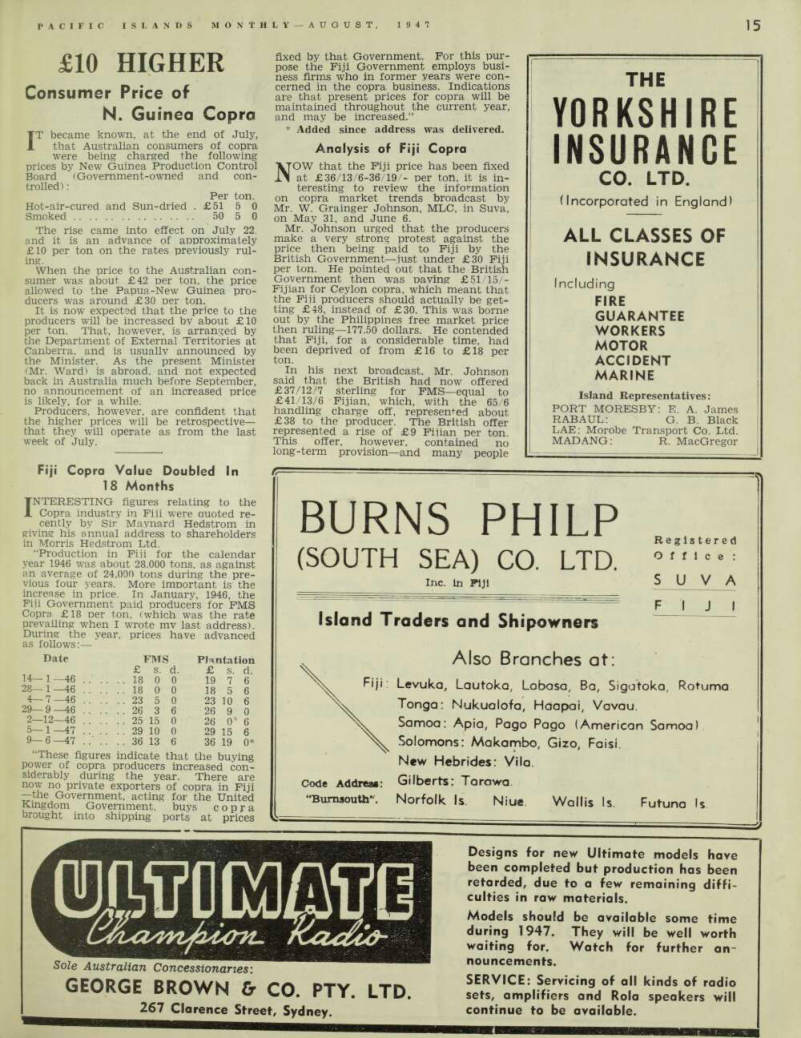
Consumer Price of N. Guinea Copra
IT became known, at the end of July, that Australian consumers of copra were being charged the following prices by New Guinea Production Control Board (Government-owned and con trolled) ; Per ton.
Hot-air-cured and Sun-dried . £5l 5 0 Smoked 50 5 0 The rise came into effect on July 22. and it is an advance of approximately £lO per ton on the rates previously rul ing.
When the price to the Australian con sumer was about £42 per ton, the price allowed to the Papua-New Guinea pro ducers was around £3O per ton.
It is now expected that the price to the producers will be increased bv about £lO per ton. That, however, is arranged by the Department of External Territories at Canberra, and is usuallv announced by the Minister. As the present Minister (Mr. Ward) is abroad, and not expected back in Australia much before September, no announcement of an increased price is likely, for a while.
Producers, however, are confident that the higher prices will be retrospective— that they will operate as from the last week of July.
Analysis of Fiji Copra
Fiji Copra Value Doubled In 18 Months
INTERESTING figures relating to the Copra industry in Fiji were Quoted re cently by Sir Maynard Hedstrom in giving his annual address to shareholders in Morris Hedstrom Ltd. ‘‘Production in Fiji for the calendar year 1946 was about 28,000 tons, as against an average of 24,000 tons during the pre vious four years. More important is the increase in price. In January, 1946, the Fiji Government paid producers for FMS Copra £lB per ton, (which was the rate prevailing when I wrote mv last address).
During the year, prices have advanced as follows:
“These figures indicate that the buying power of copra producers increased con siderably during the year. There are now no private exporters of copra in Fiji —the Government, acting for the United Kingdom Government, buys copra brought into shipping ports at prices
fixed by that Government. For this pur pose the Fiji Government employs busi ness firms who in former years were con cerned in the copra business. Indications are that present prices for copra will be maintained throughout the current year, and may be increased.” * Added since address was delivered.
Analysis of Fiji Copra
NOW that the Fiji price has been fixed at £36/13/6-36/19/- per ton, it is in teresting to review the information on copra market trends broadcast by Mr. W. Grainger Johnson, MLC, in Suva, on May 31, and June 6.
Mr. Johnson urged that the producers make a very strong protest against the price then being paid to Fiji by the British Government—just under £3O Fiji per ton. He pointed out that the British Government then was paving £5l/15/- Fijian for Ceylon copra, which meant that the Fiji producers should actually be get ting £4B, instead of £3O. This was borne out by the Philippines free market price then ruling—l77.so dollars. He contended that Fiji, for a considerable time, had been deprived of from £l6 to £lB per ton.
In his next broadcast. Mr. Johnson said that the British had now offered £37/12/7 sterling for FMS—equal to £4l/13/6 Fijian, which, with the 65 6 handling charge off, represented about £3B to the producer. The British offer represented a rise of £9 Fiiian per ton.
This offer, however, contained no long-term provision—and many people
Date FMS Plantation £ s. d. £ s. d. 14—1—46 18 0 0 19 7 6 28- 18 0 0 18 5 6 4— 23 5 0 23 10 6 29- 26 3 6 26 9 0 2—12—46 25 15 0 26 O' 6 5— 29 10 0 29 15 6 9—6—47 ... 36 13 6 36 19 0*
wanted a fixed price for five years, or at least until 1950. Mr. Johnson pointed out that, pending a satisfactory adjustment, Fiji copra was being withheld from the market.
The attempt made to gain the views of the copra producers was useless, how ever—too many small producers, and no time in which to consult them. The British offer was accepted, without any provision for a guaranteed price until 1950 : while the Fiii Board increased the margin between the price paid by Britain, and the price paid to the producers by 35/- (from 3/5/ to £5 per ton).. The producers, therefore, got a net rise of slightly over £7 per ton.
There is now a substantial profit in copra production, and the present prices seem to be assured for at least two years.
Advertisements & other items, pp. 17-18 (1 item)
Burns Philp
THE
YORKSHIRE
INSURANCE
CO. LTD.
(Incorporated in England)
ALL CLASSES OF
INSURANCE
Including
FIRE
GUARANTEE
WORKERS
MOTOR
ACCIDENT
MARINE
Island Representatives:
PORT MORESBY: E. A. James
RABAUL: G. B. Black LAE: Morobe Transport Co. Ltd.
MADANG: R. MacGregor
BURNS PHILP
(SOUTH SEA) CO. LTD.
Inc. In FIJI Island Traders and Shipowners Also Branches at: Levuka, Lautoka, Lobasa, Ba, Sigatoka, Rotuma Tonga: Nukualofa, Haapai, Vavau.
Samoa: Apia, Pago Pago (American Samoa) Solomons: Makambo, Gizo, Faisi.
New Hebrides: Vila.
Code Address: Gilberts: Tarawa "Burnaouth*. Norfolk Is. Niue Wallis Is. Futuna Is Flj Registered Office :
SUVA
FIJI
Sole Australian Concessionaries :
GEORGE BROWN & CO. PTY. LTD.
267 Clarence Street, Sydney.
Designs for new Ultimate models hove been completed but production has been retarded, due to a few remaining difficulties in raw materials.
Models should be available some time during 1947. They will be well worth waiting for. Watch for further announcements.
SERVICE: Servicing of all kinds of radio sets, amplifiers and Rola speakers will continue to be available.
JACK HUMPHRYS
PASTRYCOOK ond CATERER
Orders at Shortest Notice.
Aplin Street, Cairns
Beginners in business
5^ / .4 m 50* At the outset of your business career when you are earning your first regular income you can have the safety and convenience of a cheque account.
It is not necessary to wait until you are twenty-one.
A cheque account with the "Wales’ carries business prestige and provides an orderly method of handling private business.
Consult the manager . . .
BANK OF
NEW SOUTH WALES
FIRST BANK IN AUSTRALIA
(Incorporated in New South Wales with limited liability) A4704D
Copra Price Rises in NZ
Territories
WE have been informed, unofficially, that the New Zealand Government has recently raised the price paid to producers of copra in its Pacific terri tories (Cook Islands, Western Samoa, Niue). The price is stated to be £46/17/0 (NZ currency) at island ports. This is about £5 higher than the new price ruling in Fiji, and about £l4 higher than the ruling rate paid to New Guinea producers —although, as stated above, it is confi dently expected that the New Guinea price will soon be increased by about £lO.
It has also been hinted that the New Zealand Government expects to fix a per manent price for its Territories’ copra.
Another Dragon Crashes
in New Guinea
From a Correspondent
Port Moresby, July 20.
A DRAGON Rapide aircraft, belonging to Qantas Airways, crashed between Lae and Bulolo on July 15. The two passengers, Mr. O. P. Blanden, Min ing Warden of Wau. and his wife, were unhurt, but the pilot received minor in juries.
The plane, in the best tradition of New Guinea forced landings, was pancaked into the spreading branches of a large tree and here passengers and pilot spent the night. They were rescued by a land party the following day.
New Guinea has had a series of air accidents in recent months. Two of them have been fatal, and Dragons seem to have a particularly unfortunate record.
There is, consequently, some anxiety felt among air travellers in the Territory who are forced to fly in this type of aircraft.
The Civil Aviation Department, how ever, which has a unique safety record in Australia, is making determined efforts to bring New Guinea flying conditions up to the same high standard. They are policing the services rigidly, and ground ing planes for the smallest imperfection.
A party of Civil Aviation officials has recently conducted an exhaustive survey of every existing or projected airstrip or route in the Territory. It is planned to run a modern, well-equipped and well controlled network of internal services to link up with the overseas air routes which will eventually take in New Guinea.
Civil Aviation authorities have con ferred with the Administration to estimate future requirements in the Territory. (EDITORIAL NOTE; In the years be fore the war, the air companies operating in New Guinea had a safety record second to none. And this was in the days when pilots flew without aid of directional wireless and without most of the instruments now installed in modern aircraft. They used landing-fields that were roughly hewn from the jungle, or were merely mountain ridges cleared of bush. Not even the Civil Aviation De partment will be able to overcome New Guinea’s natural hazards to safe flying terrain and climate).
Ratu Mara Uluilakeba, of Fiji, who is an undergraduate at Oxford, has been successful in recent athletic competitions and has become a member of the Achilles Club, which is open to Oxford or Cam bridge blues or near-blues. In an unoffi cial inter-University meeting last month Ratu Mara won the high jump by clearing 8 feet. He has been selected for an Ox ford University athletics team which is to tour the British and American zones of Germany.
New Pacific Air Service
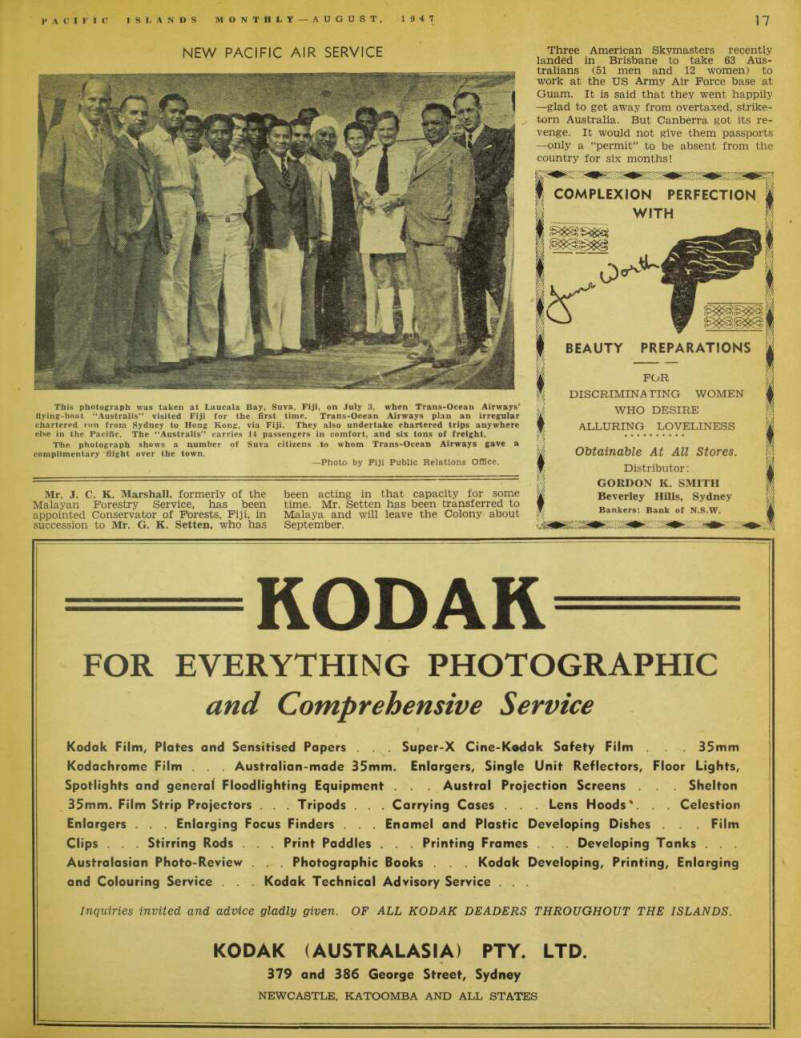
Mr. J. C. K. Marshall, formerly of the Malayan Forestry Service, has been appointed Conservator of Forests, Fiji, in succession to Mr. G. K. Setten, who has
been acting in that capacity for some time. Mr. Setten has been transferred to Malaya and will leave the Colony about September.
Three American Skymasters recently landed in Brisbane to take 63 Aus tralians (51 men and 12 women) to work at the US Army Air Force base at Guam. It is said that they went happily —glad to get away from overtaxed, strike torn Australia. But Canberra got its re venge. It would not give them passports —only a “permit” to be absent from the country for six months!
This photograph was taken at Laucala Bay, Suva, Fiji, on July 3, when Trans-Ocean Airways’ flying-boat “Australis” visited Fiji for the first time. Trans-Ocean Airways plan an irregular chartered run from Sydney to Hong Kong, via Fiji. They also undertake chartered trips anywhere else in the Pacific. The “Australis” carries 14 passengers in comfort, and six tons of freight.
The photograph shows a number of Suva citizens to whom Trans-Ocean Airways gave a complimentary flight over the town. —Photo by Fiji Public Relations Office.
Advertisements & other items, pp. 19-20 (1 item)
Kodak
COMPLEXION PERFECTION
WITH
BEAUTY PREPARATIONS
FOR
DISCRIMINATING WOMEN
WHO DESIRE
ALLURING LOVELINESS
Obtainable At All Stores.
Distributor:
GORDON K. SMITH
Beverley Hills, Sydney Bankers: Bank of N.S.W.
KODAK
FOR EVERYTHING PHOTOGRAPHIC
and Comprehensive Service
Kodak Film, Plates and Sensitised Papers . . . Super-X Cine-Kodak Safety Film . 35mm Kodachrome Film . . . Australian-made 35mm. Enlargers, Single Unit Reflectors, Floor Lights, Spotlights and general Floodlighting Equipment . . . Austral Projection Screens . . Shelton 35mm. Film Strip Projectors . . . Tripods . . . Carrying Cases . . . Lens Hoods'. . . Celestion Enlargers . . . Enlarging Focus Finders . . . Enamel and Plastic Developing Dishes . . . Film Clips . . . Stirring Rods . . . Print Paddles . . . Printing Frames . . . Developing Tanks . . .
Australasian Photo-Review . . . Photographic Books . . . Kodak Developing, Printing, Enlarging and Colouring Service . . Kodak Technical Advisory Service . . .
Inquiries invited and advice gladly given. OF ALL KODAK DEADERS THROUGHOUT THE ISLANDS.
KODAK (AUSTRALASIA) PTY. LTD.
379 and 386 George Street, Sydney
NEWCASTLE, KATOOMBA AND ALL STATES
Every Branch Of
ENGINEERING and BUILDING CONSTRUCTION
MILLERS LTD.
SUVA and LAUTOKA
Sawmillers and Timber Merchants; Shipwrights and Sailmakers; Joinery and Furniture Manufacturers; Upholsterers; Plumbers; Electricians; Hardware Merchants; Motor Dealers.
AGENCIES :
Chevrolet, Bedford, Vauxhall, Nash Motors. Firestone Tyres.
Fetters Marine and Stationary Engines. G.E.C. Radio Sets.
British Australian Lead Manufacturers Pty., Ltd., Atlas Assurance Co., Ltd.
There is no need to send to Australia or New Zealand for Repairs or Replacements. We can give you a sound Quotation and guarantee First-Class Workmanship
OVER 25
YEARS OF
PAIN
RELIEF!
SWIFT 3-WAY RELIEF
From HEADACHE and all Nerve and Muscular Pain!
Vincent’s A.P.C Powders and Tablets are a combination of three valuable medicinal ingredients and bring swift 3-way relief! Vincent’s A.P.C is prepared to the original hospital prescription containing Aspirin to relieve pain, Phenacetin to reduce temperature, Caffeine to stimulate the nervous system. Vincent’s A.P.C quickly relieves Headache, and all nerve and muscular pain! © © auu an ucivc am
VINCE'
N 5.60.14. for
POWDERS & TABLETS
Third Flag In
N. Hebrides
Problem of Shipless Tonkinese
“VTO European who lives in the New Hebrides wishes to see the Con dominium abolished,” said a recent visitor from Vila. “The idea of the Ter ritory being joined more closely to Britain, or France, or Australia is not liked. We get a very fair deal from the Condomium officials, and there is none of this interference with our private lives and businesses. We want no change.”
The most remarkable development in the New Hebrides in recent years is the appearance there of a third flag.
Over a building in the main street of Vila there waves a red flag with a five pointed yellow star in the top corner, near the staff. This building is the head quarters of the Tonkinese Commissioner, and the flag is the flag of Tonkin, to which Indo-Chinese country the French have given a certain recognition. A minia ture of the flag waves from the bonnet of the Tonkinese Commissioner’s car. in the same way as the miniature Tricolour and Union Jack wave from the bonnets of the cars of the French and British Re sident Commissioners.
To get labour, the French Administra tion brought to the New Hebrides large numbers of Tonkinese, under indenture.
The British had no labour—so many of them obtained French nationality, and employed Tonkinese, and so saved their plantations.
When war came, the indenture system broke down, because the time-expired men could not be repatriated. The Tonkinese generally were freed, and thrown on their own resources. The majority entered into private contracts, with a considerable rise in wages.
In 1942-45 large numbers of American troops were in the group, and the Tonkinese generally became prosperous, by selling to the troops curios, liquor, taxi-cab service, and their women. They still have a lot of that money.
After the war, the Tonkinese clamoured to go home, but lack of shipping pre vented any repatriation worthy of note.
The men engage in various industries, but they still want to go back to Indo china. Although they have their women with them —the French allowed about two women to come in, for every 10 men— they show no inclination to settle in the country—being, in this respect, very dif ferent from the Indians in Fiji, and the Chinese in New Guinea.
The number of Tonkinese in the Con dominium is variously estimated at from 6.000 to 10,000 —probably about 8,000. The Tonkinese Commissioner is in the group to represent them, in all their relations with the French and British.
Recently, there were tense scenes in Santo, when a large number of Tonk inese gathered around the house of the French Resident and remained there for three days, loudly demanding that they be sent home. The French officials plained that it still was impossible to get ships; but thev promised the repatria tion of about 300 in a month’s time, to be followed by small parties at fairly regular intervals.
The Tonkinese dispersed; but the whole community Insists that it is very unhappy and anxious to go home.
Mr. F. L. Jones, a trader from Vanikoro (Solomon Islands) and Baulu Islands (New Hebrides) arrived in Sydney m August, and will spend three months in Australia.
Future of Norfolk Is.
Suggestion of Transfer to NZ Is Unknown Officially
ACCORDING to the Administrator of Norfolk Island, Mr, A. Wilson, there is no truth in the rumour that the island will soon come under the control of New Zealand.
Mr. Wilson is at present on a visit to Australia—a routine matter, he says, to confer with External Territories Depart ment, Canberra. Mr. Wilson is an ex- Australian MP. He was appointed Ad ministrator of Norfolk at the end of 1945.
Mr. Wilson, says that Norfolk Islanders are “hostile” at the New Zealand pro posal. There seems to be no reason why they should be. Australia can produce everything that is grown on the island, and consequently NI products are not permitted to enter the Commonwealth in competition with mainland growers. New Zealand, on the other hand, does not produce the semi-tropical fruits and vegetables that grow the year round on Norfolk. These would find a ready mar ket in the Dominion.
In a radio interview after his arrival in Australia, Mr. Wilson said that over 100 tourists per week were visiting Nor folk. It is interesting to note that these tourists are all from New Zealand. There is a Dakota service between Auckland and the island.
There is no air service between Au stralia and Norfolk Island, although the Commonwealth Government stated sev eral months ago that they “were going into the whole question.” The only regular communication with the island is by the small Burns Philp ship “Morinda” which leaves Sydney about once every seven weeks and calls at Lord Howe, Norfolk Island and ports in the New Hebrides. ' The NZ Prime Minister has denied that NZ plans to take over NI. Nothing of the kind has been considered by the Australian or NZ Governments.
It should be pointed out that the pro posal did not come from any politicians —who can always be depended upon to dodge and prevaricate, anyway—but from the Auckland Chamber of Commerce After that, it received much press pub licity. mostly favourable. Under NZ, the island would be useful and valuable.
Under Australia, it is merely an isolated community, with no economic future, and an everlasting administratiye expense.
Papuan Medical Students
Fail At Cms
From a Special Correspondent
SUVA, July 8 rpHE four Papuan students who were A admitted to the Central Medical School, Suva, at the beginning of the year have failed to pass their prelim inary science course.
Originally, seven boys went to Fiji to enter the School, but one was subse quently found to be suffering from TB, and others were not up to the required educational standard.
The four who have now failed in the science course will go to Queen Victoria School, Fiji, for further instruction and will re-enter the Medical School as stu dents in 1948.
Even in normal times the educational standard of Papuan and New Guinea students would generally be below that required by the Suva Medical School.
But, in addition, educational facilities in
the Australian territories had been dis located by years of war. The failure of these students to make the CMS grade does not surprise anyone. It is believed that Dr, J. Gunther, Director of Medical Services in Papua-New Guinea, was against the boys going in their unpre pared state, but that some higher auth ority prevailed against his judgment.
Dr. A. S. Frater, the new principal of the CMS, Suva, is making good progress.
His long experience in the New Hebrides has enabled him to appreciate the diffi culties associated with native medical students.
Bgd Production Figures
DURING the month of June, the two dredges of Bulolo Gold Dredging Ltd., which are irr operation in the Bulolo River, put through 309,000 cubic yards of gravel, returning 5,185 ounces of fine gold.
Mrs. Claude Fenner, of Ba, Fiji, returned from the United States in July. While in the San Francisco Bay area she was the guest of Mr. and Mrs. A. G. Andrews, Berkeley, Cal.
Advertisements & other items, p. 21 (1 item)
Brial & Ball
PONY STALLION
THE KENTUCKY STUD have decided to sell their. Shetland pony sire “Wee Mc- Gregor.” This pony has stood at the head of the stud for four years—he’s now nine years old.
He is a splendid type of Shetland and is a sure foal-getter—his stock can be inspected at the stud. The only reason he is being sold is on account of us having too many of his stock on hand. Any small child can ride this pony. Further particulars and photos will be supplied.
Price, 75 Guineas.
KENTUCKY STUD, Toowoomba, Qld.
BRIAL & BALL
TENNIS SHOES
“RUNACAN” BRAND
Pure rubber soles, unlimited quantities.
Delivery: approximately two months
RINOLDI
Spaghetti, Vermicelli, Macaroni and Soup Pastes
KENNONS
Kromobark High Grade Leather Soles and Heels (excluding Fiji)
LAMBALLE PERFUMES
PARIS
The Aristocrat of French Perfumes
TRUFOOD Powdered Milk
Full Cream and Skim Milk.
TIBALDI
Continental smallgoods, Salami, Canned Mortadella 0 Sole Distributing Agents for Pacific Islands
BRIAL & BALL
Australia
31 QUEEN STREET,
MELBOURNE.
1 BOND STREET,
SYDNEY.
Overseas Yachts In Suva
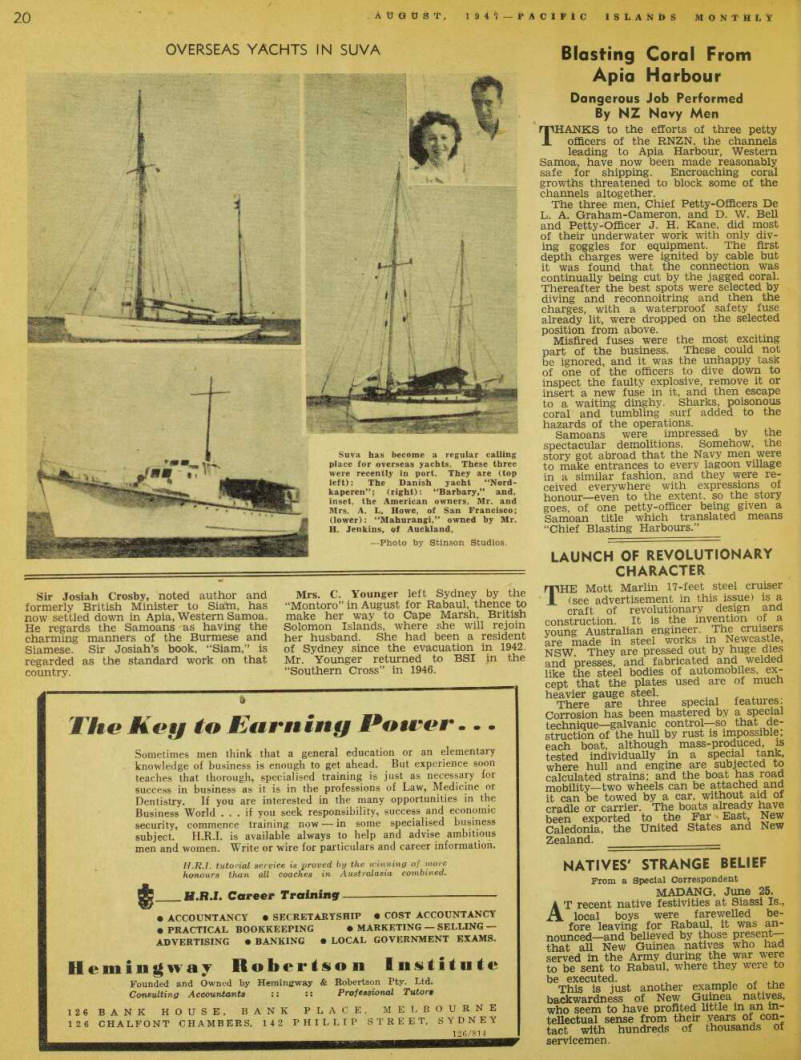
Sir Josiah Crosby, noted author and formerly British Minister to Siaftn, has now settled down in Apia, Western Samoa.
He regards the Samoans as having the charming manners of the Burmese and Siamese. Sir Josiah’s book. “Siam,” is regarded as the standard work on that country.
Mrs. C. Younger left Sydney by the “Montoro” in August for Rabaul, thence to make her way to Cape Marsh, British Solomon Islands, where she will rejoin her husband. She had been a resident of Sydney since the evacuation in 1942.
Mr. Younger returned to BSI in the “Southern Cross” in 1946.
Suva has become a regular calling place for overseas yachts. These three were recently in port. They are (top left): The Danish yacht “Nord kaperen”; (right): “Barbaryand, inset, the American owners, Mr. and Mrs. A. L. Howe, of San Francisco; (lower): “Mahurangi,” owned by Mr.
H. Jenkins, of Auckland. —Photo by Stinson Studios.
Apia Harbour
Blasting Coral From Apia Harbour Dangerous Job Performed
By NZ Navy Men
THANKS to the efforts of three petty officers of the RNZN, the channels leading to Apia Harbour, Western Samoa, have now been made reasonably safe for shipping. Encroaching coral growths threatened to block some of the channels altogether.
The three men, Chief Petty-Officers De L. A. Graham-Cameron, and D. W. Bell and Petty-Ofiicer J. H. Kane, did most of their underwater work with only div ing goggles for equipment. The first depth charges were ignited by cable but it was found that the connection was continually being cut by the jagged coral.
Thereafter the best spots were selected by diving and reconnoitring and then the charges, with a waterproof safety fuse already lit, were dropped on the selected position from above.
Misfired fuses were the most exciting part of the business. These could not be ignored, and it was the unhappy task of one of the officers to dive down to inspect the faulty explosive, remove it or insert a new fuse in it, and then escape to a waiting dinghy. Sharks, poisonous coral and tumbling surf added to the hazards of the operations, Samoans were impressed by the spectacular demolitions. Somehow, the story got abroad that the Navy men were to make entrances to every lagoon village in a similar fashion, and they were re ceived everywhere with expressions of honour —even to the extent, so the story goes, of one petty-officer being given a Samoan title which translated means “Chief Blasting Harbours.”
Launch Of Revolutionary
Character
THE Mott Marlin 17-feet steel cruiser (see advertisement in this issue) is a craft of revolutionary design and construction. It is the invention of a young Australian engineer. The cruisers are made in steel works in Newcastle, NSW. They are pressed out by huge dies and presses, and fabricated and welded like the steel bodies of automobiles, ex cept that the plates used are of much heavier gauge steel.
There are three special features.
Corrosion has been mastered by a special technique—galvanic control—so that de struction of the hull by rust is impossible; each boat, although mass-produced, is tested individually in a special tank, where hull and engine are subjected to calculated strains; and the boat has road mobility—two wheels can be attached and it can be towed by a car, without aid of cradle or carrier. The boats already have been exported to the Far East, New Caledonia, the United States and New Zealand.
Natives' Strange Belief

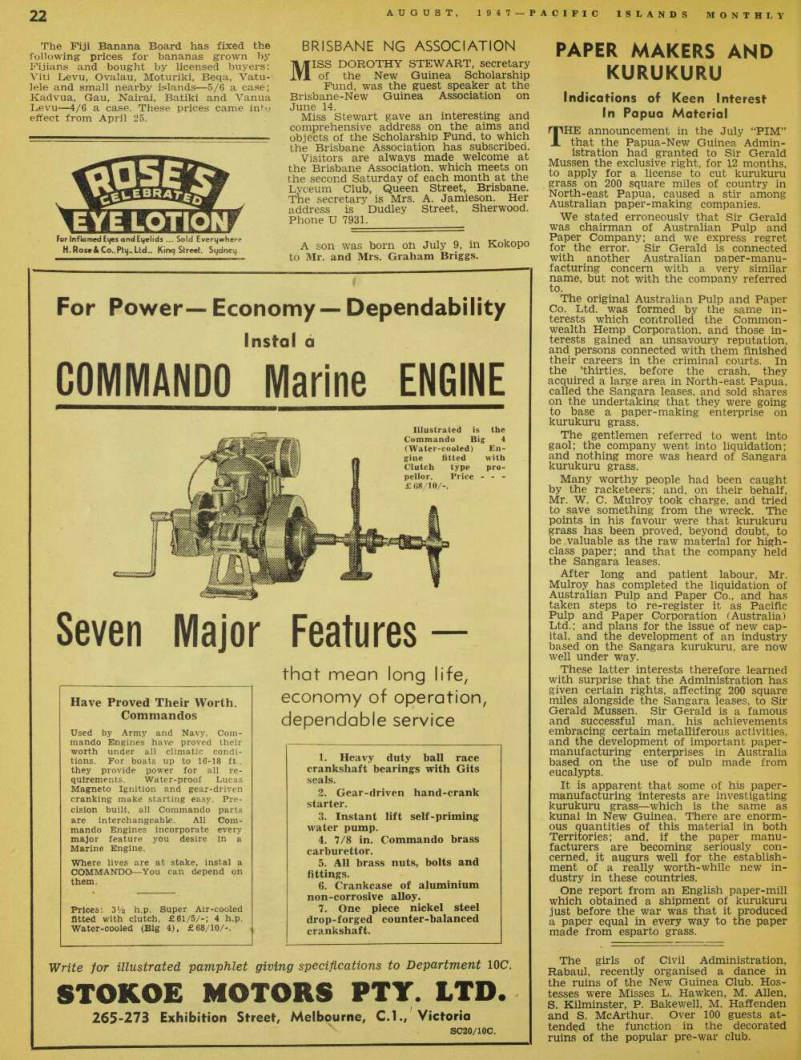
From a Special Correspondent
Madang, June 25.
AT recent native festivities at Siassi Is., local boys were farewelled be fore leaving for Rabaul, it was an nounced—and believed by those present— that all New Guinea natives who had served in the Army during the war were to be sent to Rabaul. where they were to be executed. , . . ..
This is just another example of the backwardness of New Guinea natives, who seem to have profited little m an in tellectual sense from their years of con tact with hundreds of thousands of servicemen.
The Fiji Banana Board has fixed the following prices for bananas grown by Fijians and bought by licensed buyers: Viti Levu, Ovalau, Moturiki, Beqa, Vatu lele and small nearby islands —5/6 a case; Kadvua, Gau, Nairai, Batiki and Vanua Levu —4/6 a case. These prices came irbu effect from April 25.
Advertisements & other items, pp. 22-24 (3 items)
20
August, ihUfacific islands monthly
The Key to Kur nitty . • -
Sometimes men think that a general education or an elementary knowledge of business is enough to get ahead. But experience soon teaches that thorough, specialised training is just as necessary for success in business as it is in the professions of Law, Medicine or Dentistry. If you are interested in the many opportunities in the Business World ... if you seek responsibility, success and economic security, commence training now —in some specialised business subject. H.R.I. is available always to help and advise ambitious men and women. Write or wire for particulars and career information.
H.R.I. tutorial service is proved by the winning of more honours than all coaches in Australasia combined.
H.R.I. Career Training • ACCOUNTANCY • SECRETARYSHIP • COST ACCOUNTANCY
• PRACTICAL BOOKKEEPING • MARKETING SELLING
ADVERTISING • BANKING • LOCAL GOVERNMENT EXAMS.
aj Robertson Institute
Founded and Owned by Hemingway & Robertson Pty. Ltd.
Consulting Accountants :: Professional Tutors
126 BANK HOUSE, BANK PLACE, MELBOURNE
126 CHALFONT CHAMBERS, 142 PHILLIP STREET, SYDNEY
"'Ss-S’L
I nterns and R«^ erat
for lamps, la^ rns
JH.
~W7MT
Laurel burns without smoke, soot or smell giving perfect satisfaction in all kerosene burning equipment—lamps, refrigerators, lanterns and oil cooking stoves.
LAUREL
KEROSENE
L 4646
VACUUM OIL COMPANY PTY. LTD
m V K
VACUUM
QUALITY PRODUCT
fine, in Aust.l
a
EYE LOTION
For Inflamed Eyes and Eyelids ... Sold Everywhere H. Rose 4 Co.. Pty. Ltd., Kinq Street. Sydney
For Power—■ Economy Dependability
Instal a
COMMANDO Marine ENGINE
Illustrated is the Commando Big 4 (Water-cooled) Engine fitted with Clutch type propellor. Price - - - £OB/10/-.
Seven Major Features
Have Proved Their Worth.
Commandos Used by Army and Navy, Commando Engines have proved their worth under all climatic conditions. For boats up to 16-18 ft., they provide power for all requirements. Water-proof Lucas Magneto Ignition and gear-driven cranking make starting easy. Precision built, all Commando parts are interchangeable. All Commando Engines incorporate every major feature you desire in a Marine Engine.
Where lives are at stake, instal a COMMANDO —You can depend on them.
Prices; 3V2 h.p. Super Air-cooled fitted with clutch, £6l/5/-; 4 h.p.
Water-cooled (Big 4), £6B/10/-.
that mean long life,
economy of operation,
dependable service
1. Heavy duty ball race crankshaft bearings with Gits seals. 2. Gear-driven hand-crank starter. 3. Instant lift self-priming water pump. 4. 7/8 in. Commando brass carburettor. 5. All brass nuts, bolts and fittings. 6. Crankcase of aluminium non-corrosive alloy. 7. One piece nickel steel drop-forged counter-balanced crankshaft.
Vrite for illustrated pamphlet giving specifications to Department 10C
STOKOE MOTORS PTY. LTD.
265-273 Exhibition Street, Melbourne, C. 1., Victoria '
SC2O/10C.
Brisbane Ng Association
MISS DOROTHY STEWART, secretary of the New Guinea Scholarship Fund, was the guest speaker at the Brisbane-New Guinea Association on June 14.
Miss Stewart gave an interesting and comprehensive address on the aims and objects of the Scholarship Fund, to which the Brisbane Association has subscribed.
Visitors are always made welcome at the Brisbane Association, which meets on the second Saturday of each month at the Lyceum Club, Queen Street, Brisbane.
The secretary is Mrs, A. Jamieson. Her address is Dudley Street, Sherwood.
Phone U 793 L A son was born on July 9, in Kokopo to Mr. and Mrs. Graham Briggs.
Kurukuru
Paper Makers And
Indications of Keen Interest In Papua Material
THE announcement in the July “PIM” that the Papua-New Guinea Admin istration had granted to Sir Gerald Mussen the exclusive right, for 12 months, to apply for a license to cut kurukuru grass on 200 square miles of country in North-east Papua, caused a stir among Australian paper-making companies.
We stated erroneously that Sir Gerald was chairman of Australian Pulp and Paper Company; and we express regret for the error. Sir Gerald is connected with another Australian paper-manu facturing concern with a very similar name, but not with the company referred to.
The original Australian Pulp and Paper Co. Ltd. was formed by the same in terests which controlled the Common wealth Hemp Corporation, and those in terests gained an unsavoury reputation, and persons connected with them finished their careers in the criminal courts. In the ’thirties, before the crash, they acquired a large area in North-east Papua, called the Sangara leases, and sold shares on the undertaking that they were going to base a paper-making enterprise on kurukuru grass.
The gentlemen referred to went into gaol; the company went into liquidation; and nothing more was heard of Sangara kurukuru grass.
Many worthy people had been caught by the racketeers; and, on their behalf, Mr. W. C. Mulroy took charge, and tried to save something from the wreck. The points in his favour were that kurukuru grass has been proved, beyond doubt, to be valuable as the raw material for high class paper; and that the company held the Sangara leases.
After long and patient labour, Mr.
Mulroy has completed the liquidation of Australian Pulp and Paper Co., and has taken steps to re-register it as Pacific Pulp and Paper Corporation (Australia) Ltd.; and plans for the issue of new cap ital, and the development of an industry based on the Sangara kurukuru, are now well under way.
These latter interests therefore learned with surprise that the Administration has given certain rights, affecting 200 square miles alongside the Sangara leases, to Sir Gerald Mussen. Sir Gerald is a famous and successful man, his achievements embracing certain metalliferous activities, and the development of important paper manufacturing enterprises in Australia based on the use of nulp made from eucalypts.
It is apparent that some of his paper manufacturing interests are investigating kurukuru grass—which is the same as kunai in New Guinea. There are enorm ous quantities of this material in both Territories; and, if the paper manu facturers are becoming seriously con cerned, it augurs well for the establish ment of a really worth-while new in dustry in these countries.
One report from an English paper-mill which obtained a shipment of kurukuru just before the war was that it produced a paper equal in every way to the paper made from esparto grass.
The girls of Civil Administration, Rabaul, recently organised a dance in the ruins of the New Guinea Club. Hos tesses were Misses L. Hawken, M. Allen, S. Kilminster, P. Bakewell, M. Haffenden and S. McArthur. Over 100 guests at tended the function in the decorated ruins of the popular pre-war club.
In Micronesia
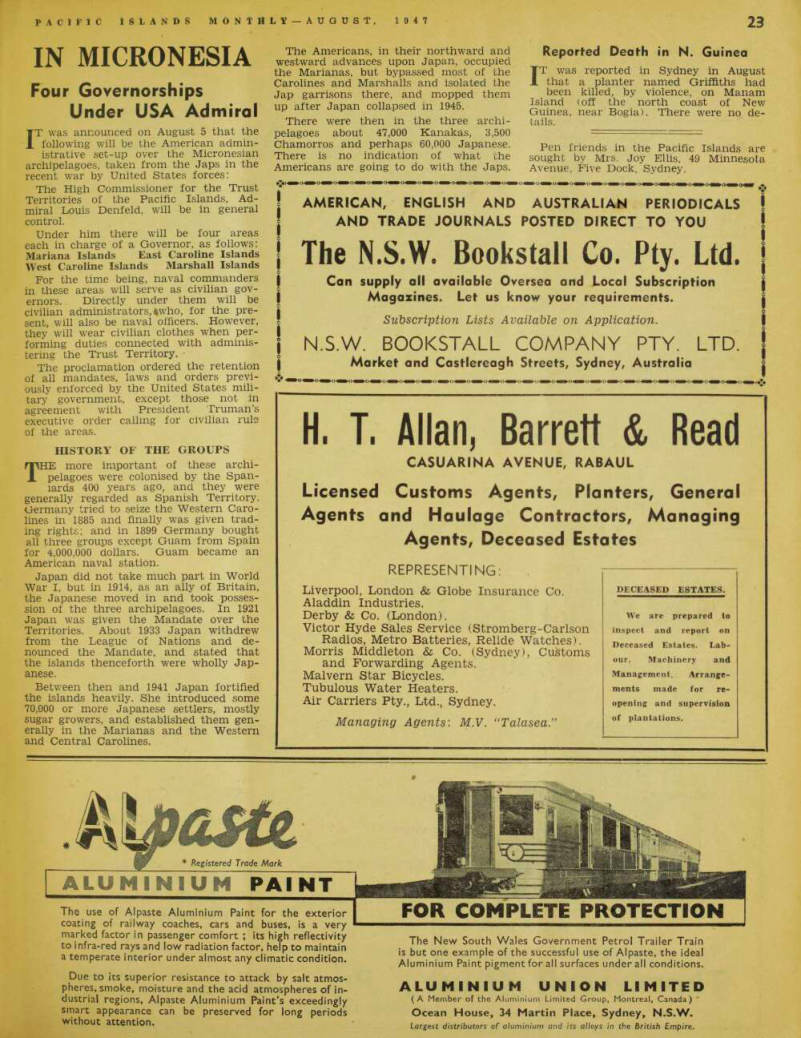
Four Governorships Under USA Admiral
IT was announced on August 5 that the following will be the American admin istrative set-up over the Micronesian archipelagoes, taken from the Japs in the recent war by United States forces; The High Commissioner for the Trust Territories of the Pacific Islands, Ad miral Louis Denfeld, will be in general control.
Under him there will be four areas each in charge of a Governor, as follows; Mariana Islands East Caroline Islands West Caroline Islands Marshall Islands For the time being, naval commanders in these areas will serve as civilian gov ernors. Directly under them will be civilian administrators, |who, for the pre sent, will also be naval officers. However, they will wear civilian clothes when per forming duties connected with adminis tering the Trust Territory.
The proclamation ordered the retention of all mandates, laws and orders previ ously enforced by the United States mili tary government, except those not in agreement with President Truman’s executive order calling for civilian rule of the areas.
History Of The Groups
THE more important of these archi pelagoes were colonised by the Span iards 400 years ago, and they were generally regarded as Spanish Territory.
Germany tried to seize the Western Caro lines in 1885 and finally was given trad ing rights; and in 1899 Germany bought all three groups except Guam from Spain for 4,000,000 dollars. Guam became an American naval station.
Japan did not take much part in World War I, but in 1914, as an ally of Britain, the Japanese moved in and took posses sion of the three archipelagoes. In 1921 Japan was given the Mandate over the Territories. About 1933 Japan withdrew from the League of Nations and de nounced the Mandate, and stated that the islands thenceforth were wholly Jap anese.
Between then and 1941 Japan fortified the islands heavily. She introduced some 70,000 or more Japanese settlers, mostly sugar growers, and established them gen erally in the Marianas and the Western and Central Carolines.
The Americans, in their northward and westward advances upon Japan, occupied the Marianas, but bypassed most of the Carolines and Marshalls and isolated the Jap garrisons there, and mopped them up after Japan collapsed in 1945.
There were then in the three archi pelagoes about 47,000 Kanakas, 3,500 Chamorros and perhaps 60,000 Japanese.
There is no indication of what the Americans are going to do with the Japs.
Reported Death in N. Guinea
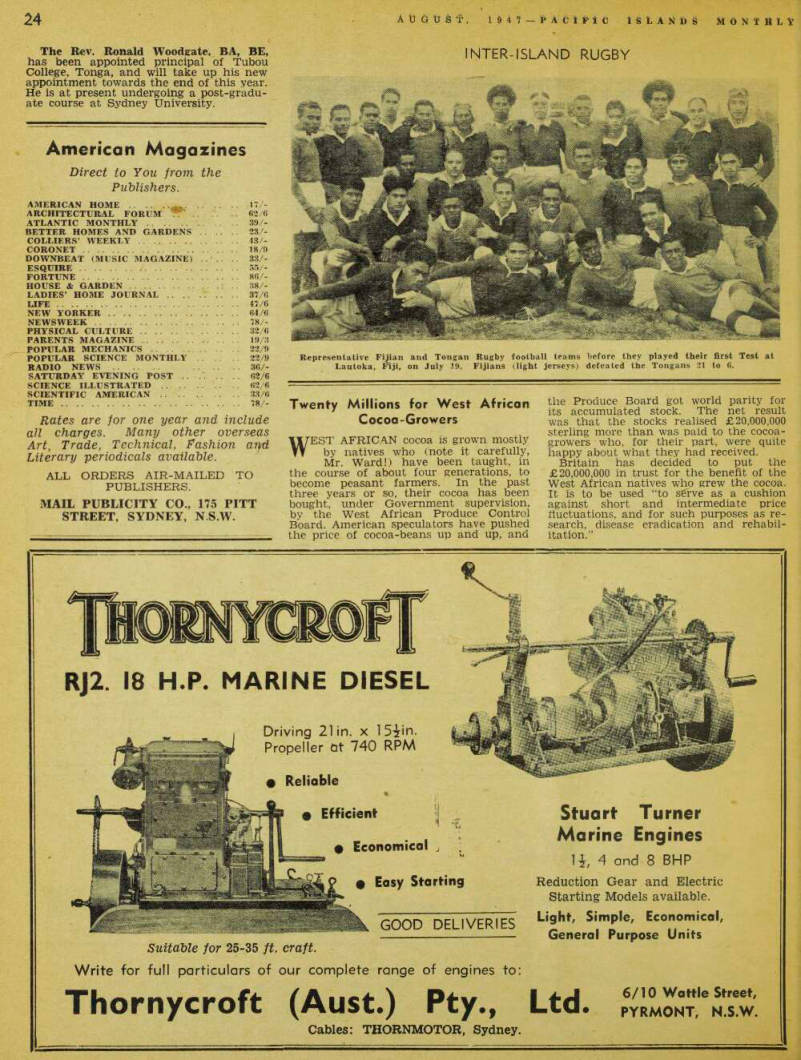
IT was reported in Sydney in August that a planter named Griffiths had been killed, by violence, on Manam Island (off the north coast of New Guinea, near Bogia). There were no de tails.
Pen friends in the Pacific Islands are sought by Mrs. Joy Ellis, 49 Minnesota Avenue, Five Dock, Sydney.
The Rev. Ronald Woodgate, BA, BE, has been appointed principal of Tubou College, Tonga, and will take up his new appointment towards the end of this year.
He is at present undergoing a post-gradu ate course at Sydney University.
Advertisements & other items, pp. 25-26 (2 items)
23
PACIFIC ISLANDS MONtIILY— A U G tJ S T, 1947
Mfi&ste
AMERICAN, ENGLISH AND AUSTRALIAN PERIODICALS
AND TRADE JOURNALS POSTED DIRECT TO YOU
The N.S.W. Bookstall Co. Pty. Ltd.
Can supply all available Oversea and Local Subscription Magazines. Let us know your requirements.
Subscription Lists Available on Application.
N.S.W. BOOKSTALL COMPANY PTY. LTD.
Market and Castlereagh Streets, Sydney, Australia
H. T. Allan, Barrett & Read
CASUARINA AVENUE, RABAUL
Licensed Customs Agents, Planters, General
Agents and Haulage Contractors, Managing
Agents, Deceased Estates
REPRESENTING:
Liverpool, London & Globe Insurance Co.
Aladdin Industries.
Derby & Co. (London).
Victor Hyde Sales Service (Stromberg-Carlson Radios, Metro Batteries, Relide Watches).
Morris Middleton & Co. (Sydney), Customs and Forwarding Agents.
Malvern Star Bicycles.
Tubulous Water Heaters.
Air Carriers Pty., Ltd., Sydney.
DECEASED ESTATES.
We are prepared to inspect and report on Deceased Estates. Labour, Machinery and Management. Arrangements made for reopening and supervision Managing Agents : M.V. “Talasea” of plantations.
Mfi&ste
WW * Registered Trade Mark
ALUMINIUM PAI NT
The use of Alpaste Aluminium Paint for the exterior coating of railway coaches, cars and buses, is a very marked factor in passenger comfort ; its high reflectivity to infra-red rays and low radiation factor, help to maintain a temperate interior under almost any climatic condition.
Due to its superior resistance to attack by salt atmospheres, smoke, moisture and the acid atmospheres of industrial regions, Alpaste Aluminium Paint’s exceedingly smart appearance can be preserved for long periods without attention.
FOR COMPLETE PROTECTION
The New South Wales Government Petrol Trailer Train is but one example of the successful use of Alpaste, the ideal Aluminium Paint pigment for all surfaces under all conditions.
ALUMINIUM UNION LIMITED
(A Member of the Aluminium Limited Group, Montreal, Canada) ’
Ocean House, 34 Martin Place, Sydney, N.S.W.
Largest distributors of aluminium and its alloys in the British Empire.
American Magazines
Direct to You from the
Publishers.
AMERICAN HOME HZ-
ARCHITECTURAL FORUM 63/6
ATLANTIC MONTHLY 397-
BETTER HOMES AND GARDENS 23/-
COLLIERS’ WEEKLY 437-
CORONET 18/9
DOWNBEAT (MUSIC MAGAZINE) ... . 337-
ESQUIRE 557-
FORTUNE 867-
HOUSE & GARDEN 387-
LADIES’ HOME JOURNAL 37/6
LIFE 47/6
NEW YORKER 64/6
NEWSWEEK 787-
PHYSICAL CULTURE 32/6
PARENTS MAGAZINE 19/3
POPULAR MECHANICS 22/9
POPULAR SCIENCE MONTHLY 22/9
RADIO NEWS 36/-
SATURDAY EVENING POST . . 62/6
SCIENCE ILLUSTRATED 62/6
SCIENTIFIC AMERICAN 33/6
TIME 78/-
Rates are for one year and include
all charges. Many other overseas
Art, Trade, Technical, Fashion and
Literary periodicals available.
ALL ORDERS AIR-MAILED TO
PUBLISHERS.
MAIL PUBLICITY CO., 175 PITT
STREET, SYDNEY, N.S.W.
Inter-Island Rugby
Representative Fijian and Tongan Rugby football teams before they played their first Test at Lautoka, Fiji, on July 39. Fijians (light jerseys) defeated the Tongans 31 to 6.
Mr. R. Dierke, of Kokopo NG, was married to Mrs. Ives, of Melbourne, in the Catholic Church at Valavalo, near Rabaul, on June 8.
The engagement has been announced of Miss Lesley Hawken, of Rabaul, to Mr. Neville Holland, of Civil Adminis tration, Rabaul. Mr. Holland is a son of Dr. E. A. Holland, formerly well known in Kavieng, New Ireland.
Twenty Millions for West African
Cocoa-Growers
WEST AFRICAN cocoa is grown mostly by natives who (note it carefully, Mr. Ward!) have been taught, in the course of about four generations, to become peasant farmers. In the past three years or so, their cocoa has been bought, under Government supervision, by the West African Produce Control Board. American speculators have pushed the price of cocoa-beans up and up, and
the Produce Board got world parity for its accumulated stock. The net result was that the stocks realised £20,000,000 sterling more than was paid to the cocoa growers who, for their part, were quite happy about what they had received.
Britain has decided to put the £20,000,000 in trust for the benefit of the West African natives who grew the cocoa.
It is to be used “to s6rve as a cushion against short and intermediate price fluctuations, and for such purposes as re search, disease eradication and rehabil itation.”
Advertisements & other items, pp. 26-28 (1 item)
Thornycroft (Aust.) Pty., Ltd
m D
RJ2. 18 H.P. MARINE DIESEL
Driving 21 in. x 1 Propeller Ot 740 RPM • Reliable • Efficient • Economical • Easy Starting
GOOD DELIVERIES
s t- Suitable for 25-35 ft. craft.
Write for full particulars of our complete range of engines to:
Thornycroft (Aust.) Pty., Ltd
Cables: THORNMOTOR, Sydney.
Stuart Turner
Marine Engines
li, 4 and 8 BHP Reduction Gear and Electric Starting Models available.
Light, Simple, Economical, General Purpose Units 6/10 Wattle Street,
PYRMONT, N.S.W.
-V m. *» (2) No 246
U.iE STANDARD BURGESS
No. 2 CELLS
£ .
X : : No 92
mfil
(D if/
LONG
LASTING
BATTERIES
FOR
EVERY
PURPOSE
Hill
fm Breathtaking Beauties! Burgess introduces two popular pocket penlights . . . coupled with the allure of the world's most beautiful girls!
A PAIR OF POPULAR, FAST SELLING POCKETLIGHTS ON NEW ALLURING DISPLAY CARDS: (1) Streamstyled Penlight No. 246. . . polished to a bright and glistening finish. Equipped with pocket dip . . . Lock-on type switch. A Burgess first! (2) Rich maroon and chrome Penlight No. 92 ... a sturdy metal case with pocket clip and lock-on switch
AVAILABLE FROM YOUR LOCAL STORE OR
PACIFIC ISLANDS TRADING COMPANY
244 CALIFORNIA ST., SAN FRANCISCO 11, CAL., U.S.A.
Cable Address; PITCO
\f\c
SPECIALISING
IN
PACIFIC ISLAND INSURANCES
FIRE MOTOR VEHICLE
MARINE HULLS AND CARGO
EMPLOYER’S LIABILITY
GUARANTEES including those for—
DYNAMITE PERMITS.
RECRUITERS’ LICENCES.
DEFERRED WAGES
AND ALL OTHER CLASSES ARRANGED
AT LOWEST CURRENT RATES.
Established Agencies:
W. R. CARPENTER & CO., LTD.
Throughout the Territory ol New Guinea.
SOUTHERN PACIFIC INSURANCE
CO., LTD.
HEAD OFFICE; 60 HUNTER STREET.
SYDNEY.
A'
OR Y
BEHIND
THE
SWALLOW
! ; 31*
SWALLOW ft AfiIELL
LIMITED
LEADERS IN THE BISCUIT INDUSTRY SINCE ISB4 ■ JKMI ALN $f THE NEMiI tWALUW A AMU IWH fdttlMC. CEEIt i*t ICE CKIAM
“FOWLS nn Til FISSBSBIT
In the year 1787, the commanders of ships of the first English fleet to lie at anchor in Australian waters compared melancholy notes. Said Captain Brown of the Fishburn, on the heavy losses suffered during the voyage by a complement of fowls—“ Verily, I have lost three dozen fowls out of four dozen. I believe that the rogues at the Cape gave something to the stock we purchased there to occasion such a fatality.”
However, despite similar reports from the Prince of Wales and the Golden Grove, the census of livestock in the settlement in 1788 showed 122 fowls and 87 chickens. By 1796 poultry was plentiful in Sydney, and full grown fowls were selling from sixpence to one shilling each.
Today, the poultry industry flourishes in Australia. In Victoria alone is the largest single poultry farm in the world, stocking some 100,000 birds, while in 1940 Australian poultry interests produced for export alone some 18 million eggs.
Tie finest and best of Australia’s fresh, golden-yolked eggs go into the making of Swallow & Ariell biscuits, cakes and plum puddings—ensuring that finer quality —that added goodness—inherent in every Swallow & Ariell product. When you buy Swallow & Ariell you buy the highest quality foodstuffs that Australia can produce.
Count Van Asten
Old Tongan Resdent Inherits A Dutch Title
AN old residient of Tonga, Mr. F. T, Goedicke, has been informed that he has inherited an old Dutch title, and may call himself Count van Asten.
Count Hendrick van Asten, of Asten, North Brabant, Holland, died some time ago, and a long search disclosed that Mr.
Goedicke, through his mother, was the only surviving relation. He was formally advised that he was heir to the late Count’s title and estates. The Count left about £20,000, which was deposited in a bank at Asten; but it was all looted or destroyed when the Germans invaded Holland in 1940. The bank made a claim upon the Dutch equivalent of our War Damage Commission, but it was not en tertained, as all records had been lost in the bombing, and the depositor (the Count) was dead.
Mr. Goedicke’s great-grandfather was a Dutch General who distinguished him self in 1798 in the war against Spain, and gained a title, but his son went into the Church and gave up the title. He married Caroline van Asten, daughter of the Count van Asten of that day.
“So I’m a Count of no account,” writes Mr. Goedicke, “but I will call myself Goedicke-van Asten. I have told my son, who lives in Devonport, Auckland, that if, after my death, he cares to use the title of Count, which is hereditary, he will have my blessing.”
Mr. Goedicke was a resident of New Guinea 60 years ago, and knew the German Governor, “Queen” Emma For sayth, and other interesting people of that period.
More Japs Discovered in
New Guinea Presence Revealed by Inter-Village Feud
From a Special Correspondent EMACIATED, ragged, and suffering from beri-beri and tropical ulcers, three diminutive Japanese arrived in Rabaul from Madang recently under escort. They had hidden in the Bogad jim area since the war ceased.
One said he was a doctor, another one was an electrician, while the third stated that he was an ironworker. The “doctor” said they were making for “soda water” (he could speak a limited amount of Pidgin English, which he said the kanakas taught him), and it may be that their salt supply had run out.
He said that they had built a large garden and grew root crops and an abundance of tropical fruits, etc.
Native police think that they were hidden away by natives and that when inter-village factions quarrelled over some other matter, vindictive natives re ported the Jap’s presence to Yali, in fluential ex-AIB sergeant-major, whose widespread propaganda is being used by the Administration.
The 105th US Army Hospital now dis banded has handed over to the French Oceanic Institute, Noumea, a library of between 4000 and 5000 English books, which the Institute is making available to New Caledonian residents who are able to read English. The library will be a boon to Noumea’s ex-Australian resi dents.
Advertisements & other items, pp. 29-30 (1 item)
re/re^n
/4fiatA£cnj
~yotc M 44
ANA
TOOTH PASTE
IP AN A helps your smile by thoroughly cleaning and brilliantly polishing your teeth. And IP ANA’S refreshingly different taste is grand —it makes your mouth feel good. With massage, too, IP ANA helps ensure firm, healthy gums so vital to sound teeth.
re/re^n
Mffetexf.
a / 4.
'h o^> GO *o* M V m •w & X, oN &
VETERINARY
INSTRUMENTS
For Sheep and Cattle can be
Supplied Immediately
EARMARKERS.
SPEYING INSTRUMENTS.
BULLRINGS.
FIRE BRANDS.
EMASCULATORS.
W. JNO. BAKER
PTY. LTD.
3 Hunter Street, Sydney, N.S.W., Australia
you CUM he s*** °f
MOTOR
SPlßi r E THE SHELL COMPANY OF AUSTRALIA LIMITED (Inc. in Gt. Britain) 5471 J
Deed of Cession Monument
THE four marble tablets which were part of the old Deed of Cession Memorial near the now demolished Government Buildings, Suva, have been preserved and will be incorporated in a monument to be erected in front of the Supreme Court, Suva.
The marble tablets commemorate the signing of the Deed of Cession, the reign of Cakobau and the jubilee of Queen Victoria. The old buildings were cleared away some months ago to make room for the new Anglican cathedral.
It is hoped that the new monument will be completed in time for Cession Day, which is October 10.
The French decree authorising the establishment of a casino at Noumea has been published in the Journal Ofiiciel of New Caledonia.
One Happy Night in New Guinea
New Guinea
Finschhafen, July 16.
STAGED primarily as a combined valedictory to RAAF, the Bannigans and the Whites, it was coincidental that New Guinea’s largest and most suc cessful post-war social function at the Finschhafen Hall should take place the same day as the arrival of HMAS “Kanimbla” with occupational troops for Japan.
Aboard was distinguished Australian Dr. Evatt (Minister for External Affairs) en route to Japan; and he joined in the conviviality of the occasion.
Efficiently organised by Mrs. J. R.
Keenan, attractive wife of the Assistant- District Officer, the “Evening” was unique for its variety of entertainment, galaxy of display and the abundance of refreshment.
Gaily adorned with bunting and bril liant tropical flowers, the hall was greatly admired by “Kanimbla’s” passengers, especially the Army sisters, who not be fore had experienced the delights of such a tropical night.
Long-frocked women danced to the rhythm of excellent music with high ranking, gold-braided naval officers, dignatories of the RAAF, and civilians In immaculate evening attire.
Nearby was the palm-fringed coral shore, with gentle breezes rippling the shimmering waters. A myriad of tasty delicacies had been skilfully prepared by “Tarangau’s” famous chef. Smart, dapper, well-trained, pre-war natives, clad in short, well-starched lava-lavas, revelled in their masters* hilarity. Fleet of foot, they dashed hither and thither, holding aloft great trays of sparkling beer. Breezy American officers from the US War Graves Registration unit paid tribute to the occasion. All Finschhafen turned out to welcome the revival of those happy pre-war New Guinea nights that must surely come again.
Wau-Labu Road
IT is reported from Lae that the road between Labu (at the mouth of the Markham) and the goldfields area is now in a much better state of repair. All Public Works duties have been taken over by the Commonwealth Department of Works and Housing, which has had much pressure brought to bear upon it by local citizens.
Lae residents had the town water sup ply tested by the School of Tropical Medicine in Sydney—with what results is not stated. A year ago this water was declared to be unfit for human consump toin, and ships calling at Lae were unable to take on water.
Mr. Richard W. Tebb. of Lae, New Guinea, has been granted a District Licence under the Auctioneers’ Ordinance for the District of Morobe.
A book by Mrs. Kathleen Mellen of Honolulu well shortly be published by Hastings House, NY. It is called “In a Hawaiian Valley,” and is illustrated by drawings by artist Madge Tennant. Mrs.
Tennant’s husband, Hugh Tennant, is a New Zealander who was at one time an official In Samoa.
Samoans have a short way with care less motorists. During the recent LMS Malua Meeting, Western Samoa, an Apia taxi-driver ran over and killed a child The indignant inhabitants of the village of Fasitoouta, where the accident occurred, gave the driver of the taxi a thorough thrashing.
Advertisements & other items, p. 30 (1 item)
28
AY?Otl S T. 1947 PACIFIC ISLANDS MONTtiIJ
Czar Of The Oils
Industries
UNILEVER, Unchallenged Inter national Cartel, is Prominent Again
By John Williams.
Honolulu. June 12.
THE most disturbing post-war news for many people of the Pacific and South-east Asia is the recent de cline in world copra prices.
It will embarrass millions of people, but it will fatten the semi-secret international copra cartel which is controlled by joint British-Dutch soap interests, and interests in Australia which are subsidiaries of the cartel, or are associated with it.
Has the Australian Government the honesty of purpose to do something about this situation? Dr. Evatt. the publicised and “crusading” Australian Attorney- General, has the authority to do some thing. Has he the courage?
The American Associated Press, on De cember 26, 1946, released a message from Manila, which said: “Stimulated by high world prices, Philippine copra production available for export in 1947 may reach a record of 750,000 long tons,” (The new Philippine Republic has been banking on copra remaining stable).
In May, 1947, the price of copra fell sharply at Manila. Commented the “Hono lulu Star-Bulletin” on May 30: Copra is a commodity that accounts for 75 per cent, of Philippines export. High prices have brought out at least 25,000 tons more copra than has been believed available.
Now prices in Manila have fallen 50 per cent. The United States, best customer for this product, is well stocked. Require ments are much less. . . .”
During the war, certain American
agencies made a study of the world copra situation. Highly-trained investigators discovered, and put into a report that created a stir behind the scenes at Wash ington, a picture of the world’s greatest monopoly. It is a case history of how relentless interests rig a market for their own selfish ends.
Keystone of the world monopoly is Lever Bros., makers of Sunlight, Lifebuoy, and a host of other soaps. Pepsodent tooth-paste, Lipton’s tea, etc. Research in the intelligence division of the US De partment of Commerce disclosed the vast international ramifications of the Lever network.
It showed how Levers and their Dutch subsidiary, Unilever, operated. Levers won control of the world market as a result of World War I. During that war, they jacked up the price of copra (an im portant source of the vital explosive, glycerin) and in the early years after wards they used their immense profits to secure control of world markets.
GRAPHS designed by the American investigators show that as Levers gained world control, the world prices of copra slumped. In the famous “depression” of the Thirties came the rigged low. At this point, Levers had merged completely with Unilever NV, the gigantic European subsidiary. At the same time, Levers entered the American domestic market, and expanded an Aus tralian subsidiary, which has been pro ducing copra in the South Seas since 1907.
To-day, this Australian subsidiary still controls plantations (notably in the Solomons) and, according to an American consular report, “owns a large fleet of trading vessels” and “the whole of the shares are held by Levers of England.”
“European Finance” of January 31, 1930, published in London, summarised the Lever empire: “The authorised capital of
Unilever Ltd., to-day is 165,000,000 (pounds sterling) and its interests, apart from soap, extend to almost every kind of undertaking, including banking, ship ping, engineering, mining, building, whal ing, seed crushing, chemicals, margarine...
The Australian subsidiary is responsible for the collection of the Polynesian (South Seas) copra. . .”
The British Stock Exchange official year book for 1938 reported that as a re sult of the redistribution of markets as from January 1, 1937, Unilever Ltd. would control all British Empire interests and Lever Bros, and Unilever NV (the Euro pean subsidiary) would control all non- British Empire interests. It added: “. . .
Levers own interests in over 300 associated companies, including controlling interests in Australia, New Zealand, Canada and South Africa, and 41 companies in the British Isles.”
In brief Levers can freeze world copra prices at low levels to suit their international machinations.
Lord Leverhulme, governor of the Lever 1J f S arR T? v. th Tv 0 /r fa \ S anc s oils division of the British Ministry of Food in World War 11. The British Ministry of Pood is to-day controlling the purchase and distribution of all copra produced in British countries.
The “Honolulu Star-Bulletin,” or any other source of public comment, does hot publish and analyse these official facts because Levers rigidly control comment Via Levers domination of the advertising fields—newspapers, magazines, and radio —throughout the British Empire and the United States.
Smart editors do not bite the hand that feeds them. In 1946, in America, for example, Levers spent exactly 9,530,518 dollars in newspaper, magazine and radio advertising. Money like that talks—in favour of Levers. In 1945, Levers spent in America on radio advertising alone a total of 7,274,503 dollars. The main Lever programmes were the Bob Hope show, Inner Sanctum, Lux Radio Theatre, A Woman’s Life, etc.
The same story is repeated in Aus-
tralia, where, according to “Newspaper News,” the main trade journal, Levers dominate the advertising expenditures year after year. They spend enough to make the Aus tralian daily press and radio respectful. I defy anyone to find anv thing critical of Levers octopus in the Australian press, go back as far as you like y In the issue of April 16, 1940 “PIM ” in an editorial stated: “. . The British Government’s idea of effectively con ducting the war and. as it has expressed it, ‘protecting’ the masses of people against exploitation’, is to take control of all vital industries, and then permit bureaucratic control of those industries by committees nominated by the rings and combines which formerly were trv ing to dominate them. Under pre-war conditions, the rings and combines were having a pretty good time; under war conditions, they are given almost absolute power.”
True words. Lord Leverhulme sat at the helm of the British Empire's fats and oils during the war; and, also during the war, by secret agreement with Washing ton, the Lever interests did all the buy ing of copra in the Western Pacific for
US requirements. In other words, Levers fattened on Lend-Lease.
To-day’s is a critical situation, not only in the Philippines but throughout the world, wherever copra is produced and is an economic mainstay. As represent ing the dominant nation in the Western Pacific, what is Dr. Evatt going to do about it? This writer can refer him to documented source material in London and Washington which he can use to con vict Levers out of their own mouths.
Breaking up the Lever octopus should challenge the lawyer and judge in him. It is a shut-and-closed case. The docu ments await him.
Advertisements & other items, pp. 31-32 (1 item)
Heinz
OPTICAL
PRESCRIPTIONS
Accurately and Faithfully Dispensed. (Quick Service by Air Mail) All inquiries promptly and courteously answered. Send me your Optical problems.
All Manner of Repairs Quickly Executed. Moderate Prices.
HAMILTON A. HUGHES,
Dispensing Optician. 30-32 Castlereagh St., Sydney.
Telephone . . . 85950. (In Samuels Super Drug Store, opposite Hotel Australia.)
Taste it yourself, first opportunity.
It’s delicious tip-top Heinz quality. Forthcoming nation-wide advertising campaign will link up with Counter and Window displays. Advertising will start when first consignments are delivered.
Braised
HEINZ
57
Beef Stew
€ HBS 13.
VWVWWWWWWVWmWWmHHHWVWV
ORDER NOW from
McILRATH’S
Your CHRISTMAS GROCERIES WINES
SPIRITS - LIQUEURS - CIDER - CORDIALS -
and PURE FRUIT JUICES
ALL SHIPMENTS ARE INSURED AGAINST PILLAGE, THEFT,
NON-DELIVERY
Write for our New Grocery, Wine and Spirit Price List.
Post Free by Return Air-mail.
McILRATH’S PTY. LTD.
Export Department, 202 Pitt Street, Sydney, Australia Cable address: ROTUNDA, Sydney.
W. H. GROVE £ SONS
Limited
Established 1896.
AUCKLAND
Island Traders. PO. Box 49® Telegraphic and Cable Address' “Grove”, Auckland.
Entrust Your Orders to the Firm with Fifty Years Practical Experience in the Island Trade, Shippers of all classes of New Zealand products.
Representing English Manufacturers through-
out the Cook and Society Islands, Fiji, Tonga, Samoa, Niue, New Caledonia, New Guinea, etc.
In FIJI as—W. H. Grove & Sons (Fiji) Ltd.
Kokopo Smiles
Again
Only Place in NG Which Really Enjoys Rehabilitation
THE progress of rehabilitation in the Kokopo district is probably the most rapid in New Guinea, writes a cor respondent.
Mr. V. Pennefather, of Tokua planta tion, has constructed a nice bungalow on his place. It is good to see the progress he is making, ably assisted by his wife.
He is producing copra now, even though the labour (casual) is a serious handi cip. He is an example of what an ex perienced man can do despite adverse circumstances.
Mr. Norman Duncan and his wife are re-establishing themselves on their pro perty, “Tamililli.” They also are back to copra production. At present they are living in a temporary home. They are building a Quonset bungalow; and this will be a very nice home, with modern conveniences. Norman’s dad, Skipper Duncan, is a frequent and very interested visitor.
Mr. and -Mrs. Jack Allan are well established on their place, “Gilalum.” For a while their casual labour supply was good and rehabilitation progress was correspondingly good. Their homestead Is a picture, and the plantation, a young one, looks really fine. They are now pro ducing copra and cocoa. Unfortunately, labour troubles are now hampering them.
This trouble, of course, is common throughout New Guinea.
Mr. Theo Thomas and wife, with their small daughter, Rosslyn, have re-estab lished themselves at Bita Paka, on the site of their old home. Their home, a Quonset bungalow, is set in very picturesque surroundings. Theo has been in production for over six months. Re cently, he purchased “Rainau” plantation from Mr. Oscar Rondahl. “Rainau” was the former home of the late .Mrs.
Schmidt, well-known and respected pioneer of the Kokopo district.
Kokopo is getting back to its former prosperity and popularity. The re-estab lished Kokopo Sports Club is the social centre of the district, and it is good to see the old residents enjoying their week ends at cricket, tennis and swimming.
Kokopo has a fine native hospital.
There are some 400 patients being care for by two very able gentlemen—Messrs.
Joycie and Kerr.
Mr. Willie Rowe, smiling and popular, has returned to Kokopo and is a busy man, settling in at “Ravalien.” The Rowe Brothers have several properties in the district.
The Rev. Francis Auld, lately of Shef field, has gone to Apia, where he will be next to the Rev. H. W. Whyte, MA, in charge of the LMS organisation in Western Samoa. Mr. Auld was for several years a district secretary in Britain.
Americans on Nauru
PERHAPS this heading is misleading.
But to my way of thinking, they are still Americans, even though they are dead. They did not come here by any of the usual means, although a few years ago I do not suppose it would be considered unusual to have made your entry in a crashing aircraft. These fel lows did —four terribly fine men whose remains now lie in a lonely graveyard on a tiny island of the Central Pacific.
I say they were fine fellows, even though I never met them. There must be greatness in any person who is willing to risk his skin—and so far away from home. And they were not fighting for their soil, either; they knew Nauru was British and not American.
The Australians found their bodies shortly after the reoccupation, in Sep tember, 1945, and reinterred them in what has become known as the American cemetery. The four graves are well looked after; the Nauruans have a great respect for ‘the dead, particularly for those who acquire nobility by their deeds.
One of these fellows has been here since December 9, 1943, and another crashed on June 30, 1944. One would think the Americans would have been over by now and gathered up the remains of these heroes. Perhaps they are too busy in other parts of the Pacific, although we told their HQ in Tarawa about them the year before last.
Whatever happens, it may interest other Americans to know that four of their kith and kin are on Nauru, that their graves are bright with the colours of hibiscus and frangipanni, and that they are among friends.—A.S.
Small Increase In Nauruan
Population
THE native population of Nauru is again on the increase. Official figures, issued on April 30, showed the total native population of the island as 1,376 —24 more than for the previous year.
This figure, however, is 512 less than than shown by a census in 1942, at the time of the Japanese invasion.
Almost 30 per cent, of the Nauruans were wiped out during the Japanese occupation, and those who did survive have not yet completely recovered from the effects of that period. On a com parative basis, Australia would have lost 2% millions of her population.
At a recent meeting of the Nauruan Council of Chiefs, financial plans for the next 20 years were discussed. Of the male population, over 16 years of age, 78 per cent, are employed by the Admin istration or by the British Phosphate Commission as tradesmen, clerks, typists, wireless operators, transport drivers, gen eral labourers, etc.
Besides the native Nauruans there are on the island 192 Europeans, about 1,100 Chinese and 31 Gilbertese.
Death Of Mrs. Jessie
Anderson
FRIENDS of Captain C. O. Anderson, well-known seafarer of the South West Pacific, will regret to learn of the death of his wife, Jessie, on July 14, after a brief illness in Samarai, Papua.
Mrs. Anderson went to Samarai in 1908 and lived there until 1921, when she took her children to Brisbane to finish their education.
Captain Anderson retired from the sea in 1939 and settled on a plantation near
Samarai. He was joined by Mrs. Ander son and their daughter Elsie who lived there until the general evacuation in 1942 They returned to their plantation in 1946.
Mrs. Anderson is survived by her hus band, three sons, three daughters and several grandchildren.
Mr. Jack Ahearn, of the APC, arrived by plane from Port Moresby last month.
Advertisements & other items, p. 33 (1 item)
Colycr Watson (New Guinea) Ltd.
® LOOK !
1 (T
KOCH'S BARBER CHAIRS
Obtainable Soon
PACIFIC ISLANDS TRADING
COMPANY
244 California St., San Francisco, Cal.
Colycr Watson (New Guinea) Ltd.
Head Office: RABAUL Branches: Kavieng, New Ireland, and at 22 Bridge Street, Sydney
GENERAL MERCHANTS AND BUYERS
OF ISLAND PRODUCE
Plantation Owners and Engineers
Sole Distributors: Chrysler and Plymouth Cars Fargo Trucks Willys-Overland Jeeps G.M. Marine and Industrial Engines Prefect Refrfgerators Managing Agents: Union Assurance Society Ltd.
National Mutual Life Association of A/asia Ltd.
Agents: China Navigation Company
Bsi Port Of Entry

IT was announced by Gazette on June 3 that Hombu Hombu, in the western district of the British Solomons, had been appointed a Port of Entry for vessels entering the BSI from the Aus tralian Territory of New Guinea.
Hombu Hombu, presumably is in the Shortland Islands, but current maps do not show it.
The Rev. J. H. Spivey, of Abaiang, has been appointed to take charge of the
London Missionary Society’s organisation
in the Gilbert and Ellice Islands, and he has moved to LMS headquarters at Beru.
He takes the place of the Rev. G. H.
Eastman, OBE, who now has retired, but who is doing a few months’ special work in Suva before leaving the South Pacific, to live in England.
Ng Natives As
Employers
And Some Reflections!
Letter to the Editor BEFORE splashing his sensational story across the front page of Bris bane’s “Courier” the newly-arrived ex-Irishguardsman residing at Lae should have faced facts.
What if a native did offer a European a job at £2 a day? Even that is better than the average wage-plug gets from his employer in New Guinea. And, did not a European marry a lass from Han uabada recently?
Haven’t the natives at Lae been robbed by unscrupulous whites who bought CDC vehicles at a song, and sold to the un sophisticated at enormous profits? What’s
the difference between selling a rami to a native at a trade store, and actually work ing for him? The man who sells the rami relies on the native for his bread and butter —as the majority of people in Papua-New Guinea are doing to this very day.
Is not the greater portion of ex-guards man’s income derived directly or indir ectly from natives? Has he never carted a bag of rice, a case of meat, furniture or building material for a European who is engaged directly or indirectly by the Administration?
I’ve heard this “white man’s prestige” stuff over and over again from “old timers,” planters, traders and miners alike; but it didn’t concern them when their personal boys had to piggy-back them home when they were too drunk to walk! And who has not heard of the flirtations of white man-brown woman?
Is the first man in the Territory or the first man in any District working for Europeans? Not on your life! They are working solely in the interests of the native.
Profits from native trade alone would have sufficed “Steamships” to pay a div idend—l 2 months ago they were peeling £1,500 a day off the boys, in quite leg itimite trading. If that was their daily turnover, what must BP’s and others’ have been! mHERE’S a type of Europepan who con- J. demns the native at every turn— and then calmly peels the silver from him without a blush. What of the trade stores?
Does ex-Guardsman know that the Ad ministration is literally working for the native by encouraging him to commence trade stores of his own —is that not the beginning of general trading? Soon they will have stores like the Chinese had in various parts of New Guinea before the war, where any European could get a fair deal. They didn’t worry about the White Australian Policy as long as they could get a bargain. If the whites won’t finance the natives the Chinese soon will —it wasn’t the Europeans before the war who had all the money!
These reflections hurt, I know, but we must keep abreast of the times; and, it we cannot absorb the New Order, there’s only one thing—walk out.
“Ex-guardsman” will get a helping hand wherever he goes throughout New Guinea, and he should do well—if one Irish Guardsman isn’t worth ten niggers, 111 go east! He needn’t be afraid of competition. Even the most advanced Papuan natives hadn’t the elementary business instinct to insure a vessel worth hundreds of pounds, and when it was burnt to water’s level they lost all.
While a generous Australian Govern ment continues to distribute largesse throughout the Territory for the sole benefit of natives—and it looks as though we’ll have another ten years of it —everyone has a chance of cashing in on some silver, and having a good time later on.
Let’s make hay while the sun shines!
I am, etc.,
Laura Bada
New Guinea. 24/6/47.
A number of Government o facers stationed in Port Moresby took the round trip on the July “Malaita, to Samarai, Rabaul and back. Mr. Justice Phillips accompanied by Mrs. Phillips), and Mr.
W. Watkins, Legal Officer, went to Rabaul to conduct sittings of the Supreme Court.
Mr W. C. Groves, Director of Education, inspected his Rabaul organisation; Mrs.
Groves also made the trip. Mr. lan Macdonald, New Guinea representative of the Department of Post-War Recon struction, also took this opportunity to visit the old New Guinea capital.
Advertisements & other items, p. 34 (2 items)
32
AUGUST, fACIFiC ISLANDS MONTHLY
Coleman
/ H A \eSi L
WORLD-WIDE
“Pnwm ‘DcfwttCafaUty
For all the finest ... for all the latest in lighting, cooking and heating appliances you can be sure with COLEMAN. Wherever you may be there is a Coleman dealer to serve you with dependable COLEMAN appliances and service.
The Coleman Lamp
and Stove Company Limited
TORONTO, CANADA
I C A G O,
U. S. A-
for^a cost
Confused And Unconvincing
Compilation
New Scheme of Salaries for Papua-New Guinea Officials
Prom a Special Correspondent
Port Moresby. July 23.
AFTER a long period of hopeful wait ing, the new classification of the Papua-New Guinea Public Service has been made available to members of the service through the Public Service Association. The latter are considering it and, on some points, are seeking further clarification.
Members of the service have expressed no great satisfaction at the new rates, as far as they can be understood from a document which is at times difficult to follow. Based almost entirely on the Buttsworth Report, which was submitted to Canberra some months ago, it has done little to remedy the discontent already noticeable in the service. Indeed, it has in some cases seriously aggravated the situation. It is current knowledge in Port Moresby that the Administrator and his senior officers are seriously concerned about the new scales.
The matter has been discussed with the Public Service Associations, together with counter-proposals which were submitted to Canberra by the Administrator and a Committee of senior officers when the Buttsworth report first arrived in the Territory. These counter-proposals appear to have been given scant consideration.
As this classification is likely to be permanent, and as it has wide and dis turbing implications for the future of the New Guinea Administration, the follow ing analysis is as exhaustive as possible:—
The Basic Salary.
THE base salary rate for the lowest grade officers of the Second (Clerical) Division is fixed at £372 per annum.
For Third Division (Non-clerical) officers it is £354.
The method of computing this figure is set out as follows: From the Common wealth base standard salary of £292 (for a man, his wife and one child) £l9/10/is deducted for the first child. (Because in Australia only children after the first are allowed Child Endowment: whereas it is proposed to pay for each child in the Endowment Scheme recommended for New Guinea).
To the resulting £272/10/- a 35 per cent, margin is added “for higher costs in the Territory,” which brings the salary to approximately £372, which is, there fore the base rate. In addition to this there is an allowance of £26 for each child. (This is also 35 per cent, in excess of Australian rates). There is no marri age allowance, nor does the old provision that married men shall not receive less than £4OO apply to any future appointees.
This means that married men appointed in future lose on the transaction: and, further, as will be seen below, they will receive less than the rate granted in 1922!
Then, incomprehensiblv, the Minister has added a cost of living variation of £6 as from May 5, which brings the salary to £378.
“Real Wages” Lower Than In
1922.
THESE figures are computed on a harsher system than that adopted in the original NG classification in 1922.
The minimum salary for a single officer was £3OO, and all married officers on less than £4OO were given an allowance to bring them to that figure.
Cost of living then in the Territory was no more than in Australia, if not
less. At Rabaul’s hotels three meals
for^a cost
of livin S figure in the Commonwealth itself Therefore, cost of living did not en t er into the calculations which were arrived at on the following basis. To tho minimum commonwealth salary of £2OO per annum was added a loading of £lOO to provide for the disadvant ages and hardships of tropical service, the incen tive needed to attract quality personnel, the lack of amenities, isola tion from one>s normal environment, nT , d , margin npprUpd to finnnrp g T his is* hat Is i n J» load Since that date, the minimum sub
stantive salary of Commonwealth officers has been altered, according to Mr. Buttsworth, himself, to £292, in addition to which the Commonwealth officer obtains £64 as an allowance, variable, to account for the statistical discrepancy between the substantive salary and the present-day cost of liv ing. This is known as the “Cost of living allowance,” or variation.
The Counter-Proposals
THE committee of Administrative officers which considered Mr. Butts worth’s findings therefore recom
mended that to the base figure (£292) the traditional tropical loading (£100) be added, and that a further margin to account for cost-of-living variation be added to those figures. (Which is a com pletely different consideration from that of a tropical loading; Mr. Buttsworth has obviously not appreciated that quite simple distinction).
As there are no accurate cost of liv ing figures in the Territory, but as they are obviously no less than those operating in Australia, the Committee very reason ably suggested that, pending such figures, the Commonwealth rate of £64 be added to the substantive salary. Their recom mendations can be summarised as fol lows: — £ Present Commonwealth Base . salary 292 Plus tropical loading 100 Giving a basic substantive salary of 392 (which remains constant) To which is added (temporarily) the Commonwealth cost of living figure 64 Giving a total actual salary of .. 456 Actually, the Committee recommended £428, but they worked on a Common wealth base salary of £264, which was lower than that revealed to Mr. Butts worth. All these calculations would be slightly lower if separate allowance were to be made for the first child, which is proposed; but that factor is immaterial to the reasoning and the rough figure arrived at.
Economic Logic.
THEIR reasoning, then, seems eminently reasonable. It would only remafn to fix a cost of living index for the Territory to correspond with the Com monwealth index. (All this is economically equivalent to
the procedure proposed in June “PIM,” ex cept that there a tropical loading was ad vocated but was not put at any precise figure. “PIM” suggested that the actual Commonwealth salary be varied as cost of-living varies, which would eventually mean the same thing as adoption of the substantive Commonwealth salary plus a variable cost of living margin).
Strange Notions About Cost Of
Living.
MR. BUTTS WORTH has not allowed the tradditional sort of tropical load ing at all. He has quite arbitrarily de cided that cost of living in New Guinea is 35 per cent, in excess of the Australian level, but, strangely enough, has taken 35 per cent., of the Commonwealth sub stantive salary of £292, instead of the actual salary paid to meet Australian cost of living, which is £356. By taking 35 per cent, of the actual Australian salary, therefore, Mr. Buttsworth would arrive at a considerably higher figure; whereas the figure he recommends (£372) is only 5 per cent, in excess of the actual Australian salary of £356. So that Mr. Buttsworth has worked himself around to a procedure which sabotages his own arbitrary figure of 35 per cent.
It is fantastic to suggest that an officer in New Guinea only needs 5 per cent, more than an officer in Australia. Such an hypothesis is going to lead a lot of people into the Bankruptcy Courts.
This is in flat contrast to the Common wealth’s own procedure for those of its own servants required to serve in the Territory. They get their Commonwealth salary plus their Commonwealth cost of living variation, plus £l2O tropical load ing. (£292, plus £64, plus £l2O, gives a figure of £476).
Then comes the strangest provision of all, Since March, the Commonwealth cost of living has risen by £6. (In March
it was £sB>. And this £6 is to be added to the Territory salaries, which were originally fixed as at March. So that, although there is no reference to the Commonwealth cost of living figure in any original calculations, its rise of £6 is incorporated.
Further fantasy is introduced when it is realised that there is no reason why Commonwealth figures should not fall at some stage, thus lowering the substantive Territory salary below £372.
Tropical Loadings.
THE failure to allow the usual tropical loading to compensate for the general conditions of tropical service is a reactionary step in Administrative history.
Without such a loading, and with the harsh stupidities of the Buttsworth find ings, this Territory is not likely to attract one single officer of great merit. Already many good men have resigned, and many more intend to do so if this classification is not repealed very quickly.
It is even doubtful whether the officers of the School of Pacific Administration would be so desirous of running the country, or so solicitous of its welfare, on £372 per annum! And it is interesting to note that the Principal of the School receives £l2OO per annum for his services, whereas the Anthropologist to be appointed in the Territory, and who in a normal colonial organisation would surely be an important adviser, is to receive £834-906.
Salaries in senior positions are con sidered adequate, a representative figure being that paid to the Directors of the technical departments: £1,050-1,200.
But (as predicted in June “PIM”, Mr.
Buttsworth has shown little knowledge of the principles of wage-fixing, the elementary conventions of logic or the rules of simple mathematics. This classi fication is one of the strangest documents in Administrative history.
Canberra Says "No Mistake"
Port Moresby. August 3.
THE Administration has been informed by Canberra that there was no mis take in the cost-of-living schedules in the new classification of Papua-New Guinea public servants’ salaries.
It is indicated that the new classifica tion is irrevocable.
The only hope left to the Territories ser vices, therefore, is that Mr. Ward, on his return, will lend a kindly ear to their rep resentations. The Public Service Associa tions are not likely to remain silent under what is a manifest injustice—especially in view of the huge sum of public money being wasted on “fancy schemes” in the Territories.
Advertisements & other items, pp. 35-36 (1 item)
Eveready
When yon can
see
you’re safe ! 7, 1\ X MS
eVEREADy
trade-mark
FLASHLIGHT
BATTERIES
give longer life.
Look for the Dateline
DEPENDABLE, ECONOMICAL, POWERFUL.
Kidney Trouble
and Backache
Gone in 1 Week
Flush Kidneys With Cystex and You’ll Feel Fine Cystex—the prescription of a famous doctor —improves faulty kidney action In double quick time, so, if you suffer from Rheumatism, Sciatica, Neuritis, Lumbago, Backache, Nervousness, Leg Pains, Dizziness, Circles under Eyes, frequent Headaches and colds, poor Energy and Appetite, Puffy Ankles or Interrupted Sleep, go to your chemist to-day for Cystex.
Cystex Helps Nature 3 Ways
The Cystex treatment is highly scientific, being specially compounded to soothe, tone and clean kidneys and bladder and to remove acids and poisons from your system safely, quickly and surely, yet contains no harsh, harmful or dangerous drugs. Cystex wo-ks In these 3 ways to end your troubles:— Hr Starts killing the germs which are attacking your Kidneys, Bladder and urinary system in two hours, yet is absolutely harmless to human tissue. (2) Gets rid of health-destroying, deadly poisonous acids with which your system has become saturated. (3) Strengthens and reinvlgorates the kidneys, protects you from the ravages of diseaseattack on the delicate filter organism, and stimulates the entire system.
Feels a Different Woman
“I have been taking Cystex for Kidney and Bladder trouble and it has made a different woman of me. I am feeling splendid, can do all my work, run about and walk miles although I am 63 years of age. Cystex does all you claim for it.”—(Sgd.) M. L. Zessln, Thompson Estate, Brisbane.
Now Able to Walk Without Stick
“I had Kidney and Bladder complaint, pains in leg and back; in fact, I had to use a walking stick. I have used two bottles of Cystex, now I have no pains anywhere. I consider Cystex the greatest medicine in the world for Kidney complaint.”—(Sgd.) J. McPherson, Nangeribone Station, N.S.W.
Guaranteed to Satisfy or Money Back
Get Cystex from your chemist to-day. Give it a thorough test. Cystex is guaranteed to make you feel younger, stronger, better In every way, or your money back if you return the empty package. Act now!
Now in 2 sizes—I/-, 8/-.
This is a
GUARANTEED CVCTPV
Treatment
Cor Your Kidneys, Bladder, Rheumatism
The Twinkle in
Your Eye
COMES FROM ACTIVE
DIGESTION
Good normal digestive and liver activit* means good, normal health and fitness. If yo’ are becoming gloomy and feel tired out, the cause may be a congested state of your intestinal tract. So many people are troubled with constipation, which, through the retention of waste in the digestive system, causes sick headache, biliousness, pimply skin, unpleasant breath, irritability, slackness and dull eyes.
Regain your bright and attractive appearance by banishing constipation with Pinkettes. Tiny, perfectly harmless, gentle yet effective, these famous laxative and liver pills painlessly exercise and strengthen the bowels, keep the food tract clean and active, stir the liver, and thus banish sick headache, bilious attacks, pimples, unpleasant breath and gloom. All chemists and stores sell Pinkettes, the perfect laxative end liver pills.
TELEPHONES: LA5034-5-6
BODGE
REFRIGERATION
EQUIPMENT
Commercial and Industrial Units (not domestic) Ammonia and Methyl Chloride machines of large or small capacity.
The illustration is of a complete 30 cwt. Ice-making Plant, comprising twin, enclosed ammonia compressor, evaporative condenser, insulated ice tank, etc. It may be driven by a 10 h.p. electric motor or diesel engine.
Inquirers should mention dimensions of cold room (or cabinet) and amount of ice (if any) required per day.
JAMES BUDGE PTY. LTD.
Established 1890.
REFRIGERATION ENGINEERS
McEvoy Street, Alexandria,
Sydney
Samoans Give Lavishly
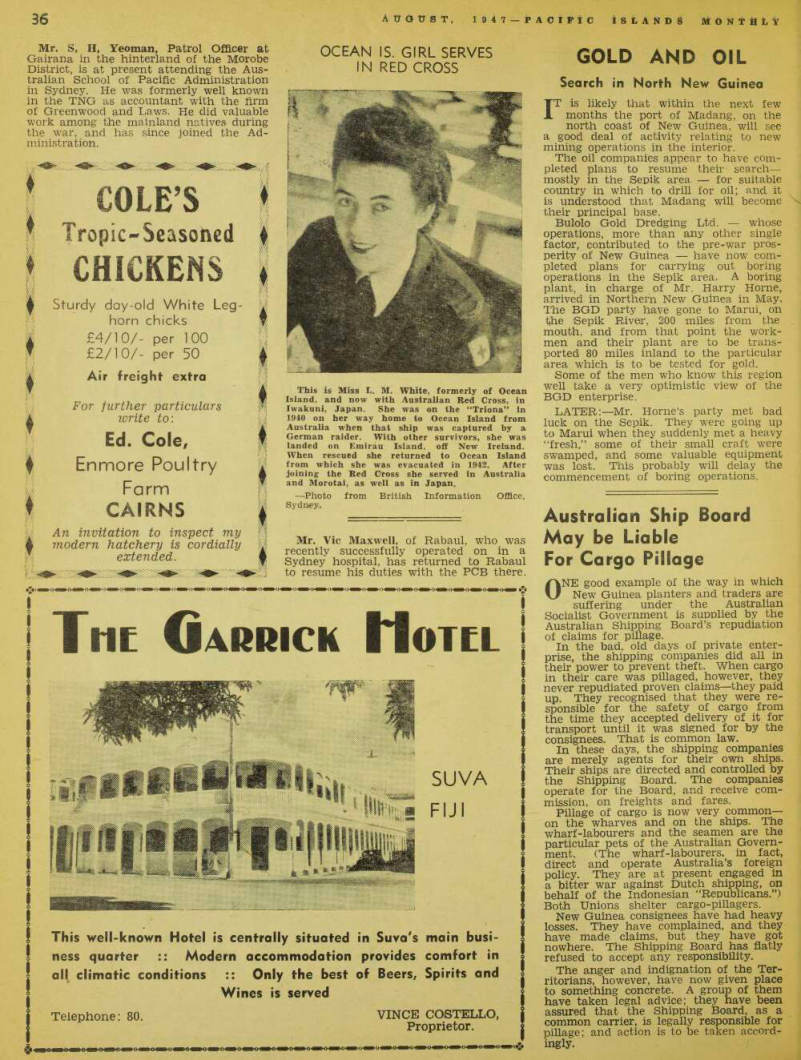
To Church Funds
From Our Own Correspondent APIA, June 19. rpHE now-famous annual meeting of A London Missionary Society adherents at Malua, Western Samoa, took place this year between June 10 and June 20, after being postponed for some time owing to the influenza epidemic in May.
Thousands of Samoans from Upolu, Savaii and American Samoa attended, and £7,000 was collected towards mission funds. The Administrator. Colonel F. W.
Voelcker addressed the large assembly before it dispersed.
A new LMS church has been opened at Fasitoouta village, Western Upolu. Many thousands attended the ceremonies and £6,000 was contributed to the building tund. This church has been in course of construction for the last 14 years.
This whoiesaie giving to church funds, which is a characteristic of the Samoans, is nevertheless an indication of their pre
sent-day prosperity.
Mr. S, H, Yeoman, Patrol Officer at Gairana in the hinterland of the Morobe District, is at present attending the Aus tralian School of Pacific Administration in Sydney. He was formerly well known in the TNG as accountant with the firm of Greenwood and Laws. He did valuable work among the mainland natives during the war, and has since joined the Ad ministration.
Advertisements & other items, pp. 37-38 (1 item)
Have You
THAT
The
CONSIDERED
THIS CODICIL?
By adding a simple codicil to your Will you can guard against difficulties and loss which might arise should your Executor die or become incapacitated.
By means of such a codicil you can name Bums Philp Trust Co. Ltd. as joint Executor with your present appointee or, if you wish, as sole Executor. In this way you gain positive assurance of continuous and sound administration and are relieved of a serious anxiety. The Company will willingly forward full particulars.
DIRECTORS:
James Burns. Joseph Mitchell. P. T. VV. Black.
Frederick Ewen Loxton. Eric Priestley Lee.
MANAGER: L. S. Parker.
SECRETARY: E. R. Overton, A.F.I.A.
BURNS PHILP TRUST
COMPANY LIMITED
7 BRIDGE STREET, SYDNEY
’Phone: 8U5901.
BOX 543. G.P.0., SYDNEY.
B. P. 2.45
COLE’S
Tropic-Seasoned
CHICKENS
Sturdy day-old White Leghorn chicks £4/10/- per 100 £2/10/- per 50 Air freight extra For -further particulars write to:
Ed. Cole,
Enmore Poultry
Farm
CAIRNS
An invitation to inspect my modern hatchery is cordially extended.
Tnc Garrick Motel
r zm #!
IMlif
dm «
SUVA
FIJI
This well-known Hotel is centrally situated in Suva's main business quarter :: Modern accommodation provides comfort in all climatic conditions :: Only the best of Beers, Spirits and Wines is served Telephone: 80.
VINCE COSTELLO,
Proprietor.
Ocean Is. Girl Serves
In Red Cross
Mr. Vic Maxwell, of Rabaul, who was recently successfully operated on in a Sydney hospital, has returned to Rabaul to resume his duties with the PCB there.
This is Miss L. M. White, formerly of Ocean Island, and now with Australian Red Cross, in I wakuni, Japan. She was on the “Triona” in 1940 on her way home to Ocean Island from Australia when that ship was captured by a German raider. With other survivors, she was landed on Emirau Island, off New Ireland.
When rescued she returned to Ocean Island from which she was evacuated in 1942. After joining the Red Cross she served in Australia and Morotai, as well as in Japan. —Photo from British Information Office, Sydney.
Gold And Oil
Search in North New Guinea
IT is likely that within the next few months the port of Madang, on the north coast of New Guinea, will see a good deal of activity relating to new mining operations in the interior.
The oil companies appear to have com pleted plans to resume their search— mostly in the Sepik area for suitable country in which to drill for oil; and it is understood that Madang will become their principal base.
Bulolo Gold Dredging Ltd. whose operations, more than any other single factor, contributed to the pre-war pros perity of New Guinea have now com pleted plans for carrying out boring operations in the Sepik area. A boring plant, in charge of Mr. Harry Horne, arrived in Northern New Guinea in May.
The BGD party have gone to Marui, on the Sepik River, 200 miles from the mouth, and from that point the work men and their plant are to be trans ported 80 miles inland to the particular area which is to be tested for gold.
Some of the men who know this region well take a very optimistic view of the BGD enterprise.
LATER:—Mr. Horne’s party met bad luck on the Sepik. They were going up to Marui when they suddenly met a heavy “fresh,” some of their small craft were swamped, and some valuable equipment was lost. This probably will delay the commencement of boring operations.
For Cargo Pillage
Australian Ship Board May be Liable For Cargo Pillage
ONE good example of the way in which New Guinea planters and traders are suffering under the Australian Socialist Government is supplied by the Australian Shipping Board’s repudiation of claims for pillage.
In the bad, old days of private enter prise, the shipping companies did all in their power to prevent theft. When cargo in their care was pillaged, however, they never repudiated proven claims —they paid up. They recognised that they were re sponsible for the safety of cargo from the time they accepted delivery of it for transport until it was signed for by the consignees. That is common law.
In these days, the shipping companies are merely agents for their own ships.
Their ships are directed and controlled by the Shipping Board. The companies operate for the Board, and receive com mission, on freights and fares.
Pillage of cargo is now very common on the wharves and on the ships. The wharf-labourers and the seamen are the particular pets of the Australian Govern ment. (The wharf-labourers, in fact, direct and operate Australia’s foreign policy. They are at present engaged in a bitter war against Dutch shipping, on behalf of the Indonesian “Republicans.”) Both Unions shelter cargo-pillagers.
New Guinea consignees have had heavy losses. They have complained, and they have made claims, but they have got nowhere. The Shipping Board has flatly refused to accept any responsibility.
The anger and indignation of the Ter ritorians, however, have now given place to something concrete. A group of them have taken legal advice; they have been assured that the Shipping Board, as a common carrier, is legally responsible for pillage; and action is to be taken accord ingly.
Advertisements & other items, p. 39 (1 item)
Tilley Lamps
BURN ORDINARY KEROSENE
The Modern Form of PORTABLE LIGHTING t SPARE PARTS FOR TILLEY LAMPS AND RADIATORS
WE REALISE FULLY THE IMPORTANCE TO
THE USER OF TILLEY PRODUCTIONS OF
ADEQUATE SUPPLIES OF SPARE PARTS.
EQUALLY, WE ARE AWARE OF THE NECESSITY
FOR MAINTAINING OUR HIGH STANDARD
OF WORKMANSHIP.
GENUINE SPARES FOR TILLEY LAMPS AND
RADIATORS ARE MADE ONLY AT HENDON
AND CRICKLEWOOD, ENGLAND.
DO NOT BE PERSUADED THAT SUBSTITUTES
ARE “JUST AS GOOD.”
BRENT WORKS, NEW BRENT WORKS,
HENDON, N.W.4 CRICKLEWOOD, N.W.2.
i THE TILLEY LAMP CO. LTD., of ENGLAND London Offices and Showroom ; 33 SACKVILLE STREET, PICCADILLY, W.l.
REPRESENTATION :
MELBOURNE : T. H. Bentley, Pty. Ltd., 123-125 William Street, Melbourne, C.l.
TASMANIA : Mr. C. Sellars, 108 a Charles Street, Launceston.
FIJI : Mr. K. Witherington, 2 Burns Philp Buildings, Suva.
Severe Sickness In
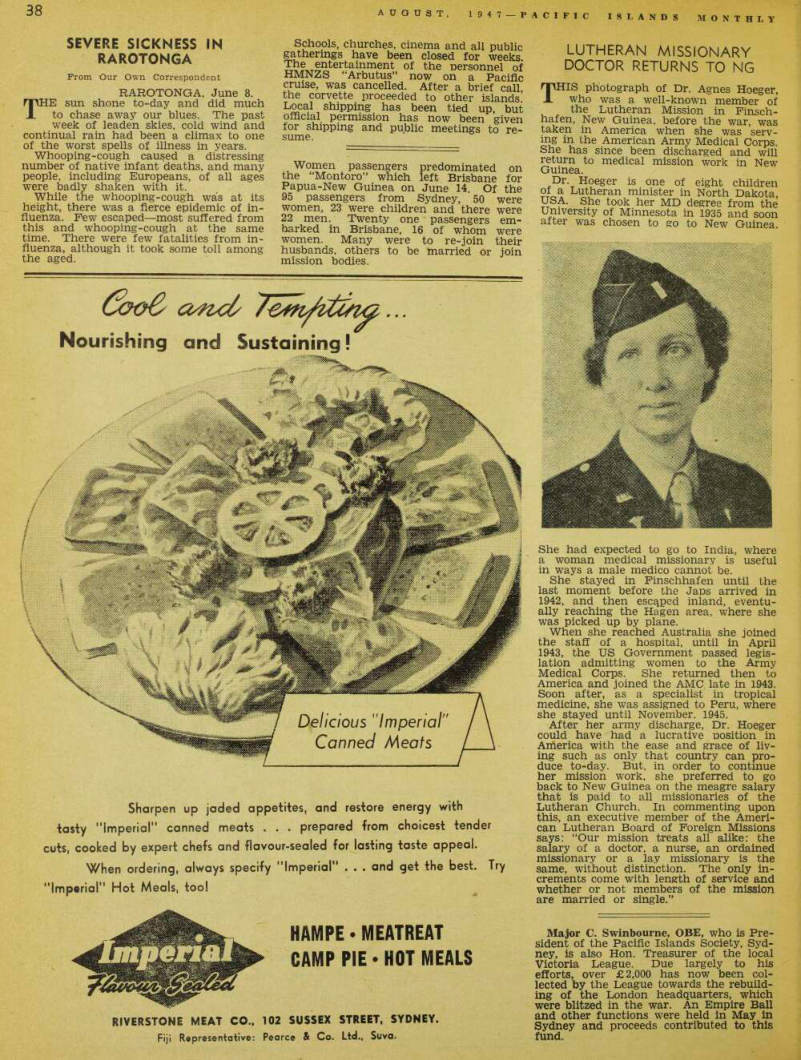
Rarotonga
From Our Own Correspondent
Rarotonga Lmpft
Ttttp u RAROTONGA. June 8.
HE sun shone to-day and did much to chase away our blues. The past week of leaden skies, cold wind and contmual ram had been a climax to one of the worst spells of illness in years.
Whooping-cough caused a distressing number of native infant deaths, and many people, including Europeans, of all ages were badly shaken with it.
While the whooping-cough was at its height, there was a fierce epidemic of in fluenza. Few escaped—most suffered from this and whooping-cough at the same time. There were few fatalities from in fluenza, although it took some toll among the aged.
Schools, churches, cinema and all public gatherings have been closed for weeks.
The entertainment of the personnel of HMNZS “Arbutus” now on a Pacific cruise, was cancelled. After a brief call, the corvette proceeded to other islands Local shipping has been tied up, but official permission has now been given for shipping and public meetings to re sume.
Women passengers predominated on the “Montoro” which left Brisbane for Papua-New Guinea on June 14. Of the 95 passengers from Sydney, 50 were women, 23 were children and there were 22 men. Twenty one passengers em barked in Brisbane, 16 of whom were women. Many were to re-join their husbands, others to be married or join mission bodies.
Lutheran Missionary
Doctor Returns To Ng
THIS photograph of Dr. Agnes Hoeger, who was a well-known member of the Lutheran Mission in Firusch hafen, New Guinea, before the war, was taken in America when she was serv ing in the American Army Medical Corps.
She has since been discharged and will return to medical mission work in New Guinea.
Dr Hoeger is one of eight children of a Lutheran minister in North Dakota, USA. She took her MD degree from the University of Minnesota in 1935 and soon after was chosen to go to New Guinea.
She had expected to go to India, where a woman medical missionary is useful in ways a male medico cannot be.
She stayed in Finschhafen until the last moment before the Japs arrived in 1942, and then escaped inland, eventu ally reaching the Hagen area, where she was picked up by plane.
When she reached Australia she joined the staff of a hospital, until in April 1943, the US Government passed legis lation admitting women to the Army Medical Corps. She returned then to America and joined the AMC late in 1943.
Soon after, as a specialist in tropical medicine, she was assigned to Peru, where she stayed until November. 1945.
After her army discharge, Dr. Hoeger could have had a lucrative position in America with the ease and grace of liv ing such as only that country can pro duce to-day. But, in order to continue her mission work, she preferred to go back to New Guinea on the meagre salary that is paid to all missionaries of the Lutheran Church. In commenting upon this, an executive member of the Ameri can Lutheran Board of Foreign Missions says: “Our mission treats all alike: the salary of a doctor, a nurse, an ordained missionary or a lay missionary is the same, without distinction. The only in crements come with length of service and whether or not members of the mission are married or single.”
Major C. Swinbourne, OBE, who is Pre sident of the Pacific Islands Society, Syd ney, is also Hon. Treasurer of the local Victoria League. Due largely to his efforts, over £2,000 has now been col lected by the League towards the rebuild ing of the London headquarters, which were blitzed in the war. An Empire Ball and other functions were held in May in Sydney and proceeds contributed to this fund.
Advertisements & other items, p. 40 (1 item)
CaoC a/rul
Nourishing and Sustaining!
»*■ - w 3 m m w *■ t d. m
Delicious "Imperial
Conned Meats
Sharpen up jaded appetites, and restore energy with tasty "imperial" canned meats . . . prepared from choicest tender cuts, cooked by expert chefs and flavour-sealed for lasting taste appeal.
When ordering, always specify "Imperial" ... and get the best. Try "Imperial" Hot Meals, too!
HAM PE - MEATREAT
CAMP PIE * HOT MEALS
RIVERSTONE MEAT CO.. 102 SUSSEX STREET, SYDNEY.
Fiji Representative: Pearce & Co. Ltd., Suva.
In Manus Negotiations
Australia, In Pacific Affairs, Is
Snapping And Snarling At America
How Canberra Politicians "Missed the Bus"
In Manus Negotiations
AUSTRALIA has been shrilly scolding the United States because the ruler oi japan, General Douglas Mac- Arthur, has permitted the Japanese to (a) send a whaling expedition to Antarc tic waters; (b) recommence .working the phosphate deposits at Angaur Island, in the Palau Group (Western Carolines, north-westwards of New Guinea), Australia feels that her national dig nity has been outraged, or her sovereignty invaded, or something—no one seems very clear as to what all the howling is about.
Apparently, Australia now thinks that she has some kind of monopoly over Antarctica (never, until now, manifest in any shape or form); and she says that it is most improper that MacArthur should re-establish the Japs in the Palaus, within a few hundred miles of Austra lian territory.
In both these matters, MacArthur’s motive was never even hinted at by either Australian politicians or news papers—yet it is plain to any intelligent person. In the forefront of the many great problems that victory brought to America is that of feeding Japan.
In 100 years of “Westernisation,” Japan developed an economy which demanded the export of vast quantities of manu factured goods, in return for foodstuffs and raw materials—only so could Japan’s 100,000,000 be fed. Since the Tokio Sur render, Japan has been unable to export.
Consequently, the Japanese have been forced to strain every resource in order to produce foodstuffs at home. To the extent that they fail, America is obliged to send in foodstuffs—and the quota for starving Europe is correspondingly reduced.
It was a perfectly reasonable thing t 9 send Jap expeditions to the Antarc tica after oil and whale-beef, and to encourage the Japs to recommence the stimulation of their home-country crops by again digging fertiliser out of Angaur.
THE Americans, trying desperately to keep the world from going into Red revolution—of which there is still the gravest danger could have been pardoned if they had ignored the squealing of the Australian politicians and their now well-organised teams of starry-eyed nev/spaper Yet they have replied very soothingly to Canberra, and are trying to placate the bombastic Dr. Evatt, who is at present visiting MacArthur in Tokio “to discuss outstanding problems.”
In world affairs, including UNO, the United States (140,000,000 people) speaks with one clear voice. The British Em pire (87,000,000) speaks with five voices (Britain, Canada, Australia, South Africa, New Zealand), often contradic tory and in some things each British voice has as much weight as the American voice. So far, Uncle Sam has retained all diplomatic courtesy but is it any wonder that, at times, his patience seems to be wearing a little thin!
The bumble feet of Australian poli ticians are seen as clearly now in the international field as in the Aus tralian industrial field, where there is hopeless inefficiency and increasing con fusion Of that, there is no better il lustration than in the history of the Manus sea and air base, created by the Americans at such enormous cost in the
northern part of the Mandated Terri tory of New Guinea between 1943 and 1945.
WHEN the war was over, America was prepared to maintain the base, on the assumption that Australia would consent to some sort of title. It would have been quite easy to have lopped Manus off the Mandated Terri tory of New Guinea and attached it to the American-controlled Mandated Terri tory of Caroline Islands, immediately to the northward.
But at the very suggestion, the Trades Hall diplomats in Canberra were up in arms. Australia, shouted Dr. Evatt, would not part with one yard of her precious territory, to anyone. But if America who/he graciously admitted, really had helped to win the war in the Pacific would ask her nicely, Australia might be prepared to share the Manus base with the United States Navy, on some sort of reciprocal ar rangement.
The Americans, with a tired smile, withdrew everything from Manus; and Manus, for many months, has been lit erally folding up.
Australia, more recently, has been try ing anxiously to convince the nations— and especially herself—that she can run Manus quite efficiently, with perhaps some American assistance. But Ameri cans are not interested, any more.
The military writer of the Melbourne “Herald” published the following article on June 16. It sums up the position admirably: Despite all the political smoke screens that are being put out from Canberra, there is no doubt that Australia “missed the bus” on the Manus Island negotia tions.
America did want to come into Manus.
Chief of Naval Operations told the United States Senate Naval Committee that the American Navy wished to have major Pacific bases at Honolulu, Guam, the Philippines and Manus Island.
To-day, the course of diplomacy and the policy of economy have forced the American Navy to trim down its de sires. Manus Island has been dropped from the list.
This means that an island which America developed into a great wartime naval and air base covering our northern approaches now becomes entirely our responsibility.
The official Commonwealth Govern ment attitude is that, by tacit under standing with the Americans, help would be forthcoming if a threat to us devel oped in this area.
There will be further consultations between the two Governments. There may be, at some future date, a plan of exchange duty between officers of the United States and Australian Navies.
Having lost the substance of a posi tive American agreement to man the whole Pacific line, the Commonwealth is consoling itself with a theory that the line can be just as strong if Aus tralia acts as caretaker for this end of But the American system of island bases in the Northern and Central Pacific is strong only because naval task forces, planes and the resources of great armament, engineering and mer
chant shipping industries stand ready to Manus would not be in that state of use it. instant readiness. Only regular use by
We can put nothing remotely ap proaching that weight of steel into our area. We can probably afford to keep the grass cut back from the Manus Is land air-strips. We cannot by ourselves do much more.
THERE is no sound reason to expect that Britain can make up for our lack of naval and air power.
British strategic planners are thinking in terms of a Middle East-Aden-East Africa limit to the effective range of their future resources.
We have no guarantee that they can maintain large forces even as near to us as Singapore. ** There have been indications that they would like us to help them in the de fence of the Indian Ocean approaches.
This hardly suggests that Britain will have ships and planes to spare for the South-West Pacific.
WE are brought back to the truth that there can be no realistic defence of Australia without American aid.
In a crisis there is no doubt that the United States would be willing to give us all the help she could. If wars were leisurely-affairs, and required no elabor ate preparedness, our grass-cutting party on Manus could sit back and wait for the Americans to move in and mount guard.
But the last Pacific crisis came sud denly. We must assume that any future war would strike even more swiftly.
It might strike in a way which would force the Americans to concentrate on operating from the bases where their supplies and docking facilities were im mediately available.
large formations of ships and aircraft in peacetime can keep the elaborate or ganisation of a modern base in efficient shape for war. rE US Navy’s proposals, outlined to the Senate Naval Committee in February, 1946, would have given Manus real strength if they had been carried out. Australia has no substi tute for that strength.
American public opinion does not readily welcome commitments to defend foreign territory. This political factor began to tip the scale against an Ameri can-Australian agreement on the Manus base when it became clear that we wanted not only to retain full sovereign rights to the island into which America had put some £4O millions of strategic value, but to gain reciprocal access to bases under the American flag.
We have been left with our sovereign rights and our defence problem.
Advertisements & other items, pp. 41-42 (1 item)
Day-Old
Chicks
BY AIR
A MALGAMATED
A (Reg.) of Bar Hatcheries (Reg.) of Bankstown, near Sydney, N.S.W., can dispatch limited numbers of chicks by
PLANE TO
RABAUL, PORT MORESBY,
LAE, NOUMEA, SUVA.
and all other islands of the Pacific served by present AND PROJECTED air services.
Amalgamated Hatcheries are the largest distributors of dayold chicks in Australia, last year over 1,000,000 chicks being sold by us in N.S.W. alone.
Our scientific method of packing and dispatch has resulted in a loss of less than 1 per cent, of chicks sent by plane.
If any chicks in your consignment arrive dead, we will replace them frees provided the extra freight is paid by the purchaser.
Chicks available are R.I.R, Austrolorps, and W.L.
Price, £lO per 100, landed at your airport, for unsexed chicks, and £l4 per 100 for all pullets. (Guaranteed 96 per cent, accurate sexing.) These chicks are the cream of Australia’s stock, produced under ultra - violet rays to guard against disease; the adult stock is blood-tested monthly by veterinary officers and each individual order carries a N.S.W Government certificate that the chicks are healthy and from tested stock.
Payment for chicks should be made by draft with the order, or credit arranged through our Bankers, the Commercial Bank of Australia, Ltd., Bankstown,
N.S.W.
Drafts and remittances can be sent direct to Amalgamated Hatcheries, Bankstown, N.S.W., or to the following agents: Messrs. Burns, Phiip (South Sea) Co., Suva-Ba-Fiji, or any Island Branch. Also to: Marcel Legras, 38 Rue de Verdun, Noumea.
WRITE BY AIR-MAIL OR
CABLE.
AMALGAMATED
HATCHERIES
BANKSTOWN, N.S.W.
ELTING...
FOR P 0 R F 0 S E The Dunlop range of Flat Transmission and Wedgrope Belting comprises types and sizes for every industrial, mining and domestic need. In addition, Dunlop Technical men are available in all Australian cities to give expert advice on your particular power transmission problems. * * m m J i DUNLOP pvi ft Ut ike DM&'t Unduitvf "
New Caledonia's
Minerals
TWO survey parties from France are expected in New Caledonia. One, sent by the National Geographic Insti tute of Paris, to arrive early in 1948, will map the island. The other “mission” is to carry out a preliminary survey of mineral resources.
Meanwhile, an announcement is made that Broken Hill, which sent experts to report on New Caledonian Plaine des Lacs iron deposits shortly before the war and again in 1945, has given up the idea of exploitation because the presence of nickel and chrome make the ores diffi cult to smelt.
Plea For Leonard
Murray
Ex-Official's Frank Speaking
TWO columns of the Bundaberg news paper were given over recently to a report of an address before the Rotary Club by Mr. A. L. Ethell, formerly an ADO under the New Guinea Adminis tration, and now a planter in Eastern Papua.
Mr. Ethell pulled no punches. He told of tne early panics in Port Moresby— how Port Moresby was deserted when a false air-raid alarm was given in January, 1942; how the Australian troops looted the town about the same time, and did over £1,000,000 damage in one hectic night; how Canberra, per medium of the Barry inquiry, contrived to get rid of the well loved Leonard Murray; and the facts be hind the “Fuzzy-wuzzy angels,”
“Never has so much been written about a country by so many who knew so little” remarked Mr. Ethell, aptly.
He described the present method of awarding War Damage compensation to the natives (at the Australian taxpayers’ expense) as “the greatest racket I have ever known.”
“While the present regime continues in New Guinea, goodness knows what the country will develop into . . . There is only one thing that will save Papua to day, and keep the natives from develop ing into a degenerate race, and that is the return of the one man who really knows them Leonard Murray. Until he goes back and theorists and idealists have no more say in the direction of New Guinea affairs, we are going to have there only a race of people who depend purely and simply on the Government.”
Advertisements & other items, pp. 42-43 (2 items)
40
A 5 9UIT, 19 4 1- PA lIFIC ISLANDS MONTHLY
grand cigarette
is a
for all occasions-
Capstan’s own blend
of fine Virginia
leaf cannot
be equalled
> nSR
Lpj-j!
m 0 H O Me SY That's why it's always
TIME FOR A CAPSTAN
THE EMPIRE'S FAVOURITE CIGARETTE
380P1 - 7.4 7
Simple Pidgin
"Tirpitz" Knows
Now!
N. Guinea Economics In Simple Pidgin
IHAD been on a recruiting trip and now sat in the Buka sunshine, get ting a bit of sun tan. It was much more restful than chasing around the villages trying to induce the local lads to take up shovel and hoe and join the ranks of producers.
I had promised that they should begin work at seven and finish at four, with an hour for lunch, and that no one would speak crossly to them or cast any doubts as to the married state of their parents.
But, it would appear, many quite un expected and urgent jobs had suddenly cropped up in the villages and prevented them from accepting my much appre ciated offer!
So, after mutual expressions of regret and esteem, I bowed myself out and con tinued my merry journey. Blessed is he that expecteth nothing for, verily, he shall not be disappointed. I hadn’t ex pected anything.
And now, as I sat. I saw a canoe approaching the beach. Big, gondola like it sat the water like a duck, and was being powerfully propelled by 11 “highly respectable gondoliers” who sang the high, wild song of the Buka boat men as they came rapidly towards me.
When they disembarked, I observed an old acquaintance of mine advancing— one who had worked for me in the Ad miralty Group years before. He had been
with the Germans as a youngster and had tripped round on their gun-boats.
When I first knew him he had worn a two-pronged beard and was known as “Tirpitz”; but, since razor blades had become common, he had turned clean shaven.
Halting in front of me he gave me a Jap naval salute, bowed and said, “Good morning, Master.” This greeting was really a nice change after the “Goo’day” of the modern Buka-ite, or the “ ’Alio, Joe” of the British Solomons, but I felt I had to utter reproof regarding the Jap salute.
It seemed that he had had a fit of mental aberration, as sometimes happened in his later years. He had been under the Japs during the four-years’ occupa tion, and they were strong-minded people who were most insistent about observances of the kind. If you disre gard their wishes they might “shorten you a whole head’s length”; so the thing had become a habit with him. Yes, he admitted that it was a bad show!
He said he had just dropped in for a chat, so I invited him to be seated, which he did. He produced a filthy and battered pipe, into the empty bowl of which he thrust a grimy forefinger, and looked appealingly at me meantime.
I took the hint and handed him some tobacco, so he loaded the gun, borrowed my matches and lit up. remarking that “tobak” was a scarce commodity these days. I remarked, “You’re telling me!”
HE said that times had changed since the war—and for the worst. Formerly on his coast-wise trips, he would see smoke rising from the copra-dryers, signs of activity on the plantations, pinnaces scooting about the big lagoon,
natives in mons and canoes taking copra to sell at the trade stores or returning with purchases, an old schooner with sails up coming in from Rabaul, and signs of life and commerce.
He used to enjoy taking his bit of copra to a plantation store to sell, whilst he talked and decided upon his purchases.
He liked to exchange news and views with the planter folk, whom he got to look upon as good friends.
He missed the regular inter-island steamers and copra schooners coming for copra and bringing their cargoes, and time-expired labourers returning to their villages. It all meant movement and life and kept the natives alert and in terested.
Now, the whole coast was silent and deserted, with overgrown plantations and generally depressing air of desolation and abandonment. He said it made him feel sad and at a loss.
I sighed, and said, “True too much.”
Having borrowed my matches again he went on to say that the district was full of disturbing rumours. The natives seemed to be expecting the millenium— or something like it—to arrive shortly.
There was talk of higher education and that grown men and women were to at tend schools and be paid and fed by a benevolent Government. Wages were soon to rise substantially—all the native ex-soldiers said so. No one was to work unless he ardently desired to do so, and then the urge must come from within!
They had heard about the wonderful sums that were being paid out, and were to be paid out, for war damages, to natives. Was it true that one small coastal village had been paid £3OOO for war damages?
The authority of the older men was now
being seriously undermined by the younger men who said it was part of the New Order. Why were all trade goods so scarce and dear, and why did not the ships come as formerly? Could I explain things a bit to him and could I tell him what to expect in the future? Was an other war impending and would the Japs, return, as they said they would do, in due course?
ITOLD him in careful Pidgin that I could not give him any enlighten ment as to future prospects, policy and security. Like all other plantation people, I was much in the dark. Our pro blems centred round shipping, supplies, and labour available, without any of which we could not operate. He must understand that times were difficult, and one could only hope for the best.
He seemed to be a bit disappointed, and more than a little bored, and his pipe had gone out again. So, between us, we re-lit it and I then decided upon a new angle of attack. I would give him straight English.
Rising from my chair, and hitching up my slacks, I shook an admonitory fore finger under the ancient’s nose and said, forcefully: “Now, you get this! It’s a question of economics. Without shipping, supplies and labour we cannot hope to produce copra, and plantations must close down.
In order to have things, you must pro duce something in exchange. Without copra, we cannot provide two-way freights for vessels, and there is no reciprocity of trade, which is essential to our economic set-up, and if we want any con sideration in way of shipping services, supplies, trade goods, and the good things of the earth.
“People who don’t work and produce just don’t get anywhere or have any thing! That, my friend, is a ‘law of God,
and Man, and cannot be dodged, side tracked or avoided!
“To sum up the position: No labour, no production. No ships and no supplies means isolation, stagnation, desperation and damnation! Alright! Finish Palaver!
You been hear ’im good, eh?”
THE ancient’s pipe had gone out and had dropped from his nerveless fingers, but his eyes were bright with what I hoped was comprehension! He gulped, girded his lap-lap round himself and told me it was “strong fella talk too much,” and although he was hazy on many points, he felt quite sure that I was right in my contentions and now he would go and “show ’im good along all the boys!”
He strode across to his friends and was soon ringed about by an attentive audience. He declaimed loudly and at length, and, apparently, successfully
rammed home point after point. Finally, he struck first into open palm and de manded of the circle, “You fella savvy good now? Suppose you no savvy you must talk!”
They answered him as one man: “Me fella hear ’im finish, now me fella savvy, too.”
The ancient one now turned back to me, saying, “Orright, Master, me like go now.”
Soon the gondoliers took their places in the mon, the steersman gave curt orders to trim the ship properly, the paddles dipped as one, the water churned under powerful strokes, and they shot away over the wavelets.
Presently their chant was borne back on the breeze, and it seemed to have a new note in it! I hoped that it might be one of clearer understanding and a determination to do the right thing!—
Ppa,
Advertisements & other items, pp. 44-45 (2 items)
50
August, isn-noinc Islands monthly
Don't Say © I N . . F Im
DON'T SAY 'j\ DON'T SAY © I DON'T SAY © ©IN DON'T SAY © SAY GIN DON'T SAY
DON'T SAY ©IN DON/ SAY ©IN
GIN DON'T SAY G / / /'^5 0N ' T SAY
DON'T SAY ©IN I* f
G I N DON'T SAY </ t DON'T SAY GI N / yQ M\% G I N DON'T SAY/ O AY DON'T SAY G I Uo</ «» s N
GIN DON'T SAY /‘ SAY
DON'T SAY © I N . . f IM G I N DON'T SAY GIN SAY DON'T SAY GIN DON'T SAY. GIN I N Telegrams and Cables: “GILBEYS,” Melbourne Address all inquiries to:
W. & A. GILBEY LTD.
33 ROSSLYN STREET, WEST MELBOURNE. 109 REGENT STREET, SYDNEY.
Telegrams and Cables: “GILBEYS,” Sydney.
Wight
you fly
0 Finished in woven-striped, water* proofed canvas, with leather-bound edges. Airway Cases are available in limited supply, but production is increasing.
Made by FORD SHERINGTON LTD.
Wholesale only
NELSON and ROBERTSON Pty. Ltd.
Established 1895
Shipowners - Brokers and
Islands Merchants
A| l classes merchandise purchased at Best Wholesale Prices. Original Invoices supplied to Island Clients. Cocoa Beans, Copra, Rubber, Trochus Shell and All Islands' Produce Sold on Commission.
Entrust your requirements to the firm with fifty years' practical experience in the Pacific Islands.
Sole Agents :
SKANDIA DIESEL ENGINES
ARCHIMEDES MOTORS
Prompt attention given to all enquiries.
NELSON & ROBERTSON R
12 SPRING STREET, SYDNEY, AUSTRALIA -
Telegraphic Address: IVAN, SYDNEY.
OVERSEA INDENTS
ARRANGED FOR
CLIENTS.
REPRESENTED IN
ALL PARTS OP
THE WORLD.
Only Poverty for Cook Is.
Maoris "Social Security" for NZ Cousins
r Letter to the Editor A RECENT writer to ‘TIM” was appre hensive that the recent unrest in the Cook Islands would “spread to New Zealand.” It seems to me that this is a case of putting the cart before the horse.
Recent NZ Maori election literature found its way here, in support of the four Maori Labour candidates. It was digested with great interest by the local intelli gentsia, because it compared the state of affairs among the NZ Maoris, under T9ry governments with their present condition under the Labour government. Labour provides the NZ Maoris with all kinds of Social Security benefits. What the MZ Maori cannot get by working, he can gain in other ways But what of the Cook Islands Maori?
If he becomes sick—on his head alone is his recovery; be he poor—on his ex port of iow-priced fruit alone rests his chance of ready cash. Vote he has none, except as it concerns a powerless native council.
If the Cook Islander were not of Asiatic patience he might long ago have given the authorities something t 9 worry about, His acceptance of a coolie living-standard reveals the Islands Maori as a Spartan and a Stoic. To suggest that the justi fled agitation of the local native planter for a reasonable return for his produce may inflame the NZ Maori to some act of rebellion is, to my mind, ridiculous, * T t 1 am ’ ’
Edwin Gold.
Mangaia, Cook Is., 5/5/47. EDITORIAL NOTE; The use of the term “Maori” is sometimes confusing.
Usually, “Maori” means a New Zealand
native. But, officially, it means all Poly nesians who speak that particular lan guage. There is little difference between the native language spoken in New Zea land, Cook Islands and French Oceania; but a wide difference between that Group and the languages of Samoa, Tonga and Hawaii.
Canberra Killing
Australia's Islands Trade
FROM two letters from the Mandated Territory of New Guinea, received by the “PIM” on the same day: “The ‘Nellore’, carrying mostly Russian Jews migrating to Australia, came in here on June 20, en route to Sydney,” writes a Rabaul resident.
“This vessel has brought a very large cargo of beer and spirits from Hong Kong.
The business houses are retailing this beer at 3/6 per bottle, or £B/8/- per case.
“The supplies of Australian beer for Rabaul, by vessels arriving here from Australia, are practically nil, despite the assurance of authorities in Australia that the beer quota for Rabaul is based on the idea of three bottles per person per week.
“This beer quota is either a myth, or it is being off-loaded en route and sold at a much greater profit elsewhere. Any way, a check oh this quota business through the Customs Department would quickly dispel the idea that Rabaul re ceives the quota that it is supposed to re ceive.
“One wonders what is happening to New Ireland and Bougainville. They cer tainly never have any beer, and get very little of anything else. There is no pro vision whereby they can receive fresh meat, medical attention, mails, etc. For over twelve months, the unfortunate resi dents of those areas have been trying to exist on what tinned rations the Army left behind.
“It looks as if the Administration has abandoned that portion of the Man dated Territory to the giant slugs and other pests, until such time as the Indo nesians and other Asiatics decide to move in.
“Export surcharges on goods purchased in Australia for export to New Guinea are a grevious burden. On a 50/- car battery the export surcharge is 25/10.”
Our other correspondent, a missionary resident in Buka, sends us an original letter, dated May 9, from the manager of Queensland Groceries Ltd., Brisbane.
The missionary sent to this Co. —which he says had given him every courtesy and attention over a number of years— a cheque for £l2, covering a grocery order.
The Co. sent it back, with the intima tion that the Australian authorities were putting so many difficulties in the way of shipping goods to New Guinea, that it had been decided reluctantly to abandon Islands trade. The manager pointed out that there seemed to be a move to force all such business to Sydney; even when they got shipping space for Brisbane, there was endless red tape to be gone through before they could get permission to ship.
The daughter of the French Resident Commissioner in the New Hebrides (M.
Robert Kuter) was married on July 4 to Mr. Donald Jean Gubbay, second son of Mr. and Mrs. D. D. Gubbay, formerly of the New Hebrides. The ceremony was performed by Rev. Father Chaize, and Dr. J. Rutherford (brother-in-law of the bride) acted as best man. After the service at St. Patrick’s Cathedral. Sydney, a reception was held at “Kinneil.”
Advertisements & other items, p. 46 (1 item)
Blow”
A New Book
“WHERE THE TRADE-WINDS
72 Stories, Articles ond Sketches About
Life in the South Pacific Islands
WITH NUMEROUS ILLUSTRATIONS
Collected by
R. W. ROBSON and JUDY TUDOR
These stories and sketches, brought together in this book for your entertainment, are about real people. They describe, without colour or embellishment, conditions of life in the Pacific Islands, as they are to-day.
The “Islands of Romance” have suffered much at the hands of peripatetic writers and irresponsible film directors. The' places and people they picture rarely exist outside a cinema studio, and the fevered- imagination of literary morons. Nonetheless, the Islands which our fathers knew fully deserved the description, “a place where life is different.”
But the charming Islands world of the Nineteenth Century has been changed very much by the Twentieth Century—and by no event more than World War 11, which brought masses of Servicemen into places which formerly regarded a kava party as a great crowd. We still have the Islands setting and the indefinable Islands atmosphere; but life in the Islands—even in savage and primitive Melanesia—has been altered, profoundly.
This book may indicate how and where conditions have changed.
At all Leading Booksellers in Australia; at the Stores of Whitcomb and Tombs Ltd., in New Zealand; at Caldwell's Book Store, in Suva; from the Islands stores of Burns Philp Gr Co. Ltd.; and from Book-
sellers generally.
Copies may be obtained by sending 9/6 direct to the Publishers:
Pacific Publications Pty. Ltd.
Union House, 247 George Street, Sydney
Tonga, 50 Years Ago
By F. T. Goedicke
rE capital of Nukualofa, looked dead as I passed between the apparently unused Customs and Wharf sheds, and on into the grassy road, on my first visit, 50 years ago. For verily, the paths of Nukualofa at that time were paths of pleasantness, wide grassy avenues, kept trim by each Tongan landowner.
Up and down this verdant esplanade drove an immaculate young Tongan, in the smartest of clothes. He was evidently a person of importance, got up to show what Tonga could do in the way of fashion. I found out, later on, the reason for this.
I was astonished to see how few people there were about; but I learned they were attending an important function Dip loma Day, at the Nukualofa College.
Strolling past the building, I was hailed by an official, and invited into the hall, crowded with students and notabilities.
The teacher, a New Zealander, greeted me with enthusiasm, and a kind native insisted on ushering me to the platform, where sat my old friend of happy Haapai days, father of King George Tupou 11, who greeted me most kindly The mental arithmetic of the children was wonderful, and the answers came, quick and prompt, to quite difficult ques tions.
Next day my boat passed two volcanoes, “Tofoa Kao,” but it was a tempestuous day, and the tops were shrouded in clouds.
Next day, in rain, I entered Vavau to whose wooded shores, with exquisite vistas of foliage and harbour, and kindly, hand some people, I lost my heart. This country is volcanic. Only the night before, an earthquake took place and the natives rushed about thumping the ground with
sticks, to awaken the giant, who is turning in his sleep below. The missionaries could not get the idea out of their heads.
There was a most interesting native concert in the Free Church. The singing unaccompanied and unconducted, was marvellous; and when they gave, as an extra, “Hard Times Come Again No More,” in Tongan, the effect, weird and melan choly, swelling like an organ, and dying away like a sigh, was magnificent.
It was with sadness that I left Vavau again Tor my old home in Haapai, where I can recollect happy days spent among these kind natives of the Friendly Islands.
Following the Pacific Conference at Canberra, French Inspector General of Colonies Lasalle-Sere has visited Tahiti to study the general situation of French Oceania and the functioning of the administrative services.
The sugar ration card system has been dropped in Tahiti following an exchange agreement with Guadeloupe, which will accept copra in exchange for its sugar.
The French authorities are giving some attention to the growth of the Chinese element in the Tahitian population.
Governor Haumant recently threatened to close four Chinese schools for a limited period on the grounds that the teaching of French was inadequate and that only a small number of pupils were sitting for French examinations. The Chinese Consul intervened, and an agree ment was arrived at allowing the schools to reopen on condition that they im prove the teaching of French in con formity with the programme of the Education Dept.
Big Profits In Leathercraft
Special Postal Course in Modem Leather craft offers big opportunities. Free Outfit and leather. Patterns for purses, wallets, handbags, cases, valises, pouches, sandals, belts, etc., included. Small investment starts you in a good business Full or part time. Earn as you learn. Send stamp for Free Book, “Modem Money- Making Crafts.” Dept. 15, Le Bon College (Reg.) Box, 279 Haymarket P. 0., Sydney*
Advertisements & other items, pp. 47-48 (2 items)
53
i* a ci Pic Islands monthly august, 194?
George J. Logkyer & Company
Wc Will Buy
It For You
Any goods you may require from English shops or factories Purchased and Shipped.
Small or large orders catered for.
ALL SERVICES UNDER-
TAKEN FOR RESIDENTS
ABROAD.
PITT & SCOTT
LIMITED
(Established 1876) General Shipping and Buying Agents. 1/3/ St. Paul's Churchyard, London, England Cables. Shipping London.
GEORGE J. LOGKYER & COMPANY
MARINE BRANCH
ENGINEERING SUPPLIES, GENERAL HARDWARE EXPORTERS AND MERCHANTS
Agents for the Finest Australian Liquors
Aerated Water and Cordial Manufacturing Machinery, Bottling and Capping Machinery, etc.
CONSULTING ENGINEERS DOCKYARD MACHINERY
PURCHASING AGENTS:
Electric Light Generating Plants.
Air Conditioning Plants.
Builders’ Hardware.
Marine Engineering Supplies.
Refrigeration Supplies.
Radios and Accessories.
Sanitation Equipment.
Automobile Spare Parts and Garage Accessories.
Abrasive Wheels.
Excavating Machinery.
Electrcal Supples.
Grinding and Pulverising Machinery.
Hydraulic Equipment.
Mechanical Engineering Requirements.
Mining and Quarrying Machinery.
Road and Building Machinery. &
EXACT REPLICA OF CANE KNIFE,
GIRAFFE TYPE, MADE IN AUSTRALIA.
VESSELS, ETC.
Steel Cargo Vessels, 35 ft. x 13 ft. 4 ft., New, with Winch, Hoist, etc.
Auxiliary Transport Vessels, 32 ft. x 9 ft. x 4 ft., New, without Engines.
Tugs, Trawlers, Cargo Vessels, Tankers, Motor Cruisers, Launches, Yachts, Hoists, Winches, etc.
Pholographs, Drawings , Schedules, will be Supplied by Return Mail to Genuine Clients.
FAIRLIGHT STREET, FIVE DOCK, SYDNEY, N.S.W. 'Phone: UA7196 All communications to be addressed Bankers: Telegraphic and Cable Address: ene r=L M^ n ? ger ’ Commonwealth Bank of Australia, “LOCKMACH,” Sydney.
G.P.0., Box 4553, Sydney. Sydney
MILE after MILE
OF
EXTRA WEAR
now added to
cool - running
MILLER
TIRES
Tires for
trucks,
automobiles,
buses
MIHIcT Accessories and Repair Materials are dependable!
Consistently high in quality, this complete line has been developed to meet every automotive need.
New type, stronger construction.
New wide, flatter tread. Longer mileage. Maximum traction.
Peak skid resistance. Greater protection against bruises.
MORE TIRE FOR YOUR MONEY
Radiator hose Radiator cleaner Radiator solder Noc-out adjustable hose clamps Vulcanizing patch and valve stem clamp Tire camelback (passenger and truck) Full circle curing tubes Tire pump hose assemblies Self curing cements and patches Weld rite vulcanizing patch Weld rite valve steam heat units Fractional horsepower belts Rubber solvent Friction tape Windshield wiper tubing Air bags Fan belts Rubber mallets Cord fabrics Tire paint Tire and tube repair kits #§|
mjk
m.
TUBE REPAIR KIT
CONTENTS
I—s" x 19" Strip rubber 80—1*4" Sq. bevel cut patches 20—114" x 2" Oval bevel cut patches I—Ft. bottle cement I—Carborundum buffer
Exporters
PACIFIC ISLANDS TRADING COMPANY
244 CALIFORNIA STREET, SAN FRANCISCO 11, CALIFORNIA, U. S. A.
When "Boys" Are
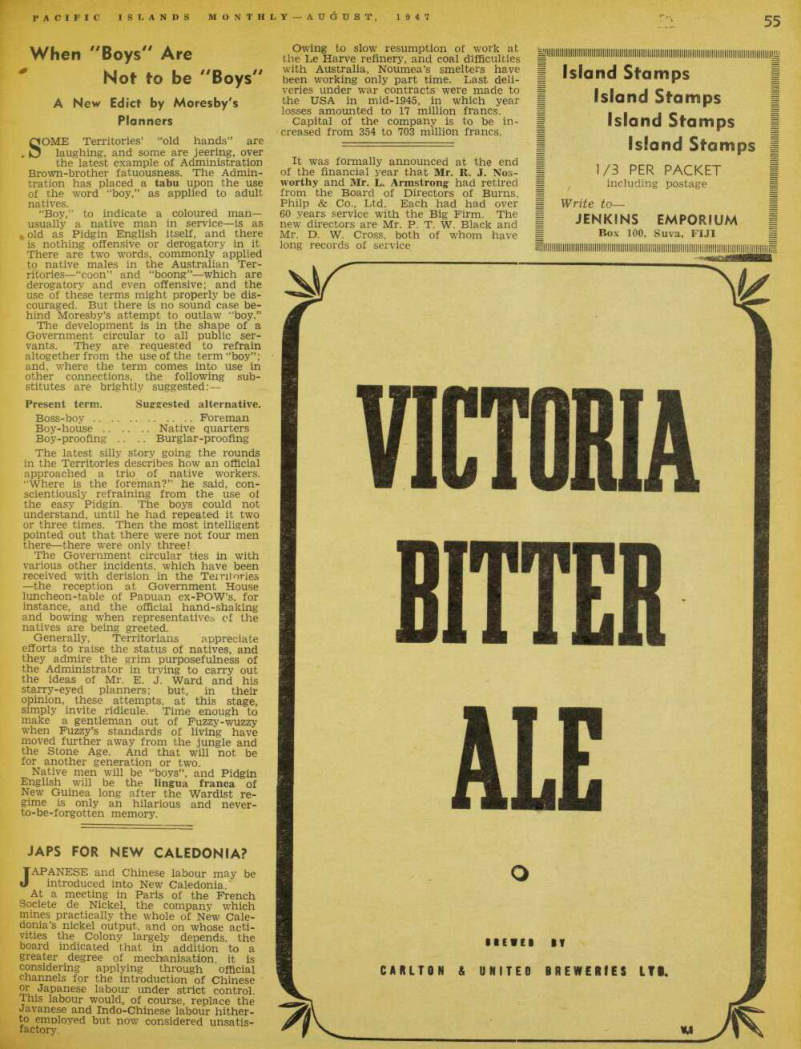
Not to be "Boys"
A New Edict by Moresby's Planners
SOME Territories’ “old hands” are laughing, and some are jeering, over the latest example of Administration Brown-brother fatuousness. The Admin tration has placed a tabu upon the use of the word “boy,” as applied to adult natives.
“Boy,” to indicate a coloured man— usually a native man in service—is as *. old as Pidgin English itself, and there is nothing offensive or derogatory in it There are two words, commonly applied to native males in the Australian Ter ritories —“coon” and “boong”—which are derogatory and even offensive; and the use of these terms might properly be dis couraged. But there is no sound case be hind Moresby’s attempt to outlaw “boy.”
The development is in the shape of a Government circular to all public ser vants. They are requested to refrain altogether from the use of the term “boy”; and, where the term comes into use in other connections, the following sub stitutes are brightly suggested:— Present term. Suggested alternative.
Boss-boy Foreman Boy-house Native quarters Boy-proofing .. .. Burglar-proofing The latest silly story going the rounds in the Territories describes how an official approached a trio of native workers.
“Where is the foreman?” he said, con scientiously refraining from the use of the easy Pidgin. The boys could not understand, until he had repeated it two or three times. Then the most intelligent pointed out that there were not four men there —there were only three!
The Government circular ties in with various other incidents, which have been received with derision in the Territories —the reception at Government House luncheon-table of Papuan ex-POW’s, for instance, and the official hand-shaking and bowing when representatives cf the natives are being greeted.
Generally, Territorians appreciate efforts to raise the status of natives, and they admire the grim purposefulness of the Administrator in trying to carry out the ideas of Mr. E. j. Ward and his starry-eyed planners: but, in their opinion, these attempts, at this stage, simply invite ridicule. Time enough to make a gentleman out of Fuzzy-wuzzy when Fuzzy’s standards of living have moved further away from the jungle and the Stone Age. And that will not be for another generation or two.
Native men will be “boys”, and Pidgin English will be the lingua franca of New Guinea long after the Wardist re gime is only an hilarious and never to-be-forgotten memory.
Japs For New Caledonia?
JAPANESE and Chinese labour may be introduced into New Caledonia.' At a meeting in Paris of the French Societe de Nickel, the company which mines practically the whole of New Cale donia’s nickel output, and on whose acti vities the Colony largely depends, the board indicated that in addition to a greater degree of mechanisation, it is considering applying through official channels for the introduction of Chinese or Japanese labour under strict control.
This labour would, of course, replace the Javanese and Indo-Chinese labour hither to employed but now considered unsatis factory.
Owing to slow resumption of work at the Le Harve refinery, and coal difficulties with Australia, Noumea’s smelters have been working only part time. Last deli veries under war contracts were made to the USA in mid-1945, in which year losses amounted to 17 million francs.
Capital of the company is to be in creased from 354 to 703 million francs.
It was formally announced at the end of the financial year that Mr. R. J. Nos worthy and Mr. L. Armstrong had retired from the Board of Directors of Burns, Philp & Co., Ltd. Each had had over 60 years service with the Big Firm. The new directors are Mr. P. T. W. Black and Mr. D. W. Cross, both of whom have long records of service
Mr. W. B. Ryan, assistant manager of BP interests in Port Moresby, arrived in Sydney recently on a business trip.
Advertisements & other items, pp. 49-50 (1 item)
Victoria
Island Stamps
Island Stamps
Island Stamps
Island Stamps
1/3 PER PACKET
including postage Write to —
JENKINS EMPORIUM
Box 100, Suva, FIJI
VICTORIA
BITTER
ALE
o
BIC1EI IT
CARLTON & UNITED BREWERIES LTI.
¥J
Day=Old Chicks
and
Stock
Acclimatised and blood tested by veterinary officers. High-class White Leghorns Chicks: £4/10/- per 100 £2/10/- per 50 £l/7/6 per 25
INQUIRIES SOLICITED
Knopke & Bradford
Anderson Street, CAIRNS, Queensland
N. Guinea Rats
Tree-Climbing and Kunai Species
rE mammalogist of the Australian Museum, Mr. Ellis Trough ton, is running a series of interesting art icles in “Monthly Notes”, the official pub lication of the Australian School of Pac ific Administration.
In the May issue he deals with native rats, prevalent in New Guinea, and tells how “Nip” Blood, well-known old Terri tory identity, succeeded in obtaining the two first specimens of a giant tree climbing rat, which are rare. They were collected in the Mount Hagen area. One of the specimens measured 34 inches, in cluding a naked rough-scaled tail which acts as a prehensile “climbing iron”. The rat has developed powerful chisel-in cisors for braking open hard-shelled nuts, and even' coconuts in lowland regions.
The writer refers to the greater menace to health and industry of the village rat (rattus browni) and a coarse-haired kunai rat, as they are hosts of the scrub typhus mites. “Indeed,” the writer states, “the presence of the flesh-pink en crustations of mites within the ears and around the anal parts of the rats and marsupials serve as an elementary warn ing of the risk of scrub-typhus infection.
Protective measures will by now have been well-covered by the Adminis tration and tropical hygiene services, but it cannot be stressed too often that places of abandoned settlement and plantation re-growth are among the real danger spots; that natives with their acquired immunity should be employed for clear ing operations; and that firing of the
fallen vegetation when it has been lying for some time appears to be the simp lest means of eliminating the ground mites, at least temporarily.
The Beauty Of Leisure
And Tahiti
ONE is happy to record that the com pany of motorists who refuse to drive as gentlemen should drive, has become reduced almost to the vanishing point on Tahiti.
The peril to our children, who are obliged to use the common highway, when going to and coming from school; the increasing number of accidents which have caused injury and death—both to pedestrians and to other motorists; per haps, too, a revival of the gracious, old Tahitian instinct of courtesy—these have awakened our careless drivers to the value of consideration for others who must use the narrow highways of the Islands.
Moreover, there is so much to see on Tahiti, when one travels leisurely: A foaming cascade within the recess of a fern-clad cliff, the exquisite colours of sea water overlying shallow coral-beds; the flash of emerald from a curtain of sea-wave; the beauty of a garden, seen through an opening of an hibiscus hedge.
And one has time, too, to return the kindly greeting of native friends, whom one does not choke with dust as one passes.
And one arrives at his journey’s end, unfatigued by the nervous tension of fast driving—within the space of three hours even if his destination be the most re mote settlement.
Advertisements & other items, pp. 50-51 (2 items)
CLSmliiifiMi Jfas) IljJI
ISLAND MERCHANTS
and AGENTS.
GENERAL MERCHANTS.
CLSmliiifiMi Jfas) IljJI
\ C /K f v, i ° Shippers of all types of J Mei ‘ Merchandise to the Pacific Islands • Representing Australian, British and American Manufacturers • i rrrrr U 1 -i i n in ® Buyers for Leading Pacific Islands Traders 9 Sellers of Island Produce on Consignment Importers, Distributors and Manufacturers of Foodstuffs, Softgoods, Textiles, Hardware, Tobaccos, Wines and Spirts, etc.
379 KENT ST., SYDNEY.
Cable & Telegraphic Address: i Chasull, ,> Sydney. yif i • "Ultima" Kerosene Stoves and Heating Appliances • Distributors of High-grade Shirts, Pyjamas and Clothing • "Southern Queen"
Canned Fruits m • Forwarding and Transhipment Agents \ ft £f//> < /[V-% m Hill's English Cigarettes When in Sydney, call and see us!
PRESENTING . . .
“MOTT-MARLIN-l 7
t & *
Australia’s Streamlined
Welded Steel Cruiser
Specially suitable for
TROPICAL CONDITIONS
Scientific treatment of the steel used in the hull has rendered the hull absolutely NON-
CORROSIVE, RUSTPROOF, NON-WARP,
PROOF AGAINST FIRE. NO COBRA BORERS
or MARINE PESTS of any description will touch this specially treated steel. Indepen-
dent multi-buoyancy tanks, fully tested, en-
sures "Mott-Marlin" is UNSINKABLE. The steel hull maintains the temperature of the water. /# MOTT-MARLIN 17" will take a greater pounding afloat or ashore than any craft its size. Water cannot be taken in through the hull.
COST of "MOTT-MARLIN 17" is FAR
BELOW any craft its size, construction and durability. Maintenance cost is negligible.
SPECIFICATIONS :
Length: 17 ft.
Length overall: 19 ft.
Beam; 6 ft.
Draught: 1 ft. 6 in.
Freeboard aft: 1 ft. 4 In.
Freeboard for’d: 2 ft. 3 in.
Power unit: Blaxiand Twin Cylinder (2-cycle).
Power: 5-7 h.p.
Speed: S’-IO m.p.h.
Seating: 10-14 persons.
Anchor: Patent trip line self-stowing under bowsprit. operates within cabin. Optional additional power can be installed if required. (Details on request.) Towing: A patented towing device, wheels interchangeable with your car, is available and enables you to take your “Mott-Marlin” wherever your car will go.
Height: Cabin top to keel, 4 ft. 10 in Weight: 16 cwt.
Control (Non-foul): Dual wheel and tiller.
Rudder: Inboard balance.
Bilge pump: Engine operated.
Gauge of steel in hull: 14 gge minimum.
Keel plates: % in.
Cabin windows: Plate glass, Va in.
Maintenance: Can be ducoed —not essential.
Petrol: 20 m.p.h. Rangie, 100 miles. • One man can operate the anchor, engine, and steer at the same time. Decking is non-slip steel.
PRICE; New Guinea, Papua, Pacific Islands.
CRUISER: £436/10/- in-
cluding cradle for shipping.
Extras; Awning, £B. Overall Cover, £l2. Towing Assembly, £29.
F. 0.8. SYDNEY CASH AGAINST DOCUMENTS DEPOSIT WITH ORDER £lOO Please address inquiries to Distributors :—
REED, PROUDMAN, ELWORTHY PTY. LTD.
195 ELIZABETH STREET, SYDNEY, N.S.W., AUSTRALIA
PHONE MA3398 Cable and Telegraphic: “REEPRO,” Sydney.
Distributors in MALAYA, N.E.1., NEW GUINEA, PAPUA, PACIFIC ISLANDS, TASMANIA
57
PACIFIC ISLANDS MoNtfllt-AUOUST, 194 7
Dutch Jungle-Watcher

{Continued from page 48)
landed at Lake Paniai, It had been de cided that the post should be evacuated by unessential personnel, and those who did not wish to remain; and, in the suc ceeding months, these people were taken off in Catalinas, leaving behind de Bruijn, a corporal, named Berger, Rudy Gout (the radio operator) and six Indo nesians. All had volunteered for the party, which was thenceforth to be known as “Oaktree.”
Without delay they abandoned Enaro tali, leaving only burnt buildings and de stroyed vegetable gardens, and made for a secret jungle hide-out about 12 miles away—and not before time. Two days later the Japs arrived at the lakes.
Now de Bruijn’s friendship with local natives paid dividends and, as in other parts of the South-west Pacific, these
people almost automatically became valu able spies. They would mingle with the Japanese—who appeared to treat them with no more suspicion than they did the rest of the scenery—and then would re port back to de Bruijn with detailed accounts of Jap strength and equipment.
This information was, in turn, relayed to Allied headquarters.
IT was May, 1943, when they moved out of Enarotali; and, apart from a few “drops” of supplies, their radio re mained their only link with their own kind until February, 1944.
Then they were informed that they would be joined by a new party, consist ing of a Lieutenant Overweel, a radio operator, Brink, and two Indonesians, The party duly arrived, towards the end of the month, by parachute; and from that time on affairs moved quickly to wards a climax.
Gout at this time had become ill, apparently with a gastric ulcer, with which they, with their limited knowledge and few supplies, were incompetent to deal.
In early March, 1944, a message was received from headquarters stating that an attempt would be made to evacuate the sick man from Lake Hagers, far to the north of their camp. It was obvious to de Bruijn that headquarters had little idea of the obstacles of terrain that had to be overcome in getting Gout to the rendezvous, which was fixed for April 10 (they finally made it late in July); but, leaving Overweel in charge, he determined to make the effort.
At this time, however, the Japs, too, were moving eastward from the Wissel Lakes, hard on the heels of the Dutch
men; and, in the hasty destruction of one camp. Brink, the other radio operator, had been badly burned. The parties were now hampered by two sick men.
At the beginning of May, de Bruijn, then preparing for the final trek to Lake Hagers with Gout, received further orders from headquarters. Due to “tactical and political” reasons, all per sonnel were to be evacuated. They were ordered to make haste to Lake Hagers forthwith.
Slowly de Bruijn and Overweel. their Indonesians, the two sick men and the 30 Papuans—who had left their homes with de Bruijn a year before —struggled down the long valley of the Rouffaer River, towards the lake. But now their chance of escape was threatened by an other development.
THE Americans had leap-frogged from Hollandia, and now were firmly estab lished on the north coast, and on Biak Island; the Japanese, consequently, were fleeing southwards, and were flood ing into the country around Lake Hagers.
De Bruijn and his men were between two fires and for a while he seriously contemplated trying to find his way out through Archbold’s Grand Valley.
The idea was eventually dismissed; it seemed too hazardous a journey with two sick men so . . .“Gradually day by day, they went forward, over the now low rolling, grassy country, through swamps and uninhabited, barren lands. There were no trails and no villages, for the people are a nomadic race, and live and move only in their canoes on the great river.
“Somewhere in the north was Hagers Lake. No one knew much about it.
Lieutenant Hagers had discovered it only a few months previously, while flying over to make photo-strips. No land party had been there. Le Roux, in 1926, and van
Eechoud, in 1937, had both by-passed it.
Strangely enough, this goal to which they were making as their sole hope of evacua tion was only known by photo-strips.”
More and more Japanese were moving in from the north, but headquarters had not entirely forgotten its little party mov ing in from the south, and, in the final days, they had the unexpected support of the sth US Air Force, which straffed the area ahead.
So passing through the swamps and the plagues of mosquitoes that nearly drove them mad, they came to Lake Hagers. On the morning of July 26, a few of them took rafts out into the middle of the lake and arranged the recognised signal. At 8.30, two Catalinas came down and settled on the water. In their small, collapsible canoes—which had been dropped to them—the men left the shore in small numbers and boarded the planes.
By 10.30 they were air-borne.
“Oaktree” was no more.—J.T. (“Jungle Pimpernel,” published by Hodder & Stoughton, for 18/3, Australian.) Mr. Harold Markham, of Marovo Lagoon, British Solomon Islands, one of the best known of the older planters of the group, arrived in Suva early in July on his way to Christmas Island, where he has accepted a temporary appointment as Government Agent under the Gilbert and Ellice Colony. Mr. Markham re turned to his plantation in 1946 (he was one of the voyagers on the “Southern Cross,” on her never-to-be-forgotten first trip after she was released by the navy)* but in the succeeding months he found the labour conditions and the difficulties of shipment and supply so great as to prevent rehabilitation. Therefore he has gone to Christmas Island for a few months in the hope that conditions in the Solomons will be better in 1948
Advertisements & other items, p. 52 (1 item)
William H. Watson
Stamps Penfriends Hobbies
The only club of its kind in the Islands Established in 1933 Members throughout the Islands, all British Colonies, and in almost every country in the world Correspond with interesting people who will be glad to send you illustrated newspapers and magazines, stamps or any other item.
Send for specimen copy of Club Journal, “ISLAND LIFE,” published quarterly.
We need an official representative in every Island of the South Seas.
Write for particulars.
SOUTH SEA ISLANDS CORRESPOND-
ENCE CLUB, NATUVU, FIJI
ESTABLISHED 1930
WILLIAM H. WATSON
RAROTONGA, COOK ISLANDS
Wholesale and Retail Trader
LICENSED STAMP DEALER
Agent For:—
BRITISH TRADERS' INSURANCE CO.
CORONA & L, C. SMITH TYPEWRITERS
KAISER & FRAZER MOTOR CARS
B.S.A. CYCLES AND MOTOR CYCLES
AMERICAN LEAD PENCIL CO,
WHITES AVIATION LTD,
Manufacturers of: FOOTWEAR, ALL CLASSES SUITABLE FOR NATIVE TRADING . . . M.O.P. PRODUCTS, INCLUDING ROUND EAR-RING BLANKS AND BUITON BLANKS Exporter of: “Rarotonga” Hula-Skirts.
Sea-Shell Necklaces.
M.O.P. Jewellery.
Island Produce.
Wholesale and Retail Inquiries Invited.
Prepared to Consider Agencies for all Class of Goods.
Importer of: Textiles.
General Hardware.
Fancy Goods.
General Merchandise.
Cable Address: “Watson” Rarotonga Bankers: Bank of New Zealand, Auckland.
New Caledonian
Bushranger Sentenced
THE New Caledonian bushranger Gaston Dijou, whose depredations covering a portion of the west coast, has been sentenced by the Noumea Assize Court to five years for a number of thefts. His associate Albert Debels, was acquitted of thefts for which he had been previously charged, but got two years for receiving stolen property. His women companion, the native, Marie-Therese, was acquitted.
“PIM” readers will recall that in March 1946, two gendarmes with two native followers came upon Dijou near one of the mines up the Dumbea valley. Dijou was armed, and in the affray he was wounded, and then taken to hospital for treatment.
Dijou, Debels and the native woman had been visiting US Army camps, where Dijou had taken possession of rifles, am munition and grenades. He had terrorised the neighbourhood, killing cattle, stealing fowls, and molested Asiatics.
After Dijou’s arrest, Debels and Marie Therese moved cross country to the Bourail area, where they were arrested in the vicinity of the Nerin tribe on last October 26, by a party led by nine gen darmes. They admitted having lived on stores stolen by Dijou, but denied having participated in the thefts. A charge against Dijou of having attempted 'to murder a US military policeman was dropped.
Mrs. M. Wacke, Mrs. Goetzelmann and two children, Sister M. Lehmann, Mr.
Ray Barber, and the Rev. and Mrs. Hof mann and four children left Australia recently for Lutheran Mission stations in New Guinea
Bougainville!
More Coconuts For
Letter to the Editor IT is rumoured that one result of the Administration party’s recent visit to Bougainville will be that that unfor tunate part of the Territory will again be bombarded with coconuts from Papua.
Fifty thousand of them will be sent, it is said, for the restoration of native groves.
As Buka-Bougainville planters have the greatest difficulty in obtaining labour to cut copra, and find it almost impossible to ship it if and when it is cut, it has been suggested that perhaps they might be -happy to sell the Administrator 50,000 nuts.
Recently nine pigs were sent to Bougainville. This is the sum-total of Administrative effort in restocking the island. It has taken them just 21 years to fulfil this first instalment of their countless promises to local natives.
I am. etc.,
Observer.
Rabaul. NG. July 23.
Mr. Max Babbage is in Sydney on sick leave from his planting interests in Buka.
Advertisements & other items, pp. 53-54 (1 item)
I J. Gougri & Co.
irf
EYE LOTI*
Fmt Lb£ am *d £▼•* Et*H4j
■ OLD EVtITWIKIK
*LA- *»- 4 Ca. rty. L*L, KUI 9L. »y*.rr
m P a i m A Concord, Sydney, Home Built with “Rapid” Blocks
RAPID” CONCRETE BLOCK & BRICK
MOULDING MACHINES
AN IMMEDIATE SOLUTION FOR HOME BUILDERS
Capacity, 3 blocks per minute.
Semi-automatic—no tamping required.
Water tanks—well linings. • Priced to suit home-builders. • Hundreds in use. • Water tankn—wpii u™™* For all building purposes.
WRITE FOR PARTICULARS TO PACIFIC ISLANDS REPRESENTATIVE
SUPPLIERS
Export
I J. GOUGrI & CO.
OF GENERAL MERCHANDISE TO LEADING FIRMS THROUGHOUT THE PACIFIC ISLANDS. er s . . . Importers . . . Manufacturer s’ Representatives 1 BOND STREET, SYDNEY, AUSTRALIA. Box 3615 G.P.O. Tel. 84167 Bankers: Bank of N.aw Bank of Adelaide. Comptoir Nat. d’Escompte de Paris „ , . Cable Address: “SEAFOODS,” SYDNEY Codes: Bentley s, 2nd and Comp. Phrase; A.8.C., sth and 6th; PeteFson, 2nd and 3rd; Banking; Acme.
WESTCLOX
"VTEVER has performance been At more trustworthy than in the beautiful Westclox of today . . . famous Big Ben and other spring wound clocks, electric clocks, wrist watches and pocket watches. When you buy. your next clock or watch, look for the trade mark “Westclox” on the dial . . . your assurance of quality.
POCKET BEN A thin model watch with many features. Highly polished, plated finish; silvered dial; attractive numerals and hands. Unbreakable crystal.
SPUR Luminous A thin case, one-day alarm. Black finish with nickel trim. 41 inches square.
Steady alarm. Unique base.
Luminous dial. 6 5 BIG BEN Chime Alarm The highest standard of alarm clock quality. Quiet tick and gentle two-voiced alarm. First there’s a gentle call, then if he’s not shut off. there’s a lusty shout. Dustproof attachments. 5i inches high. Ivory finish with gold colour trim. Luminous dial. ill 1 i I 9 11 j 10
WBSTtLO*
BABY BEN A smart looking alarm clock. 3’i inches high.
Quiet tick; steady alarm that rings loud or soft. Legible dial.
Two finishes . . . black with nickel trim, and ivory with gold colour trim. Made in plain and luminous dial.
LA SALLE A handsomely designed wrist watch. Chrome finish case, stainless steel back, curved to fit the wrist. Sturdy movement, regulated to run in any position. Equipped with conventional second hand; rustproof hairspring.
ORDER THROUGH YOUR LOCAL STORE
PACIFIC ISLANDS TRADING
Bankers: Bank of America (Main Office) San Francisco.
COMPANY
Cables:
PITCO
SAN FRANCISCO
244 CALIFORNIA STREET, SAN FRANCISCO, CAL., U.S.A.
In New Guinea
Only Trouble Is Permanent In New Guinea
INTERVIEWED recently while in Sydney, a resident of New Guinea said that the general outlook throughout the whole of the old Man dated Territory was still uncertain. Tem porary building is going on where labour is available, material being collected from disused Army huts.
The lack of galvanised iron for roofing was affecting the domestic water supply, however, as most of the iron used by the Army had been coated with a lead solu tion which renders water unfit for con sumption.
Nothing much has been heard of the projected shift of the New Britain ad ministration centre from Rabaul to Koko po, but it is said that the Gazelle Penin sula district is to have the services of the Commonwealth Department of Works and Housing. This may be the first shot in the campaign for putting into effect one of the Department’s many town planning schemes. Territorians are ask ing themselves, however, if a Territory which apparently has no agricultural policy can afford to build Garden Cities for more and more Public Servants.
The need to extend the Australian- New Guinea shipping services to outports, such as Kavieng. Wewak, Aitape, etc., is pressing, as small ships cannot service these ports adequately, particularly in regard to building materials and freezfer goods.
Australian levies on wheatmeal, flour, rice, etc., continue, and hit the natives hard. In view of the Australian govern ment’s professed interest in native wel fare this is not easy to understand, either by the Europeans of the Territory, or by the natives. Cause and effect mean little to the native; he knows only that 17/5 will now buy him only 40 pounds of rice, where it would buy him 100 pounds in 1939.
THE latest decree from Port Moresby is that a native may not now be em ployed casually more than 25 miles from his village. This, of course, was the rule in the Mandated Territory before the war, but now that the Administration encourages “free” labour, as opposed to indentured labour, it does not seem to make sense.
Four-fifths of the so-called free labour is now prevented from engaging in em ployment. Many villages are 100 miles or more from any source of employment, and the Administration itself will, on present indications, be the worst offender against the new rule.
In many cases, in the Territory, machines are replacing native labour, and this policy is expected to overcome, in due course, some of the labour diffi culties. Some amusement was caused in the Territory in recent months when Mr. Ward told the Australian Parliament that the Administration now had more natives in its employ than ever before attracted by the favourable conditions of employment. All Territorians know that, given a few police-boys, anyone can re cruit native labour.
Mr. J. Ewen, who before the war was the popular manager of Burns Philp & Co’s branch at Kokopo, New Britain, and who has been with the Madang branch since its reopening, has now returned to Rabaul. He will take over the manage ment of the Kokopo branch again shortly.
tha^Te'Lf
No Takers For Lae Terrace
From Our Own Correspondent LAE, July 21. fIIHE township of Lae, temporarily or X otherwise, is rebuilding on the old site on the flat. No one seems keen to live on the terrace with its planned garden city, bus stops and industrial quarters still in the blueprint stage.
Burns Philp are back on their own site and the Morobe bakery is now almost ready to begin production in their new mechanised premises of steel and corru gated fibro cement.
Mr. Syd. Woods, cameraman for Movie tone News, is at present making a tour of New Guinea centres, taking shots for a documentary film of the Territory. He is visiting Port Moresby, Rabaul and the goldfields.
Mr. L. D. Jimenez of 114 Norwood Road, Herne Hill, London, S.E. 24, was a mem ber of the RAP in World War II and lost an eye in combat He recently has been invalided out of the Air Force. He has taken to stamp collecting as a hobby and h.m
tha^Te'Lf
stamns which tewoulTmietoexchange f stamps of the Pacific Territories.
H
Advertisements & other items, p. 55 (1 item)
Robert Gillespie Pty It?
KODAK FILMS
and all photographic supplies
WHOLESALE AND RETAIL
CAINE'S STUDIOS, SUVA,
P.O. Box 8 Photographers. Est. 1904.
Write for free price list
5k s \ k \ I i u NO? %vv C> o<* All classes of merchandise purchased for Island clients throughout the South-west Pacific.
Island produce sold on Australian and overseas markets on a commission basis.
ROBERT GILLESPIE PTY IT?
54« PITT ST..SYDNEY-PHONES-8W4782- BI3OS
How Ngvr Hung On Near

Mubo, In 1942
Story of Raids and Alarums in New Guinea Jungles
By N. M. Bird
Section One.
TYPING unable to procure anything of the sort from the Australian military authorities, we have ourselves CQmpiled a roll of members of the New Guinea Volunteer Rifles—that organisation of planters, traders, miners, officials and missionaries, which did such splendid work in the jungles of New Guinea in the black days of 1942-43. That list of names will be pub lished shortly.
In 1942, the Japs were all over the Territory; the Americans, and the Australians, who were brought back from the Middle East, were still a long way off; and our attenuated forces, who were trying to hold on to positions in New Guinea and Papua, had to depend largely upon the gallant NGVR to provide information and guides.
In this article (which is being published in two sections) Mr. N. M. Bird tells the story of one small section of NGVR—the section that retired"*into the wet, precipitous, gloomy moun tains between Salamaua and Wau, early in 1942, and maintained an organisation there until larger forces arrived. They started in January, 1942, as two detachments. By December, there were only seven men left.
During most of the period described, there
was bitter fighting in the jungles of north-east Papua (Kokoda Trail and Buna), and it was therefore essential that our people should know what the Japs were doing in the region away to the north, between Salamaua and Wau, Mr.
Bird gives an indication of how the NGVR served the Allied cause in that region.
JANUARY, 1942—that tragic month when Nippon over-ran Rabaul, and bombed and strafed Lae, Salamaua, Bulwa, Bulolo and Wau —ended in a flurry of evacuation of civilians and others from the goldfields.
The NGVR had taken over under com mand of Major Edwards; and Captain Humphelby (popularly known as “Hump”) appeared from nowhere and took over the Wau-Bulolo section. One detach ment went to Salamaua, and was fol lowed soon after by another, located at Mubo.
Reports that our people, both military and civilian, were being murdered by the enemy, drifted through. Small parties, escaped from New Britain, arrived in Lae and Salamaua and went on to Port Moresby.
The Salamaua detachment concen trated on salvaging as much food-stuff as was possible from the bombed and burned stores.
Much freezer stock was undamaged; and poultry and A 1 export meat, washed down with copious drafts of salvaged beer, made the war worth fighting.
There was some discontent in Mubo.
The “Mubo Force” (otherwise known as the “Force”) put up the argument that the Salamaua Detachment was being over-worked, and that Mubo should re lieve them. This would allow Salamaua
to go back to Mubo for a rest, while Mubo could take a turn at the hard work in Salamaua, and have a dip in the surf, etc.
The matter was referred to “Hump.”
He agreed that Mubo and Salamaua should exchange. All waited for the move. It never came off. We did not know “Hump” very well in those days, taut our education had commenced.
At Mubo, parades were the order of the day—bayonet drill under that en thusiast, Len Noakes; short patrols under Corporal O’Laughlin; and PT before break fast under Campbell, lately of the Rabaul School.
“Hump” discovered a bunch of Muruk (cassowary) feathers and ordered that feathers be worn in the hat by all ranks, as a badge of the Force. Force re luctantly obeyed—but quite suddenly be came enthusiastic. A supply of Bird of Paradise plums had been located, and the entire Force blossomed out in those gay plumes.
Ted Hawnt, late of Rabaul, surpassed us all, in a wealth of waving plumes.
Ted was OC cookhouse, and could not attend drill parades. But he practised the drill in his spare time. One move ment seemed to hold a fascination for him. This was the old “reversed arms,” originally used at a military burial. Ted would be seen, several times a day, in front of the house-cook, practising this most depressing movement. The pained look on his gaunt face as he dropped his hand to the butt of the reversed rifle, then dropped his chin on his breast, was something to remember. Here originated that now almost universal expression: “Wouldn’t it Hawnt you!”
THE CO at Salamaua wrapped his car around a couple of coconut palms; and Bert Simmons was sent by “Hump” to take over.
Salamaua Detachment took a new lease of life. Drums of petrol were rolled to the foreshore and wired for explosion and fire; the drome was mined with cases of gelignite, and batteries were installed at suitable points. The idea was to ex plode the drums of petrol when Nippon attempted to land, and he would be nicely browned off.
A watching post was established on the isthmus, and was manned twenty-four hours daily.
At Mubo, the monotony was maddening and the Force came close to open re bellion. Fever took its toll. Sufferers were sent to Wau—and returned no more.
Geoff. White, that stout lad, toiled with his line of natives to shift supplies from Komiatum, to which point they had been carried by natives from the Salamaua detachment.
Then the blow fell at Salamaua.
One bright morning (March 8, 1942) about 2.30, the guard at the watching post, a very tall chap, who spoke with a maddening drawl, slouched into the post and woke up Hilary Farr, SIC the post, and said: “Say, Hil., what are all those black things out there on the water?”
Hil. bounded out, took one look, and yelled: “They’re bloody Jap barges!” The other couple were awakened and all slid down the steep path to the waiting car.
The car fairly leaned back under a burst of speed, to get away from there.
Nippon must have thought that it was some dreadful secret weapon as, with its head-lamps blazing, it screamed past them on its way to Keila, Nippon made no attempt to molest it.
The rest of the detachment was quickly mustered, and the crossing of the Frisco bridge was made in fair order.
In the meantime, those whose duty it was, duly pressed down the plungers of the firing batteries to blow up the petrol and the drome.
Nothing happened. Evidently, someone had neglected to chase the horse away
the previous afternoon. This horse had a stupid habit of getting his feet en tangled in the wires.
Nippon swarmed like a disturbed bee hive. An heroic party, detailed to destroy the Frisco bridge, toiled with a blunt axe to cut the steel cables, under the in terested eyes of a party of Nips, who had arrived on the drome.
The last strand parted and the bridge fell. The party went away from there fairly fast, en route to Mubo.
Nippon never replaced the bridge. It was quite unnecessary—the Frisco could normally be forded with ease.
IN the meantime, Mubo had heard the news, and rolled out to greet the Sala maua detachment, who were now coming in in one, twos and half-dozens.
Simmons was greeted warmly by “Hump”: “A fine job of work,” he said.
Next arrived Bill Forrester (veteran of World War I) without his false teeth. He had left his fangs in a glass of water overnight, and had not time to dress fully before he left. His teeth were returned to him by his native servant later in the day.
Next in was Mick Shutt, with his trousers under his arm, and his old, grey flannel shirt, with “Shutt” in large letters on the tail, flapping in the breeze.
Apart from these there seemed to be no serious casualties. It was discovered later that Rupe Hanahoran was missing.
He turned up in Bulwa some time later, via the Buangs, minus his trousers.
The Salamaua detachment went on to Wau. Our Mubo Force took on a new in terest. A watching-post was established on the Buigap Creek and constantly manned. “Get-away” tracks were cut here and there, and “Hump” turned on more and better parades.
Geoff White continued to bring sup plies in from Komiatum.
“Hump” decided that sooner or later we should have to fight, so he turned on some training in “jungle warfare.” He called in all ammunition and split the Force, turned them loose in the hills round Mubo to rattle rifle-bolts at each other when an “enemy” was sighted, and to wrangle in true school-boy fashion as to who saw who first. The Force took a dim view of the whole thing, and said so. There were in the vicinity some 2,000 lively Nips, in and around Salamaua—and perhaps on their way to Mubo.
Conferences were held as to the best route to take to Moresby in the event of our being chased out. These were mapped, and hung on the wall of the mess-house, so that all could make them selves familiar with the details.
QUITE suddenly, “Hump” decided to evacuate Mubo. All was bustle— preparing packs .and mustering native carriers. Geoff White, with tears in his eyes and murder in his heart, dumped half a ton of good flour into the Bitoi.
The Force moved out in good military order. First, the carrier lines under Geoff White. Next came HQ, with “Hump” and his retinue. Hawnt to the fore. Followed, then ,the first platoon, close on “Hump’s” heels. The second platoon got away to a bad start, but soon caught up. The third platoon was rear guard. There were less than 6 men in each platoon.
Skindewai was reached bv a sick and sorry Force. But we felt better after we had wrapped the loose folds of our
stomachs around a generous meal, pre pared by Hawnt.
Ballams was reached next day. “Hump” and HQ went on to Paddy Leahy’s farm, leaving orders that the Force was to rest one day at Ballams.
Force moved on to Wau, One platoon joined the “Wau Detachment” in Wau and the other two platoons stayed at Alan Fuller’s house, with “Hump” and HQ in Mrs. Fuller’s house, immediately across the road.
Fuller’s goats suffered a drastic culling; and roast kid, with vegetables, followed by rich pastry, made the war again worth while. Daily parades, and a 24hours’ guard were not relished by the Force; and it was decided by a party at a secret conference (the result of some pointless bickering) to “cut communica tions” with “Hump.”
A small party was sent to Black Cat to investigate possibilities. They found Olsen’s house intact, but with bedding, etc., torn up and strewn over the floor.
This was cleaned up, in intervals between visits to the passion-fruit vines, which were loaded with delicious fruit. Passion fruit has a certain effect. In the opinion of that party, memories of the night that followed are among the most horrid of the war. (See photos on page 71.) The shed was cleared next day, in readiness for the rest of the rebel parly from Wau. They arrived early in the afternoon. The haggard members of the advance party watched their attack on the passionfruit grimly ,and without com ment. Events, that night, were up to ex pectations. It was an unhappy incident of a ruthless war.
The Black Cat detachment settled down to a series of patrols.
IN the meantime, “Hump” had decided that Mubo should not remain un watched, and had sent Ernie Hitchcock (World War 1 veteran) to occupy that post. “Hitchie’s” platoon consisted mainly of Bill Forrester and Mayos.
Ernie set up camp at Komiatum and prowled all over the country. Up to this time, Nippon had shown not the slightest interest in the hinterland: but he now sent a patrol to Komiatum.
Hitchcock’s army fired on this patrol; and Nippon retaliated by shooting every thing he had into the village—where Hitchcock was not.
Hitchcock’s party left for Mubo, and the Nips burned the village and, locating our camp nearby, punched bayonet-holes in the cooking utensils and all the tins of meat they could find.
Word was sent back to “Hump,” and he ordered the Force forward. The Black Cat party caught up by making a forced march to Ballams, via Wandumi ridge.
The Force entered Mubo in fine fettle.
The Force now took a new lease of life, an OP was established on the side of the hill, across the Frisco from the drome at Salamaua. This fine piece of work was carried out by Macadam (of Forestry, Wau), Geoff Archer, Bob Day, Gordon Kinsey and others. Vickers were placed on the Mat Mat hill and Vickers ridge, and every one was extremely busy.
Tobacco was a thing of the past.
“Stick” was the universal smoke: dry, mouldy and stinking, it was jealously guarded. Green tobacco leaves were dried over the coals till sufficiently in flammable. Food was scarce, as was soap.
Some mail came in, with some bills from BP’s.
There were rumours of troops coming in and the Fifth Independent Co. arrived in Wau. A detachment under Captain Winning came to Mubo, and he got out plans for a raid on Salamaua to coin cide with a raid on Lae. The Force was enthusiastic—some of them.
Came the day (June 28, 1942) and the Nips got a real bashing at dawn. Nip casualties will never be known. Our casualties were one with a slug through the wrist, and one with a jagged piece of metal under the shoulder.
Force was jubilant. They now seemed to be possessed of endless energy, and were eager for more.
But nothing was done. Winning and “Hump” went back to Wau to try for more and better supplies. Mubo gradu ally settled down.
That raid must have stung Nippon like a handful of dirt thrown on his washing.
He sent a patrol, possibly 100 strong, to find out “who done it.”
ONE afternoon, about five, Force had finished tea, and Fifth were lining up for mess parade. A card party was in progress in the Force Mess, with visit ing Fifth officers.
Force lost interest and wandered back to their various posts. Jimmy Birrell (later Lt. and MM) was first home, and he saw what at first he took to be a large group of natives on the Mubo drome.
He quickly realised that they were Nips.
He slammed a belt into the Vickers, and yelled for Hilary Farr, SIC Vickers. Hill grabbed a tommy-gun and fired a burst as an alarm, just as Jimmy opened up with the Vickers.
Nippon was being guided by a couple of
natives who, evidently, were not familiar with Mubo, and the enemy was grouped on the drome, evidently in conference.
The Fifth, on mess parade, cursed the noisy Force. But when the Nips, who had taken cover under a low bank at the side of the drome, opened up with grenade-throwers, the Fifth woke up and went into action in fine style, and pelted Nippo with everything they had.
Nippon broke cover for the low brush on the other side of the drome, and here they took another thrashing from Jimmy’s Vickers, and from a Vickers on the Mat Mat, now in action. Small arms were now added to our fire power, and Nippon pulled out. after about half-an hour’s engagement.
Heads were counted in the Force. No casualties—though some were missing.
These turned up later, looking sheepish.
The Fifth and the Force sat tight— to do otherwise would have been mad ness. Nippon casualties will never be known; but, judging from the broken bamboo carrying poles, first field-dressing covers and blood-stained bandages that strewed the drome, and the track to Komiatum, they must have been heavy.
The enemy’s party was met at Komiatum by another Nip patrol from Salamaua, and escorted home.
Captain Winning hurried back from Wau, fighting mad, with his red hair on end —first, because he could not improve the supply situation, but more so be cause Nippon had shown so little con sideration as to attack Mubo while he was absent. “Norm” really liked to fight, and hated to miss anything.
Force was now on its toes—two clashes with Nippon and two definite victories.
They fairly swaggered round the place. (Section Two will be published in September).
Captain Foucard. a doctor at Noumea hospital, was urgently sent to Mare Island by French naval cutter at the beginning of June as the result of an accident at the district church of La Roche, a Catholic centre on the east side of the island. During vespers the vault of the transept had caved in and crashed on a group of young native girls, eleven of whom were injured. They were looked after by the local Resident, the Rev.
Father Dubois, until the doctor’s arrival.
Five of the more serious cases were later shipped to the mainland for treatment at Noumea hospital.
Mrs. John Robertson and her three children sailed recently on the “Trienza” for Nauru, where she will join her hus band, who is LMS missionary in that Territory.
Advertisements & other items, pp. 56-60 (1 item)
Ink, Units
SOUTH SEA ISLANDS CLUB
Social Evening
Every Friday at Union Jack House, 5 Hamilton St. (just off Bridge St.) Sydney Ballroom Dancing . . . Special Islands Dances and Songs Islands Visitors Welcome.
The Perfect Unit
FOR THE PLANNED KITCHEN
. . . because polished or satin finished Stainless Steel—so delightful in appearance, so easy to keep clean—gives a lifetime of hygienic Kitchen service.
Wunderlich Sink Units are 4 ft., 5 ft., or 6 ft. long, and I ft. 6 ins. wide.
c/erllcA
INK, UNITS
IN STAINLESS ST-EEL
Manufactured by
WUNDERLICH
LIMITED
Baptist St.
REDFERN
Tel.: MX2411
J. C. Merrillees Pty. Ltd.
GENERAL ISLANDS MERCHANTS
Telegrams & Cables: Merrillees. Sydney.
AGENTS FOR: COWRIE SHARPS and FLOUR
and Suppliers of General Merchandise a
TRADE GOODS, CLOTHING,
FOODSTUFFS. LIQUEURS
SPIRITS, WINES.
New Address
63 PITT STREET, SYDNEY
(Phoenix Building) Telephone: Codes: BW 6064 Bentleys
Better Buy
C THE ORIGINAL
ROSSE &
BLACKWELL
M eat and Yisb Pastes
UNEXCELLED SINCE 1706
Tiilock & Co. Pty. Ltd.
Kent and Liverpool Streets, Sydney,
ISLAND TRADERS SINGE 1875
and Manufacturers of
AUNT MARY'S BAKING POWDER
AUNT MARY'S TOMATO SAUCE
AUNT MARY'S TOMATO SOUP
AUNT MARY'S TOMATO JUICE
AUNT MARY'S TOMATO PUREE
and other Pare Food Products INVITES inquiries from merchants trading in and with the Islands.
CABLE ADDRESS: TILLOCK, SYDNEY
While in Port .. .
HIRE Your Taxi from
BULOWAT TRANSPORT
COMPANY
CARRIERS AND TRANSPORT SPECIALISTS
GENERAL MOTOR REPAIRS
—Agents for—
CRYSTALITE PLASTICS, ALL ELECTRICAL
EQUIPMENT, RADIOS, REFRIGERATORS,
HOT WATER JUGS, ETC.
SIDNEY COOK, PROP.
Modern Refrigeration for the South Sea Islands
The ELECTROLUX KEROSENE OPERATED
REFRIGERATOR
MARVEL
OF
MODERN
SCIENCE
THE
MIRACLE
OF
ICE
FROM
HEAT
ELECTROLUX offers economical, modern and completely efficient
REFRIGERATION FOR ISLANDS' HOMES.
FREEZES CONTINUOUSLY WHILE SMALL LAMP BURNS.
Freezing controlled by simply regulating height of flame. Uses only J gallon of kerosene per week MOTORLESS ... NO PARTS TO GET OUT OF ORDER.
MODEL LKSSO
Capacity: 5.5 cubic feet.
GUARANTEED FOR TWO YEARS
• Write to your Local Distributor for prices and lull details.
OBTAINABLE FROM ALL W. R. CARPENTER & CO. LTD.
BRANCHES THROUGHOUT THE ISLANDS
Representation in Papua and New Hebrides.
G. H. Robinson
ISLAND SUPPLIES
of all kinds—Selected and Shipped to order at lowest possible prices—Piecegoods in Wool, Cotton and Silk, Under and Outerwear, Manchester, Drapery, Grocery, Hardware, Engineers and Leathergoods trade supplies a specialty.
Indents and Transhipments arranged. Large or small orders treated with equal care.
Use our 25 years’ extensive experience.
Enquiries solicited to—
G. H. ROBINSON
51 Macquarie Street, Sydney, N.S.W.
Telegrams: Sunrise, Sydney.
Letters: Box 3317, G.P.0., Sydney.
A. B. DONALD Ltd.
AUCKLAND
ISLAND TRADERS & GENERAL MERCHANTS
P.O. Box 1509. Cables £r Telegrams, "Kingdom,* 7 Auckland.
Fiji Indians' Appeal
To India A Strange Development That Is Loaded—Against Indians
T tt . . SUVA, Aug. 1.
HERE still is speculation here con cerning the origin and purpose of the move made by Fiji Indians, in seeking the intervention of the Common wealth Relations Department of the Indian Government in Fiji affairs, with a view (according to “the Civil and Military Gazette,” published in Lahore) to securing a better status and} living condition for the Fiji Indian population.
It is reported now that the Indian Government will send a “goodwill mis sion” to Fiji, to study the conditions of the Indian population.
Any such development will be very strongly resented by Fiji people, and by British Colonial Office interests generally.
If international opinion is in favour of the removal of the Jews from Palestine, and the British from India, and the Dutch from the East Indies, then a very strong case can be made out for the deportation of the Indians from Fiji, and the reservation of that fertile archipelago for the Fijians.
Naval Medicos Save
Islanders' Lives
THE New Zealand Navy corvette, Arbutus, during its recent tour of the Central Pacific, was instru mental in saving the lives of at least three people.
When the corvette visited the isolated Tokelau Group, north of Samoa, Dr. J.
Lopdell, senior medical officer in Apia, took the opportunity of making a tour of inspection. He found a young girl on the atoll of Fakaofu suffering from a perforated appendix: Dr. Lopdell, as sisted by one of the sick-berth attend ants from Arbutus, and a local NMP, performed an emergency operation in a native hut. Only slight hope was enter tained for the girl’s recovery, but penicillin was landed from the ship’s medical stores for post-operative treat ment. When the corvette made a second call at Fakaofu, the girl was found to have made a remarkable recovery.
Another operation under similar cir cumstances was carried out on the neigh bouring island of Atafu, and at Nukunono a Catholic priest was found to be seri ously ill with beri-beri. Both these patients were taken to Apia on the cor vette, for hospital treatment.
"Masinga Rule"
THE resignation of Mr. C. S. Belshaw, temporary cadet officer, from the British Solomon Islands adminis trative service, is gazetted, with effect from last November. Mr. Belshaw has a long article, “Native Politics in the Solomon Islands,” in the June issue of “Pacific Affairs,” the quarterly published by the Institute of Pacific Relations. He gives a detailed description of the “Masinga Rule” —otherwise known as “Mercy Rule,” or “Marching Rule” —a native organisation which is partly economic (demand for higher wages), and partly anti-European in character, and which now has a strong hold on BSI.
Mr. Arthur D. Felton, once the world’s champion sculler, is now with the New Guinea Administration at Finschhafen, repairing Government vessels.
Fiji Teachers' Training College Staff
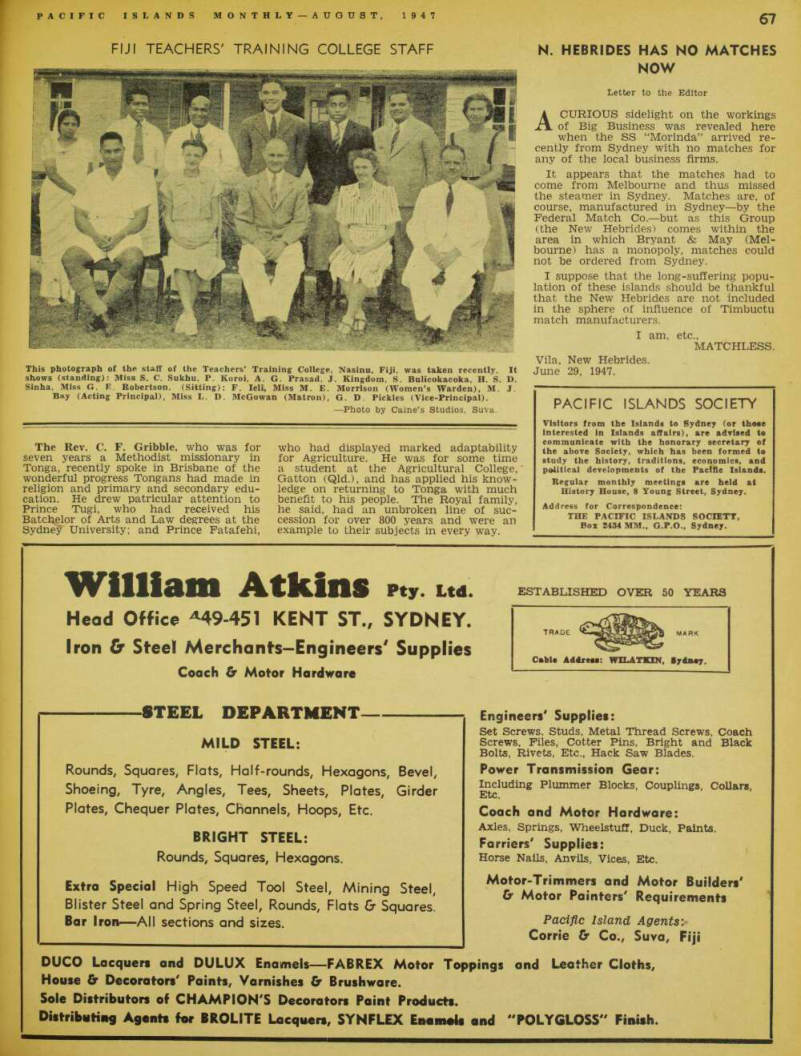
The Rev. C. F. Gribble, who was for seven years a Methodist missionary in Tonga, recently spoke in Brisbane of the wonderful progress Tongans had made in religion and primary and secondary education. He drew patricular attention to Prince Tugi, who had received his Batcl\elor of Arts and Law degrees at the Sydney University; and Prince Fatafehi,
who had displayed marked adaptability for Agriculture. He was for some time a student at the Agricultural College, Gatton (Qld.), and has applied his know ledge on returning to Tonga with much benefit to his people. The Royal family, he said, had an unbroken line of suc cession for over 800 years and were an example to their subjects in every way.
This photograph of the staff of the Teachers’ Training College, Nasinu, Fiji, was taken recently. It shows (standing): Miss S, C. Sukhu, P. Koroi, A. G. Prasad, J. Kingdom, S. Bulicokacoka, H. S. D.
Sinha, Miss G. E. Robertson. (Sitting): F. Ieli Miss M. E. Morrison (Women’s Warden), M. J.
Bay (Acting Principal), Miss L. D. McGowan (Matron), G. D Pickles (Vice-Principal). —Photo by Caine’s Studios, Suva.
N. Hebrides Has No Matches
Now
Letter to the Editor A CURIOUS sidelight on the workings of Big Business was revealed here when the SS “Morinda” arrived re cently from Sydney with no matches for any of the local business firms.
It appears that the matches had to come from Melbourne and thus missed the steamer in Sydney. Matches are, of course, manufactured in Sydney—by the Federal Match Co.—but as this Group (the New Hebrides) comes within the area in which Bryant & May (Mel bourne) has a monopoly, matches could not be ordered from Sydney.
I suppose that the long-suffering popu lation of these islands should be thankful that the New Hebrides are not included in the sphere of influence of Timbuctu match manufacturers.
I am, etc.,
Matchless.
Vila. New Hebrides.
June 29. 1947.
Advertisements & other items, p. 61 (1 item)
William Atkins Pty. Ltd.
PACIFIC ISLANDS SOCIETY
Visitors from the Islands to Sydney (or tho«e Interested in Islands affairs), are advised to communicate with the honorary secretary of the above Society, which has been formed to study the history, traditions, economics, and political developments of the Pacific Islands.
Regular monthly meetings are held at History House, 8 Young Street, Sydney.
Address for Correspondence;
THE PACIFIC ISLANDS SOCIETY,
Box 2434 MM., G.P.0., Sydney.
William Atkins Pty. Ltd.
Head Office M 9-451 KENT ST., SYDNEY.
Iron & Steel Merchants-Engineers' Supplies
ESTABLISHED OVER 50 YEARS
Coach G Motor Hardware Cable Address: WILATKEN, Sydney.
STEEL DEPARTMENT
MILD STEEL:
Rounds, Squares, Flats, Half-rounds, Hexagons, Bevel, Shoeing, Tyre, Angles, Tees, Sheets, Plates, Girder Plates, Chequer Plates, Channels, Hoops, Etc.
BRIGHT STEEL:
Rounds, Squares, Hexagons.
Extra Special High Speed Tool Steel, Mining Steel, Blister Steel and Spring Steel, Rounds, Flats Cr Squares.
Bar Iron—All sections and sizes.
Engineers' Supplies: Set Screws. Studs, Metal Thread Screws, Coach Screws. Piles, Cotter Pins, Bright and Black Bolts, Rivets, Etc., Hack Saw Blades.
Power Transmission Gear: Including Plummer Blocks, Couplings, Collars, Etc.
Coach and Motor Hardware: Axles, Springs, Wheelstuff, Duck, Paints.
Farriers' Supplies: Horse Nails, Anvils, Vices, Etc.
Motor-Trimmers ond Motor Builders' G Motor Painters' Requirements Pacific Island Agents: Corrie & Co., Suva, Fiji DUCO Lacquers ond DULUX Enamels—FAßßEX Motor Toppings and Leather Cloths, House & Decorators' Paints, Varnishes & Brushware.
Sole Distributors of CHAMPION'S Decorators Paint Products.
Distributing Agents tor BROLITE Lacquers, SYNFLEX Enamels and "POLYGLOSS" Finish.
No Tropic Nymph, No Pearls, No Oil!
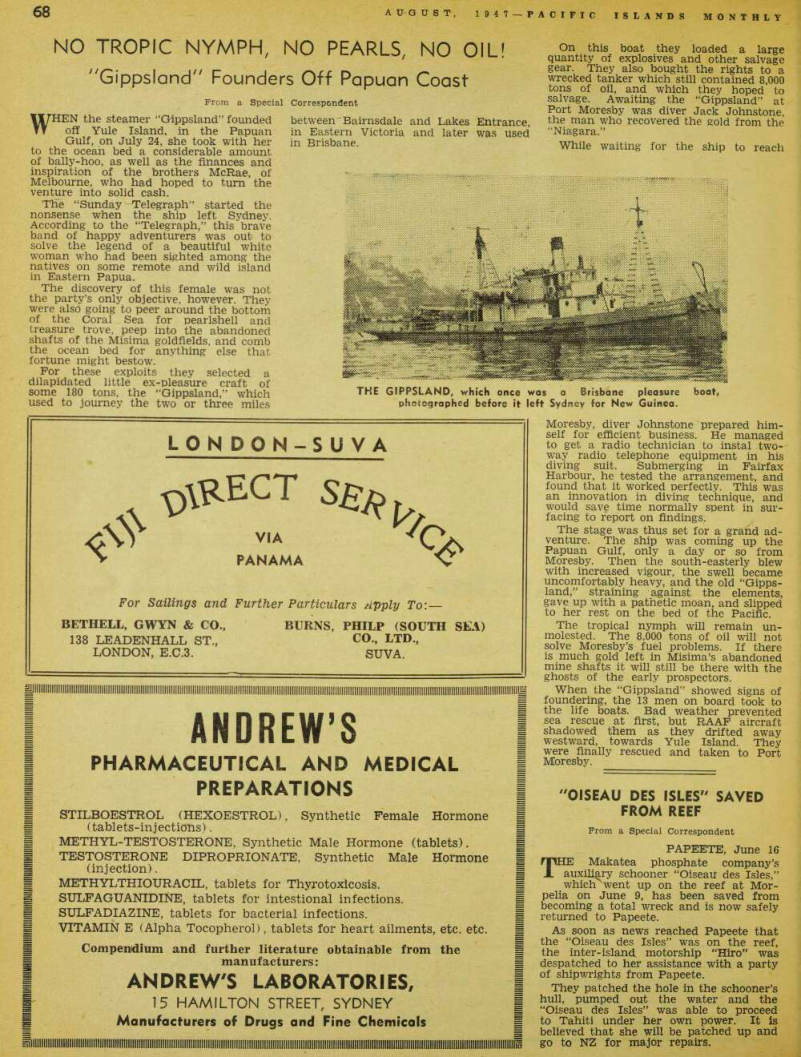
"Gippsland" Founders Off Papuan Coast
From a Special Correspondent
WHEN the steamer “Gippsland” founded off Yule Island, in the Papuan Gulf, on July 24, she took with her to the ocean bed a considerable amount of bally-hoo, as well as the finances and inspiration of the brothers Mcßae, of Melbourne, who had hoped to turn the venture into solid cash.
The “Sunday Telegraph” started the nonsense when the ship left Sydney.
According to the “Telegraph,” this brave band of happy adventurers was out to solve the legend of a beautiful white woman who had been sighted among the natives on some remote and wild island in Eastern Papua.
The discovery of this female was not the party’s only objective, however. They were also going to peer around the bottom of the Coral Sea for pearlshell and treasure trove, peep into the abandoned shafts of the Misima goldfields, and comb the ocean bed for anything else that fortune might bestow.
For these exploits they selected a dilapidated little ex-pleasure craft of some 180 tons, the “Gippsland,” which used to journey the two or three miles
between and Lakes Entrance, in Eastern Victoria and later was used in Brisbane.
On this boat they loaded a large quantity of explosives and other salvage gear. They also bought the rights to a wrecked tanker which still contained 8,000 tons of oil, and which they hoped to salvage. Awaiting the “Gippsland” at Port Moresby was diver Jack Johnstone, the man who recovered the gold from the “Niagara.”
While waiting for the ship to reach
Moresby, diver Johnstone prepared him self for efficient business. He managed to get a radio technician to instal two way radio telephone equipment in his diving suit. Submerging in Fairfax Harbour, he tested the arrangement, and found that it worked perfectly. This was an innovation in diving technique, and would save time normally spent in sur facing to report on findings.
The stage was thus set for a grand ad venture. The ship was coming up the Papuan Gulf, only a day or so from Moresby. Then the south-easterly blew with increased vigour, the swell became uncomfortably heavy, and the old “Gipps land,” straining against the elements, gave up with a pathetic moan, and slipped to her rest on the bed of the Pacific.
The tropical nymph will remain un molested. The 8,000 tons of oil will not solve Moresby’s fuel problems. If there is much gold left in Misima’s abandoned mine shafts it will still be there with the ghosts of the early prospectors.
When the “Gippsland” showed signs of foundering, the 13 men on board took to the life boats. Bad weather prevented sea rescue at first, but RAAF aircraft shadowed them as they drifted away westward, towards Yule Island. They were finally rescued and taken to Port Moresby.
THE GIPPSLAND, which once was a Brisbane pleasure boat, photographed before it left Sydney for New Guinea.
"Oiseau Des Isles" Saved
From Reef
From a Special Correspondent
Papeete, June 16
THE Makatea phosphate company’s auxiliary schooner “Oiseau des Isles,” which went up on the reef at Mor pelia on June 9, has been saved from becoming a total wreck and is now safely returned to Papeete.
As soon as news reached Papeete that the “Oiseau des Isles” was on the reef, the inter-island motorship “Hiro” was despatched to her assistance with a party of shipwrights from Papeete.
They patched the hole in the schooner’s hull, pumped out the water and the “Oiseau des Isles” was able to proceed to Tahiti under her own power. It is believed that she will be patched up and go to NZ for major repairs.
Advertisements & other items, p. 62 (1 item)
Andrew’S
LONDON-SUVA
«\v vu Kr c
> PANAMA V
For Sailings and Further Particulars Apply To:— BETHELL, GWYN & CO., BURNS, PHILP (SOUTH SLA)
138 LEADENHALL ST., CO., LTD.,
LONDON, E.C.3. SUVA.
ANDREW’S
PHARMACEUTICAL AND MEDICAL
PREPARATIONS
STILBOESTROL (HEXOESTROL), Synthetic Female Hormone (tablets-injections).
METHYL-TESTOSTERONE, Synthetic Male Hormone (tablets).
TESTOSTERONE DIPROPRIONATE, Synthetic Male Hormone (injection).
METHYLTHIOURACIL, tablets for Thyrotoxicosis.
SULFAGUANIDINE, tablets for intestional infections.
SULFADIAZINE, tablets for bacterial infections.
VITAMIN E (Alpha Tocopherol), tablets for heart ailments, etc. etc.
Compendium and further literature obtainable from the manufacturers:
ANDREW'S LABORATORIES,
15 HAMILTON STREET, SYDNEY
Manufacturers of Drugs and Fine Chemicals
Scholarship Fund
Rabaul's Fine Effort For Scholarship Fund
( Contributed) DUE to the efforts of members of the New Britain Club, Rabaul, the New Guinea Memorial Scholarship Fund (Melbourne) will benefit by £3lO. This sum was raised on July 5 with one of the most pleasant and certainly the most profitable dances ever held in the town.
The persuasive tactics of Mr. Kensett and Mr. Mitchell at the chocolate wheel accounted for £ 125 and Mr. Rigg’s methods of auctioning a bottle "of gin brought in £4/10/-. Dancing in the moonlight and quaffing beer in the de corated grounds made the night a mem orable one.
During the evening Mrs. E. H, Britten gave a brief account of the aims of the fund, and Miss D. Stewart, who had just arrived from Australia, spoke of its pre sent financial state.
The following is a statement of re ceipts in connection with the dance:
Expenses amounted to £l5/4/-, leaving a balance of £3lO/17/6.
£ 8. d.
Chocolate Wheel 1 0 Raffle Cards 12 0 Auction Gin 4 10 0 Sale of Tickets 10 6 Donations:— Mr. W. Chapman 30 0 0 New Britain Club 10 10 0 New Britain Club 5 5 0 Mr. V. Maxwell 10 10 0 Black & Gunton Bakery . . .. 10 10 0 Mr. H. Read 10 10 0 Mr. S. Kensett 10 0 0 Mr. and Mrs. Rhodes 5 5 0 Southern Pacific Ins. Co 3 5 0 Mr. C. D. Bates 0 0 Anonymous 5 0 0 Mr. K. Colyer 3 0 Mr. and Mrs. E. H, Britten .. 3 3 0
Mr. C. Lormoyle o 2 0 Mr. G. Hill .. .. 2 2 0 Mr, E. Bishton 2 2 « Mr. J. Duncan 2 2 0 Mr. J. H. Parry 2 2 0 Mr. J. Gannon 2 2 0 Mr. P. Mitchell 2 2 0 Mr. J. Dale 2 2 0 Lieut. Gilbey 2 2 0 Mrs. L, Kent 2 2 0 Transport & Eng. Co. . . . 2 2 0 Mr. A. Browning 2 0 4) Mr. A. L. Williams 1 1 0 Mr. L. Hyland 1 1 0 Mrs. Greenwood 1 1 0 Total .. .. £ 326 1 6
Australian Minister to Visit
Manus
ACCORDING to the Australian Min ister for the Navy (Mr. Riordan) the last word has not been said on the question of Manus naval base. The future of the base and American in terest therein was still a matter for dis cussion, he said recently, in Brisbane.
Mr. Riordan will visit Manus this month, with high ranking officers of the RAN, and will then submit a report to Cabinet. (See article on Manus Base on page 39.) One of the guests at the Tongan Royal weddings in June was Mrs. J. E. Moulton, who has not been in the Kingdom for 43 years. She is the widow of the Rev.
J. E. Moulton, who was in charge of Tupou College for 10 years. Mrs. Moulton went to Tonga as a bride in 1896.
New Guinea is Still a "Mandate"
"Mandate"
THERE is doubt whether the Territories of New Guinea and Western Samoa should be called “Mandated” or “Trust” Territories.
They definitely are no longer under the control of the League of Nations, and therefore may not be properly called “Mandates*; yet, although certain Agree ments have been made in respect of them with the United Nations, they do not appear to be legally in charge of the Trusteeship Council.
We wrote to the Department of Ex ternal Territories, Canberra, and on July 31 we were courteously advised as fol lows: “Pending the ratification by the Com monwealth Parliament of the Trusteeship Agreement, the Territory will continue to be known as the Mandated Territory of New Guinea.”
Mrs. John Gilmour Jr. and her small daughter recently left Rabaul, NG., by the “Reynella.” They will spend three months’ holiday in Australia.
Advertisements & other items, p. 63 (1 item)
Gardner Diesel Marine
SOUTH SEA FAITH
MISSION
15th Year. True to God’s word.
Your prayerful support appreciated. Help us to evangelise the unreached and neglected in the islands of the South Seas.
Rev. WILLIAM SWAAN
Secretary
SUVA, FIJI
GARDNER DIESEL MARINE
ENGINES
There is a type available for every class of vessel requiring power from 24 BHP to 152 BHP. Direct or reduction gears.
GARDNER stationary engines for all classes of work, including electrical W. R. CARPENTER & CO. (Fiji) LTD.
General Merchants, SUVA, FIJI
Another Successful Year
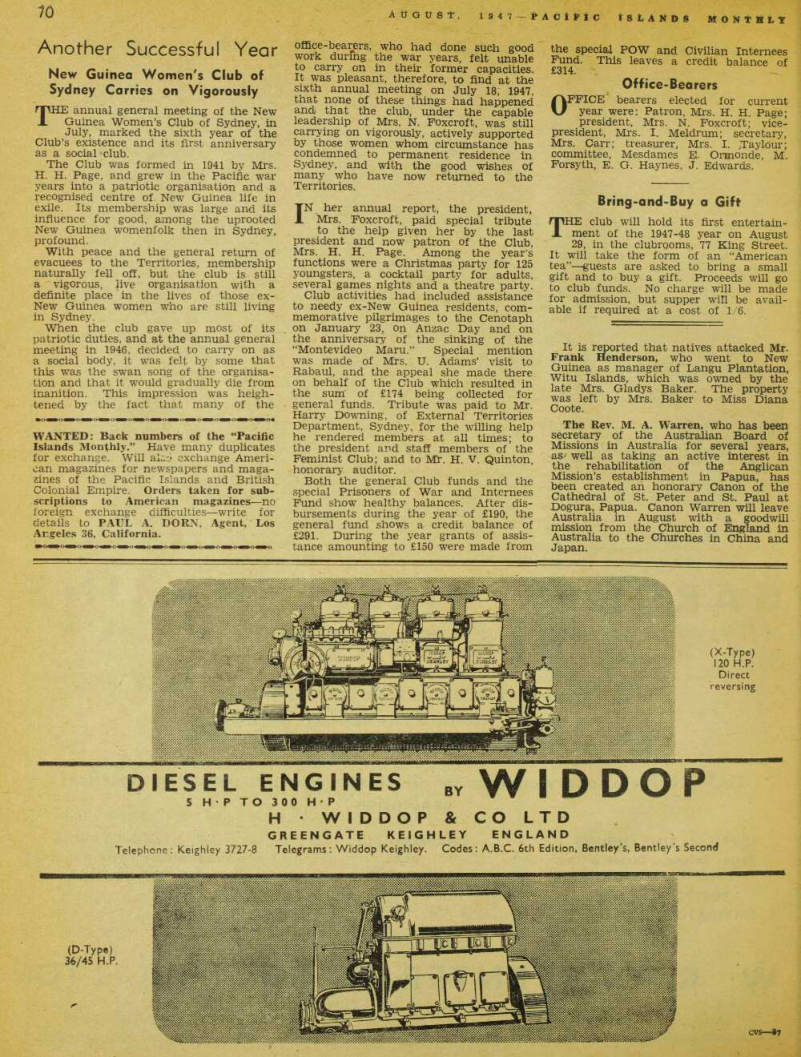
New Guinea Women's Club of Sydney Carries on Vigorously
THE annual general meeting of the New Guinea Women’s Club of Sydney, in July, marked the sixth year of the Club’s existence and its first anniversary as a social club.
The Club was formed in 1941 by Mrs.
H. H. Page, and grew in the Pacific war years into a patriotic organisation and a recognised centre of New Guinea life in exile. Its membership was large and its influence for good, among the uprooted New Guinea womenfolk then in Sydney, profound.
With peace and the general return of evacuees to the Territories, membership naturally fell off, but the club is still a vigorous, live organisation with a definite place in the lives of those ex- New Guinea women who are still living in Sydney.
When the club gave up most of its patriotic duties, and at the annual general meeting in 1946, decided to carry on as a social body, it was felt by some that this was the swan song of the organisa tion and that it would gradually die from inanition. This impression was heigh tened by the fact that many of the
office-bearers, who had done such good work during the war years, felt unable to carry on in their former capacities.
It was pleasant, therefore, to find at the sixth annual meeting on July 18, 1947, that none of these things had happened and that the club, under the capable leadership of Mrs. N. Foxcroft, was still carrying on vigorously, actively supported by those women whom circumstance has condemned to permanent residence in Sydney, and with the good wishes of many who have now returned to the Territories.
IN her annual report, the president, Mrs. Foxcroft, paid special tribute to the help given her by the last president and now patron of the Club, Mrs. H. H. Page, Among the year’s functions were a Christmas party for 125 youngsters, a cocktail party for adults, several games nights and a theatre party.
Club activities had included assistance to needy ex-New Guinea residents, com memorative pilgrimages to the Cenotaph on January 23, on Anzac Day and on the anniversary of the sinking of the “Montevideo Maru.” Special mention was made of Mrs. U. Adams’ visit to Rabaul, and the appeal she made there on behalf of the Club which resulted in the sum' of £174 being collected for general funds. Tribute was paid to Mr.
Harry Downing, of External Territories Department, Sydney, for the willing help he rendered members at all times; to the president and staff members of the Feminist Club; and to Mr. H. V. Quinton, honorary auditor.
Both the general Club funds and the special Prisoners of War and Internees Fund show healthy balances. After dis bursements during the year of £l9O, the general fund shows a credit balance of £291. During the year grants of assis tance amounting to £l5O were made from
the special POW and Civilian Internees Fund. This leaves a credit balance of £314.
Office-Bearers
OFFICE bearers elected for current year were: Patron, Mrs. H. H. Page; president, Mrs. N. Foxcroft; vice president, Mrs. I. Meldrum; secretary, Mrs. Carr; treasurer, Mrs. I. .Taylour; committee, Mesdames E. Ormonde, M.
Forsyth, E. G. Haynes, J. Edwards.
Bring-and-Buy a Gift
THE club will hold its first entertain ment of the 1947-48 year on August 29, in the clubrooms, 77 King Street.
It will take the form of an “American tea”—guests are asked to bring a small gift and to buy a gift. Proceeds will go to club funds. No charge will be made for admission, but supper will be avail able if required at a cost of 1/6.
It is reported that natives attacked Mr.
Frank Henderson, who went to New Guinea as manager of Langu Plantation, Witu Islands, which was owned by the late Mrs. Gladys Baker. The property was left by Mrs. Baker to Miss Diana Coote.
The Rev. M. A. Warren, who has been secretary of the Australian Board of Missions in Australia for several years, as well as taking an active interest in the rehabilitation of the Anglican Mission’s establishment in Papua, has been created an honorary Canon of the Cathedral of St. Peter and St. Paul at Dogura, Papua. Canon Warren will leave Australia in August with a goodwill mission from the Church of England in Australia to the Churches in China and Japan.
Advertisements & other items, p. 64 (1 item)
Diesel Engines By Wid D O P
WANTED: Back numbers of the “Pacific Islands Monthly.” Have many duplicates for exchange. Will alec* exchange American magazines for newspapers and magazines of the Pacific Islands and British Colonial Empire. Orders taken for subscriptions to American magazines —no foreign exchange difficulties —write for details to PAUL A. DORN, Agent, Los Angeles 36, California.
VHP
m irm
(X-Type)
120 H.P.
Direct reversing DIESEL ENGINES by WID D O P 5 H* P TO 30 0 H' P
H • WIDDOP & CO LTD
GREENGATE KEIGHLEY ENGLAND
Telephone: Keighley 3727-8 Telegrams: Widdop Keighley. Codes: A.B.C. 6th Edition, Bentley’s, Bentley's Second
(D-Type)
36/45 H.P. c-.' ;.'V •• % n:::; '
fills
■ • : >=- -vV> • ■ y&y.-.- ■ . . ■ cvs—B7
In Pre-War N. Guinea
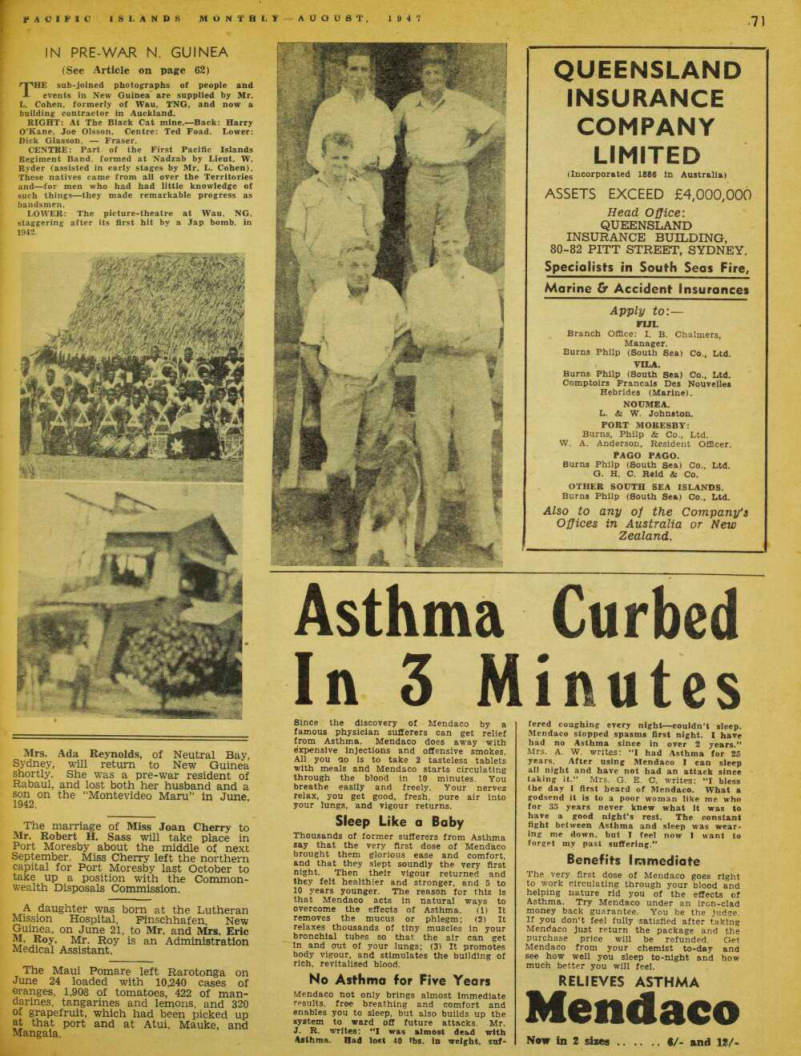
(See Article on page 62)
THE sub-joined photographs of people and events in New Guinea are supplied by Mr.
L. Cohen, formerly of Wau, TNG, and now a building contractor in Auckland.
RIGHT: At The Black Cat mine,—Back: Harry O’Kane, Joe Olsson. Centre: Ted Foad. Lower: Dick Glasson. Fraser.
Mrs. Ada Reynolds, of Neutral Bay, Sydney, will return to New Guinea shortly. She was a pre-war resident of Rabaul, and lost both her husband and a son on the “Montevideo Maru” in June, 1942.
The marriage of Miss Joan Cherry to Mr. Robert H. Sass will take place in Port Moresby about the middle of next September. Miss Cherry left the northern capital for Port Moresby last October to take up a position with the Common wealth Disposals Commission.
A daughter was bom at the Lutheran Mission Hospital, Finschhafen, New Guinea, on June 21, to Mr. and Mrs. Eric M. Roy. Mr. Roy is an Administration Medical Assistant.
The Maui Pomare left Rarotonga on June 24 loaded with 10,240 cases of oranges, 1,908 of tomatoes, 422 of man darines, tangarines and lemons, and 320 of grapefruit, which had been picked up at that port and at Atui, Mauke, and Mangaia.
CENTRE: Part of the First Pacific Islands Regiment Band, formed at Nadzab by Lieut. W.
Ryder (assisted in early stages by Mr. L. Cohen).
These natives came from all over the Territories and —for men who had had little knowledge of such things—they made remarkable progress as bandsmen.
LOWER: The picture-theatre at Wau, NG. staggering after its first hit by a Jap bomb, in 1942.
Advertisements & other items, p. 65 (1 item)
Asthma Curbed
QUEENSLAND
INSURANCE
COMPANY
LIMITED
(Incorporated 1886 In Australia)
ASSETS EXCEED £4,000,000
Head Office :
QUEENSLAND
INSURANCE BUILDING,
80-82 PITT STREET, SYDNEY.
Specialists in South Seas Fire,
Marine & Accident Insurances
Apply to:
FIJI.
Branch Office: I. B. Chalmers, Manager.
Burns Phllp (South Sea) Co., Ltd.
VILA.
Burns Phllp (South Sea) Co.. Ltd, Comptolrs Francals Des Nouvelles Hebrides (Marine).
NOUMEA.
L. Sc W. Johnston.
PORT MORESBY:
Burns, Phllp & Co., Ltd.
W. A. Anderson, Resident Officer,
PAGO PAGO.
Burns Phllp (South Sea) Co.. Ltd.
G. H. C. Reid Si Co.
OTHER SOUTH SEA ISLANDS.
Burns Phllp (South Sea) Co., Ltd.
Also to any of the Company's Offices in Australia or New Zealand.
Asthma Curbed In 3 Minutes
Since the discovery of Mendaco by a famous physician sufferers can get relief from Asthma. Mendaco does away with expensive injections and offensive smokes.
All you ao is to take 2 tasteless tablets with meals and Mendaco starts circulating through the blood in 10 minutes. You breathe easily and freely. Your nerves relax, you get good, fresh, pure air into your lungs, and vigour returns.
Sleep Like a Baby
Thousands of former sufferers from Asthma say that the very first dose of Mendaco brought them glorious ease and comfort, and that they slept soundly the very first night. Then their vigour returned and they felt healthier and stronger, and 5 to 10 years younger. The reason for this Is that Mendaco acts in natural ways to overcome the effects of Asthma. (1) It removes the mucus or phlegm; (2) It relaxes thousands of tiny muscles in your bronchial tubes so that the air can get In and out of your lungs; (3) It promotes body vigour, and stimulates the building of rich, revitalised blood.
No Asthma for Five Years
Mendaco not only brings almost immediate results, free breathing and comfort and enables you to sleep, but also builds up the system to ward off future attacks. Mr.
J. R. writes: “I was almost dead with Asthma. Dad lost id lbs. In weight, saf-
fered coughing every night—couldn’t sleep.
Mendaco stopped spasms first night. I have had no Asthma since in over 2 years.”
Mrs. A. W. writes: “I had Asthma for 25 years. After using Mendaco I can sleep all night and have not had an attack since taking it.” Mrs. G. E. C. writes: “I bless the day I first beard of Mendaco. What a godsend it is to a poor woman like me who for 35 years never knew what it was to have a good night’s rest. The constant fight between Asthma and sleep was wearing me down, but I feel now 1 want to forget my past suffering.”
Benefits Immediate
The very first dose of Mendaco goes right to work circulating through your blood and helping nature rid you of the effects of Asthma. Try Mendaco under an iron-clad money back guarantee. You be the jud?e If you don’t feel fully satisfied after taking Mendaco Just return the package and the purchase price will be refunded Get Mendaco from your chemist to-day and see how well you sleep to-night and how much better you will feel.
RELIEVES ASTHMA
Mendaco
Now in 2 sizes «/- and If/-
Buka-Bougainville
News and Notes From Buka-Bougainville
From a Special Correspondent
Buka Passage, July 7.
PROGRESS is being made in this dis trict in Administration and in plan tation rehabilitation, but it is slow owing to the many disabilities under which the district is at present suffering.
Chief among these is lack of shipping, with consequent lack of necessary sup plies—both European and native.
There is a general shortage of native labourers, and those natives who are wil ling to work desire to do so on a casual basis. As a result, it is difficult for planters to get any system of operation, or even a regular amount of work com pleted. The production of good copra will be exceedingly difficult without
trained dryer attendants who can be trusted. Some planters’ labour lines fluc tuate from month to month. It is there fore hard to plan ahead and clearing the bush becomes very expensive.
The Administration is handicapped by a shortage of staff and by the fact that, at present, there is no patrol vessel in the district. The one allotted to the area seems to spend most of its time being repaired at Finschhafen, with short periods on duty. As the islands groups of Nissan, Carterets, Mortlocks and Tasmans are included in Bougain ville district, a patrol vessel is neces sary.
With a growing number of European women and young children in Buka and Bougainville, the need for a European hospital at Sohano headquarters has be come urgent. There is no accommodation
available for sick people and the respon sibility for housing and feeding patients appears to rest with the medical assist ant. This is most unfair to all concerned.
The matter of a hospital was urged upon Dr, Gunther, PMO, on the occasion of his recent visit.
An agricultural station has been started at Komarau, adjacent to Buka Passage, and is in charge of an officer of the Agricultural Department. Experimental crops are being grown and demonstra tions in proper methods of agriculture are given to the natives. Nine pedigreed boars were recently landed at Komaru, ex Port Moresby, by “Laurabada.”
It is the intention of the Adminis tration to transfer a number of pigs from Nissan Group to the Buin area.
They are not of a very classy variety, but will assist in remedying the shortage there, caused by Japanese appetites. Pigs are worth their weight in gold every where at the present time.
Residents of Buka and Bougainville were pleased to have had the Adminis trator and his party tour the district, and to have the opportunity to place their views before him. The month which Colonel Murray spent in the area will give him a clear view of conditions here.
Residents feel that the district should be recognised and treated as one of the richest and most productive areas in the Territory of New Guinea. Copra produc tion amounted to 12,000 tons per annum in the pre-war period, and all the plan tations were heavy producers. That copra to-day would be worth over £350,000. v * * Plantations now being cleared include Karoola, Soraken, Bonis, Raua, Inus, Tearouki, Teopasino, Numa Numa, Tene kau, Arigua, Arawa, Iwi and Kekere.
There is some copra now awaiting ship ment at one or two of these places.
Whilst clearing up, the plantations will probably produce smoke copra, although jt is understood that this jgrade is be coming unpopular with buyers.
A large amount of trochus shell was purchased from the natives by planters and traders in the early part of the year.
The poor shipping service prevented the greater part of the shell being shipped until early in May, and by that time the bottom had fallen out of the market.
The majority of the buyers suffered an unpleasant loss as a consequence. * * ♦ D. O. RALEIGH FARLOW was due to go on leave in July. During his ab sence ADO Chris Slattery will carry on. Mrs. Slattery has lately joined her husband at Sohano.
Dr. Pike, who has been appointed medical officer for Bougainville district, arrived recently to take up his duties.
The presence of a MO is appreciated by all. * * * Mr. R. A. Robinson, Senior Inspector of Plantations for Burns Philp & Cos., has been touring Bougainville inspecting the company’s properties. He returned to Rabaul on July 3. * * * Mr. Ron Pickwell, our popular and energetic medical assistant, has done a very good job during his 12 months in charge of the native hospital at Sohano.
His advice and help to European pati
ents has also been much appreciated.
Mrs. Pickwell has now arrived from Mel bourne.
Mr, J. Preston-White is ADO in charge at Kieta. His wife and child are now with him. * * * Father Albert Lebel, of the Marist Mission, is now in America on a well earned holiday. He is not expected back until next year. He flew from Torokina to Sydney and thence to America. * ♦ ♦ Mr. Paul Mason has now returned to reopen Inus Plantation, Bougainville, He is a welcome addition to the ranks of former planters. * :J: * Mr. Rolf Cambridge, formerly District Manager for Choiseul Plantations Ltd*., is now inspector in Bougainville for the Production Control Board. He has also been acting for the War Damage Com mission. * * ♦ Bishop T. J. Wade, of the Marist Mission, has his headquarters at Toro kina at present. He is a very busy man these days as the re-establishment of his Mission after 3V 2 years of Jap occupation and destruction, is no light task. His job entails a lot of travel, organising and worry. In spite of all his wartime ex periences and his strenuous work, he re mains the same cheery and humorous personality that the district has known for so many years. The Bishop always says “I like a straight shooter,” and that is another reason why the district likes the Bishop! He comes into that category himself. * * * Among former residents of this area who have now returned are Mr. and Mrs.
Claude Campbell, of Raua; Mr. Max Babbage, of Karoola; Mr. Don Colley, of Soraken, who is in charge of the Burns Philp interests in Bougainville: Mr.
Drummopd Thomson, who controls the Buka Plantations and Trading Co.’s properties; Mr. Sandford, of Numa Numa; Mr. Alf Long, of Bonis; Mrs. E.
Falkner, of Tearouki; Mr. A. M, Stew art, of Teopasino; Mr. Bob Stuart, of Tenekau; Mr. Jack Ellis, of Arawa; Mr. and Mrs. J. M. Joyes, of Iwi; Mr. W.
A. L. Clark, of Kekere; Mr. Fred Archer, of Yame, and Mr. Charlie Quintal, who is at Karoola.
Mr. A. H. Voyce, of the Methodist Mission, is at Buin, and Mr. C. T. J.
Luxton, of the same Mission, is at Buka.
Both are busy getting their mission sta tions into order. Very soon a minister is expected from New Zealand to reopen the Methodist Mission at Tiop. Usaia So tutu, the Fijian mission teacher, who fig ured prominently in “Coast Watchers,” is assisting Mr. Luxton at Buka.
Sister Toole, formerly Sister-in-Charge of the Marist Mission native hospital at Pororan Island, Buka, is now in charge of a similar institution at Gagan, in Cen tral Buka. The passing years have not slackened her energy and drive. * * * Two of the pre-war Chinese storekeep ers, Wong You at Kieta and Laurie Chan at Buka Passage, have reopened their stores and are providing certain Euro pean lines along with trade goods. Wong You was a storekeeper and trader pre viously. He had a thriving business. • Master Charles Riechelman was a passenger on the flying-boat “Coriolanus” which left Sydney on July 18. He was returning to Tonga after eight years in Sydney.
Advertisements & other items, p. 66 (1 item)
Sails. Covers, Awnings
AND ALL CLASSES CANVAS GOODS FOR
INDUSTRIAL AND HOME USE
ALSO: FLAGS, ALL NATIONS
Send your inquiries to
HARRY WEST
"SYDNEY'S SAILMAKER"
DUKE ST. (WATERFRONT) EAST BALMAIN, SYDNEY, N.S.W.
Phone: WBIIOS, W 82284.
Hard to Get? lr v us
FOR
1. TRADE TOBACCO 10.
2. LAP LAP MATERIAL 11.
3. CANNED GOODS 12 -
4. PERFUMERY 13 -
5. PRIMUS STOVES 14
6. KEROLAMPS ‘
7. SHOES, SANDALS 15
8. UMBRELLAS ] 6
9. CHILDREN'S CLOTH- 17*
ING 18.
M. & M.
SADDLERY & HARNESS
HOME LIGHTING PLANTS
WINES AND SPIRITS
NON-ELECTRIC WASHING
MACHINES
PUMPS, IRRIGATION
PLANTS
CROCKERY
HAIRDRESSING SUPPLIES
HARDWARE
AIR CIRCULATORS
8a Castlereagh Street, Sydney, Australia
ISLAND TRADERS
Cable and Telegraphic address: “MANSTOCKS,” SYDNEY Telephones: 8W7405, 8W1237, 85076, PM2766
Ship "Viti" May Be Laid Up
From Our Own Correspondent
Suva, Aug. 1.
FIJI’S most notable white elephant, the compact and, at times, useful little motor-ship “Viti,” is still awaiting an owner.
First advertised for sale last year, the “Viti” has recently made two trips— one to Nukualofa to take guests for the Royal weddings and the other with the Acting Governor, an official party and the Band of the Fiji Military Forces, to the eastern portion of the Fiji Group.
Since the ship was first put on the market and was advertised in Fiji, Great Britain, New Zealand and Australia, pos sible buyers have nibbled but no more.
It is expected the “Viti” will be laid up and the crew paid off and the ship placed in the hands of shipbrokers.
The liner “Rimutaka,” bound from Panama to Wellington, was diverted to Pitcairn Island on July 25 in response to an urgent radio appeal from the island. A child, Helena Young, aged 10. had been ill on the island with tetanus for 10 days without a doctor’s care. She was taken onto the ship but, in spite of medical attention, she died next day at sea.
Advertisements & other items, p. 67 (1 item)
W. Kopsen & Co. Pty. Ltd.
AERIAL PHOTOGRAPHS
SOUTH PACIFIC ISLANDS
Norfolk Island, Noumea, Suva, Nukualofa, Apia. Aitutaki, Rarotonga Prints 10 inches x 8 inches 6/6 each, or set of seven (1 of each place) £2/2/-, postage included.
WHITE’S AVIATION LTD.,
605 Dilworth Bid., Auckland, Cl, N.Z.
» •or c/wvfi» 1. The finest wood and canvas preservative known, prevents decay, dry rot and eradicates white ants and borers in wood and canvas; supplied green or colourless. Prices from 12/- per gallon, smaller tins available. 2. C.Q.R. ANCHORS, British invention made in Australia. Three times the holding power, easy to handle and available in all sizes from 13 lb. to 140 lb. Ask for price list. 3. KAYEN KEROSENE LAMPS are the finest Australian-made lamps; burn kerosene and provide 300 C.P. light without flickering. All brass containers, All spares made in Australia easily and cheaply available. Made in Handsome Table Lamp as illustrated or in All Purposes Lamp and Lantern. Ask for illustrated leaflets
4. SIMPLEX MARINE ENGINES—
3, 5, and 10/12 H.P. sizes. Suitable for all craft from 14 to 32 feet long; 5 and 10 H.P. supplied with built-in reverse gear. All Australian-made. Price and specifications on request. 4s/c for comprehensive price list of hoatgear and specialty hardware lines.
W. KOPSEN & CO. PTY. LTD.
380 Kent Street, Sydney
Cables:
“KOPSEN SYDNEY”
Moresby
The Month In
From a Special Correspondent
Port Moresby, Aug. 6.
A NATIVE was killed during the month in the main street, just outside BP’s, when he tried to climb on to a moving vehicle, and fell under the wheels. It is a matter for wonder that no fatalities have been recorded before this. Natives seem to lack the quick judgment, anticipation, and foresight necessary to sound driving. It is common to see a native driver approach a blind bend at full speed, or hugging the crest of the road, with no thought of what mav be around the corner. THE Census figures have confirmed the obvious: that there are well over twice as many European people in Moresby to-day as there were pre-war.
The actual figure for Moresby was 1,516, compared with approximately 600 in 1939.
TJANUABADA. or the Bush!
In late July a tense, almost inter national, situation developed between our Hanuabadans—of the local (somp day) “model village”—and the Kerema people, who . merely work in Moresbv ui nU a £ a village council conscripted all villagers to fight for the values of civilisation, Hanuabadans apparently feel that their adoption of European clothes and their superficial fluency in English are matters for self-congratulation and arrogance That, at least, is the Kerema story 3 Tn rpnlv , , , „ piarmp/ 1^ als N who . w . ere reall y the Keremas^werp^ sist f d , th^t u,..* ® Wore if 111 heart head thS^?bn^°«?r^ af S r bl °v? d i and that their choice of the Hanuabadans as an enemy was unprovoked and probably due to jealousy.
One week-end an ultimatum was delivered to Hanuabada- Either the sophisticated locals would ‘ disrobe them selves, forsake their airs and graces and affirm their humble status bv returning
to the traditional rami, which is good enough for Keremas and therefore dis tinctly too good for Hanuabadans—or the Keremas would perform these tasks for them.
The Hanuabadan menfolk stayed home from work for several days, and on one occasion the Keremas persistently marched with ferocious grimaces and blood-curdling noises towards the village —until they reached the first policeman.
The Keremas have thoroughly enjoyed themselves, but the Hanuabadans were very, very concerned about the situa tion. ■ ■ ■ MEMBERS of a RAAF Searcher Party, under Sauadron Leader Rundle returned to Moresby at the end of July. They had spent some time in Dutch New Guinea seeking the remains of Allied planes shot down during the war. One member of the party had pre viously walked across the Territory from Lae to the coast near Yule Island looking for information and folllowing up clues.
B ■ ■ THE sinking of the “Gippsland,” off the Papuan coast, placed us at the head of the ABC’s national news one proud night in late July. But daily bul letins had kept us so well informed that no one showed much interest in the thirteen survivors. However, when diver J. E. Johnstone loaned a film of the “Niagara” salvage operations to the Edu cation Department for screening in, a programme of educational films, apathy fled, and the whole town turned up.
Johnstone gave an interesting commen tary on the film.
Bbs
THE Education Department’s film offi cer Mr. Cox, formerly of the Rabaul Theatre, is showing programmes on a regular fortnightly schedule in the Mores by district. The regular programmes at the RSL Clubrooms (for Europeans) and at Hanuabada, Elevala, Koki, Kila, Sogeri and all nearby schools, are immensely popular with their audiences. As the Department expands, it is planned to have film circuits in each district, with a permanent library at headquarters.
Fiji Indians and Diseased
Cattle
Suva, Aug. 1.
“ A HINDU owner would rather die him- A self than shoot a diseased beast,” said Mr. A. D. Patel, at the July sitting of the Legislative Council of Fiji when a Bill to amend the Animals (Con tagious Diseases) Ordinance was being debated.
The Bill empowers veterinary officers and inspectors, if so authorised by the Director of Agriculture, to order the des truction of diseased animals.
A Fijian member, Joeli K. Ravai, said that the officer concerned should see that the animal really was destroyed. Cases occurred; he said, in which condemned animals were disposed of to Fijians.
Ratu Tiale Vuiyasawa asked for stock inspectors, and Ratu Estuate Mataitini asked what was the penalty for non compliance.
Mr. Patel protested against the onus of destruction being placed on the owners.
The Director of Agriculture (Mr. C.
Harvey) said that failing action by the owner, the officer making the order was prepared to undertake the task of des truction. The veterinary staff had re cently been increased.
Advertisements & other items, p. 68 (1 item)
Pimples and Bad Skin
THE KENTUCKY STUD
Bernage Street , Toowoomba
Breed and deal in Arab horses, Shetland ponies
and High-Class Saddle Hacks
ORDERS TAKEN FOR :
PURE BRED PIGS, JERSEY AND ILLAWARRA HEIFERS Any Inquiries will be Appreciated and will Receive Our Best Attention.
For further particulars apply to:—
THE MANAGER. TELEGRAMS: TELEPHONE:
P.O. Box 319, Kentucky Stud, 696 Toowomba, Qld. Toowoomba Toowoomba
Pimples and Bad Skin Fought in 24 Hours
Since the discovery of Nlxoderm by an American physician it Is no longer necessary for anyone to suffer from ugly, disgusting and disfiguring skin blemishes such as Eczema, Pimples, Rash. Ringworm. Psoriasis, Acne, Blackheads, Scabies and Red Blotches. Don’t let a bad skin make you feel inferior and cause you to lose your friends. Clear your skin this new scientific way.
A New Discovery
Nixoderm is an ointment, but different from any ointment you have ever seen or felt. It is a new discovery, and Is not greasy but feels almost like a powder when you apply It. It penetrates rapidly into the pores and fights the cause of surface skin blemishes. Nlxoderm contains 9 ingredients which fight skin troubles in these 3 ways. I.—lt fights and kills the microbes or parasites often responsible for skin disorders. 2.—lt stops Itching, burning and smarting in 7 to 10 minutes, and cools and soothes the skin. 3. —It helps nature heal the skin clear, soft and velvety smooth.
Works Fast
mediately, clearing and healing your skin, making It softer, whiter and velvety smooth Because Nixoderm Is scientifically compounded to fight skin troubles. It works fast.
It stops the itching, burning and smarting In a few minutes, then starts to work 1m-
In just a day or two your mirror will tell you that here at last is the scientific treatment you have been needing to clear your skin—the treatment to make you look more attractive, to help you win friends. Nixoderm has brought clearer, healthier skins to thousands, such as Mr. Bob Weedon, Edmund Street, Fremantle, who writes: “I was troubled with pimples ever since I was 13, and have spent pounds and pounds on so-called cures without results. I then tried Nixoderm with astounding effect.
The pimples seemed to fade away, and after a week there was not the slightest trace of them.”
Satisfaction Guaranteed
Get Nixoderm from your chemist or store to-day. Look in the mirror in the morning and you will be amazed at the Improvement.
Then just keep on using Nixoderm for one week and at the end of that time It must have made your skin soft, clear, smooth and magnetically attractive —must give you the kind of skin that will make you admired wherever you go, or you simply return the empty package and your money will be refunded in full. Get Nixoderm from your chemist or store to-day.
The guarantee protects you.
Nixoderm 2/- & 4/-
For Skin Sores, Pimples and Itch .
Against New Officials
Sharp Disorder In Tahiti
Returned Servicemen Lead Demonstration Against New Officials
THERE has been serious political un rest in the French Pacific Colonies.
On the arrival of the “Ville d’ Amiens” at Papeete on Sunday morning, June 22, from Marseilles, a crowd led by returned Servicemen opposed the landing of three French officials and their families. These officials (an administrator and two Treas ury assistants) had been brought out to join the Colonial administration. Under oressure from the demonstrators, the local troops and police, largely consisting of Tahitians, were unable to intervene.
Harangued by one of their leaders, perched on the gangway, the demonstra tors shouted, applauded, taking possession of the wharf and threatening the three officials should they set foot ashore.
A guard (of demonstrators) was posted on the gangplank and every passenger wanting to go ashore had to disclose his identity and his business.
On Tuesday, June 24, the Governor (M. Haumant), fearing things might take a nastier turn, ordered the “Ville d’Amiens” to anchor off shore. The sailing of the ship was overdue.
The situation was becoming intolerable.
Passengers and crew were getting im patient. A delegation under guard was taken from the ship to the Governor to ask him to make a decision. He assured the deputation that the ship would leave within a reasonably short time.
On Saturday, June 28, towards 6 a.m., two Navy launches went alongside the “Ville d’Amiens” and hastily took on board the three officials, their families and luggage. The launches had no sooner started for the shore than the “Ville d’Amiens” blew her siren and left for Vila, four days late.
These details were given by “Ville d’Amiens” passengers on arrival in Noumea.
The Governor’s proclamation condemn ing the demonstrations was issued the previous day, June 27. The proclamation ended by saying that no matter what happened, in the end the law would pre vail.
According to a report that has reached the Pacific, a Tahitian deputy in Paris has declared that there is a strong move for Tahitian self-government.
Similar discontent though the im mediate causes may be different is re ported from New Caledonia. It is all part of the tense situation which has been created throughout the Western democracies by the attempts of Moscow inspired Communists to get control of the Governments.
THE following is the appeal which the Governor of French Oceania. M.
Haumant (who succeeded Colonel Orselli recently, and who has in turn been succeeded by M. Maestracci) issued to the Tahitian population; “A number of discontented people, who claim to speak on behalf of returned Servicemen of whom they represent only a small minority and in the name of the population the great majority of whom are opposed to their methods and their aims seek to impose their will, by violence, on the local government and on the country.
“Last Sunday, they used force to re sist the landing of one official of the administrative services, and two Treasury assistants sent here by the French Gov ernment to fill vacancies and work for
the better functioning of the administra tion. In particular, the Treasury clerks are needed to reinforce a staff that is insufficient to assure normal service—for the Treasury shortage has been critical for many months.
“The agitators are trying to make out that Tahitians could be recruited for this work, and that, furthermore, the administration has brought out these new officials against the wishes of the Repre sentative Assembly, the only body quali fied to express the wishes of the popula tion.
“These statements are lies.
“npHE Treasury needs, not beginners, but X qualified and experienced employees who are familiar with the special book-keeping technique used, and this cannot be picked up in a day or two, “For a long time now the Represen tative Assembly has been conversant with the situation. The necessary credits have been included in the budget of the Colony, and without these credits, which are regularly voted, the administration would be unable to nay the officials it employs.
“That is the true position, and these who are causing trouble know it. It was explained to them by the President of the Assembly when he interviewed them last Friday, and by the Public Prosecutor, who in the Governor’s name made con tact with them on Sunday. Yet. even though the leaders of the demonstrations acknowledged the force of the arguments presented, they have continued their action, under the excuse that the crowd which they themselves had excited, re fused to allow the officials to land.
“For three days past they have em ployed violence on the ships and on the wharves, preventing the women from landing and seeking accomodation after the fatigue of a long voyage; even trying to stop provisioning of a ship which had just brought to Tahiti tons of produce from metropolitan France. For three days they have used violence to prevent any action being taken, apart from their own.
“ A NEW motive for the agitator’s ac tivities is involved in the distur
bances. For many months now they have followed a policy of agitation, with the avowed aim of getting power into their own hands. They have called on members of the Representative Assembly and representatives of the Municipal Council to resign. They hope, through new elections, in the course of which they would not stop at menaces and violence, to become the strongest party and impose their own dictatorship.
“All the conciliatory measures which have been taken, all the concessions that have been made by the local Government up to the present time, have had only one result—to encourage them still more and force the development of a plan of action whose stages are now familiar.
“The local Government does not wish to employ all the legal means at its dis posal, hoping in spite of all to avoid in cidents graver still.
“TIHE Government is anxious to study JL and carry out reforms for which the need is recognised. A commis sion has been formed which includes two members of the Representative Assembly and two returned Servicemen, plus a
magistrate and a government official, all of them responsible people, who will examine whatever suggestions may be S to 6 ' the T RepresentaUve W c P s£” S ° Vernment ’ “ “ S a ‘ d re -
treatment A lnd g
ment, Governor Haumant ended by saying: “For this reason it is realised that order in the country cannot be disturbed at every turn by agitators who take advantage of certain justifiable and legitimate claims to lead the credulous mass of the population astray, unsettling the country, and achieving their ends by means which belong not to democracy, but to Fascism.”
History of Colonies' Feeling
Against Paris
EVER since World War I. French Colonies in the Pacific have charged the French metropolitan Government with far too frequent changes in the administrative services. Apart from war periods, it has often been rare for French officials to stay more than a year or two in the colonies to which they have been sent. The process has been des-
cribed as “leapfrogging around the French Empire”—with an eye on eventual retirement ‘in Prance
f? ench local populations ftdtag
wTose n °L a T-is erl fo U be der sf^o^
***« back mtlTral of'love
ao get DacK t 0 tne metro D° n s.
There is in addition a strong feeling b eo P le ar ® services the dlfferent administrative , . There I£ * also considerable resentment Decause officials sent out fr° m France are very much higher paid than the a J e .Prevented ?- r ° m nsln g to the higher administrative .iobs.
The position in a nutshell is that the people who know the country best are governed by people who know the country Further, visiting officials received liberal travelling allowances. The result is that ships between the Colonies and France were, in the Ist class, full of French officials, and in. the 2nd and 3rd of poorer colonials who considered they had paid the officials’ Ist class passages.
They too had an inferiority complex, Con sidering the Frenchmen from France looked down on them.
Often the French Colonial system works far from democratically, for the local General Council or Representative Assemblies have hitherto been little but advisory bodies, with no control over taxation and appointments.
All real control is, or has been, in the hands of the Governors: and it is very rare for a governor to stay in a colony for more than a year or two before he is replaced by another governor, so that he often only has a fragmentary knowledge of the colony in his charge. Often gov ernors have lasted in one colony a matter of only a few months in some cases even weeks.
Colonial Ministers in Paris, with the frequent changes in Ministeries which are the plague of French politics, are also so frequently changed that in some cases they know nothing of French territories overseas and French public and press are uninformed.
In 76 years the French colonies have had no fewer than 97 ministers in Paris.
Between September 1, 1933 and November 9, 1934 (.14 months) there were eight Ministers and two Under Secretaries of State who ran the French Empire. The changes in Colonial Governorships have been equally numerous.
Since 1887, Indo-China has seen 21 Governors-General, 23 interim Governors- General and two High Commissioners— -46 rulers in 60 years. New Caledonia and Tahiti could quote comparable figures.
In such circumstances what continuity of administration is possible?
In Indo-China, Governors who lasted for any length of time belonged to the period before 1919. After that date Governors took upon themselves the habit of passing half the year in France.
This caused bitter complaints.
In Cochin China, in 20 years, nine governors (who were only interipi governors) were in power for longer.
During the same time 20 years Tonkin had 19 Resident Governors; Annam, 12; Cambogia, 9; and Laos, 16!
Advertisements & other items, pp. 69-70 (1 item)
Flour
TIME-PIECES
REPAIRED
We employ a Fully Qualified Staff and we are equipped to undertake repairs of
WATCHES CLOCKS
MARINE CHRONOMETERS
We undertake Locksmithing, Key-cutting, etc.
Any goods sent to us by post are attended to promptly and with care.
NOEL LEVY
Victorio Parade, Suva, Fiji Phone 39. P.O. Box 88.
Cablegrams: “Noel,” Suva
PRODUCING UNIFORM GOOD RESULTS SINCE 1868
FLOUR
ALWAYS ASK FOR IT
Woven Wire for all Industry
COPRA DRYING TRAYS, FLOORS, Etc.
FRU'T DRYING TRAYS, MINING SCREENS.
Heavy Mosquito Gauze in Phosphor Bronze and other Metals Impervious to Salt Sea Air.
WIRE DOOR MATS AND GENERAL WIRE WORKS
E. WRIGHT & CO. LTD.
Office and Works: 148-152 Cleveland Street. Sydney, N.S.W.
Telegraphic Address: "Wrlghtmake,” Chippendale.
Or £ & A
(SVA
What are your s
STEPHENS IMPORT AND EXPORT CO.
HIDES, SKINS AND LIVESTOCK SUPPLIERS AND SHIPPERS We are suppliers of the following :
CROCKERY: HOTEL AND DOMESTIC SUPPLIES.
(1) Trade Goods. (2) Primus Stoves. (3) Foodstuffs. (4) Umbrellas. (5) Manchester Lines. (6) Perfumery. (7) Wines. (8) Radios. (9) Saddles and Harness. (10) Non-Electric Washing Machines. (11) Tubular Chrome Furniture. (12) Tools, Machinery. (13) Pumps and Stationary Engines. (14) Home Lighting Plants.
Rum, Gin, Liqueurs, Whisky and all spirits. Only the finest.
Australian and Imported brands stocked.
All orders personally attended to and shipped promptly.
Stephens Import and Export Co.
Dymocks Building, 424 George Street, Sydney, Australia
Trouble In Wallis
Island
French Imprison 11 Natives
AS a result of trouble and demonstra tions in the Wallis Group, 11 Wallis natives have been brought to Noumea on board the small French vessel “Le Phoque,’’ and imprisoned at Camp Est on He Nou in Noumea harbour.
A British subject Mr. Brabant, with his wife and two children, have been de ported on the demand of the local Resi dent (Dr. Major Chaumet), by an order of the Governor of Caledonia, who is General Commissioner of the French Republic in the Pacific Ocean. Brabant was one of two traders in the group.
The other is a Frenchman.
It is reported that the “king’’ of the vVallis Group has been deposed by the French allegedly for pro-English senti ments. It appears that the trouble was a form of protest against the French Resi dent, who seems to have been returned post-haste to France by Pan American plane. Many of the natives of this neglected and isolated group are restless.
In the past the French have had trouble with the islanders and their kings.
Long ago one or two were deposed in favour of French nominees.
Of the 98 passengers brought to Noumea by the “Le Phoque,” 50 were Wallis natives who are to undergo military ser
vice. Three native stowaways were also discovered.
Wallis is a lonely group (northwards of Fiji and Samoa) about which Alain Ger bault has written, for he spent months there while his yacht underwent repairs.
For a long time the Catholic mission has virtually governed the island with little outside interference; but the islands (though belonging to Polynesia) are nominally under the New Caledonian Governor. The people are closely re lated to the Tahitians in speech and manners, although to-day they are less sophisticated. Some 400 Wallis islanders were brought to Noumea during the war. to work for the Americans, who found them satisfactory.
A percentage of men and women has always tried, in a spirit of adventure, to leave the island and get to other parts of the Pacific. Young girls have been known to swim out to sea or paddle out in canoes to beg passages from passing ships, in order to see life away from their home land.
The US Forces had a weather station on the highest mountain on the main island during the war a very lonely outpost, but one of use to the Air Force, and there was a small air strip.
Wallis and Futuna lie just over 500 miles west of Samoa and were discovered by the English seaman who gave his name to the Wallis group. A French Catholic mission has been there since 1837. and the “king" of the island signed a treaty of friendship with Prance in 1842. Two years later France declared it a protectorate, and a Resident was ap pointed under control of the Governor of New Caledonia. Like Tahiti, for many years Wallis had a queen as head of the state. The French made her a present of a church organ.
The native population to-day is about 6.000. The main island is 8 miles long, of volcanic origin, rising to about 600 feet, and is surrounded by a reef, with the main entrance to the south. A radio station keeps the residents in touch with New Caledonia, but comunication by ship in recent years has been infrequent with Noumea. The islanders are more in touch with the outside world through Fiji and Samoa. To-day they are said to be somewhat pro-British.
Advertisements & other items, p. 70 (1 item)
76
AUGUST, 1947 P ACIFIC ISLANDS MONTHLY
Official Tour of Buka
Buka and Bougainville
From a Correspondent
Buka Passage, July 7.
THE Administrator, Colonel J. K.
Murray, has just completed a 26days’ tour of Buka and Bougainville.
He also visited Faisi, BSI, to meet the Resident Commissioner of the British Solomons, Colonel O. Noel.
Colonel Murray arrived at Sohano Island in Buka Passage, the headquarters of Bougainville District, by HMAS “Con damine,” on June 8. On this occasion he stayed two hours and then accom panied by the District Officer of Bougain ville (Mr. R. M. Farlow). he continued the trip via Numa Numa. Kieta and Buin to Torokina, where he disembarked. Later the “Lourabada” arrived from Rabaul and picked him up, to continue the tour.
Various centres in the district were then re-visited and the Administrator also had a walk through the southern end of Bougainville. There was a stay of a day and a half at Kieta, where Mr. J.
Preston-White is ADO. Two days were spent at Sohano on the return visit, and, from there, a jeep trip was made up the East Coast of Buka, and to Gagan, in the centre of the island.. Schools, missions
and plantations were visited. A number of well-known planters met the Admin istrator and explained the difficulties with which they were at present beset.
The west coast of Bougainville was also visited and the tour ended on July 3, when the official party left for Rabaul.
Accompanying the Administrator on his tour were Dr. J. Gunther (Principal Medical Officer), Mr. W. Cottrell-Dormer (Director of Agriculture), Lt.-Col. J. S.
Grimshaw (Superintendant of Police), and Mr. J. H. McDonald (Assistant Director of District Services).
Among Lutheran missionaries who left America for foreign fields at the end of March were the Rev. and Mrs. Andrew- Mild and their three young children, and the Rev. and Mrs. Ralph Goldhardt. They were on their way to New Guinea via Aus tralia.
Mr. Dan Leahy returned to Mt. Hagen, New Guinea, in June. He had just spent many months in the United States seek ing treatment for failing eyesight. The trouble appears to have been caused dur ing Army service by vitamin deficiency, but the Army doctors could not cure the condition and stated that he would pro bably go blind. With this comforting prediction, they boarded him out of the Service. Mr. Leahy went to America seek ing aid at the Mayo Clinic in Minnesota, John Hopkins, in Baltimore, and later, to a New York hospital. Although no cure was effected, he has been assured that the trouble has been checked and will get no worse.
Mrs. Gross has returned to Australia by plane from Kavieng. New Ireland. Her son, Jim, recently arrived from Australia, and is engaged in plantation rehabilita tion on New Ireland.
Advertisements & other items, p. 71 (1 item)
oMdJuin m
S fuUWH't If4ft f
&v w \
WHAT WOMEN
ADMIRE
WELL-CROOMEI
HAIR
& ( * \!J 6 3 /> * % 'I A V y •i Nine out of ten men dance as well as he does, hut women prefer the partnership of wellgroomed men . • . admire the easy correctness expressed in good-looking, non-greasy hair. You. too, can make your hair a social asset with VITALIS, and the 6 60-sccond drill.’
J 50 Seconds to Rub—Cir- 10 Seconds to Comb and culation quickens thus Brush—Hair has a lustre scalp stimulation gives hair —no objectionable " a chance. leather" look. 3301 v S«Blu'0* eS **'* h> Sold by all leading distributors and manufactured by Bristol-Myers Co. Pty. Ltd., 223 Pacific Highway, North Sydney, N.S.W., Australia
Ominous Noises
Hawaii's Giant Volcano May Erupt Again Soon
Honolulu, Aug. 4.
HAWAII'S slurhbering giant volcano — already more than a year behind on its four-years schedule of eruptions —is beginning to awaken again.
Under the 13 680-foot cone-shaped peak of Mauna Loa there have been ominous rumblings recently and the big mountain has shaken the island of Hawaii with some of the strongest earth quakes since the 1942 eruption, which spilled flaming lava down the mountain sides towards the town of Hilo.
Seismologists and volcanologists are checking the summit daily and report that a terrific pressure is being built up under the dome, which has poured out more lava in the last century than any other volcano in the world.
National park service seismographs re corded 48 tremors in June and on June 11 a large fume cloud hung over Mauna Loa’s towering summit.
But if Madame Pele as natives call the volcano begins to blow her top, there will be ample warning this time.
In the last big eruption in 1942, the Army, fearful that the Japs would schedule an attack to co-incide with the fiery outburst, prohibited publication of any forecasts, and withheld news of the eruption until all activity had ceased.
In April of that year, there was a brief summit eruption and then the side of the mountain split open, pouring lava from a three-quarter-mile crack. The crack lengthened and the hot lava flowed towards the town of Hlio.
Army bombers took to the air and
dropped 600-pound bombs on the flow successfully diverting it from the city.
On May 10, the eruption ceased.
R. H. Finch and Howard A. Powers, volcanologist and seismologist at Hawaii National Park, do not place too much faith in the volcano’s traditional four year schedule. “'The interval between eruptions has varied greatly,” Finch points out. “One time it was but one year, then seven years, and another time nine. One can’t expect a volcano to follow the calendar.” Thev agree that the next eruption will probably take place near the northeast rift where the 1942 outbreak occurred.
Underground activity earlier this year was confined to Manna Loa but recently there have been rumblings from the is land’s other active volcano Kilauea.
Although there is no known link be tween the two big peaks, the experts say that “sympathetic vibrations” on the part of one might easily start the other on the road to eruption.
Volcanologist Finch says that although terrific pressure has been built up under Mauna Loa, there has yet been no sign of tilt the puffing out of the summit done from terrific pressure underneath, like the bubbles on the surface of a pot of boiling stew. That will be the final warning that the towering mountain is once again about to burst forth in flaming destruction.
Mrs. Stan. McCosker and her two chil dren spent the mid-winter vacation in Sydney. Formerly of Matala Plantation, Rabaul, and at present living in Kelvin Grove, Brisbane. Mrs. McCosker is on the teaching staff of the Moreton Bay High School, Wynnum, and the Brisbane Girls’
Grammar School. Mr. McCosker returned to his plantation early in 1946.
High Cost of Former
indentured Labour
T tt SUVA, Aug. 3 HE high ultimate cost of what used to be Indian indentured labour bobs up, even in 1947.
The ship “Orna” sailed from Suva to day with repatriated Indian immigrants.
The government has provided £7,850 to cover this expenditure.
Incidentally, the hurried, furbishing-up
of Nukulau Island as a Quarantine station for Indians who arrived at Suva in the “Orna” in June cost £2.500.
It’s odd to think that the indenture system in Fiji was wound up more than 20 years ago. To-day the “Orna” has taken 150 immigrants or their descen dants who are exercising their privilege under the Indian Immigration Repatria tion Ordinance of being provided with free passages to India at the expense of Fiji.
Mamara Plantations Get Going
Again
MAMARA Plantations Ltd., owning coconut plantations in the Solomon Islands, is now making prepara tions to start operations again, to get advantage of high copra prices, after having been closed down for five years.
The Co. (one of the Svensen group) has a subscribed capital of £87,341, and its assets are unencumbered, so it has a good reserve to assist it in resuming activities.
The plantations suffered direct war damage and there is heavy undergrowth on the planted areas.
Advertisements & other items, p. 72 (2 items)
78
AUGUST, 104? pacific islands MdNI u l V
For Dependable Service
k e;
propeller shafting
Monel propeller shafting is renowned the world over for long, dependable service. Being strong and tough it withstands hard knocks, is highly resistant to corrosion, and guaranteed entirely rustless since Monel contains no iron. In service, Monel propeller shafting also quickly develops a mirror-like polish which reduces bearing and packing wear to a minimum.
Isn't this the kind of shafting you want in your boat? Then ask your boat builder to quote you to-day for a MONEL propeller shaft ... or 'phone
WRIGHT AND COMPANY
SOLE AUSTRALIAN DISTRIBUTORS OF MONEL.
81 CLARENCE STREET, SYDNEY, N.S.W.
PHONE: BXI2II (6 LINES)
Monel is a registered Trade Mark covering a rich nickel alloy, mined in Canada and rolled in Great Britain.
Remnants Of War
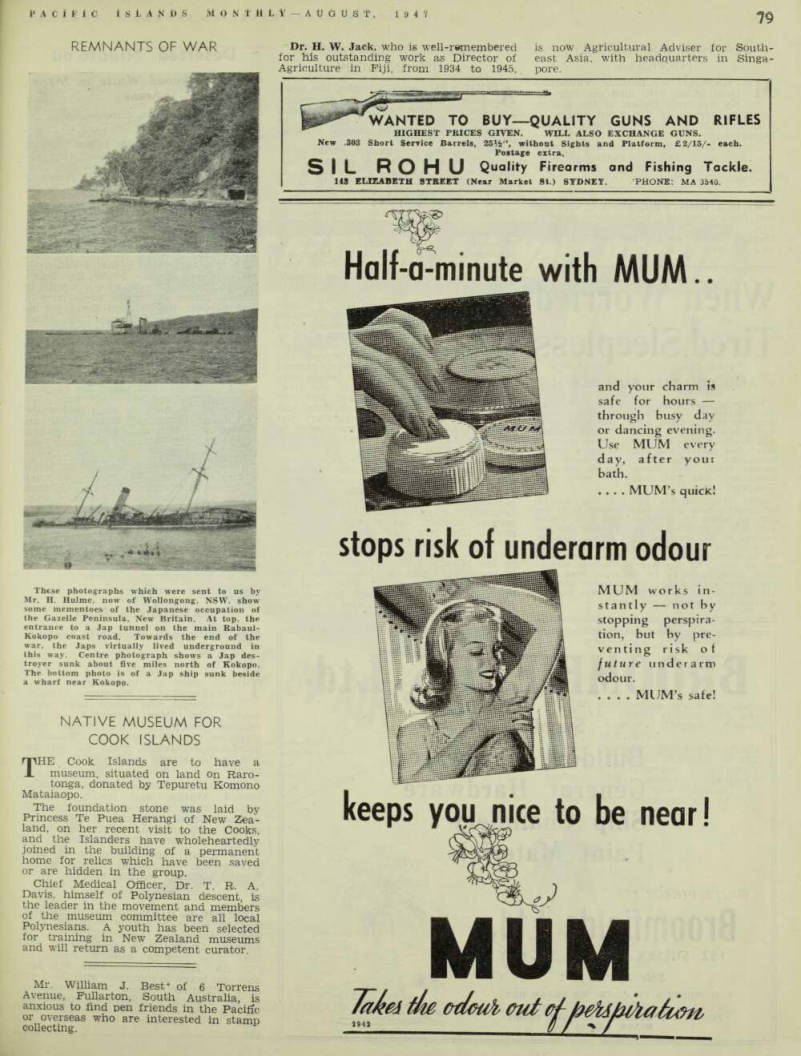
These photographs which were sent to us by Mr. H. Hulme. now of Wollongong, NSW, show some mementoes of the Japanese occupation of the Gazelle Peninsula, New Britain. At top, the entrance to a Jap tunnel on the main Rabaul- Kokopo coast road. Towards the end of the war, the Japs virtually lived underground in this way. Centre photograph shows a Jap des troyer sunk about five miles north of Kokopo.
The bottom photo is of a Jap ship sunk beside a wharf near Kokopo.
Native Museum For
Cook Islands
THE Cook Islands are to have a museum, situated on land on Raro tonga, donated by Tepuretu Komono Mataiaopo.
The foundation stone was laid by Princess Te Puea Herangi of New Zea land, on her recent visit to the Cooks, and the Islanders have wholeheartedly joined in the building of a permanent home for relics which have been saved or are hidden in the group.
Chief Medical Officer, Dr. T. R. A.
Davis, himself of Polynesian descent, is the leader in the movement and members of the museum committee are all local Polynesians. A youth has been selected for training in New Zealand museums and will return as a competent curator.
Mr. William J. Best* of 6 Torrens Avenue, Fullarton, South Australia, is anxious to find pen friends in the Pacific or overseas who are interested in stamp collecting.
Dr. H. W. Jack, who Is well-remembered for his outstanding work as Director of Agriculture in Fiji, from 1934 to 1945,
is now Agricultural Adviser for South east Asia, with headquarters in Singa pore.
Advertisements & other items, p. 73 (2 items)
79
PA Cl tic ISLANDS MONTHLY AUGUST, 194?
Half-a-minute with MUM
WANTED TO BUY—QUALITY GUNS AND RIFLES
HIGHEST PRICES GIVEN. WILL ALSO EXCHANGE GUNS.
New .303 Short Service Barrels, 25M'\ without Sights and Platform, £2/15/- each.
Postage extra.
SI L RO H U Quality Firearms and Fishing Tackle. 148 ELIZABETH STREET (Near Market St.) SYDNEY.
'PHONE: MA 3540.
Half-a-minute with MUM
« M L and your charm is safe for hours through busy day or dancing evening.
Use MUM every day, after your bath. . . . . MUM’s quick!
stops risk of underarm odour
~T m MUM works instantly not by stopping perspiration, but by preventing risk of
future underarm
odour. . . . . MUM’s safe!
keeps you nice to be near!
MUM
Taiei the ctleukmd
m,
Death Of Mr. Harold E.
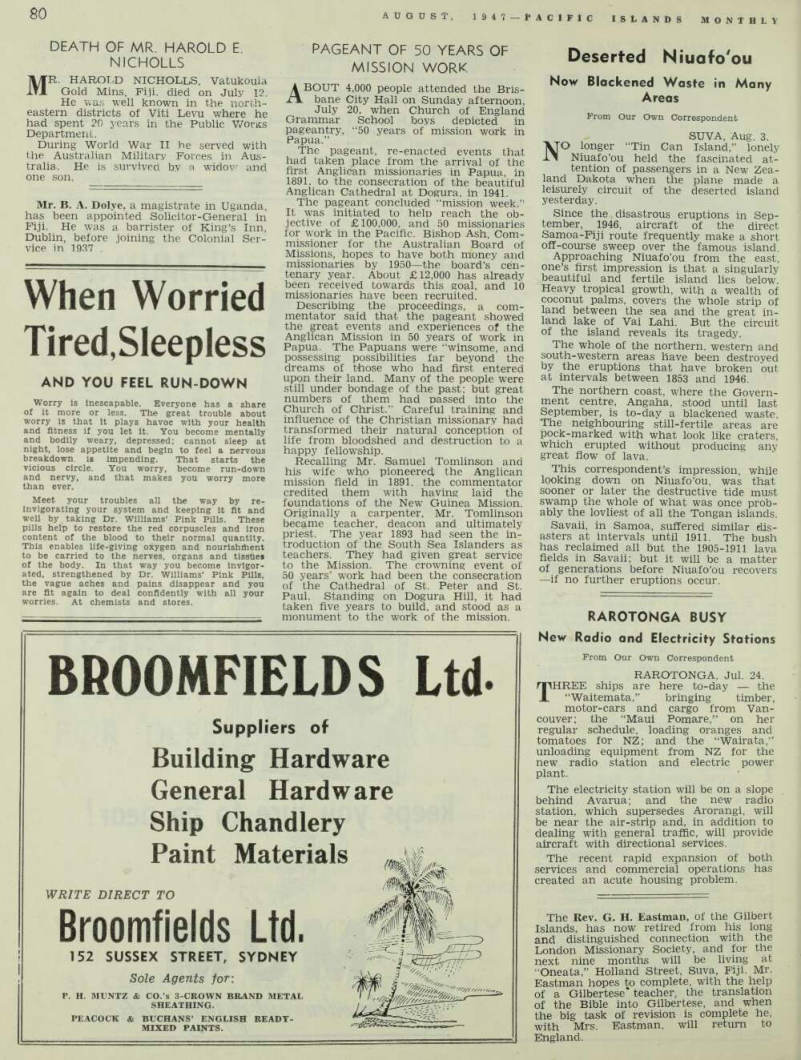
Nicholls
MR. HAROLD NICHOLLS. Vatukoula Gold Mins. Fiji, died on July 12.
He was well known in the north eastern districts of Viti Levu where he had spent 20 years in the Public Worxs Department.
During World War II he served with the Australian Military Forces in Aus tralia. He is survived by a widow and one son.
Mr. B. A. Dolye, a magistrate in Uganda, has been appointed Solicitor-General in Fiji. He was a barrister of King’s Inn.
Dublin, before joining the Colonial Ser vice in 1937 .
Pageant Of 50 Years Of
Mission Work
ABOUT 4,000 people attended the Bris bane City Hall on Sunday afternoon, July 20, when Church of England Grammar School boys depicted in pageantry, “50 years of mission work in Papua.”
The pageant, re-enacted events that had taken place from the arrival of the first Anglican missionaries in Papua, in 1891, to the consecration of the beautiful Anglican Cathedral at Dogura, in 1941.
The pageant concluded “mission week.”
It was initiated to help reach the ob jective of £lOO,OOO, and 50 missionaries for work in the Pacific. Bishop Ash. Com missioner for the Australian Board of Missions, hopes to have both money and missionaries by 1950—the board’s cen tenary year. About £12.000 has already been received towards this goal, and 10 missionaries have been recruited.
Describing the proceedings, a com mentator said that the pageant showed the great events and experiences of the Anglican Mission in 50 years of work in Papua. The Papuans were “winsome, and possessing possibilities far beyond the dreams of those who had first entered upon their land. Many of the people were still under bondage of the past: but great numbers of them had passed into the Church of Christ.” Careful training and influence of the Christian missionary had transformed their natural conception of life from bloodshed and destruction to a happy fellowship.
Recalling Mr. Samuel Tomlinson and his wife who pioneered the Anglican mission field in 1891. the commentator credited them with having laid the foundations of the New Guinea Mission.
Originally a carpenter, Mr. Tomlinson became teacher, deacon and ultimately priest. The year 1893 had seen the in troduction of the South Sea Islanders as teachers. They had given great service to the Mission. The crowning event of 50 years’ work had been the consecration of the Cathedral of St. Peter and St.
Paul. Standing on Dogura Hill, it had taken five years to build, and stood as a monument to the work of the mission.
Deserted Niuafo'ou
Now Blackened Waste in Many Areas
From Our Own Correspondent
Suva, Aug. 3.
NO longer “Tin Can Island,” lonely Niuafo’ou held the fascinated at tention of passengers in a New Zea land Dakota when the plane made a leisurely circuit of the deserted island yesterday.
Since the disastrous eruptions in Sep tember, 1946, aircraft of the direct Samoa-Fiji route frequently make a short off-course sweep over the famous island Approaching Niuafo’ou from the east, one’s first impression is that a singularly beautiful and fertile island lies below.
Heavy tropical growth, with a wealth of coconut palms, covers the whole strip of land between the sea and the great in land lake of Vai Lahi. But the circuit of the island reveals its tragedy.
The whole of the northern, western and south-western areas have been destroyed by the eruptions that have broken out at intervals between 1853 and 1946.
The northern coast, where the Govern ment centre, Angaha, stood until last September, is to-day a blackened waste.
The neighbouring still-fertile areas are pock-marked with what look like craters, which erupted without producing any great flow of lava.
This correspondent’s impression, while looking down on Niuafo’ou, was that sooner or later the destructive tide must swamp the whole of what was once prob ably the lovliest of all the Tongan islands.
Savaii, in Samoa, suffered similar dis asters at intervals until 1911. The bush has reclaimed all but the 1905-1911 lava fields in Savaii; but it will be a matter of generations before Niuafo’ou recovers —if no further eruptions occur.
Rarotonga Busy
New Radio and Electricity Stations
From Our Own Correspondent
Rarotonga, Jul. 24.
THREE ships are here to-day the “Waitemata,” bringing timber, motor-cars and cargo from Van couver; the “Maui Pomare,” on her regular schedule, loading oranges and tomatoes for NZ; and the “Wairata,” unloading equipment from NZ for the new radio station and electric power plant.
The electricity station will be on a slope behind Avarua; and the new radio station, which supersedes Arorangi, will be near the air-strip and, in addition to dealing with general traffic, will provide aircraft with directional services.
The recent rapid expansion of both services and commercial operations has created an acute housing problem.
The Rev. G. H. Eastman, of the Gilbert Islands, has now retired from his long and distinguished connection with the London Missionary Society, and for the next nine months will be living at “Oneata,” Holland Street, Suva, Fiji. Mr.
Eastman hopes to complete, with the help of a Gilbertese* teacher, the translation of the Bible into Gilbertese, and when the big task of revision is complete he, with Mrs. Eastman, will return to England.
Advertisements & other items, pp. 74-75 (3 items)
80
AUGUST, 1947 —t* ACIFIC ISLANDS MONTHLY
Broomfields Ltd.
When Worried
Tired. Sleepless
AND YOU FEEL RUN-DOWN
Worry is Inescapable. Everyone has a share of it more or less. The great trouble about worry is that it plays havoc with your health and fitness if you let it. You become mentally and bodily weary, depressed; cannot sleep at night, lose appetite and begin to feel a nervous breakdown is Impending. That starts the vicious circle. You worry, become run-down and nervy, and that makes you worry more than ever.
Meet your troubles all the way by reinvigorating your system and keeping it fit and well by taking Dr. Williams’ Pink Pills. These pills help to restore the red corpuscles and iron content of the blood to their normal quantity.
This enables life-giving oxygen and nourishment to be carried to the nerves, organs and tissues of the body. In that way you become invigorated, strengthened by Dr. Williams’ Pink Pills, the vague aches and pains disappear and you are fit again to deal confidently with all your worries. At chemists and stores.
BROOMFIELDS Ltd.
Suppliers of
Building Hardware
General Hardware
Ship Chandlery
Paint Materials
WRITE DIRECT TO
Broomfields Ltd.
152 SUSSEX STREET, SYDNEY
Sole Agents for : P. H. MUNTZ & CO.’s 3-CROWN BRAND METAL
SHEATHING.
PEACOCK & BUCHANS’ ENGLISH READY-
MIXED PAINTS.
rm/mmu/mr/mm
r\
* w & -I//' yx - ■ > %*£■ SS?: Vo ' <* * N "STa
“Ait
v v > /A! % *4 3 For full information and rates appl to: T.O.A. Traffiic Office, 100 Th Strand Arcade, George Streel Sydney. MA 9578.
In Port Moresby: Steamships Trad ing Co. In Suva: CORRIE & CC In New Hebrides: GUBBA^
FRERES. In Noumea: GUBBAI
KERR ET CIE. New Zealand: A] offices Union Steamship Co. of N.Z Ltd.
• Attractive Rates
Luxurious Accommodation
Four Motor Safety
Batchelor-Jarrett Wedding
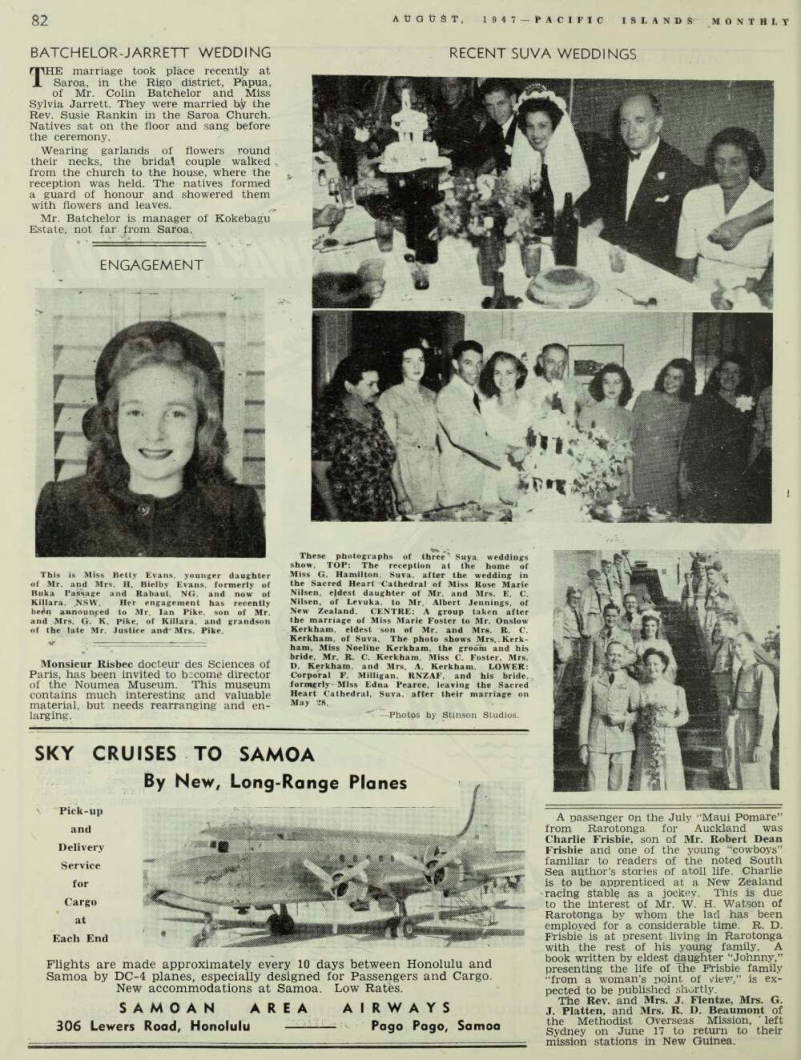
THE marriage took place recently at Saroa, in the Rigo district, Papua, of Mr. Colin Batchelor and Miss Sylvia Jarrett. They were married by the Rev. Susie Rankin in the Saroa Church.
Natives sat on the floor and sang before the ceremony.
Wearing garlands of flowers round their necks, the bridal couple walked from the church to the house, where the reception was held. The natives formed a guard of honour and showered them with flowers and leaves.
Mr. Batchelor is manager of Kokebagu Estate, not far from Saroa.
Engagement
Monsieur Risbec docteur des Sciences of Paris, has been invited to bscome director of the Noumea Museum. This museum contains much interesting and valuable material, but needs rearranging and en larging.
This is Miss Betty Evans, younger daughter of Mr. and Mrs. H. Bielby Evans, formerly of Buka Passage and Rabaul, NG. and now of Killara. NSW. Her engagement has recently been announced to Mr. Ian Pike, son of Mr. and Mrs. G. K. pike, of Killara, and grandson of the late Mr. Justice and Mrs. Pike.
Recent Suva Weddings
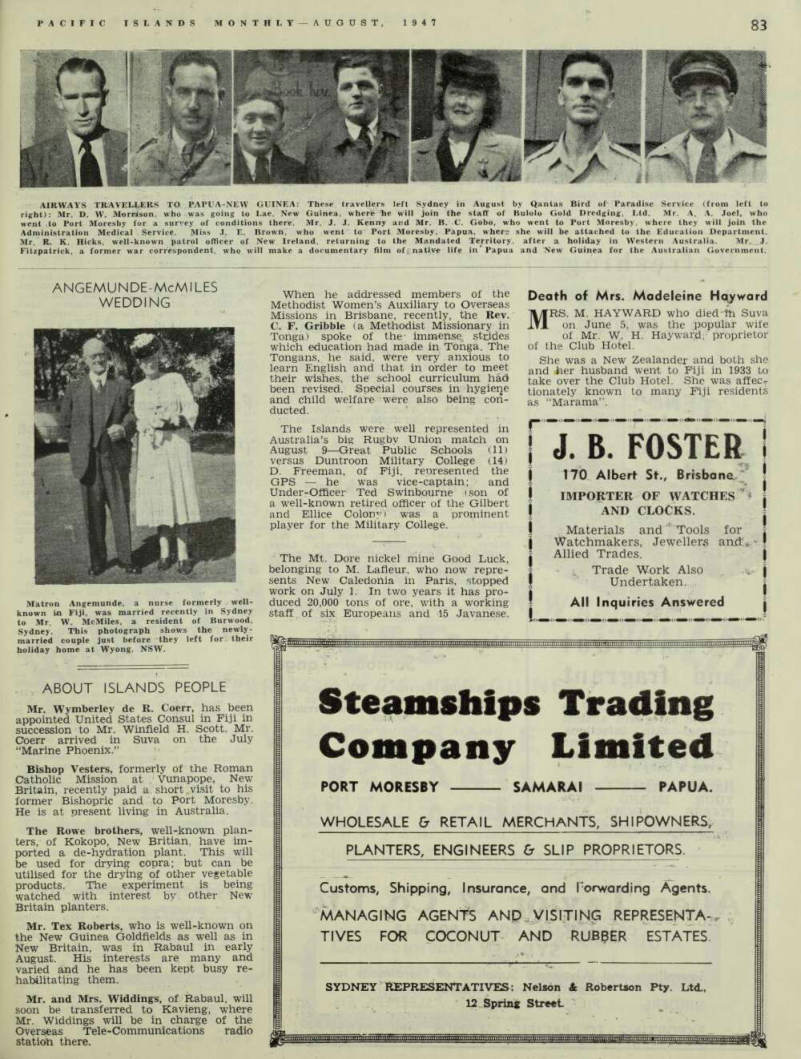
A passenger on the July “Maui Pomare” from Rarotonga for Auckland was Charlie Frisbie, son of Mr. Robert Dean Frisbie and one of the young “cowboys” familiar to readers of the noted South Sea author’s stories of atoll life. Charlie is to be apprenticed at a New Zealand racing stable as a jockey. This is due to the interest of Mr. W. H. Watson of Rarotonga by whom the lad has been employed for a considerable time. R. D.
Frisbie is at present living in Rarotonga with the rest of his young family. A book written by eldest daughter “Johnny,” presenting the life of the Frisbie family “from a woman’s point of view,” is ex pected to be published shortly.
The Rev. and Mrs. J. Flentze, Mrs. G.
J. Flatten, and Mrs. R. D. Beaumont of the Methodist Overseas Mission, * left Sydney on June 17 to return to their mission stations in New Guinea.
These photographs of three Suya weddings show, TOP: The reception at the home of Miss G. Hamilton. Suva, after the wedding in the Sacred Heart Cathedral of Miss Rose Marie Nilsen, eldest daughter of Mr. and Mrs. E. C.
Nilsen, of Levuka. to Mr. Albert Jennings, of New Zealand. CENTRE: A group taken after the marriage of Miss Marie Foster to Mr. Onslow Kerkham, eldest son of Mr. and Mrs. R. C.
Kerkham, of Suva. The photo shows Mrs. Kerk ham, Miss Noeline Kerkham, the groom and his bride, Mr. R. C. Kerkham, Miss C. Foster, Mrs.
D. Kerkham. and Mrs. A. Kerkham. LOWER: Corporal F. Milligan. RNZAF, and his bride, formerly Miss Edna Pearce, leaving the Sacred Heart Cathedral, Suva, after their marriage on May 28. —Photos by Stinson Studios.
AIRWAYS TRAVELLERS TO PAPUA-NEW GUINEA: These travellers left Sydney in August by Qantas Bird of Paradise Service (from left to right): Mr. D. W. Morrison, who was going to Lae, New Guinea, where he will join the staff of Bulolo Gold Dredging, Ltd. Mr. A. A. Joel, who went to Port Moresby for a survey of conditions there. Mr. J. J. Kenny and Mr. B. C. Gobo, who went to Port Moresby, where they will join the Administration Medical Service. Miss J. E. Brown, who went to Port Moresby, Papua, where she will be attached to the Education Department.
Mr. R. K. Hicks, well-known patrol officer of New Ireland, returning to the Mandated Territory, after a holiday in Western Australia. Mr. J.
Fitzpatrick, a former war correspondent, who will make a documentary film of native life in Papua and New Guinea for the Australian Government.
Advertisements & other items, p. 76 (1 item)
By New, Long-Range Planes
SKY CRUISES TO SAMOA
Pick-up and Delivery Service for Cargo at Each End Flights are made approximately every 10 days between Honolulu and Samoa by DC-4 planes, especially designed for Passengers and Cargo.
New accommodations at Samoa. Low Rates.
SAMOAN AR
306 Lowers Road, Honolulu E A
RWA Y S
Pago Pago, Samoa
Angemunde-Mcmiles
Wedding
Matron Angemunde, a nurse formerly well known in Fiji, was married recently in Sydney to Mr. W. McMiles, a resident of Burwood, Sydney. This photograph shows the newly married couple just before they left for their holiday home at Wyong, NSW.
About Islands People
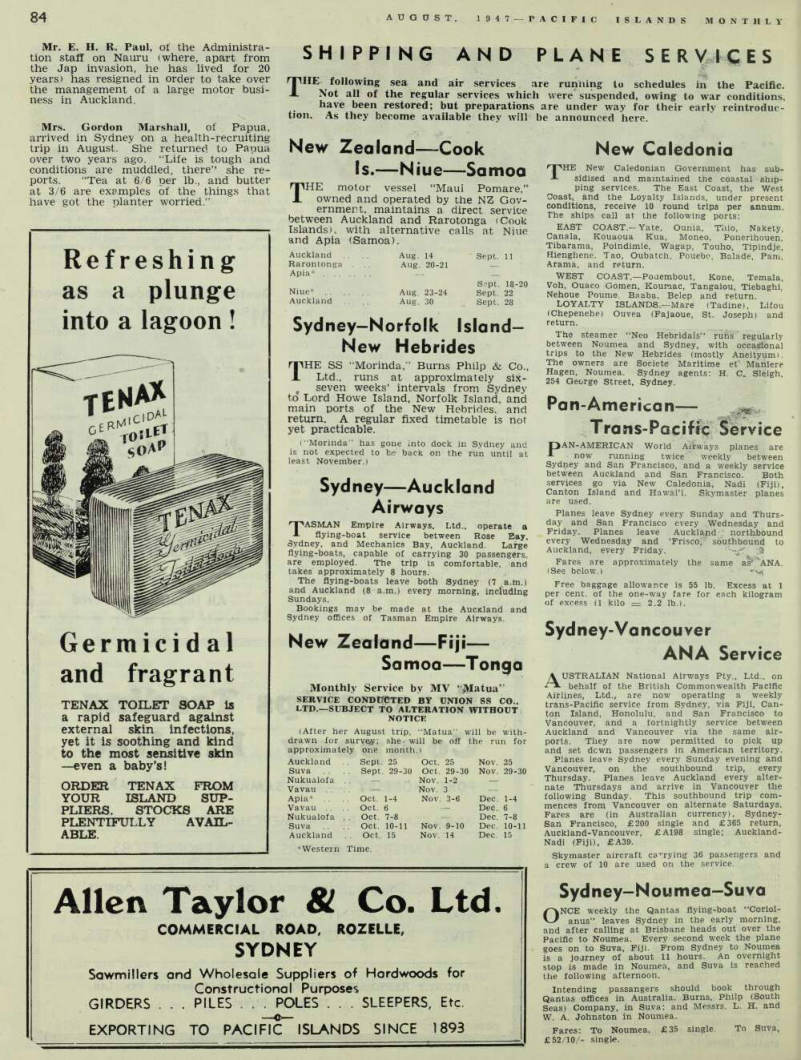
Mr. Wymberley de R. Coerr, has been appointed United States Consul in Fiji in succession to Mr. Winfield H. Scott. Mr.
Coerr arrived in Suva on the July “Marine Phoenix.”
Bishop Vesters, formerly of the Roman Catholic Mission at Vunapope, New Britain, recently paid a. short visit to his former Bishopric and to Port Moresby.
He is at present living in Australia.
The Rowe brothers, well-known plan ters, of Kokopo, New Britian, have im ported a de-hydration plant. This will be used for drying copra; but can be utilised for the drying of other vegetable products. The experiment is being watched with interest by other New Britain planters.
Mr. Tex Roberts, who is well-known on the New Guinea Goldfields as well as in New Britain, was in Rabaul in early August. His interests are many and varied and he has been kept busy re habilitating them.
Mr. and Mrs. Widdings, of Rabaul, will soon be transferred to Kavieng, where Mr. Widdings will be in charge of the Overseas Tele-Communications radio station there.
When he addressed members of the Methodist Women’s Auxiliary to Overseas Missions in Brisbane, recently, the Rev.
C. F. Gribble (a Methodist Missionary in Tonga) spoke of the immense, strides which education had made in Tonga. The Tongans, he said, were very anxious to learn English and that in order to meet their wishes, the school curriculum had been revised. Special courses in hygiene and child welfare were also being con ducted.
The Islands were well represented in Australia’s big Rugby Union match on August 9 —Great Public Schools (11) versus Duntroon Military College (14) D. Freeman, of Fiji, represented the GPS he was vice-captain; and Under-Officer Ted Swinbourne (son of a well-known retired officer of the Gilbert and Ellice Colonel was a prominent player for the Military College.
The Mt. Dore nickel mine Good Luck, belonging to M. Lafleur, who now repre sents New Caledoiiia in Paris, stopped work on July 1. In two years it has pro duced 20,000 tons of ore, with a working staff of six Europeans and 15 Javanese.
Mr. E. H. R. Paul, of the Administra tion staff on Nauru (where, apart from the Jap invasion, he has lived for 20 years) has resigned in order to take over the management of a large motor busi ness in Auckland.
Mrs. Gordon Marshall, of Papua, arrived in Sydney on a health-recruiting trip in August. She returned to Papua over two years ago. “Life is tough and conditions are muddled, there” she re ports. “Tea at 6/6 per lb., and butter at 3/6 are examples of the things that have got the planter worried.’’
Death of Mrs. Madeleine Hayward
MRS. M. HAYWARD who died in Suva on June 5, was the popular wife of Mr. W. H. Hayward; proprietor of the Club Hotel.
She was a New Zealander and both she and her husband went to Fiji in 1933 to take over the Club Hotel. She was affect tionately known to many Fiji residents as "Marama”,
Advertisements & other items, pp. 77-78 (1 item)
Steamships Trading
J. B. FOSTER
170 Albert St., Brisbane
IMPORTER OF WATCHES v 4
AND CLOCKS.
Materials and “ Tools for Watchmakers, Jewellers and'* Allied Trades.
Trade Work Also Undertaken.
All Inquiries Answered
Steamships Trading
Company Limited
PORT MORESBY
SAMARAI
PAPUA.
WHOLESALE & RETAIL MERCHANTS, SHIPOWNERS,
PLANTERS, ENGINEERS Cr SLIP PROPRIETORS.
Customs, Shipping, Insurance, and forwarding Agents.
MANAGING AGENTS AND VISITING REPRESENTA-
TIVES FOR COCONUT AND RUBBER ESTATES
SYDNEY REPRESENTATIVES: Nelson Sc Robertson Pty. Ltd., 12 Spring Street
Refreshing
as a plunge
into a lagoon!
TEN**
SOA p
Germici d al
and fragrant
TENAX TOILET SOAP is
a rapid safeguard against external skin Infections, yet it Is soothing and kind to the most sensitive skin —even a baby’s!
ORDER TENAX FROM
YOUR ISLAND SUP-
PLIERS. STOCKS ARE
PLENTIFULLY AVAIL-
ABLE.
Allen Taylor 81 Co. Ltd,
COMMERCIAL ROAD, ROZELLE,
SYDNEY
Sowmillers and Wholesale Suppliers of Hardwoods for Constructional Purposes GIRDERS . . . PILES . . . POLES . . . SLEEPERS, Etc.
EXPORTING TO PACIFIC ISLANDS SINCE 1893
Sydney-Noumea—Suva
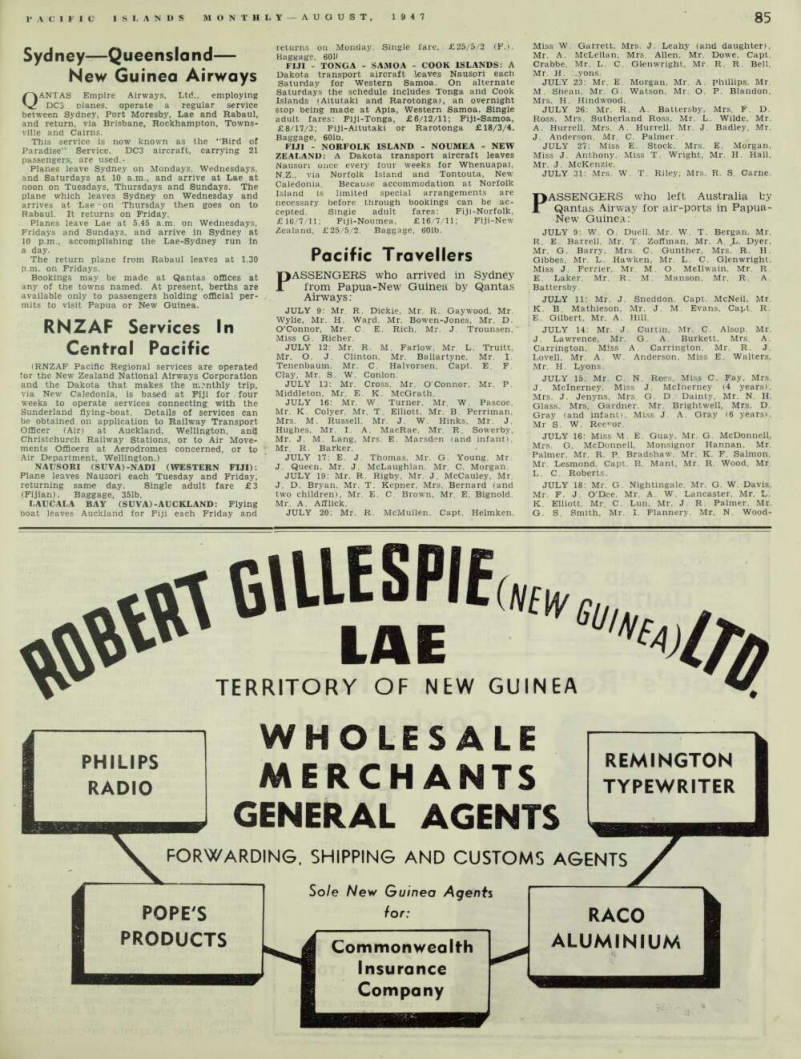
Shipping And Plane Services
THE following sea and air services are running to schedules in the Pacific.
Not all of the regular services which were suspended, owing to war conditions, have been restored; but preparations are under way for their early reintroduo tion. As they become available they will be announced here.
New Zealand—Cook
Is.—Niue—Samoa
THE motor vessel “Maui Pomare,” owned and operated by the NZ Gov ernment, maintains a direct service between Auckland and Rarotonga (Cook Islands), with alternative calls at Niue and Apia (Samoa).
Auckland . . . . Aug. 14 Sept. 11 Rarontonga . . . Aug. 20-21 Apia* Sspt. 18-20 Niue* Aug. 23-24 Sept. 22 Auckland Aug. 30 Sept. 28
Sydney—Norfolk Island-
New Hebrides
THE SS “Morinda," Burns Philp & Co., JL Ltd., runs at approximately six , seven weeks’ intervals from Sydney to Lord Howe Island, Norfolk Island, and main ports of the New Hebrides, and return. A regular fixed timetable is not
yet practicable.
(■•Morinda” has gone into dock in Sydney and is not expected to he back on the run until at least November.)
Sydney—Auckland
Airways
TASMAN Empire Airways, Ltd., operate a flying-boat service between Rose Bay.
Sydney, and Mechanics Bay. Auckland. Large flying-boats, capable of carrying 30 passengers, are employed. The trip is comfortable, and takes approximately 8 hours.
The flying-boats leave both Sydney (7 a.m.) and Auckland (8 a.m.) every morning, including Sundays.
Bookings may be made at the Aucxland and Sydney offices of Tasman Empire Airways.
New Zealand—Fiji—
Samoa—Tonga
Monthly Service by MV “jMatua”
Service Condtfcted By Union Ss Co
Ltd.—Subject To Alteration Without
Notice
(After her August trip, “Matua” will be with drawn for survey; she- will be off the run for approximately one month.) Auckland . . Sept. 25 Oct. 25 Nov. 25 Suva . , . . Sept. 29-30 Oct. 29-30 Nov. 29-30 Nukualofa Nov, 1-2 Vavau ... Nov. 3 Apia* Oct. 1-4 Nov. 3-6 Dec. 1-4 Vavau . , . . Oct. 6 Dec. 6 Nukualofa . . Oct. 7-8 Dec. 7-8 Suva Oct. 10-11 Nov. 9-10 Dec. 10-11 Auckland . . Oct. 15 Nov. 14 Dec. 15 *Western Time.
New Caledonia
THE New Caledonian Government has sub sidised and maintained the coastal ship ping services. The East Coast, the West Coast, and the Loyalty Islands, under present conditions, receive 10 round trips per annum.
The ships call at the following ports: EAST COAST.—Yate, Ounia, Tliio, Nakety, Canala, Kouaoua Kua, Moneo, Ponerihouen, Tibarama, Poindimie, Wagap, Touho, Tipindje, Hienghene, Tao, Oubatch, Pouebo, Balade, Pam, Arama, and return.
WEST COAST.—Pouembout, Kone, Temala, Voh, Ouaco Gomen, Kouraac, Tangaiou, Tiebaghi, Nehoue Poume. Baaba, Belep and return.
LOYALTY ISLANDS.—Mare (Tadine), Lifou (Chepenehe) Ouvea (Fajaoue, St. Joseph) and return.
The steamer “Neo Hebridais” runs regularly between Noumea and Sydney, with occasional trips to the New Hebrides (mostly Aneityum).
The owners are Societe Maritime et Manlere Hagen, Noumea. Sydney agents: H. C. Sleigh, 254 George Street. Sydney.
Pan-American—
Trans-Pacific Service
r>AN-AMERICAN World Airways planes are A now running twice weekly between Sydney and San Francisco, and a weekly service between Auckland and San Francisco. Both services go via New Caledonia, Nadi (Fiji), Canton Island and Hawai’i. Skymaster planes are used.
Planes leave Sydney every Sunday and Thurs day and San Francisco every Wednesday and Friday. Planes leave Auckland northbound every Wednesday and ’Frisco;" southbound to Auckland, every Friday. 3 Fares are approximately the same (See below.) Free baggage allowance is 55 lb. Excess at 1 per cent, of the one-way fare for each kilogram of excess (1 kilo == 2.2 lb.).
Sydney-Vancouver
ANA Service
AUSTRALIAN National Airways Pty., Ltd., on behalf of the British Commonwealth Pacific Airlines, Ltd., are now operating a weekly trans-Paciflc service from Sydney, via Fiji, Can ton Island, Honolulu, and San Francisco to Vancouver, and a fortnightly service between Auckland and Vancouver via the same air ports. They are now permitted to pick up and set dewn passengers in American territory.
Planes leave Sydney every Sunday evening and Vancouver, on the southbound trip, every Thursday. Planes leave Auckland every alter nate Thursdays and arrive in Vancouver the following Sunday. This southbound trip com mences from Vancouver on alternate Saturdays.
Fares are (in Australian currency), Sydney- San Francisco, £2OO single and £365 return, Auckland-Vancouver, £AI9B single: Auckland- Nadi (Fiji), £A39.
Skymaster aircraft carrying 36 passengers and a crew of 10 are used on the service.
Sydney-Noumea—Suva
ONCE weekly the Qantas flying-boat “Coriol anus” leaves Sydney in the early morning, and after calling at Brisbane heads out over the Pacific to Noumea. Every second week the plane goes on to Suva, Fiji. From Sydney to Noumea is a journey of about 11 hours. An overnight stop is made in Noumea, and Suva is reached the following afternoon.
Intending passangers should book through Qantas offices in Australia. Burns, Philp (South Seas) Company, in Suva: and Messrs. L. H. and W. A. Johnston in Noumea.
Fares: To Noumea, £35 single. To Suva, £52/10/- single.
Sydney—Queensland—
New Guinea Airways
QANTAS Empire Airways, Ltd., employing DC 3 nlanes, operate a regular service between Sydney, Port Moresby, Lae and Rabaul, and return, via Brisbane, Rockhampton, Towns ville and Cairns.
This service is now known as the “Bird of Paradise’’ Service. DC3 aircraft, carrying 21 passengers, are used.- Planes leave Sydney on Mondays, Wednesdays, and Saturdays at 10 a.m., and arrive at Lae at noon on Tuesdays, Thursdays and Sundays. The plane which leaves Sydney on Wednesday and arrives at Lae -on Thursday then goes on to Rabaul. It returns on Friday.
Planes leave Lae at 5.45 a.m. on Wednesdays, Fridays and Sundays, and arrive in Sydney at 10 p.m., accomplishing the Lae-Sydney run in a day.
The return plane from Rabaul leaves at 1.30 p.m. on Fridays.
Bookings may be made at Qantas offices at any of the towns named. At present, berths are available only to passengers holding official per mits to visit Papua or New Guinea.
RNZAF Services In
Central Pacific
(RNZAF Pacific Regional services are operated for the New Zealand National Airways Corporation and the Dakota that makes the monthly trip, via New Caledonia, is based at Fiji for four weeks to operate services connecting with the Sunderland flying-boat. Details of services can be obtained on application to Railway Transport Officer (Air) at Auckland, Wellington, and Christchurch Railway Stations, or to Air Move ments Officers at Aerodromes concerned, or to Air Department, Wellington.)
Nausori (Suva)-Nadi (Western Fiji);
Plane leaves Nausori each Tuesday and Friday, returning same day. Single adult fare £3 (Fijian). Baggage, 351 b.
Laucala Bay (Suva)-Auckland: Flying
boat leaves Auckland for Fiji each Friday and
returns on Monday. Single fare, £25/5/2 (F.).
Baggage, 601» FIJI - TONGA - SAMOA - COOK ISLANDS: A Dakota transport aircraft leaves Nausori each Saturday for Western Samoa. On alternate Saturdays the schedule includes Tonga and Cook Islands (Aitutaki and Rarotonga), an overnight stop being made at Apia, Western Samoa, Single adult fares: Flji-Tonga, £6/12/11; Fiji-Samoa, £B/17/3; Fiji-Aitutaki or Rarotonga £lB/3/4.
Baggage, 601 b.
FIJI - NORFOLK ISLAND - NOUMEA - NEW ZEALAND: A Dakota transport aircraft leaves Nausori once every four weeks for Whenuapai, N.Z., via Norfolk Island and Tontouta, New Caledonia. Because accommodation at Norfolk Island is limited special arrangements are necessary before through bookings can be ac cepted. Single adult fares: Fiji-Norfolk, £l6/7/11; Fiji-Noumea, £l6/7/11; Fiji-New Zealand. £25/5/2. Baggage, 601 b.
Pacific Travellers
PASSENGERS who arrived in Sydney
from Papua-New Guinea by Qantas
Airways:
JULY 9: Mr. R. Dickie. Mr. R. Gaywood, Mr.
Wylie, Mr. H. Ward. Mr. Bowen-Jones, Mr. D.
O’Connor, Mr. C. E. Rich. Mr. J. Trounsen.
Miss G. Richer.
JULY 12: Mr. R. M. Farlow. Mr. L. Truitt.
Mr. O. J. Clinton. Mr. Ballartyne, Mr. I Tenenbaum. Mr. C. Halvorsen, Capt. E. F.
Clay, Mr. S. W. Conlon.
JULY 13: Mr. Cross. Mr. O’Connor. Mr. P.
Middleton, Mr. E. K. McGrath.
JULY 16: Mr. W. Turner. Mr. W. Pascoe.
Mr. K. Colyer, Mr. T. Elliott. Mr. B. Perriman.
Mrs. M. Russell. Mr. J. W. Hinks, Mr. J.
Hughes, Mr. I. A. Macßae. Mr. R. Sowerby, Mr. J. M. Lang, Mrs. E. Marsden (and infant).
Mr. R. Barker.
JULY 17: E. J. Thomas. Mr. G. Young. Mr.
J. Queen, Mr. J. McLaughlan, Mr. C. Morgan.
JULY 19: Mr. R. Rigby. Mr. J. McCauley. Mr.
J. D. Bryan. Mr. T. Kepner, Mrs. Bernard (and two children), Mr. E. C. Brown, Mr. E. Bignold.
Mr. A. Afflick.
JULY 20: Mr. R. McMullen. Capt. Helmken.
Miss W. Garrett. Mrs. J, Leahy (and daughter), Mr. A. McLellan, Mrs. Allen. Mr. Dowe, Capt.
Crabbe. Mr. L. C. Glenwright, Mr. R. R. Bell.
Mr. H. .yons.
JULY 23; Mr. E. Morgan. Mr. A. Phillips. Mr.
M. Shean, Mr. G. Watson, Mr. O. P. Blandon, Mrs. H. Hindwood.
JULY 26: Mr. R. A. Battersby, Mrs. F. D.
Ross, Mrs. Sutherland Ross. Mr, L. Wilde, Mr.
A. Hurrell. Mrs. A. Hurrell. Mr. J. Badley. Mr.
J. Anderson. Mr, C. Palmer.
JULY 27: Miss E. Stock, Mrs. E. Morgan.
Miss J. Anthony. Miss T. Wright, Mr. H. Hall, Mr. J. McKenzie.
JULY 31: Mrs. W. T. Riley, Mrs. R. S. Came.
PASSENGERS who left Australia by
Qantas Airway for air-ports in Papua-
New Guinea: JULY 9: W. O. Duell. Mr. W. T. Bergan. Mr.
R. E. Barrell. Mr. T. Zoffman, Mr. A. L. Dyer.
Mr. G. Barry, Mrs. C. Gunther, Mrs. R. H.
Gibbes, Mr. L, Hawken, Mr. L. C. Glenwright.
Miss J. Perrier. Mr. M. O. Mellwain. Mr. R.
E. Laker. Mr. R. M. Manson. Mr. R. A.
Battersby.
JULY 11: Mr. J. Sneddon. Capt. McNeil. Mr, K. B. Mathieson. Mr. J. M. Evans, Capt. R.
E. Gilbert, Mr. A. Hill.
JULY 14; Mr. J. Curtin, Mr. C. Alsop. Mr.
J. Lawrence, Mr. G. A. Burkett. Mrs. A.
Carrington, Miss A Carrington. Mr. R. J.
Lovell, Mr. A. W. Anderson. Miss E. Walters, Mr. H. Lyons.
JULY 15: Mr. C. N. Rees. Miss C. Fay. Mrs.
J. Mclnerney. Miss J. Mclnerney (4 years*.
Mrs. J. Jenyns, Mrs. G. D. Dainty. Mr. N. H.
Glass. Mrs. Gardner, Mr. Brightwell, Mrs. D Gray (and infant). Miss J. A. Gray (6 years*.
Mr S. W. Rector.
JULY 16: Miss M E. Guay. Mr. G. McDonnell, Mrs. G. McDonnell. Monsignor Hannan, Mr.
Palmer. Mr. R. P. Bradshaw. Mr. K. F. Salmon, Mr. Lesmond. Capt. R. Mant, Mr. R. Wood, Mr L. C. Roberts.
JULY 18; Mr. G. Nightingale. Mr. G. W. Davis.
Mr. F. J. O’Dee. Mr. A. W. Lancaster. Mr. L.
K, Elliott. Mr. C. Lun, Mr. J. R. Palmer. Mr.
G. S. Smith, Mr. I. Flannery. Mr. N. Wood
lands, Mr. D, Franke, Rev. A. Michellod, Mr.
D. K. Hosking, Mr. G. Hill.
JULY 21: Mr. J. Trainor, Mr. E. P. Rowse, Mr. W. J. O’Shea, Mr. E. W. Carter, Mr. T.
A. Boult, Capt. Crookshank, Mr. J. A. Vawser, Mr. F. W. Craig, Mr. M. Chaperon, Miss D.
Webster. Mr. R. D. Dwyer, Mr. R. Kirk, Mr.
R. R. Murphy.
JULY 23: Mrs. E. Reid, Mr. D. G. Dewar, Mr. A, Foreman, Mr. E. Kerim, Mr. D. Dobson.
JULY 25: Mr. J. Wilson, Mrs. C. Brown (and infant), Mr. Donaldson, Mr. H. J. Streeter, Mr.
J. P. McLaughlin, Mr. L. M. Wilson, Mr. D.
R, Marsh, Mrs. P. McMahon, Miss F. E. Henry, Mr. R. L. Geelan, Mr. D. J. Stewart. Mr. J.
Queen, Mr. A. W. Collins.
JULY 28: Mr. T. W. Walters, Mr. J. P.
Murphy, Mr. E. J. Hallstrom, Mr. G. K. Lans downe. Mr. C-. R. Goyen, Mr. S. W. Lucas, Mr. J Nicholson, Mrs. J Nicholson, Mrs. A.
Vassie (and child). Miss E. M. Jones, Mr. H.
P. Clews, Mr. L. C. Beynon, Mr. D. R. Prowse, Mr. H. I. Moore, Mr. R. K. Frank, Mr. E.
Wakernan.
JULY 29; Mr. N. B. North, Mr. B. L, Mans field, Mr. A. T, Bishop, Mr. A. G Brehaut, Mrs. J. Kerr (and infant). Mr. P. s. Taylor!
Mr. W. S. Taylor, Mr. F. H. Mott, Mr. D S Askew.
AUG. 1: Mr. J. Hughes, Mr. D. W. Morrison, Mr. S. H. Fitzpatrick, Mrs. D. E. Turnbull, Mr, J. H. Ahearn, Mrs. J. H. Ahearh, Mr. A.
Joel, Mr. R. K. Hicks, Mr. K. B. Field, Mr. D.
C. Goble, Mr. J. J. Kenny, Mr. M. R. Sproule, Mr. D. Bryan, Mr. R. Thorpe.
AUG. 4: Mr. G. W. Neilson. Mr, B. G. Griffith.
Mr; C. S. Smith, Mr. R. J. Westrop, Mr. T.
F. Kepner. Mr. R. W. Ceilings, Mr. Osborne.
Miss N. Friend, Mr. G. Young, Mr. S. Sevier.
Mrs. I. J. Ross, PASSENGERS who arrived in Auckland, NZ, by MV “Matua” on July 18: — FROM NUKUALOFA; Mr. C. Brahne, Mrs. M.
Haora, Mrs. L. Malafu (and three children).
FROM APIA: Capt. Bell. Mrs. C. Brew (and child), Miss Crichton, Mr. T. Chan, Mr. E, Duke, Miss J. Hunt, Mr. W. Hellesoe, Mr. and Mrs.
A. Hawthorne (and three children) v Mrs. I.
Jessop, Mr. V. Kilipati, Miss K. Kennar, Mrs.
R. Morrissey, Mr. W. Meredith, Mr. H. Prit chard, Mr. A. Patterson, Miss C. Ripley, Miss H. Skelton, Mrs. R. Simpson, Mr. S. Schroeder.
Mr. T. Tuiletufuga, Miss A. Webster, Miss F.
Westbrook, Mrs. D. Yandall.
FROM SUVA: Mrs. E. Anderson, Miss C.
Anderson, Mrs. M. Andrew, Mr. and Mrs. C.
Beckingham, Mr. H. Brown, Mr. and Mrs. D.
Clifton-Lewis, Dr. T .Clunie, Mrs. A. Chapman (and daughter), Miss E. Cauty, Mrs, R. Car rick, Master D. Garrick, Mr. E. Cholerton, Miss A. Evetts, Mr. Fong Lum Sing, Mr.
Fong Chee, Mr. M. Ffrench-Mullens, Mrs. J.
Ffrench-Mullens, Mr. M. Gallagher, Mr. L. Grey, Miss J. Greenop, Comm. F. Hull, Mr. G. Hew son. Miss D. Heath, Miss N. Hunt, Mr. W.
Haywood. Miss K. Hayles, Mr. R. Holcroft, Miss L. James. Mr. A. McMillan. Mr. and Mrs. J.
Mclntyre, Mrs. W. Ohlson, Miss A. Powell, Mr. and Mrs. L. Pardoe (and daughter), Mr. B.
Robertson, Mr. and Mrs. A. Reay (and daughter), Mr. and Mrs. F. Studman (and three children), Mr. C. Sage, Miss C. Simpson, Miss P. Spencer, Mr. and Mrs. C. Wallers, Miss M.
Woodhouse. Mr. H. Wilks, Mr. D. Whitcombe, Mr. and Mrs. E. V. O’Brien, left Bris bane for Madang by the “Montoro” on June 14. They were farewelled by rela tives and friends. Mr. O’Brien is the owner of Mililat plantation, Madang. He was flown to Sydney by plane last Feb ruary to undergo medical treatment. His •health has now much improved.
Advertisements & other items, pp. 79-80 (1 item)
A ’ify
V V TERRITORY OF NEW GUINEA
WHOLESALE
MERCHANTS
GENERAL AGENTS
A ’ify
PHILIPS
RADIO
REMINGTON
TYPEWRITER
FORWARDING, SHIPPING AND CUSTOMS AGENTS
So/e New Guinea Agents for:
POPE'S
PRODUCTS
RACO
ALUMINIUM
Commonwealth Insurance Company
KANGAROO BRAND
Ropes,
Cordage,
and Twines for every purpose Backed by 86 years of service Manufactured by:
M. DONAGHY AND SONS,
Pty. Ltd., Geelong and Sydney.
Fiji Representatives:
PEARCE AND CO.
LIMITED
P.O. BOX 237, SUVA
Scott's “Renown” Brand Rope,
Cable Address Ropeyara Sydney. inwnr* ¥»* ~vw
Cordage and
Binder
Twine
of Every
Description
MANUFACTURED AT
MASCOT, N.S.W.
By
J. SCOTT
PTY. LTD.
Head Office and Store
163 CLARENCE STREET,
SYDNEY,
N.S.W.
Black Magic?
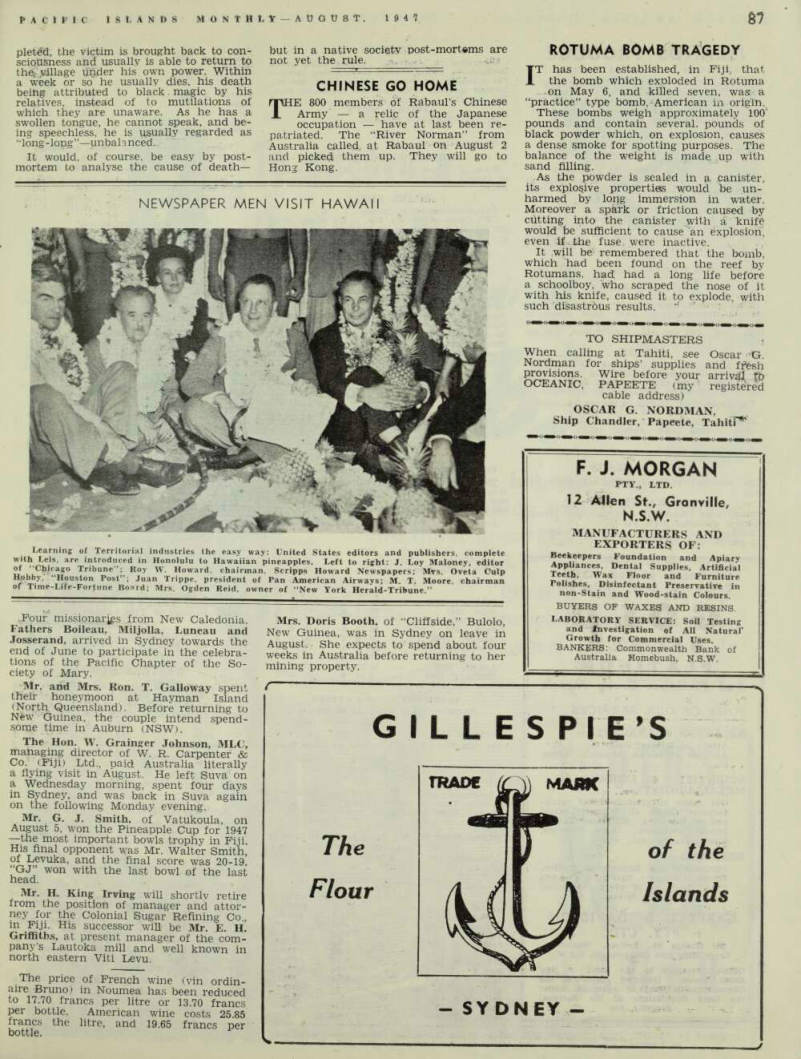
Hired Murderer or Black Magic?
Native Cult in NW New Guinea
THE following notes on the New Guinea cult called “Sangguma” come from an article publihsed, in Dutch, in the European publication “Anthropos.”
The original article was written by Father G. J. Koster, a Hollander who was with the Roman Catholic Mission in the Bogia and Potsdamhafen districts on the north-west New Guinea coast for about 15 years prior to the outbreak of World War 11. At the beginning of the war, Father Koster returned to Holland and is still there.
The majority of European residents in the Territory are biased against pro fessional anthropologists, says Father K<pster, but in order to show that these scientists have a place in better under standing of the native mind, it is neces sary to point out only one problem which il called “Sarijggurna,” a mysterious cult that has given l more than one patrol officer a headache.
Literally, Sangguma means “force by sorcery” and it is generally understood to be murder by black magic—or in plain Pidgin, “Poison.”
The unsophisticated village native does not believe in death through natural causes. By him, death is attributed to supernatural means—an enemy or a re sident of rival village makes “poison” against him. But Sangguma is a much more positive business than making black magic, although it is most difficult to prove that it is performed by pro fessional murderers who form a sort of union of underworld gangsters in native style.
Another anthropologist who spent some time in Northern New Guinea. Margaret Mead, believed that the Sangguma or ganisation contained manv indentured labourers and was rapidly diffusing through the indentured labour popula tion of the Madang and Aitaps coasts.
But this seems open to doubt.
Most Europeans attribute such native deaths to auto-suggestion—for some un known reason the native in question has been persuaded to give up his natural will to live. A Mr. Johnston, of Banara Plantation, and Father Koster, were the first Europeans to discover that Sang guma was more than sorcery. It came about like this: While both men were in the vicinity of Dalua village, native women reported having been confronted in the nearby jungle with a number of men with blackened faces. The village men hurried into the bush and found a voung man lying on the ground, writhing in pain.
He was carried into the village, where Johnston and Father Koster gave first aid, and an examination revealed that small, sharp bones had Ipeen driven into the upper arms of the .youth, into his thighs and knees. Other bones were removed from other parts of . his body, later.
This finding verified the opinion held by some old residents that Sangguma is nothing but hired murder.
Apparently, the victim is singled out and ambushed by hired murderers who render him unconscious in some way.
While he is thus powerless, the bones are inserted in his body in such a way that death is sure to follow within a few days.
Bones of the flying-fox, or of fish, are usually used, they are inserted between the collar bones, in the upper legs and arms, one in the tongue, and others in vital parts, and they are driven home so as to become invisible. In some cases a long rib of a coconut leaf is inserted in the lower bowel, which it finally per forates.
When these operations have been com
pleted, the victim is brought back to con sciousness and usually is able to return to thp; village under his own power. Within a week or so” he usually dies, his death being attributed to black magic by his relatives, instead of to mutilations of which they are unaware. As he has a swollen tongue, he cannot speak, and be ing speechless, he is usually regarded as
“long-long”—unbalanced.
It would, of course, be easy by post mortem to analyse the cause of death—
but in a native society post-mortems are not yet the rule.
Advertisements & other items, p. 80 (1 item)
86
AfiGfiSt. 1949-t> A C i * 1 C ISLANbS MhNtttLY
Chinese Go Home
rE 800 members of Rabaul’s Chinese Army a relic of the Japanese occupation have at last been re patriated. The “River Norman” from Australia called at Rabaul on August 2 and picked them up. They will go to Hong Kong.
Newspaper Men Visit Hawaii
.Four missionaries from New Caledonia.
Fathers Boileau, Miljolla, Luneau and Josserand, arrived in Sydney towards the end of June to participate in the celebra tions of the Pacific Chapter of the So ciety of Mary.
Mr. and Mrs. Ron. T. Galloway spent their honeymoon at Hayman Island (North Queensland). Before returning to New Guinea, the couple intend spend some time in Auburn (NSW).
The Hon. W. Grainger Johnson, MLC, managing director of W. R. Carpenter & Co. (Fiji) Ltd., oaici Australia literally a flying visit in August. He left Suva on a Wednesday morning, spent four days in Sydney, and was back in Suva again on the following Monday evening.
Mr. G. J. Smith, of Vatukoula, on August 5, won the Pineapple Cup for 1947 —the most important bowls trophy in Fiji.
His final opponent was Mr. Walter Smith, of Levuka, and the final score was 20-19, “GJ” won with the last bowl of the last head.
Mr. H, King Irving will shortly retire from the position of manager and attor ney for the Colonial Sugar Refining Co., m Fiji. His successor will be Mr. E. H.
Griffiths, at present manager of the com pany’s Lautoka mill and well known in north eastern Viti Levu.
The price of French wine (vin ordin aire Bruno) in Noumea has been reduced to 17.70 francs per litre or 13.70 francs per bottle. American wine costs 25 85 francs the litre, and 19.65 francs per bottle.
Mrs. Doris Booth, of “Cliffside,” Bulolo, New Guinea, was in Sydney on leave in August. She expects to spend about four weeks in Australia before returning to her mining property.
Learning of Territorial industries the easy way: United States editors and publishers, complete with Leis, are introduced in Honolulu to Hawaiian pineapples. Left to right: J. Loy Maloney, editor of “Chicago Tribune"; Roy W. Howard, chairman. Scripps Howard Newspapers; Mrs. Oveta Culp Hobby, “Houston Post”; Juan Trippe, president of Pan American Airways; M. T. Moore, chairman of Time-Life-Fortune Board; Mrs. Ogden Reid, owner of “New York Herald-Tribune.”
Rotuma Bomb Tragedy
IT has been established, in Fiji, that the bomb which exploded in Rotuma on May 6, and killed seven, was a “practice” type bomb, American in origin.
These bombs weigh approximately 100 pounds and contain several, pounds of black powder which, on explosion, causes a dense smoke for spotting purposes. The balance of the weight is made ud with sand filling.
As the powder is sealed in a canister, its explosive propertieis would be un harmed by long immersion in water.
Moreover a spkrk or friction caused by cutting into the canister with a knife would be sufficient to cause an explosion, even if the fuse were inactive.
It will be remembered that the bomb, which had been found on the reef by Rotumans, had; had a long life before a schoolboy, who scraped the nose of it with his knife, caused it to explode, with such disastrous results. u
Advertisements & other items, p. 81 (2 items)
87
PACIFIC ISLANDS MONtBLt - AUGUST, 194?
Gillespie
TO SHIPMASTERS
When calling at Tahiti, see Oscar G.
Nordman for ships’ supplies and fftesh provisions. Wire before your arrival OCEANIC, PAPEETE (my registered cable address)
OSCAR G. NORDMAN,
Ship Chandler, Papeete, Tahiir*
F. J. MORGAN
PTY., LTD.
12 Allen St., Granville,
N.S.W.
MANUFACTURERS AND
EXPORTERS OF:
Beekeepers Foundation and Apiary Appliances, Dental Supplies, Artificial Teeth, Wax Floor and Furniture Polishes, Disinfectant Preservative in non-Stain and Wood-stain Colours.
BUYERS OF WAXES AND RESINS.
LABORATORY SERVICE: Soil Testing and Investigation of All Natural 1 Growth for Commercial Uses.
BANKERS: Commonwealth Bank of Australia Homebush, N.S.W.
GILLESPIE
The Flour
TRADE
MARK
- SYDNEY -
’S ■- ' of Islands
Islands Produce
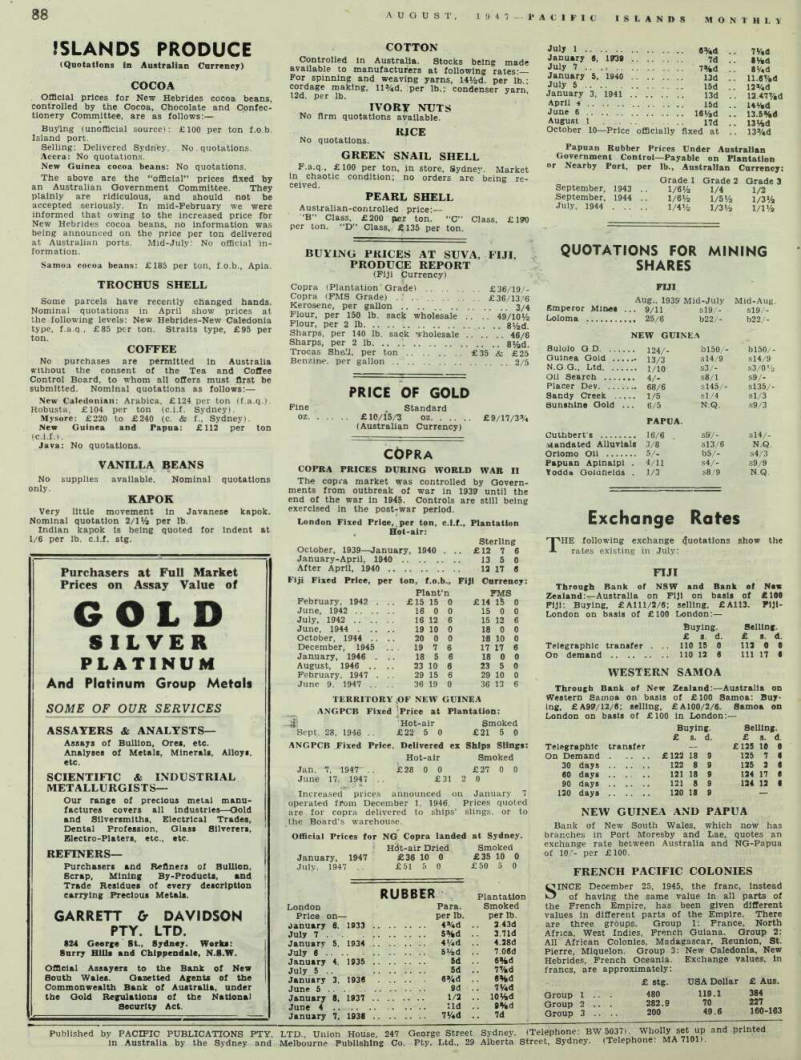
(Quotations in Australian Currency)
Cocoa
Official prices for New Hebrides cocoa beans, controlled by the Cocoa, Chocolate and Confec tionery Committee, are as follows: Buying (unofficial source); £lOO per ton f.o.b.
Island port.
Selling: Delivered Sydney. No . quotations.
Accra: No quotations.
New Guinea cocoa beans: No quotations.
The above are the “official” prices fixed by an Australian Government Committee. They plainly are ridiculous, and should not be accepted seriously. In mid-February we were informed that owing to the increased price for New Hebrides cocoa beans, no information was being announced on the price per ton delivered at Australian ports. Mid-July: No official in formation.
Samoa cocoa beans: £lB5 per ton, f.0.b., Apia.
Trochus Shell
Some parcels have recently changed hands.
Nominal quotations in April show prices at the following levels: New Hebrides-New Caledonia type, f.a.q.. £B5 per ton. Straits type, £95 per ton.
Coffee
No purchases are permitted in Australia without the consent of the Tea and Coffee Control Board, to whom all offers must first be submitted. Nominal quotations as follows: New Caledonian: Arabica, £124 per ton (f.a.q.).
Robusta, £lO4 per ton (c.i.f. Sydney).
Mysore: £220 to £240 (c. & f., Sydney).
New Guinea and Papua: £ll2 per ton (c.i.f.).
Java: No quotations.
Vanilla Beans
No supplies available. Nominal quotations only.
Kapok
Very little movement in Javanese kapok.
Nominal quotation 2/1 Vi per lb.
Indian kapok is being quoted for Indent at 1/6 per lb. c.i.f. stg.
Cotton
Controlled in Australia. Stocks being made available to manufacturers at following rates:— For spinning and weaving yarns, 14»/ 2 d. per lb ; cordage making, 113/ 4 d. per lb.; condenser yarn I2d. per lb.
Ivory Nuts
No firm quotations available.
Rice
No quotations.
Green Snail Shell
F.a.q., £lOO per ton, in store, Sydney. Market In chaotic condition; no orders are being re ceived.
Pearl Shell
Australian-controlled price:— ‘B” Class, £2OO per ton. “C” Class, £l9O per ton. “D” Class, £135 per ton.
Buying Prices At Suva, Fiji,
Produce Report
(Fiji Currency) Copra (Plantation Grade) £36/19/- Copra (FMS Grade) ..' £36/13/6 Kerosene, per gallon 3/4 Flour, per 150 lb. sack wholesale .. .. 49/IOVa Flour, per 2 lb BV 2 d.
Sharps, per 140 lb. sack wholesale 46/6 Sharps, per 2 lb. .. s»Ad.
Trocas Shell, per ton £35 & £25 Benzine, per gallon 2/5
Advertisements & other items, p. 82 (1 item)
Price Of Gold
Pine Standard oz. . .. £9/17/3 3 /4 (Australian Currency)
Copra
Prices During World War Ii
The copra market was controlled by Govern ments from outbreak of war in 1939 until the end of the war in 1945. Controls are still being exercised in the post-war period.
London Fixed Price,, per ton, c.1.f., Plantation Hot-air:
Territory New Guinea
ANGPCB Fixed [Price at Plantation: -ii Hot-air Smoked Sept. 28, 1946 . . £22 5 0 £2l 5 0 ANGPCB Fixed Price, Delivered ex Ships Slings:
Increased prices announced on January 7 operated from December 1, 1946. Prices quoted are for copra delivered to ships’ slings, or to the Board’s warehouse.
Official Prices for NG Copra landed at Sydney.
October, 1939 —January, 1940 Sterling £12 7 6 January-April, 1940 13 5 0 After April, 1940 .. 12 17 6 Fiji Fixed Price, per ton, f.o.b..
Fiji Currency: Plant’n
Fms
February. 1942 . .. £15 15 0 £ 14 IB 0 June, 1942 16 0 0 15 0 0 July, 1942 16 12 6 15 12 6 June, 1944 19 10 0 18 0 0 October, 1944 .. 20 0 0 18 10 0 December, 1945 19 7 6 17 17 6 January, 1946 . .. 18 5 6 18 0 0 August, 1946 .. 23 10 6 23 5 0 February, 1947 . .. 29 15 6 29 10 0 June 9. 1947 . . . . 36 19 0 36 13 6
Hot-air Smoked Jan. 7. .. £28 0 0 £27 0 0 June 17. 1947 . £31 2 0
ii H(it-air Dried Smoked January, 1947 £36 10 0 £35 10 0 July, 1947 .. £51 5 0 £50 5 0
Rubber
Papuan Rubber Prices Under Australian Government Control—Payable on Plantation or Nearby Port, per lb., Australian Currency:
Plantation
London Para.
Smoked Price onper lb. per lb.
January 8. 1933 . . . . ... 4 3 4d 2.43d July 7 . .. .. 5Hd 3.71d Januarr 5. 1934 .. . . ... 4>/,d 4.28d July 6 . ... 5 Vad 7.06d January 4. 1935 .. .. ... 5d 6Hd July 5 . . ... 5d 7%d January 3. 1938 . .. .. - 6%d 6Hd June 5 .. .. 9d 7V-»d January 8, 1937 .. . . ... 1/2 .. 10V4d June 4 . . .. .. lid 9%d January 7.’ 1938 .. .. ... md 7d
>J ul y 1 .. 7V 4 d January 6, 1938 7d gy,d ul y 7 7%d .. gy 4 d January 5, 1940 13d .. 11.6 T /«d Jul y 5 I5d I2 s 4d January 3, 1941 13d 12.47 7 /*d April * ISd .. i4V*d June 6 IflVad .. 13.5Hd August 1 17d .. 13%d October 10—Price officially fixed at .. 13 3 /4d
Grade 1 Grade 2 Grade 3 September. 1943 .. I/6V2 1/4 1/2 September, 1944 .. I/6V2 l/SVfe l/3*/ a July, 1944 1/4 */ 2 1/3 Va 1/1 V 2
Quotations For Mining
Shares
Fiji
Aug., 1939’ Mid-July Mid-Aug.
Emperor Mlnea . .. 9/11 sl9/sl9/- Loloma b22/b22/-
New Guinea
Bulolo Q.D • • 124/bl50/bl50/- Guinea Gold S14/9 S14/9 N.G.G.. Ltd •• 1/10 s3/s3/0/ 2 Oil Search s8/l s9/- Placer Dev sl45/-= sl35/- Sandy Creek ... .. 1/5 Sl/4 sl/3 Sunshine Gold . .. 6/5 N.Q. s9/3 Cuthberfs
Papua.
.. 16/6 . 59/sl4/mandated Alluvlals 3/8 S13/6 N.Q.
Orioxno Oil .. 5/b5/s4/3 Papuan Aplnalpl . 4/11 $4/s9/9 Todda Golahelds . 1/3 s8/9 N.Q
Exchange Rates
THE following exchange quotations show the rates existing in July:
Fiji
Through Bank of NSW and Bank of New Zealand:—Australia on FIJI on basis of £lOO FIJI: Buying, £Alll/2/6; selling, £AII3. PIJI - on basis of £lOO London: —
Western Samoa
Through Bank of New Zealand:—Australia on Western Samoa on basis of £lOO Samoa: Buy ing, £ A99/12/6; selling. £AIOO/2/6. Samoa on London on basis of £lOO in London: —
New Guinea And Papua
Bank of New South Wales, which now has branches in Port Moresby and Lae, quotes an exchange rate between Australia and NG-Papua of 10/- per £lOO.
French Pacific Colonies
SINCE December 25, 1945, the franc, Instead of having the same value In all parts of the French Empire, has been given different values in different parts of the Empire. There are three groups. Group 1: France, North Africa, West Indies, French Guiana. Group 2: All African Colonies, Madagascar, Reunion, St.
Pierre, Miquelon. Group 3: New Caledonia, New Hebrides, French Oceania. Exchange values, In francs, are approximately:
Buying. Selling. £ s. d. £ s. d.
Telegraphic transfer ... 110 15 0 113 0 0 On demand 110 12 8 111 17 •
Buying.
Selling. £ s. d. £ s. d.
Telegraphic transfer — £125 10 0 On Demand £ 122 18 9 125 7 f 30 days 122 8 9 125 2 e 60 days .. . . .. 121 18 9 124 17 6 90 days 121 8 9 124 12 I 120 days 120 18 9 —
£ stg. USA Dollar £ Aus.
Group 1 .. . 480 119.1 384 Group 2 .. . 282.9 70 227 Group 3 .. .. 200 49.6 160-163
Advertisements & other items, pp. 82-84 (3 items)
88
AUGUST. 1947 - PACIFIC ISLANDS MONTHLY
Published by PACIFIC PUBLICATIONS PTY. LTD., Union House, 247 George Street. Sydney. (Telephone: BW 5037). Wholly:setup and printed in Australia by the Sydney and Melbourne Publishing Co. Pty. Ltd., 29 Alberta Street, Sydney. (Telephone: MA7l0l».
Gold
Purchasers at Full Market Prices on Assay Value of
SILVER
PLATINUM
And Platinum Group Metals
SOME OF OUR SERVICES
ASSAYERS & ANALYSTS—
Assays of Bullion, Ores, etc.
Analyses of Metals, Minerals, Alloys, etc.
SCIENTIFIC & INDUSTRIAL
METALLURGISTS—
Our range of precious metal manufactures covers all Industries—Gold and Silversmiths, Electrical Trades, Dental Profession, Glass Silverers, Electro-Platers, etc., etc.
REFINERS—
Purchasers and Refiners of BuUion, Scrap, Mining By-Products, and Trade Residues of every description carrying Precious Metals.
GARRETT Cr DAVIDSON
PTY. LTD.
824 George St., Sydney. Works: Sorry HlUs and Chippendale, N.B.W.
Official Assayers to the Bank of New Bouth Wales. Gazetted Agents of the Commonwealth Bank of Australia, under the Gold Regulations of the National Security Act.
tropical thirst...
To quench a
frerltoJl Jri ’’ kS
-\ng 0 « A II r When you’re hot and tired, there is nothing quite so satisfying and thirst quenching as a long, cold glass of "K. 8.“ Your friends and guests, too, will appreciate this really fine Lager, for "Everybody drinks K.B.’*
TOOTH’S
LAGER
w\ ll m M
ERCHANTS
SH
IP OWNERS
>V.
Capital £1,000,000
ESTABLISHED 1914
COPRA MERCHANTS & MILLERS
BRANCHES THROUGHOUT THE PACIFIC ISLANDS
Buyers and exporters of all kinds of Islands produce. Copra Merchants and Millers.
Agents for Australian, European and American Manufacturers. Distributors of every description of merchandise.
Thirty years of Pacific Islands development and service.
IN LONDON:
W. R. Carpenter & Co. (London), Ltd., Coronation House, 4 Lloyd’s Avenue, London, E.C. ★
THE W.R.C. LINE
THE FIRST DIRECT AND
DISTRIBUTING
AGENTS FOR :
Ford Motor Company of Canada.
Electrolux Refrigerators.
T. G. & C.
(Engines).
Bolinders Chrysler Corporation.
Westinghouse Electrical Co.
Caterpillar Tractors.
Etc., Etc.
REGULAR CARGO AND PASSENGER SERVICE BETWEEN EUROPE AND
PACIFIC ISLAND PORTS WAS ESTABLISHED BY
W. R. CARPENTER & CO. LTD.
Head Office: 16 O'CONNELL STREET, SYDNEY.
Cable Address:
CAMOHE.
Telephone: BW 4421.
Postal Address: P.O. Box No. 168, Sydney.