Pacific
Islands
Monthly
July 18, 1947
Vol. XVII. No. 12.
Established 193 C.
IRegistered at the G.P.0., £yd nejfajor, by post as a newspaper ]
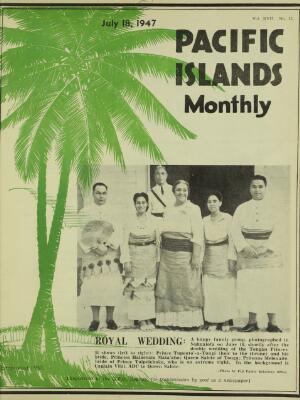
Royal Wedding:
A ha PP famil y group, photographed in Nukualofa on June 10, shortly after the double wedding of the Tongan Princes.
It shows (left to right): Prince Tupouto’-a-Tungi (heir to the throne) and his bride, Princess Halaevalu Mata’aho; Queen Salote of Tonga; Princess Melenaite, bride of Prince Tuipelehake, who is on extreme right. In the background is
Caplain Vilai. ADC to Queen Salote.
Photo by Fiji Public Relations Office.
Advertisements & other items, pp. 2-4 (1 item)
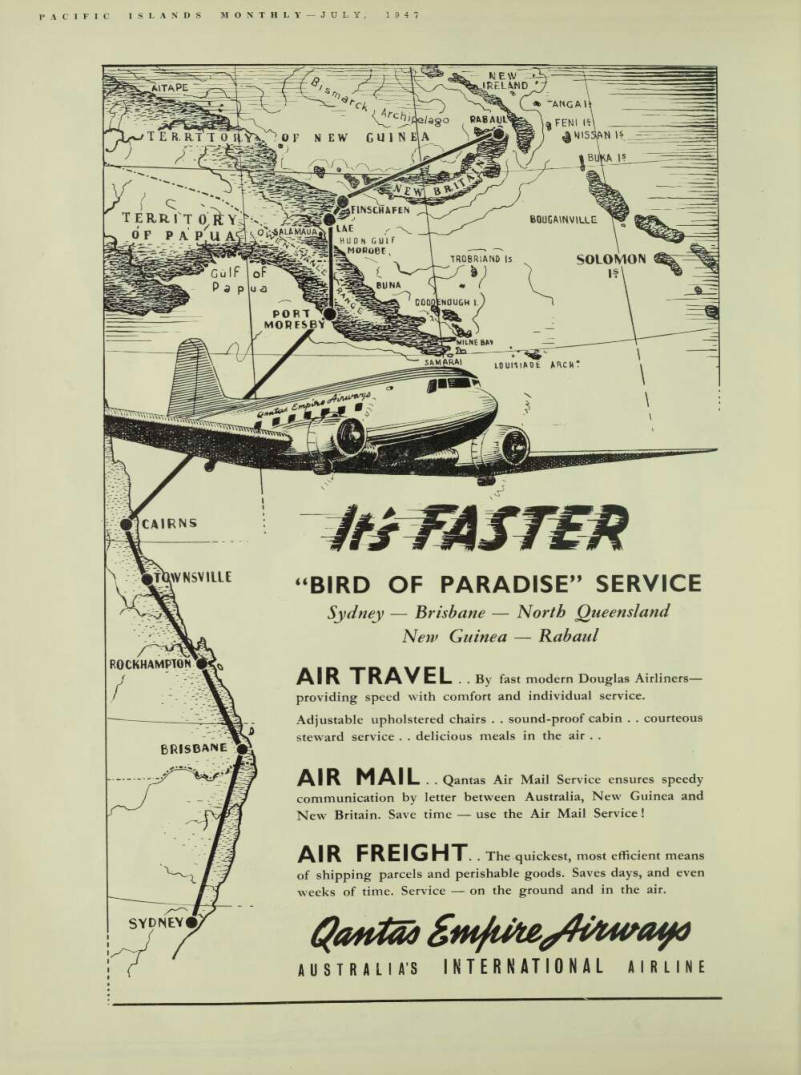
Qantdb SmfuteaMuvaqo
mtape c k T e r, an o Ft RU
•SALAMAUA
~c IF oF
or NEW GUI
/ago
IRELAND
RABAUL^
PORT
MORESBY
IS?»T:
BOUGAINVILLE
gFINSCH&Ft
LAC
IROBRIAND
HOUGH
MILNE
BM
SOLOMON
IS
SAMURAI LOimiAOt ARCHT
ANG
FENI
N>s AN BU -§L
•ICAIRNS
itQWNSVILLE
ROCKHAMPTON
/ .V:
BRISBANE
SYDNEY'
“BIRD OF PARADISE” SERVICE
Sydney Brisbane North Queensland
New Guinea Rabaul
AIR TRAVEL .By fast modem Douglas Airliners— providing speed with comfort and individual service.
Adjustable upholstered chairs . . sound-proof cabin . . courteous steward service . . delicious meals in the air . .
AIR MAIL . Qantas Air Mail Service ensures speedy communication by letter between Australia, New Guinea and New Britain. Save time use the Air Mail Service!
AIR FREIGHT . The quickest, most efficient means of shipping parcels and perishable goods. Saves days, and even weeks of time. Service on the ground and in the air.
Qantdb SmfuteaMuvaqo
AUSTRALIA’S INTERNATIONAL AIRLINE
m
40tfeaM£xpebience.
6e/u*toL eVefaf
S6cn^c
Llod l *' V-vJ 3 30 : r. •>’* s ° n ... boil I <l uar c° r ' ,ed „ foel* eo ' . .* \ea^ in9 * «ne in thout v.eto sen 9 C ° P SE t ,nt >» b '° sS 9 n. T be toU ootl° S * >UOt ' ( oo<i v ' l ' oS ,.pro°* p lin .us. jthef »VP eS «
Day after day, week
after week, for over 40 years Coleman's have specialised in making Stoves and Lamps. Is it any wonder, then, that
their products give
the utmost in satisfaction and
cookl*l**u
Thu . service.
Thi s f w st °ye ren° Urner "*9 °nd I"** «« p Co "ffol . 05 '"sfon Unne ce S c Vo/ ve e °ch *• **«*> ;■ ’ t Representatives for the Pacific Islands
ROBERT GILLESPIE PTY. LTD.
s4a PITT STREET, SYDNEY
PEARCE & CO
SUVA
FOR FIJI ISLANDS
LTD.
“PEERLESS” Wheel Toys
FOR THE PACIFIC ISLANDS—Available Now
For Immediate Shipment.
SCOOTER No. 4
Order
for
TRICAR No. 9
Speedy, safe and strong! Bright colours and smooth running— to meet with any youthful wishes. Quality is the keynote of the construction of this Scooter—
ORDER NOW!
Christmas
Strongly constructed and in attractive colours. Quality woodwork, finely finished metal make this one of the most attractive toys. Rubber handle grips, footpedals and tyres, and a rear luggage tray add to its appeal.
These Three 'Peerless'
Wheel Toys . .
AS IN THE PAST, "PEERLESS"
TOYS COMBINE STRENGTH,
SIMPLICITY AND DURABIL-
ITY, WITH ALL THE AT-
TRACTIVENESS OF BRIGHT
COLOURS, SMOOTH OPERA-
TION AND RACY DESIGN
PLAN FOR YOUR XMAS
NEEDS BY PLACING YOUR
ORDER NOW FOR THESE
THREE ILLUSTRATED
MODELS.
TRICAR No
A smaller vehicle for a younger child. Tricar No. 7 is built with the same regard for quality and attractiveness as Tricar No. 9. Strength, silence and bright colours are its important features.
Order "Peerless" Wheel Toys From the Sole Pacific Islands Selling
Representatives:
HfIKKT J. TOMNQ
POSTAL ADDRESS;
Box 3661 G.P.0., Sydney.
379 KENT STREET, SYDNEY.
BANKERS: BANK OP N.S.W.
PTT. LTD.
CODES:
Bentley’s Comp.
Phrase.
Bentley’s 2nd Phrase.
Advertisers
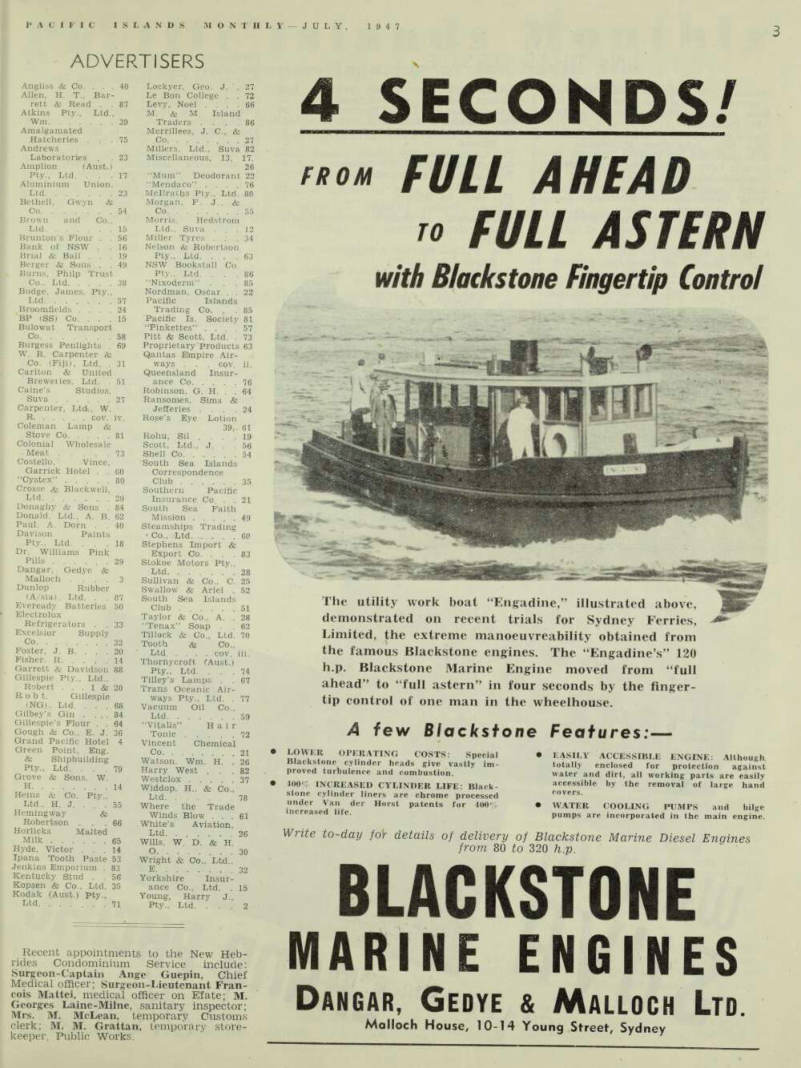
Angliss & Co. . . .40 Allen, H. T„ Bar rett & Read . . 87 Atkins Pty., Ltd., Wm 39 Amalgamated Hatcheries ... 75 Andrews Laboratories . 23 Amplion (Aust.) Pty., Ltd. ... 17 Aluminium Union, Ltd 23 Bethell. Gwyn & Co 54 Brown and Co., Ltd 15 Brunton’s Flour . . 56 Bank of NSW . . 16 Brial & Ball ... 19 Berger & Sons . . 49 Burns, Philp Trust Co.. Ltd 38 Budge, James, Pty., Ltd. ... 57 Broomfields ... 24 BP (SS) Co. . . . 15 Bulowat Transport Co 58 Burgess Penlights . 69 W. R. Carpenter & Co. (Fiji), Ltd. . 31 Carlton & United Breweiies, Ltd. . 51 Caine’s Studios, Suva 27 Carpenter, Ltd.. W.
R cov. iv.
Coleman Lamp & Stove Co 81 Colonial Wholesale Meat 73 Costello. Vince, Garrick Hotel . . 60 “Cystex” ... 80 Crosse & Blackwell, Ltd 29 Donaghy & Sons . 84 Donald. Ltd., A. B. 62 Paul. A. Dorn . . 40 Davison Paints Pty., Ltd. ... 18 Dr. Williams Pink Pills 29 Dangar. Gedye & Malloch ... 3 Dunlop Rubber (A/sia). Ltd. . . 87 Eveready Batteries 50 Electrolux Refrigerators . . 33 Excelsior Supply Co 32 Foster, J. B. . . .20 Fisher. R 14 Garrett & Davidson 88 Gillespie Pty., Ltd..
Robert . . . 1 & 20 R o b t. Gillespie (NG). Ltd. ... 68 Gilbey’s Gin ... 84 Gillespie’s Flour . . 64 Gough & Co.. E. J. 36 Grand Pacific Hotel 4 Green Point. Eng. & Shipbuilding Pty., Ltd. ... 79 Grove & Sons, W H 14 Heinz & Co. Pty., Ltd.. H. J. . .55 Hemingway & Robertson ... 66 Horlicks Malted Milk 65 Hyde. Victor ... 14 Ipana Tooth Paste 53 Jenkins Emporium . 83 Kentucky Stud . . 56 Kopsen & Co.. Ltd. 35 Kodak. (Aust.) pty., Ltd. ... 71
Lockyer, Geo. J. . 27 Le Bon College . . 72 Levy, Noel ... 66 M. & M. Island Traders ... 86 Merrillees, J. C., & Co 27 Millers, Ltd., Suva 82 Miscellaneous, 13. 17, 26 ‘Mum” Deodorant 22 “Mendaco” ... 76 Mcllratljs Pty.. Ltd. 80 Morgan, F. J.. & Co 55 Morris, Hedstrom Ltd.. Suva ... 12 Miller Tyres ... 34 Nelson & Robertson Pty., Ltd. ... 63 NSW Bookstall Co.
Pty.. Ltd. ... 86 “Nixoderm” ... 85 Nordman, Oscar . . 22 Pacific Islands Trading Co. . . 85 Pacific Is. Society 81 “Pinkettes” ... 57 Pitt & Scott, Ltd. . 73 Proprietary products 63 Qantas Empire Air ways . . . cov. ii.
Queensland Insur ance Co 76 Robinson, G. H. . . 64 Ransomes, Sims & Jefferies ... 24 Rose’s Eye Lotion 39, 61 Rohu, Sil . . . . 19 Scott, Ltd., J. . .56 Shell Co 54 South Sea Islands Correspondence Club 35 Southern Pacific Insurance Co. . . 21 South Sea Faith Mission ... 49 Steamships Trading • Co., Ltd. 60 Stephens Import & Export Co. . . .83 Stokoe Motors Pty., Ltd .28 Sullivan & Co.. C. 25 Swallow & Ariel . 52 South Sea Islands Club 51 Taylor & Co., A. . 28 “Tenax” Soap . . 62 Tillock & Co., Ltd. 70 Tooth & Co., Ltd cov. iii.
Thornycroft (Aust.) Pty., Ltd. ... 74 Tilley’s Lamps . . 67 Trans Oceanic Air ways Pty., Ltd. . 77 Vacuum Oil Co., Ltd 59 “Vitalis” Hair Tonic 72 Vincent Chemical Co 21 Watson, Wm. H. . 26 Harry West ... 82 Westclox 37 Widdop, H.. & Co., Ltd 78 Where the Trade Winds Blow ... 61 White’s Aviation, Ltd. 26 Wills, W. D. & H.
O 30 Wright & Co.. Ltd..
E 32 Yorkshire Insur ance Co., Ltd. . 15 Young, Harry J., Pty., Ltd. ... 2
Recent appointments to the New Heb rides Condominium Service include: Surgeon-Captain Ange Guepin, Chief Medical officer; Surgeon-Lieutenant Fran cois Mattei, medical officer on Efate; M.
Georges Laine-Milne, sanitary inspector; Mrs. M. McLean, temporary Customs clerk; M. M. Grattan, temporary store keeper, Public Works.
Advertisements & other items, p. 5 (1 item)
Blackstone
4 SECONDS/
FROM
FUll AHEAD
mi ASTERN
TO
with B/ackstoneFingertip Control
V IBS .-ft-UlM— -
mmL . Jwfi
r. 1 PP The utility work boat “Engadine,” illustrated above, demonstrated on recent trials for Sydney Ferries, Limited, the extreme manoeuvreability obtained from the famous Blackstone engines. The “Engadine’s” 120 h.p. Blackstone Marine Engine moved from “full ahead” to “full astern” in four seconds by the fingertip control of one man in the wheelhouse.
A few Blackstone Features:
LOWER OPERATING COSTS: Special
Blackstone cylinder heads give vastly improved turbulence and combustion.
imp; INCREASED CYLINDER LIFE: Black-
stone cylinder liners are chrome processed under Van der Horst patents for 400% increased life.
EASILY ACCESSIBLE ENGFNE: Although,
totally enclosed for protection against water and dirt, all working parts are easily accessible by the removal of large hand covers.
WATER COOLING PUMPS and bilge pumps are incorporated in the main engine.
Write to-day for details of delivery of Blackstone Marine Diesel Engines from 80 to 320 h.p.
BLACKSTONE
MARINE ENGINES
Dangar, Gedye & AAalloch Ltd.
Mullock House, 10-14 Young Street, Sydney
In This Issue:
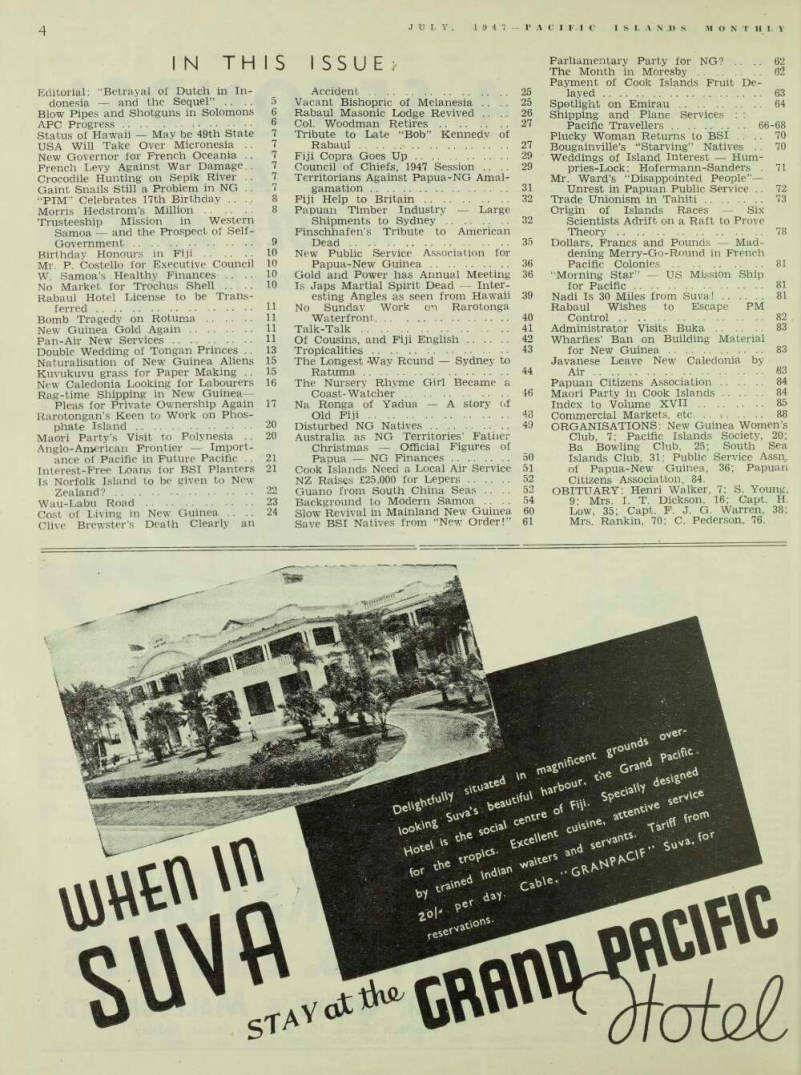
Editorial: “Betrayal of Dutch in In donesia and the Sequel” ... 5 Blow Pipes and Shotguns in Solomons 6 APC Progress 6 Status of Hawaii May be 49th State 7 USA Will Take Over Micronesia .. 7 New Governor for French Oceania .. 7 French Levy Against War Damage.. 7 Crocodile Hunting on Sepik River .. 7 Gaint Snails Still a Problem in NG .. 7 “PIM” Celebrates 17th Birthday ... 8 Morris Hedstrom’s Million 8 Trusteeship Mission in Western Samoa and the Prospect of Self- Government 9 Birthday Honours in Fiji 10 Mr. P. Costello for Executive Council 10 W. Samoa’s Healthy Finances ... 10 No Market for Trochus Shell .. .. 10 Rabaul Hotel License to be Trans ferred 11 Bomb Tragedy on Rotuma 11 New Guinea Gold Again 11 Pan-Air New Services 11 Double Wedding of Tongan Princes .. 13 Naturalisation of New Guinea Aliens 15 Kuvukuvu grass for Paper Making .. 15 New Caledonia Looking for Labourers 16 Rag-time Shipping in New Guinea- Pleas for Private Ownership Again 17 Rarotongan’s Keen to Work on Phos phate Island 20 Maori Party’s Visit to Polynesia .. 20 Anglo-American Frontier Import ance of Pacific in Future Pacific .. 21 Interest-Free Loans for BSI Planters 21 Is Norfolk Island to be given to New Zealand? 22 Wau-Labu Road 23 Cost of Living in New Guinea ... 24 Clive Brewster’s Death Clearly an
Accident 25 Vacant Bishopric of Melanesia .. .. 25 Rabaul Masonic Lodge Revived ... 26 Col. Woodman Retires 27 Tribute to Late “Bob” Kennedy of Rabaul 27 Fiji Copra Goes Up 29 Council of Chiefs, 1947 Session ... 29 Territorians Against Papua-NG Amal gamation 31 Fiji Help to Britain 32 Papuan Timber Industry Large Shipments to Sydney 32 Finschhafen’s Tribute to American Dead 35 New Public Service Association for Papua-New Guinea 36 Gold and Power has Annual Meeting 36 Is Japs Martial Spirit Dead Inter esting Angles as seen from Hawaii 39 No Sunday Work on Rarotonga Waterfront 40 Talk-Talk 41 Of Cousins, and Fiji English 42 Tropicalities 43 The Longest Way Round Sydney to Ratuma 44 The Nursery Rhyme Girl Became a Coast-Watcher 46 Na Ronga of Yadua A story of Old Fiji 48 Disturbed NG Natives 49 Australia as NG Territories’ Father Christmas Official Figures of Panua NG Finances 50 Cook Islands Need a Local Air Service 51 NZ Raises £25,000 for Lepers 52 Guano from South China Seas ... 52 Background to Modern Samoa ... 54 Slow Revival in Mainland New Guinea 60 Save BSI Natives from “New Order!” 61
Parliamentary Party for NG? .. .. 62 The Month in Moresby 62 Payment of Cook Islands Fruit De layed 63 Spotlight on Emirau 64 Shipping and Plane Services ; : Pacific Travellers 66-68 Plucky Woman Returns to BSI ... 70 Bougainville’s “Starving” Natives .. 70 Weddings of Island Interest Hum pries-Lock: Hofermann-Sanders . 71 Mr. Ward’s “Disappointed People”— Unrest in Papuan Public Service .. 72 Trade Unionism in Tahiti 73 Origin of Islands Races Six Scientists Adrift on a Raft to Prove Theory 78 Dollars, Francs and Pounds Mad dening Merry-Go-Round in French Pacific Colonies 81 “Morning Star” US Mission Ship for Pacific 81 Nadi Is 30 Miles from Suva! 81 Rabaul Wishes to Escape PM Control 82 Administrator Visits Buka 83 Wharfies’ Ban on Building Material for New Guinea 83 Javanese Leave New Caledonia by Air 63 Papuan Citizens Association 84 Maori Party in Cook Islands 84 Index to Volume XVII 85 Commercial Markets, etc 88 ORGANISATIONS: New Guinea Women’s Club, 7; Pacific Islands Society, 20; Ba Bowling Club, 25; South Sea Islands Club, 31; Public Service Assn, of Papua-New Guinea, 36; Papuan Citizens Association, 84.
OBITUARY: Henri Walker, 7; S. Young, 9; Mrs. I. T. Dickson, 16: Capt. H.
Low, 35; Capt. F. J. G. Warren, 38; Mrs. Rankin, 70; C. Pederson, 76.
Advertisements & other items, p. 6 (1 item)
sT *Vrf^
V \W
AS oVer '
*-*j* out : V* ie tU
** ** c eAUC «* f "" soc>»' C , c oW' t ' e ' -V»r' ff ** t*ce«** . se r^ S - .. su v». (or W e* cab \e." G * r i*l- -
Pacific Islands Monthly
The Newspaper-Magazine of the South Seas [Registered at the G.P.0., Sydney, for transmission by post as a newspaper .]
Published Once Each Month and Circulated in Australia and New Zealand and in the following Pacific Territories and Islands Groups:
Australian Territory of Papua.
Mandated Territory (Australia) of New Guinea.
Australian Territory of Norfolk Island.
New Zealand Territory of Cook Islands.
Mandated Territory (NZ) of Western Samoa.
British Colony of FIJI.
British Solomon Islands Protectorate British Protectorate of Tongan Islands.
British Crown Colony of Gilbert and Ellice Islands.
Mandated Territory of Nauru.
British and Free French Condominium of Ne* Hebrides.
French Colony of New Caledonia.
French Colony of Oceania (Tahiti, etc.).
American Territory of Eastern Samoa.
American Territory of Hawaiian Islands.
Owned and Produced by Pacific Publications Pty. Ltd., Union House, 247 George Street, Sydney.
Vol. XVII. No. 12.
July 18, 1947
i 1/3 Per Copy Price .{Prepaid, p.a.: 10/- Aus.
I In USA. p.a.: $2.50
Betrayal of Dutch in Indonesia—and the Sequel
THERE have been events and devel opments in Indonesia of much importance to the Pacific Territories; but not one person in a thousand in the Islands knows anything of their character and significance.
During the past month, the Dutch and Indonesians reached a show down. There will follow, quickly, either a peaceful settlement or sharp fighting. Meanwhile, the countries of Melanesia, at least, should know what is happening on their north-western frontiers.
The revolt in the Netherlands Indies is all of a piece with what is happening throughout Asia. Encour aged by “starry-eyed dreamers”—as the Socialist idealists who are tem porarily in charge of the British Government are called—the peoples of Egypt, India, Burma, Malaya and Indo-China have thrown themselves into nationalistic movements—and thus contributed much to the poli tical unease and economic dislocation of a war-weary world.
The situation in the Netherlands Indies, however, is the more deplor able because (a) the Dutch were be trayed in 1945-46 by their Anglo- American allies; (b> these Indone sians are quite unfitted to exercise the powers and privileges of inde pendent self-government; and (c) Indonesian policy is shaped by its basic hatred of Europeans, and by the Communism which busy Moscow agents have smeared all over the archipelago since Japanese control was withdrawn.
The story is long and complicated: but its outline may be seen over all the following four phases: PHASE I, 1942-45—NEI over-run and occupied by Japs. The Dutch Adminis tration, established and developed over 300 years, was destroyed and discredited by the Japs. It is important to remember at this stage, that Holland in 1940 and 1941 (before Pearl Harbour) had com mitted herself to considerable political re forms in NEI, calculated to give the In donesians an increasing measure of self government. The Japs trained thousands of young Indonesians in a crude kind of militaristic administration, which was to be applied under Jap tutelage, and so laid the foundations of endless trouble.
PHASE 11, LATE 1945 TO EARLY 1946
—Japan capitulated. The British and Americans, instead of immediately assist ing the Dutch (who had sacrificed all their strength in the Allied cause) to take over NEI immediately, permitted the sur rendered Japs to govern the archipelago for many months. The Japs completed their evil work among the Indonesians.
This, the betrayal of the Dutch by the Anglo-Americans, is one of the most dis creditable incidents in modem history.
PHASE 111, 1946 —When the Dutch, slowly gathering their strength, tried to take over, they were resisted by fanatical Indonesians, encouraged by the Reds and Pinks who had been elected to power in Britain. The Indonesians set up an “in dependent republic.” The British sent a caretaker force into NEI; but, instead of co-operating actively with the Dutch to restore order, put the Indonesians in their'rightful place, and protect European lives and property, they tried to arbitrate between the Dutch, with their old established interests, and the nationalistic aspirations of the excited Indonesians.
The Dutch colonial regime, for its part, was handicapped by the election of a more-or-less Socialistic Government at The Hague, which wanted to recognise the “Indonesian Republic.”
PHASE IV. LATE 1946 TO JUNE. 1947 —Dutch and Indonesians, in November, reached a tentative agreement to stop fighting and form an over all govern ment for NEI, and the British departed.
After long discussions. Dutch and Indo nesians, on March 26, 1947, signed the Linggardjati (or Cheribon) Agreement, under which they pledged themselves to create the United States of Indonesia, one unit of which is to be the Republican Government, with the Dutch formally re cognised as the de facto government of Java and Sumatra. The constituent States were to be this Republican Gov ernment of Java-Sumatra. the State of Eastern Indonesia, and the State of Borneo.
TNSTEAD of all parties thencefor- A ward co-operating in the imple mentation of the Agreement and the restoration of order, there com menced a three months’ period of
prevarication, treachery and bitter
moral struggle. The Republican Gov ernment, under President Soekarno and Premier Sjahrir, nominally was prepared to carry out the Agreement: but it was dominated completely by cunning, half-educated Indonesians of the usual unstable type—babblers of Brotherhood and Communist phrases, and holders of coveted jobs
which they feared they would lose under the Agreement.
The Dutch held patiently and ten aciously to the spirit and letter of the Agreement—and let nature take its course. They established an Ad ministration at Batavia, which coun tered some of the evils of the Re publican Government, based on Djokjakarta. There are 70,000,000 people in NEI, of whom over 50,000,000 are in Java, Sumatra and Madura—that is, the great majority appeared to be under the Republic, Quietly, but quickly, the Dutch pro ceeded with the organisation of the other States of the new Union. The first parliament of the new State of East Indonesia, established in Janu ary, opened in Macassar, in the Celebes, on April 22; the new State of West Borneo (embracing 15 self-gov erning territories) was set up at Pontianak on May 12. Meanwhile, the people of the Sunda Islands (east of Java, population 12,000,000) and of Madura, revolted against the Repub lic, and formed new parties. The new States and the new parties are pro- Dutch.
The Republican Government, while trying to hold off the Dutch with airy promises and cunning prevarication, insisted that it had authority over all NEl—and got ever deeper in poli tico-economic troubles. Its expendi ture was ten times its revenue. It printed more and more paper money.
The “Indonesian guilder,” issued at twice the value of the Dutch guilder, soon sank to two-fifths its value.
The Dutch demanded the orderly control of Indonesian trade, and the return of European-owned properties to their owners. The Republicans said they would do nothing more until the Dutch sent away their armed forces.
The Dutch quoted the Agreement, which provided for the time and manner of disarmament, by both sides. The Republicans merely shuf fled.
GRADUALLY, The Hague Socialists’ sympathy with the Republicans faded out. On May 27. the Dutch authorities insisted that the Repub licans give “a firm and unambiguous affirmation of their intention to forthwith implement the Linggard jati Agreement”—or else! The Hague
Government said that if the United States of Indonesia was not created at once with Republic co-operation, it would be brought into being with out. America demanded that each side join in creating an Interim Fed eral Government, to carry on until the new USI Federal Government could function on January 1, 1949.
On June 25, Premier Sjahrir saw the game was up, and offered con cessions, to enable the Interim Fed eral Government to be set up. He was immediately attacked by a howl ing pack of Left-Wingers the gentlemen who had been the niggers of the woodpile during all these months. Sjahrir resigned.
There followed a week of crisis.
One sign of weakness on the part of the Dutch and all Java, at least, would have gone into furious civil war. Fortunately, the Dutch were stiffened by a very insistent America. (The British seem to have taken no hand in Indonesian affairs, since they departed last year. Perhaps, like Australia, they prefer Indone sians to Dutch!) On July 6, Amir Sjari became Pre
mier, and the Republican Govern ment announced that it had accepted the Dutch plan for the immediate formation of an Interim Federal Government.
THIS settlement should open Phase V, which could be the happiest NEI has known since 1939. The de gree to which order will be estab lished, trade and industry resumed and starvation removed will depend on the degree in which the Dutch Ad ministration is resumed—and the ex tent to which long-haired babblers about the Brotherhood of Man are kept away.
European communities in non- European countries have had a sur feit of Brotherhood talk. It has created, in Asia and Indonesia, and even in some Pacific countries, enough trouble to keep us busy for a generation. Let us try peace and orderly government for a while.
Surely it is better to feed the dark skinned person, and clean his body, and train his mind, rather than get him all stirred up about freedom— which he doesn’t understand, any way—and usually abuses!
Mr. Ward's N. Guinea
BEFORE he left for Europe in June, Mr. Ward, Australian Minister for External Territories, supplied the following information about New Guinea in the form of answers to a Government
Member’s questions.
The questions are shown in black type.
Mr. Ward’s replies are. shown beneath.
How many natives are being trained as medical orderlies for service in New Guinea, Papua and the islands?
Answer: 1.057 at present.
What is the cost of this training.
Answer: The estimated cost under the Com monwealth Reconstruction Training Scheme for 1547-48 is £42.000. Additional costs will be met by the Papua-New Guinea Administration, the amount of which is not yet known.
Is it proposed to increase the number of trainees?
Answer: Yes.
Does the Commonwealth assume any re sponsibility for the training of native teachers?
Answer: Yes. Provision is made in the edu cation programme for the training of native teachers.
Is any tax imposed on the gold industry?
Answer: Yes. Five per cent, royalty is im posed in the Territory of New Guinea and 3 per cent, export duty in Papua. Gold produced in the Territories is also subject to a tax of 50 per cent, of the excess price over £& per oz.. under the Gold Tax Act of the Common wealth.
If so, are any of its proceeds spent in ways of furthering native welfare?
Answer: Yes.
Is it proposed that the budgets of New Guinea and Papua should be based upon moneys raised in the Territories. If not, does the Government propose to spend Australian revenues on the Territories?
Answer: It is the aim eventually to make the Territories self-supporting, but during the developmental period Commonwealth funds will be available to augment local revenue.
How much is being spent upon tropical medical research?
Answer: The estimated cost of the nutritional survey at present being carried out is £7,000.
This is part of an extensive research programme which is contemplated.
Is it proposed to increase the number of medical officers in the Territory?
Answer: Yes. However, difficulty is being ex perienced in securing the number of doctors considered necessary.
Does the Commonwealth propose to assist financially the medical and educational work of missions?
Answer: Yes.
Correction
Mr. Humphries on Departure of Mr. Elliott Smith
WIHEN Mr. Elliott-Smith left Papua- New Guinea Administration lately, and the Port Moresby people gave him a public farewell, one of the speakers was Mr. W. R. Humphries, Director of Native Labour. Mr Humphries was re ported in this journal to have expressed regret “to see men of the calibre a*nd ex nerience of Elliott-Smith and his con temporaries leaving the country for raw and inexperienced University students to take their places.”
Mr. Humphries has protested that his remarks were so condensed that an en tirely wrong meaning was conveyed by our report (page 70 of June), and a per usal of the full text justifies the protest.
Long after Mr. Humphries had passed on from the subject of Mr. Elliott-Smith’s departure, and when he was making ref erence, in feeling terms, to the fine ser vice rendered bv the officials of a former generation—he especially mentioned MacGregor, Murray, Hennelly, Champion, Beaver, Ryan, O’Malley, Strong, Wurth, Higginson, Brammell —he made this re mark: “It was painful for me, who knew these men and saw their work, to hear during the war, and especially towards the end of the war. newly-fledged hatchlings from Universities, middle-aged place seekers, and doubtful scientists belittling the work of these pioneers, and laying down rules for the future.”
“Some of them have gone before me,” said Mr. Humphries later, “and now Elliott-Smith is going. We cannot afford to lose men any more; for I am old fashioned enough to believe that there is no real substitute for experience.”
Advice has been received in Fiji from the United Kingdom that Ratu Edward Cakobau and Ratu Penaia Ganilau both gained good passes in the Colonial Ad ministrative Officers’ Course which they have been attending at Oxford Univer sity. Both have gone to London for the remainder of the course.
Blow-Pipes and Shot-Guns
in the Solomons!
NATIVES Start Blowpipe War on British Islanders” was the heading on an excited story in the feydney "Daily Telegraph” of July 9, wherein it was stated tnat large numbers of Malaita men, maddened by the fact that they had been compelled to live on fish and coconuts for six months (.“since the sup plies of flour and rice ran out”) had ' declared war ’ on British settlement on Guadalcanal.
According to the “DT’, the Malaita savages, “armed with spears and blow pipes,” had landed on Guadalcanal; and the British settlers, number, ng about 200, mostly employed by Lever Brothers, had armed themselves with shot-guns and had manned the shores of Kau-kau Bay to repel the invaders.
The “DT” said the story was brought to Townsville “by American flyers.” What ever its origin, BSI people in Sydney got a great kick out of the leg-pull.
1¾ Miles
Papuan Bore Down 1¾ Miles
INHERE has been no further word of the “oil strike in Papua,” which made the headlines in early June.
On June 28, the Kariava bore was down 8,488 feet. It had been reamed to 8,300 feet, preparatory to running in and cementing a 6| in. casing.
This now is a very deep bore—it goes no less than 1% miles into the crust of the earth.
Phosphate Ship Aground
on Mopihaa
Prom Our Own Correspondent
Rarotonga, June 14.
THE three-masted auxiliary schooner “Oiseau des lies,” owned by the Companies Francaise des Phosphates de I’Oceanie, Makatea. struck the western reef of Mopiha’a 270 miles west of Tahiti, at about 8 p.m. on Sunday, June 8. It was on its way to Makatea with 139 labour recruits from Rarotonga, which it left on June 6.
During the week the “Oiseau des lies” was anchored off Avarua, discharging re turning labourers and recruiting a new contingent, heavy wind and rain had made working conditions difficult. The night before departure, the anchor cable parted and the vessel cruised off and on during the remainder of the embarking operations. The weather was still bad when she left.
Mopiha’a reported that the vessel was fast on the reef, and had a list of 45 de grees, but there were no casualties and all passengers had been landed safely on the island. There was one woman passenger, Mrs. Horne, an elderly Ameri can, who had been in Rarotonga for some months on a leisurely Islands tour.
The steamer “Samkay” was ordered to proceed from Papeete to Mopiha’a, to give assistance. She took off all the passengers and carried them to Makatea.
At this date, the cause of the strand ing is not known here, nor the extent of the damage to the ship. The “Oiseau des lies” is a large, handsome vessel, well known in these waters. She was only recently returned to the Phosphate Company from Government service after a very thorough overhaul and refit.
Advertisements & other items, p. 8 (1 item)
6
JULY, 1947 PACIFIC ISLANDS, MONTHLY
May Be 49th State
Status Of Hawaii
IF a Bill which was passed by the United States House of Represent atives by 196 to 133, on June 30, is passed also by the Senate, the Territory of Hawaii will become the 49 th State of the United States.
The Bill was opposed by a section of the House on the ground that Hawaii is too far from the mainland, and that it has too mixed a population—ls6,oo J Jap anese, 52,000 Filipinos, 28,000 Chinese, 6,003 Koreans, 120,000 Europeans and 65,000 Hawaiians, in a total peculation of 430,000.
If the Bill is passed, Hawaii will be on an equal footing with other States, and will have a new Constitution.
in Micronesia
USA Will Take Over in Micronesia
EARLY in July, President Truman sent a message to Congress asking for early approval of the trusteeship agreement covering the Pacific islands formerly mandated to Japan (Marshall, Caroline and Mariana Islands).
The Security Council unanimously approved the agreement on April 2.
Papuans Give To Food For
Britain Fund
mHE Seventh-day Adventist Mission JL Board in Sydney recently received, from one of their missionaries at Bisiatabu, Papua (which is adjacent to the memorial monument to fallen Aus tralian soldiers, at the commencement of the Owen Stanley trail) a letter and a cheque for the Food for Britain Fund.
To show their sympathy for those in need, and to express great thanks for the bountiful supply of good food avail able there, the natives in that remote and primitive spot subscribed £l2/13/9.
The money was subsequently presented to the Lord Mayor of Sydney by a party of Papuan boys who were in Sydney at the time.
Many Travellers On The
"Sagittaire" From Tahiti
THE departure of the steamship J. “Sagittaire” on- April 17. for France, via Panama, was a gala occasion at Papeete.
Nearly two hundred passengers were booked for the voyage officials whose term of service in the Colonv has ended; teachers of the several Mission schools: civilians with their families: all happy that, at long last, they were to see again their beloved native land.
During the previous week there had been farewell dinners and receptions. To be sure, there were tears when the time came to part from friends and cherished associations. But the general spirit of happiness prevailed.
At the hour of departure, the assem blage at the wharf was the largest seen in many years. ACR.
New Governor of French
Oceania
IT was officially announced in Papeete early in June that Monsieur Pierre Maestracci had been appointed Gov ernor of French Oceania, in succession to Colonel Georges Orselli.
It is understood M. Maestracci already has arrived in Tahiti.
French Levy Against
War Damage
THE amounts levied upon French Territories in the Pacific, as contri butions to the French Union’s fund for repairing war damage, are: Francs.
New Caledonia 50,000,000 Fr. Oceania 20,000,000 New Hebrides 1,000,000 The payments are to be spread over ten years, Algeria’s levy is 150,000,000, and West Africa’s, 100,000,000 francs.
The Pacific franc is worth 160, and the African 227 to the Australian £.
Sepik
Crocodile Hunting on the Sepik
Queensland Men Are Interested
I'IHE crocodile hunting season on the Sepik River, New Guinea, usually begins about June and extends throughout the low-water season to about September.
During this period, hundreds of croco diles are caught by the natives—some by spearing, some caught on hooks, some in traps, snares and nooses, and some are caught alive when they are sunbaking.
The local people tell many apparently in credible stories of croc-hunting to visitors.
The catch is that the more incredible the story, generally the truer it is.
These stories seem now to have reached the Australian mainland and this year a Queensland hunter, a Mr. N. Guinio, decided he would try his luck with us.
He arrived here on the muddy banks of the Sepik about the beginning of May -f-but, unfortunately, without his gun— that had been confiscated by the Customs men at Lae, although those in Port Moresby took a more lenient view.
However, even without his trusty .303, his visit is of great value to local croco dile hunting. In many villages he has shown the natives how to skin the rep tiles properly, and how to dry the hides.
These hides will later be collected .aid sent to a firm of hide-buvers in Sydney.
If there are enough of them, perhaps the price of crocodile skin shoes and handbags will fall next year.
Among the professional native hunters of the “puk-puk” there is great en thusiasm for the scheme, and Mr. Guinio is a welcome and popular figure.—
“Mossie.”
Death of Henri Walker
THE Walker family, of Tahiti, in June received news that M. Henri Walker died in a military hospital in France, as the result of injuries received while he was a member of the French Air Force, engaged in a raid over Germany.
He leaves a widow and two children.
The Walker family, now French, is of British stock. Mr. William Walker, a Londoner, met and married in Tahiti a Miss Henry. They had several children, and their descendants are widely known and highly respected, in French Oceania.
Archbishop Halse, head of the Anglican Church, Queensland, returned to Bris bane by plane on June 21, after a 10-days’ tour by lugger of the Torres Strait Islands. He was accompanied by the Rev. Shevill. In honour of the Archbishop’s visit, feasts and tribal dances were arranged by natives: and, included in his gifts, was a pastoral staff of wongal wood inset with mother-of pearl.
Giant Snails
Still a Problem in Northern N. Guinea
IWAS interested in Jack Read’s re port that the giant snails, released by the Japs, are now dying out in New Ireland,” writes Mr. E. J. Wauchope, of Madang, New Guinea.
“I wish that were the case here, at Hansa Bay. Certainly, they are dying here by the million—but for every one that passes out, hundreds more appear —the reproduction ratio appears to be enormous. •‘The only consoling feature that I can see is that there now is no housing pro blem in Hansa Bay for the Kuka dand crab). Snail-shells now provide him with countless ready-made houses. ‘Mr. Mark Pitt —ADO at Bogia—has the right idea. He is using his police boys to educate the natives in methods of eradication, by burning on the line of the snails advance. The natives seem to co operate willingly, as they realise the danger to their gardens.
“Good-bye to the Queensland cane fields if ever these things get across to Australia!
“I find that I can kill the snails quickly by using a Jap fly-spray in a hand-spray: but one cannot spray over square miles of country.”
Malaita Is Welcome
Cairns, July 7.
THE “Malaita” berthed at Cairns on June 25 for the first time in four years, and loaded 24,000 super feet of timber and 100 tons of personal effects (including two cars) for Port Moresby, Samarai and Rabaul. Seven passengers also joined the ship to take up residence in New Guinea.
The “Malaita” cleared all cargo at Cairns, for which the residents of Papua and New Guinea had long been wait ing.
Various small craft have passed through Cairns lately, headed for the Territories.
Catholic Mission’s 300-ton vessel “Stella Maris,” which sailed on June 19 with steel rails, timber and livestock for Alexishafen Mission, met veyy bad weather and returned on the 21st. After repairs, it left again on June 27.
The "EMR," flying the French flag, and going to a Lutheran mission at Lae, left on June 6 in company with the ‘Win berra,” chartered by New Guinea Gold fields Ltd, The latter, also for Lae. had been here three weeks with oil trouble.
Ng Women S Club Of
Sydney
I\HE annual general meeting of the . Sydney-New Guinea Women’s Club will be held this year on Friday, July 18, at 7.30 p.m.
Meeting place will be. as usual, at the Feminist Club, 77 King Street.
During May. the club held a games’ night at the club-rooms, and also held a theatre party, proceeds of which went to club funds.
On the morning of July 1, on the fifth anniversary of the sinking of the “Monte video Maru,” the widows, friends and relatives of men who were lost on that occasion met in Martin Place, Sydney, and placed wreaths on the Cenotaph. iAionseigneur Bresson. Catholic Bishop in New Caledonia, announced that he would leave by Pan-American plane for Rome late in June.
"Pim" Celebrates
17Th Birthday
By Move Into North Pacific and Indonesia
WITH this issue, the Pacific Islands Monthly completes 17 years of continuous monthly publication; and it attains its largest size in 17 years— namely, 88 pages.
Started modestly in August, 1930, the PIM has grown in size and circu lation ever since, except during the war-shadowed period between 1940 and 1945.
The PIM now is an accepted in stitution in every Pacific Territory south of the Equator.
Owing to World War 11. condi tions in the Pacific have changed.
There is a much closer community of interest, now, between the South Pacific countries and the North Pacific, because the Micronesian archipelagoes have changed from Japanese to American control. There also are closer ties between the South Pacific and Indonesia, because Australia is supplying to Indonesia so many commodities which previously came from Europe and Japan.
AS a result, there is a growing de demand for the Pacific Islands Monthly in the North Pacific and Indonesia.
Preparations now are Toeing made to divide the monthly issue of the “ PIM ” into three sections — namely, the main, or South Pacific Edition, which will appear much as it is at present; the north Pacific {or American) Edition, which will cir culate through Honolulu , in Hawaii, Marshall, Caroline and Mariana Islands, Guam, and the Philippines; arid the Indonesian Edition, which will be distributed from Sydney, through Netherlands Indies, Malaya.
Singapore, Burma, Siam, Borneo and Hong Kong.
All advertisements, of course, will go through all Editions.
The publication of the PIM, in Editions, will commence within the next three or four months.
OWING to the world-wide shortage of paper, we are compelled still to print the PIM largely upon news print—for which we are now paying more than we paid in 1939 for good qua ity printing-paper. We like news print no more than do our readers, and we shall abandon the use of it just as soon as supplies of good paper become available.
The success of the “Pacific Islands Monthlyand its usefulness, are due in a large measure to the consistent support it has received over the years from leading Australian and Pacific advertisers. We are glad to think that the extension of the journal into new fields, in North Pacific and Indonesia, should materially assist in the development of Australian over seas trade.
Mh's Million
Great Fiji Trading Co. Increases Its Profits And Its Problems
THE 1947 balance-sheet of Morris Hedstrom Ltd., leading trade organ isation of the Central South Pacific, carries on the remarkable record of pro fits and accumulated savings, commenced in 1942.
When World War II came, and Europe could no longer buy copra, the company’s profits fell—from £85.097 in 1938. to £55,306 in 1941. Then Japan came in, paralysed the great copra-making in dustries of Philippines and Indonesia, and brought the South Pacific’s copra into urgent demand.
While the company generally shows plenty of enterprise—its competitors say, bitterly, that it seldom misses a pass— its management is cautious and con servative, insisting that the profits of this good time be used for the under pinning of the whole financial structure, to guard against possible bad times. Thus:
One effect of it all is the accumulation of no less than £1.032.000 in ‘‘invest ments and cash.”
The life-time benevolent habits of Sir Maynard Hedstrom and his associates show up strongly in the lists of gifts in the accounts over the past ten years: £ Given to staff fund 35.000 Given to Fiji patriotic funds .. 19,710 Given to University Scholarship Fund for Fijians 25,000 THE main worry of MH directors probably is the profitable em ployment of their huge accumu lation of cash. Their shareholders, over the years, have been trained to expect anything from 8 to 15 per cent. But about £1,000.000 of the company’s capital and accumulated re serves is now in cash, earning nothing, or in gilt-edged, averaging at a guess, less than 4 per cent. Put in another wav: this company could return all of its sub scribed capital (£739,613), and still make a profit of £lOO,OOO per annum.
If Fiji could be thrown wide open to new European settlement and industries, the MH policv would be obvious use these huge surplus funds to finance sound new enterprise, and double the profits. But Fiji now, it seems, is to be a close preserve for Fijians and Indians.
Fijians have little developmental enter prise, and the average Indian is not a sound investment. Hence the furrows of care on the MH forehead. There is little in Fiji in which to employ a million pounds of savings; yet, if they are shifted out of Fiji, the money at once is at the mercy of Socialistic Governments with quaint, startling ideas about “capitalists.”
Year Profit Total Reserves 1942 61,770 300,873 1S‘43 94.769 480,351 1944 99,088 628.246 1945 94.678 652.731 1946 94,210 698.600 1947 103.548 711.956
1940 1947 £ £ Paid capital (Fijian i (Fijian) 739.613 739.613 Deposits 4.946 3,897 Creditors, etc Land, buildings, plant. 18.999 117,540 etc. .. 303,195 192,241 Plantations 49.247 16.954 Stocks, etc 337,110 260.261 Investments and cash . 167,256 1.032.095 Capital value branches 90,465 75,176 Book debts, etc 136.244 171,122
New Hotel For Suva
May Come in 3 Years
PLANS for the modern, 3-storeyed hotel, which Morris. Hedstrom Ltd. pro pose to erect at the corner of Rodney Road and Robertson Street. Suva, Fiji, show that there will be sufficient large! airy rooms, with hot-and-cold water in each, to accommodate 60 persons.
The estimated cost is £lOO,OOO. The company, however, may elect to spend more than that, in which event, the hotel will go to four storeys, and accommodate 90 guests, with additional amenities, such as private bath-rooms.
Materials and tradesmen are as scarce in Fiji as elsewhere. There is little likeli hood of the hotel being completed much inside of three years.
"Matua" Travellers
PASSENGERS to Island ports recently included:
Mrs. J. Paget, who travelled to Western Samoa to rejoin her husband, who is em ployed with Crown Estates.
Eli Tuiapelele, Chief Inspector of Western Samoan schools. He returned from New Zealand after at tending educational meetings.
Mrs. Mary Haera. of Suva. Fiji, who visited other island centres.
Miss Mary Faa teia, of Suva, who also visited island ports.
Mata Ae. of the Western Samoan Education Depart ment, who accom panied Eli Tuiapelele to New Zealand.
Uno Trusteeship Mission In
Western Samoa
Present Inquiry Does Not Affect American Samoa
THE mission of the Trusteeship Council of the United Nations which is to inquire into conditions in the former Mandated Territory of Western Samoa, assembled in New Zealand in the latter part of June; and departed from Auckland on July 4. in a NZ Air Force Sunderland flying-boat for Suva, Fiji.
The following day, July 5, the party went on in the Sunderland to Apia.
The following are the members of the party:— Francis B. Sayre, (United States), President of the Trusteeship Council.
Pierre Ryckmans (Belgium), a mem ber of the Council.
Dr. Cruz Coke (Chili), a Member of the Council. (Dr. Coke was not on the flying-boat. Instead of going to NZ, he made his way to Samoa by another route, and met the narty in Ania.) Mr. Peter M. Anker, assistant-director of the Trusteeship Division; Mr. J. de la Roche, chief of the visits section of the Trusteeship Council; Mr. C. E. P. Leite, political affairs officer; and Miss M.
Respier all attached to the Mission as members of the secretariat.
Two members of the staff of the NZ Department of External Affairs.
Professor Felix Keesing, a New Zea lander now at Stanford University, Cali fornia, and a well-known writer on South Pacific Administration, has been attached to the mission as an expert consultant. He proceeded, direct to Samoa.
Mr. Sayre had a distinguished career as a former Assistant Secretary of State.
Governor - General of Belgian Congo for 12 years, Dr. Ryckmans has had 32 years of service with the Belgian Colonial Service. He has represented Belgium in many of its overseas Territories, and for a long period was stationed in the for mer Belgian mandate in Africa, Ruana Urandi. He resigned from his country’s colonial service to represent Belgium on the Trusteeship Council.
The mission is concerned solely with the petition for self-government from the chiefs and neople of Samoa; and, as soon as it arrived in Apia, it made preparations for a long series of discussions with all classes, all over the group. The mission will be at least a month in Samoa.
The Western Samoans, in their petition to the council asked that Samoa be granted self-government, that New Zea land act as urotector and advisor in the same capacity as Great Britain did to Tonga, and that “the unnatural division of the islands of the group be left in abeyance until a meeting can be arranged between Eastern and Western Samoa.
The mission has nd authority to in quire into conditions in Eastern or American Samoa. It is solely concerned
with the petition for self-government from peoples of Western Samoa.
This was stated bv Mr. Sayre, during a Press conference in Wellington on July 2.
American Samoa, Mr. Sayre said, was part of American sovereigntyand ag far as he knew, its inhabitants had never asked for any political change.
In its first statement (made on July 7) the mission announced that it would not make any decision —only recommenda tions to the Council —and any change in the administration of the islands would require the concurrence of the New Zea land Government. The New Zealand Prime Minister, however, had assured the mission that his Government would give the greatest weight to its recommenda tions.
A meeting of Europeans and part- Europeans living in Western Samoa adopted a resolution expressing sympathy with the Samoan desire for self-govern ment, but adding that “a transition period of 10 years or possibly longer will be needed.”
What are the Prospects of Self-Government?
From Our Special Correspondent
APIA. July 4.
IT is difficult to see how this mission from the Trusteeship Council (due to-morrow) can accomplish anything more than a good holiday; or how its report to the United Nations can be any thing other than vague, diplomatic, platitudinous, and exceedingly compli mentary to New Zealand.
After a good start in Samoa after World War I, New Zealand made a bad break by sending over a hand-picked crop of martinets and suburban Bumbles who, without imagination, tact, humour or anything else —except a sense of their own self-importance—brought Samoa to the brink of disaster.
The Labour Government that has ruled New Zealand since 1935 went into re verse as soon as it achieved power. Per haps it went too far into reverse. But it is true that in the last decade Samoa has been an oasis of peace in a troubled world.
New Zealand, whether Tory or Socialist, has never exploited Samoa in the old tradition of colonial exploitation.
An American, the late Dr. S. M.
Lambert, wrote that he would like to see all Polynesia brought under New Zealand’s care, and added that the Dominion had lavished both money and work on Samoa without thought of re turn, or even thanks, beyond the satis faction of seeing a dying race revived.
At 65,000, the population of Western Samoa has virtually been trebled since the German days.
IF they are based on statistics, the claims for self-government are very shaky.
If they are based on any suggestion of commercial exploitation, they can be ruled out.
If they are based on any allegation of interference with Samoan customs, ways of life and liberty to develop on entirely Samoan lines, they are ludicrous.
The writer has no great love for officialdom in general, but NZ official
dom in Samoa, for 13 years at least, seems to have had a genuine concern for the preservation of all that is best in Samoan tradition and custom.
Further, it has rigidly blocked any at tempts at the degradation of the people in the interests of “tourism.” Tourists, as they are known in Honolulu. Suva and Papeete, have not been welcomed with open arms in Apia since New Zealand took over.
Despite elaborate plans and endless talk, there is no prospect of anything like a sound, stable government to take over if New Zealand walked out: and the idea that Samoa would become a second Tonga is fantastic.
There would be three “kings”—Mata’afa, Malietoa and Tamasese angling and perhaps fighting for supreme power. Such a Samoan triumvirate would be an easy comparison to the strong Royal House of Tonga. The Samoans were split into three even before European days, and the tradi tion holds.
And the Samoan civil service? Custom would hold again, and HMS Pinafore wouldn’t be in the running. Not only sisters, cousins and aunts, but brothers, nephews, uncles and cousins-several times-removed would be flat out after every available or created job.
Colonel 11. T. Allan, QBE, of Rabaul, New Guinea, arrived in Sydney early in July, and will spend about three months in Australia. Mrs. Allan arrived in Syd ney in May, from Rabaul.
Mrs. Pat Gilsen left Brisbane for Port Moresby by the “Montoro” on June 14 She will Join her husband who is in business there.
Mr. Steve Young, a well-known resi dent of Western Samoa died in the Ter ritory on May 20. He had been in ill health for some time.
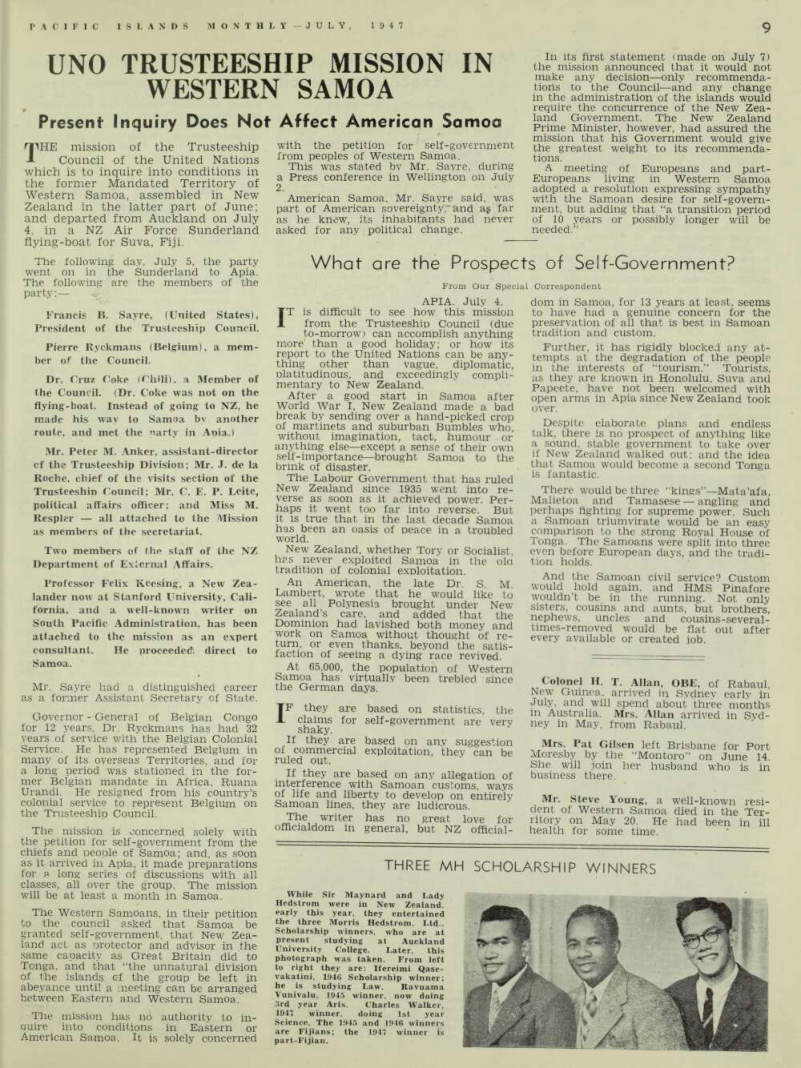
Three Mh Scholarship Winners
While Sir Maynard and Lady Hedstrom were in New Zealand, early this year, they entertained the three Morris Hedstrom, Ltd..
Scholarship winners, who are at present studying at Auckland University College. Later, this photograph was taken. From left to right they are: Ifereimi Qase vakatini, 1946 Scholarship winner; he is studying Law. Ravuama Vunivalu, 1945 winner, now doing 3rd year Arts. Charles Walker, 1947 winner, doing Ist year Science. The 1945 and 1946 winners are Fijians; the 1947 winner is part-Fijian.
Birthday Honours
For Fiji
OBE for Dr. Hoodless
rE following awards to Fiji residents, were announced in the recent Birth day Honours: QBE: Dr. D. W. Hoodless B.Sc.,
L.M.S.S.A.
MBE: Setariki M. Koto.
Colonial Police Medal; Superin
tendent B. F. Hooper.
Dr. D. W. Hoodless, OBE, retired last year from the post of Principal of the Central Medical School, Fiji. He served in the Education Department of the Colony from 1912 to 1930, becoming As sistant Director of Education in 1927. In 1930, when the Central Medical School was established. Dr. Hoodless was ap pointed Tutor. The title of the post was later changed to Principal.
Setariki Koto. MBE. has been asso ciated with the work of the Native Lands Commission, Fiji, since July, 1916.
Superintendent B. F. Hooper, who has been awarded the Colonial Police Medal, first became a member of the Fiji Police Force in 1929. He was appointed an As sistant Superintendent in 1938 and Super intendent in 1943.
Mr. P. Costello for Executive Council
Executive Council
From Our Own Correspondent SUVA, June 19
Mr. Patrick Costello, Who Is
perhaps the Colony’s best-known and least-conventional business man, has been appointed to the Fiji Ex ecutive Council in succession to Mr. F. L.
Smith, of the Bank of New Zealand, who has left the Colony. The appoint ment is a popular one.
Mr. Costello, who is an Australian, came to Fiji in 1909 as a shipping clerk for the local branch of the AUSN Co. The following year he joined the firm of Arthur Joske Ltd., as an auctioneer; but by 1912 he was in business for himself as a hotel-keeper at Lautoka. His hotel property there was in more recent years, acquired by Northern Hotels Ltd.
He was closely associated with the foundation of the Rewa Co-operative Dairy Company and, later, with the de velopment of the gold mines at Vatu koula.
The discoverer of gold in the Tavua area, Mr. W. Borthwick, was financed by Mr. Costello in the prospecting venture which resulted in the original find, and it was Mr. Costello’s strong and persis tent advocacy that was responsible for
Mr. E. G. Theodore and his associates be coming interested in the development of the field.
Mr. Costello has wide business and prop erty interests in the Colony and he has served on many official and semi'official committees. He was for seven years a member of the Suva Town Board and earlier, was a member of the Local Authority and the Road Board at Lau toka.
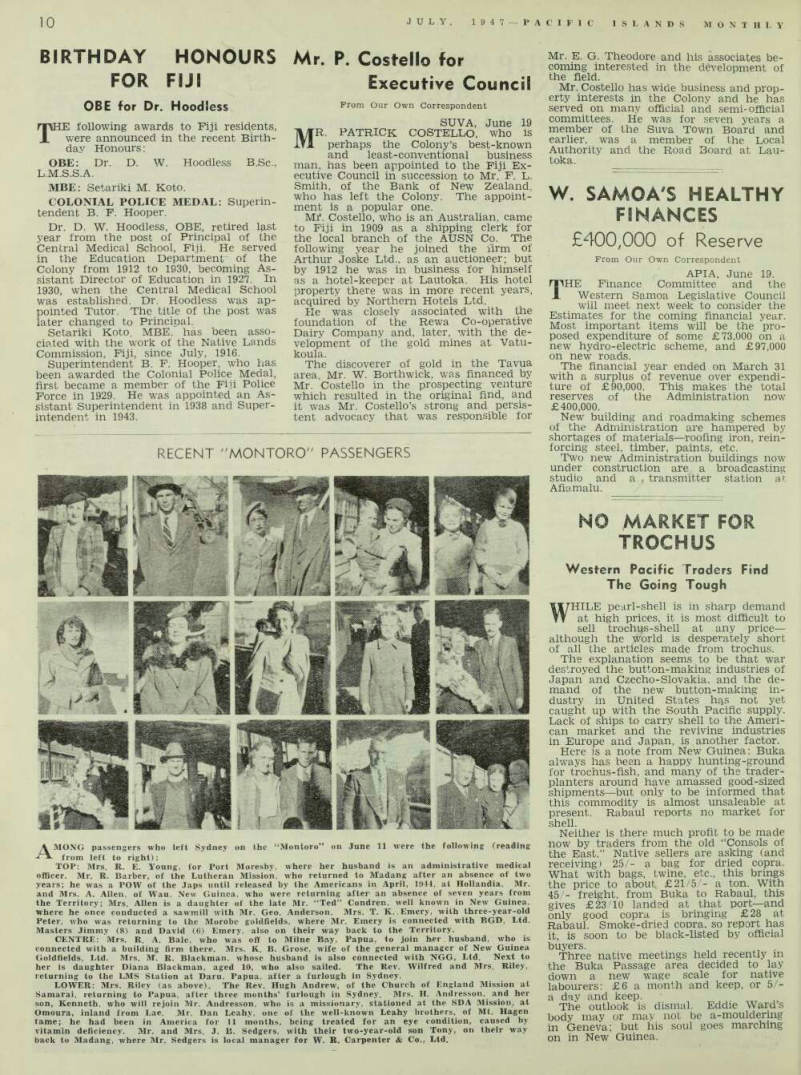
Recent "Montoro" Passengers
AMONG passengers who left Sydney on the “Montoro” on June 11 were the following (reading from left to right): TOP: Mrs. R. E. Young, for Port Moresby, where her husband is an administrative medical officer. Mr. R. Barber, of the Lutheran Mission, who returned to Madang after an absence of two years; he was a POW of the Japs until released by the Americans in April, 1944. at Hollandia. Mr. and Mrs. A. Allen, of Wau. New Guinea, who were returning after an absence of seven years from the Territory; Mrs. Allen is a daughter of the late Mr. “Ted” Condren, well known in New Guinea, where he once conducted a sawmill with Mr. Geo. Anderson. Mrs. T. K. Emery, with three-year-old Peter, who was returning to the Morobe goldfields, where Mr. Emery is connected with BGD, Ltd.
Masters Jimmy (8) and David (6) Emery, also on their way back to the Territory.
CENTRE: Mrs. R. A. Bale, who was off to Milne Bay, Papua, to join fier husband, who is connected with a building firm there. Mrs. K. B. Grose, wife of the general manager of New Guinea Goldfields, Ltd. Mrs. M. R. Blackman, whose husband is also connected with NGG, Ltd. Next to her is daughter Diana Blackman, aged 10, who also sailed. The Rev. Wilfred and Mrs. Riley, returning to the LMS Station at Daru, Papua, after a furlough in Sydney.
LOWER: Mrs. Riley (as above). The Rev. Hugh Andrew, of the Church of England Mission at Samarai, returning to Papua, after three months’ furlough in Sydney. Mrs. H. Andresson, and her son, Kenneth, who will rejoin Mr. Andresson. who is a missionary, stationed at the SDA Mission, at Omoura, inland from Lae. Mr. Dan Leahy, one of the well-known Leahy brothers, of Mt. Hagen fame; he had been in America for 11 months, being treated for an eye condition, caused by vitamin deficiency. Mr. and Mrs. J. B. Sedgers, with their two-year-old son Tony, on their way back to Madang. where Mr. Sedgers is local manager for W. R. Carpenter & Co., Ltd.
W. Samoa's Healthy
Finances
£400,000 of Reserve
Prom Our Own Correspondent APIA, June 19.
THE Finance Committee and the Western Samoa Legislative Council will meet next week to consider the Estimates for the coming financial year.
Most important items will be the pro posed expenditure of some £73,000 on a new hydro-electric scheme, and £97,000 on new roads.
The financial year ended on March 31 with a surplus of revenue over expendi ture of £90,000. This makes the total reserves of the Administration now £400,000.
New building and roadmaking schemes of the Administration are hampered by shortages of materials —roofing iron, rein forcing steel, timber, paints, etc.
Two new Administration buildings now under construction are a broadcasting studio and a , transmitter station at Afiamalu.
Trochus
No Market For
Western Pacific Traders Find The Going Tough
WHILE pearl-shell is in sharp demand at high prices, it is most difficult to sell trochus-shell at any price— although the wbrld is desperately short of all the articles made from trochus.
The explanation seems to be that war destroyed the button-making industries of Japan and Czecho-Slovakia. and the de mand of the new button-making in dustry in United States hqs not yet caught up with the South Pacific supply.
Lack of ships to carry shell to the Ameri can market and the reviving industries in Europe and Japan, is another factor.
Here is a note from New Guinea: Buka always has been a happy hunting-ground for trochus-fish, and many of the trader planters around have amassed good-sized shipments—but only to be informed that this commodity is almost unsaleable at present. Rabaul reports no market for shell.
Neither is there much profit to be made now by traders from the old “Consols of the East.” Native sellers are asking (and receiving) 25/- a bag for dried copra.
What with bags, twine, etc., this brings the price to about £2l/5/- a ton. With 45 - freight, from Buka to Rabaul, this gives £23/10 landed at that port—and only good copra is bringing £2B at Rabaul. Smoke-dried copra, so report has it, is soon to be black-listed by official buyers.
Three native meetings held recently m the Buka Passage area decided to lay down a new wage scale for native labourers: £6 a month and keep, or 5/a day and keep. , „ The outlook is dismal. Eddie Ward s body may or may not be a-mouldering in Geneva; but his soul goes marching on in New Guinea.
Bomb Tragedy on Rotuma
Rotuma
From a Special Correspondent rE bomb which exploded on Rotuma (Fiji Group) on May 6 this year, killing nine, seems to have had as many lives as a cat.
In the first place it was found by women fishing; it was removed from the coral reef, where it was tightly wedged, and taken home in their canoe; and from that time, until it exploded, it was carried hither and yon with impunity.
Two bovs took it in their canoe to show some friends, and a Pepjei woman quar relled with her husband for bringing it into the kitchen, as she was nervous of it. Her husband merely laughed, de claring that when he returned from the bush he would dismantle it. However, during his absence, his wife heaved the thing out of the kitchen and nushed and rolled it back into the sea. where it lay, seen and handled by many.
A Rotuman called Tonuava finally took it into his house; but, when warned by an ex-soldier of its danger, he and other natives carried it dow r n to the beach.
While he and another. Petero, were standing talking about it, seven boys from the Roman Catholic school gathered around it.
One of the boys began to chip the metal of the nose with his knife. “This looks like gold,” he said. A moment later the bomb exploded.
Tonuava and the seven boys were blown to pieces. Petero was severely in jured, and died in hospital two hours later. Before he died, however, he was able to tell how the boy had chipped the bomb with his knife.
Showing The Flag
THE NZ light cruiser “Bellona” left Auckland on July 7, to show the flag
in the following' places;
July 17 Savu Savu, Fiji.
July 18-25 Suva.
July 27-August 4 Funafuti, Ellice Is.
August 5-7 Rotuma.
August 9-14 Suva.
August 16-22 Vavau, Tonga.
August 23-31 Nukualofa.
Rabaul Hotel Licence To Be
Transferred
THE publican s licence for the premises know r n as the “Cosmopolitan Hotel,”
Rabaul, New Guinea, is now in the legal process of being transferred. The licence is at present held by Mr. A. L.
Gaskin, son of Mr. A. J. Gaskin, who ran the Cosmopolitan Hotel, Rabaul be fore the Pacific war. The building was destroyed during the Japanese occupa tion.
If the Court agrees, on July 21, the new licencee will be Mr. P. F. Bailey, of Rabaul. It is expected that the new Cosmopolitan Hotel will, for the time be ing, be the former Civilian Hotel, which was run by the Production Control Board in Rabaul until recently.
European status has been conferred upon three well-known residents of the Gilbert Islands John Milne, Henry Schutz and Tekarakara Brechtefeld. All had good records during the war—especi ally Mr. Milne, who as known in 1941 was a very capable young radio operator.
Mr. Schutz probably is identical with that clever young Euronesian who, in the years just before the Jap invasion, made a marked success of the tangitangs (native co-operative societies).
Again
N. Guinea Gold
After Five Years
GOLD is coming out of New Guinea again—but slowly.
BGD recommenced dredging this year—with No. 1 on February 20, and No. 2 on April 13. To June 1, they handled 720,000 cubic yards of gravel, and got gold worth 469,153 United States dollars (with gold at 35 dollars per ounce).
The other six dredges cannot be brought back into operation yet because of delay in getting equipment from America.
BGD’s eight dredges and two hydro electric stations closed down on February 22, 1942, when the Japs invaded the Morobe district, and the whole installation suffered much damage from bombs, “scorched earth,” looting and what-not.
Pan-Air Services
AS from May 21, Pan-American Airways clippers on the San Francisco- Sydney service have been calling at Tontouta airport, New Caledonia, on Wed nesdays and Saturdays, on the outward voyage and on Thursdays and Sundays on the return trip, or twice as often as previously. The weekly San Francisco- Auckland service, however, has cut out New Caledonia entirely.
By eliminating overnight slays at Canton Island and Nandi, Fiji, in favour of one hour stops, the San Francisco- Sydney trip has been reduced from 72 to 45 hours.
Tomb Of Rls
Road Being Beautified
UNDER instructions from the Admin istrator of Western Samoa (Colonel F. W. Voelckner. DSO), steps have been taken to make the path which leads from the Vailima Road to the tomb of Robert Louis Stevenson, on Mt. Vaea, be hind Apia, a thing of real beauty.
A local botanist, Mr. Charles Reed, is planting up the area with selected varieties of hibiscus, crotons and frangi panni—shrubs and trees which should soon make a fine show.
It was a happy thought by the Admin istrator. The tomb of the great British writer almost certainly will be visited, in long years to come, by thousands of world travellers, and it has not been well cared for in the 60 years since Stevenson died.
Distinguished Guests At Tongan Royal Wedding
Rally Of Free Frenchmen
In Pacific
A BRANCH of the Association of Free Frenchmen, which is under the patronage of General de Gaulle, has been formed in New Caledonia and the New Hebrides. Members are limited to those who rallied the Free French Forces, close relatives of servicemen who were killed ,and civilians who joined the French National Committee under condi tions of danger. The annual subscrip tion is 50 francs.
No doubt qualified Free Frenchfilen liv ing in Australia, will be admitted. Offices are at the Intendance. Noumea, and c/o M. Max Frouin, at Vila. Under the patron age of Governor and Mme. Parisot, com memorative festivities were held at Noumea on June 16, 17 and 18.
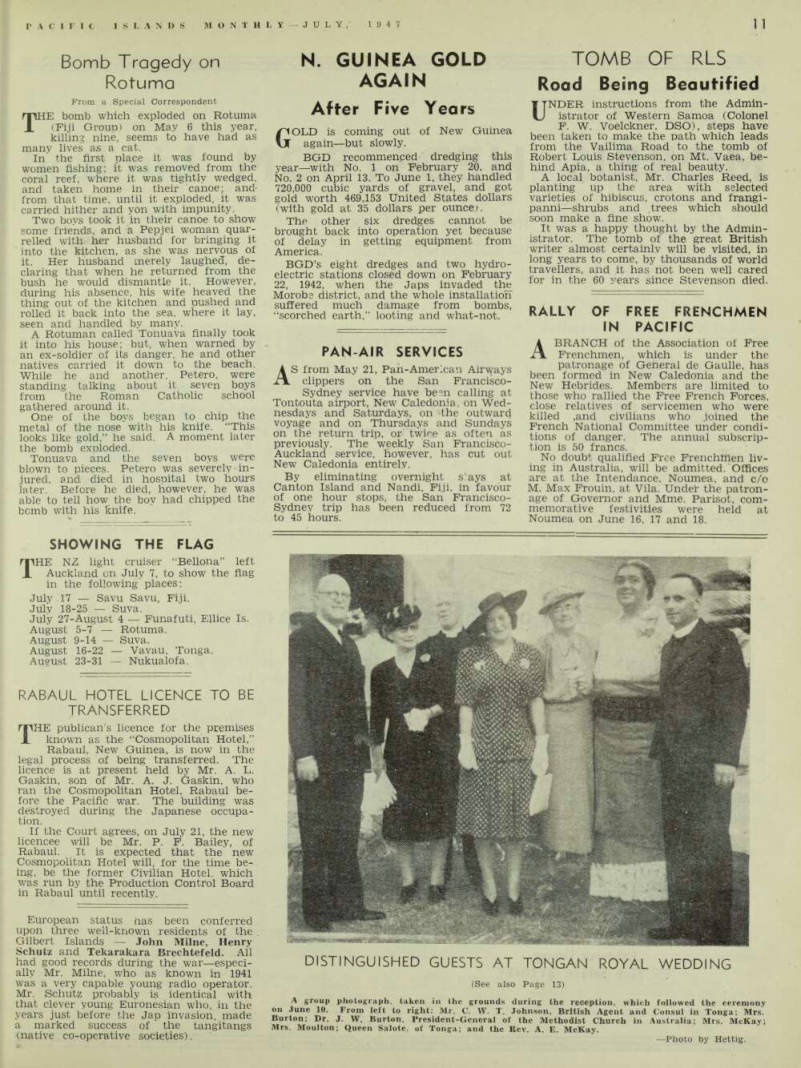
Distinguished Guests At Tongan Royal Wedding
(See also Page 13) A group photograph, taken in the grounds during the reception, which followed the ceremony on June 10. From left to right: Mr. C. W. T. Johnson, British Agent and Consul in Tonga; Mrs.
Burton; Dr. J. W. Burton, President-General of the Methodist Church in Australia; Mrs. McKav; Mrs. Moulton; Queen Salote, of Tonga; and the Rev. A. E. McKay.
Photo by Hettig.
Advertisements & other items, p. 14 (1 item)
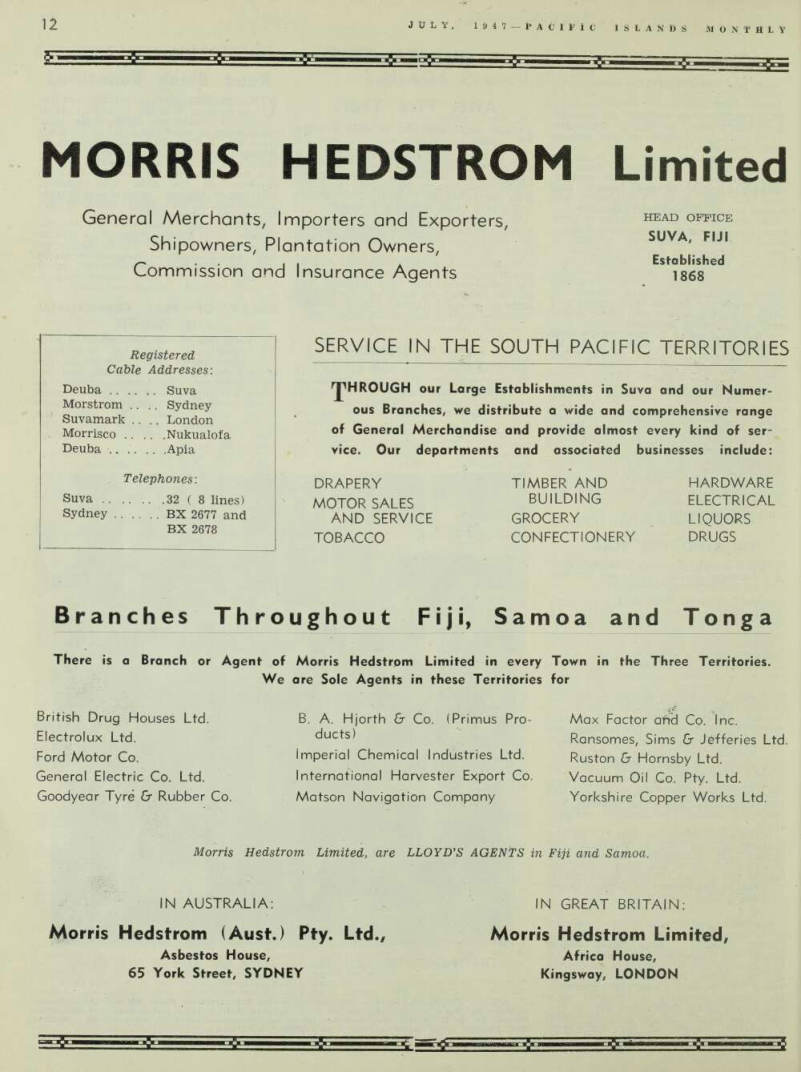
Morris Hedstrom Limited
General Merchants, Importers and Exporters,
Shipowners, Plantation Owners,
Commission and Insurance Agents
HEAD OFFICE
SUVA, FIJI
Established 1868
SERVICE IN THE SOUTH PACIFIC TERRITORIES
JHROUGH our Large Establishments in Suva and our Numerous Branches, we distribute a wide and comprehensive range of General Merchandise and provide almost every kind of service. Our departments and associated businesses include:
DRAPERY
MOTOR SALES
AND SERVICE
TOBACCO
TIMBER AND
BUILDING
GROCERY
CONFECTIONERY
HARDWARE
ELECTRICAL
LIQUORS
DRUGS
Branches Throughout Fiji, Samoa and
Tonga
or Agent of Morris Hedstrom Limited in every Town in the Three Territories.
We are Sole Agents in these Territories for There is a Branch British Drug Houses Ltd.
Electrolux Ltd.
Ford Motor Co.
General Electric Co. Ltd.
Goodyear Tyre & Rubber Co.
B. A. Hjorth & Co. (Primus Products) imperial Chemical Industries Ltd.
International Harvester Export Co.
Matson Navigation Company -sf Max Factor and Co. Inc.
Ransomes, Sims & Jefferies Ltd.
Ruston & Hornsby Ltd.
Vacuum Oil Co. Pty. Ltd.
Yorkshire Copper Works Ltd.
Morris Hedstrom Limited, are LLOYD'S AGENTS in Fiji and Samoa.
IN AUSTRALIA: IN GREAT BRITAIN:
Morris Hedstrom (Aust.) Pty. Ltd., Morris Hedstrom Limited, Asbestos House, Africa House, 65 York Street, SYDNEY Kingsway, LONDON
Double Wedding Of Tongan Princes
THE two sons of the reigning monarch of Tonga, Queen Salote, were married on Tuesday. June 10. Great crowds gathered early around the Royal Chapel, at Nukualofa, where the ceremony took place. The participants were: Prince Tupouto-o-Tugi, heir to the Tongan throne, and Halaevalu Mataaho, daughter of the Hon. Ahome e, Governor of the island of Ha apai.
Prince Fatafehi Tut Pelehake, and Melenaitc Tupou-Moheofo, niece of the Hon. Veikune, Speaker of the Tongan Parliament.
The marriage ceremony was performed by the Rev. Roger Page, for many years head of the Methodist Church in Tonga.
He was assisted by the Rev. A. E. McKay,
president of the Tongan Methodist Con ference, and by the Rev. J. W. Burton, President-General of the Methodist Church of Australasia.
From the royal pew, Queen Salote watched the proceeding with evident 1 A ft er the wedding, some 350 guests were entertained by Her Majesty in palm covered shelters overlooking the lagoon, before the royal palace. Visitors from overseas included the Maori Princess Te p ue a, and representatives of the Fiji and Samoan people.
The British Agent and Consul in Tonga, Mr. C. W. T. Johnson, proposed the toast of the royal brides and bridegrooms; and, in his reply, Prince Tugi spoke with appreciation of the goodwill of their
people in Tonga, their relations of Samoa and Fiji, and their friends from New Zealand, Two five-tiered wedding cakes were ceremonially cut.
After the formal breakfast, the Queen received her guests on the steps in front of the palace.
Two days later, the wedding ceremony was repeated in Tongan fashion. The brides, wearing feathered garments and wrapped about with fine mats, and the bride-grooms, dressed in tapa decorated with leaves and scented flowers, were helped on to a dais of mats, piled to a height of 6 feet.
Presents of mats, tapa, kava roots and pigs were exchanged with full formality; and then the elaborate kava ceremony, which was the key feature of the Tongan wedding, was performed.
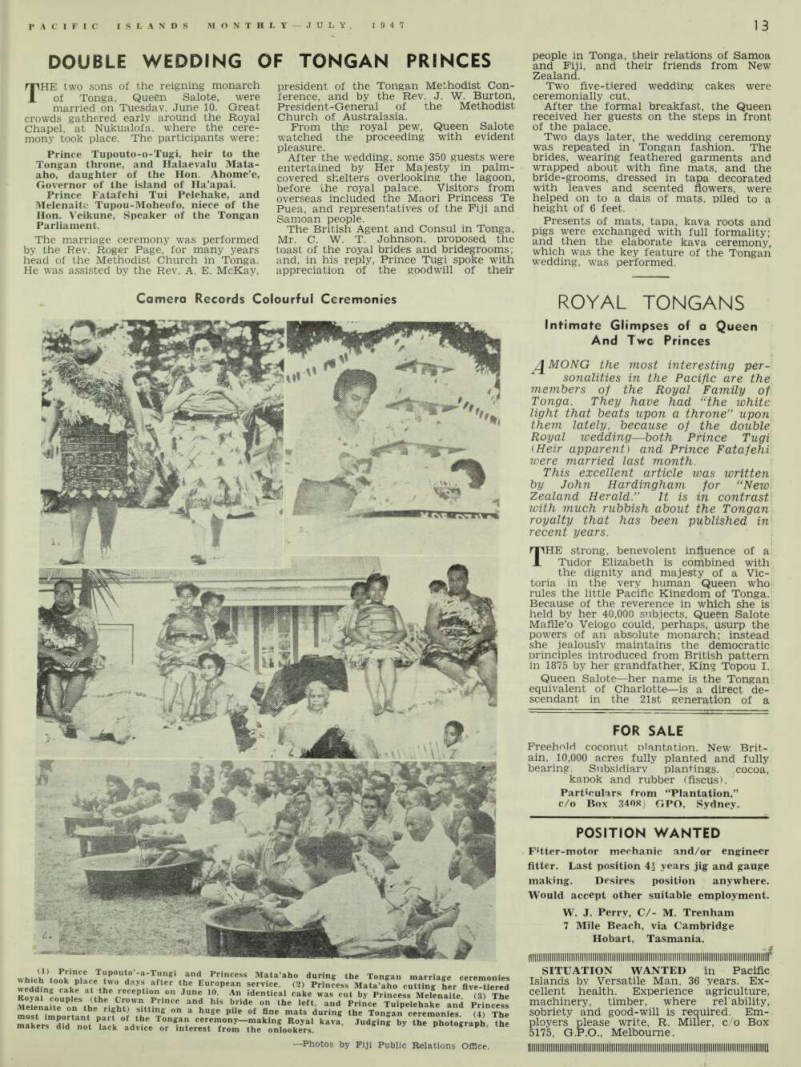
Camera Records Colourful Ceremonies
(1) Prin ce Tupouto’-a-Tungi and Princess Mata’aho during the Tongan marriage ceremonies which took place two days after the European service. (2) Princess Mata'a ho cutting her five-tiered wedding cake at the reception on June 10. An identical cake was cut by Princess Melenaite. (3) The Royal couples (the Crown Prince and his bride on the left, and Prince Tuipelehake and Princess Melenaite on the right) sitting on a huge pile of fine mats during the Tongan ceremonies. (4) The most inportant part of the Tongan ceremony-making Royal kava. Judging by the photograph, the makers did not lack advice or interest from the onlookers. —Photos by Fiji Public Relations Office.
Royal Tongans
Intimate Glimpses of a Queen And Two Princes
the most interesting per sonalities in the Pacific are the members of the Royal Family of Tonga. They have had “the white light that heats upon a throne” upon them lately , because of the double Royal wedding—both Prince Tugi (Heir apparent) and Prince Fatafehi were married last month.
This excellent article was written by John Hardingham for “New Zealand Herald.” It is in contrast with much rubbish about the Tongan royalty that has been published in recent years.
THE strong, benevolent influence of a Tudor Elizabeth is combined with the dignity and majesty of a Vic toria in the very human Queen who rules the little Pacific Kingdom of Tonga.
Because of the reverence in which she is held by her 40,000 subjects, Queen Salote Maflle’o Veiogo could, perhaps, usurp the powers of an absolute monarch; instead she jealously maintains the democratic principles introduced from British pattern in 1875 by her grandfather, King Topou I.
Queen Salote —her name is the Tongan equivalent of Charlotte—is a direct de scendant in the 21st generation of a
distinguished chief who founded the Tui Kanokubolo dynasty in about 1610. She came to the throne in 1918 as a girl of 18. That was the year after she had married Prince Tungi. who became de voted Queen’s Consort and, for many years, Premier of the Kingdom until his death in 1941.
The deep black hair of the widowed Queen "has greyed in a reign of nearly 30 years, but she has never lost the Tongan’s gift of laughter. Young people are still chosen as her palace companions; she herself is a very youthful 47. With her ready smile and bubbling sense of humour, Her Majesty seems almost im mune to age.
Gracious And Gentle Manner
FINELY proportioned to her excep tional height of 6 ft. 1 in.—some say 6 ft. 3 in.—Her Majesty is every inch a Queen. She is gracious and gentle in manner, stately in bearing, but able to shed aloofness like a cloak without losing
a scrap of dignity. She is equally at home with Europeans or Tongans and speaks English with perfect accent and idiom in an unmistakable bell-like voice Like musicians, her attendants seemed tuned to register those soft tones when they may be unheard by a stranger.
Her Majesty's generous hospitality was never better shown than during the war years. The 10,000 Allied servicemen based on the Friendly Islands were regarded by the Queen as soldiers who had sacrificed their home life to assist in the defence of Tonga. They were to be regarded as Royal guests; if they needed food or sought shelter, even the palace was open to them at any hour.
There was no empty assurance. Day after day the Queen’s maids-of-honour were hostesses to Americans and New Zealanders on the palace lawns. Some times they would sacrifice sleep and pre pare a meal in the early hours of the morning for a group of tired and hungry soldiers arriving as strangers in the town.
If there should be a sulky or silent hostess a silken voice from behind the lattice screen of the palace verandah could gal vanise an instant smile and a merrv manner.
Influence In Government
THE Queen’s real influence in the Gov ernment of her Kingdom cannot be measured in the terms of the con stitution. She is no Royal cipher. With out arrogance and seemingly without ever having to force a point with her advisors, Her Majesty is the dominant figure in the Privy Council which, sub ject to the ratification of a democratic ally-elected Parliament, rules the country for the greater part of the year.
In these councils of government, Queen Salote is said to speak seldom but always soundly. In discussion she is a patient listener and a quiet contributor. Her real authority, outside the reverence owed to the Crown, comes from her skill in crystallising controversy and reducing complicated issues to a clear decision Above all, she has the gift of common sense.
Tonga maintains its monarchy with out extravagance or luxury. From the Civil List, Her Majesty draws £2OOO a year, plus small allowances for her aide de-camp (who is her half-brother) and a chaplain. There is also provision for six personal attendants to receive an annual honorarium of £l2 each. Copra plantations on the Royal estates yield an additional personal income.
Massively-Built Heir
11HE heir to the Throne, Prince Tungi, now in his 29th year, has inherited many of his mothers’ qualities.
Rather belying his massive 23-stone build, he is a scholarly, shy person, de void of either pride or condescension. His outlook has been strongly influenced by the ten years he spent in Australia, first as a pupil in a public school and later at Sydney University, where he gradu ated in law. He has a wholly analytical mind with the scholar’s ability to think and speak in abstract. Had he not been a Prince of the Royal House of Tonga he might have been a pleasant University don.
That the Crown Prince is a man of high principle was revealed recently over the question of liquor licences. Alcohol is forbidden to Tongans but, under the authority of the Cabinet, dispensations have been granted to 120 semi-officials, mainly to save them embarrassment in exchanging hospitality with Europeans.
When there seemed a danger of the per mit system losing its real meaning by as suming a social significance, Prince Tungi set a lead by renouncing his own permit. His decision was proclaimed publicly in the Royal Gazette.
Advertisements & other items, pp. 15-16 (1 item)
For Sale
Freehold coconut nlantation. New Britain. 10,000 acres fully planted and fully bearing. Subsidiary plantings, cocoa, kapok and rubber (fiscus).
Particulars from “Plantation,” c/o Box 3408) GPO, Sydney.
POSITION WANTED
F’tter-motor mechanic and/or engineer fitter. Last position 4£ years jig and gauge making. Desires position anywhere.
Would accept other suitable employment.
W. J. Perry, C/- M. Trenham 7 Mile Beach, via Cambridge Hobart, Tasmania. (lllllllllllllllllllllllillllllllllllllllllllllllllllllllllllllllllllllllllllllllillllllllllllllllllllllilllHIf SITUATION WANTED in Pacific Islands by Versatile Man, 36 years. Excellent health. Experience agriculture, machinery, timber, where relability, sobriety and good-will is required. Employers please write, R. Miller, c/o Box 5175, G.P.O., Melbourne.
DOGS
ALL BREEDS AVAILABLE
FOR IMMEDIATE
SHIPMENT.
Stock certificates and food for voyage provided by shipper. Write stating breed and age required to—
R. FISHER,
135 North Steyne, Moniy
Stromberg ■ Carlson Sole Pacific Agents
SAMOA: O. F. NELSON & CO. LTD., Apia, W. Samoa FIJI; PROGRESSIVE RADIO SERVICE, Rodwell Road, Suva NEW BRITAIN: H. T. ALLEN, BARRETT & READ, Casuarina Ave., Rabaul i OH Available now; Air Circulators, 5-Valve 6-Volt Vibrator World Range Receiver. Available soon:
REFRIGERATORS, VACUUM
CLEANERS. WASHING MACH-
INES. FANS AND MANY OTHER
ELECTRICAL UTILITIES.
RELIDE WATCHES. Imported movement and cases.
SHOCKPROOF AND WATERPROOF.
/ /v sepvice
TEttPHONE: 8W515/• SCOTTISH HOUSE® 19 BRIDGE STREET • SYDNEY® AUSTRALIA
W. H. GROVE & SONS
Limited
Established 1896.
AUCKLAND
island Traders. F.o. Box 490 Telegraphic and Cable Address: “Grove”, Auckland Entrust Your Orders to the Firm with Fifty Years Practical Experience in the Island Trade.
Shippers of all classes of New Zealand products.
Representing English Manufacturers through-
out the Cook and Society Islands, Fiji, Tonga, Samoa, Niue, New Caledonia, New Guinea, etc.
In FIJI ai—W. H. Grove & Sen* (Fiji) Ltd.
Prince Tungi As Minister.
AS the Prince who will one day rule in Tonga, Tungi is serving a respon sible apprenticeship. Education was one; of his main University interests and in accepting this portfolio in the Tongan Cabinet he has been able to follow his inclinations. He is also a keen and practical-minded Minister of Health with out usurping the authority and know ledge of nis departmental advisers.
He has, perhaps, the strangest hobby of any prince—the collection of gadgets.
Some of his greatest enthusiasms have centred around luminous fish-hooks, ultra-modern writing pens or bladeless razors. Even during the wedding cele brations he was demonstrating a light ning calculator —a Japanese device of manipulated beads which he claimed could do all his mathematics for him. On another occasion, when guests were ad miring the array of presents, he was explaining the value of what was prob ably the humblest gift—a device like an egg-beater designed to grate coconut while still in the shell.
“A Happy Fellow.”
THE Crown Prince’s younger brother, Prince Fatafehi, is a man of rather different stamp. Twenty-five years of age and built even more heavily than the heir to the Throne, he has a jovial eye and ready smile that encourage people to describe him as “a happy fellow.” He radiates good humour and is a pleasant and unassuming dinner companion. In European company he is a better listener than talker.
Fatafehi has a modest role in govern ment, but it is no sinecure. He is travel ling inspector of agriculture. He knows what can and cannot be done in island agriculture, and in the fields and plantations his Royal influence can do more than a dozen experts in stimulating production. He is not the sort of man who can be tied happily to an office desk.
Kurukuru
Paper Company Seeks 200 Sq.
Miles in Papua
THE exclusive right, for 12 months, to apply for a license to cut kurukuru grass in an area of 200 square miles, in the vicinity of the Emboga River, in North-east Papua, was granted by Gazette proclamation, on July 2, to Sir Gerald Mussen.
Sir Gerald Mussen is chairman of the British Australian Paper and Pulp Com pany; and the 200-square miles are right alongside that company’s Sangara leases.
Which suggests that, at long last, the Papuan grass called kurukuru (kunai, to you of New Guinea) may be coming into its own as the main material for high class paper. Experts have compared it favourably with the famous esparto.
Naturalisation of NG
Aliens
ALIENS, resident in New Guinea, are now eligible for naturalisation under the Commonwealth Nationalisation Act, 1920-46. Pre-war, when the Territory was administered as a League of Nations Mandate, this was not possible. To obtain British nationality then it was necessary for aliens to take uo residence in Aus tralia for the requisite number of years, which, of course, precluded most of them from becoming British subjects.
Intending applicants for naturalisation should obtain instructions and the neces sary form from the Government Secr etary, Port Moresby. Notification of their intention to apply for naturalisation will appear in the Papua-New Guinea Gov ernment Gazette and, when all formal ities are completed, it will be necessary to pay a fee of £5.
Among guests at the Royal weddings in Tonga were 50 Samoans, who travelled there in early June by plane and by the “Matua”.
Additions to the coastal and inter island fleet in Samoan waters are the “Mania-Tele”, which belongs to the natives of Manua, American Samoa; and “Wairuru”, the new motor vessel which recentlv arrived in Apia from Auckland for O. F. Nelson and Co., Ltd.
Advertisements & other items, p. 17 (1 item)
Burns Philp
THE
YORKSHIRE
INSURANCE
CO. LTD.
(Incorporated in England)
ALL CLASSES OF
INSURANCE
Including
FIRE
GUARANTEE
WORKERS
MOTOR
ACCIDENT
MARINE
Island Representatives:
PORT MORESBY: E. A. James
RABAUL: G. B. Black LAE: Morobe Transport Co. Ltd.
MADANG: R. MacGregor
BURNS PHILP
(SOUTH SEA) CO. LTD.
Inc. in Fiji Island Traders and Shipowners Registered Office :
SUVA
FIJI
Also Branches at: Fiji: Levuka, Lautoka, Labasa, Ba, Sigatoka, Rotuma Tonga: Nukualofa, Haapai, Vavau.
Samoa: Apia, Pago Pago (American Samoa).
Solomons: Makambo, Gizo, Faisi.
New Hebrides: Vila.
Code Address: Gilberts: Tarawa. ‘•Burnsouth*. Norfolk Is. Niue. Wallis Is. Futuna Is.
Sole Australian Concessionaries :
GEORGE BROWN & CO. PTY.
267 Clarence Street/ Sydney.
Designs for new Ultimate models have been completed but production has been retarded, due to a few remaining difficulties in raw materials.
Models should be available some time during 1947. They will be well worth waiting for. Watch for further announcements.
SERVICE: Servicing of all kinds of radio sets, amplifiers and Rola speakers will continue to be available.
The New Rabaul
Good Work by DO Bates
Prom Our Own Correspondent District officer bates is to be complimented on the way he is cleaning up Rabaul.
The secondary scrub has been cut down and most of the roads have been graded.
Preparations are well in hand for tem porary wharfage for 10,000-ton vessels.
Work has been completed on the Euro
pean school, opened on July 1, with Mrs.
Guy Black in charge.
A marked improvement has been effected in the sanitary arrangements in China-town.
The telephone line betwen Rabaul and Kqkopo will shortly be completed. The roadway to Kokopo, despite the recent heavy rams, is now in very fair condi tion.
If the Administration will only give this energetic and capable officer the sup port and assistance he deserves, condi tions generally in New Britain should soon improve.
Doctor's Wife
Tragic Death of Doctor's Wife One-Time New Guinea Resident
THE news of the tragic death in Malaya of Mrs. lan Thomas Dickson (form erly Jean Hawnt, of Rabaul) was received in Svdnev on Julv 5.
Death was due to a shooting incident which occurred at the residence of Dr.
Blakemore, whose wife Dr. and Mrs.
Dickson had accompanied to her home, following a disagreement she had had with her husband. On reaching the Blake more home, the Dicksons were met bv Blakemore, who fired a revolver, instantly killing Mrs. Dickson and seriously wound ing Dr. Dickson. Blakemore was arrested and later died, whilst in a coma, at a mental hospital. The tragedy occurred at looh, Perak, where Dr. Dickson is chief medical officer. Fragmentary reports from Singapore make it clear that Dr.
Blakemore, an Englishman who had been many years in Malaya, had become de mented.
Residents of New Guinea will well re member Dr. and Mrs. Dickson, who for several years after their marriage in Rabaul in 1933, lived on the goldfields, where the doctor was a medical officer attached to the PHD. Later, they moved to Malaya; and during the war, Mrs, Dickson lived in Sydney with her mother.
Mrs. Jessie Hawnt, and her sister, Mrs.
Marjorie Ross,
Niuafoouans Will Soon
Be Established on Eua
IT is expected that by next October the 1,100 former residents of Niuafoou (Tin Can Island), in the Tongan Group, will be established on Eua, a small island about 30 miles south-east of the main Tongan island of Tongatabu.
Niuafoou was almost devastated by a volcantic eruption in September, 1946, and last December the whole population, with the exception of 28 who were left behind to round up the pigs, harvest crops and dismantle the few remaining buildings, was evacuated to Tongatabu.
Since then they have been living on Queen Salote’s estate, just outside Nukualofa. This temporary village has been called Mataliku, and crops planted when the Niuafoouans first arrived are now almost ready to harvest. In the in terval, they have been provided with food by Tongatabu villagers.
Eau is a very fertile island where, it is said, corn is ripe six weeks after plant ing. The population hitherto has been only about 400, some of them descendants of Tongans from the small island of Ata, whose population was preyed upon by blackbirders about 80 years ago. To save these Islanders from being transported to Chile, they were transferred to Eua.
In spite of Niuafoou’s volcanoes and Eua’s richness, many of the refugees now awaiting transport in Mataliku think longingly of their old home and, if given the choice, would ignore Eua and will ingly return to Niuafoou.
N. Caledonia Looking
For Labourers
A FURTHER report on the labour problem from the New Caledonian Conseil General states that the re cruiting of labour in the Dutch East Indies beine no longer favourable, and the local population being against Chinese labour, two possible sources remain—Korea and Japan. It was decided to study the pos sibility of recruitment in these two countries.
Advertisements & other items, p. 18 (1 item)
Bank Of
May I speak to the Manager?
Certainly. Branch Managers of the 44 Wales” welcome enquiries about the Bank’s facilities.
They will he pleased to discuss anything related to hanking from personal financial problems to the financing of industrial undertakings, from the improvement of country properties to the development of oversea trade opportunities.
They can do this because their own wide experience is hacked by the technical resources of specialized departments.
If you think that the 44 Wales” can help you, please don’t hesitate. Ask the
Manager,
BANK OF
NEW SOUTH WALES
FIRST BANK IN AUSTRALIA
Incorporated in New South Wales with limited liability
Rag-Time Shipping In New Guinea
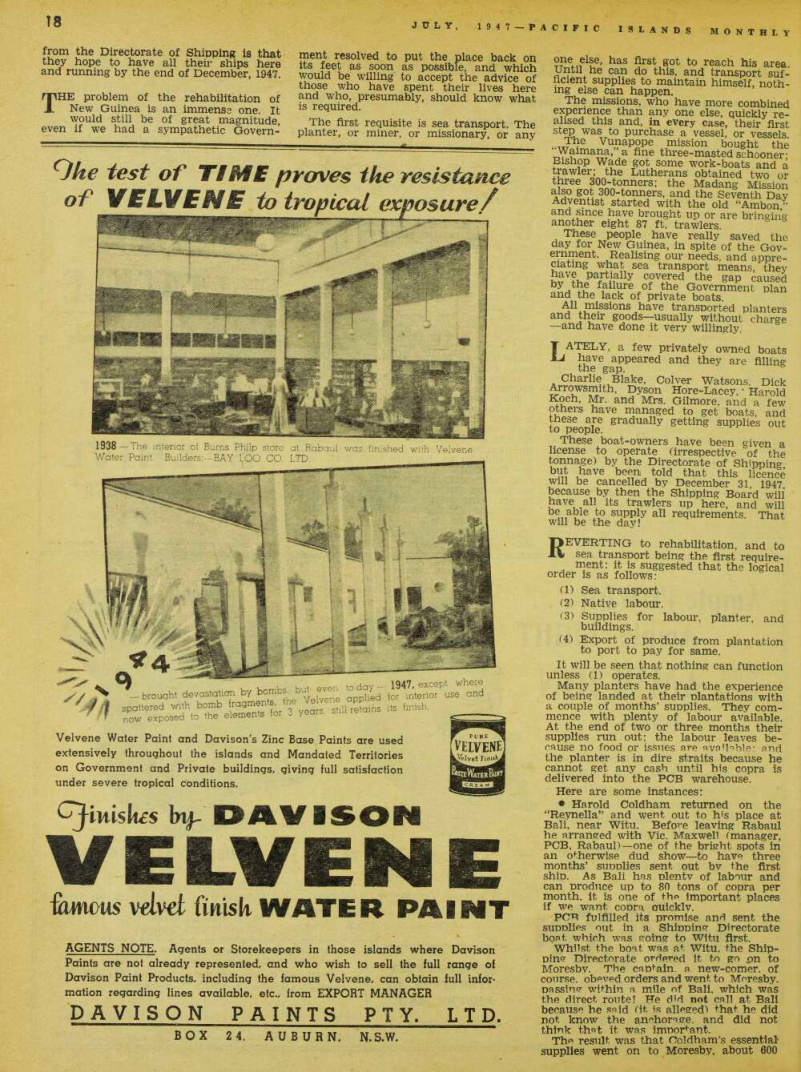
Government Service Is Chaotic Plea For Private Ownership Again
By Colonel H. T. Allan, O.B. E., Tovakundum Plantation, Rabaul
THIS is an endeavour to set out what is actually happening in New Guinea at the moment in reference to ship ping and sea transport.
Before the war, there was an inter island shipping service, maintained mostly by the big trading firms, to bring produce up to the main centres to connect with oversea shipping lines.
In addition, many private people owned their own vessels, which they chartered as opportunity offered, or ran private services in the different areas Also, many plantations had boats which were used for recruiting, bringing in native foods and trade copra, trochus shell, etc. The natives also owned many boats, mostly sailing cutters which they used for trading, social visits, etc.
In all, the Territory was adequately serviced, and it was a comparatively easy matter to move from point to point, or to bring recruited natives quickly to the place of work and, when finished, to re turn them home.
As a result of the Japanese invasion, all shipping in the Territory was either destroyed or seized by the Army or Navy and removed elsewhere. So that when the war finished, New Guinea was com pletely devoid of shipping.
It is true that the Army held a large reserve of small craft which could have been the nucleus of the shipping required to rehabilitate the Territory. In Moresby.
Milne Bay, Labu (Lae) Madang, Wewak and Rabaul there were many craft no
longer required by the Army. In March, 1946, in Rabaul alone, there were 132 boats in the Disposals Park, with which the Army had finished.
BY this time, the Government, in its wisdom (which means the CSIR and other satellites) had decided to break the menace of the big firms and to allow no vessels of over 25 tons to operate. As a result, the policy was not to sell any boats at all at a time when sea trans port was the first requirement for re habilitation.
For over five months the boats in Rabaul lay rotting at anchor. Many sank at their moorings through sheer neglect (as happened also with the luggers in Moresby)—all this at a time when Rabaul was becoming peopled by returning planters who wanted to get out to their properties.
Tnese people were willing to pay any price for a boat, so that they could get a move on; but, through lack of trans port, they were forced to remain in Rabaul, at £1 per day at the PCB hostel, for months on end. And every day they were able to go down to the “park" and see the boats they required slowly rot ting and eventually sinking at their anchorages—with valuable landing barges being driven ashore by the south easter and disappearing under the sand.
The Government created the great “Directorate of Shipping’’ to provide all the transport required. They neglected
to enquire of any practical man who had lived in the Territory as to whether this was a wise move.
Ships were scheduled to start running in October, 1945. In June,l946, a largely • attended RSL meeting in Rabaul was assured by Mr. Thurston, then Director of Shipping for NG (or some similar appointment) that the ships were on their way and that in a few w r eeks our diffi culties would be over.
It is now June, 1947, and the latest
from the Directorate of Shipping is that they hope to have all their ships here and running by the end of December, 1947.
THE problem of the rehabilitation of New Guinea is an immense one. It would still be of great magnitude, even if we had a sympathetic Govern
ment resolved to put the place back on its feet as soon as possible, and which would be willing to accept the advice of those who have spent their lives here and who, presumably, should know what is required.
The first requisite is sea transport. The planter, or miner, or missionary, or any
one eise, has first got to reach his area.
Until he can do this, and transport suf ficient supplies to maintain himself, noth ing else can happen.
The missions, who have more combined experience than any one else, quickly re alised this and, in every case, their first step was to purchase a vessel, or vessels The Vunapope mission bought the Waimana, a fine three-masted schooner’
Bishop Wade got some work-boats and a trawler; the Lutherans obtained two or three 300-tonners; the Madang Mission got 300-tonners, and the Seventh Day Adventist started with the old “Ambon ” and since have brought up or are bringing another eight 87 ft. trawlers.
These people have really saved the day for New Guinea, in spite of the Gov ernment. Realising our needs, and appre ciating what sea transport means, thev hv V ?hi )a f t n ally the sap caused failure of the Government plan and the lack of private boats.
AU missionsj have transported planters and their goods—usually without charge —and have done it very willingly.
LATELY, a few privately owned boats have appeared and they are filling the gap.
Charlie Blake, Colver Watsons, Dick Arrowsmith, Dyson Hore-Lacey, * Harold Koch, Mr. and Mrs. Gilmore, and a few others have managed to get boats, and these are gradually getting supplies out to people.
These boat-owners have been given a license to operate (irrespective of the tonnage) by the Directorate of Shipping but have been told that this licence will be cancelled by December 31, 1947 because by then the Shipping Board will' have all its trawlers up here, and will b( e able to supply all requirements. That will be the day!
REVERTING to rehabilitation, and to sea transport being the first require ment: it is suggested that the logical order is as follows: (1) Sea transport. (2) Native labour. (3) Supplies for labour, planter, and buildings. (4) Export of produce from plantation to port to pay for same.
It will be seen that nothing can function unless (1) operates.
Many planters have had the experience of being landed at their plantations with a couple of months’ supplies. They com mence with plenty of labour available.
At the end of two or three months their supplies run out; the labour leaves be cause no food or issues are and the planter is in dire straits because he cannot get any cash until his copra is delivered into the PCB warehouse.
Here are some instances: • Harold Coldham returned on the “Reynella” and went out to Ins place at Bali, near Witu. Before leaving Rabaul he arranged with Vic. Maxwell (manager, PCB, Rabaul)—one of the bright spots in an otherwise dud show—to have three months’ supplies sent out bv the first ship. As Bali has plenty of labour and can produce up to 80 tons of copra per month, it is one of the important places if we want coora quickly.
PCB fulfilled its promise and sent the supplies out in a Shipping Directorate boat which was going to Witu first.
Whilst the boat was at Witu. the Ship ping Directorate ordered it to go pn to Moresby. The captain, a new-comer, of course, obaved orders and went to Moresby, passing within a mile of Bali, which was the direct route! He did not call at Bali because he said (it is alleged) that he did not know the anchorage, and did not think that it was important.
Tho result was that Coldham’s essential supplies went on to Moresby, about 600
miles away, and the plantation was left up in the air.
Luckily, Vic Maxwell is one of our old hands and was able to wangle (through private channels) a duplicate set of stores —which he could ill-afford— and the day was saved. • Then, in the case of New Ireland: A planter, who had been there ten months without a ship, was anxious to get his copra in to the PCB warehouse in Rabaul, to recoup his outlay.
On New Year’s Day, when all his labourers were away at a sing-sing, or lotu, a 300-tonner, run by the Directorate of Shipping, arrived off his place unan nounced and without previous warning.
The captain wanted his 75 tons of copra loaded immediately, and was not im pressed when told of the difficulties.
In normal times, the planter would have been warned of the ship’s impending arrival at least 48 hours in advance and the copra would then have been waiting on the beach with sufficient labour to load it.
The result was that the ship sailed empty, the planter did not get his, cash and, as far as I know, the copra is still there. • When I was in Kavieng at the end of March last, two Directorate of Ship ping 300-tonners arrived within a few days of each other. The first, which was only routed for Kavieng and return to Rabaul, landed a lot of cargo for all ports down the east coat to Namatanai, 180 miles away, and some cargo for Kavieng.
The second one, which was to proceed down the east coast, calling at all ports to Namatanai, landed nearly all its cargo for Kavieng and then had to reload the cargo from the other ship for the east coast ports, • Again, Bill Chapman, one of our old inhabitants of the goldfields, decided (as I have done) that there is no future for independent gold-miners in Wau. He proceeded up the Markham to Kainantu and recruited 17 boys (no mean effort these days) to go with him to the new fields in Bougainville. Bringing them down to Lae, he booked himself and the boys by the “Montoro” to Rabaul.
The Directorate of Shipping, through its agents, took him and his partner to Rabaul, but refused, for no reason at all, to ship the boys.
The result is that Bill has lost his boys, has had to fly back to Lae to try to get some more, and is now completely de pendent on his good friend, Charlie Blake (and not the great Government Shipping Service) to get to Bougainville, as Charlie has his own private vessel.
AND there, I think, is the answer— private ownership of vessels. The individual owner has to make his boat pay, and will keep it running and give service and go anywhere. The Govern ment Service will not go out of its way to oblige anyone—the captains and crews are mostly newcomers to the Territory, underpaid by present-day standards, and they dont object to any convenient en gine breakdown that will keep them in port over the week-end.
In contrast, take Harold Koch, one of our oldest, most respected and popular private boat-owners. Before the war, Harold had his own properties at Arawe at the west end of New Britain. He ran ms boat for his own business, but it was his pleasure to service the whole of the south coast of New Britain, some 300 miles in extent.
Anyone along that coast, w r hether he was Administration missionary, company employee, private planter, or trader knew that he had only to signal Harold as he passed and whatever he wanted in the
ways of foodstuffs, cigarettes, liquor, or other essentials would be delivered on the return trip.
And it is in these private owners of ships that the answer lies. I have not touched upon recruiting or prospecting, native boats or other matters, as the sub ject is so vast.
But I do feel that the inefficient Gov ernment service is breaking down and that, despite the CSIR policy—or who ever else has thought it out—the old system of private ownership is already
here, and must develop, if the Territory is going to come good again as a pro ducer of urgently needed raw materials.
Mr. and Mrs. M. E. Babbage, of Kar oola and Tanwoa Plantations, Buka Pas sage, New Guinea, became the proud parents of a young daughter on May 29.
Mr. Babbage arrived in Sydney from Buka a day after the baby was born; he does not expect to be returning to his plantation until September.
P.L. Society Annual Meeting
THE annual meeting of the Pacific Islands Society will be held at History House, Sydney, on July 23, at 8 p.m.
Office-bearers for the coming year will be elected and a report of the Society’s activities presented.
New Members
New members who have joined the So
ciety recently are:
Mr. and Mrs. A. E. Baker. 1569 Pacific High way. Wahroonga; Mr. N. B. Casey, MBE, and Mrs. Casey. 113 a Carabella Street. Kirribilli: Mrs. Drew, No. 3 Colleen Flats. 19 Fletcher Street, Bondi; Mrs. A. H. A. Forrest. 81 Hope Avenue, Cremorne; Mrs. M. Fenner, 26 Pittwater Road, Collaroy; Mr. Thos. Horne, 50 Bancroft Avenue, Roseville; Mr. and Mrs. Nigel Kingsmill, Bank of NSW, Victoria Avenue, Chatswood; Mr. and Mrs. S, A. Lord, 14 Coolong Road, Vaucluse; Mr. W. McCreadie, Flat 1, 83 Sydney Road.
Manly; Mr. P. S. Macdermott, 36 Upper Clifford Avenue. Manly; Mrs. Mignon, 29 Eastern Avenue, Dover Heights: Mrs. Mallelieu, War rington Flats, Edgecliff; Mrs. Walker Flynn, 331 Parramatta Road, Haberfield.
Advertisements & other items, pp. 19-22 (1 item)
aKPUOk
FISHING
TACKLE
All your requirements can be obtained from
GEORGE ERNST
at the
BEEHIVE
SHIELDS' STREET
CAIRNS
Ample POWER ...
Ample LIGHT
S. AMPLION
UNITS
Throughout Australasia and the Islands hundreds of these grand units are proving themselves to proud owners by their performances and reliability.
You will find much to interest you in the free literature we now offer you, by return mail.
aKPUOk
AUSTRALASIA PTY., LTD.
36-40 Parramatta Road, Camperdown, N.S.W. m w
AMPLION 1 H.P. PETROL
ENGINE
8 genuine car engine features . . . so light a man can carry (only 40 lbs.). £32—packed F. 0.8. Sydney.
AMPLION FARM LIGHTING
UNIT
In 12 or 32 volt models . . . vibrationless . . . extremely inexpensive to operate . . . send for leaflet NOW. Special export price, £4B/15/-.
Packed F. 0.8. Sydney.
SEND FOR FREE
LITERATURE BY
RETURN MAIL.
Messrs. AMPLION (A’ASIA) PTY., LTD.,
36-40 Parramatta Road, Camperdown, N.S.W.
Please send me free literature on Farm lighting unit. Q Amplion 1 h.p. petrol engine Q BOTH. Q] Name Address ENPLUI
Ohe test of TIME proves the resistance
of VELVENE to tropical exposure/
1938 —The interior of Burns Philp store at Rabaul was finished with Velvene Water Paint. Builders:—BAY LOO CO. LTD, /■■■ " - // brought devastator by bombs^one applied for interior use and Velvene Water Paint and Davison's Zinc Base Paints are used extensively throughout the islands and Mandated Territories on Government and Private buildings, giving full satisfaction under severe tropical conditions. velvene
CJmishes bip
VELVENE
famous velvet finish WATER PAINT
AGENTS NOTE. Agents or Storekeepers in those islands where Davison Paints are not already represented, and who wish to sell the full range of Davison Paint Products, including the famous Velvene, can obtain full information regarding lines available, etc., from EXPORT MANAGER
DAVISON PAINTS PTY. LTD.
BOX FT AUBURN, N.S.W.
WANTED TO BUY—QUALITY GUNS AND RIFLES
HIGHEST PRICES GIVEN. WILL ALSO EXCHANGE GUNS.
New .303 Short Service Barrels, without Sights and Platform, £2/15/- each.
Pottage extra.
SI L RO H U Quality Firearms and Fishing Tackle. 148 ELIZABETH STREET (Near Market St.) SYDNEY. ’PHONE: MA 3640,
BRIAL & BALL
TENNIS SHOES
“RUNACAN” BRAND
Pure rubber soles, unlimited quantities.
Delivery: approximately two months
RINOLDI
Spaghetti, Vermicelli, Macaroni and Soup Pastes
KENNONS
Kromobark High Grade Leather Soles and Heels (excluding Fiji)
LAMBALLE PERFUMES
PARIS
The Aristocrat of French Perfumes
TRUFOOD Powdered Milk
Full Cream and Skim Milk.
TIBALDI
Continental smallgoods, Salami, Canned Mortadella Sole Distributing Agents for Pacific Islands
BRIAL & BALL
Australia
31 QUEEN STREET,
MELBOURNE.
1 BOND STREET,
SYDNEY.
J. B. FOSTER
170 Albert- St., Brisbane
IMPORTER OF WATCHES
AND CLOCKS.
Materials and Tools for Watchmakers, Jewellers and Allied Trades.
Trade Work Also Undertaken.
All Inquiries Answered
Rarotongans Keen
To Work
On Phosphate Is.
French Company Now Interested in Only the Best Type of Workers
From Our Own Correspondent
Rarotonga, June 18.
WITH the added inducement of the new increases in rates of pay at Makatea, there was extraordinarily keen competition among Rarotongan applicants for service with the French Phosphate Company there this year. The majority of the returned recruits were anxious to re-enlist, while new applicants far exceeded requirements. Only single men were accepted this year and the medical examinations were exacting.
Care was given to the matter of general character also. Now that they are able to pick and choose, the Company is select ing the most reliable workers. There has been inconvenience in the past through illness and misbehaviour, and married men with families have been an added responsibility.
The new rates of pay at Makatea are: £B/8 - per month, per hour ord inary overtime, 1/4% per hour overtime for ship work, and an additional 1/3 a ton bonus for each ton in excess of 3 tons per man per day—all payable in NZ currency.
The boys like the life«at Makatea, and the entertainments provided. The return of a contingent of “Makatea Boys” at the end of this one year contract —mostly with money saved —is always a big event in tarotonga, the boys being feted like heroes returning from an Odyssey.
From Polynesia
Loaded With Gifts From Polynesia
THE Maori party which visited Tonga for the Royal wedding in June, and subsequently visited the Cook Islands, Samoa and Fiji, returned to the Dominion by air on July 2.
The party of thirteen members was headed by Princess Te Puea Herangi, and included the 15-year-old Princess Piki. daughter of King Koroko, of Ngarua wahia.
Princess Te Puea said that wherever they went during their three weeks’ trip they were entertained with feasts, songs and dances, and showered with gifts.
Eight cases of gifts which they could not carry in the Dakota will be shipped back by sea.
The ceremony with which they were greeted at every point made a deep im pression on the Maoris. Elaborate pre parations had been made for their visits.
On Aitutaki and Rarotonga, large wooden platforms had been built to carry the two princesses from one settlement to the next. When Princess Te Puea was asked to mount the platform she de clined and pointed to Princess Piki, ex plaining that, as the daughter of King Koroki, she had the right to the honour.
To atttend one ceremony, Princess Piki was carried about a mile and a half on the platform, which was borne on the shoulders of 20 Aitutakian warriors.
After her return to New Zealand, Princess Te Puea said that the expressions of appreciation received from Polynesian cousins indicated that the visit of the party had created much good will.
Members of the party paid their own travelling expenses, but the New Zealand Government made it possible for them to charter a Dakota aircraft.
Advertisements & other items, p. 22 (2 items)
20
Jt)L¥, iH?-i>Acmc isLAkbs MoktttLV
Robert Gillespie Ptv.Ltd
IMPORTERS
EXPORTERS
X- ALL CLASSES OF MERCHANDISE PURCHASED FOR ISLAND CLIENTS
THROUGHOUT THE SOUTH-WEST PACIFIC.
ISLAND PRODUCE SOLD ON AUSTRALIAN AND OVERSEAS MARKETS
ON COMMISSION BASIS.
ROBERT GILLESPIE PTV.LTD
BANKERS: BANK OF N.S.W.
COMPTOIR NATIONAL
D'ESCOMPTE DE PARIS
54a PITT ST. SVONEV N.S.W.
CABLE ADDRESS;
“ROBERGILL"
PHONES 8W4782-B 1305
Importance of Equator
Anglo-American
Frontier
Importance of Equator In Future Pacific
ANEW mid-Pacific frontier along the equator, between the United States and Britain, was visualised by Sir Albert Ellis. New Zealand representative on the British Phosphate Commission, when he referred to the future of former Japanese-held islands in an address to the Auckland Rotary Club on June 30.
He suggested it would be comparable to the great, unguarded frontier between Canada and the Unted States, of which British people were justly proud as an example of internatinal friendship and goodwill, but complacency could give it the false security of the ill-fated Maginot line.
The disposal of the island groups for merely under Japanese control must be determined on the principle of safe guarding the Pacific against a recurrence of aggression, Sir Albert said.
Of the possessions held by Japan before the First World War, the United States seemed to have a good claim to the Okinawa Group, more particularly as Russia had the Kurils, north of Japan.
It was his impression that the islanders would not resent permanent American occupation if it took place.
ISLANDS north of the equator mandated to Japan after the First World War were now occupied by the United States by right of conquest and, if they were retained, America would be in a very strong strategical position in the Pacific.
“I say good luck to the United States, because it has been my experience to see these groups occupied first by Germans and then by Japanese and we people in the central Pacific look forward to having good neighbours in the future,” he re marked.
Sir Albert considered the natives would welcome American rule should the islands come under United States control.
Americans had something to learn from Britain in the administration of native races, but he thought they would gain from experience and the ultimate result would be satisfactory.
It could be forecast that either by an nexation or under trusteeship the United States would control all the groups north of the equator that were occupied by the Japanese after the First World War.
This would mean an oceanic frontier of 3,200 miles.
ONLY a few British islands were north of the equator and, with their in habitants very loyal to Britain, any change in their status would be unthink able, Sir Albert stated. South of the equator British interests predominated and there was no suggestion of any official backing for American press opin ions that two clozen British atolls, and islands should be handed to the United States. They were valuable islands and any transfer would be disloyal lo the native inhabitants and, in their eyes a blow to British prestige.
It seemed that the equator would be the dividing line between America and British interests.
Referring to phosphate production on Nauru and Ocean Islands, Sir Albert said they were a shambles when occupied by the Allies after three years of Japanese control, and the making good of war damage would cost about £2,000,000.
However, the natives, who had flocked back, were doing a splendid job and the programme was for an output of 600,000
tons of phosphate next year. The Nauru cantilever would be working by the middle of 1948 and in two or three years the two islands would be in a stronger position than ever.
Help For Bsi
Planters
Interest-Free Loans
THE Government of the British Solo mons has decided to assist planters to rehabilitate their neglected or war-damaged plantations by providing them with interest-free loans.
The loans will be made in four equal parts—one part on completion of the necessary documents; and the others at three-monthly intervals.
Repayment will commence six months after receipt of final instalment, and will also be on a quarterly basis. The period of repayment is not made clear.
Copies of the loan agreement, which includes comprehensive security pro visions may be obtained from the Resi dent Commissioner’s Office, British Solo mon Islands; or from the Protectorate’s agents in Sydney—Burns, Philp and Co., Ltd., of 7 Bridge Street.
Mr. R. B. Dunlop has been appointed Inspector of Mines in Papua-New Guinea.
Advertisements & other items, pp. 23-24 (1 item)
Vince
OVER 25
YEARS OF
PAIN
RELIEF!
SWIFT 3-WAY RELIEF
From HEADACHE and “ |o// Nerve and Muscular Pain!
Vincent’s A.P.C Powders and Tablets are a combination of three valuable medicinal ingredients and bring swift 3-way relief! Vincent’s A.P.C is prepared to the original hospital prescription containing Aspirin to relieve pain, Phenacetin to reduce temperature, Caffeine to stimulate the nervous system. Vincent’s A.P.C quickly relieves Headache, and all nerve and muscular pain!
VINCE
M)
To OHSS-
C. ENT'S
SRV/ VI N
POWDERS & TABLETS
\VAC
SPECIALISING
IN
PACIFIC ISLAND INSURANCES
FIRE MOTOR VEHICLE
MARINE HULLS AND CARGO
EMPLOYER’S LIABILITY
GUARANTEES including those for—
DYNAMITE PERMITS.
RECRUITERS’ LICENCES.
DEFERRED WAGES
AND ALL OTHER CLASSES ARRANGED
AT LOWEST CURRENT RATES.
Established Agencies:
W. E. CARPENTER & CO., LTD.
Throughout the Territory of New Guinea.
SOUTHERN PACIFIC INSURANCE
CO., LTD.
HEAD OFFICE: 60 HUNTER STREET,
SYDNEY.
TO SHIPMASTERS
When calling at Tahiti, see Oscar G.
Nordman for ships’ supplies and fresh provisions. Wire before your arrival to OCEANIC, PAPEETE (my registered cable address)
OSCAR G. NORDMAN,
Ship Chandler, Papeete, Tahiti
Half-d-minute with MUM
and your charm is safe for hours through busy day or dancing evening.
Use MUM every day, after your bath. ... MUM’s quick!
stops risk of underarm odour
MUM works instantly not by stopping perspiration, but by preventing risk of future underarm odour.
MUM’s safe!
keeps you nice to be near!
MUM
miei the otlcuh vid heisti/iaimit
J/ /
Fiji's Taxis To Be Labelled
IT has not always been easy in Fiji in the past to distinguish taxis from private motor cars, says the Public Relations Office.
Identification should, however, be sim pler in future as rules made by the Transport Control Board recently require all public service vehicles licensed to carry not more than eight passengers to display on the front and back of the vehicle a plate bearing the word “Taxi” in black on a white background.
Is Ni For Nz?
Separation From Australia Might Open a New Era
Auckland, June 26
rE Auckland Chamber of Commerce decided to request the Associated Chambers at Wellington to approach the Oovernment concerning the practica bility of negotiations for the transfer of the sovereignty of Norfolk Island from Australia to New Zealand.
This is being urged because of the near ness of Norfolk Island to New Zealand and the island’s strategic and economic value.
The Auckland chamber’s view is that many of the residents of Norfolk Island being former New Zealanders, are gen erally favourable to the transfer of sovereignty - It is stated that there is little likelihood of development of trade unless Norfolk becomes New Zealand territory.
Norfolk could produce large quantities of citrus fruits, tomatoes, passion fruit and potatoes.
EDITORIAL NOTE—Transfer to New Zealand might open a new economic era for NI. Certainly, it could not be worse on.
Nearly everything that can be produced m Australia’s Pacific Islands, which might be sold in Australia’s temperate zones, can be produced in Australia’s tropical zone. Consequently, few Islands products are admitted to Australia.
The exceptions are copra, cocoa coffee, rubber. Large and successful plantations for those things were established in Papua-New Guinea, before the war. But when the war finished, Australia was under the rule of irresponsible Labour politicians and unimaginative bureau crats; and their combined efforts, in the last two years, have nartly destroyed the planting industries of Papua - New Guinea.
Norfolk is a restful, and fertile island, capable of producing every kind of semi tropical fruit and vegetable—a paradise for retired folk. But there literally is no market for Norfolk’s produce. Let an NI orange, or potato or passionfruit enter Sydney port, and NSW orchardists and growers run howling to their “members”, the bureaucrats come into action, and the door is closed.
In over 40 years, Canberra has had only one use for Norfolk and its 1,000 people —its Administratorship is a handy, cushy job into which retiring politicians, to whom the presiding Government feels under some sort of obligation, may be pitchforked.
If it were attached to NZ, only 600 miles away, it could sell, in a good and reliable market, every orange, banana, passionfruit, potato or tomato it couldi produce. New Zealand it seems never can get enough of those products from the Samoan, Cook, Fiji or Tongan Islands.
Norfolk Island, with its soft and kindly climate, would be a fine resort for holi daymakers, if given transport. Australia, in 40 years, has done practically nothing to develop that traffilc. Maybe New Zealand would have more imagination.
A Fijian minister, Setariki Tuilovoni, left by the “Marine Phoenix” last week to attend the International Missionary Council's conference at Toronto on July 9. He will read a paper dealing with the impact of the war on Fiji, and pre ent day conditions in the Colony.
Money And Politics
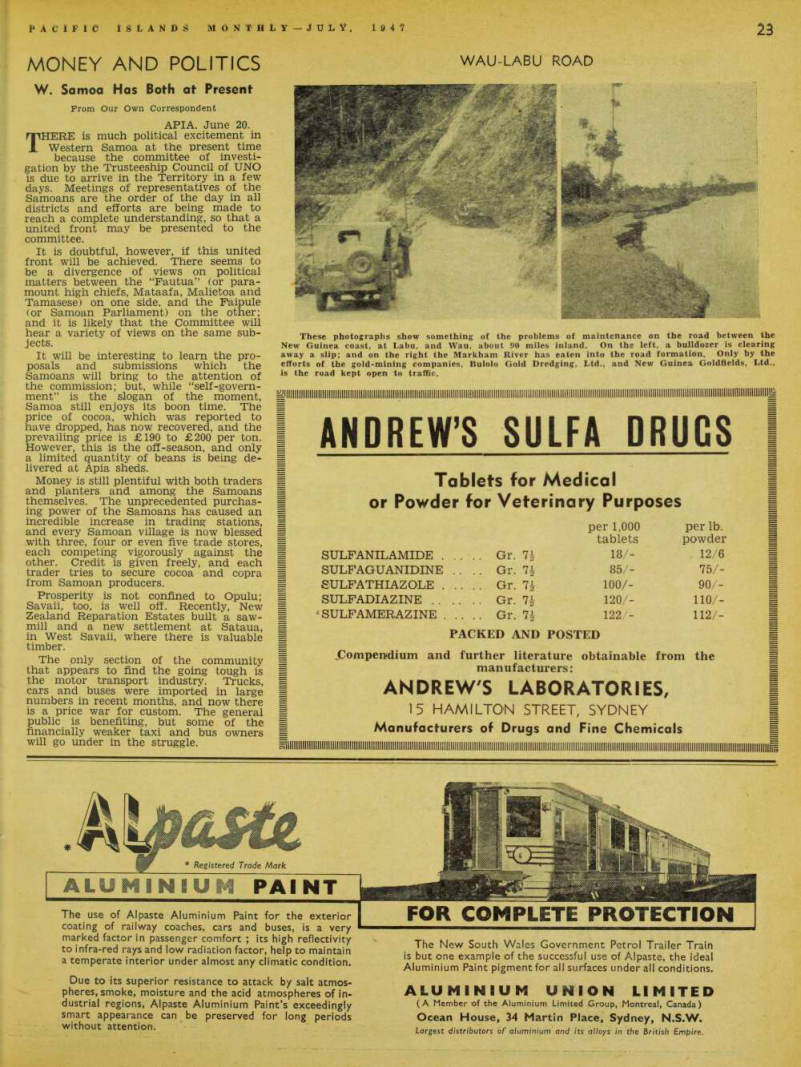
W. Samoa Has Both at Present
From Our Own Correspondent APIA. June 20.
THERE is much political excitement in Western Samoa at the present time because the committee of investi gation by the Trusteeship Council of UNO is due to arrive in the Territory in a few days. Meetings of representatives of the Samoans are the order of the day in all districts and efforts are being made to reach a complete understanding, so that a united front may be presented to the committee.
It is doubtful, however, if this united front will be achieved. There seems to be a divergence of views on political matters between the “Fautua” (or para mount high chiefs, Mataafa, Malietoa and Tamasese) on one side, and the Paipule (or Samoan Parliament) on the other; and it is likely that the Committee will hear a variety of views on the same sub jects.
It will be interesting to learn the pro posals and submissions which the Samoans will bring to the attention of the commission; but, while “self-govern ment” is the slogan of the moment, Samoa still enjoys its boon time. The price of cocoa, which was reported to have dropped, has now recovered, and the prevailing price is £l9O to £2OO per ton.
However, this is the off-season, and only a limited quantity of beans is being de livered at Apia sheds.
Money is still plentiful with both traders and planters and among the Samoans themselves. The unprecedented purchas ing power of the Samoans has caused an incredible increase in trading stations, and every Samoan village is now blessed with three, four or even five trade stores, each competing vigorously against the other. Credit is given freely, and each trader tries to secure cocoa and copra from Samoan producers.
Prosperity is not confined to Opulu; Savaii, too, is well off. Recently, New Zealand Reparation Estates built a saw mill and a new settlement at Sataua, in West Savaii, where there is valuable timber.
The pnly section of the community that appears to find the going tough is the motor transport industry. Trucks, cars and buses were imported in large numbers in recent months, and now there is a price war for custom. The general public is benefiting, but some of the financially weaker taxi and bus owners will go under in the struggle.
Wau-Labu Road
These photographs show something of the problems of maintenance on the road between the New Guinea coast, at Labu, and Wau, about 90 miles inland. On the left, a bulldozer is clearing away a slip; and on the right the Markham River has eaten into the road formation. Only by the efforts of the gold-mining companies, Bulolo Gold Dredging, Ltd., and New Guinea Goldfields, Ltd., is the road kept open to traffic.
Advertisements & other items, pp. 25-26 (2 items)
Andrew’S Sulfa Drugs
Tablets for Medical
or Powder for Veterinary Purposes
PACKED AND POSTED
.Compendium and further literature obtainable from the manufacturers:
ANDREW'S LABORATORIES,
15 HAMILTON STREET, SYDNEY
Manufacturers of Drugs and Fine Chemicals
i Registered Trade Mark
ALUMINBU
PAI NT
The use of Alpaste Aluminium Paint for the exterior coating of railway coaches, cars and buses, is a very marked factor in passenger comfort ; its high reflectivity to infra-red rays and low radiation factor, help to maintain a temperate interior under almost any climatic condition.
Due to its superior resistance to attack by salt atmospheres, smoke, moisture and the acid atmospheres of industrial regions, Alpaste Aluminium Paint’s exceedingly smart appearance can be preserved for long periods without attention.
FOR COMPLETE PROTECTION
The New South Wales Government Petrol Trailer Train is but one example of the successful use of Alpaste, the ideal Aluminium Paint pigment for all surfaces under all conditions.
ALUMINIUM UNION LIMITED
(A Member of the Aluminium Limited Group, Montreal, Canada) Ocean House, 34 Martin Place, Sydney, N.S.W.
Largest distributors of aluminium and its alloys in the British Empire.
°Puf> A .
South Pacific Cruise
From Our Own Correspondent
RAROTONGA. June 15.
IT is reported that the ex-Fairmile anti-submarine patrol boat, “Mahu rang!,” which has been converted into a pleasure cruiser for Mr. H. Jenkins, of Auckland, has left that port for Tonga, on the first stage of a South Pacific cruise. Mr. Jenkins is accompanied by his wife and two friends. .t, Be f£? e th £ ar ’ *fr. Jenkins cruised in the New Golden Hind,” the handsome auxiliary ketch that was built for him at
°PUf> A .
The New Golden Hind” (at present m Rarotonga) is still in Government ser vlce -
N.Guinea
Living Cost In
Statistical Economist Needed
Prom ° ur ° wn correspondent
Port Moresby July 4
rpHE New Guinea Administration has 1 advertised for a “Statistical Officer.”
It is hoped this means some one with a training in economics. A routine statistical economist is one specialist urgently needed in the Territory The basic problem of European'residents to-day is the cost of living, in relation to
which officers claim, they are underpaid.
The little information which has filtered through about the re-classification of the public service by Mr. Buttsworth, who has completed his findings, has not caused any great satisfaction. The report pro poses a base salary of about £370 a year.
This is insufficient in present-day New Guinea.
How can the Government assess salary rates in Papua-New Guinea without any statistical data on the cost of living? In the absence of a cost-of-living index, salary adjustments must be more or less arbitrary. The testimony of residents is that our costs of living are abnormally high. This seems to merit scientific analysis by a trained economist—which m turn would provide a sound and un questionable basis for salary decisions.
To the layman, there is strong evidence of a very high increase in prices here over Australian equivalents. At June 30, 1947, the following prices were being charged by Burns Philp, Steamships Pty., Ltd., and the Port Moresby Freezing Com pany at their Moresby branches:— Bread, 2/4 per loaf; butter, 3/3 lb.
Sugar, 6d. lb.; tea, 6/7 lb.
Fillet steak, 3/3 lb.; eggs, 4/6 dozen.
Small leg of lamb, 16/-.
“Baby bottles” of soda water, 14/dozen.
One lamb’s fry, 1/6; washing soap, 2/ bar.
Potatoes, sd. lb. (with a high percent age inedible).
Onions, 6d. lb.
Apples, 4d. each; oranges, 9d. each; pears, sd. each.
Boiled sweets, 2/11 lb.
These prices, however they may be arrived at by the firms concerned, pro vide some sort of case.
COST of living, however, is only the basic adjustment necessary for a happy and energetic colonial service.
The type of young man needed for careers in Colonial Affairs will not be at tracted by the mere prospect of a living wage; nor is it possible to overlook the disadvantages of tropical service, such as severance from friends and family, isolation from modern amenities, and less comfortable environment. Missionary zeal will not alone bring men into the service, as others have already pointed out.
There are further adjustments neces sary for men with families. At present they have to send their children to Aus tralia for secondary schooling, and it is desirable that they should see these chil dren over vacations; this runs out at the best part of £2OO per child per year.
All these factors should be accounted for specifically and fairly in addition to the basic living wage computed from cost of living figures. This Territory, with all respect, needs rather a more outstanding type of officer than the normal public service department.
Meanwhile, public servants in New Guinea claim they are having a hard struggle to remain solvent, and those who are winning the battle are doing so at the expense of their deferred pay.
Their claims and the problems of admin istration merit a more thorough, en lightened and knowledgeable investiga tion than the routine public service classifier can give them. For this reason, if no other, the Buttsworth report is not likely to satisfy.
And then there are the non-Adminis tration employees, whose financial prospects would also merit study by a statistical economist. There will, perhaps, be an Arbitration Ordinance in the future Territory which could assist them.
Messrs. W. M. Burns. M. R. Gallen and C. D. Carr have been appointed officers of the Royal Papuan Constabulary.
Advertisements & other items, p. 26 (1 item)
Broomfields Ltd.
For perfect cutting
under all conditions
There is a Ransomes Mower for every lawn our range covers machines for every requirement from the smooth, even surface of the putting green to the sports ground, golf course or aerodrome.
The "MOON" Mower
GANG
MOWERS
For grass such as couch, klkuyu, buffalo, etc., and grass longer than the average. 14-ln. and 18-ln. wide. 50 acres a day can easily be cat with a Ransomes Quintuple Mower drawn by a tractor and even larger outfits up ft. wide are available. to 25
ansomes
Lawn Mowers
Write for illustrated literature and all information
MORRIS, HEDSTROM LTD.,
Suva, Lautoka, and Ba.
Made by RANSOMES, SIMS & JEFFERIES LTD., IPSWICH, ENGLAND.
BROOMFIELDS Ltd.
Suppliers of
Building Hardware
General Hardware
Ship Chandlery
Paint Materials ..ju?
WRITE DIRECT TO
Broomfields Ltd.
152 SUSSEX STREET, SYDNEY
Sole Agents for: P. H. MUNTZ & CO.’s 3-CROWN BRAND METAL
SHEATHING.
PEACOCK & BUCHANS’ ENGLISH READY-
MIXED PAINTS.
Clive Brewster's Death
Clearly the Result of a Very Unusual Accident
AN account of the circumstances sur surrounding the death of Mr. Clive Brewster, in Bombay, on April 23 (May PIM), shows that there was no reason why he should have taken his life—he clearly died as the result of an unfortunate and very unusual accident.
Mr. Brewster arrived in Bombay from Karachi by plane about 1 p.m. on April 23; booked in at the Taj Mahal Hotel; went to his room on the fifth floor: and, about 25 minutes later he fell from the open window of this room, 80 feet, to the ground, and was instantly killed.
There was a suggestion that he was suffering mental distress at this time. It was reported that his second marriage had been unhappy, and that he had broken his solitary plane journey from London to Fiji at Bombay in order to transact some business.
That was quite wrong. He was not, on this occasion, on his way back to Fiji.
He was making a special visit to India, and he had arranged to return to Lon don, and there join his wife, and the two of them were to proceed thence to Suva, where a house was being sought for them.
Mr. Brewster’s condition was perfectly normal. There was nothing at all to in dicate any mental distress, or anything unusual. Alone in his room, Mr. Brewster had unpacked one of his bags. Apparently, he then approached the window, the sill of which was unusually low—less than 3 feet. He was a tall man. more than 6 ft. 1 in. There seems no doubt that he sud denly over-balanced and fell.
LADY ELLEN ELLIS, of Tamavua, Suva, sister of the late Mr.
Brewster, in a personal letter, says: “The last letters from my brother to my husband and myself, and also letters from Mrs. Brewster, clearly indicate. that their marriage was a most happy and suc cessful one. It is true that Clive did not find conditions in England to his liking, and preferred to return to the Pacific: but that is hardly surprising in a man who had spent most of his life in Fiji and Australia. . . .
“Clive, like many airmen, has been for many years subject to giddiness when standing at a height and preferred even not to climb a ladder. He had the mis fortune, in January, when he and his wife were ski-ing in Switzerland, to break two small bones in his ankle —and this weakened ankle may have given way as he looked out of the window, and so contributed to cause the tragedy.’’
These further details remove every sug gestion that there may have been cause for suicide; and those who knew Clive Brewster knew that with his tempera ment he was about the last man to con template anything of that kind. No con clusion other than that of accident is possible; but it certainly will remain on record as a very unusual and unfortunate accident.
Short Story Competition
TWO prizes (£5/5/- for seniors, and £2/2/- for those under 17 on 31/12/47) are being offered this year for short stories by the Queensland Authors and Artists’ Association, 137 Ann Street, Brisbane. Writers must not have had any story published previously; length should be limited to 5,000 words.
Entries close September 30, 1947.
Vacant Bishopric Of
Melanesia
NO appointment has yet been made to fill the place of the Right Rev.
W. H. Baddeley, DSO, who retired from the position of Bishop of Melanesia early this year to accept a Bishopric in England.
Melanesia is a Missionary Diocese, and is attached to New Zealand, and the appointment is, therefore, in the hands of the New Zealand Bishops. It is customary, however, for the New Zea land Bishops to confer with the heads of the Church of England—the Arch bishop of Canterbury invariably is con sulted before any appointment is made to Melanesia.
Ba Bowling Club
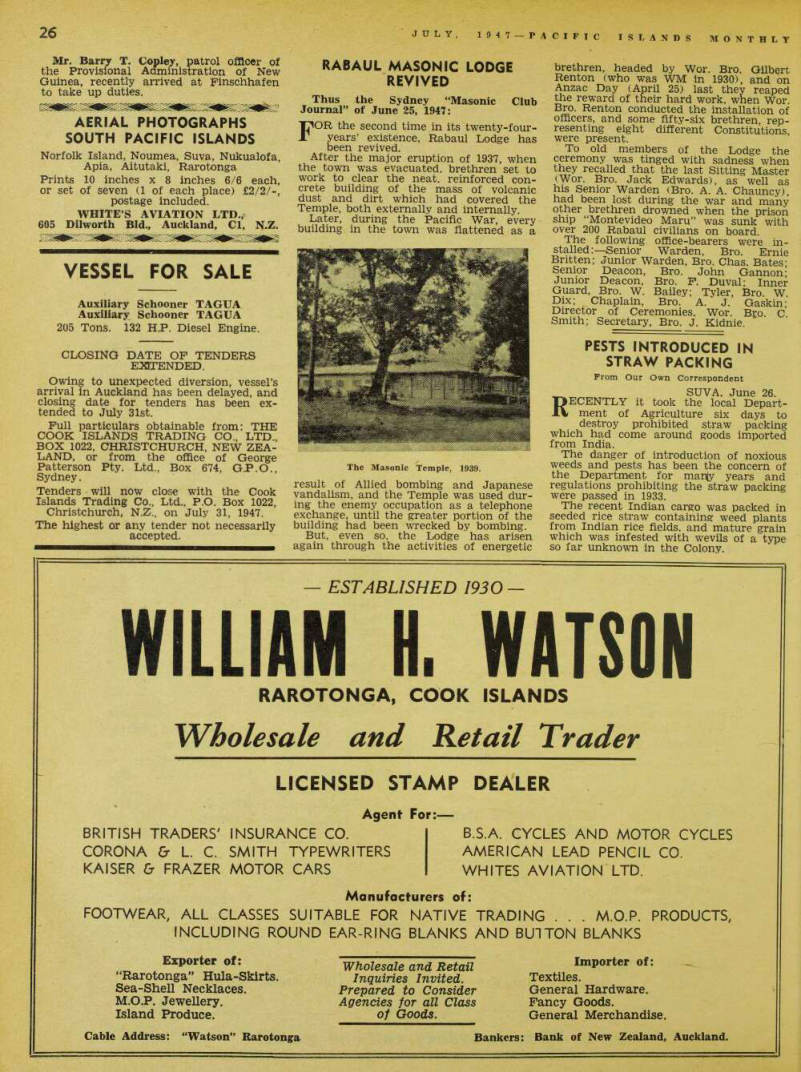
Annual Meeting
THE 24th annual general meeting of Bowling Club, Ba, Fiji, was held on May 25. 1947.
The club is financially sound and'lately has enrolled several new members.
During the 1946 season, the club was successful in Northern District inter-club competitions, and won the 1946 Hutson Cup, the Bayly Pennant and the Robin son Junior Rinks’ Trophy.
The office-bearers elected for the 1947- 48 season were:— President, Sir Hugh Ragg; vice-pre sident, Mr. G. R. Jordan: secretary treasurer, Mr. L. G. Brown: assistant secretary, Mr. J. E. Poulton: auditor, Mr.
D. Crowe; general committee, Messrs.
A. E. Waddingham, R. V. Clark, W. F.
White, J. E. Poulton and L. K. Carew.
Delegates to Fiji Bowling Association are Sir Hugh Ragg, Mr C. H. Came and Mr. R. C. Wilson.
Mr. Barry T. Copley, patrol officer of the Provisional Administration of New Guinea, recently arrived at Finschhafen to take up duties.
Advertisements & other items, pp. 27-28 (1 item)
Island Merchants
and AGENTS.
GENERAL MERCHANTS.
( <\ ) • Shippers of all types of /t ifiLlV" Merchandise to the Pacific Islands • Representing Australian, British and American Manufacturers [\\ Buyers for Leading Pacific Islands T,aders • Sellers of Island Produce on Consignment m m • Forwarding and Transhipment Agents Importers, Distributors and Manufacturers of Foodstuffs, Softgoods, Textiles, Hardware, Tobaccos, Wines and Spirts, etc.
379 KENT ST., SYDNEY.
Cable & Telegraphic Address: i Chasull, ,> Sydney. y i ''Ultima" Kerosene Stoves and Heating Appliances • Distributors of High-grade Shirts, Pyjamas and Clothing • "Southern Queen"
Canned Fruits y 4\ /;) m Hill's English Cigarettes 1/ When in Sydney, call and see us!
AERIAL PHOTOGRAPHS
SOUTH PACIFIC ISLANDS
Norfolk Island, Noumea, Suva, Nukualofa, Apia, Aitutaki, Rarotonga Prints 10 inches x 8 inches 6/6 each, or set of seven (1 of each place) £2/2/-, postage included.
WHITE’S AVIATION LTD.,
605 Dilworth Bid., Auckland, Cl, N.Z.
VESSEL FOR SALE
Auxiliary Schooner TAGUA Auxiliary Schooner TAGUA 205 Tons. 132 HP. Diesel Engine.
CLOSING DATE OP TENDERS
EXTENDED.
Owing to unexpected diversion, vessel’s arrival in Auckland has been delayed, and closing date for tenders has been extended to July 31st.
Full particulars obtainable from: THE
COOK ISLANDS TRADING CO., LTD.,
BOX 1022, CHRISTCHURCH. NEW ZEA-
LAND, or from the office of George Patterson Pty. Ltd., Box 674, GP.O., Sydney.
Tenders will now close with the Cook Islands Trading Co., Ltd., P.O. Box 1022, Christchurch, N.Z., on July 31, 1947.
The highest or any tender not necessarily accepted.
Rabaul Masonic Lodge
Revived
Thus the Sydney “Masonic Club Journal” of June 25, 1947: FOR the second time in its twenty-four years’ existence, Rabaul Lodge has been revived.
After the major eruption of 1937, when the town was evacuated, brethren set to work to clear the neat, reinforced con crete building of the mass of volcanic dust and dirt which had covered the Temple, both externally and internally.
Later, during the Pacific War, every building in the town was flattened as a
brethren, headed by Wor. Bro. Gilbert Renton (who was WM in 1930). and on Anzac Day (April 25) last they reaped the reward of their hard work, when Wor Bro. Renton conducted the installation of officers, and some fifty-six brethren, rep resenting eight different Constitutions, were present.
To old members of the Lodge the ceremony was tinged with sadness when they recalled that the last Sitting Master (Wor. Bro. Jack Edwards), as well as his Senior Warden (Bro. A. A. Chauncy) had been lost during the war and many other brethren drowned when the prison ship “Montevideo Maru” was sunk with over 200 Rabaul civilians on board.
The following office-bearers were in stalled:—Senior Warden, Bro. Ernie Britten; Junior Warden, Bro. Chas. Bates- Senior Deacon, Bro. John Gannon; Junior Deacon, Bro. P. Duval; Inner Guard, Bro. W. Bailey; Tyler, Bro. W Dix; Chaplain, Bro. A. J. Gaskin; Director of Ceremonies. Wor. Bro. C Smith; Secretary, Bro. J. Kidnie
The Masonic Temple, 1939. result of Allied bombing and Japanese vandalism, and the Temple was used dur ing the enemy occupation as a telephone exchange, until the greater portion of the building had been wrecked by bombing.
But, even so, the Lodge has arisen again through the activities of energetic
Pests Introduced In
Straw Packing
From Our Own Correspondent RSUVA. June 26.
ECENTLY it took the local Depart ment of Agriculture six days to destroy prohibited straw packing which had come around goods imported from India.
The danger of introduction of noxious weeds and pests has been the concern of the Department for man|y years and regulations prohibiting the straw packing were passed in 1933.
The recent Indian cargo was packed in seeded rice straw containing weed plants from Indian rice fields, and mature grain which was infested with wevils of a type so far unknown in the Colony.
Advertisements & other items, p. 28 (1 item)
William H. Watson
ESTABLISHED 1930
RAROTONGA, COOK ISLANDS
Wholesale and Retail Trader
LICENSED STAMP DEALER
Agent For:—
BRITISH TRADERS' INSURANCE CO.
CORONA & L C. SMITH TYPEWRITERS
KAISER O FRAZER MOTOR CARS
B.S.A. CYCLES AND MOTOR CYCLES
AMERICAN LEAD PENCIL CO.
WHITES AVIATION LTD.
Manufacturers of: FOOTWEAR, ALL CLASSES SUITABLE FOR NATIVE TRADING . . . M.O.P. PRODUCTS, INCLUDING ROUND EAR-RING BLANKS AND BUTTON BLANKS Exporter of: “Rarotonga” Hula-Skirts.
Sea-Shell Necklaces.
M.O.P. Jewellery.
Island Produce.
Cable Address: “Watson” Rarotonga Wholesale and Retail Inquiries Invited.
Prepared to Consider Agencies for all Class of Goods.
Importer of: Textiles.
General Hardware.
Fancy Goods.
General Merchandise.
Bankers: Bank of New Zealand, Auckland.
Madang, Retires
Colonel Woodman, DO Madang, Retires
Prom a Madang Correspondent
Colonel Harold Woodman, Who
was District Officer at Madang during the early rehabilitation period has departed on leave, on the ex piry of which he will retire, after more than 20 years’ yeoman service—not only to the Administration, but also to the natives and white residents of the various districts to which he has been posted.
We shall miss Harold Woodman. Those of us who have been waging an uphill battle, to bring our places back into pro duction, appreciate the assistance we have received from this just and capable officer, particularly at a time when native labour has been almost unprocurable. He was noted for his firm and tactful hand ling of the local natives. He knew natives, and applied that knowledge in assisting rehabilitation, without in any way departing from the ethics of the native welfare policy. A word from him brought natives to work, in their own areas, in constructing bridges and roads, with result that the district’s general economic position was the best in the Territory. Plantation copra was being produced in the Madang district when production in other districts was at a standstill. In no other district have the natives reached a higher state of post war rehabilitation than in Madang.
We are fortunate in having as his suc cessor, Mr. Keith McCarthy, a man well fitted in every way to carry on Mr. Wood man’s good work.
Mr. H. S. Roe, formerly Executive En gineer, Tanganyika, has been appointed Deputy Director of Public Works in Fiji.
Tribute To "Bob" Kennedy,
Murdered At Tol
MR. TREVOR BRUCE recently arrived in Sydney by plane from New Guinea and is spending a short holiday prior to proceeding to NZ.
In speaking of the trials faced by the evacuees from Rabaul at the time of the Japanese landing in 1942, Mr. Bruce paid tribute to the fine work performed by W/O R. L. Kennedy, of the NGVR, who was among those massacred at Tol, and who in pre-war times was well-known as the manager of the Regent Picture Theatre in Rabaul. It was owing to the self-sacrifice of Bob Kennedy, said Mr.
Bruce, that many of the troops and civilians were able to make their escape along the North and South coast of the island of New Britain. Regardless of his
own health, Mr. Kennedy established first-aid posts along the line of retreat, which provided the men with badly needed medical treatment and supplies.
Many of the evacuees, said Mr. Bruce, speak most highly of this work, and sur prise had been recorded that some posthumous recognition of Mr. Kennedy’s unselfish service, has not been made.
Mr. G. R. G. Wearne, a former ANGAU officer, and until recently, a patrol-officer at Sio Police Post, near Pinschhaten, New
Guinea, left recently for Australia wharp he will attend a couvS School of Pacific Afflfrs Australian
Advertisements & other items, pp. 29-30 (1 item)
George J. Logkyer & Company
KODAK FILMS
and all photographic supplies
WHOLESALE AND RETAIL
CAINE'S STUDIOS, SUVA,
P.O. Box 8 Photographers. Est. 1904.
Write for free price list
J. C. Merrillees Pty. Ltd.
GENERAL ISLANDS MERCHANTS
Telegrams & Cables: Merrillees. Sydney.
AGENTS FOR: COWRIE SHARPS and FLOUR
and Suppliers of General Merchandise
TRADE GOODS,
FOODSTUFFS.
SPIRITS, WINES.
CLOTHING,.
LIQUEURS,
New Address
63 PITT STREET, SYDNEY
(Phoenix Building) Telephone: Codes: BW 6064 Bentleys
GEORGE J. LOGKYER & COMPANY
MARINE BRANCH
ENGINEERING SUPPLIES, GENERAL HARDWARE EXPORTERS AND MERCHANTS
Agents for the Finest Australian Liquors
Aerated Water and Cordial Manufacturing Machinery, Bottling and Capping Machinery, etc.
CONSULTING ENGINEERS DOCKYARD MACHINERY
PURCHASING AGENTS:
Electric Light Generating Plants.
Air Conditioning Plants.
Builders’ Hardware.
Marine Engineering Supplies.
Refrigeration Supplies.
Radios and Accessories.
Sanitation Equipment.
Automobile Spare Parts and Garage Accessories.
Abrasive Wheels.
Excavating Machinery.
Electrcal Supples.
Grinding and Pulverising Machinery.
Hydraulic Equipment.
Mechanical Engineering Requirements.
Mining and Quarrying Machinery.
Road and Building Machinery. -
EXACT REPLICA OF CANE KNIFE,
GIRAFFE TYPE, MADE IN AUSTRALIA.
VESSELS, ETC.
Steel Cargo Vessels, 35 ft. x 13 ft. 4 ft., New, with
Winch, Hoist, etc.
Auxiliary Transport Vessels,
32 ft. x 9 ft. x 4 ft., New,
without Engines.
Tugs, Trawlers, Cargo
Vessels, Tankers, Motor
Cruisers, Launches, Yachts,
Hoists, Winches, etc.
Photographs, Drawings , Schedules, will he Supplied by Return Mail to Genuine Clients.
FAIRLIGHT STREET, FIVE DOCK, SYDNEY, N.S.W. 'Phone: UA7196 All communications to be addressed Bankers: Telegraphic and Cable Address: to The General Manager, Commonwealth Bank of Australia, “LOCKMACH.” Sydney.
G.P.0., Box 4553, Sydney. Sydney.
Allen Taylor & Co. Ltd.
COMMERCIAL ROAD, ROZELLE,
SYDNEY
Sowmlllers and Wholesale Suppliers of Hardwoods for Construcfional Purposes GIRDERS . . . PILES . . . POLES . . . SLEEPERS, Etc.
EXPORTING TO PACIFIC ISLANDS SINCE 1893
Illustrated (on right) is the Commando “Big Four”
Clutch Model. Price, £6B/10/-. m ii Illustrated (on left) is the Commando “Cub”—Flexible coupled. Price, £62.
Mi
Gear=driven Cranking
—Tropic Proofed
“COMMANDO”
Marine and General Purpose
ENGINES
Illustrated is the “Commando” Super Air- Cooled Engine, General Purpose type— Price—£s2/10/- (complete with governor or hand throttle and either two V-grooved or 4-inch flat pulley.
Illustrated is the Commando Super Aircooled engine with IV2 Inch Ajax Pump as a complete, portable pumping unit.
Capacity, 5,000 gals, per hour. Lift, 25 ft. Head, 60 ft. Price, £75/12/6.
Available for Immediate
Delivery !
Commando Engines are precision-built to the world’s most modern design, and conibine all the features desirable in Marine or General Purpose engines.
Gear-driven cranking and water-proof Lucas ignition make for surety and ease of starting.
Tropic-proofed with non-corrosive Aluminium crankcase fitted with Heavy Duty Ball Race bearings . . . highturbulence intake ports—Gits Seals—are but a few of the special features which make Commandos the choice of sea-going launches.
Write for free brochure giving details and specifications of ALL Commando Engines to Dept. 10C.
STOKOE MOTORS
PTY. LTD.,
c.i. 265-273 Exhibition St., Melb.
Victoria.
SCI6/10C.
Calling Rarotonga!
From Our Own Correspondent
0 Mangaia. C. 1., May.
NE of our local natives is at present awaiting indictment on a charge of trespassing upon Government pre mises.
This bright youth, stimulated by local nectar, had the bright idea of breaking into the radio station, at the time de serted, and trying a few little experi ments with the apparatus. . . a few minutes, in spite of his inebriation, the lad got the hang of the set-up, and soon was sending out a gen eral call, in somewhat shaky Boys’
Brigade morse code, requesting information concerning the whereabouts of the steamer due in three days’ time.
More, he got a reply! But, receiving at professional speed not being a Brigade accomplishment, the amateur “Makoni” made no coment on Rarotonga’s remarks save to transmit a few crisp monosyllables, of Nordic origin, that do not usually find their way out on the ether.
These received, Rarotonga came to the conclusion that something must be wrong over at Mangaia.
As if by telepathy, the Acting RA was at the same time inspired to find out why the wireless station door was open when it should have been shut. The amateur operator was by then stuck for four-letter words, and while cogitating, was caught in “flagrante delicto.”
This “crime” not being provided for in the Cook Islands Act, a legal precedent will have to be created for future offences, and it will be interesting to see what penalty is bestowed on the fuddled Bngader who tried his morse, with quite reasonable success, on professionals.
Volunteers Needed To Sail
Mission Ship To Bsi
Father claude palmer, Marist Mission, Glenlyon Drive, Ashgrove, Brisbane, recently appealed for a navigator and two able-bodied men to sail a 40 ft. boat to the Solomons.
Father Palmer, formerly of the Marist Mission, in the Solomon Islands, was among those who escaped and hid from the Japanese and eventually reached the Americans when Guadalcanal was re captured in 1942. Other missionaries, two priests and two sisters, were bayoneted to death by the Japanese.
Father Palmer returned to Brisbane some weeks ago after nine years in the Solomons.
The new boat is urgently needed for the rehabilitation of the natives and the missions. When it reaches Guadalcanal, native boys will man it, and the white crew will be sailed to the nearest air port—probably Rabaul.
Given reasonable weather. Father Palmer anticipates that the trip will take three or four weeks; but it is imperative that they get away before the north-west season begins.
Copies of "The Coast-Watchers"
WE are informed that copies of Eric Feldt’s “The Coast Watchers” are obtainable from The Epworth Book Depot, Pirie Street, Adelaide, SA.
This excellent book on the activities of the coast-watching organisation in the South-West Pacific area is sold out in the Eastern States. Retail price of the book is 17/6; but, if ordering from Ade laide, sufficient to cover cost of post age should be added.
Mr. Jack Sedgers, a director of WRC (New Guinea) Ltd., sailed*by SS “Mon toro” on June 11. He was accompanied by his wife and three children. They will make their home at Madang.
Accepted
Fiji Copra Goes Up!
Ministry's New Offer Accepted
From Our Own Correspondent SUVA, June 11 FIJI copra producers will receive £7/3/6 per ton more for their copra from June 9. This follows a recent offer from the Ministry of Food in London for FMS grade Fiji copra at £37/12/6 sterling (£4l/13/6 Fijian) in bulk.
The Fiji Copra Board sought the views of a number of producers and merchants after the Ministry’s offer had been re ceived, but as 60 per cent, of Fiji’s copra comes from small producers it was im possible to obtain a fully representative opinion in time to give the quick de cision that was necessary. The majority of producers and merchants seemed to be in favour of accepting the price, request ing that the Ministry give a long-term agreement for five years, if possible, but at least until 1950.
The buying price at Suva and Levuka is now £36/19/- (Fijian) for plantation grade copra and £36/13/6 for FMS grade.
The B*oard has increased its margin between the local buying price and that received from the Ministry from a little over £3 per ton to £5 per ton. They state that this is necessary because of shipping delays, shrinkage, insurance and inter est.
Following is a list supplied by the Board of estimated costs on 100 tons of copra;—
The price realised for 97 tons of copra (that is, allowing for 3 per cent, shrink age) at £4l/13/6 a ton would be £4,042/9/6, leaving a credit balance to the Board on 100 tons of £56/10/5.
The item, “Interest, £7l/13/4” is not ex plained. It should not be necessary. It represents nearly 15/- per ton.
In Australian currency, Fiji producers are now receiving the equivalent of £4l per ton. The price paid to New Guinea nlanters, it was announced on June 17, is how £3l/2/- per ton, at the ship’s slings.
Buying price at £36/13/6 a ton .. £3,667 10 0 Handling charges at 18/6 a ton .. 92 10 0 Wastage of sacks at - 8/- a ton .. 40 0 0 Twine at 2/6 per 100 sacks ... 200 Stamps 2 0
Customs entry * 0 Interest 71 13 4 Overtime, say 3 00 Fire Insurance 21 13 4 Interest on insurance premium .. 15 0 Administrative expenses 18 0 0 Port and Customs service, Customs tax and wharfage 42 16 10 Bank interest pending payment .. 23 16 11 Weighing and tallying ... 348 Total £3,986 19 1
Council Of Chiefs,
1947 Session
From Our Own Correspondent SUVA, June 24 rE 1947 session of the Council of Chiefs will open at Somosomo, Tav euni, Fiji, to-day. The Council, which meets at intervals and acts in an advisory capacity to the Government, will elect a panel from which the Gov ernor will choose the five Fijian members of the Legislative Council.
During this session, memorial cere monies will be held in honour of the late Corporal Sefanaia Sukanaivalu, who won the VC in the Pacific war.
Mr. Nicholas Hagen, New Caledonia merchant, who is almost as well known in Australia as in Noumea, paid a short visit to Sydney in June—the first since his very severe illness there in 1941. Be fore that, he visited Sydney very fre quently. He has completely recovered, and is a picture of bouncing health. The welcome he received from his friends in Sydney, was so warm and active that he seemed glad to catch the Qantas plane back to Noumea.
Advertisements & other items, pp. 31-32 (1 item)
Keillers
When Worried
Tired,Sleepless
AND YOU FEEL RUN-DOWN
Worry is Inescapable. Everyone has a share of it more or less. The great trouble about worry is that it plays havoc with your health and fitness if you let it. You become mentally and bodily weary, depressed; cannot sleep at night, lose appetite and begin to feel a nervous breakdown is impending. That starts the vicious circle. You worry, become run-down and nervy, and that makes you worry more than ever.
Meet your troubles all the way by reinvigorating your system and keeping It fit and well by taking Dr. Williams’ Pink Pills. These pills help to restore the red corpuscles and iron content of the blood to their normal quantity.
This enables life-giving oxygen and nourishment to be carried to the nerves, organs and tissues of the body. In that way you become invigorated, strengthened by Dr. Williams’ Pink Pills, the vague aches and pains disappear and you are fit again to deal confidently with all your worries. At chemists and stores.
uojfi I 5S ■g 9 ' , *»»>o i
w»wm
IA Vi? 11 «'Bk»c-i£y h <•0 :>> 1 *9 m Soft SVfc
SPECIAL
imported for
a select few
THE ORIGINAL MARMALADE
KEILLERS
Dundee,
MARMALADE
ESTABLISHED IN 1797
t
A
MILD
DEPENDABLE
Capstan’s
own blend
CAPSTAN Cigarettes are dependable . . . their special quality is unvarying.
CAPSTAN’S OWN BLEND of forty kinds of fine Virginia leaf has set a standard that is rigidly maintained and cannot be duplicated.
time for a
CAPSTAN
THE EMPIRE’S FAVOURITE CIGARETTE
in the smart H€U? packs
Many Territorians Against Amalgamation
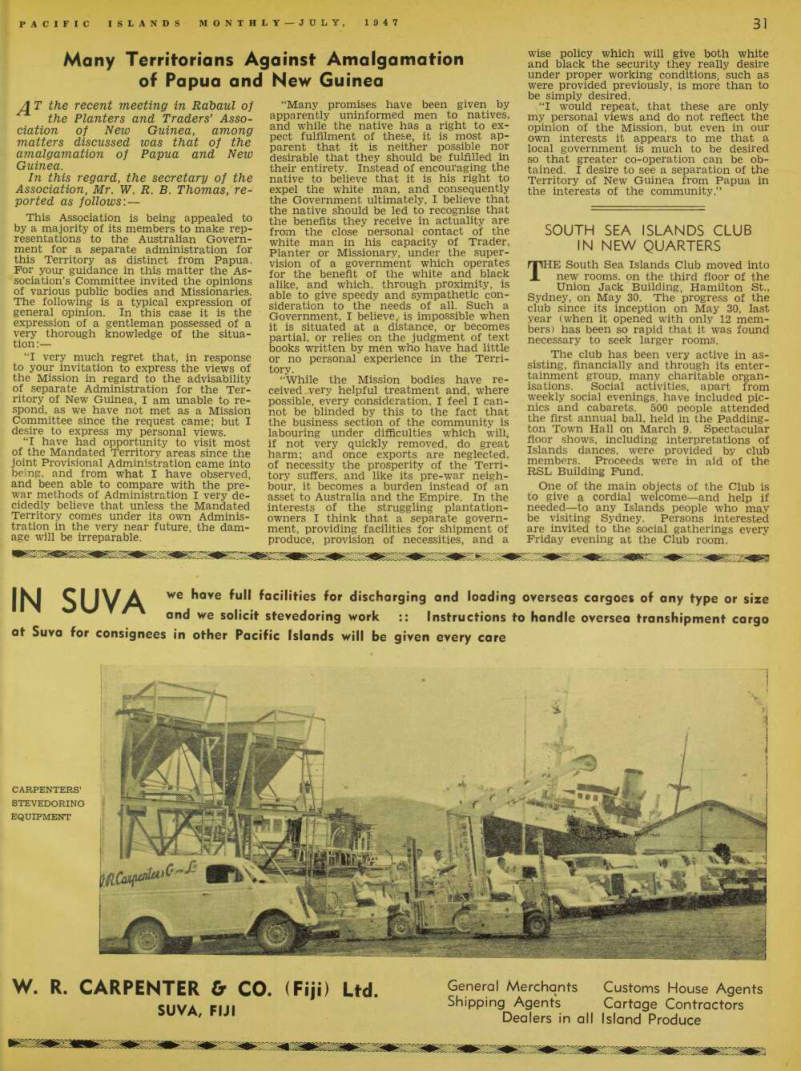
of Papua and New Guinea
the recent meeting in Rabaul of the Planters and Traders’ Asso ciation of New Guinea, among matters discussed was that of the amalgamation of Papua and New Guinea.
In this regard, the secretary of the Association, Mr. W. R. B. Thomas, re ported as follows: — This Association is being appealed to by a majority of its members to make rep resentations to the Australian Govern ment for a separate administration for this Territory as distinct from Papua.
For your guidance in this matter the As sociation’s Committee invited the opinions of various public bodies and Missionaries.
The following is a typical expression of general opinion. In this case it is the expression of a gentleman possessed of a very thorough knowledge of the situa tion:— “I very much regret that, in response to your invitation to express the views of the Mission in regard to the advisability of separate Administration for the Ter ritory of New Guinea, I am unable to re spond, as we have not met as a Mission Committee since the request came; but I desire to express my personal views.
“I have had opportunity to visit most of the Mandated Territory areas since the joint Provisional Administration came into being, and from what I have observed, and been able to compare with the pre war methods of Administration I very de cidedly believe that unless the Mandated Territory comes under its own Adminis tration in the very near future, the dam age will be irreparable.
“Many promises have been given by apparently uninformed men to natives, and while the native has a right to ex pect fulfilment of these, it is most ap parent that it is neither possible nor desirable that they should be fulfilled in their entirety. Instead of encouraging the native to believe that it is his right to expel the white man, and consequently the Government ultimately, I believe that the native should be led to recognise that the benefits they receive in actuality are from the close nersonal contact of the white man in his capacity of Trader, Planter or Missionary, under the super vision of a government which operates for the benefit of the white and black alike, and which, through proximity, is able to give speedy and sympathetic con sideration to the needs of all. Such a Government, I believe, is impossible when it is situated at a distance, or becomes partial, or relies on the judgment of text books written by men who have had little or no personal experience in the Terri tory.
“While the Mission bodies have re ceived very helpful treatment and, where possible, every consideration, I feel I can not be blinded by this to the fact that the business section of the community is labouring under difficulties which will* if not very quickly removed, do great harm; and once exports are neglected, of necessity the prosperity of the Terri tory suffers, and like its pre-war neigh bour, it becomes a burden instead of an asset to Australia and the Empire. In the interests of the struggling plantation owners I think that a separate govern ment, providing facilities for shipment of produce, provision of necessities, and a
wise policy which will give both white and black the security they really desire under proper working conditions, such as were provided previously, is more than to be simply desired.
“I would repeat, that these are only my personal views and do not reflect the opinion of the Mission, but even in our own interests it appears to me that a local government is much to be desired so that greater co-operation can be ob tained. I desire to see a separation of the Territory of New Guinea from Papua in the interests of the community.”
South Sea Islands Club
In New Quarters
THE South Sea Islands Club moved into new rooms, on the third floor of the Union Jack Building, Hamilton St., Sydney, on May 30. The progress of the club since its inception on May 30, last year (when it opened with only 12 mem bers) has been so rapid that it was found necessary to seek larger rooms.
The club has been very active in as sisting, financially and through its enter tainment group, many charitable organ isations. Social activities, apart from weekly social evenings, have included pic nics and cabarets. 500 people attended the first annual ball, held in the Padding ton Town Hall on March 9. Spectacular floor shows, including interpretations of Islands dances, were provided by club members. Proceeds were in aid of the RSL Building Fund.
One of the main objects of the Club is to give a cordial welcome—and help if needed —to any Islands people who may be visiting Sydney. Persons interested are invited to the social gatherings every Friday evening at the Club room.
Advertisements & other items, p. 33 (1 item)
W. R. Carpenter & Co. (Fiji) Ltd.
IN SUVA we hove full facilities for discharging and loading overseas cargoes of any type or size and we solicit stevedoring work :: Instructions to handle oversea transhipment cargo at Suva for consignees in other Pacific Islands will be given every care
CARPENTERS’
STEVEDORING
EQUIPMENT
w ***' ' m na SMi m m & W. R. CARPENTER & CO. (Fiji) Ltd.
SUVA, FIJI
General Merchants Customs House Agents
Shipping Agents Cartage Contractors
Dealers in all Island Produce
Fiji's Help To Britain
CONTRIBUTIONS to patriotic funds by the people of Fiji during the war totalled £293,000, or nearly 23/- for each man, woman and child in the Colony.
Three bombers, eleven fighters and two ambulances were bought for Allied use, and a fund of over £45,000 was established for the care of the Colonv’s Servicemen and their dependents after the war.
Over £lOO,OOO went to patriotic funds overseas.
Since the war ended, nearly £21,000 has
been subscribed to Lady Grantham’s Fiji Gifts to Britain Appeal. .While out fishing in a small motor boat off Port-Despointes, Noumea, Mon sieurs Laborde and Cottin noticed that their companion Rene Pages was missing.
They searched the water around for a iong time before returning to port, but without finding any trace. It is pre sumed that the missing man, who was only 23 years old, and who was subject to epilepsy, had fallen overboard in a fit.
Sydney
Papuan Timber
Industry
Large Shipments To Sydney
AFTER years of frustration, official dis couragement and difficulties created by lack of labour and transport, Mr.
Tom Flower appears to have established successfully a saw-mill industry in Papua.
He went to New Guinea, on timber busi ness intent, some six or seven years ago, and started operations near Rabaul, and at Wide Bay; but Mr. Tojo of Tokio upset all his plans.
After the war, Mr. Flower made an early start in Papua; but, although the local and Australian demand for timber was great, he had to surmount many obstacles to get going.
However, some 200.000 feet of Ilimo—a light, soft timber suitable for joinery and house-finishing—have reached Sydney timber merchants lately in logs; another 100,000 are being loaded by the June- Julv “Montoro” and “Malaita”; and the Sydney merchants want another 2,000,000 feet, if they can get it. In addition, there is a strong local demand for sawn timber.
Ilimo grows in big trees, and is the wood usually used by the natives for making their canoes. Despite expert condem nation, Mr. Flower had faith in it and his confidence has been justified. He has one saw-mill in operation, about ten miles from Port Moresby, and another is now being erected. The logs are brought in 20 miles, by motor lorries. He hopes to begin shipping Walnut soon. Walnut occurs rarely, in comparison with Ilimo, but it is much more valuable.
Development of the Territories timber industry would have a useful economic effect, for two reasons. One is that the expensive Territories desperately need productive industries; and the other is the demand for backloading for ships.
"Monty's" Link With Fiji
BRITAIN’S leading soldier, Field-Mar shall Lord Montgomery, in Australia this month on an official visit, has a connection with Fiji—although he himself probably is unaware of it.
Some seventy years ago, Solomon Islands natives were taken to Fiji as in dentured plantation labourers. The Ang lican Church took an interest in these “displaced people”, and cared for them; and finally, to help the Solomon Islands community, the Rev. W. Floyd, Vicar of Levuka, formed the Solomon Island Mission.
In 1893 a Bishop from Tasmania, who was passing through Fiji, confirmed 73 members of this Mission. He was Bishop Montgomery, father of the present Field-Marshall.
“Monty” spent his early years in Tas mania, before his father’s transfer to England.
There is still a community of Solomon Islanders in Fiji—at the villages of Wail ailai and Wailoku.
Mr. Cyril S. Belshaw, a New Zealander, has been awarded the Emslie Horniman scholarship for anthropological research.
He is at present taking a post-graduate course at the London School of Economics under Professor Ravmond Firth. Mr.
Belshaws’ subject of research is the economic life of the natives of the Solomons, New Hebrides and New Cal edonia where he has already done con siderable work for the Institute of Pacific Relations.
Advertisements & other items, pp. 34-36 (2 items)
Limewashing And
Woven Wire for all Industry
COPRA DRYING TRAYS, FLOORS, Etc.
FRU'T DRYING TRAYS, MINING SCREENS.
Heavy Mosquito Gauze in Phosphor Bronze and other Metals Impervious to Salt Sea Air.
WIRE DOORMATS AND GENERAL WIRE WORKS
E. WRIGHT & CO. LTD.
Office a,ad Works: 148-152 Cleveland Street, Sydney, N.B.W.
Telegraphic Address: “Wrightmake,” Chippendale.
The Most Extensive Manufacturers in the British Empire of
RUBBER STAMPS,
INKS, STENCILS,
Marking Devices,
ACME STAMP PADS
OFFICE & STATIONERY SUPPLIES
We also Manufacture & Supply a Complete Line of
LIMEWASHING AND
SPRAYING MACHINES
for all purposes.
Let us know your requirements and we will quote by return.
WRITE FOR OUR GENERAL CATALOGUE
Li me washing Machine
EXCELSIOR SUPPLY CO. PTY. LTD.
278 Post Office Place,
MELBOURNE, VIC.
HEAD OFFICE :
160 BROADWAY,
For met lu known as George St., W'esf,
SYDNEY, N.S.W.
50 Victoria Street,
WELLINGTON, N.Z.
Refrigerator
Modern Refrigeration for the South Sea Islands
The
ELECTROLUX
KEROSENE OPERATED
MARVEL
OF
MODERN
SCIENCE
REFRIGERATOR
PS mm : 23 A . H m
THE
MIRACLE
OF
ICE
FROM
HEAT
ELECTROLUX offers economical, modern and completely efficient
REFRHGERATION FOR ISLANDS' HOMES.
FREEZES CONTINUOUSLY WHILE SMALL LAMP BURNS.
Freezing controlled by simply regulating height of flame. Uses only £ gallon of kerosene per week.
MOTORLESS ... NO PARTS TO GET OUT OF ORDER.
MODEL LKSSO
Capacity: 5.5 cubic feet.
GUARANTEED FOR TWO YEARS
• Write to your Local Distributor for prices and full details.
OBTAINABLE FROM ALL W. R. CARPENTER & CO. LTD.
BRANCHES THROUGHOUT THE ISLANDS
Representation in Papua and New Hebrides.
MILE
after MILE
OF Tires for
trucks,
automobiles,
buses
EXTRA WEAR
now added to
cool - running
MILLER
TIRES
Now type, stronger construction.
New wide, flatter tread. Longer mileage. Maximum traction.
Peak skid resistance. Greater protection against bruises.
MORE TIRE FOR YOUR MONEY
Miller Accessories and Repair Materials are dependable!
Consistently high in quality, this complete line has been developed to meet every automotive need.
Radiator hose Radiator cleaner Radiator solder Noc-out adjustable hose clamps Vulcanizing patch and valve stem clamp Tire camelback (passenger and truck) Full circle curing tubes Tire pump hose assemblies Self curing cements and patches Weld rite vulcanizing patch Weld rite valve steam heat units Fractional horsepower belts Rubber solvent Friction tape Windshield wiper tubing Air bags Fan belts Rubber mallets Cord fabrics Tire paint Tire and tube repair kits mi mi m
TUBE REPAIR KIT
CONTENTS
I—s" x 19" Strip rubber 80— Wa" Sq. bevel cut patches 20—1*4" x 2" Oval bevel cut patches I— Va Pt. bottle cement I—Carborundum buffer
Exporters
PACIFIC ISLANDS TRADING COMPANY
244 CALIFORNIA STREET, SAN FRANCISCO 11, CALIFORNIA, U. S. A.
Tribute to 14,000
American Dead
From a Special Correspondent UNDER an azure blue, cloudless sky, with palm trees waving in the gentle breeze, homage was paid on Mem orial Day to the thousands of American Servicemen who are buried in the pic turesque and peaceful cemetery at Finsch hafen.
The large area, which had been bull dozed level out of the Finschhafen hills was emerald green. Immediately behind was a thickly-wooded hill; while, opposite, one could see the blue waters of Vitiaz Strait and a fringe of coconut palms lining a dazzling white beach. The set ting was grand.
May 30 was a special occasion. Every grave had an American flag alongside it, about a foot above the ground—this happens once in every year in all US war cemeteries throughout the world —and the effect, as they fluttered in the breeze, was striking.
Philippine Scouts, about 150, arrived recently to disinter the bodies. The steel caskets will be re-interred at Manila; and later, if so desired by relatives, they will be taken to the States for burial in the dead Servicemen’s home towns.
Promptly at 3 p.m. a detachment of 609 US Graves Registration Platoon came into view, swinging along smartly wearing as many as two rows of battle ribbons.
Then came the diminutive Philippine Scouts, led by an American officer.
About 80 ratings from HMAS “Taran gau” (the Finschhafen Naval Base) took part in the ceremony.
Practically the whole of Finschhafen turned out to pay homage to America’s glorious dead.
W. Samoan Administrator
Visits The Tokelaus
From Our Own Correspondent APIA. June 19. rE NZ corvette “Arbutus” visited Western Samoa in June.' The customary Samoan hospitality was extended to officers and men and during the time the ship was in Western Samoan waters the Administrator took the oppor tunity to visit the neighbouring Tokelau Islands.
The Tokelau Islands are a dependency of NZ, and are administered from Apia.
The islanders are reported to be healthy and content, in spite of their somewhat limited material resources. Their diet consists mainly of fish and coconuts and their most important industry is copra.
The islands are rarely visited by ships, but the “Tagua” has been in the habit of calling three or four times a year to lift copra and deliver stores.
The islanders complain that at present there is a plague of rats, which are damaging the young coconut trees and thus adversely affecting copra production.
During the three days’ stay of Arbutus” there was a nightly of movies—an amenity greatly appreci ated by the isolated islanders.
First Fiji-Indian Girls
As Nurses
TTK)R the first time in the Colony’s his r tory, Indian girls have been accep ted for hospital training this year.
Six girls commenced their training as nurses at Lautoka Hospital in June. They will undergo the same course as Fijian nurses and, after three years and three months, if they have qualified, will re ceive a Government nursing certificate.
Death Of Capt. H. Low
ONE of Fiji’s best-known sea-faring men, Captain Henry Low, died in Suva on June 5.
He was born at Matei, Taveuni, in 1874, the year of Fiji’s cession to Great Britain, His father was Mr. C. L. Low, a Magis trate at Levuka and Lomaloma.
Captain Low’s first command was in the Colonial Sugar Refining Company’s vessel “Marama.” On his retirement in 1939, Captain Low was master of the “Tui Cakau”. His son “Dutchie” suc ceeded him in this command. In 1943, Captain Low came out of retirement to take command of an American ST vessel.
Captain and Mrs. Low had a family of four sons and three daughters.
To help in the war on mosquitoes, the Noumea Municipality has brought a DDT truck from the US Mosquito Control.
This is now in action with apparently good results.
Miss Amy Thompson, of the Mel anese Mission in BSI, has ben transferred to the hospital at Palm Island.
Advertisements & other items, p. 37 (1 item)
W. Kopsen & Co. Pty. Ltd.
Stamps Penfriends Hobbies The only club of its kind in the Islands Established in 1933 Members throughout the Islands, all British Colonies, and in almost every country in the world Correspond with interesting people who will be glad to send you illustrated newspapers and magazines, stamps or any other item.
Send for specimen copy of Club Journal, “ISLAND LIFE,” published quarterly.
We need an official representative in every Island of the South Seas.
Write for particulars.
SOUTH SEA ISLANDS CORRESPOND-
ENCE CLUB, NATUVU, FIJI
FO
CWI
1.
The finest wood and canvas preservative known, prevents decay, dry rot and eradicates white ants and borers in wood and canvas; supplied green or colourless. Prices from 12/- per gallon, smaller tins available. 2.
C.Q.R. ANCHORS, British invention made in Australia. Three times the holding power, easy to handle and available in all sizes from 13 lb. to 140 lb. Ask for price list.
JL.
KAYEN KEROSENE LAMPS are the finest Australian-made lamps; burn kerosene and provide 300 C.P. light without flickering. All brass con tainers. All spares made in Australia easily and cheaply available. Made in Handsome Table Lamp as illustrated or in All Purposes Lamp and Lantern. Ask for illustrated leaflets
SIMPLEX MARINE ENGINES—
3, 5, and 10/12 H.P. sizes. Suitable for all craft from 14 to 32 feet long; 5 and 10 H.P. supplied with built-in reverse gear. All Australian-made. Price and specifications on request.
Ask for comprehensive price list of boatgear and specialty hardware lines.
W. KOPSEN & CO. PTY. LTD.
380 Kent Street, Sydney
C3«l}l6S *
“KOPSEN SYDNEY”
optSd Asst
New Public Service Association for Papua-New Guinea But Papuan Assn. Continues to Represent Majority of Papuan Officials
Prom a Special Correspondent „ .. POHT MORESBY, Ju ne 2 0 Association of Papua-New Guinea.” a new organisation which aims to repre v?SL a i n ™ em . be . rs , of the present Pro visional Administration. Already the PcT^hUc'ho? lB^^ 011 clashed with the clltion d 3PUan PUWIC S€rviCe ASSO ‘ ciation. . At a preliminary meeting in May an interim committee was elected to draft a constitution and initiate proceedings.
Mr. W. C. Groves, Director of Education. was elected president, and other mem bers of the committee include Miss W.
Edwards, Mr. L. Odgers (former secre tary of the New Guinea Public Service Association), Mr. W. Watkins, of the Crown Law Department, Mr. Cottrell Dormer, Director of Agriculture, and Mr.
J. Irvine. - In June a meeting was held to examine the draft constitution. Prior to this meeting the Papuan Public Service Asso ciation circularised members of the ser vice as follows:-
optSd Asst
ciation of Papua-New Guinea’ has been formed or is .n the process being
Sstsi. W
Territory of Papua' is still i„ existence y It has a record of successful enfavour on behalf of its members and to-day is as strong, virile and active as " ever was in its long, honourable hisory. You are now eligible and invfted to Jom * To enable newcomers to join, the Constitution 88001 * 41011 bad amended lts
vssk
is finally established. If they revert to independent Administrations, Y the oW organisation will resume. If a composite administration becomes permanent it is ?. oped the newly formed organisaif t the nucleus o£ Termanent Association.
At the June meeting only one speaker expressed opposition to the formation of new , organisation, but in all only half , a dozen Papuans attended. The speaker was Mr. K. Chester who sugjested that the new organisation was anti-Papuan in tone and was fostering already noticeable antipathy between th ? two branches of the service He Pointed out that there were no Papuans on the provisional committee.
Speakers in reply stated that the origlnal meet ing had been open to all public servants, all of whom had been notifiedand that only one former member of the Papuan Service had attended constitution was r
and possible amendment
new Ss^tio^atf‘are:^ 0 ° f
*-■ To uphold, preserve and protect the rights and privileges of its mem bers and generally to safeguard their interests. ■ To negotiate agreements with any legally constituted authority having control over the members of the Asso ciation with a view to procuring for them improved rates of pay, living, and working conditions. ■ To secure preference for its mem bers in relation to appointments or pro motions in the service.
Advertisements & other items, pp. 38-40 (3 items)
“Hf KS.'K b£t W’S
GOLD & POWER'S ANNUAL
MEETING
P Ol - 0 & POWER, LTD. ore-war a vJ payer of good dividends* 3 held its „ eighth annual general meettog on May 23. The company, which has a nomi nal capital of £30,000 of which £l6 131 is issued, originally took over the valuable New Guinea property and assets of Upper Watut Gold Alluvials, Ltd., which went lnto liquidation.
Gold and Power showed a loss of £174 the - ve ar. There still is no indication °* the amount of war damage compensa tion likel y to be allowed the company Rehabilitation of the property has shown considerable progress, but is handicapped b y d jfiiculty of securing vital materials. • th^ re j s , also th A e problem of obtain a*lv.e 0 labour A road has been con st]-ucted 12 miles from Bulolo to the prop erty; a sawmill has been installed, and
“Hf KS.'K b£t W’S
Goldfteld" 111 ® C ° mPaPleS ° P ** M ° TObe + Mr ‘ H> G - Hyde is Chairman of Direc-
36
JDLV, HH-PACIHC ISLANDS MONT H I V
£. J. Gough & Co.
C: r Cooper Adjustable Glass Louvres are manufactured by F. W. GISSING PTY., LTD., 197 Wilson Street, Newtown, Sydney, Australia. Always insist on GENUINE
COOPER LOUVRES—
they are clearly branded.
Keeps Hot Sun OUT . . .
Let Cool Breezes IN!
Cooper Adjustable Glass Louvres are the ideal way of securing maximum ventilation with minimum interference from glare. Fitted with non-actinic glass, which absorbs the sun’s heat, they are ideal for nurseries and verandahs . . and amazing though it may seem, are actually cheaper to install than ordinary windows Cheaper to insfal than ANY other kind of WINDOW * . ♦
ADJUSTABLE GLASS LOUVBPS
=3 Imagine it—-units of movable glass louvres (plain or figured) in metal frames, giving unobstructed light and air, yet protection from draughts and rain andi all with as simple a motion as flicking on a light switch. The price is so amazingly reasonfable and father can do all the erecting, it’s so easy.
Illustrated: Typical Suburban Home. Verandah (Sydney) glassed in with Cooper Louvres.
WRITE FOR PARTICULARS TO PACIFIC ISLANDS REPRESENTATIVE
£. J. GOUGH & CO.
SUPPLIERS OF GENERAL MERCHANDISE TO LEADING FIRMS THROUGHOUT THE PACIFIC ISLANDS.
Exporters . . . Importers . . . Manufacturers ’ Representatives 1 BOND STREET, SYDNEY, AUSTRALIA. Box 3615 G.P.O. Tel. 84167 Bankers: Bank of N.S.W. Bank of Adelaide. Comptoir Nat. d’Escompte de Paris D . , Cable Address: “SEAFOODS.” SYDNEY.
Codes - Bentl eys, 2nd and Comp. Phrase; A.8.C., sth and 6th; Peterson, 2nd and 3rd; Banking: Acme.
WESTCLOX
NEVER has performance been more trustworthy than in the beautiful Westclox of today , . . famous Big Ben and other spring wound clocks, electric clocks, wrist watches and pocket watches. When you buy your next clock or watch, look for the trade mark “Westclox” on the dial . . . your assurance of quality.
POCKET BEN A thin model watch with many features. Highly polished, plated finish; silvered dial; attractive numerals and hands. Unbreakable crystal.
SPUR Luminous A thin case, one-day alarm. Black finish with nickel trim. 43 inches square.
Steady alarm. Unique base.
Luminous dial.
WFSTCLOX
BIG
BEN
BIG BEN Chime Alarm The highest standard of alarm clock quality. Quiet tick and gentle two-voiced alarm. First there’s a gentle call, then if he’s not shut off. there’s a lusty shout. Dustproof attachments. 5 h inches high. Ivory finish with gold colour trim. Luminous dial. 10 titnui * BABY BEN A smart looking alarm clock, 3$ inches high.
Quiet tick; steady alarm that rings loud or soft. Legible dial.
Two finishes . . . black with nickel trim, and ivory with gold colour trim. Made in plain and luminous dial. \ LA SALLE A handsomely designed wrist watch. Chrome finish case, stainless steel back, curved to fit the wrist. Sturdy movement, regulated to run in any position. Equipped with conventional second hand; rustproof hairspring.
ORDER THROUGH YOUR LOCAL STORE
PACIFIC (SUNOS TRADING
COMPANY
244 CALIFORNIA STREET, SAN FRANCISCO, CAL., U.S.A.
Bankers: Bank of America (Main Office) San Francisco.
Cables:
PITCO
SAN FRANCISCO
Relief from
a major anxiety
Even the most expert and conscientious individual executor is subject to accident, illness and incapacitation.
Continuity of administration and uninterrupted attention to your estate and your beneficiaries are gf paramount importance. Both can be positively assured by appointing this Company your sole Executor or as co-Executor with your present appointee. An interesting explanatory booklet will be forwarded on request.
DIRECTORS:
James Burns. Joseph Mitchell. P. T. W. Black.
Frederick Ewen Loxton. Eric Priestley Lee.
MANAGER: L. S. Parker.
SECRETARY: E. R. Overton. A.F.I.A.
BURNS PHILP TRUST
COMPANY LIMITED
7 BRIDGE STREET, SYDNEY
TELEPHONE: BU 5901. Box 543, G.P.0., Sydney
BPI .45
in Fiji!
There's Plenty to Drink in Fiji!
Visiting Journalist Makes Incautious Press Statement
HAVING been accused, back in Novem ber, 1945, of being instrumental in having Fiji’s liquor ration slashed by the Australian Government, I was inter ested to read in the “New Zealand Herald,” an article by another journalist, John Hardingham, on the subject of supplies in Fiji in May, 1947.
Mr. Hardingham should be warned, in case he, too, incurs the wrath of the white Fijians.
He opens his article by stating:— “Shopping is still a pleasure in present day Suva. In a town that is a little Cairo of the Pacific—a town of mixed popula tions, competing languages and contrast ing travellers—there are no queues and no coupons. The tourist can spend his first morning forgetting austerity and fill a truck with almost anything from reels of elastic to at least one make of modern motor-car.”
But the part that interested me most was the following:— “Some say there is a temporary shortage of liquor, but the visitor would scarcely realise it.. For 12 hours a day hotels pre sent an array of Scotch whisky and Aus tralian rum, gin and brandy.. Most Euro peans normally draw a monthly ration of at least two or three bottles of whisky.
Some fare better. In any case, bottle pur chases can be supplemented by unres tricted “nips” in the hotels and clubs.
“Suva’s apparent good fortune has not been overlooked by New Zealanders. Until early this year hundreds of cases of whisky were bought in bond at Suva and re-exported to the Dominion. For customs requirements, shippers certified on a specially-printed form that the liquor was sent as a gift and obtained the signature of a barrister or a justice of the peace to witness their statement. One Suva barrister alone signed at least 50 or 60 of these declarations over a few months.
His partner was called upon even more frequently.”
Poor Mr. Hardingham! No doubt he, too, will learn in time to emulate the Three Wise Monkeys when casting an envious eye over his Fiji hosts’ liquor store.
And nothing in print, please, for fear that the wharfies of Sydney or Auckland or London will put a ban on all future ex ports of grog to thirsty Fiji.—JUDY
Tudor.
Death Of Pacific Mariner
CAPTAIN Frank J, G. Warren, who joined the Union Steam Ship Co. of New Zealand as a second officer more than 30 years ago, and served in many famous transpacific and Islands ships, died in Auckland on April 30.
He sailed in the “Niagara,” “Tahiti” and “Tofua”, before becoming master of several well-known vessels, including the “Kiakorai” and “Kanna”. In recent years he had been the company’s wharf superintendent at Auckland.
A farewell party to Mrs. C. H. R. Mac lean was given by Mrs, J. H. McDonald at her Cremorne home on June 13, when a number of New Guinea women were present to wish bon voyage to Mrs. Mac lean, who is joining he son, Colin, at Madang.
Interesting Angles as
Is Japs' Martial
Spirit Dead?
Interesting Angles as Seen From Hawaii
From a Special Correspondent
Honolulu, May 25.
rE loyal subjects in Hawaii of Emperor Hirorito of Japan made jackasses of themselves once again on May 3, the emperor’s birthday. At the very moment that 5,000 subjects were cheering Hirohito in a Tokyo demonstration, an estimated 300 Japs met in a former Jap temple in Hilo, Hawaii, and celebrated their emperor’s day.
US authorities, who raided the Hilo meeting, arrested and held without charge seven alien Japs who, the authorities said, were members of the Hisho Kai (or Secret Victory Club).
It is called the Secret Victory Club because those organised Japs believe that Japan won the war—which is a continua tion of the theme song of the Jap war lords on trial in Japan. The war-lords claim, of course that Japan “acted in self-defence in going to war against the United States and Britain.”
US authorities, in their raid, confiscated Jap flags which were found within the temple. While hostilities with Japan have ceased, America legally remains at war with Japan, so possession of enemy flags here is illegal.
One of the Japs taken into custody is an alien, convicted with two others of the same offence in 1946. This man remains unshakeablv convinced that Japan won the war. There are many Japs who think the war is still on. US army and navy authorities are still, at this late day,
rooting out Japs in places like Guam. On May 3, a batch of 22 armed Japs were rounded up in the Philippines, BUT it is Japs operating under cover, and as “humble” civilians, like those in Hilo, who are the real danger.
When this correspondent continuously re ported the menace of these secret Jap organisations prior to Pearl Harbour, a Jap editor in Honolulu wrote an editorial about me which said, inter alia, that I am “a perennial anti-Japanese writer” who writes “signed articles regarding Japan and the Japanese, based on terrible lack of understanding. He spreads his poison even in faraway Australia.”
This Jap editor, Yasutaro Soga, was decorated in 1940 by the Japanese Foreign Ministry for services rendered. When the Japs struck at Pearl Harbour in 1941. alien Soga was arrested and confined by US authorities. Alien Soga played an important role, as I reported in “PIM” at the time, in assisting the Jap Govern ment to strip Hawaii of scrap metals, clothing, “patriotic war” donations, etc., prior to Pearl Harbour. His office at the Nippi Jiji was a collection station. Soga, in those days, was riding high, wide and handsome.
Clark Lee, an America reporter, who es caped from Bataan to Australia, and, in those early days of the war wrote a book called “They Call It Pacific,” has just published in New York a new book called “One Last Look Around.” In it he declares on docu mented, official records that Emperor Hirohito remains the most dangerous man in the world. Lee reports the secret ties between American business interests and Japs, how actually they were in partner ship in some instances in Japan’s indus trialisation for war. These powerful in terests affect the US State Department’s policy toward Japan, Lee reports.
On May 6, General Mac Arthur per sonally told Hirohito that America would defend “Japan’s safety as they would the safety of America itself.” Two days later the Jap interpreter, who acted as go-between Hirohito and MacArthur, was fired from his job “because of alleged leaks to the press about the ‘secret’ con versation.”
American business interests now have a committee in Japan arranging for the restoration of their former profitable trade. Japan is requesting permission to maintain an army of 100,000 men for use against “smuggling and disease epi demics.” And behind the scenes they are pushing for r loan of a billion dollars from Washington!
Optimism concerning the future of the Territory was expressed by Mr. R. A. Col yer of the well-known New Guinea firm of Colyer, Watson (NG) Ltd., who arrived in Sydney from the United States at the end of May. He was not in good health during this business trip abroad.
Mr. B. C. Carpenter has taken over the managership of the Bank of New Zealand in Fiji. He was formerly manager at Pukekohe, Auckland. Mr. Carpenter has succeeded Mr. L. F. Smith, who retired to New Zealand in June.
Bulolo Gold Dredging Ltd. has applied for an exclusive prospecting licence for an area of 6,926 hectares on the Koro sameri River in the Sepik district.
Mr. P. T. K. Richmond, Customs De partment, Fiji, has been transferred to the post of Revenue Officer, British Som aliland.
Advertisements & other items, pp. 41-42 (1 item)
William Atkins Pty. Ltd.
JeLEBRATt?
EYE LOTION
For Inflamed Eyes and Eyelids ... Sold Everywhere H. Rosei Co., Pty. Ud„ Kinq Street. Sydney.
William Atkins Pty. Ltd.
Head Office M 9-451 KENT ST., SYDNEY.
Iron & Steel Merchants-Engineers' Supplies
ESTABLISHED OVER 50 YEARS
Coach Cr Motor Hardware rx Cable Address; WtLATKIN. Sydney.
STEEL DEPARTMENT
MILD STEEL:
Rounds, Squares, Flats, Half-rounds, Hexagons, Bevel, Shoeing, Tyre, Angles, Tees, Sheets, Plates, Girder Plates, Chequer Plates, Channels, Hoops, Etc.
BRIGHT STEEL:
Rounds, Squares, Hexagons.
Extra Special High Speed Tool Steel, Mining Steel, Blister Steel and Spring Steel, Rounds, Flats Gr Squares.
Bar Iron—All sections and sizes.
Engineers 1 Supplies: Set Screws, Studs, Metal Thread Screws, Coach Screws, Piles, Cotter Pins, Bright and Black Bolts, Rivets, Etc., Hack Saw Blades.
Power Transmission Gear: Including Plummer Blocks, Couplings, Collars, Etc, Coach and Motor Hardware: Axles, Springs, Wheelstuff, Duck, Paints.
Farriers 1 Supplies: Horse Nails, Anvils, Vices, Etc.
Motor-Trimmers and Motor Builders 1 Cr Motor Painters 1 Requirements Pacific Island Agents : Corrie & Co., Suva, Fiji DUCO Lacquers and DULUX Enamels—FAßßEX Motor Toppings and Leather Cloths, House Cr Decorators 1 Paints, Varnishes & Brushware.
Sole Distributors of CHAMPIOhTS Decorators Paint Products.
Distributing Agents tor BROLITE Lacquers, SYHFLEX Enamels and "POLYGLOSS" Finish.
WANTED: Back numbers of the “Pacific Islands Monthly.” Have many duplicates for exchange. Will alzo exchange American magazines for newspapers and magazines of the Pacific Islands and British Colonial Empire. Orders taken for subscriptions to American magazines— no foreign exchange difficulties—write for details to PAUL A. DORN, Agent, Los Angeles 36, California.
Rarotonga Waterfront
No Sunday Work on
Sudden Attack of Religious Scruples Puts Island Fruit-grow ers on the Spot
From Our Own Correspondent
Rarotonga, May 19
IN future no ship will be worked in Raro tonga between mid-night Saturday and mid-night Sunday.
Shipping troubles recommenced with the beginning of the new orange season.
Prior to the first visit of the “Maui Pomare” in April there was much talk of not shipping oranges unless a further
increase in prices was forthcoming. This talk came to nothing, but there was a noted, tendency to go-slow in loading op erations during the time the ship was in port. .
The return of the “Maui Pomare” on Saturday, May 17, necessitated the calling of two special Council meetings to deal with a new development—the sudden re fusal to work ships on Sundays on what were alleged to be religious grounds.
At the first meeting one member sug gested that a possible solution might be to offer an increase of pay for Sunday work. After much discussion, during which it was pointed out that in many spheres of modem life a certain amount of Sunday work by some people was un avoidable, a radio was sent to the NZ Government requesting permission to offer an extra 2/- per day for Sunday work.
The second meeting which was called on the day the “Maui Pomare” arrived was informed by the Resident Commis sioner, Mr. W. Tailby, that the NZ Gov ernment had replied that it could not sanction the increase as that would over rule the findings of the wages tribunal.
Mr. Tautu Aneru, local secretary of the Cook Islands Progressive Association, was brought into the meeting for questioning.
He reiterated his original statement that the refusal to work on Sunday was purely on religious grounds and refuted any sug gestion that a desire for a further increase in wages was an underlying motive.
Money did not enter the matter. Those council members who had asked for an increase had done so against his know ledge or wishes.
Inquiries revealed that the objection to working on Sunday was not general in Rarotonga and many were quite willing to do so. Asked by the Commissioner what would be the result if those people willing to work on Sunday were invited to do so. Mr. Aneru replied that it would mean trouble. Asked for an explanation of this statement, he admitted that his organisation would provide the trouble.
The Commissioner then concluded the meeting with the announcement that the “Maui Pomare” would not be worked be tween mid-night Saturday to mid-night Sunday.
SOME members asked that a request be made to the NZ : Government to ar range the departure of the “Maui Pomare” so as to ensure that its time of arrival and working in Rarotonga would not include a Sunday. This obviously is a practical impossibility. The refusal to work ships on Sundays is likely to pro duce unfavourable results for the Raro tongans themselves. For a long time past, all interests have been clamouring for more shipping opportunities, foremost among these being tomato growers. In this connection the NZ Government has done its best in the only direction pos sible at the present time—the divertion of trans-Pacific vessels. It will not help encourage shipping companies to divert very busy ships to pick up Rarotongan tomatoes or other produce if it is known that a ship which unavoidably arrives on a Sunday will have to remain idle for nart or the whole of a day because of the Rarotongans’ sudden attack of “religious scruples”.
The natives of New Caledonia and the Loyalty Islands have formed an associa tion to protect their rights, interests and responsibilities. President is Kowl Bouil lant, a native of Touho.
The recent census shows the New Cale donian population of 61,250 to consist of 18,510 persons classed as Europeans, 30,034 natives, 8,641 Javanese, and 4,065 Indo-Chinese,
Advertisements & other items, p. 42 (1 item)
Canned Meats
Prepared from choicest tender meats, and cooked to perfection by expert chefs, Imperial canned meats are “flavoursealed” for lasting taste appeal.
Keep good stocks of the many delicious Imperial canned meats and serve them often—they’re always ready, and always welcome. ◄
Imp
( •r.. jOQ
PUDDLE
CANNED MEATS
MEAT R E A T
HOT MEALS
CAMP
HAM
P I P
Magazine Section
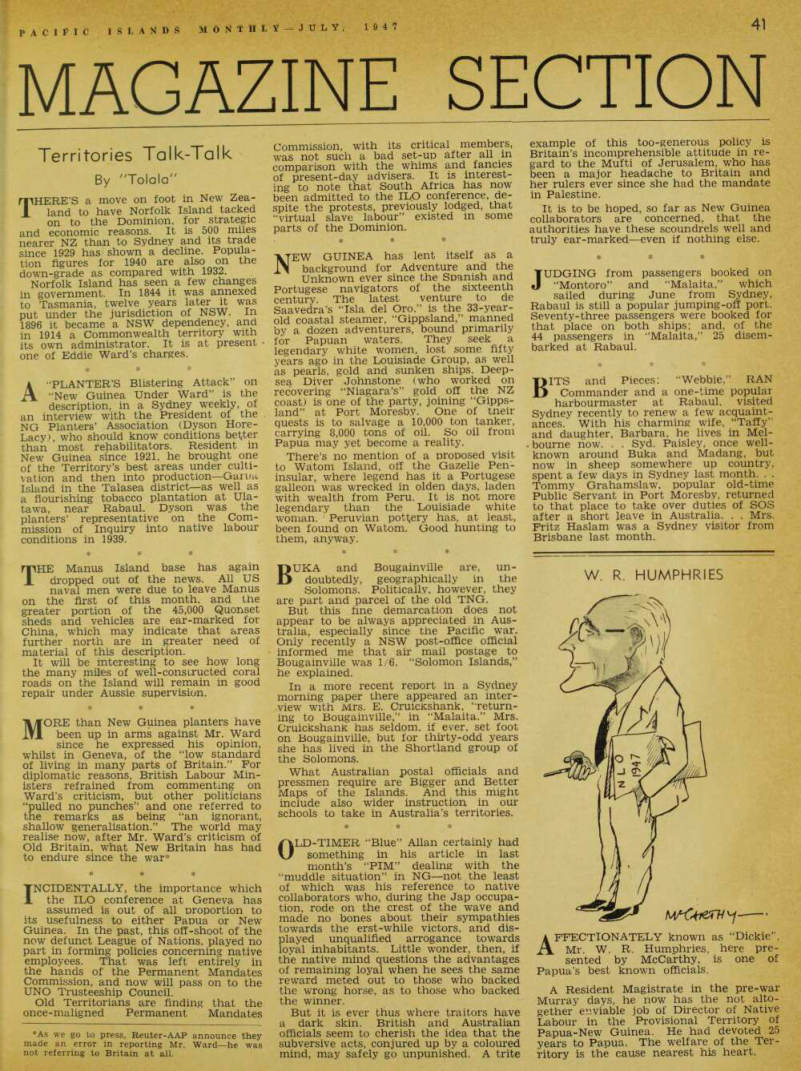
Territories Talk-Talk
By "Tolala"
THERE’S a move on foot in New Zea land to have Norfolk Island tacked on to the Dominion, for strategic and economic reasons. It is 500 miles nearer NZ than to Sydney and its trade since 1929 has shown a decline. Popula tion figures for 1940 are also on the down-grade as compared with 1932.
Norfolk Island has seen a few changes in government. In 1844 it was annexed to Tasmania, twelve years later it was put under the jurisdiction of NSW. In 1896 it became a NSW dependency, and in 1914 a Commonwealth territory with its own administrator. It is at present • one of Eddie Ward’s charges. * * * A “PLANTER’S Blistering Attack” on “New Guinea Under Ward” is the description, in a Sydney weekly, of an interview with the President of the NG Planters’ Association (Dyson Hore- Lacy), who should know conditions better than most rehabilitators. Resident in New Guinea since 1921, he brought one of the Territory’s best areas under culti vation and then into production—Gama Island in the Talasea district—as well as a flourishing tobacco plantation at Ula tawa, near Rabaul. Dyson was the planters’ representative on the Com mission of Inquiry into native labour conditions in 1939. * * * THE Manus Island base has again dropped out of the news. All US naval men were due to leave Manus on the first of this month, and the greater portion of the 45,000 Quonset sheds and vehicles are ear-marked for China, which may indicate that areas further north are in greater need of material of this description.
It will be interesting to see how long the many miles of well-conscructed coral roads on the Island will remain in good repair under Aussie supervision. * * * MORE than New Guinea planters have been up in arms against Mr. Ward since he expressed his opinion, whilst in Geneva, of the “low standard of living in many parts of Britain.” For diplomatic reasons, British Labour Min isters refrained from commenting on Ward’s criticism, but other politicians “pulled no punches” and one referred to the remarks as being “an ignorant, shallow generalisation.” The world may realise now, after Mr. Ward’s criticism of Old Britain, what New Britain has had to endure since the war* * ♦ * INCIDENTALLY, the importance which the ILO conference at Geneva has assumed is out of all proportion to its usefulness to either Papua or New Guinea. In the past, this off-shoot of the now defunct League of Nations, played no part in forming policies concerning native employees. That was left entirely in the hands of the Permanent Mandates Commission, and now will pass on to the UNO Trusteeship Council.
Old Territorians are finding that the once-maligned Permanent Mandates
Commission, with its critical members, was not such a bad set-up after all m comparison with the whims and fancies of present-day advisers. It is interest ing to note that South Africa has now been admitted to the IL.O conference, de spite the protests, previously lodged, that “virtual slave labour” existed in some parts of the Dominion. * * * NEW GUINEA has lent itself as a background for Adventure and the Unknown ever since the Spanish and Portugese navigators of the sixteenth century. The latest venture to de Saavedra’s “Isla del Oro.” is the 33-year old coastal steamer, “Gippsland,” manned by a dozen adventurers, bound primarily for Papuan waters. They seek a legendary white women, lost some fifty years ago in the Louisiade Group, as well as pearls, gold and sunken ships. Deep sea Diver Johnstone (who worked on recovering “Niagara’s” gold off the NZ coast) is one of the party, joining “Gipps land” at Port Moresby. One of tneir quests is to salvage a 10,000 ton tanker, carrying 8,000 tons of oil. So oil from Papua may yet become a reality.
There’s no mention of a proposed visit to Watom Island, off the Gazelle Pen insular, where legend has it a Portugese galleon was wrecked in olden days, laden with wealth from Peru. It is not more legendary than the Louisiade white woman. Peruvian pottery has, at least, been found on Watom. Good hunting to them, anyway. * ♦ ♦ BUKA and Bougainville are. un doubtedly, geographically in the Solomons. Politically, however, they are part and parcel of the old TNG.
But this fine demarcation does not appear to be always appreciated in Aus tralia, especially since the Pacific war.
Only recently a NSW post-office official informed me that air mail postage to Bougainville was 1/6. “Solomon Islands,” he explained.
In a more recent report in a Sydney morning paper there appeared an inter view with Mrs. E. Cruickshank. “return ing to Bougainville,” in “Malaita.” Mrs.
Cruickshank has seldom, if ever, set foot on Bougainville, but for thirty-odd years she has lived in the Shortland group of the Solomons.
What Australian postal officials and pressmen require are Bigger and Better Maps of the Islands. And this might include also wider instruction in our schools to take in Australia’s territories. * * * OLD-TIMER “Blue” Allan certainly had something in his article in last month’s “PIM” dealing with the “muddle situation” in NG—not the least of which was his reference to native collaborators who, during the Jap occupa tion, rode on the crest of the wave and made no bones about their sympathies towards the erst-while victors, and dis played unqualified arrogance towards loyal inhabitants. Little wonder, then, if the native mind questions the advantages of remaining loyal when he sees the same reward meted out to those who backed the wrong horse, as to those who backed the winner.
But it is ever thus where traitors have a dark skin. British and Australian officials seem to cherish the idea that the subversive acts, conjured up by a coloured mind, may safely go unpunished. A trite
example of this too-generous policy is Britain’s incomprehensible attitude in re gard to the Mufti of Jerusalem, who has been a major headache to Britain and her rulers ever since she had the mandate in Palestine.
It is to be hoped, so far as New Guinea collaborators are concerned, that the authorities have these scoundrels well and truly ear-marked —even if nothing else. ♦ ♦ * JUDGING from passengers booked on “Montoro” and “Malaita,” which sailed during June from Sydney, Rabaul is still a popular jumping-off port.
Seventy-three passengers were booked for that place on both ships; and, of the 44 passengers in “Malaita,” 25 disem barked at Rabaul. * * * BITS and Pieces: “Webbie,” RAN Commander and a one-time popular harbourmaster at Rabaul. visited Sydney recently to renew a few acquaint ances/ With his charming wife, “Taffy" and daughter, Barbara, he lives in Mel , bourne now. . . Syd. Paisley, once well known around Buka and Madang, but now in sheep somewhere up country, spent a few days in Sydney last month. . .
Tommy Grahamslaw, popular old-time Public Servant in Port Moresby, returned to that place to take over duties of SOS after a short leave in Australia. . . Mrs.
Fritz Haslam was a Sydney visitor from Brisbane last month.
*As we go to press, Reuter-AAP announce they made an error in reporting Mr. Ward —he was not referring to Britain at all.
W. R. Humphries
A Resident Magistrate in the pre-war Murray days, he now has the not alto gether enviable job of Director of Native Labour in the Provisional Territory of Papua-New Guinea. He had devoted 25 years to Paoua. The welfare of the Ter ritory is the cause nearest his heart.
Affectionately known as “Dickie”, Mr. W. R. Humphries, here pre sented by McCarthy, is one of Papua’s best known officials.
Of Cousin, and Fiji-English
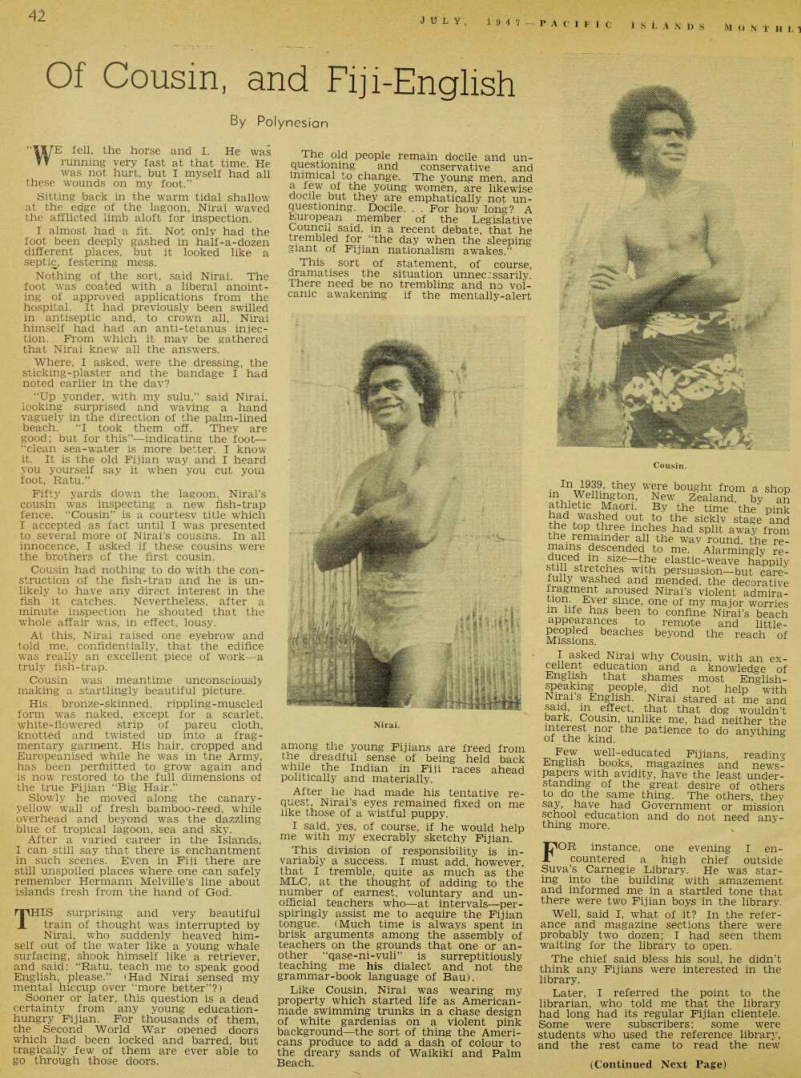
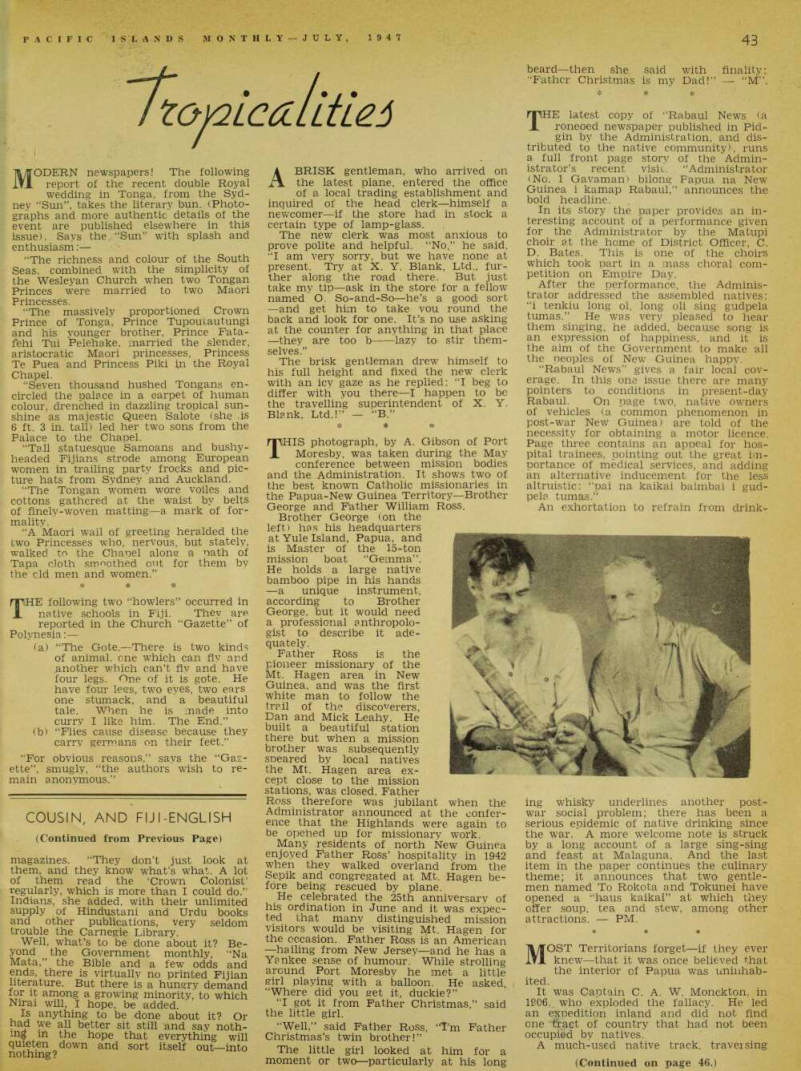
By Polynesian
WE fell, the horse and I, He was running very fast at that time. He was not hurt, but I myself had all these wounds on my foot.”
Sitting back in the warm tidal shallow at the edge of the lagoon, Nirai waved the afflicted limb aloft for inspection.
I almost had a fit. Not only had the foot been deeply gashed in half-a-dozen different places, but it looked like a septic, festering mess.
Nothing of the sort, said Nirai. The foot was coated with a liberal anoint ing of approved applications from the hospital. It had previously been swilled in antiseptic and, to crown all, Nirai himself had had an anti-tetanus injec tion. From which it mav be gathered that Nirai knew all the answers.
Where, I asked, were the dressing, the sticking-plaster and the bandage I had noted earlier in the day?
“Up yonder, with my sulu,” said Nirai, looking surprised and waving a hand vaguely in the direction of the palm-lined beach. “I took them off. They are good; but for this”—indicating the foot — “clean sea-water is more better. I know it. It is the old Fijian way and I heard you yourself say it when you cut youi foot, Ratu.”
Fifty yards down the lagoon, Nirai’s cousin was inspecting a new fish-trap fence. “Cousin” is a courtesy title which I accepted as fact until I was presented to several more of Nirai’s cousins. In all innocence, I asked if these cousins were the brothers of the first cousin.
Cousin had nothing to do with the con struction of the fish-tran and he is un likely to have any direct interest in the fish it catches. Nevertheless, after a minute inspection he shouted that the whole affair was, in effect, lousy.
At this, Nirai raised one eyebrow and told me, confidentially, that the edifice was really an excellent piece of work —a truly fish-trap.
Cousin was meantime unconsciously making a startlingly beautiful picture.
His bronze-skinned, rippling-muscled form was naked, except for a scarlet, white-flowered strip of pareu cloth, knotted and twisted up into a frag mentary garment. His hair, cropped and Europeanised while he was in the Army, has been perfnitted to grow again and is now restored to the full dimensions of the true Fijian “Big Hair.”
Slowly he moved along the canary yellow wall of fresh bamboo-reed, while overhead and beyond was the dazzling blue of tropical lagoon, sea and sky.
After a varied career in the Islands, I can still say that there is enchantment in such scenes. Even in Fiji there are still unspoiled places where one can safely remember Hermann Melville’s line about islands fresh from the hand of God.
THIS surprising and very beautiful train of thought was interrupted by Nirai, who suddenly heaved him self out of the water like a young whale surfacing, shook himself like a retriever, and said: “Ratu, teach me to speak good English, please.” (Had Nirai sensed my mental hiccup over “more better”?) Sooner or later, this question is a dead certainty from any young education hungry Fijian. For thousands of them, the Second World War opened doors which had been locked and barred, but tragically few of them are ever able to go through those doors.
The old people remain docile and un questioning and conservative and inimical to change. The young men. and a few of the young women, are likewise docile but they are emphatically not un questioning. Docile. . . For how long? A European member of the Legislative Council said, in a recent debate, that he trembled for “the day when the sleeping giant of Fijian nationalism awakes.”
This sort of statement, of course, dramatises the situation unnecessarily.
There need be no trembling and no vol canic awakening if the mentally-alert
among the young Fijians are freed from the dreadful sense of being held back while the Indian in Fiji races ahead politically and materially.
After he had made his tentative re quest, Nirai’s eyes remained fixed on me like those of a wistful puppy.
I said, yes, of course, if he would help me with my execrably sketchy Fijian.
This division of responsibility is in variably a success. I must add. however, that I tremble, quite as much as the MLC, at the thought of adding to the number of earnest, voluntary and un official teachers who—at intervals—per spiringly assist me to acquire the Fijian tongue. (Much time is always spent in brisk arguments among the assembly of teachers on the grounds that one or an other “qase-ni-vuli” is surreptitiously teaching me his dialect and not the grammar-book language of Bau).
Like Cousin, Nirai was wearing my property which started life as American made swimming trunks in a chase design of white gardenias on a violent pink background—the sort of thing the Ameri cans produce to add a dash of colour to the dreary sands of Waikiki and Palm Beach.
in 1 wo?r’ t ? ey w^ T re bou ght from a shop 1 W ellmgt ° n , New Zealand, by an athletic Maori. By the time the pink had washed out to the sickly stage and the top three inches had split away from the remainder all the wav round, the re mains descended to me. Alarmingly re huoed in size—the elastic-weave happily still stretches with persuasion—but care fully washed and mended, the decorative iragment aroused Nirai’s violent admira- Uon Ever since, one of my major worries m life has been to confine Nirai’s beach appearances to remote and little peopled beaches beyond the reach of Missions.
I asked Nirai why Cousin, with an ex cellent education and a knowledge of English that shames most English speaking people, did not help with Nirai s English. Nirai stared at me and said, m effect, that that dog wouldn’t bark. Cousin, unlike me, had neither the nor patience to do anything of the kind.
Few well-educated Fijians, reading English books, magazines and news papers with avidity, have the least under standing of the great desire of others to do the same thing. The others, they say, have had Government or mission school education and do not need any thing more.
FOR instance, one evening I en countered a high chief outside Suva’s Carnegie Library. He was star ing into the building with amazement and informed me in a startled tone that there were two Fijian boys in the library.
Well, said I, what of it? In the refer ance and magazine sections there were probably two dozen; I had seen them waiting for the library to open.
The chief said bless his soul, he didn’t think any Fijians were interested in the library.
Later, I referred the point to the librarian, who told me that the library had long had its regular Fijian clientele.
Some were subscribers: some were students who used the reference library, and the rest came to read the new
(Continued Next Page)
Nirai.
Cousin.
magazines. “They don’t just look at them, and they know what’s what. A lot of them read the ‘Crown Colonist’ regularly, which is more than I could do.’’
Indians, she added, with their unlimited supply of Hindustani and Urdu books and other publications, very seldom trouble the Carnegie Library.
Well, what’s to be done about it? Be yond the Government monthly, “Na Mata,” the Bible and a few odds and ends, there is virtually no printed Fijian literature. But there is a hungry demand for it among a growing minority, to which Nirai will, I hope, be added.
Is anything to be done about it? Or had we all better sit still and say noth ing in the hope that everything will quieten down and sort itself out— into nothing?
Advertisements & other items, p. 44 (1 item)
42
JULY, iD4 7 - PACIFIC ISLANDS MONT M L 1
Tropicalities
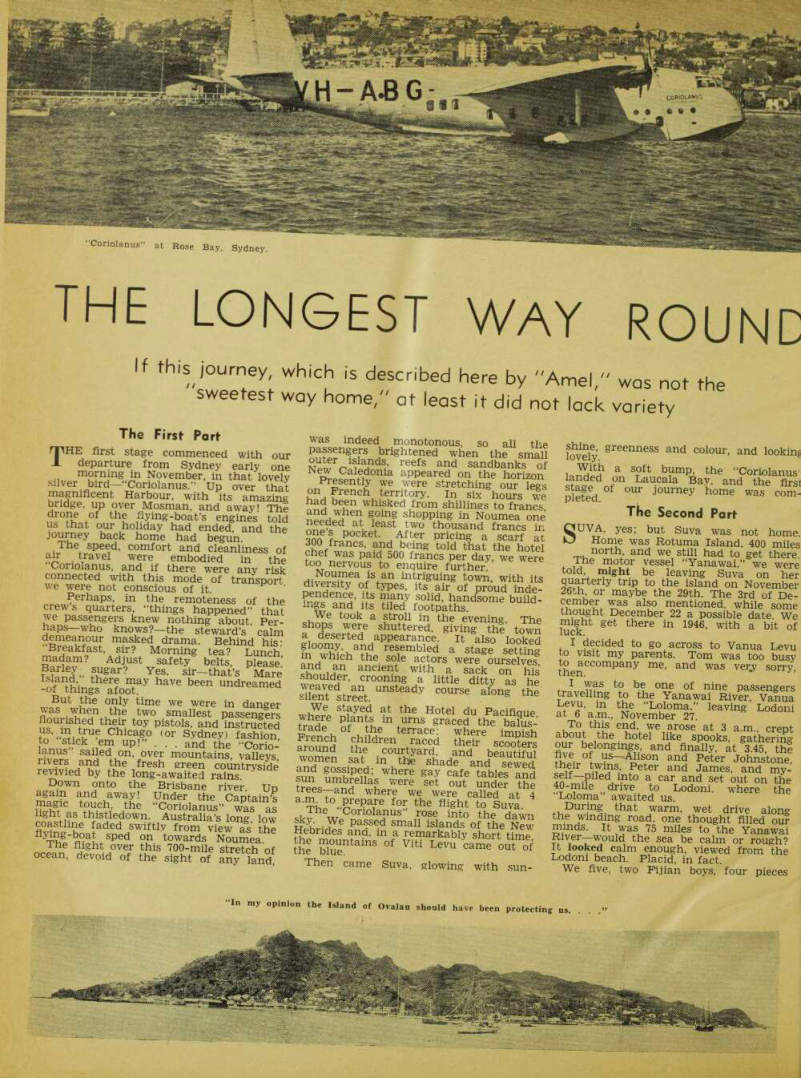
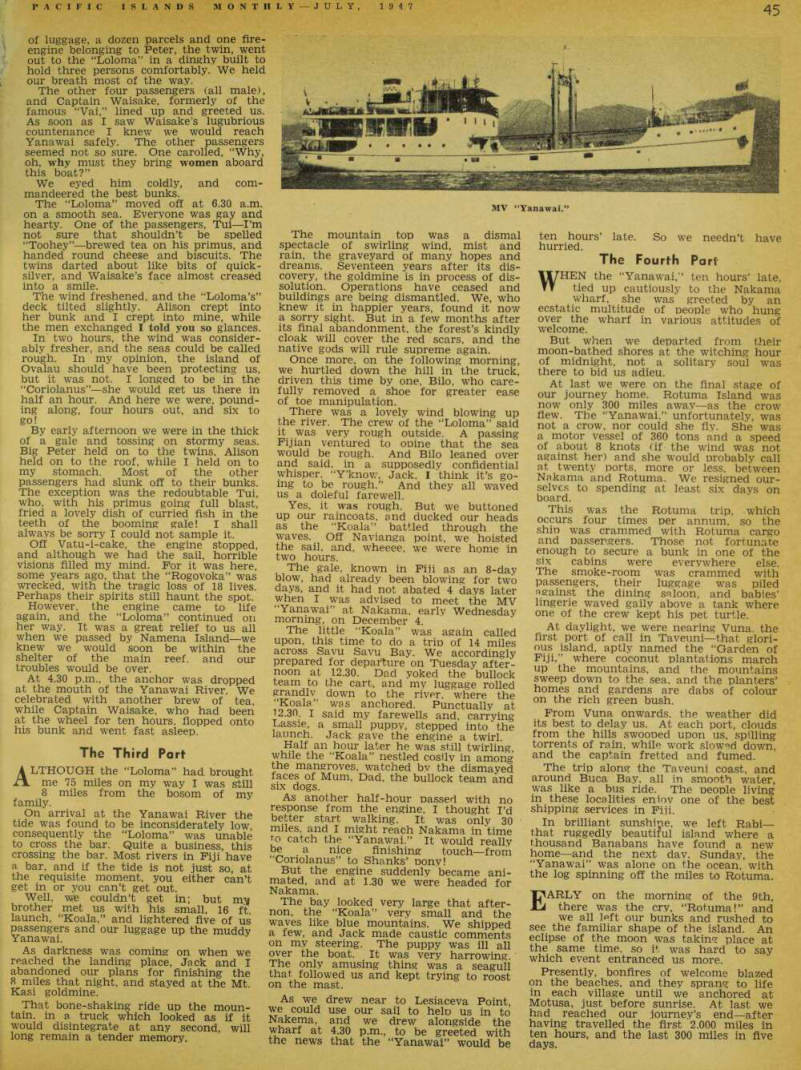
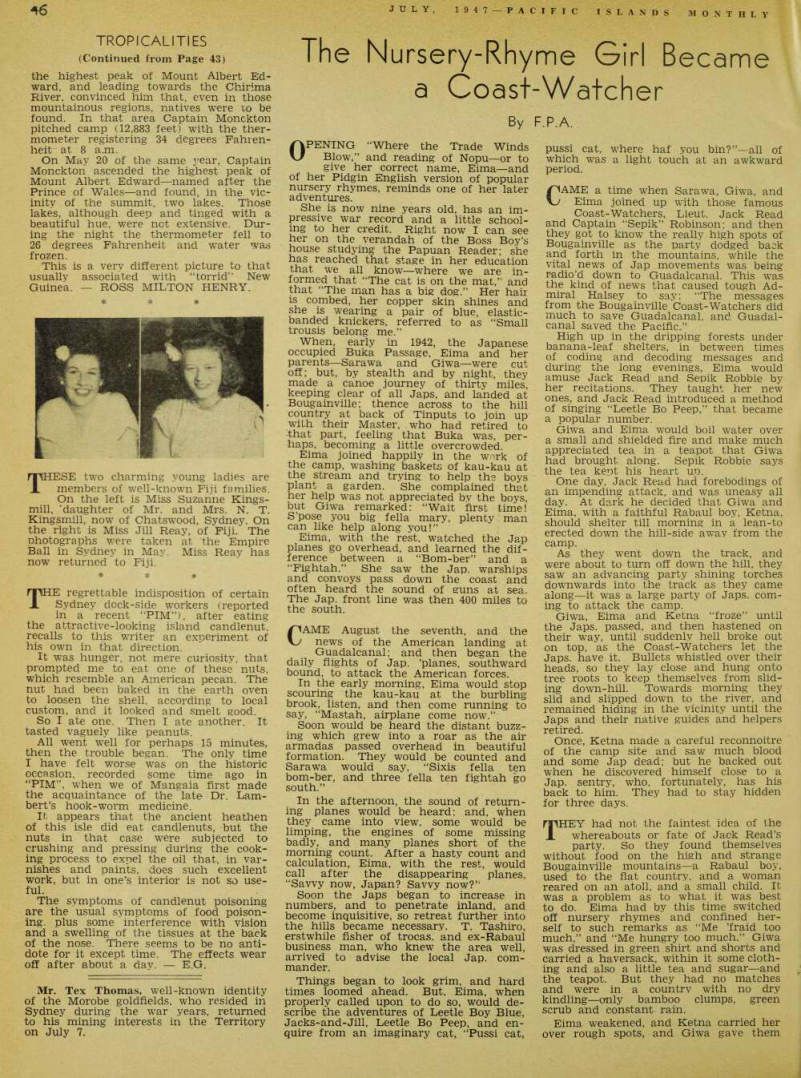
MODERN newspapers! The following report of the recent double Royal wedding in Tonga, from the Syd ney “Sun”, takes the literary bun. (Photo graphs and more authentic details of the event are published elsewhere in this issue). Says the, “Sun” with splash and enthusiasm: — “The richness and colour of the South Seas, combined with the simplicity of the Wesleyan Church when two Tongan Princes were married to two Maori Princesses.
“The massively proportioned Crown Prince of Tonga, Prince Tupoutautungi and his younger brother, Prince Fata fehi Tui Pelehake, married the slender, aristocratic Maori princesses, Princess Te Puea and Princess Piki in the Royal Chapel.
“Seven thousand hushed Tongans en circled the palace in a carpet of human colour, drenched in dazzling tropical sun shine as majestic Queen Salote (she is 6 ft. 3 in. tall) led her two sons from the Palace to the Chapel.
“Tall statuesque Samoans and bushy headed Fijians strode among European women in trailing party frocks and pic ture hats from Sydney and Auckland.
“The Tongan women wore voiles and cottons gathered at the waist by belts of finely-woven matting—a mark of for mality.
“A Maori wail of greeting heralded the two Princesses who, nervous, but stately, walked to the Chanel along a path of Tapa cloth smoothed out for them by the cld men and women.” * * * THE following two “howlers” occurred in native schools in Fiji. They are reported in the Church “Gazette” of Polynesia:— (a) “The Gote. —There is two kinds of animal, one which can fly and .another which can’t flv and have four legs. One of it is gote. He have four legs, two eyes, two ears one stumack, and a beautiful tale. When he is made into curry I like him. The End.” (b) “Flies cause disease because they carry germans on their feet,”
“For obvious reasons,” says the “Gaz ette”, smugly, “the authors wish to re main anonymous.”
A BRISK gentleman, who arrived on the latest plane, entered the office of a local trading establishment and inquired of the head clerk —himself a newcomer—if the store had in stock a certain type of lamp-glass.
The new clerk was most anxious to prove polite and helpful. “No,” he said, “I am very sorry, but we have none at present. Try at X. Y. Blank, Ltd., fur ther along the road there. But just take my tip—ask in the store for a fellow named O. So-and-So —he’s a good! sort —and get him to take vou round the back and look for one. It’s no use asking at the counter for anything in that place —they are too b lazy to stir them selves.”
The brisk gentleman drew himself to his full height and fixed the new clerk with an icy gaze as he replied: “I beg to differ with you there —I happen to be the travelling superintendent of X. Y.
Blank, Ltd.!” “B.” * * * THIS photograph, by A. Gibson of Port Moresby, was taken during the May conference between mission bodies and the Administration. It shows two of the best known Catholic missionaries in the Papua-New Guinea Territory—Brother George and Father William Ross.
Brother George (on the left) has his headquarters at Yule Island, Papua, and is Master of the 15-ton mission boat “Gemma”.
He holds a large native bamboo pipe in his hands —a unique instrument, according to Brother George, but it would need a professional anthropolo gist to describe it ade quately.
Father Ross is the pioneer missionary of the Mt. Hagen area in New Guinea, and was the first white man to follow the trail of the discoverers, Dan and Mick Leahy. He built a beautiful station there but when a mission brother was subsequently sneared by local natives the Mt. Hagen area ex cept close to the mission
stations, was closed. Father Ross therefore was jubilant when the Administrator announced at the confer ence that the Highlands were again to be opened up for missionary work.
Many residents of north New Guinea enjoyed Father Ross’ hospitality in 1942 when they walked overland from the Sepik and congregated at Mt. Hagen be fore being rescued by plane.
He celebrated the 25th anniversary of his ordination in June and it was expec ted that many distinguished mission visitors would be visiting Mt. Hagen for the occasion. Father Ross is an American —hailing from New Jersey—and he has a Yankee sense of humour. While strolling around Port Moresby he met a little girl playing with a balloon. He asked, “Where did you get it, duckie?”
“I got it from Father Christmas,” said the little girl.
“Well,” said Father Ross, “I’m Father Christmas’s twin brother!”
The little girl looked at him for a moment or two —particularly at his long
beard—then she said with finality; “Father Christmas is my Dad!” “M”. * * * THE latest copy of “Rabaul News (a roneoed newspaper published in Pid gin by the Administration, and dis tributed to the native community), runs a full front page story of the Admin istrator’s recent visit. “Administrator (No. 1 Gavaman) bilong Papua na New Guinea i kamap Rabaul,” announces the bold headline.
In its story the paper provides an in teresting account of a performance given for the Administrator by the Matupi choir at the home of District Officer, C.
D. Bates. This is one of the choirs which took part in a mass choral com petition on Empire Day.
After the performance, the Adminis trator addressed the assembled natives: “i tenkiu long 01, long oli sing gudpela tumas.” He was very pleased to hear them singing, he added, because song is an expression of happiness, and it is the aim of the Government to make all the peoples of New Guinea happy.
“Rabaul News” gives a fair local cov erage. In this one issue there are many pointers to conditions in present-day Rabaul. On page two, native owners of vehicles (a common phenomenon in post-war New Guinea) are told of the necessity for obtaining a motor licence.
Page three contains an apneal for hos pital trainees, pointing out the great im portance of medical services, and adding an alternative inducement for the less altruistic: “pai na kaikai baimbai i gud pela tumas.”
An exhortation to refrain from drink-
ing whisky underlines another post war social problem; there has been a serious epidemic of native drinking since the war. A more welcome note is struck by a long account of a large sing-sing and feast at Malaguna. And the last item in the paper continues the culinary theme; it announces that two gentle men named To Rokota and Tokunei have opened a “haus kaikai” at which they offer soup, tea and stew, among other attractions. PM. * ♦ ♦ MOST Territorians forget—if they ever knew —that it was once believed that the interior of Papua was uninhab ited.
It was Captain C. A. W. Monckton, in 1906, who exploded the fallacy. He led an expedition inland and did not find one ‘tract of country that had not been occupied by natives.
A much-used native track, travel sing
(Continued on page 46.)
the highest peak of Mount Albert Ed ward. and leading towards the Chirima River, convinced him that, even in those mountainous regions, natives were to be found. In that area Captain Monckton pitched camp (12,883 feet) with the ther mometer registering 34 degrees Fahren heit at 8 a.m.
On May 20 of the same year, Captain Monckton ascended the highest peak of Mount Albert Edward —named after the Prince of Wales —and found, in the vic inity of the summit, two lakes. Those lakes, although deep and tinged with a beautiful hue, were not extensive. Dur ing the night the thermometer fell to 26 degrees Fahrenheit and water was frozen.
This is a very different picture to that usually associated with “torrid” New
Guinea. Ross Milton Henry.
rESE two charming young ladies are members of well-known Fiji families.
On the left is Miss Suzanne Kings mill, ‘daughter of Mr. and Mrs. N. T.
Kingsmill, now of Chatswood, Sydney. On the right is Miss Jill Reay, of Fiji. The photographs were taken at the Empire Ball in Sydney in May. Miss Reav has now returned to Fiji. ♦ ♦ * r E regrettable indisposition of certain Sydney dock-side workers (reported in a recent “PIM”), after eating the attractive-looking island candlenut. recalls to this writer an exoeriment of his own in that direction.
It was hunger, not mere curiosity, that prompted me to eat one of these nuts, which resemble an American pecan. The nut had been baked in the earth oven to loosen the shell, according to local custom, and it looked and smelt good.
So I ate one. Then I ate another. It tasted vaguely like peanuts.
All went well for perhaps 15 minutes, then the trouble began. The only time I have felt worse was on the historic occasion, recorded some time ago in “PIM”, when we of Mangaia first made the acquaintance of the late- Dr. Lam bert’s hook-worm medicine.
It appears that the ancient heathen of this isle did eat candlenuts, but the nuts in that case were subjected to crushing and pressing during the cook ing process to expel the oil that, in var nishes and paints, does such excellent work, but in one’s interior is not so use ful.
The symptoms of candlenut poisoning are the usual symptoms of food poison ing. plus some interference with vision and a swelling of the tissues at the back of the nose. There seems to be no anti dote for it except time. The effects wear off after about a day. E.G.
Mr. Tex Thomas, well-known identity of the Morobe goldfields, who resided in Sydney during the war years, returned to his mining interests in the Territory on July 7.
Advertisements & other items, p. 45 (1 item)
43
PACIFIC ISLANDS MONTHLY JULY, 1947
COUSIN, AND FIJI -ENGLISH
(Continued from Previous Page)
The Longest Way Round
If this_ journey, which is described here by "Ansel," wcs not the sweetest way home/' at least it did not lack variety
The First Part THE first stage commenced with our departure from Sydney early one morning in November, in that lovely silver bird—“ Coriolanus.” Up over that magnificent Harbour, with its amazing bridge, up over Mosman, and away! The drone of the flying-boat’s engines told us that our holiday had ended, and the journey back home had begun . The + s P e( ; d > comfort and cleanliness of air travel were embodied in the Coriolanus, and if there were any risk connected with this mode of transport we were not conscious of it. P Perhaps, in the remoteness of the crews quarters, “things happened” that we passengers knew nothing about. Per haps—who knows?—the steward’s calm d^i a w OU f masked drama. Behind his: Breakfast, sir? Morning tea? Lunch Adjust safety belts, please.’ ?_Fjf y sugar? Yes. sir—that’s Mare things e afoSt aV aVe been undreamed But the only time we were in danger was when the two smallest passenglrs n? U i*iwv d toy P istols > and instructed us, m true Chicago (or Sydney) fashion farmc» ICk i 6 *? up! ” •• • and the “Corio lanus sailed on, over mountains, vallevs rivers and the fresh green coVtrS revivied by the long-awaited rains.
Down onto the Brisbane river Un egain and away! Under the Captain’s ffucK’i 116 “Coriolanus” was a? light as thistledown. Australia’s long low aded . swiftly from view as ’ the L sped ?£. towards Noumea, °ver this 700-mile stretch of ocean, devoid of the sight of any land,
was indeed monotonous, so all the passengers brightened when the small reefs and sand banks of N^p?al f! donia a PP eared on the horizon Presently we were stretching our legs on French territory, in six hours we «nH whlsked from shillings to francs, neod^ h « t m f s , h in Noumea one ™«v. ed ast two thousand francs in 2|Sf ? r po „ cket - , 4 ft . er Pricing a scarf at ’ being told that the hotel chef was paid 500 francs per day, we were too nervous to enquire further Noumea is an intriguing town, with its diversity of types, its air of proud inde ?n?<? V\ any soli d, handsome build mgs and its tiled footpaths. took a Scroll in evening. The « h ri P iLT^ e shutter ed. giving the town a deserted appearance, it also looked fn°w?i?ph a t 1 h re^ embl f d a stage setting in u hich the sole actors were ourselves a .V d , ancient with a sack on his' shoulder, crooning a little ditty as he unsteady course alon S the We stayed at the Hotel du Pacificue J*?ere P l an Jl in , urns graced the ba?us trade of the terrace: where imnish around thi ldren f rac^ d their scooters around the courtyard, and beautiful women sat in the shade and sewed and gossiped; where gay cafe tables and sun umbrellas were set out unde? the n r m S 7^ and wher we we re called at 4 TiJ ‘£ r6l?a i re for the flight t 0 Suva. .w he w Coriolanus rose into the dawn HPhrinX 6 pa J s ® d sma H islands of the New Hebrides and, in a remarkably short time the biue 11^1118 ° f Levu came out of Then came Suva, glowing with sun
lOTdy greetmess and colour, and looking , W*/ 1 a “It bump, the “Coriolanus' landed on Laucala Bav. and the first pitted ° f ° Ur journey home was com-
The Second Part
SUVA, yes; but Suva was not home.
Home was Rotuma Island. 400 miles north and we still had to get there.
The motor vessel “Yanawai,” we were told might be leaving Suva on her trip to the isl an d on November 26th or maybe the 29th. The 3rd of De cember was also mentioned, while some thought December 22 a possible date. We -|ht get there in 1946, with a bit of I decided to go across to Vanua Levu to visit my parents. Tom was too busy then CC ° mPany m6 ’ and WaS ver * y sorr y, I was to be one of nine passengers travelling to the Yanawai River, Vanua Levu, in the “Loloma.” leaving Lodoni at 6 a.m., November 27.
Jo this end we arose at 3 a.m., crept about the hotel like spooks, gathering our belongings, and finally, at 3.45, thl °* V s —-ALson and Peter Johnstone, twins, Peter and James, and my into a car and set out on the 40-mUe drive to Lodoni. where the Loloma awaited us.
During that warm, wet drive along the winding road, one thought filled our minds. It was 75 miles to the Yanawai River—would the sea be calm or rough?
It looked calm enough, viewed from the Lodoni beach. Placid, in fact.
We five, two Fijian boys, four pieces
“Coriolanus” at Rose Bay, Sydney.
“In my opinion the Island of Ovalau should have been protecting us. ..."
of luggage, a dozen parcels and one fire engine belonging to Peter, the twin, went out to the “Loloma” in a dinghy built to hold three persons comfortably. We held our breath most of the way.
The other four passengers (all male), and Captain Waisake. formerly of the famous “Vai,” lined up and greeted us.
As soon as I saw Waisake’s lugubrious countenance I knew we would reach Yanawai safely. The other passengers seemed not so sure. One carolled, “Why, oh, why must they bring women aboard this boat?”
We eyed him coldly, and com mandeered the best bunks.
The “Loloma” moved off at 6.30 a.m. on a smooth sea. Everyone was gay and hearty. One of the passengers, Tui —I’m not sure that shouldn’t be spelled “Toohey”—brewed tea on his primus, and handed round cheese and biscuits. The twins darted about like bits of quick silver, and Waisake’s face almost creased into a smile.
The wind freshened, and the “Loloma’s” deck tilted slightly. Alison crept into her bunk and I crept into mine, while the men exchanged I told you so glances.
In two hours, the wind was consider ably fresher, and the seas could be called rough. In my opinion, the island of Ovalau should have been protecting us, but it was not. I longed to be in the “Coriolanus” —she would get us there in half an hour. And here we were, pound ing along, four hours out, and six to go!
By early afternoon we were in the thick of a gale and tossing on stormy seas.
Big Peter held on to the twins. Alison held on to the roof, while I held on to my stomach. Most of the other passengers had slunk off to their bunks.
The exception was the redoubtable Tui, who, with his primus going full blast, fried a lovely dish of curried fish in the teeth of the booming gale! I shall always be sorry I could not sample it.
Off Vatu-i-cake, the engine stopped, and although we had the sail, horrible visions filled my mind. For it was here, some years ago, that the “Rogovoka” was wrecked, with the tragic loss of 18 lives.
Perhaps their spirits still haunt the spot.
However, the engine came to life again, and the “Loloma” continued on her way. It was a great relief to us all when we passed by Namena Island—we knew we would soon be within the shelter of the main reef, and our troubles would be over.
At 4.30 p.m., the anchor was dropped at the mouth of the Yanawai River. We celebrated with another brew of tea, while Captain Waisake. who had been at the wheel for ten hours, flopped onto his bunk and went fast asleep.
The Third Fort
ALTHOUGH the “Loloma” had brought me 75 miles on my way I was still 8 miles from the bosom of my family.
On arrival at the Yanawai River the tide was found to be inconsiderately low consequently the “Loloma” was unable to cross the bar. Quite a business, this crossing the bar. Most rivers in Fiji have a bar, and if the tide is not just so, at the requisite moment, you either can’t get in or you can’t get out.
Well, wje couldn’t get in; but my brother met us with his small, 16 ft. launch, “Koala,” and lightered five of us passengers and our luggage up the muddy Yanawai.
As darkness was coming on when we reached the landing place, Jack and I abandoned our plans for finishing the 8 miles that night, and stayed at the Mt.
Kasi goldmine.
That bone-shaking ride up the moun tain. in a truck which looked as if it would disintegrate at any second, will long remain a tender memory.
The mountain top was a dismal spectacle of swirling wind, mist and rain, the graveyard of many hopes and dreams. Seventeen years after its dis covery, the goldmine is in process of dis solution. Operations have ceased and buildings are being dismantled. We, who knew it in happier years, found it now a sorry sight. But in a few months after its final abandonment, the forest’s kindly cloak will cover the red scars, and the native gods will rule supreme again.
Once more, on the following morning, we hurtled down the hill in the truck, driven this time by one, Bilo, who care fully removed a shoe for greater ease of toe manipulation.
There was a lovely wind blowing up the river. The crew of the “Loloma” said it was very rough outside. A passing Fijian ventured to opine that the sea would be rough. And Bilo leaned over and said, in a supposedly confidential whisper. “Y’know, Jack. I think it’s go ing to be rough/’ And they all waved us a doleful farewell.
Yes, it was rough. But we buttoned up our raincoats, and ducked our heads as the “Koala” battled through the waves. Off Navianga point, we hoisted the sail, and, wheeee, we were home in two hours.
The gale, known in Fiji as an 8-day blow, had already been blowing for two days, and it had not abated 4 days later when I was advised to meet the MV “Yanawai” at Nakama, early Wednesday morning, on December 4.
The little “Koala” was again called upon, this time to do a trio of 14 miles across Savu Savu Bay. We accordingly prepared for departure on Tuesday after noon at 12.30. Dad yoked the bullock team to the cart, and my luggage rolled grandlv down to the river, where the “Koala” was anchored. Punctually at 12.30. I said my farewells and. carrying Lassie, a small puppy, stepped into the launch. Jack gave the engine a twirl.
Half an hour later he was still twirling, while the “Koala” nestled cosily in among the mangroves, watched bv the dismayed faces of Mum, Dad, the bullock team and six dogs.
As another half-hour passed with no response from the engine, I thought I’d better start walking. It was only 30 miles, and I might reach Nakama in time to catch the “Yanawai.” It would really be a nice finishing touch—from Conolanus” to Shanks’ pony!
But the engine suddenly became ani mated, and at 1.30 we were headed for Nakama.
The bay looked very large that after non, the “Koala” very small and the waves like blue mountains. We shipped a few, and Jack made caustic comments on my steering. The puppy was ill all over the boat. It was very harrowing.
The only amusing thing was a seagull that followed us and kept trying to roost on the mast.
As we drew near to Lesiaceva Point, we could use our sail to help us in to Nakema, and we drew alongside the wharf at 4.30 p.m., to be greeted with the news that the “Yanawai” would be
ten hours’ late. So we needn’t have hurried.
The Fourth Part
WHEN the “Yanawai,” ten hours’ late, tied up cautiously to the Nakama wharf, she was greeted by an ecstatic multitude of people who hung over the wharf in various attitudes of welcome.
But when we departed from their moon-bathed shores at the witching hour of midnight, not a solitary soul was there to bid us adieu.
At last we were on the final stage of our journey home. Rotuma Island was now only 300 miles away-as the crow flew. The "Yanawai.” unfortunately, was not a crow, nor could she fly. She was a motor vessel of 360 tons and a speed of about 8 knots (if the wind was not against her) and she would probably call at twenty ports, more or less, between Nakama and Rotuma. We resigned our selves to spending at least six days on board.
This was the Rotuma trip, which occurs four times per annum, so the shin was crammed with Rotuma cargo and nassengers. Those not fortunate enough to secure a bunk in one of the six cabins were everywhere else.
The smoke-room was crammed with passengers, their luggage was piled against the dining saloon, and babies’ lingerie waved gaily above a tank where one of the crew kept his pet turtle.
At daylight, we were nearing Vuna. the first port of call in Taveuni—that glori ous island, aptly named the “Garden of Fiji,” where coconut plantations march up the mountains, and the mountains sweep down to the sea, and the planters’ homes and gardens are dabs of colour on the rich green bush.
From Vuna onwards, the weather did its best to delay us. At each port, clouds from the hills swooned upon us, spilling torrents of rain, while work slowed down, and the captain fretted and fumed.
The trip along the Taveuni coast, and around Buca Bay. all in smooth water, was like a bus ride. The people living in these localities eniov one of the best shipping services in Fiji.
In brilliant sunshine, we left Rabi— that ruggedly beautiful island where a thousand Banabans have found a new home—and the next dav. Sunday, the “Yanawai” was alone on the ocean, with the log spinning off the miles to Rotuma.
EARLY on the morning of the 9th, there was the cry, “Rotuma!” and we all left our bunks and rushed to see the familiar shape of the island. An eclipse of the moon was taking place at the same time, so it was hard to say which event entranced us more.
Presently, bonfires of welcome blazed on the beaches, and they sprang to life in each village until we anchored at Motusa, just before sunrise. At last we had reached our journey’s end—after having travelled the first 2.000 miles in ten hours, and the last 300 miles in five days.
MV “Yanawai.”
a Coast-Watcher
The Nursery-Rhyme Girl Became a Coast-Watcher
By F.P.A.
OPENING “Where the Trade Winds Blow,” and reading of Nopu—or to give her correct name, Eima—and of her Pidgin English version of popular nursery rhymes, reminds one of her later adventures.
She is now nine years old, has an im pressive war record and a little school ing to her credit. Right now I can see her on the verandah of the Boss Boy’s house studying the Papuan Reader; she has reached that stage in her education that we all know—where we are in formed that “The cat is on the mat,” and that “The man has a big dog.” Her hair is combed, her copper skin shines and she is wearing a pair of blue, elastic banded knickers, referred to as “Small trousis belong me.”
When, early in 1942, the Japanese occupied Buka Passage, Eima and her parents—Sarawa and Giwa —were cut off; but, by stealth and by night, they made a canoe journey of thirty miles, keeping clear of all Japs, and landed at Bougainville: thence across to the hill country at back of Tinputs to join up with their Master, who had retired to that part, feeling that Buka was, per haps, becoming a little overcrowded.
Eima joined happily in the work of the camp, washing baskets of kau-kau at the stream and trying to help the boys plant a garden. She complained that her help was not appreciated bv the boys, but Giwa remarked: “Wait first time!
S’pose you big fella mary, plenty man can like help along you!”
Eima, with the rest, watched the Jap planes go overhead, and learned the dif ference between a “Bom-ber” and a “Fightah.” She saw the Jap. warships and convoys pass down the coast and often heard the sound of guns at sea.
The Jap. front line was then 400 miles to the south.
CAME August the seventh, and the news of the American landing at Guadalcanal: and then began the daily flights of Jap. ’planes, southward bound, to attack the American forces.
In the early morning, Eima would stop scouring the kau-kau at the burbling brook, listen, and then come running to say, “Mastah, airplane come now.”
Soon would be heard the distant buzz ing which grew into a roar as the air armadas passed overhead in beautiful formation. They would be counted and Sarawa would say, “Sixis fella ten bom-ber, and three fella ten fightah go south.”
In the afternoon, the sound of return ing planes would be heard; and, when they came into view, some would be limping, the engines of some missing badly, and many planes short of the morning count. After a hasty count and calculation, Eima, with the rest, would call after the disappearing planes, “Savvy now, Japan? Savvy now?”
Soon the Japs began to increase in numbers, and to penetrate inland, and become inquisitive, so retreat further into the hills became necessary. T. Tashiro, erstwhile fisher of trocas. and ex-Rabaul business man, who knew the area well, arrived to advise the local Jap. com mander.
Things began to look grim, and hard times loomed ahead. But. Eima, when properly called upon to do so, would de scribe the adventures of Beetle Boy Blue, Jacks-and-Jill, Beetle Bo Peep, and en quire from an imaginary cat, “Pussi cat,
pussi cat, where haf you bin?” —all of which was a light touch at an awkward period.
CAME a time when Sarawa, Giwa, and Eima joined up with those famous Coast-Watchers, Lieut. Jack Read and Captain “Sepik” Robinson; and then they got to know the really high spots of Bougainville as the party dodged back and forth in the mountains, while the vital news of Jap movements was being radio’d down to Guadalcanal. This was the kind of news that caused tough Ad miral Halsey to say: “The messages from the Bougainville Coast-Watchers did much to save Guadalcanal, and Guadal canal saved the Pacific.”
High up in the dripping forests under banana-leaf shelters, in between times of coding and decoding messages and during the long evenings, Eima would amuse Jack Read and Sepik Robbie by her recitations. They taught her new ones, and Jack Read introduced a method of singing “Beetle Bo Peep,” that became a popular number.
Giwa and Eima would boil water over a small and shielded fire and make much appreciated tea in a teapot that Giwa had brought along. Sepik Robbie says the tea kept his heart up.
One day, Jack Read had forebodings of an impending attack, and was uneasy all day. At dark he decided that Giwa and Eima, with a faithful Rabaul boy, Ketna, should shelter till morning in a lean-to erected down the hill-side away from the camp.
As they went down the track, and were about to turn off down the hill, they saw an advancing party shining torches downwards into the track as they came along—it was a large party of Japs, com ing to attack the camp.
Giwa, Eima and Ketna “froze” until the Japs, passed, and then hastened on their way, until suddenly hell broke out on top, as the Coast-Watchers let the Japs, have it. Bullets whistled over their heads, so they lay close and hung onto tree roots to keep themselves from slid ing down-hill. Towards morning they slid and slipped down to the river, and remained hiding in the vicinity until the Japs and their native guides and helpers retired.
Once, Ketna made a careful reconnoitre of the camp site and saw much blood and some Jap dead; but he backed out when he discovered himself close to a Jap. sentry, who, fortunately, has his back to him. They had to stay hidden for three days.
THEY had not the faintest idea of the whereabouts or fate of Jack Read’s party. So they found themselves without food on the high and strange Bougainville mountains —a Rabaul boy, used to the fiat country, and a woman reared on an atoll, and a small child. It was a problem as to what it was best to do. Eima had by this time switched off nursery rhymes and confined her self to such remarks as “Me ’fraid too much,” and “Me hungry too much.” Giwa was dressed in green shirt and shorts and carried a haversack, within it some cloth ing and also a little tea and sugar—and the teapot. But they had no matches and were in a country with no dry kindling—only bamboo clumps, green scrub and constant rain.
Eima weakened, and Ketna carried her over rough spots, and Giwa gave them
each a little sugar. They decided to head eastwards, and followed carefully some distance behind the retiring Jabs, pick ing up scraps of biscuit and cleaning out discarded pilchard tins, thrown away by the Japs.
In two days they reached a deserted village and scoured round for bananas and paw paws. They found some still live coals in one hut. so boiled the tea pot and had a cup of tea. Eima says, ‘That cup of tea veri, veri nice!” They rested up in that village.
On the sixth day, Sarawa found them; and, on the seventh day, they met up with Jack Read and Sepik Robbie, who had thought they had been either killed or captured. Jack and Robbie had been having a very tough few days, and were surprised and delighted when Giwa pro duced the now famous teapot, boiled it, and made tea from her precious stores.
So the party sat round and drank tea whilst they compared notes. Giwa laughs and says, “Master Read and Master Robbie happy too much, time two fella drink, becos two fella been die true along tea. Two fella talkim me. ‘You good gal! ’ ”
Eima recited some nursery rhymes; and, despite their recent experiences and future poor prospects, they felt satisfied about still being alive.
Ketna is now “a time-expired soldier man” and wears three ribbons.
QUITE a story could be written about how they eventually climbed the mountains again and made for the west coast, living on such scant native foods and bamboo shoots as they could gather and sleeping under leaf shelters at night in that wet and cold climate.
Finally tney came to a point on the west coast where they had a rendezvous with an American submarine.
They went off through the surf in a lubber boat to where the long, lean sub. lay waiting. They got quickly aboard and down in the mess room, were given hot coffee and food. Eima out down her piece of bread and hung onto Giwa, when the klaxon suddenly sounded, the loud speaker commanded, “Stand by to dive” and the sub. submerged steeply.
The Yank submariners thought Eima a real cute kid ’ and would gather in groups to hear about "Beetle Boy Blue* ltm ? ra pt Pussi Cat; “Little Bo Peep, sung m the Jack Read style, was a winner and, when the wandering sheep arrived home, “Bringing their tails be hm dem, Eima was lifted high into the iL? nd .pjen candy and dollar bills. her '' the 1U ’ ole Coas ‘ Transferred a few days later at a suh dn tn ht Sea mee ting” from the sub. to a fast patrol boat, the oartv p m l ed . at Guadalcanal. Soon Jack Read and Robbie went to Australia whifst lan a rhnTnf a i Eima went d ° wn t 0 ban Chnstoval to lay off and recuperate.
W™ LE th e British Solomons, t? Sarawa did Some work for the U.S Marines and New Zealand forces ?nHV>? Wed up dresses for the half-caste f£ d A Chln . ese residents, and Eima recited thpv^h? encans an , d New Ze alanders. So kt of berngin 0 g P s U and aCquired a fresh When the time came to return tn Bougainville, an American naval vessel H S} en L u .P and took them to Guadal- BnU s li authorities looked after them there; and the New Zealand aS hTnr [ ansp °o ted them and all their gear o Torokma. Sarawa’s best day was when S * spec ial parade at Torokina he wl? with some other scouts, presented bv Vlajor-General Bridgeford with the I Service Medal for good work done ° yal
AND now, as I watch, Eima has closed her Papuan Reader and is swinging her legs, while she sings the British Solomon Islands “pidgin English” war-time song: Japani want to simash ’im, every island Pacific!;
Amereeca simash ’im cap-i-tali To-ki-o. you look outa my friend, all man! klckl backi, Me laugh along you, Japan!, ha, ha! v,oT he sun shines brightly. She is wen'eontenf" 5 t 0 PUt in her hair and
Advertisements & other items, p. 48 (1 item)
46
Y , 1947 PACIFIC ISLANDS MONTHLY
TROPICALITIES
(Continued from Page 43)
The Confusion That We Bring
A Story in Rhyme by "Tolala"
I met a South Sea Island chief upon my way; one of the Old School— hed and grey—he had none of the adont th??p ng T yS ’ Which many chiefs adopt these modern days.
' 1 j S *J? ard for me> ” said he, “to under fanri 1 ? fh e manners of the people of your land, they say one thing, then do an that^hpv 11 !? ’• trouble and confusion that they bring to us, a simple, wild and lived-in U i h ° have these many years lived in this place; have had our gods and tilled the land and fought; have^lost and won; have feasted and have bought and buflt a nT? rd v! ng t 0 our ancient and built our houses open without doors: For wives and goods were in the past, secure. No thieving then the pen- T Wi ? h lnstant death Ito S h - lowly crimes as stealing wives and goods in olden times.
And then you people come with all 5“ not steal and n - 8ht ’ anc l not to interfere with £ e ,rf es : m fact, you tell us how to riJpm 11 - V S accordi ng to what vou may And then ; ‘These heathen folk must have the Light,’ vou sav and Tn en th?c U take ° ur gods awa y- One ’saysy ° U - must Dra y-’ Another says. That way is wholly wrong Our way is right; our God is verv strong th^flplb 1 a f no - her sa y s: ‘You may not eat ° r any other meat -’ And oo S ba t the oroper dav of rest is not as others say; that theirs is best Now wh!ch is right? What are we to belif ™ Do one and all of them trv to deceive us creed’ c*n ? n Wit V their whi teman’s they iead? n d ° OSe but follow where P*] e . ves us bread and wine to eat and drink - and calls it Flesh and Blood- V JLf an we thmk or do when the laws lay down we must not kill or eat our foes yet One upon a hill died for us everyone so we are told— we’re bid to eat of Him Wb °-c»^ aid: ® e hold this is my Bodv and Zv ?fip 6at ’ dri £ k! ’ This was so long ago , T have no link with memory. Now what are we to do? Which is the fakp one? Which one is the True?”
The chieftain paused and filled his nine to smoke. Sadly he smiled and then r g am he spoke; “y ou tell us’not to kilh to practice peace; now tell me Friend SSL 1 ?? th€ L fighting cease among your people throughout all the world? hurTe°d U nn ro lUH e p r ting ’ and bombs ar€ ton n?,? 1 ttle chlldren a nd on women too. But wnen we fight, we fight as strong men do with bow and ar?ow. axl a P. d s P ear and knife nor do we ta’kp a child’s or woman’s life. One law for us the na t iv es of the isles: another for the Whiteman with his wiles! We fight be cause a chief’s blood has been spilled- J f £ ur ™°™ en raped, or pig s P been nn nppJ°S fight s ? often when th cre is no need. For greater lands; for money avpno-p greed - We fi ght as warriors to roAsf the tZng.”° U M machines to ter th? e fir n p aU T 0d I°’ Ugb i t hiS Plpe from OUt the fire. I sat in silence, and could but
admire the faithful logic of his argument hnrn mpatbisl . n £ with the discontent,’ b °™ of . c 9 n f p f 1 10 n with the Whiteman’s maze! And httle wonder at the madcap VJ n ° doubt a t all,” the chieftain sa a. but that your race is very wise well-read. You have control of wealth! of big machines, of gaint boats which fur msh you the means of travelling far and wide to isles like these; and yet, v/ithal your morals do not please an old grev haired and ignorant island chief, who cannot read; whose simple crude belief is only gleaned from what his fathers taught; The simple justice or the village fnnri t; prote 9 tlon of their women aud their JrnHo c ° nsiste . nt > although primitive and crude. Your laws are almost similar. I know, and yet in many ways the white man s slow to have the law enforced in some respects; more so, I think in ac f s regarding sex. For i have heard that women of your race do things for which oui women-folk would nide their face S°J? t . 1 ? USb ? n t db ivould so out and kilJ, not so tne whiteman, who can think no ill when, so it seems, his wife becomes immodest in her talk or in the way she’s not S dn d ‘hut°f I h any t things you say we must not do, but then tiie same does not applv w hos playing fin 9 s nati ves for gambling you Produce strong drink, leave it about, and then you all complain Quire ° Ut . natives quire a taste for drink too. .There was a time when we owned all this land and lived by laws that we could understand. And then you came and brought us what? Disease, tobacco gin axes to cut down trees, new gods to ’ wor hWhCallC ° ear > h y dr °B' e n-peroxide to bleach our hair. So many things that could be done without; with better things that grew all round about. And, worst all, y °r brou Sht Confusion here’. How can we live when orders are not clear W / J lom we cannot well respect’ or take a god of ever-varying sect? P 1 "J ell u me ’ friend, for I have waited wrcmgT” 6re ’ m my ha ve I been T PONDERED long on what the chief had A £ aid; for he was right. I sat with Wn head ’ and then re " “ Yop are not wrong, but right. Despite our wisdom and our ships and might worth br ?3 g £ t , ri 1 nothi yet of Sing a 9 t ; t 0 me - the one thing on this earth that has a value worthy of your race, to bring you happiness in every place console you for the damage that’s th| n sun ne ’it 6^V 0U t0 Vn y0 f Ur ? lace within the sun, it is the richest gift of all— it s peace; for with that worthy treasure troubles cease, bitter misunderstandings fade away; Confusion becomes order— stay‘ Peace without and mental Peace within there should not then be anv will to sin. That is the gift I wish W f / lend ’ be P atien t yet awhile; work for that end.”
Na Ronga Of Yadua
A Story of Old Fiji
yADUA, a small island off the Bua coast of Vanua Levu, may become the setting for the filming of Stackpoole’s “Blue Lagoon.” Colour shots of the island are now being examined in London with a view to making a decision.
Tlie following story by Mrs. H. B. P. Parham tells of a native heroine of the island who lived about 150 years ago; her story was compiled from notes left by a William Lockerby, then a young man, and one of the first Europeans to visit the island.
IT was in the year 1808, while he was indebted to Tui Bua for hospitality, that William Lockerby made the acquaintance of the chief’s very attractive niece. She was not only amiable, clever and courteous, but she was also of a splendid physique, and quite an athletic young person, into the bargain. Her cap able ways and the stories of her prowess made a great impression on the young man, who was evidently an admirer of the gentler sex, despite the fact—or perhaps on account of it—that he had left a wife at home, of whom he was very fond. He showed his appreciation of the dark beauty's many excellent points by writing for us a charming history of her valorous deeds.
He had certainly better reason for his admiring words than is often the case, for the old chief’s niece was an heroic figure, who, moreover, had the courage to set national customs and established laws at defiance. She was, unconsciously, a leader in the fight for women’s rights versus man’s decrees!
This amiable and enterprising young woman bore the musical name of Na Ronga, and was only 20, when Lockerby made her acquaintance.
But though still so young in years, she had already been married and widowed. Her husband was a man of some note on a nearby island, which from its description must have been Yadua, off the Bua coast of Vanua Levu.
Unfortunately she had been mar ried only a brief space of time, when her husband went to war, and was slain early in the fray. In accord ance with the prevalent custom, Na Ronga, together with the departed chief’s older wives, was set apart to be strangled. The others made no objections. It was the custom, and who were they to rebel? The chief would need them on his long journey to the spirit land.
But Na Ronga was of a different mind. She thought she could honour her chiefly husband better by living and so, carefully watching her chance, she escaped the awful fate by running—or more precisely, by swimming—away from the island.
She determined to seek the great Rawaiki. Tui Bua, and her uncle, and throw herself under his protection.
It was far to the mainland from the island, but she was strong, and undaunted by danger, so she set out on her daring journey.
It was not because she feared death that she did this, for, as she
assured Lockerby, she considered it a great honour to die with one’s hus band; but she felt it was a still greater honour to live to be the mother of his child. It was for this that she had braved the dangers of the “waitui’ and the sharp jteeth of hungry sharks; for this she had struggled on, hour after hour, till at last she had reached the coast of Bua, weary and exhausted.
Her uncle, though greatly sur prised and perturbed, nevertheless afforded her the shelter she craved.
He understood and, leaving her to herself and Nature, he met the mes sengers from the island with his usual dignity, heard their tale, and then sent them away, unsatisfied.
Yet he was troubled. He loved his niece, but he was also a staunch upholder of all the old native customs.
While the Chief was weighing these conflicting emotions, away in the forest Na Ronga had the joy she had craved—the joy of becoming the mother of her husband’s offspring. A fine infant lay on the grass beside her, and Na Ronga felt well repaid for what she had suffered. She had justified, she felt, her rebellion against the cruel law of the priest.
Her aunt secretly agreed with her, and took care that both Na Ronga and her new-born babe should have all the attention necessary. No cus tomary observance was omitted, as was befitting the chiefly rank of the tiny stranger. The Chief’s wife showed where her wishes lay and, having a great influence over Rawaiki, she easily persuaded him to grant Na Ronga his continued protection.
It was against his chiefly con science. The priest, too, warned him of the danger that might follow such a lapse from established custom— and, indeed, it was a very unpopular act to shelter a woman under these circumstances, even when the reason was good. However, Raiwaiki was a ruler, and what he said became law.
He decided that Na Ronga should live to care for her child, and smiled on it and her. She was given a home and treated as befitted her rank.
IT was at this time that Lockerby comes into the story. He was in difficulties and begged help from the old Tui, and was kindly received by all, including Na Ronga. Her ambiability was its own reward. It was thus she earned her place in the annals of Vanua Levu, for gratitude guided Lockerby’s pen, and left the story of this young woman’s courage,
endurance and vigour as a legacy to succeeding generations.
It is possible that Uraga Point got its native name from this girl, whose brave deeds have been recounted.
Although the spelling differs, there is a great similarity of sound in the native dialect. This headland is the one nearest Yadua, the island where Na Ronga spent her short married life. Such an unusually long swim, of course, made an impression on the impressionable natives, and such a story might well be commemorated by giving her name to some point in the locality.
Lockerby had good reason to re joice that this amiable girl’s life was spared, for she actually saved his life on one occasion. It appears that by some means the grass house next to the one in which he was sleeping had been set alight. Lockerby was quite unconscious of his danger, until Na Ronga shouted to him to wake and escape. Thanks to her timely warn ing he was. just in time to get away.
Na Ronga’s swim was rightly as counted as worthy of being remem bered, but one must, in fairness to the native women, remark that it was not so much the distance covered, as the circumstances under which she made her successful swim, that make it remarkable.
The distance was probably not much more than eight miles, and native belles often swim as far with out making any fuss about it, but Na Ronga was far advanced in pregnancy and had to escape observation. Thus handicapped, the swim was indeed a wonderful one, and in those classical days probably was made the theme of numberless stanzas in some grand old epic tale.
Two Fijian Maids.
Disturbed Maxives
Recent events on Kai Of New Guinea
Letter to the Editor 1 NOTICED in the March copy of the “PIM,” a short article dealing with the new “Cargo” movement, extending along the Madang coast as far as the Ramu River. Also, it is said that there is a great demand upon the missionaries in the area.
I do not know where this report came from; but I knew that area before the war, and I was there during the war, and I have only just left there. I can say that I do not know anything about that movement. On the contrary, I do know that things in general in the area are just the opposite to what the article says.
I do know that, pre-war, the mission aries in that area had most of the natives well under the thumb. Such has not been the case since the war; the mission aries are not nearly as popular as they were.
While we were still on active service here in New Guinea, alien missionaries were allowed to return to this area, to try to get the natives back into the fold. After the armistice was signed, we had to go through all the red tape in the world to get permission to live in the country, and yet the alien missionaries are allowed in without question—and they did nothing for the country when there was a war on!
The natives definitely did not want mis sionaries back here, but they were forced on to the natives. It was the habit of the mission, pre-war, to get natives to do various jobs, such as erecting mission buildings, carrying cargo and other jobs.
Natives were always expected to do all of this work free of charge, and now they demand payment for labour or native foods or timber supplied.. Several cate chists (mission helpers) have left the mission and gone to work for other men or concerns. They maintain that if they have to work, they may as well get paid for it.
I know that the missions have been trying to educate some of the younger natives in the area, but, by what I have seen of it, I maintain that it is not successful.
I heard some young natives recently singing the popular song “Daisy, Daisy” in English. They were young natives that I knew. I asked them if they could tell me what they were singing about, and they were not able to do so.
Some of the older natives in the area would like to be able to read and write in English but they realise that it takes too much time to learn.
QUITE recently there was a native from the Rai Coast and his offsiders, doing a walking trip from the Rai Coast, along the coast, up to the Sepik River and back. I have not been able to find out what was the idea of this trip; but I do know that he had to be supplied with food at every Government station. I was in the Bogia area when he went through and I had a talk with him. This par ticular native was connected with the Allied Intelligence Bureau during the war was decorated, has done a trip to Aus tralia, and is now just a big-headed boy.
I am thinking that this trip that he has recently done may cause a riot—just as another one of his kind, ex-Sgt.-Maj.
Simogum, caused a riot in Wewak this time last year, and was not punished for It.
I that when this Yali walked along the Madang coast, he was welcomed as the black king, and most of the things
that he told the natives were taken notice o f. it was he who told all natives that they would have to get closer to all white men, so as to learn what we kjiow, and at a later date they would be rather a clever race of people. It was also he who told all natives that they were to collect payment for work done and for goods supplied to the mission. He stated that any non-mission man along the coast would have to pay for anything he received from the natives, and mission aries should do the same Yali caused a great deal of trouble be tween the natives themselves and prob
ably between indentured labourers and their employers. I make the latter state ment because I was one who was affected.
My work takes me about a great deal from place to place and I have a small line of natives, that accompanies me.
Just after Yali had passed through the area, I had to move on again; and two of the boys of my line stated that they would have to contact Yali and get his permission before they could move on to the next place with me. I was not con sidered at all—l was just the employer who had the two boys on contract and yet they had to get permission from a big-headed ex-Sgt.-Maj. who was being welcomed as a black king.
The two boys did not have to get per mission from Yali for me to take them to the nearest government station, pay them what money was owing to them and put them on a boat the same day, to go to their villages. I am thinking that those two were two sadder and wiser boys.
Before Yali came through the area, the natives feared the mission to a certain extent. Thev did not want the mission there, but they did work without pay ment. There has been a big difference since Yali came through. The natives will not work without payment and some of the natives have demanded payment in ad vance.
The article in the “PIM” stating that there is a great demand on the mission aries in the area is not true. If anybody will prove to me that it is true, I shall apologise.
I am, etc.,
New Guineaite
Madang, NG. 29/5/47.
Editor's Note: The article to which our correspondent refers was, in fact, two distinctly separate articles. One in April, which mentions the activities of Yali; and* the other, a short paragraph, in March, which stated that the natives be lieved that the much heralded arrival of their Cargo hinged upon their learn ing to speak English: “Therefore there is a great demand upon the missionaries of the area to teach them English as soon as possible.”
Advertisements & other items, pp. 51-52 (1 item)
Berger’s Paint
SOUTH SEA FAITH
MISSION
15th Year. True to God’s word.
Your prayerful support appreciated. Help us to evangelise the unreached and neglected in the islands of the South Seas.
Rev. WILLIAM SWAAN
Secretary
SUVA, FIJI
■ I II %
Tested
for
the
tropics
To-day, the House of Berger with Empire-wide ramifications and resources makes a broad pattern of service to paint users. Every Berger finish must withstand test after test to prove worthy of the Berger label . . . every product must satisfy -the Berger technicians and chemists that it will meet the challenge of all climates, from tropic heat to arctic cold. When you use any of Berger’s famous paints, ‘B.P.’
Berger’s Paint (Prepared), Synthelac, Matone, Quick Enamel, Pave-ol you get all the good qualities for decoration and lasting protection.
Berger’s Paint
keeping
y When you can
see.
you’re safe! »
EVEREADY
trade-mark
FLASHLIGHT
BATTERIES
give longer life.
Look for the Dateline
DEPENDABLE, ECONOMICAL, POWERFUL.
"Rambles In Papua"
Letter to the Editor 1 WONDER if any residents still living in Papua recall Mr. M. G. C. Pascoe, author of “Rambles in Papua”.
Ex-bank manager, old Geelong colleg iate, veteran of the Boer War, world-trav eller and marathon walker, his peregrina tions through Papua were as interesting as they were adventurous.
His rambles first appeared in the Too woomba “Chronicle” early in 1925, and his booklet was published in 1926. All profits arising from its sale were devoted to missionary work.
Now in his eighties, and still possessing an alert mind, he has happy recollections of his excursions through Papua.
Popularly called MGC, Mr. Pascoe has been living in retirement in Toowoomba for many years. In his early days he Was a contributor to many literary public ations.
I am. etc..
J. Martin Henry
Brisbane, May 31. 1947.
Mr. J. C. Archer, chairman of the Pro duction Control Board at Port Moresby, has been appointed Delegate of the Cus todian of Expropriated Property (Mr. J. R.
Halligan) under the Treaty of Peace Regulations, with all powers except those of delegation and the power to dispose of land or any interest in lands other than arising from mortgages.
Territories'
Australia As The Territories' Father Christmas
OFFICIAL figures published in the Papua-New Guinea Gazette on June 4 and covering the half year to Dec ember 31, 1946, show that cash held on current account in the Commonwealth Bank in tht Territory was £159,006; cash at District Offices was £84,614; and “due by other authorities” £61,973 —total over £300,000.
Territorial revenue was £187,998; derived chiefly from Customs £131,918; sale of stores, £26,771; and Postal £11,479. Plus the open cheque received from the Aus tralian Government (£485,157), total in come was £690,894.
How long the fairy godmother, in the shape of the Commonwealth Government, will continue to supply about £500,000 every six months remains to be seen.
Half year’s expenditure amounted to £609,792. Biggest item was £132,435, mysteriously called “Miscellaneous Ser vices”. District Services and Native Affairs took £127,205, Public Health £75,055, Public Works £70,229 and Native Labour £45,105.
That was for the half-year ended Dec ember 31. All totals have increased in the current half-year, Comparisons, of course, are odious. But pru-war figures for Papua and TNG, show that for the year ended June 30, 1941, revenue in both territories totalled £613,328, earned mostly within the ter ritories, while expenditure was £620,792.
For many years, pre-war, TNG paid its own way and had a substantial surplus tucked away in its coffers; while Papua usually received some £40,000 p.a. from Australia.
Wail From Moscow
Says Yanks Still in N. Guinea and Tahiti
MOSCOW Radio, introducing the usual snarls into its world broadcast on May 27, said that Russia objected to the continued presence of United States troops in the Pacific Islands of New Guinea and Tahiti. The fact that USA had not removed those forces pointed to American determination to hold on im properly to Pacific Islands—and so forth.
The fact is that—except for a handful of men caring for graves, and another handful caring for United States property at Manus —there is not an American ser viceman left anvwhere in New Guinea or the Mandated Territory—they were withdrawn entirely late in 1945 or early 1946. There never were any American forces—apart from travellers—in Tahiti.
There were some at Borabora, where they maintained an air base for a while, during the Pacific War, but they went home, long since.
The United States, by right of conquest and virtue of service, is the dominant Power in the Pacific. All Western Euro pean peoples hope she may long remain there. But the Red Russians, peering out over the vast ocean from their frozen toe hold in the extreme north-west, are in tensely jealous of the Americans—Moscow wants to have a voice in Pacific affairs.
For that reason, every possible and im possible grievance is being lined up. If no real grievances are available, the Mus covites invent one, in the good old Com munist fashion.
Mrs. J. Cromie, of Port Moresby, re cently underwent an appendix operation in a Melbourne hospital. She is now making a successful recovery.
Cook Islands
Need a Local Air Service
' T'HE following article is condensed from *■ “White’s Aviation” where it appeared under the heading “Here’s an Oppor tunity for Two New Zealanders.” For two New Zealanders, read two airmen— they don’t necessarily have to be Maori landers.
There is no doubt that the Cook Is landers are air minded enough to support such an air service; the only catch seems to be that the socialistic governments of England, Australia and New Zealand are also airminded and that as soon as any air service has outgrown its teethixg troubles and established itself soundly it is rnarked down for nationalisation.
THERE is an opportunity in the Cook Islands for two enterprising young New Zealanders. They would need capital, but some of that would be forth coming in the islands, and they would need an aircraft like the Miles Aerovan.
One would need to be a pilot and the other an aeronautical engineer.
There are four islands within 340 fhiles of Rarotonga, the principal island in the Cook group. Regular passenger and freight services to those islands would keep an Aerovan fully employed. Indeed, one of the major difficulties preventing the develooment of all the Pacific Islands has been transport. An air service that would bring the major Cook Islands within an hour of each other would have the blessing of traders and Government officials, and it would also have the bless ing of the native Maoris.
It is quite unnecessary to enlarge upon the reception the Cook Island Maoris would give the operators of an air service.
Passengers would be offering for years to come. The operators would be men of im portance.
There is the example provided by the Maoris of Atiu. They decided that they needed an air service and they built an airstrip. Eve*~* able-bodied man applied himself to the job. They still have no air service. The Government has promised them a boat.
But the lesson to be learnt from Atiu is that the operators of an aircraft would not need to worry very much about the construction and maintenance of airstrips.
Aitutaki, one of the islands, already has one, and it is used by the Dakota service from New Zealand. What the Maoris did on Atiu others could do on Mauke and Mangaia. An aircraft would just need to arrive in the grouu and airstrips would follow.
As the Cook Islands are a New Zealand dependency, it is quite likely that the New Zealand Government would be interested in granting a subsidy for an internal air service. It has promised an odd boat or two which it does not seem to be able to provide, and a bit of help for an air ser vice woqld enhance the value of those promises. Moreover, from the point of view of ambulance work, the Govern ment could not afford to ignore such ai air service. A trip of 100 miles by launch does not give serious hospital cases much of a chance.
The New Zealand Government has ob viously decided that the regional Dakota service which operates to the Cook Islands is useful for the transport of officials. The islands, since that service was instituted, have seen more officials than they have ever seen before, which, from the point of view of giving the Islanders a better deal has had advantages. So if those official could be transported by air around all the principal islands, everybody would bene- As for an aircraft, the Miles Aerovan has been suggested because it meets with
nearly all the requirements for such a service. It will carry a load of one ton and can be readily .converted for passenger carrying. It can either be fitted as a six or 10-passenger transport.
The Aerovan has two engines and a range of 400 miles, and in the Cook Is lands its fuel capacity of 48 gallons would make return trips quite simple. In fact, it could visit two or more islands before returning to Rarotonga.
Another point in favour of the Aerovan is that a crew of one is quite adequate. A partnership consisting of a pilot and en gineer could readily operate a service in the Cook Islands. It would be necessary, of course, to hold a spare engine and an adequate supply of spare parts. But there would be no difficulty in building a small hangar and workshop near the airstrip et Rarotonga.
As yet there has been no definite an
nouncement about the price of an Aero van in New Zealand, but one Is expected to arrive in the country at no distant date. Considering the likely price of the aircraft, the capital required to operate the island service should be quite reason able. It is known that one leading trader
at Rarotonga would be willing to invest some money in the venture as an indica tion of his belief that it would be a com plete success.
Anyway, as businesses go to-day, thi capital required would not be excessive.
Moreover, the business would be estab lished in a group of islands which defin itely have a future as a South Seas tour ist resort.
Advertisements & other items, p. 53 (1 item)
Laser
SOUTH SEA ISLANDS CLUB
Social Evening
Every Friday at Union Jack House, 5 Hamilton St. (just off Bridge St.) Sydney Ballroom Dancing . . . Special Islands Dances and Songs Islands Visitors Welcome.
LASER
BREWED BY
CARLTON & UNITED BREWERIES LTD.
Nz Raises £25,000
For Lepers
Prom Our Own Correspondent
Suva, May 17.
A LARGE mark should be chalked up to the credit of New Zealand for the way in which its people voluntarily look after the lepers of the South Pacific.
The Lepers’ Trust Board has announced that a recent appeal raised £25,000, which is to be distributed as follows: New hospital, British South Solomons, £8.000."
Rehabilitation Depot, Suva, £4,000.
Leprosy Survey, New Hebrides, £3,000.
Makogai Leper Station, £3,000.
Melanesian Mission (Anglican), British South Solomons, £2,000.
Catholic Mission, British South Solomons,
£L,Ooo.
Methodist Mission, British South Solo mons, £l,OOO.
Seventh Day Adventist Mission, British South Solomons, £l,OOO.
New Leper Settlement, Aoba, New Heb rides. £l,OOO.
Leper Hospital, Wallis Island, £5OO.
Leper Hospital, New Caledonia, £5OO.
Suva Now Has A Table
Tennis Assoc.
But Fijians Would Like to Play "Real Tennis"
Suva, May 12.
mHE clickety-clock of table tennis balls A has long been a familiar sound in the neighbourhood of the police stations and depots round Suva. It is a game that has a strong appeal for Fijians, but the police are among the few Fijian organisations which have been able to acquire orthodox equipment.
Having been all but laid out by a table tennis ball that pinged from a window of the Water Police station one quiet Saturday afternoon (no one but a Fijian policeman could have bashed such velocity into airy celluliod or could commiserate with the victim of the assault with such emotion), the ocrrespondent began an in vestigation.
It was learned that a Police table tennis team had just massacred the staff of the Suva Mental Hospital and was on the brink of a second contest with Draiba (a colony of Fijian Government servants).
All this happened early in the year. In May the Suva Tennis Table Association materialised, with 14 clubs ready for affi liation, including Police, Draiba, Fiji Military Forces, Central Medical School, Mental Hospital, New Zealand Air Force, Holy Trinity and a Chinese and several Indian organisations.
Several Fijian athletes have told the writer that their great desire is to play tennis lawn tennis.
But it has apparently never occurred to anyone that Fijians might want to play tennis or that many of them have the making of good players.
Chinese and Indians may play with impunity but the Fijian is left out.
It works back to the usual thing: The Fijian unlike the Asiatic, will not push himself in if he has a suspicion that he might be either unwanted or, worse still, patronised. Unfortunately, few of his alein competitors suffer from similar deli cacy of feeling.
Guano From Islands In

South China Sea
Hong Kong, May.
ENOUGH guano is available in the Par acel Islands of the South China Sea to fertilize all of South China, ac cording to a Chinese scientific mission which recently returned to Canton.
Professor Wang Kwang-wei of the National Chungshan University, who headed the mission, estimated that there were over one million tons of guano lying around the islands.
The mission spent a month in the islands studying agricultural, fishery, geo logical and meteorological prospects. The Chinese government plans to erect a radio and weather station there, Professor Wang stated.
He said there are 28 islands in the Paracel Group, all heavily wooded and rich in natural resources, including gold.
The fishing grounds were abundant in all kinds of marine products, including gigantic sea turtles.
The mission found a number of ancient Chinese coins and iron implements which prove Chinese sovereignty over the islands, and disprove French claims that the islands were originally parts of the Em pire of Annan. The Chinese garrison re cently ejected French forces who tried to land there. United Press.
The buying price for trocas shell on the beach at Suva was announced on May 12 as £25 a ton of 2,240 lb.
Advertisements & other items, pp. 54-56 (2 items)
Swallow & Ariell
orY behincTthe swallow gggn~Sa=-.:m * a W
JBS33MT
% V N
SWALLOW & ARIELL
LIMITED
LEADERS IN THE BISCUIT INDUSTRY SINCE 1854 urns* use or rut famous swallow s weu nun puooinbs. cakes, anb ice cbeam
THE LOST HERD
In the year 1788, Governor Phillip sat drafting a despatch to England. In it he had to report the loss of 4 cows and 2 bulls, almost the entire dairying stock of the Colony.
As this mishap was in the nature of a major
calamity, Governor Phillip wrote gloomily,
“Part of the live stock, small as it was, has been lost —the loss will not easily be repaired.”
Fate however, decided otherwise. Ten years later, a huntsman discovered the beasts 30 miles away at a place since called Cowpastures. In the intervening 10 years they had multiplied to such an extent that before his amazed eyes ranged a herd of 60 fine cattle.
Today, Australia’s famous dairy herds produce for export alone over 124 million pounds of butter, and more than 59 million pounds of milk per annum.
Since the days of its inception the famous firm of Swallow & Ariell has exercised the greatest care in selecting only the finest ingredients for Swallow & Ariell products. From Australia’s finest dairy herds comes the rich milk and cream used in the manufacture of Swallow & Ariell delicacies.
yrfeauty MtA&t
I PAN A
TOOTH PASTE
IP AN A helps your smile by thoroughly cleaning and brilliantly polishing your teeth. And IP ANA’S refreshingly different taste is grand —it makes your mouth feel good. With massage, too, IP ANA helps ensure firm, healthy gums so vital to sound teeth. /• ./. tA /. / f* \
Mffetex
m h 4 ■k y & 0° 0* <1 cO* M X m 10 &
F. J. MORGAN
PTY., LTD.
12 Allen St., Granville,
N.S.W.
MANUFACTURERS AND
EXPORTERS OF:
Beekeepers Foundation and Apiary Appliances, Dental Supplies, Artificial Teeth, Wax Floor and Furniture Polishes, Disinfectant Preservative in non-Stain and Wood-stain Colours.
BUYERS OF WAXES AND RESINS.
LABORATORY SERVICE: SoU Testing
and Investigation of All Natural 1 Growth for Commercial Uses.
BANKERS; Commonwealth Bank of Australia Homebush, N.S.W.
A. m •r
YOU
A
can
I
sum
be oF f
SHELL
SHELL COMPANY
(PACIFIC ISLANDS) LTD.
(INCORPORATED IN GREAT BRITAIN)
Agents:
BURNS PHILP (South Sea) CO. LTD.
(5465 J)
Pacific I S L A N 1) S Monthly July, 194?
Early Rule
Background To Modern Samoa
The Mau and the Troubles of New Zealand's Early Rule
By C. Philipp
IN his first article published in June “PIM,” the author described the history of Western Samoa up to the outbreak of World War I.
In this second, and concluding, article he tells of the events subsequent to West ern Samoa becoming a League of Nations Mandate and the troubles caused by New Zealand’s muddled administration in the 1920’s and early 1930’5.
This background is interesting in view of the fact that a United Nations com mittee is at present making investigations in Western Samoa in response to an appeal by the Western Samoans for self-government and unity with American Samoa.
F BLOWING the outbreak of World War I, a New Zealand Expedition ary Force, under the command of Colonel Logan, landed in Apia. This was on August 29, 1914. But apart from when two German cruisers appeared outside
Apia harbour, the occupation of Samoa was uneventful. However, in September 1918, the SS “Talune” from New Zealand brought to Samoa the pneumonic in fluenza and in a matter of a few weeks over 6,000 natives had perished. During this disastrous period the Governor of American Samoa sent a radio to the authorities offering medical assistance; not only was the offer declined, but fur ther radio communication with Pago Pago was discontinued.
In 1920, Western Samoa was mandated to New Zealand and the German plant ations became part of New Zealand’s war reparations. To placate an anti-liquor party in New Zealand, the prohibition of liquor was proclaimed in the Territory and by 1922 home-brewing was known as “the third industry of Samoa.”
In March 1924, Tamasese offended the Government by planting a hedge near his own home. When he disobeyed an order to remove it he was banished from Apia. Before long he broke the banish ment order and, in consequence, was de prived of his chiefly title and banished for life to the neighbouring island of Savaii.
Mr, O. F. Nelson, a prominent business man of Apia, and of part Samoan des cent, on a visit to New Zealand, inter viewed the Prime Minister in relation to conditions then existing in Samoa, the principal complaints being: An excessive number of officials: insufficient local re presentation; Government proposals for the individualisation of native land; the restriction of certain Samoan customs; the banishment of political offenders; and the participation of the Government in the copra trade.
The Prime Minister, in sympathy with Nelson, requested the Minister of Exter nal Affairs to proceed to Samoa to in vestigate. After deliberating for nine months the Minister finally arrived in Apia, and on the ninth day of his stay he read an abusive address before an as sembly of 6,000 people. In this address he denounced the activities of the Citi zen’s Committee and, in conclusion, he assured his audience that “the New Zea land Government did not send a fool here.”
Two days later the Samoan Immigration Order was altered in order that British subjects and Samoan-born Europeans, could be deported from the Territory without trial.
Shortly afterwards, however, a Par liamentary Committee was appointed in New Zealand to ebnsider the original Samoan petition, which had been pre sented by Mr. Nelson. Mr. Nelson was the only witness called, and when the hearing reached the eleventh day the Prime Minister decided to appoint a Roval Commission to inquire into Samoan affairs. The inquiry was, however, little more than a means of white-washing activities of the New Zealand Govern ment, and the entire state of unrest was pinned on Nelson. Subsequently, Nelson, Judge Gurr and Mr. A. G. Smyth were deported, and Tamasese, who had violated
his banishment order, was sent to Mt.
Eden penitentiary, NZ.
ON the morning of December 28, 1929, the Samoan nationalistic organisa tion known as the “Mau” paraded through the township of Apia with the purpose of welcoming the return of Mr.
Smyth, whose two-year term of banish ment had just been completed. As one of the columns passed the Customs House the Chief of Police telephoned his con stabulary that he had spotted therein a certain native who was wanted for con tempt of Court. In the column were four High Chiefs; Tamasese. Faumuina, Tuim alealiifano, and Vele.
As the column drew near the Court House, a party of European police ap peared and walked beside them until they reached the Government building. Here one of the policemen suddenly stepped into the midst of the column and seized the wanted man. A scuffle immediately followed and blows were exchanged. The European policeman lost his footing and fell. Very likely thinking that he was in danger of losing his life, his fellow-police men drew their revolvers and commenced firing into the crowd. At this stage eighteen more policemen appeared on the scene and also commenced firing.
By this time the Samoans were retali ating by throwing stones. When their revolvers were empty the police retreated along a side-alley to the Police Station, leaving one of their number behind, dead.
Meanwhile, High Chief Tamasese stood at the corner of the Court House, his hands held aloft as he turned around in all directions repeating aloud: “Samoans, please keep the peace!”
His request was gradually being carried into effect when there came the report of a single shot, and he crumpled to the
ground. As a number of Samoans were turning to his assistance a burst of machine-gun flre brought them to the ground in one heap, and for a minute or more a steady firing of rifles was maintained from other directions.
Eye-witnesses who approached the scene of the massacre after the firing stopped have stated that the street was covered with pools of blood which the police were attempting to wash away with hoses. High Chief Faumuina, though grazed across the loins, calmly reorganised the' procession and led the column off in the direction of the wharf where Mr.
Smyth was to land. Following at their rear were 25 fully-armed NZ policemen, one carrying a Lewis machine-gun.
That evening, as Tamasese lay dying in the hospital, he issued a manifesto
addressed to all Samoans, “My blood has been spilt for Samoa, and I am proud to give it. Do not think of revenge, for it was spilt in keeping the peace. If I die, peace must be kept at any price.”
In the early hours of the morning he was removed to his own village wnere he died shortly after 8 a.m.
In all, 11 Samoans, including two High Chiefs, had been killed, and sixteen had been seriously wounded. European cas ualties, one killed, rpHE dead were scarcely in their graves X before persecutions were resumed, All the Samoans were ordered to de part at once for their own villages; High Chief Tuimalealiifano and 50 others were ordered to appear at Mulinuu. The “Mau” was declared a seditious organisa
tion and the cruiser “Dunedin” was despatched to Apia from New Zealand.
Chief Justice Luxford who conducted
the inquest into the eleven deaths found that the measures resorted to had been proper, and that the use of firearms
against the Samoans was justified.
Meanwhile the “Mau” had taken to the bush. The Marines, on arriving, raided the villages and dragged in small parties of captives.
In New Zealand the New Zealand Sea men’s Union protested against the send ing of “black and tans” to “terrorise the Samoans by force of arms”, and declared that the members of the Union would re fuse to man any ships conveying military police to the islands. In due course, the Samoans were allowed to return to their villages and the fiasco was regarded as a triumph for the Government.
A PERIOD of three years then elapsed during which the “Mau” remained quiet. But in May, 1933, Mr. Nelson returned to Apia, and after nine months he was arrested again for being implicated in “Mau” activities, and in March, 1934, was sentenced to eight months’ imprison ment and ten years’ exile.
In November, 1935, the Labour Party came into office in New Zealand and in June of the following year a Ministerial party arrived in Samoa. Soon after a de claration was made which revoked the law that had made the “Mau” a seditious organisation. Regulations restricting in ter-village and inter-island travel were also repealed.
The number of Samoan Legislative Councillors was increased from two to four, a Samoan Associate Judge was ap pointed, and when Nelson and his three daughters returned to Apia in the follow ing month they came as guests of the Government. Thus ended the most far cical periods of misrule in Samoa in modern times.
The period between 1936 and the entry of Japan into the war was comparatively uneventful in Western Samoa, rE arrival of the US forces in 1942 was an event of importance to the Samoans. The construction of an airport was commenced at the western end of the island of Upolu in March, and the Samoans for the first time witnessed something of the might of modem air power.
The presence of a large number of troops, the employment thus made avail able, and the large amount of money cir culated, had an immediate effect on the economy of the Territory. The US Marines became the great friends of the natives, and because of their generous manner in spending, their carefree and friendly ways, they made a deep impres sion on them.
After the departure of the Americans it became difficult to employ Samoans in continuous plantation work, they having then had experience of employment under easy conditions. Even normally a Samoan is always inclined to work only when cash is required.
In the meantime the new Government has done much for Samoa in respect to education, health and public works.
Whereas formerly it was the native who had to try to understand the white man, it would seem that a change of attitude has taken place in more recent times, and an honest effort is now being made to understand the Samoans. rE Samoans more than any of the other Polynesian races, have retained many of their ancestral customs.
Outwardly friendly and unoffensive, it is hard to believe that they have ever been warlike. They are endowed with a tem perament that finds the greatest amount of happiness in the most trifling things.
There is always work to be done in Samoan village and everyone is ex pected to do his share according to age and capacity. There is always an abund ance of food, and though the traders have placed their stores in the middle of the villages, European commidities are
still regarded more in the nature of a luxury rather than a necessity.
On certain days the men attend to their plantations on the mountainside, and on other days they go fishing. The old men usually congregate in the council house where they discuss matters per taining to the welfare of the village and exchange the latest gossip while drinking “kava”. The women attend to the weav ing of mats and baskets, the making of tapa-cloth, and other household duties.
The children attend the pastor’s school.
Later in the day, the fowls and pigs are fed with scraped coconut kernel. The girls cut the grass about the house and tidy up the yard while others prepare the evening cocoa bv pounding a quantity of dry cocoa-beans in a wooden bowl, AS the sun approaches the western horizon all the world becomes a blaze of crimson. The sea, the sky, the leaning palms and the sandy beach take on a fantastic hue.
Presently the sun sinks beyond the horizon and twilight descends over the village. The lamps are lit and soon there is heard the hollow sound of a wooden bell announcing the time for evening prayers. The children hasten indoors and presently the singing of hymns can be heard in every house.
After prayers, an appetising smell fills the air as the oven stones are removed and the baked food is carried in by the young men and women of the family.
Food mats are brought down from the shelves and upon these the food is spread, the old men of the family being served first.
After the meal there is little to do.
The old men lean back against the posts of the house, smoking and talking while the women put the children to sleep. The women then join the men in conversation, discussing the progress of their weaving
or the pending marriage of a relative. If it is a moonlight night the boys and girls go out to play on the village green or on the road; or they may go down to the beach where they will sing and dance.
The dark palms silhouetted against the tropical night, the fragrant breeze, the lights in the village, the rhythm of the dancing and singing—all these are part of native life.
When the hour grows late the children are summoned back to their homes. The sleeping mats are spread out and the lamps turned low. Should the tide be favourable there will be seen the flickering lights of torches out in the lagoon where the canoes of the fishermen will drift about till dawn when they will return with fresh fish for the coming day.
If there is a courting party in the house of the “taupau” (chief’s daughter) there will be dancing and singing until the hour grows late. Then will the story teller tell strange tales of mythical per sonalities who inhabited the mountains and valleys of the islands long, long ago.
Advertisements & other items, pp. 57-58 (1 item)
Cream of
LONDON-SUVA
tfV£ ECT v
>vr via A
PANAMA
% For Sailings and Further Particulars To: BETHELL, GWYN & CO., BURNS, PHILP (SOUTH SLA)
138 LEADENHALL ST., CO., LTD.,
LONDON, E.C.3. SUVA.
HF1
Cream of
57
ONE OF THE #1/ VARIETIES
The world's most famous fine soup. Made from red-ripe tomatoes straight from the vine, and fresh dairy cream.
Tomato
THE KENTUCKY STUD
46 Drayton Road, Toowoomba
Breed and deal in Arab horses, Shetland ponies
and High-Class Saddle Hacks
ORDERS TAKEN FOR:
PURE BRED PIGS, JERSEY AND ILLAWARRA HEIFERS Any Inquiries will he Appreciated and will Receive Our Best Attention.
For further particulars apply to:—
THE MANAGER, TELEGRAMS: TELEPHONE:
P.O, Box 319, Kentucky Stud, 696 Toowomba, Qld. Toowoomba Toowoomba
PRODUCING UNIFORM GOOD RESULTS SINCE 1868
Flour
ALWAYS ASK FOR IT
Scott's “Renown” Brand Rope,
Cordage and
Binder
Twine
of Every
Description
Cable Address: Ropeyard lydney.
MANUFACTURED AT
MASCOT, N.S.W.
J. SCOTT
PTY. LTD,
Head Office and Store
163 CLARENCE STREET,
SYDNEY,
N.S.W.
Fiji Indians Suspect Pocket-picking
"Bound-To-Happen"
Department
From Our Own Correspondent
Suva, May 19.
rpHE Indian cane-farmers in Fiji (or JL possibly their leaders) have become worried over the idea that the Gov ernment of Fiji or the British Govern ment is doing them out of something.
The Fiji Government has therefore been making long and patient explanations about the sugar price windfall from the British Ministry of Food which came into effect some time back.
The explanation is that, when handing out an increase of £5/5/- (Fijian) a ton
for cane, the Ministry stipulated that £l/15/- of the increase was to go into a price stabilisation fund to cushion the oppressed growers in the event of a future slump. Such high economics how ever, is beyond the Indians to understand.
It would have been much better all round if the Ministry had simply pocketed the £l/15/- and produced it with suitable statements about its own generosity when the slump comes.
As it is, harassed officialdom in Suva is still trying to persuade the Indians that the £l/15/- has not really been filched from the pockets of the oppressed.
Advertisements & other items, p. 59 (1 item)
Equipment
The Twinkle in
Your Eye
COMES FROM ACTIVE
DIGESTION
Good normal digestive and liver activity means good, normal health and fitness. If yo*are becoming gloomy and feel tired out, the cause may be a congested state of your Intestinal tract. So many people are troubled with constipation, which, through the retention of waste In the digestive system, causes sick headache, biliousness, pimply skin, unpleasant breath, irritability, slackness and dull eyes.
Regain your bright and attractive appearance by banishing constipation with PInkettes. Tiny, perfectly harmless, gentle yet effective, these famous laxative and liver pills painlessly exercise and strengthen the bowels, keep the food tract clean and active, stir the liver, and thus banish sick headache, bilious attacks, pimples, unpleasant breath and gloom. All chemists and stores sell Pinkettes, the perfect laxative and liver pills.
BUDGE REFRIGERATION and
ICE MAKING
EQUIPMENT
COMMERCIAL AND INDUSTRIAL
UNITS
(not domestic) Ammonia and Methyl Chloride machines of large or small capacity.
The illustration is of a small (nine 28 lb. blocks) electric, Methyl Chloride Icemaking plant.
Enquirers should mention dimensions of cold room (or cabinet) and of amount of ice (if any) required per day; also if electric motor or internal combustion engine is to be included.
JAMES BUDGE PTY. LTD.
REFRIGERATION ENGINEERS
McEvoy Street, Alexandria, Sydney
S Telephones: LA 5034-5-6 Established 1890
Fiji Cricket—1947 Season
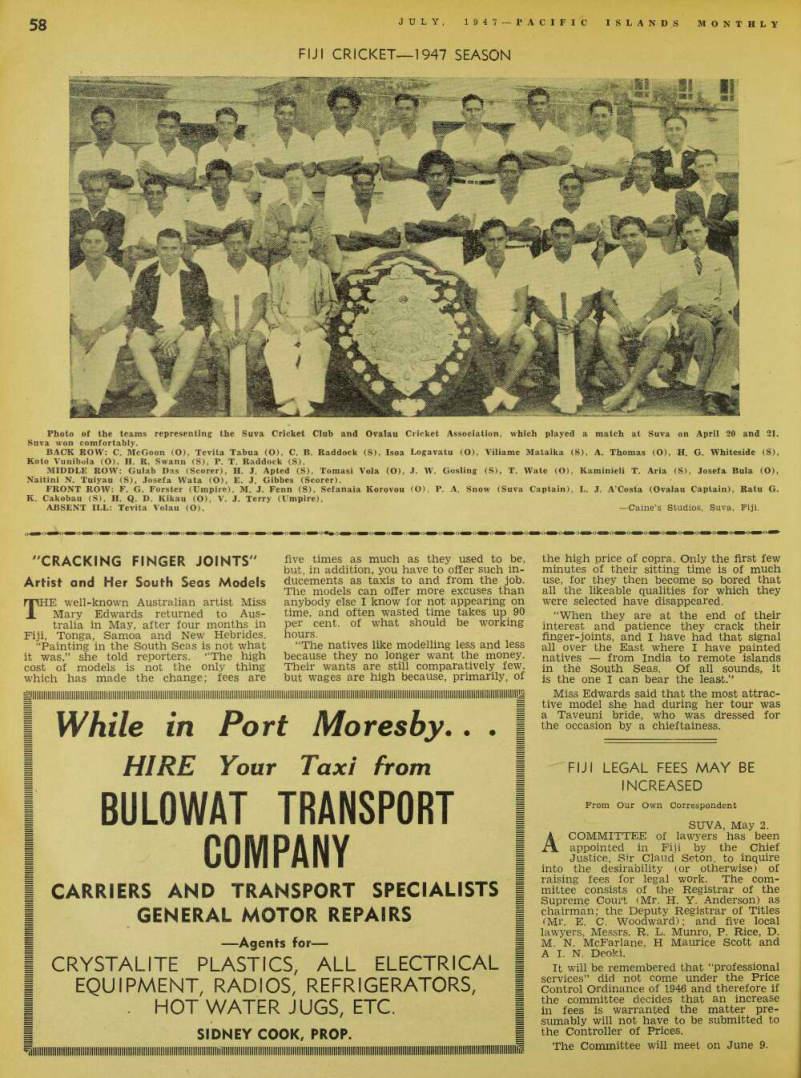
Photo of the teams representing the Suva Cricket Club and Ovalau Cricket Association, which played a match at Suva on April 20 and 21.
Suva won comfortably.
BACK ROW: C. McGoon (O), Tevita Tabua (O), C, B. Raddock (S), Isoa Logavatu (O), Viliame Mataika (S), A. Thomas (O), H. G. Whiteside (S), Koto Vunibola (O). H. R. Swann (S), P. T. Raddock (S).
MIDDLE ROW: Gulab Das (Scorer), H. J. Apted (S). Tomasi Vola (O), J. W. Gosling (S), T. Wate (O), Kaminieli T. Aria (S), Josefa Bula (O), Naitini N. Tuiyau (S), Josefa Wata (O), E. J. Gibbes (Scorer).
FRONT ROW: F. G. Forster (Umpire), M. J. Fenn (S), Sefanaia Korovou (O). P. A. Snow (Suva Captain), L. J. A’Costa (Ovalau Captain), Ratu G.
K. Cakobau (S), H. Q. D. Kikau (O), V. J. Terry (Umpire).
ABSENT ILL: Tevita Volau (O), Caine’s Studios, Suva, Fiji.
"Cracking Finger Joints"
Artist and Her South Seas Models
THE well-known Australian artist Miss Mary Edwards returned to Aus tralia in May, after four months in Fiji, Tonga, Samoa and New Hebrides.
“Painting in the South Seas is not what it was,” she told reporters. “The high cost of models is not the only thing which has made the change; fees are
five times as much as they used to be, but, in addition, you have to offer such in ducements as taxis to and from the job.
The models can offer more excuses than anybody else I know for not appearing on time, and often wasted time takes up 90 per cent, of what should be working hours.
“The natives like modelling less and less because they no longer want the money.
Their wants are still comparatively few, but wages are high because, primarily, of
the high price of copra. Only the first few minutes of their sitting time is of much use, for they then become so bored that all the likeable qualities for which they were selected have disappeared.
“When they are at the end of their interest and patience they crack their finger-joints, and I have had that signal all over the East where I have painted natives from India to remote islands in the South Seas. Of all sounds, it is the one I can bear the least.”
Miss Edwards said that the most attrac tive model she had during her tour was a Taveuni bride, who was dressed for the occasion by a chieftainess.
Fiji Legal Fees May Be
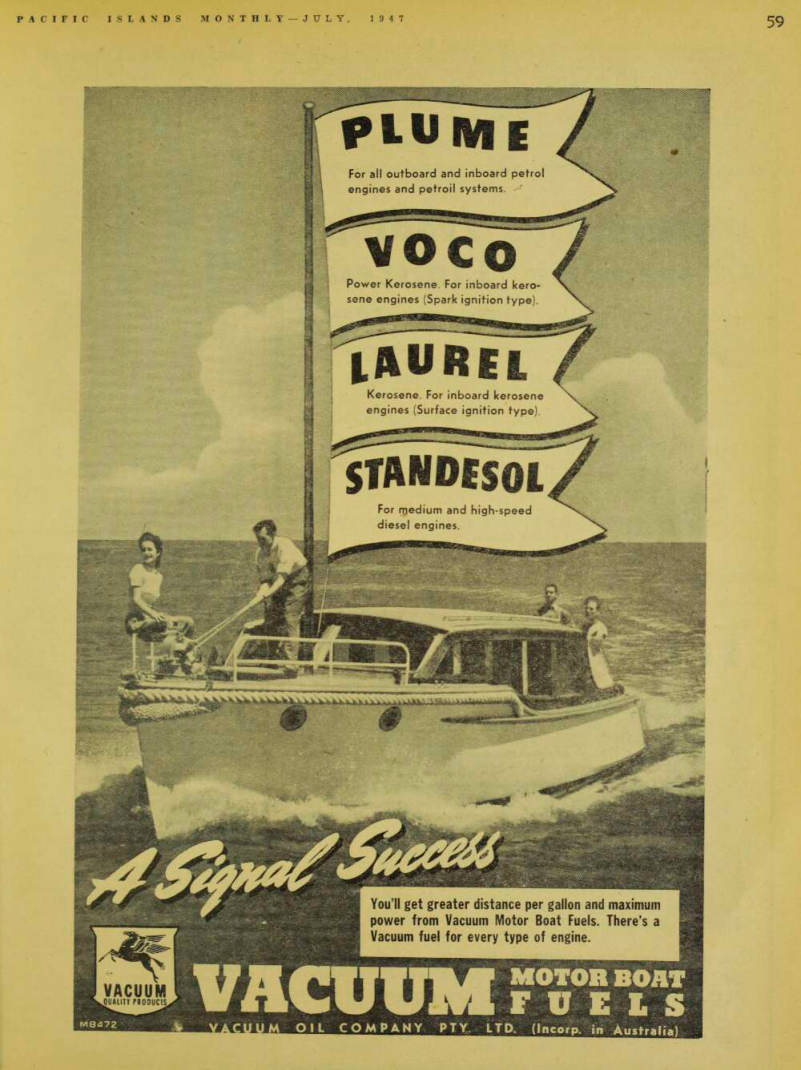
Increased
From Our Own Correspondent
Suva, May 2.
A COMMITTEE of lawyers has been appointed in Fili by the Chief Justice. Sir Claud Seton, to inquire into the desirability (or otherwise) of raising fees for legal work. The com mittee consists of the Registrar of the Supreme Court (Mr. H. Y. Anderson) as chairman; the Deputy Registrar of Titles (Mr. E. C. Woodward); and five local lawyers, Messrs. R. L. Munro, P. Rice, D.
M. N. McFarlane, H Maurice Scott and A I. N. Deoki.
It will be remembered that “professional services” did not come under the Price Control Ordinance of 1946 and therefore if the committee decides that an increase in fees is warranted the matter pre sumably will not have to be submitted to the Controller of Prices.
The Committee will meet on June 9.
M. Bourgeau. who as New Caledonian Secretary-General was Governor Sa-utot’s chief official when the Colony joined fighting France m 1940, and who has been
Government resumed to
FranJe by the ' LgfttaTre'' “tly. A heavy burden of work was thrown on him both before and after the arrival of the Allied Forces in 1942.
The Bishop of Polynesia, Eight Rev. g. l= Kempttiorne, and Mrs. Kempthome, are present residing in Apia, Western Samoa. The Bishop is filling the place of the cha P lain of Western Samoa, the <?• W. Whonsbon-Ashton, who is away in England on furlough. Bishop and Mrs. Kempthome expect to be in Western Samoa until August.
Advertisements & other items, pp. 60-62 (2 items)
Bulowat Transport
While in Port Moresby.. .
HIRE Your Taxi from
COMPANY
CARRIERS AND TRANSPORT SPECIALISTS
GENERAL MOTOR REPAIRS
—Agents for—
CRYSTALITE PLASTICS, ALL ELECTRICAL
EQUIPMENT, RADIOS, REFRIGERATORS,
. HOT WATER JUGS, ETC.
SIDNEY COOK, PROP.
Laurel
PLU
E For all outboard and inboard petrol engines and petroil systems.
voco
Power Kerosene. For inboard kero sene engines (Spark ignition type)
LAUREL
Kerosene. For inboard kerosene engines (Surface ignition type).
STANDESOL
For rrjedium and high-speed diesel engines. •• • in ■ > V / y / You II get greater distance per gallon and maximum power from Vacuum Motor Boat Fuels. There’s a Vacuum fuel for every type of engine.
VACUUM
QUALITY PRODUCTS
Steamships Trading
Company Limited
PORT MORESBY SAMARA I PAPUA.
WHOLESALE & RETAIL MERCHANTS, SHIPOWNERS,
PLANTERS, ENGINEERS & SLIP PROPRIETORS.
Customs, Shipping, Insurance, and Forwarding Agents.
MANAGING AGENTS AND VISITING REPRESENTA-
TIVES FOR COCONUT AND RUBBER ESTATES.
SYDNEY REPRESENTATIVES: Nelson & Robertson Pty. Ltd., 12 Spring Street
The Garrick Notel
■. 1 m
SUVA
FIJI
This well-known Hotel is centrally situated in Suva's main business quarter :: Modern accommodation provides comfort in all climatic conditions :: Only the best of Beers, Spirits and Wines is served Telephone: 80. VINCE COSTELLO, Proprietor.
Slow Revival In
N. Guinea
Europeans Fight to Restore For tunes While Officialdom Pamp ers the Natives
DESPITE all that one hears about the ambitious planning of the New Order in New Guinea, residents of Lae, in private letters, complain bitterly of the lack of intelligent planning there.
A dilapidated and unattractive China town has sprung up on the south side of the Busu River, at Lae about 200 Chinese are living in a collection of buildings made of rusted iron, including about 30 trade stores.
Lae’s water supply is being pumped direct out of the Busu River without chlorination or any other attempt at purification. The lucky residents are those who have rain-water tanks.
About 100 Europeans now have returned to Wau, and that town is taking some shape again. All heavy traffic goes by the new road from Lae. but there are also regular air services, as well. Six passenger Avro-Ansons are being run by a new concern. Guinea Air Traders Ltd.; Mandated Airlines are back on the job: and Qantas Ltd. are running a couple of small planes. Guinea Airways Ltd., (which poineered Territories air traffic, and made such a success of it) apparently do not intend to return see article June issue.
Salamaua now is a ghost town. Once a busy sea and air port, it was destroyed by the Japs, and has been abandoned.
The sole European inhabitant now is that well-known goldfields pioneer, Mr.
“Yorkie” Booth, who is running a trade store on the beach.
All the old mining companies are- busily rehabilitating themselves, and it should not be long before gold recommences its outwards flow. Two Bulolo dredges are working, and other units of the pre-war batterv of eight are nearing resumption.
It has been reported in Sydney that some valuable machinery has been sent north for the re-equipment of the famous Black Cat Mine, on the ranges east of Wau. It is said that a strong syndicate, embracing Parer interests, is backing the revival of the enterprise.
PRIVATE enterprise, in spite of the ill concealed hatred of Canberra Soci alists, and the non-cooperation of Port Moresby academicians, is making a splendid effort towards rehabilitation. It is a revival of pioneering spirit, which achieved so much between 1920 and 1940.
If poor old White Brother could only get a tithe of the love and attention and money lavished upon Black Brother by Australian officialdom, since 1945, what a different story it would be!
Special Correspondent.
Some senior officers of the New Heb rides Condominium have been away on leave. Judge Y. Geslin, representing France on the Joint Court, has been for four months in France on furlough. M.
Buteri, Joint Court Registrar, has been away on sick leave, and Mr. Stephen Dubois has been Acting Registrar. M.
J. Ralard, Public Works superintendent, has been in Australia on furlough, with his family and M. L. Page, Joint Court Surveyor, has been acting for him. M.
L. de Gaillande, Condominium Postmaster, has been on sick leave, and Mr. O. Hon egger has been acting postmaster. M. G.
Le Peltier, Assistant Treasurer, has been in Australia on furlough; and Mr. T.
Nicholls, Customs Officer has been on sick leave in Norfolk Island.
Plea For The Natives
Save Them From The New Order!
Letter to the Editor IN early 1942 it was front-page news when the little ships, after terrible .voyages from the Solomons, won their way through to an Australian land fall. Interviews with the planters or missionaries who manned them were headlined as colourful “dramas of the sea”, and all that.
The stories were true, for fearful weather can be encountered during the cyclone season in the thousand miles of open ocean between the Solomons and Australia ... and also during the season of Australian winter gales, for that matter.
The little ships are sailing again— this time back to the Solomons, through similar dangers and hardships, bearing the fortunate few who have been lucky to wangle a passage to their ruined homes and enterprises, to face in their ageing years, the colossal task, of re storing their fallen fortunes.
These men know what to expect when they arrive in the Islands;. Jife on re mote, war-shattered plantati* Ij, in tents or native huts; shortages of food and essential supplies, radio, mail, papers— all the things that make loneliness bear able.—But, gallantly and grimly, they are .prepared to face it all because they will be HOME again, and rebuilding their lives anew.
Deep down in their hearts though many would hate to admit it—is the de sire to see their native friends again alongside of whom many of them fought during the war. Some of these men cherish letters from natives Beseeching them to return, and make life for them ‘the same as before”.
The best natives have “had” the war and its aftermath of shortages and es trangements, and long for the return of the old Islands way of life; stores (the Island equivalent of the friendly, local pub) run by the men they know, and stocked with the things they want; some one to trade with for their copra and trocas shell (and to joke and talk with them, and to tell them “the news”) • someone to recreate the old set-up on stations , in stores, schooners, and schools.
Like us all, the natives are at a dead end They are fed up wuth being dead in life, and want the old things back again, fast. fI\HE little ships are sailing because X after two years of Peace no steamers are running from Australia to the Solomons to-day. The necessities of life for natives and whites are in short sup ply in the Solomons, and will continue to be, because of the lack of such ship ping. The little ships may bring a few men—but no general supplies.
Much fuss is made in official quarters about new deals and new orders for Pacific Islanders. With justice the natives could say; “We asked for bread arm you gave us an anthropologist.”
By all means give the natives better educational, medical, and Administrative services; but for God’s sake give them also the ordinary amenities of life These are only obtainable bv shipping' So give them shipping. wil e ? at S e . lading essentials, sees hordes of officials and theorists let loose hc,r^L Is l ai l who come to him empty kJrt /ull of words about future IwiStr O,III XT other bleak ’ doctrinaire aus wLf H< L S + ayS: <<That ’ s wonderful!
But what about some good stores now?
Copra s a good price, but there are no goods to buy with the money we get.
When will the steamer and the white man come back?”
IT is fashionable to-day in the Islands to place native considerations first It always has been so. But the en gineers of the New Orders like to kid themselves that they have just instituted that policy.
Old-timers have long recognised that native welfare and white welfare are in divisible. Those who have just discovered the natives try to tell the latter that their old white friends are their ex ploiters, and that “Codlin is the friend not Short”.
The native is no fool. He has known Short a long time and trusts him. New dealer Codlin, he finds, is short of every thing but words, promises, and regimen tation. Anyway, we will be fashionable, and will base our plea for a shipping service on the needs of the natives.
When shipping is mentioned, we are
officially that there is a shortage of shipping. Maybe. But we doubt it During the war, in the Solomons, we witnessed vast convoys of around 700 ships of all sizes, marshalled for an op eration. We know that hundreds of ships are idly rusting in naval havens in Amer ica, Australia, and elsewhere If need arose, they would go into ser vice tomorrow. Why not now? A single 3,000-tons vessel, say an LST, is all that is required to put the Solomons on their feet. Why not use one of those ships
to help the people who so grandly helped the Allies during the war?
Finish the war tidily. Treat the oper ation as the final phase of the war, if accountancy demands it. Why not? It can be afforded, just the same as countless millions were afforded through UNRRA —for Red rackets in Europe and Fascist Ramps in China. Only in this case we would have the satisfaction of helping our friends, instead of our enemies, for a change.
And it would be good business, costing only a few thousands a year, as Britain and Europe need our copra. This ship ping service is not primarily Australia’s job. It is Britain’s job, but I am afraid that the poor stricken Old Country can not spare us what ship we need.
But I do think that the generous hearted United States, if she were but made aware of our plight, would gladly give the ship needed, out of gratitude to our natives who, during tht war, res cued and succoured hundreds of Ameri can airman and seamen from the jungle and sea in the Solomons. What about it, America?
I am, etc..
Leslie F. Gill
Advertisements & other items, pp. 63-64 (1 item)
jQfj[
’EY! LOTI
W»- L LH.. K>», i,
A New Book
“WHERE THE TRADE-WINDS
BLOW”
72 Stories, Articles and Sketches About
Life in the South Pacific Islands
WITH NUMEROUS ILLUSTRATIONS
Collected by
R. W. ROBSON and JUDY TUDOR
stor * e ® a nd sketches, brought together in this book for vour enter
«aeifi?? s Cr^th—
The ‘ Islands of Romance” have suffered much at the hands of npHnatpHr But the charming Islands world of the Nineteenth Ppntn™ Melanesia— been altered profouncffy Ven m Savage and P ri ™tive This book may indicate how and where conditions have changed.
A t oil Leading Booksellers in Australia; at the Stores of Whitcomb from T t°h^ b S Ltd t' ' n f NeW Zealand; at Caldwell's Book Store, in Suva; SS p & Co - L,d; ° nd from B k; Copies may be obtained by sending 9/6 direct to the Publishers:
Pacific Publications Pty. Ltd.
Union House, 247 George Street, Sydney
Refreshing
as a plunge
into a lagoon!
oi-ssss
i
Germicidal
and fragrant
TENAX TOILET SOAP is
a rapid safeguard against external skin infections, yet it is soothing and kind to the most sensitive skin —even a baby’s!
ORDER TENAX FROM
YOUR ISLAND SUP-
PLIERS. STOCKS ARE
PLENTIFULLY AVAIL-
ABLE.
A. B. DONALD Ltd.
AUCKLAND
ISLAND TRADERS & GENERAL MERCHANTS
P.O. Box 1509. Cables & Telegrams, "Kingdom/' Auckland.
Parliamentary Party For
New Guinea?
BEFORE the Commonwealth Parlia ment went into recess in June, Mr.
White (Lib. Vic.) renewed his re quest that a party of Members, includ ing some from the Opposition, should visit Papua-New Guinea to inquire into the “inadequacy of« the present Adminis tration there and its failure to maintain production and plan for economic de velopment.” Mr. White said that he would be glad to make one of the party.
The Acting Minister for External Ter ritories said that “the suggestion would be examined.”
Mr. and Mrs. T. C. Gover, parents of Mrs Phyllis L. Keenan, wife of popular ADO Jack Keenan, Finschhafen, returned to Australia recently, after making their second visit to New Guinea within a few months. They were high in their praises of the beauties of Finschhafen and hope to return again soon.
Moresby
The Month In
From a Special Correspondent
Port Moresby: July 1.
THE New Guinea-Papua snipping posi tion in May and June showed 100 per cent, improvement on the pre ceding few months; but it is believed there will be another lull when the “Mon toro” goes into dock after her return to Sydney in July. “Montoro,” “Malaita,”
“Reynella” and “Ferdinand Silcox” all arrived from Australia towards the end of June. ■ ■ ■ Don Sneddon, chief announcer of Port Moresby station 9PA, has contributed some new features to the station’s pro gramme. He now broadcasts a session of Shakespearean extracts, with music they inspired, every Sunday night. The re sult suggests that Don could make a name for himself in Australian radio. He also scripts and comperes a recorded variety show, “Continental Cafe.” ■ ■ ■ To Mrs. Crawley, wife of Royal Papuan Constabulary Bandmaster “Dave”
Crawley, and to Mrs. Jenkins, wife of the APC doctor, bonnie babes. The Moresby Hospital’s maternity appointments for the months point to a rapid ex pansion of the local European school in a few years’ time. ■ ■ ■ THINGS are not happy within the Public Works Department. Rumours are rife that the department is to be merged with Commonwealth Department of Works and Housing; but officers of Public Works claim they have been left in the dark and as yet have no clue to their future. This department, without men, material and equipment, and with out clear indication of overall policy, has had a more difficult job than any in New Guinea, and has taken all the kicks. ■ ■ ■ Mr. Hal. Wootten, Sydney University “bright boy,” has just returned from Manus, where he has been on an “an thropological survey.” A recent graduate in Law from Sydney, Mr. Wootten as sisted Dr. lan Hogbin to prepare a Native Courts’ Ordinance some time ago. He is attached to the Australian School of Pacific Administration. ■ ■ ■ The “Doma” is still doing valuable ser vice in Papuan waters. On her last trip, at the end of June, she carried a large consignment of cargo for western ports, transhipped from the “Nusa,” which broke down on the first lap of the journey.
Passengers on the “Doma” included Rev.
Bill Reilly and his new wife, recently re turned from Australia, and Mr. and Mrs.
Cec. Fisher, well-known members of the London Missionary Society, who are opening up a station at Veiru, where Mr.
Fisher will establish a Technical Training Ocntrc Coastal shipping should improve with the arrival of the first of nine special ships now on the slips in Australia. ■ ■ ■ COMINGS and goings; Mrs. Basil Kirke, wife of local ABC manager, has arrived to join her husband at 9PA, Mr and Mrs. Kriewald and daughter, parents and sister respectively of local Customs Officer “Ernie”
Kriewald, are holidaying in Moresby at the Kriewald, sisalkraft abode. “Tommy”
Grahamshaw, well-known for his sterling work at Buna during tthe Japanese in vasion, is back at Government Stores after leave in Australia. ■ ■ ■ Applications have been called for the
position of Treasurer in the Provisional Administration: Salary, £1,150 to £1,250.
“Bill” Chester, formerly in the Papuan Treasury, has been acting in the office.
MR. LEN ODGERS, of the Department of District Services and Native Affairs, is conducting a class in book-keeping for natives from the local villages of Hanuabada and Elevala. It is understood that these natives are being trained to run projected native cooperatives.
Moresby’s native communities are very keen to establish consumer co-operatives, but some of their plans seem a trifle ambitious. Producer co-operatives would giCent y great6r SymPathy at the ■ • ■ Government Officers at Konedobu enjoy a brass band recital at 5.30 every evening when the Royal Papuan Constabulary sets out to perform the “Retreat” at Government House. The band marches along the road with a large retinue of grinning natives trailing along, fascinated.
European residents wonder whether the noise is necessary. They point out that BP’s have a large stock of guitars, which are selling at a rapid pace; but Hanuabada is full enough of synthetic music now -without more of these instruments. m m u .. „„ „ „ , ...
When the “Reynella” was in port with a deck-load of cattle and pigs, Director of Agriculture Cottrell-Dormer was seen wandering fore and aft with an expression of sublime content, muttering, “It’s a lovely smell!” He has been planning stock improvement in the Territories for a long time .‘ - - A recent guest at Government House was Mrs. Alf. Conlon—wife of the
youthful Colonel who rose to fame in the war regime as Director of Army Research and Civil Affairs. ■ ■ ■ At long last the picture theatre has re-opened. It is one of Moresby’s few civilised comforts, well adapted to the tropics. There are two shows a week, in variably booked out. The pictures show signs of age, but that is the price we pay for choosing to live on the end of the circuit.
Another touch of comfort will be pro vided by the new Hotel Papua, soon to open, which looks very trim and as in viting as any pub.
Price Of Fruit Is Up—
But Payment Is Delayed
Prom Our Own Correspondent
Mangaia. C. 1., May.
THE price of oranges has been increased, at least for the May shipment, to 10/4 per case, Mangaia. This is a slight improvement on last year’s price and, as such, is easy to take.
However, Mangaians are not so pleased at the time lag between shipment and payment. This was our first fruit-boat this year, but instead of paying as soon as the fruit was delivered to the ship, the representatives of the NZ Internal Marketing Division did not pay until a week later.
Mangaians are very hard up, and this has caused considerable inconvenience, and anger.
The 50th anniversary of the arrival in Samoa of Brother Alfred—still a hale and hearty and much-loved teacher at the Marist Brothers School—was cele brated in Apia on May 18, by a large gathering of Samoan residents.
Last year New Caledonia exported 20,000 deer skins to Australia comnared whit 81.500 in 1940. the last normal year The deer population of the country by human population. Cattle n^ es reaching Australia numbered 12,500, *B,OOO in 1940. To-day Noumea shoemakers complain that they cannot get enough leather from the Corn monwealth,
Colonel-doctor Sanner has been ap pointed head of the New Caledonian Health Department in succession to Colonel Giordani. Captain Dr. Ragusin will succeed Dr. Languyon at the Institute Gaston Bourret. A number of other doctors of the Army Medical Service have arrived in Noumea to join the Health De partments in New Caledonia and the New Hebrides.
Advertisements & other items, pp. 65-66 (1 item)
Nelson & Robertson
COMPLEXION PERFECTION
WITH
BEAUTY PREPARATIONS
FOR
DISCRIMINATING WOMEN
WHO DESIRE
ALLURING LOVELINESS
Obtainable At All Stores.
Distributor:
GORDON K. SMITH
Beverley Hills, Sydney Bankers: Bank of N.S.W.
NELSON and ROBERTSON Pty. Ltd.
Established 1895
Shipowners - Brokers and
Islands Merchants
AH classes merchandise purchased at Best Wholesale Prices. Original Invoices supplied to Island Clients. Cocoa Beans, Copra, Rubber, Trochus Shell and All Islands' Produce Sold on Commission.
Entrust your requirements to the firm with fifty yeors' practical experience in the Pacific Islands.
REPRESENTED IN
ALL PARTS OF
THE WORLD.
Sole Agents :
SKANDIA DIESEL ENGINES
ARCHIMEDES MOTORS
Prompt attention giren to all enquiries.
OVERSEA INDENTS
ARRANGED FOR
CLIENTS.
NELSON & ROBERTSON
12 SPRING STREET, SYDNEY, AUSTRALIA
Telegraphic Address: IVAN, SYDNEY.
PTY.
LTD.
G. H. Robinson
ISLAND SUPPLIES
of all kinds—Selected and Shipped to order at lowest possible prices—Piecegoods in Wool, Cotton and Silk, Under and Outerwear, Manchester, Drapery, Grocery, Hardware, Engineers and Leathergoods trade supplies a specialty.
Indents and Transhipments arranged. Large or small orders treated with equal care.
Use our 25 years’ extensive experience.
Enquiries solicited to—
G. H. ROBINSON
51 Macquarie Street, Sydney, N.S.W.
Telegrams: Sunrise, Sydney.
Letters: Box 3317, G.P.0., Sydney.
GILLESPIE’S
The Flour of the Islands
- SYDNEY -
MARK
"Spotlight on Emirou"
More Corrections and Some New Details
MR. L. P. CRAGO is not correct in some of his contentions (“Spot light on Emirau,” May “PIM”.) Carl Leopold Bruno Wilde did not acquire Emirau Plantation through Expro- Board, but cut the bush and developed it into a plantation. He started it in Ger man times, of course. The home was built out of quila hardwood, cut on the place with pit saws. His original home was two-storeyed, and there was a sub stantial guest-house and other build ings.
The grave of his wife is worthy of comment. So far as I recollect, the in scription on the stone runs: “In Memory of my beloved wife, Juanita Wilde. Born February, 1890. Died June, 1926.” And under that; “I had a good comrade.”
I don’t think there was any German inscription, but the words quoted by Crago are from the old German marching song.
The stone was brought from Germany by Wilde, and when the place was sold an area surrounding the grave was sur veyed and was not sold, and new owners had to agree to always keep the grave in order.
Wilde lost the photo of his wife’s grave at Wau, on evacuation to Australia, and grieved over it. So, knowing this, I got an American Seabee friend of mine—a good photographer—to take some pic tures of the grave in 1944, and sent them along to CLBW. He was very appre ciative and an enlargement of the pic ture which he liked best hangs in his home to-day.
When the German raiders (3) called at Emirau in December, 1940—not No vember—they put ashore over 400 prisoners—survivors of 14 British ships sunk in the Pacific, The “Rangitane” was only one of them. Von Luckner was sup posed to have been in charge, and on the “Black Panther,” which lay off at some distance. I think it was the “Manio Manx” which landed the prisoners.
BEFORE they landed, a German officer came ashore and asked per mission (yes—he did) to land some prisoners. Mr. Charles Cooke was man ager at the time on Emirau for WRC,
and his wife was with him. They met the German party on the road. The Cookes have photos of the vessel men tioned. The Seventh Day man did not come on the scene until later.
The party of castaways that went to Kavieng negotiated with Mr. J. I.
Merrylees, who was in charge at the time. It was not Jerry McDonald. JIM sent the Government schooner out with medical and other supplies. He did a good job. I think it was the Rabaul authorities who diverted the Nellore to Emirau to pick up the stranded.
While the Germans were ashore on Emirau one of the officers asked Charles Cooke where the grave of the German lady was. When told, he took a detach ment of Marines there, and while they stood at attention, he—in front—read some passages from a Bible or prayer book. They then saluted the grave and withdrew.
It appears that this German had accompanied the Wildes there long ago on, I think, the occasion of Juanita’s arriving. He had been a supercargo on the German ship which landed them.
So, after many days, he returned to pay his respects.
When a paragraph was printed in the “Rabaul Times” about the rescue of the party, the local censor saw fit to blot out the portion of the story dealing with the incident at the grave. It was accord ingly blacked out before the paper was circulated. A local schooner-master, a half-caste German, showed the paper to me, saying, “This made people to think what it might be—but if you hold it, so —in the sun—then you will read it quite plainly.” And so you could!
Incidentally, Wilde’s coffee was con sidered to be the best ever imported into Australia. He supplied it to Governor- General Lord Gowrie, who is said to have loved it. Wonder where present G-G Billy McKell gets his coffee?
WITH reference to Mr. Charles Cooke —things have always happened to him. He was a stockman in North Queensland in his youth; then he was in Persia with Anglo-Persian Oil, and was with the American Fruit Co. in South America. South America was “a bit wild,” he told me.
Charles is keen on agriculture, and showed me some pictures taken while he was living in South America. Hand ing them to me he remarked that one could see how luxuriantly the bananas, etc., grew. I said, yes, but why were all those men sleeping around in the fore ground?.
Charlie looked at the picture again and said, “Oh, those are dead bandits!
They had made a raid and the mess hadn’t been cleaned up when the pic ture was taken. But look at those banana plants in front. Wonderful growth, I reckon, don’t you?”
I am, etc.,
Buka, NG.
June 27.
Fpa.
Death of Mrs. Florence Scott
rjIHE death occurred on July 4 of Mrs.
X Florence Eugene Scott, widow of Mr.
Richard Scott, of Suva, and the mother of Mrs. Rhoda Coote. of Killara, Sydney, but formerly of Rabaul. Mrs.
Scott had been in ill-health for some time prior to her death, and her passing was peaceful.
The late Mrs. Scott had not lived in Fiji for some years, but had spent some time with her daughter in pre-war years, at Rabaul, and previously with her son, the late Hugh Scott, at Faisi, in the BSI.
Mr. Alec McLean, of Bulolo, arrived in Sydney by air from the New Guinea goldfields, in July, on furlough.
Advertisements & other items, p. 67 (1 item)
Horucks
u
mmm
for his age!
Bill. I don't like the sound of this ° Back ward at h/s /essons and not I’m really worried abouf him..so pale end thin. I'll take him to Dr.Coombes to-morrow.
Whats this a letter ? $ interested in It s my school
reporf, Mum
sport r % ft
I couldn't
understand what
was wrong with
Bill, until...
'4 You see. Mrs. Adams, in addition to all their running around in the dagtime, children use up
energy during sleep in breathing
and other automatic actions . and children are growing all the time.
Naturally, if this call on their energy reserve isn't built up. they soon become listless, easily tired and inclined to lose weight. 0 Put your boy d onto HORUCKS V fvtf E*t And he won
the high jump
to-day.darling •
Look. Dad. it says I’m a
HIS
cpOP T
credit to the class \a n Each glass of Horliclcs* before bed gives you Protein— essential to the growth and development of every part of the body. Without protein to form body tissue cells, growth cannot take place and then wear and tear resulting from our daily activities cannot be made good.
Fat almost entirely derived from milk; an efficient source of energy and also of vitamins A and D.
Carbohydrate chiefly maltose and dextrin (perhaps the best source of quick energy) and lactose, which is of particular value to young children.
Mineral Salts— to help in building tissue and in regulating body activities. These mineral salts include : Calcium —of which there is a deficiency in many Australian diets and yet is so necessary for building sound bone and good teeth.
Vitamins A B, B, and D—each fulfilling its own special job in the maintenance of sound nutrition. *made with milk.
HORUCKS
The complete ,
BALANCED
food drink
CH 7-1
Sydney-Norfolk Island-
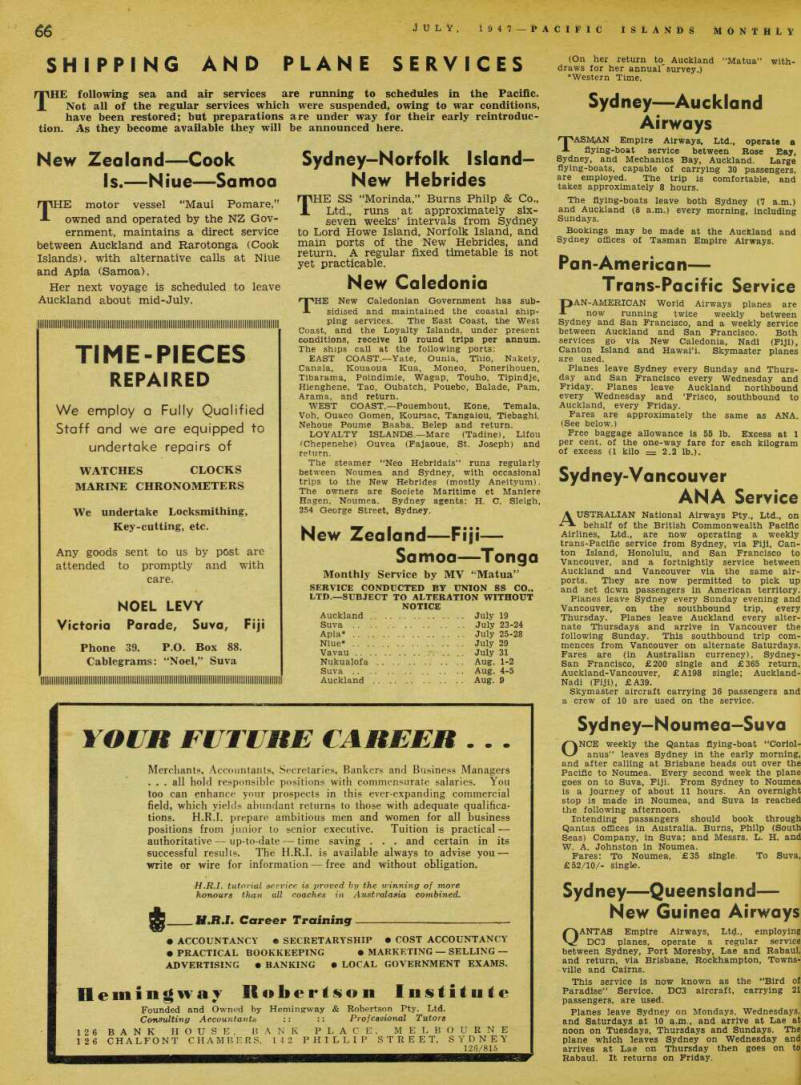
Shipping And Plane Services
THE following sea and air services are running to schedules in the Pacific.
Not all of the regular services which were suspended, owing to war conditions, have been restored; but preparations are under way for their early reintroduc tion. As they become available they will be announced here.
New Zealand—Cook
Is.—Niue—Samoa
THE motor vessel “Maui Pomare,” owned and operated by the NZ Gov ernment, maintains a direct service between Auckland and Rarotonga (Cook Islands), with alternative calls at Niue and Apia (Samoa).
Her next voyage is scheduled to leave Auckland about mid-July.
Sydney-Norfolk Island-
New Hebrides
THE SS “Morinda,” Burns Philp & Co„ Ltd., runs at approximately six seven weeks’ intervals from Sydney to Lord Howe Island. Norfolk Island, and main ports of the New Hebrides, and return. A regular fixed timetable is not
yet practicable.
New Caledonia
THE New Caledonian Government has sub sidised and maintained the coastal ship ping services. The East Coast, the West Coast, and the Loyalty Islands, under present conditions, receive 10 round trips per annum.
The ships call at the following ports: EAST COAST.—Yate, Ounia, Thio, Nakety, Canala, Kouaoua Kua, Moneo, Ponerihouen, Tibarama, Poindimie, Wagap, Touho, Tipindje, Hienghene, Tao, Oubatch, Pouebo, Balade, Pam, Arama, and return.
WEST COAST. —Pouembout, Kone, Temala, Voh, Ouaco Gomen, Koumac, Tangaiou, Tiebaghi, Nehoue Poume Baaba, Belep and return.
LOYALTY ISLANDS.—Mare (Tadine), Lifou (Chepenehe) Ouvea (Fajaoue, St. Joseph) and return.
The steamer “Neo Hebridais” runs regularly between Noumea and Sydney, with occasional trips to the New Hebrides (mostly Aneityum).
The owners are Societe Maritime et Manlere Hagen, Noumea. Sydney agents: H. C. Sleigh, 254 George Street, Sydney.
New Zealand—Fiji—
Samoa—Tonga
Monthly Service by MV “Matua”
Service Conducted By Union Ss Co.,
Ltd—Subject To Alteration Without
Notice
(On her return to Auckland “Matua” with draws for her annual" survey.) •Western Time.
Sydney—Auckland
Airways
TASM+AN Empire Airways, Ltd., operate a flying-boat service between Rose Bay, Sydney, and Mechanics Bay, Auckland. Large flying-boats, capable of carrying 30 passengers, are employed. The trip is comfortable, and takes approximately 8 hours.
The flying-boats leave both Sydney (7 a.m.) and Auckland (8 a.m.) every morning, including Sundays.
Bookings may be made at the Auckland and Sydney offices of Tasman Empire Airways.
Pan-American—
Trans-Pacific Service
PAN-AMERICAN World Airways planes are now running twice weekly between Sydney and San Francisco, and a weekly service between Auckland and San Francisco. Both services go via New Caledonia, Nadi (Fiji), Canton Island and Hawai’i. Skymaster planes are used.
Planes leave Sydney every Sunday and Thurs day and San Francisco every Wednesday and Friday. Planes leave Auckland northbound every Wednesday and ’Frisco, southbound to Auckland, every Friday, Fares are approximately the same as ANA. (See below.) Free baggage allowance is 55 lb. Excess at 1 per cent, of the one-way fare for each kilogram of excess (1 kilo = 2.2 lb.).
Sydney-Vancouver
ANA Service
AUSTRALIAN National Airways Pty., Ltd., on behalf of the British Commonwealth Pacific Airlines, Ltd., are now operating a weekly trans-Paciflc service from Sydney, via Fiji, Can ton Island, Honolulu, and San Francisco to Vancouver, and a fortnightly service between Auckland and Vancouver via the same air ports. They are now permitted to pick up and set dcwn passengers in American territory.
Planes leave Sydney every Sunday evening and Vancouver, on the southbound trip, every Thursday, Planes leave Auckland every alter nate Thursdays and arrive in Vancouver the following Sunday. This southbound trip com mences from Vancouver on alternate Saturdays.
Fares are (in Australian currency), Sydney- San Francisco, £2OO single and £365 return, Auckland-Vancouver, £AI9B single; Auckland- Nadi (Fiji), £A39.
Skymaster aircraft carrying 36 passengers and a crew of 10 are used on the service.
Sydney-Noumea-Suva
ONCE weekly the Qantas flying-boat "Corlol anus” leaves Sydney in the early morning, and after calling at Brisbane heads out over the Pacific to Noumea. Every second week the plane goes on to Suva, Fiji. From Sydney to Noumea is a journey of about 11 hours. An overnight stop is made in Noumea, and Suva is reached the following afternoon.
Intending passangers should book through Qantas offices in Australia. Burns, Philp (South Seas) Company, in Suva; and Messrs. L, H. and W. A, Johnston in Noumea.
Fares: To Noumea, £35 single. To Suva, £52/10/- single.
Sydney—Queensland—
New Guinea Airways
QANTAS Empire Airways, Ltd., employing DC3 planes, operate a regular service between Sydney, Port Moresby, Lae and Rabaul, and return, via Brisbane, Rockhampton, Towns ville and Cairns.
This service is now known as the “Bird of Paradise” Service, DC3 aircraft, carrying 21 passengers, are used.
Planes leave Sydney on Mondays, Wednesdays, and Saturdays at 10 a.m., and arrive at Lae at noon on Tuesdays, Thursdays and Sundays. The plane which leaves Sydney on Wednesday and arrives at Lae on Thursday then goes on to Rabaul. It returns on Friday.
Auckland Suva Apia* Niue* July 19 July 23-24 July 25-28 July 29 Vavau Nukualofa Suva Auckland July 31 Aug. 1-2
Planes leave Lae at 5.45 a.m. on Wednesdays, Fridays and Sundays, and arrive in Sydney at 10 p.m., accomplishing the Lae-Sydney run in a day.
The return plane from Rabaul leaves at 1.30 p.m. on Fridays.
Bookings may be made at Qantas offices at any of the towns named. At present, berths are available only to passengers holding official per mits to visit Papua or New Guinea.
Advertisements & other items, pp. 68-69 (1 item)
Time-Pieces
REPAIRED
We employ a Fully Qualified
Staff and we are equipped to undertake repairs of
WATCHES CLOCKS
MARINE CHRONOMETERS
We undertake Locksmithing, Key-cutting, etc.
Any goods sent to us by post are attended to promptly and with care.
NOEL LEVY
Victoria Parade, Suva, Fiji Phone 39. P.O. Box 88.
Cablegrams: “Noel,” Suva
YOUR FUTURE CAREER . . .
Merchants, Accountants, Secretaries, Bankers and Business Managers ... all hold responsible positions with commensurate salaries. You too can enhance your prospects in this ever-expanding commercial field, which yields abundant returns to those with adequate qualifications. H.R.I. prepare ambitious men and women for all business positions from junior to senior executive. Tuition is practical authoritative up-to-date time saving . . . and certain in its successful results. The H.R.I. is available always to advise you write or wire for information free and without obligation.
H.R.I. tutorial service is proved by the ivinning of more honours than all coaches in Australasia combined.
H.R.I. Career Training • ACCOUNTANCY ® SECRETARYSHIP • COST ACCOUNTANCY
• PRACTICAL BOOKKEEPING • MARKETING SELLING
ADVERTISING • BANKING • LOCAL GOVERNMENT EXAMS.
Hemingway Robertson Institute
Founded and Owned by Hemingway & Robertson Pty. Ltd.
Consulting Accountants :: :: Professional Tutors
126 BANK HOUSE, BANK PLACE. MELBOURNE
126 CHALFONT CHAMBERS, 142 PHILLIP STREET, SYDNEY 126/815
TILLEY LAMPS
BURN ORDINARY KEROSENE
The Modern Form of PORTABLE LIGHTING
m * r w nttEv mmm m
OF HiND
in THE OWL IS PROVERBIALLY A WISE BIRD, SO BE SURE YOU FOLLOW HIS EXAMPLE! TILLEY LAMPS ARE SO SUCCESSFUL THAT COPIES OF THEM ARE BEING MARKETED. TILLEY LAMPS ARE MADE ONLY IN ENGLAND THE TILLEY LAMP CO. LTD., of ENGLAND
REPRESENTATION :
MELBOURNE : T. H. Bentley, Pty. Ltd., 123-125 William Street. Melbourne, Cl.
TASMANIA : Mr. C. Sellars, 108 a Charles Street, Launceston.
FIJI : Mr. K. Witherington, 2 Burns Philp Buildings, Suva.
RNZAF Services In Central Pacific
Central Pacific
(RNZAF Pacific Regional services are operated for the New Zealand National Airways Corporation and the Dakota that makes the monthly trip, via New Caledonia, is based at Fiji for four weeks to operate services connecting with the Sunderland flying-boat. Details of services can be obtained on application to Railway Transport Officer (Air) at Auckland, Wellington, and Christchurch Railway Stations, or to Air Move ments Officers at Aerodromes concerned, or to Air Department, Wellington.)
Nausori (Suva)-Nadi (Western Fiji);
Plane leaves Nausori each Tuesday and Friday, returning same day. Single adult fare £3 (Fijian). Baggage, 351 b.
Laucala Bay (Suva)-Auckland: Plying
boat leaves Auckland for Fiji each Friday and returns on Monday. Single fare, £25/5/2 (F.).
Baggage, 6011 FIJI - TONGA - SAMOA - COOK ISLANDS: A Dakota transport aircraft leaves Nausori each Saturday for Western Samoa. On alternate Saturdays the schedule includes Tonga and Cook Islands (Aitutaki and Rarotonga), an overnight stop being made at Apia, Western Samoa. Single adult fares; Fljl-Tonga, £6/12/11; Fijl-Samoa, £B/17/3; Fiji-Aitutaki or Rarotonga £lB/3/4.
Baggage, 601 b.
FIJI - NORFOLK ISLAND - NOUMEA - NEW ZEALAND: A Dakota transport aircraft leaves Nausori once every four weeks for Whenuapai, N.Z., via Norfolk Island and Tontouta, New Caledonia. Because accommodation at Norfolk Island is limited special arrangements are necessary before through bookings can be ac cepted. Single adult fares: Fiji-Norfolk, £l6/7/11; Fiji-Noumea, £l6/7/11; Fiji-New Zealand, £25/5/2. Baggage, 601 b.
Pacific Travellers
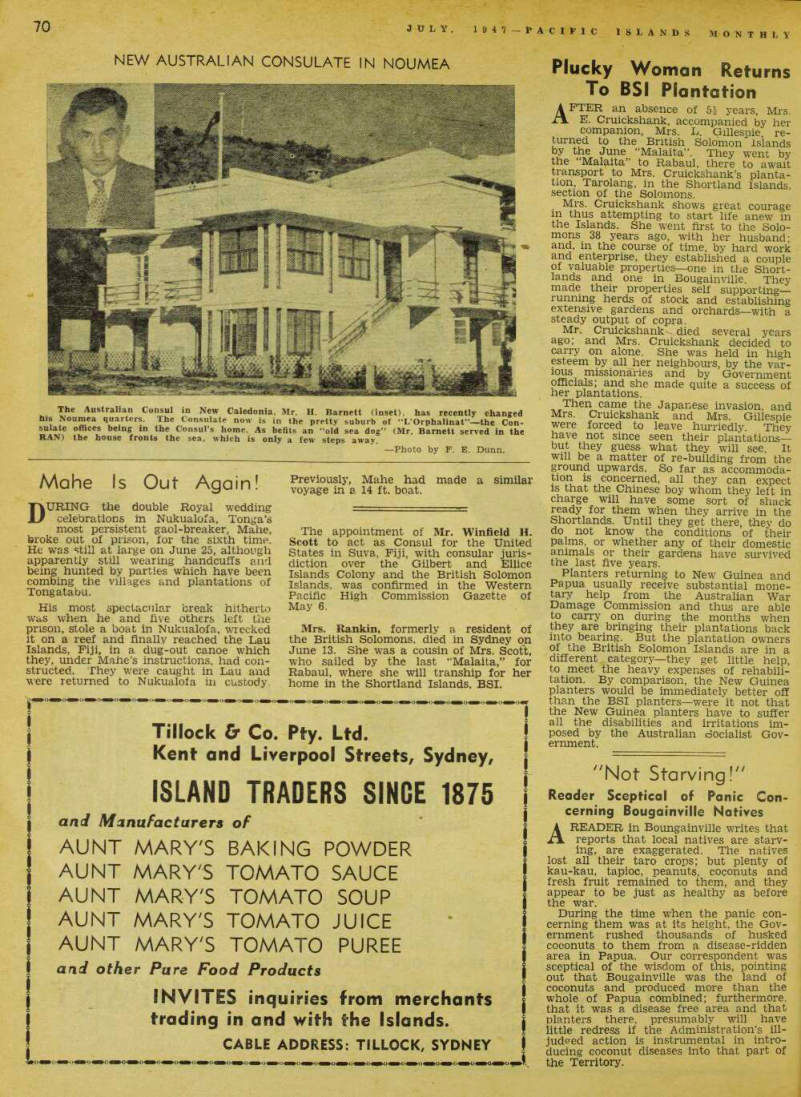
PASSENGERS who embarked on “Montoro,” which sailed from Sydney for New Guinea ports on June 11: FOR PORT MORESBY: Mrs, M. K. Clarke, T. Colclough, T. Grahamslaw, Mr. and Mrs. W.
R. Haigh, Mrs. V. Hayes (and daughter), Miss N. R. Kriewaldt, Mr. and Mrs. W. P. Krie waldt, C. T. Major, Mrs. R. S. Partridge (and two children), Rev. and Mrs. W. T. Riley, J.
N. Walshe, Miss B. Wright, W. A. Wright, Mrs. R. E. Young.
FOR LAE: Mrs. H. Anderson (and son), Mrs.
G. M. Allen, Mrs. A. M. Beer, R. Barber, Mrs.
M. R. Blackman (and daughter), Mrs. I.
Cooke, Mrs. T. J. Emery (and three sons), Mrs. D. Fraser, Miss M. C. Griffiths, Mrs. L.
Coetzeimann (and two children), Mrs. R. B.
Gross, Mrs. R. C. Hodgson (and son), Rev. and Mrs. Hoffmann (and four children), Mrs. G.
Larum, Miss Lehmann, Mrs. E. G. Maclean (and son), P. S. Rich, Mrs. L. Tomacetti (and in fant), Mrs. E. I. Webb.
FOR SAMARAI: Mrs. W. Archer (and son), Rev. H. Andrew, Mrs. W. M. Bell, W. Fitz gerald, A. B. Farrow, Mrs. A. Lumley, J, N.
Morton-Folles, T. E. Nelmes, Miss H. Roberts.
FOR MADANG: Mrs. D. Mcß. Hope, D. J.
Leahy, W. M. Middleton, Rev. J. Nilles, Rev.
J. Noss. Mr. and Mrs. E. V. O’Brien, Mrs. L.
Peters, Misses J. and J. R. Sedgers, Mr. and Mrs. J. Sedgers (and infant).
PASSENGERS who left Sydney by MV
“Malaita” on June 18; FOR PORT MORESBY: Mr. and Mrs. H. H.
Erskine (and two children), p. M. Gibb, Mrs.
M. Infante (and two children), Mrs. A. Little, Mr. J. L. Maxfleld, G. B. Paterson, Mrs. M.
Rich, Miss H. Sefton. Mr. and Mrs. F. Smith, Mrs. S. Spencer (and three children), C. G.
Tisdale, J. Weston, R. Young.
FOR SAMARAI: Mrs. C. Fleay, J. E. Minto.
FOR RABAUL: Sister Ange, Sister M. Ange slana, Sister M. Antonia, Sister M. Abbott,.
Mrs. C. K. Beaumont, Mrs. K. M. Bunney.
Miss L. M. Billett. Mrs. E. Cruickshanks, Rev. and Mrs. J. D. Flentje, Mrs. S. A. Gow, Mr.
Griffiths, Miss M. Huggins, Mrs. G. Ives (and daughter), Mr. and Mrs. R. Janke, Rev. M.
Kelleher, Mrs. L. R. Mcßeath (and Infant), Mrs. R. J. McMullen, Rev. T. O’Neill, Mrs. E.
K. Palframan (and daughter), Mrs. I. R* Patten, Mr. and Mrs. N. L. Saunders (and two infants), Mrs. C. Scott, Mrs. C. Schuy (and two children), Mrs. White (and two children), Rev. P. W. Walsh.
PASSENGERS who arrived in Auckland
per MV “Matua” on June 12: FROM APIA; Mrs. T. Aspinall, Mrs. M. Bower, Mr. and Mrs. K. Campbell, Mr and Mrs S Churchward, Mr. E. M. Carlson, Mr. W.
Deverall, Mrs. T. Katterns, Mr. H. Moors, Miss J. Moors, Mr. and Mrs. A. H. Mason (and child), Miss R. Nee Nee, Miss L. Ortqulst, Mr A. Sam, Miss A. Uhule.
FROM NIUE: Miss L. Harris, Mr. Halo Mai fala, Mrs. J. Larsen, Mr. Moko Kelemu, Mr. W.
Nicholas, Mr. Pavala, Mr. and Mrs. R. RidgLev (and child).
PROM VAVAU: Mr. F. Guttenbeil, Misses S.
J. and N. M. Guttenbeil.
FROM NUKUALOFA: Mrs. R. Sundin (and three children).
FROM SUVA: Mr. R. Amputch, Mr. and Mrs.
M. Bay (and two children), Mr. and Mrs. L.
Bish (and three children), Mrs. B. Bodmin, Mrs. F. Bentley (and daughter), Mr. W. Conroy, Mrs, J. Cummings (and two children), Mr. B Duthie, Mrs. E. Davidson, Mr. G. Furby, Mr. J.
Fenton, Mr. L. Griffiths, Mr. C. Garforth, Mrs.
E. Hart, Mr. J. Hudson, Mrs. D. Hansson (and two children), Mrs. W. Irving, Mr. Kesa Bijla, Mr. Len Cum Chong, Miss A. McGregor-Fox, Mr. R. Norton, Miss L. Pierard, Mrs. A. Palmer (and child), Mrs. N. Peters (and seven children), Mr. and Mrs. A. Reid (and child), Mr. and Mrs. H. Sale, Mr. P. Simonet, Mr. H. Swann, Mrs. F. Strong (and child), Mr. and Mrs. F.
Smith (and child), Father C. Verlingue, Miss A.
Wallers, Mr. and Mrs. I. Wilson.
PASSENGERS who left by
MV “Matua” on June 28: FOR SUVA: Mrs. J. M. Ansell, Mrs. E. I.
Anderson. Mr. D. W. Brown, Miss H. J. M.
Barnes, Mrs. E. M. Bishop, Rev. and Mrs. S.
G. C. Cowled, Mrs. A. G. Chapman (and daughter), Mr. F, L. Corbett, Mr. and Mrs.
A. C. Delaney, Mr. J. J. Diamond, Miss C. E.
(Continued on Page 75)
Dale. Mrs. I. E. D. Ewins (and child). Miss C E. Fraser. Mrs. M. F. Fordham, Mr. and Mrs.
A. G. Grinter. Mrs. W. H. Gibson, Mrs. R.
Griffiths. Mr. and Mrs. M. E. Gaspard Mr O O. Grant, Cdr. F. A. Hull, Mr. and Mrs. H J Hulek (and child), Mrs. F. G. Hotson, Rev. and Mrs. W. L. Jago (and child), Mrs. H.
Jenkins (and daughterl, Janki Prasad, Miss E D. Lewis. Mrs. E. M. Mansell, Miss m‘.
MacKereth. Miss M. H. Maguire. Munshi Ram Miss M. McGill, Miss M. J. Mune, Mr J L Mclntyre. Mr. and Mrs. A. E. Norris (and in fant), Mr. J. W. Oldham. Mr. and Mrs J A V. Oldmeadow, Mrs. W. F. Ohlson, Mr. and Mrs. C. E. de F. Pennefather, Miss F M Perkins. Mr, S. Powell, Mr. and Mrs. F.’
Robertson. Rulda Muhnga. Mr. and Mrs W H B. Snowsill (and child). Mrs. D. M. Seabrook (and child). Mrs. M. G. Scoles (and child) Mrs. M. V. Shaw (and child), Mr and Mrs’
O. H. Stanley (and child), Mrs. D. Sinclair 'and child). Mr. W. Sago. Mr. P L G Sin clair. Mrs. C. E. Trotter, Rev. and Mrs. A R.
Tippett (and two children), Mr. K. L. Tillak Mr. and Mrs. W. W. Warden, Mr. and Mrs’
C F. Warren. Mr. A. Walker. Mrs. S. M Wendt, Miss S. D. Walters.
FOR APIA; Mr. and Mrs. G. E. Burton (and daughter). Mr. I. M. Carruthers, Mrs. W. E.
Elton, Miss K. M. M. Heeney, Mrs. J. E. G. a T? d £* TS ‘ N - H - Mapperson (and child). Miss E. R. Mill (and child) Mr R Middleton, Matinuu Mataafa, Mr. R.' j. Con way, Miss A J. Sanft. Mrs. M. Skelton, Mr.
W. A. Veitch.
FOR NUKUALOFA: Mr. A. T. R. Cocker.
PASSENGERS who left Australia for
Papua-New Guinea by Qantas Air
ways on; JUNE 4; Mrs. D. Browne (and infant). Miss Errin’ M ngm £ re ’ Mr - R - Gilles Pie, Mrs G. cordon. Mrs. B. Mossman. Mr. E. F. Folkard Vlajor E. J. Gerling, Lieut. H. E. Smith, Mr’.
H ° d gekiss, Miss H. Campbell, Mr G S sun Mrs. M. Anthony. Mrs. M. I. Refshauge ? aSt /acSo„ BerBin ' Mr E ® : r - A - Stephens, Mr. D. A. Davis, in J A, Lea T hy (and dau g h ter). Mr. G. Bowen “"S'j b.k F «“ Fearon ' Mr ' H - ***'■ JUNE 9; Mr. R. a. Marshall, Mr. K L .ndrews, Mr. H. B. Gardner, Mr. J. H Quinn r ‘ HndJ 1 i^ hal A arl, Mr - R - S - P,err y- Mr. n’ ant H r g «3f Mr ‘ M ‘ Gould ’ Mr - R- Moody rr« t- iP : Stearn ’ Mr - J Williams, Mr. H. Briggs rs ‘ Bn egs. Mr. J. d. Summers! gg ’
JUNE 11: Sister J. White. Mr. G A Haves r. J. J. Neville, Mr. H. H. Bell, Mr Seraninv’
G Mmy ll, Mr ’ IdStGin ' Mr - sia ter. Miss JUNE 15; Mr R . A. Clark, Mr. R. E. Day £ R . P - Stephen s° n , Mr. H. H. Chidgey Mr plsni° k / f Muller - Mr. Rischmuelle^ y Mrs’ e!son (and infant), Mr. J. w. Taylor. Mrs W atthews (and infant), Mr; Scholtz.
JUNE 16; Mr. Pauth, Mrs. Fauth. Miss n iyor. Mr. E. J. Wauchope, Mr. Williams Mr »rtow Mr. Sutherland. Mrs. M. Gee’
Jarett 1 ' Mri Shaw ; Mrs M - Mason, Mr.' ' Mr - H - Roan ' Mr - JUNE is; Mr. R. Douglas, Mr. j. Lynberg A;r?- Rloxha T m ’ Mr. W. McCarthy! Priv nrn ol n/r k ’ *L nv - J ‘ Salvesen . Sister Haggin- Bright 5 R ’ J Smith (and in fant), Mr. g j.
Mr ‘ P - Hinks - Mr. A. F. Foster a P ck G Mr S ° n W Mr A - J tut E * Johnstone - Mr, L. S.’ ac . k * Mr W. A. Marshall, Mr. A. M Pan >tt V Mr. J. B. Sibbald, Mr. R. Prevost (and o chUdren). Mr. c. A. done. Mr, H S Paddv •, Mcßae, Mr. J. Silvermar Mr C R iberley, Mrs. M. H. Jewell. Mr j B mSv W 4 r " er - Mr - B - R - Wakeman. g ’
Bls h°P G - J- Vesters, Mr S F ? d M^CohS.t ale iur (& w infa nt), Master Seale’, s. M. Cohley, Mr. M. McKidsom Mrs I w achar. Mr. K. A. Brown. ' fUNE 30: Mr. J. McDouglas Mr K w ■sen, Mrs, P. J. Barea, Mr ' V bamtoro ' h £* M )ber A tS ’ Mr ’ E> G - Matson, Mr. J h b M’ r- r» A- B ' Sowarth - B. E. Sully M. E. Draper, Mr. J. Macbson. y ’
~J UL£ 1: Mr ‘ W - Max well, Mrs. W. Maxwell Mrs. E. C. Brown, Mrs. Orr-Harper (and in fant). Miss Orr-Harper, Mr. D. j. Bates Mr J. L. Anderson, Mrs. C. Morgan. Miss E Gofton. Mrs. N. Levi. Mr. R. Cross. Mr J O Connor, Mr, C. G. Gray, Mr. Kerritt Mr Brereton.
JULY 4; Mr. G. A. Walburn, Mr. D H Cameron. Mr. D. Duff, Mr. T. W. Stocks. Mr C. A. Marshall. Mr. R. G. Harris. Mr. A F Skinner. Mr. R. McWhae, Mr. R, Brennan Mrs. J. Murray, Mr. J. w. Drosten Mr F E Blucher.
JULY 7: Dr. N. Goldsworthy, Mr C K Smith, Mr. R. Ellis. Mr. E. J. Thomas, Mrs’
N. Fowler Mr. J. Callard. Mr. H. Stewart. Mr.
G. W. Young, Mr. McLauchlin.
PASSENGERS from Papua-New Guinea
to Australia by Qantas Airways on;
JUNE 1; R. Coleman. S. A. Cottrell, H Stretter. C Saville. H. Saville, R. Brindley, R Cordukes, Mr. A. Lesmonds.
JUNE 4: G. Saville, Brig. Irving. G. H. Gib son H. E. Hamilton, J. Brammell, P. M Bram -s?®“' „ H - Martin, Mr. E. E. Kendall. Mr L McNeil. • JUNE 7: Mr R. H. C. Paul. Mr. D. Atkins.
Mr. H. C. Spry. Mr. T. Carey, Mr E C Bonser. Mr. G. Shaw. Mr. D J. Lee Mr R Harton. Miss R. s. Smith, Sister Hagelthorn Mrs. Pearson (stretcher case), Master Pearson.
Miss Heath. Miss Leigh. Major-General White law. Lieut. Brown. George Lolomai.
JUNE 8: Mr. B. Anderson, Mr. A. K. Cham erS ’ W ' Di Mr. I. F. Downs Mrs. I. F. Downs (and infanti.
JUNE 12: J. Ahearn, C. Gassner, Mr. E. S Birrell, Miss M. Toyne (11 yearsl. Mr E A Stephens Mr. P. w. Smith. Mr. Meehan, ’Mr L. Johnston, Mr. F. Hill.
JUNE 18: Mr. H. J. Heywood. Mr. G Hev wood, Mr. Whittick. Mr. Cassidy. ’
JUNE 20: Miss S. Greenwood. Kim Seto. 21 J, Mr ’ A ‘ L ' Haynes, Mr.' J. s McAdam, Mr. P. a. Penstead. Mrs. F A Benstead, Mr. and Mrs. G. H Steeee (anri child. Mr. P. L. Burke. Mr. C O Dea Mr “ Kinnorley. ' 22 • F - G - Marl °w, E. E. Smith. B H “ c “f on - A - Williams. A. F. Bromley. F.
SS d i5-’ QU + inl o n - W - Ryan - Mr Holliday, Mrs. M. Gilbert, Sister Stringer.
JUNE 25: Mrs. A. Cotman, Mr. J. Little, Mr.
W. L. Conroy. Capt. M. Hauer, Mr I k Chester, Major Darcy Weatherby, Mr.’ r’
Gillespie. Mrs. J. Gunther. Mr. S M Paul M r ' Hardie. Johnst<>n ' Mr - J J- Kyan. Mr, J.’
JUNE 27: Mr. B. R. Connelly, Monsignor Hannon Father McConville, Mrs. Grose, § Mr O. Rondahl, Mr. Kerim.
T J ™ E 28 J, Mr^ W - Youn S- Mr - M. Osborne, J. McLauchlin, R. Bruce. r» J^ E 9: W- Fl Bri ghtwell, Mr. Corbett R D. Murphy. Mr. A. Browne. Capt. Gibson.
A J^ Y 2 : J - Gillies. B. Griffiths, Mr Petrie A. Sutherland. F. Pearon, R. Hughes. Mr. r’
N Follows, Mr. Maclean. Mr. Thorpe, Mrs Poland. Miss Tinnion. Mr. Goddard, Sister Weir Mr JU ßf„ma“?: T ' AUan ' Mt S ' I. J S Ly Evan“ r B W M C oore raSer ’ W ' S ' Taylor ’
JULY 6: A. Austen, c. Maberley, R. Gregory Capt. Reece, K. Llewellyn, J. Humphries Mr. Maurice Scott, son of Sir Henry Milne Scott of Suva, has been asked by a section of the European and part-Euro
pean residents of the North-western Div
ision of Fiji, to become a candidate for Division in the forthcoming Legis lative Council elections. Mr. J. p Bavly has already announced that he will be a candidate for that Division. Mr Scott recently flew to England to be married to Miss Pamela Coldham, whom he met while both were serving in the RAF.
Mr. J. E. Minto proceeded to Papua last month to join the BP staff.
Mr- H. E Maude, MBE, Resident Com missioner of the Gilbert & Ellice Islands Colony, recently paid a visit to Sydney
Zealand, whence
he sailed for England on furlough.
Advertisements & other items, pp. 70-71 (2 items)
Wholesale
MERCHANTS
GENERAL AGENTS
/ OB
LAE
TERRITORY OF NEW GUINEA
SOLE NEW GUINEA
AGENTS FOR
REMINGTON
TYPEWRITERS
PHILIPS RADIO
B.A.L.M. PAINTS
D U LU X
COMMONWEALTH
INSURANCE CO.
FORWARDING, SHIPPING AND CUSTOMS AGENTS.
WKimmmm 1 : 0 No 246
USE STANDARD BURGESS
No. Z CELLS
k C 0 / No 92 m f 0 i T.
LONG
LASTING
BATTERIES
FOR
EVERY
PURPOSE
breathtaking Beauties! Burgess introluces two popular pocket penlights . . . :oupled with the allure of the world's nost beautiful girls!
A PAIR OF POPULAR, FAST SELLING POCKETLIGHTS ON NEW ALLURING DISPLAY CARDS: 1) Streamstyled Penlight No. 246. . . polished to a briglTt and glistening finish. Equipped with pocket clip . . . Lock-on type switch. A Burgess first! 2> Rich maroon and chrome Penlight No. 92 ... a sturdy metal case with pocket clip and lock-on switch
AVAILABLE FROM YOUR LOCAL STORE OR
PACIFIC ISLANDS TRADING COMPANY
244 CALIFORNIA ST., SAN FRANCISCO 11, CAL., U.S.A.
Cable Address: PITCO
69
1‘ Ati F i c islands tooNtrtLV— Jt)L V, 194?
New Australian Consulate In Noumea
The Australian Consul in New Caledonia, Mr. H. Barnett (inset), has recently changed his Noumea quarters. The Consulate now is in the pretty suburb of “L’Orphalinat”—the Con sulate offices being in the Consul’s home. As befits an “old sea dog” (Mr. Barnett served In the RAN) the house fronts the sea, which is only a few steps away. —Photo by F. E. Dunn.
Mahe Is Out Again!
DURING the double Royal wedding celebrations in Nukualofa, Tonga’s most persistent gaol-breaker, Mahe, broke out of prison, for the sixth time.
He was still at large on June 25, although apparently still wearing handcuffs and being hunted by parties which have been combing the villages and plantations of Tongatabu, His most spectacular break hitherto was when he and five others left the prison, stole a boat in Nukualofa, wrecked it on a reef and finally reached the Lau Islands, Fiji, in a dug-out canoe which they, under Mahe’s instructions, had con structed. They were caught in Lau and were returned to Nukualofa in custody.
Previously, Mahe had made a similar voyage in a 14 ft. boat.
The appointment of Mr. Winfield H.
Scott to act as Consul for the United States in Suva, Fiji, with consular juris diction over the Gilbert and Ellice Islands Colony and the British Solomon Islands, was confirmed in the Western Pacific High Commission Gazette of May 6.
Mrs. Rankin, formerly a resident of the British Solomons, died in Sydney on June 13. She was a cousin of Mrs. Scott, who sailed by the last “Malaita,” for Rabaul, where she will tranship for her home in the Shortland Islands, BSI.
Plucky Woman Returns
To BSI Plantation
AFTER an absence of 5 1 years, Mrs.
E. Cruickshank, accompanied by her companion, Mrs. L. Gillespie, re turned to the British Solomon Islands by the June “Malaita”. They went by the “Malaita” to Rabaul, there to await transport to Mrs. Cruickshank’s planta tion, Tarolang, in the Shortland Islands, section of the Solomons.
Mrs. Cruickshank shows great courage in thus attempting to start life anew in the Islands. She went first to the Solo mons 38 years ago, with her husband; and, in the course of time, by hard work and enterprise, they established a couple of valuable properties—one in the Short lands and one in Bougainville. They made their properties self supporting— running herds of stock and establishing extensive gardens and orchards—with a steady output of copra.
Mr. Cruickshank died several years ago; and Mrs. Cruickshank decided to carry on alone. She was held in high esteem by all her neighbours, by the var -1(^ s . mi ssionaries and by Government officials; and she made quite a success of her plantations.
Then came the Japanese invasion, and Mrs. Cruickshank and Mrs. Gillespie were forced to leave hurriedly. They have not since seen their plantations— but they guess what they will see. It will be a matter of re-building from the ground upwards. So far as accommoda tion is concerned, all they can expect is that the Chinese boy whom they left in charge will have some sort of shack ready for them when they arrive in the Shortlands. Until they get there, they do do not know the conditions of their palms, or whether any of their domestic animals or their gardens have survived the last five years.
Planters returning to New Guinea and Papua usually receive substantial mone tary help from the Australian War Damage Commission and thus are able to carry on during the months when they are bringing their plantations back into bearing. But the plantation owners of the British Solomon Islands are in a different category—they get little help, to meet the heavy expenses of rehabili tation. By comparison, the New Guinea planters would be immediately better off than the BSI planters—were it not that the New Guinea planters have to suffer all the disabilities and irritations im posed by the Australian Socialist Gov ernment.
"Not Starving!"
Reader Sceptical of Panic Con cerning Bougainville Natives
A READER in Boungainville writes that reports that local natives are starv ing, are exaggerated. The natives lost all their taro crops; but plenty of kau-kau, tapioc, peanuts, coconuts and fresh fruit remained to them, and they appear to be just as healthy as before the war.
During the time when the panic con cerning them was at its height, the Gov ernment rushed thousands of husked coconuts to them from a disease-ridden area in Papua. Our correspondent was sceptical of the wisdom of this, pointing out that Bougainville was the land of coconuts and nroduced more than the whole of Papua combined; furthermore, that it was a disease free area and that planters there, presumably will have little redress if the Administration’s ill judged action is instrumental in intro ducing coconut diseases into that part of the Territory.
Advertisements & other items, p. 72 (1 item)
Island Traders Since 1875
Tillock & Co. Pty. Ltd.
Kent and Liverpool Streets, Sydney,
and Manufacturers of
AUNT MARY'S BAKING POWDER
AUNT MARY'S TOMATO SAUCE
AUNT MARY'S TOMATO SOUP
AUNT MARY'S TOMATO JUICE
AUNT MARY'S TOMATO PUREE
and other Pure Food Products INVITES inquiries from merchants trading in and with the Islands.
CABLE ADDRESS: TILLOCK, SYDNEY
Finschhafen, TNG
Lutheran Wedding at Finschhafen, TNG
rbe best man at the wedding of one with whom he had shared the gruelling experience of being pris oner-of-war under a sadistic enemy was the priviledge of Dr. Theo. G. Braun, popular medical officer of the Lutheran Mission, Finschhafen. on June 11, when Miss Helen Sanders, B.Sc., University of Minnesota, and X-ray technician at the Lutheran Mission Hosnital, Finschhafen was married to the Rev. John Smith Hafermann, of Amele Lutheran Mission, near Madang. The ceremonv took place at the Lutheran Mission Hospital Chapel, Finschhafen.
The bridegroom comes from Urbana, Illinois, and is an old-Territorian having remained at his post when the Japanese invaded Madang. He was taken pris oner, and suffered great privations in ntemment. He and Dr. Braun were to gether in prison camps, and experienced me terrific bombing when the ship in vhich they were being transferred to mother camp was strafed. Of the 162 latholic and Lutheran missionaries aboard, 69 died of wounds on the voyage ome dying later on. Only Dr. & Mrs! h-aun escaped injury.
Several hundred Europeans and native mtheran devotees attended the ceremony ’hose present included American officers f the 609 QM Graves Registration Com any; Mrs. J. R. Keenan, wife of the ssistant District Officer; and Mr and trs. T. G. Cover.
The reception was held at the Euro san Medical Staff dining-room, Mrs raun receiving the guests. Mr. Hafer ann will continue his mission duties ; Amele, Madang, where his charming ■ide will take up medical work.
Old Papuan Families
Unite Humphries—Lock Wedding
From a Special Correspondent A MARRIAGE of interest to Papuan residents took place at the Ela Protestant Church on the evening of June 4, when Miss Evelyn Letitia Humphreys was married to Mr. Maynard Lock.
Letty is the daughted of former Re sident Magistrate Richard Humphries, of the Papuan Administration, who is now Director of Native Labour with the Pro visional Administration of Papua-New Guinea. She was born in Papua and spent her early childhood in the Ter ritory, where her father was building up a reputation for first-class pioneering patrol work.
Thfit was in the decade before Jack Hides and Ivan Champion hit the head hnes. “Dicky” Humphries was one of the first Papuan officers to publish a book on his lone wanderings—“ Patrolling In Papua” was an excellent and readable book of unusual literary merit.
Mr Maynard Lock, recently announcer in the Native People’s Session of 9PA and now an instructor with the Technical branch of the local Department of Education, is the son of Pastor Lock of the Seventh Day Adventist Mission! formerly of Papua and now living in re tirement in Australia. The young couple first met, as toddlers, when they were fellow passengers on the vessel that Lock family to Papua twentv odd years ago. J Tbf bridesmaid was Sister Elaine Jones, of the Moresby European Hospital, and r, r£°* in Han ' an other former announcer at 9PA, was best man.
. The present head of the SDA Mission weddmg a ' Pastor Thrift - officiated at the A reception for 90 guests was held at the home oi the bride’s parents; among iv os6^ l^s6ll *' were: Administrator and Mrs. Murray, Mr. Justice Gore and Mrs Gore Mr. and Mrs. E. J. Frame, Mr. e' i? nc L Mlss the Seftons, Ko |£ akl : Mr. and Mrs. Crisp, Mr. and Mrs. Tom Byrne, Mr. and Mrs. W. C Groves Mr and Mrs. John Irvine, and of n M^resby° f members of the younger set
9Pa's First Peacetime
Birthday
THE AUSTRALIAN Broadcasting Com-
P ai ?y’s o nJ y s tation outside Aus tralia, 9PA, Port Moresby, has just completed its first year of peace-time transmissions.
The station’s original job was to pro vide entertainment for Australian and Alhed semcemen in New Guinea, and to a SI th P n ativ es to the Allied cause The station is now on the air for over 10 hours each day and programmes are a cross section of those familiar to Aus tralian listeners—news sessions, news re- RSf G f Ue ? of Honour - Mike Connors’
Breakfast Session and Sporting Round-
Cic.
Papuan natives are catered for with sessions in the Motuan dialect. ttT* Programme director is Mr. A, J.
Halls; Controller of Broadcasts in Ex ternal Territories is Mr. Basil Klrke formerly ABC manager for NSW, who spends much of his time looking for kero sene stoves, pipes and taps for the staff huts, as well as managing the station, for conditions are primitive and the station consists of old army huts, five miles out of Port Moresby.
Dr. T. Brennan, Chief Medical Officer in the Territory of New Guinea for many years before the war and in charge of the Army Medical Service of Bth Military District during it, recently visited the Territory. After leaving the Army, Dr.
Brennan spent some time in private prac tice in Sydney, then visited the Far'East on the medical staff of UNRRA.
Advertisements & other items, pp. 73-74 (1 item)
KODAK (Australasia) PTY. LTD
Announcement.
PAPUA
B.N.G. Trading Co. Ltd., Port Moresby BUr Samara? (N6W Guinea) Ltd -» Port Moresby, Steamship Trading Co., Port Moresby G. G. Smith & Co., Port Moresby.
NEW GUINEA *
BUri ßabaul P (NeW Guinea) Ltd -> Lae > Madang.
Kwock Cheong, F. L., Rabaul Kwong King Lung, Rabaul.
Sam, Leo, Rabaul.
NEW HEBRIDES
Burns Philp (South Sea) Co. Ltd., Vila.
FIJI
Burns Philp (South Sea) Co. Ltd., Suva. Levuka Cainp ai p° w *f b ,? Sa ’ 0 Ba ’ Si g a t°ka. Rotuma.
Caine, F. W., & Co., Suva.
Mouat’s Pharmacy, Suva.
Prasad’s Studios, Lautoka, Suva Stinson Studios, Suva Swann & Co., A. J., Suva.
W. R. Carpenter & Co., Ltd., Suva.
Morris, Hedstrom, Ltd., Suva, Lautoka, Ba, Tavua, yatukoula, Nausori, Sigatoka, Nandi, Labasa, Levuka, Penang, Navua.
TONGA
Burns Philp (South Sea) Co. Ltd., Nukualofa, Haapai, Vavau, Jones, Mrs. E. M., Nukualofa.
Morris, Hedstrom Ltd, Nukualofa, Vavau.
SAMOA
Burns Philp (South Sea) Co. Ltd, Apia, Pago x OrgO.
Morris, Hedstrom Ltd, Apia.
SAVAGE ISLANDS
Burns Philp (South Sea) Co. Ltd, Niue.
COOK ISLANDS
Hopkins, S, Rarotonga.
LORD HOWE ISLAND
Thompson, O. C.
NORFOLK ISLAND
Burns Philp (South Sea) Co. Ltd.
NEW CALEDONIA
Ventrillon Freres, Noumea.
MAKE MORE MONEY
Biff Money Making Opportunities. 750 Free Books Make plastic jewellery, novelties, dolls, soys, handbags, wallets, furs, slippers, model millinery, etc. Free Outfits. Start a home business. Full or part time.
Send stamp for Free Book, “Modern Money Making Crafts,” giving details of ten methods of Making More Money.
Dept. 15 Le Bon College (Regd.) Box 279 Haymarket P. 0., Sydney.
3 Uiwrt a^f
f *1
WELL
NEAT
GROOMED
LOOKING
HAIR
r* •* mA his ability It’s not only which is winning him advancement.
The pleasing effect of well-groomed, handsome hair proclaims a neat, orderly mind . . . up-tothe-minute in business as well as the value of appearance. You, too, can make your hair a permanent business asset with VITALIS, and the “60-second drill”. 1 50 Seconds to Rub —Cir- O 10 Seconds to Comb and culation quickens thus Brush—Hair has a lustre scalp stimulation gives hair —no objectionable "patenta chance. leather" look. 3302 the hou s ca»p-- <ireSS
Mr. Ward's "Disappointed People"
Unrest in NG Public Service
Letter to the Editor
1 SHOULD like to add my views to those of your Public Servant which were published in the June issue of “PIM.”
I belong to the Papuan Public Service Association, and not the new organisa • tion which has recently been formed. But, to my mind, that is immaterial. The aims of both associations are the same.
As far as the Papuan Public Service is concerned, unrest has dated from Oc tober, 1945, when, as a body, we com plained to Canberra on living condi tions (we were then quartered in the old Native Police barracks); appointments without regard for seniority of old officers and cost of living.
Little was done, however, and a general
protest meeting was called in August, 1946, by our President and the President of the NG Association to discuss what might be done to bring about re dress for those three grievances. This was the famous meeting at which the Administrator made an unscheduled appearance and was forced, therefore, to listen to some rather plain speaking.
The appointments referred to were that of Dr. J. Gunther as Director of Public Health; a Mr. Young as an adminis trative officer of the Department of Public Health; Sgt-Instructor J. S. Grimshaw of the South Australian police, as Super intendent of Police in the Provisional Territory; and Mr. J. R. Black, as As sistant Director of District Services.
VITE had nothing against these gentle- TT men personally. Mr. Grimshaw, for example, had an outstanding war record in the Middle East, but his only tropical experience was with the Provost Corps in New Guinea. The job of Superintendent of Police in the Territory has little relation to that of a Superin tendent in Australia.
But Mr. Grimshaw now replaces Mr.
S. Elliott Smith, a man with an equally fine war record, a former Papuan Magis trate with a vast experience of natives and native police, and one whose courage, integrity and high organising ability won him the respect of natives and Euro peans alike, both during and after the war. Elliott Smith has now resigned and is in Australia. Mr. W. Prior, formerly an Inspector of Police in the TNG ser vice, has also resigned. The reason given for Mr. Grimshaw’s appointment is that it would save friction between men of the Papuan and New Guinea services.
Mr. J. R. Black was an obscure officer in the TNG services; but suddenly he was attributed with great tropical experi ence and administrative ability, and was appointed Assistant Director of District Services. As Public Servants, we cannot understand why, and we naturally re sent it.
THE position, at present, is as chaotic as it was six months ago.
At present we do not know under what Public Service Regulations we are working, although as far back as De cember, 1945, Mr. Halligan, the Secretary to the Department of External Terri tories, told us that the Public Service Ordinance and Regulations would be ready in a few weeks.
Before the war. Papuan public servants enjoyed what was known as long leave— -6 months for every 6 years of service. For nearly 12 months the Association en deavoured to find out from the Minister if this pre-war privilege is still ours— without result.
All appointments to the Provisional Ad ministration are “acting,” and this “act ing” has now spread over a period of 18 months. Some months ago, reclassifica tion officers visited the Territory, but we do not yet know their findings. Officers, therefore, are uncertain of the future, un settled in mind and, as a result, their work is affected. Resignations have been numer ous and, so far, Canberra has not been able to attract many men of class to the Service.
In January, 1946, a protest was made to the Prime Minister concerning the ex orbitant prices being charged for com mqdities in the Territory. A Price Con trol Officer was subsequently appointed, but the result, as far as the cost of living is concerned, has been nil.
IN February, 1947, another protest was sent to the PM, this time pointing out that External Territories Min ister Ward had not honoured his pro mises to the public servants of the Pro visional Administration. The Prime Min ister forwarded the protests to the Min ister against whom the protests were made. The results were again nil, as far as redress was concerned.
However, Mr. Ward did so far break down as to challenge the public servants in question to tell him how he had broken his promises. The public servants did just that, ana without delay—but Mr.
Ward failed to reply.
In view of these things it is hard to see upon what Mr. Ward bases his asser tion that public servant unrest exists oniv in the minds of certain disappointed people—although in most respects I sup pose we could ail come within the “dis
appointed” category.
In a sentence, our trouble is that we nave no higher authority to whom we ;an appeal for redress and that, as a lefranchised minority, we have not the veapon of the vote, either.
I am, etc..
Murray Man.
3 ort Moresby.’ fuly 1, 1947.
Mr. Peter Griffin, of the Burns, Philp taff, who disappeared in New Ireland dien the Japanese invaded early in 1942 I now presumed to be dead. It is nought that he went down when a nson-ship was sunk in February, 1944.
Rev. Father Tremblay, a well-known outh Seas missionary, whose head uarters for many years have been in .aapai, Tonga, is at present on a visit ) Sydney.
Organised Trade Unions
For Tahiti
Papeete, May 30.
ONE of the last places on earth to adopt the principle of Organised Labour, Tahiti is. now r , proceeding in this undertaking with thoroughness and despatch.
Each profession (machinists, steno graphers, school teachers, and so forth) has organised as a separate “syndicate.”
The stevedores, however, are marshalled under two rival leaders.
This has given rise to the occasional manifestation of “jurisdictional” disputes The Movement is still too much in the early stage for any authoritative report to be written regarding its procedure and objectives.
There were no May Day parades by the new Labour Unions at Papette, nor do we believe there ever will be.
Our Tahitians have too accurate a sens? of the fitness of things.
To be sure, they like military pomp, and quite likely they would enjoy an Ancient Order of Hibernians’ parade, or the tinsel splendour of a Mystic Shrine Imperial Potentate’s Processional. But the spectacle of a mob of civilians bear ing bed-sheet banners scrawled. “Down with So-and-So” is about as inspiring as viewing a muddy stream carrying on its current a succession of dead cats and old newspapers.
Our Tahitians would have none of that.
One can merely record the fact that the Movement is taking root in the Colony. I am informed that—at the time of this writing—twenty-six (26) “Syndicates” .have been registered.
Mr. J. Gaffney, who is remembered in Apia as the builder of the fine, local busi ness premises and copra shed of Burns’
Philp SS Co., recently arrived in Ania 10 take charge of the new building pro jects of the rival firm of Morris Hed strom Ltd. A new MH store will be constructed cn the Main Beach Road op posite the Customs House, and is not ex pected to be completed for eighteen months.
Advertisements & other items, p. 75 (1 item)
Eqildl to the World’s Best
Wc Will Buy
It For You
Any goods you may require from English shops or factories Purchased and Shipped.
Small or large orders catered for.
ALL SERVICES UNDER-
TAKEN FOR RESIDENTS
ABROAD
PITT & SCOTT
LIMITED
Established 1876) General Shipping and Buying Agents. 1/3, St. Paul's Churchyard, London, England Cables. Chipping London.
Eqildl to the World’s Best
Throughout Australia and Overseas there is an ever-increasing demand for
COLONIAL & BRONTE
HIGH-GRADE CANNED MEATS
There is no better quality—none more wholesome.
TRADE MEATS FOR THE ISLANDS
order
“COLONIAL” BRAND
Roast, Corned and Boiled Beef Facked in 6 5. 4, 3. 2. 1 lb. and 12 oz. tins.
Also Corned Beef in 12 oz. Taper Tins.
Roast, Corned and Boiled Mutton. 1 lb. and 12 oz. tins.
Choice Dripping
36 lb., 2 lb.. 1 lb. tins, and 1 lb. packets. 9f %
N£TT
J A rtftr CO 1
DELICIOUS
BRONTE” HOT MEALS
Steak and Kidney Padding.
Beef Steak Padding.
Sausages and Tomato.
Sausages and Vegetable.
Lamb and Green Peas.
Corned Beef and Boston Beans with Tomato Sauce.
Steak and Tomato.
Jnder present conditions it i, wise to ensure that you have ample stocks o, The Colonial Wholesale Meat Coy. Pty. Ltd.
30 GROSVENOR STREET, SYDNEY
Papua-Ng Needs A
Treasurer
And A Harbourmaster
THE Papua-New Guinea ‘Government Gazette” of June 21 calls applica tions for two first grade positions in the Provisional Administration —Treasurer and Harbour Master.
The commencing salary of the Tieasurer will be £1,150, free of income tax. His functions will be to advise the Admin istrator on financial affairs and organise and control the Treasury Department.
He should have a degree in Commerce, or be a member of an Accountancy In stitute.
The pre-war Treasurers of both Papua and Mandated New Guinea, either of whom normally would probably have been called upon to fill this position in the Provisional Administration, are both dead, Mr. S. Smith, formerly Papuan Admin istration treasurer, died a year or so after the suspension of civil administration in Papua, in February, 1942.
Mr, H. O. Townsend, who was Treasurer of the Mandated Territory Administra tion, was one of those trapped in Rabaul in January, 1942. He subsequently lost his life, when the “Montevideo Maru” was sunk.
Headquarters of the Harbour Master (whose salary will be £786, increasing to £B5B. free of income tax) will for the present be in Port Moresby, but he will be required to serve anywhere in the combined Territory. His duties will be nautical adviser and marine surveyor to the Administration. Master of the Government vessel, pilot, .consultant on wharves, repairs to watercraft, and up keep of lighthouses and beacons.
"New Order in Papua"
Miine Bay Trader Disagrees With Mr. Ethel!
Letter to the Editor.
HAVING read an article, “The New Order in Papua,” by Arthur L.
Ethell, in your April issue, and be ing a trader and planter in the area mentioned, I was moved to wrath, but after re-reading it my sense of humour came to the fore, even to the extent of thinking a more appropriate title to be “Arthur in Blunderland.” In criticism of this article, my views are as follows: — Education.—To my mind, as far as the natives are concerned, education is essential if Papua is eventually to become self-governing. Obviously, this will not be in our time; but is it not the right of peoples to govern themselves one of the things for which we fought? There fore, Mr. Ethell’s views savour of the out look of the Middle Ages, when education was denied the masses on the grounds that they might learn too much.
Building in Milne Bay.—This project started well on paper, but the acting ADO, Milne Bay, failed to complete this plan because he underestimated the quantity of material required to rebuild the native villages. As a result, when the supplies commenced to dwindle, the native enthusiasm dwindled in a like ratio. They had been promised enough material to complete their houses, but though some got sufficient to finish their homes, others were left unfinished be cause of lack of the necessary timber.
The boast that Mr. Ethell has practically rebuilt Milne Bay is classed by myself and other residents of the area as “to day’s funny story.” A rebuilt Milne Bay is still a dream.
Villages which had gone ahead have been rebuilt owing to the work and plans of certain native leaders, who could not have carried this out except for the train ing and education which Mr. Ethell dis parages.
Trade Stores.—Mr. Ethell makes some very scathing and almost libellous state ments with regard to white traders in the area. I have discussed the article with some of the local traders and I, person ally, challenge Mr. Ethell to substantiate his statements or else make an apology.
After all, if Mr. Ethell has had any busi ness dealings at all he should realise that the recognised average margin of profit is 33 1-3 per cent, on the landed cost of an article. Does a profit of £4 on a £l3 caddy of tobacco appear exorbitant to people other than Mr. Ethell, bearing in mind that £l3 is not the landed cost at the store?
I am. etc.,
Nevil A. Brett Young.
Milne Bay, Papua, 3 6 47.
Suva Medical School
THE April issue of “Health Horizon” (a quarterly published in London by the National Association for the Preven tion of Tuberculosis and devoted to the publication of non-technical health articles), contained an article on the Suva Medical School, by Macu Salato and Manzoor Beg, in collaboration. These two young men—one a Fijian and one an Indian from Fiji—are graduates of the Central Medical School and recently did a course on Tuberculosis in England.
In their article they describe the Central Medical School, its history and its functions.
Advertisements & other items, pp. 76-77 (2 items)
Thornycroft (Aust.) Pty., Ltd.
m
OFF
HO
RJ2. 18 H.P. MARINE DIESEL
Driving 21 in. x 1 siin.
Propeller at 740 RPM Reliable Efficient Economical Easy Starting
GOOD DELIVERIES
Suitable for 25-35 ft. craft.
Write for full particulars of our complete range of engines to:
Thornycroft (Aust.) Pty., Ltd.
Cables: TIIORNMOTOR, Sydney.
Stuart Turner
Marine Engines
li, 4 and 8 BHP Reduction Gear and Electric Starting Models available.
Light, Simple, Economical, General Purpose Units 6/10 Wattle Street,
PYRMONT, N.S.W.
Day-Old
Chicks
BY AIR
A MALGAMATED Hatcheries (Reg.) of Bankstown, near Sydney, N.S.W., can dispatch limited numbers of chicks by
PLANE TO
RABAUL, PORT MORESBY,
LAE, NOUMEA, SUVA.
and all other islands of the Pacific served by present AND PROJECTED air services.
Amalgamated Hatcheries are the largest distributors of dayold chicks in Australia, last year over 1,000,000 chicks being sold by us in N.S.W. alone.
Our scientific method of packing and dispatch has resulted in a loss of less than 1 per cent of chicks sent by plane.
If any chicks in your consignment arrive dead, we will replace them frees provided the extra freight is paid by the purchaser.
Chicks available are RIR Austrolorps, and W.L.
Price, £lO per 100, landed at your airport, for unsexed chicks, and £l4 per 100 for all pullets. (Guaranteed 96 per cent, accurate sexing.) These chicks are the cream of Australia’s stock, produced under ultra - violet rays to guard agamst disease; the adult stock is blood-tested monthly bv veterinary officers and each individual order carries a N.S.W Government certificate that the chicks are healthy and from tested stock.
Payment for chicks should be made by draft with the order, or credit arranged through our Bankers, the Commercial ° f AuStralia ’ Ltd > Bankstown, Drafts and remittances can be sent direc ™c, «!- nalgamated Hatcheries, Bankstown N.S.W., or to the following agents Messrs. Burns, Philp (South Sea) Co.
Suva-Pa-Fiji, or any Island Branch. Als« to: Marcel Legras, 88 Rue de Verdun Noumea,
WRITE BY AIR-MAIL OR
CABLE.
AMALGAMATED
HATCHERIES
BANKSTOWN, N.S.W.
75
PACIFIC ISLANDS MONTHLY JULY, 1947
PACIFIC TRAVELLERS
(Continued from Page 68)
All-Time High!
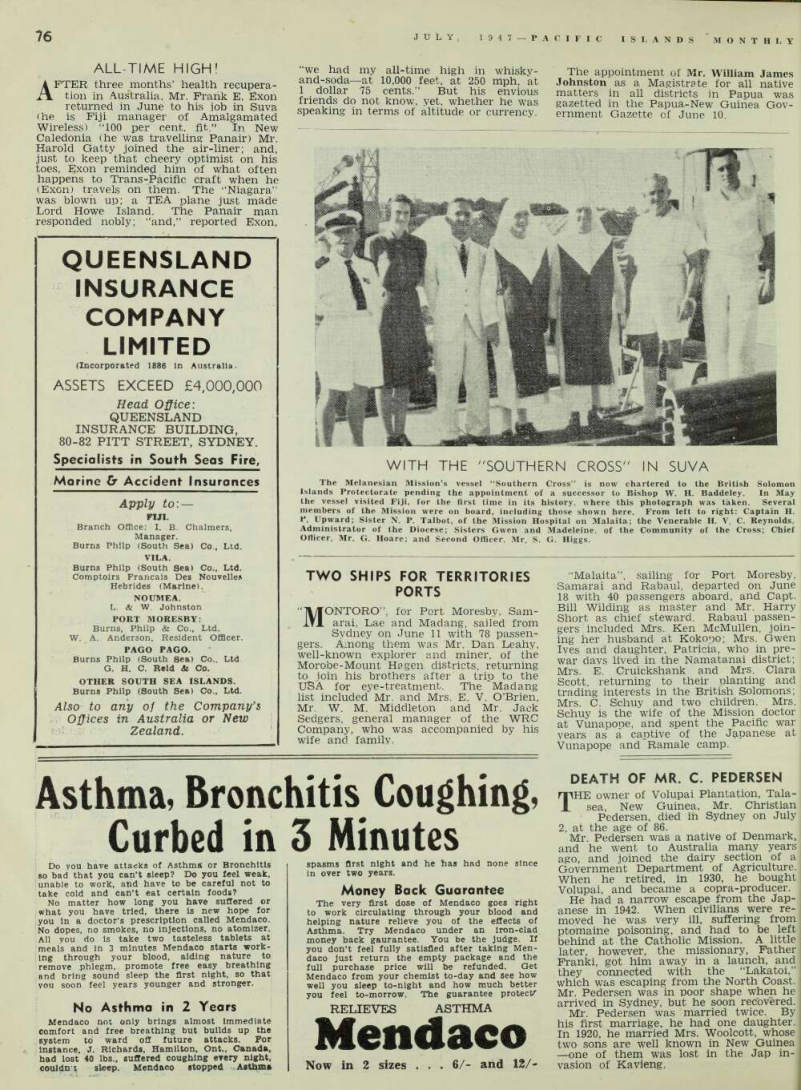
AFTER three months’ health recupera tion in Australia, Mr. Frank E. Exon returned in June to his lob in Suva (he is Fiji manager of Amalgamated Wireless) ’TOO per cent, fit.” In New Caledonia (he was travelling Panair) Mr.
Harold Gatty joined the air-liner; and, just to keep that cheery optimist on his toes, Exon reminded him of what often happens to Trans-Pacific craft when he (Exon) travels on them. The “Niagara” was blown up: a TEA plane just made Lord Howe Island. The Panair man responded nobly; “and,” reported Exon,
“we had my all-time high in whisky and-soda—at 10,000 feet, at 250 mph, at 1 dollar 75 cents.” But his envious friends do not know, yet, whether he was speaking in terms of altitude or currency.
The appointment of Mr. William James Johnston as a Magistrate for all native matters in all districts in Panua was gazetted in the Papua-New Guinea Gov ernment Gazette of June 10.
With The "Southern Cross" In Suva
The Melanesian Mission’s vessel “Southern Cross’’ is now chartered to the British Solomon Islands Protectorate pending the appointment of a successor to Bishop W. H. Baddeley. In May the vessel visited Fiji, for the first time in its history, where this photograph was taken. Several members of the Mission were on board, including those shown here. From left to right: Captain H.
P. Upward; Sister N. P. Talbot, of the Mission Hospital on Malaita; the Venerable H. V. C. Reynolds, Administrator of the Diocese; Sisters Gwen and Madeleine, of the Community of the Cross; Chief Officer, Mr. G. Hoare; and Second Officer, Mr. S. G. Higgs.
Two Ships For Territories
Ports
MONTORO”. for Port Moresby, Sam arai, Lae and Madang, sailed from Sydney on June 11 with 78 passen gers. Among them was Mr. Dan Leahy, well-known explorer and miner, of the Morobe-Mount Hagen districts, returning to join his brothers after a trip to the USA for eye-treatment. The Madang list included Mr. and Mrs. E. V. O’Brien, Mr. W. M. Middleton and Mr. Jack Sedgers, general manager of the WRC Company, who was accompanied by his wife and family.
“Malalta”, sailing for Port Moresby, Samarai and Rabaul, departed on June 18 with 40 passengers aboard, and Capt.
Bill Wilding as master and Mr. Harry Short as chief steward. Rabaul passen gers included Mrs. Ken McMullen, join ing her husband at Kokopo; Mrs. Gwen Ives and daughter, Patricia, who in pre war days lived in the Namatanai district; Mrs. E. Cruickshank and Mrs. Clara Scott, returning to their planting and trading interests in the British Solomons; Mrs. C. Schuy and two children. Mrs.
Schuy is the wife of the Mission doctor at Vunapone, and spent the Pacific war years as a captive of the Japanese at Vunapope and Ramale camp.
Death Of Mr. C. Pedersen
THE owner of Volupai Plantation, Tala sea, New Guinea, Mr. Christian Pedersen, died in Sydney on July 2, at the age of 86.
Mr, Pedersen was a native of Denmark, and he went to Australia many years ago, and joined the dairy section of a Government Department of Agriculture.
When he retired, in 1930, he bought Volupai, and became a copra-producer.
He had a narrow escape from the Jap anese in 1942. When civilians were re moved he was very ill, suffering from ptomaine poisoning, and had to be left behind at the Catholic Mission. A little later, however, the missionary, Father Franki, got him away in a launch, and they connected with the “Lakatoi,” which was escaping from the North Coast.
Mr. Pedersen was in poor shape when he arrived in Sydney, but he soon recovered.
Mr. Pedersen was married twice. By his first marriage, he had one daughter.
In 1920, he married Mrs. Woolcott, whose two sons are well known in New Guinea —one of them was lost in the Jap in vasion of Kavieng.
Advertisements & other items, pp. 78-79 (4 items)
Queensland
INSURANCE
COMPANY
LIMITED
(Incorporated 1886 In Australia.
ASSETS EXCEED £4,000,000
Head Office:
QUEENSLAND
INSURANCE BUILDING,
80-82 PITT STREET, SYDNEY.
Specialists in South Seas Fire,
Marine Cr Accident Insurances
Apply to:
FIJI.
Branch Office: I. B. Chalmers, Manager.
Burns Phllp (South Sea) Co., Ltd.
VILA.
Burns Phllp (South Sea) Co.. Ltd.
Comptoirs Francals Des Nouvelles Hebrides (Marine).
NOUMEA.
L. & W. Johnston
PORT MORESBY:
Burns, Phllp & Co., Ltd.
W. A. Anderson, Resident Officer.
PAGO PAGO.
Burns Phllp (South Sea) Co.. Ltd G. H, C. Reid <b Co.
OTHER SOUTH SEA ISLANDS.
Burns Phllp (South Sea) Co., Ltd.
Also to any of the Company’s Offices in Australia or New Zealand.
Asthma, Bronchitis Coughing,
Curbed in 3 Minutes
Do you have attacks of Asthma or Bronchitis so bad that you can’t sleep? Do you feel weak, unable to work, and have to be careful not to take cold and can’t eat certain foods?
No matter how long you have suffered or what you have tried, there is new hope for you In a doctor’s prescription called Mendaco.
No dopes, no smokes, no injections, no atomizer.
All you do Is take two tasteless tablets at meals and in 3 minutes Mendaco starts working through your blood, aiding nature to remove phlegm, promote free easy breathing and bring sound sleep the first night, so that vou soon feel years younger and stronger.
No Asthma in 2 Years
Mendaco not only brings almost Immediate comfort and free breathing but builds up the system to ward off future attacks. For Instance, J. Richards, Hamilton, Ont., Canada, had lost 40 lbs., suffered coughing every night, couldn't sleep. Mendaco stopped Asthma
spasms first night and he has had none since in over two years.
Money Bock Guarantee
The very first dose of Mendaco goes right to work circulating through your blood and helping nature relieve you of the effects of Asthma. Try Mendaco under an iron-clad money back gaurantee. You be the judge. If you don’t feel fully satisfied after taking Mendaco just return the empty package and the full purchase price will be refunded. Get Mendaco from your chemist to-day and see how well you sleep to-night and how much better you feel to-morrow. The guarantee protect/'
RELIEVES ASTHMA
Mendaco
Now in 2 sizes . . . 6/- and 12/-
77
I‘AClfrlC ISLANDS MONTHLY— JULY, 194?
jmcNr
!) i 7 \ F° r full information and rates apph to; T.O.A. Trafiiic Office, 100 Th( Strand Arcade, George Street Sydney. MA 9578.
In Port Moresby: Steamships Trading Co. In Suva: CORRIE & CO S* New Hebrides: GUBBAY
FRERES. In Noumea; GUBBAY
KERR ET CIE. New Zealand: All offices Union Steamship Co. of N Z Ltd.
Attractive Rates • Luxurious Accommodation • Four Motor Safety
Peru Connection
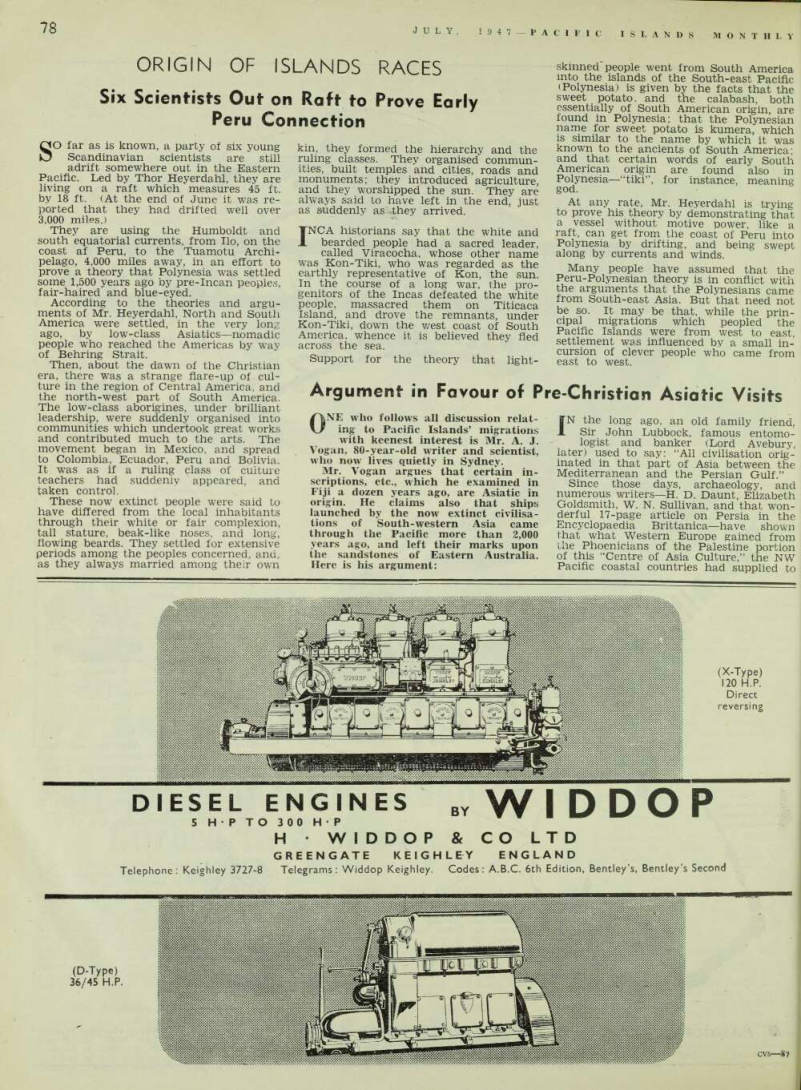
Origin Of Islands Races
Six Scientists Out on Raft to Prove Early Peru Connection
SO far as is known, a party of six young Scandinavian scientists are still adrift somewhere out in the Eastern Pacific. Led by Thor Heyerdahl, they are living on a raft which measures 45 ft. by 18 ft. (At the end of June it was re ported that they had drifted well over 3,000 miles.) They are using the Humboldt and south equatorial currents, from Ho, on the coast af Peru, to the Tuamotu Archi pelago, 4,000 miles away, in an effort to prove a theory that Polynesia was settled some 1,500 years ago by pre-Incan peoples, fair-haired and blue-eyed.
According to the theories and argu ments of Mr. Heyerdahl, North and South America were settled, in the very long ago, by low-class Asiatics —nomadic people who reached the Americas by way of Behring Strait.
Then, about the dawn of the Christian era, there was a strange flare-up of cul ture in the region of Central America, and the north-west part of South America.
The low-class aborigines, under brilliant leadership, were suddenly organised into communities which undertook great works and contributed much to the arts. The movement began in Mexico, and spread to Colombia, Ecuador, Peru and Bolivia.
It was as if a ruling class of culture teachers had suddenly appeared, and taken control.
These now extinct people were said to have differed from the local inhabitants through their white or fair complexion, tall stature, beak-like noses, and long, flowing beards. They settled for extensive periods among the peoples concerned, and, as they always married among their own
kin, they formed the hierarchy and the ruling classes. They organised commun ities, built temples and cities, roads and monuments; they introduced agriculture, and they worshipped the sun. They are always said to have left in the end, just as suddenly as -they arrived.
INCA historians say that the white and bearded people had a sacred leader, called Viracocha, whose other name was Kon-Tiki, who was regarded as the earthly representative of Kon, the sun.
In the course of a long war, the pro genitors of the Incas defeated the white people, massacred them on Titicaca Island, and drove the remnants, under Kon-Tiki, down the west coast of South America, whence it is believed they fled across the sea.
Support for the theory that light
skinned people went from South America into the islands of the South-east Pacific • Polynesia) is given by the facts that the sweet potato, and the calabash, both essentially of South American origin, are found in Polynesia; that the Polynesian name for sweet potato is kumera, which is similar to the name by which it was known to the ancients of South America; and that certain words of early South American origin are found also in Polynesia—“tiki”, for instance, meaning god.
At any rate, Mr. Heyerdahl is trying to prove his theory by demonstrating that a vessel without motive power, like a raft, can get from the coast of Peru into Polynesia by drifting, and being swept along by currents and winds.
Many people have assumed that the Peru-Polynesian theory is in conflict with the arguments that the Polynesians came from South-east Asia. But that need not be so. It may be that, while the prin cipal migrations which peopled the Pacific Islands were from west to east, settlement was influenced bv a small in cursion of clever people who came from east to west.
Argument- in Favour of Pre-Christian Asiatic Visits
ONE who follows all discussion relat ing to Pacific Islands’ migrations with keenest interest is Mr. A. J.
Vogan, 80-year-old writer and scientist, who now lives quietly in Sydney.
Mr. Vogan argues that certain in scriptions, etc., which he examined in Fiji a dozen years ago, are Asiatic in origin. He claims also that ships launched by the now extinct civilisa tions of South-western Asia came through the Pacific more than 2,000 years ago, and left their marks upon the sandstones of Eastern Australia.
Here is his argument;
fN the long ago, an old family friend, Sir John Lubbock, famous entomo logist and banker (Lord Avebury, later) used to say: “All civilisation orig inated in that part of Asia between the Mediterranean and the Persian Gulf.”
Since those days, archaeology, and numerous writers—H. D. Daunt, Elizabeth Goldsmith, W. N. Sullivan, and that won derful 17-page article on Persia in the Encyclopaedia Brittanica—have shown that what Western Europe gained from the Phoenicians of the Palestine portion of this “Centre of Asia Culture,” the NW Pacific coastal countries had supplied to
them in like matter; by the trading and exploring populations of this now almost forgotten source of the ancient expand ing civilisation, whose early days are lost in the mists of antiquity.
Professor Pietschmann, of Gottingen, explained to us how closely the Phoenici ans and the Persians were connected, and how their combined fleets were defeated by the Greeks 500 BC. So we can under stand what other writers tell us about these energetic, exploring, penetrating sailor-folk—how they had boats that could carry 500 persons; how they traded and “slaved” along the Indian coasts and down that of eastern Africa—where they picked up sailor-slaves who, being occa sionally wrecked upon the shores of Viti Levu, apparently left an interesting im press upon the natiye tongue of those lovely islands.
In 1885, I met Dr. Tenison Woods, Victorian Government geologist, who in troduced me to that interesting geological formation, known in eastern New South Wales as the Hawkesbury Sandstone. Here I first saw those mis named “native carvings,” which had evidently been inscribed with the aid of iron tools, which, of course, the abo rigines did not possess. Dr. Woods agreed with me that the engraved stones probably were the work of Asiatics who, passing that way, had been forced to remain, by ship-wreck, or for some other reason.
A RCHAEOLOGY is the hand-maid of J\ History, just as geology is help-meet of the field engineer; and, as I visited all parts of Australasia upon mining business, I found what I believe to be evidence that innumerable Asiatics in the past had visited these lands. But I never quite understood from what part of the great Asiatic Fatherland of ail civilisa tion they had come, until on the advice of the late Mrs. Routledge, the Easter Island authority, I spent some time in the Fiji group. I claimed that I had already traced the Mq-Oris of New Zea land, to Asia —to Northern India, in fact; and that authority upon Asian languages, Colonel R. G. Burton, had written to me on the subject of their language being derived from the ancient tongue, San scrit. Thus evidence once more pointed towards the same mysterious Centre of all beginnings of language, writing and cul ture. The Sepoys of India (properly "Sipihi,” or soldier) in fact spoke a half Ma-Ori tongue as recently as Mutiny time. On one occasion, at the Siege of Delhi, when a British officer had done some particularly brave act, his orderly Sepoy exclaimed, “Achcha, achcha Kia
kaha!”—which cry you can still hear in NZ on any football held.
The value of all such inquiries, ir which archaeology takes so prominent a part, lies in the facts that Mankind has derived its nature, apparently, from one central sphere; and that what has happened in the past will eventuate again and again in the future.
There was that vast conglomeration of active and powerfully intelligent nations —Media, Parthia, Assyria, Meso potamia, Syria, etc.—whose populations termed the great Empire of Persia, dom inating not only Asia, but the islands adjacent to that continent. And, to-day, it has no political significance—it is little more than a name to the peoples of the Western world. The warning is similar to that presented by the formerly great Indian empire, under Chandragupta, and the Empires of Egypt, Greece, Rome, France, etc.
Apparently, when a community is “ripe unto bearing,” and is under direction of a few of its ablest individuals, it rises into prominence, strength and ability.
But, when that selected guidance has de parted, and there is only mob-rule, that nation or empire goes onto the down grade; it becomes one of the world’s audience, instead of occupying a posi tion on the stage. 1 CLAIM that in Fiji I found archaeo logical evidence that wandering Asiatics reached right across the Pacific. At Woy Woy, over 20 miles north of Sydney, is a carving of nine hares, en graved on a rock opposite the railway station. This must have been executed hundreds of years ago by sun-worshippers, for hares were not introduced into Aus tralia until about 1832. Our “Man-in the Moon,” is termed the “hare” by sun worshippers; and is sacred to maternity, as the moon’s period is the same.
This scientifically valuable piece of ancient carving should be preserved. But our Shire Councils, all too accurately, represent our present public, and the majority of folk care little, or nothing, about such matters —although their im mediate ancestors, who made the country, were supporters of all branches of scientific’ research.
The Woy Woy hares, and the archae logical evidence at the Yasawas (Fiji) show a connection, I think, as both were made by sun-worshippers from Asia.
Many of our coastal carvings, and some of those on the various Islands between Papua and Fiji, show an affinity to those of the Persian Gulf, and right along to Indo-China.
As has been shown long since, the first gold obtained in Papua was won by Asiatics, some 1,500 years ago, when the great Persian community-of-nations was reaching forth its inquisitive tentacles of trade and treasure-seeking over the Pacific —just as its western (Phoenician) representatives were introducing those “stepping-stones to culture,” iron, a writ ten-language, music, and picture-making, to ignorant Europe.
Mr. and Mrs. S. S. Boye of Vanikoro,] Santa Cruz Group, BSI reached home after leave in Australia, in March, 1947.
Although Vanikoro is nearer than Rabaul' to Australia, it took the Boves many? months travelling to get their holiday.!
The forward journey was made via Fiji; I the return trip was by steamer to the New Hebrides where, after a wait of six': weeks, they were picked up by Mr. F. L.
Jones of Vanikoro in his boat. Mr. Boye is manager of the Kauri Timber Co. Pty., Ltd., which has an extensive establish- ; merit on the island. The Boyes stayed on Vanikoro during the Pacific war when Mrs. Boye maintained radio contact with Allied headquarters. For her services she* was decorated.
Advertisements & other items, pp. 80-82 (1 item)
Wl Ddop
(X-Type) 120 H.P.
Direct reversing BY
DIESEL ENGINES
5 H P TO 300 H P
H • WIDDOP & CO LTD
GREENGATE KEIGHLEY ENGLAND
Telephone: Keighley 3727-8 Telegrams: Widdop Keighley. Codes: A.B.C. 6th Edition, Bentley’s, Bentley’s Second (D-Type) 36/45 H.P.
IMIMHM!
pr
CVS —8?
s H I p uI L n 1 N g graphic u ones, UF/063 ' -
/* p o, Nr
Editor °«p° n » £«q, p p
Sas.' ?acl «c
Si lio Sir „‘r> «• »«. or Pry
BOX
N o. a Vi.w ONc o«o “•* J “'p. *«*.** *ol lJtl ‘ * thiS C °"Pan;. noW " y * hi P°*ne?3 f® d tent r ® hi P Repair £ S? 0 •*■*** or '" U3e ris tic or the a^oti °n :r^P Th s *«e«r s " ' a,r aii ah , Sf co st — of . i9 fo ' eris tic of of the 3 w trUcti °n or riffi<in3hl P »hi ‘ aine d **• C reen p"* Vy h *a be c l ar s “ **• “ r9ia «o a or,.*. o** 0 ** a* iC re ; t BBeiB i*or r» Ure Privat. ° fl a «d c Wa ct Pro. . -Tr ° u i Jain- fl : cii Ui*. n vrJC * ” 9hi P rep ail ?f ««* •p.ci*, Pr ° v iae m. lac -lu<li L ** b °th i„ 1 SJf iii i„ , sh - — *as- „ nci «S or w en « ifl ®erin , U!
r...' . Ji Pronoo
"■'■'•‘KW,,, ’
Kidney Trouble
and Backache
Gone in 1 Week
Flush Kidneys With Cystex and Ton’ll Feel Fine Cystex—the prescription of a famous doctor —improves faulty kidney action in double quick time, so, If you suffer from Rheumatism, Sciatica, Neuritis, Lumbago, Backache, Nervousness. Leg Pains, Dizziness, Circles under Eyes, frequent Headaches and colds, poor Energy and Appetite, Puffy Ankles or Interrupted Sleep, go to your chemist to-day for Cystex.
Cystex Helps Nature 3 Ways
The Cystex treatment Is highly scientific, being specially compounded to soothe, tone and clean kidneys ana bladder and to remove acids and poisons from your system safely, quickly and surely, yet contains no harsh, harmful or dangerous drugs. Cystex wo~ks In these 3 ways to end your troubles: — (11 Starts killing the germs which are attacking your Kidneys, Bladder and urinary system in two hours,, yet is absolutely harmless to human tissue. (2) Gets rid of health-destroying, deadly poisonous acids with which your system has become saturated. (3» Strengthens and reinvigorates the kidneys, protects you from the ravages of diseaseattack on the delicate filter organism, and stimulates the entire system.
Feels a Different Woman
"I have been taking Cystex for Kidney and Aladder trouble and it has made a different (roman of me. I am feeling splendid, can do all my work, run about and walk miles although I am (53 years of age. Cystex does all you claim for it."—(Sgd.) M. L. Zessin, Thompson Estate, Brisbane.
Now Able to Walk Without Stick
“I had Kidney and Bladder complaint, pains in leg and back; in fact, 1 had to use a walking slick. I have used two bottles of Cystex, now 1 have no pains anywhere. I consider Cystex the greatest medicine in the world for Kidney complaint.”—(Sgd.) J. McPherson, Nangeribone Station, N.S.W.
Guaranteed to Satisfy or Money Back Get Cystex from your chemist to-day. Give it a thorough test. Cystex is guaranteed to make you feel younger, stronger, better in every way, or your money back If you return the empty package. Act now!
Now in 2 sizes—</-, 8/-.
This is a
GUARANTEED CVCIPV
Treatment ®
for Your Kidneys, Bladder, Rheumatism
McILRATH’S
OFFER FULL STOCKS OF QUALITY
Groceries, Wines, Spirits
Liqueurs and Cider
Write for our NEW Grocery—and Wine and Spirit List.
POST FREE BY RETURN AIR MAIL.
All shipments are covered against
PILLAGE-THEFT—NON-DELIVERY.
McILRATH’S PTY. LTD.
Export Department, 202 Pitt Street, Sydney, Australia Cable address: ROTUNDA, Sydney.
Dollors, Francs and Pounds Maddening Merry-go-Round
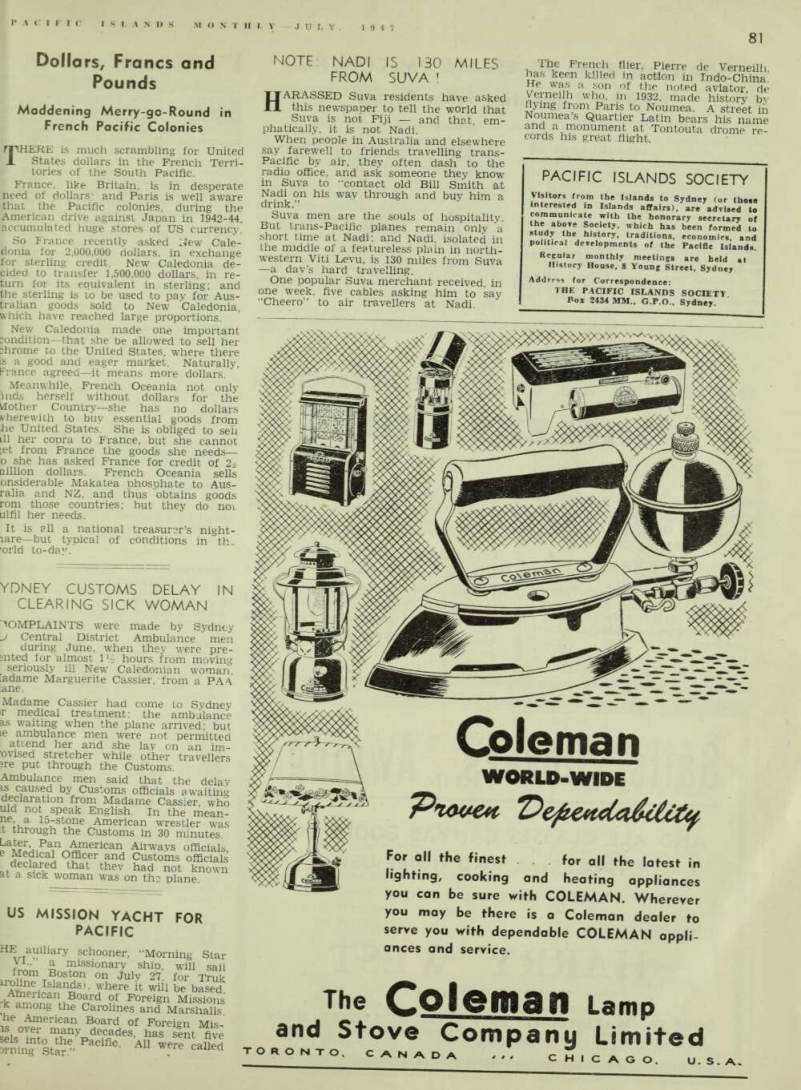
Pounds Maddening Merry-go-Round in French Pacific Colonies
THERE is much scrambling for United States dollars in the French Terri tories of the South Pacific.
France, like Britain, is in desperate need of dollars; and Paris is well aware that the Pacific colonies, during the American drive against Japan in 1942-44. accumulated huge stores of US currency.
So France recently asked New Cale donia for 2.000,000 dollars, in exchange for sterling credit. New Caledonia de cided to transfer 1,500.000 dollars, in re turn for its equivalent in sterling; and the sterling is to be used to pay for Aus tralian goods sold to New Caledonia, which have reached large proportions.
New Caledonia made one important condition —that she be allowed to sell her ffirome to the United States, where there is a good and eager market. Naturally, Prance agreed—it means more dollars.
Meanwhile. French Oceania not only inds herself without dollars for the Mother Country—she has no dollars vherewith to buv essential goods from he United States. She is obliged to sell ill her copra to France, but she cannot :et from France the goods she needs— o she has asked France for credit of 2 a nillion dollars. French Oceania sells onsiderable Makatea phosphate to Aus ralia and NZ, and thus obtains goods rom those countries; but they do not ulfil her needs.
It is all a national treasurer’s night lare —but typical of conditions in th. r orld to-day.
Ydney Customs Delay In
Clearing Sick Woman
COMPLAINTS were made by Sydney j Central District Ambulance men during June, when they were pre mted for almost IV. hours from moving seriously ill New Caledonian woman, :adame Marguerite Gassier, from a PA't ane.
Madame Gassier had come to Sydney r medical treatment: the ambulance as waiting when the plane arrived; but ie ambulance men were not permitted attend her and she lav on an im ovised stretcher while other travellers ire put through the Customs.
Ambulance men said that the delay is caused by Customs officials awaiting declaration from Madame Gassier who uld not speak English. In the mean- ? 6 :u a 15 r st ° ne American wrestler was t through the Customs in 30 minutes. p a^H^ a i n^ merlcan Airways officials, JSfiSi °^ C ? r £ nd sus5 ust oms officials declared that they had not known at a sick woman was on the plane.
Us Mission Yacht For
Pacific
H^/r a M iliary schoone r- -Morning Star Xl" missionary ship, will sail from Boston on July 27 for Truk ll Ari n6 • Islands * • where it will be based mSona n ih^°n rd ? f Forei S n Missions amon g the Carolines and Marshalls he American Board of Foreign Mis sels°lntr> a Y p de .Sf des ’ has sent five MtafstS ■■ CIC - All were cailed
Note Nadi Is 130 Miles
From Suva !
HARASSED Suva residents have asked this newspaner to tell the world that Suva is not Fiji and that, em phatically, it is not Nadi.
When people in Australia and elsewhere say farewell to friends travelling trans pacific by air, they often dash to the radio office, and ask someone they know in Suva to “contact old Bill Smith at Nadi on his wav through and buy him a drink.”
Suva men are the souls of hospitality.
But trans-Pacific planes remain only a short time at Nadi; and Nadi, isolated in the middle of a featureless plain in north western Viti Levu, is 130 miles from Suva —a day’s hard travelling.
One popular Suva merchant received in one week, five cables asking him to say “Cheero” to air travellers at Nadi.
The French flier. Pierre de Verneilh. has keen killed in action in Indo-China. wfvrSl a £ on of A he n °ted aviator, de Veineilh who. in 1932. made history bv flying froni Paris to Noumea. A street in Noumea s Quartier Latin bears his name and a monument at Tontouta drome re cords his great flight.
Advertisements & other items, p. 83 (1 item)
Coleman
PACIFIC ISLANDS SOCIETY
Visitors from the Islands to Sydney (or those interested In Islands affairs), are advised to communicate with the honorary secretary of the above Society, which has been formed to 'I / t l he J histor y. traditions, economics, and political developments of the Pacific Islands Regular monthly meetings are held si History House, 8 Young Street, Sydney Address for Correspondence:
THE PACIFIC ISLANDS SOCIETY
Pox 2434 MM.. G.P.0.. Sydney
m CQ m ( For ght
Coleman
WORLD-WIDE
PtavcK Z>cfictuUfa£ify
the finest for all the latest in 1/ cooking and heating appliances you can be sure with COLEMAN. Wherever you may be there is a Coleman dealer to serve you with dependable COLEMAN oppliances and service.
The Cojematl Lamp
and Stove Company Limited
3 A Kl -r . . . .
ORONTO. CANADA
CHICAGO.
U. S. A.
Plea For Separation From Papua
Rabaul Wishes To Escape Pm Control
From Our Own Correspondent
Rabaul, June 10.
MANY residents of the Territory, alarmed at the slowness of rehabilitation and the wastefulness of Administration, are convinced that our last hope of survival is separation from Papua.
Apart from all the more petty results of the uneasy union of the two Territories, the Provisional Territory is too large and unwieldly to be administered successfully from Port Moresby.
It would have been difficult enough pr-e-war, when shipping services functioned well and the Mandated Territory was materially whole and economic-
ally sound. But to-day, to attempt to administer the two Teritories. when one has been devastated by war, and Services of all kinds are nil. is to create chaos.
A number of New Guinea organisations are now considering ways and means of achieving a separate administration, with an advisory council of experienced men who would re-establish control and lay the foundations of stable policy. Many who were formerly in favour of the amalgamation of Papua and New Guinea have now changed their views and can not see how the retention of this present form of Government can lead to anything but disaster.
SN Rabaul just now the business houses are doing a large amount of busi ness. Chinese merchants and the Chinese population generally are very prosperous. Large consignments of all kinds of cheap, commercial manufactured lines and some trade goods have arrived from China. These have been augmented by Canadian and American goods that are reaching Rabaul via Hong kong.
This business is largelv a r:sult of the utter disregard the native has for the money that is being lavished on him in the way of war damage and Government grants of various kinds. When th'.s easy money is finished we will be faced with the realisation that production in these parts has suffered by neglect to such an extent that economic recovery will be almost impossible. Those natives who will then need employment will not find it—their means of livelihood will have disappeared.
THE inter-island shipping position is 1 described in the “Rabaul News,” a paper produced in Pidgin English by the Administration for the benefit of the natives, but read by the Europeans who have no newspaper of their own. A perusal of it discloses that a large num ber of the inter-island ships are out of action.
There are still no means of regular mails to the outposts, no means of dis tributing urgently-needed food and in dustrial supplies, and no means of ship ping produce. The people of Bougain ville. New Ireland, and a number of smaller islands are in an unpleasant posi tion, and a few planters have already been forced to leave their plantations after having spent large sums of money on them in an endeavour to bring them back into production. * * * HPHOUGH the Territory is suffering 1 severely from a shortage of timber supplies, some wizard is now monkey ing with the Forestry regulations in an effort to deprive former holders of timber permits and leases from resuming work on them.
Rumour has it that Big Business con cerns have designs on the timber areas of New Guinea. In the meantime, we gc without much-needed timber required for local rehabilitation purposes. * * * MR. OSCAR RONDAHL has left bj plane for Australia. He has beer very busy during the past few months trying to rehabilitate his pre war headquarters at Kabakaul, near Kokopo. He has disposed of several ol his plantations, but will retain the Kaba kaul property. Mr. Rondahl has pur chased a property in Clare, South Aus tralia, and is now an enthusiastic sheep breeder. He tells some good yarns about a blue cattle-dog, but denies that the crows in SA fly backwards—not as often as some people say they do, anyway.
Oscar Rondahl and his charming wife will make periodical visits to New Guinea!
We all wish them good luck in their new venture. * * *
Hard-working Mr. jack Gannonj
of the Commonwealth Bank, has re established the Rabaul branch very successfully, despite the many difficulties that beset anyone trying to get anything going hereabouts.
With two assistants, Mr. Gannon must have been hard pressed to cope with the banking business here, and attend to ths building of the bank premises. He now has received some further assistance in the shape of two young men from AusH tralia.
Advertisements & other items, p. 84 (2 items)
82
JULY, 1 9 4 7 P A G 1 F I G ISLANDS MONTHLY
sauk
Every Branch Of
ENGINEERING and BUILDING CONSTRUCTION
MILLERS LTD.
SUVA and LAUTOKA
Sawmillers and Timber Merchants; Shipwrights and Sailmakers; Joinery and Furniture Manufacturers; Upholsterers; Plumbers; Electricians; Hardware Merchants; Motor Dealers.
AGENCIES:
Chevrolet, Bedford, Vauxhall, Nash Motors. Firestone Tyres.
Fetters Marine and Stationary Engines. G.E.C. Radio Sets.
British Australian Lead Manufacturers Pty., Ltd., Atlas Assurance Co., Ltd.
There is no need to send to Australia or New Zealand for Repairs or Replacements. We con give you a sound Quotation and guarantee First-Class Workmanship
sauk
When "Number One"
Was Off Schedule
His Honour Col. J. K. Murray,
Administrator of Papua-New Guinea, paid an official visit to the District Office at Sohano, Buka, on June 8. Actu ally, he was due to arrive on June 3, on which day the usual out-station window dressing had been applied; the donning of stiff, starched whites, the drill re hearsals of the native police and the general what-have-you preparatory to the arrival of any very high official at a Territorial out-post.
None of these preparations was in evid ence when His Honor walked ashore from the mine-sweeper “Condamine,” to be welcomed by a surprised medical assistant instead of a senior officer—who, however, soon put in an appearance, and, being an old soldier of long experience, carried off the situation with aplomb.
Native chiefs, long awaiting this great e y e ?i’ a * ld gathered from all the points of the Buka compass, were disappointed at not having an audience with the Num ber One, who only stayed a couple of hours at the station.
Other recent visitors to Sohano have been Chief Medical Officer Dr. Gunther and Director of Agriculture Cottrell- Dormer—not forgetting the Administration yacht, “Laurabada,'’ which experienced a spot of bother in the reef-infested straits between Lalahan and Madehas n Buka Passage. But all’s well that ? £ ds well—the high tide floated the vessel )ff without any noticeable damage Three boars were unloaded at Sohano or the Agricultural Department’s repre entative. Local indigines are asking whether the three pigs represent the sum otal of live-stock for the publicised re tockmg of the district.
Sharpies Ban On Building
Materials For Ng
Letter to the Editor HO-DAY the ABC announced that roof- L ing iron that was to have been de -3 lolded hod by thB “ Malaita ” would not A Methodist minister apparently de ded, like our “Indonesian Comrades ” ► ignore the Government of Australia id appealed to the wharf labourers direct 3t to load the iron as he considered was more urgently needed in Aus cl lift. 1 These peopie seem to lose sight of the ict that Government approval is ►tained for the purchase of building aterial in Australia before it can be irchased and shipped to New Guinea is ’ that the Purchaser Operty d t 0 the USe or P° ssessi °n of his Some responsibility for loss, delay, damf tc -’ hP° U Jn be sh £ eted home to those isstonaiies. ey ' f labourers or I am. etc..
W. R. B. Thomas.
ibaul, NG. ne 10.
The ban on shipment of ildmg materials to Papua-New Guinea s subsequently lifted by the Sydney I t p BrS r!sff rS ‘- was Droved them that ie material was needed to construct )d stores m New Guinea”).
Elsie Luff, formerly of Darn pua was married to Mr. Norman IS"?? 4, Townsville, in Cairns on 4 - Mlss is the second daughter Mr. Leonard Luff, a well-known re ent of Papua, and Mrs. Luff.
Home at any Price
Javanese Leave New Caledonia By Air
From Our Own Correspondent
I Noumea. June 10.
T was a red letter day in local Jav anese affairs, on May 29, when the Qantas sea plane “Coriolanus” took • off for Australia carrying, amongst others, seven Javanese. They were former in dentured labourers and latterly “residence hbre;” they had waited years to go home to Java, via Australia.
Two hundred envious compatriots were on the wharf to see them off. They had started assembling as early as 4 a.m , and their concerted sigh of envy almost drowned the roar of the “Corialanus” as she lifted into the sky.
For several years the Javanese here have been awaiting a Dutch boat to carry them home, but so far it has not materi alised. The price of the through air trip dava Vla Aus , tralia cost the Javanese 23,000 francs each (£AI4O) anil was paid for in American dollars, which they had to find themselves because the local Ad mimstration will not. of course, sell them This is an enormous sum for these Jav calTof'home'is strong 3 "’ l3borerS ’ but the With few exceptions, all the Javanese here are longing for the day when thev can get away; they pay no heed to what niay be in store of them on arrival in Jft Vft. ciriiwi^u 118 here are excellent. Any un skilled labourer can earn almost £AI per nFtv, and tradesman much more. Most nlifk 1 \e we y er - ar e content to work half-heartedly for a few days a week just enough to keep themselves and have a over for the cinema.
With regard to air travel, it is intrest mg to note that Pan American Airways will accept payment in francs for passages; this is a strong selhng point hi their competition with Qantas which will only take dollars or British currency. 1 Mr. M. R. Gallen, who was rpppnHv appotatfd a Warrant Officer of Poflce at race Porc? y fn Was in the QueeSnd Foice foi seven years. Known to his friends as “Mick” Gallen he is a first-rank footballer and tennis player
Launch
Ray Parer and a Mission Launch
From Our Cairns Correspondent rnHAT well-known Territorian, Ray A Parer, appeared in Cairns on June 18, engaged in a new kind of ad venture; he was sailing the 45 ft. launch Lady Yetive” from Brisbane to Samarai, for the Methodist Mission at Salamo
(Goodenough group).
The Mission bought the launch from the Australian Army; and, before it went to war, it was a Darwin pearling lugger It had undergone repairs at Brisbane when Ray took over, and set off north wards with Engineer Tom Holack, of Mackay, and a crew of four natives Next day, the engine gave trouble.' Next day it went out, and the vessel proceeded under sail, while the oil-feed system was Palm Island. 60 miles south of Mackay, they ran out of oil. Another launch gave them oil. and they got to Mackay, and underwent repairs They left Palm Island on 15th. met bad weather and lost oil pressure and returned to Palm Island.
They got to Cairns on the 18th, dis mantled the engine and spread it around for a badly needed overhaul. Ray, norm ally a patient man with engines, was pre vented by force from dancing upon the bits and pieces.
The launch left a week later for Samarai direct. Ray himself is headed lor Lae.
Mr. K, C. Macpherson, formerly a re= porter on the “Fiji Times” he resigned in 1943 to enter Queensland journalism— has been appointed night sub-editor of the “Daily Mercury.” Mackay.
Mr. Des. Cahill, a well-known Port Moresby lad. recently took up duties with Bulolo Gold Dredging, Ltd., in New Guinea.
Advertisements & other items, pp. 85-86 (1 item)
Stephens Import and Export Co
Island Stamps
Island Stamps
Island Stamps
Island Stamps
1/3 PER PACKET
including postage Write to —
JENKINS EMPORIUM
Box 100. Suva, FIJI
What are your shortages ?
STEPHENS IMPORT AND EXPORT CO
hides, skins and livestock suppliers and shippers (1) (2) (3) (4) We are suppliers of the following.— 1(5) (8) (7) (8) Trade Goods.
Primus Stoves.
Foodstuffs.
Umbrellas.
Manchester Lines.
Perfumery.
Wines.
Radios. (9) (11) Rum, Saddles and Harness. (10) Non-Electric Washing Machines, Tubular Chrome Furniture.
Tools, Machinery.
Pumps and Stationary Engines.
Home Lighting Plants. (12) (13) (14) Gin Liqueurs, Whisky and all spirits. Only the finest Australian and Imported brands stocked.
All orders personally attended to and shipped promptly.
Stephens Import and Export Co
Dymocks Building, 424 George Street, Sydney, Austrolio ’
KANGAROO BRAND
Ropes,
Cordage,
and Twines for every purpose . Backed by 86 years of service Manufactured by.
M. DONAGHY AND SONS,
Pty. Ltd., Geelong and Sydney.
Fiji Representatives:
PEARCE AND CO.
LIMITED
P.O. BOX 237, SUVA
in Rarotonga
Black Week For Pigs And
Chickens!
Maori Party Lavishly Entertained
in Rarotonga
Rarotonga, June 30
A LARGE crowd gathered at Rarotonga airport on June 21, to welcome the party of notable New Zealand Maoris who were taking the opportunity to visit the Cook Islands, after attending ' the royal wedding in Tonga.
The party was headed by Princess Te Puea Herangi, the grey-haired little lady who has done so much for the N 2 Maoris, and Princess Piki Koroki Mahutu, young daughter of the NZ Maori King Koroki.
Other members of the party numbered 14, including Mr. M. R. Jones, private secretary to the NZ Minister of 'Native Affairs. The visitors were greeted by Mr. W. Tailby (Resident Commissioner) and Mrs. Tailby, the Arikis and members of the Island Council. A team of Man ihiki Islanders performed welcoming drum-dances on the air-strip.
Travelling in cars to Avarua, the party was given an official reception on the verandah of the Administration building, with a public audience.
In his address, Mr. Tailby remarked that this occasion held particular interest in view of the fact that some of these people, visiting Rarotonga for the first time, undoubtedly were descendants of some of those great Polynesian naviga tors who sailed from Rarotonga to New Zealand centuries ago. They came back, not in sailing canoes, but in “Pia Rere” —the “flying ship.”
The party proceeded to the residences of Makea Nui Ariki and of Vakatini
Ariki. In the traditional manner ao corded to Polynesian royalty, Princess Piki Koroki Mahutu was' carried on a large decorated raft borne by many chanting “warriors”, wearing kilts of the sacred rauti leaves, while rauti-clad vahines lined the route. Princess Te Puea Herangi refused such transportation, in sisting that the honour be reserved for the daughter of the Maori king.
Thence forward, for a week, the visitors were ceaselessly entertained, with cere monial hospitality and presentations. It was a black week for Rarotonga pigs and chickens.
Territories' £2,573 for British
Flood Relief
THE people of New Guinea-Papua have raised no less than £2,573 for the British Flood Relief Fund, and al ready £1,500 of it is in the hands of the Lord Mayor of London.
Officials and members of three organi sations (Papuan Citizens Association, Public Service Association, and Returned Soldiers Association) combined for the drive for funds, and money was raised many ways. Raffles brought over £150; dance tickets, £418; and “Race” meetings —jolly affairs held on Ela Beach—nearly £BOO. Straight donations totalled £1,422.
The Papuan Citizens Association, formed some four months ago, has the following office-bearers: President, Mr. Tom Flower; vice-presidents, Messrs. Hurd (Commonwealth Bank), C. Cox (Bank of NSW) and E. A. James; secretary, Mr.
Norman White; Committee. Messrs. G.
Cadden, Roy Field, James Ellis, Reg Egin ton, lan McDonald, Mrs. S. E. Reilly, Mrs.
Burke, Miss Thwaites.
Advertisements & other items, p. 86 (1 item)
|P I M Don't Say
DON'T SAY fp I DON'T SAY Gll%' DON'T SAY fp I ]\ T
IDON'T SAY GIM DON'T S
DON'T SAY fp
mi •Te
T%' DON'T SAY
NT SAY fp I f% T
M DON'T SAY
DON'T SAY G I M D
|p I M DON'T SAY
DON'T SAY « I M
|p I M DON'T SAY
DON'T SAY fp I W
|p I M DON'T SAY
T SAY fp 1 DON'T
]\ T DON'T SAY
T SAY fp I M DON'T SAY fp 1 I Address all inquiries to:
W. & A. GILBEY LTD.
*/ S '-J0,.. u. ?/A. 5
; Coc^
•/oL t c Telegrams and Cables: “GILBEYS,” Melbourne.
Telegrams and Cables: “GILBEYS,” Sydney. 33 ROSSLYN STREET, WEST MELBOURNE. 109 REGENT STREET, SYDNEY.
Index to Volume XVII.
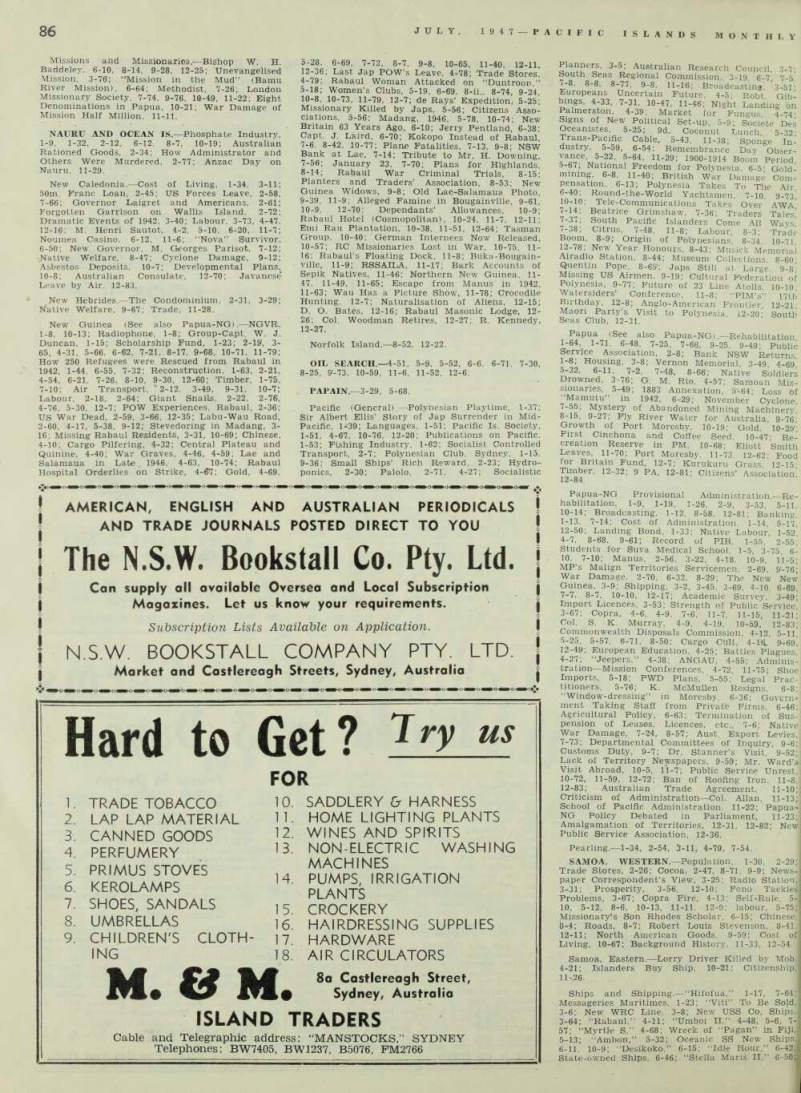
August, 1946, To July, 1947, Inclusive
[First numeral indicates number of issue and second numeral gives page.]
Airways And Aviation.—I-13, 2-8 2-11
2-71, 3-7, 3-49. 4-7. 4-70, 5-6, 5-9, 5-40, 5-72’ 6-11. 6-24, 7-7, 7-10, 7-62, 8-5, 8-9. 8-29 9-l' 9-47, 10-7. 11-9. 11-10, 12-11.
Asiatic Countries in Pacific.—NEl, 1-3, 1-62. 2-62, 5-8. 6-45. 8-31. 10-59, 12-5; Philippines 1- Timor. 2-33, 11-11; Malaya, 2-51.
BOOK REVIEWS.—“FoIk-Tales from Papua"
'Bruce Hamilton), 1-41; “From a South Seas Diary” (Sir H. Luke). 1-41; “Culture Changes in Kiriwina” (Leo Austen), 2-40; “Savage Tales” (L. Letti. 2-40: “Safety Last” (Rita Snowdeni. 2- “The Coast Watchers” (Eric Feldt), 4-44; “Daughter of the Islands” (Evelyn A. Downs). 4- “The Making of Modern NG” (S. W. Reed). 5- “Who Travels Alone” (Greenop), 6-44"
“Pacific Science” (Quarterly Magazine), 8-62 : “My Ship Is So Small” (Lloyd Rhys), 9-38.
Canton Island— Io-60.
Coast-Watching.—l-13, 3-32, 4-49, 5-33 7-51 1-33, 9-33, 10-33, 12-46.
Cocoa (see also W. Samoa). —5-47, 3-50, 5-47.
Cook Islands. —Unionism, 1-14, 10-16; Fruit 1-25. 5-55. 7-56, 10-48, 10-78. 12-63; Rescue oft \itutaki, 1-54; CIPA, 2-28. 3-57, 7-58. 10-16; 3aol Escapees Destroy Big Store, 4-10; Legis lative Council, 5-14, 11-46; Puka-Puka, 5-59; Sugar. 5-71; Young Adeventurers Put to Sea, 1-65; Marriage and Divorce. 8-43; Onions. 8-44; T he Haunted Tree. 8-66; W. H. Watson Retains leat on Island Council, 9-9; Puka-Puka Cowboy, -40; Puka-Pukans Would Like Nassau Island. -50; Seamen Demand Better Pay in NZ, 10-7; 'urther Term for Administrator. 10-10; New langaia Church. 10-36; The Bread Season. 10-43oting by Radio. 10-47: RC Reports to Council.' 1-19; Keen to Work on Phosphate Island, 12-20fo Sunday Work, 12-40; Need of Local Air ervice. 12-51; Visit of Maori Party, 12-84.
Copra.—l-8, 1-25, 1-30. 2-24, 2-25, 4-6, 4-9 •47, 7-6, 7-12, 7-18, 7-64, 8-48, 9-14. 9-24, 10-7 -7, 11-15, 11-18. 11-21, 12-29.
DEATHS.—John Rowe, 1-3; N. H. Macdonald 5; Peter Kyllert. 1-23; Miss A. Gibson, 1-29; O. Moulton, 2-ii., W. W. Bolton, 2-12, 11-43ster Mary St. Yves, 2-26; Alan Campbell, 2-77 : E. Spence, 3-3; B. Manly. 3-10; Doepke, Mr. id Mrs.. 3-11; Mr. and Mrs. J. Gareis and did, 3-11; Sister M. Molnar, 3-11; E W G ventyman, 3-14; Mrs. C. G. Chatterton, 3-56; Fryer, 4-6; J. Costello, 4-11; apt. E. Twenty an, 4-17; C. Whippy. 4-20; Mrs. J. B Brown 29; Mr. R. Blakelock. 4-29: J. Eastgate, 4-29; . Staite, 4-29; William D. Bryan. 4-46; Alfred lassagniol. 4-66; Victor Herault. 4-66; R. B. )berts, 4-74; A. L. Braisby, 5-9; P/O B. P. aser, 6-19: Mrs. Gladys 'Baker, 6-22- J L ennan. 6-27; A. E. Allman, 6-32; Lloyd Cox. 36; John Hayes, 6-50; Henry Dexter, 6-72 • W Priest. 7-2; Sgt. Metoa, 7-14; Dr. S. M. Lam rt. 7-16; D. B. Coutts, 7-18; Robert Lepper. 22; Mrs. R, D. McPhee. 7-23; W. J. Lambden. 27, K. Parker. 7-28; R. A. Gale, 7-46; Harrison lith. 7-56; William C. Dexter, 7-56; Dr. A. J ass. 7-74; Edward Auerbach, 8-4; Capt Viggo ismussen. 8-8; R. Jones. 8-11; G. Aumuller. 12, 9-12. 10-16; H. I. Horton, 8-47; Dr. P. E. dft, 8-70; W. B. Jones, 8-70; Miss E. H nkley, 8-70; Mrs. L. Glover, 9-11; Mrs. S. A. dis, 9-16; Mrs. J. Walstab, 9-27; Mrs M J .llagher, 9-46; J. G. C. Bennie. 9-52; Alan O.
Kenzie, 9-67; Mrs. Twentyman. 9-69; Mrs. C.
Johnson. 9-70; Marama Tane, 9-75- Capt >c Markwell, 9-79; Chas. B. Nordhoff. 10-23ve Brewster. 10-25; Ernest Till. 10-30; Mrs F. Nelson, 10-36; Mrs. J. M. C. Forsayth 48; Irving G. Smith, 10-51; V Gentles, 11-9s. S. Weatherby, 11-8; Mrs. Alice Roberts’. 10; A. A. C. Hall. 11-20; Geoffrey White. 28; Henri Walker. 12-7; S. Young, 12-9; Mrs T. Dickson. 12-16; Capt. H. Low, 12-35; Capt J. G. Warren. 12-38; Mrs. Rankin. 12-70' Pederson, 12-76. )ecorations—Paul Mason. 1-5; Capt. R. C. ?e, 1-10; Major T. Grahamslaw, 1-65; Fit / ut. H. W. P. Newall, 2-62; C. H. Meen. 3-11; v. Jean Camille Haumont, 3-58; H. C. R. f. lliams, 5-27; H. H. Ragg, 6-9; R. N. Cald 1, 6-9; Hon. Ata, 6-9, 7-20; A. S. Prater 6-9- ;s Merle Farland, 11-20; Dr. D. W. Hoodless’ 10; Setariki M. Koto, 12-10; B. F. Hooper^
Iction.—I-41, -2-72. 5-73. 6-41, 7-40, 9-44
12, 11-44. iji.— Common. Roll, 1-8; Fijian Affairs, l-ll 1. 6-12. 11-8, 12-29; Brewster. Clive l-ll !5, 12-25; Trade, 1-12, 9-16. 9-29, ’ 11-60-’
Liquor. 1-33; New Industries. 1-34, 3-17, 7-55- Fijian Chiefs in England, 1-57; US War Dead I- Bell of “Fiji," 2-23; Medical Services, 2-28; Rabi Island, 2-34, 8-76; Rotuma, 2-46, 8-40 II- 12-11, 12-44; Candlenut Oil, 2-43 8-7 8- 28; population, 2-47. 3-63, 5-12, 9-17, 11-7’ Com parison with W. Indies. 2-53; Sukuna, Ratu. Sir Lala, 2-58; NMP’s and Medical School, 2-76 6.-31, 9-78, 10-29; Repatriation of Fiji Indians’ 3-7; H. Sabben Retires, 3-11; Suva Bowling Club 21st Birthday, 3-14; Education. 3-28. 4-14. 4-48 6-51; Coal Shortage, 3-29; Archaeological Re search, 3-47; Pineapple Cup. 3-54; Revenue 3-69; Development Plan. 4-8, 4-48, 5-21, 6-54: Copra, 4-9, 6-19. 11-7, 11-18, 12-29; MH Scholar ship, 4-9; Indians and Land, 4-11; Public Ser vice. 4-12; RSPCA, 4-29“ Gifts for Britain, 4-33, 5-14, 12-32; Retirement of Dr. H. S. Evans. 4-47; Rice, 4-51, 6-33; Oysters. 4-68. 11-28: . Official History of Fiji Published, 5-9; Votes for Civil Servants, 5-10; Tourism, 5-16; Sugar, 5-19, 6-54 8- 10-65’; Nadi Airport, 5-20, 6-15, 7-69. 8-3 e! 9- 12-81; Wartime “Mysteries,” 5-44; Cession Memorial, 5-48; Marriage Bill, 5-57; Chemical Eradication of Weeds. 5-60; Student Permits to NZ. 5-64; Peanuts, 5-67; Finance Regulations for Travellers, 6-6; Gold-mining, 6-8, 8-4, 11-40- Sir A. Grantham. 6-9, 7-7. 9-9, 9-11, 9-23: Dr. D.
W, Hoodless, 6-25; Public Relations Office 6-28- New Map, 6-33; Agriculture Scholarships. 6-5 o! 7-48; European Electors’ Association, 6-72, 9-75- Supply and Production Board Disbanded, 7-22; Labour, 7-25, 11-24; Signals Unit, 1939’-40, 7-49; British and US Cars, 8-5; I. E. Lucchinelli New Police Commissioner. 8-10; Suva Yacht Club 8- 12; Bird Paintings, 8-17, 9-73; Union Club. 8-26' Land Subdivision, 8-74; NZ Teachers. 8-77 : Floating Mines. 9-13; Filming of “Blue Lagoon ”’ 9- Housing Shortage. 9-24; Fiji’s Harbour Master, 9-38; Is the Fijian a Micronesian, 9-49 10- Col. Workman Leaves Colony 9-50 Re habilitation Board. 9-71; Cost of Living ’9-79 10-56, 11-6; Food Subsidies. 10-7; Aerial ’cross roads. 10-7; Sir M. Hedstrom. 10-22; Indian Interference, 10-30; Arts and Crafts. 10-32; Town Board’s Plans for Lautoka, 10-47; “PIM” Editor’s Notes, 10-50; Bananas. 10-72, 11-46; Rugby Foot ball, 10-73; TB Campaign, 10-79; More Indians Arrive, 11-17; Visit of Archaeologist, 11-17- War Funds, 11-25; Overcrowding in Suva, 11-26- Officials, 11-26; P. Costello for Exe cutive Council, 12-10; Piji-English, 12-42.
And Ellice Is. Colony.-New
Administration Centre, 3-28; Copra Tax 4-8- Handbook on Ellice Language. 5-36; New Rc’ 6-7, Lands Officials, 6-10; Japs at Butaritari,’
7-71; Taxes, 9-12; New SDA Ship, 9-67. ww WA A n -~£ eri€ra1 ’ I ’ s7 ’ 6 - 53 - 10 - 45 - 12-7; Spirit! »-«; Japs Martial Health.—Tropical Ulcers, 2-16; DDT and Malaria, 2-23, 2-54; Malaria, Treatment of. 2-28 3 ‘ 53, i*"® 4, 3 ' 76 ’ 6-72: So uth Pacific Health Ser vice. 4-23, 8-9; Elephantiasis, 5-8, 6-34; Mosquito Repallants, 5-52; Dengue. 10-36; Mosquito Con trol. 11-50; East and West Disease Zones, 11-51, Hedstrom. Sir M.—l-36. 2-57.
Marshalls, Marianas And Carolines
8-46, 9-10, 11-7, 11-26. 12-7,
(Continued next page)
Missions and Missionaries.—Bishop W. H.
Baddeley. 6-10, 8-14. 9-28. 12-25; Unevangelised Mission, 3-76; “Mission in the Mud” (Bamu River Mission). 6-64; Methodist. 7-26; London Missionary Society. 7-74. 9-76. 10-49, 11-22; Eight Denominations in Papua, 10-21; War Damage of Mission Half Million, 11-11.
NAURU AND OCEAN IS.—Phosphate Industry, 1-9. 1-32, 2-12, 6-12. 8-7, 10-19; Australian Rationed Goods. 2-34; How Administrator and Others Were Murdered, 2-77; Anzac Day on Nauru, 11-29.
New Caledonia. —Cost of Living, 1-34, 3-11; 50m. Franc Loan, 2-45; US Forces Leave. 2-58, 7-66; Governor Laigret and Americans, 2-61; Forgotten Garrison on Wallis Island. 2-72; Dramatic Events of 1942, 3-40; Labour, 3-73, 4-47, 12-16: M. Henri Sautot. 4-2. 5-10. 6-20, 11-7; Noumea Casino. 6-12. 11-6; “Nova” Survivor. 6- New Governor. M. Georges Parisot, 7-12; Native Welfare, 8-47: Cyclone Damage, 9-12; Asbestos Deposits. 10-7: Developmental Plans. 10-8; Australian Consulate, 12-70; Javanese Leave by Air, 12-83.
New Hebrides.—The Condominium, 2-31, 3-29; Native Welfare, 9-67; Trade, 11-28.
New Guinea (See also Papua-NG 1. —NGVR. 1- 10-13; Radiophone, 1-8; Group-Capt. W. J.
Duncan, 1-15; Scholarship Fund, 1-23; 2-19, 3- 65, 4-31. 5-66. 6-62. 7-21. 8-17. 9-68, 10-71. 11-79; How 250 Refugees were Rescued from Rabaul in 1942, 1-44, 6-55. 7-32; Reconstruction. 1-63, 2-21, 4-54, 6-21, 7-26. 8-10. 9-30, 12-60; Timber, 1-75, 7- Air Transport. " 2-12, 3-49, 9-31, 10-7; Labour. 2-18. 2-64; Giant Snails, 2-22, 2-76, 4-76. 5-30, 12-7; POW Experiences, Rabaul, 2-36; US War Dead. 2-59. 3-66, 12-35; Labu-Wau Road, 2- 4-17, 5-38, 9-12; Stevedoring in Madang, 3- 16; Missing Rabaul Residents, 3-31, 10-69; Chinese. 4-10; Cargo Pilfering, 4-32; Central Plateau and Quinine. 4-40; War Graves, 4-46, 4-59; Lae and Salamaua in Late 1946, 4-63, 10-74; Rabaul Hospital Orderlies on Strike, 4-67; Gold, 4-69.
5-28. 6-69, 7-72, 8-7. 9-8, 10-65, 11-40, 12-11, 12-36; Last Jap POW’s Leave, 4-78; Trade Stores. 4- Rabaul Woman Attacked on “Duntroon,” 5- Women’s Clubs, 5-19, 6-69, 8-ii.. 8-74, 9-24, 10-8, 10-73, 11-79, 12-7; de Rays’ Expedition, 5-25; Missionary Killed by Japs, 5-56; Citizens Asso ciations. 5-56; Madang, 1946, 5-78, 10-74; New Britain 63 Years Ago, 6-10; Jerry Pentland, 6-38; Capt. J. Laird, 6-70; Kokopo Instead of Rabaul, 7-6, 8-42. 10-77; Plane Fatalities, 7-13. 9-8; NSW Bank at Lae, 7-14; Tribute to Mr. H. Downing, 7- January 23. 7-70; Plans for Highlands. 8- Rabaul War Criminal Trials, 8-15; Planters and Traders’ Association, 8-53; New Guinea Widows, 9-8; Old Lae-Salamaua Photo, 9- 11-9; Alleged Famine in Bougainville, 9-61, 10- 12-70; Dependants’ Allowances, 10-9; Rabaul Hotel (Cosmopolitan), 10-24, 11-7. 12-11; Emi Rau Plantation, 10-38. 11-51, 12-64; Tasman Group, 10-40: German Internees Now Released, 10- RC Missionaries Lost in War, 10-75, 11- 16; Rabaul’s Floating Dock, 11-8; Buka-Bougain ville, 11-9; RSSAXLA. 11-17; Bark Accounts of Sepik Natives, 11-46; Northern New Guinea, 11- 47. 11-49. 11-65; Escape from Manus in 1942, 11- Wau Has a Picture Show, 11-78; Crocodile Hunting. 12-7; Naturalisation of Aliens, 12-15; D. O. Bat6s, 12-16; Rabaul Masonic Lodge, 12- 26; Col. Woodman Retires, 12-27; R. Kennedy, 12- Norfolk Island.—B-52, 12-22.
OIL SEARCH. —4-51, 5-9, 5-52, 6-6. 6-71. 7-30, 8- 9-73. 10-59, 11-6, 11-52, 12-6.
Papain. —3-29, 5-68.
Pacific (General). —Polynesian Playtime, 1-37; Sir Albert Ellis’ Story of Jap Surrender in Mid- Pacific, 1-39; Languages. 1-51; Pacific Is. Society, 1-51. 4-67, 10-76, 12-20; Publications on Pacific. 1-53; Fishing Industry. 1-62; Socialist Controlled Transport. 2-7; Polynesian Club. Sydney. 1-15, 9- Small Ships’ Rich Reward. 2-23; Hydro ponics, 2-30; Palolo. 2-71. 4-27; Socialistic
Planners, 3-5; Australian Research Council, 3-7; South Seas Regional Commission, 3-19, 6-7 7-5’ 7-8, 8-8, 8-77, 9-8, 11-16; Broadcasting, 3-5 r Europeans Uncertain Future, 4-5; Robt. Gib bmgs, 4-33, 7-31, 10-47, 11-46; Night Landing on Palmerston, 4-39; Market for Fungus, 4-74; Signs of New Political Set-up. 5-9; Societe Des Oceamstes, 5-25; 9d. Coconut Lunch, 5-32' Trans-Pacific Cable, 5-43, 11-38; Sponge In dustry, 5-59, 6-54; Remembrance Day Obser laiI a il Ce V T 5 r? 2 ’ 5 ’ 64 ' U ' 29; 19 °0-1914 Boom Period. 5- National Freedom for Polynesia. 6-5- Gold mining, 6-8. 11-40; British War Damage Com pensation. 6-13; Polynesia Takes To The Air. 6- Round-the-World Yachtsmen, 7-10, 9-73 10-10; Tele-Communications Takes Over AWA 7- Beatrice Grimshaw, 7-36; Traders Tales! 7-37; South Pacific Islanders Come All Wavs! 7-38; Citrus, 7-48, 11-8; Labour, 8-3; Trade Boom, 8-9; Origin of Polynesians, 8-34, 10-71 12-78; New Year Honours, 8-43: Musick Memorial Airadio Station, 8-44; Museum Collections. 8-60 Quentin Pope. 8-69’; Japs Still at Large 9-8 : Missing US Airmen, 9-19; Cultural Federation of Polynesia, 9-77; Future of 23 Line Atolls. 10-10; Watersiders’ . Conference, 11-8; “PlM’s” 17th Birthday, 12-8; Anglo-American Frontier 12-21 Maori Party’s Visit to Polynesia. 12-20; South Seas Club, 12-31.
Papua (See also Papua-NG) .—Rehabilitation, 1-64, 1-71. 6-48. 7-25, 7-66, 9-25, 9-49; Public Service Association, 2-8; Bank NSW Returns. 1-8; Housing, 3-8; Vernon Memorial, 3-49. 4-69 5-32, 6-11. 7-2. 7-48, 8-66: Native Soldiers Drowned, 3-76; G. M. Rio, 4-57: Samoan Mis sionaries. 5-49; 1883 Annexation, 5-64; Loss of “Mamutu” in 1942, 6-29; November Cyclone. 7- Mystery of Abandoned Mining Machinery! 8- 9-27; Ply River Water for Australia, 9-76: Growth of Port Moresby, 10-19; Gold 10-29’- First Cinchona and Coffee Seed. 10-47; Re creation Reserve in PM. 10-68; Eliott Smith Leaves, 11-70; Port Moresby. 11-73. 12-62; Food for Britain Fund, 12-7; Kurukuru Grass 12-15l2-32; 9 PA, 12-81; Citizens’ Association!
Papua-NG Provisional Administration,—Re habilitation, 1-9, 1-19, 1-26, 2-9, 3-53, 5-11. 10-14; Broadcasting, 1-12. 8-58. 12-81; Banking!
I- 7-14; Cost of Administration, 1-14, 5-17, 12-50; Landing Bond, 1-33; Native Labour, I-52! 4- 8-68, 9-61; Record of PIB, 1-55, 2-55; Students for Suva Medical School. 1-5, 3-75, 6- 10, 7-10: Manus, 2-56, 3-22, 4-18. 10-9. 11-5; MP’s Malign Territories Servicemen, 2-69, 9-76; War Damage. 2-70. 6-32, 8-29; The New New Guinea, 3-9; Shipping. 3-2, 3-45. 3-69. 4-10. 6-69. 7-7. 8-7, 10-10, 12-17; Academic Survey. 3-49; Import Licences. 3-53; Strength of Public Service. 3- Copra, 4-6, 4-9, 7-6. 11-7. 11-15, 11-21; Col. S. K. Murray, 4-9. 4-19, 10-59, 12-83; Commonwealth Disposals Commission, 4-12, 5-11, 5- 5-57, 6-71, 8-50; Cargo Cult, 4-16, 9-69, 12-49; European Education. 4-25; Battles Plagues, 4- “Jeepers,” 4-38; ANGAU, 4-55; Adminis tration—Mission Conferences, 4-72, 11-75; Shoe Imports, 5-18: PWD Plans, 5-55; Legal Prac titioners, 5-76; K. McMullen Resigns. 6-8: “Window-dressing” in Moresby. 6-36; Govern* ment Taking Staff from Private Firms. 6-46; Agricultural Policy, 6-63; Termination of Sus pension of Leases, Licences, etc., 7-6; Native War Damage, 7-24, 8-57; Aust. Export Levies, 7- Departmental Committees of Inquiry, 9-6; Customs Duty, 9-7; Dr. Stanner’s Visit, 9-52; Lack of Territory Newspapers, 9-59; Mr. Ward’s Visit Abroad, 10-5, I*l-7; Public Service Unrest, 10-72, 11-59, 12-72; Ban of Roofing Iron, 11-8, 12-83; Australian Trade Agreement, 11-10; Criticism of Administration—Col. Allan, 11-13; School of Pacific Administration, 11-22; Papua- NG Policy Debated in Parliament, 11-23; Amalgamation of Territories, 12-31, 12-82; New Public Service Association, 12-36.
Pearling.—l-34, 2-54, 5-11, 4-79, 7-54.
SAMOA, WESTERN.—Population. 1-30. 2-29;j Trade Stores, 2-26; Cocoa, 2-47, 8-71. 9-9; News-j paper Correspondent’s View, 3-25; Radio Station,! 3- Prosperity, 3-56, 12-10; Fono Tackles Problems, 3-67; Copra Fire, 4-13; Self-Rule, 5-j 10, 5-12. 8-6, 10-13, 11-11. 12-9: labour, 5-75;' Missionary’s Son Rhodes Scholar. 6-15; Chinese,] 8- Roads, 8-7; Robert Louis Stevenson, 8-41. 12-11; North American Goods. 9-59; Cost of Living, 10-67; Background History, 11-33, 12-54.
Samoa, Eastern.—Lorry Driver Killed by Mob, 4- Islanders Buy Ship, 10-21; Citizenship,!
II- Ships and Shipping.—“Hifofua.” 1-17, 7-64; Messageries Maritimes, 1-23; “Viti” To Be Sold,! 3-6; New WRC Line. 3-8; New USS Co. Ships, 3-64; “Rabaul.” 4-11; “Umboi II.” 4-48. 5-6, 7- 57; “Myrtle S.” 4-68; Wreck of “Pagan” in Fiji,] 5- “Ambon,” 5-32; Oceanic SS New Ships.! 6- 10-9; “Desikoko.” 6-15; “Idle Hour,” 6-42;j State-owned Ships, 6-46; “Stella Maris II,” 6-50;j
•Siren.” 6-79; “Moala,” 8-6: “Ruena,” 8-11; “Veilomani.” 8-26; “Galilee,” 8-46; “Niagara’s”
Gold. 9-20: “Davara,” 9-21; “Alone.” 9-73, 11- 11; "Melanesian.” 10-8. 11-27; “Malaita,” 10-10; Davara. ’ 10-18; “Emk.” 10-79; Matson Line. 11- “Wairuru.” 11-79; “Morning Star,” 12-81.
Solomon Islands.—Bogese. 1-3; Rehabilitation, 1-11, 1-27. 2-14. 3-58. 4-32. 5-26. 7-24. 8-23. 10-17. 12-61; Residents Return. 1-14, 3-38, 8-11. 12- Jimuru. 1-56; John McDonald, 1-70; Chinese Residents, 2-10; British Officials, 2-14; Masinga Lo Movement. 3-7; Export Tax on Copra, 4-8. 10-17; War Damage Claims. 5-11, 5-16. 7-28. 8-19, 9-9, 9-22; Gold-mining, 6-8; Mr. and Mrs. S. S. Boye, of Vanikoro, 6-51; Spelling of Guadalcanal (Ri, 8-70, 9-25; Ship ping, 10-11; Revised Laws. 11-10; Blow-pipes and Shotguns!. 12-6; Interest Free Loans. 12-21.
Stamp Collecting and New Issues. —2-43, 6-11 1-28.
Sunday Is. (Kermadecs). —2-38, 4-58, 9-27.
Tahiti (And French Oceania).—General,
L-54. 2-12. 2-13. 2-52. 3-47. 4-14, 4-67. 5-18, 5-61. 1-7, 9-71; Tourism. 2-50; Seven Men Rescued at Sea. 2-64; Losses in Tidal Wave, 3-11; Artists. i-52; Inter-Island Travel, 6-39; Chinese, 9-6; •opulation, 9-11; Marquesas, 9-52; Oranges from "ahiti, 11-45; New Governor, 12-7; Levy Against Var Damage, 12-7; Unionism, 12-73; Currency lifficulties. 12-81, Thursday Is. (including Torres Islands).—s-31 -47. 6-30, 10-44.
Tonga.—Public Service Charges, 1-21; New Secondary School, 1-57; New Industries, 2-12few Magistrates, 2-12; Gaol Escapees, 2-22 6- 1, 7-58; Arrival of SDA Vessel “Meline,” 2-44; Dew Laws, 2-47; Eruption on Niuafo’ou 3-1?’ -28 6-12. 8-7; Copra, 4-9. 6-50, 11-21; Waste f Melon Crop. 4-22; President of Weslevan onference. 4-29; Whale Steak. 4-46: New Royal alace. 4-71; Dictionary, 5-30; "Family Nursing ” ■6l; Flor Tax. 6-64; Sly Grog. 7-58; Royal omances and Weddings, 7-65, 8-21. 10-9 1 11-9 1-13; Cost of Tea, 11-n.
Tourists and Travel. —2-50, 5-12, 5-16 5-30 5, 8-19.
Trading Companies— Robt. Gillespie (NG), ,d.. 1-5; W. R. Carpenter & Co., Ltd , 3-3 1-11; Steamships Trading Co.. Ltd.. 3-21,’ 4-59-
Bufns, Phllp & Co., Ltd.. 5-12. 10-11 11-77- Morris, Hedstrom Ltd., 10-22. 12-8.
Trochus Shell.—l-66, 12-10.
United Nations And Trusteeship -1-7
1- 5-5. 7-7, 8-6. 10-13. 11-11. 12-9.
Vaskess. H. H—6-8.
WEDDINGS.—Hon. Ata-Fualupe Manovahetau, 2- de Neiderhausern-Stinson. 4-30; Brodie- Shields. 4-32; Innes-Blundell, 8-ii., 9-71; Cooper- May. 8-9; Cobcroft-O’Reilly, 8-68; O’Keefe
lanes. 8-73; Davie-Goulden, 8-73; Prazer-Leslie, 9-71, 10-67; Chugg Silver Wedding, 11-69; Blake lock-Hurley, 11-74; Clark-Digges, 11-74; Hum phries-Lock, 12-71; Hafermann-Sanders. 12-7.
Several cases of typhoid fever, with a number of deaths, were reported among the natives in the Kokopo district of New Britain at the end of May.
Advertisements & other items, pp. 87-89 (1 item)
Itching Skin Germs
at) look !
KOCH'S BARBER CHAIRS
Obtainable Soon
PACIFIC ISLANDS TRADING
COMPANY
'44 California St., San Francisco, Cal
Itching Skin Germs Killed in 3 Days
Thinks to the discovery of an American Physician, it is now possible to kill and remove lf ue cause of most skin troubles Your skin has nearly 50 million tiny seams and pores germs and parasites can hide fmr d w^ lch . , are the true cause of terrible Itching. Cracking, p©elmg, Burning. Ringworm ♦f S ° r L aS i S ’ Black heads, Pimples, Foot Itch and other disfiguring blemishes. l h6S SUCh as these make you look and fn' Bl iife m h a th aSSe l’ n unattracti ve and handicapped in life, both socially and in business. You can’t th ®f® disfigurements with ordinary treatments, which give only temporary relief because they do not kill the germs or LrasS responsible for your trouble Parasites
New Discovery Kills Cause
Former skin sufferers throughout the world arc jVITij praising Nixoderm. the of * eadl ” g American skin specialist. This remarkable new preparation quickly penetrates Into the pores of the skin and kills the germs and para- Jtnnni reSPO *u Slble for your tr °uble In 7 minutes stopping the itch almost instantly At the • ‘srfn £t P L rat t'h°e n “ g
S°3 ss-.
IS SSdT new ch “™ * nd «
Praised by Doctors
Dr. T. A. Ellis, well-known physician of Toronto, Canada, recently stated: “Skin dis- ?^ d M, S v C H USed b iL parasites - a s many are, to Nixoderm. These parasites are invisible to n ,^f w d eye - .. They eat away the skin, formy r ?. ruptlons - Ordinary ointments or com P letel y. Or give only temporary resuUs because they do not reach the cause dlrm h lfc IS thlS Valu€ ab ° Ut NiXOde n r ™ \ n attacking parasites which impresses me most favorably, and explains in large measure the success It enjoys over many stubborn cases."
Guaranteed Results
. N if« od ; rm to ' day - Put lt to the test. In ho<f eW f mln . utes you will find that the Itching has stopped, and in 24 hours you can see Sf yourself that your skin is clearer. And it that ’ ithin one week, Nixoderm SiSLhS? y ° Ur Skm soft ’ clear - smooth and attractive or money back on return of emntv stor? to ™ xoderm from your chemist or
don't d'eiaT 8 °
Nixoderm 2/-&v-
For Skin Sores. Pimples and Itch.
AMERICAN, ENGLISH AND AUSTRALIAN PERIODICALS
AND TRADE JOURNALS POSTED DIRECT TO YOU
The N.S.W. Bookstall Co. Pty. Ltd.
Can supply all available Oversea and Local Subscription Magazines. Let us know your requirements.
Subscription Lists Available on Application.
N.S.W. BOOKSTALL COMPANY PTY. LTD.
Market and Castlereagh Streets, Sydney, Australia
Hard to Get? lr v us
FOR
1. TRADE TOBACCO 10.
2. LAP LAP MATERIAL 11.
3. CANNED GOODS
4. PERFUMERY 13 -
5. PRIMUS STOVES 14
6. KEROLAMPS
7. SHOES, SANDALS 1 5
8. UMBRELLAS 16
9. CHILDREN'S CLOTH- 17
ING 18.
M. & M.
SADDLERY & HARNESS
HOME LIGHTING PLANTS
WINES AND SPIRITS
NON-ELECTRIC WASHING
MACHINES
PUMPS, IRRIGATION
PLANTS
TROrkTRY
HAIRDRESSING SUPPLIES
HARDWARE
AIR CIRCULATORS
8a Castlereagh Street, Sydney, Australia
ISLAND TRADERS
Cable and Telegraphic address: “MANSTOCKS,” SYDNEY Telephones: 8W7405, 8W1237, 85076, PM2766
H. T. Allan, Barrett & Read
CASUARINA AVENUE, RABAUL
Licensed Customs Agents, Planters, General
Agents and Haulage Contractors, Managing
Agents, Deceased Estates
REPRESENTING:
Liverpool, London & Globe Insurance Co.
Aladdin Industries.
Derby & Co. (London).
Victor Hyde Sales Service (Stromberg-Carlson Radios. Metro Batteries, Relide Watches) Morris Middleton & Co. (Sydney), Customs and Forwarding Agents.
Malvern Star Bicycles.
Tubulous Water Heaters.
Air Carriers Pty., Ltd., Sydney.
Managing Agents : M.V. ‘‘Talasea.’ ’
DECEASED ESTATES.
We are prepared to inspect and report on Deceased Estates. Lab- I our. Machinery and [
I Management. Arrange- !
• ments made for re- I opening and supervision I of plantations.
% \ Smce 1888, when John Boyd Dunlop produced the firs, practical pneumatic tyre, the un op organisation has striven to further the interests and development of transport Tooay, there is hardly a vehicle bicycle or aeroplane, horse-drawn waggons, motor car or truck-that does not run more smoothly, silently, efficiently and economically because of Dunlop Tyres.
DUNLOP i.
Ut UnUustidf
DUNLOP
Islands Produce
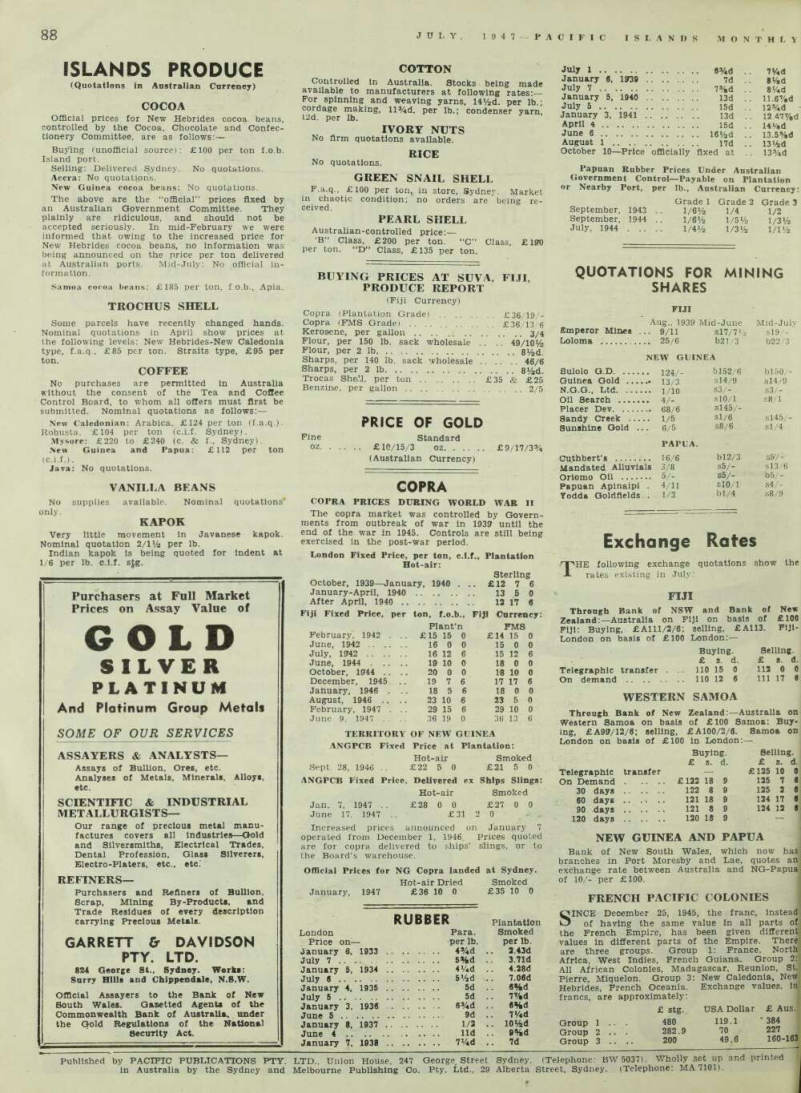
(Quotations in Australian Currency)
Cocoa
Official prices for New Hebrides cocoa beans, controlled by the Cocoa, Chocolate and Confec tionery Committee, are as follows; — Buying (unofficial source): £lOO per ton f.o.b.
Island port.
Selling; Delivered Sydney. No quotations.
Accra: No quotations.
New Guinea cocoa beans: No quotations.
The above are the “official” prices fixed by an Australian Government Committee. They plainly are ridiculous, and should not be accepted seriously. In mid-February we were informed that owing to the increased price for New Hebrides cocoa beans, no information was being announced on the price per ton delivered at Australian ports. Mid-July: No official in formation.
Samoa cocoa beans; £lB5 per ton, f.0.b., Apia.
Trochus Shell
Some parcels have recently changed hands.
Nominal quotations in April show prices at the following levels: New Hebrides-New Caledonia type, f.a.q., £B5 per ton. Straits type, £95 per ton.
Coffee
No purchases are permitted in Australia without the consent of the Tea and Coffee Control Board, to whom all offers must first be submitted. Nominal quotations as follows: — New Caledonian: Arabica, £124 per ton (f.a.q.).
Robusta. £lO4 per ton (c.i.f. Sydney).
Mysore; £220 to £240 (c. & f., Sydney).
New Guinea and Papua; £ll2 per ton (c.i.f.).
Java: No quotations.
Vanilla Beans
No supplies available. Nominal quotations* only.
Kapok
Very little movement in Javanese kapok.
Nominal quotation 2/1 Va per lb.
Indian kapok is being quoted for Indent at 1/6 per lb. c.i.f. sjg.
Cotton
Controlled In Australia. Stocks being made available to manufacturers at following rates;— For spinning and weaving yarns, 14y 2 d. per lb.; cordage making, ll%d. per lb.; condenser yam, I2d. per lb.
Ivory Nuts
No firm quotations available.
Rice
No quotations.
Green Snail Shell
F.a.q., £lOO per ton, in store, Sydney. Market in chaotic condition; no orders are being re ceived.
Pearl Shell
Australian-controlled price:— ‘B” Class, £2OO per ton. “C” Class, £196 per ton. "D” Class, £135 per ton.
Buying Prices At Suva, Fiji,
Produce Report
(Fiji Currency) Copra (Plantation Grade) £36/19/- Copra (FMS Grade) .. . . £36/13/6 Kerosene, per gallon 3/4 Flour, per 150 lb. sack wholesale .. .. 49/10 Vz Flour, per 2 lb SVfed.
Sharps, per 140 lb. sack wholesale 46/6 Sharps, per 2 lb 8Vad.
Trocas SheT, per ton £35 & £25 Benzine, per gallon 2/5
Advertisements & other items, p. 90 (1 item)
Price Of Gold
Pine Standard oz. . .. £10/15/3 oz £9/17/3% (Australian Currency)
Copra
Prices During World War Ii
The copra market was controlled by Govern ments from outbreak of war in 1939 until the end of the war in 1945. Controls are still being exercised in the post-war period.
Increased prices announced on January 7 operated from December 1, 1946. Prices quoted are for copra delivered to ships’ slings, or to the Board’s warehouse.
London Fixed Price, per ton, c.i.f., Plantation Hot-air: Sterling October, 1939 —January, 1940 ... £12 7 6 January-April, 1940 13 5 0 After April, 1940 12 17 6 Fiji Fixed Price, per ton, f.o.b,, Fiji Currency:
Plant’n
Fms
February, 1942 . .. £15 15 0 £14 15 0 June, 1942 . .. 16 0 0 15 0 0 July, 1942 . . .. 16 12 6 15 12 6 June, 1944 . .. 19 10 0 18 0 0 October, 1944 .. 20 0 0 18 10 0 December, 1945 19 7 6 17 17 6 January, 1946 . 18 5 6 18 0 0 August, 1946 23 10 6 23 5 0 February, 1947 . 29 15 6 29 10 0 June 9. 1947 . . 36 19 0 36 13 6
Territory
Of New Guinea
ANGPCB Fixed Price at Plantation; Hot-air Smoked Sept. 28, 1946 £22 5 0 £21 5 0 ANGPCB Fixed Price, Delivered ex Ships Slings: Hot-air Smoked Jan. 7. 1947 . . £28 0 0 £27 0 0 June 17, 1947 £31 2 0
Official Prices for NG Copra landed at Sydney, Hot-air Dried Smoked January, 1947 £36 10 0 £35 10 0
Rubber
Plantation
Papuan Rubber Prices Under Australian Government Control—Payable on Plantation or Nearby Port, per lb., Australian Currency:
London Para.
Smoked Price on- 1>er lb. per lb.
January 3. 1933 .. .. ... 4%d 2.43d July 7 . .. .. 6%d 3.71d January 5, 1934 .. .. .. .. 4Vid 4.28d July 8 . ... 5V 2 d 7.06d January 4, 1935 .. .. ... 5d 6%d July 5 . ... 5d 7 T /«d January 3. 1936 . . . ... 6%d 6%d June 5 , ... 9d 7Vid January 8, 1937 .. . . ... 1/2 .. lOVii June 4 .. .. lid 9%d January 7. 1938 . . .. ... 7V 4 d 7d
July 1 .. 7V«d January 6, 1939 7d 8Vad July 7 . .
SVad January 5, 1940 13d .. n.ey.d July 5 .. .. 12 3 Ad January 3, 1941 . 13d .. 12,47%d April 4 .. . . 14V a d June 5 .. .. 13.5»/ad August 1 . 17d .. 13M,d October 10- -Price officially fixed at .. 13 3 /ad
Grade 1 Grade 2 Grade 3 September, 1943 . 1/61/2 1/4 1/2 September, 1944 . 1/61/2 I/51/2 1/31/2 July, 1944 1/41/2 I/31/2 I/I1/2
Quotations For Mining
Shares
Fiji
Aug., 1939 Mid-June Mid-July Emperor Mines . .. 9/11 S17/7V2 sl9 - Loloma .. 25/6 b21 3 b22/3 Bulolo Q.D
New Guinea
.. 124/- bl52/6 bl50/- Guinea Gold .,., •• 13/3 S14/9 S14/9 N.G.G., Ltd s3/s3/- Oil Search slO/1 £8/1 Placer Dev 68/6 S145/- Sandy Creek . .. .. 1/5 sl/6 Sl45/- Sunshine Gold .. . 6/5 s8/6 Sl/4 Cuthbert’s
Papua.
.. 16/6 bl2/3 S&/- Mandated Alluvlals 3 8 s5/sl3 6 Orlomo Oil .. 5/- S5/b5/- Papuan Aplnaipl . 4/11 slO/1 s4/- Yodda Goldfields . 1/3 bl/4 s8/9
Exchange Rates
THE following exchange quotations show the rates existing in July:
Fiji
Through Bank of NSW and Bank of New Zealand:— Australia on FIJI on basis of £lOO FIJI: Buying, £Alll/2/6; selling, £AII3. FIJI - on basis of £lOO London: —
Western Samoa
Through Bank of New Zealand;—Australia on Western Samoa on basis of £lOO Samoa: Buy ing, £ A99/12/6; selling, £AIOO/2/6. Samoa on London on basis of £lOO in London: —
New Guinea And Papua
Bank of New South Wales, which now has branches in Port Moresby and Lae, quotes an exchange rate between Australia and NG-Papua of 10/- per £lOO.
French Pacific Colonies
SINCE December 25, 1945, the franc, Instead of having the same value in all parts of the French Empire, has been given different values in different parts of the Empire. There are three groups. Group 1: Prance, North Africa, West Indies, French Guiana. Group 2: All African Colonies, Madagascar, Reunion, St.
Pierre, Miquelon. Group 3: New Caledonia. New Hebrides, French Oceania. Exchange values, In francs, are approximately:
Buying. Selling. £ s. d. £ s. d.
Telegraphic transfer ... 110 15 0 112 0 C On demand 110 12 6 111 17 8
Buying.
Selling. £ s. d. £ s. d, Telegraphic transfer — £125 10 0 On Demand £122 18 9 125 7 6 30 days 122 8 9 125 2 6 60 days 121 18 9 124 17 6 90 days 121 8 9 124 12 e 120 days 120 18 9 — I
£ stg.
USA Dollar £ Aus.
Group 1 .. . 480 119.1 • 384 Group 2 • 282.9 70 227 Group 3 .. . 200 49.6 160-163
Advertisements & other items, pp. 90-92 (3 items)
88
JULY, 194 7 - PACIFIC ISLANDS MONTHLY
Published by PACIFIC PUBLICATIONS PTY. LTD., Union House. 247 George. Street Sydney. (Telephone: BW 5037). Wholly set up and printed i in Australia by the Sydney and Melbourne Publishing Co. Pty. Ltd., 29 Alberta Street, Sydney. (Telephone: MA7101).
Gold
Purchasers at Full Market Prices on Assay Value of
SILVER
PLATINUM
And Platinum Group Metals
SOME OF OUR SERVICES
ASSAYERS & ANALYSTS—
Assays of Bullion, Ores, etc.
Analyses of Metals, Minerals, Alloys, etc.
SCIENTIFIC & INDUSTRIAL
METALLURGISTS—
Our range of precious metal manufactures covers all Industries —Oold and Silversmiths, Electrical Trades, Dental Profession, Glass Sllverers, Electro-Platers, etc., etc.'
REFINERS—
Purchasers and Refiners of Bullion, Scrap, Mining By-Products, and Trade Residues of every description carrying Precious Metals.
GARRETT & DAVIDSON
PTY. LTD.
824 George St., Sydney. Works: Surry Hills and Chippendale, N.S.W.
Official Assayers to the Bank of New South Wales. Gazetted Agents of the Commonwealth Bank of Australia, under the Gold Regulations of the National Security Act.
Everybody
To quench a
tropical thirst...
% V i/ mg c « UU W m m m
LAGER
K8.2.4# When you’re hot and tired, there is nothing quite so satisfying and thirst quenching as a long, cold glass of K.B. \our friends and guests, too, will appreci fine
Lager, for “Everybody
drinks K.B.
TOOTH'S
I
MERCHANTS. & SHIP OWNERS
Capital £1,000,000
ESTABLISHED 1914
COPRA MERCHANTS & MILLERS
BRANCHES THROUGHOUT THE PACIFIC ISLANDS
Buyers and exporters of all kinds of Islands produce. Copra Merchants and Millers.
Agents for Australian, European and American Manufacturers. Distributors of every description of merchandise.
Thirty years of Pacific Islands development and service.
REGULAR CARGO AND PASSENGER SERVICE BETWEEN EUROPE AND
PACIFIC ISLAND PORTS WAS ESTABLISHED BY
Head
W. R. CARPENTER & CO. LTD.
Office: 16 O'CONNELL STREET,
SYDNEY.
Cable Address:
CAMOHE.
Telephone: BW 4421.
Postal Address: P.O. Box No. 168, Sydney.