Pacific
Islands
Monthly
June 18, 1947
Vol. Xvii. No. 11.
Established 1930.
I Registered at transmission by post as a newspaper ]
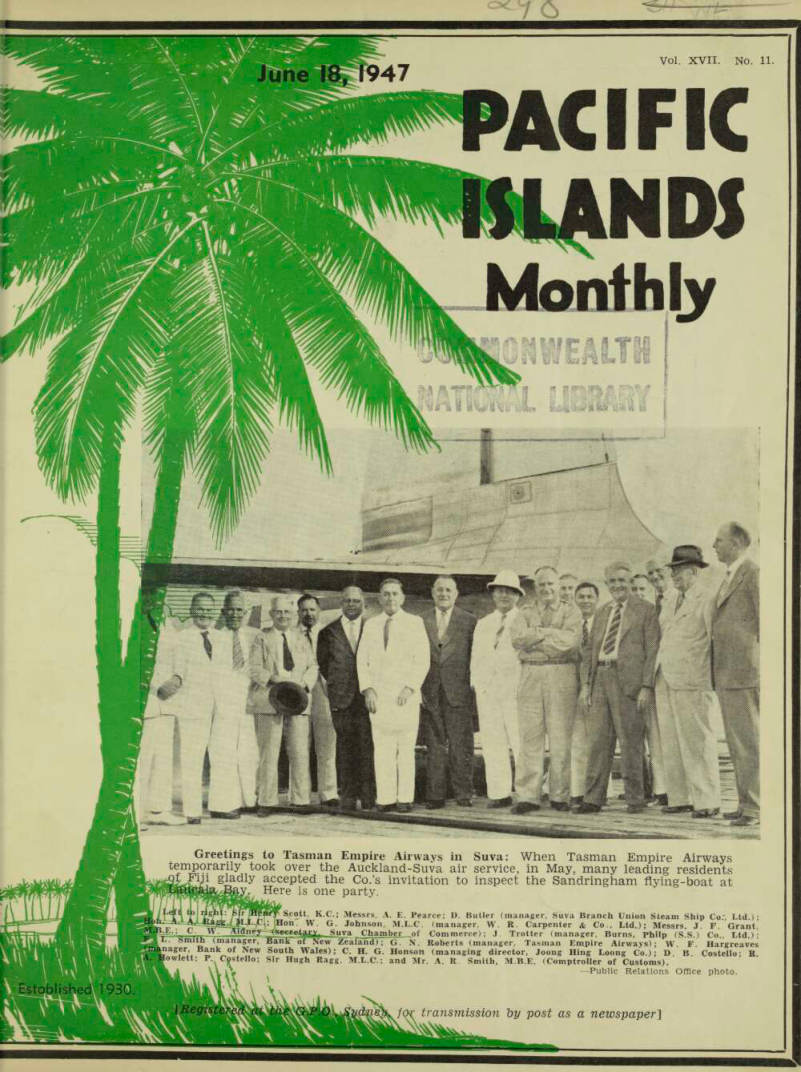
Greetings to Tasman Empire Airways in Suva: When Tasman Empire Airways temporarily took over the Auckland-Suva air service, in May, many leading residents of Fiji gladly accepted the Co.’s invitation to inspect the Sandringham flying-boat at
Laucala Bay Here is one party.
Left to righ: Sir henry Scott, K.C.; Messrs. A. E. Pearce; D. Butler (manager, Suva Branch Union Steam Ship Co., Ltd.); Hon. A. A. Ragg, M.I.C.; Hon, W. G. Johnson M.L.C. (manager, W R. Carpenter & Co.. Ltd,); Messrs. J. F. Grant, M.B.E.; c. W. Aidney (Seeretary Suva Chamber of Commerce): J Trotter (manager. Burns, philp (S.S.) Co.. Ltd.); F. L. Smith (manager, Bank of New Zealand); G. N. Roberts (manager, Tasman Empire Airways); W. F. Hargreaves (manager, Bank of New South Wales); C. H. G. Honson (managing director, Joong Hing Loong Co.); D.B. Costello; R.
A. Howlett; P. Costello; Sir Hugh Ragg, M.L.C.; and Mr. A. R Smith, M.B.E. (Comptroller of Customs). —Public Relations Office photo.
Advertisements & other items, pp. 2-4 (2 items)
Robert Gillespie Pty, Ltd.
% A* /. * Con be set up ready for use in a few seconds.
For its size this new Coleman Stove is
amazing. Although
only Bin. high and
in. wide it boils a pint of water inside 5 minutes. t is made of corrosion-resistant metal • ■ • lights instantly . . . needs no priming . . burns any kind of petrol and cannot spill fuel even when tipped over.
Telescopic cose mokes two handy cooking utensils. The pot supports at fop fold in for packing. n /■> PI r- PN _. . Representatives tor the Pacific Islands:
ROBERT GILLESPIE PTY, LTD.
s4a PITT STREET, SYDNEY
PEARCE & CO. LTD,
SUVA
FOR FIJI ISLANDS
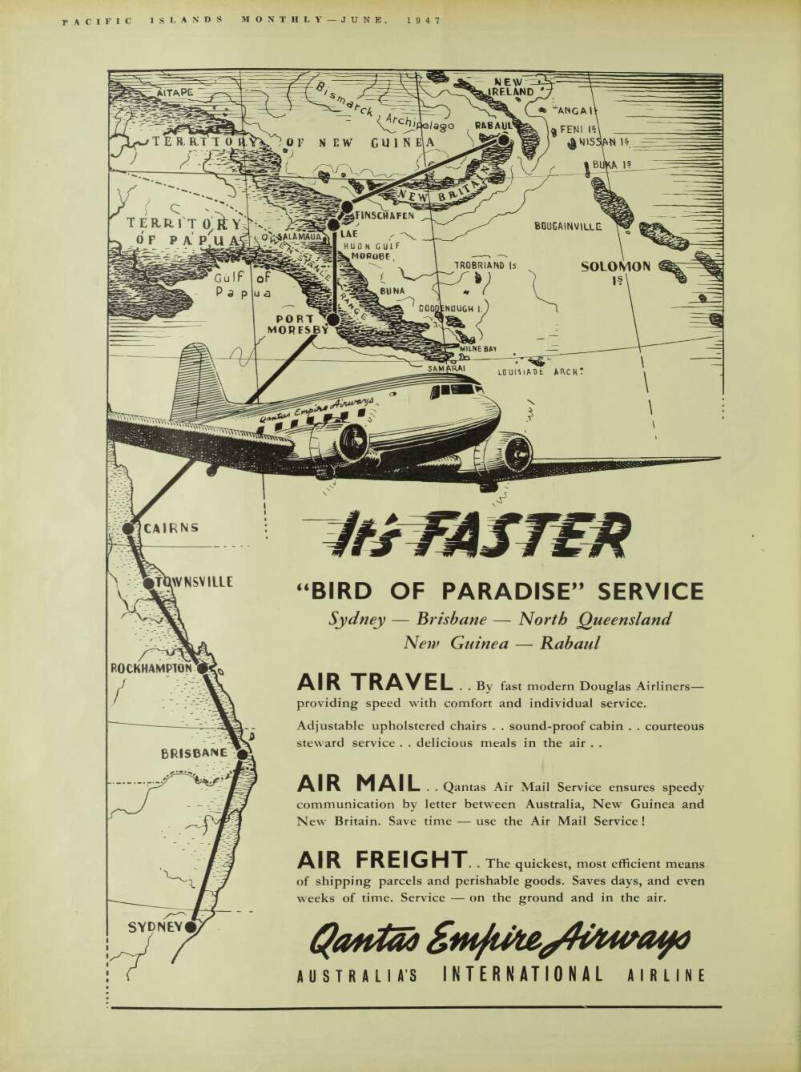
NEW -
IRELAND
mtape ck
ANGA
RABAUI
FENI
\*SA KT
W GUINEA
VJ»S
N is % m y Si M ft JU
BOUGAINVILLE
UE A
MOROCC
IROBRIAND
SOLOMON
lf\ IF oF
BUNA
NOUGH
PORT T l
MORESBY?
MILNE
BM
RAI
SAM
UmAOt ARCH-
f"
CAIRNS
•TQWNSVIIIt
ROCKHAMPTON
BRISBANE
SYDNEY
“BIRD OF PARADISE” SERVICE
Sydney Brisbane North Queensland
Rabaul
AIR TRAVEL .By fast modern Douglas Airliners— providing speed with comfort and individual service.
Adjustable upholstered chairs . . sound-proof cabin . . courteous steward service . . delicious meals in the air . .
AIR MAIL . Qantas Air Mail Service ensures speedy communication by letter between Australia, New Guinea and New Britain. Save time use the Air Mail Service !
AIR FREIGHT . The quickest, most efficient means of shipping parcels and perishable goods. Saves days, and even weeks of time. Service on the ground and in the air.
AUSTRALIA'S INTERNATIONAL airline
H\P* gR tE "
U U.O' N&
LtO
BOX
i&tu Ho. 1« C o^o ' o H.V*-
JUB e *
1941 .. VJr ' ok3 te\ep^ ne '- UP \322 Jf »«' „ Mo. 7 8 .«-*°V£ln« » w “ 4
gditort
sto^si*
L *
SS- ot ,o»r
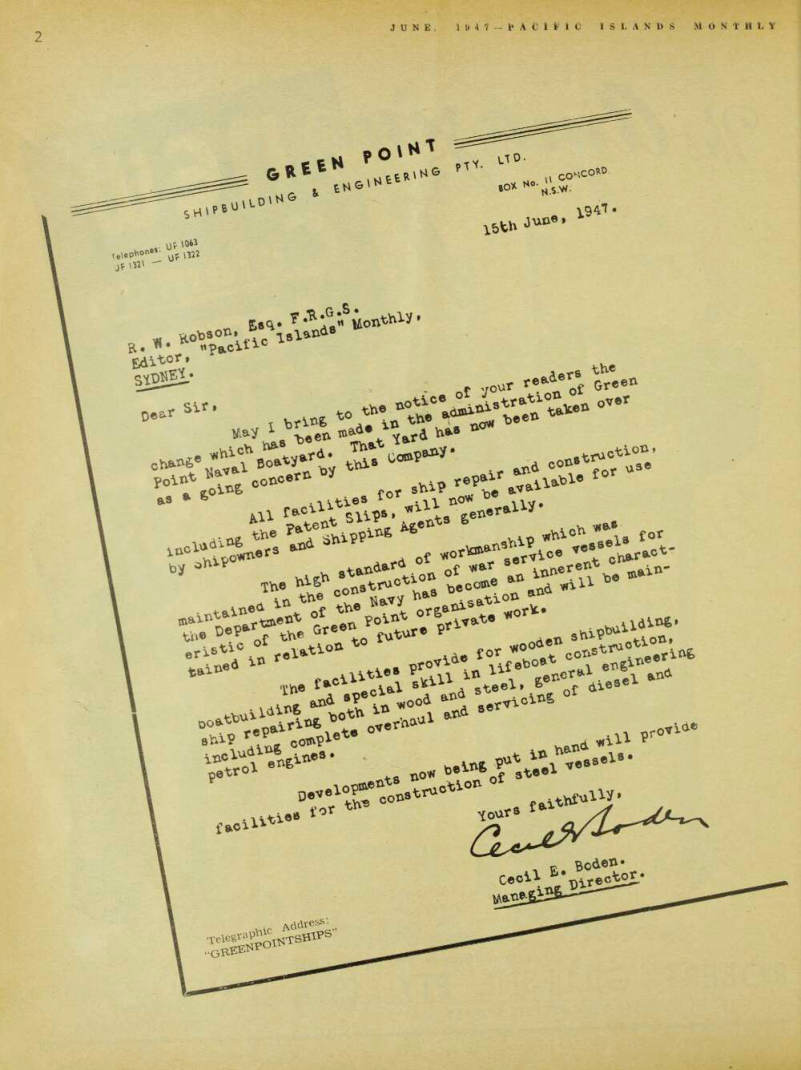
t brt « » w ““ °” r V.ay 1 -ween. ® ad V. v a rd b* 8 cor ** lU •» ” .u^.>,. „. „ to. **’“ v ., .ov.o «•• tM “* ““ „ ot «orB*o»>« lo . by oh * . r. ,tandaf <1 , „f mar 8 » n nerent io * fOt* f V)© 0.V9- I ''
kU t^.
„. „ to. »«£«««» 16 V„ ** *VI. tor “* ““ „ ot «•"£,««■ tiTw<%r£ «*«r^r* ‘" iw ” ,or * „ .o^s "‘V^* ’ rt ” M ..» « f l ** l " or..t« “foS^" 1 ' ia facibibiea P in 1 \ general an* 9 <^d of * ie ... * w , .tu m— '***»3 •
— rr\s4^“
Bod en sir© xtlp ctor address-
,^° VsttlPS '
2
JUNE, 1!)U-i> A C m C ISLANDS MONTHLY
Advertisers
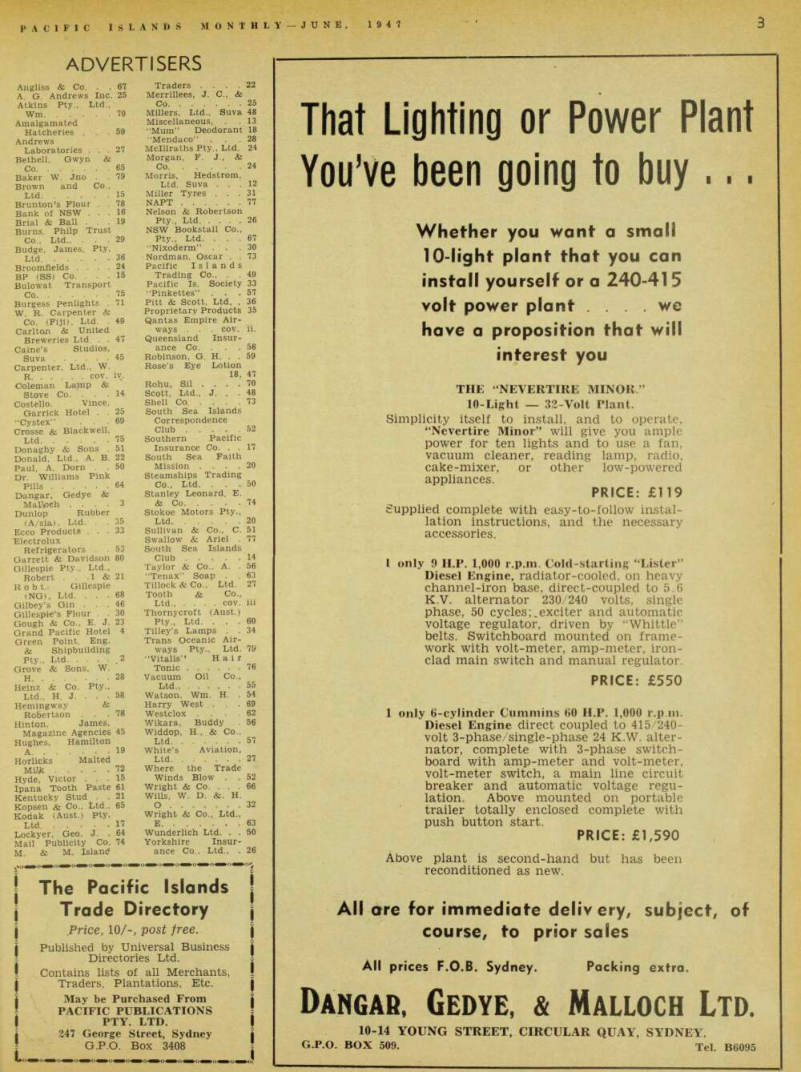
Angliss & Co. . . 67 A. G. Andrews Inc. 25 Atkins Pty., Ltd., Wm 70 Amalgamated Hatcheries ... 59 Andrews Laboratories ... 27 Bethell, Gwyn & Co 65 Baker W. Jno . . 79 Brown and Co., Ltd 15 Brunton’s Flour . . 78 Bank of NSW ... 16 Brial & Ball ... 19 Burns. Philp Trust Co., Ltd 29 Budge, James, Pty, Ltd. 36 Broomfields ... 24
Bp (Ss) Co. 15
Bulowat Transport Co 75 Burgess penlights . 71 W. R. Carpenter & Co. (Fiji), Ltd. . 49 Carlton & United Breweries Ltd. . . 47 Caine’s Studios, Suva 45 Carpenter, Ltd., W. r cov. iv.
Coleman Lamp & Stove Co. . • .14 Costello. Vince, Garrick Hotel . . 25 “Cystex” ... 69 Crosse & Blackwell, Ltd 75 Donaghy & Sons . 51 Donald. Ltd., A. B. 22 Paul, A. Dorn . . 50 Dr. Williams Pink Pills 64 Dangar, Gedye & Mal’ioch ... 3 Dunlop Rubber (A/sia). Ltd. . . 35 Ecco Products ... 33 Electrolux Refrigerators . 53 Garrett & Davidson 80 Gillespie Pty,, Ltd., Robert . 1 & 21 r o b t.. Gillespie (NG), Ltd. ... 68 Gilbey’s Gin ... 46 Gillespie’s Flour . . 30 Gough & Co., E. J. 23 Grand Pacific Hotel 4 Green Point. Eng. & Shipbuilding Pty.. Ltd .2 Grove & Sons, W.
H 28 Heinz & Co. Pty., Ltd., H. J. . . .58 Hemingway & Robertson ... 78 Hinton, James, Magazine Agencies 45 Hughes, Hamilton A 19 Horlicks Malted Mitfc 72 Hyde, Victor ... 15 Ipana Tooth Paste 61 Kentucky Stud . . 21 Kopsen & Co., Ltd., 65 Kodak (Aust.) Pty.
Ltd. 17 Lockyer, Geo. J. .64 Mail Publicity Co. 74 M. & M. Island
Traders ... 22 Merrillees, J. C., & Co 25 Millers, Ltd., Suva 48 Miscellaneous, . . 13 “Mum” Deodorant 18 “Mendaco” ... 28 Mclllraths Pty., Ltd. 24 Morgan, F. J., & Co 24 Morris, Hedstrom, Ltd. Suva ... 12 Miller Tyres . . .31
Napt 77
Nelson & Robertson Pty., Ltd 26 NSW Bookstall Co., Pty., Ltd. ... 67 “Nixoderm” . . .30 Nordman, Oscar . . 73 Pacific Islands Trading Co., . . 49 Pacific Is. Society 33 “Pinkettes” ... 57 Pitt & Scott, Ltd. . 36 Proprietary Products 35 Qantas Empire Air ways . . . cov. ii.
Queensland Insur ance Co. ... 58 Robinson, G. H. . . 59 Rose’s Eye Lotion 18, 47 Rohu, Sil . . . . 70 Scott, Ltd., J. . .48 Shell Co. ... 73 South Sea Islands Correspondence Club 52 Southern Pacific Insurance Co. . . 17 South Sea Faith Mission ... 20 Steamships Trading Co., Ltd. ... 50 Stanley Leonard. E. & Co 74 Stokoe Motors Pty., Ltd 20 Sullivan & Co., C. 51 Swallow & Ariel . 77 South Sea Islands Club 14 Taylor & Co., A. . 56 “Tenax” Soap . . 63 Tillock & Co., Ltd. 27 Tooth & Co., Ltd., ... cov. iii Thornycroft (Aust.) Pty., Ltd. ... 60 Tilley’s Lamps . . 34 Trans Oceanic Air ways Pty., Ltd. 79' “Vitalis’’ Hair Tonic 76 Vacuum Oil Co., Ltd., 55 Watson, Wm. H. . 54 Harry West . . .69 Westclox ... 62 Wikara, Buddy . 56 Widdop, H., & Co., Ltd 57 White’s Aviation, Ltd 27 Where the Trade Winds Blow . . 52 Wright & Co. ... 66 Wills. W. D. &. H.
O 32 Wright & Co., Ltd., E 63 Wunderlich Ltd. . . 50 Yorkshire Insur ance Co.. Ltd., . 26
Advertisements & other items, p. 5 (1 item)
That Lighting or Power Plant
You’ve been going to buy...
Whether you want a small
10-light plant that you can
install yourself or a 240-415
volt power plant ... we
have a proposition that will
interest you
THE ‘NEVERTIRE MINOR.”
10-Light 32-Volt Plant.
Simplicity itself to install, and to operate, “Nevertire Minor” will give you ample power for ten lights and to use a fan, vacuum cleaner, reading lamp, radio, cake-mixer, or other low-powered appliances.
PRICE: £ll9
Supplied complete with easy-to-follow installation instructions, and the necessary accessories.
I only 9 H.P. 1,000 r.p.m. Cold-starting ‘‘Lister”
Diesel Engine, radiator-cooled, on heavy channel-iron base, direct-coupled to 5.6 K.V. alternator 230/240 volts, single phase, 50 cycles;.exciter and automatic voltage regulator, driven by “Whittle” belts. Switchboard mounted on framework with volt-meter, amp-meter, ironclad main switch and manual regulator.
PRICE: £550
1 only 6-cylinder Cummins 60 H.P. 1,000 r.p.m.
Diesel Engine direct coupled to 415/240volt 3-phase/single-phase 24 K.W. alternator, complete with 3-phase switchboard with amp-meter and volt-meter, volt-meter switch, a main line circuit breaker and automatic voltage regulation. Above mounted on portable trailer totally enclosed complete with push button start.
PRICE: £1,590
Above plant is second-hand but has been reconditioned as new.
All are for immediate delivery, subject, of
course, to prior sales
All prices F. 0.8. Sydney. Packing extra.
Dangar, Gedye, & Malloch Ltd.
10-14 YOUNG STREET, CIRCULAR QUAY, SYDNEY.
G.P.O. BOX 509. Tel. 86095
The Pacific Islands
Trade Directory
Price, 10/-, post free.
Published by Universal Business Directories Ltd.
Contains lists of all Merchants, Traders, Plantations, Etc.
May be Purchased From
PACIFIC PUBLICATIONS
PTY. LTD.
247 George Street, Sydney G.P.O. Box 3408
In This Issue:
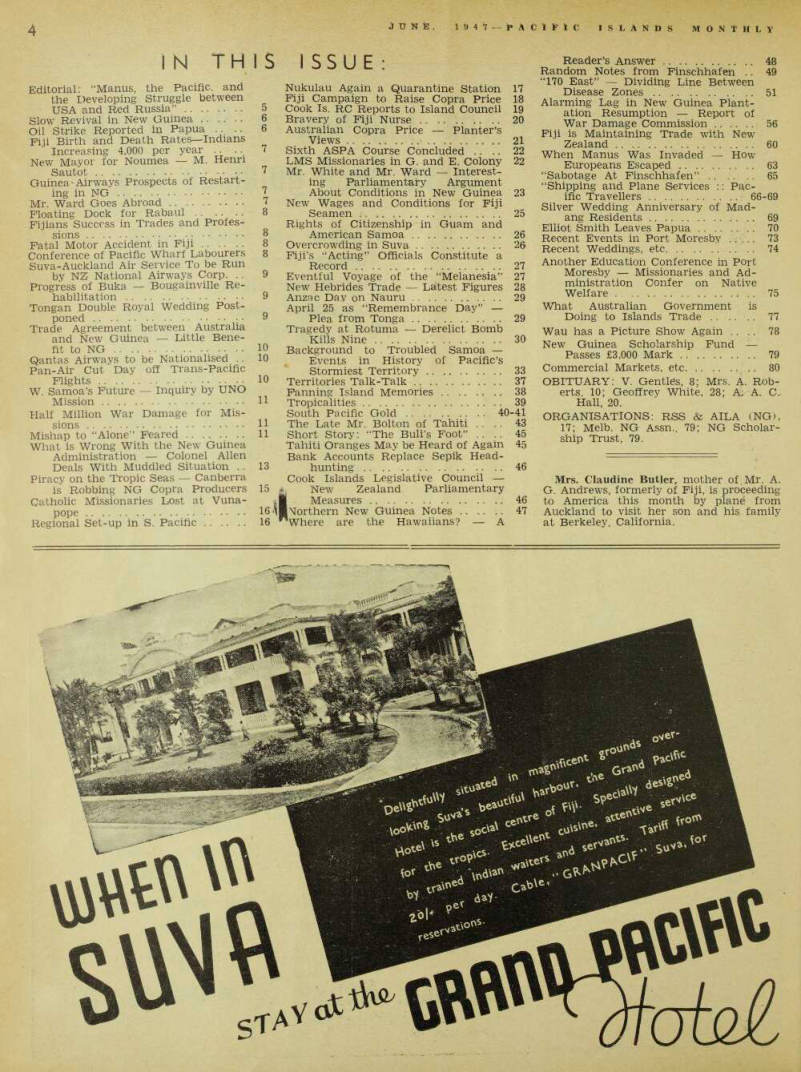
Editorial: “Manus, the Pacific, and the Developing Struggle between USA and Red Russia” 5 Slow Revival in New Guinea 6 Oil Strike Reported in Papua ... 6 Fiji Birth and Death Rates—lndians Increasing 4,000 per year .. .. 7 New Mayor for Noumea M. Henri Sautot Guinea Airways Prospects of Restart ing in NG J Mr. Ward Goes Abroad 7 Floating Dock for Rabaul 8 Fijians Success in Trades and Profes sions 8 Fatal Motor Accident in Fiji 8 Conference of Pacific Wharf Labourers 8 Suva-Auckland Air Service To be Run by NZ National Airways Corp. .. 9 Progress of Buka Bougainville Re habilitation . • • • 9 Tongan Double Royal Wedding Post poned 9 Trade Agreement between Australia and New Guinea Little Bene fit to NG •• •• 10 Qantas Airways to be Nationalised .. 10 Pan-Air Cut Day off Trans-Pacific Flights 10 W. Samoa’s Future Inquiry by UNO Mission 11 Half Million War Damage for Mis sions 11 Mishap to “Alone” Feared 11 What is Wrong With the New Guinea Administration Colonel Allen Deals With Muddled Situation .. 13 Piracy on the Tropic Seas Canberra is Robbing NG Copra Producers 15 Catholic Missionaries Lost at Vuna pope 16 Regional Set-up in S. Pacific 16
Nukulau Again a Quarantine Station 17 Fiji Campaign to Raise Copra Price 18 Cook Is. RC Reports to Island Council 19 Bravery of Fiji Nurse 20 Australian Copra Price Planter’s Views 21 Sixth ASPA Course Concluded ... 22 LMS Missionaries in G. and E. Colony 22 Mr. White and Mr. Ward Interest ing Parliamentary Argument About Conditions in New Guinea 23 New Wages and Conditions for Fiji Seamen 25 Rights of Citizenship in Guam and American Samoa 26 Overcrowding in Suva 26 Fiji’s “Acting” Officials Constitute a Record 27 Eventful Voyage of the “Melanesia” 27 New Hebrides Trade Latest Figures 28 Anzac Day on Nauru 29 April 25 as “Remembrance Day”
Plea from Tonga 29 Tragedy at Rotuma Derelict Bomb Kills Nine 30 Background to Troubled Samoa Events in History of Pacific’s Stormiest Territory 33 Territories Talk-Talk 37 Fanning Island Memories 38 Tropicalities 39 South Pacific Gold 40-41 The Late Mr. Bolton of Tahiti ... 43 Short Story: “The Buli’s Foot” ... 45 Tahiti Oranges May be Heard of Again 45 Bank Accounts Replace Sepik Head hunting 46 Cook Islands Legislative Council »New Zealand Parliamentary Measures 46 Northern New Guinea Notes ... 47 Where are the Hawaiians? A
Reader’s Answer 48 Random Notes from Flnschhafen .. 49 “170 East” Dividing Line Between Disease Zones 51 Alarming Lag ih New Guinea Plant ation Resumption Report of War Damage Commission 56 Fiji is Maintaining Trade with New Zealand 60 When Manus Was Invaded How Europeans Escaped 63 “Sabotage At Finschhafen” 65 “Shipping and Plane Services ;: Pac ific Travellers 66-69 Silver Wedding Anniversary of Mad ang Residents 69 Elliot Smith Leaves Papua 70 Recent Events in Port Moresby ... 73 Recent Weddings, etc 74 Another Education Conference in Port Moresby Missionaries and Ad ministration Confer on Native Welfare 75 What Australian Government is Doing to Islands Trade 77 Wau has a Picture Show Again ... 78 New Guinea Scholarship Fund Passes £3,000 Mark 79 Commercial Markets, etc 80 OBITUARY: V. Gentles. 8; Mrs. A. Rob erts, 10; Geoffrey White, 28; A. A. C.
Hall, 20.
Organisations: Rss & Aila (Ng),
17; Melb. NG Assn., 79; NG Scholar ship Trust, 79.
Mrs. Claudine Butler, mother of , Mr, A.
G. Andrews, formerly of Fiji, is proceeding to America this month by plane from Auckland to visit her son and his family at Berkeley, California.
Advertisements & other items, p. 6 (1 item)
As o><er
orovi° d . , fxC eot 6 A ?^c\V' c , >lU *ei oU r, ** d-'t"* 4 .
"* T «■* «* t\ « * t**"® ser va^ s - *e wof 8 * . >** •* t ... Suv-'° V C» b ' e * r M •Ol* 9 re se f^°° 5 '
Pacific Islands Monthly
The Newspaper-Magazine of the South Seas [Registered at the G.P.0., Sydney, for transmission by post as a newspaper.']
Published Once Each Month and Circulated in Australia and New Zealand and in the following Pacific Territories and Islands Groups:
Australian Territory of Papua.
Mandated Territory (Australia) of New Guinea.
Australian Territory of Norfolk Island.
New Zealand Territory of Cook Islands.
Mandated Territory (NZ) of Western Samoa.
British Colony of Fiji.
British Solomon Islands Protectorate.
British Protectorate of Tongan Islands.
British Crown Colony of Gilbert and Ellice Islands.
Mandated Territory of Nauru.
British and Free French Condominium ol Nev Hebrides.
French Colony of New Caledonia.
French Colony of Oceania (Tahiti, etc.).
American Territory of Eastern Samoa.
American Territory of Hawaiian Islands.
Owned and Produced by Pacific Publications Pty. Ltd., Union House, 247 George Street, Sydney.
Telephones: General Office and Advertising, BW 5037.
P.O. Box 3^Ob
Registered Address for Telegrams, Radiograms, and Cables: “Pacpub”, Sydney.
Contributions.
Articles, Stories, and Photographs dealing with Pacific Islands subjects are invited and will be paid for on publication.
Subscription Rates.
Per Annum, Pre-paid, Including Postage.
In Australia, New Zealand, Fiji, New Guinea, Papua, Western Samoa, Cook Islands, Tonga, British Solomons, Gil bert and Ellice Colony, Nauru, and United Kingdom 10 0 Elsewhere 15 0 Single copies 1 3
Edltor and Publisher:
R. W Robson. F.R.G.S.
Assistant Editor: JUDY TUDOR.
General Office: Union House, 247 George Street, Sydney. Telephone: BW 5037.
Advertising Manager: W. E. Rogers.
Representative In London.
J. T. Wallis, Coronation House, 4 Lloyds Avenue, London, E.C.3, from whom may be obtained copies of Pacific Islands Monthly, Pacific Is, Year Book, advertising schedules, etc.
Representative In U.S.A.
Pacific Islands Trading Co.,
244 CALIFORNIA ST.. SAN FRANCISCO. U S.A.
Agents.
The following are authorised to receive sub scriptions for Pacific Islands Monthly:— Burns, Philp & Co., Ltd., and Burns Phllp (South Sea) Co., Ltd. All branches.
W. R. Carpenter & Co., Ltd. All branches, Morris, Hedstrom, Ltd. All branches.
Steamships Trading Co., Papua. All branches.
W. M. Caldwell, Suva, Fiji.
Cook Islands Trading Co., Rarotonga, Cook Is.
A. C. Rowland, Papeete, Tahiti, Islands Branches and Representatives of W. H.
Grove & Sons, Ltd., Auckland, New Zealand.
Ed. Pentecost, Noumea, New Caledonia.
Societe Gubbay Kerr et Cle, Noumea, N. Caledonia.
T. A. Wyborn, 12a Alpln Street, Cairns.
Vol. Xvii. No. 11.
June 18, 1947
n . I 1/3 Per Copy Knee .{Prepaid, p.a.: 10/- Aus. lln USA, p.a.: $2.50
Advertisements & other items, pp. 7-8 (1 item)
WeaP ° nS t 0 be USGd ’
Manus, the Pacific, and the Developing Struggle Between USA and Red Russia
THERE is definitely a connection between a whole series of recent and apparently isolated international events. The United States is accepting responsibility tor the maintenance of the democratic principle in the
world generally; and, in particular,
for the policing of the Pacific. Here are the events and developments referred to: — •ThP ronfprpnrp of thp Forpicm Min istprs Of Bie Pour (Britain America France and Russia) broke up, because Russia would not co-operate ’ •The voice of the United Nations has been practically silent for weeks because all attempts to secure international cooperation have been hamstrung by Russia. •The “iron curtain” across Central Europe which separates the Western Democracies from the Russian Communist bloc, has been thrust forward to bring Snie a R d ed“ba P nnt ably AUBtria * •France is m the throes of a great general strike, and mav quite easily go into a communist revolution. •The weakness of the British Socialist Government - as seen in its dithering attempts to deal with the problems of Egypt. Palestine, India. Burma and Indonesia—has permitted practically all Asia to get into a state of nationalistic frenzy never before seen in the history of the world. •President Truman has made a State visit to Canada the first United States President to make this gesture. •The Admiral in command of the has been on an official visit to Australia, and leading
Americans have said, quite openly and 'frankly, that—so far as events in the Pacific are concerned—Australia and N( r w Zealand may now regard them
thl Understates d 'ltmay takeS as
quite certain that the term “Australia and New Zealand” includes all the Brit ish and French Territories in the South Pacific.
International relations are at a most criti cal stage. The ideological struggle that has been developing, between Russian Communists (who l a , n U^ tU ™ i he .^ orld in , to a gigantic ant-hill) and the Western Demo cracies (who are determined to pre serve individual freedom and the decencies of human life) may change, erall y Wl thm a few hours, into World War J f comes that war will be the most horrible known to mankind—not only because of the WeaP ° nS t 0 be USGd ’ r? a PP® aranc ® among us of Fifth Columns. Every Western nation to-day is honeycombed by Communism-little cells of Red fanatics who will try to cut as many throats as possible before they are exterminated.
The Western Powers dare not allow France to collapse into Com munism and plant the blood-red flag of the Soviet Union in the centre of Western Europe. If the forces of dis order look like winning in France the alert Americans and the bemused British will have to act, quickly and firmly If they send armed forces into France, it is certain that the
now arrogant and jealous Muscovites will do the same. And that will start something!
BUT, whatever happens in France, a struggle to the death between Western Individualism and Red Totalitarianism cannot be long de layed. The only thing that can prevent it would be the cancellation by the Moscow Communist dictators of their campaign to spread Com munism right across the world—and there is no sign of that. The Reds are determined to push ahead with their plans, while the fumbling and muddling of the British and Empire Socialist Governments prevent the formation of the onlv thing that now could hold the Muscovite in check— namely, an Anglo-American Union.
Together, the United States and the British Empire are strong enough to police the world and preserve to man his finest achievements—his personal freedom and his democratic institu tions. Together, we could rally the smaller Western nations—Holland and Belgium, and the three Scandinavian countries—to our side; we could save France from a political and economic collapse; and we could hold the line until the three Fascist Powers—Ger many, Japan and Italy—have been restored as democratic nations. Then we need no longer fear the Red fanatics of Communism, or the crazy, screeching masses of Asia. But to day, disunited as we are, we are most dangerously weak. If we fail, the world would pass into a Communist Dark Age that might last for cen turies.
All the indications are that, since General Marshall returned from Mos
cow to Washington to report the complete failure of the Foreign Ministers’ Conference, America has been preparing herself and her friends for the struggle that now appears inevitable. It is not neces sary to say that all the European communities of the South Pacific are already—while the distracted British Lion is still being led around aim lessly by its Laskis and Shinwells— completely with the Americans, in sympathy and outlook, and in deter mination to sacrifice a great deal, if necessary, to preserve the liberties and privileges we fought for in 1941- 45.
WE of the South Seas are not as far away from the Muscovite as many people imagine. The whole of North-eastern Asia (Eastern Siberia, Manchuria, Northern China) is now Red; and the Reds thus control a very long stretch of Pacific coast.
Their air fleets and submarines are not much farther away than were the Japanese—and we have not for gotten what that meant.
In a military sense, we have noth ing to fear from the Russians. They defeated Hitler, as they defeated Napoleon, not because of any genius in making war, but because of their ability to retire behind their endless, inhospitable steppes, and because of their ox-like capacity for taking punishment. The Americans, on their 1941-45 record, could thrash the Russians with one hand—if they can get at them. Maybe, in that respect, they will have more luck than the Germans.
What we have to fear, more than anything else, are the Fifth Columns which these Muscovite conspirators have planted in every country—un scrupulous, fanatical Reds who will not hesitate to sacrifice themselves if they imagine that thereby they can advance the cause of Commun ism. They are busy to-dav in every country in the world—in Fiji and in Papua, as in Sydney and London and Paris. We shall have no real peace in this world until they are rendered harmless.
THE course of events in relation to defence of the Pacific is well illustrated by the history of the Manus Base.
Manus is in the Admiralty Islands, nart of the Mandated Territory of New Guinea, and about 200 miles north of the New Guinea mainland.
As soon as they had broken the Japs in the New Guinea area, and faced the stiffer tasks in the Philip pines and in Japan, the Americans saw that thev must have, at their command, a place that would serve as a bastion for their whole South-west Pacific organisation, a base for their fleets and their air forces, and a jumping-off point for their next attacks. So, with astonishing speed, and at a cost of some three hundred millions of dollars, they constructed, between Lorengau (eastern end of Manus) and Negros Island the strongest base in this part of the Pacific. It had everything, from air
fields to amenities, from deep sheltered harbour to vast industrial establishments.
It was all done with Australia’s per mission, of course—but both countries were too busy with the war to bother about title. When the war was over, ordinary people naturally assumed that Manus would be retained and used by the Americans, as a valuable instrument in their task of policing the Pacific. That should have pleased the Australians who, isolated away down south, with a population of only millions, were fearfully vulnerable to attack from the thousand millions of people in Asia. An American-held Manus would, indeed, have been a bastion between Asia and Australia.
But the Australian Socialist Gov ernment, suffering the delusions of grandeur usual in ill-balanced minds, reminded the Americans, very haughtily, that Australia was the owner or trustee of Manus and, if-
Owing to extreme pressure on space, many articles have had to be held over from this issue and will appear in July.
America wanted facilities at Manus, she would have to make some suit able arrangement with Australia.
America’s natural reply was to with draw from Manus, and leave it to the Australians. Little Australia, of course, was quite incapable of prop erly maintaining the enormous, ex pensive place, and in the past year or more it has fallen deeply into dis repair.
Now, with UNO paralysed, and the nations drifting steadily towards an ideological war, Australia’s tune has changed very much. Even an Austra lian Socialist Minister can see that, unless the United States maintains the status quo in the Pacific, there is no future for Australia as a White, anti-Red nation.
Events have been hidden by of ficialdom, as far as possible, under a ridiculous blanket of hush-hush. But it is known that there have been im portant conversations in Washington between top-ranking Americans and Australians; that Admiral Louis Den feld, Commander-in-Chief of United States forces in the Pacific, has been in Canberra talking with the Austra lian Government; and that some formula has been worked out under which the United States and Austra lian forces will jointly occupy and maintain the base at Manus.
These developments are not just the outcome of a get-together spirit developed at a Washington or Can berra tea-party. Neither are they caused by anything that has occurred in India. China or Japan. We must look further afield for the cause—and we know where to look.
Mrs. Andrew Kelly is in Sydney on a visit to her mother for a few weeks be fore proceeding to Brisbane where she will join her husband, who has a legal practice in the northern capital.
Hotel
New Casino And
Noumean Plan Under Way
A LARGE Casino, and a modern hotel with 200 rooms, are to be built soon at Anse Vata Beach, about two miles from Noumea, in New Caledonia. This establishment is expected to become one of the most brilliant holiday resorts in the South Seas.
The shrewd people of New Caledonia —having had their appetite whetted with American dollars in 1942-44—have been looking around for a new source of rev enue. The chrome and nickel industries are suffering acute labour shortage. The Casino plan, often discussed and rejected, has now been officially approved.
It is expected that substantial Aus tralian capital will support the plan. The money will not leave Australia—it will be spent in that country on building materials, equipment, etc.
in Papua
Rumoured Oil Strike in Papua
RUMOURS that drillers had struck rich oil in Papua caused a mild flutter on the Sydney Stock Exchange on June 12. Shares in the several com panies interested in oil search in the Territory rose; and one evening paper splashed the “strike” all over its front page.
Latest report from Australian Petro leum Co. Ltd. regarding their drilling operations at Kariava. Papua, is that the bore is now down more than 8,000 feet.
Developments from this stage may well be interesting, but neither oil company representatives in Australia nor the Ex ternal Territories Department has any knowledge of the rumoured strike.
Flour Price Up Again
In Fiji
Australian Imports Cut
Prom Our Own Correspondent SUVA. June 4 rE price of flour and sharps has risen again, and the Government of Fiji has decided to increase the subsidy.
But simultaneously it has reimposed im port control to enforce a per cent, cut on such imports. The price of flour is £39/10/-; and sharps about £4O.
In 1944 the prices were £l2 and £l2/5/respectively.
New Ships For The Pacific
IT is reported from San Francisco that the Matson Company has purchased three steamers—the “Todd”, “White Squall” and “Stokes”. They are to be re-named respectively the “Ventura”, “Sonoma” and “Sierra” —three names well known in the old days of trans-Pac ific trade—and they will run on a regular schedule between San Francisco, Pago Pago, Suva. Auckland, Sydney and Mel bourne. Other ships already running on that schedule include the “Marine Phoe nix”. the “Francis Wardwell” and the “Bernard Rodman”. The “Sonoma” left San Francisco on June 4.
The Rev. Ben Chenoweth, of the Metho dist Mission, has returned to the work at Rabaul. New Guinea, which was in terrupted years ago by the Jap in vasion.
Fiji Births and Deaths
Indians Increasing at Rate of 4,000 a Year
rE reason why, in Fiji, the Indian population has overtaken that of the indigenous Fijians is clearly shown in the following figures which have been released from Suva.
In reading these figures it is interest ing to remember that the expectation of life for Indians in their homeland is 27 vears (as against 63 years for Australians in Australia, for example) and that the infant mortality rate is the highest in the world.
Fiji Births—Deaths, Dec. 1946
In spite of Fiji Indians continuing cry of racial discrimination, it appears that Fiii has conferred some blessings upon them. In the year 1946 they were show ing an overall natural increase of 34 per thousand of population: the Fijians, 22 per thousand: Chinese. 24 per thousand; and Europeans in the Colony, 12 per thou sand.
Excess of Indian births over deaths in 1946. w °s approximately 4.000; Fijians 2.600- Chinese 111: and Europeans 56.
Births Deaths (per 1.000) (per 1,000) Europeans 19.65 7.28 Indians 42.82 9.05 Fiiians 39.20 17.02 Chinese 31.45 6.64
Late News
Fiji Copra Price
Ministry Offers Advance of £9
IT was reported from Fiji on June 6. that the British Ministry of Food recently offered £4l/13/6 (Fijian) to the Fiji Copra Board for bulk copra— an advance of about £9 on the present price.
This offer contains no long-term pro posal, and it is understood that Fiji pro ducers and merchants are endeavouring to have the Ministry guarantee this price until at least 1950.
Advertisements & other items, p. 9 (1 item)
New Guinea Copra
IT was announced on June 17, that New Guinea copra price had been in creased by £3/2/0 per ton to £3l 2/0.
New Cosmopolitan Hotel
For Rabaul
A GROUP of New Guinea business men have been successful tenderers for the premises of the Civilian Hostel, Rabaul, New Guinea, which has been run for the last year or so by the PCB.
The hostel will now become the “Cos mopolitan Hotel.” Miss Dorothy Stew art left Melbourne in June on her way to Rabaul where she will organise the new establishment.
Before the war the Cosmopolitan Hotel in Rabaul was run by Mr. A. J. Gaskin It is understood that he has an interest in the new hotel.
The French gunboat “La Grandiere” has completed a long Pacific cruise which took in the Marquesas, Tuamotu, Tahiti, Wallis the Loyalty group, New Hebrides and New Caledonia and New Zealand.
She then returned to her home port in Saigon.
Prospects of Resuming
Guinea Airways
Prospects of Resuming TNG Services
PROSPECTS of resumption of Guinea Airways services in New Guinea (withdrawn when the Japs invaded m January, 1941) were thus referred to by the chairman (Mr. Sidney Powell) at the annual meeting in Adelaide on May 29: “In my report last year I informed share holders that Captain Hammond had been appointed to manage the Company’s af fairs in New Guinea, and had been installed at Lae to watch developments in antici pation of resuming services when that course appeared desirable. I also pointed out that a successful resumption was largely dependent upon whether or not the road to the goldfields built during the war was maintained in proper repair.
“Events have shown that while the road has not always been available, its inter mittent use has enabled the gold mining companies to take advantage of the cheaper motor transport. Obviously, in termittent air transport would be most unprofitable to the operator.
“The further difficulties that intrude are firstly that of obtaining a licence, as we are informed that it is the Government’s policy to use Qantas Airways, in which it has acouired or is acquiring the whole of the shareholding, as its instrument in ex-Australian living services, and. sec ondly, that of securing adequate native labour, which is at present unobtainable.
“In the face of these circumstances, we reluctantly reached the conclusion that the Company’s prospects of resuming operations in New Guinea on a payable basis are remote and we accordingly with drew Captain Hammond. We have, how ever, made arrangements whereby we will be kept informed of any developments which might lead to a resumption of our pre-war activities.”
The Co. made a profit of £33,747 last year and is now in a strong financial position.
Noumea's New Mayor
From a Special Correspondent THOUGH he has been in office only a short time, the Mayor of Noumea.
M. Henri Sautot (wlio in 1940 rallied the New Hebrides and New Caledonia to f he standard of de Gaulle), has begun to make Noumea take notice. He has also set aside three mornings a week for those who wish to see him. By this means. M. Sautot hopes to combat the
appalling apathy displayed by Noumeans generally to wards their town’s affairs.
In a statement to the local papers, M. Sautot stated that the town’s narks. Olry Square and Coconut Square, will be straightened up amd re planted and that in future they will not be available to loafing and dirty natives and Asiatics to carry on their drunken parties.
They are to be reserved for the women and children, —and for men after working hours, for quiet re laxation.
One of M. Sautot’s duties is the performing of mar riages. Here he is shown with a young couple shortly after the ceremony had
been completed.
Mr. Ward Has
Departed
THE Australian Minister for Ex ternal Territories, Mr. Ward, left Sydney by air on June 3 for the United Kingdoms From there he will go on to Geneva to attend the 30th session of the In ternational Labour Office.
Before he stepped on board the aircraft in Sydney he had this farewell message for the Press: “Native welfare and labour will be discussed. Our aim will be to get the conference to ask other countries to emulate what we are doing and plan to do for the wel fare of the natives in New Guinea.”
Mr. Ward was accompanied by Mr. J. K. Halligan, secretary of the External Territories Department, Senator Armour, the secretary of the Denartment of Labour and National Services, his private sec retary and a typist—total cost to London, only, £1,950.
Mrs. Ward did not accompany her husband, but followed on the next flying-boat with the Minister for Post-War Reconstruction Ded man (who will attend the current Trade conference) and Mrs. Ded man. Single fare by flying-boat to England is £325.
Minister for Air Drakeford has been in North America, at an air conference. Mrs. Drakeford and Miss Drakeford were with him. Miss Drakeford, who is attached to a Government Department in Mel bourne, was “seconded” in order that she might travel as her father’s typist. Mrs. Drakeford and Miss Drakeford accompanied Mr. Drakeford when he was at a similar conference in 1946. The single air fare from Sydney to Van couver is £214,
Scientists in Micronesia
GUAM, Saipan, Kwajalein (in the Mariana Group) and other South Pacific islands are the destination of the first of eleven expeditions which the Chicago Natural History Museum will send out this year. The expedition already has flown to the Micronesian group' to study native races there.
Floating Dock For Rabaul
Sydney Business Man Has New Interest
117 HEN Mr. A. W. Anderson, a well ff known small-goods manufacturer of Sydney, visited the Commonwealth Disposals sales in Rabaui some months ago he purchased a number of small ships as well as three floating docks. The latter he proposed to tow to Australia for use at the Karumba works, but owing to re presentations made to him by Rabaui residents, he decided to allow the docks to remain there for the use of local ship ping.
One of the small ships, “Wayanna”, purchased by Mr. Anderson in New Guinea, was brought down to Sydney, under its own power, by a native crew.
While the repairs are being made the eight members of the crew, who are natives of Vunamami in the Gazelle Pen insula, are living on Mr. Anderson’s farm near Cabramatta, NSW.
Mr. Anderson says that he has become interested in the future of the Territory and will be returning there at a later date.
“I get a kick out of giving any help where I think it is well deserved,” he said recently. “I am hoping to do some good up in New Guinea.”
Oranges, 9D. Each
From a recent letter from Port Moresby ONE of the really quaint things here abouts is the appearance of oranges on sale in the stores at 9d. each.
This, is a tropical country capable of growing the best oranges as easily as weeds, and after Australia has spent tens of thousands of pounds on agricultural experts for her tropical territories!
Death of Mr. V. Gentles
MP. VICTOR GENTLES, aged 48, store manager for NZ Repatriation Estates died suddenly from heart failure in Apia recently. He had been in Samoa since 1920. and for many years was branch manager for Burns, Philp & co. in Savaii.
He was held in high regard. He leaves a widow and five young children.
Suva Bus And Private Car
In Fatal Smash
Prom Our Own Correspondent SUVA, June 1 IN Suva’s worst street smash for many months, a heavy bus crashed head on into a light car in Rod well Road, on May 22, carried it across
the street and battered it against the Pacific Biscuit Co.’s fence.
The occupants of the car, Mr. S. Weatherby, of the staff of Morris, Hed strom, Ltd., and his wife, were very seriously injured.
Mrs. Weatherby died a few hours later.
The bus driver, an In dian named Mera, was ar rested. charged with man slaughter and remanded on bail.
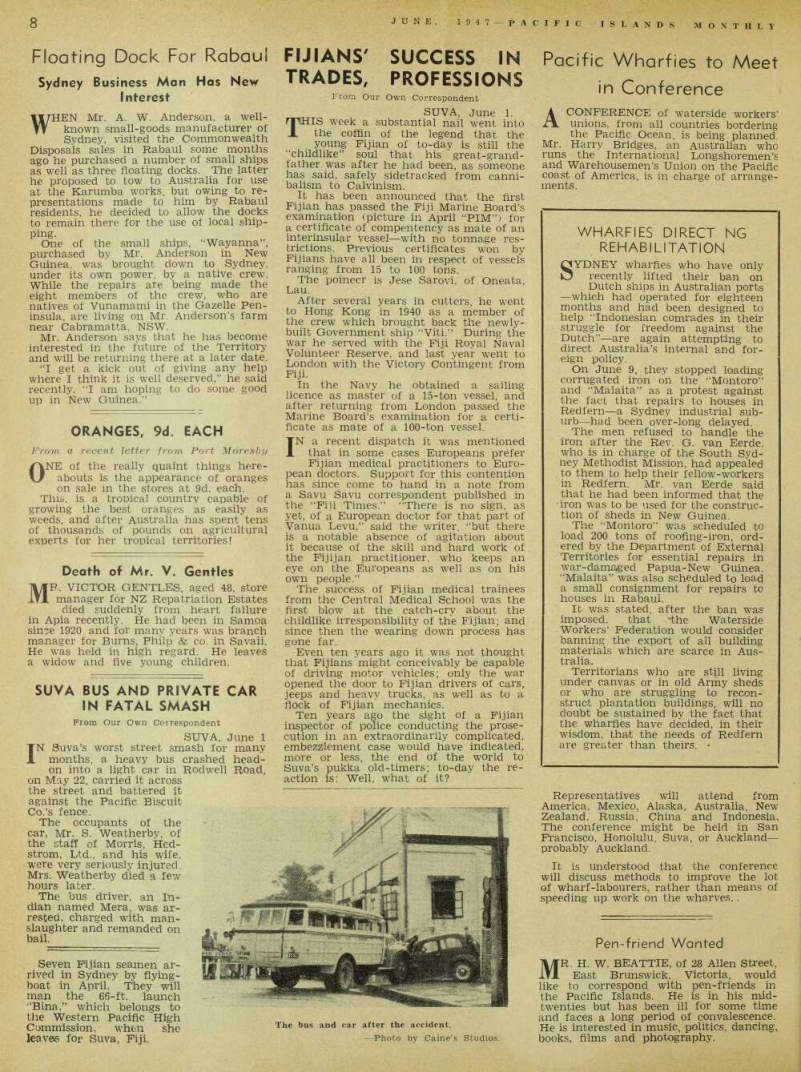
Seven Fijian seamen ar rived in Sydney by flying boat in April. They will man the 66-ft. launch ‘Bina,” which belongs to the Western Pacific High Commission, when she leaves for Suva. Fiji.
The bus and car after the accident. -Photo by Caine’s Studios.
Trades, Professions
Fijians' Success In
From Our Own Correspondent SUVA, June 1.
THIS week a substantial nail went into the coffin of the legend that the young Fijian of to-day is still the “childlike” soul that his great-grand father was after he had been, as someone has said, safely sidetracked from canni balism to Calvinism.
It has been announced that the first Fijian has passed the Fiji Marine Board’s examination (picture in April “PIM”) for a certificate of compentency as mate of an interinsular vessel—with no tonnage res trictions. Previous certificates won by Fijians have all been in respect of vessels ranging from 15 to 100 tons.
The poineer is Jese Sarovi, of Oneata, Lau.
After several years in cutters, he went to Hong Kong in 1940 as a member of the crew which brought back the newly built Government ship “Viti.” During the war he served with the Fiji Royal Naval Volunteer Reserve, and last year went to London with the Victory Contingent from Fiji.
In the Navy he obtained a sailing licence as master of a 15-ton vessel, and after returning from London passed the Marine Board’s examination for a certi ficate as mate of a 100-ton vessel.
IN a recent dispatch it was mentioned that in some cases Europeans prefer Fijian medical practitioners to Euro pean doctors. Support for this contention has since come to hand in a note from a Savu Savu correspondent published in the “Fiji Times.” “There is no sign, as yet, of a European doctor for that part of Vanua Levu,” said the writer, “but there is a notable absence of agitation about it because of the skill and hard work of the Fijijan practitioner, who keeps an eye on the Europeans as well as on his own people.”
The success of Fijian medical trainees from the Central Medical School was the first blow at the catch-cry about the childlike irresponsibility of the Fijian; and since then the wearing down process has gone far.
Even ten years ago it was not thought that Fijians might conceivably be capable of driving motor vehicles; only the war opened the door to Fijian drivers of cars, jeeps and heavy trucks, as well as to a flock of Fijian mechanics.
Ten years ago the sight of a Fijian inspector of police conducting the prose cution in an extraordinarily complicated, embezzlement case would have indicated, more or less, the end of the world to Suva’s pukka old-timers; to-day the re action is: Well, what of it?
in Conference
Pacific Wharfies to Meet in Conference
A CONFERENCE of waterside workers’ unions, from all countries bordering the Pacific Ocean, is being planned.
Mr. Harry Bridges, an Australian who runs the International Longshoremen’s and Warehousemen’s Union on the Pacific coast of America, is in charge of arrange ments.
Representatives will attend from America, Mexico, Alaska, Australia. New Zealand, Russia, China and Indonesia.
The conference might be held in San Francisco, Honolulu, Suva, or Auckland— probably Auckland.
It is understood that the conference will discuss methods to improve the lot of wharf-labourers, rather than means of speeding up work on the wharves..
Wharfies Direct Ng
Rehabilitation
SYDNEY wharfies who have only recently lifted their ban on Dutch ships in Australian ports —which had operated for eighteen months and had been designed to help “Indonesian comrades in their struggle for freedom against the Dutch”—are again attempting to direct Australia’s internal and for eign policy.
On June 9, they stopped loading corrugated iron on the “Montoro” and “Malaita” as a protest against the fact that repairs to houses in Redfern —a Sydney industrial sub urb—had been over-long delayed.
The men refused to handle the iron after the Rev. G. van Eerde, who is in charge of the South Syd ney Methodist Mission, had appealed to them to help their fellow-workers in Redfern. Mr. van Eerde said that he had been informed that the iron was to be used for the construc tion of sheds in New Guinea.
The “Montoro” was scheduled to load 200 tons of roofing-iron, ord ered by the Department of External Territories for essential repairs in war-damaged Papua-New Guinea.
“Malaita” was also scheduled to load a small consignment for repairs to houses in Rabaui.
It was stated, after the ban was imposed, that 'the Waterside Workers’ Federation would consider banning the export of all building materials which are scarce in Aus tralia.
Territorians who are still living under canvas or in old Army sheds or who are struggling to recon struct plantation buildings, will no doubt be sustained by the fact that the wharfies have decided, in their wisdom, that the needs of Redfern are greater than theirs. *
Pen-friend Wanted
MR. H. W. BEATTIE, of 28 Allen Street, East Brunswick, Victoria, would like to correspond with pen-friends in the Pacific Islands. He is in his mid twenties but has been ill for some time and faces a long period of convalescence.
He is interested in music, politics, dancing, books, films and photography.
Advertisements & other items, p. 10 (1 item)
8
JUNE, 1947 PACIFIC ISLANDS MONTHLI
Service
Suva-Auckland Air Service To be Controlled by National Air ways Corporation
IT is expected that the Auckland-Suva air service which has catered for civilians but has been operated by the RNZAF since the end of the war. will be handed over to the NZ National Airways Corporation about the end of this month. Two RNZAF Sunderlands which have been converted to passenger travel, together with their crews, will be banded over to the civilian service; two other Sunderlands which have not been so converted will go into storage.
Mechanics Bay, Auckland, will be closed as a RNZAF station but will, of course, continue to be the terminal for overseas flying-boats.
The National Airways Corporation is the New Zealand government, which has nationalised internal and external air ways.
Commercial airways in New Zealand, in booking facilities, frequency of services, availability of accommodation, are 20 years behind Australia where air-services are now second to none anywhere in the world. Air travel within Australia is now no more difficult than buying a 2d. tram ride—and much more comfortable. In New Zealand it is still largely a matter of official rigmarole, inconvenience and. often, influence, before one can even secure a seat.
"Matua" Passengers
Mr. w. H. Reiher has been appointed Commissioner of Customs, Gilbert and Ellice Islands in succession to Mr. W. B, Marston who has left the Colony.
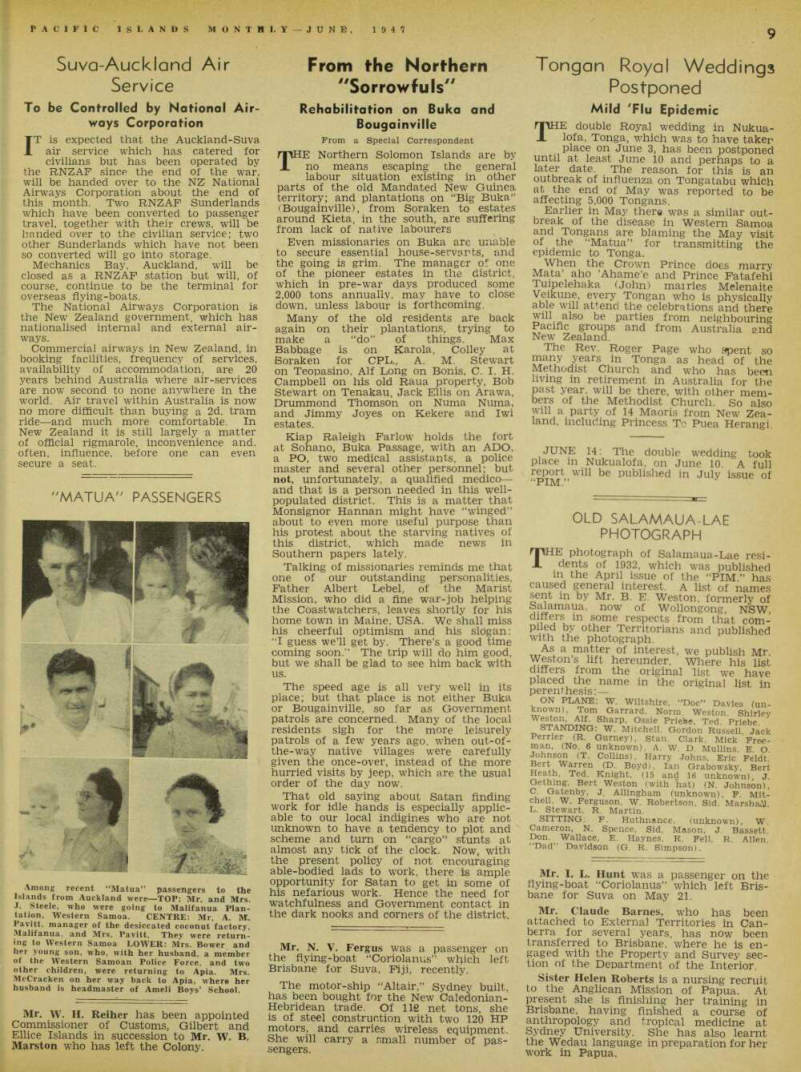
Among recent "Matua” passengers to the Islands from Auckland were—TOP: Mr. and Mrs.
J. Steele, who were going to Malifanua Plan tation, Western Samoa. CENTRE: Mr. A. M.
Pavitt, manager of the desiccated coconut factory, Malifanua, and Mrs. Pavitt. They were return ing to Western Samoa LOWER: Mrs. Bower and her young son, who, with her husband, a member of the Western Samoan Police Force, and two other children, were returning to Apia. Mrs.
McCracken on her way back to Apia, where her husband is headmaster of Ameli Boys’ School.
"Sorrowfuls"
From the Northern "Sorrowfuls"
Rehabilitation on Buka and Bougainville
From a Special Correspondent rE Northern Solomon Islands are by no means escaping the general labour situation existing in other parts of the old Mandated New Guinea territory; and plantations on “Big Buka” (Bougainville), from Soraken to estates around Kieta. in the south, are suffering from lack of native labourers Even missionaries on Buka are unable to secure essential house-servants, and the going is grim. The manager of one of the pioneer estates in the district, which in pre-war days produced some 2,000 tons annually, may have to close down, unless labour is forthcoming.
Many of the old residents are back again on their plantations, trying to make a “do” of things. Max Babbage is on Karola, Colley at Boraken for CPL,, A. M. Stewart on Teopasino, Alf Long on Bonis. C. I. H.
Campbell on his old Raua property, Bob Stewart on Tenakau, Jack Ellis on Arawa, Drummond Thomson on Numa Numa, and Jimmy Joyes on Kekere and Iwi estates.
Kiap Raleigh Farlow holds the fort at Sohano, Buka Passage, with an ADO, a PO, two medical assistants, a police master and several other personnel; but not, unfortunately, a qualified medico — and that is a person needed in this well populated district. This is a matter that Monsignor Hannan might have “winged” about to even more useful purpose than his protest about the starving natives of this district, which made news in Southern papers lately.
Talking of missionaries reminds me that one of our outstanding personalities, Father Albert Lebel, of the Marist Mission, who did a fine war-job helping the Coastwatchers, leaves shortly for his home town in Maine, USA. We shall miss his cheerful optimism and his slogan: “I guess we’ll get by. There’s a good time coming soon.” The trip will do him good, but we shall be glad to see him back with us.
The speed age is all very well in its place; but that place is not either Buka or Bougainville, so far as Government patrols are concerned. Many of the local residents sigh for the more leisurely patrols of a few years ago, when out-of the-way native villages were carefully given the once-over, instead of the more hurried visits by jeep, which are the usual order of the day now.
That old saying about Satan finding work for idle hands is especially applic able to our local indigines who are not unknown to have a tendency to plot and scheme and turn on “cargo” stunts at almost any tick of the clock. Now, with the present policy of not encouraging able-bodied lads to work, there is ample opportunity for Satan to get in some of his nefarious work. Hence the need for watchfulness and Government contact in the dark nooks and comers of the district.
Mr. N. V. Fergus was a passenger on the flying-boat “Coriolanus” wlpch left Brisbane for Suva, Fiji, recently.
The motor-ship “Altair,” Sydney built, has been bought for the New Caledonian- Hebridean trade. Of 112 net tons, she is of steel construction with two 120 HP motors, and carries wireless equipment.
She will carry a small number of pas sengers.
Tongan Royal Weddings
Postponed Mild 'Flu Epidemic
rpHE double Royal wedding in Nukua- X lofa, Tonga, which was to have taker place on June 3, has been postponed until at least June 10 and perhaps to a later date. The reason for this is an outbreak of influenza on Tongatabu which at the end of May was reported to be affecting 5,000 Tongans.
Earlier in May there was a similar out break of the disease in Western Samoa and Tongans are blaming the May visit of the “Matua” for transmitting the epidemic to Tonga.
When the Crown Prince does marry Mata’ aho ’Ahame’e and Prince Fatafehi Tuipelehaka (John) mairies Melenaite Veikune, every Tongan who is physically able will attend the celebrations and there will also be parties from neighbouring Pacific groups and from Australia end New Zealand.
The Rev. Roger Page who spent so many years in Tonga as head of the Methodist Church and who has been living in retirement in Australia for the past year, will be there, with other mem bers of the Methodist Church. So also will a party of 14 Maoris from New Zea land, including Princess To Puea Herangi.
JUNE 14: The double wedding took place in Nukualofa, on June 10. A full report will be published in July issue of
“Pim.”
Old Salamaua-Lae
Photograph
rE photograph of Salamaua-Lae resi dents of 1932, which was published in the April issue of the “PIM.” has caused general interest. A list of names sent in by Mr. B. E. Weston, formerly of Salamaua, now of Wollongong, NSW differs in some respects from that com piled by other Territorial and published with the photograph.
As a matter of interest, we publish Mr.
Westons lift hereunder. Where his list differs from the original list we have placed the name in the original list in parenthesis:— ON PLANE: W. Wiltshire, "Doc” Davies (un known), Tom Garrard. Norm. Weston, Shirley Weston, Alf. Sharp, Ossie Priebe, Ted. Priebe STANDING: W. Mitchell. Gordon Russell, Jack Perrier (R. Gurney), Stan. Clark, Mick Free man, (No. 6 unknown), A. W, D. Mullins, E. O.
Johnson (T. Collins), Harry Johns, Eric Feldt, Bert Warren (D. Boyd), lan Grabowsky, Bert Heath, Ted. Knight, (15 and 16 unknown), J Gethmg, Bert Weston (with hat) (N. Johnson), C. Gatenby, J. Alllngham (unknown), F. Mit chell. W. Ferguson, W. Robertson, Sid. Marshal L. Stewart, R. Martin.
SITTING: F. Huthnance, (unknown), W.
Cameron, N. Spence, Sid. Mason, J. Bassett, Don. Wallace, E. Haynes. R. Fell, R. Allen.
“Dad” Davidson (G. R. Simpson).
Mr. I. L. Hunt was a passenger on the flying-boat “Coriolanus” which left Bris bane for Suva on May 21.
Mr. Claude Barnes, who has been attached to External Territories in Can berra for several years, has now been transferred to Brisbane, where he is en gaged with the Property and Survey sec tion of the Department of the Interior.
Sister Helen Roberts is a nursing recruit to the Anglican Mission of Papua. At present she is finishing her training in Brisbane, having finished a course of anthropology and tropical medicine at Sydney University. She has also learnt the Wedau language in preparation for her work in Papua.
Trade Agreement
Between NG and Aust.
Two-Way Preference Would be of Little Benefit to NG
IT is believed, in some quarters, that the New Guinea Administration will soon approach the Federal Government and ask that New Guinea products be given preferential treatment in Australia.
But this preference will be a two-bladed weapon as part of the “mutually bene ficial trade agreement,” Papua-New Guinea will be committed to purchase all her manufactured goods from the Com monwealth. And whether this would work out to the advantage of the Tern torian producer, in the long run, is open to doubt. , n , Territorians will remember the good old days” when it was possible to purchase American goods including motor cars and clothing for about 30 per cent, under the ruling Australian price Australian manufacturing methods and her much-publicised conditions of labour, are such that cheap manufactured goods are impossible. In this connection the following mav be of interest: Recently a man in Svdney who wished to buy a small shifting spanner was shown one at 15/-. “It’s English.” he was told.
“It seems a lot for a small thing like that,” he said, “haven’t you got something made locally, and cheaper?” „ “I have got one made in Australia, said the salesman. “It’s a fair imitation of the English job and it costs exactly 25 - 1 ”
Notwithstanding what arrangements are contemplated between the Papua-New Guinea Administration and the Australian government with regard to tarnfs it should be remembered that New Guinea, at least, will be a United Nations trustee ship territory and it is unlikely that UNO will permit of its becoming: such, a close preserve of the Commonwealth that it win be “committed to purchasing all its manu factured goods from Australia.”
Laws Of Bsip To Be Revised
IN March, Puisne Judge J. B. Thomson of Fiji was appointed a Commissioner who “shall prepare a revised edition of the King’s Regulations” and subsidiary legislation in respect of the British Sol omon Islands Protectorate.
The revision is expected to bring the laws of the Protectorate up to date and present them in a more concise form.
To this end the Commissioner has power to omit all regulations that have been repealed or have expired—in which is included a number of old regulations passed during and shortly after World War I; and to consolidate and condense regulations where necessary. - After the Commissioner has compiled the revised edition of the laws, they will come into force on a date set by the High Commissioner for the Western Pac ific by proclamation.
The new laws, when published, will be on sale from the Resident Commissioner, BSIP; the secretary of the WPHC, Suva; and Bums, Philp & Company, Ltd., Syd ney. Price will be 1/-.
Death of Mrs. Alice Roberts
Apia, May 12
MRS. ALICE ROBERTS, widow of Mr.
Charles Roberts, first Judge of the District Court of Western Samoa during the military occupation from 1914 to 1920, died in Apia in early May, aged 69.
She is survived by a daughter, Mrs. R.
G. Bruce, of Apia.
Qantas Airways To Be
Nationalised Australian Government Buys Private Shares
rE Australian Government has decided to buy out Qantas Empire Airways Ltd. This was announced in Can berra by the Prime Minister on May 27.
The Federal Government already owns 50 per cent, of the shares in the company, having purchased them some months ago from the British Overseas Airways Cor poration. The remainder of the shares (which will be bought by the Government) are held by Queensland and Northern Territory Aerial Services Ltd., which in the early 1920’s laid the foundations of an airways organisation that has become one of the best in the world.
As well as Qantas’ far northern services in Australia, and England-Australia route commitments, the Company operates a service to Papua and New Guinea, and another, bv flying-boat, between Sydney- Noumea-Siiva. It is expected that when the Lancastrian planes at present used, are replaced by Constellations, Qantas will fly the whole route between Sydney and England instead of only part way, as at present: and that a parallel service will be maintained by BOAC with flying-boats.
It has been rumoured that Qantas will extend its Islands services, particularly to the Solomons and Nauru.
It would not be surprising if services to Lord Howe Island and Norfolk Island were also contemplated. In May, in reply to a question as to why the veteran Pac ific airman, Mr. P. G. Taylor, was re fused a licence to operate a service to these islands, Australian Air Minister
Barnard said that the whole matter of such air services was under consideration.
Whether or not nationalisation of air lines is a desirable thing is a matter of personal opinion. The basic function of all air lines is to provide efficient service to the public at moderate cost. There has been, as yet. no indication that the overseas airline monopolies that the British, New Zealand and Australian Gov ernments have created have been of any more benefit to the public than if they were operated by private enterprise.
Fares on all these lines are, on a mileage basis, about 200 per cent, higher than on Australian domestic lines where compet ition is keen.
Pan-Air Cut a Day
Off Pacific Run
PAN American Airways trans-Pacific Clipper service has cut the time of flight from Sydney to San Francisco from 72 hours to 46 hours. The longest stop is now 4 hours in Honolulu.
Formerly PAA flew during the day and passengers were accommodated on or near airports during the night. The new schedule will cut out the discomfort or boredom of overnight stops in such places as Nadi (Fiji) and Canton Island, and should be of advantage to travellers who travel the airways for business rather than for sight-seeing.
Mr. S. A. Lonergan has been appointed to discharge the duties of Government Secretary of the Papua-New Guinea Ad ministration as from May 7, in the ab sence on leave of Mr. R. Melrose.
five weeks' leave in Melbourne
Qantas Passengers For Papua-N. Guinea
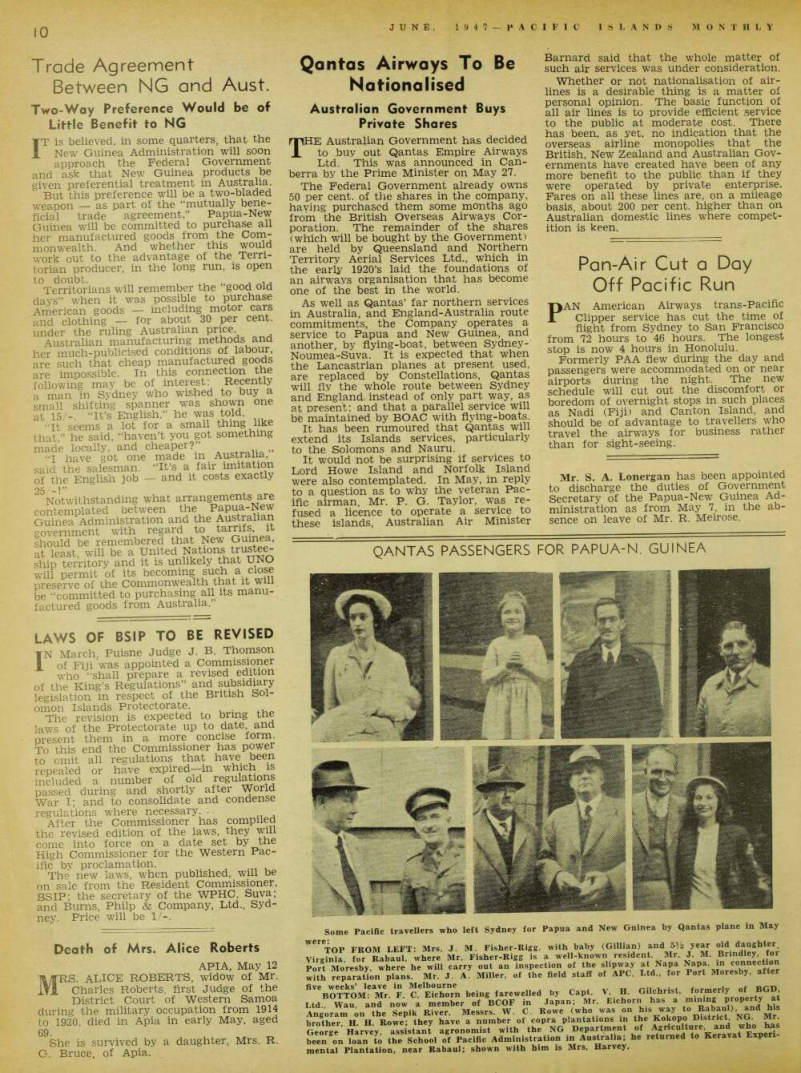
Some Pacific travellers who left Sydney for Papua and New Guinea by Qantas plane in May TOP FROM LEFT: Mrs. J M. Fisher-Rigg, with baby (Gillian) and 5½ year old daughter.
Virginia, for Rabaul, where Mr. Fisher-Rigg is a well-known resident Mr. J. M. Brindley, for Port Moresby where he will carry out an inspection of the slipway at Napa Napa, in connection with reparauin plans. Mr. J. A Miller, of the field staff of APC, Ltd., for Port Moresby, after
five weeks' leave in Melbourne
BOTTOM: Mr. F. C. Eichorn being farewelled by Capt. V. H. Gilchrist, formerly of BGD, Ltd. Wau, and now a member of BCOF in Japan; Mr. Eichorn has a mining property at Angoram on the Sepik River. Messrs. W. C Rowe (who was on his way to Rabaul), and his brother H. H. Rowe; they have a number of copra plantations in the Kokopo District, NG. Mr.
George Harvey, assistant agronomist with the NG Department of Agriculture, and who has been on loan to the School of Pacific Administration in Australia; he returned to Keravat Experi mental Plantation, near Rabaul; shown with him is Mrs. Harvey.
Inquiry by UNO Mission
Western Samoa's
Future
THE mission appointed by the Trustee ship Council of the' United Nations to inquire into the recent petition of the Western Samoans for a larger measure of self-government, is expected to arrive in New Zealand, by air, prob ably from New York, in the latter part of June. The members of the mission are:— Francis B. Sayre, of United States.
Pierre Rycknans of Belgium.
Dr. Cruz-Coke, of Chili.
According to the present plan, the mis sion will spend all of July and most of August in Western Samoa.
It is not known whether the mission will visit Eastern Samoa (American).
That, probably, will depend upon whether the mission intends to inquire only into the self-government question. But the Samoans, in their petition to the Trus teeship Council, laid stress also upon their desire that Western and Eastern Samoa should be united. If that request also is considered —and, in the final an alysis, it is the more important of the two—a visit by the mission to American Samoa will be necessary.
A report elsewhere in this issues states that the United States has granted new rights of citizenship to the natives of Eastern Samoa.
MR. Sayre, who is the representative of the United States on the Trustee ship Council, is a former Assistant- Secretary of State and United States High Commissioner to the Philippines.
He was also at one time Envoy Extra ordinary, and Minister Plenipotentiary to the Siamese Government.
Mr. Ryckmans, representative of Bel gium on the Trusteeship Council, is a former Governor-General of Belgian Con go. He is a doctor of laws of Louvian University.
Dr. Coke is a professor of surgery. He was Minister of Health in the Chilean Cabinet from January, 1937 to September, 1938, and was elected Conservative Sen ator for Santiago in 1941. As Presiden tial candidate in September, 1946, he polled the highest number of votes after Senor Gonzalez Videla, who was elected.
It was announced in New Zealand at the end of May that the members of the mission would reach New Zealand about June 23 and that they would leave for Western Samoa on or about June 30.
M. Jean de la Roche, secretary of the mission has already arrived in New Z-ealand. He intended spending about 10 days in the Dominion, conferring with the government before going on to Western Samoa.
He will return to New Zealand in time to meet the UN • Committee, when it arrives at the end of June.
Australia And Timor
NEGOTIATIONS are taking place be
ll tween the Government of Portuguese Timor and the Australian Consul in Timor on matters of trade, common de fence. and the use of air travel facilities,” said Australian External Affairs Minister Evatt, in reply to a question on May 16.
“It is expected that the Governor of Por uguese Timor will soon visit Australia.
“No negotiations relating to defence are taking place with the Government of France, which has resumed full sover eignty over New Caledonia without re striction.”
War's
Aftermath
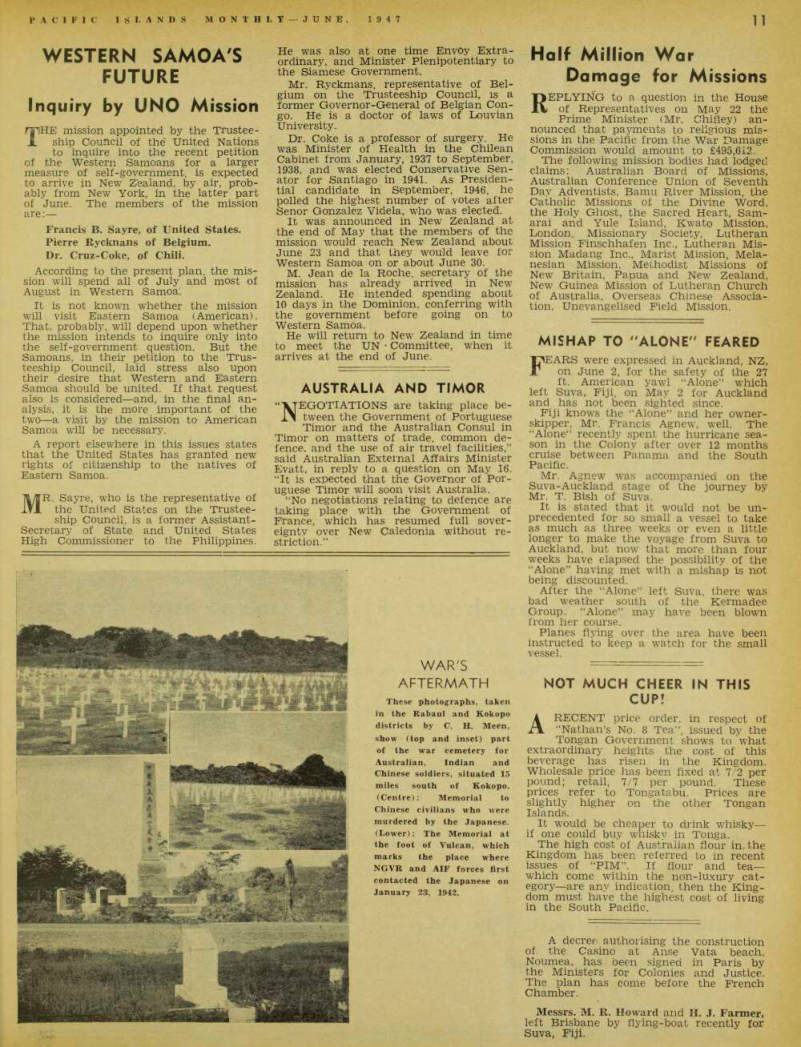
These photographs, taken in the Rabaul and Kokopo districts by C. H. Meen, show (top and inset) part of the war cemetery for Australian, Indian and Chinese soldiers, situated 15 miles south of Kokopo. (Centre): Memorial to Chinese civilians who were murdered by the Japanese. (Lower): The Memorial at the foot of Vulcan, which marks the place where NGVR and AIF forces first contacted the Japanese on January 23, 1942.
Half Million War
Damage for Missions
REPLYING to a question in the House of Representatives on May 22 the Prime Minister (Mr. Chifley) an nounced that payments to religious mis sions in the Pacific from the War Damage Commission would amount to £495,612.
The following mission bodies had lodged claims: Australian Board of Missions, Australian Conference Union of Seventh Day Adventists, Bamu River Mission, the Catholic Missions of the Divine Word, the Holy Ghost, the Sacred Heart, Sam ara! and Yule Island, Kwato Mission, London, Missionary Society, Lutheran Mission Finschhafen Inc., Lutheran Mis sion Madang Inc., Marist Mission, Mela nesian Mission, Methodist Missions of New Britain, Papua and New Zealand, New Guinea Mission of Lutheran Church of Australia, Overseas Chinese Associa tion, Unevangelised Field Mission.
Mishap To "Alone" Feared
FEARS were expressed in Auckland, NZ, on June 2, for the safety of the 27 ft. American yawl “Alone” which left Suva, Fiji, on May 2 for Auckland and has not been sighted since.
Fiji knows the “Alone” and her owner skipper, Mr. Francis Agnew, well. The “Alone” recently spent the hurricane sea son in the Colony after over 12 months cruise between Panama and the South Pacific.
Mr. Agnew was accompanied on the Suva-Auckland stage of the journey by Mr. T. Bish of Suva.
It is stated that it would not be un precedented for so small a vessel to take as much as three weeks or even a little longer to make the voyage from Suva to Auckland, but now that more than four weeks have elapsed the possibility of the “Alone” having met with a mishap is not being discounted.
After the “Alone” left Suva, there was bad weather south of the Kermadee Group. “Alone” may have been blown from her course.
Planes flying over the area have been instructed to keep a watch for the small vessel.
Not Much Cheer In This
Cup!
A RECENT price order, in respect of “Nathan’s No. 8 Tea”, issued by the Tongan Government shows to what extraordinary heights the cost of this beverage has risen in the Kingdom.
Wholesale price has been fixed at 7/2 per pound; retail, 7/7 per pound. These prices refer to Tonga tabu. Prices are slightly higher on the other Tongan Islands.
It would be cheaper to drink whisky— if one could buy whisky in Tonga.
The high cost of Australian flour in the Kingdom has been referred to in recent issues of “PIM”. If flour and tea— which come within the non-luxury cat egory—are any indication, then the King dom must have the highest cost of living in the South Pacific.
A decree authorising the construction of the Casino at Anse Vata beach, Noumea, has been signed in Paris by the Ministers for Colonies and Justice.
The plan has come before the French Chamber.
Messrs. M. R. Howard and H. J. Farmer, left Brisbane by flying-boat recently for Suva, Fiji.
Advertisements & other items, p. 14 (1 item)
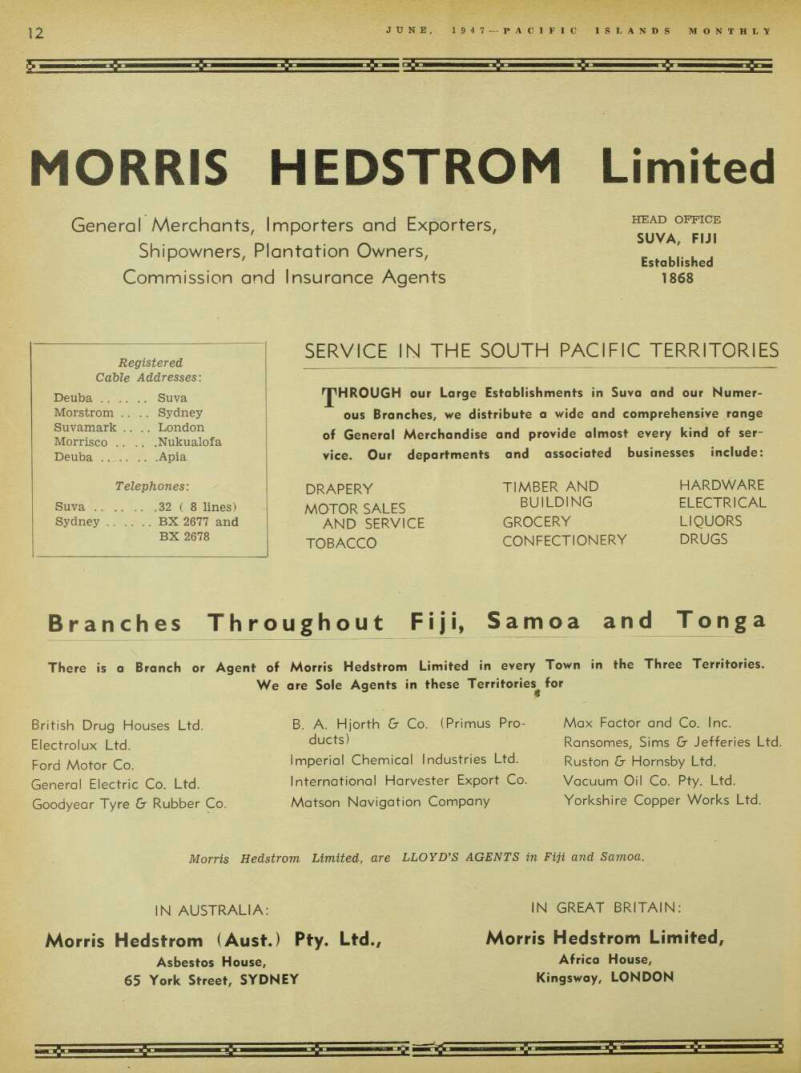
Morris Hedstrom Limited
General Merchants, Importers and Exporters,
Shipowners, Plantation Owners,
Commission and Insurance Agents
HEAD OFFICE
SUVA, FIJI
Established 1868
SERVICE IN THE SOUTH PACIFIC TERRITORIES
rpHROUGH our Large Establishments in Suva and our Numerous Branches, we distribute a wide and comprehensive range of General Merchandise and provide almost every kind of service. Our departments and associated businesses include:
DRAPERY
MOTOR SALES
AND SERVICE
TOBACCO
TIMBER AND
BUILDING
GROCERY
CONFECTIONERY
HARDWARE
ELECTRICAL
LIQUORS
DRUGS
Branches Throughout Fiji, Samoa and Tonga
There is a Branch or Agent of Morris Hedstrom Limited in every Town in the Three Territories.
British Drug Houses Ltd.
Electrolux Ltd.
Ford Motor Co.
General Electric Co. Ltd.
Goodyear Tyre Gr Rubber Co.
We are Sole Agents in these Territories for B. A. Hjorth Gr Co. (Primus Products) imperial Chemical Industries Ltd.
International Harvester Export Co.
Matson Navigation Company Max Factor and Co. Inc.
Ransomes, Sims Gr Jefferies Ltd Ruston Gr Hornsby Ltd.
Vacuum Oil Co. Pty. Ltd.
Yorkshire Copper Works Ltd.
Morris Hedstrom Limited, are LLOYD’S AGENTS in Fiji and Samoa.
IN AUSTRALIA:
Morris Hedstrom (Aust.) Pty. Ltd.,
Asbestos House, 65 York Street, SYDNEY
IN GREAT BRITAIN:
Morris Hedstrom Limited,
Africa House, Kingsway, LONDON
Guinea Administration
What Is Wrong With New
Colonel "Blue" Allen Deals With Muddled Situation - With the Gloves Off
(Jolonel H. T. Allan, Qbe—
known to most Territorians as “Blue” Allan—was a successful mine owner at Wau when war came in 1939.
On the strength of a good record in World War I, he volunteered im mediately. He sailed in 1940 as a junior officer; through distinguished service in the Mediterranean area, he was quickly promoted; and he came back to Australia with the famous 9th Division as Lieut-Colonel. He gave further good service in New Guinea, and was promoted Colonel. His out standing record, plus his long Terri tories experience, led to his appoint ment to the Production Control Board; but, for reasons he has not disclosed, he resigned that position after a few months. Since October, 1946, he has been trading, and developing a plantation near Rabaul.
It would appear that conditions in New Guinea have finally broken the patience and forbearance of Colonel Allan—just as they have driven other responsible men, already, to sharp protests and criticism. The following notes have been sent to us by Colonel Allan, from Rabaul, for publication.
No attempt is made to allot the blame—it may lie in Port Moresby, or in Canberra. Colonel Allan’s state ment may be accepted, however, as fact—and the fact is that, while Mr.
Ward is posing before the Geneva world as the Protector of Fuzzy- Wuzzy, the Eurovean civilians of New Guinea—especially the returned soldier section of them—are getting a very raw deal.
Rabaul, May 10.
rE following (writes Colonel Allan) is my summing un of the position in New Guinea to-day.
After being discharged from the Army in May. 1946, T was for four months on the Territories Production Board. Since then, after spending Sentember in Aus tralia. I have been endeavouring to re habilitate myself as a private individual.
Repatriation and Rehabilitation ALTHOUGH there have been visits from representatives of the Repatriation Department, and reauests made for extension to returned soldiers in New Guinea of all benefits available to re turned soldiers in Australia, no mach inery to implement same seems to exist, and very few benefits have been available.
It is not yet possible to obtain a hous ing loan, although this is the most urgent problem, as all houses in Mandated Ter ritory were destroyed.
The Administration seems to have no plan for repatriation of former residents, and evinces no desire to assist in any way. In fact, one gets the impression that the majority of Administration officials resent the return of former resi dents and would be pleased to see them kept out. The fact that, even though many have lived here for twenty-five years, and only left their homes to enlist and fight, they have now to go cap in hand to Department of External Terri
tories to beg to be allowed to return to their homes, does not fit in with one’s ideas of Democracv, the Four Freedoms, and all that.
These unfortunates who have not yet been permitted to return are forced to fend for themselves and, if not lucky enough to have found temporary employment, they gradually exhaust their capital, which should have paid for their re-establish ment.
There are little, if any, building mat erials available. Australia will not per mit any quantities of building materials to be exported, even though these areas have been totally destroyed. The Admin istation has “frozen” the buildings left by Army for their own purposes and, in the Rabaul area, any surplus materials are reserved for natives. Women with children have had to live in tents and temporary hovels made from old scrap iron and salvage.
Attitude of Administration EVERYTHING appears to centre around Port Moresby. Here, all amenities exist, as the towm was hardly dam aged, and much was added by the Army.
Administration officials have their own homes including the notorious new Stubbs bungalows and life proceeds normally in comparison with other parts of the Territories.
Legislation for tne natives, and regu lations for the Teiritory, appear to be drafted from the only of view most of the rfacials nave—that is, Hanuabada, which is at their doof and whose natives are the only ones that most of them come in contact with.
The idea of placing village councillors to run their own show can work in Hanu abada ; out what will happen when this principle is applied to the Kukukukus and other tribes who are seventy years behind in development? And yet Moresby is going to apply this immediately to the whole of New Guinea!
No money is yet available for mainten ance of the Lae-Wau Goldfields roads, etc. —yet over £lOO,OOO is to be spent on Hanuabada’s model village. Natives of Matupi, in Rabaul (which bears same re lation to Rabaul as Hanuabada does to PM) are asking why a similar amount is not being spent on them. The answer appears to be that Hanuabada is right at hand to impress visiing politicians, antropologists, and similar people to show them what an enlightened Admin istration is doing for the poor down trodden natives. But Rabaul, New Ire land, Bougainville, are too remote.
The result is that in these areas the natives are very little better off than when we took over from the Japs twenty months ago.
Trade goods in the Mandated Territory are short. The natives can’t obtain what they require, rice is short, meat unobtain able and medical services and attention far below standards existing prior to 1941.
War Damage
PAYMENT of war damage to natives is proceeding. In most areas, native claims seem to be accepted without question Administration officials say they haven’t time to investigate and
payment is made on the spot. Payments to natives are being based upon 1947 re placement values; wheras returned soldiers and former residents are com pensated upon 1942 values, and their claims are investigated and “chiselled” by the War Damage Commission.
It has been reported to the NG Planters’
Association that whereas the War Dam age Commission will only pay 3/6 for a 5-years-old-palm (5/- was the 1939 value) natives are being paid 5/-.
No discrimination is being shown by the Administration between claims made by natives, who helped us in the AIB, PIB, or ANGAU, and those who fought with or helped the Japs.
It has been reported to the RSL that villages in Bougainville, which were ac tively hostile to our troops and whose places were bombed by us as reprisals, are now being paid war damage compen sation by the 42-days-products of the training school in Sydney. Loyal natives are unable to perceive the logic of this; and I must confess that it is beyond me, also.
Returned soldiers feel deep resentment that they should be treated as suspects when their claims are considered costs are 190 per cent, to 200 per cent, above pre-war prices. Men who fought all through the war have lost everything.
As War Damage funds are reputed to be £3 to £4 million in excess of all possible claims (after allowing £5,000,000 for pay ment of native claims) it is felt that the Commonwealth Government could be generous to the people who gave all for New Guinea. We, like the natives, would be more than satisfied if the Government would reply in kindness and not cash, and put us back in the same position in which we were in* 1941.
Collaborators IT has been laid down that there will be no enquiry into the activities of, nor action taken against, natives who helped or fought with the enemy.
As a result, murderers are at liberty —natives who acted as Jap police and denounced loyal natives and caused them to be executed, or who blackmailed them for their women or money under threat of being denounced as spies, are at large.
One is employed as a clerk by the Admin-
Ex-Serviceman, 30, medically fit, with practical knowledge of building trade and of New Guinea, experienced in First Aid work, seeks any kind of Islands job. Can drive a car, keep books, handle native labour, use a typewriter—and work.
W. H. Campbell, c/o Mrs. Holmes, Dur ham Road, St. Lucia, Brisbane, Queens land.
istration at Rabaul, and another is promi nent in the RPC in Rabaul. Many who, for their services to the Japs, were made luluais and tultuls, still retain their office.
The natives who were loyal to us are bewildered and resentful. They are losing their respect for law and order and the present regime is being referred to more and more as “Government Gammon.”
Many natives have asked me why things are not “all the same before”— why they are unable to get the stores,
trucks, etc., that they had before why. after twenty months, they are still unable to market rheir copra, etc., in places like Manus, Bougainville, New Ire land. Some say (and I think truly) that they are no better off now than when under the Japs.
A decline in morality is most evident.
Thieving is becoming more and more prevalent; and in Rabaul recently, pil laging from wharves has assumed large proportions. In Rabaul, thirty Matupi natives who worked on stevedoring under Administrative supervision are now in cus tody for being In possession of stolen goods.
In the villages, the people of the younger generation have lost their res pect for the older men (and this was the basis of village life) and the authority of the elders is being openly flouted.
This younger generation is not inter ested in planting food or producing copra —in areas, like Rabaul, they are leaving the villages and living in Chinatown.
Shipping and Transport
rE Shipping Board has failed to provide any reliable or efficient service between Island ports. Ships do not run to schedule, and they spend a large part of their time waiting for now masters, or crews, or engine parts.
It is quite impossible for an individual to plan a business or recruiting trip on a timed schedule, because the shipping service functions so spasmodically.
The Minister’s recent statement in reply to Monsignor Hannan, that there was an efficient service operating and ports better serviced than they had ever been, is completely contrary to facts.
New Ireland, Bougainville and outports Bre desperately short of necessities, and the position is deteriorating through lack of regular and reliable shipping.
Preference to Notives
GENERAL policy seems to be to ignore or harrass European efforts and concen trate on natives.
In Rabaul area, all Administration haulage business was given to native truck-owners, whilst returned soldiers who were endeavouring to rehabilitate them selves were not employed.
Lately, this has broken down because the natives pillaged so much cargo from recent shipments. Now, the returned soldier truck-owners have been asked to work the night shift because it has be come impossible to trust the natives.
Any complaint by a native receives prompt attention by the Administrator.
Recently, a native from Rabaul wrote to Moresby that he had been put through the Third Degree in Rabaul goal, and beaten up. Urgent signals were immedi ately despached to Judge Phillips, then in Rabaul, to have an enquiry and report back to Administration.
Investigation proved the native had never been in gaol and that he was notorious as having been one of the Japs’ best collaborators, and a denouncer of loyal natives.
Yet appeals from RSL for investigation into theft of Jap petrol by natives (which has occurred on a large scale) and other similar matters, remain unattended to.
Loss of Cargo
PILFERING on ships and wharves is on a large scale, and heavy losses have occurred in all recent ship ments.
Now the Shinping Board refuses to accept any liability for cargo lost en route, even though there is a legal liability on any transport contractor for goods whilst in his custody.
The Customs insist upon duty being naid on all goods manifested before any goods can be collected.
As a result Customs duty is accepted for goods which subsenuentlv mav be found to have been stolen en route, or not received, and are therefore not actually landed to the Customs.
When application is made for refund of this duty, the Customs sav that they will not refund until the Shipping Board has naid the claim for loss of goods— and the Shinning Board declines to accept any responsibility or to pay.
The result is that firms and individuals are out-of-pocket big sums of monev. for goods lost or stolen, and the Administra tion is holding large sums of money taken by them for dutv on goods that have not arrived. Many think that this is equiva lent to taking money under false pre tences, and it seems certain that legal action will soom be taken against Admin istration.
Advertisements & other items, pp. 15-16 (1 item)
Positions Wanted
YOUTH, 19 years, well educated, good physical condition, desires position anywhere in Islands, preferably on plantation. Ready to start immediately. Replies: Knowles, Barton House, Canberra.
MISSING PERSONS
HALLIGAN, Edwin Gerald, son of Emily Grace Halligan, deceased, last heard of in Madang. New Guinea. Would the abovenamed or anyone knowing his whereabouts please communicate with the Public Trustee, 19 O’Connell Street, Sydney.
SOUTH SEA ISLANDS CLUB
Social Evening
Every Friday at Union Jack House, 5 Hamilton St. (just off Bridge St.) Sydney Ballroom Dancing . . . Special Islands Dances and Songs Islands Visitors Welcome.
C«!
Coleman
WORLD-WIDE
'Defi&uUiMttcf
For all the finest ... for all the latest
in lighting, cooking and heating appli-
ances you can be sure with COLEMAN.
Wherever you may there is a Coleman dealer to serve you with dependable COLEMAN appliances and service.
The Coleman Lamp
'and Stove Company Limited
• • ✓ "■bade C«l
TORONTO. CANADA
CHICAGO,
U. S . A.
Tropic Seas"
"Piracy On The
How Canberra Is Robbing NG Copra Producers
WE have it on very good authority that the crushers in Australia are to-day paving the Australian Government the following prices for New Guinea copra:— Hot-air and Sun-dried £4l/15/- per ton Smoked £4O/15/- per ton This is the copra for which the New Guinea planter is receiving about £26 per ton on his plantation. (The official price is £2B, but that is at port of shipment— and freight thereto from plantation, plus loss of weight due to infrequent pick-up at plantation, represents an average of £2 per ton.')
The buyer, of course, is the New Guinea Production Control Board, an Australian Government instrumentality more or less controlled by Mr. Ward.
Who eventually sells the copra to the Australian crushers, and who gets the difference between £26 and £4l, no man knows. Whenever newspaper men seek information, the bureaucrats shut them selves away coyly behind closed doors, and emulate Brer Rabbit.
The exceedingly raw deal being given New Guinea planters by the Australian Socialists has been the subject of insis tent inquiries in the Australian newspapers and Parlaiment, recently. But Ministers refuse any explanation of what one MP has called “this bare-faced piracy on the tropical seas.”
Latest advices show that the British Ministry of Food is paying £5B/8/0 Aus tralian for Ceylon copra, and America is buying Philippines copra in a free market in Manilla at a price equal to £7l per ton Australian.
Fijian Village Moves To
Make Way For School
From Our Own Correspondent SUVA. June 1 rE Fijian village of Lodoni, on the eastern coast of Viti Levu, has agreed to move, lock, stock and barrel, to make room for a new intermediate school for Fijian boys.
One section of the villagers has gone to the nearby village of Namena and two other sections to Dakuinuku.
Lodoni, the point where travellers from Suva and the rest of Viti Levu take to the sea for the journey to the old capital, Levuka, on Ovalau, already has the large Provincial School, Eastern, the site of which will be incorporated in the new in termediate school.
The French Navy is to maintain an aero-naval base at Nouvillle, He Nou, in Noumea haibour, on land acquired from the colony. Nouville was used as a US
Navy base during the war with Japan.
M. Lerat, ex-magistrate of the French Colony in Shanghai, has been appointed assistant judge of the Noumea Court,
Advertisements & other items, p. 17 (1 item)
Burns Philp
Stromberg ■ Csrlson sole pacific Agents
SAMOA: O. F. NELSON & CO. LTD., Apia, W. Samoa FIJI: PROGRESSIVE RADIO SERVICE, Rodwell Road, Suva NEW BRITAIN: H. T. ALLEN, BARRETT & READ, Casuarina Ave., Rabaul S 5 y Available now; Air Circulators, 5-Valve 6-Volt Vibrator World Range Receiver. Available soon:
REFRIGERATORS, VACUUM
CLEANERS, WASHING MACH-
INES, FANS AND MANY OTHER
ELECTRICAL UTILITIES.
RELIDE WATCHES. Imported movement and cases.
SHOCKPROOF AND WATERPROOF.
salgs SGRVICe
TELEPHONE !8W5157# SCOTTISH HOUSE • 19 BRIDGE STREET ® SYDNEY ® AUSTRALIA
BURNS PHILP
(SOUTH SEA) CO. LTD,
Inc. In FIJI Island Traders and Shipowners Registered Office :
SUVA
FIJI
\\ Also Branches at: Fiji: Levuka, Lautoka, Labasa, Ba, Sigatoka, Rotuma Tonga: Nukualofa, Haapai, Vavau.
Samoa: Apia, Pago Pago (American Samoa).
Solomons: Makambo, Gizo, Faisi.
New Hebrides: Vila.
Code Address: Gilberts: Tarawa.
"Burnsouth*. Norfolk Is. Niue. Wallis Is. Futuna Is.
•SSW
Sole Australian Concessionaries :
GEORGE BROWN & CO. PTY.
267 Clarence Street, Sydney.
LTD
Designs for new Ultimate models have been completed but production has been retarded, due to a few remaining difficulties in raw materials.
Models should be available some time during 1947. They will be well worth waiting for. Watch for further announcements.
SERVICE: Servicing of all kinds of radio sets, amplifiers and Rola speakers will continue to be available.
Catholic Missionaries
Lost At Vunapope
IN the May issue of the “PIM,” the names of Roman Catholic mission personnel lost on the North Coast of New Guinea during the Japanese invasion were published. The following are the names of Roman Catholic missionaries based on Vunapope (New Britain) who lost their lives during the Jap invasion and occupation:— Fathers Barrow, 1942; Harris, 21/12/42;
Martin. ?; Murphy, ?; Culhane, 19/1/43; Bley. 14/2/44; Oberreiter, 21/2/44; Halt, 29/2/44; Gruendl, 4/3/44.
Brothers Joseph, 11 2/44; Hatzig, 18 2 44; Heese, 23/2/44; Wiescher, 26/2/44; Deen, 27/2/44; Buescher, 29/2/44- Doerfier, 9/3 44; Lienerstei, 10/3 44• Bokenkoetter, 23/3 44; Langkamp, 1 4/44- Puckmor, 9/4 44; Hessling, 19'6/44- Pr Mueller, 27/6/44: Wochner, 17/11/44* Shuttingkamper, 8/12/48; Vandenganden’, Also two Sisters at Vunapope and 3 Sisters at Ramale Camp.
Regional Set-Up
Where Does Anzac Pact End And Commission Begin?
Preparations for the first meeting of the South Pacific Regional Com mission were began by the interim organisation in Australia on April 14.
Date of the first meeting has not vet been fixed.
This statement was made by the Aus tralian Minster for External Affairs (Dr.
Evatt), in Canberra in Mav in answer to questions from a Government member who wished to know if any economic, social, medical or anthropological re search had been made in the S-W Pacific area since the signing of the Australia- New Zealand Agreement for the “welfare and advancement of native poeples in the Pacific.” , Er Evatt stated also that a secretariat oad been set up three years ago, after the signing of the Anzac agreement; this functioned in Canberra and Wellington A liaison officer of the NZ Government worked in the Department of External Af a J ir , s in Canbe rra and an Australian official was stationed in Wellington There was a “complete exchange of views be tween Australia and New Zealand on all important aspects of external policy.”
He said that the Australian Govern ment had continued to contribute to the upkeep of , the School of Tropical Medicine in Svdney, and that medical research would be undertaken in the South Pacific at an early date. (NOTE: Any information supplied by the Minister as to what actually had happened since Australia and NZ made their solemn vows in 1943. was as vague and misleading as most Ministerin' statements. There still seems to be con fusion as to where the Anzac Agree ment ends and the South Pacific Regional Commission begins. Residents of the South Pacific will watch the deliberations of the Commission with interest until it is decided whether or not it will be dom inated by Australia, and. to a lesser ex tent. New Zealand, and whether or not the secretariat, of which Dr. Evatt speaks, wfil continue to function after the permanent estabhshmtnt of the Commission or whether it will be merged with it.)
Sympathy Acknowledged
Letter to the Editor ON behalf of my wife, family and self, I beg permission, through your col umns, to thank the manv friends from the Islands and various * Darts of Australia who have sent us letters and radiograms of sympathy concerning the death of our beloved son Geoff, lost to us as the result of a Jeeo accident at Rabaul on May 10.
I am, etc..
Norman White
Wau, TNG. 20/5/47.
New Caledonian motorists, under a new taxation schedule, must pay 600 francs per annum for vehicles used for trans port of goods, and for large passenger cars; 400 francs for smaller cars with two or three seats; and 200 francs for a motor cycle, There is a supplementary tax for cars of 55 francs per horse-power. This tax is reduced by 50 per cent for cars more than seven years old.
Mrs. E. A. Ray and her two children departed recently on the SS “Reynella” for Rabaul where they will rejoin Mr, Ray who is manager in Rabaul for Burns, Philp &' Co,, Ltd.
Advertisements & other items, p. 18 (1 item)
New South Wales
d ?
Ask the manager
When you meet financial problems of either a personal or business nature, remember I hat the Manager of your local branch of the “Wales” will readily discuss such matters with you.
He is a man of wide business experience, who makes a close study of local conditions. In addition, he can draw upon the resources of the specialized departments which are a feature of the “Wales” organization.
Don’t let financial problems worry you unnecessarily. There may be ways in which the “Wales” can help. Ask the
Manager.
BANK OF
NEW SOUTH WALES
FIRST BANK IN AUSTRALIA
Incorporated in New South Wales with limited liability A.4701d
More Indians For Fiji
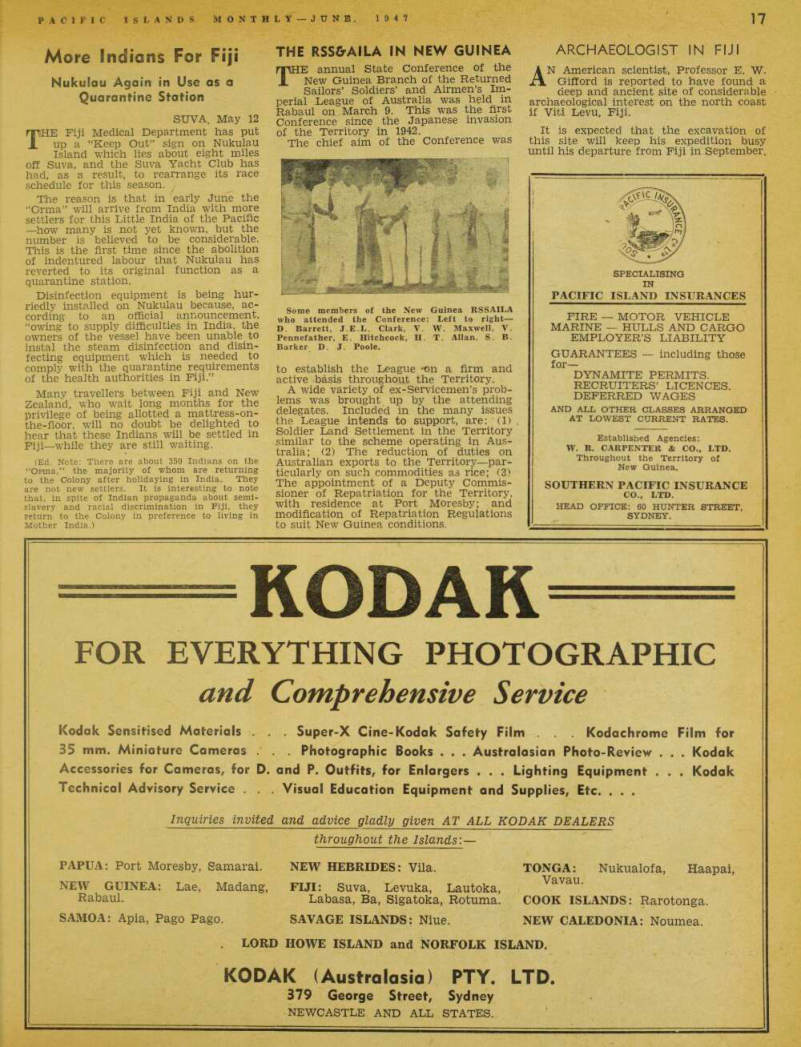
Nukulau Again in Use as a Quarantine Station
Suva, May 12
THE Fiji Medical Department has put up a “Keep Out” sign on Nukulau Island which lies about eight miles off Suva, and the Suva Yacht Club has had. as a result, to rearrange its race schedule for this season.
The reason is that in early June the “Crma” will arrive from India with more settlers for this Little India of the Pacific —how many is not yet known, but the number is believed to be considerable.
This is the first time since the abolition of indentured labour that Nukulau has reverted to its original function as a
quarantine station.
Disinfection equipment is being hur riedly installed on Nukulau because, ac cording to an official announcement, “owing to supply difficulties in India, the owners of the vessel have been unable to instal the steam disinfection and disin fecting equipment which is needed to comply with the quarantine requirements of the health authorities in Fiji.”
Many travellers between Fiji and New Zealand, who wait long months for the privilege of being allotted a mattress-on the-floor, will no doubt be delighted to hear that these Indians will be settled in Fiji—while they are still waiting. (Ed. Note: There are about 350 Indians on the “Or-ma,” the majority of whom are returning to the Colony after holidaying in India. They are not new settlers. It is interesting to note that, in spite of Indian propaganda about semi slavery and racial discrimination in Fiji, they return to the Colony in preference to living in Mother India.)
The Rss & Aila In New Guinea
rE annual State Conference of the New Guinea Branch of the Returned Sailors’ Soldiers’ and Airmen’s Im perial League of Australia was held in Rabaul on March 9. This was the first Conference since the Japanese invasion of the Territory in 1942.
The chief aim of the Conference was
to establish the League 'on a firm and active basis throughout the Territory.
A wide variety of ex-Servicemen’s prob lems was brought up by the attending delegates. Included in the many issues the League intends to support, are: (1) Soldier Land Settlement in the Territory similar to the scheme operating in Aus tralia; (2) The reduction of duties on Australian exports to the Territory—par ticularly on such commodities as rice; (3) The appointment of a Deputy Commis sioner of Repatriation for the Territory, with residence at Port Moresby; and modification of Repatriation Regulations to suit New Guinea conditions.
Some members of the New Guinea RSSAILA who attended the Conference: Left to right— D. Barrett, J.E.L. Clark, V. W. Maxwell, V.
Pennefather, E. Hitchcock, H. T. Allan. S. B.
Barker D. J. Poole,
Archaeologist In Fiji

AN American scientist, Professor E. W.
Gifford is reported to have found a deep and ancient site of considerable archaeological interest on the north coast if Viti Levu. Fiji.
It is expected that the excavation of this site will keep his expedition busy until his departure from Fiji in September,
Mr. Allan Brown formerly of Lae (NG), arrived in Sydney by Qantas Airways on May 31.
France has sent out a dozen technicians to join the staff of the Director of Civil Aviation (M. R. Migeon) in New Cale donia. They include two radio men M.
Vita! Poulain and M. Jean Lezoraine; four radio operators, M. Claude Marcel Mille, M. Yves Le Gall, M. Claude Louis Benoit and M. Louis Auguste Garbe; two radio electricians, M. Marc Coguet and M.
Roger Laroudie; radio technicians M.
Joseph Marie Lapous and M. Henri Ker ouredan; also a Deisel mechanic. Their salaries are paid by the Metropolitan Government.
Advertisements & other items, pp. 19-20 (2 items)
17
acific Islands monthly junb, 1947
Kodak
SPECIALISING
IN
PACIFIC ISLAND INSURANCES
FIRE MOTOR VEHICLE
MARINE HULLS AND CARGO
EMPLOYER’S LIABILITY
GUARANTEES including those for—
DYNAMITE PERMITS.
RECRUITERS’ LICENCES.
DEFERRED WAGES
AND ALL OTHER CLASSES ARRANGED
AT LOWEST CURRENT RATES.
Established Agencies:
W. R. CARPENTER & CO., LTD.
Throughout the Territory of New Guinea.
SOUTHERN PACIFIC INSURANCE
CO., LTD.
HEAD OFFICE: 60 HUNTER STREET,
SYDNEY.
KODAK
FOR EVERYTHING PHOTOGRAPHIC
and Comprehensive Service
Kodak Sensitised Materials . . . Super-X Cine-Kodak Safety Film Kodachrome Film for 35 mm. Miniature Cameras . . Photographic Books .. . Australasian Photo-Review .. . Kodak Accessories for Cameras, for D. and P. Outfits, for Enlargers . . . Lighting Equipment . . . Kodak Technical Advisory Service . . . Visual Education Equipment and Supplies, Etc. . . .
Inquiries invited and advice gladly given AT ALL KODAK DEALERS throughout the Islands:— PAPUA: Port Moresby, Samarai.
NEW GUINEA: Lae, Madang, Rabaul.
SAMOA: Apia, Pago Pago.
NEW HEBRIDES: Vila.
FIJI: Suva, Levuka, Lautoka, Labasa, Ba, Sigatoka, Rotuma.
SAVAGE ISLANDS: Niue.
TONGA: Nukualofa, Haapai, Vavau.
COOK ISLANDS: Rarotonga.
NEW CALEDONIA: Noumea.
LORD HOWE ISLAND and NORFOLK ISLAND.
KODAK (Australasia) PTY. LTD.
379 George Street, Sydney
NEWCASTLE AND ALL STATES.
1
EYE LOTION
For Inflamed Eyes and Eyelids ... Sold Everywhere H. Rose & Co., Pty_ Lid., Kinq Street. Sydney.
m i
Aten wcn/d tike fc knew you
. if yen guard your ch with MUM} Underarm odour offenders are just out of luck. Play safe by preventing danger to charm. Use MUM after every bath.
MUM is quick—takes only 30 seconds to smooth on, no fuss, no inconvenience.
MUM is safe —safe for your skin; can be used right after underarm shaving.
Safe for clothes, too. MUM won’t injure even the finest fabrics.
MUM is sure—MUM prevents underarm odour without stopping perspiration. The minute you use MUM, it starts working for charm!
Mum
TAKES THE ODOUR
OUT OF PERSPIRATION
Campaign Launched To
Raise Copra Price “Fiji is Losing £480,000 a Year"
From Our Own Correspondent
Suva, May 19
LAUNCHING a campaign to raise the price paid for Fiji’s copra to some thing nearer the current world figure, Mr. w. G, Johnson, a nominated member of the Legislative Council of Fiji, who is also the Fiji head of the firm of W. R. Carpenter (Fiji) Ltd., said in a press statement and broadcast this week that Fiji is being short-paid ap proximately £16 (Fiji Currency) a ton.
Based on a yearly production of 30,000 tons, this means that the Colony in a year is losing £480,000 or a daily loss of £1,315.
After reviewing the system of copra purchasing , established during the war, under which the Government of Fiji, as agent for the British Ministry of Food, became the sole purchaser of copra in the Colony, Mr. Johnson said that the price paid for copra in Fiji was not on a parity with that paid in other parts of the world by other countries, and, in some cases, that paid in other countries by the British Ministry of Food itself.
All Fiji copra and all Fiji coconut oil goes to Britain. Such Fiji coconut meal as is not consumed locally is shipped to New Zealand to assist the dairying and stock industries there in their effort to supply the utmost quantities of farm produce to Britain.
“I am aware,” said Mr. Johnson, “that the Fiji Government has been making strenuous efforts with the Colonial Office, which in turn communicates with the British Ministry of Food.
“These efforts have been going on for such an extraordinarily long time with so little result that I am convinced that it requires the united effort of the people in the copra industry in Fiji to back the Fiji Government. The Colonial Office will then be able to present to the Minis try of Food a proper statement of the wishes and opinions of Fiji producers.”
Mr. Johnson’s circular points out that the price the producer is paid for copra at Suva and Levuka to-day is £29/10/- FMS and £29/15/6 plantation grades (Fiji currency). The Fiji Copra Board receives from the British Ministry of Food £32/15/6 for FMS and £33/1/- for plantation grade a ton in bulk when the copra is put on board the export ship.* “The whole of this margin of £3/5/6 is absorbed in local charges for storing, handling, insurance, etc. No part of it is retained by the Government of Fiji or anv merchants or other organisation here,states the circular.
“The price the British Ministry of Food is paying to-day for Ceylon copra is £61/15/- (sterling) a ton, equal to ap proximately £68/5/- (Fiji currency). This is made up of the f.o.b. price of £46/15/- (sterling) Ceylon port agreed to by the British Ministry under a five years’ con tract, and £15 (sterling) a ton export duty imposed by the Government of Ceylon. , .
“The British Parliamentary Debates in dicate that the British Government did not exnect to have to pay the £15 export tax, but the fact is that Britain is paying both the f.o.b and the export tax.
“London cablegrams show that at the end of last year the price paid for Phil ippines copra was as high as 245- United States dollars a ton, equal to approx imately £67 (Fiji). However, the present price of Philippines copra is reported to be 215 dollars, equal to £59.
“The Fiji Government should request the Ministry of Food to pay us the price
*20/- Fijian — 22/6 Australian.
it is paying to Ceylon, less an allowance to cover the difference in quality between Ceylon grade and Fiji. Based on only £46/15/- (sterling) f.o.b. Ceylon, less quality difference £2/5/-, the figure is £44/10/- (£49/5/- Fiji). The average price the Copra Board receives from the British Ministry is about £32/17/6.
Therefore the difference in to-day’s prices is £l6/7/6 (Fiii) and this should be the amount of the rise granted immediately.”
Advertisements & other items, p. 20 (1 item)
18
June, 1941’ —Hci f i c islands monthly
Reports
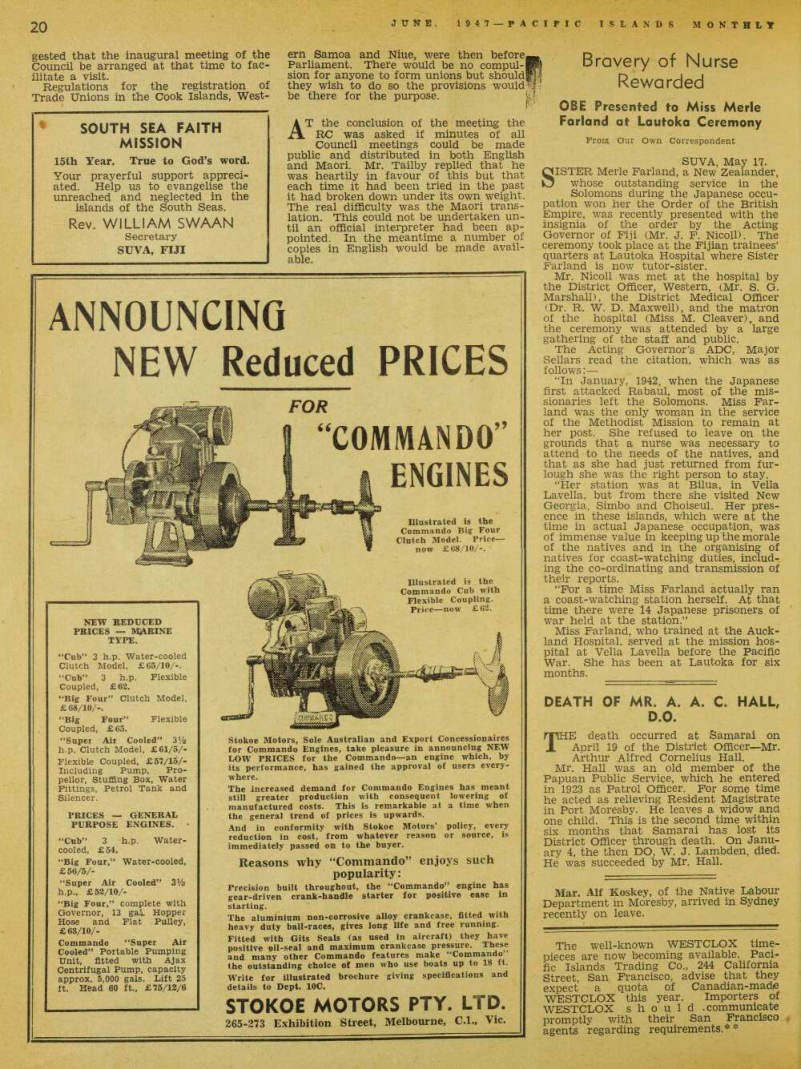
Resident Commissioner Reports To island Council Few, if any. Quick improvements Can be Expected in Cook Islands Affairs
From Our Own Correspondent
Rarotonga, May 12
rE Resident Commission of the Cook Islands, Mr. Tailby, who has been absent from the Group for several months, returned to Rarotonga in April.
During his absence he attended the South Seas Conference in Canberra, at tended to Cook Islands affairs in New Zealand and also had some weeks of ful lough.
On April 24, shortly after his return, he attended an Island Council meeting at which he gave a report on his activities and affairs affecting the Cook Islands.
He said that he had made the stron est representations to the New Zealand Government on the question of fruit prices but within the present marketing framework the NZ'- government had given the highest price that was possible for Cook Island oranges. He had seen the figures of the Internal Marketing Div ision and it was evident that they would lose in the handling of GI oranges this year, unless the fruit arrived in good con dition. A very small profit had been made last year by the IMD. If it had not been for the efforts of the Prime Minister and Parliamentary Under-Sec retary the price offer to Cook Is. orange growers this year would not have been obtained.
The proposed new jail in Rarotonga would be commenced as soon as materials became available. The matter of the hos pital and medical treatment had been in vestigated and a report made. There was no need, said Mr. Tailby, for anyone to doubt that the hospital was not com petant to deal with most things. Re commendations for repairs and enlarge ments to the hospital had been made and were now awaiting the attention of Dr. Buchanan upon his return to Welling ton. Also in hand were approvals for the erection of new hospitals at Aitutaki, Mauke and Manihiki.
The much discussed inter-island vessel would be provided by New Zealand. The vessel is a Fairmile launch; the New Zea land Marine Department is re-fitting the boat with twin Diesel engines, altering the interior for the accommodation of patients and official passengers, and mak ing provision for native deck passengers under cover. The construction of a slip way at Ngatangiia harbour was under consideration.
Mr. Tailby said that shipping was the greatest problem of the present time. No suitable vessel had been purchased to re place the “Maui Pomare”, although three attempts had been made in England to obtain a ship; the NZ High Commissioner in London was still trying. The problem of shipping was not, of course, confined to the Cook Islands. But it took a long time to build ships, and the position was
that no small refrigerated ship, suitable for Island needs, was available.
The NZ Public Works Department was trying to make an engineer available to survey the reefs in the other islands in order to ascertain how passages could be improved. At present the department was short of men and it was difficult to release one for the purpose. rE Commissioner said that regulations passed in NZ on April 14, 1947, re quired that later this year that each Island Council would have to elect repre sentatives to sit on the new Cook Islands Legislative Council. The Prime Minister of NZ, Mr. Fraser, and Mr. Osborne, Par liamentary Under-Secretary, had been asked to attend the first session of the Legislative Council. The Prime Minister has replied that if it is possible for him to attend he will be happy to do so, failing that he will endeavour to arrange for Mr.
Osborne to attend. As Parliamentary affairs would not permit them to leave NZ until late in the year, it was sug
gested that the inaugural meeting of the Council be arranged at that time to fac ilitate a visit.
Regulations for the registration of Trade Unions in the Cook Islands, West
ern Samoa and Niue, were then before.
Parliament. There would be no compul sion for anyone to form unions but should! they wish to do so the provisions would be there for the purpose.
AT the conclusion of the meeting the RC was asked if minutes of all Council meetings could be made public and distributed in both English and Maori, Mr. Tailby replied that he was heartily in favour of this but that each time it had been tried in the past it had broken down under its own weight.
The real difficulty was the Maori trans lation. This could not be undertaken un til an official interpreter had been ap pointed. In the meantime a number of copies in English would be made avail able.
Advertisements & other items, pp. 21-22 (1 item)
Brial & Ball
OPTICAL
PRESCRIPTIONS
Accurately and Faithfully Dispensed. (Quick Service by Air Mail) All inquiries 'promptly and courteously answered. Send me your Optical problems.
All Manner of Repairs Quickly Executed. Moderate Prices.
HAMILTON A. HUGHES,
Dispensing Optician. 30-32 Castlereagh St., Sydney.
Telephone . . . B 5950. (In Samuels Super Drug Store, opposite Hotel Australia.)
BRIAL & BALL
TENNIS SHOES
“RUNACAN” BRAND
Pure rubber soles, unlimited quantities.
Delivery; approximately two months
RINOLDI
Spaghetti, Vermicelli, Macaroni and Soup Pastes
KENNONS
Kromobark High Grade Leather Soles and Heels (excluding Fiji)
LAMBALLE PERFUMES
PARIS
The Aristocrat of French Perfumes
TRUFOOD Powdered Milk
Full Cream and Skim Milk.
TIBALDI
Continental smallgoods, Salami, Canned Mortadella ® Sole Distributing Agents for Pacific Islands
ERIAL & BALL
Australia
31 QUEEN STREET, 1 BOND STREET,
MELBOURNE. SYDNEY.
SOUTH SEA FAITH
MISSION
15th Year. True to God’s word.
Your prayerful support appreciated. Help us to evangelise the unreached and neglected in the islands of the South Seas.
Rev. WILLIAM SWAAN
Secretary
SUVA, FIJI
ANNOUNCING
NEW Reduced PRICES
FOR
a
COMMANDO”
ENGINES
Illustrated is the Commando Big Four Clutch Model. Pricenow £6B/10/-.
NEW REDUCED
PRICES MARINE
TYPE.
“Cub” 3 h.p. Water-cooled Clutch Model, £ 65/10/-.
“Cub” 3 h.p. Flexible Coupled, £62.
“Big Four” Clutch Model, £ 68/10/-.
“Big Four” Flexible Coupled, £ 65.
“Super Air Cooled” 3Va h.p. Clutch Model, £6l/5/- Flexible Coupled, £57/15/- Including Pump, Propeller, Stuffing Box, Water Fittings, Petrol Tank and Silencer.
PRICES GENERAL
PURPOSE ENGINES. *
“Cub” 3 h.p. Watercooled, £54.
“Big Four,” Water-cooled, £56/5/- “Super Air Cooled” 3Va h.p., £52/10/- “Big Four,” complete with Governor, 13 gal. Hopper Hose and Flat Pulley, £6B/10/- Commando “Super Air Cooled” Portable Pumping Unit, fitted with Ajax Centrifugal Pump, capacity approx. 5,000 gals. Lift 25 ft. Head 60 ft., £75/12/6 Illustrated is the Commando Cub with Flexible Coupling.
Price —now £62. m Stokoe Motors, Sole Australian and Export Concessionaires for Commando Engines, take pleasure in announcing NEW LOW PRICES for the Commando—an engine which, by its performance, has gained the approval of users everywhere.
The increased demand for Commando Engines has meant still greater production with consequent lowering of manufactured costs. This is remarkable at a time when the general trend of prices is upwards.
And in conformity with Stokoe Motors’ policy, every reduction in cost, from whatever reason or source, is immediately passed on to the buyer.
Reasons why “Commando” enjoys such
popularity:
Precision built throughout, the “Commando” engine has gear-driven crank-handle starter for positive ease in starting.
The aluminium non-corrosive alloy crankcase, fitted with heavy duty ball-races, gives long life and free running.
Fitted with Gits Seals (as used in aircraft) they have positive oil-seal and maximum crankcase pressure. These and many other Commando features make “Commando the outstanding choice of men who use boats up to 18 ft.
Write for illustrated brochure giving specifications and details to Dept. 10C.
STOKOE MOTORS PTY. LTD.
265-273 Exhibition Street, Melbourne, C. 1., Vic.
Bravery of Nurse
Rewarded OBE Presented to Miss Merle Farland at Lautoka Ceremony
Prom Our Own Correspondent
Suva, May 17.
SISTER Merle Farland, a New Zealander, whose outstanding service in the Solomons during the Japanese occu pation won her the Order of the British Empire, was recently presented with the insignia of the order by the Acting Governor of Fiji (Mr. J. F. Nicoll). The ceremony took place at the Fijian trainees’ quarters at Lautoka Hospital where Sister Farland is now tutor-sister.
Mr. Nicoll was met at the hospital by the District Officer, Western, (Mr. S. G.
Marshall), the District Medical Officer (Dr. R. W. D. Maxwell), and the matron of the hospital (Miss M. Cleaver), and the ceremony was attended by a large gathering of the staff and public.
The Acting Governor’s ADC, Major Sellars read the citation, which was as follows: “In January, 1942, when the Japanese first attacked Rabaul, most of the mis sionaries left the Solomons. Miss Far land was the only woman in the service of the Methodist Mission to remain at her post. She refused to leave on the grounds that a nurse was necessary to attend to the needs of the natives, and that as she had just returned from fur lough she was the right person to stay.
“Her station was at Bilua, in Vella Lavella, but from there she visited New Georgia, Simbo and Choiseul. Her pres ence in these islands, which were at the time in actual Japanese occupation, was of immense value in keeping up'the morale of the natives and in the organising of natives for coast-watching duties, includ ing the co-ordinating and transmission of their reports.
“For a time Miss Farland actually ran a coast-watching station herself. At that time there were 14 Japanese prisoners of war held at the station.”
Miss Farland, who trained at the Auck land Hospital, served at the mission hos pital at Vella Lavella before the Pacific War. She has been at Lautoka for six months.
Death Of Mr. A. A. C. Hall,
D.O.
rE death occurred at Samarai on April 19 of the District Officer—Mr.
Arthur Alfred Cornelius Hall.
Mr. Hall was an old member of the Papuan Public Service, which he entered in 1923 as Patrol Officer. For some time he acted as relieving Resident Magistrate in Port Moresby. He leaves a widow and one child. This is the second time within six months that Samarai has lost its District Officer through death. On Janu ary 4, the then DO, W. J. Lambden, died.
He was succeeded by Mr. Hall.
Mar. Alf Koskey, of the Native Labour Department in Moresby, arrived in Sydney recently on leave.
Advertisements & other items, p. 22 (1 item)
The well-known WESTCLOX time-
The well-known WESTCLOX timepieces are now becoming available. Pacific Islands Trading Co., 244 California Street, San Francisco, advise that they expect a quota of Canadian-madie WESTCLOX this year. Importers of WESTCLOX should .communicate promptly with their San Francisco agents regarding requirements.**
Australian Copra Price
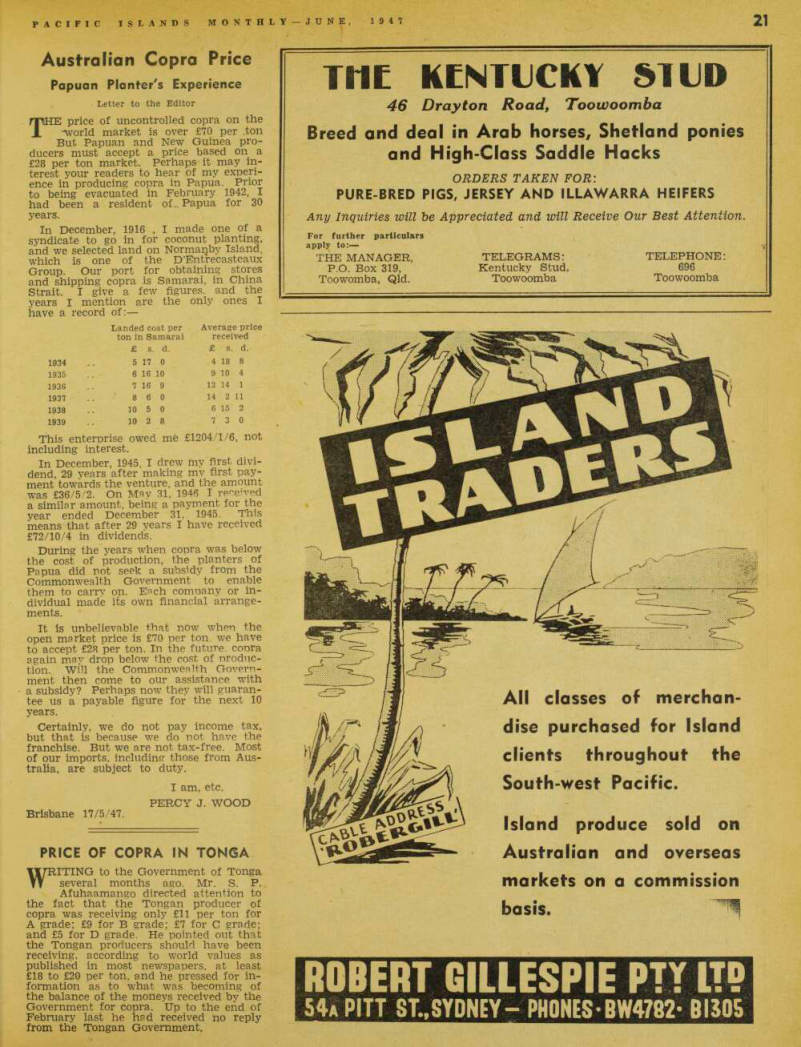
Papuan Planter's Experience
Letter to the Editor fIIHE price of uncontrolled copra on the X -world market is over £7O per .ton But Papuan and New Guinea pro ducers must accept a price based on a £2B per ton market. Perhaps it may in terest your readers to hear of my experi ence in producing copra in Papua. Prior to being evacuated in February 1942, I had been a resident of_ Papua for 30 years.
In December, 1916 , I made one of a syndicate to go in for coconut planting, and we selected land on Normaijby Island, which is one of the D’Entrecasteaux Group. Our port for obtaining stores and shipping copra is Samarai, in China Strait. I give a few figures, and the years I mention are the only ones I have a record of:—
This enterprise owed me £1204/1/6, not including interest.
In December, 1945, I drew my first divi dend, 29 years after making my first pay ment towards the venture, and the amount was £36/5/2. On May 31, 1946 I received a similar amount, being a payment for the year ended December 31, 1945. This means that after 29 years I have received £72/10/4 in dividends.
During the years when copra was below the cost of production, the planters of Papua did not seek a subsidy from the Commonwealth Government to enable them to carry on. Each company or in dividual made its own financial arrange ments.
It is unbelievable that now when the open market price is £7O per ton. we have to accept £2R per ton. In the future, copra again may drop below the cost of produc tion. Will the Commonwealth Govern ment then come to our assistance with a subsidy? Perhaps now they will guaran tee us a payable figure for the next 10 years.
Certainly, we do not pay income tax, but that is because we do not have the franchise. But we are not tax-free. Most of our imports, including those from Aus tralia, are subject to duty.
I am, etc.
Percy J. Wood
Brisbane 17/5/47.
Landed cost per Average price ton in Samarai received £ s. d. £ s. d. 1934 5 17 0 4 18 8 1935 6 16 10 9 10 4 1936 7 16 9 12 14 1 1937 8 6 0 14 2 11 1938 10 5 0 6 15 2 1939 10 2 8 7 3 0
Price Of Copra In Tonga
117RITING to the Government of Tonga ff several months ago. Mr. S. P.
Afuhaamango directed attention to the fact that the Tongan producer of copra was receiving only £ll per ton for A grade; £9 for B grade; £7 for C grade; and £5 for D grade. He pointed out that the Tongan producers should have been receiving, according to world values as published in most newspapers, at least £lB to £2O per ton, and he pressed for in formation as to what was becoming of the balance of the moneys received by the Government for copra. Up to the end of February last he had received no reply from the Tongan Government.
Advertisements & other items, p. 23 (1 item)
Robert Gillespie Pty It?
THE KENTUCKY SIUD
46 Drayton Road, Toowoomba
Breed and deal in Arab horses, Shetland ponies
and High-Class Saddle Hacks
ORDERS TAKEN FOR:
PURE-BRED PIGS, JERSEY AND ILLAWARRA HEIFERS
Any Inquiries will he Appreciated and will Receive Our Best Attention.
For further particulars apply to:—
THE MANAGER, TELEGRAMS: TELEPHONE:
P.O. Box 319, Kentucky Stud, 696 Toowomba, Qld. Toowoomba Toowoomba
5k \ k \ 7^ k.
I rss o All classes of merchandise purchased for Island clients throughout the South-west Pacific.
Island produce sold on Australian and overseas markets on a commission basis.
ROBERT GILLESPIE PTY IT?
54a PITT ST.,SYDNEY- PHONES 8W4782- 61305
Appeal To New Guinea
From Sweden
Letter to the Editor I AM asking a favour. I was a resident of New Guinea for 20 years, but I sailed over to Australia, when the Japs invaded in 1941, in a small boat.
I was the discoverer of Surprise Creek; and, later, I ran an inter-island schooner service, and Kokola Plantation.
I have been all over the world since then. I was torpedoed three times, and I saw the invasion of Sicily and Okinawa, and I finished up as a skipper for UNRRA, in the Philippines.
I am now in Sweden, and I am trying to write a book. As all my photos from New Guinea were lost in the torpedoings, and I want some for the book, I should very much appreciate it if any of my old friends, who are still alive, would kindly send me some—preferably from the gold
fields and the plantations. I am also anxious to hear from them, of course, and I promise to write back. My address is: Captain Ove Hertz, c/o Ringstrom, Vasa batan SC, Goteborg, Sweden.
Thanking you in anticipation, I am, etc.,
O. Hertz.
The Noumea municipality has taken over the pumping station of the Montagne Coupee near Noumea, New Caledonia, which the Americans built to supply water to their many camps in the town area.
The cost of operating the plant is nearly two and a half million francs a year (£15,500 Aust.), which is considered too heavy, so an appeal is being made to townsfolk not to waste water. The muni cipality has voted only enough money to carry the plant on for three more months.
Sixth Course Completed
The Aspa
rE following are the names of those who have successfully completed the sixth course at the Australian School of Pacific Administration, in Sydney:—
R. A. Bentick, T.
P. Byrne, A. T Carev, G.
B. Carrol, H. E. Clarke, G.
D. Collins, H. M. Corderoy, R.
S. Davis, P. E. Feihberg.
C.
A, Forrester, R T. Galloway, H.
C. Gaywood, R. Geelan, E.
G. Hicks.
W. J. Kelly, W.
A. Lalor, D. K. McGrath.
D.
B. Marsh, F. P. Robb, W.
J. M. Senior, H. E. Steen, H.
M. Tolhurst, R. A. Webb.
The second refresher course was suecessfully completed by: H, Buckland, G.
F. W. Julius, J. S. McLeod, L.
J. O’Malley.
D. M. Rutledge.
S.
S. Smith, H. L. Williams, Father Nilles.
LMS Missionaries in G
G and E Colony Mr. Eastman Stays On— Memories of Mr. Sadd
rE well-known LMS missionary, Rev.
G. H. Eastman, OBE (he got the dec oration in the 1946 Birthday Honours List for undertaking three hazardous jour neys among Jap-occupied islands in 1942- 1944) is still at work in the Gilbert and Ellice group, although he has done over 33 years’ service there, and is long over due for retirement. He agreed, in 1946, to defer his return to England for two years, in order to assist in native rehab ilitation, Mr. Eastman, and the Rev. A. L. Sadd —a famous partnership— were at Beru, Southern Gilberts, before the Jap invasion.
Mr. Eastman was away on furlough in those black days; but the ■ Japs caught Mr. Sadd. A few months ago, the story of this missionary’s heroism was broadcast through the BBC. It appears that Mr.
Sadd was ordered to leave Beru, and he replied with this remarkable telegram: “I serve two masters —God and our King.
The King’s representative has ordered me to go. But I think that God takes pri ority. I stay.”
At Beru, the Japs marched him out in front of the school, before the natives, and told him to walk on the British flag.
He refused, and walked around it. They dragged him back, and again told him to walk on the flag. He walked to the flag, knelt down and kissed it. Then they threw him back into gaol.
Mr. Sadd was taken to Tarawa, and held in prison, with four other civilians, and 17 New Zealand soldiers, who had been coast-watching, and who were cut off by the Japs. Late in 1942, they were mur dered. The Americans, when they recap tured Tarawa, erected a monument to the memory of the 22, and on this stone there is a tribute to the courage with which they met their death at the hands of a cruel and merciless enemy.
The Australian warship “Bataan” called at Noumea during its April cruise which included visits to Vila, Suva, and Norfolk and Lord Howe islands. Caledonian en tertainment for the crew was on the usual hospitable scale.
Advertisements & other items, p. 24 (1 item)
A. B. Donald Ltd.
Hard to Get? us
FOR
1. TRADE TOBACCO
2. LAP LAP MATERIAL
3. CANNED GOODS
4. PERFUMERY
5. PRIMUS STOVES
6. KEROLAMPS
7. SHOES, SANDALS
8. UMBRELLAS
9. CHILDREN'S CLOTH-
ING
10. 11. 12. 13. 14. 15. 16. 17. 18.
M. & M.
SADDLERY & HARNESS
HOME LIGHTING PLANTS
WINES AND SPIRITS
NON-ELECTRIC WASHING
MACHINES
PUMPS, IRRIGATION
PLANTS
CROCKERY
HAIRDRESSING SUPPLIES
HARDWARE
AIR CIRCULATORS
8a Castlereagh Street, Sydney, Australia
ISLAND TRADERS
Cable and Telegraphic address: “MANSTOCKS.” SYDNEY Telephones: 8W7405, 8W1237, 85076, FM2766
A. B. DONALD Ltd.
AUCKLAND
ISLAND TRADERS & GENERAL MERCHANTS
P.O. Box 1509. Cables £r Telegrams, "Kingdom/ 7 Auckland.
Mr. White And Mr. Ward

Interesting Argument About Conditions in Papua-New Guinea
IN the philosophy of the professional politician there is nothing that can not be successfully .explained away.
That the explanations might reduce seekers of the truth to maddened frustra tion is considered of no moment, especi ally when the seekers are a de-franchised minority, as are the residents of Papua and New Guinea.
Reference was made in the May issue of “PIM” to a recent debate in the Fed eral Parliament, Canberra, between Mr. White (Lib., Vic.) and the Minister for External Territories, Mr. Ward. We now have received the full text of the debate and publish herewith the main points made by both gentlemen and, where necessary, our comment. Readers may, if they please, make comparisons between parliamentary verbiage, and the conditions as they know them to exist in the Terri tories to-day.
Joint Select Committee Of In
VESTIGATION. Mr. White: After I had placed on the notice paper my motion that a joint select committee of parliament be appointed to inquire into and report on the inadequacy of the ad ministration in Papua-New- Guinea, the Australian Government set up a commit tee of officials to advise the Minister of External Territories. I regard that as a confession of failings in the Administra tion.
Mr. Ward: This matter had been under cfonsideration for some time and was flnallv approved on my recommendation.
Comment: The committee referred to by Mr. Ward is a committtee of “experts” from Australian Government Departments —Treasury, Post-war Reconstruction, Ex ternal Territories, Commerce, Agricul ture, Works and Housing. They are not there to inquire into the inadequacy of the Administration but to advise on the “large-scale production of tea, cocoa, copra and rubber.” In regard to cocoa, copra and rubber, at least, it is unnecessary to call upon experts to formulate plans. All Territorians know that they do grow in the Territory and all that is needed is less “planned economy” and more actual work.
Legislative councils. Mr. white: The Legislative Councils of promi nent citizens which flourished in Papua and New Guinea before the war have been abandoned in favour of Ministerial fiats from Canberra and a complacent Administrator who carries out orders . . . The Papua-New Guinea Provisional Administration Bill which be came law in 1945 stated “This Act shall continue in operation ... no longer than six months after His Majesty ceases to be engaged in war.” Some of us voiced a fear that the Minister would not carry out his premise made then that there would not be set up a form of govern ment control from Canberra,) and we quoted from a report by Mr. J. V. Barry against continuance of control from Can berra. Some form of local government is essential.
Mr. Ward; The present administration is a provisional one. The Trusteeship Agreement for New Guinea (a former Mandated Territory) was only recently approved by the Commonwealth Govern ment'and the Trusteeship Council. A bill to ratify the agreement will soon be pre . sented to Parliament and after that a bill will be introduced to establish a per manent administration . . . The honour able member failed to mention that Mr.
Justice Barry, in his report, was referring to the administration as it existed under a succession of anti-Labour governments.
Comment: Mr. Ward ignored altogether the question of restoring the Legislative Councils of Papua and New Guinea, pre sumably on the score that the whole set up is provisional. But if there is a Pro visional Administrator, a Provisional Ad ministration and a provisional public ser vice, it should also be possible to have a provisional Legislative Council. Mr. Jus tice Barry was not specifically referring to Canberra control by anti-Labour gov ernments. The Barry inquiry, it will be remembered, was set up to “inquire into all the circumstances relating to the sus pension of the civil administration of the Territory of Papua in February, 1942.”
He found that neither the Administrator nor members of the Legislative Council had failed in their duty to safeguard the Territory but, in commenting upon the confusion which existed in the Territory during that time, and the apparent non co-operation between civil and Military authorities, he indicated that in his opinion the then Administrator had re lied in the crisis too much upon frequent consultations with the Australian Gov ' ernment in Canberra. The Australian government at that time was the Curtin Labour Government of which Mr. Ward was a Minister. (Continued Next Page)
ADVISERS. Mr. White; The area is overloaded with academic anthro pologists, some of whom during the
war were members of the farcical Army Research Section. Of a staff of 25, 18 were colonels and the remainder majors and captains.
Mr. Ward: I have a very high opinion of the value of missionaries and anthro pologists. When I took over the portfolio of External Territories I did not claim to know anything about those Territories and accordingly I sought the advice of people who had practical experience of the islands. I sought to achieve a reason able balance between the conflicting views of different interests, realising that the best advice came from those who had no personal axe to grind.
Comment: At least as many missionaries are against applied Wardism as for it.
Anthropology is a science. Applied an thropology consists of investigations into what to the lay mind are trivial aspects of native life the various methods em ployed in sexual intercourse, for example; or the significance of string games, of the
cat’s-cradle variety. Anthropology has its uses; but these people cannot be classed with Mr. Ward’s men of “practical experience” nor can they be said to have helped much in getting the Territories back onto an even keel, which would have been the commonsense way of ap proaching the New Guinea problem. How many men of real practical experience of Islands life did Mr Ward consult?
Price Of Essential Commodities
Mr. White: Food prices in the Terri tory are considerably higher than those in Australia. Rice, which was £l4 before the war, is now £34 per ton; meat is 12/- for a dozen tins, as against 6/3 before the war; flour, which was £9/7/6, is £36/10/- per ton; bread is 2/2 for a 4 lb. loaf, butter 3/1 per lb., eggs 3/4 a dozen, tea 4/6 per lb. Two factors are operating to increase the prices. The first is a 35 per cent, surcharge on freight rates on ships operating to New Guinea under Commonwealth charter; the second is the withdrawal by the Government of subsi dies. A recent order issued by the Depart ment of Trade and Customs contains a list of articles on which the subsidies have been withdrawn. These include, as well as food, all sorts of commodities such as leather goods, twine, cordage, tyres, etc. Other Government charges, under the heading of levies, include an export charge of £25/18/10 per ton on self-raising flour; £66/8/- per ton on fats, £B5 per ton on soap, and so on. Members will probably be surprised to know that although the Government agreed to sell wheat to New Zealand at 5/9 per bushel, it is charging 14/- a bushel to settlers in Papua and New Guinea, Mr. Ward: We realise that the cost of living in Papua-New Guinea is high. Last cost of living figures indicated that it was 35 per cent, greater than in Australia.
New Guinea is regarded as an export market and is subjected to the export charges applicable to exports. If the price of certain commodities in New Guinea were bought down to Australian levels, which are maintained bv Government sub sidies provided by Australian tax-payers, it would be only reasonable that residents of the Territory should pav the same rates of income tax as do people- in Australia.
Comment: The policy of regarding New Guinea as an “export market” rebounds upon the natives themselves who are con sumers of rice, flour, edible fats and canned meat. If the cost of living in New Guinea is to remain 35 per cent, higher (about 7/- in the £), then manv Terri torians would be better off paying Aus tralian income tax.
NATIVE LABOUR. Mr. White: Under the present system of allowing a native to make a contract for only one year, and lack of transport in the Territories, employers receive the equiva lent of only about five months’ effective work from each native. Contracts should be of at least two years’ duration. Of about 9.800 natives employed in Papua to-day, 4.000 are employed by the Govern ment. Befort the war. out of a labour force of 12,000 in Papua, only about 850, including police, were employed by the Government.
Mr. Ward: What the honourable mem ber means is that the territory should be developed on cheap labour. When his party was in office natives of New Guinea were paid 5/- per month and those in Papua 10/- per month, and a proposal to raise their rate of pay to 15/- per month is what he calls over-paying the natives.
It is true that there has been some dimi nution of the volume of native labour; that, however, is only temnorary. There were approximately 55.000 indentured natives in the two territories before the
{Continued on Page 57)
war. To-day the labour force is 23,000.
It is true that planters in New Ireland and New Britain are encountering greater obstacles in obtaining labour. This is because these natives come mostly from the Sepik district, and they have not for gotten that when war came to New Ireland and New Britain they were captured and ill-treated by the Japanese. In New Guinea, before the war, labourers were ex pected to work 55 hours a week, and 50 hours a week in Papua. We have reduced the hours of work to 44. The Government does not employ indentured labour and has no difficulty in securing its labour needs.
Comment: Mr. Ward persists in com paring working conditions of New Guinea natives with conditions of Australian workers. There is no basis of comparison.
In 55 hours the New Guinea native would perform as much work as a European in approximately 20 hours. The 15/- per month to which the Australian govern ment has raised the official wage of the native will purchase no more than 5/before the war; in many cases it will pur chase nothing because there is nothing for it to purchase. Five shillings was the minimum amount paid to a native before the war in New Guinea. It was not the average amount. That there were other benefits is proved by the fact that there were, on Mr. Ward’s figures, 55,000 in dentured labourers. It is news that Sepik and Aitape boys will not “make paper” with planters in New Ireland and New Britain because they fear they will be abandoned there in the event of another war. But in 1942 the natives were by no means the only sufferers in this regard.
Some hundreds of planters, Administra
tion employees, traders and missionaries were abandoned there by the Australian Labour Government.
PRODUCTION. Mr. White; (Quoting a RSSAILA publication “Mufti” and the “Pacific Islands Monthly”): The Ward administration is not only hinder ing the rehablitation of New Guinea but threatens to stifle private enterprise al together. Eventually the tax-payer of Australia will be paying l'k million pounds per annum to keep afloat a Territory that before the war was self-supporting.
The Administration should give up grandi loquent plans for the future and concen trate on something concrete to lead to the realisation of these plans when the native is ready for them. The Production Con trol Board is not assisting the white popu lation in any way. It is a notorious fact that the price of copra is £5 a ton less in the New Guinea Territories than in the rest of the Pacific. Our producers are getting only £2B per ton.
Mr. Ward: The “Pacific Islands Monthly” is the mouthpiece for vested interests and for Burns, Philp and Com pany, the shipowners who have been the chief exploiters of the white producers in the islands. I could supply dozens and dozens of letters from white settlers thanking us for what we have done and what we are doing. They state that for the first time they have the opportunity of viewing the future with confidence.
In the years ahead we will be able to develop the territory on sane lines. Civil administration has been restored to the whole of the Territory for only ten months.
Destruction of plantations has been res ponsible for reduced production rather
than any action or inaction by the Gov ernment. The Government has done everything to increase production . . . the Comonwealth Government has made available to planters £280,000 to clear away rubbish and secondary growth. One of the greatest difficulties has been trans port, which is not peculiar to the Aus tralian territories but is world-wide. We have done remarkably well in providing inter-island communication. At the moment there are twelve vessels, each
of about 300 tons, to supplement the steamer services, and nine others are in Australian ports. And we are now able to indicate that there is a possibility of a three-weekly service being instituted between Australia and New Guinea. It is true that the price of £2B per ton for copra is less than in some markets but the cost of production varies from £l2 to £lB per ton according to locality and this leaves the producer with a margin of profit of from £l6 to £lO per ton. In any case the Prices Commissioner in Australia fixes the price, not the Minister. This fixed price ensures a reasonable return to the producer and at the same time prevents any exploitation of the Australian consumer. The price in the past has been unstable. Included in the £2B is a levy of £1 which is paid into a stabilisation fund. We aim at regulating the industry.
Comment: With his tilt at the “Pacific Islands Monthly” Mr. Ward has resurrected an old story. We have denied, repeatedly, that we are linked, either as a “mouthpiece” or in any other way, with Burns, Philp & Co., W. R. Carpenter & Co., or any other of what Mr. Ward scathingly refers to as “vested interests.”
But Mr. Ward believes, with the late Adolf Hitler, that if you lie often enough and loudly enough, someone is sure to believe you. Whether or not the Australian Government has done everything possible to rehabilitate the planting industry is for the planters themselves to decide. That some doubt of this exists in other official circles is indicated by the latest report of the War Damage Commission which is published elsewhere in this issue.
The “dozens and dozens of white settlers” who have written to Mr. Ward thanking him for what he has done, and stating that they can view the future with confidence «now for the first time, no doubt 1 have tried every other means of getting reason into
the comic oprea set-up and have finally fallen back on what is vulgarly known as soft-soap. The shipping position, admit tedly, has been difficult. However the service conducted by the Australian’ gov ernment between Sydney and Islands ports is, for efficiency, not even a distant re lation of that provided by the wicked Big Firm which, Mr. Ward says, exploited the European residents of the territory before the war. Nor is the inter-island service provided by the New Guinea branch of the Australian Shipping Board, with its dozen 300-tonners, as efficient as the ser vice provided by scores of small pinnaces, schooners, cutters, etc., privately owned, and operated on the profit motive, before the war.
It is hard to see what the varia tions in cost of production and of profit margin have to do with paying only £2B per ton for New Guinea copra unless the Minister labours under the delusion that this £2B is the price paid “at the planta tion.” When the cost of copra was raised, earlier this year, the basis of payment was changed by the PCB from “at the plantation” to “at the ship’s slings”
Rabaul, Kavieng, Port Moresby or other overseas shipping port. The unfortunate planter who happens to live in Bougain ville or the North-Western Islands or any of the out-ports in Papua-New Guinea now has local transport costs to add to his costs and it is he who has to stand up to the “variation in profit margin”— not the PCB or the Australian Govern ment, as Mr. Ward appears to think, Ceylon copra brings £5B; Fiji copra £33; Philippines copra £7l. If the New Guinea planter cannot expect to benefit in Aus tralian government subsidies on various commodities, unless he pays taxation, (and Mr. Ward, remember, thinks he should not) then it is equally unfair to pay the New Guinea producer less than any other producer of copra in the world, in order that the Australian consumer of soap and
margarine, etc, should not have to pay more for these products. This is exploita tion of the most flagrant kind.
Housing and public service UNREST. Mr. White: There is un rest to-day in the Public Service of Papua and New Guinea. Public Service organisations state that the promised public service ordinance regulations have not been promulgated; that the high cost of living, coupled with low salaries, means bankruptcy to them. Housing in Moresby and Rabaul is shocking. The Government, at the same time, has undertaken to build a model village at Hanuabada, near Port Moresby at a cost of £llB,ooo—the money would have built 118 houses for Europeans in Australia —while in Rabaul the natives are permitted to run around wild.
Mr. Ward; A classification of the public service was carried out by Mr. Buttsworth of the NSW Public Service and the de partment is now considering his recom mendations. His recommendation that the minimum salary of £3OO be raised to £372 has been acted’ upen and operates from March 1. As regards Hanuabada the natives were evacuated from their village at the beginning of the war and it was later destroyed. We decided to rebuild the village as a model village, not a show place, but one which would indicate to the natives what could be done for them in providing a village on new, hygenic lines. There is a vast difference between providing huts for natives who wish to live under their own, more or less, primi tive conditions, and building houses for the administration staff. The honourable gentleman claims that the amount set aside for Hanuabada could have built 118 homes for the members of the administra tion staff in Port Moresby. Some time ago the Government built 24 homes in Mores by at a cost of £5O 000! If there is un rest in the Public Service then it exists only in the minds of certain disappointed people.
Comment: All Territorians who have seen the slum area which constitutes the present village of Hanuabada agree that the village should be rebuilt. What they cannot understand is why it should be a “model” village built by the Administration for £llB,OO0 —why it cannot be built by the Hanuabadans themselves from native materials on traditional lines, and why all this money should be spent on one set of natives when there are 1.500.000 other natives in New Guinea and Papua for whom no building at all will be done.
The 24 houses which the Administration built for its officials in Port Moresby last year at an exhorbitant cost of £50,000, went nowhere towards solving the housing prob lem. But if conditions in Port Moresby are bad, conditions in Lae. Rabaul and Madang which were totally destroyed, and where Europeans are now forced to live in tents and old army camps—are infinitely worse.
In spite of Mr. Ward’s airy dismissal there is discontent in the Public Service, due to the causes already mentioned and also due, in part, to the fact that members formerly employed in either the Papuan Service or Mandated Territorv service now find it difficult to reconcile themselves to the fact that there is only one service.
Inter-Territory prejudice is perhaps ridiculous but it is nevertheless a factor in the present unrest.
Advertisements & other items, pp. 25-26 (1 item)
£ J. Gough S- Co
.T-lM'i in A Concord, Sydney, Home Built with “Rapid” Blocks
“RAPID” CONCRETE BLOCK & BRICK
MOULDING MACHINES
AN IMMEDIATE SOLUTION FOR HOME BUILDERS
• Capacity, 3 blocks per minute. ® Semi-automatic—no tamping re- • Priced to suit home-builders. • Hundreds in use. • For all building purposes.
WRITE FOR PARTICULARS TO PACIFIC ISLANDS REPRESENTATIVE quired. 9 Water tanks—well linings.
£ J. GOUGH S- CO
SUPPLIERS OF GENERAL MERCHANDISE TO LEADING FIRMS THROUGHOUT THE PACIFIC ISLANDS.
Exporters . . . Importers . . . Manufacturer s' Representatives 1 BOND STREET, SYDNEY, AUSTRALIA. Box 3615 G.P.O. Tel. 84167 Bankers: Bank of N.S.W. Bank of Adelaide. Comptoir Nat. d’Escompte de Paris.
Cable Address: “SEAFOODS,” SYDNEY.
Codes: Bentley’s, 2nd and Comp, phrase; A.8.C., sth and 6th; Peterson, 2nd and 3rd; Bank!
Acme.
F. J. MORGAN
PTY., LTD.
12 Alien St., Granville,
N.S.W.
MANUFACTURERS AND
EXPORTERS OF:
Beekeepers Foundation and Apiary Appliances, Dental Supplies, Artificial Teeth, Wax Floor and Furniture Polishes, Disinfectant Preservative in non-Stain and Wood-stain Colours.
BUYERS OF WAXES AND RESINS.
LABORATORY SERVICE: Soil Testing and Investigation of All Naturaf Growth for Commercial Uses.
BANKERS: Commonwealth Bank of Australia Homebush, N.S.W.
McILRATH’S
OFFER FULL STOCKS OF QUALITY
Groceries, Wines, Spirits
Liqueurs and Cider
Write for our NEW Grocery—and Wine and Spirit List.
POST FREE BY RETURN AIR MAIL.
All shipments are covered against
PILLAGE—THEFT—NON-DELIVERY.
McILRATH’S PTY. LTD.
Export Department, 202 Pitt Street, Sydney, Australia Cable address: ROTUNDA, Sydney.
BROOMFIELDS Ltd.
Suppliers of Building Hardware General Hardware Ship Chandlery Paint Materials
WRITE DIRECT TO
Broomfields Ltd.
152 SUSSEX STREET, SYDNEY
Sole Agents for: P. H. MUNTZ & CO.’s 8-CROWN BRAND METAL
SHEATHING.
PEACOCK & BUCHANS’ ENGLISH READY-
MIXED PAINTS.
New Wages and Conditions
Conditions For Fijian Seamen Shipping Companies Seek Permis sion to Raise Freight Rates
Prom Our Own Correspondent
Suva. May 12
FIJI’S seamen have been placed on ap proximately an equal footing with other industrial workers; greater uni formity in the terms and conditions ap plying in various vessels has been se cured; and wages have been slightly in creased by an agreement reached, after a good deal of argument by local ship owners and the Fiji Seamen’s Union.
This agreement—the result of nearly a year’s negotiations—will come into force on June 1. but it will stay in force for only two months. During June and July the shipowners will approach the Price Controller in an endeavour to secure an increase in freight rates. While this is going on. the union and the owners will go into another huddle over an extension of the agreement.
Shorn of its unnecessary verbiage, which indicated that Fiji is getting more and more civilised and needs only several arb itration courts, a Trades Union Congress and Mr. John L. Lewis, with affiliation to the American Congress of Industrial Org anisations thrown in—the delays in some permanent agreement seems to lead to the conclusion that the shipowners are out for compensation (from the public) for any costs they incur by way of wage increase.
One cause of the delay in reaching an agreement was the claim by one of the companies that the Price Controller’s sanction to freight increases should be given before the signing of the agreement. (This suggests that employers in Fiji have not yet been sufficiently cowed to meet the requirements of modern Australian, New Zealand, British and American civil isation) .
The Government replied with a broad side to the effect that it “would not per mit the use of the price control machinery as a bargaining point in negotiations for an industrial agreement”, but in case this should be thought too unkind, it almost simultaneously rushed in with restora tives, that “priority of consideration, would in this instance be given to re quests by shipowners for adjustments in freight rates if such requests were sup ported by evidence of the effects of the operation of any agreement which might be concluded”. rnHE agreement, while it lasts, includes X the estimating of wages on a tonnage basis in the case of masters, mates and ratings and on a horsepower basis in the case of engineers.
The minimum wage payable to a master will range from £lO a month for a vessel of 10 tons to £33 a month for a vessel of 100 tons.
Engineers’ monthly wage rates will range from £7/10/- for a vessel of 15 Brake Horse Power to £27 for a vessel of
150 Bhp.
For ratings, the monthly rates will range between £2/16/- for a boy in a vessel of 10 tons and £lO for the boat swain of a vessel exceeding 100 tons.
Ordinary overtime for ratings will be lOd. an hour and 1/8 on Sundays. For mates, the hourly overtime rate will be one twohundredth of the monthly wage, with a minimum of 1/-. Double rates will be paid on Sundays.
The number of hours to be worked be fore overtime becomes payable is specified in the agreement. Provision is made for
14 days’ annual holiday with pay. The minimum ration scale is set out with the orocedure to be adopted in dealing with complaints.
Fiji War Fund Allocations
THE Fiji War Fund Board has now closed the fund with the following final distributions: Benevolent Fund of the Fiji Returned Sailors’ and Soldiers Association, £5,000; Earl Haigs’ Poppy Day Appeal. £1.000; Lady Grantham’s Fiji Gifts to Britain Fund. £7,768; Lord Mayor of London’s Flood Distress Fund, £7,768.
In addition there is £833/13/1 speci fically allocated by the donors to be used for the armed forces of Fiji only. Of tHs £5OO will go to the Fiji Military Forces Canteen Fund and £333/13/1 to the FiJ Royal Naval Volunteer Reserve Canteen Fund and will be used when the military and naVal units of the Colony are estab lished an a ijeaoetime basis.
A sea-plane left Sydney on May 21, for Port Moresby carrying meat and other fresh food for the town which was, as usual, short of supplies.
Mrs. F. H. Mclver entertained a number of friends at a dinner party at her home in Coorparoo, Brisbane, recently in honour of the engagement of her daughter Maureen Mclver to Mr. Pat McNeill. Mr.
McNeill lives in Lae, (NG).
Advertisements & other items, pp. 27-28 (1 item)
The Garrick Hotel
COPRA PRODUCERS
Have you considered the cost-saving advantages of having a small coconut oil mill on your own plantation?
Write or cable us for quotations on a complete coconut oil mill with a daily capacity of from four to five tons . . . larger equipment if desired.
A. G. ANDREWS CO., INC.
244 California Street, San Francisco 11, U.S.A.
Cable address; ANDINC
J. C. Merrillees Pty. Ltd.
GENERAL ISLANDS MERCHANTS
Telegrams & Cables: Merrillees. Sydney.
AGENTS FOR: COWRIE SHARPS and FLOUR
and Suppliers of General Merchandise - > & v A , A
TRADE GOODS, CLOTHING,
FOODSTUFFS, LIQUEURS
SPIRITS, WINES.
New Address
63 PITT STREET, SYDNEY
(Phoenix Building) Telephone: Codes: BW 6064 Bentleys
The Garrick Hotel
»i
"'Hll
kill
» * m
SUVA
FIJI
This well-known Hotel is centrally situated in Suva's main business quarter :: Modern accommodation provides comfort in all climatic conditions :: Only the best of Beers, Spirits and Wines is served Telephone: 80. VINCE COSTELLO, Proprietor.
THE
YORKSHIRE
INSURANCE
CO. LTD.
(Incorporated in England)
ALL CLASSES OF
INSURANCE
Including
FIRE
GUARANTEE
WORKERS
MOTOR
ACCIDENT
MARINE
Island Representatives:
PORT MORESBY: E. A. James
RABAUL: G. B. Black LAE; Morobe Transport Co. Ltd.
MADANG: R. MacGregor
NELSON and ROBERTSON Pty. Ltd.
Established 1895
Shipowners - Brokers and
Islands Merchants
All classes merchandise purchased at Best Wholesale Prices. Original Invoices supplied to Island Clients. Cocoa Beans, Copra, Rubber, Trochus Shell and All Islands' Produce Sold on Commission.
Entrust your requirements to the firm with fifty years' practical experience in the Pacific Islands.
NELSON & ROBERTSON RL
12 SPRING STREET, SYDNEY, AUSTRALIA
Telegraphic Address: IVAN, SYDNEY.
Rights of Citizenship
Guam And Eastern
Samoa
r„ . . . , E special civilian committee which
famls
Forrestal tostudvcondftlonsat GuSm
and re Americ^n St^moT n Sco^memde^,
May 10, immediate United States citizen ship for the residents of these places. Both Territories, for years, have been governed hv thp Tinifpd statpq Naw Y lt also recommended that Congress should pass legislation to establish a Bill of Rights and a local Congress for both ?hp C nniTp h d IC qfalfNa e ?v are governed by th rented that “the after mfp<= h nf iQlonri? nnH d pns
their Social ISuctures
oShph “not
a ™L GQnvinced, the report added not
obUgaUon ot thf unitld
ment to takei early and advanced steps towards the extension of rights and pnyi leges to these peoples The committee stated that settlement and payment of war damage claims at Guam and Amen can Samoa had been proceeding much ™o slowly.
The committee recommended, further, the elimination of barriers between America and Western Samoa which, it said, formed a predominant and all pervasive cause of unhappiness and dis content.”
Mr. Porrestal said he concurred with the recommendations for citizenship, a Bill of Rights and a local Congress. The United States Congress would be asked to take action.
Overcrowding
In Suva
Almost 32 People to the Acre in the Toorak Slum Area
a-mrA tv/t n H NE 0f the few °P en s P ffi^en " tral Suva > a valuable corner site the Town Hall is , spared, at least temporarily — the section,
wJuld hive mlde a ie?fect little
£u b garden As it fs d it will nrovide much-needed office accimmod^tiom The 1946 census has revealed that Greater Suva now has a population of 25 ' 395 ’ ° f which the tow n area holds 11,398.
Further, the census figures show that 3 > 327 P eo P le a re jammed into the slums of the tiny Toorak area, where the den g* ac f re PoPUlatl ° n W ° rkS ° Ut t 0 3162 *° A few Europeans still own bits and pieces of property in Toorak, but others haye sold out t b i n di ans w h o blithely circumvent the regulations, health and otherwise, charge merciless rents for single rooms and so herd crowds of low paid Fijian and Indian workers and their families into dreadful proximity, There may be Indian landlords who possess consciences, if not generosity, but they are rare. When an Indian starts making money his exploitation of his fellow-Indians, including his relatives, is ruthless, (Note; Where did Suva’s slum area get its name? Is it the result of some early Australian humour? “Toorak” is Mel bourne’s most exclusive suburb.)
Fiji's "Acting"
Officials
Colonial Office "General Post"
Leaves Many Vacancies
From Our Own Correspondent
Suva, Mav 19
NO announcement has yet been made at this writing in respect of the ap pointment of a successor to Sir Alex ander Grantham, formerly governor of Fiji and now Governor-elect of Hong- Kong. Sir Alexander left the Colony for London in March.
The Acting Governor of Fiji (Mr. J. F.
Nicoll), who is normally the Colony’s Colonial Secretary, returned to Suva on May 15, after making a tour of inspection of the western districts of Viti Levu.
Since Sir Alexander left, Mr. Nicoll has visited the eastern and southern islands of the Group also.
These visits to the outlying parts of the Colony are valuable in that they meet the constant wail that there is too much centralisation in the Colony and that the higher officials think too much in terms of Suva. But when the Acting Governor made his second tour some people in Suva began to feel aggrieved about “official jaunts away from the seat of Govern ment”. Thus it becomes plain that there is no pleasing everybody.
At the moment, however, the number of Fiji officials in an “acting” capacity is phenomenal. Because the appointment of a new Governor has not been an nounced the Colonial Secretary has be come Acting Governor, the Financial Secretary has become Acting Colonial Secretary and, at times, deputy to the Acting Governor, and there is also an Acting Assistant Colonial Secretary and an Acting Director (with an Acting Dep uty Director) of Medical Services.
"Melanesia"
Eventful Voyage of "Melanesia"
Inventiveness of Fijian Engineer Help Vessel Reach Noumea
From a Special Correspondent
Noumea, May 20.
ON the afternoon of May 16, the small motor ship “Melanesia” (she belongs to the SDA Mission) limped into Noumea after a voyage from Sydney which (as the local residents would say) was “tres mouvementee.”
The “Melanesia” is under the command of Captain William H. Reece who has been a mariner for 46 years .
Captain Reece is well-known in Madang, New Guinea, and recently he was com missioned to take delivery of the vessel in Sydney and deliver her, under her own power, to Suva. “Melanesia” is of about 20 tons. She was built in 1940 and during the war rendered good service to the Royal Australian Navy.
Reece with a crew consisting of a friend and six Fijians left Sydney on May 8.
Two days later they were 60 miles west of Lord Howe; at that stage the motor began to overheat. The voyage was continued with the aid of a jib and a good breeze until the following day when the engine was restarted and with continued aid from the jib, carried the vessel on towards Suva at seven knots. On May 13 the motor stopped completely due to a broken valve spring. There were no spares aboard.
A large steamer was sighted heading north and by means of signals—the “Mel anesia” carries no radio—the vessel was spoken to. Reece asked that his position
be transmited to Sydney. After giving the course to Noumea the steamer dis appeared, heavy rain preventing Reece from ascertaining her name. Several hours later the American destroyer 692 was sighted and by shouting loudly Reece communicated with her, Reece still speaks hoarsely after this effort at com munication. The destroyer’s captain, Captain Gay, answered by loud speaker and after giving Reece his position, some food and water, he offered the services of an engineer. The engineer was not needed however, as the Fijian engineer had man aged to make a valve spring out of a refrigerator part. When it was re assembled the motor carried the “Melane sia” slowly toward Noumea, then about 300 miles distant. Within 40 miles of the port the motor broke down and the ever
faithful jib carried the vessel at a speed of 11 knots for the rest of the voyage Captain Reece received his spare valve springs by the Qantas flying-boat on May 23 and next day was able to continue his voyage.
Advertisements & other items, p. 29 (1 item)
Marys
AERIAL PHOTOGRAPHS
SOUTH PACIFIC ISLANDS
Norfolk Island, Noumea, Suva, Nukualofa, Apia, Aitutaki, Rarotonga Prints 10 inches x 8 inches 6/6 each, or set of seven (1 of each place) £2/2/-, postage included.
WHITE’S AVIATION LTD.,
605 Dilworth Bid., Auckland, Cl, N.Z.
D.D.T. Pure Powder
(Minimum 80 per cent-. Para Para Isomer) 1 lb. Packing ... 10/6 per lb. 7 lb. Packing ... 9/9 per lb.
PACKED AND POSTED
Prices for Larger Quantities, and Directions for Use on Application.
ANDREWS LABORATORIES
15 HAMILTON STREET, SYDNEY
ALL STOREKEEPERS HAVE—
AUNT
MARYS
BAKING POWDER
• Aunt Mary's Baking Powder is now obtainable from your storekeeper. That's good news for you, especially as Aunt Mary's Baking Powder maintains the high quality which has stood the test of housewives for over 70 years.
There is no substitute for Aunt Mary's—There never will be.
Oyster Culture In Fiji
OYSTERS are expected to become a thriving sea food in Fiji. In 1941 the Veterinary and Fisheries Division of the Fijian Department of Agriculture imported oysters and established them in a mangrove swamp in Suva Bay. They have now spread along 150 yards of water line and young oysters are growing healthily. As soon as conditions are suitable it is hoped to distribute the beds
over a wider area by means of culture oysters from those already raised in Suva Bay.
M. Fourcade, formerly Admiral d’Argen lieu’s chief secretary, then French official at Vila, New Hebrides, and more recently the New Caledonian Governor’s chief secretary, left for France recently on the “Sagittaire”. M. de Saint Esteban is temporarily filling the chief secretary ship.
New Hebrides Trade
IN the year 1944 (statistics just made available) the trade -of the Condo minium of the New Hebrides was as follows (values in sterling):—
In 1944 (a war year), except that £85,000 worth of copra went to United States, practically all the Condominium’s trade was with Australia.
/ Imports Exports 1S'43 £203.693 £297,597 1944 340,967 322,105 - Exports French Proportion £ £ Cocoa 55,587 40,227 Coffee . . 18.500 18,500 Copra 226,000 85,589 Cotton 3,143 2.267 Hides 1.380 907 Trocas Shell .. 2,536 1,764 Coconuts .. 1,212 1,083 Timber 12,463 — Total . .. £322,105 £151,470
Jep Fatality in Robaul
Geoff. White Killed
A FATAL jeep accident occurred in Rabaul in May, by which one well known man, Mr. Geoffrey White was killed and another seriously injured.
Mr. Geoff. White had been to Sydney on a business trip only a few days before the fatality occurred. He departed from Syd ney on May 7, arrived in Rabaul on May 9, and met his death on the following day—which, grimly enough, was his birth day.
Mr. White, in company with Mr. J. W.
P. Black and a friend, was travelling along the Ratavul Tunnel Road when the jeep overturned and crashed into a gully. Mr. White was killed instantly and Mr. Black received serious head in juries. The other occupant escaped with abrasions and shock.
Mr. Black remained unconscious for a considerable period and was brought to Sydney by plane at the end .of last month for medical attention.
Geoffrey White was a son of Mr. Nor man White, Sr., who is engaged as an assessor for the War Damage Commis sion in the Morobe district; and is a brother of Mr. Norman White, the Port Moresby solicitor. Pre-war, he resided on the goldfields where he had a host of friends. Enlisting at the outbreak of war in the NGVR, he rendered good ser vice, and was for a time attached to ANGAU. In recent months he had taken an active part in rehabilitation activities in the Rabaul area; and, amongst his commercial interests, was the Rabaul Freezer. He was vice-president of the Rabaul Citizens Association.
To A Correspondent
YOUR comments on Mr. Ethell’s article, about native education, are interest ing. But we cannot publish your letter because you sign it only “Brown Brother,” and do not give your true name.
Names must be given not for publi caion, but as evidence of good faith.
Mrs. Greenland, mother of Mr. Stanley A. Greenland, formerly a prominent mem ber of the Papuan public service, died in Suffolk, England, in March, at the great age of 86. Her residence was destroyed in 1945, by one of the last German buzz bombs to fall upon Ehgland.
Advertisements & other items, p. 30 (1 item)
H. Grove & Sons
Limited
Established 1896.
AUCKLAND
Itlond Traders. P.o. Box 495.
Telegraphic and Cable Address: "Grove”, Auckland.
Entrust Your Orders to the Firm with Fifty Years Practical Experience in the Island Trade.
Shippers of oIS classes of New Zealand products.
Representing English Manufacturers through-
out the Cook and Society Islands, Fiji, Tonga, Samoa, Niue, New Caledonia, New Guinea, etc.
In FIJI a> —W. H. Grove & Sons (Fiji) Ltd.
Asthma Curbed In 3 Minutes
Since the discovery of Mendaco by a famous physician sufferers can get relief from Asthma. Mendaco does away with expensive Injections and offensive smokes.
All you ao is to take 2 tasteless tablets with meals and Mendaco starts circulating through the blood in 10 minutes. You breathe easily and freely. Your nerves relax, you get good, fresh, pure air into your lungs, and vigour returns.
Sleep Like a Baby
Thousands of former sufferers from Asthma say that the very first dose of Mendaco brought them glorious ease and comfort, and that they slept soundly the very first night. Then their vigour returned and they felt healthier and stronger, and 5 to 10 years younger. The reason for this is that Mendaco acts in natural ways to overcome the effects of Asthma. (1) It removes the mucus or phlegm; (2) It relaxes thousands of tiny muscles In your bronchial tubes so that the air can get in and out of your lungs; (3) It promotes body vigour, and stimulates the building of rich, revitalised blood.
No Asthma for Five Years
Mendaco not only brings almost Immediate results, free breathing and comfort and enables you to sleep, but also builds up the system to ward off future attacks. Mr.
J. R. writes; “I was almost dead with Asthma. Had lost 40 lbs. in weight, saf-
fered coughing every night—couldn’t sleep.
Mendaco stopped spasms first night. I have had no Asthma since in over 2 years.”
Mrs. A. W. writes; “I had Asthma for 25 years. After using Mendaco I can sleep all night and have not had an attack since taking it.” Mrs. G. E. C. writes: “I bless the day I first beard of Mendaco. What a godsend It is to a poor woman like me who for 35 years never knew what it was to have a good night’s rest. The constant fight between Asthma and sleep was wearing me down, but I feel now I want to forget my past suffering.”
Benefits immediate
The very first dose of Mendaco goes right to work circulating through your blood and helping nature rid you of the effects of Asthma. Try Mendaco under an iron-clad money back guarantee. You be the judge.
If you don’t feel fully satisfied after taking Mendaco just return the package and the purchase price will be refunded. Get Mendaco from your chemist to-day and see how well you sleep to-night and how much better you will feel.
RELIEVES ASTHMA
Mendaco
Now in 2 sizes 6/- and 12/-
Anzac Day on Nauru
From a Special Correspondent
Nauru, Apr. 29
OVER 70 per cent, of the male Euro pean population of this island are ex-Servicemen of Australia, New Zealand or Great Britain; and April 25 this year, was made an occasion of solemn remembrance of those Diggers who had given their lives in two World Wars.
A Shrine was constructed on the local airstrip and, in brilliant sunshine after earlier rain, ex-Servicemen, the police guard, boy scouts and the Nauruan choir formed in a square in preparation for the arrival of the Administrator. Women and children and members of the general public were accommodated under canvas.
Shortly before eleven the Administrator, Mr. M. Ridgway, and Mrs. Ridgway, ar rived. The Administrator Inspected the guard and after a short service, led by the Rev. J. Shawcross Robinson, addressed the assembly. He spoke of the men who had fallen, and made special reference to the late Administrator, Lt.-Col. F, R.
Chalmers, and his gallant comrades who had voluntarily remained behind on Nauru after the general evacuation in 1942, and who were subsequently mur dered by the Japanese. He paid tribute also to the Nauruans and Chinese who had died during the occupation and in conclusion spoke the immortal words of Lawrence Binyon: “They shall not grow old, as we who are left grow old: Age shall not weary them, nor the years condemn.
At the going down of the sun and in the morning We will remember them.”
Anzac Eve Reunion
fPHE ex-Servicemen of Nauru—who num- L ber 72 out of a population of 116 European males on the island—held a re-union in the local picture theatre on Anzac Eve. They spent three enjoy able hours in a way known only to ex- Servicemen.
The chairman of the evening was the Administrator, Mr. M. Ridgway. who is himself a Gallipoli veteran. Master of Ceremonies was Mr. S. Marquis, of the 38th Battalion, Ist. AIF and an honoured visitor at the gathering was Mr. W. Bott, Superintendent of the British Phosphate Commission, who was a sapper in World War I.
In spite of the imposing array of old Diggers, the majority were young men re cently returned from World War 11.
April 25 As "Remembrance
Day"
Letter to the Editor APRIL 25. this year, and for the last two or three years, passed without any outward celebrations of the day beyond its being a public holiday.
In previous times the annual commem oration was a big event. The Head of the State attended, supported by the British Consul, leading officials and busi ness men, the general public and the children from the schools of all denomin ations forming a large and representative gathering round the bandstand on the Malae for the purpose of commemorating the deeds of the Anzacs in the First World War.
No doubt the intervening years and the soul-stirring events of the Second World War have pressed those deeds into the further recesses of the mind. But the day should not be allowed to fall into desuetude. The deeds of the Anzacs at
Gallipoli and the great events of the two World Wars, the supreme sacrifice paid by millions in the cause of Liberty, are worthy of remembrance and by a change of name could be celebrated on the 25th of April each year as Remembrance Day.
I am, etc,.
“Atom”
Nukualofa, Tonga.
May 8, 1947.
The SS “Reynella,” which sailed for Rabaul on May 24, carried 36 passengers for New Guinea ports; 27 of the passengers were booked for Rabaul.
Mrs. Lilian M. Evensen, of 31 Francis Street, Geraldton, West Australia, has now been officially advised that it is considered that her husband, Mr. Albert Evensen (imprisoned by the Japs at Pondo, New Britain, in 1942) has been “missing" since May 15, 1944, and it is officially presumed that he is dead. There is little doubt that Mr. Evensen was one of a party of between 10 and 18 men, who were mur dered by the Japs in Rabaul in 1944.
The Distinguished Service Medal, which he won during the war in the Pacific, was recently presented to Mr. W. A. Dobson at a ceremony in Canberra, ACT. Mr.
Dobson later left for Rabaul where he is an engineer in the employ of Colyer, Watson (NG) Ltd.
Advertisements & other items, pp. 31-32 (1 item)
a major anxiety
The
Relief from
Even the most expert and conscientious individual executor is subject to accident, illness and incapacitation.
Continuity of administration and uninterrupted attention to your estate and your beneficiaries are of paramount importance. Both can be positively assured by appointing this Company your sole Executor or as co-Executor with your present appointee. An interesting explanatory booklet will be forwarded on request.
DIRECTORS:
James Burns. Joseph Mitchell. p. x. W. Black Frederick Ewen Loxton. Eric Priestley Lee* MANAGER: L. S. Parker.
SECRETARY: E. R. Overton, A.F.I.A.
BURNS PHIIP TRUST
COMPANY LIMITED
7 BRIDGE STREET, SYDNEY
TELEPHONE: BU 5901. Box 543, G.P.0., Sydney
G I L L E S PI E’S The Flour
TRADE
MAM
of the Islands
SYDNEY
Pimples and Bad Skin Fought in 24 Hours
Since the discovery of Nlxoderm by an American physician it is no longer necessary for anyone to suffer from ugly, disgusting and disfiguring skin blemishes such as Eczema, Pimples, Rash, Ringworm, Psoriasis, Acne, Blackheads, Scabies and Red Blotches. Don’t let a bad skin make you feel Inferior and cause you to lose your friends. Clear your skin this new scientific way.
A New Discovery
Nlxoderm is an ointment, but different from any ointment you have ever seen or felt. It is a new discovery, and is not greasy but feels almost like a powder when you apply it. It penetrates rapidly into the pores and fights the cause of surface skin blemishes. Nlxoderm contains 9 ingredients which fight skin troubles in these 3 ways. I.—lt fights and kills the microbes or parasites often responsible for skin disorders. 2. —It stops Itching, burning and smarting in 7 to 10 minutes, and cools and soothes the skin. 3. —It helps nature heal the skin clear, soft and velvety smooth.
Works Fast
mediately, clearing and healing your skin, makine It softer, whiter and velvety smooth Because Nlxoderm is scientifically compounded to fight skin troubles, it works fast.
It stops the Itching, burning and smarting in a few minutes, then starts to work 1m-
In just a day or two your mirror will tell you that here at last is the scientific treatment you have been needing to clear your skin —the treatment to make you look more attractive, to help you win friends. Nixoderm has brought clearer, healthier skins to thousands, such as Mr. Bob Weedon, Edmund Street, Fremantle, who writes: “I was troubled with pimples ever since I was 13, and have spent pounds and pounds on so-called cures without results. I then tried Nixoderm with astounding effect.
The pimples seemed to fade away, and after a week there was not the slightest trace of them.”
Satisfaction Guaranteed
Get Nixoderm from your chemist or store to-day. Look in the mirror in toe morning and you will be amazed at the improvement.
Then just keep on using Nixoderm for one week and at the end of that time it must have made your skin soft, clear, smooth and magnetically attractive —must give you the kind of skin that will make you admired wherever you go, or you simply return the empty package and your money will be refunded In full. Get Nixoderm from your chemist or store to-day.
The guarantee protects you.
Nixoderm 2/-&4Z-
For Skin Sores, Pimples and Itch .
Tragedy at Rotuma
Salvaged Bomb Explodes and Kills Nine
From Our Own Correspondent
Suva. May 13
rpRAGEDY struck at the beautiful little X island of Rotuma, 220 miles north north-west of the Fiji Group, on May 7, when two men and seven boys were killed by the explosion of what is believed to have been a derelict bomb.
Fragments of the bomb have been col lected and will be sent to Suva for ex pert examination. In the meantime the disaster is something of a mystery.
The explosion occurred near the road running through Peptsei village, about 150 yards above high-water level, and all that is known in Suva, is that the boys had discovered the bomb and were in vestigating it when it exploded. Six were killed Instantly, two very soon after the explosion, and the ninth within two hours, in hospital.
Although Rotuma is officially regarded as part of the Crown Colony of Fiji, ship communication between Suva and Rotuma is infrequent and to most people in Fiji to-day the island is remote and little known. There is. however, a Rotuma “col ony” of 3,300-odd in Fiji proper.
Few tragic events in the post-war per iod have moved the Fijian and European people more deeply than this village dis aster at Rotuma, The boys were pupils of the Sumi Roman Catholic school, and on May 9 a solemn requiem mass was said at the Sacred Heart Cathedral, Suva.
It was at first believed that the explo sion was that of a mine, but this was subsequently corrected. Drifting mines have twice been reported in the Fiji Group in recent months. One, sighted off the Tailevu coast of Viti Levu, was tracked down by an official launch, holed by rifle fire, arid presumably sunk. The second drifted on to the reef at Makogai (the leper hospital island) and exploded with terrifying effect but without causing damage.
One theory regarding the Rotuma bomb is that during the war, it may have been jettisoned by an American bomber on its way back to Fiji. This was a common practice if the bomber had been knocked about, in order to avoid the danger of landing with primed bombs. It is pos sible that this bomb landed on the Rot uma reef or in the lagoon and was either rolled ashore by the sea or was carried in by the boys whom it killed.
After this tragedy, an immediate and forceful official warning about bombs, mines and other deadly legacies of the war, is plainly warranted in every island within and on the fringes of the Pacific War zone.
Appeal To Suva Catholics
For Building Funds
From Our Own Correspondent
Suva. May 12
mHE Roman Catholic Church has an- X nounced a major building scheme for its Suva headquarters.
Bishon’s Court will be reconstructed and will become a new convent and school, and the Bishon. with his staff and the pres bytery, will move down the hill to re modelled and roomier premises at the present convent building near the Sacred Heart Cathedral.
An appeal for funds to meet the heavy expense involved has been launched.
Advertisements & other items, pp. 33-34 (1 item)
after MILE
MILE
OF
EXTRA WEAR
no w added
cool - running
MIUER
TIRES
Tires for
trucks,
automobiles,
buses Miller Accessories and Repair Materials are dependable!
Consistently high in quality, this complete line has been developed to meet every automotive need.
Radiator hose Radiator cleaner Radiator solder Noc-out adjustable hose clamps Vulcanizing patch and valve stem clamp Tire camelback (passenger and truck) Full circle curing tubes New type, stronger construction.
New wide, flatter tread. Longer mileage. Maximum traction.
Peak skid resistance. Greater protection against bruises.
MORE TIRE FOR YOUR MONEY
w-% 20
TUBE REPAIR KIT
CONTENTS
I—s" x 19" Strip rubber 80—1*4" Sq, bevel cut patches —114” x 2" Oval bevel cut patches I—l 4 Pt. bottle cement I—Carborundum buffer
PACIFIC ISLANDS TRADING COMPANY
244 CALIFORNIA STREET, SAN FRANCISCO 11, CALIFORNIA, U. S. A.
DEPENDABLE
special
mild
Capstan’s
own blend
CAPSTAN Cigarettes are dependable . .. tbeir special quality is unvarying.
CAPSTAN S OWN BLEND of forty kinds of fine Virginia leaf has set a standard that is rigidly maintained and cannot be duplicated.
time for a
CAPSTAN
THE EMPIRE’S FAVOURITE CIGARETTE
in the smart \dCU pocks
• IJH-3.47
Stormiest Territory

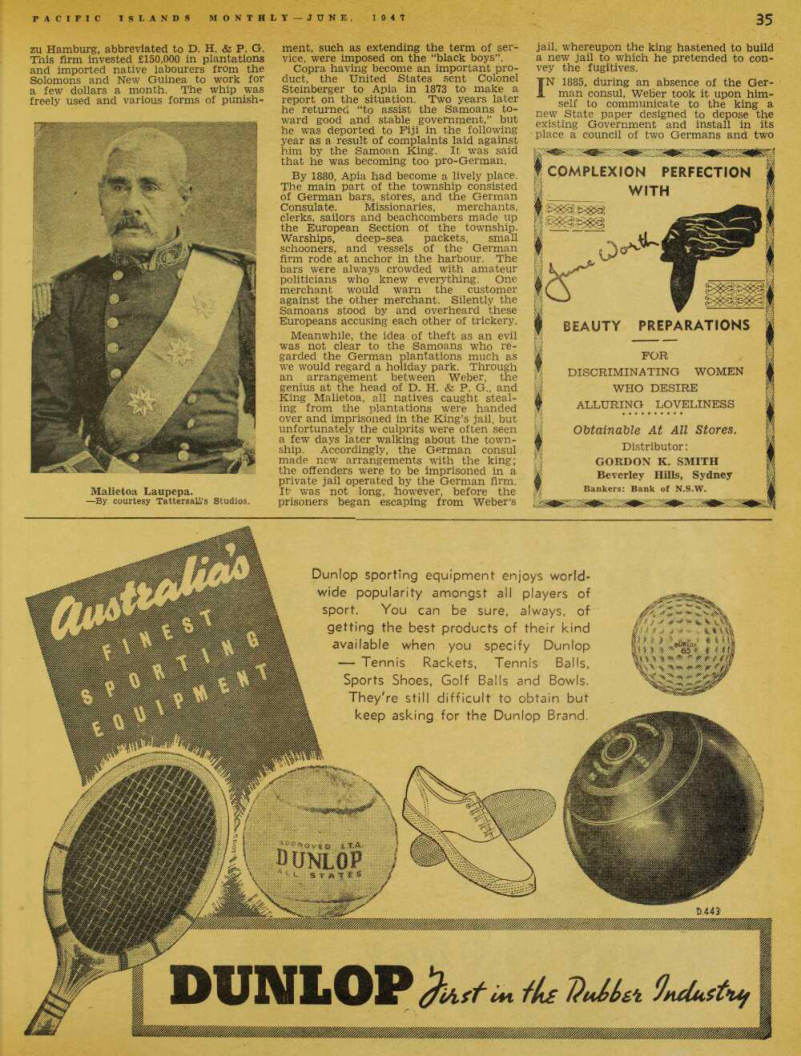

Background To Troubled Samoa
Events in the History of the Pacific's Stormiest Territory
THIS article on the early history of Western Samoa is of particular interest now that the destiny of Samoa is again in the melting pot. It will be remembered that some months ago the Samoan Fono petitioned the United Nations against Western Samoa becoming a Trusteeship territory administered by New Zealand; and that, in May, it was announced that a U.N. committee would visit Western Samoa during July, and August this year.
The article also provides a historical background without which it is impossible to understand Samoan domestic politics.
The author is Mr. C. Phillips, who is Samoan born and who has interested him self in the history and folk-lore of Samoa.
A second article dealing with events from 1914 to the present time will appear in July “PIM.”
Part One
117 HEN fc the Rev. John Williams and Mr.
T? Barff of the London Missionary Society landed on the coast of Savaii, in what is now the Territory of Western Samoa, in August, 1830, they learnt that white men were living among the natives on the neighbouring island of Upolu. Many of these men were convicts S h T? d a r U £ a iihT S S? P k?J r 6C I2 a S f the r vessel and sunk it beyond the reef.
Because they were in possession of firearms and powder, these convicts took a leading part in the local wars of the natives—one of them was known to have killed 200 persons singlehanded with his musket, and to have smeared his body with charcoal and oil to avoid detection, Six years before the arrival of the Rev.
Williams, the people of Upolu had been subdued by a tyrant known as Tamafaiga.
When he was eventually slain by a number of Upolu people, Malietoa, the king of
Samoa, crossed over from Savaii only one week before the missionaries landed and sacked the entire district at the western end of the island. A huge pit had been dug into which several captives were thrown and burnt alive. It was immedi ately after returning from this blood-bath that Malietoa accepted Christianity.
In keeping with custom, the Samoans went out the mission ship with offer ings of food and women, and it was with some difficu i ty that the Tahitian teachers accompanying the Mission expedition ex plained to them that the ship was a “vaa lotu” (a prayer ship), and that though they gratefully accepted the food, they could not accept the women. It is be lieved that this rejection of the women made a marked impression upon the chiefs and had much to do with influenc mg them accept Christianity, By 1855 the white population of Apia was approximately fifty. The harbour had become a port of call for whalers
and other types of ships and the town had been divided into two zones, one being British and the other American. In the American zone a certain Mr. van Camp had set himself up as US Consul, and on the strength of this he con demned as being unseaworthy two Amer ican barques which had called enroute from California to Sydney. He then pur chased the two vessels for himself at a ridiculously low price.
In demonstrations of anger, the mar ooned passengers and crew attacked van Camp who was supported by a gang of desperadoes, and it is said that several scenes of violence ensued in which bowie knives and revolvers were used.
The trade of the European storekeepers included, at the time, the retailing of spirits to the Samoans and the crews of whalers.
Meanwhile, August Unshelm had begun business for J. C. Godeffroy & Son of Hamburg. The islands were becoming of commercial value to Germany, Britain and the United States. In 1870 Godeff roy went bankrupt and the business was then taken over by a German company known as the Deutsche Handels und Plan tagen Geselleschaft fur Sud-See Inseln
zu Hamburg, abbreviated to D. H. & P. G.
This firm invested £150,000 in plantations and imported native labourers from the Solomons and New Guinea to work for a few dollars a month. The whip was freely used and various forms of punish-
ment, such as extending the term of ser vice, were imposed on the “black boys”.
Copra having become an important pro duct, the United States sent Colonel Steinberger to Apia in 1873 to make a report on the situation. Two years later he returned “to assist the Samoans to ward good and stable government,” but he was deported to Fiji in the following year as a result of complaints laid against him by the Samoan King. It was said that he was becoming too pro-German.
By 1880, Apia had become a lively place.
The main part of the township consisted of German bars, stores, and the German Consulate. Missionaries, merchants, clerks, sailors and beachcombers made up the European Section of the township.
Warships, deep-sea packets, small schooners, and vessels of the German firm rode at anchor in the harbour. The bars were always crowded with amateur politicians who knew everything. One merchant would warn the customer against the other merchant. Silently the Samoans stood by and overheard these Europeans accusing each other of trickery.
Meanwhile, the idea of theft as an evil was not clear to the Samoans who re garded the German plantations much as we would regard a holiday park. Through an arrangement between Weber, the genius at the head of D. H. & P. G., and King Malietoa, all natives caught steal ing from the plantations were handed over and imprisoned in the King’s jail, but unfortunately the culprits were often seen a few days later walking about the town ship. Accordingly, the German consul made new arrangements with the king; the offenders were to be imprisoned in a private jail operated by the German firm.
It* was not long, however, before the prisoners began escaping from Weber’s
jail, whereupon the king hastened to build a new jail to which he pretended to con vey the fugitives.
IN 1885, during an absence of the Ger man consul, Weber took it upon him self to communicate to the king a new State paper designed to depose the existing Government and install in its place a council of two Germans and two
Malietoa Laupepa. —By courtesy Tattersall’s Studios.
Samoans be invested with the right to make laws and impose taxes. The G, e i> mans were to reserve the right to end the agreement on six months’ notice but the Samoans were bound by it indefinitely When the king and his chiefs hesitated to sign, Weber hinted that the two German warships at anchor in the harbour would Intervene Realising that they were in bondage to the Germans, Malietoa and his chiefs held a secret meeting at which a letter was drafted and addressed
to the King of England asking for protection. Five days later Malietoa signed the agreement with Germany, with tongue m cheek, and when in the following month the Germans received a copy of the Samoan address to Britain, they realised that Malietoa was not a man to be trusted.
Weber decided then that all he required was a pretender, and the man he chose was Tamasese formerlv the TCine-’* own accomplice. In January, Seresunmd the Util oT king, “and begln rlisfng an armed force, but because a conference had been called in Europe and it was decided to send a Commission to Samoa, susDense d Ipsed mto state ot P eacetul iKnsrv nf fhe fnitain. ™.r om, the Hawaiian armed cruiser “Kaimiloa” with a delegation under Envoy J. E. Bush, put by Premier Gibson, arrived in Apia deed^of' e th t e o f P rilrit ? o PaClfl S sig^d 3 by A MalStoa f but ie the d affidr >l ended gear were* s bartered for food' 3 plate and tteGerman Em peror’s birthday, a brawl involving a party of Germans and four Samoans developed in one of the hotels, a German subject had his nose broken and the incident was regarded as “the trampling upon the German Emperor by Malietoa.” In August, 1887, Malietoa was ordered to pay a fine of 1 000 dollars for thp affair nf the Kaiser ’ s ’ birthday and an additional 12,000 dollars for the theft of coconuts from the German plantations. In the
Apfa" under
PnVatatog 3
end of March, 1888, a proclamation by
Tamasese declaring war against Malietoa was distributed throughout the islands bv German warships In the village of sttu paitea the proclamation was torn down bv the villagers, whereupon the Germans re turned and shelled the village nn ir - IQQO ® „ ° n September 17, 1888, King Malietoa
MambaAs** 1 Tamasese 3
“en made of g the
+7l? i <9 1 assuming tne
Malietoa “ate which anf®regardedbl
and^before^ fcj? a Sedumber
Samoans beean g Drenarini fnr U ?PhPliin^
under the llade?sMn of 1{ S
Mat aafa. Arms and ammunition were purchased from traders and war broke out on October 9, 1888, at the eastern end oSSiId o firi S M P Mateafa defeate^Tama 3
German enea^St
troms who TOre sunnorted bv the took place Pat Luatuanuu four weksVter
£ o^mSe 3
landed PP a force of 150 at Mb drew ’ marines with- 9 n Ma rch 16, 1889, a hurricane struck A P* a ; Owing to the tenseness of the political situation at the time, the war shlPs. present in the harbour delayed too bating ou t to sea. In consequence the Germans lost the “Adler” and the “ The “ 01 S a ” was beached without ™ uch . damage and refloated later. The
The '‘moZ-wafaLfetched
a ". d ,! ate r- The British battle-
Calu
(Continued on Page 45)
alties were Germans, 92 drowned; Ameri cans, 63 drowned.
In June, 1889, a treaty was concluded in Berlin between Britain, Germany and the US. It provided for the independence of the Samoan Government under King Malietoa Laupepa, the establishment of a Supreme Court, a Municipal Council under a president to govern Apia subject to control of the three cohsuls and the Chief Justice, and a personal tax of 1 dollar per male for the benefit of the Samoan Government. Fees for licences were to be for the benefit of the Muni cipal |Council. On November 8, 1889, Malietoa, therefore, returned from exile and assumed his office as king. Mataafa was his adviser.
AFTER two years of peace Mataafa began drifting away from the cause of the king and eventually moved out of Apia and established himself in dependently at the village of Malie.
By the end of 1889, R. L. Stevenson had arrived in Apia and after a while began associating with Mataafa, but when he tried to act as mediator between Mataafa and the king, the latter rejected his inter cession. It is said that the author be came unpopular with the authorities for taking Mataafa’s side.
Op July 7, 1893, the forces of Malietoa and Mataafa clashed, the latter being defeated. It was Mataafa this time who was taken into custody and deported to the Marshalls; in his company were eleven others, and together they remained in exile for five years. Twenty-seven other chiefs were imprisoned and fined.
Toward the end of the year, Stevenson, his wife and his step-daughter were in vited to a feast held on the prison grounds.
In a speech by one of the Chiefs he was lauded as being the only friend who had stuck by them through the days of their misfortune. A presentation of native gifts was made to him, and after the feast a large number of Samoan people followed him in a procession through the town ship. As a further act of gratitude for the kindness and sympathy he had shown them, the chiefs on release from prison, undertook the building of a road for him from the township to Vailima, which became known as the Road of Loving Hearts. Two months later, on December 5, 1893, Stevenson passed away in his home at Vailima, the cause of his death being cerebral haemorrhage.
When King Malietoa died in August, 1898. Mataafa was brought back from the Marshalls. Under provisions of the Berlin Treaty, Tanumafili Malietoa, the late king’s 19-year-old son. succeeded to the title, but in January 1899 Mataafa’s troops and supporters, being in the majority, commenced hostilities against the new king. Thereupon the US Navy Ship “Philadelphia,” assisted by three British warships, went into action against Mataafa, and in May a party of Com missioners representing the three powers arrived and ordered all arms and am munition in possession of the Samoans to be surrendered, the necessary monetary compensation being made.
The young king resigned and his office was abolished, his official duties being vested in the consuls of the three Powers.
In December, the Berlin Treaty was an nulled and new treaties were made be tween the three powers. Britain re nounced in favour of the US all her claims in respect to the islands now known as American Samoa, and at the same time renounced in favour of Ger many all her claims in Western Samoa (gaining instead the Northern Solomons); and Germany, likewise renounced in favour of the US all her claims in respect to American Samoa. The US also re
nounced, in favour of Germany, all her claims in respect to Western Samoa. On March 1, 1900. the German flag was hoisted in Western Samoa and Dr. Wm.
Solf was appointed German Governor.
Mataafa was made the “Highest Chief” and young Malietoa was sent to Fiji for further education.
With the exception of a few minor political disturbances a remarkable state of peace prevailed throughout the islands until 190*8 in which year, during an absence of Governor Solf a political fac tion under the leadership of a chief named Lauaki demanded changes in the Government and more recognition for Mataafa. When Solf returned he de nounced Lauaki as an agitator and caused him to be arrested and deported with eleven others to Saipan where they re mained in exile until 1915. (To be Concluded in July)
Advertisements & other items, pp. 35-38 (1 item)
Wise Precaution,
PACIFIC ISLANDS SOCIETY
Visitors from the Islands to Sydney (or the«e Interested In Islands affairs), are advised to communicate with the honorary secretary of the above Society, which has been formed to study the history, traditions, economies, and political developments of the Pacific Islands.
Regular monthly meetings are held at History House, 8 Young Street, Sydney.
Address for Correspondence:
THE PACIFIC ISLANDS SOCIETY,
Box 24X4 MM., G.P.0., Sydney.
I 4t’i *
WISE PRECAUTION,
MOTHER I
In these days of uncertainty, your little ones will be safer when they are wearing an ECCO Indentity inscribed with their name and address. Give your children this added protection, todayl I
CA/A CROSSES
fcVvV CHAINS
ss In V I I ' Beautifully de signed
ECCO
Crosses and Chains make ideal gifts for mother, sister, wife or girl-friend. Come in today, and make your selection from our wide assortment
•K Ari important accessory to every well-dressed man’s appearance, ECCO Cuff Links have a rich dignity of style and design which wins instant approval. Come in and see them today.
OBTAINABLE FROM YOUR JEWELLER
or from:
PACIFIC ISLANDS TRADING COMPANY
244 California St. San Francisco 11, U.S.A.
TILLEY LAMPS
BURN ORDINARY KEROSENE
The Modern Form of PORTABLE LIGHTING
i I mtev tXmmm l OP um THE OWL IS PROVERBIALLY A WISE BIRD, SO BE SURE YOU FOLLOW HIS EXAMPLE! TILLEY LAMPS ARE SO SUCCESSFUL THAT COPIES OF THEM ARE BEING MARKETED. TILLEY LAMPS ARE MADE ONLY IN ENGLAND Shipments available four weeks from receipt of order THE TILLEY LAMP CO., HENDON, N.W.4, ENG.
REPRESENTATION :
MELBOURNE : T. H. Bentley, Pty. Ltd., 123-125 William Street, Melbourne, C.l.
TASMANIA : Mr. C. Sellars, IoBa Charles Street, Launceston.
Fiji : Mr. K. Witherington, 2 Burns Philp Buildings, Suva.
COMPLEXION PERFECTION
WITH
BEAUTY PREPARATIONS
FOR
DISCRIMINATING WOMEN
WHO DESIRE
ALLURING LOVELINESS
Obtainable At All Stores.
Distributor:
GORDON K. SMITH
Beverley Hills, Sydney Bankers: Bank of N.S.W.
ounlop
Dunlop sporting equipment enjoys worldwide popularity amongst all players of sport. You can be sure, always, of getting the best products of their kind available when you specify Dunlop Tennis Rackets, Tennis Balls, Sports Shoes, Golf Balls and Bowls.
They're still difficult to obtain but keep asking for the Dunlop Brand.
ike VulU't Vndush
m 65 D. 443
Wc Will Buy
It For You
Any goods you may require from English shops or factories Purchased and Shipped.
Small or large orders catered for.
ALL SERVICES UNDER-
TAKEN FOR RESIDENTS
ABROAD.
PITT & SCOTT
LIMITED
(Established 1876) General Shipping and Buying Agents. 1/3, St. Paul's Churchyard, London, England Cables. Shipping London.
BUDGE
REFRIGERATION and
ICE MAKING
EQUIPMENT
COMMERCIAL AND INDUSTRIAL
UNITS
(not domestic) Ammonia and Methyl Chloride machines of large or small capacity.
The illustration is of a small (nine 28 lb. blocks) electric, Methyl Chloride Icemaking plant.
Enquirers should mention dimensions of cold room (or cabinet) and of amount of ice (if any) required per day; also if electric motor or internal combustion engine is to be included.
JAMES BUDGE PTY. LTD.
REFRIGERATION ENGINEERS
McEvoy Street, Alexandria, Sydney
Telephones: LA 5034-5-6 Established 1890
Magazine Section
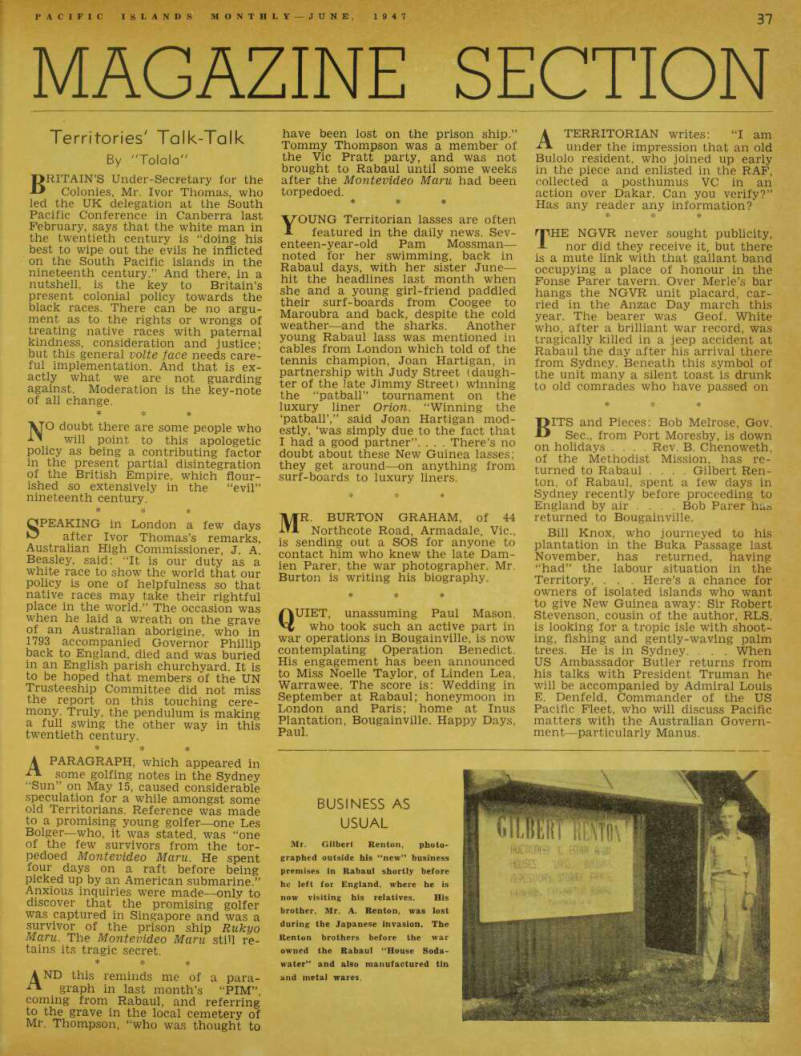
Territories' Talk-Talk
By "Tolala"
BRITAIN’S Under-Secretary for the Colonies, Mr. Ivor Thomas, who led the UK delegation at the South Pacific Conference in Canberra last February, says that the white man in the twentieth century is “doing his best to wipe out the evils he inflicted on the South Pacific islands in the nineteenth century.” And there, in a nutshell, is the key to Britain’s present colonial policy towards the black races. There can be no argu ment as to the rights or wrongs of treating native races with paternal kindness, consideration and justice; but this general volte face needs care ful implementation. And that is ex actly what we are not guarding against. Moderation is the key-note of all change. * * * NO doubt there are some people who will point to this apologetic policy as being a contributing factor in the present partial disintegration of the British Empire, which flour ished so extensively in the “evil” nineteenth century. * * * SPEAKING in London a few days after Ivor Thomas’s remarks, Australian High Commissioner, J. A.
Beasley, said: “It is our duty as a white race to show the world that our policy is one of helpfulness so that native races may take their rightful place in the world.” The occasion was when he laid a wreath on the grave of an Australian aborigine, who in 1793 accompanied Governor Phillip back to England, died and was buried in an English parish churchyard. It is to be hoped that members of the UN Trusteeship Committee did not miss the report on this touching cere mony. Truly, the pendulum is making a full swing the other way in this twentieth century. * * * A PARAGRAPH, which appeared in some golfing notes in the Sydney “Sun” on May 15, caused considerable speculation for a while amongst some old Territorians. Reference was made to a promising young golfer—one Les Bolger—who, it was stated, was “one of the few survivors from the tor pedoed Montevideo Maru. He spent f9ur days on a raft before being picked up by an American submarine.”
Anxious inquiries were made-only to discover that the promising golfer was captured in Singapore and was a survivor of the prison ship Rukyo Maru. The Montevideo Maru still re tains its tragic secret. * * * AND this reminds me of a para graph in last month’s “PIM” coming from Rabaul, and referring; to the grave in the local cemetery of Mr. Thompson, “who was thought to
have been lost on the prison ship.”
Tommy Thompson was a member of the Vic Pratt party, and was not brought to Rabaul until some weeks after the Montevideo Maru had been torpedoed. * * ♦ YOUNG Territorian lasses are often featured in the daily news. Sev enteen-year-old Pam Mossman— noted for her swimming, back in Rabaul days, with her sister June— hit the headlines last month when she and a young girl-friend paddled their surf-boards from Coogee to Maroubra and back, despite the cold weather—and the sharks. Another young Rabaul lass was mentioned in cables from London which told of the tennis champion, Joan Hartigan, in partnership with Judy Street (daugh ter of the late Jimmy Street) winning the “patball” tournament on the luxury liner Orion. “Winning the ‘patball’,” said Joan Hartigan mod estly, ‘was simply due to the fact that I had a good partner”. . . . There’s no doubt about these New Guinea lasses; they get around —on anything from surf-boards to luxury liners. * « ♦ Mr. burton graham, of 44 Northcote Road, Armadale, Vic., is sending out a SOS for anyone to contact him who knew the late Dam ien Parer, the war photographer. Mr.
Burton is writing his biography. * * ♦ QUIET, unassuming Paul Mason, who took such an active part in war operations in Bougainville, is now contemplating Operation Benedict.
His engagement has been announced to Miss Noelle Taylor, of Linden Lea, Warrawee. The score is: Wedding in September at Rabaul; honeymoon in London and Paris; home at Inus Plantation, Bougainville. Happy Days, Paul.
ATERRITORIAN writes: “I am under the impression that an old Bulolo resident, who joined up early in the piece and enlisted in the RAF, collected a posthumus VC in an action over Dakar. Can you verify?”
Has any reader any information? * * * THE NGVR never sought publicity, nor did they receive it, but there is a mute link with that gallant band occupying a place of honour in the Fonse Parer tavern. Over Merle’s bar hangs the NGVR unit placard, car ried in the Anzac Day march this year. The bearer was Geof. White who, after a brilliant war record, was tragically killed in a jeep accident at Rabaul the day after his arrival there from Sydney. Beneath this symbol of the unit many a silent toast is drunk to old comrades who have passed on ♦ * ♦ BITS and Pieces: Bob Melrose, Gov.
Sec., from Port Moresby, is down on holidays ... Rev. B. Chenoweth, of the Methodist Mission, has re turned to Rabaul ... Gilbert Ren ton, of Rabaul, spent a few days in Sydney recently before proceeding to England by air ... . Bob Parer has returned to Bougainville.
Bill Knox, who journeyed to his plantation in the Buka Passage last November, has returned, having “had” the labour situation in the Territory. . . . Here’s a chance for owners of isolated islands who want to give New Guinea away: Sir Robert Stevenson, cousin of the author, RLS, is looking for a tropic isle with shoot ing, fishing and gently-waving palm trees. He is in Sydney. . . . When US Ambassador Butler returns from his talks with President Truman he will be accompanied by Admiral Louis E. Denfeld, Commander of the US Pacific Fleet, who will discuss Pacific matters with the Australian Govern ment—particularly Manus.
Business As
Usual
Mr. Gilbert Renton, photo graphed outside his “new” business premises in Rabaul shortly before he left for England, where he is now visiting his relatives. His brother, Mr. A. Renton, was lost during the Japanese invasion. The Renton brothers before the war owned the Rabaul “House Soda water” and also manufactured tin and metal wares.
Fanning Island Memories
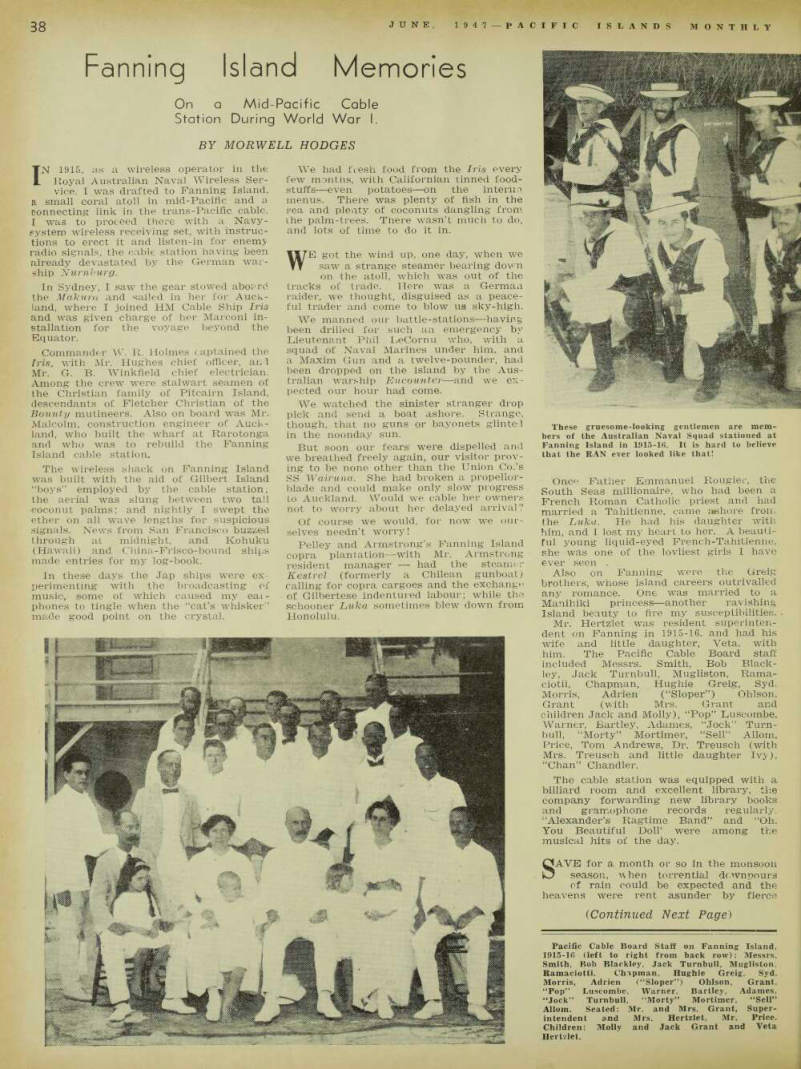
On a Mid-Pacific Cable Station During World War I.
By Morwell Hodges
XN 1915, as a wireless operator in the Royal Australian Naval Wireless Ser vice. I was drafted to Fanning Island, a small coral atoll in mid-Pacific and a connecting link in the trans-Pacific cable. [ was to proceed there with a Navy system wireless receiving set, with instruc tions to erect it and listen-in for enemy radio signals, the cable station having been already devastated by the German war ship Nurnourg.
In Sydney, I saw the gear stowed aboard the Makuru and sailed in her for Auck land, where I joined HM Cable Ship Iris and was given charge of her Marconi in stallation for the voyage beyond the Equator.
Commander W. R. Holmes captained the Iris, with Mr. Hughes chief officer, and Mr. G. B. Winkfield chief electrician.
Among the crew were stalwart seamen of the Christian family of Pitcairn Island, descendants of Fletcher Christian of the Bounty mutineers. Also on board was Mr, Malcolm, construction engineer of Auck land, who built the wharf at Rarotonga and who was to rebuild the Fanning Island cable station.
The wireless shack on Fanning Island was built with the aid of Gilbert Island “boys” employed by the cable station; the aerial was slung between two tall coconut palms; and nightly I swept the ether on all wave lengths for suspicious signals. News from San Francisco buzzed through at midnight, and Kohuku (Hawaii) and China.-Frisco-bound ships made entries for my log-book.
In these days the Jap ships were ex perimenting with the broadcasting of music, some of which caused my eai phones to tingle when the “cat’s whisker” made good point on the crystal.
We had fresh food from the Iris every few months, with Californian tinned food stuffs—even potatoes—on the interim menus. There was plenty of fish in the sea and plenty of coconuts dangling from the palm-trees. There wasn’t much to do, and lots of time to do it in.
WE got the wind up, one day, when we saw a strange steamer bearing down on the atoll, which was out of the tracks of trade. Here was a German raider, we thought, disguised as a peace ful trader and come to blow us sky-high.
We manned our battle-stations —having been drilled for such an emergency by Lieutenant Phil LeCornu who, with a squad of Naval Marines under him. and a Maxim Gun and a twelve-pounder, had been dropped on the island by the Aus tralian warship Encounter —and we ex pected our hour had come.
We watched the sinister stranger drop pick and send a boat ashore. Strange, though, that no guns or bayonets glinted in the noonday sun.
But soon our fears were dispelled and we breathed freely again, our visitor prov ing to be none other than the Union Co.’s SS Wairuna. She had broken a propelior blade and could make only slow progress to Auckland. Would we cable her owners not to worry about her delayed arrival?
Of course we would, for now we our selves needn’t worry!
Pelley and Armstrong’s Fanning Island copra plantation —with Mr. Armstrong resident manager had the steamer Kestrel (formerly a Chilean gunboat) calling for copra cargoes and the exchange of Gilbertese indentured labour; while the schooner Luka sometimes blew down from Honolulu.
Once Father Emmanuel Rougier, the South Seas millionaire, who had been a French Roman Catholic priest and had married a Tahitienne, came ashore from the Luka. He had his daughter with him, and I lost my heart to her. A beauti ful young liquid-eyed French-Tahitienne, she was one of the lovliest girls I have ever seen .
Also on Fanning were the Greig brothers, whose island careers outrivalled any romance. One was married to a Manihiki princess—another ravishing Island beauty to fire my susceptibilities. .
Mr. Hertzlet was resident superinten dent on Fanning in 1915-16. and had his wife and little daughter, Veta. with him. The Pacific Cable Board staff included Messrs. Smith, Bob Black ley, Jack Turnbull, Mugliston, Rama ciotii, Chapman, Hughie Greig, Syd.
Morris, Adrien (“Sloper”) Ohlson.
Grant (with Mrs. Grant and children Jack and Molly), “Pop” Luscombe, Warner, Bartley, Adames, “Jock” Turn bull, “Morty” Mortimer, “Sell” Allom, Price, Tom Andrews, Dr. Treusch (with Mrs. Treusch and little daughter Ivy), “Chan” Chandler.
The cable station was equipped with a billiard room and excellent library, the company forwarding new library books and gramophone records regularly.
“Alexander’s Ragtime Band” and “Oh.
You Beautiful Doll’ were among the musical hits of the day.
SAVE for a month or so in the monsoon season, when torrential downpours of rain could be expected and the heavens were rent asunder by fierce
(Continued Next Page )
These gruesome-looking gentlemen are mem bers of the Australian Naval Squad stationed at Fanning Island in 1915-16. It is hard to believe that the RAN ever looked like that!
Pacific Cable Board Staff on Fanning Island, 1915-16 (left to right from back row): Messrs.
Smith, Bob Blackley, Jack Turnbull. Mugliston, Ramaciotti. Chapman, Hughie Greig. Syd.
Morris, Adrien (“Sloper”) Ohlson, Grant.
“Pop” Luscombe, Warner, Bartley, Adames.
“Jock” Turnbull, “Morty” Mortimer, “Sell”
Allom. Seated: Mr. and Mrs. Grant, Super intendent and Mrs. Hertzlet, Mr. Price.
Children: Molly and Jack Grant and Veta Hertzlet.
tropical thunderstorms, unsalubrious weather was unknown on Fanning; beau tiful, long, sunny days and glittering moonlit nights, in which the stars were big and luminous and the light quite clear enough to read by, followed each other in almost endless succession. Although but a few degrees north of the Equator, the heat, even at mid-day, was not oppres sive; cool trade winds were usually fan ning the palm fronds and rattling the sere spears of the multi-legged pandanus trees.
It was always cool in the dense coco-palrr shadows on the bleached coral sand be side the lagoon; shadows that grew dim and deep and magical with the coming of the moon.
Tropicalities
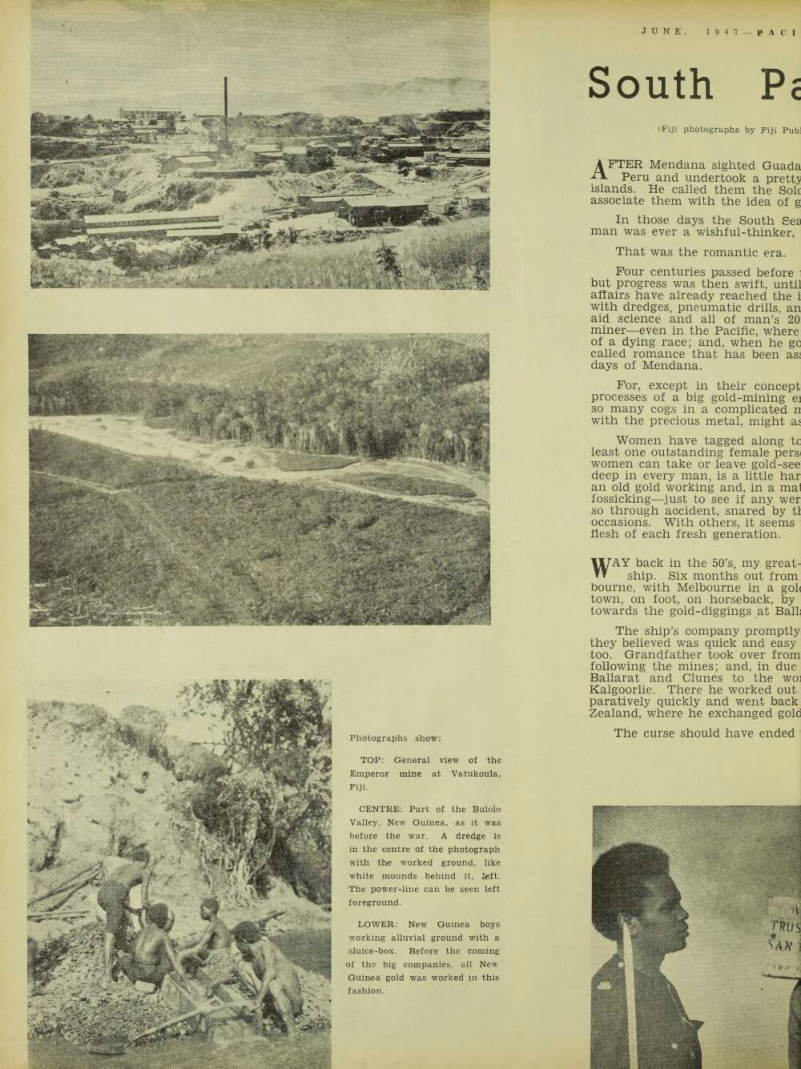
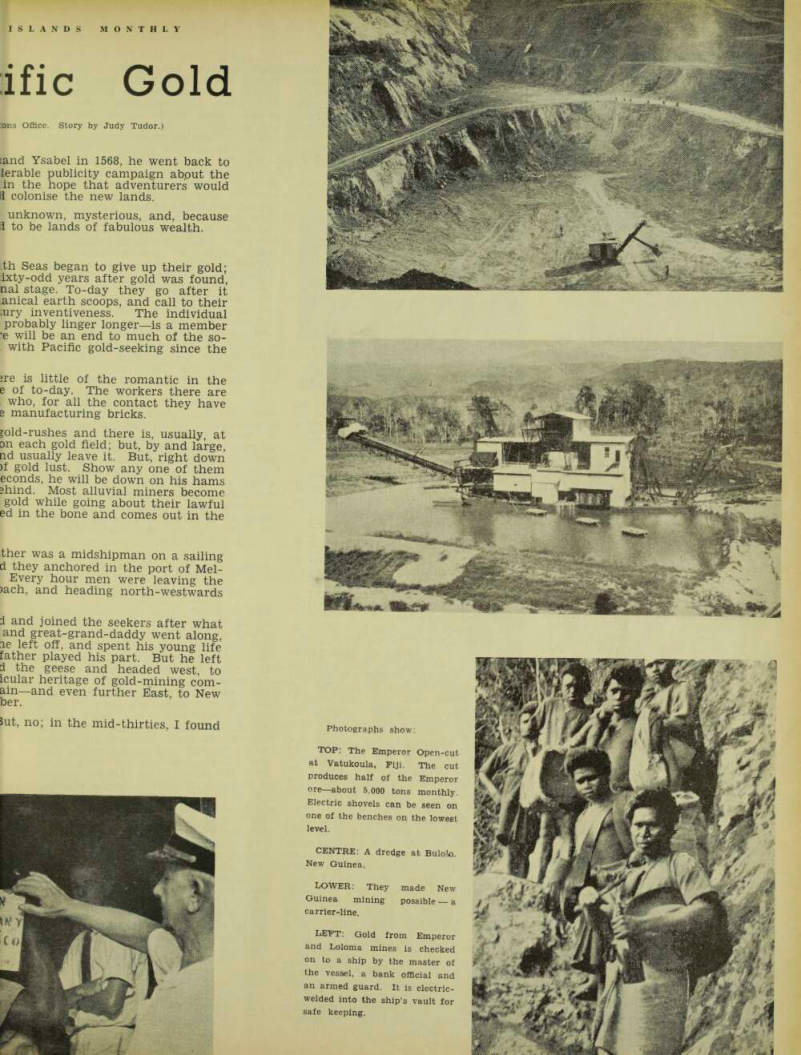
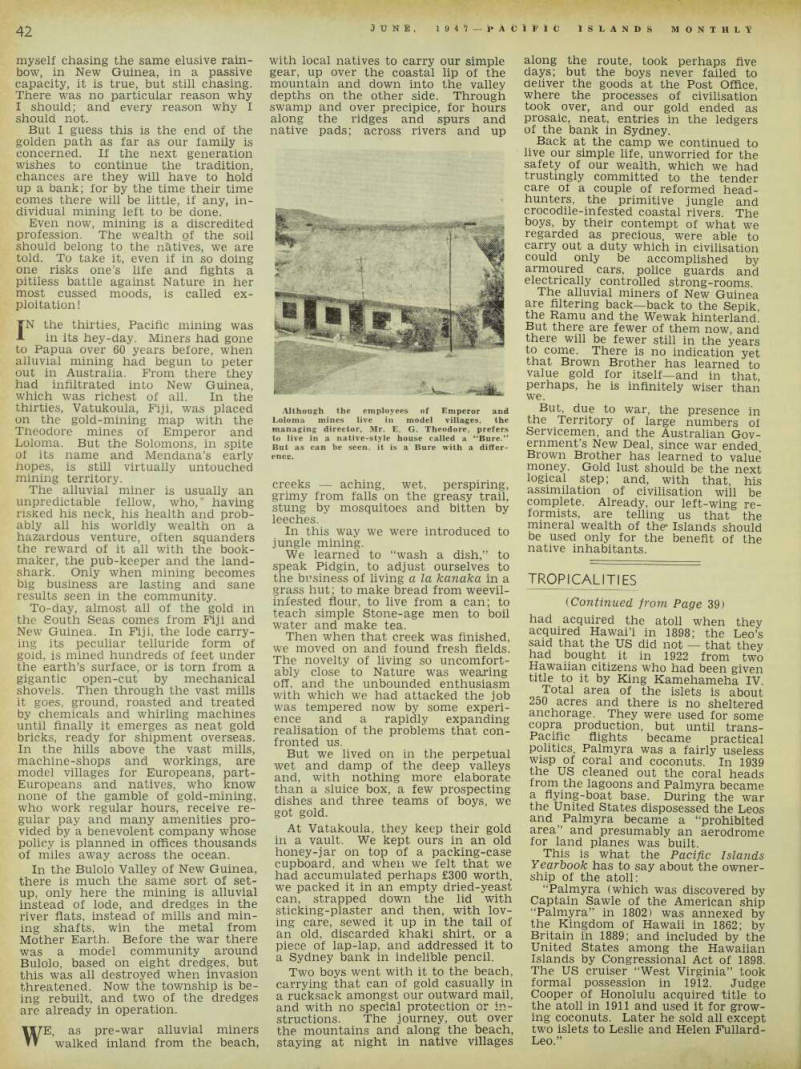
FROM a well known man of the Pacific Territories, who recently passed through America on his way to London: “I find the spirit of the people here (London, May) good—though every one indulges in black marketing to a greater or lesser extent. I have not met a shop assistant or a taxi-driver who didn’t curse the Government and the miners. Morally and spiritually, this country is on a different plane from America, where sizzling steaks and/or fornication are about all they seem to care for, “The modern tragedy is that the country which is materially strong enough to lead the world is morally not fit to do so; whilst the country which is so fitted has not now the material strength”. * * * I REALLY thought, when I lifted a box the other day, that the mil lion pounds offered to the first finder of a snake in the Cook Islands (one that really is there, I mean!) would be mine.
There he was, wrigg ing along—a 3 inch serpent, green as grass! But the ophidian wasn’t streamlined en ough; and further investigation re vealed him to be just a lizard, ap parently born without legs, and thus compelled to move, like Napoleon’s army, upon his tummy (and he snaked along quite professionally too!) Such a freak of nature could get his meal of insects well enough— cockroaches, etc., are plentiful—but he could not, of course, climb a post like his 4-legged fellows. Has any other “PIM” reader seen such a snake?
—“Eti”.
* * * THREE other young men are about to sail a small boat around the world—starting off with the Pacific.
They are Sydneysiders and in May they had got as far as Newcastle where they intended to stay for six weeks and earn sufficient cash to take them on the next leg of their journey.
None of them has worked since the end of the war; the time has been spent studying small ship construc tion and in building their crait which is 38 feet long with a 11 ft. beam.
Their plans are made on the long range principle. When they finally leave Newcastle they will call at Bris bane, Tahiti, Tuamotus, Galapagos, Honolulu, and from there they will go to the American Pacific coast. By re moving the masts they hope to cross America by sailing along the inland waterways (query: what waterways?) and if this is impossible they will hitch-hike across the continent to meet American servicemen they met in Australia. They will then return to the coast, pick up their boat and sail her through Panama to the Atlantic, and across to Europe.
“Our ultimate aim is to settle down on an island in the South Pacific out side the malaria area”, they say.
Such ambition is worthy of record.
And what fun to be so very, very young!—“MAC”. * * * TWO other parties of round-the world yachtsmen (and women) have been reported from Suva, Fiji, which seems to be a sort of focal point for these adventurers.
One party is already there and mention of it was made in the last issue of the “PIM”. This is the crew of the Danish yawl “Nordkapern”, a year out from Copenhagen. The owners-crew are Messrs. Carl Neilsen, Knud Larsen and Paul Larsen. They prepared their vessel for a round-the world voyage just before the beginn ing of World War II and during the occupation of Denmark by the Nazis, they dismantled her in order that she would not fall into enemy hands.
They finally left Copenhagen in June 1946 and sailed to Suva via Madeira, Virgin Islands, Panama, Galapagos, Tahiti and Suva. After the “Nordkap ern” is slipped and painted in Suva, the voyage will proceed via New Heb rides, East Indies, Singapore, Ceylon to Suez, through the Mediterranean and back to Copenhagen.
An American ketch, the “Barbary”, owned and sailed by Mr. Albion Howe and his wife is also reported cruising in the Pacific. This is a 38 ft. yacht of modern design. It is expected to reach Suva from Tahiti within the next few weeks. * ♦ * THE distant rumbling heard com ing over the hills across Suva Bay the other afternoon was not the noise of thunder. It was the voice, in angry eruption, of a well-known Lautoka business baron who had just received a copy of “PIM” containing the following: ‘Nadi Airport is on the barren north-west coast of Viti Levu.
It is an excellent airfield, but it is surrounded by bare, uninhabited
grasslands. The nearest place contain ing amenities is the hot, dusty, unin teresting little town of Lautoka, 15 miles away; ’ ” —From Flotsam and Jetsam column, Fiji Times, May 10.
Unfortunately, this representative of “PIM” has not been able to com municate by telephone with the chairman of the Lautoka Town Board (Mr. C. A. Adams). But, a Lautoka resident, now visiting Suva, has said that while he is not acquainted with many of his home town’s business barons, he is quite sure that the Town Board chairman himself must be very annoyed indeed with “PIM.”
“After all,” added the Lautoka man, “we all know what Mr. Adams thinks of Lautoka’s future as the Garden City of the South Seas and what he thinks of Nadi Airport and of Suva’s vested interests and their silly air strip at Nausori. What worries me now is not the anonymous business baron, whoever he may be, but what Mr. Adams will think and say and write about ‘PIM’.”—S. * * * I AWES Road is one of Port Mores- L* by’s most famous thoroughfares —mainly because, as yet, it is not. It was commenced last November and was to have been finished in January but progress may be judged from the current “prayer” concerning it: Our road which art in Moresby Slow is thy name, Thou wilt be done in ’5O, if not in ’5l; And forgive us our abuses Of Public Works who fail us, But we are long suffering, Patient and meek, For ever and ever, AMEN.
A number of Moresby’s famous Stubbs’ homes are in this road and all except a few have been equipped with kerosene stoves in lieu of the electric stoves for which they were originally designed. During a recent kerosene shortage busy housewives were to be seen cooking over open fires in the back yard. It is reported that there is small hope of electric stoves being supplied for a long time to come. Al though stovettes are available in Sydney, the Papua-New Guinea Ad ministration does not seem to be able to get them.
Mr. Len Odgers, who used to write the sporting column in the “Rabaul Times” under the pen-name of “The Slug”, astonished local residents in Port Moresby by naming his house in Lawes Road “Withering Heights”.
When a lass queried the spelling, and didn’t he mean the famous book by Emily Bronte, Mr. Odgers showed her around the “estate”— the gravel gar den beds and the lack of top-soil so carefully carted away when the house site was bull-dozed. ‘That’s why it’s called ‘Withering Heights’!” he said.—PM. * * * A N Australian-born Honolulu busi ness man, Leslie Fullard-Leo, and his wife Helen, have been given title to Palmyra (one of the Line atolls of about 50 islets) by the United States Supreme Court. The United States Government had claimed that they
{Continued Foot Page 42)
had acquired the atoll when they acquired Hawaii in 1898; the Leo’s said that the US did not that they had bought it in 1922 from two Hawaiian citizens who had been given title to it by King Kamehameha IV.
Total area of the islets is about 250 acres and there is no sheltered anchorage. They were used for some copra production, but until trans pacific flights became practical politics. Palmyra was a fairly useless wisp of coral and coconuts. In 1939 the US cleaned out the coral heads from the lagoons and Palmyra became a flying-boat base. During the war the United States disposessed the Leos and Palmyra became a “prohibited area” and presumably an aerodrome for land planes was built.
This is what the Pacific Islands Yearbook has to say about the owner ship of the atoll: “Palmyra (which was discovered by Captain Sawle of the American ship “Palmyra” in 1802) was annexed by the Kingdom of Hawaii in 1862; by Britain in 1889; and included by the United States among the Hawaiian Islands by Congressional Act of 1898.
The US cruiser “West Virginia” took formal possession in 1912. Judge Cooper of Honolulu acquired title to the atoll in 1911 and used it for grow ing coconuts. Later he sold all except two islets to Leslie and Helen Fullard- Leo.”
Advertisements & other items, p. 41 (1 item)
39
Pacific Island Memories ('Continued from Previous Page )
PACIFIC ISLANDS MONTHLY JUNE, 194'?
South Pacific Gold
(Fiji photographs by Fiji Pub] AFTER Mendana sighted Guada Peru and undertook a pretty Islands. He called them the Sole associate them with the idea of g In those days the South Sea man was ever a wishful-thinker, That was the romantic era.
Four centuries passed before i but progress was then swift, until affairs have already reached the i with dredges, pneumatic drills, an aid science and all of man’s 20 miner—even in the Pacific, where of a dying race; and, when he go called romance that has been as{ days of Mendana.
For, except in their concept processes of a big gold-mining ei so many cogs in a complicated n with the precious metal, might a £ Women have tagged along to least one outstanding female persi women can take or leave gold-see deep in every man, is a little har an old gold working and, in a mal fossicking—just to see if any wer so through accident, snared by tl occasions. With others, it seems flesh of each fresh generation.
WAY back in the 50’s, my great ship. Six months out from bourne, with Melbourne in a _gol( town, on foot, on horseback, by towards the gold-diggings at Ball; The ship’s company promptly they believed was quick and easy too. Grandfather took over from following the mines; and, in due Ballarat and Clunes to the woi Kalgoorlie. There he worked out paratively quickly and went back Zealand, where he exchanged gold The curse should have ended
Photographs show: TOP: General view of the Emperor mine at Vatukoula, Fiji.
CENTRE: Part of the Bulolo Valley, New Guinea, as it was before the war. A dredge Is in the centre of the photograph with the worked ground, like white mounds behind it, Left.
The power-line can be seen left foreground.
LOWER: New Guinea boys working alluvial ground with a sluice-box. Before the coming of the big companies, all New Guinea gold was worked in this fashion.
x>ns Office. Story by Judy Tudor.) land Ysabel in 1568, he went back to .lerable publicity campaign abput the in the hope that adventurers would li colonise the new lands. unknown, mysterious, and, because i to be lands of fabulous wealth. th Seas began to give up their gold; ixty-odd years after gold was found, nal stage. To-day they go after it anical earth scoops, and call to their airy inventiveness. The individual probably linger longer—is a member *e will be an end to much of the so with Pacific gold-seeking since the ire is little of the romantic in the e of to-day. The workers there are who, for all the contact they have e manufacturing bricks. and there is, usually, at on each gold field; but, by and large, nd usually leave it. But, right down )f gold lust. Show any one of them econds, he will be down on his hams -hind. Most alluvial miners become gold while going about their lawful ed in the bone and comes out in the ther was a midshipman on a sailing d they anchored in the port of Mel- Every hour men were leaving the )ach, and heading north-westwards i and joined the seekers after what and great-grand-daddy went along, le left off, and spent his young life father played his part. But he left ? the geese and headed west, to icular heritage of gold-mining com ain—and even further E'ast, to New ber.
Jut, no; in the mid-thirties, I found
Photographs show; TOP: The Emperor Open-cut at Vatukoula, Fiji. The cut produces half of the Emperor ore—about 5,000 tons monthly.
Electric shovels can be seen on one of the benches on the lowest level.
CENTRE: A dredge at Bulolo, New Guinea.
LOWER: They made New Guinea mining possible a carrier-line.
LEFT: Gold from Emperor and Loloma mines is checked on to a ship by the master of the vessel, a bank official and an armed guard. It is electric welded into the ship’s vault for safe keeping.
myself chasing the same elusive rain bow, in New Guinea, in a passive capacity, it is true, but still chasing.
There was no particular reason why I should; and every reason why I should not.
But I guess this is the end of the golden path as far as our family is concerned. If the next generation wishes to continue the tradition, chances are they will have to hold up a bank; for by the time their time comes there will be little, if any, in dividual mining left to be done.
Even now, mining is a discredited profession. The wealth of the soil should belong to the natives, we are told. To take it, even if in so doing one risks one’s life and fights a pitiless battle against Nature in her most cussed moods, is called ex ploitation !
IN the thirties, Pacific mining was in its hey-day. Miners had gone to Papua over 60 years before, when alluvial mining had begun to peter out in Australia. From there they had infiltrated into New Guinea, which was richest of all. In the thirties, Vatukoula, Fiji, was placed on the gold-mining map with the Theodore mines of Emperor and Loloma. But the Solomons, in spite of its name and Mendana’s early hopes, is still virtually untouched mining territory.
The alluvial miner is usually an unpredictable fellow, who, having risked his neck, his health and prob ably all his worldly wealth on a hazardous venture, often squanders the reward of it all with the book maker, the pub-keeper and the land shark. Only when mining becomes big business are lasting and sane results seen in the community.
To-day, almost all of the gold in the South Seas comes from Fiji and New Guinea. In Fiji, the lode carry ing its peculiar telluride form of gold, is mined hundreds of feet under the earth’s surface, or is torn from a gigantic open-cut by mechanical shovels. Then through the vast mills it goes, ground, roasted and treated by chemicals and whirling machines until finally it emerges as neat gold bricks, ready for shipment overseas.
In the hills above the vast mills, machine-shops and workings, are model villages for Europeans, part- Europeans and natives, who know none of the gamble of gold-mining, who work regular hours, receive re gular pay and many amenities pro vided by a benevolent company whose policy is planned in offices thousands of miles away across the ocean.
In the Bulolo Valley of New Guinea, there is much the same sort of set up, only here the mining is alluvial instead of lode, and dredges in the river flats, instead of mills and min ing shafts, win the metal from Mother Earth. Before the war there was a model community around Bulolo, based on eight dredges, but this was all destroyed when invasion threatened. Now the township is be ing rebuilt, and two of the dredges are already in operation.
WE, as pre-war alluvial miners walked inland from the beach,
with local natives to carry our simple gear, up over the coastal lip of the mountain and down into the valley depths on the other side. Through swamp and over precipice, for hours along the ridges and spurs and native pads; across rivers and up
creeks aching, wet, perspiring, grimy from falls on the greasy trail, stung by mosquitoes and bitten by leeches.
In this way we were introduced to jungle mining.
We learned to “wash a dish,” to speak Pidgin, to adjust ourselves to the business of living a la kanaka in a grass hut; to make bread from weevil infested flour, to live from a can; to teach simple Stone-age men to boil water and make tea.
Then when that creek was finished, we moved on and found fresh fields.
The novelty of living so uncomfort ably close to Nature was wearing off, and the unbounded enthusiasm with which we had attacked the job was tempered now by some experi ence and a rapidly expanding realisation of the problems that con fronted us.
But we lived on in the perpetual wet and damp of the deep valleys and, with nothing more elaborate than a sluice box, a few prospecting dishes and three teams of boys, we got gold.
At Vatakoula, they keep their gold in a vault. We kept ours in an old honey-jar on top of a packing-case cupboard, and when we felt that we had accumulated perhaps £3OO worth, we packed it in an empty dried-yeast can, strapped down the lid with sticking-plaster and then, with lov ing care, sewed it up in the tail of an old, discarded khaki shirt, or a piece of lap-lap, and addressed it to a Sydney bank in indelible pencil.
Two boys went with it to the beach, carrying that can of gold casually in a rucksack amongst our outward mail, and with no special protection or in structions. The journey, out over the mountains and along the beach, staying at night in native villages
along the route, took perhaps five days; but the boys never failed to deliver the goods at the Post Office, where the processes of civilisation took over, and our gold ended as prosaic, neat, entries in the ledgers of the bank in Sydney.
Back at the camp we continued to live our simple life, unworried for the safety of our wealth, which we had trustingly committed to the tender care of a couple of reformed head hunters, the primitive jungle and crocodile-infested coastal rivers. The boys, by their contempt of what we regarded as precious, were able to carry out a duty which in civilisation could only be accomplished by armoured cars, police guards and electrically controlled strong-rooms.
The alluvial miners of New Guinea are filtering back-back to the Sepik the Ramu and the Wewak hinterland.
But there are fewer of them now, and there will be fewer still in the years to come. There is no indication yet that Brown Brother has learned to value gold for itself—and in that, perhaps, he is infinitely wiser than we.
But, due to war, the presence in the Territory of large numbers of Servicemen, and the Australian Gov ernment’s New Deal, since war ended Brown Brother has learned to value money. Gold lust should be the next logical step; and, with that, his assimilation of civilisation will be complete. Already, our left-wing re formists, are telling us that the mineral wealth of the- Islands should be used only for the benefit of the native inhabitants.
Although the employees of Emperor and Loloma mines live in model villages, the managing director, Mr. E. G. Theodore, prefers to live in a native-style house called a “Bure.”
But as can be seen, it is a Bure with a differ ence.
Advertisements & other items, pp. 42-44 (3 items)
June, 1947 Paci
ific Gold
ISLANDS MONTHLY
42
TROPICALITIES
(Continued from Page 39)
JUNE, 194? pACIfIG ISLANDS MONTHLY
The Late Mr. Bolton of Tabiti
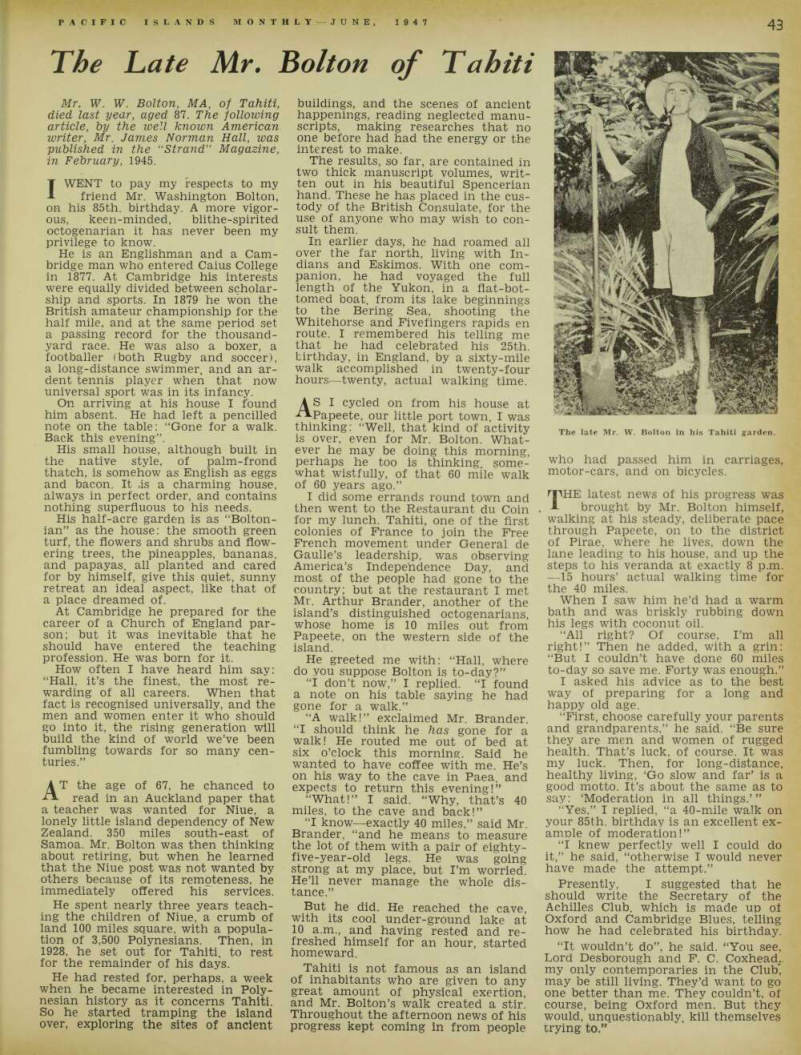
Mr. W. W. Bolton, MA, of Tahiti, died last year, aged 87. The following article, by the well known American writer, Mr. James Norman Hall, was published in the “ Strand ” Magazine, in February, 1945.
I WENT to pay my respects to my friend Mr. Washington Bolton, on his 85th. birthday. A more vigor ous, keen-minded, blithe-spirited octogenarian it has never been my privilege to know.
He is an Englishman and a Cam bridge man who entered Caius College in 1877. At Cambridge his interests were equally divided between scholar ship and sports. In 1879 he won the British amateur championship for the half mile, and at the same period set a passing record for the thousand yard race. He was also a boxer, a footballer (both Rugby and soccer), a long-distance swimmer, and an ar dent tennis player when that now universal sport was in its infancy.
On arriving at his house I found him absent. He had left a pencilled note on the table; “Gone for a walk.
Back this evening”.
His small house, although built in the native style, of palm-frond thatch, is somehow as English as eggs and bacon. It .is a charming house, always in perfect order, and contains nothing superfluous to his needs.
His half-acre garden is as “Bolton ian” as the house: the smooth green turf, the flowers and shrubs and flow ering trees, the pineapples, bananas, and papayas, all planted and cared for by himself, give this quiet, sunny retreat an ideal aspect, like that of a place dreamed of.
At Cambridge he prepared for the career of a Church of England par son; but it was inevitable that he should have entered the teaching profession. He was born for it.
How often I have heard him say: “Hall, it’s the finest, the most re warding of all careers. When that fact is recognised universally, and the men and women enter it who should go into it, the rising generation will build the kind of world we’ve been fumbling towards for so many cen turies.”
AT the age of 67, he chanced to read in an Auckland paper that a teacher was wanted for Niue, a lonely little island dependency of New Zealand. 350 miles south-east of Samoa. Mr. Bolton was then thinking about retiring, but when he learned that the Niue post was not wanted by others because of its remoteness, he immediately offered his services.
He spent nearly three years teach ing the children of Niue, a crumb of land 100 miles square, with a popula tion of 3,500 Polynesians. Then, in 1928, he set out for Tahiti, to rest for the remainder of his days.
He had rested for, perhaps, a week when he became interested in Poly nesian history as it concerns Tahiti.
So he started tramping the island over, exploring the sites of ancient
buildings, and the scenes of ancient happenings, reading neglected manu scripts, making researches that no one before had had the energy or the interest to make.
The results, so far, are contained in two thick manuscript volumes, writ ten out in his beautiful Spencerian hand. These he has placed in the cus tody of the British Consulate, for the use of anyone who may wish to con sult them.
In earlier days, he had roamed all over the far north, living with In dians and Eskimos. With one com panion, he had voyaged the full length of the Yukon, in a flat-bot tomed boat, from its lake beginnings to the Bering Sea, shooting the Whitehorse and Fivefingers rapids en route. I remembered his telling me that he had celebrated his 25th. birthday, in England, by a sixty-mile walk accomplished in twenty-four hours—twenty, actual walking time.
AS I cycled on from his house at Papeete, our little port town, I was thinking: “Well, that kind of activity is over, even for Mr. Bolton. What ever he may be doing this morning, perhaps he too is thinking some what wistfully, of that 60 mile walk of 60 years ago.”
I did some errands round town and then went to the Restaurant du Coin for my lunch. Tahiti, one of the first colonies of France to join the Free French movement under General de Gaulle’s leadership, was observing America’s Independence Day, and most of the people had gone to the country; but at the restaurant I met Mr. Arthur Brander, another of the island’s distinguished octogenarians, whose home is 10 miles out from Papeete, on the western side of the island.
He greeted me with: “Hall, where do you suppose Bolton is to-day?”
“I don’t now,” I replied. “I found a note on his table saying he had gone for a walk.”
“A walk!” exclaimed Mr. Brander.
“I should think he has gone for a walk! He routed me out of bed at six o’clock this morning. Said he wanted to have coffee with me. He’s on his way to the cave in Paea. and expects to return this evening!”
“What!” I said. “Why, that’s 40 miles, to the cave and back!”
“I know—exactly 40 miles,” said Mr.
Brander, “and he means to measure the lot of them with a pair of eighty five-year-old legs. He was going strong at my place, but I’m worried.
He’ll never manage the whole dis tance.”
But he did. He reached the cave, with its cool under-ground lake at 10 a.m., and having rested and re freshed himself for an hour, started homeward.
Tahiti is not famous as an island of inhabitants who are given to any great amount of physical exertion, and Mr. Bolton’s walk created a stir.
Throughout the afternoon news of his progress kept coming in from people
who had passed him in carriages, motor-cars, and on bicycles.
THE latest news of his progress was brought by Mr. Bolton himself, walking at his steady, deliberate pace through Papeete, on to the district of Pirae, where he lives, down the lane leading to his house, and up the steps to his veranda at exactly 8 p.m. —l5 hours’ actual walking time for the 40 miles.
When I saw him he’d had a warm bath and was briskly rubbing down his legs with coconut oil.
“All right? Of course, I’m all right!” Then he added, with a grin: “But I couldn’t have done 60 miles to-day so save me. Forty was enough.”
I asked his advice as to the best way of preparing for a long and happy old age.
“First, choose carefully your parents and grandparents,” he said. “Be sure they are men and women of rugged health. That’s luck, of course. It was my luck. Then, for long-distance, healthy living, ‘Go slow and far’ is a good motto. It’s about the same as to say: ‘Moderation in all things.’”
“Yes,” I replied, “a 40-mile walk on your 85th. birthday is an excellent ex ample of moderation!”
“I knew perfectly well I could do it,” he said, “otherwise I would never have made the attempt.”
Presently, I suggested that he should write the Secretary of the Achilles Club, which is made up of Oxford and Cambridge Blues, telling how he had celebrated his birthday.
“It wouldn’t do”, he said. “You see, Lord Desborough and F. C. Coxhead.,, my only contemporaries in the Club' may be still living. They’d want to go one better than me. They couldn’t, of course, being Oxford men. But they would, unquestionably, kill themselves frying to.”
The late Mr. W. Bolton in his Tahiti garden.
The Buli's Foot
Short Story:
By A. D. Spencer
AND what is all this coming?”
Sister Collins took off her cap and ruffled her red hair as Sister Daventry joined her on the hospital steps.
They both gazed in trepidation at the procession winding up the drive way.
“Well, I wish you joy of it, and I’ll remind you of the Matron’s latest diatribe about swarms of visitors.
Now, I’m ‘orph’—but I’ll remember you at the nineteenth hole,” she added generously.
But Sister Daventry’s eyes were on the heavy, hanging litter, now at the entrance.
“Siandra Sister,” said its portly bearers. Sister gravely returned the Fijian greeting, and directed them to the native surgical ward. The Fijian nurses for once appeared immediately, their respectful and subdued behav iour confirming the Sister’s private opinion of the “devil to pay”.
The litter halted by an empty bed, and four hefty giants deftly raised the groaning, sweating figure on to it.
Willing hands placed pillows under the head, knees, and lastly, a gargan tuan foot, swathed in leaves and wrappings. The terrific groan thus produced startled even the hardened' Sister; while the Fijian nurses, over come by their tribal respect, plus their nursing knowledge, were statuettes of awe. Their immense eyes rolled at Sister in horrified query.
“It’s the Buli Nauasau,” announced the most imposing of the giants.
Sister, watch in hand, was carefully checking the pulse, while Tessa, the head Fijian nurse, with the dif fidence due to such an exalted paplaced the thermometer be tween his panting lips.
With inward relief Sister turned seriously to the spokesman. “I under stand your anxiety for the Buli; but this is a hospital and we have not much space. So, will you ask your people to wait outside until the Doc tor comes. I will call the doctor by telephone.”
THE body-guard marched out, leav ing four chosen watchers, one sitting at each leg of the bed'.
“Now, Tess, you are the senior. You take charge of the Buli. Clean up his foot and prepare it for operation. I’ll start the theatre and put a call through for Doctor.”
With eyes like saucers, the Fijian girls scattered to their work, and Sis ter Daventry resignedly tackled the phone.
“Yes, Doctor, and I think I’d better give you a hint. The escort, comprised of about a hundred Fijians, is sit ting out on the mound, waiting to hear your diagnosis.”
A comprehensive grunt, carried over the wires was the only answer.
In a short time, a spatter of gravel and grinding of brakes, followed by
the inevitable door-slam, told of the arrival of the Burra Doctor Sahib. He waved a restraining hand to the escort, and strode into the ward.
“Siandra Buli! Bula—” The Doctor’s professional cheerfulness faded be fore the portentous solemnity of pa tients and nurses. “Let’s have a look at it, Sister.”
The gentle examination reduced the Buli to the verge of fainting.
“Humph!” Another grunt.
“Foments, Sister, and give him the four-hourly chart and a special nurse.
I’ll see to the escort, and come back.”
AT eight o’clock that evening, Sis ter fought her way to the tele phone through an atmosphere almost stiff with mosquitoes and the smell of coconut oil. “Doctor, will you come and see the Buli please, and the es cort. Yes —the Buli is much worse, and the escort is still there.”
Back came the Doctor’s rumbling voice; “I can’t see anything wrong with that foot, Sister. ‘Painful to the touch.’ Humph! Well, tell Matron I’ll open it up in the morning, after what’s his name and the two hy drociles. And you’d better give him a quarter of morphia now to keep him quiet. Call me if you think he’s any worse. Good night, Sister.”
The next morning went with its routine work, the Buli being the dom inant note. The doctor had operated, making a small incision and had ord ered dressings and foments two hourly.
Lautoka looked very lovely that afternoon, with its girdle of celestial blue, flecked with lacy little white waves, while away on the outer reef great breakers formed an undulating edge like foamy chiffon. Beyond again, the Yasawas stretched, a chain of azure, seductive with dreams un dreamt, In the foreground lay little Bakana Island, like an emerald pen dant.
“Oh, God!” groaned Sister Daven try, shaken with longing for happier days, “I wish I were a fish and could swim away from all this. My after noon off, thank goodness! I’ll rout out Susy and get her to row across to Bakana. It will be a break.”
Walking down the blistering street with its Bombay and Chinese shops and hovels, Bakana seemed more like Paradise than ever. Meeting Susy was a stroke of luck. They turned together to the native village, and pulled out the old dingy.
“I’ll row, Sister,” said the young Fijian girl, “You take it easy. Things not too good, eh?”
“Oh, fair, Susy. We are very busy as usual.”
“You got the Buli up there? What’s the matter with him?”
“I don’t quite know, Susy—he’s got a sore foot. Doctor opened it this morning to see. He is pretty bad.”
“Sister, I’ll tell you something. The
Bull will die. He has been cursed— draunikau!”
Sister Daventry sat up. “What rot.
Susy! I thought you’d more sense.”
Susy rested on her oars and leaned forward! earnestly. “Don’t talk like that out here on the wai-tui (sea). I tell you he WILL die. If I tell you more you must promise to be silent.
I don’t want trouble.”
“If you tell me, I must tell Doctor, because I think you may be right.”
Susy thought for a moment. “All right. Doctor knows me very well. You make him keep my name out of it.”
“Why was he cursed?”
“Because of a woman. She’s a very bad woman in every way. She has no pity. She sees the Buli happy. She
(Continued on pase 54)
goes to his house and looks around.
There is a very fine Yaka table the Buli has given his wife as a present and peace-offering. You know the Fiji custom —if you admire a thing greatly and ask for it, it must be given. She asked for the table and the Buli in dignantly refused—so you see the re sult. The Doctor and the hospital can not save him.”
A thoughtful Sister returned to duty, to find the Buli growing steadily worse, and an atmosphere of gloomy terror over the usually sparkling Fiji girls. She screwed up her courage, and sought the Burra Doctor Sahib.
“I’ve something to say, Doctor, and I beg of you to let me down lightly.”
“Humph-rr!”
“It’s—er —the Buli. Er—er—” with a great gulp. “Susy told me he has been draunikaued”
She had expected a supercilious stare from the doctor, and got it; but it soon gave way to a look of worry.
“You know how they do it, Doctor?”
“Humph! A toenail or cigarette butt or hair is mixed with certain leaves and liquid, put in a bottle and buried where the victim usually goes—the contents of the bottle being charged with super-curses of most horrifying and mysterious effects. Something of the sort, Sister. I really thought better of you. I believe the Government is making such practices punishable by law.”
Off strode the Great One, mum bling: “The ignorance of the working class.”
“And it serves me right”, thought Daventry.
BUT over in the court house, the Doctor was coaxing and cajoling the District Magistrate. “Just the pomp and splendour of your sergeants, old boy. The might of the Govern ment, and all that.”
“All very fine, Doctor. I’ll probably get a rap over the knuckles”.
“But the Buli takes the rap, if you don’t,” said the Doctor grimly. “You know, Tn spite of our precautions y yy “Yes I do know”, interrupted the District Magistrate rudely. “In plain English, you are on the spot. Well, have things your own way, and be damned to you.”
Out to the Fijian village drove the native police, their authority and hauteur reflected in their gleaming buckles and buttons. They stated firmly to the lady they interviewed that she was to accompany them to the District Magistrate, at once. The ominous silence of the drive in no way soothed her apprehensions, which reached swooning point when she saw the District Magistrate and Doctor, the Court Babus and every available Government unit seated in solemn array. She tremblingly faced that piercing barrage of eyes.
At last the Magistrate’s deep voice rang out. “Woman!”, he said, “If the Buli dies—you will be hanged. Now go!”
She did not need to be told a second time. She reeled out.
BACK at the hospital they took the Bull to the X-Ray room, but the plate showed negative results.
“Sister, tell Matron that Dr. Ruston will be over from Ba about ten o’clock.
I’ll have to open up that foot again.
Have the bone instruments out. Gut to be done in spite of the negative.
Call me any time if you are worried about him.”
At eleven o’clock that evening, Sis ter Daventry took a long look at the patient before leaving him in Tessa’s charge for the rest of the night.
“You know, Tess, I almost believe he seems a little better, but don’t be misled. It may be the change before death. Watch him well, and call me if he gets worse.”
At daylight, an almost white-faced Tessa shook and implored the Sister: “The Buli! Oh—the Buli!”
With one roll she was out of bed and into her uniform coat, her feet in open shoes, and flying up the cem ent path to the wards. The panting Tessa was at her heels. Not a Fijian was to be seen. Her heart skipped a beat as she saw the empty bed.
“Tessa! What’s happened? Where is the Buli?”
“Gone home, Sister. He says he is all right.”
Included in the passengers on the flying-boat, VCoriolanus” which left Bris bane for Suva on May 7, were Mrs. K. L.
Currie and Messrs. W. Davill and J. J.
Thomas.
A collection of new and uncommon plants peculiar to the Campbell Islands (far southwards of New Zealand) has been received by the Christchurch City Council from an expedition now stationed in the islands. The plants are being acclimatised in the Botanic Gardens.
Old Bukumau
The Death Feast of Old Bukumau
The drums send news with a beat of death, And the old wives keen through the long, hot night; In growing frenzy the dancers move On the shingled shore, by the husk fire’s light.
The surf on the reef beyond the cove Lends to the dawn a wilder note; A child’s weak a mongrel’s bark— Or muttered words from a song tired throat.
Youths are untying the pungent weed, As they cluster where weary dancers lie By the woman whose bloodstained breasts are bare.
But Tetea, the widow, with tender sigh, A flower most stealthily twines in her hair.
She has killed her pigs for He-who has-passed: Her yams ares garnered for death feast’s due!
Now her matted hair may be oiled —at last— And her soot-smeared body bathed anew.
Speed on, slow hours! Come, crescent moon!
Kagela has danced the wild night long— His limbs massaged to a sinuous gleam, Was ever a youth so brave, so strong!
He-who-has-passed is an ugly dream . . .
Comes the lad’s soft chant of a lover’s boon Long years denied, and of witch craft rare.
Then triumphantly rings out his marriage song!
He has seen the flower in Tetea’s hair— The flower of love in the widow’s hair!
Alice Allen Innes.
Tahiti Oranges
May be Heard of Again
From Our Own Correspondent
Papeete, Apr. 10
A FORTNIGHT ago, this writer had one of the first oranges from a tree growing on the property where he resides.
This is quite significant; for, during the past fifty years, no orange tree has thrived on the coastal lowland of Tahiti.
Orange seeds were introduced by the first LMS missionaries. During the fol lowing century orange trees flourished on all parts of the island. Old Tahitian natives, who had seen Stuart’s Atimaono Plantation in the heyday of that extra ordinary enterprise, have told us of the avenues of orange trees that shaded the roadways of the estate.
Natives going into the foothills and high plateaux of the interior, in quest of mountain plantain or on hunting ex peditions, scattered orange seeds as they travelled. These seeds took root and groves of orange trees grew, without fur ther cultivation, in the highlands.
A blight, which invaded the island about fifty years ago, quickly destroyed every orange tree on the coastal area.
Fortunately, the trees growing on the high mountain slopes and on the plateaux, escaped. The oranges brought down from those highland groves were the sweetest in the world.
Through a long period of years, supplies from this source were amply sufficient.
But, like all good things, this could not endure forever. The increase in the population of the settlements and a steady diminishing supply, have sent the price of oranges to a very high level.
Some years ago, the learned and ener getic Director of the Agricultural Depart ment of the Colony, undertook to conquer the orange blight. His success has opened the proipect that Tahiti may again become an orange orchard—and perhaps, export this delectable fruit to Australasia.
EDITORIAL NOTE: Our correspondent evidently does not know that Australia grows all the oranges she wants. If any politician even suggests that Aus tralia might import the delectable Fiji banana, or Rarotonga’s delicious oranges, he is leaped upon by bewhiskered and clamorous growers from NSW North Coast, and metaphorically torn to pieces.
Among passengers on the flying-boat “Coriolanus” which passed through Bris bane on May 23, en route to Noumea, New Caledonia, was Mr. Jack Hillier of New castle. Mr. Hillier is a well-known jockey and has signed a contract with Amichale Snortive, a French race club at Noumea, for the season commencing in June.
M. Nicholas Hagen has been elected President of the Noumea Chamber of Commerce.
Advertisements & other items, p. 47 (2 items)
45
SAMOAN BACKGROUND
(Continued from Page 36)
PACIFIC ISLANDS MONTHLY JUNE, 1947
Kodak Films
and all photographic supplies
WHOLESALE AND RETAIL
CAINE'S STUDIOS, SUVA,
P.O. Box 8 Photographers. Est. 1904.
Write for free price list
V.
V In the Ladies’ Home Journal! Everything that a woman could wish for —all about the most modern moments in fashion, cookery, furnishing, as well as domestic family advice of all descriptions; glorious colour pictures, gorgeous advertisements—babies, children, husbands and LIFE itself . . . from the domestic hearth to the smartest salon . . . and marvellous stories. FICTION from World Ranking Writers.
Oh! it’s a thrill in every issue ... a longed-for, waited-for visitor once a month—l 2 copies a year and up to 300 full size absorbing pages in every issue— all for 37/6 a year—less than 3/2 a copy delivered right into your home. Write now—right now for the Magazine “Women Believe In”—the Ladies’ Home Journal.
To John Hinton Magazine Agencies, Late Morgan Hinton. Est. 1938. 26 O’Connell Street, Sydney.
BW 5170.
Please enrol me as a subscriber to;—
LADIES’ HOME JOURNAL (37/6),
ESQUIRE (55/-), LIFE (47/6), SATUR-
DAY EVENING POST (62/6), POPULAR
MECHANICS (23/-), McCALLS (23/6),
NATIONAL GEOGRAPHIC (37/6).
(Cross out those not required.) I enclose £ to cover annual subscriptions.
NAME
ADDRESS
P.I.
Bank Accounts Take
Place of Head-hunting Strange Sepik Interpretation Of Thrift Campaign
rAT the untutored savage is having a tussle with many of the blessings conferred upon him by a benevolent Government is indicated by the report of a man who recently visited the Sepik District of New Guinea.
It appears that after distributing large amounts in War Damage payments to these natives, who used it mostly for gambling purposes (there being little else to do with it) the Administration suddenly began a campaign to foster thrift, and persuaded many villages to open “com munity accounts” in the Commonwealth Savings Bank, with the idea of greater benefits to come later, when the Territory was more normal.
Like many other apparently simple in novations, however, the thrift campaign was interpreted by Brown Brother in a variety of different and extraordinary ways.
It is reported that in some cases the community bank account has now taken the place of the good old Sepik head hunting foray and that one village chal lenges another to go one better than it, per medium of the credit in the village bank account.
Other villages have interpreted the Administrative propaganda as “orders” and contribute to the account as they formerly paid head tax, believing that non-contributors are liable to imprison ment.
Others, again, regard it as some sort of
lottery, with prizes for everyone; a sort of preparation for their legendary great “sit down” and arrival of the much heralded cargo in short, a super cargo-cult.
But, whatever the interpretation, the campaign seems to have had one general effect it has made the natives money conscious and money-hungry. They have adopted, in some cases, most improper means of raising funds.
Eventually their misconception may be ironed out and they may then be grateful that they did some good with their money instead of frittering it away.
Billiards Reduce
Alcoholism In Tahiti
Papeete, Apr. 12
A CHAIN of billiard pool rooms has been opened all around the dis tricts of Tahiti, and proves to be a great help to the young generation.
Since these parlors have been opened, lads and young men do not patronise the beer saloons like they used to do, and there are fewer drunkards on the streets on Sundays and holidays.
A district chief said: “Since these billiard rooms have been opened I see fewer boys frequenting the beer and wine shops, and I notice fewer fights and drunkards on the road.”
Cook Islands Council
MACHINERY clauses for the establish ment of the Cook Islands Legis lative Council, as provided for in the Cook Islands Amendment Act passed last year by the New Zealand Parlia ment. are set out in regulations appear ing in the NZ Government Gazette of May 8.
New Book On Polynesian
Life
MANY natives in country districts in Samoa did not know that the war was over, and inquired about its pro gress when he visited them in the course of collecting material for a book about the Polynesian island groups, said Mr, Robert Gibbings to a Wellington “Post” reporter, in May. He is in Wellington consulting the Turnbull Library for back ground information.
Mr. Gibbings, who has spent the last 18 months travelling in South Pacific islands, said that the main effect of the war on the Polynesian natives was an in creased “dollar consciousness,” particu larly in the ports such as Apia.
In Tahiti, which he had not visited for 18 years, Mr. Gibbings found the native life completely absorbed by the French and Chinese. It was hard to see a trace of mixed blood. In Samoa, on the other hand, the natives still took a pride in their own traditions and still wore the native dress, the lava-lava.
The author’s new book, like its pre decessors, will be illustrated with about 100 of his own woodcuts and will tell of native life and customs in the 30 islands visited in the Fiji, Tonga, Samoa, Cook, and Tahiti groups.
Advertisements & other items, p. 48 (2 items)
Bananas From Fiji
NEARLY 21,300 cases of bananas from Fiji, Tonga and Samoa arrived in Auckland on board the “Matua” on May 9.
I M Don't Say
DON'T SAY GIN DON'T SAY GIN DON'T SAY gin GIM DON'T SAY U SAY GIMDON'T SAY
DON'T SAY GIN DON/ SAY GIM
GIM DON'T SAY G / M DON'T SAY
DON'T SAY GIM
I M DON'T SAY
DON'T SAY GIM
GIM DON'T SAY
DON'T SAY G I M
GIM DON'T SAY ••. . " ' m SAY
DON'T SAY GIN DON"
GIM DON'T SAY GIM DON'Tlkl SAY
DON'T SAY GIN DON'T SAY, GIN DON'T r D Y S AY
II QU
IT 0 °u r * n& Telegrams and Cables: "GILBEYS,” Melbourne.
Address all inquiries to:
W. & A. GILBEY LTD.
33 ROSSLYN STREET, WEST MELBOURNE. 109 REGENT STREET, SYDNEY Telegrams and Cables: “GILBEYS,” Sydney.
Northern New Guinea
Notes
By “Mossie”
RECENTLY an old Luluai told me this version of the famous trip of Exter nal Territories Minister Ward to Papua-New Guinea during the war.
The “Big King of Sydney” (E. J. him self) arrived by plane at a Government station. All the government officials and local tul-tuls, luluais and doctor-boys were gathered there to see him and hear him address them. Unfortunately, he could only “talk place” (that is. speak Austral-English) which the natives could not understand.
However, a translation was given by a Patrol Officer as follows: “Now the good time for the natives had arrived. The Government would open hospitals and more schools in which all natives would soon learn to speak proper English. Pid gin was a bad language and had to be abandoned. Then when they could all speak English the good time would really have arrived.”
Perhaps this explains the sudden en thusiasm manifested by the Sepik natives for learning straight English which was mentioned in a recent issue of the “PIM” and their belief that when they have mastered it they will come into their new Heaven on earth.
"Wewak News''
RECENTLY a few issues of a roneoed Pidgin-English publication came into my hands. I don’t know when publi cation began or when it ceased—my copies were spread over the July-December 1946 period but the editor seemed to be District Officer H. L. R. Niall. of Wewak, and the paper appeared to have a bene ficial effect on the natives for whom it was written. It cleared up a lot of rumours which are always current here, and encouraged natives to express their opinions and to make suggestions.
The paper was read solemnly and with ceremony in the villages where the written word is understood, and in some places special buildings were made in which to house it. In many villages, of course, it could not be read at all. although it was kept there also, rather like a magic charm, and its contents guessed at or imagined.
Perhaps there were too many “letters to the editor” and the editor could not stand the strain; or perhaps some higher up intervened; but the paper now seems to have come to an untimely end.
Organised Recruiting
BULOLO Gold Dredging Limited has a well-established recruiting station at Angoram. on the Sepik River. Boys are recruited from this head-quarters and, in due course, will be returned there when their time is finished.
Over 500 Sepiks have already gone to the goldfields area, and there are still hundreds waiting in the villages to be picked up. Although they are permitted to make a contract for only 12 months, most of them .hope that the government will permit them to extend their period of labour and not force them to return to their vilages at the end of the year.
Mr. E. Knight has been in charge of Bulolo recruiting on the Sepik, but he will leave shortly to open another station for BGD in Wewak.
Among prospectors back on the Sepik are Messrs. W. Forrester, L. Smith and R. Cooper.
Father Glover is Back
rE Rev. Father Glover, who distin guished himself in 1942 by helping to evacuate residents from inland
New Guinea by air, and who subsequently joined the AIF as chaplain, is back on the job again, with flying headquarters at Alexishafen.
The mission there now has two planes —a Tiger Moth and a twin-engined De Haviland Rapide. At the beginning of April, Fr. Glover flew the Rapide to Cairns, via Mount Hagen, with Monsignor William van Baar as his passenger.
The Bootless Sepik
■VTEVER before has the Sepik River been ll so devoid of boats of all kinds. And while this state of affairs remains it will be impossible to effectively patrol this vast area, which contains about 50,000 native people, nor will it be possible for one Medical Assistant to attend to
all the medical needs of that large com munity. Although the Lik-Lik Doctor in question has worked out an excellent sys tem of regular patrols by native medical tul-tuls, who bring in the sick in canoes, regular patrol by Europeans is essential.
Recently, when a missionary on the
Sepik was stricken with malignant malaria, Medical Assistant L. R. Healey made a twelve-hours’ canoe trip in pouring rain to go to his assistance.
It is useless to talk of improving the lot of the Sepik people until such time as there is reliable boat transport on the river. The native impression at the pres ent time is that all the Australian boats were sunk by the Japs during the war.
"Free" Labour
IT is rumoured that the Government has made a proposal to some plantation owner’s that “free” natives be per mitted to work the plantations on receipt of one third of the gross profits, plus free housing, garden facilities and free medi cine.
Plantation owners are wondering why they call it “free” labour.
The French nickel collier “Notou,” of 2,500 tons, left Newcastle on August 12, 1940. Four days later she was sunk by a German raider. The only passenger on board was M, Paul Vois, Noumea manag ing director of the Societe le Nickel, who had been unofficially conferring with Australian authorities in Sydney on economic maters resulting from the French collapse. M. Vois had an unhappy time before reaching France, where he remained for some time in German cus tody, and he has now published in Paris a book about his experiences as a prisoner on the German raider. The title of the book is “Prison Flottants” (“Floating Prisons”).
A Communist deputy in the French National Assembly declared that between 1934 and 1944 the Bank of Indo-China realised a net profit of over 550 million francs on a paid up capital of 120 millions.
Advertisements & other items, pp. 49-50 (1 item)
Victoria
EYE LOTION
For Inflamed Eyes and Eyelids ... Sold Everywhere H. Rose 4 Co.. Pty_ Ltd., King Street Sydney.
BITTER
ALE
O •teatt it
CARLTON & UNITED BREWERIES t TO.
y K
Every Branch Of
ENGINEERING and BUILDING CONSTRUCTION
MILLERS LTD.
SUVA and LAUTOKA
Sawmillers and Timber Merchants; Shipwrights and Sailmakers; Joinery and Furniture Manufacturers; Upholsterers; Plumbers; Electricians; Hardware Merchants; Motor Dealers.
AGENCIES :
Chevrolet, Bedford, Vauxhall, Nash Motors. Firestone Tyres.
Fetters Marine and Stationary Engines. G.E.C. Radio Sets.
British Australian Lead Manufacturers Pty., Ltd., Atlas Assurance Co., Ltd.
There is no need to send to Australia or New Zealand for Repairs or Replacements. We can give you a sound Quotation and guarantee First-Class
Workmanship
Scott’s “Renown” Brand Rope,
Cordage and
Binder
Twine
Cable Address; Ropeyard, Sydney. mmassmt
of Every
Description
MANUFACTURED AT
MASCOT. N.S.W
By
J. SCOTT
PTY. LTD.
Head Office and Store
163 CLARENCE STREET,
stuvey,
N.S.W.
Hawaiians?"
"Where Are The Hawaiians?"
Letter to the Editor YOUR Tahiti correspondent is con stantly asking; “Where are the Hawaiians?”
Well, I am going to answer his ques tion, in detail; so there shall be no more of this talk of a vanished race.
First of all, there is Poliokalani who owns the fried-fish cocktail-lounge estab lishment at Waikiki Beach, on Oahu.
Poliokalani is the grandson of Princess Popocatapetl, whose father came from Mexico, and was a direct descendant of Montezumah or, at least, he said he was.
Tourists flock to Polio’s place; because, they say, it has “atmosphere.”
On Maui, Ohopuli runs the Rest-House half-way up Hale-o-ka-la. When tourists have drunk three or four of Ohopuli’s Rainbow Punch mixtures, they see so many things besides rainbows that they decide to “call it a day.” then and there.
The Tourist Bureau at Honolulu is very angry at Ohopuli, and wants his licence taken away. It claims he is wrecking the whole Maui schedule. Ohopuli says he is saving the Bureau money for horse shoes and extra feed for the animals, on the heavy climb above the Rest-House.
Just now. the great Hawaiian musi cian, Kokakola, is in New Mexico, on the Mainland; where he is playing his steel guitar for the Taos Indians, when they perform their Snake Dances to amuse tourists.
Here at Hilo, we have Mako Ono, who keeps the Curio Shop down near the Customs House. Mako Ono is so proud of his name which, in English would be “barracuda shark” that he has had all his teeth filed to sharp points.
Tourist ladies say he is cute. But when Mako grins, they stop arguing about the price of curios, and come across with the dough.
Mako is a persuasive politician. We hope to send him to the Territorial Legislature, at the next election. He is just the chap to talk down those stubborn people who oppose importing Alabama negroes, in place of Filipinos, to work on the plan tations. We need new blood in the Terri tory.
In addition to these, we have three real Hawaiian hula-girls Tzetze. Rako and Palolo. Tzetze may have almond shaped eyes; but she was bom in Hono lulu. Rako who was born on Kaliai, the Garden Island has one blue eye and one brown eye, that makes tourists look at her twice which is just what Rako wants them to do, Palolo’s mother came from Samoa, and married Charley Hashimoto, who is the bouncer at Ching Koo Wang’s honky tonk, on the Honolulu waterfront, facing the steamer docks.
All three girls dance there. They put on a good show and the tourists like it.
Now, all this answers your Tahiti cor respondent’s question. And let me add, that if he does not cease writing nasty things about Hawaii, we shall send Mako Ono down there, to bite him.
I am. etc.,
Kalelekoa.
Hilo, Hawaii. 31/3/47.
New Caledonia’s oldest inhabitant, Mme.
Louis Guichard, celebrated her centenary in April. She was born on the island of Reunion in 1047, and she and her husband arrived in Noumea in 1872, with other people from Reunion, many of them to establish sugar growing and agricultural settlements. She has three children, 14 grand-children and 12 great grand children.
Random Notes From
Finschhafen Perhaps It May Become The "Capital"
From a Special Correspondent FNSCHHAFEN is a busy Administra tion centre these days and will be busier still if the Capital comes here.
Eric Howitt is flat out with a staff of men, keeping the Administration vessels in seagoing condition.
They seem a happy family at Finsch hafen, and perhaps the local folk would not like to see the capital there, with “silver-tails” dashing hither and thither seeing whether such and such an Ordi nance were being violated or not.
But, seriously, why not Finschhafen as the capital? It has everything, and it is the only place on the mainland where big ships can come right in for water. We have miles of coranus roads (built by the Americans), delightful surroundings, and a climate that puts Rabaul, Lae. Port Moresby and other places in the shade.
Harbour facilities are unsurpassed otherwise, why is the Navy here! It is a real tourist resort; and a good jeep road takes one right to Sattleberg, at a •00-feet elevation, where over-taxed Administration officers can relax in cool, majestic surroundings.
That is what we want in the Territory —a capital with a nearby healthy spot where one can recuperate without the expense of going “South” and you have It at Finsch.
Now, can I sell you a block of land?
DR. and Mrs. T. G. Braun, of the Luth eran Mission, are doing excellent work with their staff of technicians,
and natives receive the very best attention that medical science can give them.
“Doc.” and his charming wife are very popular. They stuck to their post when the Japs landed at Madang, and the gruelling time they had as prisoners took months of recovery.
Staffed with “old-timers”, and a big sprinkling of fresh blood from the United States, many of whom are skilled in the professions and trades, the Lutheran Mission, with its progressive ideas, tends to be an influential force throughout New Guinea. Their medical work deserves special commendation.
Mr. “Ambrose” Palmer, Admin.,
departed South recently—he will bring back a bride, BIRTHS—To Mrs Frank Kai and Mrs.
Sam Moessncr, daughters. The “Stork” is expected to pay another visit to Fin schhafen before long.
Mrs. Turner, mother of Mrs. Eric Howitt, has been staying at Finschhafen, and Mrs.
Phyllis Keenan has had her mother and father with her for the second time in a few months. When people make a second trip up here from South there must be something attractive about the place. Wait till we get our avenue of trees!
World famous collector Shaw Mayer spent a long time at Finsch.. waiting for a vessel to Sydney. He had about 38 birds, mostly Birds-of-Paradise, for Tar onga Park Zoo. He’d been around the Wareo district, where he said bird life was prolific.
HMAS “TARANGAU” still runs an almost 6-nights-a-week picture show, which is greatly appreciated by the civilian population.
On Anzac Day, passengers from the “Montoro” placed a wreath on the mem
orial at the American war cemetery at Finschhafen. Eleven thousand American heroes lie buried here in peaceful, beauti ful surroundings. One hundred and fifty Filipinos will shortly arrive to disinter the bodies and take them to Manila, and then, perhaps to the States, if desired by rela tives.
An unfortunate incident occurred when the “Kanimbla” berthed—a young native
was killed when a case of beer fell on him from a ship’s sling. There was a full naval inquiry. The “Kanimbla” was taking occupational troops to Japan.
“Nude Bathing Prohibited” is a con spicuous sign right alongside that de lightful rock pool on Butaweng Creek.
It’s a real beauty spot. Now, do be care ful, you Navy boys!
The Yanks still get their beer—and the Navy are on three bottles a week.
MRS. “NOBBY” CLARKE and her two charming daughters arrived recent ly. “The old Nob” is canteen man ager on HMAS “Tarangau,” and is doing a great job.
Patrol Officer and Mrs. Jim White staged a successful party to celebrate their anniversary. It was also an opportunity to say “au revoir” to Bill South wick and young “Trev.” popular CPOs of HMAS “Tarangau.” Jim and Mrs. White were busy until daybreak, making everyone happy. All the really nice people were there. The buffet supper was sumptuous, and the cool beer was delicious. Dancing, with the moon glistening on the rippling waters, and palm trees riffling in the breeze, made the whole party romantic and delightful—especially with those at tentive Air Force officers filling up the glasses.
POPULAR ADO Jack Keenan has been in the “Never Never” delving into the mysteries of “Cargo Cult”.
Those naughty Hube boys have been kill ing pigs, burning houses, neglecting their gardens—waiting for that great day when their spiritual ancestors will bring them everything, from electric power houses to aeroplanes. They think everything that has come into the country was meant for them, and them alone, and that the “big fella master” has wrongly diverted it to his own use.
That cunning old bird who built a “Cus toms” shed in the bush was evidently expecting a good “rake off” when he dished out the “cargo”!
WI7ELCOME to Murray Phillips, who re ▼ f cently did such good work with Gov ernment Stores at Wewak!
When the RAAF clears out shortly the Department of Civil Aviation will prob ably take over.
CDC buyers come and go, but there’s little to pick up these days. Jack Ban nigan is still here with a few men. Young “Jim” Hoiie and young “Bill” Cash are browsing around, and we see Tex Mar shall only when he comes in to bank his takings.
Pinschhafen seems to like Father Wall achy—he’s looking fine.
Advertisements & other items, pp. 51-52 (1 item)
Machinery
LOOK !
KOCH'S BARBER CHAIRS
Obtainable Soon
PACIFIC ISLANDS TRADING
COMPANY
244 California St., San Francisco, Cal.
• • mi A Hyster Crane at Work on Suva Wharves.
We Supply all Types of
“CATERPI LLAR”
MACHINERY
WE ARE DISTRIBUTORS IN FIJI FOR
The Caterpillar Tractor
Company
Caterpillar Diesel Tractors Caterpillar Bulldozers Caterpillar Earth-movers Caterpillar Road Building and Maintenance Machines
ALL MADE BY “CATERPILLAR.”
Hyster" Winches, Logging Arches and Equipment Tracson" Excavators for use with Caterpillar Tractors "Caterpillar" Diesel Marine Engines, 34 to 135 BHP Continuous Rating Stocks of Spare Parts carried in Suva. Information available about Agricultural Implements Inquiries from anywhere gladly answered to suit Caterpillar Tractors.
W. R. CARPENTER & CO. (Fiji) Ltd.
SUVA
FIJI
WANTED: Back numbers of the “Pacific Islands Monthly.” Have many duplicates for exchange. Will also exchange American magazines for newspapers and magazines of the Pacific Islands and British Colonial Empire. Orders taken for subscriptions to American magazines —no foreign exchange difficulties —write for details to PAUL A. DORN, Agent, Los Angeles 36, California.
NOW AVAILABLE
Modern, Beautiful
METAL CEILINGS
AT SURPRISINGLY MODERATE
COST
Hasten completion of your new home. We can supply and fix Metal Ceilings, efficiently and
promptly.
'Phone MX 241 I, or write to G.P.O. Box 474.
WUNDERLICH LIMITED
Showrooms:
BAPTIST ST., REDFERN, SYDNEY
Branch at King Street, Newcastle.
ETAI CEILINGS
BtAUri’Ul • MRMANCNT • MODERN
Steamships Trading
Company Limited
PORT MORESBY SAMARA! PAPUA.
WHOLESALE & RETAIL MERCHANTS, SHIPOWNERS,
PLANTERS, ENGINEERS & SLIP PROPRIETORS.
Customs, Shipping, Insurance, and forwarding Agents.
MANAGING AGENTS AND VISITING REPRESENTA-
TIVES FOR COCONUT AND RUBBER ESTATES.
SYDNEY REPRESENTATIVES: Nelson & Robertson Pty, Ltd- -12 Spring Street
Mosquito Control Dept. Is
"Not Pleased" With Suva
From Our Own Correspondent
Suva, May 10
WHITEHALL, a few weeks ago, com plimented Fiji on its anti-mosquito campaign, but Fiji’s Medical De partment Mosquito Control organisation is not pleased with the pat on the back.
Of 303 inspections made in four scat tered Suva areas in April, 53 revealed mosauito larvae, and this, says the Med ical Department, in a nasty tone, “reflects little credit on a community that has been warned so frequently about the mos quito menace.”
Bottles, tins, old tyres, discarded oil drums and roof gutters were all found to be places provided by the ingenuity of man for the benefit of breeding mosqui toes.
“In some cases,” adds the Department, “householders were breeding their own private stocks of aedes aegypti (respon sible for dengue and potentially respon sible for yellow fever) in anti-ant devices or in plates under ferns.”
Mr. Jock Owen, who was well-known on the New Guinea goldfields, in Morobe, in pre-war days, and who later purchased a store at Pinkenba, near Brisbane, has now sold this business for health reasons.
He is still residing in Brisbane.
"170 East"
Imaginary Line Separates Disease Zones in Remarkable Way
“mHIS remarkable meridian,” the 170 J. degrees East, was dealt with by Sir Charles Hercus, Dean of the Faculty of Medicine at Otago University, in a lecture to the Science Congress on “New Zealand’s responsibility for medical re search in the South-west Pacific” (reports the Wellington “Post”).
“The 170th meridian is the malaria base-line.” he said. “To the west of the line, malaria constitutes a major public health problem, but to the east there is no malaria. For some reason still un known, this meridian marks the limit of the spread of the anopheles (the malaria carrying mosquito).”
This line, he said, also separated the form of filarla (the germ causing ele phantiasis) found to the west from the form found to the east. Tropical ulcers, common to the west of longitude 170 E, did not occur to the east. The reasons remain obscure.
On the other hand, yaws, leprosy, and tuberculosis were as common to the east as to the west of this remarkable meri dian. Hookworm was widely prevalent, and skin diseases were common. The area presented a fruitful field for the study of endemic goitre, dental caries, and other nutritional problems. Anaemia, diabetes, and epidemic dropsy were common in the Indian women of Fiji. These com plaints presented a field of practical en< deavour for New Zealand science.
Sir Charles Hercus said that in 1946 New Zealand entered into an agreement with the United Kingdom to form a South
Pacific Health Service to serve Fiji, Tonga, and the New Zealand dependencies and mandated territory. The population in the area was about 250,000, and it was proposed to have uniform quarantine regulations, to exchange information, and medical personnel, and to train native nurses, dentists, sanitary inspectors, and nursing orderlies.
"Spotlight On Emirau"-
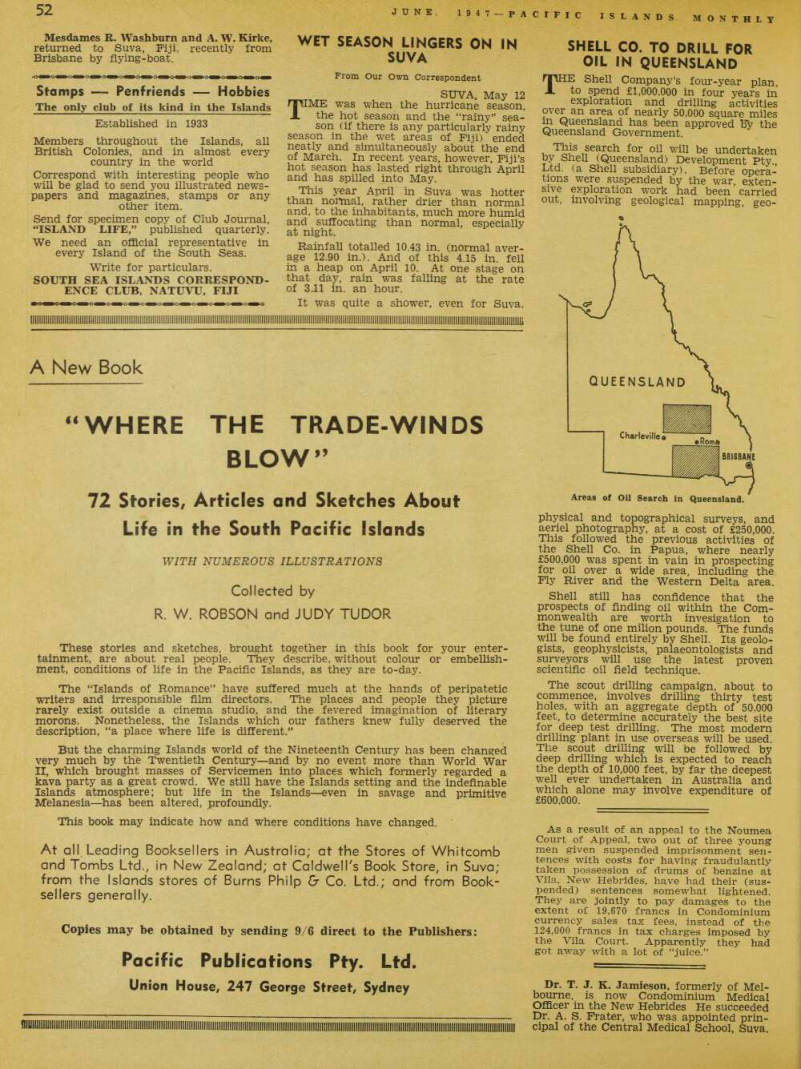
A Correction
Letter to the Editor WITH reference to an article in the May issue of “PIM”, entitled “Spot light on Emirau” by L. P. Crago, I would like to draw your attention to two errors:— Firstly, the District Officer stationed at Kavieng in December 1940 (when the Germans disembarked their captives on Emirau), was Mr. J. Merrilees and not Mr. J. A. McDonald.
Secondly, the ship which was diverted to Kavieng and Emirau was the “Nellore”, and not the “Nanking”, as stated.
I was watching from my home on the hill-top of Selapiu, at dusk on Christmas Day. 1940, and saw the “Nellore” being piloted safely into Kavieng Harbour, through the narrow northern channel be tween Lemus Island and Bangatan Island, by the late Mr. Colin McKellar of Tabar Island. It was the first time that the “Nellore” had entered Kavieng Harbour, and she drew about 28 feet of water.
I am, etc,.
Margaret E. C. Doyle
Sydney, May 22, 1947.
Mr. and Mrs. F. W. Burke, formerly well known residents of Orokolo, Papua, have returned to the Territory. Both served during the war Mr. Burke as an in fantryman and his wife as a nurse. Mr.
Burke is inclined to try to re-establish Orokolo Industries (soap making, etc.); but is handicapped by a shortage of materials.
Mesdames R. Washburn and A. W. Kirke, returned to Suva, Fiji, recently from Brisbane by flying-boat.
Advertisements & other items, pp. 53-54 (1 item)
C®S Pte® IjJl
KANGAROO BRAND
Ropes,
Cordage,
and Twines for every purpose Backed by 86 years of service Manufactured by:
M. DONAGHY AND SONS,
Pty. Ltd., Geelong and Sydney.
Fiji Representatives:
PEARCE AND CO.
LIMITED
P.O. BOX 237, SUVA
ISLAND MERCHANTS
and AGENTS.
GENERAL MERCHANTS
C®S Pte® IjJl
• Shippers of all types of Merchandise to the Pacific islands • Representing Australian, British and American Manufacturers r f r -J Ifl Buyers for Leading Pacific Islands Traders • Sellers of Island Produce on Consignment m • Forwarding and Transhipment Agents • Importers, Distributors and Manufacturers of Foodstuffs, Softgoods, Textiles, Hardware, Tobaccos, Wines and Spirts, etc.
379 KENT ST., SYDNEY.
Cable & Telegraphic Address: i Chasull, ,> Sydney. • "Ultima" Kerosene Stoves and Heating Appliances • Distributors of High-grade Shirts, Pyjamas and Clothing vC] n. i M i • "Southern Queen 1 Canned Fruits - m. mi A • Hill's English Cigarettes When in Sydney, call and see us!
Stamps Penfriends Hobbies
The only club of its kind in the Islands Established In 1933 Members throughout the Islands, all British Colonies, and in almost every country in the world Correspond with interesting people who will be glad to send you illustrated newspapers and magazines, stamps or any other item.
Send for specimen copy of Club Journal, “ISLAND LIFE,” published quarterly.
We need an official representative in every Island of the South Seas.
Write for particulars.
SOUTH SEA ISLANDS CORRESPOND-
ENCE CLUB. NATUVU, FIJI
A New Book
“WHERE THE TRADE-WINDS
BLOW”
72 Stories, Articles and Sketches About
Life in the South Pacific Islands
WITH NUMEROUS ILLUSTRATIONS
Collected by
R. W. ROBSON and JUDY TUDOR
These stories and sketches, brought together in this book for your entertainment, are about real people. They describe, without colour or embellishment, conditions of life in the Pacific Islands, as they are to-day.
The “Islands of Romance” have suffered much at the hands of peripatetic writers and irresponsible film directors. The places and people they picture rarely exist outside a cinema studio, and the fevered imagination of literary morons. Nonetheless, the Islands which our fathers knew fully deserved the description, “a place where life is different.”
But the charming Islands world of the Nineteenth Century has been changed very much by the Twentieth Century—and by no event more than World War 11, which brought masses of Servicemen into places which formerly regarded a kava party as a great crowd. We still have the Islands setting and the indefinable Islands atmosphere; but life in the Islands—even in savage and primitive Melanesia—has been altered, profoundly.
This book may indicate how and where conditions have changed.
At all Leading Booksellers in Australia; at the Stores of Whitcomb and Tombs Ltd., in New Zealand; at Caldwell's Book Store, in Suva; from the Islands stores of Burns Phi Ip Gr Co. Ltd.; and from Book-
sellers generally.
Copies may be obtained by sending 9/6 direct to the Publishers:
Pacific Publications Pty. Ltd.
Union House, 247 George Street, Sydney
Wet Season Lingers On In
Suva
From Our Own Correspondent
Suva, May 12
rpiME was when the hurricane season, A the hot season and the “rainy” sea son (if there is any particularly rainy season in the wet areas of Fiji) ended neatly and simultaneously about the end of March. In recent years, however, Fiji’s hot season has lasted right through April and has spilled into May.
This year April in Suva was hotter than normal, rather drier than normal and, to the inhabitants, much more humid and suffocating than normal, especially at night.
Rainfall totalled 10.43 in. (normal aver age 12.90 in.). And of this 4.15 in. fell in a heap on April 10. At one stage on that day, rain was falling at the rate of 3.11 in. an hour.
It was quite a shower, even for Suva.
Shell Co. To Drill For
Oil In Queensland
rE Shell Company’s four-year plan, to spend £1,000,000 in four years in exploration and drilling activities over an area of nearly 50,000 square miles in Queensland has been approved T3V the Queensland Government.
This search for oil will be undertaken by She!! (Queensland) Development Pty., Ltd. (a Shell subsidiary). Before opera tions were suspended by the war, exten sive exploration work had been carried out, involving geological mapping, geo-
physical and topographical surveys, and aeriel photography, at a cost of £250,000.
This followed the previous activities of the Shell Co. in Papua, where nearly £500,000 was spent in vain in prospecting for oil over a wide area, including the Fly River and the Western Delta area.
Shell still has confidence that the prospects of finding oil within the Com monwealth are worth invesigation to the tune of one milion pounds. The funds will be found entirely by Shell, its geolo gists, geophysicists, palaeontologists and surveyors will use the latest proven scientific oil field technique.
The scout drilling campaign, about to commence, involves drilling thirty test holes, with an aggregate depth of 50,000 feet, to determine accurately the best site for deep test drilling. The most modern drilling plant in use overseas will be used.
The scout drilling will be followed by deep drilling which is expected to reach the depth of 10,000 feet, by far the deepest well ever undertaken in Australia and which alone may involve expenditure of £600,000.
As a result of an appeal to the Noumea Court of Appeal, two out of three young men given suspended imprisonment sen tences with costs for having fraudulantly taken possession of drums of benzine at Vila, New Hebrides, have had their (sus pended) sentences somewhat lightened.
They are jointly to pay damages to the extent of 19,670 francs in Condominium currency sales tax fees, instead of the 124,000 francs in tax charges imposed by the Vila Court. Apparently they had got away with a lot of “juice.”
Dr. T. J. K. Jamieson, formerly of Mel bourne, is now Condominium Medical Officer in the New Hebrides He succeeded Dr. A. S. Frater, who was appointed prin cipal of the Central Medical School, Suva.
Areas of Oil Search in Queensland.
Advertisements & other items, pp. 55-58 (2 items)
Refrigerator
Modern Refrigeration for the South Sea Islands
The ELECTROLUX KEROSENE OPERATED
MARVEL
OF
MODERN
SCIENCE
ra h -
THE
MIRACLE
OF
ICE
FROM
HEAT
ELECTROLUX offers economical, modern and completely efficient
REFRIGERATION FOR ISLANDS' HOMES.
FREEZES CONTINUOUSLY WHILE SMALL LAMP BURNS.
Freezing controlled by simply regulating height of flame. Uses only f gallon of kerosene per week.
MOTORLESS ... NO PARTS TO GET OUT OF ORDER.
MODEL LKSSO
Capacity: 5.5 cubic feet.
GUARANTEED FOR TWO YEARS
• Write to your Local Distributor for prices and lull details.
OBTAINABLE FROM ALL W. R. CARPENTER & CO. LTD.
BRANCHES THROUGHOUT THE ISLANDS
Representation in Papua and New Hebrides.
ESTABLISHED 1930
WILLIAM H. WATSON
RAROTONGA, COOK ISLANDS
Wholesale and Retail Trader
LICENSED STAMP DEALER
Agent For:—-
BRITISH TRADERS' INSURANCE CO.
CORONA & L. C. SMITH TYPEWRITERS
KAISER O FRAZER MOTOR CARS
B.S.A. CYCLES AND MOTOR CYCLES
AMERICAN LEAD PENCIL CO.
WHITES AVIATION LTD.
Manufacturers of: FOOTWEAR, ALL CLASSES SUITABLE FOR NATIVE TRADING . . . M.O.P. PRODUCTS, INCLUDING ROUND EAR-RING BLANKS AND BUTTON BLANKS Exporter of; “Rarotonga” Hula-Skirts.
Sea-Shell Necklaces.
M.O.P. Jewellery.
Island Produce.
Wholesale and Retail Inquiries Invited.
Prepared to Consider Agencies tor all Class of Goods.
Importer of: Textiles.
General Hardware.
Fancy Goods.
General Merchandise.
Cable Address: “Watson” Rarotonga Bankers: Bank of New Zealand, Auckland.
at I
VACUUM
QUALITY PRODUCT
High volatility and unsurpassed anti-knock quality makes Plume the best petrol you can buy. Try a tankfull and prove it for yourself. p 4625
VACUUM OIL COMPANY {ffi
Learn to Play
THE
GUITAR
• EASY
• FASCINATING
• INEXPENSIVE
No experience or musical knowledge necessary Play your first tune
IN TEN MINUTES
Full Range of Tex Morton Guitars, with Complete Postal Instructions, sent anywhere in the Islands
WRITE TO:
Buddy Wikara
476 St. Kilda Rd„ Melbourne
Allen Taylor Co. Ltd.
COMMERCIAL ROAD, ROZELLE,
SYDNEY
Sawmillars and Wholesale Suppliers of Hardwoods for Constructional Purposes GIRDERS . . . PILES . . . POLES . . . SLEEPERS, Etc.
EXPORTING TO PACIFIC ISLANDS SINCE 1893
54
JUNE. 1947 PACIFIC ISLANDS MONTHLY
THE BULI'S FOOT
(Continued from Page 44)
Resumption
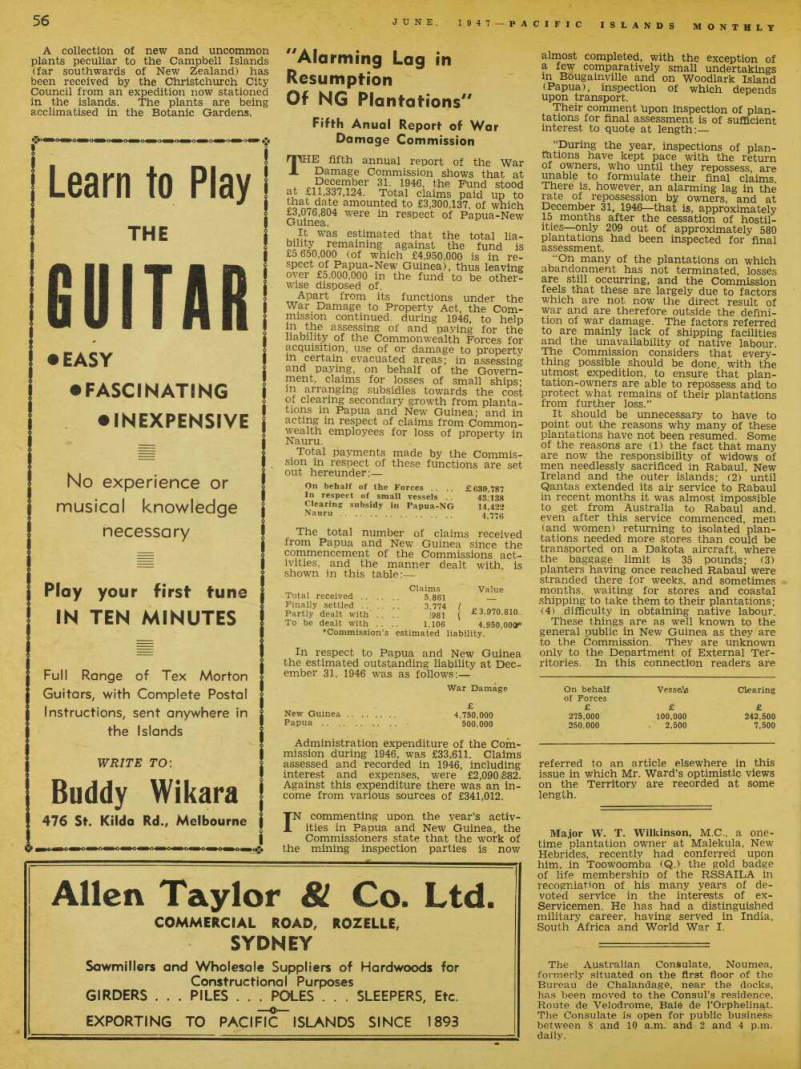
"Alarming Lag in Resumption Of NG Plantations"
Fifth Anual Report of War Damage Commission
rE fifth annual report of the War Damage Commission shows that at , „;9®cember 31 - 1946. the Fund stood Total ciaims paid up to i; a l d n a Je amounted to £3,300,137, of which £3.076,804 were in respect of Papua-New Guinea.
It was estimated that the total lia bility remaining against the fund is £5 650,000 (of which £4,950,000 is in re spect of Papua-New Guinea), thus leaving over £5,000,000 in the fund to be other wise disposed of.
Apart from its functions under the War Damage to Property Act, the Com mission continued, during 1946. to help Jf 1 the assessing of and paying for the liability of the Commonwealth Forces for acquisition, use of or damage to property m certain evacuated areas; in assessing and paying, on behalf of the Govern ment, claims for losses of small ships in arranging subsidies towards the cost of clearing secondary growth from planta tions in Papua and New Guinea; and in acting in respect of claims from Common wealth employees for loss of property in Nauru.
Total payments made by the Commis sion in respect of these functions are set out hereunder:— On behalf of the Forces .. .. £630,787 In respect of small vessels . . 43;138 Clearing subsidy in Papua-NG 14,422 Nauru 4,776 The total number of claims received from Papua and New Guinea since the commencement of the Commissions act ivities, and the manner dealt with, is shown in this table:—
In respect to Papua and New Guinea the estimated outstanding liability at Dec ember 31, 1946 was as follows:
Administration expenditure of the Com mission during 1946, was £33,611. Claims assessed and recorded in 1946, including interest and expenses, were £2,090(882.
Against this expenditure there was an in come from various sources of £341,012.
IN commenting upon the year’s activ ities in Papua and New Guinea, the Commissioners state that the work of the mining inspection parties is now
almost completed, with the exception of a few comparatively small undertakings in Bougainville and on Woodlark Island (Papua), inspection of which depends upon transport.
Their comment upon inspection of plan tations for final assessment is of sufficient interest to quote at length:— “During the year, inspections of plan tations have kept pace with the return of owners, who until they repossess, are unable to formulate their final claims There is, however, an alarming lag in the rate of repossession by owners, and at December 31, 1946—that is, approximately 15 months after the cessation of hostil ities—only 209 out of approximately 580 plantations had been inspected for final assessment.
“On many of the plantations on which abandonment has not terminated, losses are still occurring, and the Commission feels that these are largely due to factors which are not now the direct result of war and are therefore outside the defini tion of war damage. The factors referred to are mainly lack of shipping facilities and the unavailability of native labour.
The Commission considers that every thing possible should be done, with the utmost expedition, to ensure that plan tation-owners are able to repossess and to protect what remains of their plantations from further loss.”
It should be unnecessary to have to point out the reasons why many of these plantations have not been resumed. Some of the reasons are (1) the fact that many are now the responsibility of widows of men needlessly sacrificed in Rabaul, New Ireland and the outer islands; (2) until Qantas extended its air service to Rabaul in recent months it was almost impossible to get from Australia to Rabaul and, even after this service commenced, men (and women) returning to isolated plan tations needed more stores than could be transported on a Dakota aircraft, where the baggage limit is 35 pounds; (3) planters having once reached Rabaul were stranded there for weeks, and sometimes months, waiting for stores and coastal shipping to take them to their plantations; (4) difficulty in obtaining native labour.
These things are as well known to the general public in New Guinea as they are to the Commission. They are unknown only to the Department of External Ter ritories. In this connection readers are
referred to an article elsewhere in this issue in which Mr. Ward’s optimistic views on the Territory are recorded at some length.
Major W. T. Wilkinson, M.C., a one time plantation owner at Malekula, New Hebrides, recently had conferred upon him, in Toowoomba (Q.) the gold badge of life membership of the RSSAILA in recogniation of his many years of de voted service in the interests of ex- Servicemen. He has had a distinguished military career, having served in India, South Africa and World War I.
The Australian Consulate, Noumea, formerly situated on the first floor of the Bureau de Chalandage, near the docks, has been moved to the Consul’s residence, Route de Velodrome, Baie de I’Orphelinat.
The Consulate is open for public business between 8 and 10 a.m. and 2 and 4 p.m. daily.
Total received .. ..
Claims 5.861 Value Finally settled .. 3,774 ( £3.970,810 Partly dealt with .. 1981 To be dealt with .. 1,106 4.950,000*' ♦Commission’s estimated liability.
War Damage £ New Guinea 4.750,000 Papua 500,000
On behalf VessaVs Clearing of Forces £ £ £ 275.000 100,000 242,500 250.000 2,500 7,500
Advertisements & other items, pp. 59-60 (2 items)
57
MR. WHITE AND MR. WARD
(Continued from page 24,
PACIFIC ISLANDS MONTHLY JUNE. 1947
Widdop
When Worried
Tired,Sleepless
AND YOU FEEL RUN-DOWN
is Inescapable. Everyone has a share of it more or less. The great trouble about worry Is that It plays havoc with your health and fitness if you let it. You become mentally and bodily weary, depressed: cannot sleep at night, lose appetite and begin to feel a nervous breakdown is impending. That starts the vicious circle. You worry, become run-down and nervy, and that makes you worry more than ever.
Meet your troubles all the way by reinvigorating your system and keeping it fit and well by taking Dr. Williams’ Pink Pills. These pills help to restore the red corpuscles and iron content of the blood to their normal quantity.
This enables life-giving oxygen and nourishment to be carried to the nerves, organs and tissues of the body. In that way you become invigorated, strengthened by Dr. Williams’ Pink Pills, the vague aches and pains disappear and you are fit again to deal confidently with all your worries. At chemists and stores.
DIESEL ENGINES
WIDDOP
5 H• P TO 300 H-P
H • WIDDOP & CO LTD
GREENGATE KEIGHLEY ENGLAND
Telephone: Keighley 3727-8 Telegrams: Widdop Keighley Codes: A.B.C. 6th Edition, Bentley’s, Bentley’s Second r £ X M w |y t> fall to ) 9 t' I Above:
(D-Type)
36/45 H.P.
On left; (X-Type) 120 H.P.
Direct reversing > cvs—B6
QUEENSLAND
INSURANCE
COMPANY
LIMITED
(Incorporated 1886 In Australia)
ASSETS EXCEED £4,000,000
Head Office :
QUEENSLAND
INSURANCE BUILDING,
80-82 PITT STREET, SYDNEY.
Speciolists in South Seas Fire,
Marine & Accident Insurances
Apply to:—
FIJI.
Branch Office: I. B. Chalmers, Manager.
Burns Philp (South Sea) Co., Ltd.
VILA.
Burns Philp (South Sea) Co., Ltd.
Comptolrs Francais Des Nouvelles Hebrides (Marine).
NOUMEA.
L. <fe W. Johnston.
PORT MORESBY:
Burns, Philp & Co., Ltd.
W. A. Anderson, Resident Officer.
PAGO PAGO.
Burns Philp (South Sea) Co., Ltd.
G. H. C. Reid & Co.
OTHER SOUTH SEA ISLANDS.
Burns Philp (South Sea) Co., Ltd.
Also to any of the Company's Offices in Australia or New Zealand.
Bnlrwit
57 Perfectly prepared, by exclusive Heinz methods, these are the world's most famous fine soups.
The Public Servant Angle
HTHE following opinions of a public ser * vant who normally lives in Port Moresby are of interest. It is nresumably men like this whom Mr. Ward had in mind when he made his statement about “certain disappointed people.” This inter view, if nothing else, shows that there is as little real liaison between Port Moresby and Canberra now as in the dimmest days
of the anti-Labour governments, to whom Mr. Ward also refers scathingly; and that in Port Moresby itself there is little communication between “Heads of De partments” and “rank and file.”
Our public servant, in summing up the present state of affairs in the provisional Territory’s public service says: AS the Minister promised, Mr. C. W.
Buttsworth, of the Chief Secretary’s Department, NSW, visited Port Moresby about seven months ago and his report, which is extremely hush-hush, was forwarded to the Administrator for his comment. None of the rank and file yet know what Mr. Buttsworth’s recommenda tions were, but a whisper says that one’ was for an average increase of about £7O a year on all salaries. (See Minister’s statement above about £72 per annum in crease for minimum salaries. He stated this on May 1, but on May 31, when this interview took place, our public servant was ignorant of it.) If this is true, it is not enough—cost of living in Moresby is rising with the arrival of every ship. Two items which I can remember off-hand are eggs at 4/6 per dozen and oranges at 9d. each. Having young children in that part of the world is an expensive hobby.
It is freely rumoured, in Moresby, that the Buttsworth report was considered by all Heads of Departments, and an en deavour was made to have some finality before the Minister left for Geneva. It is also rumoured that the Administrator was disappointed in the Buttsworth recbmmen dations on salary increases, and has sup ported the Heads in an effort to obtain larger salary increases.
The type of officer who is attracted to the New Guinea territories depends on the conditions of service offered in these
days men are not carried far by a sense of missionary zeal alone. Until the Aus tralian government is prepared to pay attractive salaries, the best men will not be available and the successful adminis tration of the Territories is doomed. Some of the recent appointees from the School of Pacific Administration in Sydney have lasted only a short time. Their salaries are not sufficient to maintain a man and his family at the reasonable standard expected in the tropics.
It is impossible for me to say whether or not any of the grievances, which were aired at a public meeting in Port Moresby last August, have been met until the Minister has given his decision on the Buttsworth report, but I do know that the seven months’ delay in adjusting salaries is causing unrest.
Some married officers are feeling the pinch and their wives have taken local employment, or are sewing under contract to local firms in order to ease the burden.
The housing position in Moresby has not changed very much since August. A cer tain number of temporary houses have been built they are comfortable despite their smallness and the fact that they are largely constructed of sisalkraft. But these houses have been built by the officers who occupy them and the Administration cannot take credit for having erected them.
One of the main causes of delay in housing is, of course, the slowness of the Commonwealth Department of Works and Housing in drawing up town-plans for these areas. Everyone is held back by the fear that whatever is built to-day may have to be tom down next week to make way for the garden cities of the town-planners.
Possibly the greatest factor in public service unrest is the failure of the Aus
tralian Government to promulgate the Public Service Ordinance and Regulations.
This, of course, may be the fault of the Department, rather than the Minister of that Department. There is also a great feeling of uncertainty regarding the future.
Ninety-nine per cent, of the present ser vice personnel are filling positions which may or may not be theirs when the per manent Administration comes into being.
Consequently, no officer is able to make any real plans for the future. This creates a sense of uncertainty which is entirely foreign to the public servant under normal circumstances.
With regard to friction between the Papuan public servants and those whose allegiance is north of the border it is hoped that this will be submerged once a new organisation called the Public Service Association of Papua- New Guinea is formed, as it should be shortly. Hitherto there have been two organisations, of course, but the new body will replace these. It is hoped that there by the differences between those from south and from north of the border will be forgotten.
Successor to M. Robineau as Noumea harbour-master is M. Artigue, a former officer on board the “Polynesien”. For part of the war M. Artigue was in com mand of the Free French Navy in New Caledonia. He is now on his way back from France. M. de Mersuay, who has provisionally been carrying out the duties of harbour-master, has been appointed in the same capacity to Jibouti, French Somaliland. M. Robineau’s retirement will cause regret among Australian sea men, among whom he numbered many friends made during his Noumea career of 30 years or more.
Advertisements & other items, pp. 61-62 (1 item)
Day-Old
Chicks
BY AIR
Amalgamated Hatcheries
(Reg.) of Bankstown, near Sydney, N.S.W., can dispatch limited numbers of chicks by
PLANE TO
RABAUL, PORT MORESBY,
LAE, NOUMEA, SUVA.
and all other islands of the Pacific served by present AND PROJECTED air services.
Amalgamated Hatcheries are the largest distributors of dayold chicks in Australia, last year over 1,000,000 chicks being sold by us in N.S.W. alone.
Our scientific method of packing and dispatch has resulted in a loss of less than 1 per cent, of chicks sent by plane.
If any chicks in your consignment arrive dead, we will replace them frees provided the extra freight is paid by the purchaser.
Chicks available are R.1.R., Austrolorps, and W.L.
Price, £lO per 100, landed at your airport, for unsexed chicks, and £l4 per 100 for all pullets. (Guaranteed 96 per cent, accurate sexing.) These chicks are the cream of Australia’s stock, produced under ultra - violet rays to guard against disease; the adult stock is blood-tested monthly by veterinary officers and each individual order carries a N.S.W.
Government certificate that the chicks are healthy and from tested stock.
Payment for chicks should be made by draft with the order, or credit arranged through our Bankers, the Commercial Bank of Australia, Ltd., Bankstown,
N.S.W.
Drafts and remittances can be sent direct to Amalgamated Hatcheries, Bankstown, N.S.W., or to the following agents: Messrs. Burns, Philp (South Sea) Co., Suva-Ba-Fiji, or any Island Branch. Also to: Marcel Legras, 38 Rue de Verdun, Noumea.
WRITE BY AIR-MAIL OR
CABLE.
AMALGAMATED
HATCHERIES
BANKSTOWN, N.S.W.
G. H. Robinson
ISLAND SUPPLIES
of all kinds—Selected and Shipped to order at lowest possible prices—Piecegoods in Wool, Cotton and Silk, Under and Outerwear, Manchester, Drapery, Grocery, Hardware, Engineers and Leathergoods trade supplies a specialty.
Indents and Transhipments arranged. Large or small orders treated with equal care.
Use our 25 years’ extensive experience.
Enquiries solicited to —
G. H. ROBINSON
51 Macquarie Street, Sydney, N.S.W.
Telegrams: Sunrise, Sydney.
Letters: Box 3317, G.P.0., Sydney.
T w 0 □
RJ2. 18 H.P. MARINE DIESEL
Driving 21 in. x 1 siin.
Propelled at 740 RPM Reliable Efficient • Economical • Easy Starting
GOOD DELIVERIES
Stuart Turner
Marine Engines
H, 4 and 8 BHP Reduction Gear and Electric Starting Models available.
Light, Simple, Economical, General Purpose Units Suitable for 25-35 ft. craft.
Write for full particulars of our complete range of engines to:
Thornycroft (Aust.) Pty., Ltd.
Cables: THORNMOTOR, Sydney.
With NZ

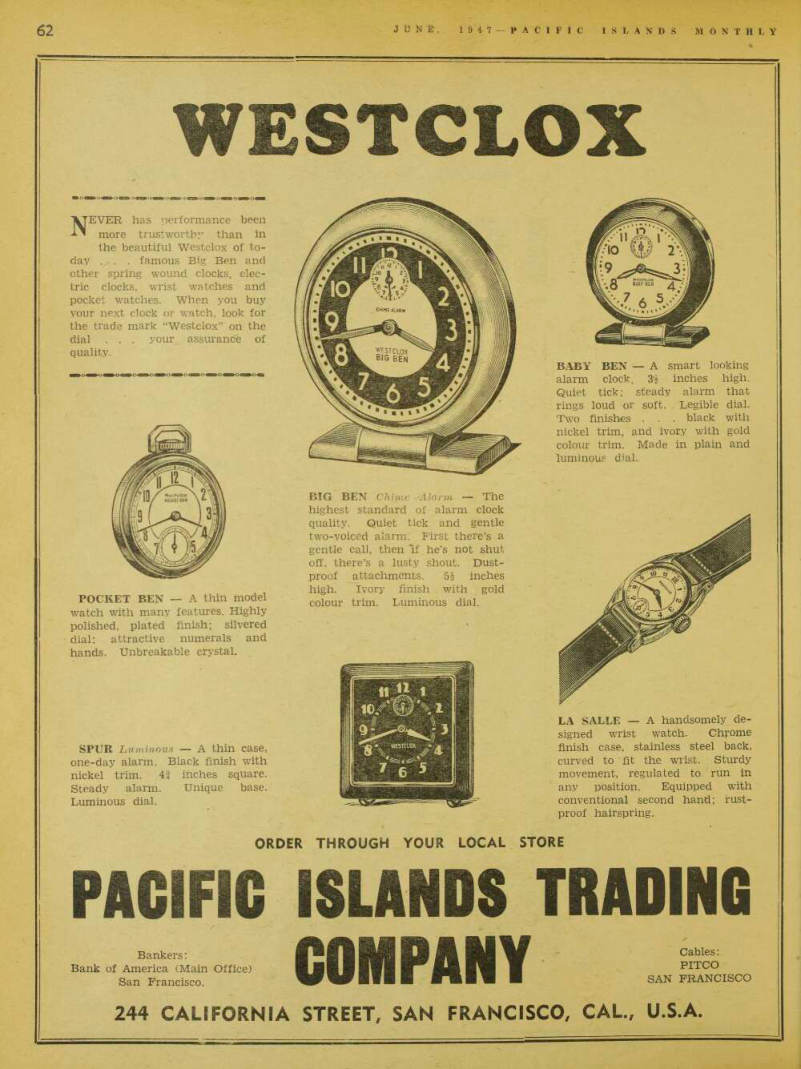
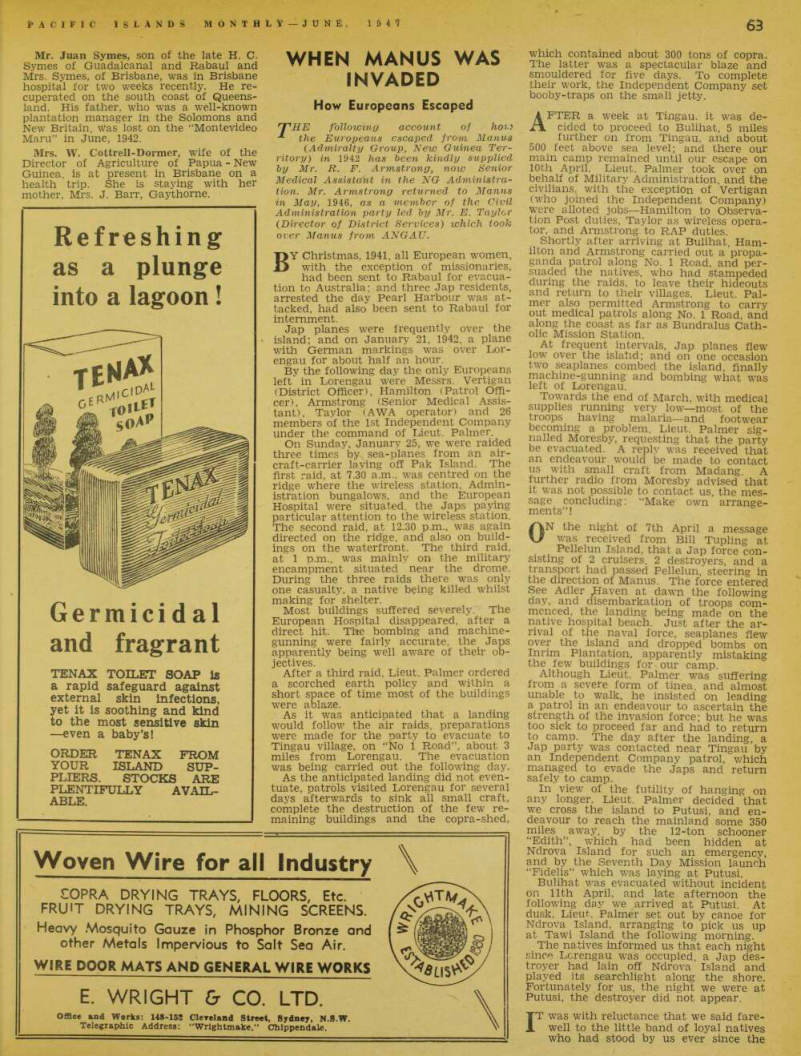
Fiji Maintains Trade With NZ Banana Export Pool Disbanded
From Our Own Correspondent
Suva. May 19
FIJI’S Banana Export Board has been liquidated after controlling the ex port of bananas in Fiji since Sep tember, 1939.
Banana-buying licence-holders will now dispose of their fruit themselves either to the New Zealand Internal Marketing Division or to the official Canadian agents, Oppenheimer Bros, and Co., Vancouver.
During April, New Zealand bought 580.860 lb. of Fiji bananas for £3,697; coco nut meal, 356.160 lb. for £1,431, and pea nuts. 141.600 lb. for £5.310.
Fruit, vegetables, green ginger, rice, bran and candlenut meal helped to make up the April total of £11,056.
These figures, of course, refer onlv to fruit and produce exported to New Zea land. Figures for sugar and copra which are sent to the Northern Hemisphere are not yet available.
The principal value of the figures quoted is that they give an indication of the way in which Fiji is maintaining its foothold in the New Zealand markets des pite the Dominion’s natural preference for its own tropical territories of Cook Islands. Western Samoa and Niue.
Miss Irene Lucas entertained nine guests at a farewell party at Prince’s, Brisbane, on May 17, in honour of Mrs. Howard Smith of Chelmer. Mrs. Smith will leave for Port Moresby at the end of May to rejoin her husband.
Mr. Juan Symes, son of the late H. C.
Symes of Guadalcanal and Rabaul and Mrs. Symes, of Brisbane, was in Brisbane hospital for two weeks recently. He re cuperated on the south coast of Queens land. His father, who was a well-known plantation manager in the Solomons and New Britain, was lost on the “Montevideo Maru” in June, 1942.
Mrs. W. Cottrell-Dormer, wife of the Director of Agriculture of Papua - New Guinea, is at present in Brisbane on a health trip. She is staying with her mother, Mrs. J. Barr, Gaythorne.
Advertisements & other items, pp. 63-65 (2 items)
61
pacific islands montsly juke, 194?
I Pan A
*yOtl,
TOOTH PASTE
IP AN A helps your smile by thoroughly cleaning and brilliantly polishing your teeth. And IPANA’S refreshingly different taste is grand —it makes your mouth feel good. With massage, too, IPANA helps ensure firm, healthy gums so vital to sound teeth. /• \ /Li
rcfafrVj
I L n 0° 0* M V co w- (4IW
WESTCLOX
NEVER has performance been more trustworthy than in the beautiful Westclox of today . . . famous Big Ben and other spring wound clocks, electric clocks, wrist watches and pocket watches. When you buy your next clock or watch, look for the trade mark “Westclox” on the dial . . . your assurance of quality.
POCKET BEN A thin model watch with many features. Highly polished, plated finish; silvered dial; attractive numerals and hands. Unbreakable crystal.
SPUR Luminous A thin case, one-day alarm. Black finish with nickel trim. 41 inches square.
Steady alarm. Unique base.
Luminous dial.
BIG
BEN
BIG BEN Chipie •Alarm The highest standard of alarm clock quality. Quiet tick and gentle two-voiced alarm. First there’s a gentle call, then If he’s not shut off. there’s a lusty shout. Dustproof attachments. 5i inches high. Ivory finish with gold colour trim. Luminous dial. ; 10 BABY BEN A smart looking alarm clock, 3ft inches high.
Quiet tick; steady alarm that rings loud or soft. Legible dial.
Two finishes . . . black with nickel trim, and ivory with gold colour trim. Made in plain and luminous dial.
B LA SALLE A handsomely designed wrist watch. Chrome finish case, stainless steel back, curved to fit the wrist. Sturdy movement, regulated to run in any position. Equipped with conventional second hand; rustproof hairspring.
ORDER THROUGH YOUR LOCAL STORE
PACIFIC ISLANDS TRADING
COMPANY
244 CALIFORNIA STREET, SAN FRANCISCO, CAL., U.S.A.
Bankers: Bank of America (Main Office) San Francisco.
Cables:
PITCO
SAN FRANCISCO
Refreshing
as a plunge
into a lagoon!
Cl P AL
o SO
Germicidal
and fragrant
TENAX TOILET SOAP is
a rapid safeguard against external skin infections, yet it is soothing and kind to the most sensitive skin —even a baby’s!
ORDER TENAX FROM
YOUR ISLAND SUP-
PLIERS. STOCKS ARE
PLENTIFULLY AVAIL-
ABLE.
Woven Wire for all Industry
COPRA DRYING TRAYS, FLOORS, Etc.
FRUU DRYING TRAYS, MINING SCREENS.
Heavy Mosquito Gauze in Phosphor Bronze and other Metals Impervious to Salt Sea Air.
WIRE DOOR MATS AND GENERAL WIRE WORKS
E. WRIGHT & CO. LTD.
Office and Works: 148-152 Cleveland Street, Sydney, N.B.W.
Telegraphic Address: "Wrightmake,” Chippendale.
T £ LO rC
When Manus Was
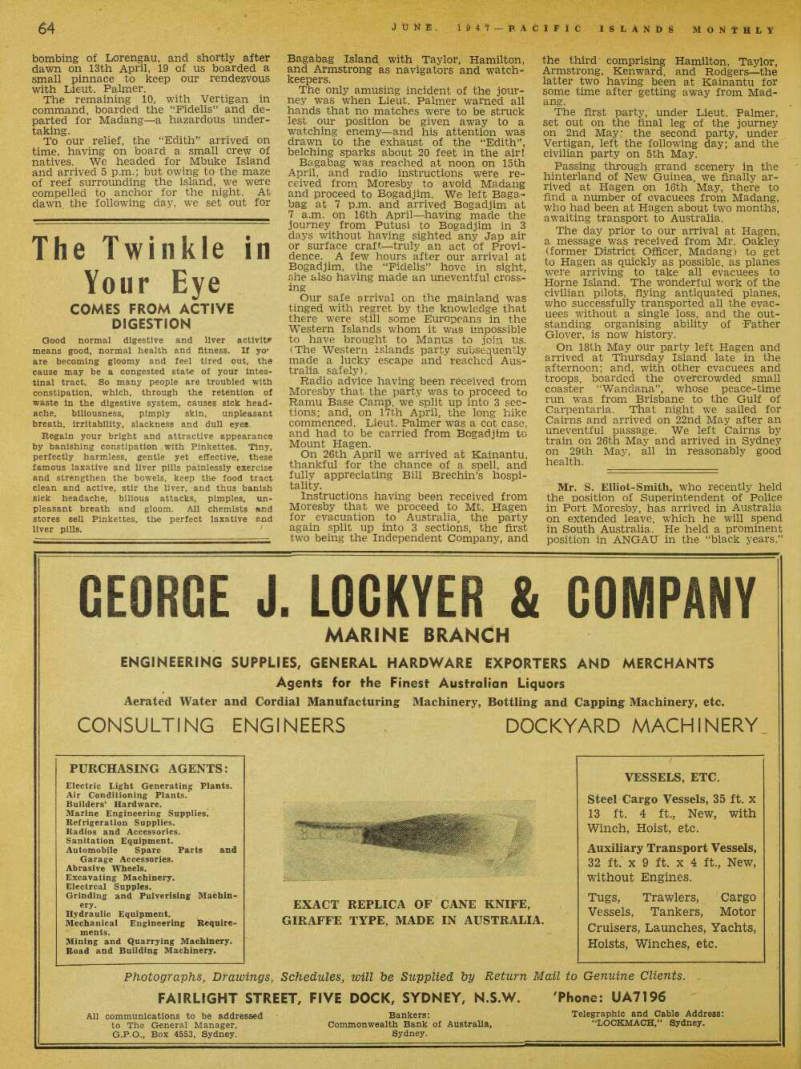
Invaded
How Europeans Escaped
'T'HE following account of how the Europeans escaped from Manus (Admiralty Group, New Guinea Ter ritory) in 1942 has been kindly supplied by Mr. R. F. Armstrong, now Senior Medical Assistant in the NG Administra tion. Mr. Armstrong returned to Manns in May, 1946, as a member of the Civil Administration party led by Mr. E. Taylor (Director of District Services) which took over Manus from ANGAU.
BY Christmas, 1941, all European women, with the exception of missionaries, had been sent to Rabaul for evacua tion to Australia; and three Jap residents, arrested the day Pearl Harbour was at tacked, had also been sent to Rabaul for internment.
Jap planes were frequently over the island; and on January 21, 1942. a plane with German markings was over Lor engau for about half an hour.
By the following day the only Europeans left in Lorengau were Messrs. Vertigan (District Officer), Hamilton (Patrol Offi cer). Armstrong (Senior Medical Assis tant), Taylor (AWA operator) and 26 members of the Ist Independent Company under the command of Lieut. Palmer.
On Sunday, January 25, we were raided three times by sea-planes from an air craft-carrier laving off Pak Island. The first raid, at 7.30 a.m., was centred on the ridge where the wireless station, Admin istration bungalows, and the European Hospital were situated, the Japs paying particular attention to the wireless station.
The second raid, at 12.30 p.m., was again directed on the ridge, and also on build ings on the waterfront. The third raid, at 1 n.m., was mainly on the military encampment situated near the drome.
During the three raids there was only one casualty, a native being killed whilst making for shelter.
Most buildings suffered severely. The European Hosnital disappeared, after a direct hit. The bombing and machine gunning were fairly accurate, the Japs apparently being well aware of their ob jectives.
After a third raid, Lieut. Palmer ordered a scorched earth policy and within a short space of time most of the buildings were ablaze.
As it was anticipated that a landing would follow the air raids, preparations were made for the natty to evacuate to Tingau village, on “No 1 Road”, about 3 miles from Lorengau. The evacuation was being carried out the following day.
As the anticipated landing did not even tuate, patrols visited Lorengau for several days afterwards to sink all small craft, complete the destruction of the few re maining buildings and the copra-shed,
which contained about 300 tons of copra.
The latter was a spectacular blaze and smouldered for five days. To complete their work, the Independent Company set booby-traps on the small jetty, AFTER a week at Tingau. it was de cided to proceed to Bulihat, 5 miles further on from Tingau, and about 500 feet above sea level; and there our main camp remained until our escape on 10th April. Lieut. Palmer took over on behalf of Military Administration, and the civilians, with the exception of Vertigan (who joined the Independent Company) were alloted jobs—Hamilton to Observa tion Post duties, Taylor as wireless opera tor, and Armstrong to RAP duties.
Shortly after arriving at Bulihat, Ham ilton and Armstrong carried out a propa ganda patrol along No. 1 Road, and per suaded the natives, who had stampeded during the raids, to leave their hideouts and return to their villages. Lieut. Pal mer also permitted Armstrong to carry out medical patrols along No. 1 Road, and along the coast as far as Bundralus Cath olic Mission Station.
At frequent intervals, Jap planes flew low over the island; and on one occasion two seaplanes combed the island, finally machine-gunning and bombing what was left of Lorengau.
Towards the end of March, with medical supplies running very low—most of the troops having malaria—and footwear becoming a problem, Lieut. Palmer sig nalled Moresby, requesting that the party be evacuated. A reply was received that an endeavour would be made to contact us with small craft from Madang. A further radio from Moresby advised that it was not possible to contact us, the mes sage concluding: “Make own arrange ments”!
ON the night of 7th April a message was received from Bill Tupling at Pellelun Island, that a Jap force con sisting of 2 cruisers. 2 destroyers, and a transport had passed Pellelun, steering in the direction of Manus. The force entered See Adler .Haven at dawn the following day, and disembarkation of troops com menced, the landing being made on the native hospital beach. Just after the ar rival of the naval force, seaplanes flew over the island and dropped' bombs on Inrim Plantation, apparently mistaking the few buildings for our camp.
Although Lieut. Palmer was suffering from a severe form of tinea, and almost unable to walk, he insisted on leading a patrol in an endeavour to ascertain the strength of the invasion force; but he was too sick to proceed far and had to return to camp. The day after the landing, a Jap party was contacted near Tingau by an Independent Company patrol, which managed to evade the Japs and return safely to camp.
In view of the futility of hanging on any longer, Lieut. Palmer decided that we cross the island to Putusi, and en deavour to reach the mainland some 350 miles away, by the 12-ton schooner “Edith”, which had been hidden at Ndrova Island for such an emergency, and by the Seventh Day Mission launch “Fidelis” which was laying at Putusi.
Bulihat was evacuated without incident on 11th April, and late afternoon the following day we arrived at Putusi. At dusk, Lieut. Palmer set out by canoe for Ndrova Island, arranging to pick us up at Tawi Island the following morning.
The natives informed us that each night since Lorengau was occupied, a Jap des troyer had lain off Ndrova Island and played its searchlight along the shore.
Fortunately for us, the night we were at Putusi, the destroyer did not appear.
IT was with reluctance that we said fare well to the little band of loyal natives who had stood by us ever since the
bombing of Lorengau, and shortly after dawn on 13th April, 19 of us boarded a small pinnace to keep our rendezvous with Lieut. Palmer.
The remaining 10, with Vertigan in command, boarded the “Fidelis” and de parted for Madang—a hazardous under taking.
To our relief, the “Edith” arrived on time, having on board a small crew of natives. We headed for Mbuke Island and arrived 5 p.m.; but owing to the maze of reef surrounding the island, we were compelled to anchor for the night. At dawn the following day, we set out for
Bagabag Island with Taylor, Hamilton, and Armstrong as navigators and watch keepers.
The only amusing incident of the jour ney was when Lieut. Palmer warned all hands that no matches were to be struck lest our position be given away to a watching enemy—and his attention was drawn to the exhaust of the “Edith”, belching sparks about 20 feet in the air!
Bagabag was reached at noon on 15th April, and radio instructions were re ceived from Moresby to avoid Madang and proceed to Bogadjim. We left Baga bag at 7 p.m. and arrived Bogadjim at 7 a.m. on 16th April—having made the journey from Putusi to Bogadjim in 3 days without having sighted any Jap air or surface craft—truly an act of Provi dence. A few hours after our arrival at Bogadjim, the “Pidelis” hove in sight, she also having made an uneventful cross ing Our safe arrival on the mainland was tinged with regret by the knowledge that there were still some Europeans in the 'Western Islands whom it was impossible to have brought to Manus to join us. (The Western islands party subsequently made a lucky escape and reached Aus tralia safely).
Radio advice having been received from Moresby that the party was to proceed to Ramu Base Camp, we split up into 3 sec tions: and, on 17th April, the long hike commenced. Lieut. Palmer was a cot case, and had to be carried from Bogadjim to Mount Hagen.
On 26th April we arrived at Kainantu, thankful for the chance of a spell, and fully appreciating Bill Brechin’s hospi tality.
Instructions having been received from Moresby that we proceed to Mt. Hagen for evacuation to Australia, the party again split up into 3 sections, the first two being the Independent Company, and
the third comprising Hamilton, Taylor, Armstrong, Kenward, and Rodgers—the latter two having been at Kainantu for some time after getting away from Mad ang.
The first party, under Lieut. Palmer, set out on the final leg of the journey on 2nd May: the second party, under Vertigan, left the following day; and the civilian party on sth May.
Passing through grand scenery in the hinterland of New Guinea, we finally ar rived at Hagen on 16th May, there to find a number of evacuees from Madang, who had been at Hagen about two months, awaiting transport to Australia.
The day prior to our arrival at Hagen, a message was received from Mr. Oakley (former District Officer, Madang) to get to Hagen as quickly as possible, as planes were arriving to take all evacuees to Horne Island. The wonderful work of the civilian pilots, flying antiquated planes, who successfully transported all the evac uees without a single loss, and the out standing organising ability of Father Glover, is now history.
On 18th May our party left Hagen and arrived at Thursday Island late in the afternoon; and, with other evacuees and troops, boarded the overcrowded small coaster “Wandana”, whose peace-time run was from Brisbane to the Gulf of Carpentaria. That night we sailed for Cairns and arrived on 22nd May after an uneventful passage. We left Cairns by train on 26th May and arrived in Sydney on 29th May, all in reasonably good health.
Mr. S. Elliot-Smith, who recently held the position of Superintendent of Police in Port Moresby, has arrived in Australia on extended leave, which he will spend in South Australia. He held a prominent position in ANGAU in the “black years.”
Advertisements & other items, p. 66 (2 items)
64
JUNE. IMI-RACIFIC ISLANDS MONTHLY
George J. Lockyer & Company
The Twinkle in
Your Eye
COMES FROM ACTIVE
DIGESTION
Good normal digestive and liver activity means good, normal health and fitness. If yo* are becoming gloomy and feel tired out, the cause may be a congested state of your intestinal tract. So many people are troubled with constipation, which, through the retention of waste in the digestive system, causes sick headache, biliousness, pimply skin, unpleasant breath, irritability, slackness and dull eyes.
Regain your bright and attractive appearance by banishing constipation with Pinkettes. Tiny, perfectly harmless, gentle yet effective, these famous laxative and liver pills painlessly exercise and strengthen the bowels, keep the food tract clean and active, stir the liver, and thus banish sick headache, bilious attacks, pimples, unpleasant breath and gloom. All chemists and stores sell Pinkettes, the perfect laxative fcnd liver pills.
GEORGE J. LOCKYER & COMPANY
MARINE BRANCH
ENGINEERING SUPPLIES, GENERAL HARDWARE EXPORTERS AND MERCHANTS Agents for the Finest Australian Liquors Aerated Water and Cordial Manufacturing Machinery, Bottling and Capping Machinery, etc.
CONSULTING ENGINEERS DOCKYARD MACHINERY.
Photographs, Drawings , Schedules, will he Supplied hy Return Mail to Genuine Clients.
FAIRLIGHT STREET, FIVE DOCK, SYDNEY, N.S.W. 'Phone: UA7196 All communications to be addressed Bankers: Telegraphic and Cable Address: to The General Manager, Commonwealth Bank of Australia, '‘LOCKMACH,” Sydney.
G.P.0., Box 4553, Sydney. Sydney.
VESSELS, ETC.
Steel Cargo Vessels, 35 ft. x 13 ft. 4 ft., New, with Winch, Hoist, etc.
Auxiliary Transport Vessels, 32 ft. x 9 ft, x 4 ft., New, without Engines.
Tugs, Trawlers, Cargo Vessels, Tankers, Motor Cruisers, Launches, Yachts, Hoists, Winches, etc.
PURCHASING AGENTS:
Electric Light Generating Plants.
Air Conditioning Plants.' Builders’ Hardware.
Marine Engineering Supplies.
Refrigeration Supplies.
Radios and Accessories.
Sanitation Equipment.
Automobile Spare Farts and Garage Accessories.
Abrasive Wheels.
Excavating Machinery.
Electrcal Supples.
Grinding and Pulverising Machinery.
Hydraulic Equipment.
Mechanical Engineering Requirements.
Mining and Quarrying Machinery.
Road and Building Machinery.
EXACT REPLICA OF CANE KNIFE,
GIRAFFE TYPE, MADE IN AUSTRALIA
"Sabotage" At
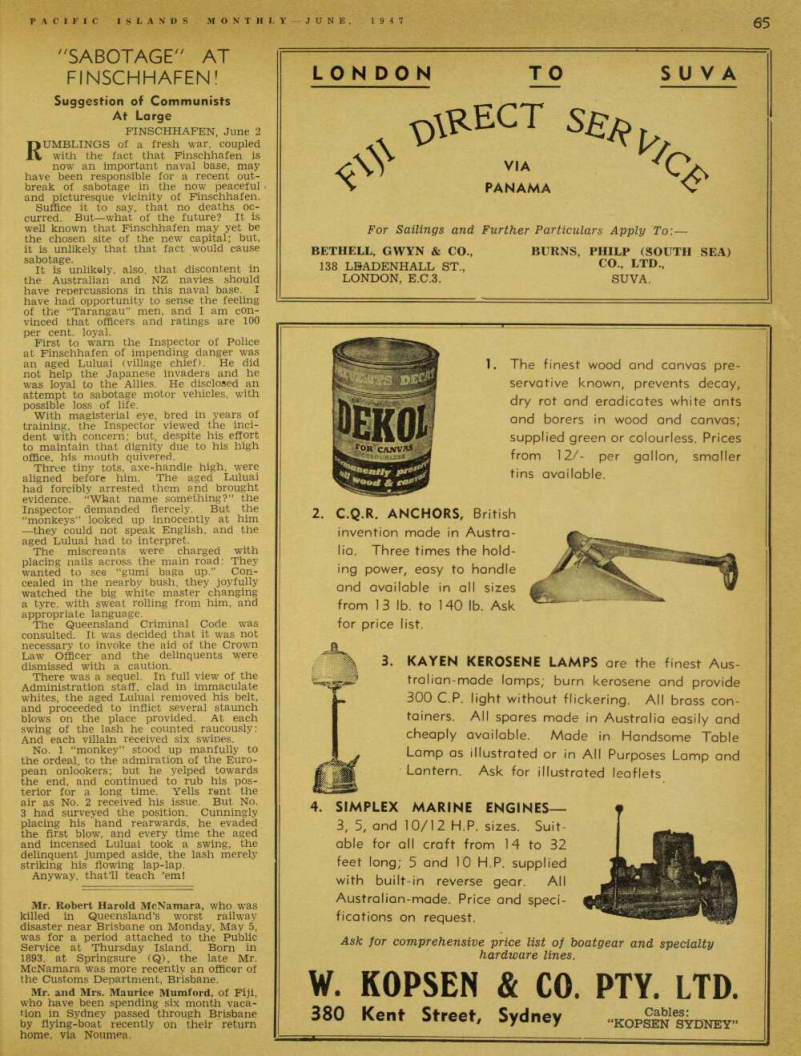
Finschhafen!
Suggestion of Communists At Large
Finschhafen. June 2
RUMBLINGS of a fresh war, coupled with the fact that Finschhafen is now an important naval base, may have been responsible for a recent out break of sabotage in the now peaceful and picturesque vicinity of Finschhafen.
Suffice it to say, that no deaths oc curred. But—what of the future? It is well known that Finschhafen may yet be the chosen site of the new capital; but, it is unlikely that that fact would cause sabotage.
It is unlikely, also, that discontent in the Australian and NZ navies should have repercussions in this naval base. I have had opportunity to sense the feeling of the “Tarangau” men, and I am con vinced that officers and ratings are 100 per cent, loyal.
First to warn the Inspector of Police at Finschhafen of impending danger was an aged Luluai (village chief). He did not help the Japanese invaders and he was loyal to the Allies. He disclosed an attempt to sabotage motor vehicles, with possible loss of life.
With magisterial eye, bred in years of training, the Inspector viewed the inci dent with concern; but, despite his effort to maintain that dignity due to his high office, his mouth quivered.
Three tiny tots, axe-handle high, were aligned before him. The aged Luluai had forcibly arrested them and brought evidence. “What name something?” the Inspector demanded fiercely. But the “monkeys” looked up innocently at him —they could not speak English, and the aged Luluai had to interpret.
The miscreants were charged with placing nails across the main road: They wanted to see “gumi baga up.” Con cealed in the nearby bush, they joyfully watched the big white master changing a tyre, with sweat rolling from him, and appropriate language.
The Queensland Criminal Code was consulted. It was decided that it was not necessary to invoke the aid of the Crown Law Officer and the delinquents were dismissed with a caution.
There was a sequel. In full view of the Administration staff, clad in immaculate whites, the aged Luluai removed his belt, and proceeded to inflict several staunch blows on the place provided. At each swing of the lash he counted raucously: And each villain received six swipes.
No. 1 “monkey” stood up manfully to the ordeal, to the admiration of the Euro pean onlookers; but he yelped towards the end, and continued to rub his pos terior for a long time. Yells rent the air as No. 2 received his issue. But No. 3 had surveyed the position. Cunningly placing his hand rearwards, he evaded the first blow, and every time the aged and incensed Luluai took a swing, the delinquent jumped aside, the lash merely striking his flowing lap-lap.
Anyway, that’ll teach ’em!
Mr. Robert Harold McNamara, who was killed in Queensland’s worst railway disaster near Brisbane on Monday, May 5, was for a period attached to the Public Service at Thursday Island. Born in 1893. at Springsure (Q), the late Mr.
McNamara was more recently an officer of the Customs Department, Brisbane.
Mr. and Mrs. Maurice Mumford, of Fiji, who have been spending six month vaca tion in Sydney passed through Brisbane by flying-boat recently on their return home, via Noumea.
Advertisements & other items, p. 67 (1 item)
W. Kopsen & Co. Pty. Ltd.
LONDON TO SUVA
VIA
PANAMA
For Sailings and Further Particulars Apply To : BETHELL, GWYN & CO., BURNS, PHILP (SOUTH SEA) 138 LBADENHALL ST., co > LTD >
LONDON, E.C.3. SUVA.
*35 C <*
casviiM 1. The finest wood and canvas preservative known, prevents decay, dry rot and eradicates white ants and borers in wood and canvas; supplied green or colourless. Prices from 12/- per gallon, smaller tins available. 2. C.Q.R. ANCHORS, British invention made in Australia. Three times the holding power, easy to handle and available in all sizes from 13 lb. to 140 lb. Ask for price list. 3. KAYEN KEROSENE LAMPS are the finest Australian-made lamps; burn kerosene and provide 300 C.P. light without flickering. All brass containers. All spares made in Australia easily and cheaply available. Made in Handsome Table Lamp as illustrated or in All Purposes Lamp and Lantern. Ask for illustrated leaflets
4. SIMPLEX MARINE ENGINES—
3, 5, and 10/12 H.P. sizes. Suitable for all craft from 14 to 32 feet long; 5 and 10 H.P. supplied with built-in reverse gear. All Australian-made. Price and specifications on request.
Ask for comprehensive price list of boatgear and specialty hardware lines.
W. KOPSEN & CO. PTY. LTD.
380 Kent Street, Sydney
Cables:
“KOPSEN SYDNEY”
Sydney—Norfolk Island-
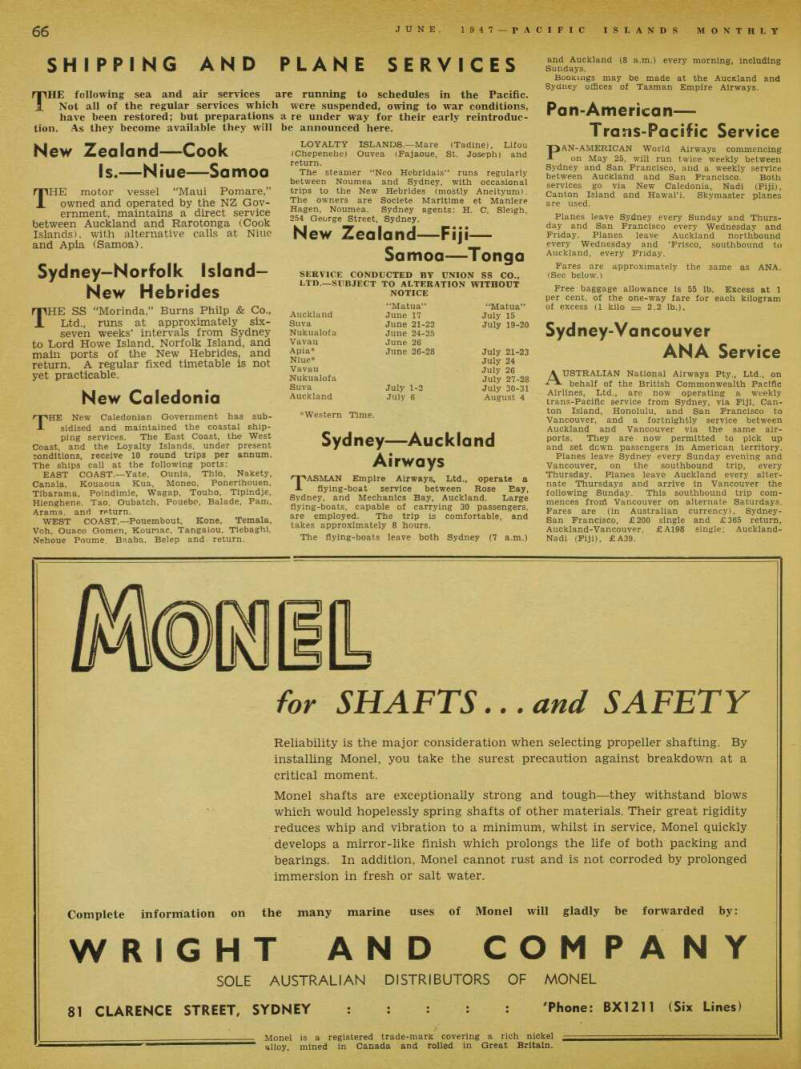
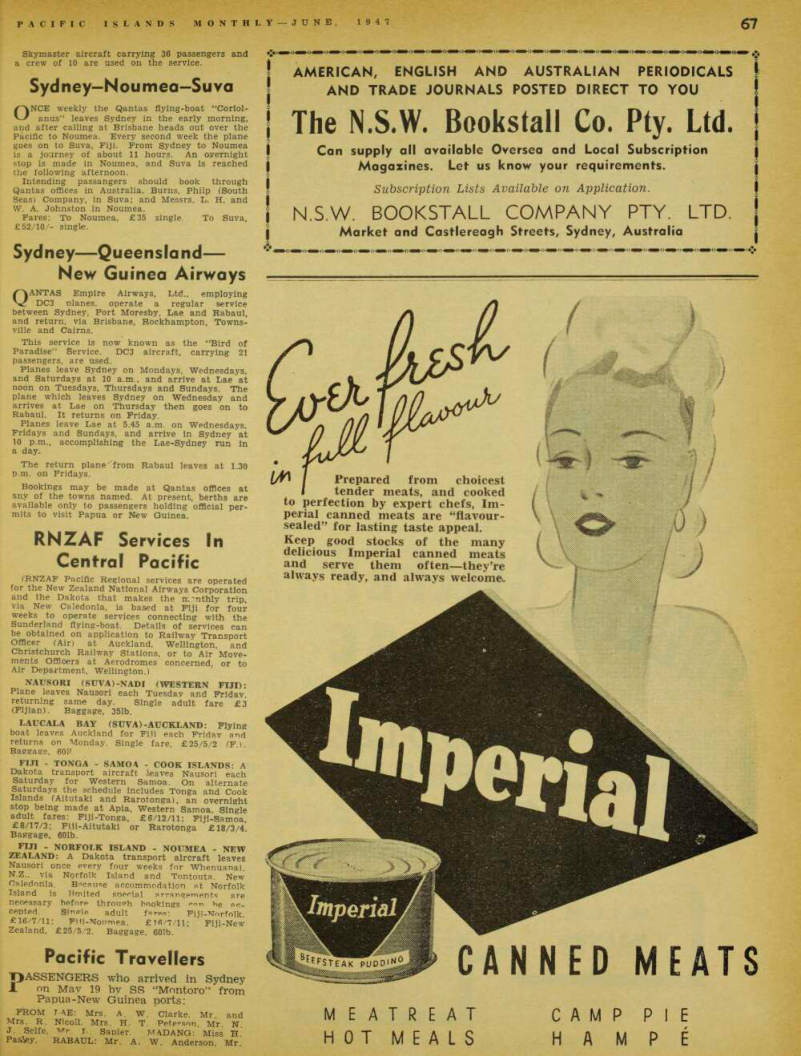
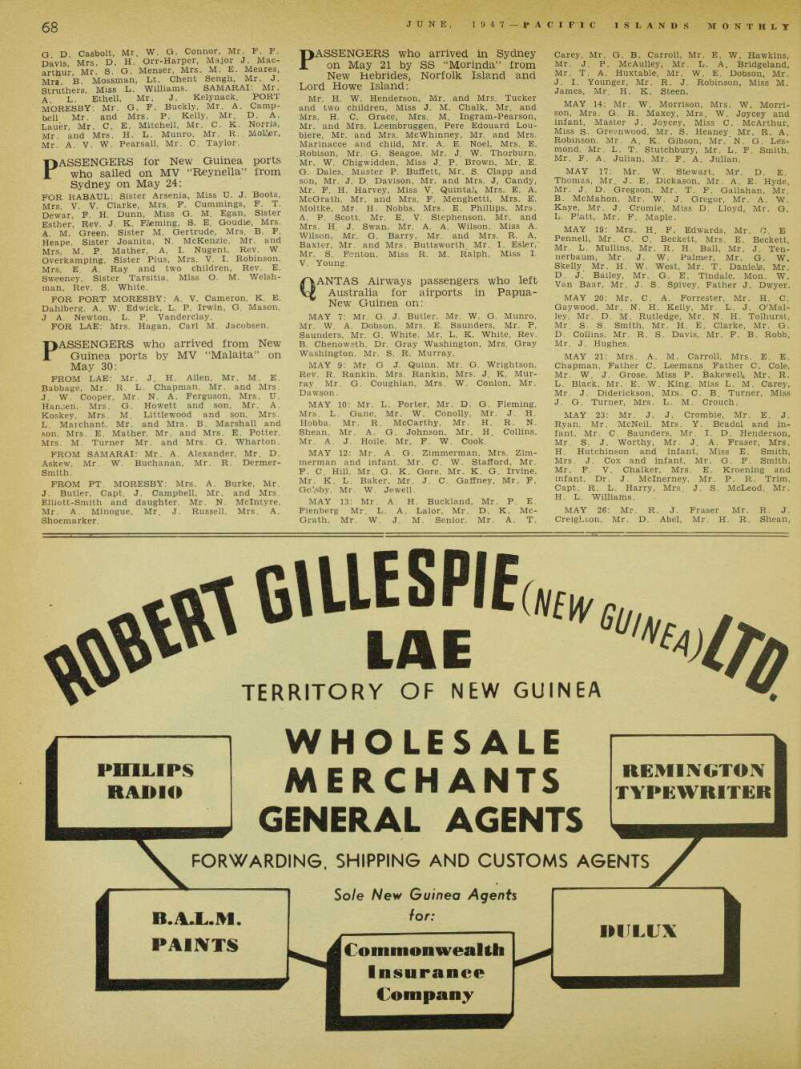
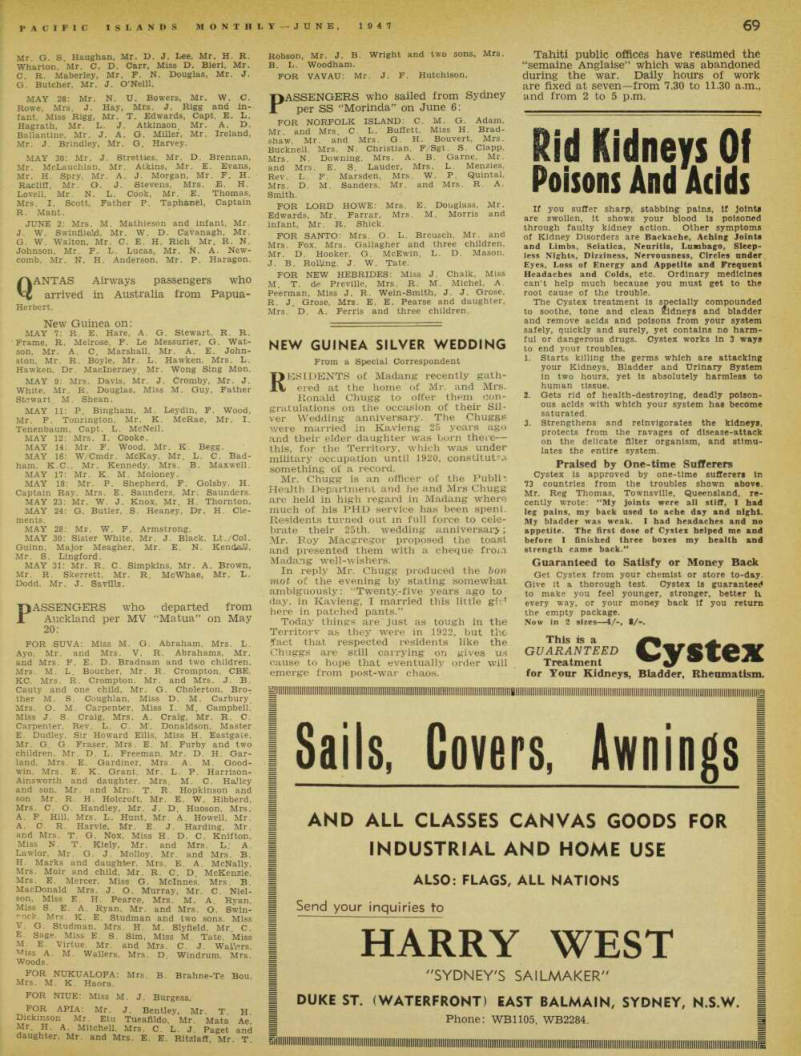
Shipping And Plane Services
THE following sea and air services are running to schedules in the Pacific.
Not all of the regular services which were suspended, owing to war conditions, have been restored; but preparations a re under way for their early reintroduc tion. As they become available they will be announced here.
New Zealand—Cook
Is.—Niue—Samoa
THE motor vessel “Maui Pomare,” owned and operated by the NZ Gov ernment, maintains a direct service between Auckland and Rarotonga (Cook Islands), with alternative calls at Niue and Apia (Samoa).
Sydney—Norfolk Island-
New Hebrides
THE SS “Morinda,” Burns Philp & Co., Ltd., runs at approximately six seven weeks’ intervals from Sydney to Lord Howe Island. Norfolk Island, and main ports of the New Hebrides, and return. A regular fixed timetable is not
yet practicable.
New Caledonia
THE New Caledonian Government has sub sidised and maintained the coastal ship ping services. The East Coast, the West Coast, and the Loyalty Islands, under present conditions, receive 10 round trips per annum.
The ships call at the following ports: EAST COAST—Yate, Ounia. Thio. Nakety, Canala, Kouaoua Kua, Moneo, Ponerihouen, Tlbarama, Poindimie, Wagap, Touho, Tipindje, Hienghene. Tao. Oubatch, Pouebo, Balade, Pam, Arama. and return.
WEST COAST.—Pouembout, Kone, Temala, Voh, Ouaco Gomen, Koumac. Tangaiou. Tiebaghi, Nehoue Poume, Baaba. Belep and return.
LOYALTY ISLANDS.—Mare (Tadine), Lifou fChepenehe) Ouvea (Fajaoue, St. Joseph) and return.
The steamer “Neo Hebridais” runs regularly between Noumea and Sydney, with occasional trips to the New Hebrides (mostly Aneityum).
The owners are Societe Maritime et Maniere Hagen, Noumea. Sydney agents: H. C. Sleigh, 254 George Street, Sydney.
New Zealand—Fiji—
Samoa—T onga
Service Conducted By Union Ss Co.,
Ltd —Subject To Alteration Without
Notice
Sydney—Auckland
Airways
TASMAN Empire Airways, Ltd., operate a flying-boat service between Rose Bay, Sydney, and Mechanics Bay, Auckland. Large flying-boats, capable of carrying 30 passengers, are employed. The trip is comfortable, and takes approximately 8 hours.
The flying-boats leave both Sydney (7 a.m.)
and Auckland (8 a.m.) every morning, including Sundays.
Bookings may be made at the Auckland and Sydney offices of Tasman Empire Airways.
Pan-American—
Trans-Pacific Service
PAN-AMERICAN World Airways commencing on May 25, will run twice weekly between Sydney and San Francisco, and a weekly service between Auckland and San Francisco. Both services go via New Caledonia, Nadi (Fiji), Canton Island and Hawai’i. Skymaster planes are used.
Planes leave Sydney every Sunday and Thurs day and San Francisco every Wednesday and Friday. Planes leave Auckland northbound jevery Wednesday and ’Frisco, southbound to Auckland, every Friday, Fares are approximately the same as ANA. (See below.) Free baggage allowance is 55 lb. Excess at 1 per cent, of the one-way fare for each kilogram of excess (1 kilo = 2.2 lb.).
Sydney-Vancouver
ANA Service
AUSTRALIAN National Airways Pty., Ltd., on behalf of the British Commonwealth Pacific Airlines, Ltd., are now operating a weekly trans-Pacific service from Sydney, via Fiji, Can ton Island, Honolulu, and San Francisco to Vancouver, and a fortnightly service between Auckland and Vancouver via the same air ports. They are now permitted to pick up and set down passengers in American territory.
Planes leave Sydney every Sunday evening and Vancouver, on the southbound trip, every Thursday. Planes leave Auckland every alter nate Thursdays and arrive in Vancouver the following Sunday. This southbound trip com mences frorfl Vancouver on alternate Saturdays.
Pares are (in Australian currency), Sydney- San Francisco, £2OO single and £365 return, Auckland-Vancouver, £AI9B single; Auckland- Nadi (Fiji), £A39.
“Matua”
“Matua”
Auckland June 17 July 15 Suva June 21-22 July 19-20 Nukualofa June 24-25 Vavau June 26 Apia* June 26-28 July 21-23 Niue* July 24 Vavau July 26 Nukualofa July 27-28 Suva July 1-2 July 30-31 Auckland July 6 August 4 »Western Time.
Skymaster aircraft carrying 36 passengers and a crew of 10 are used on the service.
Sydney-Noumea-Suva
ONCE weekly the Qantas flying-boat “Coriol anus” leaves Sydney in the early morning, and after calling at Brisbane heads out over the Pacific to Noumea. Every second week the plane goes on to Suva, Fiji. From Sydney to Noumea is a journey of about 11 hours. An overnight stop is made in Noumea, and Suva is reached the following afternoon.
Intending passangers should book through Qantas offices in Australia. Burns, Philp (South Seas) Company, in Suva; and Messrs. L. H. and W. A. Johnston in Noumea.
Fares: To Noumea, £35 single. To Suva, £52/10/- single.
Sydney—Queensland—
New Guinea Airways
QANTAS Empire Airways, Ltd., employing DC3 nlanes. operate a regular service between Sydney, Port Moresby, Lae and Rabaul, and return, via Brisbane, Rockhampton, Towns ville and Cairns.
This service is now known as the “Bird of Paradise” Service. DC3 aircraft, carrying 21 passengers, are used.
Planes leave Sydney on Mondays, Wednesdays, and Saturdays at 10 a.m., and arrive at Lae at noon on Tuesdays, Thursdays and Sundays. The plane which leaves Sydney on Wednesday and arrives at Lae on Thursday then goes on to Rabaul. It returns on Friday.
Planes leave Lae at 5.45 a.m. on Wednesdays.
Fridays and Sundays, and arrive in Sydney at 10 p.m., accomplishing the Lae-Sydney run in a day.
The return plane'from Rabaul leaves at 1.30 p.m. on Fridays.
Bookings may be made at Qantas offices at any of the towns named. At present, berths are available only to passengers holding official per mits to visit Papua or New Guinea.
RNZAF Services in
Central Pacific
(RNZAF Pacific Regional services are operated for the New Zealand National Airways Corporation and the Dakota that makes the m.'nthly trip, via New Caledonia, is based at Fiji for four weeks to operate services connecting with the Sunderland flying-boat. Details of services can be obtained on application to Railway Transport Officer (Air) at Auckland. Wellington, and Christchurch Railway Stations, or to Air Move ments Officers at Aerodromes concerned or to Air Department, Wellington.)
Nausori (Suva)-Nadi (Western Fiji):
Plane leaves Nausori each Tuesdav and Friday returning same day. Single adult fare £3 (Fijian). Baggage, 351 b.
Laucala Bay (Suva)-Auckland: Plying
boat leaves Auckland for Fiji each Friday and returns on Monday. Single fare, £25/5/2 (F.).
Baggage, 60V FIJI - TONGA - SAMOA - COOK ISLANDS: A Dakota transport aircraft leaves Nausori each Saturday for Western Samoa. On alternate Saturdays the schedule Includes Tonga and Cook Islands (Aitutaki and Rarotonga), an overnight stop being made at Apia, Western Samoa. Single adult fares; Fiji-Tonga, £6/12/11: Fiji-Samoa. £B/17/3; Fiji-Aitutaki or Rarotonga £lB/3/4 Baggage, 601 b.
FIJI - NORFOLK ISLAND - NOUMEA - NEW ZEALAND: A Dakota transport aircraft leaves Nausori once every four weeks for Whenuanai N.Z.. via Norfolk Island and Tontouta. New Caledonia. B=>cau<?e accommodation at Norfolk Island is limited sneoial arrangements are necessary before through bookings f'on bg ao cented. Single adult fares; Fiji-Norfolk. £l6/7/11; Piii-Nonmea. £l6/7/11; Fiji-New Zealand. £25/5/2. Baggage, 601 b.
Pocific Trovellers
T)ASSENGERS who arrived in Sydney
1 on Mav 19 by SS “Montoro” from
Papua-New Guinea ports:
PROM T AE: Mrs. A. W. Clarke. Mr. and Mrs. R. Nicoll. Mrs. H. T. Peterson. Mr. N, J. Selfe, aa> t Sapier. MADANG: Miss H.
Pasiey. RABAUL; Mr. A. W. Anderson, Mr.
G. D. Casbolt, Mr. W. G. Connor, Mr. F F.
Davis, Mrs. D. i - a3 °| Meares' arthur, Mr. S. G. Mrs m E. t’
Mrs. B. Mossman, Lt Ghent Sengh Mr. J.
Struthers, Miss L. Williams. SAMARAI. Mr.
A L. Ethell, Mr. J. Kelynack. PORT MORESBY: Mr. G. F. Buckly, Mr. A. Campbell Mr. and Mrs. P. Kelly, Mr. D. A.
Lauer, Mr. C. E. Mitchell, Mr. C. K. Norris, Mr and Mrs. H. L. Munro, Mr. R. Moller, Mr A V. W. Pearsall, Mr. C. Taylor.
PASSENGERS for New Guinea ports
who sailed on MV “Reynella” from
q v J n pv on Mav 24’ oyu , „. , f ■ ... TT T c FOR RABAUL: Sister Arsenia, Miss U. J. Hoot , Mrs. V. V. Clarke, Mrs. t. Cummings, r . i.
Dewar, P. H. Dunn Miss G. M. Egan, Sister f th M r ' sSterT n Lr®rude Mrs B F: Heape. Sister Joanita, N. McKenzie, Mr. and Mrq M P Mather A I Nugent Rev W, Overkamiping, Sister ’Pius. Mrs V I.’ Robinson.
Mrs E A Ray and two children, Rev. E.
Sweeney. Sister Tarsitia, Miss O. M. Welshman Rev S. White.
FOR PORT MORESBY: A. V. Cameron, K. E.
Dahlberg, A. W. Edwick, L. P. Irwin, G. Mason, J A. Newton. L. P. Vanderclay.
FOR LAE: Mrs. Hagan, Carl M. Jacobsen.
PASSENGERS who arrived from New Guinea ports by MV “Malaita” on
May 30:
wiprw I AF' Mr T H Allen Mr M E Babbage Mr R L Chapman, Mr. and Mrs.' J W Cooper, Mr. N. A. Ferguson, Mrs. U.
Hansen. Mrs. G. Howett and son, Mr. A.
Koskey. Mrs. M. Littlewood and son. Mrs.
L. Marchant, Mr. and Mrs. B. Marshall and son, Mrs. E. Mather. Mr. and Mrs. E. Potter.
Mrs. M. Turner Mr. and Mrs. G. Wharton.
FROM SAMARAI; Mr. A. Alexander, Mr. D, Askew Mr W Buchanan, Mr. R Dermer-
Smith'
PROA/r pT MORFSRV Mrs A Burke Mr J F^Uer PT Cap“° R J ES clmp“eTi; Mr.Tnf' Mrs!
Elliott-Smith and daughter. Mr. N. Mclntyre, Mr. A. Minogue, Mr. J. Russell, Mrs. A.
Shoemarker.
who arrived in Sydney
A on May 21 by SS “Morinda” from New Hebrides Norfolk Island and iNew inohoik isidna aim Loid Howe island.
Mr H . W- Henderson, Mr. and Mrs. Tucker and two children, Miss J. M. Chalk, Mr. and Mrs. H. C. Grace, Mrs. M. Ingram-Pearson, Mr. and Mrs. Deembruggen, Pere Edouard Loubiere, Mr. and Mrs. McWhinney, Mr. and Mrs.
Marinacce and child, Mr. A. E. Noel, Mrs. E.
Robison, Mr. G. Seagoe, Mr. J. W. Thorburn, Mr. W. Chigwidden, Miss J. P. Brown, Mr. E.
G. Dales, Master P. Buffett, Mr. S. Clapp and son > Mr - J - D - Davison, Mr. and Mrs. J, Candy, Mr. F. H. Harvey, Miss V. Quintal,, Mrs. E. A.
McGrath, Mr. and Mrs. F. Menghetti, Mrs. E.
Mo i t ke, Mr. H. Nobbs, Mrs. E. Phillips, Mrs.
A P S cott. Mr E v Stephenson, Mr. and H J. Swan Mr. A. A. Wilson, Miss A.
BaxTer’ Mr' and
Haxter, Mr. and Mrs. Huttswortn Mr. i tsier, r * Yo S ung Pl?nton ' MISS R ' M ‘ Ralph ’ MISS L V ’ Youn g- AA Airwave nassensers who left iAfc> Airways passengers wno xeit }S n pa or nn^ lrportS PapUa " iMew cumea on.
MAY 7: Mr. G. J. Butler, Mr. W. G. Munro, Mr. W. A. Dobson, Mrs. E. Saunders, Mr. P, Saunders, Mr. G. White, Mr, L, K, White, Rev.
B. Chenoweth, Dr. Gray Washington, Mrs. Gray Washington. Mr. S. R. Murray.
MAY 9: Mr. G j. Quinn, Mr. G. Wrightson, Rev - R - Rankin, Mrs. Rankin, Mrs. J. K, Murra y. Mr - G - Goughian, Mrs. W. Conlon, Mr.
Dawson.
MAY 10: Mr. L. Porter, Mr. D. G. Fleming, Mrs. L. Gane, Mr. W. Conolly, Mr. J. H.
Hobba, Mr. R. McCarthy, Mr. H. R. N.
Shean, Mr. A. G. Johnson, Mr. H. Collins, Mr. A. J. Hoile, Mr, F. W. Cook.
MAY 12: Mr. A. G. Zimmerman, Mrs. Zimmerman and infant. Mr. C. W. Stafford, Mr.
F. C Hill. Mr. G. K. Gore. Mr. K. G. Irvine, Mr - K - L - Baker. Mr. J. C. Gaffney. Mr. P. <**>*. Hr. W. Jewell.
MAY 13: Mr. A. H. Buckland, Mr. P. E.
Fienberg Mr. L. A. Lalor, Mr. D. K. Me- Grath, Mr. W. J. M. Senior, Mr. A. T.
Carey, Mr. G. B. Carroll, Mr. E. W. Hawkins, Mr. J. P. McAulley, Mr. L. A. Bridgeland, Mr - T A - Huxtable, Mr. W. E. Dobson, Mr.
R Younger> Mr R j Robinson> Miss M> James, Mr H. K. Steen. ‘ MA X, 14: Mr. W. Morrison, Mrs. W. Morri r£j- G - R ; Maxey ’ Mrs - W. Joycey and Master J. Joycey, Miss C. McArthur, rf I®® 1 ®® Heane y. Mr. R. A. uoc,l^ s ° l i’ M T r ' A - Jr\ ri bson * Mr ‘ N> G ’ Les ‘ ™ ond w L T ‘ St “ tchPury ’ Mr - L - F - Smith > Mr - F> A - Julian > Mr - F - A - Julian.
MAY 17: Mr. W. Stewart, Mi*. D. E.
Thomas, Mr. J. E. Dickason, Mr. A. E. Hyde, Mr. J. D. Gregson, Mr. T. F. Gallahan, Mr.
B. McMahon, Mr. W. J. Gregor, Mr. A. W.
Kaye, Mr. J. Cromie, Miss D. Lloyd, Mr. G.
L. Platt, Mr. F. Maple.
MAY 19: Mrs. H. F. Edwards, Mr. c. E Penn ® U> ™Vr C ' S' ® eCkett ’ Mrs ' E - Beckett - Mr L Mullins, Mr. R. H. Ball, Mr. J. Ten nerbaum, Mr. J. W. Palmer. Mr. G. W.
Skelly Mr. H. W. West, Mr. T. Daniel, Mr.
Baile y’ Mr - G - E - Tindale, Mon. W.
Van B aar> Mr. J. S. Spivey, Father J. Dwyer, MAY 20: Mr. C. A. Forrester, Mr. H. C.
Gaywood, Mr. N. H. Kelly, Mr. L. J. O’Mal ley, Mr. D. M. Rutledge, Mr. N. H. Tolhurst, Mr. S. S. Smith, Mr. H. E. Clarke, Mr. G.
D. Collins, Mr. R. S. Davis, Mr. F. B. Robb, Mr. J. Hughes.
MAY 21: Mrs. A. M. Carroll, Mrs. E. E.
Chapman, Father C. Leemans Father C. Cole, Mr. W. J. Grose, Miss P. Bakewelk Mr. R.
L. Black, Mr. E. W. King, Miss L. M. Carey.
Mr. J Diderickson, Mrs. C. B. Turner, Miss J- G- Turner, Mrs. L. M. Crouch.
MAY 23: Mr. J. J. Crombie, Mr. E. J.
Ryan, Mr. McNeil, Mrs. Y. Beadal and in fant, Mr. C. Saunders, Mr. I. D. Henderson, Mr. S. J. Worthy, Mr. J. A. Fraser, Mrs.
H. Hutchinson and infant, Miss E. Smith, Mrs. J. Cox and infant, Mr. G. F. Smith, Mr. F. V. Chalker, Mrs. E. Kroening and infant, Dr. J. Mclnerney, Mr. P. R. Trim, Harry, Mrs. J. B. McLeod, Mr. n MAY 26: Mr. R. J. Fraser Mr. R. J.
Creighton, Mr. D. Abel, Mr. H. R. Shean,
Mr. G. S. Haughan, Mr. D. J. Lee, Mr. H. R.
Wharton, Mr. C. D. Carr, Miss D. Bierl, Mr.
C. R. Maberley, Mr. F. N. Douglas, Mr. J.
G. Butcher, Mr. J. O’Neill.
MAY 28: Mr. N. U. Bowers, Mr. W. C.
Rowe, Mrs. J. Hay, Mrs. J. Rigg and in fant, Miss Rigg, Mr. T. Edwards, Capt. E. L.
Hagrath, Mr. L. J. Atkinson Mr. A. D.
Ballantine, Mr. J. A. G. Miller, Mr. Ireland, Mr. J. Brindley, Mr. G. Harvey.
MAY 30; Mr. J. Stretttes, Mr. D. Brennan, Mr. McLauchlan, Mr. Atkins, Mr. E. Evans, Mr. H. Spry, Mr. A. J. Morgan, Mr. P. H.
Racliff, Mr. O. J. Stevens, Mrs. E. H.
Lovell, Mr. N. L. Cook, Mr. E. Thomas, Mrs. I. Scott, Father P. Taphanel, Captain R. Mant.
JUNE 2; Mrs. M. Mathieson and infant, Mr.
J. W. SwinfiieJid, Mr. W. D. Cavanagh, Mr.
G. W. Walton, Mr. C. E. H. Rich Mr. R. N.
Johnson, Mr. F. L. Lucas, Mr. N. A. New comb, Mr. N. H. Anderson. Mr. P. Haragon.
QANTAS Airways passengers who
arrived in Australia from Papua- Herbert.
New Guinea on: MAY 7: R. E. Hare, A. G. Stewart, R. R.
Frame, R. Melrose, F. Le Messurier, G. Wat son, Mr. A. C. Marshall, Mr. A. E. John ston, Mr. R. Boyle, Mr. L. Hawken, Mrs. L.
Hawken, Dr. Maclnerney Mr. Wong Sing Mon.
MAY 9; Mrs. Davis, Mr. J. Cromby, Mr. J.
White, Mr. R. Douglas, Miss M. Guy, Father Stewart. M. Shean.
MAY 11: P. Bingham, M. Leydin, F. Wood, Mr. F. Tonrington, Mr. K. Mcßae, Mr. I.
Tenenbaum, Capt. L. McNeil.
MAY 12: Mrs. I. Cooke.
MAY 14: Mr. F. Wood, Mr. K. Begg.
MAY 16: W/Cmdr. McKay, Mr. L, C. Bad ham, K.C., Mr. Kennedy, Mrs. B. Maxwell.
MAY 17: Mr. K. M. Moloney.
MAY 18; Mr. P. Shepherd, F. Golsby. H.
Captain Ray, Mrs. E. Saunders, Mr. Saunders.
MAY 23: Mr, W. J. Knox, Mr. H. Thornton, MAY 24: G. Butler, S. Heaney, Dr. H. Cle ments.
MAY 28: Mr. W. F. Armstrong.
MAY 30; Sister White, Mr. J. Black, Lt./Col.
Guinn, Major Meagher, Mr. E. N. KendaJ.l, Mr. S. Lingford.
MAY 31; Mr. R. C. Simpkins, Mr. A. Brown, Mr. R. Skerrett, Mr. R. McWhae, Mr. L.
Dodd, Mr. J. Savills.
PASSENGERS who departed from
Auckland per MV “Matua” on May 20: FOR SUVA: Miss M. G. Abraham, Mrs. L.
Ayo, Mr. and Mrs. V. R. Abrahams, Mr. and Mrs. F. E. D. Bradnam and two children, Mrs. M. L. Boucher, Mr. R. Crompton, CBE, KC. Mrs. R. Crompton. Mr. and Mrs. J. B.
Cauty and one child, Mr. G. Cholerton, Bro r ther M. S. Goughian, Miss D. M. Carbury Mrs. O. M. Carpenter, Miss I. M. Campbell, Miss J. S. Craig, Mrs. A. Craig, Mr. R. C.
Carpenter, Rev. L. C. M. Donaldson, Master E. Dudley. Sir Howard Ellis, Miss H. Eastgate, Mr. G. G. Fraser, Mrs. E. M. Furby and two children, Mr. D. L. Freeman, Mr. D. H. Gar land. Mrs. E. Gardiner, Mrs. A. M. Good win. Mrs. E. K. Grant. Mr. L. P. Harrison- Ainsworth and daughter, Mrs. M. C. HaJley and son, Mr. and Mrs. T. R. Hopkinson and son Mr. R. H. Holcroft, Mr. E. W. Hibberd, Mrs. C. O. Handley, Mr. J. D. Huoson, Mrs.
A. F. Hill, Mrs. L. Hunt, Mr. A. Howell, Mr.
A. C. R. Harvie, Mr. E. J. Harding. Mr. and Mrs. T. G. Nox, Miss H. D. C. Knifton, Miss N. T. Kiely, Mr. and Mrs. L. A.
Lawlor, Mr. G. J, Molloy. Mr. and Mrs. B.
H. Marks and daughter. Mrs. E. A. McNally, Mrs. Moir and child, Mr. R. C. D. McKenzie, Mrs. E. Mercer, Miss G. Mclnnes, Mrs. B.
MacDonald Mrs. J. O. Murray, Mr. C. Niel son. Miss E. H. Pearce, Mrs. M. A. Ryan, Miss S. E. A. Ryan, Mr. and Mrs. O. Swin f'ock. Mrs. K. E. Studman and two sons. Miss V. G. Studman, Mrs. H. M. Slyfield. Mr. C.
E. Sage. Miss E. S. Sim, Miss M. Tate. Miss M. E. Virtue. Mr. and Mrs. C. J. Walters, Miss A. M. Wallers. Mrs. D. Windrum, Mrs.
Woods.
FOR NUKUALOFA: Mrs. B. Brahne-Te Bou, Mrs. M. K. Haora.
FOR NIUE: Miss M. J. Burgess.
FOR APIA; Mr. J. Bentley, Mr. T H Dickinson Mr. Etu Tueafildo, Mr. Mata Ae‘ Mr. H. A. Mitchell. Mrs. C. L. J. Paget and daughter, Mr. and Mrs. E. E. Ritzlaff, Mr. T
Robson, Mr. J. B. Wright and two sons, Mrs.
B. L. Woodham.
FOR VAVAU: Mr. J. F. Hutchison, PASSENGERS who sailed from Sydney per SS “Morinda” on June 6: FOR NORFOLK ISLAND: C. M. G. Adam, Mr and Mrs C. L. Buffett, Miss H. Brad shaw, Mr. and Mrs. G. H. Bouvert, Mrs.
Bucknell. Mrs. N. Christian, F/Sgt. S. Clapp, Mrs. N. Downing, Mrs. A. B. Game, Mr. and Mrs. E. S. Lauder, Mrs. L. Menzies, Rev. L. F. Marsden, Mrs. W. P. Quintal, Mrs. D. M. Sanders, Mr. and Mrs. R. A.
Smith.
FOR LORD HOWE: Mrs. E. Douglass, Mr.
Edwards, Mr. Farrar, Mrs. M. Morris and infant, Mr. R. Shick.
FOR SANTO: Mrs. O. L. Breusch, Mr. and Mrs. Fox, Mrs. Gallagher and three children, Mr. D. Hooker. G. McEwin, L. D. Mason, J. B. Rolling, J. W. Tate.
FOR NEW HEBRIDES; Miss J. Chalk, Miss M. T. de Preville, Mrs. R. M. Michel, A.
Peerman, Miss J. R. Wein-Smith, J. J. Grose, R. J. Grose, Mrs. E. E. Pearse and daughter, Mrs. D. A. Ferris and three children.
Advertisements & other items, pp. 68-70 (1 item)
Mm no.
for SHAFTS ...and SAFETY
Reliability is the major consideration when selecting propeller shafting. By installing Monel, you take the surest precaution against breakdown at a critical moment.
Monel shafts are exceptionally strong and tough—they withstand blows which would hopelessly spring shafts of other materials. Their great rigidity reduces whip and vibration to a minimum, whilst in service, Monel quickly develops a mirror-like finish which prolongs the life of both packing and bearings. In addition, Monel cannot rust and is not corroded by prolonged immersion in fresh or salt water.
Complete information on the many marine uses of Monel will gladly be forwarded by:
WRIGHT AND COMPANY
SOLE AUSTRALIAN DISTRIBUTORS OF MONEL
81 CLARENCE STREET, SYDNEY : : : : : 'Phone: BXI2II (Six Lines) Monel is a registered trade-mark covering a rich nickel "■ 1 1 alloy, mined in Canada and rolled in Great Britain.
AMERICAN, ENGLISH AND AUSTRALIAN PERIODICALS
AND TRADE JOURNALS POSTED DIRECT TO YOU
The N.S.W. Bookstall Co. Pty. Ltd.
Can supply all available Oversea and Local Subscription Magazines. Let us know your requirements.
Subscription Lists Available on Application.
N.S.W. BOOKSTALL COMPANY PTY. LTD.
Market and Castlereagh Streets, Sydney, Australia
Prepared from choicest tender meats, and cooked to perfection by expert chefs, Imperial canned meats are “flavoursealed” for lasting taste appeal.
Keep good stocks of the many delicious Imperial canned meats and serve them often—they’re always ready, and always welcome.
J^ F STEAK PUDD'^i!
CANNED MEATS
M E AIR E AT
HOT MEALS
CAMP PIE
HAM P E
LAE
TERRITORY OF NEW GUINEA
PHILIPS
RADIO
WHOLESALE
MERCHANTS
GENERAL AGENTS
REMINGTON
typewriter!
B.A.L.M.
PAINTS
FORWARDING. SHIPPING AND CUSTOMS AGENTS
Sole New Guinea Agents for: Commonwealth Insurance Company
DCLCX
New Guinea Silver Wedding
From a Special Correspondent RESIDENTS of Madang recently gath ered at the home of Mr. and Mrs.
Ronald Chugg to offer them con gratulations on the occasion of their Sil ver Wedding anniversary. The Chuggs were married in Kavieng 25 years ago and their elder daughter was born there — this, for the Territory, which was under military occupation until 1920, constitutes something of a record.
Mr. Chugg is an officer of the Publi-.
Health Department and he and Mrs Chugg are held in high regard in Madang where much of his PHD service has been spent.
Residents turned out in full force to cele brate their 25th. wedding anniversary; Mr. Roy Macgregor proposed the toast and presented them with a cheque from Madang well-wishers.
In reply Mr. Chugg produced the bon mot of the evening by stating somewhat ambiguously: ‘Twenty-five years ago to day, in Kavieng, I married this little giv l here in patched pants.”
Today things are just as tough in the Territorv as they were in 1922, but the (fact that respected residents like the Chuggs are still carrying on gives us cause to hope that eventually order will emerge from post-war chaos.
Tahiti public offices have resumed the “semaine Anglaise” which was abandoned during the war. Daily hours of work are fixed at seven—from 7.30 to 11.30 a.m., and from 2 to 5 p.m.
Advertisements & other items, p. 71 (1 item)
adrtj
Rid Kidneys Of
Poisons And Adds
If you suffer sharp, stabbing pains, If Joints are swollen, It shows your blood Is poisoned through faulty kidney action. Other symptoms of Kidney Disorders are Backache, Aching Joints and Limbs, Sciatica, Neuritis, Lumbago, Sleepless Nights, Dizziness, Nervousness, Circles under Eyes, Loss of Energy and Appetite and Frequent Headaches and Colds, etc. Ordinary medicines can’t help much because you must get to the root cause of the trouble.
The Cystex treatment Is specially compounded to soothe, tone and clean Kidneys and bladder and remove acids and poisons from your system safely, quickly and surely, yet contains no harmful or dangerous drugs. Cystex works In 3 ways to end your troubles. 1. Starts killing the germs which are attacking your Kidneys, Bladder and Urinary System In two hours, yet Is absolutely harmless to human tissue. 2. Gets rid of health-destroying, deadly poisonous acids with which your system has become saturated. 3. Strengthens and reinvigorates the kidneys, protects from the ravages of disease-attack on the delicate filter organism, and stimulates the entire system.
Praised by One-time Sufferers Cystex is approved by one-time sufferers in 73 countries from the troubles shown above.
Mr. Reg Thomas, Townsville, Queensland, recently wrote: “My joints were all stiff, I had leg pains, my back used to ache day and night.
My bladder was weak. I had headaches and no appetite. The first dose of Cystex helped me and before 1 finished three boxes my health and strength came back.”
Guaranteed to Satisfy or Money Back Get Cystex from your chemist or store to-day.
Give it a thorough test. Cystex Is guaranteed to make you feel younger, stronger, better U every way, or your money back If you return the empty package.
Now in 2 sizes—4/-, •/-.
GUARANTEED CVfitfiX
Treatment V J for Your Kidneys, Bladder, Rheumatism.
adrtj
Papua
Elliot Smith Leaves Papua Administration Loses Another Experienced Man
WHEN Lt.-Colonel Sydney Elliot Smith, a senior member of the Papuan Administration and, since the war.
Acting Superintendent of Police, left the Territory on the last “Malaita,” old hands and new expressed deep regret that such an experienced and respected man had found it necessary to leave.
Elliot Smith became Patrol Officer in 1927; and was ARM at Samarai when war broke out in 1941. During the war, he was CO of the Papuan Infantry Bat talion; and, on the return of civil gov ernment, he undertook the difficult task of re-organising the Royal Papuan Constab ulary, which he had restored to its pre war level. He was generally regarded as a man of firm understanding and scrupulous fairness: and he was known throughout Papua for his ample build and more than commensurate laugh.
A week before Mr. and Mrs. Elliot Smith left, a social evening was held in the Returned Soldiers’ Club Rooms in their honour.
The Administrator nresented a cheque on behalf of the people of Moresby. The
meeting was chaired by Mr. W. C. Groves, who presented another cheque and an address on behalf of the native members of the Constabulary. Other speakers were Mr. E. J. Frame, Mr. A. E. (Buddy) Watkins, who presented a cheque from the Papuan Public Service Association; and Mr. W. R. Humphries, who gave the main speech of farewell.
Mr. Humphries said he remembered Elliot Smith when he first came to Papua, as a fine, strapping youth, who was posted to his station. Mr. Humphries pointed out how few people were left of that happy band, and stated that he was greatly saddened to see men of the calibre and experience of Elliot Smith and his contemporaries leaving the country, for raw and inexnerienced “University students” to take their places. He sug gested that the country would not profit by the exchange, and advised newcomers to the service that the wav to success in native administration was the thorough and hard working way of the “old brigade.”
All speakers caught the note of deep regret: but that did not prevent everyone from having a very good time, the snpner was one of the best the ladies of Moresby have provided for some time.
THERE was another farewell ceremony at the ship’s side. The RPC Band and members of the force paraded
on the wharf to farewell their departing chief, and a large crowd of residents thronged the boat. The band played during the evening; but at one stage a minor crisis developed when natives, loading the last few bales of rubber, knocked off to listen, and the band had to be removed. Later, the parade re-as sembled, Lt.-Colonel Elliot Smith in spected the force, the crowd left the ship, and all sang “Auld Lang Syne” as she prepared to pull out.
There seemed something symbolic about the occasion; the past was slipping away from the shores of Papua.
Lost In Jap Invasion
News Wanted
ANYONE knowing anything of the fate cf John Samuel Talmage (or Tal madge), of Tomalabat Plantation, New Ireland, who has not been heard of since the Japs invaded New Guinea in January, 1942, is requested kindly to com municate with his niece, Mrs. Agnes Tem pleton, 16 Drayton Street, Sunshine W2O, Melbourne. It is rumoured that Mr. Tal mage (who was a veteran of Boer War and World War I) was taken prisoner, after he had been sending out information by radio but this is not confirmed.
News is anxiously sought by his relations.
Mr. H. E. Maude, Resident Commis sioner, Gilbert and Ellice Islands Colony, was in Suva, Fiji, early in Mav on his way to the United Kingdom on leave.
He visited the Banaban community at Rabi Island, where they are now settled after moving from their home from Ocean Island which was made untenable, partly by Japanese destruction and partly by the
Advertisements & other items, pp. 72-74 (4 items)
70
JtJNt:, 190-Hcmc islands monthly
William Atkins Pty. Ltd.
New
WANTED TO BUY—QUALITY GUNS AND RIFLES
HIGHEST PRICES GIVEN. WILL ALSO EXCHANGE GUNS.
Short Service Barrels, 25}V', without Sights and Platform, £2/15/- each.
Postage extra.
SI L RO H U Quality Firearms and Fishing Tackle. 148 ELIZABETH STREET (Near Market St.) SYDNEY. ’PHONE; MA 3540.
William Atkins Pty. Ltd.
Head Office *49-451 KENT ST., SYDNEY.
Iron & Steel Merchants-Engineers' Supplies
Coach fir Motor Hardware
ESTABLISHED OVER 50 YEARS
Cable Address: WILATKIN, Sydney.
STEEL DEPARTMENT
MILD STEEL:
Rounds, Squares, Flats, Half-rounds, Hexagons, Bevel, Shoeing, Tyre, Angles, Tees, Sheets, Plates, Girder Plates, Chequer Plates, Channels, Hoops, Etc.
BRIGHT STEEL;
Rounds, Squares, Hexagons.
Extra Special High Speed Tool Steel, Mining Steel, Blister Steel and Spring Steel, Rounds, Flats Gr Squares.
Bar Iron —All sections and sizes.
Engineers' Supplies: Set Screws, Studs, Metal Thread Screws. Coach Screws, Files, Cotter Pins, Bright and Black Bolts, Rivets, Etc., Hack Saw Blades.
Power Transmission Gear: Including Plummer Blocks, Couplings, Collars, Etc.
Coach and Motor Hardware: Axles, Springs, WheelstufT, Duck, Paints.
Farriers' Supplies: Horse Nails, Anvils, Vices, Etc.
Motor-Trimmers and Motor Builders' & Motor Painters' Requirements Pacific Island Agents : Corrie & Co., Suva, Fiji DUCO Lacquers and DULUX Enamels—FAßßEX Motor Toppings and Leather Cloths, House & Decorators' Paints, Varnishes & Brushware.
Sole Distributors of CHAMPION'S Decorators Paint Products.
Distributing Agents for BROLITE Lacquers, SYNFLEX Enamels and "POLYGLOSS" Finish.
Pacific Islands Trading Company
* / (2 No. 246
USE STANDARD BURGESS
No. Z CELLS
m>£ i i / No. 92
IPJJ.I
ui
IlMli
fn! j 0 (i
LONG
LASTING
BATTERIES
FOR
EVERY
PURPOSE
m Breathtaking Beauties! Burgess introduces two popular pocket penlights . . . coupled with the allure of the world's most beautiful girls!
A PAIR OF POPULAR, FAST SELLING POCKETLIGHTS ON NEW ALLURING DISPLAY CARDS: (1) Streamstyled Penlight No. 246. . . polished to a bright and glistening finish. Equipped with pocket clip . . . Lock-on type switch. A Burgess first! (2) Rich maroon and chrome Penlight No. 92 ... a sturdy metal case with pocket clip and lock-on switch
AVAILABLE FROM YOUR LOCAL STORE OR
PACIFIC ISLANDS TRADING COMPANY
244 CALIFORNIA ST., SAN FRANCISCO 11, CAL., U.S.A.
Cable Address: PITCO
Life ofrf C ,
n aiAJ
'party
BUT I was a complete
flop a few months ago
p_ Listen Phil - we re losmq all our friends ft me we had part^ s^ OL m l can t & Nor m k our A Phil I'm worried abouf gou You re not yourself at all. I'll ring Dr Armstrong and make an appointment for gou.
I \ 50*
AT THE DOCTORS
% I>,
Mrs Carey,your sgmpfoms
indicate "night starvation"
You probablg don’t realise it. but while gou sleep gou must replace energg
lost during the day.
Even during the night, goup heart and lungs continue their work. Naturally, unless this energy is
replaced you’re bound to
wake tired , . . become nervy . I recommend
HORLICKS.
TWO MONTHS LATER .
he back to
Each glass of HORLICKS *
before bed gives you ...
His
Protein essential to the growth and development of every part of the body.
Without protein growth cannot take place and then wear and tear resulting from our daily activities is not made good.
Fat almost entirely derived from milk; an efficient source of energy and also of vitamins A and D.
Carbohydrate —chiefly maltose and dextrin (perhaps the be t source of quick energy) and lactose, which is of great * Made value to young children.
Mineral Softs —to help in building tissue and in regulating body activities. These mineral salts include: Calcium —of which there is a deficiency in many Australian diets and yet is so necessary for building sound bone and good teeth.
Vitamins A B B and D —each fulfilling its own special job in maintenance of sound nutrition. with milk. F 7-2
HORLICKS GU NIGHT STARVATION
72
JUNE. 194?-pAcIPIC ISLANDS MONTHLY
Recent Events In Port Moresby
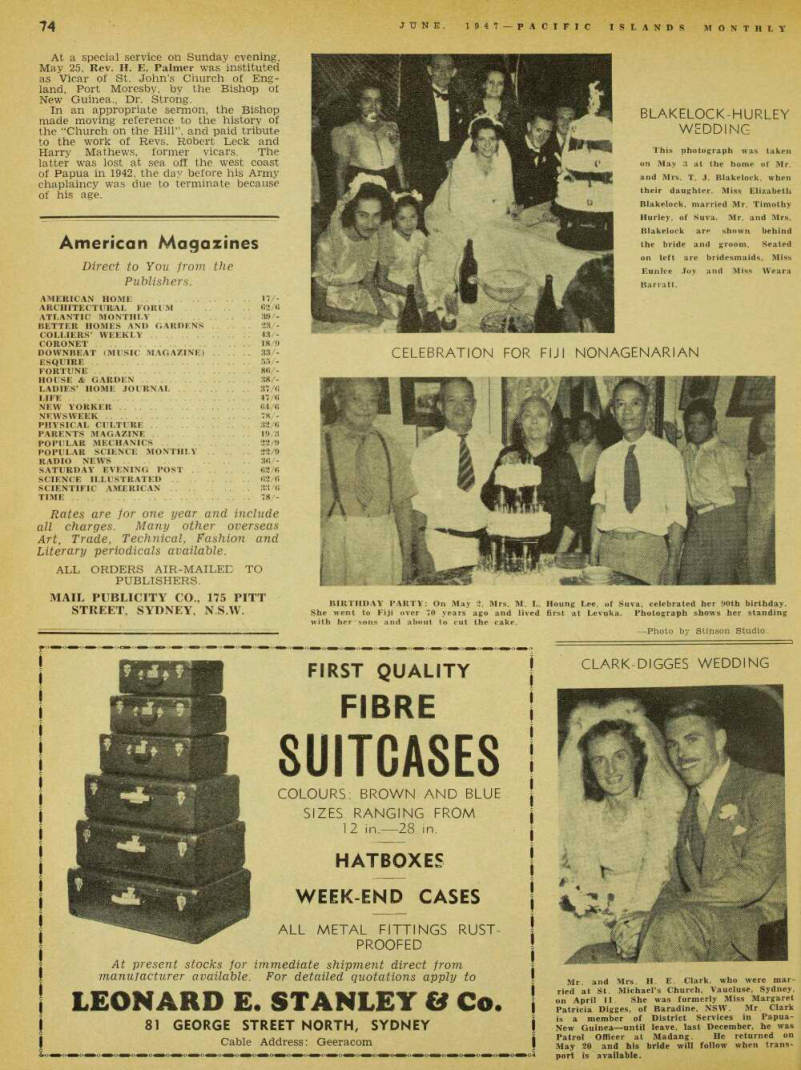
From Our Own Correspondent
Port Moresby, June 4
MISBEHAVIOUR of Moresby’s water supply is causing considerable in convenience. During one week in May there was no water for over five days. The main burst on Tuesday, was repaired Wednesday morning, was off again two hours later, and stayed off until Saturday afternoon. After a day with water it again broke down, on Sunday.
The inconvenience of an unreliable water supply is heightened by the failure to build tanks on post-war houses. * * * Mr. R. H. Melrose left Moresby in May.
He will spend some time in Canberra on business before taking leave. During his absence, Mr. S. Lonergan is Acting Gov ernment Secretary, and Mr. Claude Cham pion Acting Assistant Gov. Sec. * * * Mr. J. Molline, well known in Samarai pre-war, has been transferred to Abau as District Labour Officer. * * * AFTER the recent stalemate on the high seas, Moresby has had a ship ping boom. “Montoro”, “Malaita” and “Reynella” were all in port during May.
The “Stanley Park’’, from Singapore, spent a week loading disposals vehicles from “Saville’s dump”. The number of vehicles we saw go down the hold should ensure Mr. Saville rather more than it cost him to charter the ship.
Vacuum Oil Co. Spent a week loading pmnty drums on to the Liberty Ship “Silas K. Silcox”; she took away well over 20,000 drums, which at so much per drum, landed in Australia, adds up to quite a bit.
At the end of May a tanker arrived, and was a welcome sight. The huge supplies of benzine left by the forces have been exhausted in an orgy of petrol consump tion, and transport is now being run on strictest economy lines. Even the free bus services provided by the Administra tion have been drastically cut. * * * ABOUT forty missionaries have been in town swapping words with the Ad ministration at vet another confer ence.
On Saturday, May, 24 they went to Sogeri native secondarv school' to attend the Empire Day sports meeting. They were entertained at afternoon tea by some of the local ladies. Prominent among these were former Rabaulites Mrs. Colin Marr and Mrs. Vic Sully. Mrs. Marr grew up as Marge Thomas, at Bita Paka, and her husband is now Agriculture Officer at Sogeri Mr. Sullv is a Technical Education Officer. * ♦ * MEMBERS of the Nutritional Survey Party recentlv passed through on their way to Busama Village, near Lae, where thev will conduct their first investigations into native nutritional standards.
The party is led by Dr. Clements, of the Institute of Anatomy. Canberra, Mr.
Charles Julius, an anthropologist on loan from the Education Department, accom panies the expedition, as well as a spec ialist officer of the Department of Agri culture.
Dr. Clements gave an interesting broad cast on the party’s plan over 9PA. * * ♦ rE Administrator’s yacht, “Laura bada”. left for Bougainville on a tour of inspecion at the beginning of June.
As well as His Honour the Adminis trator. the party included Dr. j. Gunther,
Director of Public Health; Mr. W. Cottrell- Dormer, Director of Agriculture; and Mr. lan MacDonald, New Guinea represent ative of the Department of Post-War Re construction.
Mr. J. Macauley, Lecturer in Colonial Administration at the Australian School of Pacific Administration, arrived in Moresby towards the end of May.
Mr. Macauley is perhaps better known to the Australian public as poet than lecturer. His recent volume of academic verse, “Under Aldebaran”, was favourably received by the critics. Mr. Macauley was one of the two young men who hoaxed the Australian literary public and the editors of the “advanced” literary journal, “Angry Penguins”, with the works of the fictitious poet Ern Malley.
TWO senior technicians of the PMG have arrived in Moresby. Their visit is connected with plans to extend the coverage and power of local ABC station, 9PA, which at present does not adequately cover the whole Territory. 9PA may eventually use both broadcast and short wave transmitters, but the question is ex tremely complex, as the area to be covered is not ideally suited to either form of transmission.
At a special service on Sunday evening.
May 25, Rev. H. E. Palmer was instituted as Vicar of St. John’s Church of Eng land, Port Moresby, by the Bishop of New Guinea., Dr. Strong.
In an appropriate sermon, the Bishop made moving reference to the history of the “Church on the Hill”, and paid tribute to the work of Revs. Robert Leek and Harry Mathews, former vicars. The latter was lost at sea off the west coast of Papua in 1942, the day before his Army chaplaincy was due to terminate because of his age.
Blakelock-Hurley
Wedding
This photograph was taken on May at the home of Mr. and Mrs. T. J. Blakelock, when their daughter. Miss Elizabeth Blakelock. married Mr. Timothy Hurley, of Suva. Mr. and Mrs.
Blakelock are shown behind the bride and groom. Seated on left are bridesmaids, Miss Eunice Joy and Miss Weara Barratt.
Celebration For Fiji Nonagenarian
BIRTHDAY PARTY: On May 2, Mrs. M L. Houng Lee, of Suva, celebrated her 90th birthday.
She went to Fiji over 70 years ago and lived first at Levuka. Photograph shows her standing with her sons and about to cut the cake. —Photo by Stinson Studio.
Advertisements & other items, pp. 75-76 (1 item)
Otor
TO SHIPMASTERS
When calling at Tahiti, see Oscar G.
Nordman for ships’ supplies and fresh provisions. Wire before your arrival to OCEANIC, PAPEETE (my registered cable address)
OSCAR G. NORDMAN,
Ship Chandler, Papeete, Tahiti
jOU
he o
OTOR
E THE SHELL COMPANY OF AUSTRALIA LIMITED (Inc. in Gt. Britain) 5471 J
American Magazines
Direct to You from the
Publishers.
AMERICAN HOME 17/-
ARCHITECTURAL FORUM 62/6
ATLANTIC MONTHLY 39/-
BETTER HOMES AND GARDENS 23/-
COLLIERS’ WEEKLY 43 -
CORONET 18/9
DOWNBEAT (MUSIC MAGAZINE) 33/-
ESQUIRE 55/-
FORTUNE 86/-
HOUSE & GARDEN 38/-
LADIES’ HOME JOURNAL 37/6
LIFE 47/6
NEW YORKER 64/6
NEWSWEEK 78/-
PHYSICAL CULTURE 32/6
PARENTS MAGAZINE 19/3
POPULAR MECHANICS 22/9
POPULAR SCIENCE MONTHLY 22/9
RADIO NEWS 36/-
SATURDAY EVENING POST 62/6
SCIENCE ILLUSTRATED 62/6
SCIENTIFIC AMERICAN 33/6
TIME 78/-
j ßates are for one year and include
all charges. Many other overseas
Art, Trade, Technical. Fashion and
Literary periodicals available.
ALL ORDERS AIR-MAILED TO
PUBLISHERS.
MAIL PUBLICITY CO., 175 PITT
STREET. SYDNEY, N.S.W.
FIRST QUALITY
FIBRE
SUITCASES
COLOURS: BROWN AND BLUE
SIZES RANGING FROM
1 2 in.—2B in.
HATBOXES
WEEK-END CASES
ALL METAL FITTINGS RUST-
PROOFED
At present stocks for immediate shipment direct from manufacturer available. For detailed quotations apply to
LEONARD E. STANLEY & Co.
81 GEORGE STREET NORTH, SYDNEY
Cable Address: Geeracom
Clark-Digges Wedding
Mr. and Mrs. H. E Clark, who were mar ried at St. Michael’s Church, Vaucluse, Sydney, on April 11. She was formerly Miss Margaret Patricia Digges, of Baradine, NSW. Mr. Clark is a member of District Services in Papua- New Guinea —until leave, last December, he was Patrol Officer at Madang. He returned on May 20 and his bride will follow when trans port is available.
Conference
Another Education Conference In P. Moresby
Missionories and Administration
Meet to Discuss the Native Angle
From a Special Correspondent A CONFERENCE on native education between representatives of mission bodies in Papua-New Guinea and the Administration of the Privisional Ter ritory, was held in Port Moresby between May 21 and 28.
Administration organising officials and
representatives of the various missions who attended were as follows: Organising Committee: Mr. W. C. Groves, Director of Education, Chairman; Mr. J. H.
Jones, Director of District Services: Mr. S.
R. Lonergan.
Conference Secretary: Mr, S. J. Pearsall.
Organising Assistant: Mr. H. Buckland.
Representatives Of Missions
Anglican Mission: Bishop Strong (representing also Melanesian Mission, New Britain); Rev.
J Bodger, Rev. D. Taylor, Rev. E. H. Palmer.
Catholic Missions: Bishop T. Wade, Solomon Islands; Bishop Sorin, Papua; Msgr. W. van Baar, Ap. Administrator of Eastern and Central New Guinea; Father Zwinger, MSC, *»nd Father O’Loughlin, MSC, Vunapope, New Britain: Father Dwyer, MSC. Samarai, Eastern Papua; Father Ignatius, OFM, New' Guinea (East of Aitape); Father W. Ross. Mt.
Hagen, New Guinea; Father I. Schwab, Sepik, Central NG.
London Missionary Society: Rev. H. J. E. Short, Rev. D. E. Ure, Rev. R. Rankin, Mrs. Rankin.
Kwato Extension Mission: Mr. R. Abel, Miss P Abel, Mr. J. Smeeton.
Methodist Mission: Rev. Mannering, Rabaul; Rev. R. Brown, Rabaul; Mr. P. Brown, Salamo
Lutheran Mission: Rev. J. Kuder, Mt. Hagen; Rev. H. Hannemann, Madang; Rev. A. P. H Freund, Rooke Island; Dr. T. G. Braun.
Seventh Day Adventist Mission: From Sydney— Pastor Turner, Pastor McMahon. From Port Moresby—Pastor Thrift, Pastor E.. Boehm.
Pastor Stratford, Mr. Grey. From Mt.
Hagen—Mr. H. Ward Nolan.
Unevangelised Fields Mission: Mr. Sexton, Mr.
Lea.
Bamu River Mission: Mr. Standon, Mr. Harper.
During the seven days which the con
ference lasted, delegates were addressed on a number of subjects, most of wnich had a direct bearing on missionary enter prises and a few of which did not. Ad dresses included health services, training of natives in agriculture, commonwealth reconstruction training schemes, visual education, library services, broadcasting, commonwealth re-establishment, native co-operatives, shipping services, rehabili tation of native livestock, misson activity
in the Central Highlands and extension into uncontrolled areas, town planning, recruitment of natives by the missions, education of native women, aims of the School of Pacific Administration, mission ary spheres of influence, and compulsory education.
Visits were made, by the delegates, to several educational establishments in Port Moresby and adjacent districts.
The Administrator, Colonel J. K. Mur ray, opened the conference and read an extract from Commonwealth Hansard of May 1, which set forth Minister Ward’s opinion of the worth of missionaries. rE conference itself covered a wide field. Delegates were pleased with the attitude of the Administrator, who did not indulge in long-range theories but confined himself to attempted solutions of present problems. One
gathered the impression that he went to some pains to avoid having any delegate leave feeling discontented and dissatisfied.
Mr. J. H. Jones, Director of District Services, tackled the problem of Cargo cult which he described as the only com mon racial bond between the natives of the many different sections that go to make up the native population of Papua- New Guinea.
The conference also descussed differ ences in the way of handling native affairs in Papua and in New Guinea. For example, in Papua, Christian marriage between natives was recognised; in New Guinea it was not. In Papua, attendance at school was nominally compulsory, within a radius of 3 miles of any school; in New Guinea, school attendance was very seldom encouraged by officials. In Papua no force could be used for medical inspection or hospitalisation of natives;
in New Guinea, such medical attention could be enforced.
Most delegates were hesitant on the question of native co-operative businesses.
They are ready to meet the situation when it arises; but many felt that the whole thing had a flavour of politics and was not within the sphere of missionary activity.
The lecture on broadcasting, which was given by Mr. B. Kirke, had no practical application for New Guinea. There are broadcasts from Moresby in five dialects, and also in English; but there are no broadcasts in Pidgin, as there were during the war, although the Pidgin-speaking population is five times as great as the population speaking other dialects. This session of the conference was attended by two native announcers from 9PA, but they preferred to remain silent throughout.
In the course of the conference it was suggested that representatives of other bodies, such as miners, planters, etc., should be invited to attend conferences on native education and welfare. It was stated that the Administration has this “under consideration.”
During the discussion on missionary work in the Central Highlands it was an nounced that greatly extended areas of this district would be thrown open to missionary enterprise from July f, 1947.
This caused general satisfaction among delegates.
At the conclusion of the conference, the delegates made several suggestions to the Administration by way of resolutions.
Some of these were:— Amendments to the education ordinance should in future, be circulated among missionary bodies before promulgation; Natives over 16 should be allowed to do casual work wherever they like in the Territory; Polygamy be discouraged in Christian areas and Christian marriage be legally recognised.
A message was sent to Mr. Ward thank ing him for his part in calling the confer ence, and for having appointed such a capable Administrator as Colonel Murray.
Advertisements & other items, pp. 77-78 (1 item)
Blackwell
While in Port . . .
HIRE Your Taxi from
BULOWAT TRANSPORT
COMPANY
CARRIERS AND TRANSPORT SPECIALISTS
GENERAL MOTOR REPAIRS
—Agents for—
CRYSTALITE PLASTICS, ALL ELECTRICAL
EQUIPMENT, RADIOS, REFRIGERATORS,
HOT WATER JUGS, ETC.
SIDNEY COOK, PROP.
better Buy
Cl > THE ORIGINAL
ROSSE &
BLACKWELL
M eat and Yisb
UNEXCELLED SINCE 1706
S /niv&H't /
A f- *\ ft
WELL-GROOMED
NEAT-LOOKING
HAIR
a ah iit> W' It’s not only which is winning him advancement.
The pleasing effect of well-groomed, handsome hair proclaims a neat, orderly mind . . . up-tothe-minute in business as well as the value of appearance. You, 100, can make your hair a permanent business asset with VITALIS, and the • 4 60-second drill”. 1 50 Seconds to Rub —Cir * culation quickens thus scalp stimulation gives hair a chance O 10 Seconds to Comb and Brush—Hair has a lustre —no objectionable "patentleather" look. 3307 ho‘ the dresses scalp-" the totes St»w«
New Guinea Germans Did
Not Suffer Alone
Letter to the Editor AS a reader of “PIM” I should like to express my personal views on the article in May issue entitled “New Guinea Germans Now Released.”
Even allowing for the injustices and cruelties of war and the fact that the few, so-called “good Germans” must suffer with the bad ones, both my personal ex periences and history have proven tc me that the old sympathy story: “We Ger mans are realiy good, peace-loving folk and Nazi ideologists were forced upon us against our will” has been told too often to even warrant discussion.
With all due respect to Mr. Jahnke, and an understanding* of his difficulties, I suggest that speculating on the possible return of New Guinea to Germany was a dangerous game and that trifles, such as becoming a British subject, should, on future occasions, not be overlooked.
Admittedly, wars such as the recent one, may not be much use to individual Ger mans. particularly when they are on the losing side; taut then our German friends should remember that war is of little use either to such presumably “unimportant” nations as Poland, Holland, France and Britain. The war is over, but I do not think it improper to suggest to our friends that they were not the only ones to suffer and that the game of war is expensive.
I am, etc.,
Robert Fleischman.
Canberra. ACT.
June 4. 1947.
What Australian Government
Is Doing To Islands Trade
Dislocation of Shipping, Trading and Planting BP Chairman Outspoken
MANY times in past decades, since it was established 65 years ago, Burns, Philp & Co., Ltd., have been attacked by Leftist politicians or disgruntled competitors; but the Big Firm always followed the policy of not answering back. It took pride in giving a fair deal to its public and its staff, and let its trading record speak for itself.
But times are changing. There is no longer fair dealing as between traders and Governments —especially Governments run by Leftist Trade Unions. It is time for the trader, “getting it in the neck” from all directions, to speak out.
At the annual general meeting of Burns, Philp & Co., Ltd., in Sydney, on May 28, the chairman, Mr. James Burns, spoke out as follows:
WE have in the last two years been trying to adapt ourselves to the many changed conditions now ruling.
Since 1940. we have lost six motor ships, but have only contracted to build one new one. This vessel will probably not be completed until the end of 1948.
During the year we have extended our interests in country stores. In this class of business we find less worries and troubles than in shipping, in connection with which we have to deal with so many Unions.
It might interest shareholders to know that, with all other companies, we are experiencing delays in ports at which our vessels call, and I am sorry to say we are only handling in Australia per hour per gang per hatch one-third the same type cargo we did in 1939.
Only this month we closed the account of a vessel which in pre-war days was on the Sydney/Eastern run, and took a little over 60 days, being full of cargo each
way, calling at the same number of ports, but extending to Penang instead of Java.
Owing to delay in loading and discharg ing in various ports, this ship was 153 days from the time she went on the load ing berth to the time she finished dis charging on her return—truly a reminder of the old sailing ship days!
This sort of thing is a great handicap to a country with a large interstate and oversea trade. Freights naturally rise to pay for slow handling and delays, and this increases cost of living and decreases the nett return to the primary producer for his goods, as a higher proportion of the proceeds of his produce goes in the increased freight. As most exports from Australia go forward by non-Australian companies, high oversea freights are a direct loss to Australia.
I have heard it often said that only in creased productivity can raise wages with out raising prices. But it is equally cer tain that only an acceleration in the handling of c&rgo will decrease freights
and passage money. In other words, most shipping companies want twice the freight and passage money as in pre-war days to cover the extra time spent on voyages and the extra costs for higher wages, victualling expenses, fuel and everything else to do with the shipping industry.
APART from all these serious delays to ships, and increased costs in other directions, we cannot plan ahead for future tonnage until we know the Gov ernment policy as regards nationalising,
or partially nationalising, Australian coastal and islands shipping.
In pre-war days we received a subsidy, and in some cases charged rate of freight that would nowadays not always pay for the loading and discharging expenses.
We are still paying 50 per cent, war bonus to our crews; and. if we have to face a 40-hours week at sea, it will be most important to see that we have some hope of leimbursing ourselves for costs, even if we do not make profits.
A small Islands vessel like the “Montoro”, with diesel engines, is Jikely to run into nearlv half a million: and this is a great deal of money to get back, after all expenses are paid, in the Islands Trade.
Apart from shipping, we have a large building programme ahead. We do not expect to be allowed to do very much before the housing problem is satisfactorily settled, but we have half a dozen properties we want to build on in Australia.
In the Islands, practically all our buildings and wharves have been damaged or totally destroyed. We cannot get building materials or labour, and consequentlv most of our staff in Islands
centres are living in native-built houses, or makeshift quarters constructed from wrecked old buildings. Probably it will cost us double what we will receive in war damage insurance to get all our Branches and Islands properties going again in pre-war style, IVIANY of the plantations we control, I?JL or are managing, have no native labour and are gradually going back to virgin bush. We have latelv bought and fitted up a vessel, at a high cost, for the transportation of labour, to en deavour to get sufficient to do something in the way of clearing roads, building bridges, etc., and later on we may try to clear some plantations.
In the meantime, thousands of tons of coconuts on our properties alone are rot ting or being eaten by wild pigs—while most of the world seems to be starving or short of fats.
We have a good and able staff on the spot, and they have been there for nearly two years, but you cannot “make bricks without straw”, and you cannot cope with the rapid encroachment of the jungle without labour. It takes six months feeding up with tinned beef, rice,
biscuits, etc., to make the ordinary labour we now get able to do a day’s work; so that, allowing for time taken in transpor tation from and to their villages, a planter is lucky to get six months’ efficient work on the 12 months’ agreement.
Advertisements & other items, pp. 79-80 (1 item)
Swallow & Abiell
NAPT.
What the NAPT
is doing.
We exist to spread know-
ledge of tuberculosis by
means of:
• EDUCATION.
Post-graduate Study, Scholarships for Colonial Doctors and other Medical workers.
• RESEARCH.
Into the Psychology of Tuberculosis, Surveys in the Colonies.
• PROPAGANDA.
Publication of Books and Leaflets.
• SOCIAL WELFARE.
To help the Tuberculosis Patient and his Family.
Membership : 5/- Per Year.
Tavistock House, North London, W.C.I, England.
NATIONAL ASSOCIATION FOR THE
PREVENTION OF TUBERCULOSIS.
/ f >». Y : fe ({ TH|-STORY behind the swallow Txff *
SWALLOW & ABIELL
LIMITED
LEADERS IN THE BISCUIT INDUSTRY SINCE 1854 MAKERS ALSO OF THE FAMOUS SWALLOW a iJUIU HUM niBDIHCS CAHU AMO ICE CREAM
“FOWLS FROM 188 FISHBUEU"
In the year 1787, the commanders of ships of the first English fleet to lie at anchor in Australian waters compared melancholy notes. Said Captain Brown of the Fishburn, on the heavy losses suffered during the voyage by a complement of fowls—“ Verily, I have lost three dozen fowls out of four dozen. I believe that the rogues at the Cape gave something to the stock we purchased there to occasion such a fatality.”
However, despite similar reports from the Prince of Wales and the Golden Grove, the census of livestock in the settlement in 1788 showed 122 fowls and 87 chickens. By 175 a poultry was plentiful in Sydney, and full grown fowls were selling from sixpence to one shilling each.
Today, the poultry industry flourishes in Australia. In Victoria alone is the largest single poultry farm in the world, stocking some 100,000 birds, while in 1940 Australian poultry interests produced for export alone some 18 million eggs.
The finest and best of Australia’s fresh, golden-yolked eggs go into the waking of Swallow (&“ Ariell biscuits, cakes and plum puddings—ensuring that finer quality—that added goodness—inherent in every Swallow & Ariell product. When you buy Swallow & Ariell you buy the highest quality foodstuffs that Australia can produce.
PRODUCING UNIFORM GOOD RESULTS SINCE 1868
ALWAYS ASR FOR IT
I/k» ti vtf in fciirii iny ...
Sometimes men think that a general education or an elementary knowledge of business is enough to get ahead. But experience soon teaches that thorough, specialised training is just as necessary for success in business as it is in the professions of Law, Medicine or Dentistry. . If you are interested in the many opportunities in the Business World ... if you seek responsibility, success and economic security, commence training now —in some specialised business subject. H.R.I. is available always to help and advise ambitious men and women. W r rite or wire for particulars and career information.
H.R.I. tutorial service is proved by the winning of more honours than all coaches in Australasia combined.
S H.R.I. Career Training • ACCOUNTANCY • SECRETARYSHIP • COST ACCOUNTANCY
• PRACTICAL BOOKKEEPING • MARKETING SELLING
ADVERTISING • BANKING • LOCAL GOVERNMENT EXAMS.
II einingw ay It obertso n I nsi iin te Founded and Owned by Hemingway & Robertson Pty. Ltd.
Consulting Accountants :: :: Professional Tutors
126 BANK HOUSE, BANK PLACE. MELBOURNE
126 CHALFONT CHAMBERS, 142 PHILLIP STREET, SYDNEY 126/814
Wau Has A Picture Show
Again!
NGG Instal 16mm Movies
WAU, New Guinea is to have movies again by courtesy of New Guinea Goldfields Ltd., who have recently installed two 16 mm. projectors in their recreation hut there. The first programme was scheduled for June 7.
The development of 16 mm. talking film to the stage where it can now compete with standard 35 mm. film, is a result of the war and the consequent demand for troop-entertainment. The 16 mm. film is made from the original 35 mm. film and, in projection, it is claimed that it is indistinguishible from the standard type for audiences up to 600. The ad vantages of the smaller film are its light ness for air freighting, (one-fifth that of 35 mm.), comparative cheapness and por tability of projection equipment.
Metro-Goldyn-Mayer are so confident that this film will fill a long-felt want in small communities and institutions which normally would not be interested in the more expensive 35 mm. type, that they have created ,in Australia, a special division to deal with it.
The new film unit installed by NGG is the first of its kind in New Guinea. But this type of film entertainment should be particularly suited to scattered islands communities, especially those that are serviced by air companies.
New Guinea Goldfields is re-establishing itself in the Morobe district as fast as cir cumstances permit.
A number of women have now rejoined their husbands in Wau but, as everywhere else in the Territory, lack of accommoda tion is a determining factor in their re turn. The employees of the company have meanwhile, built a recreation hut at Wau from timber sawn in the company’s saw mill. Here they hold concerts play vari ous games and listen to the radio. The new movie projectors supplied by the com pany will be a welcome addition to these amenities and the recreation hut will now be used also as a theatre.
MGM will supply one programme per week which will be flown to Lae by Qantas, and from Lae to Wau by one of the local services. An officer of the company says that the small community is overjoyed at the prospect of having its own picture show again.
Building Co. For Fiji
rE McLean-Kuchappan Construction Co., of Fiji, has been formed in Sydney and will be registered shortly in Suva. It intends to establish in Suva a plant for the production of building material. Principals are Mr. Kuchappan, of Suva (now on his way to India, for a brief visit) and Mr. A. G. McLean, of Cement Treatments Pty., Ltd., of 10 O'Connell Street, Sydney.
Birth
BURSTON (Nee Kinsey). At the Euro pean Hospital, Madang, May 8, 1947, to Mr. and Mrs. K. W. Burston, Dylup Plantation, Madang, NG, a son (Peter John). This opportunity is taken to thank the staff of the hospital for their attention to Mrs. Burston while she was m their care.
Ng Scholarship
Fund
Now Passed £3,000 Mark
rE New Guinea Scholarship Fund which was opened by the New Guinea Women’s Asociation of Mel bourne last year had reached £3,038 at the end of May.
Three thounsand pounds was the amount necessary to endow, each year, a scholarship of £3O per annum tenable for three years.
After getting off to a slow start last year, the Fund increased in leaps each month due to the generosity of New Guinea and overseas friends and to the unfailing enthusiasm of the Scholarship Committee, led by Miss Dorothy Stewart.
The work of collecting this sum of money cannot be minimised. But the New Guinea women who spent their evacuee years in Melbourne many of them have since returned to the Territory —have thus, by their own efforts, built the most worth-while kind of monument to the memory of those New Guinea men who lost their lives in the war— that is, by helping to provide for their children.
DONATIONS to the Ftmd in May were; (Total received and acknowledged to April 30, 1947) £2,918 6 6 Mr. B. M. Ritchie, Port Moresby 1 1 6 Father J. B. Poncelet, Bougain ville Island 100 R.S.S. & A.IX. of A. Kavieng Sub-branch 500 Rdf Cambridge, Buka Passage,
Tng 500
Bishop T. J. Wade, Bougainville,
Tng 20 0 0
L. H. Corbett, Rabaul ... 3 3 0 Mr. and Mrs. G. Mirfield, Haw thorn East. Victoria 110 Mrs. Murray Edwards. St. Morris, SA 110 R. J. Franklin, Lae, TNG ... 3 0 0 C. W. MacFarlane, Lae. TNG 2 0 0 D. McDonald Lae, TNG ... 5 5 0 L. Poland. Lae. TNG 10 0 Anonymous friend, Lae, TNG . 10 6 J. Dodd, Lae. TNG 10 0 J. Irvine, Lae. TNG 110 Mrs. A. J. Long. Lae, TNG 1 1 0 W. Tracey, Lae, TNG 2 0 0 E. Bowden, Lae. TNG 10 0 A. Davis, Lae. TNG ... 2 0 0 S. Sutherland. Lae, TNG .. .. 2 0 0 R.A.A.F. Ball. Lae TNG ... 52 2 6 Mr. and Mrs. Bailey. Lae. TNG 2 2 0 Harry G. Murray, Witu. TNG 2 2 0 Mr. and Mrs. Hurre’J, Morobe.
Tng 330
Mrs. H. Holland. East Malvern, Vic. (sale of knitting) 16 0 Dorothy Stewart. Moonee Ponds, Vic. (proceeds benefit arranged) 10 0 Total received to May 30, 19'47 £3,038 16 0
Secretory Returns to New Guinea
Miss Dorothy Stewart, The Sec
retary of the Association, will return to New Guinea at the end of June.
The Melbourne Women’s Association has now become purely a social club which will meet on the first Saturday of each rponth at 2.30 p.m.
The Scholarship Fund will be run in
dependently.
Miss Stewart (address; c/o Cosmopoli tan Hotel, Rabaul, NG), will continue as secretary of the Fund. All communi cations should be made direct with her.
Trustees of the Fund are: Perpetual Trus tees and Executors of Australia Ltd., 100 Queen Street, Melbourne and Mrs. L. C.
May. Mr. C. Fyffe is honorary solicitor!
Small Ship for Western Samoa
rE Western Samoan firm of O. F.
Nelson & Company recently pur chased a small vessel in Auckland for the island trade.
The ship is the “Wairuru” which has been used in the New Zealand coastal trade since 1938 when she was built. She is 55 feet long with a beam of 15 feet and is powered by a diesel engine. Her draught is only 3 feet which should make her admirably suited for work among island reefs.
She was expected to leave for Apia, under her own power, in early June.
The New Caledonian Home Guard, formed originally in December, 1941, by Governor Sautot when there seemed danger of a Japanese invasion, was dis banded on February 1. Members are asked to return the arms with which they were issued (these are US Army rifles) to the military authorities.
Advertisements & other items, p. 81 (1 item)
By AirTo... Where?
VETERINARY
INSTRUMENTS
For Sheep and Cattle can be
Supplied Immediately
EARMARKERS.
SPEYING INSTRUMENTS.
BULLRINGS.
FIRE BRANDS.
EMASCULATORS.
W. JNO. BAKER
PTY. LTD.
3 Hunter Street, Sydney, N.S.W., Australia
Hj, rLYING
L a
TkSSENEERS ...
..TFreitsht
By AirTo... Where?
• Any T*he
* • Any Place
•Any Distance
I s
'l ,M\ f
Trans Oceanic
Pty. Ltd. • Attractive Rates • Luxurious Accommodation • Four Motor Safety For full information and rated apply to: T.O.A. Traffic Office 100 The Strand Arcade, George Street, Sydney.
MA 9578, In Port Moresby: Steamships Trading Co. In Suva; CORRIE & Co. In New Hebrides:
GUBBAY FRERES.
Islands Produce
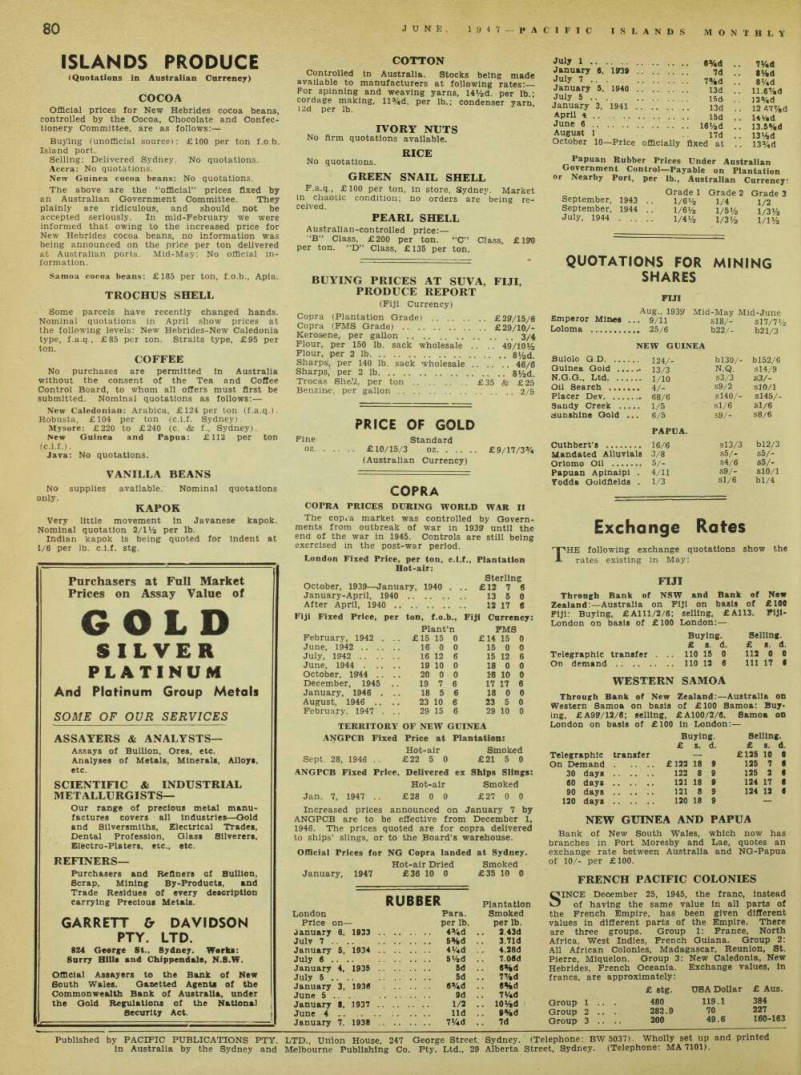
(Quotations in Australian Currency)
Cocoa
Official prices for New Hebrides cocoa beans, controlled by the Cocoa, Chocolate and Confec tionery Committee, are as follows: Buying (unofficial source): £lOO per ton f.o.b.
Island port.
Selling; Delivered Sydney. No quotations.
Accra: No quotations.
New Guinea cocoa beans: No quotations.
The above are the “official” prices fixed by an Australian Government Committee. They plainly are ridiculous, and should not be accepted seriously. In mid-February we were informed that owing to the increased price for New Hebrides cocoa beans, no information was being announced on the price per ton delivered at Australian ports. Mid-May: No official in formation.
Samoa cocoa beans: £lB5 per ton, f.0.b., Apia.
Trochus Shell
Some parcels have recently changed hands.
Nominal quotations in April show prices at the following levels: New Hebrides-New Caledonia type, f.a.q., £B5 pc-r ton. Straits type, £95 per ton.
Coffee
No purchases are permitted in Australia without the consent of the Tea and Coffee Control Board, to whom all offers must first be submitted. Nominal quotations as follows: New Caledonian: Arabica, £124 per ton (f.a.q.).
Robusta, £lO4 per ton (c.i.f. Sydney).
Mysore: £220 to £240 (c. & f., Sydney).
New Guinea and Papua; £ll2 per ton (c.i.f.).
Java: No quotations.
Vanilla Beans
No supplies available. Nominal quotations only.
Kapok
Very little movement In Javanese kapok.
Nominal quotation 2/1 Va per lb.
Indian kapok is being quoted for Indent at 1/6 per lb. c.i.f. stg.
Cotton
Controlled in Australia. Stocks being made available to manufacturers at following rates:— For spinning and weaving yarns, 14V 2 d. per lb • cordage making. ll%d. per lb.; condenser yarn. 12d per lb.
Ivory Nuts
No firm quotations available.
Rice
No quotations.
Green Snail Shell
P.a.q., £lOO per ton, in store, Sydney. Market in chaotic condition; no orders are being re ceived.
Pearl Shell
Australian-controlled price:— ‘B” Class, £2OO per ton. “C” Class, £l9O per ton. “D” Class, £135 per ton.
Buying Prices At Suva, Fiji,
Produce Report
(Fiji Currency) Copra (Plantation Grade) Copra (FMS Grade) Kerosene, per gallon .. ..
Flour, per 150 lb. sack wholesale .. . . 49/10 Vs Flour, per 2 lb Sharps, per 140 lb. sack wholesale 46/6 Sharps, per 2 lb Trocas 6he?J, per ton £35 & £25 Benzine, per gallon
Advertisements & other items, p. 82 (1 item)
Price Of Gold
Fine Standard oz £lO/15/3 oz £9/17/3% (Australian Currency)
Copra
Prices During World War Ii
The copra market was controlled by Govern ments from outbreak of war in 1939 until the end of the war in 1945. Controls are still being exercised in the post-war period.
London Fixed Price, per ton, c.1.f., Plantation Hot-air:
October, 1939 —January, 1940 .
January-April, 1940 After April, 1940 Sterling .. £12 7 6 13 5 0 12 17 6 Fiji Fixed Price, per ton, f.o.b., Fiji Currency: Plant’n February, 1942 . .. £15 15 0 June, 1942 16 0 0 July, 1942 16 12 6 June. 1944 19 10 0 October, 1944 ... 20 0 0 December, 1945 .. 19 7 6 January, 1946 ... 18 5 6 August, 1946 ., .. 23 10 6 February. 1947 ... 29 15 6
Fms
£14 15 0 15 0 0 15 12 6 18 0 0 1-8 10 0 17 17 6 18 0 0 23 5 0 29 10 0
Territory Of New Guinea
ANGPCB Fixed Price at Plantation: Hot-air Sept. 28, 1946 . . £22 5 0 Smoked £21 5 0 ANGPCB Fixed Price, Delivered ex Ships Slings: Hot-air Smoked Jan. 7, 1947 .. £28 0 0 £27 0 0 Increased prices announced on January 7 by ANGPCB are to be effective from December 1, 1946. The prices quoted are for copra delivered to ships’ slings, or to the Board’s warehouse.
Official Prices for NG Copra landed at Sydney.
Hot-air Dried January, 1947 £36 10 0 Smoked £35 10 0
Rubber
Plantation
July 1 6%d .. 7V«d January 6. 1939 , 7d .. «%d July 7 7%d .. 8 W d January 5. 1940 . 13d .. n.sy.d July 5 .. . 15d .. 12»4d January 3, 1941 . 13d .. 12 477/ad April 4 .. 15d .. l4Vad June 6 16%d .. 13.5®4d August 1 17d .. 13 %d October 10 —Price officially fixed at .. 13%d Papuan Rubber Prices Under Australian Government Control—Payable on Plantation or Nearby Port, per lb., Australian Currency Grade 1 L Grade 2 Grade 3 September, 1943 1/6 % 1/4 1/2 September, 1944 I/6V2 1/5% 1/3% July, 1944 . .. 1/4% 1/3% 1/1%
London Para. Smoked Price on — per lb. per lb.
January 8. 1933 4%d .. 3.43d July 7 . 5Hd .. 3.71d January 5. 1934 4V 4 d .. 4.38d July 6 6Vad .. 7.08d January 4. 1935 5d .. «%d July 5 5d .. 7%d January 3. 1936 6*/ 4 d . . 8%d June 5 .. . 9d 7V 4 d January 8. 1937 1/2 .. 10V4d June 4 lid 9%d January 7. 1938 7V 4 d .. 7d
Shares
Quotations For Mining
Emperor Mine* .
Fiji
Aug., 1939 Mid-May Mid-June .. 9/11 sl8/- S17/7V2 Loloma .. 25/6 b22/b21/3 Bulolo G.D
New Guinea
■ • 124/bl30/bl52/6 Guinea Gold N.Q.
S14/9 N.G.G., Ltd •• 1/10 s3/3 53/- Oil Search .. 4/- S9/2 slO/1 Placer Dev .. 68/6 S140/- Sl45/- Sandy Creek ... .. 1/5 sl/6 sl/6 sunshine Gold .. . 6/5 s9/s8/6 Cuthbert’s
Papua.
S13/3 bl2/3 Mandated Alluvials 3/8 s5/s5/- Orlomo Oil 5/- S4/6 s5/- Papuan Aplnalpl . 4/11 s9/- S10/1 Todda Goldfields . 1/3 sl/6 bl/4
Exchange Rates
THE following exchange quotations show the rates existing in May;
New Guinea And Papua
Bank of New South Wales, which now has branches in Port Moresby and Lae, quotes an exchange rate between Australia and NG-Papua of 10/- per £lOO.
French Pacific Colonies
SINCE December 25, 1945, the franc, Instead of having the same value in all parts of the French Empire, has been given different values in different parts of the Empire. There are three groups. Group 1: Prance, North Africa, West Indies, French Guiana. Group 2; All African Colonies, Madagascar, Reunion, St.
Pierre, Miquelon. Group 3: New Caledonia, New Hebrides, French Oceania. Exchange values, In francs, are approximately:
Fiji
Through Bank of NSW and Bank of New Zealand:—Australia on FIJI on basis of £100 FIJI: Buying. £Alll/2/6; selling, £A113. F1J1- London on basis of £100 London: — Buying. £ s. d.
Telegraphic transfer ... 110 15 0 Or demand 110 12 6 Selling. £ a. d. 112 0 0 111 17 •
Western Samoa
Through Bank of New Zealand; — Australia on Western Samoa on basis of £100 Samoa; Buying. £ A99/12/6; selling, £A100/2/6. Samoa on London on basis of £100 in London; — Buying. £ s. d.
Telegraphic transfer — On Demand £ 122 18 9 30 days 122 8 9 60 days 121 18 9 90 days 121 8 9 120 days 120 18 9 Selling. £ s. d. £125 10 0 125 7 8 125 2 6 124 17 6 124 12 e
£ stg. USA Dollar £ Aus.
Group 1 .. . 480 119.1 384 Group 2 .. . 282.9 70 227 Group 3 .. .. 200 49.6 160-163
Advertisements & other items, pp. 82-84 (3 items)
80
JUNE, IMI- pAtIFIC ISLANDS MONTHLY
Published by PACIFIC PUBLICATIONS PTY. LTD., Union House, 247 George Street. Sydney. (Telephone: BW 5037). Wholly set up and printed in Australia by the Sydney and Melbourne Publishing Co. Pty. Ltd., 29 Alberta Street, Sydney. (Telephone; MA7101).
Gold
Purchasers at Full Market Prices on Assay Value of
SILVER
PLATINUM
And Platinum Group Metals
SOME OF OUR SERVICES
ASSAYERS & ANALYSTS—
Assays of Bullion, Ores, etc.
Analyses of Metals, Minerals, Alloys, etc.
SCIENTIFIC & INDUSTRIAL
METALLURGISTS—
Our range of precious metal manufactures covers all Industries —Gold and Silversmiths, Electrical Trades, Dental Profession, Glass Sllverers, Electro-Platers, etc., etc.
REFINERS—
Purchasers and Refiners of Bullion, Scrap, Mining By-Products, and Trade Residues of every description carrying Precious Metals,
GARRETT Cr DAVIDSON
PTY. LTD.
824 George St., Sydney. Works: Sorry Hills and Chippendale, N.B.W.
Official Assayers to the Bank of New South Wales. Gazetted Agents of the Commonwealth Bank of Australia, under the Gold Regulations of the National Security Act.
tropical thirst...
To (fiiench a
d"" kS
% ;> v K / 0 « *** ; <5
LAGER
When you’re hot and tired,
there is nothing quite so satisfying
and thirst quenching as a long, cold glass of ”K.B. ‘ Your friends and guests, too, will ap-
preciate this really fine
Lager, for “Everybody
drinks K. 8.”
TOOTH'S
MERCHANTS. Qc SHIP OWNERS
Capitol £1,000,000
ESTABLISHED 1914
'At
COPRA MERCHANTS & MILLERS
BRANCHES THROUGHOUT THE PACIFIC ISLANDS
Buyers and exporters of all kinds of Islands produce. Copra Merchants and Millers.
Agents for Australian, European and American Manufacturers. Distributors of every description of merchandise.
Thirty years of Pacific Islands development and service.
REGULAR CARGO AND PASSENGER SERVICE BETWEEN EUROPE AND
PACIFIC ISLAND PORTS WAS ESTABLISHED BY
W. R. CARPENTER & CO. LTD.
Head Office: 16 O'CONNELL STREET, SYDNEY.
Cable Address:
CAMOHE.
Telephone: BW 4421.
Postal Address: P.O. Box No. 168, Sydney.