Pacific
Islands
Monthly
May 19, 1947
Vol. Xvii. No. 10
Established 1930.
I Registered by post as a newspaper ]
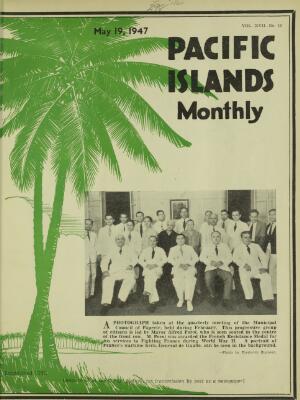
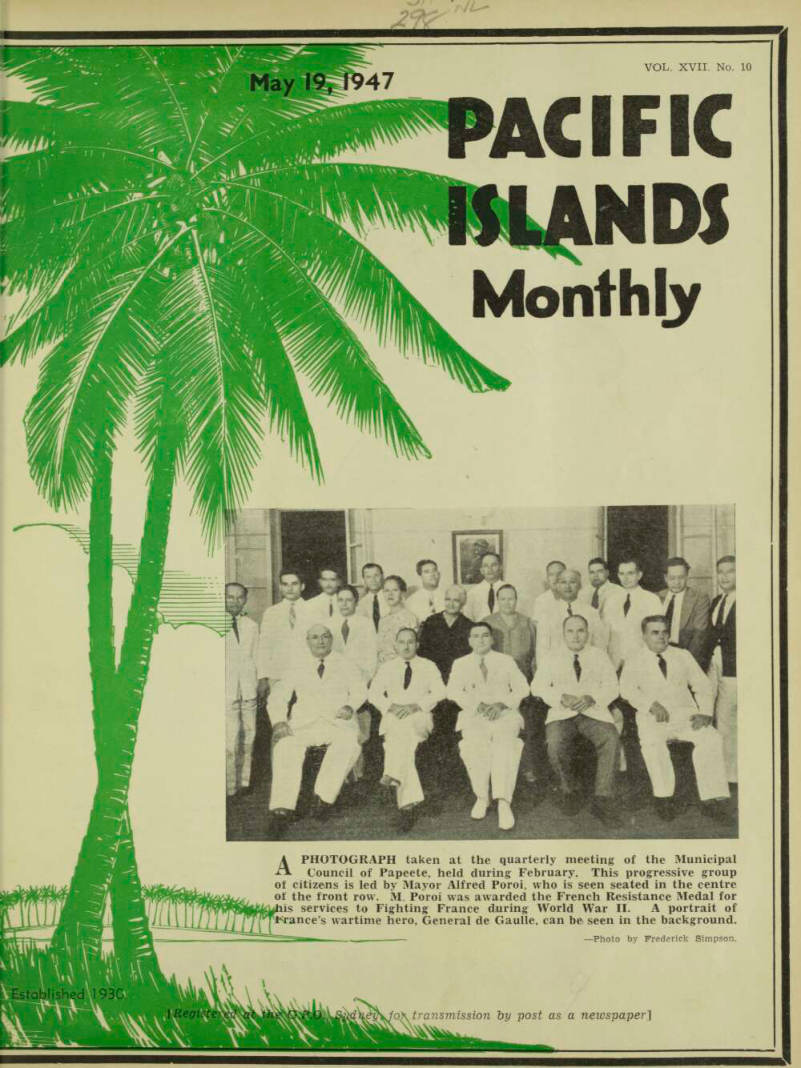
A PHOTOGRAPH taken at the quarterly meeting of the Municipal Council of Papeete, held during February. This progressive group of citizens is led by Mayor Alfred Poroi, who is seen seated in the centre of the front row. M. Poroi was awarded the French Resistance Medal for his services to Fighting France during World War II. A portrait of France’s wartime hero, General de Gaulle, can be seen in the background. —Photo by Frederick Simpson.
Advertisements & other items, pp. 2-4 (1 item)
Check
AND
hcuhle
Chech
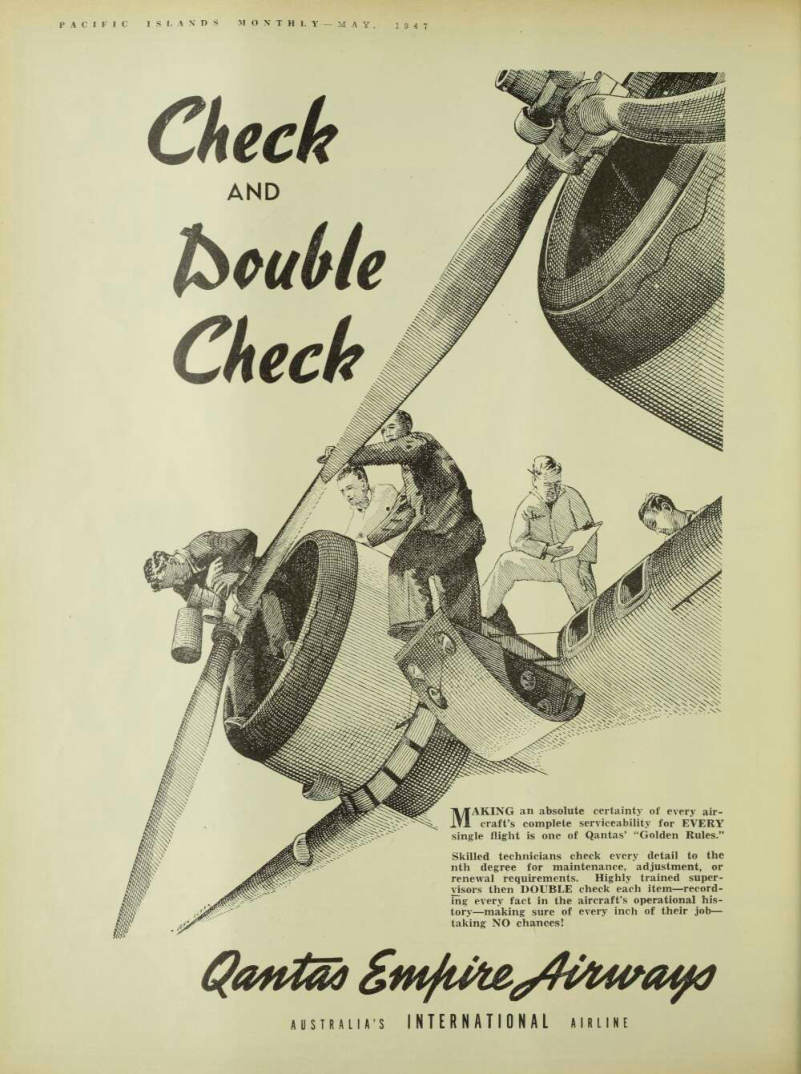
■m MAKING an absolute certainty of every aircraft’s complete serviceability for EVERY single flight is one of Qantas’ “Golden Rules.”
Skilled technicians check every detail to the nth degree for maintenance, adjustment, or renewal requirements. Highly trained supervisors then DOUBLE check each item—recording every fact in the aircraft’s operational history—making sure of every inch of their job— taking NO chances!
Australia's INTERNATIONAL airline
DAYLIGHT
DARK
The outstanding features in all Coleman’s Lanterns have proved their value by active performance over forty years. rm ri m. i / Coleman’s Petrol and Kerosene Lamps in 300 and 500 C.P.
Coleman’s Petrol or Kerosene Lamp with large enamelled reflector.
Coleman’s Kerosene Table Lamp can be used as hanging Lamp Coleman Lanterns are made stronger to last longer:
Pyrex heat-resisting globes
protect the mantles pressure-tested brass fonts that will not rust . . builtin automatic tip-cleaning needles . . . shut-off valves to avoid constant repumping each time lantern is
lighted. Safe, Steady Brilli-
ance in or out of doors.
LANTERNS
Representatives tor the Pacific Islands
ROBERT GILLESPIE PTY. LTD.
54a PITT STREET, SYDNEY
PEARCE & CO. LTD,
SUVA
FOR FIJI ISLANDS
ir: > * & 4 h And only 6 months ago we thought we'd never get married!
It was like this . . .
I wish your boss would hurry up with that rise Harry. We'll never qet married at this rate !
'<£- ; Is" The directors decided aqainst your salary increase, Hunter. We Y This cant go on.
I'd better see a doctor .
Rise ? I'm lucky to keep my job the way 1 feel. .ti red out and
expected big things
IM from you nervy but work your n been has m fall off nq n Mr Hunter, your symptoms indicate "night starvation"
You probably don’t realise if. but while you sleep you must replace energy lost
during the day... Even
during the night, your
heart and lungs continue their work. Naturally, unless this energy is
replaced you're bound
to wake tired...become nervy. I recommend
HORLICKS.
SO.
HORLICKS
EVERY
MIGHT • ••
I' Which side do I walk, sir when, we are the lea nq rch T
Each glass of
HORLICKS*
before bed gives
you . . .
Protein essential to the growth and development of every part of the body.
Without protein growth cannot take place and then wear and tear resulting from our daily activities is not made good.
Fat almost entirely derived from milk; an efficient source of energy and also of vitamins A and D.
Carbohydrate—chiefly maltose and dextrin (perhaps the best source of quick energy) and lactose, which is of great * Made deficiency value to young children.
Mineral Salts —to help in building tissue and in regulating body activities. These mineral salts include: Calcium —of which there is a in many Australian diets and yet is so necessary for building sound bone and good teeth.
Vitamins A B B and D —each fulfilling its own special job in maintenance of sound nutrition. with milk. M7-I
HORLICKS
: V
KNIGHT STARVATION
Advertisers
Angliss & Co. . . 36 Aust. Fishing In dustries 35 Atkins Pty., Ltd., Wm 68 Amalgamated Hatcheries ... 34 Andrews Laboratories ... 78 Bethell, Gwyn & Co. ... 79 Brown & Co., Ltd. 15 Brunton’s Flour . . 58 Bank of NSW ... 16 Berger, Lewis, & Sons Ltd. ... 45 Brial & Ball ... 19 Burns, Philp Trust Co., Ltd 49 Budge James, Pty., Ltd 57 Brcornfields . . . .58 BP (SS) Co. . . . 15 Bulowat Transport Co 64 W. R. Carpenter & Co. (Fiji), Ltd. . 33 Carlton & United Breweries Ltd. . . 65 Caine’s Studios, Suva 32 Carpenter, Ltd., W.
R cov. iv.
Coleman Lamp & Stove Co. ... 32 Colonial Wholesale Meat .47 Costello, Vince, Garrick Hotel . . 51 “Cystex” ... 74 Crosse & Blackwell, Ltd 30 Denhams Radio. . 56 Donaghy & Sons . 35 Donald, Ltd., A. B. 60 Paul, A. Dorn . . 36 Dr. Williams Pink Pills 59 Dangar, Gedye & Malloch ... 3 Dunlop Rubber (A/sia), Ltd. ... 25 Ecco Products ... 60 Electrolux Refrigerators . . 3i Excelsior Supply Co 71 Fulton, Edward. T. 72 Fields, A. G., . ’ . . 14 Garrett & Davidson 80 Gillespie Pty., Ltd., Robert . . . 1 & 48 R o b t. Gillespie (NG), Ltd. ... 63 Gilbey’s Gin . . .51 Gillespie’s Flour . . 76 Gough & Co., E. J.. 23 Grond Pacific Hotel 4 Grove & Sons, W.
H 71 Heinz & Co. Pty., Ltd., H. J. . . .29 Heming.way & Robertson . . .23 Hughes, Hamilton A. 25 Horlicks Malted Milk 2 Hyde, Victor ... 14 Ipana Tooth Paste 28 Kentucky Stud ... 24 Kopsen & Co., Ltd. 24 Kodak (Aust.) Pty.
Ltd .'75
Lockyer, Geo. J. . 67
Mail Publicity-Co. . 67 M. & M. Island Traders ... 57 Merrillees, J. C., & Co 18 Millers, Ltd., Suva 14 Miscellaneous. 25, 73 “Mum” Deodorant . 69 “Mendaco” . . .. 78 Mcllraths Pty., Ltd. 68 Morgan, F. J., & Co 19 Morobe Furnishing & Contracting Co. 70 Morris, Hedstrom, Ltd. Suva ... 12
Napt 48
Nelson & Robertson Pty., Ltd. ... 64 NSW Bookstall Co.
Pty., Ltd 54 “Nixoderm” ... 50 Noidman, Oscar . . 55 Pacific Islands Trading Co., 66, 77 Pacific Is. Society . 55 “Pinkettes” ... 23 Pitt & Scott, Ltd. . 50 Proprietary Products 22 Qantas Empire Air ways , . . cov. •ii Queensland Insur ance Co 62 Ransomes, Sims & Jefferies ... 76 Robinson, G. H. . . 61 Rose’s Eye Lotion 69, 58 Rohu, Sil . . . .45 Scott, Ltd., J. . . 73 Shell Co 17 South Sea Islands Correspondence Club 78 Southern Pacific In surance Co. . . 33 South Sea Faith Mission . . . . .73 Steamships Trading Co., Ltd 62 Stokoe Motors Pty., Ltd 21 Sullivan & Co. C. . 27 Swallow 6c Ariel . . 22 South Sea Islands Club 36 Talyor & Co.. A. . 74 “Tenax” Soap ... 76 Tillock & Co' Ltd. 61 Tooth & Co., Ltd. . . . cov. iii Tilley’s Lamps . . 26 Trans Oceanic Air ways Pty., Ltd. . 79 Tulloch’s Pty., Ltd. 20 “Vitalis” Hair Tonic 53 Vacuum Oil Co., Ltd 46 Watson, Wm. H. . 55 Harry West ... 56 Wikara, Buddy . . 54 Wlddop, H., & Co., Ltd 59 Whites Aviation, Ltd 17 Where the Trade Winds Blow . . 18 Wills, W. D. & H. 0 52 Wright & Co., Ltd., E 21 Yorkshire Insur ance Co.. Ltd . 15
Advertisements & other items, p. 5 (1 item)
Lister-Blackstone
Another
BLAGKSTONE engine
The 85 feet “Larwas” is another island trading vessel to he fitted with a Blackstone Marine Engine. On trials her 160 h.p. Blackstone diesel gave an average speed of 9 knots.
WHEREVER small craft sail you will find Lister and Blackstone marine engines. Fishermen in the North Atlantic have the same faith in these fine English engines as the island traders of the Pacific.
Blackstone marine engines are simple in design, robust and compact in construction, with exceptionally light weight to power ratio. Although totally enclosed, all working parts are readily accessible by the removal of large hand covers. Control is simplified by the grouping of all instruments at the forward end of the engine.
Blackstone marine propulsion engines up to 200 h.p. are fitted with hydraulically operated remote control, reverse gear ensuring easy manoeuvring and quick change from ahead to astern. The larger engines are fitted with direct reverse gear.
Chrome-hardened by the patent Listard process, the Lister and Blackstone cylinder liners have a 400 per cent, increased resistance to wear.
LISTER-BLACKSTONE
MARINE ENCINES
< mm® Write to-day for details of delivery of Lister Marine Engines from 8-60 h.p. and Blackstone Marine
Engines from 80-320 h.p.
DANGAR, GEDYE & MALLOCH LTD.,
Malloch House, 10-14 Young Street, Sydney
The Pacific Islands
Trade Directory
Price, 10/-, post free.
Published by Universal Business Directories Ltd.
Contains lists of all Merchants, Traders, Plantations, Etc.
May be Purchased From
PACIFIC PUBLICATIONS
PTY. LTD.
247 George Street, Sydney G.P.O. Box 3408
In This Issue:
Editorial. “Don’t Hurry Back, Mr.
Ward!” 5 NG Mainland Transport Beyond Words” ••• •• 7 France Pays More for Pacific Copia 7 Fiji’s Heavy Food Subsidies .. ■• •• 7 Cook Islands Seamen Demand Better
Pay • • • • 7
Government Monopoly of Airlines — P. G. Taylor Refused Licence .. 7 Asbestos Deposits May be Developed in New Caledonia ; • • 7 “Research Section” and New Guinea Planners •• •• : • ° Plans for Developing New Caledonia 8 Tongan Floyal Wedding in June .. .. 9 Starving Natives, But their Own Fault 9 More Freighters for Pacific 9 “Malaita” back on New Guinea Run — 4i years in Dock 19 Round the World Yachtsmen Call at Suva 10 Future of 23 Atolls—Let USA Have them! 1° Easter Sport at Levuka 10 Huge Funds for Pacific—Annual Ac counts of the BP Companies ... 11 New Catalina for WRC 11 Trusteeship Council Will Investigate Self-Rule Claims in Western Samoa 13 Lists from Readers Notes 13 Papua-New Guinea Scene —Mr. Ward Says All is Well 14 CIPA Against Workers’ Union in Rarotonga 16 Cruel Treatment of BSI Planters .. 17 Phosphate Production on Ocean Island and Nauru 19 Samoans’ Dime F\md Finances Pur chase of Merchant Marine .. .. 21
Part-Retirement of Sir Maynard Hed strom 22 Death of Charles B. Nordhoff 23 World Shortage of Rice 24 Tragic Death of Clive Brewster ... 25 Tribute to Suva Medical School ... 29 Misima in Production in Early 1948 29 New Delhi Interference in Fiji— Alleged Grievances of Fiji- Indians 30 Fiji Arts and Crafts are Being For gotten 32 “Operation Sepik” Jungle War Against the Japs 33 New Mission Church for Mangaia .. 36 Dengue Outbreak in Fiji—Mosquitoes Breed Near Suva 36 Territories’ Talk-Talk 37 Spotlight on Emirau 38 Tropicalities 39 Polynesia in Melanesia 40 Short Story: A Scientist From South of the Border 42 Trader’s Tale: The Bread Season Opens 43 Lament of an Exile 43 In the Bad Old Days of Torres Strait 44 War and Aeroplanes Brought New Insects to Pacific 45 Early Cinchona and Coffee Seed in Papua 47 Robert Gibbings Now in New Zealand 47 Cook Islands Electors Vote by Radio 47 New “Pearl of Pacific” 47 LMS 150th Anniversary in French Oceania 49 Odd Angles in Fiji—Notes Made by “PlM’s” Editor 50 Rabaul Jottings 55 Back to the Koro—Fiji Clerks Cannot Afford to Live in Suva 56 New Guinea Germans Now Released
After Years in Australian Intern ment Camps 57 Polynesians are Threatened by Nakedness 58 Re-Establishing Oil Production in
Nei 59
Administrator Tells Brisbane Aud ience About Papua-NG 59 In Defence of “Backward Melan esians” 61 Shipping and Plane Services—Pacific Travellers 62—65 TNG Mining Reg. Amendment ... 65 W. Samoa’s High Cost of Living ... 67 ’Flu and Mumps in W. Samoa 68 New Guinea Scholarship Fund ... 70 The Polynesians and Peru 71 New Britain’s Generous Response to Sydney Women’s Appeal 73 Fijians and Europeans Both Play Football—But Fijians Draw the the Crowd 73 Lae and Madang in 1947 74 RC Missionaries Lost in New Guinea —56 Nursing Sisters in Appalling List 75 The Future of Rabaul—Old residents Optimistic 77 Site of Ancient Mangaia Marae Un covered 77 Here and There in Papua-New Guinea 78 Fiji’s TB Campaign Moving Slowly 79 Lutheran Mission Ship Sails for New Guinea 79 Commercial, Markets, etc 80 ORGANISATIONS: Brisbane NG Assn.. 8; Sydney NG Women’s Club, 8 and 73; Melbourne NG Women’s Assn., 70; Pacific Islands Society, 76.
OBITUARY: Charles B. Nordhoff. 23; Clive Brewster, 25; Ernest Till, 30; F. T. S. Lennon, 43; Mrs. J. M. C.
Forsayth, 48; Irving G. Smith, 50; A.
A. Chauncy, 65.
Advertisements & other items, p. 6 (1 item)
Stav”*^
?f s« « n * . s ce c u\s^ c ’ * *»« vt# . e " e ° and sa . a< <° r >"“** <*'- ,si- '"„. **#?*
Pacific Islands Monthly
The Newspaper-Magazine of the South Seas [Registered at the G.P.0., Sydney, for transmission by post as a newspaper.']
Published Once Each Month and Circulated in Australia and New Zealand and in the following Pacific Territories and Islands Groups:
Australian Territory of Papua.
Mandated Territory (Australia) of New Guinea.
Australian Territory of Norfolk Island.
New Zealand Territory of Cook Islands.
Mandated Territory (NZ) of Western Samoa.
British Colony of Fiji.
British Solomon Islands Protectorate.
British Protectorate of Tongan Islands.
British Crown Colony of Gilbert and Ellice Islands.
Mandated Territory of Nauru.
British and Free French Condominium oi Hebrides.
French Colony of New Caledonia.
French Colony of Oceania (Tahiti, etc.).
American Territory of Eastern Samoa.
American Territory of Hawaiian Islands.
Owned and Produced by Pacific Publications Pty. Ltd., Union House, 247 George Street, Sydney.
Telephones: General Office and Advertising, BW 5037.
P.O. Box 3408
Registered Address for Telegrams, Radiograms, and Cables: “Pacpub”, Sydney.
Contributions.
Articles, Stories, and Photographs dealing with Pacific Islands subjects are invited and will be paid for on publication.
Subscription Rates.
Per Annum, Pre-paid, Including Postage, In Australia, New Zealand, Fiji, New Guinea, Papua, Western Samoa, Cook Islands, Tonga, British Solomons, Gil bert and Ellice Colony, Nauru, and United Kingdom 10 0 Elsewhere 15 0 Single copies 1 3
Editor and Publisher:
R. W Robson. P.R.G.S.
Assistant Editor: JUDY TUDOR.
General Office: Union House, 247 George Street, Sydney. Telephone: BW 5037.
Advertising Manager: W. E. Rogers.
Representative In London.
J. T. Wallis, Coronation House, 4 Lloyds Avenue, London, EC.3, from whom may be obtained copies of Pacific Islands Monthly, Pacific Is. Year Book, advertising schedules, etc.
Representative In U.S.A.
Pacific Islands Trading Co.,
244 CALIFORNIA ST., SAN FRANCISCO, U S.A.
Agents.
The following are authorised to receive sub scnptions for Pacific Islands Monthly;— Burns, Philp & Co., Ltd., and Burns Phllp (South Sea) Co., Ltd. All branches.
W. R. Carpenter & Co., Ltd, All branches.
Morris, Hedstrom, Ltd. All branches.
Steamships Trading Co., Papua. All branches.
W. M. Caldwell, Suva, Fiji.
Cook Islands Trading Co., Rarotonga, Cook Is.
A. C. Rowland, Papeete, Tahiti.
Islands Branches and Representatives of W. H.
Grove & Sons, Ltd., Auckland, New Zealand.
Ed. Pentecost, Noumea, New Caledonia.
Societe Gubbay Kerr et Cie, Noumea, N. Caledonia.
T. A. Wyborn, 12a Alpin Street, Cairns.
Vol. XVII. No. 10
May 19, 1947
. j 1/3 Per Copy Price .{Prepaid, p.a.; 10/- Aus I In USA, p.a.; $2.50
Don’t Hurry Back, Mr. Ward!
COMPLETE with staff and equip ment, Mr. Eddie J. Ward, the Australian Minister in charge of the Pacific Territories of Papua and New Guinea, is going to Geneva to attend the annual convention arranged by the International Labour Office. The H_o is a sharply Pink institution, which professes a lively interest in all peoples whom the übiquitous Planners of the present generation suspect may be subject to “exploita tion.”
It always was supposed that Mr.
Ward, from the moment he entered the Territories and began to emulate the famous Bull in the China Shop, had his eye on ILO. The “PIM,” three years ago, suggested that Mr. Ward probably would go to Geneva and claim a halo, as the saviour and pro tector of Fuzzy-Wuzzy.
Now he is on the way. His progress is being watched sourly by the Aus tralian taxpayer, who is becoming very tired of providing peripatetic politicians and their relations and staffs with world tours, with every thing paid for, in luxurious style, out of the public purse. It was quite blithely pointed out in Canberra re cently that “every Minister had had a world tour except Ward and Calwell”; and so a trip abroad was arranged for both.
The Australian Labour Party’s fav ourites —mostly in the shape of re jected Parliamentarians are scat tered over half the world, in Consu lates and Commissionerships. The
Australian Minister for Air, a poli tician named Drakeford, for the sec ond time in 12 months, has just de parted for America, attended by wife and daughter and staff—all at the public expense.
THE majority of the delegates whom Mr. Ward will meet in Geneva will be gentlemen of his own kidney, who will accept without question his story of his achievements in Papua- New Guinea. They will listen with interest to his account of how he wiped cut the vicious system of in dentured labour, and they will cheer loudly his account of his victory over the traders who were “exploiting” the Territories. They will chuckle when he tells them of the stratagems by which Canberra got rid of the Leonard Murrays and McNicholls and all the reactionary followers of the old regimes; and they will applaud the plan under which the Territories are given the incalculable benefits of a State-owned transport system, directed by bureaucrats, in which all considerations of filthy profit and nublic convenience are subverted to the necessity of giving the staff a pleasant and easy time.
It is to be regretted that there will be no one at Geneva able to tell the plain truth about Papua-New Guinea.
Mr. J. R. Halligan will be there, as a member of Mr. Ward’s entourage; and Mr. Halligan knows the Terri tories conditions only too well. But that overworked and harassed official is, after all, a public servant, who is
obliged to give his loyalty to his Min ister —even if his Minister be the in credible Mr. Ward.
THE picnic party in Geneva—that is what it is primarily—ought to be given a categorical description of events in the Australian Territories since Mr. Ward took command, so that the world may see what happens to a hitherto prqsperous community when it is overtaken by the twin curses of War and Wardism.
In the bad old days, before World War 11, the Australian Territory of Papua and the Mandated Territory of New Guinea provided Australian en terprise and capital with a field of activity from which Australia bene fited. The Territories were practic ally self-supporting. They produced copra worth—even in the bad old days—nearly £1,000,000 per annum; gold to at least £2,000,000; and quite anpreciable and valuable quantities of rubber, cocoa, coffee and shell.
The Territories Administrations, working in useful harmony with the missionaries, on one side, and the planters, miners and traders on the other, literally tamed two vast, primi tive, almost inaccessible regions. In 1920, the great majority of the 1.250,000 natives were primitive, Stone-age savages, dangerous and treacherous. In 1940, the whole re gion was so much under control that Europeans might) move about any where in both Territories with little risk.
The natives had been tamed, cleaned un, introduced to European orderliness and European ways of life. They still were primitive; but,
step by step, they were learning to conform to our ideas of good conduct.
The most efficient factors in this change were (a) patient and persist ent work by the missionaries; (b) wise and patient effort, in accord ance with a fixed policy, by experi enced Administration officials; (c) the system of indentured labour, under which, in the Territories, at any one time, some 50,000 natives were being employed.
That indentured labour system was evolved in three decades of trial and error. It was employed by the plant ers, miners and traders, under strict supervision of Administration officials and missionaries, as an alternative to bringing in Asiatic labour, with all its undesirable complications. Every year, thousands of natives —well fed, cleaned up medically, with a rudi mentary training in European ways gained in two or three years of ser vice—returned to their villages and were replaced with an equal number of ignorant and dirty savages from the primitive bush.
EVERY so often, the Territories would be visited by Australian Trades Hall gentlemen who never be fore had seen a tropical country or tropical conditions, and knew noth ing whatever about primitive natives.
When they discovered that the native labourers were paid only 10/- or 15/per month and “found,” they usually squawked loudly about “exploitation” and “slavery,”
Experienced and responsible offi cials and missionaries—most of them proved humanitarians —were quite satisfied with the set-up. It would have been ridiculous and unwise to pay those primitive natives, with their present outlook and back ground, anything more than a few shillings per month in cash. But the Trades Hall gentlemen, as ignorant in their way as the native is in his, felt themselves more wise than all officials, planters, missionaries and mining companies combined, and bawled for native labour reform.
Territorians regarded the perform ances of the Trades Hall gentlemen with amusement and tolerance. They did no harm. It was no use trying to tell such people that no one could speak with authority of Territories’ affairs until he had had at least a year’s experience of Territories con ditions.
Then came the war, and a Socialist Government in Australia, and Mr.
“Eddie” Ward, a tub-thumping dem agogue, as Minister in charge of Ter ritories. The rest is history—and what history!
MR. WARD decided on a completely new policy in New Guinea. He went for his plan to a “research” body composed of professors, bureau crats, anthropologists, academic planners generally—not one of whom had lived long enough in the Terri tories to understand the conditions of life there. So far as is known, he did not consult one experienced Ter
ritorian outside the ranks of official dom.
The indentured labour system was abolished, and there was introduced an anaemic, ill-designed system which, so far, has failed to work.
The sea transport services were taken out of the hands of private enterprise and handed over wholly to Government control. We now have had over a year of inefficiency and blundering confusion—especially in the working of ships in the various ports—and the shipping services, both coastal and oversea, are in a more hopeless condition than ever.
The handling of the produce of plantations was forbidden private enterprise, and given over to the Production Control Board (a Ward controlled Government instrumen tality), with the result that planters, already struggling against lack of labour and lack of transport, get paid for their produce just what Mr. Ward thinks is right—which is about half of world parity!
Traders have been permitted to re turn: but under such restrictions and handicaps that there is little encour agement of enterprise.
Non-official Europeans have been given little practical assistance in re habilitation, apart from the pay ments made by the War Damage Commission—which functions quite independently of Mr. Ward and his myrmidons, anyhow. But nothing that Canberra can devise, or the Aus tralian Treasury can produce, or the local Administration can offer, seems too good for Black Brother. The Ward policy in New Guinea is on all-fours with the Australian dockers’ policy in relation to Indonesia. (As all the world knows, the Australian dockers forced the Australian Government, of which Mr. Ward is a shining orna ment. to make common cause with the Indonesians against the Dutch.) Where, previously, the government of the Territories cost the Australian taxpayer practically nothing, Mr.
Ward is now spending close on £3,000,000 per annum of Australian funds in the Territories on all sorts of schemes devised by his Trades Hall confreres and his dreamy-eyed acad emic planners for the enrichment of Black Brother.
Flowing out of that huge expendi ture, there is false prosperity of a sort in the Territories. But what a crash there will be when the Aus tralian taxpayer revolts, and this orgy of mad-headed spending is fin ished!
IF there is in Geneva any Pink Planner of advanced ideas who re quires the services of a hard-hating Minister with a pro-native, anti white complex, and an endless cap acitv to abuse and shout down all criticism in finest Australian-ese, and guaranteed to turn any tropical country into a chaotic Socialist para dise within four years, we can most cordially recommend Mr. “Eddie”
Ward, of King’s Cross, Australia.
However, if there is no such job offering overseas, we can only join in the Territorian chorus and say: Please have a good time at our ex pense, Mr. Ward—and DON’T HURRY
Back!
About Islands
People
M. Georges Ahne, Papeete lawyer, has been elected deputy for Tahiti in Paris.
He polled 7,038 votes against 5.328 for Madame Tumahai, 1,814 for M. Francis Sanford, and 222 for M. Jean Baptists Thunot. As Councillor of the Republic, the Tahitian Representative Assembly has elected M. Joseph Quesnot, who received 11 votes out of 20 cast.
Mr. George Cashbolt, an old employee of the WRC company, is due in Sydney this month on extended leave, which he will spend in New Zealand.
Captain Harry Lee, of MS “Karu”, re cently arrived in Sydney from Port Moresby on sick leave. Other old sea faring identities of New Guinea are Captain Bobbie Crookshank, who is making a trip to Java, and Captain Tom Proctor, on the good ship “Innisfail”, who was last heard of in Madang.
Mr. Douglas McDonald, son of Colonel and Mrs, J. H. McDonald, of New Guinea, was married in Sydney on Saturday, May 10, to Patricia Curnow, only child of Mr. and Mrs. Vyvyan Curnow, of Cremorne.
The ceremony took place- in St. Chad’s Cremorne. Mrs. Lloyd Jones, of Mel bourne, acted as matron of honour and Mr. Aubrey Johnston, a fellow officer of the groom in the Merchant Navy, was best man. The groom’s father, Colonel McDonald, was recently Deputy Adminis trator in Rabaul.
Mr. C. L. Wilde, who left his mark prominently on the Territory of New Guinea, as planter and trader, during several decades, is now living quietly in Sydney. The fine coffee plantation, which he pioneered and successfully est ablished at Wau, in the Morobe Valley, was actually the scene of a battle between Australians and Japs, in 1943. It suffered severely from the fighting, and from “scorched earth”. Mr. Wilde reports that the plantation has been sold, subject to the consent of Australian Officialdom.
Mr. Wilde is now well over 70 years old, but is still a handsome and virile man.
Rev. Father Doherty, of Suva, and Mr.
A. G. Prasad, of the Teachers’ Training College, Nasinu, have been appointed members of the Fiji Board of Education. .. Mrs. J. H. Beighton departed recently for Rabaul, where she will join her hus band, who is managing Manguna planta tion, on the south coast of New Britain.
Mr. E. J. Frame, territorial manager in Papua-New Guinea for Messrs. Burns Philp & Co., has returned to Port Moresby where his headquarters are situated. Mrs. Frame has joined her hus band there, travelling by MV “Malaita.”
Mr. B. B. Perriman, a director of W.
R. Carpenter & Co. Ltd., left Sydnev for New Guinea during the last week in April. He will make a general tour of inspection of the company’s interests in the Territory.
Judge Gaetan Jeanson, of the New Cal edonian Court has been transferred to Vila, New Hebrides, where he will replace temporarily Judge Geslin of the Condo minium Court who has left for France on leave.
A New Caledonian sailor, George Clemen, who was lost in February, 1942, with the Free French submarine “Sur couf”. has been posthumiously awarded the Croix de Guerre.
NG Mainland Transport
A Situation "Beyond Words"
From a Special Correspondent WHETHER Mandated Airlines is a part-Government service or not, it is being criticised in regard to both its activities and its planes.
The planes, although passed by Civil Aviation as airworthy, have a way of re fusing duty, or getting tired on the road.
Then there is the schedule—if there is such a thing. We have been informed that each second week is set apart as a Special, for a trip to Wewak via Madang and such dromes as are agreed upon by the Administration. But this has not been done—it has been just a rush up to Wewak and back, practically the same day. Efforts to induce planes at Wewak to clear up the congestion of goods awaiting transport to outer dromes, either by MAL or Qantas, have resulted only in loss of time and ether.
It would appear that the plane services although run by private enterprise, are beginning to get on a par with the ship ping muddle, which the public and busi ness peonle have given up now as abso lutely hopeless. Western Islands residents and * outlying plantations have had no transport for over three months. Perhaps, when the management is taken over by an experienced shipping man, there will be some improvement.
The plane arrived at Wewak on its usual rush trip on April 19, minus the mails. The people looked ferociously at one another, and just shook their heads and said nothing. The situation was be yond words.
Pacific Copra
France Pays More For Pacific Copra
IT has been decided to levy a small ex port tax on copra shipped from Tahiti. This tax is calculated at 5 francs per ton, and the local Chamber of Agriculture will benefit.
An increase in the price of Tahiti copra has been announced in Paris. Price per ton is 8,100 francs—equal to about
£Aso.
Cook Island Seamen Demand
Better Pay
1 ELEVEN Rarotongan members of the j crew of the auxiliary schooner “Tagua” and the auxiliary ketch “New Golden Hind” paraded through parts of Auckland. NZ, on May 2, and gathered in the grounds of the Supreme Court. They carried placards stating their claims for pay and better conditions.
They were spoken to by a police sub inspector, arid they then dispersed.
Both ships have been involved in a dispute with their crews since the end of March.
The placards stated that the crews had served New Zealand throughout the war, and asked payment of the war risk gratu ity. overtime money, and the New Zealand seamen’s award wages.
The “Tagua” is on charter to the Pub lic Works Department from the Cook Islands Trading Company of Rarotonga. (An advertisement offering her for sale appears elsewhere this issue.) She has been at anchor in the stream since March 29, ready to sail for Norfolk Island, Noumea, and the Solomons. The “New Golden Hind” is a PWD vessel. She was waiting to leave for Sunday Island, Niue Island, and Rarotonga.
Miss Claire McDonald was farewelled by a number of her friends at Rosalie
(Brisbane), recently, prior to her leaving
for Port Moresby.
Food Subsidies
Fiji Pays Heavy
Estimated £100,000 to Keep Down Prices of Flour and Ghee
From Our Own Correspondent
Suva, May 2
THE sum of £llO,OOO is no trifle in the yearly Budget of a small Crown Colony. But this is the latest esti mate of what it will cost Fiji to keep down the prices of sharps (for the Indians); ghee (for the Indians); bread, flour and biscuits (for the Europeans, part-Europeans, Fijians and a limited number of Indians).
The price of Australian flour and sharps went up another £2/10/- per ton in February and so up go the subsidies in Fiji.
In 1946 the subsidies on these two items amounted to £54,110. In 1947, it is officially estimated that the cost will be £lOO,OO0 —with another £lO,OOO “to keep the prices of local and imported gh.ee at a uniform level.”
With regard to flour in the form of bread and biscuits, which an Indian member of the Legislative Council in March seemed to regard as a European preserve, it may be pointed out that more and more Fijians in the Suva area are being forced to eat bread and biscuits in place of their own dalo (taro) which has been pushed to famine prices in the Suva markets by exploiters who are taking advantage of lifted controls.
Again, during the war thousands of Fijian serviceman were arbitrarily put on “European diet”. Detesting it at first, they ultimately acquired the taste and have kept it. White flour and white sugar are no more a suitable diet for Fijians than they are for the Europeans whose teeth have suffered for generations from the effects of -those profitable com modities. But it will take yet another education campaign to persuade the Fijians to give them up.
Government Monopoly of Airlines P
Airlines P. G. Taylor Refused Licence
THE Australian airman who has prob ably done more than anyone else to make trans-Pacific commercial avia tion possible, Mr. P. G. Taylor, has been refused a licence to establish an air ser vice between Australia and Lord Howe Island.
Acting Minister for Air Barnard (Min ister Drakeford, accompanied by Mrs.
Drakeford and Miss Drakeford. at Aus tralian taxpayers’ expense, is at present abroad) was asked recently in Canberra if this refusal was based on a desire not to “spoil the Island with too many tour ists.”
Mr. Barnard’s reply was that the general question of service to Lord Howe Island was under review and when it had been decided the nuestion of a licence for Mr.
Taylor would be considered.
Mr. P, N. Nightingale represented the Colony of Fiji and the Western Pacific High Commission at an aviation confer ence in London which began on April 14.
The conference discussed British Com monwealth aviation policy and matters connected with the construction of aero dromes and organisation of ground ser vices in the Colonies and also decided how cost is to be allocated between the United Kingdom and governments of the colonies concerned.
Fiji is South Pacific
Aerial Crossroads Seven International Airlines Use Airports in Colony
From Our Own Correspondent
Suva, May 2
SEVEN overseas airlines now terminate in or pass through Fiji.
On Anzac Day (April 25), the first plane in the new A’uckland-Vancouver service operated by Autsralian National Airways under contract to British Com monwealth Pacific Airlines circled over Suva before going on to land at Nadi airport.
The passengers included the managing director of Australian National Airways (Mr. Ivan Holyman), and Mrs. Holyman, the Australian Air Minister (Mr. A. S.
Drakeford) and Mrs. and Miss Drakeford, and the New Zealand Trade Commis sioner in Canada (Mr. J. Thom).
The new service, which completes the last link in the all-British round-the world air route, is being maintained by ANA Skymasters until new aircraft are available and BCPA takes over. Fort nightly flights are scheduled, planes ar riving at Nadi from Auckland on alter nate Fridays and leaving Nadi on the return flight from Vancouver on alter nate Tuesdays.
ANA planes from Sydney arrive at Nadi every Monday morning and leave for Vancouver on Monday evenings. Van couver-Sydney planes arrive and leave on Tuesday.
Pan American planes will shortly be arriving at Nadi on their Sydney-San Francisco service twice weekly. The south-bound service, Frisco-Sydney, will also be twice weekly and the PAA Auck land-San Francisco service will be call ing once weekly on each of northbound and southbound trips.
Qantas Empire Airways maintain ap proximately a fortnightly flying-boat ser vice between Sydney and Suva.
Finally, there are the two Royal New Zealand Air Force services operated by the Air Force as a stopgap until New Zealand National Airways takes over.
N. Caledonia Asbestos
Deposits May Be Developed
TWO New Caledonian prospectors, M.
Sylvestre Leconte and M. Louis Mon tagnat, have found a deposit of amiant, a variety of asbestos, in the vicinity of the Diahot River, the largest and most northerly stream in the island.
New Zealand mining men have made a special trip to see the deposit, and have reported favourably.
There now seems a possibility that it will be exploited, although it has long been known that there was asbestos in the north of the Colony and sqme fine speci mens—looking like sections of withered tree-trunks—are in the collection of the Government chemist in Noumea. Once, towards the close of last century, British and Australian capital turned the north into a mining area noted for copper, gold and silver-lead, but it has since become depopulated, although a variety of mineral deposits are known to exist, including ores of some of the rarer metals.
Mrs. Ivy Corfe, formerly of Wau, New Guinea and now of Sydney had a serious accident several months ago at Mascot aerodrome where she is employed. Fall ing sheets of fibro-cement injured her legs and only recently has she been able
to get around again.
Ng's Planners
"Research" Section —Minister ts Asked Some Questions
IT often has been charged against the Australian Minister for Territories, Mr. Ward, that the policy which is causing so much disruption, confusion and economic loss in the Territories of Papua and New Guinea was designed for him by a war-time body of well-meaning planners called Army Research Section, the director of which, Mr. Coni on, was a Sydney medical student who was given the rank of Colonel.
The following questions were asked in the Australian Parliament on April 23, by Mr. White:— “What members of the former Military Research Section are now employed in the Department of External Territories, giving (a) former rank and (b) overseas war experience? What duties do they carry out; and where; and at what re muneration?
Mr. Ward replied: “The following per sons who were members of the Director ate of Research and Civil Affairs, De partment of the Army, are now attached to organisations located in Sydney, under the control of the Department of External Territories:— 1. —Australian School of Pacific Admin istration —(i) J. R. Kerr. Colonel, member of AIF, Principal of the School, salary £1,250 per annum; (ii) I. Hogbin, Lieut- Colonel, member of AIF, Lecturer (part time) salary £250 per annum; (hi) J. P.
McAuley, Captain, member of AIF, Lec turer, salary £7OO per annum; (iv) Miss
I. E. Leeson, Major, member of Australian Women’s Auxiliary Service, Librarian, salary £3OO per annum.
“2.—Legal Section—(i) T. P. Fry, Lieut-Colonel, member of AIF, Officer-in- Charge, employed part-time on fee of £150; (ii) E. Smith, Captain, AIF, Assis tant Ofiicer-in-Charge, £720 per annum.
“All the members of the Australian Imperial Force had service overseas.”
Mission Ship Drifting
ON may 14, the SDA mission motor ship “Melanesian”, 31 tons, en route from Sydney to Fiji, was reported broken down, about 1,000 miles north-east of Sydney. She left Sydney on May 8 with a crew of three Europeans and five Fijians. A plane from Fiji had gone out to investigate.
Brisbane Ng Association
VISITORS are especially invited to the monthly meetings of the Brisbane- New Guinea Association which take place on the second Saturday of each month at the Lyceum Club, Queens Street.
Meetings commence at 8 p.m. and an enjoyable and interesting evening is assured.
Mr. Robert Dean Frisbie, the American writer whose stories of Puka Puka and other of the Cook Islands have had a world-wide publicity, has now left Western Samoa. In March he was in Tahiti on his way back to the Cook Islands, with his young family.
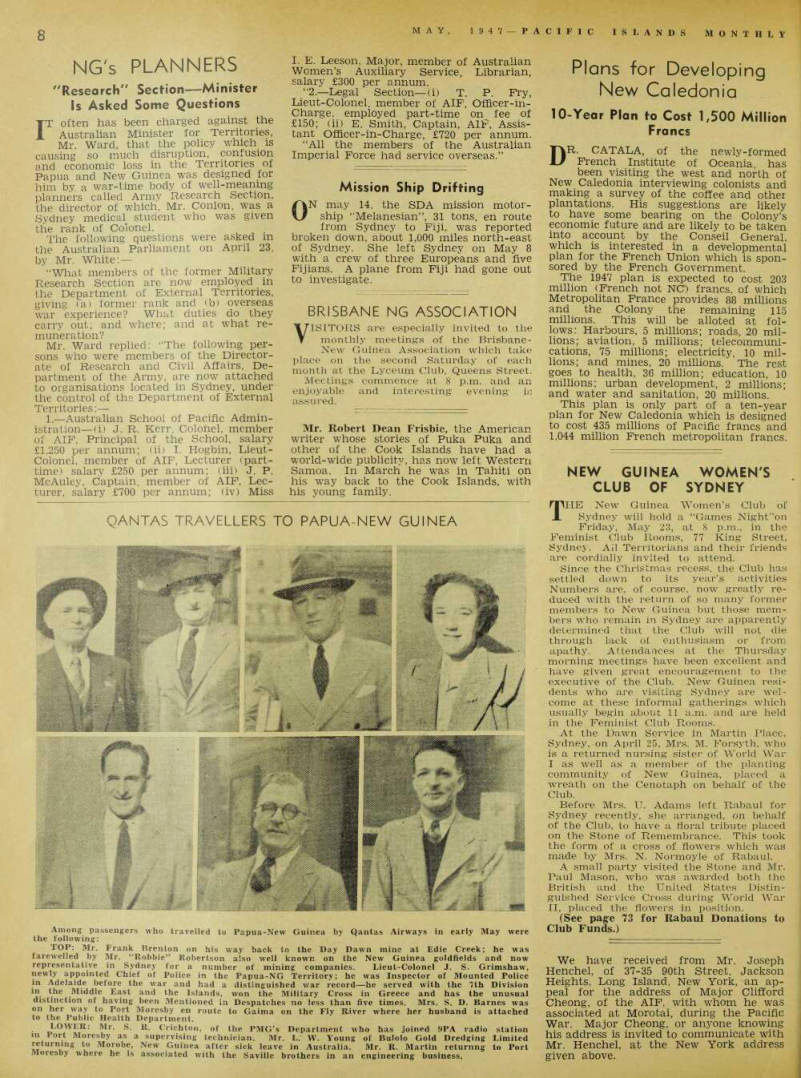
Qantas Travellers To Papua-New Guinea
Among passengers who travelled to Papua-New Guinea by Qantas Airways in early May were the following: TOP: Mr. Frank Brenton on his way back to the Day Dawn mine at Edie Creek; he was farewelled by Mr. “Robbie” Robertson also well known on the New Guinea goldfields and now representative in Sydney for a number of mining companies. Lieut-Colonel J. S. Grimshaw, newly appointed Chief of Police in the Papua-NG Territory; he was Inspector of Mounted Police in Adelaide before the war and had a distinguished war record —he served with the 7th Division in the Middle East and the Islands, won the Military Cross in Greece and has the unusual distinction of having been Mentioned in Despatches no less than five times. Mrs. S. D. Barnes was on her way to Port Moresby en route to Gaima on the Fly River where her husband is attached to the Public Health Department.
LOWER: Mr. S. R. Crichton, of the PMG’s Department who has joined 9PA radio station in Port Moresby as a supervising technician. Mr. L. W. Young of Bulolo Gold Dredging Limited returning to Morobe, New Guinea after sick leave in Australia. Mr. R. Martin returning to Port Moresby where he is associated with the Saville brothers in an engineering business.
New Caledonia
Plans for Developing New Caledonia 10-Year Plan to Cost 1,500 Million Francs
DR. CATALA, of the newly-formed French Institute of Oceania has been visiting the west and north of New Caledonia interviewing colonists and making a survey of the coffee and other plantations. His suggestions are likely to have some bearing on the Colony’s economic future and are likely to be taken into account by the Conseil General, which is interested in a developmental plan for the French Union which is spon sored by the French Government.
The 1947 plan is expected to cost 203 million (French not NO francs, of which Metropolitan France provides 88 millions and the Colony the remaining 115 millions. This will be alloted at fol lows: Harbours, 5 millions; roads, 20 mil lions; aviation, 5 millions; telecommuni cations, 75 millions; electricity, 10 mil lions; and mines, 20 millions. The rest goes to health, 36 million; education, 10 millions; urban development, 2 millions; and water and sanitation, 20 millions.
This plan is only part of a ten-year plan for New Caledonia which is designed to cost 435 millions of Pacific francs and 1.044 million French metropolitan francs.
New Guinea Women's
Club Of Sydney
THE New Guinea Women’s Club of Sydney will hold a “Games Nighf’on Friday, May 23, at 8 p.m., in the Feminist Club Rooms, 77 King Street, Sydney. Ail Territorians and their friends are cordially invited to attend.
Since the Christmas recess, the Club has settled down to its year’s activities Numbers are, of course, now greatly re duced with the return of so many former members to New Guinea but those mem bers who remain in Sydney are apparently determined that the Club will not die through lack of enthusiasm or from apathy. Attendances at the Thursday morning meetings have been excellent and have given great encouragement to the executive of the Club. New Guinea resi dents who are visiting Sydney are wel come at these informal gatherings which usually begin about 11 a.m. and are held in the Feminist Club Rooms.
At the Dawn Service in Martin Place, Sydney, on April 25, Mrs. M. Forsyth, who is a returned nursing sister of World War I as well as a member of the planting community of New Guinea, placed a wreath on the Cenotaph on behalf of the Club.
Before Mrs, U. Adams left Rabaul for Sydney recently, she arranged, on behalf of the Club, to have a floral tribute placed on the Stone of Remembrance. This took the form of a cross of flowers which was made by Mrs. N. Normoyle of Rabaul.
A small party visited the Stone and Mr, Paul Mason, who was awarded both the British and the United States Distin guished Service Cross during World War 11, placed the flowers in position. (See page 73 for Rabaul Donations to Club Funds.) We have received from Mr. Joseph Henchel, of 37-35 90th Street, Jackson Heights, Long Island, New York, an ap peal for the address of Major Clifford Cheong, of the AIF, with whom he was associated at Morotai, during the Pacific War. Major Cheong, or anyone knowing his address is invited to communicate with Mr. Henchel, at the New York address given above.
Tongan Royal
Wedding
Notable Social Event Next Month
EARLY next month, there will be a double Royal wedding in Tonga: Prince Tupouto’-a-Tungi (heir appar ent) to Mata’aho ’Ahome’e: and Prince "p’atafehi Tu’ipelehake to Melanaite Vei kune.
It will be the most important social event in Nukualofa since the Coronation of Queen Salote in 1918. The Queen is now 47 years old.
After an absence from Tonga of 43 years, Mrs. F. A Moulton left Sydney by air on May 7, to attend the double wed ding.
Mrs. Moulton went to Tonga as a bride in 1896 with her husband, the late Rev. •T. E. Moulton, a Methodist missionary, who was in charge of the Methodist College there for 10 years. His father, Dr. J. E. Moulton, founded the college.
Mrs. Moulton, who was present at the wedding of the Queen of Tonga. Queen Salote, of whom she is a personal friend, said that in a letter recentlv, the Queen expressed her happiness at the coming marriages of her sons. Princess Melenaite was educated at Ravenswood Methodist College. Gordon, Sydney, and Mata’aho was educated in New Zealand.
Starving Natives-
But Their Own Fault
Port Moresby. Apr. 26
rE statement of Monsignor Hannan, Roman Catholic missionary, that the natives of Bougainville are in serious distress through starvation has been flatlv dieted by Australian officials and Minister Ward. I know whom to believe.
Tf Morsifmor Hannan made that state ment deliberately, it is true.
But whose fault is it that the natives have reached this condition? The war ceased 20 months ago, and it is known that the Australian Army in Bougainville, at the cessation of hostilities, left enough foodstuffs there to feed the natives for six months. This was done to tide the natives over until thev had time to re build their villages and re-plant their gardens. Within three months of plant ing, sweet potatoes, tapioca, com and °tber native foods are mature and can be harvested. If the natives are starving it is their own fault—and is a good indi cation of how they have deteriorated dur ing and since the war.
They are too lazy to plant their own gardens, and have arrived at the state when they are quite satisfied to sit down and be dependent on the Government, who have been supplying food to them at intervals.
I understand the Administrator has more or less admitted that what Mon signor Hannan states is correct. But why does not the Administrator tell the politicians and the Australian public of the fact—that the natives have only them selves to blame.
Paludrine, the newest and most effec tive counter to malaria, is at present being administered to approximately 10,000 patients in Australia by the Re patriation Commission. Present distri bution of Paludrine tablets by the Com mission is nearly 300,000 a month.
Manus, America, and Australia
Australia
rE Australian Minister for External Affairs (Dr. Evatt) stated on May 7, that he had discussions recently with the American authorities for the purpose of expediting negotiations dealing with the use of Manus Island by the Americans as part of their defence system in the South-West Pacific area.
Dr. Evatt said that while he agreed that negotiations had been protracted he expected to be able to make a statement shortly on the matter.
EDITORIAL NOTE. —This is a change in the Australian tune. Previously, Aus tralia has stated that Manus, being part of an Australian territory, is an Aus tralian affair. She said she was not pre pared to hand over to America—although American money and genius built the enormous base, and Australia wants all the protection she can get against Asia, and Australia is not herself strong enough to make use of the base.
Pension Payments
To Dependants of Officials Lost in New Guinea
ACCORDING to an official statement in Canberra on April 24, payments were made to the dependants of New Guinea officials at rates previously authorised by the officials, or as deter mined according to circumstances. Those payments continued from the time the official became missing, until some time after his fate was ascertained.
Superannuation allowances were cal culated from the date of death. The de pendants received the value of all leave credits, up to the time of death.
Where the amounts to be credited were found to be less than the amounts already paid out, no refunds were claimed.
Dependants of lost New Guinea officials became eligible for the special New Guinea civilian war pension, as well as receiving superannuation benefits.
Mrs. Frank Conroy, accompanied by her young daughter, left Brisbane for Rabaul bv the “Montoro” on Tuesday, April 8. She will rejoin her husband.
Oceanic Trans-Pacific
More Freighters
Oceanic Trans-Pacific Service
A MORE frequent cargo service be tween the United States and Aus tralia is expected from the recent of financial aid by the United States Government to the Oceanic Steam ship Company, of San Francisco, to as sist it in meeting foreign competition.
This company, a subsidiary of the Matson Navigation Company, is one of the six which last year sought new or modified subsidies on Pacific services and is the first to receive aid from the United States Government since before the first World War.
The freight run for which the subsH” was approved calls for service from United States west coast ports to Australia and New Zealand with the privilege of calling at British Colombia and Pacific Island ports en route.
The company, which already has a sub sidised passenger-cargo service between California and Australia, proposes even tually to operate 13 round freight voyages a year on each of two cargo runs in the Pacific. It asked the privilege, however, of operating one sailing a month over either of the two services, or over the two services combined, in such a manner as would best accommodate cargo offer ings.
A representative of the Matson Line commenting on the subsidy, said that the high operating costs of American vessels had for many years made it impossible for them to compete with those of other countries. The slow tum-around in New Zealand and Australia and high costs of loading and discharging were also factors which contributed to the difficulties of American lines operating in the Pacific Lumber and asphalt, he said were two of the important commodities which a more frequent service would make available in greater quantities Wellington “Post”.
Mr. F. C. Eichhorn left Sydney by Qantas plane on May 5 for Angoram, Sepik River, New Guinea, where he has a gold mining property. He was fare welled by Capt. V. H. Gilchrist, formerly of Bulolo Gold Dredging, Ltd., but now a member of the BCOF in Japan.
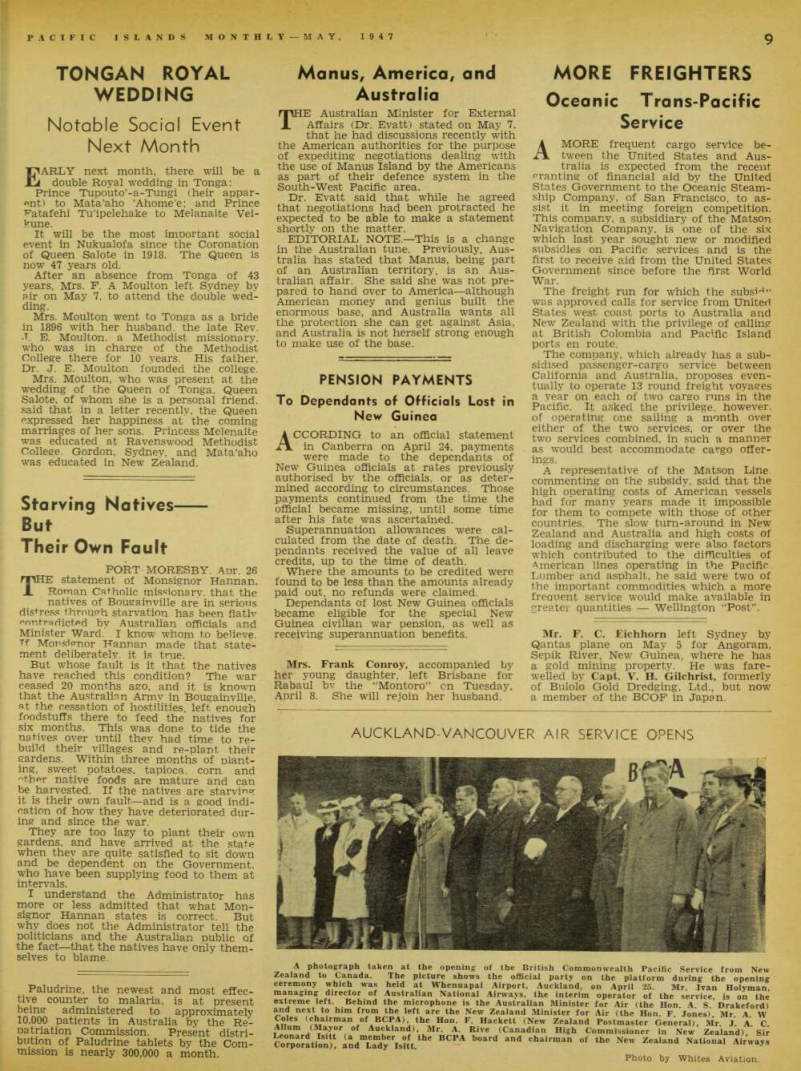
Auckland-Vancouver Air Service Opens
A photograph taken at the opening of the British Commonwealth Pacific Service from New Zealand to Canada. The picture shows the official party on the platform during the opening ceremony which was held at Whenuapai Airport, Auckland, on April 25. Mr. Ivan Holyman, managing director of Australian National Airways, the interim operator of the service is on the extreme left. Behind the microphone is the Australian Minister for Air (the Hon. A. S. Drakeford) and next to him from the left are the New Zealand Minister for Air (the Hon. F. Jones), Mr. A. W Cloes (chairman of BC PA) the Hon. F. Hackett (New Zealand Postmaster General), Mr. J. A. C.
Allum (Mayor of Auckland), Mr. A. Rive (Canadian High Commissioner in New Zealand), Sir Leonard Isitt (a member of the BCPA board and chairman of the New Zealand National Airways Corporation), and Lady Isitt.
Photo by Whites Aviation.
Malaita Back On
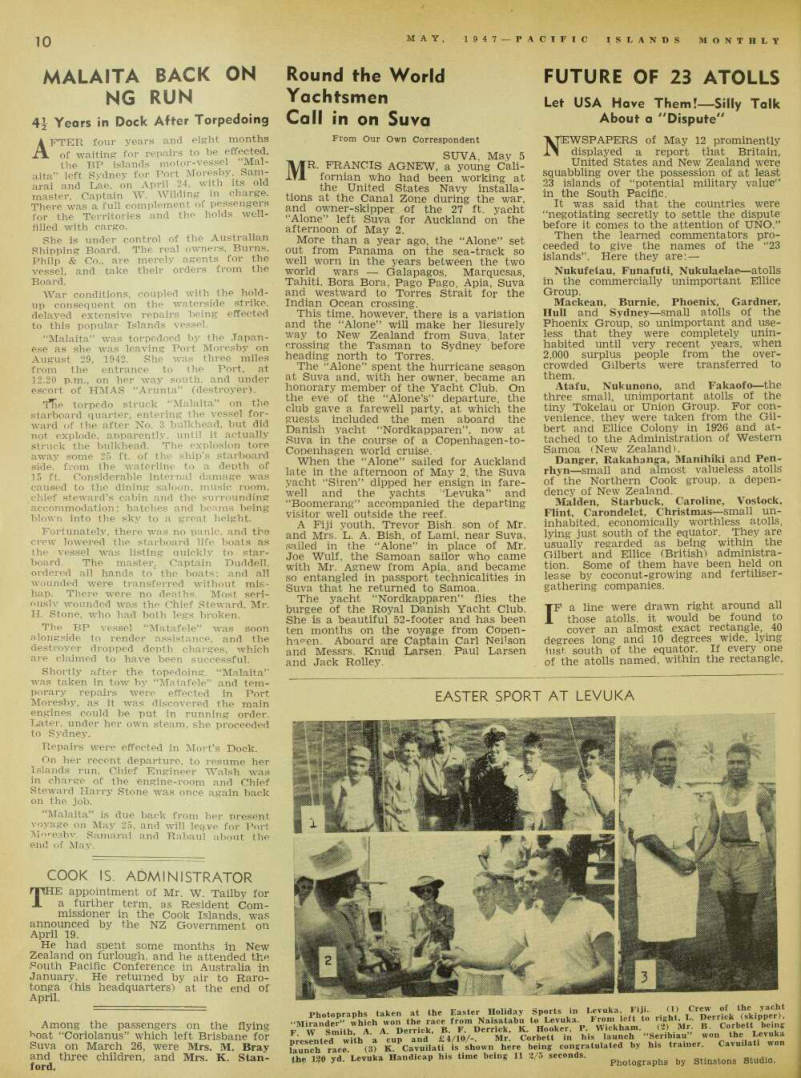
Ng Run
4½ Years in Dock After Torpedoing
AFTER four years and eight months of waiting for repairs to be effected, the BP islands motor-vessel Mal aita” left Sydney for Port Moresby, Sam ara! and Lae, on April 24, with its old master, Captain W. Wilding in charge.
There was a full complement of pessengers for the Territories and the holds well filled with cargo.
She is under control of the Australian Shipping Board. The real owners, Burns, Philp & Co., are merely agents for the vessel, and take their orders from the Board.
War conditions, coupled with the hold up consequent on the waterside strike, delayed extensive repairs being effected to this popular Islands vessel.
“Malaita” was torpedoed by the Japan ese as she was leaving Port Moresby on August 29, 1942. She was three miles from the entrance to the Port, at 12.20 p.m., on her way south, and under escort of HMAS “Arunta” (destroyer).
Tflie torpedo struck “Malaita” on the starboard quarter, entering the vessel for ward of the after No. 3 bulkhead, but did not explode, apparently, until it actually struck the bulkhead. The explosion tore away some 25 ft. of the ship’s starboard side, from the waterline to a depth of 15 ft. Considerable internal damage was caused to the dining saloon, music room, chief steward’s cabin and the surrounding accommodation; hatches and beams being blown into the sky to a great height.
Fortunately, there was no panic, and tbs crew lowered the starboard life boats as the vessel was listing quickly to star board. The Captain Duddell. ordered all hands to* the boats; and all wounded were transferred without mis hap. There were no deaths. Most seri ouslv wounded was tho Chief Steward. Mr.
H. Stone, who had both legs broken.
The BP vessel “Matafele” was soon alongside to render assistance, and the destroyer dropped depth charges, which are claimed to have been successful.
Shortly after the topedoing. “Malaita” was taken in tow by “Matafele” and tem porary repairs were effected in Port Moresby, as it was discovered the main engines could be put in running order.
Later, under her own steam, she proceeded to Sydney.
Repairs were effected in Mort’s Dock.
On her recent departure, to resume her Islands run, Chief Engineer Walsh was in charge of the engine-room and Chief Steward Harry Stone was once again back on the job.
“Malaita” is due back from her present voyage on May 25, and will leave for Port Moresbv. Samarai and Rabaul about the end of May.
Cook Is. Administrator
rE appointment of Mr. W. Tailby for a further term, as Resident Com missioner in the Cook Islands, was announced by the NZ Government on April 19.
He had snent some months in New Zealand on furlough, and he attended the South Pacific Conference in Australia in January. He returned by air to Raro tonga (his headquarters) at the end of April.
Among the passengers on the flying boat “Coriolanus” which left Brisbane for Suva on March 26, were Mrs. M. Bray and three children, and Mrs. K. Stan ford,
Yachtsmen
Round the World Yachtsmen Call in on Suva
From Our Own Correspondent
Suva, May 5
MR. FRANCIS AGNEW, a young Cali fornian who had been working at the United States Navy installa tions at the Canal Zone during the war, and owner-skipper of the 27 ft. yacht “Alone” left Suva for Auckland on the afternoon of May 2.
More than a year ago, the “Alone” set out from Panama on the sea-track so well worn in the years between the two world wars Galapagos, Marquesas, Tahiti, Bora Bora, Pago Pago, Apia, Suva and westward to Torres Strait for the Indian Ocean crossing.
This time, however, there is a variation and the “Alone” will make her liesurely way to New Zealand from Suva, later crossing the Tasman to Sydney before heading north to Torres.
The “Alone” spent the hurricane season at Suva and, with her owner, became an honorary member of the Yacht Club. On the eve of the “Alone’s” departure, the club gave a farewell party, at which the guests included the men aboard the Danish yacht “Nordkapparen”, now at Suva in the course of a Copenhagen-to- Copenhagen world cruise.
When the “Alone” sailed for Auckland late in the afternoon of May 2, the Suva yacht “Siren” dipped her ensign in fare well and the yachts ‘Levuka” and “Boomerang” accompanied the departing visitor well outside the reef.
A Fiji youth, Trevor Bish, son of Mr. and Mrs. L. A. Bish, of Lami, near Suva, sailed in the “Alone” in place of Mr.
Joe Wulf, the Samoan sailor who came with Mr. Agnew from Apia, and became so entangled in passport technicalities in Suva that he returned to Samoa.
The yacht “Nordkapparen” flies the burgee of the Royal Danish Yacht Club.
She is a beautiful 52-footer and has been ten months on the voyage from Copen hagen. Aboard are Captain Carl Neilson and Messrs. Knud Larsen Paul Larsen and Jack Rolley.
Future Of 23 Atolls
Let USA Have Them! —Silly Talk About a "Dispute"
NEWSPAPERS of May 12 prominently displayed a report that Britain, United States and New Zealand were squabbling over the possession of at least 23 islands of “potential military value” in the South Pacific.
It was said that the countries were “negotiating secretly to settle the dispute before it comes to the attention of UNO.”
Then the learned commentators pro ceeded to give the names of the “23 islands”. Here they are:— Nukufelau, Funafuti, Nukulaelae —atolls in the commercially unimportant Ellice Group.
Mackean, Burnie, Phoenix, Gardner, Hull and Sydney —small atolls of the Phoenix Group, so unimportant and use less that they were completely unin habited until very recent years, when 2,000 surplus people from the over crowded Gilberts were transferred to them.
Atafu, Nukunono, and Fakaofo —the three small, unimportant atolls of the tiny Tokelau or Union Group. For con venience, they were taken from the Gil bert and Ellice Colony in 1926 and at tached to the Administration of Western Samoa (New Zealand).
Danger, Rakahanga, Manihiki and Pen rhyn—small and almost valueless atolls of the Northern Cook group, a depen dency of New Zealand.
Malden, Starbuck, Caroline, Vostock, Flint, Carondelet, Christmas— small un inhabited, economically worthless atolls, lying just south of the equator. They are usuallv regarded as being within the Gilbert and Ellice (British) administra tion. Some of them have been held on lease by coconut-growing and fertiliser gathering companies.
IP a line were drawn right around all those atolls, it would be found to cover an almost exact rectangle, 40 degrees long and 10 degrees wide, lying Inst south of the equator. If every one of the atolls named, within the rectangle,
Easter Sport At Levuka
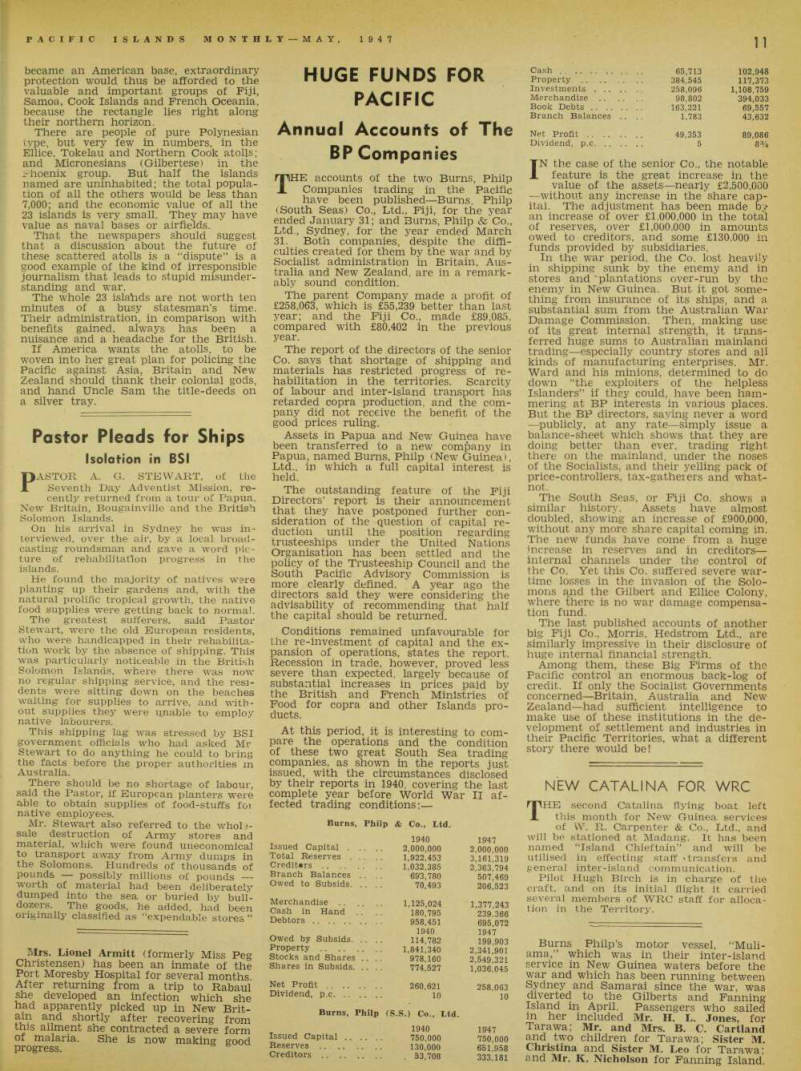
Photopraphs taken at the Easter Holiday Sports in Levuka. Fiji. (1) Crew of the yacht "Mirander" which won the race from Naisatabu to Levuka. From left to right, L. Derrick (skipper), F. W Smith, A. A. Derrick, B.F. Derrick, K. Hooker, P. Wickham. (2) Mr. B. Corbett being presented with a cup and £4/10/-. Mr. Corbett in his launch "Seribiau" won the Levuka launch race. (3) K. Cavuilati is shown here being congratulated by his trainer. Cavuilati won the 120 yd. Levuka Handicap his time being 11 2/5 seconds. photographs by Stinstons Studio.
became an American base, extraordinary protection would thus be afforded to the valuable and important groups of Fiji, Samoa, Cook Islands and French Oceania, because the rectangle lies right along their northern horizon.
There are people of pure Polynesian type, but very few in numbers, in the Ellice, Tokelau and Northern Cook atolls; and Micronesians (Gilbertese) in the Fhoenix group. But half the islands named are uninhabited; the total popula tion of all the others would be less than 7,000; and the economic value of all the 23 islands is very small. They may have value as naval bases or airfields.
That the newspapers should suggest that a discussion about the future of these scattered atolls is a “dispute” is a good example of the kind of irresponsible journalism that leads to stupid misunder standing and war.
The whole 23 islahds are not worth ten minutes of a busy statesman’s time.
Their administration, in comparison with benefits gained, always has been a nuisance and a headache for the British.
If America wants the atolls, to be woven into her great plan for policing the Pacific against Asia, Britain and New Zealand should thank their colonial gods, and hand Uncle Sam the title-deeds on a silver tray.
Pastor Pleads for Ships
Isolation in BSI
Pastor A. G. Stewart, Of The
Seventh Day Adventist Mission, re cently returned from a tour of Papua, New Britain, Bougainville and the British Solomon Islands.
On his arrival in Sydney he was in terviewed, over the air, by a local broad casting roundsman and gave a word pic ture of rehabilitation progress in the islands.
He found the majority of natives were planting up their gardens and, with the natural prolific tropical growth, the native food supplies were getting back to normal.
The greatest sufferers, said Pastor Stewart, were the old European residents, who were handicapped in their rehabilita tion work by the absence of shipping. This was particularly noticeable in the British Solomon Islands, where there was now no regular shipping service, and the resi dents were sitting down on the beaches waiting for supplies to arrive, and with out supplies they were unable to employ native labourers.
This shipping lag was stressed by BSI government officials who had asked Mr Stewart to do anything he could to bring the facts before the proper authorities in Australia.
There should be no shortage of labour, said the Pastor, if European planters were able to obtain supplies of food-stuffs foi native employees.
Mr. Stewart also referred to the whole sale destruction of Army stores and material, which were found uneconomical to transport away from Army dumps in the Solomons. Hundreds of thousands of pounds possibly millions of pounds worth of material had been deliberately dumped into the sea or buried by bull dozers. The goods, he added, had been originally classified as “expendable stores ”
Mrs. Lionel Armitt (formerly Miss Peg Christensen) has been an inmate of the Port Moresby Hospital for several months.
After returning from a trip to Rabaul she developed an infection which she had apparently picked up in New Brit ain and shortly after recovering from this ailment she contracted a severe form of malaria. She is now making good progress. s
BP Companies
Huge Funds For
Pacific
Annual Accounts of The BP Companies
THE accounts of the two Burns, Philp Companies trading in the Pacific have been published—Burns, Philp (South Seas) Co., Ltd., Fiji, for the year ended January 31; and Burns, Philp & Co., Ltd., Sydney, for the year ended March 31. Both companies, despite the diffi culties created for them by the war and by Socialist administration in Britain, Aus tralia and New Zealand, are in a remark ably sound condition.
The parent Company made a profit of £258,063, which is £55,239 better than last year; and the Fiji Co., made £89,085, compared with £80,402 in the previous year.
The report of the directors of the senior Co. says that shortage of shipping and materials has restricted progress of re habilitation in the territories. Scarcity of labour and inter-island transport has retarded copra production, and the com pany did not receive the benefit of the good prices ruling.
Assets in Papua and New Guinea have been transferred to a new company in Papua, named Bums, Philp (New Guinea), Ltd., in which a full capital interest is held.
The outstanding feature of the Fiji Directors’ report is their announcement that they have postponed further con sideration of the question of capital re duction until the position regarding trusteeships under the United Nations Organisation has been settled and the policy of the Trusteeship Council and the South Pacific Advisory Commission is more clearly defined. A year ago the directors said they were considering the advisability of recommending that half the capital should be returned.
Conditions remained unfavourable for the re-investment of capital and the ex pansion of operations, states the report.
Recession in trade, however, proved less severe than expected, largely because of substantial increases in prices paid by the British and French Ministries of Food for copra and other Islands pro ducts.
At this period, it is interesting to com pare the operations and the condition of these two great South Sea trading companies, as shown in the reports just issued, with the circumstances disclosed by their reports in 1940, covering the last complete year before World War II af fected trading conditions;—
IN the case of the senior Co., the notable feature is the great increase in the value of the assets —nearly £2,500,000 —without any increase in the share cap ital. The adjustment has been made by an increase of over £1,000,000 in the total of reserves, over £1,000,000 in amounts owed to creditors, and some £130,000 in funds provided by subsidiaries.
In the war period, the Co. lost heavily in shipping sunk by the enemy and in stores and 'plantations over-run by the enemy in New Guinea. But it got some thing from insurance of its ships, and a substantial sum from the Australian War Damage Commission. Then, making use of its great internal strength, it trans ferred huge sums to Australian mainland trading—especially country stores and all kinds of manufacturing enterprises. Mr.
Ward and his minions, determined to do down “the exploiters of the helpless Islanders” if they could, have been ham mering at BP interests in various places.
But the BP directors, saying never a word —publicly, at any rate—simply issue a balance-sheet which shows that they are doing better than ever, trading right there on the mainland, under the noses of the Socialists, and their yelling pack of price-controllers, tax-gatheiers and what not.
The South Seas, or Fiji Co. shows a similar history. Assets have almost doubled, showing an increase of £900,000, without any more share capital coming in.
The new funds have come from a huge increase in reserves and in creditors— internal channels under the control of the Co. Yet this Co. suffered severe war time losses in the invasion of the Solo mons and the Gilbert and Ellice Colony, where there is no war damage compensa tion fund.
The last published accounts of another big Fiji Co., Morris, Hedstrom Ltd., are similarly impressive in their disclosure of huge internal financial strength.
Among them, these Big Firms of the Pacific control an enormous back-log of credit. If only the Socialist Governments concerned—Britain, Australia and New Zealand —had sufficient intelligence to make use of these institutions in the de velopment of settlement and industries in their Pacific Territories, what a different story there would be!
Burns, Philp & Co., Ltd, 1940 1947 Issued Capital ... 2,000,000 2,000,000 Total Reserves ... . 1,922,453 3,161,319 Creditors 1,032,385 2,363,794 Branch Balances .. . . 69'3,780 507,469 Owed to Subsids 70,493 206.523 Merchandise 1,125,024 1,377,243 Cash in Hand 180,795 239.366 Debtors 958,451 695,072 1940 1947 Owed by Subsids 114,782 199,903 Property 1,841,340 2,341.901 Stocks and Shares .. 978,160 2,549,321 Shares in Subsids 774,527 1,036,045 Net Profit 260,621 258,063 Dividend, p.c 10 10 Burns, Philp (S.S.) Co., Ltd. 1940 1947 Issued Capital 750,000 750,000 Reserves 130,000 651,958 Creditors 53,708 333,181
Cash 65,713 102,948 Property 384,545 117,373 Investments 258,096 1,108,759 Merchandise 98,802 394,033 Book Debts 163,221 69,557 Branch Balances .. . 1,783 43,632 Net Profit 49,353 89,086 Dividend, p.c 5 8%
New Catalina For Wrc
THE second Catalina flying boat left this month for New Guinea services of W. R. Carpenter & Co., Ltd., and will be stationed at Madang. It has been named “Island Chieftain” and will be utilised in effecting staff > transfers and general inter-island communication.
Pilot Hugh Birch is in charge of the craft, and on its initial flight it carried several members of WRC staff for alloca tion in the Territory.
Burns Philp’s motor vessel, “Muli ama,” which was in their inter-island service in New Guinea waters before the war and which has been running between Sydney and Samarai since the war, was diverted to the Gilberts and Fanning Island in April. Passengers who sailed in her included Mr. H. L. Jones, for Tarawa; Mr. and Mrs. B. C. Cartland two children for Tarawa; Sister M.
Christina and Sister M. Leo for Tarawa: and Mr. K. Nicholson for Fanning Island.
Advertisements & other items, p. 14 (1 item)
Morris Hedstrom Limited
General Merchants, Importers and Exporters,
Shipowners, Plantation Owners,
Commission and Insurance Agents
HEAD OFFICE
SUVA, FIJI
Established 1868
SERVICE IN THE SOUTH PACIFIC TERRITORIES
'jpHROUGH our Large Establishments in Suva and our Numerous Branches, we distribute a wide and comprehensive range of General Merchandise and provide almost every kind of service. Our departments and associated businesses include:
DRAPERY
MOTOR SALES
AND SERVICE
TOBACCO
TIMBER AND
BUILDING
GROCERY
CONFECTIONERY
HARDWARE
ELECTRICAL
LIQUORS
DRUGS
Branches Throughout Fiji, Samoa and Tonga
There is a Branch or Agent of Morris Hedstrom Limited in every Town in the Three Territories.
We are Sole Agents in these Territories for British Drug Houses Ltd.
Electrolux Ltd.
Ford Motor Co.
General Electric Co. Ltd.
Goodyear Tyre £r Rubber Co.
B. A. Hjorth Cr Co. (Primus Products) Imperial Chemical Industries Ltd.
International Harvester Export Co.
Matson Navigation Company Max Factor and Co, Inc.
Ransomes, Sims Gr Jefferies Ltd.
Ruston Gr Hornsby Ltd.
Vacuum Oil Co. Pty. Ltd.
Yorkshire Copper Works Ltd.
Morris Hedstrom Limited, are LLOYD'S AGENTS in Fiji and Samoa.
IN AUSTRALIA:
Morris Hedstrom (Aust.) Pty. Ltd.,
Asbestos House, 65 York Street, SYDNEY
IN GREAT BRITAIN:
Morris Hedstrom Limited,
Africa House, Kingsway, LONDON
More Qantas Travellers
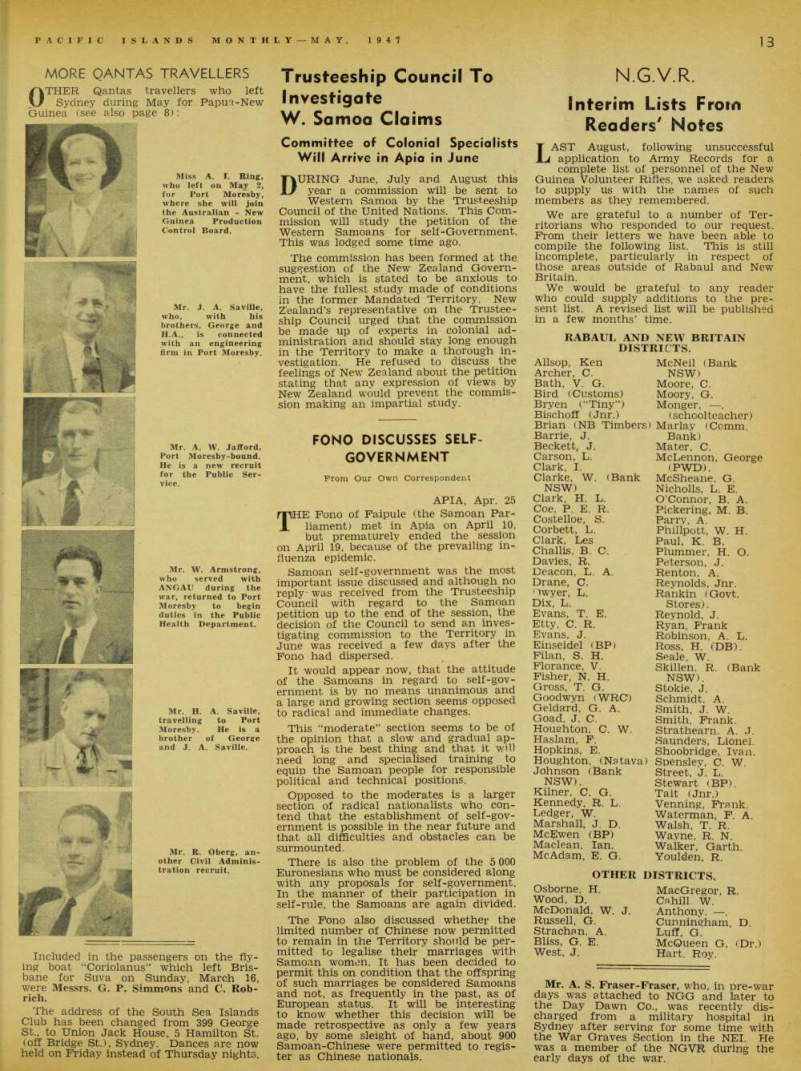
OTHER Qantas travellers who left Sydney during May for Papua-New Guinea (see also page 8):
Included in the passengers on the fly ing boat “Coriolanus” which left Bris bane for Suva on Sunday, March 16, were Messrs. G. P. Simmons and C. Rob rich.
The address of the South Sea Islands Club has been changed from 399 George St., to Union Jack House, 5 Hamilton St. (off Bridge St.), Sydney. Dances are now held on Friday instead of Thursday nights.
Miss A. I. Ring, who left on May 2, for Port Moresby, where she will join the Australian-New Guinea Production Control Board.
Mr. J. A. Saville, who, with his brothers, George and H.A., is connected with an engineering firm in Port Moresby.
Mr. A. W. Jafford, Port Moresby-bound.
He is a new recruit for the Public Ser vice.
Mr. W. Armstrong, who served with ANGAU during the war, returned to Port Moresby to begin duties in the Public Health Department.
Mr. H. A. Saville, travelling to Port Moresby. He is a brother of George and J. A. Saville.
Mr. R. Oberg, an other Civil Adminis tration recruit.
Investigate
Trusteeship Council To Investigate W. Samoa Claims Committee of Colonial Specialists Will Arrive in Apia in June
DURING June, July and August this year a commission will be sent to Western Samoa by the Trusteeship Council of the United Nations. This Com mission will study the petition of the Western Samoans for self-Government.
This was lodged some time ago.
The commission has been formed at the suggestion of the New Zealand Govern ment, which is stated to be anxious to have the fullest study made of conditions in the former Mandated Territory. New Zealand’s representative on the Trustee ship Council urged that the commission be made up of experts in colonial ad ministration and should stay long enough in the Territory to make a thorough in vestigation. He refused to discuss the feelings of New Zealand about the petition stating that any expression of views by New Zealand would prevent the commis sion making an impartial study.
Fono Discusses Self
Government
Prom Our Own Correspondent
Apia, Apr. 25
rE Fono of Faipule (the Samoan Par liament) met in Apia on April 10, but prematurely ended the session on April 19, because of the prevailing in fluenza epidemic.
Samoan self-government was the most important issue discussed and although no reply was received from the Trusteeship Council with regard to the Samoan petition up to the end of the session, the decision of the Council to send an inves tigating commission to the Territory in June was received a few days after the Fono had dispersed.
It would appear now, that the attitude of the Samoans in regard to self-gov ernment is by no means unanimous and a large and growing section seems opposed to radical and immediate changes.
This “moderate” section seems to be of the opinion that a slow and gradual ap proach is the best thing and that it will need long and specialised training to equip the Samoan people for responsible political and technical positions.
Opposed to the moderates is a larger section of radical nationalists who con tend that the establishment of self-gov ernment is possible in the near future and that all difficulties and obstacles can be surmounted.
There is also the problem of the 5 000 Euronesians who must be considered along with any proposals for self-government.
In the manner of their participation in self-rule, the Samoans are again divided.
The Fono also discussed whether the limited number of Chinese now permitted to remain in the Territory should be per mitted to legalise their marriages with Samoan women. It has been decided to permit this on condition that the offspring of such marriages be considered Samoans and not, as frequently in the past, as of European status. It will be interesting to know whether this decision will be made retrospective as only a few years ago, by some sleight of hand, about 900 Samoan-Chinese were permitted to regis ter as Chinese nationals.
Readers' Notes
N.G.V.R.
interim Lists From Readers' Notes
LAST August, following unsuccessful application to Army Records for a complete list of personnel of the New Guinea Volunteer Rifles, we asked readers to supply us with the names of such members as they remembered.
We are grateful to a number of Ter ritorians who responded to our request.
From their letters we have been able to compile the following list. This is still incomplete, particularly in respect of those areas outside of Rabaul and New Britain.
We would be grateful to any reader who could supply additions to the pre sent list. A revised list will be published in a few months’ time.
Rabaul And New Britain
Districts.
Allsop, Ken McNeil (Bank Archer, C. NSW) Bath, V. G. Moore, C.
Bird (Customs) Moory, G.
Bryen (“Tiny”) Monger, —.
Bischoff (Jnr.) (schoolteacher) Brian (NB Timbers) Marlay (Comm.
Barrie, J. Bank) Beckett, J. Mater, C.
Carson, L. McLennon, George Clark, I. (PWD).
Clarke, W. (Bank McSheane. G.
NSW) Nicholls, L. E.
Clark, H. L. O’Connor, B. A.
Coe, P. E. R. Pickering, M. B.
Costelloe, S. Parry, A.
Corbett, L. Phillpott, W. H.
Clark, Les Paul, K. B.
Challis, B. C. Plummer, H. O.
Davies, R. Peterson, J.
Deacon, L. A. Renton. A.
Drane, C. Reynolds, Jnr.
Dwyer, L. Rankin (Govt.
Dix, L. Stores).
Evans, T. E. Reynold, J.
Etty, C. R. Ryan, Frank Evans. J. Robinson, A. L.
Einseidel (BP) Ross, H. (DB) Filan, S. H. Seale, W.
Plorance, V. Skillen. R. (Bank Fisher, N. H. NSW) Gross, T. G. Stokie, j.
Goodwyn (WRC) Schmidt. A.
Geldard, G. A. Smith, J. W.
Goad. J. C. Smith, Frank.
Houehton. C. W. Strathearn. A. J.
Haslam, F. Saunders, Lionel.
Hopkins, E. Shoobridge, Ivan.
Houghton. (Natava) Spenslev, C. W Johnson (Bank Street, J. L.
NSW). Stewart (BP).
Kilner. C. G. Tait (Jnr.) Kennedy. R. L. Venning, Prank.
Ledger, W. Waterman, F. A.
Marshall, J. D. Walsh, T. R.
MclCwen (BP) Wayne, R. N.
Maclean. lan. Walker, Garth.
McAdam, E. G. Youlden, R.
Other Districts.
Osborne. H. MacGregor, R.
Wood, D. Cahill. W.
McDonald. W. J. Anthony. —, Russell, G. Cunningham, D.
Strachan. A. Luff, G.
Bliss, G. E. McQueen G, (Dr.) West, J. Hart. Roy.
Mr. A. S. Fraser-Fraser, who, in pre-war days was attached to NGG and later to the Day Dawn Co., was recently dis charged from a military hospital in Sydney after serving for some time with the War Graves Section in the NEI. He was a member of the NGVR during the early days of the war.
Word has been received from Dr. N. B.
Watch formerly of Rabaul, and later POW in Japan who is now residing in Uganda.
He is in’ good health and speaks highly of the possibilities in that country.
Mrs. Una Adams returned to Sydney this month by air from Rabaul, where she has been supervising arrangements for bring ing her plantations, Notre Mai and Pat langat, back into production.
Papua-N. Guinea
Scene
Mr. Ward Says All Is Well In Spite Of Complaints of Public Ser vants, Planters and Miners
rE Minister for External Territories (Mr. Ward), who is to go abroad at the expense of Australian taxpayers shortly, is more than satisfied with the state in which he will leave the Aus tralian Provisional Territorv of Papua- New Guinea. All, according to Mr. Ward, is well there, and rapidly becoming even better.
Any opinions to the contrary, either from within the Territorv or from with out, are described by this politician as the utterances of “vested interests,” and therefore summarily dismissed.
Urged by Mr. White (Lib. Vic.) in the House of Representatives in April, to ap point a joint select committee of Par liament to inquire into:— (1) Inadequacy of the administration; (2) Its failure to maintain production of essential commodities; (3) Lack of policy for economic de velopment; * (4) Unbalanced native policy and its adverse effects; (5) Unrest in the Public Service; Mr. Ward replied that Mr, White was the mouthpiece of capitalists who were opposed to progressive policy of the Aus tralian government in Papua-New Guinea.
The administration in the combined Ter ritory was, at all events, only provisional, he said, but when the international trus teeship agreement was ratified a bill would be brought down to establish a permanent administration.
He denied that the Administration had done nothing to restore the planting in dustry. It had, in fact, spent £280,000 on clearing and restoring plantations, and production was steadily increasing.
There were twelve inter-island ships being run by the Shipping Control Board, and nine more were in course of con struction. Soon, too, shipping communica tion between Australia and New Guinea would be increased and there would be at least one ship every three weeks.
The government had built 24 homes in Port Moresby at a cost of £50,000, the maximum rental for which was 13/10 per week. Single public servants in Moresby, and those who had had to leave their families in Australia, secured board and lodging for 35/- per week; in addition, married men received a living-away-from home allowance of £l2O.
In reply to Mr. White’s assertion that the labour supply in Papua had dropped from 12,500 to 9,300, while the number of natives employed by the Administration had increased from 850 to 4,000, Mr. Ward said that indentured native labourers were becoming fewer because natives pre ferred to work for the Government which had reduced their weekly working hours from 55 to 44.
That is Mr. Ward’s version of the Papuan-New Guinea story. It is, however, strangely at variance with the view-point of those people, whether they are planters, traders or public servants, who have to live in the Provisional Territory at the present time.
It differs also from the views of impar tial outside observers. A Sydney “Sun” journalist who recently visited the com bined Territory said that the problem of how best to emancipate the 1,300,000 natives was no nearer a solution than it had been when Mr. Ward announced his New Deal almost two years ago. They certainlv have more money but it will buy them nothing and they are still tae
wildered and confused. They do not like the new short labour contract and will not go to work under it.
This journalist also had something to say of the inadequacy of European housing, lack of coastal and overseas shipping, and dwindling production.
LAST_ August the public service organ isations of Papua and New Guinea called a protest meeting in Port Moresby to air some of their grievances, which include'd lack of housing and high living costs in comparison with salaries.
The 24 houses to which Mr. Ward re fer above, were then in course of con struction by John Stubbs &' Sons at a cost of over £2,000 per unit. It was realised then that these houses, would do little to alleviate the housing shortage and it was urged then that more and cheaper houses be built quickly. Public servants were at this time promised also that a public service commissioner would inquire into their grievances over salary and probably adjust them to meet the high cost of living in the Territories.
That was over eight months ago. Both the New Guinea and the Papuan Public Service Associations are still stating that the housing conditions in Port Moresby, Rabaul and Lae are shocking and that high living costs and low salaries mean bankruptcy for public servants.
The public servant, however, receives a regular salary, inadequate although it may be. If he faces insolvency, then the lot of planters and miners, who kept the Territories financially afloat in the days before 1942, but who, since the return of civil administration, have been living on war damage insurance moneys and other capital, need not be laboured.
It is ironical that the Australian Labour Government, which is pledged to sock Big Business and assist the under-dog, should have deliberately created in Papua- New Guinea, a set-up in which Big Busi ness, with its large reserves, alone can survive while the small, individual planter and miner must inevitably go to the wall.
PLANTERS are still returning to their plantations in New Britain, New Ireland, Bougainville and the smaller groups of islands in those areas. Many are marooned in Rabaul for weeks or months, until they can get a ship to their properties; and when this has at last been achieved they are then faced with the task of clearing the plantation of undergrowth, rebuilding, recruiting labour and, months later, getting back into pro duction.
Rehabilitation is hampered, firstly by lack of supplies of all kinds from Australia and, secondly, by the lack of sea trans port from Rabaul. There is, as well, in these overgrown plantations, a great hazard to health, both from malarial mos quitoes which have bred unchecked, and from bush mocas which cause scrub typhus and whose breeding ground is in secondary undergrowth.
The men—and women—who seek to re habilitate themselves are not young. They did their pioneering, in the first place, 2U or 30 years ago. The majority of plan tations, moreover, are tied either to the Expropriation Board or to the Big Firms, or to both. What incentive is there then for planters to begin again, particularly as the Australian socialist government is in no way interested in the contribution they can make to the prosperity of the Ter ritory and, in spite of Mr. Ward’s pro tests of good-will, has thrown every ob stacle in their path to rehabilitation?
It is small wonder that they complain than an iron curtain seems to have descended between the New Britain-New Ireland-Bougainville portion of the Ter ritory and Port Moresby, where the ad ministrative policy is shaped and put into effect; or that some of these planters, disillusioned and in bad health have had to return to Australia.
IN the Morobe, district, on the main land, apart from Bulolc Gold Dredging (which now has two dredges working) and, to a lesser extent, New Guinea Goldfields, Ltd., things are little if any better, than they were nine months ago.
Except for a brief period after the arri val of infrequent ships, food, both for Euro peans and natives, is scarce. Europeans are still living largely on canned foods and flour left behind by the American and Australian armies, and are still erecting temporary houses out of old timber and iron salvaged from deserted army camps. (Continued next page)
Some of the lesser lights in the Government employ in Lae are still living in old canvas tent-houses at the former Amencan “Base E” camp. When it rams, as it does incessantly in Lae, inmates resort to catching drips in buckets suitably placed in the leakiest positions in their dwellings.
The Labu-Wau road was out of commission for some time, due to the Administration road-gangs’ inability to cope with repairs during the rainy season. Bulolo Gold Dredging and New Guinea Goldfields have now taken over the job of repairing it and, with a fleet of tip-trucks, are making rapid progress.
T ITTLE has been heard of the Lae ±j town-planning scheme for some time although a great deal of Government money has been already spent upon it.
The original scheme was to plan a Gar den City for 1,000 people; but, as there is now little industrial and no agricul tural policy to back it. the whole thing becomes as unsubstantial as a dream, However, the administration has not signified its intention of abandoning its planned city and, in the meantime, Lae lives on in temporary dwellings, scattered over miles of country formed by the tri angle between Milford Haven wharf, Malahang Native Hospital and the Lae
hotel.
Many people have applied for agricul tural leases in the Markham Valley, but these have not yet been granted. Others have applied for business sites on “the flat”—the area that was pre-war Lae— but no decision has been reached in re spect of these, either.
On the credit side, the Lae Branch of the New Guinea Citizen’s Association has become well established and the local branch of the RSSAILA is also a strong body. The erection of an up-to-date social club is planned and funds are being collected to meet the cost of this. The Bank of New South Wales is flourishing on what used to be Eekhoff’s corner; and it is rumoured that there is soon to be a picture-show.
Advertisements & other items, pp. 16-18 (2 items)
Millers Ltd.
A. G. FIELD & CO.
10 DEVONSHIRE ROW, LONDON, E.C.2, ENGLAND
Shipping and Export Agents for dozens of well known British manufacturers Agents and distributors required for all types of machinery, wines, spirits, electrical, radio goods and dozens of other lines. If there is anything you require from England, no matter what it is, please contact our representative, Mr. J. Bristoe, P. 0., Bex 82, MARYBOROUGH, QUEENSLAND.
Every Branch Of
ENGINEERING and BUILDING CONSTRUCTION
MILLERS LTD.
SUVA and LAUTOKA
Sawmillers and Timber Merchants; Shipwrights and Sailmakers; Joinery and Furniture Manufacturers; Upholsterers; Plumbers; Electricians; Hardware Merchants; Motor Dealers.
AGENCIES:
Chevrolet, Bedford, Vauxhall, Nash Motors. Firestone Tyres.
Fetters Marine and Stationary Engines. G.E.C. Radio Sets.
British Australian Lead Manufacturers Pty., Ltd., Atlas Assurance Co., Ltd.
There is no need to send to Australia or New Zealand for Repairs or Replacements. We can give you a sound Quotation and guarantee First-Class
Workmanship
Sfromberg - Carlson Sole Pacific Agents
SAMOA: O. F. NELSON & CO. LTD., Apia, W. Samoa FIJI: PROGRESSIVE RADIO SERVICE, Rodwell Road, Suva NEW BRITAIN: H. T. ALLEN, BARRETT & READ, Malaguna Rd„ Rabaul Available now; Air Circulators, 5-Valve 6-Volt Vibrator World Range Receiver. Available by about June: REFRIGERATORS,
VACUUM CLEANERS, WASHING
MACHINES, FANS AND MANY
OTHER ELECTRICAL UTILI-
TIES.
PLEASE NOTE: Exclusive agents appointed only as stocks become available.
RELIDE WATCHES. Imported cases. Shockproof and waterproof.
seßVice
TELEPHONE 18VY5157* SCOTTISH HOUSE* 19 BRIDGE STREET® SYDNEY® AUSTR/UIA
mimmi
THE
YORKSHIRE
INSURANCE
CO. LTD.
(Incorporated in England*
ALL CLASSES OF
INSURANCE
Including
FIRE
GUARANTEE
WORKERS
MOTOR
ACCIDENT
MARINE
Island Representatives:
PORT MORESBY: E. A. James
RABAUL: G. B. Black LAE; Morobe Transport Co. Ltd.
MADANG: R. MacGregor
BURNS PHILP
(SOUTH SEA) CO. LTD.
Inc. In Fiji SUVA Island Traders and Shipowners \\ Also Branches at; Fiji: Levuka, Lautoka, Labasa, Ba, Sigatoka, Rotuma Tonga: Nukualofa, Hoopai, Vavau.
Samoa: Apia, Pago Pago (American Samoa).
Solomons: Makambo, Gizo, Faisi.
New Hebrides Vila.
Code Address: Gilberts. Tarawa. ’ Bumsouth k . Norfolk Is Niue Wallis Is. Futuna Is
u
mimmi
Sole Australian Concessionaries :
GEORGE BROWN & CO. PTY,
267 Clarence Street, Sydney.
LTD,
Designs for new Ultimate models have been completed but production has been retarded, due to a few remaining difficulties in raw materials.
Models should be available some time during 1947. They will be well worth waiting for. Watch for further announcements.
SERVICE: Servicing of all kinds of radio sets, amplifiers and Rola speakers will continue to be available.
LAE, NEW GUINEA
Re-opening of Branch
The Bank of New South Wales is pleased to announce that its Branch at Lae, New Guinea, was reopened on Monday, 12th May, 1947.
Complete banking facilities are available.
BANK OF
NEW SOUTH WALES
FIRST BANK IN AUSTRALIA
Incorporated in New South Wales with limited liability
CIPA Against Workers'
Union in Rarotonga Alleges Compulsory Unionism For Natives
rERE apparently has been no truce between New Zealand - sponsored, regular Unionism, and the Cook Islands Progressive Association. The CIPA, which is alleged to be communist dominated, has its headquarters in Auck land.
Public Works Department, aerodrome and Department of Agriculture employees met in Rarotonga (Cook Islands) on April 23, and formed a Cook Islands Workers’ Union. Later they approached the Resident Commissioner and requested that he ask the New Zealand Gov ernment to enact the necessary legislation to enable them to register it.
Discussing the formation of this union, Mr. Fraser, the Prime Minister of New Zealand, said that this in no way forced unionism on the natives of the Cook Islands—as had been asserted by Mr. A.
Henry, secretary of the Cook Islands Pro gressive Association in Auckland.
Mr. Fraser said that at the forthcoming conference of the International Labour Organisation in Geneva, a draft conven tion will be considered concerning the rights of employers and employees in non metropolitan territories to set up organi sations. The New Zealand Government subscribed to the principles laid down in the proposed convention and in enabling a trade union to be formed in the Cook Islands was simply putting its views into effect.
Mr. Henry alleged that the formation of the union in Rarotonga was a Gov ernment attempt to cripple the Cook Islands Progressive Association.
Another Tribute To Late
George Aumuller
1 LEARN with very deep sorrow of the death of my old friend, George Aumuller. He was indeed a dear and faithful soul, and one would search his long record in Papua in vain for any sign of meanness or pettyness.
His word could be unhesitatingly taken, as I knew him so well in connection with my official life which involved me in the not easy task of preserving (or at least trying to do) a fair balance as between the white man and the coloured.
I cherish the memory of George Aumuller and his pleasant bungalow at Samarai, where I have eaten many a meal and spent many happy hours. He was ever a genial and generous host. God rest his kindly soul.
I am. etc.,
Stanley A. Greenland
Sydney, 1/5/47.
BSI Planters
Cruel Treatment Of BSI Planters High Labour Costs—And A Queer Set-Up In Copra Prices
Letter to the Editor rE Governor’s Address to the Legisla tive Council in February will be read with much interest and chagrin in the Solomons —particularly that part which sets out the reason why no Copra Tax is being imposed in Fiji.
Nobody will cavil at the statement that copra producers have had a raw deal and deserve consideration now, if only to encourage them to produce this valuable commodity.
But let us consider the lot of the Fijian producer along with that of his “poor re lation” in the Solomons!
Fiji had a “very nice war thank you” from a business point of view—largely because the Jap received his right-about face in the Solomons, which consequently had a “hell of a war.” And where plan tations did not just drift back to jungle, but were shattered by war-action —in same cases for sheer practice. One man’s lovely bungalow was completely wiped out by the Yanks, simply because its white roof made a good target. Many buildings suffered for the same reason; while plantations were partly or wholly wiped out.
When the Solomons settlers (some of forty years’ standing, and over) got their chance in 1946 of returning, to start all over again, they were told that they must not expect any help whatever from the Government: and when they arrived in the Solomons in the “Southern Cross” in April, 1946, they were “welcomed” with a demand for a bond against possible cost to the Government for repatriation—away from their homes! When one of the oldest of them pleaded he was a citizen of the Solomons, he was bluntly told: “You are not, and you wouldn’t be if you were born here!”
AT least the Government was consis tent. We were promised no help and we got it —in large lumps! We had returned to a “Brave New World”. All old ideas, as one very young chap put it, were “so much junk to be ditched!”
“We are here (said he) to build up the frayed edges of the Empiah!”
To which one could only reply with the Americanism; “Oh yeah!” wnen the Old-timer asked about as sistance in rehabilitation, he was told that “as it would have to come out of the British taxpayer’s pocket, there was not much chance, seeing so many other places had prior call,” One could not help wondering whose pocket was to sup ply the hundreds of thousands of pounds that were to be spent in the building of a new capital site at Honiara, which is so unsuitable from a commercial point of view, and which must always be a stone around the neck of the Protectorate, in the matter of upkeep.
Labour, the Old-timer found, was de moralised; not alone because of the “Dollar Invasion” —which left so many natives with stacks of dollars—but because of the ill-timed introduction of Native Councils, which the majority of Mission aries, as well as many natives, agree was much before its time, owing to lack of education.
Raw natives can be taught letters, but it will take generations to give them a mentality. So far as Uplift is concerned, the Solomons natives are among the hap piest and healthiest peoples in the world to-day. Not even the shallowest observer could doubt the first quality; and let him who doubt the second, compare our own with this native race in the matter
of deaths from cancer alone. While we are said to die of it at the rate of one in eight, it is more than doubtful if it kills one in 800 natives. So, what?
WHILE it seems to be the popular fancy of the rattle-brained that Labour has been “exploited”, the irrefragable fact stands, that Labour is the only sec tion that has ever made anything out of the actual production of copra in the Solomons.
"When prices were high, just after World War I, plantations were not suf ficiently in bearing to take advantage of them; while those who were producing some copra, hastened to put the proceeds into further planting, by way of getting on to the good thing. But the crash came when the market price fell away to the extent that planters in the outer
regions were credited with as little as 30/- per ton on the books of the creditor exporters. Some were told that if they did not continue production they would not be given the necessities of life. This when it was costing, at lowest estimate,
£5 per ton to produce, not including super vision and capital charges.
It was a foregone conclusion that many walked off their holdings penniless and heart-broken, after many years of struggle.
A 50 per cent, reduction in the labour wage, from £1 per month and found, to 10/- and found, was not enough to save them.
AT the first meeting of the “Advisory”
Council after the Jap war, it was agreed that 25/- and found was a fair wage, all things considered.
Many natives who had not participated in the benefits of the “Dollar Invasion”, and some who had, were quite willing to offer for work; but, owing to “Magster”
Councillors (real or bogus) who ordered them NOT to offer for work under threat of punishment unless they were paid £l2 per month (or £lB for married men) they were too scared. And so the unfortunate planter is unable to take full advantage of ruling prices, and the hungry jungle marches on.
Just prior to this year’s “Advisory”
Council Meeting which was timed to be gin on February 17 (particulars not to hand) the Government saw fit to raise the Government Labour wage to £2 per month and found, on the score of HCL— notwithstanding that the employer has to do the “finding”. That the Government did not wait for the Councillors’ advice seems rather a give-away, as to its evalu ation of the Council. It follows naturally that all employers of labour will have to follow Government and raise wages.
UNDER a British Ministry of Food scheme the present price of copra in the Solomons starts off at about £37 per ton (Australian currency) in Fiji. (A good one for the “Quiz Kids.” this!) while the rate looks fat, we subtract 15 per cent, as Export Tax. Next, the Fiji Government has its dip, to the extent of 45/- (Fiji) per ton, and may be a little more, if the copra comes through Fiji.
Finally, the £37 fades away to £24/13/5 (A) at Port of Export, Solomons, which means about £22 odd on the beach.
Compare this price with the (about) £33 (A) which the Fijian Producer gets in Suva, and also with the £49 (A) in the New Hebrides for any old grade of copra; and again with the £7O per ton in Manila.
Boiled down, the whole thing amounts to a most discouraging state of affairs for the unfortunate Solomon Island Pro ducer. This is a time when every nerve should be strained to speed up produc tion, both from a financial and moral point of view, since we are told that the poor old British tax-payer is still taking in holes in his belt, while the situation ■ in Europe is to horrible to contemplate.
I am, etc.,
R. C. Laycock.
Honiara, BSI.
Advertisements & other items, pp. 19-20 (1 item)
Shell
AERIAL PHOTOGRAPHS
SOUTH PACIFIC ISLANDS
Norfolk Island, Noumea, Suva, Nukualofa, Apia, Aitutaki, Rarotonga Prints 10 inches x 8 inches 6/6 each, or set of seven (1 of each nlace) £2/2/-, postage included.
WHITES AVIATION LTD.,
605 Dilworth Bid., Auckland. Cl, N.Z.
/ts Dray-free
yet TOUGH
in tropic beat
m *v m S ft: '*. —pS~
SHELL
MOTOR OIL
SHELL COMPANY (PACIFIC ISLANDS) LTD.
(Incorporated in Great Britain) Agents: BURNS PHILP (South Sea) Co. Ltd.*
LO 46 4H
J. C. Merrillees Pty. Ltd.
GENERAL ISLANDS MERCHANTS
Telegrams & Cables: Merrillees. Sydney.
AGENTS FOR: COWRIE SHARPS and FLOUR
and Suppliers of General Merchandise
TRADE GOODS, CLOTHING,
FOODSTUFFS. LIQUEURS
SPIRITS, WINES.
New Address
63 PITT STREET, SYDNEY
(Phoenix Building:) Telephone: Codes: BW 6064 Bentleys
A New Book
“WHERE THE TRADE-WINDS
BLOW”
72 Stories, Articles and Sketches About
Life in the South Pacific Islands
WITH NUMEROUS ILLUSTRATIONS
Collected by
R. W. ROBSON and JUDY TUDOR
These stories and sketches, brought together in this book for your entertainment, are about real people. They describe, without colour or embellishment, conditions of life in the Pacific Islands, as they are to-day.
The “Islands of Romance” have suffered much at the hands of peripatetic writers and irresponsible film directors. The places and people they picture rarely exist outside a cinema studio, and the fevered imagination of literary morons. Nonetheless, the Islands which our fathers knew fully deserved the description, “a place where life is different.”
But the charming Islands world of the Nineteenth Century has been changed very much by the Twentieth Century—and by no event more than World War 11, which brought masses of Servicemen into places which formerly regarded a kava party as a great crowd. We still have the Islands setting and the indefinable Islands atmosphere; but .life in the Islands —even in savage and primitive Melanesia —has been altered, profoundly.
This book may indicate how and where conditions have changed.
At all Leading Booksellers in Australia; at the Stores of Whitcomb and Tombs Ltd., in New Zealand; at Caldwell's Book Store, in Suva; from the Islands stores of Burns Philp & Co. Ltd.; and from Book-
sellers generally.
Copies may be obtained by sending 9/6 direct to the Publishers:
Pacific Publications Pty. Ltd.
Union House, 247 George Street, Sydney
P. Moresby
Papuans To Take Davara To P. Moresby
rE Australian Petroleum Co., which is carrying out important drilling operations in Papua, recently sent eight trained Papuans by air from Port Moresby to Sydney, as part of the crew of the vessel “Davara”, which was built there for the use of the Co.
The Papuans, while in Sydney, are in the care of one of the Co.’s officials, and are not permitted to wander at large in the city. They are being housed at Ryde, while awaiting the departure of the “Davara”.
Phosphate Production On Ocean Is
Ocean Is. and Nauru Commissioners Meet in NZ and Report Excellent Progress
rE three British Phosphate Commis sioners (representing United King dom, Australia and New Zealand) met at a conference in New Zealand in April. This was the first time that the Commissioners had met in New Zealand This meeting will be followed by others in Melbourne.
The United Kingdom representative of the Commission, Mr. W. Bankes Amery, and the Australian representative, Mr.
W. M. Webster, accompanied by the gen eral manager of the Commission, Mr. a.
H. Gaze, arrived in Auckland on April 14, on the BPC ship “Trienza”, after visiting Ocean Island and Nauru. They were met by Sir Albert Ellis, the New Zealand Commissioner, and Mr. J. A.
Bissett, the New Zealand manager.
Mr. Amery and Mr. Webster were greatly impressed by the progress of re habilitation in Ocean Island and Nauru since the islands were recovered from the Japanese in October, 1945. They said that both islands were hives of industry, with a staff of about 100 Europeans on each. In addition, there were about 1,000 Chinese labourers on Nauru, and a similar number of Gilbertese and Ellice Islanders on Ocean. It would, however, take an other two years to completely replace the £1,000,000 worth of machinery, buildings and plant that had been destroyed be fore and during the Jap invasion.
Quarrying, processing and loading were now done on the islands by improvised methods. Between August, 1946, and June, 1947, shipments to Australia and New Zealand were expected to total 200 000 tons; for the year beginning July, 1947, it was estimated that shipments would be 500,000 tons—about half the normal quantity shipped in a pre-war year.
Dryers on Ocean Island were partly operating; but on Nauru they had been completely destroyed and phosphate was shipped wet from that place. On each island the phosphate was transported from the storage dumps by conveyors to a jetty where it was tipped into tubs for transhipment in army-type barges to the ships moored outside the reef. Loading in this way, even in calm weather, took five days. The cantilever loading equip ment had been damaged and would not be in operation until next year on Nauru.
It would then be possible to load ships in one day.
About 60 members of the European staffs of the islands had their wives with them, and there were also about 60 child ren. Families were accommodated in airy, roomy houses which had been built since the re-occupation.
Until such time as the two islands are working at full capacity, the Commission will continue to purchase and distribute additional phosphate to meet Australia’s and New Zealand’s agricultural require ments. Phosphate is imported, in this way, from the French Pacific phosphate island of Makatea, and also from Christ mas Island (in the Indian Ocean) which was developed as a source of supply during the latter war years.
Jury List Shows Growth
Of P. Moresby
rE Jury List for the district of Port Moresby, which was published at the end of March, gives some indication of the growth of non-official population within a 20-miles radius of the capital.
There are 88 names of persons (ex cluding public servants) who are over 30 years of age.
A Solomon Island Party
ONE often hears of a New Guinea party being launched by some congenial souls in Sydney; but, on the evening of April 27, Mr. D. M. Lazarus, a well known identity of the British Solomons, resident on Gaudalcanal for many years and now living in Manly, was the host at a most congenial gathering of Solomon Islanders at his “home. Many were the old times lived over again, many were the plans put forward for the future and many were the toasts honoured in typical tropical fashion.
Among the guests were Captain and Mrs. Hodges, Mr. and Mrs. J. C. William son, Mr. and Mrs. Gordon White, Mrs. Eve Campbell, Mrs. Margret Olsen, Miss Webb, Major Johnson and Mr. R. A. Robinson.
Additions to Robert Gillespie & Co.’s staff at Lae during the current month include Mr. J. F. Collins, who is taking
up the position of assistant accountant, and Mr. Norman Ash, who will be em ployed as storeman.
Advertisements & other items, pp. 21-22 (1 item)
Brial & Ball
F. J. MORGAN
PTY., LTD.
12 Allen Si., Granville,
N.S.W.
MANUFACTURERS AND
EXPORTERS OF:
Beekeepers Foundation and Apiary Appliances, Dental Supplies, Artificial Teeth, Wax Floor and Furniture Polishes, Disinfectant Preservative in non-Stain and W'ood-stain Colours.
BUYERS OF WAXES AND RESINS.
LABORATORY SERVICE: Soil Testing and Investigation of All Natural' Growth for Commercial Uses.
BANKERS: Commonwealth Bank of Australia Homebush, N.S.W.
BRIAL & BALL
TENNIS SHOES
“RUNACAN” BRAND
Pure rubber soles, unlimited quantities.
Delivery: approximately two months
RINOLDI
Spaghetti, Vermicelli, Macaroni and Soup Pastes
KENNONS
Kromobark High Grade Leather Soles and Heels (excluding Fiji)
LAMBALLE PERFUMES
PARIS
The Aristocrat of French Perfumes
TRUFOOD Powdered Milk
Full Cream and Skim Milk.
TIBALDI
Continental smallgoods, Salami, Canned Mortadella ® Sole Distributing Agents for Pacific Islands
BRIAL & BALL
Australia
31 QUEEN STREET, 1 BOND STREET,
MELBOURNE. SYDNEY.
Y m mm m * *>*
BUILDINGS ABROAD”!
This 12-2- Ton load is an example of our much advertised Designed for Transport' "Econo-Steel" Structures.
These "Econo-Steel" frames are transported ready to unfold and connect together immediately on uncrating, and are available now.
Should you intend building, say, a storage shed, dryingroom, workshop, or a manager's residence, we, Tulloch's Pty.
Ltd., have the efficient design and service staff to assist clients and builders.
Mail your enquiry to the BUILDING DEPT., TULLOCH'S PTY. LTD.
It shall be treated with every consideration.
When building consider
• EASE OF ERECTION
• FIRE RESISTANCE
• SOUNDNESS OF STRUCTURE
» BORER AND WHITE ANTS
TULLOCKS P7 y L™
RHODES, SYDNEY, N.S.W., AUSTRALIA Cable TULSTEEL Sydney.
And DRYSDALE & RIDGWAY, Brisbane. Cable: DRYSTEEL, Brisbane.
Finances
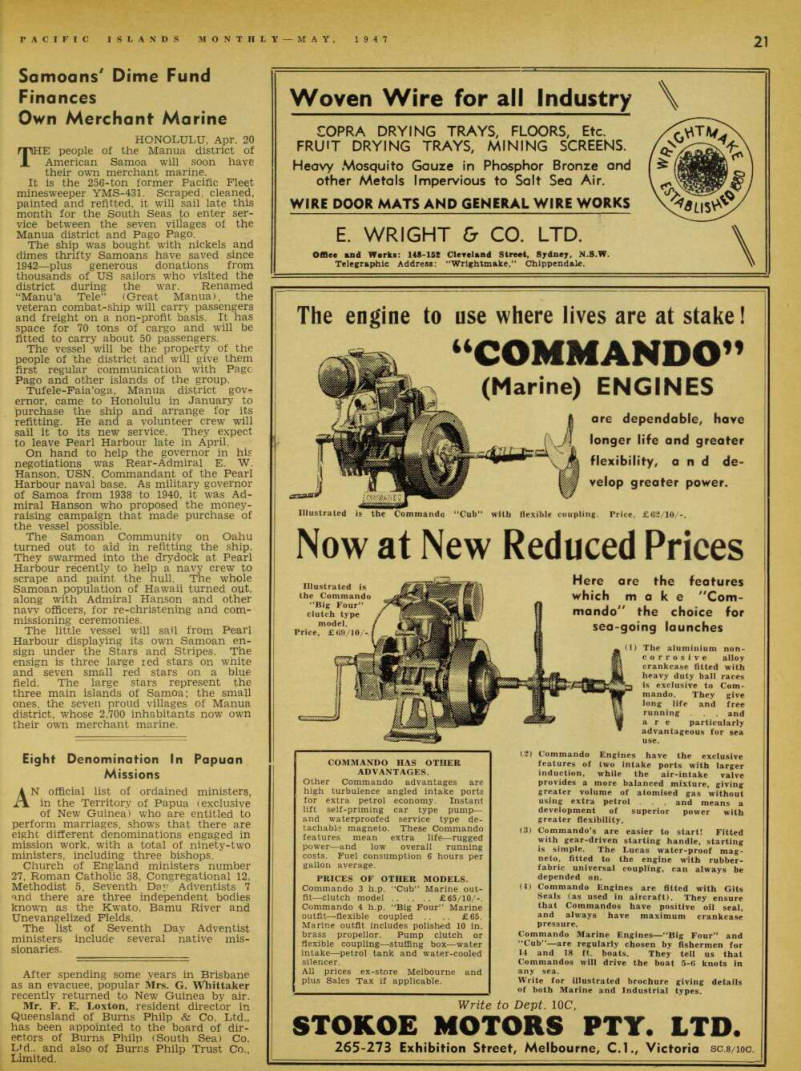
Samoans' Dime Fund Finances Own Merchant Marine
Honolulu, Apr. 20
rE people of the Manua district of American Samoa will soon have their own merchant marine.
It is the 256-ton former Pacific Fleet minesweeper YMS-431. Scraped, cleaned, painted and refitted, it will sail late this month for the South Seas to enter ser vice between the seven villages of the Manua district and Pago Pago.
The ship was bought with nickels and dimes thrifty Samoans have saved since 1942—plus generous donations from thousands of US sailors who visited the district during the war. Renamed “Manu’a Tele” (Great Manua), the veteran combat-ship will carry passengers and freight on a non-profit basis. It has space for 70 tons of cargo and will be fitted to carry about 50 passengers.
The vessel will be the property of the people of the district and will give them first regular communication with Pago Pago and other islands of the group.
Tufele-Faia’oga, Manua district gov ernor, came to Honolulu in January to purchase the ship and arrange for its refitting. He and a volunteer crew will sail it to its new service. They expect to leave Pearl Harbour late in April.
On hand to help the governor in his negotiations was Rear-Admiral E. W.
Hanson, USN. Commandant of the Pearl Harbour naval base. As military governor of Samoa from 1938 to 1940, it was Ad miral Hanson who proposed the money raising campaign that made purchase of the vessel possible.
The Samoan Community on Oahu turned out to aid in refitting the ship.
They swarmed into the drydock at Pearl Harbour recently to help a navy crew to scrape and paint the hull. The whole Samoan population of Hawaii turned out, along with Admiral Hanson and other navy officers, for re-christening and com missioning ceremonies.
The little vessel will sail from Pearl Harbour displaying its own Samoan en sign under the Stars and Stripes. The ensign is three large red stars on white and seven small red stars on a blue field. The large stars represent the three main islands of Samoa; the small ones, the seven proud villages of Manua district, whose 2,700 inhabitants now own their own merchant marine.
Eight Denomination In Papuan
Missions
AN official list of ordained ministers, in the Territory of Papua (exclusive of New Guinea) who are entitled to perform marriages, shows that there are eight different denominations engaged in mission work, with a total of ninety-two ministers, including three bishops.
Church of England ministers number 27, Roman Catholic 38, Congregational 12, Methodist 5, Seventh Day Adventists 7 and there are three independent bodies known as the Kwato, Bamu River and Unevangelized Fields.
The list of Seventh Day Adventist ministers include several native mis sionaries.
After spending some years in Brisbane as an evacuee, popular Mrs. G. Whittaker recently returned to New Guinea by air.
Mr. F. E. Loxton, resident director in Queensland of Burns Philp & Co. Ltd., has been appointed to the board of dir ectors of Burns Philp (South Sea) Co.
Ltd., and also of Burns Philp Trust Co., Limited.
Sister Margaret Kennedy, of the Brit ish Colonial Nursing Service, recently spent her vacation at Surfers Paradise (Qld.). A Queenslander, she received her training at the General Hospital, Bris bane, before going to the Solomons m 1938 Later she was transferred to Fiji and in 1944 she underwent a post-gradu ate course in Toronto (Canada). Before returning to Australia and the Solomons she was attached to the Public Health Department, New York, as a field officer.
Advertisements & other items, pp. 23-24 (1 item)
Now at New Reduced Prices
Woven Wire for all Industry
COPRA DRYING TRAYS, FLOORS, Etc.
FRU'T DRYING TRAYS, MINING SCREENS.
Heavy Mosquito Gauze in Phosphor Bronze and other Metals Impervious to Salt Sea Air.
WIRE DOOR MATS AND GENERAL WIRE WORKS
E. WRIGHT & CO. LTD.
Office and Works: 148-152 Cleveland Street, Sydney. N.S.W.
Telegraphic Address: “Wrlghtmake,” Chippendale, \ o*l*4 f- Or £
The engine to use where lives are at stake!
“COMMANDO”
(Marine) ENGINES
are dependable, have
longer life and greater
flexibility, and de-
velop greater power.
Illustrated is the Commando “Cub” with flexible coupling. Price, £62/10/-. si r
Now at New Reduced Prices
Illustrated is the Commando “Big Four” clutch type model.
Price, £ 60/10/-,
Here are the features
which make "Com-
mando" the choice for
sea-going launches
(1) The aluminium noncorrosive alloy crankcase fitted with heavy duty ball races is exclusive to Commando. They give long life and free running . . . and are particularly advantageous for sea
COMMANDO HAS OTHER
ADVANTAGES.
Other Commando advantages are high turbulence angled intake ports for extra petrol economy. Instant lift self-priming car type pump— and waterproofed service type detachable magneto. These Commando features mean extra life—rugged power—and low overall running costs. Fuel consumption 6 hours per gallon average.
PRICES OF OTHER MODELS.
Commando 3 h.p. “Cub” Marine outfit—clutch model £65/10/-.
Commando 4 h.p. “Big Four” Marine outfit—flexible coupled .. .. £65.
Marine outfit includes polished 10 in. brass propeller. Pump clutch or flexible coupling—stuffing box—water intake —petrol tank and water-cooled silencer.
All prices ex-store Melbourne and plus Sales Tax if applicable.
Write to
(2) Commando Engines have the exclusive features of two intake ports with larger induction, while the air-intake valve provides a more balanced mixture, giving greater volume of atomised gas without using extra petrol . . . and means a development of superior power with greater flexibility. (3) Commando’s are easier to start! Fitted with gear-driven starting handle, starting is simple. The Lucas water-proof magneto, fitted to the engine with rubberfabric universal coupling, can always be depended on. (4) Commando Engines are fitted with Gits Seals (as used in aircraft). They ensure that Commandos have positive oil seal, and always have maximum crankcase pressure.
Commando Marine Engines—“ Big Four” and “Cub”—are regularly chosen by fishermen for 14 and 18 ft., boats. They tell us that Commandos will drive the boat 5-6 knots in any sea.
Write for illustrated brochure giving details of both Marine and Industrial types.
Dept. 10C,
STOKOE MOTORS PTY. LTD.
265-273 Exhibition Street, Melbourne, C. 1., Victoria sc.s/ioc.
COMPLEXION PERFECTION
WITH
*r
BEAUTY PREPARATIONS
FOR
discriminating women
WHO DESIRE
alluring loveliness Obtainable At All Stores.
Distributor:
GORDON K. SMITH
Beverley Hills, Sydney Bankers: Bank of N.S.W.
Maynard Hedstrom
Part-Retirement Of Sir Maynard Hedstrom
From Our Own Correspondent SUVA, April 21 SIR MAYNARD HEDSTROM, dignified, benign, and with a dry sense of hum our that crops up unexpectedly, has relinquished the managing directorshin of the wealthy and influential commercial enterprise of Morris, Hedstrom, Ltd. But, as chairman of the board of directors, he has moved to a new room in the firm’s Suva headquarters and will still be the power behind the throne.
The new occupant of the throne is Mr.
H. E. Snell, “whose ability and faculty for organisation,” said Sir Maynard in a speech at a large staff gathering to com memorate the occasion of his partial re tirement, “have contributed very largely to the sound position of the company to-day.”
Strongly entrenched in Fiji. Samoa and Tonga, and with commercial links and associations snreading far overseas, the business now known as Morris, Hedstrom, Ltd. was started about 55 years ago when voune Maynard Hedstrom, sub-agent at Levuka for the Union Steam Shin Co. of New Zealand, decided that he had not enoueh to do and obtained permission to set up as a Customs agent.
In those days, it is interesting to learn youne Hedstrom, who was born at Levuka in 1872. with solid Swedish forbears, earned a salary of £l5O a year. To-day his income. . . . Well, when the Suva Chamber of Commerce, of which he is president, was agitated about Fiji’s in come tax bump-un some months after the end of the war. Sir Mavnard sighed natiently, “At mv time of life,” he said,
“I am much more concerned with the subject of death duties.”
“To obtain capital,” he told his 1947 head office staff, “I borrowed £2O from the father of a girl I used to take home from church. In view of this relation ship, the lender generously charged me only 10 per cent, per anum interest.”
Starting thus modestly, the business expanded through a series of partnerships and a series of absorptions of other con cerns. From Brown and Joske and Hed strom it changed to Morris and Hed strom in 1902. Then, when Arthur Joske Ltd. was bought out, the title finally became Morris, Hedstrom, Ltd. More firms were absorbed —G. W. Miller and Co., Lau; Hugh Ragg and Co., Ba; Henry Marks and Co., Suva; John Robertson and Co., Sigatoka; and, by 1910, the company’s headquarters were established in Suva. A station at Rotuma had been acquired with one of the early-purchased firms; later Tindall and Ross, Tonga, and Smyth and Carruthers, Apia, were added to the list of acquisitions.
In 1921, a power in the Crown Colony of Fiji (he has served on both the Ex ecutive and Legislative Councils) Mr.
Hedstrom became Sir Maynard Hedstrom.
His was the first kniehthood conferred on a man born in the South Pacific islands.
Three presentations were made to Sir Maynard at the recent staff gathering.
The staff’s gift was a complete and beau tifully-fashioned desk set in tortoiseshell (Suva made). From the Standard- Vacuum Oil Co. of New York (one of the oldest and most important of the links in the chain of agencies held by Morris, Hedstrom, Ltd.) came a glittering illuminated address in book form and executed in the true style of the beauti ful English manuscripts of the Middle Ages; and the Vacuum Oil Co. Pty. Ltd. of Australia sent a solid gold cigarette case.
Advertisements & other items, p. 24 (1 item)
Swuiow 4 Ariell
ORV BEHIND THE SWALLOW
<# SBss'. m m %
LIMITED
LEADERS IN THE BISCUIT INDUSTRY SINCE 1854 lIHU ALSO Of THE FAMOUS SWALLOW S ABItLL PLUM PUOOINC& CABtS. AHO ICC CBCAM
THE LOST HERD
In the year 1788, Governor Phillip sat drafting a despatch to England. In it he had to report the loss of 4 cows and 2 bulls, almost the entire dairying stock of the Colony.
As this mishap was in the nature of a major calamity, Governor Phillip wrote gloomily, “Part of the live stock, small as it was, has been lost —the loss will not easily be repaired.”
Fate however, decided otherwise. Ten years later, a huntsman discovered the beasts 30 miles away at a place since called Cowpastures. In the intervening 10 years they had multiplied to such an extent that before his amazed eyes ranged a herd ,of 60 fine cattle.
Today, Australia’s famous dairy herds produce for export alone over 124 million pounds of butter, and more than 59 million pounds of milk per annum.
Since the days of its inception the famous firm of Swallow & Ariell has exercised the greatest care in selecting only the finest ingredients for Swallow & Ariell products. From Australia’s finest dairy herds comes the rich milk and cream used in the manufacture of Swallow & Ariell delicacies.
Partnership
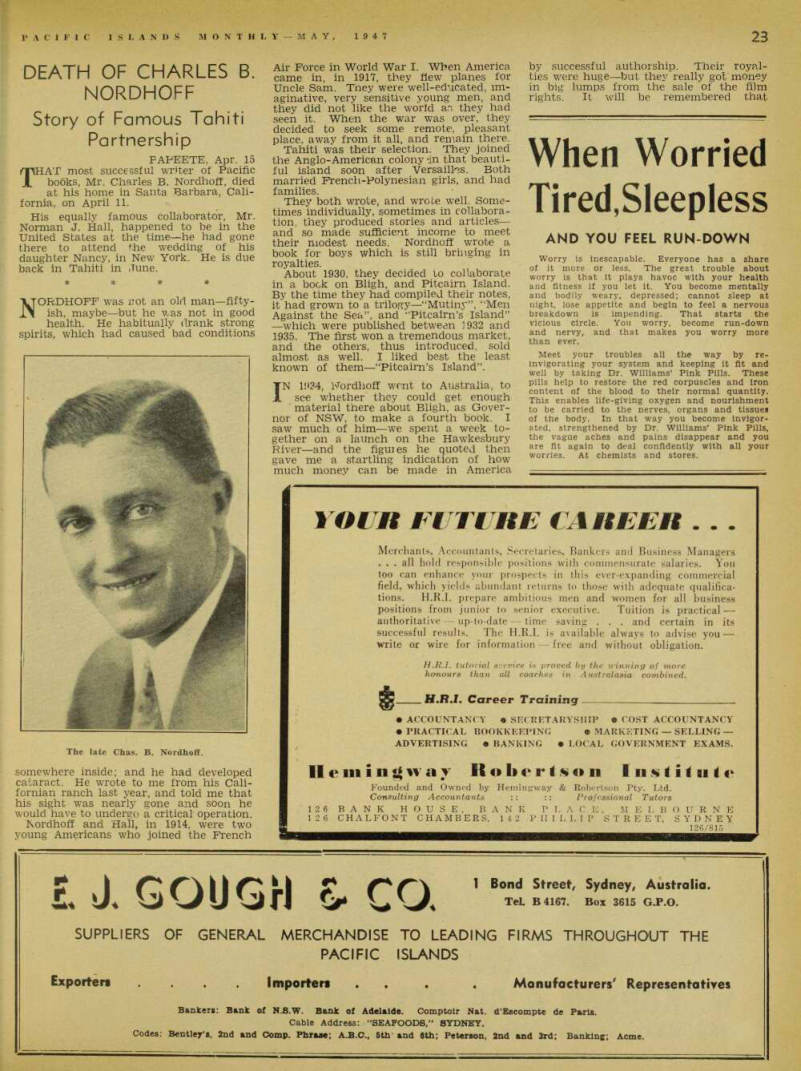
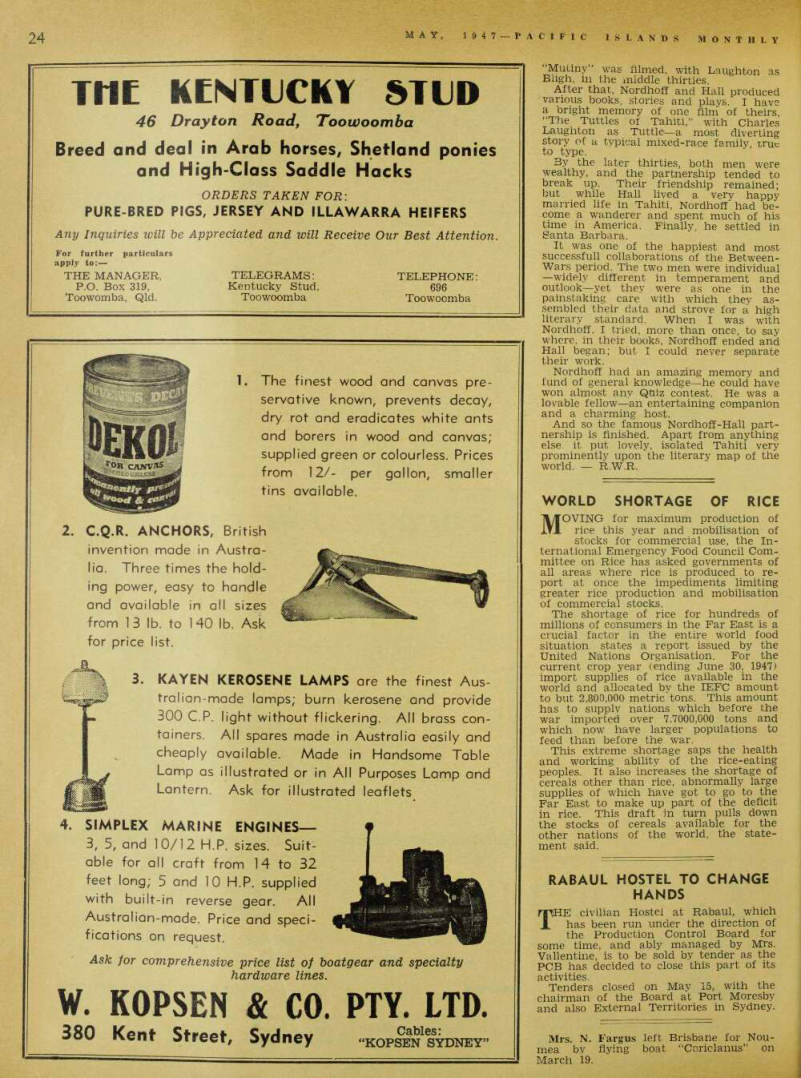
Death Of Charles B.
Nordhoff
Story of Famous Tahiti Partnership
Papeete, Apr. 15
rAT most successful writer of Pacific books, Mr. Charles B. Nordhoff, died at his home in Santa Barbara, Cali fornia, on April 11.
His equally famous collaborator, Mr.
Norman J. Hall, happened to be in the United States at the time —he had gone there to attend the wedding of his daughter Nancy, in New York. He is due back in Tahiti in June. ♦ * * * NORDHOFF was not an old man—fifty ish, maybe—but he was not in good health. He habitually drank strong spirits, which had caused bad conditions
somewhere inside; and he had developed cataract. He wrote to me from his Cali fornian ranch last year, and told me that his sight was nearly gone and soon he would have to undergo a critical operation.
Nordhoff and Hall, in 1914, were two young Americans who joined the French
Air Force in World War I. When America came in, in 1917, they flew planes for Uncle Sam. They were well-educated, im aginative, very sensitive young men, and they did not like the world an they had seen it. When the war was over, they decided to seek some remote, pleasant place, away from it all, and remain there.
Tahiti was their selection. They joined the Anglo-American colony -in that beauti ful island soon after Versailles. Both married Prench-Polynesian girls, and had families.
They both wrote, and wrote well. Some times individually, sometimes in collabora tion, they produced stories and articles — and so made sufficient income to meet their modest needs. Nordhoff wrote a book for boys which is still bringing in royalties.
About 1930, they decided to collaborate in a bock on Bligh, and Pitcairn Island.
By the time they had compiled their notes, it had grown to a trilogy—“ Mutiny”. “Men Against the Sea”, and “Pitcairn’s Island” —which were published between 1932 and 1935. The first won a tremendous market, and the others, thus introduced, sold almost as well. I liked best the least known of them—“ Pitcairn’s Island”.
IN 1934, Nordhoff went to Australia, to see whether they could get enough material there about Bligh, as Gover nor of NSW, to make a fourth book. I saw much of him—we spent a week to gether on a launch on the Hawkesbury River—and the figuies he quoted then gave me a startling indication of how much money can be made in America
by successful authorship. Their royal ties were huge—but they really got money in big lumps from the sale of the film rights. It will be remembered that
The late Chas. B. Nordhoff.
Mutiny” was filmed, with Laughton as Bligh, in the middle thirties.
After that, Nordhoff and Hall produced various books, stories and plays. I have a bright memory of one film of theirs, “The Tuttles of Tahiti,” with Charles Laughton as Tuttle—a most diverting story of a typical mixed-race family, true to type.
By the later thirties, both men were wealthy, and the partnership tended to break up. Their friendship remained; but while Hall lived a very happy married life in Tahiti, Nordhoff' had be come a wanderer and spent much of his time in America. Finally, he settled in Santa Barbara.
It was one of the hapniest and most successful! collaborations of the Between- Wars period. The two men were individual —widely different in temperament and outlook—yet they were as one in the painstaking care with which thev as sembled their data and strove for a high literary standard. When I was with Nordhoff, I tried, more than once, to say where, in their books, Nordhoff ended and Hall began; but I could never separate their work.
Nordhoff had an amazing memory and fund of general knowledge—he could have won almost any Qtiiz contest. He was a lovable fellow—an entertaining companion and a charming host.
And so the famous Nordhoff-Hall part nership is finished. Apart from anything else it put lovely, isolated Tahiti very prominently upon the literary map of the
world.
R.W.R.
Advertisements & other items, pp. 25-26 (1 item)
Tired,Sleepless
When Worried
AND YOU FEEL RUN-DOWN
Worry is Inescapable. Everyone has a share of it more or less. The great trouble about worry is that it plays havoc with your health and fitness if you let it. You become mentally and bodily weary, depressed; cannot sleep at night, lose appetite and begin to feel a nervous breakdown is impending. That starts the vicious circle. You worry, become run-down and nervy, and that makes you worry more than ever.
Meet your troubles all the way by reinvigorating your system and keeping it fit and well by taking Dr. Williams’ Pink Pills. These pills help to restore the red corpuscles and iron content of the blood to their normal quantity.
This enables life-giving oxygen and nourishment to be carried to the nerves, organs and tissues of the body. In that way you become invigorated, strengthened by Dr. Williams’ Pink Pills, the vague aches and pains disappear and you are fit again to deal confidently with all your worries. At chemists and stores.
YOUR FUTURE . . .
Merchants, Accountants, Secretaries, Bankers and Business Managers ... all hold responsible positions with commensurate salaries. You too can enhance your prospects in this ever-expanding commercial field, which yields abundant returns to those with adequate qualifications. H.R.I. prepare ambitious men and women for all business positions from junior to senior executive. Tuition is practical authoritative up-to-date time saving . . . and certain in its successful results. The H.R.I. is available always to advise you write or wire for information free and without obligation.
H.R.I. tutorial service is proved by the winning of more honours than all coaches in Australasia combined.
H.R.I. Career Training • ACCOUNTANCY • SECRETARYSHIP e COST ACCOUNTANCY
• PRACTICAL BOOKKEEPING ® MARKETING SELLING—
ADVERTISING • BANKING • LOCAL GOVERNMENT EXAMS.
II ein i nsjw ay It ohv r Ison Insli I n I v Founded and Owned by Hemingway & Robertson Pty. Ltd.
Consulting Accountants :: :: Professional Tutors
126 BANK HOUSE, BANK PLACE. MELBOURNE
126 CHALFONT CHAMBERS. 142 PHILLIP STREET, SYDNEY 126/815
I 1 Bond Street, Sydney, Australia. u \ j u Vji fi o* w TeL B4i6? - b ° x 3615 g.p.o.
SUPPLIERS OF GENERAL MERCHANDISE TO LEADING FIRMS THROUGHOUT THE
PACIFIC ISLANDS
Exporters ... Importers ... , Manufacturers' Representatives Bankers: Bank of N.S.W. Bank of Adelaide. Comptoir Nat. d’Escompte de Paris.
Cable Address: "SEAFOODS,” SYDNEY.
Codes; Bentley’s, 2nd and Comp. Phrase; A.B.C., 5th and 6th; Peterson, 2nd and 3rd; Banking; Acme.
THE KENTUCKY STUD
46 Drayton Road, Toowoomba
Breed and deaf in Arab horses, Shetland ponies
and High-Class Saddle Hacks
ORDERS TAKEN FOR :
PURE-BRED PIGS, JERSEY AND ILLAWARRA HEIFERS
Any Inquiries will be Appreciated and will Receive Our Best Attention.
For further particulars apply to:—
THE MANAGER, TELEGRAMS: TELEPHONE:
P.O. Box 319, Kentucky Stud, 696 Toowomba, Qld. Toowoomba Toowoomba
fon canvas 1.
The finest wood and canvas pre servative known, prevents decay, dry rot and eradicates white ants and borers in wood and canvas; supplied green or colourless. Prices from 12/- per gallon, smaller tins available.
C.Q.R. ANCHORS, British invention made in Australia. Three times the holding power, easy to handle and available in all sizes from 13 lb. to 140 lb. Ask for price list.
JL 3.
KAYEN KEROSENE LAMPS are the finest Australian-made lamps; burn kerosene and provide 300 C.P. light without flickering. All brass containers. All spares made in Australia easily and cheaply available. Made in Handsome Table Lamp as illustrated or in All Purposes Lamp and Lantern. Ask for illustrated leaflets
SIMPLEX MARINE ENGINES—
3, 5, and 10/12 H.P. sizes. Suitable for all craft from 14 to 32 feet long; 5 and 10 H.P. supplied with built-in reverse gear. All Australian-made. Price and specifications on request.
Ask for comprehensive price list of hoatgear and specialty hardware lines.
W. KOPSEN & CO. PTY. LTD.
380 Kent Street, Sydney
Cstbles *
‘KOPSEN SYDNEY’
World Shortage Of Rice
MOVING for maximum production of rice this year and mobilisation of stocks for commercial use, the In ternational Emergency Food Council Com mittee on Rice has asked governments of all areas where rice is produced to re port at once the impediments limiting greater rice production and mobilisation of commercial stocks.
The shortage of rice for hundreds of millions of consumers in the Far East is a crucial factor in the entire world food situation states a report issued by the United Nations Organisation. For the current crop year (ending June 30, 1947) import supplies of rice available in the world and allocated by the lEFC amount to but 2,800,000 metric tons. This amount has to supply nations which before the war imported over 7,7000,000 tons and which now have larger populations to feed than before the war.
This extreme shortage saps the health and working ability of the rice-eating peoples. It also increases the shortage of cereals other than rice, abnormally large supplies of which have got to go to the Far East to make up part of the deficit in rice. This draft in turn pulls down the stocks of cereals available for the other nations of the world, the state ment said.
Rabaul Hostel To Change
Hands
THE civilian Hostel at Rabaul, which has been run under the direction of the Production Control Board for some time, and ably managed by Mrs.
Vallentine, is to be sold by tender as the PCB has decided to close this part of its activities.
Tenders closed on May 15, with the chairman of the Board at Port Moresby and also External Territories in Sydney.
Mrs, N. Fargus left Brisbane for Nou mea by flying boat “Coriclanus” on March 19.
Tragic Death Of
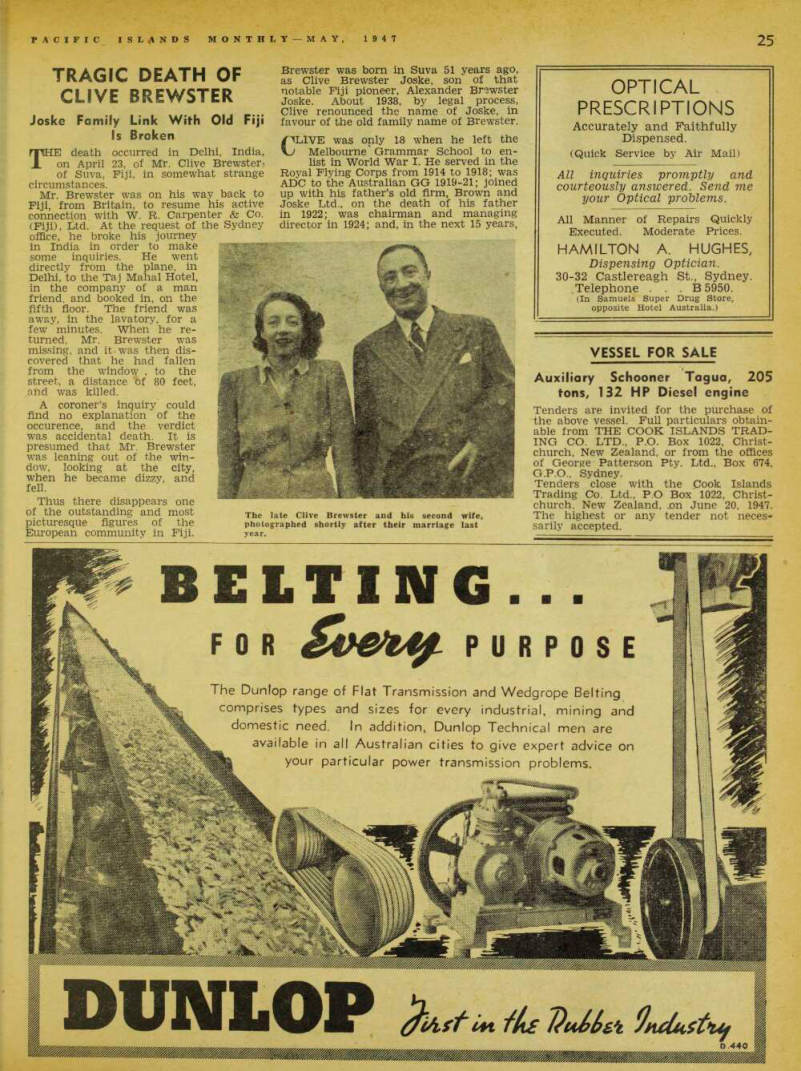

Clive Brewster
Joske Family Link With Old Fiji Is Broken
rE death occurred in Delhi, India, on April 23, of Mr. Clive Brewster-, of Suva, Fiji, in somewhat strange circumstances.
Mr. Brewster was on his way back to Fiji, from Britain, to resume his active connection with W. R. Carpenter & Co. (Fiji), Ltd. At the request of the Sydney
office, he broke his journey in India in order to make some inquiries. He went directly from the plane, in Delhi, to the Taj Mahal Hotel, in the company of a man friend, and booked in, on the fifth floor. The friend was away, in the lavatory, for a few minutes. When he re turned, Mr. Brewster was missing, and it was then dis covered that he had fallen from the window , to the street, a distance of 80 feet, and was killed.
A coroner’s inquiry could find no explanation of the occurence, and the verdict was accidental death. It is presumed that Mr. Brewster was leaning out of the win dow, looking at the city, when he became dizzy, and fell.
Thus there disappears one of the outstanding and most picturesque figures of the European community in Fiji.
Brewster was born in Suva 51 years ago, as Clive Brewster Joske, son of that notable Fiji pioneer, Alexander Brewster Joske. About 1938, by legal process, Clive renounced the name of Joske, in favour of the old family name of Brewster.
CLIVE was only 18 when he left the Melbourne* Grammar School to en list in World War I. He served in the Royal Plying Corps from 1914 to 1918; was ADC to the Australian GG 1919-21; joined up with his father’s old firm, Brown and Joske Ltd., on the death of his father in 1922; was chairman and managing director in 1924; and, in the next 15 years,
The late Clive Brewster and his second wife, photographed shortly after their marriage last year.
he held various public positions in Fiji, was Consul there for France and Norway, Lieut.-Colonel in charge of the Fiji Defence Force, and was in charge of W. R.
Careen ter & Co (Fiii) Ltd. when that concern absorbed Brown & Joske Ltd.
Out of these activities, Mr Brewster gained the following distinctions:— From World War i.—Military Cross.
From France.—chevalier of Legion of Honour, 1936 - From Norway.—officer of st, oiav, 1936.
From Britain.—Officer of British Empire; Long service Medal, Colonial Aux. Forces, , Within a few weeks of the outbreak of world War 11, Clive Brewster was in Sydney, confidently offering his services, Cokmel P in Yl the*piif°n^erice n rantain £ the Sd Rovaf Flvins Co?Ss To P Ws oSsnoken disgSst he was cSldlv reMived° U “You are 1 43” S said
wlrfn? L]L men ”(Brewster'
incidentalsLwavs loSled Ibout 10 vmfs
1 M lO y less than his age.) In the end, persistence won. He was taken into the RAAF—but with the—to him—lowly rank of Flying Officer. But, once he was inside, nothing could stop him. Within a few months, he was in charge of the training school at Evans Head, NSW; he was promoted and promoted, and soon he was in the thick of the Pacific War, as liaison officer on the staff of Commander-m-Chief MacArthur; and finally he was Group-Captain, in charge of the RAAF School of Admimstration University of Melbourne. Handsome, clever and restless, he was always showing up in some prominent place, His social accomplishments attracted new friends to him, wherever he went. Even when the Jap surrendered, and the war
was over, he made one more striking ap pearance; He claimed to have been in the last plane to bomb the Japs, some where between Indonesia and Australia.
IN 1928, Mr. Brewster married Miss Elizabeth Jean Pearson, daughter of a prominent Indian Civil Servant, and they had one son—he is at school in Victoria. The marriage was not a suc cess, and the couple separated. There was a reconciliation when Mr. Brewster went with the Fijian contingent to the Corona tion in 1937, but it did not endure, and they were divorced during the war period.
Early in 1946, he returned to Suva, to take charge of the big Fiji Company; but he was still restless and unsettled— adventure and romance still were calling.
In July, last year, he startled his in numerable friends, and Suva, by getting married again, at an hour’s notice. Mrs.
Eve Walker, an Englishwoman, was public relations officer for BO AC; and, in that capacity, she visited Suva, en route to Samoa and Rarotonga. She was well known, vivacious and attractive. She and Mr. Brewster had met under war con ditions in Australia, where she then was a member of the WRNS. There was a swift courtship and a swifter marriage— and a few hours later, Mr. and Mrs.
Brewster were on a plane, en route to Auckland, Sydney and London.
For some months past, Mr. Brewster had been acting in Britain as a lecturer for the British Department of Informa tion. But (according to letters from him received recently in Australia) his second marriage was not a success; and he had decided to return to Fiji.
Friends all over the world will mourn the untimely, tragic death of a very un usual and very loveable man.
rpHE death of Clive Brewster ends not JL only a colourful and remarkable career, but also the famous Joske family’s active connection with Fiji.
In 1869, Paul Joske, Polish Jew by descent, came from England with much capital and bought land where Suva now stands. With a Mr. Brewer, he established cotton-growing, cattle farming and saw milling. Mr. Liecester Smith and Mr. j. c. Harrison experimented, and found that the (apparently) indigenous cane had a substantial sugar content. Brewer and joske then began an investigation, which ended in their planting sugar-cane over much of the Suva Point area, and im porting milling machinery. The enter prise was an economic failure, and cost them some £3o,ooo—but they did prove that Fiji could produce good sugar, in 1882 Paul Joske much poorer returned to England, leaving his son, Alexander Brewster Joske, to carry on. Clive was born in 1896.
In 1888, Mr. Joske amalgamated his trading business with that.conducted by Mr. L E. Brown (Hartenstem and Brown, formed in 1884), and in the ensuing 30 years the firm (latterly a company) of Brown & Joske Ltd., had a very large share of the commercial and shipping business of the Colony. In the early part of the century, they were the biggest traders in Lautoka. ° ne monument to the family will re main alwa^s ’ however. In the ranges, west of Suy a, there is a remarkable moun tain called Joske ’ s Thumb—probably the most noticeable feature of the Viti Levu sk y- line > as seen from Suva. Shaped like a thumb, it stands out clear and sharp against the evening sky. Old residents S ay they can foretell the weather from the way the clouds gather—or do not gather —around Joske’s Thumb. R.
Advertisements & other items, pp. 27-30 (1 item)
Elting...
OPTICAL
PRESCRIPTIONS
Accurately and Faithfully Dispensed. (Quick Service by Air Mail) All inquiries promptly and courteously answered. Send me your Optical problems.
All Manner of Repairs Quickly Executed. Moderate Prices.
HAMILTON A. HUGHES,
Dispensing Optician. 30-32 Castlereagh St., Sydney.
Telephone . . . B 5950. (In Samuels Super Drug Store, opposite Hotel Australia.)
VESSEL FOR SALE
Auxiliary Schooner Tagua, 205
tons, 132 HP Diesel engine
Tenders are invited for the purchase of the above vessel. Full particulars obtainable from THE COOK ISLANDS TRAD- ING CO. LTD.. P.O. Box 1022, Christchurch, New Zealand, or from the offices of George Patterson Pty. Ltd., Box 674, G.P.0., Sydney.
Tenders close with the Cook Islands Trading Co. Ltd., P.O Box 1022, Christchurch. New Zealand, .on June 20, 1947.
The highest or any tender not necessarily accepted.
ELTING...
FOR Soekty PURPOSE
The Dunlop range of Flat Transmission and Wedgrope Belting comprises types and sizes for every industrial, mining and domestic need. In addition, Dunlop Technical men are available in all Australian cities to give expert advice on your particular power transmission problems.
S' m - K % * mm M %
DUNLOP Ut fits Vu&b&'t
TILLEY LAMPS
BURN ORDINARY KEROSENE
The Modern Form of PORTABLE LIGHTING / Table Lamp Model T.L. 13 This photo shows a 300 c.p. Tilley Lamp for domestic use but there are also 5000 c.p. Floodlights, Outdoor Lamps, Radiators, etc. All burn ordinary kerosene.
Tilley Lamps are made only at
Hendon, England.
Because they are so successful copies of the TILLEY LAMPS are being marketed.
BE SURE YOU BUY A TILLEY LAMP
LOOK FOR THE NAME!
A quality product born of long
Manufacturing Experience
Shipments available four weeks from receipt of order THE TILLEY LAMP CO., HENDON, N.W.4, ENG.
REPRESENTATION :
MELBOURNE : T. H. Bentley, Pty. Ltd., 123-125 William Street, Melbourne, Cl TASMANIA : Mr. C. Sellars, 108 a Charles Street, Launceston.
FIJI : Mr. K. Witherington, 2 Burns Philp Buildings, Suva.
ISLAND MERCHANTS
and AGENTS.
GENERAL MERCHANTS.
CMm
iva
1 iKO * Shippers of all types of l\ " Merchandise to the Pacific Islands • Representing Australian, British and American Manufacturers i -J in 4 (r • Buyers for Leading Pacific Islands Traders • Sellers of Island Produce on Consignment N 5
379 KENT ST., SYDNEY.
Cable & Telegraphic Address: “Chasull ” Sydney. • Importers, Distributors and Manufacturers of Foodstuffs, Softgoods, Textiles, Hardware, Tobaccos, Wines and Spirts, etc. *8 i • "Ultima" Kerosene Stoves and Heating Appliances • Distributors of High-grade Shirts, Pyjamas and Clothing 0. 5.^ 4/ A/ ''Southern Queen' Canned Fruits m • Forwarding and Transhipment Agents m Hill's English Cigarettes When in Sydney, call and see us!
* 9t i m
&of W® Q
Dental V^ ttr !l
“Save the pennies and the pounds will look after themselves.” Save the teeth and the smile will look after itself.
Children cannot be taught too early the value of a thorough brushing of the teeth with IPANA Tooth Paste. Even the first “baby” teeth should be cared for
IPANA
in this way, because on their health depends the formation of “second” teeth.
Brush the teeth with IPANA after every meal, using a medium soft brush.
Let the brush overlap the gums about an eighth of an inch so that all pockets and crevices are reached . . . and brush with a circular movement.
IPANA Tooth Paste is designed not only to make the teeth white and brilliant, but also to stimulate the gums to healthy action.
TOOTH PASTE
% i 381
Alleged
A Comedy of Errors Alleged
From a Special Correspondent SOME wicked people are circulating this story in the Territories of Papua and New Guinea, as an indication of what is called “the prevailing confusion”.
I cannot vouch for its truth; but it is told in detail—and it certainly is enter taining.
In order to help the native food problem of Papua, and to assist in feeding the people of Bougainville, certain officials ordered from “South” nine sows and one boar, for Papua, and a quantity of corn seed for Bougainville.
Someone slipped somewhere, and nine boars and one sow arrived in Port Moresby; and, owing to another error, the animals were fed on the corn intended for Bougainville. Officials in Bougainville now expect to receive pig-feed instead of the stipulated corn seed.
The pigs were turned out in Port Moresby on an area of land previously used for cultivating peanuts. One of the boars developed a nasty, hacking cough.
A high official studied the case, and de cided that the boar had tuberculosis, and he ordered the lot to be shot. Other officials argued, and had the execution de layed. The situation was tense.
Then the boar had an extra spasm of coughing—and up came an outsize in peanuts that had been stuck somewhere in his throat!
An old New Guinea identity, Mr. Ray Parer, has been a recent visitor to Sydney.
He is still suffering from the effects of his accident which occurred in Northern Queensland, some months ago when his arms were badly burned in a petrol ex plosion whilst repairing his car.
Tribute To Suva Medical
School
From Our Own Correspondent SUVA. April 21.
THE Central Medical School in Suva, Fiji, has been described by Sir Peter Buck, formerly Maori Medical Officer of Health and Director of Maori Hygiene and now Director of the Bishop Museum at Honolulu, as probably the finest institu tion for native welfare in the Pacific.
Sir Peter feels that it is a fine example of applied anthropology. He said that it is difficult to give a qualified white doctor,a sufficient training in anthropology to enable him to apply it to his relations with native patients. On the other hand, the native medical practitioner is a prac tical anthropologist jn the environment in which his medical training is to be applied.
A sidelight on the quality of the Fijian medical practitioners produced by the school, was recently given this writer by three Europeans living in semi-remote parts of the Fiji Group. These three (one of them a woman) are firm in their preference for their local NMP’s, despite the fact that in all cases European doctors are available.
The newly appointed Chief Secretary for the Western Pacific High Commission, Mr. G. D. Chamberlain (formerly Colonial Secretary in Gambia), arrived in Suva by air in March, from London. Mr.
Chamberlain replaces Mr. H. H. Vaskess, who is shortly to retire after 36 years’ service with the High Commission. Mr.
Vaskess intends to spend some months with Mrs. Vaskess and their two sons in Australia; but they will presently return and live in Suva, in the country to which they have given so much of their lives.
Misima In Production
In Early 1948
CUTHBERT’S Misima Goldmine Ltd., Papua, expects to start production in 1948 and to put through about 20,000 tons of ore in the first year. This will be at a rate approximately half that of pre-war. The machinery necessary for this rate of production is now awaiting shipment in Sydney or is being over hauled at Misima.
These facts were stated by Mr. T.
Nevitt, a director, at a general meeting of shareholders held in Sydney on April 28. Mr. Nevitt said further that staff on Misima was being increased each month but that shipping services from Australia were still far from satisfactory and that employees on Misima, were finding it diffi cult to get more than the bare neces sities of life.
In future the company would introduce mechanical means of working wherever possible in order to reduce the native labour force which was much less efficient under present conditions of indenture than it had been before the war.
War Damage and Army claims already paid to the company amounted to £72,314, the only claim now outstanding is for £5,406 in respect of deterioration of roads.
Moneys paid in compensation are expected to cover cost of rehabilitation and recon struction. Liquid assets of the company are at present £BO,OOO,
Missing Friend
ANYONE who can supply the address of Mr. James Ashcroft, formerly a miner, of Wau, New Guinea, is re quested to kindly communicate with Mrs.
H. J. Green, 125 Church Street, Croydon, Sydney. Mr. Ashcroft was employed at the Day Dawn and Enterprise mines, be fore the war; but, since then, his friends have lost touch with him.
Advertisements & other items, p. 31 (1 item)
Perfectly prepared, by
exclusive Heinz methods, these are the world's most famous fine soups.
X 57
Fiji-Indians
New Delhi
Interference
In Fiji
Alleged Grievances of Fiji-Indians
Prom Our Own Correspondent
Suva, Apr. 27
rRMERLY one of Whitehall’s diver sions was playing off the India Office against the Colonial Office. But this has come to an end now with the immi nent dissolution of the India Office, and the Colonial Office now shows signs of making occasional decisions that would previously have reduced the India Office to hysteria.
This, of course, will have repercussions in Indian Fiji—unless someone can stop the Colonial Office. Recently, “Fiji Sam archar” (an Indian weekly published in Suva) thundered: “How long this citadel of reaction will be allowed to maintain its present policy will be keenly watched.”
The suggestion that Mr. A. Creech Jones, Secretary of State for the Colonies, had tetter mind his p’s and q’s because “Fiji Samarchar” is on the watch recalls the story of the now-forgotton New Zea land country paper which, in 1913, an nounced editorially that it had its eye on the German Emperor.
The reason for the Indian paper’s agi tation was that it had just recorded the fact that the Colonial Office (presumably with a thought of what has happened in the past) had quashed an amiable pro posal by New Delhi to appoint official Indian agents for Fiji and anywhere else in the Empire “where Indians happen to be in large numbers.”
Unfortunately, the idea does not appear to have oeen quashed finally, not does the parallel idea (from Pandit Nehru himself) of sending delegations of earnest Indians to sort things up in Fiji and the rest of the still-British Empire.
The following statement appeared in the Lahore Civil and Military Gazette, date-lined New Delhi, January 11: “Encouraged by the way in which the Government of India recently fought for the rights of Indian nationals in South Africa, Indian settlers in Mauritius, Fiji and Trinidad have sent formal represen tations to the Commonwealth Relations Department of the Government of India urging official intervention with a view to securing better status and better con ditions of living for Indian settlers in these places. Fraternal delegates to the Meerut session of the Indian National Congress from these islands are under stood to have personally discussed this problem with some members of the In terim Government.”
Other references concern “securing re dress of grievences” and “studying the hardships of Indian settlers in Fiji, Maur itius and Trinidad.”
AND so it goes on. In Fiji, the Indians have equal Legislative Council repre sentation with the Fijians (rather loaded perhaps, because all the Fijian members are Government appointees, with the inevitable result); they are on every public body of importance; they have their own Chamber of Commerce in Suva, their own industrial unions in the sugar industry, and heaven knows how many political and other associations—all ex tremely vocal.
It is to be hoped that the investiga tions, if they materialise, will spare a moment for such incidentals as the fabu lous sums made and hoarded (or sent to
India) by Indian traders during the war time American-New Zealand invasions; the Indians who crowd the expensive plane services to New Zealand and Aus tralia on their way to India for long periods; the war record of the Fiji In dians; and the ruthless exploitation of underdog Indians by moneyed Indians at the slightest opportunity. They could also examine, with profit, the “hardships” of any Indians in Fiji and compare them with the filth, starvation, disease and ig norance in the swarming cities and caste ridden countryside of India herself.
Indian humanitarianism, like all other missionary enterprise, should start at home.
Death Of Mr. Ernest Till
THE death occurred in January last, at Lae, New Guinea, of Mr. Ernest Till, who had been a very old resi dent of the Territory. He came from Czecho-Slovakia, and he established his first plantation on tiny Pigeon Island, off Kokopo, but later moved to the Bainings, behind Rabaul. He and Mrs. Till (who was his third wife, also a Czech, who survives him) were caught on their plan tation by the Japanese invasion, and they spent 3i years in a Jap internment camp.
He had three daughters. One married Mr. Isenbert, who has now returned to Lae; one married Mr. Batze, a member of an old New Guinea family, who is now back in the Territory, on the staff of BGD: and the third is the wife of Mr. Rudolf Jahnke, at present in Sydney awaiting a ship whereon to return to their plantation in the Bainings.
Mr. Cyril Doyle, a well-known planter in TNG, in pre-war days, has returned to Papua-New Guinea, and intends de voting his attention to trading.
Advertisements & other items, pp. 32-33 (1 item)
Blackwell
better Buy
C THE ORIGINAL
ROSSE &
BLACKWELL
M eat and
UNEXCELLED SINCE 1706
Modern Refrigeration for the South Sea Islands
The ELECTROLUX KEROSENE- OPERATED
REFRIGERATOR
MARVEL
OF
MODERN
SCIENCE
m - Mi I
THE
MIRACLE
OF
ICE
FROM
HEAT
ELECTROLUX offers economical, modern and completely efficient
REFRIGERATION FOR ISLANDS' HOMES.
FREEZES CONTINUOUSLY WHILE SMALL LAMP BURNS.
Freezing controlled by simply regulating height of flame. Uses only f gallon of kerosene per week.
MOTORLESS ... NO PARTS TO GET OUT OF ORDER.
MODEL LKSSO
Capacity: 5.5 cubic feet.
GUARANTEED FOR TWO YEARS
• Write to your Local Distributor for prices and full details.
OBTAINABLE FROM ALL W. R. CARPENTER & CO. LTD.
BRANCHES THROUGHOUT THE ISLANDS
Representation in Papua and New Hebrides.
Address Wanted
ANYONE knowing the fate or where abouts of Mr. J. W. Gruesser, who was a planter on Lihir Island, off the coast of New Ireland, prior to World War 11, is asked kindly to communicate with the editor of the “Pacific Islands Monthly.”
Professor E. W. Gifford, of the Uni versity of California, accompanied by Mrs. Gifford, arrived in Suva on March 24. They intend to spend about six months on a programme of archaeolo gical reconnaissance and excavation in the Colony. Professor Gifford is interested in problems of Polynesian cultural and racial origin, and his aim is to determine by archaeological research whether or not Fiji was the rallying ground of the Polynesian ancestofg before they entered Polynesia proper. In 1920 and 1921 he conducted anthropological studies in Tonga and he has published a series of papers on his research work there.
Mr. T. C. Barclay, who is on the staff of the Loloma Gold Mines, Fiji, returned to the Colony recently after his first trip to Australia in five and a half years.
Before he left Brisbane he said that he thought Australia had changed a great deal and that he would be glad to get back to Fiji.
Are Being Forgotten
Fijian Arts and Crafts Are Being Forgotten
From Our Own Correspondent SUVA, April 21 THE Fiji Museum at Suva, mainly be cause of lack of space and lack of staff, is uninspiring to the general visitor. But no less an authority than Sir Peter Buck (Te Rangi Hiroa) the famous Maori doctor, soldier and admin istrator, who is now director of Honolulu’s Bishop Museum, and former Professor of Anthropology at Yale University, has praised its collection of Fijian material.
Sir Peter paid a fleeting call on Suva in 1945 and in his latest director’s report writes: “I took the opportunity of visit ing the museum, which contains a good collection of Fijian material and I had the privilege of examining the various artifacts under the guidance of the curator, Mr. George Barker, who has an extensive knowledge of Fijian culture.
“Samoan and Tongan material cul ture,” Sir Peter adds, “has a good deal of affinity with Fiji, and an organised study of Fijian material culture is neces sary to appreciate the diffusion that has taken place among the three island groups of Samoa, Tonga and Fiji.”
The trouble is that there is precious little opportunity for anyone, Fijian or otherwise, to study Fijian culture. Cus toms have survived, but as in Tahiti and other stamped-over islands, virtually no trace remains of ancient craftsmanship.
The stuff sold in Suva curio shops (mostly Indian establishments) at out rageous prices does not count.
Those Fijians who still produce beau tiful work naturally see no reason to sell it at bargain prices - when the shops resell with big profits. Thus, even the trade in Fijian curios—which, in any case, hardly come in the “cultural” group—has passed into Indian hands.
Books on the subject are unprocurable to-day and histories of Fiji are so ob sessed with cannibalism that there is no room for more important subjects.
Maori material culture is being revived in New Zealand and to-day young Maoris are learning the arts of the old days— sometimes with European teachers. The Fijians, on the other hand, are still suf fering from teachers, in and out of school, who insist that everything Fijian is barbarous and that they should learn to appreciate the perfection of mass production.
Surely the Fiji Museum, which houses those articles not filched in the early days by curio-hunters or by overseas museums, could be made educationally attractive to the mass of the Fijian people?
It could be done with money and imagination: There are still people, both Fijian and European, who know some thing of Fijian material culture, but their numbers are dwindling and their knowledge is being lost.
Raymond McNally of the Suva Boys’
Grammar School, who has won the Fiji Scholarship for 1947, intends to become a student at an Australian University.
Fiji Scholarships were first made avail able in 1928 but applied to study in Fiji only. In 1938, amendments to the Ord inance permitted the successful candidate to attend a university, or other training institution overseas, for a period of three years. Each scholarship is of the annual value of £l2O Fiji Currency and is awarded to the candidate scoring the highest aggregate of marks in the En trance Examination of the University of New Zealand and the New Zealand School Certificate Examination.
Advertisements & other items, p. 34 (1 item)
Coleman
KODAK FILMS
and all photographic supplies
WHOLESALE AND RETAIL
CAINE'S STUDIOS, SUVA,
P.O. Box 8 Photographers. Est. 1904.
Write for free price list
CQ\^S
For light!
U. S ► A
Coleman
WORLD-WIDE
'Dcftcndtijitlity
the finest ... for all the latest in I, cooking and heating appliances you can be sure with COLEMAN. Wherever you may be there is a Coleman dealer to serve you with dependable COLEMAN appliances and service.
The Coleman Lamp
and Stove Company Limited
TORONTO* CANADA
CHICAGO,
“Operation Sepik”
A Coast-Watcher Tells a Lively Story of Jungle Warfare Against Japs
IN the first two instalments of his story, Mr. K. H. McColl, who was one of Commander Eric Feldt’s Coast-Watchers, told how he escaped from the North-western Islands of New Guinea when war came in 1942, and how he, in company with the Rev. A. P. H. Freund and the late Lloyd Pursehouse, kept tabs on the Japs behind Finschhafen.
In this concluding instalment, Mr. McColl recounts some adventures in the Sepik district, and tells how he almost fought a duel with a Japanese colonel.
Part Three
WE had a month’s leave in Sydney (during which Purse was married and Freund returned to the service of his Church) and then the next few months were occupied in Milne Bay.
During this time the parties were “in serted” in New Britain, where they joined Wright and Figgis, who had been alone there for some time. Ben Hall was put into Long Island: Fryer and Aiken were down in the Sepik Valley; and G. A. V. Stanley was further west in the same area.
Early in 1944, I was sent to Manus, which had not long been occupied by US Forces; and after establishing a base there, I was relieved by Harry Murray, and returned to Finschhafen. Permission was given for me to make a trip inland, where I contacted our native friends who had been so loyal to us in 1942-43.
From them I got the full story of the Jap raid on us and subsequent events there.
In the meantime. Purse had returned to New Guinea, and, after a lone patrol of Arawe, prior to the American land ing there, he was attached to the 9th
Division, AIF, which was chasing the Japs along the coast towards Madang.
They were crossing the Sio lagoon one day when a shot rang out, and Purse fell into the water, killed, A lone Jap, left behind in the retreat, had struck a last blow.
The irony of it! After so long, hun dreds of miles inside enemy territory, he was killed five miles behind our own lines. Another good and gallant friend had gone.
Tupling and Olander, killed at Arawe; Bill Butteris and Obst killed at Cape Gloucester; Bell and Laws killed in the Finisterres; now Purse gone; “Blue”
Harris, a little later was killed at Hol landia.
But retribution was on its way. These deaths were repaid with interest.
AFTER another leave late in 1944, I grew discontented with the tameness of things. I was a big worry to our Chief in Brisbane; the bush called me.
At last, more to get rid of a pest, he sig nalled me (I had returned to Port Moresby by this time) to form a party
and go into the Sepik area and relieve Stanley. Fryer had come out some time before, and the 6th Division, AIP, at Aitape wanted the area south of them covered.
The party was soon formed. I had with me Lieut. Kevin Walls, AIF, as second in-command and Sergeant Mitchell AIP, as my signaller; and 24 well-armed and trained native troops—later augmented to 40 armed troops with the acquisition of a number of FELO natives. Both Walls and Mitchell were later decorated
for their parts in that patrol. It was one of the brighter spots of the war when I wrote out their recommendations.
WE left the Aitape perimeter early in December, 1944, and crossed the Torricelli Range through a gap, and then travelled south towards the Sepik basin. For the first three days of this journey the 6th Division had asked me to escort a Major of Signals and two O/R’s to the furthest outpost. I think this is the first time in history that the Navy has been asked to convoy the Army on land!
A main base was established at the Klaffler villages, and we then moved fur ther east to a point almost due south of Maprik, and close to the Maprik-Marui Road. We were well in then among large concentrations of Japs, and after organising many of the wilder natives in the area, we were kept informed of all enemy moves in the area. Soon our grapevine extended to Musimbe in the NW; Musendai, Balif and Maprik in the north; Yamil and even Wewak in the NE through qll points of the compass to Marui, on the Sepik, and south-westward along the Sepik to Avatip and the Wash kuk area.
During our move to this area we had picked up four Indian soldiers of a Pun jab regiment who had been captured by the Jans in Singapore in 1942. They had been brought to New Guinea and had just then escaped from the enemy. They told us that there were more of their friends still at Kurringe, and that they were being starved and badly treated. I despatched Walls with half our force and one of the Indians, Havildar Khazan Singh, to attempt a rescue. It was for this operation that Walls was later decor ated with the Military Cross.
He succeeded in rescuing another nine Indians, and, as well captured seven Jans, from whom we got a lot of useful information. We later rescued another eio-ht Indians, making a total of twenty one. Some of them were in a pitiable condition and had to be carried on lit ters; two others had been slashed ter ribly about the heads with swords in an attempt to kill them. The last one we were able to snatch was being fattened for food by the Nip; he had seen some of his mates slaughtered and eaten. He can consider himself fortunate that we were near him at the time.
AT about this same time, I had pin pointed some targets for the Air Force to bomb; the targets ranged from two miles from my camp at Lasimbe to about nine miles away, and involved about 500 Japs.
Just south of me, about four miles away, were another ten Nips in a village named Zgitakua, and as they were only a small band I asked Mitchell if he would like to have a go at them. He was very keen. Although he had been in our show for a considerable time as a sig naller he had not had an opportunity to sight a Nip over his gun. He selected the native troops he required and set off late one afternoon ready to strike at dawn the following morning.
At about the same time as he set off, however, another 50 Japs arrived in the village and joined the ten already there.
When Mitchell opened upon them next morning he found himself involved with what appeared to be the whole Japanese army; they hurled grenades at him, shot at him and his five natives with sub machine guns, rifles, and eventually with a “woodpecker.”
Mitch finally realised the position, but decided, however, that, he might as well carry on. He kept the fight going until his Bren gun jammed. He then called to the natives to get out and they all
arrived at our base without a scratch.
I paid a visit to the village, and we counted 37 dead Japs. Mitchell was awarded the DCM for this show. He richly deserved it.
During this time, I had been organis ing the local natives into aggressive bands, whom I called the “Kanaka Kom andos,” and with these and some of my own natives, we began a war of attrition.
Our score began to mount up, and those Japs who were near us soon began to move smartly away. I was revenging the loss of my friends in the earlier stages of the invasion.
Our scouts from the south began to bring us news, too, and I was able to give the 4 Tac R Squadron (4th Tactical Reconnaissance Sq.) some good targets on the Sepik River. This was much appreciated; and, after a good strike, a flock of “Boomerangs” would swoop over our camp, give us a buzz, and drop car tons of Lucky Strikes. We appreciated them. rEN the enemy got fed up with my party. By this time they knew we were operating near them —I would have been surprised, indeed, if they had not. Some of the agents I was using to get information were Jap agents, too; in fact, they used to visit me still wear ing Jap armbands. We were quite sport ing about it.
I sent a request to the 6th Division asking for a patrol to move in and meet me some distance back, where I could hand over our Indians and prisoners; this had been Okayed. Then one morn ing we were wakened by the sound of many shots close at hand. An agent in a village near us came rushing in with the news that about 100 Japs were mov ing in on us, armed with mortars and machine guns. I decided to move our equipment out of the way, and then placed my troops in position and awaited their arrival.
We did not wait long; a long line of troops came streaming into the end of our camp, and I was just about to open up with my carbine (the signal for every one to start shooting) when I noticed that the troops wore -Australian hats.
It was the patrol come to meet me!
They had been shown a disused track by the natives and did not know that they had passed close to a large force of the enemy. , After waiting vainly for the Japs to arrive, we all moved back to an other camp where the Indians were rest ing. They were taken out to the coast.
NOT long after this, Lea Ashton arrived in with another party to re lieve me and I left with my braves for the coast to form another party. This time, I was to cover the Sepik River itself for the Ist Australian Army.
I took with me Cpl. “Dusty” Kotz, AIF, as signaller and A.B. “Chook” Baxter, RANR, as coder, and 22 native troops.
We moved down to Auengai, about a day’s walk from Avatip on the Sepik.
Our old grapevine, already established, soon began to bring us news of the enemy along the river. They even sup plied me with the names of practically all the Japs, both officers and men in the area.
I took delight in hounding one Jap in particular, Colonel Sakina. I turned the bombers on his camp and he moved.
Within 24 hours I had his new position; so again the bombers disturbed him. He moved back to his original position and again he was bombed.
This was too much. He sent a native up to me and challenged me to a sword duel! I still have a copy of my signal sent to HQ at this time: “Jap OC Washkuk area. Col. Sakina, very hostile at bombing and straffing and
has challenged me to a sword duel. Can anyone lend me a sword with a book of instructions.”
But I sent a different message back to Sakina. I told him to dispose of his arms and to march in to my camp with all his men and surrender. This was too much for him. A native agent came back and told me that Sakina had been taken down river to a hospital, appar ently with a stroke. On this news, I sent a further signal to HQ informing them that: “My infuriated Jap gone down river to Pagwi, very sick. Probably apoplectic stroke. Cancel sword.”
Near the end of the war I turned the Kanaka Komandos, aided by my own troops, onto all the Nips in this area, and Sakina who had just arrived back, was liquidated, with 35 other Nips. I still treasure his sword.
AT about this time, I had received much information regarding the where abouts of various of the Jap unit and army commanders in the whole area.
In my bloodbath, mentioned above, I had captured a Japanese army captain, one Matsui. He was very helpful with infor mation and I was able to plot the HQ of Lt.-Gen. Adachi, OC of Jap 18th Army; Lt.-Gen. Shoge, and Lt.-Gen.
Mano. Also some of the lesser lights like Major Sumi, OC of Air Communica tion unit at Jama—he was wounded in a bombing attack I instigated there—and Major Aonu, OC of Matsui’s own unit, the 64th AA Reg. Poor Aonu decided to pay a visit to Matsui, and walked into the middle of the massacre. He went the way of the others.
TIHEN came the end. Away back in De < cember, 1941, on my little island at Wuvuly, the first ominous signal had been: “Keep watch for enemy fleet.” Now,
after four long years, the signal was flashed: “Hostilities have ceased.”
Our job was done —and the price of victory had been paid. Many fine and courageous men had given their lives for New Guinea.
We who survived have come to know the native probably as we would never have known him in peace. Among our native troops we found a happy band of gallant and loyal comrades in whom we often trusted our lives, and who never failed us.
We made our friends and we had our enemies; what more could we want?
Advertisements & other items, pp. 35-36 (1 item)
Gardner Diesel Marine
SPECIALISING
IN
PACIFIC ISLAND INSURANCES
FIRE MOTOR VEHICLE
MARINE HULLS AND CARGO
EMPLOYER’S LIABILITY
GUARANTEES including those for—
DYNAMITE PERMITS.
RECRUITERS’ LICENCES.
DEFERRED WAGES
AND ALL OTHER CLASSES ARRANGED
AT LOWEST CURRENT RATES.
Established Agencies:
W. E. CARPENTEE & CO., LTD.
Throughout the Territory of New Guinea.
SOUTHERN PACIFIC INSURANCE
CO., LTD.
HEAD OFFICE: 60 HUNTER STREET,
SYDNEY.
GARDNER DIESEL MARINE
ENGINES
There is a type available for every class of vessel requiring power from 24 BHP to 152 BHP. Direct or reduction gears.
GARDNER stationary engines for all classes of work, including electrical
generation
MORRIS MARINE ENGINES
Petrol Driven. Direct or Reduction Gears
VEDETTE, 6-12 H.P.
NAVIGATOR, 12-24 H.P.
CHAPMAN PUP
and
SUPER-PUP
Engines
3 H.P.—4i H.P.
DISTRIBUTORS IN FIJI :
GRANTEX RICE MILLS
with stationary engines suitable for their operation
W. R. CARPENTER & CO. (Fiji)
General Merchants, SUVA, FIJI
LTD.
Day-Old
Chicks
BY AIR
Amalgamated Hatcheries
(Reg.) of Bankstown, near Sydney, N.S.W., can dispatch limited numbers of chicks by
PLANE TO
RABAUL, PORT MORESBY,
LAE, NOUMEA, SUVA.
and all other islands of the Pacific served hy present AND PROJECTED air services.
Amalgamated Hatcheries are the largest distributors of dayold chicks in Australia, last year over 1,000,000 chicks being sold by us in N.S.W. alone.
Our scientific method of packing and dispatch has resulted in a loss of less than 1 per cent, of chicks sent by plane.
If any chicks in your consignment arrive dead, we will replace them frees provided the extra freight is paid by the purchaser.
Chicks available are R.1.R., Austrolorps, and W.L.
Price, £lO per 100, landed at your airport, for unsexed chicks, and £l4 per 100 for all pullets. (Guaranteed 96 per cent, accurate sexing.) These chicks are the cream of Australia’s stock, produced under ultra - violet rays to guard against disease; the adult stock is blood-tested monthly by veterinary officers and each individual order carries a N.S.W.
Government certificate that the chicks are healthy and from tested stock.
Payment for chicks should be made by draft with the order, or credit arranged through our Bankers, the Commercial Bank of Australia, Ltd., Bankstown,
N.S.W.
Drafts and remittances can be sent direct to Amalgamated Hatcheries, Bankstown, N.S.W., or to the following agents: Messrs. Burns, Philp (South Sea) Co., Suva-Ba-Fiji, or any Island Branch. Also to: Marcel Legras, 38 Rue de Verdun, Noumea.
WRITE BY AIR-MAIL OR
CABLE.
AMALGAMATED
HATCHERIES
BANKSTOWN, N.S.W.
Lost Genealogies Of
Cook Is.
From Our Own Correspondent MANGAIA, March 3.
NUMEROUS recent deaths in the native community have laid bare once more the negligence of early recorders of births, marriages, etc From 1901 onwards, accurate registers were kept; but when anyone, born before Annexation dies, the family, only too often cannot state the deceased’s age or ante cedents, of which only he was aware, and of which he neglected to inform his heirs in his lifetime. A.s a result, the registrations are often mere guesswork.
This suffices for legal purposes: but does not always please the deceased’s heirs and successors, where land comes into the case. At present, complete confusion over ownership of land exists. Possession is the test, and the Island Council is the adjudicator of any dispute over estates.
Mr. C. M. G. Adam, of Suva, Fiji, was a passenger to Brisbane on the flying boat “Coriolanus” on March 27.
Mr. Cheung Hung, the sole surviving brother of the well-known Chinese firm of Kwong Ching Bros., of pre-war Rabaul, has now returned to the Terri tory of New Guinea. He will reopen his business in the Rabaul district, Mr. K. A. Robinson, senior inspector for Burns Philp & Co. Ltd. in Papua-New Guinea, arrived in Sydney about mid- March to visit his mother who is in ill health.
Mrs. V. Thomas, formerly a well known resident of Rabaul, has gone to Lae, where she will assist in the management of the Cecil Hotel. Mrs. Thomas was accompanied by her daughter, Miss Betty Cardew, who has taken a position with Qantas at Lae.
Advertisements & other items, pp. 37-38 (1 item)
GuatxaUati SiaMng, JnduAbiiea
KANGAROO BRAND
Ropes,
Cordage,
and Twines for every purpose Backed by 86 years of service Manufactured hy :
M. DONAGHY AND SONS,
Pty. Ltd., Geelong and Sydney.
Fiji Representatives:
PEARCE AND CO.
LIMITED
P.O. BOX 237, SUVA
ISLAND CRAFT
TO
MODERN DESIGN
WOODEN FREIGHTERS,
TRAWLERS AND ISLAND
CRAFT.
VESSELS REPAIRED AND
REMODELLED.
f *
AUSTRALIAN AGENTS FOR
GRAY MARINE PETROL AND
DIESEL ENGINES.
COPPERSMITHS, WELDERS
AND PLUMBERS.
MODERN SLIPWAY FACILITIES AVAILABLE
WRITE US FOR DESIGNS AND COMPLETE SHIPBUILDING INFORMATION. /^A^\
I A p I J
GuatxaUati SiaMng, JnduAbiiea
INCORPORATING REG. ADAMS CLAYTON CO.,
X 84475, XA 1731. JOHN STREET, BERRY'S BAY, NORTH SYDNEY. ALSO AT EDEN, N.S.W.
WANTED: Back numbers of the “Pacific Islands Monthly.” Have many duplicates for exchange. Will also exchange American magazines for newspapers and magazines of the Pacific Islands and British Colonial Empire. Orders taken for subscriptions to American magazines—no foreign exchange difficulties —write for details to PAUL A. DORN, Agent, Los Angeles 36, California.
lA i
Prepared from choicest tender meats, and cooked to perfection by expert chefs, Imperial canned meats are “flavoursealed” for lasting taste appeal.
Keep good stocks of the many delicious Imperial canned meats and serve them often—they’re always ready, and always welcome. ( ;.Vv‘ X?
fe p STEAK PUDD^IE
CANNED MEATS
MEAT R E A T
HOT MEALS
CAMP PIE
HAM P E
Mangaia
New Mission Church For
Designed and Built by Priest
From Our Own Correspondent MANGAIA, April THE new Catholic church at Kaumata Village, is a monument to the energy and zeal of one man. The present incumbent, Father Charles, has been the architect and builder, and done most of the cement-work (in native “punga”), himself.
This labour of love is now practically complete, even to a tiny campanile for the bells that the priest hopes will be in stalled later.
The new church, while in no way pre tentious, adds a dignified touch to the closely-settled beach-village; and, being
strongly built will resist hurricane or tidalwave damage.
The original building, of reeds and thatch, was erected by Father Elie-Marie Cavalier in 1931, and was in use for 9 years.
Mosquitoes Still Have Breeding
Dengue Outbreak In Fiji
Mosquitoes Still Have Breeding Grounds Close to Suva
From Our Own Correspondent SUVA, April 21.
T\ENGUE, one of the many mosquito JL/ (aedes aegypti) legacies in the tropics, has steadily grown to epi demic proportions in a large part of Fiji during April.
In the early hot-weather months in Suva there was an almost complete absence of mosquitoes, but in March and April, despite an active and reinforced anti-mosquito campaign, a horde vicious dive-bombing insects descended like a plague. With them, it seems, has come dengue.
The Mosquito Control Officer at Suva has been appealing again to every house holder to prevent the breeding of tne domestic mosouito by eliminating all possible breeding places, but this is a rather heart-breaking business, requiring ceaseless supervision, tact and persuasion.
If the mosquitoes go, of course, dengue will go too, as it is spread only by mosquito bites.
In the meantime an official statement from London reports that the British Government has made another grant of £12,400 to Fiji for the anti-mosquito battle, making a total to date of more than £90,000 spent by the United Kingdom to help keep malaria out of those islands so far free of it.
In view of the close association of Fiji with malarial islands dui-ing and since the war, the Group’s continued immunity is little short of a miracle.
The anti-mosquito campaign in Fiji has embraced the destruction of breeding places (as far as possible); a propaganda campaign among the Fijian people which has met with ready response and help; the oiling of stagnant water and, in places, the reconstruction of existing water channels.
There is an active mosquito team in action but despite its work only the fringes of the problem have yet been successfully tackled It is one thing to harry the mixed population of Suva into a sense of community responsibility, but another to take the next step. For instance, at Walu Bay, right in Suva but outside the Town Board’s boundary, there are innumerable mosquito breeding places. There ,are also ricefields on the outskirts of the town.
Mrs. O. F. Nelson, widow of the well known Samoan merchant who died in 1944, departed recently from Apia for a holiday in New Zealand.
Movements of W. R. Carpenter & Co’s staff during March included the transfer of Mr. H. W. Nolan to Wewak to take up mechanical duties there; the return of Mr. D. L. Meek to the Madang store; and R. Wilson to Lae, as a general store assis tant.
Advertisements & other items, p. 38 (1 item)
Social Evening
SOUTH SEA ISLANDS CLUB
Every Thursday, at 399 George Street.
Sydney (Fourth Floor) Ballroom Dancing . . . Special Islands Dances and Songs Islands Visitors Welcome.
Magazine Section
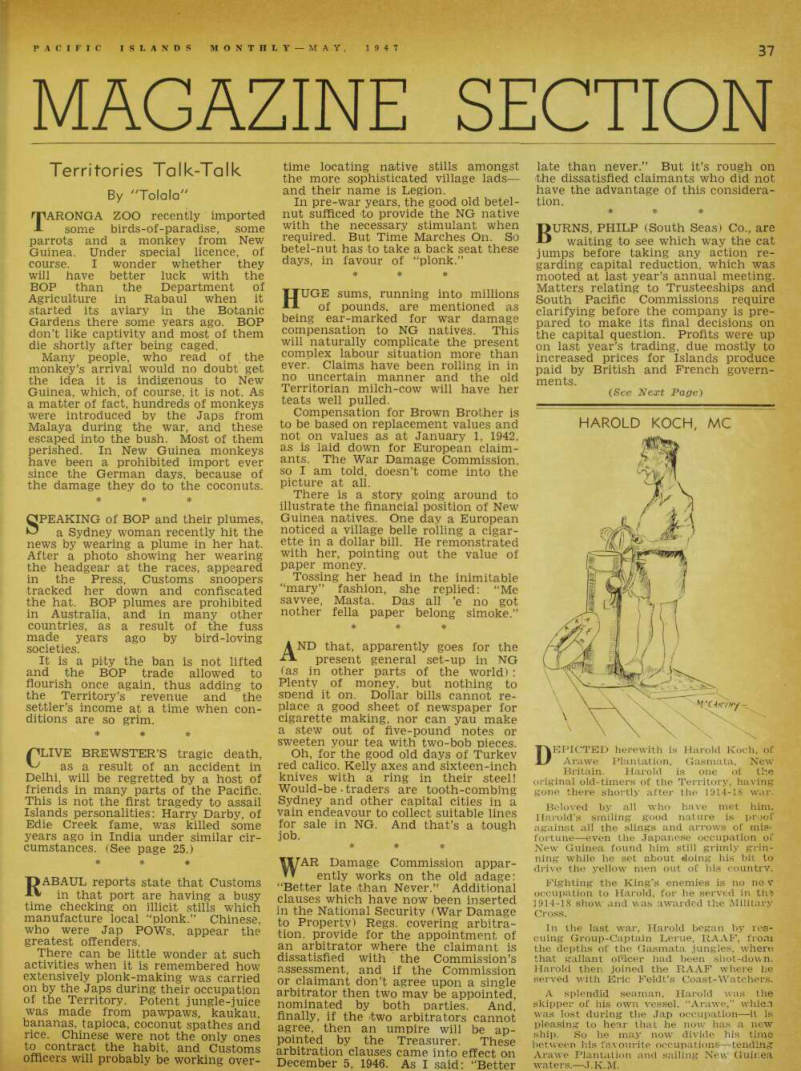
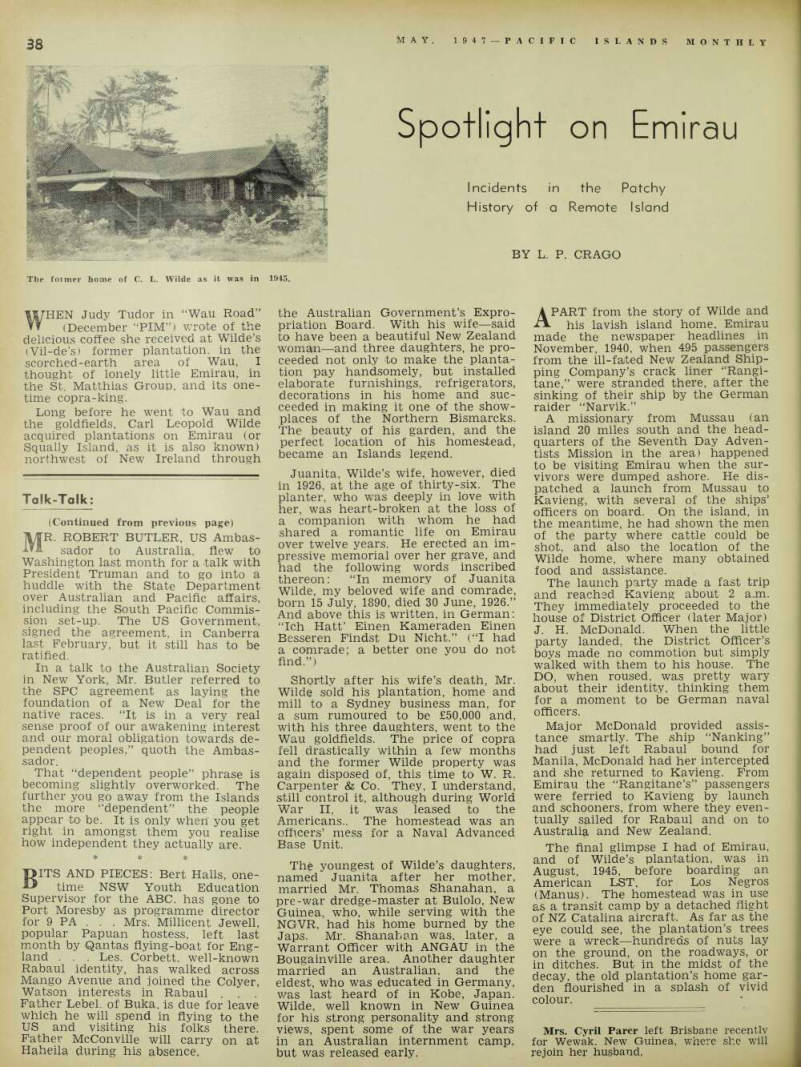
Territories Talk-Talk
By "Tolala"
TARONGA ZOO recently imported some birds-of-paradise, some parrots and a monkey from New Guinea. Under special licence, of course. I wonder whether they will have better luck with the BOP than the Department of Agriculture in Rabaul when it started its aviary in the Botanic Gardens there some years ago. BOP don’t like captivity and most of them die shortly after being caged.
Many people, who read of the monkey’s arrival would no doubt get the idea it is indigenous to New Guinea, which, of course, it is not. As a matter of fact, hundreds of monkeys were introduced by the Japs from Malaya during the war, and these escaped into the bush. Most of them perished. In New Guinea monkeys have been a prohibited import ever since the German days, because of the damage they do to the coconuts. * ♦ ♦ SPEAKING of BOP and their plumes, a Sydney woman recently hit the news by wearing a plume in her hat.
After a photo showing her wearing the headgear at the races, appeared in the Press, Customs snoopers tracked her down and confiscated the hat. BOP plumes are prohibited in Australia, and in many other countries, as a result of the fuss made years ago by bird-loving societies.
It is a pity the ban is not lifted and the BOP trade allowed to flourish once again, thus adding to the Territory’s revenue and the settler’s income at a time when con ditions are so grim. * ♦ ♦ CLIVE BREWSTER’S tragic death, as a result of an accident in Delhi, will be regretted by a host of friends in many parts of the Pacific.
This is not the first tragedy to assail Islands personalities: Harry Darby, of Edie Creek fame, was killed some years ago in India under similar cir cumstances. (See page 25.) * * * RABAUL reports state that Customs in that port are having a busy time checking on illicit stills which manufacture local “plonk.” Chinese, who were Jap POWs, appear the greatest offenders.
There can be little wonder at such activities when it is remembered how extensively plonk-making was carried on by the Japs during their occupation of the Territory. Potent jungle-juice was made from pawpaws, kaukau, bananas, tapioca, coconut spathes and rice. Chinese were not the only ones to contract the habit, and Customs officers will probably be working over
time locating native stills amongst the more sophisticated village lads — and their name is Legion.
In pre-war years, the good old betel nut sufficed to provide the NG native with the necessary stimulant when required. But Time Marches On. So betel-nut has to take a back seat these days, in favour of “plonk.” * * * HUGE sums, running into millions of pounds, are mentioned as being ear-marked for war damage compensation to NG natives. This will naturally complicate the present complex labour situation more than ever. Claims have been rolling in in no uncertain manner and the old Territorian milch-cow will have her teats well pulled.
Compensation for Brown Brother is to be based on replacement values and not on values as at January 1, 1942, as is laid down for European claim ants. The War Damage Commission, so I am told, doesn’t come into the picture at all.
There is a story going around to illustrate the financial position of New Guinea natives. One day a European noticed a village belle rolling a cigar ette in a dollar bill. He remonstrated with her, pointing out the value of paper money.
Tossing her head in the inimitable “mary” fashion, she replied: “Me savvee, Masta. Das all ’e no got nother fella paper belong simoke.” * * * AND that, apparently goes for the present general set-up in NG (as in other parts of the world) : Plenty of money, but nothing to snend it on. Dollar bills cannot re place a good sheet of newspaper for cigarette making, nor can yau make a stew out of five-pound notes or sweeten your tea with two-bob pieces.
Oh, for the good old days of Turkey red calico. Kelly axes and sixteen-inch knives with a ring in their steel!
Would-be-traders are tooth-combing Sydney and other capital cities in a vain endeavour to collect suitable lines for sale in NG. And that’s a tough job. * * * WAR Damage Commission appar ently works on the old adage: “Better late ithan Never.” Additional clauses which have now been inserted in the National Security (War Damage to Property) Regs, covering arbitra tion. provide for the appointment of an arbitrator where the claimant is dissatisfied with the Commission’s assessment, and if the Commission or claimant don’t agree upon a single arbitrator then two may be appointed, nominated by both parties. And. finally, if the 'two arbitrators cannot agree, then an umpire will be ap pointed by the Treasurer. These arbitration clauses came into effect on December 5, 1946. As I said: “Better
late than never.” But it’s rough on the dissatisfied claimants who did not have the advantage of this considera tion. * * * BURNS, PHIL? (South Seas) Co., are waiting to see which way the cat jumps before taking any action re garding capital reduction, which was mooted at last year’s annual meeting.
Matters relating to Trusteeships and South Pacific Commissions require clarifying before the company is pre pared to make its final decisions on the capital question. Profits were up on last year’s trading, due mostly to increased prices for Islands produce paid by British and French govern ments. (See Next Page)
Mr. Robert Butler, Us Ambas
sador to Australia, flew to Washington last month for a talk with President Truman and to go into a huddle with the State Department over Australian and Pacific affairs, including the South Pacific Commis sion set-up. The US Government, signed the agreement, in Canberra last February, but it still has to be ratified.
In a talk to the Australian Society in New York, Mr. Butler referred to the SPC agreement as laying the foundation of a New Deal for the native races. “It is in a very real sense proof of our awakening interest and our moral obligation towards de pendent peoples,” quoth the Ambas sador.
That “dependent people” phrase is becoming slightly overworked. The further you go away from the Islands the more “dependent” the people appear to be. It is only when you get right in amongst them you realise how independent they actually are. * * * BITS AND PIECES: Bert Halls, one time NSW Youth Education Supervisor for the ABC. has gone to Port Moresby as programme director for 9 PA . . . Mrs. Millicent Jewell, popular Papuan hostess, left last month by Qantas flying-boat for Eng land . . . Les. Corbett, well-known Rabaul identity, has walked across Mango Avenue and joined the Colyer, Watson interests in Rabaul . . .
Father Lebel. of Buka, is due for leave which he will spend in flying to the US and visiting his folks there.
Father McConville will carry on at Haheila during his absence.
Harold Koch, Mc
DEPICTED herewith is Harold Koch, of Arawe Plantation, Gasmata, New Britain. Harold is one of the original old-timers of the Territory, having gone there shortly after the 1914-18 war.
Beloved by all who have met him, Harold’s smiling good nature is proof against all the slings and arrows of mis fortune—even the Japanese occupation of New Guinea found him still grimly grin ning while he set about doing his bit to drive the yellow men out of his country.
Fighting the King’s enemies is no ne v occupation to Harold, for he served in ths 1914-18 show and was awarded the Military Cross.
In the last war, Harold began by res cuing Group-Captain Lerue, RAAF, from the depths of the Gasmata jungles, where that gallant officer had been shot-down.
Harold then joined the RAAF where he served with Eric Feldt’s Coast-Watchers.
A splendid seaman, Harold was the skipper of his own vessel. “Arawe,” whien was lost during the Jap occupation—it is pleasing to hear that he now has anew ship. So he may now' divide his time between his favourite occupations—tending Arawe Plantation and sailing New Guinea
waters,-
J.K.M.
Spotlight on Emirau
Incidents in the Patchy History of a Remote Island
By L. P. Crago
WHEN Judy Tudor in “Wau Road” (December “PIM”) wrote of the delicious coffee she received at Wilde’s (Vil-de’s) former plantation, in the scorched-earth area of Wau, I thought of lonely little Emirau, in the St. Matthias Group, and its one time copra-king.
Long before he went to Wau and the goldfields, Carl Leopold Wilde acquired plantations on Emirau (or Squally Island, as it is also known) northwest of New Ireland through
the Australian Government’s Expro priation Board. With his wife—said to have been a beautiful New Zealand woman—and three daughters, he pro ceeded not only to make the planta tion pay handsomely, but installed elaborate furnishings, refrigerators, decorations in his home and suc ceeded in making it one of the show places of the Northern Bismarcks.
The beauty of his garden, and the perfect location of his homestead, became an Islands legend.
Juanita, Wilde’s wife, however, died in 1926, at the age of thirty-six. The planter, who was deeply in love with her, was heart-broken at the loss of a companion with whom he had shared a romantic life on Emirau over twelve years. He erected an im pressive memorial over her grave, and had the following words inscribed thereon: “In memory of Juanita Wilde, my beloved wife and comrade, born 15 July, 1890, died 30 June, 1926.”
And above this is written, in German: “Ich Hatt’ Einen Kameraden Einen Besseren Findst Du Nicht.” (“I had a comrade; a better one you do not find.”) Shortly after his wife’s death, Mr.
Wilde sold his plantation, home and mill to a Sydney business man, for a sum rumoured to be £50,000 and, with his three daughters, went to the Wau goldfields. The price of copra fell drastically within a few months and the former Wilde property was again disposed of, this time to W. R.
Carpenter & Co. They, I understand, still control it, although during World War 11, it was leased to the Americans.. The homestead was an officers’ mess for a Naval Advanced Base Unit.
The youngest of Wilde’s daughters, named Juanita after her mother, married Mr. Thomas Shanahan, a pre-war dredge-master at Bulolo, New Guinea, who, while serving with the NGVR, had his home burned by the Japs. Mr. Shanahan was, later, a Warrant Officer with ANGAU in the Bougainville area. Another daughter married an Australian, and the eldest, who was educated in Germany, was last heard of in Kobe, Japan.
Wilde, well known in New Guinea for his strong personality and strong views, spent some of the war years in an Australian internment camp, but was released early.
APART from the story of Wilde and his lavish island home, Emirau made the newspaper headlines in November, 1940, when 495 passengers from the ill-fated New Zealand Ship ping Company’s crack liner “Rangi tane,” were stranded there, after the sinking of their ship by the German raider “Narvik.”
A missionary from Mussau (an island 20 miles south and the head quarters of the Seventh Day Adven tists Mission in the area) happened to be visiting Emirau when the sur vivors were dumped ashore. He dis patched a launch from Mussau to Kavieng, with several of the ships’ officers on board. On the island, in the meantime, he had shown the men of the party where cattle could be shot, and also the location of the Wilde home, where many obtained food and assistance.
The launch party made a fast trip and reached Kavieng about 2 a.m.
They immediately proceeded to the house of District Officer (later Major) J. H. McDonald. When the little party landed, the District Officer’s boys made no commotion but simply walked with them to his house. The DO, when roused, was pretty wary about their identity, thinking them for a moment to be German naval officers.
Major McDonald provided assis tance smartly. The ship “Nanking” had just left Rabaul bound for Manila, McDonald had her intercepted and she returned to Kavieng. From Emirau the “Rangitane’s” passengers were ferried to Kavieng by launch and schooners, from where they even tually sailed for Rabaul and on to Australia and New Zealand.
The final glimpse I had of Emirau, and of Wilde’s plantation, was in August, 1945, before boarding an American LST, for Los Negros (Manus). The homestead was in use as a transit camp by a detached flight of NZ Catalina aircraft. As far as the eye could see, the plantation’s trees were a wreck—hundreds of nuts lay on the ground, on the roadways, or in ditches. But in the midst of the decay, the old plantation’s home gar den flourished in a splash of vivid colour.
Mrs. Cyril Parer left Brisbane recently for Wewak. New Guinea, where she will rejoin her husband,
The former home of C. L. Wilde as it was in 1945.
Advertisements & other items, p. 40 (1 item)
38
MAY, 1947 PACIFIC ISLANDS MONTHLY
Talk-Talk: (Continued from previous page)
Tropicalities
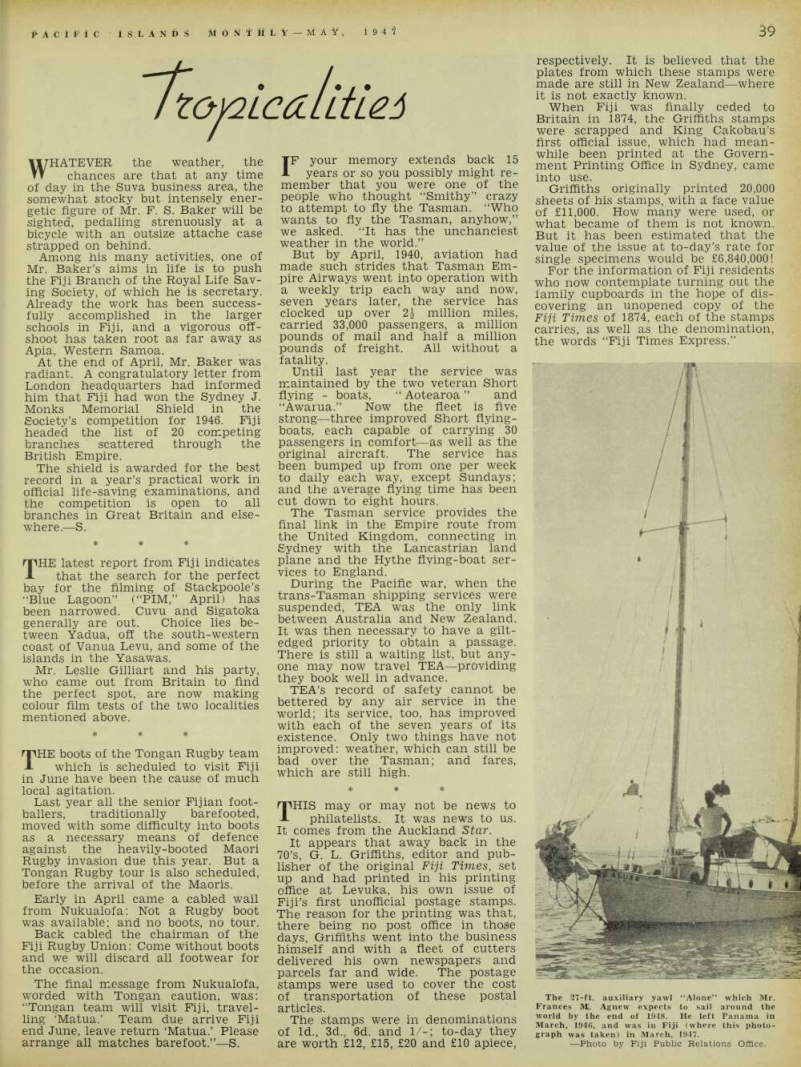
WHATEVER the weather, the chances are that at any time of day in the Suva business area, the somewhat stocky but intensely ener getic figure of Mr. F. S. Baker will be sighted, pedalling strenuously at a bicycle with an outsize attache case strapped on behind.
Among his many activities, one of Mr. Baker’s aims in life is to push the Fiji Branch of the Royal Life Sav ing Society, of which he is secretary.
Already the work has been success fully accomplished in the larger schools in Fiji, and a vigorous off shoot has taken root as far away as Apia, Western Samoa.
At the end of April, Mr. Baker was radiant. A congratulatory letter from London headquarters had informed him that Fiji had won the Sydney J.
Monks Memorial Shield in the Society’s competition for 1946. Fiji headed the list of 20 competing branches scattered through the British Empire.
The shield is awarded for the best record in a year’s practical work in official life-saving examinations, and the competition is open to all branches in Great Britain and else where.—S, * * * THE latest report from Fiji indicates that the search for the perfect bay for the filming of Stackpoole’s “Blue Lagoon” (“PIM,” April) has been narrowed. Cuvu and Sigatoka generally are out. Choice lies be tween Yadua, off the south-western coast of Vanua Levu, and some of the islands in the Yasawas.
Mr. Leslie Gilliart and his party, who came out from Britain to find the perfect spot, are now making colour film tests of the two localities mentioned above. * * * THE boots of the Tongan Rugby team which is scheduled to visit Fiji in June have been the cause of much local agitation.
Last year all the senior Fijian foot ballers, traditionally barefooted, moved with some difficulty into boots as a necessary means of defence against the heavily-booted Maori Rugby invasion due this year. But a Tongan Rugby tour is also scheduled, before the arrival of the Maoris.
Early in April came a cabled wail from Nukualofa: Not a Rugby boot was available; and no boots, no tour.
Back cabled the chairman of the Fiji Rugby Union: Come without boots and we will discard all footwear for the occasion.
The final message from Nukualofa, worded with Tongan caution, was: “Tongan team will visit Fiji, travel ling ‘Matua.’ Team due arrive Fiji end June, leave return ‘Matua.’ Please arrange all matches barefoot.”—S.
IF your memory extends back 15 years or so you possibly might re member that you were one of the people who thought “Smithy” crazy to attempt to fly the Tasman. “Who wants to fly the Tasman, anyhow,” we asked. “It has the unchanciest weather in the world.”
But by April, 1940, aviation had made such strides that Tasman Em pire Airways went into operation with a weekly trip each way and now, seven years later, the service has clocked up over 2i million miles, carried 33,000 passengers, a million pounds of mail and half a million pounds of freight. All without a fatality.
Until last year the service was maintained by the two veteran Short flying - boats, “ Aotearoa ” and “Awarua.” Now the fleet is five strong—three improved Short flying boats, each capable of carrying 30 passengers in comfort—as well as the original aircraft. The service has been bumped up from one per week to daily each way, except Sundays; and the average flying time has been cut down to eight hours.
The Tasman service provides the final link in the Empire route from the United Kingdom, connecting in Sydney with the Lancastrian land plane and the Hythe flying-boat ser vices to England.
During the Pacific war, when the trans-Tasman shipping services were suspended, TEA was the only link between Australia and New Zealand.
It was then necessary to have a gilt edged priority to obtain a passage.
There is still a waiting list, but any one may now travel TEA—providing they book well in advance.
TEA’S record of safety cannot be bettered by any air service in the world; its service, too, has improved with each of the seven years of its existence. Only two things have not improved: weather, which can still be bad over the Tasman; and fares, which are still high. * * * THIS may or may not be news to philatelists. It was news to us.
It comes from the Auckland Star.
It appears that away back in the 70’s, G. L. Griffiths, editor and pub lisher of the original Fiji Times, set up and had printed in his printing office at Levuka, his own issue of Fiji’s first unofficial postage stamps.
The reason for the printing was that, there being no post office in those days, Griffiths went into the business himself and with a fleet of cutters delivered his own newspapers and parcels far and wide. The postage stamps were used to cover the cost of transportation of these postal articles.
The stamps were in denominations of Id., 3d., 6d. and 1/-; to-day they are worth £l2, £l5, £2O and £lO apiece,
respectively. It is believed that the plates from which these stamps were made are still in New Zealand—where it is not exactly known.
When Fiji was finally ceded to Britain in 1874, the Griffiths stamps were scrapped and King Cakobairs first official issue, which had mean while been printed at the Govern ment Printing Office in Sydney, came into use.
Griffiths originally printed 20,000 sheets of his stamps, with a face value of £ll,OOO. How many were used, or what became of them is not known.
But it has been estimated that the value of the issue at to-day’s rate for single specimens would be £6,840,000!
For the information of Fiji residents who now contemplate turning out the family cupboards in the hope of dis covering an unopened copy of the Fiji Times of 1874, each of the stamps carries, as well as the denomination, the words “Fiji Times Express.”
The 27-ft. auxiliary yawl “Alone” which Mr.
Frances M. Agnew expects to sail around the world by the end of 1948. He left Panama in March, 1946, and was in Fiji (where this photo graph was taken) in March, 1947. —Photo by Fiji Public Relations Office.
Polynesia In Melanesia
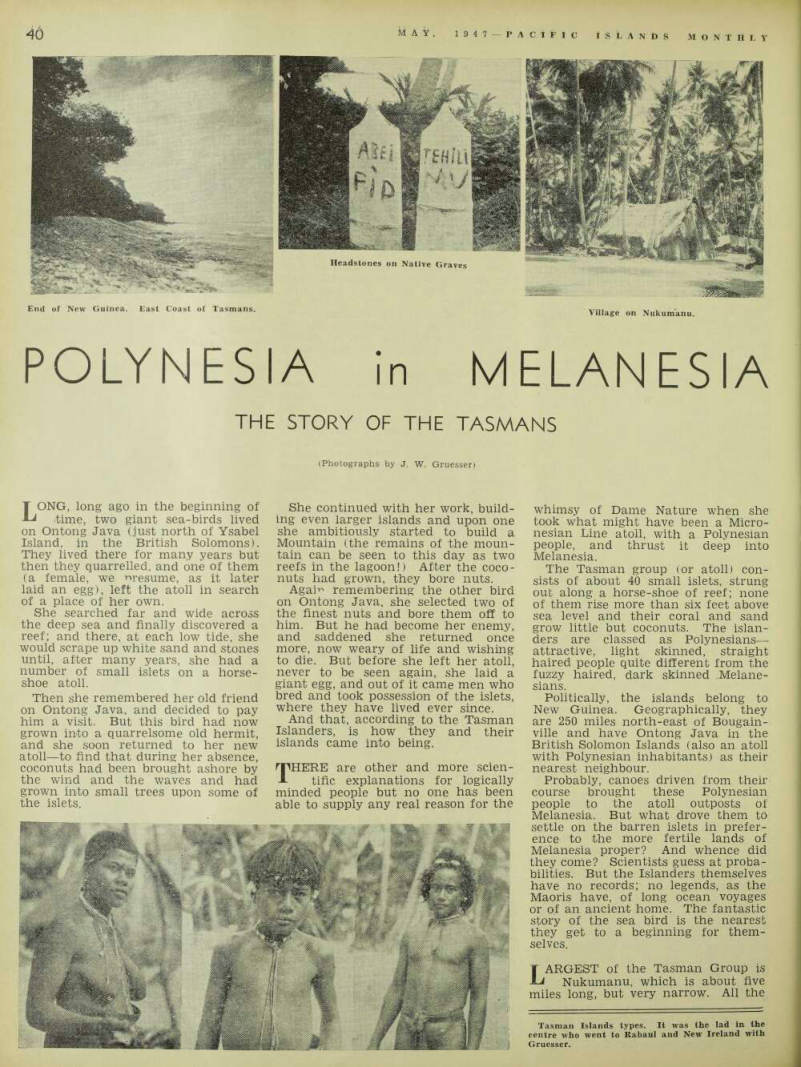
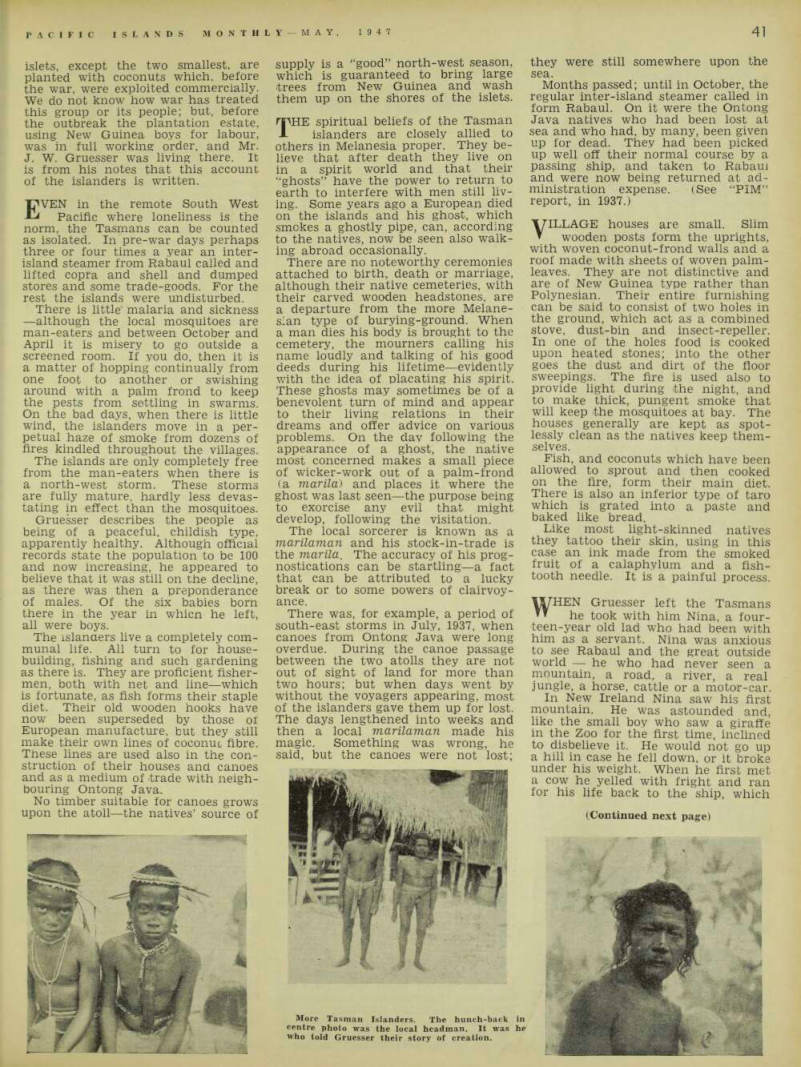
The Story Of The Tasmans
(Photographs by J. W. Gruesser)
LONG, long ago in the beginning of time, two giant sea-birds lived on Ontong Java (just north of Ysabel Island, in the British Solomons).
They lived there for many years but then they quarrelled, and one of them (a female, we "resume, as it later laid an egg), left the atoll in search of a place of her own.
She searched far and wide across the deep sea and finally discovered a reef; and there, at each low tide, she would scrape up white sand and stones until, after many years, she had a number of small islets on a horseshoe atoll.
Then she remembered her old friend on Ontong Java, and decided to pay him a visit. But this bird had now grown into a quarrelsome old hermit, and she soon returned to her new atoll—to find that during her absence, coconuts had been brought ashore by the wind and the waves and had grown into small trees upon some of the islets.
She continued with her work, building even larger islands and upon one she ambitiously started to build a Mountain (the remains of the mountain can be seen to this day as two reefs in the lagoon!) After the coconuts had grown, they bore nuts.
Agai" remembering the other bird on Ontong Java, she selected two of the finest nuts and bore them off to him. But he had become her enemy, and saddened she returned once more, now weary of life and wishing to die. But before she left her atoll, never to be seen again, she laid a giant egg, and out of it came men who b red and took possession of the islets, where they have lived ever since.
An d that, according to the Tasman Islanders, is how they and their islands came into being.
TVHERE are other and more scien- JL tific explanations for logically minded people but no one has been able to supply any real reason for the
whimsy of Dame Nature when she took what might have been a Micro nesian Line atoll, with a Polynesian people, and thrust it deep into Melanesia.
The Tasman group (or atoll) con sists of about 40 small islets, strung out along a horse-shoe of reef; none of them rise more than six feet above sea level and their coral and sand grow little but coconuts. The islan ders are classed as Polynesians— attractive, light skinned, straight haired people quite different from the fuzzy haired, dark skinned Melane sians.
Politically, the islands belong to New Guinea. Geographically, they are 250 miles north-east of Bougain ville and have Ontong Java in the British Solomon Islands (also an atoll with Polynesian inhabitants) as their nearest neighbour.
Probably, canoes driven from their course brought these Polynesian people to the atoll outposts of Melanesia. But what drove them to settle on the barren islets in prefer ence to the more fertile lands of Melanesia proper? And whence did they come? Scientists guess at proba bilities. But the Islanders themselves have no records; no legends, as the Maoris have, of long ocean voyages or of an ancient home. The fantastic story of the sea bird is the nearest they get to a beginning for them selves.
LARGEST of the Tasman Group is Nukumanu, which is about five miles long, but very narrow. All the
Headstones on Native Graves
End of New Guinea. East Coast of Tasmans.
Village on Nukumanu.
Tasman Islands types. It was the lad in the centre who went to Rabaul and New Ireland with Gruesser.
islets, except the two smallest, are planted with coconuts which, before the war, were exploited commercially.
We do not know how war has treated this group or its people; but, before the outbreak the plantation estate, using New Guinea boys for labour, was in full working order, and Mr.
J. W. Gruesser was living there. It is from his notes that this account of the islanders is written, EVEN in the remote South West Pacific where loneliness is the norm, the Tasmans can be counted as isolated. In pre-war days perhaps three or four times a year an inter island steamer from Rabaul called and lifted copra and shell and dumped stores and some trade-goods. For the rest the islands were undisturbed.
There is little' malaria and sickness —although the local mosquitoes are man-eaters and between October and April it is misery to go outside a screened room. If you do, then it is a matter of hopping continually from one foot to another or swishing around with a palm frond to keep the pests from settling in swarms.
On the bad days, when there is little wind, the islanders move in a per petual haze of smoke from dozens of fires kindled throughout the villages.
The islands are only completely free from the man-eaters when there is a north-west storm. These storms are fully mature, hardly less devas tating in effect than the mosquitoes.
Gruesser describes the people as being of a peaceful, childish type, apparently healthy. Although official records state the population to be 100 and now increasing, he appeared to believe that it was still on the decline, as there was then a preponderance of males. Of the six babies born there in the year in whicn he left, all were boys.
The islanders live a completely com munal life. All turn to for house building, fishing and such gardening as there is. They are proficient fisher men, both with net and line—which is fortunate, as fish forms their staple diet. Their old wooden hooks have now been superseded by those of European manufacture, but they still make their own lines of coconut fibre.
These lines are used also in the con struction of their houses and canoes and as a medium of trade with neigh bouring Ontong Java.
No timber suitable for canoes grows upon the atoll —the natives’ source of
supply is a “good” north-west season, which is guaranteed to bring large ■trees from New Guinea and wash them up on the shores of the islets.
THE spiritual beliefs of the Tasman islanders are closely allied to others in Melanesia proper. They be lieve that after death they live on in a spirit world and that their “ghosts” have the power to return to earth to interfere with men still liv ing. Some years ago a European died on the islands and his ghost, which smokes a ghostly pipe, can, according to the natives, now be seen also walk ing abroad occasionally.
There are no noteworthy ceremonies attached to birth, death or marriage, although their native cemeteries, with their carved wooden headstones, are a departure from the more Melane sian type of burying-ground. When a man dies his body is brought to the cemetery, the mourners calling his name loudly and talking of his good deeds during his lifetime —evidently with the idea of placating his spirit.
These ghosts may sometimes be of a benevolent turn of mind and appear to their living relations in their dreams and offer advice on various problems. On the dav following the appearance of a ghost, the native most concerned makes a small piece of wicker-work out of a palm-frond (a marila ) and places it where the ghost was last seen—the purpose being to exorcise any evil that might develop, following the visitation.
The local sorcerer is known as a marilaman and his stock-in-trade is the marila. The accuracy of his prog nostications can be startling—a fact that can be attributed to a lucky break or to some powers of clairvoy ance.
There was, for example, a period of south-east storms in July, 1937, when canoes from Ontong Java were long overdue. During the canoe passage between the two atolls they are not out of sight of land for more than two hours; but when days went by without the voyagers appearing, most of the islanders gave them up for lost.
The days lengthened into weeks and then a local marilaman made his magic. Something was wrong, he said, but the canoes were not lost;
they were still somewhere upon the sea.
Months passed; until in October, the regular inter-island steamer called in form Rabaul. On it were the Ontong Java natives who had been lost at sea and who had, by many, been given up for dead. They had been picked up well off their normal course by a passing ship, and taken to Rabaul and were now being returned at ad ministration expense. (See "PiM” report, in 1937.) VILLAGE houses are small. Slim wooden posts form the uprights, with woven coconut-frond walls and a roof made with sheets of woven palm leaves. They are not distinctive and are of New Guinea type rather than Polynesian. Their entire furnishing can be said to consist of two holes in the ground, which act as a combined stove, dust-bin and insect-repeller.
In one of the holes food is cooked upon heated stones; into the other goes the dust and dirt of the floor sweepings. The fire is used also to provide light during the night, and to make thick, pungent smoke that will keep the mosquitoes at bay. The houses generally are kept as spot lessly clean as the natives keep them selves.
Fish, and coconuts which have been allowed to sprout and then cooked on the fire, form their main diet.
There is also an inferior type of taro which is grated into a paste and baked like bread.
Like most light-skinned natives they tattoo their skin, using in this case an ink made from the smoked fruit of a calaphylum and a fish tooth needle. It is a painful process.
WHEN Gruesser left the Tasmans he took with him Nina, a four teen-year old lad who had been with him as a servant. Nina was anxious to see Rabaul and the great outside world he who had never seen a mountain, a road, a river, a real jungle, a horse, cattle or a motor-car.
In New Ireland Nina saw his first mountain. He was astounded and, like the small boy who saw a giraffe in the Zoo for the first time, inclined to disbelieve it. He would not go up a hill in case he fell down, or it broke under his weight. When he first met a cow he yelled with fright and ran for his life back to the ship, which (Continued next page)
More Tasman Islanders. The hunch-back in centre photo was the local headman. It was he who told Gruesser their story of creation.
was safe and solid and something within his experience.
In Kavieng, he saw a car and, al though he had almost fainted from shock at the sight of it, later when he had been coaxed to ride in one he was converted to that form of trans port and took up motor-car riding as a hobby. When he could be induced to approach a horse and pat it, he said “Tm ’e big-fella dog too much,” and commented that the tail was like a broom. Then he wanted to know which Master had made the horse.
His master took him to the movies in Rabaul, expecting the boy to be either dumbfounded at this manifes tation of European inventiveness or to shower him with questions. Nina did neither. He sat through the per formance with aplomb and then asked only one question: How did the cur tain open?
On his second visit he watched closely when the curtain was opened or closed and was lucky enough to see something going on behind the scenes.
He announced triumphantlv that he knew—a man pulled the curtain! In spite of this revelation the curtain remained the highlight of the movie shows as far as Nina was concerned.
When Gruesser went to another plantation on Lahir, off New Ireland, Nina went too. At the commence ment of his travels he had been full of admiration for the outside world and all its works and compared his own islands unfavourably. “Place belong me no good. No got banana; no got sugar-cane; no got car.” But as he became used to other places the novelty wore off and he became home sick and it became then a case of “place belong me ’e good-fella.”
So Nina went back to the Tasmans.
Back to the mosquitoes and the north west storms and a diet of fish and coconut. Nina’s people may have for gotten much of the ancient culture of their original homeland, and from whence they came. They might speak Pidgin like Melanesians. But, at heart they were true Polynesians, feeling, when on foreign soil, that home, be it ever so humble, is still sweet home.
Fit, Lieut. Ken Nicholson, one of the last members of the R.A.F. contingent from Fiji remaining in the United King dom, has begun a course of training in airport management in England. He has been released temporarily from the R.A.F. and after the course is finished he will be given leave prior to demobilisation.
He hopes to return to Fiji during this leave.
Mr. Ken Ryall has taken over the man agement of Asalingi Plantation in the Bainings district of New Britain. It will be remembered that Mr. Ryall did a good job in the Territory during the war and was awarded the MM in recognition of his services.
Mr. Arthur T. Collins, well-known in aviation circles in New Guinea, and man ager of Mandated Airlines Ltd., arrived in Sydney on March 15. He flew one of the company’s Dragons down for over haul. In commenting on conditions in the Territory, he said that many of the old, pre-war Administration officials were endeavouring to give every assistance in rehabilitating residents.
A Scientist From South Of The Border
Short Story: A SCIENTIST FROM SOUTH OF THE BORDER
By W. Gill
IT is always hot in Port Moresby.
But in the Nor’west season the heat is appalling. Nevertheless, there must be some truth in the saying that one may get accustomed to anything, otherwise the two men seated on the hotel verandah could never have found the energy to continue their argument, desultory though it was, since every breath they drew seemed like a mouthful of cayenne pepper.
Maybe the glass of beer in front of each helped, though Fanning, who lived in the hotel and was something of a strategist, claimed that he chose this spot because it always got the benefit of the draught created by the fat bar-maid when she passed along the corridor to the dining room.
Fanning’s companion was a stranger to the town. If he were not he would never have allowed himself to be in veigled into this conversation, for it required but a short stay in Port to discover that any exchange of ideas with Fanning quickly developed into a one-sided affair. He loved to talk but all the local dwellers knew this by bitter experience and avoided him ac cordingly so that he now had no opportunities of getting a monologue off his chest except when occasional unwary visitors blundered into his craftily spun web of words.
This was such an occasion.
“You people of the Mandated Terri tory have a high oninion of yourselves all right,” said Fanning with heavy sarcasm. “Because we of Papua have been here so long you have the hide to call us moribund.” Indignation almost spurred him to an erect sitting position but he thought better of it; after all it was hot enough without that.
“I don’t mind betting,” he continued after an impressive pause, “that I could produce a chap in this town with greater organising ability, inven tive genius and all-round braininess than you could find anywhere throughout the Islands, let alone New Guinea.”
“Go ahead,” said the man from Rabaul after looking around in vain for a means of escape.
“It’s all right,” said Fanning observ ing the hunted look, “I’m not speak ing of myself now, though I’m willing to admit that I’m the finest singer in Papua. Still I have no tickets on myself because of that. No! the cove I’m referring to is old Scientif’; he’s down at the recreation grounds right now pegging out a claim in the centre of the cricket pitch in the hope that the team will buy him off before he starts digging.
“OCIENTIF’ is short for Scientific which is a title he earned years ago; his proper name has long been forgotten, if anyone ever knew it. He first came into the limelight when it became known that he’d signed on twenty shooting-boys as a pest and disease gang. He was managing a
coconut plantation in the Eastern Division at the time and the place was fairly riddled with giant Rhinoceros beetles and the job had broken the hearts of half a dozen stout fellows before he came on the scene.
“As it happened any trees the beetles had not destroyed were soon blown to smithereens by the over zealous shooting-boys so that he may be said to have fired himself, but the incident served to draw our attention to the fact that we had an original in our midst and the whole of his subsequent career was punctuated with similar unorthodox actions.
“We used to marvel at the fellow.
Some said that he was an intellectual giant; but most that he was a crank.
He himself modestly claimed to ap proach his problems from the scien tific angle—hence his nickname.
“It wasn’t until the bottom had fallen out of the price of copra, how ever, that Scientif’ got full scope for his peculiar genius. When the blow fell the owner of the plantation which Scientif’ was running wrote in structing him to pay off fifty per cent, of the labour. Then he (the owner) took to his bed with a hogs head of OP rum and dreamt that copra had made a miraculous recovery and ‘smoked’ was selling at forty quid the ton.
“Scientif’, however, wasted no time in dreaming. His place had always been a bad one for Jcuru-kuru (kunai you call it in New Guinea) and the reduced maintenance gang was quite unable to cope with it so, as a pre liminary skirmish, Scientif’ bought a score of scythes and sooled his boys onto the stuff with these amusing implements.
“By the time the scythers (if there is such a word) had reached the end of a line of coconuts the grass at their starting place had sprung up again so vigorously that they had to cut their way back to the compound and old Scientif’ soon saw that this would get him nowhere. Accordingly he donned his thinking cap and called Science to his aid.
“From ‘The Planters’ Guide,’ which contains all the information essential to the proper conduct of a plantation, he learned the requirements for laying a concrete tennis court. ‘Aha!’ he thought, ‘here’s the solution! No grass, not even kuru-kuru, could grow on concrete’ and straight away he de cided to pave an experimental area.
“As a result of some extremely in tricate mathematical calculations he found ithat he’d require about two hundred casks of cement for the job and promptly lodged an order for that amount. He had plenty sand and stone, the whole Estate being planted on nothing else.
“When the order reached the store keeper here in Moresby he nearly had a heart attack, knowing as he did the precarious financial position of
the plantation, and hurried off to shake the owner out of his beautiful dreams. The owner threw a Jamaica fit, savagely cancelled the order and, with fire in his eye and a wet towel round his head, caught the first coastal boat bound for his plantation, fully resolved to strangle Scientif’ on arrival.
“He cooled down a little before getting there, however, remembering that he couldn’t sack Scientif’ because he lacked the funds to pay up a year’s salary that was owing. But be that as it may, he definitely discouraged old Scientif’ from continuing with the concrete scheme and I’ve heard it said that his language might easily have been a trifle more tactful.
“It took more than a spot of des tructive criticism to baulk a mind like Scientif’s, however, and no sooner had the owner left ithe plantation than the brainy lad was exploring avenues (as the politicians say) and quickly hit on another method of eradicating the pest.
“As he afterwards explained to me the obvious way was to get at the roots of the matter, literally, and this he proposed to do by tunneling under the entire area and pulling the grass through from underneath!
THERE was an idea for you!” cried Fanning in triumph. “Nothing moribund about that.” He banged his clenched fist on his neighbour’s knee.
The man from Rabaul jumped almost out of his chair. “Hey? What was that? I beg your pardon but I didn’t quite catch your last few words.
You were saying something about producing some brainy fellow —would you mind repeating it please?”
Slowly an incredulous light dawned in Fanning’s eyes, to be quickly succeeded by one of elation.
“Sure,” he cried heartily, “I was going to tell you about a Papuan with more brains than anyone else in the Islands let alone New Guinea.”
“Go ahead,” said the man from Rabaul settling himself more com fortably in his chair.
Then Fanning was off again.
The Bread Season Opens
A Trader’s Tale: The Bread Season Opens
By "Turapa Koko"
THE first bread of the year! You who live on an island where ships call each month (or even more frequently), see nothing in that about which to make a song. But to us, marooned from November to late April or May every year, it is an event which is marked on the Man gaia calendar in red letters.
And it means a lot to Kake (which is not pronounced “Cake,” although it would not be bad advertisement for
his trade, if it were) who is the local baker and restaurateur.
Kake’s tea-shop-cum-family-estab lishment is at the top of the rise that bounds the inward limit of the cliff village of Makatea. It is a decrepit wooden shack, badly in need of re pair and painting, but it serves the Mangaian public as well as Lyons Corner ’Ouse does the Londoner. But come and see for yourself.
The night is dark. But the shop is warm from the fire; and the bread is baking inside the bee-hive shaped coral-cement oven, and that keeps us from the chill of the night wind as we sit by its side, waiting.
Kake looks like Old Nick when his swarthy features are illumined for a moment as he looks to see how the baking is progressing, and opens the oven door for a moment with a canoe paddle.
Satisfied, he closes the door again and gives his attention now to a small, open fire burning underneath a kerosene tin full of water. For this is a generous establishment and the threepence that buys a small, crusty roll also covers a bowl of strong cof fee sweetened with sugar almost to syrup, which is the way Mangaians like it.
We have a copper jug to hold our brew. Others, not so wise, bring glass jugs. Kake brews the coffee, straining it through a little cloth bag that we must hope was not a shirt tail in the preceding stage of its working life. Some things in Man gaian life are best taken as they come and not too closely investigated.
The coffee-buyers cluster around the little fire, while Kake pours the fragrant brew, hot enough to fulfil all requirements.
And now our wisdom at insisting on copper is made clear. One un lucky wieht, dancing, with an ac companiment of howls and yells, finds that the bottom has fallen out of his glass jug and his knees are now warmer than the slight chill of the tropic night called for.
But Kake is a good -scout; this accident is reckoned not to count, and the victim, substituting a two-pound meat tin for the now bottomless fancier article, receives a second help ing without extra charge. It is noticeable that he holds the tin well away from himself. Even tin-plate and solder are not things in which to put too much trust when it comes to Mangaia coffee.
The bread, meanwhile, is removed from the oven by Kake’s assistant.
The rolls are in fours, in baking pans made from the sides of biscuit tins.
A whole pan, at one shilling, is within our means; but others are not so well trusted.
It was Kake who, when the local
pastor called upon him for tea, was able to assert that there were no Christians among the pastor’s flock.
The pastor was shocked. “Judge not, that ye be not judged,” quoted he, ex-native Bible.
Kake uttered a bitter chuckle. “O Orometua,” he said. “When you keep a tea-shop you don’t have to judge.
You know, for sure!”
I judge, therefore, bad debts are not exclusive to poor European traders and that, even as you and I, Kake the baker, has his financial worries.
The death occurred in Brisbane re cently of Mr. Frederick Thomas Samuel Lennon. He had been an officer of the Customs Department for 46 years, and served at Thursday Island from 1907 to 1916.
Mr. and Mrs. E. V. O’Brien, of Mililat Plantation, Madang, New Guinea, were in Brisbane in May. Earlier this year they left New Guinea for Sydney where Mr. O’Brien underwent medical treat ment. He is reported to be making sat isfactory progress.
Lament of an Exile
WHEN I grow tired of tropic evergreens, Of swaying palms along the coral shore, I have a longing then for rural scenes In dear old England; rolling downs and moor; For woodland glades, or little sunny dells, Where primroses and violets nod their heads With stately daffodils and slim bluebells Arising from their soft, green mossy beds.
When my big bungalow upon the hill, With swaying punkahs and verandah wide, Seems nothing but a home for every ill, I picture me the Devon countryside; An old thatched cottage in a shady lane, With low, oak ceilings and a parquette floor, And honeysuckle round each window pane, With rambler roses climbing round the door.
When I grow weary of my tropic club, With lounging planters sipping iced cocktails I want to enter some small country pub.
With aged rustics drinking good mulled Seated in high-backed settles ’round the fire: While cheery Boniface, behind the bar, Depicts the true Mine Host in full attire; And all are well-content with what they are.
And when the day is done and shadows fall With hastened speed, as in all tropic lands, My world is filled with insects great and small, All chirping ceaselessly like massed brass bands; ’Tis then I want the English twilight hours.
With shadows lengthening slowly o’er the grass.
And perfume of the honeysuckle flowers . . .
Ah, God! Grant that some day ’twill come to pass.
G.T.
South Seas, 8/8/45.
Advertisements & other items, p. 45 (1 item)
43
SCIENTIST SOUTH OF THE
BORDER
(Continued from previous page)
PACIFIC ISLANDS MONTHLY MAY, 1947
by "C. Coral"
IN THE BAD OLD DAYS OF TORRES STRAIT A Story of a Two-Phase Punitive Expedition,
rE links of history and romance are brought together in curious ways.
Moving about the islands of Torres Strait, I made acquaintanceship with an old grey-headed fellow whose father was a Maori, his mother a woman of the Pacific Islands, and who, born in a British ship while she was in French waters, found it difficult to set down his notionality at Census-time.
But he had a retentive memory. And his reminiscences of the early days of the Strait were of exciting interest.
He had been associated with pearl and trepang fishers, had served in the native police, had sailed in Government vessels on patrol service, and knew the ways of the white men and the coloured. In the days when wrecks were common along the upper end of the Barrier, he had been on some of the “salvage” trips.
One day, browsing through an odd col lection of old books and papers, I came accross corroborative testimony of several of the old man’s stories, set down in script, in journals and reports concerning the port of Somerset. Entrepot for shipping, and port of refuge for castaway sailors, Somerset was founded in 1862 at the top of Cape York Peninsula. And it was from these sources, together with some other information that came my way, that this story is compiled. * ♦ ♦ ¥¥THEN Captain Gascoigne, master of the TT cutter Sperwer , of the port of Mel bourne, suggested to his wife and young son, one morning in 1869, that they accompany him on a trading trip to Australia’s northern finger-tip and Torres Strait, it was perhaps a merciful thing that he could not foresee the terrible fate that was to befall them amongst the romantic isles of the tropics.
Captain Gascoigne had heard of the marine treasure in the Strait —beche-demer and pearlshell which was there to be picked up. And so the Sperwer, duly fitted out and equipped, carrying a crew of seventeen, most of them Asiatics, sailed for the North, up along the East coast of Queensland.
They rounded Cape York one day in April, and dropped anchor in Endeavour Strait, just off Friday Island. Near by was the big mountainous island of Prince of Wales, where twenty years before Mrs Barbara Thompson, castaway from a wreck, had been rescued after seven years in captivity. Prince of Wales is the largest of the group, and at the time carried a population of many hundreds.
Possibly the Captain had not heard about the reputation of the Prince of Wales “Indians,” or if he had, thought the stories of their aggressiveness were exag gerated.
When the cutter had been snugged down, the crew went ashore to cut fire wood. Down below, in the Sperwer’s tiny cabin, Captain Gascoigne took ad vantage of the calm anchorage and peace ful surroundings to write up his log. His wife, too, found this an opportunity to complete those small tasks which a woman can always find. There was no thought of danger.
Suddenly there came a warning shout, and cries. Naked black forms, clay-be daubed and feather-adorned, filled the deck spears and clubs in their hands.
Soon the attack was over.
What had provoked the assault— whether avarice of the white man’s pos sessions, or unwise action of the crew
ashore, or retaliation for injury received at the hands of earlier visitors—is wrapped in the silence of the misty past. The captain’s body was pierced by spears hurled through the porthole. And when the canoes of the “Indians” returned to Prince of Wales Island, Mrs. Gascoigne and her boy went with them as captives.
Many weeks later news of the tragedy reached Somerset, the recently-established port of refuge for ship’s castaways on Cape York. The settlement ketch, re turning from Booby Island (where she had been leaving stores and clothing in the famous “Post Office Cave”, for the temporary relief of the many shipwrecked crews who passed that way in small boats), came upon the first suggestion of what had happened. Off Prince of Wales was a canoe containing various articles of ship’s property, obviously new, and the Sperwer’s log, with its pathetic last entries written by the dying captain.
At Somerset, the Government Resident (at that time Mr. Prank Jardine, leader of the expedition which a few years earlier had been the first to traverse Cape York Peninsula from end to end) took speedy action to organise a rescue and punitive expedition. All the available men from the garrison were got together, reinforced with companies of men from beche-de mer vessels working round the islands further out.
When all was ready, a flotilla of ships sailed round Cape York, and across to Entrance Island, off Prince of Wales, where they anchored, still concealed from the natives. It was nightfall, and up on the high hills opposite could be seen the bright light of many fires, and the pos turing of dark figures in the dancing flames. Wierd songs and chants came to them over the water.
About midnight, the avenging force, waiting in the gloom below, deployed, and took up positions on shore which would enable them to surround the big crowd of natives whom they could see in the glow of the fires. Towards dawn a shot rang out —the signal for the punitive ex pedition to attack. Shrieks of alarm, and then of terror, rent the air as fleeing natives ran vainly from one side to the other in an attempt to escape the death dealing hail. Down the defile the rem nant rushed. But the guns took their toll there also. Even the lagoon into which they plunged afforded no place of san ctuary. Score upon score of the “Indians” of Prince of Wales must have been wiped out on that morning. Official records are silent as to the actual numbers: in the report which was duly furnished to his superiors, the Resident Magistrate, using the terminolosrv of the period, simply says, “We dispersed the blacks.”
At the top of the hill where the big corroborree had been brought to so sud den an end. the searchers presently found Mrs. Gascoigne. She was dead, although apparently had not been so for long.
Shock and privation, had no doubt been responsible. A grave was prepared, and the body reverently laid to rest, overlook ing Endeavour Strait. It was the old man, half Maori and half South Sea Islander, who had himself taken part in the round up as a lad, who showed me the site where the white woman lay.
A WEEK or so after the expedition re turned, the Resident went on leave.
His successor, Lieut H. M. Chester, presently began to hear strange stories of a massacre by blacks, and of a ship that
had been burned, from which a captive white woman and her boy had been taken to Prince of Wales island. Search of the official records threw little light upon the rumours—Jar dine must have been re miss in omitting essential details—and he determined to make further investigation.
His own force was inadequate, he thought; and so he waited until the gunboat Blanche arrived on her periodical visit with stores.
One morning in 1870, nine months after the actual tragedy, the gunboat left Som erset to exact retribution and rescue Mrs.
Gascoigne, whom they did not then know to be dead! They found the big island deserted. But on the beach were some human remains, amongst them a thigh bone, which it was thought might have come from the young boy. Sailing on past Horn Island, and round to Wednes day Island, they discovered a number of canoes drawn up. Landing forces were sent ashore at a spot where the dense mangroves concealed their movements.
Presently they came out into an open glade and there saw a number of natives sitting round their fires, evidently feasting.
It was later discovered, they were mostly from neighbouring islands and had joined their friends of Wednesday Island in a ceremonial feast. But the men of the Blanche were not to know that.
As the naval men emerged into the open, with weapons trained women and children rushed to the canoes. But when presently the gunboat herself sailed into view round the point, the terror-stricken natives realised that they were trapped.
In answer to the questioning of the officers, three men were pointed out as chiefs. They were placed against trees, and summarily shot. This time there was a discursive official report. The resi dent wrote; “I do not say ‘we dispersed the natives!’ These men were handed over to the commander of the gunboat, and shot by my orders.” He goes on to remark, somewhat caustically, that this was probably the first time an official report was not inaccurate in this respect.
But perhaps the most extraordinary part of the report is that which states — “Of Mrs. Gascoigne I could find no trace; I do not believe the native stories that there was ever a white woman there!”
And the son of one of the chiefs who had been executed that day told me, with a faraway look in his eyes—“l was a boy then. I saw them take my father away and shoot him. But it was not our people who killed the captain and took away the captain’s wife!”
Nevertheless, the tradegy of the Sperwer was amply avenged. There are no natives on Prince of Wales Island to-day.
But those on the neighbouring islands know the grim story of the lagoon which you may see there. “Death lagoon” they call it in their own language. And they tell you that sometimes you may hear the death-whail of the blacks who met the avengers on that now far away dawn.
Although the Distinguished Service Cross of the United States was awarded in October, 1942, to Lieutenant F. A.
Rhoades, the citation has only just been made available in Australia. Those who read Eric Feldt’s notable book “Coast Watchers” will remember that Lieutenant Rhoades rendered good service as a coast watcher on Gaudalcanal during the black est months of the Pacific War—between April and December, 1942. Lieutenant Rhoades, as a member of the Secret Ser vice known as the AIB, did good work in the Solomons and elsewhere: and he now holds both the DSC and the Silver Star of the United States. He now is a member of the staff of Burns, Philp & Co., Ltd., in Rabaul.
Brought
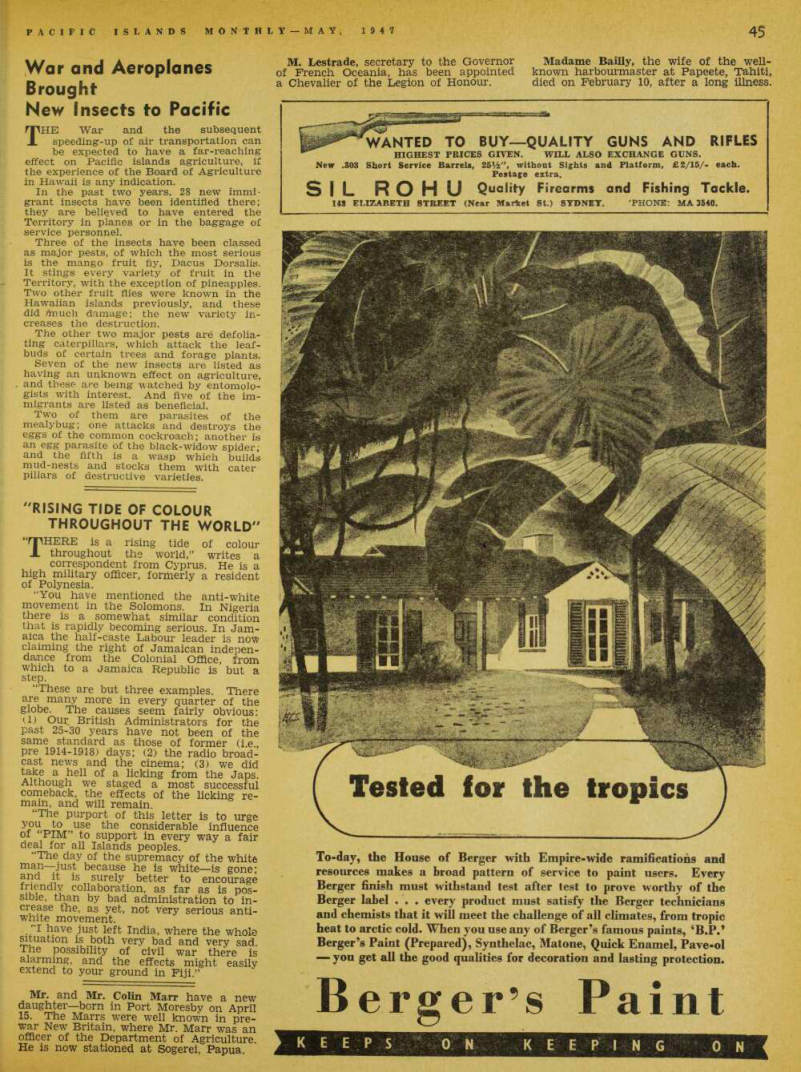
War and Aeroplanes Brought New Insects to Pacific
THE War and the subsequent speeding-up of air transportation can be expected to have a far-reaching effect on Pacific islands agriculture, if the experience of the Board of Agriculture in Hawaii is any indication.
In the past two years, 28 new immi grant insects have been identified there; they are believed to have entered the Territory in planes or in the baggage of service personnel.
Three of the insects have been classed as major pests, of which the most serious is the mango fruit fly, Dacus Dorsalis.
It stings every variety of fruit in the Territory, with the exception of pineapples.
Two other fruit flies were known in the Hawaiian islands previously, and these did touch damage; the new variety in creases the destruction.
The other two major pests are defolia ting caterpillars, which attack the leaf buds of certain trees and forage plants.
Seven of the new insects are listed as having an unknown effect on agriculture, and these are being watched by entomolo gists with interest. And five of the im migrants are listed as beneficial.
Two of them are parasites of the mealybug; one attacks and destroys the eggs of the common cockroach; another is an egg parasite of the black-widow spider; and the fifth is a wasp which builds mud-nests and stocks them with cater pillars of destructive varieties.
"Rising Tide Of Colour
Throughout The World"
“mHERE is a rising tide of colour X throughout the world," writes a correspondent from Cyprus. He is a high military officer, formerly a resident of Polynesia.
“You have mentioned the anti-white movement in the Solomons. In Nigeria there is a somewhat similar condition that is rapidly becoming serious. In Jam aica the half-caste Labour leader is now claiming the right of Jamaican indepen dance from the Colonial Office, from which to a Jamaica Republic is but a step.
“These are but three examples. There are many more in every quarter of the globe. The causes seem fairly obvious: (1) Oun British Administrators for the past 25-30 years have not been of the same standard as those of former (ie, pre 1914-1918) days; (2) the radio broad cast news and the cinema; (3) we did take a hell of a licking from the Japs.
Although we staged a most successful comeback, the effects of the licking re main, and will remain.
“The purport of this letter is to urge you t° use the considerable influence of PIM” to support in every way a fair deal for all Islands peoples.
“The day of the supremacy of the white us f because he is white—is gone; and it is surely better to encourage friendly collaboration, as far as is pos sible, than by bad administration to in crease the, as yet, not very serious anti white movement.
"I Just left India, where the whole situation is both very bad and very sad.
The possibility of civil war there is alarming, and the effects might easily extend to your ground in Fiji.”
Mr. and Mr. Colin Marr have a new daughter—born in Port Moresby on April 15. The Marrs were well known in pre war New Britain, where Mr. Marr was an officer of the Department of Agriculture He is now stationed at Sogerei, Papua.
M. Lestrade, secretary to the Governor of French Oceania, has been appointed a Chevalier of the Legion of Honour.
Madame Bailly, the wife of the well known harbourmaster at Papeete, Tahiti, died on February 10, after a long illness.
Advertisements & other items, pp. 47-48 (1 item)
Berger’s Paint
WANTED TO BUY—QUALITY GUNS AND RIFLES
HIGHEST PRICES GIVEN.
WILL ALSO EXCHANGE GUNS.
New .303 Short Service Barrels, 25W, without Sights and Platform, £2/15/- each.
Postage extra.
SI L RO H U Quality Firearms and Fishing Tackle. 148 ELIZABETH STREET (Near Market St.) SYDNEY. PHONE: MA 3540.
*: * r a II !! *:•
Tested lor the tropics
To-day, the House of Berger with Empire-wide ramifications and resources makes a broad pattern of service to paint users. Every Berger finish must withstand test after test to prove worthy of the Berger label . . . every product must satisfy the Berger technicians and chemists that it will meet the challenge of all climates, from tropic heat to arctic cold. When you use any of Berger’s famous paints, S B.P,’
Berger’s Paint (Prepared), Synthelac, Matone, Quick Enamel, Pave-ol you get all the good qualities for decoration and lasting protection.
Berger’s Paint
KEEPS ON KE EPING ON
ms Mi jMrmiP...
y7n* a
Protect the eyes of youth with Laurels "soft, white light."
Laurel Kerosene burns steadily and brightly to the last drop, because it contains no impurities to clog the wick.
There is no smoke nor any disagreeable odour. For efficiency and economy-Insist upon LAUREL KEROSENE.
VACUUM
L 468
Alt-PURPOSE
KEROSENE
For Lighting, Heating , Cooking, Cleaning , freezing
Early Cinchona and Coffee Seed
Coffee Seed in Papua
rpHE statement in November “PIM” that Jl the late George Murray, Director of Agriculture in New Guinea (lost in the Japanese invasion) was responsible for the introduction of Cinchona to Cen tral New Guinea is referred to by the Rev. Father Fastre, MSC, formerly at Yule Island, Papua, and now Mission Procurator at Marseilles.
“Mr. Murray succeeded in getting Cinc hona seed in 1936,” writes Father Fastre.
“Ten years before that, in December, 1926, at the request of the Government of Papua, I sent a large quantity of Cinc hona seed to USSR. I got the seed from trees which I had myself planted in the Mafulu district. If Mr. Murray had ap proached me, I could have supplied his requirements, and he need not have gone abroad for seed.
“The New Guinea Administration pro poses to grow tea in the Territory. I twice tried to grow tea in Papua it simply would not grow.
“The first missionaries, in 1885, took one pound of coffee seed into Papua. It grew, and I think—but I am not sure— that most of the coffee produced in Papua came from that seed. I know I have given bags of seed and thousands of plants to Government officials and to private planters.”
The Government of Fiji is to have an Economic Advisor. He is Colonel R. M.
Taylor, who was expected to leave Eng land at the end of April. He has been Deputy Commissioner of the National Savings Committee in the United King dom.
Robert Gibbings Now In
New Zealand
Will Write His Polynesian Book There
MR. ROBERT GIBBINGS, the well known Irish author, and his secre tary, Miss Patience Empson, arrived in Auckland in April after an 18 months’ tour of South Pacific islands to gather material for a new book.
Mr. Gibbings has written and illus trated four books, one of which, “Lovely is the Lee,” sold about half a million copies in the United States.
“Of all the islands, Samoa appealed to me most,” said Mr. Gibbings after his arrival. “In Samoa they still take a pride in their own traditions and retain their native dignity and hospitaltiy.”
In Tahiti, he thought, the native life had been completely absorbed by the French and Chinese. Nothing remained of old Tahiti. It was now hard to see a face in which there was not some trace of mixed ancestry. Even in the 18 years since he had last been there a noticeable change had taken place.
Mr. Gibbings plans to write his book in New Zealand, probably in Wellington, where he wifi have access to the Turn bull Memorial Library. Already he has forwarded four chapters of the new book to his publishers.
Miss Heather Innes is “Queen of Suva” in the “Queen of the Pacific” competition now being conducted in Sydney, Australia by the Victoria League. This is part of an Empire-wide scheme to raise funds for the rebuilding of the League’s head quarters in London.
Cook Is. Electors Vote
By Radio
From Our Own Correspondent MANGAIA, April.
THE recent battle of two European candidates, for membership of the Rarotonga Island Council, was held under new conditions. Every European resident of Cl (barring lunatics and con victs), was eligible to vote, “by wireless,” for the man of his choice, regardless of distance.
Upon Mangaia, Messrs. E. Gold and G. L. Snow, traders, of the Plateau and beach villages respectively, had the honoui —in Mr. Gold’s case, for the first time in 21 years’ residence in Cl—of voting.
NMP Manea Taniarua was the returning officer. The two electors were requested to state their choice in a short note, official forms being nil.
The “radio poll,” has set a new precedent for white settlers in the Cook Islands.
Pacific"
A New "Pearl Of The
Plans for Lautoka
Prom Our Own Correspondent SUVA. April 21.
LAUTOKA, Fiji’s second largest town and, outwardly, one of the dreariest places in the Islands, may develop Into the “most beautiful and best-planned centre in the Colony.”
This, at least, is the hope of the chair man of the Lautoka Town Board (Mr.
C. A. Adams), who has proclaimed: “Lautoka can be made the garden city of the Pacific, and the Town Board’s In tention is to make it so!”
Captain V. H. Gilchrist, a well-known identity from the Morobe (New Guinea) goldfields in pre-war days, and a member of the NGVR, recently arrived in Sydney from Japan, where he is attached to the BCOF. He travelled via New Zealand, where he spent some time on holiday. He expects shortly to return to Japan where he will serve another term with the Oc cupation Forces.
Advertisements & other items, pp. 49-50 (1 item)
Equal to the World’s Best
Throughout Australia and Overseas there it an ever-increasing demand for
COLONIAL & BRONTE
HIGH-GRADE CANNED MEATS
There is no better quality—none more wholesome. a
TRADE MEATS FOR THE ISLANDS
order
COLONIAL’ BRAND
Roast, Corned and Boiled Beef Packed in 6,5, 4,3, 2, 1 lb. and 12 oz. tins.
Also Corned Beef in 12 oz. Taper Tins.
Roast, Corned and Boiled Mutton. 1 lb. and 12 oz. tins.
Choice Dripping
36 lb., 2 lb., 1 lb. tins, and 1 lb. packets. l ISHiss ••TV®'* 3
NETT
m ■
DELICIOUS
BRONTE" HOT MEALS
Steak and Kidney Pudding.
Beef Steak Pudding.
Sausage* and Tomato.
Sausages and Vegetable.
Lamb and Green Peas.
Corned Beef and Boston Beans with Tomato Sauce.
Steak and Tomato.
Under present conditions it is wise to ensure that you have ample stocks of all our lines.
The Colonial Wholesale Meat Coy. Pty. Ltd.
30 GROSVENOR STREET, SYDNEY
NAPT
COMMONWEALTH AND
EMPIRE HEALTH AND
TUBERCULOSIS CONFER-
ENCE, 1947
to be held at the Central Hall, Westminster, S.W.I on July 8, 9 and 10, 1947 Dominions and Colonies will be represented Tickets'. Two guineas for three days.
One guinea for a single day.
Tavistock House North, Tavistock Square, London, W.C.I England.
NATIONAL ASSOCIATION FOR THE
PREVENTION OF TUBERCULOSIS.
Memories Of "Queen Emma"
Death of Mrs. J. M. C. Forsayth
THE death occurred in Sydney, on April 15, aged 69, of Mrs. Ida Forsayth, widow of the late Mr. J. M. C. For sayth.
Mr. J. M, C.' Forsayth was the son, by her first marriage, of Mrs. Emma Kolbe.
Mrs, Kolbe was the daughter of Jonas M. Coe, United States Consul in Samoa nearly 100 years ago. Emma married Forsayth, a young Englishman, who was afterwards drowned She went to the Duke of York Islands (between New Britain and New Ireland), about 1875, as a trader and planter. She became ex ceedingly wealthy, was known through out the South Seas as 'Queen Emma,” married a German (Captain Kolbe), sold out to the German New Guinea Company for about £750,000 and died in Monte Carlo, in tragic circumstances, in 1912.
She brought several of her numerous brothers and sisters, and her son, from Samoa to New Guinea, and these were the fore-runners of several well-known New Guinea families. Her son, J. M. C.
Forsayth, became a wealthy planter and trader, and subsequently retired to Vauclu.se Hall, Vaucluse, Sydney, with a large fortune. He died several years ago.
Dr. V. W. T. McGusty, QBE, who retired some two years ago from the positions of Director of Medical Services and Sec retary for Indian Affairs in Fiji, and went to England, arrived in Sydney in April, as medical officer on an overseas ship. He was accompanied by Mrs.
McGusty. They went on to New Zealand, later; and Dr. McGusty thought it prob able that they would reside permanently in that country.
First Of Season's Oranges
For Nz
Rarotonga. April 22.
THE first fruit of the season was lifted by the trans-Paciflc steamer “Wai tomo” which took 8,900 cases of oranges for New Zealand on April 6. A much greater quantity could have been shipped on this occasion had more space been available. Much of this carry over of fruit had gone bad before the arrival of the “Maui Pomare” which was working in the group from April 9 to 16. The latter vessel collected the following quan tities of oranges; Mangaia 2,002 cases; Mauke 1,809 cases; Atiu 4,083 cases; Raro tonga 2,035 cases.
Prior to the arrival of the “Waitomo” there appeared to be a strong possibility of a hitch when the Cook Islands Pro gressive Association started agitation for an increased price to 12/- per case for oranges. It would have been a serious loss to the island had the ship been turned away, for the people were much in need of money at the end of the hurricane season. With the removal of the bulk of the early crop there will not be very many oranges forthcoming from Raro tonga for the remainder of the season.
This season’s price for oranges is better than th§ last. The growers are to be paid 7/6 per case plus the promised bonus of 3/- per case paid to all who plant new trees or take reasonable care of existing trees.
There has been satisfactory response to the administration’s campaign for re planting and greater care of plantations.
The Governor of French Oceania, M. J. C. Haumant, and Madame Haumant, returned to Tahiti on February 28, from the South Pacific Conference in Australia.
Advertisements & other items, p. 50 (1 item)
Gillespie Ptv.Ltd
IMPORTERS
EXPORTERS
s \ 1 \ iv* m ALL CLASSES OF MERCHANDISE PURCHASED FOR ISLAND CLIENTS
THROUGHOUT THE SOUTH-WEST PACIFIC.
ISLAND PRODUCE SOLD ON AUSTRALIAN AND OVERSEAS MARKETS
ON COMMISSION BASIS.
GILLESPIE PTV.LTD
BANKERS: BANK OF N.S.W.
COMPTOIR NATIONAL
DESCOMPTE DE PARIS
54a RITT ST. SVDNEV N.S.W.
CABLE ADDRESS:
“ROBERGILL"
PHONES BW 4782-B 1305
150Th Anniversary
LMS Celebrates Landing of Pioneer Missionaries in French Oceania
ON March 5, 1947, a festival of solemn remembrance and of joyous thanks giving was held at Mahina on Tahiti, to commemorate the landing at that place, of the first missionaries of the London Missionary Society, one hundred and fifty years ago.
A very large assemblage of people from the several districts of Tahiti and Mo’orea had gathered to take part in the ceremonies. The spacious church at Mahina was not large enough to accom modate the whole company. But as the day was fair and warm, those who sat on the lawn about the church were able to hear through the open doors and win dows. xne principal speakers were Monsieur Preiss, the presiding pcwwux oi uie French Protestant Mission at Tahiti, who spoke in the Tahitian language; Pastor Charpier, who spoke in French; Pastor Tapao Tane, who spoke for the people of Mo orea; and Pastor Bremond, of the Mahina Churcn.
Pastor Preiss recalled that the Tahiti Mission was the first-born offspring of the London Missionary Society; for the little company who landed from the ship “Duff”, March 5, 1797, were the first sent out by the Society after its institution the year before.
He spoke eloquently of the service of Jefferson, whose grave is near the Mahina Church, and whose untimely death de prived the Duff Mission of one of its most able members.
The chief tribute, however, was paid to the greatest of all—the Rev. Henry Nott, who as Pastor Preiss said, “laid the firm and enduring foundation on which the superstructure of the Protes tant Church in x oiynesia has been erected.”
The choirs of Papeete, Pirae, Arue, Vaiari and Mahina were there to sing the stately music of the Himene.
Within the church was displayed a re production of the flag the Duff mission aries brought ashore: The device, three white doves bearing twigs of olive on a crimson field.
At the conclusion of the services at the church, this flag was carried, on its staff, to the grave of Jefferson where, after a service of remembrance it was left.
Many distinguished residents of the Colony were present, including Madame Haumant and Monsieur le Procureur officially representing His Excellency, M.
Haumant, the Governor.
A.C.R.
Mysterious Disease Made
Patients' Hair Fall Out
From Our Own Correspondent MANGAIA, April 10. rE wierd epidemic, variously diagnosed as poliomyelitis and typhoid and now known to be neither, has died out.
The patients who had it, and have re covered have found that their once abundant tresses, in female convalescents, came right away; leaving a downy growth to save them from the humiliating state of baldness—a major disaster to “the sex,” and Island girls most particularly, proud as they are of their crowning glory.
In view of similar symptoms in typhus, the writer inclines to the idea that this was the germ responsible, though how it arrived here remains a mystery.
Dr. K. H. Steenson and Mr. George Barratt, snr„ have been granted commis sions as Justices of the Peace in respect of the Southern District, Fiji.
Advertisements & other items, p. 51 (1 item)
a major anxiety
'THAT
Relief from
Even the most expert and conscientious individual executor is subject to accident, illness and incapacitation.
Continuity of administration and uninterrupted attention to your estate and your beneficiaries are of paramount importance. Both can be positively assured by appointing this Company your sole Executor or as co-Executor with your present appointee. An interesting explanatory booklet will be forwarded on request.
BURNS PHIIP TRUST
COMPANY LIMITED
DIRECTORS:
James Burns. Joseph Mitchell.
Frederick £wen Loxton.
P. T. W. Black.
Eric Priestley Lee.
MANAGER: L. S. Parker.
SECRETARY: E. R. Overton, A.F.I.A.
7 BRIDGE STREET, SYDNEY
TELEPHONE: BU 5901. Box 543, G.P.0., Sydney
BPI .45
Death Of Mr. Irving G. Smith

THE death has been announced in Denver, Colorado, USA, of Mr. Irving G. Smith, who had been a resident of Tahiti for over 30 years.
Although aged 81, Mr. Smith was still a great traveller. He was visiting his former home in Denver at the time of his death, but he intended to return to Tahiti later this year.
He will be remembered in Tahiti for his many charities, particularly in the
field of education.-
A.C.R.
Mrs. Stewart Miller left Brisbane for New Guinea- by the “Montoro” on April 8. She will rejoin her husband.
Odd Angles In Fiji
From Notes Mode on a Recent Visit by the Editor of the "RIM"
rSY stared at me in Suva when I said that I liked “the social calm and industrial peace of Fiji.” To many residents, Fiji in February is just a pain in the neck.
But I had flown that day from Auck land; and I had found New Zealand, in an industrial-social sense, rather worse than Australia—and that is saying some thing. When I was a NZ resident, a quarter-century ago, efficiency and cour tesy were the rule in the Dominion. To day, the undependability of its workers, and especially the rudeness and insolence of its public servants, are something to be experienced to be believed.
I encountered more discourtesy to the square yard in the Auckland Post Office than anywhere else in the world. I re member, with affection, the stamp-seller who called me “Bill”, and the cable counter clerk who told me, with a snarl, that if I wanted airmail packets weighed I should get there before the blinking window closed.
This, of course, is the direct result of placing the government of a country in the hands of class-conscious professional politicians and trade union secretaries.
They reverse the old idea that the public service was created to serve the public.
Now, the public servants are encouraged to hate the public, and batten upon us, and push us around.
Fiji Seamen's Union?
INDUSTRIAL discipline may still exist in Fiji; but Fiji need not become all high-hat about it. The plans of the New Order already have reached into this happy South Seas Colony.
I was told that a well-known official of Suva, under Governmental direction, is now engaged in organising a Fiji Sea men’s Union. Heaven—and Whitehall!— alone knows why; but, presumably, in the rose-pink view of the gentlemen who now
run the British Empire, the thought that there may be, even in Fiji, a body of seamen who are contented and unorgan ised and apparently incapable of kick ing up a row, is quite intolerable. . If one may judge by post-war events in Papua-New Guinea, the sight of Big Firms (like BP’s Morris Hedstrom and Carpenters, in Fiji), carrying on happily and making profits, is a constant challenge to Socialist Ministers; so unions must be organised, to keep this “exploitation” in check.
Concerning Suva's Dock-Workers
l r |iHE next development, one presumes, JL will be a move by the Government to “organise” the Suva dock-workers Unorganised, they are a well-paid, very happy body of (mostly) Fijians, whose prowess as loaders and unloaders of ships is literally world-famous. Shipmasters become lyrical whenever they talk about the way in which their cargoes are handled in the port of Suva.
But the Suva watersiders will have a long way to go before they reach the standards set by the Sydney dock-workers That highly-organised Communist-led union is widely-known for (a) the skill and thoroughness of its members in pil laging cargoes; and (b) its success in directing the foreign policy of the Aus tralian Government. Its refusal to handle cargo for the Netherlands Indies Gov ernment contributed to the success of the Indonesians over the Dutch.
The day may come when the organised dock-workers of Suva will refuse to handle any more cargo for the Big Firms until High Authority has granted the claims of the down-trodden Indians. Fantastic?
No more fantastic than the appearance of “good old Billy McKell” in the Governor- Generalship of Australia!
Caught in the Act rOM the top floor of their iiospitable house near Nausori, Mr. and Mrs. ... King Irving (he is the manager in !Fiji of the Colonial Sugar Refining Co.) gave us the lay-out of the wide Nausori flats—and the location of that very con troversial place, the Nausori air-field.
As we went downstairs, I was medita ting upon the navigational risks of a plane trying to find Nausori in misty weather, when there was a sharp cry. A large, handsome dog, which had given us a demonstrative welcome, departed hur riedly, his tail in a position indicating discomfiture and guilt. In the lounge, all afternoon-tea fittings were present and correct—except a silver dish, which had held a luscious kind of biscuit, made es pecially by Mrs. King Irving in honour of our visit. A half-biscuit reposed on the carpet—the remainder was with the rapidly-retreating Rover.
Mrs. King Irving, always charming and well-poised, made a joke of calamity, and everyone was happy—except Rover. A junior member of the household departed privily; and presently there came, from the distant background, a lugubrious ulul ation. Rover was learning, the hard way, that none can escape the law of compen sation.
Harassed Men on Fixed Incomes 117ITHIN three weeks in Fiji' I talked f f to a score of married couples, with children; and became aware that there is no more acute problem in the Colony than that of the status of the European family man.
The great majority of European men in
Fiji are middle-class—that is, they are public servants, professional men, or busi ness executives, who are accustomed to live comfortably on a salary of between £3O and £5O per month. Until they were struck by the post-war readjustment, they had no serious economic problem. They paid no income tax; and they could keep a couple of Fijian or Indian servants, maintain a car, count on a holiday in Australia or New Zealand every couple of years, and send their children to a good school in a colder country.
Now, the situation is much changed.
The cost of everything has gone up, and they are taxed, but their incomes are about the same. Most of them have made grim and difficult adjustments in the family budgets; but the one thing they cannot cope with is the greatly increased cost of sending their children away to school. Yet, for the sake of the children, as well as for prestige, they cannot let their children live on under present con ditions in Fiji, once they reach the age of ten or twelve.
It is a matter for the Government, and for all big employers. Secondary edu cation must be provided—either by est ablishing educational institutions of the right type in suitable locations in Fiji, or by recognising that men there on fixed salaries, if they are not to be harassed to the point of inefficiency, must have their incomes • increased, so that they can take care of their family responsibilities.
Coastal Beauties
mHERE was a twinkle in the bright blue J. eyes of “Tui” Johnson, and honey in his voice.
“I want to run-in a new car,” he said, “I’d like to show you the South Coast’s lovely beaches, and the North Coast’s
hospitality, and Nadarivatou. We can carry a hundredweight of ice in the boot —and so forth.”
No one would miss that kind of week end picnic. We took with us Len Usher, to convince me that, when Pacific Tourism is under discussion, there is nothing like Viti Levu; and Jerry '’Adams, Lautoka’s argumentive mayor—probably as an anti dote to any pro-Suva tendencies developed by Usher.
“Tui” knows his Fiji. I will admit that I never saw tropical beaches more beauti ful than those between Navua and Siga toka. We had a cold beer at each beach, as we sat in the cooling wind. Each beach seemed to me more lovely than the last!
By comparison, the coast between Nadi and Tavua is less colourful. But, while the new car did her modest 35, along those dusty roads, I sat beside Jerry Adams, and I am now persuaded that there is no more invigorating climate, or more exciting lagoon-fishing, than is offered oy the much-maligned “sugar belt”.
Adams got in some deadly work on this publicist while our guileless Usher was telling funny stories to the driver.
A Cool Mountain-Top Nadarivatou —i do not know which I found more stimulating: Learning the pronunciation of the name (com plete with the Fijian “n” before the “d”); or that steep and tortuous road up nearly 3,000 feet of (presumably) gold-laden mountain; or the swim in the jungle hidden bathing-pool, near the hotel, at the top.
When “Tui” Johnson went into Com merce, Art registered a loss. The mar vellous pictures, in all the pastel shades, presented by the reef-begirt North Coast, as we climbed that mountain, stirred “Tui” to fervent phrases ... and gave us some thrills.
“Tui” (guiding the car with one hand, and waving the other out over a frightful precipice): “Look, fellows—did you ever see anything more beautiful than that?”
Harsh chorus of fellows; “Keep your eye on the bloody road!”
It was not a nice way to treat a gracious host—but you should have seen that abyss!
“Tui” would drive along humbly for another quarter-mile; and then his en thusiasm would again carry him away.
“Wouldn’t that beat your Bulli Look-out or your Grand Corniche Road?” he would chant—until howls and bleats from his tortured passengers would remind him that “Alice” (the car) was literally poking her nose out over a hairpin bend.
It is quite a journey up to Nadari vatou; but the contrast between the thick, enervating February heat, on the coastal belt, and the cold invigorating air of the pretty township, on its bush-clad moun tain-top, made any kind of effort worth while. The licensed hotel there is well conducted by a young veteran of World War lI—I cannot understand why the resort is not patronised more numerously by Fiji’s Europeans. Perhaps it is too far from the main centres of population.
Going round by Lautoka, or by Penang, the journey to Nadarivatou is admittedly long and wearisome—too far, perhaps, to be of any use as a weekend resort. But, if a road could be built from the Suva- Nausori area, straight up the Rewa Valley, Nadarivatou would be a practicable proposition—and the ability to get there, for two or three cold days every week or two, would make a big difference to the life of Europeans in Fiji. Nadarivatou is only 50 miles in a direct line from Suva.
A Plea for Hill-Stations
rE reluctance of Europeans in the chief Islands centres, like Port Moresby, Lae, Rabaul, Noumea, Suva, Apia, Papeete, Rarotonga, to establish
cool hill-stations within a negotiable distance has always puzzled me. Near every one of those humid seaside towns there are mountains, upon which could be built health stations and weekend resorts, at a height of 2,000 or 3.000 feet.
Life in the South Sea Islands ports is quite tolerable, from about June until October; but there come spells of hot weather, around mid-summer, when white people feel that they just cannot endure the heat and discomfort for another day.
Their health deteriorates and their nervous system goes to pieces. To be able to make a break, and spend a few days in a place where one at least can “sleep cool”, would take half the undesirable features —especially for women and children—out of all-the-year residence in the tropics.
The French—realists always—now have a delightful resort on the mountains be-
hind Papeete, opened less than two years ago. I understand they also have a simi lar place in preparation near Noumea, v Apia, Suva and Port Moresby are three important places which should have suit able hill-stations, at whatever cost. If Suva cannot run a road through the in terior mountains to give easy access to Nadarivatou, then the Fiji Government should look around in the mountains nearer Suva for a site for a suitable hill station. That, in fact, may be the answer to the present growing problem of how to provide Fiji’s fixed-income middle-class Europeans with school ac commodation in a cool climate. w . . .. T , VYiiar the load Mas Done 117ALKING back to the Grand Pacific, f f one night, I stepped squarely on a toad; and so was reminded that,
entomologically, Viti Levu is one of the most interesting places in the South P&ciHc Ten or fifteen years ago, the man who tried to establish a good garden in Suva
was reduced, in a few weeks, to a cursing wreck. Every kind of plant would grow rapidly in that fertile, rain-soaked soil; and then every kind of pest, known and unknown, would come out of the lush undergrowth to eat every kind of plant.
The pests did not spare even the precious sugar-cane.
So, not long before World War 11, they brpught from Hawaii a gentleman of (I think) South African extraction, called the Giant Toad, and turned him loose in Viti Levu. My first meeting with him is still a lively memory. I had chased a golf-ball down into a kind of gutter, and there I met a monstrous thing, with horns and goggling eyes, and as big as an un gainly hen. The GT had found food so abundant in Fiji that, in a few genera tions, he had multiplied exceedingly, and his average size increased incredibly.
To-day, in Suva, one may grow flowers and vegetables to one’s heart’s delight, undisturbed by nibbling beetles or sneak ing thrip. Gardening is a pleasure—when one becomes used to the battalions of toads which form up in the evenings on the lawns and beds, and hop around busily all night.
But no longer are they Giant Toads.
The rapid increase in toad population, plus the steady decrease in pests, meant that the creatures now are obliged to work hard for their living, so that they have slimmed off, and probably they are con siderably smaller than their progenitors from Hawaii. The average is about half the size of one’s clenched fist—a very different reptile to the one I disturbed with a golf-ball, some ten years ago.
Because of what he has done to the in sect pests, he is regarded by all Suva residents with a friendly eye; but he is so numerous and hungry now that he possibly may develop some evil trait, and become a pest himself.
Scientists and Pests
ON this subject, I was interested to read in one of the excellent publications of the Department of Agriculture that “Fiji occupies a high-ranking place among countries where biological control has been successfully employed in check ing insect pests.” Here, briefly, are some of Fiji’s more notable successes:— In 1925, a Malayan fly was brought in to control the Purple Moth (Levuana) and was most successful. Thus, countless thousands of coconuts were saved.
In 1928, the Trinidad Ladybird was in troduced to check coconut scale; while in 1930-31, a Java fly and beetle were let loose on the spike borer.
Within the next few years, another Java wasp, and a Java beetle were brought in to control the leaf miner and a banana weevil.
These were good examples of insects being used to check insects. But selected insects have been used to check noxious weeds. A Mexican seed-fly was brought in in 1910 to check lantana; followed, in
1930, by the far more successful liberation of the Trinidad “Liothrips urichi”, against Koster’s Curse.
There is a fine enthusiasm behind the skilled and experienced officials of the Department of Agriculture, and they are giving Fiji most valuable service.
It is to be hoped that, when the South Pacific Commission functions, the know ledge gained by this Department will be made available to all South Seas Terri tories.
A Long Way From Fleet Street
"piLEET STREET, especially the merci £ less battles which range around space-filling, seemed a long way from Suva; yet in a neat lagoon-side bungalow, sipping Ken Witherington’s potent rye whisky, I caught once again the glitter and fury of Britain’s press barons.
There I saw a cabinet, crammed full of silver trophies. Their inscriptions recorded the facts that one K. Wither ington had won nearly every kind of golf trophy made available for competition by newspaper men in London in the golden period between World Wars.
But there came a day when KW got very tired of press battles and London’s grey and weeping skies. So he packed up his innumerable trophies, and took his attractive wife by the hand, and they headed off, south by east, in quest of sunshine and a cleaner world. They found both in Fiji; and KW now is a happy and prosperous import agent, in dulging, without fear or favour, a foul taste in neckwear and radical inclinations in politics.
But, while he told me about London’s weeping skies, it was raining in Suva— and had been raining for three days and four nights. Outside of London, I think Suva must be the wettest capital city in the Empire. Maybe, that is why KW and his trophies feel at home there.
Lautoka To-day
1 SPENT an hour, wandering around Lautoka—scorched and unattractive in the February heat—yet a tidy place with concrete streets and fresh water running always through the gutters.
One gets the impression that it now is mostly an Indian town —all the little shops are run by Indians. The hotel and the two leading stores (BP’s and MH) are the chief European institutions.
I was surprised to learn from friend Adams, as we enjoyed his generous hos pitality, that the Lautoka Club has 300 European members. The membership lists must extend over the far horizon.
Indians' Hideous Habitations
NO man who likes orderliness and beauty can drive through the sugar belt, between Lautoka and Tavua, without agony of soul. There can be few things of human creation more hideous than the habitations of the Indian sugar growers, scattered here and there among the endless grey-green acres of growing cane.
In the great majority of cases, the cane grower’s home is simply a hut, built un tidily either of native materials or, more ugly still, of corrugated iron. Sometimes, there is a shade-tree near; more often, there is nothing except the bare ground around the hut, and a couple of hideous sheds—no hedge, no garden, no attempt at beautification. There are a few miser able animals, the inevitable half-Cebu cow, and swarms of children.
Leftists will come yelping in at me to ask what I might expect, seeing that these are “the poverty-stricken slaves of the soulless sugar monopoly” (I quote from an American publication). To that I can reply that the CSR Co. has done
everything within reason to encourage these people to house and feed themselves comfortably—but they simply are not in terested.
And, by contrast, here and there — mostly in green places beside streams — are the villages of the Fijians—clean, tidy, orderly, and almost always set among shade-trees, palms, green lawns and flower-beds. So far as building materials are concerned, the Fijians have less than the Indians—their neat little houses are made of grass, reeds and bush saplings. It is all a matter of inclina tion and spirit.
Battle of Fiji
ONE of my friends sat himself down in the large hall that formerly was the American officers’ club-room at Nadi (northwestern Fiji), and which now is used by the NZ Air Force as part of a hostel for Trans-Pacific travellers.
“Here”, declaimed my friend, his mind running back to the black days of 1942- 43, “here were fought out some of the sternest engagements of the Pacific War.”
“Very true,” agreed another friend.
“Some of those girls only escaped with their lives Mr. Norman Lee, previously manager of Teopasinao Estate in Bougainville, was in Sydney in March. He has now been discharged from the Army, and is seeking available arable land in the Territory— so far unsuccessfully.
Among the passengers on the flying boat “Corialanus,” which left Brisbane on April 16, were Mr. and Mrs. J. Att neave and their young son, Jim. They were on their way to their future home in Noumea. Mrs. Attneave, a French girl, met her husband when he was serv ing with the AIF in New Caledonia during the war.
Advertisements & other items, pp. 52-56 (2 items)
Itching Skin Germs
We Will Buy
It For You
Any goods you may require from English shops or factories Purchased and Shipped.
Small or large orders catered for.
ALL SERVICES UNDER-
TAKEN FOR RESIDENTS
ABROAD.
PITT & SCOTT
LIMITED
(Established 1876) General Shipping and Buying Agents. 1/3, Sf. Paul's Churchyard, London, England Cables. Shipping London.
Itching Skin Germs Killed in 3 Days
Thanks to the discovery of an American physician, It is now possible to kill and remove the true cause of most skin troubles Your skin has nearly 50 million tiny seams and pores where invisible germs and parasites can hide, and which are the true cause of terrible Itching, Cracking, Peeling, Burning, Ringworm, Acne, Psoriasis, Blackheads, PimpleS. Foot Itch and other disfiguring blemishes.
Blemishes such as these make you look and feel embarrassed, unattractive and handicapped in life, both socially and in business. You can’t get rid of these disfigurements with ordinary treatments, which give only temporary relief because they do not kill the germs or parasites responsible for your trouble.
New Discovery Kills Cause
Former skin sufferers throughout the world are now praising Nixoderm, the discovery of a leading American skin specialist. This remarkable new preparation quickly penetrates into the pores of the skin and kills the germs and parasites responsible for your trouble in 7 minutes, stopping the itch almost instantly. At the same time, this wonderful preparation acts as a tonic and skin food, so that as the cause of your trouble Is removed, your skin becomes soft smooth and clear. This clear, healthy compiexlon will, give you new charm and make It easy to wir friends.
Praised by Doctors
Dr. T. A. Ellis, well-known physician of Toronto, Canada, recently stated; “Skin disorders caused by parasites, as many are, yiel* to Nixoderm. These parasites are invisible to the naked eye. They eat away the skin, forming ugly eruptions. Ordinary ointments or remedies fail completely, or give only temporary results because they do not reach the cause of the condition. It is this value about Nixoderm in attacking parasites which impresses me most favorably, and explains in large measure the success it enjoys over many stubborn cases.”
Guaranteed Results
Get Nixoderm to-day. Put It to the test. In a few minutes you will find that the itching has stopped, and in 24 hours you can see for yourself that your skin is clearer. And it is guaranteed that, within one week, Nixoderm must make your skin soft, clear, smooth and attractive or money back on return of empty package. Get Nixoderm from your chemist or store to-day. The guarantee protects you. So don’t delay. Get Nixoderm to-day.
Nixoderm 2/- & 4/-
For Skin Sores, Pimples and Itch.
The Garrick Hotel
jL . 'A '
I’ l IIIIT
m m »
SUVA
FIJI
This well-known Hotel is centrally situated in Suva's main business quarter :: Modern accommodation provides comfort in all climatic conditions :: Only the best of Beers, Spirits and Wines is served Telephone: 80. VINCE COSTELLO, Proprietor.
DON'T SAY GIN DON'T SAY G I N DON'T SAY GIN GIN DON'T SAY G SAY G I N DON'T SAY
DON'T SAY GIN DOW SAY GIN
GIN DON'T SAY G/ M SAY
DON'T SAY GI N D(/ f
GIN don't say d I , Ay don't say GIN / V - > * yty I: GIN DON'T say/ c TO <3 Jay DON'T SAY © I *** M M GUM DON'T SAY •■■., s JT SAY DON'T SAY Gll\ W *' S *'£ S J f\[ G I M DON'T SAY G I M SAY DON'T SAY GIN DON'T SAY. G I M 1 Telegrams and Cables: “GILBEYS,” Melbourne.
Address all inquiries to:
W. & A. GILBEY LTD.
S 3 ROSSLYN STREET, WEST MELBOURNE. 109 REGENT STREET, SYDNEY.
Telegrams and Cables: “GILBEYS," Sydney.
DEPENDABLE
Si
TAS
SPEC Vm
mild
Capstan’s
own blend
CAPSTAN Cigarettes are dependable . . . tbeir special quality is unvarying.
CAPSTAN S OWN BLEND of forty kinds of fine Virginia leaf has set a standard that is rigidly maintained and cannot be duplicated.
time for a
CAPSTAN
THE EMPIRE’S FAVOURITE CIGARETTE
in fhe smarf HCUt pocks ((1DD.47
"W/uU)i Hi art
3 JtartH't tyrt f "
<r
HEALTHY
NEAT-LOOKING
HAIR
A 9 /< \ "V/a T\ A 3 He’s found the key that unlocks the door to social success and popularity.
Attractive girls take pride in being seen with him . . . a well-groomed escort. He studies his appearance . . . knows the value of first impressions . . . realises the advantage of handsome, well-kept hair; So he uses VITALIS, and the “60-second drill”. 1 50 Seconds to Rub— Cir- 2 10 Seconds to Comb and dilation quickens thus Brush —Hair has a lustre scalp stimulation gives hair —no objectionable "patenta chance. leather" look. 3301 the hair dresses sccdp the st\mw’‘ a * es m
Learn to Play
THE
• EASY
• FASCINATING
• INEXPENSIVE
No experience or
musical knowledge
necessary Play your first tune
IN TEN MINUTES
Full Range of Tex Morton Guitars, with Complete Postal Instructions, sent anywhere in the Islands
WRITE TO:
Buddy Wikara
476 St. Kilda Rd., Melbourne
AMERICAN, ENGLISH AND AUSTRALIAN PERIODICALS
AND TRADE JOURNALS POSTED DIRECT TO YOU
The N.S.W. Bookstall Co. Pty. Ltd.
Can supply all available Oversea and Local Subscription Magazines. Let us know your requirements.
Subscription Lists Available on Application.
N.S.W. BOOKSTALL COMPANY PTY. LTD.
Market and Castlereagh Streets, Sydney, Australia
Rabaul Jottings
Too Much Port Moresby Centralisation
Prom Our Own Correspondent
Rabaul, May 1
DIFFICULTY is being experienced here and elsewhere in the Territories in obtaining recruiting licences.
Planters are told that their applications must be referred to Port Moresby.- One planter has been in Rabaul, await ing the result of his application for three weeks. In the interim, the native workers whom he had hoped to engage, got so fed up that they returned to their villages, and are not now available.
Despite assurances to the contrary, the Production Control Board (Rabaul branch) has still to send copra scaling dockets, etc., to the Production Control Board at Port Moresby. Planters desirous of obtaining settlement of their accounts are still subjected to a delay of anything between two and three weeks. Thank God for our weekly air service—otherwise it would take months!
It looks as if we cannot do a thing outside Port Moresby unless it is first re ferred to headquarters for approval. Ad ministration headquarters must have as much confidence in its deputies as the rest of New Guinea has in administration headquarters. ♦ ♦ ♦ AUSTRALIA, at a very great expen diture in money, brains and aero plane travel, is conducting War Criminal Trials at Rabaul and inqu'ring into the ill-treatment of Chinese and Indian prisoners by the Japanese Army.
Meanwhile, the local Chinese army, 500 strong, formed of released prisoners of war, is whiling away its time on illicit stills.
A disturbance occurred last Sunday in the Chinese camp, among Chinese, Euro peans and native police, and Customs officials. Two stills were found outside the Chinese camp and one in the kitchen.
This disturbance is only one of many that is worrying the authorities. A Chinese Corporal was recently murdered. ♦ * * ACCORDING to Australian press re ports, the natives of Bougainville are starving. These Solomon Islanders must be slipping. Since hos tilities ceased they have had ample time in which to rehabilitate their gardens, while scores—perhaps hundreds—of mis sionaries have been returned to the Islands. Who was it said that “mission
aries are a God-sent institution for starv ing cannibals?” * * * SOME of the features of our New Order do not please us very much. Some of the marriages that have taken place, for instance.
An Australian lad has married a native woman from the native village of Hanu
abada, in Papua. Two other marriages reported are between young Australians and (1) a half-caste woman and (2)* a Chinese girl. All these are recent mar riages.
Judging by the number of Australian men and Chinese girls now seen driving around Rabaul in jeeps some further mixed marriages may be anticipated. One
reason for this state of affairs is probably the restrictions placed by the Australian Government upon the entry to the ter ritory, of either men or women. * * * fIIHE bright outlook on life and breezy JL good-nature of our Mr. Richards, of the War Damage Commission, re ceived a rude set-back this morning.
He insists that the early bird catches the best worms. Quite early, he sent his good and faithful servant to the Boong (local market), with 24 sticks of tobacco, to purchase eggs. Servant re turned with a number of karramups (small packages). These, on examination, contained each a number of small stones.
There was a hullabaloo, and a search for the Boong merchant, but he had fled.
Our Mr. Richards has lost some of his faith in human nature. * * * fIIHE Production Control Board has JL fixed the price of copra to the planters at £2B per ton, while the free market price is over £7O per ton. Yet our planters are compelled to purchase very poor quality Australian mud-coloured rice, at the highest Sydney price, and to pay the Commonwealth Government, for the privilege of importing it, an ex port tax of £l3 per ton.
Advertisements & other items, pp. 57-58 (1 item)
William H. Watson
TO SHIPMASTERS
When calling at Tahiti, see Oscar G.
Nordman for ships’ supplies and fresh provisions. Wire before your arrival to OCEANIC, PAPEETE (my registered cable address)
OSCAR G. NORDMAN,
Ship Chandler, Papeete, Tahiti
PACIFIC ISLANDS SOCIETY
Visitors from the Islands to Sydney (or those interested in Islands affairs), are advised to communicate with the honorary secretary of the above Society, which has been formed to study the history, traditions, economics, and political developments of the Pacific Islands.
Regular monthly meetings are held at History House, 8 Young Street, Sydney.
Address for Correspondence:
THE PACIFIC ISLANDS SOCIETY,
Box 2434 MM., 0.P.0., Sydney.
ESTABLISHED 1930
WILLIAM H. WATSON
RAROTONGA, COOK ISLANDS
Wholesale and Retail Trader
LICENSED STAMP DEALER
Agent
BRITISH TRADERS' INSURANCE CO.
CORONA Cr L. C. SMITH TYPEWRITERS
KAISER & FRAZER MOTOR CARS
■ B.S.A. CYCLES AND MOTOR CYCLES
AMERICAN LEAD PENCIL CO. '
WHITES AVIATION LTD.
Manufacturers of: FOOTWEAR, ALL CLASSES SUITABLE FOR NATIVE TRADING . . . MO P. PRODUCTS, INCLUDING ROUND EAR-RING BLANKS AND BUTTON BLANKS Exporter of: “Rarotonga” Hula-Skirts.
Sea-Shell Necklaces.
M.O.P. Jewellery.
Island Produce.
Cable Address: “Watson” Rarotonga Wholesale and Retail Inquiries Invited.
Prepared to Consider Agencies for all Class of Goods.
Bankers: Importer of: Textiles.
General Hardware.
Fancy Goods.
General Merchandise.
Bank of New Zealand, Auckland.
ďfdsfd
RADIOS
specially designed for Lighting Plants, available in the following types—6-volt, 12volt, 24-volt, 32-volt, 110volt, in a full range of models from sto 12 valves, also standard A.C. or D.C. and battery types. Write to us to-day. We can solve all your radio problems.
RADIO SPARE PARTS/ valves or tubes for Australian, English and American sets. We carry the most comprehensive stock in Australia. We are mail order specialists and guarantee satisfaction or money returned.
DENHAMS (M’BRO) PTY. LTD.
MARYBOROUGH, QUEENSLAND
Cable and Telegraphic Address: Telephones: 359 or 157.
DENRADIO. After Hours: 539.
BANKERS: Queensland National Bank, Ltd., Maryborough.
"Back to the Koro"
Fijian Clerks Cannot Afford To Live in Suva
Prom Our Own Correspondent
Suva, Apr. 28
SIDELIGHT on the Fijian standard of living in Suva: Mr. E. A. Crane, a master at the Lelean Memorial School in an article in the Methodist Missionary Review, describes how a young Fijian walks out to the school from Suva to pay his brothers school fees. This vouth paid all the younger boy’s fees—out of about £7 a month earned as a junior clerk.
This is by no means an extreme case.
Yet Fijian clerks aie expected to dress decently and “keep up appearances”.
With the cost of bare living at least as high as in Australian cities, it is re markable that cases of minor embezzle ment by Fijians in town positions of trust are rare to the point of non-exis tence.
Another Fijian clerk with as good an education as is possible for an unaided Fijian, an excellent war record and a Government job, not long ago took him self. his wife and their four children back to the koro (village) for the sound reason that he could not make ends meet on his salary.
The main drain on his salary was the extortionate rent which an Indian land lord, one of the many who find loopholes in the well-perforated rent-control regula tions. charged for a hovel. The desperate housing shortage has been a godsend to slum landlords.
“Back to the koro” is now the trend and it will probably intensify if conditions continue to worsen. From one point of view it would be an admirable develop ment, but it would mean the loss of alert, capable Fijians from posts that would most likely go to some of the thousands of aggressive young Indians who like hawks are watching for white-collar jobs.
The Vicar Apostolic of Tahiti, Mon seiarneur Paul Maze, Bishop of Ascalon, returned to Tahiti on March 4. 1947, after several months' sojourn in Rome, where he had audience with the Pope.
A service of thanksgiving was celebrated at the Cathedral for his safe return to his diocese.
N. Guinea Germans
Now Released
After Years in Australian Internment Camps
rE majority of the many hundreds of persons of enemy nationality— mostly Germans —who were interned in Australia during the war have now been released A few who were adjudged on their records to be suitable for depor tation to Germany are still in confinement, awaiting transport to Europe.
A large proportion of the internees were residents of New Guinea before World War 11. For a year or so after the war started they were not much interfered with, except that they were under sur veillance; but by the end of 1940, when France had collapsed and the outlook was black, practically every enemy alien had been “pulled in.”
Among those thus arrested was Rudolf Jahnke, a planter, of the Bainings dis trict, in New Britain. He was taken to Tatura in 1943, and he was there until 1944, when he was released, and took a job in Victoria. He is now in Sydney, awaiting transport to his property near Rabaul, to which he is permitted to return.
He takes a philosophical view of his troubles.
“War is not much use to me,” he said to a “PIM” representative. “I have been wiped out twice—in 1914 and in 1940. But I’ve got to go back and make another start—there is nothing else to do.”
Mr. Jahnke has never been away from the South Pacific. He was born in Queensland, of German parents; and in 1906 he and his brother decided to go to Rabaul, and take advantage of the German Government’s offer to settle suit able young men on plantations there.
But they could not get land—they were British by birth. So, on the suggestion of the German Government, they sought German nationalisation, and got their land. It was of little use to them. Eight years later, Kaiser Wilhelm’s armies goose-stepped into Belgium; Europe went to war; the Australians occupied German New Guinea; and the Jahnke brothers lost everything.
After Versailles, Rudolf Jahnke went
back to New Guinea, and started all over again. He was in comfortable circum stances when World War II came, and again his fortunes went into the melting pot.
“Why did you not seek British nation ality?” he was asked. He nodded his head dismally. “1 and others thought of it occasionally,” he said. “But we could not apply there—it had to be done in Australia—and we were seldom in Aus
tralia. It was a long, complicated business, and we just put it off.”
In 1940, he and a score of other men of German nationality were brought to Australia. As soon as they landed in Sydney, they were handcuffed together, in pairs—treatment which startled, and angered them.
“It was so unnecessary,” he said. “We were all elderly civilians and, as far as I know, we were all quite harmless. Yet we were treated like dangerous criminals.
We were kept handcuffed for a long time,
“It was very difficult. It was hard enough to eat with one hand; but when a man wanted to go to the lavatory, and had to tow along with him another man who didn’t want to go, it was—well, it was difficult,”
There were 700 of them in his intern ment camp, and thousands of soldiers told off to guard them. “It was a very great waste of man-power, both in prisoners and in guards,” said Mr. Jahnke.
“I learned to know them well, in that camp, and I would say that at least 80 per cent, of the prisoners were perfectly harmless. They could all have been profitably employed, without risk at all —and so could most of the guards.”
Also recently released, and awaiting a chance to go back to the Territories, are Mr. Emil Paatsch, a former Rabaul resi dent; Mr. Otto Stehr; and a half a dozen Lutheran missionaries. These men, with their practical knowledge of New Guinea, might be useful citizens there. They are of no value in Australia or in Germany,
Advertisements & other items, pp. 59-60 (1 item)
Budge
Hard to Get? us
FOR
1. TRADE TOBACCO
2. LAP LAP MATERIAL
3. CANNED GOODS
4. PERFUMERY
5. PRIMUS STOVES
6. KEROLAMPS
7. SHOES, SANDALS
8. UMBRELLAS
9. CHILDREN'S CLOTH-
ING
10. 11. 12. 13. 14. 15. 16. 17. 18.
M. & M.
SADDLERY & HARNESS
HOME LIGHTING PLANTS
WINES AND SPIRITS
NON-ELECTRIC WASHING
MACHINES
PUMPS, IRRIGATION
PLANTS
CROCKERY
HAIRDRESSING SUPPLIES
HARDWARE
AIR CIRCULATORS
8o Castlereagh Street, Sydney, Australia
ISLAND TRADERS
Cable and Telegraphic address: “MANSTOCKS,” SYDNEY Telephones: 8W7405, 8W1237, 85076, FM2766
BUDGE
REFRIGERATION and
ICE MAKING
EQUIPMENT
COMMERCIAL AND INDUSTRIAL
UNITS
(not domestic) Ammonia and Methyl Chloride machines of large or small capacity.
The illustration is of a small (nine 28 lb. blocks) electric, Methyl Chloride Icemaking plant.
Enquirers should mention dimensions of cold room (or cabinet) and of amount of ice (if any) required per day; also if electric motor or internecombustion engine is to be included.
JAMES BUDGE PTY. LTD.
REFRIGERATION ENGINEERS
McEvoy Street, Alexandria, Sydney
S Telephones: LA 5034-5-6 Established 1890
For Inflamed Eyes and Eyelids ... Sold Everywhere H. Rose&Co.,Pty. Ltd.. Kinq Street. Sydney.
PRODUCING UNIFORM GOOD RESULTS SINCE 1868
ALWAYS ASK FOR IT
BROOMFIELDS Ltd.
Suppliers of
Building Hardware
General Hardware
Ship Chandlery
Paint Materials
WRITE DIRECT TO
Broomfields Ltd.
152 SUSSEX STREET, SYDNEY
Sole Agents for : P. H. MUNTZ & CO.’s 3-CROWN BRAND METAL
SHEATHING.
PEACOCK & BUCHANS’ ENGLISH READY-
MIXED PAINTS.
Polynesians Are
Threatened With Nakedness
BECAUSE of stupid, bureaucratic inter ference in a trade which the bureau crats know nothing about, the natives of Polynesia are in danger of nakedness.
In spite of everything the merchants can do there is not enough cloth coming for ward to provide the natives with the wrap-around garment called parieu in the Cook Islands, and lava-lava in most other places.
Officialdom always has frowned upon the wearing of trousers—civilisation’s most hideous garment—by Islanders.
When the Europeans came, the natives kept their parieus, but changed from native material to cotton. They used millions of yards annually.
Now, the world is short of cotton, and supplies generally are rationed. In most places, authority is using its common sense, and sufficient cotton lengths are being issued to natives to allow them to carry on.
But the New Zealand Government, re sponsible for Western Samoa and the Cook Islands, is strictly rationing the cotton goods which are being shipped from Britain to those groups—so that the cloth which now is going to the Poly nesians of Samoa and Cook Islands is not nearly enough to provide the people with their needs, even on the most con servative basis. And there is no substi ..„s. it must be cotton cloth—or nothing.
Most urgent representations are still being made to New Zealand. But the omcials there seem to think that if they ration their own people in cotton goods, iney should similarly ration their Islander.
Their rule-of-thumo minds cannot grasp iu fact that the NZ population have various alternatives to cotton goods—the Islanders have none.
Interesting Booklets To Be
Issued Free By Vacuum
Oil Co.
NOW that the Vacuum Oil Company of Australia is marketing its own brand of petrol, kerosene and oil again, their advertising department is issuing three useful booklets, each of which is obtainable free of charge from the Vacuum Oil Co. offices in any Australian capital city.
The booklets are “Laurel Recipe Book and Household Guide”; “Modern Diesel and Oil Engines”; and “Vacuum Motor Boat Guide.”
The cook-book contains over 170 recipes and innumerable household hints. There are special sections dealing with American and Chinese cookery. All dishes have been kitchen-tested and are made from ingredients readily obtainable to-day.
The 96-page booklet on diesel engineer ing is one of the most complete manuals of its size that has been issued. It is written in simple language so that the layman can understand it; it describes the essential principles of diesel operation, and is a guide to efficient maintenance.
Illustrations and diagrams simplify the subject matter.
The motor-boat guide, as well as giving detailed fuel and oil recommendations for every make and type of boat, contains a wealth of sea lore of interest to all sea men, amateur and otherwise. There are sections dealing with rules of the road at sea, weather, morse and semaphore codes, knots, splicing, signals, etc. This booklet, too, is well illustrated.
Re-Establishing Oil
Production In Nei
Work of Vacuum Oil Co.
OF interest to all Australian and South Pacific motorists is the Vacuum Oil Co’s report of the progress of the rehabilitation of their oil refinery at Palembang, Sumatra,- NEI. Before the war all Vacuum petrol marketed in this part of the world came from Palembang but it will be remembered that the plant was blown up by the Dutch military authorities in February, 1942, to prevent its falling into Japanese hands and also that it was subsequently bombed by the Allied airforces.
This job of scorched-earth and blitzing was done well and Japan was deprived of vital petrol supplies. However, although the Company has been'hard at work re sumption of operations is not yet in sight.
A great deal has been done to repair and renovate the refinery but because of local unrest it has not been possible to re-enter and inspect the producing fields. The sooner this Sumatran field is producing again, the sooner petrol supplies in Aus tralasia and the South Pacific will be in creased.
At present there are 2,000 Indonesians at work re-establishing the refinery. This number would be increased if more food supplies were available —the workers are paid in commodities rather than in money.
Complete rehabilitation of the refinery must await the arrival of special equip ment from America. This has been de layed by shipping difficulties. It is thought that replacements to the pipeline from the refinery to the oilfields —a distance of 85 miles —will also have to be made.
Major B. M. Sellers has been appointed ADC to the Governor of Fiji in succes sion to Major F. C. Preston, who has returned to NZ.
Administrator Tells
Brisbane Audience About Papua-New Guinea
From Our Brisbane Correspondent
Brisbane, May 1
rE annual John Murtagh Macrossan Lectures for 1947, which are under the auspices of the University of Queensland, were given by Colonel J. K.
Murray, Administrator of the Provisional Territory of Papua-New Guinea, in Bris bane on April 22 and 24. His subject was “Papua—Mandated New Guinea in its Historical Perspective.”
Colonel Murray paid tribute to the late John Murtagh Macrossan whose far sightedness at the Federal Conference of 1891 would, if acted upon, have prevented the annexation of the present Mandated Territory by Germany; and to the late Sir Hubert Murray of Papua.
Colonel Murray said that the future called for great effort on the part of the present Administration. Australia, he said, must spend more money on the edu cation of the New Guinea natives. Early administrators and the Commonwealth Government had always protected the native from exploitation, but there was now a definite, positive duty to be done towards the native, and that was to edu cate him to understand the white-man’s culture.
There was nothing to indicate that New Guinea natives were any less intelligent than Europeans. It was background they lacked. Native people failed to under stand many things merely because they could not read English.
Colonel Murray was of the opinion that the 1,200,000 kno'wn native inhabitants of Papua-New Guinea could help turn the Territory into an efficient production unit.
There should be a plan of development which would integrate the economies of
New Guinea and Australia. Under that plan, New Guinea would ultimately supply Australia with what Australia could not produce and vice versa. That relation ship would be mutually beneficial. Such a plan should commence with a research group who would find out what New Guinea could produce.
Land and sea transport was at present a problem in Papua-New Guinea, but air transport was playing a tremendous part in the development of the Territory.
Aircraft meant as much to outback New Guinea settlements as the flying-doctor service meant to outback families in Aus tralia. (Continued next page)
Lantern slides illustrated the emaciated condition of some natives, and tne diseases with which they are afflicted. Had any of the audience contemplated making a trip to the Islands those pictures might have damped their enthusiasm.
Editorial Note: THERE is no urgency in appointing a “group” to find out what New Guinea can produce. We assure the Administrator that the Territories can
produce copra, cocoa, coffee, rubber and gold in quantities sufficient to allow them to pay their way. All that Is needed is (a) encouragement of European private enterprise; (b) transport facilities; (c) planters and miners to be permitted to get world-parity for their products. (At present, the New Guinea planters are being deliberately and cynically robbed by the Australian Government of at least £2O on every ton of copra they produce.
What is wrong with the policy of en
couraging the Europeans to develop the Territories’ wealth during the period (at least 25 years) in which anthropologists, educationalists and well-meaning theorists generally are trying to make a peasant farmer out of “Fuzzy-Wuzzy”?
Advertisements & other items, pp. 61-62 (1 item)
Your Eye
The Twinkle in
COMES FROM ACTIVE
DIGESTION
Good normal digestive and liver activity means good, normal health and fitness. II yo> are becoming gloomy and feel tired out, the cause may be a congested state of your intestinal tract. So many people are troubled with constipation, which, through the retention of waste in the digestive system, causes sick headache, biliousness, pimply skin, unpleasant breath, irritability, slackness and dull eyes.
Regain your bright and attractive appearance by banishing constipation with Pinkettes. Tiny, perfectly harmless, gentle yet effective, these famous laxative and liver pills painlessly exercise and strengthen the bowels, keep the food tract clean and active, stir the liver, and thus banish sick headache, bilious attacks, pimples, unpleasant breath and gloom. All chemists and stores sell Pinkettes, the perfect laxative and liver pills.
y j O il||
IIP;
(X-Type) 120 H.P.
Direct reversing
DIESEL ENGINES BY WIDDOP
5H PTO3OO H P
H • WIDDOP & CO LTD
GREENGATE KEIGHLEY ENGLAND
Telephone: Keighley 3727-8 Telegrams: Widdop Keighley. Codes: A.B.C. 6th Edition, Bentley’s. Bentley’s Second We are prepared to consider Agencies for certain territories (D-Type) 36/45 H.P. fe- • I r
CVS —87
A. B. DONALD Ltd.
AUCKLAND
ISLAND TRADERS & GENERAL MERCHANTS
P.O. Box 1509, Cables £r Telegrams, "Kingdom/' Auckland.
Canton Island
Interesting Life On
MAJOR E.E. LLOYD, who will be re membered as a member of the New Zealand Expeditionary Force in Fiji during- the war, with Mrs. Lloyd and their six-year old daug-hter, Pippa, was in Auckland on leave in April.
Major Lloyd was seconded from the NZEF during- the war to become secretary to the Government of the Gilbert and Ellice Islands Colony with headquarters at Tarawa. Later, he became District Officer on Ocean Island, where his wife and daug-hter joined him: and eighteen months ago the Lloyd family was trans ferred to Canton Island.
Canton and Enderbury Islands form a condominium which is governed jointly by Britain and America.
Interviewed in Auckland Mrs. Lloyd said that when she first went to Canton she was the only European woman there; later she had been joined by the wife of the American naval commander. She en joyed the life which was made interesting by the almost daily arrival and departure of trans-Pacific aircraft.
Major and Mrs. Lloyd expect to return to Canton Island in July. Their young daughter will stay at school in New Zealand.
Mrs. Gavin Gemmell, of Papua, re cently gave a luncheon party at Len non’s Hotel. Brisbane, in honour of the approaching marriage of Miss Mary Wil son to Dr. Warwick Arrowsmith.
Advertisements & other items, p. 62 (1 item)
Wise Precaution,
Dt 5 a
MOTHER!
In these days of uncertainty, your little ones will be safer when they are wearing an ECCO Indentity inscribed with their name and address. Give your children thU added protection, today!
C//A CROSSES
bVVV w CHAINS
m Beautifully designed, ECCO Crosses and Chains make ideal gifts for mother, sister, wife or girl-friend. Come in today, and make your selection from our wide assortment
<> An important accessory to every well-dressed man’s appearance, ECCO Cuff Links have a rich dignity of style and design which wins instant approval. Come in and see them today.
OBTAINABLE FROM YOUR JEWELLER
or from:
PACIFIC ISLANDS TRADING COMPANY
244 Californio St. San Francisco 11, U.S.A.
"Backward Melanesians"
In Defence of the "Backward Melanesians"
Correct Classification of Fijians
Letter to the Editor IF the Fijians are_such a superior group of people (“PIM” April) that they cannot be lumped in with the Melan esians (although all anthropoligists do so) why not call them simply “Fijians”?
At the same time I should like to disagree with your contention that it is more dis graceful to be described at a Melanesian than as a Polynesian—although the latter certainly is generally more attractive, physically, to the European.
I venture to state, Mr. Editor, that your acquaintance with the Fijians has been limited to such outstanding personalities as Ratu Sir Lala Sukuna and the Caka baus, while at the same time your contact with Melanesians from New Guinea etc., has been virtually nil. One does not meet a New Guinea native socially, and as he almost never speaks good English, it is practically impossible for a visitor to exchange ideas with him.
In this connection, I should like to point out that many Territorians of long standing learned more of the New Guinea natives during the war when they fought side by side with them against a common enemy, than they did in the previous years of peace.
Do not mistake me—l am not one of those who lean over backwards to see virtue in Brown Brother. Brown Brother can be the most cussed creature on the - of the earth. But, in comparing notes with Fiji residents who have worked Fijian plantation labour, and residents of Polynesia who know their Polynesians, I find that my experience with true Melan esians has not been so very different from theirs, with their particular brand of South Sea Islander.
Fiji is fortunate geographically in that the original inhabitants of the Group— which it seems to be agreed were Melan esians—were close enough to Polynesia for a mixture of the two races to occur.
The result may be that the Fijian, men tally and physically, is superior to either Li anch of his mixed ancestry—although that, too, is a matter of opinion.
If one is to split hairs about the Fijians, then logically one must split hairs about the natives of Papua-New Guinea. There are the light-skinned natives around Port Moresby, whose young women are occasionally as attractive as any South Seas maiden anywhere. There are the natives of Buka, highly intelligent, proud, whose skins are coal black; there are the brown-skinned Manus natives who some times have almost straight hair and a Mongoloid cast of feature; there are the big, Semetic Sepiks; the small hill people back of Aitape and Wewak; the primitive ugly people of the high plateau.
Physically, there are, as you can see, extraordinary variations between these various groups, but in all of them are a few outstanding personalities who within the limited scope of their enviroment are as intelligent as any man, white, brown or brindle, anywhere. For racial culture is largely a matter background and in this the South-West Pacific Melanesians who have singularly little that is worth while, are unfortunate.
Believing this, it is possible to sympa thise with the often misguided attempts of the Australian socialists to provide the natives of Papua and New Guinea with some solid foundation on which to build a culture that will allow them to take their places in the world on an equality with at least, the Fijians. The socialists are not wrong in wishing to do this, but they are wrong in wishing to destroy
everything of practical value in the Ter ritories while they set about it.
As to whether the Fijians might be Micronesians —if we are to believe the an thropologists and the encyclopedias, then that question is absurd. Micronesia is designated as the “small islands”, and Micronesians as an “admixture of Poly nesian and Asiatic,” I have seen little indication of Asiatic influence among the Fijians, and in this regard the people of Manus, as indicated above, surely have more right to shove out their chests and call themselves Micronesians—that is. Mr.
Editor, if we are to believe, with you, that anything must be better than confessing to being a backward Melanesian.
Yours, etc.,
Martin Mackinley
Sydney,
May 8, 1947.
An Appeal From Germany
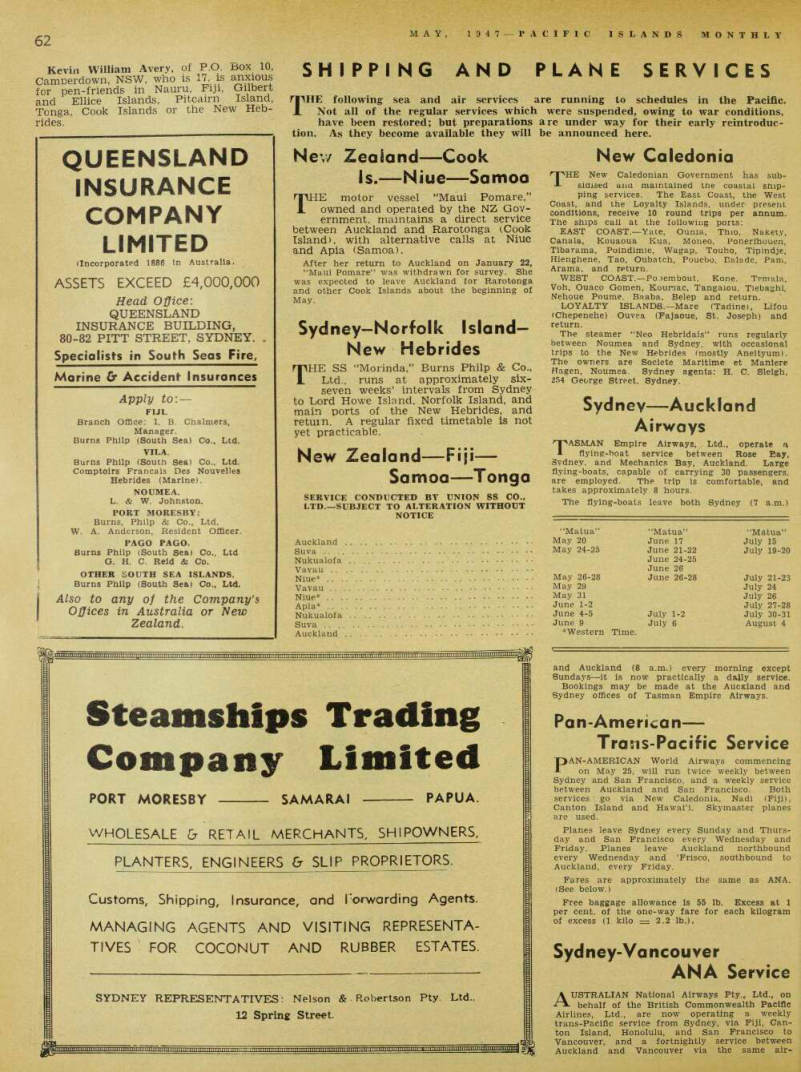
Letter to the Editor BEING on the point of establishing an International Correspondence Bureau I take leave to ask you to put me in touch with readers of your paper inter ested in friendly correspondence.
Having been secluded from the outside world these long years, and yearning for a real democratic enlightenment and a personal contact from man to man across borders, my members would only too gladly welcome and answer letters from abroad. Most of my members (among them scientists, students, experts, and other well-educated ladies and gentlemen) have a fairly good knowledge of English, out would also be pleased to write in German, if desired. I am sure my mem bers will try and give their pen-friends every satisfaction.
Pen-friendships are a step towards the creation of that international friendship and goodwill that is so essential to un derstanding and peace.
My address is: Miss A. M. Braun, 13b Munchen 15, Lindwurm Strasse 126 A, US Zone, Bavaria, Germany.
Yours hopefully,
A. M. Braun.
Reports from Rabaul state that good progress has been made with the erec tion of the new Colyer. Watson buildings jn the cld capital, where it is under stood this firm will be carrying on retail trading business.
Kevin William Avery, of P.O. box 10, Camnerdown, NSW, who is 17, is anxious for pen-friends in Nauru, Fiji, Gilbert and Ellice Islands, Pitcairn Island, Tonga, Cook Islands or the New Heb rides.
Advertisements & other items, pp. 63-64 (1 item)
Marys
G. H. Robinson
ISLAND SUPPLIES
of all kinds—Selected and Shipped to order at lowest possible prices—Piecegoods in Wool, Cotton and Silk, Under and Outerwear, Manchester, Drapery, Grocery, Hardware, Engineers and Leathergoods trade supplies a specialty.
Indents and Transhipments arranged. Large or small orders treated with equal care.
Use our 25 years’ extensive experience.
Enquiries solicited to—
G. H. ROBINSON
51 Macquarie Street,
Sydney, N.S.W.
Telegrams: Sunrise, Sydney.
Letters: Box 3317, G.P.0., Sydney.
ALL STOREKEEPERS HAVE—
AUNT
MARYS
BAKING POWDER
% Aunt Mary s Baking Powder is now obtainable from your storekeeper. That's good news for you, especially as Aunt Mary's Baking Powder maintains the high quality which has stood the test of housewives for over 70 years.
There is no substitute for Aunt Mary's—There never will be.
QUEENSLAND
INSURANCE
COMPANY
LIMITED
(Incorporated 1886 In Australia,
ASSETS EXCEED £4,000,000
Head Office :
QUEENSLAND
INSURANCE BUILDING,
80-82 PITT STREET, SYDNEY. .
Specialists in South Seas Fire,
Marine £r Accident Insurances
Apply to:
FIJI.
Branch Office: I. B. Chalmers, Manager.
Burns Phllp (South Sea) Co.. Ltd.
VILA.
Burns Philp (South Sea) Co., Ltd.
Comptolrs Francais Des Nouvelles Hebrides (Marine).
NOUMEA.
L. & W. Johnston.
PORT MORESBY:
Burns, Philp & Co., Ltd.
W. A. Anderson, Resident Officer.
PAGO PAGO.
Burns Philp (South Sea) Co., Ltd G. H. C. Reid & Co.
OTHER SOUTH SEA ISLANDS.
Burns Philp (South Sea) Co., Ltd.
Also to any of the Company's Offices in Australia or Hew Zealand.
Steamships Trading
Company Limited
PORT MORESBY
SAMARAI
PAPUA.
WHOLESALE b RETAIL MERCHANTS. SHIPOWNERS.
PLANTERS, ENGINEERS & SLIP PROPRIETORS.
Customs, Shipping, Insurance, and Lorwarding Agents.
MANAGING AGENTS AND VISITING REPRESENTA-
TIVES FOR COCONUT AND RUBBER ESTATES.
SYDNEY REPRESENTATIVES: Nelson &■ Robertson Pty. Ltd., 12 Spring Street.
Sydney-Vancouver
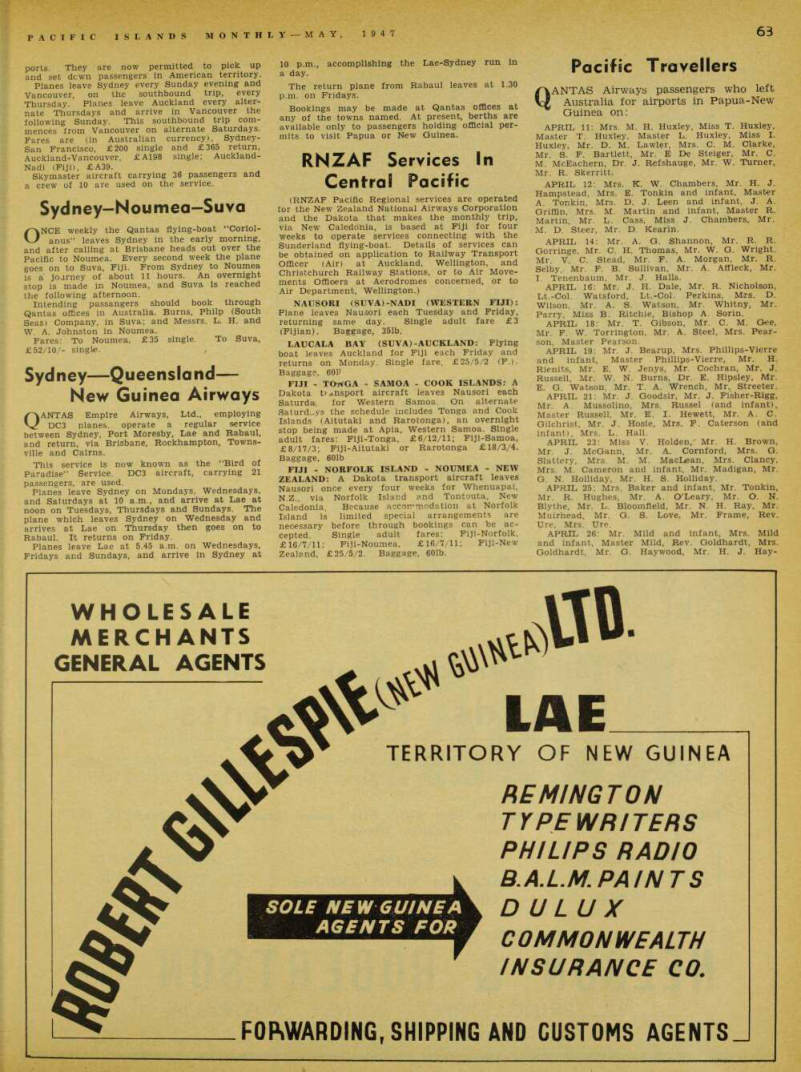
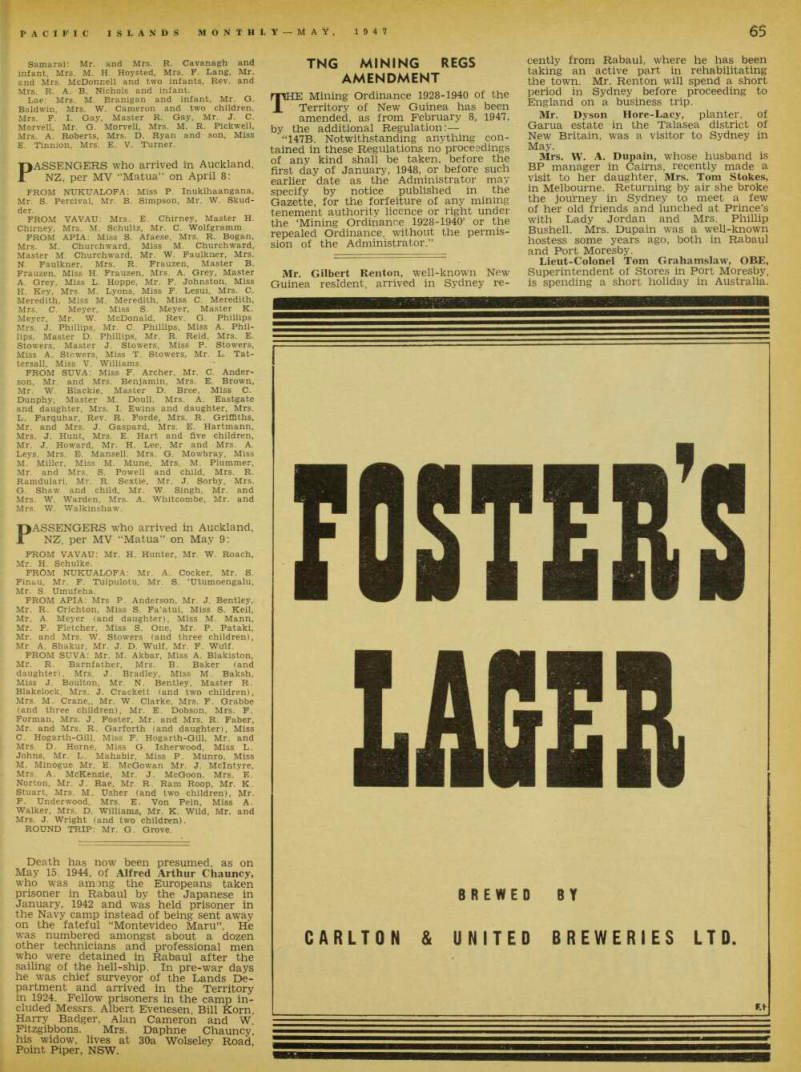
Shipping And Plane Services
THE following sea and air services are running to schedules in the Pacific.
Not all of the regular services which were suspended, owing to war conditions, have been restored; but preparations are under way for their early reintroduc tion. As they become available they will be announced here.
New Zealand—Cook
is.—Niue —Samoa
THE motor vessel “Maui Pomare,” owned and operated by the NZ Gov ernment, maintains a direct service between Auckland and Rarotonga (Cook Island), with alternative calls at Niue and Apia (Samoa).
After her return to Auckland on January 22, “Maui Pomare” was withdrawn for survey. She was expected to leave Auckland for Rarotonga and other Cook Islands about the beginning of May.
Sydney—Norfolk Island-
New Hebrides
THE SS “Morinda,” Burns Philp & Co., Ltd., runs at approximately six seven weeks’ intervals from Sydney to Lord Howe Island, Norfolk Island, and main ports of the New Hebrides, and return. A regular fixed timetable is not
yet practicable.
New Zealand —Fiji—
Samoa—Tonga
Service Conducted By Union Ss Co
Ltd.—Subject To Alteration Without
Notice
Auckland Suva Nukualofa Vavau Niue* Vavau Niue* Apia* Nukualofa Suva Auckland
New Caledonia
THE New Caledonian Government has sub sidised and maintained the coastal snip ping services. The East Coast, the West Coast, and the Loyalty Islands, under present conditions, receive 10 round trips per annum.
The ships call at the following ports: EAST COAST. —Yate, Ounia, Thio, Nakety, Canala, Kouaoua Kua, Moneo, Ponerihouen, Tibarama, Poindimie, Wagap, Touho, Tipindje, Flienghene, Tao, Oubatch, Pouebo, Dalade, Pam, Arama, and return.
WEST COAST.—Po.iembout. Kone. Temala, Voh, Ouaco Gomen, Kouraac, Tangaiou, Tiebaghi, Nehoue Poume. Baaba, Belep and return.
LOYALTY ISLANDS. —Mare (Tadinei. Lifou (Chepenehe) Ouvea (Fajaoue, St. Joseph) and return.
The steamer “Neo Hebridais” runs regularly between Noumea and Sydney, with occasional trips to the New Hebrides (mostly Aneityum).
The owners are Societe Maritime et Manlere Hagen, Noumea. Sydney agents: H. C. Sleigh, 254 George Street. Sydney.
Sydney—Auckland
Airways
TASMAN Empire Airways, Ltd., operate n flying-boat service between Rose Bay, Sydney, and Mechanics Bay. Auckland. Large flying-boats, capable of carrying 30 passengers, are employed. The trip is comfortable, and takes approximately 8 hours.
The flying-boats leave both Sydney (7 a.m.)
and Auckland (8 a.m.) every morning except Sundays—it is now practically a daily service.
Bookings may be made at the Aucsland and Sydney offices of Tasman Empire Airways.
Pan-American—
Tra sis-Pacific Service
PAN-AMERICAN World Airways commencing on May 25, will run twice weekly between Sydney and San Francisco, and a weekly service between Auckland and San Francisco. Both services go via New Caledonia, Nadi (Fiji), Canton Island and Hawai’i. Skymaster planes are used.
Planes leave Sydney every Sunday and Thurs day and San Francisco every Wednesday and Friday. Planes leave Auckland northbound every Wednesday and ’Frisco, southbound to Auckland, every Friday.
Fares are approximately the same as ANA. (See below.) Free baggage allowance is 55 lb. Excess at 1 per cent, of the one-way fare for each kilogram of excess (1 kilo = 2.2 lb.).
Sydney-Vancouver
ANA Service
AUSTRALIAN National Airways Pty., Ltd., on behalf of the British Commonwealth Pacific Airlines, Ltd., are now operating a weekly trans-Pacific service from Sydney, via Fiji, Can ton Island, Honolulu, and San Francisco to Vancouver, and a fortnightly service between Auckland and Vancouver via the same air
“Matua” “Matua” “Matua”
May 20 June 17 July 15 May 24-25 June 21-22 July 19-20 June 24-25 June 26 May 26-28 June 26-28 July 21-23 May 29 July 24 May 31 July 26 June 1-2 July 27-28 June 4-5 July 1-2 July 30-31 June 9 July 6 August 4 ♦Western Time.
ports. They are now permitted to pick up and set dcwn passengers in American territory.
Planes leave Sydney every Sunday evening and Vancouver, on the southbound trip, every Thursday. Planes leave Auckland every alternate Thursdays and arrive in Vancouver the ? iiLn« southbound trip commences from Vancouver on alternate Saturdays.
Fares are (in Australian currency), Sydney- San Francisco, £2OO single and £365 return, Auckland-Vancouver £AI9B single; Auckland- Nadi (Fiji) £A39 Skymaster aircraft carrying 36 passengers and a crew of 10 are used on the service. c l fci
bVdney-INOlimea—JUYO
7 7 ONCE weekly the Qantas flying-boat “Coriolanus” leaves Sydney in the early morning. and after calling at Brisbane heads out over the Pacific to Noumea. Every second week the plane goes on to Suva. Fiji. From Sydney to Noumea is a journey of about 11 An overnight stop is made in Noumea, and Suva is reached the following afternoon.
Intending passangers should book through Qantas offices in Australia. Burns, Philp (South Seas) Company, in Suva; and Messrs. L. H. and W. A. Johnston in Noumea.
Fares; To Noumea, £35 single. To Suva, £52/10/- single.
AiiaamcLm/I
Sydney
7 ., a •
New Guinea Airways
' QANTAS Empire Airways, Ltd., employing DC3 planes, operate a regular service between Sydney, Port Moresby. Lae and Rabaul, and return, via Brisbane. Rockhampton, Townsville and Cairns Thic cprvire is now known as the “Bird of klvvicr DC3 rJhcraft carrvine 21 Lssenaers are used ’ Cafrying 1 Planes leave Sydney on Mondays Wednesdays. and Saturdays at 10 am Tnd arrive at Lae at noon on Tuesdays. Thursdays and Sundays. The plane which leaves Sydney on Wednesday and arrives at Lae on Thursday then goes on to Rabaul It returns on Friday Planes leave Lae at 5.45 a.m. on Wednesdays, Fridays and Sundays, and arrive in Sydney at
10 p.m., accomplishing the Lae-Sydney run in a day.
The re turn plane from Rabaul leaves at 1.30 on Fridays . . . - Bookings may be made at Qantas offices at any of the towns named. At present, berths are available only to passengers holding official permits to visit Papua or New Guinea.
Dkl7 A C Qm>ulrac In
Knzah Scrviccs In
. j _? £•
Itcicbtic
. . (RNZAF Pacific Regional services are operated for the New Zealand National Airways corporation and the Dakota that makes the monthly trip, via New Caledonia, is based at Fiji for four
o^Srllnd can
Sunderland lng -^
P 'aSand WeZZ an
g® r -® C hurch Railway Stations or to Air Moveconcerned or to
Ai *l nt jL£® t ’
Air Department, Wellington.)
Nausori (Suva)-Nadi (Western Fiji):
Plane leaves Nausori each Tuesday and Friday, returning same day. Single adult fare £3 (Fijian). Baggage, 351 b.
Laucala Bay (Suva)-Auckland: Flying
boat leayes Aucklan d for Fiji each Friday and returns on Monday. Single fare, £25/5/2 (F.).
Baeeatm 60U g , Trwr , SAMOA rftOK ISLANDS- a FIJI " TOtiGA - SAMOA - COOK ISLANDS. A Dakota aircraft leaves Nausori each Saturda. for Western Samoa. On alternate Saturdays the schedule includes Tonga and Cook Islands (Aitutakl St rf o ,P u ’ Fiff Samoa o/ £B/17/3; Fiji-Aitutakl or Rarotonga £lB/3/4.
Baggage ’ 601 b
FIJI - NORFOLK ISLAND - NOUMEA - NEW ZEALAND: A Dakota transport aircraft leaves Nausori once every four weeks for Whenuapai.
N.Z.. via Norfolk Island and Tontouta, New Caledonia. Because accommodation at Norfolk Island is limited special arrangements are necessary before through bookings can be accepted. Single adult fares: Fiji-Norfolk, £l6/7/11; Fiji-Noumea. £l6/7/11; Fiji-New Zealand, £25/5/2. Baggage, 601 b.
PncifiC TrOVCIIerS
A Airwave nassengprs who left
QANTAS Airways passengers WHO ieit
V/ Australia for airports m Papua-New
Guinea on
uulliCd APRIL 11; Mrs. M . h. Huxley, Miss T. Huxley, Master T. Huxley, Master L. Huxley, Miss I.
Huxley, Mr. D. M. Lawlers Mrs C. M. Clarke, Mr. Bartlett, Mr. E De Steiger, Mr. C.
M . McEachern, Dr. J. Refshauge, Mr. W. Turner.
Mr - R - Skerritt.
APRIL 12; Mrs. K. W. Chambers, Mr. H. J.
Hampstead, Mrs. E. Tonkin and infant, Master A Ton kin, Mrs. D. J. Leen and infant, J. A.
Griffin Mrs M , Martin and infant, Master R.
Mar tin, Mr. L. Cass, Miss J. Chambers, Mr.
M D gt eer Mr. d. Kearin.
APRIL 14; Mr. A. G. Shannon, Mr. R. R.
Gorringe, Mr. C. H. Thomas, Mr. W. G. Wright.
Mr. V C. Stead, Mr. F. A. Morgan. Mr. R.
Selby, Mr. F. B. Sullivan. Mr. A. Affleck, Mr.
I- Tenenbaum. Mr. J. Halls.
APRIL 16: Mr. J. H. Dale, Mr. R. Nicholson, Lt.-Col. Watsford, Lt.-Col. Perkins, Mrs. D.
Wilson Mr A. S. Watson, Mr. Whitny, Mr.
Parry, Miss B. Ritchie, Bishop A. Sorin.
APRIL 18: Mr. T. Gibson, Mr. C. M. Gee, Mr. F. W. Torrington, Mr, A. Steel, Mrs. Pear son, Master Pearson.
APRIL 19: Mr. J, Bearup, Mrs. Phillips-Vierre and infant. Master Phillips-Vierre. Mr H.
Rienits, Mr. E. W. Jenys, Mr. Cochran, Mr. J.
Russell - Mr. W. N. Burns, Dr. E. Hipsley, Mr.
E G Watson, Mr. T. A. Wrench, Mr. Streeter.
AP R IL 21; Mr. J. Goodsir, Mr. J. Pisher-Rigg.
Mr A Mussolino, Mrs. Russel (and infant).
Maste r Russell, Mr. E. I. Hewett, Mr. A. C.
Gilchrist. Mr. J. Hosle, Mrs. F. Caterson (and infant). Mrs. L. Hall.
APRIL 23: Miss V. Holden. Mr. H. Brown, Mr j McGann Mr A . cornford, Mrs. G.
Slattery, Mrs. M, M. Mac Lean, Mrs. Clancy, M rs. M. Cameron and infant, Mr. Madigan, Mr.
G , N . Holliday. Mr. H. S. Holliday.
APRIL 25: Mrs. Baker and infant. Mr. Tonkin, Mr. R. Hughes. Mr. A. O'Leary. Mr. O. N.
Blythe, Mr. L. Bloomfield. Mr. N. H. Ray. Mr.
Muirhead, Mr. G. S. Love. Mr. Frame, Rev.
Ure, Mrs. Ure.
APRIL 26: Mr. Mild and Infant, Mrs. Mild and infant, Master Mild, Rev. Goldhardt, Mrs.
Goldhardt, Mr. G. Haywood, Mr. H. J. Hay
wood, Mrs. Stamper, Mr. J. Lang, Mrs. H.
Pearson, Mr. J. M. Potter, Mr. I. Julius, Dr.
F. W. Clements.
APRIL 28: Mr W. J. Moss, Miss D. Longley, Miss McArthur, Mr. H. G. Smith, Mr. F. J.
Herrick, Mrs. H, M. Doak, Master Doak, Miss Doak, Mr. W. McMahon, Mr. A. E. Austin, Miss J. E, Brewif, Mr. E. R. Male, Mr. B. B. Perri man.
APRIL 30: Miss L. W. Hawren, Mr. J. Gordon, Mrs. R. Bruce and infant, Miss N. Curtis, Mrs.
I. Schmidt and infant, Mr. J. M. Carroll, Mr.
E. M. Kendall, Capt. D. A. Bradley, Mr. W.
T. Howard, Sgt. L. M. Hanson, Mr. W. R. Moon MAY 2: Mr J. M. Donald, Mr. W. L. Young, Col. J. K. Murray, Mr. A. W. Jefford, Miss A.
I. Ring, Mr. W. R. Oberg, Mr. J. A. Eastwell.
MAY 3: Mr. L. H. Ward, Mr. J. H. Woods, Mr. I. Mcßae, Mrs. E. Dyer and infant, Master Dyer, Mr. A. Pollard. Mrs. T. Wrench and infant, D. Stewart, Mr. R. C Young Mr. S. Smart, Mr. L. Whitely, Mr. G. H.
Smith. Mr. G. H. Stewart.
MAY 5: Mr. O. J. Clinton, Mr. R. H. Bates, Mr. F. Brenton, Mr. F. C. Eichorn, Mr. G. A Saville, Mr. J. A. Saville, Mr. H. E. Saville,
Mr. D. Beadel, Mr. S. R. Crichton, Mr. H.
Martin, Mrs. J. Barnes, Mr. F. K. Williams.
QANTAS Airways passengers who ar rived in Australia from Papua-New Guinea on: APRIL 11: Mr. R. Cowley.
APRIL 13: Mr. H. B. Manderson, Mr. J.
Cassel, Mr. I. M. Cassel, Mr. D. H. D. Beadel Mr. R. Hardiman, Mr. J. Newton, Mr. E W Jenkins.
APRIL 14: Mr. H. Hollins, Mr. J. Dickinson, Miss Lorna Carey.
APRIL 15: Mr. R. Huxley, Mr. D. Ronald, Mr. R. Robertson, Mr. J. Preston, Capt. Park, Mr. W. McLauchlin.
APRIL 16: Col. J. K. Murray, Mr. W. Payne, Mr. F. A. Morgan, Mr. A. A. Bellhouse, Mr. W Conolly, Mr. V. C. Stead.
APRIL 18: Mrs. G. Allan, Mr. R. Baker, Mr.
H. Moran, Mr. Hore Lacey.
APRIL 20: Mr. C. H. Blackman, Mr. A. Ste phens, Mr. J. R. Flening.
APRIL 21; Mr. F. Furniss, Mr. E. Ford.
APRIL 23; Mr. D. Prowse, Mrs. A. Matthews and infant, Mr. J. Black, Mrs. J. Black, Mr Dickenson, Mr. R. Burt.
APRIL 26: Mr. W. Brown.
APRIL 25: Father Brenningmeyer, Mr. H. A.
Hampstead, Mr. V. Maxwell, Miss P. Solomons, Miss Lewis, Mrs. Rondall, Mr. Colless, Lt.-Col.
McDonald, Sister Lavery, Miss M. Garrett.
APRIL 27: Mr. A. Lebel, Mr. J. A. Miller, Mr. A. Farmilo..
APRIL 28: Mr. J. R. Tyson.
APRIL 30: A. J. Wright.
MAY 4: Mr. R. Walshs, Mr. R. Mynard, Mr.
J. I. Cromie, Mr. F. J. Currie, Mr. H. B.
Gardner, Mrs. Tranger and Infant.
PASSENGERS who left Sydney by MV
“Malaita” on April 24 for; Port Moresby: Mr. and Mrs. F. Burke, Mrs.
E. Bennett and infant, Mrs. E. Dietrich, Mrs.
E. J. Frame, Mrs. E. Johnston and three chil dren, Mr. O. J. Leighton, Mr. and Mrs. G. A.
Loudon, Mrs. C. Matheson, Miss K. McHugh, Mrs. G. Richer, Mr. Rusterholz, Mr. C. J.
Sefton, Mrs. T. L. Sefton, Mrs. M. Shepherd, Mrs. Seager.
Samarai: Mr. and Mrs. R. Cavanagh and infant, Mrs. M. H. Hoysted, Mrs. F. Lang, Mr. and Mrs. McDonnell and two infants, Rev. and Mrs. R. A. B. Nichols and infant.
Lae: Mrs. M. Branigan and infant, Mr. G.
Baldwin, Mrs. W. Cameron and two children, Mrs. F. I. Gay, Master R. Gay, Mr. J. C.
Morvell, Mr. G. Morvell, Mrs. M. R. Pickwell, Mrs. A. Roberts, Mrs. D. Ryan and son, Miss E. Tinnion, Mrs. E. V. Turner.
PASSENGERS who arrived in Auckland, NZ, per MV “Matua” on April 8; FROM NUKUALOFA: Miss P. Inukihaangana, Mr. S. Percival, Mr. B. Simpson, Mr. W. Skud der.
FROM VAVAU: Mrs. E. Chirney, Master H.
Chirney, Mrs. M. Schultz, Mr. C. Wolfgramm.
FROM APIA: Miss S. Afaese, Mrs. R. Bogan, Mrs. M. Churchward, Miss M. Churchward, Master M. Churchward, Mr. W. Faulkner, Mrs.
N. Faulkner, Mrs. R. Frauzen, Master B.
Frauzen, Miss H. Frauzen, Mrs. A. Grey, Master A. Grey, Miss L. Hoppe, Mr. F. Johnston, Miss H. Key, Mrs. M. Lyons, Miss F. Lesui, Mrs. C.
Meredith, Miss M. Meredith, Miss C. Meredith, Mrs. C. Meyer, Miss S. Meyer, Master K.
Meyer, Mr. W. McDonald, Rev. G. Phillips Mrs. J. Phillips, Mr. C. Phillips, Miss A. Phil lips, Master D. Phillips, Mr. R. Reid, Mrs. E.
Stowers, Master J. Stowers, Miss P. Stowers, Miss A. Stowers, Miss T. Stowers, Mr. L. Tat tersall, Miss V. Williams.
FROM SUVA: Miss F. Archer, Mr. C. Ander son, Mr. and Mrs. Benjamin, Mrs. E. Brown, Mr. W. Blackie, Master D. Bree, Miss C.
Dunphy, Master M. Doull, Mrs. A. Eastgate and daughter, Mrs. I. Ewins and daughter, Mrs.
L. Farquhar, Rev. R. Forde, Mrs. R. Griffiths, Mr. and Mrs. J. Gaspard, Mrs. E. Hartmann, Mrs. J. Hunt, Mrs. E. Hart and five children, Mr. J. Howard, Mr. H. Lee, Mr and Mrs. A.
Leys, Mrs. E. Mansell. Mrs. G. Mowbray, Miss M. Miller, Miss M. Mune, Mrs. M. Plummer, Mr. and Mrs. S. Powell and child, Mrs. R.
Ramdulari, Mr. R. Sextie, Mr. J. Sorby, Mrs.
G. Shaw and child, Mr. W. Singh, Mr. and Mrs. W. Warden, Mrs. A. Whitcombe, Mr. and Mrs. W. Walkinshaw.
PASSENGERS who arrived in Auckland, NZ, per MV “Matua” on May 9; FROM VAVAU: Mr. H. Hunter, Mr. W. Roach, Mr. H. Schulke.
FROM NUKUALOFA: Mr. A. Cocker, Mr. S.
Finau, Mr. F. Tuipulotu, Mr. S. ’Utumoengalu, Mr. S. Umufeha.
FROM APIA: Mrs P. Anderson, Mr. J. Bentley, Mr. R. Crichton, Miss S. Fa’atui, Miss S. Keil, Mr. A. Meyer (and daughter), Miss M. Mann, Mr. F. Fletcher, Miss S. One, Mr. P. Pataki, Mr. and Mrs. W. Stowers (and three children), Mr. A. Shakur, Mr. J. D. Wulf, Mr. F. Wuif.
FROM SUVA: Mr. M. Akbar, Miss A. Blakiston, Mr. R. Barnfather, Mrs. B. Baker (and daughter), Mrs. J. Bradley, Miss M. Baksh, Miss J. Boulton, Mr. N. Bentley, Master R.
Blakelock, Mrs. J. Crackett (and two children), Mrs. M. Crane,, Mr. W. Clarke, Mrs. F. Grabbe (and three children), Mr. E. Dobson, Mrs. F.
Forman, Mrs. J. Poster, Mr. and Mrs. R. Faber, Mr. and Mrs. R. Garforth (and daughter), Miss C. Hogarth-Gill, Miss F. Hogarth-Gill, Mr. and Mrs. D. Horne, Miss G. Isherwood, Miss L.
Johns, Mr. L. Mahabir, Miss P. Munro, Miss M. Minogue Mr. E. McGowan Mr. J. Mclntyre, Mrs. A. McKenzie, Mr. J. McGoon, Mrs. E.
Norton, Mr. J. Rae, Mr. R. Ram Roop, Mr. K.
Stuart, Mrs. M. Usher (and two children), Mr.
F. Underwood, Mrs. E. Von Pein, Miss A.
Walker, Mrs. D. Williams, Mr. K. Wild, Mr. and Mrs. J. Wright (and two children).
Round Trip: Mr. G. Grove.
Death has now been presumed, as on May 15. 1944, of Alfred Arthur Chauncy, who was among the Europeans taken prisoner in Rabaul by the Japanese in January, 1942 and was held prisoner in the Navy camp instead of being sent away on the fateful “Montevideo Maru”. He was numbered amongst about a dozen other technicians and professional men who were detained in Rabaul after the sailing of the hell-ship. In pre-war days he was chief surveyor of the Lands De partment and arrived in the Territory in 1924. Fellow prisoners in the camp in cluded Messrs. Albert Evenesen Bill Korn.
Harry Badger, Alan Cameron and W.
Fitzgibbons. Mrs. Daphne Chauncy,
his widow, lives at 30a Wolselev Road, Point Piper, NSW.
Advertisements & other items, pp. 65-66 (1 item)
Wholesale
MERCHANTS
GENERAL AGENTS
<6> & OB
LAE
TERRITORY OF NEW GUINEA
SOLE NEW GUINEA
AGENTS FOR
REMINGTON
TYPEWRITERS
PHILIPS RADIO
B.A.L.M. PAINTS
D U LU X
COMMONWEALTH
INSURANCE CO.
FORWARDING, SHIPPING AND CUSTOMS AGENTS
While in Port ...
HIRE Your Taxi from
BULOWAT TRANSPORT
COMPANY
CARRIERS AND TRANSPORT SPECIALISTS
GENERAL MOTOR REPAIRS
—Agents for—
CRYSTALITE PLASTICS, ALL ELECTRICAL
EQUIPMENT, RADIOS, REFRIGERATORS,
HOT WATER JUGS, ETC.
SIDNEY COOK, PROP.
NELSON and ROBERTSON Pty. Ltd.
Established 1895
Shipowners - Brokers and
Islands Merchants
All classes merchandise purchased at Best Wholesale Prices. Original Invoices supplied to Island Clients. Cocoa Beans, Copra, Rubber, Trochus Shell and All Islands' Produce Sold on Commission.
Entrust your requirements to the firm with fifty years' practical experience in the Pacific Islands.
Sole Agents ;
SKANDIA DIESEL ENGINES
ARCHIMEDES MOTORS
Prompt attention given to all enquiries.
NELSON & ROBERTSON S:
12 SPRING STREET, SYDNEY, AUSTRALIA
Telegraphic Address: IVAN, SYDNEY.
OVERSEA INDENTS
ARRANGED FOR
CLIENTS.
REPRESENTED IN
ALL PARTS OF
THE WORLD
Tng Mining Regs
Amendment
mHE Mining Ordinance 1928-1940 of the J. Territory of New Guinea has been amended, as from February 8, 1947, by the additional Regulation:— “1478. Notwithstanding anything con tained in these Regulations no proceedings of any kind shall be taken, before the first day of January, 1948, or before such earlier date as the Administrator may specify by notice published in the Gazette, for the forfeiture of any mining tenement authoritv licence or right under the ‘Mining Ordinance 1928-1940’ or the repealed Ordinance, without the permis sion of the Administrator.”
Mr. Gilbert Renton, well-known New Guinea resident, arrived in Sydney re
cently from Rabaul, where he has been taking an active part in rehabilitating the town. Mr. Renton will spend a short period in Sydney before proceeding to England on a business trip.
Mr. Dyson Hore-Lacy, planter, of Garua estate in the Talasea district of New Britain, was a visitor to Sydney in May.
Mrs. W. A. Dupain, whose husband is BP manager in Cairns, recently made a visit to her daughter, Mrs. Tom Stokes, in Melbourne. Returning by air she broke the journey in Sydney to meet a few of her old friends and lunched at Prince’s with Lady Jordan and Mrs. Phillip Bushell. Mrs. Dupain was a well-known hostess some years ago, both in Rabaul and Port Moresby.
Lieut-Colonel Tom Grahamslaw, OBE, Superintendent of Stores in Port Moresby, is spending a short holiday in Australia.
Advertisements & other items, pp. 67-68 (1 item)
Fosters
LA6ER
BREWED BY
CARLTON & UNITED BREWERIES LTD.
mi \ * i 11
after MILE
OF
EXTRA WEAR
now added to
cool - running
MILLER
TIRES
Tires for
trucks,
automobiles,
buses New type, stronger construction.
New wide, flatter tread. Longer mileage. Maximum traction.
Peak skid resistance. Greater protection against bruises.
MORE TIRE FOR YOUR MONEY
Miller Accessories and Repair Materials are dependable!
Consistently high in quality, this complete line has been developed to meet every automotive need.
Radiator hose Radiator cleaner Radiator solder Noc-out adjustable hose clamps Vulcanizing patch -and valve stem clamp Tire camelback (passenger and truck) Full circle curing tubes
TUBE REPAIR KIT
CONTENTS
I—s" x 19" Strip rubber 80 —1 Va" Sq. bevel cut patches 20 —114" x 2" Oval bevel cut patches I—l 4 Pt. bottle cement I—Carborundum buffer
PACIFIC ISLANDS TRADING COMPANY
244 CALIFORNIA STREET, SAN FRANCISCO 11, CALIFORNIA, U. S. A.
W. Samoa, Too, Has High
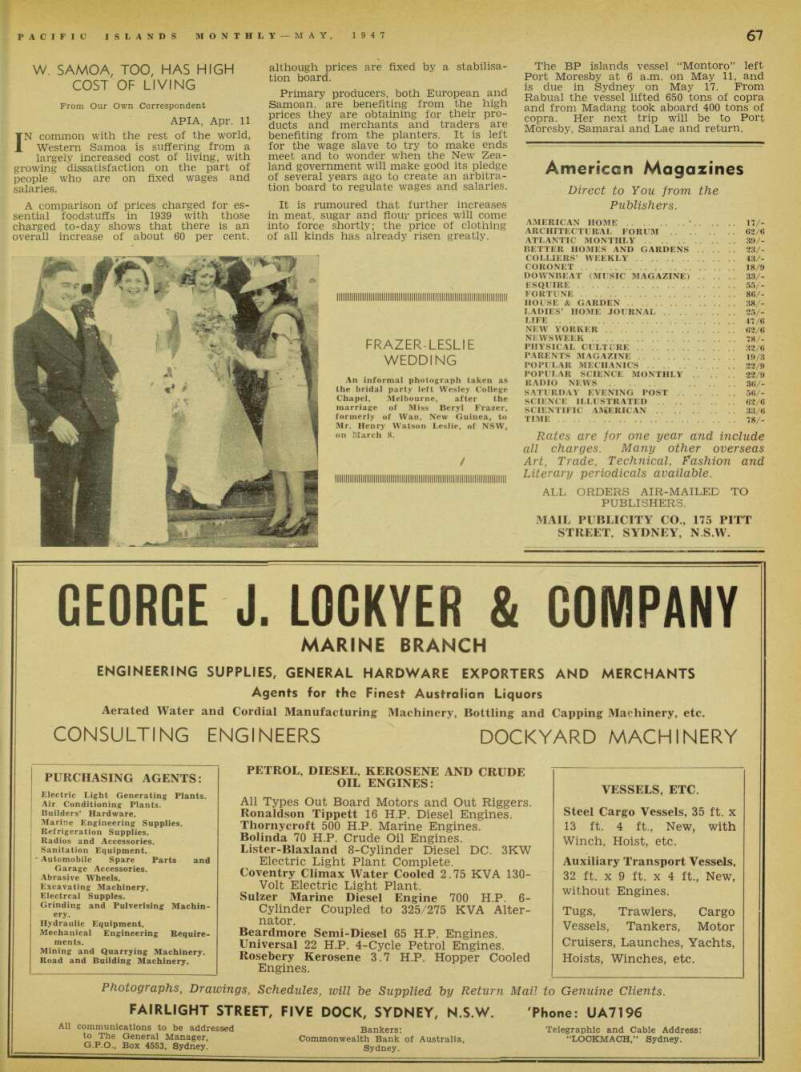
Cost Of Living
From Our Own Correspondent
Apia, Apr. 11
IN common with the rest of the world, Western Samoa is suffering from a largely increased cost of living, with growing dissatisfaction on the part of people who are on fixed wages and salaries.
A comparison of prices charged for es sential foodstuffs in 1939 with those charged to-day shows that there is an overall increase of about 60 per cent.
although prices are fixed by a stabilisa tion board.
Primary producers, both European and Samoan, are benefiting from the high prices they are obtaining for their pro ducts and merchants and traders are benefiting from the planters. It is left for the wage slave to try to make ends meet and to wonder when the New Zea land government will make good its pledge of several years ago to create an arbitra tion board to regulate wages and salaries.
It is rumoured that further increases in meat, sugar and flour prices will come into force shortly; the price of clothing of all kinds has already risen greatly.
The BP islands vessel “Montoro” left Port Moresby at 6 a.m. on May 11, and is due in Sydney on May 17. From Rabual the vessel lifted 650 tons of copra and from Madang took aboard 400 tons of copra. Her next trip will be to Port Moresby, Samarai and Lae and return.
Frazer-Leslie
Wedding
An informal photograph taken as the bridal party left Wesley College Chapel, Melbourne, after the marriage of Miss Beryl Frazer, formerly of Wau, New Guinea, to Mr. Henry Watson Leslie, of NSW, on March 8.
Advertisements & other items, p. 69 (1 item)
George J. Lockyer & Company
American Magazines
Direct to You from the
Publishers.
AMERICAN HOME ' 17/-
ARCHITECTURAL FORUM 62/6
ATLANTIC MONTHLY 39/-
BETTER HOMES AND GARDENS 23/-
COLLIERS’ WEEKLY 437-
CORONET 18/9
DOWNBEAT (MUSIC MAGAZINE) 33/-
ESQUIRE 55/-
FORTUNE 86/-
HOUSE & GARDEN 38/-
LADIES’ HOME JOURNAL 25/-
LIFE 47/6
NEW YORKER 62/6
NEWSWEEK 78/-
PHYSICAL CULTURE 32/6
PARENTS MAGAZINE 19/3
POPULAR MECHANICS 22/9
POPULAR SCIENCE MONTHLY 22/9
RADIO NEWS 36/-
SATURDAY EVENING POST 56/-
SCIENCE ILLUSTRATED 62/6
SCIENTIFIC AMERICAN 33/6
TIME 78/-
Rates are for one year and include
all charges. Many other overseas
Art, Trade, Technical, Fashion and
Literary periodicals available.
ALL ORDERS AIR-MAILED TO
PUBLISHERS.
MAIL PUBLICITY CO., 175 PITT
STREET, SYDNEY, N.S.W.
GEORGE J. LOCKYER & COMPANY
MARINE BRANCH
ENGINEERING SUPPLIES, GENERAL HARDWARE EXPORTERS AND MERCHANTS Agents for the Finest Australian Liquors Aerated Water and Cordial Manufacturing Machinery, Bottling and Capping Machinery, etc.
CONSULTING ENGINEERS DOCKYARD MACHINERY
PURCHASING AGENTS:
Electric Light Generating Plants.
Air Conditioning Plants.
Builders’ Hardware.
Marine Engineering Supplies.
Refrigeration Supplies.
Radios and Accessories.
Sanitation Equipment.
Automobile Spare Parts and Garage Accessories.
Abrasive Wheels.
Excavating Machinery.
Electrcal Supples.
Grinding and Pulverising Machinery.
Hydraulic Equipment.
Mechanical Engineering Requirements.
Mining and Quarrying Machinery.
Road and Building Machinery.
PETROL, DIESEL, KEROSENE AND CRUDE
OIL ENGINES:
All Types Out Board Motors and Out Riggers.
Ronaldson Tippett 16 H.P. Diesel Engines.
Thornycroft 500 H.P. Marine Engines.
Belinda 70 H.P. Crude Oil Engines.
Lister-Blaxland 8-Cylinder Diesel DC. 3KW Electric Light Plant Complete.
Coventry Climax Water Cooled 2.75 KVA 130- Volt Electric Light Plant.
Sulzer Marine Diesel Engine 700 H.P. 6- Cylinder Coupled to 325/275 KVA Alternator.
Beardmore Semi-Diesel 65 H.P. Engines.
Universal 22 H.P. 4-Cycle Petrol Engines.
Rosebery Kerosene 3.7 H.P. Hopper Cooled Engines.
VESSELS, ETC.
Steel Cargo Vessels, 35 ft. x 13 ft. 4 ft., New, with Winch, Hoist, etc.
Auxiliary Transport Vessels, 32 ft. x 9 ft. x 4 ft., New, without Engines.
Tugs, Trawlers, Cargo Vessels, Tankers, Motor Cruisers, Launches, Yachts, Hoists, Winches, etc.
Photographs, Drawings, Schedules, will he Supplied by Return Mail to Genuine Clients.
FAIRLIGHT STREET, FIVE DOCK, SYDNEY, N.S.W. Phone: UA7196 All communications to be addressed Bankers: Telegraphic and Cable Address: ™ General Manager, Commonwealth Bank of Australia, -‘LOCKMACH,” Sydney.
G.P.O., Box 4553, Sydney. Sydney.
Pm Recreation Reserve
Port Moresby, Apr. 22
A PROCLAMATION was recently issued by the Administrator resuming two parcels of land, totalling about 17 acres as a recreational reserve for the township. It is in Granville West and adjoins the Ela Beach Road.
The Trustees of the old Ela Beach re serve, Messrs. Lewis Lett and Captain Fitch have resigned their stewardships, which they had held for over 20 years.
The new trustees are Messrs. E. A. James, E. V. Crisp and R. S. Willis
'Flu and Mumps
Western Samoa Suffers
From Our Own Correspondent
Apia, Apr. 25
A MILD but widespread epidemic of in fluenza has been raging here since the middle of the month but now appears to be on the wane. About 60 per cent, of the Samoan population—par ticularly in and around Apia—has been affected and work on plantations and in offices has been at a standstill. There was difficulty also, in securing sufficient labour to work the “Matua” and schools
have been closed until May 12.
Although the present epedemic is not apparently of a serious character, health officials are naturally wary. It will be remembered that in the disasterous epi demic of 1918-19 over 7,000 Samoans (out of a population of 35,000) died from the disease.
We are also having an epedemic of mumps which although not as widespread as the influenza is sufficiently serious to make the American Samoan adminis tration impose a quarantine on shipping from this Territory.
In Defence Of The Trader
Letter to* the Editor I HAVE read with interest Mr. Arthur L. Ethell’s article in your April issue about traders exploiting the natives.
Can Mr. Ethell name one trader who is living in Australia who has retired on his earnings; or two men who have left an estate of more than three figures?
Traders cannot afford to take a three months’ holiday every two years. Many men on wages imagine there is a fortune in trading. But turnover is small, and overhead expenses heavy. Boats and en gines are expensive and their up-keep large. Most traders need a launch.
A trade store is needed on a plantation to draw casual labour, but it takes uo a deal of one’s time. Natives like to dilly dally when buying. Also one has to give a certain amount of credit—and that means bad debts.
Many men have gone broke, trading, and have needed their passages paid out of the country. Until recently, one needed a bond of £3O when entering the Terri tories.
I am, etc..
D. H. Osborne
Samarai, 4/5/47.
Advertisements & other items, p. 70 (1 item)
Mcilrath’S
OFFER FULL STOCKS OF QUALITY
Groceries, Wines, Spirits
Liqueurs and Cider
Write for our NEW Grocery—and Wine and Spirit List.
POST FREE BY RETURN AIR MAIL.
All shipments are covered against
PILLAGE-THEFT—NON-DELIVERY.
McILRATH’S PTY. LTD.
Export Deportment, 202 Pitt Street, Sydney, Australia Cable address: ROTUNDA, Sydney.
William Atkins Pty. Ltd.
Head Office *49-451 KENT ST., SYDNEY.
Iron & Steel Merchants—Engineers' Supplies
ESTABLISHED OVER 50 YEARS
Coach fir Motor Hardware Cable Address: WILATKIN, Sydney.
STEEL DEPARTMENT
MILD STEEL:
Rounds, Squares, Flats, Half-rounds, Hexagons, Bevel, Shoeing, Tyre, Angles, Tees, Sheets, Plates, Girder Plates, Chequer Plates, Channels, Hoops, Etc.
BRIGHT STEEL:
Rounds, Squares, Hexagons Extra Special High Speed Tool Steel, Mining Steel, Blister Steel and Spring Steel, Rounds, Flats Gr Squares.
Bar Iron —All sections and sizes.
Engineers' Supplies: Set Screws, Studs, Metal Thread Screws, Coach Screws. Files, Cotter Pins, Bright and Black Bolts. Rivets, Etc., Hack Saw Blades.
Power Transmission Gear: Including Plummer Blocks, Couplings, Collars, Etc.
Coach and Motor Hardware: Axles, Springs, Wheelstufl, Duck, Paints.
Farriers' Supplies: Horse Nails, Anvils, Vices, Etc.
Motor-Trimmers and Motor Builders' & Motor Painters' Requirements Pacific Island Agents : Corrie & Co., Suva, Fiji DUCO Lacquers and DULUX Enamels—FAßßEX Motor Toppings and Leather Cloths, House & Decorators' Paints, Varnishes fir Brushware.
Sole Distributors of CHAMPION'S Decorators Point Products.
Distributing Agents for BROLITE Lacquers, SYNFLEX Enamels and "POLYGLOSS" Finish.
Rabaul's Missing
Civilians
Strange Stories in Circulation
Rabaul, Apr. 22
rE same despicable Australian official dom which has refused to order any inquiry to ascertain why some 300 New Guinea civilians were lost in the Jap invasion of Rabaul, is now making a mystery of some 24 new graves in this area of New Guinea.
Until some official statement is made to the contrary, the belief will be held here that these are the graves of 24 per sons who had been officially described as lost on the Jap prison-ship “Montevideo Maru.”
About the time that Mrs. Gladys Baker died, a new grave was noticed in Rabaul cemetery, beside that of the late Mr. Alan Campbell. It was assumed to be that of Mrs. Baker. But now it is known that it is not —it is the grave of Mr. Thompson, who was accountant for Messrs. W. R.
Carpenter & Co. in Rabaul, and who was thought to have been lost on the prison ship.
It appears that the Matupi natives re cently opened a large grave in their area, and there found the bodies of 24 Euro peans. One was positively identified as that of Mr. Thompson—it bore his wristlet watch, among other things—and it was buried in Rabaul.
The other 23 were taken to Bitapaka, and interred along with the bodies of Australian soldiers —which are being gathered from various places, and concen trated in this cemetery.
There is much public curiosity regarding the 23—both because of the place where they were found, and because they are generally in civilian dress. But, if they are civilians, why are they being buried in the soldiers’ cemetery? information here recently leads IN some of us to believe that there were 16 or 18 men instead of 8 or 9 with Albert Evenson and Bill Kom, when they were murdered in Rabaul by the Japs about the end of 1944. It will be remem bered that they were keeping records of the shot-down American and Australian airmen who were passing through Rabaul to Jap prison-camps, and the Japs found those records. The European civilians were all taken away somewhere and never seen again.
We are wondering whether these 23 unidentified bodies may not include those of Evensen’s party.
There is another interesting story current here. A high officer of the Aus tralian Army, here in connection with the war crimes trials, has stated privately that, soon after the Japs occupied Rabaul, a Jap cruiser off the South Coast of New Britain picked up one or more small craft, carrying 81 Europeans, and signalled the Jap commander in Rabaul for instruc tions.
The reply of the victory-drunk Japs was that they did not want any more prisoners in Rabaul.
So a plank was rigged over the stern of the cruiser, and the Europeans—all of them—were forced to walk along it, and fall into the sea, and thus were drowned. The story was told to the Army officer by a Jap member of the cruiser’s crew, who was in Rabaul as a war crimes witness. That would account for another 81 of our missing people.
According to the report here, high Aus tralian officialdom, which always tries to decide what is good for us, has decided to suppress this story. MS.
Csr Sugar Bonus
From Our Own Correspondent
Suva, May 5.
THE Colonial Sugar Refining Co., has announced an interim bonus (the second) in respect of 1946 cane purchases. The second payment will be 5/6 a ton. The first, made after crushing had ceased, was 7/6.
A small final payment will probably be made when account sales for all 1946 sugar have been received.
The Rev. Percy Clark secretary of the Methodist Overseas Mission has been ap pointed to a post in WA.
Advertisements & other items, pp. 71-72 (1 item)
To avoid underarm odour
I For Inflamed Eyes and Eyelids ... Sold Everywhere H.Rose&Co.,Pty„Lid.. Kiny Street. Sydney.
Don't trust luck —trust Mum
;a:' nr! ;i After every bath, keep underarms fresh
with quick, dependable MUM.
Just a finger-tip dab of MUM under each arm. It does not prevent natural perspiration, only neutralises the odour.
MUM spreads easily; does not stain.
It will not irritate the most sensitive skin or harm the most delicate fabrics. It is safe and sure. o 2920 MUM is economical, so little is needed to preserve your daintiness throughout
the day or evening.
MUM
TAKES THE ODOUR
OUT OF PERSPIRATION
Morobe Contracting
and Furnishing
Co. Limited
LAE, NEW GUINEA
Manufacturers of:
FURNITURE IN ROSEWOOD, MAPLE AND OTHER
LOCAL TIMBERS. OUR FIRST-CLASS CABINETMAKERS
AND CARPENTERS WILL COMBINE TO GIVE YOU COM- PLETE SATISFACTION IN ANY ARTICLE YOU MAY ORDER
Building and Contracting
WE WISH TO ANNOUNCE that our building and contracting department is completely organised to handle any type of building. All buildings erected with the least possible and the highest class workmanship. Your orders are invited.
VISIT OUR SHOWROOMS
In our recently-opened Showrooms in Lae, we are displaying the latest in Silverware, Cutlery, Crockery and All Household and Kitchen Appliances ★ ★
Southern Cross Engine and Windmill Co.
In North-east New Guinea we are agents for Southern Cross Engine and Windmill Co., offering the best in Diesel and Petrol Engines, Diesel Marine Engines, Electric Generating Diesel Driven Air Compressors, Centrifugal and Geared Power Pumps, Geared Pumping Heads, Etc.
Address your inquiries to:
MOROBE CONTRACTING & FURNISHING
CO. LTD., LAE, N.G.
NG Scholarship Fund
Only £BO Needed Now!
rpHE Melbourne New Guinea Women’s JL Association scholarship fund is steadily mounting to the desired amount—£3,ooo—which will be sufficient for the complete endowment of a yearly award. At the end of April, exactly £Bl/13/6 was needed.
Response from Territorians and other friends has been remarkable; but such results would have been impossible had it not been for the enthusiasm of the Scholarship Committee, upon whom most of the work has fallen, and other mem bers of the New Guinea Association.
April Donations
rE Donations received during April were as follows:
Acknowledged to March 31 ..
Mr. M. W. S. Rylands, “Glen Outram” Private Bay, Bathurst. £2,839’ 9 10
Nsw
Mr. R. K. Walls, 92 Berry St., 2 2 6 Nth. Sydney (Ex 2/22) .. .
Keith Norris, Dept, of Treasury, 1 1 6 Port Moresby, Papua 5 1 0 Anonymous Dr. and Mrs. Prank May, 100 15 8 2 Princess St.. Kew, Vic Mrs. H. A. Gregory, 80 Cromwell Road, Sth. Yarra, Vic. (proceeds 5 5 0 raffle) Mrs. H. Holland, 2083 Malvern Rd., East Malvern, Vic. (pro- 2 0 0 ceeds sale knitting) Mr. and Mrs. D. C. Phillips, 115 1 10 0 Beach Road, Sandringham, Vic.
Mr. and Mrs. Basil G. Challis, 5 0 0 21 Sturdee St. Linden Park, SA Mr. L. A. Maguire, c/o Burns Philp & Co., P.O. Box 109, 2 2 0 Darwin, NT 5 1 0 Dr. B. Sinclair, Rabaul, TNG Mrs. Anne V. Thompson, Com- 10 10 0 munity Hospital, Nhill, Vic. ,.
Mr. F. M. Laver, 6 South Esk 5 0 0 Rd., Trevallyn, Launceston, Tas.
Mr. and Mrs. A. Wood, No. 6 1 0 0 Fakenham Rd. Ashburton, Vic.
Bulolo Sub-branch, New Guinea R.S.S. & A.I.L. of A., Bulolo, 1 1 0 NG Mr. and Mrs. R, C. Chugg, 2 2 0 Madang, TNG Port Moresby Branch R.S.S. & 3 3 0 A.I.L. of A., Port Moresby, Papua Mr. and Mrs. P. O. Cutler, 11 5 6 0 Park St., Middle Brighton, Vic.
Mr. O. F. Cowley, The Residency, 1 1 0 Abau, Papua 1 0 0 “Sinamaraki”
Mr. D. Hyland, 48a Chatsworth 3 1 6 Road, Armadale, Vic 1 1 0 Total received to April 30, 1947 £2,918 6 6
Leaking Tanker At
Suva Wharf
From Our Own Correspondent
Suva, May 5.
OFFICIAL wheels revolved at speed when it was discovered on April 30, that the tanker “Taron” from San Pedro, was leaking' petrol into Suva Harbour. What was regarded as a serious possibility of fire, involving the wharf area gave rise to a chain of events that ultimately, took the Acting Governor (Mr. J. F. Nicoll) and the Acting Colonial Secretary (Mr. A. R. W. Robertson) down to the wharf.
By that time, however, the leak had stopped after the petrol, steadily bubbling out amidships, had spread the full length of the ship and under the wharf. The police and fire brigade stood by through out the night.
Territorians soon will be able to pur chase office and portable typewriters of a well-known make, which are being shipped to Lae, New Guinea, in the near future by a Sydney firm.
The Polynesians and Peru
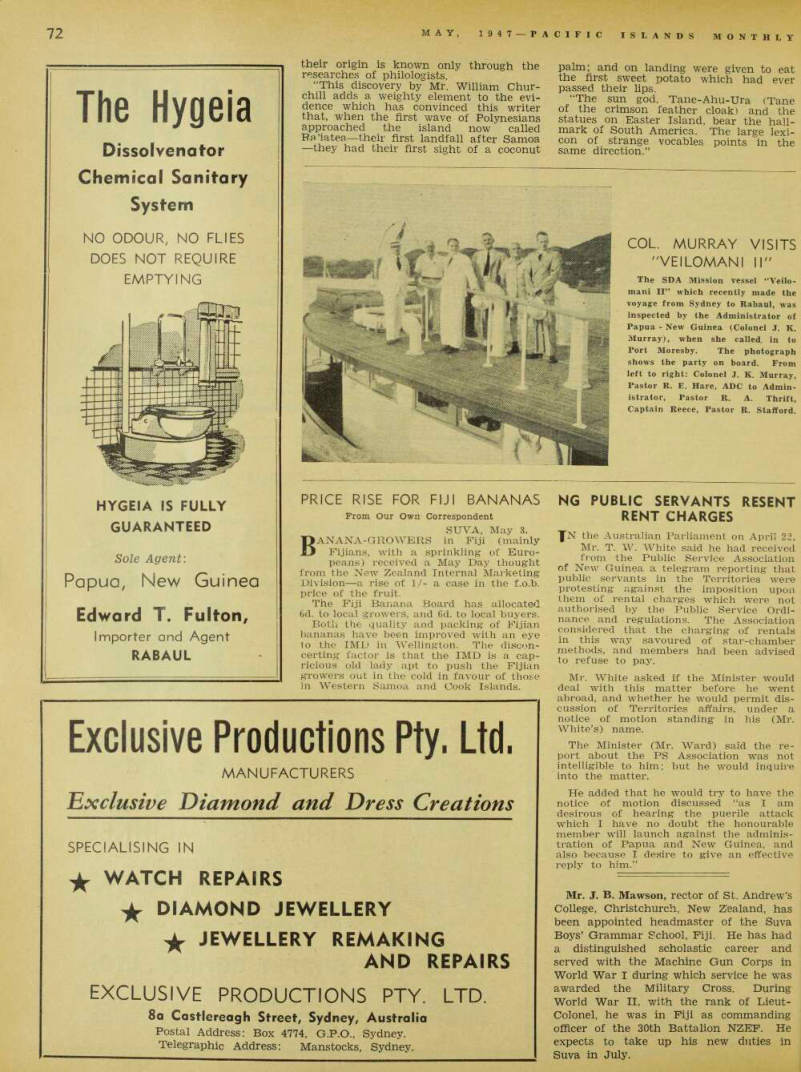
Reviving Interest in Theory of South American Influence in Ancient Polynesia
rE long drift on the balsa wood-raft which is being undertaken by six young Norwegian scientists to prove that natives of South America could have arrived In some of the islands of Poly nesia before the Polynesians, has begun.
The raft set out on its 4,000 mile voyage from Callao, Peru on April 28.
The leader of the expedition is Thor Heyerdahl, an anthropologist. He expects the voyage to take about four months.
The raft, which is 18 feet by 45 feet, like those of ancient Peruvians who Heyerdahl believes peopled the Tuomotus, is lashed together by ropes. It has a primitive square sail, a rudder, oars and a bamboo deck and cabin. By May 10 it had drifted 500 miles.
Heyerdahl is not by any means the first European to believe that parts of Polynesia were inhabited long before the arrival of the Polynesians. It is more than likely that this was so but whether the settlement was other than accidental or anything but on a small scale is open to doubt. Those who favour the Peru vian theory point out language affinities between certain parts of Polynesia and Peru; the fact that the kumera, or sweet potato, which is now common to most of Polynesia, is not indigenous to those islands or to Indonesia from whence the Polynesians are popularly believed to have come, but is indengenous to South America: the mysterious statues on Easter Island; and various other facts.
AMONG those who believe that the Eastern Pacific was first settled by Peruvians is Mr. A. C. Rowland of Papeete who has given a great deal of study to the subject. Writing recently he ouoted the great Polynesian scholar.
William Churchill, whose monumental work on Polynesian languages and other books, have contributed largely to our knowledge of Polynesia.
Rowland writes: “Churchill made a surprising discovery in South Eastern Polynesia—that the five dialects of the archipelagoes comprising this area con tain a large vocabulary of words which are peculiar to that area and do not appear in any of the many dialects spoken elsewhere in Polynesia. In other words, the dialects of Tahiti. Marquesas.
Tuamotu, Mangareva and Easter Island contain an element of speech quite un known in Hawaii, Samoa, Tonga and the rest of Polynesia.
“To quote Mr. Churchill: ‘We find one element of unknown antiquity, a corpus of Polynesian speech summed up at 16 000 vocables which have passed from the use and memory of the race Tr> the Paumotu group slightly less than half of the sneech equipment, and in the other subdivisions of the province a shade more than two-thirds of the speech equipment, are wholly unidentifiable else where in Polynesia; so far as we know, they are quite unknown anywhere in the world.’
“This may be explained by the proba bility that the language from which this volume of words has been taken had passed out of use in the country of its origin centuries before the first European entered the Western World.
“The fact that these words, as we find them, conform to the Polynesian idiom, does not exclude the probabilitv of their extra-Polynesian origin. Our English speech abounds with words from other languages which have become so trans formed to the Anglo-Saxon idiom that
their origin is known only through the of Philologists.
This discovery by Mr. William Churchill adds a weighty element to the evidence which has convinced this writer that, when the first wave of Polynesians approached the island now called Ra latea—their first landfall after Samoa —they had their first sight of a coconut
palm; and on landing were given to eat the first sweet potato which had ever passed their lips “The sun god, Tane-Ahu-Ura (Tane of the crimson feather cloak) and the statues on Easter Island, bear the hail mark of South America. The large lexi con of strange vocables points in the same direction.”
Col. Murray Visits
"Veilomani Ii"
The SDA Mission vessel “Veilo mani II” which recently made the voyage from Sydney to Rabaul, was inspected by the Administrator of Papua-New Guinea (Colonel J. K.
Murray), when she called in to Port Moresby, The photograph shows the party on board. From left to right: Colonel J. K. Murray, Pastor R. E. Hare, ADC to Admin istrator, Pastor R. A. Thrift, Captain Reece, Pastor R. Stafford.
Advertisements & other items, pp. 73-74 (1 item)
W 1 Grove & Sons
Limited
Established 1896.
AUCKLAND
Island Traders. F *o. Bo* Telegraphic and Cable Address: “Grove", Auckland.
Entrust Your Orders to the Firm with Fifty Years Practical Experience in the Island Trade.
Shippers of all classes of New Zealand products.
Representing English Manufacturers through-
out the Cook and Society Islands, Fiji, Tonga, Samoa, Niue, New Caledonia, New Guinea, etc.
In FIJI os—W. H. Grove & Sons (Fiji) Ltd.
The Most Extensive Manufacturers in the British Empire of
RUBBER STAMPS,
INKS, STENCILS,
Marking Devices,
ACME STAMP PADS
OFFICE & STATIONERY SUPPLIES
Si We also Manufacture & Supply a Complete Line of
LiMEWASHING AND
SPRAYING MACHINES
for all purposes.
Let us know your requirements and we will quote by return.
WRITE FOR OUR GENERAL CATALOGUE
Limewashing Machine
EXCELSIOR SUPPLY CO. PTY. LTD.
278 Post Office Place,
MELBOURNE, VIC.
HEAD OFFICE :
160 BROADWAY,
Formerly known as George St., West,
SYDNEY, N.S.W.
50 Victoria Street,
WELLINGTON, N.Z.
The Hygeia
Dissolvenator
Chemical Sanitary
System
NO ODOUR, NO FLIES
DOES NOT REQUIRE
EMPTYING
m
HYGEIA IS FULLY
GUARANTEED
Sole Agent : Papua, New Guinea Edward T. Fulton, Importer and Agent
RABAUL
Exclusive Productions Pty. Ltd.
MANUFACTURERS
Exclusive Diamond and Dress Creations
SPECIALISING IN
it WATCH REPAIRS
+ DIAMOND JEWELLERY
it JEWELLERY REMAKING
AND REPAIRS
EXCLUSIVE PRODUCTIONS PTY. LTD.
8a Castlereagh Street, Sydney, Australia Postal Address: Box 4774, G.P.0., Sydney.
Telegraphic Address: Manstocks, Sydney.
Price Rise For Fiji Bananas
From Our Own Correspondent
Suva, May 3.
Banana-growers in Fiji (mainly Fijians, with a sprinkling of Euro peans) received a May Day thought from the New Zealand Internal Marketing Division—a rise of 1/- a case in the f.o.b. price of the fruit.
The Fiji Banana Board has allocated 6d. to local growers, and 6d. to local buyers.
Both the quality and packing of Fijian bananas have been improved with an eye 1o the IMD in Wellington. The discon certing factor is that the IMD is a cap ricious old lady apt to push the Fijian growers out in the cold in favour of those in Western Samoa and Cook Islands.
Ng Public Servants Resent
Rent Charges
JN the Australian Parliament on April 22, Mr. T. W. White said he had received from the Public Service Association of New Guinea a telegram reporting that public servants in the Territories were protesting against the imposition upon them of rental charges which were not authorised by the Public Service Ordi nance and regulations. The Association considered that the charging of rentals in this way savoured of star-chamber methods, and members had been advised to refuse to pay.
Mr. White asked if the Minister would deal with this matter before he went abroad, and whether he would permit dis cussion of Territories affairs, under a notice of motion standing in his (Mr.
White’s) name.
The Minister (Mr. Ward) said the re port about the PS Association was not intelligible to him; but he would inquire into the matter.
He added that he would try to have the notice of motion discussed “as I am desirous of hearing the puerile attack which I have no doubt the honourable member will launch against the adminis tration of Papua and New Guinea, and also because I desire to give an effective reply to him.”
Mr. J. B. Mawson, rector of St. Andrew’s
College, Christchurch, New Zealand, has
been appointed headmaster of the Suva Boys’ Grammar School, Fiji. He has had a distinguished scholastic career and served with the Machine Gun Corps in World War I during which service he was awarded the Military Cross. During World War 11, with the rank of Lieut- Colonel, he was in Fiji as commanding officer of the 30th Battalion NZEF. He expects to take up his new duties in Suva in July.
Sydney Women's Appeal
N. Britain's Generous Response To Sydney Women's Appeal
ONE of the brightest aspects of the Pacific war and its stormy aftermath is the way in which New Guinea folk have rallied to the assistance of those amongst them who have suffered greatly.
When Mrs. U. Adams of Patlangat Plantation was in Rabaul recently, by medium of the notice board in the civilian hostel there, she asked anyone who felt able to contribute to the funds of the New Guinea Women’s Club of Sydney which is carrying on a self appointed task of caring for ex-New Guinea women and children. The response was extra ordinary.
When Mrs. Adams returned to Sydney in May, she was able to hand to the treasurer of the Club, the sum of £174, all of which was donated voluntarily in this way. Not only has this made the task of the Club easier but the thought that they who carry on in Sydney are not forgotten by their New Britain friends, has engendered among these women a feeling of great joy and gratitude that cannot be expressed adequately in words.
The Club would like to extend its thanks to all those who gave so gener ously and particularly to Mr. A. L. Gas kin Jnr., Mr. Gannon and the girls of the PCB for their help and co-operation.
A complete list of donations follows; —
Mr. and Mrs. G. Black £ 2 s. d. 0 0 Mrs. H. Adams 2 0 0 Col. B. and Mrs. Allan 5 0 Mr. and Mrs. V. W. Maxwell 5 5 0 Miss P. Solomons 5 0 Mr. and Mrs. Oscar Rondahl . i 1 0 Mr. and Mrs. F. Cutler 5 0 0 Mrs. L. H. Corbett 2 2 0 Mr. N. J. H. Woods 2 2 0 Mr. and Mrs. K. C. Douglas 2 0 0 Mr. E. S. Birrell i 1 0 Mr. Frank Conroy i 1 0 Mr. A. N. Browning i 1 0 Ivir. S. D. Millar i 1 0 Mr, Clyde O. Brown i 1 0 Mr. W. J. Lawry i 1 0 Capt. Duncan i 0 0 Mr. M. B. Foley i 0 0 Mr. A. J. Gaskin 5 5 0 Mr. V. Pearson 2 0 0 Mr. A. L, Gaskin Jnr 5 5 0 Mr, J. Maclean 2 0 0 Mr. J. E. Swanson 1 1 0 Mr. J. Gannon 5 0 Mr. H. J. Hampstead i 10 0 W. R. Carpenter (NG) Ltd . 10 10 0 Mr. and Mrs. A. K. Walker ■2 2 0 Mr. W. Dishon 2 2 0 Miss H. Savage 1 1 0 Mr, J. Dowling 1 1 0 Mr. D. Hore Lacy 5 0 Burns, Philp (NG) Ltd . 10 10 0 Colyer Watson (NG) Ltd 10 10 0 Mrs. M. Valentine 2 5 (5 Mr. F. Davis 10 6 Mr. and Mrs. F. Holland 5 5 0 Mr. P. Roberts 10 6 Mr. and Mrs. J, Gilmore 0 0 Mr. G. Renton 1 0 Mr. Alstergreen and Mr. Lemessuricr . 5 5 0 Mr. G. Smart 1 1 0 Mr. Ray Harris 1 0 Mr, and Mrs. J. Dunbar-Reid 2 2 0 Mr. Roy Fernandez 10 0 Mr. Gilmore 1 0 0 Mr. Prince 1 0 0 Mr. G. A. Clarke I 1 0 Messrs. McCosker and King 5 10 0 Mr. Collins I 1 0 Mr. W. Washington I 1 0 Mr. R. G. Maclean 1 0 Mr. W. J. Connor 1 0 Mrs. 0. Rondahl 1 1 0 Anonymous 0 0 Messrs. Allan, Barrett and Reid . . . 5 0 Mr. J. L, Chipper 10 0 Mr. and Mrs. Ord i 0 0 Mr. A. H. Maclean 2 2 0 Mr. and Mrs. A. E. Wilkinson . . . . 2 2 0 Mr. and Mrs. V. Pennefather . . . 3 3 0 T. and E. Co., Ltd. . . 5 5 0 Mr. E. Atherden 1 0 Mrs. Vernie Thomas . . . 2 2 0 Miss Janet Normoyle 2 2 G 174 13 0
Both Play Rugby
Fijians and Europeans Both Play Rugby But Fijians Draw the Crowd
From Our Own Correspondent
Suva, May 3.
THE Suva Rugby Football Club’s 1947 season was opened to-day with a record entry of 31 teams, 21 of them Fijian teams (nine of them seniors) and 10 European, four in a newly-formed junior section.
The Fijians long ago adopted Rugby, which reached them from England by way of New Zealand. With their magnificent physique, great speed and uncanny ability to claw the ball in seemingly impossible aerial flights, they play a stirring and spectacular game.
But the average Fijian dislikes the regi mentation imposed by the numberless tactical subtleties of conventional Rugby.
If a New Zealand, British or Australian Rugby referee were dumped into a first class Fijian club match he would be flat out at the end of the first spell, either through being run off his feet or through lung-collapse caused by perpetual whistle blowing.
However that may be, Fijian Rugby rejoices the hearts of Suva Europeans.
Good and sometimes excellent conventional Rugby is played by the European teams, but comparatively few spectators watch it.
Last season this was the cause of a certain amount of speaking-of-minds in Rugby circles. On many Saturdays sizable crowds of European spectatoi's would be scattered among the thousands of Fijians on the sidelines of Nos. 2. 3 or 4 Grounds at Albert Park, Suva, while a European game was confronted by an all but empty stand at No. 1.
This, it was argued, was unfair to the European players!
Mr. W. Eginton, of Port Moresby—son of the licensee of the Hotel Moresby—was married in Sydney on May 10 to Miss Joyce Paddon, of North Sydney. The young couple will settle down in Port Moresby,
Mrs. Fenner's Birthday
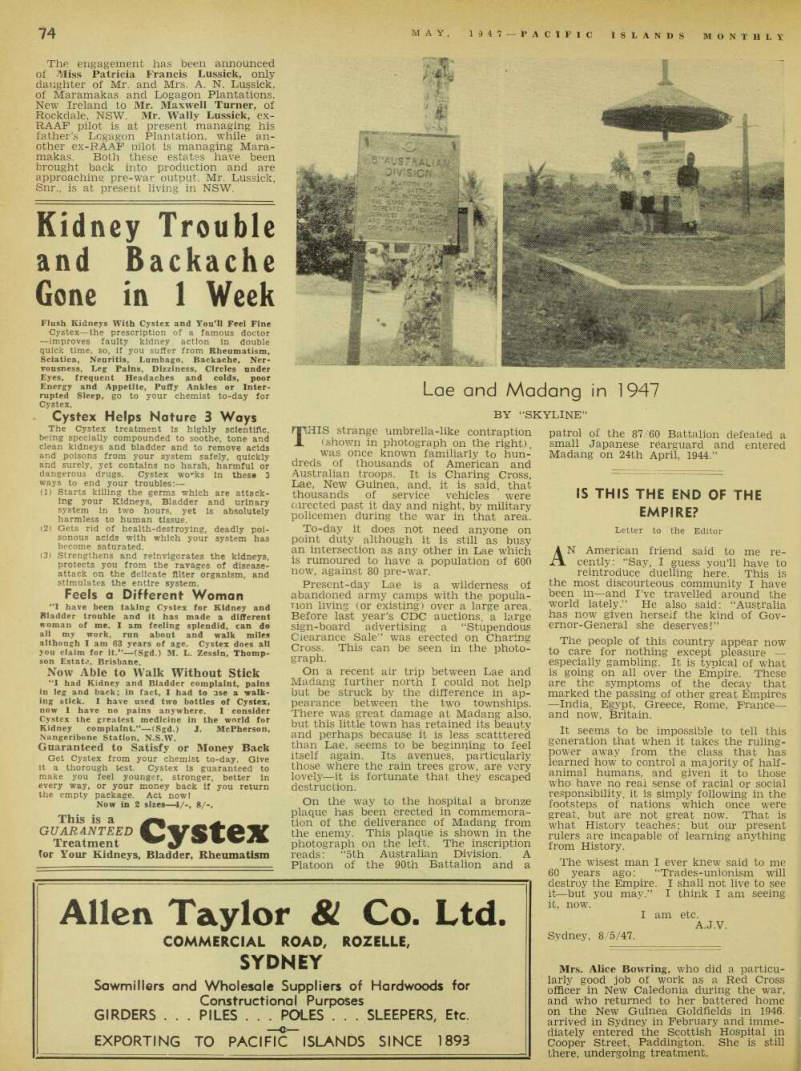
AVERY large number of ex-Fiji resi dents were present at Mrs. May Fenner’s birthday party at David Jones Store, Sydney, in April. Mrs.
Fenner is now 82. but none present there were younger in wit, vivacity and zest of living.
Mr. E. G. Upton, proposing the health of their guest, remarked on the popu larity and charm of the lady, which had held together so large a circle of friends over so many years. He caused a merry stir by reading extracts from a “Navua Minstrel and Variety Show” programme, dated 1904.
It was suggested to Major C. A. Swin bourne, president of the Pacific Islands Society, who was among the guests, that the “Kia Vitis” should join hands at the Society’s monthly meetings, and make Mrs. May Fenner “The Pin-up Girl of the Pacific”.
A painting by Western Samoan artist, Mr. Charles McPhee, was recently repro duced in the New Zealand publication “The Arts Year-Book, 1946.” The paint ing was a study of a Samoan woman.
The engagement has been announced of Miss Patricia Francis Lussick, only daughter of Mr. and Mrs. A. N. Lussick, of Maramakas and Logagon Plantations, New Ireland to Mr. Maxwell Turner, of Rockdale, NSW. Mr. Wally Lussick, ex- RAAF pilot is at present managing his father’s Logagon Plantation, while an other ex-RAAF nilot is managing Mara makas. Both these estates have been brought back into production and are approaching pre-war output. Mr. Lussick, Snr., is at present living in NSW.
Advertisements & other items, pp. 75-76 (1 item)
Rordage and
NEW GUINEA COFFEE PLANTA-
TION. Area about 400 acres, 120 acres planted with highclass Jamaica Blue Mountain coffee. Excellent investment.
Beautiful mountain climate. 11l health forcing sale. Principals only. Apply Box 982 GPO, Sydney.
SOUTH SEA FAITH
MISSION
15th Year. True to God’s word.
Your prayerful support appreciated. Help us to evangelise the unreached and neglected in the islands of the South Seas.
Rev. WILLIAM SWAAN
Secretary
SUVA, FIJI
Scott's “Renown” Brand Rope,
Rordage and
Binder
Twine
of Every
Description
Cable Address: Ropeyard Sydney.
MANUFACTURED AT
MASCOT, N.S.W.
By
J. SCOTT
PTY. LTD.
Head Office and Store
163 CLARENCE STREET,
SYDNEY,
N.S.W.
Kidney Trouble
and Backache
Gone in 1 Week
Flush Kidneys With Cystex and You’ll Feel Fine Cystex—the prescription of a famous doctor —improves faulty kidney action in double quick time, so, if you suffer from Rheumatism, Sciatica, Neuritis, Lumbago, Backache, Nervousness, Leg Pains, Dizziness, Circles under Eyes, frequent Headaches and colds, poor Energy and Appetite, Puffy Ankles or Interrupted Sleep, go to your chemist to-day for Cystex.
Cystex Helps Nature 3 Ways
The Cystex treatment is highly scientific, being specially compounded to soothe, tone and clean kidneys and bladder and to remove acids and poisons from your system safely, quickly and surely, yet contains no harsh, harmful or dangerous drugs. Cystex wo’-ks in these 3 ways to end your troubles:— (1) Starts killing the germs which are attacking your Kidneys, Bladder and urinary system in two hours, yet Is absolutely harmless to human tissue. (2) Gets rid of health-destroying, deadly poisonous acids with which your system has become saturated. (3) Strengthens and reinvigorates the kidneys, protects you from the ravages of diseaseattack on the delicate filter organism, and stimulates the entire system.
Feels a Different Woman
"I have been taking Cystex for Kidney and Bladder trouble and it has made a different woman of me. I am feeling splendid, can do all my work, run about and walk miles although 1 am 63 years of age. Cystex does all you claim for it.”—(Sgd.) M. L. Zessln, Thompson Estate, Brisbane.
Now Able to Walk Without Stick
“I had Kidney and Bladder complaint, pains in leg and back; in fact, I had to use a walking stick. I have used two bottles of Cystex, now 1 have no pains anywhere. 1 consider Cystex the greatest medicine in the world for Kidney complaint.”—(Sgd.) J. McPherson, Nangeribone Station, N.S.W.
Guaranteed to Satisfy or Money Back Get Cystex from your chemist to-day. Give it a thorough test. Cystex is guaranteed to make you feel younger, stronger, better in every way, or your money back if you return the empty package. Act now!
Now in 2 sizes—4/-, 8/-.
This is a
GUARANTEED I
Treatment W J
for Your Kidneys, Bladder, Rheumatism
Allen Taylor & Co. Ltd.
COMMERCIAL ROAD, ROZELLE,
SYDNEY
Sawmillers and Wholesale Suppliers of Hardwoods for Constructional Purposes GIRDERS . . . PILES . . . POLES . . . SLEEPERS, Etc.
EXPORTING TO PACIFIC ISLANDS SINCE 1893
Lae and Madang in 1947
By “Skyline"
THIS strange umbrella-like contraption
(shown in photograph on the right), was once known familiarly to hun dreds of thousands of American and Australian troops. It is Charing Cross.
Lae, New Guinea, and, it is said, that thousands of service vehicles were directed past it day and night, by military policemen during the war in that area.
To-day it does not need anyone on point duty although it is still as busy an intersection as any other in Lae which is rumoured to have a population of 600 now, against 80 pre-war.
Present-day Lae is a wilderness of abandoned army camps with the popula tion living (or existing) over a large area.
Before last year’s CDC auctions, a large sign-board advertising a “Stupendous Clearance Sale” was erected on Charing Cross. This can be seen in the photo graph.
On a recent air trip between Lae and Madang further north I could not help but be struck by the difference in ap pearance between the two townships.
There was great damage at Madang also, but this little town has retained its beauty and perhaps because it is less scatttered than Lae, seems to be beginning to feel itself again. Its avenues, particularly those where the rain trees grow, are very lovely—it is fortunate that they escaped destruction.
On the way to the hospital a bronze plaque has been erected in commemora tion of the deliverance of Madang from the enemy. This plaque is shown in the photograph on the left. The inscription reads: “sth Australian Division. A Platoon of the 90th Battalion and a
patrol of the 87/60 Battalion defeated a small Japanese rearguard and entered Madang on 24th April, 1944.”
Is This The End Of The
Empire?
Letter to the Editor AN American friend said to me re cently: “Say, I guess you’ll have to reintroduce duelling here. This is the most discourteous community I have been in—and I’ve travelled around the world lately.” He also said: “Australia has now given herself the kind of Gov ernor-General she deserves!”
The people of this country appear now to care for nothing except pleasure especially gambling. It is typical of what is going on all over the Empire. These are the symptoms of the decay that marked the passing of other great Empires —lndia, Egypt, Greece, Rome, France — and now, Britain.
It seems to be impossible to tell this generation that when it takes the ruling power away from the class that has learned how to control a majority of half animal humans, and given it to those who have no real sense of racial or social responsibility, it is simply following in the footsteps of nations which once were great, but are not great now. That is what History teaches; but our present rulers are incapable of learning anything from History, The wisest man I ever knew said to me 60 years ago: “Trades-unionism will destroy the Empire. I shall not live to see it—but you may.” I think I am seeing it, now.
I am etc.
A.J.V.
Sydney, 8/5/47.
Mrs. Alice Bowring-, who did a particu larly good job of work as a Red Cross officer in New Caledonia during the war, and who returned to her battered home on the New Guinea Goldfields in 1946. arrived in Sydney in February and imme diately entered the Scottish Hospital in Cooper Street, Paddington. She is still there, undergoing treatment.
Of N. Guinea Total 123
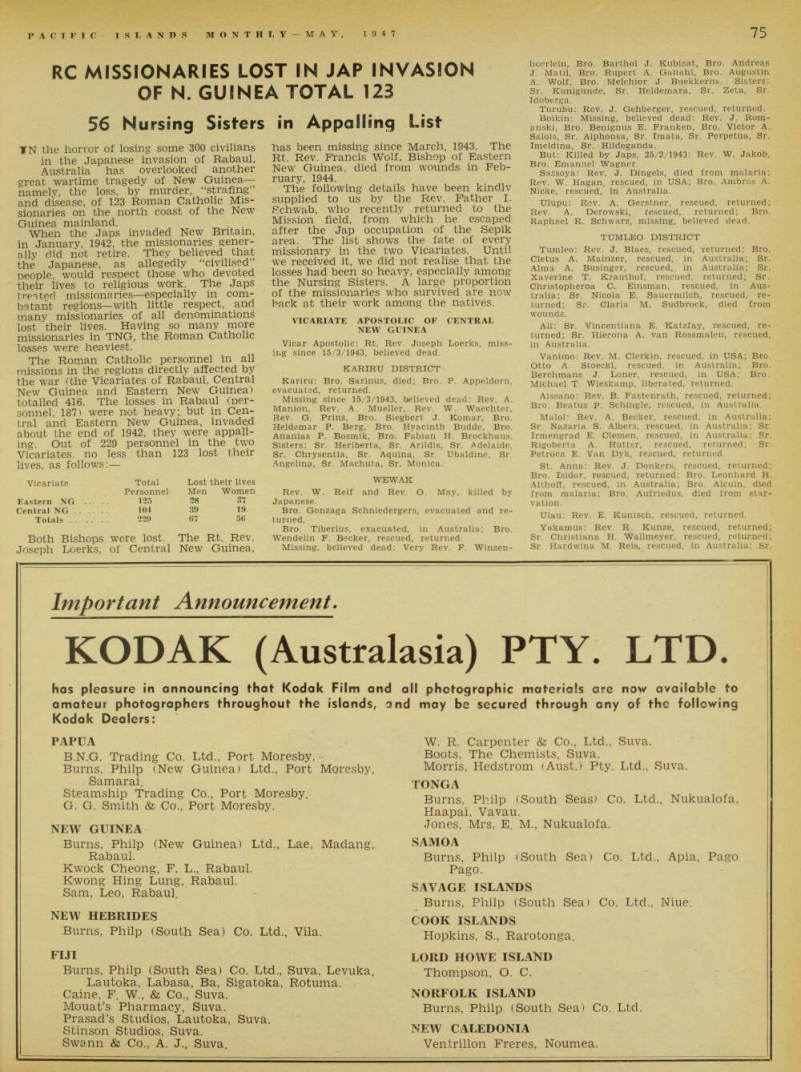
Rc Missionaries Lost In Jap Invasion
56 Nursing Sisters in Appalling List
TN the horror of losing some 300 civilians in the Japanese invasion of Rabaul, Australia has overlooked another great wartime tragedy of New Guinea— namely, the loss, by murder, “strafing” and disease, of 123 Roman Catholic Mis sionaries on the north coast of the New Guinea mainland.
When the Japs invaded New Britain, in January, 1942, the missionaries gener ally did not retire. They believed that the Japanese, as allegedly “civilised” people, would respect those who devoted their lives to religious work. The Japs treated missionaries—especially in com batant regions—with little respect, and many missionaries of all denominations lost their lives. Having so many more missionaries in TNG, the Roman Catholic losses were heaviest.
The Roman Catholic personnel in all missions in the regions directly affected by the war (the Vicariates of Rabaul, Central New Guinea and Eastern New Guinea) totalled 416. The losses in Rabaul (per sonnel, 187) were not heavy:, but in Cen tral and Eastern New Guinea, invaded about the end of 1942, they were appall ing. Out of 229 personnel in the two Vicariates, no less than 123 lost their lives, as follows:
Both Bishons were lost. The Rt. Rev.
Joseph Loerks, of Central New Guinea,
has been missing since March, 1943. The Rt. Rev. Francis Wolf, Bishop of Eastern New Guinea, died from wounds in Feb ruary, 1944.
The following details have been kindlv supplied to us by the Rev. Father I.
Schwab, who recently returned to the Mission field, from which he escaped after the Jap occupation of the Sepik area. The list shows the fate of every
missionary in the two Vicariates. Until
we received it, we did not realise that the losses had been so heavy, especially among
the Nursing Sisters. A large proportion
of the missionaries who survived are now back at their work among the natives.
Vicariate Apostolic Of Central
New Guinea
Vicar Apostolic: Rt. Rev. Joseph Loerks, miss ing since 15/3/1943, believed dead.
Kariru District
Kariru: Bro. Sarinus, died; Bro. P. Appeldorn, evacuated, returned.
Missing since 15/3/1943, believed dead: Rev. A.
Manion, Rev. A. Mueller, Rev W. Waechter.
Rev. G. Prinz, Bro. Siegbert J. Komar, Bro.
Heldemar P. Berg, Bro. Hyacinth Budde, Bro.
Ananias P. Bosmik, Bro. Fabian H. Brockhaus.
Sisters: Sr. Heriberta, Sr. Arildis, Sr. Adelaide, Sr. Chrysentia, Sr. Aquina, Sr. Übaldiive, Sr.
Angelina, Sr. Machuta, Sr. Monica.
Wewak
Rev. W. Reif and Rev. O. May, killed by Japanese.
Bro. Gonzaga Schniedergers, evacuated and re turned.
Bro. Tiberius, exacuated, in Australia; Bro.
Wendelin F. B-ecker, rescued, returned.
Missing, believed dead; Very Rev. F. Winzen
hoierlein, Bro. Barthol J. Kubizat, Bro. Andreas J. Matil. Bro. Rupert A. Ganahl, Bro. Augustin A. Wolf, Bro. Melchior J. Buekkerns. Sisters: Sr. Kunigunde, Sr. Heldemara, Sr. Zeta, Sr.
Idoberga.
Turubu: Rev. J. Gehberger, rescued, returned.
Boikin: Missing, believed dead: Rey. J. Rom anskl, Bro. Benignus E. Franken, Bro. Victor A.
Salois, Sr. Alphonsa, Sr. Imata, Sr. PerpetUa, Sr.
Imeldina, Sr. Hildeganda.
But: Killed by Japs, 25/2/1943: Rev. W. Jakob, Bro. Emanuel Wagner.
Sassoya: Rev. J. Dingels, died from malaria; Rev. W. Hagan, rescued, in USA; Bro. Ambros A.
Nicke, rescued,’ in Australia.
Ulupu: Rev. A. Gerstner, rescued, returned; Rev. A. Derowski, rescued, returned; Bro.
Raphael R. Schwarz, missing, believed dead.
Tumleo District
Tumleo: Rev. J. Blaes, rescued, returned; Bro.
Cletus A. Mainzer, rescued, in Australia; Sr.
Alma A. Businger, rescued, in Australia; Sr.
Xaverine T. Krauthof, rescued, returned; Sr.
Christopheroa C. Einsman, rescued, in Aus tralia; Sr. Nicola E. Sauermilch, rescued, re turned; Sr. Claria M. Sudbrock, died from wounds.
Ali: Sr. Vincentiana E. Katzfay, rescued, re turned; Sr. Hierona A. van Rossmalen, rescued, in Australia.
Vanimo: Rev. M. Clerkin, rescued, in USA; Bro.
Otto A Stoeckl, rescued, in Australia; Bro.
Berchmans J. Loner, rescued, in USA; Bro.
Michael T Wieskamp, liberated, returned.
Aissano: Rev. B. Fastenrath, rescued, returned; Bro. Beatus p. Schingle, rescued, in Australia.
Malol: Rev. A. Becker, rescued, in Australia: Sr. Nazaria S. Albers, rescued, in Australia: Sr.
Irmengrad E. Clemen, rescued, in Australia; Sr.
Rigoberta A. Hutter, rescued, returned: Sr.
Petroca E. Van Dyk, rescued, returned.
St. Anna; Rev. J. Donkers, rescued, returned; Bro. Isidor, rescued, returned; Bro. Leonhard H.
Althoff, rescued, in Australia; Bro. Alcuin, died from malaria; Bro. Aufriedus, died from star vation.
Ulau: Rev. E. Kunisch, rescued, returned.
Yakamus: Rev. R. Kunze, rescued, returned; Sr. Christiana H. Wallmeyer, rescued, returned; Sr. Hardwina M. Reis, rescued, in Australia; Sr.
Vicariate Total Lost their lives Personnel Men Women Eastern NG . . 125 28 37 Central NG 104 39 19 Totals 229 67 56
Monulpha van Sempen, rescued, returned; Sr.
Mathilda B. Quack, rescued, returned.
Sepik District
Marienberg: Missing, believed dead; Rev. G. de Bruyn, Rev. G. Bernd, Bro. Ephrem M. Pint, Bro.
Ansgar L. Warnke, died from unknown reason; Bro. Bonosus M. Neusius, evacuated, returned; Bro. Joseph, Bro. Cunibert, rescued, returned; Bro. Bogumil, evacuated, returned; Sr. Alena, Sr.
Antoniella, Sr. Vinciana, evacuated, in Australia; Sr. Auxilium, Sr. Arnoldine.
Kambot; Rev. I. Schwab, evacuated, returned; Rev. F. Jocham. evacuated, in Australia; Bro.
Seraphicus Schmale, evacuated, returned.
Kambrimdo: Rev. H. Meyer, missing, believed dead; Bro. Joachim Wassenberg, died from bayonet wounds; Rev. K. Krzemienski, evacuated, in Australia.
Timbunke: Rev. Ivo Schaefer, rescued, returned; Rev. K. Laumann, evacuated, returned; Bro.
Januarius S. Sliviak, rescued, returned.
Marui; Rev. A. Cruysberg, evacuated, returned; Rev. P. Hansen, missing, believed dead; Bro.
Cherubim Kaufmann, evacuated, returned.
Vicariate Apostolic Of Eastern
New Guinea
Rt. Rev. Bishop Francis Wolf, died from wounds, 23/2/19'44.
Alexishafen
Killed by “strafing”: Rev. J. Hoersch, Rev. H.
Luttmer, Rev. R. Baumert.
Rescued, returned: Rev. R. Jischke, Rev. J.
Noss, Rev. F. Wiesenthal.
Rescued, in Australia: Rev. W. Tropper.
Rescued, in Europe: Rev. P. Fuchs.
Evacuated, returned: Rt. Rev. Msgr. W. van Baar.
Killed, by “strafing”: Bro. Marcolinus J. Hoff mann, Bro. Baldomer, Bro. Lucidius L. Zimmer, Bro. Fabian H. Schroer, Bro. Symphorian A.
Suchsland, Bro. Jacobus van der Meer, Bro.
Jason W. Ziesl, Bro. Cornelius J. Wiedl, Bro.
Cleophas E. Dvorcak, Bro. Mathias Vos, Bro.
Mathias J. Seimetz, Bro. Metellus Hartman, Bro.
Aloysius Want, Bro. Syrus Strathen.
Died from malaria: Bro. Arbogast Fackler, Bro. Firmatus Weddeling, Bro. Beda Marx, Bro.
Bonfilius.
Died from exposure: Bro. Edelbert E. Wasner.
Rescued, in Australia: Bro. Otgerus K. Misch, Bro. Sylvester M. Scherm, Bro. Heribert J.
Stimmler, Bro. Bodo J. Hiller, Bro. Emmerich J.
Roderhoff, Bro. Gregor M. Zimmet.
Rescued, returned: Bro. Nyssenus G. Boeck, Bro. Gerhoch Eder, Bro. Aventin H. Holzbauer, Bro. Sylvester A. Litzenburger, Bro. Edelfried F, Pohl, Bro. Venantius F. Michelkenz, Bro.
Modestus J. Rasche, Bro. Emil J. Knuever, Bro.
Wenceslaus H. Klus.
Sisters: Died from malaria: Sr. Hedwig A.
Karzer, Sr. Godeberta van Boerden. Died from wounds: Sr. Gertraud A. Hennes, Sr. Dolorosia A. Ruholl, Sr. Domitiana G. Henricks.
Sisters killed by “strafing”: Sr. Imelda M.
Mueller, Sr. Constantine H. Kraemer, Sr. Fer dinanda M. Muendelein, Sr. Annetta A. Kinsman, Sr. Dionora Uhlenbrock, Sr. Deotilla Governeur!
Sr. Annakreszenz Wehinger, Sr. Isbalda Klein’
Sr. Hermengard Rossa, Sr. Theresildis Brandler’
Sr. Milita Schaefer, Sr. Barnaba Zirkel, Sr!
Matritia Haag, Sr. Rotrudis Tuppinger, Sr. Ber nareda Kuehn, Sr. Basiella Kammerer, Sr.
Emiliana Buerger, Sr. Festina Blank, Sr.
Gudalena Hebbing, Sr. Alquirina van Velze.
Rescued, in New Guinea: Sr. Eurista Lohmann Sr. Milreda Zeller.
Rescued, in Australia: Sr. Bathildis Hetz, Sr.
Biletrud Brand, Sr. Elreda Ruiter.
Sigu: Rev. R. Stefanski, rescued, returned.
Karkar: Rev. J. Tschauder, rescued, in Aus tralia; Bro. Abdon Beuers, rescued, in Australia.
Halopa: Rev. P. Ladener, rescued, returned.
Nake: Rev. R. Nowak, rescued, returned.
Utu: Rev. J. Felzman, killed by “strafing.”
Alexishafen District
Gumbi: Rev. A. Aufinger, evacuated, returned.
Wau: Rev. Glover, evacuated, returning.
Mugil: Rescued, returned: Rev. P. Hempel mann, Rev. W. Kemmerling, Bro. Serenus A.
Lindemann, Sr. Alexis B. Lederer. Rescued, in Australia: Sr. Siglinde M. Poboss. Died by “strafing”: Sr. Adulpha Ypelaar, Sr. Melasia Zoelsch.
Bogia District
Bogia: Rev. J. Schebesta, killed by “strafing”; Rev. J. Kotrba, missing, believed dead; Rev. W.
Schorr, rescued, returned; Bro. Chrys. Sawiecki, rescued, returned. Rescued, returned: Sr!
Arsenia Wild, Sr. Frances Bott, Sr. Nomitia Ebbing. Rescued, in Australia: Sr. Lisa Pie treck. Died, killed, by “strafing”; Sr. Egilberta Bertels.
Banara: Rev. W. Tranel, killed, by “strafing.”
Kayan: Rev. L. Meiser, rescued, in Australia.
Tangum: Rev. C. van Baar, evacuated, re turned; Bro. David Brunner, evacuated, returned.
Manam: Rev. K. Boehm, rescued, returned; Rev. K. Konen, killed by “strafing”. Rescued, returned: Sr. Ottonia M. Ruholl. Killed by “strafing”: Sr. Cunera Feiricks, Sr. Alberista Dirsch, Sr. Almaria Vorderwuelbecke, Sr. Gode berta van Boerden, Sr. Ehrentrudis Dietzen.
Ulingan: Rev. E. Van Baar, rescued, returned; Rev. L. Mey, rescued, in Australia. Killed by “strafing”: Sr. Valentine Steinkeller, Sr. Loyo lina Teufel, Sr. Theophane Mayer, Sr. Teo doriana Hallerbach.
Annaberg, Ramu: Rev. A. Kasprus, evacuated, in Australia.
Atemble, Ramu; Rev. J. Ziegler, evacuated, re turned; Bro. Elpidius Malcharek, evacuated, re turned.
Bismarck Mountain And Mount Hagen
District
Bundi: Rev. J. Much, evacuated, returned, Bro. Priscill, evacuated, in Australia.
Denglagu: Rev. J. Nilles, evacuated, in Aus tralia; Bro. Bonaventura, evacuated, in Aus tralia.
Mingende: Evacuated, returned: Rev. A.
Schaefer, Rev. J. Kueppers, Rev. H. Aufen anger. Evacuated, in Australia: Bro. Sym machus.
Mount Hagen: Evacuated, returned: Rev. W.
Ross, Rev. G. Bernarding.
Advertisements & other items, pp. 77-78 (1 item)
KODAK (Australasia) PTY. LTD.
Important Announcement.
has pleasure in announcing that Kodak Film and amateur photographers throughout the islands, a Kodak Dealers:
PAPUA
B.N.G. Trading Co. Ltd., Port Moresby.
Burns, Philp (New Guinea) Ltd., Port Moresby, Samarai, Steamship Trading Co., Port Moresby.
G. G. Smith & Co., Port Moresby.
NEW GUINEA
Burns, Philp (New Guinea) Ltd., Lae, Madang, Rabaul.
Kwock Cheong, F. L., Rabaul.
Kwong King Lung, Rabaul.
Sam, Leo, Rabaul.
NEW HEBRIDES
Burns, Philp (South Sea) Co. Ltd., Vila.
FIJI
Burns, Philp (South Sea) Co. Ltd., Suva, Levuka, Laufoka, Labasa, Ba, Sigatoka, Rotuma.
Caine, F. W., & Co., Suva.
Mouat’s Pharmacy, Suva.
Prasad’s Studios, Lautoka, Suva.
Stinson Studios, Suva.
Swann & Co., A. J., Suva. all photographic materials are now available to nd may be secured through any of the following W. R. Carpenter & Co., Ltd., Suva.
Boots, The Chemists, Suva.
Morris, Hedstrom (Aust.) Pty. Ltd., Suva.
TONGA
Burns, Philp (South Seas) Co. Ltd., Nukualofa Haapai, Vavau.
Jones, Mrs. E. M., Nukualofa.
SAMOA
Burns, Philp (South Sea) Co. Ltd., Apia, Pago Pago.
SAVAGE ISLANDS
Burns, Philp (South Sea) Co. Ltd., Niue.
COOK ISLANDS
Hopkins, S., Rarotonga.
LORD HOWE ISLAND
Thompson, O. C.
NORFOLK ISLAND
Burns, Philp (South Sea) Co. Ltd.
NEW CALEDONIA
Ventrillon Freres, Noumea.
Refreshing
as a plunge
into a lagoon!
CI0 AL
r« OA p
Germicidal
and fragrant
TENAX TOILET SOAP is
a rapid safeguard against external skin infections, yet it is soothing and kind to the most sensitive skin —even a baby’s!
ORDER TENAX FROM
YOUR ISLAND SUP-
PLIERS. STOCKS ARE
PLENTIFULLY AVAIL-
ABLE.
jndisp
for
aerodromes
and other large .
drawiMby & a tractor** * j Sily be , cnt w,th » Eansomes Quintuple Mower ab?e This prnirln i a ” d eve “ l^ger outfits up to 25 ft wide are avallpensable to all ™n*fr n c . apac,ty “akes Ransomes Gang Mowers Indlsqulring frequent cutting “wifh^oTh 8 ’ sport * « r ? unds 1 ’ etc - re " be kept in such good condUi™. ° ther machine coald these lar^e areas Sizes: Triple 7 ft.. Quintuple 11% ft., Septuple lo ft., up to 11 units—2s ft. wide. Also a sulky mower 30 in. wide for hilly land.
Tumsomes
GANG MOWERS
RANSOMES, SIMS & JEFFERIES, LTD. Ipswich, England.
We Illustrate our standard machine.
For longer grass and heavier work, we offer the “ Magna - Gang ” pattern.
Illustrated catalogue showing a complete range of hand, animal draught and motor lawn mowers will be sent on application.
MORRIS,
HEDSTROM, LTD.,
Suva, Lantoka and Ba.
Pacific Islands Society
VIVID descriptions of little-known parts of Australia were heard by members of the Pacific Islands Society, Syd ney, in April, when Mr. C. Price Coni grave, secretary of the Royal Historical Society, was guest speaker.
Among the newly joined members present were Mr. and Mrs. Hubert Sabben, and Messrs. R. P. Swinbourne and Claude Israel; whilst the visitors included Mr and Mrs. N. B. Casey, Mr. and Mrs. O H Stan ley, Mr. and Mrs. Nigel Kingsmill, Mrs.
R. F. Swinbourne, Mrs. Walker-Flynn, Mrs. Beasley and Messrs. Colahan, Mose ley and Vaskess, Jnr.
The next meeting and social gathering will be held at History House, 8 Young Street, Sydney, on the evening of Wed nesday, May 28. The president Major C. A. Swinbourne (XU 2505) or the Hon.
Secretary, Mrs. E. Marie Irvine (FM 3143) will furnish particulars to anyone who may desire to attend or become a mem ber of the Society.
The Future Of
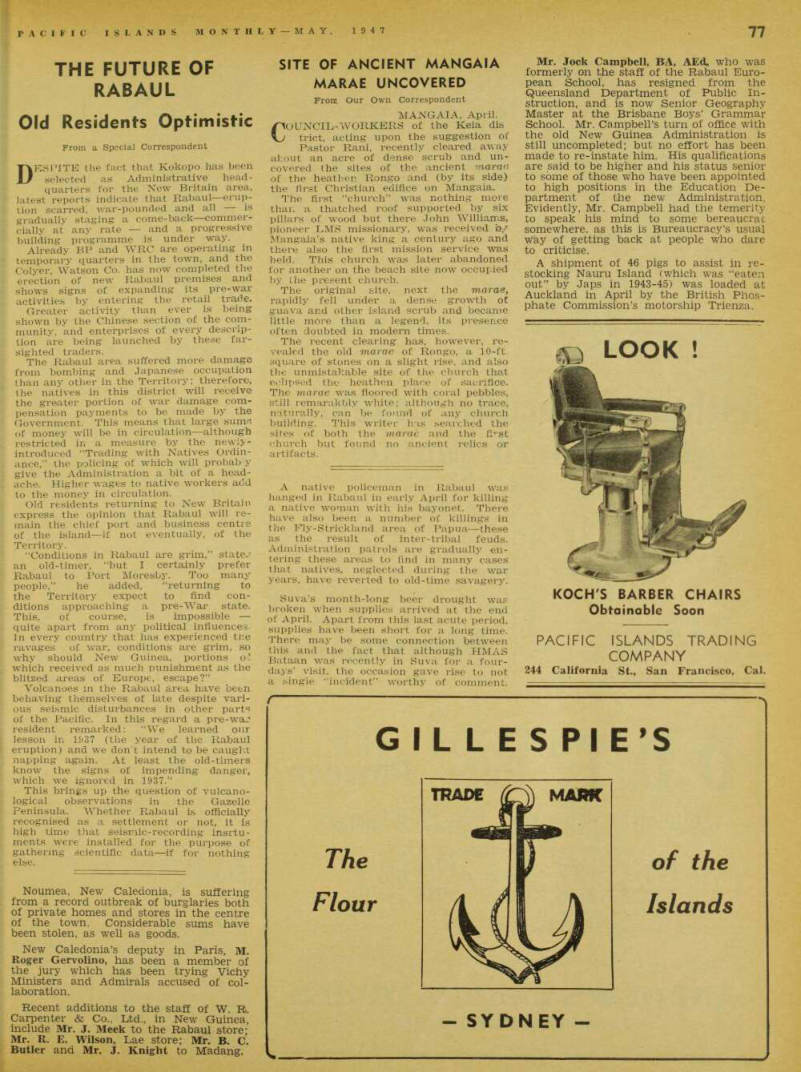
Rabaul
Old Residents Optimistic
From a Special Correspondent DESPITE the fact that Kokopo has been selected as Administrative head quarters for the New Britain area, latest reports indicate that Rabaul —eruption scarred, war-pounded and all is gradually staging a come-back —commercially at any rate and a progressive building programme is under way.
Already BP and WRC are operating in temporary quarters in the town, and the Colyer, Watson Co. has now completed the erection of new Rabaul premises and shows signs of expanding its pre-war activities by entering the retail trade.
Greater activity than ever is being shown by the Chinese section of the com munity, and enterprises of every descrip tion are being launched by these far sighted traders.
The Rabaul area suffered more damage from bombing and Japanese occupation than any other in the Territory: therefore, the natives in this district will receive the greater portion of war damage com pensation payments to be made by the Government. This means that large sumfl of money will be in circulation —although restricted in a measure by the newly introduced “Trading with Natives Ordin ance,” the policing of which will probab y give the Administration a bit of a head ache. Higher wages to native workers add to the money in circulation.
Old residents returning to New Britain express the opinion that Rabaul will re main the chief port and business centre of the island —if not eventually, of the Territory.
“Conditions in Rabaul are grim,” stater an old-timer, “but I certainly prefer Rabaul to Port Moresby. Too many people,” he added, “returning to the Territory expect to find con ditions approaching a pre-War state.
This, of course, is impossible quite apart from any political influences In every country that has experienced the ravages of war, conditions are grim, so why should New Guinea, portions o’ which received as much punishment as the blitzed areas of Europe, escape?”
Volcanoes in the Rabaul area have been behaving themselves of late despite vari ous seismic disturbances in other parts of the Pacific. In this regard a pre-waj* resident remarked: “We learned our lesson in 1937 (the year of the Rabaul eruption) and we don't intend to be caught napping again. At least the old-timers know the signs of impending danger, which we ignored in 1937.”
This brings up the question of vulcano logical observations in the Gazelle Peninsula. Whether Rabaul is officially recognised as a settlement or not, it is high time that seismic-recording insrtu ments were installed for the purpose of gathering scientific data —if for nothing else.
Noumea, New Caledonia, is suffering from a record outbreak of burglaries both of private homes and stores in the centre of the town. Considerable sums have been stolen, as well as goods.
New Caledonia’s deputy in Paris, M.
Roger Gervolino, has been a member of the jury which has been trying Vichy Ministers and Admirals accused of col laboration.
Recent additions to the staff of W. R.
Carpenter & Co., Ltd., in New Guinea, include Mr. J. Meek to the Rabaul store; Mr. R. E. Wilson, Lae store; Mr. B. C.
Butler and Mr. J. Knight to Madang.
Site Of Ancient Mangaia
Marae Uncovered
From Our Own Correspondent MANGAIA, April.
Council-workers of the Keia dis trict, acting upon the suggestion of Pastor Rani, recently cleared away about an acre of dense scrub and un covered the sites of the ancient marae of the heathen Rongo and (by its side) the first Christian edifice on Mangaia.
The first “church” was nothing more than a thatched roof supported by six pillars of wood but there John Williams, pioneer LMS missionary, was received by Mangaia’s native king a century ago and there also the first mission service was held. This church was later abandoned for another on the beach site now occupied by the px’esent church.
The original site, next the marae, rapidly fell under a dense growth of guava and other island scrub and became little more than a legend, its presence often doubted in modern times.
The recent clearing has, however, re vealed the old marae of Rongo, a 10-ft square of stones on a slight rise, and also the unmistakable site of the church that eclipsed the heathen place of sacrifice.
The marae was floored with coral pebbles, still remarakbly white; although no trace, naturally, can be found of any church building. This writer has searched the sites of both the marae and the first church but found no ancient relics or artifacts.
A native policeman in Rabaul was hanged in Rabaul in early April for killing a native woman with his bayonet. There have also been a number of killings in the Fly-Strickland area of Papua—these as the result of inter-tribal feuds.
Administration patrols are gradually en tering these areas to find in many cases that natives, neglected during the war years, have reverted to old-time savagery.
Suva’s month-long beer drought was broken when supplies arrived at the end of April. Apart from this last acute period, supplies have been short for a long time.
There may be some connection between this and the fact that although HMAS Bataan was recently in Suva for a four days’ visit, the occasion gave rise to not a single “incident” worthy of comment.
Mr. Jock Campbell, BA, AEd, who was formerly on the staff of the Rabaul Euro pean School, has resigned from the Queensland Department of Public In struction, and is now Senior Geography Master at the Brisbane Boys’ Grammar School. Mr. Campbell’s turn of office with the old New Guinea Administration is still uncompleted; but no effort has been made to re-instate him. His qualifications are said to be higher and his status senior to some of those who have been appointed to high positions in the Education De partment of the new Administration.
Evidently, Mr. Campbell had the temerity to speak his mind to some bereaucrac somewhere, as this is Bureaucracy’s usual way of getting back at people who dare to criticise.
A shipment of 46 pigs to assist in re stocking Nauru Island (which was “eaten out” by Japs in 1943-45) was loaded at Auckland in April by the British Phos phate Commission’s motorship Trienza.
Mrs. W. Cameron was a passenger on the “Malaita” when it left Sydney on April 24, for New Guinea. With her two children, she will rejoin her husband in Edie Creek.
Advertisements & other items, pp. 79-80 (1 item)
Gillespie’S
LOOK !
c
KOCH'S BARBER CHAIRS
Obtainable Soon
PACIFIC ISLANDS TRADING
COMPANY
244 California St., San Francisco, Cal.
GILLESPIE’S
The Flour
TRADE
MARK
- SYDNEY -
of the Islands
Stamps Penfriends Hobbies
The only club of its kind in the Islands Established in 1933 Members throughout the Islands, all British Colonies, and in almost every country in the world Correspond with interesting people who will be glad to send you illustrated newspapers and magazines, stamps or any other item.
Send for specimen copy of Club Journal, “ISLAND LIFE,” published quarterly.
We need an official representative in every Island of the South Seas.
Write for particulars.
SOUTH SEA ISLANDS CORRESPOND-
ENCE CLUB, NATUVU, FIJI
Asthma, Bronchitis Coughing, Curbed in 3 Minutes
spasms first night and he has had none since in over two years.
Money Back Guarantee
The very first dose of Mendaco goes right to work circulating through your blood and helping nature relieve you of the effects of Asthma. Try Mendaco under an iron-clad money back gaurantee. You be the judge. If you don’t feel fully satisfied after taking Mehdaco just return the empty package and the full purchase price will be refunded. Get Mendaco from your chemist to-day and see how well you sleep to-night and how much better you feel to-morrow. The guarantee protect/
RELIEVES ASTHMA
Mendaco
Now in 2 sizes . . . 6/- and 12/-
Do you have attacks of Asthma or Bronchitis so bad that you can’t sleep? Do you feel weak, unable to work, and have to be careful not to take cold and can’t eat certain foods?
No matter how long you have suffered or what you have tried, there is new hope for you in a doctor’s prescription called Mendaco.
No dopes, no smokes, no injections, no atomizer.
All you do is take two tasteless tablets at meals and in 3 minutes Mendaco starts working through your blood, aiding nature to remove phlegm, promote free easy breathing and bring sound sleep the first night, so that you soon feel years younger and stronger.
No Asthma in 2 Years
Mendaco not only brings almost Immediate comfort and free breathing but builds up the system to ward off future attacks. For Instance, J. Richards, Hamilton, Ont., Canada, had lost 40 lbs., suffered coughing every night, couldn't sleep. Mendaco stopped Asthma
. Pure Powder
(Minimum 80 per cent. Para Para Isomer) 1 lb. Packing ... 10/6 per lb. 7 lb. Packing ... 9/9 per lb.
PACKED AND POSTED
Prices for Larger Quantities, and Directions for Use on Application.
ANDREWS LABORATORIES
15 HAMILTON STREET, SYDNEY
D.D.T
Papua-NG
Here and There in Papua-NG
mHE Curator of Intestate Estates at J. Port Moresby (Mr. G. T. Wells) will, unless proof or good reason to the contrary is shown, distribute the estate of the late J. W. Belfleld, better known as Alf Belfield. It appears the deceased, who died on the Sepik, in January, 1941, executed a will in 1928, then later made another one at Karawop in February, 1938, revoking all previous wills. The last will cannot be found. The estate is shown as worth £1,200. * * * Mr. H. L. Clark has been appointed official liquidator of the Bay Loo Com pany Ltd., of Rabaul. * * * A “notification of vacancy” for a Cadet Agriculturist was advertised in the “Papua-New Guinea Gazette” of March 31, 1947. The applications were required to reach the Department of External Ter
ritories, Canberra by April 4, 1947. Four days seems to be cutting things a bit fine, considering the postal service up there.
The “Trading with Natives Ordinance, 1946” came into effect on May 1, 1947, and is a piece of legal machinery with which every person trading with natives should be acquainted. * * * Applications were invited by the Acting Government Secretary (Mr. R. Melrose) in a March issue of the Government Gazette, for a Postmaster at Rabaul and Mining Registrar at Wau. Salaries started at £462 and £4OB respectively. * * * All employers of native labour in Papua or New Guinea, prior to June 15, 1942, are requested by the Government Secre tary, to consult District Officers before making any payment of wages on ac count of pre-war contracts. * * * M. J. Healy and P. J. Mollison have been gazetted Acting District Officer Grade 2, and J. J. Murphy is to be Acting Assistant District Officer. * * * The following Warden’s Courts have been established for the various goldfields in the Territory: Garoka, for the Upper Purari goldfield, Central Highlands; Kavieng, for the Tugi Tugi field, New Ireland; See Adler Harbour, for the Manus mineral field; Madang, for the Madang mineral field; Rabaul, for the Talele goldfield, New Britain; Sohana Island, for the Kieta goldfield; Wau, for the Morobe goldfield; Wewak, for the Sepik goldfield. District Officers of the respective districts will act as Wardens, with the exception of Wau court, where Mr. O. P. Blanden has been appointed Warden. * * * The pay for non-European members of the Royal Papuan Constabulary starts at £1 a month for constables for the first year, increasing to 30/- in the third year.
Lance Corporals receive 40/-, Corporals 45/-, Sergeants 70/- and Sergeant Majors from 105/- to 200/-. These rates apply to those in the general branch of the ser vice. For members employed as clerks, carpenters, mechanics and drivers there are certain extra allowances, ranging from 55/- to 200/- a month. * * * The Papua-New Guinea Administration is advertising for an operator-compositor and a compositor for the Government printing works.
Fruit From Islands
A CONSIGNMENT of 16,000 cases of oranges from the Cook Islands ar rived in Auckland with the Govern ment motor-vessel “Maui Pomare” on April 24. The “Maui Pomare” was com pleting her first round voyage to the Cook Group since she had a lengthly refit in Auckland.
At the Empire ball which will be held in Sydney on May 22, to raise funds for the rebuilding of the Victoria League headquarters in London, 22 young girls will make their debut. Mrs. Alice Allen Innes will be presenting her daughter Heather (who as mentioned elsewhere in this issue is Queen of Suva in a competition to raise funds for the same purpose), Miss Suzanne Kinsmill, and he cousin Miss Jill Rea. Miss Kinsmill, is a grand daughter of the Livingstones of Fiji and Miss Rea is in Sydney on a visit from Fiji.
Fiji's TB Campaign
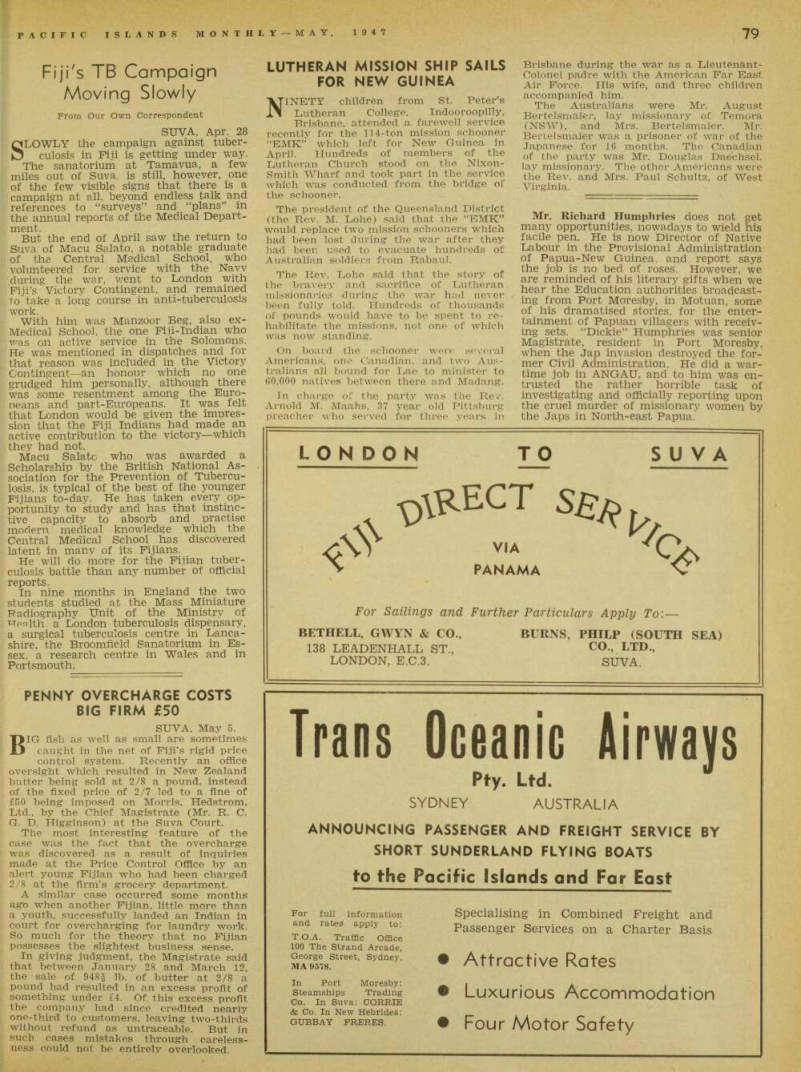
Moving Slowly
From Our Own Correspondent
Suva, Apr. 28
SLOWLY the campaign against tuber culosis in Fiii is getting under way.
The sanatorium at Tamavua, a few miles out of Suva, is still, however, one of the few visible signs that there is a campaign at all, beyond endless talk and references to “surveys” and “plans” in the annual reports of the Medical Depart ment.
But the end of April saw the return to Suva of Macu Salato, a notable graduate of the Central Medical School, who volunteered for service with the Navv during the war, went to London with Fiji’s Victory Contingent, and remained to'take a long course in anti-tuberculosis work.
With him was Manzoor Beg, also ex- Medical School, the one Fiji-Indian who was on active service in the Solomons.
He was mentioned in dispatches and for that reason was included in the Victory Contingent—an honour which no one grudged him personally, although there was some resentment among the Euro peans and part-Europeans. It was felt that London would be given the impres sion that the Fiji Indians had made an active contribution to the victory—which they had not.
Macu Salatc who was awarded a Scholarship bv the British National As sociation for the Prevention of Tubercu losis, is typical of the best of the younger Fijians to-day. He has taken every op portunity to study and has that instinc tive capacity to absorb and practise modern medical knowledge which the Central Medical School has discovered latent in many of its Fijians.
He will do more for the Fijian tuber culosis battle than any number of official reports.
In nine months in England the two students studied at the Mass Miniature Radiography Unit of the Ministry of wealth, a London tuberculosis dispensary, a surgical tuberculosis centre in Lanca shire, the Broomfield Sanatorium in Es sex, a research centre in Wales and in Portsmouth.
Penny Overcharge Costs
Big Firm £50
Suva, May 5.
BIG fish as well as small are sometimes caught in the net of Fiji’s rigid price control system. Recently an office oversight which resulted in New Zealand butter being sold at 2/8 a pound, instead of the fixed price of 2/7 led to a fine of £5O being imposed on Morris, Hedstrom, Ltd., by the Chief Magistrate (Mr. R. C.
G. D. Higginson) at the Suva Court.
The most interesting feature of the case was the fact that the overcharge was discovered as a result of inquiries made at the Price Control Office by an alert young Fijian who had been charged 2/8 at the firm’s grocery department.
A similar case occurred some months ago when another Fijian, little more than a youth, successfully landed an Indian in court for overcharging for laundry work.
So much for the theory that no Fijian possesses the slightest business sense.
In giving judgment, the Magistrate said that between January 28 and March 12, the sale of 9481 lb. of butter at 2/8 a pound had resulted in an excess profit of something under £4. Of this excess profit the company had since credited nearly one-third to customers, leaving two-thirds without refund as untraceable. But in such cases mistakes through careless ness could not be entirely overlooked.
Lutheran Mission Ship Sails
For New Guinea
NINETY children from St. Peter’s Lutheran College, Indooroopilly, Brisbane, attended a farewell service recently for the 114-ton mission schooner “EMK" which left for New Guinea in April. Hundreds of members of the Lutheran Church stood on the Nixon- Smith Wharf and took part in the service which was conducted from the bridge of the schooner.
The president of the Queensland District (the Rev. M. Lohe) said that the “EMK” would replace tw'o mission schooners which had been lost during the war after they had been used to evacuate hundreds of Australian soldiers from Rabaul.
The Rev. Lohe said that the story of the bravery and sacrifice of Lutheran missionaries during the war had never been fully told. Hundreds of thousands of pounds would have to be spent to re habilitate the missions, not one of which was now standing.
On board the schooner were several Americans, one Canadian, and two Aus tralians all bound for Lae to minister to 60,000 natives between there and Madang.
In charge of the party was the Rev.
Arnold M. Maahs, 37 year old Pittsburg preacher who served for three years in
Brisbane during the war as a Lieutenant- Colonel padre with the American Far East Air Force. His wife, and three children accompanied him.
The Australians were Mr. August Bertelsrnaier, lay missionary of Temora (NSW), and Mrs. Bertelsrnaier. Mr.
Bertelsrnaier was a prisoner of war of the Japanese for 16 months. The Canadian of the party was Mr. Douglas Daechsel, lay missionary. The other Americans were the Rev. and Mrs. Paul Schultz, of West Virginia.
Mr. Richard Humphries does not get many opportunities, nowadays to wield his facile pen. He is now Director of Native Labour in the Provisional Administration of Papua-New Guinea, and report says the job is no bed of roses. However, we are reminded of his literary gifts when we hear the Education authorities broadcast ing from Port Moresby, in Motuan, some of his dramatised stories, for the enter tainment of Papuan villagers with receiv ing sets. “Dickie” Humphries was senior Magistrate, resident in Port Moresby, when the Jap invasion destroyed the for mer Civil Administration. He did a war time job in ANGAU, and to him was en trusted the rather horrible task of investigating and officially reporting upon the cruel murder of missionary women by the Japs in North-east Papua.
Advertisements & other items, p. 81 (1 item)
Trans Oceanic Airways
LONDON TO SUVA
. ECT
v,a
> PANAMA V
For Sailings and Further Particulars Apply To:— BETHELL, GWYN & CO., BURNS, PHILP (SOUTH SEA)
138 LEADENHALL ST., CO., LTD.,
LONDON, E.C.3. SUVA
Trans Oceanic Airways
Pty. Ltd. J
SYDNEY AUSTRALIA
ANNOUNCING PASSENGER AND FREIGHT SERVICE BY
SHORT SUNDERLAND FLYING BOATS
to the Pacific Islands and Far East Specialising in Combined Freight and Passenger Services on a Charter Basis
• Attractive Rates
• Luxurious Accommodation
• Four Motor Safety
For full information and rates apply to: T.O.A. Traffic Office 100 The Strand Arcade, George Street, Sydney.
MA 9578.
In Port Moresby: Steamships Trading Co. In Suva: CORRIE & Co. In New Hebrides:
GUBBAY FRERES.
Islands Produce
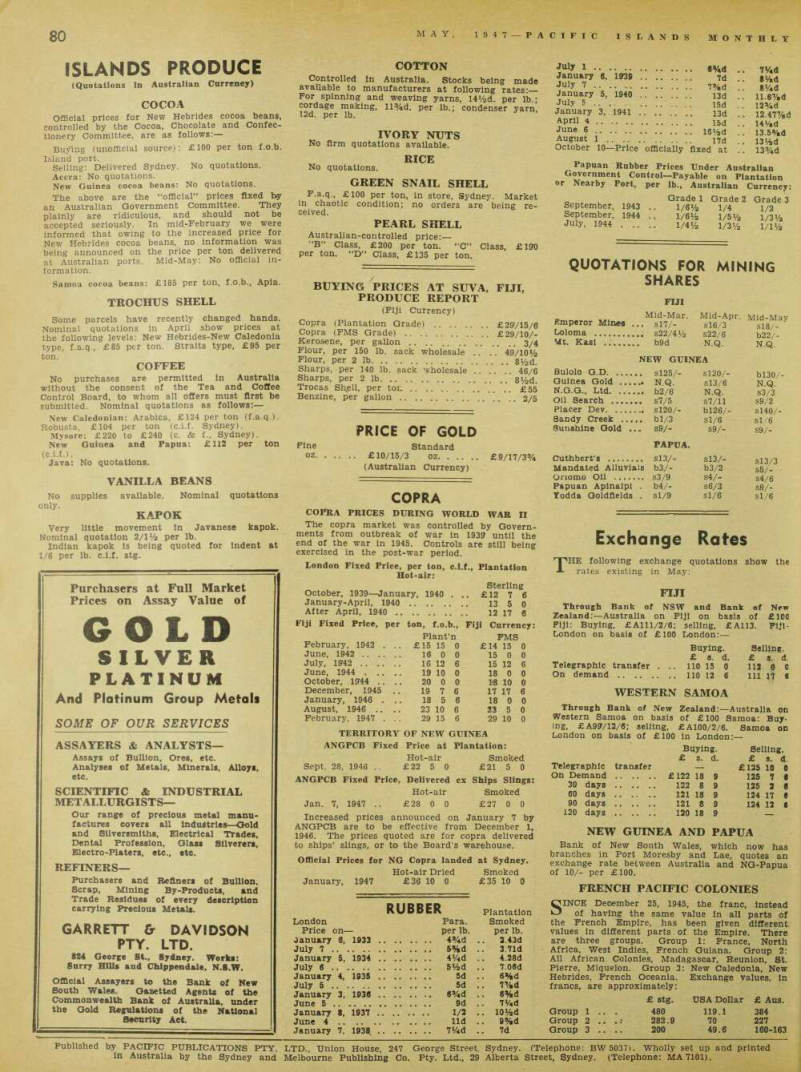
(Quotations in Australian Currency)
Cocoa
Official prices for New Hebrides cocoa beans, controlled by the Cocoa, Chocolate and Confec tionery Committee, are as follows: — Buying (unofficial source): £lOO per ton f.o.b.
Island port.
Selling: Delivered Sydney. No quotations.
Accra: No quotations.
New Guinea cocoa beans: No quotations.
The above are the “official” prices fixed by an Australian Government Committee. They plainly are ridiculous, and should not be accepted seriously. In mid-February we were informed that owing to the increased price for New Hebrides cocoa beans, no information was being announced on the price per ton delivered at Australian ports. Mid-May: No official in formation.
Samoa cocoa beans: £lB5 per ton, f.0.b., Apia.
Trochus Shell
Some parcels have recently changed hands.
Nominal quotations in April show prices at the following levels: New Hebrides-New Caledonia type, f.a.q., £B5 per ton. Straits type, £95 per ton.
Coffee
No purchases are permitted in Australia without the consent of the Tea and Coffee Control Board, to whom all offers must first be submitted. Nominal quotations as follows: New Caledonian: Arabica, £124 per ton (f.a.q.).
Robusta, £lO4 per ton (c.i.f. Sydney).
Mysore: £220 to £240 (c. & f., Sydney).
New Guinea and Papua: £ll2 per ton (c.i.f.).
Java; No quotations.
Vanilla Beans
No supplies available. Nominal quotations only.
Kapok
Very little movement In Javanese kapok.
Nominal quotation 2/1 Vi per lb.
Indian kapok is being quoted for Indent at 1/6 per lb. c.i.f. stg.
Cotton
Controlled in Australia. Stocks being made available to manufacturers at following rates;— For spinning and weaving yarns, 14Vid. per lb.; cordage making, ll%d. per lb.; condenser yarn 12d. per lb.
Ivory Nuts
No firm quotations available.
Rice
No quotations.
Green Snail Shell
F.a.q., £lOO per ton, in store, Sydney. Market in chaotic condition; no orders are being re ceived.
Pearl Shell
Australian-controlled price:— "B” Class, £2OO per ton. “C” Class, £l9O per ton. “D” Class, £135 per ton.
Buying Prices At Suva, Fiji,
Produce Report
(Fiji Currency) Copra (Plantation Grade) £29/15/6 Copra (PMS Grade) £29/10/- Kerosene, per gallon 3/4 Flour, per 150 lb. sack wholesale .. .. 49/10Vi Flour, per 2 lb BVid.
Sharps, per 140 lb. sack wholesale .. .. .. 46/6 Sharps, per 2 lb BVid.
Trocas Shjell, per ton £55 Benzine, per gallon ’. .. 2/5
Advertisements & other items, p. 82 (1 item)
Price Of Gold
Pine Standard oz. . .. £9/17/3% (Australian Currency)
Copra
Prices During World War Ii
The copra market was controlled by Govern ments from outbreak of war in 1939 until the end of the war in 1945. Controls are still being exercised in the post-war period.
London Fixed Price, per ton, c.i.f., Plantation Hot-air:
Territory Of New Guinea
ANGPCB Fixed Price at Plantation:
ANGPCB Fixed Price, Delivered ex Ships Slings:
Increased prices announced on January 7 by ANGPCB are to be effective from December 1, 1946. The prices quoted are for copra delivered to ships’ slings, or to the Board’s warehouse.
Official Prices for NG Copra landed at Sydney.
October, 1939—January, 1940 Sterling .. £12 7 6 January-April, 1940 13 5 0 After April, 1940 .. 12 17 6 Fiji Fixed Price, per ton, f.o.b., Fiji Currency: Plant’n
Fms
February, 1942 . .. £15 15 0 £14 15 0 June, 1942 16 0 0 15 0 0 July. 1942 16 12 6 15 12 6 June, 1944 19 10 0 18 0 0 October, 1944 .. 20 0 0 1-8 10 0 December, 1945 .. 19 7 6 17 17 6 January, 1946 . .. 18 5 6 18 0 0 August, 1946 .. 23 10 6 23 5 0 February. 1947 . .. 29 15 6 29 10 0
Hot-air Smoked Sept. 28, 1946 .. £22 5 0 £21 5 0
Hot-air Smoked Jan. 7, 1947 .. £28 0 0 £27 0 0
Hot-air Dried Smoked January, 1947 £36 10 0 £35 10 0
Rubber
Papuan Rubber Prices Under Australian Government Control—Payable on Plantation or Nearby Port, per lb., Australian Currency:
Plantation
London Para.
Smoked Price onper lb. per lb.
January 3. 1933 .. .. 2.43d July 7 . .. .. 6%d 3.71d January 5, 1934 .. .. ... 4V«d 4.28d July 6 . 7.08d January 4. 1935 .. .. ... 5d 6%d July 5 . ... 5d 7%d January 3. 1933 .. .. 6%d June 5 , ... 9d 7V 4 d January 8, 1937 .. .. ... 1/2 .. lOVid June 4 .. .. lid 9%d January 7. 1938 .. .. ... 7Vid 7d
1 6%d .. 7V«d January 8. IWfl 7d gy. d -J ul y 7 7%d .. gy 4 d January 5, 1940 13d .. u.8%d Jul y 5 15d .. I2%d January 3. 1941 13d .. I2.47%d A pril * 15d .. 14Vsd •* une ® 16V 2 d .. 13.5»/.d August 1 17d .. 13Vid October 10 — Price officially fixed at .. 13 3 / 4 d
Grade 1 Grade 2 Grade 3 September, 1943 . 1/6 Vi 1/4 1/2 September, 1944 . 1/6% 1/5 y 2 1/3 V a July, 1944 . .. . 1/4 Va 1/3% 1/1 Va
Quotations For Mining
Shares
Fiji
Emperor Mines .
Mid-Mar. .. s!7/- Mid-Apr.
S16/3 Mid-May s!8/- Loloma s22/6 b22/- Mt. KasI . b9d N.Q.
Ie A
New Guijs
N.Q Bulolo Q.D .. s!25/- S120/b!30/- Guinea Gold ... ... N.Q.
S13/6 N.Q.
N.G.G., Ltd N.Q.
S3/3 Oil Search s7/5 S7/11 b!26/s9/2 s!40/- Placer Dev Sandy Creek ... sl/6 sl/6 Sunshine Gold . .. s9/-
Papua.
S9/s9/- Cuthbert’s s!3/- S13/3 Mandated Alluvlals b3/b3/2 s5/- Onomo Oil ... s4/s4/6 Papuan Aplnalpl . M/s6/3 s9/- Yodda Goldfields . sl/9 sl/6 sl/6
Exchange Rates
THE following exchange quotations show the rates existing in May:
Fiji
Through Bank of NSW and Bank of New Zealand: —Australia on FIJI on basis of £IOC Fiji: Buying, £Alll/2/6: selling, £AII3. FIJI - on basis of £lOO London;—
Western Samoa
Through Bank of New Zealand:—Australia on Western Samoa on basis of £lOO Samoa: Buy ing, £ A99/12/6; selling, £AIOO/2/6. Samoa on London on basis of £lOO in London:—
New Guinea And Papua
Bank of New South Wales, which now has branches in Port Moresby and Lae, quotes an exchange rate between Australia and NG-Papua of 10/- per £lOO.
French Pacific Colonies
SINCE December 25, 1945, the franc, Instead of having the same value In all parts of the French Empire, has been given different values in different parts of the Empire, There are three groups. Group 1: Prance, North Africa, West Indies, French Guiana. Group 2: All African Colonies, Madagascar, Reunion, St.
Pierre, Miquelon. Group 3: New Caledonia, New Hebrides, French Oceania. Exchange values, in francs, are approximately:
Buying. Selling. £ s. d. £ s. d.
Telegraphic transfer ... 110 15 0 11J 0 C On demand 110 12 6 111 17 6
Buying.
Selling. £ s. d. £ s. d.
Telegraphic transfer £ 125 10 0 On Demand ,, . . ,, £122 18 9 125 7 e 30 days 122 8 9 125 2 0 60 days 121 18 9 124 17 « 90 days 121 8 9 124 12 e 120 days 120 18 9 —
£ stg. USA Dollar £ Aus.
Group 1 . 480 119.1 384 Group 2 .. .? 282.9 70 227 Group 3 .. .. 200 49.6 160-163
Advertisements & other items, pp. 82-84 (3 items)
80
MAY, 1947-PACIFIC ISLANDS MONTHLY
Published by PACIFIC PUBLICATIONS PTY. LTD., Union House, 247 George Street, Sydney. (Telephone: BW 5037). Wholly set up and printed in Australia by the Sydney and Melbourne Publishing Co. Pty. Ltd., 29 Alberta Street, Sydney. (Telephone: MA7101).
Gold
Purchasers at Full Market Prices on Assay Value of
SILVER
PLATINUM
And Platinum Group Metals
SOME OF OUR SERVICES
ASSAYERS & ANALYSTS—
Assays of Bullion, Ores, etc.
Analyses of Metals, Minerals, Alloys, etc.
SCIENTIFIC & INDUSTRIAL
METALLURGISTS—
Our range of precious metal manufactures covers all industries—Gold and Silversmiths, Electrical Trades, Dental Profession, Glass Silverers, Electro-Platers, etc., etc.
REFINERS—
Purchasers and Refiners of Bullion, Scrap, Mining By-Products, and Trade Residues of every description carrying Precious Metals.
GARRETT & DAVIDSON
PTY. LTD.
824 George St., Sydney. Works: Sorry Hills and Chippendale, N.B.W.
Official Assayers to the Bank of New South Wales. Gazetted Agents of the Commonwealth Bank of Australia, under the Gold Regulations of the National Security Act.
tropical thirst...
To quench a
bodtf drinks
I
fvertf
OP r Hfi 72s f When you’re hot and tired, there is nothing quite so satisfying and thirst quenching as a long, cold glass of Your friends and guests, too, will appreciate this really fine Lager, for “Everybody drinks K.B.’*
TOOTH'S
LAGER
MERCHANTS
& P SH
OWNERS
Capital £1,000,000
ESTABLISHED 1914
COPRA MERCHANTS & MILLERS
BRANCHES THROUGHOUT THE PACIFIC ISLANDS
REGULAR CARGO
PACIFIC
w.
Head Office:
AND PASSENGER
ISLAND PORTS
SERVICE BETWEEN EUROPE AND
WAS ESTABLISHED BY
R. CARPENTER & CO. LTD.
16 O'CONNELL STREET,
SYDNEY.
Cable Address:
CAMOHE.
Telephone: BW 4421.
Postal Address: P.O. Box No. 168, Sydney.