Pacific
Islands
Monthly
April 19, 1947
Vol. Xvii. No. 9
Established 1930.
I Registered at 4k for transmission Toy post as a newspaper ]
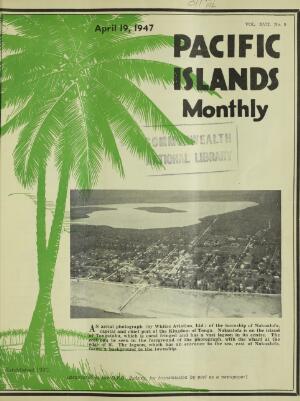
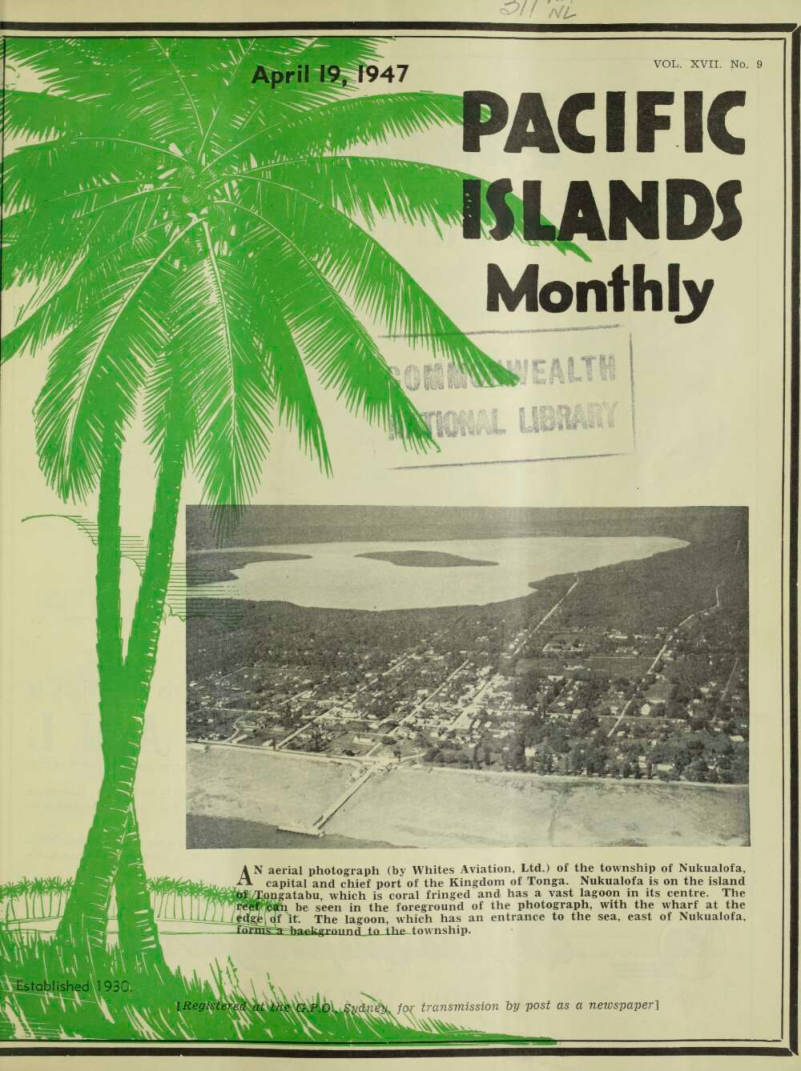
AN aerial photograph (by Whites Aviation, Ltd.) of the township of Nukualofa, capital and chief port of the Kingdom of Tonga. Nukualofa is on the island of Tongatabu, which is coral fringed and has a vast lagoon in its centre. The reef can be seen in the foreground of the photograph, with the wharf at the edge, of it. The lagoon, which has an entrance to the sea, east of Nukualofa, forms a background to the township.
Advertisements & other items, pp. 2-4 (1 item)
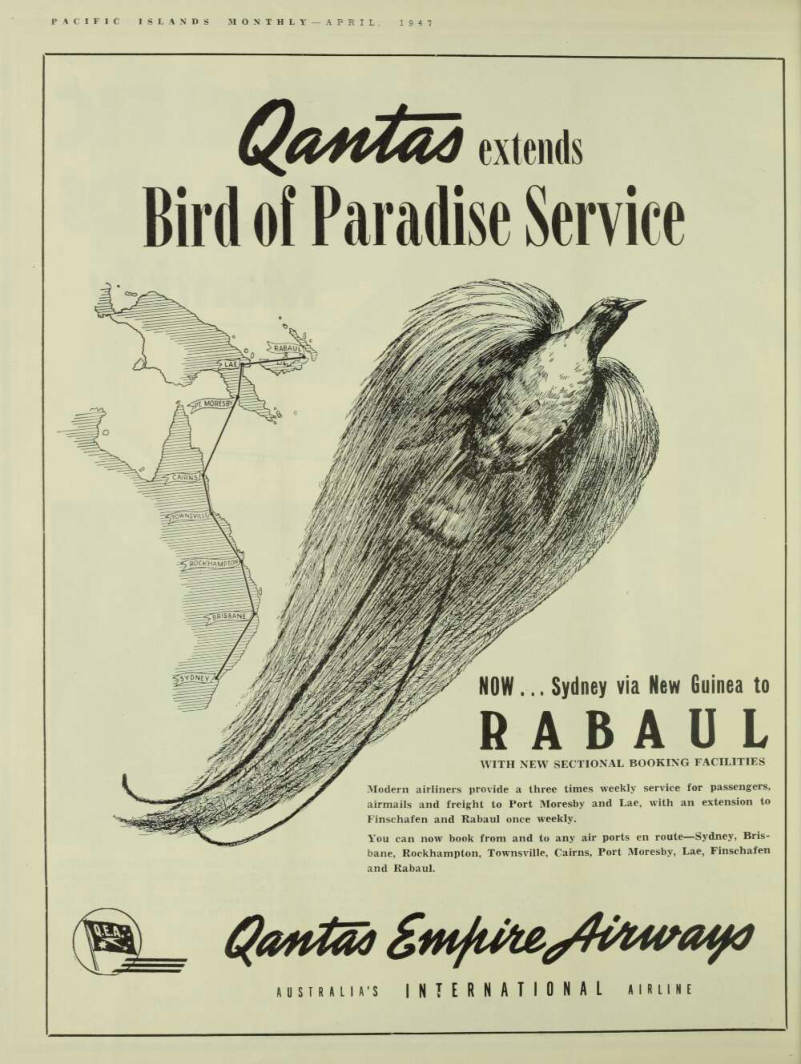
Qcmta/i
extends
Bird of Paradise Service
R ABACI i.
LAE
% MORESBY,
% c i m J'i
BRISBANE
SYDNEY
NOW... Sydney via New Guinea to
RAB A 0 L
WITH NEW SECTIONAL BOOKING FACILITIES
Modern airliners provide a three times weekly service for passengers, airmails and freight to Port Moresby and Lae, with an extension to Finschafen and Rabaul once weekly.
You can now book from and to any air ports en route —Sydney, Brisbane, Rockhampton, Townsville, Cairns, Port Moresby, Lae, Finschafen and Rabaul.
AUSTRALIA’S INTERNATIONAL airline
ifvv IRONS PEP
PERFECTLY
Coleman’s Petrol and Kerosene Lamps in 300 and 500 C.P.
Coleman’s Kerosene Table Lamp can be used as hanging Lamp Coleman’s Petrol or Kerosene Lamp with large enamelled reflector. * w 5* It took 40 ycors' intensive specialisation to bring the Coleman Petrol Iron to its present state of perfection. Coleman
Irons require no preheating, they light
instantly and con be used either indoors or outdoors.
The ventilated body prevents sides from scorching light fabrics and the ventilated lid keeps the handle cool.
Tapered edge for ironing pleats and around buttons.
Pointed heel gives wrinkle-proof ironing on back and forward strokes.
Built-in cleaning needle, cleans gas - tip automatically, without turning off iron and also regulates heat.
Representatives for the Pacific islands: ROBERT GILLESPIE PTY. LTD. pearce £ V a C 0 ltd 540 PITT STREET, SYDNEY FOR FIJI ISLANDS
mm It •l
hat
w ES MB P* tM
of o
Cwtel^S
“Save the pennies and the pounds will look after themselves.” Save the teeth and the smile will look after itself.
Children cannot be taught too early the value of a thorough brushing of the teeth with IPANA Tooth Paste. Even the first “baby” teeth should be cared for
IPANA
in this way, because on their health depends the formation of “second” teeth.
Brush the teeth with IPANA after every meal, using a medium soft brush.
Let the brush overlap the gums about an eighth of an inch so that all pockets and crevices are reached . . . and brush with a circular movement.
IPANA Tooth Paste is designed not only to make the teeth white and brilliant, but also to stimulate the gums to healthy action.
TOOTH PASTE
Advertisers
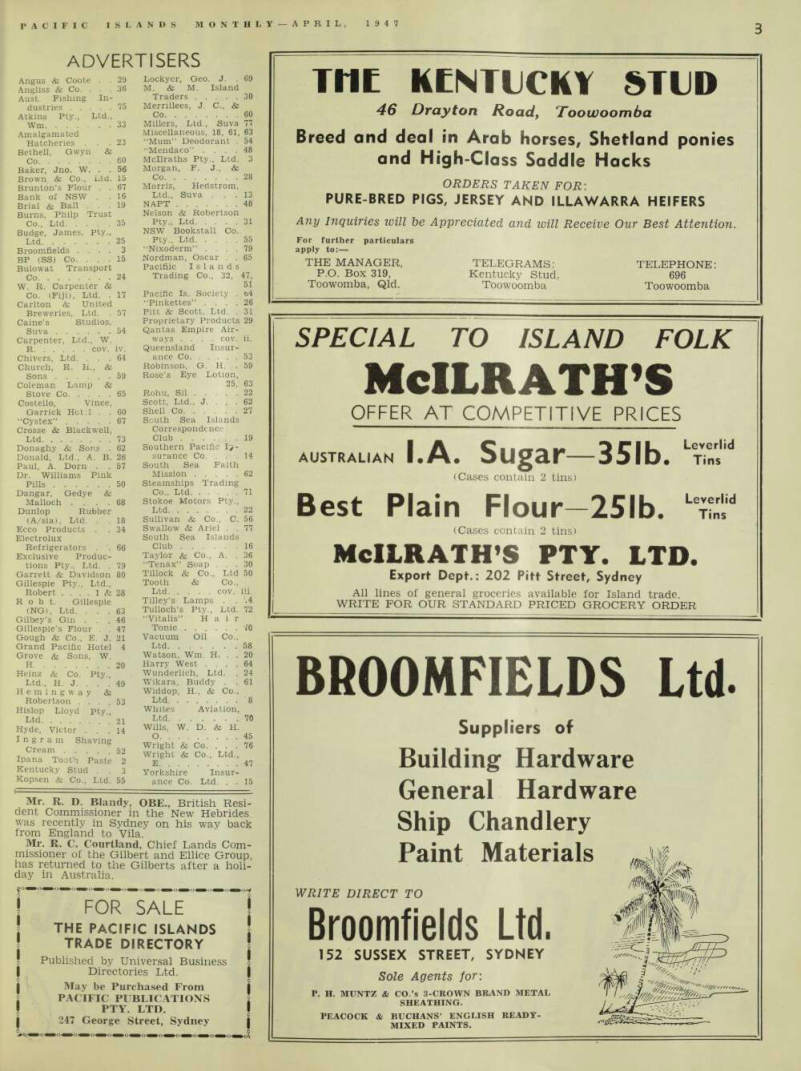
Angus & Coote . . 29 Angliss & Co. ... 36 Aust. Fishing In dustries 75 Atkins Pty., Ltd., Wm 33 Amalgamated Hatcheries ... 23 Bethell, Gwyn & Co 60 Baker, Jno. W. . .56 Brown & Co., Ltd. 15 Brunton’s Flour . . 67 Bank of NSW . . 16 Brial & Ball ... 19 Burns, Philp Trust Co., Ltd 35 Budge, James, Pty., Ltd 25 Broomfields ... 3 BP (SS) Co. . . . 15 Bulowat Transport Co 24 W. R. Carpenter & Co. (Fiji), Ltd. . 17 Carlton & United Breweries, Ltd. . 57 Caine’s Studios, Suva 54 Carpenter, Ltd., W.
R cov. iv.
Chivers, Ltd. ... 64 Church, R. H., & Sons 59 Coleman Lamp & Stove Co 65 Costello, Vince, Garrick Hot;l . . 60 “Cystex” 67 Crosse & Blackwell, Ltd 73 Donaghy & Sons . 62 Donald, Ltd., A. B. 26 Paul, A. Dorn . . 57 Dr. Williams Pink Pills 50 Dangar, Gedye & Malloch ... 68 Dunlop Rubber (A/sia), Ltd. . . 18 Ecco Products . . 34 Electrolux Refrigerators . . 66 Exclusive Produc tions Pty., Ltd. . 79 Garrett & Davidson 80 Gillespie Pty., Ltd., Robert ... 1 & 28 R o b t. Gillespie (NG), Ltd. ... 63 Gilbey’s Gin ... 46 Gillespie’s Flour . . 47 Gough & Co., E. J. 21 Grand Pacific Hotel 4 Grove & Sons, W.
H 20 Heinz & Co. Pty., Ltd., H. J. . . .49 Hemingway & Robertson ... 53 Hislop Lloyd Pty., Ltd 21 Hyde, Victor ... 14 Ingram Shaving Cream 52 Ipana Tooth Paste 2 Kentucky Stud . . 3 Kopsen & Co., Ltd. 55
Lockyer, Geo. J. . 69 M. & M. Island Traders 30 Merrillees, J. C., & Co 60 Millers, Ltd., Suva 77 Miscellaneous, 18, 61, 63 “Mum” Deodorant . 54 “Mendaco” ... 48 Mcllraths Pty., Ltd. 3 Morgan, F. J., & Co 28 Morris, Hedstrom, Ltd., Suva ... 13
Napt 48
Nelson & Robertson Pty., Ltd 31 NSW Bookstall Co.
Pty., Ltd 55 “Nixoderm” ... 79 Nordman, Oscar . . 65 Pacifiic Islands Trading Co., 32, 47, 51 Pacific Is. Society . b 4 “Pinkettes” ... 26 Pitt & Scott, Ltd. . 31 Proprietary Products 29 Qantas Empire Air ways ... cov. ii.
Queensland Insur ance Co 53 Robinson, G. H. . 59 Rose’s Eye Lotion, 25, 63 Rohu, Sil 22 Scott, Ltd.. J. ... 62 Shell Co 27 South Sea Islands Correspondence Club 19 Southern Pacific In surance Co. ... 14 South Sea Faith Mission 62 Steamships Trading Co., Ltd 71 Stokoe Motors Pty., Ltd 22 Sullivan & Co.. C. 56 Swallow & Ariel . . 77 South Sea Islands Club 16 Taylor & Co., A. . 36 “Tenax” Soap ... 30 Tillock & Co., Ltd 50 Tooth & Co., Ltd cov. iii.
Tilley’s Lamps . . .4 Tulloch’s Pty., Ltd. 72 “Vitalis” Hair Tonic 70 Vacuum Oil Co., Ltd 58 Watson, Wm. H. . . 20 Harry West ... 64 Wunderlich, Ltd. . 24 Wikara, Buddy . . 61 Widdop, H., & Co., Ltd 8 Whites Aviation, Ltd 70 Wills, W. D. & H. 0 45 Wright & Co. ... 76 Wright & Co., Ltd., E 47 Yorkshire Insur ance Co. Ltd. . . 15
Mr. R. D. Blandy, QBE., British Resi dent Commissioner in the New Hebrides was recently in Sydney on his way back from England to Vila.
Mr. R. C. Courtland, Chief Lands Com missioner of the Gilbert and Ellice Group, has returned to the Gilberts after a holi day in Australia.
Advertisements & other items, p. 5 (1 item)
Broompields Ltd.
HIE KENTUCKY STUD
46 Drayton Road, Toowoomba
Breed and deal in Arab horses, Shetland ponies
and High-Class Saddle Hacks
ORDERS TAKEN FOR :
PURE BRED PIGS, JERSEY AND ILLAWARRA HEIFERS Any Inquiries will be Appreciated and will Receive Our Best Attention.
For further particulars apply to:—
THE MANAGER, TELEGRAMS: TELEPHONE:
P.O. Box 319, Kentucky Stud, 696 Toowomba, Qld. Toowoomba Toowoomba
SPECIAL TO ISLAND FOLK
McILRATH’S
OFFER AT COMPETITIVE PRICES
AUSTRALIAN I.A. Sugar—3slb. L %£ ii
(Cases contain 2 tins)
Best Plain Flour-251b. L< S“
(Cases contain 2 tins)
McILRATH’S PTY. LTD.
Export Dept.: 202 Pitt Street, Sydney All lines of general groceries available for Island trade.
WRITE FOR OUR STANDARD PRICED GROCERY ORDER
BROOMPIELDS Ltd.
Suppliers of
Building Hardware
General Hardware
Ship Chandlery
Paint Materials
WRITE DIRECT TO
Broomfields Ltd.
152 SUSSEX STREET, SYDNEY
Sole Agents for: P. H, MUNTZ & CO.’s 3-CROWN BRAND METAL
SHEATHING.
PEACOCK & BUCHANS’ ENGLISH READY-
MIXED PAINTS.
FOR SALE
THE PACIFIC ISLANDS
TRADE DIRECTORY
Published by Universal Business Directories Ltd.
May be Purchased From
PACIFIC PUBLICATIONS
PTY. LTD.
247 George Street, Sydney
In This Issue:
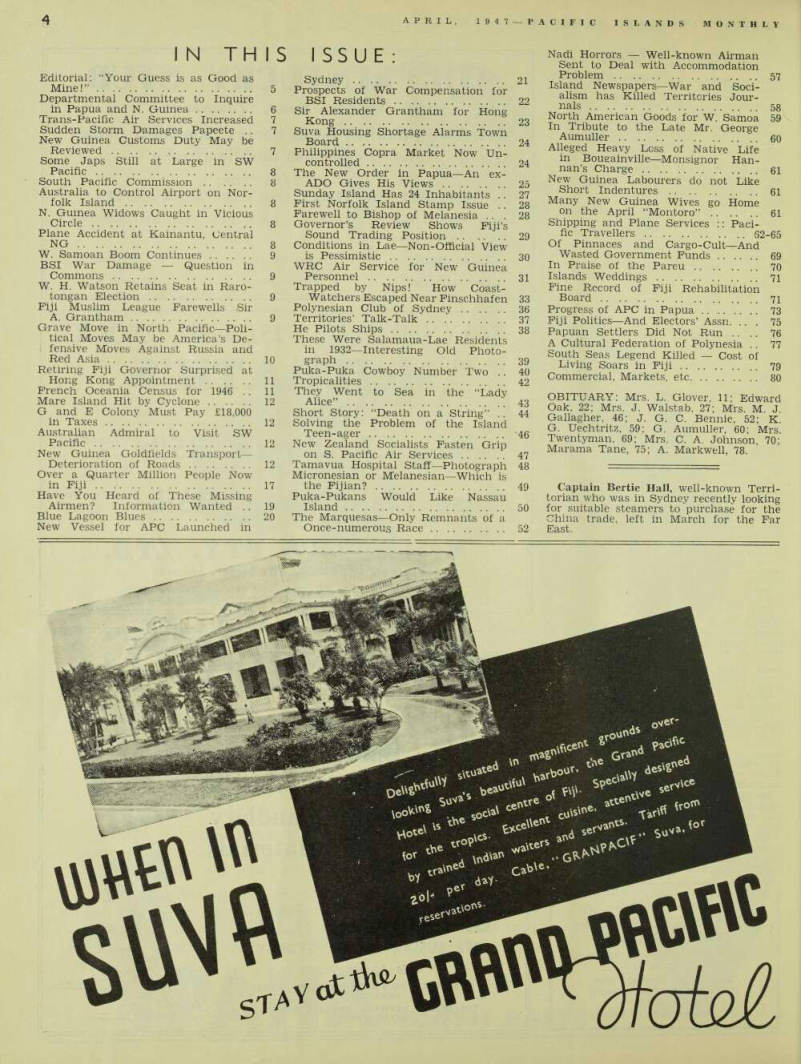
Editorial: “Your Guess is as Good as Mine!” 5 Departmental Committee to Inquire in Papua and N. Guinea 6 Trans-Pacific Air Services Increased 7 Sudden Storm Damages Papeete .. 7 New Guinea Customs Duty May be Reviewed 7 Some Japs Still at Large in SW Pacific 8 South Pacific Commission 8 Australia to Control Airport on Nor folk Island 8 N. Guinea Widows Caught in Vicious Circle 8 Plane Accident at Kainantu, Central NG 8 W. Samoan Boom Continues 9 BSI War Damage Question in Commons 9 W. H. Watson Retains Seat in Raro tongan Election 9 Fiji Muslim League Farewells Sir A. Grantham 9 Grave Move in North Pacific —Political Moves May be America’s De fensive Moves Against Russia and Red Asia 10 Retiring Fiji Governor Surprised at Hong Kong Appointment 11 French Oceania Census for 1946 .. 11 Mare Island Hit by Cyclone 12 G and E Colony Must Pay £lB,OOO in Taxes 12 Australian Admiral to Visit SW Pacific 12 New Guinea Goldfields Transport— Deterioration of Roads 12 Over a Quarter Million People Now in Fiji 17 Have You Heard of These Missing Airmen? Information Wanted .. 19 Blue Lagoon Blues 20 New Vessel for APC Launched in
Sydney 21 Prospects of War Compensation for BSI Residents 22 Sir Alexander Grantham for Hong Kong 23 Suva Housing Shortage Alarms Town Board 24 Philippines Copra Market Now Un controlled . 24 The New Order in Papua—An ex- ADO Gives His Views 25 Sunday Island Has 24 Inhabitants .. 27 First Norfolk Island Stamp Issue .. 28 Farewell to Bishop of Melanesia ... 28 Governor’s Review Shows Fiji’s Sound Trading Position 29 Conditions in Lae—Non-Official View is Pessimistic 30 WRC Air Service for New Guinea Personnel 31 Trapped by Nips! How Coast- Watchers Escaped Near Finschhafen 33 Polynesian Club of Sydney 36 Territories’ Talk-Talk 37 He Pilots Ships 38 These Were Salamaua-Lae Residents in 1932—Interesting Old Photo graph 39 Puka-Puka Cowboy Number Two .. 40 Tropicalities 42 They Went to Sea in the “Lady Alice” 43 Short Story; “Death on a String” .. 44 Solving the Problem of the Island Teen-ager 46 New Zealand Socialists Fasten Grip on S. Pacific Air Services 47 Tamavua Hospital Staff—Photograph 48 Micronesian or Melanesian—Which is the Fijian? 49 Puka-Pukans Would Like Nassau Island 50 The Marquesas—Only Remnants of a Once-numerous Race 52
Nadi Horrors Well-known Airman Sent to Deal with Accommodation Problem 57 Island Newspapers—War and Soci alism has Killed Territories Jour nals 58 North American Goods for W. Samoa 59 In Tribute to the Late Mr. George Aumuller 60 Alleged Heavy Loss of Native Life in Bougainville—Monsignor Han nan’s Charge 61 New Guinea Labourers do not Like Short Indentures 61 Many New Guinea Wives go Home on the April “Montoro” 61 Shipping and Plane Services :: Paci fic Travellers Q 2-65 Of Pinnaces and Cargo-Cult—And Wasted Government Funds 69 In Praise of the Pareu 70 Islands Weddings 71 Fine Record of Fiji Rehabilitation Board 71 Progress of APC in Papua 73 Fiji Politics—And Electors’ Assn. ... 75 Papuan Settlers Did Not Run ... 76 A Cultural Federation of Polynesia .. 77 South Seas Legend Killed Cost of Living Soars in Fiji 79 Commercial, Markets, etc 80 OBITUARY; Mrs. L. Glover, 11; Edward Oak, 22; Mrs. J. Walstab, 27; Mrs. M. J Gallagher, 46; J. G. C. Bennie, 52; K.
G. Uechtritz, 59; G. Aumuller, 60; Mrs.
Twentyman, 69; Mrs. C. A. Johnson 70; Marama Tane, 75; A. Markwell, 78.
Captain Bertie Hall, well-known Terri torian who was in Sydney recently looking for suitable steamers to purchase for the China trade, left in March for the Far East.
Advertisements & other items, p. 6 (1 item)
s taV<**"
•'* « ns ,
I
i| . £ over-
*ceot ff*** j**c
.„ **#"'' . , Gr^ d j lW *»* r bo° r ’ * ~w V*™ - s *-»** 0 < **• S? 6 Jwe -* S C socw' ° >**%,« *- ' S ,cs. *»«**"* d „. Cab ' C ’
t*i* per s
re*' 1 ** 0 " '
Pacific Islands Monthly
The Newspaper-Magazine of the South Seas
[Registered at the G.P.0., Sydney, for transmission by post as a newspaper.] Published Once Each Month and Circulated in Australia and New Zealand and in the following Pacific Territories and Islands Groups:
Australian Territory of Papua.
Mandated Territory (Australia) of New Guinea.
Australian Territory of Norfolk Island.
New Zealand Territory of Cook Islands.
Mandated Territory (NZ) of Western Samoa.
British Colony of FIJI.
British Solomon Islands Protectorate.
British Protectorate of Tongan Islands.
British Crown Colony of Gilbert and Ellice Islands.
Mandated Territory of Nauru.
British and Free French Condominium oi Hebrides.
French Colony of New Caledonia.
French Colony of Oceania (Tahiti, etc.).
American Territory of Eastern Samoa.
American Territory of Hawaiian Islands.
Owned and Produced by Pacific Publications Pty. Ltd., Union House, 247 George Street, Sydney.
Vol, XVII. No. 9
April 19, 1947
PnVp 1/3 Per Copy r i u-c Prepaid: 10/- p.a.
Your Guess Is As Good
As Mine
A World Review By R. W. Robson
rpHE events of recent weeks prob i ably have changed the course of world history. Some people think that they mean that World War lll— which will come eventually, and which will be an “ideological war”— is almost upon us. However, your guess is as good as mine. Here are the background, and the facts: form your own conclusions!
The Background
WORLD War I was fought between Great Powers who were seeking world power, world conquest, world trade. When it was over, the Em pires of Germany, Austria-Hungary, Turkey and Russia were in the dust.
The victors, to prevent a recur rence of World Wars, formed the League of Nations. The League was hamstrung, from the beginning, by the absence of United States, gone “isolationist,” and Russia, writhing like a tortured giant in the pangs of revolutionary re-birth.
Individualism, the system of un fettered Private Enterprise, had won; and it abandoned itself to a 20years’ orgy of money-making. An efficient League could have placed the necessary shackles upon Big Business; and could have wisely con trolled and guided the fantastic sociological developments in the re born Germany and Russia.
But the League was a mere cipher; Britain, United States and France surrendered themselves to money power, in the shape of international combines and cartels; a gang of clever adventurers fastened a Com munist State upon stupid, semi literate Russia; and the Fascists of Italy and the Nazis of Germany came rapidly to full blooming.
The Depression was the result of greedy and uncontrolled over-pro duction. The rallying of ignorant masses to Nazism, Fascism and Com munism was the inevitable rebellion of the common man against the merciless money-power of the “Western Democracies.”
OUR lazy and blundering leaders did not see, until too late, the post- Depression danger the inevitable struggle between Individualism (which had lost its virtue to the extent that
it had abandoned itself to money power) and Totalitarianism (which, whatever form of “ism” it adopts, means that the State takes full con trol of personal freedom and welfare).
And so we went into World War IT to destroy Totalitarianism—to pro tect our individual liberty against Fascism, Nazism, etc. But the wires got strangely crossed. By a series of miracles, the Democratic nations defeated the Axis nations—only to find, when it was all over, that the most ruthless Totalitarian nation of all, Communist Russia, was riding high and hopeful on the shoulders of the Allies!
Still floundering in the dark, we formed the United Nations Organi sation, to control international re lations, and. abolish war. To avoid the errors of the League of Nations— which smothered itself in endless talk and footling argument—we made UNO subject entirely to the Big Five.
America, Britain, Russia, France and China were to control UNO abso lutely, and no decision of theirs could be effective unless it was unanimous.
Thus, blindly, we created the “Russian veto.”
The end of World War II gave us this international set-up; Germany, Italy and Japan were prostrate, utterly defeated militarily and smashed economically. France, hav ing surrendered to Germany and been occupied for over four years, before liberation by her Allies, was partly broken in spirit and econo mically sick. Britain, Holland and Norway were economically exhausted —especially Britain, whose contri bution to the war effort is among the finest things in human history. The United States economic structure was undamaged and she emerged, commercially and militarily, the world’s most powerful nation.
Russia, despite a terrific war battering, disclosed unsuspected re siliency and a clear-cut plan. Before the Western Allies were awake to her design, she took possession of (from north to south) Finland, the Baltic States, Eastern Germany, Poland, Czecho-Slovakia, Yugoslavia, Austria, Hungary, Rumania, Bulgaria and Albania. She established a Com
munist Administration in every one of those countries. She threw “an iron curtain” across Central Europe; kept all Western observers strictly westward of the curtain; and, from behind the Curtain, she has sent her fanatical emissaries to spread Com munism across the world. Her attack has been directed especially against the British Empire and the United States —the two great barriers against Red doctrines.
As an effective instrument in con trolling international affairs, UNO has been paralysed and rendered im potent by the Russian veto. As to why that veto has been exercised so frequently, ruthlessly and unreason ably—your guess is as good as mine.
Apparently, the paralysis of UNO is part of the Red plan.
Recent Significant Events
BECAUSE the non-Communist Gov ernments of Greece and Turkey were constantly menaced by Com munist forces, thrusting southwards from Russia, and from behind the Iron Curtain, the United States, at the end of March, announced that American money and forces would be used to protect the independence of Greece and Turkey. Normally, this would have been a responsibility of
Uno.
The United States, early in April, was given “trusteeship” authority to occupy the Caroline, Mariana and Marshall Islands, and entered into a military alliance with the Philippines Government. This means that American forces now hold all the archipelagoes of the North Pacific, right across to the China coast, as well as part of Northern China. (See article elsewhere.) Leading United States publicists have announced that, as Russia has sabotaged UNO, the United States is compelled to take the leadership in international affairs. Her first duty is to check Red Russia’s creeping advance across Europe and Asia— hence the action in Greece and Turkey—and to combat Communism everywhere. They appeal strongly for the formation of an Anglo-American Union, arguing that such a Federa tion would be powerful enough, despite anything Russia may do, to direct the world into orderliness and peace, to give leadership to the other Western European nations, and to check Communism.
General de Gaulle has come out of retirement to beg all Frenchmen to stop their drift to Communism, and re-establish democratic rule. At present, Communists constitute nearly half the French Parliament and France has been drifting under Russian influence. If France goes entirely Communist, Russia will take a startling step forward, to establish herself in the heart of Western Europe. It is not a coincidence that de Gaulle’s appeal was made almost simultaneously with the announce ment of America’s new foreign policy.
There is a complete deadlock at the Moscow Conference, where the Foreign Ministers of United States, Britain, France and Russia assembled in mid- March to make the first draft of a treaty covering the final settlement of Germany. Russian tactics have been deliberately and consistently obstruc tive, and no progress has been made.
The foreign policy of Britain, especially in relation to the clear-cut ideological struggle between United States and Russia, is obscure. Since the Socialists took charge of the British Government, developments in the British Colonial Empire, in Asia and Africa, have been unfortunate and depressing. The Brown Brother complex seems to influence all that the British Government does —with the result that the British are out. or are getting ready to go out, of Effvnt, Palestine, India, Burma, Hong Kong and Malaya.
British prestige was never lower. It has become the habit to spit upon British Imperialism—and a highly unpleasant gentleman called Pro fessor Laski, who is the shadow Prime Minister of Britain, is the leading spitter. The winter blizzards, the autumn floods and the widespread hunger in Britain are disasters which wring our hearts. But they may not be an unmitigated disaster. Britain’s misery mav bring about the down fall of the fumbling theorists and Red planners who were swept into office in an irresponsible khaki election. A new British Government, joining the new United States in arresting Com munism and restoring orderliness to the world, could change the shape of history.
THE United States has come right into the open, and challenged the Reds. What is Russia going to do now? Carry on her Communistic campaign against the world, which would lead inevitably to World War ill? Or stage a complete change of foreign policy, avoid war for the pre sent. help to implement the UNO plan —and await another and better opportunity? Your guess is as good as mine.
But, remember this: The United States now has the atomic bomb, and can use it. If Russia already hss the secret—which is probable—she hes not yet the facilities for using it. If there is to be no p-overnins: authority in the world. Russia in the course of a few vears could develon a better atomic bomb than ours. It is not a pretty picture.
Departmental Committee
To Inquire In Papua and N. Guinea
AN “expert Departmental Committee” has been set up by the Australian Minister for Territories, Mr. Ward, to examine and report upon all his De partment’s plans for development in Papua and New Guinea, including plans for reconstruction and rehabilitation.
The Departments include Post-War Re construction, Commerce, Treasury, Ship ping. The officials concerned will act in close co-operation with the Adminis trator, Colonel J. K. Murray.
It is presumed that the Committee will visit the Australian Territories, and among other things, will examine the re lationship between the Administration and the Production Control Board, which has not been happy of late. The Board has been much more concerned than the Administration with the unhappy con dition of non-official Europeans in the Territories.
If some non-official civilians had been added to this Departmental Committee, some reforms of interest to the planters and miners and traders might have been expected. As it is, this probably will just be another official inquiry, with much expensive travelling around of heavy weight officials.
The Australian Budget provided for the expenditure of some £2,800,000 in the Aus tralian Territories during the current financial year.
10-Years Developmental Plan
THE Australian Prime Minister ex plained on April 16 that Australia was advertising for experts to advise cn large-scale production in Papua and New Guinea of tea, cocoa, copra and rub ber, in accordance with a ten-years’ plan for the development of the Territories.
The Departmental Committee (repre senting Treasury, Post-war Reconstruc tion, External Territories, Commerce, Agriculture. Works and Housing) would examine that and report to Mr.
Ward concerning it.
Mrs. V. Maxwell, whose husband is in charge of the PCB in Rabaul, has re turned to New Guinea after spending a holiday in Sydney.
Miss Ela Gofton, daughter of Mrs. F.
Stewart, cf the Lae Hotel, recently arrived in Sydney by air on a business trip.
Mr. and Mrs. E. T. Fulton and young daughter Mary were passengers to Rabaul on the “Montoro” which left Sydney on April 3. Mr. Fulton now has a wholesale importing and agency business in the old Mandated Territory capital.
Mr. John Stokie has taken over the management of Mrs. Harrv Adam’s property, ‘‘Notre Mai”, in the Bainings, New Britain.
Mr. H. C. Coldham, who has plantation interests in the Witu Group, NG, re cently returned to Sydney after making an inspection of his properties.
Mr. E. W. P. Chinnery formerly Gov ernment anthropologist in New Guinea, recently went to New York to attend meetings of the Trusteeship Committee of UNO, of which he is a member. He will represent Australia during the dis cussions on New Guinea trusteeship.
The High Commissioner for the WPHC has appointed the following Government officers in Pitcairn Island for 1947: Mem bers of Internal Committee. Mr. Arnold Christian and Mr. Cook Coffin; Police Constables. Mr. Grant Young and Mr.
Vernon Young.
Post-War Rabaul
Chinese Traders
No Oppression in Tahiti
fTIHERE was indignation in Tahiti in J. December when the French Radio at Brazzaville broadcast to the world a report that the Chinese of Tahiti were being oppressed.
It was stated that M. Wong Jen, des cribed as a representative of the Chinese in Tahiti, had demanded of the Nanking Government that it make representations to the Government of France, seeking some modification of the harsh laws under which the Tahiti Chinese were suffering. Wong Jen had said that re strictions had been placed upon Chinese traders, and they had no serious protec tion of their lives and welfare.
The Chinese Consul-General in Papeete immediately stated that he had never heard of M. Wong Jen and knew noth ing of any correspondence with the Nan king Government. He told the Governor of French Oceania that the Brazzaville statement was not in conformity with his reports.
The Chinese traders in Tahiti always have enjbved complete liberty in com merce. Of the 1,359 trading licenses issued in the Territory, 583 are held by Chinese. The latter enjoy, in common with all the citizens of French Oceania, fll the benefits of all the laws in force in the Territory—there is no discrimin ation.
The recent census shows that there are now 6,385 Chinese in French Oceania —they have increased nearly 50 per cent, in 10 years.
The Miseries of
Post-War Rabaul
Rabaul, Mar. 28.
rERE are a lot of sick people here, and I think it is due to the scarcity of supplies. We have done every thing we can to get the authorities to arrange some kind of relief; but the Port Moresby administration seems not inter ested. There are 1.500 people in Moresby —1 100 of them public servants—and they just about take'up most of the shipping facilities that are available.
Rabaul has about half that number of Europeans: but our Asiatic population is about pre-war level. Rabaul is a very busy place now, when you take into con sideration the trading carried on by European and Chinese population.
We still have no water supply, no sani tation system, and little of anything that makes life worth-while.
There is no excuse for the lack of water. There is a very large supply avail able within half a mile of the town, with miles of suitable piping, and sufficient Japanese labour available to put the whole thing into operation in a month.
Unfortunately, no one appears to have the necessary authority to do these things.
Inquiry at the restrict Office only brings forth the explanation that the Ad ministration is not concerned with the supply of water to the public. The Ad ministration has enough to do. with the vehicles at its disposal, to keep the public service supplied.
The Japanese erected a huge cement dam on the outskirts of Rabaul, in such a position that, with piping, water would gravitate to anv nart of the town. This is full, and overflowing; but the - roads have fallen into such a state that it is a costly business to try and cart water from the dam—most of it is upset in transit.
And. sneaking of transportation I am reminded' that there is still no benzine in this town.
Transpacific
Increase in Air Services
Pan-American Airways Plan To
double their Trans-Pacific service— two planes will then fly each way between San Francisco and Sydney, in stead of one. as formerly. The planes call, en route, at Honolulu, Canton Island, Nadi (Fiji) and Tontouta (New Cale donia) .
PAA also run two planes each month between San Francisco and Auckland.
N. Zealand Now Included
In ANA Service COMMENCING on April 24, Australian National Airways Pty. Ltd., on behalf of British Commonwealth Pacific Airlines, will run a fortnightly trans pacific service from Auckland. NZ, to Vancouver, Canada and reutrn. This will be in addition to their regular weekly service between Australia and North America.
Planes will leave Auckland on alter nate Thursdays (April 24, May 8, 22, June 5, etc.) and arrive in Vancouver on the following Sundays. The southbound trip will depart from Vancouver on alternate Saturdays (May 3, 17, 31, etc.) and arrive in Auckland the following Wednesday.
As in the Sydney-Vancouver service, calls will be made at Nadi (Fiji), Canton Island, Honolulu and San Francisco.
Fares are slightly less than for the Sydney-Vancouver run. The fare, Syd ney-Vancouver, is £A2I4, single. Auck land-Vancouver is £AI9B. The Sydney- Nadi fare is £ASS; Auckland-Nadi is £A39.
This is still higher than the Sunderland flying boat service maintained between Auckland and Suva by the RNZAF; but if the passenger does not mind being landed at Nadi, on the other side of the island from Suva, the travelling time is much shorter. Planes depart from Auck land at a quarter to midnight on alter nate Thursdays, and arrive at Nadi at 6.15 the following morning.
New Zealand now, through ANA and PAA, has a weekly air service with North America.
New Air Charter Service
For Pacific
ANEW passenger and passenger-freight service, to operate to New Guinea, Netherlands East Indies, Malaya, New Hebrides, New Caledonia and other Islands ports has been launched in Syd ney. Headquarters are at the Rose Bay flying boat base.
Registered in New South Wales for charter or air transport, within Australia or overseas, Trans Oceanic Airways Pty.
Ltd. expects to begin its service this month with five Sunderland Mk 111 fly ing boats, which are fitted for any variety of operation.' The first aircraft to be used is fitted with 14 seats, in de-luxe accommodation, and an additional six passengers may be carried with less pretentious seating.
Mr. Douglas Lindsay, business manager of the company, has stated that these long-range, four-motored flying boats will be fully licensed for day or night flying, both within and without Australia, and will be equipped with two-way radio and all advanced navigational aids. The oper ating crews, said Mr. Lindsay, have been chosen from top-rate ex-RAAF pilots and air crews, with wide experience in flying these aircraft in the Pacific and in other parts of the world.
The company does not intend to oper ate any regular airline routes for the
present, but will fly on charter, or on a “go as you fill” basis. A flying boat is capable of carrying a payload of 10,000 to 15,000 lbs, depending on distance.
The managing director is ex-Squadron Leader Bryan-Monkton, late of the RAAF, who has had considerable experi ence in Pacific flying, and has been con nected with aviation for the past 14 years. The business manager, Mr. Lind say, was attached to the RAF during the war, and. until recently, was an executive of Aero Vias, of Brazil, with headquarters at Rio de Janeiro. Prior to his South American activities, he was connected with aviation in Canada.
This new flying boat service should prove popular among Islands residents in these days of congested air travel.
Damage in Papeete
Sudden Storm Causes Damage in Papeete
From a Special Correspondent
Papeete, Feb. 17.
PAPEETE experienced a severe blow on February 15, when the wind at one stage reached 100 miles an hour.
Ships and boats in the harbour were badly buffeted. The small American yacht “Mirtle”, from Honolulu, dragged her anchor and came to grief on the conci-ete wharf and was saved from complete destruction only by the prompt action of Monsieur Bailly, acting Port Captain and his assistant. The “Taire Taporo” suffered severely as also did other schooners and cutters. The British steamer “Fort Dease Lake” got up steam and prepared to go to sea.
Practically all telephone wires and electric cables in the 'township were blown down and although the gale lasted only half an hour, much damage was done along the waterfront, and to houses on the esplanade.
The Port Captain went far out to sea to rescue some of the fishing boats caught there. He towed them safely into port.
NG Customs Duty
"To Be Reviewed"
RATES of duty on Australian goods going into New Guinea may soon be revised; or duty may even be abol ished altogether.
At least, Minister Ward says that he is “going into the whole question” with a view to ascertaining what relief may be afforded the residents of the Territory in this direction.
Mr. Ward’s statement followed a series of questions in the House of Representa tives by Mr. Anthony (Lib.). Mr. An thony asked (1) is it correct that New Guinea is being treated as a foreign country in the imposition of customs duties? (2) is customs duty levied on parcels sent from Australia to New Guinea? (3) if so, when were these duties first imposed, and what is the reason for them?
In reply, Mr. Ward said that with re gard to Customs New Guinea was treated as a separate entity from Australia, and had always been so treated.
Readers of the “PIM" have complained that they are subjected to an “export tax” on flour, rice, edible fats, etc. Two months ago we essayed to find out from Australian Government departments if this were so; but, after being passed from one department to another, without result, we withdrew from the unequal contest and concluded that the “tax” of which Territorians complained actually was the withdrawal of the Australian Government bounties on essential goods —and, in this regard, Papua-New Guinea was being treated as a foreign country.
Perhaps when Mr. Ward goes into the question of duty on parcels arriving in New Guinea he will also consider apply ing Australian domestic bounties to Aus tralia’s northern territories. This would be of benefit, not only to Europeans, but to the native population, which is the paramount concern of Mr. Ward and his Administration.
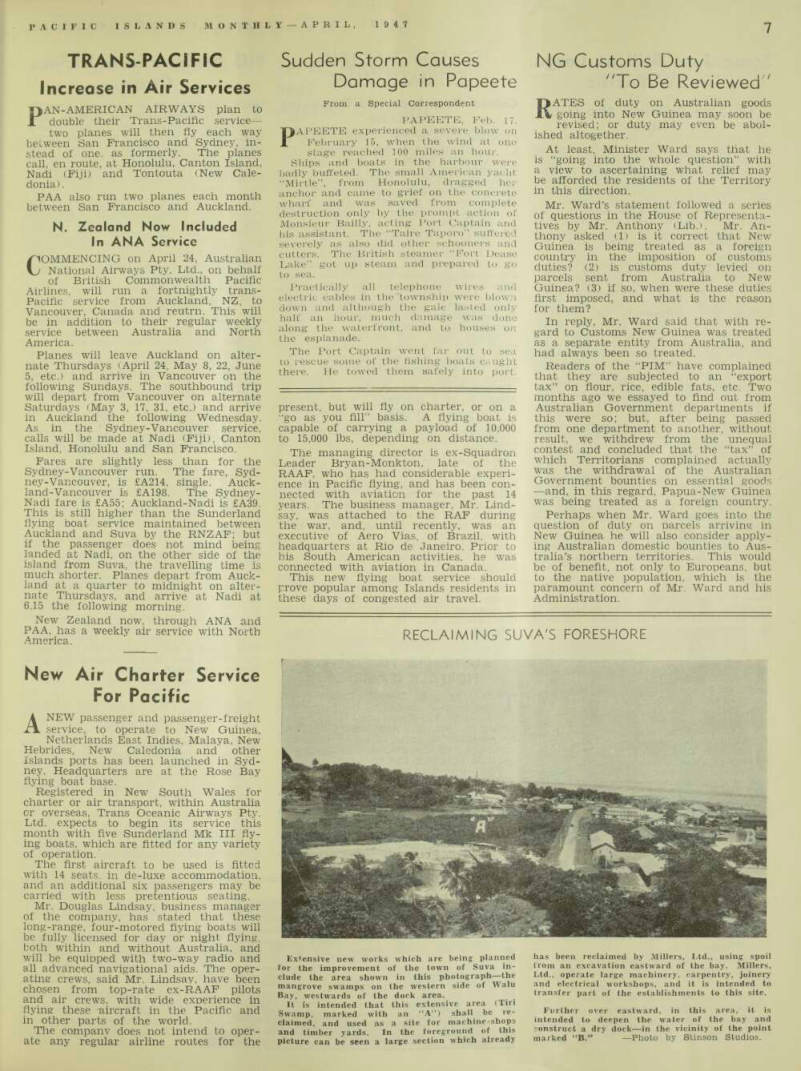
Reclaiming Suva's Foreshore
Extensive new works which are being planned for the improvement of the town of Suva in clude the area shown in this photograph—the mangrove swamps on the western side of Walu Bay, westwards of the dock area.
It is intended that this extensive area (Tiri Swamp, marked with an “A”) shall be re claimed, and used as a site for machine-shops and timber yards. In the foreground of this picture can be seen a large section which already
has been reclaimed by Millers, Ltd., using spoil from an excavation eastward of the bay. Millers, Ltd., operate large machinery, carpentry, joinery and electrical workshops, and it is intended to transfer part of the establishments to this site.
Further over eastward, in this area, it is intended to deepen the water of the bay and construct a dry dock—in the vicinity of the point marked “B.” Photo by Stinson Studios.
Some Japs Still at Large
in SW Pacific European Deserters Also Live Native
IT seems likely that as the islands of the South West Pacific return to a peace-time footing, there will be sur prises in store for next-of-kin of some Australian and American servicemen who were reported missing in those areas.
A number of Japs have recently been discovered “living native”; but in that case they seem to be not so much concerned about their next-of-kin as with their an cestors.
A correspondent in Samarai says that, on March 12, the Administration launch came in from Esala, in the D’Entrecas teaux Group, with a Japanese prisoner.
He had been found in the Dum Duni Islands, near Goodenough. He had been looked after by natives since the action on Goodenough, early in the Pacific war, and had apparently been quite happy. He was not discovered by an Administration patrol. His presence in the area nad been reported after a village quarrel.
Patrolling of small villages in these outer islands will probably now be given priority, and it is possible that more Japs will be found.
At the end of March, five Japs who had been “living native” in the Solomons for some years were shipped back to Japan, after interrogation in Rabaul. They had known that the war was over, but said they were afraid to give themselves up.
It is likely that there are Japs living with the natives in the wild and primitive country back of Wewak and Aitape. It probably will take years to eliminate every possibility.
Reports trickling in from patrol officers and native police who are now reaching some New Guinea outposts indicate that there are white men “living native”, too, in some parts of inland New Guinea.
The Japs, presumably, have little to return home for; but it is hard to understand the mentality of Europeans who go native in this fashion, and cut themselves off from their own people and country.
Yet a South Australian deserter was found recently in the Ramu Valley; and, last year, an American who allegedly had no recollection of anything that happened after 1943, was picked up at the back of Lae. It is obvious that any European living in this way now does so of his own free will; unless, of course, he has be come mentally unbalanced.
It is unlikely that a man who would de liberately desert and live native would be deterred from giving himself up now by fear of being termed a deserter.
During the war, marooned miners walked from Wewak to the mouth of the Fly River, in Papua, in eight months 1 It is unlikely, therefore, that 18 months after the war has ended, misplaced ser vicemen are still trying to find.their way to the New Guinea sea coast.
Tahiti Red Cross Society
THE following are new office bearers of the French Red Cross Society in Tahiti: Patrons: Madame J. C. Haumant, Princess Teriinuiatahiti Pomare Madame Ed. Ahnne.
President: Madame Bonnaud.
Vice-presidents: Madame Levy, Madame Augey.
Secretary: Madame Besnault.
Treasurer: Madame Liauzun.
Council: Mesdames Augey, Besnault, Liauzin, Orbeck, Monsieur Chazel.
Commission
South Pacific
Colonel Kerr Appointed Organising Secretary
SHORTLY after this journal goes to press, the Australian Minister for External Affairs, Dr. Evatt, probably will announce the progress that has been made towards the establishment of the South Pacific Commission (which was agreed upon by a meeting of the repre sentatives of six nations in January last).
Colonel John Kerr, who has been Principal of the School of Pacific Ad ministration, in Sydney, for the past year, has been appointed to act as an organising secretary, to make preliminary arrangements connected with the estab lishment of the South Pacific Commission.
Suitable premises have to be found in Sydney—where the Commission will have its headquarters for at least six months —and a staff assembled.
Colonel Kerr will be assisted by a small staff of Australian and New Zea land officials, who will maintain liaison with the appropriate Government auth orities in the other countries concerned (Britain, United Stated, France, Holland, Australia, New Zealand). Until suitable premises are available in Sydney city, the staff will be housed at the School of Pacific Administration, at St. Georges Heights, Mosman, Sydney (Telephone XM7510).
The new arrangements are all pro visional. Colonel Kerr, for example, will not resign his position as principal of the school. He will carry on the additional work of organising secretary of the Com mission until the Commission has a per manent home and has appointed a chief executive officer.
Among other things, the provisional staff will be responsible for arrangements for the first meeting of the Commission, which is to take place as soon as the Governments concerned have ratified the South Pacific Commission Agreement. It is expected that the first meeting of the Commission will be held in July or August.
Australia To Control
Norfolk Is. Airport
THE airport of Norfolk Island which has been controlled by the Royal New Zealand Air Force since it was com pleted in 1943, has now been taken over by Australia. A party of RAAF personnel and civil aviation officials left Sydney in April to complete the transfer.
The airport of the island was com menced in August, 1942, and the bulk of the work was done by the Australian Allied Works Council. However, although Australian territory, the Island came within the sphere of influence of New Zealand’s Air Force during the war. Nor folk Island has been a stop-over on one of the RNZAF’s Pacific services; presum ably it will continue to be so.
NG Widows in a Vicious
Circle
fTIHE indifferences of Canberra towards A the interests of New Guinea and Papua Europeans is strikingly shown in the way in which the respective auth orities are treating property-owners who wish to claim war damage compensation —especially the widows of men who lost their lives during the Jap invasion of New Guinea.
In various cases, the dependants of de ceased New Guinea planter have not been able to get any information about the con dition of their properties. They cannot get from the War Damage Commission anv assessment of damage done to grow ing crops, or any indication of the rate of assessment per tree.
Lacking these assessments, the widows cannot get probate; and until probate has been granted, the Commission will not pay out the amount of damage assessed.
About the only way in which the vicious official circle can be broken is for the widow, by deed poll, to give up her European nationality and adopt the name and status of a “Fuzzy Wuzzy”. Then officialdom will fall over itself to assist her.
Another Plane Accident
In Central Ng
WHILE landing a cargo of corrugated iron for the Seventh Day Adven tist Mission at Kainantu drome, Central New Guinea on April 11, a Dragon plane overshot the landing strip, came to rest in a creek and was badly damaged.
The plane, which was owned by the Qantas Inland Service, was piloted by Mr.
Frank Furniss who escaped uninjured.
Pilot Fumiss is an experienced and well known officer of Qantas. He was a mem ber of a crew that flew stranded New Guinea residents out from Mt. Hagan in the early days of the Pacific war and was later on the Qantas Indian Ocean service.
Kainantu drome is little more than a strip along a ridge about 5,000 feet above sea level, and is surrounded by even higher mountain peaks.
Producing
Bgd's Second Dredge Now
Bulolo gold dredging limited report that their Number Two dredge was brought into production in the Bulolo Valley, New Guinea, on April 3.
Number One dredge began production a month or so ago.
Mrs. N. R. Mitchell recently returned to Rabaul by air to rejoin her husband, who is chief accountant there with W. R.
Carpenter & Co., Ltd.
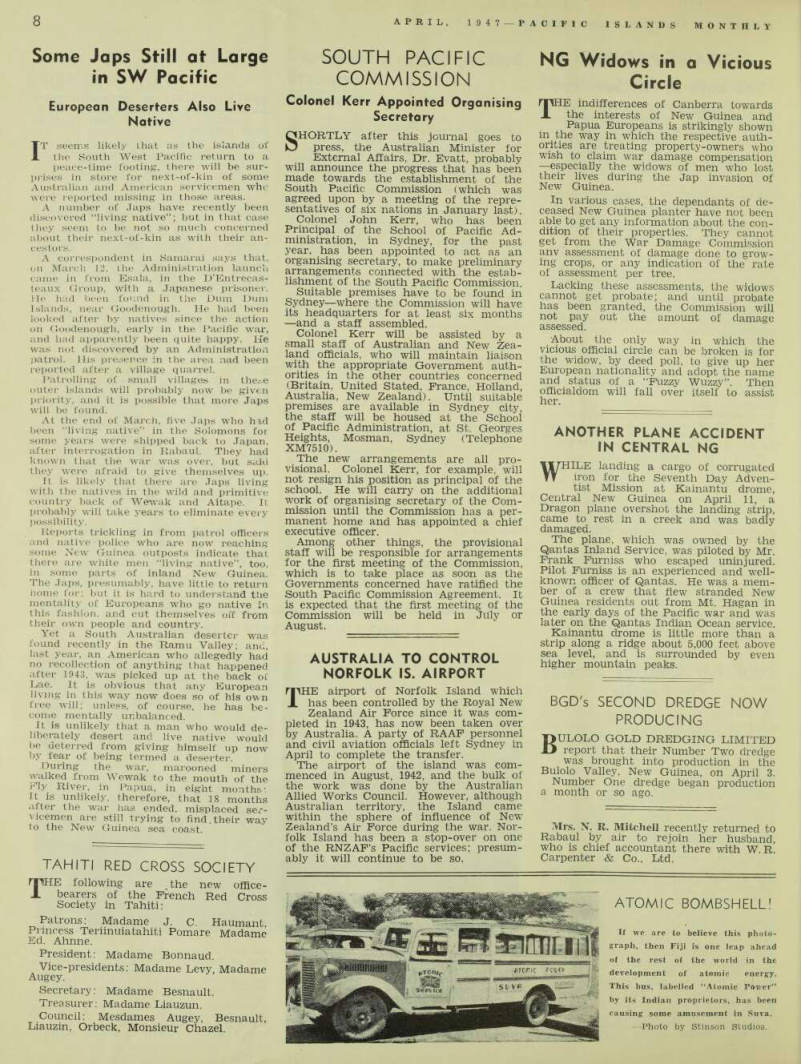
Atomic Bombshell!
If we are to believe this photo graph, then Fiji is one leap ahead of the rest of the world in the development of atomic energy.
This bus, labelled “Atomic Power" by its Indian proprietors, has been causing some amusement in Suva.
Photo by Stinson Studios.
Advertisements & other items, p. 10 (1 item)
8
APRIL, 1947 P ACIFIC ISLANDS MONTHLY
Continues
W. Samoa Boom
Prom Our Own Correspondent
Apia, Mar. 24.
HIGH cocoa and copra prices continue in Western Samoa. The spending power of both European and Sam oan growers is boosted thereby and trad ing conditions are very bright.
However, to balance this we are threat ened with an acute shortage of sugar and flour that is to come on the “Waihemo’’ which is delayed in Sydney. Impending also, is a soap famine, due, it is said, to lack of raw materials in New Zealand.
Supplies of raw sugar, biscuits and soap from Fiji sources have been curtailed due to lack of cargo space on the “Matua.”
Latest price quoted for first grade cocoa beans is now £l9O per ton and may soon reach £2OO. These prices are records. Unfortunately, we are now in the off season for cocoa beans and only small quantities are delivered to Apia sheds.
The last large shipment, 230 tons of cocoa beans, was shipped by the “Wai kawa” which left Apia for Auckland on March 13.
BSI War Damage
Questions in the Commons
The following extract from the official report of the British House of Commons, dated March 12, 1947, is of interest to BSI property-owners. The questions were ashed at the instigation of Mr. Leslie F. Gill.
MR. GAMMANS asked the Secretary for the Colonies if a war damage claims commission has yet been appointed for the British Solomon Islands: from what source financial aid will be provided; how many claims have been submitted; and when it is expected that claims will be paid ?
The Ministter (Mr. Creech Jones), re plied: A war damage claims commission has not yet been appointed for these islands, but it is hoped to commence the investigation of claims, of which 222 have been submitted, in a few months’ time.
I regret that it is not possible at this juncture to provide specific answers to the second and fourth parts of the ques tion, since consideration of these matters must await the reports of the various commissions which have been and are being set up in all territories concerned.
Mr. Gammans: Is the Minister aware that the Australian Government, who are responsible for some neighbouring islands, have already completed this work? Is it not outrageous the people should have to wait more than 18 months after the end of the Japanese war before anything is done by the Colonial Office?
Mr. Creech Jones: This investigation is contingent on others, and until they are completed, it is not possible to make progress here.
Mr.Gammans: What are the other in vestigations which prevent this work being started?
Mr. Creech Jones: Arrangements had to be made in regard to certain other Far Eastern territories, and until these arrangements were completed, it was im possible to proceed with this.
Election of Government officials for 1947 took place recently in Pitcairn Island with the following results: Chief Magistrate, Mr. Norris Young; Assessors, Mr. Warren Christian and Mr. Oliver
Clark; Chairman of Internal Committee,
Mr. Ivan Christian.
Against Opposition
W. H. Watson Retains Seat Against Opposition Results of Rarotonga Election
From Our Own Correspondent
Rarotonga, Mar. 16.
IN the election for the European member of the Rarotonga Island Council on March 14 Mr. William H. Watson was successful in retaining his seat against his opponent, Mr. Stuart G. Kingan.
Result of the poll was, Watson 47, Kingan 37. Mr. Watson, who has served three years on the Council, has been in business in Rarotonga since 1931. Mr.
Kingan has lived here for over two years, and is in charge of the ionosphere ob servatory for the NZ Department of In dustrial Research. He has performed a valuable voluntary service by instructing classes of young Maoris in electrical science. During his residence he has taken a keen interest in local political affairs.
It is many years since there was an actual election for Council member and the challenge of a young newcomer to a com paratively old resident caused a flurry of excitement and everyone followed the contest with the greatest interest.
On the European electoral roll for Rarotonga and the outer islands only two persons failed to register a vote. This is considered remarkable. We have a number of recluses hereabouts who are rarely seen or heard; indeed, some of them have never been seen by other resi dents who have lived here for many years.
Yet every one of these wes persuaded to take an interest in the issue.
MR. KINGAN’S policy was strongly critical of the Cook Islands admin istration and called for many re
forms. Other points in his programme were the urgent need for improved ship ping facilities; more stringent regulations for local shipping; some control over foodstuffs and insistance on hygienic handling.
An undercurrent of the election cam paign was a battle between Cook Islands Progressive Association sympathisers and the anti-CIPA element. Mr. Kingan pro tested that he was an independent can didate and strongly resented the sugges tion that he was “the mouthpiece of the
Cipa.’’
WHILE agreeing with the policy of Mr.
Kingan on a number of minor points, Mr. Watson’s programme was of a more moderate character, calling for amicable co-operation with the ad ministration on local problems. It pointed out that many piessing matters such as improved shipping facilities had already been gone into thoroughly and were being given attention by the govern ment. This also applied to medical and health matters. Mr. Watson stressed that the main problem in Rarotonga still was that of increasing agriculture.
He said that the native population of Rarotonga had increased from 3,676 per sons in 1926 to 5,600 persons in 1945, but that agricultural production had de clined seriously. In 1930 77,233 cases of oranges and 53,271 cases of bananas had been shipped. In 1946 only 4,790 cases of oranges and 21 cases of bananas had been exported. These figures Mr. Watson said, showed that the real problem is the great increase in native population together with the appalling drop in exports; that was the real cause of their present troubles and the only remedy was to restore the balance between the above two factors, which called for co-operation on the part of all parties to increase production and exports of fruit.
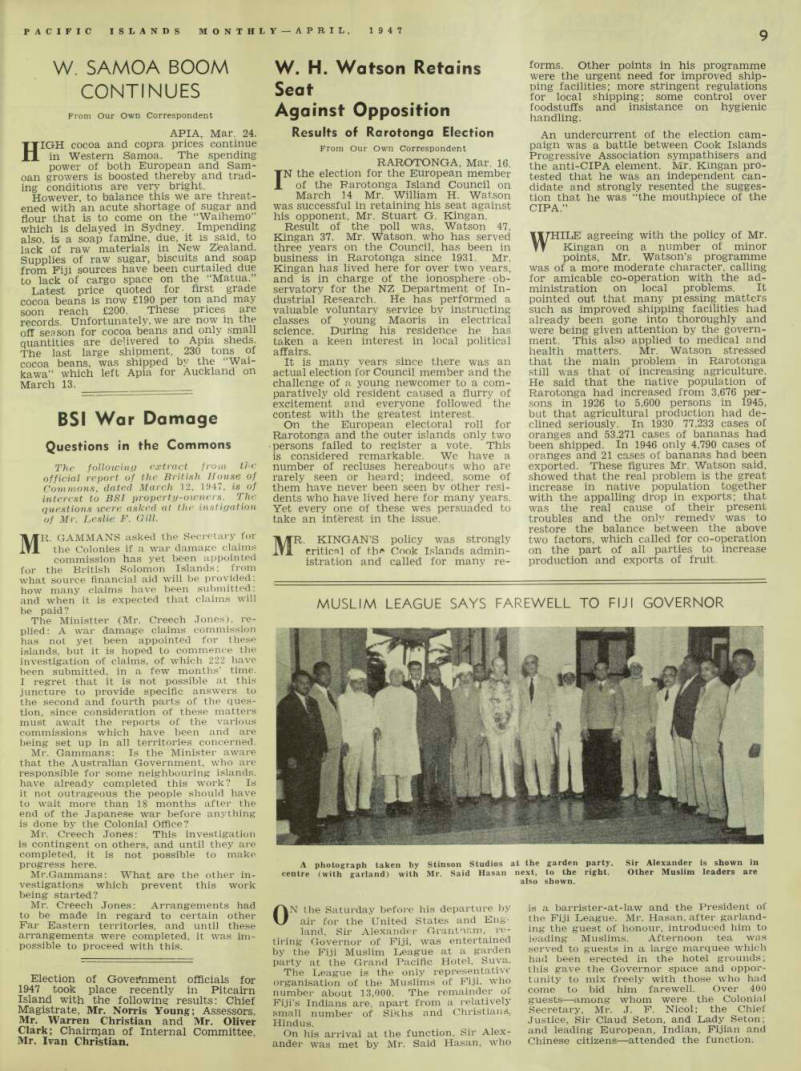
Muslim League Says Farewell To Fiji Governor
ON the Saturday before his departure by air for the United States and England Sir Alexander Grantham, retiring Governor of Fiji, was entertained by the Fiji Muslim League at a garden party at the Grand Pacific Hotel, Suva.
The League is the only representative organisation of the Muslims of Fiji, who number about 13,000. The remainder of Fiji’s Indians are. apart from a relatively small number of Sikhs and Christians, Hindus On his arrival at the function, Sir Alexander was met by Mr. Said Hasan, who
is a barrister-at-law and the President of the Fiji League. Mr. Hasan, after garland ing the guest of honour, introduced him to leading Muslims. Afternoon tea was served to guests in a large marquee which had been erected in the hotel grounds; this gave the Governor space and oppor tunity to mix freely with those who had come to bid him farewell. Over 400 guests—among whom were the Colonial Secretary, Mr. J. F. Nicol; the Chief Justice, Sir Claud Seton, and Lady Seton; and leading European, Indian, Fijian and Chinese citizens—attended the function.
A photograph taken by Stinson Studios at the garden party. Sir Alexander is shown in centre (with garland) with Mr. Said Hasan next, to the right. Other Muslim leaders are also shown.
Grave Move in the North Pacific
Political Changes May be Part of American Defensive Plans Against Asia and Red Russia
THE colours on the map of the Pacific Ocean (denoting owner ship of territories) and political conditions connected therewith, are now changing in important ways; but few of us have seen the over-all pic ture of what is happening. The Pacific Territories affected are: The (former) Mandated Territories of Caroline, Marshall and Mariana Islands.
The (former) Mandated Territory of New Guinea.
The (former) Mandated Territory of Western Samoa.
The Territory of the Netherlands Indies.
The (former) independent Territory of Sarawak.
The Territory of North Borneo, form erly held by a British Company under charter.
The Territories comprised in French Indo-China.
The (former) Commonwealth of the Philippines.
The changes that have taken place —or are now occurring—in these countries are the result of either (a) events arising directly out of the war with Japan; or (b) a demand by the native inhabitants for either in dependence, or a larger measure of self-government.
The two most drastic changes are in the former Japanese Mandated islands, and in the Netherlands Indies.
The Americans have taken possession of the Caroline, Marshall and Mariana Islands by right of conquest. The change over is being wrapped up in pleasant sounding political euphemisms, like “trusteeship” and “care of the indigenous peoples”; but the plain fact is that the United States, in order to guard her shores against inevitable attack from—or through!—Asia, must hold those archi pelagoes, whatever her title.
In the Netherlands Indies the Dutch, betrayed by their Pacific allies, have been compelled to surrender much of their sovereignty over those great archipelagoes to a confused mass of chattering Indo nesians—a race which on European stan dards, has no admirable traits whatever.
Under Dutch rule, which had endured for over 300 years, the archipelagoes were peaceful, comfortable and highly produc tive. Under Indonesian rule, they already are experiencing disorder, discontent, and famine, and those conditions will become worse.
Generally, in the other Territories, while there have been marked alterations in the systems of administration, there has been no change in the dominant flag. But further changes may occur fairly soon—first, because the world planners of the New Order are encourag ing nationalistic movements among coloured peoples; and, secondly, because the Trusteeship Council of the United Nations, which is not yet into its stride, seems eager to rearrange much of the map of the Pacific.
Against that possibility may be set the fact that the machinery of the United Nations is creaking badly in its main
joints, and it may break down altogether.
Red Russia, avid for world conquest, has been sabotaging UNO ever since the Axis surrender, and UNO now is showing signs of collapse.
Micronesian Islands To Be
American FROM the beginning of the Pacific War the United States made it clear that, when Japan was defeated, the 2,550 islands of the Caroline, Marshall and Mariana archipelagoes (Micronesia) should pass completely under American control. That plan is being carried out —with or without the permission of the United Nations.
America is the backbone of UNO.
American statesmen are anxious that UNO shall function. Therefore, they are reluctant to take any step—such as the arbitrary seizure of Micronesia—which might weaken UNO. So, they nominally are seeking UNO approval of their occu pation of Micronesia, and there has been much talk about it, and about.
But every member of UNO knows that, whatever the Security Council and the Trusteeship Council may say, the Stars and Stripes will continue to fly over the 2,550 islands.
The United States is not “imperialist” —it is not out after new territories. Had this war occurred 50 years ago, the Ameri cans would not have sought permanent occupation of Micronesia.
To-day, the hideous instruments of modern war make it necessary that a nation’s defensive frontier shall be as far away as possible from vital territory.
{Continued on Page 53)
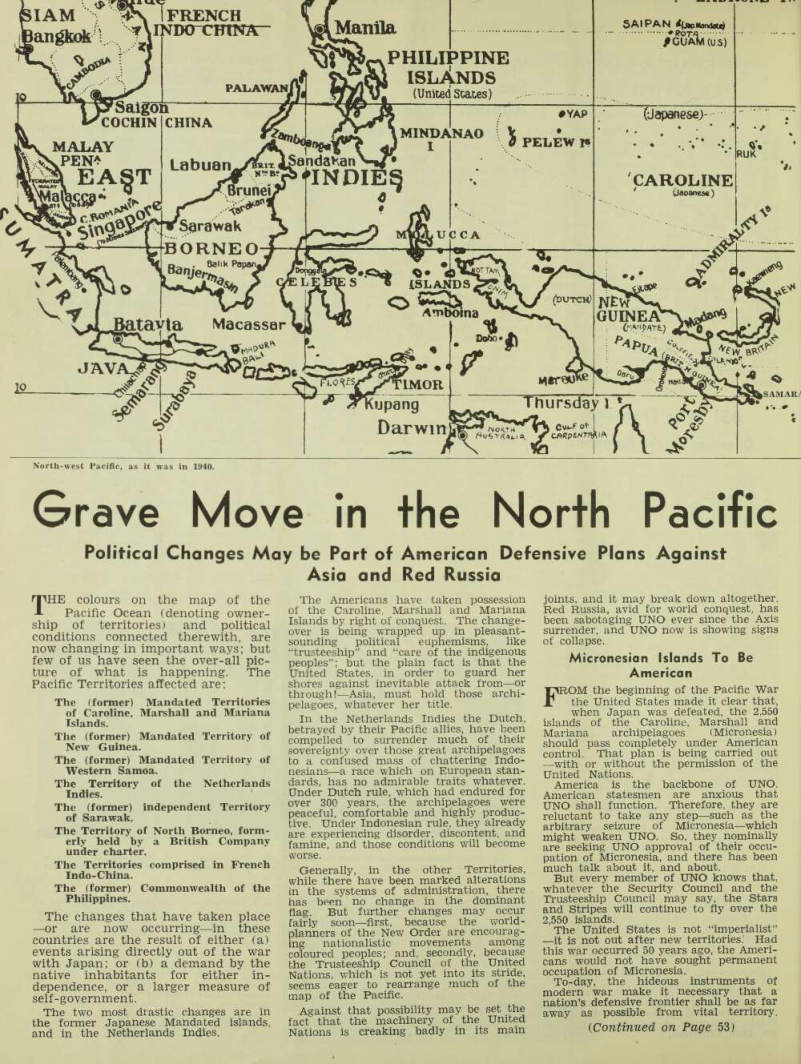
North-west Pacific, as it was in 1940.
Unless present trends alter completely, the United States, comparatively soon, will face an attack from across the North Pacific—perhaps from Asiatics, perhaps from Red Russians, perhaps from both.
It is essential for the defence of North America that Americans shall hold the archipelagoes of the North Pacific—which, from east to west, are Hawaii, the Mar shall Islands, the Caroline Islands, the Mariana Islands, and the Philippines.
It was announced on March 14 that, under an agreement signed that day be tween the United States and the Gov ernment of the new Philippines Repub lic, the former was so given the right to maintain military bases in the Philip pines. There is, in fact, a military al liance between the two.
The pattern of the American defence plan against Asia is clear. That plan is essential to the security of the United States. Nothing—not even the need to maintain harmony within the United Nations—can be permitted to impede it.
UNO seems close to collapse, anyway.
The Americans formally asked the Security Council for permission to annex the Micronesian islands. Unexpectedly, Russia withdrew all the objections she originally advanced —a development re garded as sinister —it was felt that Russia hoped thus to justify the huge territorial gains she has herself made through World War 11.
NO obstruction then was expected; but Australia and New Zealand, by vir tue of their Anzac Pact of 1944, argued that they should be recognised as interested parties in the Security Council discussions. They inferred that America should not annex without their blessing.
This interference by two such small countries was resented by the United States —especially in view of the fact that Australia and New Zealand are in even greater danger from Red Russia particularly, and from Asia generally, than is North America. Instead of being argumentative and obstructionist, the two British Dominions should thank God for American determination to police the Northern Pacific, and should co-operate in that task in every possible way.
Prominent American writers referred to Australia’s “confusion and uncertainty of mind”; and said “the bumbling, fumbling Anzacs are full of noisy confusions as they take their first steps in Big Power politics.”
There was one piquant incident. Aus tralia’s representative on the Security Council was Mr. Paul Hasluck, a clever young public servant who is greatly ad mired by Australian Leftist writers. Mr.
Hasluck, with his head in the clouds, and blind to realities, moved that the Trus teeship Agreement under which the United States was able to take control of the Micronesian islands should be subject to confirmation in the peace treaty be tween Japan and the Allies—whenever that might be made.
The American representative retorted sharply that the United States would not accept that condition. It was obvious that, while America was still anxious to save the face of the United Nations, she was becoming impatient of this bumbling and fumbling by “adolescent Anzacs.”
Best-informed opinion in America is that there may not be too much time available for preparation in the North Pacific—an early attack by Russia, through Asia, is by no means impossible.
Australia’s “Foreign Minister,” Dr.
Evatt, acted promptly. No one knows just what happened—but Mr. Hasluck re
signed his position as Australian repre sentative, and immediately was replaced on the Security Council by Colonel Hodg son. Within a few hours, America was informed officially by Australia that all objections to American control of the Micronesian islands had been withdrawn.
Then the voices of Australia and New Zealand faded out.
IF Australia and New Zealand want to be seriously regarded as “Pacific Powers” they should cease pecking at the United States. They should give ser ious consideration to the facts that “the line of stepping-stones” between South east Asia and Australia is now in charge of utterly unreliable Indonesians; that Russian “sabotage” has so undermined the United Nations plan that UNO now is probably useless as a world force; and that there is no future at all for the European communities in the South Pac ific unless they have the protection of the United States.
They might as well be realists. To-day, the menace to the world’s peace, by Red Russia, is as great as was the menace to our safety in 1938, by Hitler’s Germany.
The Americans recognise it, and have acted accordingly, in Micronesia, as in the Middle East. Why should the Chif leys and the Frasers go about with their heads in the clouds?
That is the political background of re cent events in the North Pacific.
Dufch Hamstrung in Indonesia
AGAINST that background, one must observe recent developments in the Netherlands Indies, where a West ern nation has been compelled to enter into an uneasy partnership with an Asiatic people, who are shot through with nationalism, Communism, and—above all—hatred of the European.
When the Japs invaded the Nether lands Indies early in 1942, this Indonesian Empire of the Dutch contained some 70,000,000 natives—generally a poor type of small Asiatic—and nearly 250,000 Dutch. In the course of 300 years, the Dutch had built up here a well-governed, secure and reasonably well-fed country.
The Japs tore the Dutch economy and
organisation to pieces, and tried to set up in its place an administration of their own. But the only real government which functioned was military in char acter; and the Indonesians got the oppor tunity to create their own organisation, which was intensely anti-Dutch.
As soon as Japan surrendered, the Americans, British and French hurried into the Jap-occupied territories, and quickly restored the former administra
tions. Except in the Netherlands Indies.
There, they did nothing; and the Dutch, their homeland only recently freed from German occupation, were not at once able to occupy the Indies in strength.
Consequently, the Indies were governed,
for a long time after the surrender, by the Jap armies isolated there, and by the Indonesians themselves.
Britain sent in an army to maintain order; but all that the British did was to force the Dutch to negotiate with the Indonesians—who were now being led by visionaries and Communist-inspired ex tremists, and who wanted to get rid of the Dutch. Britain was now controlled by the Attlee Government: and, of all the political crimes for which that ad ministration is responsible, none will stink more in the face of history than the way in which Britain, in 1945-46, de serted her Dutch ally, and threw the rich Indies to the Communist wolves.
Under British pressure, the Dutch and Indonesians signed at Cheribon on Nov
ember 12, 1946, a tentative agreement for the creation of a “United States of In donesia”; and, by the end of November, all British troops had gone. Since then, Dutch and Indonesians have been back ing and filling. The Indonesians, clearly, would like to push out the Dutch, al together; while the Dutch have been steadily building up their armed forces, obviously in the hope that they would be able to restore order in the only way which the natives can understand—with the sword. But the Dutch themselves were fettered by a Socialist Party at The Hague.
There was a good deal of fighting be tween the two sides, and it was plain that they were drifting further apart. Al though both had signed, tentatively, neither seemed inclined to ratify the agreement. Five months ' elapsed.
Then the Dutch said that they would ratify only if there was attached to the original agreement an “interpretation” of tne document, as they saw it.
Finally, something happened in Europe.
Orders to sign went out from The Hague to Batavia. Two prominent members of the Dutch Commission-General in the Indies resigned forthwith.
The Cheribon agreement was ratified in Batavia on March 24. It provides for de facto recognition of the Republic of Java, Sumatra and Madura and the for mation by 1949 of the United States of Indonesia, which will enter into a Union under the Dutch Crown, The principal signatories were Dr. van Mook and Dr.
Sjahrir, so-called premier of the republic.
The two parties are now trying to “co operate in the rebuilding of Indonesia.”
It is not an encouraging prospect.
APART from Holland, the country most affected by this development is Aus tralia. Instead of having the staunch and friendly Dutch on their northern frontier, the white Australians now have the untrustworthy Indonesians, who most certainly will go with the Asiatics when the day comes for the Asiatics to swarm into the empty lands of the South Pacific.
Ever since Japan surrendered, the Australian wharf labourers have tried to help the Indonesians against the Dutch by refusing to handle Dutch ships in Australian ports, or to load Dutch goods onto ships. The Australian Socialist Government—contemptibly weak in all such matters—allowed the waterside workers thus to direct its foreign policy.
Even since the ratification of the agree ment, on March 24, the Australian dockers have assured the Indonesians that they still will refuse to load Dutch ships, unless the Indonesians give the “all clear” sign.
The future of Indonesia will have a marked effect upon all the Pacific Ter ritories; but the future of Indonesia now is completely obscure. If the Dutch should regain control, some sort of order liness may be restored; and the Dutch might regain control if left alone. Un fortunately, most Western nations are suffering to-day under a kind of “brown brother” complex, and all their influence is being exerted on the side of the Indo nesians, and against the Dutch “exploi ters.” It is a depressing picture.
Philippines Guam Eastern
Samoa
IT was announced from Manila, capital of what is now the independent re public of the Philippines, on March 22, that a five-year military assistance agreement integrating the Philippines in American defence plans for the western Pacific has been signed by President Roxas and the United States Ambassa dor, Mr. Paul McNutt. The agreement
makes available to the Philippines arms, munitions and technical advice.
The United States Congress in 1946 authorised the expenditure of 18,000,000 dollars for military supplies needed by the Philippines.
President Roxas announced that 83 ships were being made available to the Philippines for expanding the existing off-shore army patrol.
The United States Secretary of the In terior, Mr. Julius Krug, stated on March 15 that he would ask Congress to grant charters to American Samoa and Guam for their own civil Government. At present, they are administered by the Navy.
He said he wanted a law passed making law enforcement and judicial review ad ministrable in a democratic fashion in stead of being controlled by military ad ministration.
The announcement about Eastern Sam oa directs attention again to the future of Western Samoa. This was explained at length in the March “PIM.”
The United Nations has approved of the Trusteeship Agreement under which New Zealand continues to be responsible for the administration of Western Samoa.
New Zealand, directly and by inference, has undertaken to introduce an increas ing amount of self-government to Samoa, as soon as the Samoans are ready for it.
The Samoan people are asking that Western and Eastern Samoa be united, instead of being divided between the United States and New Zealand.
Future Administration In
New Guinea
IT is presumed that Australia is await ing the meeting of the Trusteeship Council, set up by the Assembly of the United Nations, before making a permanent arrangement in relation to the Administration of Papua and New Guinea.
In 1942, when Japan invaded the South Pacific, Papua was an Australian Ter ritory, and New Guinea was held by Aus tralia under a League of Nations Man date. Both Administrations were with drawn. Papua passed under Australian Army control; and New Guinea was wholly occupied by Japs.
The Australian-New Guinea Adminis trative Unit was created by the Army to administer Papua, and to take over New Guinea as it was recovered piecemeal from the invaders.
For reasons best known to itself, the Australian Socialist Government refused to restore the two former Territories Ad ministrations, to function after ANGAU was withdrawn. Instead, Mr. Ward set up the Papua-New Guinea Provisional Administration, and introduced an en tirely new Administrator in Colonel J. K.
Murray.
As the Japs disappeared, ANGAU moved in; and then, after a certain time, ANGAU handed over to the Provisional Administration —until, by mid-1946, both Territories were under the Provisional Administration, The purpose of this manoeuvre has never been explained. But it is shrewdly suspected that it was designed to (a) get rid of a number of experienced senior officials of the old Civil Administrations who could not be expected to see eye-to eye with the Australian Socialists; (b) clear the decks for replacing the “Big Firms” (the “exploiters”) with Govern ment instrumentalities, which could con trol production, transport and, to a great extent, the distribution of goods.
These things have been accomplished —with the result that confusion and de pression reign in the non-official Euro pean communities of the Australian Paci fic Territories to-day. That, however, is another story. The point is that these
Territories are now under a “Provisional”
Administration.
No one knows definitely whether they are to continue under one Administration.
It was explained that the “Provisional”
set-up was arranged so that the two separate Administrations might be re stored if and when it was found imprac ticable to govern an Australian Territory and a Trusteeship Territory (formerly a
Mandated Territory) by the one Adminis tration. Presumably, the matter awaits certain decisions by the newly-created Trusteeship Council.
We may be quite sure, however, that the Australian Socialist Ministers have done everything possible to ensure that the present Provisional Administration— which, at a cost of over £2,000,000. per annum to the Australian taxpayer, is creating a Brown Brother Elysium and a more or less Socialistic State in the Territories —will become the permanent Administration.
Many high-beating bureaucratic hearts would be broken if the old, pre-1942 Ad ministrations had to be restored, and ac
cursed Private Enterprise were asked to way that the Territorians a S ain paid their There is little danger of that, however, Only a political cataclysm can save Papua and New Guinea from the planners of the New Order. The present Papua-New Guinea Administration is almost certain to become permanent.
French Hit Hard in Indo-China
Propagandists for the Japanese Co-Prosperity planners, and for the Communists, achieved in Indo- China in 1941-45 much the same dis ruption and destruction that they brought about in the Netherlands Indies; and the French, when they were ready to move in again, found a similar set-up—all kinds of native nationalist organisations
demanding independence.
The French Parliament to-day is very near to being under Communist domina tion, and the Government moves warily in all matters concerned with “imperial ism.” But the French are realists. All classes were united in their determination that no part of their colonial empire should be lost. Having resources much greater than those of unhappy Holland, France moved large forces quickly into Indo-China—and then began to nego tiate.
Negotiations were proceeding towards a compromise—which would have given these Indo-Asiatic peoples an increased measure of self-government—when, on December 19, the Vietnamese (apparently a generic term applied to an organisation of nationalists, directed and inspired by Communists) suddenly attacked the French forces, and caused heavy losses and much damage. The French called
it “anther Pearl Harbour”, and reacted
a cc^dmgly.
Since then, France has been vigorously conducting a campaign for the restora tion of order in Indo-China, and is within sight of success. For the present, the new East Indian State will have no companion republic in Indo-China.
Uneasiness in British Indonesia
ris review would be incomplete with out reference to what has been hap pening in and around Malaya.
There is an independence movement in Malaya, as well as in Burma; and the British Administration, reflecting the weak-kneed appeasers in Whitehall, are negotiating gently and tenderly with Brown Brother.
These Indonesian people, of course, are much influenced by events in Java, and by developments in India—where, as Mountbatten takes over the highly un pleasant job of Viceroy, Hindus and Mos lems are busily slitting each other’s throats.
Is it any wonder that even Britain’s friendliest critics are talking about “the inevitable break-up of the Empire'”
Meanwhile, the political picture has changed in Borneo. Sarawak has been taken over from the Brook family, and North Borneo from the British chartered company (the last of its kind); and both are now being administered by the British Colonial Office. Strange as it may seem, there has been no report of a nationalist movement from either of them. Apparently, the Sarawak and North Borneo varieties of Brown Brother have not yet heard from the Moscow Comrades or the London planners of the
New Order.
Rwr.
Governor Surprised
Quick Transfer From Fiji To Hongkong
RARELY has the Chief Executive taken his departure from Fiji under con ditions of such surprise and un certainty as attended the departure of Sir Alexander Grantham from Suva last month.
In the middle of March, the Governor said farewell to his Legislative Council.
Travelling by air, he was to overtake Lady Grantham in the United States — she had left a week earlier —and they would spend some four months’ leave in Europe. But, said His Excellency, they both would return eagerly to re sume their important tasks in Fiji.
Four or five days later, the people were astounded to learn that Sir Alex ander had been appointed Governor of Hongkong, and would not be returning.
Sir Alexander himself then explained.
He said that, 48 hours after he spoke to the Council, he had received advice of his proposed appointment to Hongkong.
It was totally unexpected, and he was most reluctant to go; but the message from Whitehall was so peremptory in character that he could do nothing but accept.
The Governor added that the change caused Lady Grantham and himself great personal inconvenience—they had made all their arrangements in the belief that they soon would be back in Suva. Now they would have to go from England to Hong kong.
Lady Grantham cabled from America her deep personal regret that she would not be returning, and asking her many friends in Fiji to forgive her for her inability to say “Goodbye” to them.
Sir Alexander left Suva on March 24.
He attended official functions at the Queen Victoria School, at Davuilevu, and at Lautoka, before joining the Trans pacific plane at Nadi.
The Colonial Secretary, Mr. J. F. Nicoll, CMG, flew from Nausori to Nadi to say farewell to the Governor, On March 27, Mr. Nicoll was sworn in as Acting-Gov ernor; and the Financial Secretary, Cap tain A. W. Robertson, was appointed to act as Colonial Secretary. The Acting- Governor left on April 1, on an official visit to the Lau Islands and Kadavu.
The hope has been expressed in Fiji that the permanent appointment of Gov ernor may go to Mr. Nicoll, who is held in high regard in the Colony. That de velopment is unlikely, however —rarely, it ever, is a Colonial Secretary raised to the rank of Governor in the same Colony.
As he goes up in grade, he moves to another Colony.
Since 1936, when Sir Murchison Fletcher departed, Fiji has had four governors— namely:— 1936-38 Sir Arthur Richards; 1938-42 Sir Harry Luke; 1942-44 Major-General Sir Philip Mitchell; 1944-47 Sir Alexander Grantham.
Pour governors in ten years does not make for continuity of policy. Before that, from 1874 to 1936, Fiji had 14 governors in 62 years. (For “Appointment of Fiji Governor to Hongkong,” see page 23).
In recognition of his services in the development of mining and ore treat ment in Australia and New Guinea, Mr.
Alexander Kruttschnitt, chairman of directors of Mt. Isa Mines, Ltd. (Q’ld.), and New Guinea Goldfields Ltd., has been awarded the Australasian Institute of Mining and Metallurgy Medal for 1946.
Death Of Mrs. L. Glover,
Of Apia
THE death occurred in Apia, Western Samoa, on March 20 of Mrs. Laura Glover, at the age of 69. She had been a resident of Western Samoa since 1930 when, having recently lost her hus band in New Zealand, she went to live with her son, Mr. P. W. Glover, who then was chief assistant at the Apia Ob servatory. Mrs. Glover was born in 1878 in New Zealand, where her parents were pioneer settlers.
The funeral was attended by most of the leading members of the European community of Western Samoa. Mr. P.
W. Glover is now a merchant in Apia and secretary of the Chamber of Com merce, and six of his friends and well wishers acted as pall-bearers, namely: Mr. J. B. Clapham (manager of the Bank of NZ), Mr. E. Annandale (manager of O. F. Nelson & Co. Ltd.), Mr. H. Gow (manager of Burns Philp (SS) Co. Ltd.), Mr. B. Brownlee (acting manager of Morris Hedstrom Ltd.), Mr. R. H. Car ruthers (manager of I. H. Carruthers Ltd.) and Mr. J. Helg (manager of Muli fauna Trading Co. Ltd.).
Bibliography Wanted
THE Secretary-General of Societe des Oceanistes, Palais de Chaillot. Paris, has asked us to appeal through this journal for assistance in compiling a bibliography of published matter dealiing with the Islands of the Pacific, for publi cation in the well-known “Journal de la Societe des Oceanistes”. An Australian librarian, scientist or bibliophile is in vited to peruse Australian publications and send the Society the titles of any thing concerned with the Pacific Islands.
In return, the Society would send him duplicates of the index cards it covering Pacific articles appearing in European publications.
Result of 1946 Census
Fr. Oceania
THE result of the Census taken in French Oceania late in 1946 has been announced.
It is shown that there are 55,734 persons in the Territory, made up as follows;
Comparison with other Census gives the Following:
Shown by nationalities, the population is divided thus; —
The population of Papeete has grown from 8,456 in 1936 to 12,428 in 1946.
Religions in 1946 were: Protestants, 31,577; Catholics, 13,381; various, 4,272undeclared, 6,504.
Men Women Total Papeete .. 5,903 6,525 12,428 Districts .. . . 22,938 20,368 43,306 Totals .. .. 28,841 26,893 55,734
1926 36,327 1936 43,962 1946 55,734
French— 1936 1946 Born In Colony and includes natives .. 37,452 47,611 Born outside 896 772 Americans 176 103 British 225 500 Germans 10 14 Austrians 14 10 Chilians 21 10 Chinese 4,569 6,385 Dutch 12 9 Indo-Chinese 83 181 Japanese 28 22 Russians 8 11 Swedes 9 10 vSwiss 23 33 Czechs 52 39 Various 384 24 Total 43,962 55,734
"Matua" Passengers
Recent passengers on MV “Matua” between Auckland and South Pacific ports included: TOP ROW: Mrs. J. G. Jackson, who returned to Fiji, after visiting her parents in Auckland, NZ. To’omatua Tua, a member of the Western Samoan Faipule party, which recently visited New Zealand; he was returning to Apia. Mr. M. A. Sorensen, of Ba, Fiji, who was travelling to Tonga to visit friends.
BOTTOM ROW: Interpreter Matatumua, Ale Malu, of Upolu, and Tuilagi Fetu, all members of the Western Samoan official party which recently visited New Zealand.
Hit by Cyclone
Caledonian Island Hit by Cyclone
From a Special Correspondent NOUMEA, March 19. rE most severe cyclone within living memory has just passed over the island of Mare, dependancy of New Caledonia 50 miles from the mainland.
For several days the barometer had dropped until at 9 a.m. on Wednesday, March 12 the easterly wind suddenly turned to south-east and at mid-day had developed into a hurricane. The winds sweeping the islands developing into whirl-winds carrying all before them and destroying houses, schools, churches and plantations.
More than half the coco nut palms of the island have been uprooted, the roads are badly damaged and will need more that a month of intense labour to put them in order.
At Netche, the lovely seat of the Grand Chief Naisseline, the cyclone hit particularly hard. Of the ten buildings in the settle ment not one was spared —all were damaged in some way.
The big Protestant church close to which are the graves of pioneer English missionaries, lost its huge roof. Some parts of the woodwork were car ried a quarter of a mile after being torn from the building. The administra tion building and the dis pensary have been com pletely destroyed. For
tunately no one on the island was ser iously hurt.
It is feared that most of the crops are lost and that there will be no harvest at all this year. As Mare supplied Nou mea with fresh vegetables, potatoes, maize etc., this will be a big blow to Noumea residents. Mare people have ap pealed to the New Caledonian Govern ment for help, and are asking for a sup ply of materials for the construction of new homes.
The destruction left in the wake of the cyclone is a bitter blow to the people of Mare who, under the guidance of the Grand Chief Naisseline, are perhaps the hardest working people in the South Pacific.
The cyclone did little damage in neigh bouring islands and Noumea felt only heavy winds and torrential rains.
Some of the 19 passengers who passed through Brisbane by the flying-boat Coriolanus on Wednesday, March 5, on their return flight to Noumea, ‘were criti cal of Australian ways. Many of the passengers were leading citizens of New Caledonia. Colonel H. P. Dix, principal of a large meat packing and canning company there, said he had been amazed to find such chaotic conditions prevailing in Australian stores and hotels. It seemed to him that living in Australia meant shopping furiously for short-sup plied goods and fighting for beer. The wishes of the customer, he had noticed, were not considered.
Mrs. Mary Lane, of Auckland, is paying a visit to her mother in Suva. Her mother is Mrs. Kaad. widow of the well known pioneer, Captain H. C. H. Kaad, who was one of the founders of Robbie Kaad & Co., which once had extensive plantation interests in Fiji.
Netche, the picturesque village of Chief Naisseline, of Mare.
Photograph and Story by F. E. Dunn.
Ships At Tahiti
Papeete, Feb. 24.
OFFICERS of the United States sub marine “Sennet’ were hospitably en tertained at the American Consulate to-day, when a large number of prominent residents were guests of Vice-Consul Scudder Mersman. The “Sennet”, which had accompanied the Admiral Byrd expe dition to the Antartic, was on her way from New Zealand to the Panama Zone.
Officers were present from the following vessels in the port of Papeete: “Tiara Taporo”, British schooner from Raro tonga; “Fort Dease Lake”, steamer from New Zealand: “Loafer”, American yacht; “Aik”, a Dutch yacht; and “Nordksperon”, a Danish yacht.
Over £18,OOO in Taxes
From G. and E. Colony
NATIVE residents of the Gilbert and Ellice and Phoenix Islands have re ceived their tax assessments for 1947.
These consist of a proclamation in the WPHC Gazette; medium of payment is copra.
The landowners of the Gilbert Islands this year have to provide 502 tons of copra; the Ellice Islanders are let off with 89 tons, and the Phoenix Group with a tax of 20 tons.
Provision is made that no landowner should be required to pay any portion of the tax in respect of any land that has sustained war damage. However, this seems only to throw an extra burden on the rest of the community which, in this year of copra boom, will contribute hand somely to the coffers of the WPHC.
Calculating copra at £3O per ton, the Gilbertese will be paying about £15,000 in taxes; the Ellice Islanders about £2,7C0 and the Phoenix Islanders about £6OO.
Under the Taxation Ordinance of 1923 it is permissible for the WPHC to levy a tax of up to 600 tons of copra upon these islanders. Market price of copra does not seem to be taken into considera tion. Whether it is bringing £5 per ton (as it was a few years ago), or the high prices of to-day, landowners appear to have to provide approximately the same tonnage.
Dr. R. J. Snodgrass has been appointed Deputy Director of Medical Services in Fiji. He has been on the staff of the Medical Department since November, 1927, and has served as a medical officer in many parts of the Colony.
Ng Goldfields
Transport
Deterioration of the Road
WITH aviation authorities condemning most of the ’dromes in the dis trict for certain cargo-carrying planes, and with Old River Markham making inroads on the Labu-Wau road, there is every possibility of an all-high transport problem developing in the near future on the New Guinea goldfield.
For some reason, unknown to most people, the old Lae air-strip has been condemned and there is talk of a new strip being put down at Malehang. Other people are in favour of bringing the old and famous Nadzab strip into action again. The airfields at Bulolo and Wan have both been condemned for heavy cargo planes; and one wonders why, after all those years of faithful service.
With the heavy rains, this season, the portion of the Labu-Wau road, from the Thirty-two Mile Peg to the coast, has suffered considerable damage, and en gineers are of the opinion that another wet season will probably see the end of this section of the highway.
Bgd Operating
TWO of Bulolo Gold Dredging Ltd’s., eight dredges are now in operation, and gold exports from this company may be expected in the near future.
The general manager, Mr. F. W. God den, made a tour of inspection in the Morobe district and returned to Sydney at the beginning of April.
Large gangs of repair men are at work on the Labu-Bulolo road. To assist in this work the Administration recently acquired a considerable amount of old RAAF road-making machinery and is doing everything possible, reports state, to maintain essential repairs.
Australian Admiral Will
Visit SW Pacific Ports
THE 1 Australian destroyer “Bataan”, carrying Rear-Admiral H. B. Farn comb, CB. DSO LM (US), comman der of the Australian Sauadron, and commanded by Captain Morrow, is to “show the flag” in the South-west Pac ific, in accordance with the following tentative timetable:— Tuesday, April 15 Depart Sydney.
Friday, April 18 Arrive Noumea.
Monday, April 21 Depart Noumea.
Tuesday, April 22 Arrive Vila.
Thursday, April 24 Depart Vila.
Saturday, April 26 Arrive Suva.
Wednesday, April 30 Depart Suva.
Saturday, May 3 —Arrive Norfolk Is.
Sunday, May 4 Depart Norfolk Is.
Tuesday, May 6 Arrive and depart Lord Howe Is.
Thursday, May 8 Arrive Sydney.
Rear-Admiral Farncomb is one of the most highly decorated officers in the Royal Australian Navy. He joined the RAN in 1913, at the age of 14, and was one of the original midshipmen trained in the then new Australian Naval College.
He saw active service in both World Wars; and he had a particularly colourful career in the Pacific operations. He was captain of HMAS Perth in 1939; and he was given command of the Australian fleet just after the surrender of Japan.
Advertisements & other items, pp. 14-15 (2 items)
12
April, 1947 pacific islands monjatt
Morris Hedstrom Limited
General Merchants, Importers and Exporters,
Shipowners, Plantation Owners,
Commission and Insurance Agents
HEAD OFFICE
SUVA, FIJI
Established 1868 Registered
SERVICE IN THE SOUTH PACIFIC TERRITORIES
our Large Establishments in Suva and our Numerous Branches, we distribute a wide and comprehensive range of General Merchandise and provide almost every kind of ser- Our departments and associated businesses include: vice.
Telephones : Suva 32 ( 8 lines) Sydney BX 2677 and BX 2678
DRAPERY
MOTOR SALES
AND SERVICE
TOBACCO
TIMBER AND
BUILDING
GROCERY
CONFECTIONERY
HARDWARE
ELECTRICAL
LIQUORS
DRUGS
Branches
Throughout Fiji, Samoa and
Tonga
There is a Branch or Agent of Morris Hedstrom Limited in every Town in the Three Territories.
We are Sole Agents in these Territories for British Drug Houses Ltd.
Electrolux Ltd.
Ford Motor Co.
General Electric Co. Ltd.
Goodyear Tyre & Rubber Co.
B. A. Hjorth Cr Co. (Primus Products) Imperial Chemical Industries Ltd.
International Harvester Export Co.
Matson Navigation Company Max Factor and Co. Inc.
Ransomes, Sims & Jefferies Ltd.
Ruston & Hornsby Ltd.
Vacuum Oil Co. Pty. Ltd.
Yorkshire Copper Works Ltd.
Morris Hedstrom Limited, are LLOYD'S AGENTS in Fiji and Samoa.
IN AUSTRALIA: IN GREAT BRITAIN:
Morris Hedstrom (Aust.) Pty. Ltd., Morris Hedstrom Limited, Asbestos House, Africa House, 65 York Street, SYDNEY Kingswoy, LONDON
Explosion at Makogai
Menace Of Floating Mines
In Fiji Waters
ALOUD explosion which shook buildings at Dalice, on Makogai Island, Fiji, in mid-March is thought to have been caused by a floating mine striking a reef.
Several weeks previously a floating mine was seen off the coast of Tailevu. It was thought, at first, that this may have drifted to Makogai, but nautical experts believe this impossible.
Isolated and unsuspected floating mines, which have broken away from mine fields, are a real menace to South Pacific navigation to-day, particularly in isolated places where the services of mine-sweepers are not available.
Free Copra Market Over £7O
A Ton
New Guinea Producers Get Raw Deal
THE publication of the annual report of the London Copra Association in London in March, summarising the world’s copra mar kets as at the end of 1946, has produced some surprises. It is shown that, where copra is permitted to run free (as in the Philippines) the market value is about twice that per mitted where the price is under sharp control, as in the Australian Terri tories. The survey shows that the following are the current prices, mostly on an f.o.b. basis: —
The only market which is free to respond to the law of supply and demand is Philippines, where the price has gone to over £7O. The market in Ceylon, Malaya and Fiji is controlled by Britain, where the only buyer is the British Ministry of Food; and, as can be seen, and as is made clear in the Copra Association’s re port, that Ministry will shift its price around to meet local conditions —and especially the competition of local crushers.
The outstanding fact, from all this, is that the planters in the Australian Territories of Papua and New Guinea are getting an exceedingly raw deal from the Socialist Government en throned at Canberra.
THE annual compilation just made available in London shows that in a normal year (1938 is taken) the fats and edible oils available in the world were between 3,000,000 and 4,000,000 tons per annum. Of this total, vegetable oils con tributed some two-thirds. The main tropical oil products were copra, palm oil and palm kernels, totalling some 2,000,000 tons. Copra represented 60 per cent., palm oil 25, and palm kernels 15. Of the 2,000,000 tons, the Netherlands Indies contributed 30 per cent., the Philippines 19 per cent., Nigeria 13 per cent., Malaya 8 per cent., Ceylon 6 per cent., Belgian Congo 5 per cent., and the South Pacific between 3 and 4 per cent.
As a result of the war, both the quan tities of tropical oil-seeds available, and the types produced, have been much altered. Details are given in the following article.
Generally, it can be said that there has been a marked reduction in copra from Ceylon, Malaya, Netherlands Indies and the Southwest Pacific. The quantity coming forward is enormously short of the world’s demand —and this shortage is likely to continue for some years.
We are indebted to Mr. Roy Fischel, of the well-known old London firm of L.
M. Fischel & Co., Ltd., for the following extract from the annual report of the London Copra Association:
South Pacific
COPRA Pools have been formed at all the producing centres of South Sea Copra.
These Copra Pools are worked under the direction of the Governments. All copra produced throughout the Islands, whether native production or from the plantations, has to be tendered to these Pools, and then the copra is sold by the Governments to the Governments, the bulk of it now coming forward to this country, bought by the Ministry of Food, and a portion is allocated to Canada.
Merchant Companies are therefore no longer allowed to participate in the copra trade in the South Sea Islands as it is carried on at present, and they are not even allowed to handle the copra from their own plantations. It looks as if it will be a very long time before the trade in South Seas copra can come back to normal trade channels.
Dutch East Indies
THE latest reports received by us con firm that Holland will receive about 10,000 tons of copra per month, during 1947. Should further quantities become available during the year, allo cations have been agreed upon for vari ous European countries. Such allocations, however, are of moderate dimensions. As yet there is no sign that exports will improve. The stocks which are- at the principal loading ports, such as Macassar and Menado, are small.
Many of the small coastal vessels which, prior to the war, carried the copra from producing Islands to the main Dutch East Indies shipping ports, were destroyed by enemy action; and until an improvement in the shipping position takes place, larger supplies are not likely to be forthcoming.
Early this month six coasting vessels were sent out from Holland to the Dutch East Indies to assist in shipping copra from the Moluccas Archipeligo, so it is
Country Price per ton (In Australian Currency) Ceylon £40 Malaya £50 Philippines £71 New Guinea £28 Fiji £33
reasonable to assume that, as time goes on, supplies will increase.
Straits Settlements
THE position has undergone little change during this year. Export, except to this country, is still prohibited; and the price the Ministry of Food is pre pared to pay offers no effective competi tion to the local oil mills, which appear ready to absorb all supplies offering.
The very high price they are making for the residual Cake places them in a strong position and, though the British Ministry have recently advanced their buying prices to £4O f.o.b. for Sundried, and £39 f.o.b. for FM, it is very doubtful if they will be able to secure material supplies till the available quantity offering increases considerably.
Ceylon
IN last year’s report it was mentioned that negotiations were taking place between the Ceylon Government and the British Ministry of Food for a further contract for copra, and in the meantime a temporary price of Rs. 100 per candy was fixed.
Ultimately, an agreement was reached between the two parties, and a contract concluded for the supply of copra for a period of five years at Rs. 100 per candy. (A rupee is worth 1/6 sterling, and a candy is about equal to a quarter of a ton. The price, therefore, is equal to about £A37 per ton.) Exports of copra from Ceylon during 1946 were considerably less than in the preceding year, the comparative figures being 113,7u7 tons in 1945, as against 38,810 in 1946. Of this latter quantity the Commodity Commissioner shipped 9,303 tons, or approximately 24 per cent.
The difference can to some extent be accounted for by an increase in milling on the island, due to an acute shortage of copra cake owing to the prohibition of imports of gingelly cake from India. Con sequently, a larger percentage of copra has been shipped as oil—namely, 43,074 tons in 1946, as against 38,676 tons in 1945.
This still leaves a wide margin, how ever, between the available supplies in 1945, as compared with 1946, and this Is largely due to a severe drought which was experienced in the earlier part of the year.
The copra crop in Ceylon is nevertheles < on the decline and this is due to the lack of new plantings in the pre-war period owing to low prices, and neglect of drain age and manuring. Consequently, there is a noticeable falling-off, in the yield per acre. This is a very serious aspect at a time when oil seeds are so urgently re quired in this country, and it would seem vitally necessary that a long-term re habilitation policy should be introduced by the Ceylon Government.
The view expressed in our last report, that Shippers’ London Houses might again be re-established in trade to ad vantage, has not been possible due to the Government policy of bulk purchase,
and as we write it does not seem as if conditions are likely to change.
Philippines
ON July 4, 1946, the US Government gave the Philippines people their independence, and on that date the Islands became the Philippine Republic.
At the same time, the US Government entered into a Treaty with the Philippine Government to buy the whole of the copra production of the Islands for the 12 months ending June 30, 1947, at a fixed price of US 103.50 dollars per ton of 2,240 lbs., F.A.S., Philippine Port.
An important part of the Treaty was that the US guaranteed to supply the necessary tonnage whenever copra was ready for shipment, in order to relieve the congestion at storage points, as great damage had been done during the war to all warehouses. Shipments, however soon became very heavy, reaching 60,000 tons monthly. American crushers found this quantity too large for them to deal with, and considerable quantities of Philippine copra were allocated to the British and European Governments.
The Philippine Government, however, soon considered that the price contracted at was too low, and an open market would be more advantageous to the Philippine producers.
About the beginning of November, 1946, the US Government acceded to the Philippine Government’s request and ab rogated the Agreement, with the result that the price at once rose to 150 dollars per ton f.a.s., and continued to rise until on December 31, 1946, considerable sales
were made to both US and European markets at the equivalent of US 205 dollars f.a.s., Philippine Port.
The price continued to advance being quoted at the end of February the equiva lent of US 225 dollars f,a.s.
Copra production was not affected by the war and the occupation of the Islands by the Japanese, and to-day it can be estimated at about 650,000 tons per year.
As all the larger oil refineries in the Philippines have been destroyed, or badly damaged, practically the total produc tion has now to be exported as copra, while before the war 30-40 per cent, was exported in the form of oil and dessicated coconut.
Advertisements & other items, pp. 16-18 (2 items)
( ®^ > T^ S pLe S sepvice
SPECIALISING
IN
PACIFIC ISLAND INSURANCES
FIRE MOTOR VEHICLE
MARINE HULLS AND CARGO
EMPLOYER’S LIABILITY
GUARANTEES including those for—
DYNAMITE PERMITS.
RECRUITERS’ LICENCES.
DEFERRED WAGES
AND ALL OTHER CLASSES ARRANGED
AT LOWEST CURRENT RATES.
Established Agencies:
W. R. CARPENTER & CO., LTD.
Throughout the Territory of New Guinea.
SOUTHERN PACIFIC INSURANCE
CO., LTD.
HEAD OFFICE: 60 HUNTER STREET.
SYDNEY.
Stromberg - Carlson soi* pacific A ge „ ts SAMOA: O. F. NELSON & CO. LTD., Apia, W. Samoa FIJI; PROGRESSIVE RADIO SERVICE, Rodwell Road, Suva NEW BRITAIN: H. T. ALLEN, BARRETT & READ, Malaguna Rd., Rabaul
ffl
Available now; Air Circulators, 5-Valve 6-Volt Vibrator World Range Receiver. Available by about June: REFRIGERATORS,
VACUUM CLEANERS, WASHING
MACHINES, FANS AND MANY
OTHER ELECTRICAL UTILI-
TIES.
PLEASE NOTE: Exclusive agents appointed only as stocks become available.
RELIDE WATCHES. Imported cases. Shockproof and waterproof. ( ®^ > T^ S pLe S sepvice TELEPHONE: BWSIS7• SCOTTISH HOUSE • 19 BRIDGE STREET ® SYDNEY ® AUSTRALIA
neap
THE
YORKSHIRE
INSURANCE
CO. LTD.
(Incorporated in England)
ALL CLASSES OF
INSURANCE
Including
FIRE
GUARANTEE
WORKERS
MOTOR
ACCIDENT
MARINE
Island Representatives:
PORT MORESBY: E. A. James
RABAUL: G. B. Black LAE: Morobe Transport Co. Ltd.
MADANG: R. MacGregor
BURNS PHILP
(SOUTH SEA) CO. LTD.
Inc. In FIJI Island Traders and Shipowners Registered Office :
SUVA
FIJI
\\ Also Branches at: Fiji: Lcvuka, Lautoka, Labasa, Ba, Sigatoka, Rotuma.
Tonga: Nukualofa, Haapai, Vavau.
Samoa: Apia, Pago Pago (American Samoa).
Solomons: Makambo, Giza, Faisi.
New Hebrides: Vila.
Code Address: Gilberts: Tarawa.
“Bumsouth*. Norfolk Is. Niue. Wallis Is. Futuna Is.
neap
r^cu£o&-
Sole Australian Concessionaries :
GEORGE BROWN Cr CO. PTY. LTD.
267 Clarence Street, Sydney.
Designs tor new Ultimate models have been completed but production has been retarded, due to a tew remaining difficulties in raw materials.
Models should be available some time during 1947. They will be well worth waiting tor. Watch tor further announcements.
SERVICE: Servicing of all kinds of radio sets, amplifiers and Rola speakers will continue to be available.
SOUTH SEA ISLANDS CLUB
Social Evening
Every Thursday, at 399 George Street.
Sydney (Fourth Floor) Ballroom Dancing . . . Special Islands Dances and Songs Islands Visitors Welcome.
Consult the “Wales
7 P 6 3 DJ
DID
m Uu [I ni if nun ] 1 B
BANK OF NEW SOUTH WALES
Head Office, Sydney Have you any problem in which you feel that an experienced banker may be able to help you?
The officers of the "Wales” are always happy to help clients who seek their assistance in financial aspects of business problems. To give such help, they can draw upon the long experience of the Bank, upon their own intensive training and upon the resources of the Bank’s specialized economic, overseas and information departments.
Consult and . use
BANK OF
NEW SOUTH WALES
FIRST AND LARGEST COMMERCIAL BANK
IN THE SOUTH WEST PACIFIC
Incorporated in New South Wales with limited liability
Raw Deal for the New Guinea
Planters
UPON learning of the extraordinary high price of copra on the free mar ket (it had risen in Manila to over £75 Australian per ton FOB on April 10), the “PIM” tried to induce some Aus tralian official to explain why the Aus tralian Government will not pay the New Guinea planter more than £2B Australian per ton—which is more than £4O under the free market price, and from £lO to £l5 under the British controlled price.
The Australian officials either would not talk, or had no explanation to offer.
However, we did ascertain the following facts: ■ The Australian price is fixed by the Australian-New Guinea Production Con trol Board, in consultation with the Aus tralian Minister for External Territories (Mr. Ward). ■ The whole of the New Guinea pro duction—which does not exceed 10,000 tons per annum (compared with 75,000 tons pre war) —is consumed in Australia. ■ The rate is being kept at its present level, because any increase in the amount paid to planters would automatically raise the price of soap, margarine, etc., against the Australian consumer.
The New Guinea planter is being com pelled to accept the Australian fixed price because he has the privilege of living in an Australian Territory under an Aus tralian Socialist Government; and because he is free of taxation. The fact that Australian-controlled prices do not apply in the Territory, so that what the planter saves in taxation he more than loses in the higher prices he must pay for essen tial goods and foodstuffs, apparently is not taken into Canberra’s consideration.
Death Of Mrs. S. A. Addis
THE death of Mrs. S. A. Addis, wife of Mr. A. B. Addis, occurred in Suva, Fiji, recently. Mrs. Addis was born in Levuka in 1883 and was the only daughter of Captain W. E. Shephard, of Oxfordshire.
Mr. and Mrs. Addis were married at Nailalili in 1901, while Mr. Addis was at tached to the CSR Company as an en gineer at the Nausori mill.
Fiji Citrus Fruit Prices
Increased In Nz
AS the result of an application made by the Department of Agriculture, Fiji, the Internal Marketing Division of New Zealand has agreed to pay higher prices for citrus fruits exported from the Colony.
The price of oranges and mandarins has been increased from 13/- to 15/- per case f.0.b., and the price of grapefruit from 13/- to 16/- per case f.o.b.
Dr. K. R. Steenson, of the staff of the Fiji Medical Department, has been posted from Rewa to Suva. His place at Rewa has been taken by Dr. B. H. B. Upton, He was medical officer at Tarawa (G. and E. Colony) when the Japs invaded in 1941.
Mr. Ken Douglas, of San Remo plant ation. in the Talasea district of New Britain, returned to Rabaul by air on March 26 and was accompanied by his wife and young son, John. Mr. Douglas arrived from Rabaul last December and, like many another, exerienced consider able difficulty in obtaining transport back to New Britain. During his enforced stay in Australia he made Campbelltown (NSW) his headquarters.
Over Quarter-Million People
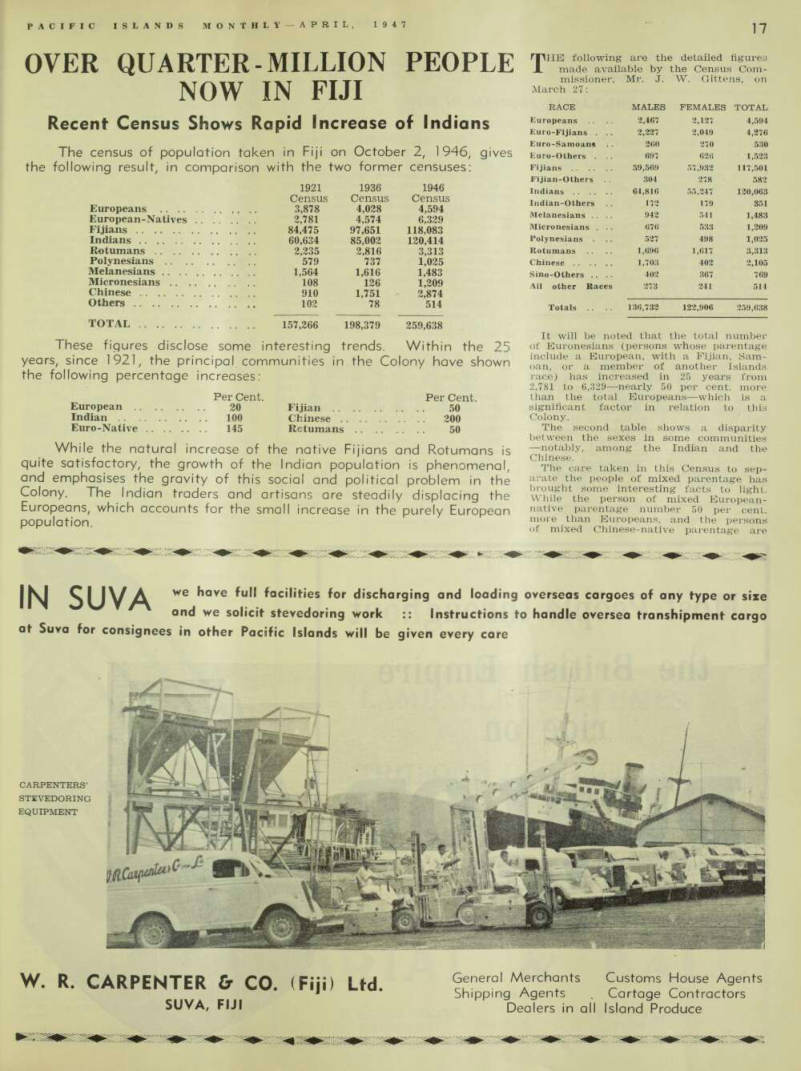
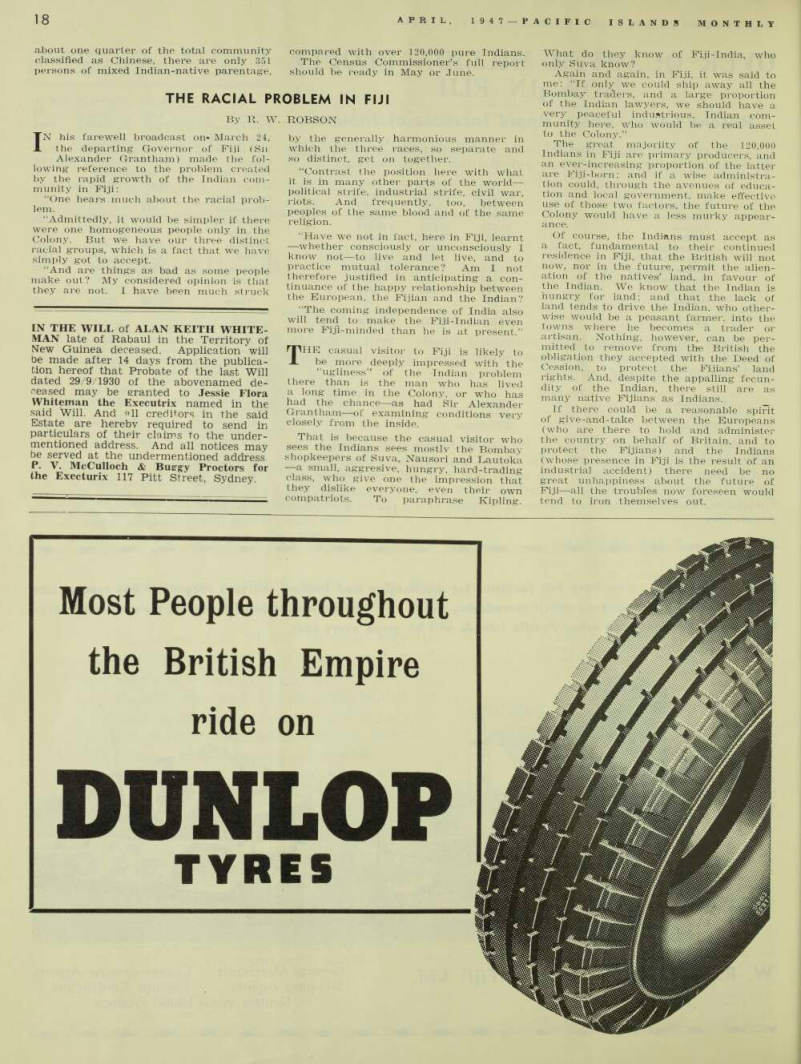
Now In Fiji
Recent Census Shows Rapid Increase of Indians
The census of population taken in Fiji on October 2, 1946, gives the following result, in comparison with the two former censuses:
These figures disclose some interesting trends. Within the 25 years, since 1921, the principal communities in the Colony have shown the following percentage increases:
While the natural increase of the native Fijians and Rotumans is quite satisfactory, the growth of the Indian population is phenomenal, and emphasises the gravity of this social and political problem in the Colony. The Indian traders and artisans are steadily displacing the Europeans, which accounts for the small increase in the purely European population.
THE following are the detailed figures made available by the Census Com missioner, Mr. J. W. Gittens, on March 27:
It will be noted that the total number of Euronesians (persons whose parentage include a European, with a Fijian, Sam oan, or a member of another Islands race) has increased in 25 years from 2,781 to 6,329 —nearly 50 per cent, more than the total Europeans—which is a significant factor in relation to this Colony.
The second table shows a disparity between the sexes in some communities —notably, among the Indian and the Chinese.
The care taken in this Census to sep arate the people of mixed parentage has brought some interesting facts to light.
While the person of mixed European native parentage number 50 per cent, more than Europeans, and the persons of mixed Chinese-native parentage are
1921 1936 1946 Census Census Census Europeans . .. 3,878 4,028 4,594 European-Natives . .. 2,781 4,574 6,329 Fijians . .. 84,475 97,651 118,083 Indians 85,002 120,414 Rotumans . .. 2,235 2,816 3,313 Polynesians 579 737 1,025 Melanesians . .. 1,564 1,616 1,483 Micronesians . . 108 126 1,209 Chinese 1,751 2,874 Others 78 514
Total
. .. 157,266 198,379 259,638
Per Cent.
Per Cent.
European . . .. .. .. 20 Fijian .. .. 50 Indian ... 100 Chinese 200 Euro-Native . . . . ... 145 Rctumans ... 50
Race
Males
Females
Total
Europeans 2,467 2,127 4,594 Euro-Fijians . 2,227 2,049 4,276 Euro-Samoans 26(1 270 530 Euro-Others . 697 626 1,523 Fijians 59,569 57,932 117,501 Fijian-Others 304 278 582 Indians .. .. 64,316 55,247 120,063 Indian-Others 172 179 851 Melanesians . . 942 541 1,483 Micronesians . 676 533 1,209 Polynesians 527 498 1,025 Rotumans 1,696 1,617 3,313 Chinese . . . . 1,703 402 2,105 Sino-Others .. 402 367 769 Ail other Races 273 241 514 Totals .. 136,732 122,906 259,638
about one quarter of the total community classified as Chinese, there are only 351 persons of mixed Indian-native parentage,
compared with over 120,000 pure Indians.
The Census Commissioner’s full report should be ready in May or June.
Advertisements & other items, p. 19 (1 item)
W. R. Carpenter & Co. (Fiji) Ud.
IN SUVA we have full facilities for discharging and loading overseas cargoes of any type or size and we solicit stevedoring work :: Instructions to handle oversea transhipment cargo at Suva for consignees in other Pacific Islands will be given every care
CARPENTERS’
STEVEDORING
EQUIPMENT
59 % rw
fhi
K Vf J m ■m W. R. CARPENTER & CO. (Fiji) Ud.
SUVA, FIJI
General Merchants Customs House Agents Shipping Agents . Cartage Contractors Dealers in all Island Produce
The Racial Problem In Fiji
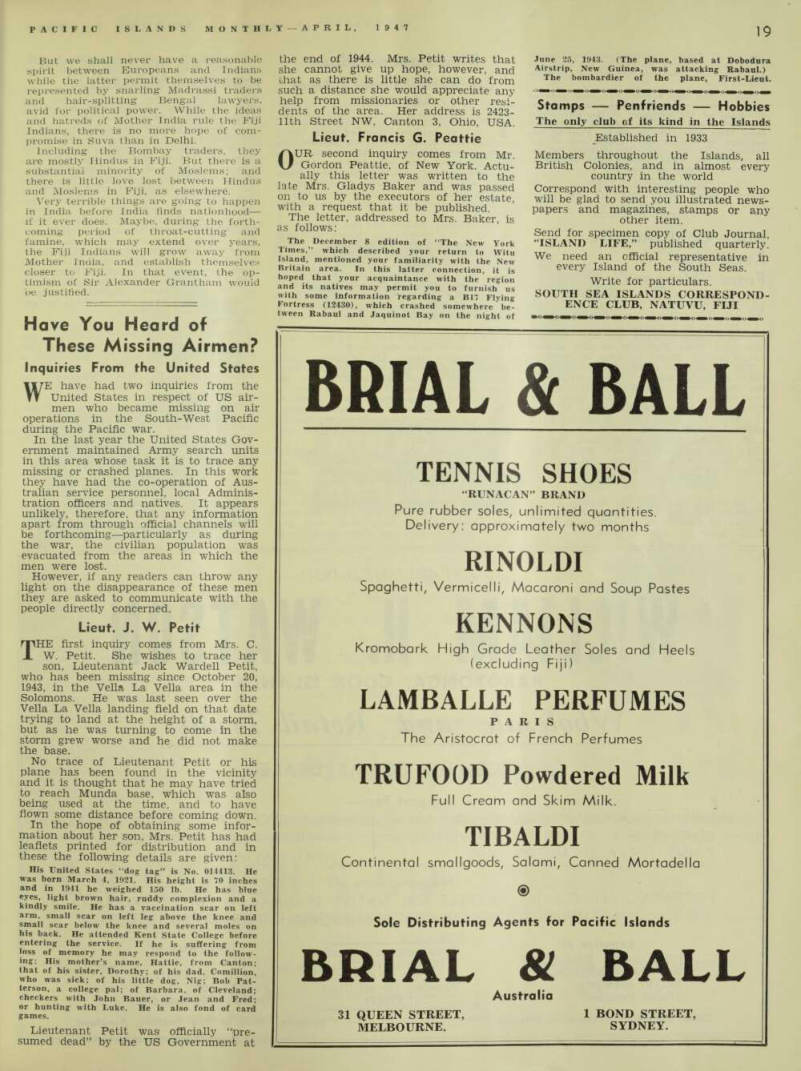
By R. W. Robson
IN his farewell broadcast on* March 24, the departing Governor of Fiji (Sn Alexander Grantham) made the fol lowing reference to the problem created by the rapid growth of the Indian com munity in Fiji: “One hears much about the racial prob lem.
“Admittedly, it would be simpler if there were one homogeneous people only in the Colony. But we have our three distinct racial groups, which is a fact that we have simply got to accept.
“And are things as bad as some people make out? My considered opinion is that they are not. I have been much struck
by the generally harmonious manner in which the three races, so separate and so distinct, get on together.
“Contrast the position here with what it is in many other parts of the world — political strife, industrial strife, civil war, riots. And frequently, too, between peoples of the same blood and of the same religion.
“Have we not in fact, here in Fiji, learnt —whether consciously or unconsciously I know not —to live and let live, and to practice mutual tolerance? Am I not therefore justified in anticipating a con tinuance of the happy relationship between the European, the Fijian and the Indian?
“The coming independence of India also will tend to make the Fiji-Indian even more Fiji-minded than he is at present.”
THE casual visitor to Fiji is likely to be more deeply impressed with the “ugliness” of the Indian problem there than is the man who has lived a long time in the Colony, or who has had the chance—as had Sir Alexander Grantham—ol examining conditions very closely from the inside.
That is because the casual visitor who sees the Indians sees mostly the Bombay shopkeepers of Suva, Nausori and Lautoka —a small, aggresive, hungry, hard-trading class, who give one the impression that they dislike everyone, even their own compatriots. To paraphrase Kipling.
What do they know of Fiji-India, who only Suva know?
Again and again, in Fiji, it was said to me: “If only we could ship away all the Bombay traders, and a large proportion of the Indian lawyers, we should have a very peaceful industrious, Indian com munity here, who would be a real asset to the Colony.”
The great majoriity of the 120,000 Indians in Fiji are primary producers, and an ever-increasing proportion of the latter are Fiji-born; and if a wise administra tion could, through the avenues of educa tion and local government, make effective use of those two factors, the future of the Colony would have a less murky appear ance.
Of course, the Indians must accept as a fact, fundamental to their continued residence in Fiji, that the British will not now, nor in the future, permit the alien ation of the natives’ land, in favour of the Indian. We know that the Indian is hungry for land; and that the lack of land tends to drive the Indian, who other wise would be a peasant farmer, into the towns where he becomes a trader or artisan. Nothing, however, can be per mitted to remove from the British the obligation they accepted with the Deed of Cession, to protect the Fijians’ land rights. And, despite the appalling fecun dity of the Indian, there still are as many native Fijians as Indians.
If there could be a reasonable spirit of give-and-take between the Europeans (who are there to hold and administer the country on behalf of Britain, and to protect the Fijians) and the Indians (whose presence in Fiji is the result of an industrial accident) there need be no great unhappiness about the future of Fiji—all the troubles now foreseen would tend to iron themselves out.
But we shall never have a reasonable spirit between Europeans and Indians while the latter permit themselves to be represented by snarling Madrassi traders and hair-splitting Bengal lawyers, avid for political power. While the ideas and hatreds of Mother India rule the Fiji Indians, there is no more hope of com promise in Suva than in Delhi.
Including the Bombay traders, they are mostly Hindus in Fiji. But there is a substantial minority of Moslems; and there is little love lost between Hindus and Moslems in Fiji, as elsewhere.
Very terrible things are going to happen in India before India finds nationhood — if it ever does. Maybe, during the forth coming period of throat-cutting and famine, which may extend over years, the Fiji Indians will grow away from Mother India, and establish themselves closer to Fiji. In that event, the op timism of Sir Alexander Grantham would be justified.
Advertisements & other items, p. 20 (1 item)
Dunlop
IN THE WILL of ALAN KEITH WHITE- MAN late of Rabaul in the Territory of New Guinea deceased. Application will be made after 14 days from the publication hereof that Probate of the last Will dated 29/9/1930 of the abovenamed deceased may be granted to Jessie Flora Whiteman the Executrix named in the said Will. And nil creditors in the said Estate are hereby required to send in particulars of their claims to the undermentioned address. And all notices may be served at the undermentioned address P. V. McCulloch & Buggy Proctors for the Execturix 117 Pitt Street, Sydney.
Most People throughout the British Empire ride on
TYRES
These Missing Airmen?
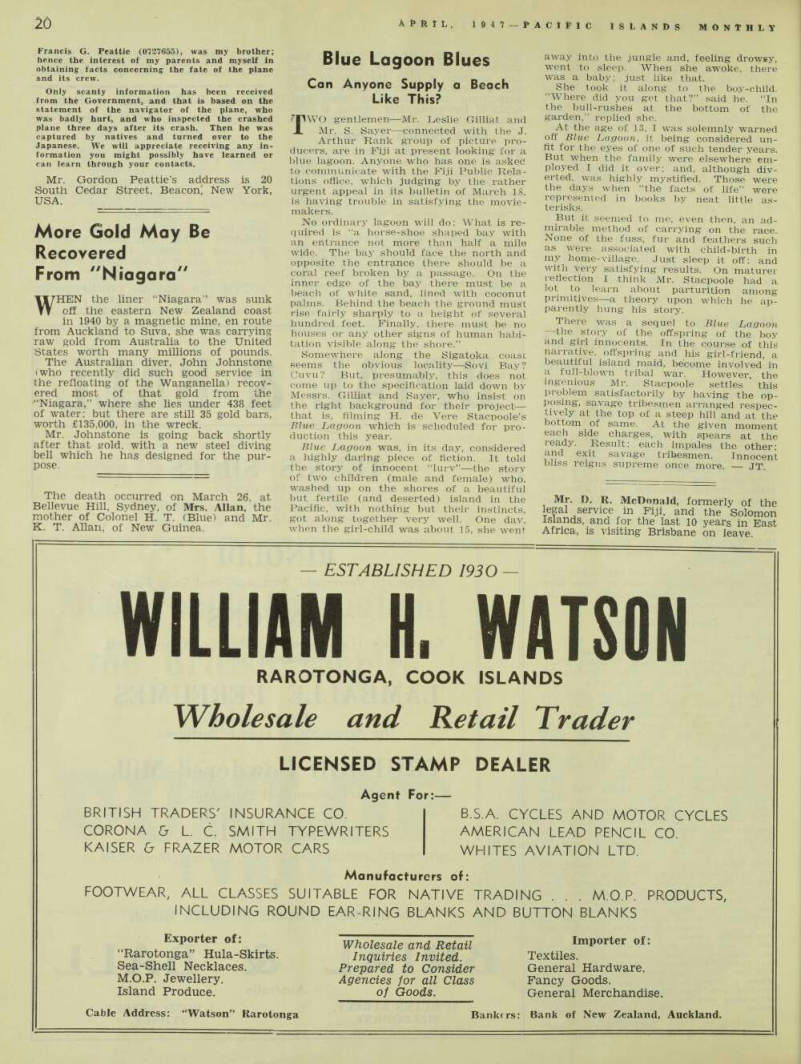
Have You Heard of These Missing Airmen?
Inquiries From the United States
WE have had two inquiries from the United States in respect of US air men who became missing on air operations in the South-West Pacific during the Pacific war.
In the last year the United States Gov ernment maintained Army search units in this area whose task it is to trace any missing or crashed planes. In this work they have had the co-operation of Aus tralian service personnel, local Adminis tration officers and natives. It appears unlikely, therefore, that any information apart from through official channels will be forthcoming—particularly as during the war, the civilian population was evacuated from the areas in which the men were lost.
However, if any readers can throw any light on the disappearance of these men they are asked to communicate with the people directly concerned.
Lieut. J. W. Petit
THE first inquiry comes from Mrs. C.
W. Petit. She wishes to trace her son, Lieutenant Jack Warden Petit, who has been missing since October 20, 1943, in the Vella La Vella area in the Solomons. He was last seen over the Vella La Vella landing field on that date trying to land at the height of a storm, but as he was turning to come in the storm grew worse and he did not make the base.
No trace of Lieutenant Petit or his plane has been found in the vicinity and it is thought that he may have tried to reach Munda base, which was also being used at the time, and to have flown some distance before coming down.
In the hope of obtaining some infor mation about her son, Mrs. Petit has had leaflets printed for distribution and in these the following details are given: His United States “dog tag” is No. 014413. He was born March 4, 1921. His height is TO inches and in 1941 he weighed 150 lb. He has blue eyes, light brown hair, ruddy complexion and a kindly smile. He has a vaccination scar on left arm. small scar on left leg above the knee and small scar below the knee and several moles on his back. He attended Kent State College before entering the service. If he is suffering from loss of memory he may respond to the follow ing: His mother’s name, Hattie, from Canton; that of his sister, Dorothy; of his dad, Comillion, who was sick; of his little dog, Nig: Bob Pat terson, a college pal; of Barbara, of Cleveland; checkers with John Bauer, or Jean and Fred; or hunting with Luke. He is also fond of card games.
Lieutenant Petit wasi officially “pre sumed dead” by the US Government at
the end of 1944. Mrs. Petit writes that she cannot give up hope, however, and chat as there is little she can do from such a distance she would appreciate any help from missionaries or other resi dents of the area. Her address is 2423- 11th Street NW, Canton 3, Ohio, USA.
Lieut. Francis G. Peattie
OUR second inquiry comes from Mr.
Gordon Peattie, of New York. Actu ally this letter was written to the late Mrs. Gladys Baker and was passed on to us by the executors of her estate, with a request that it be published.
The letter, addressed to Mrs. Baker, is as follows: The December 8 edition of “The New York Times,” which described your return to Witu Island, mentioned your familiarity with the New Britain area. In this latter connection, it is hoped that your acquaintance with the region and its natives may permit you to furnish us with some information regarding a BIT Flying Fortress (12430), which crashed somewhere be tween Rabaul and Jaquinot Bay on the night of
June 25, 1943. (The plane, based at Dobodura Airstrip, New Guinea, was attacking Rabaul.) The bombardier of the plane, First-Lieut.
Francis G. Peattie (0727655), was my brother; hence the interest of my parents and myself in obtaining facts concerning the fate of the plane and its crew.
Only scanty information has been received from the Government, and that is based on the statement of the navigator of the plane, who was badly hurt, and who inspected the crashed plane three days after its crash. Then he was captured by natives and turned over to the Japanese. We will appreciate receiving any in formation you might possibly have learned or can learn through your contacts.
Mr. Gordon Peattie’s address is 20
South Cedar Street, Beacon' New York,
Usa.
Advertisements & other items, p. 21 (1 item)
Brial & Ball
Stamps Penfriends Hobbies
The only club of its kind in the Islands Established in 1933 Members throughout the Islands, all British Colonies, and in almost every country in the world Correspond with interesting people who will be glad to send you illustrated newspapers and magazines, stamps or any other item.
Send for specimen copy of Club Journal, “ISLAND LIFE,” published quarterly.
We need an official representative in every Island of the South Seas.
Write for particulars.
SOUTH SEA ISLANDS CORRESPOND-
ENCE CLUB, NATUVU, FIJI
BRIAL & BALL
TENNIS SHOES
“RUNACAN” BRAND
Pure rubber soles, unlimited quantities.
Delivery: approximately two months
RINOLDI
Spaghetti, Vermicelli, Macaroni and Soup Pastes
KENNONS
Kromobark High Grade Leather Soles and Heels (excluding Fiji)
LAMBALLE PERFUMES
PARIS
The Aristocrat of French Perfumes
TRUFOOD Powdered Milk
Full Cream and Skim Milk.
TIBALDI
Continental smallgoods, Salami, Canned Mortadella ® Sole Distributing Agents for Pacific Islands
BRIAL & BALL
Australia
31 QUEEN STREET,
MELBOURNE.
1 BOND STREET,
SYDNEY.
From "Niagara"
More Gold May Be Recovered From "Niagara"
WHEN the liner “Niagara” was sunk off the eastern New Zealand coast in 1940 by a magnetic mine, en route from Auckland to Suva, she was carrying raw gold from Australia to the United States worth many millions of pounds.
The Australian diver, John Johnstone (who recently did such good service in the refloating of the Wanganella) recov ered most of that gold from the “Niagara,” where she lies under 438 feet of water: but there are still 35 gold bars, worth £135,000, in the wreck.
Mr. Johnstone is going back shortly after that gold, with a new steel diving bell which he has designed for the pur pose.
The death occurred on March 26, at Bellevue Hill, Sydney, of Mrs. Allan, the mother of Colonel H. T. (Blue) and Mr.
K. T. Allan, of New Guinea.
Blue Lagoon Blues
Can Anyone Supply a Beach Like This?
TWO gentlemen—Mr. Leslie Gilliat and Mr. S. Sayer—connected with the J.
Arthur Rank group of picture pro ducers, are in Fiji at present looking for a blue lagoon. Anyone who has one is asked to communicate with the Fiji Public Rela tions office, which judging by the rather urgent appeal in its bulletin of March 18, is having trouble in satisfying the movie makers.
No ordinary lagoon will do: What is re quired is “a horse-shoe shaped bay with an entrance not more than half a mile wide. The bay should face the north and opposite the entrance there should be a coral reef broken by a passage. On the inner edge of the bay there must be a beach of white sand, lined with coconut palms. Behind the beach the ground must rise fairly sharply to a height of several hundred feet. Finally, there must be no houses or any other signs of human habi tation visible along the shore.”
Somewhere along the Sigatoka coast seems the obvious locality—Sovi Bay?
Cuvu? But, presumably, this does not come up to the specification laid down by Messrs. Gilliat and Sayer, who insist on the right background for their project— that is, filming H. de Vere Stacpoole’s Blue Lagoon which is scheduled for pro duction this year.
Blue Lagoon was, in its day, considered a highly daring piece of fiction. It told the story of innocent “lurv”—the story of two children (male and female) who. washed up on the shores of a beautiful but fertile (and deserted) island in the Pacific, with nothing but their instincts, got along together very well. One day, when the girl-child was about 15, she went
away into the jungle and, feeling drowsy, went to sleep. When she awoke, there was a baby; just like that.
She took it along to the boy-child.
“Where did you get that?’’ said he. “In the bull-rushes at the bottom of the garden,” replied she.
At the age of 13, I was solemnly warned off Blue Lagoon, it being considered un fit for the eyes of one of such tender years.
But when the family were elsewhere em ployed I did it over; and, although div erted, was highly mystified. Those were the days when “the facts of life” were represented in books by neat little as terisks.
But it seemed to me, even then, an ad mirable method of carrying on the race.
None of the fuss, fur and feathers such as were associated with child-birth in my home-village. Just sleep it off; and with very satisfying results. On maturer reflection I think Mr. Stacpoole had a lot to learn about parturition among primitives—a theory upon which he ap parently hung his story.
There was a sequel to Blue Lagoon the story of the offspring of the boy and girl innocents. In the course of this narrative, offspring and his girl-friend, a beautiful island maid, become involved in a full-blown tribal war. However the ingenious Mr. Stacpoole settles this problem satisfactorily by having the op posing, savage tribesmen arranged respec tively at the top of a steep hill and at the bottom of same. At the given moment each side charges, with spears at the ready. Result: each impales the other and exit savage tribesmen. Innocent bliss reigns supreme once more. JT.
Mr. D. R. McDonald, formerly of the legal service in Fiji, and the Solomon Islands, and for the last 10 years in East Africa, is visiting Brisbane on leave.
Advertisements & other items, p. 22 (1 item)
William H. Watson
ESTABLISHED 1930
RAROTONGA, COOK ISLANDS
Wholesale and Retail "Trader
LICENSED STAMP DEALER
Agent For:—
BRITISH TRADERS' INSURANCE CO.
CORONA & L. C. SMITH TYPEWRITERS
KAISER & FRAZER MOTOR CARS
B.S.A. CYCLES AND MOTOR CYCLES
AMERICAN LEAD PENCIL CO.
WHITES AVIATION LTD,
Manufacturers of: FOOTWEAR, ALL CLASSES SUITABLE FOR NATIVE TRADING . . . M.O.P. PRODUCTS, INCLUDING ROUND EAR-RING BLANKS AND BUTTON BLANKS Exporter of: “Rarotonga” Hula-Skirts, Sea-Shell Necklaces.
M.O.P. Jewellery.
Island Produce.
Cable Address: “Watson” Rarotonga Wholesale and Retail Inquiries Invited.
Prepared to Consider Agencies tor all Class of Goods.
Bankers: Importer of: Textiles.
General Hardware.
Fancy Goods.
General Merchandise.
Bank of New Zealand, Auckland.
New Vessel for A.P.C.
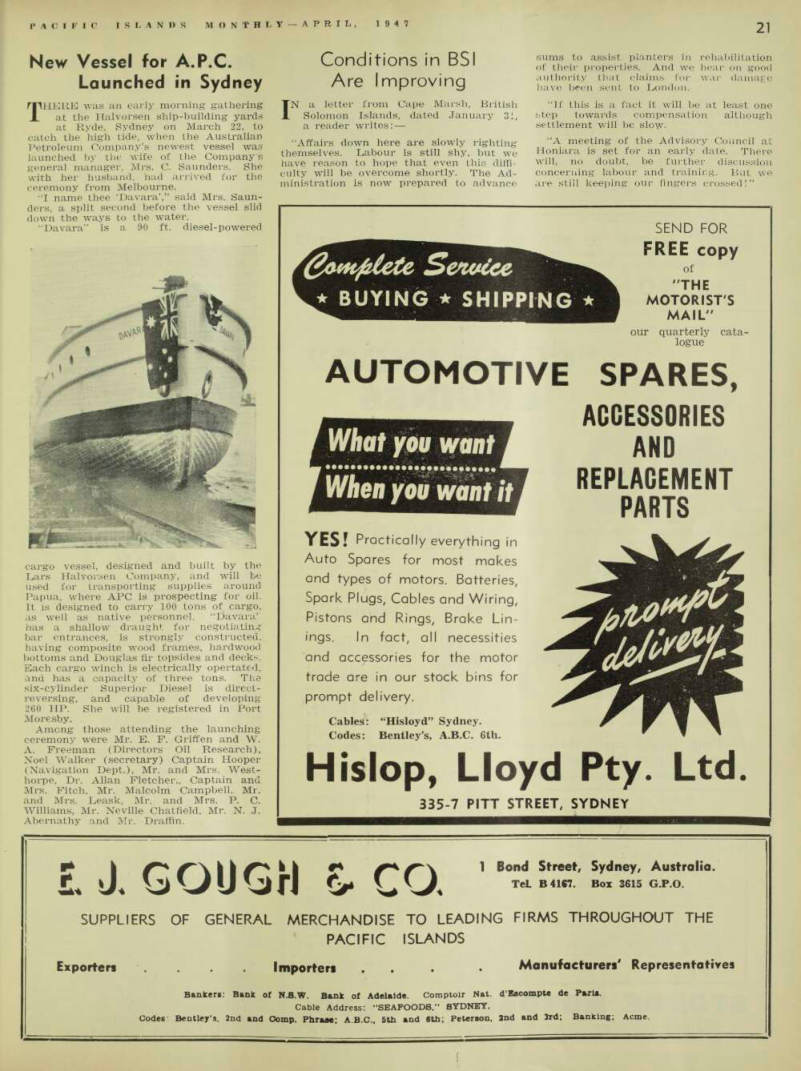
Launched in Sydney
THERE was an early morning gathering at the Halvorsen ship-building yards at Ryde, Sydney on March 22. to catch the high tide, when the Australian Petroleum Company’s newest vessel was launched by the wife of the Company s general manager, Mrs. C. Saunders. She with her husband, had arrived for the ceremony from Melbourne.
“I name thee ‘Davara’,” said Mrs. Saun ders, a split second before the vessel slid down the ways to the water.
“Davara” is a 90 ft. diesel-powered
cargo vessel, designed and built by the Lars Halvorsen Company, and will be used for transporting supplies around Papua, where APC is prospecting for oil.
It is designed to carry 100 tons of cargo, as well as native personnel. “Davara’ has a shallow draught for negotiating bar entrances, is strongly constructed, having composite wood frames, hardwood bottoms and Douglas fir topsides and decks.
Each cargo winch is electrically opertated, and has a capacity of three tons. The six-cylinder Superior Diesel is direct reversing, and capable of developing 260 HP. She will be registered in Port Moresby.
Among those attending the launching ceremony were Mr. E. P. Griffen and W.
A. Freeman (Directors Oil Research), Noel Walker (secretary) Captain Hooper (Navigation Dept.), Mr. and Mrs. West horpe, Dr. Allan Fletcher,, Captain and Mrs. Fitch, Mr. Malcolm Campbell. Mr. and Mrs. Leask, Mr. and Mrs. P. C.
Williams, Mr. Neville Chatfield. Mr. N. J.
Abernathy and Mr. Draffin.
Are Improving
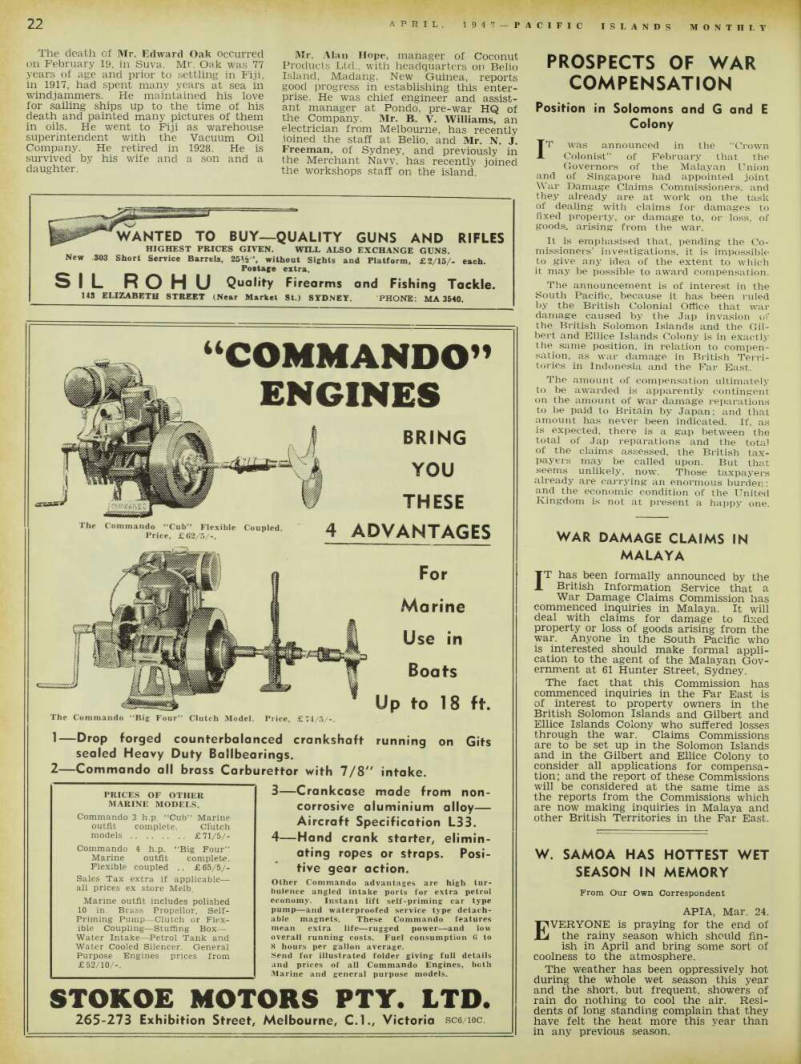
Conditions in BSI Are Improving
IN a letter from Cape Marsh, British Solomon Islands, dated January 31, a reader writes: — “Affairs down here are slowly righting themselves. Labour is still shy, but we have reason to hope that even this diffi culty will be overcome shortly. The Ad ministration is now prepared to advance
sums to assist planters in rehabilitation of their properties. And we hear on good authority that claims for war damage have been sent to London.
“If this is a fact it will be at least one step towards compensation although settlement will be slow.
“A meeting of the Advisory Council at Honiara is set for an early date. There will, no doubt, be further discussion concerning labour and training. But we are still keeping our fingers crossed!”
The death of Mr. Edward Oak occurred on February 19. in Suva. Mr. Oak was 77 years of age and prior to settling in Fiji, in 1917, had spent many years at sea in windjammers. He maintained his love for sailing ships up to the time of his death and painted many pictures of them in oils. He went to Fiji as warehouse superintendent with the Vacuum Oil Company. He retired in 1928. He is survived by his wife and a son and a daughter.
Mr. Alan Hope, manager of Coconut Products Ltd., with headquarters on Belio Island, Madang, New Guinea, reports good progress in establishing this enter prise. He was chief engineer and assist ant manager at Pondo, pre-war HQ of the Company. Mr. B. V. Williams, an electrician from Melbourne, has recently joined the staff at Belio and Mr N J Freeman, of Sydney, and previously in the Merchant Navy, has recently joined the workshops staff on the island.
Advertisements & other items, pp. 23-24 (1 item)
Hislop, Lloyd Pty. Ltd.
r (2&iHfdete Service
* BUYING ★ SHIPPING ★
SEND FOR
FREE copy
Of
"THE
MOTORIST'S
MAIL"
our quarterly catalogue
AUTOMOTIVE SPARES,
ACCESSORIES
AND
REPLACEMENT
PARTS
YES! Practically everything in
Auto Spares for most makes and types of motors. Batteries, Spark Plugs, Cables and Wiring, Pistons and Rings, Brake Linings. In fact, all necessities and accessories for the motor trade are in our stock bins for prompt delivery.
Cables: “Hisloyd” Sydney.
Codes: Bentley’s, A.B.C. 6th.
Hislop, Lloyd Pty. Ltd.
335-7 PITT STREET, SYDNEY
W* I r* 1 Bond Street Sydney, Australia £* ij* \jl ij f| V V J TeL 84167. Box 3615 G.P.O.
SUPPLIERS OF GENERAL MERCHANDISE TO LEADING FIRMS THROUGHOUT THE
PACIFIC ISLANDS
Exporters ... Importers ... Manufacturers' Representatives Bankers: Bank of N.S.W. Bank of Adelaide. Comptolr Nat. d’Eacompte de Paris.
Cable Address; “SEAFOODS.” SYDNEY.
Codes Bentley’s, 2nd and Comp. Phrase; A.8.C., sth and 6th; Peterson. 2nd and 3rd; Banking; Acme.
New
WANTED TO BUY—QUALITY GUNS AND RIFLES
HIGHEST PRICES GIVEN. WILL ALSO EXCHANGE GUNS.
SO3 Short Service Barrels, 25M'\ without Sights and Platform, £2/15/- each.
Postage extra.
SI L RO H U Quality Firearms and Fishing Tackle. 143 ELIZABETH STREET (Near Market St.) SYDNEY.
PHONE: MA 3540.
“COMMANDO”
ENGINES
=t J The Commando “Cub” Flexible Coupled.
Price, £62/5/-.
BRING
YOU
THESE
4 ADVANTAGES
For
Marine
Use in
Boats
Up to 18 ft
The Commando “Big: Four” Clutch Model. Price, £74/5/- 1— Drop forged counterbalanced crankshaft running on Gits
sealed Heavy Duty Ballbearings.
2 Commando all brass Carburettor with 7/8" intake.
3 Crankcase made from non-
corrosive aluminium alloy—
Aircraft Specification L 33.
4 Hand crank starter, elimin-
ating ropes or straps. Posi-
tive gear action.
Other Commando advantages are high turbulence angled intake ports for extra petrol economy. Instant lift self-priming car type pump—and waterproofed service type detachable magnets. These Commando features mean extra life—rugged power—and low overall running costs. Fuel consumption 0 to 8 hours per gallon average.
Send for illustrated folder giving full details and prices of all Commando Engines, both Marine and general purpose models.
PRICES OF OTHER
MARINE MODELS.
Commando 3 h.p. “Cub” Marine outfit complete. Clutch models £7l/5/- Commando 4 h.p. “Big Pour”
Marine outfit complete.
Flexible coupled .. £65/5/- Sales Tax extra if applicable— all prices ex store Melb.
Marine outfit includes polished 10 in. Brass Propeller, Self- Priming Pump—Clutch or Flexible Coupling—Stuffing Box— Water Intake—Petrol Tank and Water Cooled Silencer. General Purpose Engines prices from £52/10/-.
STOKOE MOTORS PTY. LTD.
265-273 Exhibition Street, Melbourne, C. 1., Victoria sce/ioc.
Compensation
Prospects Of War
Position in Solomons and G and E Colony
IT was announced in the “Crown Colonist” of February that the Governors of the Malayan Union and of Singapore had appointed joint War Damage Claims Commissioners, and they already are at work on the task of dealing with claims for damages to fixed property, or damage to, or loss, of goods, arising from the war.
It is emphasised that, pending the Co missioners’ investigations, it is impossible to give any idea of the extent to which it may be possible to award compensation.
The announcement is of interest in the South Pacific, because it has been ruled by the British Colonial Office that war damage caused by the Jap invasion of the British Solomon Islands and the Gil bert and Ellice Islands Colony is in exactly the same position, in relation to compen sation, as war damage in British Terri tories in Indonesia and the Far East.
The amount of compensation ultimately to be awarded is apparently contingent on the amount of war damage reparations to be paid to Britain by Japan; and that amount has never been indicated. If, as is expected, there is a gap between the total of Jap reparations and the total of the claims assessed, the British tax payers may be called upon. But that seems unlikely, now. Those taxpayers already are carrying an enormous burden: and the economic condition of the United Kingdom is not at present a happy one.
War Damage Claims In
Malaya
IT has been formally announced by the British Information Service that a War Damage Claims Commission has commenced inquiries in Malaya. It will deal with claims for damage to fixed property or loss of goods arising from the war. Anyone in the South Pacific who is interested should make formal appli cation to the agent of the Malayan Gov ernment at 61 Hunter Street, Sydney.
The fact that this Commission has commenced inquiries in the Far East is of interest to property owners in the British Solomon Islands and Gilbert and Ellice Islands Colony who suffered losses through the war. Claims Commissions are to be set up in the Solomon Islands and in the Gilbert and Ellice Colony to consider all applications for compensa tion; and the report of these Commissions will be considered at the same time as the reports from the Commissions which are now making inquiries in Malaya and other British Territories in the Far East.
W. Samoa Has Hottest Wet
Season In Memory
From Our Own Correspondent
Apia, Mar. 24.
EVERYONE is praying for the end of the rainy season which should fin ish in April and bring some sort of coolness to the atmosphere.
The weather has been oppressively hot during the whole wet season this year and the short, but frequent, showers of rain do nothing to cool the air. Resi dents of long standing complain that they have felt the heat more this year than in any previous season.
Governorship
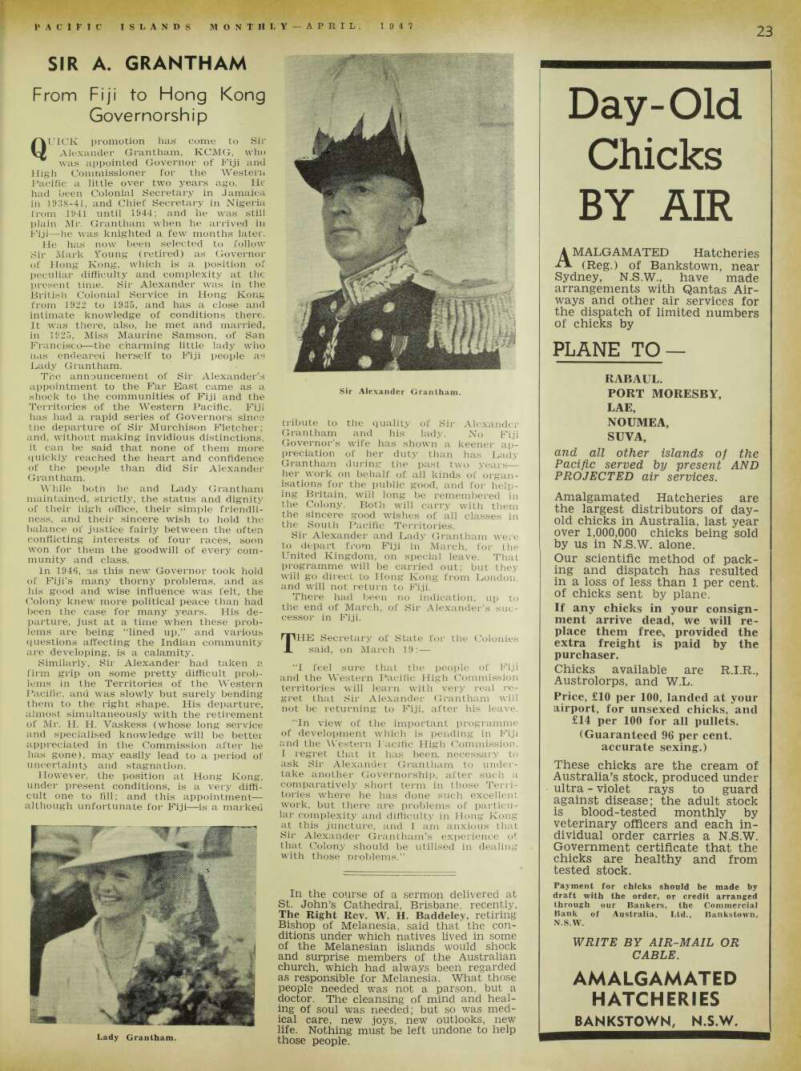
Sir A. Grantham
From Fiji to Hong Kong Governorship
QUICK promotion has come to Sir Alexander Grantham, KCMG, who was appointed Governor of Fiji and High Commissioner for the Western Pacific a little over two years ago. He had been Colonial Secretary in Jamaica in 1938-41, and Chief Secretary in Nigeria from 1941 until 1944; and he was stili plain Mr. Grantham when he arrived in Fiji—he was knighted a few months later.
He has now been selected to follow Sir Mark Young (retired) as Governor of Hong Kong, which is a position of peculiar difficulty and complexity at the present time. Sir Alexander was in the British Colonial Service in Hong Kong from 1922 to 1935, and has a close and intimate knowledge of conditions there.
It was there, also, he met and married, in 1925, Miss Maurine Samson, of San Francisco—the charming little lady who nas endeared herself to Fiji people as Lady Grantham.
The announcement of Sir Alexander’s appointment to the Far East came as a shock to the communities of Fiji and the Territories of the Western Pacific. Fiji has had a rapid series of Governors since the departure of Sir Murchison Fletcher; and, without making invidious distinctions, it can be said that none of them more quickly reached the heart and confidence of the people than did Sir Alexander Grantham.
While both he and Lady Grantham maintained, strictly, the status and dignity of their high office, their simple friendli ness, and their sincere wish to hold the balance of justice fairly between the often conflicting interests of four races, soon won for them the goodwill of every com munity and class.
In 1946, as this new Governor took hold of Fiji’s many thorny problems, and as his good and wise influence was felt, the Colony knew more political peace than had been the case for many years. His de parture, just at a time when these prob lems are being “lined up,” and various questions affecting the Indian community are developing, is a calamity.
Similarly, Sir Alexander had taken a firm grip on some pretty difficult prob lems in the Territories of the Western Pacific, and was slowly but surely bending them to the right shape. His departure, almost simultaneously with the retirement of Mr. H. H. Vaskess (whose long service and specialised knowledge will be better appreciated in the Commission after he has gone), may easily lead to a period of uncertainty and stagnation.
However, the position at Hong Kong, under present conditions, is a very diffi cult one to fill; and this appointment— although unfortunate for Fiji—is a marked
tribute to the quality of Sir Alexander Grantham and his lady. No Fiji Governor’s wife has shown a keener ap preciation of her duty than has Lady Grantham during- the past two years— her work on behalf of all kinds of organ isations for the public good, and for help ing Britain, wiil long be remembered in the Colony. Both will carry with them the sincere good wishes of all classes in the South Pacific Territories.
Sir Alexander and Lady Grantham were to depart from Fiji in March, for the United Kingdom, on special leave. That programme will be carried out; but they will go direct to Hong Kong from London, and will not return to Fiji.
There had been no indication, up to the end of March, of Sir Alexander’s suc cessor in Fiji.
THE Secretary of State for the Colonies said, on March 19: “I feel sure that the people of Fiji and the Western Pacific High Commission territories will learn with very real re gret that Sir Alexander Grantham will not be returning to Fiji, after his leave.
“In view of the important programme of development which is pending in Fiji and the Western Pacific High Commission.
I regret that it has been, necessary to ask Sir Alexander Grantham to under take another Governorship, after such a comparatively short term in those Terri tories where he has done such excellent work, but there are problems of particu lar complexity and difficulty in Hong Kong at this juncture, and I am anxious that Sir Alexander Grantham’s experience of that Colony should be utilised in dealing with those problems.’’
In the course of a sermon delivered at St. John’s Cathedral, Brisbane, recently, The Right Rev. W. H. Baddeley, retiring Bishop of Melanesia, said that the con ditions under which natives lived in some of the Melanesian islands would shock and surprise members of the Australian
church, which had always been regarded
as responsible for Melanesia. What those people needed was not a parson, but a doctor. The cleansing of mind and heal ing of soul was needed; but so was med ical care, new joys, new outlooks, new life. Nothing must be left undone to help those people.
Sir Alexander Grantham.
Lady Grantham.
Advertisements & other items, p. 25 (2 items)
23
A C I P 1 C ISLANDS MONTHLY APRIL, 1947
Day-Old
Chicks
BY AIR
Amalgamated Hatcheries
(Reg.) of Bankstown, near Sydney, N.S.W., have made arrangements with Qantas Airways and other air services for the dispatch of limited numbers of chicks by
PLANE TO
RABAUL.
PORT MORESBY,
LAE,
NOUMEA,
SUVA,
and all other islands of the Pacific served by present AND PROJECTED air services.
Amalgamated Hatcheries are the largest distributors of dayold chicks in Australia, last year over 1,000,000 chicks being sold by us in N.S.W. alone.
Our scientific method of packing and dispatch has resulted in a loss of less than 1 per cent, of chicks sent by plane.
If any chicks in your consignment arrive dead, we will replace them frees provided the extra freight is paid by the purchaser.
Chicks available are R.1.R., Austrolorps, and W.L.
Price, £lO per 100, landed at your airport, for unsexed chicks, and £l4 per 100 for all pullets. (Guaranteed 96 per cent, accurate sexing.) These chicks are the cream of Australia’s stock, produced under ultra - violet rays to guard against disease; the adult stock is blood-tested monthly by veterinary officers and each individual order carries a N.S.W.
Government certificate that the chicks are healthy and from tested stock.
Payment for chicks should be made by draft with the order, or credit arranged through our Bankers, the Commercial Bank of Australia, Ltd., Bankstown,
N.S.W T .
WRITE BY AIR-MAIL OR
CABLE.
AMALGAMATED
HATCHERIES
BANKSTOWN, N.S.W.
Ovfrcrowded Suva
Housing shortage Alarms Town Board
OVERCROWDING in dwelling houses in Suva is causing the Suva Town Board much concern.
At a meeting in March, the Board agreed that, in view of the gravity of the housing position it did not approve— except in cases of extreme urgency—the issue of any closing orders on dwellings in Suva.
Another motion which was passed unani mously, read: “That this Town Board draws the attention of Government to the
grave dan £ er to public health resulting from the i nflux of people who have little or no legitimate business in Suva. This amounts to a state of emergency; and the Board asks for the serious and, in deed, immediate attention of Government to means of removing the evil.” = Mr. H. S. Bennett, Australian Consul in New Caledonia, was a passenger on the flying-boat Coriolanus which passed through Brisbane recently. He said he would be glad to get back into light clothing and was surprised to find Aus tralian’s sticking to heavy garb in such humidity. He attended the South Seas Conference in Canberra in January
Philippines
Copra Market
What Happens When Controls Come Off
AS the keynote to the immediate future of the world copra market is pro vided by the largest individual pro ducer, Philippines, the following extract from a United States official publication is of general interest. At latest advices the value of copra on the Manilla market (which is free and uncontrolled) was £75 per ton in Australian currency: “Copra shipments from the Philippines in the first 11 months of 1946 amounted to 510,000 long tons, according to pre liminary data. The monthly volume of shipments recently exceeded all previous records in the Philippine copra trade, “On December 6, 1946, price restrictions were abandoned when the Commodity Credit Corporation announced its agree ment to the Philippine proposal for ter mination of its contract for exclusive purchase of exportable copra. Several weeks earlier the market had risen sharply, anticipating the end of copra price control.
“Production of copra probably will de cline in early 1947, but it is expected to equal the pre-war rate with a total out put for the year of about 750,000 long tons. The quantity available for ex portation may be about 650,000 tons, allowing 100,000 tons to be processed by Philippine crushers. Small quantities of crude coconut oil will be available for exportation during 1947.”
Spelling Of Guadalcanal
Letter to the Editor FURTHER to your article headed “With an L or an R?” the following, writ ten by Labillardiere, one of the nat uralists in D’Entrecasteaux’s Expedition in search of La Perouse (1791-93), in his account of the voyage, and published in 1800, may be of interest: : “During the night the currents carried us into a large channel along the eastern island formerly called the Island of St. Christopher, and which makes part of Solomon’s Archipelago, discovered by Mendana “We ran very close along the islets named the Three Sisters; we then plied to windward, in order to get to the south ward, and sail out of the strait which separates the island called by Mendana, Caudal Canal, from that of St. Chris topher’s.”
At that time, therefore, the name was spelled with an L.
I am, etc.,
John W. Dixon
Ng Women's Club
THERE were over thirty New Guinea ites present at the monthly social of the New Guinea Woman’s Club, Sydney, held on March 28 in the club rooms when cards and games were in dulged in, and refreshments served.
Several visitors from New Guinea were present, renewing old acquaintances and a very pleasant evening was spent.
Mr. Frank Cutler, of Cutarp and Ab lingi plantations, on the south coast of New Britain, has returned to New Guinea to make an inspection of his properties.
Mr. Cutler, who has been living in Mel bourne since the outbreak of war, trav elled by air.
Advertisements & other items, p. 26 (1 item)
Bulowat Transport
While in Port Moresby ...
HIRE Your Taxi from
COMPANY
CARRIERS AND TRANSPORT SPECIALISTS
GENERAL MOTOR REPAIRS
—Agents for—
CRYSTALITE PLASTICS, ALL ELECTRICAL
EQUIPMENT, RADIOS, REFRIGERATORS,
HOT WATER JUGS, ETC.
SIDNEY COOK, PROP.
New
beauty
in the
kitchen
1 : THE UNIT (illustrated) comprises Wunderlich Stainless Steel Sink and all-metal, stove enamelled cabinet. An ideal kitchen furnishing. Call, visit the Wunderlich Showrooms and inspect the ensemble. Phone MX 241 I, or write G.P.0., Box 474, Sydney.
1 7// under/ic/r
KITCHEN UNIT
SINK - DRAIN-EK • CABINET
Manufactured by Wunderlich Ltd., Redfern, Sydney. Tel: MX 241 I. 0.P.0. Box 474. Branches: Newcastle, N.S.W., and Interstate Capitals.
The New Order In Papua
Can Mr. Ward Make a Silk Purse Out of the Ear of an Educated Hanuabadan?
By Arthur L. ETHELL, until recently an Assistant District Officer in the Papua- New Guinea Administration
WHEN will somebody wake up to the fact that this so called “democracy” the present Government is trying to force on the native is false, and the very antithesis of the laws of nature as understood by the Papuans themselves?
When will somebody who knows what he is talking about make the Minister understand that his dream of a Demo cratic Papua in this century is all cock eyed?
When will somebody see that the present School of Administration, in Sydney, is doing far more damage than good, by turning loose in Papua and New Guinea a bunch of men who are either obsessed with the peculiar dogmas of the Minister for Territories, or who are merely using the Government as a means of getting into Papua?
FIRST about education. Who are we to say that the Papuan should be educated? The Administration has a Director of Education, who, though he. has a long range vision, and is undoubtedly a learned man, has much to learn about the Papuans—not from his text books, but from the natives themselves. His scheme appears to be to bring about the education of the Papuans in a relatively short space of time which can only mean one thing—compulsory education, the raising of the school leaving age, and con tinued village strife.
Why should any man, anybody, or any Government for that matter, take from
the native the freedom he enjoys and force him to attend a school to Idarn an ABC when he is far better off learning how to make and sail a canoe, catch his fish (without dynamite), and all the other crafts which have stood his fathers in such good stead for centuries?
The worthy Director backed up by un limited funds paid into revenue by the Australian taxpayer, plans to educate the Papuan in a relatively short lime to a high state of mental activity. But he seems to have overlooked the fact while he is educating the Papuans, he is also destroying them, and will have nothing better than a race of people proficient at adding two and two, and saying simple nursery rhymes, but who, unfortunately have so far forgotten the lores and tra ditions of their forebears that they find themselves dependent upon the white man for the wherewithal to keep body and soul together.
To buy stores, the native must have money, and plenty of it. But to get it he must work; and, unfortunately, the Papuan is averse to any manual labour other than is absolutely necessary to pro vide for his simple heeds. Result? I leave that for your own imagination.
By now, anthropologists, critics and school-teachers will be smiling to them selves and crying “Piffle.” Of course, I have only been in Papua a mere ten years; and, not having been to a “School,” or read books on Colonial Administration, J cannot be expected to be very well versed in the matter of which I write. The only
school I have attended is that of Practical Experience, with men like Sir Hubert Murray, Charles Karius and Sydney 1 Chance as my tutors. In that school I met and lived among' native who had never before seen a white man—have sat among them, eaten their food, and even taken part in some of their ceremonies.
I speak only one dialect, and have a smattering of two more, which is one of the reasons why I think “black.” That is why I am trying to put onto paper, here, the thoughts which are current among the Papuans to-day. I’m sure the Director of Education will appreciate this point.
But I do know enough to give a concrete example of what 1 say,
The Lesson Of Hanuabada
GO back 47 years, and trace the history of Hanuabada, Although unable to say how the Hanuabadans lived in 1900, I do know that to-day they are de pendent upon the white man for a living.
Before the Europeans came, the Hanuabadans managed pretty well, I imagine. But then came the stores, and a benevolent government. The natives saw an easy living, dropped their im plements of agriculture, and using a dry spell as their excuse, hied themselves off to the local Resident Magistrate and wailed “we are hungry.” Instead of kick ing them in the ramis, the Government
fed them on rice and bully—and, what’s more, are still doing it.
They have been educated to the stage where they can read and write, and they have used their education to suit their own ends, to scheme and pit their wits against the white-man and extract from him as much as they can—for as little a« possible During the war they were fed, housed and mollycoddled, and to-day they are a degenerate, fleabitten tribe—thanks to their education and the influence of the white man.
It is said that a high official’s chauffeur recently died of alcoholic poisoning.
Knowing something of the imbibing capacity of many Hanuabadans, 1 can credit the story.
By devious means, they managed to dodge the dirty work during the war. T doubt whether half a dozen full-blooded Hanuabadans even reached the foot of the “Golden Staircase,” at the Moresby end of the Kokoda Road.
They are a plausible bunch, and filthy
in their habits. If anyone cares to con tradict this statement, I would have him know something of the prostitution and brothels in Hanuabada, long before the first bombs fell on Port Moresby. In 1941, whilst then a comparatively Junior Patroi Officer, I carried on a lone battle, trying to get these places closed down—but I was told to minu my own buisness—doubtless because it was feared that I might uncover too much with an unsavoury taste.
And, for their part in the war, these people of Hanuabada are to be rewarded with a model village costing £118,000!
What was their part?, you ask. As far as I can remember, it amounted to little more than nothing in service and a pile of rations eaten at the Army’s expense.
Plere then, is the classic example of a tribe whose initiative has been destroyed by education and the influence of the white man.
Incident At Milne Bay
WHILE on the subject of this model village, let me add my chuckles to the already loud laughter at the scheme. In Papua, to-day, there is not one man who, knowing something of Hanuabada and its history, does not damn the scheme with all his heart. Mr. Ward is to have his dream village built at Hanuabada, and the people who bludged during those grim years, and made thous ands of pounds out of gullible servicemen, are to live in this Utopia.
But what about the people of Milne Bay, where every village was either smashed by the enemy or destroyed by our own and Allied troops to make way for camps, metalled roads and hardstand ings, and where gardening land has suf fered irreparable damage? Are they to receive similar treatment to the natives of Hanuabada, In the words of the irre pressible heroine from “Pygmalion,” “Not bloody likely!”
In May, 1946, I took over, as Asst.
District Officer, Milne Bay. At that time, two houses were raising their heads above the ruins of a once prosperous community, and the people were waiting for a lead. in June, I put into operation what I called Rehabilitation Plan “A,” and started to build villages, thieving the material I wanted from Army camps and dumps, because the Administration damned my scheme and refused to recognise it. . .
In spite of opposition, I had over three hundred houses either completed or under construction inside six months.
It is well for my peace of mind that I do not look for praise or recognition, because all I got for my efforts was a hearty kick in the pants from Port Mores by Officialdom, and a memo to the effect that the people were to be allowed to build how, where and when they wanted to: If such is the case, why should the people of Hanuabada be plagued with modern cottages which they don’t deserve, while the Administration withheld from the people of Milne Bay, who lost their all, unlimited second-hand timber and iron. I tried to give these people some thing in return for what they had losr. but instead I got nothing but a beautiful reprimand.
Let any Doubting Thomas come to Milne Bay, and view the work of one man, operating mainly single-handed, who built a string of villages, and then, incensed and frustrated, turned to coconuts for solace. While Port Moresby continues to fool round with their new £llB,OOO project.
I have practically rebuilt Milne Bay, and I don’t think Moresby knows about it yet.
Papuans Don’T Want Work
ON the subject of Post War Reconstruc tion; Some time ago a lengthy screed was put out, calling for trainees ex-ANGAU, RPC and PIB, and Labour imits, inviting them to learn simple trades, such as boot-making etc.
I sent my PO out on patrol, armed with about a hundred of the blank appli cation forms. He returned, two weeks later, with the forms still blank the natives weren’t interested. PWR to them meant just another kind of work, and they didn’t want to work. Strange, isn’t it, that these people don’t want to work even for the Government!
I was asked, while in office, to recruit young lads for the RPC band. A mild interest was shown, but not a boy volun teered. I was also asked to recruit tele phone linesmen. No takers. Next came a request for power-house trainees. Again no takers. The natives did not want to learn to make and mend the white man’s boots, nor to lay his telephone lines, or make his electricity. They did not want to blow a bugle or thump a drum.
But when I called for recruits to learn to drive a motor car I was rushed.
Finally, a wail came from the Director of Native Labour. The Administration, finding themselves hoist with their own petard and compelled to return their labourers to their villages at the end of a year, called for more. I passed the word on and got—. Yes you’ve guessed it! Not one volunteer in 6,000 people!
And trade stores? In Milne Bay, a number of white traders operate. One will buy a box of fish hooks at 3/- per 100, and retails them for 3d. each, making -22- profit on one box of hooks. He won’t sell many more at that price, be cause I reckon that if I make 10 per cent, on cost it’s a fair deal.
Another of them recently sold a 25 lb. bag of flour for £2/10/-.
If the caps fit, traders, wear them!
I can produce the native who paid the price, and if the trader in question has the intestinal capacity to come forward and ask me to substantiate the statement, I will do so very willingly. A third buys a caddy of tobacco for £l3 odd and retails it for £l7 to £lB. Profit made by these traders is up to 200 per cent.
Which all adds up to the fact that although Mr. Ward and his henchmen in Canberra talk a lot about exploitation, and what-have-you, and what they in tend to do to help the native rehabilitate himself, the exploitation of Brown Brother goes on under the nose of the Adminis tration —unchecked.
(Continued on Next Page )
Invitation To Mr. Ward
THE sentiments herein expressed are only a fraction of what is being said in the Territory to-day. I ask: “Is there one man in the whole of Papua with the fortitude to back me up in what I am saying, or is everyone content to sit back and watch this money-spending farce continue.” I challenge anyone to refute what I have written, especially those in the present Public Service.
I again invite the present Minister for External Territories to come to Papua incognito and stay with me for one month, to come alone, and not armed with steno graphers, and political secretaries and hangers on.
I dare him publicly to visit his Terri tories as plain Bill Smith, to talk to the natives themselves, and men who know the ropes, and find out for himself what goes on in Papua.
It is high time this political back scratching and leg-pulling came to an end, and the millions being wasted in Papua put to a more profitable use in Australia.
In short, give us back Leonard Murray, a man who Territorians, both brown and white, know and respect, and who can be trusted to head a sane Government.
Advertisements & other items, pp. 27-28 (1 item)
Budge
EYE LOTION
For Inflamed Eyes and Eyelids ... Sold Everywhere H. Rose & Co.. Ptij_ Ltd.. King Street. Sydney.
TELEPHONES: LA5034-5-6
BUDGE
REFRIGERATION
EQUIPMENT
Commercial and Industrial Units (not domestic) Ammonia and Methyl Chloride machines of large or small capacity.
The illustration is of a complete 30 cwt. Ice-making Plant, comprising twin, enclosed ammonia compressor, evaporative condenser, insulated ice tank, etc. It may be driven by a 10 h.p. electric motor or diesel engine.
Inquirers should mention dimensions of cold room (or cabinet) and amount of ice (if any) reqqired per day.
JAMES BUDGE PTY. LTD.
Established 1890.
REFRIGERATION ENGINEERS
McEvoy Street, Alexandria,
Sydney
When Worried
Tired,Sleepless
AND YOU FEEL RUN-DOWN
Worry is Inescapable. Everyone has a share of it more or less. The great trouble about worry is that It plays havoc with your health and fitness if you let it. You become mentally and bodily weary, depressed; cannot sleep at night, lose appetite and begin to feel a nervous breakdown is Impending. That starts the vicious circle. You worry, become run-down and nervy, and that makes you worry more than ever.
Meet your troubles all the way by reinvigoratlng your system and keeping it fit and well by taking Dr. Williams’ Pink Pills. These pills help to restore the red corpuscles and iron content of the blood to their normal quantity.
This enables life-giving oxygen and nourishment to be carried to the nerves, organs and tissues of the body. In that way you become invigorated, strengthened by Dr. Williams’ Pink Pills, the vague aches and pains disappear and you are fit again to deal with all your worries. At chemists and stores.
A. B. DONALD Ltd.
AUCKLAND
ISLAND TRADERS & GENERAL MERCHANTS
* P.O. Box 1509. Cables & Telegrams, "Kingdom, 7 Auckland.
Origin Of Mining
Machinery
Letter to the Editor IN answer to your correspondent’s query about the origin of the old mining machinery now lying alongside the Buna-Kokoda Road, I can supply some particulars. I was there when it came.
I think it was in 1911—I’m rather vague about the date now.
It was intended to work a dredging proposition on the Yodda field, promoted by Mr. Ernie Oates, one-time manager of Whitten’s store in Buna. The late “Hoppy” Clark was manager; and I re call that Stuart (Jack) Mac Lean, after wards a planter in the Mandated Terri tory, and Ted Evans, who had the Moresby Bakery later on (I think he’s still there) were employed by them. The plant was railed to where it now is on a portable train-line; but it took so long to get that far, and the difficulties ahead were so formidable, that the enterprise was ab andoned. A sawmill which was part of the equipment, was operated by Evans for some time, about where the machinery lies now.
The names Buna (correct pronuncia tion, 800-na) and Sanananda, are from the Binanderri dialect, I have heard.
But I have forgotten the origin of “Eud aiadere”—l fancy he was an early visitor to those parts.
I am, etc,,
R. Shaw Moody.
Sydney, 22/3/47.
Letter to the Editor rE machinery lying beside the Buna road is probably all that remains of one of the ventures of the late W. H. (“Hoppy”) Clark. The destination of the machinery was The Yodda. and it was planned to transport it for 70 miles with one mile of tramway rails —which were to be picked up and laid down ahead, as the machinery was moved forward.
Mr, Jack McLean was in charge. The machinery had been transported some distance, and the rails were raised for another span, when news arrived of World War I. Mr. McLean, who had had military service, heard the call, and he crossed the Owen Stanley Range on foot,
to enlist with the AIF. That was the end of the venture. I think the three names inquired about are all of native origin.
I am, etc.,
D. H. Osborne.
Brisbane, 23/3/47.
Death Of Mrs. J. Walstab
AFTER a long illness, Mrs. J. Walstab, wife of the former Superintendent of Police in the Mandated Territory of New Guinea, Colonel J. Walstab, died in Melbourne, Vic., on March 14.
Before the war, Mrs. Walstab was a popular hostess in Rabaul, and a tireless worker for all social and charitable move ments in the Territory where she had lived for over 20 years. Territorians will learn of her death with regret.
Sunday Is. Now Has
24 Inhabitants
RAOUL or Sunday Island, a New Zea land dependency in the Kermadec group, 600 miles north-east of the Dominium, will receive one of its few visits from the outside world in April when the Public Works Department ketch New Golden Hind will make a routine call there, A small volcanic island of 7,000 acres, with a central bush-clad peak of 1,700 ft., Raoul has a climate in which oranges grow in unusual profusion. The New Golden Hind will land stores for the 24 inhabitants, half of whom are New Zea landers, and will take several natives who have been working there back to their home on Niue Island.— N Z Herald.
Advertisements & other items, pp. 29-30 (1 item)
Motor Spirit
you
he y» re o
I THE SHELL COMPANY OF AUSTRALIA LIMITED (Inc. in Gt. Britain) 5471 J
F. J. MORGAN
PTY., LTD.
12 Allen St., Granville,
N.S.W.
MANUFACTURERS AND
EXPORTERS OF:
Beekeepers Foundation and Apiary Appliances, Dental Supplies, Artificial Teeth, Wax Floor and Furniture Polishes, Disinfectant Preservative in non-Stain and Wood-stain Colours.
BUYERS OP WAXES AND RESINS.
LABORATORY SERVICE: Soil Testing and Investigation of All Natural* Growth for Commercial Uses.
BANKERS: Commonwealth Bank of Australia Homebush, N.S.W.
IMPORTERS
EXPORTERS
All classes of merchandise purchased for Island clients throughout the South-west Pacific.
Island produce sold on Australian and overseas markets on a commission basis.
54a Pitt Street
i
Sydney
Cable Address: “ROBERGILL,” Sydney
First Norfolk Stomp
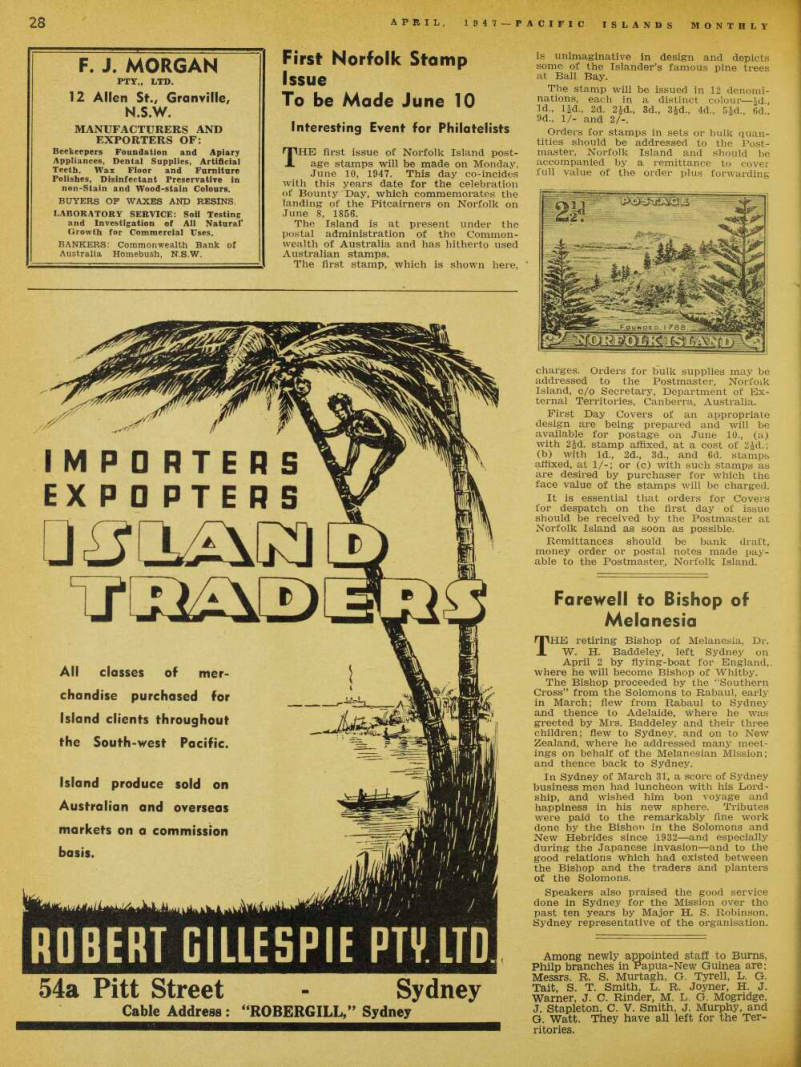
Issue To be Mode June 10 Interesting Event for Philatelists
THE first issue of Norfolk Island post age stamps will be made on Monday, June 10, 1947. This day co-incides with this years date for the celebration of Bounty Bay, which commemorates the landing of the Pitcairners on Norfolk on June 8, 1856.
The Island is at present under the postal administration of the Common wealth of Australia and has hitherto used Australian stamps.
The first stamp, which is shown here,
is unimaginative in design and depicts some of the Islander’s famous pine trees at Ball Bay.
The stamp will be issued in 12 denomi nations, each in a distinct colour—id., Id., lid., 2d. 2|d., 3d., 3id., 4d., s|d„ 6d., 9d., 1/- and 2/-.
Orders for stamps in sets or bulk quan tities should be addressed to the Post master, Norfolk Island and should be accompanied by a remittance to cover full value of the order plus forwarding
charges. Orders for bulk supplies may be addressed to the Postmaster, Norfolk Island, c/o Secretary, Department of Ex ternal Territories, Canberra, Australia.
First Day Covers of an appropriate design are being prepared and will be available for postage on June 10., (a) with 2id. stamp affixed, at a cost of 2|d.; (b) with Id., 2d., 3d., and 6d. stamps affixed, at 1/-; or (c) with such stamps as are desired by purchaser for which the face value of the stamps will be charged.
It is essential that orders for Covers for despatch on the first day of issue should be received by the Postmaster at Norfolk Island as soon as possible.
Remittances should be bank draft, money order or postal notes made pay able to the Postmaster, Norfolk Island.
Farewell to Bishop of Melanesia
Melanesia
THE retiring Bishop of Melanesia, Dr.
W. H. Baddeley, left Sydney on April 2 by flying-boat for England, where he will become Bishop of Whitby.
The Bishop proceeded by the “Southern Cross” from the Solomons to Rabaul, early in March; flew from Rabaul to Sydney and thence to Adelaide, where he was greeted by Mrs. Baddeley and their three children; flew to Sydney, and on to New Zealand, where he addressed many meet ings on behalf of the Melanesian Mission; and thence back to Sydney, In Sydney of March 31, a score of Sydney business men had luncheon with his Lord ship, and wished him bon voyage and happiness in his new sphere. Tributes were paid to the remarkably fine work done by the Bishon in the Solomons and New Hebrides since 1932—and especially during the Japanese invasion—and to the good relations which had existed between the Bishop and the traders and planters of the Solomons.
Speakers also praised the good service done in Sydney for the Mission over the past ten years by Major H. S. Robinson, Sydney representative of the organisation.
Among newly appointed staff to Burns, Philp branches in Papua-New Guinea are: Messrs. R. S. Murtagh, G. Tyrell, L. G.
Tait, S. T. Smith, L. R. Joyner, H. J.
Warner, J. C. Rinder, M. L. G. Mogridge, J. Stapleton, C. V. Smith, J. Murphy, and G. Watt. They have all left for the Ter ritories.
Trading Position
Governor's Review Shows Fiji's Sound
THE recent session of the Fiji Legisla tive Council, which opened in Suva on March 7, produced relatively few fire works—although there was some opposi tion to the imposition of export taxes on copra and sugar; and some plain speaking between Sir Hugh Ragg and his brother, Mr. Amie Ragg, on the latter’s motion that; “This Council deplores the continuance of the dual system of Gov ernment to which the Fijian people are subject and advises that it be abolished so that the Fijians, together with mem bers of the other races in the Colony, may be governed by laws applicable to all.”
Mr. Ragg based his motion on the fact that the Fijians have to conform to native regulations—many of which are archaic and due for revision and, in the opinion of many informed people, detri mental to the progress of the Fijian people—and to the general laws of Fiji as well, Non-Government members who op posed the proposal to levy export taxes on copra and sugar pointed out that there had been a surplus over the Esti mates for 1946; and that the Estimates budgeted for a surplus in the current year. It was argued that with such buoy ancy in the Colony’s finances there was no need to apply this taxation. Revenue from Customs is almost twice the amount it was in 1939 —due to the fact that the values of the imported goods have in creased greatly.
The Financial Secretary was of the opinion, however, that more money was required for the Colony’s post-war re construction plan, in view of the fact that costs of materials had risen steeply.
It is noted that, in his speech, the Governor (Sir Alexander Grantham) re ferred to the tax on export copra as a Port and Service Tax of 1 per cent, plus wharfage dues at 6d. per ton. He said that it was not proposed to levy a special export tax on copra, as the industry still had leeway to make up. However, for general purposes, the reimposition of the Port and Service Tax (which was re moved when the price of copra fell dras tically in the pre-war and early war periods) can be regarded as an export tax.
Other points in the Governor’s opening speech to the Council were as follows:
Exports
EXPORTS of copra from Fiji in 1946 had exceeded estimates and had amounted to 28,000 tons. Sugar ex ports, although not up to pre-war figures, were satisfactory at 115,000 tons. There had been a considerable improvement in the quality of local bananas and during the year 86,960 cases of this fruit had been exported to New Zealand. Arrange ments had also been completed for the reopening of trade with Western Canada, and a small experimental shipment of 50 bunches had gone to Vancouver, had arrived in excellent condition and secured a good price. Shipment of 2,500 bunches would be made to the same port shortly.
Home Markets
THE cultivation of rice for consumption within the Colony had been main tained during the year, and 17,000 tons were harvested. Due to increased consumption, however, there had been a shortage in January and February. A
general rice survey is now being under taken by field officers of the Department of Agriculture.
Butter fat production was maintained at the same level as the previous two years, but the need for rehabilitation of pastures had caused the production to fall far below that of pre-war years.
Price Rises, Stabilisation Funds,
and Taxes
AN increase of £5/5/- per ton for sugar was recenty announced, and it had been decided to establish a Stabilisa tion Fund in this industry to take care of possible future falls in price. Pay ments to the Stabilisation Fund would be £l/15/- per ton. It had been de cided, also, to impose a special export tax of 10/- per ton; and, therefore, the industry would be left with a net increase of £3 per ton on the price of sugar over last year’s price.
An increase had been made in the price of copra also (£4/6/- per ton) and Port and Excise Tax would be reimposed. The question of establishing a Stabilisation Fund in this industry had been dis cussed, but was rejected on grounds of impracticably—the Fiji copra industry is said to be less well organised than the sugar industry.
Co-operative Societies
SIR ALEXANDER also outlined the benefits of the Co-operative Socie ties’ Bill which was introduced during
the session. He said that, firstly, the co-operative society can provide its mem bers with economic advantages; and sec ondly, it had an educative value in that it taught thrift, self-help, fair dealing and a training in the working of demo cratic processes. He said that although the societies would require a good deal of guidance and advice in the initial stages, they must stand on their own feet both financially and in the man agement of their affairs. It was not de sired that they should become Govern ment co-operative societies either in name or in fact.
Wages and Hours
THE cost of living of Indian workmen in the Colony had shown a sharp rise m the last three months of 1946 and the Government had therefore found it necessary to review the wages paid to Government employees. Resulting wage increases were estimated to cost £35,000 per annum. And, as a result of negotia tions, the hours of work had been re duced, but this action was taken only after an undertaking by the PWD Em ployees’ Union that output would not fall off: and after consultation with the larger employers of labour in the Colony.
Education
THE main efforts of the Education De partment had been directed towards the implementation of the Educa tion Plan which was approved in 1946.
The Teachers’ Training College at Masinu had already opened, however, and 156 men students and 81 women students were in residence. Of these. 107 are In dians, 98 Fijians, and 10 Euronesians.
Finances
THE Estimates for 1947 budget for a surplus of £65.022. In 1946 expendi ture was £2,020,811 and revenue £2.098.726. In that year it had been esti mated that there would be a deficit of about £72,000, this, however, had been turned into a surplus of nearly £78.000 mostlv due to Customs revenue which for the first time in history had exceeded the milion pound mark.
Mrs. Roy McGregor, a well-known and popular resident of the district before the war, returned there recently.
Advertisements & other items, pp. 31-32 (1 item)
you SHOULD buy
COMPLEXION PERFECTION
WITH
FOR
DISCRIMINATING WOMEN
WHO DESIRE
ALLURING LOVELINESS
Obtainable At All Stores.
Distributor:
GORDON K. SMITH
Beverley Hills, Sydney Bankers: Bank of N.S.W.
BEAUTY
PREPARATIONS
This is the WATCH
you SHOULD buy
. . . because In its All Steel, Imported, Shock-proof, Waterproof, Anti-magnetic Case it is absolutely the
Best Watch Value in Australia.
The 15-Ruby Jewel movement fitted with the "Indestructible Lever” is specially made in Switzerland for Angus 8C Coote by a manufacturer who has been producing Famous Swiss Watches since 1853.
Read what Mr. F.G.A., of Canowindra,
writes;
"When I asked you to advise me what kind of a Wrist Watch to buy, you advised an 'lndestructible Lever’ ... I am grateful and pleased to say that it is by far the best Watch I have ever owned. I would not take £2O for it to-day. I have used it under the dirtiest conditions, including all kinds of dust, charcoal dust at a blacksmith’s forge, oxy and electric welding, hammering; all kinds of vibrations . .
THIS SAME WATCH CAN
BE YOURS TODAY.
Th.
Indestructible”
Lever, £lO/10/- On Stainless Steel Band, 10/- extra.
Write to ANGUS 8C COOTE, who have supplied the finest and most reliable Watches to the people of Australia for over 50 years.
Remember, when you seek to buy a Watch you place yourself entirely in the hands of your Jeweller. Choose a jeweller you can trust, and one who will recommend to you the RIGHT WATCH.
For all your Jewellery needs, write to:
ANGUS & COOTE
500 GEORGE STREET, SYDNEY.
Phone MA 4853
Refreshin g
as a plunge
into a lagoon!
nw rM |C
coAP
I
Germicidal
and fragrant
TENAX TOILET SOAP is
a rapid safeguard against external skin infections, yet it is soothing and kind to the most sensitive skin —even a baby’s!
ORDER TENAX FROM
YOUR ISLAND SUP-
PLIERS. STOCKS ARE
PLENTIFULLY AVAIL-
ABLE.
Hard to Get? 7> y us
FOR
1. TRADE TOBACCO 10.
2. LAP LAP MATERIAL 11.
3. CANNED GOODS 12.
4. PERFUMERY 13 -
5. PRIMUS STOVES 14
6. KEROLAMPS ’
7. SHOES, SANDALS 15
8. UMBRELLAS 1 6
9. CHILDREN'S CLOTH- 17*
ING 18.
M. & M.
SADDLERY & HARNESS
HOME LIGHTING PLANTS
WINES AND SPIRITS
NON-ELECTRIC WASHING
MACHINES
PUMPS, IRRIGATION
PLANTS
PRO^kTRV
HAIRDRESSING SUPPLIES
HARDWARE
AIR CIRCULATORS
8a Castlereagh Street, Sydney, Australia
ISLAND TRADERS
Cable and Telegraphic address: “MANSTOCKS,” SYDNEY Telephones: 8W7405, 8W1237, 85076, FM2766
Conditions In Lae
Non-Official View of Territory Is Very Pessimistic
From a Special Correspondent LAE, March 17 CONDITIONS here continue chaotic; and they do not appear likely to im prove. To the newcomer in the Gov ernment service, who draws his regular salary, of course, “everything in the garden is lovely.” But the old hands realise how serious is the position.
Much of the trouble, in my opinion, is caused by the existence of. so many false values and ideas.
For instance, the young native lad in his late or middle teens at the outbreak of war, contacted many of our troops with Leftist ideas, and was treated lav ishly with cases of meat, tea, sugar (and other Army rations) in exchange for some native curios—a grass skirt, a few spears, a handful of seashells. At the same time the young native cultivated, as a result of these casual contacts, a superior tolerance of the white race as a whole.
This cultivated attitude applied only to the adolescents, and most certainly not to the older natives who had worked side by side with their white employers during the pre-war years, and more par ticularly during the war years them selves, when they shared the privations of war together and, too, shared in the success of overcoming the enemy.
These older “boys” are anxious for the return of their old “masters,” and simply refuse to engage to work for anyone else.
It is an open secret that amongst the “war adolescents” there is a preparation going on for the time when’ the white men can be evicted from New Guinea.
The presence of thousands of rounds of ammunition, rifles and war material hid den in villages does not tend to make the situation any easier. This prepara tion is apparent to many of the old timers; but the new arrivals, not ap preciating the position, are living in a fool’s paradise.
THE shipping problem is most acute.
Many of the private storekeepers have received no goods for months, and the position is: No goods, no busi ness. Some of those who still are able to do business are the fortunate ones who were in the district when the Ameri cans were leaving, and whisky was short in the US Army. Overseas business seems impossible, what with the intro duction of “permits” and the erection of official barriers, all of which are pre venting the settlement of the territory.
I can see the time coming when the population here will consist only of Gov ernment servants. The planter, miner and trader will be a part of the past and exist only in cheap novels.
Many of the old-hands are so discour aged that they contempate leaving the country after having made an attempt to gather something out of the wreck age.
It is not in my nature to be a pessi mist. But the prevailing conditions force me to view the facts in their proper light, and not to bolster myself up or give others a false impression by “wish ful thinking.” Many of the old-timers share my views, and one can see the shadow of despair creeping over them.
In Lae, there are at the moment some 800 people. But what they are doing, or are supposed to be doing, I could not say. Most of them are like Micawber, “waiting for something to turn up.”
THE local lighting system is_ something to bewail—the power fails without the slightest warning. Owing to this, the Morobe bakery has been forced to des troy large quantities of bread. It is re ported that the chief cause of these power failures is the lack of a belt for the engine; ordered months ago, and still somewhere on its way.
The water system is another local headache. A legacy from the US army, and functioning perfectly during the war, it has now been allowed to deteriorate to such an extent that the service does not work for days at a time. The drill now is that when it is turned on, residents make sure of future supplies by filling up petrol drums.
General food shortages prevail to an alarming extent. Tea (that most essen tial of commodities for the average Aussie) is practically unprocurable; when it can be bought, the price ranges from 4/6 to 5/- a lb. Animal fat, which is part of the native labour ration issue, as laid down by the Ordinance, cannot be purchased, and “boys’ ” meats are also unprocurable. Salt, a most necessary issue, is unobtainable anywhere. Old newspapers, a general article of trade amongst the natives themselves, cannot be had.
A general remark among older natives concerning the present “set up” is that it is “time no good”; and they inquire when the old government is coming back.
IHAVE heard that the old firm of WRC is opening on a new site in Lae; and that land has been temporarily granted for the erection of a picture theatre. This is certainly a step in the right direction.
The lower portion of the Lae town
ship, or the original pre-war business area, is being resurveyed to pick up the old survey pegs. Every portion of Lae township has been applied for or granted.
There has been talk of closing down the old airstrip and making a new inter national ’drome on the Malahang plan tation; but the owners of Malahang (the Lutheran Mission) say they know noth ing officially of the proposal.
The Bank of. New South Wales, with Mr. Joe Lawson as manager, proposes to open a branch in Lae, a'nd will be located on a portion of the Henry Eekhoff site.
Air Service
WRC Establish An Air Service For NG Personnel
AGAIN W. R. Carpenter &! Co. Ltd., has demonstrated its ability to solve what, to ordinary people, are insup erable difficulties.
In New Guinea, where inter-island transport is still in a chaotic condition, the firm had inaugurated its own flying boat service for general movement of personnel.
Two Catalinas, based on Madang, are used in the service. Captain Hugh Birch, ex-RAAF is in charge, with Pilot H.
Couchman, also ex-RAAF, his second in command.
Captain “Sandy” Meldrum who is well known in New Guinea waters, has been in Melbourne recently supervising repairs and alterations to an addition to the W.
R. Carpenter & Co’s fleet—LCG 18. Cap tain Paterson is carrying out similar work in Sydney on a newly-acquired LCT for the same firm.
Return of "Shell Show"
AFTER an absence of eight years, the “Shell Show,” Australia’s first big live artiste variety programme, is return ing to the air. The Programme com menced on March 26 and will be broad cast every Wednesday at 8 p.m. for three quarters of an hour. The show will be relayed by 2GB Macquarie Network and a number of co-operating stations in all six States of the Commonwealth.
Advertisements & other items, pp. 33-34 (2 items)
Nelson & Robertson Ks
We Will Buy
It For You
Any goods you may require from English shops or factories Purchased and Shipped.
Small or large orders catered for.
ALL SERVICES UNDER-
TAKEN FOR RESIDENTS
ABROAD.
PITT & SCOTT
LIMITED
(Established 1876) General Shipping and Buying Agents. 1/3, St. Paul's Churchyard, London, England Cables. Shipping London.
NELSON and ROBERTSON Pty. Ltd.
Established 1895
Shipowners - Brokers and
Islands Merchants
All classes merchandise purchased at Best Wholesale Prices. Original Invoices supplied to Island Clients. Cocoa Beans, Copra, Rubber, Trochus Shell and All Islands 7 Produce Sold on Commission.
Entrust your requirements to the firm with fifty years' practical experience in the Pacific Islands. ■ iwmpi arrennun given to an enquiries.
NELSON & ROBERTSON KS
12 SPRING STREET, SYDNEY, AUSTRALIA
Telegraphic Address: IVAN, SYDNEY.
MILE after MILE
■■■ OF
EXTRA WEAR
now added to
cool - running
MIILIR
TIRES
Tires for
trucks,
automobiles,
buses
Miller Accessories and Repair Materials are dependable!
Consistently high in quality, this complete line has been developed to meet every automotive need.
New type, stronger construction.
New wide, flatter tread. Longer mileage. Maximum traction.
Peak skid resistance. Greater protection against bruises.
MORE TIRE FOR YOUR MONEY
Radiator hose Radiator cleaner Radiator solder Noc-out adjustable hose clamps Vulcanizing patch and valve stem clamp Tire camelback (passenger and truck) Full circle curing tubes Tire pump hose assemblies Self curing cements and patches Weld rite vulcanizing patch Weld rite valve steam heat units Fractional horsepower belts Rubber solvent Friction tape Windshield wiper tubing Air bags Fan belts Rubber mallets Cord fabrics Tire paint Tire and tube repair kits
TUBE REPAIR KIT
CONTENTS
I—s" x 19" Strip rubber 80— Wa" Sq. bevel cut patches 20—114 " x 2 " Oval bevel cut patches I—l 4 Pt. bottle cement I—Carborundum buffer
Exporters
PACIFIC ISLANDS TRADING COMPANY
244 CALIFORNIA STREET, SAN FRANCISCO 11, CALIFORNIA, U. S. A.
32
APft t L , 1&4 1 PACIFIC ISLANDS MONtHlt
TRAPPED BY NIPS! —How Coast-Watchers Escaped
Near Finschhaven, TNG
IN the first instalment of his story in March “PIMMr. K. H. McColl, who was one of Commander Eric Feldt’s Coast-Watchers, told how he escaped from the North-western Islands of New Guinea after war came to the Pacific, and how he became a Coast-Watcher in company with the Rev. A. P. H. Freund and the late Lloyd Pursehouse behind Finschhafen. In this second instalment, he continues the Finschhafen story, and in the May issue he will tell us some thing of “Operation Sepik.”
Part Two
EVENTS proceeding my arrival in the Finschhafen area, have been given by “Freundy,” (Rev. A. P. H Freund). He has covered the general set-up in excellent manner, and I can only add my own personal experiences— and those of Lloyd Pursehouse, insofar as they were interwoven with mine—in those exciting days.
When Pursehouse (Purse, for short), and I made our reconnaissance of Finsch hafen, mentioned by Freund, we did so with more or less light hearts. We were still under the impression that the Nip was armed only with those long, cum bersome rifles, which are now familiar to most. We considered that we could do more damage with our Winchester .44’s; at least we could make a much bigger hole than he could. It was only later, to my personal horror, that I knew they were, armed with very good sub machine guns too.
So we arrived at Sattelberg late one afternoon, after a quick trip in from our rear base. We settled into our old house, which had been visited by the Nip, and prepared to enjoy a good night’s rest.
We had much to do in limited time.
Early next morning we hid our gear, and retired to the hill behind the Mission church, and spent the day observing the movements of the Japs below, with the
aid of my telescope. At the usual time, the “milk run'’ arrived; a single Liberator/ which after dropping a couple of bombs on Finschhafen and Heldsbach flew on . to annoy Nips at Gloucester and Arawo That evening, having laid our plans, we moved back to the house, and had a meal prepared by a mission boy, who was acting as caretaker of the houses at Sattelberg. We w'aited until about 10 p.m. then with our rifles and an emergency ration, we set off down the road to the beach. About half way, I said goodbye to Purse w r ho was going to take the roat’. through Sisi, thence right into the back of Finschhafen. I carried on by the main road to Heldsbach and the air-strip.
As I got nearer the beach, my nerves began to tighten up. There is something about being alone, in pitch darkness, and expecting to run into Jap sentries any where, which gives one the feeling that there is soda-water in his veins.
Then, just near Heldsbach. it happened!
There was a sudden rush of footsteps nearby. My nerves twanged like a harp, and I leaped straight up, several feet into the air, it seemed, then froze stiff where I stood. I gradually got my breath back when I realised that it w r as a mob of wild pigs, in a disused garden.
As I got into Heldsbach plantation, the world opened up, and down I plunged.
Tenderly feeling a barked shin, I soundly cursed the US sth Air Force, for making bomb craters where a much shaken Coast- Watcher could fall into them. I carry the scars on my shin to this day.
Without further incident. I investigated the air-strip, about mid-way between Heldsbach and Finschhafen, and made sure that it was not being used by the Nip, and after making a few more obser vations which would be of use, I began the ascent to Sattelberg again. Purse rejoined me there, and we compared notes.
We gathered some very useful informa tion from this trip.
As it was nearly daylight by this time, we retired to our hill again, and kept watch during the day; both expected a visit from the Nip. No matter how careful, it is easy in the dark to leave some trace of one’s passing. But nothing eventuated.
WE considered the position thoroughly, as to the best site for a safe OP and decided that a point further south of Sattelberg would be preferable. . Next day, we moved away from Sattel berg and inspected the village of Mararuo.
This place seemed to fill the bill —we had quick access to the tracks to our rear, should things get sticky; a road ran past the end of the village to Finschhafen; and just across the road was a convenient ridge from which Finsch. and the harbour could be seen clearly. It also commanded a good view of Yitiaz Straits, and at the same time, Sattelberg was under obser vation, as well as the road itself for some distance.
The Jap base was only 2J hours’ walk away, but we felt that we would be reasonably safe here. Off one side of the village was a deep gully, with a creek of good fresh water through it. We de cided to build a hut down there, about 300 yards from the village.
We then returned to our rear base.
where we had left Freund, about 6 dayj walk. Freund has already described the heart-breaking mountains we had to traverse. We received a drop of essentials, including the Owen gun, and after making our final arrangements, Purse and I took the trail back towards Fmschhaten to a^esilmnaJn^This m nkwje^ a would °be Hpv? wfl?k S hebTnd thi forward nosiUon days walk behind the forward position.
As we approached Mararuo, we reconnoitred cautiously. In those days, anything could happen in a matter of hours. We found everything as we had left it, and after gathering in a few natives from the bush, (Mararuo was deserted by the natives, who were scared by the bombing), we set them to work building a hut in the gully. Only a few knew of our presence there, and these were from the area back of us. Those natives between us and the Japs were kept in ignorance of our whereabouts. We used a few trusted natives, as agents, to bring us news of the beach.
We three had been in the area for nearly 8 months by this time, and wo were familiar with most of the natives. and, more important, most of the bush tracks. Both Purse and I familiarised ourselves with the few faint tracks in and out of our gully—just in case! We made a new track up to our OP, and wdiere it entered the village, through a thick belt of bamboo, it was made on an angle, so that, from the village, no track was discernible; to find it, it would bo necessary to follow the edge of the bamboo right around before it could be scon tL P s saved our lives later A , ... .. . ’ - ..
■ a t. &„SS.
marck Sea was fought, and although we ?^o ed X wnrri aCtl On, hTtii it brought us a lot of worry. Oui JL ne !! ? f n many J x P f from rlnnrfci c ° mputed from the native reports, that between
1,200-2,000 reached shore) including the complement of a destroyer, which, though damaged, anchored off Heldsbach, and was sunk by Liberators next morning, after everyone was clear. Among these men were a number of Jap Marines, a welltrained and well-armed body, Later ‘he campaign, all Ferdinand Parties operating in the bush, were accompanied by a line of trained native scouts, but in the early days at Finschhafen we had no one but ourselves to do scouting and all other duties. We had to depend on keeping well hidden to evade the Nip We could expect no timely warning of his approach. /%UR arrangement at tv.A op II . , w . , . . were f m \ Urns to . do an Pd tb ® next morning on hiff tbe sarr ?
W . ~. a sk ® ds ; We also arranged lit n " I we^ e attacked, d t H °+v, 0 W / wjJ'° smash fbe ra dio, ' owing to thick be
possible totryand
better one get out than both get irtn trouble * n c , , .. .. un Saturday afternoon, April 3, 1943, £ .^ as my tu i’ n ta up to the ° p . ™^ g^ Stirre ?’ + if n< i the J^ p + v. was - b V sy aro V nd of the houses of the mission a 10n ins chhafen, digging diligently. apparently makin / , fox-holes. About S' 15 p,m -’ the cloud closed in over Vitiaz L t ra its, and I decided to wend my aown to the hut. About ten minutes after 1 had S° ne - a P a rty of 30 Japs arrived in the village. (I ascertained this ? n a subse <l uent vis it to Mararuo.) They had heard a whisper that there were spies behind them, and they came to in vestigate. As we had no native guards. and the village was deserted, we were not aware of their proximity. I remember we decided to make some orange jam
that night, from a surplus of oranges we had on hand. A verv homely occu pation, in view of the fact that 300 yards away a party of Japs were looking for our blood It being mv turn on the OP next morning ! left the hut about V. 30 1m P™ was enJoyin S a sleep-in, and as I 1 Passed the usual remark (a standing J° ke between us), that if he heard shots be w ould know that the Nips had arrived, About 150 yards from the hut, and on the stee Pest pinch of track. I walked into the am bush! Shots greeted me from about 30 yards distant, with the Nip well hidden in the lower fringe of bamboo. A burst from a sub-machine gun ripped my Hawley Tropper from my head, thoroughly spoiling it. Several more bursts chopped the ground at my feet, and tore splinters f rQ m a sapling near my ear. Rifles and revolvers had joined the fray, and it trickled into my dazed mind that my last hour had aTrived .
Hastily jerking up my Owen gun, I s l ? ra3^ d a 7 hole magazin ® in the general d “ 10I l ° f the eae ? y ’ then turned and r 21 1?, b f c £ down tke track, followed by a hail of ballets - 1 had not gone far when a convenient tree root caught my foot, and sent me sprawling into a water course. Seven Japs with submachine guns rushed me > and from a distance of not more than five yards, then emptied their magazines at me. Incredible as it may seem, I was still unhit, though my eyes were filled with dirt chopped up by the bullets. As soon as they stopped to reload, I scrambled smartly into the bush, with another barrage whistling through the trees after me. I had the feeling then that I was the most shot-at man in the whole war* I knew that by this time Purse would be well out of the way, so took a short cut towards the hut, and planted myself behind some bushes about 20 yards from the track. It was here that I was able
to count the number against me, and also to note, from their uniforms, that they were Marines. There were seven with sub-machine guns (German “Solo thurns”), twenty with rifles, and three with revolvers. One of the three was the O/C of Finschhafen, a Lieut-Colonel.
Having them all in nice view, I flicked the empty magazine off the Owen, and felt in my haversack for a new one. All I felt was an empty interior! Everything had fallen out of it, no doubt while I was falling over and scrambling about the bush.
Damn and Blast! In my annoyance I must have moved too much, as I saw all seven submachine guns swing my way, and noted little flecks of blue smoke spitting from the muzzles. Bullets poured in from all directions, and I felt I had had it. Standing the now useless Owen against a bush, I retired rapidly back up the hill, and went to cover in the bamboo. By this time I was completely surrounded by the enemy, and it was only a matter of time before they closed in for the kill. I counted up my revolver cart ridges. Eighteen seventeen for the Nips and one for myself!
I saw some of the Nips searching below me, but none came near. Then all be came quiet. The day passed, and as night came on, I moved quietly down towards the hut, and spent the rest of the darkness huddled at the base of a tree, 30 yards from our house. I sus pected a trap there, and was right. Three Japs were inside, and just as I was about to move on in the early dawn (I had to await some light to pick out the track on tne otner side of the creek) they came out shooting, disturbed by a branch falling from a tree nearby. They then squatted in front of the hut, and prepared a fire, and while they were doing this, I walked slowly past them.
Oh, for a grenade!
IN the meantime. Purse had got away.
When he heard the battle raging closer to him, he thought that I was chasing some Japs. He could hear a submachine gun firing, and rifles, and was under the impression that the tommy gun was mine. He met a native in the bush, who took him into the bamboo and hid him, until the native could scout round and And out what had happened.
Later, he heard a reverse of the order of shooting and was convinced that I had been killed. As he put it, he would hear rifles, followed by a submachine gun; that was me. Then he heard an Owen gun, followed by rifle Are, then dead silence.
They had got me!
Sadly he moved on to Sossenenko village quite unconscious of the fact that a Jap was not far beiund him. (I followed botn their tracks next morning.) It was not until four days later that a native caught up with him and told him that “Mastei Mac was on his way to join him again.
In the meantime, I paid a visit to Sattelberg, where the Jap Lieut-Colonel was waiting for news of our death or capture. He had returned there the same morning, so I was able to follow his foot prints fresh in the morning dew. As he had a body-guard of at least two, who were armed with tommy-guns, I resisted my Arst impulse to sneak in and pot him with my revolver. He seemed to be busy in the direction of Finschhafen, and I concluded that he might be signalling for more troops to come up and join in the hunt; therefore I decided that the sooner I got back to our base the better. (It later transpired that 250 Japs combed the whole Kotte and Hube area just after we got up into the Cromwell Range.) They found our bases and destroyed the spare radio that we planted at Ogeramnung, and arrested many of the natives who had assisted us. The head mission teachers were arrested and questioned, but
by dint of many lies, (they will be forgiven for this) they convinced the Jap that we were entirely indepedent of their aid. On a later visit to the area, I got the whole
story, and for sheer loyalty and guts, [ have to hand it to these Mission boys. I recommended two of them for Loyal Ser vice Medals.
AND so came to an end our Coast- Watching on the Huon Peninsula, We had to get cut, as we were entirely surrounded by the enemy. V. e had them in the area looking for us; they were waiting for us behind Lae; they had patrols in the Markham Valley, and sent patrols in from Sio and Saidor. They were about 35,000 to our three. We had all spent 18 months in enemy-held terri tory, and on top of that we had been in New Guinea for three to four years before the war had began, so HQ decided that we could do with a spell.
At the end of our five weeks walk to Benna Benna after we had climbed several of New Guinea’s roughest and highest ranges (we crossed the head waters of the Mongi River in the Crom wells, and it rises at 12,000 feet), I really understood the much used term “foot sore and weary.” We all were. It was heaven to climb into a Douglas transport, and look down on the mountains, instead of looking up at them.
Advertisements & other items, pp. 35-38 (1 item)
Head Office *49-451 KENT ST., SYDNEY.
William Atkins rt y . m.
Iron & Steel Merchants-Engineers' Supplies
ESTABLISHED OVER 50 YEARS
Coach tr Motor Hardware
JWI
Cable Address: WILATKIN, Sydney.
STEEL DEPARTMENT
MILD STEEL:
Rounds, Squares, Flats, Half-rounds, Hexagons, Bevel, Shoeing, Tyre, Angles, Tees, Sheets, Plates, Girder Plates, Chequer Plates, Channels, Hoops, Etc.
BRIGHT STEEL:
Rounds, Squares, Hexagons.
Extra Special High Speed Tool Steel, Mining Steel, Blister Steel and Spring Steel, Rounds, Flats Gr Squares.
Bar Iron—All sections and sizes.
Engineers' Supplies: Set Screws, Studs, Metal Thread Screws, Coach Screws. Files, Cotter Pins, Bright and Black Bolts, Rivets, Etc., Hack Saw Blades.
Power Transmission Gear: Including Plummer Blocks, Couplings, Collars, Etc.
Coach and Motor Hardware: Axles, Springs, Wheelstuflf, Duck, Paints.
Farriers 1 Supplies: Horse Nails, Anvils, Vices, Etc.
Motor-Trimmers and Motor Builders 1 & Motor Painters 1 Requirements Pacific Island Agents : Corrie & Co., Suva, Fiji DUCO Lacquers and DULUX Enamels—FAßßEX Motor Toppings and Leather Cloths, House & Decorators 1 Paints, Varnishes tr Brushwore.
Sole Distributors of CHAMPION'S Decorators Paint Products.
Distributing Agents for BROLITE Lacquers, SYNFLEX Enamels and "POLYGLOSS" Finish.
BESEEM
CUFF LINKS
An important accessory to every well-dressed man’s appearance, ECCO Cuff Links have a rich dignity of style and design which wins instant approval. Come in and see them today.
SJti CL
WISE PRECAUTION,
MOTHER!
In these days of uncertainty, your little ones will be safer when they are wearing an ECCO Indentity inscribed with their name and address. Give your children this added protection, today I I
CROSSES
fcVVv -'.'CHAINS
85 ie «*■ Beautifully designed, ECCO Crosses and Chains make ideal gifts for mother, sister, wife or girl-friend. Come in today, and make your selection from our wide assortment.
OBTAINABLE FROM YOUR JEWELLER
or from:
PACIFIC ISLANDS TRADING COMPANY
244 California St. San Francisco 11, U.S.A.
THAT
Relief from
a major anxiety
Even the most expert and conscientious individual executor is subject to accident, illness and incapacitation.
Continuity of administration and uninterrupted attention to your estate and your beneficiaries are of paramount importance. Both can be positively assured by appointing this Company your sole Executor or as co-Executor with your present appointee. An interesting explanatory booklet will be forwarded on request.
DIRECTORS:
James Burns. Joseph Mitchell. P. T. W. Black.
Frederick Ewen Loxton. Eric Priestley Lee, MANAGER: L. S. Parker.
SECRETARY: E. R. Overton, A.F.I.A.
BURNS PHILP TRUST
COMPANY
LIMITED
7 BRIDGE
TELEPHONE: BU 5901.
STREET,
SYDNEY
Box 543, G.P.0., Sydney BP 1.45
Allen Taylor Co. Ltd.
COMMERCIAL ROAD, ROZELLE,
SYDNEY
Sawmlliers ond Wholesale Suppliers of Hardwoods for Constructional Purposes GIRDERS . . . PILES . . . POLES . . . SLEEPERS, Etc.
EXPORTING TO PACIFIC ISLANDS SINCE 1893
u\ Prepared from choicest tender meats, and cooked to perfection by expert chefs, Imperial canned meats are “flavoursealed” for lasting taste appeal.
Keep good stocks of the many delicious Imperial canned meats and serve them often—they’re always ready, and always welcome^ i A W - PUDD ,f l£
CANNED MEATS
MEAT R E A T
HOT MEALS
CAMP PIE
HAM P E
Polynesian Club Of Sydney
AFTER a temporary set-back due to the loss of their old home by fire, members of the Polynesian Club, Sydney, have settled down into quarters at the House of Culture, Kings Cross.
For a period, visitors from the Islands and New Zealand found the going diffi cult “The Cross” being a fair way from George Street, but the place has been located and the Club gatherings resemble those of old times.
During the past few months “welcome evenings” have been tendered Miss Nicky Thompson of Foxton, NZ, and the Club chief lady, Mrs. Katarina Nehua Darley, both of whom returned from long visits to New Zealand. Farewells were given Madame Dora Menghetti, her husband Francois, her sister Ivy Buffett, and Vina Quintal, all of whom left by the “Morinda” for Norfolk Island. Dora and Ivy are daughters of the well known Mr. Peter Buffett, of Norfolk Island.
Other visitors were Evan Cameron of Nukualofa, Tonga; Miss Nathalie Wahlen, formerly of Rabaul; Miss Maira Kouka, a Maori girl from the Ngati Porou tribe; Jim Henare, of Taupo, NZ; Rua Gilman and Hori Rikihana, of Gisborne: Maria Skipwith, a Maori lass from Wellington, now residing in Sydney.
Former residents of Samoa, Mrs. Elsa Watson and her sister Page, were present at a welcome to Mr, and Mrs. A. Vercoe from Apia. Mrs. Vercoe was formerly Seine Mataafa, a relative of the Samoan High Chief. Other visitors from Samoa were David Hunter and Derek Bernard, from Apia; while Tahiti was represented by Paul Robson and, later, Gilles Paquier, who are from Papeete.
Mr, Henry G. Eekhoff, veteran of War I, and one of the best-known identities in the Lae district, where in pre-war days he had a general store and trading busi ness, is hard at work endeavouring to start in business again. He writes; “I have been flat out working on essentials; trying to erect a house out of two war buildings I was able to purchase I cannot obtain any stocks from Australia although I have had goods ordered for months. Everyone is complaining of shortages and there seems no chance of obtaining anything.”
“Marambu” left Sydney on March 27 for New Britain. Mr. Gus Kuster was master-engineer; Mr. McEvoy and Mr.
Harry Thornton and son were also mem bers of the crew. This boat was built for Mr. J. J. Gilmore, of Put Put plant ation on the south coast of New Britain.
Magazine Section
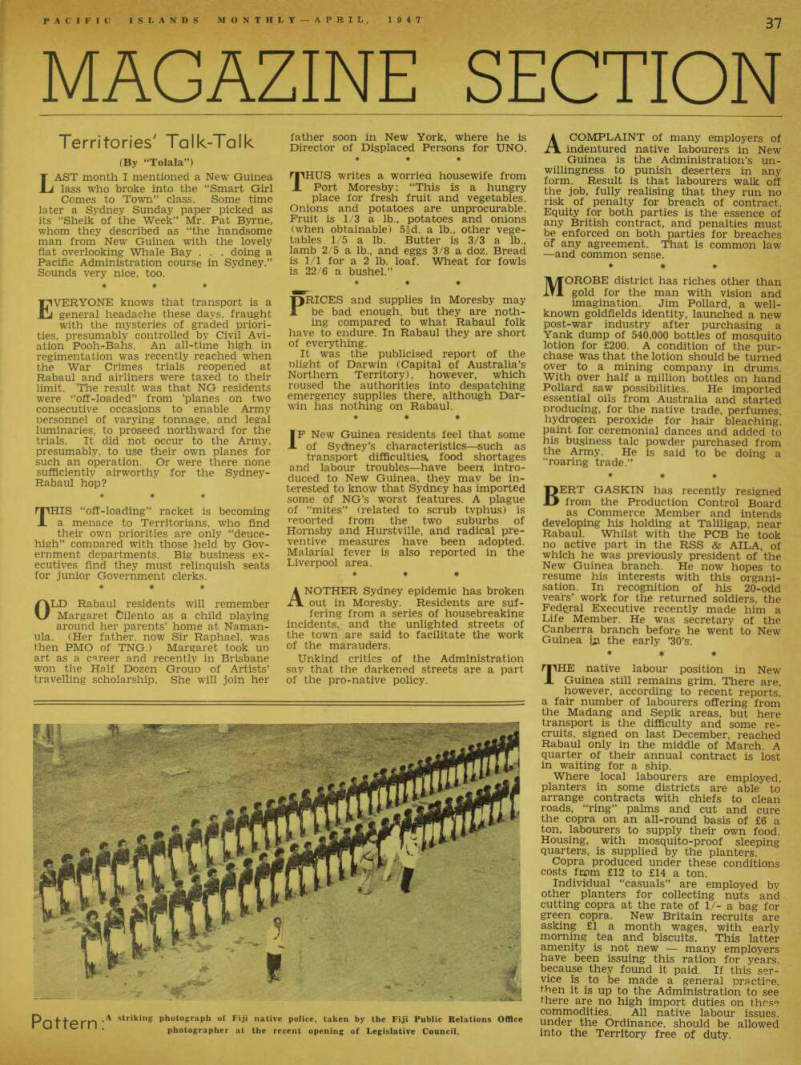
Territories Talko-alk
(By “Tolala”)
LAST month I mentioned a New Guinea lass who broke into the “Smart Girl Comes to Town” class. Some time later a Sydney Sunday paper picked as its “Sheik of the Week” Mr. Pat Byrne, whom they described as “the handsome man from New Guinea with the lovely flat overlooking Whale Bay . . . doing a Pacific Administration course in Sydney.”
Sounds very nice, too. * * ♦ EVERYONE knows that transport is a general headache these days, fraught with the mysteries of graded priori ties, presumably controlled by Civil Avi ation Pooh-Bahs. An all-time high in regimentation was recently reached when the War Crimes trials reopened at Rabaul and airliners were taxed to their limit. result was that NG residents were “off-loaded” from ’planes on two consecutive occasions to enable Army nersonnel of varying tonnage, and legal luminaries, to proseed northward for the trials. It did not occur to the Army, presumably, to use their own planes for such an operation. Or were there none sufficiently airworthy for the Sydney- Rabaul hop? * ♦ * THIS “off-loading” racket is becoming a menace to Territorians, who find their own priorities are only “deuce high” compared with those held by Gov ernment departments. Big business ex ecutives find they must relinquish seats for junior Government clerks. ♦ ♦ ♦ OLD Rabaul residents will remember Margaret Cilento as a child playing around her parents’ home at Naman ula. (Her father, now Sir Raphael, was then PMO of TNG.) Margaret took up art as a career and recently in Brisbane won the Half Dozen Group of Artists’ travelling scholarship. She will join her
father soon in New York, where he is Director of Displaced Persons for UNO. ♦ * * THUS writes a worried housewife from Port Moresby: “This is a hungry place for fresh fruit and vegetables.
Onions and potatoes are unprocurable.
Fruit is 1/3 a lb., potatoes and onions (when obtainable) 5Jd. a lb., other vege tables 1/5 a lb. Butter is 3/3 a lb., lamb 2/5 a lb., and eggs 3/8 a doz. Bread is 1/1 for a 2 lb. loaf. Wheat for fowls is 22/6 a bushel.” ♦ ♦ * PRICES and supplies in Moresby may be bad enough, but they are noth ing compared to what Rabaul folk have to endure. In Rabaul they are short of everything.
It was the publicised report of the nlieht of Darwin (Capital of Australia’s Northern Territory), however, which roused the authorities into despatching emergency supplies there, although Dar win has nothing on Rabaul. • • ♦ IF New Guinea residents feel that some of Sydjney’s characteristics—such as transport food shortages and labour troubles —have beer* intro duced to New Guinea, they may be in terested to know that Sydney has imported some of NG’s worst features. A plague of “mites” (related to scrub typhus) is renorted from the two suburbs of Hornsby and Hurstville, and radical pre ventive measures have been adopted.
Malarial fever is also reported in the Liverpool area. ♦ * • ANOTHER Sydney epidemic has broken out in Moresby. Residents are suf fering from a series of housebreakine incidents, and the unlighted streets of the town are said to facilitate the work of the marauders.
Unkind critics of the Administration say that the darkened streets are a part of the pro-native policy.
A COMPLAINT of many employers of indentured native labourers in New Guinea is the Administration’s un willingness to punish deserters in any form. Result is that labourers walk off the job, fully realising that they run no risk of penalty for breach of contract.
Equity for both parties is the essence of any British contract, and penalties must be enforced on both parties for breaches of any agreement. That is common law —and common sense. * MOROBE district has riches other than gold for the man with vision and imagination. Jim Pollard, a well known goldfields identity, launched a new post-war industry after purchasing a Yank dump of 540,000 bottles of mosquito lotion for £2OO. A condition of the pur chase was that the lotion should be turned over to a mining company in drums.
With over half a million bottles on hand Pollard saw possibilities. He imported essential oils from Australia and started producing, for the native trade, perfumes hydrogen peroxide for hair bleaching, paint for ceremonial dances and added to his business talc powder purchased from the Army. He is said to be doing a “roaring trade.” • ♦ • BERT GASKIN has recently resigned from the Production Control Board as Commerce Member and intends developing his holding at Taliligap, near Rabaul. Whilst with the PCB he took no active part in the RSS & AILA, of which he was previously president of the New Guinea branch. He now hopes to resume his interests with this organi sation. In recognition of his 20-odd vea'rs’ work for the returned soldiers, the Federal Executive recently made him a Life Member. He was secretary of the Canberra branch before he went to New Guinea in the early ’3o’s. • ♦ * THE native labour position in New Guinea still remains grim. There are, however, according to recent reports, a fair number of labourers offering from the Madang and Sepik areas, but here transport is the difficulty and some re cruits, signed on last December, reached Rabaul only in the middle of March. A quarter of their annual contract is lost in waiting for a ship.
Where local labourers are employed, planters in some districts are able to arrange contracts with chiefs to clean roads, “ring” palms and cut and cure the copra on an all-round basis of £6 a ton, labourers to supply their own food.
Housing, with mosquito-proof sleeping quarters, is supplied by the planters.
Copra produced under these conditions costs from £l2 to £l4 a ton.
Individual “casuals” are employed by other planters for collecting nuts and cutting copra at the rate of 1/- a bag for green copra. New Britain recruits are asking £1 a month wages, with early morning tea and biscuits. This latter amenity is not new many employers have been issuing this ration for years, because they found it paid. If this ser vice is to be made a general practice, then it is up to the Administration to see there are no high import duties on those commodities. All native labour issues, under the Ordinance, should be allowed into the Territory free of duty.
Pattern: A striking photograph of Fiji native police, taken by the Fiji Public Relations Office photographer at the recent opening of Legislative Council.
He Pilots Ships
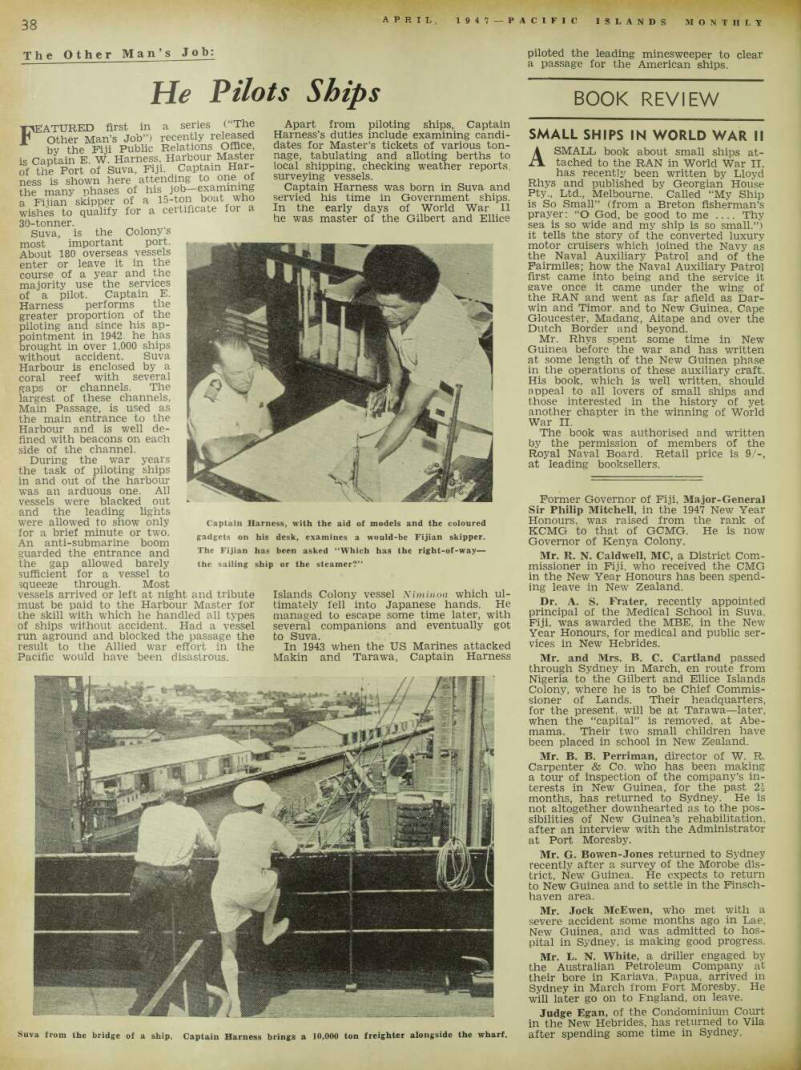
The Other Man’s Job:
FEATURED first in a series (“The Other Man’s Job”) recently released by the Fiji Public Relations Office, is Captain E. W. Harness, H^ou r Master of the Port of Suva, Fiji. Captain Har ness is shown here attending to one ot the many phases of his job examining a Fiilan" skipper of a 15-ton boat who wishes to qualify for a certificate for a 30-tonner.
Suva, is the Colony's most imnortant port.
About 180 overseas vessels enter or leave it in the course of a year and the majority use the services of a pilot. Captain E.
Harness performs the greater proportion of the piloting and since his ap pointment in 1942. he has brought in over 1,000 ships without accident. Suva Harbour is enclosed by a coral reef with several gaps or channels. The largest of these channels, Main Passage, is used as the main entrance to the Harbour and is well de fined with beacons on each side of the channel.
During the war years the task of piloting ships in and out of the harbour was an arduous one. All vessels were blacked out and the leading lights were allowed to show only for a brief minute or two.
An anti-submarine boom guarded the entrance and the gap allowed barely sufficient for a vessel to squeeze through. Most
vessels arrived or left at night and tribute must be paid to the Harbour Master for the skill with which he handled all types of ships without accident. Had a vessel run aground and blocked the passage the result to the Allied war effort in the Pacific would have been disastrous.
Apart from piloting ships, Captain Harness’s duties include examining candi dates for Master’s tickets of various ton nage, tabulating and alloting berths to local shipping, checking weather reports, surveying vessels.
Captain Harness was born in Suva and servied his time in Government ships.
In the early days of World War II he was master of the Gilbert and Ellice
Islands Colony vessel Niminoa which ul timately fell into Japanese hands. He managed to escape some time later, with several companions and eventually got to Suva.
In 1943 when the US Marines attacked Makin and Tarawa, Captain Harness
piloted the leading minesweeper to clear a passage for the American ships.
Suva from the bridge of a ship. Captain Harness brings a 10,000 ton freighter alongside the wharf.
Captain Harness, with the aid of models and the coloured gadgets on his desk, examines a would-be Fijian skipper.
The Fijian has been asked “Which has the right-of-way— the sailing ship or the steamer?”
Book Review
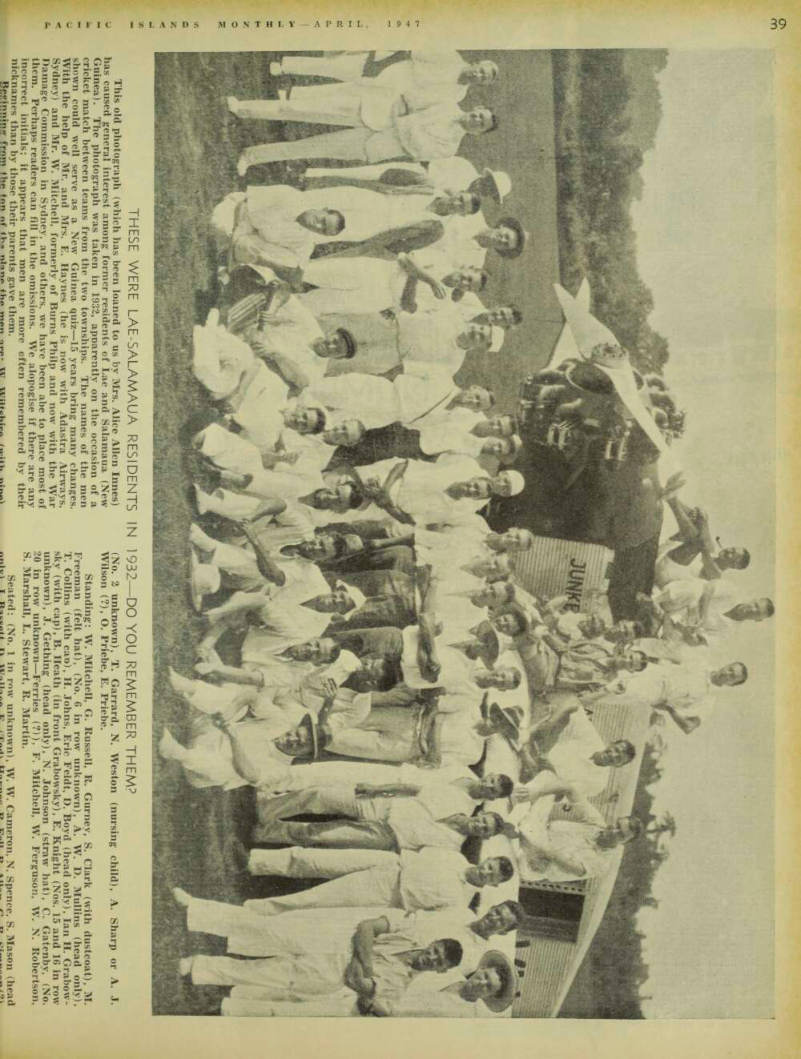
Small Ships In World War Ii
A SMALL book about small ships at tached to the RAN in World War 11, has recently been written by Lloyd Rhys and nublished by Georgian House Pty., Ltd., Melbourne. Called “My Ship is So Small” (from a Breton fisherman’s prayer: “O God, be good to me ... Thy sea is so wide and my ship is so small.”) it tells the story of the converted luxury motor cruisers which joined the Navy as the Naval Auxiliary Patrol and of the Fairmiles; how the Naval Auxiliary Patrol first came into being and the service it gave once it came under the wing of the RAN and went as far afield as Dar win and Timor,, and to New Guinea, Cape Gloucester, Madang, Aitape and over the Dutch Border and beyond.
Mr. Rhys spent some time in New Guinea before the war and has written at some length of the New Guinea phase in the operations of these auxiliary craft.
His book, which is well written, should appeal to all lovers of small ships and those interested in the history of yet another chapter in the winning of World War 11.
The book was authorised and written by the permission of members of the Royal Naval Board. Retail price is 9/-, at leading booksellers.
Former Governor of Fiji, Major-General Sir Philip Mitchell, in the 1947 New Year Honours, was raised from the rank of KCMG to that of GCMG. He is now Governor of Kenya Colony.
Mr. R. N. Caldwell, MC, a District Com missioner in Fiji, who received the CMG in the New Year Honours has been spend ing leave in New Zealand.
Dr. A. S. Frater, recently appointed principal of the Medical School in Suva, Fiji, was awarded the MBE, in the New Year Honours, for medical and public ser vices in New Hebrides.
Mr. and Mrs. B. C. Cartland passed through Sydney in March, en route from Nigeria to the Gilbert and Ellice Islands Colony, where he is to be Chief Commis sioner of Lands. Their headquarters, for the present, will be at Tarawa—later, when the “capital” is removed, at Abe mama. Their two small children have been placed in school in New Zealand.
Mr. B. B. Perriman, director of W. R.
Carpenter & Co. who has been making a tour of inspection of the company’s in terests in New Guinea, for the past 2i months, has returned to Sydney. He is not altogether downhearted as to the pos sibilities of New Guinea’s rehabilitation, after an interview with the Administrator at Port Moresby.
Mr. G. Bowen-Jones returned to Sydney recently after a survey of the Morobe dis trict, New Guinea. He expects to return to New Guinea and to settle in the Pinsch haven area.
Mr. Jock McEwen, who met with a severe accident some months ago in Lae, New Guinea, and was admitted to hos pital in Sydney, is making good progress.
Mr. L. N. White, a driller engaged by the Australian Petroleum Company at their bore in Kariava, Papua, arrived in Sydney in March from Fort Moresby. He will later go on to England, on leave.
Judge Egan, of the Condominium Court in the New Hebrides, has returned to Vila after spending some time in Sydney.
This old photograph (which has been loaned to us by Mrs. Alice Allen Innes) has caused general interest among former residents of Lae and Salamaua (New Guinea). The photograph was taken in 1932, apparently on the occasion of a cricket match between teams from the two townships. The names of the men shown could well serve as a New Guinea quiz — 15 years bring many changes.
With the help of Mr. and Mrs. E. Haynes (he is now with Adastra Airways, Sydney) and Mr. W. Mitchell, formerly of Burns Philp and now with the War Damage Commission in Sydney, and others, we have been abe to place most of them. Perhaps readers can fill in the omissions. We alopogise if there are any incorrect initials; it appears that men are more often remembered by their nicknames than by those their parents gave them.
Beginning from the ton of the plane the men are: W. Wiltshire( with nine)
THESE WERE LAE-SALAMAUA RESIDENTS IN 1932 —DO YOU REMEMBER THEM?
(No. 2 unknown), T. Garrard, N. Weston (nursing child), A. Sharp or A. J.
Wilson (?), O. Priebe, E. Priebe.
Standing: W. Mitchell, G. Russell, R. Gurney, S. Clark (with dustcoat), M.
Freeman (felt hat), (No. 6 in row unknown), A. W. D. Mullins (head only), T. Collins (with can), H. Johns, Eric Feldt, D. Boyd (head only), lan H. Grabow sky (with cap), B. Heath (in front Grabowsky), E. Knight (Nos. 15 and 16 in row unknown), J. Gething (head only), N. Johnson (straw hat), C. Gatenby, (No. 20 in row unknown —Ferries (?)), F. Mitchell, W. Ferguson, W. N. Robertson, S. Marshall, L. Stewart, R. Martin.
Seated: (No. 1 in row unknown), W. W. Cameron, N. Spence. S. Mason (head only I Bassott D Wallaee F.Red) H [?] [?]
Advertisements & other items, p. 40 (1 item)
38
APRIL, 1947 P ACIFIC ISLANDS MONTHLY
Puka-Puka
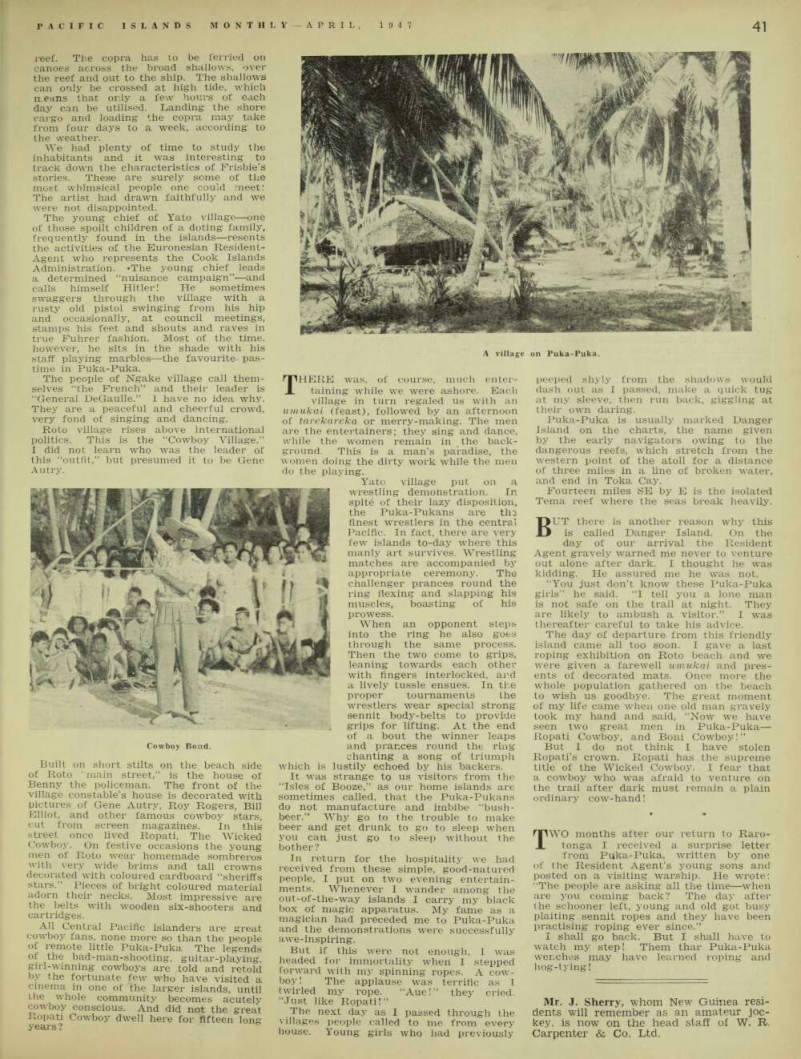
Cowboy Number Two
ALONG time ago in a far, cold land, I read a book about an insignificant speck in the Pacific Ocean called Puka-Puka. I had never heard of Puka- Puka before, and there must be a lot of people in the world who have not heard of it yet. This book, with its cameos of the lives and loves of a quaint, primi tive people, fascinated me more than any other South Seas book I had read.
The book was written by an ex-cowboy, ex-various-other-things, named Robert Dean Frisbie. On the first page this man Frisbie stated that ever since child hood he had been possessed by a strong urge to reach the end of things. Now he was sailing northwards towards the equa tor aboard the trading schooner Tiare Taporo —“l have wandered on,” he wrote, “not over the well-travelled sea-tracks dear to the heart o F tourists, but to strange and lonely places dear to my own heart, hidden in the farthermost seas. Such a place, I kne\v, was the atoll of Puka- Puka—and I looked forward eagerly to my arrival there.” He stayed for fifteen years.
IT was with a keen sense of anticipation then that I clung to the swaying rig ging of the schooner Tiare Taporo one blue morning more recently, watching for the magical appearance of the palm tops of Puka-Puka from out of the sea.
It had been a long, hard way to Puka- Puka; it was a dozen years since I first read the book.
On the beach fronting Central Village, we were greeted by most of the 660 inhab'tants. Never before had I beheld such a magnificent collection of strong, white teeth as the Puka-Pukans crow'ded round and beamed upon us. There many small, naked children carrying proudly before them prominent little turn-turns which gave the impression of having swallowed a water-melon whole.
Groups of children followed us every where as we moved around, and all the
old folks wanted to pat us and shake our hards. Puka-Pukan hospitality can be literally overwhelming. Opened drinking nuts were pressed upon us. When one was finished, a ~efil immediately took its place. One felt that it would be bad manners to waste any of the precious liquid, for on this atoll coconuts are truly the staff of life and are strictly rationed for daily use.
This ordeal by coconut water lasted throughout our week’s stay on the island and trying to find a quiet spot away from curious eyes to make way for the next quart remained our most urgent task.
We were thankful for nightfall.
By William S. Bond
Over the years Puka-Puka and its people had seemed more a fable than a reality, and exploring the atoll was like analysing a dream. Here were the three villages spread round the lagoon bay within the projecting arms of the northern islet; Koto —Central Village; Ngake— Windward Village; Yato —Leeward Village Here was the two hundred-yards-long causeway across a bight of the lagoon, making a short-cut from Roto to Yato and forming a community fish pond.
Scattered over the islet are those eerie graveyards with age-blackened, odd shaped fangs of coral rock jutting at all angles from a pack of coral gravel. There are many graves, as there must be on a small islet, where people have lived and reproduced over a long period of time.
Puka-Puka is roughly triangular in shape with an islet at each point and bare reefs between. All the people live on the northern islet, except at copra making time when some of them camp on the other islets. Motu Ko, the south east islet, belongs to Ngake Village; Yato owns Motu Kotaua, the south-westen islet. Roto owns the copra rights of the main islet.
It is a fine sight to watch the copra fleet sailing up from the motus. The long out-rigger canoes, piled with bagged copra, carry square sails of pandanus matting In spite of their general indolence, the Puka-Pukans make a fine job of their canoes. The lower part of the hull is hollowed from a single log in some of the larger canoes two logs are butted — the topsides are built up with two wide planks. The stem and stern are decked for a few feet with carved pieces ending in tapering projections. The whole is sew a together with sennit and so well are the parts fitted that a leak is rarely seen although no caulking is used. Great care is taken of the canoes and we were told that some of them are fifty years old.
They also make a neat job of their houses which are mostly constructed from the trunks, strut-roots and thatching of the pandanus palm. Puka-Puka pandanus mats are eagerly sought by outside buyers and several hundred are usually shipped on the copra schooner.
Generally speaking the once-yearly copra schooner from Rarotonga (750 mil as south-east of Puka-Puka) is the only con tact with the outer world. Between ships life passes very quietly with the dreamy Puka-Pukans. The few big undertakings such as copra-making are worked on a communal system so that the job can bo finished and everybody get back to rest ing again as soon as possible. The women do most of the menial work. The day is given mostly to sleeping. At night the villages come to life for cooking, eating, yarning, love-making. There is a real reason for this topsy-turvy existence, for the climate is extremely enervating.
With the excitement and business con nected with the schooner s visit the com munity naturally comes to life for a few days.
Loading copra at Puka-Puka is a long and tedious process. There is no en trance to the lagoon so the schooner has 10 swing off from a kedge on the leeward
reef. The copra has to be ferried on canoes across the broad shallows, over the reef and out to the ship. The shallows can only be crossed at high tide, which means that only a few hours of each day can be utilised. Landing the shore cargo and loading the copra may take from four days to a week, according to the weather.
We had plenty of time to study the inhabitants and it was interesting to track down the characteristics of Frisbie's stories. These are surely some of the most whimsical people one could meet: The artist had drawn faithfully and we were not disappointed.
The young chief of Yato village—one of those spoilt children of a doting family, frequently found in the islands —resents the activities of the Euronesian Resident- Agent who represents the Cook Islands Administration. «The young chief leads a determined “nuisance campaign”—and calls himself Hitler! He sometimes swaggers through the village with a rusty old pistol swinging from his hip and occasionally, at council meetings, stamps his feet and shouts and raves in true Fuhrer fashion. Most of the time, however, he sits in the shade with his staff playing marbles —the favourite- pas time in Puka-Puka.
The people of Ngake village call them selves “the French” and their leader is “General DeGaulle.” I have no idea why.
They are a peaceful and cheerful crowd, very fond of singing and dancing.
Roto village rises above international politics. This is the “Cowboy Village.”
I did not learn who was the leader of this “outfit,” but presumed it to be Gene Autry.
Built on short stilts on the beach side of Roto “main street,” is the house of Benny the policeman. The front of the village constable’s house is decorated with pictures of Gene Autry, Roy Rogers, Bill Blliot, and other famous cowboy stars, cut from screen magazines. In this street once lived Ropati, The Wicked Cowboy, On festive occasions the young men of Roto wear homemade sombreros with very wide brims and tall crowns decorated with coloured cardboard “sheriffs stars.” Pieces of bright coloured material adorn their necks. Most impressive are the belts with wooden six-shooters and cartridges.
All Central Pacific islanders are great cowboy fans, none more so than the people of remote little Puka-Puka The legends of the bad-man-shooting, guitar-playing. fZ'ZZTf cowb ° ys a re told and retold cinema Vh V i Wh ° h^ V i 8 lsited a .hP ThiVo the larger islands, until pnwtww h.® 0011165 , acutely Rnniti dld s , reat years? boy dwell bere for fteen lon &
THERE was, of course, much enter taining while we were ashore. Each village in turn regaled us with an urnukai (feast), followed by an afternoon of tarekareka or merry-making. The men are the entertainers; they sing and dance, while the women remain in the back ground. This is a man’s paradise, the women doing the dirty work while the men do the playing.
Yato village put on a wrestling demonstration. In spite of their lazy disposition, the Puka-Pukans are thj finest wrestlers in the central Pacific. In fact, there are very few islands to-day where this manly art survives. Wrestling matches are accompanied by appropriate ceremony. The challenger prances round the ring flexing and slapping his muscles, boasting of his prowess.
When an opponent steps into the ring he also goes through the same process.
Then the two come to grips, leaning towards each other with fingers interlocked, ard a lively tussle ensues. In the proper tournaments the wrestlers wear special strong sennit body-belts to provide grips for lifting. At the end of a bout the winner leaps and prances round the ring chanting a song of triumph
which is lustily echoed by his backers.
It was strange to us visitors from the “Isles of Booze,” as our home islands are sometimes called, that the Puka-Pukans do not manufacture and imbibe “bush beer.” Why go to the trouble to make beer and get drunk to go to sleep when you can just go to sleep without the bother?
In return for the hospitality we had received from these simple, good-natured people, I put on two evening entertain ments. Whenever I wander among the out-of-the-way islands I carry my black box of magic apparatus. My fame as a magician had preceded me to Puka-Puka and the demonstrations were successfully awe-inspiring.
But if this were not enough, I was headed for immortality when I stepped forward with my spinning ropes. A cow boy! The applause was terrific as 1 twirled my rope. “Aue!” they cried.
“Just like Ropati!”
The next day as I passed through the villages people called to me from every house. Young girls who had previously
peeped shyly from the shadows would dash out as I passed, make a quick tug at my sleeve, then run back, giggling at their own daring.
Puka-Puka is usually marked Danger Island on the charts, the name given by the early navigators owing to the dangerous reefs, which stretch from the western point of the atoll for a distance of three miles in a line of broken water, and end in Toka Cay.
Fourteen miles SE by E is the isolated Tema reef where the seas break heavily.
BUT there is another reason why this is called Danger Island. On the day of our arrival the Resident Agent gravely warned me never to venture out alone after dark. I thought he was kidding. He assured me he was not.
“You just don’t know these Puka-Puka girls” he said. “I tell you a lone man is not safe on the trail at night. They are likely to ambush a visitor.” I was thereafter careful to take his advice.
The day of departure from this friendly island came all too soon. I gave a last roping exhibition on Roto beach and we were given a farewell umukai and pres ents of decorated mats. Once more the whole population gathered on the beach to wish us goodbye. The great moment of my life came when one old man gravely took my hand and said, “Now we have seen two great men in Puka-Puka— Ropati Cowboy, and Boni Cowboy!”
But I do not think I have stolen Ropati’s crown. Ropati has the supreme title of the Wicked Cowboy. I fear that a cowboy who was afraid to venture on the trail after dark must remain a plain ordinary cow-hand!
TWO months after our return to Raro tonga I received a surprise letter from Puka-Puka, written by one of the Resident Agent’s young sons and posted on a visiting warship. He wrote: “The people are asking all the time—when are you coming back? The day after the schooner left, young and old got busy plaiting sennit ropes and they have been practising roping ever since.”
I shall go back. But I shall have to watch my step! Them thar Puka-Puka wenches may have learned roping and hog-tying!
Mr. J. Sherry, whom New Guinea resi dents will remember as an amateur joc key. is now on the head staff of W. R.
Carpenter & Co. Ltd.
Cowboy Bond.
A village on Puka-Puka.
Tropicalities
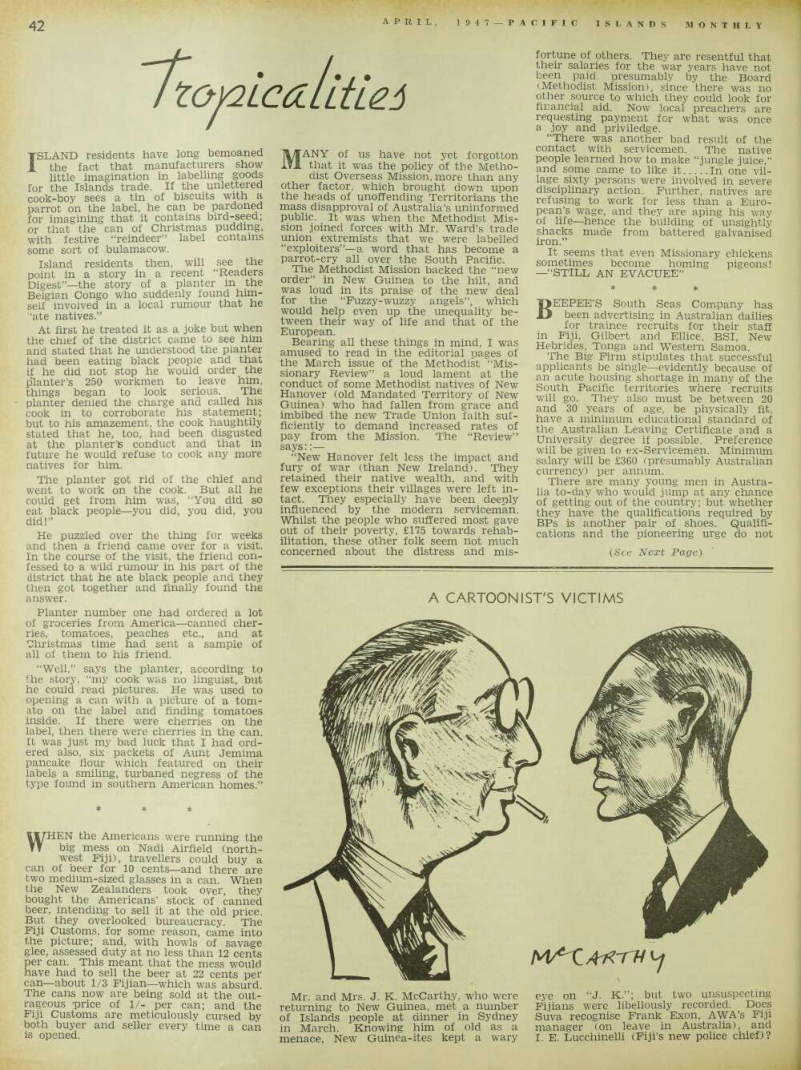
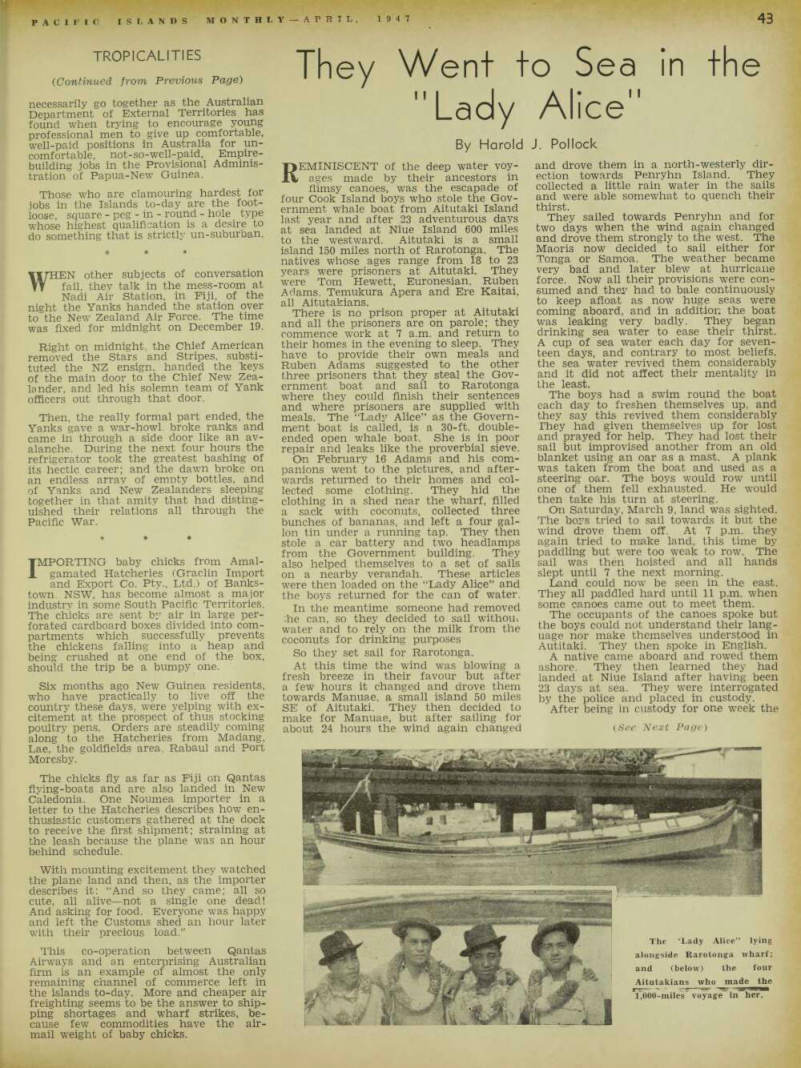
ISLAND residents have long bemoaned the fact that manufacturers show little imagination in labelling goods for the Islands trade. If the unlettered cook-boy sees a tin of biscuits with a parrot on the label, he can be pardoned for imagining that it contains bird-seed; or that the can of Christmas pudding, with festive “reindeer” label contains some sort of bulamacow.
Island residents then, will see the point in a story in a recent “Readers Digest”—the story of a planter in the Belgian Congo who suddenly found him self involved in a local rumour that he “ate natives.”
At first he treated it as a joke but when the chief of the district came to see him and stated that he understood the planter had been eating black people and that if he did not stop he would order the planter’s 250 workmen to leave him, things began to look serious. The planter denied the charge and called his cook in to corroborate his statement; but to his amazement, the cook haughtily stated that he, too, had been disgusted at the planter’s conduct and that in future he would refuse to cook any more natives for him.
The planter got rid of the chief and went to work on the cook. But all he could get from him was, “You did so eat black people—you did, you did, you did!”
He puzzled over the tiling for weeks and then a friend came over for a visit.
In the course of the visit, the friend con fessed to a wild rumour in his part of the district that he ate black people and they then got together and finally found the answer.
Planter number one had ordered a lot of groceries from America—canned cher ries, tomatoes, peaches etc., and at Christmas time had sent a sample of all of them to his friend.
“Well,” says the planter, according to the story, “my cook was no linguist, but he could read pictures. He was used to opening a can with a picture of a tom ato on the label and finding tomatoes inside. If there were cherries on the label, then there were cherries in the can.
It was just my bad luck that I had ord ered also, six packets of Aunt Jemima pancake flour which featured on their labels a smiling, turbaned negress of the type found in southern American homes.” * * * WHEN the Americans were running the big mess on Nadi Airfield (north west Fiji), travellers could buy a can of beer for 10 cents—and there are two medium-sized glasses in a can. When the New Zealanders took over, they bought the Americans’ stock of canned beer, intending to sell it at the old price.
But they overlooked bureaucracy. The Fiji Customs, for some reason, came into the picture; and, with howls of savage glee, assessed duty at no less than 12 cents per can. This meant that the mess would have had to sell the beer at 22 cents per can—about 1/3 Fijian—which was absurd.
The cans now are being sold at the out rageous -price of 1/- per can; and the Fiji Customs are meticulously cursed by both buyer and seller every time a can is opened.
MANY of us have not yet forgotten that it was the policy of the Metho dist Overseas Mission, more than any other factor, which brought down upon the heads of unoffending Territorians the mass disapproval of Australia’s uninformed public. It was when the Methodist Mis sion joined forces with Mr. Ward’s trade union extremists that we were labelled “exploiters”—a word that has become a parrot-cry all over the South Pacific.
The Methodist Mission backed the “new order” in New Guinea to the hilt, and was loud in its praise of the new deal for the “Fuzzy-wuzzy angels”, which would help even up the unequality be tween their way of life and that of the European.
Bearing all these things in mind, I was amused to read in the editorial nages of the March issue of the Methodist “Mis sionary Review” a loud lament at the conduct of some Methodist natives of New Hanover (old Mandated Territory of New Guinea) who had fallen from grace and imbibed the new Trade Union faith suf ficiently to demand increased rates of pay from the Mission. The “Review” says::— “New Hanover felt less the impact and fury of war (than New Ireland). They retained their native wealth, and with few exceptions their villages were left in tact. They especially have been deenly influenced by the modern serviceman.
Whilst the people who suffered most gave out of their poverty, £175 towards rehab ilitation, these other folk seem not much concerned about the distress and mis
fortune of others. They are resentful that their salaries for the war years have not been paid presumably by the Board (Methodist Mission), since there was no other source to which they could look for financial aid. Now local preachers are requesting payment for what was once a joy and priviledge.
“There was another bad result of the contact with servicemen. The native people learned how to make “jungle juice,” and some came to like it In one vil lage sixty persons were involved in severe disciplinary action. Further, natives are refusing to work for less than a Euro pean’s wage, and they are aping his way of life—hence the building of unsightly shacks made from battered galvanised iron.”
It seems that even Missionary chickens sometimes become homing pigeons!
“Still An Evacuee”
BEEPEE’S South Seas Company has been advertising in Australian dailies for trainee recruits for their staff in Fiji, Gilbert and Ellice, BSI, New Hebrides, Tonga and Western Samoa.
The Big Firm stipulates that successful applicants be single—evidently because of an acute housing shortage in many of the South Pacific territories where recruits will go. They also must be between 20 and 30 years of age., be physically fit, have a minimum educational standard of the Australian Leaving Certificate and a University degree if possible. Preference will be given to ex-Servicemen. Minimum salary will be £360 (presumably Australian currency) per annum.
There are many young men in Austra lia to-day who would jump at any chance of getting out of the country; but whether they have the qualifications required by BPs is another pair of shoes. Qualifi cations and the pioneering urge do not
(See Next Page)
necessarily go together as the Australian Department of External Territories has found when trying to encourage young professional men to give up comfortable, well-paid positions in Australia for un comfortable, not-so-well-paid, Empire building jobs in the Provisional Adminis tration of Papua-New Guinea.
Those who are clamouring hardest for jobs in the Islands to-day are the foot loose, square - peg -in - round - hole type whose highest qualification is a desire to do something that is strictly un-suburban. * * * U7HEN other subjects of conversation W fail, they talk in the mess-room at Nadi Air Station, in Fiji, of the night the Yanks handed the station over to the New Zealand Air Force. The time was fixed for midnight on December 19.
Right on midnight, the Chief American removed the Stars and Stripes, substi tuted the NZ ensign, handed the "keys of the main door to the Chief New Zea lander, and led his solemn team of Yank officers out through that door.
Then, the really formal part ended, the Yanks gave a war-howl broke ranks and came in through a side door like an av alanche. During the next four hours the refrigerator took the greatest bashing of its hectic career; and the dawn broke on an endless arrav of empty bottles, and of Yanks and New Zealanders sleeping together in that amitv that had disting uished their relation’s all through the Pacific War. * * * IMPORTING baby chicks from Amal gamated Hatcheries (Graclin Import and Export Co. Pty., Ltd.) of Banks town. NSW, has become almost a major industrv in some South Pacific Territories.
The chicks are sent by air in large per forated cardboard boxes divided into com partments which successfully prevents the chickens falling into a heap and being crushed at one end of the box, should the trip be a bumpy one.
Six months ago New Guinea residents, who have practically to live off the country these days, were yelping with ex citement at the prospect of thus stocking poultry pens. Orders are steadily coming along to the Hatcheries from Madang, Lae, the goldfields area, Rabaul and Port Moresby.
The chicks fly as far as Fiji on Qantas flying-boats and are also landed in New Caledonia. One Noumea importer in a letter to the Hatcheries describes how en thusiastic customers gathered at the dock to receive the first shipment; straining at the leash because the plane was an hour behind schedule.
With mounting excitement they watched the plane land and then, as the importer describes it: “And so they came; all so cute, all alive —not a single one dead!
And asking for food. Everyone was happy and left the Customs shed an hour later with their precious load.”
This co-operation between Qantas Airways and an enterprising Australian firm is an example of almost the only remaining channel of commerce left in the islands to-day. More and cheaper air freighting seems to be the answer to ship ping shortages and wharf strikes, be cause few commodities have the air mail weight of baby chicks.
A Cartoonists Victims
Mr. and Mrs. J. K. McCarthy, who were returning to New Guinea, met a number of Islands people at dinner in Sydney in March. Knowing him of old as a menace, New Guinea-ites kept a wary
eye on “J. K.”; but two unsuspecting Fijians were libellously recorded. Does Suva recognise Frank Exon, AWA’s Fiji manager (on leave in Australia), and I. E. Lucchinelli (Fiji’s new police chief)?
"Lady Alice"
They Went to Sea in the "Lady Alice"
By Harold J. Pollock
REMINISCENT of the deep water voyages made by their ancestors in flimsy canoes, was the escapade of four Cook Island boys who stole the Government whale boat from Aitutaki Island last year and after 23 adventurous days at sea landed at Niue Island 600 miles to the westward. Aitutaki is a small island 150 miles north of Rarotonga. The natives whose ages range from 18 to 23 years were prisoners at Aitutaki. They were Tom Hewett, Euronesian, Ruben Adams, Temukura Apera and Ere Kaitai, all Aitutakians.
There is no prison proper at Aitutaki and all the prisoners are on parole; they commence work at 7 a.m. and return to their homes in the evening to sleep. They have to provide their own meals and Ruben Adams suggested to the other three prisoners that they steal the Government boat and sail to Rarotonga where they could finish their sentences and where prisoners are supplied with meals. The “Ladv Alice” as the Government boat is called, is a 30-ft. doubleended open whale boat. She is in poor repair and leaks like the proverbial sieve.
On February 16 Adams and his companions went to the pictures, and afterwards returned to their homes and collected some clothing. They hid the clothing in a shed near the wharf, filled a sack with coconuts, collected three bunches of bananas, and left a four gallon tin under a running tap. They then stole a car battery and two headlamps from the Government building. They also helped themselves to a set of sails on a nearby verandah. These articles were then loaded on the “Lady Alice” and the boys returned for the can of water.
In the meantime someone had removed .he can, so they decided to sail withou*. water and to rely on the milk from the rnr>nniit(! for drinking mirnoses coconuts lor drinking purposes So they set sail for Rarotonga.
At this time the wind was blowing a fresh breeze in their favour but after a few hours it changed and drove them towards Manuae, a small island 50 miles SE of Aitutaki. They then decided to make for Manuae, but after sailing for about 24 hours the wind again changed
and drove them in a north-westerly dir ection towards Penryhn Island. They collected a little rain water in the sails and were able somewhat to quench their thirst.
They sailed towards Penryhn and for two days when the wind again changed and drove them strongly to the west. The Maoris now decided to sail either for Tonga or Samoa. The weather became very bad and later blew at hurricane force. Now all their provisions were con sumed and they had to bale continuously to keep afloat as now huge seas were coming aboard, and in addition the boat was leaking very badly. They began drinking sea water to ease their thirst.
A cup of sea water each day for seven teen days, and contrary to most beliefs, the sea water revived them considerably and it did not affect their mentality in the least.
The boys had a swim round the boat each day to freshen themselves up. and they say this revived them considerably They had given themselves up for lost and prayed for help. They had lost their sail but improvised another from an old blanket using an oar as a mast. A plank was taken from the boat and used as a steering oar. The boys would row until one of them fell exhausted. He would then take his turn at steering.
On Saturday, March 9, land was sighted.
The boys tried to sail towards it but the wind drove them off. At 7 p.m. they again tried to make land, this time by paddling but were too weak to row. The sail was then hoisted and all hands slept until 7 the next morning.
Land could now be seen in the east.
They all paddled hard until 11 p.m. when some canoes came out to meet them.
The occupants of the canoes spoke but the boys could not understand their lang uage nor make themselves understood in Autitaki. They then spoke in English.
A native came aboard and rowed them ashore. They then learned they had landed at Niue Island after having been 23 days at sea. They were interrogated by the police and placed in custody.
After being in custody for one week the
(See Next Page)
The ‘Lady Alice” lying alongside Rarotonga wharf; and (below) the four Aitutakians who made the
1,000-miles voyage“ in her.
boys were released and feted in true Polynesian style. Although technically prisoners, the Islanders regarded them as heroes and gave feasts in their honour.
They were supplied with new clothes, beautiful woven hats, garlanded with leis and even with money.
The voyage made by these four Ait utakions must rank as one of the most amazing ever made in an open boat with such meagre provisions. The lads had a remarkable escape from a waterv grave as they traversed nearly 1,000 miles of lonely open water in a frail craft that was neither sound nor watertight.
They have remarked that, after serving sentence, they will be quite content to become law abiding citizens and will never again attempt such a foolhardy adventure.
A son was born to Mr. and Mrs. B. G.
Dawson of Melbourne on March 6. Mrs Dawson is the daughter of the late Mr.
P. W. Mantle of Rabaul, New Guinea, and Mrs. Mantle who is now living in Mel bourne, Victoria. Mr. Dawson served with the 2/22nd Battalion AIP, in Rabaul dur ing the war and was one of the few who escaped from New Britain after the Jap anese invasion of the area in early 1942.
“Since Dr. McGusty’s visit, we have had the pleasure of welcoming two young graduates from the Central Medical School of Fiji, Macu Salato and Manzoor Beg-g, who were here studying tuberculosis for twelve months.”—Extract of a letter from the Secretary-General of the National Association for the Prevention of Tuberculosis, London, Dr. J. H, Harley Williams.
Advertisements & other items, p. 45 (1 item)
43
PACIFIC ISLANDS MONTHLY APRIL, 1947
TROPICALITIES
C Continued from Previous Page)
Death On A String
Short Story:
By V. J. Hearnes
HE stamped to the door and shouted, “Mali, you come.”
“Yus, Masta,” a husky voice answered, and a stocky Sepik hurried from the shade beside the cook-house.
“tv/toU yon call’im all boy make line aln-no- han.” the planter ordered, with a "oroipcc gesture towards the grassv patch that did duty for a lawn in front of the house.
“Yus, Masta.” The native sped away to where, in the shelter of a wide-spread ing, buttressed fig-tree, the labourers of Amanu Plantation munched their noon time meal.
“Whv. John. 1 thought you were going into Karlshaven this afternoon.” the woman said, sudden fear rising in her worried eyes.
“Well, you thought wrong again,” he leered.
“■R’it. John. ”
“Shut up, will vou! I’m stopping home tip TTwara gets back.”
“Till Kwara gets back!” Her face lost evpp the little colour it had managed to retain inspite of the horror and the d ocrro q t,i on of the past six months.
“Isn’t Kwara working with the rest of the boys?”
TTote-fiHed, iealous eves, narrowed to blazing slits, glared into his wife’s face, noting with sadistic gratification the sudden pallor, the trembling lips.
“Kwara hasn’t been seen since the line
went down into the west corner first thing this morning. He didn’t sneak off any where with a letter by any chance, did he?”
“A letter? I don’t know what you mean, John.”
“I think you know, right enough. A letter to that snivelling yellow-beUy at Talio River. That got under your skin, didn’t it!” His thin hands clenched upon the woman’s knee.
“Don’t be foolish, John. I don’t know what you are talking about.” She re peated her protest weakly.
“You don’t know how much I know,” he snapped back. “But I’m telling you this I’m keeping all the boys in fbp ir houses this afternoon, and when Kwara gets back, I’m going to grab the brute and search him. And if he has a note for you from Mac Hail, then you’re going to get what’s coming to you, you treacherous ”
The woman’s face flushed, and then paled again beneath his malevolent scrutiny. Rising from the table, she moved towards the bedroom, arrested at the door by his rasping voice.
“See you don’t leave this house until I give the word. I’m going to sit in the the store, where I can watch the boys’ houses as well as the house, and if you attempt to leave the place I’ll have mv answer, without waiting for Kwara with any blasted love-letters.”
SCOOPING the pile of mail from be side his plate, he slammed his hat on his head and strode out to where the plantation and house boys had aligned themselves in a restless, chatter ing “line” before the house.
“Rouse-im talk.” he bellowed, and the natives fell silent.
“Mali.” he called, after a brief, scorn ful scrutiny.
“Yus, Masta.” the native said, his eyes rolling in sudden fear.
“Kwara, he stop where?”
“Oh, Masta, me no savee.” The black toes wriggled uneasily in the scraggy grass. “Masta, me go lookim ”
“Shut up. you black scum. You’re boss-boy here, and if a coon is missing that’s your business, isn’t it?”
Anew wave of chatter arose, subsiding instantly under a vicious glare from the white man’s bloodshot eyes.
“All boy belong Amanu, listen good.
Clear off to your houses, and no one leave until I say. Mali you savvy?” ‘Me savvy, Masta.” The sullen native, smarting under the rebuke administered in front of the labourers, led the silent boys to the large hut across the path from the store.
UNLOCKING the door of the planta tion store, he seated himself on a box placed where he could see both the house and the barracks. He bel lowed for Mali to bring him whiskv and a glass and when it appeared, he poured himself a stiff drink and downed it at a gulp. Then, with frequent glances to wards the house and the native hut he fumbled through the mail. Dropping the newsnspers and letters on the floor be side him. he opened the large official en velope and scanned its contents.
“Damnation! Do they think a man’s got nothing else to do but line his bovs up after everv mail and recite a new string of regulations? Wages! Working hours' New food scales! And now ‘Parachute Bombs’. Well, I’ll be damned!
Do they think I’m going to put in half
a day trying to teach a bunch of kan akas not to touch anything they might see hanging from trees, because it might be a parachute bomb left over from the war, and it might blow them to their own particular hell? Let them find out for themselves! One or two good bangs and the rest will learn soon enough.”
A sudden movement among the coconut palms caught his suspicious eyes. Watch ing closely, he saw the short, slim figure of Kwara slipping from palm-tree to palm-tree, working round to the back of the house.
Waiting till the house-garden obscured the view, he strode quickly to the house, through the rear door, and reached the top of the back steps in time to see Kwara opening the garden gate.
“Kwara,” he roared, and the native froze to a sudden stop.
“Kwara! You come.”
The native paused, then fingered the woven hag that he carried native-wise under his upper arm, the thin strap over pis shoulder. Recovering quickly from his fright, some secret unknown to his master giving him unwonted courage, he eved the threatening figure warily, his black face set tensely, “Kwara. you come here or I’ll kill you.”
A slow grin creased the native’s 'face and betel-stained teeth flashed redly!
“Masta. you no can kill’im me. Mast* Mac Hail he tell’im me, behind you go along calaboose—along before you killim one fella boy belong Amanu.”
“Damn your blasted hide!” the swaying man roared, stumbling down the steps and raging towards the gate The native, with ouick, long steps, fled towards the coconuts.
Anger spurring his unsteady limbs, drunken bully raced in pursuit. With frequent glances over his shoulder, the lithe native, filled with war-taught cun ning, kept a safe distance in front, while allowing the pursuing figure to gain slowly upon him.
Dodging through the palms, he gained the stretch of waving kunai grass bevond crossed the tiny stream that skirted the plantation area, then raced along a “coon track” that cleft the tangled, gloomv barrier of jungle. Pausing a moment to listen, a heavy splashing and an uncouth roar told him that his master was not far behind.
With a sudden spurt he gained on his pursuer. Reaching a bend in the uneven winding track he glanced up into the heavy, twisted branches of an enormous fig-tree around whose giant trunk the “coon-track” turned sharply at the right.
A quick, searching look confirmed a dis covery made a few days before.
Dropping his woven bag squarely in the middle of the track, the Bouang climbed swiftly to an overhanging branch many feet above the ground. Reaching a chosen spot upon a branch, he waited, still as death, until the raving master of Amanu swerved around the trunk of of the fig and halted suddenly at the sight of the fallen bag. The corner of a snow-white envelope peeped out like a provocative eye from the mouth of the bag.
AS the unsteady, gasping figure bent to seize the letter, the native’s left hand silently parted a tangle of weather-stained silk cord that lay across the branch. Then a swift stroke of his jungle knife severed a thread which dangled stiffly down to where a rusting metal cylinder hung unmoving in the still jungle air. The native crouched closely upon the sheltering vastness of the giant branch. A shriek of terror from his lips passed unheard as all hell broke loose far down below his moss covered perch, and a bully’s soul went screeching down the by-ways of the damned.
Advertisements & other items, pp. 46-47 (2 items)
44
APRIL, 1947 PACIFIC ISLANDS MONTHLY
TO SEA IN "LADY ALICE"
(Continued from Previous Page)
Dependable
1
psq
s peci^
mild H
Capstan’s
own blend
CAPSTAN Cigarettes are dependable . . . tbeir special quality is unvarying.
CAPSTAN’S OWN BLEND of forty kinds of fine Virginia leaf has set a standard that is rigidly maintained and cannot be duplicated.
time for a
CAPSTAN
THE EMPIRE’S FAVOURITE CIGARETTE
in the smart HCb? packs
Islands Teen-Ager
Solving the Problem Of The Islands Teen-Ager
Letter to the Editor MOST mothers in the Islands have faced the “pre-school” years of their children with the loyalty and help—always kindly, if not alway efficient —of their respective native staffs. And in doing so have, incidentally laid the foun dation of lasting friendship and under standing between native and European— for a child who has known native care can think native. So, in the Islands, the young child is not a problem.
However, the school years come and, with them, the stress, expense, eternal difficulties of transport to fit in with vacations; and, usually, the necessity of pocketing one's pride and independance, to beg friends or overworked relatives to collect and accomodate the children in the brief mid-term holidays. All Islands parents have faced these years.
But even those worries fade before the post-school question! For the students who face University comes the problem of accommodation —never so difficult as in these days of inflated rents, resentful landladies with short staff, and autocratic luxury hotels who hide profits in thous ands of well-furnished, but unoccupied, rooms. Chaos reigns in the Australian Cities of Beautiful Nonsense —and now the would-be student is often compelled to forego a training.
It is here I would like to pay tribute to a Sydney institution, mention of which was made in the March “PIM,” for
here is a fine solution for parents who wish to give a young lady a career, com panionship and city amenities with the protection, cultural advantages and secu rity of a home atmosphere.
The Memorial College of Household Arts and Science was founded in memory of Australian pioneer women; its object is to train girls, on broader and more practical general subjects and allow them to select and follow a career. Instead of the aimless doldrums of the Islands adolescents usual to small or isolated communities, they have the expert ad vice and guidance of an outstanding woman educationalist and medico, Dr.
Mary Booth OBE and her staff, at Kirri billi, Sydney.
The late Miss Fairfax, Dr. George Abbot (of the Royal Historical Society), Mrs.
Mowll (wife of the Archbishop of Sydney), and Lt-Col. Jones (formerly a master of Uppingham) and a number of other in terested educationalists initiated the movement and, until war conditions com pelled the college to close down, it had proved an outstanding success.
The Memorial College of Household Arts is now reopening. Special attention has been given always to the study of conditions and problems of country life, and these would also apply as well tc Islands life. The Diploma Course gives a thorough training to those who wish to make professional use of their know ledge. The course touches many subjects of home-craft and cookery, hygiene, dress making, interior-decorating, household budgeting, etc. Child Study and Nursing are also taught by a practical, brief course at Karatane and day-nurseries. Many of the past students have become interested and continued these courses as a career
There is also the brighter social side of college life. Pupils attend concerts and theatres and arrangements can be made for them to take business or musical studies.
As an Islands mother with fw> daughters who have been happy students at this fine educational centre. I hasten to pass on this idea to those many mothers who wish to give their daughters a good finishing school of practical value.
I am, etc.,
Jane Bleasdale
Sydney, March 25, 1947.
Death Of Woman Pioneer
In Fiji
AFTER residence in Fiji for over 70 years, Mrs. M. J. Gallagher died in Suva on February 9. , Mrs. Gallagher was born in Sydney and went to Fiji as a child with her parents, Mr. and Mrs Connolly. She married twice, first Captain Gibbes and about 45 years ago, Mr. Michael Gallagher. She had four sons by her first marriage (Walter who predeceased her; Robert, Ernest and Laurie;) and two daughters, Mrs. Daphne Gylls-Thomas and Mrs. L.
Whitesire, both of New Zealand, by her second.
Her husband also survives her.
Mr. E. J. Frame, of the Burns, Philp & Co., Ltd., in Port Moresby, was in Syd ney in March on a short business trip.
Advertisements & other items, p. 48 (1 item)
W. & Aa Silbey Ltd.
DON'T SAY GUM DON'T SAY (JIM DON'T SAY © J M Gil DON'T SAY LgON'T SAY GIN DON'T SAY
DON'T SAY GIN
"«000& Y
I M DON'T SAY
DON'T SAY © I M D
GIN DON'T SAY
DON'T SAY GIN
GIN DON'T SAY
DON'T SAY G 1 m
GIN DON'T SAY
DON'T SAY GIN DON'T
GIN DON'T SAY GIN DON'T S
■'SBBB&, T jjjTsj
I M DON'T SAY |p I
IM
DON'T SAY
M Y
DON
: 3 5 AY * N °Ur * n Q Cq c
SAT
s ycUj * IN ey S *l£ r *Sh o^o
T SAY
IM Telegrams and Cables: “GILBEYS,” Melbourne.
Address all inquiries to:
W. & AA SILBEY LTD.
33 ROSSLYN STREET, WEST MELBOURNE. 109 REGENT STREET, SYDNEY.
Telegrams and Cables: “GILBEYS,” Sydney.
NZ Socialists Fasten Their Grip On
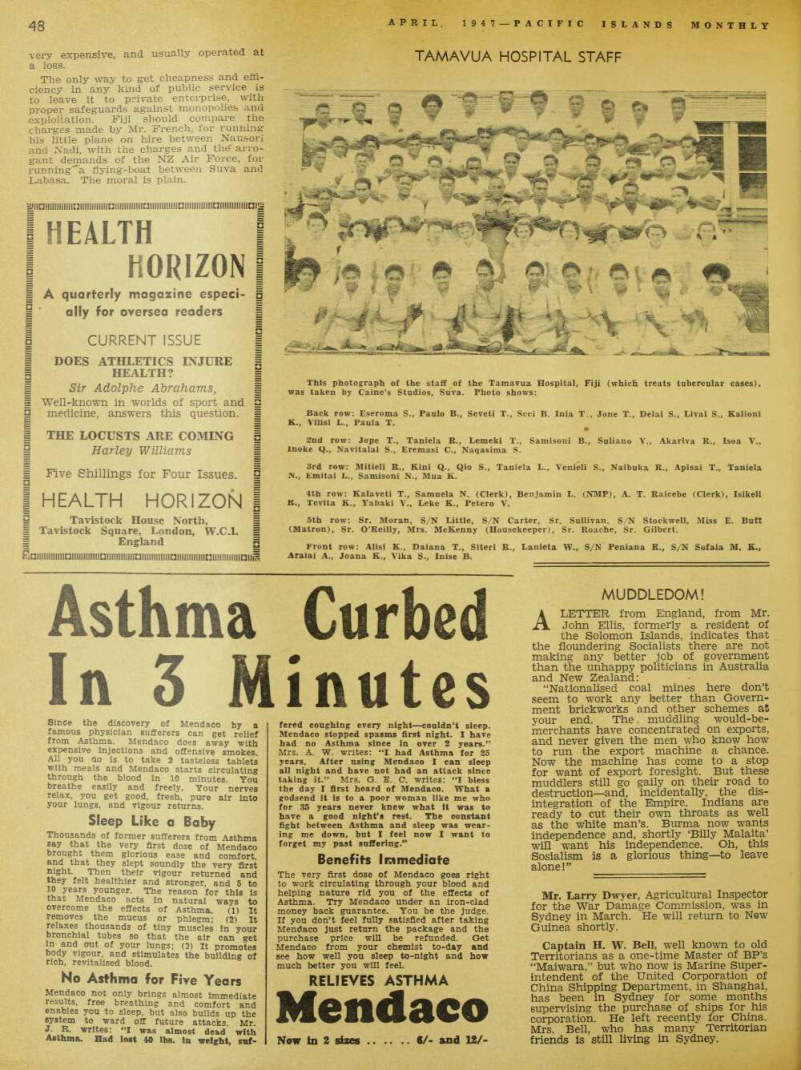
S. Pacific Air Services Plea for Fredom for Private Enterprise in Fiji
A FORTNIGHTLY air service between Suva and Labasa (Vanua Levu) was inaugurated with an RNZAF Sunder land on March 15. It is expected that the service later will become part of an in ternal airways network in Fiji.
The Sunderland leaves Laucala Bay (Suva) on alternate Saturdays at 8.30 a.m. and arrives in Labasa two hours later.
The return journey is made the same day,, the plane leaving Labasa at 2.80 p.m. and arriving at Laucala Bay at approximately 4.45.
The single fare is £4/8/8. No charge is made for children under 3, but children under 13 are charged half-fare. Passengers are charged, in addition, 1/- each at the Labasa end for water transportation be tween the aircraft and the shore, and a further 2/6 for taxi fare from the anchor age at Malau to Labasa. Passengers are allowed 35 lbs. of free baggage for a full fare.
It was announced that the service w 11 be operated fortnightly only on condi tion that at least 24 single passages are booked for each trip.
THIS Suva-Labasa service provides a good example of what a community has to submit to when it surrenders itself to a bureaucracy governed by Socialism. The service is being run by the New Zealand Air Force —which now appears to be a trading department of the NZ Socialist Government.
New Zealand has chased all private enterprise out of all air transportation in the Dominion —all lines there are now run by a Government-owned Airways “Corporation,” directed by Sir Leonard Isitt. They are efficient enough; but no one would suggest that they provide cheap transportation, or that there is any pros pect of fares and rates ever being reduced.
Too many 35-hours-per-week officials on high salaries!
THE Australian and New Zealand Gov ernments have the controlling voice in Tasman Empire Airways, which runs the busy sea-plane service between Sydney and Auckland. The single fare is £3O; and, at that rate, with scores of people (who cannot get steamer passages) jostling for berths, the concern must be making a huge profit. If private enter prise had been allowed a free run competition long since would have cut down that monstrous fare by from 30 to 50 per cent.
Now—apparently working under some Fiji-New Zealand agreement of which the public has heard nothing—the NZ Gov ernment is running sea-plane services to Fiji, and other services from Fiji on to Samoa, Tonga and Rarotonga. The Auck land-Suva fare for the 9-hours’ flight is just under £30 —which clearly is exces sive. But there is no competition, by air or sea, except the overcrowded “Matua.”
You take it or leave it bureaucracy doesn’t care.
Now we have this Suva-Labasa service, again run by the übiquitous New Zea landers. The latter will not run the flying-boat, even once a fortnight, unless at least 24 people pay £4/8/8 each—they want £lOO, each way, for a flight of a little over 100 miles!
IT is suggested that this may become part of an internal airways network in Fiji. It is hoped, for Fiji’s sake, that it does not.
In the world, to-day, there are thous
ands of competent young airmen, and thousands of good, serviceable planes of moderate size, who could provide the Colony of Fiji, and other Territories similarly situated, with thoroughly effi cient air transport services, designed to give people the quick and convenient transport they want, at much less than the rates charged by the slow-moving, over-staffed, top-heavy, expensive organi sations so typical of Government enter prise.
Let the Government of Fiji throw the Colony’s air internal transport system open to private enterprise, controlled by competition and not by Socialists, and Fiji would get a service to Labasa much oftener than once a fortnight—and at much less than the present rates.
OUR babbling politicians insist that these State-owned 'instrumentalities are designed to protect the citizens against “exploitation.” But invariably, they provide the public with services that, in comparison with privately owned organisations, are less efficient and very expensive. There is no better example than the State-owned railway systems of Australia. In comparison with American
or British trains (before nationalisation), Australian trains not only lack the usual amenities—they are comfortless, dirty,
very expensive, and usually operated at a loss.
The only way to get cheapness and effi ciency in any kind of public service is to leave it to private enterprise, with proper safeguards against monopolies and exploilation. Fiji should compare the charges made by Mr. French, for running his little plane on hire between Nausori and Nadi, with the charges and thd arro gant demands of the NZ Air Force, for flying-boat between Suva and Labasa, The moral is plain.
Advertisements & other items, pp. 49-50 (1 item)
G I L L E S Pi
LOOK !
c
KOCH S BARBER CHAIRS
Obtainable Soon
PACIFIC ISLANDS TRADING
COMPANY
244 California St., San Francisco, Cal.
Woven Wire for all Industry
COPRA DRYING TRAYS, FLOORS, Etc.
FRUU DRYING TRAYS, MINING SCREENS.
Heavy Mosquito Gauze in Phosphor Bronze and other Metals Impervious to Salt Sea Air.
WERE DOOR MATS AND GENERAL WIRE WORKS
E. WRIGHT & CO. LTD.
Office and Works: 148-152 Cleveland Street, Sydney, N.B.W.
Telegraphic Address: “Wrlghtmake,” Chippendale. vvr/if T. «r PM tr v -Vr
G I L L E S PI The Flour
- SYDNEY -
TRADE
MA»{ ’S of the Islands
HEALTH
HORIZON
A quarterly magazine especi-
ally for oversea readers
CURRENT ISSUE
DOES ATHLETICS INJURE
HEALTH?
Sir Adolphe Abrahams , Well-known in worlds of sport and medicine, answers this question.
THE LOCUSTS ARE COMING
Harley Williams Five Shillings for Four Issues.
HEALTH HORIZON
Tavistock House North, Tavistock Square, London, W.C.L England
asthma Curbed n 3 Minutes
Since the discovery of Mendaco by a famous physician sufferers can get relief from Asthma. Mendaco does away with expensive injections and offensive smokes.
All you ao is to take 2 tasteless tablets with meals and Mendaco starts circulating through the blood in 10 minutes. You breathe easily and freely. Your nerves relax, you get good, fresh, pure air into your lungs, and vigour returns.
Sleep Like a Baby
Thousands of former sufferers from Asthma say that the very first dose of Mendaco brought them glorious ease and comfort and that they slept soundly the very first night. Then their vigour returned and they felt healthier and stronger, and 5 to 10 years younger. The reason for this Is that Mendaco acts in natural ways to overcome the effects of Asthma. (1) It removes the mucus or phlegm; (2) It relaxes thousands of tiny muscles in your bronchial tubes so that the air can get in and out of your lungs; (3) It promotes body vigour, and stimulates the building of rich, revitalised blood.
No Asthma for Five Years
Mendaco not only brings almost immediate results, free breathing and comfort and enables you to sleep, but also builds up the system to ward off future attacks. Mr.
J. R. writes; “I was almost dead with Asthma, Had lost 40 lbs. In weight, snf-
fered coughing every night—couldn’t sleep.
Mendaco stopped spasms first night. I have had no Asthma since in over 2 years.”
Mrs. A. W. writes: “I had Asthma for 25 years. After using Mendaco I can sleep all night and have not had an attack since taking it.” Mrs. G. E. C, writes: “I bless the day I first heard of Mendaco. What a godsend it is to a poor woman like me who for 35 years never knew what it was to have a good night’s rest. The constant fight between Asthma and sleep was wearing me down, but I feel now I want to forget my past suffering.”
Benefits Immediate
The very first dose of Mendaco goes right to work circulating through your blood and helping nature rid you of the effects of Asthma. Try Mendaco under an iron-clad money back guarantee. You be the judge.
If you don’t feel fully satisfied after taking Mendaco just return the package and the purchase price will be refunded. Get Mendaco from your chemist to-day and see how well you sleep to-night and how much better you will feel.
RELIEVES ASTHMA
Mendaco
Now in 2 sizes 6/- and I %J~
Tamavua Hospital Staff
This photograph of the staff of the Tamavua Hospital, Fiji (which treats tubercular cases), was taken by Caine’s Studios, Suva. Photo shows: Back row: Eseroma S., Paulo B., Seveti T., Seci B. Inia T., Jone T., Delai S., Livai S., Kalioni K., Vilisi L., Paula T. 2nd row: Jope T., Taniela R., Lemeki T., Samisoni B., Suliano V., Akariva R., Isoa V., [?]oke Q., Navitalai S., Eremasi C., Naqasima S. 3rd row: Mitieli R., Kini Q., Qio S., Taniela L., Venieli S., Naibuka R., Apisai T., Taniela N., Emitai L., Samisoni N., Mua K. 4th row: Kaiaveti T., Samuela N, (Clerk), Benjamin L. (NMP), A. T. Raicebe (Clerk), Isikeli It., Tevita K., Yabaki V., Leke K., Petero V. 5th row: Sr. Moran, S/N Little, S/N Carter, Sr. Sullivan. S/N Stockwell, Miss E. Butt (Matron), Sr. O’Reilly, Mrs. McKenny (Housekeeper), Sr. Roache, Sr. Gilbert.
Front row: Alisi K., Daiana T., Siteri R., Lanieta W., S/N Peniana R., S/N Sofaia M. K., Aralal A., Joana K., Vika S., Inise B.
Muddledom!
A LETTER from England, from Mr.
John Ellis, formerly a resident of the Solomon Islands, indicates that the floundering Socialists there are not making any better job of government than the unhappy politicians in Australia and New Zealand: “Nationalised coal mines here don’t seem to work any better than Govern ment brickworks and other schemes at your end. The muddling would-be merchants have concentrated on exports, and never given the men who know how to run the export machine a chance.
Now the machine has come to a stop for want of export foresight. But these muddlers still go gaily on their road to destruction—and, incidentally, the dis integration of the Empire. Indians are ready to cut their own throats as well as the white man’s. Burma now wants independence and, shortly ‘Billy Malaita’ will want his independence. Oh, this Sosialism is a glorious thing—to leave alone!”
Mr. Larry Dwyer, Agricultural Inspector for the War Damage Commission, was in Sydney in March. He will return to New Guinea shortly.
Captain H. W. Bell, well known to old Territorians as a one-time Master of BP’s “Maiwara,” but who now is Marine Super intendent of the United Corporation of China Shipping Department, in Shanghai, has been in Sydney for some months supervising the purchase of ships for his corporation. He left recently for China.
Mrs. Bell, who has many Territorian friends is still living in Sydney.
Melanesian?
Micronesian or Melanesian?
Correct Classification of Fijian
Letter to the Editor ARE you correct in describing the Fijians as “Micronesions?” Are they not Melanesians? I know they are so described by most scientists —although all admit that they have been very strongly influenced by their contacts with Poly nesia.
Micronesia (“the sea of many small islands”) is the area north of the Equator which contains mostly the Caroline, Mari ana and Marshall archipelagoes. How, then, can Fiji be regarded as part of Micronesia?
I am, etc.,
Anthropologist
Sydney, 17/3/47.
Editorial Note:
MAYBE we are wrong in describing the Fijians as Micronesians. But, if they are not Micronesians, what shall we call them? They are one of the best races in the Pacific, and it is not fair to them to grade them with the more backward peoples embraced by the term “Melanesian.”
Here are some definitions from standard works of reference which have a bearing on the point. Webster’s Dictionary de fines “Micronesian”:— “A native of Micronesia, which is in habited by a variety of people mostly of mixed Melanesian, Polynesian and Malay sian stocks. The types vary from the almost Polynesian people of the Gilbert Islands to the Malayan people of the Ladrones (Mariana Islands).”
Here is what Chamber’s Encyclopaedia says of the Fijians; “They are in race akin to the Papuans . . . but an ad mixture of the lighter Polynesians has been brought in from Tonga and else where and has, especially in the eastern islands, leavened the native Melanesian breed.”
This is from the Fiji Government’s Hand book, edited by Mr. L. G. Usher: “In Fiji, the broad ethnological divisions known as Polynesia and Melanesia meet; and while the Fijians are predominantly Melanesian, there are in certain coastal areas, and particularly eastwards of Viti Levu, strong evidences of Polynesian in fluence of long standing.”
Scientifically, the Gilbertese is classi fied as a Micronesian; but the Gilbertese, while a man of excellent type, is not nigher in the human scale than the Fijian.
WE contend that, as the terms Poly nesian, Micronesian and Melanesian have an ethnological as well as a geographical meaning, we may call the Fijians Micronesians, even although they do not live in Micronesia proper. Strictly, the Gilbert Islands may not be in Micro nesia; but no one will question the classi fication of the Gilbertese as a Micronesian.
The majority of the Fijians seem to more closely resemble the Gilbertese than any other racial type.
There are pockets of Polynesians away over westwards, in Melanesia. They are still Polynesians.
True, there is a wider diversity of racial types in Melanesia than in any other part of the Pacific —maybe, than in any other similar region in the world. Dr. lan Hogbin, in a recent article in an anthro pological magazine, named about a dozen types of “Melanesians” which are mostly dark-skinned. On that basis, one could easily enough include the Fijians.
But the term “Melanesian” implies a somewhat backward people. The Fijians are not backward—they compare favour ably with any Pacific Islands race. Apart from strict anthropology, there are just as good reasons for calling them Micro nesians, as Melanesians; and the former term carries no reproach. Even on an anthropological basis, it is possible to claim that they are Micronesians. Presumably, the Webster Dictionary definition was written by an anthropologist.
Conditions In Eastern
Papua
SAM ARM, March 20. rE residents of Samarai are carrying on with the existing buildings and wharf. The activity at the wharf has improved conditions here a lot; but the local shipping service, provided by the Government, is as usual.
The “Mary Rose,” after installing new engine-parts and running for several hours, was towed back to Samarai, where she is still at anchor. The “Mirigine” is off to Moresby for repairs and slipping.
The “Karu” overdue for slipping by sev eral years (if rumour is to be believed) has taken up duties here temporarily.
The native labour position is now con siderably better, but shortage of rice and other foods is causing headaches to some employers. Cuthberts Mines (Misima) are delaying any large-scale operations until the food position becomes better.
A gang of Europeans and natives, under the direction of Mr. Bert Stubbs is in Milne Bay getting the equipment ready for shipment. An oil company has bought all the fuel installations, and ex pects to be moving them shortly to new sites, in New Guinea and in other places.
Advertisements & other items, p. 51 (1 item)
5
m
The Longest Way Round!
THE SS “Tsurushimaru,” bound from Guam to Rabaul, to pick up Japanese prisoners-of-war for reparation, re cently had to proceed to Port Moresby in order to obtain fuel, and then return to Rabaul to load.
Local residents at Rabaul have pointed out the waste of fuel which such routing necessitates, especially at a time when both coal and oil stocks are at a premium.
There would appear to be room for im provement in organisation in shipping circles to obviate such wastage.
It is also claimed that pin-headed rivalry in official circles is responsible for shipping deviations, and for many of the difficulties in transportation which New Britain and New Ireland residents have to bear.
Nassau Island
Puka-Pukans Would Like Nassau Island Claim Based on Ancient Polynesian History From Our Own Correspondent
Rarotonga. Feb. 25.
THE small island of Nassau (central Pacific, not Bahamas) is at present under discussion in Wellington, NZ There is a possibility that Nassau, at present uninhabited, may be made avail able to the natives of Puka-Puka who claim ancient rights.
Situated 45 miles SE by S of Puka- Puka, in the Cook Group, Nassau is a flat, oval island with some swamps in the centre and a fringing reef. The water is deep close in to the reef and there is no anchorage.
The island was named after a New Bedford whaler which called in 1835, but other whalers had visited it previously.
Some authorities believe it to be the Peregrin© sighted by Quiros in 1606. The whalers found the island uninhabited as did the Rev. W. W. Gill of the LMS when he visited it in 1862.
Gill found only one coconut tree growing on the island and he planted several more.
When the ‘John Williams’ called again in 1875 the captain planted another 100 coco nuts. On a later visit in 1881, Gill found an American sea captain in possession.
This first Eui'opean settler had planted 14,000 coconuts, also taro, kumeras, bananas and breadfruit round the verges of the swamps. He had imported n number of Puka-Pukans as labourers.
The island was annexed by Great Britain in 1892 and later placed under control of the Cook Islands Administration. Prom 1916 onwards the copra was worked by various companies with headquarters in Samoa. The last lessee was Capt. Williams of Samoa who went to Nassau in 1938 taking 30 Tokelau islanders as labourers.
A man of considerable energy, Capt.
Williams built a comfortable home for his wife and children who accompanied him and put'the-plantations in excellent order.
At the outbreak of the Pacific war Capt. Williams and his party were left on the island as coast-watchers. These were removed in 1945, since when the island has once more been uninhabited.
That is a brief outline of the European history of Nassau. But there is an earlier history connected with the inhabitants of neighbouring Puka-Puka.
There is no doubt that the island was inhabited by the Puka-Pukans in early times and there was intercourse between the two islands up till the time when long distance canoe travel ceased to be a habit. Old Puka-Pukan graves dis covered on Nassau are evidence of earlier occupation.
The olq Puka-Pukan name for Nassau as Te Nuku-O-Ngalewu, named so after a famous warrior chief who defended the island against invasion by a fleet from Aitutaki. The leader of the Aitutakians was named Tima or Tema, and the dan gerous submerged coral reef on a direct line between Nassau and Puka-Puka was named after him. Puka-Pukan history tells that communication between the islands ceased “at the time when the great conflict between the gods made sea travel dangerous”—probably a cycle of frequent hurricanes.
On its abandonment the island received the new name of Te Motu-ngaongao (Deserted Island).
IN August 1946 the Resident Commis sioner of Rarotonga, Mr. W. Tailby, visited Puka-Puka and discussed with the chiefs in council their requests for the use of Nassau. In substantiation of their claims many interesting quotations were made from history and legends and old men sang “Pe-e,” or chants referring to Nassau.
After leaving Puka-Puka the Commis sioner made an inspection of Nassau, making notes for a report to the govern ment.
At the present time Nassau is fully planted with coconut trees, mostly in good condition; but, with several years’ neglect, self-sown coconuts and other vegetation have made a tangled jungle among the palms. With the present de mand and price for copra the crop would be valuable, once the plantations had been cleaned up.
From the economic point of view the Puka-Pukans are over-crowded on their own small island. There have been serious food shortages during recent years owing to hurricanes. Only a limited quantity of copra can be shipped to raise money for their few reeds, because coconuts are their staple food.
The transfer of part of their population to Nassau would be a godsend to the Puka-Pukans. This nearby island has food in plenty—taro, kumeras, bananas, and breadfruit can be planted round the swamps. Pigs and fowls, descendants of former domestic stock, run wild in the bush and would provide stock for new herds. Fish are plentiful around the reefs.
It would be a little paradise for the Puka-Pukans. Tney deserve to get it back. After all “they saw it first!”
Commissioner
Farewell To Fiji Police
THE retiring Police Commissioner of Fiji, Colonel J. E. Workman, was fare welled by Fijian members of the Police Force on March 7, He will shortly leave the Colony for Northern Rhodesia on transfer.
Colonel Workman was presented with a tabua and a root of yaqona, in the course of a kava ceremony; and, later, Inspector Ratu Bose presented him with an inscribed walking stick and a minia ture tanoa.
Advertisements & other items, pp. 52-53 (2 items)
Marys
The Twinkle in
Your Eye
COMES FROM ACTIVE
DIGESTION
Good normal digestive and liver activity means good, normal health and fitness. If y or are becoming gloomy and feel tired out, the cause may be a congested state of your intestinal tract. So many people are troubled with constipation, which, through the retention of waste in the digestive system, causes sick headache, biliousness, pimply skin, unpleasant breath, irritability, slackness and dull eyes.
Regain your bright and attractive appearance by banishing constipation with Pinkettes. Tiny, perfectly harmless, gentle yet effective, these famous laxative and liver pills painlessly exercise and strengthen the bowels, keep the food tract clean and active, stir the liver, and thus banish sick headache, bilious attacks, pimples, unpleasant breath and gloom. All chemists and stores sell Pinkettes, the perfect laxative and liver pills.
ALL STOREKEEPERS HAVE—
AUNT
MARYS
BAKING POWDER
• Aunt Mary's Baking Powder is now obtainable from your storekeeper. That's good news for you, especially as Aunt Mary's Baking Powder maintains the high quality which has stood the test of housewives for over 70 years.
There is no substitute for Aunt Mary's—There never will be.
Pacific Islands Trading
Bankers: Bank of America (Main Office) San Francisco.
COMPANY
Cables:
PITCO
SAN FRANCISCO
244 CALIFORNIA STREET, SAN FRANCISCO, CAL, U.S.A,
EXPORTERS OF :
BARBER CHAIRS.
TEXTILES.
CLOTHING.
LIQUOR.
ELECTRICAL GOODS.
FOODSTUFFS.
PRODUCE.
STATIONERY. .
CARTRIDGES.
DRUGS.
PAPER PRODUCTS.
AUTOMOTIVE PARTS.
WIRE & NAILS.
BUILDING SUPPLIES.
RADIOS.
REFRIGERATORS.
AUTOMOBILES.
FARM MACHINERY.
TYPEWRITERS.
FIREARMS.
CHEMICALS.
MARINE HARDWARE.
CIGARETTES, TOBACCO.
HARDWARE.
FURNITURE.
IRON & STEEL PRODUCTS.
CANNED GOODS.
PAINTS.
NOVELTIES, NOTIONS.
LEAD PENCILS, ERASERS.
HEAVY EQUIPMENT.
FERTILIZERS.
TYRES, TUBES.
PREFABRICATED HOUSES.
QUOTATIONS ON REQUEST
Leaders in their fields—SMlTH-CORONA
GRACELINE LADIES’ SHOES (Canadian)
SERVICEABLE AND STYLISH
PRICED RIGHT
PREFABRICATED HOUSES: The Answer to the
Housing Shortage.
Death Of J. G. C. Bennie
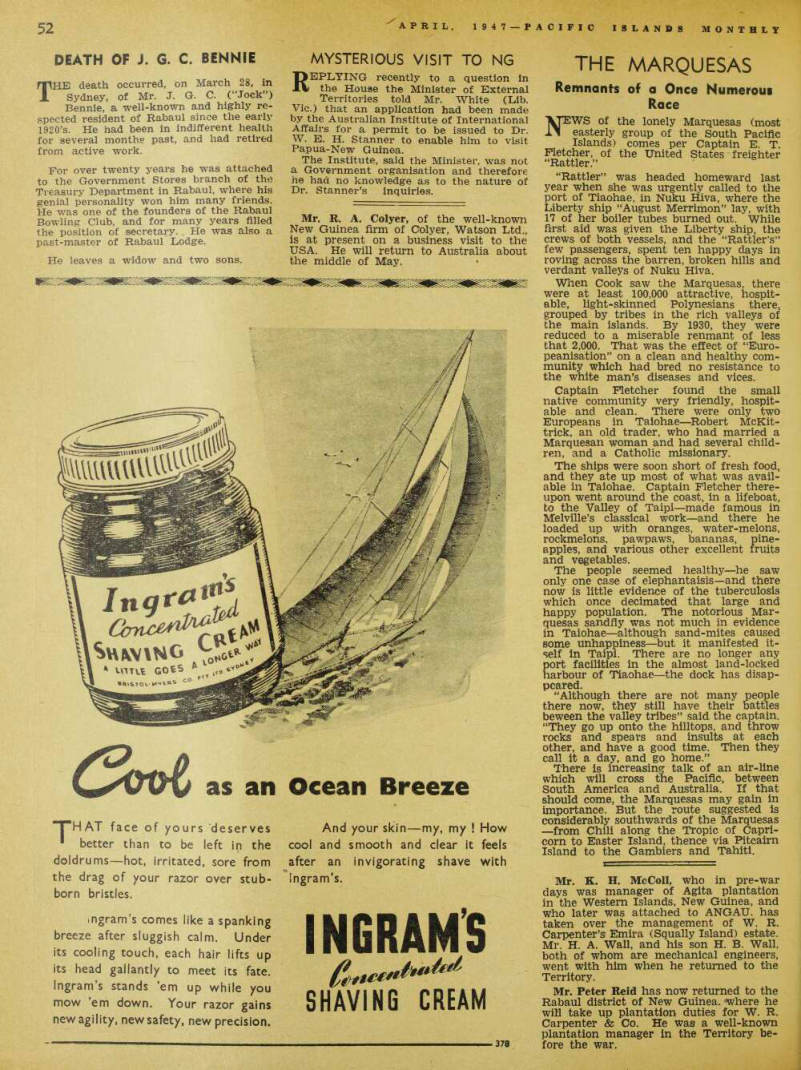
THE death occurred, on March 28, in Sydney, of Mr. J. G. C. (“Jock”) Bennie, a well-known and highly re spected resident of Rabaul since the early 1920’5. He had been in indifferent health for several months past, and had retired from active work.
For over twenty years he was attached to the Government Stores branch of the Treasury Department in Rabaul. where his genial personality won him many friends.
He was one of the founders of the Rabaul Bowling Club, and for many years filled the position of secretary. He was also a past-master of Rabaul Lodge.
He leaves a widow and two sons.
Mysterious Visit To Ng
REPLYING recently to a question in the House the Minister of External Territories told Mr. White (Lib.
Vic.) that an application had been made by the Australian Institute of International Affairs for a permit to be issued to Dr.
W. E. H. Stanner to enable him to visit Papua-New Guinea.
The Institute, said the Minister, was not a Government organisation and therefore he had no knowledge as to the nature of Dr. Stanner’s inquiries.
Mr. R. A. Colyer, of the well-known New Guinea firm of Colyer, Watson Ltd., is at present on a business visit to the USA. He will return to Australia about the middle of May.
The Marquesas
Remnants of a Once Numerous Race
of the lonely Marquesas (most 11 easterly group of the South Pacific Islands) comes per Captain E. T.
Fletcher, of the United States freighter “Rattler.”
“Rattler” was headed homeward last year when she was urgently called to the port of Tiaohae, in Nuku Hiva, where the Liberty ship “August Merrimon” lay, with 17 of her boiler tubes burned out. While first aid was given the Liberty ship, the crews of both vessels, and the “Rattler’s” few passengers, spent ten happy days in roving across the barren, broken hills and verdant valleys of Nuku Hiva.
When Cook saw the Marquesas, there were at least 100,000 attractive, hospit able, light-skinned Polynesians there, grouped by tribes in the rich valleys of the main islands. By 1930, they were reduced to a miserable renmant of less that 2,000. That was the effect of “Euro peanisation” on a clean and healthy com munity which had bred no resistance to the white man’s diseases and vices.
Captain Fletcher found the small native community very friendly, hospit able and clean. There were only two Europeans in Taiohae—Robert McKit trick, an old trader, who had married a Marquesan woman and had several child ren, and a Catholic missionary.
The ships were soon short of fresh food, and they ate up most of what was avail able in Taiohae. Captain Fletcher there upon went around the coast, in a lifeboat, to the Valley of Taipi—made famous in Melville’s classical work—and there he loaded up with oranges, water-melons, rockmelons, pawpaws, bananas, pine apples, and various other excellent fruits and vegetables.
The people seemed healthy—he saw only one case of elephantaisis—and there now is little evidence of the tuberculosis which once decimated that large and happy population. The notorious Mar quesas sandfly was not much in evidence in Taiohae—although sand-mites caused some unhappiness—but it manifested it self in Taipi. There are no longer any port facilities in the almost land-locked harbour of Tiaohae—the dock has disap peared.
“Although there are not many people there now, they still have their battles beween the valley tribes” said the captain.
“They go up onto the hilltops, and throw rocks and spears and insults at each other, and have a good time. Then they call it a day, and go home.”
There is increasing talk of an air-line which will cross the Pacific, between South America and Australia. If that should come, the Marquesas may gain in importance. But the route suggested is considerably southwards of the Marquesas —from Chili along the Tropic of Capri corn to Easter Island, thence via Pitcairn Island to the Gambiers and Tahiti.
Mr. K. H. McColl, who in pre-war days was manager of Agita plantation in the Western Islands, New Guinea, and who later was attached to ANGAU. has taken over the management of W. R.
Carpenter’s Emira (Squally Island) estate.
Mr. H. A. Wall, and his son H. B. Wall, both of whom are mechanical engineers, went with him when he returned to the Territory.
Mr. Peter Reid has now returned to the Rabaul district of New Guinea, where he will take up plantation duties for W. R.
Carpenter & Co. He was a well-known plantation manager in the Territory be fore the war.
Advertisements & other items, pp. 54-58 (3 items)
Ingrams
1
fewuuuM
lug*** %n f j
Sh\\\ng
* UlTlt GOtS * 9 *■*** •«\STOV-- Wl'tl* 5
&ovt
as an Ocean Breeze
"THAT face of yours deserves ■ better than to be left in the doldrums—hot, irritated, sore from the drag of your razor over stubborn bristles. •ngram’s comes like a spanking breeze after sluggish calm. Under its cooling touch, each hair lifts up its head gallantly to meet its fate.
Ingram’s stands ’em up while you mow ’em down. Your razor gains new agility, new safety, new precision.
And your skin—my, my ! How cool and smooth and clear it feels after an invigorating shave with
Ingram’s.
INGRAMS
SHAVING CREAM
53
GRAVE MOVE IN NORTH PACIFIC
(Continued from Page 10)
PACIFIC ISLANDS MONTHLY APRIL, 1947
Queensland
INSURANCE
COMPANY
LIMITED
(Incorporated 1886 in Australia)
ASSETS EXCEED £4,000,000
Head Office:
QUEENSLAND
INSURANCE BUILDING,
80-82 PITT STREET, SYDNEY.
Specialists in South Seas Fire,
Marine & Accident Insurances
Apply to:—
nn.
Branch Office: I. B. Chalmers, Manager.
Burns Philp (South Sea) Co., Ltd.
VILA.
Burns Philp (South Sea) Co., Ltd.
Comptolrs Francals Des Nouvelles Hebrides (Marine).
NOUMEA.
L. & W. Johnston.
PORT MORESBY:
Burns, Philp & Co., Ltd.
W. A. Anderson, Resident Officer.
PAGO PAGO.
Burns Philp (South Sea) Co., Ltd.
O. H. C. Reid St Co.
OTHER SOUTH SEA ISLANDS.
Burns Philp (South Sea) Co., Ltd.
Also to any of the Company's Offices in Australia or New Zealand.
I/h» Key to Earniny Patvvr. . .
Sometimes men think that a general education or an elementary knowledge of business is enough to get ahead. But experience soon teaches that thorough, specialised training is just as necessary for success in business as it is in the professions of Law, Medicine or Dentistry. If you are interested in the many opportunities in the Business World ... if you seek responsibility, success and economic security, commence training now —in some specialised business subject. H.R.I. is available always to help and advise ambitious men and women. Write or wire for particulars and career information. • ACCOUNTANCY • SECRETARYSHIP • COST ACCOUNTANCY ADVERTISING e BANKING • LOCAL GOVERNMENT EXAMS.
Hemingway Robertson Institute
Founded and Owned by Hemingway & Robertson Pty. Ltd.
Consulting Accountants :: :; Professional Tutors
126 BANK HOUSE. BANK PLACE, MELBOURNE
126 CHALFONT CHAMBERS, 142 PHILLIP STREET, SYDNEY H.R.I. tutorial service is proved by the tvinning of more honours than all coaches in Australasia combined.
H.R.I. Career Training
• PRACTICAL BOOKKEEPING
• MARKETING SELLING
126/814
KODAK FILMS
and all photographic supplies
WHOLESALE AND RETAIL
CAINE'S STUDIOS, SUVA,
P.O. Box 8 Photographers. Est. 1904.
Write for free price list
"Hips aren't your
big problem, Honey!
YOU CAN TAKE your mind off your hips, dearie! No one finds fault with your figure!
You’d be smart to exercise a little more care about personal charm. Being streamlined, you know, won’t protect you against underarm odour. Or lessen the offence when others find you guilty of it.
So keep on trusting your bath— for past perpiration but put your trust in Mum to prevent risk of future underarm odour.
Creamy, snowy-white Mum smooths on in 30 seconds. Keeps you fresh and free from underarm odour all day or evening.
Mum is gentle—harmless to skin and fabrics. So why take chances when you can be sure with Mum?
Ask for it today.
MUM
TAKES THE ODOUR OUT OF PERSPIRATION
AMERICAN, ENGLISH AND AUSTRALIAN PERIODICALS
AND TRADE JOURNALS POSTED DIRECT TO YOU
The N.S.W. Bookstall Co. Pty. Ltd.
Can supply all available Oversea and Local Subscription Magazines. Let us know your requirements.
Subscription Lists Available on Application.
N.S.W. BOOKSTALL COMPANY PTY. LTD.
Market and Castlereagh Streets, Sydney, Australia
0 1. The finest wood and canvas preservative known, prevents decay, dry rot and eradicates white ants and borers in wood and canvas; supplied green or colourless. Prices from 12/- per gallon, smaller tins available. 2. C.Q.R. ANCHORS, British invention made in Australia. Three times the holding power, easy to handle and available in all sizes from 13 lb. to 140 lb. Ask for price list. 3. KAYEN KEROSENE LAMPS are the finest Australian-made lamps; burn kerosene and provide 300 C.P. light without flickering. All brass containers. All spares made in Australia easily and cheaply available. Made in Handsome Table Lamp as illustrated or in All Purposes Lamp and Lantern. Ask for illustrated leaflets
4. SIMPLEX MARINE ENGINES—
3, 5, and 10/12 H.P. sizes. Suitable for all craft from 14 to 32 feet long; 5 and 10 H.P. supplied with built-in reverse gear. All Australian-made. Price and specifications on request.
Ask for comprehensive price list of hoatgear and specialty hardware lines.
W. KOPSEN & CO. PTY. LTD.
380 Kent* Street, Sydney ‘‘kopsen^sydney”
VETERINARY
INSTRUMENTS
For Sheep and Cattle can be
Supplied Immediately
EARMARKERS.
SPEYING INSTRUMENTS.
BULLRINGS.
FIRE BRANDS.
EMASCULATORS.
W. JNO. BAKER
PTY. LTD.
3 Hunter Street, Sydney, N.S.W., Australia
ISLAND MERCHANTS
and AGENTS.
GENERAL MERCHANTS.
Ilflili ftp® IWI
Shippers of all types of Merchandise to the Pacific Islands • Representing Australian, British and American Manufacturers * Buyers for Leading Pacific Islands Traders -J Ifl ifilQzc, • Sellers of Island Produce
on Consignment
• Importers, Distributors and Manufacturers of Foodstuffs, Softgoods, Textiles, Hardware, Tobaccos, Wines and Spirts, etc.
379 KENT ST., SYDNEY.
Cable & Telegraphic Address: (i Chasulir Sydney.
ILL
I • "Ultima" Kerosene Stoves and Heating Appliances • Distributors of High-grade Shirts, Pyjamas and Clothing • "Southern Queen Canned Fruits • Forwarding and
Transhipment Agents
ft /Lb' m Hill's English Cigarettes When in Sydney, call and see us!
Nadi Horrors
Well-known Airman Jack Turner Sent to Fiji to Deal With The Situation
rE head of the New Zealand Air Cor poration, Sir Leonard Isitt., who visited Nadi airfield, in north-west ern Fiji, at the end of February, has lost little time in taking steps necessary to provide trans-Pacific air travellers with better accommodation.
Trans-Pacific air travellers cannot go to Nausori airfield because, among other things there is not sufficient accommoda tion for them in the overcrowded hotels in Suva (12 miles away from Nausori).
Consequently, accommodation has to be provided at Nadi —and at Nadi there are only the huts, built by the Americans of native materials for the base they est ablished there during the Pacific War.
Trans-Pacific travellers have been tell ing pathetic stories of the discomforts endured at Nadi; and the New Zealand Air Force (which for some reason that is not very clear, has been made respon sible for the conduct of the airfield) has been asked to make conditions more tol erable.
Early in April, Mr. Jack Turner, an air man well known in New Zealand and in New Guinea, arrived in Fiji, from New Zealand to become a sort of general man ager of the Nadi establishment. He has been given wide authority by Sir Leonard Isitt to provide a satisfactory establish ment at Nadi, and there now is a reason able expectation that conditions will be quickly improved.
Mr. Turner was a well-known pilot with Guinea Airways Ltd., in New Guinea'from 1933 to 1937; then he went to New Zea land. During the war he joined the New Zealand Air Force and attained the rank of Wing Commander. He was sent from New Zealand to Fiji, where he was given important duties, and he had a large share in the organisation of the RNZAF base in the New Hebrides. His record, of course, led to his selection for the Nadi post—which is no sinecure.
Mr. Turner probably will establish Nadi as the regular Fiji overseas airport be fore the interminable committees and their interminable arguments arrive at any decision in relation to Nausori.
Nadi airport is on the barren north west coast of Viti Levu. It is an excel lent airfield, but is surrounded by bare, uninhabited grasslands—the nearest place containing amenities is the hot, dusty, uninteresting little town of Lautoka, 15 miles away.
Nausori is on the green, pleasant delta of the Rewa River, 12 miles from Suva.
This is the “wet” side of Viti Levu.
The road to Suva is through pleasant country, where there is a large Fijian and Indian population. Suva is an attractive little city, well worth a visit. Overseas travellers should visit Suva —and not leave the Colony under the impressian that, having seen colourless Nadi, they have seen Fiji.
A committee of experts was due to arrive in Fiji at the end of February, and was to make a final decision, as between Nadi and Nausori. They came, they ex amined the two airfields, they argued and explained—but they departed early in March without making any decision.
This makes Mr. Turner’s task even more difficult. He does not know whether the permanent airport is to be Nadi or Nausori. Therefore, how can he plan even a modest building programme?
The versatile Mr. Clive Brewster, whose whirlwind marriage to Mrs. Eve Walker, created great interest in Fiji last year has taken on a new job. He is working with the Central Office of Information in the United Kingdom and in this cap acity has recently completed a series of lectures in provincial centres in England.
He has also introduced speakers in the “Calling the Islands” programme, a regu lar BBC feature. Mr. Brewster is a dir ector of W. R. Carpenter & Co. (Fiji) Ltd., and served in World War II with the rank of Wing-Commander. Mrs.
Brewster was a public relations officer of the British Overseas Airways Corpora tion at the time of her marriage. The couple flew to England last August and presumably settled semi-permanently there.
Miss W. Delugar, who in 1935 was a senior sister on the staff of the Colonial War Memorial Hospital, Suva, Fiji, has recently been appointed Matron-in-chief of the Auckland Hospital Board’s institu tions.
Advertisements & other items, pp. 59-60 (1 item)
Victoria
WANTED: Back numbers of the “Pacific Islands Monthly.” Have many duplicates for exchange. Will ale:* exchange American magazines for newspapers and magazines of the Pacific Islands and British Colonial Empire. Orders taken for subscriptions to American magazines —no foreign exchange difficulties —write for details to PAUL A. DORN, Agent, Los Angeles 36, California.
BITTER
BREVES IT
CARLTON & UNITED BREWERIES LTD.
*1
obiloil
Still the
World’s
Q o? y
Mobiloil remains fluid at low temperatures, retains its body under heat.Mobiloil gives easier starting, quick oil supply to bearings, better protection to heated engines. For economy use Mobiloil.
Islands Newspapers
How War and Socialism Killed Territories Journals
THE Australian Territories of Papua and New Guinea are without news papers of their own. This is partly the result of the Japanese invasion, and nartlv the result of the socialisation of the Territories by the Australian Govern ment.
Until 1942, there were three newspapers in the Territories —the “Papuan Courier’’, published in Port Moresby by Mr. E. A.
James; the “Rabaul Times”, published in Rabaul bv a company, and edited by MV Gordon Thomas; and the newly est ablished “Morobe News”, which was pub lished in Lae New Guinea.
Those newspaper plants were destroyed by war operations and the respective org anisation's entirely wiped out. It was hoped that, with the restoration of Civil Government, the publishing offices would be restored, because both Territories really do need local newspaper service.
But newspapers cannot be produced as a self-supporting enterprise unless they can sell advertising space to a reasonably prosperous business community, which buys advertising space.
Because of the attack made —and still continuing—on private enterprise by the Australian Government, there is no pros perous business community in either Paoua or New Guinea, nor is there likely to be. Consequently although’ the pos sibility of restoring the newspapers has been examined two or three times since the surrender of Japan, nothing has been done.
The need has been met to some extent by the circulation in the Territories of the “Pacific Islands Monthly.” The “PIM” however, is published only once a month, and its distribution is frequently delayed for weeks by the lamentable political and industrial conditions existing in Australia, which constantly dislocate shipping and mail services.
In Rabaul, Port Moresby, Wewak, etc., attempts have been made by the European communities to meet the need by circu lating news-sheets each week, produced by typewriter and duplicating machines.
These give some idea of what is hap pening in the world, but they do not by any means take the place of a well edited newspaper.
Nauru, another war-blasted territory that is struggling back to normality, also has a news-sheet. The Administration since October last has been regularly publishing the “Nauru Times”—a well edited compilation which gives an excel lent rntline of the week’s news. It is evidently a labour of love, and the Nauruan community should be grateful to the editor. His main trouble seems to be the uncertainty of paper supplies He is not the only one. Australian pub lishers to-day are paying three times pre war prices for their paper—and supplies cannot be sighted more than three or four months ahead.
Mr. R. H. Garvey, formerly a well known officer of the Western Pacific Commission service, is at present on leave in England, with Mrs. Garvey, and their three children. Mr. Garvey, a few years ago, went from the Resident Commission ership (Acting) in Gilbert and Ellice Islands to a post in Central Africa; and thence to St. Vincent, in the West Indies, where he is Administrator. Mr. Garvey was the last RC to occupy the large, white Residency on top of Ocean Island, before it was blown to pieces by Japanese bombs.
For Western Samoa
North American Goods For Western Samoa But Inadequate Supplies From New Zealand
Apia, Mar. 24.
SEVERAL overseas ships have called here recently bringing cargoes of much-needed commodities. The Unions SS Company’s “Waikawa” brought a large consignment of canned herrings and pilchards, which, however, have now risen in price from 1/3 to 2/per can, retail.
This ship brought, also, a fairly large shipment of Canadian cars and trucks and many of the town’s taxis, most of which were in the last stages of decrep itude, have been replaced by new, shining models.
The Norwegian steamer “Thor I”, brought petrol and kerosene from Amer ica, and crockery, glassware and other household goods.
The “Nairnbank” arrived on March 22 to load 3,000 tons of copra for the British Ministrv of Food; but for the second month in succession the “Matua” is run ning late and because of pressure on cargo space, will leave a considerable amount of cargo booked for Apia behind in Auckland.
The USA coastguard cutter “Chowanoe” made one of her periodical week-end visits to Apia on March 22. She brought a welcome cargo of American canned beer for the Administration stores, which have been out of New Zealand beer for some time owing to a shortage of bottles in New Zealand.
Though the American canned beer is a rather weak concoction on Apia stan dards. it will have to serve for lack of something better and stronger.
Mr. L. E. Smythe, M. Sc., has resigned his position as Lecturer in Chemistry at the University of Sydney and accepted an anpointment in the British Colonial Chemical Service. Before commencing duty with the Research and Laboratory Division. Department of Agriculture, Fiji, Mr. Smythe will spend some time obtain ing information for the Division at centres of Soil Chemistry in Australia.
The death occurred on April 6, of Karl Gustav (Peter) Uechtritz, at 113 AGH, Sydney, where he had been an inmate for some months. He was a well-known New Guinea planter, and was connected with one of the large German commer cial firms before World Warl. He was the owner of Sumsum plantation, on the New Britain coast. He leaves a widow and three sons.
Advertisements & other items, pp. 61-62 (1 item)
ft H.fHURCH&Son
G. H. Robinson
ISLAND SUPPLIES
of all kind's—Selected and Shipped to order at lowest possible prices—Piecegoods in Wool, Cotton and Silk, Under and Outerwear, Manchester, Drapery, Grocery, Hardware, Engineers and Leathergoods trade supplies a specialty.
Indents and Transhipments arranged. Large or small orders treated with equal care.
Use our 25 years’ extensive experience.
Enquiries solicited to —
G. H. ROBINSON
51 Macquarie Street, Sydney, N.S.W.
Telegrams: Sunrise, Sydney.
Letters: Box 3317, G.P.0., Sydney.
ft H.fHURCH&Son
ISLAND
AUCKLAND, NEW g* 1 *
Cable Address “ CHURSHIP," Auckland Codes: BENTLEY'S 2nd Phase BENTLEY S Complete Phase Postal:
CP O. BOX 1548
r> v PEACE BRINGS A NEW ERA TO THE PACIFIC We are catering thoroughly for Island trade and can fulfil your order with competitive merchandise
R. H. CHURCH & SON
Merchants & Island Traders 27 Queen St., Auckland, N.Z.
Refer your order to us for New Zealand's Island famous products Jll.
'^L <
J. C. Merrillees Pty. Ltd.
GENERAL ISLANDS MERCHANTS
Telegrams & Cables: Merrillees. Sydney.
AGENTS FOR: COWRIE SHARPS and FLOUR
and Suppliers of General Merchandise
TRADE GOODS, CLOTHING,
FOODSTUFFS. LIQUEURS,’
SPIRITS, WINES.
New Address
63 PITT STREET, SYDNEY
(Phoenix Building) Telephone: Codes: BW 6064 Bentleys
L 0 N D O_N T_o SUVA
VIA
PANAMA
For Sailings and Further Particulars Apply To:— BETHELL, GWYN & CO., BURNS, PHILP (SOUTH SEA)
138 LEADENHALL ST., CO., LTD.,
LONDON, E.C.3. SUVA.
c <*
The Garrick Notel
il 141111111 mm ft « ■ *
SUVA
FIJI
This well-known Hofei is centrally situated in Suva's main business quarter :: Modern accommodation provides comfort in all climatic conditions :: Only the best of Beers, Spirits and Wines is served Telephone: 80, VINCE COSTELLO, Proprietor.
George Aumuller
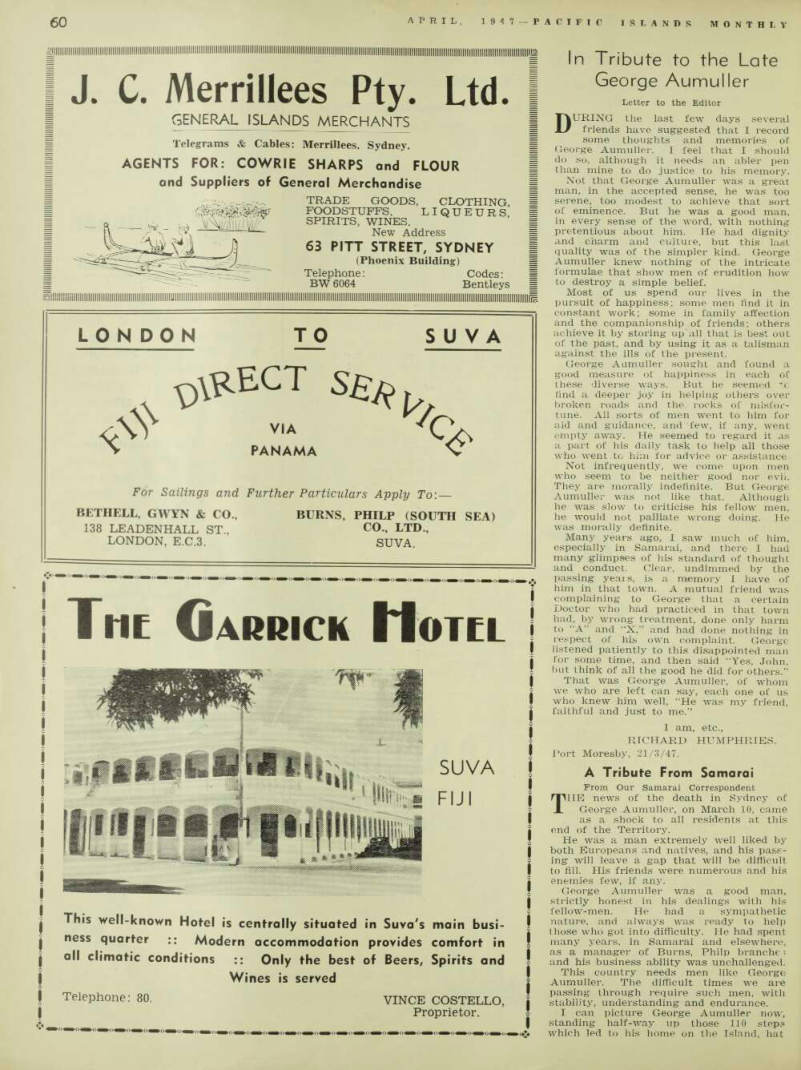
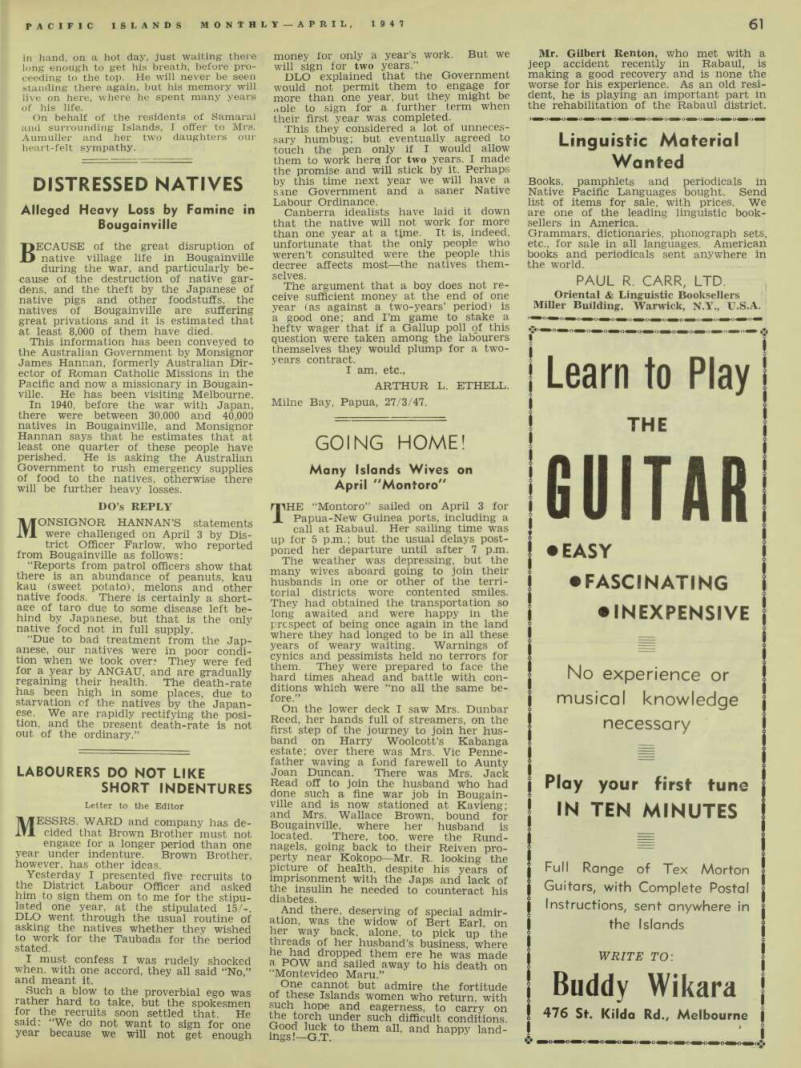
In Tribute to the Late George Aumuller
Letter to the Editor DURING the last few days several friends have suggested that I record some thoughts and memories of George Aumuller. I feel that I should do so, although it needs an abler pen than mine to do justice to his memory.
Not that George Aumuller was a great marl, in the accepted sense, he was too serene, too modest to achieve that sort of eminence. But he was a good man, in every sense of the word, with nothing pretentious about him. He had dignity and charm and culture, but this last quality was of the simpler kind. George Aumuller knew nothing of the intricate formulae that show men of erudition how to destroy a simple belief.
Most of us spend our lives in the pursuit of happiness; some men find it in constant work; some in family affection and the companionship of friends; others achieve it by storing up all that is best out of the past, and by using it as a talisman against the ills of the present.
George Aumuller sought and found a good measure of happiness in each of these diverse ways. But he seemed to find a deeper joy in helping others over broken roads and the rocks of misfor tune. All sorts of men went to him for aid and guidance, and few, if any, went empty away. He seemed to regard it as a part of his daily task to help all those who went to him for advice or assistance.
Not infrequently, we come upon men who seem to be neither good nor evil.
They are morally indefinite. But George Aumuller was not like that. Although he was slow to criticise his fellow men, he would not palliate wrong doing. He was morally definite.
Many years ago, I saw much of him, especially in Samarai, and there I had many glimpses of his standard of thought and conduct. Clear, undimmed by the passing years, is a memory I have of him in that town. A mutual friend was complaining to George that a certain Doctor who had practiced in that town had, by wrong treatment, done only harm to “A” and “X,” and had done nothing in respect of his own complaint. George listened patiently to this disappointed man for some time, and then said “Yes, John, but think of all the good he did for others.”
That was George Aumuller, of whom we who are left can say, each one of us who knew him well, “He was my friend, faithful and just to me.” 1 am, etc.,
Richard Humphries.
Port Moresby, 21/3/47.
A Tribute From Samarai
Prom Our Samarai Correspondent THE news of the death in Sydney of George Aumuller, on March 10, came as a shock to all residents at this end of the Territory.
He was a man extremely well liked by both Europeans and natives, and his pass ing will leave a gap that will be difficult to fill. His friends were numerous and his enemies few, if any.
George Aumuller was a good man, strictly honest in his dealings with his fellow-men. He had a sympathetic nature, and always was ready to help those who got into difficulty. He had spent many years, in Samarai and elsewhere, as a manager of Burns, Philp branche; and his business ability was unchallenged.
This country needs men like George Aumuller. The difficult times we are passing through require such men, with stability, understanding and endurance.
I can picture George Aumuller now, standing half-way up those 110 steps which led to his home on the Island, hat
in hand, on a hot day, just waiting there long enough to get his breath, before pro ceeding to the top. He will never be seen standing there again, but his memory will live on here, where he spent many years of his life.
On behalf of the residents of Samarai and surrounding Islands, I offer to Mrs.
Aumuller and her two daughters our heart-felt sympathy.
Distressed Natives
Alleged Heavy Loss by Famine in Bougainville
BECAUSE of the great disruption of native village life in Bougainville during the war, and particularly be cause of the destruction of native gar dens, and the theft by the Japanese of native pigs and other foodstuffs, the natives of Bougainville are suffering great privations and it is estimated that at least 8,000 of them have died.
This information has been conveyed to the Australian Government by Monsignor James Hannan, formerly Australian Dir ector of Roman Catholic Missions in the Pacific and now a missionary in Bougain ville. He has been visiting Melbourne.
In 1940, before the war with Japan, there were between 30,000 and 40,000 natives in Bougainville, and Monsignor Hannan says that he estimates that at least one quarter of these people have perished. He is asking the Australian Government to rush emergency supplies of food to the natives, otherwise there will be further heavy losses.
Do’S Reply
Monsignor hannan’s statements were challenged on April 3 by Dis trict Officer Farlow, who reported from Bougainville as follows: “Reports from patrol officers show that there is an abundance of peanuts, kau kau (sweet potato), melons and other native foods. There is certainly a short age of taro due to some disease left be hind by Japanese, but that is the only native food not in full supply.
“Due to bad treatment from the Jap anese, our natives were in poor condi tion when we took over.’ They were fed for a year by ANGAU, and are gradually regaining their health. The death-rate has been high in some places, due to starvation of the natives by the Japan ese. We are rapidly rectifying the posi tion, and the present death-rate is not out of the ordinary.”
Short Indentures
Labourers Do Not Like
Letter to the Editor MESSRS. WARD and company has de cided that Brown Brother must not engage for a longer period than one year under indenture. Brown Brother, however, has other ideas.
Yesterday I presented five recruits to the District Labour Officer and asked him to sign them on to me for the stipu lated one year, at the stipulated 15/-.
DLO went through the usual routine of asking the natives whether they wished to work for the Taubada for the period stated.
I must confess I was rudely shocked when, with one accord, they all said “No,” and meant it.
Such a blow to the proverbial ego was rather hard to take, but the spokesmen for the recruits soon settled that. He said: “We do not want to sign for one year because we will not get enough
money for only a year’s work. But we will sign for two years.’’
DLO explained that the Government would not permit them to engage for more than one year, but they might be rtDle to sign for a further term when their first year was completed.
This they considered a lot of unneces sary humbug; but eventually agreed to touch the pen only if I would allow them to work here; for two years. I made the promise and will stick by it. Perhaps by this time next year we will have a sane Government and a saner Native Labour Ordinance.
Canberra idealists have laid it down that the native will not work for more than one year at a time. It is, indeed, unfortunate that the only people who weren’t consulted were the people this decree affects most —the natives them selves.
The argument that a boy does not re ceive sufficient money at the end of one year (as against a two-years’ period) is a good one; and I’m game to stake a hefty wager that if a Gallup poll of this question were taken among the labourers themselves they would plump for a two years contract.
I am, etc.,
Arthur L. Ethell.
Milne Bay, Papua, 27/3/47.
Going Home!
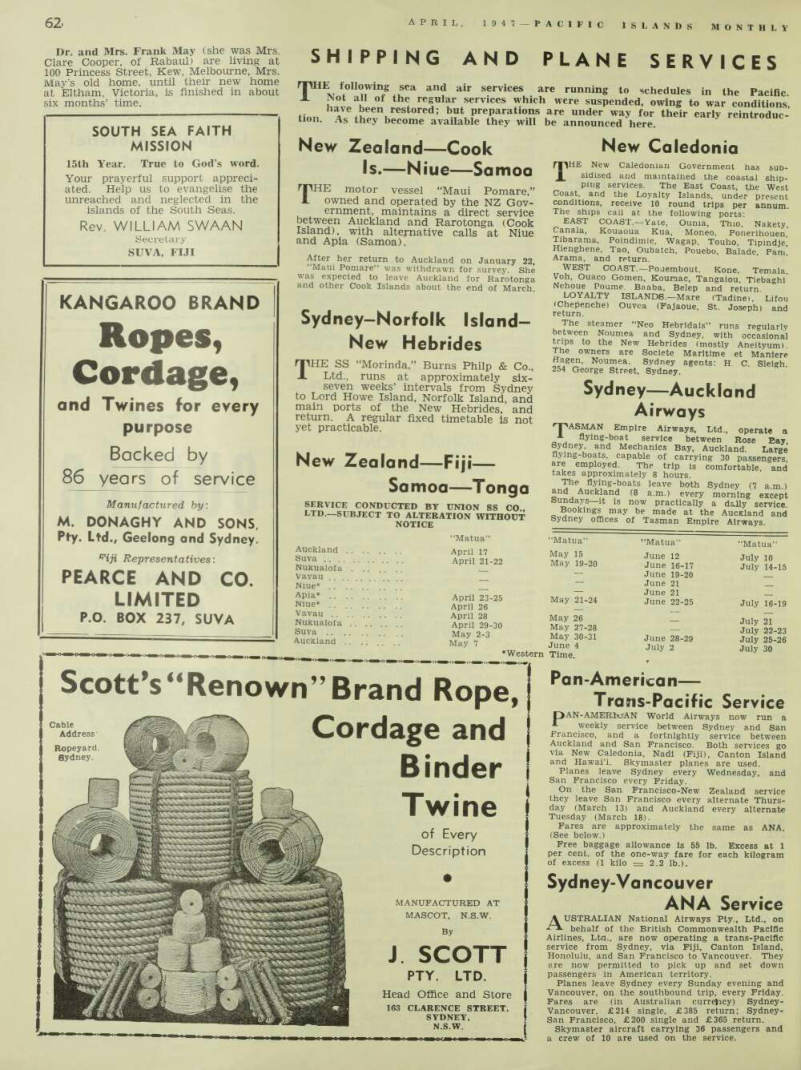
Many Islands Wives on April "Montoro"
THE “Montoro” sailed on April 3 for Papua-New Guinea ports, including a call at Rabaul. Her sailing time was up for 5 p.m.; but the usual delays post poned her departure until after 7 p.m.
The weather was depressing, but the many wives aboard going to join their husbands in one or other of the terri torial districts wore contented smiles.
They had obtained the transportation so long awaited and were happy in the prcspect of being once again in the land where they had longed to be in all these years of weary waiting. Warnings of cynics and pessimists held no terrors for them. They were prepared to face the hard times ahead and battle with con ditions which were “no all the same be fore.”
On the lower deck I saw Mrs. Dunbar Reed, her hands full of streamers, on the first step of the journey to join her hus band on Harry Woolcott’s Kabanga estate; over there was Mrs. Vic Penne father waving a fond farewell to Aunty Joan Duncan. There was Mrs. Jack Read off to join the husband who had done such a fine war job in Bougain ville and is now stationed at Kavieng; and Mrs. Wallace Brown, bound for Bougainville, where her husband is located. There, too, were the Rund nagels, going back to their Reiven pro perty near Kokopo—Mr. R. looking the picture of health, despite his years of imprisonment with the Japs and lack of the insulin he needed to counteract his diabetes.
And there, deserving of special admir ation, was the widow of Bert Earl, on her way back, alone, to pick up the threads of her husband’s business, where he had dropped them ere he was made a POW and sailed away to his death on “Montevideo Maru.”
One cannot but admire the fortitude of these Islands women who return, with such hope and eagerness, to carry on the torch under such difficult conditions.
Good luck to them all, and happy land ings!—G.T.
Mr. Gilbert Renton, who met with a jeep accident recently in Rabaul, is making a good recovery and is none the worse for his experience. As an old resi dent, he is playing an important part in the rehabilitation of the Rabaul district.
Dr. and Mrs. Frank May (she was Mrs.
Clare Cooper, of Rabaul) are living at 100 Princess Street, Kew, Melbourne, Mrs.
May’s old home, until their new home at Eltham, Victoria, is finished in about six months’ time.
Advertisements & other items, pp. 63-64 (1 item)
Guitar
Linguistic Material
Wanted
Books, pamphlets and periodicals in Native Pacific Languages bought. Send list of items for sale, with prices. We are one of the leading linguistic booksellers in America.
Grammars, dictionaries, phonograph sets, etc., for sale in all languages. American books and periodicals sent anywhere in the world.
PAUL R. CARR, LTD.
Oriental & Linguistic Booksellers Miller Building, Warwick, N.Y., U.S.A.
Learn to Play
THE
GUITAR
• EASY
• FASCINATING
• INEXPENSIVE
No experience or musical knowledge necessary Play your first tune
IN TEN MINUTES
Full Range of Tex Morton Guitars, with Complete Postal Instructions, sent anywhere in the Islands
WRITE TO:
Buddy Wikara
476 St. Kilda Rd. Melbourne
SOUTH SEA FAITH
MISSION
15th Year. True to God’s word.
Your prayerful support appreciated. Help us to evangelise the unreached and neglected in the islands of the South Seas.
Rev. WILLIAM SWAAN
Secretary
SUVA, FIJI
KANGAROO BRAND
Ropes,
Cordage,
and Twines for every purpose Backed by 86 years of service Manufactured by:
M. DONAGHY AND SONS,
Pty. Ltd., Geelong and Sydney.
Fiji Representatives :
PEARCE AND CO.
LIMITED
P.O. BOX 237, SUVA
Scott’s “Renown” Brand Rope
Cordage and
Binder
Cable 1 Address Ropeyard Sydney. m *<?**
Twine
of Every
Description
MANUFACTURED AT
MASCOT. N.S.W.
By
J SCOTT
PTY. LTD.
Head Office and Stor<
163 CLARENCE STREET
SYDNEY,
N.S.W.
Samoa—Tonga
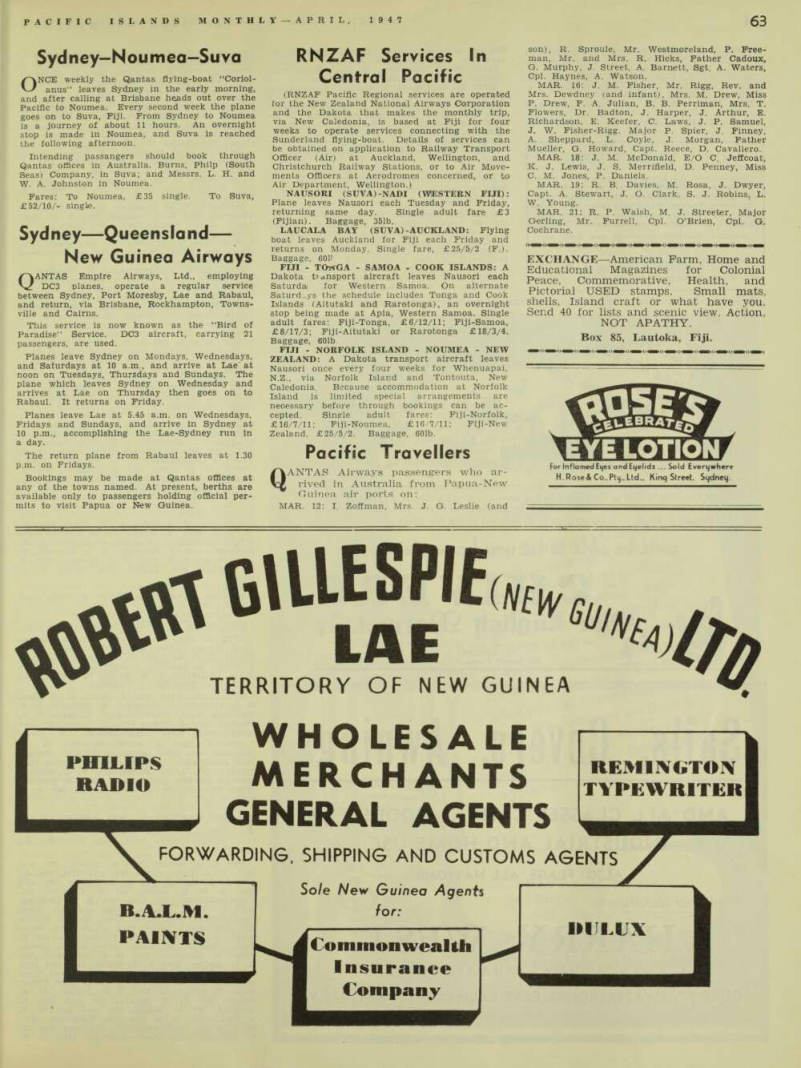
Shipping And Plane Services
mHE foUowmg sea and air services are running to schedules in the Pacific. u ° *1 ° f the * Te l Ul l r , services were suspended, owing to war conditions, finn a t£ een .restored; but preparations are under way for their early reintroduc tion. As they become available they will be announced here.
New Zealand—Cook
Is.—Niue—Samoa
THE motor vessel “Maui Pomare,” owned and operated by the NZ Gov ernment, maintains a direct service between Auckland and Rarotonga (Cook Island), with alternative calls at Niue and Apia (Samoa).
After her return to Auckland on January 22, “Maui Pomare” was withdrawn for survey. She was expected to leave Auckland for Rarotonga and other Cook Islands about the end of March.
Sydney-Norfolk Island-
New Hebrides
THE SS “Morinda,” Burns Philp & Co., Ltd., runs at approximately six seven weeks’ intervals from Sydney to Lord Howe Island. Norfolk Island, and main ports of the New Hebrides, and return. A regular fixed timetable is not yet practicable.
New Zealand—Fiji—
Samoa—Tonga
Service Conducted By Union Ss Co..
Ltd —Subject To Alteration Without
Notice
New Caledonia
THE New Caledonian Government has sub sidised and maintained the coastal ship ping services. The East Coast, the West Coast, and the Loyalty Islands, under present conditions, receive 10 round trips per annum.
The ships call at the following ports: EAST COAST.—Yate, Ounia, Thio, Nakety Canala, Kouaoua Kua, Moneo, Ponerihouen.’
Tibarama, Poindimie, Wagap, Touho, Tipindje!
Hienghene, Tao, Oubatch, Pouebo, Balade. Pam!
Arama, and return.
WEST COAST.—Pouembout. Kone. Temala, Voh, Ouaco Gomen, Koumac, Tangaiou, Tiebaghl Nehoue Poume. Baaba. Belep and return LOYALTY ISLANDS.—Mare (Tadinet. Lifou <Chepenehe) Ouvea (Fajaoue, St. Joseph) and return.
The steamer “Neo Hebridais” runs regularly between Noumea and Sydney, with occasional trips to the New Hebrides (mostly Aneityum).
The owners are Societe Maritime et Manlere Hagen, Noumea. Sydney agents: H C. Sleigh 254 George Street, Sydney.
Sydney—Auckland
Airways
'X'ASMAN Empire Airways, Ltd., operate a A flying-boat service between Rose Bay bydney and Mechanics Bay, Auckland. Large flying-boats, capable of carrying 30 passengers are employed. The trip is comfortable, and takes approximately 8 hours.
The flying-boats leave both Sydney (7 a.m.) and Auckland (8 a.m.) every morning except Sundays—it is now practically a dally service.
Bookings may be made at the Auckland and Sydney offices of Tasman Empire Airways.
Pan-American—
Trans-Pacific Service
r> AN-AMERICAN World Airways now run a *■ weekly service between Sydney and San Francisco, and a fortnightly service between Auckland and San Francisco. Both services go via New Caledonia, Nadi (Fiji), Canton Island and Hawai’i. Skymaster planes are used.
Planes leave Sydney every Wednesday, and San Francisco every Friday.
On the San Francisco-New Zealand service they leave San Francisco every alternate Thurs day (March 13) and Auckland every alternate Tuesday (March 18).
Fares are approximately the same as ANA. (See below.) Free baggage allowance is 55 lb. Excess at 1 per cent, of the one-way fare for each kilogram of excess (1 kilo = 2.2 lb.).
Sydney-Vancouver
ANA Service
AUSTRALIAN National Airways Pty., Ltd., on behalf of the British Commonwealth Pacific Airlines, Ltd., are now operating a trans-pacific service from Sydney, via Fiji, Canton Island, Honolulu, and San Francisco to Vancouver. They are now permitted to pick up and set down passengers in American territory.
Planes leave Sydney every Sunday evening and Vancouver, on the southbound trip, every Friday.
Fares are (in Australian currency) Sydney- Vancouver, £214 single, £385 return; Sydney- San Francisco, £2OO single and £365 return.
Skymaster aircraft carrying 36 passengers and a crew of 10 are used on the service.
“Matua”
Auckland .. ..
April 17 Suva .. ..
April 21-22 Nukualofa . ..
Vavau .
Niue* .. ..
Apia* April 23-25 Niue* ..
April 26 Vavau April 28 Nukualofa .. ..
April 29-30 Suva May 2-3 Auckland .. ..
May 7 •Western
“Matua”
“Matua”
“Matua”
May 15 June 12 July 10 May 19-20 June 16-17 July 14-15 June 19-20 — June 21 — June 21 May 21-24 June 22-25 July 16-19 May 26 July 21 May 27-28 — July 22-23 May 30-31 June 28-29 July 25-26 June 4 Time.
July 2 r July 30
Sydney—Noumea—Suva
ONCE weekly the Qantas flying-boat “Coriol anus” leaves Sydney in the early morning, and after calling at Brisbane heads out over the Pacific to Noumea. Every second week the plane goes on to Suva, Fiji. From Sydney to Noumea is a journey of about 11 hours. An overnight stop is made in Noumea, and Suva is reached the following afternoon.
Intending passangers should book through Qantas offices in Australia. Burns, Philp (South Seas) Company, in Suva; and Messrs. L. H. and W. A. Johnston in Noumea.
Pares: To Noumea, £35 single. To Suva, £52/10/- single.
Sydney—Queensland—
New Guinea Airways
QANTAS Empire Airways, Ltd., employing DC3 planes, operate a regular service between Sydney, Port Moresby, Lae and Rabaul, and return, via Brisbane, Rockhampton, Towns ville and Cairns.
This service is now known as the “Bird of Paradise” Service, DC3 aircraft, carrying 21 passengers, are used.
Planes leave Sydney on Mondays, Wednesdays, and Saturdays at 10 a.m., and arrive at Lae at noon on Tuesdays, Thursdays and Sundays. The plane which leaves Sydney on Wednesday and arrives at Lae on Thursday then goes on to Rabaul. It returns on Friday.
Planes leave Lae at 5.45 a.m. on Wednesdays, Fridays and Sundays, and arrive in Sydney at 10 p.m., accomplishing the Lae-Sydney run in a day.
The return plane from Rabaul leaves at 1.30 p.m. on Fridays.
Bookings may be made at Qantas offices at any of the towns named. At present, berths are available only to passengers holding official per mits to visit Papua or New Guinea.
RNZAF Services In
Central Pacific
(RNZAF Pacific Regional services are operated for the New Zealand National Airways Corporation and the Dakota that makes the monthly trip, via New Caledonia, is based at Fiji for four weeks to operate services connecting with the Sunderland flying-boat. Details of services can be obtained on application to Railway Transport Officer (Air) at Auckland, Wellington, and Christchurch Railway Stations, or to Air Move ments Officers at Aerodromes concerned, or to Air Department, Wellington.)
Nausori (Suva) -Nadi (Western Fiji):
Plane leaves Nausori each Tuesday and Friday, returning same day. Single adult fare £3 (Fijian). Baggage, 351 b.
Laucala Bay (Suva)-Auckland: Flying
boat leaves Auckland for Fiji each Friday and returns on Monday. Single fare, £25/5/2 (F.).
Baggage, 601> FIJI - - SAMOA - COOK ISLANDS: A Dakota transport aircraft leaves Nausori each Saturday for Western Samoa. On alternate Saturdays the schedule includes Tonga and Cook Islands (Aitutaki and Rarotonga), an overnight stop being made at Apia, Western Samoa. Single adult fares: Fiji-Tonga, £6/12/11; Fiji-Samoa, £B/17/3; Fiji-Aitutaki or Rarotonga £lB/3/4.
Baggage, 601 b FIJI - NORFOLK ISLAND - NOUMEA - NEW ZEALAND: A Dakota transport aircraft leaves Nausori once every four weeks for Whenuapai, N.Z., via Norfolk Island and Tontouta, New Caledonia. Because accommodation at Norfolk Island is limited special arrangements are necessary before through bookings can be ac cepted. Single adult fares: Fiji-Norfolk, £l6/7/11; Fiji-Noumea, £l6/7/11; Fiji-New Zealand. £25/5/2. Baggage, 601 b.
Pacific Travellers
QANTAS Airways passengers who ar rived in Australia from Papua-New Guinea air ports on; MAR. 12: I. Zoffman, Mrs. J. G. Leslie (and
son), R. Sproule, Mr. Westmoreland, P. Free man, Mr. and Mrs. R. Hicks, Father Cadoux, G. Murphy, J. Street, A. Barnett, Sgt. A. Waters, Cpl. Haynes, A. Watson.
MAR. 16: J. M. Fisher, Mr. Rigg, Rev. and Mrs. Dewdney (and infant), Mrs. M. Drew, Miss P. Drew, F. A. Julian, B. B. Perriman, Mrs, T.
Flowers, Dr. Badton, J. Harper, J. Arthur, E.
Richardson, E. Keefer, C. Laws, J. P. Samuel, J. W. Fisher-Rigg. Major P. Spier, J. Finney, A. Sheppard, L. CoyLe, J. Morgan, Father Mueller, G. Howard, Capt. Reece, D. Cavaliero.
MAR. 18: J. M. McDonald, E/O C. Jeffcoat, K. J. Lewis, J. S. Merrifield, D. Penney, Miss C. M. Jones, P. Daniels.
MAR. 19: R. B. Davies, M. Rosa, J. Dwyer, Capt. A. Stewart, J. O. Clark, S. J. Robins, L.
W. Young.
MAR. 21: R. P. Walsh, M. J. Streeter, Major Gerling, Mr. Furrell, Cpl. O’Brien, Cpl. G.
Cochrane.
MAR. 22: L. Borotherpe, C. R. Rudd, N. Glass, A. G. Fisher, H. R. Wales, R. Simons, J. M.
Hampton, G. H. Holliday.
MAR. 23: T. Elliott, N. H. Scheltema, K.
McLean, Mrs. W. Hardwick, Mrs. L. Martin, L.
White, E. A. James, A. Richards.
MAR. 25: S. Jamieson, Mrs. D. I. Hodge (and infant).
MAR. 26: N. C. Payne, C. E. Parnell, W.
Elinton, Mrs. G. Holland, C. W. Smith, G. P.
Alway, R. J. McDonald, W. Corron.
MAR. 28: Mr. Hermann, H. C. Coldham, Col.
Jackson, A. Chanter, Mother Philomena.
MAR. 29: A. Pollard, E. Thomas, S Sheridan.
J. Iver.
MAR. 30: B. A. Court, R. H. Eldridge, B. Gel bart, D. Gelbart, R. Brewer, J. Williams, D. C.
Hession, R. Briggs, H. G. Foxall, L. Everingham, V. C. Turner, G. Elson, H. L. Clark.
MAR. 31: R. Stobo.
APR. 1: Miss E. Gofton, F. W. Godden, J. C Shaw.
QANTAS Airways .passengers who left Australia for air ports in Papua-New' Guinea on; MAR. 12: Lieut.-Col. A. Cameron, E. Best, Col. W. Tinsley, Major H. Dick, T. S. McKay, L. C. Badham, Brigadier Neyien, Lieut.-Col. H.
G. Quinn, Mr. Jackson, N. Murray, R. J. Cor dukes, Mr. and Mrs. Julian, G. A. Lawson, H.
B. Forsyth, K. Fox, L. J. Hart, J. Kruttschn’itt. ’
MAR. 14: Mrs. C. M. Owens (and infant), Mrs. H. K. Goad, W. L. Cooke, Miss E. Stock,’
E. C. Glyn, H. G. Rennex, R. A. Mustard, N. G.
Dean, E. Luckie, C. Archer, p. Bingham, Miss A.
Holliday, Misses P. and J. Whitehead, Mrs. J Richards, Miss E. Drought, Mrs. E. McManus (and infant), J. E. Whittaker, J. Bates J T Dalgetty, Mr. and Mrs. Egelstaff.
MAR. 15: F. W. Godden, Mrs. F. Buckley, A.
W. Lindsay, Mrs. B. Martin, Mrs. R. Gibb (and infant), Mrs. V .Thomas, Miss E. Cardew, J.
D. Forman, W. Chapman, C. Ross, T. C. Horton L. Lingford, Mrs. C. E. Woolard, M. Linton A Dance, Mr. Barber, C. H. Collins.
MAR. 17: A. D. Ballantyne, R. Emmet, Mrs. I.
Stratford (and infant), Miss Lowrey, Mrs. J.
White, J. McAdam, J. Lilias, Mr. and Mrs G A. McKenzie, G. Burke, A. Murphy, J. Minnis’
Mrs. W. R. Parker (and infant), Mr. Stains, A.
G. Fisher.
MAR. iff: H. M. Shannon, Miss D. Heath, J.
Cameron, WOI B. J. Leonard, Miss B. E. Jupp, Lieut. S. C. Singh, Lieut. R. Ralph, J. M.’
Coliess, Miss E. Fitzgerald, C. Jones, A. H Spence, Mrs. G. Priestley, Mr. Brotherton, Mr Cook, Mr. Collins, E. Daly, Mrs. E. Greathead (and infant).
MAR. 20: R. T. Kendrick, J, W. McAuley, H.
W. Muscka, G. A. Sprague, Miss L. Hodgson, E. Quarrell, F. R. Fowler. Miss N. E. Wormanj T. L. Sefton, Mrs. D. Ward (and infant), Master Ward, W. Watson, W. Wallace, H. O. Helmkin, H. G. Foxall, R. Briggs, Cairns-Rab. D. W.’
Brotherton.
MAR. 21: R. H. Anderson, Mrs. R. Edwards Miss P. Edwards, Master Edwards, S. J. Jackson, J. Thurston, Mrs. N. White (and infant), R. J.
Stapledon, A. K. Jackson, Miss D. Briggs, J.
Crombie, Capt. J. Heyen, W. F. Blayney, Miss S. J. Zschille, J. L. McCarthy, G. C. Harris, Mrs C. C. Harris, F. Arber, W. S. Sievers, J. C.
McKinley, W. Cameron, Mrs. H. Emery (and infant), P. White, G. Koch.
MAR. 23: K. Mahon, Mr. Linkin, D. R.
McDonald, B. Carruthers, R. Boyle, Mrs. V. R.
McDonald, J. H. Klein, A. J. O’Connell, N.
Crowther, J. Hazzlett, A. B. Batt, Master I.
McGowan, Mrs. M. Walker (and infant), W. G.
Maizif, P. Mazengarb.
MAR. 24: R. Dolby, Mrs. J. Passmore, Mrs. A.
Stratford, A. J. Dunstone T. Oakes, B. Gelbart, D. M. Gelbart, K. J. Lister, C. I. McCulloch, g!
A. Matley, A. Sherwin, A. C. A, Drinkwater, H.
L. Clark, J. W. Burke, Rev. M. Atchison, R.
Stares.
MAR. 25: K. Eastwell, D. A. Doyle, Mrs. P.
M. Jolly, Mrs. J. Malcolm (and infant), Miss S. J. Malcolm, J. Jenkins, R. Walshe, S. R.
Pedersen, Mrs. J. Pedersen, R. A. Peterson, F.
J. Carriage, G. P. Gay, F. C. Brooker, Mrs. S.
J. Pearsall, Mrs. Turner, Mrs. * Neville, K. C Bailey.
MAR. 26: G. J. Watson.
MAR. 28: J. Richardson, Mrs. E. Healy (and infant), Mrs. C. Parer.
MAR. 29: J. Hearn, W. Schleusner.
MAR. 30: A. R. Lawson, D. G. Groundwater.
APR. 2: Mrs. M. Maxwell, Mrs. S. McLean (and infant), Lieut. S. G. White, W/O F S.
Spratt, T. F. Hallinan. W. H. Ingram, Major H.
J. Foster, H. Kroening, J. Rogers, W. H. Holland, R. G. Cattinach, R. W. Swain, Mrs. Rees (and child), Mr. Woltmann, J. Carstens.
APR. 7: G. Raja, Miss J. Harris, H. S. Kerr, D. G. Coventry, E. W. Sellen, A. Richards, R. V.
Morrison, G. S. Truswell, A. J. Williams, G. A.
Bourne, Miss J. Howie, Mrs. C. Greenham (and infant), Mrs. Huston (and infant).
APR. 9: Miss S. Kilminster, Mrs. O. M.
Harrison (and three children), Mr. S. A. Voysey, Mrs. J. Chambers (and infant), Mrs. Howitt (and infant), Mr. L. H .Ferris, Mr. N. C. Carroll, Mrs. G. Bunting (and infant), Miss B. Bunting, Maria Gismara, Mr. A. C. Thompson, Mr. A. J.
Hoile.
PASSENGERS who left Sydney on SS “Morinda” for Norfolk Island, Lord Howe Island, and New Hebrides on April 9: Mrs. R. A. Baxter, Miss K. Benson, Mr. and Mrs. C. J. Butterworth, Mr. and Mrs. Blandy, Mr. A. C. Buffett, Mr. R. A. Baxter, Mr. and Mrs. E. M. K. Coates, Mr. R. Cornette, Mr.
Cooper-Johnston, Mr. Cox, Mrs. B. M. Downing, Mrs. W. M. A. Dingle, Judge and Mrs. Egan (and infant), Mrs. R. D. Eedy, Miss N. Fagan, Mr. and Mrs. Gidley (and child), Mr. Hors burgh, Mr. Harris, Mr. W. M. Horrocks, Mr. N.
King, Mrs. E. M. Laing, Miss M. E. Lynch, Sister M. McKenzie, Mrs. G. E. McTackett, Mr.
A. L. McCoy, Miss V. A. Nobbs, Mr. and Mrs.
J. Nicholls, Mr. and Mrs. W. Paton (and three children), Mr. and Mrs. F. J. Purdy, Miss Potter, Sister N. Parkinson, Mrs. J. W. Payten, Mr. H.
Pearce, Mr. P. W. Quintal, Dr. and Mrs. L.
Rankine, Mr. D. Seagoe, Mr. and Mrs. R. E.
N. Smith, Mr. R. D. and Mrs. Thompson, Mrs.
K. J. Walsh (and daughter), Mr. and Mrs. H.
L. Williams (and three children), Miss M. R.
Walker, Mr. and Mrs. A. Walker, Misses M. and O. Young.
PASSENGERS who left the ports of Sydney and Brisbane for ports in Papua and New Guinea by SS “Montoro” on April 3, were: Mrs. F. Alexander, Mrs. I. M. Anderson (and child), Mr. J. A. Alexander, Mr. W. Anderson, Mrs. F. H. Beighton, Mrs. C. M. Brereton, Mr.
A. L. Barnett, Mrs. V. M. Brown, Rev. J.
Brand. Rev. B. Berlemann, Mrs. J. J. Clark, Mrs. C. Clarke (and two children), Mrs. M. B.
Cook, Mrs. L. M. Cook, Mrs. E. p. Conray (and child), Mrs. J. Carver (and child), Mr. R. C.
Dickie, Mr. C. R. Doyle, Mrs. J. Dunbar-Reid (and child), Rev. P. Diedrichs, Sister M. Dolores, Sister M. Dolorita, Mrs. C. J. Dennie (and child), Miss E. M. Devitt, Mrs. N. Draper (and child), Sister M. Editha, Mrs. C. Earl, Mrs.
M. R. Edwards (and child), Sister M. Fidelma, Sister M. Felicitas, Mr. and Mrs. C. E. Farn ham, Mr. and Mrs. E. Fulton (and child), Mr. and Mrs. K. R. Fisher, Mr. K. J. Gray, Mrs.
A. M. Gabriel, Mrs. I. C. de Groen, Sister G.
M. Gannon, Mr. H. E. Horne, Mr. C. O. Harry, Miss Hibbert, Mrs. H. L. Holznecht (and three children), Sister M. Joanita, Mrs. J. M. Joyes (and three children), Sister M. Justin, Mrs. J.
Lougher (and three children), Mr. and Mrs. F.
A. Lord, Rev. B. Mertens, Rev. B. L. Murile, Mrs. V. B. McKenzie (and two children), Mrs.
P. Macdonald, Mr. W. R. Moore, Mr. and Mrs.
J. K. McCarthy, Mrs. S. D. Millar, Mrs. G.
Neilsen (and three children), Rev. P. O’Loughlin, Mrs. V. B. Pennefather (and daughter), Mrs.
M. Parer, Mr. and Mrs. C. W. Rundnagel, Mrs.
G. Read, Mrs. F. Rundnagel, Mrs. E. D. Ryan (and two children), Mrs. F. W. de Russett, Mrs.
B. J. Stuart, Mrs. G. A. Sutherland, Mrs. O.
E. Scannell, Mrs. L. M. Skelly (and two children), Mr. R. Strange, Mrs. Turner, Mr. C. Warmsley, Mr. and Mrs. L. A. J. Webster (and two children), Mr. W. Wood, Mr. J. P. Whorley, Sister M. Xaverine, Mr. A. Turwerra.
PASSENGERS who arrived in Auckland, NZ, on MV “Matua” on March 7; FROM NUKUALOFA: Sister M. Albina, Mr. F.
Cowley, Miss K. Cowley, Miss E. Carlson, Miss A. Carlson, Mr. T. Peek.
PROM VAVAU: Miss V. Moa, Miss A. Wolf gramm.
FROM NIUE IS.: Mr. and Mrs. W. Maher (and child).
PROM APIA: Mrs. G. Bogle (and daughter), Mr. W. Burnett, Mr. D. Cobcroft, Mr. and Mrs.
F. Dunbar, Master J. Eden, Master D. Eden, Mr and Mrs. W. Ford, Mr. V. Greenwood, Miss E. Greenwood, Mr. M. Mataafa, Mr. and Mrs.
A. McFarland, Mr. and Mrs. J. Radford, Mr. T.
Robson.
FROM SUVA: Mr. and Mrs. L. Abrahams, Miss M. Arbon, Master D. Bull, Master W. Bull, Miss D. Brabant, Master R. Burness, Mr. E. Bradley, Mr. and Mrs. J. Bish (and child), Miss G. Ben ham, Mr. H. Bentley, Mr. A. Cross, Miss E.
Clerke, Mr. P. Chapman, Mr. G. Crawford, Mrs.
R. Derrick, Mr. H. Emberson, Miss N. Puller, Mrs. E. Gordon, Master P. Grant, Mr. M. Gas pard, Mr. R. Harvie, Miss E. Haynes, Mr. C.
Hooker, Mr. W. Homiston, Miss A. Hayden, Mrs. C. Handley, Mr. E. Hibberd, Miss M.
Johnston, Master A. Keelan, Mr. and Mrs. G.
Knox, Mr. D. Major, Master W. Morrison, Mr.
W. Millar, Mr. H. McKenzie, Mr. K. McKenney, Miss B. Nicholson, Mr. B. Ogier, Mr. B. Purser, Mr. J. Qasevakatini, Mrs. I. Rutland, Mrs. H Rowley (and two children), Mr. L. Ram-Samij, Mr. and Mrs. F. Storck (and two children), Mr. H. Surridge, Mrs. I. Surrldge, Miss M.
Simpson, Mr. W. Sorby, Mr. J. Thomson, Mr. R.
Vunivalu, Mrs. M. Wendt, Mr. A. Wane, Mr. C Ward, Miss W. Wotton.
ROUND TRIP: Mr. George Newson.
PASSENGERS who left Auckland, NZ, MV “Matua” on March 18: FOR APIA: Mr. F. P. Ale Malu, Mr. W. M.
Burnett, Mr. A. Matatumua, Mr. C. F. Paget, Mr. and Mrs. A. G. Rasmussen, Mr. H. Strachan, Mr. F. P. To’omata Tua, Mr. F. P. Te’oSimaile, Mr. F. P. Tuilagi Fetu, Mr. T. Tofaeno, Mr. W.
D. Woodham, Mr. A. M. Wilson, Miss E. D.
Wallace.
FOR SUVA: Mr. M. J. Abrahams, Mrs. E. M.
Brown (and son), Mr. and Mrs. C. A. Bentley, Mr. and Mrs. L.. C. Bean (and three children), Mr. and Mrs. S. F. C. Blomfield (and three children), Miss M. J. Collins, Mr. and Mrs.
A. M. Doull (and son), Mrs. A. M. Davis, Mr.
E. Dobson, Mrs. C. Dudley, Miss G. L. Davies, Mrs. M. England, Rev. Dr. W. E. Fox, Mr. E.
Folkard, Mr. and Mrs. F. W. Gifford (and two children), Miss C. J. Gatward, Capt. and Mrs.
G. O. Hoddinott, Mr. and Mrs. D. A. Horne, Mr. and Mrs. J. T. House (and four children), Mr. and Mrs. C. Harvey (and three children), Miss A. I. Hames, Misses C. M. and A. F.
Hogarth-Gill, Mrs. J. G. Jackson (and infant), Mr. W. E. Lindsay, Mrs. R. G. Looker, Mr. and Mrs. R. S. Marlow, Miss M. A. Marcovich, Mr. and Mrs. A. S. Martin (and two children), Mrs.
A. E. McCutcheon (and daughter), Miss B. A.
McGregor-Fox, Mr. G. L. Martensen, Mr. A. A.
Martensen, Mrs. M. G. Nott (and daughter), Miss M. C. Romans, Mrs. A. M. Suckling, Miss P. A. Sullivan, Miss L. L. Smith, Mr. and Mrs.
R. N. Taylor, Mr. and Mrs. R. V. Thomas (and infant), Mr. and Mrs. N. T. Talbett (and two children), Mr. Tasir Khan, Mr. J. Trivett, Miss E. M. Williams, Mrs. C. Williams, Miss M. A.
White.
FOR NUKUALOFA: Mr. and Mrs. O. Brahnc, Mrs. E. M. Brown, Mrs. L. W. Baynall, Mr. and Mrs. J. Cernik (and infant), Miss A. Cernik, Mr. E. Alokihahau.
FOR VAVAU: Mr. H. Hunter, Mr. W. J. Roach.
Recently Archbishop Halse of Brisbane dedicated a former Army small-ship for mission work in the Torres Strait islands.
The dedication was performed aboard the vessel at the shipyards of Norman Wright, Bulimba (Brisbane), where it had been reconditioned for active service on be half of the Anglican Mission. The ship, named the “Francis Pritt,” later sailed for Townsville, in charge of the Rev. M. A.
Warren and two native boys.
Advertisements & other items, pp. 65-68 (1 item)
d** 1 ,lU S f *Nj,
EXCHANGE—American Farm, Home and Educational Magazines for Colonial Peace, Commemorative, Health, and Pictorial USED stamps. Small mats, shells, Island craft or what have you.
Send 40 for lists and scenic view. Action,
NOT APATHY.
Box 85, Lautoka, Fiji.
uL For Inflamed Eyes and Eyelids ... Sold Everywhere H. Rosei Co., Pty., Ltd.. Kinq Street. Sydney.
d** 1 ,lU S f *Nj,
TERRITORY OF NFW GUINEA Af
PHILIPS
RADIO
LAE
TERRITORY OF NEW GUINEA
WHOLESALE
MERCHANTS
GENERAL AGENTS
REMINGTON
TYPEWRITER
FORWARDING, SHIPPING AND CUSTOMS AGENTS
So/e New Guinea Agents for; Commonwealth Insurance Company
R.A.L.M.
PAINTS
IMILCX
PACIFIC ISLANDS SOCIETY
Visitors from the islands to Sydney (or those interested in Islands affairs), are advised to communicate with the honorary secretary of the above Society, which has been formed to study the history, traditions, economics, and political developments of the Pacific Islands.
Regular monthly meetings are held at History House, 8 Young Street. Sydney Address for Correspondence:
THE PACIFIC ISLANDS SOCIETY.
Box 2434 MM.. G.P.0., Sydney.
There’ll be plenty of Chivers Olde English Marmalade available for all. Without it, breakfast seems to have lost much of its enjoyment, for this chunky marmalade with the tonic flavour was everywhere regarded as “The Aristocrat of the Breakfast Table.” Like you, we look forward to the day when . . . vxXi be ftjrle. to Ut gou have plenty o|
CHIVERS
OWd* ?£nolisf| Marmalade
Made in the heart of the English countryside by
CHIVERS & SONS LTD.,
The Orchard Factory , CAMBRIDGE, ENGLAND.
a h
TO SHIPMASTERS
When calling at Tahiti, see Oscar G.
Nordman for ships’ supplies and fresh provisions. Wire before your arrival to OCEANIC, PAPEETE (my registered cable address)
OSCAR G. NORDMAN.
Ship Chandler, Papeete, Tahiti
w A s At«AVS
cesgsaao
CO tor over for dewit a ie ? u „ cooking haS A hiVityi° Usbu \ Buiit
endabiw
atl d bearing U r V * a ' tom *e same tb e eueriais as {eatu res, elusive Coi^ a ° ied o£ the best
ace as epeoda bieCoie-
Wbea tberever you ** y° tt
a -T;^ coiE^
AGENTS
Robert Gillespie Pty. ltd. 54A Pitt St., Sydney, N.S.W.
Pearce & Co. Ltd., SUVA.
I THE COLEMAN LAMP
AND STOVE COMPANY LIMITED
TORONTO, CANADA
CHICAGO, USA
Modern Refrigeration for the South Sea Islands The ELECTROLUX kerosene operated
REFRIGERATOR
MARVEL
OF
MODERN
SCIENCE
i i *1 m
THE
MIRACLE
OF
ICE
FROM
HEAT
ELECTROLUX offers economical, modern and completely efficient
REFRIGERATION FOR ISLANDS' HOMES.
FREEZES CONTINUOUSLY WHILE SMALL LAMP BURNS.
Freezing controlled by simply regulating height of flame. Uses only f gallon of kerosene per week.
MOTORLESS ... NO PARTS TO GET OUT OF ORDER.
MODEL LKSSO
Capacity: 5.5 cubic feet.
GUARANTEED FOR TWO YEARS
• Write to your Local Distributor for prices and full details.
OBTAINABLE FROM ALL W. R. CARPENTER & CO. LTD.
BRANCHES THROUGHOUT THE ISLANDS
Representation in Papua and New Hebrides.
Nh Natives
Raw Deal For
Melanesia's Bishop on Solomons and The Condominium
THE condition of the natives in the British Solomon Islands, and in the Condominium of the New Hebrides, was summed up in the following state ment made in New Zealand at the end of March by the retiring Bishop of Melan esia (Rt. Rev. W. H. Baddeley).
His Lordship always has been noted as a forthright speaker; and in this state ment he “pulled no punches”.
“My primary care in the New Hebrides has been the welfare of the native popu lation and I fear it is they who have suffered most—falling between two stools (the French and British administrations).
There has been little or no joint action in the interests of the indigenous peoples.
“Here and there is a French hospital where ‘natives’ are treated; in some areas mission hospitals (subsidised either by the Condominium Government or by the British Administration alone) fill the gap.
"There is very little district adminis tration-little interest in village hygiene; attempts to administer the law are very spasmodic and only some serious public misdemeanour—a murder or a big fight —puts the wheels in motion.
“I am not sure myself that this lack of government control is altogether to be regretted. There is something to be said for laissez faire. But where there has been such contact between primi tive communities and the outside world’ there must be some authority to which an appeal may be made and some author ity to recognise its responsibility for these simple peoples—in other words, there must be the recognition of trus teeship.
“It is for this reason that I very much regret that the Colonial Development Fund—a most generous grant by the British Colonial Office of £5,000,000 a year for each of the next 10 years for the de velopment of the backward areas of the Empire—has not been extended to include the Condominium.
“The future welfare of some 65,000 people of the New Hebrides, Banks and Torres Islands must still remain, so it would seem, the responsibility of societies and groups which, inspired by evangel istic and philanthropic ideas, have hither to borne the heat and burden of the day, and that with very little encouragement or assistance.
“IN the Solomon Islands, the situation 1 is different. Here, since 1893, there has been a British Administration —for long periods somnolent, if not (at times) asleep.
“But at least there has been a Gov ernment which made some provision for native welfare and development. Med ical work was undertaken in some centres, and such work undertaken by other agencies was encouraged and subsidised.
“Then, too, there has been the steady development of local administration—the setting up of district native Councils and district native courts in which local gov ernment is planned and local justice is administered by leading men of the local community under the watchful super vision of a Government district officer.
In other words our people in the Solomons are now ‘going to school’ in the matter of self-government.”
Mr. J. S. Grimshaw has been appointed Superintendent of the Papua-New Guinea Police Force. Previously, Mr.
Grimshaw served with the South Aus tralian police force, which he joined in 1925. He enlisted in the AIF in 1940.
Death of Mr. Alan O.
McKenzie
(COLLAPSING while at his work in a j Sydney bank on March 18, Mr. Alan Ord McKenzie received injuries which caused his death within a few minutes. He had many friends in Aus tralia, Papua and Fiji, oy whom he was held in high regard. He was a son of Alexander McKenzie, a Scottish engineer wno was responsible for the early de velopment oi the sugar industry in Queensland, and he was born at Dunge ness in the Herbert River area of Queens land in May 1876.
As a youth, Mr. McKenzie entered the Sydney office of Burns, Phnp & Co., and was transferred to the Cooktown branch.
Here he joined the firm of Bowden & McKenzie, engaged in the pearling indus try. From Cooktown he went to Papua, wnere he was connected with the well known firm of Whitten Bros, Prior to World War I, he became connected with Burns, Philp (South Seas) Co., at Levuka, and m 1927 he was transferred to Suva as manager. In 1932, he became a dir ector of the company, and resigned in 1936, making his home in Sydney. At the outbreak of war he joined the tem porary staff of the Commonwealth Bank in Sydney, and it was with this institu tion that he was serving at the time of his death.
He married Miss Moody (a sister of the late F. O. Moody, who was well known to New Guinea residents as a member of the TNG Agricultural staff) in 1905 and she survives him. There were two daughters of the marriage; the late Mrs.
H. E. Snell, of Fiji, and Miss Valmai McKenzie, who is at present attached to the Finance Section of the US Army at Saipan.
Mission Ship For Gilbert
And Ellice
THE directors of the Seventh Day Ad ventist Mission are sending away another small mission vessel —this time, to the Gilbert and Ellice Islands, a field which they have not previously cul tivated. She is a handy type of vessel, 65 feet long, with a draught of only 6 feet —handy for getting in over reefs of the atolls. She. is a sister-ship to the “Beil onani ’, which was sent recently to the Solomon Islands.
Mr. R. C. Macpherson, formerly of the staff of the “Fiji Times and Herald,” slid now a member of the sub-editorial staff of the “Daily Mercury,” Mackay, Queensland, has been appointed in ad dition, Mackay correspondent of the Aus tralian Broadcasting Commission under the Commission’s scheme for the estab lishment of its independent news service.
Advertisements & other items, pp. 69-70 (1 item)
Floor
Rid Kidneys Of
Poisons And Adds
If you suffer sharp, stabbing pains, If Joints are swollen, It shows your blood Is poisoned through faulty kidney action. Other symptoms of Kidney Disorders are Backache, Aching Joints and Limbs, Sciatica, Neuritis, Lumbago. Sleepless Nights, Dizziness, Nervousness, Circles under Eyes, Loss of Energy and Appetite and Frequent Headaches and Colds, etc. Ordinary medicines can’t help much because you must get to the root cause of the trouble.
The Cystex treatment Is specially compounded to soothe, tone and clean kidneys and bladder and remove acids and poisons from your system safely, quickly and surely, yet contains no harmful or dangerous drugs. Cystex works In 3 ways to end your troubles. 1. Starts killing the germs which are attacking your Kidneys, Bladder and Urinary System In two hours, yet Is absolutely harmless to human tissue. 2. Gets rid of health-destroying, deadly poisonous acids with which your system has become saturated. 3. Strengthens and reinvigorates the kidneys, protects from the ravages of disease-attack on the delicate filter organism, and stimulates the entire system.
Praised by One-time Sufferers
Cystex Is approved by one-time sufferers In 73 countries from the troubles shown above.
Mr. Reg Thomas, Townsville, Queensland, recently wrote: “My Joints were all stiff, I had leg pains, my back used to ache day and night.
My bladder was weak. I had headaches and no appetite. The first dose of Cystex helped me and before I finished three boxes my health and strength came back.”
Guaranteed to Satisfy or Money Back Get Cystex from your chemist or store to-day.
Give It a thorough test. Cystex Is guaranteed to make you feel younger, stronger, better In every way, or your money back If you return the empty package.
Now in 2 sizes— 4/-, 8/-.
GUARANTEED QVStCX
Treatment w w for Your Kidneys, Bladder, Rheumatism.
PRODUCING UNIFORM GOOD RESULTS SINCE 1868
FLOOR
ALWAYS ASK FOR IT
That Lighting or Power Plant
You’ve been going to buy...
Whether you want a small
10-light plant that you can
install yourself or a 240-415
volt power plant ... we
have a proposition that will
interest you
THE “NEVERTIRE MINOR."
10-Light 32-Volt Plant.
Simplicity itself to install, and to operate, “Nevertire Minor” will give you ample power for ten lights and to use a fan, vacuum cleaner, reading lamp, radio, cake-mixer, or other low-powered appliances.
PRICE: £ll9
Supplied complete with easy-to-follow installation instructions, and the necessary accessories.
L only 9 H.P. 1,000 r.p.m. Cold-starting “Lister”
Diesel Engine, radiator-cooled, on heavy channel-iron base, direct-coupled to 5.6 K.V. alternator 230/240 volts, single phase, 50 cycles; exciter and automatic voltage regulator, driven by “Whittle” belts. Switchboard mounted on framework with volt-meter, amp-meter, ironclad main switch and manual regulator.
PRICE: £550
1 only 6-cylinder Cummins 60 H.P. 1,000 r.p.m.
Diesel Engine direct coupled to 415/240volt 3-phase/single-phase 24 K.W. alternator, complete with 3-phase switchboard with amp-meter and volt-meter, volt-meter switch, a main line circuit breaker and automatic voltage regulation. Above mounted on portable trailer totally enclosed complete with push button start.
PRICE: £1,590
Above plant is second-hand but has been reconditioned as new.
All are for immediate delivery, subject, of
course, to prior sales
All prices F. 0.8. Sydney. Packing extra.
Dangar, Gedye. & Maixoch Ltd.
10-14 YOUNG STREET, CIRCULAR QUAY, SYDNEY.
G.P.O. BOX 509. Tel. 86095
NG Scholarship Fund
Generous Help From Canada
UNEXPECTED results have come from the letters sent out by the energetic secretary of the New Guinea Women’s Association, Melbourne, asking for donations to their scholarship fund.
One surprise donation during March was a welcome £5O from Mr. C. A. Banks, now Lieut.-Governor of the Province of British Columbia, Canada, and formerly a director of BGD. Miss Stewart, the secretary of the Association, writes that she gleaned his name and address from an issue of the “PIM” and comments: “It goes to show that people should be careful about being written up in papers.”
This generous gesture by Mr. Banks is much appreciated by the Association, which is now within sight of its target of £3,000.
Miss Stewart’s latest brainwave in her quest for donations is a letter to Errol Flynn, of Hollywood a former New Guinea resident. “However,” she says, “I have protected myself, I think, and have stated that if New Guinea now means nothing in his life, please not to have his third secretary forward me an autographed photograph; for that I could not stand!”
It will be interesting to see the reaction of the übiquitous Mr. Flynn, of whom New Guinea residents have stimulating memories.
Donations to the fund should be made direct to the Secretary of the New Guinea Women’s Association, 7 Wilson Street, Moonee Ponds, W 4, Vic. During last month, several donations have been sent to Pacific Publications Pty. Ltd These, of course, are sent on to Mel bourne; but it is quicker and more con venient if the payments are made direct.
March Donations
DONATIONS made to the fund during March were:
Mr. Tom Lever and family have now made their home at Alexisliaven (NG).
Before the war they lived in Port Moresby where Mr. Lever was connected with the Steamships Trading Company. Like many evacuees, they made their tem porary home in Brisbane during the war where Mrs. Eileen Leyer will be best re membered as a representative of the AMP Society.
Amount acknowledged £2,72(5 2 10 Mr. V. C. Gabriel, c/o BP & Co., Samarai, Papua o 2 0 New Guinea Women’s Association (Queensland), c/o Mrs. Jamieson, Dudley Street, Sherwood.
Brisbane 15 15 0 Dr. Alan R. McCay, T. & G. Building, Collins Street, Melbourne . . 1 1 0 Mrs. George Smith, ’Iluka,” Sorrento, Victoria 3 0 0 Valda Youlden, 21 Clark Street, Prahran (proceeds benefit arranged) 10 0 Commander Dyson Hore-Lacey, Garua Plantation, Talasea, New Britain, TNG 20 0 0 Miss Dorothy Stewart (proceeds of work) 1 0 0 Mr. and Mrs. E. A. James, Port Moresby, Papua 3 0 Major and Mrs. R. H. Hicks, Rabaul, TNG 5 5 0 McCosker and King, Matala Plantation, Rabaul, TNG 10 10 0 Mrs. Ina Pryke, “Eversham,” 27 Victoria Parade, Manly, NSW 1 1 0 C. A. Banks, Lieut.-Governor, Pro- . vince of British Columbia, Royal Bank Building, Vancouver, BC. Canada 50 0 0 Total £2,830 0 10
Cargo-Cult
Of Pinnaces and Cargo-Cult And Government's Wasted Funds
A MISSIONARY reader from the Catholic Mission at Marienberg, Sepik River, New Guinea writes as follows about conditions in that part of the world: — WHEREVER you meet a pinnace in New Guinea to-day, you are sure to hear “Pinnace buggerap” or “Pinnace ’e gat trouble.”
We have not had much luck so far with the new Stella Maris, which we brought up from Sydney in the New Year. She has been leaking badly and is now on her way to Port Moresby. There were two mysterious explosions in the engine room and two engineers were badly burned. Now she will probably have to go back to Brisbane for overhaul.
Another of our boats, the Paulus, left Alexishafen with five sisters for Aitape; again “pinnace ’e gat trouble,” and we had to rescue them when they were drifting towards Karkar Island.
Here on the Sepik the Government launch Osprey had another mishap and she has been towed back to Lae or some where else on the coast. The BGD launch Kauri has broken down; Mr. W. Mc- Gregor’s boat is in dock, and Robinson’s Nanganai is also in trouble.
It is a pity that the well-established workshops that were here in Marienberg were bombed to pieces during the war and that our engineer Brothers were killed.
DURING a recent trip along the coast I met the .uncrowned king of the natives. He is called Yali. He is
a native of the Rai Coast, had two years military training in Australia and, al though unable to speak English or to read or write, seems to be sincere, en ergetic and to have a beneficial influence on the natives thereabouts.
He is accompanied by his 35 “policemen ’ and is doing patrol work from Salamaua to the mouth of the Sepik—which can be regarded as a very diplomatic move on the part of the Administration.
Yali’s main purpose seems to be to check the present upsurge of cargo-cult.
His name and his messages are sent ahead for months previous to a visit to any area, whereupon the natives set to work to build him a house and to fur nish and decorate it. Great magical powers are attributed to him and he is regarded as one of the cargo-prophets or “law-men” —a new term which has been coined for these revolutionaries.
However, when he arrives he invariably attacks the prophets and tells the villagers that all Europeans must work hard to earn their money and that the fool’s paradise of free cargo will never even tuate for the native.
ON this same trip I noticed the very poor conditions of health and hygiene that prevail among these Rai coasr. natives. There are many cases of yaws, frambousia, cas-cas and around Bogia, there is supposed to be a meningitis epidemic. I was told that there had not been a medical patrol through there since Civil Administration began to function again.
Things seem to be rather better on the Sepik but there is only one medical assistant—although a very capable one — to attend to the three hundred patients in the hospital.
AT the same time natives here now are being paid large sums in war damage money—one village has received
over £5,000 in this way. No doubt the natives have suffered a great deal; but it seems a waste of money to pour it out in thousands to people who do not know how to spend 5/- wisely or effec tively. In many quiet corners now you see boys gambling —playing a card game they call “Lucky”—and in this way it is easy for them to lose £5 in one evening.
It would surely be better if, instead of compensating these people in cash, the Government spent the money for improved health services, for engaging more doctors, for an anti-TB campaign or an all-out war against mosquitoes. They could also give the natives pigs, fowls, dogs and cattle —most of their livestock disappeared during the Japanese era.
This war damage money allotted generously to the New Guinea natives by the Australian government could be of great benefit if the spending of it were properly controlled by understanding Europeans.
Death Of Mrs. Twentyman
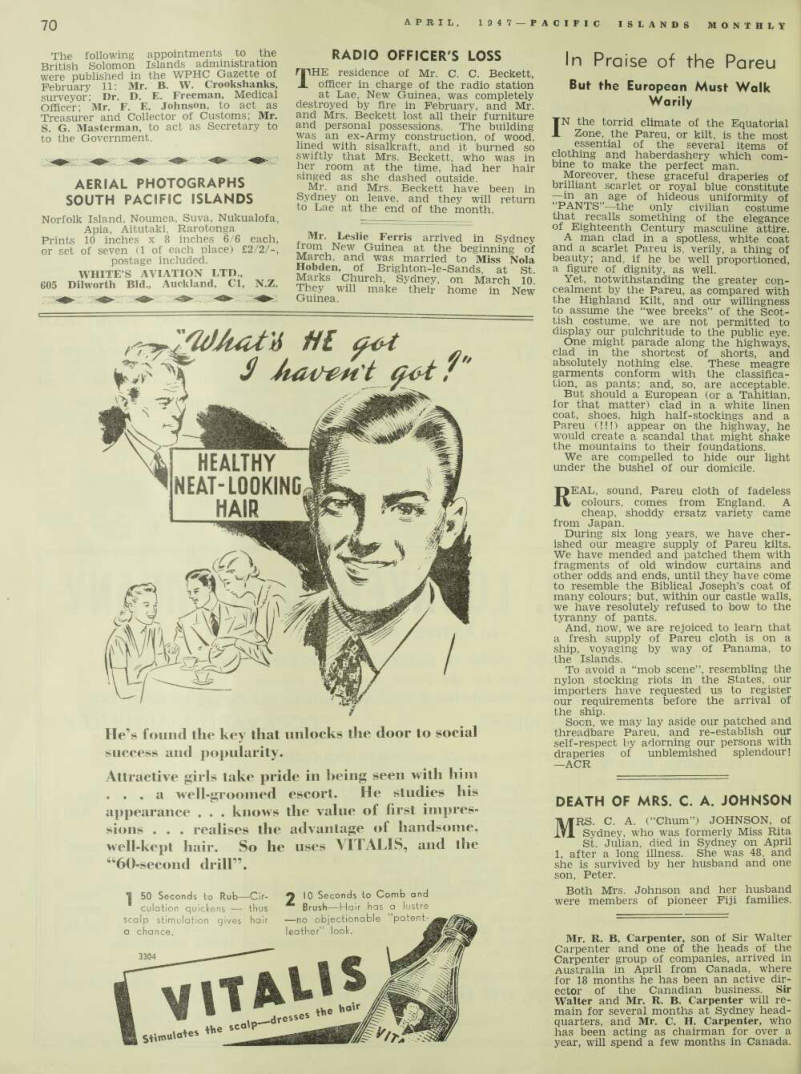
THE death occurred in Suva recently of Mrs. Twentyman, widow of Captain E. W. G. Twentyman who was at one time Harbourmaster in Levuka and Suva. Captain Twentyman died only last September.
Mrs. Twentyman, who was 70, had been in Fiji for 43 years. She was an Austra lian, daughter of a seafarer, Captain Sin clair, who was a well-known Master of sailing ships.
Private advice from Lae states that, despite adverse conditions, building pro grammes are still being carried on.
Latest housing activities include five bungalows under erection by the Vacuum Oil Co., two of which will be married quarters for members of staff.
The following appointments to the British Solomon Islands administration were published in the WPHC Gazette of February 11; Mr. B. W. Crookshanks, surveyor; Dr. D. E. Freeman, Medical Officer; Mr. F. E. Johnson, to act as Treasurer and Collector of Customs; Mr.
S. G. Masterman, to act as Secretary to to the Government.
Advertisements & other items, pp. 71-72 (1 item)
George J. Logkyer & Company
MARINE BRANCH
ENGINEERING SUPPLIES, GENERAL HARDWARE EXPORTERS AND MERCHANTS Agents for the Finest Australian Liquors Aerated Water and Cordial Manufacturing Machinery, Bottling and Capping Machinery, etc.
CONSULTING ENGINEERS DOCKYARD MACHINERY
PURCHASING AGENTS:
Electric Light Generating Plants.
Air Conditioning Plants.
Builders’ Hardware.
Marine Engineering Supplies.
Refrigeration Supplies.
Radios and Accessories.
Sanitation Equipment.
Automobile Spare Parts and Garage Accessories.
Abrasive Wheels.
Excavating Machinery.
Electrcal Supples.
Grinding and Pulverising Machinery.
Hydraulic Equipment.
Mechanical Engineering Requirements.
Mining and Quarrying Machinery.
Road and Building Machinery.
PETROL, DIESEL, KEROSENE AND CRUDE
OIL ENGINES:
All Types Out Board Motors and Out Riggers.
Ronaldson Tippett 16 H.P. Diesel Engines.
Thornycroft 500 H.P. Marine Engines.
Belinda 70 H.P. Crude Oil Engines.
Lister-Blaxland 8-Cylinder Diesel DC. 3KW Electric Light Plant Complete.
Coventry Climax Water Cooled 2.75 KVA 130- Volt Electric Light Plant.
Sulzer Marine Diesel Engine 700 H.P. 6- Cylinder Coupled to 325/275 KVA Alternator.
Beardmore Semi-Diesel 65 H.P. Engines.
Universal 22 H.P. 4-Cycle Petrol Engines.
Rosebery Kerosene 3.7 H.P. Hopper Cooled Engines.
VESSELS, ETC.
Steel Cargo Vessels, 35 ft. x 13 ft. 4 ft., New, with Winch, Hoist, etc.
Auxiliary Transport Vessels, 32 ft. x 9 ft. x 4 ft., New, without Engines.
Tugs, Trawlers, Cargo Vessels, Tankers, Motor Cruisers, Launches, Yachts, Hoists, Winches, etc.
Photographs, Drawings, Schedules, will be Supplied by Return Mail to Genuine Clients.
FAIRLIGHT STREET, FIVE DOCK, SYDNEY, N.S.W.
All communications to be addressed to The General Manager, G.P.0., Box 4553, Sydney.
Bankers; Commonwealth Bank of Australia, Sydney.
'Phone: UA7196 Telegraphic and Cable Address: “LOCKMACH,” Sydney.
AERIAL PHOTOGRAPHS
SOUTH PACIFIC ISLANDS
Norfolk Island, Noumea, Suva, Nukualofa, Apia, Aitutaki, Rarotonga Prints 10 inches x 8 inches 6/6 each, or set of seven (1 of each place) £2/2/-, postage included.
WHITE’S AVIATION LTD.,
605 Dilworth Bid., Auckland, Cl, N.Z.
vsf >i t £r %
HEALTHY
NEAT-LOOKING
HAIR
A \ (fC\
f^Wr:
mm
pom
■% He’s found the key that unlocks the door to social success and popularity.
Attractive girls take pride in being seen with him . . . a well-groomed escort. He studies his appearance . . . knows the value of first impressions . . . realises the advantage of handsome, well-kept hair. So he uses VITALIS, and the “60-second drill”. 50 Seconds to Rub—Cir- 2 10 Seconds lo Comb and culation quickens thus Brush —Hair has a lustre scalp stimulation gives hair —no objectionable "patenta chance. leather" look. 3304 — •~ 00 * o'^ 0 '^
v it
the cc^ eSSeS hair
Radio Officer's Loss
THE residence of Mr. C. C. Beckett, officer in charge of the radio station at Lae, New Guinea, was completely destroyed by fire in February, and Mr. and Mrs. Beckett lost all their furniture and personal possessions. The building was an ex-Army construction, of wood, lined with sisalkraft, and it burned so swiftly that Mrs. Beckett, who was in her room at the time, had her hair singed as she dashed outside.
Mr. and Mrs. Beckett have been in Sydney on leave, and they will return to Lae at the end of the month.
Mr. Leslie Ferris arrived in Sydney from New Guinea at the beginning of March, and was married to Miss Nola Hobden, of Erighton-le-Sands, at St.
Marks Church, Sydney, on March 10 They will make their home in New Guinea.
In Praise of the Pareu
But the European Must Walk Warily
IN the torrid climate of the Equatorial Zone, the Pareu, or kilt, is the most essential of the several items of clothing and haberdashery which com bine to make the perfect man.
Moreover, these graceful draperies of brilliant scarlet or royal blue constitute —in an age of hideous uniformity of “PANTS”—the only civilian costume that recalls something of the elegance of Eighteenth Century masculine attire.
A man clad in a spotless, white coat and a scarlet Pareu is, verily, a thing of beauty; and, if he be well proportioned, a figure of dignity, as well.
Yet, notwithstanding the greater con cealment by the Pareu, as compared with the Highland Kilt, and our willingness to assume the “wee breeks” of the Scot tish costume, we are not permitted to display our pulchritude to the public eye.
One might parade along the highways, clad in the shortest of shorts, and absolutely nothing else. These meagre garments conform with the classifica tion, as pants; and, so, are acceptable.
But should a European (or a Tahitian, for that matter) clad in a white linen coat, shoes, high half-stockings and a Pareu (!!!) appear on the highway, he would create a scandal that might shake the mountains to their foundations.
We are compelled to hide our light under the bushel of our domicile.
REAL, sound, Pareu cloth of fadeless colours, comes from England. A cheap, shoddy ersatz variety came from Japan.
During six long years, we have cher ished our meagre supply of Pareu kilts.
We have mended and patched them with fragments of old window curtains and other odds and ends, until they have come to resemble the Biblical Joseph’s coat of many colours; but, within our castle walls, we have resolutely refused to bow to the tyranny of pants.
And, now, we are rejoiced to learn that a fresh supply of Pareu cloth is on a ship, voyaging by way of Panama, to the Islands.
To avoid a “mob scene”, resembling the nylon stocking riots in the States, our importers have requested us to register our requirements before the arrival of the ship.
Soon, we may lay aside our patched and threadbare Pareu, and re-establish our self-respect by adorning our persons with draperies of unblemished splendour!
—Acr
Death Of Mrs. C. A. Johnson
MRS. C. a. (“Chum”) JOHNSON, of Sydney, who was formerly Miss Rita St. Julian, died in Sydney on April 1, after a long illness. She was 48, and she is survived by her husband and one son, Peter.
Both Mrs. Johnson and her husband were members of pioneer Fiji families.
Mr. R. B. Carpenter, son of Sir Walter Carpenter and one of the heads of the Carpenter group of companies, arrived in Australia in April from Canada, where for 18 months he has been an active dir ector of the Canadian business. Sir Walter and Mr. R. B. Carpenter will re main for several months at Sydney head quarters, and Mr. C. H. Carpenter, who has been acting as chairman for over a year, will spend a few months in Canada.
Innes-Blundell Wedding
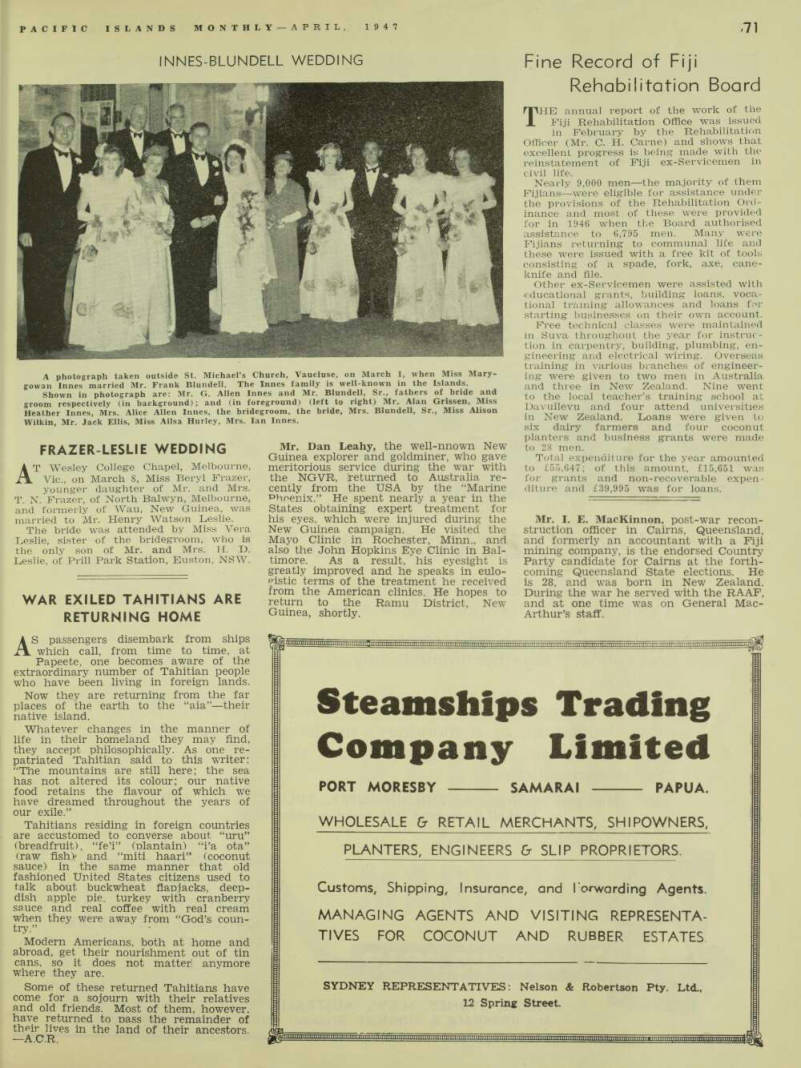
A photograph taken outside St. Michael’s Church, Vaucluse, on March 1, when Miss Mary gowan Innes married Mr. Frank Blundell. The Innes family is well-known in the Islands.
Shown in photograph are: Mr. G. Allen Innes and Mr. Blundell, Sr., fathers of bride and groom respectively (in background); and (in foreground) (left to right) Mr. Alan Grissen, Miss Heather Innes, Mrs. Alice Allen Innes, the bridegroom, the bride, Mrs. Blundell, Sr., Miss Alison Wilkin, Mr. Jack Ellis, Miss Ailsa Hurley, Mrs. lan Innes.
Frazer-Leslie Wedding
AT Wesley College Chapel, Melbourne, Vic., on March 8, Miss Beryl Frazer, younger daughter of Mr. and Mrs.
T. N. Frazer, of North Balwyn, Melbourne, and formerly of Wau, New Guinea, was married to Mr. Henry Watson Leslie.
The bride was attended by Miss Vera Leslie, sister of the bridegroom, who is the only son of Mr. and Mrs. H. D.
Leslie, of Prill Park Station, Euston, NSW.
War Exiled Tahitians Are
Returning Home
AS passengers disembark from ships which call, from time to time, at Papeete, one becomes aware of the extraordinary number of Tahitian people who have been living in foreign lands.
Now they are returning from the far places of the earth to the “aia”—their native island.
Whatever changes in the manner of life in their homeland they may find, they accept philosophically. As one re patriated Tahitian said to this writer: “The mountains are still here; the sea has not altered its colour; our native food retains the flavour of which we have dreamed throughout the years of our exile.”
Tahitians residing in foreign countries are accustomed to converse about “uru” (breadfruit), “fe’i” (nlantain) “i’a ota” (raw fish)' and “miti haari” (coconut sauce) in the same manner that old fashioned United States citizens used to talk about buckwheat flapjacks, deep dish apple pie. turkey with cranberry sauce and real coffee with real cream when they were away from “God’s coun try.”
Modern Americans, both at home and abroad, get their nourishment out of tin cans, so it does not matter anymore where they are.
Some of these returned Tahitians have come for a sojourn with their relatives and old friends. Most of them, however, have returned to pass the remainder of their lives in the land of their ancestors.
A.C.R.
Mr. Dan Leahy, the well-nnown New Guinea explorer and goldminer, who gave meritorious service during the war with the NGVR, [returned to Australia re cently from the USA by the “Marine Phoenix.” He spent nearly a year in the States obtaining expert treatment for his eyes, which were injured during the New Guinea campaign. He visited the Mayo Clinic in Rochester, Minn., and also the John Hopkins Eye Clinic in Bal timore. As a result, his eyesight is greatly improved and he speaks in eulo gistic terms of the treatment he received from the American clinics. He hopes to return to the Ramu District, New
Guinea, shortly.
Fine Record of Fiji
Rehabilitation Board
THE annual report of the work of the Fiji Rehabilitation Office was issued in February by the Rehabilitation Officer (Mr. C. H. Came) and shows that excellent progress is being made with the reinstatement of Fiji ex-Servicemen in civil life.
Nearly 9,000 men—the majority of them Fijians—were eligible for assistance under the provisions of the Rehabilitation Ord inance and most of these were provided for in 1946 when the Board authorised assistance to 6,795 men. Many were Fijians returning to communal life and these were issued with a free kit of tools consisting of a spade, fork, axe, cane knife and file.
Other ex-Servicemen were assisted with educational grants, building loans, voca tional training allowances and loans for starting businesses on their own account.
Free technical classes were maintained in Suva throughout the year for instruc tion in carpentry, building, plumbing, en gineering and electrical wiring. Overseas training in various branches of engineer ing were given to two men in Australia and three in New Zealand. Nine went to the local teacher’s training school at Uavuilevu and four attend universities in New Zealand. Loans were given to six dairy farmers and four coconut planters and business grants were made to 28 men.
Total expenditure for the year amounted to £55,647; of this amount, £15,651 was for grants and non-recoverable expen diture and £39,995 was for loans.
Mr. I. E. MacKinnon, post-war recon struction officer in Cairns, Queensland, and formerly an accountant with a Fiji mining company, is the endorsed Country Party candidate for Cairns at the forth coming Queensland State elections. He is 28, and was born in New Zealand.
During the war he served with the RAAF, and at one time was on General Mac- Arthur’s staff.
Advertisements & other items, pp. 73-74 (1 item)
Steamships Trading
Company Limited
PORT MORESBY
SAMARA!
PAPUA.
WHOLESALE & RETAIL MERCHANTS, SHIPOWNERS,
PLANTERS, ENGINEERS & SLIP PROPRIETORS.
Customs, Shipping, Insurance, and Forwarding Agents.
MANAGING AGENTS AND VISITING REPRESENTA-
TIVES FOR COCONUT AND RUBBER ESTATES
SYDNEY REPRESENTATIVES: Nelson & Robertson Pty. Ltd- -12 Spring Street.
N / wmmm ***■ msm mm m & *** feZ mmrn^ ■ %.st n a
BUILDINGS
This 1 I\ Ton load is an example of our much advertised
'Designed for Transport' "Econo-Steel" Structures.
These "Econo-Steel" frames are transported ready to unfold and connect together immediately on uncrating, and are avail-
able now.
Should you intend building, say, a storage shed, dryingroom, workshop, or a manager's residence, we, Tulloch's Pty.
Ltd., have the efficient design and service staff to assist clients and builders.
Mail your enquiry to the BUILDING DEPT., TULLOCH'S PTY. LTD.
It shall be treated with every consideration.
When building consider
• EASE OF ERECTION
• FIRE RESISTANCE
• SOUNDNESS OF STRUCTURE
0 BORER AND WHITE ANTS
Tullochs pt v lt°
RHODES, SYDNEY, N.S.W., AUSTRALIA Cable TULSTEEL Sydney.
And DRYSDALE & RIDGWAY, Brisbane. Cable: DRYSTEEL, Brisbane.
The "Alone"
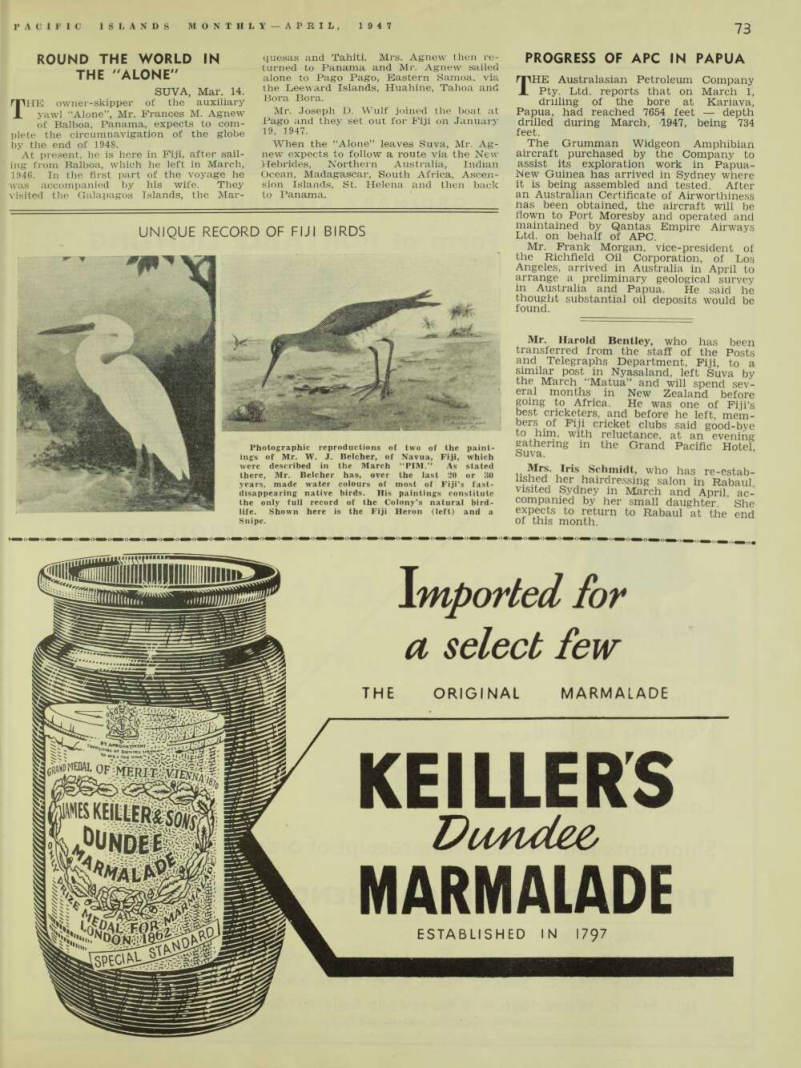
Round The World In
Suva, Mar. 14.
THE owner-skipper of the auxiliary yawl “Alone”, Mr. Frances M. Agnew of Balboa, Panama, expects to com plete the circumnavigation of the globe by the end of 1948.
At present, he is here in Fiji, after sail ing from Balboa, which he left in March, 1946. In the first part of the voyage he was accompanied by his wife. They visited the Galapagos Islands, the Mar
quesas and Tahiti. Mrs. Agnew then re turned to Panama and Mr. Agnew sailed alone to Pago Pago, Eastern Samoa, via the Leeward Islands, Huahine, Tahoa and Bora Bora.
Mr. Joseph D. Wulf joined the boat at Pago and they set out for Fiji on January 19, 1947.
When the “Alone” leaves Suva, Mr. Ag new expects to follow a route via the New Hebrides, Northern Australia, Indian Ocean, Madagascar, South Africa, Ascen sion Islands, St. Helena and then back to Panama.
Unique Record Of Fiji Birds
Photographic reproductions of two of the paint ings of Mr. W. J. Belcher, of Navua, Fiji, which were described in the March “PIM.” As stated there, Mr. Belcher has, over the last 20 or 30 years, made water colours of most of Fiji’s fast disappearing native birds. His paintings constitute the only full record of the Colony’s natural bird life. Shown here is the Fiji Heron (left) and a Snipe.
Progress Of Apc In Papua
THE Australasian Petroleum Company Pty. Ltd. reports that on March 1, drilling of the bore at Kariava, Papua, had reached 7654 feet depth drilled during March, 1947, being 734 feet.
The Grumman Widgeon Amphibian aircraft purchased by the Company to assist its exploration work in Papua- New Guinea has arrived in Sydney where it is being assembled and tested. After an Australian Certificate of Airworthiness nas been obtained, the aircraft will be flown to Port Moresby and operated and maintained by Qantas Empire Airways Ltd. on behalf of APC.
Mr. Frank Morgan, vice-president of the Richfield Oil Corporation, of Los Angeles, arrived in Australia in April to arrange a preliminary geological survey in Australia and Papua. He said he thought substantial oil deposits would be found.
Mr. Harold Bentley, who has been transferred from the staff of the Posts and Telegraphs Department. Fiji, to a similar post in Nyasaland, left Suva by the March “Matua” and will spend sev eral months in New Zealand before going to Africa. He was one of Fiji’s best cricketers, and before he left, mem bers of Fiji cricket clubs said good-bye to him, with reluctance, at an evening gathering in the Grand Pacific Hotel, Suva. .. J 11 !?' J ris Schmidt - who has re-estab lished her hairdressing salon in Rabaul visited Sydney in March and April, ac companied by her small daughter She expects to return to Rabaul at the end of this month.
Advertisements & other items, pp. 75-76 (1 item)
Keillers
inimfiun mm. i i 1$
fes
ite
r =^£ —=.' • ,'^/Vj =2 Ha i <S I § i §i T S I i § I ill V BS 6? t4U Slfc
SPECANk
Imported for
a select few
THE ORIGINAL MARMALADE
KEILLERS
Vundee
MARMALADE
ESTABLISHED IN 1797
TILLEY LAMPS
BURN ORDINARY KEROSENE
The Modern Form of PORTABLE LIGHTING Be you buy a
TILLEY
STORM LANTERNS \ Look for the name!
TABLE LAMPS
SUSPENSION LAMPS
RADIATORS
INSPECTION LAMPS
WALL LAMPS
FLOODLIGHT PROJECTORS
300 C.P.
Storm Lantern
Tilley Lamps are made only at
Hendon, England.
Be sure you buy a TILLEY Look for the name !
Shipments four weeks from receipt of order.
THE TILLEY LAMP CO., HENDON,
5,000 C.P.
Floodlight Projector
N.W.4, ENG.
REPRESENTATION :
MELBOURNE : T. H. Bentley, Pty. Ltd., 123-125 William Street, Melbourne, C.l.
TASMANIA : Mr. C. Sellars, 108 a Charles Street, Launceston.
FIJI : Mr. K. Witherington, 2 Burns Philp Buildings, Suva.
Fiji Politics
Association That "Keeps Officials On Their Toes"
THERE was a distinct air of liveliness about the annual meeting of the European Electors Association, Suva, held on March 28.
The refusal of the British Colonial Office to their request for a reform of the Constitution, so as to provide for more representation of the people in the administrative machinery, was condemned in strong language.
Mr. D. M. N. MacFarlane said that a delegation had carried their protest to the Governor, but the latter had declined to take any further action. The Governor had refused a plea by Mr. J. P. Bayley that a plebiscite be taken. Their pro test therupon had been sent individually to 640 members of the British House of Commons. rE Association’s proposals, which in cluded the extension of the franchise to the Fijians, were opposed by the Fijian chiefs, who said that their people did not desire any change. The Fijians exercise considerable control over their own affairs within the general framework of the Colony. This has been designed to conform closely with old native cus toms, and it provides for village control and for the combination of villages into districts, the districts in turn being com bined into provinces, which hold their pro vincial councils at regular intervals.
The objection by the Fijian represen tatives to the proposed change was based on the ground tnat if the Fijian was transferred from the native laws and brought under the general laws of the
Colony the whole foundation of his social and economic life would be disturbed.
Supporters of the proposal claimed that it was necessary to remove the Fijian from chiefly rule if the race was to pro gress and meet the economic challenge of the Indians.
Mr. W. Grainger Johnson, MLC, given permission to address the meeting, pre sented arguments in favour of the present system of governing the Colony. He must have felt like Daniel in the lion’s den— but he faced a hostile audience with a bright smile, and met plenty of inter jections.
Mr. Bayley made a sharp attack upon Mr. Johnson, and declared that he was trying to justify his nomination to the Council, rather than to defend the system.
He went on to argue that the Fijians should be given the vote—Bo per cent, of them were ready.
THE following office - bearers were Elected: President, Mr. A. A. Ragg; vice-presidents, Messrs. J. P. Bayly, H. L. Gerrard, D. M. N. MacFarlane and F. V. Dunstan; secretary, Mr. R. L. Barn father; treasurer, Mr. S. Powell; auditors, Messrs. Pearce and Lawler; committee, Messrs. G. E. R. Anness, K. A. Marlow, K. Witherington, G. A. Furby, B. Ashley, C. G. King, A. Groom. G. Barratt, A. M.
Heatly, W. J. Ragg, C. S. Phillips, E. H.
Mcllwain, E. V. Lawson, J. S. Rushton and J. B. Stinson.
THE Electors’ Association is regarded in Fiji as “a hotbed of young radi cals”. Nonetheless, it is held in es teem by Europeans generally, and treated with affection by the high officers of the Colonial Service. It is a very good thing that such an organisation exists in a Colony like Fiji. It may not achieve much in political reform; but it attracts the brighter young men of the community,
provides an outlet for their active inter est in politics, and it keeps the adminis trative officials on their toes.
Fisherman Killed By Shark
Heroic Rescue by Son
Papeete, Feb. 10.
A CRUEL tragedy occurred at sea, off the coast of Moorea, on February 3, by which Marama Tane, a well known fisherman, lost his life.
Marama, with his son and some other natives, left Moorea for the fishing grounds. Marama had a line out over the stern. Suddenly a large tuna took the bait. The sharp jerk overbalanced Marama, and he fell into the sea.
Immediately, he was attacked by a large shark, which lacerated his thigh and arms.
There were some bonito in the launch; and, as the boat circled, these were thrown out. The shark left the man, and went for the fish; and Marama’s son then sprang overboard, and brought his help less father to the surface, and they were hauled aboard.
The launch set out immediately for Tahiti, and Marama was rushed to hos pital in Papeete. Blood transfusions were given, but it was too late—Marama died in hospital from shock and loss of blood during the journey.
Two War Damage Commission officials from Papua-New Guinea were visitors to Sydney on business at the beginning of the month —Messrs. E, A. James and A.
Richards. Mr. K. A. P. Dwyer, of the same department, was also in Sydney on leave, and departed for New Guinea at the end of March.
Advertisements & other items, p. 77 (1 item)
(Zudixalian ‘Jlihiiuj £td.
ISLAND CRAFT
TO
MODERN DESIGN
i jk
WOODEN FREIGHTERS,
TRAWLERS AND ISLAND
CRAFT.
VESSELS REPAIRED AND
REMODELLED.
AUSTRALIAN AGENTS FOR
GRAY MARINE PETROL AND
DIESEL ENGINES.
COPPERSMITHS, WELDERS
AND PLUMBERS.
MODERN SLIPWAY FACILITIES AVAILABLE
WRITE US FOR DESIGNS AND COMPLETE SHIPBUILDING INFORMATION. /^A^\ V F 1 /
(Zudixalian ‘Jlihiiuj £td.
INCORPORATING REG. ADAMS CLAYTON CO.,
Tel.: XB 4475, XA 1731. JOHN STREET, BERRY'S BAY, NORTH SYDNEY. ALSO AT EDEN, NS W,
Papuan Settlers Did Not
"Run"
iA Letter to the Editor) WITH much interest I read the letter of Ron Henderson in a recent “PIM” written by him in Canada on the subject of the sneer of Mr. Bryson, MP, in relation to Papua’s soldiers. I have known Ron since he was a kid, and I know the boys he mentions who lost their lives in the fighting overseas; and every word he says is truth. All those boys, like many others of the Papua settlers, were brave men and loyal in their duty to their country and the British Empire.
If Mr, Bryson says that all the old settlers of Papua left the Territory as soon as the Japs attacked, he is a damned liar. I do not think 5 per cent, of the old settlers left willingly, or of their own accord. I, for one, was here for six months after the Japs attacked.
Then, with four other —J. Miller, Arthur Miles. Archie Witbourne, and George Martin—l was forced to leave by an official concerning whom the least said the better. In these days of unfairness and injustice, and bureaucratic malice, one is afraid to speak one’s mind, even in the interests of truth and justice.
But I am not afraid to say that those officials forced us to leave because they knew we old hands knew too much about their ignorance and their methods, and they wanted us out of the way. We begged them to let us stay—there were many ways in which, with our knowledge and experience, we could have helped in the defence of our country—but we were compelled to get out. Some of us were too old for the front line, but we could have given valuable help in recruiting j
natives as guides and interpreters, in charge of gangs of boys, in charge of stores, and so on. I, for one, can speak, write and read Motuan and other dia lects—but the officials who forced me cut could not speak a word of any dialect.
I am, etc.,
A. C. Piletti.
Aroma. Papua.
Water For Australia
Major A. C. Swinbourne, The New
president of the Pacific islands Society (Sydney) is putting life and interest into the monthly meetings of that body. At the meeting on March 26, Mr.
Michael Sawtell outlined the ambitious plan under which it is proposed to collect the enormous rainfall of north-eastern Queensland, and turn it back over the coastal ranges into the drv interior of Australia.
Visitors included Mr. and Mrs. Hubert Sabben, late of Fiji; Mr. and Mrs. B.‘C.
Cartland, who are proceeding to the Gil bert Islands, from Nigeria; and Mr. Du Faur. The latter expressed the opinion that water could be brought across Torres Strait, into arid Australia, from the Fly River region of Papua.
The Fiji ex-Servicemen’s visiting com mittee, which is appointed by the Gov ernor to attend, to the welfare of ex-Ser vicemen in hospital, has been reconsti tuted. The members of the new com mittee are Mr. C. S. Reay (chairman), Lady Maraia, Mr. C. R. Came, Mr. and Mrs. R. H. Lester, Mr. Noel Levy, Ratu Edward Matatini and Mr. G. McEwan.
150 Years Ago
Arrival of Missionaries In Tahiti
From Our Own Correspondent
M Tahiti, Mar. 4.
ARCH 5, 1947, is the one hundred and fiftieth anniversary of the landing at Matavai, on Tahiti, of the first missionaries of the London Missionary Society. J This anniversary was celebrated in all the Protestant Churches of French Oceania, on Sunday, March 2.
The ship “Duff”, which brought the missionaries, is known throughout the islands by the name “Te Rapu”. The story is, that on March 4, 1797—the day before the “Duff” arrived—Tahiti was shaken by an earthquake. The Tahitians thought the “Duff” had something to do with it, and they named her “Te Rapu”— the stirrer-up; and the name has endured.
The history of the “Duff” missionaries has been so ablv told in the “PIM” by the late Mr. W. W. Bolton, that there is nothing this writer may add, except this: The “Duff”, on her return voyage, discovered the grouo of islands to which the Captain gave the name “Gambier”, in honour of the great patron of the LMS, Lord Gambier. Mr. Bolton—the historian of LMS missionary enterprise in the South Pacific—was a member of the family of that Lord Gambier.
The Hon. J. B. Trotter, MLC, manager of Bums Philp & Co. (SS) Ltd. in Fiji- Mr. L. T. Lawlor, of Pearce & Co. Ltd’, Suva; and Messrs. Rutter and Donaldson, of the CSR Co. staff in Fiji, were guests of the Old Fijians Luncheon Club at the Wentworth Hotel, Sydney, on April 11
Advertisements & other items, p. 78 (1 item)
Propeller Shaft
For long and rehahleservice, instal a
lsm
in
PROPELLER SHAFT
Monel shafts are renowned for their rugged strength, stiffness and freedom from whip.
These characteristics are very important since a good, stiff shaft reduces vibration, transmits more power to propeller and thereby increases speed and efficiency. Of still greater importance is the fact that Monel retains these properties indefinitely, because Monel cannot rust and is not corroded by fresh or salt water.
That is why a Monel shaft, stronger than others when new, is still in perfect condition after years of continuous service.
Complete information on Monel will gladly be fonoarded by.
WRIGHT AND COMPANY
SOLE AUSTRALIAN DISTRIBUTORS OF MONEL
81 CLARENCE STREET, SYDNEY : : : : : 'Phone: BXI2II (Six Lines) Monel is a registered trade-mark covering a rich nickel alloy, mined in Canada and rolled in Great Britain.
of Polynesia
A Cultural Federation of Polynesia
By Mrs. George Mellen, 2998 Makalei Place, Honolulu
IAM tremendously interested in your advocacy of a cultural Federation of Polynesia, in the January issue of the “PIM”, and I agree with it in every de tail. A cultural Federation of Polynesia would have mucn to contribute to the coming Pacific era. Not only the Pacific, but all the world needs a large dose of Polynesian tolerance and kindliness, and I know of no people whose influence spreads with such fine results as does this “aloha spirit,” as we call it here in Hawaii. People of all races respond to it, and only good results would accrue to the nations which foster it.
I agree also that a politically-united Polynesia is impractical but I don’t think the people themselves would wish it. May I give you a story in illustra tion?
About 15 years ago, the Princess Kaw ananakoa (Hawaiian) made a trio to Tahiti and, while there, was lavishly en tertained by the former Queen Marau.
She told me that one day, when they were talking, the Queen said to her: “Princess, why don’t you become a Frenchwoman —Americans are so crude!”
The Princess said that this gave her a shock. Then they discussed the fact that each of them, both Polynesians, and feeling very close kinship to each other, felt completely a part of the nation to which their kingdoms belonged. The Princess ended, “Until she said that to me I had never realised how completely American I was—how it would be utterly impossible for me to be a Frenchwoman or any other national.”
So I think there is the answer to any question of a political unity of the race.
It is not only impractical, but the natives now have deep loyalties to the nations which have become their mother countries.
But a cultural Federation is different.
I am sure they would love it because of their great racial pride. Here in the Islands anyone who has a drop of Hawaiian blood calls herself an Hawaiian.
And they are always interested in other branches of the race.
I agree heartily with your last sen tence: “It is time that the world heard the voice of Polynesia.” A voice so kindly and so tolerant is greatly needed.
Mr. J. Sedgers, director of WRC (NG) arrived in Sydney recently from New Guinea. He will take a short holiday.
Advertisements & other items, p. 79 (1 item)
Millers Ltd.
Every Branch Of
ENGINEERING and BUILDING CONSTRUCTION
SUVA and LAUTOKA
Sawmillers and Timber Merchants; Shipwrights and Sailmakers; Joinery and Furniture Manufacturers; Upholsterers; Plumbers; Electricians; Hardware Merchants; Motor Dealers.
AGENCIES :
Chevrolet, Bedford, Vauxhall, Nash Motors. Firestone Tyres.
Fetters Marine and Stationary Engines, G.E.C. Radio Sets.
British Australian Lead Manufacturers Pty., Ltd., Atlas Assurance Co., Ltd.
There is no need to send to Australia or New Zealand for Repairs or Replacements. We can give you a sound Quotation and guarantee First-Class Workmanship
SWALLOW t ARIELL
LIMITED
LEADERS IN THE BISCUIT INDUSTRY SINCE 1854 MAKERS ALSO OF THE FAMOUS SWALLOW t ARIELL SLUM PUDDINGS. CAKES. AND ICE CREAM
WATER INTO GOLD
IN 1886, there came to Mildura, then a cattle run, two men who were destined to transform the whole future of the area.
These were the Chaffey brothers—George and William. George Chaffey was an irrigation expert who had already founded successful irrigation colonies in the United States.
A chance meeting in California with Alfred Deakin, the father of Federat ion had prompted the brothers to come to Australia, and in 1887 they completed negotiations with the Victorian Government to establish a dried fruits industry on the Murray. Land was cleared, irrigation channels dug, and pumping stations soon drew from the Murray the water that was to release the wealth of the soil.
Today, the Murray Valley represents one
of the world’s richest dried fruit areas.
With the production of sultanas, currants, lexias, etc., representing a National income of £4>s oo > ooo has made Australian dried fruits famed the world over for richness and quality. And it is from the choicest of these sun ripened crops that Swallow & Ariell select with painstaking care the luscious fruits and raisins for their equally famous biscuits, cakes and puddings.
Outstanding Medical
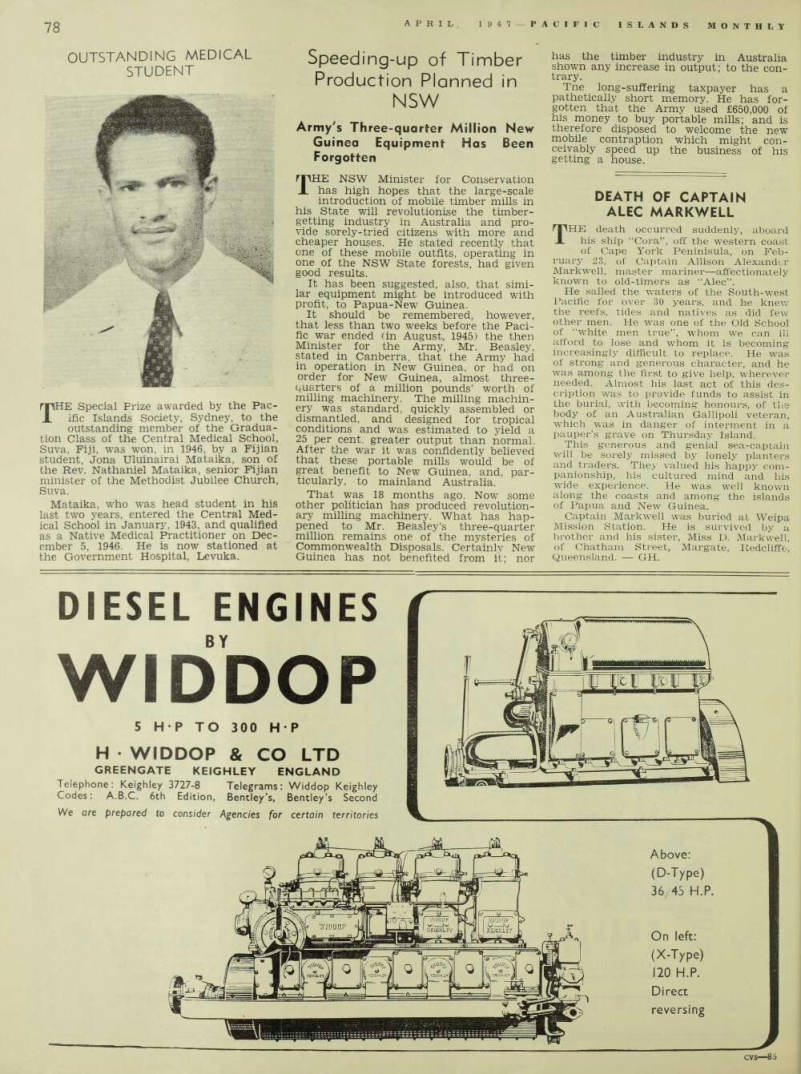
Student
rE Special Prize awarded by the Pac ific Islands Society, Sydney, to the outstanding member of the Gradua tion Class of the Central Medical School, Suva, Fiji, was won, in 1946, by a Fijian student, Jona Uluinairai Mataika, son of the Rev. Nathaniel Mataika, senior Fijian minister of the Methodist Jubilee Church, Suva.
Mataika, who was head student in his last two years, entered the Central Med ical School in January, 1943, and qualified as a Native Medical Practitioner on Dec ember 5, 1946. He is now stationed at the Government Hospital, Levuka.
Production Planned in
Speeding-up of Timber Production Planned in
Nsw
Army's Three-quarter Million New Guinea Equipment Has Been Forgotten
THE NSW Minister for Conservation has high hopes that the large-scale introduction of mobile timber mills in his State will revolutionise the timber getting industry in Australia and pro vide sorely-tried citizens with more and cheaper houses. He stated recently that one of these mobile outfits, operating in one of the NSW State forests, had given good results.
It has been suggested, also, that simi lar equipment might be introduced with profit, to Papua-New Guinea.
It should be remembered, however, that less than two weeks before the Paci fic war ended (in August, 1945) the then Minister for the Army, Mr. Beasley, stated in Canberra, that the Army had in operation in New Guinea, or had on order for New Guinea, almost three quarters of a million pounds’ worth of milling machinery. The milling machin ery was standard, quickly assembled or dismantled, and designed for tropical conditions and was estimated to yield a 25 per cent, greater output than normal.
After the war it was confidently believed that these portable mills would be of great benefit to New Guinea, and, par ticularly, to mainland Australia.
That was 18 months ago. Now some other politician has produced revolution ary milling machinery. What has hap pened to Mr. Beasley’s three-quarter million remains one of the mysteries of Commonwealth Disposals. Certainly New Guinea has not benefited from it; nor
Tne long-suffering taxpayer has a pathetically short memory. He has for gotten that the Army used £650,000 of bls money to buy portable mills; and is therefore disposed to welcome the new m 9 bn ® contraption which might con ceiVably speed up the business of his getting a house.
Alec Markwell
Death Of Captain
THE death occurred suddenly, aboard his ship “Cora”, off the western coast of Cape York Peninisula, on Feb ruary 23, of Captain Allison Alexander Markwell, master mariner—affectionately known to old-timers as “Alec”.
He sailed the waters of the South-west Pacific for over 30 years, and he knew the reefs, tides and natives as did few' other men. He was one of the Old School of “white men true”, whom we can ill afford to lose and whom it is becoming increasingly difficult to replace. He was of strong and generous character, and he was among the first to give help, wherever needed. Almost his last act of this des cription was to provide funds to assist in the burial, with becoming honours, of the body of an Australian Gallipoli veteran, which was in danger of interment in a pauper’s grave on Thursday Island.
This generous and genial sea-captain will be sorely missed by lonely planters and traders. They valued his happy com panionship, his cultured mind and his wide experience. He was well known along the coasts and among the islands of Papua and New Guinea.
Captain Markwell was buried at Weipa Mission Station. He is survived by a brother and his sister, Miss D. Markwell, of Chatham Street, Margate, Redcliffe, Queensland. GH.
Advertisements & other items, p. 80 (2 items)
78
APRIL, 1947 P ACIFIC ISLANDS MONTHLY
Widdop
DIESEL ENGINES
5 H P TO 300 H P
H • WIDDOP & CO LTD
GREENGATE KEIGHLEY ENGLAND
Telephone; Keighley 3727-8 Telegrams: Widdop Keighley Codes: A.B.C. 6th Edition, Bentley’s, Bentley’s Second We are prepared to consider Agencies for certain territories Ij ~TU l!£| : Ul r w.
Above: (D-Type) 36/45 H.P.
On left: (X-Type) 120 H.P.
Direct reversing
CVS—86
In Fiji
South Seas Legend
Killed
Cost of Living Soars In Fiji
From Our Own Correspondent SUVA, April 10 ONCE upon a time people came to the South Seas to live on the cheap or to live on nothing at all. There was a time, even since the days of Cap tain Cook, when the second hope could be fulfilled; and, before 1939, the first could be achieved very comfortably on limited resources, especially if they were sterling or American resources.
But this is 1947.
In Fiji, in April, 1947, the cost of living has more than doubled since August, 1939 and, allowing for the heavy in creases in taxation and for black market prices for such goods as are not “con trolled,” it would probably be more accurate to say that it has trebled. And it is still rising. The official index is the quarterly re turn of the cost of living of Indian workmen, bv the Department of Labour. Like all such documents in all countries, this statistical effort is re garded by the public more as an indi cation of general trends than as a state ment of the hard facts of life. In any case, it is hardly necessary to point out that everyone is not an Indian work man; but in Fiji’s cost of living estimates that industrious and constitutionally thrifty soul is a sort of statistical slide rule.
In the first quarter of 1947, states the labour Department, the cost of living rf workmen in the country districts of Viti Levu increased by five points to 111 ner cent, of the August, 1939, figure. In Suva, the rise was four points to 92 per rent, of the pre-war level.
EUROPEANS have a word or two to add to departmental conciseness. An Aus tralian who has been in Suva for a months estimates that the plainest of living here is (conservatively) 15 per cent more expensive than in Sydney. A New Zealand clerk complains that, des nite the higher taxation, he was able to save money in the Dominion, whereas in Fiji he can only just manage on a larger salary without saving a penny.
Both men are planning to go home.
Enough has been said to indicate that if anyone in chillier climes is thinking of living on the cheap in Fiji he or she will be much wiser to stay at home and wait for social security benefits to come to light.
Tourists, of course, are out of the pic ture altogether.
For example, a casual stranger arriving at Suva without preliminary negotiations is immediately confronted with the problem of finding a place to sleep. The cheapest hotel accommodation —if avail able at all —is now 15/- a day or—like wise if available —£14/10/- a month.
Hotel accommodation in Suva has been a doubtful quantity for many years, but to-day most of the half-dozen or so hotels are comandeered by tenacious “nermanents,” who hang on like clams, for the excellent reason that rentable bouses and flats are as common as snow flakes.
Then come the incidentals. Clothing has gone up substantially in price, more especially men’s clothing. The other day the writer paid an Indian tailor £5 for three pairs of white trousers and three shirts—round about double the price that would have been reasonable before the war. And laundry charges—a major item in the tropics—run out at a dead mini
mum of 30/- a month for one person, assuming that he can arrange a contract on a monthly basis. If not, he will be lucky to get off with anything under £2.
Att + ir, LL tropical fruits naturally and in evitably grow m abundance in Fiji; but they are an outrageous price in Suva and even in outside centres. A country press correspondent was recently wailing because local retailers demand 2/6 a dozen for local oranges for which the original vendors had been paid 1 for three dozen. (This complaint originated 100 miles from Suva.) At the end of the war there was a scream for the removal of controls. Today the screamers, handsomely admit-
ting their mistake, have gone several notes higher in a demand for the re imposition of controls over food necessi ties.
Most traders, and especialy the Indians, h ave exploited “freedom” to the full and public agitation among all races is be- CO ming more than a muttering. A few we eks ago a surprisingly sharp official warning was g i ve n to the profiteers. The warning has been serenely disregarded anc j drastic action is plainly indicated, , , , In the meantime, demands for wage increases—perfectly justified in the face of the cost of living, index or no index —are growing; and so the majestic spiral of inflation rises in the Islands.
Advertisements & other items, p. 81 (1 item)
Pimples and Bad Skin
Exclusive Productions Pty. Ltd.
MANUFACTURERS
Exclusive Diamond and Dress Creations
SPECIALISING IN
+ WATCH REPAIRS
* DIAMOND JEWELLERY
* JEWELLERY REMAKING
AND REPAIRS
EXCLUSIVE PRODUCTIONS PTY. LTD.
8o Castlereagh Street, Sydney, Australia Postal Address: Box 4774, G.P.0., Sydney.
Telegraphic Address: Manstocks, Sydney.
Pimples and Bad Skin Fought in 24 Hours
Since the discovery of Nlxoderm by an American physician It Is no longer necessary for anyone to suffer from ugly, disgusting and disfiguring skin blemishes such as Eczema, Pimples, Rash, Ringworm, Psoriasis, Acne, Blackheads, Scabies and Red Blotches. Don’t let a bad skin make you feel inferior and cause you to lose your friends. Clear your skin this new scientific way.
A New Discovery
Nixoderm Is an ointment, but different from any ointment you have ever seen or felt. It is a new discovery, and is not greasy but feels almost like a powder when you apply It. It penetrates rapidly into the pores and fights the cause of surface skin blemishes. Nlxoderm contains 9 ingredients which fight skin troubles in these 3 ways. I.—lt fights and kills the microbes or parasites often responsible for skin disorders. 2. —It stops Itching, burning and smarting in 7 to 10 minutes, and cools and soothes the skin. 3.—lt helps nature heal the skin clear, soft and velvety smooth.
Works Fast
mediately, clearing and healing your skin, making it softer, whiter and velvety smooth Because Nlxoderm is scientifically compounded to fight skin troubles, it works fast.
It stops the itching, burning and smarting in a few minutes, then starts to work 1m-
In Just a day or two your mirror will tell you that here at last is the scientific treatment you have been needing to clear your skin —the treatment to make you look more attractive, to help you win friends. Nlxoderm has brought clearer, healthier skins to thousands, such as Mr. Bob Weedon, Edmund Street, Fremantle, who writes: “I was troubled with pimples ever since I was 13, and have spent pounds and pounds on so-called cures without results. I then tried Nlxoderm with astounding effect.
The pimples seemed to fade away, and after a week there was not the slightest trace of them.”
Satisfaction Guaranteed
Get Nlxoderm from your chemist or store to-day. Look in the mirror in the morning and you will be amazed at the improvement.
Then Just keep on using Nlxoderm for one week and at the end of that time it must have made your skin soft, clear, smooth and magnetically attractive—must give you the kind of skin that will make you admired wherever you go, or you simply return the empty package and your money will be refunded in full. Get Nixoderm from your chemist or store to-day.
The guarantee protects you.
Nixoderm 2/-&4Z-
For Skin Sores, Pimples and Itch.
Islands Produce
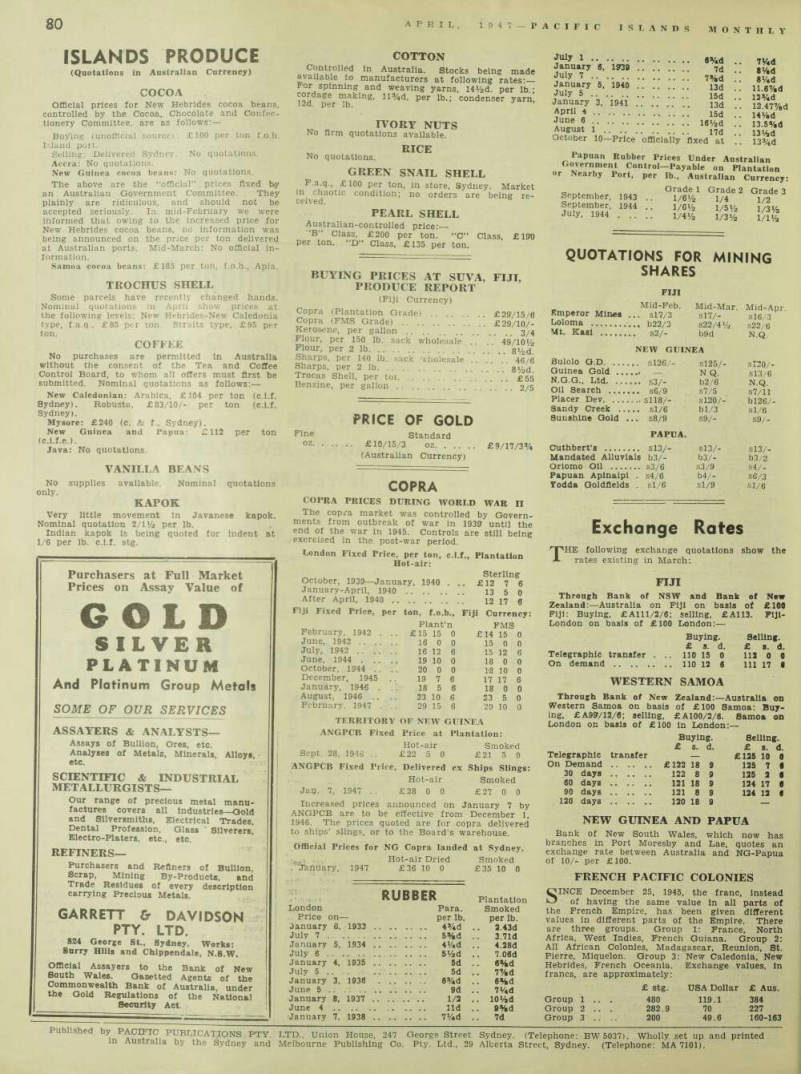
(Quotations in Australian Currency)
Cocoa
Official prices for New Hebrides cocoa beans, controlled by the Cocoa, Chocolate and Confec tionery Committee, are as follows: — Buying (unofficial source): £lOO per ton f.o.b.
Island port.
Selling: Delivered Sydney. No quotations.
Accra: No quotations.
New Guinea cocoa beans: No quotations.
The above are the “official”: prices fixed by an Australian Government Committee. They plainly are ridiculous, and should not be accepted seriously. In mid-February we were informed that owing to the increased price for New Hebrides cocoa beans, no information was being announced on the price per ton delivered at Australian ports. Mid-March: No official in formation.
Samoa cocoa beans: £lB5 per ton, f.0.b., Apia.
Trochus Shell
Some parcels have recently changed hands.
Nominal quotations in April show prices at the following levels: New Hebrides-New Caledonia type, f.a.q . £B5 per ton. Straits type, £95 per ton.
Coffee
No purchases are permitted in Australia without the consent of the Tea and Coffee Control Board, to whom all offers must first be submitted. Nominal quotations as follows: New Caledonian: Arabica, £lO4 per ton (c.l.f.
Sydney). Robusta, £B3/10/- per ton (c.i.f.
Sydney).
Mysore: £240 (c. & f., Sydney).
New Guinea and Papua: £ll2 per ton (c.1.f.e.).
Java: No quotations.
Vanilla Beans
No supplies available. Nominal quotations only.
Kapok
Very little movement In Javanese kapok.
Nominal quotation 2/1 y 2 per lb.
Indian kapok Is being quoted for Indent at 1/6 per lb. c.l.f, stg.
Cotton
ControHed in Australia. Stocks being made available to manufacturers at following rates:— For spinning and weaving yarns, 14y 2 d. per lb.; cordage making, 113/ 4 d. per i b . ; condenser yarn. 12d. per lb.
X Ivory Nuts
No firm quotations available. xt RICE No quotations.
Green Snail Shell
F.a q., £lOO per ton, in store, Sydney. Market in chaotic condition; no orders are being re ceived.
Pearl Shell
Australian-controlled price:— "B” Class, £2OO per ton. “C” Class. £l9O per ton. “D” Class, £135 per ton.
Buying Prices At Suva, Fiji,
Produce Report
(Fiji Currency) Copra (Plantation Grade) Copra (FMS Grade) . . .
Kerosene, per gallon ..
Flour, per 150 lb. sack wholesale ..
Flour, per 2 lb .. 49/10% Sharps, per 140 lb. sack wholesale ..
Sharps, per 2 lb. . . .. .. 46/6 Trocas Shell, per tor. ..
Benzine, per gallon 2/5
Advertisements & other items, p. 82 (1 item)
Price Of Gold
Fine Standard 02 £lO/15/3 oz £9/17/3% (Australian Currency)
Copra
Prices During World War Ii
The copra market was controlled by Govern ments from outbreak of war in 1939 until the end of the war in 1945. Controls are still being exercised in the post-war period.
London Fixed Price, per ton, c.i.f., Plantation Hot-air:
Increased prices announced on January 7 by ANGPCB are to be effective from December 1, 1946. The prices quoted are for copra delivered to ships’ slings, or to the Board’s warehouse.
Official Prices for NG Copra landed at Sydney.
Papuan Rubber Prices Under Australian Government Control—Payable on Plantation or Nearby Port, per lb., Australian Currency:
Sterline October, 1939—January, 1940 .. £12 7 6 January-April, 1940 0 After April, 1940 . 12 17 6 Fiji Fixed Price, per ton, f.o.b., Fiji Currency: Plant’n
Fms
February, 1942 . .. £15 15 0 £14 15 0 June, 1942 16 0 0 15 0 0 July, 1942 16 12 6 15 12 6 June, 1944 19 10 0 18 0 0 October, 1944 . . .. 20 0 0 1-3 10 0 December, 1945 .. 19 7 6 17 17 6 January, 1946 . . . 18 5 6 18 0 0 August, 1946 .. 23 10 6 23 5 0 February. 1947 . .. 29 15 6 29 10 0
Territory
Of New Guinea
ANGPCB Fixed Price at Plantation: Hot-air Smoked Sept. 28, 1946 . . £22 5 0 £21 5 0 ANGPCB Fixed Price, Delivered ex Ships Slings: Hot-air Smoked Jao. 7, 1947 .. £28 0 0 £27 0 0
*-g£3) ( ’ ' r Hot-air Dried Smoked , January, 1947 £36 10 0 £35 10 0
rIV-
Rubber
Plantation London Para.
Smoked Price onper lb. per lb.
January 0. 1933 3.43d July 7 . 5%d 3.71d January 5, 1934 4»/.d 4.38d July 6 . . 5Vad 7.06d January 4, 1935 5d 6Hd July 5 .. 5d 7%d January 3, 1936 6%d 6%d June 5 .. 9d 7V 4 d January 8, 1937 , 1/2 .. 10» 2 d June 4 lid 9%d January 7. 1938 7V 4 d 7d
July 1 ..
January 6, mo 7Mid July 7 .. oYad At/ J January 5, 1940 0 74(1 1 1 67/ i4 July 5 .. ii.o v»Q January 3, 1941 , 12%d 1 o Am/ a April 4 ..
U.47/8(1 hi/ j June 6 .. 14780 i o eg/ j August 1 . 1J. D s /8 0
1 Ill A
October 10- -Price officially fixed at ,. i J vaa 13%d
o . . Grade 1 Grade 2 Grade 3 September, 1943 .. 1/6% 1/4 1/2 September, 1944 .. 1/6% 1/5% 1/3% July. 1944 1/4% 1/3 y 2
Quotations For Mining
Shares
Fiji
Emperor Mines .
Mid-Feb. .. S17/3 Mid-Mar. sl7/- Mid-Apr.
S16/3 Loloma s22/4y 2 S22/6 Mt. Kasl . s2/b9d N.Q.
Bulolo Q.D
New Guinea
.. sl26/- sl25/sT20/- Guinea Gold N.Q, S13/6 N.G.G., Ltd b2/6 N.Q.
Oil Search .. s6/9 s7/5 S7/11 Placer Dev ... si 18/sl20/bl26/- Sandy Creek ... .. sl/6 bl/3 sl/6 Sunshine Gold .. .. S8/9 s9/s9/- Cuthbert’s
Papua.
.. sl3/sl3/sl3/- Mandated Alluvlals b3/b3/b3/2 Orlomo Oil s3/9 s4/- Papuan Aplnaipl . S4/6 b4/- S6/3 fodda Goldfields . sl/6 sl/9 sl/6
Exchange Rates
THE following exchange quotations show the rates existing in March;
Fiji
Through Bank of NSW and Bank of New Zealand; —Australia on FIJI on basis of £100 FIJI: Buying, £Alll/2/6; selling, £A113. F1J1- London on basis of £100 London: —
Western Samoa
Through Bank of New Zealand:—Australia on Western Samoa on basis of £lOO Samoa: Buy ing, £ A99/12/6; selling, £AIOO/2/6. Samoa on London on basis of £lOO in London:—
New Guinea And Papua
Bank of New South Wales, which now has branches In Port Moresby and Lae, quotes an exchange rate between Australia and NG-Papua of 10/- per £100.
French Pacific Colonies
SINCE December 25, 1945, the franc. Instead of having the same value In all parts of the French Empire, has been given different values in different parts of the Empire. There are three groups. Group 1: France, North Africa, West Indies, French Guiana. Group 2: All African Colonies, Madagascar, Reunion, St.
Pierre, Miquelon. Group 3: New Caledonia, New Hebrides, French Oceania. Exchange values, in francs, are approximately:
Buying. Selling. £ s. d. £ s. d.
Telegraphic transfer . .. 110 15 0 113 0 0 On demand 110 12 6 111 17 8
Buying.
Selling. £ s. d. £ s. d.
Telegraphic transfer — £125 10 0 On Demand .. .. .. £122 18 9 125 7 e 30 days 122 8 9 125 2 6 60 days 121 18 9 124 17 6 90 days .. .. .. 121 8 9 124 12 e 120 days 120 18 9 —
£ Stg.
USA Dollar £ Aus.
Group 1 ,. . 480 119.1 384 Group 2 .. . 282.9 70 227 Group 3 .. . 200 49.6 160-163
Advertisements & other items, pp. 82-84 (3 items)
80
APRIL, 1947 PACIFIC ISLANDS MONTHLY
Published by PACIFIC PUBLICATIONS PTY. LTD., Union House, 247 George Street Sydney. (Telephone; BW 5037). Wholly set up and printed in Australia by the Sydney and Melbourne Publishing Co. Pty. Ltd., 29 Alberta Street, Sydney. (Telephone: MA7101).
Gold
Purchasers at Full Market Prices on Assay Value of
SILVER
PLATINUM
And Platinum Group Metals
SOME OF OUR SERVICES
ASSAYERS & ANALYSTS—
Assays of Bullion, Ores, etc.
Analyses of Metals, Minerals, Alloys, etc.
SCIENTIFIC & INDUSTRIAL
METALLURGISTS—
Our range of precious metal manufactures covers all Industries—Gold and Silversmiths, Electrical Trades, Dental Profession, Glass ‘ Sllverers, Electro-Platers, etc., etc.
REFINERS—
Purchasers and Refiners of Bullion, Scrap. Mining By-Products, and Trade Residues of every description carrying Precious Metals.
GARRETT Cr DAVIDSON
PTY. LTD.
824 George St., Sydney. Works: Surry Hills and Chippendale, N.S.W.
Official Assayers to the Bank of New South Wales. Gazetted Agents of the Commonwealth Bank of Australia, under the Gold Regulations of the National Security Act.
tropical thirst...
To quench a
&*&*> J,i
A CO Qi
W"
W/i r Borneo 6*
° 0t H &COLIK/ IT EO
SYDmev
AUSTRALIA
I?
When you’re hot and tired, there is nothing quite so satisfying and thirst quenching as a long, cold K. 8.” Your friends and guests, too, will appreciate this really fine
Lager, for “Everybody
drinks K. 8.”
glass of
TOOTH'S
lAGER
M
ERCHAIMTS
. 8c SHIP OWNERS
Capitol £1,000,000
ESTABLISHED 1914
COPRA MERCHANTS & MILLERS
BRANCHES THROUGHOUT THE PACIFIC ISLANDS
PACIFIC ISLAND PORTS WAS ESTABLISHED BY
W. R. CARPENTER & CO. LTD.
Head Office: 16 O'CONNELL STREET, SYDNEY.
Cable Address:
C AMO HE.
Telephone: BW 4421.
Postal Address: P.O. Box No. 168, Sydney.