Tropicalities
p. 51 · Read in the full issue
IN the August “PIM,” Harold J. Pollock told the story of how Captain Cam bridge, with primitive tools and Poly nesian help, practically re-built his cumbersome ketch Taipi, in the Cook Islands. It was a bright, amusing account of the industry and ingenuity of a popular South Pacific veteran. A New York reader has now written to us as follows: — “That article was so amusing that I brought it in to work, to show the Naval Architect and others, who all thoroughly enjoyed it. As I work at the New York Shipbuilding Corporation, possibly the biggest and best shipbuilding company in the United States, an article of that sort was of interest to all of us. This Co., as you no doubt know, built the ‘Battle ship X,’ otherwise the USS ‘South Dakota’, and other vessels that played so large a part in the war in and around the Coral Seas.” * * * AMID hilarity, the Deputy Leader of the Opposition in the Australian Parliament, Mr. Harrison, on Nov ember 13, read a paragraph from the official organ of the Labour Party in New South Wales, stating that “ex-Service men are now learning pearl and deep sea fishing by correspondence.” He asked the Minister to explain how it was pos sible to teach deep-sea diving by corres pondence.
The Minister for Post-War Reconstruc tion (a gentleman named Dedman, with a strong Scottish accent) did not give any explanation; but he devoted a few minutes to a savage attack upon Mr. Har rison and others of his critics for daring to jeer at his plans for training ex- Servicemen. * * * PACIFIC Islands residents who served in North Africa during the war may be interested in this nonsense ver sion of the defeat of Hitler’s armies there —it was published in a Sydney trade journal:— Now that Der Wermacht is kaput it can be told. This is the inside dope, ac quired at great risk and untold loss of life straight from a secret member of the Nazi High Command—Heinrich Rausvon haus Von und Zu Schnitzel, who explains in this top secret captured document why the German didn’t win in Africa.
“Der Ehglishers was ge-runnem mit out flyen shirtem-tailen. Der Africa Korps was ge-maken ein chasen mit stuka bomben und potten-shotten. Ist bin ein hotten timer. Der Korps Komandur vas ge-wanten ein side-trippen der Pyra mided und Sphinxers und ge-shouten ‘Halten,’ ‘Out-fallen.’ Der chasen ge stoppen.
“Der Fuhrer—Heil—was outragen mit foamen and sputteren und bin haben ein conniptionerfitten.
“Sooner Der Fuhrer —Heil—bin senden sizzlen ober wirelesser mit dotten-hashen der message, “OUT-CLOSEN DER CAM PAIGNED Der Dotten-dashen iss up mixen and is ge-comen, ‘OUT-CLOSEN
Der Champagnen’!
“Der Africa Korps bin ge-getten stun ken-drunken.”—BEE-PEE. * * * BRETT HILDER who hid his youth be hind a very red beard when he was skipper of Burns Philp’s “Maiwara” immediately before the war, sailed for the New Hebrides at the end of November as captain of the “Muliama.” “Muliama” was also on the inter-island run out of Rabaul before the war but since the Aus tralian government nationalised shipping
.. . . , . . , „ m that quarter, BPs have had her on a roving commission in the South Pacific. 4. Het3r^jn w £ ters to Captain Hilder; he was on the Makambo. with HQ at Vila, in 1934, When war broke out in 1939, he was claimed by the Navy but because the Navy promised less excitement than the air he managed to get himself transferred to the RAAF. V-P Day found him a Wing-Commander, leading Catalina forays over the Netherlands Indies.
The only drawback to the Air Force was that there was no room in it for a beard. Regulations decreed that it must come off. When this execution had been carried out, the RAAF gained an officer but Captain Hilder’s age dropped at least 20 years.—J.
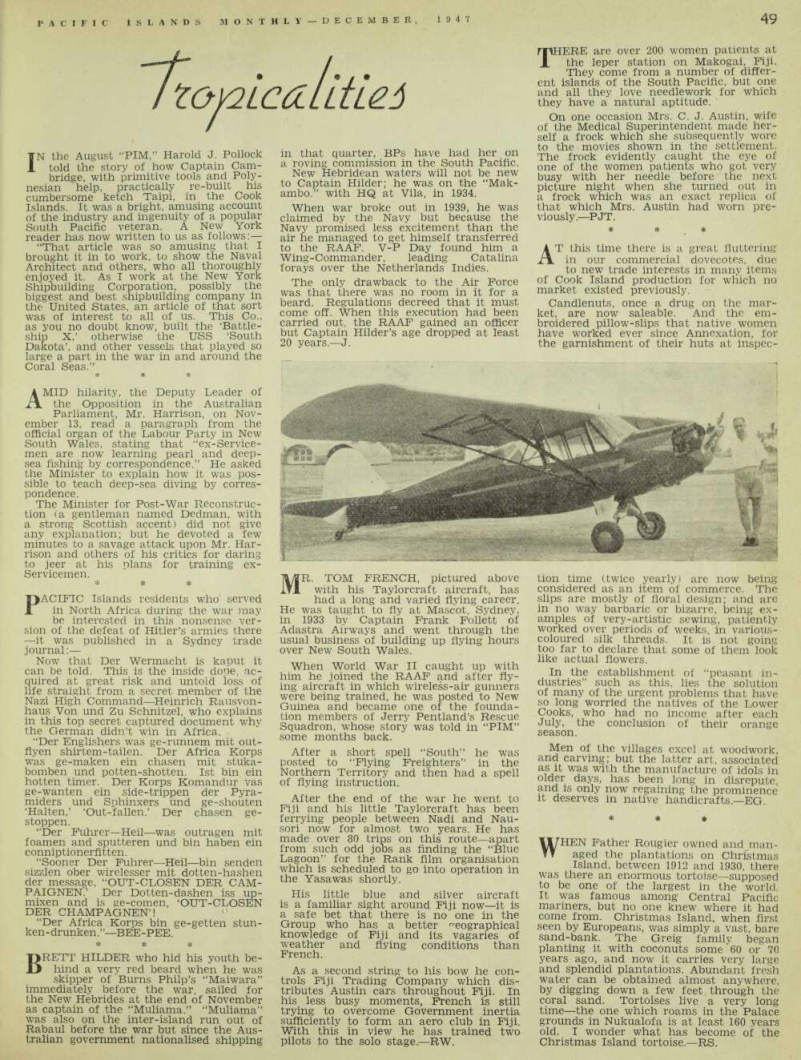
MR. TOM FRENCH, pictured above with his Taylorcraft aircraft, has had a long and varied flying career, He was taught to fly at Mascot. Sydney, in 1933 by Captain Frank Follett of Adastra Airways and went through the usual business of building up flying hours over New South Wales. ir ... TT , , ...
When World War II caught up with him he joined the RAAF and after flying aircraft in which wireless-air gunners were being trained, he was posted to New Guinea and became one of the foundation members of Jerry Pentland’s Rescue Squadron, whose story was told in “PIM” some months back.
After a short spell “South” he was posted to “Plying Freighters” in the Northern Territory and then had a spell of flying instruction.
After the end of the war he went to Fiji and his little Taylorcraft has been ferrying people between Nadi and Nausori now for almost two years. He has made over 80 trips on this route—apart from such odd jobs as finding the “Blue Lagoon” for the Rank film organisation which is scheduled to go into operation in the Yasawas shortly. tt-i-.li.ii-, , , His little blue and silver aircraft is a familiar sight around Fiji now—it is a safe bet that there is no one in the Group who has a better geographical knowledge of Fiji and its vagaries of FrpnrvT and flymg conditions than rrencn.
As a second string to his bow he controls Fiji Trading Company which distributes Austin cars throughout Fiji. In his less busy moments, French is still trying to overcome Government inertia sufficiently to form an aero club in Fiji.
With this in view he has trained two pilots to the solo stage.—RW.
rnHERE are over 200 women patients at JL the leper station on Makogai, Fiji.
They come from a number of differ ent islands of the South Pacific, but one and all they love needlework for which they have a natural aptitude.
On one occasion Mrs. C. J. Austin, wife of the Medical Superintendent made her self a frock which she subsequently wore to the movies shown in the settlement.
The frock evidently caught the eye of one of the women patients who got very busy with her needle before the next picture night when she turned out in a frock which was an exact replica of that which Mrs. Austin had worn pre viously—PJT. ♦ ♦ ♦ AT this time there is a great fluttering in our commercial dovecotes, due to new trade interests in many items of Cook Island production for which no market existed previously.
Candlenuts, once a drug on the mar ket, are now saleable. And the em broidered pillow-slips that native women have worked ever since Annexation, for the garnishment of their huts at inspec
tion time (twice yearly) are now being considered as an item of commerce. The slips are mostly of floral design; and are in no way barbaric or bizarre, being ex amples of very-artistic sewing, patiently worked over periods of weeks, in various coloured silk threads. It is not going too far to declare that some of them look like actual flowers.
In the establishment of “peasant in dustries” such as this, lies the solution of many of the urgent problems that have so long worried the natives of the Lower Cooks, who had no income after each July, the conclusion of their orange season.
Men of the villages excel at woodwork, and carving: but the latter art, associated as it was with the manufacture of idols in older days, has been long in disrepute, and is only now regaining the prominence it deserves in native handicrafts.—EG. * ♦ * WHEN Father Rougier owned and man aged the plantations on Christmas Island, between 1912 and 1930, there was there an enormous tortoise—supposed to be one of the largest in the world.
It was famous among Central Pacific mariners, but no one knew where it had come from. Christmas Island, when first seen by Europeans, was simply a vast, bare sand-bank. The Greig family began planting it with coconuts some 60 or 70 years ago, and now it carries very large and splendid plantations. Abundant fresh water can be obtained almost anywhere, by digging down a few feet through the coral sand. Tortoises live a very long time—the one which roams in the Palace grounds in Nukualofa is at least 160 years old. I wonder what has become of the
Christmas Island tortoise.
RS.