Tonga’S Lonely Outposts
p. 51 · Read in the full issue
A Mission Party Visits The Volcanic Islands
(By Pastor W. G. Ferris, Seventh Day Adventist Mission, Tonga)
WE recently made a visit to the Keppel Islands, a small group about half way between Vavau and Samoa, and about 400 miles north of Nukualofa.
With ample provisions for the voyage we sailed north by east from Vavau. None of us had been there, but with reliable charts and instruments we felt all would be well.
On our left, as we journeyed, we passed the island of Fanualei, a smoking volcano which makes a grand picture with the setting sun behind it.
Along the western edge of the Tongan group there is an amazing chain of vol canic islands, each group of two con sisting of a low-lying island and one of cone shape towering high into the air, the height varying from 1,000 to 3,000 feet. There are six of these little groups, almost in a straight line, spaced over a distance of 500 miles.
There was no difficulty in our finding the Keppel Islands, for they were true to type, consisting of Niuatoputapu and a sister island 3,000 feet high. As we approached the reefs, the Catholic sail ing boat came out and graciously escorted us through the twisting passages to the anchorage. We were happy to be in the shelter of the beautiful lagoon.
These islands seem so unknown that we really felt at world’s end. On going ashore we were very kindly received by the people. We noticed that the three httle towns were beautifully kept, and each homestead appeared to be set in a natural park. For beauty and charm the island almost surpassed Lord Howe We spent five very interesting days there The islands were discovered by Lemaire and Schouten, in 1616. and were named Keppel by Wallis, in 1767.
THEN we said good-bye and set our course due west. One hundred miles away lay that little speck of land known as Tin Can Island (Niuafoou).
Because of terrific volcano e uptions there, 1,300 people recently were removed to Tonga’s southern island; but for
eight long months no one had been to the island to see what had happened to the remaining 27. We were determined to pay them a visit.
As we drew near, heavy, black squalls seemed to indicate that we were close to land, and we anxiously peered through the gloom for signs of Peeking surf, as daylight came we were glad to see the island looming up in front of us.
We strained our eyes for any sign of life on those repulsive shores. The coastal area was one black mass of angry lava. Away up in the hills we saw smoke, indicating there was still life ashore. We sailed to the north of the island, where the famous tin-can mails used to ba landed.
On the beach, recently formed from volcano ash, there were boys riding fat horses up and down. All were in a state of great excitement. They raced along to one end of the beach to indicate a place of anchorage. While we tested our land line to its full length, three of the boys jumped into the surf and swam out to the “Endeavour” to help us anchor safely. .
We were all eager to set foot on this island; so without thought of breakfast, plans were made to go ashore. A long rope from the ship to the shore allowed the dinghy to approach the rocks with out being smashed. The islanders took charge of operations and a safe landing was made.
Greetings over, we stood and admired those boys; they
were a picture of health, fat and well.
The influence of the volcanic eruptions had destroyed all the mosquitoes and, probably, all germs.
OUR feat sank into the ash beach, which was as black as black could be. We climbed over acres of blown-up land, which appeared as if a large plough had turned every thing over. We passed two sailing boats—not but moulds faithfully kept in tha black lava.
The volcano had blown up in the sea near the shore, and had gradually worked inland, leav ing destruction everywhere. The leading chief s home had been raised 100 feet: the terrified occupants had fallen out to safety, just in time to save their lives.
Tin Can Island has been abandoned.
It was sad to see such a lovely place left to the ravages of fire and decay.
Homes had fallen in the eight months, and furniture and other personal effects were being destroyed.
(I stepped into a burning mound when taking pictures, and quickly retreated).
Mission properties were abandoned.
Candles were still on an altar, as when the piiests had fled from the fires.
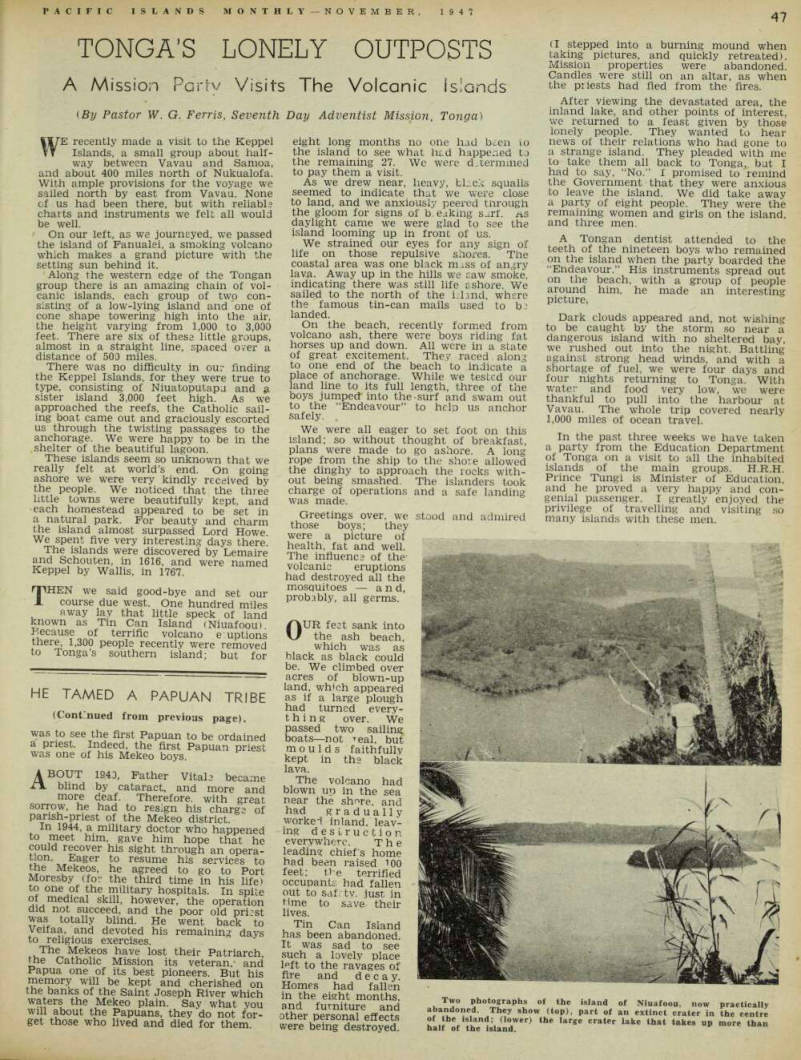
After viewing the devastated area, the inland lake, and other points of interest, we returned to a feast given by those lonely people. They wanted to hear news of their relations who had gone to a strange island. They pleaded with me to take them all back to Tonga, but I had to say, “No.” I promised to remind the Government that they were anxious to leave the island. We did take away a party of eight people. They were the remaining women and girls on the island, and three men.
A Tongan dentist attended to the teeth of the nineteen boys who remained on the island when the party boarded the “Endeavour.” His instruments spread out on the beach, with a group of people around him, he made an interesting picture.
Dark clouds appeared and, not wishing to be caught by the storm so near a dangerous island with no sheltered bay, we rushed out into the night. Battling against strong head winds, and with a shortage of fuel, we were four days and four nights returning to Tonga. With water and food very low, we were thankful to pull into the harbour at Vavau. The whole trip covered nearly 1,000 miles of ocean travel.
In the past three weeks we have taken a party from the Education Department of Tonga on a visit to all the inhabited islands of the main groups. H.R.H.
Prince Tungi is Minister of Education, and he proved a very happy and con genial passenger. I greatly enjoyed the privilege of travelling and visiting so many islands with these men.
Two photographs of the island of Niuafoou. now practically abandoned. They show (top), part of an extinct crater in the centre of the island; (lower0 the large crater lake that takes up more than half of the island.