He Tamed A Papuan
pp. 50-51 · Read in the full issue
Tribe
Father Vitale's 55 Years with the Mekeos Described by Father Andre Dupeyrat, MSC
WITH the death of Rev. Father Joseph Vitale, MSC, which occurred on October 9, the Catholic Mission of Yule Island, in Papua, has lost its oldest priest, and New Guinea has lost a pioneer who has beaten all records of continuous residence in the country.
Father Vitale went to Papua in 1888, and never left it. His longest trip out side the district of Mekeo. where he was stationed, was to Port Moresby. He went there only on three occasions, each visit of only a few weeks, to receive medical attention.
Giuseppe Vitale was born 81 years ago, on Match 8, 1866, in Gildone, a small Italian country town in the diocese of Benevente. Italy, as a nation, was yet unborn, and Mr. Vitale used to refer to “the Kingdom of Neapoli” as his native land.
He was one of the first Italian boys to enter the Apostolic School and, after his studies, the Noviciate that the Mission aries of the Sacred Heart had established in Rome. He was 20 when he joined the
Order and less than two years later, not yet a priest, he was on his way to New Guinea. rIE Catholic Mission in Papua had been founded a few years before, in 1885, on Yule Island, and al
though it was very small indeed, both in its staff and means. Pope Leo XIII had. in 1887, appointed one of its founders Father Andre Navarre. MSC. Bishop of the new Mission. This already ageing missionary had gone immediately to France to be consecrated, and also to beg for more re cruits for his Mission. He left Europe with three Priests, five Lay-Brothers and a young student in Theology, who was G. Vitale.
Because his Order did not have enough priests to send, he had been asked to go, and with that simplicity which he never lost, he had answered, “Yes,” without thinking further.
They arrived in Sydney in August, 1888, just a month before the South-Eastern part of New Guinea (to be known later as Papua) was proclaimed a British Colony. They proceeded to Thursday Island, in the Torres Straits, then the gateway to New Guinea.
In those hard days there was not much time for long studies. One priest only was on Yule Island for the whole Mission.
Accordingly, upon permission obtained from Rome. Bishop Navarre ordained Fr.
Vitale to priesthood, on October 14, 1888, in the shabby, little church of Thursday Island. Present at th e ceremony was Father Henri Verjus, the pioneer mis sionary who, three years before, had established the Mission on Yule Island.
Beaten down by malaria fever, hunger, utter poverty and hostility of all kinds (not so much from the natives as from people of his own race), he had been forced to go to Thursday Island to re cuperate.
Young Father Vitale was at the school of this great missionary for a few months.
In December, 1888, they both arrived at Yule Island. Fr. Vitale was given charge of the village of Chiria, on the island. •‘When you laugh, he laughs; when you dance, he dances; when you weep, he weeps: he is your Father. . .” So explained Fr. Versus to the natives when he intro duced the new curate to those old pagans who, six months before, had been in open warfare against the missionaries!
In October, 1890, Fr. Vitale was sent to establish the first inland station on the mainland, at Inawei, in the Mekeo country. Besides —or in spite of —their war-won nickname of typical “Fuzzy- Wuzzy Angels,” the Mekeos have, nowadays, a rather bad reputation among the white people of the territory. It is said that they are liars, thieves and lazy (everybody knows that the white man is not!i But in those early days, when Fr.
Vitale settled among them one could have added some other unpleasant character - Nevertheless, Father Vitale, who went
to them with not much more than the clothes he was wearing, succeeded in building with bush material a church and a house, a school, and a convent for the teaching Sisters, thus opening the first centre of evangelisation and civilisation on the Papuan mainland, beyond the coastal areas.
FROM that time onwards, Father Vitale never left Mekeo. He merely shifted his residence some miles further up, to the big village of Veifaa, which is more central. There, after more than half a century of service and devotion to the Mekeos, he was regarded as the Grand Old Man. He had baptised so many of them, taught them the principles and practice of the religion, married them, scolded them, helped them in their mis fortunes, buried so many of their dead, that he was looked upon as some sort of tribal ancestor.
He spoke the Mekeo language, which is a Melanesian one with awful nasal sounds, as well, if not better, than the natives themselves. He penetrated so far into their mentality that, while keeping his own European standing, he himself became permeated with the native mind.
This is an achievement of which very few white man may boast. He knew the native folklore, the genealogies of most of the families, the history of each clan, much better than the oldest men who came to consult him as an authority on their own native affairs.
FATHER VITALE was a short, sturdy man, powerfully built. He was a challenge to the notoriously bad climate of the Papuan low-lands. He be lieved that one of the secrets of his longevity was that, from the beginning, he took to the native food (he had to, anyway), especially the taro. He was able to eat as much of the starchy stuff as a native does, and that is considerable.
Another secret was that he never cared much for his own health, but conducted his religious life in perfect accordance with the rules of his Order. Early in bed, and early out of it, he worked with his own hands, sawing timber, building churches and houses, gardening, or walk ing and riding on horseback from village to village, to visit his people.
He was filled with a strong faith and a candid piety. His candour was a re newed marvel to me, and I believe that he kept himself as innocent as a little child, although he ignored nothing of the turpitude of his people when they were pagans, and nothing of their . many failures when they were all Christians.
He knew too well that his Mekeos were not as angelic as has been said. How ever, one of his greatest joys in this life
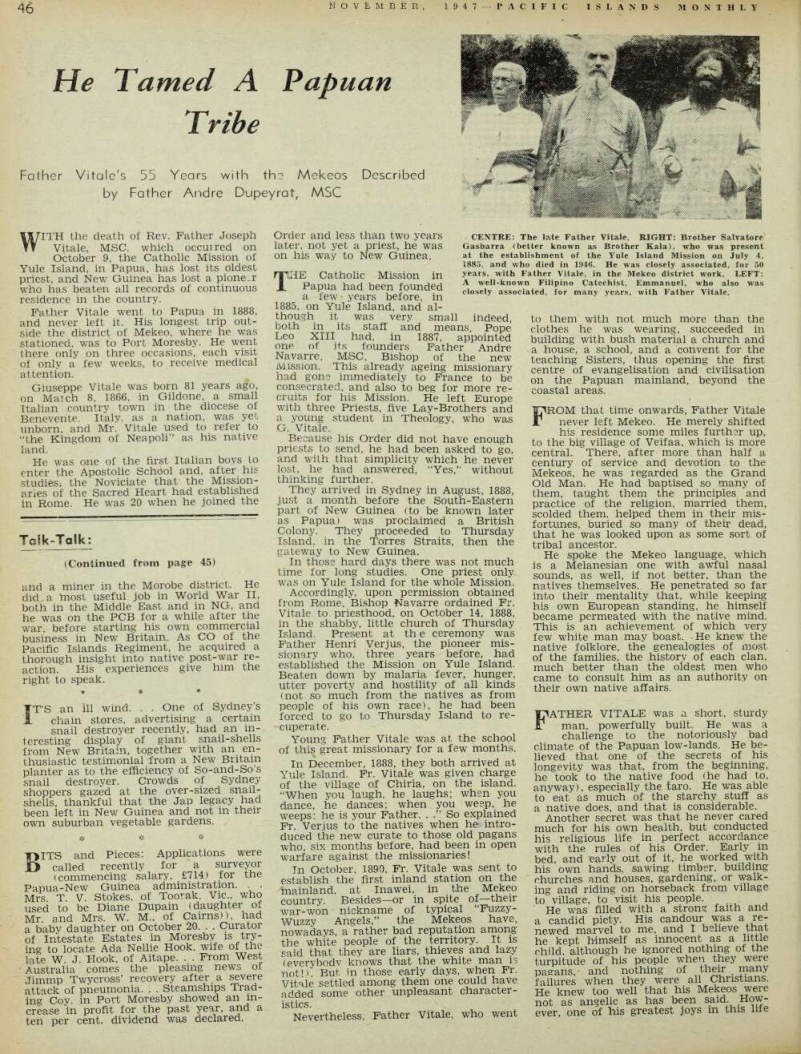
CENTRE: The late Father Vitale. RIGHT: Brother Salvatore Gasbarra (better known as Brother Kala), who was present at the establishment of the Yule Island Mission on July 4, 1885, and who died in 1946. He was closely associated, for 50 years, with Father Vitale, in the Mekeo district work. LEFT: A well-known Filipino Catechist. Emmanuel, who also was closely associated, for many years, with Father Vitale.
was to see the first Papuan to be ordained a priest. Indeed, the first Papuan priest was one of his Mekeo boys.
ABOUT 1943, Father Vitale became blind by cataract, and more and more deaf. Therefore, with great sorrow, he had to resign his charge of parish-priest of the Mekeo district.
In 1944, a military doctor who happened to meet him, gave him hope that he could recover his sight through an opera tion. Eager to resume his services to the Mekeos, he agreed to go to Port Moresby (for the third time in his life) to one of the military hospitals. In spite of medical skill, however, the operation did not succeed, and the poor old priest was totally blind. He went back to Veifaa, and devoted his remaining davs to religious exercises.
The Mekeos have lost their Patriarch, the Catholic Mission its veteran, and Papua one of its best pioneers. But his J£ e T ory will be kept and cherished on the banks of the Saint Joseph River which waters the Mekeo plain. Say what you will about the Papuans, they do not for get those who lived and died for them.