Magazine Section
pp. 49-50 · Read in the full issue
Territories Talk-Talk
By "Tolala"
NORTHERN Territory’s Native Affairs Director, F. H. Moy—who, incident ally, did a good job of work some years ago as a TNG District Services officer —has a way of his own with abo. alcoholics, who are paying up to £2 for a bottle of cheap gin. He parks them out on a mission station until they have learned the evil of their ways.
Papua-New Guinea officials might watch this method. The march of civil isation has brought with it a decided in crease in the natives drinking intoxic ants in NG, which may soon have alarm ing effects. * THE one bright spot in the town,” writes a Moresby correspondent, “is Dan Crawley’s band. It parades the streets two or three times a week.” Most of the bandsmen are from the Blanche Bay district, around Rabaul. and former members of the original Police Band so patiently tutored by Musical Dan. * * THE “Joe” Mitchell story (Oct. “PIM”), and the photo of the old “Titus,” conjures up memories of Walter H.
Lucas, of the “Titus,” who in his early days with the BP firm, acted as super cargo of that vessel throughout the Southern Pacific.
Later, WHL became quite an institu tion in the Islands and kept a close eye on the firm’s plantation interests there.
In World War I, he was appointed Tech nical Adviser to the Federal Government on Pacific Affairs, eventually becoming chairman of the Expropriation Board in TNG. He has retired now and enjoys the salubrious atmosphere of Canberra, at the Kurrajong Hotel. * * * INCREASED working costs of rubber production are responsible for the Koitaki Estates, Papua, paying more attention to farming, dairying and raising live stock. Labour supplies have been in sufficient with no future favourable prospects, to bring rubber areas into bearing.
Situations such as this are common throughout both Papua and TNG, and should claim Mr. Ward’s attention when he makes his promised visit to the North.
Australia’s annual rubber needs are 30,000 tons, and are not so easy to obtain now, with the trouble in Java, and dollar restrictions.
ANOTHER New Guinea product sought after by Australian manufacturers is plywood, and a resolution was passed recently by the Australian Furniture Trade Convention in Adelaide in favour of the procurement of logs or plywood from NG. A telegram to Prime Minister Chifley pointed out the acute shortage.
Walnut flitches from NG are equal to any in the world. * * * Establishment of a spa near Cauala, New Caledonia (Sept. “PIM”) reminds me of the sulphur springs at Matupi, near Rabaul, which have been credited with excellent curative pro perties, especially for rheumatic ailments.
A pity we don’t capitalise more on the
gifts which Nature provides. New Guinea abounds with potential spas: Talasea and Anir, to name only two other localities. * * u- High-light of the nlo, 1946, which became operative on September 15, 1947, is the abolition of imprison ment for either employer or employee, for a breach of the Ordinance. Maximum penalty for a non-native is £lOO and, with a few exceptions, £3 for a native.
Actually, there is little new in the 1946 edition, with the exception of the one year contract limit. All the talk about Workers’ Compensation, limitations of recruiting in any one area, or incerased ration scales, as compared with the old Ordinances, is much exaggerated. Com pensation has been paid to employees in NG for years prior to the war, and re cruiting areas were often closed to pre vent over-recruiting. The ration scale has not been increased to any great ex tent.
The minimum wage scale is a bit of a slug, in some places, but not to the extent that officialdom would have the outside world believe. There were few lads working for the old mini mum of five bob a month, prior to the war. ♦ * ♦ PRESENTS from most countries of the world for Princess Elizabeth’s wed ding are in the news. I failed to hear of any token of loyalty being sent from New Guinea. What a chance was
missed of letting our future Queen enjoy some of the natural pro ducts of the islands, as for in stance ; a gaura pigeon fan, or birds - of-paradise plumes from Aitape; gold-lip mother - of - pearl from Manus; gold from Morobe; coloured plaited grass work and basket-work from Buin. Any one of these would have served as a suit able symbol of loyal good wishes from a far-flung British com munity. Did no body think of it? * * * IT must be rather em barrassing for people when they read some news paper remarks about themselves.
Said a recent Sydney paper: “A 26-year-old girl from Paris, who arrived in Sydney to-day. may die in the jungle of New Guinea without ever again seeing a white person.”
She was on her way to Yule Island, Papua, where mission
aries have been established for the past seventy years.
That awful New Guinea jungle! * * * DURING a discussion on New Guinea last month, in the Canberra Parlia ment, Northern Territory Indepen dent Member Blair remarked that “many people in NG were going to Tanganyika” as a result of difficult conditions now existing in NG.
From reports which have reached me there appears to be some foundation for his remarks. Some of the African terri tories apparently have “what it takes,” according to reports from ex-New Guinea residents now domiciled in the Dark Con tinent. It all indicates the desirability of fostering the planting community a bit more in preference to treating them as undesirabels and exploiters. * ♦ • "DLUE” ALLAN was busy last month in I) pointing this out when he attended the HSL congress at Canberra, where he obtained a “good press,” and the grievances of his fellow-soldiers in NG received considerable publicity.
If there is one man from NG who is suited for the job of putting the facts before the public it is “Blue.” His ex perience in the Territory has been wide and varied. He arrived in the TNG as a plantation overseer for the Expro Board, back in the early 1920’5, since when he has been a recruiter, a road contractor
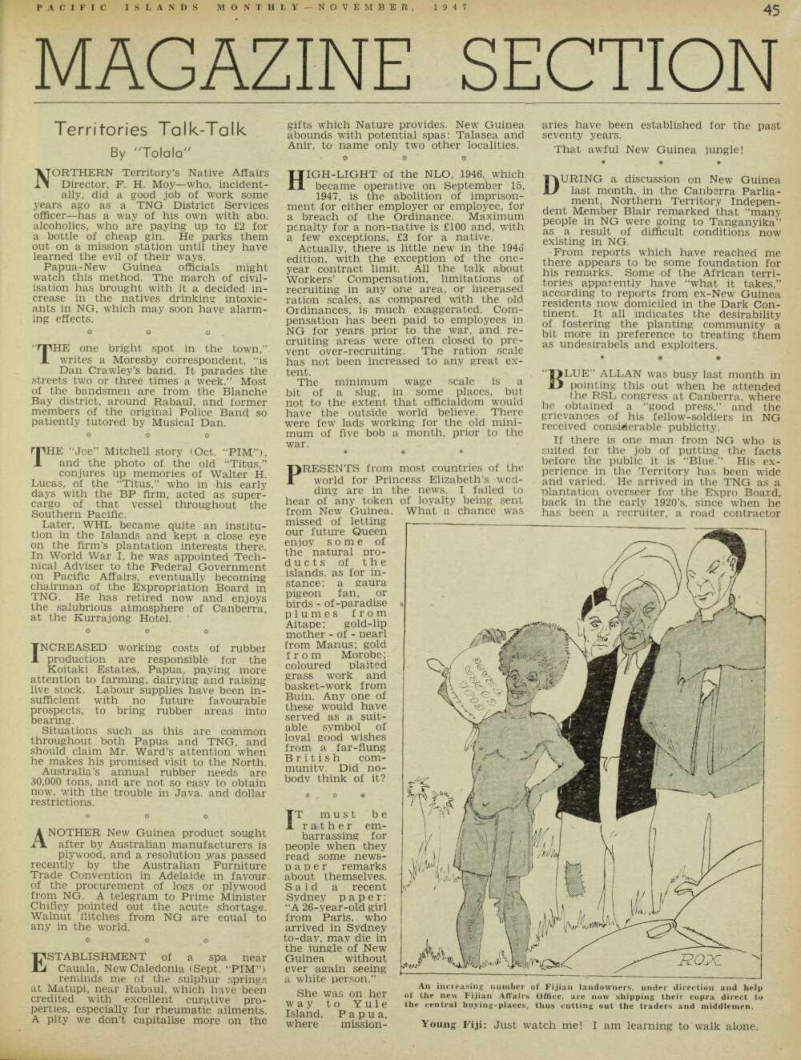
An increasing number of Fijian landowners, under direction and help of the new Fijian Affairs Office, are now shipping their copra direct to the central buying-places, thus cutting out the traders and middlemen.
Young Fiji: Just watch me! I am learning to walk alone.
and a miner in the Morobe district. He did a most useful job in World War 11, both in the Middle East and in NG. and he was on the PCB for a while after the war, before starting his own commercial business in New Britain. As CO of the Pacific Islands Regiment, he acquired a thorough insight into native post-war re action. His experiences give him the right to speak. ♦ * * IT’S an ill wind. . . One of Sydney’s chain stores, advertising a certain snail destroyer recently, had an in teresting display of giant snail-shells from New Britain, together with an en thusiastic testimonial from a New Britain planter as to the efficiency of So-and-So’s snail destroyer. Crowds of Sydney shoppers gazed at the over-sized snail shells, thankful that the Jap legacy had been left in New Guinea and not in their own suburban vegetable gardens. * * * BITS and Pieces: Applications were called recently for a surveyor (commencing salary, £714) J ov the Papua-New Guinea administration. . .
Mrs T. V. Stokes, of Toorak. Vic., who used to be Diane Dupain (daughter of Mr. and Mrs. W. M., of Cairns)), had a baby daughter on October 20. . . Curator of Intestate Estates in Moresby is try ing to locate Ada Nellie Hook, wife of the late W. J. Hook, of Aitape. . . From West Australia comes the pleasing news of Jimmp Twycross’ recovery after a severe attack of pneumonia. . . Steamships Trad ing Coy. in Port Moresby showed an in crease in profit for the past year, and a ten per cent, dividend was declared.