The Samoans Went Underground
pp. 52-53 · Read in the full issue
By C. Phillipp
(Photographs by Forsgreh Studio, Apia, W. Samoa.)
SOMETIME about the 12th or 13th century AD, in a period of great political and social stress, the West ern Samoans as we know them to-day, are believed to have, literally, gone under ground. The story lives in Samoan legend and, as mute witness, we have the twin lava tunnels of Falemanga which sheltered the Tuamasaga people among them the first Malietoa in their hour of peril.
Here, far below the earth’s surface, over seven centuries ago, elaborate sys tems of rock platforms, ranging from two to three feet in height, were constructed by the Samoans. Over 150 platforms have been counted in one of the tunnels, and 129 in the other. Fire places and kitchen middens are to be seen in great numbers.
Bones and the teeth of pigs, as well as a vast quantity of sea-shells have been un covered from the ash-deposits. Coconut busies and shells also were found, along with a number of stone adzes and a rubbing-stone.
Though much detail has been lost, it is said by the Samoan historians that these caves were used as a place of refuge by the oeople of Tuamasaga dis trict, during the invasion of the islands by the Tongans.
Half a mile to the east of the caves, at a place known as Leauouni, stands a fort called “Taua-le-o’o,” the translation of which means “the battle which did not eventuate,” apparently because the enemy did not make an attack there.
The territory on which the caves are located was formerly owned by a Mr.
Paul Ludwig Schroeder. Early in 1914, his son chanced upon the present en trances which had been formed bv a collapse in the course of one complete tunnel. Investigations showed a pit measuring 50 feet in diameter, which
divides the tunnel into two sections, one extending to the north, the other to the south.
The average width of the north tunnel is 25 feet and, at a distance of less than 300 paces from the entrance, it emerges into a chamber of considerable size, this being the centre of a number of other branches of tunnels. The highest ceiling in the main tunnel is 31 feet and its ter mination is formed by a comparatively recent collapse, at a distance of 1,408 feet from the entrance.
Following the discovery of these two tunnels, Mr. Schroeder explored them and removed a number of stone adzes and the skull of a child which he found lying on one of the platforms.
riIHE amount of work done a in the construction of the platforms is amaz ing, even allowing for the fact that some of them were roughly built. Those in the near vicinity of the large chamber are the m con struction, and it seems i!kely that they were reserved for the chiefs and their families, Living conditions, however, whatc h £md been difficult. Eiebtmg and firing were constant problems, and to ! rbflps The ported over IThe 1 The SheU hare been obtained, is not less than five miles distant water, how ever was conven i e ntly ob tained from a mountain s t ream nearbv stream nearoy.
The second tunnel, which extends 170 yards towards the
south, also contains system of plat forms and other evidences of human occupation. The specimens of adzes found in the surface rubble on the. platforms measured from to 71 inches in length and the edges were usually the widest part. The axe surfaces were well -ground, but usually rough toward the poll.
IN tracing the genealogy of the royal Malietoa family over twenty-four generations, the year 1250 AD appears to be the approximate date for the ex pulsion of Talakaifaiki, the last Tongan king to reside in the Samoan islands.
When one considers the whole dramatic story of those distant days of oppression —the repeated attempts of the Samoans
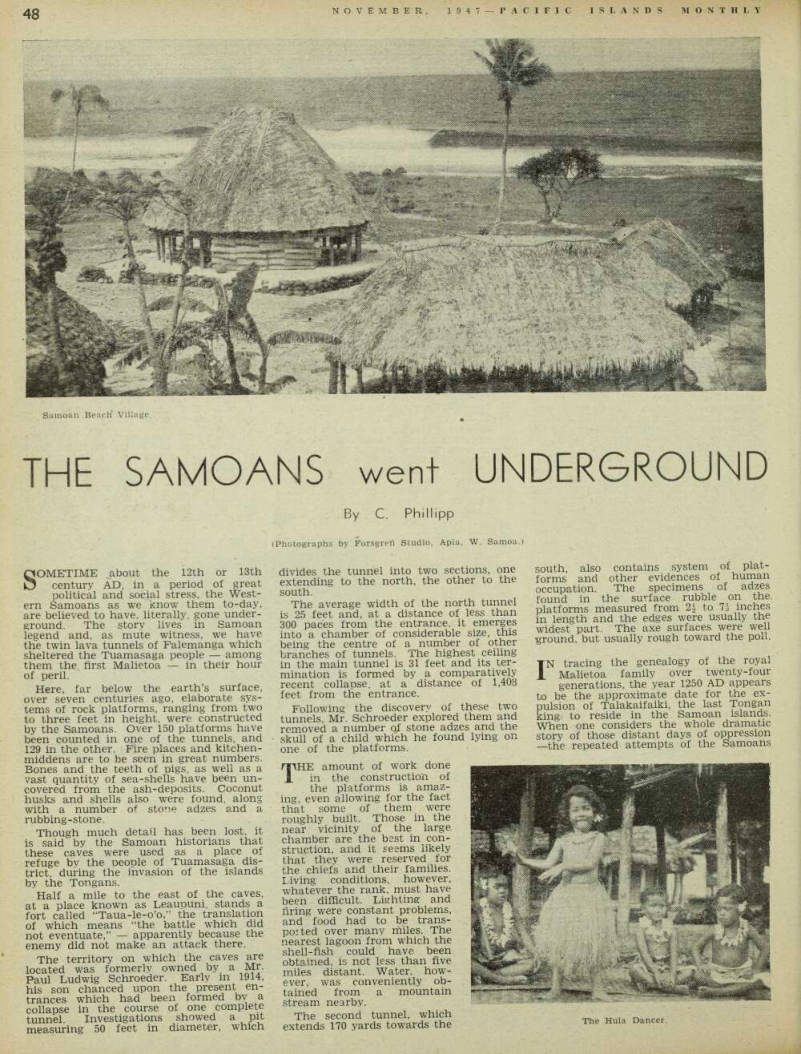
Samoan Beach Village.
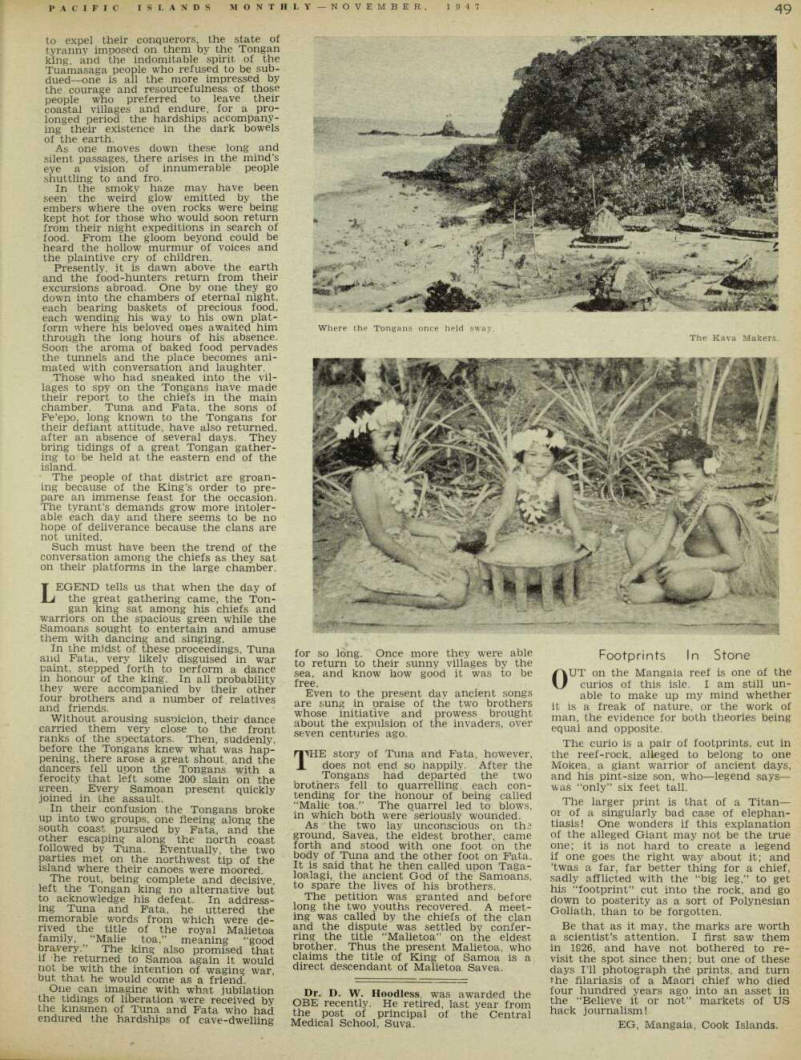
The Hula Dancer.
to expel their conquerors, the state of tyrannv imoosed on them by the Tongan king, and the indomitable spirit of the Tuamasaga people who refused to be sub dued—one is all the more impressed by the courage and resourcefulness of those people who preferred to leave their coastal villages and endure, for a pro longed period the hardships accompany ing their existence in the dark bowels of the earth.
As one moves down these long and silent passages, there arises in the mind’s eye a vision of innumerable people shuttling to and fro.
In the smoky haze may have been seen the weird glow emitted by the embers where the oven rocks were being kept hot for those who would soon return from their night expeditions in search of food. From the gloom beyond could be heard the hollow murmur of voices and the plaintive cry of children.
Presently, it is dawn above the earth and the food-hunters return from their excursions abroad. One by one they go down into the chambers of eternal night, each bearing baskets of precious food, each wending his way to his own plat form where his beloved ones awaited him through the long hours of his absence.
Soon the aroma of baked food pervades the tunnels and the place becomes ani mated with conversation and laughter.
Those who had sneaked into the vil lages to spy on the Tongans have made their report to the chiefs in the main chamber. Tuna and Fata, the sons of Fe’epo, long known to the Tongans for their defiant attitude, have also returned, after an absence of several days. They bring tidings of a great Tongan gather ing to be held at the eastern end of the island.
The people of that district are groan ing because of the King’s order to pre pare an immense feast for the occasion.
The tyrant’s demands grow more intoler able each day and there seems to be no hope of deliverance because the clans are not united.
Such must have been the trend of the conversation among the chiefs as they sat on their platforms in the large chamber.
LEGEND tells us that when the day of the great gathering came, the Ton gan king sat among his chiefs and warriors on the spacious green while the Samoans sought to entertain and amuse them with dancing and singing.
In the midst of these proceedings, Tuna and Fata, very likely disguised in war paint, stepped forth to perform a dance in honour of the king. In all probability they were accompanied by their other four brothers and a number of relatives and friends.
Without arousing suspicion, their dance carried them very close to the front ranks of the spectators. Then, suddenly, before the Tongans knew what was hap pening, there arose a great shout, and the dancers fell upon the Tongans with a ferocity that left some 200 slain on the ereen. Every Samoan present quickly joined in the assault.
In their confusion the Tongans broke up into two groups, one fleeing along the south coast pursued by Fata, and the other escaping along the north coast followed by Tuna. Eventually, the two parties met on the northwest tip of the island where their canoes were moored.
The rout, being complete and decisive, left the Tongan king no alternative but to acknowledge his defeat. In address ing Tuna and Fata, he uttered the memorable words from which were de rived the title of the royal Malietoa family, “Malie toa,” meaning “good bravery.” The king also promised that if he returned to Samoa again it would not be with the intention of waging war, but that he would come as a friend.
One can imagine with what jubilation the tidings of liberation were received by the kinsmen of Tuna and Fata who had endured the hardships of cave-dwelling
for so long. Once more they were able to return to their sunny villages by the sea, and know how good it was to be free.
Even to the present day ancient songs are sung in oraise of the two brothers whose initiative and prowess brought about the expulsion of the invaders, over seven centuries ago. mHE story of Tuna and Fata, however, X does not end so happily. After the Tongans had departed the two brothers fell to quarrelling, each con tending for the honour of being called “Malic toa.” The quarrel led to blows, in which both were seriously wounded.
As the two lay unconscious on th 3 ground, Savea, the eldest brother, came forth and stood with one foot on the body of Tuna and the other foot on Fata.
It is said that he then called upon Taga loalagi, the ancient God of the Samoans, to spare the lives of his brothers.
The petition was granted and before long the two youths recovered. A meet ing was called by the chiefs of the clan and the dispute was settled by confer ring the title “Malietoa” on the eldest brother. Thus the present Malietoa, who claims the title of King of Samoa is a direct descendant of Malietoa Savea.
Dr. D. W. Hoodless, was awarded the QBE recently. He retired, last year from the post of principal of the Central Medical School, Suva.
Footprints In Stone
OUT on the Mangaia reef is one of the curios of this isle. I am still un able to make up my mind whether it is a freak of nature, or the work of man, the evidence for both theories being equal and opposite.
The curio is a pair of footprints, cut in the reef-rock, alleged to belong to one Mokea, a giant warrior of ancient days, and his pint-size son, who —legend says— was “only” six feet tall.
The larger print is that of a Titan— or of a singularly bad case of elephan tiasis! One wonders if this explanation of the alleged Giant may not be the true one; it is not hard to create a legend if one goes the right way about it; and ’twas a far, far better thing for a chief, sadly afflicted with the “big leg,” to get his “footprint” cut into the rock, and go down to posterity as a sort of Polynesian Goliath, than to be forgotten.
Be that as it may, the marks are worth a scientist’s attention. I first saw them in 1826, and have not bothered to re visit the spot since then; but one of these days I’ll photograph the prints, and turn the filariasis of a Maori chief who died four hundred years ago into an asset in the “Believe it or not” markets of US hack journalism!
EG, Mangaia, Cook Islands.
Where the Tongans once held sway
The Kava Makers.