Lament for the Kava Saloons
p. 47 · Read in the full issue
By Geoffrey Shepherd
SUVA still has its grog shops, but the ones which I have in mind were along Victoria Parade. Now they are no more.
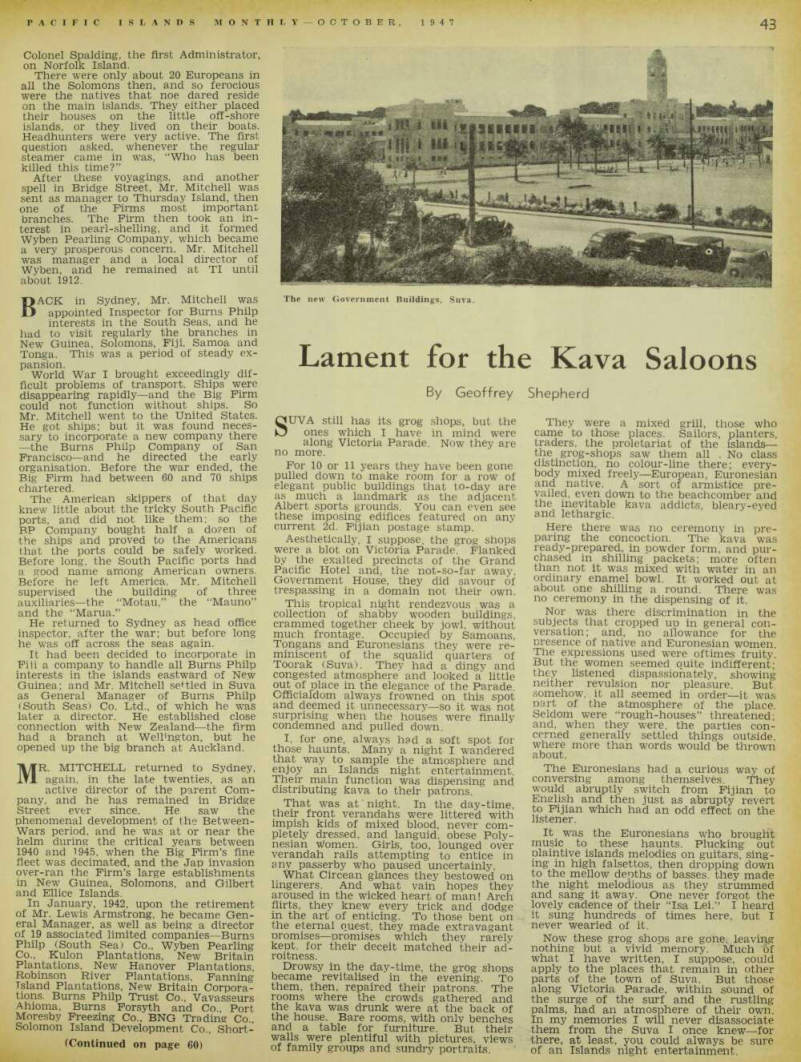
For 10 or 11 years they have been gone pulied down to make room for a row of elegant nubile buildings that to-day are as much a landmark as the adjacent Albert sports grounds. You can even see these imposing edifices featured on any current 2d. Fijian postage stamp.
Aesthetically, I suppose the grog shops were a blot on Victoria Parade. Flanked by the exalted precincts of the Grand Pacific Hotel and, the not-so-far away, Government House, they did savour of trespassing in a domain not their own.
This tropical night rendezvous was a collection of shabby wooden buildings. crammed together cheek by jowl, without much frontage. Occupied by Samoans.
Tongans and Euronesians they were reminiscent of the squalid quarters of Toorak (Suva). They had a dingy and congested atmosphere and looked a little out of place in the elegance of the Parade.
Officialdom always frowned on this spot and deemed it unnecessary—so it was not surprising when the houses were finally condemned and pulled down.
I for one alwavs harJ q snnt fnr those haunts. Many a night I wandered that way to sample the atmosphere and enjoy an Islands night entertainment Their main function was dispensing and distributing kava to their patrons That was at night. In the day-time, their front verandahs were littered with impish kids of mixed blood, never completely dressed, and languid, obese Polynesian women. Girls, too, lounged over verandah rails attempting to entice in any passerby who paused uncertainly.
What Circean glances they bestowed on lingerers. And what vain hopes they aroused in the wicked heart of man! Arch flirts, they knew every trick and dodge in the art of enticing. To those bent on the eternal quest, they made extravagant promises—promises which they rarely kept, for their deceit matched their adroitness.
Drowsy in the day-time, the grog shops became revitalised in the evening. To them, then, repaired their patrons. The rooms where the crowds gathered and the kava was drunk were at the back of the house. Bare rooms, with only benches and a table for furniture. But their walls were plentiful with pictures, views of family groups and sundry portraits.
They were a mixed grill, those who came to those places. Sailors, planters, traders, the proletariat of the islands— the grog-shops saw them all . No class distinction, no colour-line there: every body mixed freely—European, Euronesian and natlv e. A sort of armistice pre vailed, even down to the beachcomber and inevitable kava addicts, bleary-eyed and lethargic.
Here there was no ceremony in pre paring the concoction. The kava was ready-prepared, in powder form, and pur chased in shilling packets; more often tha P not was mixed with water in an ordinary enamel bowl. It worked out at about one shilling a round. There was n o ceremony in the dispensing of it.
Nor was there discrimination in the subjects that cropped up in general con versation; and, no allowance for the presence of native and Euronesian women, The expressions used were oftimes fruity.
But women seemed quite indifferent; s^enec i dispassionately, showing neither revulsion nor pleasure. But. somehow, it all seemed in order—it was p art tlle a tmosphere of the place, Seldom were “rough-houses” threatened; and - when they were, the parties con cerned generally settled things outside, more than words would be thrown , The Euronesians had a curious way of conversing among themselves. They would abruptly switch from Fijian to rev ,l rt w * llc * l had an odd effect on the It . was the Euronesians who brought music to these haunts. Plucking out plaintive islands melodies on guitars, sing in £ in high falsettos, then dropping down to the mellow depths of basses, they made the night melodious as they strummed and sang it away. One never forgot the lovely cadence of their “Isa Lei.” I heard it sung hundreds of times here, but I never wearied of it.
Now these grog shoos are gone. leaving nothing but a vivid memory. Much of what I have written, I suppose, could apply to the places that remain in other parts of the town of Suva. But those along Victoria Parade, within sound of the surge of the surf and the rustling palms, had an atmosphere of their own.
In my memories I will never disassociate them from the Suva I once knew—for there, at least, you could always be sure of an Islands night entertainment.
The new Government Buildings, Suva.