Into Battle With The
pp. 48-49 · Read in the full issue
Ngvr
Officialdom Did Not Love Them But They Looked On The Bright Side of War
(See List of Members on Page 50)
IN the vernacular of New Guinea, the war-lords of Australia seem to have had a “cross” on the NGVR: it is at present practically impossible to get any official record of their service. Their exploits then must be pieced together from accounts of individual members who are apt to recount the lighter side of NGVR experience rather than the heroic.
But perhaps this, in its way, is fit ting. In peace, to have pretensions of being an Empire Builder was looked upon as the acme of bumptiousness and fatuity. In war, the New Guinea men joined the NGVR in order to give the enemy something to think about, not because they fancied themselves as regi mental heroes.
In recent issues of “PIM,” there has been published the story of the Morobe detachment of the NGVR, behind Sala maua and in the Morobe-Wau area in the early days of the Japanese war. It is written amusingly, lightly, as though the whole affair were a large-scale ex pedition after rabbits. But it would be silly to be fooled by that. The conquest of the mountains of Mofobe is a battle in itself: if there were humour it was because the men chose to look for that angle in the grimmest of situations.
Although on the whole, the NGVR was a Cinderella unit, its exploits did not go altogether unrecorded even in the darker days of 1942.
In an article in the Melbourne “Herald,” in October, 1942, tribute was paid to the men who “fought the first offensive battle in the Pacific.” The men, the article stated, were drawn from all walks of life—doctors, planters, mining men, business men—they had been on the job and in constant contact with the Japanese since the previous January.
Concerning the Morobe company; “On June 29, in the darkness, the company raided Salamaua. Seventy-four men took part and every man had thoroughly planned and practised his individual job —even to the number of steps to be taken to reach a particular house with which he had to deal.
“The Japanese were taken completely by sur prise. Armed lightly with tommy-guns, grenades and stick bombs and with mor tars for support, the NGVR crept out of the jungle and struck. The Japanese did not know from where they would be hit next.”
In their trek across country, after the raid, the men had to scale peaks 8,000 feet high. mHE Rabaul unit of the X Rifles had been in action five months before that —gloriously, but tragically. The story of the unpreparedness of Rabaul to meet the Jap
anese threat has been told many times in these pages. But, briefly, it may be said that although AIF units had been garrisoning the town for many months, and the Australian authorities had had ample warning of the impending invasion, little was done either to evacuate civilian men or prepare the troops for meeting the enemy.
Rabaul had its first raid on January 4, 1942, and by the 20th of that month it was evident that a full-scale invasion was only a matter of days, if not hours.
While a state of complete confusion pre veiled, some civilians escaped southward and westward into the jungles of New Britain. On January 22, the 22nd Bat talion, AIF, and the 72 members of the NGVR (about 200 troops altogether) took up their positions on the beach between Vulcan Island (a volcanic cone upthrust in the 1937 eruptions) and Raluana Point.
There in the dawn they waited until the Japanese landing barges were almost at point-blank range and then they poured into the enemy a ceaseless stream of machine-gun and mortar fire. Numbers
of Japs were mown down but they came on fanatically although many who leaped into the water to wade ashore were caught in the submerged barbed wire en tanglements that had been laid. Still they came on, those behind seizing the dead bodies of their comrades and using them as a bridge across the wire. It was estimated, at the time, that 1,500 Japs were killed in this engagement.
But Jap landings were also taking place elsewhere, where there was no re sistance, and full daylight showed the invaders ashore at many points. More and more barges were coming ashore at Rualana also, and by noon the Aus tralians had been driven from their posi tions and retired into the jungle. There attempts were made to reform them, to escape, but generally it became a case of every man for himself.
Of the 72 Riflemen in this engagement, only seven escaped and after guiding parties of AIF troops through the jungle, reached Australia. The rest were either killed during the fighting, were subse quently murdered by the Japs or became prisoners of war and, with the exception of one or two, who reached Japan, perished in the “Montevideo Maru” when they were being transferred to Japan in June the same year.
THE actions in Rabaul and around Salamaua were fought as units but there were, as well, dozens of men who belonged to the Rifles and who acted individually or as small patrols striking at the Japs when and where they found them With civil government gone they assumed responsibility for several thous and indentured labourers unable to re turn to their homes. These became the army of carriers needed for supplies.
Their exploits in those early months of confusion were singularly unrewarded —the many decorations which were
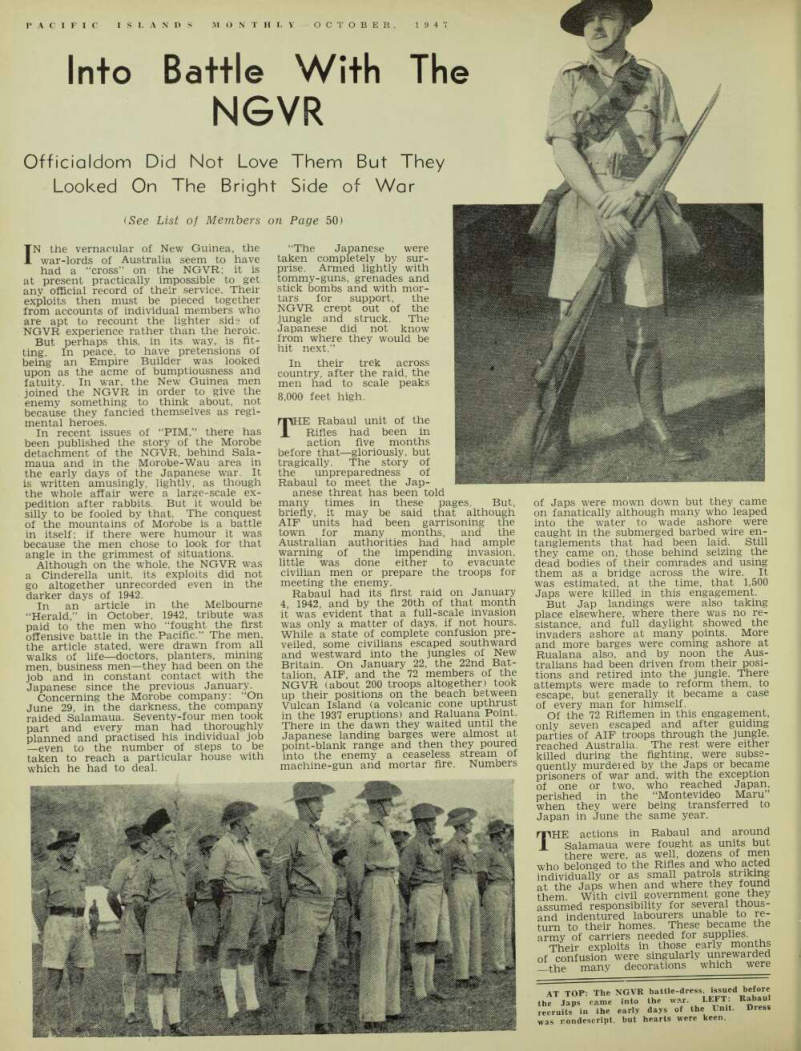
AT TOP: The NGVR battle-dress, issued before the Japs came into the war. LEFT: Rabaul recruits in the early days of the Unit. Dress was nondescript, but hearts were keen.
awarded these men were awarded after they had been absorbed in other units and the NGVR had been disbanded.
It is believed that the total roll of the NGVR was over 600. But it was largely from the early recruits to the organisa tion that the first New Guinea contin gents of the AIF were recruited and pro bably every name on the list will never now be recorded.
In April, 1943, it was decided by the powers-that-be that the NGVR would be disbanded. At that time there were some 300 surviving members, and strong efforts were made to maintain the identity of the unit. But in vain. The gentlemen who ran things had no sentimental re gard for the NGVR and most of its re maining members were distributed
throughout ANGAU and carried on to do valuable service in that organisation.
Few of the NGVR’s exploits were per formed under the eyes of newspaper cor respondents and they received little publicity in Australia. It was hoped, dur ing the years when the Pacific Territories Association still flourished, that after the war some fitting memorial to New Guinea’s own Volunteers would be established.
The war is over and nothing has been done . . . except, indirectly, in the New Guinea Memorial Scholarship Fund, established by the New Guinea women of Melbourne. This certainly has received the support of all sections of the New Guinea community.
TOP RIGHT: The Administrator of New Guinea. Sir Walter McNicoll, reviews the Rabaul section cf NGVR in September, 1940.
LOWER RIGHT: The first AIF contingent from New Guinea, recruited in 1940, marching through Rabaul. Most of these men originally were members of the NGVR.
Mr. and Mrs. J. J. Gilmour, well-known planters of the Kokopo district, New Britain, celebrated their 30th wedding an niversary in September with a cocktail party for 80 guests at the Cosmopolitan Hotel, Rabaul.
Fr. S. Appelhafis, religious superior of all SVD missionaries in Australia and New Guinea, whose headquarters are in Wewak, made an inspection tour of the NG missions in July and August. In September he left for Sydney on the first stage of his trip to Rome where he will attend the general chapter, as New Guinea representative.
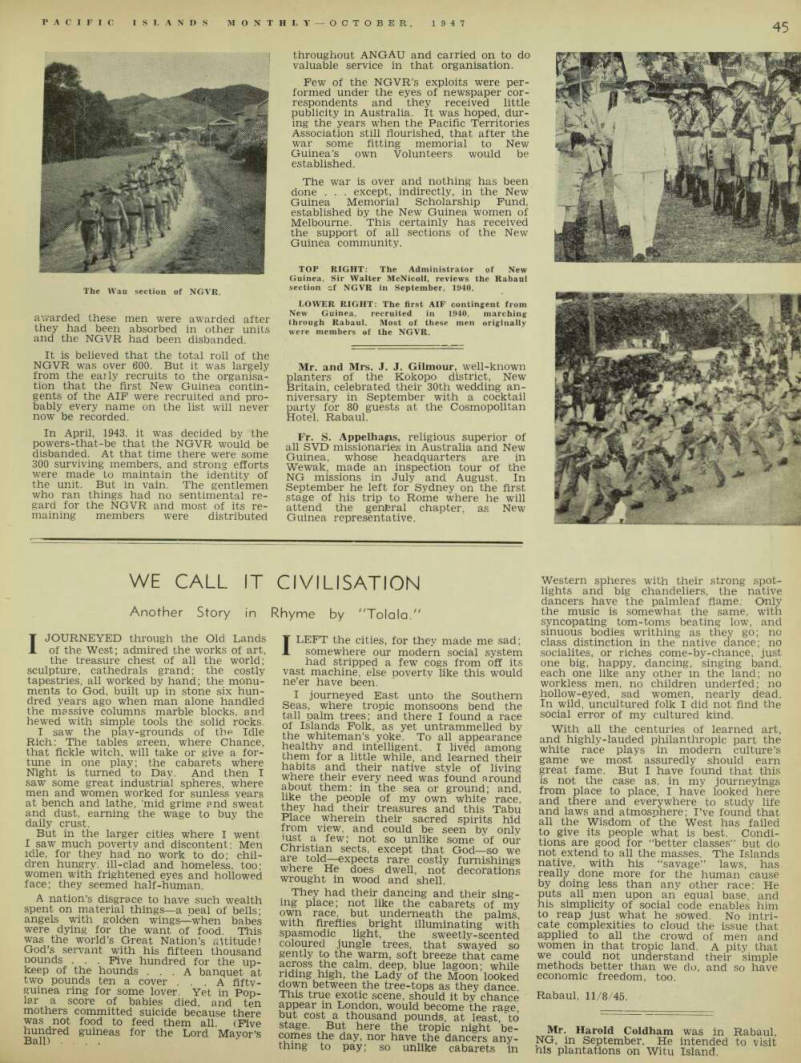
The Wau section of NGVR.