ROMANCE IN COMMERCE: The story of
pp. 46-64 · Read in the full issue
Joseph Mitchell, now GM of BP's and Director of 19 BP Companies
mHE Grand Old Man of Pacific Islands X trade is still going strong—Joseph Mitchell, General Manager and Director of Burns Philp and Co. Ltd., and Director of nineteen allied companies.
The only man who might challenge Mr. Mitchell’s title of GOM is Sir Maynard Hedstrom, founder of the large Central Pacific organisation headed by Morris Hedstrom Limited, and recently retired from the management; but Sir Maynard's activities have been confined generally to Fiji, Tonga and Samoa, whereas Mr. Mitchell has been a trader and a bearer of the BP flag in every Islands Territory, from Thursday Island to Samoa, and from Norfolk to the Caro lines.
When Joseph Mitchell joined the BP service 57 years ago, the Firm was quite a small concern; it did not own a steamer, and its trading was of modest dimensions. To-day it is a big ship owner (or was, until its fine fleet was decimated in World War II), and it and its associated companies own or control stores and plantations, factories and financial houses almost beyond number, Joseph Mitchell has been associated with practically every step in that re markable development. He now is one of the most influential figures in a city which bristles with merchant princes; his position in South Pacific Big Business is unique and unchallenged: but he still is known affectionately as “Joe” among the old hands of the Pacific.
WHEN Mr. Mitchell was an office-boy in Bridge Street, in 1891, the Big Firm was running two schooners — the “Ivanhoe,” between Cooktown and Samarai and Sud-Est Island, with an occasional run to Ralum, in New Britain (then German); and the “Myrtle”, run ning between Cooktown and British New Guinea (now Papua).
The late Colonel (afterwards Sir James) Burns then was an active figure
in Bridge Street. He was keenly in terested in the New Hebrides and, through the Australasian New Hebrides Company (reconstructed two or three times) he tried hard to encourage British settlement in the group. The directors were Colonel Burns, and Messrs. John Macpherson, Dougald Thomson, James Inglis and Bolton Molyneux—a distinctly Caledonian set-up. Finally, Burns Philp and Co. took over the Company’s man agement, established its office at 10 Bridge Street, put V. R. Bowden (formerly manager at Torres Strait) in charge, and made young Mitchell his as sistant.
Mr, Mitchell was five years in the office of the Australasian New Hebrides Co. and then went to Vila to relieve the local manager, Mr. Cooper, whose sight had been affected by malaria. The relief job became permanent, and Mr. Mitchell re mained several years in the New Hebrides, around 1900.
LIFE there was an adventure. The Condominium Government did not function until 1907, and the com munity ruled itself. There were no gov ernmental machinery, no laws, no taxes —murder was the only crime regarded seriously. A French or British warship came along once a year and “held court.”
Trade was completely free—and the cost of living, in consequence, amazingly low.
A case of Usher’s whisky cost 17/6; a case of Key gin was 8/-. No European there ever went in need.
“I was a lot happier there in ttmse days than I ever was in other countries with a lot of laws,” says Mr. Mitchell,
pointedly.
In those days, the British were gathered mostly at Vila and the French were at Maele. The two communities included as fine a selection of rascals as could be found in the world—especially male factors who were trying to keep them selves outside the law’s reach.
There was a hotel in Vila which be came notorious throughout the South Seas as “the Blood House.” It was kept by a half-caste, and the only authority recognised there was brute strength.
Some of the fights which occurred then were really worthy of the Blood House, and took their place in pre-Condominium history.
MR. MITCHELL returned to Sydney to take charge of the Islands Depart ment. The Firm was carrying on this business now with chartered steamers—he particularly remembers the “Kelloe,” “Karara,” “Mount Kembla,”
“Emu,” “Hesketh,” “Croydon,” “Wyralla,” and “Rob Roy,” most of which ran be tween Australia and the Solomons and New Hebrides —some inter-island.
About 1900, the Big Firm bought its first steamer, the “Titus,” and it ran first between Sydney, Papua and German New Guinea. There was no Rabaul until about 1910, so the “Titus” went to Ralum, the Duke of York Islands, and Matupi, in what is now Rabaul harbour. Then, to take care of business opened up by the chartered ships, the “Titus” settled down on a regular run to the Solomons. Mr.
Mitchell went with the “Titus” on those first, exploratory runs.
Soon afterwards, the Firm bought an other steamer, which took the place of the “Titus;” and Mr. Mitchell went off in the “Titus” to the Gilbert, Ellice and Marshall Islands, to pioneer new trade routes. Established traders did not like the newcomer from Sydney; but the BP flag was there to stay, and stay it did — until the 1914 war let the Japs into the Marshalls and Carolines, to push out all Europeans.
“Coming back from Jaluit, in the ‘Titus,’ we sighted Ocean Island,” said Mr. Mitchell. “No one knew much about the place, so I decided to go ashore and have a look round. We did some trade with the natives. I walked right across Ocean—and I, like many others, never guessed that that upraised mass of apparently broken coral was nothing more or less than a vast heap of phosphatic rock, worth millions of pounds.”
The old “Titus,” with Mr. Mitchell aboard, landed Mr. Woodford, first Resi dent Commissioner, in the Solomons, and
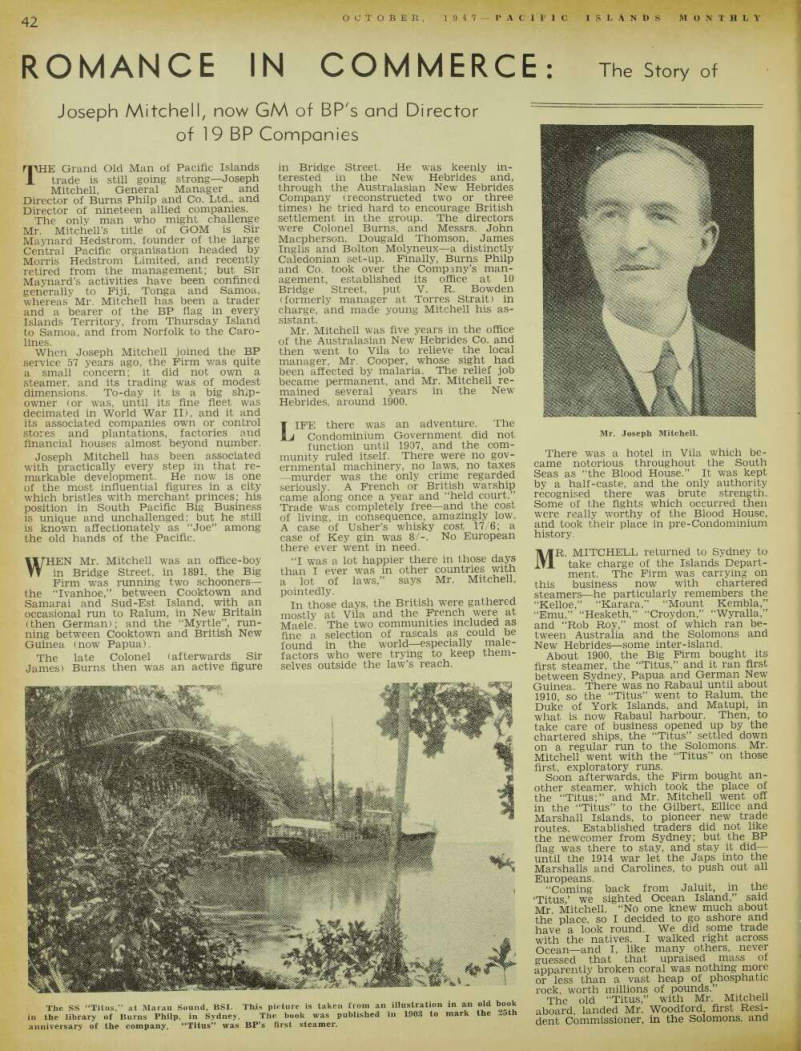
The SS “Titus,” at Marau Sound, BSI. This picture is taken from an illustration in an old book in the library of Burns Philp, in Sydney. The book was published in 1903 to mark the 25th anniversary of the company. “Titus” was BP’s first steamer.
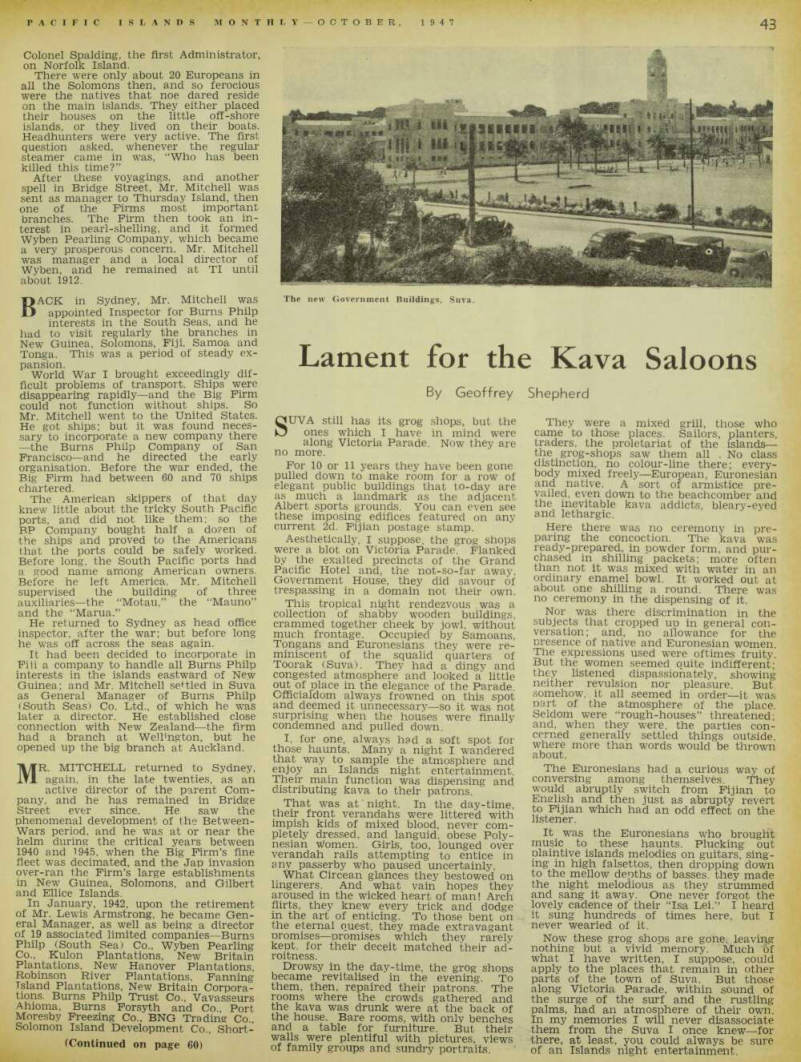
Mr. Joseph Mitchell.
Colonel Spalding, the first Administrator, on Norfolk Island.
There were only about 20 Europeans in all the Solomons then, and so ferocious were the natives that noe dared reside on the main islands. They either placed their houses on the little off-shore islands, or they lived on their boats.
Headhunters w T ere very active. The first question asked, whenever the regular steamer came in was, “Who has been killed this time?”
After these voyagings, and another spell in Bridge Street, Mr. Mitchell was sent as manager to Thursday Island, then one of the Firms most important branches. The Firm then took an in terest in pearl-shelling, and it formed Wyben Pearling Company, which became a very prosperous concern. Mr. Mitchell was manager and a local director of Wyben, and he remained at TI until about 1912.
BACK in Sydney, Mr. Mitchell was appointed Inspector for Burns Philp interests in the South Seas, and he had to visit regularly the branches in New Guinea, Solomons, Fiji, Samoa and Tonga. This was a period of steady ex pansion.
World War I brought exceedingly dif ficult problems of transport. Ships were disappearing rapidly—and the Big Firm could not function without ships. So Mr. Mitchell went to the United States.
He got ships; but it was found neces sary to incorporate a new company there —the Burns Philp Company of San Francisco—and he directed the early organisation. Before the war ended, the Big Firm had between 60 and 70 ships chartered.
The American skippers of that day knew little about the tricky South Pacific ports, and did not like them; so the BP Company bought half a dozen of the ships and proved to the Americans that the ports could be safely worked.
Before long, the South Pacific ports had a good name among American owners.
Before he left America, Mr. Mitchell supervised the building of three auxiliaries —the “Motau,” the “Mauno” and the “Mama.”
He returned to Sydney as head office inspector, after the war; but before long he was off across the seas again.
It had been decided to incorporate in Fiji a company to handle all Burns Philp interests in the islands eastward of New Guinea: and Mr. Mitchell settled in Suva as General Manager of Burns Philp (South Seas) Co. Ltd., of which he was later a director. He established close connection with New Zealand —the firm had a branch at Wellington, but he opened up the big branch at Auckland.
MR. MITCHELL returned to Sydney, again, in the late twenties, as an active director of the parent Com pany, and he has remained in Bridge Street ever since. He saw the phenomenal development of the Between- Wars period, and he was at or near the helm during the critical years between 1940 and 1945, when the Big Firm’s fine fleet was decimated, and the Jap invasion over-ran the Firm’s large establishments in New Guinea, Solomons, and Gilbert and Ellice Islands.
In January, 1942, upon the retirement of Mr. Lewis Armstrong, he became Gen eral Manager, as well as being a director of 19 associated limited companies—Burns Philp (South Sea) Co.. Wyben Pearling Co., Kulon Plantations, New Britain Plantations, New Hanover Plantations, Robinson River Plantations, Fanning Island Plantations, New Britain Corpora tions. Burns Philp Trust Co., Vavasseurs Ahioma, Burns Forsyth and Co., Port Moresby Freezing Co., BNG Trading Co., Solomon Island Development Co., Short
(Continued on page 60)
land Island Plantations, Choiseul Planta tions, Freehold Estates, T. Edmondson and Co.. Mates Ltd.
In his 57 years of service, Mr. Mitchell has seen the Firm grow from quite a small concern into a parent company with assets of over £8,000,000, exercising control over other organisations with assets worth at least a similar amount.
The South Pacific Ocean often is called the region of romance. There are few developments based on the Pacific which are of a more romantic character than the story of Burns Philp and Co. Ltd which embraces the life-story of Joseph Mitchell.
HIS reminiscences include many curious sidelights on life in the Pacific at the turn of the century.
There is, for instance, the story of the
printed notes. The Firm’s activities were growing rapidly, and neither buyers nor sellers could get currency for the machinery of exchange, when straight-out barter was impracticable. So the Firm simply printed its own paper money, for use in New Hebrides, Papua and the Solomons. The notes were mostly of £1 and £5 denominations. But the differ ence in figures meant nothing to the natives—to them a note was just a note.
So, to avoid confusion, the Firm printed a very big red “5” in the middle of the £5 notes.
Any kind of silver circulated then in the uncivilised New Hebrides. Value of a coin was fixed by its size in relation to the Australian florin.
The Firm was carrying the mails around the New Hebrides. As the New Hebrides then was a completely free country, it had neither Post Office nor postage stamps. So the Firm got its mail-carrying revenue by printing its own stamps, of Id. and 2d. value, and these were in use until the shrewd Government of New South Wales became restive. Finally, it was arranged that the NSW Government should get the postal revenue and subsidise BP ships to carry mails, and the BP postage stamps were to be withdrawn. That was the be ginning of the Australian subsidy (now a Commonwealth affair) of the Islands ships run regularly by Burns Philp and Co., Ltd.
The Australian New Hebrides Company, of which Mr. Mitchell was manager in Vila before 1900, was eventually absorbed and wiped out by Burns Philp and Co., Ltd.; and its assets included tens of thousands of acres of virgin land, much of it with water frontages, situated in the various islands of the group. Sir James Burns was anxious that these lands should eventually provide a home for British settlers; so he handed over all the Company’s titles to the then new Commonwealth Government of Australia, in the hope that Australia would en courage British settlement. Australia accepted the gift, and for many years maintained, in Port Vila, a solicitor whose job was to prosecute the Australian claims to land titles before the slowly-function ing Condominium Land Court. As far as is known, Australia is still the nominal owner of these lands.
Mr. Mitchell knew the Islands races well, long before the eager Planners of even knew that Islands races existed. He says that the Polynesians always were a friendly and intelligent people and they soon learned to become storekeepers, clerks, etc. But the Melanesians of 50 years ago, in the Solomons and in New Guinea were wild and primitive and often very dangerous.
As the years passed, and the Islands of the Western Pacific were penetrated by traders and planters the Melanesians gradually became quieter, until now, they are comparatively harmless —a good ex ample of the civilising influence of com merCe.
Mr. Mitchell married Miss Irene Sheppard in 1897, and she accompanied him on most of those interesting pioneer trips around the South Pacific Islands— to the then primitive Solomons, Gilberts and Marshalls. She always afterwards took the keenest interest in the develop ment of those now important Territories.
Mr. Mitchell is himself a native of Picton, New South Wales, and he was educated at the nearby Camden Grammar School.
There have been more protests in the Conseil General of New Caledonia against the burden of indirect taxation levied on the Colony by the administration. “We are entering upon a period of crisis, said one member, “and already there are signs of unemployment. The mining in dustry (particularly nickel) is in a pre carious position, and this industry repre sents 80 per cent of our general economy/'