Magazine Section
p. 45 · Read in the full issue
Territories Talk-Talk
By "Tolala"
I REFERRED last month to rates of pay for native servants employed by the PNG Administration. What was not mentioned, however, was the fact that the notice in the Government Gazette, occupying three full pages, bore no signa ture and referred merely to “Adminis tration Servants” —no mention of natives, at all.
The presumption is, of course, that there is a difference between Public and or Civil Servants and Administration Servants. But who is the authority? mHOR HEYDERDAHL, leader of the X Kon Tiki expedition, which drifted from Peru to Motamotu Island, reckons Polynesians cannot be descended from Asiatics as they have never pos sessed rice, pottery or the loom.
What about the Tasman Islanders— off the East coast of Bougainville—with their looms and their Polynesian ances tors.
I have an idea that Thor has started something. Anyway, in these days it is not where they came from that matters so much, as where they’re going. ❖ ❖ £
POST-WAR Reconstruction Depart
ment gave a “hand-out” to some of the Press boys last month, with the result that Sydney weekly newspaper readers could realise that Papua-New Guinea natives, who helped in the war, would derive ample assistance in rehabili tating themselves.
Over 800 had enrolled for full-time training, according to the blurb. They have “their choice of agriculture, black smithing. boat-building, bootmaking, electrical and mechanical trades or PMG line maintenance.” They can also apply for re-establishment loans up to £4O.
And besides all this they have their war damage, nominally at replacement values actually on a more generous scale Encouragement by the Department of natives to manufacture such lines as cane furniture, baskets and woven mats would be a good thing—work many of them are accustomed to—with a ready market, both locally and in Australia.
THE story of a little leper girl near Port Moresby, whose “eyes had danced . with excitement at the sight of some animals on a tin,” was told with pathos it Sydney paper last month. Result of the sob-story: Scores of Sydney folk rang for the child’s address to send her animal picture-books. Such spontaneous charity were better used at home, among kiddies who have no paternal Administra tor care for their every want.
There is no need to worry about native welfare in New Guinea. One case in point was the arrival in Brisbane bv Montoro of a young Buka lad (one is not supposed to call them “boys” now) in the care of Mrs. Sinclair (wife of the popular medico). He had received severe face injuries from an exploding bomb.
Accompanied by his uncle, the lad will rfr C i«h V 6 pl^stic surgery treatment at the Brisbane General Hospital.
MR. LEMMON, acting Minister for
External Territories, during Mr
Ward s absence, returning from a look-see in the Territory last month was struck by the “natural potentialities” up
there. Unless Australia developed the country, he said, she would lose it, as there were greedy eyes on New Guinea.
Being Minister for Works and Housing he was particularly impressed with New Guinea forests and the possibilities for producing paper pulp and the need to develop the timber industry.
It is remarkable how these itinerant politicians “discover” New Guinea when ever they tour around!
Minister Lemmon did break some new ground, however, when he said an “award” of wages and conditions would be introduced in New Guinea shortly. He was referring to white employees—which is a change of attitude—and he remarked that as the Arbitration Court did not function Up Yonder, difficulty had been experienced in getting men to go there.
The new schedule of conditions and hours which was almost complete, had been made as attractive as possible, he re marked.
That will be a break for white em ployees. It only needs the Administration there to lend a sympathetic ear and a helpful hand to the white employers, and life may yet be worthwhile for them en abling them the better to do their share m developing the resources with which the worthy Minister was so impressed.
ONCE again in a Sydney daily there appears letters dealing with the ad vantages, or otherwise, of the in dentured native labour system One
writer persists that the system “is nothing more or less than virtual slavery.” How this can be so, when every prospec tive labourer is asked whether he is willing to work or not, I fail to understand—assum ing, of course, that the Gov ernment Official is doing his job. And there is no reason to assume otherwise, unless tor the purpose of endeavour ing to prove an anti-inden tured argument.
Give the present Education Department in New Guinea five years (at least) then you may find sufficient natives with a sense of the value of a verbal agreement, and an apreciation of ethics, who might then be capable of em ployment without a contract.
But until then a contract is necessary to ensure continu ity of employment.
So many people seem to forget that a contract must be an equitable instrument.
The present contract of ser vice protects both parties. In cidentally, how many white employees in the Territory have not a contract with their employers? v ONE of the writers on the indenture labour ques tion plugs for a Royal Commission to settle the matter. Back in 1923 (if I remember rightly) Commis sioner Canning, from Kenya made a thorough investiga tion of the native labour question and the so-called “forced labour” in TNG. He found little or nothing to sup port the allegations. Since
then the NLO has been revised many times, to tighten up loop-holes.
FEBRUARY 4, 1942, was a dark day for Australia and New Guinea. It was the day of the Tol massacre, on the South Coast of New Britain.
For years, Army Intelligence has been endeavouring to find the Japanese who were responsible for the murder of 140 Australian soldiers, NGVR and New Guinea civilians. All efforts have been in vain, and it is thought now that all the Japs have perished, thus escaping the War Crimes tribunal.
There were only three survivors, one of whom is A. L. Robinson, of the New Guinea District Services Department. jJ: ..
SECRETARY P. J. LUCAS, of thfc Fed erated Confectioners’ Association of Australia, is plugging for the development of the cocoa industry in New Guinea and, according to a Sydney paper, “will ask Minister Ward to inves tigate possibilities of establishing the cocoa bean industry in New Guinea.’’
So far as “establishing” the industry is concerned most people know that cocoa was planted in the Witu group by the Neu Guinea Compagnie some 40 years ago, and the product was acclaimed to be as good as any in the world. In pre war TNG there were some 3,000 acres of cocoa under cultivation, and the value of cocoa beans exported in 1941 was £11.680. Present price is about £l7O a ton.
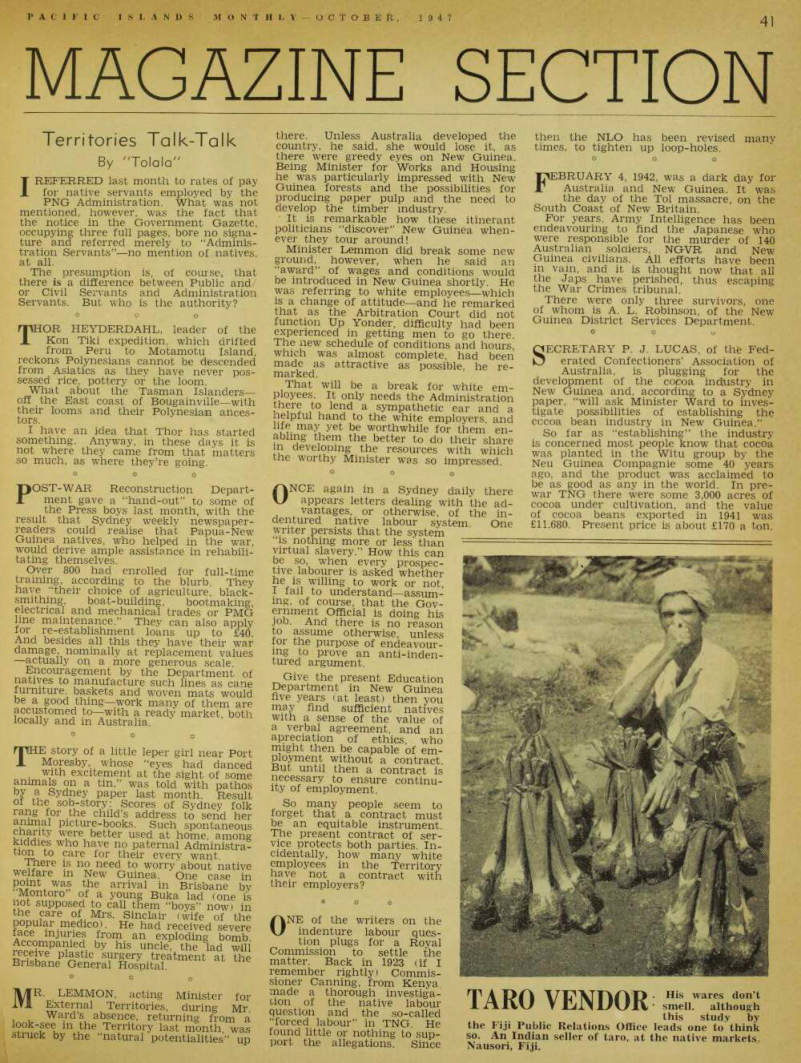
TARO VENDOR : smell. although
this study by the Fiji Public Relations Office leads one to think so. An Indian seller of taro, at the native markets.
Nausori, Fiji.