Tropicalities
p. 41 · Read in the full issue
WHATEVER the weather, the chances are that at any time of day in the Suva business area, the somewhat stocky but intensely ener getic figure of Mr. F. S. Baker will be sighted, pedalling strenuously at a bicycle with an outsize attache case strapped on behind.
Among his many activities, one of Mr. Baker’s aims in life is to push the Fiji Branch of the Royal Life Sav ing Society, of which he is secretary.
Already the work has been success fully accomplished in the larger schools in Fiji, and a vigorous off shoot has taken root as far away as Apia, Western Samoa.
At the end of April, Mr. Baker was radiant. A congratulatory letter from London headquarters had informed him that Fiji had won the Sydney J.
Monks Memorial Shield in the Society’s competition for 1946. Fiji headed the list of 20 competing branches scattered through the British Empire.
The shield is awarded for the best record in a year’s practical work in official life-saving examinations, and the competition is open to all branches in Great Britain and else where.—S, * * * THE latest report from Fiji indicates that the search for the perfect bay for the filming of Stackpoole’s “Blue Lagoon” (“PIM,” April) has been narrowed. Cuvu and Sigatoka generally are out. Choice lies be tween Yadua, off the south-western coast of Vanua Levu, and some of the islands in the Yasawas.
Mr. Leslie Gilliart and his party, who came out from Britain to find the perfect spot, are now making colour film tests of the two localities mentioned above. * * * THE boots of the Tongan Rugby team which is scheduled to visit Fiji in June have been the cause of much local agitation.
Last year all the senior Fijian foot ballers, traditionally barefooted, moved with some difficulty into boots as a necessary means of defence against the heavily-booted Maori Rugby invasion due this year. But a Tongan Rugby tour is also scheduled, before the arrival of the Maoris.
Early in April came a cabled wail from Nukualofa: Not a Rugby boot was available; and no boots, no tour.
Back cabled the chairman of the Fiji Rugby Union: Come without boots and we will discard all footwear for the occasion.
The final message from Nukualofa, worded with Tongan caution, was: “Tongan team will visit Fiji, travel ling ‘Matua.’ Team due arrive Fiji end June, leave return ‘Matua.’ Please arrange all matches barefoot.”—S.
IF your memory extends back 15 years or so you possibly might re member that you were one of the people who thought “Smithy” crazy to attempt to fly the Tasman. “Who wants to fly the Tasman, anyhow,” we asked. “It has the unchanciest weather in the world.”
But by April, 1940, aviation had made such strides that Tasman Em pire Airways went into operation with a weekly trip each way and now, seven years later, the service has clocked up over 2i million miles, carried 33,000 passengers, a million pounds of mail and half a million pounds of freight. All without a fatality.
Until last year the service was maintained by the two veteran Short flying - boats, “ Aotearoa ” and “Awarua.” Now the fleet is five strong—three improved Short flying boats, each capable of carrying 30 passengers in comfort—as well as the original aircraft. The service has been bumped up from one per week to daily each way, except Sundays; and the average flying time has been cut down to eight hours.
The Tasman service provides the final link in the Empire route from the United Kingdom, connecting in Sydney with the Lancastrian land plane and the Hythe flying-boat ser vices to England.
During the Pacific war, when the trans-Tasman shipping services were suspended, TEA was the only link between Australia and New Zealand.
It was then necessary to have a gilt edged priority to obtain a passage.
There is still a waiting list, but any one may now travel TEA—providing they book well in advance.
TEA’S record of safety cannot be bettered by any air service in the world; its service, too, has improved with each of the seven years of its existence. Only two things have not improved: weather, which can still be bad over the Tasman; and fares, which are still high. * * * THIS may or may not be news to philatelists. It was news to us.
It comes from the Auckland Star.
It appears that away back in the 70’s, G. L. Griffiths, editor and pub lisher of the original Fiji Times, set up and had printed in his printing office at Levuka, his own issue of Fiji’s first unofficial postage stamps.
The reason for the printing was that, there being no post office in those days, Griffiths went into the business himself and with a fleet of cutters delivered his own newspapers and parcels far and wide. The postage stamps were used to cover the cost of transportation of these postal articles.
The stamps were in denominations of Id., 3d., 6d. and 1/-; to-day they are worth £l2, £l5, £2O and £lO apiece,
respectively. It is believed that the plates from which these stamps were made are still in New Zealand—where it is not exactly known.
When Fiji was finally ceded to Britain in 1874, the Griffiths stamps were scrapped and King Cakobairs first official issue, which had mean while been printed at the Govern ment Printing Office in Sydney, came into use.
Griffiths originally printed 20,000 sheets of his stamps, with a face value of £ll,OOO. How many were used, or what became of them is not known.
But it has been estimated that the value of the issue at to-day’s rate for single specimens would be £6,840,000!
For the information of Fiji residents who now contemplate turning out the family cupboards in the hope of dis covering an unopened copy of the Fiji Times of 1874, each of the stamps carries, as well as the denomination, the words “Fiji Times Express.”
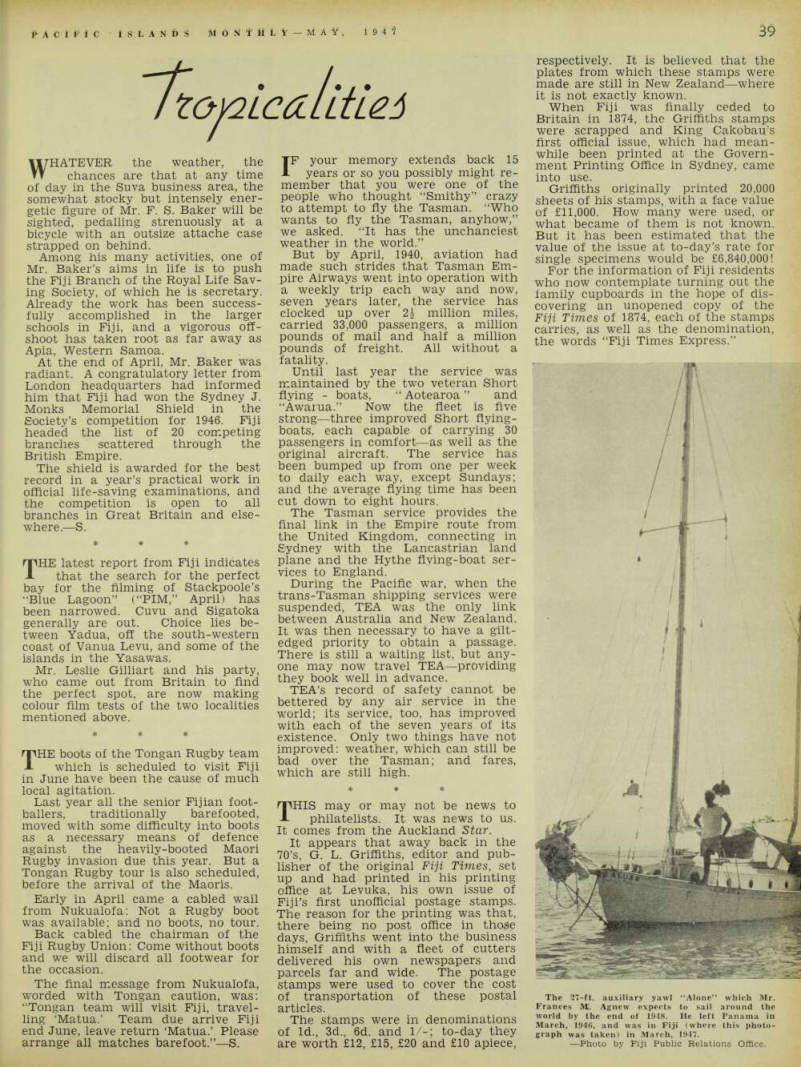
The 27-ft. auxiliary yawl “Alone” which Mr.
Frances M. Agnew expects to sail around the world by the end of 1948. He left Panama in March, 1946, and was in Fiji (where this photo graph was taken) in March, 1947. —Photo by Fiji Public Relations Office.