Spotlight on Emirau
p. 40 · Read in the full issue
Incidents in the Patchy History of a Remote Island
By L. P. Crago
WHEN Judy Tudor in “Wau Road” (December “PIM”) wrote of the delicious coffee she received at Wilde’s (Vil-de’s) former plantation, in the scorched-earth area of Wau, I thought of lonely little Emirau, in the St. Matthias Group, and its one time copra-king.
Long before he went to Wau and the goldfields, Carl Leopold Wilde acquired plantations on Emirau (or Squally Island, as it is also known) northwest of New Ireland through
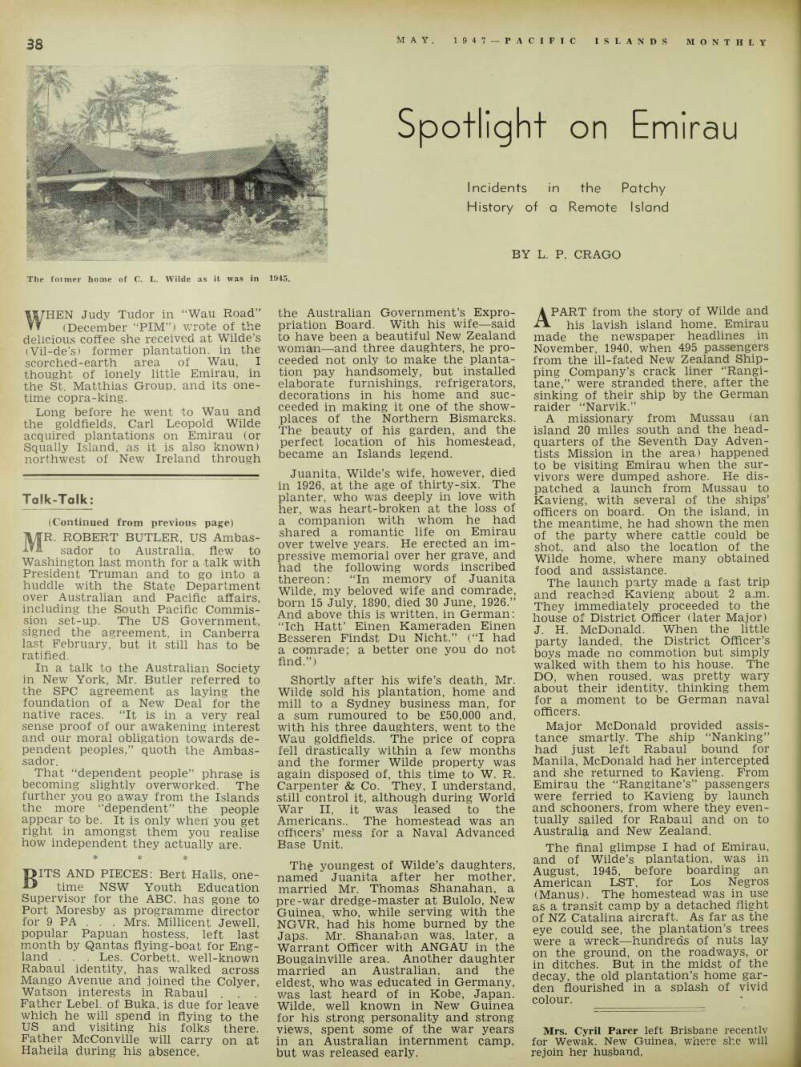
the Australian Government’s Expro priation Board. With his wife—said to have been a beautiful New Zealand woman—and three daughters, he pro ceeded not only to make the planta tion pay handsomely, but installed elaborate furnishings, refrigerators, decorations in his home and suc ceeded in making it one of the show places of the Northern Bismarcks.
The beauty of his garden, and the perfect location of his homestead, became an Islands legend.
Juanita, Wilde’s wife, however, died in 1926, at the age of thirty-six. The planter, who was deeply in love with her, was heart-broken at the loss of a companion with whom he had shared a romantic life on Emirau over twelve years. He erected an im pressive memorial over her grave, and had the following words inscribed thereon: “In memory of Juanita Wilde, my beloved wife and comrade, born 15 July, 1890, died 30 June, 1926.”
And above this is written, in German: “Ich Hatt’ Einen Kameraden Einen Besseren Findst Du Nicht.” (“I had a comrade; a better one you do not find.”) Shortly after his wife’s death, Mr.
Wilde sold his plantation, home and mill to a Sydney business man, for a sum rumoured to be £50,000 and, with his three daughters, went to the Wau goldfields. The price of copra fell drastically within a few months and the former Wilde property was again disposed of, this time to W. R.
Carpenter & Co. They, I understand, still control it, although during World War 11, it was leased to the Americans.. The homestead was an officers’ mess for a Naval Advanced Base Unit.
The youngest of Wilde’s daughters, named Juanita after her mother, married Mr. Thomas Shanahan, a pre-war dredge-master at Bulolo, New Guinea, who, while serving with the NGVR, had his home burned by the Japs. Mr. Shanahan was, later, a Warrant Officer with ANGAU in the Bougainville area. Another daughter married an Australian, and the eldest, who was educated in Germany, was last heard of in Kobe, Japan.
Wilde, well known in New Guinea for his strong personality and strong views, spent some of the war years in an Australian internment camp, but was released early.
APART from the story of Wilde and his lavish island home, Emirau made the newspaper headlines in November, 1940, when 495 passengers from the ill-fated New Zealand Ship ping Company’s crack liner “Rangi tane,” were stranded there, after the sinking of their ship by the German raider “Narvik.”
A missionary from Mussau (an island 20 miles south and the head quarters of the Seventh Day Adven tists Mission in the area) happened to be visiting Emirau when the sur vivors were dumped ashore. He dis patched a launch from Mussau to Kavieng, with several of the ships’ officers on board. On the island, in the meantime, he had shown the men of the party where cattle could be shot, and also the location of the Wilde home, where many obtained food and assistance.
The launch party made a fast trip and reached Kavieng about 2 a.m.
They immediately proceeded to the house of District Officer (later Major) J. H. McDonald. When the little party landed, the District Officer’s boys made no commotion but simply walked with them to his house. The DO, when roused, was pretty wary about their identity, thinking them for a moment to be German naval officers.
Major McDonald provided assis tance smartly. The ship “Nanking” had just left Rabaul bound for Manila, McDonald had her intercepted and she returned to Kavieng. From Emirau the “Rangitane’s” passengers were ferried to Kavieng by launch and schooners, from where they even tually sailed for Rabaul and on to Australia and New Zealand.
The final glimpse I had of Emirau, and of Wilde’s plantation, was in August, 1945, before boarding an American LST, for Los Negros (Manus). The homestead was in use as a transit camp by a detached flight of NZ Catalina aircraft. As far as the eye could see, the plantation’s trees were a wreck—hundreds of nuts lay on the ground, on the roadways, or in ditches. But in the midst of the decay, the old plantation’s home gar den flourished in a splash of vivid colour.
Mrs. Cyril Parer left Brisbane recently for Wewak. New Guinea, where she will rejoin her husband,
The former home of C. L. Wilde as it was in 1945.