Polynesia In Melanesia
pp. 42-44 · Read in the full issue
The Story Of The Tasmans
(Photographs by J. W. Gruesser)
LONG, long ago in the beginning of time, two giant sea-birds lived on Ontong Java (just north of Ysabel Island, in the British Solomons).
They lived there for many years but then they quarrelled, and one of them (a female, we "resume, as it later laid an egg), left the atoll in search of a place of her own.
She searched far and wide across the deep sea and finally discovered a reef; and there, at each low tide, she would scrape up white sand and stones until, after many years, she had a number of small islets on a horseshoe atoll.
Then she remembered her old friend on Ontong Java, and decided to pay him a visit. But this bird had now grown into a quarrelsome old hermit, and she soon returned to her new atoll—to find that during her absence, coconuts had been brought ashore by the wind and the waves and had grown into small trees upon some of the islets.
She continued with her work, building even larger islands and upon one she ambitiously started to build a Mountain (the remains of the mountain can be seen to this day as two reefs in the lagoon!) After the coconuts had grown, they bore nuts.
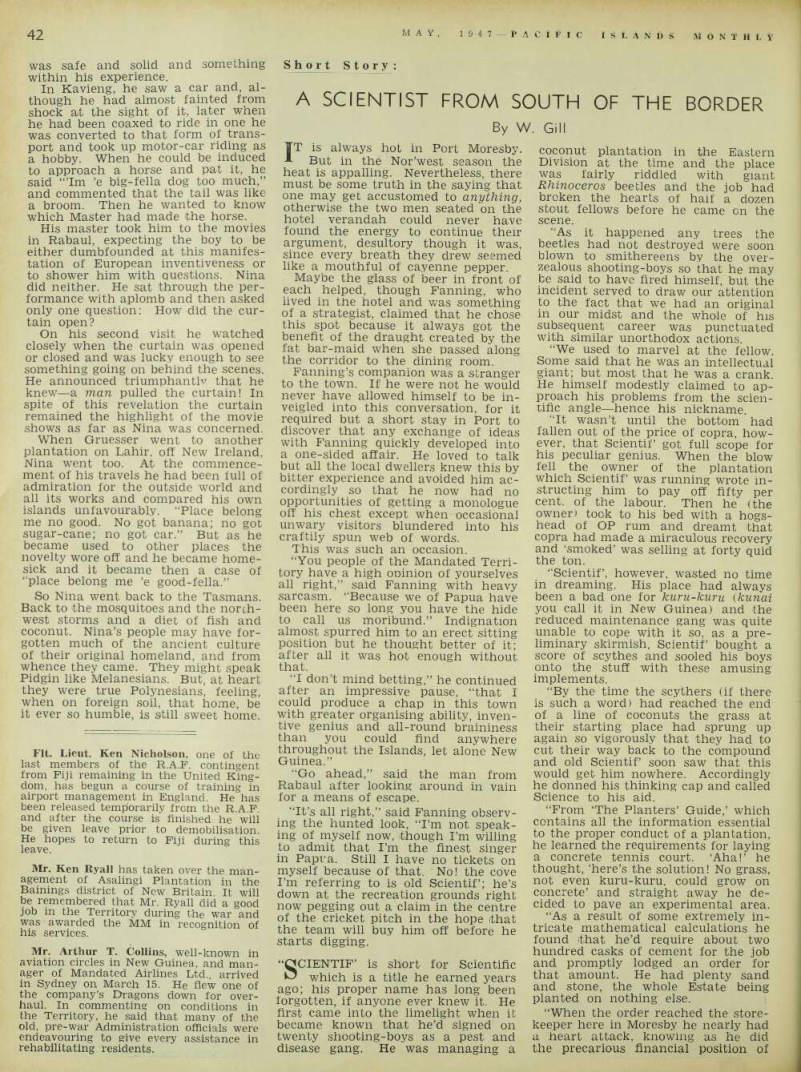
Agai" remembering the other bird on Ontong Java, she selected two of the finest nuts and bore them off to him. But he had become her enemy, and saddened she returned once more, now weary of life and wishing to die. But before she left her atoll, never to be seen again, she laid a giant egg, and out of it came men who b red and took possession of the islets, where they have lived ever since.
An d that, according to the Tasman Islanders, is how they and their islands came into being.
TVHERE are other and more scien- JL tific explanations for logically minded people but no one has been able to supply any real reason for the
whimsy of Dame Nature when she took what might have been a Micro nesian Line atoll, with a Polynesian people, and thrust it deep into Melanesia.
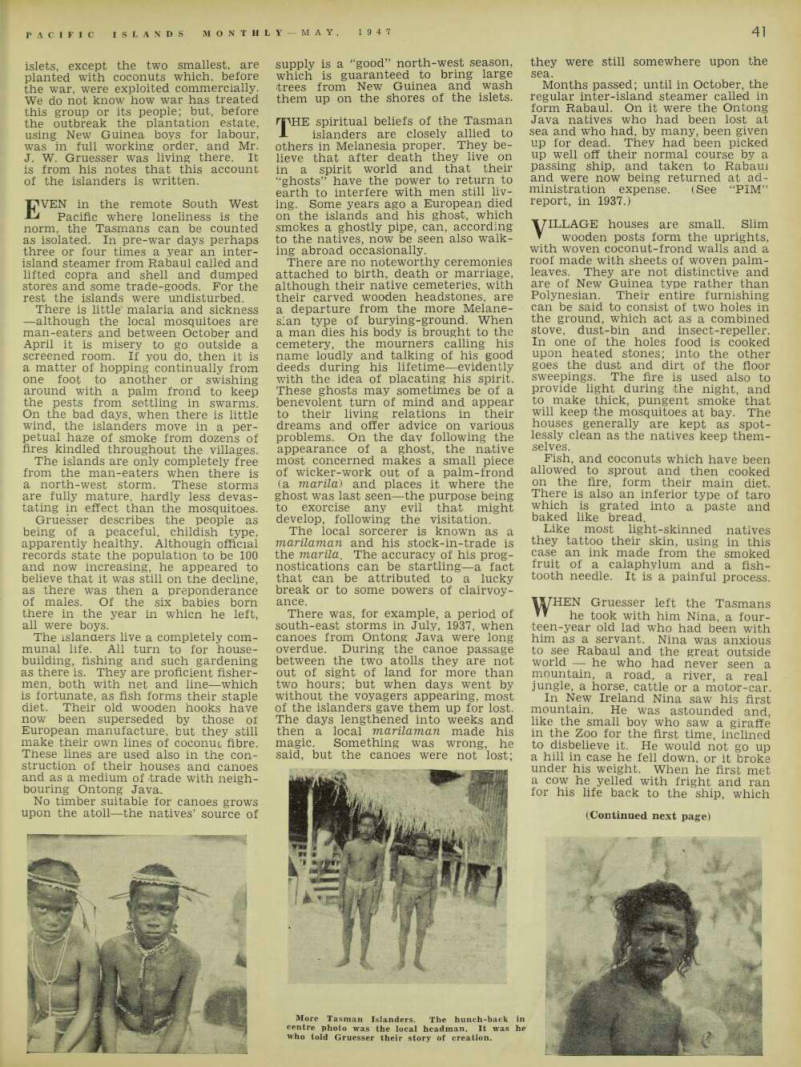
The Tasman group (or atoll) con sists of about 40 small islets, strung out along a horse-shoe of reef; none of them rise more than six feet above sea level and their coral and sand grow little but coconuts. The islan ders are classed as Polynesians— attractive, light skinned, straight haired people quite different from the fuzzy haired, dark skinned Melane sians.
Politically, the islands belong to New Guinea. Geographically, they are 250 miles north-east of Bougain ville and have Ontong Java in the British Solomon Islands (also an atoll with Polynesian inhabitants) as their nearest neighbour.
Probably, canoes driven from their course brought these Polynesian people to the atoll outposts of Melanesia. But what drove them to settle on the barren islets in prefer ence to the more fertile lands of Melanesia proper? And whence did they come? Scientists guess at proba bilities. But the Islanders themselves have no records; no legends, as the Maoris have, of long ocean voyages or of an ancient home. The fantastic story of the sea bird is the nearest they get to a beginning for them selves.
LARGEST of the Tasman Group is Nukumanu, which is about five miles long, but very narrow. All the
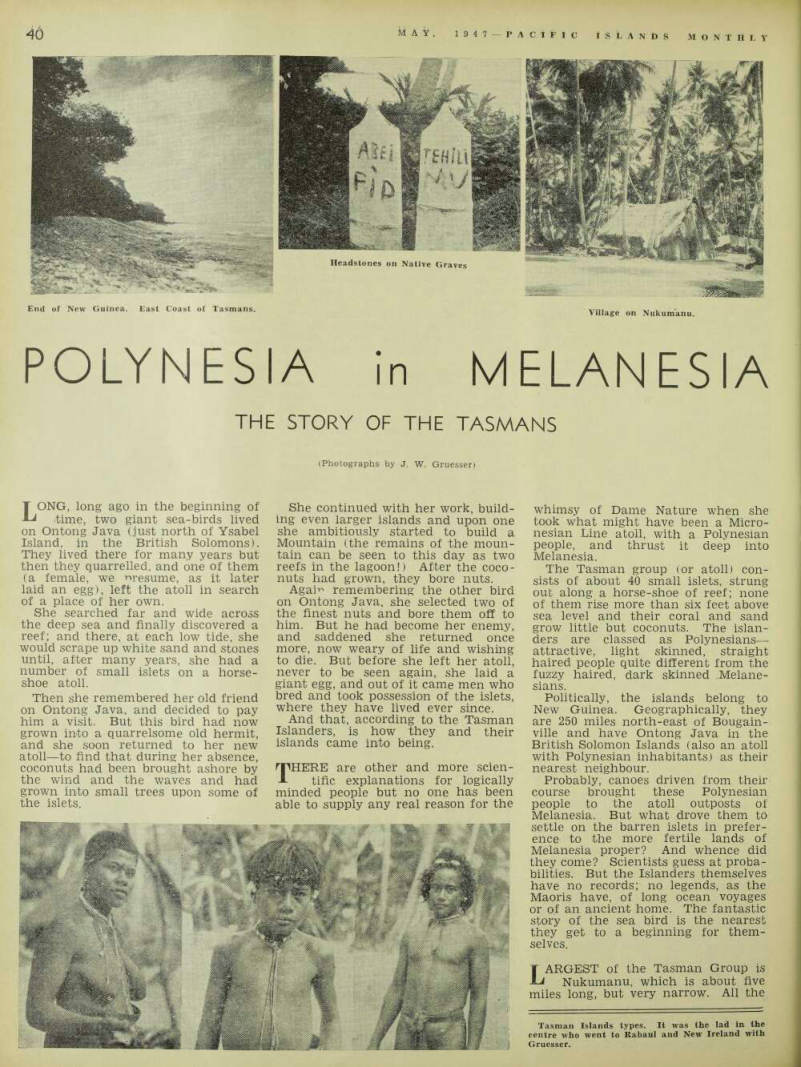
Headstones on Native Graves
End of New Guinea. East Coast of Tasmans.
Village on Nukumanu.
Tasman Islands types. It was the lad in the centre who went to Rabaul and New Ireland with Gruesser.
islets, except the two smallest, are planted with coconuts which, before the war, were exploited commercially.
We do not know how war has treated this group or its people; but, before the outbreak the plantation estate, using New Guinea boys for labour, was in full working order, and Mr.
J. W. Gruesser was living there. It is from his notes that this account of the islanders is written, EVEN in the remote South West Pacific where loneliness is the norm, the Tasmans can be counted as isolated. In pre-war days perhaps three or four times a year an inter island steamer from Rabaul called and lifted copra and shell and dumped stores and some trade-goods. For the rest the islands were undisturbed.
There is little' malaria and sickness —although the local mosquitoes are man-eaters and between October and April it is misery to go outside a screened room. If you do, then it is a matter of hopping continually from one foot to another or swishing around with a palm frond to keep the pests from settling in swarms.
On the bad days, when there is little wind, the islanders move in a per petual haze of smoke from dozens of fires kindled throughout the villages.
The islands are only completely free from the man-eaters when there is a north-west storm. These storms are fully mature, hardly less devas tating in effect than the mosquitoes.
Gruesser describes the people as being of a peaceful, childish type, apparently healthy. Although official records state the population to be 100 and now increasing, he appeared to believe that it was still on the decline, as there was then a preponderance of males. Of the six babies born there in the year in whicn he left, all were boys.
The islanders live a completely com munal life. All turn to for house building, fishing and such gardening as there is. They are proficient fisher men, both with net and line—which is fortunate, as fish forms their staple diet. Their old wooden hooks have now been superseded by those of European manufacture, but they still make their own lines of coconut fibre.
These lines are used also in the con struction of their houses and canoes and as a medium of trade with neigh bouring Ontong Java.
No timber suitable for canoes grows upon the atoll —the natives’ source of
supply is a “good” north-west season, which is guaranteed to bring large ■trees from New Guinea and wash them up on the shores of the islets.
THE spiritual beliefs of the Tasman islanders are closely allied to others in Melanesia proper. They be lieve that after death they live on in a spirit world and that their “ghosts” have the power to return to earth to interfere with men still liv ing. Some years ago a European died on the islands and his ghost, which smokes a ghostly pipe, can, according to the natives, now be seen also walk ing abroad occasionally.
There are no noteworthy ceremonies attached to birth, death or marriage, although their native cemeteries, with their carved wooden headstones, are a departure from the more Melane sian type of burying-ground. When a man dies his body is brought to the cemetery, the mourners calling his name loudly and talking of his good deeds during his lifetime —evidently with the idea of placating his spirit.
These ghosts may sometimes be of a benevolent turn of mind and appear to their living relations in their dreams and offer advice on various problems. On the dav following the appearance of a ghost, the native most concerned makes a small piece of wicker-work out of a palm-frond (a marila ) and places it where the ghost was last seen—the purpose being to exorcise any evil that might develop, following the visitation.
The local sorcerer is known as a marilaman and his stock-in-trade is the marila. The accuracy of his prog nostications can be startling—a fact that can be attributed to a lucky break or to some powers of clairvoy ance.
There was, for example, a period of south-east storms in July, 1937, when canoes from Ontong Java were long overdue. During the canoe passage between the two atolls they are not out of sight of land for more than two hours; but when days went by without the voyagers appearing, most of the islanders gave them up for lost.
The days lengthened into weeks and then a local marilaman made his magic. Something was wrong, he said, but the canoes were not lost;
they were still somewhere upon the sea.
Months passed; until in October, the regular inter-island steamer called in form Rabaul. On it were the Ontong Java natives who had been lost at sea and who had, by many, been given up for dead. They had been picked up well off their normal course by a passing ship, and taken to Rabaul and were now being returned at ad ministration expense. (See "PiM” report, in 1937.) VILLAGE houses are small. Slim wooden posts form the uprights, with woven coconut-frond walls and a roof made with sheets of woven palm leaves. They are not distinctive and are of New Guinea type rather than Polynesian. Their entire furnishing can be said to consist of two holes in the ground, which act as a combined stove, dust-bin and insect-repeller.
In one of the holes food is cooked upon heated stones; into the other goes the dust and dirt of the floor sweepings. The fire is used also to provide light during the night, and to make thick, pungent smoke that will keep the mosquitoes at bay. The houses generally are kept as spot lessly clean as the natives keep them selves.
Fish, and coconuts which have been allowed to sprout and then cooked on the fire, form their main diet.
There is also an inferior type of taro which is grated into a paste and baked like bread.
Like most light-skinned natives they tattoo their skin, using in this case an ink made from the smoked fruit of a calaphylum and a fish tooth needle. It is a painful process.
WHEN Gruesser left the Tasmans he took with him Nina, a four teen-year old lad who had been with him as a servant. Nina was anxious to see Rabaul and the great outside world he who had never seen a mountain, a road, a river, a real jungle, a horse, cattle or a motor-car.
In New Ireland Nina saw his first mountain. He was astounded and, like the small boy who saw a giraffe in the Zoo for the first time, inclined to disbelieve it. He would not go up a hill in case he fell down, or it broke under his weight. When he first met a cow he yelled with fright and ran for his life back to the ship, which (Continued next page)
More Tasman Islanders. The hunch-back in centre photo was the local headman. It was he who told Gruesser their story of creation.
was safe and solid and something within his experience.
In Kavieng, he saw a car and, al though he had almost fainted from shock at the sight of it, later when he had been coaxed to ride in one he was converted to that form of trans port and took up motor-car riding as a hobby. When he could be induced to approach a horse and pat it, he said “Tm ’e big-fella dog too much,” and commented that the tail was like a broom. Then he wanted to know which Master had made the horse.
His master took him to the movies in Rabaul, expecting the boy to be either dumbfounded at this manifes tation of European inventiveness or to shower him with questions. Nina did neither. He sat through the per formance with aplomb and then asked only one question: How did the cur tain open?
On his second visit he watched closely when the curtain was opened or closed and was lucky enough to see something going on behind the scenes.
He announced triumphantlv that he knew—a man pulled the curtain! In spite of this revelation the curtain remained the highlight of the movie shows as far as Nina was concerned.
When Gruesser went to another plantation on Lahir, off New Ireland, Nina went too. At the commence ment of his travels he had been full of admiration for the outside world and all its works and compared his own islands unfavourably. “Place belong me no good. No got banana; no got sugar-cane; no got car.” But as he became used to other places the novelty wore off and he became home sick and it became then a case of “place belong me ’e good-fella.”
So Nina went back to the Tasmans.
Back to the mosquitoes and the north west storms and a diet of fish and coconut. Nina’s people may have for gotten much of the ancient culture of their original homeland, and from whence they came. They might speak Pidgin like Melanesians. But, at heart they were true Polynesians, feeling, when on foreign soil, that home, be it ever so humble, is still sweet home.
Fit, Lieut. Ken Nicholson, one of the last members of the R.A.F. contingent from Fiji remaining in the United King dom, has begun a course of training in airport management in England. He has been released temporarily from the R.A.F. and after the course is finished he will be given leave prior to demobilisation.
He hopes to return to Fiji during this leave.
Mr. Ken Ryall has taken over the man agement of Asalingi Plantation in the Bainings district of New Britain. It will be remembered that Mr. Ryall did a good job in the Territory during the war and was awarded the MM in recognition of his services.
Mr. Arthur T. Collins, well-known in aviation circles in New Guinea, and man ager of Mandated Airlines Ltd., arrived in Sydney on March 15. He flew one of the company’s Dragons down for over haul. In commenting on conditions in the Territory, he said that many of the old, pre-war Administration officials were endeavouring to give every assistance in rehabilitating residents.