Tropicalities
pp. 44-45 · Read in the full issue
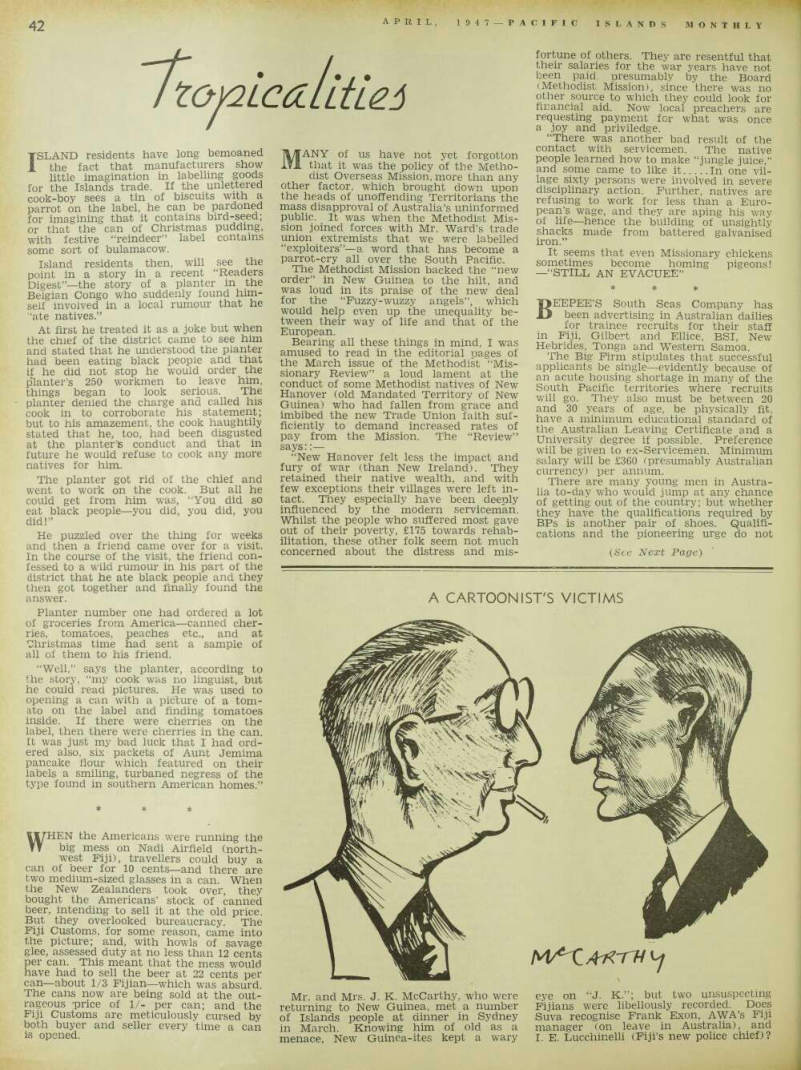
ISLAND residents have long bemoaned the fact that manufacturers show little imagination in labelling goods for the Islands trade. If the unlettered cook-boy sees a tin of biscuits with a parrot on the label, he can be pardoned for imagining that it contains bird-seed; or that the can of Christmas pudding, with festive “reindeer” label contains some sort of bulamacow.
Island residents then, will see the point in a story in a recent “Readers Digest”—the story of a planter in the Belgian Congo who suddenly found him self involved in a local rumour that he “ate natives.”
At first he treated it as a joke but when the chief of the district came to see him and stated that he understood the planter had been eating black people and that if he did not stop he would order the planter’s 250 workmen to leave him, things began to look serious. The planter denied the charge and called his cook in to corroborate his statement; but to his amazement, the cook haughtily stated that he, too, had been disgusted at the planter’s conduct and that in future he would refuse to cook any more natives for him.
The planter got rid of the chief and went to work on the cook. But all he could get from him was, “You did so eat black people—you did, you did, you did!”
He puzzled over the tiling for weeks and then a friend came over for a visit.
In the course of the visit, the friend con fessed to a wild rumour in his part of the district that he ate black people and they then got together and finally found the answer.
Planter number one had ordered a lot of groceries from America—canned cher ries, tomatoes, peaches etc., and at Christmas time had sent a sample of all of them to his friend.
“Well,” says the planter, according to the story, “my cook was no linguist, but he could read pictures. He was used to opening a can with a picture of a tom ato on the label and finding tomatoes inside. If there were cherries on the label, then there were cherries in the can.
It was just my bad luck that I had ord ered also, six packets of Aunt Jemima pancake flour which featured on their labels a smiling, turbaned negress of the type found in southern American homes.” * * * WHEN the Americans were running the big mess on Nadi Airfield (north west Fiji), travellers could buy a can of beer for 10 cents—and there are two medium-sized glasses in a can. When the New Zealanders took over, they bought the Americans’ stock of canned beer, intending to sell it at the old price.
But they overlooked bureaucracy. The Fiji Customs, for some reason, came into the picture; and, with howls of savage glee, assessed duty at no less than 12 cents per can. This meant that the mess would have had to sell the beer at 22 cents per can—about 1/3 Fijian—which was absurd.
The cans now are being sold at the out rageous -price of 1/- per can; and the Fiji Customs are meticulously cursed by both buyer and seller every time a can is opened.
MANY of us have not yet forgotten that it was the policy of the Metho dist Overseas Mission, more than any other factor, which brought down upon the heads of unoffending Territorians the mass disapproval of Australia’s uninformed public. It was when the Methodist Mis sion joined forces with Mr. Ward’s trade union extremists that we were labelled “exploiters”—a word that has become a parrot-cry all over the South Pacific.
The Methodist Mission backed the “new order” in New Guinea to the hilt, and was loud in its praise of the new deal for the “Fuzzy-wuzzy angels”, which would help even up the unequality be tween their way of life and that of the European.
Bearing all these things in mind, I was amused to read in the editorial nages of the March issue of the Methodist “Mis sionary Review” a loud lament at the conduct of some Methodist natives of New Hanover (old Mandated Territory of New Guinea) who had fallen from grace and imbibed the new Trade Union faith suf ficiently to demand increased rates of pay from the Mission. The “Review” says::— “New Hanover felt less the impact and fury of war (than New Ireland). They retained their native wealth, and with few exceptions their villages were left in tact. They especially have been deenly influenced by the modern serviceman.
Whilst the people who suffered most gave out of their poverty, £175 towards rehab ilitation, these other folk seem not much concerned about the distress and mis
fortune of others. They are resentful that their salaries for the war years have not been paid presumably by the Board (Methodist Mission), since there was no other source to which they could look for financial aid. Now local preachers are requesting payment for what was once a joy and priviledge.
“There was another bad result of the contact with servicemen. The native people learned how to make “jungle juice,” and some came to like it In one vil lage sixty persons were involved in severe disciplinary action. Further, natives are refusing to work for less than a Euro pean’s wage, and they are aping his way of life—hence the building of unsightly shacks made from battered galvanised iron.”
It seems that even Missionary chickens sometimes become homing pigeons!
“Still An Evacuee”
BEEPEE’S South Seas Company has been advertising in Australian dailies for trainee recruits for their staff in Fiji, Gilbert and Ellice, BSI, New Hebrides, Tonga and Western Samoa.
The Big Firm stipulates that successful applicants be single—evidently because of an acute housing shortage in many of the South Pacific territories where recruits will go. They also must be between 20 and 30 years of age., be physically fit, have a minimum educational standard of the Australian Leaving Certificate and a University degree if possible. Preference will be given to ex-Servicemen. Minimum salary will be £360 (presumably Australian currency) per annum.
There are many young men in Austra lia to-day who would jump at any chance of getting out of the country; but whether they have the qualifications required by BPs is another pair of shoes. Qualifi cations and the pioneering urge do not
(See Next Page)
necessarily go together as the Australian Department of External Territories has found when trying to encourage young professional men to give up comfortable, well-paid positions in Australia for un comfortable, not-so-well-paid, Empire building jobs in the Provisional Adminis tration of Papua-New Guinea.
Those who are clamouring hardest for jobs in the Islands to-day are the foot loose, square - peg -in - round - hole type whose highest qualification is a desire to do something that is strictly un-suburban. * * * U7HEN other subjects of conversation W fail, they talk in the mess-room at Nadi Air Station, in Fiji, of the night the Yanks handed the station over to the New Zealand Air Force. The time was fixed for midnight on December 19.
Right on midnight, the Chief American removed the Stars and Stripes, substi tuted the NZ ensign, handed the "keys of the main door to the Chief New Zea lander, and led his solemn team of Yank officers out through that door.
Then, the really formal part ended, the Yanks gave a war-howl broke ranks and came in through a side door like an av alanche. During the next four hours the refrigerator took the greatest bashing of its hectic career; and the dawn broke on an endless arrav of empty bottles, and of Yanks and New Zealanders sleeping together in that amitv that had disting uished their relation’s all through the Pacific War. * * * IMPORTING baby chicks from Amal gamated Hatcheries (Graclin Import and Export Co. Pty., Ltd.) of Banks town. NSW, has become almost a major industrv in some South Pacific Territories.
The chicks are sent by air in large per forated cardboard boxes divided into com partments which successfully prevents the chickens falling into a heap and being crushed at one end of the box, should the trip be a bumpy one.
Six months ago New Guinea residents, who have practically to live off the country these days, were yelping with ex citement at the prospect of thus stocking poultry pens. Orders are steadily coming along to the Hatcheries from Madang, Lae, the goldfields area, Rabaul and Port Moresby.
The chicks fly as far as Fiji on Qantas flying-boats and are also landed in New Caledonia. One Noumea importer in a letter to the Hatcheries describes how en thusiastic customers gathered at the dock to receive the first shipment; straining at the leash because the plane was an hour behind schedule.
With mounting excitement they watched the plane land and then, as the importer describes it: “And so they came; all so cute, all alive —not a single one dead!
And asking for food. Everyone was happy and left the Customs shed an hour later with their precious load.”
This co-operation between Qantas Airways and an enterprising Australian firm is an example of almost the only remaining channel of commerce left in the islands to-day. More and cheaper air freighting seems to be the answer to ship ping shortages and wharf strikes, be cause few commodities have the air mail weight of baby chicks.