Puka-Puka
pp. 42-43 · Read in the full issue
Cowboy Number Two
ALONG time ago in a far, cold land, I read a book about an insignificant speck in the Pacific Ocean called Puka-Puka. I had never heard of Puka- Puka before, and there must be a lot of people in the world who have not heard of it yet. This book, with its cameos of the lives and loves of a quaint, primi tive people, fascinated me more than any other South Seas book I had read.
The book was written by an ex-cowboy, ex-various-other-things, named Robert Dean Frisbie. On the first page this man Frisbie stated that ever since child hood he had been possessed by a strong urge to reach the end of things. Now he was sailing northwards towards the equa tor aboard the trading schooner Tiare Taporo —“l have wandered on,” he wrote, “not over the well-travelled sea-tracks dear to the heart o F tourists, but to strange and lonely places dear to my own heart, hidden in the farthermost seas. Such a place, I kne\v, was the atoll of Puka- Puka—and I looked forward eagerly to my arrival there.” He stayed for fifteen years.
IT was with a keen sense of anticipation then that I clung to the swaying rig ging of the schooner Tiare Taporo one blue morning more recently, watching for the magical appearance of the palm tops of Puka-Puka from out of the sea.
It had been a long, hard way to Puka- Puka; it was a dozen years since I first read the book.
On the beach fronting Central Village, we were greeted by most of the 660 inhab'tants. Never before had I beheld such a magnificent collection of strong, white teeth as the Puka-Pukans crow'ded round and beamed upon us. There many small, naked children carrying proudly before them prominent little turn-turns which gave the impression of having swallowed a water-melon whole.
Groups of children followed us every where as we moved around, and all the
old folks wanted to pat us and shake our hards. Puka-Pukan hospitality can be literally overwhelming. Opened drinking nuts were pressed upon us. When one was finished, a ~efil immediately took its place. One felt that it would be bad manners to waste any of the precious liquid, for on this atoll coconuts are truly the staff of life and are strictly rationed for daily use.
This ordeal by coconut water lasted throughout our week’s stay on the island and trying to find a quiet spot away from curious eyes to make way for the next quart remained our most urgent task.
We were thankful for nightfall.
By William S. Bond
Over the years Puka-Puka and its people had seemed more a fable than a reality, and exploring the atoll was like analysing a dream. Here were the three villages spread round the lagoon bay within the projecting arms of the northern islet; Koto —Central Village; Ngake— Windward Village; Yato —Leeward Village Here was the two hundred-yards-long causeway across a bight of the lagoon, making a short-cut from Roto to Yato and forming a community fish pond.
Scattered over the islet are those eerie graveyards with age-blackened, odd shaped fangs of coral rock jutting at all angles from a pack of coral gravel. There are many graves, as there must be on a small islet, where people have lived and reproduced over a long period of time.
Puka-Puka is roughly triangular in shape with an islet at each point and bare reefs between. All the people live on the northern islet, except at copra making time when some of them camp on the other islets. Motu Ko, the south east islet, belongs to Ngake Village; Yato owns Motu Kotaua, the south-westen islet. Roto owns the copra rights of the main islet.
It is a fine sight to watch the copra fleet sailing up from the motus. The long out-rigger canoes, piled with bagged copra, carry square sails of pandanus matting In spite of their general indolence, the Puka-Pukans make a fine job of their canoes. The lower part of the hull is hollowed from a single log in some of the larger canoes two logs are butted — the topsides are built up with two wide planks. The stem and stern are decked for a few feet with carved pieces ending in tapering projections. The whole is sew a together with sennit and so well are the parts fitted that a leak is rarely seen although no caulking is used. Great care is taken of the canoes and we were told that some of them are fifty years old.
They also make a neat job of their houses which are mostly constructed from the trunks, strut-roots and thatching of the pandanus palm. Puka-Puka pandanus mats are eagerly sought by outside buyers and several hundred are usually shipped on the copra schooner.
Generally speaking the once-yearly copra schooner from Rarotonga (750 mil as south-east of Puka-Puka) is the only con tact with the outer world. Between ships life passes very quietly with the dreamy Puka-Pukans. The few big undertakings such as copra-making are worked on a communal system so that the job can bo finished and everybody get back to rest ing again as soon as possible. The women do most of the menial work. The day is given mostly to sleeping. At night the villages come to life for cooking, eating, yarning, love-making. There is a real reason for this topsy-turvy existence, for the climate is extremely enervating.
With the excitement and business con nected with the schooner s visit the com munity naturally comes to life for a few days.
Loading copra at Puka-Puka is a long and tedious process. There is no en trance to the lagoon so the schooner has 10 swing off from a kedge on the leeward
reef. The copra has to be ferried on canoes across the broad shallows, over the reef and out to the ship. The shallows can only be crossed at high tide, which means that only a few hours of each day can be utilised. Landing the shore cargo and loading the copra may take from four days to a week, according to the weather.
We had plenty of time to study the inhabitants and it was interesting to track down the characteristics of Frisbie's stories. These are surely some of the most whimsical people one could meet: The artist had drawn faithfully and we were not disappointed.
The young chief of Yato village—one of those spoilt children of a doting family, frequently found in the islands —resents the activities of the Euronesian Resident- Agent who represents the Cook Islands Administration. «The young chief leads a determined “nuisance campaign”—and calls himself Hitler! He sometimes swaggers through the village with a rusty old pistol swinging from his hip and occasionally, at council meetings, stamps his feet and shouts and raves in true Fuhrer fashion. Most of the time, however, he sits in the shade with his staff playing marbles —the favourite- pas time in Puka-Puka.
The people of Ngake village call them selves “the French” and their leader is “General DeGaulle.” I have no idea why.
They are a peaceful and cheerful crowd, very fond of singing and dancing.
Roto village rises above international politics. This is the “Cowboy Village.”
I did not learn who was the leader of this “outfit,” but presumed it to be Gene Autry.
Built on short stilts on the beach side of Roto “main street,” is the house of Benny the policeman. The front of the village constable’s house is decorated with pictures of Gene Autry, Roy Rogers, Bill Blliot, and other famous cowboy stars, cut from screen magazines. In this street once lived Ropati, The Wicked Cowboy, On festive occasions the young men of Roto wear homemade sombreros with very wide brims and tall crowns decorated with coloured cardboard “sheriffs stars.” Pieces of bright coloured material adorn their necks. Most impressive are the belts with wooden six-shooters and cartridges.
All Central Pacific islanders are great cowboy fans, none more so than the people of remote little Puka-Puka The legends of the bad-man-shooting, guitar-playing. fZ'ZZTf cowb ° ys a re told and retold cinema Vh V i Wh ° h^ V i 8 lsited a .hP ThiVo the larger islands, until pnwtww h.® 0011165 , acutely Rnniti dld s , reat years? boy dwell bere for fteen lon &
THERE was, of course, much enter taining while we were ashore. Each village in turn regaled us with an urnukai (feast), followed by an afternoon of tarekareka or merry-making. The men are the entertainers; they sing and dance, while the women remain in the back ground. This is a man’s paradise, the women doing the dirty work while the men do the playing.
Yato village put on a wrestling demonstration. In spite of their lazy disposition, the Puka-Pukans are thj finest wrestlers in the central Pacific. In fact, there are very few islands to-day where this manly art survives. Wrestling matches are accompanied by appropriate ceremony. The challenger prances round the ring flexing and slapping his muscles, boasting of his prowess.
When an opponent steps into the ring he also goes through the same process.
Then the two come to grips, leaning towards each other with fingers interlocked, ard a lively tussle ensues. In the proper tournaments the wrestlers wear special strong sennit body-belts to provide grips for lifting. At the end of a bout the winner leaps and prances round the ring chanting a song of triumph
which is lustily echoed by his backers.
It was strange to us visitors from the “Isles of Booze,” as our home islands are sometimes called, that the Puka-Pukans do not manufacture and imbibe “bush beer.” Why go to the trouble to make beer and get drunk to go to sleep when you can just go to sleep without the bother?
In return for the hospitality we had received from these simple, good-natured people, I put on two evening entertain ments. Whenever I wander among the out-of-the-way islands I carry my black box of magic apparatus. My fame as a magician had preceded me to Puka-Puka and the demonstrations were successfully awe-inspiring.
But if this were not enough, I was headed for immortality when I stepped forward with my spinning ropes. A cow boy! The applause was terrific as 1 twirled my rope. “Aue!” they cried.
“Just like Ropati!”
The next day as I passed through the villages people called to me from every house. Young girls who had previously
peeped shyly from the shadows would dash out as I passed, make a quick tug at my sleeve, then run back, giggling at their own daring.
Puka-Puka is usually marked Danger Island on the charts, the name given by the early navigators owing to the dangerous reefs, which stretch from the western point of the atoll for a distance of three miles in a line of broken water, and end in Toka Cay.
Fourteen miles SE by E is the isolated Tema reef where the seas break heavily.
BUT there is another reason why this is called Danger Island. On the day of our arrival the Resident Agent gravely warned me never to venture out alone after dark. I thought he was kidding. He assured me he was not.
“You just don’t know these Puka-Puka girls” he said. “I tell you a lone man is not safe on the trail at night. They are likely to ambush a visitor.” I was thereafter careful to take his advice.
The day of departure from this friendly island came all too soon. I gave a last roping exhibition on Roto beach and we were given a farewell umukai and pres ents of decorated mats. Once more the whole population gathered on the beach to wish us goodbye. The great moment of my life came when one old man gravely took my hand and said, “Now we have seen two great men in Puka-Puka— Ropati Cowboy, and Boni Cowboy!”
But I do not think I have stolen Ropati’s crown. Ropati has the supreme title of the Wicked Cowboy. I fear that a cowboy who was afraid to venture on the trail after dark must remain a plain ordinary cow-hand!
TWO months after our return to Raro tonga I received a surprise letter from Puka-Puka, written by one of the Resident Agent’s young sons and posted on a visiting warship. He wrote: “The people are asking all the time—when are you coming back? The day after the schooner left, young and old got busy plaiting sennit ropes and they have been practising roping ever since.”
I shall go back. But I shall have to watch my step! Them thar Puka-Puka wenches may have learned roping and hog-tying!
Mr. J. Sherry, whom New Guinea resi dents will remember as an amateur joc key. is now on the head staff of W. R.
Carpenter & Co. Ltd.
Cowboy Bond.
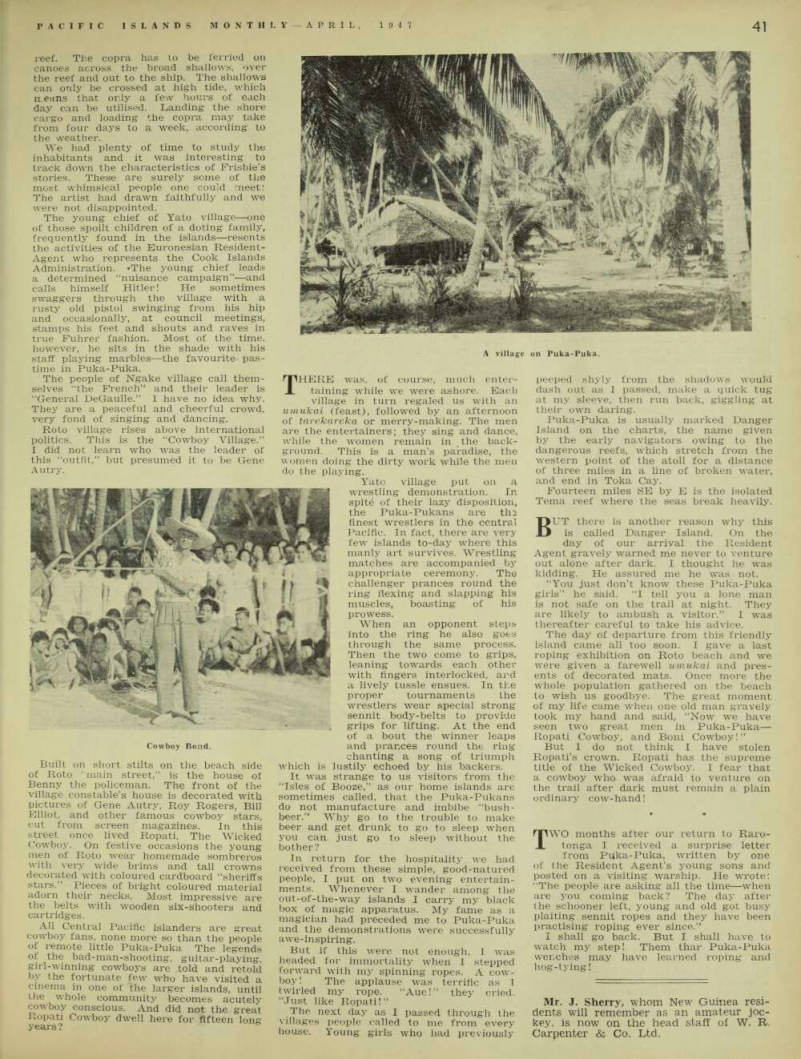
A village on Puka-Puka.