"Lady Alice"
pp. 45-46 · Read in the full issue
They Went to Sea in the "Lady Alice"
By Harold J. Pollock
REMINISCENT of the deep water voyages made by their ancestors in flimsy canoes, was the escapade of four Cook Island boys who stole the Government whale boat from Aitutaki Island last year and after 23 adventurous days at sea landed at Niue Island 600 miles to the westward. Aitutaki is a small island 150 miles north of Rarotonga. The natives whose ages range from 18 to 23 years were prisoners at Aitutaki. They were Tom Hewett, Euronesian, Ruben Adams, Temukura Apera and Ere Kaitai, all Aitutakians.
There is no prison proper at Aitutaki and all the prisoners are on parole; they commence work at 7 a.m. and return to their homes in the evening to sleep. They have to provide their own meals and Ruben Adams suggested to the other three prisoners that they steal the Government boat and sail to Rarotonga where they could finish their sentences and where prisoners are supplied with meals. The “Ladv Alice” as the Government boat is called, is a 30-ft. doubleended open whale boat. She is in poor repair and leaks like the proverbial sieve.
On February 16 Adams and his companions went to the pictures, and afterwards returned to their homes and collected some clothing. They hid the clothing in a shed near the wharf, filled a sack with coconuts, collected three bunches of bananas, and left a four gallon tin under a running tap. They then stole a car battery and two headlamps from the Government building. They also helped themselves to a set of sails on a nearby verandah. These articles were then loaded on the “Lady Alice” and the boys returned for the can of water.
In the meantime someone had removed .he can, so they decided to sail withou*. water and to rely on the milk from the rnr>nniit(! for drinking mirnoses coconuts lor drinking purposes So they set sail for Rarotonga.
At this time the wind was blowing a fresh breeze in their favour but after a few hours it changed and drove them towards Manuae, a small island 50 miles SE of Aitutaki. They then decided to make for Manuae, but after sailing for about 24 hours the wind again changed
and drove them in a north-westerly dir ection towards Penryhn Island. They collected a little rain water in the sails and were able somewhat to quench their thirst.
They sailed towards Penryhn and for two days when the wind again changed and drove them strongly to the west. The Maoris now decided to sail either for Tonga or Samoa. The weather became very bad and later blew at hurricane force. Now all their provisions were con sumed and they had to bale continuously to keep afloat as now huge seas were coming aboard, and in addition the boat was leaking very badly. They began drinking sea water to ease their thirst.
A cup of sea water each day for seven teen days, and contrary to most beliefs, the sea water revived them considerably and it did not affect their mentality in the least.
The boys had a swim round the boat each day to freshen themselves up. and they say this revived them considerably They had given themselves up for lost and prayed for help. They had lost their sail but improvised another from an old blanket using an oar as a mast. A plank was taken from the boat and used as a steering oar. The boys would row until one of them fell exhausted. He would then take his turn at steering.
On Saturday, March 9, land was sighted.
The boys tried to sail towards it but the wind drove them off. At 7 p.m. they again tried to make land, this time by paddling but were too weak to row. The sail was then hoisted and all hands slept until 7 the next morning.
Land could now be seen in the east.
They all paddled hard until 11 p.m. when some canoes came out to meet them.
The occupants of the canoes spoke but the boys could not understand their lang uage nor make themselves understood in Autitaki. They then spoke in English.
A native came aboard and rowed them ashore. They then learned they had landed at Niue Island after having been 23 days at sea. They were interrogated by the police and placed in custody.
After being in custody for one week the
(See Next Page)
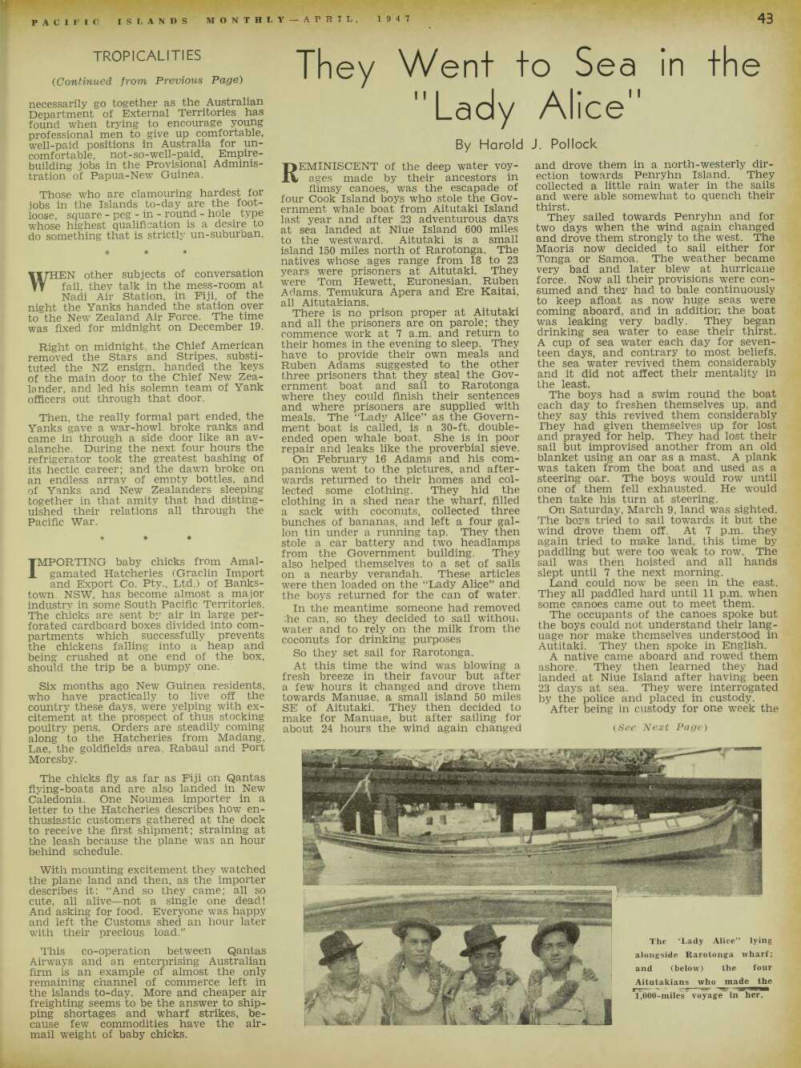
The ‘Lady Alice” lying alongside Rarotonga wharf; and (below) the four Aitutakians who made the
1,000-miles voyage“ in her.
boys were released and feted in true Polynesian style. Although technically prisoners, the Islanders regarded them as heroes and gave feasts in their honour.
They were supplied with new clothes, beautiful woven hats, garlanded with leis and even with money.
The voyage made by these four Ait utakions must rank as one of the most amazing ever made in an open boat with such meagre provisions. The lads had a remarkable escape from a waterv grave as they traversed nearly 1,000 miles of lonely open water in a frail craft that was neither sound nor watertight.
They have remarked that, after serving sentence, they will be quite content to become law abiding citizens and will never again attempt such a foolhardy adventure.
A son was born to Mr. and Mrs. B. G.
Dawson of Melbourne on March 6. Mrs Dawson is the daughter of the late Mr.
P. W. Mantle of Rabaul, New Guinea, and Mrs. Mantle who is now living in Mel bourne, Victoria. Mr. Dawson served with the 2/22nd Battalion AIP, in Rabaul dur ing the war and was one of the few who escaped from New Britain after the Jap anese invasion of the area in early 1942.
“Since Dr. McGusty’s visit, we have had the pleasure of welcoming two young graduates from the Central Medical School of Fiji, Macu Salato and Manzoor Beg-g, who were here studying tuberculosis for twelve months.”—Extract of a letter from the Secretary-General of the National Association for the Prevention of Tuberculosis, London, Dr. J. H, Harley Williams.