Patience On The High Seas
pp. 41-46 · Read in the full issue
Being the Chronicles of a Frustrated Voyager to a Polynesian Outpost
THE cry from Tikehau, “Come over and help us” was in our ears and drum ing on our missionary conscience.
Two men, Irea and his brother-in-law, stood before us telling of the great need of their people. The fishing boat would be waiting at Makatea to take us over the 40 odd miles of ocean to their island, they said if we could tell them when we would come.
We wrote to the Governor, who with the usual charming expressions of French courtesy, granted us the necessary per mission. The police then vised my pass port in case, as a visitor in their care, I might come to harm.
To find a boat to take us to Makatea and Tikehau then became our daily quest.
Now there is nothing in these islands over which one can waste more time and vexation of spirit than boat travelling.
First there is the willingness of the people to assist with unhelpful information, for they love to please and can arrange almost anything one desires —the only drawback is that their good intentions seldom materialise on time. If one ex pressed the wish to travel to Tikehau on the Queen Mary it would not be sur prising to have the assurance, “Sure, we know it is leaving at two o’clock to morrow and the captain is a good man.
He will take an orometua (pastor) for nothing.”
But after a time we begin to distin guish between what is a courteous wish and what is a fact. Then there are the captain and supercargoes—smiling, gen erous Tahitians —who mysteriously never seem to know for sure whether they are going to sail to the Marquesas or the Australs, the Leewards or the Tuamotus.
So day after day we keep asking them until we feel sure they have made up their minds.
And sailing dates —we know now what they mean. Thursday at nine o'clock in the morning means not before Thursday, but any time one week or one month after Thursday. Nine o’clock on Monday usually means six o’clock at night or
'T'HIS amusing story was written 1 by Pastor R. N. Heggie, Super intendent of the Seventh Day Adventist Mission in French Oceania. He is a vouna New Zea lander and went to his headquarters in Tahiti about 18 months ago. His account of the trials attached to visiting a Polynesian outpost , was not written for publication but in support of his urgent request to his headquarters in Sydney to be supplied with a boat.
We can hope that Pastor Heggie gets his boat.
perhaps next morning. Apart from the Government boats and the regular pas senger service to the lies Sous Le Vent (Leewards) I have never known one boat to leave on time. People waste days and days of time and money, but nobody seems to mind except fussy Europeans, business people and, maybe, missionaries.
WELL, we found our boat, a sturdy, two-masted auxiliary schooner. We determined the date; we boarded like a fully equipped expedition (sea chests and all, plus a big supply of bam boo for our friends on Tikehau), and we, Mr. Poroi and I, said goodbye to our wives and prepared to depart.
After watching the loading of the schooner for several hours after the scheduled departure, we were informed that the boat after all would not travel to Makatea, but go in the opposite direc tion, to Raiatea. Another and better boat would travel the next day to Makatea, early in the morning.
So, off with the sea-chest,, the baggage and the bamboo home for another day.
My wife was quite surpised to see me so soon.
Everything was loaded on the old Ford
again next day; down to the Port we went, to board the second boat. Long after the scheduled hour of departure, other passengers began to drift along (they had travelled before).
This schooner had cabin accommoda tion, an unusual circumstance. I asked for a bunk.
“Ah,” they said, “you are the Pasteur; we did not understand. We thought you a Monsieur Donald. The situation in Makatea is too grave, Monsieur le Pasteur. We would not commit ourselves to take you. Your life might be in danger. There is a strike most serious.
All danger will be finished in four days and we expect another boat to go in just four days. Please go then.”
The Governor’s permission, the police visas, and my own assurance that I did not fear overmuch these terrible strikes, were of no avail. This man’s groundless fear for my safety, prevented me from going. All the native passengers went, but the solitary European, with Mr. Poroi, went home a third time.
The boat that was to sail in the next four days sailed to another destination.
A week passed, in which we made fre quent inquiries.
THEN we made arrangements for a boat to sail in about a week. The owner magnanimously said he would take me for nothing. I was tired and more than tired of chasing boats and wasting days in futility. I began to understand why we had never extended our work into the greater part of this group of islands.
So Mr. Poroi kept track of this boat during the next number of days. First it would depart one day, and then the next and finally it was leaving one after noon for certain.
In confidence, we placed our belongings on board. Again, the usual hours of delay. Then the owner came along with profound apologies; the captain of the port had inspected the passenger list and found that the boat was over-carry ing her number of passengers. We, as non-paying passengers, had been placed last on the list, and we would have to get off.
He did tell us, however, that if we could carry another small rowing boat, besides the lifeboat, we would be able to proceed. Mr. Poroi quickly visited some friends, but could not obtain the boat.
So reluctantly we took off our baggage again.
Then I remembered seeing a very small boat under a neighbour’s house. Yes, he was willing to lend his boat and sent it down by truck with some of his men, who stored it safely aboard. Back went our sea-chests, baggage and bamboo.
Along came the owner again.
He had not thought it possible that we could have obtained a boat so soon, so he had crossed our names off the list handed to the police, and it was after five o’clock.
There was nothing else to do but dis embark for the fifth time without ever leaving port.
A few days later we actually left in a little diesel-engined boat for Makatea and had a smooth quick trip. Most of us slept on top of the captain’s cabin (the one and only) or atop the deck cargo.
Then for a week at Makatea we were the guests of a Frenchman and his wife while we waited for Teroro from Tikehau and his boat. Eventually we were forced to hire a small boat to reach our destina tion.
This boat, about the size of a large rowing boat, was fitted with a fore deck and installed with a 1925 model T Ford engine. We had to take two Tahitians with us in order that the boat could be returned. I was the only one who knew a little about engines.
(Continued on page 44)
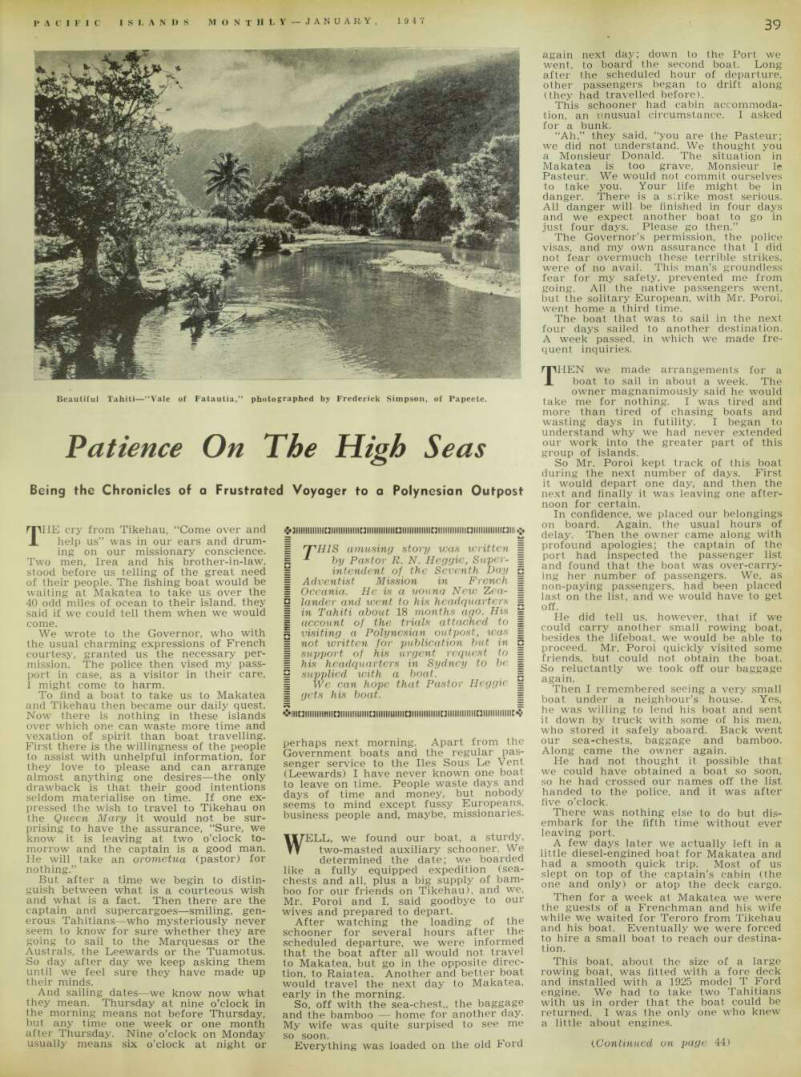
Beautiful Tahiti —“Vale of Fatautia,” photographed by Frederick Simpson, of Papeete.
The younger Tahitian was a likeable young man; but our captain, would not permit anyone to inspect the engine.
W_ , t E left at 7.30 one evening in fair weather for Tikehau. One hour out I noticed the amp-meter did not record any battery charge. The young Tahitian said, “We can’t do anything about it because the captain would have a fit of rage if we try, and it’s imossible to explain to him.”
The battery was new and as there was no particular discharge I thought perhaps the amp-meter didn’t work or if it did the battery wouldn’t discharge itself during the twelve hours of our voyage of 45 miles y s The sea ’ was smooth, though a fair amount of snrav ramp ahnarH at timpc and it for Su?sfienr?antain andl to the enelSe and
by torchlight oiJt thP bille wft?r
a tin and bucket The old mode TTad a bad breath bad he^o e n ar e S ve S rVtt e e d SFSST {? TO Sr spluttere7 buT it clrrW on fatfhfnllv right to the finish At miHnith, fh» compass light failed but th^^Tahitiant sight of a coral atoll. For miles and
¥^Ju e -ZTsVn ns
todiscover that rfkehau is bv ™ means the largest islet of these ground ‘ he Eve a nt g ua S l t ly pass d n ee°D wat l |? o °off The S W ,V± (houses) and UtUe niau 'valm* church which reoresented oifr smafi Adventkt pnm™iinhv reSentod ° Ur Smal Adventist u y ’
W_ .
E were hailed with great acclaim and rejoicing. A brother suddenly returned from the war couldn’t have received a warmer or more spontaneous welcome. They gave us of their best: the biggest and sweetest coconuts, the largest and fattest fish, great heaps of white rice, and big slabs of what is equivalent to Australian damper.
That constitutes the diet of the Paumotus, where vegetables and fruit are almost impossible to grow. This for several weeks was to be our diet, with a little variation from the supplies which we had brought. But always the best was for us. A small but new niau house was vacated for us and these good people would have waited on our slightest desire day or night, if we had allowed them.
Our islet, poised on the reef at the only entrance into Tikehau lagoon, was only a few hundred yards in diameter and raised but a few feet above sea level. The normal rise and fall of the tide is perhaps a foot. Beside the übiquitous coconut, there were about half a dozen other varieties of shrubs and trees, most of which were able to endure their feet in salt water occasionally. Amongst them was the red kowhai, which the Maoris took to New Zealand hundreds of years ago, and the sweet-scented tiare Tahiti.
On the seaward side of the entrance, tempestuous waves had flung dead coral shoreward, forming an embankment eight feet high and continued like the lip of a saucer entirely around the island although away from the entrance it was about eighteen inches only above the dead flat interior.
On Teroro’s beautiful launch we went to the village at the southern end of the lagoon, perhaps eight to ten miles away
i n a straight line to have our nassnorts signed by the district governor the usual friendly, generous : heafted Tahitian.
Again and again I was impressed by the immensity of these lagoons. Like battle cruisers with foaming wakes of spouting sea, the islands on the reef circled till they dipped below the horizon on the east, and then came circling back to me on the west. And all this on the map is a shapeless, unromantic point called Tikehau! nassnorts were signed for mir Hp I I „ Passports were signed tor our de ” £ r a f,,!n!i d t^ ys K ft + r + £ U^ arrival, but as usual the boat that was C0 u ta l n to g°- dldn t a , nd f v ? nt over which we had no control retained us T f ? r almost a ™ nth on Tikehau. 1 have never shot an albatross nor do 1 claim relation ship to the Ancient Mariner : nevertheless my difficulties with the sea were not at an end - After we had been on Tikehau *>r several days one of the hi g hes * tides of the year com “l- SoUth ' eaSt For the sea t 0 the south-east poured over the reef and the level of the lagoon steadily rose. I watched a crab below h sea U leve°l f thC iS ' and W3S alreadY but quite strong for this part of the Pacific, where storms are not severe and bed pre oariously tilting seaward and the P sea itself s P° uting through the sides of the house and frothing over the floor. There were voices outside and, after difficulty, we lit the pressure lamp. The men were rescuing their canoes and big flat bottomed skiff which had been flung up on the embankment and part of the bottom torn out.
That day the water rose no higher, but lapped the top of the embankment; I knew high tide would come again at night.
The people assured us that about once a year the water rises like this, but they were a little concerned lest it should rise any further and go right over the island and destroy their one source of brackish water.
However, the tide gradually receded, to be followed in a few days by about a week of exceptionally low tides in which even the living coral of the lagoon pro truded from the water. In the meantime a strong current, ridged like the living spine of a serpent weaved seaward to the horizon.
When the current was abating the little motor vessel Nicol tried to edge into the entrance but was aught inevitably by the current and sent stern first out to sea.
We were anxious to return to Tahiti and two of the islanders jumped into a canoe and madly raced down the edge of the current to the boat, to beg her to anchor seaward of our atoll, so we could be taken off. However, with parting waves from the crew, the “Nicol” drew away.
Then the Tamarii Maareva hove to off the entrance. For three days, tacking against the wind and now much-abated current, she tried to force the entrance, The fourth day the current dropped to a dead slack and she entered easily, A few days later the good Government motor ship Maoae, a converted Grand Banks schooner, took us off our island.
It was over a month since we had left on a trip which we had expected to last a few days.