Pacific
Islands
Monthly
January 20, 1947 E • • m *
Vol. Xvii. No. 6.
Established 1930
[.BW's£er»3»to^, G.P.O., Sydney\pr\transmission by post as a newspaper]
1/-
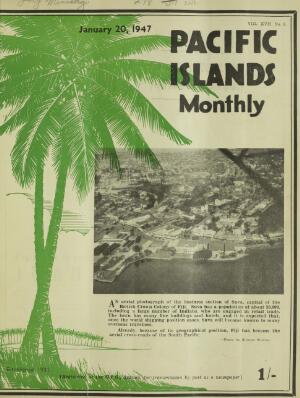
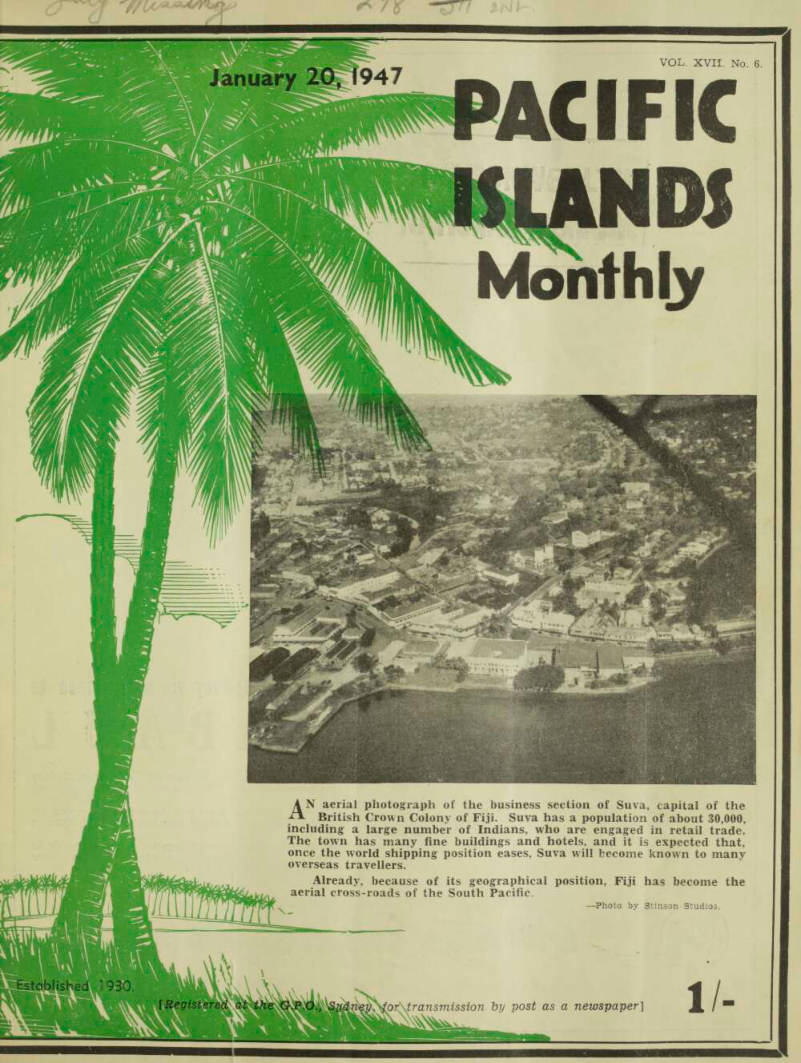
AN aerial photograph of the business section of Suva, capital of the British Crown Colony of Fiji. Suva has a population of about 30,000, including a large number of Indians, who are engaged in retail trade.
The town has many fine buildings and hotels, and it is expected that, once the world shipping position eases, Suva will become known to many overseas travellers.
Already, because of its geographical position, Fiji has become the aerial cross-roads of the South Pacific. —Photo by Stinson Studios.
Advertisements & other items, pp. 2-4 (1 item)
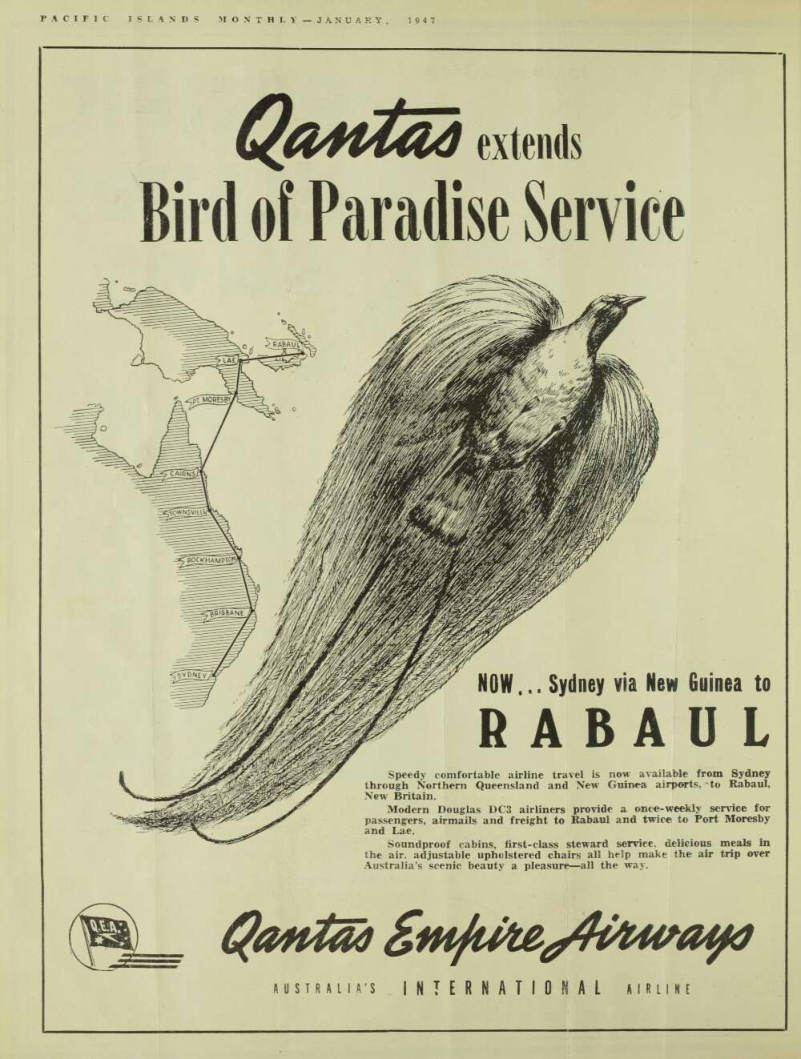
Qantab
extends
Bird of Paradise Service
m
o <> RABAUI
LAE
pTWORESB>
CAiRNS
pOCKHAMPTOH
BRISBANE
SVDNEY
NOW... Sydney via New Guinea to
RAB A U L
Speedy comfortable airline travel is now available from Sydney through Northern Queensland and New Guinea airports, -to Rabaul, New Britain.
Modern Douglas DCS airliners provide a once-weekly service for passengers, airmails and freight to Rabaul and twice to Port Moresby and Lae.
Soundproof cabins, first-class steward service, delicious meals in the air. adjustable upholstered chairs all help make the air trip over Australia's scenic beauty a pleasure—all the way.
Australia’s INTERNATIONAL airline
DAYLIGHT
DARK
The outstanding features in all Coleman’s Lanterns have proved their value by active performance over forty years. ■ \ / Coleman’s Petrol and Kerosene Lamps in 300 and 500 C.P.
' Coleman’s Petrol or Kerosene Lamp with large enamelled reflector.
Coleman’s Kerosene Table Lamp can be used as hanging Lamp Coleman Lanterns are made stronger to last longer:
Pyrex heat-resisting globes
protect the mantles ... pressure-tested brass fonts that will not rust . . builtin automatic tip-cleaning needles . . . shut-off valves to avoid constant repumping each time lantern is
lighted. Safe, Steady Brilli-
ance in or out of doors. u Representatives for the Pacific Islands
ROBERT GILLESPIE PTY. LTD
54a PITT STREET, SYDNEY
PEARCE & CO. LTD.
SUVA
FOR FIJI ISLANDS
"When you ask for the best, Mrs. Sims, I've only one answer" . . . (says the Chemist) ■ V. 3 N m- % % m i m s r > f m m "My definite advice is: Try Ipana. I know you'll be delighted with the results. Ipana won't work miracles, but it
WILL CLEAN YOUR TEETH
and reveal their brilliance."
A tooth paste cannot renew teeth that call for dental attention. The function of Ipana is to freshen your mouth, to clean your teeth so thoroughly that the smooth sparkle it imparts acts as a deterrent to the germs and
IPANA
food particles which cling to dull surfaces.
Use Ipana every night and morning—and after every meal if possible—with a good up-and-down brushing.. That's the way to keep teeth white and strong.
It was revealed by a National Survey that dentists choose Ipana for their personal use 3-to-l over any other dentifrice.
TOOTH PASTE
Sold by all leading distributors and manufactured by BRISTOL-MYERS CO. PTY. DTD., 223 Pacific Highway, North Svdnev. N.S.W., Australia.
Advertisers
Amalgamated Hatcheries ... 63 All - Paste Aluminium ... 19 Angliss & Co. . .45 Amplion (Aust.) Pty., Ltd. ... 51 Aust. Fishing In dustries ... 57 A. G. Andrews Co., Inc 50 Atkins Pty., Ltd., Wm 31 Lewis Berger & Sons 65 Brown & Co., Ltd. 13 Brunton’s Flour . . 73 Burns, Philp Trust Co., Ltd 35 Broomfields ... 3 BP (SSI Co. . . . 13 Bulowat Transport Co 78 Carlton & United Breweries, Ltd. . 33 Carpenter, Ltd., W.
R. . . . . cov. iv.
Chivers, Ltd. ... 71 Church, R. H., & Sons 75 Coleman Lamp & Stove Co. ... 32 Colonial Whole sale Meat Co. . 29 “Cystex” 73 Commonwealth Trading Co., Pty., Ltd 3 Crosse & Blackwell, Ltd 61 Dalmore Preserving 30 Donaghy & Sons . 78 Donald, Ltd., A. B. 24 Paul, A. Dorn . . 61 Dr. Williams Pink Pills 75 Dangar, Gedye & Malloch 53 Dunlop Rubber (A/sia), Ltd. . . 27 Ecco Products . . 76 ElectrolUx Refrigerators . 26 Excelsior Supply Co 55 Ford Sherington Pty., Ltd 23 Garrett & Davidson 80 Gibson & Co., Ltd.,
J. A. D 62
Gillespie Pty., Ltd., Robert ... 1 & 25 R o b t. Gillespie (NGI Ltd. ... 67 Gilbey’s Gin ... 52 Gillespie’s Flour . . 79 Gough & Co., E. J. 21 Grand Pacific Hotel 4 Grove & Sons, W.
H 19 Heinz & Co. Pty., Ltd., H. J. . . .46 Hemingway & Robertson ... 21 Hyde, Victor ... 14 Ingram Shaving Cream 28 Ipana Tooth Paste 2 Kopsen & Co., Ltd. 54
Lockyer, Geo. J. . 56 Merrillees, J. C. & Co. 73 Miscellaneous . 27, 58, 66, 69, 67, 71, 75, 79 “Mum” Deodorant .33 “Mendaco” ... 60 Mcllraths Pty., Ltd. 79 Morgan, F. T., & Co 72 Nelson & Robertson Pty., Ltd 22 Newman, M. ... 64 NSW Bookstall Co.
Pty., Ltd. ... 3 “Nixoderm” ... 64 Newman’s Fruit Mart 20 Pacific Islands Trading Co., 47, 49, 36 Pacific Islands Monthly 76 Pacific Is. Society . 23 “Pinkettes” ... 55 Pitt & Scott, Ltd, . 21 Papuan Electrical Co 49 Proprietary (Products Iff Qantas Empire Air ways ... cov. il.
Queensland Insur ance Co 4 Ransomes, Sims Jefferies ... 71 Robinson, G. H. . 56' Rose’s Eye Lotion, 45. 57 Rohu, Sil 65 Scott, Ltd., J. . .60 Shell Co 15 Southern Pacific Insurance Co. . . 14 Steamships Trading Co., Ltd 36 Stokoe Motors Pty., Ltd i 7 Sullivan & Co., C. 58 Swallow & Ariel . 48 South Sea Islands Club 22 Taylor & Co., A. . 17 “Tenax” Soap . 66 Tillock & Co,, Ltd. 24 Thornycroft (Aust.i Pty., Ltd 69 Tooth & Co., Ltd. ... cov. iii.
Tullochs Pty., Ltd. 16 Tilley’s Lamps . . 18 “ Vitalis ” Hair Tonic ... 68 Vacuum Oil Co.,
Ltd ’59
Watson, Wm. H. . 34 Harry West ... 68 Widdop, H„ & Co., Ltd 72 Wyborn, T. A. ... 78 Willison, A 52 Wills, W. D. & H. 0 77 Wright & Co., Ltd., E 50 Young Pty., Ltd., Harry J. ... 74 Yorkshire Insur ance Co., Ltd. . 13
Advertisements & other items, pp. 5-6 (1 item)
Broomfields Ltd.
Periodicals . . . Trade Journals
American, English and Australian Periodicals and Trade Journals posted direct to you.
The N.S.W. Bookstall Co. Pty., Limited can supply all available overseas and local subscription magazines. Subscription Lists Available Let us know your requirements. on Application.
N.S.W. BOOKSTALL COMPANY PTY., LTD.
Market and Castlereagh Streets, Sydney, AUSTRALIA.
For Service
EXPORTERS - IMPORTERS
Contact
J
COMMONWEALTH TRADING CO. Pty. Ltd.
95 YORK STREET, SYDNEY
Phones: MA 4232, M 6969.
GENERAL MERCHANDISE, TRADE GOODS, CLOTHING, FOOD-
STUFFS, LIQUEURS. SPIRITS, WINES.
BROOMFIELDS Ltd.
Suppliers of
Building Hardware
General Hardware
Ship Chandlery
Paint Materials
WRITE DIRECT TO
Broomfields Ltd.
152 SUSSEX STREET, SYDNEY
Sole Agents for : P. H. MUNTZ & CO.’s 3-CROWN BRAND METAL
SHEATHING.
PEACOCK
BUCHANS’ ENGLISH READY-
MIXED PAINTS.
RETURNED SOLDIERS' DINNER
ABOUT 170 returned servicemen attended the annual dinner of the Returned Sailors’ and Soldiers’ Association of Fiji, held at the Grand Pacific Hotel, Suva, at the end of November.
The president of the Association, Ma jor W. E. Willoughby-Tottenham presided, and the returned men were addressed by Sir Alexander Grantham, who is patron of the Association.
Sir Maynard Hedstrom and Lady Hedstrom are at present residing in New Zealand. They anticipate returning to Fiji in March, when Sir Maynard will formally retire from the managing-directorship of Morris Hedstrom Ltd, and that position will then be assumed by Mr. H. E. Snell. Sir Maynard will retain the chairmanship of the Board.
QUEENSLAND
INSURANCE
COMPANY
LIMITED
• Incorporated 1886 In Australia)
ASSETS EXCEED £4,000,000
Head Office :
QUEENSLAND
INSURANCE BUILDING,
80-82 PITT STREET, SYDNEY.
Specialists in South Seas Fire,
Marine Cr Accident Insurances
Apply to:
FIJI.
Branch Office: I. B. Chalmers, Manager.
Burns Phllp (South Sea) Co., Ltd.
VILA,
Burns Philp (South Sea) Co.. Ltd.
Cbmptoirs Francals Des Nouvelles Hebrides (Marine).
NOUMEA.
L. & W. Johnston.
PORT MORESBY:
Burns, Philp & Co., Ltd.
W. A. Anderson, Resident Officer.
PAGO PAGO.
Burns Philp (South Sea) Co.. Ltd.
G. H. C. Reid & Co.
OTHER SOUTH SEA ISLANDS.
Burns Philp (South Sea) Co., Ltd.
Also to any of the Company’s Offices in Australia or New Zealand.
In This Issue:
Editorial: “Let the World Now Hear the Voice of Polynesia” 5 South Seas Regional Conference—Six Countries Meet in Canberra ... 7 New Post for Resident Commissioner of Gilbert and Ellice 8 Retirement of H. H. Vaskess 8 K. C. McMullen Resigns from New Guinea Service 8 BSI Gold Search Abandoned —Effect of Colonial Law 8 Pacific Gold Industries Threatened — British Policy Could Kill Fiji and New Guinea Enterprises 8 New Year Honours in S. Pacific ... 9 Fifth Anniversary of Fall of Rabaul 9 Transfer of Bishop Baddeley to Eng lish See 10 N. Guinea Natives for Suva Medical School 10 Sydney-San Francisco Air Services Still Unknown Quantity But Qantas Extends to Rabaul 11 Trans-Pacific Ships—New Freighter Service 11 Noumea is to Have a Casino j 2 Last “Tin Can” Mail —Evacuation of Niuafo’ou 12 How Britain Plans to Compensate Jap-Invaded Territories 13 End of “Desikoko” 15 Boom-Time in Western Samoa— Cocoabeans Hit All-Time High— and Still Rising 17 Small Drop in Fiji Copra 19 Henri Sautot Receives Great Wel come in Noumea 20 The Late Gladys Baker. MBE .. .. 22 Alterations in RNZAF Pacific Service 24 Widespread Effect of Work of Dr. D.
W. Hoodless 25 Forgotten Tragedy of 1942 When “Mumutu” was Sunk off Papuan Coast 29
Minister Defends Policy in Torres Islands 30 Graduation of 14 NMP’s at Suva Medical School 31 New Statutory Rules now Cover Aus tralian War Damage 32 500 Bushels of Rice to Acre by New Electro-Chemical Fertilisation .. 33 Anti-Filaria Campaign in Rarotonga 34 Window-Dressing in Port Moresby Charge by Former ANGAU Chief 36 “That Wild Australian”—Jerry Pent land 38 Patience on the High Seas 39 Polynesia Takes to the Air 40 Tropicalities 43 Government Taking Staff From Pri vate Firms in NG 46 State-Owned Ships for S. Pacific .. 46 Copra Tax in Tonga 50 “Stella Maris II” Leaves for New Guinea 50 Friendly Letter to Polynesians From Hawaii 53 How 240 Men Were Saved From Rabaul in 1942 55 New Guinea Scholarship Fund ... 62 Young Penrhyn Islanders go Adven turing on a Stolen Lugger 65 Plane and Shipping Services: Pacific Travellers 66, 68 CDC Sales in Rabaul “Plain Frus tration” 71 Giant Snails Disappear 71 Intense Search for Oil in New Guinea 71 Flourishing School in Western Samoa 76 Commercial Markets, etc 80 Obituary; F/O B. P. Fraser, 19; Mrs. Gladys Baker, 22; J. L. Brennan, 27; F. R.
Dupont: William Broaderlaw; A.
E. Allman, 32; Mr. L. Cox, 36; John Hayes, 50; Carl Adams, 62; Henry Dexter. 72; R. Gale, 79.
Advertisements & other items, p. 6 (1 item)
sTA vrf*»
I %%*aa i • g. As <**' -roun ds . ftC
S A ?* C "
iW »ied w boll r. * e GT tt ies'S"® 4
■** s?e Ce
*» S t *** te "" e I *** '** <r °" e\« l " e t*ce\'** set v^ s ' so v». (ot - . ira»' e<i O b ' e ' 1 ,r 4^’ ■»l* V s
r ese^°°
o^^
Pacific Islands Monthly
The Newspaper-Magazine of the South Seas [Registered at the G.P.0., Sydney, for transmission by post as a newspaper .]
Published Once Each Month and Circulated in Australia and New Zealand and in the following Pacific Territories and Islands Groups:
Australian Territory of Papua.
Mandated Territory (Australia) of New Guinea.
Australian Territory of Norfolk Island.
New Zealand Territory of Cook Islands.
Mandated Territory (NZ) of Western Samoa.
British Colony of Fiji.
British Solomon Islands Protectorate.
British Protectorate of Tongan Islands.
British Crown Colony of Gilbert and Ellice Islands.
Mandated Territory of Nauru
British and Free French Condominium ot Nev Hebrides.
French Colony of New Caledonia.
French Colony of Oceania (Tahiti, etc.).
American Territory of Eastern Samoa.
American Territory of Hawaiian Islands.
Owned and Produced by Pacific Publications Pty. Ltd., Union House, 247 George Street, Sydney.
Telephones; General Office and Advertising, BW 5037.
P.O. Box 3408
Registered Address for Telegrams, Radiograms, and Cables: “Pacpub”, Sydney.
Contributions.
Articles, Stories, and Photographs dealing with Pacific Islands subjects are invited and will be paid for on publication.
Subscription Rates.
Per Annum, within British Empire, Prepaid, Pest Free 10/- Per Annum, elsewhere, Prepaid, Post Free 12/6 Single Copies 1/-
Editor and Publisher:
R. W Robson, P.R.G.S.
General Office: Union House, 247 George Street, Sydney.
Advertising Manager: W. E. Rogers.
Telephone: BW 5037.
Representative In Fiji.
Pacific Publications (Fiji), Ltd., Bank of NSW Building, Suva (same office as W. H. Grove & Sons, Ltd.). Stocks of Pacific Islands Monthly and Pacific Islands Yearbook on hand.
Representative In London.
J. T. Wallis, Coronation House, 4 Lloyds Avenue, London, EC.3, from whom may be obtained copies of Pacific Islands Monthly, Pacific Is. Year Book, advertising schedules, etc.
Representative In U.S.A.
Pacific Islands Trading Co.,
244 CALIFORNIA ST., SAN FRANCISCO, U S.A.
Agents.
The following are authorised to receive sub scriptions for Pacific Islands Monthly:— Burns, Phllp & Co., Ltd., and Burns Phllp (South Sea) Co., Ltd. All branches.
W. R. Carpenter & Co., Ltd. All branches.
Morris, Hedstrom, Ltd. All branches.
Steamships Trading Co., Papua. All branches.
W. M. Caldwell, Suva, Fiji.
Cook Islands Trading Co., Rarotonga, Cook Is.
A. C. Rowland, Papeete, Tahiti.
Islands Branches and Representatives of W H Grove & Sons, Ltd., Auckland, New Zealand.
Ed. Pentecost, Noumea, New Caledonia.
Societe Gubbay Kerr et Cle, Noumea, N. Caledonia T. A. Wyborn, 12a Alpin Street, Cairns.
Vol. XVII. No. 6
January 20, 1947
Prirp 1/ Per c°py met: prepaid: 10/- p.a.
Polynesia!
Let the World now Hear the Voice of Polynesia!
Article
BY
R. W. Robson
Extraordinary things are being done in the world to-day to stimulate national unity and encour age nationalistic thought among races which hitherto have been dominated by Europeans.
We have examples in Asia and Indonesia. Personally, I like neither Indians nor Indonesians, and I am not happy to see even the beginning of their emergence as independent nations. I do not think that they have anything to contribute to the system of life which we call “Western civilisation.” However, one cannot hold back the tides. In another half century, these South Asiatic nations will be established, and nominally independent—although actually they may be all paying tribute to the Muscovite.
But there is one race of people which is entitled, under the Atlantic Charter and subsequent declarations, to national freedom, and which deserves all the best that Europeans can give; but which, because it lacks aggressiveness, is getting no attention from the United Nations, or any similar organisation. I refer to the Polynesians.
THE Polynesians, for 100 years, have lived in close and peaceful association with Europeans. The two races have inter-married freely, and each holds the esteem and respect of the other. The Europeans have helped the Polynesians to an understanding and acceptance of European stand ards of life; the Polynesians have stood loyally beside the Europeans in
all national crises for at least 50 years. I contend that, if there is any sincerity in these recent declarations regarding the rights of all peoples to self-expression and self-government, the Polynesians are entitled, at least, to recognition as one people.
At present, the Polynesians are scattered and divided, in this way:— Western Samoa, 45,000—a “Mandated Territory,” controlled by New Zealand.
Eastern Samoa, 10,000—a Territory administered by the Navy Department of the United States.
Tonga, 26,000 —a nominally independent Kingdom, supervised by the British Colonial Office.
Maoris of New Zealand, 70,000 —part of the Dominion of New Zealand.
Cook Islands, 14,000 —a Territory adminis tered by New Zealand.
Ellice Islands, 4,500 —part of the Gilbert and Ellice Colony, administered by Britain.
French Oceania 43,000 —a Territory of France.
Hawaii, 50,000 —a Territory of the United States.
In those archipelagoes there are nearly 250,000 people who are either pure Polynesian, or are Euronesians (European-Polynesian) grouped as Polynesians.
To that quarter million might pro perly be added 120,000 people who live in Fiji, 30,000 in the Gilberts, and some 50,000 in the Marshall, Caroline and Mariana Islands —some 200,000 altogether. They officially are classed as Micronesians, but they probably have stronger affinities with the Poly nesians than with any other race.
That certainly is true of the Fijians and Gilbertese (150,000 altogether).
Is there anything fantastic in the suggestion that we Europeans who are so busily creating unwanted and undesirable nations in Southern Asia, should do what we can to bring some sort of national unity to 250,000 Poly nesians, and to 200,000 Micronesians, who are first cousins of the Poly nesians?
THERE are unsurmountable obstacles in the way of a political Federa tion. The United States would no more think of handing over Hawaii (total population nearly 500,000) for the sake of the 50,000 Polynesians and part-Polynesians there, than would the New Zealanders (total population 1,750,000) hand over their rich country to the 70,000 Maoris who live there.
France would not surrender beautiful Oceania to her Polynesians, nor would Britain give up valuable Fiji to the indigenous Fjians.
A long time ago, before the Euro peans became established in the Eastern Pacific, it might have been possible to visualise a United States of Polynesia—Samoa, Tonga, Raro tonga, the Ellice, Maoriland, Tahiti and Hawaii, perhaps, all together in one Federation: but that possibility is long gone. The only Polynesian Territories which now are sufficiently free from immigrant races to join together in one nation are Eastern and Western Samoa, Tonga, the Cook Group, and the Ellice Islands. There are not enough of them for the advantages of national independence to outweigh the manifest economic and financial disadvantages of sever ing present associations.
The idea of a united nation of
Polynesia is very attractive, in some ways; but it may be put aside as politically and economically imprac ticable.
BUT there is no reason why there should not exist, under the shelter of the several European nations which are interested in the Pacific Territories, a cultural Federa tion of Polynesia—an organisation which would recognise the Polynesian and Micronesian races as distinctive and desirable, which would help to preserve the fine character and traditions of those races, and which would assist the Polynesians and Micronesians to achieve complete equality with the white man, in gov ernment and in all the arts of peace.
It would not be wise to encourage the Polynesian to envisage a future completely independent of the Euro peans in the South and Eastern Pacific. For the Polynesian, as well as for the European, all prospects in the Pacific are darkened by the menace of Asia.
If the Asiatics swarm across the Islands—and what is to hold them back, in the end?—there can be no more future for the Polynesian com munities in the Pacific than there will be for the Europeans. The Japanese administration of the Mar shall and Caroline Islands, and the Jap invasion of the South Seas in 1942-43, taught us that. Polynesia’s only hope of survival lies in a close, and closer, association with the Europeans—with whom, after all, the Polynesians are racially and culturally akin. We may not forget that there is an average of 14 per cent. Cau casian in the racial make-up of the Polynesian.
Consideration of the Asiatic menace does nothing to release the Europeans —and especially the Anglo-Saxons— from their obligation to keep Poly nesia alive, racially, culturally and nationally. On the contrary, we should undertake the task gladly, in the knowledge that it will help us to maintain our hold on the South Pacific Territories, when the crisis comes— as come it will.
THERE is a community which, in this connection, demands the thought and best efforts of both Europeans and Polynesians. This consists of the Euronesians—the off spring of European and Polynesian unions. Of all the race-mixtures which may be found in the world, this is one of the best.
For the most part, Euronesians are physically attractive and mentally alert. In all the South Pacific Terri tories, they have won their way into full citizenship and social recognition on their own good qualities, and they are bound to take a leading in the future development of both Poly nesia and Micronesia. They rightly are proud of their Polynesian blood; and that pride should be encouraged.
THIS is a matter that, in due course, will receive the attention of the South Pacific Regional Commission—
about to be planned in Council in Canberra, and eventually to be a part of the new world order.
The movement towards a cultural Federation of Polynesia could be assisted at this stage by the Poly nesians themselves. Why should not leading Samoans, Tongans, Fijians, Maoris, Tahitians, Rarotongans or Hawaiians say something in regard to it?
It is time that the world heard the voice of Polynesia.
Finance Regulations For
Travellers From Fiji
Suva, Dec. 23.
THERE is nbw no restriction on travellers, from Fiji to New Zealand or Australia direct, from taking treasury notes of any currency and any amount out of the Colony.
If the traveller goes to or via a non sterling area, however, he is not per mitted to take currency exceeding £2O stg., and foreign currency exceeding £lO in value.
Pty. Ltd.
Oil Exploration In Papua
Australasian Petroleum Company Pty. Ltd.
TO provide funds to carry out its ex tensive geological, geophysical and drilling programme in Papua during 1947, Australasian Petroleum Company Pty., Ltd., has received the consent of the Commonwealth Treasurer to issue 470,000 new ordinary £1 shares.
These new shares have been offered to the Shareholding Companies, namely, Vacuum Oil Company Pty., Ltd., Darcv Exploration Co. Ltd., and Nominated Holdings Pty., Ltd., the wholly owned sub sidiary of Oil Search Ltd.
Mr. J, D. Bryan of USA has arrived in Australia and is making preliminary preparations for a geophysical survey in Papua. The lastest types of gravity meter and magnetometer are being brought from America and will be used in this work.
Drilling of the bore at Kariava, Papua, has reached a depth of 5,546 feet.
The editor of the “Pacific Islands Monthly,” Mr. R. W. Robson, is making a brief visit to New Zealand and Fiji.
He will be in New Zealand during the last week in January, and in Suva in the early part of February. He will re turn to Sydney by air about February 20.
Advertisements & other items, p. 8 (1 item)
'J
/ V % /5 The new Liquor Ordinance of Fiji has been tactfully shelved for a whole. It aroused too much controversy. One school of thought insisted that the Fijian people should be allowed the same privileges and freedom in relation to the use of liquor, as the Europeans and Indians. Another group argued that the indigenous race should be “protected” against the demon of drink.
Chorus of Church, Provincial Councils and Government: "So tabu— do not touch it! It is poison to your race."
The Fijian; "Well, you fellows seem to have survived it. all right."
South Pacific Regional
Conference
Six Countries Meet in Canberra to Establish Advisory Commission
THE South Pacific Regional Con ference, convened by Australia and New Zealand in terms of the “Anzac Pact,” signed in 1944, will be opened in Canberra on January 28, and is expected to extend over 10 days.
The names of all delegates are not yet available, but it is known that the follow ing will be represented:
Australia
(Holding Territory of Papua, Mandated Territory of New Guinea. Norfolk Island, and with Britain and NZ Mandated Territory of Nauru.) Minister for External Affairs (Dr.
Evatt); Minister for External Territories (Mr.
Ward) ; High officials, including the Adminis trator of Papua-New Guinea, Colonel J.
K. Murray.
New Zealand
(Holding the Mandated Territory of Western Samoa, the Territory of Cook Islands and Niue, and—with Britain and Australia the Mandated Territory of Nauru.) Represented by one Senior Minister, and officials.
Great Britain
(Holding the Crown Colony of Fiji, the Gilbert and Ellice Islands Colony, the Protectorate of the Solomon Islands, Pitcairn Island and with France the Condominium of the New Hebrides, and —with Australia and New Zealand the Mandated Territory of Nauru.) Represented by one Minister and High officials.
Sir Alexander Grantham (Governor of Fiji and High Commissioner for the Western Pacific) and Captain A. R. W.
Robertson (Colonial Treasurer, Fiji) are due in Sydney about January 26, to join the British delegation. It is not known whether the Kingdom of Tonga will be represented by Sir Alexander Grantham, or will be left out because it is not “a non-self-governing territory” it gov erns itself.
United States
(Holding the Territory of Eastern Samoa.) Represented by a delegation of seven, headed by Mr. Robert Butler (US Am bassador in Australia).
France
(Holding the Colony of New Caledonia, the Establishments of French Oceania, and with Britain the New Hebrides.) Represented by the French Minister in Australia and high officials from Paris, and the Governor of French Oceania.
Holland
(Holding the Netherlands East Indies which includes Dutch New Guinea and Western Timor.) Baron van Aerssen, Netherlands Minister to Australia.
The position is obscure in relation to the Indonesians who (according to an agreement that has not yet been ratified, though it has just been accepted by the Netherlands Parliament) are “partners” with Holland in the East Indies. The Australian Minister Dr. Evatt. announced that the area under consideration was the Pacific Territories south of the equator, “including Dutch New Guinea.”
But practically all of the East Indies lies south of the equator.
THE chief purpose of the conference will be the establishment of a Regional Advisory Commission for the non-self-governing territories of the South Pacific.
The Commission will advise all member Governments on matters affect ing native welfare and the economic development of the South Pacific Islands, based on a co-ordination of the ideas and plans of those with first-hand know ledge and experience of the various groups.
The Commission will have no admin istrative authority whatever —it will be merely an advisory body. It will not deal with any matter affecting defence or security, and it will not interfere in poli tical affairs.
There will be no direct relationship between the Commission and the United Nations; but it is expected that the in direct relationship will be important.
The Commission should serve to co-or dinate the policies of Britain, United States, Australia, New Zealand, France and Holland, in relation to the non-self governing territories of the South Pacific, so that those members of the United Nations may be in agreement in pre senting their ideas and proposals to the United Nations and especially to the Truteeship Council.
THERE is no indication, yet, of where it is proposed to place the head quarters of the Commission. Aus traila, as convenor, will probably try to keep the Commission in Canberra.
That would be a grave error. The Com mission, which has great possibilities of usefulness, could be affected in Australia by Australian politics, and by Southwest Pacific considerations, which are wholly Melanesian.
Culturally, and politically, the most important section of the South Pacific is Polynesia. But it would be an error, also, to establish the Commission in Polynesia.
Suva, being in Micronesia, is not only clear of both Melanesia and Polynesia*— it also is so situated that it is, geograph ically, economically and politically, the natural centre of the South Pacific. It would be the ideal home for the new co ordinating body.
F. J. Mackenzie Leaves
New Guinea
TERRITORIANS have learned with regret that Mr. F. J. MacKenzie, who was manager of the Common wealth Bank in Rabaul when the Japs invaded, and who returned to take charge 9f the Bank's branches in the Territories in 1946, has been transferred to the managership of the Broadway (Sydney) branch.
Mr. MacKenzie was not merely a bank manager he took a keen, skilled and helpful interest in Territorial affairs alnd, before the war, he was held in high esteem in Rabaul. Carrying the Bank’s precious records with him. he narrowly escaped capture in Rabaul when the Japs came in. Between 1942 and 1946 he
helped the Australian Government, in many ways, in handling the Territories complex financial problems; and he was appointed Finance Member of the Pro duction Control Board a post he held until the restoration of the Common wealth Bank’s Port Moresby branch.
Resident Commissioner
New Post for G. and E.
Resident Commissioner H. E. Maude Takes Over G. and E. Colony
THE present Resident Commissioner of the Gilbert and Ellice Islands Colony, Mr. V. Fox-Strangways, will shortly be transferred to Palestine as Under-Secretary to the Government.
Mr. Fox-Strangways received his G & E appointment in 1941 but, before he could reach his new post, war came to the Pacific and the Colony was
occupied by the enemy. He then joined the RAAF and trained in Australia. How ever, when the Americans made their historic landing on Tarawa atoll late in November, 1943, he accompanied them in the role for which he had come to the Pacific; and, three days after the initial landing of the Marines, at the invitation of the Americans, he raised the Union Jack beside the Stars and Stripes on Betio Islet an incident that has been referred to several times in this journal.
When Mr. Fox-Strangways goes to his unenviable new post in Palestine, his place in the Gilbert and Ellice Islands Colony will be taken by Mr. H. E. Maude.
Mr. Maude is at present acting RC.
Mr. Maude who is only 40 years old joined the Colonial Service in 1929, as a cadet with the Western Pacific High Commission, and has since held a wide variety of important posts in WPHC territories and Fiji. In 1936, he repre sented the G & E Colony at the Honolulu Education Conference. He was trans ferred to Zanzibar in 1936, but returned to the G & E Colony in 1937. He super vised the Phoenix Island Settlement, and he organised the new administration in Pitcairn. He has an expert knowledge of Gilbertese. Mr. Maude is regarded as one of the most able officials in WPHC.
V. Fox-Strangways, shortly after he landed on Betio, in November, 1943. He is examining the fox-hole where he spent the first night.
H. H. Vaskess
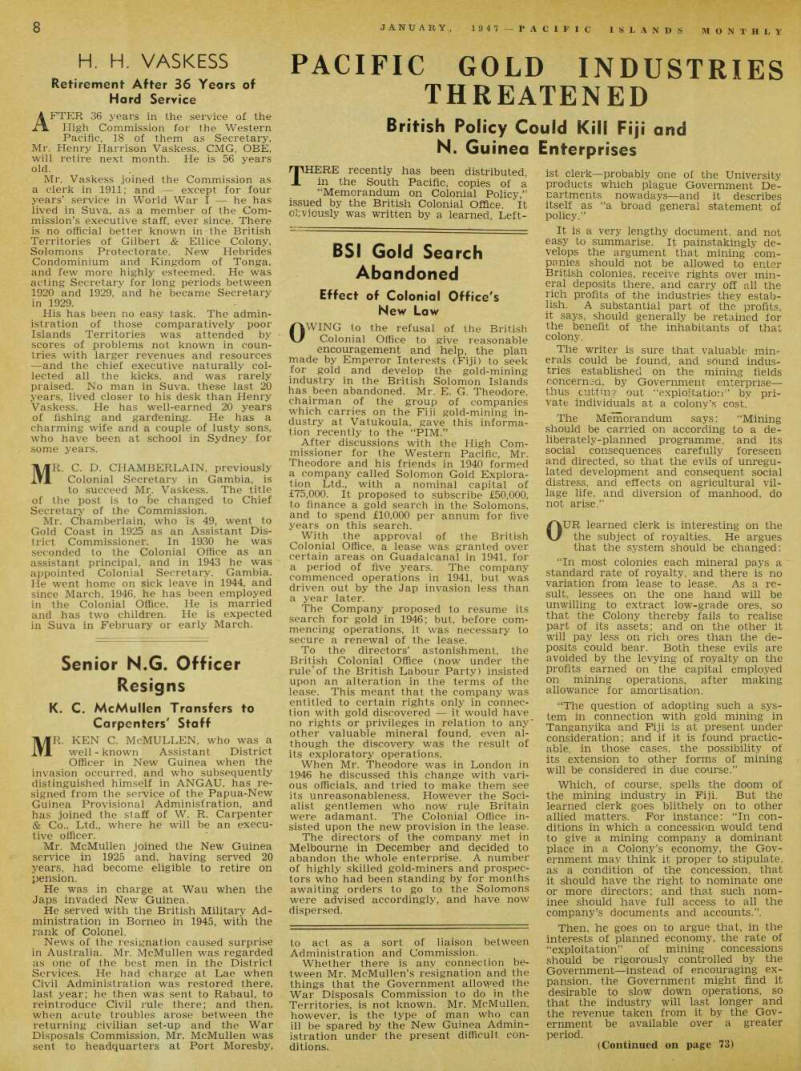
Retirement After 36 Years of Hard Service
AFTER 36 years in the service of the High Commission for the Western Pacific, 18 of them as Secretary, Mr. Henry Harrison Vaskess, CMG, OBE, will retire next month. He is 56 years old.
Mr. Vaskess joined the Commission as a clerk in 1911; and except for four years’ service in World War I he has lived in Suva, as a member of the Com mission’s executive staff, ever since. There is no official better known in the British Territories of Gilbert & Ellice Colony, Solomons Protectorate. New Hebrides Condominium and Kingdom of Tonga, and few more highly esteemed. He was acting Secretary for long periods between 1920 and 1929, and he became Secretary in 1929.
His has been no easy task. The admin istration of those comparatively poor Islands Territories was attended by scores of problems not known in coun tries with larger revenues and resources —and the chief executive naturally col lected all the kicks, and was rarely praised. No man in Suva, these last 20 years, lived closer to his desk than Henry Vaskess. He has well-earned 20 years of fishing and gard'ening. He has a charming wife and a couple of lusty sons, who have been at school in Sydney for some years.
MR. C. D. CHAMBERLAIN, previously Colonial Secretary in Gambia, is to succeed Mr. Vaskess. The title of the post is to he changed to Chief Secretary of the Commission.
Mr. Chamberlain, who is 49, went to Gold Coast in 1925 as an Assistant Dis trict Commissioner. In 1930 he was seconded to the Colonial Office as an assistant principal, and in 1943 he was appointed Colonial Secretary. Gambia.
He went home on sick leave in 1944, and since March, 1946, he has been employed in the Colonial Office. He is married and has two children. He is expected in Suva in February or early March.
Resigns
Senior N.G. Officer Resigns K. C. McMullen Transfers to Carpenters' Staff
MR. KEN C. McMULLEN, who was a well - known Assistant District Officer in New Guinea when the invasion occurred, and who subsequently distinguished himself in ANGAU, has re signed from the service of the Papua-New Guinea Provisional Administration, and has joined the staff of W. R. Carpenter & Co., Ltd., where he will be an execu tive officer.
Mr. McMullen joined the New Guinea service in 1925 and, having served 20 years, had become eligible to retire on pension.
He was in charge at Wau when the Japs invaded New Guinea.
He served with the British Military Ad ministration in Borneo in 1945, with the rank of Colonel.
News of the resignation caused surprise in Australia. Mr. McMullen was regarded as one of the best men in the District Services. He had charge at Lae when Civil Administration was restored there, last year; he then was sent to Rabaul, to reintroduce Civil rule there: and then, when acute troubles arose between the returning civilian set-up and the War Disposals Commission, Mr. McMullen was sent to headquarters at Port Moresby,
to act as a sort of liaison between Administration and Commission.
Whether there is any connection be tween Mr. McMullen’s resignation and the things that the Government allowed the War Disposals Commission to do in the Territories, is not known. Mr. McMullen, however, is the type of man who can ill be spared by the New Guinea Admin istration under the present difficult con ditions.
Threatened
Pacific Gold Industries
British Policy Could Kill Fiji and N. Guinea Enterprises
THERE recently has been distributed, in the South Pacific, copies of a ‘Memorandum on Colpnial Policy,” issued by the British Colonial Office. It obviously was written by a learned, Left-
ist clerk —probably one of the University products which plague Government De partments nowadays—and it describes itself as “a broad general statement of policy.”
It is a very lengthy document, and not easy to summarise. It painstakingly de velops the argument that mining com panies should not be allowed to enter British colonies, receive rights over min eral deposits there, and carry off all the rich profits of the industries they estab lish. A substantial part of the profits, it says, should generally be retained for the benefit of the inhabitants of that colony.
The writer is sure that valuable min erals could be found, and sound indus tries established on the mining fields concerned, by Government enterprise— thus cutting out “exploitation” by pri vate individuals at a colony’s cost.
The Memorandum says: “Mining should be carried on according to a de liberately-planned programme, and its social consequences carefully foreseen and directed, so that the evils of unregu lated development and consequent social distress, and effects on agricultural vil lage life, and diversion of manhood, do not arise.”
OUR learned clerk is interesting on the the subject of royalties. He argues that the system should be changed: “In most colonies each mineral pays a standard rate of royalty, and there is no variation from lease to lease. As a re sult, lessees on the one hand will be unwilling to extract low-grade ores, so that the Colony thereby fails to realise part of its assets; and on the other it will pay less on rich ores than the de posits could bear. Both these evils are avoided by the levying of royalty on the profits earned on the capital employed on mining operations, after making allowance for amortisation.
“The question of adopting such a sys tem in connection with gold mining in Tanganyika and Fiji is at present under consideration; and if it is found practic able, in those cases, the possibility of its extension to other forms of mining will be considered in due course.”
Which, of course, spells the doom of the mining industry in Fiji. But the learned clerk goes blithely on to other allied matters. For instance: “In con ditions in which a concession would tend to give a mining company a dominant place in a Colony’s economy, the Gov ernment may think it proper to stipulate, as a condition of the concession, that it should have the right to nominate one or more directors; and that such nom inee should have full access to all the company’s documents and accounts.”.
Then, he goes on to argue that, in the interests of planned economy, the rate of “exploitation” of mining concessions should be rigorously controlled by the Government —instead of encouraging ex pansion, the Government might find it desirable to slow down operations, so that the industry will last longer and the revenue taken from it by the Gov ernment be available over a greater
period.
(Continued on page 73)
AS the Memorandum probably is now in the hands of the Australian Gov ernment, and may influence its New Guinea policy, the following paragraphs relating to “the financial proceeds of mining” are interesting: “Broadly speaking, a Colony’s share of the proceeds of mining is comprised in the proportion of the working costs ex pended within its boundaries, in taxation and in royalties. Of these three sources the first is, from the narrow point of view of government finance, an indirect and the other two are direct sources of revenue, “From the point of view of the Colony as a whole, however, all three are sources of profit, and as the first is usually the largest it .should be a matter of particu lar care to the Government. In other words, it is in the interests of the com munity to ensure that the total proceeds are as large as possible even if, on occa sion, it is necessary to sacrifice part of the proceeds of direct taxation to achieve this end.
“So far as working costs are concerned, they will be importantly influenced by the extent of the Government’s inter vention in regard to such matters as rates of wages and the provision of medi cal services and other amenities by the employers. The object of the Gov ernment in intervening in such matters is, however, to secure proper conditions for the labour force, not to inflate work ing costs. The latter is incidental to, not the purpose of their intervention.
“Obviously, an undue inflation of working costs either by unreasonable de mands by a Government or by extrava gant expenditure by a management may have such an unfavourable effect on the industry as to reduce the net benefit to the community instead of increasing it.
“As regards taxation, this usually takes the form of export duties and income tax or other taxes on profits. The general aim here should be to establish a system of taxation of sufficient flexibility to meet the changing fortunes of mining.
“Freedom of action in this respect is particularly desirable in cases where mines operate under long leases. In such cases, the Government should, where the rate of royalty in the lease is unreason ably low, secure an adequate return by the levying of an export duty in addi tion to the royalty. In new leases, how ever, the situation would be met by in cluding provision for a review of the rate of royalty at comparatively short intervals.”
THE Memorandum represents such a completely unreal approach to a subject of much importance to most countries that it is difficult to make any detailed comment upon it.
If the establishment of mining indus tries by private enterprise—what our policy writer calls “exploitation”—meant that a man or a corporation with ade quate funds simply went ta a selected spot and proceeded, in an organised and orderly manner, with the recovery and sale of valuable metals, then the Mem orandum might represent an admirable enunciation of policy.
But mining—and especially gold min ing—is nothing like that. It is usually an adventure and a mad gamble, in which men risk all they have, including their lives. They take those risks be cause, if they “strike it lucky,” they become rich and independent. Behind nearly every mining industry now suc cessfully operating in South Pacific coun tries to-day—including Australia and
New Zealand —there is a tragic history of risk, and struggle and loss. For every gold mine brought to the payable stage there are scores of mining enterprises in which men risked their all, and lost.
Take, for example, the now rich gold fields of New Guinea and Fiji. There would have been no gold industry in New Guinea if the thing had depended on Government enterprise. Edie Creek was found because men, lured on by thought of rich reward, gambled their lives against the jungle, diseases and savages of an indescribably difficult terrain.
There would have been no Bulolo if Cecil Levien and his Adelaide friends had not been prepared to gamble every thing they had on their faith in aero planes and dredges—a gamble derided by all the wise and clever men of that day.
There would have been no Emperor and Loloma mines in Fiji to-day if Pat Costello had not gambled on Prospector Borthwick, and if E. G. Theodore had not put his faith and his money into the development of an ore that most mining experts had rejected. Where a few mines prospered in New Guinea and Fiji, hun dreds of enterprises were wrecked, and incalculable sums were staked, and lost.
Would these things have been done by Government enterprise?
None of those mining industries would have been developed and established if the Governments concerned had placed restrictions upon the explorers and pros pectors, and tried to “control” the com panies which developed their finds.
THE Administrations which controlled these Pacific Territories before the Red Planners got into power were far too wise to try to put a halter on min ing enterprises. Instead, they encour aged and helped them in every possible way. They knew those industries could be developed only if men were given the utmost freedom to gamble; and, when the gamble succeeded, thev were happy that their Territories should get their share of the prize, in the shape of in creased trade, increased revenue in a dozen indirect directions, and some direct taxation.
But, always, the direct taxation of min ing enterprises was something under taken with great caution—because min ing men, at the slightest suggestion that bureaucracy was trying to get a direct
share of their all-too-rare prizes, would “curl up” and withdraw their enterprises.
The brilliant young planners of the New Order have no such wisdom or cau tion. Not only are they going to kill the geese which lay the golden eggs—they most definitely are going to discourage the entry of other geese to their Terri tories.
WE have had some illuminating events in Fiji. The Mount Kasi mine has closed down. There is a lot of country under lease to Mount Kasi that seems just rich enough to be worth ex ploration; but, as the ore probably would be low value, Mount Kasi will not ex plore, with a view to continuing the in dustry, unless it can get certain guar antees from the Government regarding future taxation.
A well-known Canadian gold-seeking enterprise, after careful inquiry, decided not to proceed with exploratory work in Fiji, because of the uncertain outlook regarding taxation.
The directors of the soundly-estab lished Emperor and Loloma mines have had endless troubles because of the frantic eagerness of the Government of Australia (where most of the shares are held) to tax their profits. The directors have preferred to pay the Fiji scale of taxation on their profits, and distribute no dividends, keeping their funds in Fiji rather than distribute the profits and allow the merciless Australian tax-gath erer to get a huge share of them. That was a sound and wise procedure—but, now that a new policy is being forced on Fiji by the Leftist planners of Whitehall, another situation is developing. If the policy outlined there is to shape taxation in Fiji in future, the Vatakoula mining industry will certainly be restricted and probably will close up.
Already, the Emperor-Loloma interests have withdrawn from the Solomons —and the Guadalcanal gold will remain in the ground, instead of becoming the basis of an industry that could enrich that Cin derella Territory.
Mining men, whether in Fiji or New Guinea or Timbuctoo, will not tolerate the interference of stupid and unrealist bureaucrats. There is every possibility that Fiji’s gold industry, the production of which, at £1,000,000 per annum, was running sugar a close second n 1939, will have been driven entirfily out of the Colony by 1949.
FIJI provides the New Guinea gold in dustry with the red flag of warning.
What is happening in Fiji to-day, under London’s Socialistic direction, almost certainly will happen in New Guinea to-morrow, under direct instruc tions from Canberra.
The New Guinea gold companies, be fore committing themselves to heavy ex penditure in the restoration of their in dustry should—if it is not too late— obtain definite guarantees from Canberra regarding future taxation.
The Colonial Office Memo on Mining Policy, in thought and phraseology, could easily have been written bv Mr. Conlon, that clever young Sydney University medical student who, with the rank of Colonel and the status of Director of the Army Research Council, had so large a share in drafting the new Territories policy for Mr. Eddie Ward.
The “PIM” interviewed Mr. E. G. Theo dore, head of the Fiji gold companies, and asked him what he thought of the Mining Policy Memo. He obviously was not happy about it, but he would say little. What he did say, however, was to the point.
On the statement that “mining should be carried on according to a deliberately planned programme,” Mr. Theodore said:
•‘This is impracticable in undeveloped Territories, like the Solomons, where there are no Government organisations capable of planning for mining—or in Fiji, where there is only the nucleus of a Government Mines Office. Expert planning in Fiji depends upon the ex pert staff of the mining companies.
They have planned a programme of ex ploration, prospecting and deep drilling, which will take four years to complete, and will be carried out by geologists and mining engineers at a cost of not less than £100,000.”
Concerning the Memo’s insistence that the profits of the mine industry should be used to provide amenities (education, health, sanitation, housing, etc.) for the populace: “All these factors are carefully attended to already by the mining com panies operating at Vatakoula, in Fiji— and, indeed, on the initiative of the com panies themselves, and not at the insti gation of the Government. The Govern ment has never gone out of its way to give one word of praise of what has been done.”
On the dictum that “an exclusive license to work all minerals should not be granted—a mining lease should gen erally cover one mineral only, or min erals found in association”: “This can be absurd. If a lease is granted for the working of a silver lead lode (lead group) will a lease be granted to some other company to work, say, copper on the same area? Mount Isa Mines, working a silver lead-zinc lode on its leases discov ered a rich copper lode at 700 feet.”
Concerning the Memo generally: “This Memo is written, I should think, mostly with a view .to backward colonies and territories; but it has been sent to all Colonies, including Fiji, without any qualifying statement to the effect that most of the policy outlined—at any rate, the practicable parts of such policy— are known to be already in force in Colonies such as Fiji. But perhaps the Colonial Office does not know this!”
Mr. James Crawford, formerly on the staff of the Bank of New Zealand, Suva, was a passenger on the ‘‘Wanganella” which passed through Suva, Fiji, in December. He was returning from a trip to England and Ireland and is now on transfer to one of the New Zealand branches.
It was announced in London in Decem ber, that the post of Chief Representative of the British Council in the West Indies had been abolished as from September, 1946. The position was created early in the war period and it was held by Sir Harry Luke, KCMG, who was Governor of Fiji from 1938 until 1942. It is pre sumed that the Council is being super seded by the agreement between United States, Great Britain, France and Hol land, which establishes the Caribbean Commission, the Caribbean Research Council and the West Indian Conference,
Abandoned
BSI Gold Search Abandoned Effect of Colonial Office's New Law
OWING to the refusal of the British Colonial Office to give reasonable encouragement and help, the plan made by Emperor Interests (Fiji) to seek for gold and develop the gold-mining industry in the British Solomon Islands has been abandoned. Mr. E. G. Theodore, chairman of the group of companies which carries on the Fiji gold-mining in dustry at Vatukoula, gave this informa tion recently to the “PIM.”
After discussions with the High Com missioner for the Western Pacific, Mr.
Theodore and his friends in 1940 formed a company called Solomon Gold Explora tion Ltd., with a nominal capital of £75,000. It proposed to subscribe £50,000, to finance a gold search in the Solomons, and to spend £lO,OOO per annum for five years on this search.
With the approval of the British Colonial Office, a lease was granted over certain areas on Guadalcanal in 1941, for a period of five years. The company commenced operations in 1941, but was driven out by the Jap invasion less than a year later.
The Company proposed to resume its search for gold in 1946; but, before com mencing operations, it was necessary to secure a renewal of the lease.
To the directors’ astonishment, the British Colonial Office (now under the rule'of the British Labour Party) insisted upon an alteration in the terms of the lease. This meant that the company was entitled to certain rights only in connec tion with gold discovered it would have no rights or privileges in relation to any other valuable mineral found, even al though the discovery was the result of its exploratory operations.
When Mr. Theodore was in London in 1946 he discussed this change with vari ous officials, and tried to make them see its unreasonableness. However the Soci alist gentlemen who now rule Britain were adamant. The Colonial Office in sisted upon the new provision in the lease.
The directors of the company met in Melbourne in December and decided to abandon the whole enterprise. A number of highly skilled gold-miners and prospec tors who had been standing by for months awaiting orders to go to the Solomons were advised accordingly, and have now dispersed.
Knighted
New Year Honours
In South Pacific
H. H. Ragg of Fiji Knighted
HONOURS, conferred by the King in the New Year. 1947, included the following from the British South Pacific territories:
Knight Bachelor: Mr. H. H. Ragg
of Fiji.
Companion Of The Order Of
St. Michael And St. George: Mr.
R. N. Caldwell, of Fiji.
Officer (Honorary) Of The
Order Of The British Empire:
Ata, Premier of Tonga.
Member Of The Order Of The
BRITISH EMPIRE: Dr. A. S. Frater. of the New Hebrides.
H. H. Ragg
SIR HUGH RAGG was born in Fiji 64 years ago, and has spent all his life in the Colony, where he has achieved great commercial success. The honour given him is well-deserved recognition of in numerable public services extending over many years, which he has given to the Colony. He is one of the best-known and active elected members of the Legisla tive Council.
Sir Hugh was educated at the Marist Brothers School, and then settled down to merchandising. He was for seven years with the old firm of A. M. Brodziak .fe Co.; manager for Brown and Joske at Lautoka; he founded, in Ba, the firm of H. H. Ragg & Co. which was later sold out to Morris Hedstrom Ltd.; and then he became interested in the hotel busi ness. To-day, he is managing director of Northern Hotels Ltd., which owns a string of Fijian hotels—one at Lautoka. one at Ba, one at Tavua, and a new one at Rakiraki (Penang); and there is a re port that still another new one will ap pear soon at the now important airport of Nadi, near Lautoka.
Sir Hugh Ragg was twice married. Lady Ragg, who is a member of a Sydney family, is well known through the help she has given her husband in his suc cessful public life snd esteemed for her own personal qualities.
Mr. R. N, Caldwell
MR. R. N. CALDWELL CMC has been in the service of the Government of Fiji since 1906. He is at present District Commissioner Western, and a member of the Colony’s Executive Council. Mr. Caldwell served in World War I, with the New Zealand Expedition ary Force and the Imperial Army and won the Military Cross. It was Mr. Cald well who, with Ratu Sir Lala Sukuna. suggested, in 1942, the possibility of training Fijians as guerillas to harass the Japanese in case of invasion. From this suggestion came the formation of the Fiji Commando units who later served with distinction in the Solomons.
Dr. A. S. Frater
DR. A. S. Frater, MBE, has been serving as a medical missionary with the Presbyterian Mission in the New Hebrides. He has been Medical Super intendent of the Paton Memorial Hospital, at Vila, since 1935. Besides his notable humanitarian service to both the native and European populations of the New Hebrides, he has served as Medical Ad visor to the British Resident Commis sioner and has been British Port Health Officer, Vila, Condominium Government
Medical Officer and Medical Officer in the New Hebrides Defence Force.
Dr. Frater is to succeed Dr. D. W.
Hoodless as Principal of the Central Medical School, Suva.
Ata
ATA, OBE, is a Tongan noble of high rank. He has been a Minister of the Government of Tonga for many years and has been Premier since the death of Prince Tugi, in 1941. During the war years he established a fine record of devoted service to the Allied cause.
The Colonial Suger Refining Company recently donated £750 towards the cost of Child Welfare services in the Colony of Fiji. Similar donations have been made annually for the past 15 years.
Monsieur Yves Le Trent, a French civil servant from Indo-China, has been ap pointed an inspector of labour attached to the administration in New Caledonia and the New Hebrides.
The French are establishing an institute for scientific research in the Pacific to be known as the Institut Francais d’Oceanie. Noumea will be the head quarters.
Fifth Anniversary
Of Fall Of Rabaul
Sydney Ceremony at Martin Place
ON January 23, 1947, five years will have passed since Rabaul fell to the Japanese. Of the many who were in the town on that grim morning, only a few survived and live to-day.
Some perished in the jungles of New Britain, trying to escape; many were murdered by the Japanese; many more were lost when the ill-fated “Montevideo Maru” was taking them, as prisoners of war, to Japan.
Since January 23, 1942, much has happened. After the long years spent driving back our yellow enemy, came peace and the re-occupation of Rabaul by our own troops. Rabaul now has had many months of restored civil adminis tration, and the uneasy, dragging process of rehabilitation; even yet the fate of the town is undecided —or at least unknown by the general public.
But the men who died on the morning of January 23, 1942, fighting a desperate battle on Blanche Bay beaches against overwhelming odds, or perished subse quently as a result of our loss then to the enemy, are stil.l missed and are not forgotten.
To commemorate Rabaul’s most tragic day, and to pay tribute to the men who paid with their lives as a result of it, the Sydney representative of the New Guinea Branch of the RSSAILA, is ar ranging a simple ceremony at the Cenotaph in Martin Place. Sydney, on January 23, 1947, at 8.15 a.m. This com memorative ceremony of placing wreaths on the Cenotaph has been observed since 1943, and all Territorians in Sydney on that date are invited to be present.
Members of the New Guinea Women’s Club and other Territorians are asked to attend this Anniversarv ceremony as they have attended previous ones.
Sir A. Grantham In S. Pacific
Territories
mHE Governor of Fiji and High Com- J missioner for the Western Pacific.
Sir Alexander Grantham, left Suva by air for the Gilbert and Ellice Islands Colony on December 15. He spent a week in the G & E and returned to Suva before Christmas. Captain A. R. W. Robertson was the Governor’s Deputy, in his absence.
Sir Alexander, with Lady Grantham, expects to visit the British Solomon Islands between January 7 and 11.
Sir Alexander, accompanied by Captain A. R. W. Robertson, Fiji Treasurer, will attend the South Pacific Regional Con ference, to begin in Canberra on January 28.
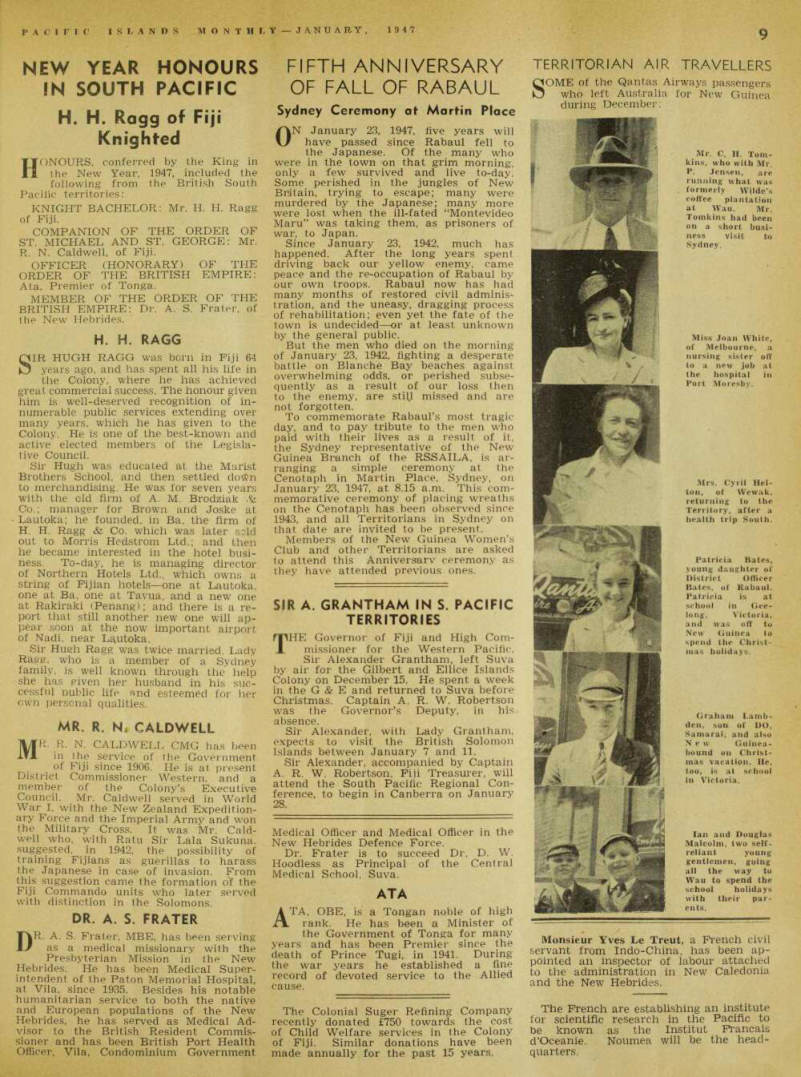
Territorian Air Travellers
SOME of the Qantas Airways passengers who left Australia for New Guinea during December:
Mr. C. H. Tom kins, who with Mr.
P. Jensen, are running what was formerly Wilde’s coffee plantation at Wau. Mr.
Tomkins had been on a short busi ness visit to Sydney.
Miss Joan White, of Melbourne, a nursing sister off to a new job at the hospital in Port Moresby.
Mrs. Cyril Hel ton, of Wewak, returning to the Territory, after a health trip South.
Patricia Bates, young daughter of District Officer Bates, of Rabaul.
Patricia is at school in Gee long, Victoria, and was off to New Guinea to spend the Christ mas holidays.
Graham Lamb den, son of DO, Samarai, and also New Guinea bound on Christ mas vacation. He, too, is at school in Victoria.
Ian and Douglas Malcolm, two self reliant young gentlemen, going all the way to Wau to spend the school holidays with their par ents.
Bishop Baddeley
Transfer to English See After 15 Years' Hard Service
THE Bishop of Melanesia, Rt. Rev. W.
H. Baddeley, who has been in charge of the mission activities of the An glican Church in the British Solomon Islands and the New Hebrides since 1932, has accepted the Bishopric of Whitby, in England, and soon will depart from the South Pacific.
This news will be received by all classes with deep regret. Bishop Baddeley is one of the most highly respected mission ary leaders in this part of the world— not only because of his achievements in the Pacific Islands, but also because of his charming personal qualities, which
have endeared him to Europeans and natives alike. However, he has had 15 years of intensely hard work in a trying climate—the last few under the almost unendurable conditions created by the Jap invasion—and he is entitled to what ever advantages may lie in a transfer to England.
This Bishop has had an unusual career.
He was born in Sussex 53 years ago, and he had just graduated M.A. of Oxford when World War I broke out, and he joined the Army in 1914 as a combatant.
When the fighting ended in 1918 he was only 24 years old, but he was Lieutenant- Colonel Baddeley, D. 5.0., M.C. and Bar, four times mentioned in despatches. He was ordained in 1921, served in England for three years as a curate and eight years as a vicar, and then was selected
to be Bishop of Melanesia, which at that time urgently needed the services of an outstanding man. How he discharged that trust, and how he refused to leave his Islands people when the Japs came— he dodged the enemy around the moun tains and jungles—“the Bishop who lived like a rat” was his own picturesque des cription—are matters of history.
Bishop Baddeley took a keen interest in administrative affairs, and was an active member of the Solomon Islands Advisory Council.
In 1935, the Bishop married Miss Mary Katherine Thomas, daughter of the well known Bishop of Adelaide, Dr. A. Nutter Thomas.
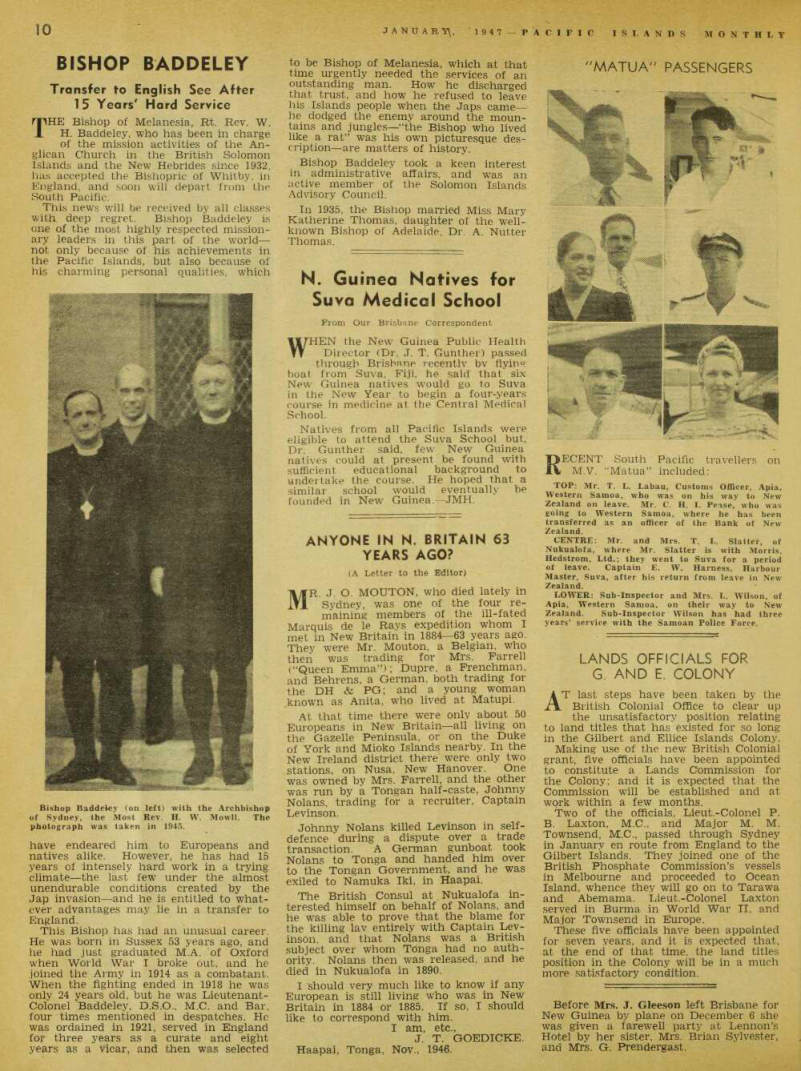
Bishop Baddeley (on left) with the Archbishop of Sydney, the Most Rev. H. W. Mowll. The photograph was taken in 1945.
Suva Medical School
N. Guinea Natives for Suva Medical School
Prom Our Brisbane Correspondent WHEN the New Guinea Public Health Director (Dr. J. T. Gunther) passed through Brisbane recentlv bv flyinq boat from Suva, Fiji, he said that six New Guinea natives would go to Suva in the New Year to begin a four-years course in medicine at the Central Medical School.
Natives from all Pacific Islands were eligible to attend the Suva School but, Dr. Gunther said, few New Guinea natives could at present be found with sufficient educational background to undertake the course. He hoped that a similar school would eventually be founded in New Guinea.—JMH.
Anyone In N. Britain 63
Years Ago?
(A Letter to the Editor) MR. J. O. MOUTON, who died lately in Sydney, was one of the four re maining members of the ill-fated Marquis de le Rays expedition whom I met in New Britain in 1884—63 years ago.
They were Mr. Mouton, a Belgian, who then was trading for Ml’s. Farrell (“Queen Emma’’); Dupre, a Frenchman, and Behrens, a German, both trading for the DH & PG; and a young woman known as Anita, who lived at Matupi.
At that time there were only about 50 Europeans in New Britain —all living on the Gazelle Peninsula, or on the Duke of York and Mioko Islands nearby. In the New Ireland district there were only two stations, on Nusa, New Hanover. One was owned by Mrs. Farrell, and the other was run by a Tongan half-caste, Johnny Nolans, trading for a recruiter, Captain Levinson.
Johnny Nolans killed Levinson in self defence during a dispute over a trade transaction. A German gunboat took Nolans to Tonga and handed him over to the Tongan Government, and he was exiled to Narnuka Iki, in Haapai.
The British Consul at Nukualofa in terested himself on behalf of Nolans, and he was able to prove that the blame for the killing lav entirely with Captain Lev inson, and that Nolans was a British subject over whom Tonga had no auth ority. Nolans then was released, and he died in Nukualofa in 1890.
I should very much like to know if any European is still living who was in New Britain in 1884 or 1885. If so, I should like to correspond with him.
I am, etc.,
J. T. Goedicke.
Haapai, Tonga. Nov., 1946.
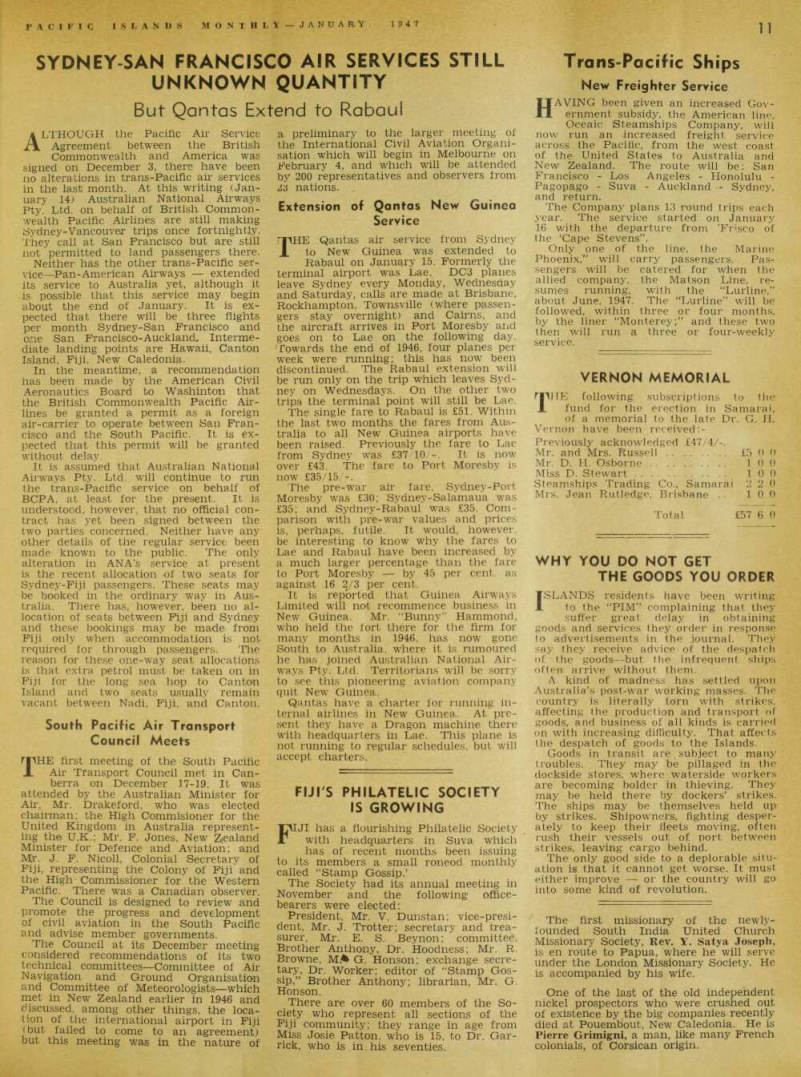
"Matua" Passengers
RECENT South Pacific travellers on M.V. “Matua” included: TOP: Mr. T. L. Labau, Customs Officer, Apia.
Western Samoa, who was on his way to New Zealand on leave. Mr. C. H. I. Pease, who was going to Western Samoa, where he has been transferred as an officer of the Bank of New Zealand.
CENTRE: Mr. and Mrs. T. L. Slatter, of Nukualofa, where Mr. Slatter is with Morris.
Hedstrom, Ltd.; they went to Suva for a period of leave. Captain E. W. Harness, Harbour Master, Suva, after his return from leave in New Zealand.
LOWER: Sub-Inspector and Mrs. L. Wilson, of Apia, Western Samoa, on their way to New Zealand. Sub-Inspector Wilson has had three years’ service with the Samoan Police Force.
Lands Officials For
G. And E. Colony
AT last steps have been taken by the British Colonial Office to clear up the unsatisfactory position relating to land titles that has existed for so long in the Gilbert and Ellice Islands Colony.
Making use of the new British Colonial grant, five officials have been appointed to constitute a Lands Commission for the Colony: and it is expected that the Commission will be established and at work within a few months.
Two of the officials, Lieut.-Colonel P.
B. Laxton, M.C., and Major M. M.
Townsend, M.C., passed through Sydney in January en route from England to the Gilbert Islands. They joined one of the British Phosphate Commission’s vessels in Melbourne and proceeded to Ocean Island, whence they will go on to Tarawa and Abemama. Lieut.-Colonel Laxton served in Burma in World War 11, and Major Townsend in Europe.
These five officials have been appointed for seven years, and it is expected that, at the end of that time, the land titles position in the Colony will be in a much more satisfactory condition.
Before Mrs. J. Gleeson left Brisbane for New Guinea by plane on December 6 she was given a farewell party at Lennon’s Hotel by her sister, Mrs. Brian Sylvester, and Mrs. G. Prendergast.
Unknown Quantity
Sydney-San Francisco Air Services Still
But Qantas Extend to Rabaul
ALTHOUGH the Pacific Air Service Agreement between the British Commonwealth and America was signed on December 3, there have been no alterations in trans-Pacific air services in the last month. At this writing (Jan uary 14) Australian National Airways Pty. Ltd. on behalf of British Common wealth Pacific Airlines are still making Sydney-Vancouver trips once fortnightly.
They call at San Francisco but are still not permitted to land passengers there.
Neither has the other trans-Pacific ser vice—Pan-American Airways extended its service to Australia yet, although it is possible that this service may begin about the end of January. It is ex pected that there will be three flights per month Sydney-San Francisco and oae San Francisco-Auckland. Interme diate landing points are Hawaii, Canton Island. Fiji, New Caledonia.
In the meantime, a recommendation has been made by the American Civil Aeronautics Board bo Washinton that the British Commonwealth Pacific Air lines be granted a permit as a foreign air-carrier to operate between San Fran cisco and the South Pacific. It Is ex pected that this permit will be granted without delay.
It is assumed that Australian National Airways Pty. Ltd. will continue to run the trans-Pacific service on behalf of BCPA, at least for the present. It is understood, however, that no official con tract has yet been signed between the two parties concerned. Neither have any other details of the regular service been made known to the public. The only alteration in ANA’s service at present is the recent allocation -of two seats for Sydney-Fiji passengers. These seats may be booked in the ordinary way in Aus tralia. There has, however, been no al location of seats between Fiji and Sydney and these bookings may be made from Fiji only when accommodation is not required for through passengers. The reason for these one-way seat allocations is that extra petrol must be taken on in Fiji for the long sea hop to Canton Island and two seats usually remain vacant between Nadi, Fiji, and Canton.
South Pacific Air Transport
Council Meets
rpHE first meeting of the South Pacific A Air Transport Council met in Can berra on December 17-19. It was attended by the Australian Minister for Air, Mr. Drakeford, who was elected chairman: the High Commisioner for the United Kingdom in Australia represent ing the U.K.; Mr. F. Jones, New Zealand Minister for Defence and Aviation; and Mr. J. F. Nicoll, Colonial Secretary of Fiji, representing the Colony of Fiji and the High Commissioner for the Western Pacific. There was a Canadian observer.
The Council is designed to review and promote the progress and development of civil aviation in the South Pacific and advise member governments.
The Council at its December meeting considered recommendations of its two technical committees—Committee of Air Navigation and Ground Organisation and Committee of Meteorologists—which met in New Zealand earlier in 1946 and discussed, among other things, the loca tion of the international airport in Fiji (but failed to come to an agreement) but this meeting was in the nature of
a preliminary to the larger meeting of the International Civil Aviation Organi sation which will begin in Melbourne on February 4, and which will be attended by 200 representatives and observers from 23 nations.
Extension of Qontos New Guinea
Service
nnHE Qantas air service from Sydney A to New Guinea was extended to Rabaul on January 15. Formerly the terminal airport was Lae. DC3 planes leave Sydney every Monday, Wednesday and Saturday, calls are made at Brisbane.
Rockhampton, Townsville (where passen gers stay overnight) and Cairns, and the aircraft arrives in Port Moresby and goes on to Lae on the following day.
Towards the end of 1946, four planes per week were running; this has now been discontinued. The Rabaul extension will be run only on the trip which leaves Syd ney on Wednesdays. On the other two trips the terminal point will still be Lae.
The single fare to Rabaul is £5l. Within the last two months the fares from Aus tralia to all New Guinea airports have been raised. Previously the fare to Lac from Sydney was £37 10 -. It is now over £43. The fare to Port Moresby is now £35/15, -.
The pre-war air fare. Sydney-Port Moresby was £3O; Sydney-Salamaua was £35; and Sydney-Rabaul was £35. Com parison with pre-war values and prices is, perhaps, futile. It would, however, be interesting to know why the fares to Lae and Rabaul have been increased by a much larger percentage than the fare to Port Moresby by 45 per cent, as against 16 2/3 per cent.
It is reported that Guinea Airways Limited will not recommence business in New Guinea. Mr. ‘‘Bunny’' Hammond, who held the fort there for the firm for many months in 1946. has now gone South to Australia, where it is rumoured he has joined Australian National Air ways Pty. Ltd. will be sorry to see this pioneering aviation company quit New Guinea.
Qantas have a charter for running in ternal airlines in New Guinea. At pre sent they have a Dragon machine there with headquarters in Lae. This plane is not running to regular schedules, but will accept charters.
Fiji's Philatelic Society
Is Growing
FIJI has a flourishing Philatelic Society with headquarters in Suva which has of recent months been issuing to its members a small roneod monthly called ‘‘Stamp Gossip.' The Society had its annual meeting in November and the following office bearers were elected: President. Mr. V. Dunstan; vice-presi dent, Mr. J. Trotter; secretary and trea surer. Mr. E. S. Beynon; committed, Brother Anthony, Dr. Hoodness; Mr. R.
Browne, M„* G, Honson; exchange secre tary, Dr. Worker: editor of “Stamp Gos sip,” Brother Anthony; librarian, Mr. G.
Honson.
There are over 60 members of the So ciety who represent all sections of the Fiji community; they range in age from Miss Josie Patton, who is 15, to Dr. Gar rick, who is in his seventies.
Trans-Pacific Ships
New Freighter Service
HAVING been given an increased Gov ernment subsidy, the American line, Oceaic Steamships Company, will now run an increased freight service across the Pacific, from the west coast of the United States to Australia and New Zealand. The route will be: San Francisco - Los Angeles - Honolulu - Pagopago - Suva - Auckland - Sydney, and return.
The Company plans 13 round trips each year. The service started on January 16 with the departure from ’Fr ; sco of the ‘Cape Stevens”.
Only one of the line, the Marine Phoenix,” will carry passengers. Pas sengers will be catered for when the allied company, the Matson Line, re sumes running, with the “Lurline,” about June, 1947. The “Lurline” will be followed, within three or four months, by the liner “Monterey;” and these two then will run a three or four-weekly service.
Vernon Memorial
rpilE following subscriptions to the A fund for the erection in Samarai, of a memorial to the late Dr. G. 11.
Vernon have been received :- Previously acknowledged £47/4/-, Mr. and Mrs. Russell 15 0 d Mr. D. H. Osborne 10 0 Miss D. Stewart 10 0 Steamships Trading Co., Samarai 2 2 0 Mrs. Jean Rutledge, Brisbane . 10 0 Total £57 6 0
Why You Do Not Get
The Goods You Order
ISLANDS residents have been writing to the “PIM” complaining that they suffer great delay in obtaining goods and services they order in response to advertisements in the journal. They say they receive advice of the despatch of the goods—but the infrequent ships often arrive without them.
A kind of madness has settled upon Australia's post-war working masses. The country is literally torn with strikes, affecting the production and transport of goods, and business of all kinds is carried on with increasing difficulty. That affects the despatch of goods to the Islands.
Goods in transit are subject to many t roubles. They may be pillaged in the dockside stores, where waterside workers are becoming bolder in thieving. They may be held there by dockers’ strikes.
The ships may be themselves held up by strikes. Shipowners, fighting desper ately to keep their fleets moving, often rush their vessels out of port between strikes, leaving cargo behind.
The only good side to a deplorable situ ation is that it cannot get worse. It must either improve or the country will go into some kind of revolution.
The first missionary of the newly founded South India United Church Missionary Society, Rev. Y. Satya Joseph, is en route to Papua, where he will serve under the London Missionary Society. He is accompanied by his wife.
One of the last of the old independent nickel prospectors who were crushed out of existence by the big companies recently died at Pouembout, New Caledonia. He is Pierre Grimigni, a man, like many French colonials, of Corsican origin.
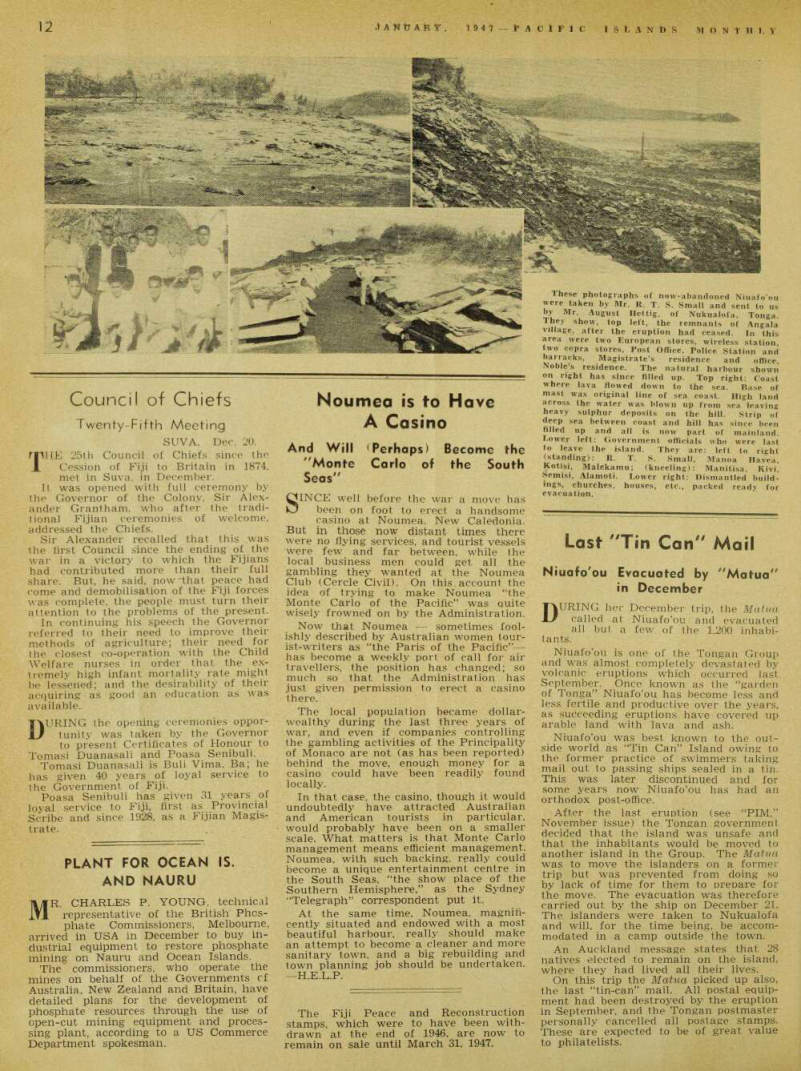
These photographs of now-abandoned Niuafo’ou were taken by Mr. R. T. S. Small and sent to us by Mr. August Hettig, of Nukualofa, Tonga.
They show, top left, the remnants of Angala village, after the eruption had ceased. In this area were two European stores, wireless station, two copra stores. Post Office, Police Station and barracks, Magistrate’s residence and office, Noble’s residence. The natural harbour shown on right has since filled up. Top right: Coast where lava flowed down to the sea. Base of mast was original line of sea coast. High land across the water was blown up from sea leaving heavy sulphur deposits on the hill. Strip of deep sea between coast and hill has since been filled up and all is now part of mainland.
Lower left: Government officials who were last to leave the island. They are: left to right (standing); R. T. S. Small, Manna Havea, Kotisi, Malekamu; (kneeling): Manitisa, Kivi, Semisi, Alamoti. Lower right: Dismantled build ings, churches, houses, etc., packed ready for evacuation.
Advertisements & other items, p. 13 (1 item)
11
PACIFIC ISLANDS M ON T H L Y JANUARY. 1947
Council of Chiefs
Twenty-Fifth Meeting
rnifE 25th Council of Chiefs since the I Cession of Fiji to Britain in 1874. met in Suva, in December.
It was opened with full ceremony by the Governor of the Colony, Sir Alexander Grantham, who after the traditional Fijian ceremonies of welcome, addressed the Chiefs.
Sir Alexander recalled that this was the first Council since the ending of the war in a victory to which the Fijians had contributed more than their full share. But, he said, now "that peace had come and demobilisation of the Fiji forces was complete, the people must turn their attention to the problems of the present.
In continuing his speech the Governoi referred to their need to improve methods of agriculture, their , the closest co-operation with the C Welfare nurses in order that the extremely high infant mortahty ate might be lessened, and the desirability of acquiring as good an education as was available.
DURING the opening ceremonies opportunity was taken by the Governor to present Certificates of Honour to Tomasi Duanasali and Poasa Senibuli.
Tomasi Duanasali is Buli Vima, Ba; he has given 40 years of loyal service to the Government of Fiji.
Poasa Senibuli has given 31 years of loyal service to Fiji, first as Provincial Scribe and since 1928, as a Fijian Magistrate.
Plant For Ocean Is.
And Nauru
MR. CHARLES P. YOUNG, technical representative of the British Phos phate Commissioners, Melbourne, arrived in USA in December to buy in dustrial equipment to restore phosphate mining on Nauru and Ocean Islands.
The commissioners, who operate the mines on behalf of the Governments cf Australia. New Zealand and Britain, have detailed plans for the development of phosphate resources through the use of open-cut mining equipment and proces sing plant, according to a US Commerce
Department spokesman.
A Casino
Noumea is to Have
And Will (Perhaps) Become the "Monte Carlo of the South Seas"
SINCE well before the war a move has been on foot to erect a handsome casino at Noumea. New Caledonia.
But in those now distant times there were no flying services, and tourist vessels were few and far between, while the local business men could get all the gambling they wanted at the Noumea Club (Cercle Civil). On this account the idea of trying to make Noumea “the Monte Carlo of the Pacific” was quite wisely frowned on by the Administration.
Now that Noumea sometimes fool ishly described by Australian women tour ist-writers as “the Paris of the Pacific” — has become a weekly port of call for air travellers, the position has changed; so much so that the Administration has just given permission to erect a casino there.
The local population became dollar wealthy during the last three years of war, and even if companies controlling the gambling activities of the Principality of Monaco are not (as has been reported) behind the move, enough money for a casino could have been readily found locally.
In that case, the casino, though it would undoubtedly have attracted Australian and American tourists in particular, would probably have been on a smaller scale. What matters is that Monte Carlo management means efficient management.
Noumea, with such backing, really could become a unique entertainment centre in the South Seas, “the show place of the Southern Hemisphere.” as the Sydney “Telegraph” correspondent put it.
At the same time, Noumea, magnifi cently situated and endowed with a most beautiful harbour, really should make an attempt to become a cleaner and more sanitary town, and a big rebuilding and town planning job should be undertaken.
H.E.L.P.
The Fiji Peace and Reconstruction stamps, which were to have been with drawn at the end of 1946. are now to remain on sale until March 31, 1947.
Lost "Tin Con" Moil
Niuato'ou Evacuated by "Matua" in December
DURING her December trip, the Matua called at Niuafo’ou and evacuated all but a few of the 1.200 inhabi tants.
Niuafo’ou is one of the Tongan Group and was almost completely devastated by volcanic eruptions which occurred last September. Once known as the “garden of Tonga” Niuafo’ou has become less and less fertile and productive over the years, as succeeding eruptions have covered up arable land with lava and ash.
Niuafo’ou was best known to the out side world as “Tin Can” Island owing to the former practice of swimmers taking mail out to passing ships sealed in a tin.
This was later discontinued and for some years now Niuafo’ou has had an orthodox post-office.
After the last eruption (see “PIM,”
November issue) the Tongan government decided that the island was unsafe and that the inhabitants would be moved to another island in the Group. The Matua was to move the islanders on a former trip but was prevented from doing so by lack of time for them to prepare for the move. The evacuation was therefore carried out by the ship on December 21.
The islanders were taken to Nukualofa and will, for the time being, be accom modated in a camp outside the town.
An Auckland message states that 28 natives elected to remain on the island, where they had lived all their lives.
On this trip the Matua picked up also, the last “tin-can” mail. All postal equip ment had been destroyed by the eruption in September, and the Tongan postmaster personally cancelled all postage stamps.
These are expected to be of great value
to philatelists.
How Britain Plans To Compensate
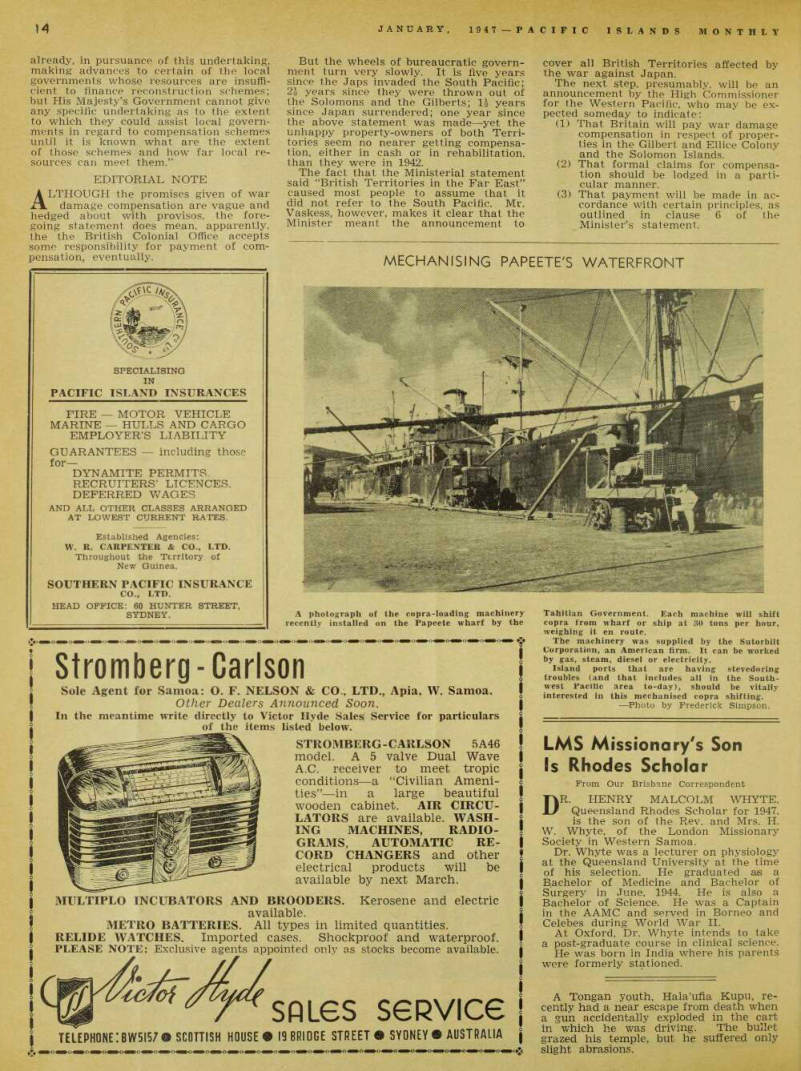
Jap-Invaded Territories
Minister's Statement of Feb., 1946, Covers the South Pacific
THE secretary of the Western Pacific High Commission (Mr. H. H. Vas kess) has courteously sent us the following copy of a statement made in the House of Commons, London, by the then Secretary for the Colonies, on Feb ruary 18, 1946, on the appointment of War Damage Claims Commissions in the Far East, Mr. Vaskess says: “Although they are not specifically mentioned, the Gilbert and Ellice Islands Colony, and the British Solomon Islands Protectorate are un doubtedly among the Territiories referred to.”
The following is the statement, in full: “I.—The Government propose that Claims Commissions should be set up in each of the British territories in the Far East which have been occupied by the Japanese, to register and assess claims for property lost or damaged as a result of the war. The new register will take over claims already provisionally regis tered, and no further registration will be needed in such cases.
“2.—The Commission will examine claims registered with them with two objects in view: (a) To compile information as to all losses which might be included in Reparation Claims against the Japanese. (b) To assess claims admissible under the local law or that might otherwise qualify for compensation under schemes initiated by the local Governments of these terri tories.
“3. —The categories of claims to be in cluded for reparation purposes have not yet been settled, but will be communi cated to the Commissions as soon as possible. A warning should, however, be given that reparation settlements may not meet the full amount of our claims.
“4. —The precise classes of claims in respect of which compensation will be paid and the basis of their assessment will be determined in due course by local legislation. In the meantime, for the purpose of assessment of claims regis tered with them, the Commission will be guided by the terms of existing local legislation, or, where there is no such legislation, broadly by the principles laid down in analogous United Kingdom legislation.
“s.—Pending assessment of claims, it is not possible to state the extent to which it may be possible to award com pensation, and the setting up of a Claims Commission does not commit the Gov ernment of the territory concerned to the payment of compensation, save in the case of claims admissible under existing local law.
“6. —In the event of it being found practicable to initiate new compensation schemes, the local Government will follow three principles in the preparation of such schemes: (a) Owners of property (whether damaged or not) over a minimum value to be fixed will have to pay a fair share of the total cost, just as has been the practice in this country. (b) Compensation may be with held from those claimants who are not prepared to re-invest the award in the country concerned, in cases in which such re-investment would be practicable. (c) Priority will have to be given in the settlement of all claims to those claimants, the restoration of whose property is of chief impor tance to the economy of the terri tory.
“7. —As has been previously stated.
His Majesty’s Government are anxious, if the resources of the local govenrments concerned are insufficient to meet the cost of restoring productive activities in their territories, to give what assistance they can. His Majesty’s Government are
already, in pursuance of this undertaking, making advances to certain of the local governments whose resources are insuffi cient to finance reconstruction schemes; but His Majesty’s Government cannot give any specific undertaking as to the extent to which they could assist local govern ments in regard to compensation schemes until it is known what are the extent of those schemes and how far local re sources can meet them.”
Editorial Note
ALTHOUGH the promises given of war damage compensation are vague and hedged about with provisos, the fore going statement does mean, apparently, the the British Colonial Office accepts some responsibility for payment of com pensation, eventually.
But the wheels of bureaucratic government turn very slowly. It is five years since the Japs invaded the South Pacific; 21 years since they were thrown out of the Solomons and the Gilberts; 11 years since Japan surrendered; one year since the above statement was made—yet the unhappy property-owners of both Territories seem no nearer getting compensation, either in cash or in rehabilitation, than they were in 1942.
The fact that the Ministerial statement said "British Territories in the Far East” caused most people to assume that it did not refer to the South Pacific. Mr.
Vaskess, however, makes it clear that the Minister meant the announcement to
cover all British Territories affected by the war against Japan The next step, presumably will be an announcement by the High Commissioner for the Western Pacific, who may be ex pected someday to indicate (l) That Britain will pay war damage compensation in respect of proper ties in the Gilbert and Ellice Colony and the Solomon Islands (2) That formal claims for compensa tion should be lodged in a parti cular manner. (3) That payment will be made in ac cordance with certain principles, as outlined in clause 6 of the Minister’s statement.
Advertisements & other items, pp. 15-16 (1 item)
Burns Philp
THE
YORKSHIRE
INSURANCE
CO. LTD.
(Incorporated in England)
ALL CLASSES OF
INSURANCE
Including
FIRE
GUARANTEE
WORKERS
MOTOR
ACCIDENT
MARINE
Island Representatives:
PORT MORESBY: E. A. James
RABAUL: G. B. Black LAE: Morobe Transport Co. Ltd.
MADANG: R. MacGregor
BURNS PHILP
(SOUTH SEA) CO. LTD.
Inc. in Fiji
Island Traders and Shipowners
Registered Office :
U V A
I j I Also Branches at: Levuka, Lautoka, Labasa, Ba, Sigatoka, Rotuma.
Tonga: Nukualofa, Haapai, Vavau.
Samoa: Apia, Pago Pago (American Samoa).
Solomons: Makambo, Gizo, Faisi.
New Hebrides: Vila.
Code Address: Gilberts: Tarawa "Bumsouth*. Norfolk Is. Niue. Wallis Is. Futuna Is.
Flj
Sole Australian Concessionaries :
GEORGE BROWN & CO. PTY. LTD
267 Clarence Street, Sydney.
The Ultimate factory has made the change-over from its wartime set-up.
Designs for the new models are now completed and production is about to commence.
These models should be available early in 1946—they will be well worth waiting for. Watch for further announcements.
SERVICE: Servicing of all kinds of radio sets, amplifiers and Rola speakers will continue to be available.
VflC
SPECIALISING
IN
PACIFIC ISLAND INSURANCES
FIRE MOTOR VEHICLE
MARINE HULLS AND CARGO
EMPLOYER’S LIABILITY
GUARANTEES including those for—
DYNAMITE PERMITS.
RECRUITERS’ LICENCES.
DEFERRED WAGES
AND ALL OTHER CLASSES ARRANGED
AT LOWEST CURRENT RATES.
Established Agencies:
W. R. CARPENTER & CO., LTD.
Throughout the Territory of New Guinea.
SOUTHERN PACIFIC INSURANCE
CO., LTD.
HEAD OFFICE; 60 HUNTER STREET,
SYDNEY.
Stromberg - Carlson
Sole Agent for Samoa: O. F. NELSON & CO., LTD., Apia, W. Samoa.
Other Dealers Announced Soon.
In the meantime write directly to Victor Hyde Sales! Service for particulars of the items listed below.
STROMBERG-CARLSON 5A46
model. A 5 valve Dual Wave A.C. receiver to meet tropic conditions—a “Civilian Amenities” —in a large beautiful wooden cabinet. AIR CIRCU- LATORS are available. WASH-
ING MACHINES, RADIO-
GRAMS, AUTOMATIC RE-
CORD CHANGERS and other electrical products will be available by next March.
MULTIPLO INCUBATORS AND BROODERS. Kerosene and electric available.
METRO BATTERIES. All types in limited quantities.
RELIDE WATCHES. Imported cases. Shockproof and waterproof.
PLEASE NOTE: Exclusive agents appointed only as stocks become available.
S fl L e S seßVice
TELEPHONE;BWSIS7® SCOTTISH HOUSE* 19 BRIDGE STREET * SYDNEY• AUSTRALIA
Mechanising Papeete's Waterfront
A photograph of the copra-loading machinery recently installed on the Papeete wharf by the
Tahitian Government. Each machine will shift copra from wharf or ship at 30 tons per hour, weighing it en route.
The machinery was supplied by the Sutorbilt Corporation, an American firm. It can be worked by gas, steam, diesel or electricity.
Island ports that are having stevedoring troubles (and that includes all in the South west Pacific area to-day), should be vitally interested in this mechanised copra shifting. —Photo by Frederick Simpson.
LMS Missionary's Son
Is Rhodes Scholar
From Our Brisbane Correspondent
Dr. Henry Malcolm Whyte.
Queensland Rhodes Scholar for 1947. is the son of the Rev. and Mrs. H.
W. Whyte, of the London Missionary Society in Western Samoa, Dr. Whyte was a lecturer on physiology at the Queensland University at the time of his selection. He graduated as a Bachelor of Medicine and Bachelor of Surgery in June, 1944. He is also a Bachelor of Science. He was a Captain in the AAMC and served in Borneo and Celebes during World War 11.
At Oxford, Dr. Whyte intends to take a post-graduate course in clinical science.
He was born in India where his parents were formerly stationed.
A Tongan youth, Hala’ufia Kupu, re cently had a near escape from death when a gun accidentally exploded in the cart in which he was driving. The bullet grazed his temple, but he suffered only slight abrasions.
End of "Desikoko"
Ship Now Joins Other Pondo Ghosts
rjIHE flourishing dessiccated-coconut fac- X tory and surrounding plantations owned by W. R. Carpenter interests at Pondo, on New Britain, were obliter ated during the war, and some of the key-men responsible for running the in dustry there were murdered by the Jap anese.
Now, with the sinking of the 230-ton wooden motor vessel Yua Hwa. off the Australian coast on January 5, comes the end of the story of Pondo dessiccated coconut. For the duck-like Yua Hwa used to be the Desikoko which was built for WRC at Huskisson, NSW, in 1934, and, from then until the war was well-known to the New Guinea residents who lived in the New Britain area.
Desikoko was subsequently sold to a Chinese firm and was taking a cargo of flour to China when she sank. Her cap tain was 72-years-old James Baldwin, an Englishman, and she had also, two Norwegian officers and a crew of 10 Chinese. After leaving Sydney on Jan uary 4, she sprang a leak and began to make much water. A Newcastle pilot boat took her in tow, but soon after she suddenly listed and sank in two minutes.
The crew jumped overboard and were all picked up.
The Carpenter industry has been re established in bigger and better form, on a small island, close to Madang the Pondo establishment apparently has been abandoned.
Controlled
Nadi Airport Now
By Civil Authorities
Suva, Dec. 22.
AT midnight on December 19, the American Army authorities at Nadi, Fiji, handed over control of the air field to officers of the New Zealand Gov ernment. New Zealand has agreed to accept responsibility for the operation of the international and regional air service in Fiji subject to administrative control by the government of the Colony.
Most of the Americans will leave for home shortly. A few will remain until negotiations for the transfer of US equipment and stores is completed.
A party was held at the airport recently to farewell officers and men.
The US Commanding Officer, Colonel Tompkins, spoke in appreciation of the hospitality of local residents towards the Americans who had been stationed at Nadi and in reply the District Commis sioner, Mr. R. N. Caldwell, suitably ex pressed the goodwill and appreciation of the people of the district towards the officers and men who had been stationed at the airport.
Nadi airfield, which was built by the Americans during the darkest days of the war, and became one of the largest bases in the Pacific, now for the first time comes completely under civil control.
One of the sights tourists used to enjoy in Noumea before the war was the open air morning market, on lines reminiscent of the market in Papeete. During the war a good deal of the square was taken over by the American Forces who used to hold their boxing matches there. Finally they converted it into the Trade Winds beer garden and hamburger restaurant.
Now they have gone the local civilian marketeers have taken over, but, unlike old times, they now have a roof over their heads.
Rarotonga Has A Sporting
Boxing Day
Rarotonga, Dec. 28.
SINCE the end of the war there has been a great revival of competitive sport in Rarotonga. This year the reintroduction of the annual Boxing Day athletic contests produced tremendous enthusiasm among competitors and spec tators, and resulted in the biggest gath ering on Muri sports field in many years.
There was a full programme of field events, but keen inter-village rivalry retained a sporting and good-natured character.
As usual, one of the most popular events was the battle of the giants on the tug-o-war rope. The eagerly awaited cycle race was disappointing, the four leading competitors being involved in a mass tangle due to the rough nature of
the ground. In his speech at the end of the meeting, Judge McCarthy promised the cyclists a better track for next year.
The athletes had been training strenu ously for their various events for many weeks past.
Some credit for the revival of sport is due to a number of European supporters, Mr. L. Cook, of the Treasury Dept., being worthy of special mention for his efforts in this direction.
Mr. C. S. St. Julian, who is second in charge of the Department of Customs, Suva, has been spending long leave in Sydney, and has gone on to New Zealand.
He is due back in Fiji in April. Mr. St.
Julian is a member of one of the Colony’s pioneer families. His father was Mr. H.
P. St. Julian, who was Colonial Post master in Fiji 40 years ago.
Advertisements & other items, pp. 17-18 (1 item)
/ts Dray-free
ye\
in tropic heat
I f.
V 7 K 5 *✓*
MOTOR OIL
SHELL COMPANY (PACIFIC ISLANDS) LTD.
(Incorporated in Great Britain) Agents: BURNS PHILP (South Sea) Co. Ltd.'
"m v ~«> I / 11
IDEAL FOR SHIPMENT
Ready-made frames, put together with only hammer and spanner—delivered to you in a few weeks from ordering.
Because of their design for nesting, packing weights and costs are reduced to the lowest.
"Econo-Steel" features NAILABLE units, rapidly erected by ordinary labour.
"Econo-Steel" frames are built from toughest and lightest materials —highly resistant to white ants, borers or fire!
Hundreds of "Econo-Steel" frames were built in many areas last year—built in a day to last a lifetime!
Mail your enquiry to the BUILDING DEPT., TULLOCH'S PTY. LTD.
It shall be treated with every consideration.
Till. LOCHS PT’L™
When building consider
m EASE OF ERECTION
FIRE RESISTANCE
SOUNDNESS OF STRUCTURE
BORER AND PESTS
RHODES, SYDNEY, N.S.W., AUSTRALIA Cable TULSTEEL Sydney.
And DRYSDALE & RIDGWAY, Brisbane. Cable: DRYSTEEL, Brisbane.
Boom-Time For
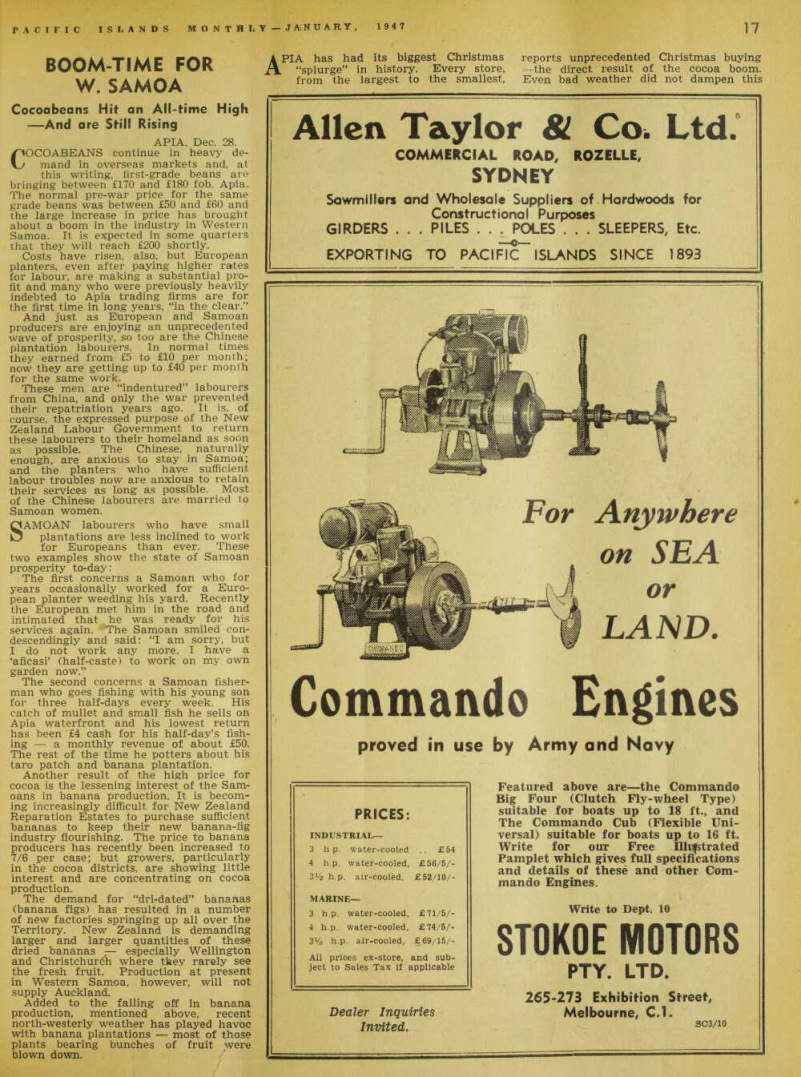

W. Samoa
Cocoabeans Hit an All-time High —And are Still Rising
Apia. Dec. 28.
COCOABEANS continue in heavy de mand in overseas markets and, at this writing, first-grade beans are bringing between £l7O and £lBO fob. Apia.
The normal pre-war price for the same grade beans was between £5O and £6O and the large increase in price has brought about a boom in the industry in Western Samoa. It is expected in some quarters that they will reach £2OO shortly.
Costs have risen, also, but European planters, even after paying higher rates for labour, are making a substantial pro fit and many who were previously heavily indebted to Apia trading firms are for the first time in long years, “in the clear.”
And just as European and Samoan producers are enjoying an unprecedented wave of prosperity, so too are the Chinese plantation labourers. In normal times they earned from £5 to £lO per month; now they are getting up to £4O per month for the same work.
These men are “indentured” labourers from China, and only the war prevented their repatriation years ago. It is, of course, the expressed purpose of the New Zealand Labour Government to return these labourers to their homeland as soon as possible. The Chinese, naturally enough, are anxious to stay in Samoa; and the planters who have sufficient labour troubles now are anxious to retain their services as long as possible. Most of the Chinese labourers are married to Samoan women.
SAMOAN labourers who have small plantations are less inclined to work for Europeans than ever. These two examples show the state of Samoan prosperity to-day: The first concerns a Samoan who for years occasionally worked for a Euro pean planter weeding his yard. Recently the European met him in the road and intimated that he was ready for his services again. The Samoan smiled con descendingly and said: “I am sorry, but I do not work any more. I have a ‘aficasi’ (half-caste) to work on my own garden now.”
The second concerns a Samoan fisher man who goes fishing with his young son for three half-days every week. His catch of mullet and small fish he sells on Apia waterfront and his lowest return has been £4 cash for his half-day’s fish ing a monthly revenue of about £5O.
The rest of the time he potters about his taro patch and banana plantation.
Another result of the high price for cocoa is the lessening interest of the Sam oans in banana production. It is becom ing increasingly difficult for New Zealand Reparation Estates to purchase sufficient bananas to keep their new banana-fig industry flourishing. The price to banana producers has recently been increased to 7/6 per case; but growers, particularly in the cocoa districts, are showing little interest and are concentrating on cocoa production.
The demand for “dri-dated” bananas (banana figs) has resulted in a number of new factories springing up all over the Territory. New Zealand is demanding larger and larger quantities of these dried bananas especially Wellington and Christchurdh where they rarely see the fresh fruit. Production at present in Western Samoa, however, will not supply Auckland.
Added to the falling off in banana production, mentioned above, recent north-westerly weather has played havoc with banana plantations most of those plants bearing bunches of fruit were blown down.
APIA has had its biggest Christmas “splurge” in history. Every store, from the largest to the smallest,
reports unprecedented Christmas buying —the direct result of the cocoa boom, Even bad weather did not dampen this
Christmas spending spree on the part of both Samoans and Europeans who have more money now than even during the height of the Yankee invasion.
Certain foodstuffs were scarce in the Territory at the beginning of December but then two overseas ships “Matua’' from Auckland and “Waikawa” from Australia carrying large stocks of goods, arrived just before the Christmas period. In January we expect American goods of which we are, at present, short.
Among news circulating on the beach in relation to the present boom-time is the story that, at a meeting of the London Missionary Society adherents just after Christmas, contributions to the missionary funds totalled £6,500.
Imports of foodstuffs, drapery, building materials and hardware are increasing and will reach record figures this year.
The Administration has now abolished the import licence system in respect of New Zealand although the licence is still necessary in respect to other countries.
The British ship “Meadowbank” is at present lifting 1,500 tons of copra here for the British market.
Advertisements & other items, pp. 19-20 (1 item)
Commando Engines
Allen Taylor & Co. Ltd
COMMERCIAL ROAD, ROZELLE,
SYDNEY
Sawmillers and Wholesale Suppliers of Hardwoods for Constructional Purposes GIRDERS ... PILES .. . POLES . . . SLEEPERS, Etc.
EXPORTING TO PACIFIC” ISLANDS SINCE 1893
For Anywhere
on SEA
kjt or
L
Commando Engines
proved in use by Army and Navy Dealer Inquiries Invited.
Featured above are—the Commando Big Four (Clutch Fly-wheel Type) suitable for boats up to 18 ft., and The Commando Cub (Flexible Universal) suitable for boats up to 16 ft.
Write for our Free llli|3trated Pamplet which gives full specifications and details of these and other Commando Engines.
Write to Dept. 10
STOKOE MOTORS
PTY. LTD.
265-273 Exhibition Street, Melbourne, C.l.
SC3/10
TILLEY LAMPS
BURN ORDINARY KEROSENE
The Modern Form of PORTABLE LIGHTING Be you buy a
TILLEY
STORM LANTERNS \ Look for the name!
TABLE LAMPS
SUSPENSION LAMPS
RADIATORS
INSPECTION LAMPS
WALL LAMPS
FLOODLIGHT PROJECTORS
300 C.P.
Storm Lantern
Tilley Lamps are made only at
Hendon, England.
Be sure you buy a TILLEY Look for the name !
Shipments four weeks from receipt of order. 5,000 c.p.
Floodlight Projector THE TILLEY LAMP CO., HENDON, N.W.4, ENG.
REPRESENTATION :
MELBOURNE : T. H. Bentley, Pty. Ltd., 123-125 William Street, Melbourne, CL TASMANIA : Mr. C. Sellars, 108 a Charles Street, Launceston.
FIJI : Mr. K. Witherington, 2 Burns Philp Buildings, Suva.
Young N.G. Airman Now
Presumed Dead
ALHOUGH the war has been over for a year, the death in action over Germany of Flying Officer Bryan Patrick Fraser was only recently con firmed.
This lad. who was only 21 at the time of his death, was the son of Mr. and Mrs.
R. W. Fraser, of Brisbane, and the nephew of the Leahy brothers, well known miners and business men of the Morobe District, New Guinea.
Before the war, young Bryan Fraser was with the Bulolo Gold Dredging Co. at Bulolo, and at the outbreak of war, although only a youngster, he joined the local unit of the New Guinea Volunteer Rifles. He participated, with the sth Independent Company, in the first com mando raid on Salamaua, and on one occasion as a special runner, walked from Wau to Bulldog (Papua) in two days.
After the main body of the AIF arrived in New Guinea, he enlisted in the RAAF and, after training, was sent to Britain, where his squadron was attached to the
Raf.
He went on many raids over Germany, took part in the battle of Caen, in Nor mandy, and the bombing of the Kiel Canal. His last operation was over Stuttgart, on July 24, 1944 and from this raid he did not return.
He was posted “missing,” and only re cently have his parents been notified that he has been officially “presumed dead,” from that date.
Copra Price
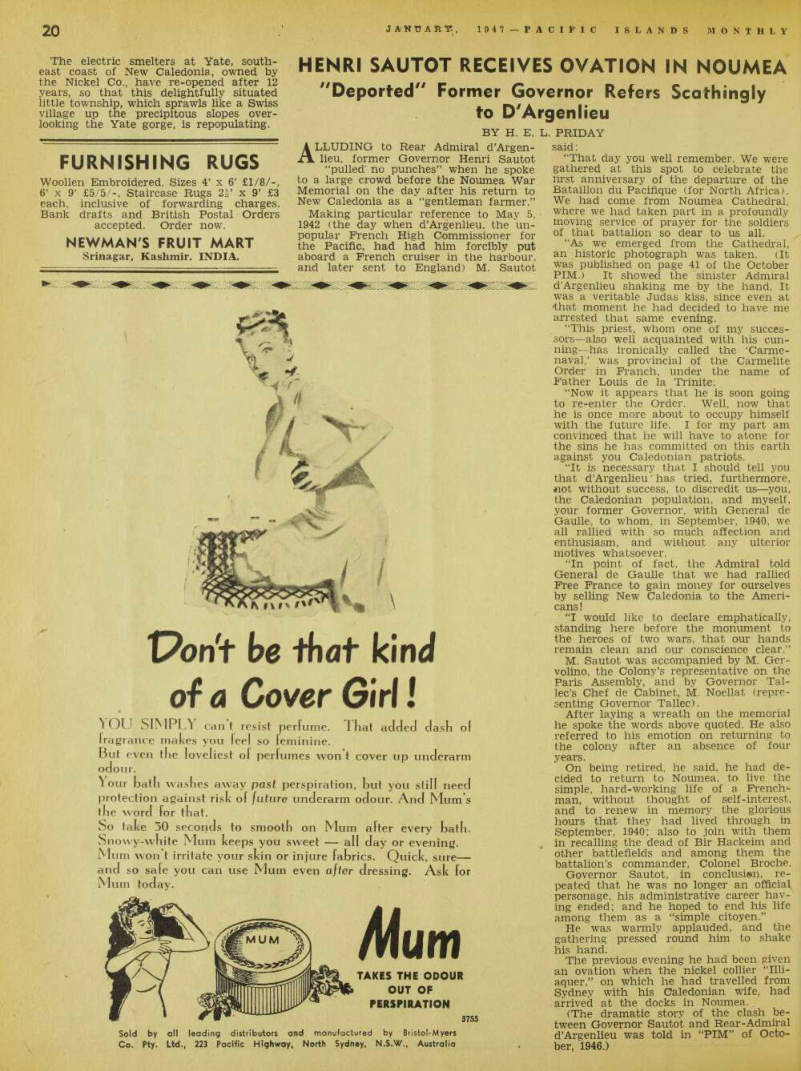
Small Drop in Fiji Copra Price
Suva, Dec. 4.
A REDUCTION of 8/6 per ton was made in the local buying price of copra on December 2. This is purely a local matter and is brought about by increased costs in handling and insurance incurred by the Fiji Copra Board. The price paid by the British Ministry of Food for Fiji copra remains unaltered.
The new price will be £25/15/- for FMS grade copra and £26/0/6 for Plantation grade.
The Rev. Arthur McChesney Clark, an Australian, who has served with the London Missionary Society in China, has been transferred to the Papua Branch of the Mission. He and Mrs. Clark expect to leave tor the Territory shortly.
Mr. Raymond John Deland, eldest son of Dr. and Mrs. Deland, of Madang, New Guinea, graduated BSc at Adelaide Uni versity in December. He is well-known in the Territory, where he spent his early years.
The electric smelters at Yate, south east coast of New Caledonia, owned by the Nickel Co., have re-opened after 12 years, so that this delightfully situated little township, which sprawls like a Swiss village up the precipitous slopes over looking the Yate gorge, is repopulating.
Advertisements & other items, pp. 21-22 (1 item)
k JpaMe.
COMPLEXION PERFECTION
WITH
BEAUTY PREPARATIONS
FOR
DISCRIMINATING WOMEN
WHO DESIRE
ALLURING LOVELINESS
Obtainable At All Stores.
Distributor:
GORDON K. SMITH
Beverley Hills, Sydney Bankers: Bank of N.S.W.
W. H. GROVE & SO
Limited
Established 1896.
AUCKLAND
Island Traders. r.O. Box 45*.
Telegraphic and Cable Address: “Grove”, Auckland.
Entrust Your Orders to the Firm with Fifty Years Practical Experience in the Island Trade.
Shippers of all classes of New Zealand products.
Representing English Manufacturers through-
out the Cook and Society Islands, Fiji, Tonga, Samoa, Niue, New Caledonia, New Guinea, etc.
In FIJI os—W. H. Grove fir Sons (Fiji) Ltd.
Aluminium in all its
ALPASTE is Aluminium pigment in paste form which avoids all the drawbacks of the dry powder and retains the desirable properties, such as leafing and reflectivity. In addition, it gives more complete opacity and 10%-20% greater coverage.
ALPASTE is recommended as a preservative for structures in wood and in all metals and for excellent distinction of finish. forms . . .
k JpaMe.
Markefed by
ALUMINIUM UNION LIMITED
Incorporaied in fhe Dominion of Canada
A FULLY OWNED SUBSIDIARY OF
ALUMINIUM LIMITED, MONTREAL, CANADA
Ocean House, 34 Martin Place, Sydney, N.S.W., Australia.
FURNISHING RUGS
Woollen Embroidered. Sizes 4’ x 6’ £l/8/-, 6’ x 9’ £5/5/-, Staircase Rugs 2V x 9’ £3 each, inclusive of forwarding charges.
Bank drafts and British Postal Orders accepted. Order now.
NEWMAN'S FRUIT MART
Srinagar, Kashmir. INDIA.
I I I
tPon't be
of a Cover Girl!
YOU SIMPLE can t resist perfume. 1 hat added dash of fragrance makes you feel so feminine.
But even the loveliest of perfumes won t cover up underarm odour.
Your hath washes away past perspiration, but you still need protection against risk of future underarm odour. And Mum s the word for that.
So take 50 seconds to smooth on Mum after every bath.
Snowy-white Mum keeps you sweet all day or evening.
Mum won’t irritate your skin or injure fabrics. Quick, sure — and so safe you can use Mum even after dressing. Ask for Mum today.
TAKES THE ODOUR
OUT OF
PERSPIRATION
3755 Sold by all leading distributors and manufactured by Bristol-Myers Co. Pty. Ltd., 223 Pacific Highway, North Sydney, N.S.W., Australia
to D'Argenlieu
Henri Sautot Receives Ovation In Noumea
"Deported" Former Governor Refers Scathingly to D'Argenlieu
By H. E. L. Friday
ALLUDING to Rear Admiral d’Argen lieu, former Governor Henri Sautot “pulled" no punches” when he spoke to a large crowd before the Noumea War Memorial on the day after his return to New Caledonia as a “gentleman farmer.”
Making particular reference to May 5, 1942 (the day when d’Argenlieu, the un popular French High Commissioner for the Pacific, had had him forcibly put aboard a French cruiser in the harbour, and later sent to England) M. Sautot
said: “That day you well remember. We were gathered at this spot to celebrate the hrst anniversary of the departure of the Bataillon du Pacifique (for North Africa).
We had come from Noumea Cathedral, where we had taken part in a profoundly moving service of prayer for the soldiers of that battalion so dear to us all.
“As we emerged from the Cathedral, an historic photograph was taken. (It was published on page 41 of the October PIM.) It showed the sinister Admiral d’Argenlieu shaking me by the hand. It was a veritable Judas kiss, since even at that moment he had decided to have me arrested that same evening.
“This priest, whom one of my succes sors—also well acquainted with his cun ning—has ironically called the ‘Carme naval,’ was provincial of the Carmelite Order in Franch, under the name of Father Louis de la Trinite, “Now it appears that he is soon going to re-enter the Order. Well, now that he is once more about to occupy himself with the future life. I for my part am convinced that he will have to atone for the sins he has committed on this earth against you Caledonian patriots.
“It is necessary that I should tell you that d’Argenlieu' has tried, furthermore, not without success, to discredit us—you, the Caledonian population, and myself, your former Governor, with General de Gaulle, to whom, in September, 1940, we all rallied with so much affection and enthusiasm, and without any ulterior motives whatsoever.
“In point of fact, the Admiral told General de Gaulle that we had rallied Free France to gain money for ourselves by selling New Caledonia to the Ameri cans!
“I would like to declare emphatically, standing here before the monument to the heroes of two wars, that our hands remain clean and our conscience clear.”
M. Sautot was accompanied by M. Ger volino, the Colony’s representative on the Paris Assembly, and by Governor Tal lec’s Chef de Cabinet, M. Noellat (repre senting Governor Tallec).
After laying a wreath on the memorial he spoke the words above quoted. He also referred to his emotion on returning to the colony after an absence of four years.
On being retired, he said, he had de cided to return to Noumea, to live the simple, hard-working life of a French 4 man, without thought of self-interest, and to renew in memory the glorious hours that they had lived through in September, 1940; also to join with them in recalling the dead of Bir Hackeim and other battlefields and among them the battalion’s commander, Colonel Broche.
Governor Sautot, in conclusi®n, re peated that he was no longer an official personage, his administrative career hav ing ended; and he hoped to end his life among them as a “simple citoyen.”
He was warmly applauded, and the gathering pressed round him to shake his hand.
The previous evening he had been given an ovation when the nickel collier “Uli aquer,” on which he had travelled from Sydney with his Caledonian wife, had arrived at the docks in Noumea. (The dramatic story of the clash be tween Governor Sautot and Rear-Admiral d’Argenlieu was told in “PIM” of Octo ber, 1946.)
Advertisements & other items, p. 22 (1 item)
20
3 A N tr A UT ., 1947 PACIFIC ISLANDS MONTHLY
Rehabilitation of Rabaul
From Our Own Correspondent Rabaul, Dec. 29.
THERE were some spots in and around Rabaul where the welkin was ring ing for the Christmastide festivities almost up to the old pre-blitz standard.
An improvement on the 1945 festivities— and we all look forward to even a better time for Christmas, 1947. The addition of several of our prq-war womenfolk did much to brighten up the landscape, and fill us with optimism for the future.
In fact, there are even rumours of wed ding bells a-ringing one of these fine days.
Mr. Charlie Bates is holding the Rabaul District Office front, and we are fortun ate in having this old-timer at the helm to guide our ship through these new, un charted waters. His past experience with natives generally makes his task easier both for himself and the civilians en deavouring to stage a comeback. Provi sional government is gradually supersed ing other administrations, and is housing itself in many of the old Army huts.
This rehabilitation racket is giving everyone a headache. Some are faring reasonably well, while others are having a grim battle. Out Kokopo way, on the old Vundpope site, the Catholic mission aries have their sleeves rolled and are making good progress in rebuilding, and have been fortunate in obtaining equip ment and materials for this work; much of it being secured from the Yanks in Mianus.
The old familiar firms of B.P. and W.R.C. have erected temporary premises on their old sites, and are catering for the needs of the public in their old in imitable manner. Colyer, Watson have also their finger on the pulse of events, and will be there when the whips are cracking. Genial general manager Colyer recently made a survey of conditions around here, with the result that his interest has been stimulated.
Biggest strides in getting back to normalcy-plus seem to be amongst the Chinese merchants. Temporary trading stores are being erected in the new Chinatown; and tailors, eating-houses and native trade stores are doing a rush ing business. Gabriel Achun has pur chased the old Army cordial factory and is flat out to meet local demands for soft drinks. There is plenty of money about—especially in Chinatown—and the Blackfellow Bung (some people call it the Black Market) is doing a good trade in certain lines. In fact, there are few things that cannot be bought—if you have the cash. Nearly every Chinese
merchant owns his own jeep or truck, and motor vehicles can be seen (and heard) tearing about in typical pre-war fashion.
The number of Army personnel in Rabaul area is diminishing rapidly.
Although Bth MD headquarters staff re mains, only details are still here, such as War Crimes section, 2/7th AGH and Transport personnel. There are only those Japs who are waiting for their trials still in Rabaul area. These trials are taking place every day, but arouse little interest. We’ve “had” the war.
Vic Pearson, of the WRC firm, has gone south on a visit. He will be missed in our sporting fixtures. Rumour has it that he will be returning, but for in terests other than his old connections.
Gilbert Renton, that ball of concen trated energy, has created another House Soda-Water on the old site, and is doing more than his share in helping to rebuild the town.
George Eidelbach is back again in the Keravat area, and is busy bringing his plantation back into production.
Mr. John Murchie Wilson, formerly Controller of Fiji Customs, returned to the Colony on a visit recently. He lived in retirement in London during the war years, and was a member of the Home Guard. His future movements are un certain.
Sir Maynard and Lady Hedstrom, of Suva, Fiji, left th Colony in December for New Zealand, where they will spend several months’ vacation.
Advertisements & other items, p. 23 (1 item)
We Will Buy
It For You
Any goods you may require from English shops or factories Purchased and Shipped.
Small or large orders catered for.
ALL SERVICES UNDER-
TAKEN FOR RESIDENTS
ABROAD.
PITT & SCOTT
LIMITED
(Established 1876) General Shipping and Buying Agents. 1/3, St. Paul's Churchyard, London, England Cables. Shipping London.
YOUR FUTURE CAREER . . .
Merchants, Accountants, Secretaries, Bankers and Business Managers ... all hold responsible positions with commensurate salaries. You too can enhance your prospects in this ever-expanding commercial field, which yields abundant returns to those with adequate qualifications. H.R.I. prepare ambitious men and women for all business positions from junior to senior executive. Tuition is practical authoritative up-to-date time saving . . . and certain in its successful results. The H.R.I. is available always to advise you write or wire for information free and without obligation.
H.R.I. tutorial service is proved by the winning of more honours than all coaches in Australasia combined.
H.R.I. Career Training • ACCOUNTANCY • SECRETARYSHIP • COST ACCOUNTANCY
• PRACTICAL BOOKKEEPING • MARKETING SELLING
ADVERTISING • BANKING • LOCAL GOVERNMENT EXAMS.
K« bertson Institute
Founded and Owned by Hemingway & Robertson Pty. Ltd.
Consulting Accountants ;: :: Professional Tutors
126 BANK HOUSE. BANK PLACE, MELBOURNE
126 CHALFONT CHAMBERS, 142 PHILLIP STREET, SYDNEY 126/815
l-ll
1 Bond Street, Sydney, Austrolio. % U |"| VTcL B 4167. Box 3615 GJP.O.
SUPPLIERS OF GENERAL MERCHANDISE TO LEADING FIRMS THROUGHOUT THE
PACIFIC ISLANDS
Exporters ... Importers ... Monufocturers' Representatives Bankers; Bank of NB.W. Bank of Comptolr Nat. d’Kaeompte do Paris.
Cable Address: “SEAFOODS,” SYDNEY.
Codes: Bentley’s, tad and Comp. Phrase; AJ.C., sth and Cth; Peterson, tad and 3rd; Banking; Acme.
Witu, TNG
Gladys Baker, M.B.E.
Unexpected Death at Witu, TNG
By Gordon Thomas
A WELL-KNOWN resident of New Guinea, Mrs, Gladys Baker, died at her plantation in the Witu Group, on December 29, after a short illness.
The news came as a shock to her many friends in Australia. Only a few weeks previously they had said farewell to her as she boarded the “Revnella.” on the return journey to her home at Langu plantation, where she had decided to face the difficulties of present-day rehabilita tion and bring the cocqnut estate back into bearing.
Equipped with newly-purchased house hold requisites, and accompanied by a young overseer —Peter Henderson. DFC, ex-RAAF she doggedly persisted in facing the hardships which she well realised lay ahead. After a long and tedious journey to Rabaul by the “Rey nella,” she was delayed there for some weeks before being able to proceed to her plantation in the Witu Group, off the north coast of New Britain. Here,
shortly after her arrival, she was taken ill, and died.
Gladys Henriette Baker was born in Melbourne 49 years ago. In 1920, she journeyed to Misima Island, in Papua, where she was married to Mr. William Baker, then Resident Magistrate there.
For several years she accompanied her husband to the various districts in Papua to which he was called by his duties. In the late 20’s he left the government ser vice for the Mandated Territory, where he had successfully tendered for the Expropriated estate of Langu plantation.
At Langu, the Bakers established a home well-known throughout the Terri tory for its comfort and hospitality. In 1934 William Baker died, after a short illness, and his widow, showing that staunch determination characteristic of so many Islands women, remained on the property to develop it and, to use her own words, “to perpetuate a memorial for Bill.” And here she remained, except
for occasional holidays in Australia and Europe, personally managing the coconut estate until even after the Japanese in vasion in 1942.
During the grim days of January and February, 1942 she rendered valuable ser vice to the soldiers retreating from Rabaul. On the vessel “Lakatoi.” by which many escaped, she gave valuable services m tending the sick and wounded, during the trip to Queensland. For this, she was awarded the MBE. (The story of her escape from Witu and New Britain is included in the article by Mr. J. K.
McCarthy published on page 55.) Arriving in Queensland in March, 1942, she joined the AMWAS. with which body she served continuously, obtaining her commission as a lieutenant in 1944.
Gladys Baker will always be remem bered as a woman of charming person ality, generous in spirit and endowed with a deep-rooted loyalty to her large circle of friends, who now mourn her passing.
'Sinabada' Returned to Langu
Tribute to a Brave Woman of the Islands
By J. K. MCCARTHY, MBE, who was ADO in Talasea (near Mrs. Baker’s plan tation) before the war. and who. in 1942, directed the operation by which Mrs.
Baker, and hundreds of others, were res cued from the Japs.
THE survivors of the Rabaul garrison, who made the heartbreaking journey along the coast to Talasea, will remember the auburn-haired lady with the gentle hands who tended the sick and wounded at Iboki and on board the “Lakatoi” during the perilous voyage to Australia. It is hard to believe that she is dead.
Langu, where Bill and Gladys Baker
settled over 20 years ago, was truly a gem—and had been set by nature in worthy surroundings. Witu Island rises sharply from the sea, and on its gracious slopes was placed the Baker’s new home.
The well-planted heavily-bearing coco nut palms denoted the richness of the soil; and, as the couple climbed the path that led from the small jetty, they saw the bungalow that was to be their new home—“till death do them part.”
In the happy years that followed, they worked hard and quickly proved that they were an acquisition to the new land.
They were ideally suited efficient planters, splendid employers towards
their native workers, gracious hosts to visitors in all a worthy couple, and splendid companions and friends, popular alike with the white and brown people of New Guinea.
Glad retained one title during her life in New Guinlea. She was known ias Sinabada the Papuan word for white woman and by this name was soon known to both Europeans and natives throughout the Witu Group and Talasea —“The Sinabada who lives at Langu.”
Under the wise and beneficent rule of the Bakers, Langu prospered. Modern labour barracks, hospital and outbuildings were added. The bungalow was enlarged and under Mrs. Baker’s direction it be came a most charming and gracious house.
MRS, BAKER was not content to be a mere hostess at Langu. Her intelligent mind and pioneer spirit demanded more than household duties.
She took a keen interest in the property and, under her husband’s guidance be came an experienced and efficient planter.
Copra production, native labour manage ment, schooner engines and the thousand and-one jobs of a plantation, from mend ing a bullock cart to issuing rations, came alike to her able mind and vigorous person.
In 1936, Bill Baker went to Rabaul on urgent business and Mrs. Baker was left in charge. As the dinghy pulled out to the waiting ship, Bill 'waved to 'her with some gay remark about returning soon. That was the last time she saw him alive.
Bill suffered some trivial scratch at Rabaul and, like most healthy men, he ignored it. When he did seek medical advice, the thing had turned septic. By the time he reached hospital blood poisoning had set in—as it is likely to do in the tropics. To the distress of everybody he died in a few days.
His wife waiting on the jetty at Langu to meet the returning schooner, bore the cruel news with customary courage. She soon set about taking Bill’s place as managing-owner of Langu. In the absence of her beloved partner, she appeared to give all her devotion to the property.
I REMEMBER visiting Langu in 1938, and unexpectedly coming on Glad., hard at it, doing the job of a man on her plantation. Clad in khaki shorts and shirt, she was busily laying cement as the foundations of a new hot-air copra drier and doing the job with extra ordinary efficiency. She interrupted her work to attend to the many medical wants of the native population.
She had established a native hospital at Langu, where the village natives were free to come and receive medical atten tion. She served the natives of Witu well. In her attendance on maternity cases she had been responsible for saving the lives of many women and children.
Her attitude towards the native people was a very human one, and in return for this she had the devotion and good-will of her native neighbours—a devotion not lightly given but in this case most richly deserved.
In her small launch Mrs. Baker often visited Talasea, accompanied by her Eurasian maid, Miss Lehmann, and 3 or 4 native crew. She would travel over 100 miles of open sea in the tiny vessel, and she proved herself a competent engineer on many occasions.
Despite her ability to do a man’s job, Gladys Baker, and pleasingly, always re mained essentially feminine. There was nothing, either in her appearance or manners, to suggest the masculine type.
In appearance, she was of slight build and her auburn hair was worn long.
Always well-groomed, she had the well
bred woman’s instinctive desire for fine clothes and belongings. Whether a hostess entertaining guests, or planter supervising the copra drier, Glad was always a woman —and a very brave and gracious one, at that.
IT was not surprising that Gladys Baker felt it impossible to depart when the Japs invaded and the orders came that all women were to leave. She dis obeyed the wise advice of the Admin istrators, and remained at Langu. When Rabaul fell, Mrs. Baker accompanied by her maid and a native crew, went in their launch over to New Britain, and up the Aria River, in the Talasea district. They had some thoughs of remaining there until the Japs were driven out of the country.
I found them in this place in January, 1942; and arrangements were then made for Mrs. Baker to accompany the rest of the civilians to Salamaua. which had not yet fallen to the Japs.
I then received orders from the Royal Australian Navy to proceed to the Rabaul area on intelligence duties.
Several weeks later I was in charge of the operation, on that northern coast of
trying to save about 240 men, the rem nants of the Australian troops who had been overwhelmed by the Japanese in Rabaul. Starving, wounded and sick, they came 300 miles along the north coast of New Britain, and were gathered at Iboki —between Talasea and Cape Gloucester. Here, I discovered that Mrs.
Baker had not gone with the other civi lians to Salamaua, as instructed, but had chosen to wait with Miss Lehmann (her maid) at Iboki.
Mrs. Baker had suffered the second great blow of her life: she was about
to lose Langu—temporarily at least—to the Japs. But there was work to do and she, with all her inborn skill and ability, laboured day and night to give medical aid to the wounded, sick and dying who filled the huts at Iboki. Her courage and cheerfulness inspired every body.
Later, the party, boarded the “Lakatoi,” which had been lying at Witu. Before the heavily laden ship crept away from Iboki, Glad. Baker was to stand and salute her beloved Langu with a whispered “I’ll be back,” through her tears.
Mrs. Baker continued her unceasing labours on board during the voyage to Cairns, and earned the love and heart felt thanks of the many sick who received treatment at her hands.
In Australia she continued to serve,
and was commissioned in the AAMWS.
Her thoughts always were of Langu, and when she could return. I met her in Melbourne, and her conversation reverted again and again to her New Guinea home.
IN 1945, I had the satisfaction of learning that the Australian Govern ment had at last given official recog nition to her services during those dark days of 1942. She was awarded the MBE.
I was in Borneo at the time and I thought how Glad. Baker would wish to return to her Langu, now that the Jap was defeated.
Mrs. Baker returned to Witu and her Langu home late in 1946. “Sinabada has returned!” would be the joyful news cried around the villages of the island.
One can imagine how she felt, as she
once more stepped ashore in that beau tiful place.
Within a very short time a matter of days rather than weeks she was dead.
Her courageous heart may be stilled for ever, as she sleeps in the earth that she loved so well. But her indomitable spirit will serve us as an imperishable and inspiring memory.
Advertisements & other items, pp. 24-26 (2 items)
Social Evening
SOUTH SEA ISLANDS CLUB
Every Thursday, at 399 George Street.
Sydney (Fourth Floor) Ballroom Dancing . . . Special Islands Dances Songs Islands Visitors Welcome.
Nelson & Robertson ”1
NELSON and ROBERTSON Pty. Ltd.
Established 1895
Shipowners - Brokers and
Islands Merchants
All classes merchandise purchased at Best Wholesale Prices. Original Invoices supplied to Island Clients. Cocoa Beans, Copra, Rubber, Trochus Shell and All Islands' Produce Sold on Commission.
Entrust your requirements to the firm with fifty years' practical experience in the Pacific Islands.
Prompt attention given to all enquiries.
NELSON & ROBERTSON ”1
12 SPRING STREET, SYDNEY, AUSTRALIA
Telegraphic Address: IVAN, SYDNEY.
PACIFIC ISLANDS SOCIETY
Visitors from the Islands to Sydney (or those interested in Islands affairs), are advised to communicate with the honorary secretary of the above Society, which has been formed to study the history, traditions, economics, and political developments of the Pacific Islands.
Regular monthly meetings are held at History House, 8 Young Street, Sydney.
Address for Correspondence:
THE PACIFIC ISLANDS SOCIETY,
Fox 2454 MM., G.P.0., Sydney.
J. C. Merrillees Pty. Ltd.
GENERAL ISLAMDS MERCHANTS
We wish to notify our clients that our new
address is:
PHOENIX BUILDING (CORNER OF PITT AND BRIDGE STS.)
63 PITT STREET, SYDNEY
Telephone: Codes: Telegrams and cables: 8W6064 Bentley’s Merrillees, Sydney
i Here's a case that will stand the rough and tumble of school use . . . that weighs and costs less than leather * . . that is weatherproof'and smart-looking! The Globite School Case is a convenient size ... 16 inches long , . . and it keeps school books in better condition. Ask to see one . . . feel how light it is! Globites are being manufactured as fast as materials and manpower permit.
SCHOOL
CASES
GLOBITE
OBTAINABLE AT GOOD STORES EVERYWHERE
Manufacturers: FORD SHERINGTON LTD. (Wholesale only)
SYDNEY
A. B. DONALD Ltd.
AUCKLAND
ISLAND TRADERS & GENERAL MERCHANTS
P.O. Box 1509. Cables & Telegrams, "Kingdom," Auckland.
ALL STOREKEEPERS HAVE—
AUNT
MARYS
BAKING POWDER
0 Aunt Mary's Baking Powder is now obtainable from your storekeeper. That's good news for you, especially as Aunt Mary's Baking Powder maintains the high quality which has stood the test of housewives for over 70 years.
There is no substitute for Aunt Mary's—There never will be.
R.N.Z.A.F, Pacific
Services
Changes Announced
CHANGES have been made in time tables for the RNZAF Pacific service.
The weekly Sunderland from Auckland will in future arrive at Laucala * Bay (Suva) on Fridays and will leave again for Auckland on Mondays.
At two-weekly intervals a Dakota trans port aircraft will leave Nausori on Satur day for Western Samoa direct, returning on the following day. In the inter mediate weeks, a Dakota will travel to Raratonga, via Tonga, Western Samoa and Aitutaki. These planes will return to Nausori on the following Friday.
The present weekly service from Fiji to New Zealand by way of Norfolk Island will be replaced by a four-weekly service between Fiji and New Zealand, via Ton touta (New Caledonia) and Norfolk Island. This service will start with an aircraft leaving Auckland on Wednesday, December 11, and arriving at Nausori on December 12. Another Dakota will leave Nausori on the same day as the plane leaves Auckland, and will fly to New Zea land, via Tontouta and Norfolk Island, taking two days on the journey.
The new arrangements mean that there will be a weekly service between Fiji and Auckland with an additional plane every fourth week. —Fiji Public Relations Office Bulletin.
THE Friday luncheon for Old Fijians and Fiji visitors at the Wentworth Hotel, Sydney, has become a regular institution. Those present at a happy party on January 10 included: Mr.
“Tommy” Horne, now living in Sydney in retirement; Mr. J. Dowling, Morris Hedstrom director, also retired; Mr. G. C.
Israel, Sydney manager of Morris Hed strom Ltd.; Mr. I. E. Lucchinelli, of the Fiji Police, now in Sydney on leave; Captain MacDonald, acting as mariine superintendent for the Western Pacific High Commission, in Sydney on business: Dr. R. W. D. Maxwell, superintendent of the War Memorial Hosoital, Suva; Mr.
J. T. Johnson, formerly secretary of Morris Hedstrom Ltd., Suva; and Mr. C.
S. St. Julian, of the Fiji Customs, in Australia on leave.
Mr. Roy McGregor of Madang, New Guinea, was in Sydney in January on a short business trip. He, with Mrs. Mc- Gregor who has been in Sydney since the general evacuation of the Territory in 1942, will return to New Guinea by air on January 22.
At St. James Church Katoomba on Jan uary 4, Miss Vi Hammon was married to Mr. Kevin Minogue of Port Moresby.
Mrs. G. I. Phillpott, formerly of Rabaul, was matron-of-honour. Mr. Minogue was with Amalgamated .Wireless in Rabaul before the war; he has been with a government department in Moresby re cently but on his return to the Territory will go back to AWA.
widely S type fnd coiSng often
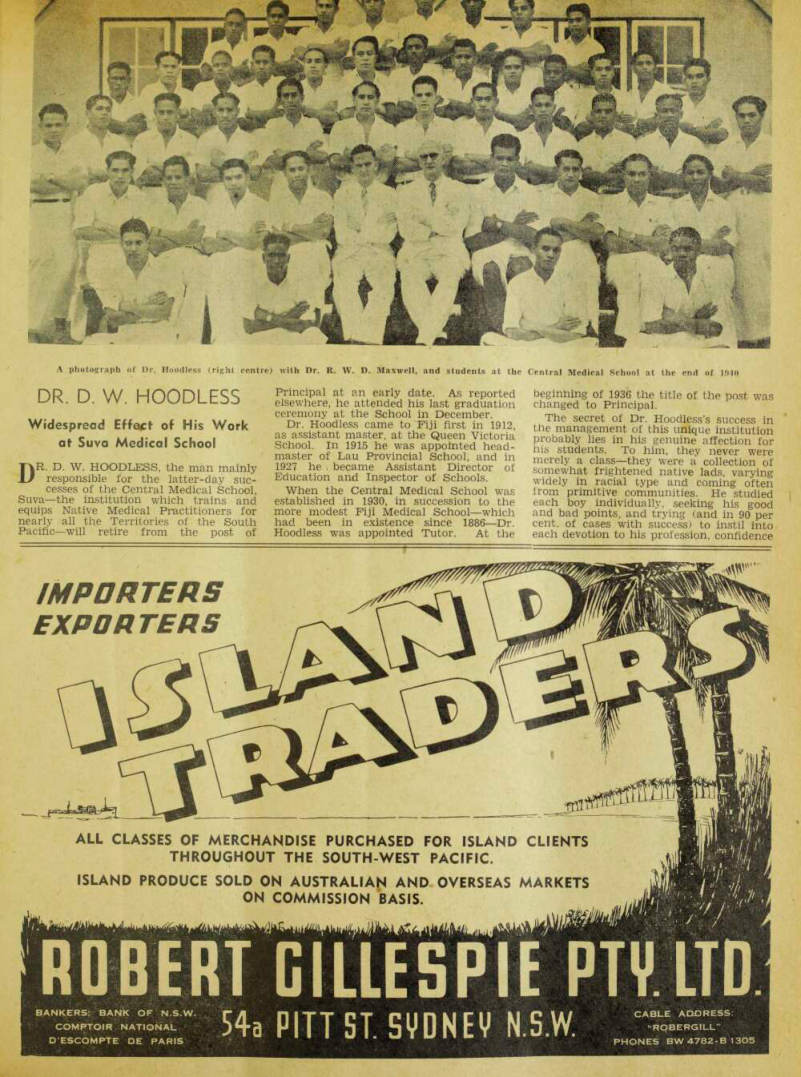

Dr. D. W. Hoodless
Widespread Effect of His Work at Suva Medical School
DR. D. W. HOODLESS, the man mainly responsible for the latter-day sue cesses of the Central Medical School, Suva—the institution which trains and equips Native Medical Practitioners for nearly all the Territories of the South Pacific—will retire from the post of
Principal at an early date. As reported elsewhere, he attended his last graduation ceremony at the School in December.
Dr. Hoodless came to Fiji first in 1912, as assistant master, at the Queen Victoria school, in 1915 he was appointed headmaster of Lau Provincial School, and in 1927 he became Assistant Director of Education and Inspector of Schools.
When the Central Medical School was established in 1930, in succession to the more modest Fiji Medical School—which had been in existence since 1886—Dr.
Hoodless was appointed Tutor. At the
beginning of 1936 the title of the post was changed to Principal.
Thp sprrpt of nr ttooHlpco’o
the management?f ’this uniqul institution
nrobablv lips in his C stuLntl. 1 T? They never we?e merely a class—thev wprp a pniwt imTnf
somewhat frightenld natfve lads varvin^
widely S type fnd coiSng often
from primitive communities He studied each boy individually, seeking his good and bad points and trying (and in 90 per cent, of cases with success) to instil into each devotion to his profession confidence
A photograph of Dr. Hoodless (right centre) with Dr. R. W. D. Maxwell, and students at the Central Medical School at the end of 1940
in himself, pride in the peoples of the Pacific Islands, respect for the British flag, and love for the School.
The students came in as isolated strangers, very conscious of their lone liness. They departed with their chins up, intensely proud of their newly-won diplomas, and morally supported in their future activities by the friendships made in four years in the Suva Medical School.
Each man went out to his district, not only as an NMP, but also as an advocate of education, progress and pride of race.
The Influence of Dr. Hoodless and his Medical School, throughout the South Pacific, during 15 years, is beyond calcu lation. He will not be easily replaced.
Dr. Hoodless has a unique knowledge of the operation of the native medical practitioner system in Pacific Territories.
He has written a brief history of the Fiji Medical School and the Central Medical School, and an outline of the work of their graduates, and this will be pub lished shortly.
Dr. Hoodless intends to spend the early part of his retirement in Fiji. His suc cessor, Dr. A. S. Frater, is on his way to Fiji from the United Kingdom.
Advertisements & other items, pp. 27-28 (1 item)
54A Pitt St. Svdnev N.S.W.
IMPORTERS
EXPORTERS
t ALL CLASSES OF MERCHANDISE PURCHASED FOR ISLAND CLIENTS
THROUGHOUT THE SOUTH-WEST PACIFIC.
ISLAND PRODUCE SOLD ON AUSTRALIAN AND OVERSEAS MARKETS
ON COMMISSION BASIS.
..ii.'/liWi 111,1 i
BANKERS: BANK OF N.S.W.
COMPTOIR NATIONAL
D ESCOMPTE DE PARIS
54a PITT ST. SVDNEV N.S.W.
CABLE AODRESS:
“ROBERGILL”
PHONES BW 4782-B 1305
Modern Refrigeration for the South Sea Islands
The ELECTROLUX
KEROSENE OPERATED
REFRIGERATOR
MARVEL
OF
MODERN
SCIENCE
m
THE
MIRACLE
OF
ICE
FROJVJ
HEAT
ELECTROLUX offers economical, modern and completely efficient
REFRIGERATION FOR ISLANDS' HOMES.
FREEZES CONTINUOUSLY WHILE SMALL LAMP BURNS.
Freezing controlled by simply regulating height of flame. Uses only gallon of kerosene per week, MOTORLESS ... NO PARTS TO GET OUT OF ORDER.
MODEL LKSSO
Capacity: 8.5 cubic feet. *
GUARANTEED FOR TWO YEARS
• Write to your Local Distributor for prices and full details.
OBTAINABLE FROM ALL W. R. CARPENTER & CO. LTD.
BRANCHES THROUGHOUT THE ISLANDS
Representation in Papua and New Hebrides.
Death Of Suva Radio
Announcer
Mr. J. L. Brennan
MR. JOHN L. BRENNAN, a well-known announcer of station ZJV Suva, died after a short illness on December 11. He was only 30 years of age.
Mr, Brennan was an Australian. He went to Suva in 1939 to join Burns Philp
(SS) Ltd., and in 1941 went to the Fiji Broadcasting Company as an announcer.
Since then he qualified as a technician.
He is survived by his wife, to whom he was married only 18 months ago.
Cargo Pillaging By
Sea-Going Gangs
PAPEETfe, Nov. 27. rE Worshipful Guild of Cargo Broachers on the Sydney wharves, is a band of mere adolescent amateurs, compared with the Were-Wolves of the sea-lanes.
The Sydney Guild graciously leaves some merchandise in the cases for the consignee; the Were-Wolves do not.
A fortnight ago, a ship turned up here bearing 900 refugee Jews, bound for Aus tralia, and some cargo for Papeete. The cargo was placed ashore, and the ship departed. After the usual formalities, the consignees began to open the cases.
Instead of wines, perfumes and textiles, they found coal-clinkers (from the ship’s furnaces) tightly packed with old India rubber floor mats.
The exterior of the cases exhibited no mark of chisels or other prying instru ments. The job was worthy of the highest traditional standards of the Sydney Guild Apparently the Were-Wolves took their plunder ashore, by night, at the several ports-of-call, and disposed of it at black market prices.
During the war, a similar band worked through the South Pacific, from San Francisco. In this case, the victim was Uncle Sam.
The Rev. J. W. Paton Gillan, who has been a missionary in the New Hebrides since 1932, will retire shortly from his station in Tangoa, South Santo, and will reside in Australia. He is a member of the well-known Paton missionary family which has contributed so much to the establishment of good order in the New Hebrides.
Advertisements & other items, p. 29 (1 item)
Dunlop
EX-ARMY TAILORS
A. LATEEF & CO., Tailors and Manufacturers to Fiji Military Forces during the War period, are now in business in their own clothing factory and retail business in Renwick Road, Suva.
Tailoring requirements are given every attention, with quality materials and first-class workmanship.
The speciality of the Clothing Factory is in mass-produced lines, such as shorts, shirts, sulus, pillow-slips, sheets, mosquito nets, etc.
This should be of interest to schools, hospitals, missions, etc., and particulars as to costs and quantities may be addressed to
A. LATEEF & CO., G.P.0., Box
227, SUVA.
Most People throughout the British Empire ride on
DUNLOP
TYRES
Better Than Sydney,
Anyway
AN evacuee of 1942-46 returns to his Territory—in this case, to a job on the coast of the Gulf of Papua—and does not like it much: “If it is possible for a place to be des cribed as the back-side of a country, then this region is the back-side of Papua.
“Everything seems dead. There are no fish, no crocs, no game except a rare pigeon, or a rare-as-radium pig.
“The Orokolo coons —Oh, I beg your pardon—the Orokolo natives always were considered to be about ten feet lower than the belly of a snake —a morose, dirty, scaly, shiftless lot—they are fit in habitants for this dung-heap of a place.
“The overcast skies and the poisonous
brown waters match the featureless coast, depressing and hopeless.
“However, even although it is the Orokolo country, and all these things, it is better than Sydney.’’
Father Dupont, a Roman Catholic priest well known throughout Fiji, died on December 1 at Wairiki, where he was living in retirement. He was born in France in 1869 and went to Fiji in 1894.
He was appointed Procurator in 1907 and in December 1910 he suceeded Bishop Nicholas as parish priest in Suva. In 1926 he was again appointed Procurator and a year later he became Superior at Wairiki. He remained in this position until 1933, when ill-health led to his re tirement.
Office to Stay
Fiji Public Relations Office to Stay
SOME doubt as to whether the Fiji Public Relations Office—which began life during the war as the Fiji In formation Office —would function indefi nitely was cleared away during the last session of the Fiji Legislative Council.
It was decided to establish the Public Relations Office as a permanent Govern ment department—since the change from war service to peace it has been func tioning as a temporary establishment.
The Office, under Mr. Harold jCooper (during the war) and more recently under Mr, Len Usher, has done a good job. Such are the complexities of running a country these days, it is necessary to have some .means of interpreting the people to the Government and, even more to the point, explaining the Government to the people. The office should also have a large part to play in tourist traffic which is expected to start moving in on the Colony as soon as travel faci lities are available.
Time Was A Cheap
Commodity In The Old
Pacific
Papeete, Nov. 20.
TIHE time-worn theory that the primitive inhabitants of any area where mega lithic edifices exist were incompetent weaklings, and that the ponderous struc tures could have been erected only by a race of supermen from somewhere else, is again being dusted off and broadcast tp a believing world.
Speed-goaded modern individuals, who have witnessed the megaferric mon strosities completed within the space of months, cannot comprehend that the great, enduring monuments of an earlier age were fashioned by men who had all the time in the world. We have a com paratively recent example of that in the leisurely fabrication of the European cathedrals. • At POnape, in the Carolines, it may have required a year (or two years, or five years) to prepare one of the great basaltic prisms; to build a coral ramp; to slowly move the stone to its appointed place.
This writer has witnessed, at Papeete, the slow elevation of a massive piece of machinery (weighing several tons), from the level of the wharf, its horizontal transport across the bulwark of a steamer and its safe deposit within the hold of the vessel, by less than 50 Tahitians using only wooden blocks and crow-bars.
The idea that the population of the Continent of Mu was required to erect the structures on Ponape and Rusaie, is a trifle absurd.
King Christophe’s fortress on a moun tain in Haiti (on Santo Domingo Island) is a megalithic structure which did not require the entire population of North America for its fabrication.
The regal sons of Ta’aroa—who fought the rearguard battles in Indonesia and retired to found an Empire in the Caro lines—were mighty men of valor. Their ancestors had, probably, seen in India, structures of the pattern they, themselves, erected on Ponape and on Kusaie.
Mr. and Mrs. J. A. Muir, of Suva, Fiji, celebrated their golden wedding anni versary on December 1. Both were born in Lancashire, England, and have been many years in Fiji. Muir’s bookshop and souvenir depot is well known in Suva. Mr.
Muir ran the business personally until recently, when he sold out and retired.
Advertisements & other items, p. 30 (1 item)
Ingham’S
m x\\M mm
tn s
SwW'^
, * UTl\fc G°* &e L , n Set your face up for the day with COOL, soothing, whisker-subduing
INGRAM'S!
All over the world the Ingram's jar is the morning companion of men who appreciate easy shaving. Ingram's cools and smoothes the skin while it wilts the wiriest hair-growth. Moreover, Ingram's is most economical because so little is needed for a rich, thick, spreading lather.
INGHAM’S
SHAVING CREAM
Manufactured by
BRISTOL-MYERS CO. PTY. LTD.
Sold by all leading distributors and manufactured by Bristol-Myers Co. Pty. Ltd., 223 Pacific Highway, North Sydney, N.S.W., Australia
Forgotten Tragedy Of 1942
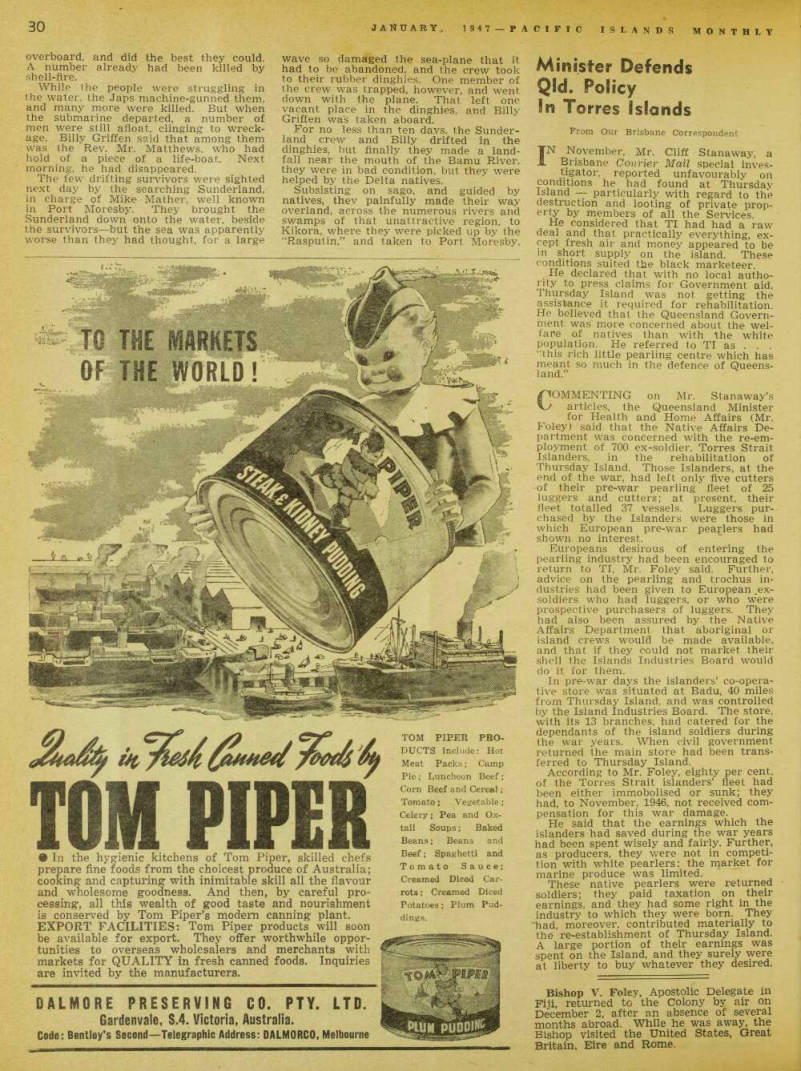
How "Momutu" and 80 Men Were Lost off S. Papua Coast
T ITTLE has been heard of one of the cruellest tragedies of the Pacific War, comparable with the loss of ihe Rabaul civilians on the “Monte Video Maru” This was the murder of 75 half- •castes and d handful of Europeans by the Japanese, in 1942, off the South Coast of Papua, near Torres Strait.
The dead included the well-known Port Moresby clergyman, the Rev. H. Matthews. We are indebted to his son, Mr.
Adrian N. Matthews, of Papua, for the data from which we have reconstructed the tragedy. It was known in 1942 that a tragedy had occurred, but even officialdom did not get the details for a long time.
RABAUL fell on January 23, 1942. Port Moresby had its first air raid early in the bright moonlit morning of February 3; and, thereafter, the Jap air fleets came regularly, and their attacks grew in intensity.
As the raids became more severe, strange things happened in and around Port Moresby. Telephone lines were cut near Jackson’s Strip (also called Seven Mile Strip); unexplained lights appeared when the planes were over on night sorties: and, during daylight, small white balloons appeared over the target area.
It was decided that, to forestall the half-castes becoming involved in any sabotage activities, the whole half-caste population be sent out to Daru (Western Papua) for the duration.
The first party of half-castes was sent away in June, 1942, and one of the
Europeans in charge of them was Mr.
Adrian Matthews. On August 5, the second party, comprising over 70 half castes and half-a-dozen Europeans left on the MV ‘“Mamutu”—an inter-island craft of about the same size and design as the now famous “Lakatoi.”
On the “Mamutu” was the Rev. H.
Matthews. He had not left Port Moresby with other civilians in February, At his own request he was permitted to remain and carry on as an Army Chaplain— chaplains then were few and far between, and he had plenty to do. But, after a few months, he was told he was “too old for the job,” and he would have to go South. Authority granted his request that, as- an alternative, he be allowed to join his son at Daru; and he embarked on the “Mamutu,” unknown to his son.
On August 5, the European garrison at Daru picked up a message from Murray Island (in Torres Strait) that a submarine had been seen proceeding in a north-easterly direction.
Two days later, on August 7, Daru received radio advice that the “Mamutu” had been sunk 25 miles east of Bramble Cay. Bramble Cay is 50 miles east of Daru—so the ill-fated ship met the Jap submarine 75 miles from her destination.
TMMEDIATELY, Mr. Gus O’Donnell got X the LMS launch “Oliver Tompkins” ready, and Lieutenant Ethell, Doug las McGregor and Adrian Matthews were sent off to seek for survivors. Little did Mr. Matthews guess that his father had been aboard the “Mamutu.”
The launch met terrible seas, and the three men had a wreched trip. They headed south-east, to where they calcu lated the currents would carry anything that floated away from the lost ship, and they called at Stevens and Darnley Islands to inquire whether anything had been seen. Then they went back to Bramble Cay, but found nothing. The little “Oliver Tompkins,” which had been built only for river-work, stood up splen didly to the heavy seas. After three days’ vain search, they returned to Daru.
All they had seen was a Sunderland flying-boat, evidently out on the same search.
Some time later Adrian Matthews was informed that his father was on the “Mamutu.” Then he was transferred to Milne Bay, and he departed eastwards on the “Rasputin.”
EN ROUTE to Port Moresby, the “Rasputin” called at Kikori (on the Gulf of Papua, about 100 miles north of where the “Mamutu” was sunk) and there they found one half-caste sur vivor from the “Mamutu.” Billy Griffen, and the surviving members of the crew of a Sunderland flying-boat, which had res cued him. From these men. Mr. Matt hew compiled the following account of what had happened.
In broad daylight on August 7, the Jap submarine surfaced half a mile from the “Mamutu,” and signalled them that they were not to use their wireless. The skipper ignored the order, however, and promptly sent out the SOS, and informa tion that he was being attacked.
The Jlap at once closed in to within 100 yards and began shelling the “Mam- Vitu.” The first shot carried away the bridge and superstructure, and following shots set fire to drums of fuel, which were stored on deck. The boats had been destroyed by the shells so all jumped
overboard, and did the best they could.
A number already had been killed by shell-fire.
While the people were struggling in the water, the Japs machine-gunned them, and many more were killed. But when the submarine departed, a number of men were still afloat, clinging to wreck age. Billy Griffen said that among them was the Rev. Mr. Matthews, who had hold of a piece of a life-boat. Next morning, he had disappeared.
The few drifting survivors were sighted next day by the searching Sunderland, in charge of Mike Mather, well known in Port Moresby. They brought the Sunderland down onto the water, beside the survivors—but the sea was apparently worse than they had thought, for a large
wave so damaged the sea-plane that it had to be abandoned, and the crew took to their rubber dinghies. One member of the crew was trapped, however, and went down with the plane. That left one vacant place in the dinghies, and Billy Griffen was taken aboard.
For no less than ten days, the Sunder land crew and Billy drifted in the dinghies, but finally they made a land fall near the mouth of the Bamu River, they were in bad condition, but they were helped by the Delta natives.
Subsisting on sago, and guided by natives, thev painfully made their way overland, across the numerous rivers and swamps of that unattractive region, to Kikora, where they were picked up by the “Rasputin,” and taken to Port Moresby.
Advertisements & other items, pp. 31-32 (1 item)
Equal to the World’s Best
Throughout Australia and Overseas there it an ever-increasing demand for
COLONIAL & BRONTE
HIGH-GRADE CANNED MEATS
There is no better quality—none more wholesome.
TRADE MEATS FOR THE ISLANDS
order
“COLONIAL” BRAND
Roast, Corned and Boiled Beef Packed in 6,5, 4,3, 2, 1 lb. and 12 oz. tins.
Also Corned Beef in 12 oz. Taper Tins, Roast, Corned and Boiled Mutton. 1 lb. and 12 oz. tins.
Choice Dripping
36 lb., 2 lb., 1 lb. tins, and 1 lb. packets. -I*. § 0. w* *2aSSI c M I m m Under present conditions it is icise to ensure that you have ample stocks of all our lines.
The Colonial Wholesale Meat Coy. Pty. Ltd.
30 GROSVENOR STREET, SYDNEY
a ii «** T
THE
OF THE WORLD
krnmk
A r A m m i Js> J Jiv -•- J
TOM PIPER
prepare fine foods from the choicest produce of Australia; with inimitable skill all the flavour In the hygienic kitchens of Tom Piper, skilled chefs epare fine foods from the choicest prodr cooking and capturing with inimitable s and wholesome goodness. And then, by careful processing, all this wealth of good taste and nourishment is conserved by Tom Piper’s modem canning plant.
EXPORT. FACILITIES: Tom Piper products will soon be available for export. They offer worthwhile opportunities to overseas wholesalers and merchants with markets for QUALITY in fresh canned foods. Inquiries are invited by the manufacturers.
DALMORE PRESERVING CO. PTY. LTD.
Gardenvale, 5.4. Victoria, Australia.
Code: Bentley’s Second—Telegraphic Address: DALMORCO, Melbourne
TOM PIPER PRO-
DUCTS include: Hot Meat Packs; Camp Pie ; Luncheon Beef ; Corn Beef and Cereal; Tomato; Vegetable; Celery; Pea and Oxtail Soups; Baked Beans; Beans and Beef; Spaghetti and Tomato Sauce; Creamed Diced Carrots ; Creamed Diced Potatoes; Plum Puddings. mm to
Qld. Policy
Minister Defends Qld. Policy In Torres Islands
From Our Brisbane Correspondent IN November, Mr. Cliff Stanaway, a Brisbane Courier Mail special inves tigator, reported unfavourably on conditions he had found at Thursday Island particularly with regard to the destruction and looting of private prop erty by members of all the Services.
He considered that TI had had a raw deal and that practically everything, ex cept fresh air and money appeared to be in short supply on the island. These conditions suited the black marketeer.
He declared that with no local autho rity to press claims for Government aid, Thursday Island was not getting the assistance it required for rehabilitation.
He believed that the Queensland Govern ment was more concerned about the wel fare of natives than with the white population. He referred to TI as . . .
“this rich little pearling centre which has meant so much in the defence of Queens land.”
COMMENTING on Mr. Stanaway’s articles, the Queensland Minister for Health and Home Affairs (Mr.
Foley) said that the Native Affairs De partment was concerned with the re-em ployment of 700 ex-soldier, Torres Strait Islanders, in the rehabilitation of Thursday Island. Those Islanders, at the end of the war, had left only five cutters of their pre-war pearling fleet of 25 luggers and cutters; at present, their fleet totalled 37 vessels. Luggers pur chased by the Islanders were those in which European pre-war pearlers had shown no interest.
Europeans desirous of entering the pearling industry had been encouraged to return to TI, Mr. Foley said. Further, advice on the pearling and trochus in dustries had been given to European .ex soldiers who had luggers, or who were prospective purchasers of luggers. They had also been assured by the Native Affairs Department that aboriginal or island crews would be made available, and that if they could not market their shell the Islands Industries Board would do it for them.
In pre-war days the islanders’ co-opera tive store was situated at Badu, 40 miles from Thursday Island, and was controlled by the Island Industries Board. The store, with its 13 branches, had catered for the dependants of the island soldiers during the war years. When civil government returned the main store had been trans ferred to Thursday Island, According to Mr. Foley, eighty per cent, of the Torres Strait islanders’ fleet had been either immobolised or sunk; they had, to November, 1946, not received com pensation for this war damage.
He said that the earnings which the islanders had saved during the war years had been spent wisely and fairly. Further, as producers, they were not in competi tion with white pearlers: the market for marine produce was limited.
These native pearlers were returned soldiers; they paid taxation on their earnings, and they had some right in the industry to which they were born. They had, moreover, contributed materially to the re-establishment of Thursday Island.
A large portion of their earnings was spent on the Island, and they surely were at liberty to buy whatever they desired.
Bishop V. Foley, Aoostolic Delegate in Fiji, returned to the Colony by air on December 2, after an absence of several months abroad. While he was away, the Bishop visited the United States, Great Britain. Eire and Rome.
Suva Graduation
14 New Nmp's In
Students From New Guinea Will Attend Central Medical School Next Year
Suva, Dec. 20.
THE graduation ceremony at the Central Medical School was an in formal function this year, as several of the students had already departed for their homes in other Island groups.
The presentations were made by Dr.
J. C. R. Buchanan, Director of Medical Services in the Colony, who afterwards addressed the young men.
There were fourteen graduates who had successfully completed their four years’ course—five Fijian, three Solomon Islanders, one a Fiji-born Indian, and one from each of , the Ellice Islands, American Samoa, Cook Islands, Tonga and the New Hebrides.
After a short leave at home the men will take up their new positions as Native Medical Practitioners.
In his address, Dr. Buchanan stressed the fact that their real work lay ahead and that the study of the art of medicine and reading of the human mind in order that the body might be healed, was some thing that would continue for years. On itheir return to their islands, and in taking up their new profession, they might not at first be able to apply all they had learned at the Medical School, but the knowledge they had gained would put them in the role of leaders, and in that role, by their example, they could direct their people from harmful customs and lead them towards better ways of living.
Dr. Buchanan also paid a tribute to the work of Dr. D. W. Hoodless, who
has relinquished the post after 16 years as Principal of the school, THE 14 new qualified NMPs now bring the total of graduates of the school to 285. Of these 130 were trained at the Suva Hospital between 1888 and 1929, under the system introduced by Dr.
William MacGregor, and from which the present Central Medical School evolved. Since the establishment of the School in 1930, and the inclusion of students from other South Pacific terri tories, 155 NMP certificates have been awarded.
Of the 285 graduates since 1888, 179 have been Fijians, 12 Indians from Fiji. 23 Western Samoans, 17 Gilbert and Ellice Islanders, 16 Tongans, 13 from BSI, 9 from Cook Islands, 6 from New Heb rides, 4 from Nauru, 4 Eastern Samoans and 2 students from the Union Group.
Next year, as indicated elsewhere in this issue, six students will attend the School from Papua-New Guinea. Al though students from the New Guinea territories were eligible to enter the Fiji school, this will be the first time in which any New Guinea natives have been sent to Suva. It is feared, in some quarters, that the New Guinea student’s educational background will not be suffi cient for them to take full advantage of the Central Medical School courses. But Dr. J. Gunther. Director of Medical Ser vices in New Guinea, who recently visited Suva on behalf of the New Guinea students, has been assured by Dr. Hood less that in previous years some of the Solomon Island students were no better equipped with educational qualifications.
Mr. Allan Wood, formerly on he staff of Bulolo Gold Dredging Co, left Mel bourne on December, 27 for Borneo, where he will take up a position with the Shell Oil Coippany.
Troubles, Too
Tonga Has Trading
From Our Own Correspondent
Nukualofa, Dec. 16.
THERE was outspoken satisfaction among Tongans when a European trader was fined £3 for selling goods to a Tongan for a higher price' than the law allows. This was only a mantle and wick for a kerosene lamp, which was sold for 4/- instead of 3/3—but far too much profiteering by merchants in the Kingdom is taking place, and is being ignored by those supposed to uphold the law. Customers fear to make complaints, because some merchant's do not hesitate to revenge themselves by refusing supplies to the complainants.
The most common form of unlawful profit-making is the imposition of condi tions on the sale of goods, practised mostly by small Indian retailers. At one time, when matches were scarce, they insisted on customers buying a loaf of bread with every box of matches. This practice was not confined to small traders. When cigarette papers were scarce and cigarette tobacco plentiful, one of the large firms here sold their cigarette papers only on condition that customers bought cigarette tobacco with every packet of papers purchased.
When he picked up a radio aerial wire which had fallen across a high tension electrical main at Samabula in Decem ber. Mr. William Broaderlaw, an employee of the Eltron Electrical Engineering Co. of Suva, was killed almost instantaneously.
The accident occurred when Mr. Broader law picked up one end of the wire with a pair of pliers. He was born at Apia, Western Samoa, about 21 years ago, but he lived in Fiji for most of his life.
Advertisements & other items, p. 33 (1 item)
William Atkins Pty. Ltd.
Head Office 449-451 KENT ST., SYDNEY.
Iron & Sfeei Merchants-Engineers' Supplies
Coach fir Motor Hardware
ESTABLISHED OVER 50 YEARS
Cable Address: WILATKIN, Sydney.
—STEEL DEPARTMENT
MILD STEEL;
Rounds, Squares, Flats, Half-rounds, Hexagons, Bevel, Shoeing, Tyre, Angles, Tees, Sheets, Plates, Girder Plates, Chequer Plates, Channels, Hoops, Etc.
BRIGHT STEEL:
Rounds, Squares, Hexagons.
Extra Special High Speed Tool Steel, Mining Steel, Blister Steel and Spring Steel, Rounds, Flats & Squares.
Bar Iron—All sections and sizes.
Engineers' Supplies: Set Screws, Studs, Metal Thread Screws, Coach Screws, Piles, Cotter Pins, Bright and Black Bolts, Rivets, Etc., Hack Saw Blades.
Power Transmission Gear: Including Plummer Blocks, Couplings, Collars, Etc.
Coach and Motor Hardware: Axles, Springs, Wheelstufif, Duck, Paints.
Farriers' Supplies: Horse Nails, Anvils, Vices, Etc.
Motor-Trimmers and Motor Builders' fir Motor Painters' Requirements Pacific Island Agents : Corrie fir Co., Suva, Fiji DUCO Lacquers and DULUX Enamels—FABREX Motor Toppings and Leather Cloths, House & Decorators' Paints, Varnishes fir Brushware.
Sole Distributors of CHAMPION'S Decorators Paint Products.
Distributing Agents for BROLITE Lacquers, SYNFLEX Enamels and "POLYGLOSS" Finish.
Death Of Mr. A. E. Allman,
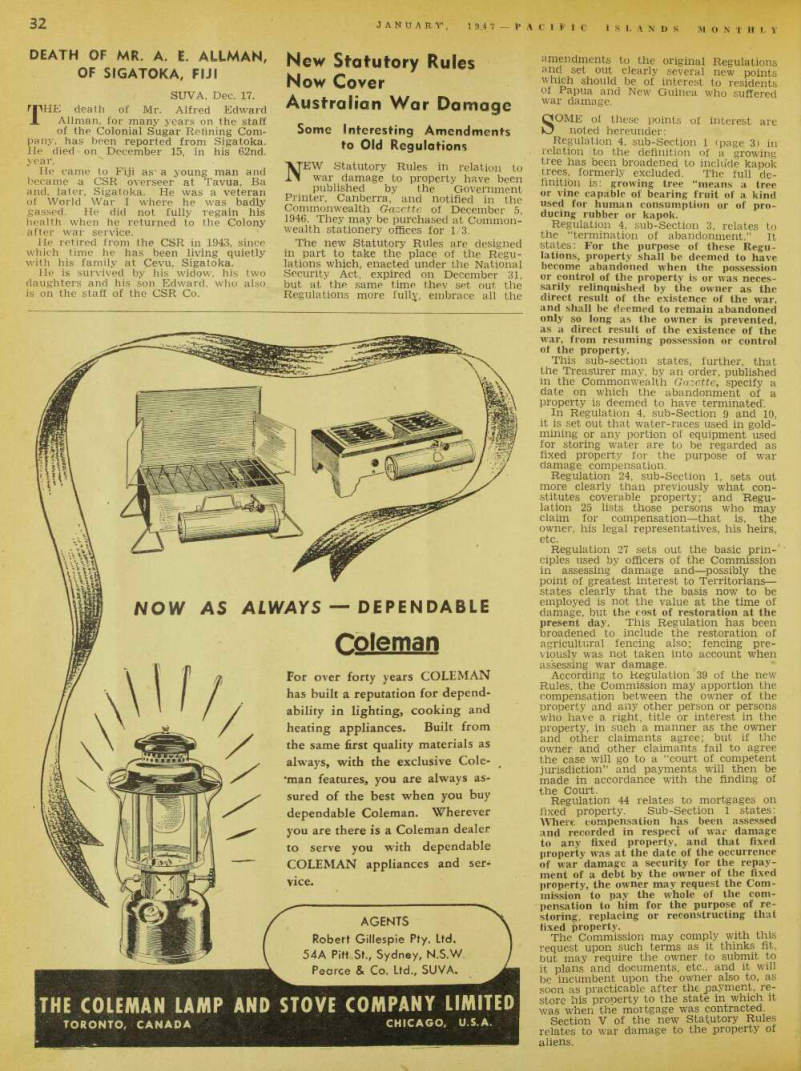
Of Sigatoka, Fiji
Suva, Dec. 17.
rpHE death of Mr. Alfred Edward X Allman, for many years on the staff of the Colonial Sugar Refining Com pany, has been reported from Sigatoka.
He died on December 15, in his 62nd. year.
He came to Fiji as a young man and became a CSR overseer at Tavua, Ba and, later, Sigatoka. He was a veteran of World War I where he was badly gassed. He did not fully regain his health when he returned to the Colony after war service.
He retired from the CSR in 1943, since which time he has been living quietly with his family at Cevu, Sigatoka.
He is survived by his widow, his two daughters and his son Edward, who also is on the staff of the CSR Co.
New Statutory Rules
Now Cover Australian War Damage Some Interesting Amendments to Old Regulations
NEW Statutory Rules in relation to war damage to property have been published by the Government Printer, Canberra, and notified in the Commonwealth Gazette of December 5, 1946. They may be purchased at Common wealth stationery offices for 1/3.
The new Statutory Rules are designed in part to take the place of the Regu lations which, enacted under the National Security Act. expired on December 31, but at the same time thev set out the Regulations more fully, embrace all the
amendments to the original Regulations and set out clearly several new points which should be. of interest to residents of Papua and New Guinea who suffered war damage.
SOME of these points of interest are noted hereunder: Regulation 4. sub-Section 1 (page 3) in relation to the definition of a growing tree has been broadened to incldde kapok trees, formerly excluded. The full de finition is: growing tree “means a tree or vine capable of bearing fruit of a kind used for human consumption or of pro ducing rubber or kapok.
Regulation 4, sub-Section 3, relates to the “termination of abandonment.” It states: For the purpose of these Regu lations, property shall be deemed to have become abandoned when the possession or control of the property is or was neces sarily relinquished by the owner as the direct result of the existence of the war. and shall be deemed to remain abandoned only so long as the owner is prevented, as a direct result of the existence of the war, from resuming possession or control of the property.
This sub-section states, further, that the Treasurer may, by an order, published in the Commonwealth Gazette, specify a date on which the abandonment of a property is deemed to have terminated.
In Regulation 4, sub-Section 9 and 10, it is set out that water-races used in gold mining or any portion of equipment used for storing water are to be regarded as fixed property for the purpose of war damage compensation.
Regulation 24, sub-Section 1, sets out more clearly than previously what con stitutes coverable property; and Regu lation 25 lists those persons who may claim for compensation—that is, the owner, his legal representatives, his heirs, etc.
Regulation 27 sets out the basic prin ciples used by officers of the Commission in assessing damage and —possibly the point of greatest interest to Territorians— states clearly that the basis now to be employed is not the value at the time of damage, but the cost of restoration at the present day. This Regulation has been broadened to include the restoration of agricultural fencing also; fencing pre viously was not taken into account when as'sessing war damage.
According to Regulation 39 of the new Rules, the Commission may apportion the compensation between the owner of the property and any other person or persons who have a right, title or interest in the property, in such a manner as the owner and other claimants agree; but if the owner and other claimants fail to agree the case will go to a “court of competent jurisdiction” and payments will then be made in accordance with the finding of the Court.
Regulation 44 relates to mortgages on fixed property. Sub-Section 1 states: Where compensation has been assessed and recorded in respec! of war damage to any fixed property, and that fixed property was at the date of the occurrence of war damage a security for the repay ment of a debt by the owner of the fixed property, the owner may request the Com mission to pay the whole of the com pensation to him for the purpose of re storing, replacing or reconstructing that fixed property. .
The Commission may comply with this request upon such terms as it thinks fit, but may require the owner to submit to it plans and documents, etc., and it will be incumbent upon the owner also to, as soon as practicable after the payment, re store his property to the state in which it was when the mortgage was contracted.
Section V of the new Statutory Rules relates to war damage to the property of aliens.
Advertisements & other items, p. 34 (1 item)
Coleman
NOW AS ALWAYS DEPENDABLE
\ / \ \ tss& m
For over forty years COLEMAN has built a reputation for dependability in lighting, cooking and heating appliances. Built from the same first quality materials as always, with the exclusive Cole- man features, you are always assured of the best when you buy dependable Coleman. Wherever you are there is a Coleman dealer to serve you with dependable COLEMAN appliances and service.
AGENTS
Robert Gillespie Pty. Ltd. 54A Pitt St., Sydney, N.S.W Pearce & Co. Ltd., SUVA.
THE COLEMAN LAMP AND STOVE COMPANY LIMITED
TORONTO, CANADA
CHICAGO, U.S.A.
500 Bushels Of Rice
To The Acre!
New Method of Electro-Chemical
Fertilisation in Ceylon Watched
With Interest
AN extraordinary, new technique in the cultivation of rice which increases the yield ten-fold, was reported in the Crown Colonist for December. If these experiments could be put to prac tical purpose and achieve a similar result, the rice industry would be revolutionised and the rice-consuming countries of the world, all of which have had to tighten their belts, well fed.
The experiments have been made in Ceylon by Mr. M. L. Wickremesinghe, mechanical engineer of the Colombo Municipal Council, with an apparatus which he claims is capable of extracting nitrogen from the air and distributing it over the paddy fields and at the same time supplying electrical energy to the young rice plants.
On a trial plot of about an acre at Jawatte, in the heart of Colombo, Mr.
Wickremesinghe sowed a bushel of rice of five varieties in May, 1946. Early and late varieties were sown together, and such has been the growth of the .crop that Mr. Wickremesinghe estimates a final yield of some 500 bushels from the acre. (The average yield in Ceylon in 1939 was 20 bushels to the acre; but, during the war, the maximum yield on Government Agricultural stations was stepped up and in one instance reached 54 bushels per acre.) Mr. Wickremesinghe recently explained his experiments in chemico-electric ferti lisation to a meeting of the Ceylon Engineering Association and a report was made by the correspondent of the Crown Colonist. Much of the inventor’s ex planation is necessarily technical but put simply it may be said that the invention is designed to supply nitrogenous fertiliser plus electrical energy to the paddy plants.
The nitrogen is extracted from the air in a portable laboratory, called the Electro Magnetic Nitrogen Fertiliser, which can be taken into and worked in a paddy field. This machine can germi nate paddy seed in a nitrogenous solution of water and stimulate it with electro magnetic waves. The germinated seeds should then be sown by a seed drill (un touched by hand, in order to prevent the discharge of the electricity) and spaced at from 4 to 6 inches. The machine may be taken to the field after the seedlings are four days old and placed so that it can deliver its extractions in the propor tion of 30 lb. of nitrogen per acre.
The machine weighs 90 lb. and costs from £45 to £5O (stg.). It comprises a light steel tank, specially lined on the inside and capable of holding at least 10 gallons of water. The inside of the tank contains a chemical cell and a honeycomb-like structure in light steel, each compartment of which contains alternate blocks of loose-grained charcoal and a special metal. The top of the tank is fitted with two sparking plugs con nected by high-tension wiring to an in duction coil or magneto driven by a gearfed spring motor bolted to the tank.
The machine is claimed to be cheap to operate, since the mechanism is worked merely by winding a coiled spring. The invention is also designed to be used in conjunction with- magnetic flux beams converging from the four corners of a paddy field.
In an interview, Mr. Wickremesinghe said that experts who visited the field a few months ago declared he would not
reap more than 45 bushels. “But,” said Mr. Wickremesinghe, “from random picking alone I have already collected more than 45 bushels. The minimum I expect from the field is 500 bushels. It may be more.”
He claimed that if the Government gave him 250 acres and a capital vote of £4,500 he would produce enough rice to feed Colombo’s 400,000 people for a year on the present ration of one measure of rice per week for an adult.
Mrs. Lillian Millar, a well-known resi dent of New Guinea until the evacuation in 1941, and who subsequently served in the Australian and American forces, has been appointed hostess and receptionist at Australian National Airways’ new offices in Margaret Street, Sydney.
New Map of Suva Now Available
ANEW map of the Suva peninsula, based on an aerial survey, is now on sale at the Lands Department, Suva.
The price is 5/-.
Roads and buildings are clearly marked on the map, which also shows areas covered by bush, scrub, trees and palms.
Contours with a vertical interval of 50 feet are shown, and so also are promi nent buildings in Suva. The map is . a companion to the one of Lautoka, which was issued previously.
A member of the Anglican Church in Australia, Mrs. A. E. J. Ross, has given the Anglican Mission £6,000 in order to build a new training college for native clergy at Dogura, Papua.
Advertisements & other items, p. 35 (1 item)
Lager
BREWED BY
CARLTON & UNITED BREWERIES LTD.
Anti-Filaria Campaign In Rarotonga
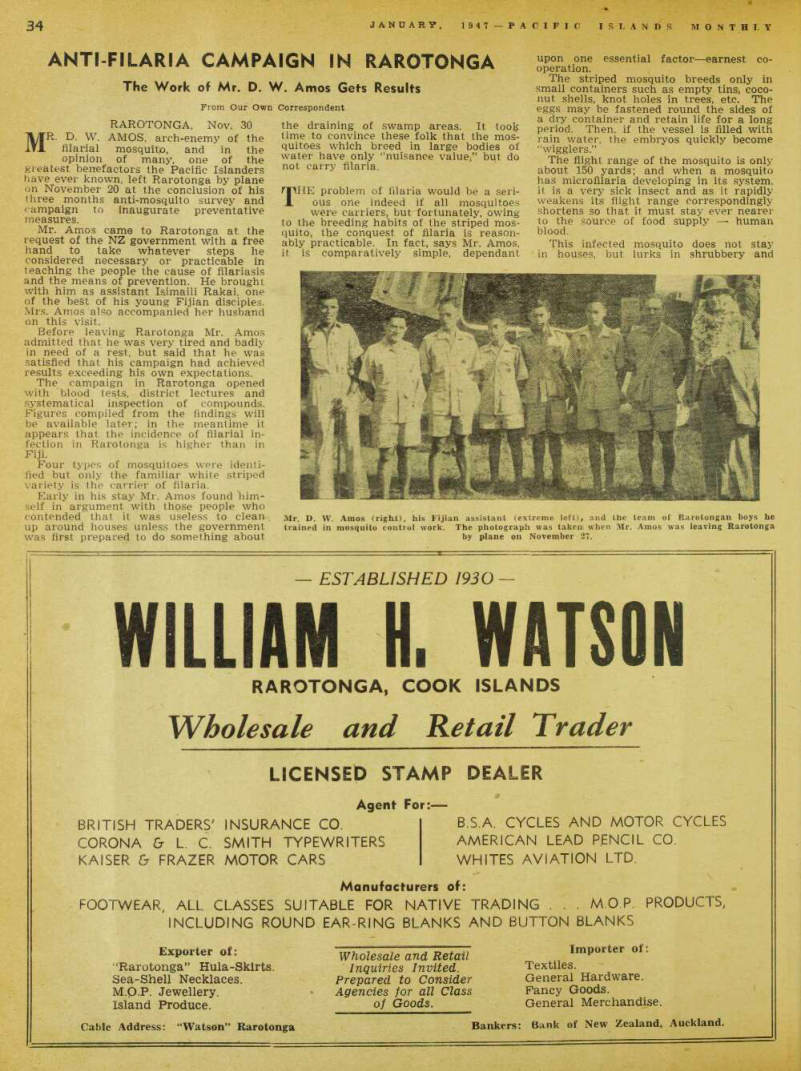
The Work of Mr. D. W. Amos Gets Results
From Our Own Correspondent
Rarotonga, Nov. 30
MR. D. W. AMOS, arch-enemy of the filarial mosquitp, and in the opinion of many, one of the greatest benefactors the Pacific Islanders have ever known, left Rarotonga by plane on November 20 at the conclusion of his three months anti-mosquito survey and campaign to inaugurate preventative measures.
Mr. Amos came to Rarotonga at the request of the NZ government with a free hand to take whatever steps he considered necessary or practicable in teaching the people the cause of filariasis and the means of prevention. He brought with him as assistant Isimaili Rakai, one of the best of his young Fijian disciples.
Mrs. Amos also accompanied her husband on this visit.
Before leaving Rarotonga Mr. Amos admitted that he was very tired and badly in need of a rest, but said that he was satisfied that his campaign had achieved results exceeding his own expectations.
The campaign in Rarotonga opened with blood tests, district lectures and systematical inspection of compounds.
Figures compiled from the findings will be available later; in the meantime it appears that the incidence of filarial in fection in Rarotonga is higher than in Fiji.
Four types of mosquitoes were identi fied but only the familiar white striped variety is the carrier of filaria.
Early in his stay Mr. Amos found him self in argument with those people who contended that it was useless to clean up around houses unless the government was first prepared to do something about
.. , . . , * , the draining of swamp areas It tool? * ln to CO J I . VI / 1C ? these folk that the mosquitoes which breed in large bodies of Q nuisance value, but do nol carr T niana. rpIIK problem of fllaria would be a seri- 1 ous one indeed if all mosquitoes were carriers, but fortunately, owing to the breeding habits of the striped mosquite, the conquest of filaria is reasonably practicable. In fact, says Mr. Amos, it is comparatively simple, dependant
upon one essential factor —earnest co operation.
The striped mosquito breeds only in small containers such as empty tins, coco nut shells, knot holes in trees, etc. The eggs may be fastened round the sides of a dry container and retain life for a long period. Then, if the vessel is filled with rain water, the embryos quickly become “wigglers.”
The flight range of the mosquito is only about 150 yards; and when a mosquito has microfilaria developing in its system, it is a very sick insect and as it rapidly weakens its flight range correspondingly shortens so that it must stay ever nearer to the source of food supply human blood.
This infected mosquito does not stay in houses, but lurks in shrubbery and
Mr. D. W. Amos (right), his Fijian assistant (extreme left), and the team of Rarotongan boys he trained in mosquito control work. The photograph was taken when Mr. Amos was leaving Rarotonga by plane on November 27.
undergrowth outside. Only in the last days of the mosquito, when it is at its weakest and unable to move far from the house, are the microfilaria able to burst their way from the insect’s throat while it is feeding and so make their way through the skin pores of a human victim.
Mr. Amos emphasises that this sequence of events clearly points the answer to filaria control. Remove and destroy all possible breeding sources and clear away all shrubbery and under growth in the neighbourhood of dwelling places. Ideally, a dwelling place should be kept clean and clear for a circum ference of 150 yards. In close-packed communities complete co-operation is necessary if all homes are to have reason
able protection.
Meat tins, says Mr. Amos, are the curse of the Cook Islands; nowhere has he seen so many empty tins to the square mile as in Rarotonga. One sees them everywhere; around the houses, along the roads and ditches, on the beaches.
As a result of the campaign consider able progress has already been made, especially in the country districts. But it was not easy to get started, and there will be need for constant supervision to ensure that the work has real lasting value. Polynesians are notoriously care less in health matters, and practically have to be forced to take measures for their own good and preservation.
They have always been fatalistic re garding filariasis and the dreaded culmi nating elephantiasis. This attitude in volved Mr. Amos in some lively argu ments which provided scope for his ready wit. Cook Islanders love to use Bible quotations and references in the course of arguments, but Mr. Amos had ready answers. One man said! “God made men and He made mosquitoes—and if He de cided to give me ‘big legs’ that is just my bad luck.” To Which Mr. Amos snappily replied, “But God did not strew empty meat tins all round your house so that the mosquitoes could live with you! And don’t forget that God helps those that helps themselves!”
BUT one thing more than any other captured the attention of the Raro tongans and convinced them that this was not “just another Papa’a with crazy ideas.” Using the new bandaging and massage technique, Mr. Amos has achieved remarkable results in the re duction of elehantoid limbs results which appear to the people as nothing less than miracles. Many advanced and long-standing cases have been reduced to normal or near normal in a few weeks.
The gratitude of these persons can be better imagined than described.
Mr. Amos’ had not originally intended to include manipulation in his programme but he could not refuse to help and once his “miracle-healing” became known there was an increasing flow of patients.
A considerable portion of each day had to be devoted to this work and while adding greatly to the strenuousness of Mr. Amos’ task, it undoubtedly did much to promote interest in the campaign..
During his stay Mr. Amos trained six young Rarotongans to carry on the duties of district mosquito-control inspectors and advisors and they are tackling the job with enthusiasm. Isimaili Rakai is staying on for a few months to super intend the campaign and Mr. Amos will make a return visit later to check progress.
Fruit headed the list of exports from Fiji to New Zealand during October. In that month 917,460 lbs. of bananas (£5,861 value) and pineapples to the value of £2,403 left Suva for the Dom inion. Total value of exports to NZ during the month was £12,126; imports from NZ were valued at £4,840.
Advertisements & other items, pp. 36-37 (1 item)
William H. Watson
ESTABLISHED 1930 -
RAROTONGA, COOK ISLANDS
Wholesale and Retail Trader
LICENSED STAMP DEALER
Agent For:—
BRITISH TRADERS' INSURANCE CO.
CORONA & L. C, SMITH TYPEWRITERS
KAISER & FRAZER MOTOR CARS
B.S.A. CYCLES AND MOTOR CYCLES
AMERICAN LEAD PENCIL CO.
WHITES AVIATION LTD.
Manufacturers of: FOOTWEAR, ALL CLASSES SUITABLE FOR NATIVE TRADING . . . MOP. PRODUCTS, INCLUDING ROUND EAR-RING BLANKS AND BUTTON BLANKS Exporter of: “Rarotonga” Hula-Skirts.
Sea-Shell Necklaces.
M.O.P. Jewellery.
Island Produce.
Wholesale and Retail Inquiries Invited.
Prepared to Consider Agencies for all Class of Goods.
Importer of: Textiles.
General Hardware.
Fancy Goods.
General Merchandise.
Cable Address; “Watson” Rarotonga Bankers: Bank of New Zealand, Auckland.
v the v
Relief from
a major anxiety
Even the most expert and conscientious individual executor is subject to accident, illness and incapacitation.
Continuity of administration and uninterrupted attention to your estate and your beneficiaries are of paramount importance. Both can be positively assured by appointing this Company your sole Executor or as co-Executor with your present appointee. An interesting explanatory booklet will be forwarded on request. y
DIRECTORS:
lewis Armstrong. lames Burns. -Joseph Mitchell R. J. Nosworthy. P- T. W. Black.
MANAGER; L. S. Parker.
SECRETARY: E. K. Overton, A.F.i.A.
BURNS PHILP TRUST
COMPANY LIMITED
7 BRIDGE STREET, SYDNEY
TELEPHONE: BU 5901. Box 543, G.P.0., Sydney
BPI .45
"Window Dressing" In Port Moresby
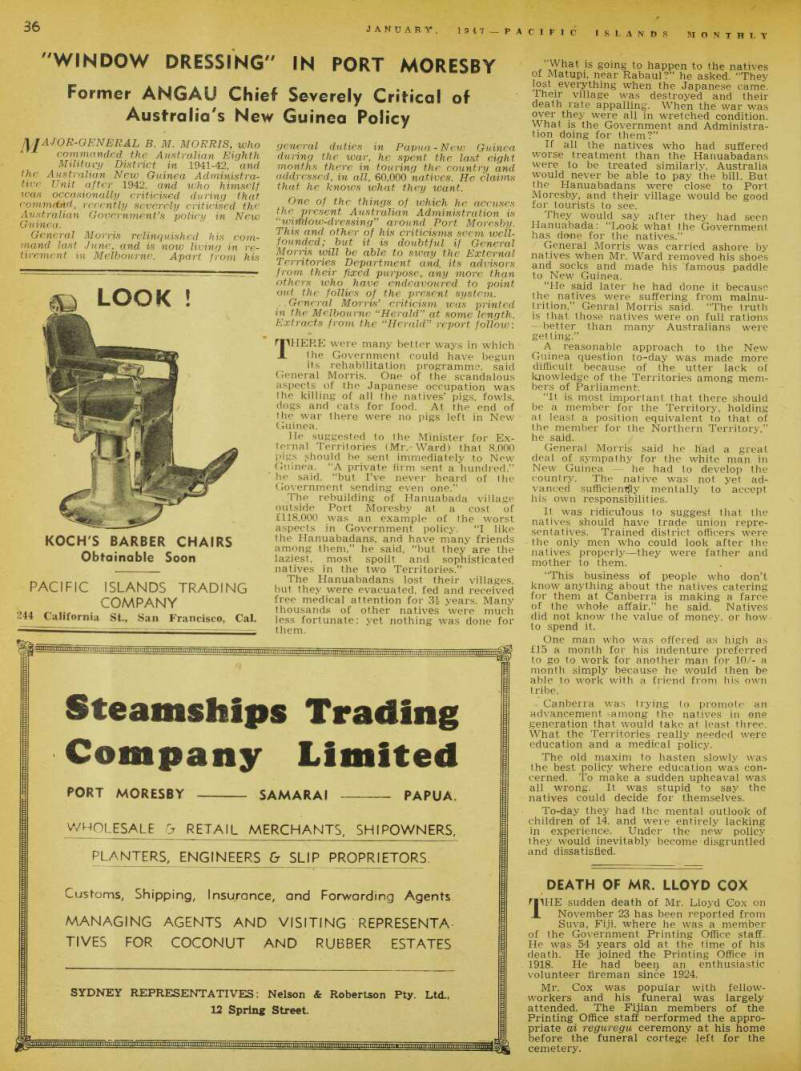
Former ANGAU Chief Severely Critical of Australia's New Guinea Policy
Jyjajor-General B. M. Morris, Who
commanded the Australian Eighth . Military District in 1941-42, and me Australian New Guinea Administrative Unit after 1942, and who himself was occasionally criticised during that commdnd, recently severely criticised the Australian Government’s policy in New Guinea.
General Morris relinquished his command last June, and is now living in retirement in Melbourne. Apart from his y J
general duties in Papua - New Guinea during the war, he spent the last eight months there in touring the country and addressed, in all, 60,000 natives. He claims that he knows what they want.
One of the things of which he accuses the present Australian Administration is “wirfdow-dressing” around Port Moresby.
This and other of his criticisms seem well founded; hut it is doubtful if General Morris will be able to sway the External Territories Department and. its advisors from their fixed purpose, any more than others who have endeavoured to point out the follies of the present system. . . General Morris’ criticism was printed in the Melbourne “Herald ” at some length.
Extracts from the “Herald” report follow: 11HERE were many better ways in which the Government could have begun its rehabilitation programme, said General Morris. One of the scandalous aspects of the Japanese occupation was the killing of all the natives’ pigs, fowls, dogs and cats for food. At the end of the war there were no pigs left in New Guinea.
He suggested to the Minister for Ex ternal Territories (Mr. Ward) that 8.000 pigs should be sent immediately to New Guinea. “A private firm sent a hundred,” he said, “but I’ve never heard of the Government sending even one.”
The rebuilding of Hanuabada village outside Port Moresby at a cost of £llB,OOO was an example of the worst aspects in Government policy. “I like the Hanuabadans, and have many friends among them,” he said, “but they are the laziest, most spoilt and sophisticated natives in the two Territories.”
The Hanuabadans lost their villages, but they were evacuated, fed and received free medical attention for 31 years. Many thousands of other natives were much less fortunate: yet nothing was done for them.
is going to happen to the natives of Matupi, near Rabaul?” he asked. “They lost everything when the Japanese came.
Their village was destroyed and their death rate appalling. When the war was over they were all in wretched condition.
What is the Government and Administra tion doing for them?”
If all the natives who had suffered worse treatment than the Hanuabadans were to be treated similarly, Australia would never be able to pay the bill. But the Hanuabadans were close to Port Moresby, and their village would be good for tourists to see.
They would say after they had seen Hanuabada: “Look what the Government has done for the natives.”
General Morris was carried ashore by natives when Mr. Ward removed his shoes and socks and made his famous paddle to New Guinea.
“He said later he had done it because the natives were suffering from malnu trition,” Genral Morris said. “The truth is that those natives were on full rations —better than many Australians were getting.”
A reasonable approach to the New Guinea question to-day was made more difficult because of the utter lack of knowledge of the Territories among mem bers of Parliament.
“It is most important that there should be a member for the Territory, holding at least a position equivalent to that of the member for the Northern Territory,” he said.
General Morris said he had a great deal of sympathy for the white man in New Guinea he had to develop the country. The native was not yet ad vanced sufficiently mentally to accept his own responsibilities.
It was ridiculous to suggest that the natives should have trade union repre sentatives. Trained district officers were the only men who could look after the natives properly—they were father and mother to them.
“This business of people who don’t know anything about the natives catering for them at Canberra is making a farce of the whole affair.” he said. Natives did not know the value of money, or how to spend it.
One man who was offered as high as £l5 a month for his indenture preferred to go to work for another man for 10/- a month simply because he would then be able to work with a friend from his own tribe.
Canberra was trying to promote an advancement among the natives in one generation that would take at least three.
What the Territories really needed were education and a medical policy.
The old maxim to hasten slowly was the best policy where education was con cerned. To make a sudden upheaval was all wrong. It was stupid to say the natives could decide for themselves.
To-day they had the mental outlook of children of 14, and were entirely lacking in experience. Under the new policy they would inevitably become disgruntled and dissatisfied.
Death Of Mr. Lloyd Cox
TIIHE sudden death of Mr. Lloyd Cox on X November 23 has been reported from Suva, Fiji, where he was a member of the Government Printing Office staff.
He was 54 years old at the time of his death. He joined the Printing Office in 1918. He had been an enthusiastic volunteer fireman since 1924.
Mr. Cox was popular with fellow workers and his funeral was largely attended. The Fijian members of the Printing Office staff oerformed the appro priate ai reguregu ceremony at his home before the funeral cortege left for the cemetery.
Advertisements & other items, p. 38 (1 item)
Steamships Trading
LOOK !
KOCH S BARBER CHAIRS
Obtainable Soon
PACIFIC ISLANDS TRADING
COMPANY
244 California St., San Francisco, Cal.
Steamships Trading
Company Limited
PORT MORESBY
SAMARAI
PAPUA.
WHOLESALE O R ETA IL MERCHANTS, SHIPOWNERS,
PLANTERS, ENGINEERS & SLIP PROPRjETORS.
Customs, Shipping, Insurance, and Forwarding Agents
MANAGING AGENTS AND VISITING REPRESENTA-
TIVES FOR COCONUT AND RUBBER ESTATES
SYDNEY REPRESENTATIVES: Nelson & Robertson Pty. Ltd., 12 Spring Street.
Magazine Section
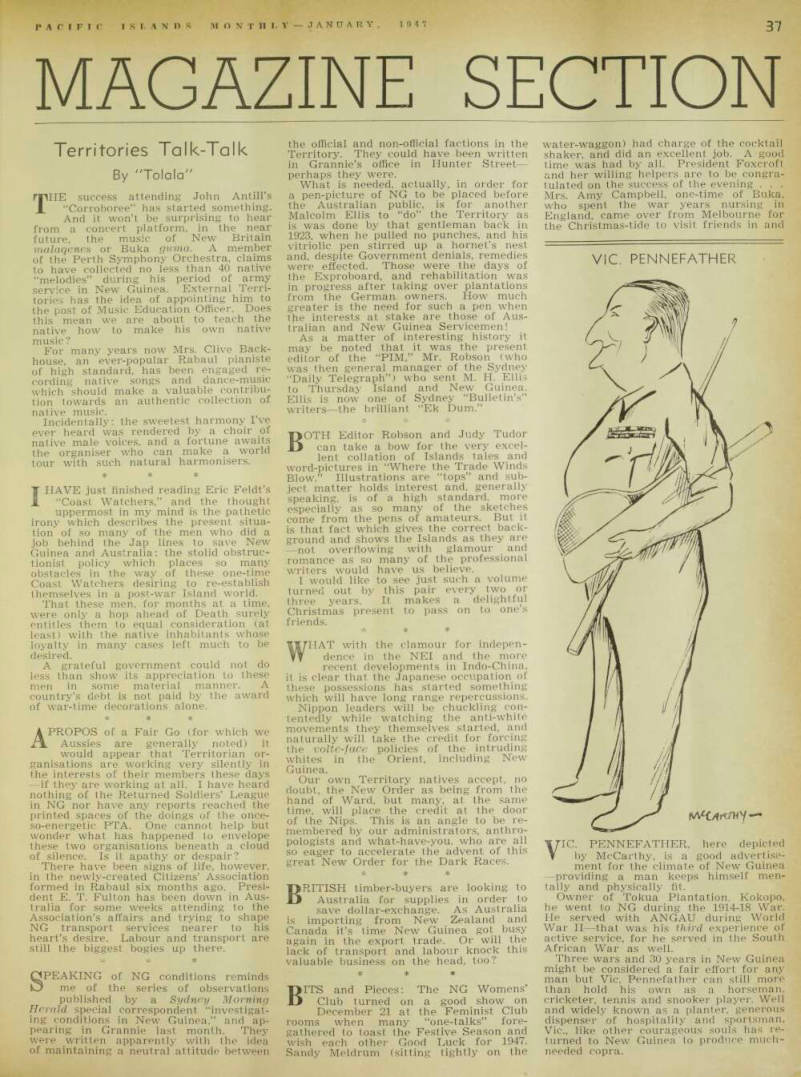
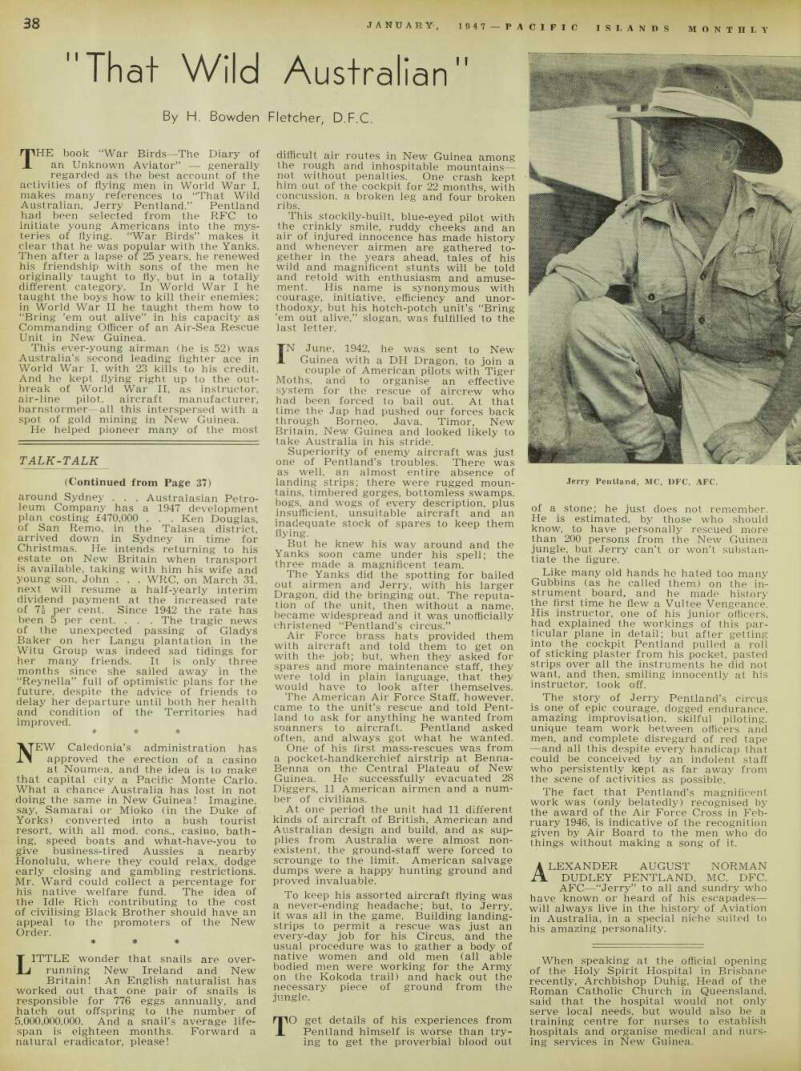
Territories Talk-Talk
By "Tolala"
THE success attending John Antill’s “Corroboree” has started something.
And it won’t be surprising to hear from a concert platform, in the near future, the music of New Britain malaqenes or Buka guma. A member of the Perth Symphony Orchestra, claims to have collected no less than 40 native “melodies” during his period of army service in New Guinea. External Terri tories has the idea of appointing him to the post of Music Education Officer. Does this mean we are about to teach the native how to make his own native music ?
For many years now Mrs. Clive Back house, an ever-popular Rabaul pianiste of high standard, has been engaged re cording native songs and dance-music which should make a valuable contribu tion towards an authentic collection of native music.
Incidentally; the sweetest harmony I ve ever heard was rendered by a choir of native male voices, and a fortune awaits the organiser who can make a world tour with such natural harmonisers. * * * IHAVE just finished reading Eric Feldt’s “Coast Watchers,” and the thought uppermost in my mind is the pathetic irony which describes the present situa tion of so many of the men who did a job behind the Jap lines to save New Guinea and Australia: the stolid obstruc tionist policy which places so many obstacles in the way of these one-time Coast Watchers desiring to re-establish themselves in a post-war Island world.
That these men, for months at a time, were only a hop ahead of Death surely entitles them to equal consideration (at least) with the native inhabitants whose loyalty in many cases left much to be desired.
A grateful government could not do less than show its appreciation to these men in some material manner. A country’s debt is not paid by the award of war-time decorations alone. * * * APROPOS of a Fair Go (for which we Aussies are generally noted) it would appear that Territorian or ganisations are working very silently in the interests of their members these days —if they are working at all. I have heard nothing of the Returned Soldiers’ League in NG nor have any reports reached the printed spaces of the doings of the once so-energetic PTA. One cannot help but wonder what has happened to envelope these two organisations beneath a cloud of silence. Is it apathy or despair?
There have been signs of life, however, in the newly-created Citizens’ Association formed in Rabaul six months ago. Presi dent E. T. Fulton has been down in Aus tralia for some weeks attending to the Association’s affairs and trying to shape NG transport services nearer to his heart’s desire. Labour and transport are still the biggest bogies up there.
V * * SPEAKING of NG conditions reminds me of the series of observations published by a Sydney Morning Herald special correspondent “investigat ing conditions in New Guinea,” and ap pearing in Grannie last month. They were written apparently with the idea of maintaining a neutral attitude between
the official and non-official factions in the Territory. They could have been written in Grannie’s office in Hunter Street — perhaps they were.
What is needed, actually, in order for a pen-picture of NG to be placed before the Australian public, is for another Malcolm Ellis to “do” the Territory as is was done by that gentleman back in 1923, when he pulled no punches, and his vitriolic pen stirred up a hornet’s nest and, despite Government denials, remedies were effected. Those were the days of the Exproboard, and rehabilitation was in progress after taking over plantations from the German- owners. How much greater is the need for such a pen when the interests at stake are those of Aus tralian and New Guinea Servicemen!
As a matter of interesting history it may be noted that it was the present editor of the “PIM,” Mr. Robson (who was then general manager of the Sydney “Daily Telegraph”) who sent M. H. Ellis to Thursday Island and New Guinea.
Ellis is now one of Sydney “Bulletin’s” writers —the brilliant “Ek Dum.”
BOTH Editor Robson and Judy Tudor can take a bow for the very excel lent collation of Islands tales and word-pictures in “Where the Trade Winds Blow.” Illustrations are “tops” and sub ject matter holds interest and, generally speaking, is of a high standard, more especially as so many of the sketches come from the pens of amateurs. But it is that fact which gives the correct back ground and shows the Islands as they are —not overflowing with glamour and romance as so many of the professional writers would have us believe.
I would like to see just such a volume turned out by this pair every two or three years. It makes a delightful Christmas present to pass on to one’s friends.
WHAT with the clamour for indepen dence in the NEI and the more recent developments in Indo-China, it is clear that the Japanese occupation of these possessions has started something which will have long range repercussions.
Nippon leaders will be chuckling con tentedly while watching the anti-white movements they themselves started, and naturally will take the credit for forcing the volte-face policies of the intruding whites in the Orient, including New Guinea.
Our own Territory natives accept, no doubt, the New Order as being from the hand of Ward, but many, at the same time, will place the credit at the door of the Nips. This is an angle to be re membered by our administrators, anthro pologists and what-have-you, who are all so eager to accelerate the advent of this great New Order for the Dark Races. * * * BRITISH timber-buyers are looking to Australia for supplies in order to save dollar-exchange. As Australia is importing from New Zealand and Canada it’s time New Guinea got busy again in the export trade. Or will the lack of transport and labour knock this valuable business on the head, too? ♦ ♦ * BITS and Pieces: The NG Womens’
Club turned on a good show on December 21 at the Feminist Club rooms when many “one-talks” fore gathered to toast the Festive Season and wish each other Good Luck for 1947.
Sandy Meldrum (sitting tightly on the
water-waggon) had charge of the cocktail shaker, and did an excellent job. A good time was had by all. President Foxcroft and her willing helpers are to be congra tulated on the success of the evening . . .
Mrs. Amy Campbell, one-time of Buka, who spent the war years nursing in England, came over from Melbourne for the Christmas-tide to visit friends in and
around Sydney . . . Australasian Petro leum Company has a 1947 development plan costing £470,000 . . . Ken Douglas, of San Remo, in the Talasea district, arrived down in Sydney in time for Christmas. He intends returning to his estate on New Britain when transport is available, taking with him his wife and young son, John . . . WRC, on March 31, next will resume a half-yearly interim dividend payment at the increased rate of 11 per cent. Since 1942 the rate has been 5 per cent. . . . The tragic news of the unexpected passing of Gladys Baker on her Langu plantation in the Witu Group was indeed sad tidings for her many friends. It is only three months since she sailed away in the “Reynella” full of optimistic plans for the future, despite the advice of friends to delay her departure until both her health and condition of the Territories had improved. * * * NEW Caledonia’s administration has approved the erection of a casino at Noumea, and the idea is to make that capital city a Pacific Monte Carlo.
What a chance Australia has lost in not doing the same in New Guinea! Imagine, say, Samarai or Mioko (in the Duke of Yorks) converted into a bush tourist resort, with all mod. cons., casino, bath ing, speed boats and what-have-you to give business-tired Aussies a nearby Honolulu, where they could relax, dodge early closing and gambling restrictions.
Mr. Ward could collect a percentage for his native welfare fund. The idea of the Idle Rich contributing to the cost of civilising Black Brother should have an appeal to the promoters of the New Order. * * * LITTLE wonder that snails are over running New Ireland and New Britain! An English naturalist has worked out that one pair of snails is responsible for 776 eggs annually, and hatch out offspring to the number of 5,000,000,000. And a snail’s average life span is eighteen months. Forward a natural eradicator, please!
Vic. Pennefather
\JIC. PENNEFATHER, here depicted by McCarthy, is a good advertise ment for the climate of New Guinea —providing a man keeps himself men tally and physically tit.
Owner of Tokua Plantation, Kokopo, he went to NG during the 1914-18 War.
He served with ANGAU during World War ll—that was his third experience of active service, for he served in the South African War as well.
Three wars and 30 years in New Guinea might be considered a fair effort for any man but Vic. Pennefather can still more than hold his own as a horseman, cricketer, tennis and snooker player. Well and widely known as a planter, generous dispenser of hospitality and sportsman, Vic., like other courageous souls has re turned to New Guinea to produce much needed copra.
"That Wild Australian"
By H. Bowden Fletcher, D.F.C.
THE book “War Birds —The Diary of an Unknown Aviator” generally regarded as the best account of the activities of flying men in World War I, makes many references to “That Wild Australian, Jerry Pentland.” Pentland had been selected from the RFC to initiate young Americans into the mys teries of flying. “War Birds” makes it clear that he was popular with the Yanks.
Then after a lapse of 25 years, he renewed his friendship with sons of the men he originally taught to fly, but in a totally different category. In World War I he taught the boys how to kill their enemies; in World War II he taught them how to “Bring ’em out alive” in his capacity as Commanding Officer of an Air-Sea Rescue Unit in New Guinea.
This ever-young airman (he is 52) was Australia’s second leading fighter ace in World War I, with 23 kills to his credit.
And he kept flying right up to the out break of World War 11, as instructor, air-line pilot, aircraft manufacturer, barnstormer —all this interspersed with a spot of gold mining in New Guinea.
He helped pioneer many of the most
difficult air routes in New Guinea among the rough and inhospitable mountains— not without penalties. One crash kept him out of the cockpit for 22 months, with concussion, a broken leg and four broken ribs.
This stockily-built, blue-eyed pilot with the crinkly smile, ruddy cheeks and an air of injured innocence has made history and whenever airmen are gathered to gether in the years ahead, tales of his wild and magnificent stunts will be told and retold with enthusiasm and amuse ment. His name is synonymous with courage, initiative, efficiency and unor thodoxy, but his hotch-potch unit’s “Bring ’em out alive,” slogan, was fulfilled to the last letter.
IN June, 1942, he was sent to New Guinea with a DH Dragon, to join a couple of American pilots with Tiger Moths, and to organise an effective system for the rescue of aircrew who had been forced to bail out. At that time the Jap had pushed our forces back through Borneo, Java. Timor, New Britain, New Guinea and looked likely to take Australia in his stride.
Superiority of enemy aircraft was just one of Pentland’s troubles. There was as well, an almost entire absence of landing strips; there were rugged moun tains, timbered gorges, bottomless swamps, bogs, and wogs of every description, plus insufficient, unsuitable aircraft and an inadequate stock of spares to keep them flying.
But he knew his way around and the Yanks soon came under his spell; the three made a magnificent team.
The Yanks did the spotting for bailed out airmen and Jerry, with his larger Dragon, did the bringing out. The reputa tion of the unit, then without a name, became widespread and it was unofficially christened “Pentland’s circus.”
Air Force brass hats provided them with aircraft and told them to get on with the job; but, when they asked for spares and more maintenance staff, they were told in plain language, that they would have to look after themselves.
The American Air Force Staff, however, came to the unit’s rescue and told Pent land to ask for anything he wanted from scanners to aircraft. Pentland asked often, and always got what he wanted.
One of his first mass-rescues was from a pocket-handkerchief airstrip at Benna- Benna on the Central Plateau of New Guinea. He successfully evacuated 28 Diggers, 11 American airmen and a num ber of civilians.
At one period the unit had 11 different kinds of aircraft of British. American and Australian design and build, and as sup plies from Australia were almost non existent, the ground-staff were forced to scrounge to the limit. American salvage dumps were a happy hunting ground and proved invaluable.
To keep his assorted aircraft flying was a never-ending headache; but, to Jerry, it was all in the game. Building landing strips to permit a rescue was just an every-day job for his Circus, and the usual procedure was to gather a body of native women and old men (all able bodied men were working for the Army on the Kokoda trail) and hack out the necessary piece of ground from the jungle.
TO get details of his experiences from Pentland himself is worse than try ing to get the proverbial blood out
of a stone; he just does not remember.
He is estimated, by those who should know, to have personally rescued more than 200 persons from the New Guinea jungle, but Jerry can’t or won’t substan tiate the figure.
Like many old hands he hated too many Gubbins (as he called them) on the in strument board, and he made history the first time he flew a Vultee Vengeance.
His instructor, one of his junior officers, had explained the workings of this par ticular plane in detail; but after getting into the cockpit Pentland pulled a roll of sticking plaster from his pocket, pasted strips over all the instruments he did not want, and then, smiling innocently at his instructor, took off.
The story of Jerry Pentland’s circus is one of epic courage, dogged endurance, amazing improvisation, skilful piloting, unique team work between officers and men, and complete disregard of red tape —and all this despite every handicap that could be conceived by an indolent staff who persistently kept as far away from the scene of activities as possible.
The fact that Pentland’s magnificent work was (only belatedly) recognised by the award of the Air Force Cross in Feb ruary 1946, is indicative of the recognition given by Air Board to the men who do things without making a song of it.
Alexander august norman
Dudley Pentland, Mc. Dec,
AFC—“Jerry” to all and sundry who have known or heard of his escapades— will always live in the history of Aviation in Australia, in a special niche suited to his amazing personality.
When speaking at the official opening of the Holy Spirit Hospital in Brisbane recently, Archbishop Duhig, Head of the Roman Catholic Church in Queensland, said that the hospital would not only serve local needs, but would also be a training centre for nurses to establish hospitals and organise medical and nurs ing services in New Guinea.
Jerry Pentland, MC, DFC, AFC.
Advertisements & other items, p. 40 (1 item)
(Continued from Page 37)
TALK-TALK
Patience On The High Seas
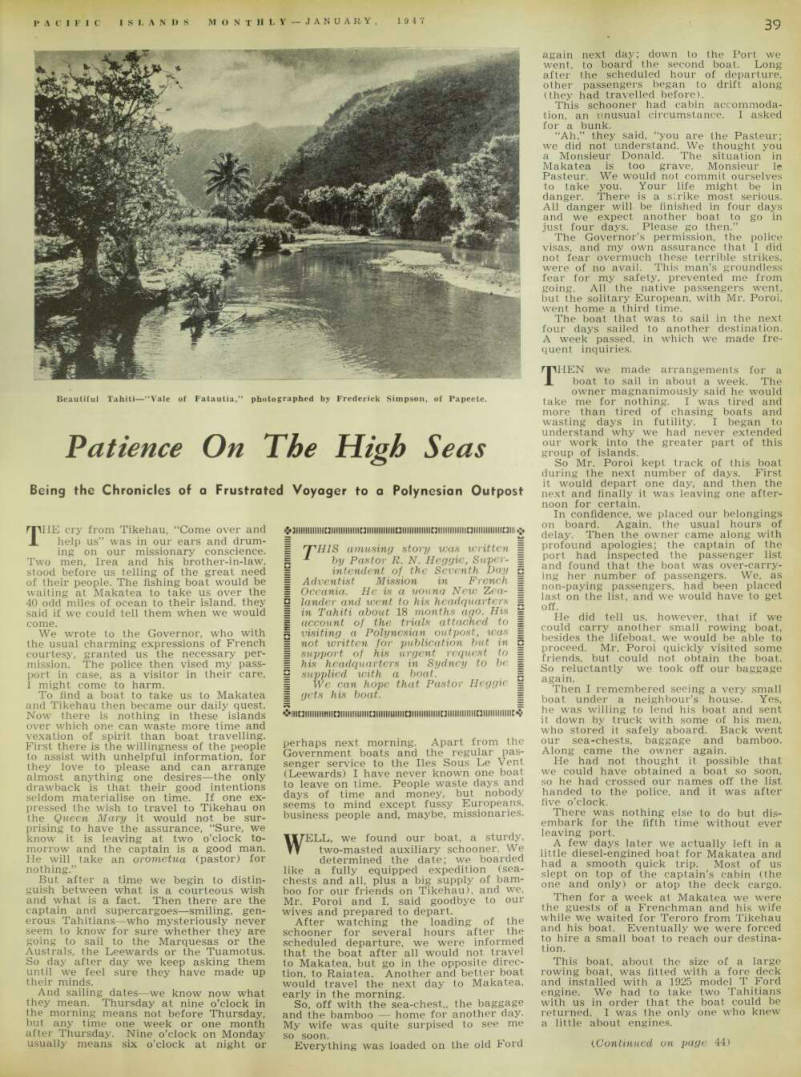
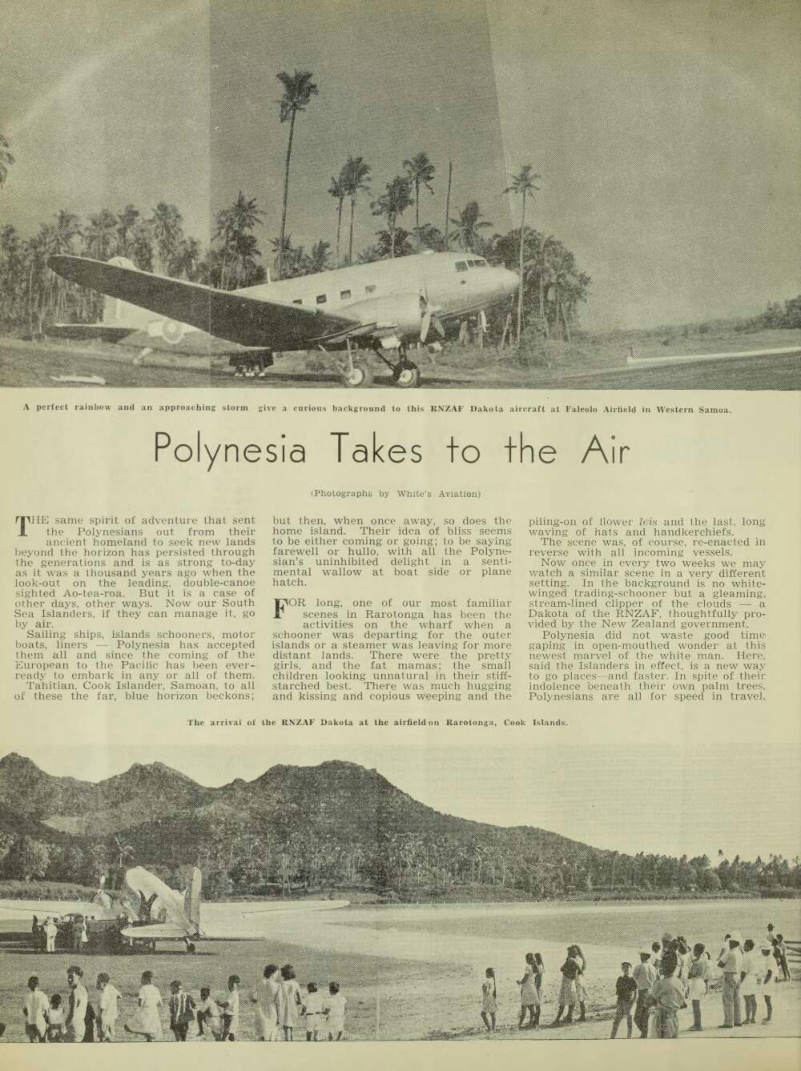
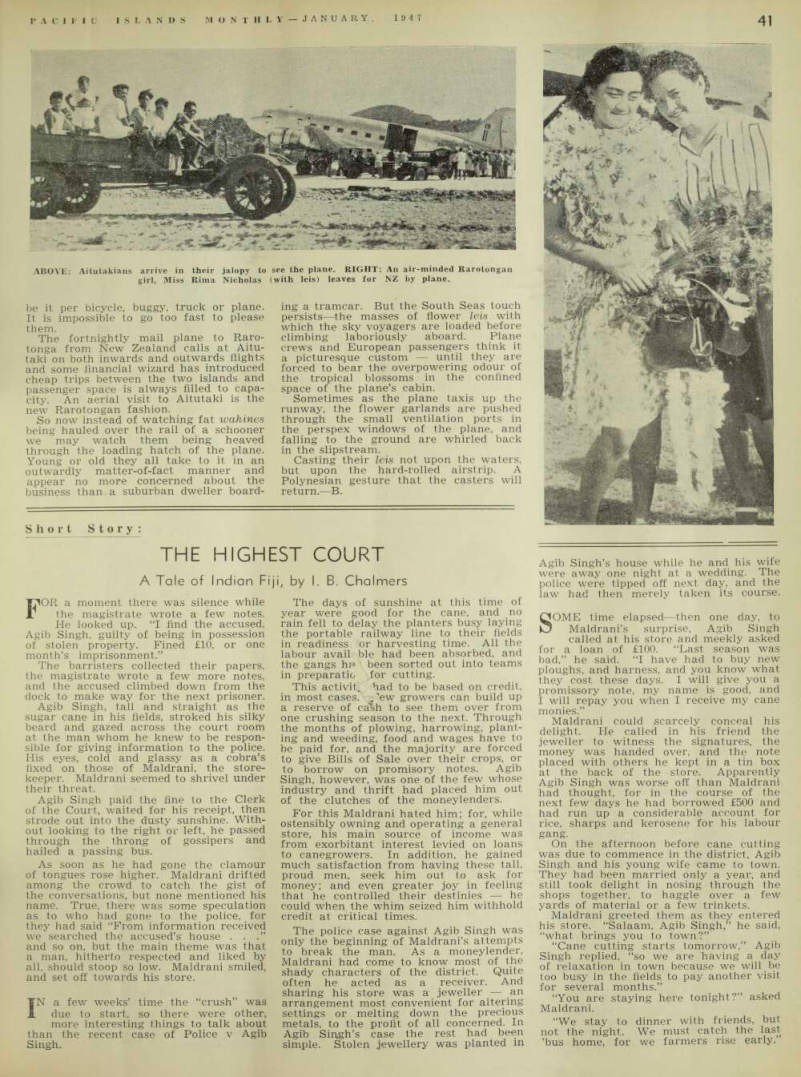
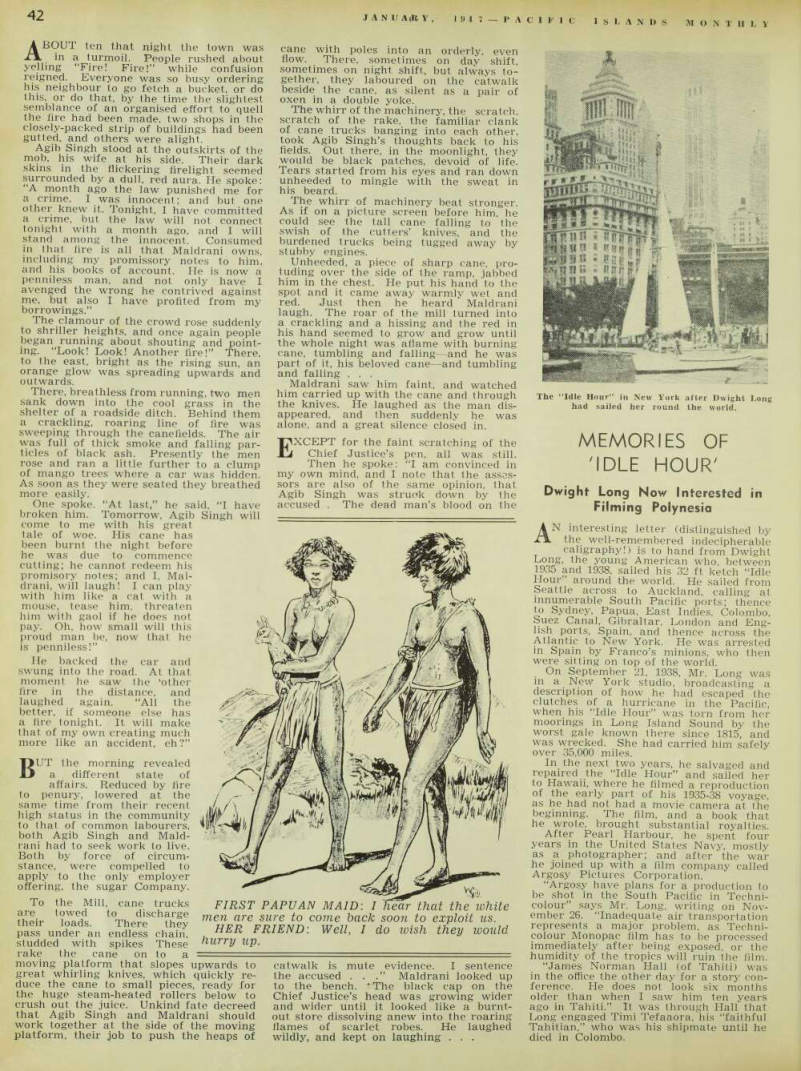
Being the Chronicles of a Frustrated Voyager to a Polynesian Outpost
THE cry from Tikehau, “Come over and help us” was in our ears and drum ing on our missionary conscience.
Two men, Irea and his brother-in-law, stood before us telling of the great need of their people. The fishing boat would be waiting at Makatea to take us over the 40 odd miles of ocean to their island, they said if we could tell them when we would come.
We wrote to the Governor, who with the usual charming expressions of French courtesy, granted us the necessary per mission. The police then vised my pass port in case, as a visitor in their care, I might come to harm.
To find a boat to take us to Makatea and Tikehau then became our daily quest.
Now there is nothing in these islands over which one can waste more time and vexation of spirit than boat travelling.
First there is the willingness of the people to assist with unhelpful information, for they love to please and can arrange almost anything one desires —the only drawback is that their good intentions seldom materialise on time. If one ex pressed the wish to travel to Tikehau on the Queen Mary it would not be sur prising to have the assurance, “Sure, we know it is leaving at two o’clock to morrow and the captain is a good man.
He will take an orometua (pastor) for nothing.”
But after a time we begin to distin guish between what is a courteous wish and what is a fact. Then there are the captain and supercargoes—smiling, gen erous Tahitians —who mysteriously never seem to know for sure whether they are going to sail to the Marquesas or the Australs, the Leewards or the Tuamotus.
So day after day we keep asking them until we feel sure they have made up their minds.
And sailing dates —we know now what they mean. Thursday at nine o'clock in the morning means not before Thursday, but any time one week or one month after Thursday. Nine o’clock on Monday usually means six o’clock at night or
'T'HIS amusing story was written 1 by Pastor R. N. Heggie, Super intendent of the Seventh Day Adventist Mission in French Oceania. He is a vouna New Zea lander and went to his headquarters in Tahiti about 18 months ago. His account of the trials attached to visiting a Polynesian outpost , was not written for publication but in support of his urgent request to his headquarters in Sydney to be supplied with a boat.
We can hope that Pastor Heggie gets his boat.
perhaps next morning. Apart from the Government boats and the regular pas senger service to the lies Sous Le Vent (Leewards) I have never known one boat to leave on time. People waste days and days of time and money, but nobody seems to mind except fussy Europeans, business people and, maybe, missionaries.
WELL, we found our boat, a sturdy, two-masted auxiliary schooner. We determined the date; we boarded like a fully equipped expedition (sea chests and all, plus a big supply of bam boo for our friends on Tikehau), and we, Mr. Poroi and I, said goodbye to our wives and prepared to depart.
After watching the loading of the schooner for several hours after the scheduled departure, we were informed that the boat after all would not travel to Makatea, but go in the opposite direc tion, to Raiatea. Another and better boat would travel the next day to Makatea, early in the morning.
So, off with the sea-chest,, the baggage and the bamboo home for another day.
My wife was quite surpised to see me so soon.
Everything was loaded on the old Ford
again next day; down to the Port we went, to board the second boat. Long after the scheduled hour of departure, other passengers began to drift along (they had travelled before).
This schooner had cabin accommoda tion, an unusual circumstance. I asked for a bunk.
“Ah,” they said, “you are the Pasteur; we did not understand. We thought you a Monsieur Donald. The situation in Makatea is too grave, Monsieur le Pasteur. We would not commit ourselves to take you. Your life might be in danger. There is a strike most serious.
All danger will be finished in four days and we expect another boat to go in just four days. Please go then.”
The Governor’s permission, the police visas, and my own assurance that I did not fear overmuch these terrible strikes, were of no avail. This man’s groundless fear for my safety, prevented me from going. All the native passengers went, but the solitary European, with Mr. Poroi, went home a third time.
The boat that was to sail in the next four days sailed to another destination.
A week passed, in which we made fre quent inquiries.
THEN we made arrangements for a boat to sail in about a week. The owner magnanimously said he would take me for nothing. I was tired and more than tired of chasing boats and wasting days in futility. I began to understand why we had never extended our work into the greater part of this group of islands.
So Mr. Poroi kept track of this boat during the next number of days. First it would depart one day, and then the next and finally it was leaving one after noon for certain.
In confidence, we placed our belongings on board. Again, the usual hours of delay. Then the owner came along with profound apologies; the captain of the port had inspected the passenger list and found that the boat was over-carry ing her number of passengers. We, as non-paying passengers, had been placed last on the list, and we would have to get off.
He did tell us, however, that if we could carry another small rowing boat, besides the lifeboat, we would be able to proceed. Mr. Poroi quickly visited some friends, but could not obtain the boat.
So reluctantly we took off our baggage again.
Then I remembered seeing a very small boat under a neighbour’s house. Yes, he was willing to lend his boat and sent it down by truck with some of his men, who stored it safely aboard. Back went our sea-chests, baggage and bamboo.
Along came the owner again.
He had not thought it possible that we could have obtained a boat so soon, so he had crossed our names off the list handed to the police, and it was after five o’clock.
There was nothing else to do but dis embark for the fifth time without ever leaving port.
A few days later we actually left in a little diesel-engined boat for Makatea and had a smooth quick trip. Most of us slept on top of the captain’s cabin (the one and only) or atop the deck cargo.
Then for a week at Makatea we were the guests of a Frenchman and his wife while we waited for Teroro from Tikehau and his boat. Eventually we were forced to hire a small boat to reach our destina tion.
This boat, about the size of a large rowing boat, was fitted with a fore deck and installed with a 1925 model T Ford engine. We had to take two Tahitians with us in order that the boat could be returned. I was the only one who knew a little about engines.
(Continued on page 44)
Beautiful Tahiti —“Vale of Fatautia,” photographed by Frederick Simpson, of Papeete.
The younger Tahitian was a likeable young man; but our captain, would not permit anyone to inspect the engine.
W_ , t E left at 7.30 one evening in fair weather for Tikehau. One hour out I noticed the amp-meter did not record any battery charge. The young Tahitian said, “We can’t do anything about it because the captain would have a fit of rage if we try, and it’s imossible to explain to him.”
The battery was new and as there was no particular discharge I thought perhaps the amp-meter didn’t work or if it did the battery wouldn’t discharge itself during the twelve hours of our voyage of 45 miles y s The sea ’ was smooth, though a fair amount of snrav ramp ahnarH at timpc and it for Su?sfienr?antain andl to the enelSe and
by torchlight oiJt thP bille wft?r
a tin and bucket The old mode TTad a bad breath bad he^o e n ar e S ve S rVtt e e d SFSST {? TO Sr spluttere7 buT it clrrW on fatfhfnllv right to the finish At miHnith, fh» compass light failed but th^^Tahitiant sight of a coral atoll. For miles and
¥^Ju e -ZTsVn ns
todiscover that rfkehau is bv ™ means the largest islet of these ground ‘ he Eve a nt g ua S l t ly pass d n ee°D wat l |? o °off The S W ,V± (houses) and UtUe niau 'valm* church which reoresented oifr smafi Adventkt pnm™iinhv reSentod ° Ur Smal Adventist u y ’
W_ .
E were hailed with great acclaim and rejoicing. A brother suddenly returned from the war couldn’t have received a warmer or more spontaneous welcome. They gave us of their best: the biggest and sweetest coconuts, the largest and fattest fish, great heaps of white rice, and big slabs of what is equivalent to Australian damper.
That constitutes the diet of the Paumotus, where vegetables and fruit are almost impossible to grow. This for several weeks was to be our diet, with a little variation from the supplies which we had brought. But always the best was for us. A small but new niau house was vacated for us and these good people would have waited on our slightest desire day or night, if we had allowed them.
Our islet, poised on the reef at the only entrance into Tikehau lagoon, was only a few hundred yards in diameter and raised but a few feet above sea level. The normal rise and fall of the tide is perhaps a foot. Beside the übiquitous coconut, there were about half a dozen other varieties of shrubs and trees, most of which were able to endure their feet in salt water occasionally. Amongst them was the red kowhai, which the Maoris took to New Zealand hundreds of years ago, and the sweet-scented tiare Tahiti.
On the seaward side of the entrance, tempestuous waves had flung dead coral shoreward, forming an embankment eight feet high and continued like the lip of a saucer entirely around the island although away from the entrance it was about eighteen inches only above the dead flat interior.
On Teroro’s beautiful launch we went to the village at the southern end of the lagoon, perhaps eight to ten miles away
i n a straight line to have our nassnorts signed by the district governor the usual friendly, generous : heafted Tahitian.
Again and again I was impressed by the immensity of these lagoons. Like battle cruisers with foaming wakes of spouting sea, the islands on the reef circled till they dipped below the horizon on the east, and then came circling back to me on the west. And all this on the map is a shapeless, unromantic point called Tikehau! nassnorts were signed for mir Hp I I „ Passports were signed tor our de ” £ r a f,,!n!i d t^ ys K ft + r + £ U^ arrival, but as usual the boat that was C0 u ta l n to g°- dldn t a , nd f v ? nt over which we had no control retained us T f ? r almost a ™ nth on Tikehau. 1 have never shot an albatross nor do 1 claim relation ship to the Ancient Mariner : nevertheless my difficulties with the sea were not at an end - After we had been on Tikehau *>r several days one of the hi g hes * tides of the year com “l- SoUth ' eaSt For the sea t 0 the south-east poured over the reef and the level of the lagoon steadily rose. I watched a crab below h sea U leve°l f thC iS ' and W3S alreadY but quite strong for this part of the Pacific, where storms are not severe and bed pre oariously tilting seaward and the P sea itself s P° uting through the sides of the house and frothing over the floor. There were voices outside and, after difficulty, we lit the pressure lamp. The men were rescuing their canoes and big flat bottomed skiff which had been flung up on the embankment and part of the bottom torn out.
That day the water rose no higher, but lapped the top of the embankment; I knew high tide would come again at night.
The people assured us that about once a year the water rises like this, but they were a little concerned lest it should rise any further and go right over the island and destroy their one source of brackish water.
However, the tide gradually receded, to be followed in a few days by about a week of exceptionally low tides in which even the living coral of the lagoon pro truded from the water. In the meantime a strong current, ridged like the living spine of a serpent weaved seaward to the horizon.
When the current was abating the little motor vessel Nicol tried to edge into the entrance but was aught inevitably by the current and sent stern first out to sea.
We were anxious to return to Tahiti and two of the islanders jumped into a canoe and madly raced down the edge of the current to the boat, to beg her to anchor seaward of our atoll, so we could be taken off. However, with parting waves from the crew, the “Nicol” drew away.
Then the Tamarii Maareva hove to off the entrance. For three days, tacking against the wind and now much-abated current, she tried to force the entrance, The fourth day the current dropped to a dead slack and she entered easily, A few days later the good Government motor ship Maoae, a converted Grand Banks schooner, took us off our island.
It was over a month since we had left on a trip which we had expected to last a few days.
Polynesia Takes to the Air
(Photographs by White’s Aviation)
fTUIE same spirit of adventure that sent X the Polynesians out from their ancient homeland to seek new lands beyond the horizon has persisted through the generations and is as strong to-day as it was a thousand years ago when the look-out on the leading, double-canoe sighted Ao-tea-roa. But it is a case of other days, other ways. Now our South Sea Islanders, if they can manage it, go by air.
Sailing ships, islands schooners, motor boats, liners Polynesia has accepted them all and since the coming of the European to the Pacific has been everready to embark in any or all of them.
Tahitian, Cook Islander, Samoan, to all of these the far, blue horizon beckons;
but then, when once away, so does the home island. Their idea of bliss seems to be either coming or going; to be saying farewell or hullo, with all the Polynesian’s uninhibited delight in a sentimental wallow at boat side or plane hatch. long, one of our most familiar JT scenes in Rarotonga has been the activities on the wharf when a schooner was departing for the outer islands or a steamer was leaving for more distant lands. There were the pretty girls, and the fat mamas; the small children looking unnatural in their stiffstarched best. There was much hugging and kissing and copious weeping and the
piling-on of flower leis and the last, long waving of hats and handkerchiefs.
The scene was, of course, re-enacted in reverse with all incoming vessels, Now once in every two weeks we may watch a similar scene in a very different setting. In the background is no white winged trading-schooner but a gleaming, stream-lined clipper of the clouds a Dakota of the RNZAF, thoughtfully pro vided by the New Zealand government.
Polynesia did not waste good time gaping in open-mouthed wonder at this newest marvel of the white man. Here, said the Islanders in effect, is a new way to go places—and faster. In spite of their indolence beneath their own palm trees, Polynesians are all for speed in travel,
A perfect rainbow and an approaching storm give a curious background to this RNZAF Dakota aircraft at Faleolo Airfield in Western Samoa.
The arrival of the RNZAF Dakota at the airfield on Rarotonga, Cook Islands.
be it per bicycle, buggy, truck or plane.
It is impossible to go too fast to please them.
The fortnightly mail plane to Raro tonga from New Zealand calls at Aitu taki on both inwards and outwards flights and some financial wizard has introduced cheap trips between the two islands and passenger space is always filled to capa city. An aerial visit to Aitutaki is the new Rarotongan fashion.
So now instead of watching fat wahines being hauled over the rail of a schooner we may watch them being heaved through the loading hatch of the plane.
Young or old they all take to it in an outwardly matter-of-fact manner and appear no more concerned about the business than a suburban dweller board
ing a tramcar. But the South Seas touch persists—the masses of flower leis with which the sky voyagers are loaded before climbing laboriously aboard. Plane crews and European passengers think it a picturesque custom until they are forced to bear the overpowering odour of the tropical blossoms in the confined space of the plane’s cabin.
Sometimes as the plane taxis up the runway, the flower garlands are pushed through the small ventilation ports in the perspex windows of the plane, and falling to the ground are whirled back in the slipstream.
Casting their leis not upon the waters, but upon the hard-rolled airstrip. A Polynesian gesture that the casters will
return.
B.
ABOVE: Aitutakians arrive in their jalopy to see the plane. RIGHT: An air-minded Rarotongan girl, Miss Rima Nicholas (with leis) leaves for NZ by plane.
The Highest Court
Short Story:
A Tale of Indian Fiji, by I. B. Chalmers
FOR a moment there was silence while the magistrate wrote a few notes.
He looked up. “I find the accused, Agib Singh, guilty of being in possession of stolen property. Fined £lO, or one month’s imprisonment.”
The barristers collected their papers, the magistrate wrote a few more notes, and the accused climbed down from the dock to make way for the next prisoner.
Agib Singh, tall and straight as the sugar cane in his fields, stroked his silky beard and gazed across the court room at the man whom he knew to be respon sible for giving information to the police.
His eyes, cold and glassy as a cobra’s fixed on those of Maldrani, the store keeper. Maldrani seemed to shrivel under their threat.
Agib Singh paid the fine to the Clerk of the Court, waited for his receipt, then strode out into the dusty sunshine. With out looking to the right or left, he passed through the throng of gossipers and hailed a passing bus.
As soon as he had gone the clamour of tongues rose higher. Maldrani drifted among the crowd to catch the gist of the conversations, but none mentioned his name. True, there was some speculation as to who had gone to the police, for they had said “From information received we searched the accused’s house . . .” and so on, but the main theme was that a man, hitherto respected and liked by all, should stoop so low. Maldrani smiled, and set off towards his store.
IN a few weeks’ time the “crush” was due to start, so there were other, more interesting things to talk about than the recent case of Police v Agib Singh.
The days of sunshine at this time of year were good for the cane, and no rain fell to delay the planters busy laying the portable railway line to their fields in readiness or harvesting time. All the labour avail ble had been absorbed, and the gangs hf* been sorted out into teams in preparatio for cutting.
This activit. had to be based on credit, in most cases, ''ew growers can build up a reserve of cash to see them over from one crushing season to the next. Through the months of plowing, harrowing, plant ing and weeding, food and wages have to be paid for, and the majority are forced to give Bills of Sale over their crops, <3r to borrow on promisory notes. Agib Singh, however, was one of the few whose industry and thrift had placed him out of the clutches of the moneylenders.
For this Maldrani hated him; for, while ostensibly owning and operating a general store, his main source of income was from exorbitant interest levied on loans to canegrowers. In addition, he gained much satisfaction from having these tall, proud men, seek him out to ask for money; and even greater joy in feeling that he controlled their destinies he could when the whim seized him withhold credit at critical times.
The police case against Agib Singh was only the beginning of Maldrani’s attempts to break the man. As a moneylender, Maldrani had come to know most of the shady characters of the district. Quite often he acted as a receiver. And sharing his store was a jeweller an arrangement most convenient for altering settings or melting down the precious metals, to the profit of all concerned. In Agib Sin,gh’s case the rest had been simple. Stolen jewellery was planted in
Agib Singh’s house while he and his wife were away one night at a wedding. The police were tipped off next day, and the law had then merely taken its course.
SOME time elapsed—then one day, to Maldrani’s surprise, Agib Singh called at his store and meekly asked for a loan of £lOO. “Last season was bad,” he said. “I have had to buy new ploughs, and harness, and you know what they cost these days. I will give you a promissory note, my name is good, and I will repay you when I receive my cane monies.”
Maldrani could scarcely conceal his delight. He called in his friend the jeweller to witness the signatures, the money was handed over, and the note placed with others he kept in a tin box at the back of the store. Apparently Agib Singh was worse off than Maldrani had thought, for in the course of the next few days he had borrowed £5OO and had run up a considerable account for rice, sharps and kerosene for his labour gang.
On the afternoon before cane cutting was due to commence in the district, Agib Singh and his young wife came to town.
They had been married only a year, and still took delight in nosing through the shops together, to haggle over a few yards of material or a few trinkets.
Maldrani greeted them as they entered his store. “Salaam, Agib Singh,” he said, “what brings you to town?”
“Cane cutting starts tomorrow,” Agib Singh replied, “so we are having a day of relaxation in town because we will be too busy in the fields to pay another visit for several months.”
“You are staying here tonight?” asked Maldrani.
“We stay to dinner with friends, but not the night. We must catch the last ’bus home, for we farmers rise early.
ABOUT ten that night the town was in a turmoil. People rushed about yelling “Fire! Fire!” while confusion reigned. Everyone was so busy ordering his neighbour to go fetch a bucket, or do this, or do that, by the time the slightest semblance of an organised effort to quell the fire had been made, two shops in the closely-packed strip of buildings had been gutted, and others were alight.
Agib Singh stood at the outskirts of the mob, his wife at his side. Their dark skins in the flickering firelight seemed surrounded by a dull, red aura. He spoke: “A month ago the law punished me for a crime. I was innocent; and but one other knew it. Tonight, I have committed a crime, but the law will not connect tonight with a month ago, and I will stand among the innocent. Consumed in that fire is all that Maldrani owns, including my promissory notes to him, and his books of account. He is now a penniless man, and not only have I avenged the wrong he contrived against me, but also I have profited from my borrowings.”
The clamour of the crowd rose suddenly to shriller heights, and once again people began running about shouting and point ing. “Look! Look! Another fire!” There, to the east, bright as the rising sun, an orange glow was spreading upwards and outwards.
There, breathless from running, two men sank down into the cool grass in the shelter of a roadside ditch. Behind them a crackling, roaring line of fire was sweeping through the canefields. The air was full of thick smoke and falling par ticles of black ash. Presently the men rose and ran a little further to a clump of mango trees where a car was hidden.
As soon as they were seated they breathed more easily.
One spoke. “At last,” he said, “I have broken him. Tomorrow, Agib Singh will
come to me with his great tale of woe. His cane has been burnt the night before he was due to commence cutting; he cannot redeem his promisory notes; and I, Mal drani, will laugh! I can play with him like a cat with a mouse, tease him, threaten him with gaol if he does not pay. Oh, how small will this proud man be, now that he is penniless!”
He backed the car and swung into the road. At that moment he saw the 'other fire in the distance, and laughed again. “All the better, if someone else has a tire tonight. It will make that of my own creating much more like an accident, eh?”
BUT the morning revealed a different state of affairs. Reduced by fire to penury, lowered at the same time from their recent high status in the community to that of common labourers, both Agib Singh and Mald rani had to seek work to live.
Both by force of circum stance, were compelled to apply to the only employer offering, the sugar Company.
To the Mill, cane trucks are towed to discharge their loads. There they pass under an endless chain, studded with spikes These rake the cane on to a
moving platform that slopes upwards to great whirling knives, which quickly reduce the cane to small pieces, ready for the huge steam-heated rollers below to crush out the juice. Unkind fate decreed that Agib Singh and Maldrani should work together at the side of the moving platform, their job to push the heaps of
cane with poles into an orderly, even flow. There, sometimes on day’ shift sometimes on night shift, but always to gether, they laboured on the catwalk beside the cane, as silent as a pair of oxen in a double yoke, The whirr of the machinery, the scratch, scratch of the rake, the familiar clank of cane trucks banging into each other, took Agib Singh’s thoughts back to his fields. Out there, in the moonlight, they would be black patches, devoid of life, Tears started from his eyes and ran down unheeded to mingle with the sweat in his beard.
The whirr of machinery beat stronger, As if on a picture screen before him, he could see the tall cane falling to the swish of the cutters’ knives, and the burdened trucks being tugged away by stubby engines.
Unheeded, a piece of sharp cane, pro tuding over the side of the ramp, jabbed him in the chest. He put his hand to the spot and it came away warmly wet and red. Just then he heard Maldrani laugh. The roar of the mill turned into a crackling and a hissing and the red in his hand seemed to grow and grow until the whole night was aflame with burning cane, tumbling and falling—and he was part of it, his beloved cane—and tumbling
and falling . . .
Maldrani saw him faint, and watched him carried up with the cane and through the knives. He laughed as the man dis appeared, and then suddenly he was alone, and a great silence closed in. for the faint scratching of the 1-i Chief Justice’s pen, all was still, Then he spoke: ‘T am convinced in my own mind, and I note that the asses sors are also of the same opinion, that Agib Singh was struck down by the accused . The dead man’s blood on the
catwalk is mute evidence. I sentence the accused ...” Maldrani looked up to the bench. * The black cap on the Chief Justice’s head was growing wider and wider until it looked like a burnt out store dissolving anew into the roaring flames of scarlet robes. He laughed wildly, and kept on laughing . . .
FIRST PAPUAN MAID : I hear that the white men are sure to come hack soon to exploit us.
HER FRIEND : Well, I do wish they would hurry up.
The “Idle Hour” in New York after Dwight Long had sailed her round the world.
Memories Of
'Idle Hour'
Dwight Long Now Interested in Filming Polynesia
AN interesting letter (distinguished by the well-remembered indecipherable caligraphy!) is to hand from Dwight Long, the young American who, between 1935 and 1938, sailed his 32 ft ketch ‘‘ldle Hour” around the world. He sailed from Seattle across to Auckland, calling at innumerable South Pacific ports; thence to Sydney, Papua, East Indies, Colombo, Suez Canal, Gibraltar, London and Eng lish ports, Spain, and thence across the Atlantic to New York. He was arrested in Spain by Franco’s minions, who then were sitting on top of the world.
On September 21, 1938, Mr. Long was in a New York studio, broadcasting a description of how he had escaped the clutches of a hurricane in the Pacific, when his ‘‘ldle Hour” was torn from her moorings in Long Island Sound by the worst gale known there since 1815, and was wrecked. She had carried him safely over 35,000 miles.
In the next two years, he salvaged and repaired the ‘‘ldle Hour” and sailed her to Hawaii, where he filmed a reproduction of the early part of his 1935-38 voyage, as he had not had a movie camera at the beginning. The film, and a book that he wrote, brought substantial royalties.
After Pearl Harbour, he spent four years in the United States Navy, mostly as a photographer; and after the war he joined up with a film company called Argosy Pictures Corporation. ‘‘Argosy have plans for a production to be shot in the South Pacific in Techni colour” says Mr. Long, writing on Nov ember 26. ‘‘lnadequate air transportation represents a major problem, as Techni colour Monopac film has to be processed immediately after being exposed, or the humidity of the tropics will ruin the film.
“James Norman Hall (of Tahiti) was in the office the other day for a story con ference. He does not look six months older than when I saw him ten years ago in Tahiti.” It was through Hall that Long engaged Timi Tefaaora, his “faithful Tahitian,” who was his shipmate until he died in Colombo.
Tropicalities
THE Australian Government is consider ing giving Norfolk Island a postage stamp of its own, for the first time in history.
External Territories Minister Ward and Administrator Wilson, who preside over the destiny of the Island, are of the opinion that Norfolk would reap a large income from philatelists, and that the issue of such stamps would promote tourist traffic.
The stamps, if or when they are issued, will depict some incident in Norfolk’s history.
H* SOME time ago there was a controversy in the “PIM” about the meaning of the word “Kanaka.” It was taken, generally, to be an offensive term.
Recently an old-timer in New Guinea interviewed two natives, old-timers too, engaged prior to the war for many years in contract service. In the course of the conversation these two natives said; “Government ’e no likem master; gov ernment ’e no likem boy; government ’e likem kanaka that’s all.” The definition of “Kanaka” was then given as “man ’e no got contract,” Other boys were des cribed as: “’E no boy tru, ’e makem contract for one year, that’s all.”
Herewith the meaning of the word “Kanaka” is established as meaniing a non-indentured native. —NR. * * * THE unhappy Gauguin—who “jazzed up” the South Sea Islands, and became the Father of “Things What Ain’t So” about Tahiti, has turned up again in the news. A United States illustrated journal has revived the Gauguin Legend and has given several pages to reproductions of the artist’s extraordinary paintings.
The principal exhibit is two Chinese girls and a panfull of hibiscus flowers, labelled “Two Tahitian Women with Mango (!) Blossoms.”
A friend of mine. Monsieur —, knew Gauguin very well. Monsieur —, had a lot of Gauguin’s smaller canvasses and drawings, acquired in payment for loans.
“They were so hideous,” said Monsieur —, “that I stowed them out of sight in an old clothes-press, and forgot them.”
Years later when the Gauguin Vogue had been created by a syndicate of picture merchants and news of it had reached Papeete, Monsieur recalled his treasures in the dusty old clothes-press.
But when he went to get them, the cupboard was bare.
He summoned Madame —. Yes, she remembered the collection. “Why,” she said, “long ago, when I cleaned out that dirty clothes press, I burned those awful Gauguin things with all the other rubbish.”—ACß. * * * IN these decadent days, a voyage from the Outer Cooks to Rarotonga, by whale-boat or canoe, is considered a feat that—if any crew had courage to attempt it—rates a double VC. No aspi rants for the honour are forthcoming to-day. Yet the trip is as feasible to-day as it was when Rika-Rika, a Mangaian chief, paddled, with his henchmen, over to “Tumu-te-Varo-Varo” in the eighties, did their business there with the Makea’s men, and returned home again—by dint of sheer strength of arm, without sails!
The clan of Rika-Rika are still a
numerous and powerful tribe at Mangaia Island, and large landowners. Holding firmly to the older style of Maori village life, they represent a link with the real Polynesia that, on Rarotonga, has given way to more sophisticated living—EG. • • • KAPOK had a lot of publicity in “PIM” some time ago. We grow it in the Cook Islands, too! But no one here ever bothers to remove the seeds when stuffing a bed pillow. As a result, one is often entertained at night by weird buzzings and groaning noises, apparently in one’s ear (the ear pressed to the pillow.) The explanation is simple. As the pillow grows warm, a little insect that lives in the kapok-seeds begins to feel oppressed by the increase in temperature, and pipes up- hence the buzzing sounds.
These noises cannot, of course, be heard when the ear is removed from the pillow; but they are quite loud to the “listener in,” and have alarmed many who seek repose after a night with the Froth- Blowers ! —“ETI.” ♦ ♦ • A FORMER resident of the British Solomon Islands. Mr. Geoffrey W.
A. Norton writes from Barbados, West Indies, on the vexed subject of the correct spelling of one or two Solomons Islands names.
“One thing always grates me—Guad alcanal I knew this Island so well when the head-hunters were many. Now it is called Guadalcanal.
“I was on Lever Bros, steamship ‘Kulambangra’ during a long voyage. Now the name is spelt ‘Kulambangara.’ when talking of a small piece of land. The Kulambangra I know that mountain.
The ship of that name was sunk eventu ally. I cannot accept the present name — I suppose the Yanks spoiled it.” * * * ALTHOUGH Territorians who have managed to survive days and nights of native “Sing-Sings” will probably dispute it, it appears that there is some thing distinctive in New Guinea “music.
The External Territories Department (according to an Australian Sunday news paper) has been persuaded that there is, at any rate, and the Department is re ported to be considering the appointment of a “music education officer” at a salary of £552 per annum.
A Mr. Ray Sheridan is in line for the post. He served in New Guinea for three years during the war and in that time made some preliminary investigations on his own account. He would like further opportunity of collecting native melodies before they are lost forever.
Civilization, which has suffered Hawai’ian music for several decades, might well fear the worst at this new effort to put savage melody on paper.
Sing-Sing in Swing-time is something to contemplate; it would, at all events, give the vitriolic pen of Mr. ot Papeete, a new lease of life. —“MAC. * * * RECENTLY the Bishop of Melanesia, the Rt. Rev. W. H. Baddeley, whpse headquarters are in the British Solomon Islands, visited Vila in the New Hebrides. He wished to meet a ship and also to take the opportunity of seeing how Mama Ben Bani (a native minister)
was faring among his flock of Banks Island labour-boys.
Ben usually had a congregation of about 80 and on the first Sunday of his visit the Bishop took the service. Which, as he wrote to mission headquarters in Sydney recently, provided some shocks.
“I know,” wrote Bishop Baddeley, “that Vila is not ‘Melanesian Mission’ but it is South; and one ordinarily thinks of Mota as the lingua franca of the South. In the Vestry before the services, Ben said to me, ‘Mota?’ and I naturally answered ‘Yes.’ I took two services and preached for rather more than twenty minutes in Mota with such mental effort that I was literally soaked with perspiration. After wards I said to Ben: ‘What a fine crowd —and they sang well. It was a jolly service.’
“To my amazement he replied: ‘But it would have been much better if you had officiated in English. The boys—even those from Banks Group don’t know Mota. I take the services in English and preach in Pidgin,’ ” * * * SEVENTY-FIVE years’ ago this January —in 1872—a party of 75 daring adventurers sailed from Sydney for New Guinea where they hoped to found a new Colony. But Fate, early and cruelly, intervened. Of that number, only 29 survived; 27 were drowned; 3 died of exposure; and 16 were murdered by natives.
New Guinea was then practically un known to the white man. It was the undisturbed habitat of the native, who was both savage and cannibal.
The ill-fated boat and inexperienced crew soon met disaster. The ship ran aground at Bramble Reef, off the Queens land Coast and later at Tam O’Shanter Point, 30 miles from Cardwell. The skipper was fatally speared by an abori ginal, and three of the crew were drowned. But it is to men of their calibre that the entry to New Guinea by the white man was made possible.—JMH. * * * PAPEETE —the metropolis of East Polynesia, as Apia is of the West — was, in the period before 1914, the centre which every inhabitant of Polyne sia hoped one day to visit, and whither nearly every person of high-chiefly rank at one time or another, came as guests of the surviving members of the royal families of Tahiti and Ra’iatea.
These visitors were received with graci ous distinction and entertained with stately magnificence which made the Tahitian hospitality, of that time, a cherished memory for those who have known its charm. There was nothing quite like it, elsewhere in the world.
One who resided at Papeete, was not required to undertake perilous and un comfortable voyages by schooner, in order to glimpse island life in remote places of Polynesia. Sooner or later, he would see representatives of every archipelago and isolated island; from Rapa Nui (Easter Island) in the East, to Samoa, in the West; from Hawai’i in the North, to Rapa-Iti, far south of Capricorn. Micro nesia was represented by colonies on Tahiti and Mo’orea —of Gilbert Islanders, survivors of Atimaono Stuart’s black birding expeditions to that archipelago.
The members of the Pitcairn Island Colony, at Papeete, resembled very much the people of Cape Cod, before that pic turesque section of Massachusetts had become “discovered,” and its quaint life overwhelmed by “art” colonies.
One day, long ago, this writer met, at Papeete, a stately Samoan lady, who was reputed to possess great estates on New Britain —later she became famous as “Queen” Emma.
One could extend indefinitely, the list of interesting people, from all parts of the island world, who have visited Papeete.—R.
Advertisements & other items, p. 45 (1 item)
43
PACIFIC ISLANDS MONTH LY JANUARY, 1947
"Archipelago of
Contented Men"
Appreciation of Frank Greenop's Book, by a New Guinea Miss ionary
ON a hot summer day I was waiting for the bus in Bowral’s main street to proceed to Mossvale. Either the time-table was out of date or my watch was too fast, but at all events the bus did not turn up. Perhaps it was late too; it happens sometimes.
Then I saw a bookstall opposite. To fill in my time I entered the shop, and asked: “Any books about the Pacific Islands —especially about New Guinea?”
“Well, yes—no, I am sorry, nothing in stock at present,” said the bewildered attendant. She thought deeply for a moment, then: “Wait —I’ll see . .
Away she went and returned, then handed over the counter a book with a triumphant smile, saying: “Here is some thing. The true story of the first explorer of New Guinea.”
The first explorer—l looked at the title Who Travels Alone. Well, that did not convey anything about the contents.
Opening the book I was startled by the frontpiee, the picture of a man with un kempt beard and dishevelled hair, cap tioned “N. de Miklouho Maclay.”
“Good heavens,” I thought. “This is the kind of book I have been hunting for, for over two decades of my life. Fancy, just here in Bowral I had to discover it!”
Happy now, I returned to the bus stop, but the bus had been and gone. But I did not mind; it was better to have this book in my possession than to sit empty handed in the bus.
My thoughts wandered now all over the Rai Coast, more correctly Maclay coast.
I had worked for 23 years in the same district which that first European visitor, Maclay had explored. It was easy and enjoyable for me to follow his footsteps and trace his wanderings. Many familiar names leapt to my eyes. Maclay Coast (now Rai Coast); the Gogol River, named after the Russian poet Gogol (how many times had I crossed this river! It was no easy job when it was flooded and often we had had to use primitive rafts to bridge the perilous floods). And all the islands and islets between Madang and Alexishafen which were christened by Maclay, “Archipelago of Contented Men” (I wonder why?); the river whose mouth is at Alexishafen, called “Maclay River.”
Who Travels Alone is an exciting book and well written, but how the author gathered all the small fragments into a presentable whole is a mystery. It tells for the first time the complete story of this almost mythical figure, N. de Miklouho Maclay. Very dramatic is the account of his first meeting with the unspoiled, unsophisticated natives. (How differently it would now be described by an anthropologist. Probably “Culture Clash between Native Race and European Civilization”).
Maclay entered native villages alone, un-armed and courageously. ,Soon he conquered the superstitious minds of the people and soon was known affectionately as “Tamo-Rus” (tamo: man, Rus: Rus sian). This book captured and held my interest from beginning to end. Would it not be an instructive handbook for all those who are entrusted with the welfare of the “Fuzzy-wuzzies” ? (Who Travels Alone, by Frank S.
Greenop, K. G. Murray Publishing Com pany, Sydney, 1944.)
Advertisements & other items, p. 46 (1 item)
44
JANUARY, 1947-PACIFIC ISLANDS MONTHLY
PATIENCE ON THE HIGH SEAS
(Continued from Page 39)
The Chinese In Indonesia
Based on an article by George McT. Kahin, in “Far Eastern Survey.”
THERE are one and a half million Chinese —or part Chinese —in the Netherlands Indies, and although many have tried to accommodate them selves to changing times, and, in recent months, to the Indonesian cause, on the whole the first stormy year of the Indo nesian Republic has been an unhappy one for them.
Politically and economically, the majority of the Chinese in the Indies have always aligned themselves with the des tiny of the Dutch.
During the Japanese occupation, ap parently, some of the Chinese formed an anti-Fascist group and actively resisted the enemy. Others, however, collaborated with the Japanese; and on the whole it may be said that the Japs did not seriously interfere with the Chinese.
They left them in their former positions, apparently believing that even the poor economic life of the occupation period could not function without the Chinese middleman in his traditional Indonesian place.
When Japanese authority was with drawn, with their capitulation in August 1945, neither the new Indonesian Repub lican Government, the Dutch nor the British were strong enough to protect the Chinese from some elements who had Jong suffered at the hands of Chinese economic exploiters and moneylenders.
In some of the larger Chinese commu nities. in Java and Sumatra, they set up, for their own protection. Chinese “Peace Preservation Corps.” At the same time, minor Chinese elements actively identi fied themselves with the Indonesians — one example of this was when they fought with the Indonesians against the British troops in Sourabaya in November, 1945.
FROM the beginning of Dutch control of the Netherlands Indies, the Chinese held a favoured position in the eonomic field; it was generally con ceded that Chinese middlemen and re tailers were indispensable to the Dutch set-up, and the hold on Indonesian economics gained by the Chinese in the 18th and 19th centuries, when they were granted ‘monopoly-leases” for activities in specified parts of Java, was never wholly relinquished even in the 20th century, by which time the Dutch had deprived the Chinese of the last of these monopolies, their pawn shops and their opium concessions.
The political position of the Indies- Chinese was relatively strong before the Japanese invasion. They had well-organ ised political parties and press, and had four representatives on the Volksraad. or People’s Council. To-day, it may be said that there are three political groupings of Chinese in the Indies.
The first of these is the “pro-China” group, drawn from the 450,000 Chinese who were born in China, and are still Chinese subjects. Their attitude is—or was—largely dominated by the Kuomin tang: a wait-and-see attitude towards the present struggle in the Indies is the attitude of this group.
The second group is the “pro-Dutch” group, which includes the majority of those born in the Indies. Many of them have much Indonesian blood and no longer speak Chinese, but hold fairly closely to Chinese culture and customs.
They feel that they stand to lose much by the withdrawal of Dutch rule. It can be said that this party represents the wealthier elements —landlords, merchants and industrialists. This party had two seats in the Volksraad in 1939.
In the present struggle, however, although some of them have openly com mitted themselves to the Dutch cause, the majority have, like the pro-China
group, endeavoured to maintain a strictly neutral position.
The third group is smaller than the other two but has increased in influence of recent months—possibly due to short range opportunism. This is the pro-Indo nesian group—lndies-born and believing that their destiny lies in Indonesia rather than in China. This group formed its own political party in 1932, and had one seat in the Volksraad. Its membership came largely from the urban working classes, and the party’s object was con nection with the native Nationalists.
GENERALLY it can be said that the present attitude of the majority of the Indies-Chinese is to sit tight and
endeavour to remain neutral a wise precaution on the part of the not un realistic Chinese, who have their own welfare at heart, considering the with drawal of the British troops and the small number of Dutch troops available for protective duties.
It is interesting to note that the first modern native political organisation of any importance began as an anti-Chinese movement. This was the Sarekat Islam which soon embraced, as well, an anti imperialist attitude directed against the Dutch. During October, 221 tons of cocoabeans were shipped from Western Samoa to the United States. Prices paid to growers for this consignment averaged £165 per ton. in November, the “Eskbank” loaded 2.000 tons of copra at Apia, and will take it to England direct.
Advertisements & other items, p. 47 (1 item)
Canned Meats
lA i Prepared from choicest tender meats, and cooked to perfection by expert chefs, Imperial canned meats are “flavoursealed” for lasting taste appeal.
Keep good stocks of the many delicious Imperial canned meats and serve them often—they’re always ready, and always welcome. (V LV in IL'fsteak pudd '^
MEAT R E A T
HOT MEALS
CAMP PIE
HAM P E
Government Taking Staff
From Private Firms
THE manner in which staff has been leaving the private trading estab lishments in the Australian Terri tories, and joining the Public Service, has been causing directorial headaches at the head offices in Sydney. ■ The Big Firms have been sending clerks and salesmen (at about £8 per week) to Papua and New Guinea, to carry out the work of re-establishment; but, when the latter get there, they find in a good many cases that they have little difficulty in getting £5OO per annum and other privi leges from the Administration, as native labour overseers and in similar jobs.
The trouble is that the Administration, now most lavishly endowed with Austra lian taxpayers’ funds, can engage staff how and when it likes; whereas the pri vate trading firms, being still under the necessity of showing a profit on their transactions, must plan and pay according to their resources. Perhaps, under the conditions which ruled BW (Before Ward), when the firms were making good profits, it would have been possible to pay more liberal salaries. But it cer tainly does not appear possible now. when most of the money circulating in the Territories comes from Government funds, and private enterprise is discouraged and trampled upon by the bureaucrats.
Miss Elizabeth Exon, daughter of Mr, and Mrs, F. Exon, of Suva, Fiji, left Aus tralia recently by flying-boat to spend her vacation with her parents. She has been at school in Geelong, Victoria.
Mr. F. W. G. Annand, Brisbane, was re cently elected a director of Solomon Islands Rubber Plantations, Ltd., in place of Mr. A. R. Archibald, who has retired.
Mr. Annand is an executive officer of the Brisbane Permanent Building Society and holds the military rank of Colonel.
Miller, Of Kavieng
News Sought Of Mr. E. R.
rIENDS in Victoria have been trying to trace the last recorded move ments of Mr. E. R. Miller, who was a resident of Kavieng and who, with 31 other civilians, was seized by the Japs early in 1942.
A Japanese report stated that 32 civi lians were sent from a prison camp by barge on February 16, 1944, to an Island about 60 miles from Kavieng where they were embarked on two transports. The Japs said the latter were proceeding to Rabaul, but were bombed and sunk by the Allies before the prisoners had dis embarked. Another report says that these European prisoners were marched onto a fishing boat in February, 1944; and the Chinese and Malays of the Kavieng district say that they were transported to Nago Island, and there met their death.
Mr. Miller was assumed to be among these civilians.
However, we have this interesting note from Mr, W. R. B. Thomas, who is in charge of the Radio Station at Rabaul.
“I think the party that I escaped with were about the last to see ‘Dusty’ Miller.
He had escaped from Kavieng, and was anchored at the mouth of the Sup Creek, near Kavieng, when we were making up that Creek. A few days later we visited the mouth of Sup Creek, and Miller’s schooner was sunk there, and the natives said that he gone away in a canoe. I heard that afterwards he was taken prisoner, along with other Kavieng people, and disappeared. I recollect that he told me that he had a wife in England (I am pretty certain he said England) but I know of no will that he made.”
Mrs. Max Bay, with her two children, Diana and Carl, arrived in Brisbane re cently by flying-boat from Fiji, to spend several months with her parents, Mr. and Mrs. F. C. Beeson, of Auchenflower.
State-Owned Ships
For The South Pacific
INDICATIONS are that the British Socialist Government, like the Aus tralian and New Zealand Govern ments, intends to take a larger share in trading and development operations in the South Pacific Islands over which it has jurisdiction. This relates particularly to shipping.
Captain MacDonald, who is well-known m Fiji—he was habour-master in Suva for some years was in Sydney in January to complete the purchase, from Australian War Disposals Commission, of five small ships, of from 100 to 500 tons, for trading and com munication work in the Gilbert and Ellice Colony and in the British Solomon Islands. Captain MacDonald was des cribed as Marine Superintendent for the High Commission of the Western Pacific.
It was reported that between 30 and 40 Fijians were being taken from Suva to Sydney by air in order to sail the first of these newly-purchased vessels from the Australian coast to Fiji.
One does not hear much about what is called “the Gilbert Islands trading scheme” —but one gathers that it is a kind of native co-operative society spon sored by the Government —in this case, the High Commissioner for the Western Pacific. Mr. Protheroe. who was manager for Morris Hedstrom Ltd., at Haapai, in Tonga, has been loaned by Morris Hed strom Ltd., to the Commission in order to manage and direct “the Gilbert Islands trading scheme.” Presumably the new vessels will tie in with the operations of that concern.
Thus, the operations of the big com panies, which formerly took care of all trading and shipping are being supplanted by “State enterprise.”
Advertisements & other items, pp. 48-49 (1 item)
‘basty’ meals
makes
tasty*
. cooked to » »peci»l “ d ”
“ a ’* «o“t« “ EEF
PACIFIC ISLANDS TRADI
Bankers: Bank »f America (Main Office) San Francisco.
COMPANY
Cables:
PITCO
SAN FRANCISCO
244 CALIFORNIA STREET, SAN FRANCISCO, CAL, U.S.A
EXPORTERS OF :
BARBER CHAIRS.
TEXTILES.
CLOTHING.
LIQUOR.
ELECTRICAL GOODS.
FOODSTUFFS.
PRODUCE.
STATIONERY.
CARTRIDGES.
DRUGS.
PAPER PRODUCTS.
AUTOMOTIVE PARTS.
WIRE & NAILS.
BUILDING SUPPLIES.
RADIOS.
REFRIGERATORS.
AUTOMOBILES.
FARM MACHINERY.
TYPEWRITERS.
FIREARMS.
CHEMICALS.
MARINE HARDWARE.
CIGARETTES, TOBACCO.
QUOTATIONS ON REQUEST
HARDWARE.
FURNITURE.
IRON & STEEL PRODUCTS.
CANNED GOODS.
PAINTS.
NOVELTIES, NOTIONS.
LEAD PENCILS, ERASERS.
HEAVY EQUIPMENT.
FERTILIZERS.
TYRES, TUBES.
PREFABRICATED HOUSES
Leaders in their fields—SMlTH-CORONA
GRACELINE LADIES’ SHOES (Canadian)
SERVICEABLE AND STYLISH
PRICED RIGHT
PREFABRICATED HOUSES: The Answer to the
Housing Shortage.
Post-War Condition Of
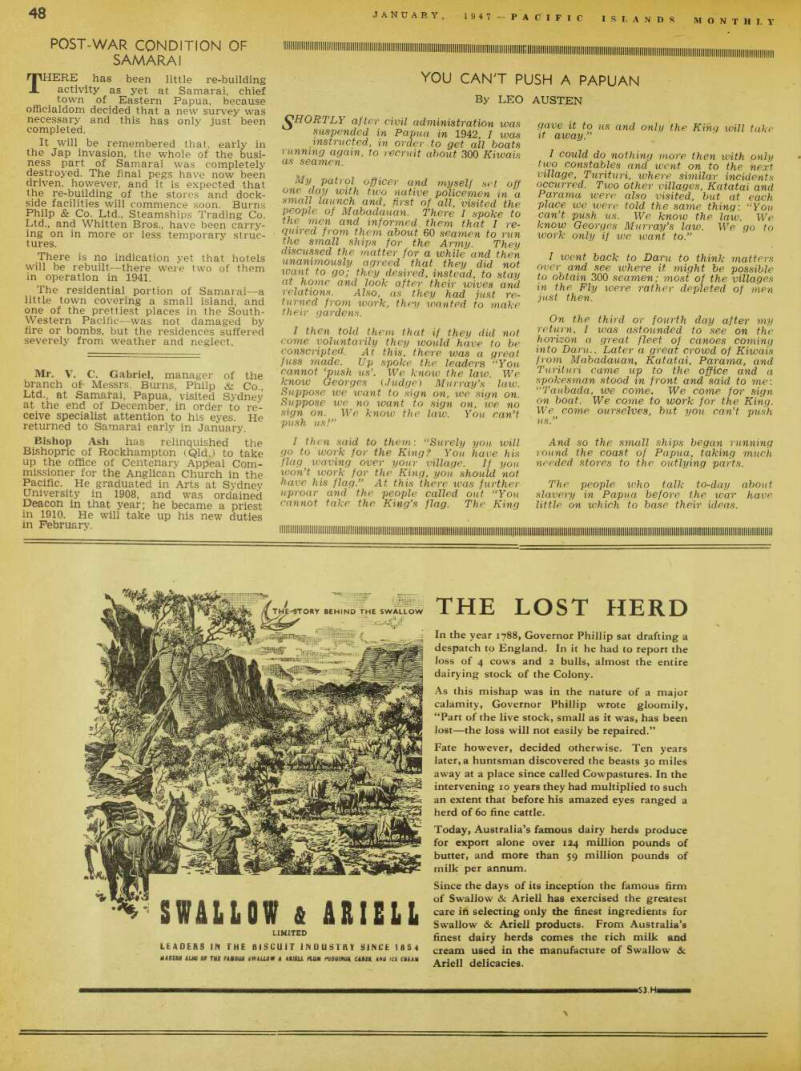
Samarai
THERE has been little re-building activity as yet at Samarai, chief town of Eastern Papua, because officialdom decided that a new survey was necessary and this has only just been completed.
It will be remembered that, early in the Jap invasion, the whole of the busi ness part of Samarai was completely destroyed. The final pegs have now been driven, however, and it is expected that the re-building of the stores and dock side facilities will commence soon. Burns Philp & Co. Ltd., Steamships Trading Co.
Ltd., and Whitten Bros., have been carry ing on in more or less temporary struc tures.
There is no indication yet that hotels will be rebuilt—there were two of them in operation in 1941.
The residential portion of Samarai—a little town covering a small island, and one of the prettiest places in the South- Western Pacific—was not damaged by fire or bombs, but the residences suffered severely from weather and neglect.
Mr. V. C. Gabriel, manager of the branch of Messrs. Burns, Philp & Co Ltd., at Samarai, Papua, visited Sydney at the end of December, in order to re ceive specialist attention to his eyes. He returned to Samarai early in January.
Bishop Ash has relinquished the Bishopric of Rockhampton (Qld.) to take up the office of Centenary Appeal Com missioner for the Anglican Church in the Pacific. He graduated in Arts at Sydney University in 1908, and was ordained Deacon in that year; he became a priest in 1910. He will take up his new duties in February.
You Can't Push A Papuan
By Leo Austen
CHORTLY after civil administration was suspended in Papua in 1942, I was instructed, in order- to get all boats running again, to recruit about 300 Kiwais as seamen.
My patrol officer and myself set off one day with two native policemen in a small launch and. first of all. visited the people of Mabadauan. There I spoke to the men and informed them that / re quired from them about 60 seamen to run the small ships for the Army. They discussed the matter for a while and then unanimously agreed that they did not want to go; they desired, instead, to stay at home and look afterr their wives and relations. Also, as they had just re turned from work, they wanted to make their gardens.
I then told them that if they did not come voluntarily they would have to be conscripted. At this, there was a great fuss made. Up spoke the leaders “You cannot ‘push us'. We know the law. We know Georges (Judge) Murray's law.
Suppose we want to sign on. we sign on.
Suppose we no want to sign on. we no sign on. We know the law. You can't push us!"
I then said to them: “Surely you will go to work for the King? You have his flag leaving over your village. If you won't work for the King, you should not have his flag." At this there was further uproar and the people called out “You cannot take the King's flag. The King
gave it to us and only the King will take it away ."
I could do nothing more then with only two constables and went on to the next village, Turituri, where similar incidents occurred. Two other villages. Katatai and Parama were also visited, but at each place we were told the same thing-. “You can't push us. We know the law. We know Georges Murray's law. We go to work only if we want to."
I went back to Daru to think matters over and see where it might be possible to obtain 300 seamen; most of the villages in the Fly were rather depleted of men just then.
On the third or fourth day after my return. I was astounded to see on the horizon a great fleet of canoes coming into Daru.. Later a great crowd of Kiwais from Mabadauan, Katatai. Parama, and Turituri came up to the office and a spokesman stood in front and said to me : “ Taubada. we come. We come for sign on boat. We come to work for the King.
We come ourselves, but you can't push us."
And so the small ships began running round the coast of Papua, taking much needed stores to the outlying parts.
The people who talk to-day about slavery in Papua before the war have little on which to base their ideas.
Advertisements & other items, p. 50 (1 item)
Swallow S Ariell
Th' S
'STORY BEHIND THE SWALLOW
. ■ - ■“•*333 *
SWALLOW s ARIELL
LIMITED
LEADERS IN THE BISCUIT INDUSTRY SINCE 18 5 4 HiK£U its o OF rut FAMOUS a WALLOW A AtIBLL FUIM niOOIHOO. CihtM. Afid IC£ CHUM
THE LOST HERD
In the year 1788, Governor Phillip sat drafting a despatch to England. In it he had to report the loss of 4 cows and 2 bulls, almost the entire dairying stock of the Colony.
As this mishap was in the nature of a major
calamity, Governor Phillip wrote gloomily,
“Part of the live stock, small as it was, has been lost—the loss will not easily be repaired.”
Fate however, decided otherwise. Ten years later, a huntsman discovered the beasts 30 miles away at a place since called Cowpastures. In the intervening 10 years they had multiplied to such an extent that before his amazed eyes ranged a herd of 60 fine cattle.
Today, Australia’s famous dairy herds produce
for export alone over 124 million pounds of butter, and more than 59 million pounds of milk per annum.
Since the days of its inception the famous firm of Swallow & Ariell has exercised the greatest care in selecting only the finest ingredients for Swallow & Ariell products. From Australia’s finest dairy herds comes the rich milk and cream used in the manufacture of Swallow & Ariell delicacies.
Fakatonga News Flashes
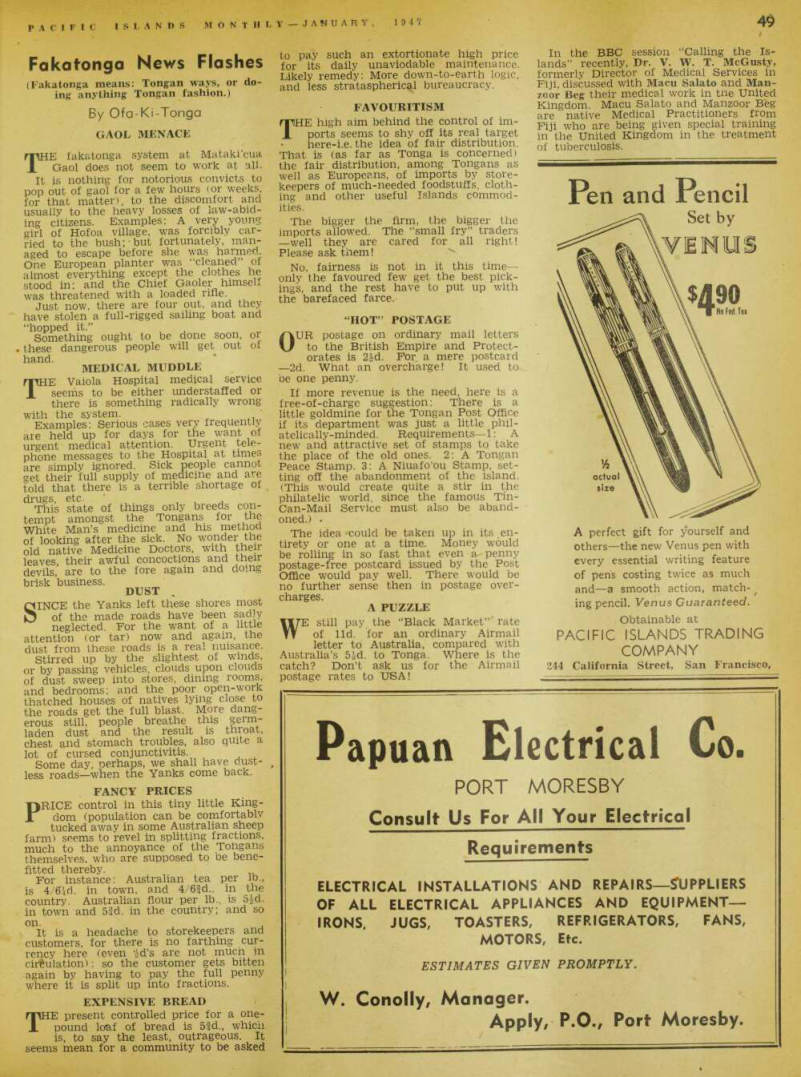
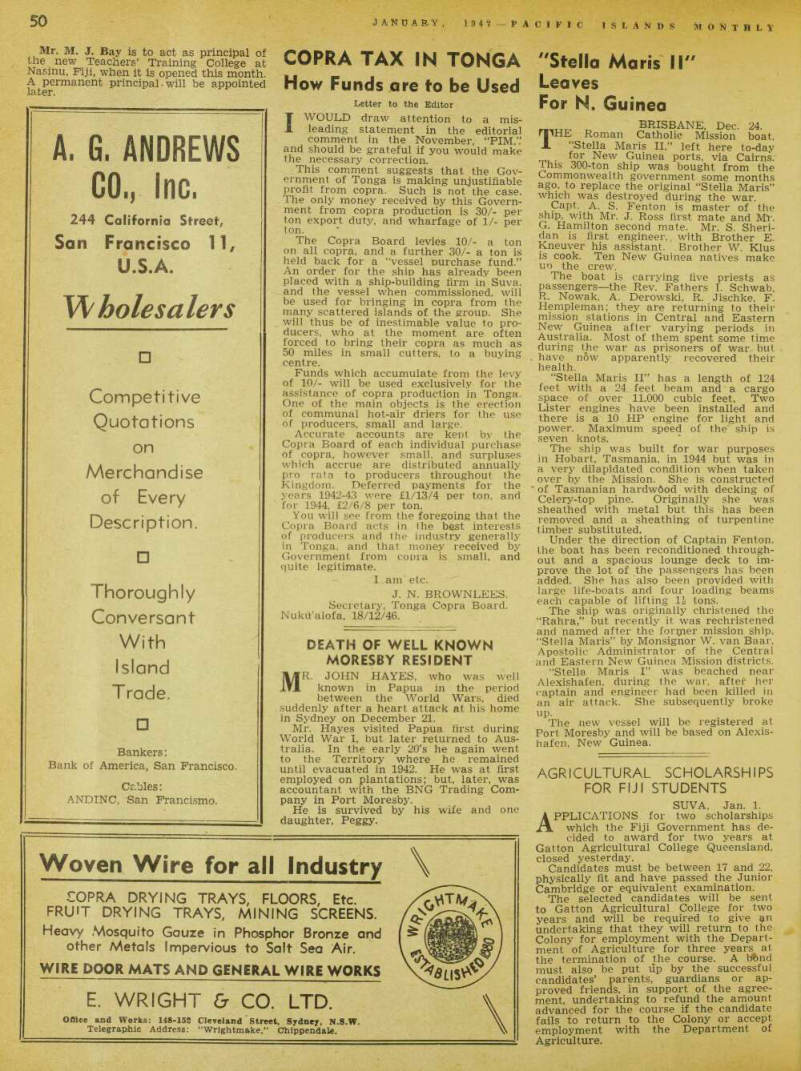
(Fakatonga means: Tongan ways, or do ing anything Tongan fashion.)
By Ofa-Ki-Tonga
Gaol Menace
mHE fakatonga system at Mataki’eua X Gaol does not seem to work at all.
It is nothing for notorious convicts to pop out of gaol for a few hours (or weeks, for that matter), to the discomfort and usually to the heavy losses of law-abid ing citizens. Examples; A very young girl of Hofoa village, was forcibly car ried to the bush; but fortunately, man aged to escape before she was harmed.
One European planter was “cleaned” of almost everything except the clothes he stood in: and the Chief Gaoler himself was threatened with a loaded rifle.
Just now. there are four out, and they have stolen a full-rigged sailing boat and “hopped it.”
Something ought to be done soon, or these dangerous people will get out of hand. , „
Medical Muddle
rE Vaiola Hospital medical service seems to be either understaffed or there is something radically wrong with the system. ' Examples: Serious cases very frequently are held up for days for the want of urgent medical attention. Urgent tele phone messages to the Hospital at times are simplv ignored. Sick people cannot get their full supply of medicine and are told that there is a terrible shortage of drugs, etc. , , , This state of things only breeds con tempt amongst the Tongans for the White Man’s medicine and his method of looking after the sick. No wonder the old native Medicine Doctors, with their leaves, their awful concoctions and their devils, are to the fore again and doing brisk business.
Dust ,
SINCE the Yanks left these shores most of the made roads have been sadly neglected. For the want of a little attention (or tar) now and again, the dust from these roads is a real nuisance.
Stirred up by the slightest of winds, or by passing vehicles, clouds upon clouds of dust sweep into stores, dining rooms, and bedrooms; and the poor open-work thatched houses of natives lying close to the roads get the full blast. More dang erous still, people breathe this germ laden dust and the result is throat, chest and stomach troubles, also quite a lot of cursed conjunctivitis.
Some day, perhaps, we shall have dust less roads—when the Yanks come back.
Fancy Prices
PRICE control in this tiny little King dom (population can be comfortably tucked away in some Australian sheep farm) seems to revel in splitting fractions, much to the annoyance of the Tongans themselves, who are supposed to oe bene fited thereby.
For instance; Australian tea per lb., is 4/61 d. in town, and 4/6id.. in the country. Australian flour per lb., is sld. in town and 53d. in the country; and so on. , It is a headache to storekeepers and customers, for there is no farthing cur rency here (even are not much in circulation); so the customer gets bitten again by having to pay the full penny where it is split up into fractions.
Expensive Bread
mHE present controlled price for a one- X pound loaf of bread is s|d., which is, to say the least, outrageous. It seems mean for a community to be asked
to pay such an extortionate high price for its daily unaviodable maintenance.
Likely remedy: More down-to-earth logic, and less bureaucracy.
Favouritism
THE high aim behind the control of im ports seems to shy off its real target here-i.e. the idea of fair distribution.
That is (as far as Tonga is concerned) the fair distribution, among Tongans as well as Europeans, of imports by store keepers of much-needed foodstuffs, cloth ing and other useful Islands commod ities.
The bigger the firm, the bigger the imports allowed. The “small fry” traders —well they are cared for all right!
Please ask them!
No, fairness is not in it this time only the favoured few get the best pick ings, and the rest have to put up with the barefaced farce.
“Hot” Postage
OUR postage on ordinary mail letters to the British Empire and Protect orates is 2h d. For a mere postcard —2d. What an overcharge! It used to be one penny.
If more revenue is the need, here is a free-of-charge suggestion; There is a little goldmine for the Tongan Post Office if its department was just a little phil atelically-minded. Requirements—l; A new and attractive set of stamps to take the place of the old ones. 2: A Tongan Peace Stamp. 3: A Niuafo’ou Stamp, set ting off the abandonment of the island. (This would create quite a stir in the philatelic world, since the famous Tin- Can-Mail Service must also be aband oned.) • The idea could be taken up in its en tirety or one at a time. Money would be rolling in so fast that even a penny postage-free postcard issued by the Post Office would pay well. There would be no further sense then in postage over charges.
A Puzzle
WE still pay the “Black Market” rate of lid. for an ordinary Airmail letter to Australia, compared with Australia’s s£d. to Tonga. Where is the catch? Don’t ask us for the Airmail postage rates to USA!
In the BBC session “Calling the Is lands” recently, Dr. V. W. T. McGusty, formerly Director of Medical Services in Fiji, discussed with Macu Salato and Man zcor Beg their medical work in tne United Kingdom. Macu Salato and Manzoor Beg are native Medical Practitioners from Fiji who are being given special training in the United Kingdom in the treatment of tuberculosis.
Mr. M. J. Bay is to act as principal of the new Teachers’ Training College at Nasinu, Fiji, when it is opened this month.
A permanent principal - will be appointed later.
Advertisements & other items, pp. 51-52 (1 item)
Papuan Electrical Co.
Pen and Pencil
Set by
No Fed Ta* actual size A perfect gift for yourself and others —the new Venus pen with every essential writing feature of pens costing twice as much and —a smooth action, match- f ing pencil. Venus Guaranteed.
Obtainable at
PACIFIC ISLANDS TRADING
COMPANY
244 California Street, San Francisco,
Papuan Electrical Co.
PORT MORESBY
Consult Us For All Your Electrical Requirements
ELECTRICAL INSTALLATIONS AND REPAIRS—SUPPLIERS
OF ALL ELECTRICAL APPLIANCES AND EQUIPMENT-
IRONS, JUGS, TOASTERS, REFRIGERATORS, FANS,
MOTORS, Etc.
ESTIMATES GIVEN PROMPTLY.
W. Conolly, Manager.
Apply, P. 0., Port Moresby.
A. G. ANDREWS
CO., Inc.
244 California Street, San Francisco 11,
U.S.A.
Wholesalers
□ Competitive Quotations on Merchandise of Every Description. □ Thoroughly Conversant With Island Trade. □ Bankers: Bank of America, San Francisco.
Cables: ANDINC, San Francismo.
Copra Tax In Tonga
How Funds are to be Used
Letter to the Editor I WOULD draw attention to a mis leading statement in the editorial comment in the November, “PIM,” and should be grateful if you would make the necessary correction.
This comment suggests that the Gov ernment of Tonga is making unjustifiable profit from copra. Such is not the case.
The only money received by this Govern ment from copra production is 30/- per ton export duty, and wharfage of 1/- per ton.
The Copra Board levies 10/- a ton on all copra, and a further 30/- a ton is held back for a “vessel purchase fund.”
An order for the ship has already been placed with a ship-building firm in Suva, and the vessel when commissioned, will be used for bringing in copra from the many scattered islands of the group. She will thus be of inestimable value to pro ducers, who at the moment are often forced to bring their copra as much as 50 miles in small cutters, to a buying centre.
Funds which accumulate from the levy of 10/- will be used exclusively for the assistance of copra production in Tonga.
One of the main objects is the erection of communal hot-air driers for the use of producers, small and large.
Accurate accounts are kept by the Copra Board of each individual purchase of copra, however small, and surpluses which accrue are distributed annually pro rata to producers throughout the Kingdom. Deferred payments for the years 1942-43 were £l/13/4 per ton, and for 1944, £2/6/8 per ton.
You will see from the foregoing that the Copra Board acts in the best interests of producers and the industry generally in Tonga, and that money received by Government from copra is small, and quite legitimate, I am etc.
J. N. Brownlees.
Secretary, Tonga Copra Board.
Nukualofa, 18/12/46.
Death Of Well Known
Moresby Resident
MR. JOHN HAYES, who was well known in Papua in the period between the World Wars, died suddenly after a heart attack at his home in Sydney on December 21.
Mr. Hayes visited Papua first during World War I, but later returned to Aus tralia. In the early 20’s he again went to the Territory where he remained until evacuated in 1942. He was at first employed on plantations; but, later, was accountant with the BNG Trading Com pany in Port Moresby.
He is survived by his wife and one daughter, Peggy.
"Stella Maris II"
Leaves For N. Guinea
T ttt . BRISBANE, Dec. 24.
HE Roman Catholic Mission boat, “Stella Maris II,” left here to-day for New Guinea ports, via Cairns.
This 300-ton ship was bought from the Commonwealth government some months ago, to replace the original “Stella Maris” which was destroyed during the war.
Capt. A. S. Fenton is master of the ship, with Mr. J. Ross first mate and MV.
G. Hamilton second mate. Mr. S. Sheri dan is first engineer, with Brother E.
Kneuver his assistant. Brother W. Klus is cook. Ten New Guinea natives make up the crew.
The boat is carrying five priests as passengers—the Rev. Fathers I. Schwab, R. Nowak, A. Derowski, R. Jischke, F.
Hempleman; they are returning to their mission stations in Central and Eastern New Guinea after varying periods in Australia. Most of them spent some time during the war as prisoners of war but have now apparently recovered their health.
“Stella Maris II” has a length of 124 feet with a 24 feet beam and a cargo space of over 11,000 cubic feet. Two Lister engines have been installed and there is a 10 HP engine for light and power. Maximum speed of the ship is seven knots.
The ship was built for war purposes in Hobart, Tasmania, in 1944 but was in a very dilapidated condition when taken over by the Mission. She is constructed of Tasmanian hardwbod with decking of Celery-top pine. Originally she was sheathed with metal but this has been removed and a sheathing of turpentine timber substituted.
Under the direction of Captain Fenton, the boat has been reconditioned through out and a spacious lounge deck to im prove the lot of the passengers has been added. She has also been provided with large life-boats and four loading beams each capable of lifting 11 tons.
The ship was originally christened the “Rahra,” but recently it was rechristened and named after the foriyier mission ship, “Stella Maris” by Monsignor W. van Baar, Apostolic Administrator of the Central and Eastern New Guinea Mission districts.
“Stella Maris I” was beached near Alexishafen, during the war, after her captain and engineer had been killed in an air attack. She subsequently broke up.
The new vessel will be registered at Port Moresby and will be based on Alexis hafen, New Guinea.
Agricultural Scholarships
For Fiji Students
Suva. Jan. 1.
Applications for two scholarships which the Fiji Government has de cided to award for two years at Gatton Agricultural College Queensland, closed yesterday.
Candidates must be between 17 and 22, physically fit and have passed the Junior Cambridge or equivalent examination.
The selected candidates will be sent to Gatton Agricultural College for two years and will be required to give an undertaking that they will return to the Colony for employment with the Depart ment of Agriculture for three years at the termination of the course. A bbnd must also be put lip by the successful candidates’ parents, guardians or ap proved friends, in support of the agree ment, undertaking to refund the amount advanced for the course if the candidate fails to return to the Colony or accept employment with the Department of Agriculture.
Advertisements & other items, p. 52 (1 item)
Woven Wire for all Industry
COPRA DRYING TRAYS, FLOORS, Etc.
FRUIT DRYING TRAYS, MINING SCREENS.
Heavy Mosquito Gauze in Phosphor Bronze and other Metals Impervious to Salt Sea Air.
WIRE DOOR MATS AND GENERAL WIRE WORKS
E. WRIGHT & CO. LTD.
Office and Works: 148-152 Cleveland Street, Sydney, N.S.W.
Telegraphic Address: “Wrightmake,” Chippendale. f- Or r* •Ob
Vanikoro Timber-Getters
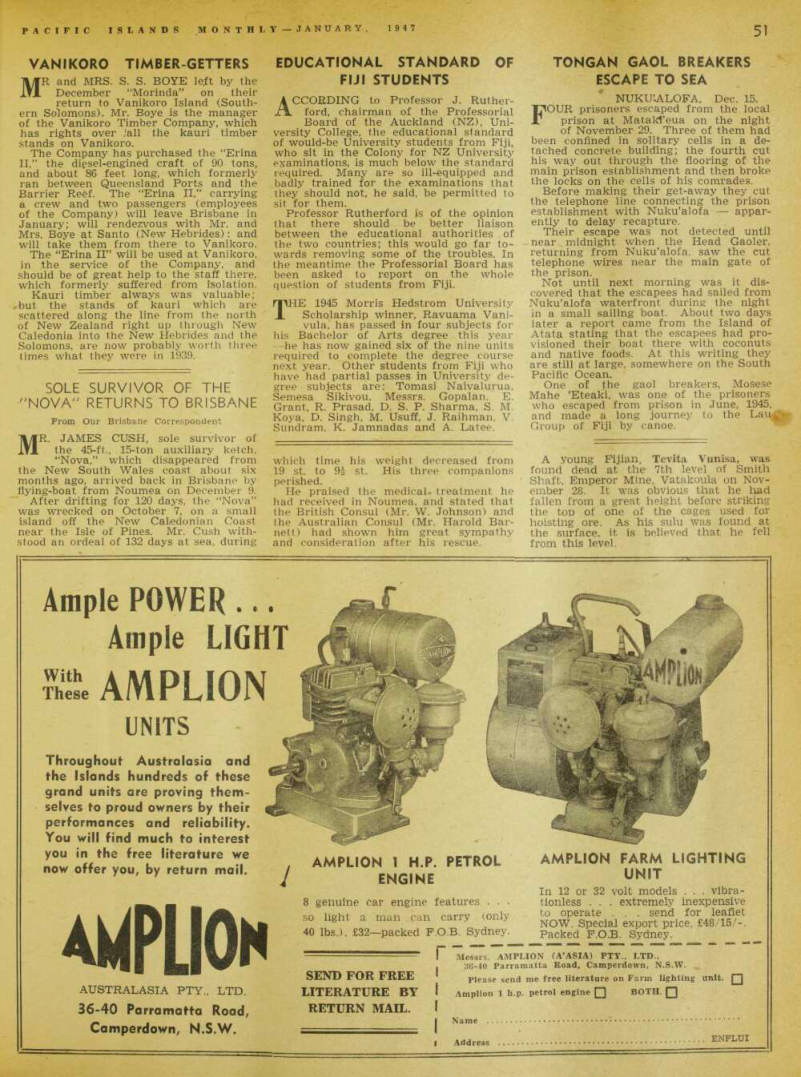
MR and MRS. S. S. BOYE left by the December “Morinda” on their return to Vanikoro Island (South ern Solomons). Mr. Boye is the manager of the Vanikoro Timber Company, which has rights over ,'all the kauri timber stands on Vanikoro.
The Company has purchased the “Erina II,” the diesel-engined craft of 90 tons, and about 86 feet long, which formerly ran between Queensland Ports and the Barrier Reef. The “Erina II,” carrying a crew and two passengers (employees of the Company) will leave Brisbane in January; will rendezvous with Mr. and Mrs. Boye at Santo (New Hebrides): and will take them from there to Vanikoro.
The “Erina II” will be used at Vanikoro, in the service of the Company, and should be of great help to the staff there, which formerly suffered from isolation.
Kauri timber always was valuable; but the stands of kauri which are scattered along the line from the north of New Zealand right up through New Caledonia into the New Hebrides and the Solomons, are now probably worth three limes what they were in 1939.
Sole Survivor Of The
"Nova" Returns To Brisbane
Prom Our Brisbane Correspondent MR. JAMES CUSH, sole survivor of the 45-ft., 15-ton auxiliary ketch, “Nova,” which disappeared from the New South Wales coast about six months ago, arrived back in Brisbane by flying-boat from Noumea on December 9.
After drifting for 120 days, the “Nova” was wrecked on October 7. on a small island off the New Caledonian Coast near the Isle of Pines, Mr. Cush with stood an ordeal of 132 days at sea, during
which time his weight decreased from 19 st. to 9 1 st. His three companions perished.
He praised the medical* treatment he had received in Noumea, and stated that the British Consul (Mr. W. Johnson) and the Australian Consul (Mr. Harold Bar nett) had shown him great sympathy and consideration after his rescue.
Educational Standard Of
Fiji Students
ACCORDING to Professor J. Ruther ford, chairman of the Professorial Board of the Auckland (NZ), Uni versity College, the educational standard of would-be University students from Fiji, who sit in the Colony for NZ University examinations, is much below the standard required. Many are so ill-equipped and badly trained for the examinations that they should not, he said, be permitted to sit for them.
Professor Rutherford is of the opinion that there should be better liaison between the educational authorities of the two countries; this would go far to wards removing some of the troubles. In the meantime the Professorial Board has been asked to report on the whole question of students from Fiji.
THE 1945 Morris Hedstrom University Scholarship winner, Ravuama Vani vula, has passed in four subjects for his Bachelor of Arts degree this year -he has now gained six of the nine units required to complete the degree course next year. Other students from Fiji who have had partial passes in University de gree subjects are: Tomasi Naivalurua, Semesa Sikivou, Messrs. Gopalan. E.
Grant, R. Prasad, D. S. P. Sharma, S. M.
Koya, D. Singh, M. Usuff, J. Raihman, V.
Sundram, K, Jamnadas and A. Latee.
Tongan Gaol Breakers
Escape To Sea
Nukualofa, Dec. 15.
FOUR prisoners escaped from the local prison at Matakl’eua on the night of November 29. Three of them had been confined in solitary cells in a de tached concrete building; the fourth cut his way out through the flooring of the main prison establishment and then broke the locks on the cells of his comrades.
Before making their get-away they cut the telephone line connecting the prison establishment with Nukualofa appar ently to delay recapture.
Their escape was not detected until near midnight when the Head Gaoler, returning from Nukualofa, saw the cut telephone wires near the main gate of the prison.
Not until next morning was it dis covered that the escapees had sailed from Nuku’alofa waterfront during the night in a small sailing boat. About two days later a report came from the Island of Atata stating that the escapees had pro visioned their boat there with coconuts and native foods. At this writing they are still at large, somewhere on the South Pacific Ocean, One of the gaol breakers, Mosese Mahe 'Eteaki, was one of the prisoners who escaped from prison in June, 1945, and made a long journey to the Lau£ Group of Fiji by canoe.
A young Fijian, Tevita Vunisa, was found dead at the 7th level of Smith Shaft, Emperor Mine, Vatakoula on Nov ember 28. It was obvious that he had fallen from a great height before striking the top of one of the cages used for hoisting ore. As his sulu was found at the surface, it is believed that he fell from this level.
Advertisements & other items, p. 53 (1 item)
Aupliok
Ample POWER ...
Ample LIGHT
S AMPLION
UNITS
Throughout Australasia and the Islands hundreds of these grand units are proving themselves to proud owners by their performances and reliability.
You will find much to interest you in the free literature we now offer you, by return mail.
aUPLIOk
AUSTRALASIA PTY., LTD.
36-40 Parramatta Road,
Camperdown, N.S.W.
AH m UK - I
AMPLION 1 H.P. PETROL
ENGINE
8 genuine car engine features . . . so light a man can carry (only 40 lbs.). £32—packed FOB. Sydney.
AMPLION FARM LIGHTING
UNIT
In 12 or 32 volt models . . . vibrationless . . . extremely inexpensive to operate . . . send for leaflet NOW. Special export price, £4B/15/-.
Packed F. 0.8. Sydney.
SEND FOR FREE
LITERATURE BY
RETURN MAIL.
I Messrs. AMPLION (A’ASIA) PTY., LTD.,
• 30-40 Parramatta Road, Camperdown, N.S.W.
Please send me free literature on Farm lighting unit.
I Amplion 1 h.p. petrol engine □ BOTH. £] Name Address
ENFLUI
Concerning Mr. Bryson
Letter to the Editor THIS letter may be a little belated by the time it reaches you: but I should like to pen a few words of reply to a speech by Mr. Bryson, of Australia’s Labour Party, in support of Mr. Ward’s “Papua-New Guinea Provisional Admin istration Bill” on July 19, 1945, wherein he stated: “When the Japanese invaded New Guinea, the White Settlers left as quickly as they could.”
Mr. Bryson, your political bleating is somewhat in error. Some of us left Papua and New Guihea before the Japs even entered the war.
What does Moresby Gofton (shot down in Norway in mid-May, 1940, serving with the RAF) think of you or your senti ments? Or Stan Baldie. who flew with 111 Squadron Fighter Command from Croydon, during the Battle of Britain, and later was killed in India? Or Bob Munro and Ron Brookbanfc, both killed that memorable night in May, 1942, during the RAF’s first 1,000-Bomber-Raid on Cologne? Or Terry McKenna, whose body was washed ashore on Denmark?
Or Tommy Rosser, who hid in Stalag
Stamps
s 'We buy collections, also all issues in quantity, either off or on paper. Top prices. Send registered mail.
Agents required in Pacific Islands, Papua and New Guinea to service covers and send mint stamps.
A. Willison, Box 128, Burnie, Tasmania.
Luft I, on the Baltic? All of the above were Papuan-born and bred.
It was quite a large party who “left”
Papua, Mr. Bryson. Some of us survived, and finished up 150 miles from the Arctic circle, in Norway, when Germany cried “Kaput.” A nice, safe funk-hole from the Jans, Mr. Bryson!
When it was all over, and we came home, we found only two Fascist States left on this globe Franco-Spain and Ward’s External Territories. So the weaker-hearted of us fled the hell out of it again—not from the Japs, this time, but from Ward and the likes of you, Mr.
Bryson.
I am, etc.
Ren Henderson
(Samarai-born and proud of it.) 17 Tennessee Avenue, Port Colborne, Ontario, Canada.
Editorial Note
OUR correspondent, being afar off, evidently is not aware that the loquacious Mr. Bryson—who could never be described as anything but a political accident, anyway—was rejected by the Australian electors on September 28, and in October was running around looking for a job. In November, he was accommodated, and became a secretary to a Minister. How these rejected Labour politicians hate the hard work from which they escaped into Parliament!
Six lost their seats in September—and five have been provided since with “soft”
Government billets.
The new Director of Education for Fiji, Mr. Howard Hayden, accompanied by his wife and daughter, arrived in Suva by air on December 13.
Less Crime In Tonga
Nukualofa. Dec. 14.
TfIHE quarterly session of the Supreme Jl Court was opened on November 13 before Puisne Judge J. B. Thomson, of Fiji, acting as Chief Justice of Tonga.
The calendar, as set forth below, shows a marked decrease in crime as compared with the war period, when crime in the Kingdom reached a level never before equalled. The return of life to its normal leyel is the chief contributing factor to this decrease in lawlessness.
Peni Hala’api’api, of Nukuhetulu, was sentenced to three years, for rape. Tevita Tau’aika, of Pelehake, Tevita Kilisimasi, of Folaha, and Vilingaia Finau, of Houma, were found guilty of housebreak ing, and each got three years. Taloa Foliaki, of Ma’ufanga was convicted of falsification of accounts, and admitted to probation for three years. Leata Talisa, of Kolovai, convicted of larceny, got three years. Apolosi Lokotui, of Kolofo’ou, was acquitted of a charge of housebreaking.
Judge Thomson, accompanied by his wife, left Nukualofa at the end of November for Ha’apai and Vava’u on the “Hifofua,” where he will hold sessions of the Supreme Court before returning to Suva.
Miss Ethel Marr, elder daughter of the late Mr. and Mrs. J. A. Marr of Suva, Fiji, was married in the Sacred Heart Cathedral, Suva, on November 29, to Mr.
F. J. Martin of Gisborne, New Zealand.
Mrs. Loma Collins of Sydney, sister of the bride, was matron-of-honour, and Miss Amy Marr, cousin of the bride, was bridesmaid. The bride was given away by her uncle, Mr. J. A. Marr of Suva.
Advertisements & other items, p. 54 (1 item)
G 1 M Don't Say G
DON'T SAY fj I f% T DON'T SAY G I DON'T SAY G 1 GIN PONT SAY ft SAT GIN DON'T SAY DON'T SAY G I IN DON j SAY GIN
DON'T SAY G I I\
G I M DON'T SAY
I IN
GIN DON'T SAY
DON'T SAY GIN
I M DON'T SAY
DON'T SAY © J
6 I M DON'T SAY G I
DON'T -SAY CpIM DON'T SAY
r DO * s Gift
Li QU
M ‘To °Ur * ne Cq c *t a Us s ydn w HI ey
SKIP
DON'
T OsA so
DON'T S
dSTi W
T SAY
DON'T
Telegrams and Cables: “GILBEYS,” Melbourne Address all inquiries to:
W. & A. GILBEY LTD.
33 ROSSLYN STREET, WEST MELBOURNE. 109 REGENT STREET, SYDNEY.
Telegrams and Cables: “GILBEYS,” Sydney.
Friendly Gesture From Hawaii
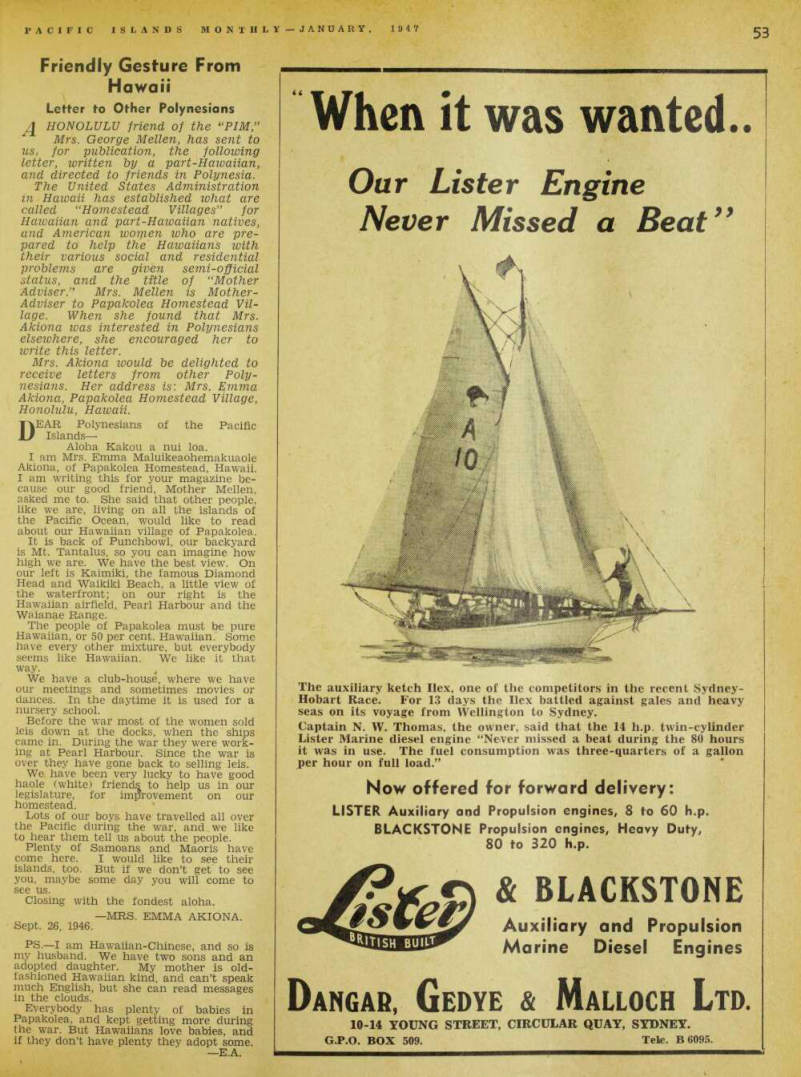
Hawaii
Letter to Other Polynesians
£ HONOLULU friend of the “PIM”
Mrs. George Mellen, has sent to us, for publication, the following letter, written by a part-Hawaiian, and directed to friends in Polynesia.
The United States Administration in Hawaii has established what are
called “Homestead Villages” for
Hawaiian and part-Hawaiian natives,
and American worpen who are pre pared to help the Hawaiians with their various social and residential
problems are given semi-official
status, and the title of “Mother Adviser.” Mrs. Mellen is Mother- Adviser to Papakolea Homestead Vil lage. When she found that Mrs.
Akiona was interested in Polynesians elsewhere, she encouraged her to write this letter.
Mrs. Akiona would be delighted to receive letters from other Poly nesians. Her address is: Mrs. Emma
Akiona, Papakolea Homestead Village,
Honolulu, Hawaii.
DEAR Polynesians of the Pacific Islands— Aloha Kakou a nui loa.
I am Mrs. Emma Maluikeaohemakuaole Akiona, of Papakolea Homestead, Hawaii.
I am writing this for your magazine be cause our good friend, Mother Mellen, asked me to. She said that other people, like we are, living on all the islands of the Pacific Ocean, would like to read about our Hawaiian village of Papakolea.
It is back of Punchbowl, our backyard is Mt. Tantalus, so you can imagine how high we are. We have the best view. On our left is Kaimiki, the famous Diamond Head and Waikiki Beach, a little view of the waterfront; bn our right is the Hawaiian airfield, Pearl Harbour and the Waianae Range.
The people of Papakolea must be pure Hawaiian, or 50 per cent. Hawaiian. Some have every other mixture, but everybody seems like Hawaiian. We like it that way.
We have a club-house, where we have our meetings and sometimes movies or dances. In the daytime it is used for a nursery school.
Before the war most of the women sold leis down at the docks, when the ships came in. During the war they were work ing at Pearl Harbour. Since the war is over they have gone back to selling leis.
We have been very lucky to have good haole (white) friends to help us in our legislature, for improvement on our homestead.
Lots of our boys have travelled all over the Pacific during the war, and we like to hear them tell us about the people.
Plenty of Samoans and Maoris have come here. I would like to see their islands, too. But if we don’t get" to see you, maybe some day you will come to see us.
Closing with the fondest aloha.
Mrs. Emma Akiona.
Sept. 26, 1946.
PS.—I am Hawaiian-Chinese, and so is my husband. We have two sons and an adopted daughter. My mother is old fashioned Hawaiian kind, and can’t speak much English, but she can read messages in the clouds.
Everybody has plenty of babies in Papakolea, and kept getting more during the war. But Hawaiians love babies, and if they don’t have plenty they adopt some.
E.A.
Advertisements & other items, p. 55 (1 item)
When it was wanted..
Our Lister Engine
Never Missed a Beat”
A to V The auxiliary ketch Ilex, one of the competitors in the recent Sydney- Hobart Race. For 13 days the Ilex battled against gales and heavy seas on its voyage from Wellington to Sydney.
Captain N. W. Thomas, the owner, said that the 14 h.p. twin-cylinder Lister Marine diesel engine “Never missed a beat during the 80 hours it was in use. The fuel consumption was three-quarters of a gallon per hour on full load.”
Now offered for forward delivery: LISTER Auxiliary and Propulsion engines, 8 to 60 h.p.
BLACKSTONE Propulsion engines. Heavy Duty, 80 to 320 h.p.
tsletj
& BLACKSTONE
Auxiliary and Propulsion
Marine Diesel Engines
Dangar, Gedve & Malloch Ltd.
10-14 YOUNG STREET, CIRCULAR QUAY, SYDNEY.
G.P.O. BOX 509. Tele. B 6095.
CSR Paid £900,000
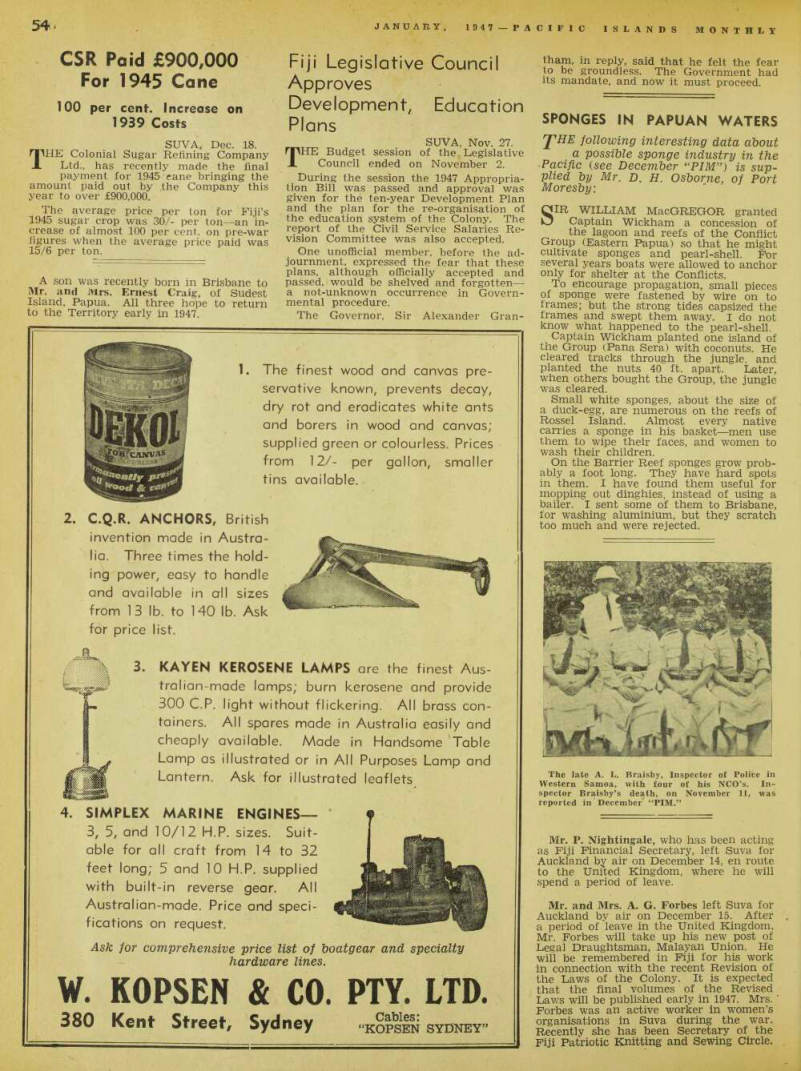
For 1945 Cane 100 per cent. Increase on 1939 Costs
Suva, Dec. 18.
THE Colonial Sugar Refining Company Ltd., has recently made the final payment for 1945 cane bringing the amount paid out by the Company this year to over £900,000.
The average price per ton for Fiji’s 1945 sugar crop was 30/- per ton—an in crease of almost 100 per cent, on pre-war figures when the average price paid was 15/6 per ton.
A son was recently born in Brisbane to Mr. and Mrs. Ernest Craig, of Sudest Island, Papua. All three hope to return to the Territory early in 1947.
Development, Education
Fiji Legislative Council Approves Development, Education Plans
Suva, Nov. 27.
THE Budget session of the Legislative Council ended on November 2.
During the session the 1947 Appropria tion Bill was passed and approval was given for the ten-year Development Plan and the plan for the re-organisation of the education system of the Colony. The report of the Civil Service Salaries Re vision Committee was also accepted.
One unofficial member, before the ad journment, expressed the fear that these plans, although officially accepted and passed, would be shelved and forgotten— a not-unknown occurrence in Govern mental procedure.
The Governor, Sir Alexander Gran
tham, in reply, said that he felt the fear to be groundless. The Government had its mandate, and now it must proceed.
Sponges In Papuan Waters
Y'HE following interesting data about
a possible sponge industry in the Pacific (see December “PIM”) is sup plied by Mr. D. H. Osborne, of Port
Moresby :
SIR WILLIAM MacGREGOR granted Captain Wickham a concession of the lagoon and reefs of the Conflict Group (Eastern Papua) so that he might cultivate sponges and pearl-shell. For several years boats were allowed to anchor only for shelter at the Conflicts.
To encourage propagation, small pieces of sponge were fastened by wire on to frames; but the strong tides capsized the frames and swept them away. I do not know what happened to the pearl-shell.
Captain Wickham planted one island of the Group (Pana Sera) with coconuts. He cleared tracks through the jungle, and planted the nuts 40 ft. apart. Later, when others bought the Group, the jungle was cleared.
Small white sponges, about the size of a duck-egg, are numerous on the reefs of Rossel Island. Almost every native carries a sponge in his basket—men use them to wipe their faces, and women to wash their children.
On the Barrier Reef sponges grow prob ably a foot long. They have hard spots in them. I have found them useful for mopping out dinghies, instead of using a bailer. I sent some of them to Brisbane, for washing aluminium, but they scratch too much and were rejected.
Mr. P. Nightingale, who has been acting as Fiji Financial Secretary, left Suva for Auckland by air on December 14, en route to the United Kingdom, where he will spend a period of leave.
Mr. and Mrs. A. G. Forbes left Suva for Auckland by air on December 15. After a period of leave in the United Kingdom, Mr. Forbes will take up his new post of Legal Draughtsman, Malayan Union. He will be remembered in Fiji for his work in connection with the recent Revision of the Laws of the Colony. It is expected that the final volumes of the Revised Lav/s will be published early in 1947. Mrs. ' Forbes was an active worker in women’s organisations in Suva during the war.
Recently she has been Secretary of the Fiji Patriotic Knitting and Sewing Circle.
The late A. L. Braisby, Inspector of Police in Western Samoa, with four of his NCO’s. In spector Braisby’s death, on November 11, was reported in December “PIM.”
Advertisements & other items, p. 56 (1 item)
W. Kopsen & Co. Pty. Ltd.
. m m The finest wood and canvas preservative known, prevents decay, dry rot and eradicates white ants and borers in wood and canvas; supplied green or colourless. Prices from 12/- per gallon, smaller tins available.
C.Q.R. ANCHORS, British invention made in Australia. Three times the holding power, easy to handle and available in all sizes from 13 lb. to 140 lb. Ask for price list.
KAYEN KEROSENE LAMPS are the finest Australian-made lamps; burn kerosene and provide 300 C.P. light without flickering. All brass containers. All spares made in Australia easily and cheaply available. Made in Handsome Table Lamp as illustrated or in All Purposes Lamp and Lantern. Ask for illustrated leaflets
4. SIMPLEX MARINE ENGINES—
3, 5, and 10/12 H.P. sizes. Suitable for all craft from 14 to 32 feet long; 5 and 10 H.P. supplied with built-in reverse gear. All Australian-made. Price and specifications on request.
Ask for comprehensive price list of boatgear and specialty hardware lines.
W. KOPSEN & CO. PTY. LTD.
Cables:
“KOPSEN SYDNEY”
m
380 Kent Street, Sydney
How 240 Men Were Saved
Magnificent Achievement on New Britain Coast After Rabaul Fell
'THIS is another angle on how hundreds ■L of men soldiers and civilians escaped from Rabaul after the Jap invasion in January 1942. We are in debted for this story to J. K. McCarthy, who perhaps more than any other individual at that time helped to save these men. After he had shepherded them to Australia, he gave other distinguished service in the Pacific war and was, in fact, in Sarawak and Borneo, until July, 1946. He now is living in Victoria.
Other parts of the incredible story of Jap-dodging have been told by the Rev.
A. P. H. Freund, in the “PIM,” and by Commander Eric Feldt. in his book “The Coast Watchers.” Both have referred to Mr. McCarthy’s conspicuous part in the rescue of the remnants of RabauVs gar rison and Rabaul civilians: but, here, the whole story is told for the first time, enabling us to complete the picture of events in those early chaotic days of 1942.
Section I
LONG before war came to New Guinea, a secret plan had been made in which it was proposed to use guerilla irregulars against any enemy who might overrun the country. The plan called for the recruiting of suitable civilians and natives, who were to be armed and instructed, and for the laying down of supply dumps in which food, ammunition and medicines were to be stored at strategic points.
From 1919 onwards the far-sighted Royal Australian Navy had implemented a scheme of Coast Watchers in which selected civilians, planters and Govern ment officials at strategic points, were instructed how to report movements of suspicious shipping and aircraft in time of war.
On the outbreak of war in 1939, the RAN had expanded their plan and modern efficient teleradio sets had been made available to their Coast Watchers.
As already told in the “PIM.” Commander E. A. Feldt RAN had been appointed to command the New Guinea area. He had previously lived in New Guinea for many years and had served as Patrol-Officer and District Officer in most places.
In having Eric Feldt as senior naval intelligence officer in charge, New Guinea was lucky.
When the Japs suddenly struck at Pearl Harbour I was Assistant District Officer at Talasea, New Britain. The district was a large one and the Euro pean community was small; but what it lacked in numbers it made up in quality —amongst those planters and traders lived the finest of men.
Included amongst them were Ken Douglas of San Remo Plantation ; r Latham Hamilton, of Garua; Bert Olander and Roger Berman, of Numondo; Rod Mars land, of Lagenda; and the Ireland brothers, Charlie and Les. of Walindi.
At Iboki, 60 miles down the coast, was McNicol, a young man of Eurasian descent who was to later earn the RAN Distinguished Service Medal. Frank Henderson was my agricultural officer at Talasea; while at the Witu Islands were Reg Mills, Harry Murray (Bali) and Mrs.
Baker, Further up the coast, and actually within the Rabaul area, were Lincoln Bell, Frank Holland and Jerry Swanson.
These last three were timber-getters, and Bell and Holland in particular were known to me as splendid bushmen.
RABAUL authorities appeared vague about the guerilla plan which was to be implemented on the outbreak of war, and, lacking definite orders, I decided to act without them.
Henderson, Douglas, Hamilton and Olander conferred at Talasea, and we pooled all our resources. We selected suitable trustworthy natives and armed and gave them what training we could.
There were a few long-term prisoners at Talasea, and these men were released so that they could assist. They did not betray our confidence and were to remain faithful to the end. Added to our native police, these men gave us the nucleus of a force.
From Talasea westwards to Cape Glou cester we laid down dumps of rice, cases of meat, etc., at hidden points along the coast. Latham Hamilton and Charles Ireland were old soldiers of the First War —their advice was most helpful.
The teleradio was removed to a bomb proof shelter and practices in dismantling it and carrying it away were constantly made in case an enemy party should suddenly come upon the station.
Late in December the few white women living in the district were evacuated to Rabaul, and thence flown to Australia. Mrs. Baker of Langu Plantation, Witu, declined to go and remained at her plantation. *We badly lacked ships in the district and had only mv “Lolobau.” a 35-feet Administration vessel, and Ken Douglas’s tiny launch, “Dufaur.”
One of our first duties was to make the three emergency landing-grounds at
Talasea unsuitable for landing. The landing-ground at the station presented no difficulty; but the other two, Cape Gloucester and Übili, were at the extreme ends of the district, and 200 miles apart.
Marsland and I sailed for Gloucester, while Douglas went in his small boat to Übili. Deep ditches were dug across the strips to prevent any enemy use of them.
At Cape Gloucester we saw our first enemy planes. There were 30 or 40 of them and they appeared to be flying N-E.
The work on the strips took some weeks to accomplish and by the time we re turned to Talasea, Rabaul had been heavily bombed and it was clear that a Japanese invasion was imminent. At this time Roger Berman was suffering from appendicitis and he was taken to Rabaul by Bert Olander, of Numondo. Latham Hamilton was also keen to go and get first-hand news.
Although we had no doctor in the dis trict I was doubtful of the wisdom of such a trip; however, they sailed in a Chinese schooner and that was the last we were to see of either Berman or Hamilton. Olander escaped from Rabaul and played a great part in the events that followed. Poor Hammie and Roger must have arrived at Rabaul on the very day the Japs landed.
On January 21, 1942, Rabaul went off the air. Their last message was brief but it told us plenty: “Abandon your station.”
I now had only Mitchell, at Gasmata, and Con Page, at Tabar, Kavieng, to talk with on the air.
DURING this period the Burns, Philp 179-ton ship, “Lakatoi” was visiting the Witu Group and on January 23, she had been en route to Rabaul. She carried no wireless, so was unaware that the Japanese were landing there on that day.
Japanese seaplanes suddenly appeared and flew low over her and carried out a close inspection from the air. They did not attack, but one pilot waved to the ship. The master, Captain Farrow, de cided to turn back and on the following day he called at Talasea and dropped R. A. Robinson (senior plantation in spector for Burns, Philp) and M. L. Cross (a plantation manager).
The vessel did not wait but immediately turned about and, later, we sighted her from Talasea anchored at Cape Camp
bell, on the northern tip of Willaumez Peninsula, about 20 miles from the station.
Our only vessel, “Lolobau” was then anchored on the other side of Willaumez, so that we could not reach “Lakotoi” within within 24 hours.
Both Robinson and I would have dearly loved to use the “Lakatoi” but I was told that the master was not keen; he was a stranger to New Guinea waters.
Rabaul radio was silent but Gasmata constantly reported enemy air and sea movement. The air seemed thick with Japs at Talasea. It was the lull before the storm and high time we got out of the station. I advised Mitchell, patrol officer at Gasmata, to get out and set up a hidden observation post, as the enemy would surely overrun the country.
In the meantime, I was getting anxious about the rapidly growing number of civilians who had to be evacuated from the district. One of my last actions was to purchase the entire contents of the Chinese trade store at Talasea. The food would be valuable, and so would tl\e trade goods in hiring canoes, etc. Our plan was to get everybody to Cape Glou cester and thence over the Dampier and Vitiaz Straits to Salamaua, which was still clear of the enemy.
At the isolated village of Kariaiai, near Cape Raoult, 90 miles west of Talasea, we had already laid down food dumps, as I originally intended to take up my job of coast watcher on the western tip of New Britain and observe the narrow straits between New Britain and the Finschhafen coast.
We packed everybody on the small “Lolobau” after camouflaging her as best we could, and began the journey. In case we were forced to take to the jungle and spend the war in New Britain we decided on a strict system of rationing which applied to the Europeans even more than it did to our natives. Any hungry glances that might be directed to a boy’s bowl of rice were promptly noticed by the humor ous but nevertheless determined Robinson, who cheerfully threatened to shoot the European offender on the spot.
Reg Mills, of Witu, and Harry Murray, of Bali, Unea Island, were met down the coast; they had sailed a cutter and the launch “Aussi” over. They reported that Mrs. Baker and her maid, Miss*Leh mann, had also come over to New Britain, and were at a spot further up the coast. 1 STILL had the “Lakatoi” in mind and at an early opportunity sent a signal to the authorities' at Port Moresby requesting that as the ship would cer tainly fall into Japanese hands I should be permitted to either arrest and use her, or sink her.
The overcrowded “Lolobau” reached the Kombe native area, and I soon learned from the natives where Mrs.
Baker and her maid were located. They had gone up a large river, the Aria, and were still there with the small launch, “Langu,” Mrs. Baker was willing to risk it and try to hide from the Japs until the war was over; but as I had had no trouble in locating her I very much doubted the wisdom of her action, although I have always admired her courage and resourcefulness. I also was not so sure that the war would be over in a few months.
We waited at Nutanavua Island while Ken Douglas went up the Aria and in a few hours I was greatly relieved to see that Mrs. Baker had accompanied him back to our ship.
“I suppose you think I’m a damned nuisance, Keith,” she said, as she came aboard.
“I’m only too glad to see you,” I replied “I know you’ll be useful.”
I was right; later we needed a nurse
*See page 22 this issue.
to look after the men that were to come out of Rabaul.
ON January 30, at Kariaiai, I received a signal that had to take preced ence ovdr all else. Eric Feldt instructed me that as no signals had been received from Rabaul since Janu ary 23, I was to return to the Rabaul area and by means of my teleradio, signal information to Port Moresby.
If possible, I was to contact Hugh MacKenzie NOIC Rabaul now a Lieut-Commander in his old service.
“Mucker” MacKenzie was well known to everybody in New Guinea, and was the owner of Megigi Plantation in my dis trict. As a parting dig at my habit of trying to sketch people, Eric added that I was to bring out a cartoon of the Jap anese commander!
At the same time I received a reply to my request about the “Lakatoi.” I was ordered to take her over if I could locate her and send the residents out of New Britain in her.
On the “Lolobau” we all agreed that we should again turn back over our route and try and reach the “Lakatoi.”
Cape Campbell meant over a hundred miles journey over open sea. The weather was bad and, in order to dodge Jap planes, we must do it at night. It was a night mare trip in rain and rough seas, and particular trying for the two women with us. In addition we were beginning to feel the result of being on restricted rations.
Bitter disappointment awaited us at Cape Campbell, for the “Lakatoi” had long since gone. It was not until nearly two months later that we learned that she had sailed to Meto. Witu Island, and even as we were seeking her at Cape Campbell she was lying snug at Peter hafen, Witu.
But there was no time to spend in idle regrets. I had had my orders to get to the Rabaul area without delay.
The silence from Rabaul meant only one thing our small force had been de feated, and I had no doubt that the enemy had landed heavy forces there.
Con Page, now hopelessly isolated at Tagar, Kavieng, was constantly on the air, giving details of large Jap forces in the area. His spirit undaunted he took off time to curse any Japanese who might be listening. Brave Con! (Con Page was caught and killed by the Japs. He was posthumously decorated.) The disappearance of the “Lakatoi” meant that the civilians must make their way in a small ship to Salamaua. With R. A. Robinson’s consent I took over the BP Launch “Aussi” for the trip to the Rabaul area, and gave in exchange the Administration vessel “Lolobau.”
“Aussi” was smaller, but her engine was more silent and her shallower draught would enable her to sneak into little-known inlets along the coast. I placed Frank Henderson in charge of the civilians and advised him to get the “Lolobau” to Salamaua without delay.
Ken Douglas and Rod Marsland were both insistant that they accompany me to Rabaul. I chose Marsland. as he was the more experienced engineer and the younger man. Our native police had re mained loyal and I picked 16 of the best to come with us.
ON February 2 “Aussi” set out, while “Lolobau” sailed west for Cape Gloucester. Subsequently. “Lolo bau” reached Salamaua with a few days to spare before the Japanese landed there.
Robinson, Henderson, the Ireland brothers, and others made the trip and some of them later took the tiny ship to Queens
land, where they stepped off on Australian soil.
Mrs. Baker and Harry Murray did not go with them; but, after sailing west for 60 miles went ashore at Iboki Plantation, where I met them again later.
Ken Douglas was not to be left out of the fun. He refused to join “Lolobau” and, unknown to me until later, he quietly followed my launch tip the coast in his small boat “Dufaur” “just in case you got into trouble” he explained later. The Chinese storekeeper at Talasea, Leong Chu, accompanied him.
The weather was bad, but this was for tunate, as the poor visibility protected us from the Japanese planes which seemed to be increasing in numbers.
Enemy destroyers had been sighted at Open Bay; and, when we got near Pondo Plantation (actually in the Rabaul admin istrative district) it was reported that the Japs were in occupation.
Pondo Plantation lay between us and Cape Lambert and any Japs there would effectively bar our progress, as bad weather forced us to hug the coast.
Marsland and I decided to take the “back door” into Rabaul. We would ascend the Toriu River, before reaching Pondo, and then try to strike across the Baining Ranges to reach Malaguna and the highlands of Toma, which overlooked Rabaul.
Entering the Toriu, we were lucky not
to lose the ship on the bar at the mouth of the river; but Marsland, a champion swimmer and yachtsman of Tasmania proved his skill.
We went up the river as far as possible and then prepared to strike overland to Malaguna. The 3B teleradio set, essential to our purpose, although it did a splendid job, is heavy and requires about 14 men to carry it and its complement of battery charger and fuel.
Carriers were not to be had and my police were hard put to it to lug it over the rugged hills. In addition, we were meeting an unforseen difficulty in the hundreds of native refugees who were pouring out of Rabaul. Their barely coherent stories of our overwhelming defeat there were apt to destroy the morale of my police, and I feared that my authority would vanish unless we could achieve something.
For the first time, I learned that we had not employed native police against the enemy at Rabaul. I think that in not employing them in any capacity the Gov ernment if in fact the Government was t responsible made a tragic mistake.
To employ them as carriers on a supply line would have been something but to suddenly let them run free was a gross error of judgement.
One Rabaul native policeman whom I had known for years complained bitterly:
“We would have fought and helped your soldiers but instead of that our rifles were taken from us and buried, now we run like frightened women.”
I offered him a job, and, to his credit, he took it and did well. All the same we agreed that the times were, “No good,
top much.”
THE carrier position was hopeless; and on February 7, Marsland recon noitred Pondo and found that, al though the Japs had landed there, their occupation had not been permanent.
The manager, Albert Evenson, and Bill Korn had been interviewed by a Japanese naval officer, who had landed with a party from a destroyer. The Japs had sunk or blown up every ship or boat in sight, but they had not ill treated Evenson or Korn. The whitemen on the estate had been placed on parole and were still there. The first stragglers from the retreat from Rabaul had reached Pondo and were receiving food and medical attetion there.
Marsland returned to our camp with an AIF officer and 11 troops. The officer’s report on the fighting at Rabaul was clear and accurate, but it made dismal reading. All hope of resistance on the part of our troops had long since ceased.
The Japanese forces, many times greater than our single battalion, had crushed the life out of Rabaul in a matter of hours.
From the start, the AIF never had a chance. Aided by up-to-date aircraft, carriers and naval forces, the swarms of yellow soldiers had swept all before them.
This report was transmitted to Moresby on February 10 and was the first information that Australia received of the Japanese victory at Rabaul.
Marsland and I proceeded to Pondo and learned that there were many hundreds
of our troops scattered along the beaches that led from Rabaul to Cane Lambert.
For nearly three weeks they had been wandering, and starvation and disease had taken a heavy toll of them.
A few days before, I had listened to the news broadcast from Australia. It mentioned that an observer had reported enemy ships off Gasmata. To give the exact locality of the observer who was, of course, Eric Mitchell at Gasmata meant that the Japs would take im mediate action against him.
Poor Mitchell complained to me of the crass stupidity of our censorship and of the particular organisation that betrayed him in the name of “news” over the air.
The Japs did take action at once and succeeded in capturing Jack Daymond and Dick Squires the ADO and medical assistant.
Mitchell got away and remained in contact with me for some days but the Japs were after him. He later reported to me that he had lost his charger and his batteries were low. Soon his signals disappeared.
I sent “on the blind” in case he could still receive and urged him to cross New Britain to the north coast, where he could join me. Eric Mitchell had served under me as patrol officer in Talasea just before the Japanese war, and I always held hope that one day he would reach us on the north side.
No more was heard of him; his fate is unknown.
The loss of Mitchell meant that my set was the only means of getting com munications out of New Britain by tele radio. I blamed the uncensored broadcast for his loss. Later, we were to have a similar example of brainlessness on the part of our Australian broadcasting ser vices. The second case resulted in the
3eath of Percy Goode, at Kessa, Buka.
The story is told by Eric Feldt in his book, “The Coast Watchers.”
About 15 miles north of Pondo Plantation and on the coast lay Stockholm Plantation, the home of Mr. and Mrs.
Kyllert. The AIF officer whqs had given us the information about Rabaul had impressed a launch from Stockholm; but, during his visit to my camp, a native had taken it back to its owners. The officer returned to Stockholm to fetch it back.
I DREW up a plan while at Pondo for the rescue and evacuation of the hundreds of AIF troops that were now lying starving and dying on the beaches westwards and northwards of Rabaul. It was estimated that these men numbered about 400, while reports had it that a further 300 had retreated to the south coast of New Britain.
Colonel Scanlon, Force Commander, Lieut.-Colonel Carr (CO 2/22 Batt.) and Lieut.-Commander MacKenzie RAN. were said to be with these parties on the south
coast. My plan called for a patrol to proceed to the Lassul Bay area and attempt to organise the march of the 400 to Pondo, and thence down the north coast of New Britain to Cape Gloucester, and then to the mainland of New Guinea.
I requested Port Moresby to grant me authority to carry out the plan and on February 17, I received a signal from the GOC, 8 Military District (New Guinea) that I was to carry out the operation and had authority to do so “over all officers irrespective of rank.”
Pondo was to be our gathering point on the north coast. The large estate had ample accomodation for many troops and the European staff was still intact, I was pleased to see Bert Olander, of Numondo, there. He had managed to escape from Rabaul and was more than willing to help.
The job was going to be difficult. We estimated the mileage from Pondo to Sagsag on the extreme western tip of New Britain was 284 miles; added to that was the 50 miles from Pondo to the
Rabaul areas where troops were reported to be, which made the total 334 miles.
The trip to the south coast, across the narrow neck between Open and Wide Bays, added to the total and each day the physical condition of the men would become worse.
The supply question was bad; we had a certain amount of rice but not the quantity required to feed several hundred men. The native popu lation would help but 20 men would fully tax their resources. We made the standard ration h lb. of rice per day per man plus, one coconut and hoped for the best.
An itinerary was drawn up and the total distance was split up into 14 staging camps. The men would proceed in parties at regular intervals, so that the camps could accommadate them. Each party would be in the charge of an officer or NCO and it was expressly forbidden them to purchase food for themselves from natives. Such purchases would be made by the men in charge of the camps and each of those appointed was, of course, a resident of New Guinea.
WE split New Britain in halves. Ken Douglas was in charge of the half that lay west of the Willaumez Peninsula that finger of land at Talasea that, pointing north splits the district into two almost equal portions.
Bert Olander was placed in charge of the Eastern Area between Pondo ans the Talasea station. Rod Marsland was appointed QIC shipping and transport although he had only a single vessel, we hoped for canoes.
Frank Holland, engaged in the timber business near Open Bay, was anxious to play a part. He was an expert bushman, resourceful and brave. A good Com mander of men, either white or brown.
Frank had been known to me for years.
I offered him the difficult task of patrol ling to the south coast of New Britain.
Six of the native police were selected to accompany Holland across the hostile and evasive native area of Mokolkol, lying between Open and Wide Bays.
Carrying the minimum of food and equipment, Frank set out. He was to bring as many men as possible back with him, for the occupation of Gasmata by the enemy now barred the south coast road to the western-end of New Britain.
The only AIF officer at Pondo, now returned with Kyllert’s launch. He agreed to join us in the scheme; we now had two launches.
In the meantime the Japanese had occupied Salamaua and Lae. thus effec tively plugging one of our escape routes.
Con Page still courageously living on “borrowed time” at Tabar and Purse house who had a teleradio in the hills of Finschhafen sympathised with us on the air.
Bert Olander proceeded with the AIF officer and party in the Stockholm launch to Valoka, where he apprised Ken Douglas of the scheme and of Ken’s part in it. They prepared to set up the base camps according to the plan and arrange canoes, food supplies, etc. The launch was then to return to Pondo and, with “Aussi,” pick up troops which I would bring from the Lassul Bay areas.
But we were not to have the use of the Stockholm launch after all it pro ceeded to Salamaua after dropping Bert Olander at Valoka to meet Ken Douglas.
This incident will be referred to again later.
ALBERT EVENSEN, at Pondo, was glad to see Marsland and me arrive there. An efficient man in charge of the largest white and native staff in New Guinea, he was well used to com mand and although he was willing to assist and give everything he had to our troops who had reached Pondo before
my party, he insisted, and rightly, that he was still in command of his own property and native staff.
Pondo estate was a very large concern, owned by W. R. Carpenter and Co. Its extensive area of coconut calms supplied raw material for the production of des siccated coconut which was manufactured there. In addition, the plantation main tained timber mills which produced wood for packing cases, and it had also ship building facilities capable of constructing large wooden vessels.
Included in the European staff were Messrs. Anderson, D’arcy Hallam and Bill Korn, whom I have already men tioned.
When the Japs arrived at Pondo Evensen had no option but to give his parole to them. Shortly afterwards, the first troops from Rabaul arrived at the plantation. Evensen gave them food and allotted accommodation to them and indeed did all he could for them but strongly objected when they commenced helping themselves to the stores and food which were his property.
This led to arguments and even threats, and when I arrived at Pondo I was warmly welcomed, by Evensen and Korn.
Evensen explained his case to me and I sympathised with him. He was admit tedly in an unenviable position; having given his parole to the enemy he would receive short-shrift if it were known that he lent assistance in succouring Austra lian soldiers.
We got over this difficulty by pretend ing that I had “forced” him to give me assistance, and I wrote a letter for him that, in the event of his capture by the Japs, would tend to prove that I had “forced” him to help us. Evensen and Bill Korn told me that they would not attempt to escape themselves.
This decision they were to adhere to in spite of my later efforts to persuade them to throw in their lot with us. Pondo had had a teleradio set, but Evensen had not used it since the Japs had landed
at Rabaul. There were now about 20 soldiers at Pondo under a Sergeant- Major; these had been receiving food and medical attention from the Pondo stocks. (The second and concludina instalment of Mr. McCarthy’s narrative will be pub lished in February.)
Advertisements & other items, pp. 57-62 (1 item)
Your Eye
The Twinkle in
COMES FROM ACTIVE
DIGESTION
Good normal digestive and liver activity means good, normal health and fitness. If you are becoming gloomy and feel tired out, the cause may be a congested state of your intestinal tract. So many people are troubled with constipation, which, through the retention of waste in the digestive system, causes sick headache, biliousness, pimply skin, unpleasant breath, irritability, slackness and dull eyes.
Regain your bright and attractive appearance by banishing constipation with Pinkettes. Tiny, perfectly harmless, gentle yet effective, these famous laxative and liver pills painlessly exercise and strengthen the bowels, keep the food tract clean and active, stir the liver, and thus banish sick headache, bilious attacks, pimples, unpleasant breath and gloom. All chemists and stores sell Pinkettes, the perfect laxative and liver pills.
The Most Extensive Manufacturers in the British Empire of
RUBBER STAMPS,
INKS, STENCILS,
Marking Devices,
ACME STAMP PADS
OFFICE & STATIONERY SUPPLIES
m. ft
We also Manufacture & Supply
a Complete Line of
LIMEWASHING AND
SPRAYING MACHINES
for all purposes.
Let us know your requirements and we will quote by return.
WRITE FOR OUR GENERAL CATALOGUE
Limewashing Machine
EXCELSIOR SUPPLY CO. PTY. LTD.
278 Post Office Place,
MELBOURNE, VIC.
HEAD OFFICE :
160 BROADWAY,
Former I u known as George St.. West,
SYDNEY. N.S.W.
50 Victoria Street,
WELLINGTON, N.Z.
G. H. Robinson
ISLAND SUPPLIES
of all kinds—Selected and Shipped to order at lowest possible prices—Piecegoods in Wool, Cotton and Silk, Under and Outerwear, Manchester, Drapery, Grocery, Hardware, Engineers and Leathergoods trade supplies a specialty.
Indents and Transhipments arranged. Large or small orders treated with equal care.
Use our 25 years’ extensive experience.
Enquiries solicited to—
G. H. ROBINSON
51 Macquarie Street, Sydney, N.S.W.
Telegrams: Sunrise, Sydney.
Letters: Box 3317, G.P.0., Sydney.
George J. Lockyer & Company
Engineering Supplies, General Hardware
Exporters and Merchants
Purchasing Agents. Manufacturers’ Representatives.
Electric Light Generating Plants.
Air Conditioning Plants.
Builders’ Hardware.
Marine Engineering Supplies.
Refrigeration Supplies.
Radios and Accessories.
Sanitation Equipment.
Automobile Spare Parts and Garage Accessories, Abrasive Wheels.
Excavating Machinery.
Electrical Supplies.
Grinding and Pulverising Machinery.
Hydraulic Equipment.
Mechanical Engineering Requirements.
Mining and Quarrying Machinery.
Road and Building Machinery.
STEELS:
Constructional Alloy Steel.
Stainless Steel.
Special Constructional Steels.
Carbon Tool Steel.
High Speed Steel.
Alloy Tool Steel.
Forging.
Tungsten Carbide.
Mild Steel Bars. (Round, Flat, Square, Hex.) Angles and Tees.
Reinforcing Bods.
Sheets, Plates.
Copper and Brass.
Sheets and Tubing, etc.
All communications to be addressed Bankers: to “The Secretary,” Commonwealth Bank of Australia, G.P.0., Box 4553, Sydney. Sydney.
Telegraphic and Cable Address: “LpCKMACH,” Sydney.
FAIRLIGHT STREET, FIVE DOCK, SYDNEY, N.S.W.
’Phone; UA7196
JteLEßßAtti!
EYE LOTION
For Inflamed Eyes and Eyelids ... Sold Everywhere H.Rose&Co..Pty..Lld., King Street. Sydney.
ISLAND CRAFT
TO
MODERN DESIGN t
WOODEN FREIGHTERS,
TRAWLERS AND ISLAND
CRAFT.
VESSELS REPAIRED AND
REMODELLED.
AUSTRALIAN AGENTS FOR
GRAY MARINE PETROL AND
DIESEL ENGINES.
COPPERSMITHS, WELDERS
AND PLUMBERS.
MODERN SLIPWAY FACILITIES AVAILABLE
WRITE US FOR DESIGNS AND COMPLETE SHIPBUILDING INFORMATION.
A F A
Qu&JUaßan JndiMbdeA £td.
INCORPORATING REG. ADAMS CLAYTON CO.,
Tel,: X 84475, XA1731. JOHN STREET, BERRY'S BAY, NORTH SYDNEY. ALSO AT EDEN, N.S.W.
NOTICE
For any requirements: Jock Essen, 18 Pine Street, Marrickville, Sydney, will try and obtain. LL2449.
ISLAND MERCHANTS
and AGENTS.
GENERAL MERCHANTS.
Pfefe LM
379 KENT ST., SYDNEY.
Cable & Telegraphic Address : "Chasull” Sydney.
A r \ * Shippers of all types of f \V- J Mei ■ Merchandise to the Pacific Islands \ • Representing Australian, British and American Manufacturers j&r rrrr •• i Tj* f r \ • Buyers for : r- Leading Pacific Islands Traders • Sellers of Island Produce on Consignment * Importers, Distributors and Manufacturers of Foodstuffs, Softgoods, Textiles, Hardware, Tobaccos, Wines and Spirts, etc. ft* • “Ultimo" Kerosene Stoves and Heating Appliances • Distributors of
High-grade Shirts,
Pyjamas and Clothing U A/ “Southern Queen"
Canned Fruits • Forwarding and Transhipment Agents \m •m Hill's English Cigarettes When in Sydney, call and see us!
orlds
Quality
Mobiloil gives immediate lubrication, maximum protection of bearing surfaces at all speeds and temperatures. Insist on Mobiloil for easy starting and savings in petrol, repairs.
IIP 1
c.Vi/,'/.
M 401 0
VACUUM
OUALIir PRODUCT
VACUUM OIL COMPANY PTY
lo
LTD.
(Inc. in Aust.)
Asthma, Bronchitis Coughing, Curbed in 3 Minutes
Do you have attacks of Asthma or Bronchitis so bad that you can’t sleep? Do you feel weak, unable to work, and have to be careful not to take cold and can’t eat certain foods?
No matter how long you have suffered or what you have tried, there is new hope for you In a doctor’s prescription called Mendaco.
No dopes, no smokes, no injections, no atomizer.
All you do Is take two tasteless tablets at meals and in 3 minutes Mendaco starts working through your blood, aiding nature to remove phlegm, promote free easy breathing and bring sound sleep the first night, so that you soon feel years younger and stronger.
No Asthma in 2 Years
Mendaco not only brings almost Immediate comfort and free breathing but builds up the system to ward off future attacks. For Instance, J. Richards, Hamilton, Ont., Canada, had lost 40 lbs., suffered coughing every night, couldn't sleep. Mendaco stopped Asthma
spasms first night and he has had none since in over two years.
Money Back Guarantee
The very first dose of Mendaco goes right to work circulating through your blood and helping nature relieve you of the effects of Asthma. Try Mendaco under an Iron-clad money back gaurantee. You be the judge. If you don’t feel fully satisfied after taking Mendaco just return the empty package and the full purchase price will be refunded. Get Mendaco from your chemist to-day and see how well you sleep to-night and how much better you feel to-morrow. The guarantee protect^
RELIEVES ASTHMA
Mendaco
Now in 2 sizes . . . 6/- and 12/-
Scott’s “Renown” Brand Rope,
Cordage and
Binder
Twine
of Every Description Cable % Address: Ropeyard, Sydney.
MANUFACTURED AT
MASCOT, N.S.W.
SCOTT
PTY. LTD.
Head Office and Store
163 CLARENCE STREET,
SYDNEY,
N.S.W.
J.
Hospitals
Family "Nursing"
To End In Tongan
From Our Own Correspondent Nukualofa, December 20.
NEXT year the Medical Department of the Tongan Government is to take over the feeding and nursing of patients in the Nuku’alofa Hospital. To date Tonga has had the most ragtime hospitalisation service in the Pacific.
It has been the practice to leave the feeding and nursing of hospital patients in the hands of their families. When a patient is admitted to hospital, he is ac companied by a retinue consisting of sev eral members of his family including anyone from his aged grandparents to his youngest son or distant cousin. One or two of the party act as nurses, and attend the patient in the ward; the rest, who are there to prepare his meals and to perform other tasks in connection with his welfare, put up a camp in the hospital grounds. The camp usually consists of a small native hut, into which they all crowd, jostling for a place with their kerosene tin cooking utensils, native foodstuffs, firewood and family dogs.
The number of campers in the hospital grounds depends on the number of patients in the hospital. The retinues vary from a strength of six to a' round dozen. Therefore, when the hospital has its full complement of 80 patients, there
is a colony of some hundreds of people, and the grounds rapidly become littered with rubbish —banana leaves, empty tins, etc. The children in the retinues do not always bother to go to the latrines, and the adult Tongans spit where they will.
Consequently, the area around the hos pital, far from being one of sanitation, is a breeding place for flies and germs.
The present hospital staff has done all it can to remedy this state of affairs, but the only solution is for the Medical Department to take over the whole main tenance of the hospital and its patients.
This apparently has at last been realised by the Government, and a large Quonset hut has already been erected in the grounds and converted to the use of a kitchen staff. An additional dormitory, also a Quonset hut, has been erected near the nurses’ quarters to accommodate the new nursing recruits who will be required under the new scheme.
Mr. Harold Gatty, Pan-American man ager in the South Pacific, and Mr. Norman Howe, supply representative for the Panair Pacific Division, were in Noumea towards the end of November. It is understood that they conferred with the French Gov ernment, and with the commander of the American Forces about the Tontouta air field.
Advertisements & other items, p. 63 (1 item)
Crosse &
WANTED: Back numbers of the “Pacific Islands Monthly,” Have many duplicates for exchange. Will also exchange American magazines for newspapers and magazines of the Pacific Islands and British Colonial Empire. Orders taken for subscriptions to American magazines—no foreign exchange difficulties —write for details to PAUL A. DORN, Agent, Los Angeles 36, California.
»|H ■ «5S w> 1706
E STAS';
3Y/S»«iMTr"lHr
@jSEg^W‘^W
prepared in.',
10 OZS nett GBEAT BRITAIN
Uf Q
PICCALI
THE ORIGINAL
Crosse & Blackwell’s world-famous food unexcelled since 1706.
Crosse &
BLACKWELL
c B
N.G. Scholarship
Fund
Further Welcome Donations
THE New Guinea Women’s Association of Melbourne which is working hard to bring its Scholarship Fund for children of deceased New Guinea Service men, up to the required £3,000, had several surprise donations at the end of the year.
The New Guinea Branch of the Country Women’s Association of NSW sent a donation of £2OO which had originally been collected, for various war charities.
Miss K. E. Campbell, of the CDC Mess in Lae, sent £43/13/- which represented proceeds from their “winding-up dance.”
Mr. and Mrs. James S. K. Borron, hitherto unknown friends from Fiji, sent £ll/13/4.
The Rev. F. R. Bishop, formerly of Rabaul and now Rector of St. John’s Hospital in Bath, England, sent £5, which realised £6/5/- in Australian currency. Another English donation came from Mrs. F. E.
Williams, formerly of Papua, where her husband was Government Anthropolo gist until his death in a plane accident during the war. Mrs. F. Stewart and Miss Ela Gofton of the Lae hotel sent £47/5/- representing donations collected from people passing through Lae.
The Scholarship Committee of the Association would like to express special thanks to people responsible for these donations —some of them now living at a great distance from the Territory.
Donations to the Fund to December 31, are: Previously acknowledged donations to 30/11/46 £2,224 2 0 Mrs. H. Wayne, “Carinja,” Honour Avenue Lawson, NSW 2 116 James L. Leahy, Mt. Hagen, via Lae, NG 580 Danny Leahy, Ht. Hagen, via Lae, NG 5 5 0 Michael J. Leahy, Lae, NG . . 5 5 0 New Guinea State Branch RSS & AIL of A, George Street North iP.O. Box 31, Sydney, NSW .. 10 0 0
Scotty MJcEwan, Lae New Guinea . 2 0 0 A. G. Vaag, Lae, New Guinea . . 110 J. A. Crockett, Lae, New Guinea . . 110 A. J. Slee, Lae, New Guinea ... 110 F. Whelan, Lae, New Guinea ... 10 0 R. I. Franklin, Lae; New Guinea 2 0 0 J. G. Mayos, Lae New Guinea . . 110 W. Mayos, Lae, New Guinea . . 110 B. Parer, Lae, New Guinea ... 100 C. T. Gleason, Lae, New Guinea . . 10 0 R. H. Dennis, Lae, New Guinea , . 2 0 0 J. Sorensen, Lae, New Guinea ... 100 H. Rae, Lae New Guinea 10 0 H. C. Holder, Lae, New Guinea . . 1 0 0 W. Marshall, Lae, New Guinea . . 10 0 J. Jackson, Lae, New Guinea 6 0 L. Tudor, Ramu, New Guinea . . 5 5 0 H. Gilbert, Lae, New Guinea . . 10 0 R. Day, Lae, New Guinea ... 10 0 P. Dennis, Lae, New Guinea ... 500 W. Coutts, Lae, New Guinea ... 200 J. Cooper, Lae, New Guinea ... 90 W. Cash, Lae, New Guinea ... 500 T. Sjaviane, Lae New Guinea ... 100 Mrs. F. S. Stewart, Lae, New Guinea 10 0 0 H. F. Bitmead, Samarai 10 6 Jock McKay, Asuramba Plantation, Madang 220 Country Women’s Association of NSW, New Guinea Branch, c/o Miss M. Head, Cremorne, NSW 200 0 0 J. Scott Marshall, c/o Metal Manufacturers, Ltd., Mari byrnong, Vic 110 G. A. Louden, Eilogo Estate, Papua 5 5 0 I. S. Louden, Eilogo Estate, Papua 2 3 0 Mr. and Mrs. T. Yeomans, Vau clause, NSW 506 Mrs. R. Rigby. Blackburn (Pro ceeds Benefit) 100 Mrs. L. Gilbert, St. Kilda, Vic. . . 110 Mr. and Mrs. C. Slattery, East Malvern 110 Mr. E. Knox, Department of Works, Brisbane 10 0 Mr. and Mrs. M. S. King, Brighton le-Sands, NSW 10 10 0 New Guinea Women’s Association, Adelaide, SA (Proceeds Sale Gifts) 12 0 CDC Mess, Lae, NG (c/o Miss K.
E. Campbell), Proceeds of Wind ing-up Function 43 13 0 Mrs. F. E. Williams, Hindhead, Surrey, Eng 220 H. M, Prosser, Bulolo, NG ... 110
Mr. and Mrs. W. H. Fleming, Lac, NG 5 0 (j Mr. and Mrs, J. Laird, Oakleigh, Glebe Point, NSW 10 0 G. S, Robertson, c/o BGD, Bulolo, NG 110 Rev. F. R. Bishop, St. Johns Hos pital, Bath, Eng 6 5 0 Valda Youlden, 21 Clark Street, Prahran, Vic. (Proceeds Benefit Arranged) 3 19 0 Dorothy Stewart, Moonee Ponds, Vic. (Proceeds Benefit Ar ranged) 500 Mr. and Mrs. V. H. Sully, Sogeri, Papua 110 1). H. Osborne, Rossel Island, Papua 1 0 0 Mir. and Mrs. James S. K. B.
Borron, Mago Island, Lau, Fiji 11 13 1 Total £2,612 19 4
Mrs. J. K. Murray, wife of the Adminis trator of the Papuan-New Guinea Pro visional Government, was entertained at a luncheon party in Brisbane recently.
She was on her way back to Port Moresby after visiting the southern Australian States.
The death occurred in December of" Mr.
Carl Adams, of Suva, Fiji. He was born in Western Samoa 45 years ago, but came to Fiji as a youth and worked there for Brown and Joske Ltd. He returned to Samoa for some years, but went back to Fiji in 1936. For the last six years he had been foreman of the Suva mosquito control organisation and, in this capacity, he became well known to Suva citizens.
He is survived by his wife, three sons and four daughters.
For political reasons, Colonel Dr. Gaf fiero, Health Department chief in New Caledonia, was in 1941 retired by decree.
His Noumea friends have the satisfaction of learning that he has now been re instated without interruption of service till August, 1943, the date when he reached the age limit on the active list.
Advertisements & other items, p. 64 (2 items)
62
JAfttj A R ISLANDS MONIBU
7
o V
FIRST GRADE!
at- J. A. D.GIBSON AND COMPANY PTY LIMITED 364 Kent Street Sydniy.
Agricultural Policy In N. Guinea
What New Administration is Doing
The following summary of the activi ties of the Papua-New Guinea Depart ment of Agriculture was published re cently by the Director. Mr. W. Cottrell- Dormer : WITH the gradual de-militarisation of the combined Territories. the Department in Papua has taken over control of the Government Copra Plantation at Orangerie Bay, which is once more commencing production: and the Government Rubber Plantations at Kemp Welch, Kikori, Kokoda and Cupola, near Kerema, all of which have continued production.
It has also taken over the Mekeo Rice Project, of which Mr. Allan Ovenstone is at present in charge. There it operates a small rice mill and encourages the native people of the district to grow rice for food and as a cash cron, nadi rice being bought from supplies at the rate of Id. per pound.
At Sangara, near Higaturu, there exists another Native Project where, in normal times, the people produce coffee for sale to a small Government factory. This project suffered serious neglect during the enemy occupation and the services of an experienced officer are expected soon to be available to supervise the rehabili tation of the groves and, once again, to put the factory in operation.
All of these plantations and projects were established before the war and this Department is mainly carrying on the work of the previous Administration. But already a start has been made with new activities in Papua.
One of these which. I believe, has proven popular is the Laloki Vegetable Project where under the able supervision of Mr. George Gough, fine vegetable gardens have been developed across the river from the old Bomana Gaol Gardens, and are now helping in the provision of fresh food for Port Moresby.
Another new activity is the develop ment of a District Agricultural Station at Sogeri, under the charge of Mr. Colin Marr, where it is planned to grow a great variety of tropical crops and livestock, for the purpose of training natives in agriculture, horticulture and animal husbandry. It is expected that trainees from this Station will be able to play an important part in the development of the Territory. It is planned that the Station will, in time, also provide a con venient centre for the giving of short courses in tropical agriculture and animal husbandry to Europeans.
IN the old Mandated Territory, the Department is conducting the two Agricultural Experiment Stations, which were established by the previous Administration.
At Keravat, near Rabaul, is the Low lands Station, where Mr. Frank Hender son is in charge, and Mr. Barney O’Con nor is busy with the study of pests of cocoa.
This station was very seriously dam aged by the Japanese, who uprooted whole blocks of pedigree cocoa, coconuts and other crops, at the same time des troying the results of years of work by Mr. Larry Dwyer, who was largely re sponsible for the development of greatly improved strains and varieties of these crops before the war. The arduous task of reconstruction under difficult conditions is progressing favourably and enough good material has been saved for limited quantities of seeds of cocoa and other crops to be supplied to planters.
At Aiyura, near Kainantu, in the Central Highlands, is situated the High lands Agricultural Experiment Station, where Mr. Aub. Schindler is carrying on
the great work started by the late Mr Bill Brechin under the direction of the late Mr. George Murray, and of ANGAU who were responsible for a considerable amount of expansion there.
This Station, as its name implies, is concerned with the study and develop ment of Highland crops, such as tea, blue mountain coffee, and quinine.
The biggest development has been In quinine, of which about 110 acres of various kinds from different sources have already been planted.
It is extending its activities further afield by establishing small plots of these crops in different parts of the Highlands, with a view to determining the most suitable areas for each, and observation and production are in progress, aiming at selecting or obtaining the highest yielding strains available.
This Station is also carrying out 'studies in crop-rotation, soil conservation, and systems of mixed farming, and with food crops for the improvement of native nutri tion.
ANEW development has been the stationing of an Assistant District Officer, Mr. John Hughes, at Lae, where preparations are being made for the staging and distribution of large numbers of imported livestock.
Another Assistant District Agricultural Officer, Mr. Gordon Wilson, will shortly travel to Sohano, in Bougainville, where he will establish a piggery and a seed farm in order that a practical contribu tion might be made in helping to over come the serious malnutrition from which many natives of that region are suffering as a result of enemy activity.
Similarly, Mr. Rod Savage, one of our stockmen, will soon proceed to Rabaul to commence the establishing of a piggery, so that well-bred stock can be distributed amongst the native people and others.
Our Entomologist. Mr. Lou. Froggatt, amongst his many other enthusiastic activities, has in hand plans for the study of control measures for the Giant Snail of Kavieng and the Gazelle Peninsula.
The snail was introduced by the Japan ese for food, and it now promises to become a most serious pest.
Two other services which are being rendered by the Department are the ever increasing distribution, with the help of the Department of District Services, of food crop seeds to natives and the answer ing of numerous enquiries from prospec tive settlers and others concerning agri cultural matters.
Under orders from their grand chief Naisseline, the Islanders of Mare in the Loyalty Group, have raised the 10-ton lugger “Onel” from the seabed in the little exposed port of Tadine, where she sank in a storm a few v months ago. She was in 28 ft. of water. The few local luggers play a big part in the island’s economy, supplying Noumea, 130 miles away, with produce and bringing back trade goods. The “Onel” had suffered considerable damage, but the natives are good tradesmen and have carried out all repairs.
A recent arrival in Noumea by the Pan- American clipper is Monsieur Pierre Chalier, a Tahitian volunteer, who fought with the Royal Air Force, and who was severely wounded in the left leg when his plane was shot down over England. He recently spent nine months convalescing in a New Zealand hospital, and is to re turn to New Zealand to work at the French Consulate in Auckland.
Mr. and Mrs. W. Chapman, who are well known in the Morobe district of New Guinea, where Mr. Chapman has inter ests in the Bulolo Valley, left Melbourne on January 16, on the first stage of their journey back to the Territory.
Mr. G. G. K. Setten has been appointed Acting Conservator of Forests in Fiji.
Advertisements & other items, pp. 65-66 (1 item)
Day-Old
Chicks
BY AIR
Amalgamated Hatcheries
(Reg.) of Bankstown, near Sydney, N.S.W., have made arrangements with Qantas Airways and other air services for the dispatch of limited numbers of chicks by
FLYING BOAT TO
PORT MORESBY,
LAE,
NOUMEA,
SUVA,
and all other islands of the Pacific served by present AND PROJECTED air services.
Amalgamated Hatcheries are the largest distributors of dayold chicks in Australia, last year over 1,000,000 Ochicks being sold by us in N.S.W. alone.
Our scientific method of packing and dispatch has resulted in a loss of less than 1 per cent, of chicks sent by flying-boat.
If any chicks in your consignment arrive dead, we will replace them frees provided the extra freight is paid by the purchaser.
Chicks available are R.1.R., Austrolorps, and W.L. We only dispatch unsexed chicks.
Price, £lO per 100, landed at your airport (subject to reduction or increase in accordance with current air freights ).
These chicks are the cream of Australia’s stock, produced under ultra - violet rays to guard against disease; the adult stock is blood-tested monthly by veterinary officers and each individual order carries a N.S.W.
Government certificate that the chicks are healthy and from tested stock.
Payment for chicks should be made by draft with the order, or credit arranged through our Bankers, the Bank of Adelaide, George Street, Sydney.
WRITE BY AIR-MAIL OR
CABLE.
AMALGAMATED
HATCHERIES
BANKSTOWN, N.S.W.
500,000
Men's Second-hand
JACKETS
and
TROUSERS
SUITABLE FOR PACIFIC
ISLANDS TRADE
Price: 4/- Each
Quick Shipment—Pressed Bales containing 1,000 Assorted Garments.
Establish Confirmed Credits for Payment for Any Quantity on Any English Bank.
M. NEWMAN
(Contractors) LTD.
Government Contractors
HEAP ST., MANCHESTER 7,
ENGLAND
Cable Address: Harbinger, Manchester.
Itching Skin Germs Killed in 3 Days
Praised by Doctors
Dr. T. A. Ellis, well-known physician of Toronto, Canada, recently stated: “Skin disorders caused by parasites, as many are, yield to Nixoderm. These parasites are invisible to the naked eye. They eat away the skin, forming ugly eruptions. Ordinary ointments or remedies fall completely, or give only temporary results because they do not reach the cause of the condition. It Is this value about Nixoderm in attacking parasites which impresses me most favorably, and explains in large measure the success it enjoys over many stubborn cases.”
Guaranteed Results
Get Nixoderm to-day. Put It to the test. In a few minutes you will find that the Itching has stopped, and in 24 hours you can see for yourself that your skin is clearer. And it is guaranteed that, within one week, Nixoderm must make your skin soft, clear, smooth and attractive or money back on return of empty package. Get Nixoderm from your chemist or store to-day. The guarantee protects you. So don’t delay. Get Nixoderm to-day.
Nixoderm */-*4/-
For Skin Sores, Pimples and Itch.
Thanks to the discovery of an American physician, it is now possible to kill and remove the true cause of most skin troubles. Your skin has nearly 50 million tiny seams and pores where invisible germs and parasites can hide, and which are the true cause of terrible Itching, Cracking, Peeling, Burning, Ringworm, Acne, Psoriasis, Blackheads, Pimples, Foot Itch and other disfiguring blemishes.
Blemishes such as these make you look and feel embarrassed, unattractive and handicapped in life, both socially and in business. You can’t get rid of these disfigurements with ordinary treatments, which give only temporary relief, because they do not kill the germs or parasites responsible for your trouble. .
New Discovery Kills Cause
Former skin sufferers throughout the world are now praising Nixoderm, the discovery of a leading American skin specialist. This remarkable new preparation quickly penetrates into the pores of the skin and kills the germs and parasites responsible for your trouble In 7 minutes, stopping the itch almost instantly. At the same time, this wonderful preparation acts as a tonic and skin food, so that as the cause of your trouble is removed, your skin becomes soft, smooth and clear. This clear, healthy complexion wilt give you new charm and make it easy to win friend*.
Official Apathy Results in Natives Being Charged
Intolerable Tax On Tongans' Bread
Official Apathy Results in Natives Being Charged 6d per lb.
Letter to the Editor
A SITUATION, the outcome of war taxation, has developed in the Island Kingdom of Tonga, which, it is safe to say, is without parallel anywhere in the world.
Prior to 1940, Customs duties were an ad valorem duty on goods of British origin of 121 per cent.; while on flour there was a specific duty of 30/- per ton.
On the outbreak of war, the ad valorem on British goods was increased to 15 per cent., and an additional tax of 3 per cent, was imposed under the euphem istic title of “Port and Service.” This tax was levied on all imports, and was assessed on the invoice cost, plus freight and insurance. It was quickly realised that this tax was the very apotheosis of the art of plucking the goose without making it squeal, and it was soon in creased to 6 per cent.
A few importers, in the effort to ob tain even slight relief, cut out insurance; but as Shylock must have his full pound of flesh, the 6 per cent, was made to apply to invoice cost, plus 30 per cent.
There it remained throughout the war years, until June, 1946, when (please do not laugh!) it was reduced by a mag nanimous 1 per cent.
It is the effect of this tax on the mainstay of life—flour and bread—that I wish to portray; it has had a busy time during 1946 chasing the ever-soaring advance in the price of flour: first, to catch up with the specific duty of 30/per ton, and then to surpass it. This it accomplished on the flour by the last trip of the MV Matua. On some 2,000 bags of Sydney flour at £27, F. 0.8. the Port and Service tax amounts to 35/per ton.
Sydney flour is now £33/5/- per ton F. 0.8. and the Port and Service tax has risen to 43/3. The approximate cost of landing this flour at Nukualofa will therefore, with freight, be £43 per ton.
I believe that throughout the war, and since, in every sphere of British influence bar Tonga, praiseworthy efforts have succeeded in keeping the cost of bread down to the lowest possible minimum.
Both flour and bread are 6d per lb. in Tonga, whereby she achieves two unen viable distinctions, the greatest Treasury surplus per head of population, and the dearest bread in the world.
Last year, thanks to a good copra crop, and an exceptionally good price, this lat ter coming out of the “sweat and blood’’ of the British taxpayer, the Tongan bread-eater was particularly well off and with that “take no thought for the mor row” attitude so characteristic of the Polynesian, pays his shilling for a 2 lb. loaf quite cheerfully; for long intervals it has been the only commodity he could purchase, and even that has on several occasions been in insufficient supply. This latter due, of course, to lack of transport.
I am, etc.,
A. Cowley.
Nukualofa, Jan. 1, 1947.
Boat Wanted For The
"Mission In The Mud"
DOES anyone know of anyone who has for sale a ketch or cutter, from 40 to 50 feet long, with a draft not ex ceeding five feet, suitable for maintaining communications between Daru Island (Western Papua) and the “Mission in the Mud”—which is conducted by Mr. and Mrs. Standen near the mouth of the Bamu River? If so, information would be gratefully received by Mr. H. E. Stan den, c/o Mr. Hamill Smith, 21 Westfield Street, Earlwood, Sydney. Just a plain boat is wanted —no fancy fittings—and as it is intended primarily for sail, only a small engine is needed, Mrs. Eva Standen was allowed to return to her Bamu River Mission in 1946, and has been carrying on alone since then.
One of her greatest problems is transport and communications, and an attempt now is being made to solve this by pur chasing a suitable boat. Under present conditions, mails and supplies lie for weeks and months at Daru.
Good boats of this type are few and far between.
Mr. Standen has completed 4i years’ service, and in the last 18 months he was in charge of an R.A.A.F. vessel, which had the unhappy task of recovering the bodies of Australian and American air men lost in crashed aircraft in different parts of the Mandated Territory. He expects to get his discharge soon and, after a period of hospital treatment, he will return to “the Mission in the Mud.”
In addition to carrying on the usual activities, this non-denominational Bamu River Mission is trying to establish a hospital organisation for combating the tuberculosis that is prevalent among the native inhabitants of this unattractive death region. It is a work worthy of en couragement.
Adventurers!
Mixed Party of Young Islanders Run off with Lugger, and End in Gaol
From Our Own Correspondent Rarotonga, Dec. 20.
WHEN the schooner “Tiare Taporo” returned to Rarotonga from the northern islands early in December, the police were waiting to collect six young adventurers —four boys and two girls—whose attempt at an ocean cruise thus came to an early end.
This was not another case of jailbirds “escaping from injustice.” It was just youth in quest of adventure—with the usual thoughtlessness of youth for the inevitable consequences of their rashness.
Four Penrhyn boys decided that they would make a holiday cruise to Honolulu.
They confided their plans to two young girls whom they invited to accompany them. The girls readily agreed.
On the night of November 21, the party met on the beach at Omoka and by means of a fishing canoe, made their way unseen to a pearling lugger, the property of Mr. P. Woonton, which was at anchor in the lagoon. When they were aboard one boy returned the canoe to the shore and swam back to the boat. The anchor was then raised, the sails set and the boat was sailed across the lagoon to one of the far islets where a halt was made to take aboard a supply of coconuts and fill four small drums with fresh water.
WITH preparations for the ocean voy age thus completed, the boat was once more got under way, and in spite of the fact that it was a very dark night, safely navigated through a narrow passage to the open sea. Outside it was found that the sea was rough and the strong wind being unfavourable for Hawaii, it was decided to make an at tempt to reach Samoa.
The party had no charts or instru ments, and it was agreed to keep a course a little south of the setting sun. Although the sea remained rough, good progress was made and land was sighted on Sun day, November 24. It was not known what island this was, but the boat was sailed close in to the reef and some of the people on the shore being recognised by members of the crew, it was realised that this must be Rakahanga (Northern Cooks) —which, in fact, it was. Raka hanga is some 230 miles west of Penrhyn.
All surrounding islands had, of course, been informed by radio of the escapade, and the adventurers were apprehended by the Rakahanga police pending the arrival of the “Tiare Taporo,” which was at nearby Manihiki.
Their voyage having thus been brought to an early—and, fortunately, safe —conclusion, the party was brought on to Rarotonga aboard the schooner. The lug ger was hauled ashore, for safekeeping, at Manihiki.
The authorities in Rarotonga took a lenient view of the adventure, but it was necessary to charge the party with the theft of the boat. All six received sen tences of nine months. The boys are lodged at the gaol and are working out their sentences: but the girls are, in effect, free, and living with relatives in Rarotonga. They will all be returned to their homes on Penrhyn at the first op portunity.
Mr. W. J. E. Eason and Joeli K. Ravai have been appointed members of the Board of Education of Fiji.
Mrs. E. M. Dobson, who lived in Fiji from 1902 until 1934, died in Auckland, NZ, on November 13. Before she married
Mr. E. H. Dobspn, who predeceased her by about 14 years, she was a school teacher at the CSR Co. School at Rarawai.
Advertisements & other items, pp. 67-68 (1 item)
Berger’s Paint
WANTED TO BUY—QUALITY GUNS AND RIFLES
HIGHEST PRICES GIVEN. WILL ALSO EXCHANGE GUNS.
New .303 Short Service Barrels, 25}fs", without Sights and Platform, £2/15/- each.
Postage extra.
SI L RO H U Quality Firearms and Fishing Tackle. 148 ELIZABETH STREET (Near Market St.) SYDNEY. PHONE: MA 3540.
y ■ ■ II % ll ii »i
Tested lor the tropics
To-day, the House of Berger with Empire-wide ramifications and resources makes a broad pattern of service to paint users. Every Berger finish must withstand test after test to prove worthy of the Berger label . . . every product must satisfy the Berger technicians and chemists that it will meet the challenge of all climates, from tropic heat to arctic cold. When you use any of Berger’s famous paints, ‘B.P.’
Berger’s Paint (Prepared), Synthelac, Matone, Quick Enamel, Pave-ol you get all the good qualities for decoration and lasting protection.
Berger’s Paint
KE EPS ON K E E P I N G ON
Refreshing
as a plunge
into a lagoon!
TEHA*
rM |C Gt
Germicidal
and fragrant
TENAX TOILET SOAP is
a rapid safeguard against external skin infections, yet it is soothing and kind to the most sensitive skin —even a baby’s!
ORDER TENAX FROM
YOUR ISLAND SUP-
PLIERS. STOCKS ARE
PLENTIFULLY AVAIL-
ABLE.
Sails, Covers, Awnings
AND ALL CLASSES CANVAS GOODS FOR
INDUSTRIAL AND HOME USE
ALSO: FLAGS, ALL NATIONS
Send your inquiries to
HARRY WEST
"SYDNEY'S SAILMAKER"
DUKE ST. (WATERFRONT) EAST BALMAIN, SYDNEY, N.S.W.
Phone: WBIIOS, W 82284.
Sydney—Auckland
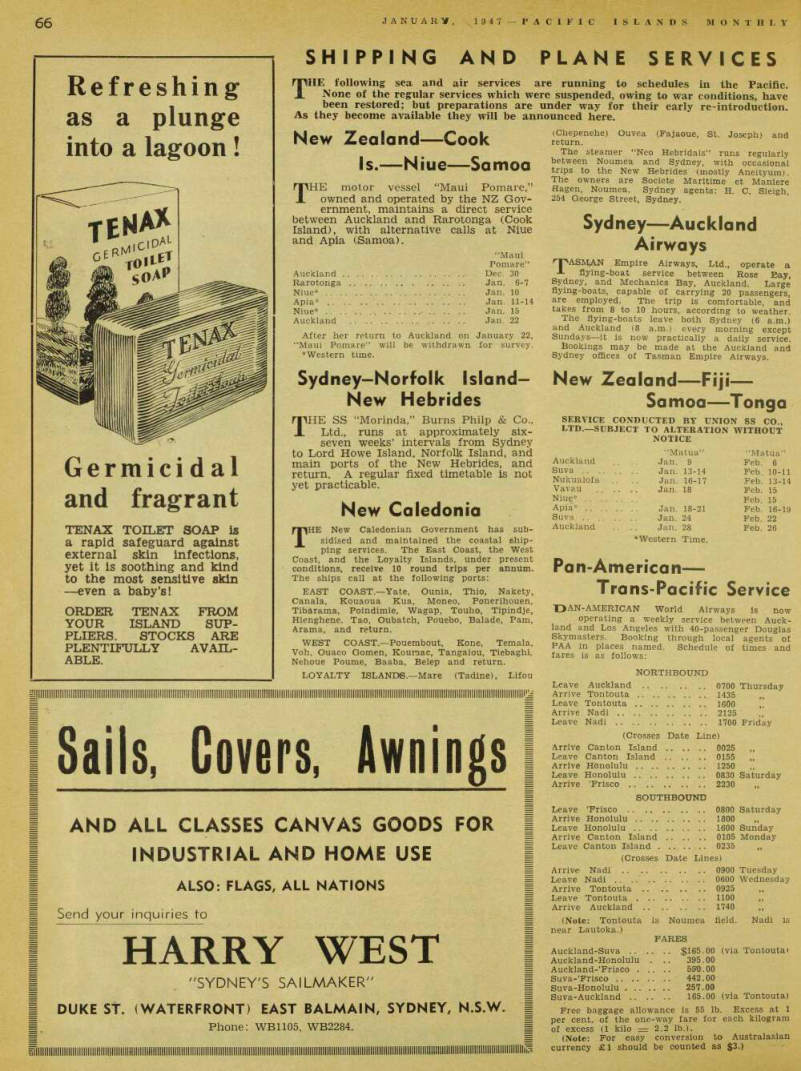
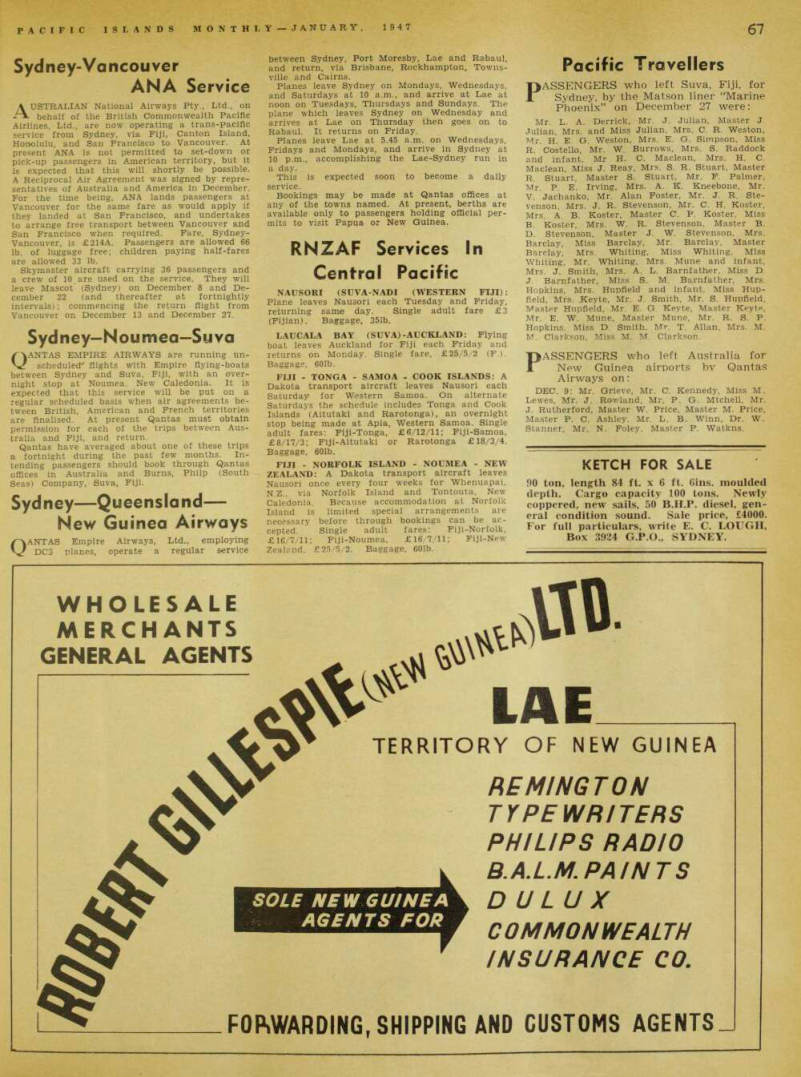
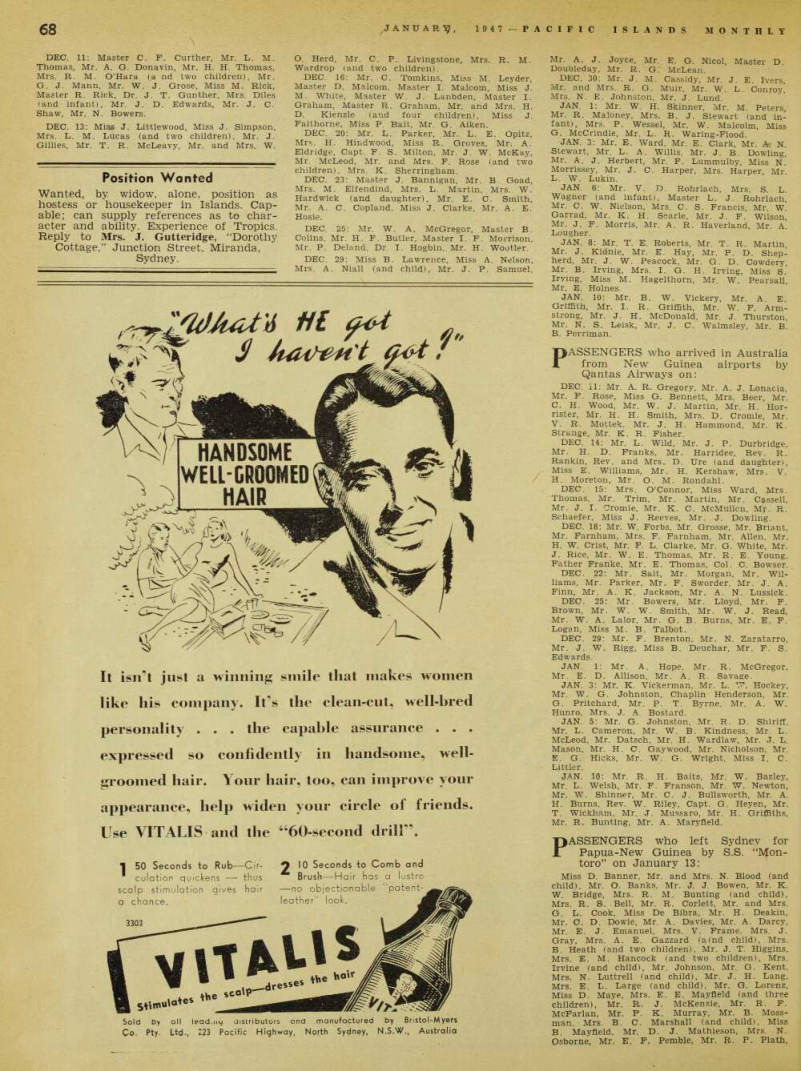
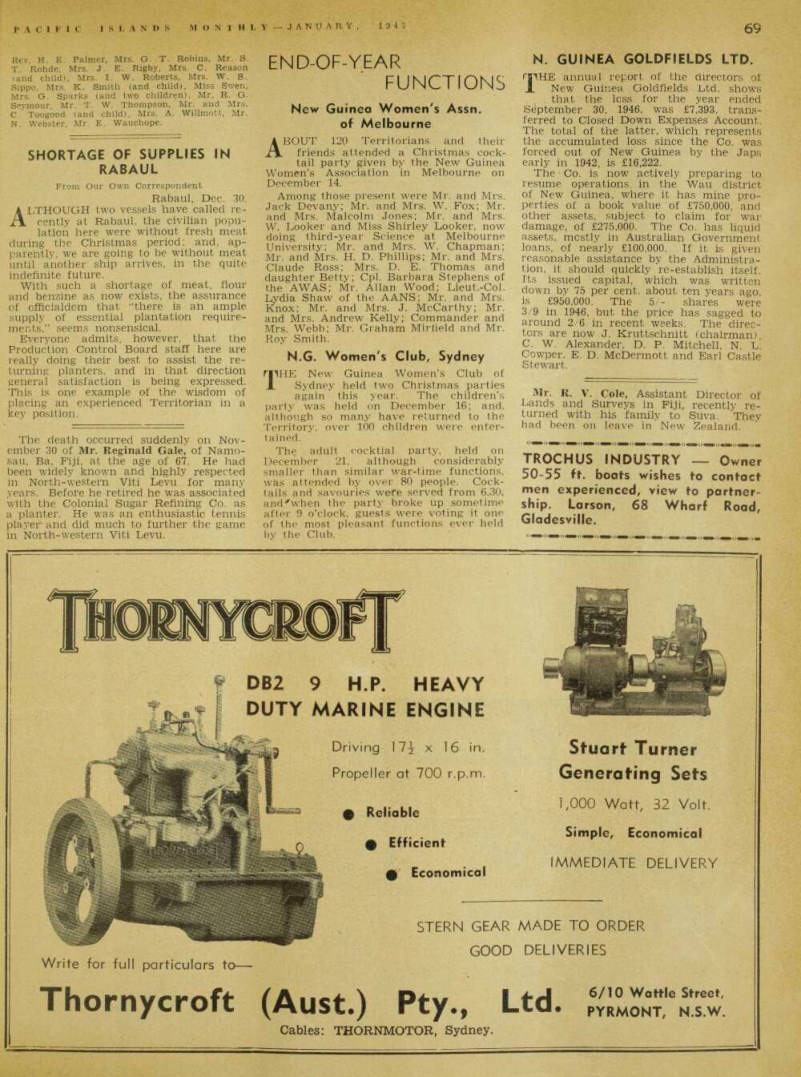
Shipping And Plane Services
rE following sea and air services are running to schedules in the Pacific.
None of the regular services which were suspended, owing to war conditions, have been restored; but preparations are under way for their early re-introduction.
As they become available they will be announced here.
New Zealand—Cook
Is.—Niue—Samoa
THE motor vessel “Maui Pomare,” owned and operated by the NZ Gov ernment, maintains a direct service between Auckland and Rarotonga (Cook Island), with alternative calls at Niue and Apia (Samoa).
Sydney-Norfolk Island-
New Hebrides
THE SS “Morinda,” Burns Philp & Co., Ltd., runs at approximately six seven weeks’ intervals from Sydney to Lord Howe Island, Norfolk Island, and main ports of the New Hebrides, and return. A regular fixed timetable is not
yet practicable.
New Caledonia
THE New Caledonian Government has sub sidised and maintained the coastal ship ping services. The East Coast, the West Coast, and the Loyalty Islands, under present conditions, receive 10 round trips per annum.
The ships call at the following ports: EAST COAST. —Yate, Ounia, Thio, Nakety, Canala, Kouaoua Kua, Moneo, Ponerihouen, Tibarama, Poindimie, Wagap, Touho, Tipindje, Hienghene, Tao, Oubatch, Pouebo, Balade, Pam, Arama, and return.
WEST COAST.—Pouembout, Kone, Temala, Voh, Ouaco Gomen, Koumac, Tangaiou, Tiebaghi, Nehoue Poume, Baaba, Belep and return.
LOYALTY ISLANDS.—Mare (Tadine), Lifou
(Chepenehe) Ouvea (Fajaoue, St. Joseph) and return.
The steamer “Neo Hebridais” runs regularly between Noumea and Sydney, with occasional trips to the New Hebrides (mostly Aneityum).
The owners are Societe Maritime et Maniere Hagen, Noumea. Sydney agents: H. C. Sleigh, 254 George Street, Sydney.
Sydney—Auckland
Airways
r T'ASM t AN Empire Airways, Ltd., operate a -I flying-boat service between Rose Bay, Sydney, and Mechanics Bay, Auckland. Large flying-boats, capable of carrying 20 passengers, are employed. The trip is comfortable, and takes from 8 to 10 hours, according to weather.
The flying-boats leave both Sydney (6 a.m.) and Auckland (8 a.m.) every morning except Sundays—it is now practically a dally service.
Bookings may be made at the Auckland and Sydney offices of Tasman Empire Airways.
New Zealand—Fiji—
Samoa—Tonga
Service Conducted By Union Ss Co.,
Ltd.—Subject To Alteration Without
Notice
Pan-American—
Trans-Pacific Service
T3AN-AMERICAN World Airways Is now operating a weekly service between Auck land and Los Angeles with 40-passenger Douglas Skymasters. Booking through local agents of PAA in places named. Schedule of times and fares is as follows:
Northbound
Leave Auckland 0700 Thursday Arrive Tontouta 1435 „ Leave Tontouta 1600 Arrive Nadi 2125 Leave Nadi 1700 Friday (Crosses Date Line) Arrive Canton Island 0025 Leave Canton Island 0155 „ Arrive Honolulu 1250 Leave Honolulu 0830 Saturday Arrive Frisco 2230 „
Southbound
Leave ’Frisco 0800 Saturday Arrive Honolulu 1800 Leave Honolulu 1600 Sunday Arrive Canton Island 0105 Monday Leave Canton Island 0235 „ (Crosses Date Lines) Arrive Nadi 0900 Tuesday Leave Nadi 0600 Wednesday Arrive Tontouta 0925 Leave Tontouta 1100 „ Arrive Auckland 1740 „ (Note: Tontouta is Noumea field. Nadi is near Lautoka.)
Fares
Auckland-Suva $165.00 (via Tontouta> Auckland-Honolulu . .. 395.00 Auckland-’Frisco 59 , 0.00 Suva-’Frisco 442.00 Suva-Honolulu 257.00 Suva-Auckland 165.00 (via Tontouta) Free baggage allowance is 55 lb. Excess at 1 per cent, of the one-way fare for each kilogram of excess (1 kilo = 2.2 lb.). (Note: For easy conversion to Australasian currency £1 should be counted as $3.)
“Maui Pomare”
Auckland Dec. 30 Rarotonga Jan. 6-7 Niue* Jan. 10 Apia* Jan. 11-14 Niue* • Jan. 15 Auckland Jan. 22 After her return to Auckland on January 22, “Maui Pomare’’ will be withdrawn for survey. ♦Western time.
“Matua”
“Matua”
Auckland Jan. 9 Feb. 6 Suva . .. Jan. 13-14 Feb. 10-11 Nukualofa . .. Jan. 16-17 Feb. 13-14 Vavau Feb. 15 Niue* Feb. 15 Apia* . .. Jan. 18-21 Feb. 16-19 Suva . .
Feb. 22 Auckland . .. Jan. 28 ♦Western Time, Feb. 26
Sydney-Vancouver
ANA Service
A USTRALIAN National Airways Pty., Ltd., on •iV- behalf of the British Commonwealth Pacific Airlines, Ltd., are now operating a trans-pacific service from Sydney, via Fiji, Canton Island, Honolulu, and San Francisco to Vancouver. At present ANA is not permitted to set-down or pick-up passengers in American territory, but it is expected that this will shortly be possible.
A Reciprocal Air Agreement was signed by repre sentatives of Australia and America in December.
For the time being, ANA lands passengers at Vancouver for the same fare as would apply if they landed at San Francisco, and undertakes to arrange free transport between Vancouver and San Francisco when required. Fare, Sydney- Vancouver, is £2I4A. Passengers are allowed 66 lb. of luggage free; children paying half-fares are allowed 33 lb.
Skymaster aircraft carrying 36 passengers and a crew of 10 are used on the service. They will leave Mascot' (Sydney) on December 8 and De cember 22 (and thereafter at fortnightly intervals); commencing the return flight from Vancouver on December 13 and December 27.
Sydney—Noumea—Suva
QANTAS EMPIRE AIRWAYS are running un scheduled - flights with Empire flying-boats between Sydney and Suva, Fiji, with an over night stop at Noumea. New Caledonia. It is expected that this service will be put on a regular scheduled basis when air agreements be tween British, American and French territories are finalised. At present Qantas must obtain permission for each of the trips between Aus tralia and Fiji, and return.
Qantas have averaged about one of these trips a fortnight during the past few months. In tending passengers should book through Qantas offices in Australia and Burns, Philp (South Seas) Company, Suva, Fiji.
Sydney—Queensland —
New Guinea Airways
QANTAS Empire Airways, Ltd., employing DCS planes, operate a regular service
between Sydney, Port Moresby, Lae and Rabaul, and return, via Brisbane, Rockhampton, Towns ville and Cairns.
Planes leave Sydney on Mondays, Wednesdays, and Saturdays at 10 a.m., and arrive at Lae at noon on Tuesdays, Thursdays and Sundays. The plane which leaves Sydney on Wednesday and arrives at Lae on Thursday then goes on to Rabaul. It returns on Friday.
Planes leave Lae at 5.45 a.m. on Wednesdays, Fridays and Mondays, and arrive in Sydney at 10 p.m., accomplishing the Lae-Sydney run in a day.
This is expected soon to become a daily service.
Bookings may be made at Qantas offices at any of the towns named. At present, berths are available only to passengers holding official per mits to visit Papua or New Guinea.
RNZAF Services In
Central Pacific
Nausori (Suva-Nadi (Western Fiji):
Plane leaves Nausori each Tuesday and Friday, returning same day. Single adult fare £3 (Fijian). Baggage, 351 b.
Laucala Bay (Suva)-Auckland: Plying
boat leaves Auckland for Fiji each Friday and returns on Monday. Single fare, £25/5/2 (F.).
Baggage, 601 b.
FIJI - TONGA - SAMOA - COOK ISLANDS: A Dakota transport aircraft leaves Nausori each Saturday for Western Samoa. On alternate Saturdays the schedule includes Tonga and Cook Islands (Aitutaki and Rarotonga), an overnight stop being made at Apia, Western Samoa. Single adult fares; Fiji-Tonga, £6/12/11; Fiji-Samoa, £B/17/3; Fiji-Aitutaki or Rarotonga £lB/3/4.
Baggage, 601 b.
FIJI - NORFOLK ISLAND - NOUMEA - NEW ZEALAND: A Dakota transport aircraft leaves Nausori once every four weeks for Whenuapai, N.Z., via Norfolk Island and Tontouta, New Caledonia. Because accommodation at Norfolk Island is limited special arrangements are necessary before through bookings can be ac cepted. Single adult fares: Piji-Norfolk, £l6/7/11; Fiji-Noumea, £l6/7/11; Fiji-New Zealand, £25/5/2. Baggage, 601 b.
Pacific Travellers
PASSENGERS who left Suva, Fiji, for
Sydney, by the Matson liner “Marine Phoenix” on December 27 were; Mr. L. A. Derrick, Mr. J. Julian, Master J Julian, Mrs. and Miss Julian, Mrs. C. R. Weston, Mr. H. E. G. Weston, Mrs. E. G. Simpson, Miss R. Costello, Mr. W. Burrows, Mrs. S. Raddock and infant, Mr H. C. Maclean, Mrs. H. C.
Maclean, Miss J. Reay, Mrs. S. R. Stuart, Master R. Stuart, Master S. Stuart, Mr. F. Palmer, Mr. P. E. Irving, Mrs. A. K. Kn-eebone, Mr.
V. Jachanko, Mr. Alan Foster, Mr. J. R. Ste venson, Mrs. J. R. Stevenson, Mr. C. H. Koster, Mrs. A. B. Koster, Master C. P. Koster, Miss B. Koster, Mrs. W. R. Stevenson, Master B.
D. Stevenson, Master J. W. Stevenson, Mrs.
Barclay, Miss Barclay, Mr. Barclay, Master Barclay, Mrs. Whiting. Miss Whiting, Miss Whiting, Mr. Whiting, Mrs. Mune and infant, Mrs. J. Smith, Mrs. A. L. Barnfather, Miss D.
J. Barnfather, Miss S. M. Barnfather, Mrs.
Hopkins, Mrs. Hupfield and infant, Miss Hup field, Mrs. Keyte, Mr. J. Smith, Mr. S. Hupfield, Master Hupfield, Mr. E. G. Keyte, Master Keyte, Mr. E. W. Mune, Master Mune, Mr. R. S. P.
Hopkins. Miss D Smith. Mr. T. Allan, Mrs. M.
M. Clarkson, Miss M. M. Clarkson.
PASSENGERS who left Australia for New Guinea airports by Oantas
Airways on:
DEC. 9: Mr. Grieve, Mr. C. Kennedy, Miss M.
Lewes, Mr. J. Rov/land, Mr. P. G. Mtchell, Mr.
J. Rutherford, Master W. Price, Master M. Price, Master P. C. Ashley. Mr. L. B. Winn, Dr. W.
Stanner, Mr. N. Foley, Master P. Watkns.
DEC. 11: Master C. F. Curther, Mr. L. M.
Thomas, Mr. A. G. Donavin, Mr. H. H. Thomas, Mrs. R. M. O’Hara (a nd two children), Mr.
G. J. Mann, Mr. W. J. Grose, Miss M. Rick, Master R. Rick, Dr. J. T. Gunther, Mrs. Diles (and infant). Mr. J, D. Edwards, Mr. J. C.
Shaw, Mr. N. Bowers.
DEC. 13: Miss J. Littlewood, Miss J. Simpson, Mrs. L. M. Lucas (and two children), Mr. J.
Gillies, Mr. T. R. McLeavy, Mr. and Mrs. W.
O. Herd, Mr. C. P. Livingstone, Mrs. R. M.
Wardrop (and two children).
DEC. 16: Mr. C. Tomkins, Miss M. Leyder, Master D. Malcom, Master I. Malcom, Miss J.
M. White, Master W. J. Lanbden, Master I.
Graham, Master R. Graham, Mr. and Mrs. H.
D. Kienzle (and four children), Miss J.
Paithorne, Miss P. Bait, Mr. G. Aiken.
DEC. 20: Mr. L. Parker, Mr. L. E. Opitz, Mrs. H. Hindwood, Miss R. Groves, Mr. A.
Eldridge, Capt. F. S. Milton, Mr. J. W. McKay, Mr. McLeod, Mr. and Mrs. F. Rose (and two children), Mrs. K. Sherringham, DEC. 23; Master J. Bannigan, Mr. B. Goad, Mrs. M. Elfendind, Mrs. L. Martin, Mrs. W.
Hardwick (and daughter), Mr. E. C. Smith, Mr. A. C. Copland, Miss J. Clarke, Mr. A. E.
Hosie.
DEC. 25; Mr. W. A, McGregor, Master B, Colins, Mr. H. F. Butler, Master I. F. Morrison, Mr. P. Deland, Dr. I. Hogbin, Mr. H. Wootler.
DEC. 29: Miss B. Lawrence, Miss A. Nelson, Mrs. A. Niall (and child), Mr. J. P. Samuel,
Mr. A. J. Joyce, Mr. E. G. Nicol, Master D.
Doubleday, Mr. R. G. McLean.
DEC. 30: Mr. J. M. Cassidy, Mr. J. E. Ivers, Mr. and Mrs. R. G. Muir, Mr. W. L. Conroy, Mrs. N. E. Johnston, Mr. J. Lund.
JAN. 1: Mr. W. H. Skinner, Mr. M. Peters, Mr. R. Maloney, Mrs. B. J. Stewart (and in fant), Mrs. P. Wessel, Mr. W. Malcolm, Miss G. McCrindle, Mr. L. R. Waring-Flood.
JAN. 3: Mr. E. Ward, Mr. E. Clark, Mr. A® N.
Stewart, Mr. L. A. Willis, Mr. J, B. Dowling, Mr. A. J. Herbert, Mr. F. Lummulby, Miss N.’
Morrissey, Mr. J. C. Harper, Mrs. Harper, Mr L. W. Lukin.
JAN. 6; Mr. V. D. Rohrlach, Mrs. S. L.
Wagner (and infant), Master L. J. Rohrlach, Mr. C. W. Nielson, Mrs. C. S. Francis, Mr. W.
Garrad, Mr. K. H. Searle, Mr. J. F. Wilson, Mr. J. F. Morris, Mr. A. R. Haverland, Mr. A.
Lougher.
JAN. 8; Mr. T. E. Roberts, Mr. T. R. Martin, Mr. J. Kidnie, Mr. E. Hay, Mr. P. D. Shep herd, Mr. J. W. Peacock, Mr. G. D. Cowdery, Mr. B. Irving, Mrs. I. G. H. Irving, Miss S.
Irving, Miss M. Hagelthorn, Mr. W. Pearsall, Mr. E. Holnes.
JAN. 10: Mr. B. W. Vickery, Mr. A. E.
Griffith, Mr. I. R. Griffith, Mr. W. F. Arm strong, Mr. J. H. McDonald, Mr. J. Thurston, Mr. N. S. Leisk, Mr. J. C. Walmsley, Mr. B.
B. Perriman.
PASSENGERS who arrived in Australia from New Guinea airports by
Qantas Airways on;
DEC. il: Mr, A. R. Gregory, Mr. A. J. Lonacia, Mr. F. Rose, Miss G. Bennett, Mrs. Beer, Mr.
C. H. Wood, Mr. W. J. Martin, Mr. H. Hor rister, Mr. H. H. Smith, Mrs. D. Cromie, Mr.
V. R. Mottek, Mr. J. H. Hammond, Mr. K.
Strange, Mr. K. R. Fisher.
DEC. 14: Mr. L. Wild, Mr. J. P. Durbridge, Mr. H. D. Franks, Mr. Harridee, Rev. R.
Rankin, Rev. and Mrs. D. Ure (and daughter), Miss E. Williams, Mr. H. Kershaw, Mrs. V.
H. Moreton, Mr. O. M. Rondahl.
DEC. 15: Mrs. O’Connor, Miss Ward, Mrs.
Thomas, Mr. Trim, Mr. Martin, Mr. Cassell, Mr. J. I. Cromie, Mr. K. C. McMullen, Mr. R.
Schaefer, Miss J. Reeves, Mr. J. Dowling.
DEC. 18: Mr. W. Forbs, Mr. Grosse, Mr. Briant, Mr. Farnham, Mrs. F. Farnham, Mr. Allen, Mr.
H. W. Crist, Mr. F. L. Clarke, Mr. G. White, Mr.
J. Rice, Mr. W. E. Thomas, Mr. R. E. Young.
Father Franke, Mr. E. Thomas, Col. C. Bowser.
DEC. 22: Mr. Sait, Mr. Morgan, Mr. Wil liams, Mr. Parker, Mr. F. Sworder, Mr. J. A.
Finn, Mr. A. K. Jackson, Mr. A. N. Lussick.
DEO. 25; Mr. Bowers, Mr. Lloyd, Mr. F.
Brown, Mr. W. W. Smith, Mr. W. J. Read, Mr. W. A. Lalor, Mr. G. B. Burns, Mr. E. F.
Logan, Miss M. B. Talbot.
DEC. 29: Mr. F. Brenton, Mr. N. Zaratarro, Mr. J. W. Rigg, Miss B. Deuchar, Mr. F. S.
Edwards.
JAN. 1; Mr. A. Hope, Mr. R. McGregor, Mr. E. D. Allison, Mr. A. R. Savage.
JAN. 3; Mr. K. Vickerman. Mr. L. W. Hockey, Mr. W. G. Johnston, Chaplin Henderson, Mr.
G. Pritchard, Mr. P. T. Byrne, Mr. A. W.
Hunro, Mrs. J. A. Bostard.
JAN. 5: Mr. G. Johnston, Mr. R. D. Shiriff, Mr. L. Cameron, Mr. W. B. Kindness, Mr. L.
McLeod, Mr. Datsch, Mr. H. Wardlaw, Mr. J. L.
Mason, Mr. H. C. Gay wood, Mr. Nicholson, Mr.
E. G. Hicks, Mr. W. G. Wright, Miss I. C.
Littler.
JAN. 10; Mr. R. H. Baits, Mr. W. Bazley, Mr. L. Welsh, Mr. F. Franson, Mr. W. Newton, Mr. W. Stunner, Mr. C. J. Bullsworth, Mr. A.
H. Burns, Rev. W. Riley, Capt. G. Heyen, Mr.
T. Wickham, Mr. J. Mussaro, Mr. H. Griffiths, Mr. R. Bunting, Mr. A. Maryfield.
PASSENGERS who left Sydney for
Papua-New Guinea by S.S. “IVfon
toro” on January 13: Miss D. Banner, Mr. and Mrs. N. Blood (and child), Mr. O. Banks, Mr. J. J. Bowen, Mr. K.
W. Bridge, Mrs. R. M. Bunting (and child), Mrs. R. S. Bell, Mr. R. Corlett, Mr. and Mrs.
G. L. Cook, Miss De Bibra, Mr. H. Deakin, Mr. O. D. Dowie, Mr. A. Davies, Mr. A. Darcy, Mr. E. J. Emanuel, Mrs. V. Frame. Mrs. J.
Gray, Mrs. A. E. Gazzard (a(nd child), Mrs.
B. Heath (and two children), Mr. J. T. Higgins, Mrs. E. M. Hancock (and two children), Mrs.
Irvine (and child), Mr. Johnson, Mr. G. Kent, Mrs. N. Luttrell (and child), Mr. J. H. Lang, Mrs' E. L. Large (and child), Mr. G. Lorenz, Miss D. Maye, Mrs. E. E. Mayfield (and three children), Mr. R. J. McKenzie, Mr. R. F.
McFarlan, Mr. P. K. Murray, Mr. B. Moss man, Mrs, B. C. Marshall (and child), Miss B. Mayfield, Mr. D. J. Mathieson, Mrs. N.
Osborne, Mr, E. F, Pemble, Mr. R. P. Plath,
Rev. H. E. Palmer, Mrs. G. T. Robins, Mr. S.
T. Rohde, Mrs. J E. Rigby, Mrs. C. Reason (and child), Mrs. I. W. Roberts, Mrs. W. S.
Sippo, Mrs. K. Smith (and child), Miss Swen, Mrs. G. Sparks (and two children), Mr. R. G.
Seymour. Mr. T. W. Thompson, Mr. and Mrs.
C Toogood (and child), Mrs. A. Willmott, Mr.
N Webster, Mr. E. Wauchope.
Advertisements & other items, pp. 69-70 (1 item)
Ketch For Sale
90 ton, length 84 ft. x 6 ft. Gins, moulded depth. Cargo capacity 100 tons. Newly coppered, new sails, 50 B.H.P. diesel, general condition sound. Sale price, £4OOO.
For full particulars, write E. C. LOUGH,
Box 3924 G.P.0., SYDNEY.
WHOLESALE
MERCHANTS
GENERAL AGENTS
<6. <s^ S \V i# no
LAE
SOLE NEW GUINEA
AGENTS FOR
TERRITORY OF NEW GUINEA
REMINGTON
TYPEWRITERS
PHILIPS RADIO
k B.A.L.M. PA
D U LU X
COMMONWEALTH
INSURANCE CO.
FORWARDING, SHIPPING AND CUSTOMS AGENTS
Position Wanted Wanted, by widow, alone, position as hostess or housekeeper in Islands. Capable; can supply references as to character and ability. Experience of Tropics.
Reply to Mrs. J. Gutteridge, “Dorothy Cottage,” Junction Street, Miranda, Sydney.
S haven't
(/-T s 1
HANDSOME
WELL-GROOMED
HAIR
A WL^ ■\ m It isn’t just a winning smile that makes women like his company. It’s the clean-cut, well-bred personality . . . the capable assurance . . .
expressed so confidently in handsome, well-
groomed hair. Your hair, too, can improve your appearance, help widen your circle of friends.
Use VITALIS and the “60-second drill”. 1 50 Seconds to Rub —Circulation quickens thus scalp stimulation a chance. gives O 10 Seconds to Comb and Brush —Hair has a lustre —no objectionable leather" look. 3303 ha»r the ca\p u\a*es *V> SO”"
Sola by all lead.ny aistributors and manufactured by Bristol-Myers Co. Pty. Ltd., 223 Pacific Highway, North Sydney, N.S.W., Australia
Shortage Of Supplies In
Rabaul
From Our Own Correspondent Rabaul, Dec. 30.
ALTHOUGH two vessels have called re cently at Rabaul, the civilian popu lation here were without fresh meat during tbe Christmas period: and, ap parently, we are going to be without meat until another ship arrives, in the quite indefinite future.
With such a shortage of meat, flour and benzine as now exists, the assurance of officialdom that “there is an ample supply of essential plantation require ments,” seems nonsensical.
Everyone admits, however, that the Production Control Board staff here are really doing their best to assist the re turning planters, and in that direction general satisfaction is being expressed.
This is one example of the wisdom of placing an experienced Territorian in a key position.
The death occurred suddenly on Nov ember 30 of Mr. Reginald Gale, of Namo sau, Ba. Fiji, at the age of 67. He had been widely known and highly respected in North-western Viti Levu for many years. Before he retired he was associated with the Colonial Sugar Refining Co. as a planter. He was an enthusiastic tennis player and did much to further the game in North-western Viti Levu.
End-Of-Year
Functions
New Guinea Women's Assn,
of Melbourne ABOUT 120 Territorians and their friends attended a Christmas cock tail party given by the New Guinea Women’s Association in Melbourne on December 14.
Among those present were Mr. and Mrs.
Jack Devany; Mr. and Mrs. W. Fox; Mr. and Mrs. Malcolm Jones; Mr. and Mrs.
W. Looker and Miss Shirley Looker, now doing third-year Science at Melbourne University: Mr. and Mrs. W. Chapman; Mr. and Mrs. H. D. Phillips; Mr. and Mrs.
Claude Ross; Mrs. D. E. Thomas and daughter Betty; Cpl. Barbara Stephens of the AW AS; Mr. Allan Wood: Lieut.-Col.
Lydia Shaw of the AANS; Mr. and Mrs.
Knox; Mr. and Mrs. J. McCarthy; Mr. and Mrs. Andrew Kelly; Commander and Mrs. Webb; Mr. Graham Mirfield and Mr.
Roy Smith.
N.G. Women's Club, Sydney
TiIHE New Guinea Women’s Club of 1 Sydney held two Christmas parties again this year. The children’s party was held on December 16; and. although so many have returned to the Territory, over 100 children were enter tained.
The adult cocktial party, held on December 21. although considerably smaller than similar war-time functions, was attended by over 80 people. Cock tails and savouries were served from 6.30, and'when (he party broke up sometime after 9 o’clock, guests were voting it one of the most pleasant functions ever held by the Club.
N. Guinea Goldfields Ltd.
annual report of the directors of X New Guinea Goldfields .Ltd. shows that the less for the year ended September 30, 1946, was £7,393, trans ferred to Closed Down Expenses Account.
The total of the latter, which represents the accumulated loss since the Co. was forced out of New Guinea by the Japs early in 1942, is £16,222.
The Co. is now actively preparing to resume operations, in the Wau district of New Guinea, where it has mine pro perties of a book value of £750,000, and other assets, subject to claim for war damage, of £275,000. The Co. has liquid assets, mostly in Australian Government loans, of nearly £lOO,OOO. If it is given reasonable assistance by the Administra tion, it should quickly re-establish itself.
Its issued capital, which was written down by 75 per cent, about ten years ago, is £950,000. The 5 - shares were 3/9 in 1946, but the price has sagged to around 2 6 in recent weeks. The direc tors are now J. Kruttschnitt (chairman), C. W. Alexander, D. P. Mitchell. N. L.
Cowper. E. D. McDermott and Earl Castle Stewart.
Mr. R. V. Cole. Assistant Director of hands and Surveys in Fiji, recently re turned with his family to Suva. "They had been on leave in New Zealand.
Advertisements & other items, p. 71 (1 item)
Thornycroft (Aust.) Pty., Ltd.
TROCHUS INDUSTRY Owner
50-55 ft. boats wishes to contact men experienced, view to partnership. Larson, 68 Wharf Road, Gladesville.
a n DB2 V £K «
H.P. HEAVY
DUTY MARINE ENGINE
Driving 17i x 16 in.
Propeller at 700 r.p.m.
Reliable • Efficient m Economical
Stuart- Turner
Generating Sets
1,000 Watt, 32 Volt.
Simple, Economical
IMMEDIATE DELIVERY
STERN GEAR MADE TO ORDER
GOOD DELIVERIES
Write for full particulars to—
Thornycroft (Aust.) Pty., Ltd.
6/10 Wattle Street,
PYRMONT, N.S.W.
Cables: THORNMOTOR, Sydney.
"Captain Indomitable"
An Appreciation of the Work of Capt. Jock Laird—by “Pat.”
MANY thrilling stories have been told in the "PIM” of the gallantry of Australian residents in New Guinea during the Japanese occupation. But one of the many unassuming men who dis tinguished themselves in rescue work but never got recognition except through the impartial admiration of all Terri torians, is “Jock” Laird, Scots master and engineer of the 50-foot government administrative schooner “Nereus.”
I met Jock Laird in the first days of World War 11. And it was then he told me a few incidents in his interesting life between the time he started his maritime career as engineer No. 7, in India, and his becoming Master of the “Nereus.”
He added other adventures to his score after the Japs came into the war. Two of his outstanding performances have come to my knowledge.
The first was a trip he made when the Japanese forces invaded Rabaul. On January 19, 1942, Laird left Lorengau. port for Manus, and made for Kavieng.
On January 20. Rabaul was heavily bombed by 100 Japanese planes and "Nereus” pulled in at Kavieng. There Laird met the Rev. J. M. Simpson, C. Mac kellar. W. C. Box, J. C. Goad. W. Atkin son, J. J. McEvoy, L. C. Saunders, and F. E. Caten. He asked them to come with him, but they preferred to stay: they would not leave their mates.
“Nereus” left the same night and the following morning the Japanese landed.
The schooner was by then hiding at D’joul (Mait) Island, where she stayed for eleven days, and where the whole crew except for one old-faithful, Sana san deserted and made for the bush.
Planes droned overhead; warships cruised and fired their guns; an airplane-carrier was ready for action; innumerous ships and boats of all sizes and descriptions ploughed the sea; the Japs went ashore on D’Joul and started fires at some places.
All these things Laird watched anxiously from his well-camoufldged hide-out.
There was only one other white man on board —a sick soldier.
Laird told Sanasan not to be frightened, because the Japs wanted only white men.
If the white men should be captured, he advised Sanasan to make for the next mission station. An attempt to contact McDonald, a planter on the island, by native messengers was unsuccessful; he was without instructions so Laird finally decided to risk a trip to Madang.
He reported there on March 2, with his one-man crew. Nobody will ever hear the full story of that trip. Laird himself is not a boaster; the soldier was too sick to take notice, and the native, Sanasan, is dead, having been killed in a plane-crash at Manus on March 12, 1945. It is worth digressing here to record that Sanasan was awarded the Loyal Service Medal in August, 1943, at Port Moresby, for gallantry and devotion to duty over a considerable period. Once he steered for 39 hours without relief .through enemy action. Among many acts of bravery he was largely respon sible for the return of an Allied vessel from enemy waters. To keep his eyes open, says Sanasan, he was chewing “kawawar,” some strong medicinal herb with stimulating effects.
Interesting is the mentality of Sanasan.
He was supposed to be a baptised Chris tian. But asked how he managed to dodge the Japanese planes and boats, he replied by showing a small bag con taining “magic” articles; it was his mas cot. However, it is hard to explain why the Japs did not bother about this government vessel which they surely must have seen.
AFTER Laird had been in Madang a couple of weeks he was sent up the Sepik and arrived in time to take part in dramatic events at Angoram on March 20, 1942, which have been recorded previously in “PIM.” The whole police force had run amok and intended to kill every white-man. After a fierce gun battle of over an hour the bullet-holed "Nereus” drifted down the muddy Sepik River.
After the “battle” was over, the greatest urge of the men was to leave that place of havoc and muddled con fusion. It was decided to take the “Nere us” to Australia.
On board were Laird (as master and engineer), J. Taylor (wounded). G. Shaw, E. J. Cook. H. C. Cecil. M. K. Lynch, C.
Grahame, J. H. Lang, W. R. Smith. F. H.
G. Simcocks, R. S. Moody, L. A. Bridger.
A. Price, B. J. McConnell and G. M.
Keogh—ls Europeans all in all—and one native as crew, the ever faithful Sanasan.
After some necessary preparations “Nereus” left Marienberg on the Sepik on Saturday, March 21, 1942, and made for Australia.
It was an adventurous trip. Repairs had to be done on the way and a lot of water had to be pumped out of the engine room. Pouring rain and heavy seas were the lot of the small boat as she plunged ahead with a maximum speed of five knots, slowly but safely. Miracu lously she passed through Jap infested waters and negotiated the dangerous minefields of the Barrier Reef. After many criss-cross cruising and zig-zag sailing it reached, on April 8, port' at last Mourilyn Harbour on the Queens land Coast.
Everybody was almost hysterical with joy; and the successful conclusion of the trip was celebrated with a few bottles of beer. Some of the men patted the St.
Christopher medal, and said: “Thanks, good old Chris.” (This St. Christopher medal was formerly attached to the Mis sion boat “Stella Maris” at Alexishafen.
How it came to the “Nereus” is a mystery.) And during the celebration a few drops of beer were inadvertently spilled on St. Christopher. This was re garded by some as a bad omen.
Next morning “Nereus” left Mourilyn Harbour at 3.30 a.m. The local pilot thereupon had a fit on the wheel and the ship grounded at 6 a.m. After homing all the way from New Guinea, there was mis fortune at the end, in safe waters.
Apparently beer did not agree with “Chris.”
JOCK LAIRD offered his services to the RAN when he reached Sydney and, ironically, was turned down because of his eyesight. But he is back in New Guinea waters again now—and back with his old love--running small ships for the Administration.
Slow Rehabilitation
in BSI News From Mrs. Georgina Seton of Choiseul
I TITLE has been heard of the Solomon 1J Island planters who returned last year to BSI in the Melanesian Mission ship Southern Cross.
Some word has come, however, from Mrs, Georgina Seton. wlio returned to Luti Plantation, Choiseul, at that time with her husband. Mrs. Seton it will be remembered, wrote the popular thriller “Bring Another Glass.” Now she seems to be more concerned with garden ing and raising chickens than in writing.
In a letter to a Sydney friend she says: “I have been busy gardening and trying to rear poultry. The birds were in crates for nearly six weeks on the Southern Cross, a couple of weeks in a yard at Honiara, Guadalcanal, and crated again for the trip home to Choiseul in a small cutter. I have had some losses but 1 breathe a bit easier now that I have 30 young chickens and I hope, as well, lhat all the duck-eggs now in the process of hatching will come out.
“We were short of food for a while and everything here is at a standstill.
Mr. Noel, the Resident Commissioner, has now returned from England and is trying to get things moving. We are lucky and have 30 boys and can get all we need; but elsewhere plantations and mines are held up for lack of labour.”
Advertisements & other items, p. 72 (1 item)
Chivers
This is the home of
mVERSJAMSm
1 oO* e*' s\t£
QVi'l
o<*o°* i«» 0* \3 Here, at Histon, near Cambridge, is Chivers Factory, surrounded by orchards and gardens where the choicest English fruits are grown. Sun-ripened and in perfect condition for preserving, these fruits come in all their freshness to Chivers Factory to be made into the finest jams it is possible to imagine.
Supplies are still limited hut full shipments will he resumed as soon as possible .
CHIVERS
ENGLISH JAMS
Made in the heart of the English countryside by
CHIVERS & SONS Ltd.
The Orchard Factory Histon, Cambridge, England ■ ” —' f .i 37
"Plain Frustration"
C.W.D. Sales In Rabaul Were "Plain Frustration"
Rabaul Dec. 30.
THE residents especially the women —who returned on the “Duntroon” lost about 25 per cent, of their furniture and effects in transit, and have suffered great inconvenience. Most of the returned civilians have settled in and are trying to reestablish themselves, but there is a great and growing demand for such things as tents, refrigerators and jeeps.
The jeep seems now to be part and parcel of everyone’s requirements. Spare parts for jeeps will certainly be a prob lem soon as the Commonwealth Disposals Commission at Rabaul have sold in bulk approximately £150,000 worth of spare parts to Southern buyers, for £12,000. One item. 300 jeep tyres were sold for £6OO.
These tyres are now practically unpro curable in Rabaul. If the tyres had been disposed of in small quantities locally the return would have been much higher than £2 each.
The recent Commonwealth Disposals sales was “frustration” of the worst kind.
Assurances had been given to the RSL and the Citizens Association that every consideration would be given to the local neople. The absence of an adequate cata logue was perhaps just an accident.
Every inquiry for spare parts was met with the explanation that stocks were not available “owing to the Administration having first preference”: or “Army had not declared surplus stocks”; or “wait for a week just now we are stock taking.”
For upwards of two months every effort was made to obtain spare parts, but we were met with nothing but frus tration. The kindest thing that could be said of the recent Commission’s sale is that either the responsible officials were totally ignorant of their responsibility to their country, or were just plain fools.
Otherwise —to name only one item —how did it come about that 300 jeep tyres were sold in bulk for the absurd sum of £2 each?
On the approach of Southern buyers, catalogues were issued with the greatest alacrity, and sales in big parcels were the order of the day.
We are now faced with the absurdity that the remaining equipment is to be sold “by private treaty,” or some such fool arrangement, which probably means that tens of thousands of pounds worth of equipment will be disposed of for tens of thousands of pennies. Carefully thought-out explanations will be forth coming. The net result of which will be that the Australian taxpayer will be correspondingly robbed.
On all sides, you hear expressions of disgust, and ridicule of the whole sorry business. The fiasco that took place here after World War I, in the sale of enemy’s expropriated properties, is being re enacted ofter World War II but this time it is the Australian tax-payers’ property that is being “disposed of.”
The French Protestant clergyman, Monsieur Lacheret, who is already known in New Caledonia, has returned to take over from Pastor Begainus at Houailou, east coast, and the headquarters of the Protestant missions. M. Begainus is re turning to France. Other arrivals are Madamoiselle Roche, a Protestant mission nurse, who is going to the Loyalty Group, and M. le Seanna, a teacher, who will be attached to the Houailou Centre. Four Catholic missionaries and four nuns arrived in Noumea by the same vessel, the “Ville d’Amiens.”
Giant Snails
Disappear
Remarkable Phenomenon in New Guinea
NEW GUINEA’S Jap-introduced plague of giant snails is dying out - the New Ireland section of it, at any rate. That reassuring information was brought to Sydney by District Officer W.
J. Read, of Kavieng, who spent Christmas leave in Australia. Mr. Read, incidentally, was Lieutenant Read, who gave such distinguished service as a coast-watcher on Bougainville during the Solomon Islands battles.
Mr. Read said that the snails have not spread more than three miles from Kavieng; that they are not attacking native gardens, and seem to be living on jungle growth; that European plantations have not been affected in any way; and that the snails now can rarely be seen, except after dark.
Mr. Read could offer no explanation of the disappearance of the peil he could only state facts, he said.
It seems probable that Nature has restored the necessary balance, without awaiting the interference of humankind.
The snails, entering a new and luscious country, without natural enemies, flour ished and increased at an appalling rate, and soon became a plague. But the air of New Guinea, like any other place, is full of germs, which tend to attack all living things. In the course of time, the life that is indigenous to New Guinea has built up a resistance to New Guinea diseases, and can survive. But the snails have not had time to develop resistance to local diseases, and consequently these early generations are being wiped out.
Such phenomena are by no means un known in the world. The germ theory is the only reasonable explanation offered to account for the sudden disappearance of plagues which can be just as un expected and startling as their appear ance.
There are no recent reports about the giant snails released in the Rabaul and Madang areas. It is hoped that those infestations, too. have been checked.
in N. Guinea
Intense Search for Oil in N. Guinea
11HREE large organisations are now searching for oil in New Guinea — two of them in the Australian ter ritories and one in Dutch territory.
The Anglo-Iranian Oil Co., Ltd., of London and the Standard Vacuum Co.
Pty., Ltd. are operating through Austra lian Petroleum Co. Pty. Ltd., a large pro portion of whose shares are held by the Australian shareholders of Oil Search Ltd.
The paid-up capital of Oil Search Ltd., was £408,000, but a further 400,000 57shares are now being offered to the public.
Operations of APC, at Karaiava, in Central Papua, were resumed in October, 1946, and drilling, which was suspended in 1942, had reached a depth of 5,400 in November.
Independently, the Papuan Apinaipi Petroleum Co., Ltd., is also prospecting and drilling in Central Papua. This com pany has received financial and technical assistance from the Australian Govern ment which will share in profits, if and when they are made.
The Royal Dutch Shell Group has arranged for full-scale exploration of the oil possibilities of Dutch New Guinea. A contract has been awarded to an Ameri can firm for construction of two piers and approximately 62 miles of roads which will give access to drilling areas in dense jungle country.
Advance construction crews are at pres ent assembling at Morotai, which will be used as a base for transshipment of personnel and supplies. Catalina flying boats will be employed to co-ordinate widely scattered parts of the work.
Advertisements & other items, p. 73 (1 item)
ansomes
New Guinea or South West Pacific. To Mining Companies and others interested.
Young man (23 years age) ex-RAAF, with knowledge of New Guinea and handling of natives, desires position. Experienced in oxy and electric welding engineering, etc., reference; holding passport and tax clearance. Reply E. J. Rich, Anzac House, 273 Elizabeth Street, Sydney, Australia.
indisP
efl sa
bl e
for
aerodromes
and other targe areas.
50 acres a day can easily be cut with a Ransomes Quintuple Mower drawn by a tractor, and even larger outfits up to 25 ft. wide are available. This enormous capacity makes Ransomes Gang Mowers indispensable to all controlling aerodromes, large sports grounds, etc., requiring frequent cutting. With no other machine could these large areas be kept in such good condition.
Sizes: Triple 7 ft., Quintuple 11% ft., Septuple 16 ft., up to 11 units— 2s ft. wide. Also a sulky mower 30 in wide for hilly land.
ansomes
GANG MOWEBS
We Illustrate our standard machine.
For longer grass and heavier work, we offer the " Magna - Gang ” pattern.
Illustrated catalogue showing a complete range of hand, animal draught and motor lawn mowers will be sent on application.
MORRIS,
HEDSTROM, LTD.
Suva, Lautoka and Ba.
RANSOMES, SIMS & JEFFERIES, LTD. Ipswich, England.
Death Of Henry Dexter
THE death occurred at Hay ling Island.
Hants., England, on December 9, of of Mr. Henry Dexter, who was a trader at Milne Bay, Papua, for many years between the World Wars. He was about 74.
Mr. Dexter, a world wanderer, came to Papua about the time that the British New Guinea Development Co. Ltd. com menced operations there, and he was well known in the Territory. When he sold out, in the 'thirties, he lived in retire ment in Sydney, and then transferred to London. He settled down to growing tomatoes on his small farm in Southern England: but, as his property was near one of the great ports, he seemed to get the backwash of innumerable air raids, and life there was not comfortable.
He wrote well, and some of his short stories and sketches of New Guinea life were published. He had one daughter, who is a resident of Kenya Colony.
Malaria Claimed
Another Cure For Malaria Claimed
ANEW chemical that cures malaria instead of just suppressing it is an nounced in the Journal of the American Medical Association.
The chemical, which was developed during the wartime search for drugs to protect Servicemen against malaria, has been named pentaquine.
Dr. R. F. Loeb, chairman of the Board for Co-ordination of Malarial Studies, re ports that the chemical achieved tflie “radical cure” of severe malaria when given with quinine every four hours, day and night, for 14 days. The drug com pletely eradicated the base in 16 out of 17 cases. Given without qunine, penta quine was only partially effiective in pre venting relapses.
Dr. Loeb states that although the drug is considered safe to give for treatment it should be used only under close med ical supervision and preferably in hospital.
Two well-known Territorians were patients in the Scottish Hospital, Sydney, at the end of 1946. One was Mr. George Aumuller, well-known manager of Burns Philp & Co. Ltd., Port Moresby, who had to come South for an operation in Octo ber. He has now recovered, however, and was discharged from the hospital before Christmas. The other is Mr. “Scotty”
McEwan, the well-known master baker, of Lae. He was injured at his bakery in September when an oven which he was erecting fell and crushed him. The hos pital reports that he is “improving—but will be in hospital for some time yet.”
No Changes in Fiji
Constitution
Secretary of State tor the Colonies Answers the Fiji Electors' Asso ciation
A REQUEST made by the European Electors’ Association of Fiji, thal there should be a number of con stitutional changes in the Colony, has been rejected.
In reply to a question asked in the House of Commons recently, the Secre tary of State for the Colonies said that with the exception of the extension of the franchise to civil servants, the changes advocated by the Association could not be accepted, as there was no assurance that the opinion of the Asso ciation was the opinion of the general public in Fiji. He was, moreover, not convinced that the proposals were likely to benefit all parties concerned.
Two men well known in New Guinea are now holding executive positions in the American Red Cross. One is Captain G. A. Pearce, formerly connected with the Day Dawn Mine at Wau and with Burns Philp & Co. at Rabaul —he is now in the Red Cross supply branch in Tokio.
The other is Captain Keith Munro, who was formerly employed by W. R. Car penter & Co. at Kokopo—he is now sta tioned. by the Red Cross, in Manila.
The wedding of Mr. Norman Duncan (son of Captain James Duncan) and his charming bride, in Rabaul on December 24, and the reception at the civilian hostel, were attended by numerous Ter ritorial! friends and well-wishers. Mr. and Mrs. Norman Duncan will reside on their Tamalilli Plantation, in the Kokopo district.
Advertisements & other items, pp. 74-77 (5 items)
F. J. Morgan
PTY., LTD.
12 Allen St., Granville,
N.S.W.
MANUFACTURERS AND
EXPORTERS OF:
Beekeepers Foundation and Apiary Appliances, Dental Supplies, Artificial Teeth, Wax Floor and Furniture Polishes, Disinfectant Preservative in non-Stain and Wood-stain Colours.
BUYERS OF WAXES AND RESINS.
LABORATORY SERVICE: Soil Testing and Investigation of All Natural"
Growth for Commercial Uses.
BANKERS: Commonwealth Bank of Australia Homebush, N.S.W.
Widdop
aiUDO? lIlSHif/ *• f-
DIESEL ENGINES
S H.P. to 500 HUP.
H. WIDDOP & CO., LTD. grben l^S e d ,ghley Telephone : Keighley 3727-8 :: :: Telegrams : Widdop Keighley Codes A.B.C. 6th Edition. Bentleys, Bentley’s Second We are prepared to consider Agencies for certain territories / Motor Coaster S. America Firefloat Egypt.
Tug.
England Passenger Boat Middle East
73
PACIFIC ISLANDS MONTHLY JANUARY, 1947
PACIFIC GOLD INDUSTRIES THREATENED
(Continued from page 8)
Flour
Kidney Trouble
and Backache
Gone in 1 Week
Flush Kidneys With Cystex and You’ll Feel Fine Cystex—the prescription of a famous doctor —improves faulty kidney action in double quick time, so, if you suffer from Rheumatism, Sciatica, Neuritis, Lumbago, Backache, Nervousness, Leg Pains, Dizziness, Circles under Eyes, frequent Headaches and colds, poor Energy and Appetite, Puffy Ankles or Interrupted Sleep, go to your chemist to-day for Cystex.
Cystex Helps Nature 3 Ways
The Cystex treatment is highly scientific, being specially compounded to soothe, tone and clean kidneys and bladder and to remove acids and poisons from your system safely, quickly and surely, yet contains no harsh, harmful or dangerous drugs. Cystex in these 3 ways to end your troubles:— (1) Starts killing the germs which are attacking your kidneys, Bladder and urinary system in two hours, yet is absolutely harmless 10 human tissue. (2) Gets rid of health-destroying, deadly poisonous acids with which your system has become saturated. (3i Strengthens and reinvigorates the kidneys, protects you from the ravages of diseaseattack on the delicate Alter organism, and stimulates the entire system.
Feels a Different Woman
*T have been taking Cystex for Kidney and bladder trouble and it has made a different Roman of me. I am feeling splendid, can do all my work, run about and walk miles although I am 63 years of age. Cystex does all you claim for it.”—(Sgd.) M. L. Zessin, Thompson Estate, Brisbane.
Now Able to Walk Without Stick
“1 had Kidney and Bladder complaint, pains in leg and back; in fact, I had to use a walking stick. I have used two bottles of Cystex, now I have no pains anywhere. I consider Cystex the greatest medicine in the world for Kidney complaint.”—(Sgd.) J. McPherson, Nangeribone Station, N.S.W.
Guaranteed to Satisfy or Money Back Get Cystex from your chemist to-day. Give it a thorough test. Cystex is guaranteed to make you feel younger, stronger, better in every way, or your money back If you return the empty package. Act now!
Now in 2 sizes—4/-, 8/-.
This is a ***
GUARANTEED I
Treatment J ®
for Your Kidneys, Bladder, Rheumatism
PRODUCING UNIFORM GOOD RESULTS SINCE 1868
Flour
ALWAYS ASK FOR IT
Baxter & Co, Pty. Ltd.
BOOT & SHOE MANUFACTURERS
MEN'S DANCING PUMPS
AND SLIPPERS
In soft glace leather, these genuine hand-made dancing pumps combine lightness with strength, comfort with durability. They are the acme of quality, flexibility, and beautiful workmanship. Be light and lithesome—in Baxter's dancing pumps. w
CAMBRIDGE
FULL GOLOSH, TAN WELTS
These genuine hand-made welts delight the eye with their obvious quality. Made by Baxters from quality materials, they fulfil any man's need for shoes of comfort and durability. Fashionably designed, they are examples of Baxter's high standard workmanship—you can be proud of your appearance in these.
SOLE EXPORTER OF BAXTER'S BOOTS AND SHOES:
HARRY J. YOUNG PTY. LTD
POSTAL ADDRESS:
Box 3661 G.P.0., Sydney.
379 KENT STREET, SYDNEY
BANKERS: BANK OF N.S.W.
CODES:
Bentley’s Comp.
Phrase.
Bentley’s 2nd Phrase.
R H|Hurch&Son
OBTAIN OUR QUOTATIONS for
ycur hardware requirements.
Large quantities of galvanised, bright, and black steel bolts and nuts. Available for immediate delivery.
L. ULLRICH,
Box 4780, G.P.0., Sydney.
When Worried
Tired,Sleepless
AND YOU FEEL RUN-DOWN
Worry is Inescapable. Everyone has a share of it more or less. The great trouble about worry is that it plays havoc with your health and fitness if you let it. You become mentally and bodily weary, depressed; cannot sleep at night, lose appetite and begin to feel a nervous breakdown is Impending. That starts the vicious circle. You worry, become run-down and nervy, and that makes you worry more than ever.
Meet your troubles all the way by reinvigorating your system and keeping it fit and well by taking Dr. Williams’ Pink Pills. These pills help to restore the red corpuscles and iron content of the blood to their normal quantity.
This enables life-giving oxygen and nourishment to be carried to the nerves, organs and tissues of the body. In that way you become invigorated. strengthened by Dr. Williams’ Pink Pills, the vague aches and pains disappear and you are fit again to deal confidently with all your worries. At chemists and stores.
fT
R H|HURCH&Son
ISLAND
AUCKLAND, NEW
Cable Address .
CHURSHIP. Auckland Codes: BENTLEY’S 2nd Phase BENTLEY'S Complete Phase Postal;
CP O. BOX 1548
// PEACE BRINGS A NEW E,IA TO THE PACIFIC We are catering thoroughly for Island trade and can fulfil your order with competitive merchandise
R. H. CHURCH & SON
Merchants & Island Traders 27 Queen St., Auckland, N.Z.
Refer your order to us for New Zealand’s Island famous products jujL„
Flourishing New School In Western Samoa
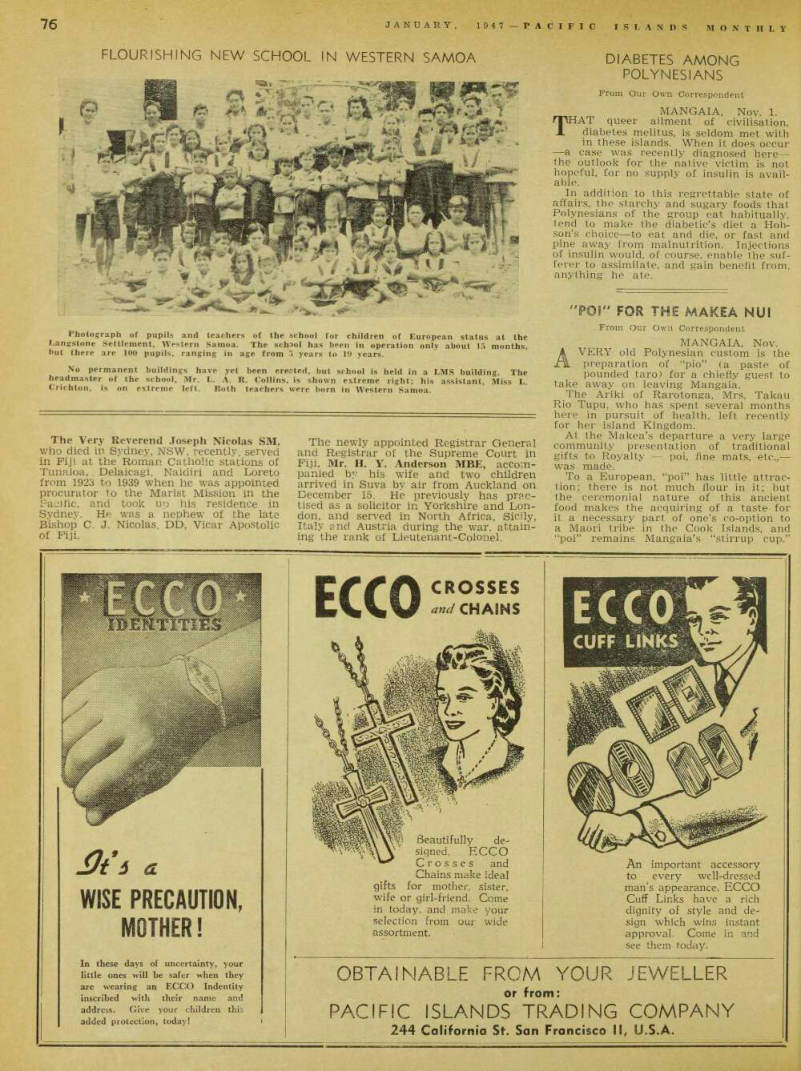
The Very Reverend Joseph Nicolas SM, who died in Sydney, NSW, recently, served in Fiji at the Roman Catholic stations of Tunaloa, Delaicagi, Naidiri and Loreto from 1923 to 1939 when he was appointed procurator to the Marist Mission in the Pacific, and took up his residence in Sydney. He was a nephew of the late Bishop C. J. Nicolas. DD, Vicar Apostolic of Fiji.
The newly appointed Registrar General and Registrar of the Supreme Court in Fiji, Mr. H. Y. Anderson MBE, accom panied by his wife and two children arrived in Suva by air from Auckland on December 15. He previously has prac tised as a solicitor in Yorkshire and Lon don, and served in North Africa, Sicily, Italy and Austria during the war, attain ing the rank of Lieutenant-Colonel.
Photograph of pupils and teachers of the school for children of European status at the Langstone Settlement, Western Samoa. The school has been in operation only about 15 months, but there are 100 pupils, ranging in age from 5 years to 19 years.
No permanent buildings have yet been erected, but school is held in a LMS building. The headmaster of the school, Mr. L. A. R. Collins, is shown extreme right; his assistant, Miss L.
Crichton, is on extreme left. Both teachers were born in Western Samoa.
Diabetes Among
Polynesians
From Our Own Correspondent
Mangaia, Nov. 1.
rAT queer ailment of civilisation, diabetes melitus, is seldom met with in these islands. When it does occur —a case was recently diagnosed here— the outlook for the native victim is not hopeful, for no supply of insulin is avail able.
In addition to this regrettable state of affairs, the starchy and sugary foods that Polynesians of the group eat habitually, tend to make the diabetic’s diet a Hob son’s choice—to eat and die, or fast and pine away from malnutrition. Injections of insulin would, of course, enable the suf ferer to assimilate, and gain benefit from, anything he ate.
"Poi" For The Makea Nui
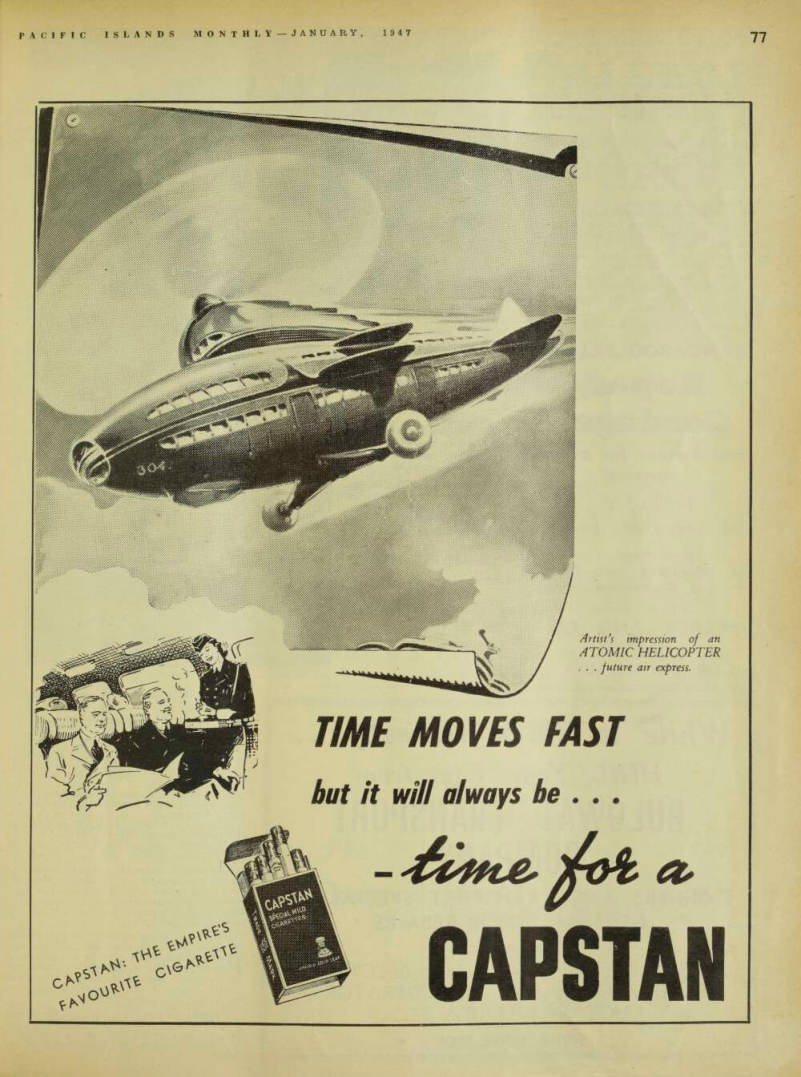
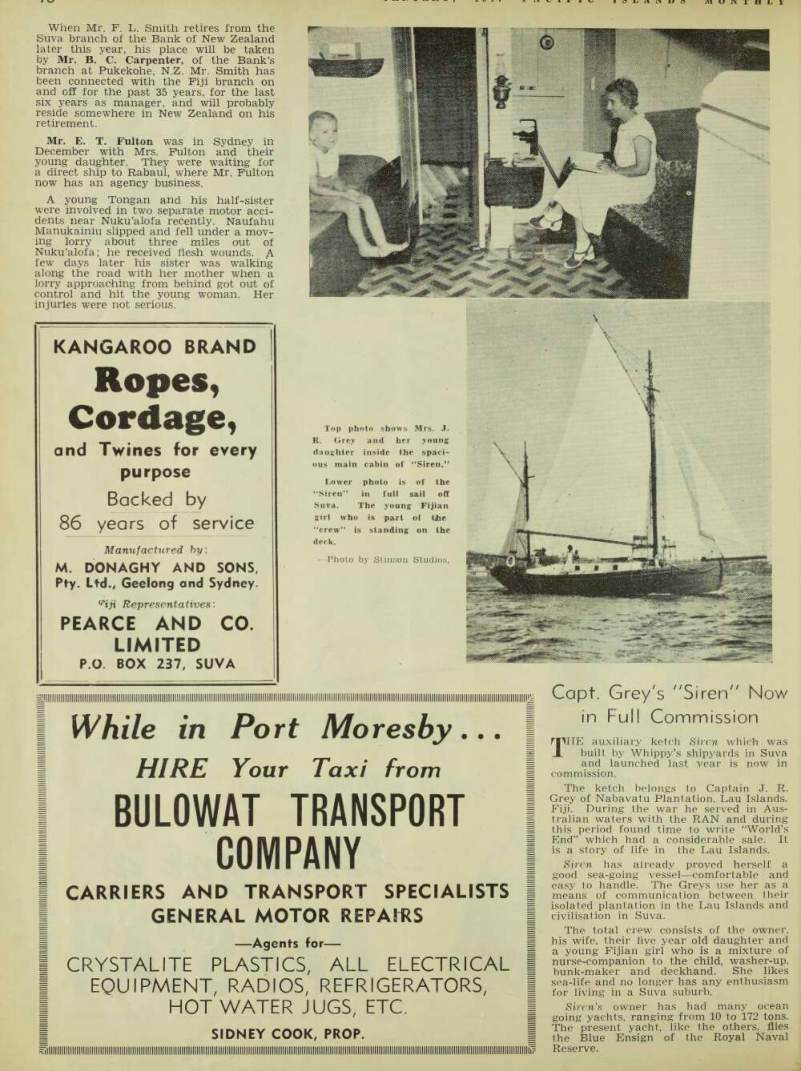
From Our Own Correspondent
Mangaia, Nov.
AVERY old Polynesian custom is the preparation of “pio” (a paste of pounded taro) for a chiefly guest to take away on leaving Mangaia.
The Ariki of Rarotonga, Mrs. Takau Rio Tupu, who has spent several months here in pursuit of health, left recently for her island Kingdom.
At the Makea’s departure a very large community presentation of traditional gifts to Royalty poi, fine mats, etc.,— was made.
To a European, “poi” has little attrac tion; there is not much flour in it; but the ceremonial nature of this ancient food makes the acquiring of a taste- for it a necessary part of one’s co-option to a Maori tribe in the Cook Islands, and “poi” remains Mangaia’s “stirrup cup.”
When Mr. F. L. Smith retires from the Suva branch of the Bank of New Zealand later this year, his place will be taken by Mr. B. C. Carpenter, of the Bank’s branch at Pukekohe, N.Z. Mr. Smith has been connected with the Fiji branch on and off for the past 35 years, for the last six years as manager, and will probably reside somewhere in New Zealand on his retirement.
Mr. E. T, Fulton was in Sydney in December with Mrs. Fulton and their young daughter. They were waiting for a direct ship to Rabaul, where Mr. Fulton now has an agency business.
A young Tongan and his half-sister were involved in two separate motor acci dents near Nukualofa recently. Naufahu Manukainiu slipped and fell under a mov ing lorry about three miles out of Nukualofa; he received flesh wounds. A few days later his sister was walking along the road with her mother when a lorry approaching from behind got out of control and hit the young woman. Her injuries were not serious.
Top photo shows Mrs. J.
R. Grey and her young daughter inside the spaci ous main cabin of “Siren.”
Lower photo is of the “Siren” in full sail off Suva. The young Fijian girl who is part of the “crew” is standing on the deck. —Photo by Stinson Studios.
Advertisements & other items, pp. 78-80 (1 item)
Erf A Crosses
L\vv w CHAINS
m vs Beautifully designed, ECCO Crosses and Chains make ideal gifts for mother, sister, wife or girl-friend. Come in today, and make your selection from our wide assortment.
An important accessory to every well-dressed man’s appearance, ECCO Cuff Links have a rich dignity of style and design which wins instant approval. Come in and see them today.
<)ts a
WISE PRECAUTION,
MOTHER!
In these days of uncertainty, your little ones will be safer when they are wearing an ECCO Indentity inscribed with their name and address. Give your children this added protection, today! i
OBTAINABLE FROM YOUR JEWELLER
or from:
PACIFIC ISLANDS TRADING COMPANY
244 California St. San Francisco 11, U.S.A,
TIME MOVES FAST
but it will always be .. .
CAPSTAN
KANGAROO BRAND
Ropes,
Cordage,
and Twines for every purpose Backed by 86 years of service Manufactured by:
M. DONAGHY AND SONS,
Pty. Ltd., Geelong and Sydney.
Representatives:
PEARCE AND CO.
LIMITED
P.O, BOX 237, SUVA
While in Port Moresby ...
HIRE Your Taxi from
BULOWAT TRANSPORT
COMPANY
CARRIERS AND TRANSPORT SPECIALISTS
GENERAL MOTOR REPAIRS
—Agents for—
CRYSTALITE PLASTICS, ALL ELECTRICAL
EQUIPMENT, RADIOS, REFRIGERATORS,
HOT WATER JUGS, ETC.
SIDNEY COOK, PROP.
Capt. Grey's "Siren" Now
in Full Commission
THE auxiliary ketch Siren which was built by Whippy’s shipyards in Suva and launched last year is now in commission.
The ketch belongs to Captain J. R.
Grey of Nabavatu Plantation, Lau Islands, Fiji. During the war he served in Aus tralian waters with the RAN and during this period found time to write “World’s End” which had a considerable sale. It is a story of life in the Lau Islands.
Siren has already proved herself a good sea-going vessel—comfortable and easy to handle. The Greys use her as a means of communication between their isolated plantation in the Lau Islands and civilisation in Suva.
The total crew consists of the owner, his wife, their five year old daughter and a young Fijian girl who is a mixture of nurse-companion to the child, washer-up, bunk-maker and deckhand. She likes sea-life and no longer has any enthusiasm for living in a Suva suburb.
Siren’s owner has had many ocean going yachts, ranging from 10 to 172 tons.
The present yacht, like the others, flies the Blue Ensign of the Royal Naval Reserve.
Fierce Storm In North
Pacific
IN early January, a storm, which lasted for 48 hours, battered the Hawaiian Islands and caused damage to pro erty which is estimated at millions of dollars.
Waves reached a height of 40 feet, flooding a hospital on Hilo Island and necessitating the transfer of 200 tuber culosis patients to the naval and air station hospital. A lighthouse on Hilo Island was washed away.
On Gaui Island, waves wrecked 1,100 feet of breakwater.
Palmyra Island. 1,100 miles south of Hawaii, was threatened by heavy seas, and the inhabitants took refuge on the only elevation on the island which is six feel above sea level. They sent out a SOS for help, but the seas later re ceded.
The W. R. Carpenter ship “Rabaul” which was on its way to Vancouver was caught in the bad weather in the North Pacific about the same time and received a severe buffeting.
Poliomyelitis at Mangaia
From Our Own Correspondent
Mangaia, Oct. 20.
THE dreaded infantile paralysis has made its appearance here, at Tanz ania Village, where several deaths have occurred.
So far, the disease does not warrant a general epidemic alarm; but the local NMP is kept busy.
As Mangaia has no airport, we had hoped that such aftermaths of war might not affect the island, but it appears that recent shipping-calls have brought the infection here.
At writing, the Medical Department, is organising preventative and safety measures.
Mr. W. F. Hayward. Postmaster-Gen eral in Fiji, was spending leave in New Zealand in December. Mr. R. Locker was acting PMG in his absence.
Problem—At Home
Australia Has A Native
NATIVE welfare, like Charity, should begin at home. Recently their Church of England padres held this provi sional synod in Brisbane and resolved to ask “the Federal Government to intro duce the individual contract system for native labor” in the Northern Territory!
Bishop of Carpentaria said the law regarded NT natives as a herd of cattle and an employer, with a licence obtained for 10/-, had full control over as many natives as he could find work for.
Another padre, describing the working conditions said: “The use of the branding iron was the only condition of full-time slavery that was not included in the Federal government’s treatment of the NT full-blooded abos.”
Always allowing for gross exaggera tion in such matters (as we in New Guinea know only too well) it would appear that NT native administration calls for some comment. The laugh, of course, lies in the fact that whereas Federal government’s policy in New
Guinea is to abolish the labor contract system, the Anglican synod in Queens land wants the government to establish it in the NT. Australia’s own house appears to require far more putting in order than the much-discussed New Guinea domiciles. —“T.”
Advertisements & other items, p. 81 (3 items)
79
PACIFIC ISLANDS MONTHLY— J A N U A R Y , 1947
Mcllrath's Pty. Ltd.
At Your Service!
EXPERIENCED
BUYING AGENT
Write
T. A. WYBORN
(Late of Papua)
Box 528, CAIRNS
McILRATH’S offer
Pure Orange Fruit Juice
In 30 oz. Cans <3/- value) per i/- Can (per dozen, 11/6) 5 case lots, 11/- doz. 10 case lots, 10/6 doz. 25 case lots or more, 10/- doz. (Cases contain 24 tins) Each can of pure orange juice contains the juice of approximately 24 oranges.
This juice is absolutely pure. Add water and sugar to taste. Every tin is guaranteed.
This fruit juice will maintain perfect condition for days if transferred to bottles or jars and kept in a cool place.
Send your order to —
Mcllrath's Pty. Ltd.
H
Re WILL of Robert Welton Rogers late
of Campbeltown New South Wales, Chainman deceased. Letters of Administration Cum Testamento Annexe of whose Estate and Effects granted by Supreme Court of New South Wales on 25th November 1946. Pursuant to the Wills, Probate & Administration Act 1898-1940, Testator’s Family Maintenance and Guardianship of Infants Act 1916- 1938 and Trustee Act 1925-1940 Perpetual Trustee Company (Limited) the Administrator of the Estate and Effects of the said Robert Welton Rogers who died on 13th February 1942, hereby gives notice that creditors and others having any claims against or to the estate of the said deceased are required to send particulars of their claims to the said Administrator at 33-39 Hunter Street, Sydney on or before the 20th day of April next at the expiration of which time the said Administrator will distribute the assets of the said deceased to the persons entitled having regard only to the claims of which it then has notice.
Dated this 3rd day of January 1947.
For Perpetual Trustee Company (Ltd.) H. V. Douglass, Managing Director.
Robson Cowlishaw, Proctors.
Islands Produce
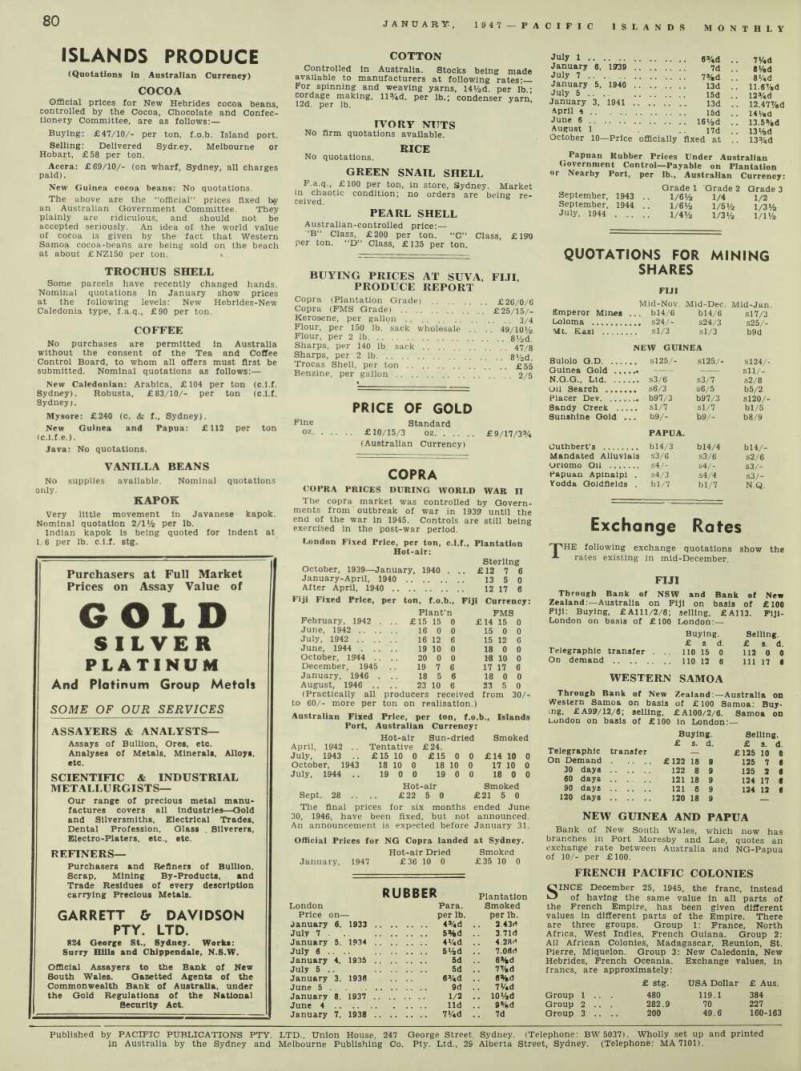
(Quotations in Australian Currency)
Cocoa
Official prices for New Hebrides cocoa beans, controlled by the Cocoa, Chocolate and Confec tionery Committee, are as follows: Buying: £47/10/- per ton, f.o.b. Island port.
Selling: Delivered Sydney, Melbourne or Hobart, £5B per ton.
Accra: £69/10/- (on wharf, Sydney, all charges paid).
New Guinea cocoa beans: No quotations.
The above are the “official” prices fixed by an Australian Government Committee. They plainly are ridiculous, and should not be accepted seriously. An idea of the world value of cocoa is given by the fact that Western Samoa cocoa-beans are being sold on the beach at about £NZISO per ton. %
Trochus Shell
Some parcels have recently changed hands.
Nominal quotations in January show prices at the following levels: New Hebrides-New Caledonia type, f.a.q., £9O per ton.
Coffee
No purchases are permitted in Australia without the consent of the Tea and Coffee Control Board, to whom all offers must first be submitted. Nominal quotations as follows: New Caledonian: Arablca, £lO4 per ton (c.l.f.
Sydney). Robusta, £B3/10/- per ton (c.l.f.
Sydney).
Mysore: £240 (c. & f,, Sydney).
New Guinea and Papua: £ll2 per ton (c.1.f.e.).
Java: No quotations.
Vanilla Beans
No supplies available. Nominal quotations only.
Kapok
Very little movement In Javanese kapok.
Nominal quotation 2/I V2 per lb.
Indian kapok is being quoted for Indent at 1/6 per lb. c.l.f. stg.
Cotton
Controlled In Australia. Stocks being made available to manufacturers at following rates:— For spinning and weaving yarns, 14y 2 d. per lb cordage making, ll%d. per lb.; condenser yarn 12d. per lb.
Ivory Nuts
No firm quotations available.
Rice
No quotations,
Green Snail Shell
F.a.q., £lOO per ton, in store, Sydney. Market in chaotic condition; no orders are being re ceived.
Pearl Shell
Australian-controlled price:— ‘B” Class, £2OO per ton. “C” Class, £l9O per ton. “D” Class, £135 per ton.
Buying Prices At Suva, Fiji,
Produce Report
Copra (Plantation Grade) £26/0/6 Copra (FMS Grade) £25/15/- Kerosene, per gallon .. . . 3/4 Flour, per 150 lb. sack wholesale .. .. 49/10y 2 Flour, per 2 lb gy 2 d Sharps, per 140 lb. sack *. 47/8 Sharps, per 2 lb gy 2 d.
Trocas Shell, per ton £55 Benzine, per gallon 2/5
Advertisements & other items, p. 82 (1 item)
Price Of Gold
Pine Standard oz. . .. £9/17/3% (Australian Currency)
Copra
Prices During World War Ii
The copra market was controlled by Govern ments from outbreak of war in 1939 until the end of the war in 1945. Controls are still being exercised in the post-war period.
London Fixed Price, per ton, c.i.f., Plantation Hot-air: Sterling October, 1939 —January, 1940 ... £l2 7 6 January-April, 1940 13 5 0 After April, 1940 12 17 6 Fiji Fixed Price, per ton, f.0.b., Fiji Currency:
(Practically all producers received from 30/to 60/- more per ton on realisation.) Australian Fixed Price, per ton, f.0.b., Islands Port, Australian Currency:
The final prices for six months ended June 30, 1946, have been fixed, but not announced.
An announcement is expected before January 31.
Official Prices for NG Copra landed at Sydney.
Plant’n
Fms
February, 1942 . . . £15 15 0 £14 15 0 June, 1942 16 0 0 15 0 0 July, 1942 16 12 6 15 12 6 June, 1944 19 10 0 18 0 0 October, 1944 .. 20 0 0 1-8 10 0 December, 1945 19 7 6 17 17 6 January, 1946 . .. 18 5 6 18 0 0 August, 1946 .. .. 23 10 6 23 5 0
Hot-air Sun-dried Smoked April, l&'42 .. Tentative £24.
July, 1943 .. £15 10 0 £15 0 0 £14 10 0 October, 1943 18 10 0 18 10 0 17 10 0 July, 1944 .. 19 0 0 19 0 0 18 0 0 Hot-air Smoked Sept. 28 .. .. £22 5 0 £21 5 0
Hot-air Dried Smoked January, 1947 £36 10 0 £35 10 0
Rubber
Plantation
Papuan Rubber Prices Under Australian Government Control—Payable on Plantation or Nearby Port, per lb., Australian Currency:
London Para.
Smoked Price onper lb. per lb.
January 6. 1933 .. .. ... 4 3 4d 2.43d July 7 .. .. 6%d 3.71d January 5. 1934 .. .. ... 4V«d 4.2Rd July 6 . . . . ... 5Vad 7.06ri January 4. 1935 .. .. ... 5d 8Hd July 5 . ... 5d .. 7%d January 3. 1936 6 3 /4d 8Hd June 5 ... 9d 7Vid January 8, 1937 .. .. ... 1/2 .. lOVad June 4 .. .. lid 9 5 /«d January 7.’ 1938 *. .. ... 7>/4d .. 7d
J ul y 1 6 3 /4d .. 7Vid January 6. 7d .. 8Vsd Jul y 7 7Hd .. 8V«d January 5, 1940 13d .. 11.6 7 /.d ul y 5 15d .. 12 3 ,4d January 3, 1941 13d .. 12.47y a d A P r11 * 15d .. 14Vsd •* une 6 16Vad .. 13.5»/.d August 1 I7d l3Vfcd October 10 — Price officially fixed at .. 13 3 /4d
Grade 1 Grade 2 Grade 3 September, 1943 . 1/6 Va 1/4 1/2 September, 1944 . 1/6 Va 1/5 Va 1/3 Va July, 1944 . . 1/4 Va 1/3 Va 1/1 Va
Quotations For Mining
Shares
Fiji
Mid-Nov.
Mid-Dec.
Mid-Jan.
Emperor Mines ... b!4/6 b!4/6 S17/3 Loloma ... s24/s24/3 s25/- Mt. Kasl .. sl/3 sl/3 b9d
New Guinea
Bulolo Q.D .. s!25/sl25/sl24/- Guinea Gold — sll/- N.G.G., Ltd s3/7 s2/8 Oil Search .. s6/3 s6/5 b5/2 Placer Dev .. b97/3 b97/3 sl20/- Sandy Creek ... .. sl/7 sl/7 bl/5 Sunshine Gold .. ,. b9/b9/b8/9
Papua.
Outhbert’s .. b!4/3 bl4/4 bl4/- Mandated Alluvlals s3/6 s3/6 s2/6 onomo Oil S4/s3/- Papuan Aplnalpl . s4/3 s4/4 s3/- Yodda Goldfields . bl/7 bl/7 N.Q.
Exchange Rates
T'HE following exchange quotations show the A rates existing in mid-December.
Fiji
Through Bank of NSW and Bank of New Zealand:—Australia on FIJI on basis of £lOO Fiji; Buying. £Alll/2/6; selling. £AII3. FIJI- London on basis of £lOO London:—
Western Samoa
Through Bank of New Zealand:—Australia on Western Samoa on basis of £lOO Samoa: Buy ing. £ A99/12/6; selling, £AIOO/2/6. Samoa on London on basis of £lOO in London:—
New Guinea And Papua
Bank of New South Wales, which now has branches In Port Moresby and Lae, quotes an exchange rate between Australia and NG-Papua of 10/- per £lOO.
French Pacific Colonies
SINCE December 25, 1945, the franc, Instead of having the same value in all parts of the French Empire, has been given different values in different parts of the Empire. There are three groups. Group 1: Prance, North Africa, West Indies, French Guiana. Group 2: All African Colonies, Madagascar, Reunion, St.
Pierre, Miquelon. Group 3: New Caledonia, New Hebrides, French Oceania. Exchange values, in francs, are approximately:
Buying.
Selling. £ a d. £ 8. d.
Telegraphic transfer . 110 15 0 112 0 0 On demand .. 110 12 6 111 17 S
Buying.
Selling.
£ s. d. £ s. d.
Telegraphic transfer £125 10 0 On Demand £122 18 9 125 7 6 30 days 122 8 9 125 2 6 60 days 121 18 9 124 17 6 90 days 121 8 9 124 12 fl 120 days 120 18 9
£ stg. USA Dollar £ Aus.
Group 1 .. . 480 119.1 384 Group 2 .. . 282.9 70 227 Group 3 .. .. 200 49.6 160-163
Advertisements & other items, pp. 82-84 (3 items)
80
JANUARY-, 1947 PACIFIC ISLANDS MONTHLY
Published by PACIFIC PUBLICATIONS PTY. LTD., Union House, 247 George Street, Sydney. (Telephone; BW 5037). Wholly set up and printed in Australia by the Sydney and Melbourne Publishing Co, Pty. Ltd., 29 Alberta Street, Sydney. (Telephone: MA7101).
Gold
Purchasers at Full Market Prices on Assay Value of
SILVER
PLATINUM
And Platinum Group Metals
SOME OF OUR SERVICES
ASSAYERS & ANALYSTS—
Assays of Bullion, Ores, etc.
Analyses of Metals, Minerals, Alloys, etc.
SCIENTIFIC & INDUSTRIAL
METALLURGISTS—
Our range of precious metal manufactures covers all industries—Gold and Silversmiths, Electrical Trades, Dental Profession. Glass . Sllverers, Electro-Platers, etc., etc.
REFINERS—
Purchasers and Refiners of Bullion.
Scrap, Mining By-Products. and Trade Residues of every description carrying Precious Metals.
GARRETT Cr DAVIDSON
PTY. LTD.
824 George St., Sydney. Works: Surry Hills and Chippendale, N.S.W.
Official Assayers to the Bank of New South Wales. Gazetted Agents of the Commonwealth Bank of Australia, under the Gold Regulations of the National Security Act.
tropical thirst...
To quench a
hodi dr‘” kS
tvertf
nn^r BP ' * '>
XSO
Mew mJ ifig K.
When you’re hot and tired, there is nothing quite so satisfying and thirst quenching as a long, cold glass of “K. 8.” Your friends and guests, too, will appreciate this really fine Lager, for “Everybody drinks K.B.’*
TOOTH’S
LAGER
A
MERCHANTS, & SHIP OWNERS
Capital £1,000,000
ESTABLISHED 1914
COPRA MERCHANTS & MILLERS
BRANCHES THROUGHOUT THE PACIFIC ISLANDS
REGULAR CARGO AND PASSENGER SERVICE BETWEEN EUROPE AND
PACIFIC ISLAND PORTS WAS ESTABLISHED BY
W. R. CARPENTER & CO. LTD.
Head Office: 16 O'CONNELL STREET, SYDNEY.
Cable Address:
CAMOHE.
Telephone : BW 4421.
Postal Address: P.O. Box No. 168. Sydney.