Pacific
Islands
Monthly
December 16, 1946
Vol. Xvii. No. 5.
Established 1930,
IRegistered at the for transmission by post as a newspaper ]
1 /-
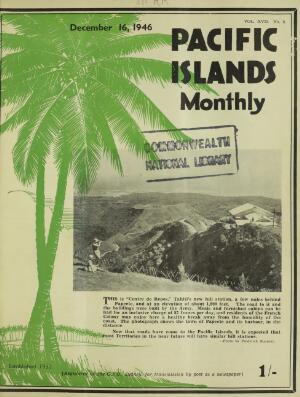
THIS is “Centre de Repos,” Tahiti’s new hill station, a few miles behind Papeete, and at an elevation of about 1,800 feet. The road to it and the buildings were built by the Army. Meals and furnished cabins can be had for an inclusive charge of 87 francs per day, and residents of the French Colony may enjoy here a healthy break away from the humidity of the coast. The photograph shows the town of Papeete and its harbour, in the distance.
Now that roads have come to the Pacific Islands, it is expected that lost Territories in the near future will have similar hill stations. —Photo by Frederick Simpson.
Advertisements & other items, pp. 2-4 (1 item)
QaiitaA
1 4 V ■)
SB: ft
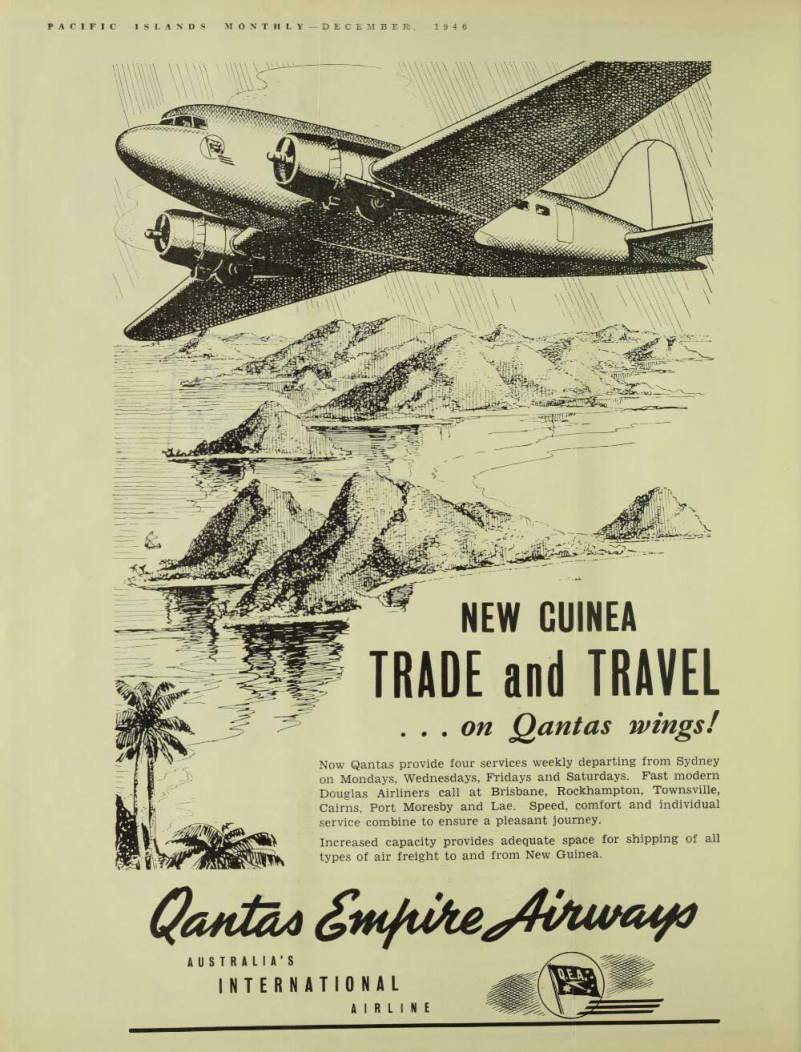
NEW GUINEA
TRADE and TRAVEL
... on Qantas wings!
Now Qantas provide four services weekly departing from Sydney on Mondays, Wednesdays, Fridays and Saturdays. Fast modern Douglas Airliners call at Brisbane, Rockhampton, Townsville, Cairns, Port Moresby and Lae. Speed, comfort and individual service combine to ensure a pleasant journey.
Increased capacity provides adequate space for shipping of all types of air freight to and from New Guinea.
QaiitaA
AUSTRALIA'S
INTERNATIONAL
AIRLINE
ifW IRONS PEP
PERFECTLY
Coleman’s Petrol and Kerosene Lamps in 300 and 500 C.P.
Coleman’s Kerosene Table Lamp can be used as hanging Lamp ** z' -4 L It took 40 ycors' intensive specialisation to bring the Coleman Petrol Iron to its present state of perfection. Coleman
Irons require no preheating, they light
instantly and can be used either indoors or outdoors.
I The ventilated body pre- ■ vents sides from scorching light fabrics and the ventilated lid keeps the handle cool. y Tapered edge for ironing - pleats and around buttons.
I Pointed heel gives f wrinkle-proof ironing on back and forward strokes, i Built-in cleaning needle, r cleans gas - tip automatically, without turning off iron and also regulates heat.
Coleman’s Petrol or Kerosene Lamp with large enamelled reflector.
Representatives for the Pacific Islands:
ROBERT GILLESPIE PTY. LTD
540 PITT STREET, SYDNEY
PEARCE & CO. LTD,
SUVA
FOR FIJI ISLANDS
"I want you to try Gray, it's my best seller ..." (says Chemist) r- r>c r
QJi
\ s V « i y rp % tv ir
IPANA
does all a tooth-paste CAN do for your teeth and gums "Ipan ais all it claims to be a really good tooth paste . Ipana won't work miracles, but it certainly will keep your teeth clean, white and sparkling."
Ipana freshens your mouth; cleans your teeth thoroughly and so defeats the germs that start decay. Its gentle agency reveals the natural brilliant polish of your teeth.
When possible, give your teeth a good brushing with Ipana after every meal and always night and morning. Use an upand-down movement so that Ipana can get between the teeth.
A National Survey conducted throughout Australia showed that dentists choose Ipana for their personal use 3 to I over any other dentifrice.
- IPANA
TOOTH PASTE
3640 Sold by all leading distributors and manufactured by: BRISTOL-MYERS CO. PTY. LTD., 223 PACIFIC HIGHWAY, NORTH SYDNEY, N.S.W.. AUSTRALIA
Advertisers
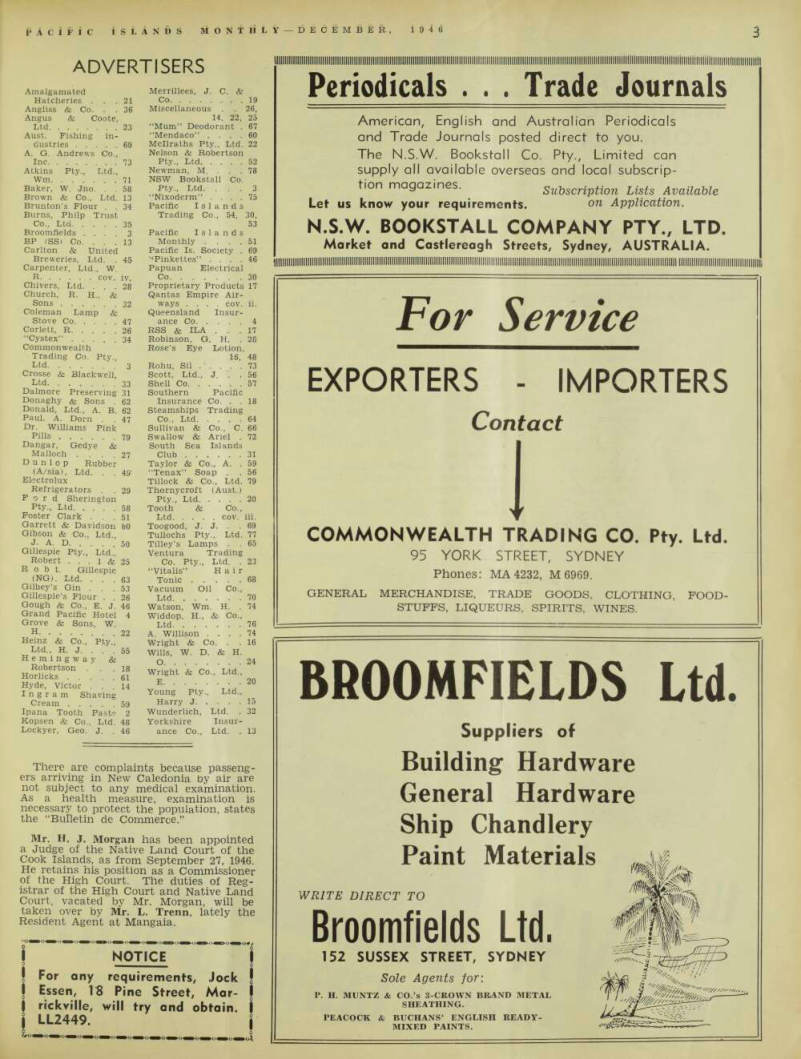
Amalgamated Hatcheries . . .21 Angliss & Co. . . 36 Angus & Coote, Ltd 23 Aust. Fishing in dustries 69 A. G. Andrews Co., Inc 73 Atkins Pty., Ltd., Wm 71 Baker, W. Jno. . . 58 Brown & Co., Ltd. 13 Brunton’s Flour . . 34 Burns, Philp Trust Co., Ltd 35 Broomfields ... 3 BP (SS> Co. . . . 13 Carlton & United Breweries, Ltd. . 45 Carpenter, Ltd., W.
R cov. iv.
Chivers, Ltd. ... 28 Church, R. H., & Sons 32 Coleman Lamp & Stove Co 47 Corlett, R 26 “Cystex” 34 Commonwealth Trading Co. Pty., Ltd 3 Crosse & Blackwell, Ltd 33 Dalmore Preserving 31 Donaghy & Sons . 62 Donald, Ltd., A. B. 62 Paul. A. Dorn . 47 Dr. Williams Pink Pills 79 Dangar, Gedye & Malloch ... 27 Dunlop Rubber (A/sia), Ltd. . . 4& 1 Electrolux Refrigerators . . 29 Ford Sherington Pty., Ltd 58 Poster Clark ... 51 Garrett & Davidson 80 Gibson & Co., Ltd.,
J- A. D 50
Gillespie Pty., Ltd., Robert ... 1 & 25 Rob t. Gillespie (NG). Ltd. ... 63 Gilbey’s Gin ... 53 Gillespie’s Flour . . 26 Gough & Co., E. J. 46 Grand Pacific Hotel 4 Grove & Sons, W.
H 22 Heinz & Co., Pty., Ltd., H. J. . . . 55
Hemingway &
Robertson ... 18 Hor licks 61 Hyde, Victor ... 14 Ingram Shaving Cream 59 Ipana Tooth Past? 2 Kopsen & Co., Ltd. 48 Lockyer, Geo. J. . 46
Merrillees, J. C. & Co 19 Miscellaneous . . 26, 14, 22, 25 “Mum” Deodorant . 67 “Mendaco” ... 60 Mcllraths Pty., Ltd. 22 Nelson & Robertson Pty., Ltd 52 Newman, M, ... 78 NSW Bookstall Co.
Pty., Ltd. ... 3 “Nixoderm” ... 75 Pacific Islands Trading Co., 54, 30, 53 Pacific Islands Monthly . . . . 51 Pacific Is. Society . 69 ‘‘Pinkettes” ... 46 Papuan Electrical Co 30 Proprietary Products 17 Qantas Empire Air ways ... cov. ii.
Queensland Insur ance Co 4
Rss & Ila ... 17
Robinson, G. H. . 28 Rose’s Eye Lotion, 16, 48 Rohu, Sil .' . . . .73 Scott, Ltd., J. . 56 Shell Co 57 Southern Pacific Insurance Co. . .18 Steamships Trading Co., Ltd 64 Sullivan & Co., C. 66 Swallow & Ariel . 72 South Sea Islands Club 31 Taylor & Co., A. . 59 “Tenax” Soap . . 56 Tillock & Co., Ltd. 79 Thornycroft (Aust.) Pty., Ltd 20 Tooth & Co., Ltd cov. iii.
Toogood, J. J. . . 69 Tullochs Pty., Ltd. 77 Tilley’s Lamps . . 65 Ventura Trading Co. Pty., Ltd. . 23 “Vitalis” Hair Tonic 68 Vacuum Oil Co., Ltd 70 Watson, Wm. H. . 74 Widdop, H., & Co., Ltd 76 A. Willison ... 74 Wright & Co. . . 16 Wills, W. D. & H. 0 24 Wright & Co., Ltd., E 20 Young Pty., Ltd., Harry J 15 Wunderlich, Ltd. . 32 Yorkshire Insur ance Co., Ltd. . 13
There are complaints because passeng ers arriving in New Caledonia by air are not subject to any medical examination.
As a health measure, examination is necessary to protect the population, states the “Bulletin de Commerce.”
Mr. H. J. Morgan has been appointed a Judge of the Native Land Court of the Cook Islands, as from September 27, 1946.
He retains his position as a Commissioner of the High Court. The duties of Reg istrar of the High Court and Native Land Court, vacated by Mr. Morgan, will be taken over by Mr. L. Trenn, lately the Resident Agent at Mangaia.
Advertisements & other items, pp. 5-6 (1 item)
Broomfields Ltd.
Periodicals . . . Trade Journals
American, English and Australian Periodicals and Trade Journals posted direct to you.
The N.S.W. Bookstall Co. Pty., Limited can supply all available overseas and local subscription magazines. Subscription Lists Available Let us know your requirements. on Application.
N.S.W. BOOKSTALL COMPANY PTY., LTD.
Market and Castlereagh Streets, Sydney, AUSTRALIA.
For Service
EXPORTERS
IMPORTERS
Contact
COMMONWEALTH TRADING CO. Pty. Ltd.
95 YORK STREET, SYDNEY
Phones: MA4232, M 6969.
GENERAL MERCHANDISE, TRADE GOODS, CLOTHING, FOOD-
STUFFS, LIQUEURS, SPIRITS, WINES.
BROOMFIELDS Ltd.
Suppliers of
Building Hardware
General Hardware
Ship Chandlery
Paint Materials
WRITE DIRECT TO
Broomfields Ltd.
152 SUSSEX STREET, SYDNEY
Sole Agents for ; P. H. MUNTZ & CO.’s 3-CROWN BRAND METAL
SHEATHING.
PEACOCK & BUCHANS’ ENGLISH READY-
MIXED PAINTS.
NOTICE
For any requirements, Jock Essen, 13 Pine Street, Marrickville, will try and obtain.
LL2449.
QUEENSLAND
INSURANCE
COMPANY
LIMITED
(Incorporated 1886 In Australia)
ASSETS EXCEED £4,000,000
Head Office:
QUEENSLAND
INSURANCE BUILDING,
80-82 PITT STREET, SYDNEY.
Speciolists in South Seas Fire,
Marine & Accident Insurances
Apply to: —
FIJI.
Branch Office: I. B. Chalmers, Manager.
Burns Phllp (South Sea) Co., Ltd.
VILA.
Burns Phllp (South Sea) Co., Ltd.
Comptoirs Francais Des Nouvelles Hebrides (Marine).
NOUMEA.
L. Si W. Johnston.
PORT MORESBY:
Burns, Phllp & Co., Ltd.
W. A. Anderson, Resident Officer.
PAGO PAGO.
Burns Phllp (South Sea) Co., Ltd.
G. H. C. Reid Si Co.
OTHER SOUTH SEA ISLANDS.
Burns Phllp (South Sea) Co., Ltd.
Also to any of the Company’s Offices in Australia or New Zealand.
In This Issue:
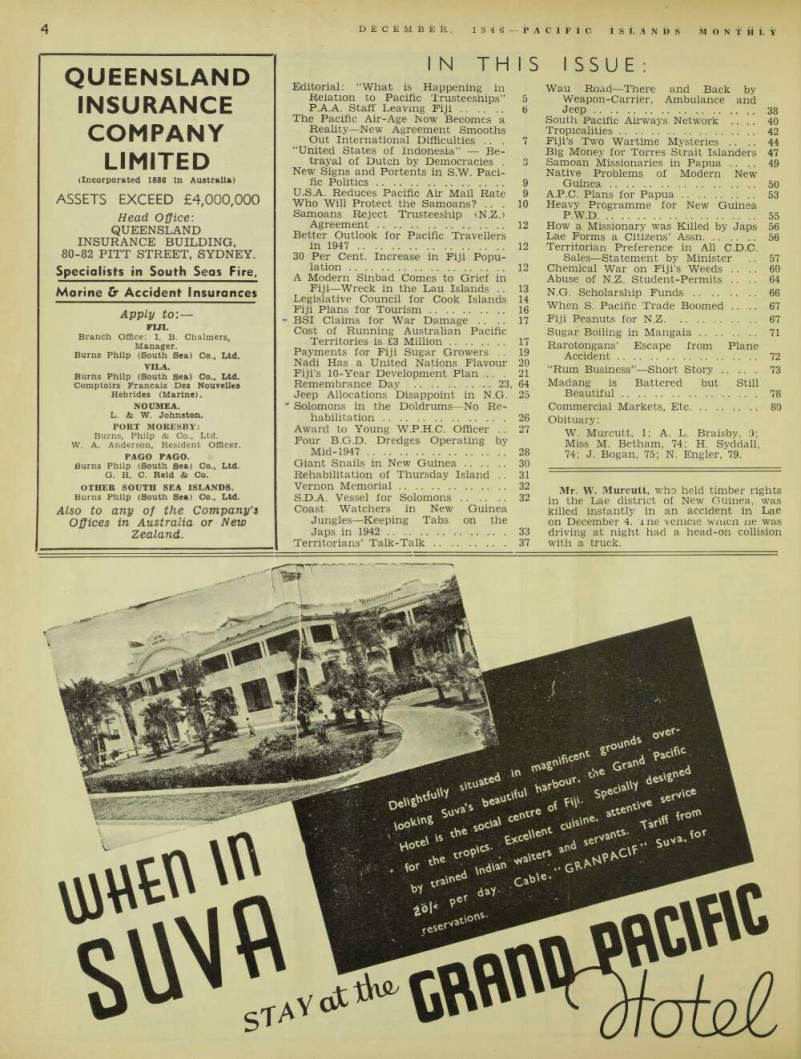
Editorial; “What is Happening in Relation to Pacific Trusteeships” 5 P.A.A. Staff Leaving Fiji 6 The Pacific Air-Age Now Becomes a Reality—New Agreement Smooths Out International Difficulties ... 7 “United States of Indonesia” Be trayal of Dutch by Democracies . 3 New Signs and Portents in S.W. Paci fic Politics 9 U.S.A. Reduces Pacific Air Mail Rate 9 Who Will Protect the Samoans? ... 10 Samoans Reject Trusteeship (N.Z.) Agreement 12 Better Outlook for Pacific Travellers in 1947 12 30 Per Cent. Increase in Fiji Popu lation 12 A Modern Sinbad Comes to Grief in Fiji—Wreck in the Lau Islands .. 13 Legislative Council for Cook Islands 14 Fiji Plans for Tourism 16 BSI Claims for War Damage .. .. 17 Cost of Running Australian Pacific Territories is £3 Million 17 Payments for Fiji Sugar Growers .. 19 Nadi Has a United Nations Flavour 20 Fiji’s 10-Year Development Plan ... 21 Remembrance Day 23, 64 Jeep Allocations Disappoint in N.G. 25 ' Solomons in the Doldrums—No Re habilitation 26 Award to Young W.P.H.C. Officer .. 27 Four B.G.D. Dredges Operating by Mid-1947 28 Giant Snails in New Guinea 30 Rehabilitation of Thursday Island .. 31 Vernon Memorial 32 S.D.A. Vessel for Solomons 32 Coast Watchers in New Guinea Jungles—Keeping Tabs on the Japs in 1942 33 Territorians’ Talk-Talk 37
Wau Road —There and Back by Weapon-Carrier, Ambulance and Jeep 38 South Pacific Airways Network ... 40 Tropicalities 42 Fiji’s Two Wartime Mysteries .. .. 44 Big Money for Torres Strait Islanders 47 Samoan Missionaries in Papua ... 49 Native Problems of Modern New Guinea 50 A.P.C. Plans for Papua 53 Heavy Programme for New Guinea
P.W.D 55
How a Missionary was Killed by Japs 56 Lae Forms a Citizens’ Assn 56 Territorian Preference in All C.D.C.
Sales—Statement by Minister .. 57 Chemical War on Fiji’s Weeds ... 60 Abuse of N.Z. Student-Permits ... 64 N.G. Scholarship Funds 66 When S. Pacific Trade Boomed ... 67 Fiji Peanuts for N.Z 67 Sugar Boiling in Mangaia 71 Rarotongans’ Escape from Plane Accident 72 “Rum Business” —Short Story 73 Madang is Battered but Still Beautiful 78 Commercial Markets, Etc 80 Obituary: W. Murcutt, 1; A. L. Braisby, 3; Miss M. Betham, 74; H. Syddall, 74; J. Bogan, 75; N. Engler, 79.
Mr, W. Murcutt, who held timber rights in the Lae district of New Guinea, was killed instantly in an accident in Lae on December 4. me vemcie wmcn ne was driving at night had a head-on collision with a truck.
Advertisements & other items, p. 6 (1 item)
&ssShp.
T~
s taV<**-
»%*k\ y*** \*-**“' o{ n- spet 'U- ce 3ie *** + ***■. w **. C4b ' e ' t»i* 9 os : r '
&ssShp.
Pacific Islands Monthly
The Newspaper-Magazine of the South Seas [Registered at the G.P.0., Sydney, for transmission by post as a newspaper .]
Published Once Each Month and Circulated in Australia and New Zealand and in the following Pacific Territories and Islands Groups:
Australian Territory of Papua.
Mandated Territory (Australia) of New Guinea.
Australian Territory of Norfolk Island.
New Zealand Territory of Cook Islands.
Mandated Territory (NZ) of Western Samoa.
British Colony of FIJI.
British Solomon Islands Protectorate.
British Protectorate of Tongan Islands.
British Crown Colony of Gilbert and Ellice Islands.
Mandated Territory of Nauru.
British and Free French Condominium of Hebrides.
French Colony of New Caledonia.
French Colony of Oceania (Tahiti, etc.).
American Territory of Eastern Samoa.
American Territory of Hawaiian Islands.
Owned and Produced by Pacific Publications Pty. Ltd., Union House, 247 George Street, Sydney.
Telephones: General Office and Advertising, BW 5037.
P.O. Box 3408
Registered Address for Telegrams, Radiograms, and Cables: "Pacpub”, Sydney.
Contributions.
Articles, Stories, and Photographs dealing with Pacific Islands subjects are invited and will be paid for on publication.
Subscription Rates.
Per Annum, within British Empire, Prepaid, Pest Free 10/- Per Annum, elsewhere, Prepaid, Post Free 12/6 Single Copies 1/-
Editor and Publisher:
R. W Robson, P.R.G.S.
General Office: Union House, 247 George Street, Sydney.
Advertising Manager: W. E. Rogers.
Telephone; BW 5037.
Representative In Fiji.
Pacific Publications (Fiji), Ltd., Bank of NSW Building, Suva (same office as W. H. Grove & Sons, Ltd.). Stocks of Pacific Islands Monthly and Pacific Islands Yearbook on hand.
Representative In London.
J. T. Wallis, Coronation House, 4 Lloyds Avenue, London, E.C.3, from whom may be obtained copies of Pacific Islands Monthly, Pacific Is. Year Book, advertising schedules, etc.
Representative In U.S.A.
Pacific Islands Trading Co.,
244 CALIFORNIA ST., SAN FRANCISCO, U S.A.
Agents.
The following are authorised to receive sub scriptions for Pacific Islands Monthly:— Burns, Philp & Co., Ltd., and Burns Phllp (South Sea) Co., Ltd. All branches.
W. R. Carpenter & Co., Ltd. All branches.
Morris, Hedstrom, Ltd. All branches.
Steamships Trading Co., Papua. All branches.
Whitten Bros., Ltd., Samarai, Papua.
B.N.G. Trading Co., Ltd., Port Moresby, Papua.
J. Muir, Suva, Fiji.
Miss R. Castles, Suva, FIJI.
N. C. Mackenzie Hunt, Walnunu, Bua, FIJI.
Cook Islands Trading Co., Rarotonga, Cook Is.
A. C. Rowland, Papeete, Tahiti, Islands Branches and Representatives of W. H.
Grove & Sons, Ltd., Auckland, New Zealand.
Ed. Pentecost, Noumea, New Caledonia.
Societe Gubbay Kerr et Cie, Noumea, N. Caledonia.
Vol. XVII. No. 5
December 16, 1946
Prirp l/ Per Copy * rnce Prepaid: 10/- p.a.
"Pacific Trusteeships"
What Is Happening in Relation to "Pacific Trusteeships"
rERE has been much in the news papers during the month about the new Trusteeship Agreements, presented to the United Nations, which are to take the place of the Mandates (mostly C-Class) granted by the League of Nations in respect of former German colonies.
So far as the Pacific area is con cerned, there is no vital difference between Trusteeship Agreement and Mandate, except that the administer ing nations will now have the right to maintain armed bases and armed forces within their trusteeship areas.
The League of Nations Mandated Areas were New Guinea, the Bismarck Archipelago and Bougainville (in the care of Australia); Western Samoa (New Zealand); Caroline, Marshall and Mariana Islands (Japan); and the phosphate island of Nauru, for which Britain, New Zealand and Australia held a joint mandate. All were C-Class Mandates—meaning that the natives were held to be in capable of self-government.
There is little doubt that Australia will be granted the Trusteeship over New Guinea, as heretofore. But there is some doubt about what is to hap pen to Western Samoa (see report elsewhere), to the late Jap Mandate, and to Nauru.* THE Samoans have rejected the Agreement proposed by New Zea land, and ask for (a) union between
Western and Eastern Samoa; and (b) a larger measure of self-government.
Both are perfectly reasonable re quests. It is ridiculous to put the Samoans in the same category as the primitive peoples of the New Guinea mandated islands.
Samoan native opinion, if left to crystallise itself without outside interference, almost certainly would ask that Samoa be united, and that the protecting and administering power should be either Britain or the United States. However, under very strong persuasion, the Samoans ex pressed themselves in favour of con tinued association with New Zealand —probably on the ground that New Zealand is only Britain in a watered down form, after all.
It really does not matter much whether the Samoans are protected in future by either Britain or the United States. What is of importance is that the Samoans should seize this opportunity of demanding national unity. It is a reflection upon the wisdom and justice of the Anglo- Saxon Powers that this fine race, now numbering some 70,000 people, should be completely divided between Eastern and Western Samoa. If that partition of the country is maintained, despite Samoan pleas, it will be a mockery of all the high-sounding principles heard nowadays at UNO.
The history of it all goes back one hundred years. British, German and American traders were first into the Samoan Archipelago, and they com peted bitterly for the favours of the warring Samoan kings and chiefs. In
the last half of the last century, the United States flag was established in Pago-Pago (centre of Eastern Samoa); Germany obtained Western Samoa; and Britain withdrew altogether, on condition that Germany abandoned her claims in relation to Tonga and the Solomons.
American and German (followed by New Zealand) rule was exceedingly beneficial to the Samoans. Their in born readiness to fight among them selves was discouraged and sup pressed; the several factors which had led to a tragic decrease in their num bers were removed, and the popu lation began steadily to increase; and they were effectively instructed in the arts of industry and good local government.
To-day, the Samoans are quite cap able of governing themselves, with only light supervision from some administering authority. But, if thev are to attain the nationhood to which they are entitled by their qualities, they must be united. The set-up created by the Three-Powers Treaty of 1899, which divided Samoa be tween two separate nations (Germany and United States) should be wiped out. To allow that to be done, either the United States or Britain (through New Zealand), or both, must sur render sovereignty.
THE Americans appear to be ready to enter into a Trusteeship Agree ment with UNO in respect of the Carolines, Marshalls and Marianas; but they are determined to make their own terms. It is right and proper that they should.
Because they were attacked by an Asiatic Power, they were forced, in order to protect themselves, and get to grips with Japan, to conquer the
*As we go to press, acceptance of the New Guinea and Samoan Agreements by UNO is announced
Japanese Mandated islands. And a bloody business it was, in which the United States lost many thousands of her best men. Those islands now be long to America by right of conquest.
They must be held by America, as protection against further aggression from Asia. They cannot be returned to Japan; and no other nation has any claim to them.
America is quite willing that they should be under Trusteeship, so that they may be open to a periodical check-up by UNO emissaries; but America will listen to no challenge concerning her rights there.
There has been no challenge, except from Russia. That Power, as part of her deliberate policy of sowing sus picion and unease among the demo cratic nations—and so preparing the ground for the overthrow of Western civilisation by the Soviet’s Red hordes —has been offering opposition and offensive criticism, at all points of the Trusteeship debates. Russia cannot cripple the Trusteeship plan, under which the old League Mandates will be liquidated and the administrations rearranged; but she will do her best —or worst.
EXCEPT for some pointless snarling by Russia—which insisted -that the British were late with their pro posed Agreement, and therefore were trying to hide something—little has been heard at UNO about Nauru.
There may be a good reason for that. This may be regarded as an opportunity to bring the two phos phate islands of Nauru and Ocean (the latter now part of the Gilbert and Ellice Colony) under the one administration. There are several arguments in favour of a change— the chief being that the paramount interest and activity in both islands is the industry directed and con trolled by the British Phosphate Com mission. The BPC must find the present administrative set-up (Nauru under a Joint Mandate, and Ocean through the High Commission for the Western Pacific and the G. and E.
Government, under the British Colonial Office) both awkward and embarrassing.
In any event, UNO need not worry about the natives of Nauru. The British authority has seen to it most scrupulously that the Nauruans, and the Banabans of Ocean Island, as the native owners of the land carrying the phosphatic rock, receive a royalty on every ton that was carried away.
There are no richer Islanders in the Pacific.
There may be some interesting changes in the boundaries of Pacific Territories before UNO gets its Pacific Trusteeship Agreements all com pleted. But little change is expected in relation to the biggest of them— what is now called the Mandated Territory of New Guinea.
If it were not that Australian con trol of the “defensive perimeter” of South-west Pacific Islands is vital to the future existence of Australia, no good purpose would be served by a continuance of the present arrange
ment, either as Mandate or Trustee ship. Apart from the defence con sideration, Australian administration of New Guinea is of no use to either Australia or New Guinea. But Aus tralian administration must remain, because those chains of islands are a screen for under-populated Australia against the countless millions of over-populated Asia.
THE most significant development in Trusteeship discussions at UNO was the demand of the Indian dele gates that the “White Australian Policy” should not be carried on into the New Guinea Agreement—in other words, that New Guinea, under the new set-up, should be open to Asiatic immigration.
An Indian motion, to that effect, was defeated by only 16 to 11; and 11 delegates abstained from voting.
Those figures are disconcerting.
India, having been granted self government, is going to make a great effort to break down the barriers, set by Europeans for their own survival, against Asiatic immigration; and New Guinea has felt one of the first on slaughts. UNO, of course, could doi no other than keep the Asiatic flood out of New Guinea. It would be absurd to allow the Territories, held by Australia as a barrier against Asia, to be penetrated by masses of Indians—especially in the light of what has happened in South Africa and Fiji.
This is only the opening of the campaign. We are going to hear much of the Asiatics’ demand for “the open door” in the Pacific. It will not be easy to keep the door closed. The really white nations represented at UNO are few. Our anti-Asiatic policy can depend upon support from only two members of The Big Five— Britain and America. Russia and China almost certainly will be for the open door. Communist-ridden France now is uncertain and unpredictable.
The opening of the door to Asiatics would mean the end, not only of the white communities in the Pacific Islands, but of Australia and New Zealand as European nations.
THE AMERICAN SOLDIER: Whoever holds it, Aussie—your country or mine let us hope that it will serve as a bastion of peace in the Pacific.
P.A.A. Staff Leaving Fiji
Result of Mutual Servicing Agreement with A.N.A.
A REPORT reached Sydney, as we go to press, that “Pan American Air ways staff are pulling out of Nadi (Fiji airport).” It was assumed that this had a sinister significance.
Actually, it means only that the mutual servicing agreement between Pan Am erican Airways and Australian National Airways is being implemented. PAA will service ANA machines in Canton Island, Honolulu and San Francisco. ANA will service PAA machines in Fiji, Auckland and Sydney.
As a result, the meteorological, supply and mechanical staffs of PAA are leaving Fiji. When the new services are running (probably in January) PAA personnel on Fiji, Auckland and Sydney stations will comprise only a staff manager, a chief mechanic, a traffic representative and a ticket-selling staff. (See references to new Trans-Pacific services on pages 7 and 20.)
Mission Launch Taken
From Sydney To N. Guinea
MANNED by half a dozen Australian Lutheran Missionaries, the newly acquired Lutheran Mission vessel “Umboi II” left Sydney Harbour early on November 12; and, after a non-stop run of 81 hours, arrived safely in Moreton Bay.
The Rev. A. P. H. Freund reports that they were “tossed about fairly well” in the first two or three days, feeling some thing of the gale that was reported off the southern NSW coast; but both ship and engine behaved splendidly, and the voyage was uneventful.
The vessel left Brisbane on November 27 for the North Queensland coast. Her destination was Rooke Island, in Vitiaz Strait, New Guinea, which is the head quarters of this Mission.
When Dr. D. W. Hoodless retires from his position as principal of the Central Medical School, Suva, shortly, he will be succeeded by Dr. A. S. Frater, who formerly spent several years with the Presbyterian Overseas Mission in the New Hebrides.
The Pacific Air Age Now Becomes
A Reality
New British Commonwealth-American Agreement Smooths Out International Difficulties
AFTER months of haggling, the Pacific Air Service Agreement, which gives reciprocal landing rights to the countries concerned, was signed in Washington by representatives of Australia and the United States, on December 3.
Almost identical agreements have also been signed between representatives of the United States and New Zealand, and the United States and Britain.
Regular tranp-Pacific services have been maintained across the Pacific between New Zealand and San Francisco since Jfine, 1946, when Pan American Airways resumed the service which had been interrupted by war in 1942. An “interim” service from Sydney to San Francisco run by Australian National Airways Pty., Ltd., on behalf of British Commonwealth Pacific Airlines, was to have commenced about the same time; but, due to technical difficulties over landing rights, this service did not commence until last September. Since then, ANA has maintained a fortnightly schedule between Sydney and Vancouver, The position up to the signing of the Agreement was briefly that PAA could not pick up or set down passengers in Fiji or extend its service to Australia; and that ANA (operating on behalf of BCPA) could not pick up or set down passengers in Honolulu or San Francisco, These restrictions will now be removed from both companies.
Neither PAA or BCPA have announced new schedules; but it is expected that PAA will extend their service to Australia early in the New Year, and that by January both BCPA and PAA will be operating under the new agreement, These new schedules will be published in the “PIM” when they are available.
It is likely that Pan American Airways will, in the initial stages, run one trip per week, going alternately from Noumea to Auckland and from Noumea to Sydney.
Their route will be Sydney (or Auckland), Noumea, Nadi (Fiji), Canton Island, Honolulu, San Francisco.
All ground and service arrangements
in Australia have been made hut details of the air agreement and other formali ties have prevented the announcement of schedules, and fares from Sydney, at this writing, FpHE BCPA service will presumably be A continued with ANA as the opera ting company. When ANA was selected by the BCPA early this year, (he contract provided for three round-trips, Sydney to San Francisco fortnightly, with one trip fortnightly, San Francisco to Auckland.
Since the interim service has been operating, however, ANA officials have been of the opinion that their onc|e fortnightly service from Australia to Vancouver has been adequate to cope with those members of the travelling public who have £2I4A to spend on the one-way Government-fixed fare between Sydney and the American Continent, When the Australian Minister for Air (Mr. Drakeford) announced the signing of the agreement in Canberra, he said that it was anticipated that there would shortly be a more frequent service than the present once-a-fortnightly one; two trips a week were, in fact, envisaged, he said. To an Australian Cabinet Minister, £214 is, of course, of little moment; but it is unlikely that sufficient travellers to maintain a twice-weekly service will be forthcoming at that price.
Mr. Drakeford also stated that it was hoped to reach an agreement with the French Government, so that the British service could carry traffic to Noumea.
Apparently—until the Canadian air fine starts its proposed trans-Pacific ser vice—the British service will continue to g 0 on from San Francisco to Vancouver. mHERE has beeen no indication that fares will be reduced and it is there fore assumed that the countries con cerned in the Air Agreement have agreed that fares shall not be competitive. PAA it is believed, is more than willing to compete in fares; ANA announced al
most a year ago. that that company was willing to carry passengers between Sydney and San Francisco for £l5O (Aus tralian currency). On their first proving flights. ANA did, in fact, carry passengers for this fare.
The extraordinary attitude of (he three British Socialistic Governments in fixing such exorbitant fares has been referred to in previous issues of the “PIM.” The main purpose of Government monopoly of transportation is to keep fares down to a reasonable level. The exact oppo site has been the case with Government monopolised airways. However, when the large reserve of desperate interna tional travellers has been worked off either fares come down, or (he airways become the private preserve of galli vanting politicians and Government ser vants, to whom money means nothing.
REGIONAL air-services in the areas dominated by the various Govern ments have now become very im portant. An elaborate system is already running out of Auckland to the South Pacific Islands (see article on page 40 of this issue). These are at present main tained by the RNZAF, but will shortly be taken over by the New Zealand National Airways Corporation, on a civi lian basis.
A somewhat similar plan is apparently '“ontemplated by Qantas Empire Airways and. when this net-work is completed.
Australia will be linked by air to most of the contiguous territories of the South West Pacific.
It is believed that air links with Fiji (through Noumea), New Hebrides, British Solomon Islands and the phos phate islands of Ocean and Nauru are being planned. This is likely if these groups (see article on page 9 of this issue) are to come under Australian Ad ministration after UNO has dealt with trusteeship in relation to South-West Pacific territories.
These airways extensions would faci litated by the fact that Qantas is now 50 per cent. Australian Government owned. It was announced from Canberra on December 4 that the purchase by Australia of Qantas Shares from British Oversea Airways Corporation had been finalised. rpHE extension of the Qantas service JL from Lae, its present terminal point in New Guinea, to Rabaul, should come into operation this month. Decem ber 18 was a tentative date fixed for this extension but it is believed that tech nical details concerned in Australian Civil Aviations resumption of control of the Rabaul airfield may cause short de lay.
It is believed that Qantas will operate internal air-services in New Guinea; but a date for this has not yet been men tioned.
It would be easy to link the service to Rabaul with the service to the Solomon Islands.
The Tasman link in the Pacific’s in ternational air services is provided by Tasman Empire Airways, which is con trolled by Australian and New Zealand governments. This service now runs trips each way every day except Sunday.
It too is a monopoly, and indications are that it is intended to keep it so. The flying-boats are comfortable, but slow.
Skymaster aircraft of the type used by both PAA and ANA could do the journey in almost half the time now taken by the flying-boats.
Advertisements & other items, p. 9 (1 item)
Pacific Air Services In Operation.
OPERATOR:
Pan American Airways British Commonwealth Pacific Airlines Qantas Empire Airways New Zealand National Airways Corporation Tasman Empire Airways
ROUTE:
Auckland to San Francisco, via Noumea, Nadi (Fiji), Canton Island, Honolulu. Skymaster aircraft capable of carrying 40 passengers are used.
Sydney to San Francisco, following same route and using same aircraft as above will be operating soon.
Sydney to Lae, New Guinea (to be extended to Rabaul in near future), via Queensland airports and Port Moresby, Papua.
Sydney to Suva (Fiji), via Noumea, New Caledonia, with flying-boats. This is an unofficial service, although it has been running more or less regularly for months. It cannot become a regular scheduled service until agreements with the French Government are finalised.
At present run by RNZAF from Auckland to Suva (Fiji) (flying-boats), and with Dakota aircraft from Auckland to Nausori (Fiji), and airports in Western Samoa. Cook Island, Tonga and Norfolk Island.
Flying-boat service, Sydney to Auckland, and Auckland-Sydney daily, except Sunday.
Operated by Australian National Airways Pty., Ltd., with Skymaster aircraft, carrying passengers and a crew of 10. Route is Sydney, Nadi, Canton Island. Honolulu, San Francisco and Vancouver. Probably Auckland will be an alternative southern terminal in near future.
"Montoro"
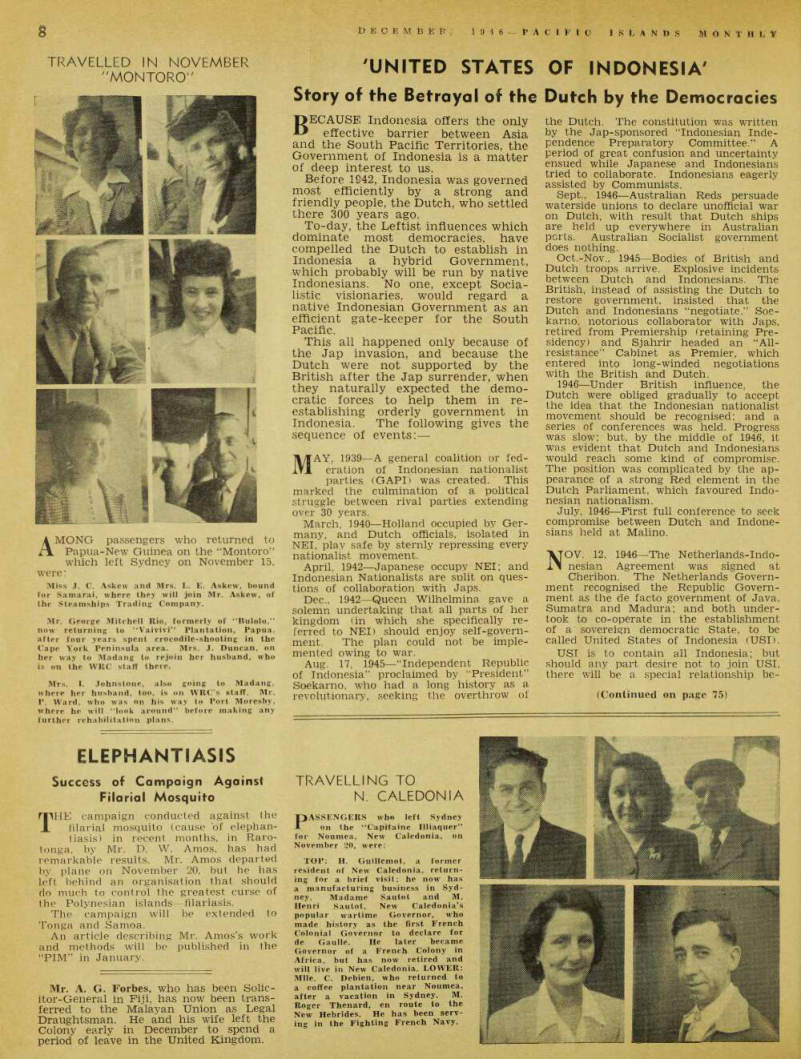
Travelled In November
AMONG passengers who returned to Papua-New Guinea on the “Montoro” which left Sydney on November 15, were: Miss J. C. Askew and Mrs. L. E. Askew, bound for Samarai, where they will join Mr. Askew, of the Steamships Trading Company.
Mr. George Mitchell Rio, formerly of “Bulolo,” now returning to “Vaivivi” Plantation, Papua, after four years spent crocodile-shooting in the Cape York Peninsula area. Mrs. J. Duncan, on her way to Madang to rejoin her husband, who is on the WRC staff there.
Mrs. I. Johnstone, also going to Madang, where her husband, too. is on WRC's staff. Mr.
P. Ward, who was on his way to Port Moresby, where he will “look around” before making any further rehabilitation plans.
Elephantiasis
Success of Campaign Against Filarial Mosquito
11HE campaign conducted against the filarial mosquito (cause of elephan tiasis) in recent months, in Raro tonga. by Mr. D. W. Amos, has had remarkable results, Mr. Amos departed by plane on November 20, but he has left behind an organisation that should do much to control the greatest curse of the Polynesian islands —filariasis.
The campaign will be extended to Tonga and Samoa.
An article describing Mr. Amos’s work and methods will be published in the “PIM” in January.
Mr. A. G. Forbes, who has been Solic itor-General in Fiji, has now been trans ferred to the Malayan Union as Legal Draughtsman. He and his wife left the Colony early in December to spend a period of leave in the United Kingdom.
Travelling To
N. Caledonia
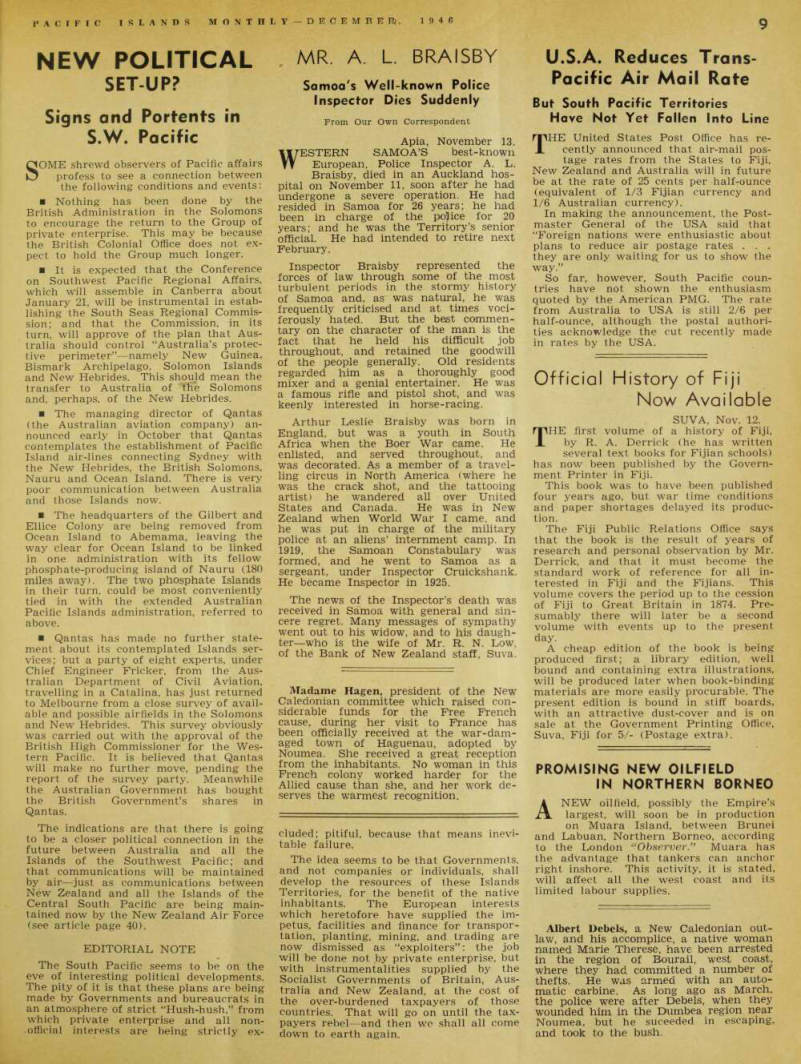
PASSENGERS who left Sydney on the “Capitaine Illiaquer” for Noumea, New Caledonia, on November 20, were; TOP: H. Guillemot, a former resident of New Caledonia, return ing for a brief visit; he now has a manufacturing business in Syd ney. Madame Sautot and M.
Henri Sautot, New Caledonia’s popular wartime Governor, who made history as the first French Colonial Governor to declare for dc Gaulle. He later became Governor of a French Colony in Africa, but has now retired and will live in New Caledonia. LOWER: Mile. C. Debien, who returned to a coffee plantation near Noumea, after a vacation in Sydney. M.
Roger Thenard, en route to the New Hebrides. He has been serv ing in the Fighting French Navy.
'United States Of Indonesia'
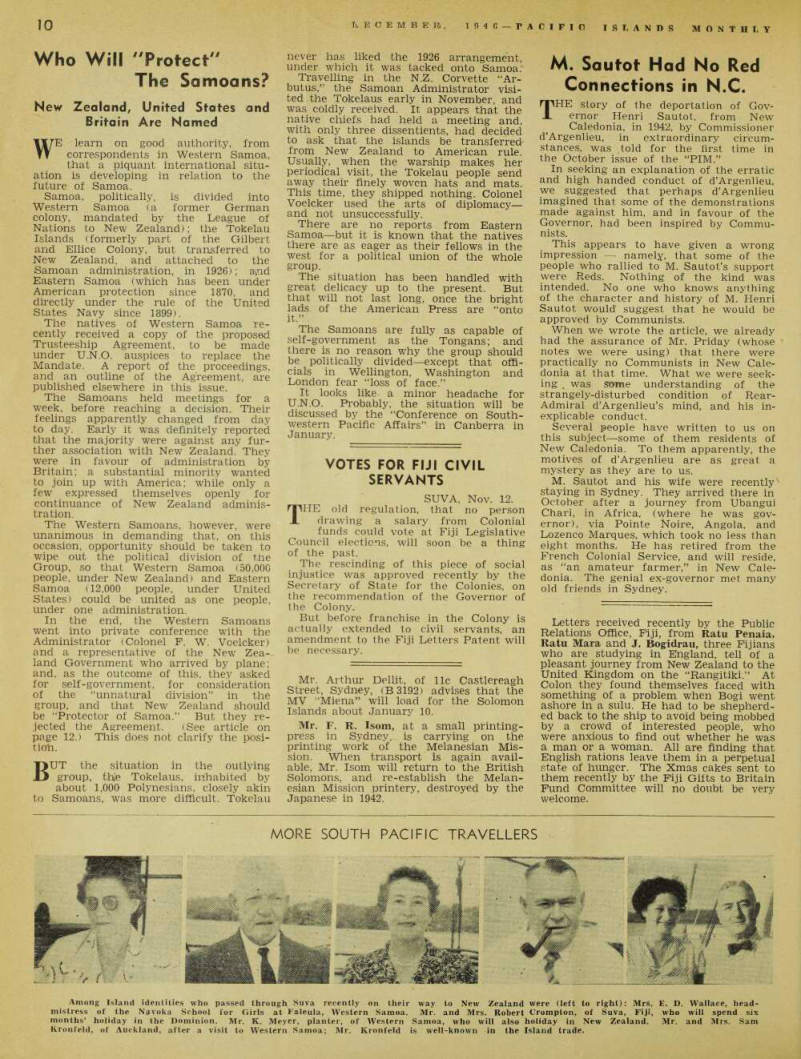
Story of the Betrayal of the Dutch by the Democracies
BECAUSE Indonesia offers the only effective barrier between Asia and the South Pacific Territories, the Government of Indonesia is a matter of deep interest to us.
Before 1842, Indonesia was governed most efficiently by a strong and friendly people, the Dutch, who settled there 300 years ago.
To-day, the Leftist influences which dominate most democracies, have compelled the Dutch to establish in Indonesia a hybrid Government, which probably will be run by native Indonesians. No one, except Socia listic visionaries, would regard a native Indonesian Government as an efficient gate-keeper for the South Pacific.
This all happened only because of the Jap invasion, and because the Dutch were not supported by the British after the Jap surrender, when they naturally expected the demo cratic forces to help them in re establishing orderly government in Indonesia. The following gives the sequence of events: — MAY, 1939 —A general coalition or fed eration of Indonesian nationalist parties (GAP!) was created. This marked the culmination of a political struggle between rival parties extending over 30 years.
March, 1940—Holland occupied by Ger many, and Dutch officials, isolated in NEI, play safe by sternly repressing every nationalist movement.
April, 1942 —Japanese occupy NEI; and Indonesian Nationalists are split on ques tions of collaboration with Japs.
Dec., 1942—Queen Wilhelmina gave a solemn undertaking that all parts of her kingdom (in which she specifically re ferred to NEI) should enjoy self-govern ment. The plan could not be imple mented owing to war.
Aug. 17, 1945 —“Independent Republic of Indonesia” proclaimed by “President”
Soekarno. who had a long history as a revolutionary, seeking the overthrow of
the Dutch. The constitution was written by the Jap-sponsored “Indonesian Inde pendence Preparatory Committee.” A period of great confusion and uncertainty ensued while Japanese and Indonesians tried to collaborate. Indonesians eagerly assisted by Communists.
Sept., 1946—Australian Reds persuade waterside unions to declare unofficial war on Dutch, with result that Dutch ships are held up everywhere in Australian ports. Australian Socialist government does nothing.
Oct.-Nov., 1945—Bodies of British and Dutch troops arrive. Explosive incidents between Dutch and Indonesians. The British, instead of assisting the Dutch to restore government, insisted that the Dutch and Indonesians “negotiate.” Soe karno, notorious collaborator with Japs, retired from Premiership (retaining Pre sidency) and Sjahrir headed an “All resistance” Cabinet as Premier, which entered into long-winded negotiations with the British and Dutch. 1946 —Under British influence, the Dutch were obliged gradually to accept the idea that the Indonesian nationalist movement should be recognised; and a series of conferences was held. Progress was slow; but, by the middle of 1946, it was evident that Dutch and Indonesians would reach some kind of compromise.
The position was complicated by the ap pearance of a strong Red element in the Dutch Parliament, which favoured Indo nesian nationalism.
July, 1946—First full conference to seek compromise between Dutch and Indone sians held at Malino.
NOV. 12, 1946—The Netherlands-Indo nesian Agreement was signed at Cheribon. The Netherlands Govern ment recognised the Republic Govern ment as the de facto government of Java, Sumatra and Madura; and both under took to co-operate in the establishment of a sovereign democratic State, to be called United States of Indonesia (USD.
USI is to contain all Indonesia; but should any part desire not to join USI, there will be a special relationship be
(Continued on page 75)
tween it and the Netherlands Kingdom.
Subject to that, the States of USI are; Republic of Indonesia, Borneo and Great East The Kingdom of the Netherlands, the United States of Indonesia, Surinam and Curacao will become the Nether lands-Indonesian Union. The Union will have its own organisation to deal with matters affecting all States in common —foreign affairs, defence, finance, and so forth. The King or Queen of the Neth erlands will be the head of the Union; and both Netherlands and USI will ap point High Commissioners at the other’s capital. It is planned to establish both USI and the Union before January 1. 1949.
The remainder of the agreement makes
provision for its implementation.
Immediately after the signing, “cease fire’’ orders were given everywhere and measures of rehabilitation (restoration of railways, repair of oil installations, etc.) were undertaken.
Nov. 29—Last of British troops depart.
Officially announced that bv end of year Dutch troops will number 47,000.
November, 1946 —Announced that Soe karno. Republican “President” and In donesia’s most influential man, is ill and will not live long.
Dec. 2. 1946 —The “cease fire” order has not been generallv observed. Sham clashes have occurred between Dutch and Indonesian troops. The Dutch C.-in-C. savs the military situation is steadilv deteriorating. The Dutch claim that there is now no truce.
December 7. 1946 —Conference in Bali to create political structure for Great East.
Dec. 10, 1946—Dutch Cabinet approved the Agreement, which will go before the Dutch Parliament for acceptance. The Dutch people are reported to be “con fused and unhappy about Indonesia.”
Advertisements & other items, p. 10 (1 item)
8
1) IS CEM B E P 1946 PACIFIC ISLANDS M6KI H L t
New Political
Set-Up?
Signs and Portents in S.W. Pacific
SOME shrewd observers of Pacific affairs profess to see a connection between the following conditions and events; ■ Nothing has been done by the British Administration in the Solomons to encourage the return to the Group of private enterprise. This may be because the British Colonial Office does not ex pect to hold the Group much longer. ■ It is expected that the Conference on Southwest Pacific Regional Affairs, which will assemble in Canberra about January 21, will be instrumental in estab lishing the South Seas Regional Commis sion; and that the Commission, in its turn, will approve of the plan that Aus tralia should control “Australia’s protec tive perimeter”—namely New Guinea, Bismark Archipelago, Solomon Islands and New Hebrides. This should mean the transfer to Australia of the Solomons and, perhaps, of the New Hebrides, ■ The managing director of Qantas (the Australian aviation company) an nounced early in October that Qantas contemplates the establishment of Pacific Island air-lines connecting Sydney with the New Hebrides, the British Solomons, Nauru and Ocean Island. There is very poor communication between Australia and those Islands now. ■ The headquarters of the Gilbert and Ellice Colony are being removed from Ocean Island to Abemama, leaving the way clear for Ocean Island to be linked in one administration with its fellow phosphate-producing island of Nauru (180 miles away). The two phosphate Islands in their turn, could be most conveniently tied in with the extended Australian Pacific Islands administration, referred to above. ■ Qantas has made no further state ment about its contemplated Islands ser vices; but a party of eight experts, under Chief Engineer Fricker, from the Aus tralian Department of Civil Aviation, travelling in a Catalina, has just returned to Melbourne from a close survey of avail able and possible airfields in the Solomons and New Hebrides. This survey obviously was carried out with the approval of the British High Commissioner for the Wes tern Pacific. It is believed that Qantas will make no further move, pending the report of the survey party. Meanwhile the Australian Government has bought the British Government’s shares in Qantas.
The indications are that there is going to be a closer political connection in the future between Australia and all the Islands of the Southwest Pacific; and that communications will be maintained by air—just as communications between New Zealand and all the Islands of the Central South Pacific are being main tained now by the New Zealand Air Force (see article page 40).
Editorial Note
The South Pacific seems to be on the eve of interesting political developments.
The pity of it is that these plans are being made by Governments and bureaucrats in an atmosphere of strict “Hush-hush,” from which private enterprise and all non official interests are being strictly ex
eluded; pitiful, because that means inevi table failure.
The idea seems to be that Governments, and not companies or individuals, shall develop the resources of these Islands Territories, for the benefit of the native inhabitants. The European interests which heretofore have supplied the im petus, facilities and finance for transpor tation, planting, mining, and trading are now dismissed as “exploiters”; the job will be done not by private enterprise, but with instrumentalities supplied by the Socialist Governments of Britain, Aus tralia and New Zealand, at the cost of the over-burdened taxpayers of those countries. That will go on until the tax payers rebel —and then we shall all come down to earth again.
Mr. A. L. Braisby
Samoa's Well-known Police Inspector Dies Suddenly
From Our Own Correspondent Apia, November 13.
WESTERN SAMOA’S best-known European, Police Inspector A. L.
Braisby, died in an Auckland hos pital on November 11, soon after he had undergone a severe operation. He had resided in Samoa for 26 years; he had been in charge of the police for 20 years; and he was the Territory’s senior official. He had intended to retire next February.
Inspector Braisby represented the forces of law through some of the most turbulent periods in the stormy history of Samoa and, as was natural, he was frequently criticised and at times voci ferously hated. But the best commen tary on the character of the man is the fact that he held his difficult job throughout, and retained the goodwill of the people generally. Old residents regarded him as a thoroughly good mixer and a genial entertainer. He was a famous rifle and pistol shot, and was keenly interested in horse-racing.
Arthur Leslie Braisby was born in England, but was a youth in South Africa when the Boer War came. He enlisted, and served throughout, and was decorated. As a member of a travel ling circus in North America (where he was the crack shot, and the tattooing artist) he wandered all over United States and Canada. He was in New Zealand when World War I came, and he was put in charge of the military police at an aliens’ internment camp. In 1919, the Samoan Constabulary was formed, and he went to Samoa as a sergeant, under Inspector Cruickshank.
He became Inspector in 1925, The news of the Inspector’s death was received in Samoa with general and sin cere regret. Many messages of sympathy went out to his widow, and to his daugh ter—who is the wife of Mr. R. N. Low, of the Bank of New Zealand staff, Suva.
Madame Hagen, president of the New Caledonian committee which raised con siderable funds for the Free French cause, during her visit to France has been officially received at the war-dam aged town of Haguenau, adopted by Noumea. She received a great reception from the inhabitants. No woman in this French colony worked harder for the Allied cause than she, and her work de serves the warmest recognition.
U.S.A. Reduces Trans-
Pacific Air Mail Rate But South Pacific Territories Have Not Yet Fallen Into Line
THE United States Post Office has re cently announced that air-mail pos tage rates from the States to Fiji, New Zealand and Australia will in future be at the rate of 25 cents per half-ounce (equivalent of 1/3 Fijian currency and 1/6 Australian currency).
In making the announcement, the Post master General of the USA said that “Foreign nations were enthusiastic about plans to reduce air postage rates . . . they are only waiting for us to show the way.”
So far, however. South Pacific coun tries have not shown the enthusiasm quoted by the American PMG. The rate from Australia to USA is still 2/6 per half-ounce, although the postal authori ties acknowledge the cut recently made in rates by the USA,
Official History of Fiji
Now Available
Suva, Nov. 12.
THE first volume of a history of Fiji, by R. A. Derrick (he has written several text books for Fijian schools) has now been published by the Govern ment Printer in Fiji.
This book was to have been published four years ago, but war time conditions and paper shortages delayed its produc tion.
The Fiji Public Relations Office says that the book is the result of years of research and personal observation by Mr.
Derrick, and that it must become the standard work of reference for all in terested in Fiji and the Fijians. This volume covers the period up to the cession of Fiji to Great Britain in 1874. Pre sumably there will later be a second volume with events up to the present day.
A cheap edition of the book is being produced first; a library edition, well bound and containing extra illustrations, will be produced later when book-binding materials are more easily procurable. The present edition is bound in stiff boards, with an attractive dust-cover and is on sale at the Government Printing Office, Suva, Fiji for 5/- (Postage extra).
Promising New Oilfield
In Northern Borneo
ANEW oilfield, possibly the Empire’s largest, will soon be in production on Muara Island, between Brunei and Labuan, Northern Borneo, according to the London “Observer.” Muara has the advantage that tankers can anchor right inshore. This activity, it is stated, will affect all the west coast and its limited labour supplies.
Albert Debels, a New Caledonian out law, and his accomplice, a native woman named Marie Therese, have been arrested in the region of Bourail, west coast, where they had committed a number of thefts. He was armed with an auto matic carbine. As long ago as March, the police were after Debels, when they wounded him in the Dumbea region near Noumea, but he suceeded in escaping, and took to the bush.
The Samoans?
Who Will "Protect"
New Zealand, United States and Britain Are Named
WE learn on good authority, from correspondents in Western Samoa, that a piquant international situ ation is developing in relation to the future of Samoa.
Samoa, politically, is divided into Western Samoa (a former German colony, mandated by the League of Nations to New Zealand); the Tokelau Islands (formerly part of the Gilbert and Ellice Colony, but transferred to New Zealand, and attached to the Samoan administration, in 1926); a v nd Eastern Samoa (which has been under American protection since 1870, and directly under the rule of the United States Navy since 1899).
The natives of Western Samoa re cently received a copy of the proposed Trusteeship Agreement, to be made under U.N.O. auspices to replace the Mandate. A report of the proceedings, and an outline of the Agreement, are published elsewhere in this issue.
The Samoans held meetings for a week, before reaching a decision. Their feelings apparently changed from day to day. Early it was definitely reported that the majority were against any fur ther association with New Zealand. They were in favour of administration by Britain; a substantial minority wanted to join up with America; while only a few expressed themselves openly for continuance of New Zealand adminis tration.
The Western Samoans, however, were unanimous in demanding that, on this occasion, opportunity should be taken to wipe out the political division of the Group, so that Western Samoa (50,000 people, under New Zealand) and Eastern Samoa (12,000 people, under United States) could be united as one people, under one administration.
In the end, the Western Samoans went into private conference with the Administrator (Colonel F. W. Voelcker) and a representative of the New Zea land Government who arrived by plane; and, as the outcome of this, they asked for self-government, for consideration of the “unnatural division” in the group, and that New Zealand should be “Protector of Samoa.” But they re jected the Agreement. (See article on page 12.) This does not clarify the posi tion.
BUT the situation in the outlying group, th'e Tokelaus, inhabited by about 1,000 Polynesians, closely akin to Samoans, was more difficult. Tokelau
never has liked the 1926 arrangement, under which it was tacked onto Samoa.
Travelling in the N.Z. Corvette “Ar butus,” the Samoan Administrator visi ted the Tokelaus early in November, and was coldly received. It appears that the native chiefs had held a meeting and, with only three dissentients, had decided to ask that the islands be transferred from New Zealand to American rule.
Usually, when the warship makes her periodical visit, the Tokelau people send away their finely woven hats and mats.
This time, they shipped nothing. Colonel Voelcker used the arts of diplomacy— and not unsuccessfully.
There are no reports from Eastern Samoa—but it is known that the natives there are as eager as their fellows in the west for a political union of the whole group.
The situation has been handled with great delicacy up to the present. But that will not last long, once the bright lads of the American Press are “onto it.”
The Samoans are fully as capable of self-government as the Tongans; and there is no reason why the group should be politically divided—except that offi cials in Wellington, Washington and London fear “loss of face.”
It looks like a minor headache for U.N.O. Probably, the situation will be discussed by the “Conference on South western Pacific Affairs” in Canberra in January,
Votes For Fiji Civil
Servants
Suva, Nov. 12.
THE old regulation, that no person drawing a salary from Colonial funds could vote at Fiji Legislative Council elections, will soon be a thing of the past.
The rescinding of this piece of social injustice was approved recently by the Secretary of State for the Colonies, on the recommendation of the Governor of the Colony.
But before franchise in the Colony is actually extended to civil servants, an amendment to the Fiji Letters Patent will be necessary.
Mr. Arthur Dellit, of 11c Castlereagh Street, Sydney, (83192) advises that the MV “Miena” will load for the Solomon Islands about January 10.
Mr. F. R. Isom, at a small printing press in Sydney, is carrying on the printing work of the Melanesian Mis sion. When transport is again avail able, Mr. Isom will return to the British Solomons, and re-establish the Melan esian Mission printery, destroyed by the Japanese in 1942.
M. Sautot Had No Red
Connections in N.C.
THE story of the deportation of Gov ernor Henri Sautot, from New Caledonia, in 1942, by Commissioner d’Argenlieu, in extraordinary circum stances, was told for the first time in the October issue of the “PIM.”
In seeking an explanation of the erratic and high handed conduct of d’Argenlieu, we suggested that perhaps d’Argenlieu imagined that some of the demonstrations made against him, and in favour of the Governor, had been inspired by Commu nists.
This appears to have given a wrong impression namely, that some of the people who rallied to M. Sautot’s support were Reds. Nothing of the kind was intended. No one who knows anything of the character and history of M. Henri Sautot would suggest that he would be approved by Communists.
When we wrote the article, we already had the assurance of Mr. Friday (whose notes we were using) that there were practically no Communists in New Cale donia at that time. What we were seek ing , was some understanding of the strangely-disturbed condition of Rear- Admiral d’Argenlieu’s mind, and his in explicable conduct.
Several people have written to us on this subject—some of them residents of New Caledonia. To them apparently, the motives of d’Argenlieu are as great a mystery as they are to us.
M. Sautot and his wife were recently N staying in Sydney. They arrived there in October after a journey from Übangui Chari, in Africa, (where he was gov ernor), via Pointe Noire, Angola, and Lozenco Marques, which took no less than eight months. He has retired from the French Colonial Service, and will reside, as “an amateur farmer,” in New Cale donia. The genial ex-governor met many old friends in Sydney.
Letters received recently by the Public Relations Office, Fiji, from Ratu Penaia, Ratu Mara and J. Bogidrau, three Fijians who are studying in Ehgland, tell of a pleasant journey from New Zealand to the United Kingdom on the “Rangitiki.” At Colon they found themselves faced with something of a problem when Bogi went ashore in a sulu. He had to be shepherd ed back to the ship to avoid being mobbed by a crowd of interested people, who were anxious to find out whether he was a man or a woman. All are finding that English rations leave them in a perpetual state of hunger. The Xmas cakes sent to them recently by the Fiji Gifts to Britain Fund Committee will no doubt be very welcome.
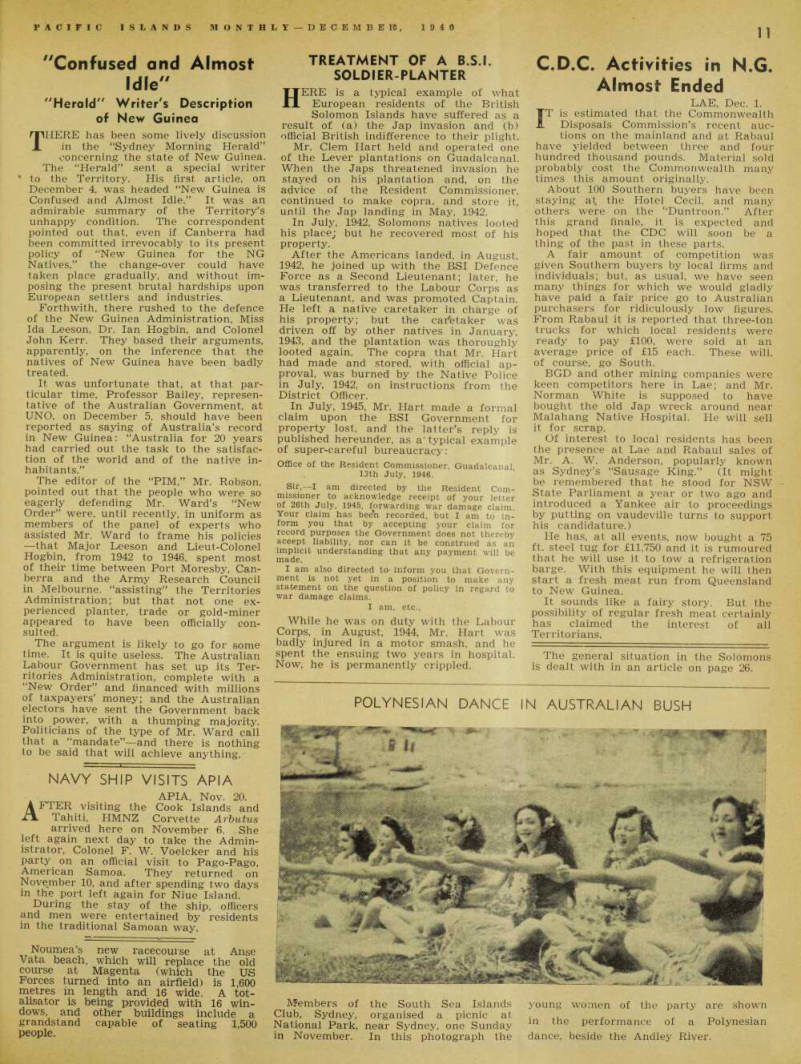
More South Pacific Travellers
Among Island identities who passed through Suva recently on their way to New Zealand were (left to right): Mrs. E. D. Wallace, head mistress of the School for Girls at Faleula, Western Samoa. Mr. and Mrs. Robert Crompton, of Suva, Fiji, who will spend six months’ holiday in the Dominion. Mr. K. Meyer, planter, of Western Samoa, who will also holiday in New Zealand. Mr. and Mrs. Sam Kronfeld, of Auckland, after a visit to Western Samoa; Mr. Kronfeld is well-known in the Island trade.
"Confused and Almost
Idle"
"Herald" Writer's Description of New Guinea
THERE has been some lively discussion in the “Sydney Morning Herald” concerning the state of New Guinea.
The “Herald” sent a special writer : to the Territory. His first article, on December 4, was headed “New Guinea is Confused and Almost Idle.” It was an admirable summary of the Territory’s unhappy condition. The correspondent pointed out that, even if Canberra had been committed irrevocably to its present policy of “New Guinea for the NG Natives,” the change-over could have taken place gradually, and without im posing the present brutal hardships upon European settlers and industries.
Forthwith, there rushed to the defence of the New Guinea Administration, Miss Ida Leeson, Dr. lan Hogbin, and Colonel John Kerr. They based their arguments, apparently, on the inference that the natives of New Guinea have been badly treated.
It was unfortunate that, at that par ticular time, Professor Bailey, represen tative of the Australian Government, at UNO, on December 5, should have been reported as saying of Australia’s record in New Guinea: “Australia for 20 years had carried out the task to the satisfac tion of the world and of the native in habitants.”
The editor of the “PIM,” Mr. Robson, pointed out that the people who were so eagerly defending Mr. Ward’s “New Order” were, until recently, in uniform as members of the panel of experts who assisted Mr. Ward to frame his policies —that Major Leeson and Lieut-Colonel Hogbin, from 1942 to 1946, spent most of their time between Port Moresby, Can berra and the Army Research Council in Melbourne, “assisting” the Territories Administration; but that not one ex perienced planter, trade or gold-miner appeared to have been officially con sulted.
The argument is likely to go for some time. It is quite useless. The Australian Labour Government has set up its Ter ritories Administration, complete with a “New Order” and financed with millions of taxpayers’ money; and the Australian electors have sent the Government back into power, with a thumping majority.
Politicians of the type of Mr. Ward call that a “mandate”—and there is nothing to be said that will achieve anything.
Navy Ship Visits Apia
A Apia, Nov. 20.
FTER visiting the Cook Islands and Tahiti, HMNZ Corvette Arbutus arrived here on November 6. She left again next day to take the Admin istrator, Colonel F. W. Voelcker and his party on an official visit to Pago-Pago, American Samoa. They returned on November 10, and after spending two days in the port left again for Niue Island.
During the stay of the ship, officers and men were entertained by residents in the traditional Samoan way.
Noumea’s new racecourse at Anse Vata beach, which will replace the old course at Magenta (which the US Forces turned into an airfield) is 1,600 metres in length and 16 wide. A tot ahsator is being provided with 16 win dows, and other buildings include a grandstand capable of seating 1,500 people.
Treatment Of A B.S.I.
Soldier-Planter
HERE is a typical example of what European residents of the British Solomon Islands have suffered as a result of (a) the Jap invasion and (b) official British indifference to their plight.
Mr. Clem Hart held and operated one of the Lever plantations on Guadalcanal.
When the Japs threatened invasion he stayed on his plantation and, on the advice of the Resident Commissioner, continued to make copra, and store it, until the Jap landing in May, 1942.
In July, 1942, Solomons natives looted his place; but he recovered most of his property.
After the Americans landed, in August. 1942, he joined up with the BSI Defence Force as a Second Lieutenant; later, he was transferred to the Labour Corps as a Lieutenant, and was promoted Captain.
He left a native caretaker in charge of his property; but the caretaker was driven off by other natives in January, 1943, and the plantation was thoroughly looted again. The copra that Mr. Hart had made and stored, with official ap proval, was burned by the Native Police in July, 1942, on instructions from the District Officer.
In July, 1945, Mr. Hart made a formal claim upon the BSI Government for property lost, and the latter’s reply is published hereunder, as a'typical example of super-careful bureaucracy: Office of the Resident Commissioner, Guadalcanal 13th July, 1946.
Sir,—l am directed by the Resident Com missioner to acknowledge receipt of your letter of 26th July, 1945, forwarding war damage claim.
Your claim has been recorded, but I am to in form you that by accepting your claim for record purposes the Government does not thereby accept liability, nor can it be construed as an implicit understanding that any payment will be made.
I am also directed to' inform you that Govern ment is not yet in a position to make any statement on the question of policy in regard to war damage claims.
I am, etc., While he was on duty with the Labour Corps, in August, 1944, Mr. Hart was badly injured in a motor smash, and he spent the ensuing two years in hospital.
Now, he is permanently crippled.
C.D.C. Activities in N.G.
Almost Ended
LAE, Dec. 1.
IT is estimated that the Commonwealth Disposals Commission’s recent auc tions on the mainland and at Rabaul have yielded between three and four hundred thousand pounds. Material sold probably cost the Commonwealth many times this amount originally.
About 100 Southern buyers have been staying at the Hotel Cecil, and many others were on the “Duntroon.” After this grand finale, it is expected and hoped that the CDC will soon be a thing of the past in these parts.
A fair amount of competition was given Southern buyers by local firms and individuals; but, as usual, we have seen many things for which we would gladly have paid a fair price go to Australian purchasers for ridiculously low figures.
From Rabaul it is reported that three-ton trucks for which local residents were ready to pay £lOO, were sold at an average price of £l5 each. These will, of course, go South.
BCD and other mining companies were keen competitors here in Lae; and Mr.
Norman White is supposed to have bought the old Jap wreck around near Malahang Native Hospital. He will sell it for scrap.
Of interest to local residents has been the presence at Lae and Rabaul sales of Mr. A. W. Anderson, popularly known as Sydney’s “Sausage King.” (It might be remembered that he stood for NSW State Parliament a year or two ago and introduced a Yankee air to proceedings by putting on vaudeville turns to support his candidature.) He has, at all events, now bought a 75 ft. steel tug for £11,750 and it is rumoured that he will use it to tow a refrigeration barge. With this equipment he will then start a fresh meat run from Queensland to New Guinea.
It sounds like a fairy story. But the possibility of regular fresh meat certainly has claimed the interest of all Territorians.
The general situation in the Solomons is dealt with in an article on page 26.
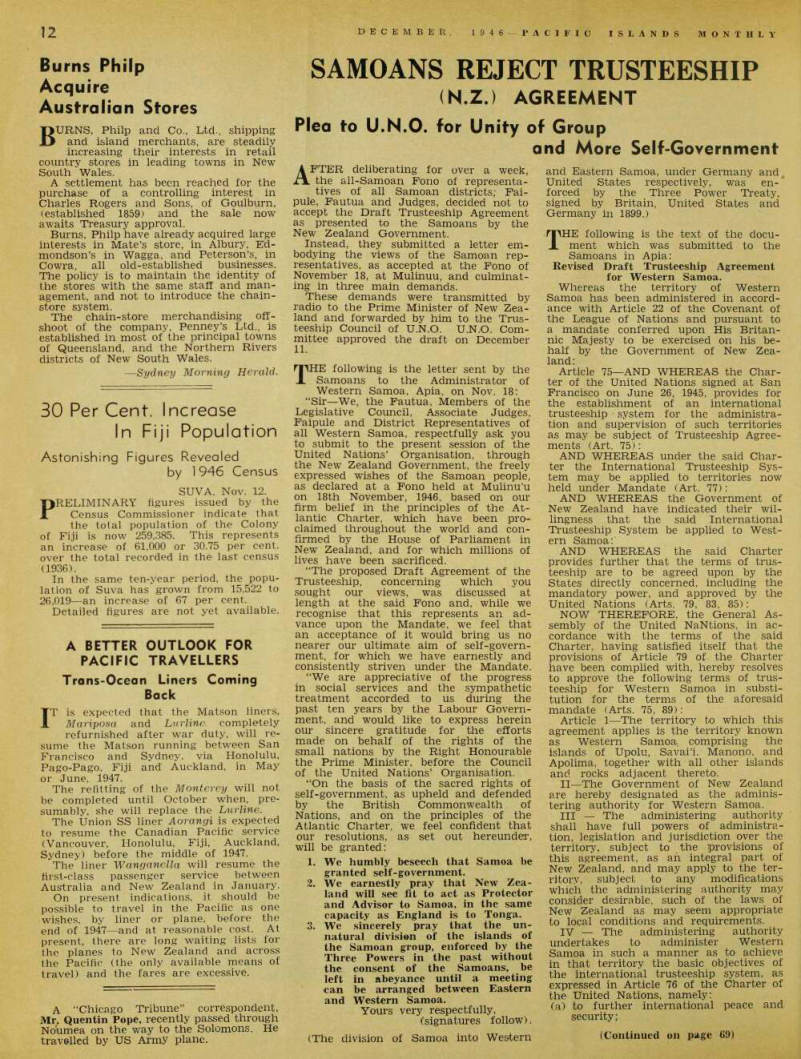
Polynesian Dance In Australian Bush
Members of the South Sea Islands Club, Sydney, organised a picnic at National Park, near Sydney, one Sunday in November. In this photograph the
young women of the party are shown in the Performance of a Polynesian dance, beside the Andley River.
Acquire
Burns Philp Acquire Australian Stores
BURNS, Philp and Co., Ltd., shipping and island merchants, are steadily increasing their interests in retail country stores in leading towns in New South Wales.
A settlement has been reached for the purchase of a controlling interest in Charles Rogers and Sons, of Goulburn, (established 1859) and the sale now awaits Treasury approval.
Burns, Philp have already acquired large interests in Mate’s store, in Albury, Ed mondson’s in Wagga, and Peterson’s, in Cowra, all old-established businesses.
The policy is to maintain the identity of the stores with the same staff and man agement, and not to introduce the chain store system.
The chain-store merchandising off shoot of the company, Penney’s Ltd., is established in most of the principal towns of Queensland, and the Northern Rivers districts of New South Wales. —Sydney Morning Herald.
In Fiji Population
30 Per Cent. Increase In Fiji Population Astonishing Figures Revealed by 1946 Census
Suva, Nov. 12.
PRELIMINARY figures issued by the Census Commissioner indicate that the total population of the Colony of Fiji is now 259,385. This represents an increase of 61,000 or 30.75 per cent, over the total recorded in the last census (1936).
In the same ten-year period, the popu lation of Suva has grown from 15,522 to 26,019 —an increase of 67 per cent.
Detailed figures are not yet available.
A Better Outlook For
Pacific Travellers
Trans-Ocean Liners Coming Back
IT is expected that the Matson liners, Mariposa and Lurline completely refurnished after war duty, will re sume the Matson running between San Francisco and Sydney, via Honolulu.
Pago-Pago, Fiji and Auckland, in May or June, 1947.
The refitting of the Monterey will not be completed until October when, pre sumably, she will replace the Lurline.
The Union SS liner Aorangi is expected to resume the Canadian Pacific service (Vancouver, Honolulu, Fiji, Auckland, Sydney) before the middle of 1947.
The liner Wanganella will resume the tirst-class passenger service between Australia and New Zealand in January.
On present indications, it should be possible to travel in the Pacific as one wishes, by liner or plane, before the end of 1947 —and at reasonable cost. At present, there are long waiting lists for the planes to New Zealand and across the Pacific (the only available means of travel) and the fares are excessive.
A “Chicago Tribune” correspondent, Mr. Quentin Pope, recently passed through Noumea on the way to the Solomons. He travelled by US Army plane.
Samoans Reject Trusteeship

(N.Z.) Agreement
Plea to U.N.O. for Unity of Group and More Self-Government
AFTER deliberating for over a week, the all-Samoan Fono of representa tives of all Samoan districts, Fai pule, Fautua and Judges, decided not to accept the Draft Trusteeship Agreement as presented to the Samoans by the New Zealand Government.
Instead, they submitted a letter em bodying the views of the Samoan rep resentatives, as accepted at the Fono of November 18, at Mulinuu, and culminat ing in three main demands.
These demands were transmitted by radio to the Prime Minister of New Zea land and forwarded by him to the Trus teeship Council of U.N.O. U.N.O. Com mittee approved the draft on December 11.
THE following is the letter sent by the Samoans to the Administrator of Western Samoa, Apia, on Nov. 18: “Sir —We, the Fautua, Members of the Legislative Council, Associate Judges, Faipule and District Representatives of all Western Samoa, respectfully ask you to submit to the present session of the United Nations’ Organisation, through the New Zealand Government, the freely expressed wishes of the Samoan people, as declared at a Fono held at Mulinu’u on 18th November, 1946, based on our firm belief in the principles of the At lantic Charter, which have been pro claimed throughout the world and con firmed by the House of Parliament in New Zealand, and for which millions of lives have been sacrificed.
“The proposed Draft Agreement of the Trusteeship, concerning which you sought our views, was discussed at length at the said Fono and, while we recognise that this represents an ad vance upon the Mandate, we feel that an acceptance of it would bring us no nearer our ultimate aim of self-govern ment, for which we have earnestly and consistently striven under the Mandate.
“We are appreciative of the progress in social services and the sympathetic treatment accorded to us during the past ten years by the Labour Govern ment, and would like to express herein our sincere gratitude for the efforts made on behalf of the rights of the small nations by the Right Honourable the Prime Minister, before the Council of the United Nations’ Organisation.
“On the basis of the sacred rights of self-government, as upheld and defended by the British Commonwealth of Nations, and on the principles of the Atlantic Charter, we feel confident that our resolutions, as set out hereunder, will be granted: 1. We humbly beseech that Samoa be granted self-government. 2. We earnestly pray that New Zea land will see fit to act as Protector and Advisor to Samoa, in the same capacity as England is to Tonga. 3. We sincerely pray that the un natural division of the islands of the Samoan group, enforced by the Three Powers in the past without the consent of the Samoans, be left in abeyance until a meeting can be arranged between Eastern and Western Samoa.
Yours very respectfully,
(signatures follow).
(The division of Samoa into Western
and Eastern Samoa, under Germany and United States respectively, was en forced by the Three Power Treaty, signed by Britain, United States and Germany in 1899.) THE following is the text of the docu ment which was submitted to the Samoans in Apia: Revised Draft Trusteeship Agreement for Western Samoa.
Whereas the territory of Western Samoa has been administered in accord ance with Article 22 of the Covenant of the League of Nations and pursuant to a mandate conferred upon His Britan nic Majesty to be exercised on his be half by the Government of New Zea land: Article 75—AND WHEREAS the Char ter of the United Nations signed at San Francisco on June 26, 1945, provides for the establishment of an international trusteeship - system for the administra tion and supervision of such territories as may be subject of Trusteeship Agree ments (Art. 75): AND WHEREAS under the said Char ter the International Trusteeship Sys tem may be applied to territories now held under Mandate (Art. 77): AND WHEREAS the Government of New Zealand have indicated their wil lingness that the said International Trusteeship System be applied to West ern Samoa: AND WHEREAS the said Charter provides further that the terms of trus teeship are to be agreed upon by the States directly concerned, including the mandatory power, and approved by the United Nations (Arts. 79, 83, 85): NOW THEREFORE, the General As sembly of the United NaNtions, in ac cordance with the terms of the said Charter, having satisfied itself that the provisions of Article 79 of the Charter have been complied with, hereby resolves to approve the following terms of trus teeship for Western Samoa in substi tution for the terms of the aforesaid mandate (Arts. 75, 89): Article I—The territory to which this agreement applies is the territory known as Western Samoa, comprising the islands of Upolu, Savai’i, Manono, and Apolima, together with all other islands and rocks adjacent thereto. ll—The Government of New Zealand are hereby designated as the adminis tering authority for Western Samoa. 11l The administering authority shall have full powers of administra tion, legislation and jurisdiction over the territory, subject to the provisions of this agreement, as ah integral part of New Zealand, and may apply to the ter ritory, subject to any modifications which the administering authority may consider desirable, such of the laws of New Zealand as may seem appropriate to local conditions and requirements.
IV The administering authority undertakes to administer Western Samoa in such a manner as to achieve in that territory the basic objectives of the international trusteeship system, as expressed in Article 76 of the Charter of the United Nations, namely: (a) to further international peace and security;
(Continued on page 69)
(b) to promote the political, economic, social and educational advancement of the inhabitants of the trust ter ritories, and their progressive de velopment towards self-government or independence as may be appro priate to the particular circum stances of each territory and its peoples and the freely expressed wishes of the peoples concerned, and as may be provided by the terms of each trusteeship agreement. (c) to encourage respect for human right and for fundamental freedom for all without distinction as to race, sex, language, or religion, and to encourage recognition of the interdependence of the- peoples of the world; and (d) to ensure equal treatment in social, economic, and commercial matters for all Members of the United Nations and their Nationals, and also equal treatment for the latter in the administration of justice, without prejudice to the attainment of the foregoing objectives and sub ject to the provisions of Article 80.”
V—The administering authority shall promote the development of political institutions suited to Western Samoa. To this end and as may be appropriate to the particular circumstances of the ter ritory and its peoples, the administering authority shall assure to the inhabitants of Western Samoa a progressively in creasing share in the administrative and other services of the territory, shall de velop the participation of the inhabit ants of Western Samoa in advisory and legislative bodies and in the government
of the territory, and shall take all other appropriate measures with a view to the political advancement of the inhabitants of Western Samoa in accordance with Article 76 (b) of the Charter of the United Nations. • Vl—ln pursuance of its undertaking to promote the social advancement of the inhabitants of the trust territory, and without in any way limiting its obli gations thereunder, the administering authority shall: (1) prohibit all forms of slavery and slave-trading: (2) prohibit all forms of forced or com pulsory labour, except for essential public works and services as speci fically authorised by the local ad ministration and then only in times of public emergency, with adequate remuneration and adequate protec tion of the welfare of the workers; (3) control the traffic in arms and am munition ; (4) control in the interest of the in habitants the manufacture, import ation and distribution of intoxicat ing spirits and beverages.
VII The administering authority undertakes to apply in Western Samoa the provisions of any international con ventions and recommendations as drawn up by the United Nations or its speci alised agencies which are, in the opinion of the administering authority appropri ate to the needs and conditions of the trust territory, and conducive to the achievement of the basic objectives of the international trusteeship system.
VIII —In framing the laws to be ap plied in Western Samoa the administer ing authority shall take into considera tion Samoan customs and usages and shall respect the rights and safeguard the interests, both present and future,
of the Samoan population. In particu lar, the laws relating to the holding of transfer of land shall ensure that no Native land may be transferred save
with the prior consent of the competent public authority and that no right over Native land in favour of any person not a Samoan may be created except with the same consent.
IX— The administering authority shall ensure in the territory freedom of con science and the free exercise of all forms of worship, and shall allow missionaries, nationals of any State member of the United Nations, to enter into, travel and reside in the territory for the purpose of prosecuting their calling. The provi sions of this Article shall not however, affect the right and duty of the admin istering authority to exercise such con trol as it may consider necessary for the maintenance of peace, order and good government.
X— The administering authority shall ensure that the trust territory of West ern Samoa shall play its part, in accord ance with the Charter of the United Nations, in the maintenance of inter national peace and security. To this end the administering authority shall be en titled: (1) to establish naval, military and air bases and to erect fortifications in the trust territory; (2) to station and employ armed forces in the territory; (3) to make use of volunteer forces, facilities and asistance from the trust territory in carrying out the obligations towards the Security Council undertaken in this regard by the administering authority, as well as for local defence and the maintenance of law and order with in the trust territory; (4) to take all such other measures in accordance with the purposes and principles of the Charter of the
United Nations as are in the opinion of the administering auth ority necessary to the maintenance of international peace and security and the defence of Western Samoa.
Xl The administering authority shall as may be appropriate to the circum stances of the trust territory, continue and extend a general system of educa tion, including post-primary education and professional training.
XII— Subject only to the requirements of public order, the administering auth ority shall guarantee to the inhabitants of the trust territory, freedom of speech, of the press, of assembly and of peti tion.
XIII— The administering authority may arrange for the co-operation of Western Samoa in any regional advisory commission, regional technical organi sation, or other voluntary association of states, any specialised international bodies, public or private, or other forms of international activity not inconsistent with the Charter of the United Nations.
XIV The administering authority shall make to the General Assembly of the United Nations an annual report on the basis of a questionnaire drawn up by the Trusteeship Council in accordance with the Charter of the United Nations the Trusteeship Council in the discharge and shall otherwise collaborate fully with the Trusteeship Council in the discharge of all the Council’s functions. The admin istering authority shall arrange to be represented at the Sessions of the Trus teeship Council at which the reports of the administering authority with regard to Western Samoa are considered. (Art. 88.) XV—The terms of this agreement shall not be altered or amended except as pro
vided in Article 79 of the Charter of the United Nations.
XVI—If any dispute should arise be tween the administering authority and another member of the United Nations, relating to the interpretation or applica tion of the provisions of this agreement, such dispute, if it cannot be settled by negotiations or similar means, shall be submitted to the International Court of Justice.
A Modern Sinbad Comes To Grief In Fiji
Wreck of the "Pagan" in the Lau Islands
Suva, Nov. 24.
BORN with itchy feet, John Caldwell, American, is at present here in Suva waiting for a ship to take him to Sydney and his wife who lives in that city. He has just survived a shipwreck on one of the Lau Islands when he was attempting to sail his 30 ft. cutter from Panama to Sydney.
Caldwell was trained as a school teacher; but, in 1940, he went to sea in the American Merchant Navy. In 1944, he had reached Sydney after calling at most ports in the old and new worlds and here he decided to join the RAAF.
He trained in Brisbane,- Dubbo, Canberra and Sydney i(in the course of which training he met his wife) but the war with Japan ended before he got to a battle area, and he was immediately sent back to sea by the United States War Shipping Administration. He visited in this way the Pacific Islands, Japan.
Manila, China and England and then found himself back in America again, “demobbed” and faced with the problem of getting himself back to Sydney, where his wife was still living.
As a step in the right direction, he went to Panama, and there was able to pur chase, from four Poles, the 30 ft. “Pagan,”
Mr. John Caldwell talks to Capt. J. R. Grey, planter from the Lau Group, and Mr. A. Lee, Vice-Commodore of the Suva Yacht Club.
which they had just sailed across the Atlantic.
In this ship Caldwell set off and hoped to make a non-stop run to Australia.
Weeks ran into months as he battled southwards through the Galpagos and Marquesas Groups, but he experienced little trouble until off the Northern Cooks, where the little ship met a hurricane.
The masts were ripped out of the bottom, the sextant was broken, the chronometer damaged and salt water ruined most of his drinking water and most of his food. After the blow had passed, Caldwell found that his boat was leaking badly and thenceforth most of his time was spent in ceaseless pumping.
Day by day, he grew weaker on his small ration of food and water. One
morning at the end of 21 days, he sighted the island of Tuvutha, in the centre of the Lau Group, eastward of Viti Levu.
Caldwell sailed around it, trying to find a passage through the reef; but he could not, and, fearful of losing the island altogether, he deliberately put his ship up on the reef and floated ashore on a life raft, to a little cove surrounded by high cliffs.
He was too weak to help himself further and he lay there for three days and nights, semi-conscious, and without food and water.
On the afternoon of the third day a party of Fijian children found him; but, evidently terrified by the bearded, gaunt man lying so helpless, they ran off. But that night four strong men appeared in a canoe, with palm-frond torches, and they carried him back to their village, about a mile distant.
Here, for almost three weeks, they cared for Caldwell and, after he began to recover they entertained him royally.
Then a small cutter called unexpectedly at the island, seeking shelter from bad
weather, and it took Caldwell across to Lomaloma, where he transhipped to Suva.
Caldwell’s only problem at present is how to get to Australia in time for Christmas.
Advertisements & other items, pp. 15-16 (1 item)
Burns Philp
THE
YORKSHIRE
INSURANCE
CO. LTD.
(Incorporated in England)
FIRE
ACCIDENT
MARINE
FIRE POLICIES ISSUED
IN PAPUA
All information from —
E. A. JAMES,
PORT MORESBY.
BURNS PHILP
(SOUTH SEA) CO. LTD.
Inc. In Fiji Registered Office
Island Traders and Shipowners
SUVA
F I J
Also Branches at: Levuka, Lautoka, Labasa, Ba, Sigatoka, Rotuma Tonga: Nukualofa, Haapai, Vavau.
Samoa: Apia, Pago Pago (American Samoa).
Solomons: Makambo, Gizo, Faisi.
New Hebrides: Vila.
Code Address: Gilberts: Tarawa.
Norfolk Is. Niue. Wallis Is. Futuna Is.
"Burnsouth*.
Sole Australian Concessionaries :
GEORGE BROWN Cr CO. PTY. LTD
267 Clarence Street, Sydney.
The Ultimate factory has made the change-over from its wartime set-up.
Designs for the new models are now completed and production is about to commence.
These models should be available early in 1946—they will be well worth waiting for. Watch for further announcements.
SERVICE: Servicing of all kinds of radio sets, amplifiers and Rola speakers will continue to be available.
EX-ARMY TAILORS
A. LATEEF & CO., Tailors and Manufacturers to Fiji Military Forces during the War period, are now in business in their own clothing factory and retail business in Renwick Road, Suva.
Tailoring requirements are given every attention, with quality materials and first-class workmanship.
The speciality of the Clothing- Factory is in mass-produced lines, such as shorts, shirts, sulus, pillow-slips, sheets, mosquito nets, etc.
This should be of interest to schools, hospitals, missions, etc., and particulars as to costs and quantities may be addressed to
A LATEEF & CO.. G.P.0., Box
227, SUVA.
Stromberg- Carlson DEALE i"?r UNCEI ’
WATCH FOR ANNOUNCEMENTS OF SOLE AGENTS
In the meantime write directly to Victor Hyde Sales) Service for particulars of the items listed below.
STROMBERG -CARLSON 5A46
model. A 5 valve Dual Wave A.C. receiver to meet tropic conditions—a “Civilian Amenities”—in a large beautiful wooden cabinet. AIR CIRCU- LATORS are available. WASH-
ING MACHINES, RADIO-
GRAMS, AUTOMATIC RE-
CORD CHANGERS and other electrical products will be available by next March.
MULTIPLO INCUBATORS AND BROODERS. Kerosene and electric available.
METRO BATTERIES. All types in limited quantities.
RELIDE WATCHES. Imported cases. Shockproof and waterproof.
PLEASE NOTE: Exclusive agents appointed only as stocks become available.
C ®^ f> T^ S fl L € S S6RVIC6 TELEPHONE:BWSIS7• SCOTTISH HOUSE# 19BRIDGE STREET• SYDNEY• AUSTRALIA Wk
Fiji Gift To Britain Fund
ACCORDING to a broadcast talk from Suva radio station in early Novem ber, by Lady Grantham, the Gifts to Britain Fund has already sent away 10,512 tins of pineapple, assorted fruit and fruit juices; 4,200 pounds of bacon; 70,840 two-pound bars of laundry soap; 24,000 cakes of toilet soap; 287 home made fruit cakes; the total cost of which was £4,217/15/2.
A further consignment of 109,944 tins of pineapple and fruit juices at a cost of £5,200, will go off shortly.
Lady Grantham thanked all those who had contributed to and worked for the Fund. It had been launched four months ago, she said, and the response had been overwhelming.
Legislative Council For Cook Islands
mHE following statement was made on J. August 2, in a letter from the Prime Minister of New Zealand to a resi dent of the Cook Islands: “You will have heard that during my recent visit to Rarotonga, I met repres entatives of the various Islands. With their concurrence it is proposed this year to ask Parliament to authorise two major changes, i.e.— “(1) That Islands Councils, while re taining Ariki as ex officio members, will also have freely elected mem bers. In total, throughout the Group, indications are that the elected members will be more nu merous than the ex-officio mem bers.
“(2) That, thereafter, the Islands Councils so constituted should elect from their own numbers the elected members of a Legislative
Council of the Cook Islands to be comprised partly of such elected members, and partly of official members.
“This plan for a Legislative Council and its constitution is based upon experience in many other parts of the British tropics, and there is no doubt from its operation elsewhere that it provides good means for representative expression of public opinion.”
As the New Zealand Government was returned to power in the general election on Novemjber 27, the foregoing may be regarded as a declaration of policy in relation to the future administration of the Cook Islands.
Closing date of tenders for the pur chase of the Fiji Government vessel “Viti” has been extended to December 16 in order that certain prospective purchasers may consider ways and means of altering the vessel to their requirements.
Mr. E. V. Crisp, who has been appointed Managing Director of Steamships Trad ing Co., Ltd., Papua, in succession to Captain A. S. Fitch, retired.
Advertisements & other items, p. 17 (1 item)
Hfirrt J. Tomnq
OND’S
NEW SEASON'S
FANCY
HALF-HOSE
Smart designs Attractive colours Comfort and quality m In the very latest fancy designs, showing all the good taste and quality which has always been a feature of Bonds productions. Illustrated here is a selection from the designs available. *
WHITE
MERCERISED
RK 155
HALF HOSE
i Specially designed to give comfort and coolness in I tropical heat, these socks have all the qualities for I which your customers have been waiting.
ORDER THROUGH YOUR USUAL CHANNELS: OR FROM Bonds' Sole Pacific Islands Selling Representative
HfIRRT J. TOMNQ
PIT. LTD.
POSTAL ADDRESS:
Box 3661 G.P.0., Sydney.
379 KENT STREET, SYDNEY,
BANKERS: BANK OF N.S.W.
CODES:
Bentley’s Comp.
Phrase.
Bentley’s 2nd Phrase.
Tourism
Fiji Plans For
ALTHOUGH faced with difficulties chief of which is hotel accommoda tion — Fiji is going ahead with plans for meeting an increased tourist traffic in the period immediately ahead.
A Fiji Publicity Board has been formed consisting of Mr. Alport Barker (chair man) and Messrs. H. H. Ragg, W. G.
Johnson, Govind (Indian Chamber of Commerce) C. A. Adams (Lautoka) and L. G. Usher (Public Relations Officer).
Mr. F. I. Ryan is secretary.
Its function is to - plan ahead in a general way for 4 tourists, as well as answer present inquiries from abroad from people who wish to either visit or settle in the Colony.
Something is already being done for travellers on the trans-Pacific air ser vices, who stop off for a whole day at Nadi, near Lautoka. At present, these passengers are accommodated in bures near the airport, and tourist trips and native entertainments are being arranged for them by Mr. Adams, of Lautoka, a member of the Publicity Board.
At Nadi, many buildings suitable for
conversion to tourist accomodation were left behind by the American and New Zealand forces. In Suva, the capital, however, there is a great and growing demand for accommodation. First class hotel accommmdation is available in Suva but there is much too little of it to cope with any increase in tourist traffic.
The Board at present is investigating the possibilities of moving some of the ex-military buildings to Suva. It is believed that many permanent residents of the town would be glad to vacate hotels and boarding houses where they now. live for this type of housing.
Notwithstanding Fiji’s accommo dation difficulties, the Colony, in comparison with other South Pacific territories, is in an excellent position in relation to tourist traffic. The hotels may not be as numerous as required—but they are more numerous than in any other Island —and they are much better run and more comfortable. Fiji is well roaded and has already a dependable and regular motor transport system between the capital and the country districts.
But what is more important than either of these facts, Fiji is anxious to do some thing about tourist traffic, and is already making plans to encourage visitors as soon as shipping and plane facilities are available to bring them to the Colony.
No other South Pacific territory has made a move in this direction as yet—and in the South West Pacific territories of Papua, New Guinea and Solomon Island.
Authority actively discourages even the return of former residents.
If it had not been for the war, Papua- New Guinea would have had something for the tourist —tourists were increasing and were being sought by the shipping companies before 1939. But at the pres-
! nt rate of in those un fortunate territories, it will be at least five years before there will be any facili ties there for visitors. y
Damage
Bsi Claims For War
A PLEA for the payment of war damage compensation in the Solomons was made in a letter to the editor, by Mr. Leslie F. Gill, published in “The Times,” London, in October.
Mr. Gill states that considerable hard ship is being experienced by settlers in the British Solomons owing to the failure of the United Kingdom Government to declare its policy regarding the payment of war damage compensation for prop erty lost during the occupation of the islands by the Japanese and allied forces.
Liberal compensation, he says, is being paid by the Australian Government to Australian settlers in New Guinea and Papua. The amount involved in the Solomons would be about £1,000,000.
A considerable number of owners of property in the British Solomons now have sent in their names, and addresses to the editor of the PIM. These people, in due course, will receive a circular letter, in which they will be given all names and addresses received. They will be invited to communicate with each other, and formulate a plan for making joint representations to the British Press and Parliament, regarding the failure of the British Government to consider their claims for war damage compensation.
(See also Page 26)
Advertisements & other items, p. 18 (2 items)
m
For Inflamed Eyes and Eyelids ... Sold Everywhere H.Rose4 Co..Pty_ LtcJ.. Kinq Street. Sydney
Wright And Company
i Monel is a registered Trade Mark covering a rich nickel alloy, mined in Canada and rolled in Great Britain.
THE SUPERIOR SHAFTING
Monel is recognised the world over as the outstanding metal for propeller shafting. Being strong and tough it withstands hard knocks; it is highly resistant to corrosion, and guaranteed entirely rustless since Monel contains no iron. In service, Monel propeller shafting quickly develops a mirror-like polish which reduces bearing and packing wear to a minimum.
Isn’t this the kind of shafting you want in your boat? Then ask your boat builder to quote you to-day for a MONEL propeller shaft ... or ’phone
WRIGHT AND COMPANY
SOLE AUSTRALIAN DISTRIBUTORS OF MONEL
81 CLARENCE STREET, SYDNEY PHONE: BX 1211 (six lines)
Nearly £3,000,000 Per Annum!
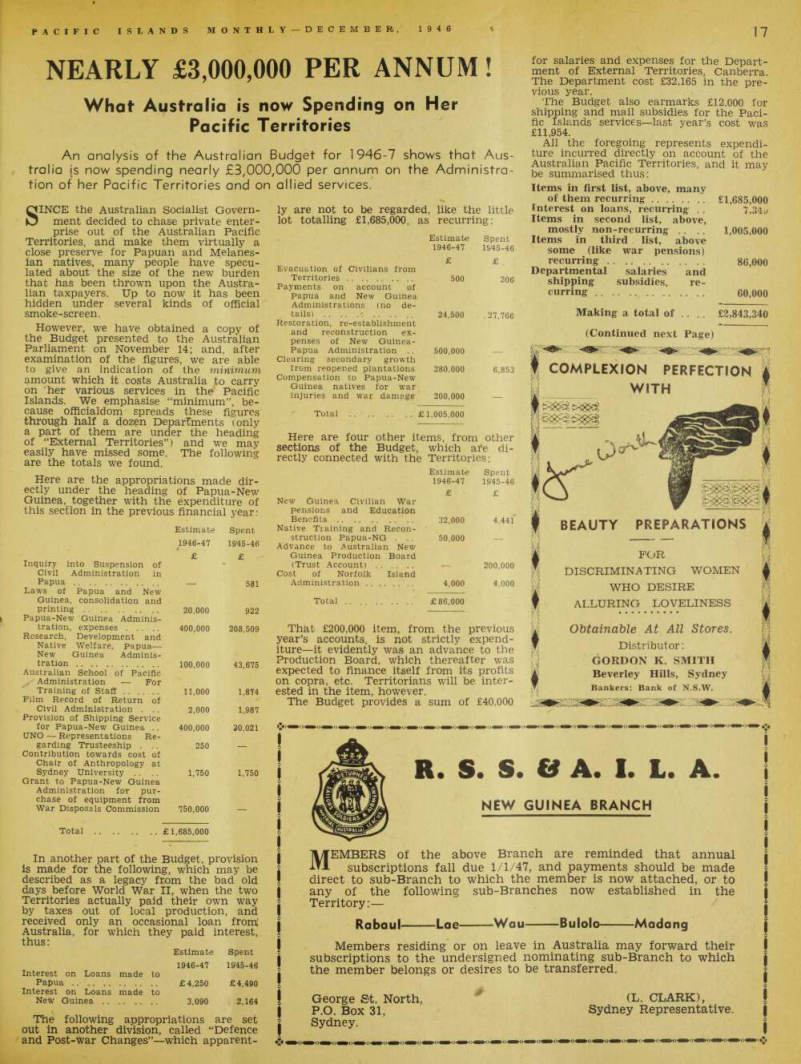
What Australia is now Spending on Her Pacific Territories
An analysis of the Australian Budget for 1946-7 shows that Aus tralia is now spending nearly £3,000,000 per annum on the Administra tion of her Pacific Territories and on allied services.
SINCE the Australian Socialist Govern ment decided to chase private enter prise out of the Australian Pacific Territories, and make them virtually a close preserve for Papuan and Melanes ian natives, many people have specu lated about the size of the new burden that has been thrown upon the Austra lian taxpayers. Up to now it has been hidden under several kinds of official smoke-screen.
However, we have obtained a copy of the Budget presented to the Australian Parliament on November 14; and, after examination of the figures, we are able to give an indication of the minimum amount which it costs Australia to carry on her various services in the Pacific Islands. We emphasise “minimum”, be cause officialdom spreads these figures through half a dozen Departments (only a part of them are under the heading of “External Territories”) and we may easily have missed some. The following are the totals we found.
Here are the appropriations made dir ectly under the heading of Papua-New Guinea, together with the expenditure of this section in the previous financial year:
In another part of the Budget, provision is made for the following, which may be described as a legacy from the bad old days before World War 11, when the two Territories actually paid their own way by taxes out of local production, and received only an occasional loan from; Australia, for which they paid interest, thus:
The following appropriations are set out in another division, called “Defence and Post-war Changes”—which apparent
ly are not to be regarded, like the little lot totalling £1,685,000. as recurring:
Here are four other items, from other sections of the Budget, which are di rectly connected with the Territories:
That £200,000 item, from the previous year’s accounts, is not strictly expend iture—it evidently was an advance to the Production Board, which thereafter was expected to finance itself from its profits on copra, etc. Territorians will be inter ested in the item, however.
The Budget provides a sum of £40,000
for salaries and expenses for the Depart ment of External Territories, Canberra.
The Department cost £32,165 in the pre vious year.
The Budget also earmarks £12,000 for shipping and mail subsidies for the Paci fic Islands services—last year’s cost was £11,954.
All the foregoing represents expendi ture incurred directly on account of the Australian Pacific Territories, and it may be summarised thus:
(Continued next Page)
Estimate Spent 1946-47 19'45-46 £ £ Inquiry into Suspension of Civil Administration in Papua Laws of Papua and New Guinea, consolidation and ■ 581 printing Papua-New Guinea Adminis- 20,000 922 tration, expenses Research, Development and Native Welfare, Papua— New Guinea Adminis- 400,000 208,509 tration Australian School of Pacific Administration — For 100,000 43,675 Training of Staff Film Record of Return of 11,000 1,874 Civil Administration . ..
Provision of Shipping Service 2,000 1,987 for Papua-New Guinea ..
UNO — Representations Re- 400,000 30,021
garding Trusteeship . ..
Contribution towards cost of Chair of Anthropology at 250 Sydney University ..
Grant to Papua-New Guinea Administration for purchase of equipment from 1,750 1,750 War Disposals Commission 750,000 — Total £1,685,000
Estimate Spent 1946-47 l&'45-46 Interest on Loans made to Papua £4,250 £4,490 Interest on Loans made to New Guinea .. 3,090 2.164
Estimate 1946-47 Spent 1945-46 Evacuation of Civilians from £ £ Territories Payments on account of Papua and New Guinea Administrations (no de- 500 206 tails) ' Restoration, re-establishment and reconstruction expenses of New Guinea- 24,500 .27.766 Papua Administration Clearing secondary growth 500,000 — Irom reopened plantations Compensation to Papua-New Guinea natives for war 280.000 6,853 injuries and war damage 200,000 Total £1,005.000
Estimate Spent 1946-47 1945-46 £ £ New Guinea Civilian War pensions and Education Benefits 32,000 4.441 Native Training and Reconstruction Papua-NG . . . 50.000 Advance to Australian New Guinea Production Board (Trust Account) — 200,000 Cost of Norfolk Island Administration 4,000 4,000 Total £86,000
Items in first list, above, many of them recurring £1,685,000 Interest on loans, recurring . . 7,34j Items in second list, above, mostly non-recurring . 1,005,000 Items in third list, above some (like war pensions) recurring 86,000 Departmental salaries and shipping subsidies, recurring 60,000 Making a total of .. £2,843,340
But that is not the end of it. The Australian taxpayers, through their open handed Government, maintain a most impressive array of Ministers, Legations, Consuls, Trade Commissioners and what not in other countries; and, of these, the following are in the Pacific area. Their total cost, is as follows;
In other words, £32,000 may be added to the huge total of £2,843,000, required to pay for Australian activities in the Pacific Islands —a sum calculated to shock any Australian taxpayer who may be prepared to think about it.
The provision, in the Australia Budget
of £5,000 to cover cost of the South west Pacific Regional Conference at Can berra in January, and Australian repre sentation thereat, is so small by com parison that it does not count.
SOME of the items we have enumerated probably will stir the deepest feel ings of the older. Territorians—es pecially those who are in danger of see ing their life’s work destroyed by Mr.
Ward’s New Order. We direct attention especially to the following: £20,000 for printing the laws of the Territories; £ll,OOO for the maintenance of the School of Pacific Administration; £2,000 (making £4,000 altogether) for a film record of the Civil Government re turning to the Territories; £400,000 for a shipping service. We can only guess what this may mean—there are no details. £750,000 for the purchase of War Dis posals equipment. Details of that would be most interesting. £280,000 for clearing secondary growth from plantations. Here, also, details would be read with interest. £200,000 for war damage compensation to natives. Perhaps this includes the £120,000 for Mr. Ward’s model village, which is not specifically referred to any where. But why should not New Guinea natives, like Europeans, be com pensated out of the brimming War Dam age Commission Fund, and thus make no call on the Australian taxpayers? £32,000 wherewith to provide war pen sions for New Guinea civilians: This is a very interesting item. We have asked Canberra to supply us with particulars of the pension scale and how pensions are to be applied for; and, if we get it, the information will be published.
Salaries Expenses £ £ Netherlands Indies 6,402 3,000 Philippines 9,705 5.000 New Caledonia 2,200 1,900 Portuguese Timor 2,232 2,000 20,509 11,900
Advertisements & other items, pp. 19-20 (1 item)
R. S. S. & A. I. L. A.
COMPLEXION PERFECTION
WITH
BEAUTY PREPARATIONS
FOR
DISCRIMINATING WOMEN
WHO DESIRE
ALLURING LOVELINESS
Obtainable At All Stores.
Distributor:
GORDON K. SMITH
Beverley Hills, Sydney Bankers: Bank of N.S.W.
R. S. S. & A. I. L. A.
NEW GUINEA BRANCH
MEMBERS of the above Branch are reminded that annual subscriptions fall due 1/1/47, and payments should be made direct to sub-Branch to which the member is now attached, or to any of the following sub-Branches now established in the Territory:— Rabaul Lae Wau Bulolo——Madang Members residing or on leave in Australia may forward their subscriptions to the undersigned nominating sub-Branch to which the member belongs or desires to be transferred.
George St. North, (L. CLARK), P.O. Box 31, Sydney.
Sydney Representative.
SPECIALISING
IN
PACIFIC ISLAND INSURANCES
FIRE MOTOR VEHICLE
MARINE HULLS AND CARGO
EMPLOYER’S LIABILITY
GUARANTEES including those for—
DYNAMITE PERMITS.
RECRUITERS’ LICENCES.
DEFERRED WAGES
AND ALL OTHER CLASSES ARRANGED
AT LOWEST CURRENT RATES.
Established Agencies:
W. R. CARPENTER & CO., LTD.
Throughout the Territory of New Guinea.
SOUTHERN PACIFIC INSURANCE
CO., LTD.
HEAD OFFICE: 60 HUNTER STREET,
SYDNEY.
Thi* Mt*y it*Shiaratitsy Poirw.. -
Sometimes men think that a general education or an elementary knowledge of business is enough to get ahead. But experience soon teaches that thorough, specialised training is just as necessary for success in business as it is in the professions of Law, Medicine or Dentistry. If you are interested in the many opportunities in the Business World ... if you seek responsibility, success and economic security, commence training now —in some specialised business subject. H.R.I. is available always to help and advise ambitious men and women. Wr.te or wire for particulars and career information.
H.R.I. tut-1 id service is proved by the sin: ing of more honours than all coaches in Australasia combined.
H.R.I. Career Training e ACCOUNTANCY & SECRETARYSHIP • COST ACCOUNTANCY
• PRACTICAL BOOKKEEPING © MARKETING SELLING
ADVERTISING © BANKING © LOCAL GOVERNMENT EXAMS. 11 ehi ingw ay Robertson Isssii i u i e Founded and Owned by Hemingway & Robertson Pty. Ltd. • Consulting Accountants :: :: - Professional Tutors 12 6 BANK HOUSE, BANK PLACE, MELBOUR N E 126 CHALFONT CHAMBERS, 142 PHILLIP STREET. SYDNEY 126/814
Shoes For New Guinea
rpHE statement published in October, JL that shoes may not be exported from Australia to New Guinea, is not quite correct. Export is restricted, but not prohibited. A single pair of shoes can be sent by parcels post, without difficulty; but anyone wishing to send more than one pair, for sale in the Territories, must first obtain a permit from the Australian Hides and Leather Board.
Rabaul Woman
Attacked
On "Duntroon"
Lae, November 26.
A HURRIED court-case was held here after the “Duntroon” got in, en route from Sydney to Rabaul, and a ships’ steward, Andrew Smith, was found guilty of being unlawfully in a passeng er’s cabin, and sentenced to two months imprisonment in the Territory. He will be deported when he has served his term.
The passenger was the wife of Ter ritory police-officer, who was on her way to Rabaul to rejoin him. While the ship was between Port Moresby and Lae, on the night of November 20, the woman awoke to find a man standing over her with a slipper in his upraised hand. He had awakened her by striking her a blow on the head. She screamed, and tried to leave the cabin, and a struggle ensued.
Finally, she broke from him and ran out of the cabin calling for help. Her at tacker was identified as Smith.
On Ra'iatea 40 Years Ago
Prom Our Own Correspondent
Papeete, Oct. 27.
THE most authoritative and, in our opinion, the most charming book on Polynesian life, was published in 1902. The title of the book is “Ra’iatea la Sacree”; its author, M. Paul Huguenin.
Monsieur Huguenin—during the closing year of the past century—was Director of Schools in the Leeward Group of the Society Archipelago. He was, likewise, a most talented artist. Reproductions, in colour of many of his paintings of the islands add charm and value to the volume.
Moreover, M. Huguenin, was learned in the native language. This knowledge makes his book unique in that it is the only South Sea Island volume of recent authorship, in which words and phrases, in the Tahitian tongue, are properly used and accurately translated.
M. Huguenin—a true and sympathetic observer— does not embellish his tale with fairy stories born in his own imagi nation, With his pen and brush, he has given us a fascinating picture of an un spoiled Polynesian island, as it actually was at the beginning of this century.
Shortly after the publication of M.
Huguenin’s book, the writer passed several months on Ra’iatea where he met the people and observed the quaint, simple island life, so charmingly de«cribed in this volume.
“Ra’iatea La Sacree” was issued in a very limited edition. Consequently, few examples are available, outside of the major public libraries.
This has enabled certain latter-day writers of South Sea tales to help them selves liberally from M. Huguenin’s work, without troubling to mention whence their material has come.
One United States author, whose book was long regarded as the most authora tive volume on South Sea life, has lifted a whole chapter from “Ra’iatea La Sac ree,” translated it word for word into English, and has passed it as of his own authorship.
Progress has not overlooked Ra’iatea.
We are told that the island has all the gadgets and is now quite as modern as Papeete. We have never voyaged thither to verify these reports. We wish, rather, to remember the Ra’iatea we knew forty years ago.
Advertisements & other items, p. 20 (1 item)
18
DECEMBER* 1946 PACIFIC ISLANDS MONT H L Y
Sugar Growers
Poyments for Fiji Sugar Growers
Suva, Nov. 12.
CANE growers in Fiji have been paid an average of 28/9 per ton for their 1946 cane crop.
Altogether, the Colonial Sugar Refining Company has paid out £900,000 this year to growers whose total crop is about 80 per cent, of a normal yield. Cane production is still feeling the effect of the cane-fields trouble that swept over Fiji in 1943-44.
The price paid for cane to-day is almost twice as much as the average price in 1939 (15/6). The British Government guarantees the high price of the Fiji crop to-day and the unfortunate British consumer pays for it. Fiji canegro\frers are much better off than growers in other Colonies, both in regard to the price they receive, and because in Fiji the CSR Company transports the cane to the crushing mills —an item of expen diture which the growers in other Col onies have to bear themselves.
N.G. Club Christmas
Functions
THE children’s party which the New Guinea Women’s Club of Sydney have held annually since the Club’s inauguration, will be on December 16 this year. It will be held in the Feminist Club Rooms as usual, and will commence at 2 o’clock.
A number of Territorians have given generously in order that this function may be a success and a sum of £26 has been collected..
The Christmas function, this year, will take the form of a cocktail party to be held in the Feminist Club Room's, 77 King Street, Sydney, at 6.30 on Saturday, December 21. All Territorians and their friends are invited to attend. Further information can be obtained from Mrs. A.
Meldrum, telephone XB 3558.
Answers To Correspondents
GPB (Rabaul) Mr. Gordon Thomas advises: Harry Elkington died at the Ramale mission station just before the Australians came in to relieve us in September, 1945.
His grave lies next to old Mrs. Kumann- Juker’s. His death was due to dropsy.
But of his wife I know nothing; I didn’t know he had a wife living, though I have an idea he had a daughter somewhere in Australia. In “PIM” of Sept., 1945, the name Mrs. Heins, 36 Plimsoll St., Sans Souci, NSW, appears as Elkington’s next of-kin. If that is not enough, you should send an enquiry on to Department of External Territories, Canberra.
C.H. —“I recall a conversation I had with you in 1937, regarding the danger you expected from Japan. I have never forgotten how well you outlined what was to happen—and what did happen in 1941-42.” Thanks—but to say “I told you so!” is little compensation for trag edy. We see terrible danger to the South Seas to-day from the twin (and allied) menaces of Asiatic overcrowding and Muscovite Communism: but the people most concerned are as indifferent and careless to-day as they were in 1937.
Mr. J. W. Sykes, left Suva in November for New Zealand en route for the United Kingdom, on vacation leave.
Advertisements & other items, p. 21 (1 item)
J. C. Merrillees & Co.
Cha 11 is House, Martin Place, SYDNEY.
BUYERS OF ALL ISLAND REQUIREMENTS. SUPPLIERS OF ALL AUSTRALIAN GOODS. BUYERS OF ISLAND PRODUCE. write or wire Inquiries Welcomed .™ egr ,r s: for ‘Mernllees, Quotations 'Phone: 8W6569 Sydney.
Book Just Published
“WHERE THE TRADE-WINDS
BLOW”
72 Stories, Articles and Sketches About
Life in the South Pacific Islands
COLLECTED BY R. W. ROBSON
AND JUDY TUDOR
WITH NUMEROUS ILLUSTRATIONS
These stories and sketches, brought together in this book for your entertainment, are about real people. They describe, without colour or embellishment, conditions of life in the Pacific Islands, as they are to-day.
The “Islands of Romance” have suffered much at the hands of peripatetic writers and irresponsible film directors. The places and people they picture rarely exist outside a cinema studio, and the fevered imagination of literary morons. Nonetheless, the Islands which our fathers knew fully deserved the description, “a place where life is different.”
But the charming Islands world of the Nineteenth Century has been changed very much by the Twentieth Century—and by no event more than World War 11, which brought masses of Servicemen into places which formerly regarded a kava party as a great crowd. We still have the Islands setting and the indefinable Islands atmosphere; but life in the Islands—even in savage and primitive Melanesia—has been altered, profoundly.
This book may indicate how and where conditions have changed.
AT ALL LEADING BOOKSELLERS
Copies may be obtained by. sending 9/- direct to the Publishers:
Pacific Publications Pty. Ltd.
Union House, 247 George Street, Sydney
Fiji Merely Owns Land at its International Airport
Nadi Has A United Nations Flavour
WHETHER Nadi or Nausori will be Fiji’s internatonal airport has not yet been resolved, but the airline companies seem to have solved the diffi culty, at least temporarily, for themselves.
They are running a sort of United Nations establishment at Nadi, and are likely to be located at that airport for the next 12 months. Nausori has no tar sealed runways and is therefore out of commission during the wet season.
White’s Aviation for December, says that while the United States Army con trols the camp at Nadi, the RNZAF handles flying-control and radio —a US plane cannot land unless the RNZAF say so, yet on the ground RNZAF personnel live with the Americans. Furthermore,
civilian and service aircraft get mainten ance from Pan American Airways while the New Zealand Public Works Depart ment is makng additions to the aero drome.
Australian National Airways, who are operating a trans-Pacific service on be half of the Governments of Australia, New Zealand, and Britain, also use Nadi.
Their planes are serviced by Pan Ameri can and their passengers are billeted in native houses by the United States Army —and, according to reports, they like the experience.
As Whites Aviation remarks—everyone seems to have a hand in the direction of Nadi except the people of Fiji, who -merely own the ground and live there.
AFTER the near-war that raged between Nadi-Lautoka and Nausori- Savu citizens a few months back over the proposed site of the international airport, this seems rather an anti-climax; but the fact is that until the international agreement on reciprocal landing rights is signed between America and the British Commonwealth, the international airlines, which make of Fiji a mere staging-point, are of relatively little importance to Fiji itself.
Pan American cannot pick up or land passengers in Fiji and ANA cannot pick up or land passengers in American terri tory. Technically, ANA can carry pas sengers between Australia and Fiji but this has not been done to date, and book-* ings between Sydney and Fiji are effected only when a booking has been made from Fij| to Vancouver.
Fiji has become, for no reason other than geographical position, the main in ternational airways cross-roads of the Pacific. But Fiji residents themselves are more vitally concerned with the air ser vices which link them with New Zealand and Australia.
The RNZAF on behalf of the New Zealand National Airways Corporation runs a weekly service between Auckland and Nausori (and on to other Pacific islands) with DCS aircraft, and a flying boat service between Auckland and Suva (see Magazine Section of this issue).
Qantas Empire Airways run a fortnightly flying-boat service between Sydney and Suva, with an overnight stop midway at Noumea.
These two services are of much more practical value to Fiji at present than the more publicised trans-Pacific services which bring to Fiji only a limited amount of tourist money.
Advertisements & other items, p. 22 (1 item)
Thornycroft (Aust.) Pty., Ltd. pyrmonTiSw.
Woven Wire for all Industry
COPRA DRYING TRAYS, FLOORS, Etc.
FRUU DRYING TRAYS, MINING SCREENS.
Heavy Mosquito Gauze in Phosphor Bronze and other Metals Impervious to Salt Sea Air.
WIRE DOOR MATS AND GENERAL WIRE WORKS
E. WRIGHT & CO. LTD.
Office and Works: 148-152 Cleveland Street, Sydney, N.S.W.
Telegraphic Address “Wrlghtmake,” Chippendale. f- £
THO
f 110
DB2 9 H.P, HEAVY
DUTY MARINE ENGINE
Driving I7i x 16 in.
Propeller at 700 r.p.m. • Reliable • Efficient A Economical Stuart Turner
Generating Sets
1,000 Watt, 32 Volt.
Simple, Economical
IMMEDIATE DELIVERY
STERN GEAR MADE TO ORDER
GOOD DELIVERIES
Write for full particulars to —
Thornycroft (Aust.) Pty., Ltd. pyrmonTiSw.
Cables: TIIORNMOTOR, Sydney.
Territorians Who Have Returned To N.G.
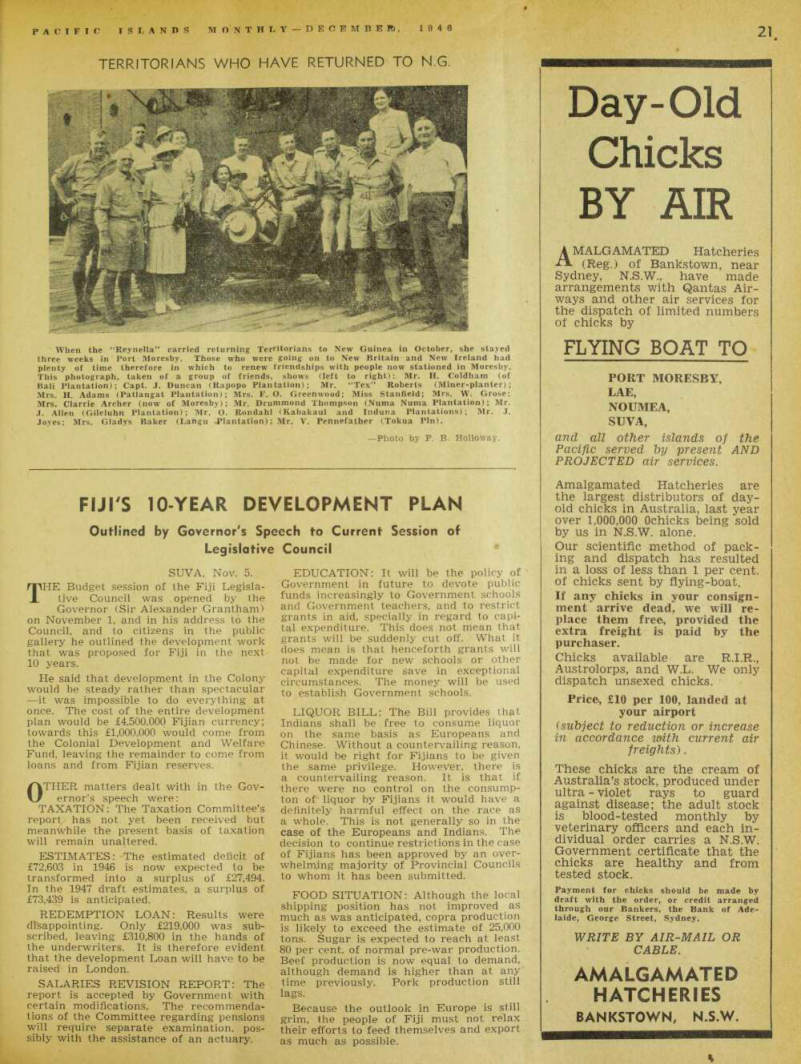
When the “Reynella” carried returning Territorians to New Guinea in October, she stayed three weeks in Port Moresby. Those who were going on to New Britain and New Ireland had plenty of time therefore in which to renew friendships with people now stationed in Moresby.
This photograph, taken of a group of friends, shows (left to right): Mr. H. Coldham (of Bali Plantation); Capt. J. Duncan (Rapopo Plantation); Mr. “Tex” Roberts (Miner-planter); Mrs. H. Adams (Patlangat Plantation); Mrs. F. O. Greenwood; Miss Stanfield; Mrs. W. Grose; Mrs. Clarrie Archer (now of Moresby); Mr. Drummond Thompson (Numa Numa Plantation); Mr.
J. Allen (Gileluhn Plantation); Mr. O. Rondahl (Kabakaul and Induna Plantations); Mr. J.
Joyes; Mrs. Gladys Baker (Langu Plantation); Mr. V. Pennefather (Tokua Pin). -Photo by P. B. Holloway.
Fiji's 10-Year Development Plan
Outlined by Governor's Speech to Current Session of Legislative Council
Suva, Nov. 5.
THE Budget session of the Fiji Legisla tive Council was opened by the Governor (Sir Alexander Grantham) on November 1, and in his address to the Council, and to citizens in the public gallery he outlined the development work that was proposed for Fiji in the next 10 years.
He said that development in the Colony would be steady rather than spectacular —it was impossible to do everything at once. The cost of the entire development plan would be £4,500,000 Fijian currency; towards this £1,000,000 would come from the Colonial Development and Welfare Fund, leaving the remainder to come from loans and from Fijian reserves.
OTHER matters dealt with in the Gov ernor’s speech were; TAXATION: The Taxation Committee’s report has not yet been received but meanwhile the present basis of taxation will remain unaltered.
ESTIMATES; The estimated deficit of £72,603 in 1946 is now expected to be transformed into a surplus of £27,494.
In the 1947 draft estimates, a surplus of £73,439 is anticipated.
REDEMPTION LOAN: Results were disappointing. Only £219,000 was sub scribed, leaving £310,800 in the hands of the underwriters. It is therefore evident that the development Loan will have to be raised in London,
Salaries Revision Report; The
report is accepted by Government with certain modifications. The recommenda tions of the Committee regarding pensions will require separate examination, pos sibly with the assistance of an actuary.
EDUCATION: It will be the policy of Government in future to devote public funds increasingly to Government schools and Government teachers, and to restrict grants in aid, specially in regard to capi tal expenditure. This does not mean that grants will be suddenly cut off. What it does mean is that henceforth grants will not be made for new schools or other capital expenditure save in exceptional circumstances. The money will be used to establish Government schools.
LIQUOR BILL: The Bill provides that Indians shall be free to consume liquor on the same basis as Europeans and Chinese. Without a countervailing reason, it would be right for Fijians to be given the same privilege. However, there is a countervailing reason. It is that if there were no control on the consump ton of liquor by Fijians it would have a definitely harmful effect on the. race as a whole. This is not generally so in the case of the Europeans and Indians. The decision to continue restrictions in the case of Fijians has been approved by an over whelming majority of Provincial Councils to whom it has been submitted.
FOOD SITUATION: Although the local shipping position has not improved as much as was anticipated, copra production is likely to exceed the estimate of 25,000 tons. Sugar is expected to reach at least 80 per cent, of normal pre-war production.
Beef production is now equal to demand, although demand is higher than at any time previously. Pork production still lags.
Because the outlook in Europe is still grim, the people of Fiji must not relax their efforts to feed themselves and export as much as possible.
Advertisements & other items, pp. 23-24 (1 item)
Day-Old
Chicks
BY AIR
Amalgamated Hatcheries
(Reg.) of Bankstown, near Sydney, N.S.W., have made arrangements with Qantas Airways and other air services for the dispatch of limited numbers of chicks by
FLYING BOAT TO
PORT MORESBY,
LAE,
NOUMEA,
SUVA,
and all other islands of the Pacific served by present AND PROJECTED air services.
Amalgamated Hatcheries are the largest distributors of dayold chicks in Australia, last year over 1,000,000 Ochicks being sold by us in N.S.W. alone.
Our scientific method of packing and dispatch has resulted in a loss of less than 1 per cent, of chicks sent by flying-boat.
If any chicks in your consignment arrive dead, we will replace them frees provided the extra freight is paid by the purchaser.
Chicks available are R.1.R., Austrolorps, and W.L. We only dispatch unsexed chicks.
Price, £lO per 100, landed at your airport (subject to reduction or increase in accordance with current air freights) .
These chicks are the cream of Australia’s stock, produced under ultra - violet rays to guard against disease; the adult stock is blood-tested monthly by veterinary officers and each individual order carries a N.S.W.
Government certificate that the chicks are healthy and from tested stock.
Payment for chicks should be made by draft with the order, or credit arranged through our Bankers, the Bank of Adelaide, George Street, Sydney.
WRITE BY AIR-MAIL OR
CABLE.
AMALGAMATED
HATCHERIES
BANKSTOWN, N.S.W.
M.Y. “Miramar” For Sale
warn
mmm
% 65 tons, 75 ft. x 16 ft. x 5 ft. 6 in.; speed, 15 m.p.h.; two 175 h.p. Hall Scott Petrol Marines; twin screw; five 2-berth Cabins; one single Cabin; Crews’ quarters (two men) • Lounge Room; Kitchen; Bathroom; Electric Capstan and Davits; 16 ft. Lifeboat' Dinghy : Beale Piano; Tasma Short-wave Radio; 16 mm. Film Projector; two Frigidaires Gas Stove; Lounge Settees; 110 V-Lighting Unit; 1,000 gals. Copper Water Tanks; Luxuriously fitted; Planked N.Z. Kauri; Spotted Gum Frames; Double Ribs; Teak Decks; strongest possible construction; perfect throughout; cost late Stuart Doyle £30,000. Price, £B,OOO Sydney. Open stringent survey; trial. Inquiries invited from Island ports WRITE “MIRAMAR,’’ Box 2 5 34, G.P.0., SYDNEY, AUSTRALIA.
McILRATH’S offer
Pure Orange Fruit Juice
In 30 oz. Cans (3/- value) per !/• Can (per dozen, 11/6) 5 case lots, 11/- doz. 10 case lots, 10/6 doz. 25 case lots or more, 10/- doz. (Cases contain 24 tins) Each can of pure orange juice contains the juice of approximately 24 oranges.
This juice is absolutely pure. Add water and sugar to taste. Every tin is guaranteed.
This fruit juice will maintain perfect condition for days if transferred to bottles or jars and kept in a cool place.
Send your order to —-
Mcllrath’s Pty. Ltd. jrssrSE,
W. H. GROVE & SONS
Limited
Established 1896.
AUCKLAND
Island Traders. *•<>. Box 49®.
Telegraphic and Cable Address; “Grove”, Auckland.
Entrust Your Orders to the Firm with Fifty Years Practical Experience in the Island Trade.
Shippers of aH classes of New Zealand products.
Representing English Manufacturers through-
out the Cook and Society Islands, Fiji, Tonga, Samoa, Niue, New Caledonia, New Guinea, etc.
In FIJI at—W. H. Grove & Son* (Fiji) Ltd.
Remembrance Day
Dedication of Rabaul War Cemetery But What Does "Peace"
Mean to New Guinea?
(A Letter to the Editor) TO-DAY there is great activity at Bita paka. Bitapaka was the site of the main German Radio communication system in the Pacific in 1914, and many will recall the landing of the AIF at Kabakaul, in September of that year, and the subsequent surrender of the Germans at Rabaul.
Bitapaka is approximately 32 miles by road from Rabaul and 5 miles from Kaba kaul. It was on the road between Kaba kaul and Bitapaka that Australia suffered her first casualties in 1914 and, by the German capitulation, acquired the Man dated Territory of New Guinea. New Guinea commemorated those heroic men of 1914 with a Memorial erected on the roadway where the first casualty of 1914 occcurred, and each year Australians in the Islands attended memorial services there. - To-day, on the eve of the anniversary of the cessation of hostilities 28 years ago, Bitapaka was dedicated as a last resting place for many of those who fell fighting the Japs in this and surrounding areas.
The Roman Catholic community held a dedication service this morning and a combined service was held at 3 p.m. His Grace, Bishop Wade, was the principal speaker at the morning service and the Church of England army chaplain was the speaker at the combined service.
TO many of us who have experienced two world wars and two post-war periods, the pious and optimistic hopes expressed at the dedication services to-day seemed strikingly similar to those of 1918. If peace is a state of being free from war, then we are experiencing a post-war situation very similar to that after World War I—but with the problems of Europe greater. The conviction is forced upon us here that peace can be almost more intolerably evil than war.
Almost every action of the Australian Administration in New Guinea is hasten ing the decline of our prestige and creat ing a deplorable situation. Through out New Guinea officialdom is apologising for its presence and that of other Aus tralians. If we are without faith in our selves, what hope is there for peace?
Instead of Australians in New Guinea being backed by the people of their home land, they are being cruelly sacrificed.
The total disregard of Australians in New Guinea will ultimately have its pain ful effects on Australians in Australia. If we are to have peace we must be secure.
During World War II the USA stoutly defended Australia, per medium of New Guinea, as did thousands of worthy sons of Australia and our gallant allies, the Dutch. On the cessation of hostilities, Australian promptly helped the Indone sians against the Dutch; and the USA gave China some 300 naval vessels and supplied them with 100 naval officers to teach them how to conduct naval warfare.
Australia should wake up—or Bitapaka will be a mere milestone on the way to repeated and vain sacrifices.
I am, etc.,
Rabaul Resident
Rabaul, November 10, 1946.
Fiji's Popular First Lady
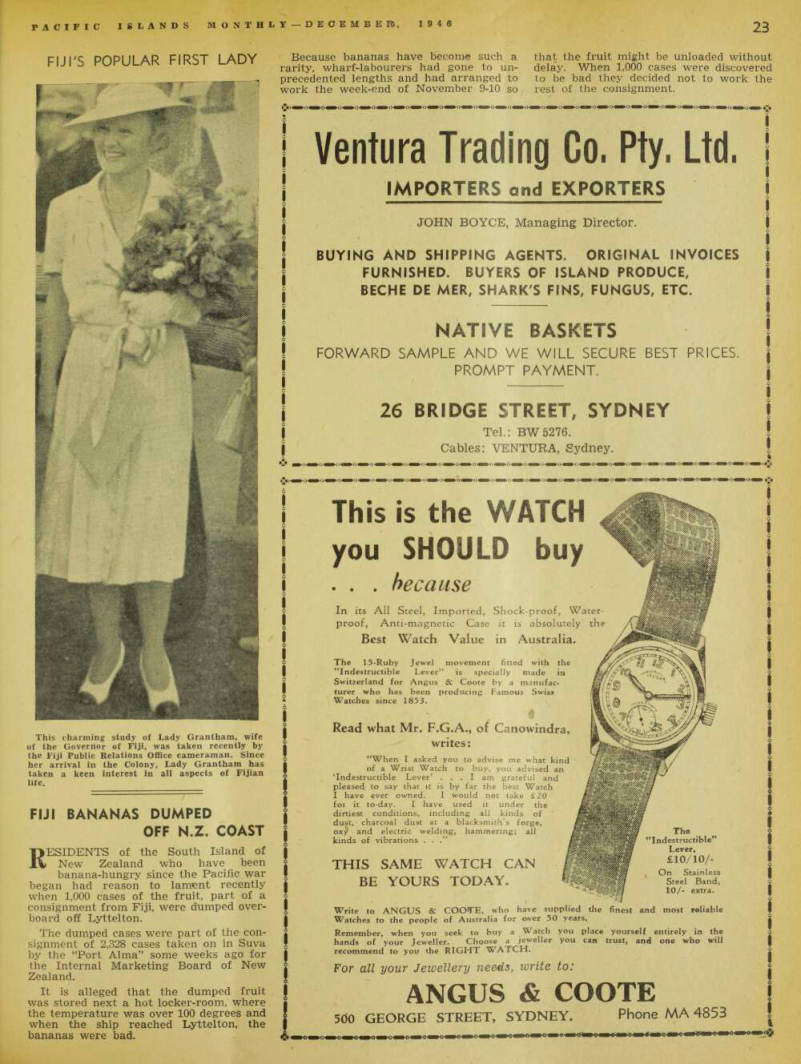
This charming study of Lady Grantham, wife of the Governor of Fiji, was taken recently by the Fiji Public Relations Office cameraman. Since her arrival in the Colony, Lady Grantham has taken a keen interest in all aspects of Fijian life.
Fiji Bananas Dumped
Off N.Z. Coast
RESIDENTS of the South Island of New Zealand who have been banana-hungry since the Pacific war began had reason to lament recently when 1,000 cases of the fruit, part of a consignment from Fiji, were dumped over board off Lyttelton.
The dumped cases were part of the con signment of 2,328 cases taken on in Suva by the “Port Alma” some weeks ago for the Internal Marketing Board of New Zealand.
It is alleged that the dumped fruit was stored next a hot locker-room, where the temperature was over 100 degrees and when the ship reached Lyttelton, the bananas were bad.
Because bananas have become such a rarity, wharf-labourers had gone to un precedented lengths and had arranged to work the week-end of November 9-10 so
that the fruit might be unloaded without delay. When 1,000 cases were discovered to be bad they decided not to work the rest of the consignment.
Advertisements & other items, pp. 25-26 (1 item)
Ventura Trading Go. Pty. Ltd.
IMPORTERS cmd EXPORTERS
JOHN BOYCE, Managing Director.
BUYING AND SHIPPING AGENTS. ORIGINAL INVOICES
FURNISHED. BUYERS OF ISLAND PRODUCE,
BECHE DE MER, SHARK'S FINS, FUNGUS, ETC.
NATIVE BASKETS
FORWARD SAMPLE AND WE WILL SECURE BEST PRICES.
PROMPT PAYMENT.
26 BRIDGE STREET, SYDNEY
Tel.: BW 5276.
Cables: VENTURA, Sydney.
This is the WATCH
you SHOULD buy
. . . because In its All Steel, Imported, Shock-proof, Waterproof, Anti-magnetic Case it is absolutely the
Best Watch Value in Australia.
The 15-Ruby Jewel movement fitted with the "Indestructible Lever” is specially made in Switzerland for Angus 8C Coote by a manufacturer who has been producing Famous Swiss Watches since 1853.
JL.
Read what Mr. F.G.A., of Canowindra,
writes;
"When I asked you to advise me what kind of a Wrist Watch to buy, you advised an 'lndestructible Lever’ ... I am grateful and pleased to say that it is by far the best Watch I have ever owned. I would not take £2O for it to-day. I have used it under the dirtiest conditions, including all kinds of dust, charcoal dust at a blacksmith’s forge, oxy and electric welding, hammering; all kinds of vibrations . . .”
THIS SAME WATCH CAN
BE YOURS TODAY.
The Indestructible”
Lever, £lO/10/- On Stainless Steel Band, 10/- extra.
Write to ANGUS & COOTE, who have supplied the finest and most reliable Watches to the people of Australia for over 50 years.
Remember, when you seek to buy a Watch you place yourself entirely in the hands of your Jeweller. Choose a jeweller you can trust, and one who will recommend to you the RIGHT WATCH.
For all your Jewellery needs, write to:
ANGUS & COOTE
50(0 GEORGE STREET, SYDNEY.
Phone MA 4853
. . . future air express.
TIME MOVES FAST
but it will always .
Job a.
CAPSTAN
jeep Allocations
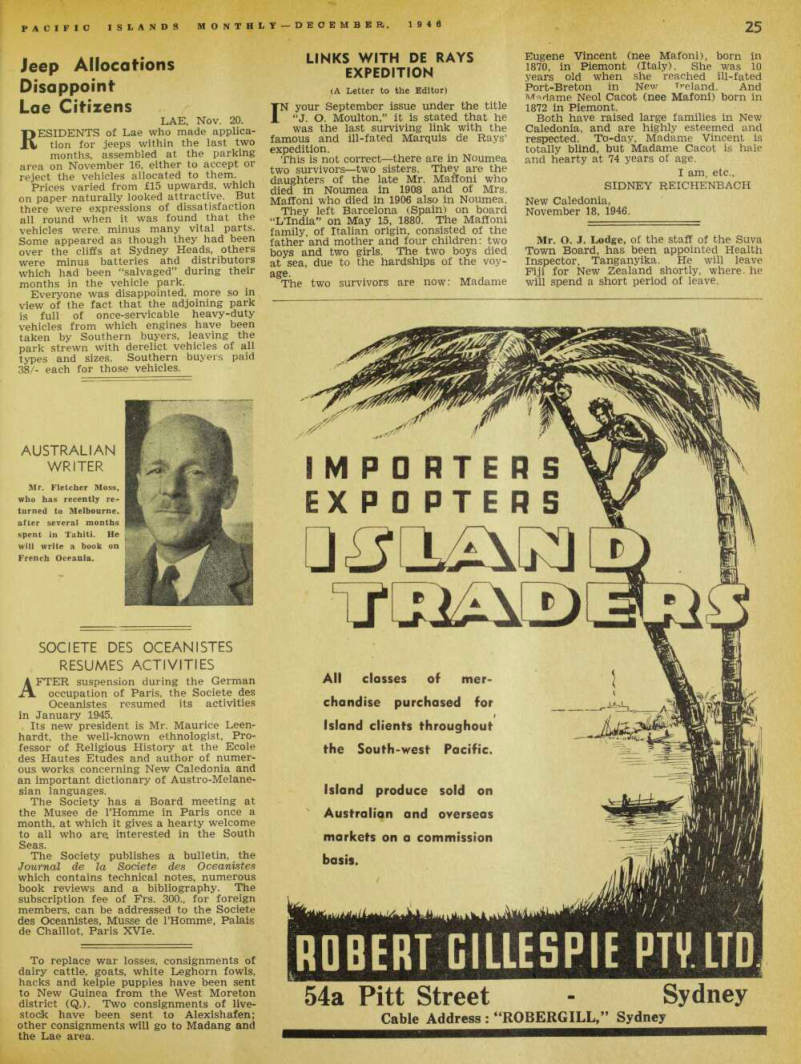
Disappoint Lae Citizens
LAE, Nov. 20.
RESIDENTS of Lae who made applica tion for jeeps within the last two months, assembled at the parking area on November 16, either to accept or reject the vehicles allocated to them.
Prices varied from £l5 upwards, which on paper naturally looked attractive. But there were expressions of dissatisfaction all round when it was found that the vehicles were, minus many vital parts.
Some appeared as though they had been over the cliffs at Sydney Heads, others were minus batteries ahd distributors which had been “salvaged” during their months in the vehicle park.
Everyone was disappointed, more so in view of the fact that the adjoining park is full of once-servicable heavy-duty vehicles from which engines have been taken by Southern buyers, leaving the park strewn with derelict vehicles of all types and sizes. Southern buyers paid 38/- each for those vehicles.
Australian
Writer
Mr. Fletcher Moss, who has recently re turned to Melbourne, after several months spent in Tahiti. He will write a book on French Oceania.
Societe Des Oceanistes
Resumes Activities
AFTER suspension during the German occupation of Paris, the Societe des Oceanistes resumed its activities in January 1945.
Its new president is Mr. Maurice Leen hardt, the well-known ethnologist, Pro fessor of Religious History at the Ecole des Hautes Etudes and author of numer ous works concerning New Caledonia and an important dictionary of Austro-Melane sian languages.
The Society has a Board meeting at the Musee de I’Homme in Paris once a month, at which it gives a hearty welcome to all who are. interested in the South Seas.
The Society publishes a bulletin, the Journal de la Societe des Oceanistes which contains technical notes, numerous book reviews and a bibliography. The subscription fee of Frs. 300., for foreign members, can be addressed to the Societe des Oceanistes, Musse de I’Homme, Palais de Chaillot, Paris XVIe.
To replace war losses, consignments of dairy cattle, goats, white Leghorn fowls, hacks and kelpie puppies have been sent to New Guinea from the West Moreton district (Q.). Two consignments of live stock have been sent to Alexishafen; other consignments will go to Madang and the Lae area.
Expedotion
Links With De Rays
(A Letter to the Editor) IN your September issue under the title “J. O. Moulton,” it is stated that he was the last surviving link with the famous and ill-fated Marquis de Rays’ expedition.
This is not correct—there are in Noumea two survivors—two sisters. They are the daughters of the late Mr. Maffoni who died in Noumea in 1908 and of Mrs.
Maffoni who died in 1906 also in Noumea.
They left Barcelona (Spain) on board “LTndia” on May 15, 1880. The Maffoni family, of Italian origin, consisted of the father and mother and four children: two boys and two girls. The two boys died at sea, due to the hardships of the voy age.
The two survivors are now: Madame
Eugene Vincent (nee Mafoni), born in 1870, in Piemont (Italy). She was 10 years old when she reached ill-fated Port-Breton in New Ireland. And Madame Neol Cacot (nee Mafoni) born in 1872 in Piemont.
Both have raised large families in New Caledonia, and are highly esteemed and respected. To-day, Madame Vincent is totally blind, but Madame Cacot is hale and hearty at 74 years of age.
I am, etc.,
Sidney Reichenbach
New Caledonia, November 18, 1946.
Mr. O. J. Lodge, of the staff of the Suva Town Board, has been appointed Health Inspector, Tanganyika. He will leave Fiji for New Zealand shortly, where, he will spend a short period of leave.
Mr. R. J. A. Lever who has been Gov ernment entomologist in Fiji and the Solomon Islands since 1930, has been transferred to Malaya. He is at present in the United Kingdom, on leave, and will commence his new duties at its term ination. Mr. Lever is a highly qualified man holding the degrees of Dunclan.
London and Trinidad institutions, and he gave valuable service in the South Pacific during 15 years.
Advertisements & other items, pp. 27-28 (1 item)
Importers
f
EXPORTERS
All classes of merchandise purchased for f Island clients throughout the South-west Pacific.
Island produce sold on Australian and overseas markets on a commission basis.
54a Pitt Street - Sydney
Cable Address: “ROBERGILL,” Sydney
UNITED INDENT AGENCIES
Manufacturers’ Representatives.
Cable Address: “Buyers Suva/’
Telephone No. 367 G.P.O. Box 313, Suva, Fiji Islands
NOTICE TO
RESIDENTS
In the near future the Port Moresby Taxi and Tourist Service will be commencing business in Port Moresby. Modern comfortable vehicles will service residents. Tours arranged by appointment.
R. CORLETT
(Proprietor),
PORT MORESBY
GILLESPIE’S
TRADE
MARK
The Flour * of the Islands
- SYDNEY -
Solomons In The
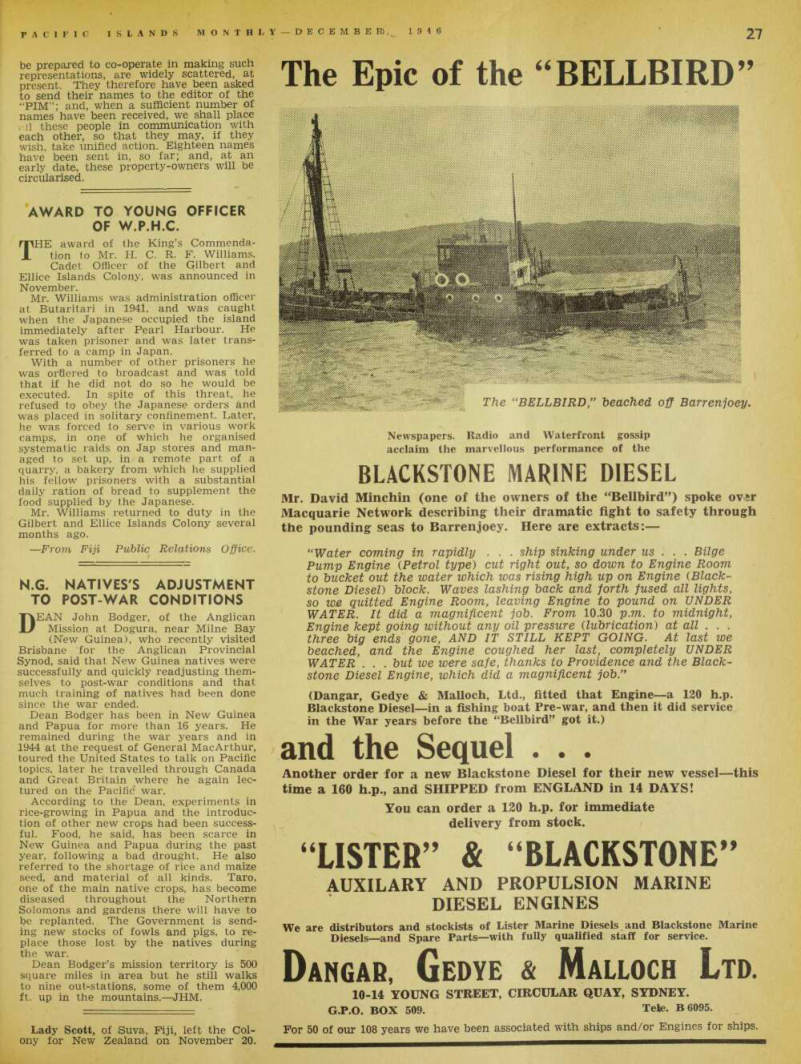
Doldrums
NO Rehabilitation in Sight
rERE still is no indication, from offi cial sources, of what is to be the future set-up in the British Solomon Islands.
The Protectorate continues to be ad ministered, through the High Commission for the Western Pacific, as a kind of close preserve for natives; and no move whatever is being made to either re establish European planting and trading activities in the Group, or to encourage any Europeans to enter the area.
It is unofficially reported that the offi cial policy is to discourage all European industry, and to foster the idea of “the Solomons for the Solomon Islanders.”
Several months ago, the Administration took over Hu, one of Lever’s plant ations, at the eastern end of Guadalcanal.
It was cleared of wartime secondary growth, and driers of the Ceylon type were erected there. The plan is that this shall be a school where natives will be taught to make their own copra.
“In theory, the plan is excellent,” said one old BSI planter. “The trouble is that, in practice, not one native in a thousand has any desire to make copra on the commercial scale necessary if a copra export industry is to be established.
Copra is produced in order to make money. Europeans want money—Solomon natives, at their present stage of ‘civil isation’, do not.” fTTHE Administration is also trying to in- J. terest the natives in rice-growing.
The officials may have more success here. The natives like rice as a food stuff and might be induced to grow this crop, rather than their old-time food crops.
When the American forces were est ablished in Guadalcanal, they grew a lot of their own food, and they cleared and cultivated some 2,000 acres for this pur pose. The Administration plans to turn over much of this land to rice-growing,
in the hope of building up an export trade.
In recent months, between 300 and 400 acres were put under rice, and a first class crop was grown. Unfortunately, a Government ship from New Zealand sail ed for the Solomons and left the eagerly awaited harvesting machine on the wharf* so a line of a hundred natives with knives had to do the harvesting in a primitive way. The rice was treated in a couple of rice mills, brought in from Fiji, and an excellent product was ob tained.
Practical men can see the Solomons people growing rice for themselves* but for the same reasons that apply to copra! they cannot see an export trade develop ing, on native initiative alone.
VI/’HILE not encouraging the return of f T Europeans, the Administration is not putting obstacles in their way. But planters can do nothing because there are no ships running and, in any event. 9 wing to the attitude of officialdom, it is impossible to get native labour a re cent report from Honiara says that native labourers have been demanding 12/- per day, and that the Government proposes to make regulations to nermit of the registration and functioning of native labour unions.
One well-known BSI man, Mr. R c Symes, has been up in the Berande country looking for gold, and getting a little. He has been employing five native labourers, and has to pay them £3 per month, and all found. A Chinese firm, Chan Chong, is employing natives for 3/ “ da y GB/6 per week) and they ration themselves.
A letter from Tulagi, dated October 12, reports that, while the new copra ex port tax is officially 25 per cent., the Government is not demanding the full tax, but is taking 15 per cent. It matters little, anyway. Without transport and without labour, there just is not any copra to tax.
Pate Op Bsi
IT is supposed that the indifference of the British Colonial Office towards the repatriation and rehabilitation of Solomon Islands Europeans is due to the widely-held belief that, as soon as the loquacious gentlemen of UNO get around to the rearrangement of territorial boundaries m the South-west Pacific the Soiomon Islands will be linked with the Mandated Territory of New Guinea, and the Condominium of the New Hebrides as an Australian “defensive perimeter’’ controlled from Canberra.
Without having made any announce ment it already is apparent that the Socialist Governments of Britain, Aust ralia and New Zealand have agreed upon a policy of “the South Sea Islands for the South Sea Islanders:”—a part of which is the official discouragement of “European exploitation.”
What the Solomons Europeans are now experiencing at the hands of the British administrators in the Solomons is on all fours with the treatment of Australian planters, traders, and miners in Papua- New Guinea at the hands of Canberra officialdom. Therefore, the Solomons Europeans will experience no shock if the British Solomons are turned over to Can berra’s tender care.
Bsi Appeal To London
IT was stated in the November “PIM” that, in the opinion of competent men it should be possible to get war damage compensation from the British Govern ment, if proper representations were made in London. They pointed out that Mal ayan planters were .being compensated and re-established—so why not BSI planters?
Persons with BSI interests, who may
be prepared to co-operate in making such representations, are widely scattered, at present. They therefore have been asked to send their names to the editor of the “PIM”; and, when a sufficient number of names have been received, we shall place ; il these people in communication with each other, so that they may, if they wish, take unified action. Eighteen names have been sent in, so far; and, at an early date, these property-owners will be circularised.
Award To Young Officer
Of W.P.H.C.
THE award of the King’s Commenda tion to Mr. H. C. R. F. Williams, Cadet Officer of the Gilbert and Ellice Islands Colony, was announced in November.
Mr. Williams was administration officer at Butaritari in 1941, and was caught when the Japanese occupied the island immediately after Pearl Harbour. He was taken prisoner and was later trans ferred to a camp in Japan, With a number of other prisoners he was ordered to broadcast and was told that if he did not do so he would be executed. In spite of this threat, he refused to obey the Japanese orders and was placed in solitary confinement. Later, he was forced to serve in various work camps, in one of which he organised systematic raids on Jap stores and man aged to set up, in a remote part of a quarry, a bakery from which he supplied his fellow prisoners with a substantial daily ration of bread to supplement the food supplied by the Japanese.
Mr. Williams returned to duty in the Gilbert and Ellice Islands Colony several months ago. —From Fiji Public Relations Office.
N.G. Natives's Adjustment
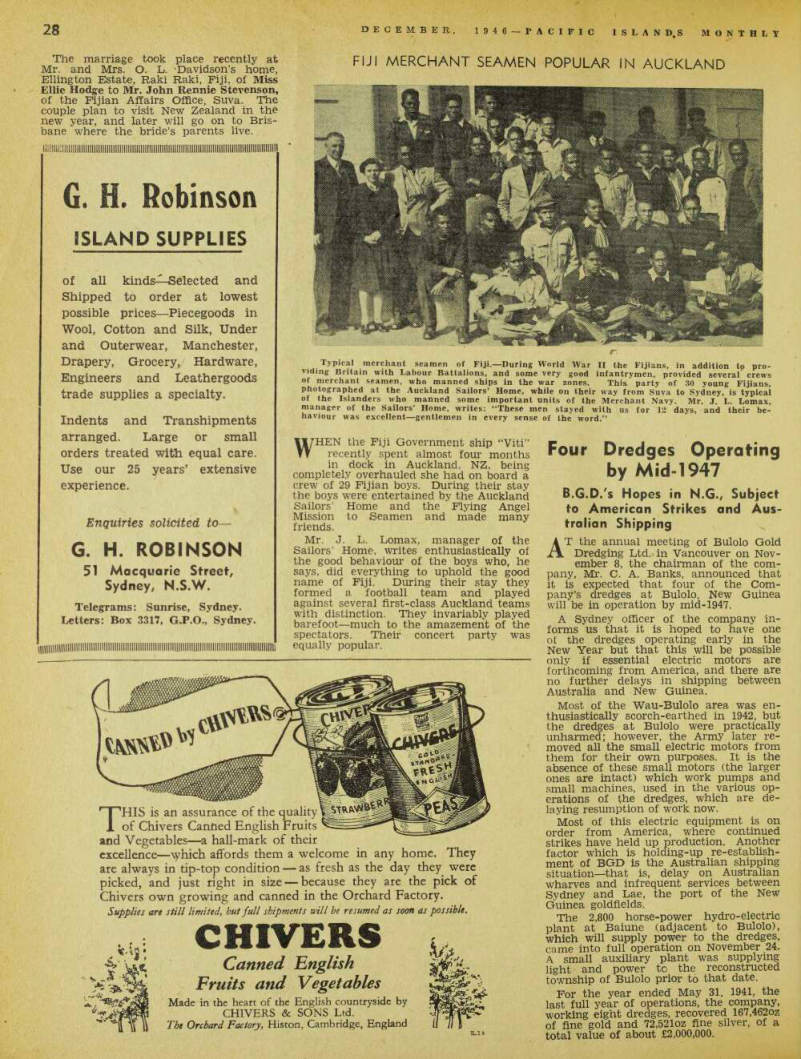
To Post-War Conditions
DEAN John Bodger, of the Anglican Mission at Dogura, near Milne Bay (New Guinea), who recently visited Brisbane for the Anglican Provincial Synod, said that New Guinea natives were successfully and quickly readjusting them selves to post-war conditions and that much training of natives had been done since the war ended.
Dean Bodger has been in New Guinea and Papua for more than 16 years. He remained during the war years and in 1944 at the request of General MacArthur, toured the United States to talk on Pacific topics, later he travelled through Canada and Great Britain where he again lec tured on the Pacific war.
According to the Dean, experiments in rice-growing in Papua and the introduc tion of other new crops had been success ful. Food, he said, has been scarce in New Guinea and Papua during the past year, following a bad drought. He also referred to the shortage of rice and maize seed, and material of all kinds. Taro, one of the main native crops, has become diseased throughout the Northern Solomons and gardens there will have to be replanted. The Government is send ing new stocks of fowls and pigs, to re place those lost by the natives during the war.
Dean Bodger’s mission territory is 500 square miles in area but he still walks to nine out-stations, some of them 4,000 ft. up in the mountains. —JHM.
Lady Scott, of Suva, Fiji, left the Col ony for New Zealand on November 20.
The marriage took place recently at Mr. and Mrs. O. L. Davidson’s home, Ellington Estate, Raki Raki, Fiji, of Miss Ellie Hodge to Mr. John Rennie Stevenson, of the Fijian Affairs Office, Suva. The couple plan to visit New Zealand in the new year, and later will go on to Bris bane where the bride’s parents live.
WHEN the Fiji Government ship “Viti” recently spent almost four months in dock in Auckland, NZ. being completely overhauled she had on board a crew of 29 Fijian boys. During their stay the boys were entertained by the Auckland Sailors’ Home and the Flying Angel Mission to Seamen and made many friends.
Mr. J. L. Lomax, manager of the Sailors' Home, writes enthusiastically of the good behaviour of the boys who, he says, did everything to uphold the good name of Fiji. During their stay they formed a football team and played against several first-class Auckland teams with distinction. They invariably played barefoot—much to the amazement of the spectators. Their concert party was equally popular.
Advertisements & other items, pp. 29-30 (1 item)
Dangar, Gedye & Malloch Ltd.
The Epic of the “BELLBIRD
99 0 V The “BELLBIRD” beached off Barrenjoey.
Newspapers. Radio and Waterfront gossip acclaim the marvellous performance of the
BLACKSTONE MARINE DIESEL
Mr. David Minchin (one of the owners of the “Bellbird”) spoke ovtr Macquarie Network describing their dramatic fight to safety through the pounding seas to Barrenjoey. Here are extracts:— “Water coming in ravidly . . . ship sinking under us . . . Bilge Pump Engine (Petrol type) cut right out, so down to Engine Room to bucket out the water which was rising high up on Engine ( Blackstone Diesel) block. Waves lashing back and forth fused all lights, so we quitted Engine Room, leaving Engine to pound on UNDER WATER. It did a magnificent job. From 10.30 p.m. to midnight, Engine kept going without any oil pressure ( lubrication ) at all .. . three big ends gone, AND IT STILL KEPT GOING. At last we beached, and the Engine coughed her last, completely UNDER WATER . . . but we were safe, thanks to Providence and the Blackstone Diesel Engine, which did a magnificent job” (Dangar, Gedye & Malloch, Ltd., fitted that Engine—a 120 h.p.
Blackstone Diesel—in a fishing boat Pre-war, and then it did service in the War years before the “Bellbird” got it.)
and the Sequel . . .
Another order for a new Blackstone Diesel for their new vessel—this time a 160 h.p., and SHIPPED from ENGLAND in 14 DAYS!
You can order a 120 h.p. for immediate delivery from stock.
“LISTER” & “BLACKSTONE”
AUXILARY AND PROPULSION MARINE
DIESEL ENGINES
We are distributors and stockists of Lister Marine Diesels and Blackstone Marine Diesels—and Spare Parts—with fully qualified staff for service.
Dangar, Gedye & Malloch Ltd.
10-14 YOUNG STREET, CIRCULAR QUAY, SYDNEY.
G.P.O. BOX 509. Tele. 86095.
For 50 of our 108 years we have been associated with ships and/or Engines for ships.
G. H. Robinson
ISLAND SUPPLIES
of all and Shipped to order at lowest possible prices—Piecegoods in Wool, Cotton and Silk, Under and Outerwear, Manchester, Drapery, Grocery, Hardware, Engineers and Leathergoods trade supplies a specialty.
Indents and Transhipments arranged. Large or small orders treated with equal care.
Use our 25 years’ extensive experience.
Enquiries solicited to —
G. H. ROBINSON
51 Macquarie Street, Sydney, N.S.W.
Telegrams: Sunrise, Sydney.
Letters: Box 3317, G.P.0., Sydney.
H lunOM^ THIS is an assurance of the quality of Chivers Canned English Fruits and Vegetables—a hall-mark of their excellence—which affords them a welcome in any home. They are always in tip-top condition —as fresh as the day they were picked, and just right in size because they are the pick of Chivers own growing and canned in the Orchard Factory.
Supplies are still limited, hut full shipments will he resumed as soon as possible .
CHIVERS
Canned English
Fruits and Vegetables
Made in the heart of the English countryside by
CHIVERS & SONS Ltd.
The Orchard Factory, Histon, Cambridge, England (•< s.S > - • & up
Fiji Merchant Seamen Popular In Auckland
Typical merchant seamen of Fiji.—During World War II the Fijians, in addition to pro viding Britain with Labour Battalions, and some very good infantrymen, provided several crews of merchant seamen, who manned ships in the war zones. This party of 30 young Fijians, photographed at the Auckland Sailors’ Home, while on their way from Suva to Sydney, is typical of the Islanders who manned some important units of the Merchant Navy. Mr. J. L. Lomax, manager of the Sailors’ Home, writes: “These men stayed with us for 12 days, and their be haviour was excellent—gentlemen in every sense of the word."
Four Dredges Operating
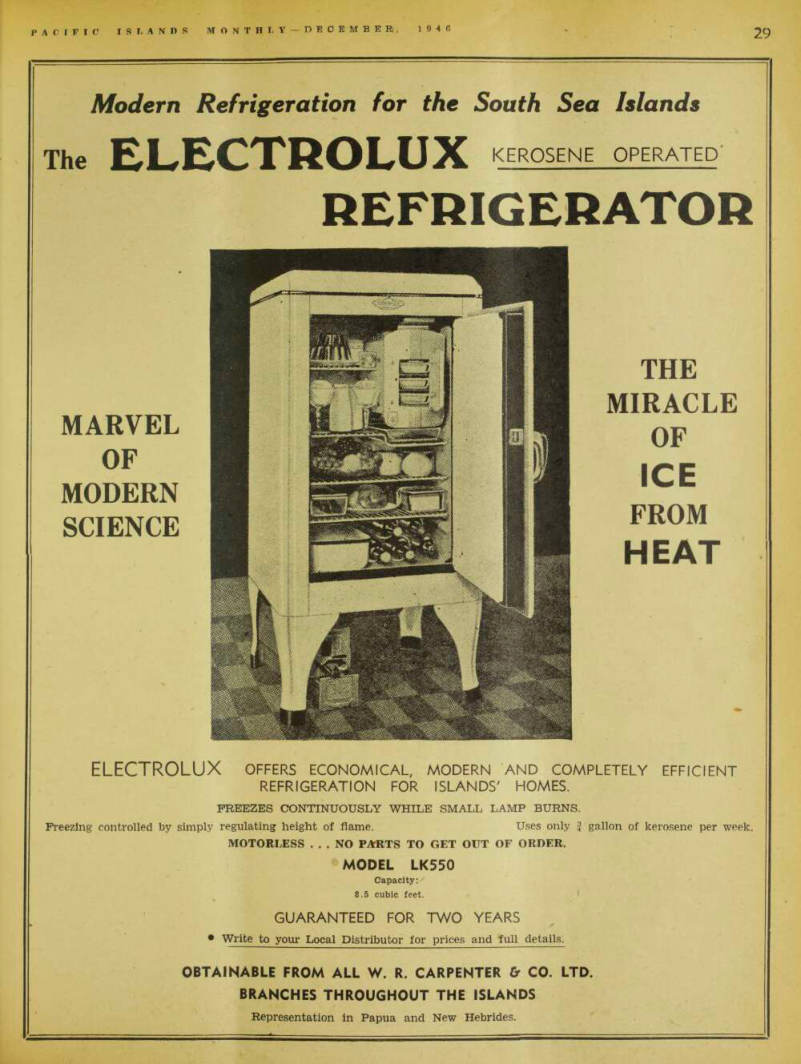
by Mid-1947
B.G.D.'s Hopes in N.G., Subject to American Strikes and Aus tralian Shipping
AT the annual meeting of Bulolo Gold Dredging Ltd. in Vancouver on Nov ember 8, the chairman of the com pany, Mr. C. A. Banks, announced that it is expected that four of the Com pany’s dredges at Bulolo, New Guinea will be in operation by mid-1947.
A Sydney officer of the company in forms us that it is hoped to have one of the dredges operating early in the New Year but that this will be possible only if essential electric motors are forthcoming from America, and there are no further delays in shipping between Australia and New Guinea.
Most of the Wau-Bulolo area was en thusiastically scorch-earthed in 1942, but the dredges at Bulolo were practically unharmed; however, the Army later re moved all the small electric motors from them for their own purposes. It is the absence of these small motors (the larger ones are intact) which work pumps and small machines, used in the various op erations of the dredges, which are de laying resumption of work now.
Most of this electric equipment is on order from America, where continued strikes have held up production. Another factor which is holding-up re-establish ment of BGD is the Australian shipping situation—that is, delay on Australian wharves and infrequent services between Sydney and Lae, the port of the New Guinea goldfields.
The 2,800 horse-power hydro-electric plant at Baiune (adjacent to Bulolo), which will supply power to the dredges, came into full operation on November 24.
A small auxiliary plant was supplying light and power to the reconstructed township of Bulolo prior to that date.
For the year ended May 31, 1941, the last full year of operations, the company, working eight dredges, recovered 167,4620 z of fine gold and 72,5210 z fine silver, of a total value of about £2,000,000.
There was a large gathering of mem bers of the Pacific Islands Society in History House, Sydney, on November 27, when the-new President,, Major A. C.
Swinbourne, formerly of the Gilbert and Ellice Islands Administration, entertained the members and several guests at a sherry party. Among the guests were Mr. and Mrs. Lucchenelli, old Fiji friends of the President.
Advertisements & other items, pp. 30-32 (3 items)
28
DECEMBER, 1946-PACIFIC ISLAND, S MONTHLY
29
PACIFIC ISLANDS MONT II LY DECEMBER!, 1940
Refrigerator
Modern Refrigeration for the South Sea Islands
The ELECTROLUX KEROSENE OPERATED
MARVEL
OF
MODERN
SCIENCE
s E 3 r~~"
THE
MIRACLE
OF
ICE
FROM
HEAT
ELECTROLUX offers economical, modern and completely efficient
REFRIGERATION FOR ISLANDS' HOMES.
FREEZES CONTINUOUSLY WHILE SMALL LAMP BURNS.
Freezing controlled by simply regulating height of flame. Uses only £ gallon of kerosene per week, MOTORLESS ... NO PARTS TO GET OUT OF ORDER.
MODEL LKSSO
Capacity: 8.5 cubic feet.
GUARANTEED FOR TWO YEARS
• Write to your Local Distributor for prices and full details.
OBTAINABLE FROM ALL W. R. CARPENTER & CO. LTD.
BRANCHES THROUGHOUT THE ISLANDS
Representation in Papua and New Hebrides.
Pen and Pencil
Set by
actual size A perfect- gift for yourself and others—the new Venus pen with every essential writing feature of pens costing twice as much and —a smooth action, matching pencil. Venus Guaranteed.
Obtainable at
PACIFIC ISLANDS TRADING
COMPANY
244 California Street, San Francisco,
Papuan Electrical Co.
PORT MORESBY
Consult Us For All Your Electricol Requirements
ELECTRICAL INSTALLATIONS AND REPAIRS—SUPPLIERS
OF ALL ELECTRICAL APPLIANCES AND EQUIPMENT-
IRONS. JUGS. TOASTERS. REFRIGERATORS, FANS,
MOTORS, Etc.
ESTIMATES GIVEN PROMPTLY.
W. Conolly, Manager.
Apply, P. 0., Port Moresby.
N. Guinea
Giant Snails In
Introduced by Japs at Kavieng, Rabaul and Madang
IN November, Mr. E. J. Wauchope, of Madang, arrived in Australia with the depressing news that the "iant snails, released by the Japs in various parts of the Mandated Territory as a potential foodstuff, had taken possession of an area on Hansa Bay, west of Madang.
The PIM had just gone to press; and, as it was urgent that the news be re leased, and the alarm sounded, we intro duced the “Sydney Morning Herald” to Mr. Wauchope. The news was published all over Australia, and it was hoped that High Autnority recognises its grav ity.
This makes the third area of infesta tion in the Territory. The Japs released the snails at Kavieng (north end of New Ireland) and near Rabaul (eastern end of New Britain); and in each case the creatures have increased enormously, and are advancing across country en masse, destroying much of the most valuable veg etation as they go. This was known months ago.
The appearance of the snails on the mainland of New Guinea was unexpected, and very alarming. There is nothing to stop the spread of the pest, and New Guinea, next to Greenland, is the largest island in the world.
Mr. Wauchope reported that the snails were in an area some two miles- by two miles; that they were in incredible num bers. ranging from tiny crawlers to shell backs eight and nine inches long; and that —like those in Kavieng and Rabaul— they were eating all vegetation in their path—showing a particular liking for young paw-paw plants, and the kaukau (sweet potato) of the native gardens.
They even eat the coarse creeping plants which grow just behind the beaches.
Japs may eat the snails; but they are scorned by the New Guinea natives, and even the natives’ pigs—notorious scaveng ers —reject them. The Japs boiled the creatures in their shells, and then dug them out and ate them, with vinegar.
The snails have no natural enemies in the Mandated Territory, and if the in
festation is not checked, native agricul ture—upon which the natives depend for a large proportion of their food—will be •gravely affected. The Administration’s Department of Agriculture is giving the matter urgent attention, but there is, as yet, no indication of what measures will be taken to check the plague.
It is reported that a firefly, found in Zanzibar, is a natural enemy of this snail, and that the Administration proposes to try this insect as a means of ccontrol.
One Who Does Not
Expect Tourists in Pacific
FROM an esteemed correspondent (an American) in Polynesia: I smiled while reading your forecast of heavy tourist traffic in the Pacific in 1947.
So far as one may peer into the future, the restless people in my country will be more actively engaged in burrowing underground to escape Russian atomic rockets, coming over the North Pole than in thinking of beckoning isles any where in the Seven Seas.
In the event that Russia shall have been appeased, the cumulative conse quences of a weak, bewildered Adminis tration at Washington; arrogant Labour leaders; the staggering national debt; an awakening to the impending exhaus tion of our high-grade iron ore and petroleum reserves; markets glutted with useless gadgets; and a perpetual menace in unstable foreign relations — these will have descended upon our USA within the next twelve months The New York >share market fore shadows something of this nature in the not distant future.
The old legend of Phaeton driving the sun was really a prophecy, which is coming to pass in our day.
Archaeologists of the Orang-outang Civilisation —500,000 years hence —will probably reconstruct such a legend to account for the charred and twisted debris they will find when excavating the habitation sites of mankind.
The currencies of the world are—in this age of progress—based on a vacuum —that absolute scientists had •despaired of attaining by means of ap paratus hitherto contrived.
Some of us may be pardoned if we are moderately pessimistic.
Preparation
Tongan Dictionary In
From Our Own Correspondent
Nukualofa, Nov. 4.
THE Rev. C. Churchward, Australian Methodist minister and noted authority on Island languages, and former missionary to Fiji and Rotuma, has been in Tonga for several months now. He has been engaged by the Tonga Government to compile a grammar and dictionary of the Tongan language.
There is need for a good grammar and dictionary of this branch of the Poly nesian language. The grammar and vocabulary compiled by the notorious Rev. Shirley Waldemar Baker and based on the works of earlier missionaries to Tonga, has been regarded as the stand ard work on the subject and has served to fill the gap, but there have been many faults and defects.
In order to gain a thorough knowledge of the language in as short a time as possible, the Rev. Churchward spends much of his time living alone amongst the natives of outlying districts.
Difficult Rehabilitation
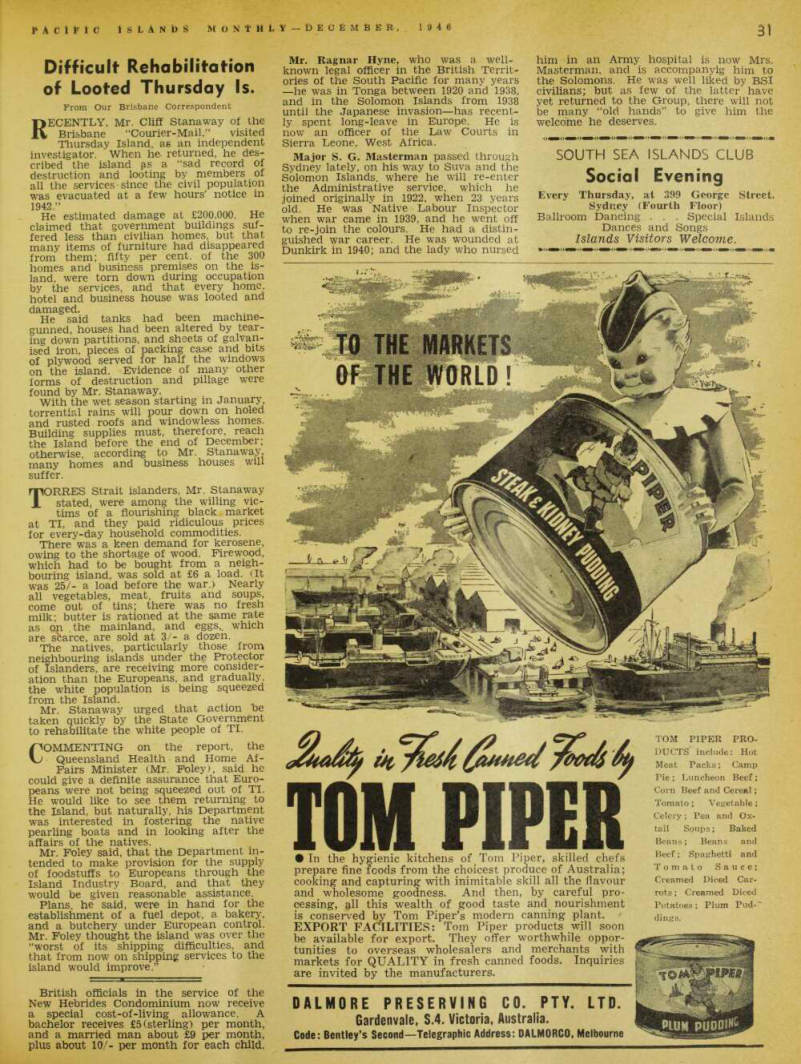
of Looted Thursday Is.
From Our Brisbane Correspondent RECENTLY, Mr. Cliff Stanaway of the Brisbane “Courier-Mail,” visited Thursday Island, as an independent investigator. When he returned, he des cribed the island £S a “sad record of destruction and looting by members of all the services since the civil population was evacuated at a few hours’ notice in 1942.”
He estimated damage at £200,000. He claimed that government buildings suf fered less than civilian homes, but that many items of furniture had disappeared from them; fifty per cent, of the 300 homes and business premises on the is land, were torn down during occupation by the services, and that every home, hotel and business house was looted and damaged.
He said tanks had been machine gunned, houses had been altered by tear ing down partitions, and sheets of galvan ised iron, pieces of packing case and bits of plywood served for half the windows on the island. Evidence of many other forms of destruction and pillage were found by Mr. Stanaway.
With the wet season starting in January, torrential rains will pour down on holed and rusted roofs and windowless homes.
Building supplies must, therefore, reach the Island before the end of December; otherwise, according to Mr. Stanaway, many homes and business houses will suffer. rRRES Strait islanders, Mr. Stanaway stated, were among the willing vic tims of a flourishing black market at TI, and they paid ridiculous prices for every-day household commodities.
There was a keen demand for kerosene, owing to the shortage of wood. Firewood, which had to be bought from a neigh bouring island, was sold at £6 a load. (It was 25/- a load before the war.) Nearly all vegetables, meat, fruits and soups, come out of tins; there was no fresh milk; butter is rationed at the same rate as on the mainland, and eggs,, which are scarce, are sold at 3/- a dozen.
The .natives, particularly those from, neighbouring islands under the Protector of Islanders, are receiving more consider ation than the Europeans, and gradually, the white population is being squeezed from the Island.
Mr. Stanaway urged that action loe taken quickly by the State Government to rehabilitate the white people of TI.
COMMENTING on the report, the Queensland Health and Home Af- Fairs Minister (Mr. Foley), said he could give a definite assurance that Euro peans were not being squeezed out of TI.
He would like to see them returning to the Island, but naturally, his Department was interested in fostering the native pearling boats and in looking after the affairs of the natives.
Mr. Foley said, that the Department in tended to make provision for the supply of foodstuffs to Europeans through the Island Industry Board, and that they would be given reasonable assistance.
Plans, he said, were in hand for the establishment of a fuel depot, a bakery, and a butchery under European control.
Mr. Foley thought the island was over the “worst of its shipping difficulties, and that from now on shipping services to the island would improve.”
British officials in the service of the New Hebrides Condominium now receive a special cost-of-living allowance. A bachelor receives £5 (sterling) per month, and a married man about £9 per month, plus about 10/- per month for each child.
Mr. Ragnar Hyne, who was a wellknown legal officer in the British Territories of the South Pacific for many years —he was in Tonga between 1920 and 1938, and in the Solomon Islands from 1938 until the Japanese invasion—has recently spent long-leave in Europe. He is now an officer of the Law Courts in Sierra Leone, West Africa.
Major S. G. Masterman passed through Sydney lately, on his way to Suva and the Solomon Islands, where he will re-enter the Administrative service, which he joined originally in 1922, when 23 years old. He was Native Labour Inspector when war came in 1939, and he went off to re-join the colours. He had a distinguished war career. He was wounded at Dunkirk in 1940; and the lady who nursed
him in an Army hospital is now Mrs.
Masterman, and is accompanyig him to the Solomons. He was well liked by BSI civilians; but as few of the latter have yet returned to the Group, there will not be many “old hands” to give him the welcome he deserves.
Advertisements & other items, p. 33 (1 item)
Tom Piper
SOUTH SEA ISLANDS CLUB
Social Evening
Every Thursday, at 399 George Street.
Sydney (Fourth Floor) Ballroom Dancing . . . Special Islands Dances and Songs Islands Visitors Welcome.
J ■-=if
RLD
Ljgl
A
fer
40 r
ffi
* js JS -k J
tK Ji
TOM PIPER
• In the hygienic kitchens of Tom Piper, skilled chefs prepare fine foods from the choicest produce of Australia; cooking and capturing with inimitable skill all the flavour and wholesome goodness. And then, by careful processing, all this wealth of good taste and nourishment is conserved by Tom Piper’s modern canning plant.
EXPORT FACILITIES: Tom Piper products will soon be available for export. They offer worthwhile opportunities to overseas wholesalers and merchants with markets for QUALITY in fresh canned foods. Inquiries are invited by the manufacturers.
DALMORE PRESERVING CO. PTY. LTD.
Gardenvale, 5.4. Victoria, Australia.
Code: Bentley’s Second—Telegraphic Address: DALMORCO, Melbourne
TOM PIPER PRO-
DUCTS include: Hot Meat Packs; Camp Pie ; Luncheon Beef ; Corn Beef and Cereal; Tomato; Vegetable ; Celery; Pea and Oxtail Soups; Baked Beans; Beans and Beef; Spaghetti and Tomato Sauce; Creamed Diced Carrots ; Creamed Diced Potatoes; Plum Pud- ' dings. tOI* M
Vernon Memorial
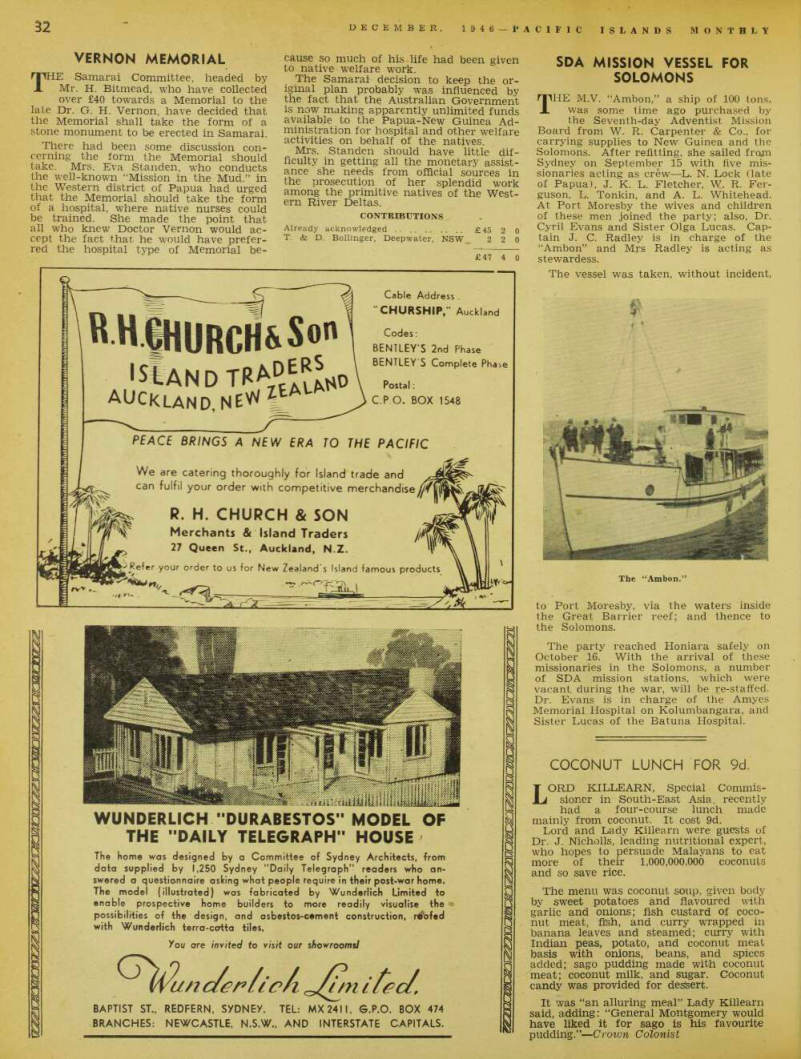
THE Samarai Committee, headed by Mr. H. Bitmead, who have collected over £4O towards a Memorial to the late Dr. G. H. Vernon, have decided that the Memorial shall take the form of a stone monument to be erected in Samarai.
There had been some discussion con cerning the form the Memorial should take. Mrs. Eva Standen, who conducts the well-known “Mission in the Mud.” in the Western district of Papua had urged that the Memorial should take the form of a hospital, where native nurses could be trained. She made the point that all who knew Doctor Vernon would ac cept the fact that he would have prefer red the hospital type of Memorial be
cause so much of his life had been given to native welfare work.
The Samarai decision to keep the or iginal plan probably was influenced by the fact that the Australian Government is now making apparently unlimited funds available to the Papua-New Guinea Ad ministration for hospital and other welfare activities on behalf of the natives.
Mrs. Standen should have little dif ficulty in getting all the monetary assist ance she needs from official sources in the prosecution of her splendid work among the primitive natives of the West ern River Deltas.
Contributions
Already acknowledged £45 2 0 T. & D. Bollinger, Deepwater, NSW 2 2 0 £47 4 0
Sda Mission Vessel For
Solomons
THE M.V. “Ambon,” a ship of 100 tons, was some time ago purchased by the Seventh-day Adventist Mission Board from W. R. Carpenter & Co., for carrying supplies to New Guinea and the Solomons. After refitting, she sailed from Sydney on September 15 with five mis sionaries acting as crew —L, N. Lock (late of Papua), J. K. L, Fletcher, W. R. Fer guson, L. Tonkin, and A. L. Whitehead.
At Port Moresby the wives and children of these men joined the party; also, Dr, Cyril Evans and Sister Olga Lucas. Cap tain J. C. Radley is in charge of the “Ambon” and Mrs Radley is acting as stewardess.
The vessel was taken, without incident,
to Port Moresby, via the waters inside the Great Barrier reef; and thence to the Solomons.
The party reached Honiara safely on October 16. With the arrival of these missionaries in the Solomons, a number of SDA mission stations, which were vacant during the war, will be re-staffed.
Dr. Evans is in charge of the Amyes Memorial Hospital on Kolumbangara, and Sister Lucas of the Batuna Hospital.
The “Ambon.”
Coconut Lunch For 9D.
LORD KILLEARN, Special Commis sioner in South-East Asia, recently had a four-course lunch made mainly from coconut. It cost 9d.
Lord and Lady Killearn were guests of Dr. J. Nicholls, leading nutritional expert, who hopes to persuade Malayans to eat more of their 1,000,000,000 coconuts and so save rice.
The menu was coconut soup, given body by sweet potatoes and flavoured with garlic and onions; fish custard of coco nut meat, fish, and curry wrapped in banana leaves and steamed; curry with Indian peas, potato, and coconut meat basis with onions, beans, and spices added; sago pudding made with coconut meat; coconut milk, and sugar. Coconut candy was provided for dessert.
It was “an alluring meal” Lady Killearn said, adding: “General Montgomery would have liked it for sago is his favourite pudding.” —Crown Colonist
Advertisements & other items, p. 34 (1 item)
R H.Fhurch&Son
■a : AND TRACKS®
AUCKLAND, NEW AL '
Cable Address .
CHURSHIP,” Auckland Codes: BENTLEY'S 2nd Phase BENTLEY S Complete Phase Postal:
CP O. BOX 1548
rv v PEACE BRINGS A NEW ERA TO THE PACIFIC We are catering thoroughly for Island trade and can fulfil your order with competitive merchandise
R. H. CHURCH & SON
Merchants & Island Traders 27 Queen St. f Auckland, N.Z.
Refer your order to us for New Zealand's Island famous products j£a. r
IIS
WUNDERLICH "DURABESTOS" MODEL OF
THE "DAILY TELEGRAPH" HOUSE
The home was designed by a Committee of Sydney Architects, from data supplied by 1,250 Sydney "Daily Telegraph" readers who answered a questionnaire asking what people require in their post-war home.
The model (illustrated) was fabricated by Wunderlich Limited to enable prospective home builders to mo-re readily visualise the possibilities of the design, and asbestos-cement construction, roofed with Wunderlich terra-cotta tiles.
You are invited to visit our showroomsI
c/er/icA itec/.
BAPTIST ST.. REDFERIM, SYDNEY. TEL: MX 2411. G.P.O. BOX 474
BRANCHES: NEWCASTLE, N.S.W., AND INTERSTATE CAPITALS.
Jungles
Coast Watchers In New Guinea
Keeping Tab on Japs in 1942
Another Instalment by Lutheran Missionary A. P. H. Freund
BY the early part of February it seemed certain that, in spite of our radio activity, the Japs did not know of our presence.
It might be suggested that they prob ably knew, but did not worry. The way they hunted other parties, and the brutal way they dealt with those captured, rule out that possibilty.
The disturbed and nervy attitude of the natives had also died down to a great extent by now, and it had become clear that the native were not going to betray us, but that they were on our side whole heartedly, and would do whatever they could to w*arn and help us, if the Japs ever started to look for us. The~effect of thorough Christian misson work was clearly apparent in this, their attitude.
It had also become clear that the enemy, apart from short patrols to Sattleberg, and places at a similar distance were satisfied to entrench themselves at Finsch hafen.
So a plan 1 was formulated to establish a watch station near Sattleberg. and over looking Finschhafen. But we felt that for such an undertaking we should be more suitably armed. Pursehouse and McColl each had a .40 cal. Winchester, and I had my .32, which I had brought with me when I first came to New Guinea. Besides this, we had several .303’s which had been used by police boys. Pursehouse also had a medium calibre revolver, for which he
still had about half a dozen cartridges.
We felt that in an emergency, and at close quarters, we required something better. So we requested headquarters to drop a revolver and an Owen gun for each of us, besides additional stores and benzine to replenish our fast dwindling stock.
Supplies By Parachute
THE drop was to take place on February 19. It was delayed from day to day till the 22nd, when a Liberator approached with unmistakable intentions.
To a small isolated party such an occasion was a real thrill.
First, he did a trial run, mainly to see whether everything was in order. Since we had last been in contact with base, it could easily have happened that we had been surprised by the enemy. To indicate that this was not so we had a standing arrangement that. at the approach of our “grocery plane,” four fires would be lit in a square formation in the open village place —which inciden tally, also gave him indication of the wind direction.
On this trial run, he dropped hundreds of leaflets, with a message in Pidgin for the natives, assurring them that in due time the Japanese would be driven out, urging them to do all they could for any airmen who happened to come down, and warning them to withdraw from
areas occupied by the enemy lest, while our aircraft were bombing and machine gunning enemy positions, they too might be hit.
Having done the trial run, the Liberator circled off to prepare for the dropping run.
Naturally, we were watching the big aircraft carefully. As it straightened out and was still about three or four miles off, we saw an object, looking very small at that distance, leave the plane without a parachute. Only because there was a bank of white cloud behind it did we see it. As it dropped to where only the blue sky formed the background it became invisible. That could hardly have been intended for us, we thought, yet we care fully noted the direction.
At a distance of about half a mile, a flutter of white material appeared out of the belly of the plane and zipped astern as the air stream caught the parachute, which pulled the bundle out with it. It poised in that grotesque posture for a moment. Then the bundle swung down, the 'chute opened, and billowing as though it were breathing, with the load gently swaying below, it disappeared into the nearby jungle.
Meanwhile, two others had also been released. The natives of the village, whom we had told beforehand what would happen, were yelling with excitement, and watching where the 'chutes disappeared.
The last one of this run, dropped when the plane had already passed over the village was caught in a current of air. and eventually landed in a gully about two miles away.
Next run, two more bundles were dropped. One, a light bundle, parted company from the small 'chute to which it was attached. The bundle came down with a thud, and the 'chute fluttered
after it. It turned out that this bundle contained the Owen gun and three revolvers. But so carefully was the dis mantled Owen gun packed that it was absolutely unharmed. The cover plate on one of the revolvers was smashed.
All the bundles were soon collected by the natives. They know the jungle intim ately and a white parachute hanging from
a tree or draped over undergrowth is easily seen.
Then followed a busy period of un packing, examining and checking. Not everything lapded whole and undamaged.
It is estimated that when a man lands with a parachute, he meets the earth with about the same impact as if he had jumped from a ten-foot wall. Dropped bundles strike with about the same force, for they are packed to weigh about the same as an average man. Only strong cases, such as those containing salt, were intact. Milk and meat cases simply smash and many tins got bent. When a tin opener was stuck into such a bent tin of milk, a small geyser shot out until the pressure was gone. Yet a dozen bottles of Worcester sauce landed with only one broken.
No revolver or Owen gun ammunition could be found. Our thoughts turned to that object that had dropped from the plane as it swung in for the dropping run.
It was too late to send out a search party that day. At the evening “sked” we sent in a query-regarding the ammunition and checked the number of bundles dropped.
We were assured that ammunition had been included in one of the bundles and that six bundles had been dropped. So far we had collected only five.
Next morning a party of natives was sent out. Though we could give them only the direction where it had fallen, and not the distance, and though there was no white ’chute to draw their attention — rather was the search made more diffi cult by the fact that the canvas cover of the bundle was a very dark green, blending well with the jungle in which it lay—yet by mid-afternoon they were back with it. A remarkable bit of work!
It was evident that the bundle had accidentally slipped out before the crew had attached the ring of the parachute.
And though it had dropped from a height of at least 2,000 ft., and must therefore have landed with terrific force, only a few cartridges could not be used.
Some mail had also been included in the drop. Pursehouse and McColl being the fortunate recipients. Welcome read ing material had also come to hand.
Bismark Sea Battle
ALL our requirements had, however, not yet been supplied. Headquarters informed us that another consign ment would be delivered in a few days’ time. But the few days dragged out to a fortnight.
It was just at that time that the big
Japanese convoy, which tried to relieve Lae, was approaching. Huge numbers of aircraft were required for the attack, which became known as the Bismark Sea Battle. And of those planes not actually in ’the engagement every available one was held in readiness for any emergency.
Hence the delay in our delivery.
A few words about the Bismark Sea engagement. We unfortunately were a bit too far west of the route which the planes took from Port Moresby on their way to the scene of action, so we could not see them. But for days we could hear the almost unending drone, which indicated to us that there was something exceptionally big going on somewhere.
After several days of this the first announcement was made over the ABC.
All such news was delayed in those days.
The very first announcement had such a confident ring about it that we tipped that the whole convoy had by then probably already been destroyed. And the drone of the planes had ceased two days before the final announcement was made.
It was claimed that all the ships were destroyed without delivering their cargo, and that all the troops, which they were carrying, perished. According to informa tion which we gathered from the natives that is not quite correct. They reported that large numbers of troops reached the coast and walked to Lae, and that one of the ships managed to get into Finschhafen and unload its cargo, but was sunk after it left.
While we were waiting, various jobs kept us busy. We got the natives to build a hut in a dense part of jungle, some distance from the village. A con siderable part of our stores, some clothing and footwear, rifles and ammunition, fuel, radio spares and other oddments were stored here. This was to be our back cache.
I also made use of some of that excel lent American canvas in which many of the dropped bundles had been wrapped and sewed two “rucksacks,” which later proved very servicable. We also began packing for our future undertaking.
Our plan was as follows; Two men with one of the radio sets were going to penetrate into the Sattelberg area, taking with them only a bare month’s supply of food. The third man was to go to Besa bong with the other radio, a fair stock of food, and some spare clothing. It was decided that Pursehouse and McColl would go right forward, and that I should guard this back base. After a month it was intended that one of them come back, and I should go forward, and so on, each man thus getting a period of rest.
On March 6 we received the balance of our drop, and this time I was the for tunate recipient of several letters from my wife —the first that came through for three months.
It was during this period also that we received a message from headquarters telling us that a party to be led by Pat Mollison was being organised at Port Moresby to come and relieve us.
Furthermore, we had also received the injunction: “Do nothing rash. You are more value to us alive than dead.” We fully agreed with the latter sentiment.
And in view of the fact that instead of supplying each of us with an Owen gun, they had given us only one between the three, we felt less inclined to be rash than might otherwise have been the case.
Broadcast To Natives
ON March 8, Pursehouse and McColl left for Sattelberg. After preparing all I had to shift, and securing in the cache all that had to be left behind, I got going on March 11. At Kulungtufu, I was able to let the natives hear a broad
cast that was meant especially for them.
An innovation had been begun at Port Moresby. Various former Government officers, who were well known to the natives in many parts of New Guinea Territory, in turn gave broadcast talks in Pidgin to the natives. The idea was that the various parties, like ourselves, who were in enemy-occupied territory, should call the natives together for these broadcasts and let them hear the talks on the loud speaker.
These talks usually gave the natives information on the reverses that the Japs were suffering at the time, The Bismark Sea Ba-ttle was given due prominence.
And, as in the case of leaflets which were being dropped, the natives were urged to keep away from the Japanese, not to supply them with any food, and help any of our men, especially airmen who were in difficulties.
I believe that these talks did a lot of good. In due time I was able to let also the Besabong natives hear several more similar broadcasts.
Life In A Native Village
ALONE white man can have a compar atively comfortable and interesting life in a native village. The news sessions were eagerly followed on the wireless, and radio plays and good musical programmes provided the entertainment. Occasionally some of the natives would come around for a chat.
The boys and young men of that village were often playing a top-spinning game.
A certain nut, about two and a half inches long, was used as the top. String, which the natives produce out of fibres obtained from certain plants in the bush, was wound around the “top,” just as white boys manipulate their tops. One boy would spin his top, and the object of the next competitor was to spin his top in such a way that it would knock out the first one. Then the others would have a go at that one, and so on. Great excitement prevailed, and shouts, shrieks and laughter always revealed when and where such a game was in progress.
A never-to : be-forgotten experience was a case of death-wailing. It appears that there was a heathen remnant in that village.
Early one night it began. Blood-curd ling, nerve-racking wails awakened me, and continued right through the night.
A man from Besabong had died in a nearby village. Next morning the corpse, wrapped in mats, was brought home. The mourners, 'the ineahest relatives, wefit out to meet it, and as they came in, and for some time after they reached the village, the wails and hysterical sobbing reached an especially awful pitch. Three women were a particularly pitiful spectacle. Occasionally they reeled and staggered around outside,their faces dis torted, and their bodies trembling at the point of utter exhaustion.
It is such death-wailing that helps one to realise the pitiable state of the heathen.
It would be bad enough if it were all genuine. How much is actually genuine is not easy to find out. For it is a fact, established by anthropologists, the wailing is a social duty. It is believed that the spirit of the departed is hovering around and takes note of what the next-of-kin are doing. The spirit has the power to bless or to curse. And if the departed was a man of considerable importance or influence, this power is correspondingly great.
Not to show sufficient sorrow would bring down his curse upon the relatives in question. So, to ensure his favour, they weep and wail and lament hard and long.
(Continued overleaf)
Calm Before The Storm
MY actual work consisted on one hand, in supplying weather reports. On the other hand, I had to keep in touch with our forward party.
We had arranged that we would call each other every morning and evening.
If they missed out on two consecutive calls, I was to take that as sufficient evidence that something serious had happened; that they had either been chased out, captured or killed. I was then to leave a small supply of food and clothing at Besabong, move our supplies and Teleradio to a safer area, and wait for “grape-vine news.” Through the natives I would certainly soon hear what had happened.
If one or both survived they were to make for Besabong, get the food and
clothing left there, learn where I had gone and follow. If I heard that they had been captured or killed, I was to tr Y t 0 set through to Port Moresby some how. That sounded easier than it actually was, as we were to discover later, The first difficulty in carrying out our plans was the impossibility, at many, of the “skeds,” to make contact, owing to “skip distance.” In other words, being only ten to fifteen miles apart the radio signals would, under certain atmospheric conditions, go too far before they would rebound from the atmospheric “shell.”
The first time this happened I did not worry greatly, since that was during the they were still on their way towards Sattelberg. When it happened again I became worried. And, as I found later, Purse and Mac were also worried
about me, fearing that a sneaking party of Japs might have wiped me out.
On the third occasion I was nearly frantic. But, after my call from Moresby, I heard the operator call Mac. The plan had -been that they would pass all their traffic thrpugh me. But now Mac had made contact with Moresby direct. And, though I could not hear Mac’s reply, yet Moresby reported that his signals were good. So I again began to call him.
Still no reply.
Eventually Moresby chipped in and said: “I had better help you fellows. You are evidently up against a skip distance. I can hear both of you quite plainly.”
Some days we made direct contact with out difficulty. At other times we, who were at most about fifteen miles apart had to relay through Moresby which was about 300 miles from both of us. Radio still had many unsolved riddles.
Being able to keep in touch through Moresby, when necessary, we settled down to normal activities. According to the length of messages Mac was sending to headquarters they were obtaining a lot of interesting information. And after the first week or so they sounded quite carefree and happy, so they were obvi ously not worried about the fact that the Japs were not far away. The story of how this pleasant set-up was suddenly and rudely shattered by the Japs will have to wait for another day.
Advertisements & other items, pp. 35-38 (2 items)
Keillers
■■■lll liuimuc i 5 ■ - 5C< *“:»'j-««»«r 6 wtunMEDU. ncVvfe#.** VS-a-t ss i & IS.
I § I k i i i 1 rS>C 1 fe nV 1 w m fiofe sTfc
SPEC^
Imported for
a select few
THE ORIGINAL MARMALADE
KEILLERS
Dundee
MARMALADE
ESTABLISHED IN 1797
Rid Kidneys Of
Poisons And Adds
If you suffer sharp, stabbing pains, If Joints are swollen, it shows your blood Is poisoned through faulty kidney action. Other symptoms of Kidney Disorders are Backache, Aching Joints and Limbs, Sciatica, Neuritis, Lumbago, Sleepless Nights, Dizziness, Nervousness, Circles under Eyes, Loss of Energy and Appetite and Frequent Headaches and Colds, etc. Ordinary medicines can’t help much because you must get to the root cause of the trouble.
The Cystex treatment is specially compounded to soothe, tone and clean kidneys and bladder and remove acids and poisons from your system safely, quickly and surely, yet contains no harmful or dangerous drugs. Cystex works In 3 ways to end your troubles. 1. Starts killing the germs which are attacking your Kidneys, Bladder and Urinary System in two hours, yet Is absolutely harmless to human tissue. 2. Gets rid of health-destroying, deadly poisonous acids with which your system has become saturated. 3. Strengthens and reinvigorates the kidneys, protects from the ravages of disease-attack on the delicate filter organism, and stimulates the entire system.
Praised by One-time Sufferers
Cystex is approved by one-time sufferers In 73 countries from the troubles shown above.
Mr. Reg Thomas, Townsville, Queensland, recently wrote: “My joints were all stiff, 1 had leg pains, my back used to ache day and night.
My bladder was weak. I had headaches and no appetite. The first dose of Cystex helped me and before I finished three boxes my health and strength came back.”
Guaranteed to Satisfy or Money Back Get Cystex from your chemist or store to-day.
Give it a thorough test. Cystex is guaranteed to make you feel younger, stronger, better In every way. or your money back If you return the empty package.
Now in 2 sizes—4/-, 8/-.
This is a
GUARANTEED i VCfOV
Treatment ® for Your Kidneys, Bladder, RheumatisnL
PRODUCING UNIFORM GOOD RESULTS SINCE 1868
ALWAYS ASK FOR IT
THAT - .
v
HAVE YOU
CONSIDERED
THIS CODICIL?
By adding a simple codicil to your Will you can guard against difficulties and loss which might arise should your Executor die or become incapacitated.
By means of such a codicil you can name Burns Philp Trust Co. Ltd. as joint Executor with your present appointee or, if you wish, as sole Executor. In this way you gain positive assurance of continuous and sound administration and are relieved of a serious anxiety. The Company will willingly forward full particulars.
DIRECTORS:
Lewis Armstrong. James Burns. Joseph Mitchell.
R. J. Nosworthy. P. T. VV. Black.
MANAGER; L. S. Parker.
SECRETARY: E. R. Overton, A.F.I.A.
BURNS PHILP TRUST
COMPANY LIMITED
7 BRIDGE STREET, SYDNEY
’Phone: BU 5901.
BOX 543, G.P.0., SYDNEY.
• P. 2-45
tX LM Prepared from choicest tender meats, and cooked to perfection by expert chefs, Imperial canned meats are “flavoursealed” for lasting taste appeal.
Keep good stocks of the many delicious Imperial canned meats and serve them often—they’re always ready, and always welcome.
J r
PUPD
CANNED MEATS
MEATREAT CAMP PIE
HOT MEALS HAMPE
34
DEOEMBER. 1946-PACIFIO ISLANDS MONTHLY
Rotuma Visitors To
Australia
From a Brisbane Correspondent MR. and Mrs. A. T. Low passed through Brisbane recently in the Qancas flying-boat “Coriolanus.” They were on their way back to Rotuma, via Fiji.
Mr. Low is a native of Mackay (Q.) and is manager of the Burns, Philp store on Rotuma. Rotuma, he said, had a popu lation of only 12 Europeans, mainly mis sionaries, and about 3,000 natives.
After five months in Sydney, Mrs. Low, who is well-known to “PIM” readers as “Amel,” was looking forward to the peace of Rotuma.
Handbook On Ellice
Islands Language
A HANDBOOK on the language of the Ellice Islands has recently been re ceived from the Sydney publishers, Webbsdale, Shoosmith Pty., Ltd. It is written by D. G. Kennedy of the Western Pacific High Commission staff who, with the rank of Major, gave such notable service in the Solomons during the war, and was decorated..
Mr. Kennedy later supervised the re moval of the Ocean Islanders to their new home at Rabi Island, Fiji Group, and was for some time District Officer on the is land.
The handbook on the Ellice Dialect has been written primarily for the guidance of Government officers who wish to ac quire a working knowledge of the tongue.
Ellice is a branch of Polynesian, with Samoan affinities, but Ellice itself varies throughout the group. Kennedy’s hand book deals with the Vaitupu dialect, which had been the medium of Govern ment and missionary secondary education in the Group for many years. The text is simply arranged and the student should have no difficulty in assimilating the contents of the small volume. This should give him at least the rudiments of the language.
The cost of the book is 5/-; it is obtain able from the offices of the Western Pac ific High Commission, Suva, Fiji.
Magazine Section
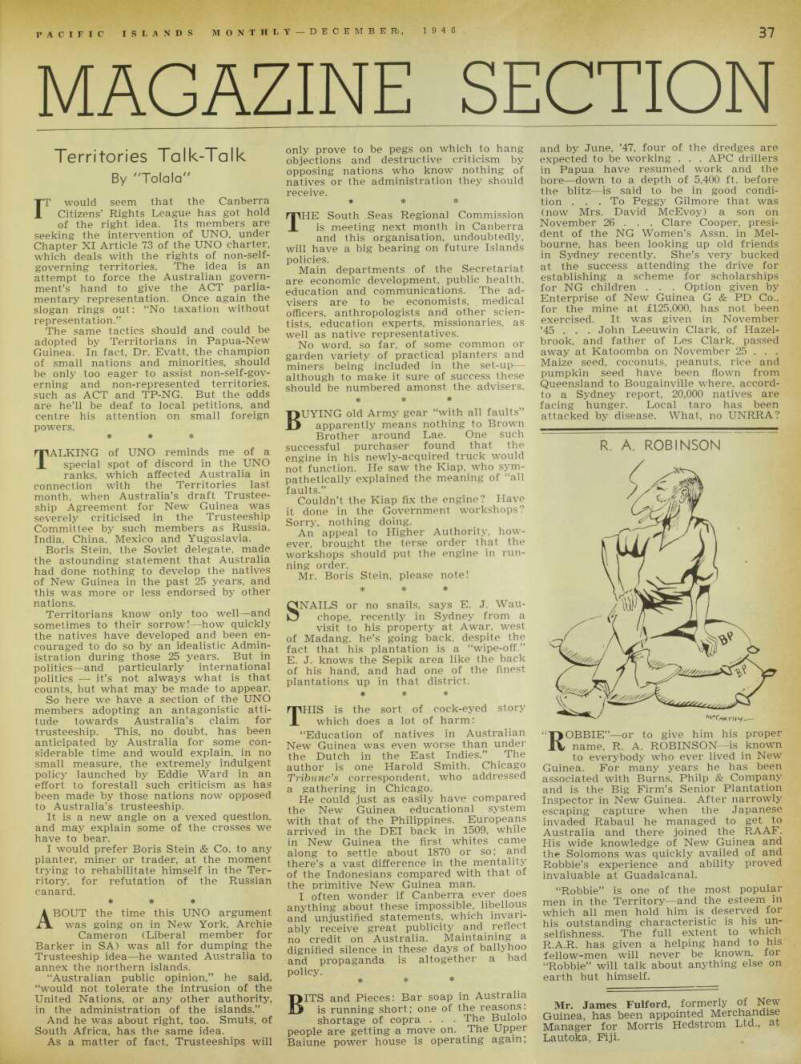
Territories Talk-Talk
By "Tolala"
IT would seem that the Canberra Citizens’ Rights League has got hold of the right idea. Its members are seeking the intervention of UNO, under Chapter XI Article 73 of the UNO charter, which deals with the rights of non-self governing territories. The idea is an attempt to force the Australian govern ment’s hand to give the ACT parlia mentary representation. Once again the slogan rings out: “No taxation without representation.”
The same tactics should and could be adopted by Territorians in Papua-New Guinea. In fact, Dr, Evatt, the champion of small nations and minorities, should be only too eager to assist non-self-gov erning and non-represented territories, such as ACT and TP-NG. But the odds are he’ll be deaf to local petitions, and centre his attention on small foreign powers. * * * TALKING of UNO reminds me of a special spot of discord in the UNO ranks, which affected Australia in connection with the Territories last month, when Australia’s draft Trustee ship Agreement for New Guinea was severely criticised in the Trusteeship Committee by such members as Russia, India, China, Mexico and Yugoslavia.
Boris Stein, the Soviet delegate, made the astounding statement that Australia had done nothing to develop the natives of New Guinea in the past 25 years, and this was more or less endorsed by other nations.
Territorians know only too well —and sometimes to their sorrow! —how quickly the natives have developed and been en couraged to do so by an idealistic Admin istration during those 25 years. But in politics —and particularly international politics it’s not always what is that counts, but what may be made to appear.
So here we have a section of the UNO members adopting an antagonistic atti tude towards Australia’s claim for trusteeship. This, no doubt, has been anticipated by Australia for some con siderable time and would explain, in no small measure, the extremely indulgent policy launched by Eddie Ward in an effort to forestall such criticism as has been made by those nations now opposed to Australia’s trusteeship.
It is a new angle on a vexed question, and may explain some of the crosses we have to bear.
I would prefer Boris Stein & Co. to any planter, miner or trader, at the moment trying to rehabilitate himself in the Ter ritory, for refutation of the Russian canard. * * * ABOUT the time this UNO argument was going on in New York, Archie Cameron (Liberal member for Barker in SA) was all for dumping the Trusteeship idea —he wanted Australia to annex the northern islands.
“Australian public opinion,” he said, “would not tolerate the intrusion of the United Nations, or any other authority, in the administration of the islands.”
And he was about right, too. Smuts, of South Africa, has the same idea.
As a matter of fact, Trusteeships will
only prove to be pegs on which to hang objections and destructive criticism by opposing nations who know nothing of natives or the administration they should receive. ♦ * * THE South Seas Regional Commission is meeting next month in Canberra and this organisation, undoubtedly, will have a big bearing on future Islands policies.
Main departments of the Secretariat are economic development, public health, education and communications. The ad visers are to be economists, medical officers, anthropologists and other scien tists, education experts, missionaries, as well as native representatives.
No word, so far, of some common or garden variety of practical planters and miners being included in the set-up— although to make it sure of success these should be numbered amonst the advisers. ♦ * * BUYING old Army gear “with all faults” apparently means nothing to Brown Brother around Lae. One such successful purchaser found that the engine in his newly-acquired truck would not function. He saw the Kiap, who sym pathetically explained the meaning of “all faults.”
Couldn’t the Kiap fix the engine? Have it done in the Government workshops?
Sorry, nothing doing.
An appeal to Higher Authority, how ever, brought the terse order that the workshops should put the engine in run ning order.
Mr. Boris Stein, please note! * * ♦ SNAILS or no snails, says E. J. Wau chope, recently in Sydney from a visit to his property at Awar, west of Madang. he’s going back, despite the fact that his plantation is a “wipe-off.”
E. J. knows the Sepik area like the back of his hand, and had one of the finest plantations up in that district. ♦ * * THIS is the sort of cock-eyed story which does a lot of harm: “Education of natives in Australian New Guinea was even worse than under the Dutch in the East Indies.” The author is one Harold Smith, Chicago Tribune’s correspondent, who addressed a gathering in Chicago.
He could just as easily have compared the New Guinea educational system with that of the Philippines. Europeans arrived in the DEI back in 1509, while in New Guinea the first whites came along to settle about 1870 or so; and there’s a vast difference in the mentality of the Indonesians compared with that of the primitive New Guinea man.
I often wonder if Canberra ever does anything about these impossible, libellous and unjustified statements, which invari ably receive great publicity and reflect no credit on Australia. Maintaining a dignified silence in these days of ballyhoo and propaganda is altogether a bad policy. * * * BITS and Pieces: Bar soap in Australia is running short; one of the reasons: shortage of copra . . • The Bulolo people are getting a move on. The Upper Baiune power house is operating again;
and by June, ’47, four of the dredges are expected to be working . . . APC drillers in Papua have resumed work and the bore —down to a depth of 5,400 ft. before the blitz —is said to be in good condi tion ... To Peggy Gilmore that was (now Mrs. David McEvoy) a son on November 26 . . . Clare Cooper, presi dent of the NG Women’s Assn, in Mel bourne, has been looking up old friends in Sydney recently. She’s very bucked at the success attending the drive for establishing a scheme for scholarships for NG children . . . Option given by Enterprise of New Guinea G & PD Co., for the mine at £125,000, has not been exercised. It was given in November ’45 . . . John Leeuwin Clark, of Hazel brook, and father of Les Clark, passed away at Katoomba on November 25 . . .
Maize seed, coconuts, peanuts, rice and pumpkin seed have been flown from Queensland to Bougainville where, accord to a Sydney report, 20,000 natives are facing hunger. Local taro has been attacked by disease. What, no UNRRA?
R. A. Robinson
T> OBBIE” —or to give him his proper IV name, R. A. ROBINSON—is known to everybody who ever lived in New Guinea. For many years he has been associated with Burns, Philp & Company and is the Big Firm’s Senior Plantation Inspector in New Guinea. After narrowly escaping capture when the Japanese invaded Rabaul he managed to get to Australia and there joined the RAAF.
His wide knowledge of New Guinea and the Solomons was quickly availed of and Robbie’s experience and ability proved invaluable at Guadalcanal.
“Robbie” is one of the most popular men in the Territory—and the esteem in which all men hold him is deserved for his outstanding characteristic is his un selfishness. The full extent to which R.A.R. has given a helping hand to his fellow-men will never be known, for “Robbie” will talk about anything else on earth but himself.
Mr. James Fulford, formerly of New Guinea, has been appointed Merchandise Manager for Morris Hedstrom Ltd., at
Lautoka, Fiji.
Wau Road
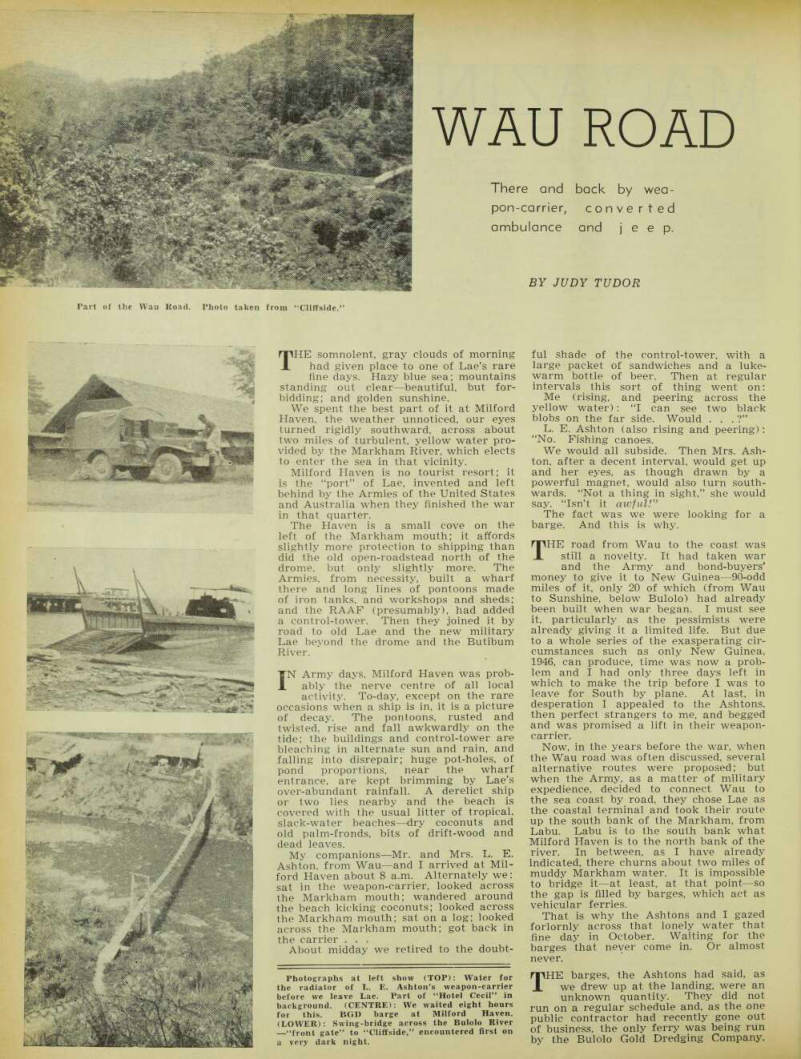
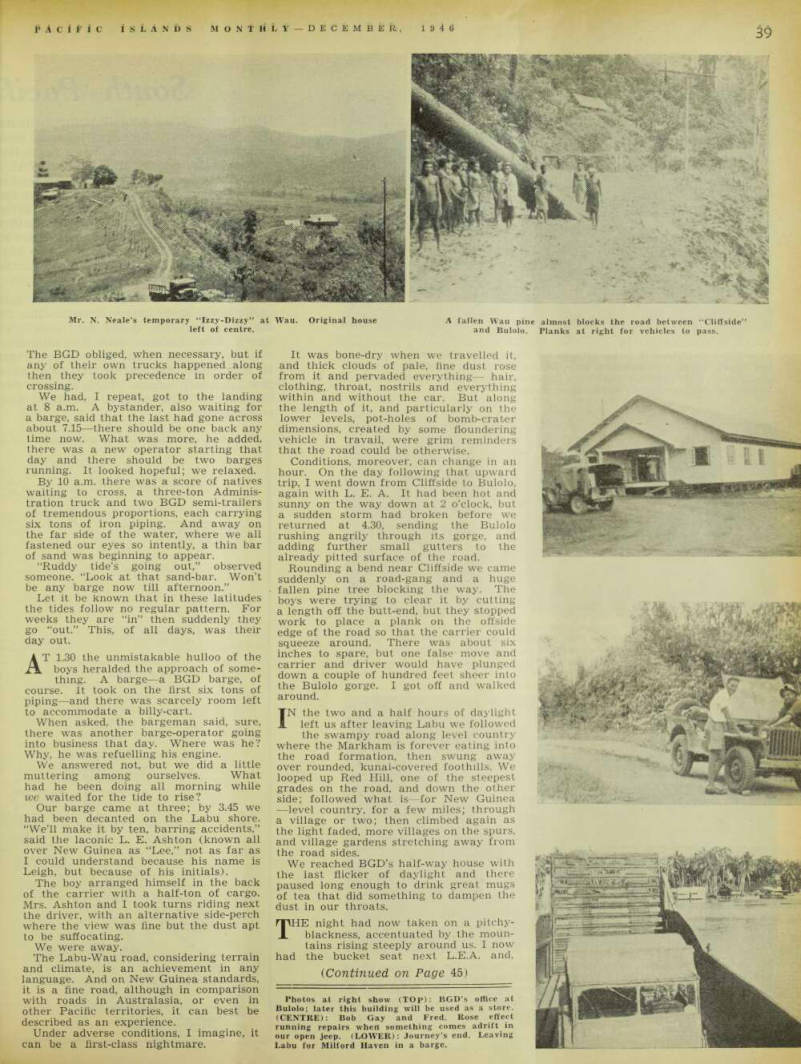
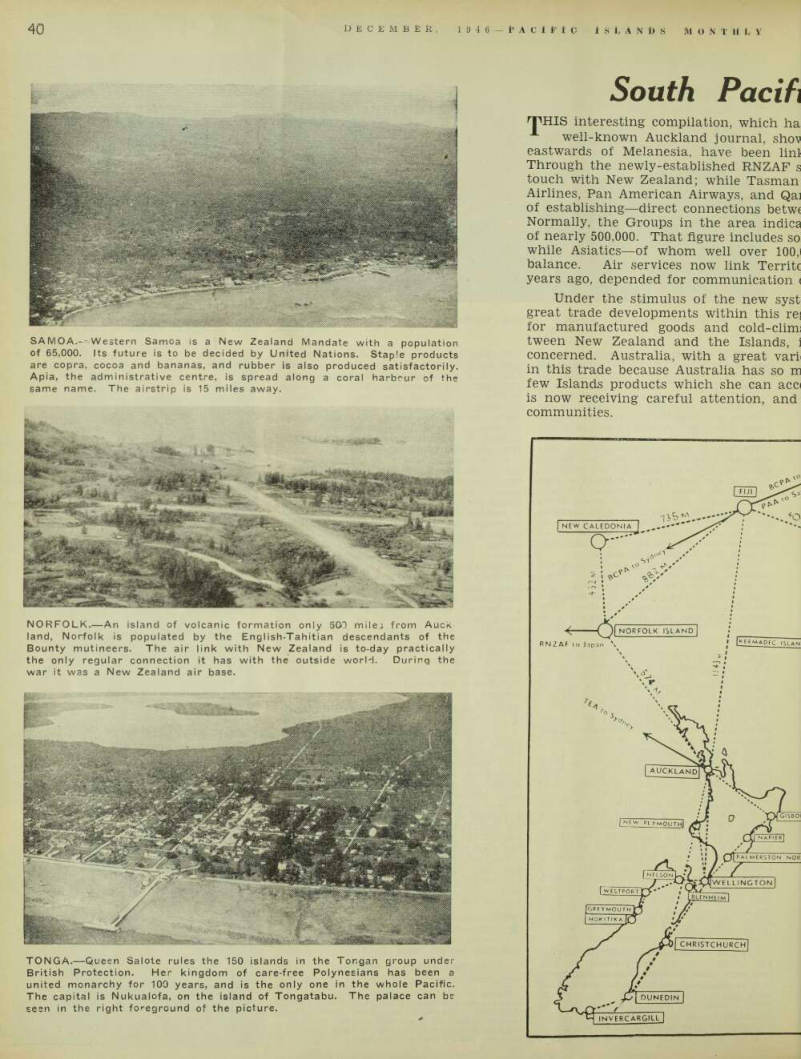
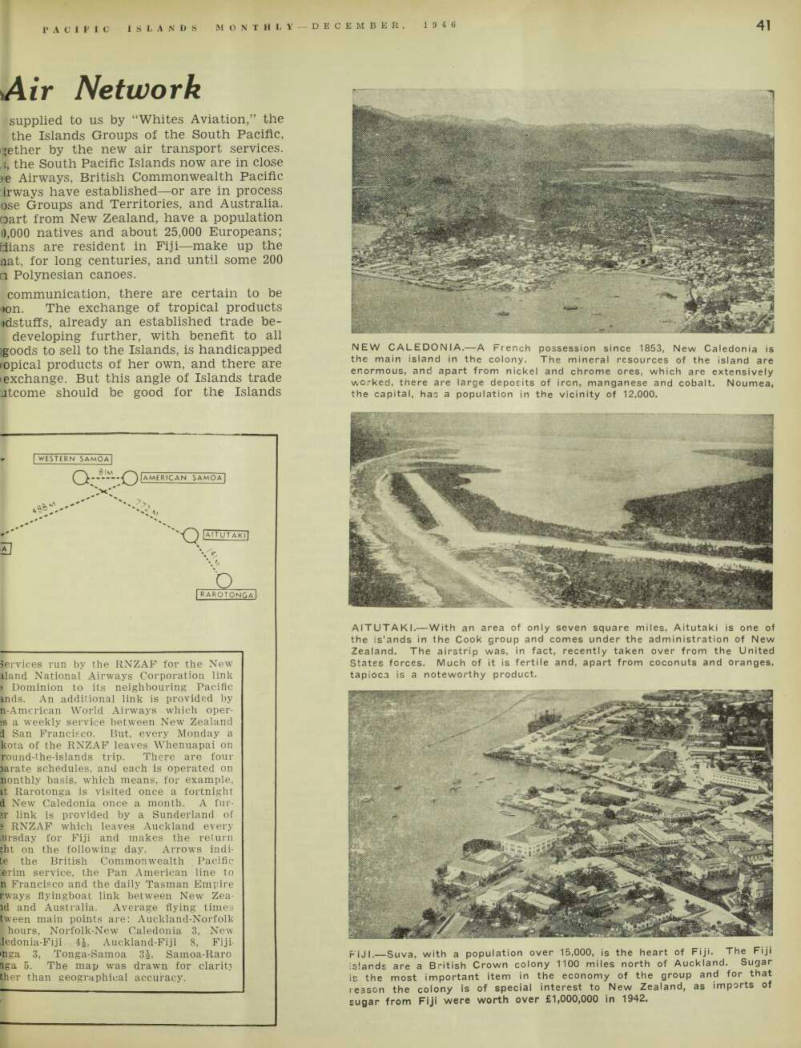
There and back by wea pon-carrier, converted ambulance and jeep.
By Judy Tudor
THE somnolent, gray clouds of morning had given place to one of Lae’s rare fine days. Hazy blue sea; mountains standing out clear —beautiful, but for bidding; and golden sunshine.
We spent the best part of it at Milford Haven, the weather unnoticed, our eyes turned rigidly southward, across about two miles of turbulent, yellow water pro vided by the Markham River, which elects to enter the sea in that vicinity.
Milford Haven is no tourist resort; it is the “port” of Lae, invented and left behind by the Armies of the United States and Australia when they finished the war in that quarter.
The Haven is a small cove on the left of the Markham mouth; it affords slightly more protection to shipping than did the old open-roadstead north of the drome, but only slightly more. The Armies, from necessity, built a wharf there and long lines of pontoons made of iron tanks, and workshops and sheds; and the RAAF (presumably), had added a control-tower. Then they joined it by road to old Lae and the new military Lae beyond the drome and the Butibum River.
IN Army days, Milford Haven was prob ably the nerve centre of all local activity. To-day, except on the rare occasions when a ship is in, it is a picture of decay. The pontoons, rusted and twisted, rise and fall awkwardly on the tide; the buildings and control-tower are bleaching in alternate sun and rain, and falling into disrepair; huge pot-holes, of pond proportions, near the wharf entrance, are kept brimming by Lae’s over-abundant rainfall. A derelict ship or two lies nearby and the beach is covered with the usual litter of tropical, slack-water beaches—dry coconuts and old palm-fronds, bits of drift-wood and dead leaves.
My companions—Mr. and Mrs. L. E.
Ashton, from Wau —and I arrived at Mil ford Haven about 8 a.m. Alternately we: sat in the weapon-carrier, looked across the Markham mouth; wandered around the beach kicking coconuts; looked across the Markham mouth; sat on a log; looked across the Markham mouth; got back in the carrier . . .
About midday we retired to the doubt
ful shade of the control-tower, with a large packet of sandwiches and a luke warm bottle of beer. Then at regular intervals this sort of thing went on: Me (rising, and peering across the yellow water): “I can see two black blobs on the far side. Would . . .?”
L. E. Ashton (also rising and peering); “No. Fishing canoes.
We would all subside. Then Mrs. Ash ton, after a decent interval, would get up and her eyes, as though drawn by a powerful magnet, would also turn south wards. “Not a thing in sight,” she would say. “Isn’t it awful!”
The fact was we were looking for a barge. And this is why.
THE road from Wau to the coast was still a novelty. It had taken war and the Army and bond-buyers’ money to give it to New Guinea—9o-odd miles of it, only 20 of which (from Wau to Sunshine, below Bulolo) had already been built when war began. I must see it, particularly as the pessimists were already giving it a limited life. But due to a whole series of the exasperating cir cumstances such as only New Guinea, 1946, can produce, time was now a prob lem and I had only three days left in which to make the trip before I was to leave for South by plane. At last, in desperation I appealed to the Ashtons, then perfect strangers to me, and begged and was promised a lift in their weapon carrier.
Now, in the years before the war, when the Wau road was often discussed, several alternative routes were proposed; but when the Army, as a matter of military expedience, decided to connect Wau to the sea coast by road, they chose Lae as the coastal terminal and took their route up the south bank of the Markham, from Labu. Labu is to the south bank what Milford Haven is to the north bank of the river. In between, as I have already indicated, there churns about two miles of muddy Markham water. It is impossible to bridge it —at least, at that point—so the gap is filled by barges, which act as vehicular ferries.
That is why the Ashtons and I gazed forlornly across that lonely water that fine day in October. Waiting for the barges that never come in. Or almost never.
THE barges, the Ashtons had said, as we drew up at the landing, were an unknown quantity. They did not run on a regular schedule and, as the one public contractor had recently gone out of business, the only ferry was being run by the Bulolo Gold Dredging Company.
Part of the Wau Road, Photo taken from “Cliffside.”
Photographs at left show (TOP): Water for the radiator of L. E. Ashton’s weapon-carrier before we leave Lae. Part of “Hotel Cecil” in background. (CENTRE): We waited eight hours for this. BCD barge at Milford Haven. (LOWER): Swing-bridge across the Bulolo River “front gate” to “Cliffside,” encountered first on a very dark night.
The BGD obliged, when necessary, but if any of their own trucks happened along then they took precedence in order of crossing.
We had, I repeat, got to the landing at 8 a.m. A bystander, also waiting for a barge, said that the last had gone across about 7.15 —there should be one back any time now. What was more, he added, there was a new operator starting that day and there should be two barges running. It looked hopeful; we relaxed.
By 10 a.m. there was a score of natives waiting to cross, a three-ton Adminis tration truck and two BGD semi-trailers of tremendous proportions, each carrying six tons of iron piping. And away on the far side of the water, where we all fastened our eyes so intently, a thin bar of sand was beginning to appear.
“Ruddy tide’s going out,” observed someone. “Look at that sand-bar. Won’t be any barge now till afternoon.”
Let it be known that in these latitudes the tides follow no regular pattern. For weeks they are “in” then suddenly they go “out.” This, of all days, was their day out.
AT 1.30 the unmistakable hulloo of the boys heralded the approach of some thing. A barge—a BGD barge, of course. It took on the first six tons of piping—and there was scarcely room left to accommodate a billy-cart.
When asked, the bargeman said, sure, there was another barge-operator going into business that day. Where was he?
Why, he was refuelling his engine.
We answered not, but we did a little muttering among ourselves. What had he been doing all morning while we waited for the tide to rise?
Our barge came at three; by 3.45 we had been decanted on the Labu shore.
“We’ll make it by ten, barring accidents,” said the laconic L. E. Ashton (known all over New Guinea as “Lee,” not as far as I could understand because his name is Leigh, but because of his initials).
The boy arranged himself in the back of the carrier with a half-ton of cargo.
Mrs. Ashton and I took turns riding next the driver, with an alternative side-perch where the view was fine but the dust apt to be suffocating.
We were away.
The Labu-Wau road, considering terrain and climate, is an achievement in any language. And on New Guinea standards, it is a fine road, although in comparison with roads in Australasia, or even in other Pacific territories, it can best be described as an experience.
Under adverse conditions, I imagine, it can be a first-class nightmare.
It was bone-dry when we travelled it, and thick clouds of pale, fine dust rose from it and pervaded everything— hair, clothing, throat, nostrils and everything within and without the car. But along the length of it, and particularly on the lower levels, pot-holes of bomb-crater dimensions, created by some floundering vehicle in travail, were grim reminders that the road could be otherwise.
Conditions, moreover, can change in an hour. On the day following that upward trip, I went down from Cliffside to Bulolo, again with L. E. A. It had been hot and sunny on the way down at 2 o’clock, but a sudden storm had broken before we returned at 4.30, sending the Bulolo rushing angrily through its gorge, and adding further small gutters to the already pitted surface of the road.
Rounding a bend near Cliffside we came suddenly on a road-gang and a huge fallen pine tree blocking the way. The boys were trying to clear it by cutting a length off the butt-end, but they stopped work to place a plank on the offside edge of the road so that the carrier could squeeze around. There was about six inches to spare, but one false move and carrier and driver would have plunged down a couple of hundred feet sheer into the Bulolo gorge. I got off and walked around.
IN the two and a half hours of daylight left us after leaving Labu we followed the swampy road along level country where the Markham is forever eating into the road formation, then swung away over rounded, kunai-covered foothills. We looped up Red Hill, one of the steepest grades on the road, and down the other side; followed what is—for New Guinea —level country, for a few miles; through a village or two; then climbed again as the light faded, more villages on the spurs, and village gardens stretching away from the road sides.
We reached BCD’s half-way house with the last flicker of daylight and there paused long enough to drink great mugs of tea that did something to dampen the dust in our throats.
THE night had now taken on a pitchy blackness, accentuated by the moun tains rising steeply around us. I now had the bucket seat next L.E.A. and,
(Continued on Page 45)
Mr. N. Neale’s temporary “Izzy-Dizzy” at Wau. Original house left of centre.
Photos at right show (TOp): BCD’s office at Bulolo; later this building will be used as a store. (CENTRE); Bob Gay and Fred. Bose effect running repairs when something comes adrift in our open jeep. (LOWER): Journey’s end. Leaving Labu for Milford Haven in a barge.
A fallen Wau pine almost blocks the road between “Cliffside” and Bulolo. Planks at right for vehicles to pass.
in spite of the continual curves, the ascents and descents, the pot-holes and the loose stones, I kept falling asleep, to be jerked back to consciousness again as we charged next into a stream, or one of the Ashtons said “That is the Wampit, down there” or “This is Zenzag” or “The Watut” or “That’s the Bulolo, now.”
The rivers seemed to me to flow along inky chasms that might have been any thing from two to two hundred feet deep, nothing was real except the bouncing carrier and that portion of the road before us, illuminated by the headlights.
Then we came to Bulolo township—a blaze of electricity as bright as a Luna Park in a desert of darkness. But no one was around and we went through without stopping.
I now roused myself sufficiently to think about my hostess. I had met neither Mrs. Doris Booth, of “Cliffside” with whom I was to stop, nor her brother Norman Wilde, nor his wife. But I had had a letter from Mrs. Booth, which con culded by saying: “Don’t bother to write —just arrive.”
I hadn’t written; but I certainly was arriving. I hardly thought that Mrs.
Booth had been thinking of this hour when she wrote that note.
We rounded a bend in the gorge and there ahead and above us was a light.
“Cliffside,” I was told. We had arrived.
While the carrier was garaged on the road side of the river I was instructed to go ahead. “You’ll hit the bridge over there, and some steps.”
I went ahead, and hit the bridge. Then the bridge hit me. It was a swing-bridge, and it bounced back with every step I took, while the dark Bulolo, laughed like a mad thing down below.
On the other side there were steps— many steps. I followed them up into the blackness, beckoned by the brilliant light from above, I tottered across a lawn and came to a house, and the bright light, and behind it an even brighter voice.
“We were expecting you,” I was told.
I guess I looked like something that had recently emerged from the good earth. From my shorts downwards I was powdered with dust; my hair was gray with it and my face caked.
But there was whisky and tea and sand wiches, and the sort of house they had forgotten in Lae, and a bath —and a bed, a blessed bed into which I sank promptly and slept. Occasionally I would half wake, feel the weapon-carrier still climb ing mountains; then I’d hitch the blankets further up (it’s a two-blanket climate up there) and sleep some more.
TO Wau we went next morning in Mr.
Wilde’s sawn-down ex-Army ambu lance. Like Lae and Salamaua and other New Guinea townships there*is little of the old Wau left. The drome is the same, and “Izzy-Dizzy,” the old home of Mr. Norman Neale, perched on a hilltop, is recognisable. But it is only the shell of a house, and uninhabitable; the Neales live temporarily in a small house on a spur behind their original establishment.
In the township area, nothing remains but the shrubbery—crotons, bougainvillea and hisbiscus and other tropical flowers grown into a jungle.
Destruction in Wau, however, was not due to fighting but to an enthusiastic scorched-earth policy which effectively reduced Wau to a shambles. Such fight ing as there was, when Australian troops were hurriedly flown in to deal with infiltrating Japs in February, 1943, took place near Wilde’s coffee plantation —and the plantation still flourishes.
Wilde (pronounced Vild-e, and not to be
confused with my hostess’s brother) is a German. He was interned during the war, and his plantation is now under option to Messrs Colin Tomkins and P.
Jensen. They grow the best coffee I have ever tasted, and have exported over 14 tons of it to Australia in the few months they have been in operation. la common with the rest of the Ter itory their problem is labour. They are at present employing 40 Kukukukus to pick berries —a new experiment in native labour. The Kukukukus are extremely primitive and semi-nomadic. They were never used previously as workers.
Many residents have now returned to the goldfields area; but, except for those employed by the larger mining companies, most are biding their time, hoping that
the labour position will ease and that mining machinery will become more easily procurable. In the meantime, they plant sweet-potatoes and vegetables and live, apparently, on War Damage Insurance payments or other resources, tn contrast to Wau is Bulolo. Bulolo wa s su bj ec t e d to the same ruthless scorched-earthing as was Wau, but BGD are going ahead with rehabilitation in a way that reflects sharply upon the long-range scientifically-planned schemes of the Administration, for most aspects of future New Guinea life. Discussion of Bulolo’s progress is dismissed all over the Territory with the assertion that it is “an American company—and Americans know how to get these things done!”
Whether there are Americans or Aus
tralians or men from Mar* behind Bulolo’s rehabilitation plans, it is idle to suppose that their progress has been made effortlessly; the problems and obstacles that they have faced and beaten
are known only to the executive heads of Bulolo, but one can imagine that they were considerable. The point is that BGD are working to an organised plan and getting things done; the rest of New Guinea rehabilitation is still at the talk ing stage.
BGD first rebuilt their power station at Biune and brought power and fight to the township; next, they got their saw mill going and, from the beautiful local pine, are sawing timber for the new buildings.
In a joinery department next the mill, pre-fabricated houses are being cut and many of these are already being erected in a horse-shoe above the executive centre of the town. When the town is complete it will cater for all the requirements of native and European employees in a model community which even the critical Administration cannot fault.
Many of the buildings have already been finished, and Mr. J. D. Simpson, the manager, showed me around with justi fiable pride. In the almost complete hospital we met a large, round, jolly looking man in shorts and little else, who was equipped with a tin of paint and a brush. I somehow missed hearing his name.
When we were outside again I asked: “Do you have a full-time doctor here then?”
“Why yes, that was the doctor you just met. Dr. Carl Gunther,” I was told.
“Great Heaven,” I said, incautiously, “I thought he was the painter.”
Mr. Simpson yelled back through a window: “She thought you were the painter, Carl!”
The doctor had his head down painting a hospital bed with white enamel. He waved a brush at us. “So I am,” he said, “for the moment.”
BCD’s answer to the labour shortage is to make their community as fully mechanised as possible. Where before the war they employed 1,400 natives, now they expect to employ not more than 600. Every electrical and time-saving gadget is to be installed in the messes and kitchens, and hot-water services and mechanised laundries will do away with a legion of personal servants.
IT was due to BCD kindness that I was able to make my return journey to the coast on schedule. When asked about transport Mr. Simpson thought for a moment and then said that there would be a jeep going down the next day.
“Bob Gay has to catch your plane to Moresby—and he wants to go down by road. You can go with him and Freddie Rose.”
In the course of conversation next day I gathered that Mr. Gay had a marked preference for going to Lae by plane; I wondered if he had been diverted from his purpose in the name of BGD hospi tality.
L.E.A. again rose to the occasion and delivered me early at Bulolo. From there I and my new travel companions ’set off in a jeep—an open jeep which its fond driver described as “fresher, somehow.”
I’m still wondering what he meant exactly.
I lashed my hat on with a piece of cord and put on a pair of sun goggles but I can thoroughly recommend the speed and efficiency of the one-day suntan treatment I got on that occasion. Not even a capricious Southern spring has been able to remove it entirely.
BUT my jeeping companions were good companions and the driver, like most New Guinea drivers, a wizard. He could carry on an animated conversation covering most things on earth, the while he urged that jeep up mountainous in clines, through creeks, and everlastingly around corners and pot-holes.
Now the road was revealed to me in its full glory and I could see the bumps I had merely felt on the night journey. It wound for the most part through uninhabited, dry-brown kunai hills with only an occasional swing-bridge built at an angle of 90 deg. from the road and with a pot-bellied sag of its decking, to break the monotony.
We climbed to Zenag, over 4,000 feet above- sea-level, and the highest point in the road. Here there was a cool breeze, in marked contrast to the stifling heat in the tight, kunai valleys. The air is invigorating, and the scenery majestic, and Mr. Mick Leahy (who runs the
Morobe Transport Company and does most of the cargo freighting along the road these days) has thought of building a hotel at Zenag.
An argument as to whether it would or would not be a good thing for trans port drivers to have a place of refresh ment so close to a dangerous road, kept us occupied until we reached BCD’s half way house.
The men had brought a half-yard of steak with them from Bulolo’s freezer, and the cook-boy grilled it with tomatoes for our lunch.
Then back again to the dusty, snaking road we went—a road which I began now to recognise from the forward journey.
More climbs, more bridges, more twists everlasting. Past transports toiling up wards, past vehicles abandoned months before, where they had broken down and never been removed, past villagers and village gardens and a few boys working on the road, back to the Markham and a mile of track constructed of sawn timber and wire mesh, to keep it out of the swamp, AND so we came to the end of the famous road. Dusty and rough and, in parts, neglected it may be; but, withal, it could be the lifeline of what some day must be the resuscitated gold fields area, and the Lae hinterland.
Mechanised maintenance equipment is needed urgently, but on the whole the road is less fearsome than it might be.
The Army did the job well.
Labu showed up for afternoon tea — and a barge was waiting. No delay this time. The tide, they said, had been in all day.
South Pacific
THIS interesting compilation, which ha A well-known Auckland journal, shov eastwards of Melanesia, have been linl Through the newly-established RNZAF s touch with New Zealand; while Tasman Airlines, Pan American Airways, and Qai of establishing—direct connections betwe Normally, the Groups in the area indica of nearly 500,000. That figure includes so while Asiatics—of whom well over 100,( balance. Air services now link Territc years ago, depended for communication ( Under the stimulus of the new syst great trade developments within this re| for manufactured goods and cold-climi tween New Zealand and the Islands, i concerned. Australia, with a great varr in this trade because Australia has so m few Islands products which she can acci is now receiving careful attention, and communities.
SAMOA. Western Samoa is a New Zealand Mandate with a population of 65,000. Its future is to be decided by United Nations. Staple products are copra, cocoa and bananas, and rubber is also produced satisfactorily.
Apia, the administrative centre, is spread along a coral harbour of the same name. The airstrip is 15 miles away.
NORFOLK.—An island of volcanic formation only 600 miles from Auck land, Norfolk is populated by the English-Tahitian descendants of the Bounty mutineers. The air link with New Zealand is to-day practically the only regular connection it has with the outside world. During the war it was a New Zealand air base.
TONGA.—Queen Salote rules the 150 islands in the Tongan group under British Protection. Her kingdom of care-free Polynesians has been a united monarchy for 100 years, and is the only one in the whole Pacific.
The capital is Nukualofa, on the island of Tongatabu. The palace can be seen in the right foreground of the picture.
supplied to us by “Whites Aviation,” the the Islands Groups of the South Pacific, aether by the new air transport services. the South Pacific Islands now are in close re Airways, British Commonwealth Pacific irways have established —or are in process ose Groups and Territories, and Australia, cpart from New Zealand, have a population 0,000 natives and about 25,000 Europeans; Hians are resident in Fiji—make up the nat, for long centuries, and until some 200 a Polynesian canoes. communication, there are certain to be ♦on. The exchange of tropical products odstuffs, already an established trade be developing further, with benefit to all igoods to sell to the Islands, is handicapped ►opical products of her own, and there are ►exchange. But this angle of Islands trade utcome should be good for the Islands
Services run by the RNZAF for the New aland National Airways Corporation link I Dominion to its neighbouring Pacific ands. An additional link is provided by n-Amcrican World Airways which oper as a weekly service between New Zealand B San Francisco. But, every Monday a kota of the RNZAF leaves Whenuapai on round-the-islands trip. There are four aarate schedules, and each is operated on Donthly basis, which means, for example, it Rarotonga is visited once a fortnight d New Caledonia once a month. A fur 5r link is provided by a Sunderland of S RNZAF which leaves Auckland every brsday for Fiji and makes the return jht on the following day. Arrows indi te the British Commonwealth Pacific lerim service, the Pan American line to n Francisco and the daily Tasman Empire rways flyingboat link between New Zea id and Australia. Average flying times tween main points are; Auckland-Norfolk I hours, Norfolk-New Caledonia 3, New ledonia-Fiji 4|, Auckland-Fiji 8, Fiji tnga 3, Tonga-Samoa 3J, Samoa-Raro aga 5. The map was drawn for clarity ther than geographical accuracy.
NEW CALEDONIA.—A French possession since 1853, New Caledonia is the main island in the colony. The mineral resources of the island are enormous, and apart from nickel and chrome ores, which are extensively worked, there are large deposits of iron, manganese and cobalt. Noumea, the capital, has a population in the vicinity of 12,000.
AITUTAKI.—With an area of only seven square miles, Aitutaki is one of the islands in the Cook group and comes under the administration of New Zealand. The airstrip was, in fact, recently taken over from the United States forces. Much of it is fertile and, apart from coconuts and oranges, tapioca is a noteworthy product.
FlJl.-Suva, with a population over 15,000, is the heart of Fiji. The Fiji islands are a British Crown colony 1100 miles north of Auckland. Sugar is the most important item in the economy of the group and for that reason the colony is of special interest to New Zealand, as imports of sugar from Fiji were worth over £1,000,000 in 1942.
Advertisements & other items, p. 43 (1 item)
Air Network
41
1> AC 1 ft' ic ISLANDS MONTHLY DECEMBER, 1946
Tropicalities
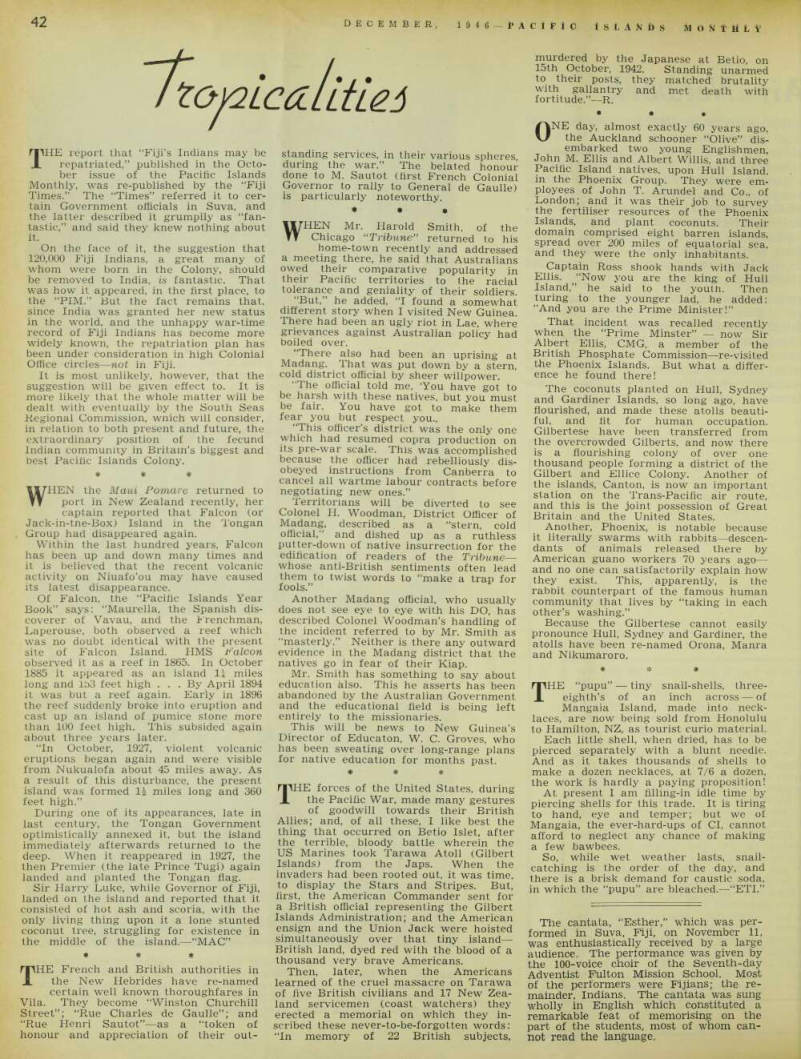
THE report that “Fiji’s Indians may be repatriated,’’ published in the Octo ber issue of the Pacific Islands Monthly, was re-published by the “Fiji Times.” The “Times” referred it to cer tain Government officials in Suva, and the latter described it grumpily as “fan tastic,” and said they knew nothing about it.
On the face of it, the suggestion that 120,000 Fiji Indians, a great many of whom were born in the Colony, should be removed to India, is fantastic. That was how it appeared, in the first place, to the “PIM.” But the fact remains that, since India was granted her new status in the world, and the unhappy war-time record of Fiji Indians has become more widely known, the repatriation plan has been under consideration in high Colonial Office circles —not in Fiji.
It is most unlikely, however, that the suggestion will be given effect to. It is more likely that the whole matter will be dealt with eventually by the South Seas Regional Commission, wnich will consider, in relation to both present and future, the extraordinary position of the fecund Indian community in Britain’s biggest and best Pacific Islands Colony. * * * WHEN the Maui Pomare returned to port in New Zealand recently, her captain reported that Falcon (or Jack-in-tne-Box) Island in the Tongan Group had disappeared again.
Within the last hundred years, Falcon has been up and down many times and it is believed that the recent volcanic activity on Niuafo’ou may have caused its latest disappearance.
Of Falcon, the “Pacific Islands Year Book” says: “Maurella, the Spanish dis coverer of Vavau, and the Frenchman, Laperouse, both observed a reef which was no doubt identical with the present site of Falcon Island. HMS t'alcon observed it as a reef in 1865. In October 1885 it appeared as an island 1\ miles long and 153 feet high ... By April 1894 it was but a reef again. Early in 1896 the reef suddenly broke into eruption and cast up an island of pumice stone more than 100 feet high. This subsided again about three years later, “In October, 1927, violent volcanic eruptions began again and were visible from Nukualofa about 45 miles away. As a result of this disturbance, the present island was formed II miles long and 360 feet high.”
During one of its appearances, late in last century, the Tongan Government optimistically annexed it, but the island immediately afterwards returned to the deep. When it reappeared in 1927, the then Premier (the late Prince Tugi) again landed and planted the Tongan flag.
Sir Harry Luke, while Governor of Fiji, landed on the island and reported that it consisted of hot ash and scoria, with the only living thing upon it a lone stunted coconut tree, struggling for existence in the middle of the island. —“MAC” ♦ * ♦ THE French and British authorities in the New Hebrides have re-named certain well known thoroughfares in Vila. They become “Winston Churchill Street”; “Rue Charles de Gaulle”; and “Rue Henri Sautot” —as a “token of honour and appreciation of their out
standing services, in their various spheres, during the war.” The belated honour done to M. Sautot (first French Colonial Governor to rally to General de Gaulle) is particularly noteworthy. • * • WHEN Mr. Harold Smith, of the Chicago “ Tribune” returned to his home-town recently and addressed a meeting there, he said that Australians owed their comparative popularity in their Pacific territories to the racial tolerance and geniality of their soldiers.
“But,” he added, “I found a somewhat different story when I visited New Guinea.
There had been an ugly riot in Lae, where grievances against Australian policy had boiled over.
“There also had been an uprising at Madang. That was put down by a stern, cold district official by sheer willpower.
“The official told me, ‘You have got to be harsh with these natives, but you must be fair. You have got to make them fear you but respect you., “This officer’s district was the only one which had resumed copra production on its pre-war scale. This was accomplished because the officer had rebelliously dis obeyed instructions from Canberra to cancel all wartme labour contracts before negotiating new ones.”
Territonans will be diverted to see Colonel H. Woodman, District Officer of Madang, described as a “stern, cold official,” and dished up as a ruthless putter-down of native insurrection for the edification of readers of the Tribune— whose anti-British sentiments often lead them to twist words to “make a trap for fools.”
Another Madang official, who usually does not see eye to eye with his DO, has described Colonel Woodman’s handling of the incident referred to by Mr. Smith as “masterly.” Neither is there any outward evidence in the Madang district that the natives go in fear of their Kiap.
Mr. Smith has something to say about education also. This he asserts has been abandoned by the Australian Government and the educational field is being left entirely to the missionaries.
This will be news to New Guinea’s Director of Educaton, W. C. Groves, who has been sweating over long-range plans for native education for months past, ♦ * * THE forces of the United States, during the Pacific War, made many gestures of goodwill towards their British Allies; and, of all these, I like best the thing that occurred on Betio Islet, after the terrible, bloody battle wherein the US Marines took Tarawa Atoll (Gilbert Islands) from the Japs. When the invaders had been rooted out, it was time, to display the Stars and Stripes. But, first, the American Commander sent for a British official representing the Gilbert Islands Administration; and the American ensign and the Union Jack were hoisted simultaneously over that tiny island — British land, dyed red with the blood of a thousand very brave Americans.
Then, later, when the Americans learned of the cruel massacre on Tarawa of five British civilians and 17 New Zea land servicemen (coast watchers) they erected a memorial on which they in scribed these never-to-be-forgotten words: “In memory of 22 British subjects,
murdered by the Japanese at Betio, on 15th October, 1942. Standing unarmed to their posts, they matched brutality with gallantry and met death with fortitude.”—R. • ♦ • ONE day, almost exactly 60 years ago, the Auckland schooner “Olive” dis embarked two young Englishmen, John M. Ellis and Albert Willis, and three Pacific Island natives, upon Hull Island, in the Phoenix Group. They were em ployees of John T, Arundel and Co., of London; and it was their job to survey the fertiliser resources of the Phoenix Islands, and plant coconuts. Their domain comprised eight barren islands, spread over 200 miles of equatorial sea, and they were the only inhabitants.
Captain Ross shook hands with Jack Ellis. “Now you are the king of Hull Island,” he said to the youth. Then turing to the younger lad, he added: “And you are the Prime Minister!”
That incident was recalled recently when the “Prime Minster” now Sir Albert Ellis, CMG, a member of the British Phosphate Commission —re-visited the Phoenix Islands. But what a differ ence he found there!
The coconuts planted on Hull, Sydney and Gardiner Islands, so long ago, have flourished, and made these atolls beauti ful, and fit for human occupation.
Gilbertese have been transferred from the overcrowded Gilberts, and now there is a flourishing colony of over one thousand people forming a district of the Gilbert and Ellice Colony. Another of the islands, Canton, is now an important station on the Trans-Pacific air route, and this is the joint possession of Great Britain and the United States.
Another, Phoenix, is notable because it literally swarms with rabbits —descendants of animals released there by American guano workers 70 years ago— and no one can satisfactorily explain how they exist. This, apparently, is the rabbit counterpart of the famous human community that lives by “taking in each other’s washing.”
Because the Gilbertese cannot easily pronounce Hull, Sydney and Gardiner, the atolls have been re-named Orona, Manra and Nikumaroro. * * * THE “pupu” tiny snail-shells, three eighth’s of an inch across —of Mangaia Island, made into neck laces, are now being sold from Honolulu to Hamilton, NZ, as tourist curio material.
Each little shell, when dried, has to be pierced separately with a blunt needle.
And as it takes thousands of shells to make a dozen necklaces, at 7/6 a dozen, the work is hardly a paying proposition!
At present I am filling-in idle time by piercing shells for this trade. It is tiring to hand, eye and temper; but we of Mangaia, the ever-hard-ups of Cl, cannot afford to neglect any chance of making a few bawbees.
So, while wet weather lasts, snail catching is the order of the day, and there is a brisk demand for caustic soda, in which the “pupu” are bleached.—“ETl.”
The cantata, “Esther,” which was per formed in Suva, Fiji, on November 11, was enthusiastically received by a large audience. The performance was given by the 100-voice choir of the Seventh-day Adventist Fulton Mission School. Most of the performers were Fijians; the re mainder, Indians. The cantata was sung wholly in English which constituted a remarkable feat of memorising on the part of the students, most of whom can not read the language.
Advertisements & other items, p. 44 (1 item)
42
DECEMBER, IMfi-fACIFiC ISLANDS MONTHLY
Copper Strands Across The Pacific
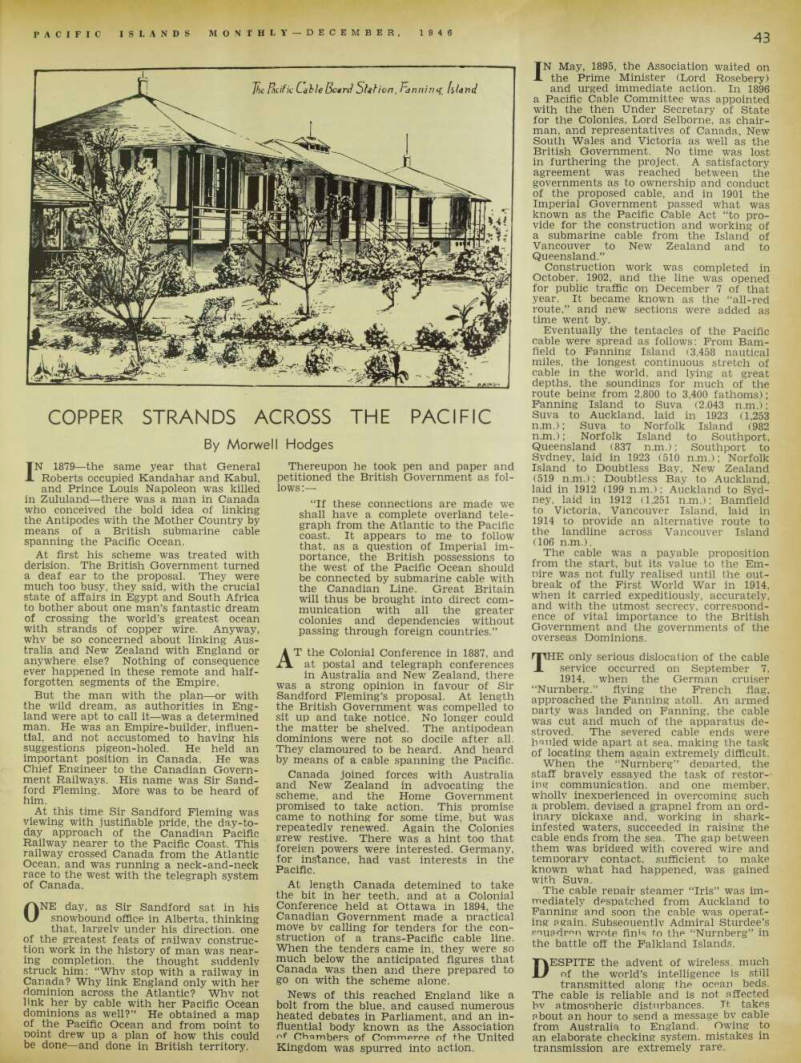
By Morwell Hodges
IN 1879 —the same year that General Roberts occupied Kandahar and Kabul, and Prince Louis Napoleon was killed in Zululand —there was a man in Canada who conceived the bold idea of linking the Antipodes with the Mother Country by means of a British submarine cable spanning the Pacific Ocean.
At first his scheme was treated with derision. The British Government turned a deaf ear to the proposal. They were much too busy, they said, with the crucial state of affairs in Egypt and South Africa to bother about one man’s fantastic dream of crossing the world’s greatest ocean with strands of copper wire. Anyway, whv be so concerned about linking Aus tralia and New Zealand with England or anywhere else? Nothing of consequence ever happened in these remote and half forgotten segments of the Empire.
But the man with the plan—or with the wild dream, as authorities in Eng land were apt to call it —was a determined man. He was an Empire-builder, influen tial, and not accustomed to having his suggestions pigeon-holed. He held an important position in Canada. He was Chief Engineer to the Canadian Govern ment Railways. His name was Sir Sand ford Fleming. More was to be heard of him.
At this time Sir Sandford Fleming was viewing with justifiable pride, the day-to day approach of the Canadian Pacific Railway nearer to the Pacific Coast. This railway crossed Canada from the Atlantic Ocean, and was running a neck-and-neck race to the west with the telegraph system of Canada.
ONE day, as Sir Sandford sat in his snowbound office in Alberta, thinking that, largely under his direction, one of the greatest feats of railway construc tion work in the history of man was near ing completion, the thought suddenly struck him: “Whv stop with a railway in Canada? Why link England only with her dominion across the Atlantic? Whv not link her by cable with her Pacific Ocean dominions as well?” He obtained a map of the Pacific Ocean and from point to noint drew up a plan of how this could be done—and done in British territory.
Thereupon he took pen and paper and petitioned the British Government as fol lows: — “If these connections are made we shall have a complete overland tele graph from the Atlantic to the Pacific coast. It appears to me to follow that, as a question of Imperial im portance, the British possessions to the west of the Pacific Ocean should be connected by submarine cable with the Canadian Line. Great Britain will thus be brought into direct com munication with all the greater colonies and dependencies without passing through foreign countries.”
AT the Colonial Conference in 1887, and at postal and telegraph conferences in Australia and New Zealand, there was a strong opinion in favour of Sir Sandford Fleming’s proposal. At length the British Government was compelled to sit up and take notice. No longer could the matter be shelved. The antipodean dominions were not so docile after all.
They clamoured to be heard. And heard by means of a cable spanning the Pacific.
Canada joined forces with Australia and New Zealand in advocating the scheme, and the Home Government promised to take action. This promise came to nothing for some time, but was repeatedly renewed. Again the Colonies grew restive. There was a hint too that foreign powers were interested. Germany, for instance, had vast interests in the Pacific.
At length Canada detemined to take the bit in her teeth, and at a Colonial Conference held at Ottawa in 1894, the Canadian Government made a practical move by calling for tenders for the con struction of a trans-Pacific cable line.
When the tenders came in, they were so much below the anticipated figures that Canada was then and there prepared to go on with the scheme alone.
News of this reached England like a bolt from the blue, and caused numerous heated debates in Parliament, and an in fluential body known as the Association of Chambers of Commerce of the United Kingdom was spurred into action.
IN May, 1895, the Association waited on the Prime Minister (Lord Rosebery) and urged immediate action. In 1896 a Pacific Cable Committee was appointed with the then Under Secretary of State for the Colonies, Lord Selborne, as chair man, and representatives of Canada, New South Wales and Victoria as well as the British Government. No time was lost in furthering the project. A satisfactory agreement was reached between the governments as to ownership and conduct of the proposed cable, and in 1901 the Imperial Government passed what was known as the Pacific Cable Act “to pro vide for the construction and working of a submarine cable from the Island of Vancouver to New Zealand and to Queensland.”
Construction work was completed in October. 1902, and the line was opened for public traffic on December 7 of that year. It became known as the “all-red route,” and new sections were added as time went by.
Eventually the tentacles of the Pacific cable were spread as follows; From Barn field to Fanning Island (3,458 nautical miles, the longest continuous stretch of cable in the world, and lying at great depths, the soundings for much of the route being from 2,800 to 3,400 fathoms); Fanning Island to Suva (2.043 n.m.); Suva to Auckland, laid in 1923 (1,253 n.m.); Suva to Norfolk Island (982 n.m.); Norfolk Island to Southport, Queensland (837 n.m.); Southport to Sydney, laid in 1923 (510 n.m.); Norfolk Island to Doubtless Bay, New Zealand (519 n.m.): Doubtless Bay to Auckland, laid in 1912 (199 n.m.); Auckland to Syd ney, laid in 1912 (1,251 n.m.); Bamfield to Victoria, Vancouver Island, laid in 1914 to provide an alternative route to the landline across Vancouver Island (106 n.m.).
The cable was a payable proposition from the start, but its value to the Em nire was not fully realised until the out break of the First World War in 1914, when it carried expeditiously, accurately, and with the utmost secrecy, correspond ence of vital importance to the British Government and the governments of the overseas Dominions.
THE only serious dislocation of the cable service occurred on September 7. 1914, when the German cruiser “Nurnberg.” flying the French flag, approached the Fanning atoll. An armed party was landed on Fanning, the cable was cut and much of the apparatus de stroved. The severed cable ends were hauled wide apart at sea, making the task of locating them again extremely difficult.
When the “Nurnberg” denarted, the staff bravely essayed the task of restor ing communication, and one member, wholly inexnerienced in overcoming such a problem, devised a grapnel from an ord inary pickaxe and, working in shark infested waters, succeeded in raising the cable ends from the sea. The gap between them was bridged with covered wire and temporary contact, sufficient to make known what had happened, was gained with Suva.
The cable repair steamer “Iris” was im mediately despatched from Auckland to Fanning and soon the cable was operat ing again. Subseouentlv Admiral Sturdee’s wrote finis to the “Nurnberg” in the battle off the Falkland Islands.
DESPITE the advent of wireless, much of the world’s intelligence is still transmitted along the ocean beds.
The cable is reliable and is not affected bv atmospheric disturbances. It takes about an hour to send a message bv cable from Australia to England. Owing to an elaborate checking system, mistakes in transmission are extremely rare.
Fiji's Two Wartime Mysteries
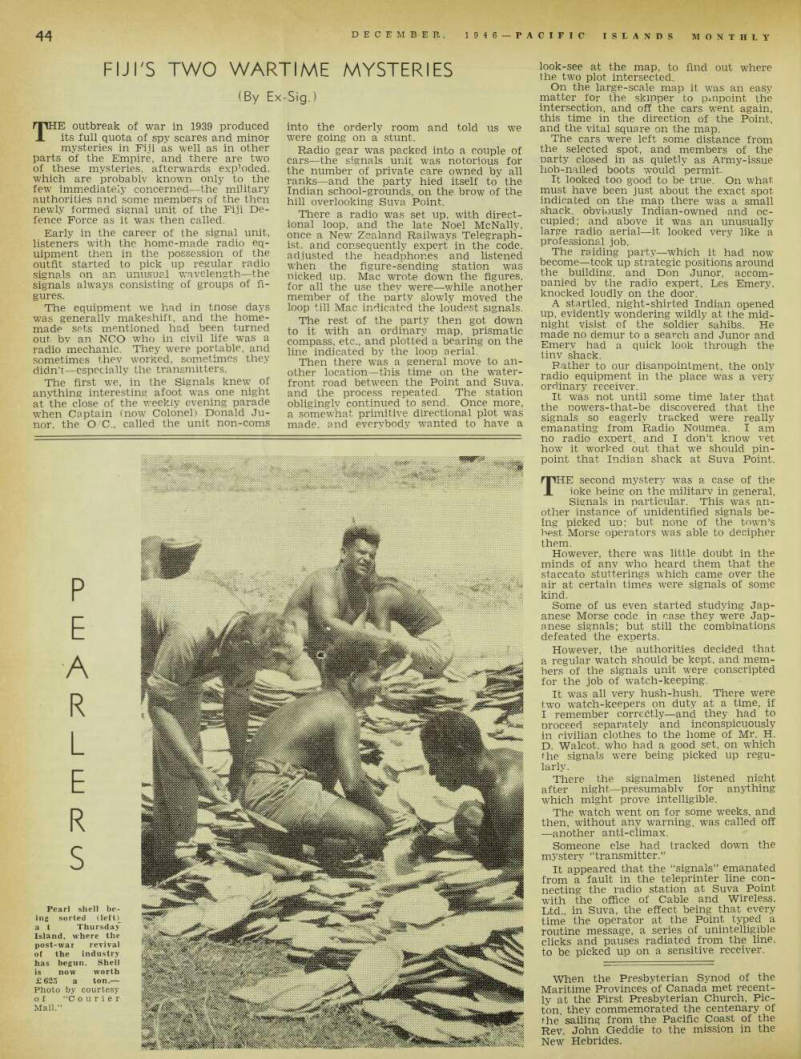
(By Ex-Sig.)
rE outbreak of war in 1939 produced its full quota of spy scares and minor mysteries in Fiji as well as in other parts of the Empire, and there are two of these mysteries, afterwards exploded, which are probably known only to the few immediately concerned —the military authorities and some members of the then newly formed signal unit of the Fiji De fence Force as it was then called.
Early in the career of the signal unit, listeners with the home-made radio eq uipment then in the possession of the outfit started to pick up regular radio signals on an unusual wavelength—the signals always consisting of groups of fi gures.
The equipment we had in tnose days was generally makeshift, and the home made sets mentioned had been turned out by an NCO who in civil life was a radio mechanic. They were portable, and sometimes they worked, sometimes they didn’t—especially the transmitters.
The first we, in the Signals knew of anything interesting afoot was one night at the close of the weekly evening parade when Captain (now Colonel) Donald Ju nor, the O C., called the unit non-coms
into the orderly room and told us we were going on a stunt.
Radio gear was packed into a couple of cars—the signals unit was notorious for the number of private care owned by all ranks —and the party hied itself to the Indian school-grounds, on the brow of the hill overlooking Suva Point.
There a radio was set up, with direct ional loop, and the late Noel McNally, once a New Zealand Railways Telegraph ist. and consequently expert in the code, adjusted the headphones and listened when the figure-sending station was nicked up. Mac wrote down the figures, for all the use they were—while another member of the party slowly moved the loop till Mac indicated the loudest signals.
The rest of the party then got down to it with an ordinary map, prismatic compass, etc., and plotted a bearing on the line indicated by the loon aerial.
Then there was a general move to an other location—this time on the water front road between the Point and Suva, and the process repeated. The station obliginglv continued to send. Once more, a somewhat primitive directional plot was made, and everybody wanted to have a
look-see at the map, to find out where the two plot intersected.
On the large-scale map it was an easy matter for the skipper to pinpoint the intersection, and off the cars went again, this time in the direction of the Point, and the vital square on the map.
The cars were left some distance from the selected spot, and members of the party closed in as quietly as Army-issue hob-nailed boots would permit.
It looked too good to be true. On what must have been just about the exact spot indicated on the man there was a small shack, obviously Indian-owned and oc cupied; and above it was an unusually large radio aerial—it looked very like a professional job.
The raiding party—which it had now become—took up strategic positions around the building, and Don Junor, accom panied by the radio expert, Les Emery, knocked loudly on the door.
A startled, night-shirted Indian opened up, evidently wondering wildly at the mid night visist of the soldier sahibs. He made no demur to a search and Junor and Emery had a quick look through the tinv shack.
Rather to our disappointment, the only radio equipment in the place was a very ordinary receiver.
It was not until some time later that the nowers-that-be discovered that the signals so eagerly tracked were really emanating from Radio Noumea. I am no radio expert, and I don’t know vet how it worked out that we should pin point that Indian shack at Suva Point. fTIHE second mystery was a case of the JL ioke being on the military in general, Signals in particular. This was an other instance of unidentified signals be ing picked up; but none of the town’s best Morse operators was able to decipher them.
However, there was little doubt in the minds of any who heard them that the staccato stutterings which came over the air at certain times were signals of some kind.
Some of us even started studying Jap anese Morse code, in case they were Jap anese signals; but still the combinations defeated the experts.
However, the authorities decided that a regular watch should be kept, and mem bers of the signals unit were conscripted for the job of watch-keeping.
It was all very hush-hush. There were two watch-keepers on duty at a time, if I remember correctly—and they had to proceed separately and inconspicuously in civilian clothes to the home of Mr. H.
D. Walcot. who had a good set, on which the signals were being picked up regu larly.
There the signalmen listened night after night—presumably for anything which might prove intelligible.
The watch went on for some weeks, and then, without any warning, was called off —another anti-climax.
Someone else had tracked down the mystery “transmitter.”
It appeared that the “signals” emanated from a fault in the teleprinter line con necting the radio station at Suva Point with the office of Cable and Wireless, Ltd., in Suva, the effect being that every time the operator at the Point typed a routine message, a series of unintelligible clicks and pauses radiated from the line, to be picked up on a sensitive receiver.
When the Presbyterian Synod of the Maritime Provinces of Canada met recent ly at the First Presbyterian Church, Pic ton, they commemorated the centenary of the sailing from the Pacific Coast of the Rev. John Geddie to the mission in the New Hebrides.
p E A R L E R S Pearl shell be ing sorted at Thursday Island, where the post-war revival of the industry has begun. Shell is now worth £625 a ton. — Photo by courtesy of “Courier Mail.”
Advertisements & other items, pp. 47-48 (3 items)
45
PACIFIC ISLANDS MONTHLY DECEMBER., 1946
WAU ROAD
(Continued from page 39)
Victoria
RITTER
lIEVEI IT
CARLTON & UNITED BREWERIES LT».
71 HI
The Twinkle in
Your Eye
COMES FROM ACTIVE
DIGESTION
Good normal digestive and liver activity means good, normal health and fitness. If you are becoming gloomy and feel tired out, the cause may be a congested state of your intestinal tract. So many people are troubled with constipation, which, through the retention of waste in the digestive system, causes sick headache, biliousness, pimply skin, unpleasant breath, irritability, slackness and dull eyes.
Regain your bright and attractive appearance by banishing constipation with Pinkettes. Tiny, perfectly harmless, gentle yet effective, these famous laxative and liver pills painlessly exercise and strengthen the bowels, keep the food tract clean and active, stir the liver, and thus banish sick headache, bilious attacks, pimples, unpleasant breath and gloom. All chemists and stores sell Pinkettes, the perfect laxative and liver pills.
George J. Lockyer & Company
Engineering Supplies, General Hardware
Exporters and Merchants
Purchasing Agents. Manufacturers’ Representatives.
Electric Light Generating Plants.
Air Conditioning Plants.
Builders’ Hardware.
Marine Engineering Supplies.
Refrigeration Supplies.
Radios and Accessories.
Sanitation Equipment.
Automobile Spare Parts and Garage Accessories, Abrasive Wheels.
Excavating Machinery.
Electrical Supplies.
Grinding and Pulverising Machinery.
Hydraulic Equipment.
Mechanical Engineering Requirements.
Mining and Quarrying Machinery.
Road and Building Machinery.
STEELS:
Constructional Alloy Steel.
Stainless Steel.
Special Constructional Steels.
Carbon Tool Steel.
High Speed Steel.
Alloy Tool Steel. .
Forging.
Tungsten Carbide.
Mild Steel Bars. (Round, Flat, Square, Hex.) Angles and Tees.
Reinforcing Rods.
Sheets, Plates.
Copper and Brass.
Sheets and Tubing, etc.
All communications to be addressed Bankers: to “The Secretary,” Commonwealth Bank of Australia, G.P.0., Box 4553, Sydney. Sydney.
Telegraphic and Cable Address: “LOCKMACH,” Sydney.
FAIRLIGHT STREET, FIVE DOCK, SYDNEY, N.S.W.
’Phone: UA7196
J* I k r* Bond Street, Sydney, Australia. £* \3* sj) \J y TeL B 4167. Box 3615 GJ.O.
SUPPLIERS OF GENERAL MERCHANDISE TO LEADING FIRMS THROUGHOUT THE
PACIFIC ISLANDS
Exporters ... Importers ... Manufacturers' Representatives Bankers: Bank of N.B.W. Bank of Adelaide. Comptolr Nat. d’Beeompte de Paris.
Cable Address: "SEAFOODS,” SYDNEY.
Codes: Bentley’s. 2nd and Comp. Phrase; A.8.C., sth and 6th; Peterson, 2nd and 3rd; Banking; Acme.
46
December./ 1946 racifio islands Montbls
Big Money Earned by Torres Strait Islanders
Torres Strait Islanders
From a Brisbane Correspondent According to the report of the Native Affairs Sub - department (Queensland) for year ended June 30, 1946, practically 700 Torres Strait Islanders were employed in the marine in dustry gathering pearl-shell and trochus shell, and of that number, about 100 were employed on boats owned by registered pearling companies.
The balance were engaged .gathering marine produce with their own boats.
Torres Strait Islanders, the report stat ed, possessed 32 pearling vessels, and that fleet, which was controlled by the De partment of Native Affairs, was the larg est individual fleet engaged in the industry in Australia.
Pearl-shell was now fetching approx imately £6OO per ton, compared with £2OO pre-war, and trochus-shell, £93 per ton, compared with £BO pre-war. With such high prices, Islanders, under their piece work system of employment, were earning three to four times more than the basic wage determined by the Queensland Gov ernment for the employment of Islanders and aboriginals with private companies.
About 40 aboriginals, apart from Is landers, were employed in privately-own ed boats. Every available able-bodied Is lander was reported to be in the armed forces during the full period of the war with Japan.
The Torres Strait pearling fleet com menced to operate on January 1, 1946. and since then, the Islanders have sold produce to the value of £66,000, represent ing 301 tons of trochus-shell and 53 tons of pearl-shell, Mrs. Rodger Brown, recently left Aust ralia for New Britain, She will rejoin her husband, the Rev. Rodger Brown of the Methodist Mission.
Cocoa Allocations
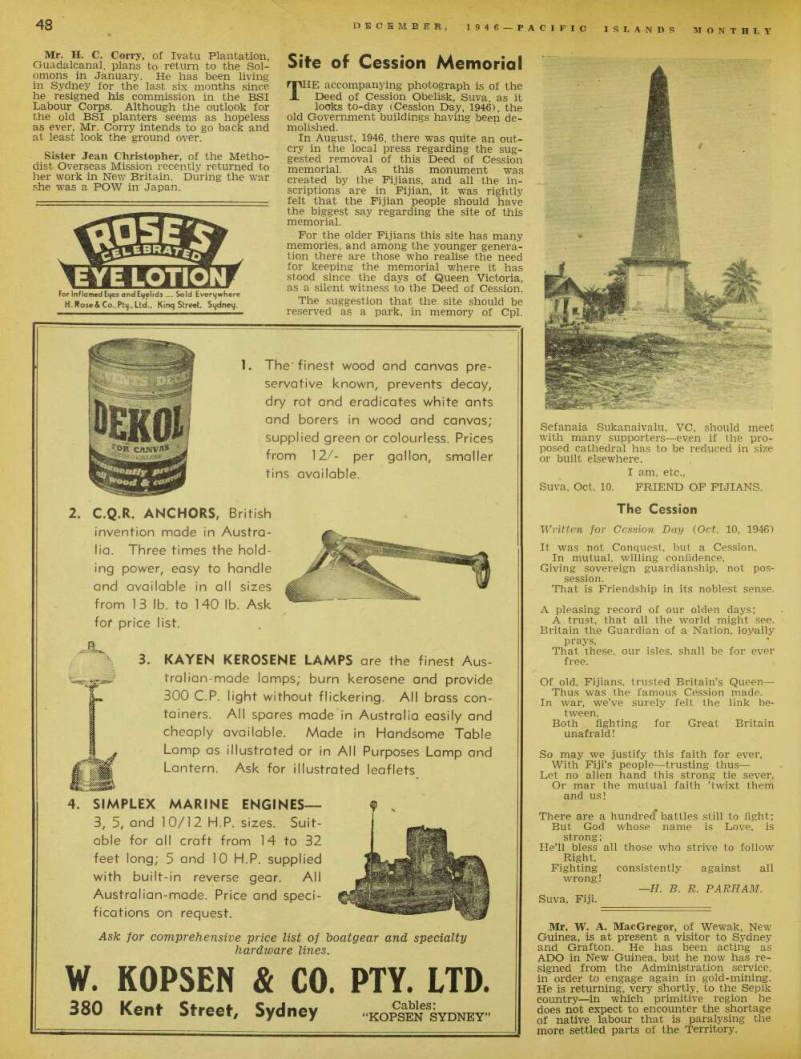
REVISED international allocations of cocoa which were published in Lon don in September were as follows: Of the allocation to the United King dom of 100,840 tons, 97,00 tons will come from British West Africa, 2,340 from the British West Indies, 500 from West ern Samoa and 1,000 from Latin American countries.
Allocations for the United States will consist of 60,000 tons from Brazil, 3,580 from the British West Indies, 120,000 from British West Africa, 20,000 from French West Africa, 500 from the New Hebrides and 54.750 from other Latin American countries .making a total of 258,830 tons. —From the “Public Ledger.”
Miss A. M. Uphill, of the Methodist Mission, Fiji, is at present on leave in South Australia.
Dr. A. Hoeger, of the American Luth eran Mission, New Guinea, was one of 75 women doctors who served with the American forces during the war. She is at present on leave in Australia but ex pects soon to return to medical mission ary work in New Guinea.
The Rev. and Mrs. Maurice Nixon of the LMS, have now returned to Papua after furlough in England.
Mr. H. C. Corry, of Ivatu Plantation, Guadalcanal, plans to return to the Sol omons in January. He has been living in Sydney for the last six months since he resigned his commission in the BSI Labour Corps. Although the outlook for the old BSI planters seems as hopeless as ever, Mr. Corry intends to go back and at least look the ground over.
Sister Jean Christopher, of the Metho dist Overseas Mission recently returned to her work in New Britain. During the war she was a POW in Japan.
Advertisements & other items, pp. 49-50 (1 item)
rz*~£zr<***
WANTED: Back numbers of the “Pacific Islands Monthly.” Have many duplicates for exchange. Will also exchange American magazines for newspapers and magazines of the Pacific Islands and British Colonial Empire. Orders taken for subscriptions to American magazines —no foreign exchange difficulties —write for details to PAUL A. DORN, Agent, Los Angeles 36, California.
N
w AS AlW AYS
CQ Sgjnao
, cotEM*® 4 »o< 10W ,Ip“«io« fo '
eodahihty ppliaoces.
a ad quaUty ®» fto» * e S T aVS wi* the es- Uetiais as a?S ’ features, V°» Elusive Coie^ e a * e he* are •***»* ** depe adable CoVev ,beM°' lbU7 t Late there ts Wherever y° you
rz*~£zr<***
x:
AGENTS
Robert Gillespie Pty. Ltd. 54A Pitt St., Sydney, N.S.W.
Pearce & Co. Ltd., SUVA.
) THE COLEMAN LAMP
AND STOVE COMPANY LIMITED
TORONTO, CANADA
CHICAGO USA
i
EYE LOTION
For Inflamed Eyes and Eyelids ... Sold Everywhere H. Rose & Co.. Pty.. Ltd., King Street. Sydney.
1. The'finest wood and canvas preservative known, prevents decay, dry rot and eradicates white ants and borers in wood and canvas; supplied green or colourless. Prices from 12/- per gallon, smaller tins available. 2. C.Q.R. ANCHORS, British invention made in Australia. Three times the holding power, easy to handle and available in all sizes from 13 lb. to 140 lb. Ask for price list. 3. KAYEN KEROSENE LAMPS are the finest Australian-made lamps; burn kerosene and provide 300 C.P. light without flickering. All brass containers. All spares made in Australia easily and cheaply available. Made in Handsome Table Lamp as illustrated or in All Purposes Lamp and Lantern. Ask for illustrated leaflets
4. SIMPLEX MARINE ENGINES—
3, 5, and 10/12 H.P. sizes. Suitable for all craft from 14 to 32 feet long; 5 and 10 H.P. supplied with built-in reverse gear. All Australian-made. Price and specifications on request.
Ask for comprehensive price list of hoatgear and specialty hardware lines .
W. KOPSEN & CO. PTY. LTD.
380 Kent Street, Sydney
Cables *
“KOPSEN SYDNEY”
Site of Cession Memorial
THE accompanying photograph is of the Deed of Cession Obelisk, Suva, as it looks to-day (Cession Day, 1946), the old Government buildings having been de molished.
In August, 1946, there was quite an out cry in the local press regarding the sug gested removal of this Deed of Cession memorial. As this monument was created by the Fijians, and all the in scriptions are in Fijian, it was rightly felt that the Fijian people should have the biggest say regarding the site of this memorial.
For the older Fijians this site has many memories, and among the younger genera tion there are those who realise the need for keeping the memorial where it has stood since the days of Queen Victoria, as a silent witness to the Deed of Cession.
The suggestion that the site should be reserved as a park, in memory of Cpl.
Sefanaia Sukanaivalu, VC, should meet with many supporters—even if the pro posed cathedral has to be reduced in size or built elsewhere.
I am, etc.,
Suva, Oct. 10. Friend Of Fijians.
The Cession
Written for Cession Day (Oct. 10, 1946) It was not Conquest, but a Cession, In mutual, willing confidence, Giving sovereign guardianship, not pos session.
That is Friendship in its noblest sense.
A pleasing record of our olden days; A trust, that all the world might see.
Britain the Guardian of a Nation, loyally prays, That these, our isles, shall be for ever free.
Of old, Fijians, trusted Britain’s Queen — Thus was the famous Cession made.
In war, we’ve surely felt the link be tween, Both fighting for Great Britain unafraid!
So may we justify this faith for ever, With Fiji’s people—trusting thus— Let no alien hand this strong tie sever, Or mar the mutual faith ’twixt them and us!
There are a hundred battles still to fight; But God whose name is Love, is strong; He’ll bless all those who strive to follow Right, Fighting consistently against all wrong!
H. B. R. Parham.
Suva, Fiji.
Mr. W. A. MacGregor, of Wewak, New Guinea, is at present a visitor to Sydney and Grafton. He has been acting as ADO in New Guinea, but he now has re signed from the Administration service, in order to engage again in gold-mining.
He is returning, very shortly, to the Sepik country—in which primitive region he does not expect to encounter the shortage of native labour that is paralysing the more settled parts of the Territory.
Missionaries In
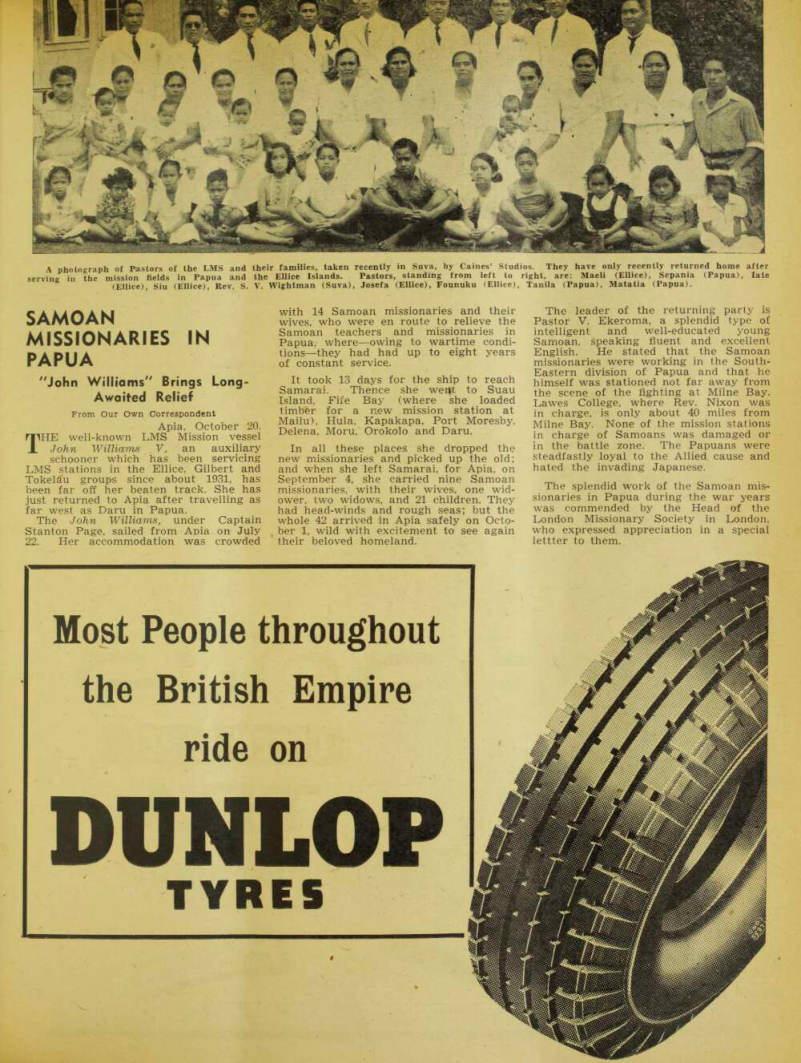
Samoan
Papua
“John Williams” Brings Long- Awaited Relief
From Our Own Correspondent Apia. October 20.
THE well-known LMS Mission vessel John Williams V, an auxiliary schooner which has been servicing LMS stations in the Ellice. Gilbert and Tokelau groups since about 1931, has been far off her beaten track. She has just returned to Apia after travelling as far west as Daru in Papua.
The John Williams, under Captain Stanton Page, sailed from Apia on July 22. Her accommodation was crowded
with 14 Samoan missionaries and their wives, who were en route to relieve the Samoan teachers and missionaries in Papua, where —owing to wartime condi tions—they had had up to eight years of constant service.
It took 13 days for the ship to reach Samarai. Thence she went to Suau Island, Fife Bay (where she loaded timber for a new mission station at Mailu), Hula, Kapakapa, Port Moresby, Delena, Moru, Orokolo and Daru.
In all these places she dropped the new missionaries and picked up the old; and when she left Samarai, for Apia, on September 4, she carried nine Samoan missionaries, with their wives, one wid ower, two widows, and 21 children. They had head-winds and rough seas; but the whole 42 arrived in Apia safely on Octo ber 1, wild with excitement to see again their beloved homeland.
The leader of the returning party is Pastor V. Ekeroma, a splendid type of intelligent and well-educated young Samoan, speaking fluent and excellent English. He stated that the Samoan missionaries were working in the South- Eastern division of Papua and that he himself was stationed not far away from the scene of the fighting at Milne Bay.
Lawes College, where Rev. Nixon was in charge, is only about 40 miles from Milne Bay. None of the mission stations in charge of Samoans was damaged or in the battle zone. The Papuans were steadfastly loyal to the Allied cause and hated the invading Japanese.
The splendid work of the Samoan mis sionaries in Papua during the war years was commended by the Head of the London Missionary Society in London, who expressed appreciation in a special lettter to them.
A photograph of Pastors of the LMS and their families, taken recently in Suva, by Caines’ Studios. They have only recently returned home after serving in the mission fields in Papua and the Ellice Islands. Pastors, standing from left to right, are: Maeli (Ellice), Sepania (Papua), Iate (Ellice), Siu (Ellice), Rev. S. V. Wightman (Suva), Josefa (Ellice), Founuku (Ellice), Tanila (Papua), Matatia (Papua).
Advertisements & other items, p. 51 (1 item)
Dunlop
Most People throughout the British Empire ride on
TYRES
i m
Native Problems
of Modern New Guinea An Unbiased Survey by an Expert
S. W. REED, an Instructor in Sociology of Yale University, spent about a year in Mandated New Guinea (1936-37) and, as a result of very thorough investi gations, consisting of personal observa tions, interrogations of local residents and a close study of the Territory’s literature, he has written a comprehensive survey of the Territory—sociologically, economically and culturally—in “The Making of Mod ern New Guinea” published by the Ameri can Philosophical Society (1943) and is sued in co-operation with the Interna tional Secretariat, Institute of Pacific Re lations.
The survey covers the physiography and aboriginal cultures of the Territory;dev elopment of European control; the begin nings of permanent contact (1872-1884); native administration during the German regime 0884-1914), then during the Aust ralian regime (1914-1940), divided, into military and civil admiistration. Follows then a survey of the economic prospects; and, finally, Modern New Guinea—the genesis of a new society.
Three instructive appendices deal with “The Language Adjustment: Melanesian Pidgin;” Port Breton (a tragic chapter in tropical colonisation); and Population Figures for 1921-1938. There are exten sive foot-notes, quoting the authorities for statements and opinions expressed, and illustrating the thoroughness with which Mr. Reed has carried out his work.
The outstanding feature of the book is the record of gradual influence which Eur opean contact has had upon aboriginal cultures and the sociological adjustments which have resulted. This contact be tween the invading European and the
most primitive native is traced for the period of a century—from 1840 to 1940showing the trading, planting, recruiting and missionary contacts and their result ant effects upon the natives.
REGARDING the question of the de cline of native populations, he says: “Much has been written regarding the alleged decline of populations in the South Pacific prior to European contact.
Although certain of the islands may have shown evidence of such a trend, the complete absence of census data from aboriginal New Guinea prohibits the acceptance of any final conclusions.
Nor is there evidence to show that the pioneer whites introduced new epidem ic diseases which decimated the popu lation, Certainly, however, the natives did not become ‘supine and nerveless’ when the ‘debased brutishness’ of their culture felt the impact of new values through contact with whites.”
On this subject he quotes Professor S. H.
Roberts’ “Population Problems of the Pacific”, and says: “Roberts’ otherwise commendable summary of the native problems of the Pacific Islands is marred by his too ready acceptance of antiquated opinions—such as that of W. H. R. Rivers —concerning alleged psychological deter minants of population decline.”
Concluding his chapter on “the Begin nings of Permanent Contact: 1872-1884,” he writes: The history of European colonisation has been interpreted in terms of land hunger. The story has been facetious ly summarized by saying: “When the white man came he owned the Bible and the coloured man the land. In time the white man became owner of the land and his coloured brother owner of the Bible.” Although this neat ex change seems to have taken place in many parts of the world, it does not hold true in New Guinea. For in New Guinea to-day the coloured man still
has the great preponderance of his land and, if he wants it, the Bible, too.
AFTER reviewing the system adopted by the German government in its contact with the indigenes Mr. Reed carefully examines the steps taken by the Australian military and civil administra tions. Referring to the much-discussed indenture system of native labour, he writes: “It is not our duty to decide whether or not the indenture system is the best measure for getting work from an ir responsible and unskilled labour body: it is simply the adjustment which has suited most of the needs of Europeans and natives alike. The natives them selves prefer it to be the only alterna tive, i.e., casual labour, for they arc conditioned to work for Europeans away from their native villages. .They also have become thoroughly accustom er to receiving their wages (except for monthly pin-money called “current wages") in a lump sum at the end of their contract. They fully realise that they could never save the money un assisted. Only in recent years has cas ual labour been resorted to by natives in lieu of indentured service, and this phenomenon is primarily confined to the larger European settlements. Out of this variation new problems of ad ministration are arising, for casual lab our has no traditional codes of its own.
It is, in fact, a revolutionary develop ment which may eventually supplant the indenture system.”
And then he gives a very comprehensive summary of the NLO of 1935 and the NLR of 1935. “Despite the fact.” he writes, “that the labour laws are never perfectly observed, there is, in my opinion, a re markably high degree of conformity to them. This in attributable in no small measure to the devotion to duty exhibited by the District Officers and their subord inates.”
He then goes on to deal with health and
education measures adopted by the Gov ernment officials. Referring to the in jections of novarsenobillon he quotes the late E. D. Eve as telling him of villages entered by him for the first time being anxious for the “needle”. “Eve said that knowledge of these inoculations has dif fused among countless tribes in the Sepik district who have never seen a white man... He said he would have perfect confidence in his safety among the most remote tribes if he were armed simply with a hypodermic syringe.”
IN summing up the economic prospects of the Territory, he writes; It mast not be assumed that the creation of new demands and needs is accomplished simply by showing nat ives all the wonders of Western manu facture. They must be given visible proof of their benefits and an opportun ity to acquire them.
The essentially unchanged list of things the native purchases—tobacco, matches, calico, cheap iron utensils, and ornaments of several kinds—must be co-related with the static character of the wages which he now receives and has received for decades. Furthermore the laudable aim of the Administration to keep native societies alive and funct ioning with their former vigor serves as an additional check on their rapid assimilation of European wants.
These are fundamental realities which critics of the “unprogressive nat ure” and “backward character” of nat ives would do well always to bear in mind.
Obviously no simple solution, such as doubling native wages by legislative fiat, can hope to raise native production and consumption to the point where natives themselves and European man agers and entreprenteurs will be fully satisfied. And the system of paternali stic peonage under which they are now employed will, in the ordinary course of events, continue for some time to come.
But if the full implications of the “sacred trust” are fearlessly accepted, not only by those in positions of autho rity but by all who hope to profit from the development of the Territory, New Guinea still holds high promise of becoming a uniquely successful experi ment in civilisation.
SPEAKING of the importance of indi vidual contact between white and native he points out that “natives are quick to distinguish in Europeans those personality traits which they respect or admire, as well as those which they dislike or do not trust.” Continuing he writes; On the Sepik River, where the native cultures set a high value on aggressive and truculent behaviour, one Govern ment official, known by the natives to be in .constant fear of attack, received little or no co-operation, either from his native police-boys or from the villagers in his district.
The other kiap on the river, known as a stern disciplinarian, was much more successful with his dealings with these people. They preferred to take their court cases to him, even though his post was several days’ journey farther away from that of his less ad mired colleague.
IN summing up his sociological observa tions Mr. Reed is of opinion that “if no unforeseen occurrences eventuate, however, we may expect to witness a steady progression of the following already established trends: (1) Rapid extension of the government’s influence over, and European con tacts with, peoples still living under purely aboriginal conditions, (2> Increasing demand on the part of
European employers for native labour. (3) Increasing dependence of the native on the European economic system. (4) Further elaboration and standardisatlon of the codes of lower caste behaviour. (5) Development of social classes within the lower caste. (6) Increasing participation of native women in the new social order.
In conclusion, he writes.
“Many well-meaning commentators on the contact of high and low civilisations bemoan the passing of aboriginial cul tures. Fastening their mournful gaze exclusively upon the destructive aspects of the acculturation process, they sympathise strongly with the older generation of natives, whose lives have been shattered —even if their health has been improved.
These writers are wont to contrast what they conceive to be the glamour and excitement of life in the old days with what seems the controlled monotony of * h “Balan°ed Observation of the history of contact in New Guinea allows no such one-sided conclusion.
“Admittedly, much of the old culture is rapidly disappearing, but this is a condition to which the younger generation is becoming accustomed from birth.
Intelligent control of the acculturation
process in this country has made the transition from the old to the new im measurably less violent than in many another region of the world. The New Guinea native has profited from it in a variety of ways—in a greater sense of security, in better health, in a steadier diet. Whether or not he is a happier individual than his father or grandfather we cannot know.”
“The Making of Modern New Guinea” is a book well worth reading for all those interested in the effects of our daily con tact with the natives of Australia’s vast dependencies up north.—G.T.
Advertisements & other items, pp. 52-53 (2 items)
50
DICEMBEH, i 946 l»ACifiO ISLANDS MONtlttf
Green Label
V O SJ \\
i © S 3
FIRST GRADE
QAU/
m J.A.D.GIBSON AND COMPANY PTV LIMITED 364 Kent Street SvoNty. c N n E p W k C ,^ TL o E ar o ? str'ehs
Copies of
Pocific Islonds Monthly
Can ALWAYS be obtained at the following places:
SYDNEY;
T. L. Cordingley’s Bookstalls at Martin Place, outside G.P.0., near George Street; and at G.P.0., Colonnade, George Street end.
BRISBANE:
R. S. Macdonald, next G.P.0., Brisbane, Qld.
MELBOURNE;
McGill’s Authorised Newsagency, 183-5 Elizabeth Street, Melbourne.
AUCKLAND:
W. A. Webb, Waverley Hotel Bldgs., Queen Street, Auckland.
SUVA:
James A. Muir. Suva, Fiji; and Miss R. Castles, Victoria Parade, Suva, Fiji.
U¥ & ml I
LIKE FRUIT WITHOUT
wtafaid
The mellow richness of Foster Clark’s Creamy Custard takes the “edge” off fruit, and more than doubles its delicious nourishment. The newest idea is to utilize Poster Clark’s Creamy Custard as a basic ingredient in sweets, too! Dozens of recipes in the free Foster Clark Recipe Hook.
Write for the free Recipe Book to Foster Clark (Aust.) Ltd., Dept. R. 8., Redfern, N.S.W., enclosing 2hd. postage.
FOSTER CLARK’S
N v nv n x s s. O
Young Painters In Tahiti
From Our Own Correspondent Papeete, October 10.
PAPEETE has had many exhibitions of paintings—from the extraordinarily beautiful, authentic pictures of Islands life by Count Morillot, who lived on Tahaa; through the horrors of lip stick vermilion: swamp green, cadaver purple and gutter-mud brown, spattered and daubed on or heaved at canvas by the miscellaneous swarm of would-be Gauguins; to the exquisite water-colours of the Scotsman, MacDonald.
A recent exhibition of paintings has attracted universal interest: for it rep resents the results of study and work by young people born in our islands.
The young painters have been under the guidance of the distinguished artist M. Serge Gres, who has long resided in the Islands. Monsieur Gres, as a labour of love, has selected a small group who have exhibited marked talent, and has trained and guided them in the art of painting until they have produced wor,ks
worthy of inspection by those competent to pass judgment.
No one of this group of pupils is over twenty years of age. Yet they have pro duced pictures which have merited the highest praise.
The Colonial Government has set apart a parcel of land in the Museum property as the site of a studio for this admirable undertaking. The interest shown by our people in intellectual and cultural values presents the most heart ening promise for the future pattern of Islands life.
Sulphur As Mosquito
Repellant
AN interesting theory is described by Mr. G. R. Younger, of Cape Marsh, Solomon Islands. He asks if any Pacific resident has heard it claimed that if a man takes sulphur in some form internally, his blood becomes repellant to mosquitoes. He says that for some time he lived in one of Sydney’s northern sub urbs, where scores of dogs were annually killed by bush ticks. An old trainer of greyhounds told him: “Dose your dog with sulphur once a week and you will have no tick trouble.” Mr. Younger gave his pup sulphur, in liver and it escaped the ticks which may have been due to either luck or sulphur.
“I also remember some stories about bee farmers’’ says Mr. Younger. “They always took a few doses of sulphur and treacle, before robbing a hive, to keep the bees from stinging them. But that may have been only ab — tale!”
After a holiday in Sydney with her two daughters, Madame Vacher, recently re turned home to Noumea, New Caledonia, by Qantas flying-boat.
For Papua
ARC Extensive Plans For Papua
Australasian petroleum company Pty., Ltd., recently annomiced that Mr. C. Saunders has been re-appoint ed General Manager of the Company, and that an intensive programme has been prepared covering drilling, geological and geophysical operations in Papua. A Gru man Amphibian aircraft has been pur chased in USA to facilitate field work.
Since resumption of operations early in 1946, the drilling camp at Karaiva, Papua, has been rebuilt, and the necessary ship ping, workshop, power and storage facil ities have been provided. The drilling rig and machinery has been recommis sioned and the well, which had reached a * of s>4o ° feet P rior to suspension of drilling activities in 1942, has been opened up and found to be in excellent condition. Drilling has now been resumed.
The shareholders of Australasian Pet roleum Company Pty., Ltd;, are D’Arcy Exploration Company Ltd., of London (wholly owned subsidiary of Anglo-Iranian Oil Company Ltd.), Vacuum Oil Company Pty., Ltd., of Melbourne; and Nominated Holdings Pty., Ltd., of Sydney (wholly owned subsidiary of Oil Search Ltd.).
Mr. John Bryan, geophysist. of the oil exploratory company of Robert H. Ray, Ltd., Texas, has arrived in Australia, where he will be joined by five others. They have a two-year contract to do explora tory work in Australia, New Guinea, and other parts of the South-west Pacific for the Vacuum Oil Company.
Advertisements & other items, p. 54 (1 item)
Nelson & Robertson Ki
NELSON and ROBERTSON Pty. Ltd.
Established 1895
Shipowners - Brokers and
Islands Merchants
All classes merchandise purchased at Best Wholesale Prices. Original Invoices supplied to Island Clients. Cocoa Beans, Copra, Rubber, Trochus Shell and All Islands' Produce Sold on Commission.
Entrust your requirements to the firm with fifty years' practical experience in the Pacific Islands.
■ UMVIIIIVII yiTCII IV UM CII^UIIICS.
NELSON & ROBERTSON Ki
12 SPRING STREET, SYDNEY, AUSTRALIA
Telegraphic Address: IVAN, SYDNEY.
Training Missionary
Supermen
By Ex-Islander
\Jf I SSI ON ARIES are to he taught iVI elementary medical work, including such operations as the removal of an appendix, and the fundamentals of useful trades, including carpentry and black-smithing, in order to make them practical missionaries, stated the secre tary of the Australian Board of Missions {Rev. R. A. Shevill) in a rather all-em bracing announcement published in the Queensland daily press recently.
A new Anglican missionary training college for the purpose is to be built, probably in Sydney.. Men will be trained at the college for five years before being sent into the field.
SO, in a mere five years, the new super missionary is to absorb medicine and major surgery, carpentry and black smithing, and, presumably, some theology for the benefit of the poor, long-suffering Pacific native.
One can imagine the future scene in some out-of-the-way island mission station when a kanaka (sorry, Mr. Ward —I mean native gentleman) arrives at the station complaining of a “pain along bel belong me” and the new practical missionary from Sydney college, dropping his forge tongs or carpenter’s chisel, prods the sore belly with a finger calloused and scarred from the smithy or carpenter’s shop, then rushes the victim to the operating table to snip out his appendix.
Presumably he will know how to admin ister the anaethetic, but, in case he does
not, he could always use the sledge ham mer from the smithy, whch should effec tively put the patient to sleep.
One hates to visualise the rest of the operation or the results, but it seems certain that the surgeon’s scalpel, needle and gut-thread will be strange tools in deed to hands, which perhaps an hour previously, forged a plough-share or nailed a roof on a mission building.
Anyhow, what is the BMA going to say about these new missionaries who poach on the preserve of BMA members and dash about thq Pacific snipping out ap pendices in between black-smithing and carpentering?
Even graduates of the Central Medical School in Suva, who have four year’s intensive training in medicine and sur gery behind them, without any side issues like “useful trades and theology,” are not permitted to remove their countrymen’s internal abdominal bits and pieces. And in most medical schools, I believe, the full course covers six years.
IT is often said that contact with the white man last century decimated the native populations of the Pacific.
On the face of it it now looks as if history might repeat itself.
By all means let the missionary of the future learn the rudiments of useful trades, but in the medical line, let his activities be confined to the admnistration of anti-yaws or hookworm injections, bandaging and splinting, bbt let him leave major surgery severely alone.
The employment of one or two fully qualified doctors and something in the nature of a flying-doctor service with amphibian planes would be far more
satisfactory than a lot of half-baked amateur surgeons as envisaged under the New Order for missionaries, Then too, why establsh the training college in Sydney. If the missionaries are to be trained for tropical service, Northern Australia would be a far better place to set up the training establishment.
Advertisements & other items, pp. 55-56 (2 items)
Gin Don't Say G I M Donti.
LOOK !
KOCH'S BARBER CHAIRS
Obtainable Soon
PACIFIC ISLANDS TRADING
COMPANY
244 California St., San Francisco, Cal.
DON'T SAY fi li\ DON'T SAY N DON'T SAY £| « W Wfe Y -«oor «OA *r T I DON'T SAY f, SAT GJ DON'T SAY DON'T SAY fi I M DON? SAY G I M (JIM DON'T SAY G/ M f DON'T SAY
DON'T SAY £ I N
GIN DON'T SAY
DON'T SAY GIN
GIN DON'T SAY
DON'T SAY GIN
GIN DON'T SAY
DON'T SAY GIN DON
GIN DON'T SAY G I M DONtI.
DON'T SAY G IN DON'T SAY GIN DON'T Sa . -G I N |AY It AY IN e Afe *l* Our Co c
SAY
Kr *llS * yon w Hi IN ey Sfc/p T Vsh
T SAY
N Telegrams and Cables: “GILBEYS,” Melbourne, Address all inquiries to:
W. & A. GILBEY LTD.
33 ROSSLYN STREET, WEST MELBOURNE. 109 REGENT STREET, SYDNEY.
Telegrams and Cables: “GILBEYS,” Sydney.
PACIFIC ISLANDS TRADING
Bankers: Bank of America (Main Office) San Francisco.
COMPANY
Cables:
PITCO
SAN FRANCISCO
244 CALIFORNIA STREET, SAN FRANCISCO, CAL., U.S.A,
EXPORTERS OF :
BARBER CHAIRS.
TEXTILES.
CLOTHING.
LIQUOR.
ELECTRICAL GOODS.
FOODSTUFFS.
PRODUCE.
STATIONERY.
CARTRIDGES.
DRUGS.
PAPER PRODUCTS.
AUTOMOTIVE PARTS.
WIRE & NAILS.
BUILDING SUPPLIES.
RADIOS.
REFRIGERATORS.
AUTOMOBILES.
FARM MACHINERY.
TYPEWRITERS.
FIREARMS.
CHEMICALS.
MARINE HARDWARE.
CIGARETTES, TOBACCO.
HARDWARE.
FURNITURE.
IRON & STEEL PRODUCTS.
CANNED GOODS.
PAINTS.
NOVELTIES, NOTIONS.
LEAD PENCILS, ERASERS.
HEAVY EQUIPMENT.
FERTILIZERS. '
TYRES, TUBES.
PREFABRICATED HOUSES.
QUOTATIONS ON REQUEST
/ ss V v
Leaders in their fields—SMlTH-CORONA
GRACELINE LADIES’ SHOES (Canadian)
SERVICEABLE AND STYLISH
PRICED RIGHT
PREFABRICATED HOUSES: The Answer to the
Housing Shortage.
54
DECEMBER, 1946 PACIEIC ISLANDS MONTHLY
But Shortages of Men and Materials Delay Operations
Heavy Programme Planned
For New Guinea P.W.D.
rERE will be no easy road to rehab ilitation and rebuilding in Papua- New Guinea according to a broad cast by the Director of Public Works, Mr. J. O. Lyons, from 9PA, Port Moresby on November 19.
The obstacles to be overcome before the Department can carry out its full works plan are: The difficulty of getting experienced tradesmen to go to the Ter ritory; the extreme shortage of building materials, shipping, plant and equipment; and insufficient native labour.
Plant and installations taken over from the military authorities at the time of the restoration of Civil Administration were at best temporary measures and in many cases were now breaking down al together.
Mr. Lyons said that the Commonwealth Department of Works and Housing would carry out major works in the Territory, as this Department possesses the necesary engineering experts. It is through this Department that the Town Planning of Port Moresby, Lae and a site on the Gaz elle Peninsula to replace Rabaul, is being executed.
Priority in planning and rebuilding has been given to Lae, as this township was completely obliterated by war activities.
Mr. Lyons said that a preliminary survey had already been completed.
The Papua-New Guinea Public Works Department has been engaged mostly in making damaged Administration build ings habitable and in converting Army buildings into stores, hospitals, etc. The department also completed the re-wiring of Government Buildings in Port Mores
by and extended the high tension line to 9PA radio station. Two diesel gener ators have also been installed in Samarai to replace those taken over from the Army.
PWD future plans included the con struction of wharves at Port Moresby, Samarai, Madang and Lae and the erec tion of cargo sheds at various ports.
Roads with a purely military purpose have been abandoned but roads around Port Moresby are being maintained to a certain extent. When the Town Plan is completed a new road construction programme will be commenced, based on altered road locations.
The Wau-Labu road is being maintained and bridges and culverts will be replaced as staff becomes available. Sections of the road will later be relocated and re graded but in the meantime the road is being kept open and is carrying heavy goldfields traffic. It is expected that the Wau-Edie Creek road will be re-opened shortly.
ANOTHER task of the PWD will be the rebuilding of Hanuabada village near Port Moresby. It is expected that 500 separate dwellings will be constructed there, each connected to water mains and electricity supply.
In conclusion, Mr. Lyons had a crumb of comfort for returned Territorians. He that though unsettled conditions meant that it would be some time before major projects were under way, when they were completed the Territories would be vastly improved in comparison to their pre-war state.
COOK islands pineapples
Mangaia, Sept. 2.
AT last the New Zealand Internal Marketing Division is awakening to the need for providing natives of the outer Cooks with a market for end of-the-year produce, such as local pine apples.
We are half-promised two steamers, between now and November; and large crops of local pineapples now ornament hillsides cleared of bush. (On this isle such sheltered, sloping places seem to give the best results with this fruit.) Mangaia pineapples are very strongly acid; perhaps this is due to the soil. The local product does not attain giant size; but it is a good table fruit, and should sell quite well in NZ.
By exporting it, rather than leaving it to be made into a dangerous local tipple, much good is expected—at least the islanders will have money for Christ mas spending.
Tomatoeso-A New Asset
For Mangaia
Mangaia, Sept. 11.
THIS island exported to NZ, during July 1,004 boxes of local tomatoes, which we now know reached the market in good condition. The present price, however, is not as good as on other occa sions, when Rarotonga growers did very well indeed out of this line.
But Mangaia has been lucky in another direction —blight, thi bone of local plan ters, did not develop; although no attempt was made to “sterilise” the soil by sieving earth over a hot fire.
Neither were the tomatoes, sprayed.
In spite of this, the percentage of spoiling was small.
Advertisements & other items, pp. 57-58 (1 item)
H. J. Heinz Co. Pty. Ltd.
extend the season’s to all £ood Friends and customers. ill L a* : 57 ill VP m II Mi *»
Refreshing
as a plunge
into a lagoon!
tena*
® ICIP AL
TO
soap
1
Germicidal
and fragrant
TENAX TOILET SOAP is
a rapid safeguard against external skin infections, yet it is soothing and kind to the most sensitive skin —even a baby’s!
ORDER TENAX FROM
YOUR ISLAND SUP-
PLIERS. STOCKS ARE
PLENTIFULLY AVAIL-
ABLE.
Scott’s “Renown” Brand Rope,
Cable Address: Ropeyard, Sydney.
Cordage and
Binder
Twine
of Every
Description
MANUFACTURED AT
MASCOT, N.S.W.
By
J. SCOTT
PTY. LTD.
Head Office and Store
163 CLARENCE STREET,
SYDNEY,
N.S.W.
Missionary
How a Catholic Missionary Was Killed by Japs
THE following account of how the mis sionary, Father Gerard "Weber, SM, of Tunuru, Bougainville. Northern Solomons, was murdered by Japs, was written by Monsignor James H. Hannan.
Monsignor Hannan, who was National Director, in Australia, of Catholic Mis sion Works, during the war* is now in charge of Catholic Mission activities, at Torokina, Bougainville : FATHER WEBER worked with his people, despite many and humiliating experiences at the hands of the Japanese, right up to Easter, 1945. From the previous Christmas he had made his headquarters in Kopani, conducting a school for the natives, making a number of converts. On Low Sunday he left there to go to Bito to give the people the opportunity of making their Easter duty. One week there and he went on to Tarara to hear confessions and give Holy Communion. All travelling wajs done, of course, by foot, through jungles and over mountain trails.
From Tarara, Father Weber returned to Bito. In the meantime, the comman dant of the Japanese Secret Police in the Kieta area had died. He had been more or less tolerant towards the mission ary, and it was this Sergeant-Major Sato who had sent him up to Kopani.
The Japanese Secret Police officer from Numa Numa, who came to take his place, found among the letters on Sato’s desk an order directing Father Weber to re turn to Numa. He was arrested imme diately he reached Bito.
A number of Catholic natives who had come from Tarara, carrying the priest’s baggage, were instructed to follow the police party. Sometime later, as they came to a road leading inland, they found a guard who ordered them to wait with the baggage, as Father Weber had gone up the road with an officer. Shortly afterwards, they were ordered to carry the baggage to a place further on, as
“the priest was proceeding to Numa Numa by pinnace.” They were then sent home.
One week later, Kino, a Jap officer from Numa, who was on patrol, camped at Tarara. The natives noticed that the soldiers had a number of articles belong ing to Father Weber, including his soutane. Kino further requested the chief Catechist to bring him Father Weber’s mosquito-net.
To this, and the possession of the priest’s effects on the soldiers, the natives strenuously objected. Their objections were met with the statement that Father Weber “did not need any of these things now, as he had gone in a boat to Bruin (Japanese HQ), where he would find everything he wanted.”
The people of Tarara knew the Jap anese too well to be convinced of this; but, of necessity, they had to accept the statement. Immediately after the sur render, however, they sent out parties to try and find some trace of the Father they had known so well. Going up the road where the bearers had been told to wait with the luggage, one party found a Japanese cemetery with one grave apart from the others. Opening the grave they found glasses, a hat, khaki clothes which they recognised as Father Weber’s. In the grave was a body, de capitated, with the severed head resting on the chest.
There, on that lonely road, the faith ful servant had gone to meet his God.
The little party gathered together the pathetic remains and brought them to Tarara, to await the arrival of a priest.
On Father Muller’s arrival, he told them to take the body of Father Weber to his old mission station at Tumuru. There, with Requiem Mass and Solemn Burial, the remains of the martyed priest were laid to rest in death with the people to whom he had given his years of life.
Lae Forms A Citizens'
Assn.
Other N.G. Townships May Follow
LAE, Nov. 15 A MEETING of about 30 residents was held in Lae on November 15, with the object of forming a Citizens’
Association.
Mr, E. Jenyns was elected chairman, Mr. H. Eekhoff, secretary and Mr. A.
Garth, treasurer.
It was resolved to call the Association the Lae Branch of the New Guinea Citizens Progress Association and a com mittee was appointed to draw up a con stitution. Committee members are: Messrs. Morgan, Hitchcock, Hendrick, Petersen, Jenyns and Eekhoff. The object of the Association is to co-operate with and assist the Administration, and to attend' to civic matters generally.
It is hoped that other branches will be formed throughout the Territory.
At 79 years of age, Mr. C. H. Hughes, an ex-Territorian, still enjoys recalling his many years’ residence in New Guinea, says a Brisbane Correspondent. Affec tionately known as “Dad,” he is a constant visitor at the monthly meetings of the Brisbane-New Guinea Association. Ac countant, prospector, storekeeper, and at one-time proprietor of the Rabaul “Times,” his 20 years in the Islands were as eventful as they were varied. An ex- Boer War veteran, Mr. Hughes still re tains an erect soldierly bearing.
all C.D.C. Sales
Territorion Preference in all C.D.C. Sales Statement by Supply and Shipping Minister
From Our Canberra Correspondent
Canberra, Nov. 28.
ISLAND residents were given preference in all sales by the Commonwealth Disposals Commission in New Guinea, stated the Minister for Supply and Ship ping (Senator Ashley) who controls the CDC, in a written answer to a question to-day. , , .
He denied that, at auction sales, stocks were being sold in large quantities and added, “The Disposals Commission’s ar rangement provided for the sale in small quantities to local buyers before bulk stocks are offered to mainland buyers.
The information was supplied to Mr.
White, who wanted to know what steps were being taken to provide for the needs of returning settlers to New Guinea.
The Minister stated that prior to ar rangements being made for the current auction sales in New Guinea, the Disposals Commission took every possible precaution to ensure that the needs of the Territory and of the settlers who were not yet back in the territory should be provided for.
In the first place, he said, the Commis sion covered the requirements of the De partment of External Territories for all Governmental rehabilitation purposes.
Secondly, it had for a period of 12 months, made available to settlers, mis sionary organisations, mining companies and others in New Guinea, all such stocks as the people and the organisations con cerned desired to take over.
Thirdly, realising that a number of settlers were not yet back in New Guinea, the Commonwealth Disposals Commission arranged with the Department of Exter nal Territories for the Production Con trol Board to take over stocks of equip ment which were held by that Board for the needs of settlers who were not back on their holdings.
Settlers who came within this category, he said, should make application to the Chairman. Production Control Board, for supplies of materials from this reserve.
Finally, all settlers in New Guinea, in cluding a large number who returned by the vessel “Duntroon,” had been given every opportunity at the auctions in com petition with buyers from the mainland.
“TT is emphasised,” he added, “that the J. cost of freight from New Guinea to the Mainland is so high as to ensure that local buyers have every opportunity of purchasing in competition, as they have no freights to pay. It is not correct that even at the auction sales the stock is being sold in huge quantities, as the Commission’s arrangement provides for sale in small quantities to local buyers before bulk stocks are offered to main land buyers.
“Whilst the General Manager of the Disposals Commission was in New Guinea some three or four weeks ago, he met representatives of the Returned Soldiers’
League both at Rabaul and at Lae. In both areas the Returned Soldiers’ League expressed itself as being highly satisfied with the arrangement .which the Com mssion had made to meet the needs of local settlers.”
Editorial Note
THIS is the same old story; Ministers have been countering Territorian discontent at the activities of the
CDC in this fashion ever since the CDC went to New Guinea —that is, with a flat denial that New Guinea residents have any reason for complaint. . The only new note in the assurances of Canberra is Senator Ashley’s statement that the local branches of the RSSAILA are satis fied with the CDC.
This surprises us. The New Guinea Returned Soldiers’ League has complained bitterly in recent months of CDC methods, both publicly and in private representa tions to the Australian Prime Minister, and at the same time as the General Manager of the CDC was in Lae receiving RSSAILA approval, a “PIM” representa tive, also in Lae, was told by an official of that branch that they could get no satisfaction whatever from the CDC. One of their grounds for complaint was that Lae vehicle-park had been closed for the previous two months; and then it was announced that it had been sold outright to a Southern buyer.
We do not suggest that the Minister is
lying; but, on our knowledge of the cir cumstances, we are sure that he has had the wool very thoroughly pulled over his eyes by his official advisers.
Marriage Bill Withdrawn
A BILL to amend the Marriage Ordi nance which was considered by the Fiji Legislative Council at the ses sion in early November, was later with drawn for further consideration.
It was proposed that the age at which Indian girls might be married be raised from 13 to 14 years and that the age at which they might marry without their parents’ consent, be raised from 15 to 16 years.
The Indian members were in accord with the first proposal, but were anxious that the age that girls might marry with out consent be raised to 18 or 21 years.
The bill was therefore withdrawn to allow them time in which to discuss the proposals.
Advertisements & other items, p. 59 (1 item)
Symbol of
ervice THE SHELL COMPANY OF AUSTRALIA, LIMITED. (Inc. in Great Britain;.
G469m.
Minutes!
Five Crowded
One Black Night on a Top-Sail Schooner, 50 Years Ago
By F. S. Whitcombe
IN the 1890’s on a morning in June, the top sail schooner “Marmion,” 120 tons, lay at anchor, off Queens Street Wharf, Auckland.
The previous evening, we had finished loading a full cargo of everything, from needles to bricks and anchors, for Nukua lofa, Haapai, Vavau, Niuafo’ou and Niue; and now we were just waiting for the ebb tide to heave up, set sail and get under way.
At grey dawn, our mate knocked on the scuttle and called all hands (four of us) on deck. While the “doctor” got the coffee going, we hove in the slack of the cable, all ready to lift the anchor when the tide started to ebb.
It was a miserable morning, greasy and
wet, with a misty, damp drizzle and, although the wind was north, it was bitterly cold.
Just outside of us lay the beautiful “Crusader,” a full-rigged, isky-sail-yard ship (New Zealand Shipping Co. —Captain Scotland). She was a picture. She was in ballast, waiting for a cargo, and she had just been painted up and tarred down, from truck to water line; and, with all her yards aloft, and squared to an inch, with her freshly painted ports glistening in the mist, she looked lovely.
At the wharf lay another beautiful full-rigged 2,000 tonner, the “Lady Joce lyn,” large, for those days. She had just arrived from London, after a fine-weather passage of 112 days, in which they did not have to clew up their top-gallant sails.
Down the harbour was anchored the lovely American Barque “Alice,” 800 tons (Arnold Cheney & Co.). She had just arrived from New York with a full load of case oil and kerosene. She also looked beautiful, with her black hull and yellow riband. She had powerful clipper bows, with a long bow-sprit and gibboom sticking out, Yank fashion. All her sails were beautifully furled on the yards, with out a crease in them and, as they were cotton duck and pure white, they showed sharp against the black hull and grey sky.
At the Railway Wharf were the two barquentines, “Silver Cloud” and “Wai temata,” built in the Colony.
AFTER coffee, the tide turned and we catted our anchor and got under way. The “Marmion,” although a topsail schooner, carried a top-gallant sail above her two topsails, a fore-and-aft fore-sail and main sail, gaff topsail, main top-mast-stay-sail, fore staysail and two jibs—ten sails —quite a few for a crew of four men (two in a watch) to handle.
With the skipper, mate and cook we were seven all told.
After getting under way, we lay down the harbour till we rounded North Head, and then we beat down the channel, short
and long tacks, until we got into Hauraki Gulf.
During my trick at the wheel that afternoon the northerly wind slackened up and I heard the Old Man (Captain Alex Ross) tell the mate that it was coming out of the South soon . At 8 bells we single-reefed the main-sail and fore sail, made fast the gaff-top-sail and top mast stay-sail. As it was a fair wind, we ran before it with the main boom guyed out to starboard.
At 8 bells in the grave yard watch, my mate and I came on deck—l to the wheel and he to the look-out. At 2 bells the wind was increasing, and we, being heavily laden were making heavy weather of it.
The skipper ordered us to clew up and make fast the top-gallant sail and take up a couple of spare gaskets, to make a job of it.
By this time it was really blowing, and as black as the inside of a cow. We got some spare gaskets and went aloft and started our job. Owing to the swell caused by the late northerly not having been laid out yet by the southerly, We were bucking into it and, as we were running at about 10 knots, it was pretty lively up aloft.
I had just finished my starboard yard arm and was making fast the bunt gasket, when my mate yelled out. ‘Trank, what the hell is that right ahead?”
At first I could see nothing. Then I made out white water and a huge black mass, and heard gulls screaming.
We both yelled out: “Land right ahead!
Keep her off! Keep her away!”
We heard the skipper, who was at the wheel, call all hands—cook and all. I felt the ship pay off; and, as the main boom was over to starboard, I knew that the skipper would gibe her.
We heard the mate let go the main boom guy and, in the light from the binnacle, I saw him and the cook try and get in the main sheet. But they were not quick enpugh, and the mainsail came over to port with such a bang that we nearly fell off the yard. If the sail had not had a reef in it I am sure the mast would have gone.
Up aloft, the rock loomed closer and closer. At one time as she rolled, I am sure we could have thrown a biscuit on it.
Though our job up there was finished, we hung on to that yard like limpets, scared stiff. At last, the topsail under us started to shiver; and, as we could see that we would go to windward of the rock, we cried out: “All clear!”
Then things started. The mate wanted to know what the blank-blank we were loafing up there for; and he told us what would happen if we did not “shake a leg,” etc. So we slid down the stay to the deck.
And there was a mess —halyards, sheets and braces all over the deck, tangled up in the water that she shipped every time she rolled.
However, in twenty minutes we had every thing ship-shape again, and the Old Man gibed her again—quietly this time —and put her back on her course.
I went aft and finished my trick at the wheel.
Next day, the sun was shining, and a fair wind blowing, so we got out our wet gear and dried it and, sailor fashion, for got what a narrow escape we had had.
The mate told us afterwards, that we had nearly run down the Sail or Ship Rock, and there was 15 to 20 fathoms of water right alongside it. If we had hit it we would have gone down like a stone.
Later in life, I can still raise a creepy sensation at the roots of my hair by thinking of that night.
Advertisements & other items, p. 60 (1 item)
Lighter
Your old SCISSORS, RAZORS
and KNIVES can be
SHARPENED and REPAIRED
Send them to—
W. JNO. BAKER SS:
3 HUNTER STREET,
SYDNEY.
YOUEL TRAVEL
LIGHTER
WITH A
OLOB IT
Just pick up a Globite and you'll see how much weight you can save. Globite Travel Cases are sturdy, smart-looking, and weatherproof. They give extra years of service and are being made available as fast as materials and manpower permit.
Illustrated is a Globite One-Suiter, which makes packing easier and prevents creasing and crushing.
OBTAINABLE AT GOOD STORES EVERYWHERE
Manufacturers: FORD SHERINGTON LTD. (Wholesale only)
Why Not Sponges From Pacific Island Waters?
Pacific Island Waters?
SOME people, it appears, still yearn for bath sponges, even when they cost (as they do in Australian cities to day) anything up to £3 per ounce. And this yearning might be translated into hard cash for Pacific Islands dwellers because sponges (the fibrous skeleton of a sea creature) are found .in South Pacific waters, but have as yet been virtually unexploited commercially.
First-grade sponges have always come from the eastern Mediterranean, Florida or the West Indies. Before the war they sold in Australia, according to size and fineness, from a shilling or two to about £l. During the war, about 75 per cent, of the Mediterranean sponge-fishing fleets which were operated largely by Greeks, were destroyed by enemy action and at the same time' the sponge beds in the West Indies were closed because of a marine blight; furthermore, in 1942, heavy floods in the Mississipi brought down silt which almost completely destroyed the beds off the Florida coast.
In 1938, 25,000 pounds weight of sponges were brought into Australia but only 700 pounds came in in 1944-45 —most of these for industrial uses. Small toilet sponges, weighing about a quarter-ounce, are now selling in Sydney shops for 26/-.
Over £l,OOO worth of sponges for com mercial purposes were imported into Aus tralia during 1943-44 from French Oceania —for water filtration and similar uses; and recently 400 pounds weight of sponges were sent from the Gilbert and Ellice Islands to Great Britain as a trial shipment. A G & E official stated'that a similar quantity could be obtained each week from the G & E Colony if the demand warranted it.
There is more in marketing sponges, of course, than merely fishing them up from the ocean floor. The crude sponge has to be expertly cleaned, trimmed and bleached before it is fit to accompany my lady to her bath.
Only the coaser variety of sponge, in expertly treated, has as yet come from the Pacific, but there appears to be an unlimited field there —and a lucrative one if prices which sponges are now bringing in world markets are any indication. (Based on an article in the “Sydney Morning Herald.”)
Puka-Puka Breaks Long
Silence
From Our Own Correspondent
Mangaia, Sept. 10.
IN a personal letter to this writer the RA of Danger Island (Puka Puka), Mr. R. C. Savage, explains the year long silence of that atoll, which caused much worry in view of tidal waves, etc. elsewhere. It was impossible to send messages, he says, as the Puka Puka radio installation had broken down. Mr.
Savage also reports that the taro patches, destroyed by a succession of tidal floods since ’42, have now been replanted, thus assuring the food supply of the island.
The islands income, 1942-44 from copra and mat-weaving, was £1,700.
Mr. Savage is in sole charge of the atoll, and also acts as a dispenser etc., at need.
He comments upon the healthy appear ance of his islanders, even when they were living upon a diet of coconut during the protracted stormy periods.
At present Puka Puka is getting only one ship yearly; and has no airstrip, so radio is the chief means of communica tion.
Advertisements & other items, p. 61 (1 item)
Ingram’S
Allen Taylor & Co. Ltd.
COMMERCIAL ROAD, ROZELLE,
SYDNEY
Sawmlllers and Wholesale Suppliers of Hardwoods for Constructional Purposes GIRDERS . . . PILES . . . POLES . . . SLEEPERS, Etc.
EXPORTING TO PACIFIC” ISLANDS SINCE 1893
m o'" ai
rttS
In 9
Ccmrf*
SwvW^
* wul C°* S «a\feTO'- w '' < e<> " Set your face up for the day with COOL, soothing, whisker-subduing
INGRAM'S!
All over the world the Ingram's jar is the morning companion of men who appreciate easy shaving. Ingram's cools and smoothes the skin while it wilts the wiriest hair-growth. Moreover, Ingram's is most economical because so little is needed for a rich, thick, spreading lather.
INGRAM’S
SHAVING CREAM
Manufactured by
BRISTOL-MYERS CO. PTY. LTD.
Sold by all leading distributors and manufactured by Bristol-Myers Co. Pty. Ltd., 223 Pacific Highway, North Sydney, N.S.W., Australia
Encouraging Results for Tropical Agriculturalists
Chemical War On Fiji's Weeds
CONSIDERABLE experimenting in the
chemical eradication of weeds . has been undertaken by the Department of Agriculture in Fiji in the past few months.
A description of tests made with two weedicides has been received from the Fiji Public Relations Office and is reprinted here for the information of planters etc. in other tropical territories.
The Department of Agriculture, Fiji, has recently, carried out a series of trials with Methoxone and a complementary weedicide called Dinoc (dinitro-ortho cresol).
Both are selective weed killers. The action of Dinoc is to accelerate meta bolism so that the plant uses up nutrients more quickly than it is able to replace them and is unable to survive.
Its effectiveness is increased by the addition of sulphate of ammonia as an activator and when used together with Methoxone a great increase in toxicity is obtained as the action of the two materials on plant tissues is complemen tary.
The local trials, which are still under way, have been made in various parts of Viti Levu with a view to studying the effect of the two weedicides on the follow ing important noxious weeds of the Colony.
Noogoora burr, hibiscus burr, solanum, paddy’s lucerne, guava, water hyacinth, tobacco weed and nut grass.
Most of these plants are woody peren nials and two concentrations have been used, one at the rate of two pounds an acre, the other at four pounds an acre, applied in water solution at the rate of 100 gallons an acre.
Effective results with Methoxone have
been obtained for Noogoora burr and water hyacinth and also for the pasture weeds, goatweed and tarweed, which are completely destroyed.
DINOC has been most effective when used against tobacco weed and mint weed and is more toxic than Meth oxone to Paddy’s lucerne, solanum and hibiscus burr.
Some of the larger shrubby weeds are severely defoliated at the concentrations used but some regrowth occurs. This calls for further investigation as regards the best time of growth and the cover age necessary to obtain complete des truction.
The combined spray is most effective and good results with young growths of solanum, Paddy’s lucerne and hibiscus burr have been obtained.
Observatons have yet to be completed.
Grasses are not harmed by the concen trations used and legumes such as tropi cal trefoils and sensitive plants are not affected.
Supplies of the weedicides are strictly limited and none are yet available for general use. Other compounds which have yet to be tried are Denocate, Den oxylon and Phenoxyl, small quantities of which have recently come to hand, Mr. and Mrs. I. E. Lucchinelli, well known residents of Fiji, were in Sydney on leave in November and December. Mr.
Lucchinelli is Superintendent of Police in Suva. He entered the Customs De partment as a clerk over 30 years ago, and has risen steadilv in the Fiji Govern mental service. He now holds many public and semi-public positions in Fiji.
Tahitian Speech
How Its Beauties Have Been Preserved
By A. C. Rowland
ONE who has made even a casual study of Polynesian languages must marvel how the Society and Austral islanders—surrounded by the rugged dia lects of the Marquesas, Tuamotu, and Gambier archipelagoes at the East, and of the Cook Islands at the West —have evolved a speech from which all gutteral, nasal and sibilant sounds have been dis carded. Yet the language contains re sources of dignity and elegance, blended with euphony, far beyond those of any other Polynesian dialect—except, per haps, that of Samoa.
The mystery deepens when one recalls that the_ Maori of New Zealand —whose dialect is the most rugged of all— migrated from Ra’iatea, in the Society Archipelago, and, manifestly, speaks the language prevalent in the Society Archi pelago at the time of departure.
THE ancient custom throughout Poly nesia of a language within the language set apart as a speech of high ceremony and used only in the presence of high chiefs, may offer a guiding indication. This leads us to ven ture the pronouncement that the Tahi tian dialect held a more august dignity as the language of the gods.
During many centuries, Havai’i (the ancient name of Ra’iatea) was the sacred centre of Polynesia. A line run ning north and south through the island corresponded to the longitude at Green wich in our modern world. All west of this line was the Ao-tea (The Light World); all to the east the Ao-uri (The Dark World).
At stated periods, priests, high chiefs and custodians of ancient lore came from all the Islands world bringing gifts and sacrifices to the great cere mony of Pa’i Atua (the assemblage and uncovering of the gods) at Opoa, on Havai’i. Much of this ceremony was esoteric. It was, therefore, prudent to use a tongue not comprehensible to the uninitiated ears of the multitude—who were permitted to witness, from afar, the processions bearing the images, and other happenings within the precincts of the Marae.
Much more imperative, however, was a tongue which, by its soft persuasive ness, would propitiate the always angry and menacing gods of the Polynesian Pantheon.
UP to the great quarrel, which shat tered the widespread Islands Con federation and the Ao-tea high chiefs dwelling on the west coast of Havai’i with their followers, essayed the perilous voyage to Ao-tea-roa (New Zealand) and ambassadors from distant archipelagoes came no more to Otoa — the language of the gods was known only to nobility and the priesthood.
Later, it was used at the family Marae; then it became the language of poetry— in the Society Islands —and eventually the general speech of the archipelago.
Before the coming of the Chinese, the Tahitians guarded jealously the purity of their language.
Alas, to-day, the language of the gods has fallen from its high estate. As the speech of the marketplace, it has gath ered some fearful and wonderful ele ments; while elegance of form and euphony have “gone with the wind.”
This, to be sure, applies to the com mon speech. The Bible as translated into the Tahitian by Rev. Henry Nott — preserves the purity of the old language and has made Tahitian the language of the Church throughout the archipelagoes of Central and South-eastern Polynesia.
Advertisements & other items, p. 62 (1 item)
Asthma Curbed
In 3 Minutes
Since the discovery of Mendaco by a famous physician sufferers can get relief from Asthma. Mendaco does away with expensive injections and offensive smokes.
All you ao is to take 2 tasteless tablets with meals and Mendaco starts circulating through the blood in 10 minutes. You breathe easily and freely. Your nerves relax, you get good, fresh, pure air into your lungs, and vigour returns.
Sleep Like a Baby
Thousands of former sufferers from Asthma say that the very first dose of Mendaco brought them glorious ease and comfort, and that they slept soundly the very first night. Then their vigour returned and they felt healthier and stronger, and 5 to 10 years younger. The reason for this is that Mendaco acts in natural ways to overcome the effects of Asthma. (1) It removes the mucus or phlegm; (2) It relaxes thousands of tiny muscles in your bronchial tubes so that the air can get in and out of your lungs; (3) It promotes body vigour, and stimulates the building of rich, revitalised blood.
No Asthma for Five Years
Mendaco not only brings almost immediate results, free breathing and comfort and enables you to sleep, but also builds up the system to ward off future attacks. Mr.
J. R, writes: “I was almost dead with Asthma. Had lost 40 lbs. In weight, snf-
fered coughing every night—couldn’t sleep.
Mendaco stopped spasms first night. I have had no Asthma since in over 2 years.”
Mrs. A. W. writes: “I had Asthma for 25 years. After using Mendaco I can sleep all night and have not had an attack since taking it.” Mrs. G. E. C. writes: “I bless the day I first heard of Mendaco. What a godsend it is to a poor woman like me who for 35 years never knew what it was to have a good night’s rest. The constant fight between Asthma and sleep was wearing me down, but I feel now I want to forget my past suffering.”
Benefits Immediate
The very first dose of Mendaco goes right to work circulating through your blood and helping nature rid you of the effects of Asthma. Try Mendaco under an iron-clad money back guarantee. You be the judge.
If you don’t feel fully satisfied after taking Mendaco just return the package and the purchase price will be refunded. Get Mendaco from your chemist to-day and see how well you sleep to-night and how much better you will feel.
RELIEVES ASTHMA
Mendaco
Now in 2 sizes 6/- and 12/-
A Common Tongue
Wanted
Plea for Use of Fijian
A THOUGHTFUL article on the need for common language among the people of the South-Pacific Terri tories has been sent to us by Mr. E. N.
Raivoka, who is a Fijian student at St.
Bede’s College, Christchurch, NZ.
Mr. Raivoka emphasises a fact that has long been apparent to experienced admin istrators in the Pacific Islands—namely, that of all handicaps under which the native peoples labour in making progress towards that standard of knowledge and understanding which will enable them to govern their own countries to their best advantage, there is none greater than the lack of a common language.
While Polynesia generally has a language for each country Samoa, Tonga, Ellice Islands, Cook Islands, Tahiti, Hawaii, New Zealand and while those languages are closely related in origin and structure, over in the much more densely populated countries of Melanesia there are literally hundreds of languages, which are mostly unrelated and com pletely different. In the Solomon Islands and in New Guinea, for example, there may be half a dozen different languages within 100 miles.
As a result of this great barrier in communication, there has come into general use a bastard language called Pidgin English, which comprises English words used generally in accordance with the syntax of most native languages. It has been generally condemned by cultured and uncultured alike; yet the fact remains that it is in almost universal use, not only by traders, sailors and planters, but also by missionaries and Administrators.
Mr. Raivoka roundly condemns Pidgin, not only because it represents the debase ment and deterioration of the English language, but also because it does not provide a medium whereby cultured and thoughtful natives of the Pacific Islands can properly communicate with each other.
Mr. Raivoka pleads logically in favour of the adoption of one of the Pacific Is lands languages, as the lingua franca of the South Pacific; and he advances strong arguments in favour of the Fijian language. He points out that as Fiji is a Micronesian country (formed by Poly nesian and Melanesian influences) the Fijian language partakes somewhat of the character of the languages of both Polynesian and Melanesia; and that the Fijians numbering now over 120,000, are the largest community in the South Pacific, speaking one language.
Mr. Raivoka makes the further point that Fiji, from the points of view of Administration, geographical situation, and air and sea transportation, holds a dominating position in the South Seas, and it probably would be easier to spread Fijian language east and west, through the Pacific, from the Colony of Fiji, than any other language.
One of the chief problems before the South-West Pacific Regional Conference, to assemble in Canberra in January, will be that of finding a common tongue, to use as a medium in the suggestion and the strong arguments put forward by this Fiji student should be worthy of consideration.
Advertisements & other items, p. 63 (1 item)
Grizzle*
GRIZZLE!
L ... I was ashamed of him
i HE'S RIGHT, '
ERIC'S BEEN
GRIZZLING ALL
„ DAY LONG !
B.
I couldn't stand
ANOTHER MINUTE OF THAT
GRIZZLING KID ! -—y
/v >■
THERE MUST
BE SOME REASON WHY
ERIC'S BECOME SUCH
AGRIZZLER.
HE'S NOT WELL- SO
PALE AND THIN. HARDLY
EATS A THINS. lU SEE
WHAT DOCTOR NIXON
SAYS.
YOU SEE, IN ADDITION TO ALL OF THEIR
RUNNING AROUND IN THE DAYTIME,
CHILDREN USE UP ENERGY DURING
SLEEP IN BREATHING AND OTHER
AUTOMATIC ACTIONS AND
CHILDREN ALSO GROW DURING
SLEEP. NATURALLY IF THIS DOUBLE
CALL ON THEIR ENERGY
RESERVE ISN’T CARED
FOR THEY SOON BECOME
TIRED OUT, AND LOSE
WEIGHT. PUT YOUNG
ERIC ON HORUCKS.
'Ss
JJI
m !% *»
YOUD
NEVER BELIEVE
THE CHANGE
WOULD YOU ? „
YOUNG ERICS
FULL OF LIFE
NOWADAYS.
K Vi ton h
Are YOU a worried mother?
Change that fretful tiredness, that worrying thinness and paleness into healthy vitality with Horlicks. While children sleep, Horlicks replaces that lost energy.
They wake up really refreshed, because Horlicks is a complete food drink which provides the essential food elements in the correct balance. Rich in calcium, contains up to 15% of protein, and the natural sugars provide extra energy almost at once.
Start y our youngster on Horlicks right away and you won’t know him in a few weeks time.
HORLICKS
Builds vitality
Samoa—Tonga
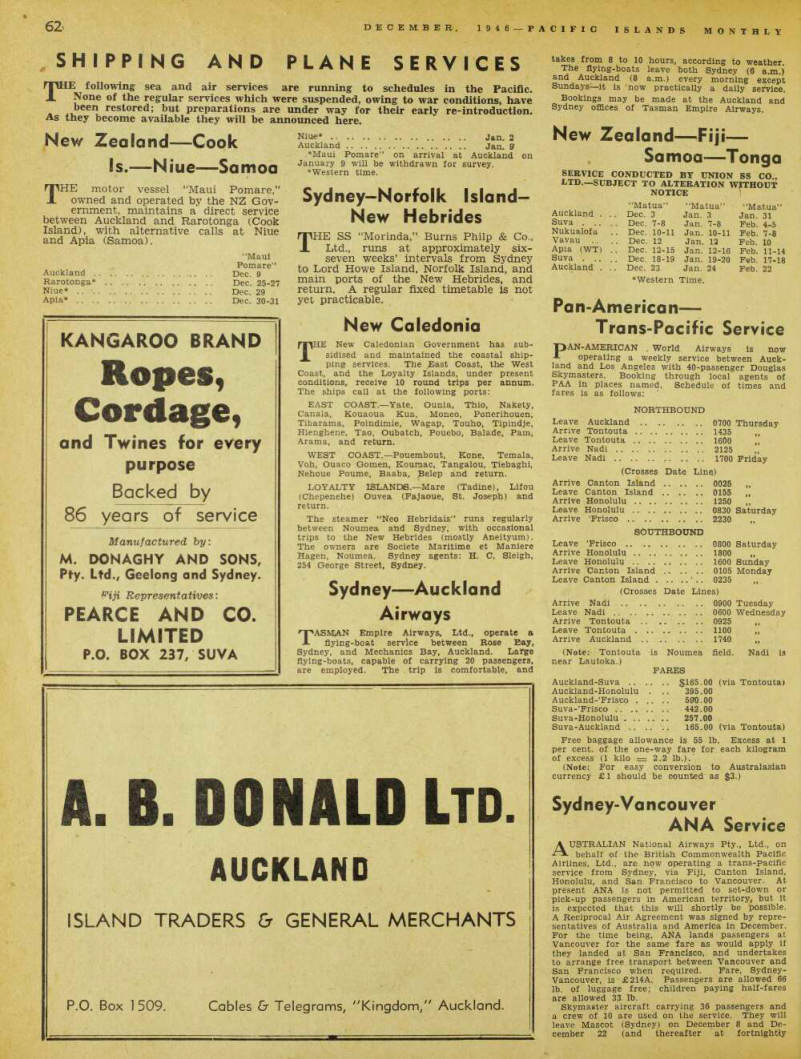
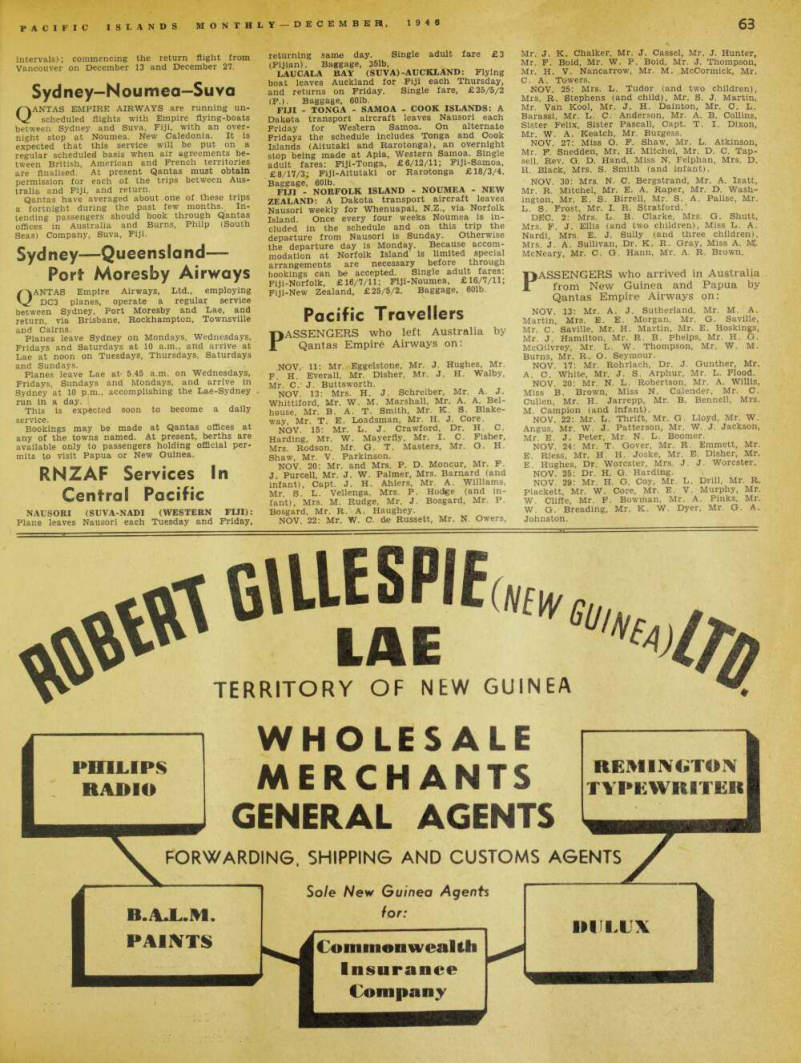
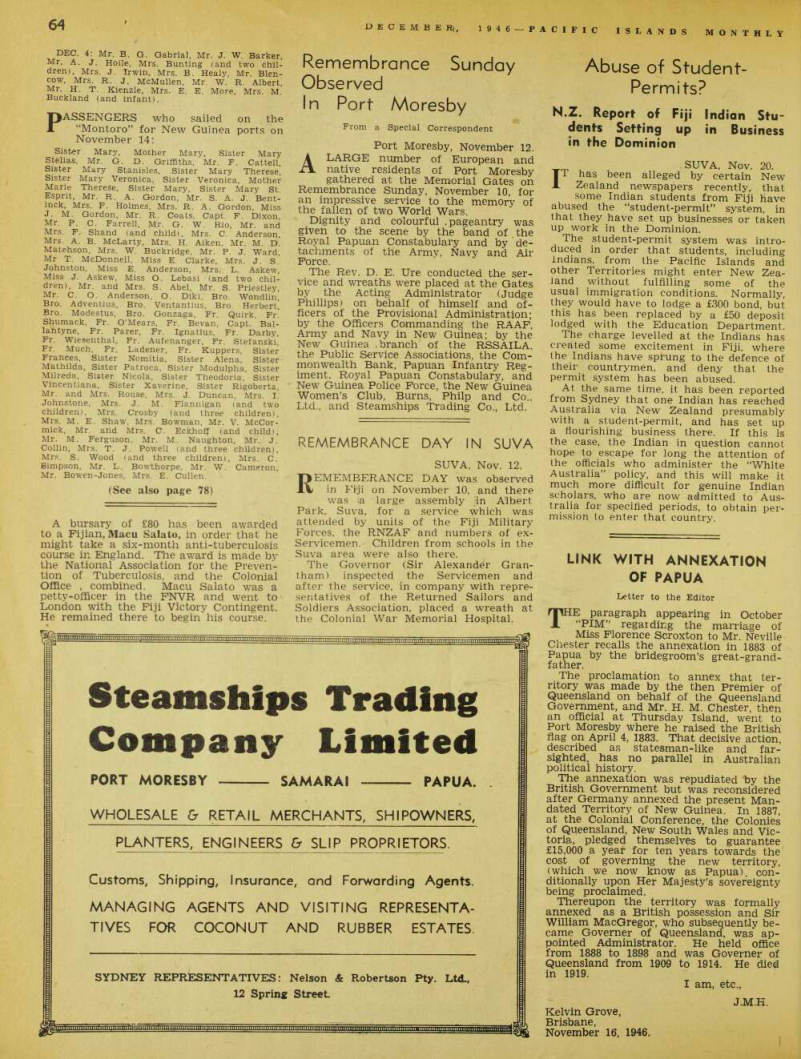
Shipping And Plane Services
rE following sea and air services are running to schedules in the Pacific.
None of the regular services which were suspended, owing to war conditions, have been res t° re ®h but preparations are under way for their early re-introduction.
As they become available they will be announced here.
New Zealand—Cook
Is.—Niue—Samoa
THE motor vessel “Maui Pomare,” owned and operated by the NZ Gov ernment, maintains a direct service between Auckland and Rarotonga (Cook Island), with alternative calls at Niue and Apia (Samoa).
*Maui Pomare” on arrival at Auckland on January 9 will be withdrawn for survey. ■“Western time.
Sydney-Norfolk Island-
New Hebrides
THE SS “Morinda," Burns Philp & Co., Ltd., runs at approximately six seven weeks’ intervals from Sydney to Lord Howe Island, Norfolk Island, and main ports of the New Hebrides, and return. A regular fixed timetable is not
yet practicable.
New Caledonia
THE New Caledonian Government has sub sidised and maintained the coastal ship ping services. The East Coast, the West Coast, and the Loyalty Islands, under present conditions, receive 10 round trips per annum.
The ships call at the following ports: EAST COAST. —Yate, Ounia, Thio, Nakety, Canala, Kouaoua Kua, Moneo, Ponerihouen, Tibarama, Poindimie, Wagap, Touho, Tipindje, Hienghene, Tao, Oubatch, Pouebo, Balade, Pam, Arama, and return.
WEST COAST. —Pouembout, Kone, Temala, Voh, Ouaco Gomen, Kouraac, Tangaiou, Tiebaghi, Nehoue Poume, Baaba, Belep and return.
LOYALTY ISLANDS.—Mare (Tadine), Lifou (Chepenehe) Ouvea (Fajaoue, St. Joseph) and return.
The steamer “Neo Hebridais” runs regularly between Noumea and Sydney, with occasional trips to the New Hebrides (mostly Aneityum).
The owners are Societe Maritime et Maniere Hagen, Noumea. Sydney agents: H. C, Sleigh, 254 George Street, Sydney.
Sydney—Auckland
Airways
TASMAH Empire Airways, Ltd., operate a flying-boat service between Rose Bay, Sydney, and Mechanics Bay, Auckland. Large flying-boats, capable of carrying 20 passengers, are employed. The trip is comfortable, and
takes from 8 to 10 hours, according to weather The flying-boats leave both Sydney (6 a.m.) and Auckland (8 a.m.) every morning except Sundays—it is now practically a daily service.
Bookings may be made at the Auckland and Sydney offices of Tasman Empire Airways.
New Zealand—Fiji—
Samoa—Tonga
Service Conducted By Union Ss Co.,
Lt D.—Subject To Alteration Without
Notice
Pan-American—
Trans-Pacific Service
T>AN-AMERICAN . World Airways is now A operating a weekly service between Auck land and Los Angeles with 40-passenger Douglas Skymasters. Booking through local agents of PAA in places named. Schedule of times and fares is as follows:
Free baggage allowance is 55 lb. Excess at 1 per cent, of the one-way fare for each kilogram of excess (1 kilo = 2.2 lb.). (Note: For easy conversion to Australasian currency £1 should be counted as $3.)
Sydney-Vancouver
ANA Service
AUSTRALIAN National Airways Pty., Ltd., on behalf of the British Commonwealth Pacific Airlines, Ltd., are now operating a trans-pacific service from Sydney, via Fiji, Canton Island, Honolulu, and San Francisco to Vancouver. At present ANA is not permitted to set-down or pick-up passengers in American territory, but it is expected that this will shortly be possible.
A Reciprocal Air Agreement was signed by repre sentatives of Australia and America in December.
For the time being, ANA lands passengers at Vancouver for the same fare as would apply if they landed at San Francisco, and undertakes to arrange free transport between Vancouver and San Francisco when required. Fare, Sydney- Vancouver, is £2I4A. Passengers are allowed 66 lb. of luggage free; children paying half-fares are allowed 33 lb.
Skymaster aircraft carrying 36 passengers and a crew of 10 are used on the service. They will leave Mascot (Sydney) on December 8 and De cember 22 (and thereafter at fortnightly
Niue* . Jan. 2 Auckland Jan. ff
“Maui Pomare’’
Auckland Rarotonga* Niue* Apia*
“Matua” “Matua” “Matua”
Auckland . ., Dec. 3 Jan. 3 Jan. 31 Suva Dec. 7-8 Jan. 7-8 Feb. 4-5 Nukualofa .. Dec. 10-11 Jan. 10-11 Feb. 7-8 Vavau .. .. Dec. 12 Jan. 12 Feb. 10 Apia (WT) .. Dec. 12-15 Jan. 12-16 Feb. 11-14 Suva Dec. 18-19 Jan. 19-20 Feb. 17-18 Auckland . .. Dec. 23 Jan. 24 Feb. 22 ♦Western Time.
Northbound
Leave Auckland .. .
Arrive Tontouta .. ..
Leave Tontouta .. ..
Arrive Nadi Leave Nadi 1435 1600 2125 (Crosses Date Line) Arrive Canton Island Leave Canton Island Arrive Honolulu .. ..
Leave Honolulu .. ., Arrive ’Frisco .. ., 0025 „ 0155 „ 1250 „
Southbound
Leave ’Frisco .. ..
Arrive Honolulu .. ..
Leave Honolulu .. ..
Arrive Canton Island Leave Canton Island . 1800 .. .. ... 0235 (Crosses Date Lines) Arrive Nadi Leave Nadi Arrive Tontouta .. .
Leave Tontouta . ..
Arrive Auckland .. . 0925 noo 1740 (Note: Tontouta is Noumea field. Nadi is near Lautoka.)
Fares
Auckland-Suva .. ..
Auckland-Honolulu .
Auckland-’Frisco . ..
Suva-’Frisco Suva-Honolulu .. $165.00 (via Tontouta) 395.00 590.00 442.00 257.00 Suva-Auckland .. .. 165.00 (via Tontouta)
intervals); commencing the return flight from Vancouver on December 13 and December 27.
Sydney-Noumea-Suva
QANTAS EMPIRE AIRWAYS are running un scheduled flights with Empire flying-boats between Sydney and Suva, Fiji, with an over night stop at Noumea. New Caledonia. It is expected that this service will be put on a regular scheduled basis when air agreements be tween British, American and French territories are finalised. At present Qantas must obtain permission for each of the trips between Aus tralia and Fiji, and return.
Qantas have averaged about one of these trips a fortnight during the past few months.. In tending passengers should book through Qantas offices in Australia and Burns, Philp (South Seas) Company, Suva, Fiji.
Sydney —Queensland —
Port Moresby Airways
QANTAS Empire Airways, Ltd., employing DC3 planes, operate a regular service between Sydney. Port Moresby and Lae, and return, via Brisbane, Rockhampton, Townsville and Cairns.
Planes leave Sydney on Mondays, Wednesdays, Fridays and Saturdays at 10 a.m., and arrive at Lae at noon on Tuesdays, Thursdays, Saturdays and Sundays.
Planes leave Lae at- 5.45 a.m. on Wednesdays, Fridays, Sundays and Mondays, and arrive in Sydney at 10 p.m., accomplishing the Lae-Sydney run in a day.
This is expected soon to become a daily service.
Bookings may be made at Qantas offices at any of the towns named. At present, berths are available only to passengers holding official per mits to visit Papua or New Guinea.
RNZAF Services In
Central Pacific
Nausori (Suva-Nadi (Western Fiji);
Plane leaves Nausori each Tuesday and Friday,
returning same day. Single adult fare £3 (Fijian). Baggage, 351 b.
Laucala Bay (Suva)-Auckland: Flying
boat leaves Auckland for Fiji each Thursday, and returns on Friday. Single fare, £25/5/2 (F.). Baggage, 601 b.
FIJI - TONGA - SAMOA - COOK ISLANDS: A Dakota transport aircraft leaves Nausori each Friday for Western Samoa. On alternate Fridays the schedule includes Tonga and Cook Islands (Aitutaki and Rarotonga), an overnight stop being made at Apia, Western Samoa. Single adult fares: Fiji-Tonga, £6/12/11; Flji-Samoa, £B/17/3; Fiji-Aitutaki or Rarotonga £lB/3/4.
Baggage, 601 b.
FIJI - NORFOLK ISLAND - NOUMEA - NEW ZEALAND: A Dakota transport aircraft leaves Nausori weekly for Whenuapai, N.Z., via Norfolk Island. Once every four weeks Noumea is in cluded in the schedule and on this trip the depa-rture from Nausori is Sunday. Otherwise the departure day is Monday. Because accom modation at Norfolk Island is limited special arrangements are necessary before through bookings can be accepted. Single adult fares: Fiji-Norfolk, £l6/7/11; Flji-Noumea, £l6/7/11; Fiji-New Zealand, £25/5/2. Baggage, 601 b.
Pacific Travellers
PASSENGERS who left Australia by
Qantas Empire Airways on;
NOV,’ 11: Mr. Eggelstone, Mr. J. Hughes, Mr.
F. H. Everall, Mr. Disher, Mr. J. H. Walby, Mr. C. J. Buttsworth.
NOV. 13; Mrs. H. J. Schreiber, Mr. A. J.
Whittiford, Mr. W. M. Marshall, Mr. A. A. Bel house, Mr. B. A. T. Smith, Mr. K. S. Blake way, Mr. T. E. Leadsman, Mr. H. J. Core.
NOV. 15; Mr. L. J. Crawford, Dr. H. C.
Harding, Mr. W. Mayerfly, Mr. I. C. Fisher, Mrs. Rodson, Mr. G. T. Masters, Mr. G. H.
Shaw, Mr. V. Parkinson.
NOV 20: Mr. and Mrs. P. D. Moncur, Mr. F J. Purcell, Mr. J. W. Palmer, Mrs. Barnard (and infant), Capt. J. H. Ahiers, Mr. A. Williams, Mr S. L. Vellenga, Mrs. P. Hodge (and in fant), Mrs. M. Rudge, Mr. J. Bosgard, Mr. P.
Bosgard, Mr. R. A. Haughey.
NOV. 22: Mr, W. C. de Russett, Mr. N. Owers,
Mr. J. K. Chalker, Mr, J. Cassel, Mr, J. Hunter, p Mf w p Boid> Mr Thompson ; Mr. H. V. Nancarrow, Mr. M. McCormick, Mr, C. A. Towers.
NOV. 25: Mrs. L. Tudor (and two children), Mrs. R. Stephens (and child), Mr. S. J. Martin, Mr. Van Kool, Mr. J. H. Dainton, Mr. C, L.
Barassi, Mr. L. C. Anderson, Mr. A. B. Collins, Sister Felix, Sister Pascall, Capt. T. I. Dixon, Mr. W. A. Keatch, Mr. Burgess 27: O- Z' Mr P. Snedden, Mr. H. Mitchel Mr D. C Tap sell, Rev. G. D. Hand Miss N. Felphan, Mrs. D.
H. Black, Mrs. S. Smith (and infant), NOV. 30: Mrs. N. C. Bergstrand, Mr. A. Izatt, Mr. R. Mitchel, Mr. E. A. Raper, Mr. D. Wash ington, Mr. E. S. Birrell, Mr. S. A. Palise, Mr. l. S. Frost, Mr. I. R. Stratford.’
DEC. 2; Mrs. L. B. Clarke, Mrs. G. Shutt, Mrs. F. J. Ellis (and two children), Miss L. A.
Nardi, Mrs. E. J. Sully (and three children), Mrs. J. A. Sullivan, Dr. K. R. Gray, Miss A. MI.
McNeary, Mr. C. G. Hann, Mr. A. R. Brown. p|ASSENGERS who arrived in Australia f rrirn ivipw Guinea and Paoua by 1 Fmnirp Airways on Cjanias ffimpne /iuwctyb uu.
NOV. 13: Mr. A. J. Sutherland, Mr. M. A.
Martin, Mrs. E. E. Morgan, Mr. G. Sayille, Mr. C. Saville, Mr. H. Martin, Mr. E. Hoskings, Mr j Hami iton, M r. R. B. Phelps, Mr. H. G.
McGilvrey, Mr. L. W. Thompson, Mr. W. M.
Burns, Mr. R. O. Seymour.
NOV. 17: Mr. Rohrlach, Dr. J. Gunther, Mr. a. C. White. Mr. J. S. Arphur, Mr. L. Flood.
NOV. 20: Mr. N. L. Robertson, Mr. A. Willis, Miss B. Brown, Miss N. Calender, Mr. C.
Cullen, Mr. H. Jarrepp, Mr. B. Bennell, Mrs. m. Campion (and infant), NOV. 22: Mr. L. Thrift, Mr. G. Lloyd, Mr. W.
Angus, Mr. W. J. Patterson, Mr. W. J. Jackson, Mr. E. J. Peter, Mr. N. L. Boomer, NOV. 24: Mr. T. Gover, Mr. R. Emmett, Mr.
E. Riess, Mr. H. H. Joske, Mr. E. Disher, Mr. e. Hughes, Dr. Worcster, Mrs. J. J. Worcster.
NOV. 25: Dr. H. G. Harding.
NOV. 29: Mr. H. G. Coy, Mr. L. Drill, Mr. R. piackett, Mr. W. Core, Mr. E. V. Murphy, Mr. w. Cliffe, Mr. F. Bowman, Mr. A. Pinks, Mr.
W. G. Breading, Mr. K. W. Dyer, Mr. G. A.
Johnston.
DEC. 4: Mr. B. G. Gabrial, Mr. J. W. Barker, Mr. A. j. Hoile, Mrs. Bunting (and two chil dren), Mrs. J. Irwin, Mrs. B. Healy, Mr. Blen cow, Mrs. R. j. McMullen, Mr. W. R. Albert, Mr. H. T. Kienzle, Mrs. E. E. More, Mrs. M.
Buckland (and infant).
PASSENGERS who sailed on the “Montoro” for New Guinea ports on November 14: Sister Mary, Mother Mary, Sister Mary Stelias, Mr. G. D. Griffiths, Mr. F, Cattell, Sister Mary St.anisles, Sister Mary Therese, Sister Mary Veronica, Sister Veronica, Mother Marie Therese, Sister Mary, Sister Mary St Esprit, Mr. R. A. Gordon, Mr. S. A. J. Bent inck, Mrs. F. Holmes, Mrs. R. A. Gordon, Miss J. M. Gordon, Mr. R. Coats, Capt. F. Dixon, Mr. P. C. Farrell, Mr. G. W. Rio, Mr. and Mrs. P. Shand (and child), Mrs. C. Anderson, Mrs. A. B. McLarty, Mrs. H. Aiken, Mr. M. D.
Matehson, Mrs. W. Buckridge, Mr. P. J. Ward, Mr T. McDonnell, Miss E. Clarke, Mrs. J. S.’
Johnston, Miss E. Anderson, Mrs. L. Askew, Miss J. Askew, Miss O. Lebasi (and two chil dren), Mr. and Mrs. S. Abel, Mr. S. Priestley, Mr. C. O. Anderson, O. Diki, Bro. Wondlin, Bro. Adventius, Bro. Ventantius. Bro. Herbert, Bro. Modestus, Bro. Gonzaga, Fr. Quirk, Fr.' Shumack, Fr. O’Mears, Fr. Bevan, Capt. Bal lantyne, Fr. Parer, Fr. Ignatius, Fr. Darby, Fr. Wiesenthal, Fr. Aufenanger. Fr. Stefanski, Fr, Much, Fr. Ladener, Fr. Kuppers, Sister Frances, Sister Nomitia, Sister Alena, Sister Mathilda, Sister Patroca, Sister Modulpha, Sister Milreda, Sister Nicola, Sister Theodoria, Sister Vincentiana, Sister Xaverine, Sister Rigoberta, Mr. and Mrs. Rouse, Mrs. J. Duncan, Mrs. I.
Johnstone, Mrs. J. M. Flannigan land two children), Mrs. Crosby (and three children), Mrs. M. E. Shaw, Mrs. Bowman, Mr. V. McCor mick, Mr. and Mrs. C. Eckhoff (and child), Mr. M. Ferguson, Mr. M. Naughton, Mr. J.
Collin, Mrs. T. J. Powell (and three children), Mrs. S. Wood (and three children), Mrs. C.
Simpson, Mr. L. Bowthorpe, Mr. W. Cameron, Mr. Bowen-Jones, Mrs. E. Cullen.
(See also page 78)
A bursary of £BO has been awarded to a Fijian, Macu Salato, in order that he might take a six-month anti-tuberculosis course in England. The award is made by the National Association for the Preven tion of Tuberculosis, and the Colonial Office , combined. Macu Salato was a petty-officer in the FNVR and went to London with the Fiji Victory Contingent.
He remained there to begin his course.
PASSENGERS who arrived in Auckland, NZ., by MV “Matua” on November 23: FROM NUKUALOFA: Hon. Akau’ola, Mr. A.
Quensell, Mrs. H. Sawle, Mr. J, Vea.
PROM VAVAU: Mr, and Mrs. H. Hunter, Miss R. Sanft.
FROM APIA: Mr. D. Eden, Mr. S. Gurr (and child), Miss A. Glover, Mrs. C. Hickey, Mr. C.
Hellesoe, Miss R. Jack, Mr. D. King, Mr. F.
King, Mrs. J. King (and two children), Mr. and Mrs. L. Kronfeld, Miss F. Meredith, Mr. and Mrs. P. Meyer, Mr. and Mrs. C, Millar, Miss H.
Oldehaver, Mr. L. Reed, Mr. W. Stowers, Miss W.
Wallace.
FROM SUVA: Mr. J. Bradman, Miss G. Brad man, Miss J. Bradman, Mr. J. Banks, Mrs. J.
Banks, Mr. J. Bell, Mr. and Mrs. A. Bentley, Mr. G. Beaver, Mr. G. Clarke, Miss E. Clarke, Mr. J. Cauty, Master A. Compain, Miss I. Corn pain, Master R. Compain, Mr. and Mrs. R.
Crompton, Mrs. L. Cornish, Miss E. Cornish, Mr. and Mrs. B. Carew (and child), Miss J.
Casey, Miss B. Dunstan, Sir H. and Lady Ellis, Mr. M. Pox, Mrs. E. Gardner, Miss D. Gurr, Mr. and Mrs. J. Gifford (and child), Miss D.
Morrell, Mr. V. Moors, Mr. A. Marlow, Bro.
McMullen, Miss I. McCormick, Miss E. McCor mick, Miss M. McCormick, Miss M. Porter, Mr. and Mrs. H Palmer (and child), Mr. B. Proweller, Miss A. Rhodes, Mr. P. Reay, Miss A. Smith, Miss M. Smith, Lady N. Scott, Miss M. Seton, Mr. and Mrs. B. Storck (and child), Miss D.
Stewart. Mr. J. Shortall, Mr. and Mrs. R.
Thomas, Mr. and Mrs. R. Tippett (and two children), Mr. and Mrs. A. Warren (and child), Mrs. J. Williams, Mr. A. Walker, Miss C. Weston.
Master J. Wakeham, Master N. Carew.
PASSENGERS who left Auckland by
MV “Matua” on December 3: FOR APIA; Mrs. L. Ainui (one child), Mr. R.
J. Bulcraig, Mr. L. Bulcraig, Mr. E. L. Banks, Mr. L. R. Dowling, Masters D. & A. Eden, Master S. Heatley, Mr. and Mrs. Murphy (one child), Miss A. C. Mackenzie, Master M. Mere
dith, Mrs. M. C. Raymond (two children!, Mrs.
K. B. Russell.
FOR SUVA: Miss J. Arthur, Mr. G. E. Ander son, Mr. and Mrs. E. W. Bradley, Miss M.
Bentley, Master W. W. Bentley, Master W. & D.
Bull, Mr. J. W. Bruce, Miss E. J. Cauty, Mrs.
I. M. Edgar, Mr. and Mrs. G. Foster (one child). Master R. Freeman, Mr. and Mrs. J. O.
Gilmore, Misses J. & N. Grenville, Master M A.
Gaspard, Mr. and Mrs. E. W. Harness (three children). Master S. Houng Lee, Master R. Hon son, Mr. J. I. Hill, Mr. D. J. Hynson, Miss A Irving, Master J. Irving, Master C, W. Johnston, Miss S. Khan, Mrs. L. I. Livingstone, Nurse Digo, Likoro, Miss P. Ladd, Miss D. McGinley, Mr. T. Madhoji, Mr. W. Noble, Miss S. Nichol son, Messrs. S. N. & R. K. & J. C. Patel, Mr.
S. D. Ram-Samuj, Mr. L. S. C. Ram-Samuj, Mrs. Ram Singh (three children), Mrs. E. M.
Robertson, Mr. and Mrs. K. B. Sly, Mr. and Mrs. L. Sanford, Miss A. Simpson, Miss J.
Shepherd, Mr. R. A. Spowart, Master W. D.
Sorby, Mr. S. H. Singh, Mr. R. Shanker, Mr.
F. M. K. Sherani, Miss T. Tarte and Master S.
Tart?, Nurse M. A. Thompson, Mr. S. M. Vanua, Miss W. Wootton, Mr. J. M. Wilson, Mr. A. G T. Wane.
FOR NUKUALOFA: Mr. and Mrs. J. M. Cocker (six children), Mrs. K. C. Curtayne. Master F.
Cowley, Mr. C. O. S. Dawe, Mr. J. Gallagher, Miss S. Heenan, Mr. L. B. Roper, Miss A.
Wolfgram.
FOR VAVAU: Misses E. & A. Carlson, Mrs. E.
Chirney (one child), Mrs. M. M. Schultz, Pte.
C. Wolfgram.
PASSENGERS from New Guinea to
Australia by Qantas Empire Airways
on: DEC. 6: Mr. G. Thompson, Mr. A. Williams, Mr. H. Ahlers, Mr. K. Austin, Mr. C. Jamison, Mr. Barrot, Miss Hicks; Miss French.
DEC. 8: Mr. G. Gracey, Mr. C. Bayliss, Mr.
Jacobson, Mr. H. L. Higgins, Mr. C. D. Austin, Miss O. K. Johnston, Mr. G. McPherson, Mr. J.
H. Walby, Mr. A. Stoneman.
PASSENGERS from Australia to New
Guinea by Qantas Airways on:
DEC. 4; Mr. H. A. Wakefield, Mr. T. Carey Mr. J. Carey, Mr. T. W. Jolly, Mr. J. E. Lade wig, Mrs. M. Levy, Mr. G. Kirwin, Miss P May Mr. A. Stoneman, Mr. H. R. Wales.
DEC. 6: Master J. Drivesdale-Simpson, Miss M.
C. Arthur, Mr. F. P. Morcamb, Mrs. M A McFarlane, Mr. T. W. Moncriff, Miss McGown Mr. J. D. Bryan.
DEC. 7: Mrs. L. E. Merchant, Mr. P. E. Kelly, Miss M. McArthur, Miss E. E. Morgan, Master E. L. Cawley. Mrs. J, Conron, Mr. W. R.
Dishon, Mrs. P. V. Darbyshire (and daughteri, Mr. P. McDonnell, Mr. M. Infante, Mr. J A.
Maskill.
Advertisements & other items, pp. 64-66 (2 items)
62
DECEMBER, 194 6 PACIFIO ISLANDS MONTHLY
A. B. Donald Ltd.
KANGAROO BRAND
Ropes,
Cordage,
and Twines for every purpose Backed by 86 years of service Manufactured by:
M. DONAGHY AND SONS,
Pty. Ltd., Geelong and Sydney.
Fiji Representatives:
PEARCE AND CO.
LIMITED
P.O. BOX 237, SUVA
A. B. DONALD Ltd.
AUCKLAND
ISLAND TRADERS & GENERAL MERCHANTS
P.O. Box 1509. Cables £r Telegrams, "Kingdom," Auckland.
v
rt OILLESPIf WIr
PHILIPS
RADIO
LAE
TERRITORY OF NEW GUINEA
WHOLESALE
MERCHANTS
GENERAL AGENTS
REMIN4VTON
TYPEWRITER
FORWARDING. SHIPPING AND CUSTOMS AGENTS
R.AX.M.
PAINTS
Sole New Guinea Agents for: Commonwealth Insurance Company
DIILCX
Steamships Trading
Company Limited
PORT MORESBY
SAMARA!
PAPUA.
WHOLESALE & RETAIL MERCHANTS, SHIPOWNERS,
PLANTERS, ENGINEERS & SLIP PROPRIETORS.
Customs, Shipping, Insurance, and Forwarding Agents.
MANAGING AGENTS AND VISITING REPRESENTA-
TIVES FOR COCONUT AND RUBBER ESTATES.
SYDNEY REPRESENTATIVES: Nelson & Robertson Pty. Ltd, 12 Spring Street
Remembrance Sunday
Observed In Port Moresby
From a Special Correspondent Port Moresby, November 12.
A LARGE number of European and native residents of Port Moresby gathered at the Memorial Gates on Remembrance Sunday, November 10, for an impressive service to the memory of the fallen of two World Wars.
Dignity and colourful .pageantry was given to the scene by the band of the Royal Papuan Constabulary and by de tachments of the Armv, Navy and Air Force.
The Rev. D. E. Ure conducted the ser vice and wreaths were placed at the Gates by the Acting Administrator (Judge Phillips) on behalf of himself and of ficers of the Provisional Administration; by the Officers Commanding the RAAF, Army and Navy in New Guinea; by the New Guinea .branch of the RSSAILA, the Public Service Associations, the Com monwealth Bank, Papuan Infantry Reg iment, Royal Papuan Constabulary, and New Guinea Police Force, the New Guinea Women’s Club, Burns, Philp and Co., Ltd., and Steamships Trading Co., Ltd.
Remembrance Day In Suva
Suva, Nov. 12.
REMEMBERANCE DAY was observed in Fiji on November 10, and there was (a large assembly iin Albert Park, Suva, for a service which was attended by units of the Fiji Military Forces, the RNZAF and numbers of ex- Servicemen. Children from schools in the Suva area were also there.
The Governor (Sir Alexander Gran tham) inspected the Servicemen and after the service, in company with repre sentatives of the Returned Sailors and Soldiers Association, placed a wreath at the Colonial War Memorial Hospital.
Abuse of Student-
Permits?
N.Z. Report of Fiji Indian Stu dents Setting up in Business in the Dominion
I_, , Suva, Nov. 20.
1 has been alleged by certain New Zealand newspapers recently, that some Indian students from Fiji have abused the “student-permit” system, in that they have set up businesses or taken up work in the Dominion.
The student-permit system was intro duced in order that students, including Indians, from the Pacific Islands and other Territories might enter New Zea land without fulfilling some of the usual immigration conditions. Normally, they would have to lodge a £3OO bond, but this has been replaced by a £5O deposit lodged with the Education Department.
The charge levelled at the Indians has created some excitement in Fiji, where the Indians have sprung to the defence of their countrymen, and deny that the permit system has been abused.
At the same time, it has been reported from Sydney that one Indian has reached Australia via New Zealand presumably with a student-permit, and has set up a flourishing business there. If this is the case, the Indian in question cannot hope to escape for long the attention of the officials who administer the “White Australia” policy, and this will make it much more difficult for genuine Indian scholars, who are now admitted to Aus tralia for specified periods, to obtain per mission to enter that country.
Link With Annexation
Of Papua
Letter to the Editor fIIHE paragraph appearing in October A “PIM” regarding the marriage of Miss Florence Scroxton to Mr. Neville Chester recalls the annexation in 1883 of Papua by the bridegroom’s great-grand father.
The proclamation to annex that ter ritory was made by the then Premier of Queensland on behalf of the Queensland Government, and Mr. H. M. Chester, then an official at Thursday Island, went to Port Moresby where he raised the British flag on April 4, 1883. That decisive action, described as statesman-like and far sighted, has no parallel in Australian political history.
The annexation was repudiated by the British Government but was reconsidered after Germany annexed the present Man dated Territory of New Guinea. In 1887, at the Colonial Conference, the Colonies of Queensland, New South Wales and Vic toria, pledged themselves to guarantee £15,000 a year for ten years towards the cost of governing the new territory, (which we now know as Papua), con ditionally upon Her Majesty’s sovereignty being proclaimed.
Thereupon the territory was formally annexed as a British possession and Sir William MacGregor, who subsequently be came Governer of Queensland, was ap pointed Administrator. He held office from 1888 to 1898 and was Governer of Queensland from 1909 to 1914. He died in 1919.
I am, etc.,
J.M.H.
Kelvin Grove, Brisbane, November 16, 1946.
Advertisements & other items, p. 67 (2 items)
65
PACIFIC ISLANDS MONTMLV DECEMBER), 1946
Tilley Lamps
BURN ORDINARY KEROSENE
The Modern Form of PORTABLE LIGHTING
use
s ’ /# / y ' i m 3
TILLEY LAMP C«
OF HENDON
m THE OWL IS PROVERBIALLY A WISE BIRD, SO BE SURE YOU FOLLOW HIS EXAMPLE! TILLEY LAMPS ARE SO SUCCESSFUL THAT COPIES OF THEM ARE BEING MARKETED. TILLEY LAMPS ARE MADE ONLY IN ENGLAND Shipments available four weeks from receipt of order THE TILLEY LAMP CO., HENDON, N.W.4, ENG.
REPRESENTATION :
MELBOURNE: T. H. Bentley, Pty. Ltd., 123-125 William Street, Melbourne. Cl.
TASMANIA : Mr. C. Sellars, 108 a Charles Street, Launceston.
FIJI : Mr. K. Witherington, 2 Burns Philp Buildings, Suva.
N.G. Scholarship Fund
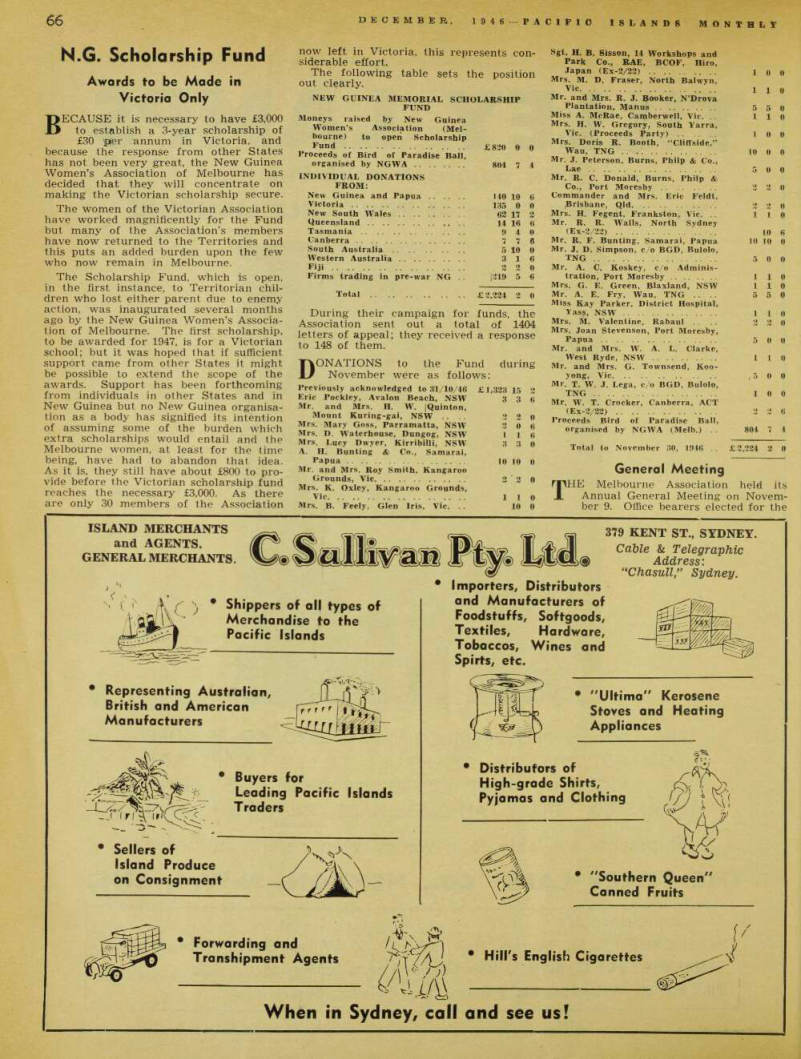
Awards to be Made in Victoria Only
BECAUSE it is necessary to have £3,000 to establish a 3-year scholarship of £3O per annum in Victoria, and because the response from other States has not been very great, the New Guinea Women’s Association of Melbourne has decided that they will concentrate on making the Victorian scholarship secure.
The women of the Victorian Association have worked magnificently for the Fund but many of the Association’s members have now returned to the Territories and this puts an added burden upon the few who now remain in Melbourne.
The Scholarship Fund, which is open, in the first instance, to Territorian chil dren who lost either parent due to enemy action, was inaugurated several months ago by the New Guinea Women’s Associa tion of Melbourne. The first scholarship, to be awarded for 1947, is for a Victorian school; but it was hoped that if sufficient support came from other States it might be possible to extend the scope of the awards. Support has been forthcoming from individuals in other States and in New Guinea but no New Guinea organisa tion as a body has signified its intention of assuming some of the burden which extra scholarships would entail and the Melbourne women, at least for the time being, have had to abandon that idea.
As it is, they still have about £BOO to pro vide before the Victorian scholarship fund reaches the necessary £3,000. As there are only 30 members of the Association
now left in Victoria, this represents con siderable effort.
The following table sets the position
out clearly.
New Guinea Memorial Scholarship
Fund
Moneys raised by New Guinea Women’s Association (Mel bourne) to open Scholarship F « n d £B2O 0 0 Proceeds of Bird of Paradise Ball, organised by NGWA 804 7 4
Individual Donations
From:
New Guinea and Papua 140 10 6 Victoria 135 0 0 New South Wales 62 17 2 Queensland , 14 16 6 Tasmania 9 4 0 Canberra 77 6 South Australia 5 10 0 Western Australia 316 Fiji 220 Firms trading in pre-war NG .. [219 5 6 Total £2,224 2 0
During their campaign for funds, the
Association sent out a total of 1404 letters of appeal; they received a response to 148 of them.
DONATIONS to the Fund during November were as follows: Previously acknowledged to 31/10/46 £1,323 15 2 Eric Pockley, Avalon Beach, NSW 3 3 6 Mr. and Mrs. H. W. {Quinton, Mount Kuring-gai, NSW .. .. 2 2 0 Mrs. Mary Goss, Parramatta, NSW 2 0 6 Mrs. D. Waterhouse, Dungog, NSW 116 Mrs. Lucy Dwyer, Kirribilli, NSW 3 3 0 A. H. Bunting & Co., Samarai, Papua 10 10 0 Mr. and Mrs, Roy Smith, Kangaroo Grounds, Vic 2 20 Mrs. K. Oxley, Kangaroo Grounds, Vic 110 Mrs. B. Feely, Glen Iris, Vic. . . 10 0
Sgt. H. B. Sisson, 14 Workshops and Park Co., RAE, BCOF, Hire, Japan (Ex-2/22) 10 0 Mrs. M. D, Fraser, North Balwyn, Vic 110 Mr. and Mrs. R, J. Booker, N’Drova Plantation, Manus 550 Miss A. Mcßae, Camberwell, Vic. . . 110 Mrs. H. W. Gregory, South Yarra, Vic. (Proceeds Party) 10 0 Mrs. Doris R. Booth. “Cliffside,”
Wau, TNG 10 0 0 Mr. J. Peterson, Burns, Philp & Co., Lae 500 Mr, R. C. Donald, Burns, Philp & Co., Port Moresby 2 2 4) Commander and Mrs. Eric Feldt, .Brisbane, Qld 2 2 0 Mrs. H. Fegent, Frankston, Vic. . . 110 Mr. R. R. Walls, North Sydney (Ex-2/22) 10 6 Mr. R. F. Bunting, Samarai, Papua 10 10 0 Mr. J. D. Simpson, c/o BGD, Bulolo,
Tng 50 0
Mr. A. C. Koskey, c/o Adminis tration, Port Moresby 110 Mrs. G. E. Green, Blaxland, NSW 110 Mr. A. E. Fry, Wau, TNG ... 550 Miss Kay Parker, District Hospital, Yas?, NSW 110 Mrs. M. Valentine, Rabaul ... 220 Mrs. Joan Stevenson, Port Moresby, Papua 500 Mr. and Mrs. W. A. L. Clarke, West Ryde, NSW 1 i 0 Mr, and Mrs. G. Townsend, Koo yong, Vic ,500 Mr. T. W. J. Lega, c/o BGD, Bulolo,
Tng 10 0
Mr. W. T. Crocker, Canberra, ACT (Ex-2/22) 226 Proceeds Bird of Paradise Ball, organised by NGWA (Melb.) . . 804 7 4 Total to November 30, 1946 .. £2,224 2 0
General Meeting
THE Melbourne Association held its Annual General Meeting on Novem ber 9. Office bearers elected for the
coming year were: President, Mrs.
Stanley Best; Vice-president, Mrs. Allan Green; Treasurer. Mrs. Joan Hay; Secre tary, Miss Dorothy Stewart. Committee; Mrs. C. Cooper, Mrs. H. A. Gregory, Mrs.
Winifred Holland, Mrs. G. W. Spensley, Mrs. W. Rowe, Mrs. G. Walker.
The new president, Mrs. Stanley Best, had been Treasurer for the past five years, and at the conclusion of the meetng Mrs. R. Rigby, retiring president, pre sented her with silver salver as a mark
of appreciation.
Advertisements & other items, p. 68 (1 item)
Pty. jyyi
ISLAND MERCHANTS
and AGENTS.
GENERAL MERCHANTS.
Pty. jyyi
Oairai
' iKO * Shippers of all types of \ Merchandise to the Pacific Islands • Representing Australian, British and American Manufacturers • Buyers for Leading Pacific Islands Traders -J if! Ir'vCJJ. • Sellers of Island Produce on Consignment Importers, Distributors and Manufacturers of Foodstuffs, Softgoods, Textiles, Hardware, Tobaccos, Wines and Spirts, etc.
379 KENT ST., SYDNEY
Cable & Telegraphic Address : "Chasull" Sydney. yjy Iff • "Ultima" Kerosene Stoves and Heating Appliances • Distributors of High-grade Shirts, Pyjamas and Clothing m M 0 * • "Southern Queen' Canned Fruits m • Forwarding and Transhipment Agents /l b \m • Hill's English Cigarettes When in Sydney, call and see us I
When S. Pacific
Trade Boomed
Interesting Comparison Between 1900-1914 and 1918-1939
117 HEN William Bryan (popularly Yf known as “Bill O’Bryan”) died in Rarotonga on October 18, aged 65 (Nov. “PIM”), the Cook Islands lost one of the last remaining links with the halcyon days when Rarotonga was a port of call for regular trans-Pacific liners.
Large cargoes of fruit went away to Southern markets, and trade was booming. The Union Line, from Australia and New Zealand to San Francisco ran via Rarotonga and Tahiti; and Bill O’Bryan’s job at Rarotonga was no sinecure. With two heavy launches, strings of lighters and a ilarge force of native labourers, he was in charge of the loading and unloading of ships.
It is strange to think that that im portant trade, which boomed before World War I, withered and died and dis appeared after 1918. O’Bryan, lived in Rarotonga except for a recent break for war service in the Northern Cooks— for 35 years; and to talk with him about the Cook Islands was an education and an entertainment.
He knew the Cook Islands and their people, white and brown, better than most men. He was proud of being one of the last of the real old deep-sea sailors who had gone to sea in British square rigged ships in the ’nineties, and he had a wonderful fund of reminiscences about the brave days of “wooden ships and iron men.”
EDITORIAL NOTE—Some of the politico-economists who now are display ing such lively interest in the Pacific might explain why the sea-born trade between the Polynesian archipelagoes and Australia and New Zealand “withered and died” after World War I.
Prior to 1914, the Union SS Co. ran regular liners between Australia and San Francisco, via New Zealand, Rarotonga and Tahiti; between Australia and Van couver, via New Zealand, Fiji and Hawaii; and Sydney and Auckland, via Fiji, Samoa, and Tonga. There were three ships (Navua, Matua and Atua) on the latter service. There were other lines of very good ships running through the South Pacific notably, the Matson liners, running via Hawaii and Fiji from ’Frisco to Sydney; the German liners, looking after Samoa and New Guinea; and French liners, whose itinerary in cluded Noumea and Tahiti.
By 1939, of all those fine shipping ser vices there remained only the Union ships running between Sydney and Vancouver; the Matson liners, between ’Frisco and Sydney; the French liners; and the little “Matua.” running out of Auckland to Fiji, Samoa and Tonga.
What killed that lively and apparently profitable South Seas pre-1914 trade? An
intelligent answer to that question would help some of the politicians who are floundering around in the Pacific at the present time.
Fiji Peanuts for N.Z.
FIJI planters who are anxious to cash in on the present phenomlnal de mand for peanuts in New Zealand have been advised by the local Agricul tural Department that they should “get going” now, as this boom time is not likely to last when other competitors enter the field.
Before the war, New Zealand got most
of its peanuts from China at a price 50 per cent, lower than that ruling at present. Other supplies came from India, Malaya, China, USA and NEI. It is ex pected that some of these countries will come back into the market shortly.
Good peanuts can be grown in Fiji; but growers in the past have not been over-particular about the export quality of their produce. New Zealand consumers prefer the large dessert type of peanut and, normally, there is little demand for small types.
Growers who wish to hold their New Zealand connectons have been advised to concentrate on the large types and to excercise special care in harvesting and bagging their crops for export.
Advertisements & other items, p. 69 (1 item)
they'll notice!
ws &
It isn't your ne
It’s a gift—the way you wear jewels for smart effect, but, even the loveliest trinkets fail to be effective when charm itself fades away.
Don’t stop at washing away past perspiration. Guard against risk of future underarm odour. Let Mum give underarms the special care they need.
Mum smooths on in 30 seconds. Keeps you safe from offending underarm odour all day or evening.
Mum is harmless to skin and clothing; so quick and easy to use—even after dressing.
Why take chances with your charm when you can trust Mum?
MUM
TAKES THE ODOUR OUT OF PERSPIRATION
Sold by all leading distributors and manufactured by Bristol-Myeri Co. Pty. Ltd., 223 Pacific Highway. North Sydney, N.S.W., Australia.
Investiture Under
Difficulties
From a Special Correspondent Madang, November 6.
A SOMEWHAT odd “investiture” was held here recently on the occasion of the Administrator’s visit. Squad ron-Leader McGilvery was presented with the Air Force Cross; and it was intended also to present the DCM to Lieutenant B. G. Hall.
However, due to some oversight (or official bungling) there was no Distin guised Conduct Medal to pin upon his chest; and, in the course of the ceremony.
Lieutenant Hall was temporarily decorated with another man’s medal—the Military
Medal—and appropriate ribbon—which constitute, of course, a lesser decoration than the DCM.
After the ceremony, the MM was handed back and the Administrator’s party then went on to Lae, where the same Military Medal was presented again—this time to its rightful owner.
Six Roman Catholic missionaries from America arrived in Sydney, en route to Rabaul during October. Two of them, the Rev. Fr. A. Gendusa and the Rev.
Fr. A. Stamper are qualified pilots and have brought with them a Commonwealth Trimmer Amphibian plane which they will use in their work in New Britain.
Coconut "Cream"
South Sea Papain And
(A Letter to the Editor) THE reference in June “PIM” to pro cessed paw-paw latex converted into Papain, reminds me of a European who showed me here, years ago, the blueprints of a different process.
Ripe paw-paws, in this scheme, were crushed, seeds and all, and emulsified with water. The liquid was forced under pressure, through numerous tiny jetb facing a fan-tunnel which circulated very hot air. The mist immediately evapor ated leaving a tine powder (papain?), which was whirled into suitable con tainers Would not the ripe fruit be richer in papain than the green?
As far as “coconut cream,” is concerned —this is no novelty to us. I cannot help wondering what these Samoan innovators, are doing to remove from the oily product its well known laxative quality! If Europe goes into raptures over the “cream” of South Sea coconuts, it must be jolly hard up!
I do not think Buttercup the Cow need fear much competition from the South Sea palms when the present world short ages give place again to plenty, even if cream-of-coconut is patented!
I am, etc.,
Edwin Gold.
Mangaia, Cl, 28/8/46.
Curious Customs In
Melanesia
By Dr. C. E. Fox, in “Southern Cross Log”
Melanesians have curious customs, some of which civilised people might wish to adopt.
On my last birthday I was living in the Solomons at a school of about 50 small boys, my house being on a small hill above the sea. When I had finished my breakfast, I found myself suddenly surrounded by the boys, lifted up and carried on their shoulders down the hill by some of them, while others threw buckets of water over me and plastered me with mud. So we proceeded down to the sea, when they carried me to the end of the wharf and hurled me into the deep water at the end of it.
All this is a mark of special honour. I remember the people used to do it on occasions in San Cristoval to specially beloved village chiefs; and though at nearly seventy you are surprised when hurled violently fully dressed from the end of the wharf, remembering it is a mark of affection, you naturally enjoy it.
Headmasters at schools might care to introduce this quaint custom; or even watersiders (the wharf being handy) with their secretaries.
When on San Cristoval I often spent the night on the mountains as a guest at native feasts. All night people danced and sang and all night the orators, one by one, made speeches about matters of political or local interest or old customs and the history of their people. Each would walk up and down a line of fifteen yards or so, talking rapidly, and then, turning on their tracks with a cough or two, continue their speech. But each of them at the end of his speech would come down to us in the audience and give each of us a little piece of native money for listening to him —surely a more logical custom than our own, which is just the opposite. Political meetings and church congregations might like to try this custom.
Advertisements & other items, pp. 70-72 (3 items)
D Aawn't
r:
IO *-■ s -^(T
HEALTHY
NEAT-LOOKING
HAIR
✓ N <£> f%W<: >■ su K \y~\ wm
pym
\jrz % He’s found the key that unlocks the door to social success and popularity.
Attractive girls take pride in being seen with him . . . a well-groomed escort. He studies his appearance . . . knows the value of first impressions . . . realises the advantage of handsome, well-kept hair. So he uses VITALIS, and the u 6O-second drill”. 1 50 Seconds to Rub—Cir- O 10 Seconds to Comb and culation quickens thus Brush —Hair has a lustre scalp stimulation gives hair —no objectionable "patent-^ a chance. leather" look. 3304 the h° ,r dresses scalp ' f images sum Sold by all leading distributors and manufactured by Bristol-Myers Co. Pty. Ltd., 223 Pacific Highway, North Sydney, N.S.W., Australia
69
SAMOANS REJECT TRUSTEESHIP
(Continued from page 12)
PACIFIC ISLANDS MONTHLY DECEMBER. 1946
CUidJbudUm JjuLwibdes £id.
Livestock for Islands
People who Intend to take Stock to New Guinea are hereby notified that I have on hand the right class of
Cattle —
Mules—
Horses
to suit both the Climate and the Pastures of the Territories.
When shipping is available, I can deliver, on the ship in Cairns or Townsville, Stock intended for any of the Pacific Islands, Including Netherlands Indies, Singapore and the Philippines.
I will take all care of Stock and will be responsible for their delivery on the Ship in Sound Condition.
For further particulars, apply to
J. J. TOOGOOD
Rollingstone, via Townsville, Queensland.
Orders accepted through any Stock Agent, or Bank, in Cairns or Townsville, or direct.
PACIFIC ISLANDS SOCIETY
Visitors from the Islands to Sydney (or those interested in Islands affairs), are advised to communicate with the honorary secretary of the above Society, which has been formed to study the history, traditions, economics, and political developments of the Pacific Islands.
Regular monthly meetings are held at History House, 8 Young Street, Sydney.
Address for Correspondence:
THE PACIFIC ISLANDS SOCIETY,
Box 2454 MM., G.P.0., Sydney.
ISLAND CRAFT
TO
MODERN DESIGN
WOODEN FREIGHTERS,
TRAWLERS AND ISLAND
CRAFT.
VESSELS REPAIRED AND
REMODELLED.
AUSTRALIAN AGENTS FOR
GRAY MARINE PETROL AND
DIESEL ENGINES.
COPPERSMITHS, WELDERS
AND PLUMBERS.
MODERN SLIPWAY FACILITIES AVAILABLE
WRITE US FOR DESIGNS AND COMPLETE SHIPBUILDING INFORMATION.
A A
CUidJbudUm JjuLwibdes £id.
INCORPORATING REG. ADAMS CLAYTON CO.,
Tel.: XB 4475, XA1731. JOHN STREET, BERRY'S BAY, NORTH SYDNEY. ALSO AT EDEN, N.S.W.
a* hr: tX
*\Vvc
mosf
po Pul
ar
kerosene /„
WS
nds
*■* r ; #t£ 4 V * 7/J p . -5 V'- • 51 ' : • *^>-:***>■. ■f'r -• ■*m o*- 0* o** 0* f t •mm m r-f g>i •<«
v^ iV
sene
V^evo
x» I
VACUUM
OUAUTY MOOUCI
LAMPS,
LANTERNS and
REFRIGERATORS
Laurel burns without smoke, soot or smell . . . the finest kerosene you can buy for all kerosene burning equipment.
When ordering—always say “Laurel/ 7 not just kerosene.
There is no equal to Laurel for Lighting, Heating, Cooking, Cleaning, Incubation and Refrigeration.
L 4645 8
VACUUM OIL COMPANY PTY. LTD
Sugar-Boiling At Mangaia
—Jug Wanted
From Our Own Correspondent
Mangaia, Aug. 29.
A RECENT article in “PIM” about “Fiji sugar from a jug” awakes a sym pathetic chord in our bosoms —we remember the days when cane really grew here. It was 20 years ago.
Like other optimists, I boiled pulp in a pan, for hours and hours, and strained and re-strained the result (a fluid tasting, when hot, like “trade” cough-mixture).
It just would not granulate. Nor would it agree to become, under any conditions, molasses, treacle, or golden syrup. The only “customers” were the ants they, simply ate it up!
In John Williams’ “Missionary Enter prises” one may read a very good des cription of the pulping and boiling of sugar-cane. That was in Rarotonga.
Perhaps the Reverend may have had a type of cane that granulated with ease (the book doesn’t say where he got it).
Even in the tightest day of the war, we of Mangaia made no attempt to make our own. It just wasn’t worth all the straining, stirring and general mess. We used honey instead when there was any.
Advertisements & other items, p. 73 (1 item)
William Atkins Pty. Ltd.
Head Office 449-451 KENT ST., SYDNEY.
Iron & Steel Merchants-Engineers' Supplies
ESTABLISHED OVER 50 YEARS
Coach & Motor Hardware Cable Address: WILATXIN, Sydney.
STEEL DEPARTMENT
MILD STEEL:
Rounds, Squares, Flats, Half-rounds, Hexagons, Bevel, Shoeing, Tyre, Angles, Tees, Sheets, Plates, Girder Plates, Chequer Plates, Channels, Hoops, Etc.
BRIGHT STEEL:
Rounds, Squares, Hexagons.
Extra Special High Speed Tool Steel, Mining Steel, Blister Steel and Spring Steel, Rounds, Flats Gr Squares.
Bar Iron—All sections and sizes.
Engineers 1 Supplies: Set Screws, Studs, Metal Thread Screws, Coach Screws, Piles, Cotter Pins, Bright and Black Bolts, Rivets, Etc., Hack Saw Blades.
Power Transmission Gear; Including Plummer Blocks, Couplings, Collars, Etc.
Coach and Motor Hardware: Axles, Springs, Wheelstuff, Duck, Paints.
Farriers' Supplies: Horse Nails, Anvils, Vices, Etc.
Motor-Trimmers and Motor Builders' Cr Motor Painters' Requirements Pacific Island Agents : Come & Co., Suva, Fiji DUCO Lacquers and DULUX Enamels—FAßßEX Motor Toppings and Leather Cloths, House & Decorators' Paints, Varnishes & Brushware.
Sole Distributors of CHAMPION'S Decorators Paint Products.
Distributing Agent* far BROLITE Lacquers, SYNFLEX Enamel* and "POLYGLOSS" Finish.
Service
Central Pacific Air Service Rarotongans' Narrow Escape
Aitutaki (C. 1.) Dec. 3.
THE air-station here, which has at tained considerable importance, saw a very narrow escape from a bad accident, a few days ago.
Normally we have a fortnightly ser vice. The Dakota leaves New Zealand and comes via Norfolk Island, Fiji, Tonga, and Samoa, arriving about 2 p.m. on a Friday after a 5-hours’ flight from Samoa. It stays an hour before going on to Rarotonga one hour away. The Public Works Department last August took over this station from the Ameri cans.
The plane stays in Rarotonga over the week-end. Frequently a special week-end trip is made from Rarotonga to Aitu taki and back, when the service is eagerly patronised by Government offi cials and by natives.
It is said that the hops between Aitu taki and Rarotonga are the only two stages of the “kite’s” schedule which pay. The fare is £2/10/- single, and there is always a waiting list.
The schedule has just been altered.
The plane arrives here on Saturday and returns (from Rarotonga) on the fol lowing Thursday. This is unpopular be cause Administration and other offices have to be open on Saturday afternoons.
ANEW radio range has been installed in Aitutaki. By the end of November it was ready for air test and cali bration.
On November 30 the C 47 brought Mr.
D. O. C. Haskell (Director of Aerodrome
Services, P.W.D.) and F/Lt. J. F. Gab ites (Senior Forecaster for the New Zealand Service). The plane went on to Rarotonga and returned on Decem ber 1 to carry out the tests.
When the tests were over, the plane took on the following passengers, at 3 p.m., to return to Rarotonga: Judge A. McCarthy (Deputy Resident Commissioner), Mrs. A. McCarthy, Messrs. Haskell and Gabites, Mr. D.
Reid (secretary to R.C.), Mr. H. H. Hick ling (Resident Agent, Aitutaki, Mr. W.
Hosking (Department of Agriculture, Rarotonga), Mr. McKenzie (Education Officer), Mr. Norman Mckegg (manager of C.1.T.C., Rarotonga), Mr. Henley McKegg and eight native people.
The Dakota rose easily, and friends and officials who had just farewelled the travellers started for home. Suddenly the even roar of the aircraft’s engines was interrupted by spluttering and back firing, and the plane was seen to be banking round to return to the island.
What altitude she had achieved—only about 150 feet —she just maintained as she curved round towards the far end of the strip. A perfect landing was made, with only one engine, although she had a full complement of passengers and freight and a heavy load of fuel.
Much praise was given to the pilot, F/Lt. J. Priestley, for skilful handling in a precarious situation. A crash into the coconut trees or the sea would have caused fatalities.
What was thought to be magneto trouble was diagnosed as something more deep-seated, and a new engine was necessary before the plane could pro ceed. The travellers were forced to spend a few days’ “holiday” in Aitu taki. Although the island’s accommoda tion is very limited, all were provided for somehow.
A special aircraft is due here from New Zealand on December 5 with a new engine and installation gear. It will take over the schedule which the grounded aircraft was unable to com plete.
How A Volcano Erupts
was recently described by Commander Trevor Glenny in a broadcast talk on a visit he paid to the little island of Tanna, in the New Hebrides.
The volcano on Tanna is only 600 ft. high, but it took him more than an hour to climb it. “The crater was a huge round yellow cup. The sides fell steeply 300 ft. to a fiat round plain about the size of Kensington Round Pond. A narrow wall of yellow rock about 50 ft. high cut the plain in half. There were five blow holes in the plain—each looked about 30 ft. to 40 ft. in diameter —two blow-holes one side of the wall, three the other side.
In the holes white-hot lava seethed and bubbled and spat great white splashes high above the wall. The whole crater glowed like a bowl of fire . . . Then, miles away, came a very faint sound almost a sigh, that grew into a rumbling, louder and louder . . . The volcano began to tremble and sway about more and more. . . . Suddenly there would be a terrific roar. Out of two or three of the blow-holes huge slabs of flaming white hot rock would shoot up into the sky.
They seemed to hang there, minutes on end, rwo or three hundred feet above you.
Gradually they would cool, turn red and then come.down with a terrific ‘wump’ in clouds of dust on the opposite side of the crater. These rocks look like the bodies of great animals wrapped in flames.
Their glow lights up the Island, the lagoon and the sea beyond.” —Crown Colonist
Advertisements & other items, p. 74 (1 item)
Swallow S Akiell
THP’STORY BEHIND THE SWALLOW
Ea r>
LEADERS IN THE BISCUIT INDUSTRY SINCE 1854 MAKEBA ALSO IF TUI FAHUUI tWAUMW I AHIILL PLUM M/OBINC*. CASES ASU ICC CREAM
WATER INTO GOLD
IN 1886, there came to Mildura, then a cattle run, two men who were destined to transform the whole future of the area.
These were the Chafiey brothers —George and William. George Chaffey was an irrigation expert who had already founded successful irrigation colonies in the United States.
A chance meeting in California with Alfred Deakin, the father of Federation had prompted the brothers to come to Australia, and in 1887 they completed negotiations with the Victorian Government to establish a dried fruits industry on the Murray. Land was cleared, irrigation channels dug, and pumping stations soon drew from the Murray the water that was to release the wealth of the soil.
Today, the Murray Valley represents one of the world’s richest dried fruit areas.
With the production of sultanas, currants, lexias, etc., representing a National income of £4,500,000 it has made Australian dried fruits famed the world over for richness and quality. And it is from the choicest of these sun ripened crops that Swallow & Ariell select with painstaking care the luscious fruits and raisins for their equally famous biscuits, cakes and puddings.
spo‘ke View ‘votees^bm
Rum Business
By Russell N. Thomas
> r rHIS rum,” remarked Trader Tom 1 as we sat on his verandah over looking the lagoon at Motu-iti one
evening, “is probably synthetised from
natural gas—l hear they have in vented a process—and flavoured with a coal-tar derivative. What a time they must have had in America in prohibition days! I don't wonder
they resorted to rum-running to get
something fit to drink. Apropos of
rum-running, did you ever meet Charlie the Chaplain?”
“Charlie Chaplin?”
“No, Charlie the Chaplain was what everyone called him. He was around this Group once, and I thought you might have. He had actually been a chaplain once, though you wouldn't have known it, and his first name was really Charlie. Or so he said.”
AS a profession the church must have been a little trying for such a high spirited lad; it seemed there had been a slight misunderstanding over some church funds, and when the head deacon, who acted as treasurer, finally decided that an explanation was urgently necessary, he found that Charlie had vacated his digs about two hops ahead of him and left town.
He never returned; they got a new preacher, and it was learned that Charlie had gone on the stage.
He made a far better actor than he had a parson, but it was when the full severity of prohibition hit America that he discovered his real metier, and he be came quite a big .noise in the gangster world. Whether he eventually made Chicago too hot to hold him ana found it advisable to take a long holiday I didn’t hear, but he was for a time on a rum runner, and one trip at least brought him to Papeete.
I was staying there at the time at a hotel on the water-front, and one very hot afternoon was idly watching a ship coming in through the pass. This was a somewhat unusual-looking craft. It was hard to define, but she looked somehow different from the usual freighter. So, when she had tied up, I strolled over to the wharf for a close-up. While there, I got into conversation with a man from on board, who was obviously something more than merely one of the crew; but his exact status was not easy to deter mine, and he wasn’t giving away any in formation about the ship. None of them were; they were all tight-lipped and mysterious, but five minutes after her mooring lines were fixed it was no secret that she was a rum-runner.
The week before, another ship had put a lot of cases of spirits ashore, and the morning after the new arrival these were taken out of the sheds and stacked on the wharf, where the crew started breaking them open. Each dozen bottles was then neatly sewn up in gunny cloth with two ears for handling. The bundles of bottles were then put aboard.
I’ve seen some ships low in the water, but I never saw anything like this. By the time they had finished, the hawse pipes were down to the water and she looked like a half-tide rock.
WE had been hearing something about her in the meantime, for nothing ever remains a secret in an Island port very long. A man from the ship yard had been aboard to do some repairs;
he said she had diesels enough to power a were not received and no one e be got a board, but you could see racks ut - nties on the bulkheads through the ports, and I would have very much liked to have lifted the tarpaulin covers off some of the hardware on deck for a in America in aboul 1 as tough-looking an I ever saw afloat. j met Charlie—the man I had spoken t 0 on the wharf—again later. He was in French Louie’s bar with half a dozen of the men off the ship, and it was clear that something was wrong. They all sat
spo‘ke View ‘votees^bm
there was thunder in the air, and it seemed that Charlie was somehow in pretty bad trouble, whatever it was.
After a time they got up and left, all except Charlie, and it was easy to see he was U P against it. I saw him glancing towards me every now and again, when ever he thought I wasn’t looking.
Summing me up—and presently he came over to my table and with a word f aDoloev sat down ..Traded aren’t vou" ” he asked Jnt ft in one “ ? rcnlied G°t it in one, I replied. 1 w° nder lf you could , tell "J®* said “if you know some place where could lie low for a while? You know these parts pretty well, I guess-at. least you have the air of being very much at home in this burg That bunch of th.eyes aboard are all sored up at me and its ten to one I’ll be floating ars-uppards in the lagoon by midnight to-night, with a shiv in my ba ck. unless I can get away out of this before djgfcWouM you .ike to be a pal to a stranger and ten me
wb^’ e 1 can go. .
thls . ** rS o’ s^ ld ‘ n What 15 a H about, anyway. Don t tell me any thing you don t want to, but you are asking me rather a lot and I want to know just I should stand if I helped you. . ... . . .
IT appeared that on the previous trip 1 the cargo had been hi-jacked. There had been a scrap, a lot of damage done, and what was left of the cargo barely covered expenses. Somehow a suspicion started that the hi-jacking was done by some of Charlie’s gang who were known to be on the coast at the time, Nothing was said to him. but the rest of the ship’s gang started quiet inquiries, and they had apparently received some interesting information by radio and the man which they had picked up in Papeete. think I double-crossed them,”
Charlie said, “but wherever they got that dope from beats me; I wouldn’t do a thing like that on them.”
I thought this over for a while. “How much of all this is true?” I asked, H e shrugged his shoulders. “I’m in an exceedingly dangerous position even as 1 sit here> ” he said . “i’ V e nowhere to go and ril pro bably be dead before morn ing.”
After all (I thought to myself) the poor devil is evidently in fear of his life. He’s probably as bad as the others; maybe worse, but somehow I don’t like the idea of him being slaughtered in cold blood.
I’ll take a chance and do it.
“You know the corner between the American Consulate and the Post Office?”
I asked him. “Wait for me there; I’ll be along in a taxi. Just hop in.” « ♦ • “Where are you taking me?” asked Charlie a few minutes later.
“To the ‘Tropic Bird’ —at least, that is our ultimate destination.” ‘‘But we’re leaving town?”
“We certainly are. One of your pals was keeping his eye on you while you were waiting for me—the one in the check suit.”
"Lucky for me you spotted him—l didn’t. I’ll leave myself in your hands.”
“Okay, brother. Got a gun on you?”
“You bet.”
“Hand it over.”
“Not on your life! I’ve never felt the need of a gun so much.”
But after some argument he saw sense—the French draw the line at target practice—and handed his gun over. In a few minutes I dumped him at an old tumble-down native shack well off the road in a lonely spot where no one would think of looking for him. The taxi move had been a complete surprise to Check-suit, who had been left stand ing, so he seemed safe enough for the time being.
“Look out for centipedes,” I told" him; “there are probably dozens in that old thatch and they’ve a bite like a red hot pincers. I’ll be back for you after dark in a dirferent car. So long.”
WHEN I got back to the outskirts of the town I dismissed the car in a side-street, giving the driver the tip to say nothing if he was questioned, and walked back to my hotel, I saw nothing more of the sinister collection of toughs off the ship. When night fell I got a car from another garage and went to collect Charlie. I’d seen the captain of the “Tropic Bird” in the meantime and arranged what to do.
“But he’ll be found before we leave port and dumped ashore by the police so hard that he’ll make a dent in the wharf,” the captain had objected when I broached
the subject.
“Hide him in the hold.” ‘‘Like hell, I will! There’s going to be no more beach-combers who’ve outstayed their welcome diguising themselves as sacks of copra aboard of my ship. And we’re leaving Papeete, not entering it, so we couldn’t pull that dodge. Say, and who is this guy, and what is it all about, anyway?”
I told him. ‘‘Well, have it your own way, but of ill the crazy things I’ve known you do, this is the craziest. And where do we put him ashore?”
“Motu-Niu.”
“But that’s a private island. And what do you suppose old man Henshall will have to say about it? He’ll be as wild as hell and refuse to take him.”
“He’ll say plenty, no doubt. But he’ll find use for him. He’s been wanting another white man there for some time, partly for company and partly to help with the labour, but couldn’t afford to offer enough to make it worth anyone’s while to stay. This bird will be glad to work for nothing or next to nothing until this affair has blown over and Henshall will jump at the chance of hav ing him.
“But if he does refuse, what then?
I'll have to bring him back here and his papers won’t be in order, and then I’ll be out of luck.”
“You can say you picked him up at sea.”
“I could say a lot of things. But as you’re so set on it, I imagine you must have some pretty damn good reason for what you are doing, and I’ll do my best.
By the way, what is the fellow’s name?”
“Charlie Henshall.”
“Same name as the man you are tak ing him to. eh?”
“Yes, maybe it was the name that gave
me the idea. He’ll be all right there; Motu-Niu isn’t a bad little place at all and he might even want to stay.” he did,” said Trader Tom, as he poured out some more of the synthetic rum. “On the trip, Charlie was most concerned at first in putting as much distance as possible between himself and his former shipmates; then when all danger ivas past he began to ask questions about the kind of place it was that he was go ing to. I told him all I could remem ber about the island, and when 1 mentioned the owner’s name he be came thoughtful, and I could see there was something on his mind. ‘ What nationality is he?’ he asked, and I told him, American.” ‘‘Well, everything turned out very well. Charlie and Henshall took to one another like long-lost brothers— which was perhaps hardly surprising —because when they came to com pare notes they found that that was just exactly what they were”
Miss Marian Betham, of Apia, Western Samoa, died in the Government Hospi tal on November 24, of heart failure. She was one of the junior members of the Union Steamship Company’s branch in Apia..
News of the death of Mr. Harold Syd dall, formerly of Apia, and more recently of North Auckland, was received with regret by his many Western Samoan friends. When he lived in Apia, Mr.
Syddall was a partner in the firm of Andrew and Syddall.
Advertisements & other items, pp. 75-76 (1 item)
CO., Inc.
A. G. ANDREWS
244 California Street, San Francisco 11,
U.S.A.
Wholesalers
□ Competitive Quotations on Merchandise of Every Description. □ Thoroughly Conversant With Island T rade. □ Bankers: Bank of America, San Francisco.
Cables: ANDINC, San Francismo.
WANTED TO BUY—QUALITY GUNS AND RIFLES
HIGHEST PRICES GIVEN. WILL ALSO EXCHANGE GUNS.
New 303 Short Service Barrels, without Sights and Platform, £2/15/- each.
Postage extra.
SI L RO H U Quality Firearms and Fishing Tackle.
US ELIZABETH STREET (Near Market St.) SYDNEY. ’PHONE: MA 3540.
ESTABLISHED 1930
WILLIAM H. WATSON
RAROTONGA, COOK ISLANDS
Wholesale and Retail Trader
LICENSED STAMP DEALER
Agent For:—
BRITISH TRADERS' INSURANCE CO.
CORONA & L, C. SMITH TYPEWRITERS
KAISER & FRAZER MOTOR CARS
B.S.A. CYCLES AND MOTOR CYCLES
AMERICAN LEAD PENCIL CO.
WHITES AVIATION LTD,
Manufacturers of: FOOTWEAR, ALL CLASSES SUITABLE FOR NATIVE TRADING . . . M.O.P. PRODUCTS, INCLUDING ROUND EAR-RING BLANKS AND BUTTON BLANKS Exporter of: “Rarotonga” Hula-Skirts.
Sea-Shell Necklaces.
M.O.P. Jewellery.
Island Produce.
Cable Address: “Watson” Rarotonga Wholesale and Retail Inquiries Invited.
Prepared to Consider Agencies for all Class of Goods.
Bankers: Importer of: Textiles.
General Hardware.
Fancy Goods.
General Merchandise.
Bank of New Zealand, Auckland.
Grave Shortage of Plantation Labour W
Plantation Labour W. Samoa, Too, Has Its Troubles
From Our Own Correspondent
Apia, Nov. 12.
INHERE continues to be a critical shortage of plantation labour in the Territory—Samoans generally are refusing this kind of work. Cocoa is bringing record prices about £l6O per ton but planters are finding it difficult to harvest their crops.
There is desperate competition for such labour as is available, and wage rates are rising at a great rate—to the great aenefit of those Samoans who still can ae persuaded to accept this type of work.
Four Native Criminals
From Our Own Correspondent
Rarotonga, Dec. 2.
THE four young criminals who were responsible for the destruction by fire of the Cook Islands Trading Co. store, the attempted theft of the yacht ‘Myrtle S,” and a variety of other crimes, vere sent to New Zealand for imprison nent on the November “Maui Pomare’’ under police escort. One has a sen :ence of 11 years, one of 5 years, and the Dther two, four years each.
About Islands People
Mr. J. Bogan, a well-known member of the staff of Burns, Philp SS Co., Ltd., Apia, Western Samoa, died on November 23. He is believed to have shot himself after a party. He was a popular young man and leaves a wife and two small children .
The Rev. Wilfred F. Paton, who has been in charge of some five mission stations in the New Hebrides, for the Presbyterian Church of Tasmania, arrived in Sydnev in December, on fur lough:. He has had 2 i years of heavy work in the southern islands, has collected a great deal of malaria, and is consider ably underweight; but he expects soon to return to the Condominium. He re cently had published an interesting pam phlet, “Fred Paton of Malekula”—the story of the life and achievements of the Rev. Fred J. Paton, who died in Vila on December 12, 1941, after 49 years’ service as a missionary on Malekula.
George Thill, the French opera singer, gave two concerts in Noumea during his brief stay there following his Australian tour.
M. Roger Gervolino, New Caledonian deputy to the French Parliament, re cently arrived in Noumea by Pan Ameri can service from Paris.
Mr. J. J. C. Suckling of the Department of Agriculture. Fiji, has been transferred to the British Solomon Islands Protect orate where he will be Senior Agricult urist.
The new Director of Education, for Fiji, Mr. Howard Havden, left Barbados on November 7, and is due in Fiji in Dec ember.
A 35mm Talkie projector has been pre sented by Mr. B. Proweller, of Suva, to the Tamavua Tuberculosis Hospital. It was
installed at Tamavua by Mr. Len Noerr, who has made arrangements with New Zealand motion picture distributors for the films, which are supplied without charge for use at the Central Leper Hos pital, Makogai, to be screened at Tama vua as wel.
Capt. Bert Hargreaves, who formerly flew for Stephens Aviation at Wau, is now flying with Trans-Australian Air lines, and is stationed in Melbourne.
The Rev. R. Hare, General Manager of the Australasian Union Conference of the Seventh Day Adventist Mission, visited Fiji, in November.
Mr, Stephen Marshall returned to Suva by air from New Zealand in November, after spending leave in the United King dom.
Mr. Harold Cooper left Suva on the “Monterey” on November 4, for the United States, where he will spend several weeks before going on to Nigeria via the United Kingdom. He has been appointed Public Relations Officer in the African Colony.
Tenders for lightering and stevedoring of ships calling at Apia closed on Nov ember 9. It has since been announced that the contract for the next three years goes to the Union Steamship Company Ltd. It was formerly held by the West ern Samoa Lighterage and Stevedoring Co.. Ltd., which is directed by Mr. M. E.
F. Paul.
The newly established Australian Press Bureau, Box 287, GPO, Brisbane, announces that it is always glad to peruse articles of a literary nature and short stories from the Pacific—which should be between 1,000 and 1,500 words.
Payment is £4 for first Australasian serial use—£l if previously published.
Advertisements & other items, p. 77 (2 items)
75
"UNITED STATES OF
INDONESIA"
(Continued from page 8)
PACIFIC ISLANDS MONTHLY DECEMBER!, 1946
Fought in 24 Hours
Pimples and Bad Skin Fought in 24 Hours
Since the discovery of Nlxoderm by an American physician it Is no longer necessary for anyone to suffer from ugly, disgusting and disfiguring skin blemishes such as Eczema, Pimples, Rash, Ringworm, Psoriasis, Acne, Blackheads, Scabies and Red Blotches. Don’t let a bad skin make you feel inferior and cause you to lose your friends. Clear your skin this new scientific way.
A New Discovery
Nixoderm is an ointment, but different from any ointment you have ever seen or felt. It is a new discovery, and is not greasy but feels almost like a powder when you apply it. It penetrates rapidly into the pores and fights the cause of surface skin blemishes. Nlxoderm contains 9 ingredients which fight skin troubles in these 3 ways. I.—lt fights and kills the microbes or parasites often responsible for skin disorders. 2.—lt stops itching, burning and smarting in 7 to 10 minutes, and cools and soothes the skin. 3.—lt helps nature heal the skin clear, soft and velvety smooth.
Works Fast
iately, clearing and healing your skin, making It softer, whiter and velvetv smooth Because Nlxoderm is scientifically compounded to fight skin troubles, it works fast.
It stops the Itching, burning and smarting In a few minutes, then starts to work 1m-
In Just a day or two your mirror will tell you that here at last is the scientific treatment you have been needing to clear your skin—the treatment to make you look more attractive, to help you win friends. Nlxoderm has brought clearer, healthier skins to thousands, such as Mr. Bob Weedon, Edmund Street, Fremantle, who writes: “I was troubled with pimples ever since I was 13, and have spent pounds and pounds on so-called cures without results. I then tried Nixodenn with astounding effect.
The pimples seemed to fade away, and after a week there was not the slightest trace of them.”
Satisfaction Guaranteed
Get Nlxoderm from your chemist or store to-day. Look in the mirror in the morning and you will be amazed at the improvement.
Then just keep on using Nlxoderm for one week and at the end of that time it must have made your skin soft, clear, smooth and magnetically attractive—must give you the kind of skin that will make you admired wherever you go, or you simply return the empty package and your money will be refunded in full. Get Nixoderm from your chemist or store to-day.
The guarantee protects you.
Nixoderm 2/- & 4/-
For Skin Sores, Pimples and Itch.
Territories Solicitors
WE have had several inquiries from New Guinea property-owners, who want the names of solicitors wil ling and competent to handle matters relating to properties in the Territories.
The services of the following practitioners are available: Mr. J. I. Cromie, Port Moresby (form erly of Rabaul).
Mr. Norman White, Port Moresby (a young man, whose father is the well know Morobe mining engineer).
Mr. E. G, Garland, solicitor, 39 Hunter Street, Sydney.
Messrs. Parish, Patience and Mclntyre, 2 O’Connell Street, Sydney.
The two last-named are Sydney prac titioners who are familiar with New Guinea conditions.
Two new engineers for the Public Works Department, Fiji, Mr. J. D. Stephenson and Mr. J. P. Haren, and three new Police Inspectors, Mr. D. T. Saint, Mr. S. E.
Gullidge, and Mr. M. J. Lovell, arrived in Suva by the “Monterey” on November 4.
Advertisements & other items, pp. 78-79 (2 items)
76
DECEMBER 1!)4G-PACIFIC ISLANDS MONTHLY
PACIFIC TRAVELLERS
(Continued from page 63)
Widdo P
.Ji a luu'jy maw
IiICUJY
-- V ia&i
DIESEL ENGINES
WIDDO P
5 H.P. to 500 H.P.
H. WIDDOP & CO., LTD. GREEN Ift T G I A^ ,GHLEY Telephone : Keighley 3727-8 :: :: Telegrams : Widdop Keighley Codes A.B.C. 6th Edition, Bentleys, Bentley’s Second We are prepared to consider Agencies for certain territories motor Coaster S. America / Firefloat, Egypt.
T~l Passenger Ferry, I Nigeria r, n Tug, England Passenger Root, Middle East
% is- / t-» rs iiMi* wm- -4' ¥T
“BUILDINGS ABROAD”!
This Ton load is an example of our much advertised 'Designed for Transport' "Econo-Steel'' Structures.
These "Econo-Steel" frames are transported ready to unfold and connect together immediately on uncrating.
Should you intend building, say, a storage shed, dryingroom, workshop, or a manager's residence, we, Tulloch's Pty.
Ltd., have the efficient design and service staff to assist clients and builders.
Mail your enquiry to the BUILDING DEPT., TULLOCH'S PTY. LTD.
It shall be treated with every consideration.
When building consider
• EASE OF ERECTION
FIRE RESISTANCE
• SOUNDNESS OF STRUCTURE
BORER AND PESTS
Tulloch’s p; v l t .°
RHODES, SYDNEY, N.S.W., AUSTRALIA Cable TULSTEEL Sydney.
And DRYSDALE & RIDGWAY, Brisbane. Cable: DRYSTEEL, Brisbane.
J
Madang is Battered But Still Beautiful
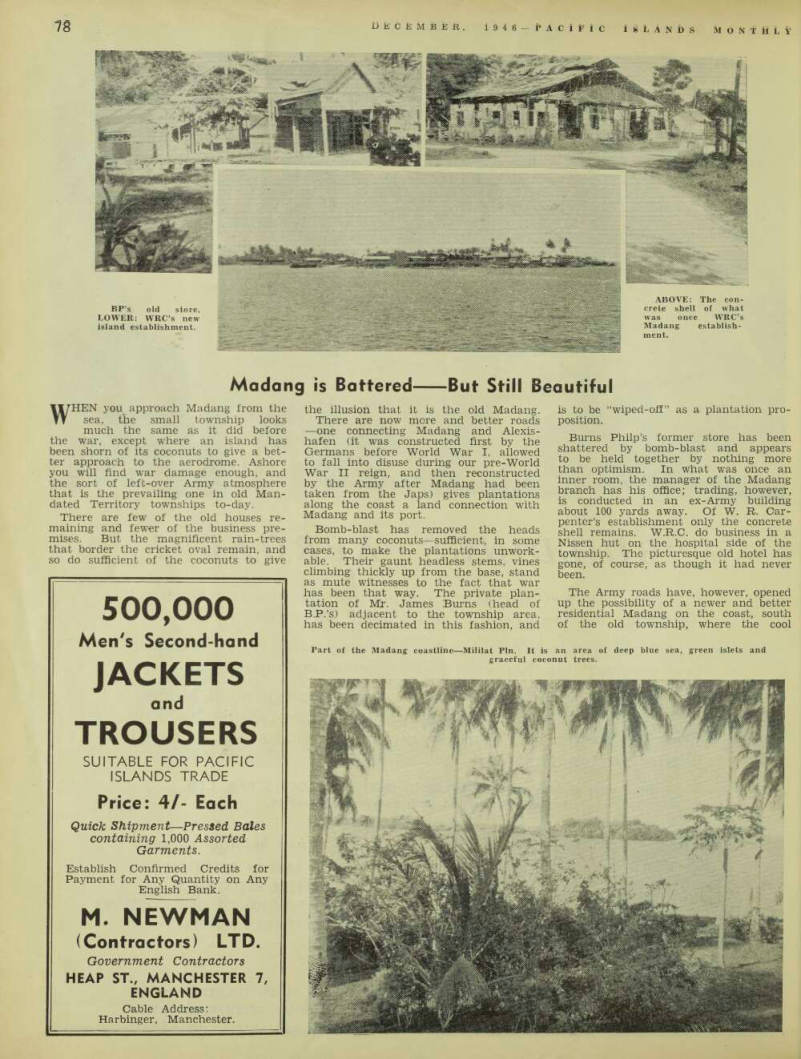
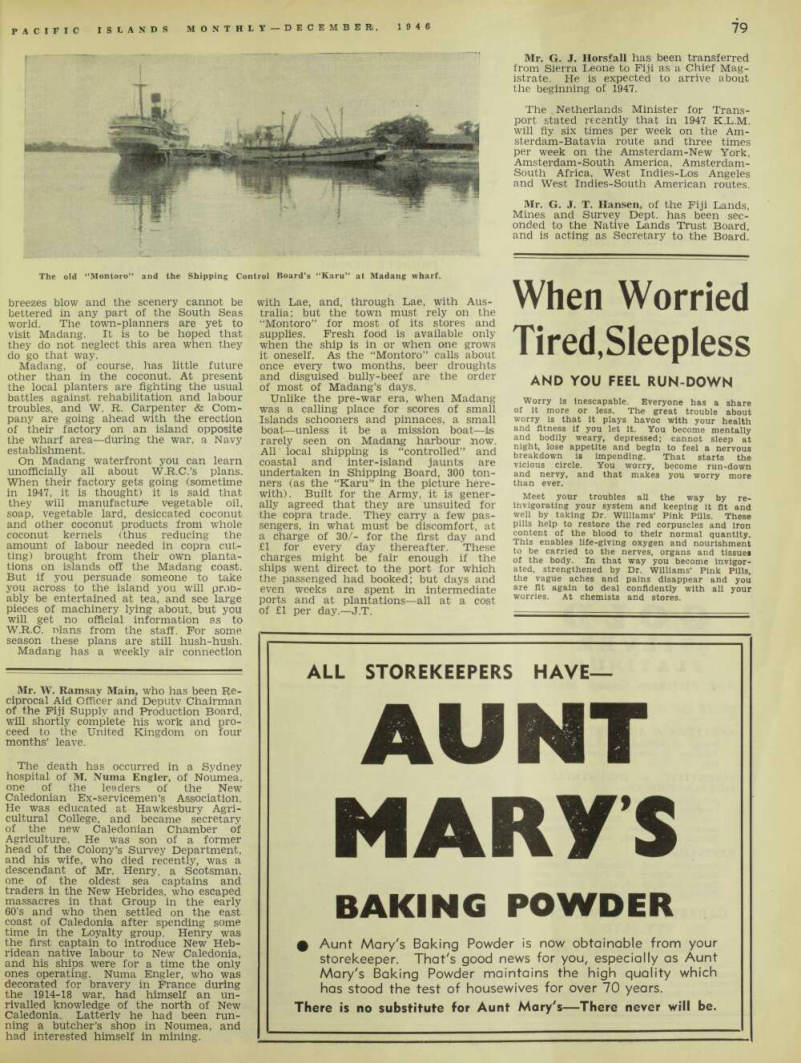
WHEN you approach Madang from the sea, the small township looks much the same as it did before the war, except where an island has been shorn of its coconuts to give a bet ter approach to the aerodrome. Ashore you will find war damage enough, and the sort of left-over Army atmosphere that is the prevailing one in old Man dated Territory townships to-day.
There are few of the old houses re maining and fewer of the business pre mises. But the magnificent rain-trees that border the cricket oval remain, and so do sufficient of the coconuts to give
the illusion that it is the old Madang.
There are now more and better roads —one connecting Madang and Alexis hafen (it was constructed first by the Germans before World War I, allowed to fall into disuse during our pre-World War II reign, and then reconstructed by the Army after Madang had been taken from the Japs) gives plantations along the coast a land connection with Madang and its port.
Bomb-blast has removed the heads from many coconuts —sufficient, in some cases, to make the plantations unwork able. Their gaunt headless stems, vines climbing thickly up from the base, stand as mute witnesses to the fact that war has been that way. The private plan tation of Mr. James Burns (head of B.P.’s) adjacent to the township area, has been decimated in this fashion, and
is to be “wiped-off” as a plantation pro position.
Burns Philp’s former store has been shattered by bomb-blast and appears to be held together by nothing more than optimism. In what was once an inner room, the manager of the Madang branch has his office; trading, however, is conducted in an ex-Army building about 100 yards away. Of W. R. Car penter’s establishment only the concrete shell remains. W.R.C. do business in a Nissen hut on the hospital side of the township. The picturesque old hotel has gone, of course, as though it had never been.
The Army roads have, however, opened up the possibility of a newer and better residential Madang on the coast, south of the old township, where the cool
ABOVE: The con crete shell of what was once WRC’s Madang establish ment.
BP’s old store.
LOWER: WRC’s new island establishment.
Part of the Madang coastline—Mililat Pin. It is an area of deep blue sea, green islets and graceful coconut trees.
breezes blow and the scenery cannot be bettered in any part of the South Seas world. The town-planners are yet to visit Madang. It is to be hoped that they do not neglect this area when they do go that way.
Madang, of course, has little future other than in the coconut. At present the local planters are fighting the usual battles against rehabilitation and labour troubles, and W. R. Carpenter & Com pany are going ahead with the erection of their factory on an island opposite the wharf area—during the war, a Navy establishment.
On Madang waterfront you can learn unofficially all about W.R.C.’s plans.
When their factory gets going (sometime in 1947, it is thought) it is said that they will manufacture vegetable oil, soap, vegetable lard, desiccated coconut and other coconut products from whole coconut kernels (thus reducing the amount of labour needed in copra cut ting) brought from their own planta tions on islands off the Madang coast.
But if you persuade someone to take you across to the island you will prob ably be entertained at tea, and see large pieces of machinery lying about, but you will get no official information as to W.R.C. nlans from the staff. For some season these plans are still hush-hush.
Madang has a weekly air connection
with Lae, and, through Lae, with Aus tralia; but the town must rely on the “Montoro” for most of its stores and supplies. Fresh food is available only when the ship is in or when one grows it oneself. As the “Montoro” calls about once every two months, beer droughts and disguised bully-beef are the order of most of Madang’s days.
Unlike the pre-war era, when Madang was a calling place for scores of small Islands schooners and pinnaces, a small boat —unless it be a mission boat —is rarely seen on Madang harbour now.
All local shipping is “controlled” and coastal and inter-island jaunts are undertaken in Shipping Board, 300 ten ners (as the “Karu” in the picture here with). Built for the Army, it is gener ally agreed that they are unsuited for the copra trade. They carry a few pas sengers, in what must be discomfort, at a charge of 30/- for the first day and £1 for every day thereafter. These charges might be fair enough if the ships went direct to the port for which the passenged had booked; but days and even weeks are spent in intermediate ports and at plantations—all at a cost of £1 per day—J.T.
Mr. G. J. Horsfall has been transferred from Sierra Leone to Fiji as a Chief Mag istrate. He is expected to arrive about the beginning of 1947.
The , Netherlands Minister for Trans port stated recently that in 1947 K.L.M. will fly six times per week on the Am sterdam-Batavia route and three times per week on the Amsterdam-New York, Amsterdam-South America, Amsterdam- South Africa, West Indies-Los Angeles and West Indies-South American routes.
Mr. G. J. T. Hansen, of the Fiji Lands, Mines and Survey Dept, has been sec onded to the Native Lands Trust Board, and is acting as Secretary to the Board.
Mr. W. Ramsay Main, who has been Re ciprocal Aid Officer and Deputv Chairman of the Fiji Supply and Production Board, will shortly complete his work and pro ceed to the United Kingdom on four months’ leave.
The death has occurred in a Sydney hospital of M. Numa Engler, of Noumea, one of the leaders of the New Caledonian Ex-servicemen’s Association.
He was educated at Hawkesbury Agri cultural College, and became secretary of the new Caledonian Chamber of Agriculture. He was son of a former head of the Colony’s Survey Department, and his wife, who died recently, was a descendant of Mr. Henry, a Scotsman, one of the oldest sea captains and traders in the New Hebrides, who escaped massacres in that Group in the early 60’s and who then settled on the east coast of Caledonia after spending some time in the Loyalty group. Henry was the first captain to introduce New Heb ridean native labour to New Caledonia, and his ships were for a time the only ones operating. Numa Engler, who was decorated for bravery in France during the 1914-18 war, had himself an un rivalled knowledge of the north of New Caledonia. Latterly he had been run ning a butcher’s shop in Noumea, and had interested himself in mining.
The old “Montoro” and the Shipping Control Board’s “Karu” at Madang wharf.
Advertisements & other items, pp. 80-81 (2 items)
78
BiSCfcMSfifc, 1946 PACIF'tC ISLANDS MONTHLY
Jackets
500,000
Men's Second-hand
TROUSERS
SUITABLE FOR PACIFIC
ISLANDS TRADE
Price: 4/- Each
Quick Shipment—Pressed Bales containing 1,000 Assorted Garments.
Establish Confirmed Credits for Payment for Any Quantity on Any English Bank.
M. NEWMAN
(Contractors) LTD.
Government Contractors
HEAP ST., MANCHESTER 7,
ENGLAND
Cable Address: Harbinger, Manchester.
When Worried
Tired,Sleepless
AND YOU FEEL RUN-DOWN
Worry is Inescapable. Everyone has a share of it more or less. The great trouble about worry is that It plays havoc with your health and fitness if you let it. You become mentally and bodily weary, depressed; cannot sleep at night, lose appetite and begin to feel a nervous breakdown is impending. That starts the vicious circle. You worry, become run-down and nervy, and that makes you worry more than ever.
Meet your troubles all the way by reinvigorating your system and keeping it fit and well by taking Dr. Williams’ Pink Pills. These pills help to restore the red corpuscles and iron content of the blood to their normal quantity.
This enables life-giving oxygen and nourishment to be carried to the nerves, organs and tissues of the body. In that way you become invigorated, strengthened by Dr. Williams’ Pink Pills, the vague aches and pains disappear and you are fit again to deal confidently with all your worries. At chemists and stores.
ALL STOREKEEPERS HAVE—
AUNT
MARYS
BAKING POWDER
9 Aunt Mary's Baking Powder is now obtainable from your storekeeper. That's good news for you, especially as Aunt Mary's Baking Powder maintains the high quality which has stood the test of housewives for over 70 years.
There is no substitute for Aunt Mary's—There never will be.
Islands Produce
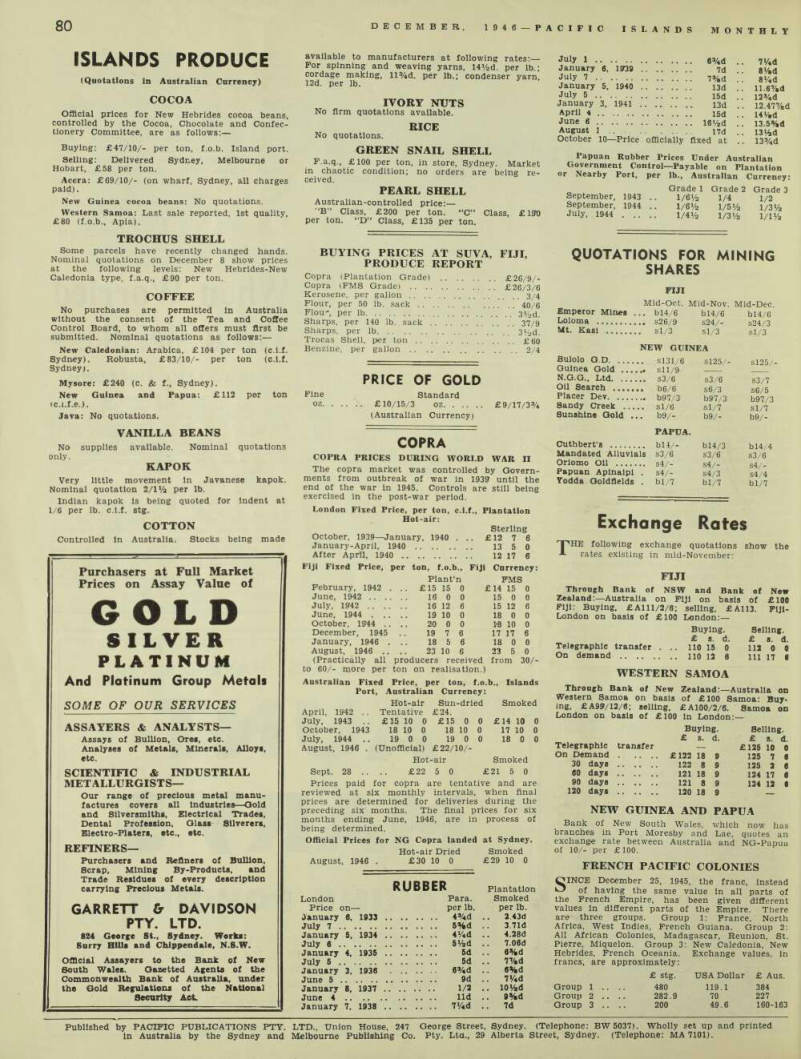
(Quotations in Australian Currency)
Cocoa
Official prices for New Hebrides cocoa beans, controlled by the Cocoa, Chocolate and Confec tionery Committee, are as follows; Buying: £47/10/- per ton, f.o.b. Island port.
Selling: Delivered Sydney, Melbourne or Hobart, £5B per ton.
Accra: £69/10/- (on wharf, Sydney, all charges paid).
New Guinea cocoa beans: No quotations.
Western Samoa: Last sale reported, Ist quality, £BO (f.0.b., Apia).
Trochus Shell
Some parcels have recently changed hands.
Nominal quotations on December 8 show prices at the following levels: New Hebrides-New Caledonia type, f.a.q., £9O per ton.
Coffee
No purchases are permitted in Australia without the consent of the Tea and Coffee Control Board, to whom all offers must first be submitted. Nominal quotations as follows: New Caledonian: Arabica, £lO4 per ton (c.i.f.
Sydney). Robusta, £B3/10/- per ton (c.i.f.
Sydney).
Mysore: £240 (c. & f., Sydney).
New Guinea and Papua: £ll2 per ton (c.i.f.e.).
Java: No quotations.
Vanilla Beans
No supplies available. Nominal quotations only.
Kapok
Very little movement in Javanese kapok.
Nominal quotation 2/1 Va per lb.
Indian kapok Is being quoted for Indent at 1/6 per lb. c.i.f. stg.
Cotton
Controlled in Australia. Stocks being made
available to manufacturers at following rates:— For spinning and weaving yarns, l4V 2 d. per lb ; cordage making, ll%d. per lb.; condenser yarn. 12d. per lb.
Ivory Nuts
No firm quotations available.
Rice
No quotations.
Green Snail Shell
F.a.q., £lOO per ton, in store, Sydney. Market in chaotic condition; no orders are being re ceived.
Pearl Shell
Australian-controlled price:— "B” Class, £2OO per ton. “C” Class, £l9O per ton. “D” Class, £135 per ton.
Buying Prices At Suva, Fiji,
Produce Report
Copra (Plantation Grade) £26/9/- Copra (FMS Grade) £26/3/6 Kerosene, per gallon 3/4 Flour, per 50 lb. sack 40/6 Flou-, per lb sy 2 d.
Sharps, per 140 lb. sack 37/9 Sharps, per lb 3V 2 d.
Trocas Shell, per ton £6O Benzine, per gallon 2/4
Advertisements & other items, p. 82 (1 item)
Price Of Gold
Pine Standard oz. . ., £10/15/3 oz. £9/17/3% (Australian Currency)
Copra
Prices During World War Ii
The copra market was controlled by Govern ments from outbreak of war in 1939 until the end of the war in 1945. Controls are still being exercised in the post-war period.
London Fixed Price, per ton, c.1.f., Plantation Hot-air:
Fiji Fixed Price, per ton, f.0.b., Fiji Currency:
to 60/- more per ton on realisation.) Australian Fixed Price, per ton, f.0.b., Islands Port, Australian Currency:
Prices paid for copra are tentative and are reviewed at six monthly intervals, when final prices are determined for deliveries during the preceding six months. The final prices for six months ending June, 1946, are in process of being determined.
Sterling October, 1939—January, 1940 . .. £12 7 6 January-April, 1940 13 5 0 After April, 1940 12 17 6
Plant’n PMS February, 1942 ... £15 15 0 £14 15 0 June, 1942 16 0 0 15 0 0 July. 1942 16 12 6 15 12 6 June, 1944 19 10 0 18 0 0 October, 1944 ... 20 0 0 1-8 10 0 December, 1945 19 7 6 17 17 6 January, 1946 ... 18 5 6 18 0 0 August. 1946 ... 23 10 6 23 5 0 (Practically all producers received from 30/-
Hot-air Sun-dried Smoked April, 19‘42 ..
Tentative £24.
July. 1943 .. £15 10 0 £15 0 0 £14 10 0 October, 1943 18 10 0 18 10 0 17 10 0 July, 1944 ,. 19 0 0 19 0 0 18 0 0 August, 1946 . (Unofficial) £22/10/- Hot -air Smoked Sept, 28 .. £22 5 0 £21 5 0
Official Prices for NG Copra landed at Sydney.
Hot-air Dried Smoked August, 1946 . £30 10 0 £29 10 0
Rubber
Plantation
Papuan Rubber Prices Under Australian Government Control—Payable on Plantation or Nearby Port, per lb., Australian Currency:
London Para.
Smoked Price onper lb. per lb.
January 0. 1933 .. .. ... 4 3 Ad 2.43d July 7 .. 3.71d January 5, 1934 .. .. ... 4‘Ad .. 4.28d July 6 .. 7.06d January 4, 1935 .. .. ... 6d 6%d July 5 .. . ... 5d 7%d January 3, 1936 . .. 6 3 /«d 6%d June 5 .. .. .. 9d 7V*d January 8, 1937 .. .. .. lOttd June 4 .. .. .. lid 9%d January 7, 1938 .. .. ... 7‘Ad 7d
J u] y 1 « 3 /«d .. 7V«d January 6. 1939 7d .. 8V.d JuJ y 7 7%d .. 8Vid January 5, 1940 13d .. 11.6%d July 5 15d .. l2 3 / 4 d January 3, 1941 13d .. 12.47 7 / a d A P r “ * 15d .. 14 Vsd June 6 16Vad .. 13.5%d August 1 17d .. l3M,d October 10—Price officially fixed at .. 13 3 Ad
Grade 1 Grade 2 Grade 3 September, 1943 . 1/6% 1/4 1/2 September, 1944 . 1/6 y 2 I/51/2 I/31/2 July, 1944 . .. . 1/41/2 I/31/2 I/I1/2
Quotations For Mining
Shares
Fiji
Emperor Mines .
Loloma Mt. Kasl Mid-Oct. .. bl4/6 . sl/3 Mid-Nov. bl4/6 $24/sl/3 Mid-Dec. bl4/6 S24/3 sl/3
New Guinea
Bulolo G.D Guinea Gold ..., .. S131/6 $125/- $125/- N.G.G., Ltd Oil Search Placer Dev s3/6 s6/3 hQ7 /"?
S3/7 $6/5
Uqft /O
Sandy Creek ...
Sunshine Gold .. .. sl/6 ,. b9/uy * / *5 sl/7 b9/- $1/7 b9/-
Papua.
Cuthbert’s bll/- Mandated Alluvlals s3/6 Orlomo Oil s4/- Papuan Aplnalpl . s4/- Todda Goldfields . bl/7 bl4/3 s3/6 s4/s4/3 bl/7 bl4/4 $3/6 $4/- $4/4 bl/7
Exchange Rates
THE following exchange quotations show the rates existing in mid-November:
Fiji
Through Bank of NSW and Bank of Now Zealand:—Australia on FIJI on basis of £lOO Fiji: Buying, £Alll/2/6; selling, £AII3. FIJI - on basis of £lOO London:—
Western Samoa
Through Bank of New Zealand:—Australia on Western Samoa on basis of £lOO Samoa: Buy ing. £ A99/12/6; selling, £ AlOO/2/6. Samoa on London on basis of £lOO In London:—
New Guinea And Papua
Bank of New South Wales, which now has branches in Port Moresby and Lae, quotes an exchange rate between Australia and NG-Papua of 10/- per £lOO.
French Pacific Colonies
SINCE December 25, 1945, the franc, Instead of having the same value In all parts of the French Empire, has been given different values in different parts of the Empire. There are three groups. Group 1: France, North Africa, West Indies, French Guiana. Group 2: All African Colonies, Madagascar, Reunion, St.
Pierre, Miquelon. Group 3: New Caledonia, New Hebrides, French Oceania. Exchange values, in francs, are approximately:
Buying.
Selling. £ s. d. £ s. d.
Telegraphic transfer . .. 110 15 0 113 0 0 On demand .. 110 12 6 111 17 6
Buying.
Selling. £ s. d. £ s. d.
Telegraphic transfer £125 10 0 On Demand . .. £122 18 9 125 7 « 30 days 122 8 9 125 2 0 60 days 121 18 9 124 17 8 90 days 121 8 9 124 12 6 120 days 120 18 9
£ stg. USA Dollar £ Aus.
Group 1 .. .. 480 119.1 384 Group 2 .. .. 282.9 70 227 Group 3 .. .. 200 49.6 160-163
Advertisements & other items, pp. 82-84 (4 items)
80
DECEMBER, 1946 PACIFIC ISLANDS MONTHLY
Published by PACIFIC PUBLICATIONS PTY. LTD., Union House, 247 George Street, Sydney. (Telephone: BW 5037). Wholly set up and printed in Australia by the Sydney and Melbourne Publishing Co. Pty. Ltd., 29 Alberta Street, Sydney. (Telephone: MA7101).
Gold
Purchasers at Full Market Prices on Assay Value of
SILVER
PLATINUM
And Platinum Group Metals
SOME OF OUR SERVICES
ASSAYERS & ANALYSTS—
Assays of Bullion, Ores, etc.
Analyses of Metals, Minerals, Alloys, etc.
SCIENTIFIC & INDUSTRIAL
METALLURGISTS—
Our range of precious metal manufactures covers all industries—Gold and Silversmiths, Electrical Trades, Dental Profession, Glass Sllverers, Electro-Platers, etc., etc.
REFINERS—
Purchasers and Refiners of Bullion, Scrap, Mining By-Products, and Trade Residues of every description carrying Precious Metals.
GARRETT Cr DAVIDSON
PTY. LTD.
824 George St., Sydney. Works: Surry Hills and Chippendale, N.S.W.
Official Assayers to the Bank of New South Wales. Gazetted Agents of the Commonwealth Bank of Australia, under the Gold Regulations of the National Security Act
December, 1946—Pacifio Islands Monthly
tropical thirst...
To quench a
hodi drinks
9
iverf
o nna «r !S i» mi ¥ When you’re hot and tired,
there is nothing quite so satisfying
and thirst quenching as a long, cold "lass of “K. 8.” Your friends and guests, too, will ap-
preciate this really fine
Lager, for ‘'Everybody
drinks K.B.’"
TOOTH’S
LAGER
Capital £1,000,000
ESTABLISHED 1914
Ar 'k
COPRA MERCHANTS & MILLERS
BRANCHES THROUGHOUT THE PACIFIC ISLANDS
REGULAR CARGO AND PASSENGER SERVICE BETWEEN EUROPE AND
PACIFIC ISLAND PORTS WAS ESTABLISHED BY
W. R. CARPENTER & CO. LTD.
Head Office: 16 O'CONNELL STREET, SYDNEY.
Cable Address:
CAMOHE.
Telephone: BW 4421.
Postal Address: P.O. Box No. 168, Sydney.