Islands

Pacific
Monthly
November 18, 1946
Vol. Xvii. No. 4.
Established 1930.
[Registered at the transmission by post as a newspaper ]
II-
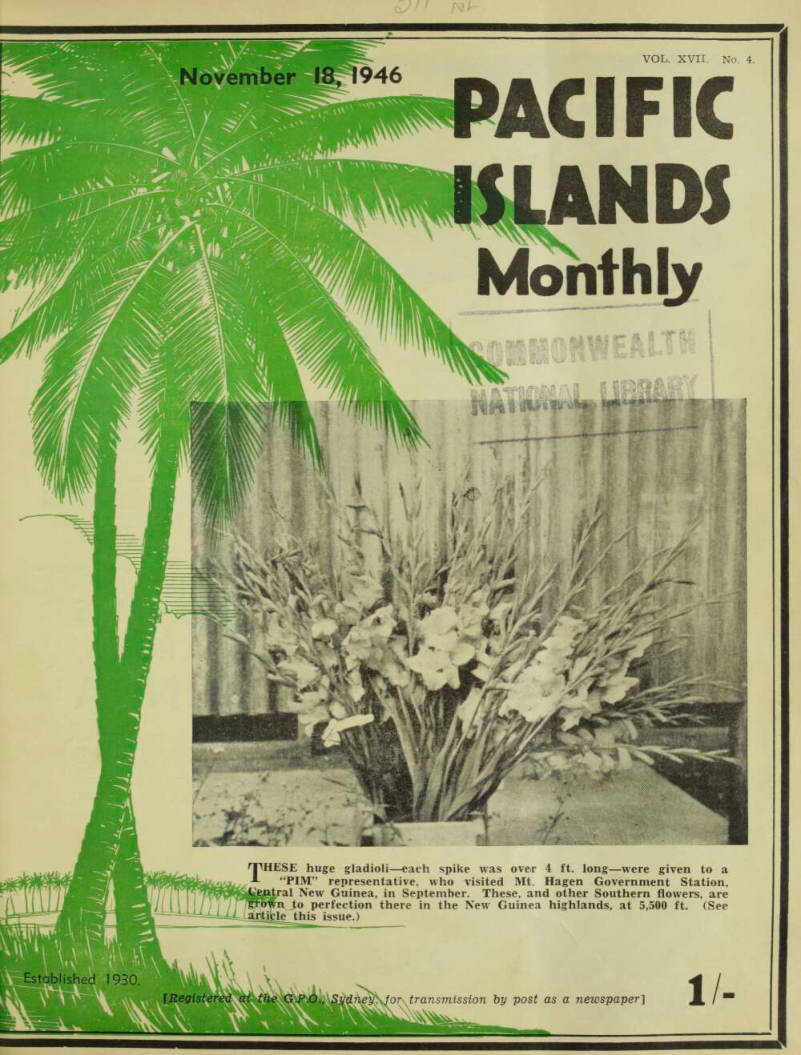
THESE huge gladioli—each spike was over 4 ft. long—were given to a “PIM” representative, who visited Mt. Hagen Government Station, Central New Guinea, in September. These, and other Southern flowers, are grown to perfection there in the New Guinea highlands, at 5,500 ft. (See article this issue.)
A radar set, which cost £lO,OOO, is to be installed in Fiji to assist in aerial navigation. The set records the winds in the higher air, knowledge of which is an important factor in safety and economy in
air travel. Three similar sets are being installed on New Zealand aerodromes, The sets are manufactured in the Dom inion and compare more than favourably with overseas models.
Advertisements & other items, pp. 2-4 (1 item)
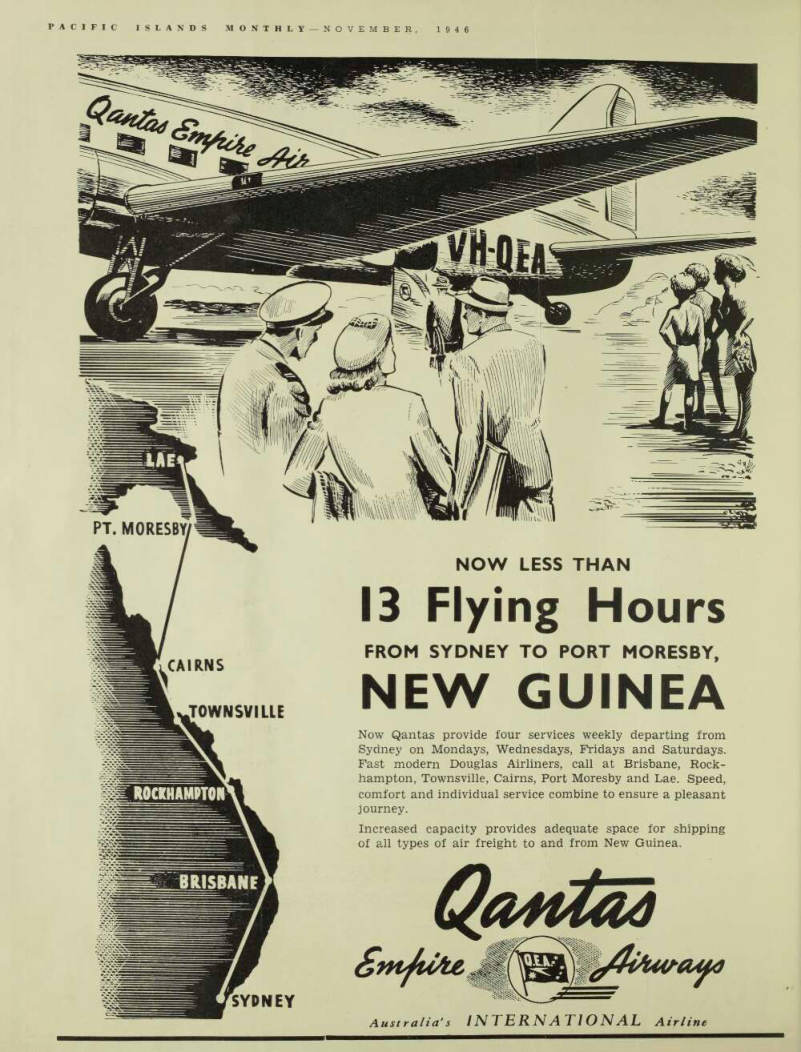
13 Flying Hours
<£ >5 >s^ u m
nil
s» s. ft si r^s*
PT. MORESBY,
CAIRNS
JOWNSVILLE
1 gg ■;• »
NOW LESS THAN
13 Flying Hours
FROM SYDNEY TO PORT MORESBY,
NEW GUINEA
Now Qantas provide four services weekly departing from Sydney on Mondays, Wednesdays, Fridays and Saturdays.
Fast modern Douglas Airliners, call at Brisbane, Rockhampton, Townsville, Cairns, Port Moresby and Lae. Speed, comfort and individual service combine to ensure a pleasant journey.
Increased capacity provides adequate space for shipping of all types of air freight to and from New Guinea.
Qo4*£m
SYDNEY
Australia's INTERNATIONAL Airline
Oxpebiettcz
fre/tCnoi-eV
tht&nuHt Stchfie
:%S * :d zzmmamrn VI ym
JJM
9 *391 u w 3 .30 osse«' b ' ed on d
**j£* s ri
*'* P «IB«9 °* t
.o" °” e bo >\ ' . ond **« ® tcS . Con in pOS U.on
corried «* foe »-seo\-
hout e ne •» ust-pr° 0 ’ , p,irnus- >*et *YP eS
Day after day, week
after week, for over 40 years Coleman's have specialised in making Stoves and Lamps. Is it any
wonder, then, that
their products give
the utmost in satisfaction and service.
Thi s J S
"ove re W ° b^e r e ,n 9 and qU h ' res n ° pi con fro/ *»• * t af * f y *h ut . off yd Unr »ece S c rt Vo/y e r e °ch tin. ° ry *o * H o 5 re G sf oy e • * for . x n ' sofe onn fu e/ bro° inoble t C ° Jy fill ‘ U/ ly Ory e ‘ 9ht 16f b enon ’el fini m Representatives for the Pacific Islands:
ROBERT GILLESPIE PTY. LTD
54a PITT STREET, SYDNEY
PEARCE & CO. LTD.
SUVA
FOR FIJI ISLANDS
Periodicals . . . Trade Journals
American, English and Australian Periodicals and Trade Journals posted direct to you.
The N.S.W. Bookstall Co. Pty., Limited can supply all available overseas and local subscription magazines. Subscription Lists Available Let us know your requirements. on Application.
N.S.W. BOOKSTALL COMPANY PTY., LTD.
Market and Castlereagh Streets, Sydney, AUSTRALIA.
For Service
EXPORTERS - IMPORTERS
Contact
1
COMMONWEALTH TRADING CO. Pty. Ltd.
95 YORK STREET, SYDNEY
Phones: MA4232, M 6969.
GENERAL MERCHANDISE, TRADE GOODS, CLOTHING, FOOD-
STUFFS, LIQUEURS, SPIRITS, WINES.
McILRATH’S
SPECIAL EXPORT TOBACCO OFFER
NAILROD PLUG TOBACCO, 26's (49 lb. wooden caddies) lb 4/6.
SMOKING MIXTURE TOBACCO, 8 s square plug (48 lb. wooden caddies) lb. 3/3. (Both Australian origin^
STOCKS AVAILABLE FOR IMMEDIATE SHIPMENT.
All prices f.o.h. Sydney.
McILRATH'S PTY. LTD.
Export Department,
202 PITT ST., SYDNEY, AUSTRALIA
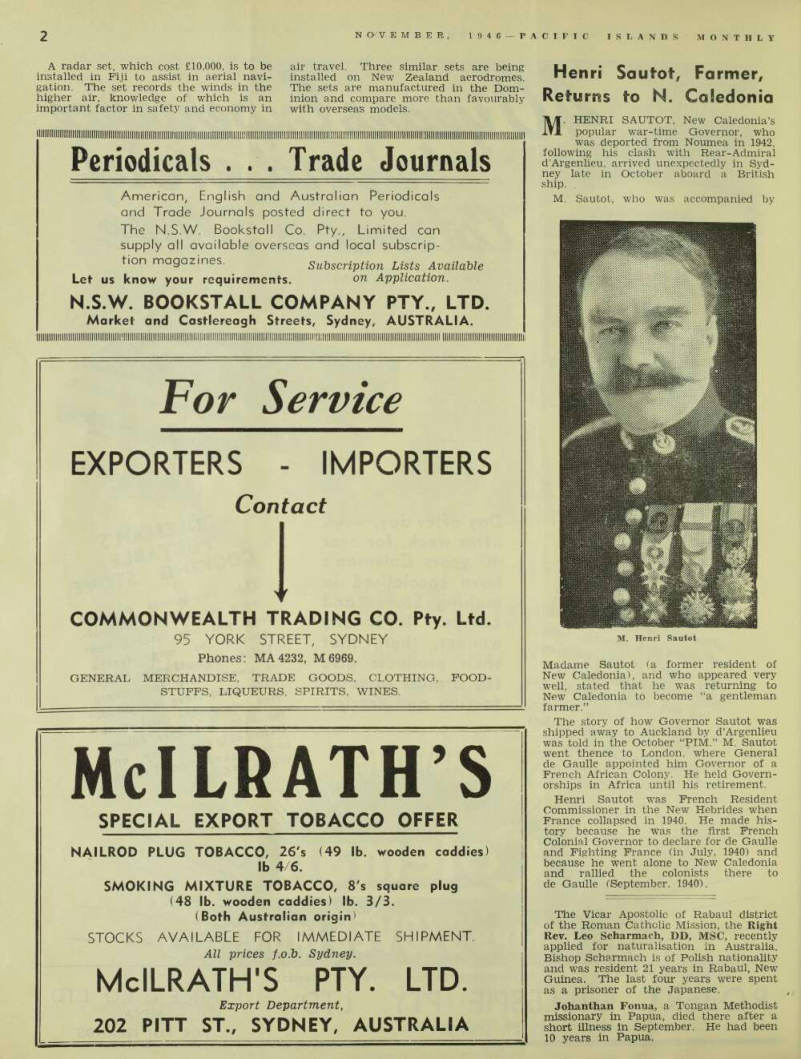
Henri Sautot, Farmer,
Returns to N. Caledonia
M. HENRI SAUTOT, New Caledonia’s popular war-time Governor, who was deported from Noumea in 1942, following his clash with Rear-Admiral d’Argenlieu, arrived unexpectedly in Syd ney late in October aboard a British ship.
M. Sautot, who was accompanied by
Madame Sautot (a former resident of New Caledonia), and who appeared very well, stated that he was returning to New Caledonia to become “a gentleman farmer.”
The story of how Governor Sautot was shipped away to Auckland by d’Argenlieu was told in the October “PIM.” M. Sautot went thence to London, where General de Gaulle appointed him Governor of a French African Colony. He held Govern orships in Africa until his retirement.
Henri Sautot was French Resident Commissioner in the New Hebrides when France collapsed in 1940. He made his tory because he was the first French Colonial Governor to declare for de Gaulle and Fighting France (in July, 1940) and because he went alone to New Caledonia and rallied the colonists there to de Gaulle (September, 1940).
The Vicar Apostolic of Rabaul district of the Roman Catholic Mission, the Right Rev. Leo Scharmach, DD, MSC, recently applied for naturalisation in Australia.
Bishop Scharmach is of Polish nationality and was resident 21 years in Rabaul, New Guinea. The last four years were spent as a prisoner of the Japanese.
Johanthan Fomia, a Tongan Methodist missionary in Papua, died there after a short illness in September. He had been 10 years in Papua.
M. Henri Sautot
Advertisements & other items, p. 5 (1 item)
Hfirrt J. Tcnnq
B
OND’S
NEW SEASON'S
FANCY
HALF-HOSE
Smart designs Attractive colours Comfort and quality % :• 1 'K w 4, 74 * In the very latest fancy designs, showing all the good taste and quality which has always been a feature of Bonds productions. Illustrated here is a selection from the designs available. *
WHITE MERCERISED HALF-HOSE
RK 155 Specially designed to give comfort and coolness in tropical heat, these socks have all the qualities for which your customers have been waiting.
ORDER THROUGH YOUR USUAL CHANNELS: OR FROM Bonds' Sole Pacific Islands Selling Representative
HfIRRT J. TCNNQ
PIT. LTD.
POSTAL ADDRESS:
Box 3661 G.P.0., Sydney,
379 KENT STREET, SYDNEY,
BANKERS: BANK OF N.S.W.
CODES:
Bentley’s Comp.
Phrase.
Bentley’s 2nd Phrase.
advertisers
Amalgamated Hatcheries ... 28 Amplion (Aust.) Pty., Ltd 22 Angliss & Co. . . 58 Aust. Aluminium Company ... 51 Aust. Fishing In dustries ... 23 A. G. Andrews Co., Inc 49 Atkins Pty., Ltd., Wm 27 Berger & Sons, Ltd 24 Brown & Co., Ltd. 13 Brial & Ball ... 19 Brunton’s Flour . . 60 Burns, Philp Trust Co., Ltd 21 Broomfields ... 74 BP (SS) Co. . . . 13 Carlton & United Breweries, Ltd. . 54 Carpenter, Ltd., W.
R cov. iv.
Chivers, Ltd. ... 79 Church, R. H., & Sons 50 Coleman Lamp & Stove Co 71 Colonial Wholesale Meat 69 Combined Manufac turing Industries . 17 “Cystex” 60 Commonwealth Trading Co. Pty., Ltd 2 Crosse & Blackwell, Ltd 25 Dalmore Preserving 48 Donaghy & Sons . 25 Donald. Ltd., A. B. 20 Paul, A. Dorn . 65 Dr. Williams Pink Pills 69 Dangar, Gedye & Malloch 55 Dunlop Rubber (A/sia), Ltd. . . 63
Eekhoff, H. G. . . 27 Electrolux Refrigerators . . 36 Eveready Batteries (Aust.) Pty., Ltd. 33 Excelsior Supply Co. 35 Ford Sherington Pty., Ltd. ... 65 Garrett & Davidson 80 Gibson & Co., Ltd.,
J. A, D 52
Gillespie Pty., Ltd., Robert . . . 1 & 57 R o b t. Gillespie (NGi, Ltd. ... 61 Gilbey’s Gin ... 56 Gillespie’s Flour . . 79 Gough & Co., E. J. 20 Grand Pacific Hotel 4 Grove & Sons, W.
H 22 Heinz & Co. Pty., Ltd., H. J. . . . 53 Hemingway & Robertson ... 53 Hyde, Victor ... 14 Ingram Shaving Cream 73 Ipana Tooth Paste 77 Kopsen & Co., Ltd. 31 Lockyer, Geo. J. .72 Merrillees, J. C. & Co 68 Miscellaneous . 17, 74, 16 ‘ Mum” Deodorant . 70 “Mendaco” ... 30 Mcllraths Pty., Ltd 2 Nelson & Robertson Pty.. Ltd 75 Newman, M. . . . 78 NSW Bookstall Co.
Pty., Ltd 2 “Nixoderm” ... 34 Pacific Islands Trading Co., 23, 59, 62 Pacific Islands Monthly ... 20 Pacific Is. Society . 19 “Pinkettes” ... 56
Papuan Electrical Co 46 Proprietary Products 75 Qantas Empire Air ways ... cov. ii.
Queensland Insur ance Co 61 Ransome, Sims, & Jeffries 66 Robinson, G. H. . 68 Rosie’s Eye Lotion, 24, 53 Rohu, Sil . . . . 54
Rur 66
Scott, Ltd., J. . . 62 Shell Co 67 Southern Pacific Insurance Co. . . 18 Steamships Trading Co., Ltd 72 Sullivan & Co., C. 76 Swallow & Ariell . 78 South Sea Islands Club 71 Taylor & Co., A. . 67j
“Tenax” Soap . . 30*
Tillock & Co., Ltd. 32 Thornycroft (Aust.) Pty., Ltd 29 Tooth & Co., Ltd cov. iii.
Toogood, J. J. . . 51 Tullochs Pty., Ltd. 15 Tilley’s Lamps . . 64 Vincent Chemical Co 16 “ Vitalis ” Hair Tonic 65 Vacuum Oil Co., Ltd. . . . .26 Watson, Wm. H. . 18 Widdop, H„ & Co., Ltd 47 A. Willison ... 58 Wills, W. D. & H. 0 45 Wright & Co., Ltd., E 73 Young Pty., Ltd., Harry J 3 lnsu r-1 ance Co., Ltd. . 13
Contents
Editorial: “Uncertain Future for ts Inarticulate Europeans in the i Pacific” 5 ’
Two Air-services in Operation Across the Pacific 7 G & E Islands Colony hit by Copra Export Tax 8 Fiji’s Progress Impressive Pro gramme 8 Fiji Copra Price up again—But Aus tralia Holds Price at £22/10/- ... 9 Col. J. K. Murray’s Term as NG Administrator Extended 9 Gaol Escapees Destroy Rarotonga’s Biggest Store 10 WRC Ship “Rabaul” 11 Indian Cry For Land Fiji’s Problem H The Australian Taxpayer Pays For This 12
[Fiji Civil Service Conditions 12 jFire Destroys 1250 tons Samoan Copra 13 ’Plantation School for Fijians 14 Cargo-Cult is Born 16 Death of Capt. E. Twenty man 17 USA Abandons Manus to Australian Pinheads 18 Angry Samoans Kill Child-Slayer .. 21 South Pacific Health Services—First Meeting of Controlling Board ... 23 Ample Provision for European Educa tion in NG Territories 25 Niuafo’ou is Now Another Lost Island —Full Evacuation of Population .. 28 Passing of Fiji Pioneers 29 Successful New Guinea Ball Held in Melbourne 31 '‘BSI Planters and British War Com pensation 32 Decline and Revival of Fijian Race .. 35 Territories’ Talk-Talk 37 deeper s! 38 Night Landing on Palmerston ... 39 On the Roof of New Guinea 40 How the Late R. F. Brechin Pioneered the Cinchona Plantations 42 Book Review: “The Coast Watchers” 44 N. Caledonia Cannot Find Labour .. 47 Dodging the Japs Behind Finschhafen 49 Rice Production in Fiji 51 Other Side of the New Guinea Picture 55 Shipping and Plane Services —Pacific Travellers 60, 61, & 78 Lae and Salamaua are Shadows of their Former Selves 63 Getting away from it All—American Yacht in Rarotonga 68 NG Administration Confers with Mis sion Representatives 72 Unhappy Rabaul—Native Labour and Food Shortages 76 Gilbertese May Settle in Tonga ... 79 Commercial, Markets, etc 80
Advertisements & other items, p. 6 (2 items)
4
NOVEMBER, 1946 PACIFIC ISLANDS MONI H L I
Ipr
1
ujW«\
oA „ t> e Gra ° .-»"> r>> <u a S^ a . rP ntr e ° atX e ° c( s x O TO * **. cab ' e ' *>l« ?er os 0
Pacific Islands Monthly
The Newspaper-Magazine of the South Seas [Registered at the G.P.0., Sydney, for transmission by post as a newspaper .]
Published Once Each Month and Circulated in Australia and New Zealand and in the following Pacific Territories and Islands Groups:
Australian Territory of Papua.
Mandated Territory (Australia) of New Guinea.
Australian Territory of Norfolk Island.
New Zealand Territory of Cook Islands.
Mandated Territory (NZ) of Western Samoa.
British Colony of Fiji.
British Solomon Islands Protectorate.
British Protectorate of Tongan Islands.
British Crown Colony of Gilbert and Ellice Islands.
Mandated Territory of Nauru.
British and Free French Condominium oi N«v Hebrides.
French Colony of New Caledonia.
French Colony of Oceania (Tahiti, etc.).
American Territory of Eastern Samoa.
American Territory of Hawaiian Islands.
Owned and Produced by Pacific Publications Pty. Ltd., Union House, 247 George Street, Sydney.
Telephones: General Office and Advertising, BW 5037.
P.O. Box 3408
Registered Address for Telegrams, Radiograms, and Cables: -‘Pacpub”, Sydney.
Contributions.
Articles, Stories, and Photographs dealing with Pacific Islands subjects are invited and will be paid for on publication.
Subscription Rates.
Per Annum, within British Empire, Prepaid, Post Free 10/- Per Annum, elsewhere, Prepaid, Post Free 12/6 Single Copies 1/-
Editor and Publisher:
R. W Robson, P.R.G.S.
General Office: Union House, 247 George Street, Sydney.
Advertising Manager: W. E. Rogers.
Telephone: BW 5037.
Representative In Fiji.
Pacific Publications (Fiji), Ltd., Bank of NSW Building, Suva (same office as W. H. Grove & Sons, Ltd.). Stocks of Pacific Islands Monthly and Pacific Islands Yearbook on hand.
Representative In London,
J. T. Wallis, Coronation House, 4 Lloyds Avenue, London, E.C.3, from whom may be obtained copies of Pacific Islands Monthly, Pacific Is. Year Book, advertising schedules, etc.
Representative In U.S.A.
Pacific Islands Trading Co.,
244 CALIFORNIA ST., SAN FRANCISCO, U S.A.
Agents.
The following are authorised to receive sub scriptions for Pacific Islands Monthly:— Burns, Philp & Co., Ltd,, and Burns Phllp (South Sea) Co., Ltd. All branches.
W. R. Carpenter & Co., Ltd. All branches.
Morris, Hedstrom, Ltd. All branches.
Steamships Trading Co., Papua. All branches.
Whitten Bros., Ltd., Samaral, Papua.
B.N.G. Trading Co., Ltd., Port Moresby, Papua.
J. Muir, Suva, Fiji.
Miss R. Castles, Suva, Fiji.
N. C. Mackenzie Hunt, Walnunu, Bua, FIJI.
Cook Islands Trading Co., Rarotonga, Cook Is.
A. C. Rowland, Papeete, Tahiti, Islands Branches and Representatives of W. H.
Grove & Sons, Ltd., Auckland, New Zealand.
Ed. Pentecost, Noumea, New Caledonia.
Societe Gubbay Kerr et Cle, Noumea, N. Caledonia.
Vol. XVII No. 4
November 18, 1946.
Priro 1/- Per Copy, rrice Prepaid: 10/- p.a.
Pacific
Uncertain Future for Inarticulate Europeans in the Pacific
FOR 150 years, and until the Japa nese invasion upset our standards and dislocated our economy, it was accepted that the most valuable man in the Pacific Islands was the Euro pean individualist—the hard-working type who induced the natives to barter, who visualised new industries, and made ten good coconuts grow in the place of one.
To-day a combination of Socialist politicians, scientific idealists and im practical missionaries is proceeding— whether by deliberate plan or not is not clear—to drive European enter prise out of the Pacific, with a view to the establishment there of “free nations of native Islanders.” It is an extraordinary spectacle—and it is not confined alone to the Australian Territories of Papua and New Guinea.
In this issue of the “PIM” there are references to various events, which show that European private enter prise definitely is on the defensive against political and nationalist move ments in (from west to east) the Netherlands Indies, Malaya, Papua- New Guinea, the British Solomons, Fiji, Gilbert and Ellice Colony, Western Samoa and the Cook Islands —in other words, in all the Islands ruled over by the more-or-less Pink Governments of Britain, Holland, Australia and New Zealand.
The fact that no such movements are yet discerned in the French terri tories of New Caledonia, Tahiti and New Hebrides is surprising, in view of the strong Red element in metro politan France. But the French
always were realists. The British, on the other hand, will on occasion let down their back hair and literally wallow in sentimentalism—and pre sent trends and events in the Pacific Islands suggest that this is one of those occasions.
WE take second place to no one in our admiration of the qualities of the Pacific Islands races, and be lief in their future. In fact, for years, the lonely voice of the “PIM” was the only voice demanding a. better deal for the Polynesians, Micronesians and the more advanced sections of Melanesians. It is more than gratifying to see that so much now is to be done to provide these people with better educational and health facilities, and to assist them to take control of the affairs of their own countries.
But why should all these Govern ments, and mission bodies and learned institutions go so suddenly and drastically from one extreme to the other? Why should they be per mitted, in their enthusiasm over policies for the betterment of natives, to commit cruel injustices against Europeans?
The task of raising the standards of individual and communal life in the Islands is one to be approached warily, and carried out gradually. It cannot be successfully accomplished without the co-operation and good will of the elements that our youth ful post-war bureaucrats now treat with disdain and try to ignore—the
common, everyday planters and traders. If there is one thing com mon to all the attacks upon Euro pean enterprise in the Territories named above, it is the bureaucrats’ determination to have no truck with and accept no advice from money grubbing, non-official civilians.
The record of the native Islanders’ progress during the past 50 years is by no means a discreditable one; and that progress was made by the vari ous Administrations in close partner ship with European commerce, in dustry and trade.
At the turn of the century, every indigenous race in the Pacific—except the primitive Melanesians, who were still practically untouched by “Euro peanisation”—had been reduced ter ribly in numbers, and seemed on the way to extinction. That was the result of unchecked debauchery and exploitation by irresponsible Euro peans. To-day as the outcome of a long, happy and profitable co-opera tion between Governments and private enterprise, every one of the Island races is increasing satisfactorily in numbers, and attaining standards of life that guarantee an increasing measure of self-government.
JUDGED on results, there was noth ing wrong with that system. But that was the system that was peremptorily dismissed by the present Australian Government in New Guinea —although there had not been one word of serious criticism directed against it. It represented orderly control and ordered progress; happy and protected natives; a prosperous and contented European community; and a Territory which, blessed with
£ood, sound industries, paid its own way and was no charge upon the Australian taxpayer.
The native labour system of New Guinea was swept away by a com bination of Leftist politicians and whooping anthropologists, and we were given in its place the present set-up; A very large organisation of very earnest officials, wallowing in public money; a confused mass of natives who do not know what to do with their new-found wealth and privileges; and a few hundred former traders, planters and miners, whose hearts are being broken by Govern mental indifference to their attempts to rehabilitate themselves and their industries.
We have a similar condition of af fairs in other Territories. The un happy non-official Europeans in New Guinea and in other Territories have no newspapers and no voice in Par liament to ventilate their grievances.
Private enterprise in Australia and New Zealand is being similarly at tacked; but in those countries it can at least lift its voice in a howl that ultimately will receive attention.
EARLY in 1947, in Canberra, repre sentatives of all the nations with territorial interests in the South Pacific will meet to discuss matters which interest them in common.
For many years prior to the war, the "PIM” urged the establishment of some sort of South Pacific co ordinating authority. It was pointed out, many times, that the dozen separate and independent Pacific Islands Administrations south of the equator had many problems in com mon—especially those relating to native health, native education, agri culture, European industries, trans port, Asiatic communities, control of pests—and that a great deal could be done for the benefit of Europeans and natives if common action could be agreed upon.
Therefore, the organisation of this South Seas Conference by the Aus tralian Minister, Dr. Evatt —it seems to be a logical step, following upon the 1944 Pacific Pact between Aus tralia and New Zealand—is a most satisfactory development. From the conference, it is expected, there will come a South Seas Regional Com mission, which will have some co ordinating authority over all South Pacific Territories; and that Commis sion ultimately should receive recog nition by the United Nations.
But, already, those who* at first warmly applauded the idea are look ing upon the movement with sus picion. It is feared that, unless its purpose and objects are clarified, it will be only another instrument for the attack upon private enterprise and the deification of Fuzzy-wuzzy.
A well-balanced approach to the South Pacific’s manifold problems could accomplish incalculable good, for all interests concerned —and. most of all, for the interests of the in digenous neoples. A one-eyed ap proach, with a conference dominated by what cynical journalists call “would-to-godders,” will simply create new injustices and a wider area of political and economic confusion.
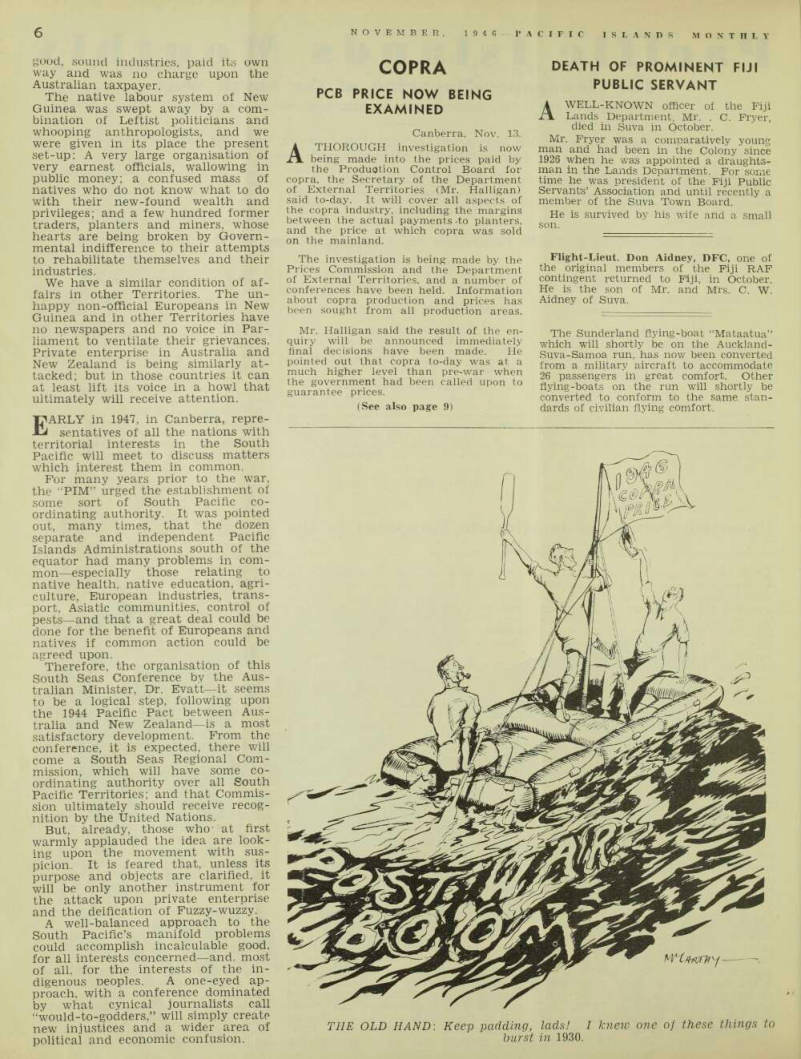
THE OLD HAND : Keep padding, lads! I knew one of these things to burst in 1930.
Copra
Pcb Price Now Being
Examined
Canberra, Nov. 13.
A THOROUGH investigation is now being made into the prices paid by the Production Control Board for copra, the Secretary of the Department of External Territories (Mr. Halligan) said to-day. It will cover all aspects of the copra industry, including the margins between the actual payments -to planters, and the price at which copra was sold on the mainland.
The investigation is being made by the Prices Commission and the Department of External Territories, and a number of conferences have been held. Information about copra production and prices has been sought from all production areas.
Mr. Halligan said the result of the en quiry will be announced immediately final decisions have been made. He pointed out that copra to-day was at a much higher level than pre-war when the government had been called upon to guarantee prices, (See also page 9)
Death Of Prominent Fiji
Public Servant
A WELL-KNOWN officer of the Fiji Lands Department, Mr. . C. Fryer, died in Suva in October.
Mr. Fryer was a comparatively young man and had been in the Colony since 1926 when he was appointed a draughts man in the Lands Department. For some time he was president of the Fiji Public Servants’ Association and until recently a member of the Suva Town Board.
He is survived by his wife and a small son.
Flight-Lieut, Don Aidney, DFC, one of the original members of the Fiji RAF contingent returned to Fiji, in October.
He is the son of Mr. and Mrs. C. W.
Aidney of Suva.
The Sunderland flying-boat “Mataatua” which will shortly be on the Auckland- Suva-Samoa run, has now been converted from a military aircraft to accommodate 26 passengers in great comfort. Other flying-boats on the run will shortly be converted to conform to the same stan dards of civilian flying comfort.
But Fares Are Very High
Two Air Services In Operation Across
The Pacific Now
fJTHERE are now two trans-Pacific air X services in full operation—one con ducted by Pan-American Airways, and the other by Australian National Airways Pty., Ltd., on behalf of the Aus tralian, New Zealand and British Gov ernments. Both companies use DC4 air craft—that is, Skymasters.
PAA’s present southern terminal is in Auckland; while ANA must take their passengers from Australia on' to Van couver. When the long-awaited reciprocal landing-rights agreement is finalised be tween Australia and the USA, PAA will extend their service to Sydney, and ANA will be permitted to land passengers at San Francisco, instead of overcarrying them to Canadian territory and then sending them back by air or land.
A PAA Skymaster was in Sydney on November 11 on a “proving flight” from San Francisco. On board were three officials of the American Civil Aeronau tics Authority, who will determine whether the conditions of flight meet with requirements.
If. they do, and when the Governments concerned agree on landing rights, then PAA will be prepared to extend their service to Australia immediately.
Recently, PAA’s San Francisco-Auck land service was increased and two flights each way now are being made every week.
ANA’s service leaves Sydney every alternate Sunday—that is, they are maintaining a fortnightly service.
Officers of the company are of the opinion that air traffic between Sydney and San Francisco does not warrant an increased service while fares remain at their present high level. This company originally intended to carry passengers for £l5O Australian, about 8 per cent, higher than However, the Australian Government stepped in and insisted that the fare be raised to £214.
It is believed that this is in order that the trans-Pacific service will not under cut the Sydney-London service, which is largely Government-owned. If ANA had been permitted to charge IISOA to San Francisco, travellers would have been able to fly to England via America at a smaller cost than by flying direct to London.
Freight rates are 4/- per pound «Syd ney-Suva; 17/6 per pound Sydney-Van couver.
Bookings on ANA’s service are not subject to any kind of priority and pas sengers can be accommodated at rela tively short notice.
PAN-AMERICAN are not permitted, as yet, to pick up or set down pas sengers in Fiji; but ANA can do this if necesary. However, no allocation of seats has, ‘as yet, been given to the Fiji office of the company, and passengers from Australia to Fiji can be accommo dated only when seats are not required for through passengers, or when a re servation has been made in respect of the Suva-Vancouver part of the journey.
Government-fixed Sydney-Suva fare is £ss—which compares with the £5l/10/fare charged on Qantas flying-boats which make the trip, via Noumea, once or twice a month. The Qantas flying boat journey takes two days; ANA’s Skymaster leaves Sydney on Sunday evening and is at Nadi (Fiji) at dawn on Monday morning—a matter of a few hours. A whole day is spent in Fiji and passengers, who usually have slept through the night, spent it sight-seeing,
while the crew sleeps. The whole trip to San Francisco takes three days. Thirty six passengers are carried, and a crew of 10.
The usual documents, such as a prop erly vised passport and taxation clear ances are required, and also a certifi cate confirming inoculation against smallpox within the last three years.
There appears to be some doubt as to why this certificate is necessary and it is believed to be on the insistence of the Fiji Government, as such a docu ment is not necessary for landing in Canada or the United States.
No certificate is necessary in Fiji for air-travellers via New Zealand from Australia; Noumea, which is an over night stop for Qantas, therefore appears to be the reason for this insistence. How ever, as the Skymasters of ANA go direct from Sydney to Nadi, Fiji, there appears to be an anomaly somewhere.
THE high fares, fixed by Governments whose cause is supposed to be that of the common man, has caused some bitter amusement among would-be air travellers.
It will be interesting to watch devel opments in the next year or so when the large pool of frantic travellers, which accumulated in the war years, has been drained and travel is back to normal.
It seems unlikely that people wishing to travel between America and Austral asia will be so numerous that they will support three air services (Canada is to enter the field at some later date) whose fares are over £2OO for a three-day trip.
In the meantime, we can assimilate the fact that a Government monopoly is just as vicious as any other kind of mono poly.
Australian Territories
Native Labour Laws In the Australian Territories
AUSTRALIAN newspapers, in October, announced “sweeping changes in the conditions of employment of natives in Papua and New Guinea”; but the occasion was only the issue by the Ex ternal Territories Department of the Ordinances governing native labour.
The “sweeping changes” were devised and put into operation a year ago; but, up to date, no one has been able to obtain a copy of the regulations which authorise and govern the changes.
The ordinances are not yet available at the Sydney office, but we understand that printed copies can be obtained from Can berra. Territorian employers have been seeking copies for months.
The newspapers set out the “sweeping changes” in detail. They already are more than familiar to Territorians. They include the following: Elimination of professional recruiters and engagement of natives by employers personally.
Increase in wages from 5/- a month in New Guinea and 10/- a month in Papua to 15/- a month.
A scientifically-balanced diet for native labourers.
Reduction in hours of work from 55 a week in New Guinea and 50 in Papua to 44 a week.
Raising of the minimum age at which a native may be employed to 16. Formerly it was 14, with authority for employment in domestic ser vice from 12 years.
Abolition of indentures of native women.
Limitation of the period of indenture to 12 months. Re-engagement will not be permitted until the native has been returned to his home village for three months.
Flight-Lieut. E. E. Nicholls recently returned to Fiji from duty in England.
He has resumed work with the CSR Co., at Lautoka. His wife and son are still held up in Rhodesia through transport difficulties.
Sailing On Ss "Morinda"
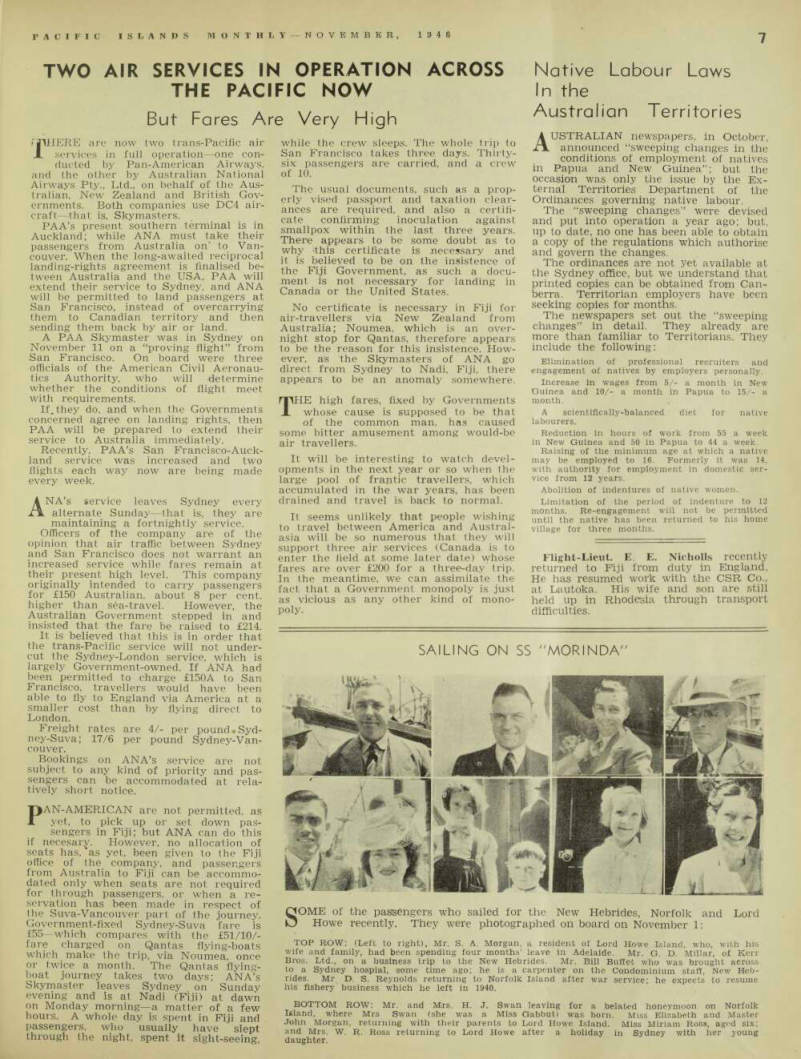
SOME of the passengers who sailed for the New Hebrides, Norfolk and Lord Howe recently. They were photographed on board on November 1: TOP ROW: (Left to right), Mr. S. A. Morgan, a resident of Lord Howe Island, who, with his wife and family, had been spending four months’ leave in Adelaide. Mr. G. D. Millar, of Kerr Bros. Ltd., on a business trip to the New Hebrides. Mr. Bill Buffet who was brought across to a Sydney hospial, some time ago; he is a carpenter on the Condominium staff, New Heb rides. Mr D. S. Reynolds returning to Norfolk Island after war service; he expects to resume his fishery business which he left in 1940.
BOTTOM ROW: Mr. and Mrs. H. J. Swan leaving for a belated honeymoon on Norfolk Island, where Mrs Swan (she was a Miss Gabbut) was born. Miss Elizabeth and Master John Morgan, returning with their parents to Lord Howe Island. Miss Miriam Ross, aged six; and Mrs. W. R. Ross returning to Lord Howe after a holiday in Sydney with her young daughter.
New Copra Export Tax May Cripple
G.& E. Colony And Solomons Penalised
New Copra Export Tax May Cripple Rehabilitation Plans
BY recent proclamation, the High Com misioner for the Western Pacific (Sir Alexander Grantham, in Suva) an nounced that the export tax on copra had been raised in two of his Territories—to 25 per cent, ad valorem in the Gilbert &' Ellice Islands, and to 15 per cent, ad valorem in the British Solomons.
The value of the copra is to be assessed from time to time by the Resident Com missioners in those places.
This ha's come as a shock to the big companies which were planning to use the present high prices of copra in the rehab ilitation of shipping and trading services in those Groups.
Both the G. E. Colony and the Sol omons were badly hit by the war. The big shippers, traders and planters lost nearly everything. Copra is the only in dustry in both Territories. Obviously, in view of future uncertainties, private enterprise is not going to spend heavily upon re-establishment unless it is encouraged to do so.
The extraordinary action of the High Commissioner in thus penalising private enterprise, at a critical time, probably will be accepted as proof of the widely held belief that the British Colonial Office, under the influence of the new' Socialism, does not want private enterprise back in either the G & E Colony or the Solomons.
The big companies, after their experi ences at the hands of Wardist Socialism in New Guinea, may be expected to see only one policy in the High Commis sioner’s proclamations. The British authority evidently believes that the Administrations of the G. & E. Colony and Solomons can provide those Groups with Government-owned trading and transport facilities, pending the training of natives to take the places of the Europeans.
In protesting to the High Commissioner against this crippling tax, Messrs. Burns Philp & Co. Ltd., made this strong point: “The main object of the present high prices for copra paid by the British Government and other nations is that
they should assist in the rehabilitation of trading and plantation production.”
It is pointed out that copra is a valuable foodstuff, in great demand all over the world, and taxation should be designed to encourage its production.
Fiji Progress
Governor Outlines Impressive Programme
Prom Our Own Correspondent
Suva, Nov. 1.
rE eighth Session of this Council, and the sixth in Sir Alexander Gran tham’s term commenced with full ceremonial at 10 a.m. to-day.
The opening was well-staged and deeply impressive. Pageantry on important oc casions does us all good. mere was colour, outside, with the guard of honour from the Fiji Police Force, in their blue tunics and snow white sulus, qnd the reorganized band of the Fiji Military Forces, resplendent in meir scarlet tunics and equally spotless sulus. The bearing of all these attractive Fijians was superb. inside me dignified Council Chamber, the scene was bright with the scarlet rooes ui ine cnlei Justice (Sir Claud Seton ivx.CJ and the Puisne Judge (Mr. Justice Thomson), the glitter of silver and gold braid on the uniforms of many of the official members, and the frocks of the ladies. The gallery was packed.
Before the Governor addressed the Council, he presented the King’s Police Medal to Mr. I. E. Lucchinelli, Deputy Commissioner of Police, who is Known to the law-abiding public as a keen and needle-snarp officer.
Highlights from His Excelleny’s address were: The Colony’s Ten-Years Development Plan is to cost £4,500,000 —maybe more.
The Imperial Government is finding £1,000,000 sterling of this, and the financ ing of the balance will fully tax our re sources.
The Suva medical centre and hospital project, once estimated to cost a good round million in Fiji currency, is in the balance again. The whole proposal is oemg re-examined with the idea that it might be possible to expand the existing Colonial War Memorial Hospital on an adjacent site at considerably lower cost.
“The existing equipment of the Public Works Department is inadequate for the work they have to do at present.” It ap pears essential for the Department to pur chase a considerable amount of new plant otherwise the number of large projects already planned cannot be tackled.
For next year, the basis of taxation will not be altered.
The following were the estimates for 1946, and how they worked out; Approved Revenue £1.572,901 • Expenditure £1,645,504 Deficit £72,603 Revised Revenue £1.976,941 Expenditure £1,949,447 Surplus £27,494
rpHE principal windfalls were a customs JL increase of £150,000 and £54,000 more from income tax and trading licenses than was budgeted for.
For 1947, a surplus of £73,439 is bud geted for. Revenue is put at £1,847,702 and expenditure at £1,774,263.
The Redemption Loan of £530,000 at 31 per cent., floated locally a few months ago, flopped badly. “Only £219,200 was sub scribed, leaving £310,800 in the hands of the underwriters,” said His Excellency.
The balance will have to be raised in Lon don.
In relation to Public Service salaries revision, the Committee voted rises all round to civil servants and the abolition of the senior and junior divisions Government support is to be gradually withdrawn from mission schools, and all lay teachers are to be Government ser vants.
Indians are to have the same rights re garding alcoholic liquor as Europeans and Chinese —Fijian natives are to remain prohibited.
Continued on page 75)
Definition of Native Lands Reserves is to be speeded up.
The Governer’s speech covered prob ably the widest field of many years and showed that the Administration is on its toes. Its popular reception was excellent.
Financial Statement rE Government had no need to worry about vote-catching when it produced its Budget. So its cheerful optimism was related only to its estimate of the facts and the scope of its imaginative ability.
There have been the usual critics of the official financial hopes for 1947. Those critics are only backing their own guess work, and they have not much data to work on. Still, life would be quiet here if no one were prepared to take up the cudgels for the taxpayer.
“Once again the amount to be approp riated is a record figure; we are now ap proaching the £2,000.000 mark both in rev enue and expenditure,” said the Acting Financial Secretary (Mr. P. H. Nightin gale) when moving the second reading of the Appropriation Bill at yesterday’s Leg islative Council. The estimated expend iture is £1,774,263 for the Calendar year 1947.
Points from the Acting Financial Sec retary’s statement are; £25.000 was provided to cover the cost of sending Fiji’s Victory Contingent to London, on the assumption that Fiji would bear the full cost-of return passages.
This responsibility was, however taken over by the Imperial Treasury, and the cost to Fiji therefore may not exceed £9.000. , .
Total expenditure on defence and the
Fiji Military Forces between 1942 and 1945, amounted to £4,263,259. Recoveries under various heads were £398,596, so net expen diture was £3,864,663. Of this amount the Colony, from its own revenues, sup plied £1,562,816. The balance, £2,301,847, is owed to Britain. To this debt is added £768,270, deferred settlement claims due to New Zealand, The Public Debt is nearly £1,140,000, on which interest and sinking fund contrib utions come to £89,000.
Expenditure on salaries and allowances, including cost of living bonus, will total approximately £519,000 —£41,000 more than 1946. This covers an establishment of 1,990 officers as compared with 1,843 in 1946 an increase of 147. This increase is mainly in Agricultural. Education. Medical and Works Departments.
An analysis of exnenditure of 1946 and 1947 under the five headings of Personal Emoluments, Departmental Charges (Other Charges), Special Expenditure (including Defence), Charges on account of Public Debt, and Pensions is interest ing:
Economic controls are now reduced to Imports, and Prices. Subsidies on flour and sharps will continue. It has again been necessary to provide a token vote of £55,000 to cover Fiji’s share of the met eorological services operating in this area until the position regarding Pacific air services is clearer.
Mr. “Scotty" McEwan, baker, of Lae, New Guinea, who was so badly Injured on September 2 when a guria 'shook his new oven down on ton of him (he was making adjustments underneath it at the time) is still in the Scottish Hospital, Sydney. His health and spirits are good, and he can receive visitors; but it is not possible yet to assess the amount of permanent damage done by the accident.
1946 1947 (In thous.) £ £ Personal Emoluments .. .. 478 519 Departmental Charges . .. 683 719 Special Expenditure ... 293 363 Public Debt 108 89 Pensions 83 84 Totals £1,645 £1,774
Air Travellers To N. Guinea
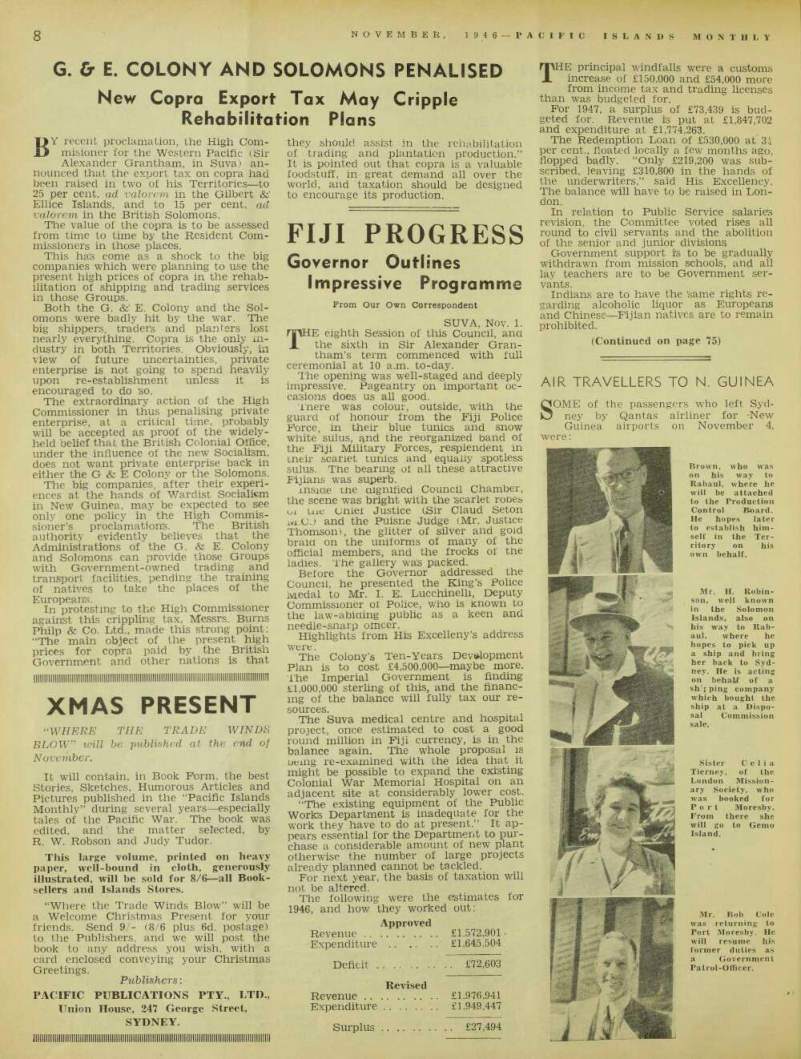
SOME of the passengers who left Syd ney by Qantas airliner for -New Guinea airports on November 4, were:
Brown, who was on his way to Rabaul, where he will be attached to the Production Control Board.
He hopes later to establish him self in the Ter ritory on his own behalf.
Mr. H. Robin son, well known in the Solomon Islands, also on his way to Rab aul, where he hopes to pick up a ship and bring her back to Syd ney. He is acting on behalf of a shipping company which bought the ship at a Dispo sal Commission sale.
Sister Celia Tierney, of the London Mission ary Society, who was booked for Port Moresby.
From there she will go to Gemo Island.
Mr. Bob Cole was returning to Port Moresby. He will resume his former duties as a Government Patrol-Officer.
Advertisements & other items, p. 10 (1 item)
Xmas Present
“WHERE THE TRADE WINDti
BLOW” xoill he published at the end of November.
It will contain, in Book Form, the best Stories, Sketches, Humorous Articles and Pictures published in the “Pacific Islands Monthly” during several years—especially tales of the Pacific War. The book was edited, and the matter selected, by R. W. Robson and Judy Tudor.
This large volume, printed on heavy paper, well-bound in cloth, generously illustrated, will be sold for 8/6—all Booksellers and Islands Stores.
“Where the Trade Winds Blow” will be a Welcome Christmas Present for your friends. Send 9/- (8 6 plus 6d. postage) to the Publishers, and we will post the book to any address you wish, with a card enclosed conveying your Christmas Greetings.
Publishers ;
PACIFIC PUBLICATIONS PTY., LTD.,
Union House, 247 George Street,
SYDNEY.
Copra Price Up
Again
Ministry of Food Increases for Fiji but New Guinea Price Remains Lowest in the World
THE British Ministry of Food has noti fied the Fiji Government that from September 29, 1946, it will pay £2/18/6 (F) more per ton for Fiji copra.
This brings the price of copra in the Colony, up to £26/9/- per ton for planta tion grade, and £26/3/6 for FMS grade, delivered to Suva or Levaku. In Aus tralian currency this is euivalent to £29/9/- for FMS.
In New Guinea, planters are still receiving £22/10/- (Australian) per ton on the beach, from the Production Con trol Board.
Presumably the discrepancy is to be explained by PCB handling charges. But even in New Guinea, with its inflated charges and fantastic shipping facilities, transport and handling between planta tion and shioping port can scarcely be reckoned at £7 ner ton.
Where, then, does the extra PCB profit go? PCB price is at least £5 below world parity.
We have repeatedly asked responsible Australian officials why this anomaly is permitted, and how long it will continue; but we got either an evasive answer, or no answer at all.* The Department would be making nor mally, thousands of pounds upon the copra thus taken from growers and sold overseas —but it isn’t, simply because the Territ ories planters are so beset by lack of lab onr and other handicaps that they can produce little copra.
If there had been anything like normal production upon Territories plantations, it might have been necessary to appeal to the Australian Parliament to force the Department to revise the PCB’s copra price. As it is, Canberra has got private enterprise and industry in the Territories into such a condition of chaos and depres sion that the rates allowed for produce are scarcely worth worrying about.
Outlook For Rubber
Papuan planters are doing better with rubber. Those places which still have a labour line are getting high prices for their product. But Australian merchants take a gloomy view of rubber’s future.
The continued production of synthetic, perfected during the war, is helping to meet a huge market; the production of natural rubber is increasing every month; and some people believe that, before 1947 is ended, rubber prices will be back to pre-1939 levels. *As we go to press, it is announced from Canberra that the PCB price is now being “thoroughly investigated.” (See page (5.)
Tonga, Too
Copra Price Rise in Tonga, Too
From Our Own Correspondent
Nukualofa, Oct. 10.
THE Tonga Copra Board has raised the local buying price of copra to £26 per ton (Australian) for A grade copra and £2l per ton for B grade. These prices came into force on October 7.
With the increased prices and the pre sent sunny dry weather which is favour able for coora making, it is expected that copra production will be increased con siderably in the near future.
Editorial note: That price is still well under world parity. Who gets the profit?
The Government of Tonga, apparently— must have been receiving instruction at Canberra!
Col J. K. Murray
Administrator of Papua-New Guinea for Another Year
IT was officially announced on October 28, by the Australian Minister for Territories (Mr. Ward) that the ap pointment of the Administrator of Papua-New Guinea (Colonel J. K. Mur ray) had been extended for twelve months.
The whole official set-up, in relation to the Australian Territory of Papua and the Mandated Territory of New Guinea, is a little difficult for ordinary people to understand.
When the Japs invaded in January, 1942, the civil administrations of both Territories were suspended and the Ter ritories passed into the charge of the Australian Army. The latter, in due course, created the Australian New Guinea Administrative Unit (ANGAU) to take care of administration. In 1945-46, as the Japs were driven out, the Army, step by step, surrendered its ANGAU re sponsibility to the Papua-New Guinea Provisional Administration, which had been set up by the Australian Govern ment under National Emergency and other war-time powers, to re-establish civil government.
Pacific Ships Held Up
THE liner “Duntroon,” carrying “Dis posals tourists”- to Rabaul and other sales, was the first big ship to sail from Sydney to New Guinea for several weeks.
The “Montoro,” having returned from her September-October trip, was held in Sydney Harbour for weeks by industrial troubles. She was still there on the 13th.
The “Malaita,” whose advent has been eagerly awaited for months, is still under repair in the strike-ridden Sydney dock yards.
No one has understood why the Aus tralian Government, instead of restoring the old Administrations (all the mach inery of which was in existence) created a new temporary organisation to admin ister the two Territories as one unit.
This procedure involved Australia in enormous expense.
Colonel Murray was appointed Admin istrator in September, 1945, for one year, and his Papua-New Guinea Provisional Administration began to function at the end of October.
As the war-time powers under which the Act creating the Provisional Admin istration expire at the end of 1946, it will be necessary—if the Provisional Admin istration Is to continue —for the Aus tralian Parliament to pass another Act, giving the Administration authority to continue in 1947. This will be done in the Parliament which assembles in Can berra this month.
It is assumed that Colonel J. K. Mur ray and the present Papua-New Guinea Administration will continue to function until the Trusteeship division of the United Nations has decided upon the fate of the various Territories governed by mandate from the League of Nations —of which New Guinea is one. After that, it will be seen whether Papua and New Guinea will continue as one Ad ministration, or whether the two sep arate Administrations will be restored.
In the latter event, according to an undertaking given by the Australian Government, Mr. Leonard Murray will return to the Administratorship of Papua for, at least, the unexpired por tion of his prewar appointment as Ad ministrator.
Fiji Scholarship
THE winner of the Morris, Hedstrom (Fiji) University Scholarship for 1947 is Charles Walker, aged 18, of the Marist Brothers School, Suva. He will go to Auckland University to study science in the hope of becoming a lab oratory technician attached to the Medi cal or Agricultural Departments of Fiji.
Gifts For Britain
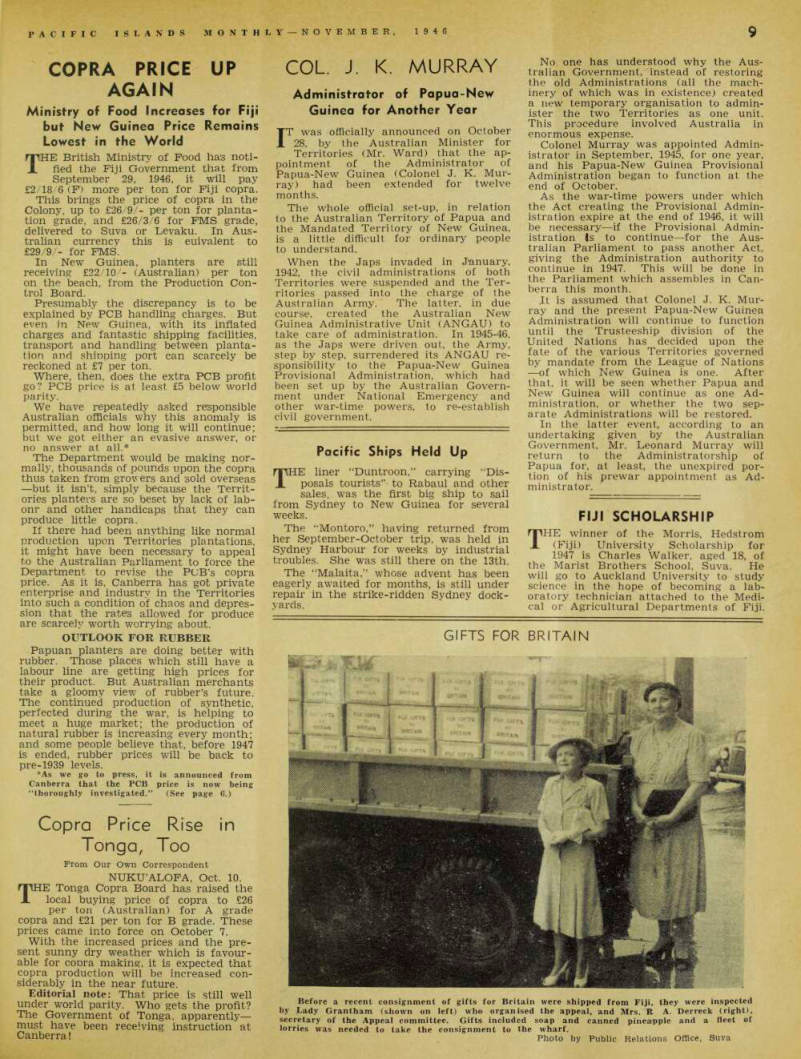
Before a recent consignment of gifts for Britain were shipped from Fiji, they were inspected by Lady Grantham (shown on left) who organised the appeal, and Mrs. R A. Derreck (right), secretary of the Appeal committee. Gifts included soap and canned pineapple and a fleet of lorries was needed to take the consignment to the wharf.
Photo by Public Relations Office, Suva
Prison System
Gaol Escapees Destroy Rarotonga's
Biggest Store
Extraordinary Crime Wave and Farcical Prison System
From Our Own Correspondent
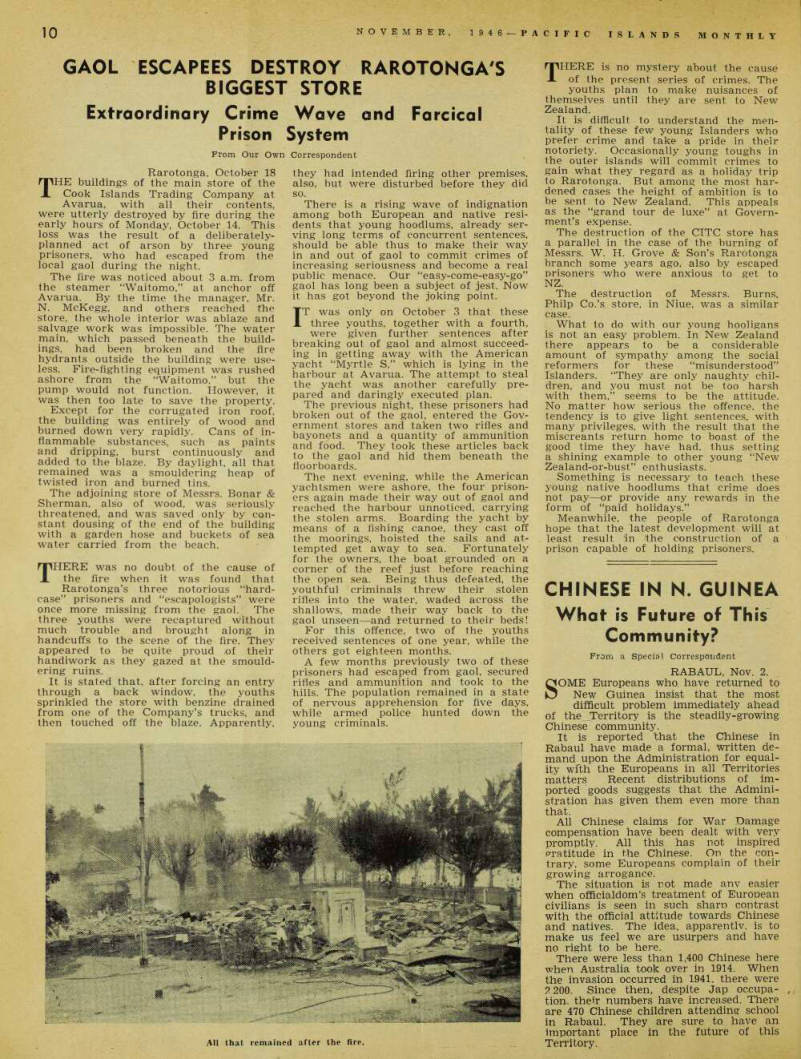
Rarotonga, October 18 THE buildings of the main store of the Cook Islands Trading Company at Avarua, with all their contents, were utterly destroyed by fire during the early hours of Monday, October 14. This loss was the result of a deliberatelyplanned act of arson by three young prisoners, who had escaped from the local gaol during the night.
The fire was noticed about 3 a.m. from the steamer “Waitomo,” at anchor off Avarua. By the time the manager, Mr.
N. McKegg, and others reached the store, the whole interior was ablaze and salvage work was impossible. The water E" n - h W a d C Ven SS hr„k b P e n nea inri th .h P bU flV d ; mgS, nad boon brokon and tho firo hydrants outside the building were usei e shore Fir frnm ht ;!; 8 e 3“ ip !? ent a ?, r t usl ad 17. ™ the "Waitomo; but the n l ot , function. However it ™' h ‘°° ate t 0 save , ‘ he . Property.
E x cePt £ or the corrugated iron root hnrnoH 1 entl roJ y of wood and fc d^° Wn u e + y rapidly - Cans of msul3s^ anc f s > su £ h as Paints tan d r ip P* ng ’ burs t> eoimnuouriy and added to the blaze. By daylight, all that t«^fl^ ed r.ry WaS smoa l dering hea P of T>u od iron and burned tms. er,^ 8 adjoining store of Messrs. Bonar & Sherman, also of wood, was seriously threatened, and was saved only by constant dousing of the end of the building with a garden hose and buckets of sea water earned from the beach. mHERE was no doubt of the cause of X the fire when it was found that Rarotonga’s three notorious “hardcase” prisoners and “escapologists” were once more missing from the gaol. The three youths were recaptured without much trouble and brought along in handcuffs to the scene of the fire. They appeared to be quite proud of their handiwork as they gazed at the smouldering ruins.
It is stated that, after forcing an entry through a back window, the youths sprinkled the store with benzine drained from one of the Company’s trucks, and then touched off the blaze. Apparently,
they had intended firing other premises, also, but were disturbed before they did so.
There is a rising wave of indignation among both European and native resi dents that young hoodlums, already ser ving long terms of concurrent sentences, should be able thus to make their way in and out of gaol to commit crimes of increasing seriousness and become a real public menace. Our “easy-come-easy-go” gaol has long been a subject of jest. Now it has got beyond the joking point.
T-p was on iy on October 3 that these I th vmiths tnc?Pthpr with a fourth A ree ’ further sentences after breaking out of gaol almost succeed ;np - in p'pftinp’ pwpiv with thp Ampriran yacht “Mvrtle Ivinein the harbour at Avaraa. The attempt to steal th ht was another ca refully pre / and daringly executed plan, The previous nig ht, these prisoners had brok en out of the gaol, entered the Gov ernment stores and taken two rifles and bayonets and a quantity of ammunition and f ood . They took these articles back to the gaol and hid them beneath the floorboards.
The next even i ng) while the American yachtsmen were ashore, the four prison ers aga i n made their way out of gaol and reached the harbour unnoticed, carrying the stolen arms. Boarding the yacht by means of a fishing canoe, they cast off the moorings, hoisted the sails and at tempted get away to sea. Fortunately for the owners, the boat grounded on a corner of the reef just before reaching the open sea. Being thus defeated, the youthful criminals threw their stolen rifles into the water, waded across the shallows, made their way back to the gaol unseen—and returned to their beds!
For this offence, two of the youths received sentences of one year, while the others got eighteen months, A few months previously two of these prisoners had escaped from gaol, secured rifles and ammunition and took to the hills. The population remained in a state of nervous apprehension for five days, while armed police hunted down the young criminals.
THERE is no mystery about the cause of the present series of crimes. The youths plan to make nuisances of themselves until they are sent to New Zealand.
It is difficult to understand the men tality of these few young Islanders who prefer crime and take a pride in their notoriety. Occasionally young toughs in the outer islands will commit crimes to gain what they regard as a holiday trip to Rarotonga. But among the most har dened cases the height of ambition is to be sent to New Zealand. This appeals as the “grand tour de luxe” at Govern ment’s expense.
The destruction of the CITC store has a parallel in the case of the burning of Messrs. W. H. Grove & Son’s Rarotonga branch some years ago, also by escaped prisoners who were anxious to get to NZ.
The destruction of Messrs. Burns, Philp Co.’s store, in Niue, was a similar case.
What to do with our young hooligans is not an easy problem. In New Zealand there appears to be a considerable amount of sympathy among the social reformers for these “misunderstood”
Islanders. “They are only naughty chil dren, and you must not be too harsh with them,” seems to be the attitude.
No matter how serious the offence, the tendency is to give light sentences, with many privileges, with the result that the miscreants return home to boast of the good time they have had, thus setting a shining example to other young “New Zealand-or-bust” enthusiasts.
Something is necessary to teach these young native hoodlums that crime does not pay—or provide any rewards in the form of “paid holidays.”
Meanwhile, the people of Rarotonga hope that the latest development will at least result in the construction of a prison capable of holding prisoners.
All that remained after the fire.
Community?
Chinese In N. Guinea
What is Future of This Community?
From a Special Correspondent
Rabaul, Nov. 2.
SOME Europeans who. have returned to New Guinea insist that the most difficult problem immediately ahead of the Territory is the steadily-growing Chinese community.
It is reported that the Chinese in Rabaul have made a formal, written de mand upon the Administration for equal ity with the Europeans in all Territories matters Recent distributions of im ported goods suggests that the Admini stration has given them even more than that.
All Chinese claims for War Damage compensation have been dealt with very promptly. All this has not inspired pratitude in the Chinese. On the con trary, some Europeans complain of their growing arrogance.
The situation is not made anv easier when officialdom’s treatment of European civilians is seen in such sham contrast with the official attitude towards Chinese and natives. The idea, apparently, is to make us feel we are usurpers and have no right to be here.
There were less than 1,400 Chinese here when Australia took over in 1914. When the invasion occurred in 1941. there were 2 200. Since then, despite Jap occupa tion. their numbers have increased. There are 470 Chinese children attending school in Rabaul. They are sure to have an important place in the future of this Territory.
Wrc "Rabaul"
Handsome 10,000-Tonner Inaugurates New Round-Pacific Service
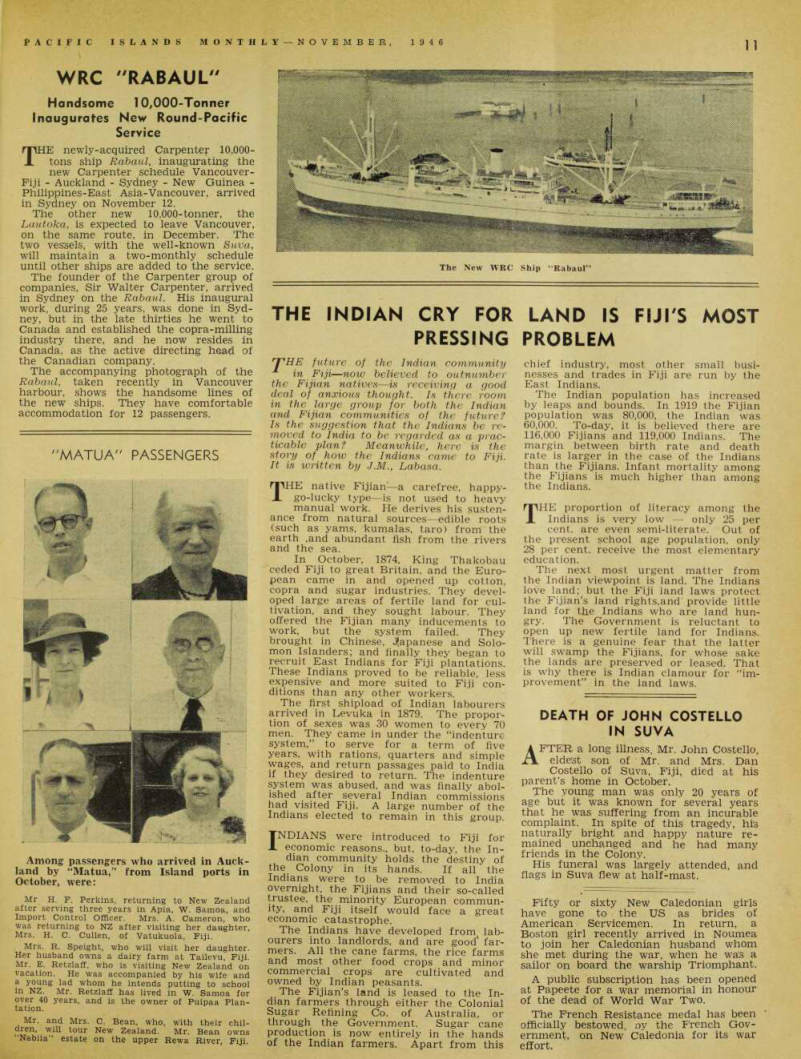
THE newly-acquired Carpenter 10,000tons ship Rabaul, inaugurating the new Carpenter schedule Vancouver - Fiji - Auckland - Sydney - New Guinea - Philippines-East Asia-Vancouver, arrived in Sydney on November 12.
The other new 10,000-tonner, the Lautoka, is expected to leave Vancouver, on the same route, in December. The two vessels, with the well-known Suva, will maintain a two-monthly schedule until other ships are added to the service.
The founder of the Carpenter group of companies, Sir Walter Carpenter, arrived in Sydney on the Rabaul. His inaugural work, during 25 years, was done in Syd ney, but in the late thirties he went to Canada and established the copra-milling industry there, and he now resides in Canada, as the active directing head of the Canadian company.
The accompanying photograph of the Rabaul, taken recently in Vancouver harbour, shows the handsome lines of the new ships. They have comfortable accommodation for 12 passengers.
The New WRC Ship “Rabaul”
"Matua" Passengers
Among passengers who arrived in Auck land by “Matua,” from Island ports in
October, were:
Mr H. P. Perkins, returning to New Zealand after serving three years in Apia, W. Samoa, and Import Control Officer. Mrs. A. Cameron, who was returning to NZ after visiting her daughter, Mrs. H. C. Cullen, of Vatukuola, Fiji.
Mrs. R. Speight, who will visit her daughter.
Her husband owns a dairy farm at Tailevu, Fiji.
Mr, E. Retzlaff, who is visiting New Zealand on vacation. He was accompanied by his wife and a young lad whom he intends putting to school in NZ. Mr. Retzlaff has lived in W. Samoa for over 40 years, and is the owner of Puipaa Plan tation.
Mr. and Mrs. C. Bean, who, with their chil dren, will tour New Zealand. Mr. Bean owns “Nabiia” estate on the upper Rewa River, Fiji.
Pressing Problem
THE INDIAN CRY FOR LAND IS FIJI'S MOST
r THE future of the Indian community in Fiji—now believed to outnumber the Fijian natives —is receiving a good deal of anxious thought. Is there room in the large group for both the Indian and Fijian communities of the future?
Is the suggestion that the Indians be re moved to India to be regarded as a prac ticable plan? Meanwhile, here is the story of how the Indians came to Fiji.
It is written by J.M., Labasa.
THE native Fijian—a carefree, happy go-lucky type—is not used to heavy manual work. He derives his susten ance from natural sources—edible roots (such as yams, kumalas, taro) from the earth ,and abundant fish from the rivers and the sea.
In October, 1874, King Thakobau ceded Fiji to great Britain, and the Euro pean came in and opened up cotton, copra and sugar industries. They devel oped large areas of fertile land for cul tivation, and they sought labour. They offered the Fijian many inducements to work, but the system failed. They brought in Chinese, Japanese and Solo mon Islanders; and finally they began to recruit East Indians for Fiji plantations.
These Indians proved to be reliable, less expensive and more suited to Fiji con ditions than any other workers.
The first shipload of Indian labourers arrived in Levuka in 1879. The propor tion of sexes was 30 women to every 70 men. They came in under the “indenture system,” to serve for a term of five years, with rations, quarters and simple wages, and return passages paid to India if they desired to return. The indenture system was abused, and was finally abol ished after several Indian commissions had visited Fiji. A large number of the Indians elected to remain in this group.
INDIANS were introduced to Fiji for economic reasons., but, to-day, the In dian community holds the destiny of the Colony in its hands. If all the Indians were to be removed to India overnight, the Fijians and their so-called trustee, the minority European commun ity, and Fiji itself would face a great economic catastrophe.
The Indians have developed from lab ourers into landlords, and are good* far mers. All the cane farms, the rice farms and most other food crops and minor commercial crops are cultivated and owned by Indian peasants.
The Fijian’s land is leased to the In dian farmers through either the Colonial Sugar Refining Co. of Australia, or through the Government. Sugar cane production is now entirely in the hands of the Indian farmers. Apart from this
chief industry, most other small busi nesses and trades in Fiji are run by the East Indians.
The Indian population has increased by leaps and bounds. In 1919 the Fijian population was 80,000, the Indian was 60,000. To-day, it is believed there are 116,000 Fijians and 119,000 Indians. The margin between birth rate and death rate is larger in the case of the Indians than the Fijians. Infant mortality among the Fijians is much higher than among the Indians.
THE proportion of literacy among the Indians is very low only 25 per cent, are even semi-literate. Out of the present school age population, only 28 per cent, receive the most elementary education.
The next most urgent matter from the Indian viewpoint is land. The Indians love land; but the Fiji land laws protect the Fijian’s land rights,and provide little land for the Indians who are land hun gry. The Government is reluctant to open up new fertile land for Indians.
There is a genuine fear that the latter will swamp the Fijians, for whose sake the lands are preserved or leased. That is why there is Indian clamour for “im provement” in the land laws.
Death Of John Costello
In Suva
AFTER a long illness, Mr. John Costello, eldest son of Mr. and Mrs. Dan Costello of Suva, Fiji, died at his parent’s home in October.
The young man was only 20 years of age but it was known for several years that he was suffering from an incurable complaint. In spite of this tragedy, hi's naturally bright and happy nature re mained unchanged and he had many friends in the Colony.
His funeral was largely attended, and flags in Suva flew at half-mast.
Fifty or sixty New Caledonian girls have gone to the US as brides of American Servicemen. In return, a Boston girl recently arrived in Noumea to join her Caledonian husband whom she met during the war, when he was a sailor on board the warship Triomphant, A public subscription has been opened at Papeete for a war memorial in honour of the dead of World War Two.
The French Resistance medal has been officially bestowed, oy the French Gov ernment, on New Caledonia for its war effort.
Important
Fiji Civil Service
Conditions
Important Recommendations
From Our Own Correspondent Suva, November 7.
THE Fiji Government now has before it the report and recommendations of the Committee set up in Decem ber, 1944, to examine the terms and con ditions of the Civil Service of Fiji. If the recommendations are given effect to, a number of changes will be introduced and a general rise in salaries (to cost £27,252 immediately, plus another £72,443 later on) will take place.
Although the report has just been pub lished, the recommendations h&ve been common knowldge, and the subject of highly confidential discussion in Govern ment circles, for months past.
As at January 1, 1946, we had a total of 1367 on our Government payroll, made up as follows: Senior Division .. .. 154 Junoir Division .. .. 1213 1367 These people were divided racially as follows: Europeans and part-Europeans .. 552 Fijians and other Islanders .. .. 545 Indians 181 Vacant posts 89 1367 Of the above, 77 officers were recruited from the United Kingdom—73 of them being in the Senior Division.
Some of the recommendations for making “an efficient and contented Ser vice” are: • The removal of racial discrimina tion. • The abolition of the Senior and Junior Divisions. • Pay to vary with responsibility. • Equal pay for equal work by men or women. • An ultimate objective of filling all posts locally. • Free quarters to be abolished. • Promotion to go by (1) efficiency; (2) suitability, and (3) seniority.
If comparisons are odious, what will be the reaction by Government servants in Pacific territories and elsewhere to the following specimen salary recom mendations?
Accountant, General, from £950 (plus quarters) p.a. to £1,200.
Assistant Accountant, from £525-£6OO (plus quarters), p.a. to £6OO-£B4O.
Director of Agriculture, Jfrom £l,lOO (plus quarters) p.a. to £1,450.
Auditor, from £9OO (plus quarters) p.a. to £1,200.
Controller of Customs, from £1,050 (plus quarters) p.a. to £1,300.
Harbour Master, from £650 .(plus quar ters) p.a. to £720.
Junior Division
MR. H. E. SNELL, General Manager of Morris, Hedstrom, Limited, and once an officer in the Service him self, reported on the Junior Division of the Service in February, 1944, and his report was included in the Council Paper.
Mr. Snell really got to work on the Juniors —and on Government, too. His comments and criticisms were outstand ingly brilliant: his method and language must have swept through the Secretariat like a tornado. He promised to say harsh things; he certainly did.
He observed in the Junior Service “a serious amount of discontent and ineffi ciency.” Some of the causes: pay in adequate to meet the rise of prices; cli
(Continued on page 71)
mate; lack of interest in (junior officers’) work contributed to by the absence of consistent and forward-loking policies of Government accentuated by the failure of Heads of Departments to enforce dis cipline; and resentment at the recom mendations of the earlier Barton Report.
In covering his subject in great detail, Mr. Snell emphasised many deficiencies and many injustices, was generous in his praise where he found cause to praise, and made a series of wide recommenda tions which, if adopted, should not only remove much discontent from among junior officers but give the Colony a body of efficient junior civil servants.
The Government is no doubt grateful for this brilliant criticism of so import ant a branch of its administration. Why could it not have made such an analysis itself? Is its failure proof of its own inefficiency?
THE general reaction to the Commit tee’s recommendations is that its majority membership of government servants have done themselves well. The average Government servant here rarely conveys the impression either that he is outstandingly capable or that he is greatly overburdened either with work or the desire to be a model of efficiency.
If this is tifiie, then perhaps some reason for it is to be found in Mr. Snell’s words of February, 1944: “The lack of clarity and consistency in the expression of policy in London and from the local Government House has its effects on the heads of depart ments who are uncertain in many cases what Government policy is or in other cases what general expectation there is of funds to support a policy. If a head of department is not interested in his work, he is hardly likely to inspire in terest in his subordinate, yet without that interest the subordinates’ work is likely to be poor.”
Previous to this Mr. Snell reported: “. . . But it is clear that in the Service at the present time many other officers are not working as efficiently or as steadily as they could.”
Leaving aside the question of cost, will the new salary scales and other proposed new conditions give us a more efficient Civil Service? Money in itself matters little —it is the spirit and a man’s innate ability which are all-important.
The Australian Taxpayer Pays For This
WHEN I was northward bound in Sep tember, I was accorded, in Port Moresby, an interview with Mr. L.
Brumby, of the Commonwealth Disposals Commission.
Mr. Brumby is reported to be a Mel bourne business man, who has devoted several years, gratis, to the Common wealth Government in order to help rid it of war’s white elephants.
It was said in the Territory that he had arrived there to clean up the chaos created by former officers of the Com mission. That, however, may be just one of the current exaggerations that Territorians invent to beguile the tedious weeks and months of rehabilitation.
Mr. Brumby is one of those gentlemen who smile easily with their facial muscles, but not with their eyes. He also has a ready answer to most stock ques tions. The interview lasted 30 minutes; for 29 of them Mr. Brumby spoke and, where he looked like faltering, he was prompted by his confidential secretary, Miss Mitchell. This state of affairs may simply be the outcome of my being nat urally an inarticulate creature.
On the other hand, I came away from that interview feeling that I had been “blinded with science,” and with the notion that I should thenceforth believe that everything the CDC had done, was doing, and would do, was sound, logical, fair and of inestimable benefit to the Australian taxpayer and the returned New Guinea resident alike.
Therefore, my reactions to what I saw and heard of CDC activities further north, were in spite of Mr. Brumby, not because of him. They sprang from the fact that I was an Australian taxpayer and a buyer of Australian war bonds, rather than from sympathy for Terri torians.
TECHNICALLY, Territorians have no more claim to material left behind in New Guinea by the receding tide of war than have Australians. It is, however, simple commonsense that the goods already in the country should be available for rehabilitation purposes. In relation to the colossal of mat erial that originally was available in the New Guinea territories, the wants of the residents could scarcely make any im pression upon it. Every facility and as sistance should therefore have been given to them to purchase what they
wished from these pools —and if not be cause of commonsense, then because of promises made to this effect by Prime Minister Chifley and External Terri tories’ Minister Ward.
CDC says that these facilities were made available. Residents say that they have been frustrated at every turn, have had to locate what they needed in the jungle, while Southern buyers have been taken on conducted tours, and have met nothing but shilly-shally and indecision from local salesmen of the Commission who must always “consult Moresby” be fore a deal is finalised.
RESIDENTS cannot be 100 per cent, right—some of them have in fact rehabilitated themselves quite well from CDC stocks and have, indeed, much more now than they ever had before the Jap invasion. But they are not 100 per cent, wrong, either, and some of the actions of CDC are hard to-understand.
It is, for example, a fact that the Lae car-park was closed for over two months, and then it was announced that it had been sold in its entirety to a Southern buyer—a Mr. O’Connor.
I met Mr. O’Connor, socially, in Lae.
It was some time before I deduced that he was there to buy Disposals goods and not to boost New Guinea as a tourist resort. ■He was loud in his praise of the coun try, its climate and the tour he had just made at fhe Government’s expense in a Catalina. He had a stone axe from Hagen, some Sepik carvings, a couple of words of Pidgin—and was coming back to spend a holiday in New Guinea some and£ Then an officer on the “Montoro” told me that they have been carrying the same sort of cargo both ways for months.
One trip they took motor vehicles down for Southern buyers; on the next north bound voyage they brought other motor vehicles back. On one occasion they took 1000 axes down; on the following trip they brought 500 axes back.
In the big world of to-day such things are, perhaps, unavoidable. But it is hard to convince simple Mr. Ordinary Citizen of the rightness of such complicated methods. , , , The man in Lae or Madang who has to thumb a ride or walk can scarcely
(Continued on page 69)
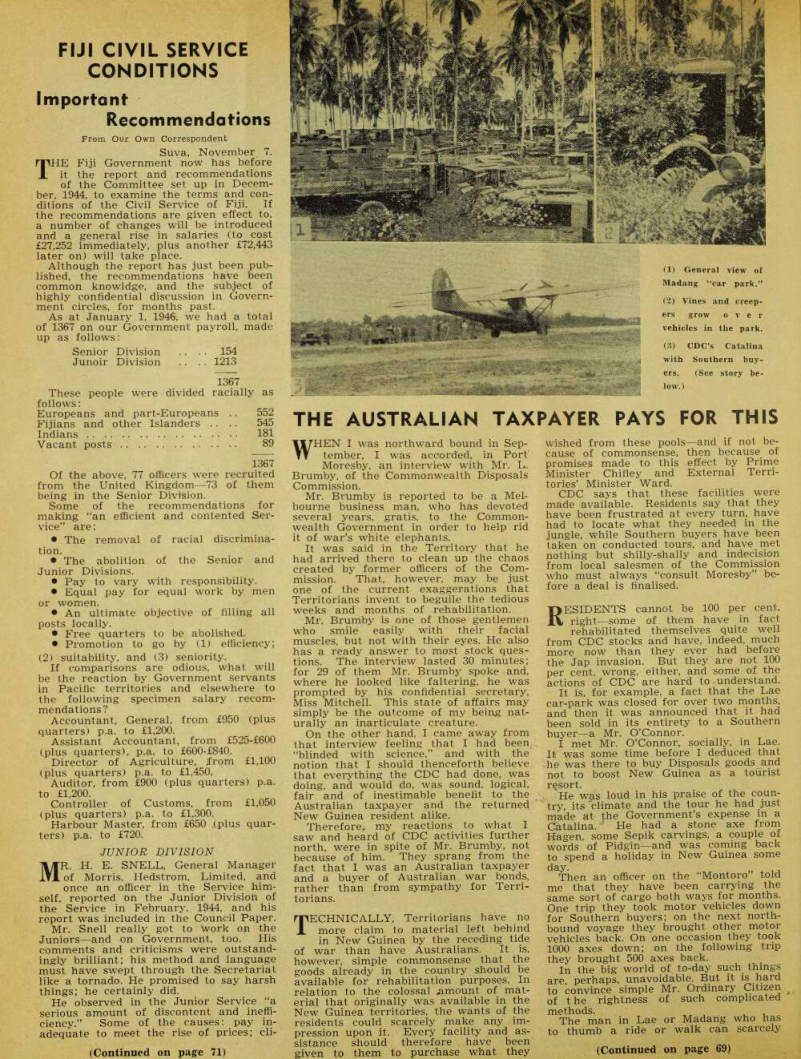
(1) General view of Madang “car park.”
(2) Vines and creep ers grow over vehicles in the park.
(3) CDC’s Catalina with Southern buy ers. (See story be low.)
be expected to cheer when he sees Sou thern buyers doing tours of the Terri tory in a Catalina which costs (so it is rumoured) about £2OO a day to run. Nor can one expect the would-be purchaser of axes to rejoice in buying axes in Aus tralia when he could have had them at half the price right there in New Guinea.
THE photographs reproduced here were taken in Madang. This car-park under the coconuts had, I was told, been there for over a year. They prob ably were good lorries, once.
I had to wade through creepers up to my neck to take the photographs, and the vehicles too, as can be seen, were covered with vines; the bodies were rot ting and the engines rusting.
About the time that the photographs were taken, the park was sold to a mys terious Southern buyer. It was believed that the trucks would be dismantled for their tyres, engines and other spare parts that would be of use in Australia.
Photograph (3) shows the CDC amphi bious Catalina on Madang drome. Be neath the wings is a large group of buyers who had just then returned from inspecting goods at Wewak.
NOT far from where this last photo graph was taken was a long line of RAAF tractors and vehicles in which no one seemed particularly interested; several aero engines—said to be worth £4OOO each —which had been abandoned because it was “not worth while to shift them,” and a number of crates contain ing milling machines, lathes and other power machinery.
A man who had started a repair busi
ness in Lae was interested in one of the lathes, but the price he was prepared to give was not considered sufficient. Even tually, he and the CDC will probably get together on the deal —but by that time it is likely that either some South ern buyer will have bought it, or it will have rusted away, out there in the kunai near Madang drome.
Such is the great need for motor re pairs around Lae district, it would have been sense if the Administration had pur chased the machine and presented it to the engineer in question. But such simple ways of dealing with any problem are beyond the complicated processes by which departments and governments and
countries are run in 1946.
JT.
£35,000 Loss
1,250 Tons Of Copra
Burned
Fire in Samoa Causes £35,000 Loss
From Our Own Correspondent
Apia, Oct. 22
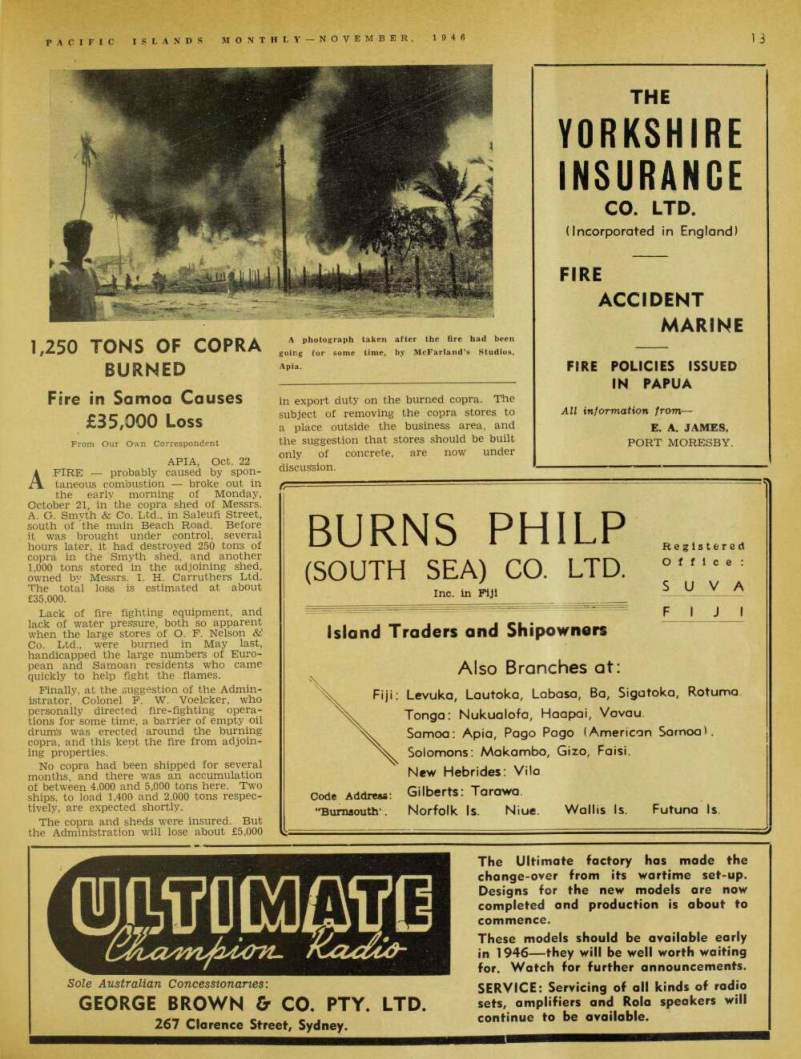
AFIRE probably caused by spon taneous combustion broke out in the early morning of Monday, October 21, in the copra shed of Messrs.
A. G. Smyth & Co. Ltd., in Saleufi Street, south of the main Beach Road. Before it was brought under control, several hours later, it had destroyed 250 tons of copra in the Smyth shed, and another 1,000 tons stored in the adjoining shed, owned by Messrs. I. H. Carruthers Ltd.
The total loss is estimated at about £35,000.
Lack of fire fighting equipment, and lack of water pressure, both so apparent when the large stores of O. F. Nelson &' Co. Ltd., were burned in May last, handicapped the large numbers of Euro pean and Samoan residents who came quickly to help fight the flames.
Finally, at the suggestion of the Admin istrator, Colonel F. W. Voel/cker, who personally directed fire-fighting opera tions for some time, a barrier of empty oil drums was erected around the burning copra, and this kept the fire from adjoin
ing properties.
No copra had been shipped for several months, and there was an accumulation of between 4,000 and 5,000 tons here. Two ships, to load 1,400 and 2,000 tons respec tively, are expected shortly.
The copra and sheds were insured. But the Administration will lose about £5,000
in export duty on the burned copra. The subject of removing the copra stores to a place outside the business area, and the suggestion that stores should be built only of concrete, are now under discussion.
A photograph taken after the fire had been going for some time, by McFarland’s Studios, Apia.
Advertisements & other items, pp. 15-16 (1 item)
Burns Philp
THE
YORKSHIRE
INSURANCE
CO. LTD.
(Incorporated in England)
FIRE
ACCIDENT
MARINE
FIRE POLICIES ISSUED
IN PAPUA
All information from —
E. A. JAMES,
PORT MORESBY.
BURNS PHILP
(SOUTH SEA) CO. LTD.
Inc. in FIJI Island Traders and Shipowners Registered Office :
SUVA
FIJI
Also Branches at: \ x Fiji: Levuka, Lautoka, Labasa, Ba, Sigatoka, Rotuma Tonga: Nukualofa, Haapai, Vavau.
Samoa: Apia, Pago Pago (American Samoa).
Solomons: Makambo, Gizo, Faisi.
New Hebrides: Vila Code Address: Gilberts: Tarawa “Bumsouth . Norfolk Is. Niue. Wallis Is. Futuna Is.
Sole Australian Concessionaries :
GEORGE BROWN & CO. PTY. LTD.
267 Clarence Street, Sydney.
The Ultimate factory has made the change-over from its wartime set-up.
Designs for the new models are now completed and production is about to commence.
These models should be available early in 1946—they will be well worth waiting for. Watch for further announcements.
SERVICE: Servicing of all kinds of radio sets, amplifiers and Rola speakers will continue to be available.
mmmm.
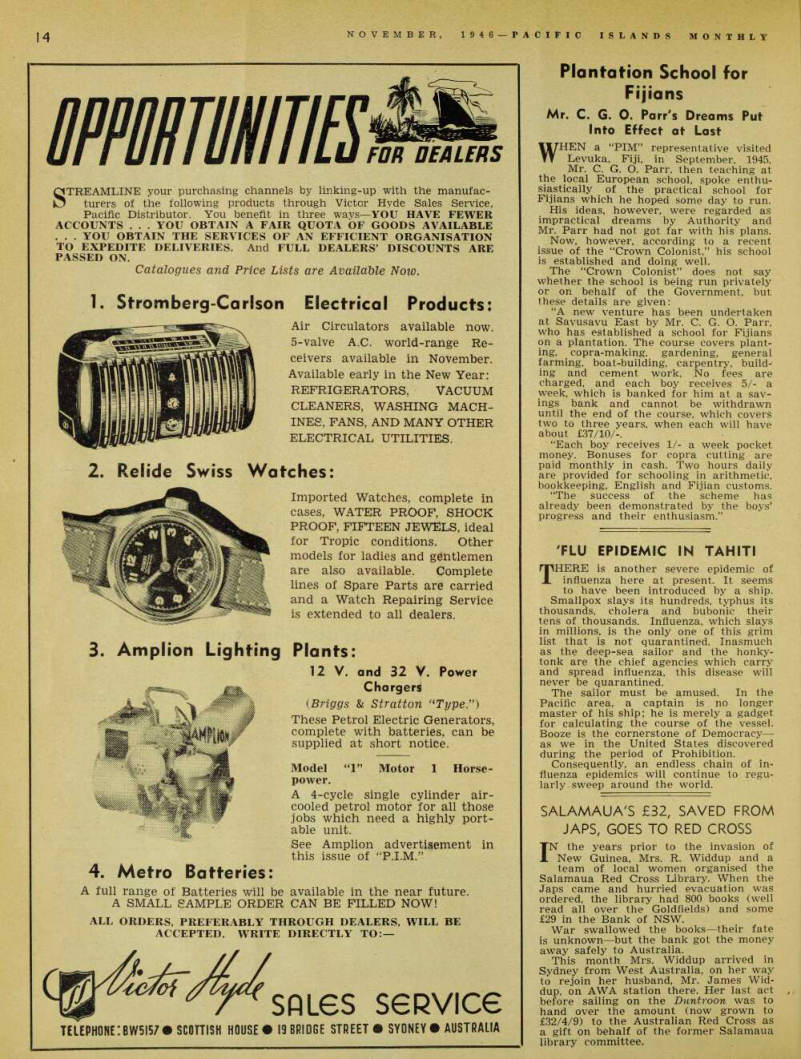
FDR DEALERS
STREAMLINE your purchasing channels by linking-up with the manufacturers of the following products through Victor Hyde Sales Service, Pacific Distributor. You benefit in three ways—YOU HAVE FEWER ACCOUNTS . . . YOU OBTAIN A FAIR QUOTA OF GOODS AVAILABLE . . . YOU OBTAIN THE SERVICES OF AN EFFICIENT ORGANISATION TO EXPEDITE DELIVERIES. And FULL DEALERS’ DISCOUNTS ARE
PASSED ON.
Catalogues and Price Lists are Available Now.
1. Stromberg-Carlson Electrical Products:
Air Circulators available now. 5-valve A.C. world-range Receivers available in November.
Available early in the New Year:
REFRIGERATORS, VACUUM
CLEANERS, WASHING MACH-
INES, FANS, AND MANY OTHER
ELECTRICAL UTILITIES.
2. Relide Swiss Watches:
4 7 Imported Watches, complete in
cases, WATER PROOF, SHOCK
PROOF, FIFTEEN JEWELS, ideal
for Tropic conditions. Other models for ladies and gentlemen are also available. Complete lines of Spare Parts are carried and a Watch Repairing Service is extended to all dealers.
3. Ampiion Lighting
I y
4. Metro Batteries
Plants:
12 V. and 32 V. Power
Chargers
(Briggs & Stratton “Type”) These Petrol Electric Generators, complete with batteries, can be supplied at short notice.
Model “1” Motor 1 Horsepower.
A 4-cycle single cylinder aircooled petrol motor for all those jobs which need a highly portable unit.
See Ampiion advertisement in this issue of “P.1.M.”
A full range of Batteries will be available in the near future.
A SMALL SAMPLE ORDER CAN BE FILLED NOW!
ALL ORDERS, PREFERABLY THROUGH DEALERS, WILL BE
ACCEPTED. WRITE DIRECTLY TO:
( W^ S6RVIC6
TELEPHONE:BVYSIS7* SCOTTISH HOUSE• 19BRIDGE STREET* SYDNEY• AUSTRALIA
Fijians
Plantation School for Fijians Mr. C. G. O. Parr's Dreams Put Into Effect at Last
WHEN a “PIM” representative visited Levuka, Fiji, in September, 1945, Mr. C. G. O. Parr, then teaching at the local European school, spoke enthu siastically of the practical school for Fijians which he hoped some day to run.
His ideas, however, were regarded as impractical dreams by Authority and Mr. Parr had not got far with his plans.
Now, however, according to a recent issue of the “Crown Colonist,” his school is established and doing well.
The “Crown Colonist” does not say whether the school is being run privately or on behalf of the Government, but these details are given: “A new venture has been undertaken at Savusavu East by Mr. C. G. O. Parr, who has established a school for Fijians on a plantation. The course covers plant ing, copra-making, gardening, general farming, boat-building, carpentry, build ing and cement work. No fees are charged, and each boy receives 5/- a week, which is banked for him at a sav ings bank and cannot be withdrawn until the end of the course, which covers two to three years, when each will have about £37/10/-.
“Each boy receives 1/- a week pocket money. Bonuses for copra cutting are paid monthly in cash. Two hours daily are provided for schooling in arithmetic, bookkeeping, English and Fijian customs.
“The success of the scheme has already been demonstrated by the boys’ progress and their enthusiasm.”
'Flu Epidemic In Tahiti
THERE is another severe epidemic of influenza here at present. It seems to have been introduced by a ship.
Smallpox slays its hundreds, typhus its thousands, cholera and bubonic their tens of thousands. Influenza, which slays in millions, is the only one of this grim list that is not quarantined. Inasmuch as the deep-sea sailor and the honky tonk are the chief agencies which carry and spread influenza, this disease will never be quarantined.
The sailor must be amused. In the Pacific area, a captain is no longer master of his ship; he is merely a gadget for calculating the course of the vessel.
Booze is the cornerstone of Democracy— as we in the United States discovered during the period of Prohibition.
Consequently, an endless chain of in fluenza epidemics will continue to regu larly sweep around the world.
Salamaua's £32, Saved From
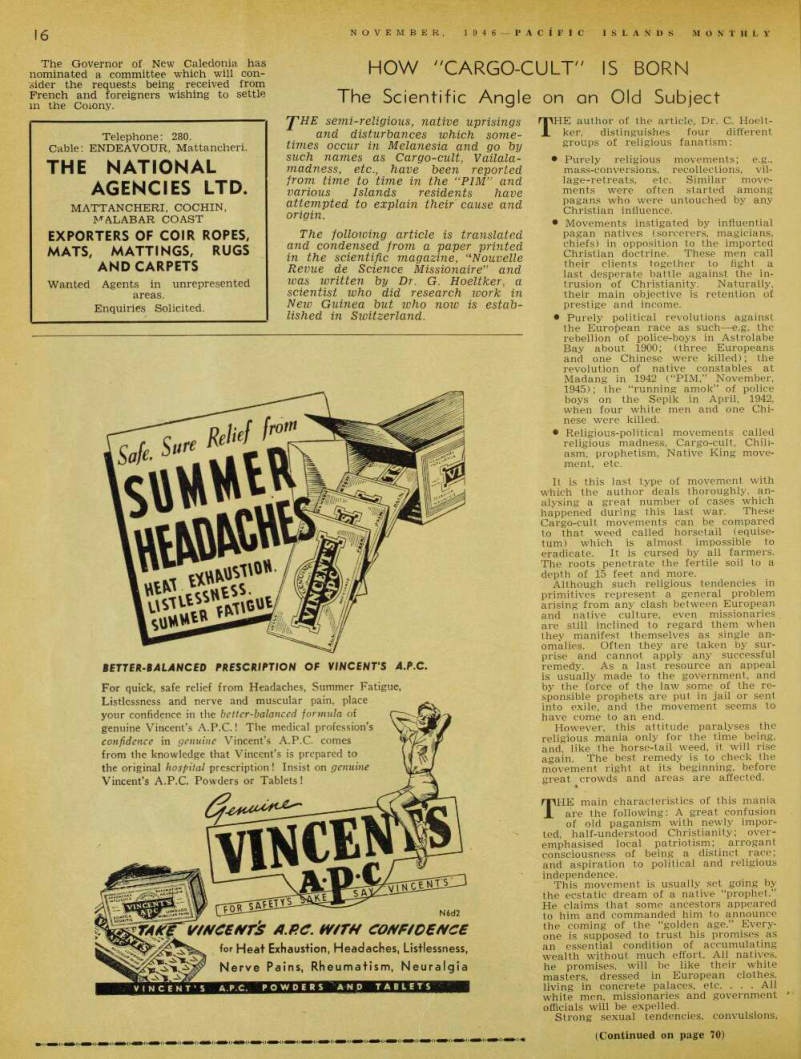
Japs, Goes To Red Cross
IN the years prior to the invasion of New Guinea, Mrs. R. Widdup and a team of local women organised the Salamaua Red Cross Library. When the Japs came and hurried evacuation was ordered, the library had 800 books (well read all over the Goldfields) and some £29 in the Bank of NSW.
War swallowed the books—their fate is unknown—but the bank got the money away safely to Australia.
This month Mrs. Widdup arrived in Sydney from West Australia, on her way to rejoin her husband, Mr. James Wid dup, on AWA station there. Her last act before sailing on the Duntroon was to hand over the amount (now grown to £32/4/9) to the Australian Red Cross as a gift on behalf of the former Salamaua library committee.
The Governor of New Caledonia has nominated a committee which will con sider the requests being received from French and foreigners wishing to settle in the Colony.
Advertisements & other items, pp. 17-18 (2 items)
15
ACIPIC ISLANDS MONTHLY NOVEMBER, 1946
Tullochs pty. ltd
Designed For
Tronsport & Simple Erection
100% Demountable!
Should you Intend building a Storage Shed, Drying Room, Native Labour Hut, or other structures of similar nature, we—Tulloch’s Pty., Ltd.—have the building frame to suit your particular requirements; when we say building frame, we mean the complete structural set of members that go to make up the “skeleton” of a building; it is direct to the “bones” of this steel skeleton that walling and roofing materials are fixed.
These frames are comprised of “ECONO- STEEL” Demountable Trusses—delivered to you ready to unfold on location and connect together with “ECONO-STEEL” Girts, Purlins, and Braces, which make up a building to dimensions of your particular requirements.
Steelwork throughout is protected with “Rustban” preservative, and, being Steel, is a safeguard against Fire, Vermin, Borers, Whiteants, etc.
An inquiry explaining your requirements,
mailed to THE BUILDING DEPARTMENT,
TULLOCH’S PTY., LTD., will have, in return mail, a brochure of interest to you. Write also for our brochure on “ECONO-STEEL”
HOMES, STORES, GARAGES, ETC.
K © I ■ M •v 3 mw i. ■ y These Trusses + Purlins and Girts make up the frames to these stores.
Each of the Trusses is delivered in its “folded condition” to you ready to unfold and erect. Unskilled labour may complete the whole unit.
Tullochs pty. ltd
RHODES, SYDNEY, N.S.W. AUSTRALIA
Cable TULSTEEL Sydney.
Telephone: 280.
Cable; ENDEAVOUR, Mattancheri.
THE NATIONAL
AGENCIES LTD.
MATTANCHERI. COCHIN,
MALABAR COAST
EXPORTERS OF COIR ROPES,
MATS, MATTINGS, RUGS
AND CARPETS
Wanted Agents in unrepresented areas.
Enquiries Solicited.
Safe. S'"!
Relief h"
im
Vfttf
BETTER-BALANCED PRESCRIPTION OF VINCENT'S A.P.C.
For quick, safe relief from Headaches, Summer Fatigue, Listlessness and nerve and muscular pain, place your confidence in the better-balanced formula of genuine Vincent’s A.P.C.! The medical profession’s confidence in genuine Vincent’s A.P.C. comes from the knowledge that Vincent’s is prepared to the original hospital prescription! Insist on genuine Vincent’s A.P.C. Powders or Tablets! & r At S. 3*
VINC£
PorlSBB-
V/NCBNTS A.P.C. WiTH COHPiDBNCB
for Heat Exhaustion, Headaches, Listlessness, Nerve Pains, Rheumatism, Neuralgia
VINCENT
The Scientific Angle on an Old Subject
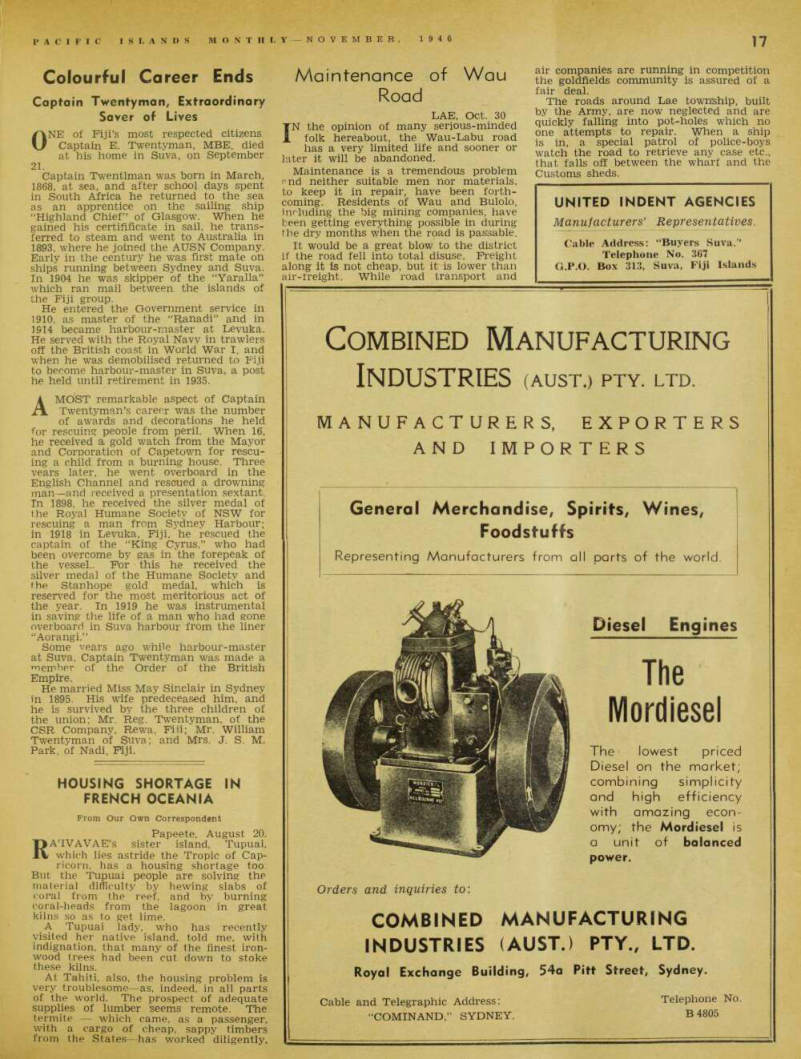
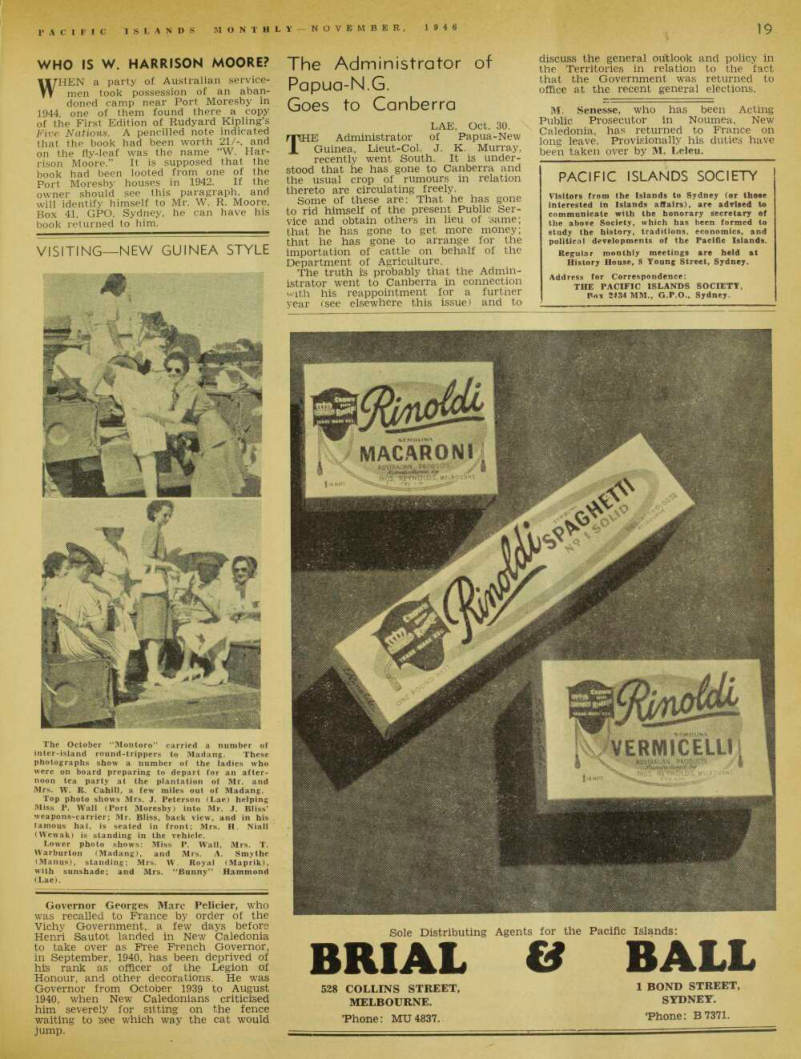
How "Cargo-Cult" Is Born
' T'HE semi-religious, native uprisings and disturbances which sometimes occur in Melanesia and go by such names as Cargo-cult, Vailalamadness, etc., have been reported frorn time to time in the “ PIM ” and various Islands residents have attempted to explain their cause and origin.
The following article is translated and condensed from a paper printed in the scientific magazine, “Nouvelle Revue deScience Missi was written by Dr. G. Hoeither, a scientist who did research work in New Guinea but Who now is established in Switzerland.
THE author of the article, Dr. C. Hoelt ker, distinguishes four different groups of religious fanatism: • Purely religious movements; e.g., mass-conversions, recollections, vil lage-retreats, etc. Similar move ments were often started among pagans who were untouched by any Christian influence. • Movements instigated by influential pagan natives (sorcerers, magicians, chiefs) in opposition to the imported Christian doctrine. These men call their clients together to fight a last desperate battle against the in trusion of Christianity. Naturally, their main objective is retention of prestige and income. • Purely political revolutions against the European race as such—e.g. the rebellion of police-boys in Astrolabe Bay about 1900; (three Europeans and one Chinese were killed); the revolution of native constables at Madang in 1942 (“PIM,” November, 1945); the “running amok” of police boys on the Sepik in April, 1942, when four white men and one Chi nese were killed. • Religious-political movements called religious madness, Cargo-cult, Chili asm, prophetism, Native King move ment, etc.
It is this last type of movement with which the author deals thoroughly, an alysing a great number of cases which happened during this last war. These Cargo-cult movements can be compared to that weed called horsetail (equise tum) which is almost impossible to eradicate. It is cursed by all farmers.
The roots penetrate the fertile soil to a depth of 15 feet and more.
Although such religious tendencies in primitives represent a general problem arising from any clash between European and native culture, even missionaries are still inclined to regard them when they manifest themselves as single an omalies. Often they are taken by sur prise and cannot apply any successful remedy. As a last resource an appeal is usually made to the government, and by the force of the law some of the re sponsible prophets are put in jail or sent into exile, and the movement seems to have come to an end.
However, this attitude paralyses the religious mania only for the time being, and, like the horse-tail weed, it will rise again. The best remedy is to check the movement right at its beginning, before great crowds and areas are affected.
THE main characteristics of this mania are the following; A great confusion of old paganism with newly impor ted, half-understood Christianity; over emphasised local patriotism; arrogant consciousness of being a distinct race; and aspiration to political and religious independence.
This movement is usually set going by the ecstatic dream of a native “prophet.”
He claims that some ancestors appeared to him and commanded him to announce the coming of the “golden age.” Every one is supposed to trust his promises as an essential condition of accumulating wealth without much effort. All natives, he promises, will be like their white masters, dressed in European clothes, living in concrete palaces, etc. . . . All white men, missionaries and government officials will be expelled.
Strong sexual tendencies, convulsions,
(Continued on page 70)
hallucinations and fits are the usual out ward signs of being obsessed by the spirit of an ancestor.
SUCH religious movements as these are by no means limited by time or loc ality. They have been observed at all times, in all parts of the world.
It is an undeniable fact, however, that they arise almost spontaneously when a pagan tribe gets its first contact with Christianity and accepts it in part only.
The immediate cause seldom can be traced, but occasionally the affected natives are at least influenced by extra ordinary events such as distress, famine, drought, epidemics, warfare, discontent
With prevailing conditions, animosity against the presence of Europeans, head tax collecting, any new doctrine of the Missions, earthquakes, etc. At all events, the wh , lteman is always to be blamed for mi sfortune or failure.
As a rule the prophets are extraordin arT personalities, strongly influenced by • se l xual Perversions, er Psyeho-Physiological conditions, fTIHE following Cargo-cult type move- X ments have been reported from Papua and New Guinea— in Papua: Milne Bay Prophetism 1893; Bagona-Cult in N and NE Divi sion (1911-21); German-Wislin Move ment Sabai, Torres Str. (1913-4)- Kava- Keva Movement, N Division (1914)- Taro-Cult of Orokaiva (1914)- Kekes’i Rites Movement, Manua, N Division
nQiQ/6ny a^a * a ' mac * ness ’ * n Division In New Guinea: Timo-Movement in Maladum, Huon Peninsula (1921); God- Father Movement, Suain, NE Coast (1930); Walman Movement, Aitape- Wewak (1931) Black King Movement, Wewak (1931); End-of-the-World Move ment, Pokwap, Markham Valley (1932- 4); Marafi Movement, Markham Valley (1933); Upinko Movement, Gitua, Huon Peninsula (1933); Fanatism in the Raw linson Range on Huon Peninsula (1933); Black King Movement, Ulingan, NE Coast (1935); End-of-the-World Move ment, Elap-Solop District, Huon P.; Chilasm Movement, Rai Coast (1935); Mambu Movement, Bogia-Banara Dis trict (1937-8).
The author does not claim that this list is complete, and additions would be welcomed. Movements in New Britain, Solomon Islands and Dutch New Guinea are not mentioned at all.
During the war years, Cargo-cult kept cropping up in different localities. There was, for example, the events at Inawaia, Gulf Division of Papua, in 1941; and in Lakekamu, Huon Peninsula, Malang, Sepik, etc., at later dates. There were also political-religious upheavals at Karkar Island and in the Aitape district, between 1941 and 1943.
ANEW factor in these movements during the war was the arrival of of the Japanese. With their innate shrewdness, the Japs were prepared to use the Movements to their advantage, and Jap newspapers even before the war were deeply interested in such religious movments.
When the Japanese arrived in New Guinea they identified themselves with the ancestors of the natives. Remarkable is the following address given by a Japanese officer at the occupation of Karkar Island by their forces: “Here I am, you have heard •of me often before,” he said. “Many times I tried to come to you, but I could not.
Now I am here. You see, we Nipponese soldiers do work. We are different from the Europeans. They let you work and do not pay you. Europeans never sit down with you at the same table—we do. Such is European; we are not such.
We do work—we ourselves —we do work hard. We can give you a good time soon.
You want a motor car, you’ll get it; you want a horse, a pinnace, a good house, a plane—you’ll get it. But you must work with us; help us down the European.
And then we’ll help you.”
The Japs distributed looted goods lav ishly and tried to get the co-operation of the natives in warfare. In a few cases they succeeded in confusing the natives by promises and threats, but the major ity remained faithful to their European masters.
European settlers in the Pacific should realise the grave problem involved in such new native movements. Although they cannot completely be eradicated, sufficient attention should be given to them to keep them under firm control.
Colourful Career Ends
Captain Twentyman, Extraordinary Saver of Lives
ONE of Fiji’s most respected citizens Captain E. Twentyman, MBE, died at his home in Suva, on September 21.
Captain Twentlman was born in March, 1868, at sea, and after school days spent in South Africa he returned to the sea as an apprentice on the sailing ship “Highland Chief” of Glasgow. When he gained his certifificate in sail, he trans ferred to steam and went to Australia in 1893. where he joined the AUSN Company.
Early in the century he was first mate on ships running between Sydney and Suva.
In 1904 he was skipper of the “Yaralla” which ran mail between the islands of the Fiji group.
He entered the Government service in 1910, as master of the “Ranadi” and in 1914 became harbour-master at Levuka.
He served with the Royal Navy in trawlers off the British coast in World War I, and when he was demobilised returned to Fiji to become harbour-master in Suva-, a post he held until retirement in 1935.
A MOST remarkable aspect of Captain Twentyman’s career was the number of awards and decorations he held for rescuing people from peril. When 16, he received a gold watch from the Mayor and Corporation of Capetown for rescu ing a child from a burning house. Three vears later, he went overboard in the English Channel and rescued a drowning man—and received a presentation sextant.
In 1898, he received the silver medal of the Royal Humane Society of NSW for rescuing a man from Sydney Harbour; in 1918 in Levuka, Fiji, he rescued the captain of the “King Cyrus,” who had been overcome by gas in the forepeak of the vessel.. For this he received the silver medal of the Humane Society and the Stanhope gold medal, which is reserved for the most meritorious act of the year. In 1919 he was instrumental in saving the life of a man who had gone nverboarrl in Suva harbour from the liner “Aorangi,”
Some vears ago while harbour-master at Suva, Captain Twentyman was made a member of the Order of the British Empire.
He married Miss May Sinclair in Sydney in 1895. His wife predeceased him, and he is survived by the three children of the union; Mr. Reg. Twentyman, of the CSR Company, Rewa, Piii; Mr. William Twentyman of Suva; and Mrs. J. S. M.
Park, of Nadi, Fiji.
Housing Shortage In
French Oceania
Prom Our Own Correspondent Papeete, August 20.
RA’IVAVAE’s sister island, Tupuai, which lies astride the Tropic of Cap ricorn. has a housing shortage too But the Tupuai people are solving the material difficulty by hewing slabs of coral from the reef, and by burning coral-heads from the lagoon in great kilns so as to get lime.
A Tupuai lady, who has recently visited her native island, told me, with indignation, that many of the finest iron wood trees had been cut down to stoke these kilns.
At Tahiti, also, the housing problem is very troublesome —as, indeed, in all parts of the world. The prospect of adequate supplies of lumber seems remote. The termite which came, as a passenger, with a cargo of cheap, sappy timbers from the States —has worked diligently.
Maintenance of Wau
Road
LAE, Oct. 30 IN the opinion of many serious-minded folk hereabout, the Wau-Labu road has a very limited life and sooner or later it will be abandoned.
Maintenance is a tremendous problem end neither suitable men nor materials, to keep it in repair, have been forth coming. Residents of Wau and Bulolo, including the big mining companies, have been getting everything possible in during the dry months when the road is passable.
It would be a great blow to the district if the road fell into total disuse. Freight along it Is not cheap, but it is lower than air-freight. While road transport and
air companies are running in competition the goldfields community is assured of a fair deal.
The roads around Lae township, built by the Army, are now neglected and are quickly falling into pot-holes which no one attempts to repair. When a ship is in, a special patrol of police-boys watch the road to retrieve any case etc., that falls off between the wharf and the Customs sheds.
The Nickel Co., shut down part of its N. Caledonian works on July 18, owing to the non-arrival of coal, and it was thought that the smelters would be para lysed completely. M. Rapadzi, the company’s Noumea manager paid a special visit to Sydney to interview the Commonwealth authorities. Since then a ship, which had been held up at New castle, has been able to load enough coal to carry the industry on for some little time.
Advertisements & other items, pp. 19-20 (1 item)
Mordiesel
UNITED INDENT AGENCIES
Manufacturers' Representatives.
Cable Address: “Buyers Suva.”
Telephone No. 367 G.P.O. Box 313, Suva, Fiji Islands
Combined Manufacturing
Industries (AUST.) PTY. LTD.
MANUFACTURERS, EXPORTERS
AND IMPORTERS
General Merchandise, Spirits, Wines, Foodstuffs Representing Manufacturers from all parts of the world. , rv VI ? .
Diesel Engines
The
Mordiesel
The lowest priced Diesel on the market; combining simplicity and high efficiency with amazing economy; the Mordiesel is a unit of balanced power.
Orders and inquiries to:
COMBINED MANUFACTURING
INDUSTRIES (AUST.) PTY., LTD.
Royal Exchange Building, 54a Pitt Street, Sydney.
Cable and Telegraphic Address:
“COMINAND,” SYDNEY.
Telephone No.
B 4805
\HC
SPECIALISING
IN
PACIFIC ISLAND INSURANCES
FIRE MOTOR VEHICLE
MARINE HULLS AND CARGO
EMPLOYER’S LIABILITY
GUARANTEES including those for— *
DYNAMITE PERMITS.
RECRUITERS’ LICENCES.
DEFERRED WAGES
AND ALL OTHER CLASSES ARRANGED
AT LOWEST CURRENT RATES.
Established Agencies:
W. R. CARPENTER & CO., LTD.
Throughout the Territory of New Guinea.
SOUTHERN PACIFIC INSURANCE
CO.. LTD.
HEAD OFFICE: 60 HUNTER STREET.
SYDNEY.
USA Abandons Manus to Australia's Pinheads
AUSTRALIA’S blundering bureaucrats and politicians apparently have succeeded in driving the United States out of the South-western Pacific.
It was announced from Washington, at the end of October, that the United States now will not seek to hold any Pacific bases south of the equator, and will withdraw from Manus.
The Americans spent 156,000,000 dollars on the construction of the Manus base, on outlying islands of the New Guinea Mandated Territory. (For description, see October “PIM.”) They hoped to occupy it permanently, as the southern flank of the fortified system they plan to maintain between Asia and North America.
When the nlan was originally announced, Australia should have shouted with joy. It meant that the United States, in holding Manus, must help to protect the 7,500,000 Europeans, in empty Australia, against 1,000,000,000 hungry Asiatics in Asia.
But the incredible people now in con trol of Australian affairs showed no joy.
They snarled and snuffled, and pointed out that Manus was Australian territory, and Australia wasn’t going to give any territory to anyone. Finally, with mani fest reluctance, they said that they might be prepared, in certain circumstances, to share the Manus base with the United States.
Well, they got their way. The Americans are going to withdraw from Manus.
A CORRESPONDENT, some months ago, referring to “PIM” comments on this subject, said that * we took a pro-American and cock-eyed view. Well,
here is the opinion of the Sydney Morning Herald, Australia’s senior newspaper: “Australian policy has apparently suc ceeded in freezing the -Americans out of Manu's Island. The US Navy Department, it is announced from Pearl Harbour, is dismantling the facilities at a base which cost some 156 million dollars to build during the war.
“Whether the Americans would really have kept the base in being indefinitely, if this country had granted them reason able rights, cannot now be known. The point is whether, on practical grounds of security, we ought not to have given them every inducement to do so. The Anzac Pact virtually gave the United States notice to quit this and other mandated territory, even before the war had ended. It affirmed that the con struction of military installations in war time did not give any Power continuing rights therein.
“As a statement of principle, that was perfectly sound. Theoretically impeccable, too, was the contention that Australia and New Zealand should assume respon sibility for policing the south-west Pacific zone.
“We have stood firmly on the letter of our rights but where has it got us?
Manus, abandoned by the Americans, will fall into ruin, since we lack the means to maintain it. The shield offered by a great and friendly Power certainly on its terms rather than ours is being with drawn. It seems a heavy price for a small and exposed country to pay for the asser tion of title to sovereignty in an area of whose very existence most Australians were unaware before the war.”
Advertisements & other items, p. 20 (1 item)
William H. Watson
ESTABLISHED 1930
RAROTONGA, COOK ISLANDS
Wholesale and Retail Trader
LICENSED STAMP DEALER
Agent For:
BRITISH TRADERS' INSURANCE CO.
CORONA & L. C, SMITH TYPEWRITERS
KAISER & FRAZER MOTOR CARS
B.S.A. CYCLES AND MOTOR CYCLES
AMERICAN LEAD PENCIL CO.
WHITES AVIATION LTD.
Manufacturers of: FOOTWEAR, ALL CLASSES SUITABLE FOR NATIVE TRADING . . . M.O.P. PRODUCTS, INCLUDING ROUND EAR-RING BLANKS AND BUTTON BLANKS Exporter of: “Rarotonga” Hula-Skirts.
Sea-Shell Necklaces.
M.O.P. Jewellery.
Island Produce.
Cable Address: “Watson” Rarotonga Wholesale and Retail Inquiries Invited.
Prepared to Consider Agencies for all Class of Goods.
Importer of: Textiles.
General Hardware.
Fancy Goods.
General Merchandise.
Rank of New Zealand, Auckland.
Who Is W. Harrison Moore?
WHEN a party of Australian service men took possession of an aban doned camp near Port Moresby in 1944, one of them found there a copy of the First Edition of Rudyard Kipling’s Five Nations. A pencilled note indicated that the book had been worth 21/-, and on the fly-leaf was the name “W. Har rison Moore.” It is supposed that the book had been looted from one of the Port Moresby houses in 1942. If the owner should see this paragraph, and will identify himself to Mr. W. R. Moore, Box 41. GPO, Sydney, he can have his book returned to him.
Governor Georges Marc Pelicier, who was recalled to France by order of the Vichy Government, a few days before Henri Sautot landed in New Caledonia to take over as Free French Governor, in September, 1940, has been deprived of his rank as officer of the Legion of Honour, and other decorations. He was Governor from October 1939 to August 1940, when New Caledonians criticised him severely for sitting on the fence waiting to see which way the cat would jump.
Visiting—New Guinea Style
The October “Montoro” carried a number of inter-island round-trippers to Madang. These photographs show a number of the ladies who were on board preparing to depart for an after noon tea party at the plantation of Mr. and Mrs. W. R. Cahill, a few miles out of Madang.
Top photo shows Mrs. J. Peterson (Lae) helping Miss P. Wall (Port Moresby) into Mr. J. Bliss’ weapons-carrier; Mr. Bliss, back view, and in his famous hat, is seated in front; Mrs. H. Niall (Wewak) is standing in the vehicle.
Lower photo shows: Miss P. Wall, Mrs. T.
Warburton (Madang), and Mrs. A. Smythe (Manus), standing; Mrs. W Royal (Maprik), with sunshade; and Mrs. “Bunny” Hammond (Lae).
Papua-N.G.
The Administrator of
Goes to Canberra
LAE, Oct. 30. rE Administrator of Papua-New Guinea, Lieut-Col. J. K. Murray, recently went South. It is under stood that he has gone to Canberra and the usual crop of rumours in relation thereto are circulating freely.
Some of these are: That he has gone to rid himself of the present Public Ser vice and obtain others in lieu of same; that he has gone to get more money; that he has gone to arrange for the importation of cattle on behalf of the Department of Agriculture.
The truth is probably that the Admin istrator went to Canberra in connection with his reappointment for a furtner year (see elsewhere this issue) and to
discuss the general outlook and policy in the Territories in relation to the fact that the Government was returned to office at the recent general elections.
M. Senesse, who has been Acting- Public Prosecutor in Noumea, New Caledonia, has returned to France on long leave. Provisionally his duties have been taken over by M. Leleu.
Advertisements & other items, p. 21 (1 item)
Brial & Ball
PACIFIC ISLANDS SOCIETY
Visitors from the Islands to Sydney (or those interested in Islands affairs), are advised to communicate with the honorary secretary of the above Society, which has been formed to study the history, traditions, economics, and political developments of the Pacific Islands.
Regular monthly meetings are held at History House, 8 Young Street, Sydney.
Address for Correspondence:
THE PACIFIC ISLANDS SOCIETY.
Pox 2434 MM., G.P.0., Sydney.
ill
% 1 IK .. i
StMOUW
MACARONI ,
s*. wW'WfWffiS, «s >■««« s?»'S
iff
m VERMICELLI I
I V, - /| M.
Sole Distributing Agents for the Pacific Islands:
BRIAL & BALL
528 COLLINS STREET,
MELBOURNE.
’Phone: MU 4837.
1 BOND STREET,
SYDNEY.
’Phone: 87371.
Typical Of England At War
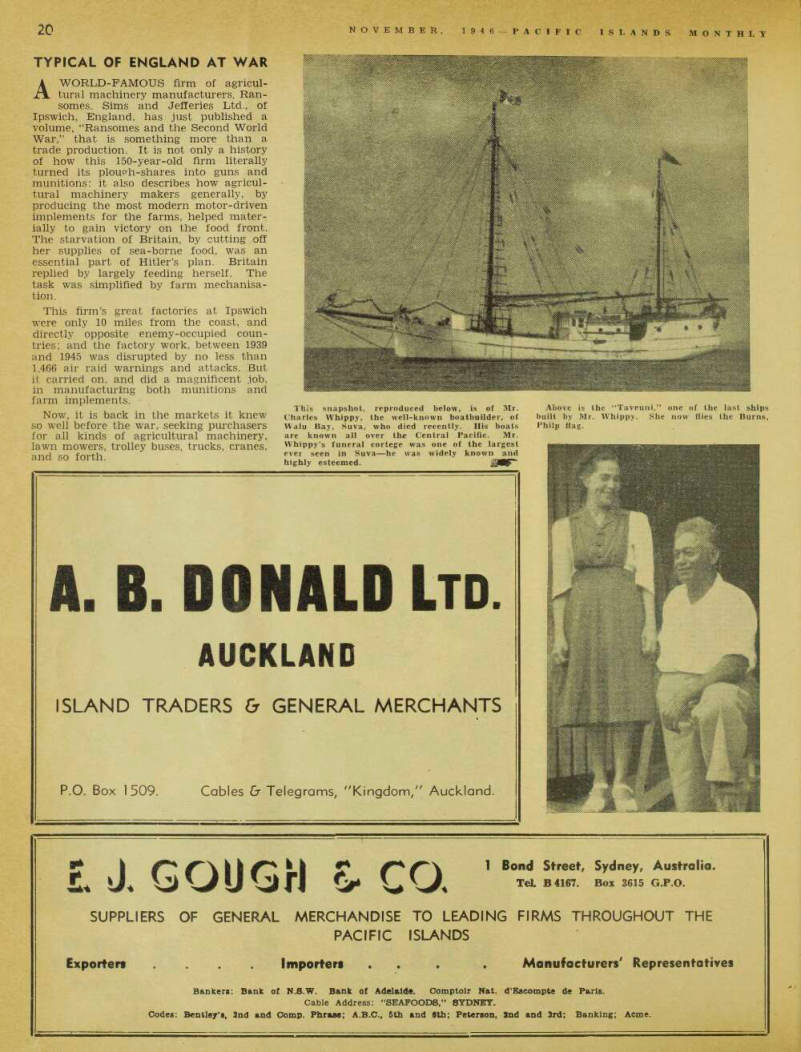
A WORLD-FAMOUS firm of agricul tural machinery manufacturers, Ran somes. Sims and Jefferies Ltd., of Ipswich, England, has just published a volume, “Ransomes and the Second World War,” that is something more than a trade production. It is not only a history of how this 150-year-old firm literally turned its plough-shares into guns and munitions: it also describes how agricul tural machinery makers generally, by producing the most modern motor-driven implements for the farms, helped mater ially to gain victory on the food front.
The starvation of Britain, by cutting off her supplies of sea-borne food, was an essential part of Hitler’s plan. Britain replied by largely feeding herself. The task was simplified by farm mechanisa tion.
This firm’s great factories at Ipswich were only 10 miles from the coast, and directly opposite enemy-occupied coun tries: and the factory work, between 1939 and 1945 was disrupted by no less than 1.466 air raid warnings and attacks. But it carried on, and did a magnificent job. in manufacturing both munitions and farm implements.
Now, it is back in the markets it knew so well before the war, seeking purchasers for all kinds of agricultural machinery, lawn mowers, trolley buses, trucks, cranes, and so forth.
This snapshot, reproduced below, is of Mr.
Charles Whippy, the well-known boatbuilder, of Walu Bay, Suva, who died recently. His boats are known all over the Central Pacific. Mr.
Whippy’s funeral cortege was one of the largest ever seen in Suva —he was widely known and highly esteemed.
Above is the “Taveuni,” one of the last ships built by Mr. Whippy. She now flies the Burns, Philp flag.
Advertisements & other items, p. 22 (1 item)
A. B. Donald Ltd.
AUCKLAND
ISLAND TRADERS & GENERAL MERCHANTS
P.O. Box 1509. Cables £r Telegrams, ''Kingdom/ 7 Auckland.
I jT** b I 1 Bond Street Sydney, Australia. £* f \ jJ K TeJL B 4167. Box 3615 G.P.O.
SUPPLIERS OF GENERAL MERCHANDISE TO LEADING FIRMS THROUGHOUT THE
PACIFIC ISLANDS
Exporters ... Importers ... . Manufacturers' Representatives Bankers: Bank of N.S.W. Bank of Adelaide. Comptolr Nat. d’Escompte de Paris.
Cable Address: ‘'SEAFOODS,” SYDNEY.
Codes: Bentley’s, 2nd and Comp. Phrase; A.8.C., sth and 6tb; Peterson, 2nd and 3rd; Banking; Acme.
"Democracy" in Pacific
Territories Strikes and What Not
rE steamer Reynella, carrying large stocks of urgently needed foodstuffs for Papua and New Guinea, made very slow progress through the Territories ports due to the stevedores’ inability to control native labour under the New Order. Nowadays, the natives work how and when they like.
The ship left Sydney on September 27, and arrived in Mcresbv on October 5.
She was detained no less than 14 days in Port Moresby, and over a week in Lae, so she did not reach hungry Rabaul until November 1. As told elsewhere, Rabaul has been desperately short of food. ‘‘We have all the blessings of civilisa tion now,” writes a Port Moresby corres pondent. “There have been two strikes of native seamen on Production Control Board vessels recently; and last Sunday the natives held a secret ballot for the election of Hanuabada’s village council.
The younger politicians among, them boast that they have “fixed it all right” to get rid of old Gavesa, chairman for many years. We haven’t yet heard the result of the ballot—everyone is too busy with Melbourne Cup sweeps to bother with counting. Isn’t Democracy grand!”
Child-Slayer
Angry Samoans Kill Child-Slayer
From Our Own Correspondent
Apia. Oct. 22.
rERE was an extraordinary accident, and sequel recently, in Tutuila, American Samoa.
A young E'uronesian. R. Danielson, of Apia, Western Samoa, who was employed as a driver, came around a corner on the main road, near the village of No’uli, at high speed; and. before he could brake, his lorry ran over three small Samoan children. One was killed and two badly injured.
The infuriated natives of the villages, led by their matais, seized Danielson and bashed his head, and killed him.
The United States naval officials at Pago Pago, who are responsible for this administration, have arrested a number of the matais.
Lorry Driven Over Nuku'alofa Wharf
Nuku'alofa Wharf
From Our Own Correspondent Nuku’alofa, October 16.
AN unusual accident occurred here re cently when a heavy truck, belong ing to the firm of Riechelmann Bros., fell off the end of the Nuku’alofa wharf and into the sea.
The truck was being driven at a fairly fast speed along the causeway to the wharf by a Tongan; the driver at tempted to slow down, but the vehicle’s brakes failed to function. It jumped the low wooden railing at the edge of the wharf and fell into the sea with the driver still in the cab.
He managed to free himself when the truck struck the bottom, and he came up to the surface badly scared but with only a few scratches to show for his carelessness.
With the aid of a barge, some of the firm’s labourers managed to raise the truck onto the reef and drag it ashore.
It did not suffer any serious damage.
Advertisements & other items, p. 23 (1 item)
a major anxiety
. 'THAT .
A b V, -r T •Sr I' v The
Relief from
a major anxiety
Even the most expert and conscientious individual executor is subject to accident, illness and incapacitation.
Continuity of administration and uninterrupted attention to your estate and your beneficiaries are of paramount importance. Both can be positively assured by appointing this Company your sole Executor or as co-Executor with your present appointee. An interesting explanatory booklet will be forwarded on request
DIRECTORS:
Lewis Armstrong. lames Burns. Joseph Mitchell.
R. J. Nosworthy. P. T. W. Black.
MANAGER: L. S. Parker.
SECRETARY: E. R. Overton, A.F.I.A.
BURNS PHILP TRUST
COMPANY LIMITED
7 BRIDGE STREET. SYDNEY
TELEPHONE: BU 5901. Box 543, G.P.0., Sydney
BPI .45
Many Melons—But No
Transport
Nuku’alofa, October 16.
TONGAN water melon growers were disappointed when only a small por tion of their produce was shipped on the October “Matua.”
The melon crop this season is a par ticularly heavy one, due to the increased area planted with a view of export to New Zealand markets, where good prices are usually obtained.
Mr. William Nicholls, Free French soldier passed through Brisbane recently by flying-boat from Noumea, with his father, Gordon Nicholls. William Nicholls fought in the Middle East with the famous New Caledonia Battalion and was awarded the Croix de Guerre.
Mr. A. Jamieson, who was attached, in pre-war days, to the Administration at Rabaul for 17 years, is now residing in Brisbane permanently. His wife is hon. secretary of the Queensland New Guinea Association.
How To Get a Pacific Tour
Pacific Tour At Very Low Cost
From Our Own Correspondent Apia Oct. 22 rE absurdities and anomalies of the laws governing stowaways were well illustrated here recently.
When the steamer Parkdale Park was a couple of days out from Apia, in June, on her way to Honolulu, four young Sam oans were found. They had sneaked aboard in Apia, and hidden themselves.
The shipowner (Union SS Co) had to accomodate and feed them, and return them to Samoa—that is the law. The ship was bound for Honolulu and Vancouver. The youths were given food and allowed to sleep in the available cabins. Legally, they could not be forced to work—but they worked, up to a point.
From Vancouver, the ship proceeded to San Francisco, thence to Rarotonga, Auckland, Suva, Nukualofa, and Vavau, and so back to Apia. The voyage occupied four months, and the youths enjoyed a tour for which thousands of people today would pay much money.
The four young men were brought before a court in Apia this week and fined.
The fines were paid; the story is abroad; and now many other Samoans, with itchy feet, are studying the opportunities of the waterfront.
Mr. A. C. Clifford left Brisbane for Suva by the Qantas flying-boat on October 7. Formerly of the RAAF and proprietor of a motor business in Brisbane, Mr. Clifford has been appointed foreman of Suva Motors Ltd. His wife and two children will follow.
Advertisements & other items, p. 24 (2 items)
W. H. Grove & Sons
Limited Established 1896.
AUCKLAND
Island Traders. *•<>. Box m.
Telegraphic and Cable Address: “Grove”, Auckland.
Shippers of all classes of New Zealand products.
Representing English Manufacturers throughout the Cook and Society Islands, Fiji, Tonga, Samoa, Niue, New Caledonia, New Guinea, etc.
In FIJI a*—W. H. Grove & Sen* (Fiji) Ltd.
aKPUOk
Ample POWER ...
Ample LIGHT
Si AMPLION
UNITS
Throughout Australasia and the Islands hundreds of these grand units are proving themselves to proud owners by their performances and reliability.
You will find much to interest you in the free literature we now offer you, by return mail.
aKPUOk
AUSTRALASIA PTY., LTD.
36-40 Parramatta Road, Camperdown, N.S.W.
AMPLION 1 H.P. PETROL
ENGINE
8 genuine car engine features . . . so light a man can carry (only 40 lbs.). £32—packed F. 0.8. Sydney.
AMPLION
FARM
UNIT
LIGHTING
In 12 or 32 volt models . . . vibrationless . . . extremely inexpensive to operate . . . send for leaflet NOW. Special export price, £4B/15/- Packed F. 0.8. Sydney.
SEND FOR FREE
LITERATURE BY
RETURN MAIL.
Messrs. AMPLION (A’ASIA) PTY., LTD.,
36-40 Parramatta Road, Camperdown, N.S.W.
Please send me free literature on Farm lighting unit.
Amplion 1 h.p. petrol engine Q BOTH. j~~| Name J Address
South Pacific Health Service
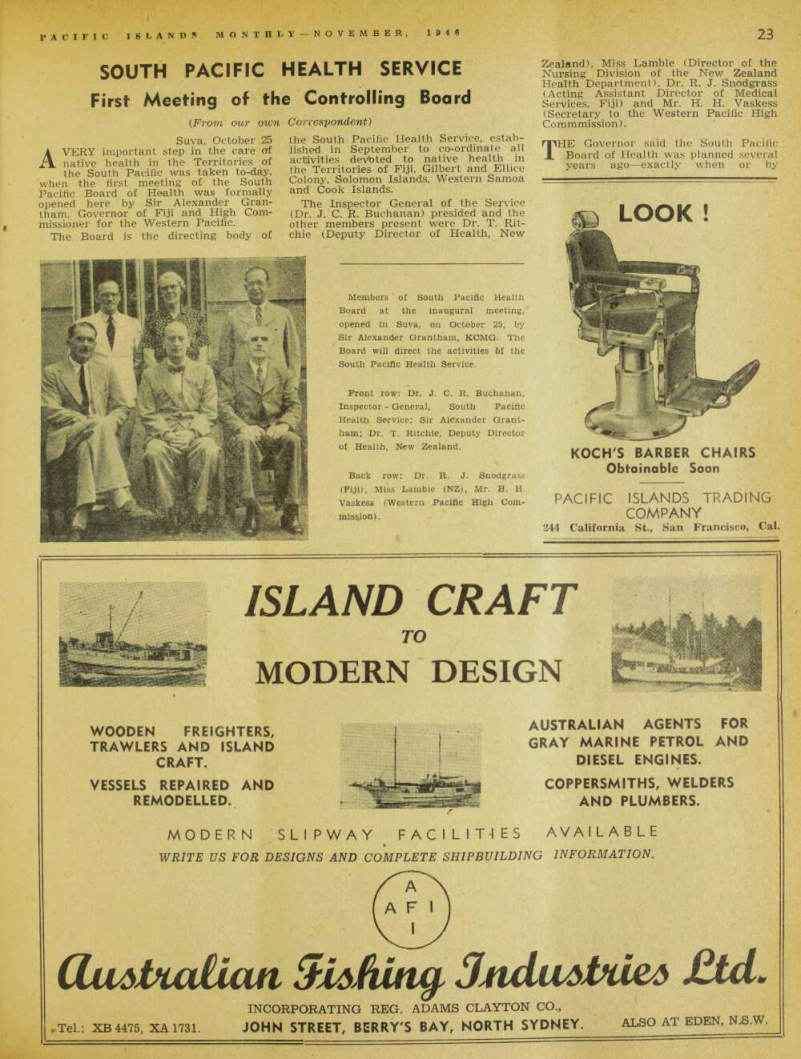

First Meeting of the Controlling Board
(From our own Correspondent )
Suva, October 25 AVERY important step in the care at native health in the Territories of the South Pacific was taken to-day, when the first meeting of the South Pacific Board of Health was formally opened here by Sir Alexander Gran tham, Governor of Fiji and High Com missioner for the Western Pacific.
The Board is the directing body of
the South Pacific Health Service, estab lished in September to co-ordinate all activities devbted to native health in the Territories of Fiji, Gilbert and Ellice Colony, Solomon Islands, Western Samoa and Cook Islands.
The Inspector General of the Service (Dr. J. C. R. Buchanan) presided and the other members present were Dr. T. Rit chie (Deputy Director of Health, New
Zealand), Miss Lamble (Director of the Nursing Division of the New Zealand Health Department), Dr. R. J. Snodgrass (Acting Assistant Director of Medical Services, Fiji) and Mr. H. H. Vaskess (Secretary to the Western Pacific High Commmission).
THE Governor said the South Pacific Board of Health was planned several years ago—exactly when or by
Members of South Pacific Health Board at the inaugural meeting, opened in Suva, on October 25, by Sir Alexander Grantham, KCMG. The Board will direct the activities of the South Pacific Health Service.
Front row: Dr. J. C. R. Buchanan, Inspector - General, South Pacific Health Service; Sir Alexander Grant ham; Dr. T. Ritchie, Deputy Director of Health, New Zealand.
Back row: Dr. R. J. Snodgrass (Fiji), Miss Lambie (NZ), Mr. H. H.
Vaskess (Western Pacific High Com mission).
whom was not known. The Rockefeller Foundation, in 1922, recommended a joint medical service in the Pacific. In
1927, Makogai opened its doors to lepers from Islands territories beyond Fiji. In 1928 the Central Medical Board, Suva, accepted students from other territories.
Meanwhile, the scheme of co-operation whereby the New Zealand nursing divi sion supplied Fiji with nurses was in augurated. The Director of Fiji Medical Services became the Central Medical Authority for the Western Pacific High Commission. In 1943 Dr. McGusty (then Director of Medical Services, Fiji) wrote a memorandum advocating an organisa tion similar to that now formed. This
was strongly reinforced by the report of Dr. Watt and Miss Lambie on the same lines. These two reports were the foun dation of the South Pacific Health Ser vice. In 1944, on Dr. McGusty’s motion, the Fiji Legislative Council approved in principle the Watt-Lambie report. The Fiji Governor made a draft agreement. * The first executive step was the ap pointment in April, 1945, of the Inspector General of the South Pacific Medical Service. The final agreement was signed in Sept. 1946. In the intervening year discussions took place, ideas were clari fied, and there was practical co-opera tion between the various Islands terri tories. New Zealand and Fiji agreed that, instead of having two distinct and separate officers for Inspector-General, South Pacific Health Services, and Direc tor of Medical Services, Fiji, the two officers would be combined in Dr. Buch anan, who holds both posts. The pro posal to have one centralised training school for Island nurses in Fiji was abandoned in favour of training them in their home territories.
The Agreement is to run for two years in the first instance and is then to be reviewed. Other governments may wish to join in—Tonga and Australia are con sidering the matter. The United States and France are expected to be inter ested. This South Pacific Health Service could be too unwieldy and cumbersome — it might be better to have separate Ser vices, with co-operation between them.
This was a question that could be de cided in a moment.
“But whether it is to be one scheme, or several schemes, the South Pacific Health Service is the model for them all,” concluded His Excellency. “It is you who are here to-day who blazed the trail and showed the way in a practical and positive manner.”
THE complexity of the medical prob lems presented in the scattered island groups of the South West Pacific was referred to by Dr. Buchanan.
“No modes of life, for instance, could be more dissimilar than those of the popu lation in the urban areas of Fiji, the tribes who inhabit the hinterland of the New Hebrides and the lonely communi ties living under self-imposed constitu tional rules in such islands as Pitcairn,” he said.
“How vastly different, too, is the struggle for existence on an atoll such as Palmerston, where dietetic custom is dictated by nature, from the comparative ease of living in a fertile country such as Samoa.”
Financial resources depended on vastly different sets of economic circumstances, Dr. Buchanan added. There was no uni versal language and no common medium for the interchange of ideas. In the area covered by the Service there were almost countless variations in the vernacular, presenting a complicating factor even within closely circumscribed areas.
“Perhaps the only feature common to all is the extreme difficulty of placing the teaching and practice of modern medicine within the reasonable reach of every individual —or even communities — living, as they do so often, in almost absolute isolation,” Dr. Buchanan said.
He continued: “All these variations in conditions, while appearing to -call for multiple systems of health administra tion, actually, if viewed in broad perspec tive, constitute the strongest reason for overall co-ordination. After all, unity is strength. Under a system whereby ex perience and resources can be pooled, unsuccessful ventures should not be re peated, and special features developing successfully as the result of local experi ence can readily be grafted on to exist ing procedure elsewhere.”
(Continued on page 57)
“I would say in summary that our ob jective, as a Board, is to promote the in terests of positive health in its widest sense among the peoples of the island territories of the South West Pacific. We aim to serve all administrations with equal impartiality, and to develop that knowledge of individual characteristics and requirements which will enable us to do so with understanding and effici ency,” Dr. Buchanan concluded.
DR. RITCHIE said that he regretted that Dr. Watt, one of the two or three people responsible foK the foundation of the South Pacific Health Service, had not been able to attend the first meeting of the Board.
Referring to his own experience in the tropics, Dr. Ritchie said that he had brought the first lepers from Western Samoa to Makogai in 1922, and he was head of the Health Department in that Territory when the Administration de cided to join in the scheme for training native medical practitioners at the. Cen tral Medical School in Suva.
“This was a step that was all to the good for Samoa,” Dr. Ritchie added.
He said that when he first came to the Islands territories of the South Pacific he had been struck by the effect of the tremendous impact of Western civilisa tion on the Islanders. The introduction of foreign diseases had, for instance, led to progressive depopulation. In Fiji and in other Territories, where even simple medical measures were available, the depopulation had been arrested.
He recalled that 1946 had seen the signing not only of the South Pacific Health Service Agreement, but also ol;
the Agreement setting up the World Health Organisation of the United Nations. It was a happy coincidence that two organisations had come into exist ence together, both with the same ob ject, the betterment of the people medi cally. 9
Details of Agreement
rE agreement establishing the Service was signed on September 7 by the Prime Minister of New Zealand and the Governor of Fiji.
The Controlling Board, with head quarters in Suva will comprise the Inspec tor-General; the Director-General of Health, New Zealand; Director of the Nursing Division, NZ Department of Health; one representative of the Inter national Health Division of the Rocke feller Foundation (if the Foundation desires such representation) and one representative each from Fiji and the Western Pacific High Commission.
The Board, which will be advisory, will assist the participating Administrations in the more effective control of disease and the promotion of health within their Territories. It will also assist in the selection and posting of the staff, includ ing Native Medical Practitioners, Nurses, Sanitary Inspectors, and auxiliary per sonnel.
The chief executive officer of the Board will be the Inspector-General, South Pacific Health Service. The Inspector- General will visit all territories regularly, thus ensuring co-ordination of the various Health Services in’ the South Pacific.
The central secretariat of the Board in Suva, will under his direction, compile returns of infectious diseases and prepare reports on medical, health and allied
problems whenever necessary. Subject to the general direction of the board, the Inspector-General will arrange transfers and secondment of personnel.
The agreement envisages the establish ment of a Medical Centre in Fiji, includ ing a new Medical Centre School and Nurses’ Training School. The New Zea land territories will continue to make use of these institutions and of the Central Leper Hospital at Makogai.
A POOL of Medical officers, to be re cruited in part from New Zealand and in part from the Colonial Medical Service, is to be established by the Board. A medical officer in the pool will be appointed in the first instance to the territory in which his services are required, but he will be liable to transfer or temporary secondment to the other participating territories, his salary being paid by the Administration in which he is serving at any time.
Each Administration reserves the right to appoint to its own health service officers who were born in its territory.
The secondment of New Zealand nurses to Fiji and other territories will be arranged by the Director, Division of Nursing, New Zealand, in consultation with the Inspector-General.
The agreement is provisional, being subject to review from time to time. It will, in any case, be reviewed on Sep tember 7, 1948.
Mr. George Aumuller, who went to Papua for Burns Philp & Co. Ltd., nearly a year ago, as general manager, has returned to Sydney for medical attention.
He is at present an inmate of the Scottish Hospital there. He has undergone two operations, and is severely ill.
Advertisements & other items, pp. 25-26 (1 item)
(laaixaium JncUMiuet £td.
LOOK !
KOCH'S BARBER CHAIRS
Obtainable Soon
PACIFIC ISLANDS TRADING
COMPANY
244 California St., San Francisco, Cal
ISLAND CRAFT
TO
MODERN DESIGN
WOODEN FREIGHTERS,
TRAWLERS AND ISLAND
CRAFT.
VESSELS REPAIRED AND
REMODELLED.
AUSTRALIAN AGENTS FOR
GRAY MARINE PETROL AND
DIESEL ENGINES.
COPPERSMITHS, WELDERS
AND PLUMBERS.
MODERN SLIPWAY FACILITIES AVAILABLE
WRITE US FOR DESIGNS AND COMPLETE SHIPBUILDING INFORMATION.
A A
(laaixaium JncUMiuet £td.
Tel.: XB 4475, XA 1731.
INCORPORATING REG. ADAMS CLAYTON CO.,
JOHN STREET, BERRY'S BAY, NORTH SYDNEY.
ALSO AT EDEN, N.S.W.
EYE LOTION
For Inflamed £405 and Eyelids ... Sold Everywhere H.Rose&Co.,Pty.. Lid.. King Street. Sydney.
a B ■ II n •Tv**. Vm*
Tested tor the tropics
To-day, the House of Berger with Empire-wide ramifications and resources makes a broad pattern of service to paint users. Every Berger finish must withstand test after test to prove worthy of the Berger label . . . every product must satisfy the Berger technicians and chemists that it will meet the challenge of all climates, from tropic heat to arctic cold. When you use any of Berger’s famous paints, 4 8.P.’
Berger’s Paint (Prepared), Synthelac, Matone, Quick Enamel, Pave-ol you get all the good qualities for decoration and lasting protection.
Berger’s Paint
KEEPS
KEEPING
0 N i
Ample Provision for European Education in
N.G. Territories
r THE following article is a condensation * of a broadcast talk given by the Dir ector of Education for Papua-New Guinea. Mr. W. C. Groves, from 9 PA, Port Moresby, on October 31.
It describes the generous scheme of eductaion which has been planned and set in operation for European children in the Territory, and which should be of interest to all parents.
The broadcast, too, had a secondary significance in that the local radio net work was used to acquaint residents of the Provisional Territory of one aspect of Administration procedure. If this were done more frequently, the misunderstand ings of and antagonism to government policy, that exist at ,the present time, would be reduced and might even be re placed by some spirit of co-operation be tween different sections of the com munity.
THE New Guinea Education Depart ment, Mr. Groves said, realised the peculiar circumstances of the Terri tory and its remoteness from normal European facilities, and the handicaps that the children would suffer if ade quate provision were not made to offset them. Briefly, the policy of the Admin istration was to provide the European children with the best in teachers, build ings, equipment and curricula.
At present there are two primary schools in Port Moresby—one Govern ment school, and one conducted by the Sisters of the Roman Catholic mission.
Provision has already been made for a modern Government school building, with equipment, to be erected at Ela Beach, and the staff for 1947 will con
sist of a male head teacher, a woman assistant teacher, and one or more stu dent teachers recruited locally. Ar rangements will be made for student teachers to receive full training at an Australian teachers’ training college.
As well as the Port Moresby school, full-time Government primary schools will be established in all centres where the net monthly enrolment is over 8. In smaller centres, it is hoped to arrange for subsidised schools. Two subsidised schools are already in operation in Mad ang and Lae, where Mrs. C. Deland and Mrs. R .Tebb respectively are in charge.
Schools will be opened at Rabaul and at Bulolo in the new year, as well as at any other place that warrants it.
There are schools at Alexishafen NG and at Sogeri, Papua, that are already func tioning.
It is the Administration’s wish that the school shall be the focal point in the community; but it is believed that this will be possibly only through the form ation of Parents’ Committees, without which no school can function properly.
Secondary education in the Territory is at present impossible; but by the pro vision of liberal bursary grants, details of which will be made known shortly, the Administration plans to shoulder some of the financial responsibility of providing such instruction at schools in Australia.
Already the Education Department in Port Moresby is undertaking to look after children arriving in that town from southern schools for vacations, and to actually arrange for their accommoda tion, transport and escort, right to their homes.
Children who are too isolated to at tend any of the local schools in the Ter ritory will be provided for by correspon dence classes. The Administration will arrange and pay for these courses, which are provided by all of the States in Aus tralia. If parents will inform the Edu cation Department, in Port Moresby, which scheme their child is working under, the Department will take the case in hand.
Advertisements & other items, pp. 27-28 (1 item)
Crosse &
KANGAROO BRAND
Ropes,
Cordage,
and Twines for every purpose
Backed by
86 years of service Manufactured by:
M. DONAGHY AND SONS,
Pty. Ltd., Geelong and Sydney.
Fiji Representatives:
PEARCE AND CO.
LIMITED
P.O. BOX 237, SUVA
xotlmJ Iff if (Ml iahlc..
Crosse &
BLACKWELL
FRESH SCOTCH HERRING,
SCOTCH HERRING in TOMATO,
SCOTCH KIPPERED HERRING.
unexcelled since 1706.
C
nsT 1
VACUUM
OUfILITr PRODUCT
VACUUM OIL COMPANY, Pty., Ltd.
Investigations Into Palolo
Risings
Suva, October 8. milE rising of the sea worm commonly 1 called “palolo” (and technically known as the annelid worm, Eunice Viridis ) in certain parts of the South Pacific, has given rise to much contro versy.
The worm rises twice each year with about four weeks between each rising.
The first rising is a comparatively small one, but in the second great quantities of the worm (which is known as “Balolo” in Fiji, “Palolo” in Samoa and Tonga, “Orku” in parts of the Solomons and “Un” in Banks Island) come to the sur face and are gathered by the natives as food.
The risings of the palolo are, now, however, to be investigated in an organ ised manner. A retired naval officer, Commander W. Burrows, of Suva, who was for many years a District Commis sioner in Fiji, is devoting much of his time in retirement to the study of the palolo. In an effort to obtain accurate records of this year’s risings, he has sent special report forms to ’people living at places in Fiji and elsewhere in the South Pacific where risings have been known to occur in previous years.
He expects that in Fiji this year the first rising will occur about October 20 and the main rising on Novemebr 17, and he would appreciate reports from observers, whether or not he has sent them copies of his form. He wishes to know the date and place of the rising, the quantity of palolo, the state of the tide and whether the weather was wet or fine.
Plaques To Mark Australian Battle
Areas In New Guinea
Lae, October 2.
ACTING under instructions from Head quarters, Australian Bth Military District, Rabaul, Army'Trawler AS 1743, is at present on an unusual mission on the coasts of New Guinea and New Britain.
Bronze plaques, specially made in Australia and shipped to New Guinea, are being placed in positions at all points on the coasts where Australian forces landed and overcame Japanese resistance.
The trawler is to visit the following places, and it is presumed that a plaque will be displayed in each place: Rabaul, in New Britain.
Madang, north coast, New Guinea.
Scarlet Beach.
Finschhaven, New Guinea.
Langemak Bay.
Red Beach.
Lae, New Guinea (2 plaques).
Wau, interior of New Guinea.
Buna, Papua (5 plaques).
Gona, Papua.
Wye Point.
Giropa Point.
Milne Bay (Goroni), Papua.
THIS special detail is under the com mand of Lieut. M. O’Donnell, M.C., who served with the 7th Division in New Guinea. The trawler is commanded by W. 0.1. Allister McAllister. R.N.R.T., who will be remembered by many who were on the coast, of New Guinea during the late war, and who served in British mine-sweeping trawlers in World War I.
It is understood that the present itin erary does not complete the task. Fresh orders and a new route are expected on the return of A.S. 1746 to Rabaul.
The following is the inscription on the plaque installed on Namanula, at Lae: (Commonwealth of Australia and .Scroll.) Here, on 16th September, 1943, the Australian flag was raised by the Commander, 25th Australian Infantry Brigade, to mark the capture of this Important Base from the Japanese.
The plaques are by no means outstand ing or decorative in design, and they are mounted on two lengths of rusty angle iron. One would have to be a keen seeker to be attracted by the installa tions. —E.B.A.
Dr. J. C. R. Buchanan, Inspector General of South Pacific Health Services, has now been appointed, in addition, Director of Medical Services in Fiji.
Advertisements & other items, pp. 29-30 (1 item)
William Atkins Pty. Ltd.
H. G. EEKHOFF
LAE, NEW GUINEA
-EST, 1921-
Miners', Manufacturers' and General Commission Agent As in the past, so in the future—
AT YOUR SERVICE
William Atkins Pty. Ltd.
Head Office 449-451 KENT ST., SYDNEY.
Iron & Steel Merchants—Engineers' Supplies
ESTABLISHED OVER 50 YEARS
Coach fir Motor Hardware Cable Address: WILATKIN. Sydney.
STEEL DEPARTMENT
MILD STEEL:
Rounds, Squares, Flats, Half-rounds, Hexagons, Bevel, Shoeing, Tyre, Angles, Tees, Sheets, Plates, Girder Plates, Chequer Plates, Channels, Hoops, Etc.
BRIGHT STEEL:
Rounds, Squares, Hexagons.
Extra Special High Speed Tool Steel, Mining Steel, Blister Steel and Spring Steel, Rounds, Fiats £r Squares.
Bar Iron—All sections and sizes.
Engineers' Supplies: Set Screws, Studs, Metal Thread Screws, Coach Screws. Piles, Cotter Pins, Bright and Black Bolts, Rivets, Etc., Hack Saw Blades.
Power Transmission Gear: Including Plummer Blocks, Couplings, Collars, Etc.
Coach and Motor Hardware: Axles, Springs, Wheelstuff, Duck, Paints.
Farriers' Supplies: Horse Nails, Anvils, Vices, Etc.
Motor-Trimmers and Motor Builders' & Motor Painters' Requirements
C. A. WILLEY'S
Quick-Drying Coach and Car Paints, Roughstuff, Elastic Gloss, Synflex Enamels. Lacquers.
DUCO Lacquers and DULUX Enamels—FAßßEX Motor Toppings and Leather Cloths, House & Decorators' Points, Varnishes & Brushware.
Sole Distributors of CHAMPION'S Decorators Point Products.
Distributing Agents tor BROLITE Lacquers, SYNFLEX Enamels and "POLYGLOSS " Finish.
Day-Old
Chicks
BY AIR
Amalgamated Hatcheries
(Reg.) of Bankstown, near Sydney, N.S.W., have made arrangements with Qantas Airways and other air services for the dispatch of limited numbers of chicks by
FLYING BOAT TO
PORT MORESBY,
LAE,
NOUMEA,
SUVA,
and all other islands 0/ the Pacific served by present AND PROJECTED air services.
Amalgamated Hatcheries are the largest distributors of dayold chicks in Australia, last year over 1,000,000 Ochicks being sold by us in N.S.W. alone.
Our scientific method of packing and dispatch has resulted in a loss of less than 1 per cent, of chicks sent by flying-boat.
If any chicks in your consignment arrive dead, we will replace them frees provided the extra freight is paid by the purchaser.
Chicks available are R.1.R., Austrolorps, and W.L. We only dispatch unsexed chicks.
Price, £lO per 100, landed at your airport (subject to reduction or increase in accordance with current air freights).
These chicks are the cream of Australia’s stock, produced under ultra - violet rays to guard against disease; the adult stock is blood-tested monthly by veterinary officers and each individual order carries a N.S.W.
Government certificate that the chicks are healthy and from tested stock.
Payment for chicks should be made by draft with the order, or credit arranged through our Bankers, the Bank of Adelaide, George Street, Sydney.
WRITE BY AIR-MAIL OR
CABLE.
AMALGAMATED
HATCHERIES
BANKSTOWN, N.S.W.
Niuafo'ou Is Now Another Lost Island
Full Evacuation of Population Expected Soon
Nuku’alofa, October 20 TIN CAN ISLAND, which became famous among philatelists some years ago, when unorthodox methods of delivering mail there were adopted, is to be abandoned to the volcanoes.
Following the eruption there in early September, the Tonga Government has decided that the unfavourable conditions now prevailing at the Island of Niuafo’ou warrant the immediate evacuation of its inhabitants. . ... ... ..
A committee consisting of a police magistrate, a Roman Catholic priest, a Free Wesleyan Church minister and the district officer of the island are now proceeding , I ; here on th , e Government vessel “Hifofua’ to control and direct evacuati° n - The total population of the island is about 1800. It will take some time to evacuate that number with their personal belongings, especially when the only means of transport, so far, is the
small Government vessel “Hifofua.”
It is not yet known where the Niua fo’ou people are to be settled, but they are to be brought to Tongatapu in the first place.
Earlier, it was thought that the “Matua” would be diverted to pick up th e islanders; but, while expressing their thanks for this offer the Tongan povern ment has stated that the time available is too short to prepare the whole popu lation for evacuation. The Matua therefore has resumed her normal sche dule it" has been learned that £24,000 worth of copra was lost in sto re in the fires following the eruption. Government bui i dingS) missions, trading stores, sheds, houses and all installations have also been destroyed. The total loss is ex pected to be great, Niuafo’ou was once called the garden of Tonga, but successive eruptions have covered most of the fertile land with lava.
Tongan Wireless Operator's Story of the Eruption
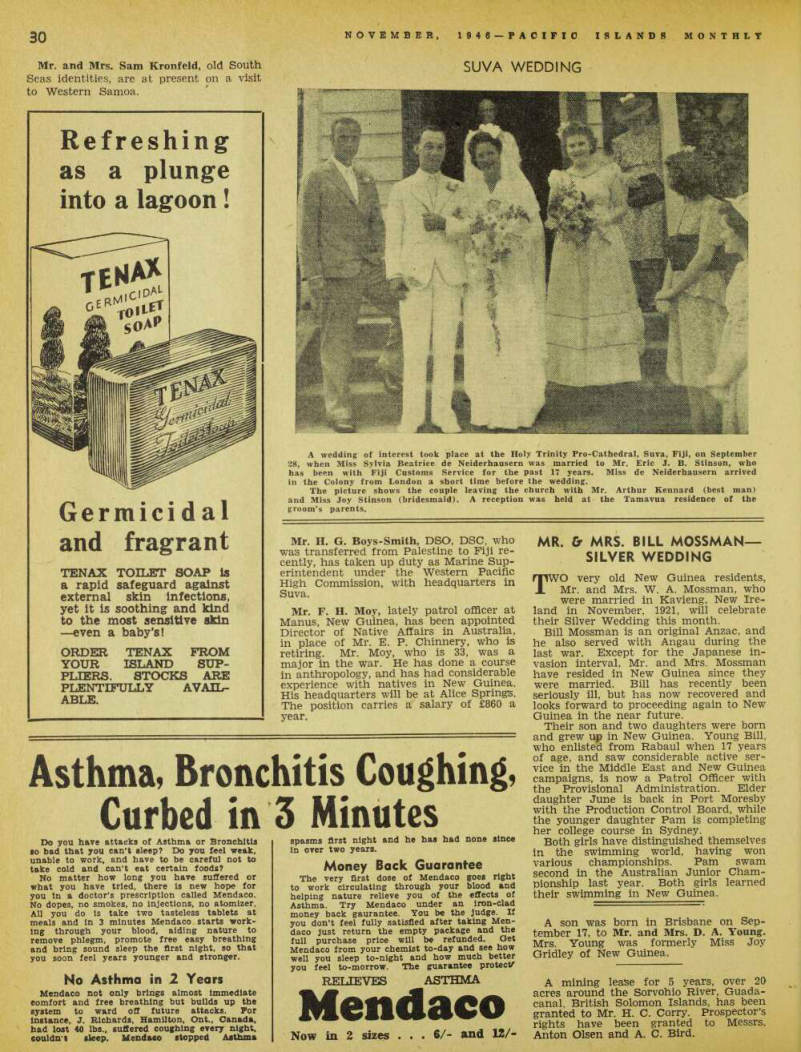
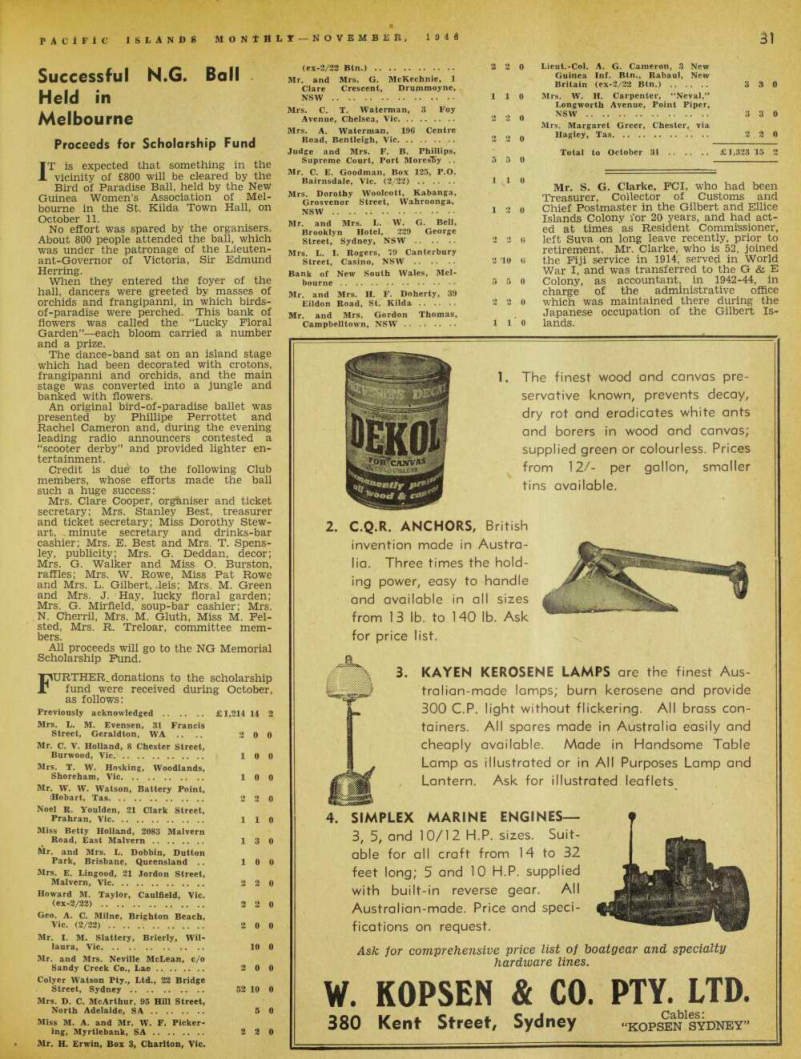
r THE Tongan wireless operator on Niuafo’ou, S. Malekamu, kept a diary of the events which led up to and occurred during the eruption.
Severe tremors, he says, began about 7 o’clock on the evening of September 9.
He took earth and thermometer tem peratures which seemed to be normal and tried, unsuccessfully, to raise Nuku’alofa and Suva on the radio. At about 8.12', there was an earthquake of about one minute’s duration. His account from that time is as follows:
Sep. 9—8.15 P.M.
The copra inspector called from the verandah that something queer was hap pening. I ran out and to my horror the western approach to Angana village is in flames and smoke, thousands of feet high. Can hear clearly big trees and coconuts snapping when waves of lava reach them. My estimate is that the fire now is at the western end of Angaha, almost at the hospital. I abandon every thing and start for the hill. Fire seems to cover all western approaches, from the sea up to the village of Esia, so ran towards Sapaata village.
Joined by teacher outside the radio station; we start at a slow trot, hoping that the fire will not reach town. Stop near Sapaata end of Angaha and have another look at the eruption. Not five minutes after we left the wireless station there is a big flash, which runs from the sea in a north-easterly direction, and ends about 100 yards from where we stand. This flash is accompanied by a fresh crater erupting from the sea in front of Dugald Quensell’s property.
We now run for our lives. On reach ing Sapaata, the fire looks as it it has reached where we stood not three min utes ago. People run to the hill —a whole mass of men, women, children and animals. The whole place is brightly lit by fire; the moon is obscured by fire and smoke. . .
Piu is considered unsafe as it is too close to Angaha, so we all go up to Mokotu point, about a mile from An gaha. From Mokotu, the fire is seen rag ing at Angaha.
The wireless masts still stand in the midst of the fire.
After about an hour we go to Piu, where we view the destruction of the wireless station and government offices and quarters. One crater is at the back of what was our kitchen; and one is about 20 yards from the office and the
same distance from our living quarters.
There are other small openings at vari ous places at Angaha, which spout fire but not lava.
Sep. 9—Ll P.M.
Light fain mixed with sand begins to come down now. I become wet and for the first time realise that I have nothing else except the shirt and vala which I wear. I have saved only the office and safe keys and a tuning fork. People now start building shelters for the night.
Sep. 10—10 A.M.
Went to Angaha. With the exception of the hospital, school house, and teach ers’ quarters, all government and most other property is destroyed. There are three craters at Angaha and about nine others in line along the beach.
One crater has formed a good safe natural anchorage facing northward, which is considered to be the ‘best an chorage Niuafo’ou has seen. Lava ex tends right out to sea. Whether it will stay or not depends on whether it can withstand the force of the waves. The new beach is covered by a kind of rough, black sand, and lifeboats can land there with ease.
September 11.
About 11 a.m. I and five others manage to pull out the small safe from the Gov ernment office. We recovered £34 in silver. All paper currency was burned.
Unable to pull out the big safe as it was surrounded by hot lava and covered by hot, rough, black sand from Alelea crater, a few yards away. .
This crater erupted strongly again last night, and by morning a big hill had formed there, about two or three hun dred feet high. ' To-day, with a long stick, I wrote an SOS beside the Alelea crater, where the meteorological hut stood. An aircraft passed well away to north at about noon or earlier; going westerly, possibly from Samoa to Fiji. Alelea crater has stopped erupting but it makes an occasional roar like a lion that makes people near it run for their lives.
Sept. 12—About 10 or 11 a.m. an air craft (unseen) passed well out to the north, running easterly (Fiji-Samoa).
We pray that she might come near and report us to Nukualofa, but she keeps a straight course.
Sept. 13, 14, and 15—Nothing happens
(Continued on page 53)
on these days, except one or two craters near Utu Palapu are still active, especi ally at night. Not a day passes without four or five good, big shakes.
Sept. 16 —About 2 p.m. an aircraft comes from south and circles island once, then goes round Angaha. Everyone is happy, as we know that it will re port us to Nukualofa. Tried to morse to aircraft with a 2-cell torch, but no good, as the sun is too bright. The plane disappeared in an easterly direc tion.
Sept. 17—All craters in Angaha have died down with the exception of some small openings away from the erupting area, which send out smoke and some times fire, but not lava. Alelea and Kekei are still active, but weak. Every day since September 9 has been fine.
Sept. 18 About noon, an American Naval Catalina approaches from the east and circles the island. She then circles Angaha, then drops a first aid box, together with a bag of rice, tinned beef, tea and seven cases of American “K” rations. She circles Angaha many times—sometimes so low that we can see three American sailors in blue shirts and dungarees waving to us from the side doors of the plane.
Sept. 19—We distribute food from the plane amongst those affected by the eruption. Endeavour to collect parachute for sending back but find that it has been cut to pieces by some of the Niua people. The food was sent from Landers, USA Naval Base, Tutuila, Pago Pago, Eastern Samoa. Written on one of the cases was “New Zealand ship will call here in 10 days.”
The day is fine. Father Schahl has picked up on his radio a message that the “Hifofua” will be here to-day or to morrow. A land transport plane with twin engines comes over about 11 a.m.
and circles Angaha twice. It then flies away to eastward.
Sept. 20—About 10 a.m. “Hifofua” arrives together with an American tanker (diverted from her course to Noumea) which is ordered to stand by the island in case of an evacuation.
After some hours on shore the Min ister of Lands is of the opinion that there is no immediate danger and no further need for the ship to remain.
Every crater is dormant now and no more shakes are felt. It looks as if the eruption is over for the time being.
Further details have been made public in Noumea of the proposed French South Pacific Air Company. The aims are to connect up the Caledonian and Hebridean archipelagoes, link these up with Australia and Tahiti; attract tourists and train young people to become pilot's.
Capital needed is estimated at ten mil-
lion New Caledonian francs, subscribed in France and locally. The local branch of the Bank of Indo-China is receiving subscriptions. It is proposed to use Catalinas on the longer runs, and Republic Seabee amphibians for shorter distances. Two training planes would be used at the Noumea base.
Passing of Fiji Pioneers
Mrs. J. B. Brown
ONE of Fiji’s early pioneers, Mrs. J. B.
Brown, died in Auckland. New Zea land, in early October. She was the widow of Mr. L. E. Brown, of the firm of Brown and Joske, Suva. Her husband predeceased her by 27 years.
Mrs. Brown was 83 years of age at her death and will be remembered by the older generation of Fiji residents.
She was one of the Colony’s most charm ing hostesses and took a great interest in outdoor sport, in the Church of Eng land, and in helping others wherever possible.
After the death of her husband, she lived for some years in England, but she was residing in Fiji at the outbreak of World War 11. About 1942, she went to New Zealand, where she has lived since.
She is survived by her sister, Mrs. E.
Booth, now living in Jamaica, and an adopted daughter, Mrs. Olive Bevington, who now lives in Canada. Her brother.
Mr. E. W. W. Harness, died about five years ago.
Mr. Robert Blakelock
Mr. Robert Blakelock Died In
Suva at the end of September. He had celebrated his 100th birthday last May.
He was born in the North of England and in 1859 emigrated with his parents to New Zealand. In the same year his father accepted a contract to build a Wesleyan Church at Lakemba and the family moved to Fiji. His father was a shipwright, and when eventually he set tled at Malawai, Kadavu, he and his family turned out many fine vessels
there. Mr. Robert Blakelock followed his father’s trade for over 80 years be fore he retired.
Mr. Jack Eastgate
MR. JACK EASTGATE, who also died in Suva at the end of September, was born in 1879 at Namena, Tai levu, Fiji, but his home for the greater part of his life was in Levuka. He was educated at Levuka Public School and at the Auckland Grammar School, and then served his time as a building con tractor with the late Mr. C. S. Small, of Levuka.
Mr. Eastgate built many houses, chuhches and commercial buildings fin both Fiji and Tonga and was well known and respected.
Besides his Levuka home, he owned the estate of Urata, on Gau, and in re cent years he spent most of his time on that island.
Mr. W. Staite
THE death of Mr. W. Staite was re ported from Suva, Fiji, on October 13. He had been in Fiji for 40 years, having come there from New Zealand to be coachman to the then Governor, Sir Everard im Thurn. He was a well known personality around Suva right up to the time of his death.
He is survived by his widow and a daughter, Mrs. George Pocock, of Lau toka.
Rspca Branch For Fiji
A BRANCH of the Royal Society for the Prevention of Cruelty to Ani mals was formed at a public meet ing held at Lautoka, Fiji, on October 8.
There was a large attendance of local
residents and all communities were rep resented.
About 80 members were enrolled, in cluding a number of life members. Mr.
H. H. Ragg, MLC, was elected president of the branch.
Wesleyan Conference
New President For Tongan Wesleyan Conference
THE Free Wesleyan Church of Tonga has elected as its new President the Rev. A. E. McKay, BA, BD. Mr.
McKay succeeds the Rev. Rodger Page who. for 38 years, guided the Church in Tonga through some of the most troubled and critical days of its history.
In that long period of outstanding leader ship he was the guide, philosopher, and friend of Tongan and European alike.
The Tongan Conference is entirely in dependent, and its members, the sixtv two ordained Tongan ministers and the several laymen appointed by the circuits, make their own decisions with regard to Church policy and choose their own officers.
The new President was accepted as a candidate for the Ministry in 1934, and, at the conclusion of his University course at Queen’s College. Melbourne, he gradu ated in Arts and Divinity. After serving his probationary years, in 1940 he went to Vavau, where for six years he has worked with devotion and ability in a difficult and isolated centre.
Mrs. McKay did a special course of nursing at the Epworth Hospital. Mel bourne, and this has proved invaluable in Vavau where there is no European medical staff. —From the Methodist “Mis sionary Review.”
Mr. and Mrs. Sam Kronfeld, old South Seas identities, are at present on a visit to Western Samoa.
Mr. H. G. Boys-Smith, DSO, DSC. who was transferred from Palestine to Fiji re cently, has taken up duty as Marine Sup erintendent under the Western Pacific High Commission, with headquarters in Suva.
Mr. F. H. Moy, lately patrol officer at Manus, New Guinea, has been appointed Director of Native Affairs in Australia, in place of Mr. E. P. Chinnery, who is retiring. Mr. Moy, who is 33, was a major in the war. He has done a course in anthropology, and has had considerable experience with natives in New Guinea.
His headquarters will be at Alice Springs.
The position carries a salary of £B6O a year.
Advertisements & other items, pp. 31-32 (1 item)
cboiT
|K « -« U
DB2 9 H.P. HEAVY
DUTY MARINE ENGINE
Driving x 16 in.
Propeller at 700 r.p.m. % Reliable • Efficient £ Economical
Stuart Turner
Generating Sets
1,000 Watt, 32 Volt.
Simple, Economical
IMMEDIATE DELIVERY
Write for full particulars to—
STERN GEAR MADE TO ORDER
GOOD DELIVERIES
Thornycroft (Aust.) Pty., Ltd.
6/10 Wattle Street,
PYRMONT, N.S.W.
Cables: THORNMOTOR, Sydney.
Refreshing
as a plunge
into a lagoon!
' w ; o c .u>
$OA p
53
Germicidal
and fragrant
TENAX TOILET SOAP is
a rapid safeguard against external skin infections, yet it Is soothing and kind to the most sensitive skin —even a baby’s!
ORDER TENAX FROM
YOUR ISLAND SUP-
PLIERS. STOCKS ARE
PLENTIFULLY AVAIL-
ABLE.
Asthma, Bronchitis Coughing, Curbed in 3 Minutes
spasms first night and he has had none since In over two years.
Money Back Guarantee
The very first dose of Mendaco goes right to work circulating through your blood and helping nature relieve you of the effects of Asthma. Try Mendaco under an Iron-clad money back gaurantee. You be the judge. If you don’t feel fully satisfied after taking Mendaco just return the empty package and the full purchase price will be refunded. Get Mendaco from your chemist to-day and see how well you sleep to-night and how much better you feel to-morrow. The guarantee protect^
RELIEVES ASTHMA
Mendaco
Now in 2 sizes . . . 6/- and 12/-
Do you have attacks of Asthma or Bronchitis so bad that you can’t sleep? Do you feel weak, unable to work, and have to be careful not to take cold and can’t eat certain foods?
No matter how long you have suffered or what you have tried, there is new hope for you In a doctor’s prescription called Mendaco.
No dopes, no smokes, no injections, no atomizer.
All you do is take two tasteless tablets at meals and in 3 minutes Mendaco starts working through your blood, aiding nature to remove phlegm, promote free easy breathing and bring sound sleep the first night, so that you soon feel years younger and stronger.
No Asthma in 2 Years
Mendaco not only brings almost Immediate comfort and free breathing but builds up the system to ward off future attacks. For Instance, J. Richards, Hamilton, Ont., Canada, had lost 40 lbs., suffered coughing every night, couldn't sleep. Mendaco stopped Asthma
Suva Wedding
A wedding of interest took place at the Holy Trinity Pro-Cathedral, Suva, Fiji, on September 28, when Miss Sylvia Beatrice de Neiderhausern was married to Mr. Eric J. B. Stinson, who has been with Fiji Customs Service for the past 17 years. Miss de Neiderhausern arrived in the Colony from London a short time before the wedding.
The picture shows the couple leaving the church with Mr. Arthur Kennard (best man) and Miss Joy Stinson (bridesmaid). A reception was held at the Tamavua residence of the groom’s parents.
Mr. & Mrs. Bill Mossman—
Silver Wedding
mwo very old New Guinea residents, JL Mr. and Mrs. W. A. Mossman, who were married in Kavieng, New Ire land in November, 1921, will celebrate their Silver Wedding this month.
Bill Mossman is an original Anzac, and he also served with Angau during the last war. Except for the Japanese in vasion interval, Mr. and Mrs. Mossman have resided in New Guinea since they were married. Bill has recently been seriously ill, but has now recovered and looks forward to proceeding again to New Guinea in the near future.
Their son and two daughters were born and grew up in New Guinea. Young Bill, who enlisted from Rabaul when 17 years of age, and saw considerable active ser vice in the Middle East and New Guinea campaigns, is now a Patrol Officer with the Provisional Administration. Elder daughter June is back in Port Moresby with the Production Control Board, while the younger daughter Pam is completing her college course in Sydney.
Both girls have distinguished themselves in the swimming world, having won various championships. Pam swam second in the Australian Junior Cham pionship last year. Both girls learned their swimming in New Guinea.
A son was born in Brisbane on Sep tember 17, to Mr. and Mrs. D. A. Young.
Mrs. Young was formerly Miss Joy Gridley of New Guinea.
A mining lease for 5 years, over 20 acres around the Sorvohio River, Guada canal, British Solomon Islands, has been granted to Mr. H. C. Corry. Prospector’s rights have been granted to Messrs.
Anton Olsen and A. C. Bird.
Successful N.G. Ball
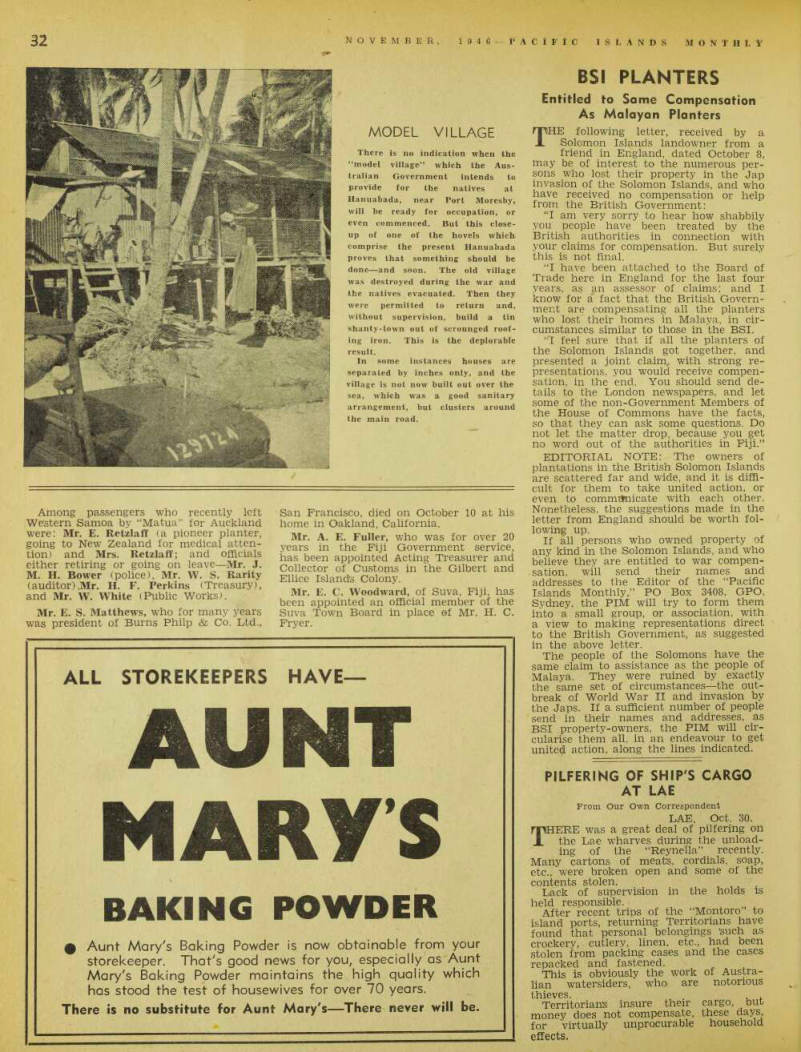
Held in Melbourne Proceeds for Scholarship Fund
IT is expected that something in the vicinity of £BOO will be cleared by the Bird of Paradise Ball, held by the New Guinea Women’s Association of Mel bourne in the St. Kilda Town Hall, on October 11.
No effort was spared by the organisers.
About 800 people attended the ball, which was under the patronage of the Lieuten ant-Governor of Victoria, Sir Edmund Herring.
When they entered the foyer of the hall, dancers were greeted by masses of orchids and frangipanni, in which birds of-paradise were perched. This bank of flowers was called the “Lucky Floral Garden” —each bloom carried a number and a prize.
The dance-band sat on an island stage which had been decorated with crotons, frangipanni and orchids, and the main stage was converted into a jungle and banked with flowers.
An original bird-of-paradise ballet was presented by Phillipe Perrottet and Rachel Cameron and, during the evening leading radio announcers contested a “scooter derby” and provided lighter en tertainment.
Credit is due to the following Club members, whose efforts made the ball such a huge success; Mrs. Clare Cooper, organiser and ticket secretary; Mrs. Stanley Best, treasurer and ticket secretary; Miss Dorothy Stew art, minute secretary and drinks-bar cashier; Mrs. E. Best and Mrs. T. Spens ley, publicity; Mrs. G. Deddan, decor; Mrs. G. Walker and Miss O. Burston, raffles; Mrs. W. Rowe, Miss Pat Rowe and Mrs. L. Gilbert, leis; Mrs. M. Green and Mrs. J. Hay, lucky floral garden; Mrs. G. Mirfield, soup-bar cashier; Mrs.
N. Cherril, Mrs. M. Gluth, Miss M. Fel sted, Mrs. R. Treloar, committee mem bers.
All proceeds will go to the NG Memorial
Scholarship Fund.
donations to the scholarship fund were received during October, as follows: Previously acknowledged £1,214 14 2 Mrs. L. M. Evensen, 31 Francis Street, Geraldton, WA ... 200 Mr. C. V. Holland, 8 Chester Street, Burwood, Vic 100 Mrs. T. W. Hosking, Woodlands, Shoreham, Vic 100 Mr. W. W. Watson, Battery Point, (Hobart, Tas 320 Noel R. Youlden, 21 Clark Street, Prahran, Vic 110 Miss Betty Holland, 2083 Malvern Road, East Malvern 13 0 Mr. and Mrs. L. Dobbin, Dutton Park, Brisbane, Queensland 10 0 Mrs. E. Lingood, 21 Jordon Street, Malvern, Vic 220 Howard M. Taylor, Caulfield, Vic. (ex-2/22) 320 Geo. A. C. Milne, Brighton Beach, Vic. (2/22) 2 0 0 Mr. I. M. Slattery, Brierly, Wil laura, Vic 10 0 Mr, and Mrs. Neville McLean, c/o Sandy Creek Co., Lae 2 0 0 Colyer Watson Pty., Ltd., 22 Bridge Street, Sydney 52 10 0 Mrs. D. C. McArthur, 95 Hill Street, North Adelaide, SA 5 0 Miss M, A. and Mr. W. F. Picker ing, Myrtlebank, SA 2 2 0 Mr. H. Erwin, Box 3, Charlton, Vic.
(ex-2/22 Btn.) 220 Mr, and Mrs. G. McKechnie, 1 Clare Crescent, Drummoyne,
Nsw 110
Mrs. C. T. Waterman, 3 Foy Avenue, Chelsea, Vic 3 2 0 Mrs. A. Waterman, 196 Centre Road, Bentleigh, Vic 2 3 0 Judge and Mrs. F. B. Phillips, Supreme Court, Port Moresby . . 5 5 0 Mr, C, E. Goodman, Box 125, P.O.
Bairnsdale, Vic. (2/22) 110 Mrs. Dorothy Woolcott, Kabanga, Grosvenor Street, Wahroonga,
Nsw 12 0
Mr. and Mrs. L. W. G. Bell, Brooklyn Hotel, 229 George Street, Sydney, NSW 3 2 6 Mrs. L. I. Rogers, 79 Canterbury Street, Casino, NSW 210 6 Bank of New South Wales, Mel bourne 550 Mr. and Mrs. H. F. Doherty, 39 Eildon Road, St. Hilda 2 3 0 Mr. and Mrs. Gordon Thomas, Campbelltown, NSW 110
Lieut.-Col. A. G. Cameron, 3 New Guinea Inf. Btn., Rabaul, New Britain (ex-2/22 Btn.) 3 3 0 Mrs. W. H. Carpenter, “Neval,”
Longworth Avenue, Point Piper,
Nsw 3 3 0
Mrs. Margaret Greer, Chester, via llagley, Tas 2 3 0 Total to October 31 £1,323 15 2 Mr. S. G. Clarke, FCI, who had been Treasurer, Collector of Customs and Chief Postmaster in the Gilbert and Ellice Islands Colony for 20 years, and had act ed at times as Resident Commissioner, left Suva on long leave recently, prior to retirement. Mr. Clarke, who is 52, joined the Fiji service in 1914, served in World War I, and was transferred to the G & E Colony, as accountant, in 1942-44, in charge of the administrative office which was maintained there during the Japanese occupation of the Gilbert Is lands.
Among passengers who recently left Western Samoa by “Matua” for Auckland were: Mr. E. RetzlafT (a pioneer planter, going to New Zealand for medical atten tion) and Mrs. RetzlafT; and officials either retiring or going on leave —Mr. J.
M. H. Bower (police), Mr. W. S. Rarity (auditor).Mr. H. F. Perkins (Treasury), and Mr. W. White (Public Works).
Mr. E. S. Matthews, who for many years was president of Burns Philp & Co. Ltd.,
San Francisco, died on October 10 at his home in Oakland, California.
Mr. A. E. Fuller, who was for over 20 years in the Fiji Government service, has been appointed Acting Treasurer and Collector of Customs in the Gilbert and Ellice Island's Colony.
Mr. E. C. Woodward, of Suva, Fiji, has been appointed an official member of the Suva Town Board in place ©f Mr. H. C.
Fryer.
Model Village
There is no indication when the “model village" which the Aus tralian Government intends to provide for the natives at Hanuabada, near Port Moresby, will be ready for occupation, or even commenced. But this close up of one of the hovels which comprise the present Hanuabada proves that something should be done—and soon. The old village was destroyed during the war and the natives evacuated. Then they were permitted to return and, without supervision, build a tin shanty-town out of scrounged roof ing iron. This is the deplorable result.
In some instances houses are separated by inches only, and the village is not now built out over the sea, which was a good sanitary arrangement, but clusters around the main road.
Advertisements & other items, pp. 33-34 (2 items)
31
PACIFIC ISLANDS MONtßt* NOVEMBER, 194$
W. Kopsen & Co. Pty. Ltd.
. I Hi 1. The finest wood and canvas preservative known, prevents decay, dry rot and eradicates white ants and borers in wood and canvas; supplied green or colourless. Prices from 12/- per gallon, smaller tins available. 2. C.Q.R. ANCHORS, British invention made in Australia. Three times the holding power, easy to handle and available in all sizes from 13 lb. to 140 lb. Ask for price list. \ 3. KAYEN KEROSENE LAMPS are the finest Aus tralian-made lamps; burn kerosene and provide 300 C.P. light without flickering. All brass containers. All spares made in Australia easily and cheaply available. Made in Handsome Table Lamp as illustrated or in All Purposes Lamp and Lantern. Ask for illustrated leaflets
4. SIMPLEX MARINE ENGINES—
3, 5, and 10/12 H.P. sizes. Suitable for all craft from 14 to 32 feet long; 5 and 10 H.P. supplied with built-in reverse gear. All Australian-made. Price and specifications on request.
Ask for comprehensive price list of boatgear and specialty hardware lines.
W. KOPSEN & CO. PTY. LTD.
w pq •
“KOPSEN SYDNEY’
380 Kent Street, Sydney
ALL STOREKEEPERS HAVE—
AUNT
MARYS
BAKING POWDER
• Aunt Mary's Baking Powder is now obtainable from your storekeeper. That's good news for you, especially as Aunt Mary's Baking Powder maintains the high quality which has stood the test of housewives for over 70 years.
There is no substitute for Aunt Mary's—There never will be.
Bsi Planters
Entitled to Same Compensation As Malayan Planters
THE following letter, received by a Solomon Islands landowner from a friend in England, dated October 8, may be of interest to the numerous per sons who lost their property in the Jap invasion of the Solomon Islands, and who have received no compensation or help from the British Government: “I am very sorry to hear how shabbily you people have been treated by the British authorities in connection with your claims for compensation. But surely this is not final.
“I have been attached to the Board of Trade here in England for the last four years, as an assessor of claims; and I know for a fact that the British Govern ment are compensating all the planters who lost their homes in Malaya, in cir cumstances similar to those in the BSI. ‘T feel sure that if all the planters of the Solomon Islands got together, and presented a joint claim, with strong re presentations, you would receive compen sation, in the end. You should send de tails to the London newspapers, and let some of the non-Government Members of the House of Commons have the facts, so that they can ask some questions. Do not let the matter drop, because you get no word out of the authorities in Fiji.”
EDITORIAL NOTE: The owners of plantations in the British Solomon Islands are scattered far and wide, and it is diffi cult for them to take united action, or even to communicate with each other.
Nonetheless, the suggestions made in the letter from England should be worth fol lowing up.
If all persons who owned property of any kind in the Solomon Islands, and who believe they are entitled to war compen sation, will send their names and addresses to the Editor of the “Pacific Islands Monthly,” PO Box 3408, GPO, Sydney, the PIM will try to form them into a small group, or association, with a view to making representations direct to the British Government, as suggested in the above letter.
The people of the Solomons have the same claim to assistance as the people of Malaya. They were ruined by exactly the same set of circumstances —the out break of World War II and invasion by the Japs. If a sufficient number of people send in their names and addresses, as BSI property-owners, the PIM will cir cularise them all, in an endeavour to get united action, along the lines indicated.
Pilfering Of Ship's Cargo
At Lae
From Our Own Correspondent LAE, Oct. 30. rERE was a great deal of pilfering on the Lae wharves during the unload ing of the “Reynella” recently.
Many cartons of meats, cordials, soap, etc., were broken open and some of the contents stolen.
Lack of supervision in the holds is held resnonsible.
After recent trips of the “Montoro” to island ports, returning Territorians have found that personal belongings Such as crockery, cutlery, linen, etc., had been stolen from packing cases and the cases repacked and fastened.
This is obviously the work of Austra lian watersiders, who are notorious thieves. . , , Territorians insure their cargo, but money does not compensate, these days, for virtually unprocurable household effects.
In Rarotonga
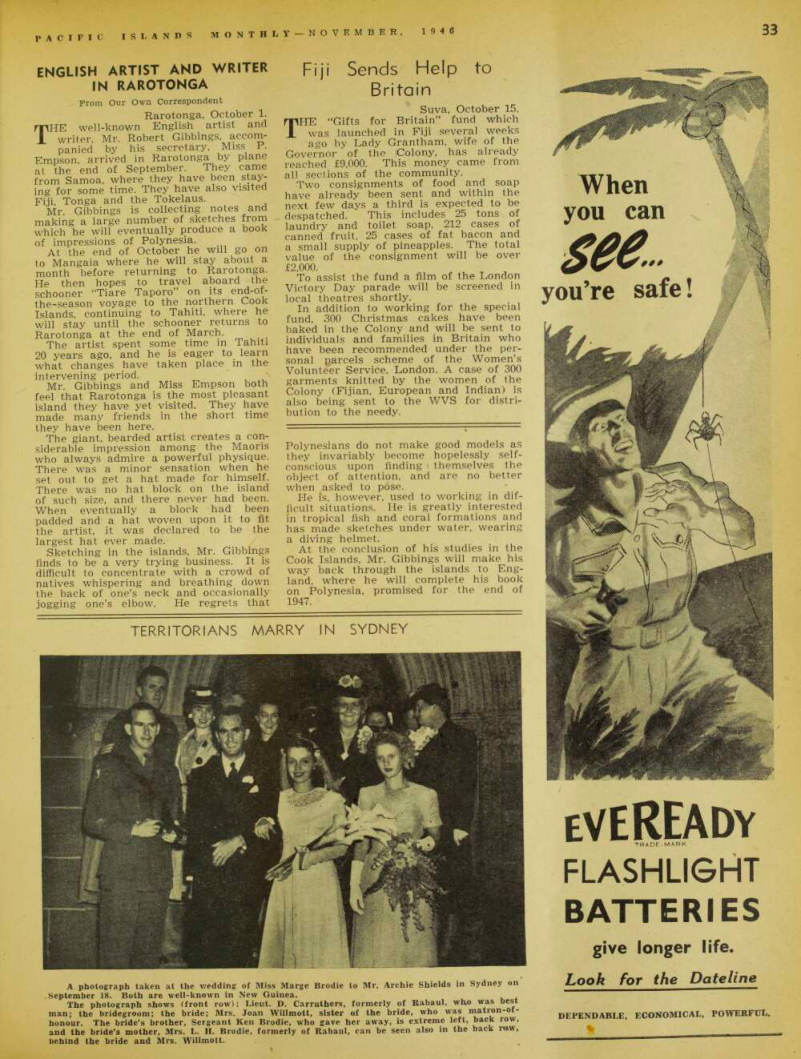
English Artist And Writer
From Our Own Correspondent Rarotonga, October 1.
THE well-known English artist and writer. Mr. Robert Gibbings, accom panied by his secretary, Miss P.
Empson, arrived in Rarotonga by plane at the end of September. They came from Samoa, where they have been stay ing for some time. They have also visited Fiji, Tonga and the Tokelaus.
Mr. Gibbings is collecting notes and making a large number of sketches from which he will eventually produce a book of impressions of Polynesia.
At the end of October he will go on to Mangaia where he will stay about a month before returning to Rarotonga.
He then hopes to travel aboard the schooner “Tiare Taporo” on its end-of the-season voyage to the northern Cook Islands, continuing to Tahiti, where he will stay until the schooner returns to Rarotonga at the end of March.
The artist spent some time in Tahiti 20 years ago, and he is eager to learn what changes have taken place in the
intervening period.
Mr. Gibbings and Miss Empson both feel that Rarotonga is the most pleasant island they have yet visited. They have made many friends in the short time they have been here.
The giant, bearded artist creates a con siderable impression among the Maoris who always admire a powerful physique.
There was a minor sensation when he set out to get a hat made for himself.
There was no hat block on the island of such size, and there never had been.
When eventually a block had been padded and a hat woven upon it to fit the artist, it was declared to be the largest hat ever made.
Sketching in the islands, Mr. Gibbings finds to be a very trying business. It is difficult to concentrate with a crowd of natives whispering and breathing down the back of one’s neck and occasionally jogging one’s elbow. He regrets that
Polynesians do not make good models as they invariably become hopelessly self conscious upon finding themselves the object of attention, and are no better when asked to pose.
He is, however, used to working in dif ficult situations. He is greatly interested in tropical fish and coral formations and has made sketches under water, wearing a diving helmet.
At the conclusion of his studies in the Cook Islands, Mr. Gibbings will make his way back through the islands to Eng land, where he will complete his book on Polynesia, promised for the end of 1947.
Fiji Sends Help to Britain
Britain
Suva, October 15.
THE “Gifts for Britain” fund which was launched in Fiji several weeks ago by Lady Grantham, wife of the Governor of the iColony, has already reached £9,000. This money came from all sections of the community.
Two consignments of food and soap have already been sent and within the next few days a third is expected to be despatched. This includes 25 tons of laundry and toilet soap, 212 cases of canned fruit, 25 cases of fat bacon and a small supply of pineapples. The total value of the consignment will be over £2,000.
To assist the fund a film of the London Victory Day parade will be screened in local theatres shortly.
In addition to working for the special fund, 300 Christmas cakes have been baked in the Colony and will be sent to individuals and families in Britain who have been recommended under the per sonal parcels scheme of the Women’s Volunteer Service, London. A case of 300 garments knitted by the women of the Colony (Fijian, European and Indian) is also being sent to the WVS for distri bution to the needy.
Territorians Marry In Sydney
A photograph taken at the wedding of Miss Marge Brodie to Mr. Archie Shields in Sydney on September 18. Both are well-known in New Guinea.
The photograph shows (front row): Lieut. D. Carruthers, formerly of Rabaul, who was best man; the bridegroom; the bride; Mrs. Joan Willmott, sister of the bride, who was matron-of honour. The bride’s brother, Sergeant Ken Brodie, who gave her away, is extreme left, back row, and the bride’s mother, Mrs. L. H. Brodie, formerly of Rabaul, can be seen also in the back raw, behind the bride and Mrs. Willmott.
Advertisements & other items, p. 35 (2 items)
33
PACIFIC ISLANDS MONTH LY-NOVEMBER. 1946
Eveready
When you can safe! you re fee i
trade-mark
FLASHLIGHT
BATTERIES
give longer life.
Look /or the Dateline^
DEPENDABLE, ECONOMICAL, POWERFUL.
Decline And Revival Of Fijian Race
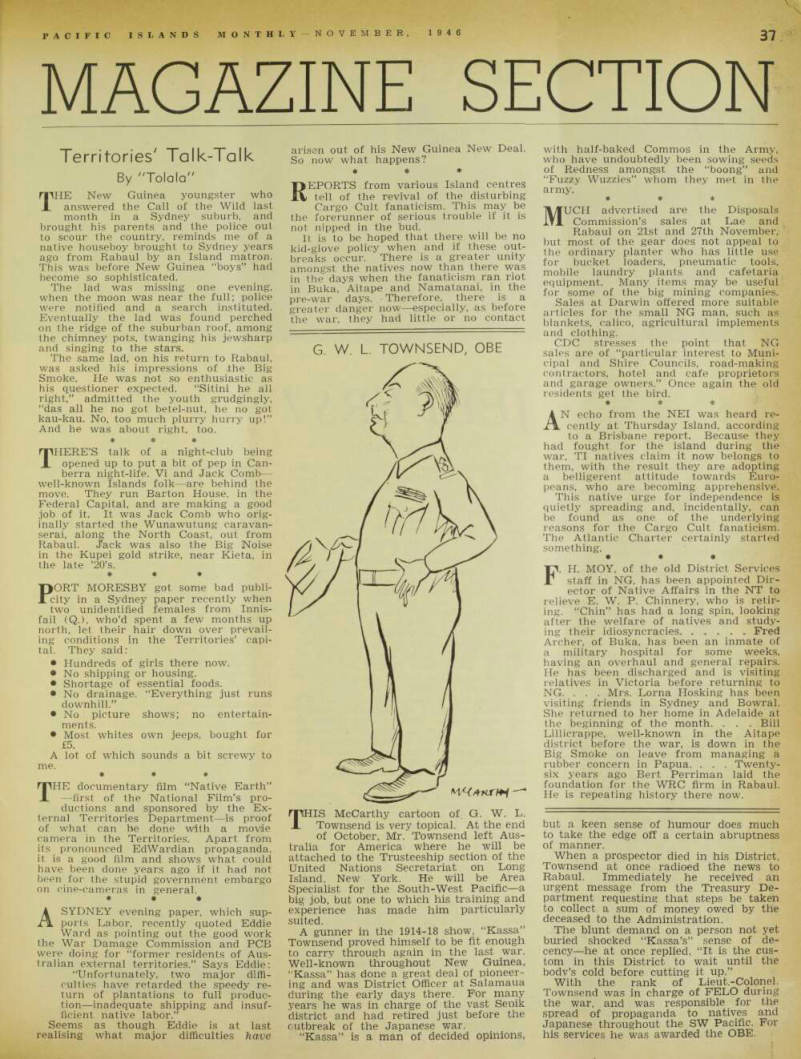
What Was Achieved by Sympathetic British Administration
J T is fitting that the remarkable story of the decline and recovery of the Fijian race—which is typical of the story of most of the South Pacific islands native races—should be told by Dr. V. W. T. McGusty, CMG QBE who retired recently after a lifetime of distinguished service as Chief Medical Officer in Fiji and Secretary for Indian Affairs in Fiji. The following article appeared in September in “Health Horizon;’ an excellent new quarterly now being published in London: y
WHEN two fundamentally differing
civilisations meet for the first time, danger of extinction is brought urgently to the weaker and more ancient by new infectious diseases against which its people have little resistance, and by too abrupt a change in their age-old habits of living.
This story tells of the white man’s first entry into a new land; of how harmful factors in the form of new dis seases and new ways of living spread among its primitive people and threat ened them with extinction in advance of the benefits of the new civilisation; and of how those people were ultimately saved by teaching them how to achieve their salvation by their own efforts.
The prosperous island Crown Colony of Fiji, which straddles the 180th degree of longitude (that global line which marks where time is twelve hours dif ferent from Greenwich time) is well suited for such a story because the whole history of its contact with the white man is limited to the last century and a half.
AS a preface to the story of Fiji, brief mention must be made of the four geographico-racial groups found in the Pacific.
The first of these, Polynesia or “the many islands,” includes among other places Hawaii, where the battle of Pearl Harbour was fought, and Samoa, where Robert Louis Stevenson lived his last years, and it lies to the east of the 180°
longitude. The Polynesians are a light skinned, intelligent, adventurous race whose wanderings took them as far south as New Zealand to become the renowned Maori people.
The second group, Micronesia or “the small islands,” lies chiefly to the west of the 180th degree and to the north of the equator and its inhabitants, the Micronesians. are more Asiatic in their physical characteristics than the Polyne sians.
The third group was called Melanesia because of the relatively dark colour of its people. It also lies west of longitude 180°, and it is to the south of Micronesia.
Situated at the eastern extremity of Melanesia, Fiji is in a racial sense the mixing bowl of the Polynesian, Microne sian and Melanesian peoples.
The fourth group, Indonesia, includes the Dutch East Indies and the Philippine Islands and lies far away to the west in close contact with Asia.
Although differing greatly from one another in many ways, and widely sep arated by great ocean spaces an associ ation between the four groups of the Pacific peoples extending back into the dawn of time can be traced both in their culture and in their physical form.
An interesting factor in the health of the Pacific Islanders is that owing to a freakish distribution of the anopheles mosquito, all Polynesia, much of Micro nesia, and Fiji are free from malaria.
BEFORE the coming of the white man the Fijian civilisation was neolithic, and the social system was com munal. The Fijians, while of a predom inantly Melanesian stock, show signs of mixture with two other races, and the fusion of culture has given rise to a patrilineal totemistic- tribal community.
The tribes, which were constantly at war with one another, were ruled by hereditary chiefs who, although they were worshipped as gods and endowed with absolute authority, suffered a defin ite curtailment of their powers under a curiously democratic custom which re quired that a chief must be proclaimed publicly before assuming office as the head of his tribe; and further, which incurred the penalty of death for any chief who, in the judgment of the tribal elders, was found guilty of dangerous infringement of the customary laws of his tribe.
In the remarkably self-sufficient society over which the chiefs presided, every individual had a special part to play, and in return for services rendered to the community was assured of the necessaries of his own life.
The system of land tenure was especi ally interesting. It did not involve actual ownership by either chiefs or individuals, but is expressed in the aphorism “the chiefs owned the people and the people owned the land.”
This is not to deny the existence of many malpractices abhorrent to our western ideas - malpractices which in cluded gross cannibalism as well as the habit, whenever a chief died, of strang ling his widows so that his womenfolk might continue their domestic ministra tions in the celestial sphere! Yet judg ment, even in such matters, must be balanced against the fact that the prac tices were condoned by public opinion and carried out under the authority of the chiefs at least with 'a justice born of a broad impartiality.
In these modern Colonial days when the danger is recognised of making too sudden an effort to change the age-long habits of Hying of a whole people, the underlying idea has been to eliminate only the savage and more objectionable features from primitive cultures, while continuing to preserve the better ones in that quasi-autonomous form of ad ministration known as indirect govern ment . . .
NO record exists of white men hawing entered Fiji until the coming of a few hardy seamen adventurers in search of sandalwood in the late 1790’5.
Although the first white men came to exploit and not to settle, it is now estab lished that it was they who began the introduction among the hitherto un affected Fijians of the infectious diseases of the western world.
The spread of these maladies among a people whose society was crumbling under the increasing pressure of Euro pean influences continued unchecked for almost eighty years, until Fiji became a British Crown Colony in 1874. In the very next year, and before the measures taken to control disease could become effective, a single epidemic of measles killed almost a quarter of the already depleted Fijian population, and reduced it to less than half the figure at which it had stood at the coming of the white man.
But, shocking as was the suddenness of this tragedy, it is tuberculosis which has taken the greatest toll of the Fijians over the whole period of contact with the white race.
Side by side with this tragedy, certain other events of a constructive and re generative nature were taking place. The two most important were the conversion
of the Fijians to Christianity, and the union of the tribes under one King.
AFTER the sandalwood traders there followed a very slow infiltration into Fiji of men of European stock, who at firs’t were not of a very desirable class since they were mostly deserters from ships, and survivors from a small batch of convicts who had escaped from one of the penal settlements of Australia.
It was not until 1830 that beneficent influences began to penetrate with the arrival of Christian missionaries, whose first representatives were actually native converts from a neighbouring group of islands. In 1835 the first white mission aries, two Wesleyan Methodists, settled, and were followed by other permanent missionaries, both Methodist and Roman Catholic.
So much uninformed criticism is dir ected against missionaries that justice demands that it be recorded of those who worked in Fiji that, leading lives of great danger and privation, they suc ceeded within the short space of half a century in converting the entire Fijian population to Christianity and in doing so that they endowed this primitive people with a written language which they devised in order to distribute trans lations of the Bible. The first British administrator was greatly indebted to the missionaries for having civilised and pacified the Fijians . . .
If he had time to think, the first Gov ernor of the new British Colony must have regarded his task as insuperable, for he had neither funds nor any visible source of revenue to meet the cost of forming a government and stemming the catastrophic decline of the Fijian race.
His only assets seem to have been the civilisation brought about by the mis sions, the union effected by King Tfiak ombau, and some wise counsellors among whom was William MacGregor, the first medical officer of the new Colony.
And these assets were used to full ad vantage. The new Government was de signed so as to conserve all of the un objectionable features of the native sys tem, and to use the chiefs and native officials as instruments of the Fijian ad ministration.
The problem of disease was met by stringent quarantining of overseas ship ping and by vaccinating the population against smallpox. For the latter duty selected natives were trained and used so successfully that the idea was con ceived in the ingenious mind of Dr. Mac- Gregor of training them in the rudiments of medicine, surgery and public health, and sending them out, after a test exam ination, to practise among their fellow tribesmen with the title of Native Medi cal Practitioner.
From this simple beginning a sub-pro fessional medical service grew up to play a vital part in breaking down super stition, bringing disease under control, and winning the confidence of the Fijians in modern medicine. By the enlargement of the medical school in Fiji the Native Medical Practitioner system has been ex tended to other Pacific administrations, while, as a somewhat more recent, but equally useful development, a school for the training of local nurses has grown up in Fiji along exactly similar lines.
An influential recent innovation is the formation of voluntary women's Welfare Committes in the villages. Thus by a fortunate blending of ingenuity with ex perimentalism the difficult problems of Fiji came to be solved through the prin ciples since recognised as corner stones of Colonial administration, namely in direct government and the use of indi genous personnel, especially on the staff of welfare services.
IT is now clear that the preservation of the social system, acting from a psy chological point of view, played as important a part in preserving the Fijian
race as the employment of sub-professional native doctors and nurses in attacking actual disease from within the tribe; and, further, that success in either direction would not have been attainable without the British Colonial Service.
It is interesting to see by a glance at the changing state of the population the whole picture of decline and recovery in the last century and a half. First the forces of destruction held the field, unchecked, for nearly eighty years. Then Fiji came under British rule; and, soon afterwards, the process of regeneration asserts itself in a- steady lessening of the rate of decline Continued over the next forty-five years until 1919, when the population reached its lowest level of about one-third the figure at which it had stood 120 years earlier when the white man made his appearance.
Thence forward steady upward progress has been so well maintained that, within the space of 25 years, the population has risen again by nearly 40 per cent. above its lowest figure, and the conditions now prevailing are healthy enough fully to justify the assumption that in the absence of any unforseen catastrophe, such as the introduction of malaria, the survival of the Fijian race is well assured.
THE stable government resulting from British rule, led quickly to industrial development, which centred chiefly
in the production of sugar and copra, Next came a demand for labour which could not be molt within the Colony without risk of dangerously upsetting the Fijian social system; and so the Gov ernment turned to India, with whose Government an arrangement was soon made for Indian agriculturalists to emi grate to Fiji,
Ttt( ,
'PHIS became effective in the late JL 1870’s, and from those original immi grants who chose to settle in Fiji a large and prosperous community is des cended, whose numbers already exceed the native Fijians, Some people have assumed the exist ence of a sort of racial rivalry as be tween Indian and Fijian, and it has been suggested that the death-knell of the Fijian race would have been sounded if ever its population should be exceeded by the Indian.
However, now when the Indian has actually taken the lead it has also be come clear that the circumstances of the t wo races are so dissimilar that corn parison between them becomes almost pointless. The country is J still under developed and under-populated and will hold, for many years to come, oppor tunities for Indian and Fijian to prosper side by side, and without racial fusion, towards which there has as yet been little tendency,
(Continued on page 46)
Indeed, it is to contend with such div ergencies of population that Crown Colony government has been evolved.
While the system is often criticised as being too autocratic, experience shows that colonial governors have acted with understanding which has encouraged democratic development to take place without sacrificing the interests of the less advanced sections of the community.
FIJI is a small country whose popula tion hardly exceeds 250,000; but it has all of the problems of bigger Colonial administrations.
A much criticised feature of the Brit ish Crown Colony, although it has been somewhat modified since the Colonial Welfare and Development Act, is the principle that each Colony must pay for its services out of its own resources.
But I wonder if this financial strin gency has not at least had the advant age of bringing Briton and Fijian more closely together. From this it is but another step to find in financial self sufficiency the basis of that resourceful ness which is enabling Ceylon, Jamaica, and other Crown Colonies to advance towards complete autonomy.
Advertisements & other items, pp. 36-38 (2 items)
Itching Skin Germs
Killed in 3 Days
Thanks to the discovery of an American physician, It Is now possible to kill and remove the true cause of most skin troubles. Your skin has nearly 50 million tiny seams and pores where invisible germs and parasites can hide, and which are the true cause of terrible Itching, Cracking, Peeling, Burning, Ringworm, Acne, Psoriasis, Blackheads, Pimples, Foot Itch and other disfiguring blemishes.
Blemishes such as these make you look and feel embarrassed, unattractive and handicapped in life, both socially and in business. You can’t get rid of these disfigurements with ordinary treatments, which give only temporary relief, because they do not kill the germs or parasites responsible for your trouble. .
New Discovery Kills Cause
Former skin sufferers throughout the world are now praising Nixoderm, the discovery of a leading American skin specialist. This remarkable new preparation quickly penetrates into the pores of the skin and kills the germs and parasites responsible for your trouble In 7 minutes, stopping the itch almost instantly. At the same time, this wonderful preparation acts as a tonic and skin food, so that as the cause of your trouble is removed, your skin becomes soft, smooth and clear. This clear, healthy complexion will give you new charm and make It easy to win friend*.
Praised by Doctors
Dr. T. A. Ellis, well-known physician of Toronto, Canada, recently stated: “Skin disorders caused by parasites, as many are, yield to Nixoderm. These parasites are invisible to the naked eye. They eat away the skin, forming ugly eruptions. Ordinary ointments or remedies fail completely, or give only temporary results because they do not reach the cause of the condition. It is this value about Nixoderm in attacking parasites which impresses me most favorably, and explains in large measure the success it enjoys over many stubborn cases.”
Guaranteed Results
Get Nixoderm to-day. Put it to the test. In a few minutes you will find that the itching has stopped, and in 24 hours you can see for yourself that your skin is clearer. And it is guaranteed that, within one week, Nixoderm must make your skin soft, clear, smooth and attractive or money back on return of empty package. Get Nixoderm from your chemist or store to-day. The guarantee protects you. So don’t delay. Get Nixoderm to-day.
Nixoderm 2/. & 4/-
For Skin Sores, Pimples and Itch.
The Most Extensive Manufacturers in the British Empire of
RUBBER STAMPS,
INKS, STENCILS,
Marking Devices,
ACME STAMP PADS
OFFICE & STATIONERY SUPPLIES
U K
We also Manufacture & Supply
a Complete Line of
LIMEWASHING AND
SPRAYING MACHINES
for all purposes.
Let us know your requirements and we will quote by return.
WRITE FOR OUR GENERAL CATALOGUE
Limewashing Machine
EXCELSIOR SUPPLY CO. PTY. LTD.
278 Post Office Place,
MELBOURNE, VIC.
HEAD OFFICE :
160 BROADWAY,
Formerly known as George St., West,
SYDNEY. N.S.W.
50 Victoria Street,
WELLINGTON, N.Z.
Modern Refrigeration for the South Sea Islands
The ELECTROLUX
KEROSENE OPERATED
REFRIGERATOR
MARVEL
OF
MODERN
SCIENCE
Hfi a i
THE
MIRACLE
OF
ICE
FROM
HEAT
ELECTROLUX offers economical, modern and completely efficient
REFRIGERATION FOR ISLANDS' HOMES.
FREEZES CONTINUOUSLY WHILE SMALL LAMP BURNS.
Freezing controlled by simply regulating height of flame. Uses only i gallon of kerosene per week MOTORLESS ... NO PARTS TO GET OUT OF ORDER.
MODEL LKSSO
Capacity: 8.5 cubic feet.
GUARANTEED FOR TWO YEARS
• Write to your Local Distributor for prices and full details.
OBTAINABLE FROM ALL W. R. CARPENTER & CO. LTD.
BRANCHES THROUGHOUT THE ISLANDS "
Representation in Papua and New Hebrides.
36
NOVEMBER. 1946 PACIFIC ISLANDS M b N t H L $
Magazine Section
Territories' Talk-Talk
By "Tolala"
THE New Guinea youngster who answered the Call of the Wild last month in a Sydney suburb, and brought his parents and the police out to scour the country, reminds me of a native houseboy brought to Sydney years ago from Rabaul by an Island matron.
This was before New Guinea “boys” had become so sophisticated.
The lad was missing one evening, when the moon was near the full; police were notified and a search instituted.
Eventually the lad was found perched on the ridge of the suburban roof, among the chimney pots, twanging his jewsharp and singing to the stars.
The same lad, on his return to Rabaul, was asked his impressions of ihe Big Smoke. He was not so enthusiastic as his questioner expected. “Sitini he all right,” admitted the youth grudgingly, “das all he no got betel-nut, he no got kau-kau. No, too much plurry hurry up!”
And he was about right, too. ♦ ♦ ♦ THERE’S talk of a night-club being opened up to put a bit of pep in Can berra night-life. Vi and Jack Comb — well-known Islands folk—are behind the move. They run Barton House, in the Federal Capital, and are making a good job of it. It was Jack Comb who orig inally started the Wunawutung caravan serai, along the North Coast, out from Rabaul. Jack was also the Big Noise in the Kupei gold strike, near Kieta, in the late ’2o’s. ♦ * ♦ P>ORT MORESBY got some bad publi city in a Sydney paper recently when two unidentified females from Innis fail (Q.), who’d spent a few months up north, let their hair down over prevail ing conditions in the Territories’ capi tal. They said: • Hundreds of girls there now. • No shipping or housing. • Shortage of essential foods. • No drainage. “Everything just runs downhill.” • No picture shows; no entertain ments. • Most whites own jeeps, bought for £5.
A lot of which sounds a bit screwy to me. * * ♦ THE documentary film “Native Earth” —first of the National Film’s pro ductions and sponsored by the Ex ternal Territories Department—is proof of what can be done with a movie camera in the Territories. Apart from its pronounced EdWardian propaganda, it is a good film and shows what could have been done years ago if it had not been for the stupid government embargo on cine-cameras in general. * ♦ • A SYDNEY evening paper, which sup ports Labor, recently quoted Eddie Ward as pointing out the good work the War Damage Commission and PCB were doing for “former residents of Aus tralian external territories.” Says Eddie; “Unfortunately, two major diffi culties have retarded the speedy re turn of plantations to full produc tion —inadequate shipping and insuf ficient native labor.”
Seems as though Eddie is at last realising what major difficulties have
arisen out of his New Guinea New Deal.
So now what happens? ♦ * * REPORTS from various Island centres tell of the revival of the disturbing Cargo Cult fanaticism. This may be the forerunner of serious trouble if it is not nipped in the bud.
It is to be hoped that there will be no kid-glove policy when and if these out breaks occur. There is a greater unity amongst the natives now than there was in the days when the fanaticism ran riot in Buka, Aitape and Namatanai, in the pre-war days. Therefore, there is a greater danger now—especially, as before the war, they had little or no contact
with half-baked Commos in the Army, who have undoubtedly been sowing seeds of Redness amongst the “boong” and “Fuzzy Wuzzies” whom they met in the army. * ♦ * MUCH advertised are the Disposals Commission’s sales at Lae and Rabaul on 21st and 27th November, but most of the gear does not appeal to the ordinary planter who has little use for bucket loaders, pneumatic tools, mobile laundry plants and cafetaria equipment. Many items may be useful for some of the big mining companies.
Sales at Darwin offered more suitable articles for the small NG man, such as blankets, calico, agricultural implements and clothing.
CDC stresses the point that NG sales are of “particular interest to Muni cipal and Shire Councils, road-making contractors, hotel and cafe proprietors and garage owners.” Once again the old residents get the bird. ♦ * ♦ AN echo from the NEI was heard re cently at Thursday Island, according to a Brisbane report. Because they had fought for the island during the war, TI natives claim it now belongs to them, with the result they are adopting a belligerent attitude towards Euro peans, who are becoming apprehensive.
This native urge for independence is quietly spreading and, incidentally, can be found as one of the underlying reasons for the Cargo Cult fanaticism.
The Atlantic Charter certainly started something. • * ♦ F. H. MOY, of the old District Services staff in NG, has been appointed Dir ector of Native Affairs in the NT to relieve E. W. P. Chinnery, who is retir ing. “Chin” has had a long spin, looking after the welfare of natives and study ing their idiosyncracies Fred Archer, of Buka, has been an inmate of a military hospital for some weeks, having an overhaul and general repairs.
He has been discharged and is visiting relatives in Victoria before returning to NG. . . . Mrs. Lorna Hosking has been visiting friends in Sydney and Bowral.
She returned to her home in Adelaide at the beginning of the month. . . . Bill Lillicrappe, well-known in the Aitape district before the war, is down in the Big Smoke on leave from managing a rubber concern in Papua. . . . Twenty six years ago Bert Perriman laid the foundation for the WRC firm in Rabaul.
He is repeating history there now.
G. W. L. Townsend, Obe
THIS McCarthy cartoon of, G. W. L.
Townsend is very topical. At the end of October, Mr. Townsend left Aus tralia for America where he will be attached to the Trusteeship section of the United Nations Secretariat on Long Island, New York. He will be Area Specialist for the South-West Pacific —a big job, but one to which his training and experience has made him particularly suited.
A gunner in the 1914-18 show, “Kassa”
Townsend proved himself to be fit enough to carry through again in the last war.
Well-known throughout New Guinea, “Kassa” has done a great deal of pioneer ing and was District Officer at Salamaua during the early days there. For many years he was in charge of the vast Senik district and had retired just before the outbreak of the Japanese war.
“Kassa” is a man of decided opinions,
but a keen sense of humour does much to take the edge off a certain abruptness of manner.
When a prospector died in his District, Townsend at once radioed the news to Rabaul. Immediately he received an urgent message from the Treasury De partment requesting that steps be taken to collect a sum of money owed by the deceased to the Administration.
The blunt demand on a person not yet buried shocked “Kassa’s” sense of de cency—he at once replied, “It is the cus tom in this District to wait until the body’s cold before cutting it up.”
With the rank of Lieut.-Colonel, Townsend was in charge of FELO during the war, and was responsible for the spread of propaganda to natives and Japanese throughout the SW Pacific. For his services he was awarded the OBE.
Jeepers!
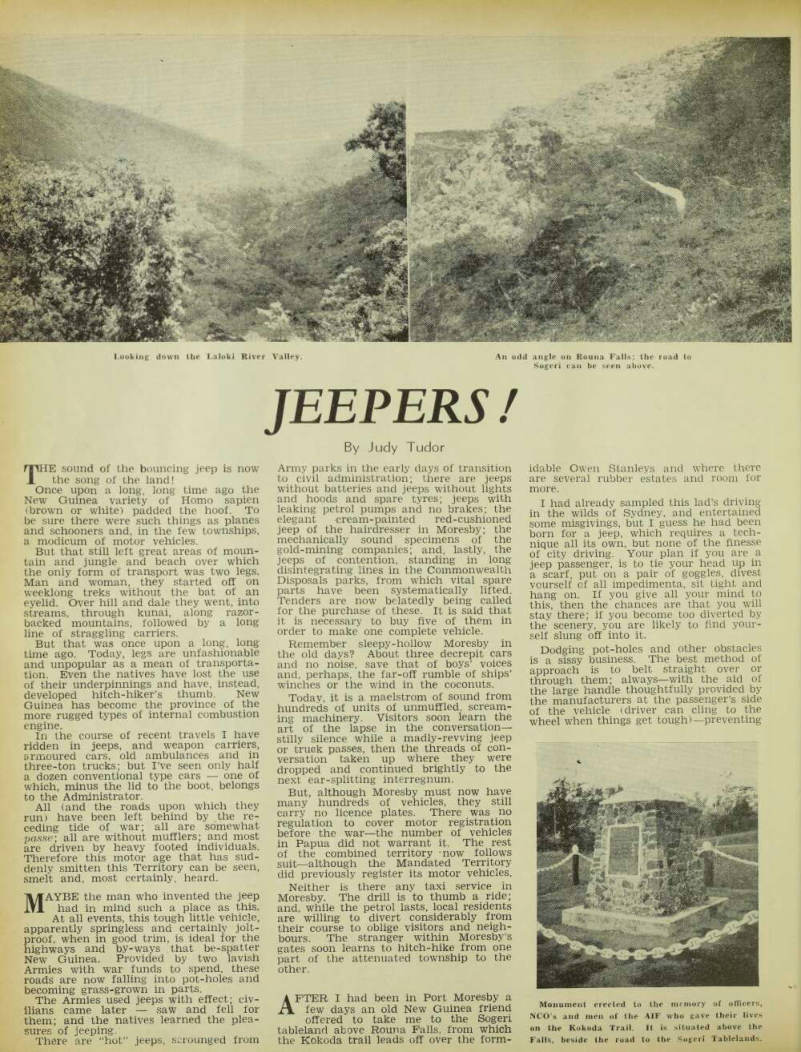
By Judy Tudor
rnHE sound of the bouncing jeep is now J. the song of the land!
Once upon a long, long time ago the New Guinea variety of Homo sapien (brown or white) padded the hoof. To be sure there were such things as planes and schooners and, in the few townships, a modicum of motor vehicles.
But that still left great areas of mountain and jungle and beach over which the only form of transport was two legs.
Man and woman, they started off on weeklong treks without the bat of an eyelid. Over hill and dale they went, into streams, through kunai, along razorbacked mountains, followed by a long line of straggling carriers.
But that was once upon a long, long time ago. Today, legs are unfashionable and unpopular as a mean of transportation. Even the natives have lost the use of their underpinnings and have, instead, developed hitch-hiker’s thumb. New Guinea has become the province of the more rugged types of internal combustion engine. , In the course of recent travels I have ridden in jeeps, and weapon carriers, srmoured cars, old ambulances and in three-ton trucks; but I’ve seen only half a dozen conventional type cars one of btf'the Administrator *° **“ b ° ot ' b 8 All (an™ the roads upon which they run have been left behind bv the re- Hde of war- all are somewhat vL* all are without mufflers; and most
Therefore* 1 this SSS
S c eTSK?d be Seen ’
MAYBE the man who invented the jeep had in mind such a place as this.
At all events, this tough little vehicle, apparently springless and certainly joltproof, when in good trim, is ideal for the highways and by-ways that be-spatter New Guinea. Provided by two lavish Armies with war funds to spend, these roads are now falling into pot-holes and becoming grass-grown in parts.
The Armies used jeeps with effect; civ- Ilians came later saw and fell for them; and the natives learned the pleasures of jeeping.
There are “hot” jeeps, scrounged from
Army parks in the early days of transition to civil administration; there are jeeps without batteries and jeeps without lights and hoods and spare tyres; jeeps with leaking petrol pumps and no brakes; the elegant cream-painted red-cushioned jeep of the hairdresser in Moresby; the mechanically sound specimens of the gold-mining companies; and, lastly, the jeeps of contention, standing in long disintegrating lines in the Commonwealth Disposals parks, from which vital spare parts have been systematically lifted, Tenders are now belatedly being called for the purchase of these. It is said that it is necessary to buy five of them in order to make one complete vehicle.
Remember sleepy-hollow Moresby in the old days? About three decrepit cars and no noise, save that of boys’ voices and, perhaps, the far-off rumble of ships’ winches or the wind in the coconuts, Today, it is a maelstrom of sound from hundred s of units of unmuffled, scream machinery. Visitors soon learn the art of the lapse in the conversation— stipy silence while a madly-revving jeep or truG k passes, then the threads of con versation taken up where they were droppe d and continued brightly to the next ear-splitting interregnum.
But, although Moresby must now have many hundreds of vehicles, they still carry no licence plates. There was no regulation to cover motor registration f0 p r fl e n^%^ ar - t th^ a ?^ e " t
Sses Uttssss
SfiTSSS!® re^it/motorvehicles.
Neither is there any taxi service in Moresby. The drill is to thumb a ride; and, while the petrol lasts, local residents are willing to divert considerably from their course to oblige visitors and neigh hours. The stranger within Moresby’s gates soon learns to hitch-hike from one pa rt of the attenuated township to the other, , , , . „ A FTER I had been in Port Moresby a few days an old New Guinea friend offered to take me to the Sogeri tableland above Rouna Falls, from which the Kokoda trail leads off over the form
idable Owen Stanleys and where there are several rubber estates and room for more.
I had already sampled this lad’s driving in the wilds of Sydney, and entertained some misgivings, but I guess he had been born for a jeep, which requires a tech nique all its own, but none of the finesse of city driving. Your plan if you are a jeep passenger, is to tie your head up in a scarf, put on a pair of goggles, divest yourself of all impedimenta, sit tight and hang on. If you give all your mind to this, then the chances are that you will stay there; if you become too diverted by the" scenery, you are likely to find your self slung off into it.
Dodging pot-holes and other obstacles is a sissy business. The best method of approach is to belt straight over or through them; always—with the aid of the large handle thoughtfully provided by the manufacturers at the passenger’s side of the vehicle (driver can cling to the wheel when things get tough)—preventing
Looking down the Laloki River Valley.
An odd angle on Rouna Falls; the road to Soger! can be seen above.
Monument erected to the memory of officers, NCO’s and men of the AIF who gave their lives on the Kokoda Trail. It is situated above the Falls, beside the road to the Sogeri Tablelands.
yourself from bouncing clean through the flimsy hood.
In this way we progressed. Through Moresby town, past Ela Beach and the air strip, to the dark green Laloki River, snaking its way seawards, after falling from the plateau above via Rouna and minor falls.
We ground up the narrow road to Rouna and the now-deserted Army convalescent hospital, and paused long enough to wander through the kunai to where Beatrice Grimshaw once had a house and a magnificent view of the falls.
Several days later, when I was chatting to the Director of Medical Services, he said, in passing, the Rouna was a hot-bed of scrub typhus. “One of our nurses went to Roiina for a picnic,” he said, “and then went down with typhus,” With some impatience he added: “Didn’t use any repellant, of course.”
Like Brer Rabbit, I said nothing. It seemed an inopportune time to explain that I too had wandered about Rouna without any repellant.
FROM the Falls, the road is Army built.
In a series of hair-raising, hairpin bends it corkscrews its way upwards to the undulating plateau, then splits itself up into several byways: to the com mencement of the Kokoda trail, to the war cemetery, to several of the rubber plantations that flourish in that upland country.
The brown barrenness of Moresby gives place to green—but not yet the green of tropical New Guinea. Rather the green of Fiji, without towering trees and thick jungle.
We took the road to Eilogo Estate, the rubber property of Mr. G. A. Loudon, 1.700 feet above sea level and about 30 miles from Moresby; a house built around a central garden; acres of precisely planted rubber trees: an orchard of Valencia oranges, and lemons, grapefruit and pineapples: and a home garden to supply European vegetables.
On Eilogo, today, latex is gathered in a miniature petrol-tanker, drawn by jeep.
After processing and curing it is taken to Moresby by road. Pre-war, it was flown out from a private aerodrome.
There is a bakery on the estate which turns out 240 loaves of bread per day, as well as pies, biscuits and other delights for the labour. There is a well-stocked trade-store and good labour houses for single men and for married couples—and there seems to be no lack of labour to occupy them.
Eilogo is self-contained, contented and normal. To be normal in the crazy land that now is Papua is amazing enough to rate special mention.
THE light was already fading when we left the homestead; the jeep lights were on the blink and we needed to be down the mountain before dark.
Loudon hospitality had created a certain amount of care-free abandon within us, but the return journey was a silent affair, apart from spinning jeep wheels and scattering stones, as we looped and vibrated down the grey-white road.
The last of the daylight was pinched out as we hit the level country below and beyond Rouna. Our feeble lights were sufficient to show up about half the pot holes, corrugations and water-courses.
We collected the rest. We followed the Laloki back again, past the strip, Ela Beach and through the town. We drew up all-standing in front of the pub.
My hair had been whipped into a mess resembling a last-year’s bird’s nest. I felt that the back of the jeep seat had printed an indelible pattern beneath my shoulder blades, and the rest of my anatomy was a-quiver, as if I had spent a week-end in a concrete mixer.
But my friend was jubilant. “There you are,” he said with triumph. “What did I tell you? One hour, 25 minutes, flat ”
Night Landing on Palmerston
By William S. Bond
a move on, you guys!” roars VJ Capt. Andy, “This is the last boat and it will be dark before you reach the reef!”
We hurl first our baggage and then ourselves down among the already close packed mass of humanity and gear in the heaving boat and push off from the side of the schooner.
In the boat we had a crowd of Puka- Pukans and they provide a volunteer pulling crew. At the steering oar is Toka Marsters, a very skilful reefman, but he is working at a great disadvant age. He has neither his own boat nor his own trained crew. Instead, he has a heavy, overloaded boat with a quar tette of dreamy Puka-Pukans at the oars.
Darkness is fast descending. The ebb tide is pouring a sweeping current out of the narrow break in the reef which is only wide enough to admit the passage of a boat or canoe.
Under the best conditions, crossing a reef is a tricky job. And these are not at all the best conditions. Worst of all. the vitally important oarstrokes have to be directed by remote control.
Amidships sits old Jimmie Marsters.
Toka shouts his orders in the quaint Palmerston Old English; Jimmie trans lates the orders into Rarotongan for the benefit of the leader of the Puka-Pukans. who in turn translates them into the strange Puka-Puka dialect for the men at the oars. If the Puka-Pukans wish to argue or answer back —as they fre quently do—the same process must be followed in reverse.
IN the first wild confusion we miss the all-important “right wave” and be come stuck on the reef-edge. We look anxiously astern for the next oncoming breaker that will almost certainly engulf us.
Toka yells for some of the Puka- Pukans to jump overboard to lighten the boat and help to drag it over the bar.
There is no immediate response. Toka demands the reason for the delay. Back comes the answer through the interpre ters: “The boys say, ‘That’s a fine idea —but what about the sharks?’” (Two sinister grey shapes had passed us as we ap proached the reef.) “B the sharks!” roars Toka, “into the b sea with thee!”
Shocked into action by the blast, two Puka-Pukans tumble into the sea with out waiting for interpretation.
Thanks to their assistance, we become unstuck a split second before a breaker crashes in behind us, giving us a mere splashing, instead of roaring right over us as seemed imminent. Now we are just inside the entrance, with the fierce current ripping out and breakers rolling in astern.
Sweating and struggling with his heavy steering oar to keep the boat stern to the sea, Toka shouts desperate orders, which are mostly lost in the terrific din as every man-jack in the boat yells contradictory instructions and ad vice in several different languages, “Bahck puhll! Bahck puhll—ye b fuhlls!” screams Toka.
The Puka-Pukans promptly stop pull ing, leaving the boat to broach crazily.
“What did he say?” they ask each other.
Their leader turns to Jimmie “The boys want to know what he said?”
Jimmie translates. The spokeseman turns back to his countrymen—“He says, ‘Back pull! Back pull—you b fools!’”
The rowers beam with enlightenment: “Back pull? Why, yes—of course! Back
pull? Certainly!”
By this time the situation has entirely changed, and as the rowers put their whole weight into the “bahck puhll,”
Toka is yelling for full speed ahead. The rowers finally compromise with a short windmill motion of their oars which they hope may be mistaken for either direc tion.
Meantime, the boat is turning round and round in its own length, and in con stant peril of swamping.
The passage is studded with coral heads and we frequently get stuck by bow or stern when Toka shouts for us to “Coom haft!” or “Go for’ard!” and there is further confusion as we struggle to obey these instructions, barking our shins on the thwarts and stamping on each other’s toes.
We are getting hysterical by now and our efforts become more feeble as we are convulsed with wild laughter. Toka does not see anything to laugh at.
WHEN, at last, we are well into the passage, Toka orders two of the Puka-Pukans to get out on the reef alongside the channel and help to stem the current by hauling on the boat’s painter.
We are just making headway when the two men stop and look down into the water, pointing and talking excitedly.
Toka calls to Jimmie to ask what is wrong. Jimmie requests the Puka-Puka spokesman to inquire into the matter.
It takes an appreciable time to get the query and the answer translated both ways, but eventually Jimmie gets the answer through—“ They say, ‘Coo —look!
There’s a crayfish.’ ”
The frightful blast of old-fashioned, Palmerston - Birmingham - whaler-Eng lish provoked by this reply shocks us all into momentary silence, but the two men on the reef seem to sense its import and jump into action.
Alas for their new-found energy! A reef is full of potholes. The two men are wearing the famous Puka-Puka cow boy hats, with their immensely wide brims and tall crowns. We see two figures in broad-brimmed hats struggling manfully in the pale light of the rising moon—the next moment there is only one figure, staring down at a broad brimmed hat apparently floating on the surface of the water. Slowly the hat rises, shaking itself as it regains the height of a normal man.
A few more staggering steps, and this time the rear hat suddenly appears float ing on the surface of the water and goes through the same motions. The two cowboys repeat this diverting stunt a number of times.
But Toka does not see the funny side of it. The poor lad seems to have no sense of humour.
WE come at last to the calm waters of the lagoon and wend our way through the coral heads to the beach, where we step out on to the firm, white sand.
By the aid of the same providence that looks after drunks and little chil dren, we have made our landing on Palmerston.
Mr. A. W. Dickes, who had filled practically everv administrative post in the Solomon Islands and Gilbert and El lice Islands Governments, since he joined the BSI service in 1925, was transferred in June last to an important position in Nig eria. He is a courteous and helpful offi cial, who made many friends during his 20 years’ service in the South Seas.
On the Roof
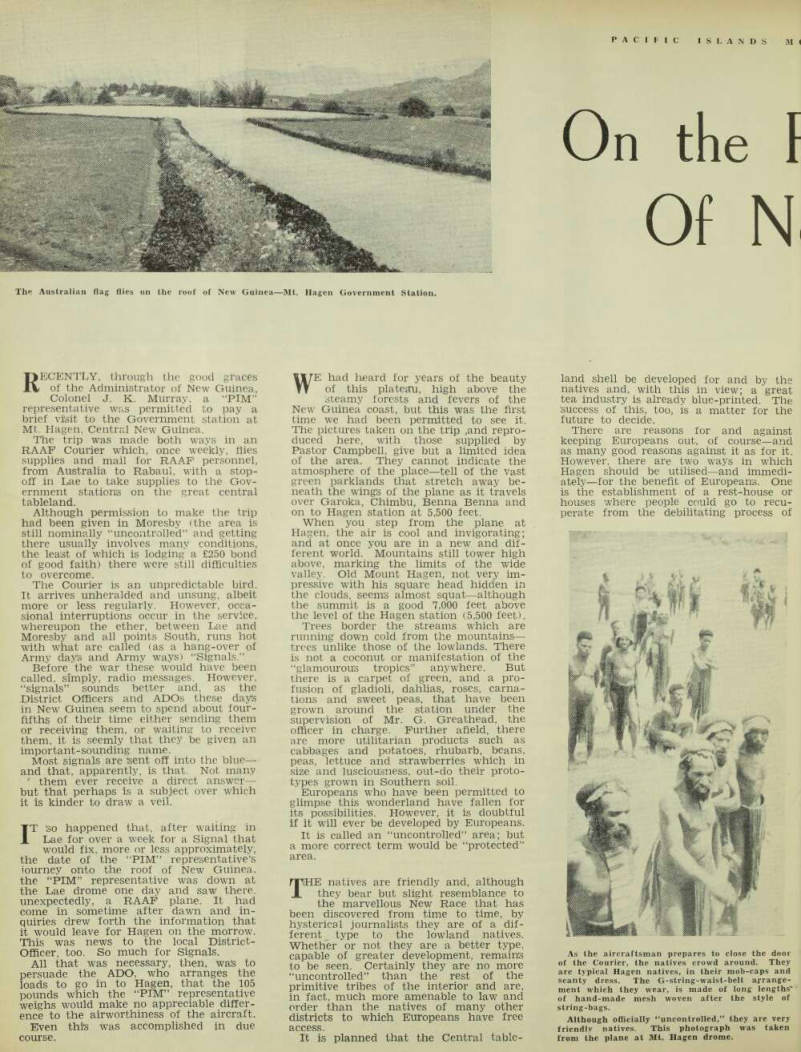
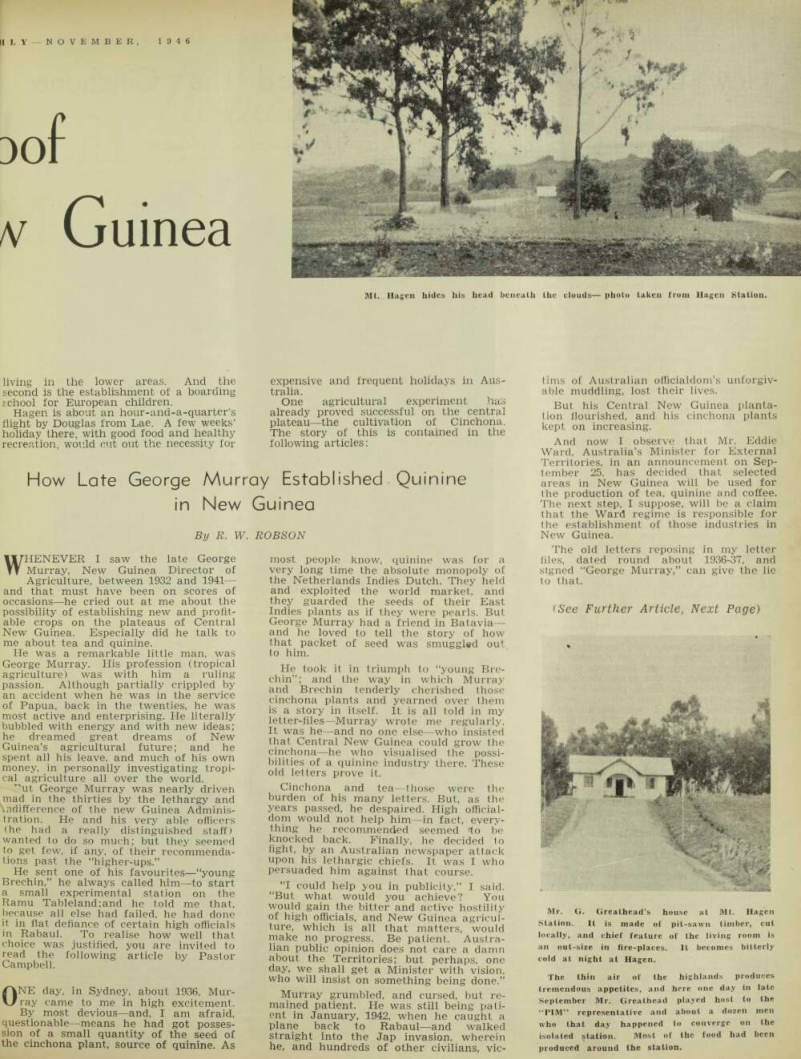
Of New Guinea
RECENTLY. through the good graces of the Administrator of New Guinea, Colonel J. K. Murray, a “PIM” representative was permitted to pay a brief visit to the Government station at Mt. Hagen, Central New Guinea.
The trip was made both ways in an RAAF Courier which, once weekly, flies supplies and mail for RAAF personnel, from Australia to Rabaul, with a stop off in Lae to take supplies to the Gov ernment stations on the great central tableland.
Although permission to make the trip had been given in Moresby (the area is still nominally “uncontrolled” and getting there usually involves many conditions, the least of which is lodging a £250 bond of good faith) there were still difficulties to overcome.
The Courier is an unpredictable bird.
It arrives unheralded and unsung, albeit more or less regularly. However, occa sional interruptions occur in the service, whereupon the ether, between Lae and Moresby and all points South, runs hot with what are called (as a hang-over of Army days and Army ways) “Signals.”
Before the war these would have been called, simply, radio messages. However, “signals” sounds better and, as the District Officers and ADOs these days in New Guinea seem to spend about four fifths of their time either sending them or receiving them, or waiting to receive them, it is seemly that they be given an important-sounding name.
Most signals are sent off into the blue — and that, apparently, is that. Not many p them ever receive a direct answer — but that perhaps is a subject over which it is kinder to draw a veil.
IT So happened that, after waiting in Lae for over a week for a Signal that would fix, more or less approximately, the date of the “PIM” representative’s iourney onto the roof of New Guinea, the “PIM” representative was down at the Lae drome one day and saw there, unexpectedly, a RAAF plane. It had come in sometime after dawn and in quiries drew forth the information that it would leave for Hagen on the morrow.
This was news to the local District- Officer, too. So much for Signals, All that was necessary, then, was to persuade the ADO, who arranges the loads to go in to Hagen, that the 105 pounds which the “PIM” representative weighs would make no appreciable differ ence to the airworthiness of the aircraft.
Even this was accomplished in due course.
WE had heard for years of the beauty of this plateau, high above the steamy forests and fevers of the New Guinea coast, but this was the first time we had been permitted to see it.
The pictures taken on the trip ,and repro duced here, with those supplied by Pastor Campbell, give but a limited idea of the area. They cannot indicate the atmosphere of the place—tell of the vast green parklands that stretch away be neath the wings of the plane as it travels over Garoka, Chimbu, Benna Benna and on to Hagen station at 5,500 feet.
When you step from the plane at Hagen, the air is cool and invigorating; and at once you are in a new and dif ferent world. Mountains still tower high above, marking the limits of the wide valley. Old Mount Hagen, not very im pressive with his square head hidden in the clouds, seems almost squat—although the summit is a good 7,000 feet above the level of the Hagen station (5,500 feet).
Trees border the streams which are running down cold from the mountains— trees unlike those of the lowlands. There is not a coconut or manifestation of the “glamourous tropics” anywhere. But there is a carpet of green, and a pro fusion of gladioli, dahlias, roses, carna tions and sweet peas, that have been grown around the station under the supervision of Mr. G. Greathead, the officer in charge. Further afield, there are more utilitarian product's such as cabbages and potatoes, rhubarb, beans, peas, lettuce and strawberries which in size and lusciousness, out-do their proto types grown in Southern soil.
Europeans who have been permitted to glimpse this wonderland have fallen for its possibilities. However, it is doubtful if it will ever be developed by Europeans, It is called an “uncontrolled’’ area; but a more correct term would be “protected” area.
THE natives are friendly and, although they bear but slight resemblance to the marvellous New Race that has been discovered from time to time, by hysterical journalists they are of a dif ferent type to the lowland natives.
Whether or not they are a better type, capable of greater development, remains to be seen. Certainly they are no more “uncontrolled” than the rest of the primitive tribes of the interior and are, in fact, much more amenable to law and order than the natives of many other districts to which Europeans have free access.
It is planned that the Central table
land shell be developed for and by the natives and, with this in view; a great tea industry is already blue-printed. The ’success of this, too, is a matter for the future to decide.
There are reasons for and against keeping Europeans out, of course—and as many good reasons against it as for it.
However, there are two ways in which Hagen should be utilised—and immedi ately—for the benefit of Europeans. One is the establishment of a rest-house or houses where people could go to recu perate from the debilitating process of
The Australian flag flies on the roof of New Guinea—Mt. Hagen Government Station.
As the aircraftsman prepares to close the door of the Courier, the natives crowd around. They are typical Hagen natives, in their mob-caps and scanty dress. The G-string-waist-belt arrange ment which they wear, is made of long lengths of hand-made mesh woven after the style of string-bags.
Although officially “uncontrolled,” they are very friendly natives. This photograph was taken from the plane at Mt. Hagen drome.
living in the lower areas. And the second is the establishment of a boarding school for European children.
Hagen is about an hour-and-a-quarter’s flight by Douglas from Lae. A few weeks’ holiday there, with good food and healthy recreation, would cut out the necessity for
expensive and frequent holidays in Aus tralia.
One agricultural experiment has already proved successful on the central plateau—the cultivation of Cinchona.
The story of this is contained in the following articles:
Mt. Hagen hides his head beneath the clouds photo taken from Hagen Station.
Advertisements & other items, p. 42 (1 item)
Pacific Islands M (
How Late George Murray Established Quinine
in New Guinea
By R. W. Robson
WHENEVER I saw the late George Murray, New Guinea Director of Agriculture, between 1932 and 1941 — and that must have been on scores of occasions—he cried out at mo about the possibility of establishing new and profit able crops on the plateaus of Central New Guinea. Especially did he talk to me about tea and quinine.
He was a remarkable little man, was George Murray. His profession (tropical agriculture) was with him a ruling passion. Although partially crippled by an accident when he was in the service of Papua, back in the twenties, he was most active and enterprising. He literally bubbled with energy and with new ideas; he dreamed great dreams of New Guinea’s agricultural future; and he spent all his leave, and much of his own money, in personally investigating tropi cal agriculture all over the world.
Put George Murray was nearly driven mad in the thirties by the lethargy and \ndifference of the new Guinea Adminis tration. He and his very able officers (he had a really distinguished staff) wanted to do so much; but they seemed to get few, if any, of their recommenda tions past the “higher-ups.”
He sent one of his favourites—“young Brechin,” he always called him —to start a small experimental station on the Ramu Tableland;and he told me that, because all else had failed, he had done it in flat defiance of certain high officials in Rabaul. To realise how well that choice was justified, you are invited to read the following article by Pastor Campbell.
ONE day, in Sydney, about 1936, Mur ray came to me in high excitement.
By most devious—and, I am afraid, questionable—means he had got posses sion of a small quantity of the seed of the cinchona plant, source of quinine. As
most people know, quinine was for a very long time the absolute monopoly of the Netherlands Indies Dutch. They held and exploited the world market, and they guarded the seeds of their East Indies plants as if they were pearls. But George Murray had a friend in Batavia — and he loved to tell the story of how that packet of seed was smuggled out to him.
He took it in triumph to “young Bre chin”; and the way in which Murray and Brechin tenderly cherished those cinchona plants and yearned over them is a story in itself. It is all told in my letter-tiles—Murray wrote me regularly.
It was he—and no one else—who insisted that Central New Guinea could grow the cinchona—he who visualised the possi bilities of a quinine industry there. These old letters prove it.
Cinchona and tea—those were the burden of his many letters. But, as the years passed, he despaired. High official dom would not help him —in fact, every thing he recommended seemed to be knocked back. Finally, he decided to tight, by an Australian newspaper attack upon his lethargic chiefs. It was I who persuaded him against that course.
“I could help you in publicity,” I said.
“But what would you achieve? You would gain the bitter and active hostility of high officials, and New Guinea agricul ture, which is all that matters, would make no progress. Be patient. Austra lian public opinion does not care a damn about the Territories; but perhaps, one day, we shall get a Minister with vision, who will insist on something being done.”
Murray grumbled, and cursed, but re mained patient. He was still being pati ent in January, 1942, when he caught a plane back to Rabaul —and walked straight into the Jap invasion, wherein he, and hundreds of other civilians, vic
tims of Australian officialdom's unforgiv able muddling, lost their lives.
But his Central New Guinea planta tion flourished, and his cinchona plants kept on increasing.
And now I observe that Mr. Eddie Ward, Australia’s Minister for External Territories, in an announcement on Sep tember 25, has decided that selected areas in New Guinea will be used for the production of tea, quinine and coffee.
The next step, I suppose, will be a claim that the Ward regime is responsible for the establishment of those industries in New Guinea.
The old letters reposing in my letter files, dated round about 1936-37, and signed “George Murray,” can give the lie to that. (See Further Article, Next Page)
Mr. G. Greathead’s house at Mt. Hagen Station. It is made of pit-sawn timber, cut locally, and chief feature of the living room is an out-size in fire-places. It becomes bitterly cold at night at Hagen.
The thin air of the highlands produces tremendous appetites, and here one day in late September Mr. Greathead played host to the “PIM” representative and about a dozen men who that day happened to converge on the isolated station. Most of the food had been produced around the station.
Advertisements & other items, p. 43 (1 item)
X)f
v Guinea
« L Y NOVEMBER, 1946
How Late R. F. Brechin Pioneered The Cinchona
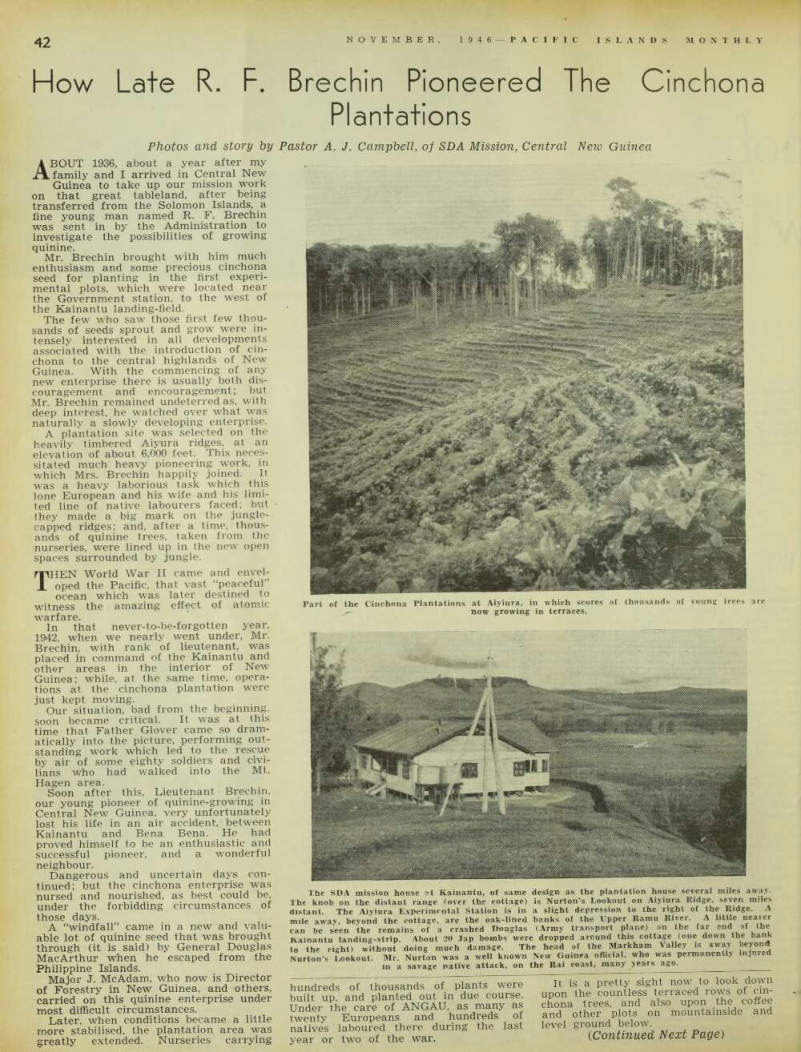
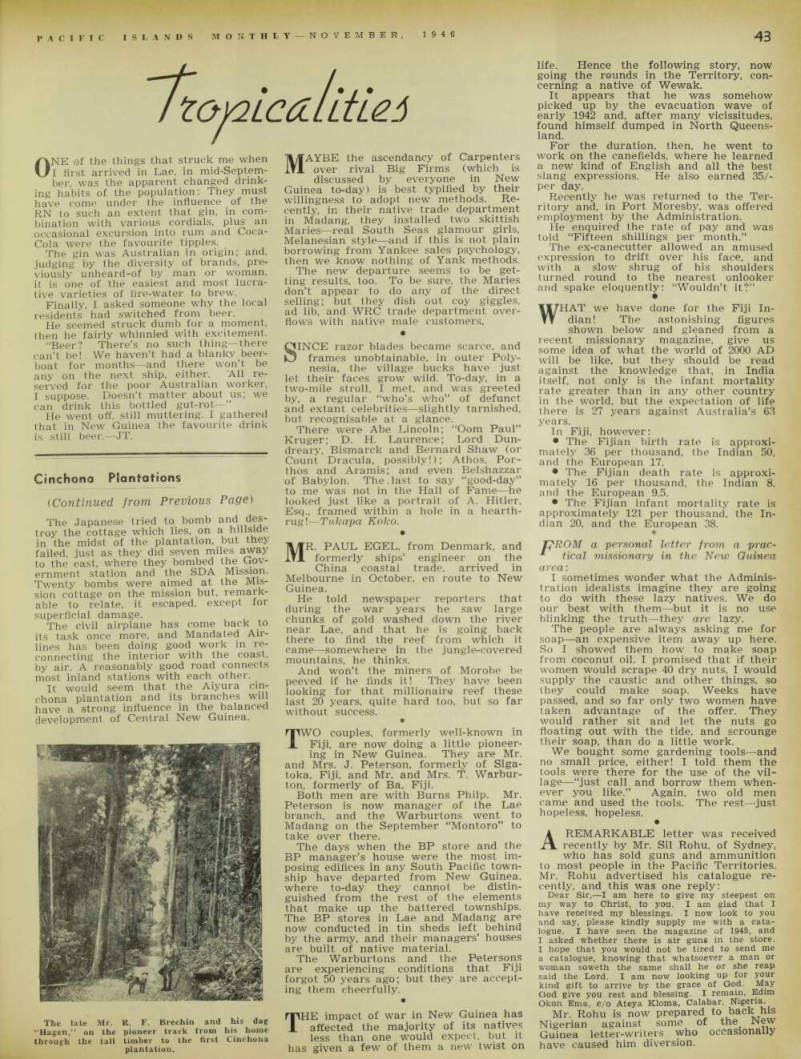
Plantations
Photos and story by Pastor A. J. Campbell, of SDA Mission, Central New Guinea
ABOUT 1936, about a year after my family and I arrived in Central New Guinea to take up our mission work on that great tableland, after being transferred from the Solomon Islands, a fine young man named R. F. Brechin was sent in by the Administration to investigate the possibilities of growing quinine.
Mr. Brechin brought with him much enthusiasm and some precious cinchona seed for planting in the first experi mental plots, which were located near the Government station, to the west of the Kainantu landing-field.
The few who saw those first few thou sands of seeds sprout and grow were in tensely interested in all developments associated with the introduction of cin chona to the central highlands of New Guinea. With the commencing of any new enterprise there is usually both dis couragement and encouragement; but Mr. Brechin remained undeterred as, with deep interest, he watched over what was naturally a slowly developing enterprise.
A plantation site was selected on the heavily timbered Aiyura ridges, at an elevation of about 6,000 feet. This neces sitated much heavy pioneering work, in which Mrs. Brechin happily joined. It was a heavy laborious task which this lone European and his wife and his limi ted line of native labourers faced; but they made a big mark on the jungle capped ridges; and, after a time, thous ands of quinine trees, taken from the nurseries, were lined up in the new open spaces surrounded by jungle.
THEN World War II came and envel oped the Pacific, that vast “peaceful” ocean which was later destined to witness the amazing effect of atomic warfare.
In that never-to-be-forgotten year, 1942, when we nearly went under, Mr.
Brechin, with rank of lieutenant, was placed in command of the Kainantu and other areas in the interior of New Guinea: while, at the same time, opera tions at the cinchona plantation were just kept moving.
Our situation, bad from the beginning, soon became critical. It was at this time that Father Glover came so dram atically into the picture, performing out standing work which led to the rescue by air of some eighty soldiers and civi lians who had walked into the Mt.
Hagen area.
Soon after this, Lieutenant Brechin, our young pioneer of quinine-growing in Central New Guinea, very unfortunately lost his life in an air accident, between Kainantu and Bena Bena, He had proved himself to be an enthusiastic and successful pioneer, and a wonderful neighbour.
Dangerous and uncertain days con tinued; but the cinchona enterprise was nursed and nourished, as best could be, under the forbidding circumstances of those days.
A “windfall” came in a new and valu able lot of quinine seed that was brought through (it is said) by General Douglas MacArthur when he escaped from the
Philippine Islands.
Major J. McAdam, who now is Director of Forestry in New Guinea, and others, carried on this quinine enterprise under most difficult circumstances.
Later, when conditions became a little more stabilised, the plantation area was greatly extended. Nurseries carrying
hundreds of thousands of plants were built up. and planted out in due course.
Under the care of ANGAU, as many as twenty Europeans and hundreds of natives laboured there during the last year or two of the war.
It is a pretty sight now to look down upon the countless terraced rows of cin chona trees, and also upon the coffee and other plots on mountainside and level ground below.
{Continued Next Page )
Part of the Cinchona Plantations at Aiyiura, in which scores of thousands of young trees are now growing in terraces.
The SDA mission house at Kainantu, of same design as the plantation house several miles away.
The knob on the distant range (over the cottage) is Nurton’s Lookout on Aiyiura Ridge, seven miles distant. The Aiyiura Experimental Station is in a slight depression to the right of the Ridge. A mile away, beyond the cottage, are the oak-lined banks of the Upper Ramu River. A little nearer can be seen the remains of a crashed Douglas (Army transport plane) on the far end of the Kainantu landing-strip. About 20 Jap bombs were dropped around this cottage (one down the bank to the right) without doing much damage. The head of the Markham Valley is away beyond Nurton’s Lookout. Mr. Nurton was a well known New Guinea official, who was permanently injured in a savage native attack, on the Rai coast, many years ago.
The Japanese tried to_ bomb and des troy the cottage which lies, on a hillside in the midst of the plantation, but they failed, just as they did seven miles away to the east, where they bombed the Gov ernment station and the SDA Mission.
Twenty bombs were aimed at the Mis sion cottage on the mission but, remark able to relate, it escaped, except for superficial damage.
The civil airplane has come back to its task once more, and Mandated Air lines has been doing good work in re connecting the interior with the coast, by air. A reasonably good road connects most inland stations with each other.
It would seem that the Aiyura cin chona plantation and its branches will have a strong influence in the balanced development of Central New Guinea.
The late Mr. R. F. Brechin and his dog “Hagen,” on the pioneer track from his home through the tall timber to the first Cinchona plantation.
Advertisements & other items, p. 44 (1 item)
42
NOVEMBER, 1946—PAC1F1C ISLANDS MONTHLY
Tropicalities
ONE of the things that struck me when I first arrived in Lae, in mid-Septem ber, was the apparent changed drink ing habits of the population: They must have come under the influence of the RN to such an extent that gin, in com bination with various cordials, plus an occasional excursion into rum and Coca- Cola were the favourite tipples.
The gin was Australian in origin; and, judging by the diversity of brands, pre viously unheard-of by man or woman, it is one of the easiest and most lucra tive varieties of fire-water to brew.
Finally, I asked someone why the local residents had switched from beer.
He seemed struck dumb for a moment, then he fairly whinnied with excitement.
“Beer? There’s no such thing—there can’t be! We haven’t had a blanky beer boat for months—and there won’t be any on the next ship, either. All re served for the poor Australian worker, I suppose. Doesn’t matter about us; we can drink this bottled gut-rot—”
He went off, still muttering. I gathered that in New Guinea the favourite drink is still beer. —JT.
MAYBE the ascendancy of Carpenters over rival Big Firms (which is discussed by everyone in New Guinea to-day) is best typified by their willingness to adopt new methods. Re cently, in their native trade department in Madang, they installed two skittish Maries—real South Seas glamour girls, Melanesian style—and if this is not plain borrowing from Yankee sales psychology, then we know nothing of Yank methods.
The new departure seems to be get ting results, too. To be sure, the Maries don’t appear to do any of the direct selling; but they dish out coy giggles, ad lib, and WRC trade department over flows with native male customers. • SINCE razor blades became scarce, and frames unobtainable, in outer Poly nesia, the village bucks have just let their faces grow wild. To-day, in a two-mile stroll, I met. and was greeted by, a regular “who’s who” of defunct and extant celebrities —slightly tarnished, but recognisable at a glance.
There were Abe Lincoln; “Oom Paul”
Kruger; D. H. Laurence; Lord Dun dreary, Bismarck and Bernard Shaw (or Count Dracula, possibly!); Athos, Por thos and Aramis; and even Belshazzar of Babylon. The.last to say “good-day” to me was not in the Hall of Fame—he looked just like a portrait of A. Hitler, Esq., framed within a hole in a hearth rug!—Tukapa Koko. • MR, PAUL EGEL, from Denmark, and formerly ships’ engineer on the China coastal trade, arrived in Melbourne in October, en route to New Guinea.
He told newspaper reporters that during the war years he saw large chunks of gold washed down the river near Lae, and that he is going back there to find the reef from which it came —somewhere in the jungle-covered mountains, he thinks.
And won’t the miners of Morobe be peeved if he finds it! They have been looking for that millionaire reef these last 20 years, quite hard too, but so far without success. ♦ TWO couples, formerly well-known in Fiji, are now doing a little pioneer ing in New Guinea. They are Mr. and Mrs. J. Peterson, formerly of Siga toka, Fiji, and Mr. and Mrs. T. Warbur ton, formerly of Ba, Fiji.
Both men are with Burns Philp. Mr.
Peterson is now manager of the Lae branch, and the Warburtons went to Madang on the September “Montoro” to take over there.
The days when the BP store and the BP manager’s house were the most im posing edifices in any South Pacific town ship have departed from New Guinea, where to-day they cannot be distin guished from the rest of the elements that make up the battered townships.
The BP stores in Lae and Madang are now conducted in tin sheds left behind by the army, and their managers’ houses are built of native material.
The Warburtons and the Petersons are experiencing conditions that Fiji forgot 50 years ago; but they are accept ing them cheerfully. « THE impact of war in New Guinea has affected the majority of its natives less than one would expect, but it has given a few of them a new twist on
life. Hence the following story, now going the rounds in the Territory, con cerning a native of Wewak.
It appears that he was somehow picked up by the evacuation wave of early 1942 and, after many vicissitudes, found himself dumped in North Queens land.
For the duration, then, he went to work on the canefields, where he learned a new kind of English and all the best slang expressions. He also earned 35/per day.
Recently he was returned to the Ter ritory and, in Port Moresby, was offered employment by the Administration, He enquired the rate of pay and was told “Fifteen shillings per month.”
The ex-canecutter allowed an amused expression to drift over his face, and with a slow shrug of his shoulders turned round to the nearest onlooker and spake eloquently: “Wouldn’t it?” • WHAT we have done for the Fiji In dian! The astonishing figures shown below and gleaned from a recent missionary magazine, give us some idea of what the world of 2000 AD will be like, but they should be read against the knowledge that, in India itself, not only is the infant mortality rate greater than in any other country in the world, but the expectation of life there is 27 years against Australia’s 63 years.
In Fiji, however; • The Fijian birth rate is approxi mately 36 per thousand, the Indian 50, and the European 17. • The Fijian death rate is approxi mately 16 per thousand, the Indian 8, and the European 9.5. • The Fijian infant mortality rate is approximately 121 per thousand, the In dian 20, and the European 38, * TfROM a personal letter from a prac * tical missionary in the New Guinea area : I sometimes wonder what the Adminis tration idealists imagine they are going to do with these lazy natives. We do our best with them—but it is no use blinking the truth—they are lazy.
The people are always asking me for soap—an expensive item away up here.
So I showed them how to make soap from coconut oil. I promised that if their women would scrape 40 dry nuts, I would supply the caustic and other things, so they could make soap. Weeks have passed, and so far only two women have taken advantage of the offer. They would rather sit and let the nuts go floating out with the tide, and scrounge their soap, than do a little work.
We bought some gardening tools —and no small price, either! I told them the tools were there for the use of the vil lage—“just call and borrow them when ever you like,” Again, two old men came and used the tools. The rest—just hopeless, hopeless. • A REMARKABLE letter was received recently by Mr, Sil Rohu, of Sydney, who has sold guns and ammunition to most people in the Pacific Territories.
Mr. Rohu advertised his catalogue re cently, and this was one reply: Dear Sir, —I am here to give my steepest on my way to Christ, to you. I am glad that I have received my blessings. I now look to you and say, please kindly supply me with a cata logue. I have seen the magazine of 1945, and I asked whether there is air guns in the store.
I hope that you would not be tired to send me a catalogue, knowing that whatsoever a man or woman soweth the same shall he or she reap said the Lord. I am now looking up for your kind gift to arrive by the grace of God. May God give you rest and blessing. I remain, Edim Okon Ema, c/o Ateya Kloma, Calabar. Nigeria.
Mr. Rohu is now prepared to b ac \ T his Nigerian against some of JNew Guinea letter-writers who occasionally have caused him diversion.
Advertisements & other items, p. 45 (1 item)
43
Cinchona Plantations (i Continued from Previous Page)
PACIFIC ISLANDS MONTHLY— NOVEMBER, 1946
Book Reviews
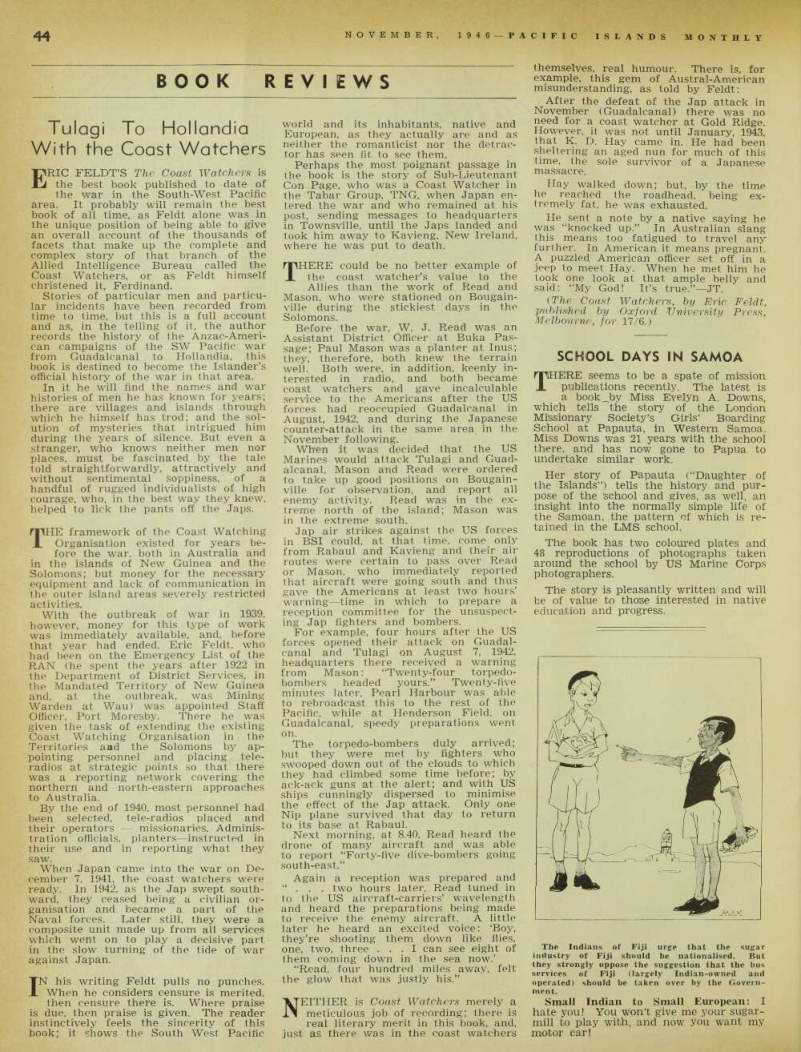
Tulagi To Hollandia With the Coast Watchers
ERIC FELDT’S The Coast Watchers is the best book published to date of the war in the South-West Pacific area. It probably will remain the best book of all time, as Feldt alone was in the unique position of being able to give an overall account of the thousands of facets that make up the complete and complex story of that branch of the Allied Intelligence Bureau called the Coast Watchers, or as Feldt himself christened it, Ferdinand.
Stories of particular men and particu lar incidents have been recorded from time to time, but this is a full account and as, in the telling of it, the author records the history of the Anzac-Ameri can campaigns of the SW Pacific war from Guadalcanal to Hollandia, this book is destined to become the Islander’s official history of the war in that area.
In it he will find the names and war histories of men he has known for years; there are villages and islands through which he himself has trod; and the sol ution of mysteries that intrigued him during the years of silence. But even a stranger, who knows neither men nor places, must be fascinated by the tale told straightforwardly, attractively and without sentimental soppiness, of a handful of rugged individualists of high courage, who, in the best way they knew, helped to lick the pants off the Japs.
THE framework of the Coast Watching Organisation existed for years be fore the war, both in Australia and in the islands of New Guinea and the Solomons; but money for the necessary equipment and lack of communication in the outer island areas severely restricted activities.
With the outbreak of war in 1939, however, money for this type of work was immediately available, and, before that year had ended, Eric Feldt, who had been on the Emergency List of the RAN (he spent the years after 1922 in the Department of District Services, in the Mandated Territory of New Guinea and, at the outbreak, was Mining Warden at Wau) was appointed Staff Officer, Port Moresby. There he was given the task of extending the existing Coast Watching Organisation in the Territories and the Solomons by ap pointing personnel and placing tele radios at strategic points so that there was a reporting network covering the northern and north-eastern approaches to Australia.
By the end of 1940, most personnel had been selected, tele-radios placed and their operators missionaries, Adminis tration officials, planters—instructed in their use and in reporting what they saw.
When Japan came into the war on De cember 7, 1941, the coast watchers were ready. In 1942, as the Jap swept south ward, they ceased being a civilian or ganisation and became a part of the Naval forces. Later still, they were a composite unit made up from all services which went on to play a decisive part in the slow turning of the tide of war against Japan.
IN his writing Feldt pulls no punches.
When he considers censure is merited, then censure there is. Where praise is due, then praise is given. The reader instinctively feels the sincerity of this book; it shows the South West Pacific
world and its inhabitants, native and European, as they actually are and as neither the romanticist nor the detrac tor has seen fit to see them.
Perhaps the most poignant passage in the book is the story of Sub-Lieutenant Con Page, who was a Coast Watcher in the Tabar Group, TNG, when Japan en tered the war and who remained at his post, sending messages to headquarters in Townsville, until the Japs landed and took him away to Kavieng, New Ireland, where he was put to death, THERE could be no better example of the coast watcher’s value to the Allies than the work of Read and Mason, who were stationed on Bougain ville during the stickiest days in the Solomons.
Before the war, W. J. Read was an Assistant District Officer at Buka Pas sage; Paul Mason was a planter at Inus; they, therefore, both knew the terrain well. Both were, in addition, keenly in terested in radio, and both became coast watchers and gave incalculable service to the Americans after the US forces had reoccupied Guadalcanal in August, 1942, and during the Japanese counter-attack in the same area in the November following.
When it was decided that the US Marines would attack Tulagi and Guad alcanal, Mason and Read were ordered to take up good positions on Bougain ville for observation, and report all enemy activity. Read was in the ex treme north of the island; Mason was in the extreme south.
Jap air strikes against the US forces in BSI could, at that time, come only from Rabaul and Kavieng and their air routes were certain to pass over Read or Mason, who immediately reported that aircraft were going south and thus gave the Americans at least two hours’ warning—time in which to prepare a reception committee for the unsuspect ing Jap fighters and bombers.
For example, four hours after the US forces opened their attack on Guadal canal and Tulagi on August 7, 1942, headquarters there received a warning from Mason: “Twenty-four torpedo bombers headed yours.” Twenty-five minutes later, Pearl Harbour was able to rebroadcast this to the rest of the Pacific, while at Henderson Field, on Guadalcanal, speedy preparations went on.
The torpedo-bombers duly arrived; but they were met by fighters who swooped down out of the clouds to which they had climbed some time before; by ack-ack guns at the alert; and with US ships cunningly dispersed to minimise the effect of the Jap attack. Only one Nip plane survived that day to return to its base at Rabaul.
Next morning, at 8.40, Read heard the drone of many aircraft and was able to report “Forty-five dive-bombers going south-east.”
Again a reception was prepared and “ . . , two hours later, Read tuned in to the US aircraft-carriers’ wavelength and heard the preparations being made to receive the enemy aircraft. A little later he heard an excited voice: ‘Boy, they’re shooting them down like flies, one, two, three ... I can see eight of them coming down in the sea now.’
“Read, four hundred miles away, felt the glow that was justly his.”
NEITHER is Coast Watchers merely a meticulous job of recording; there is real literary merit in this book, and, just as there was in the coast watchers
themselves, real humour. There is, for example, this gem of Austral-American misunderstanding, as told by Feldt: After the defeat of the Jap attack in November (Guadalcanal) there was no need for a coast watcher at Gold Ridge.
However, it was not until January, 1943, that K. D. Hay came in. He had been sheltering an aged nun for much of this time, the sole survivor of a Japanese massacre.
Hay walked down; but, by the time he reached the roadhead, being ex tremely fat, he was exhausted.
He sent a note by a native saying he was “knocked up.” In Australian slang this means too fatigued to travel any further. In American it means pregnant.
A puzzled American officer set off in a jeep to meet Hay. When he met him he took one look at that ample belly and said: “My God! It’s true.”—JT. {The Coast Watchers, by Eric Feldt, published by Oxford University Press, Melbourne, for 17/6.)
School Days In Samoa
rERE seems to be a spate of mission publications recently. The latest is a book_by Miss Evelyn A. Downs, which tells the story of the London Missionary Society’s Girls’ Boarding School at Papauta, in Western Samoa.
Miss Downs was 21 years with the school there, and has now gone to Papua to undertake similar work.
Her story of Papauta (“Daughter of the Islands”) tells the history and pur pose of the school and gives, as well, an insight into the normally simple life of the Samoan, the pattern of which is re tained in the IMS school.
The book has two coloured plates and 48 reproductions of photographs taken around the school by US Marine Corps photographers.
The story is pleasantly written and will be of value to those interested in native education and progress.
The Indians of Fiji urge that the sugar industry of Fiji should be nationalised. But they strongly oppose the suggestion that the bus services of Fiji (largely Indian-owned and operated) should be taken over by the Govern ment.
Small Indian to Small European: I hate you! You won’t give me your sugar mill to play with, and now you want my motor car!
Advertisements & other items, p. 47 (2 items)
45
pacific Islands mcnlhly-novembek., 1946
Capstan
m 5s Artist's impression of an
ATOMIC HELICOPTER
. . . future dir express.
TIME MOVES FAST
but it will always .. .
-&m£, *O% a.
CAPSTAN
Nukualofa
Whale Steak For
Nuku’alofa, October 24. rill IE meat shortage here is being re- J. lieved to a certain extent by sup plies of whale meat. The whales have been caught by the Cook brothers, local Euronesians.
Tongans are fond of whale meat, and when whales are caught here, they are sold in record time. Some purchasers of large quantities salt the meat down for future use.
Sir Leonard Issitt, Chairman of the New Zealand National Airways Corporation, arrived in Suva, Fiji, bv air on October 3, on the first stage or a tour of inspection of the Pacific Islands air services operated by the Royal New Zealand Air Force.
Sir Leonard later went on to Tonga, Samoa, Aitutaki and Raratonga.
Death Of William D. Bryan
Rarotonga, October 20.
RAROTONGA lost another well-known old-timer with the death of William D. Bryan (familiarly called O’Bryan) on October 18 at the age of 68.
A Londoner by birth, William Bryan went to sea at the age of 13, served a hard and adventurous apprenticeship in sail, and worked his way up to mate and skipper of some of the finest of the old clipper ships in the Indian and China trades. Turning later to steam, he worked for some as bo’sun on Shaw, Saville ships.
He settled in Rarotonga as wharf master for the USS Co., combining with this position the duties of local pilot. A number of vessels owed their safety to the local knowledge and expert seaman •ship of Bill Bryan.
It is recalled that in 1916, by fighting her through a fierce hurricane, he saved the schooner “Avarua” from adding her bones to those of many other ships strewing the dangerous Avarua reef.
During the years of the Pacific war, “Old Bill,” as he was known to all his friends, served as a coast-watcher on Suwarrow, Rakahanga. and Nassau in turn. Since the end of the war he had lived in retirement at his residence in Tukuvaine, Rarotonga, Mr. Bryan leaves two married daugh ters, both living in New Zealand, and a son, Don, at present in Rarotonga. Don Bryan fought in the Middle East and was among the prisoners taken by the Germans in Crete. He spent three years in captivity in Germany.
William Bryan was buried in the LMS churchyard; the funeral was attended by a large number of European resi dents.
Major E. B. Ayris returned to Australia from Lae, New Guinea, on October 18, Before the Pacific war he was on the staff of New Guinea Goldfields Ltd., at Wau. During the war he served on American Small Ships. He went back to the Territory in July; but he is one of those who can see no future in New Guinea at present. He has therefore returned to a sheep station in Queensland which he hopes will be far enough away from civilisation and politics to make life bearable.
Complete
War Graves Units Complete Difficult Job in N.G.
From a Special Correspondent Lae, October 7.
SCARCELY any Army personnel now remain on the .mainland of the former Mandated Territory of New Guinea. Last week the 7th and 29th War Graves Unit arrived here from Wewak, but all but two members are expected to move on again in a few days.
They printed the last issue of their weekly paper, “Mat Mat Mutter,” on October I—they have been running it sinnce the beginning of this year when they went to Wewak.
The lads of the units have had an un pleasant task in exhuming the bodies of their fallen comrades and bringing them for reinterment at Lae; and, it is re ported, they have not been happy in their relationship with Civil Administra tion, who have done little to assist in the work.
One of the mysteries of the present set-up in New Guinea is the non-co-oper ation (and sometimes downright antag onism) between different services and branches of services which, in the ulti mate analysis, spring from the Canberra fount.
Some people here in the Territory wonder why it has been necessary to go on with this grisly business of transfer ring soldiers’ remains from one spot to another. There is a feeling that the place where a British soldier falls be comes hallowed ground. However, as someone with a passion for regimenta tion has decreed that all bodies in Nor thern New Guinea are to be gathered into one cemetery, all help for the War Graves units should be forthcoming from other Governmental bodies.
When the units left Wewak, they brought with them the remains of over a thousand bodies, and it was only after great difficulty and delay that they were loaded on the ship for transportation to Lae.
It can be understood that no native was particularly keen to do this work and the District Officer, these days, has no power to allocate labour. All depends upon the all-powerful “District Labour Officer,” and unfortunately the loading of the remains from pontoons at Wewak seems to have clashed with the sacred week-end break. The remains were finally got on board when the men of the unit recruited local labour, independ ently.
Tongan Drought Broken
From Our Own Correspondent Nukualofa, October 20.
THE long period of drought which we have been experiencing was broken on October 16, when torrential rain fell. Rain started early in the morning, as intermittent light showers, and be came an incessant downpour in the afternoon. Approximately 8.7 inches recorded —a record for Nuku’alofa.
The rain came as a welcome relief,, not only because of the water shortage, but because of the yam planting season just beginning.
Miss lona Georgina Emberson, eldest daughter of Mr. and Mrs. F. A. Emberson, of Suva, Fiji, was married on September 20, to Mr. Stanford Gluck. Mr. Gluck is an American, stationed at Nadi with Pan American Airways. The couple expect to make their home in Singapore where Mr.
Gluck will be transferred Shortly.
Advertisements & other items, p. 48 (2 items)
46
November, IoH-Hctric islands monthly
DECLINE AND REVIVAL OF
FIJIAN RACE
Continued from Page 35
Papuan Electrical Co.
PORT MORESBY
Consult Us For All Your Electrical Requirements
ELECTRICAL INSTALLATIONS AND REPAIRS—SUPPLIERS
OF ALL ELECTRICAL APPLIANCES AND EQUIPMENT-
IRONS, JUGS, TOASTERS, REFRIGERATORS, FANS,
MOTORS, Etc.
ESTIMATES GIVEN PROMPTLY.
W. Conolly, Manager.
Apply, P. 0., Port Moresby.
N, Caledonia
Cannot
Find Labour
Special Committee Can Provide No
Solution to Problem That is Now
Common in All Pacific
Territories NEW CALEDONIAN coffee planters and cattle men are becoming more and more concerned about the lack of labour now that the Javanese and Indo-Chinese are refusing work and clamouring to return to their native lands.
It is noticeable that the Javanese in Noumea are taking to vices, including over-indulgence in drink, from which they were previously free. A group of Chinese in the bush recently fell foul of the authorities for flying the Red flag without the Tricolor.
A permanent committee has been ap pointed to consider and recommend on the labour question. They report: • To bring out Poles, Czechs and Italians would be expensive. But the Governor has been asked to continue to obtain information as to possibilities in this quarter; • Labour recruiting in Java —impossible under present revolutionary con ditions; • Portuguese Timor is an importer of Javanese labour —so nothing doing there; • Indo-China —likewise nothing doing there; and the same in Tonkin until the political situation has been cleared up; • Korea —nothing doing while Rus sian and US troops are in occupation; • China Proper not favoured because
where Chinese go they stick, and take over commerce as in Tahiti; • On the whole, the cheapest kind of European peasant immigration would be preferred.
From one quarter comes a suggestion that the country should encourage the introduction of orphans from Europe.
New Caledonia planters, of course, are not alone in having labour problems.
Every tropical territory which hitherto produced cheaply is now faced with higher production costs and a poor lab our market.
The only solution at the present time appears to be the introduction of mach ines to take the place of unwilling men as much as possible.
Fiji Medical Officer Retires
Suva, October 13.
AFTER 26 years in Fiji, Dr. H. S. Evans of the Medical Department, has been granted leave prior to retirement.
He entered the Fiji Government ser vice in 1920, and was District Medical Officer and District Commissioner in Lau and Taveuni. In 1927 he was sec onded for 21 years as a Medical Officer to the Belgian Congo, Northern Rho desia Boundary Commission. He returned to Fiji in 1930, and served in Lau, Ra, Taveuni and Rewa. In 1940 he conducted a medical survey in Rotuma. In 1944 he was appointed Assistant Director of Medical Services, and lately had been acting as Director.
Mr. R. G. Looker, who has been appointed Assistant Postmaster-General, Fiji, arrived in Suva by air from Auckland on October 3. He is on secondment from the New Zealand Department of Posts and Telegraphs.
Copra Harvest
What USA Has Done For Philippines
THE agreement between the Philippine Government and the United States Commodity Credit Corporation made on August 8, 1946, provided that the lat ter should buy all Philippines copra and coconut oil, for one year, from July 1, 1946, at 1031 dollars per long ton (equal to £32 Aust.), f.o.b, ocean-carrier, Philip pine ports.
It should be noted that this price is considerably in excess of the amounts being paid to copra producers in the British Pacific Territories.
Shipments of Philippines copra and coconut oil (in terms of copra) have risen steadily since January. A high of about 60,000 tons was reached in July. 1946, approximately the pre-war rate of shipments.
The remarkable recovery of the Phil ippine copra industry has been due to the close co-operation with the United States-sponsored Copra Export Manage ment Corporation. Inter-island boats to carry copra to market, incentive goods such as textiles, and equipment to aid in harvesting and drying copra have been furnished by the CEMCO. Before the expiration of the agreement on July 1. 1947, shipments are expected to approxi mate the pre-war levels of 1935-39.
Major F. B. Macßae, who had resided in Fiji since after World War I, died in Suva, on October 2. He was a Canadian and a veteran of the South African as well as the Great War. He was at one time engaged on prospecting and mining in the Colony.
Advertisements & other items, p. 49 (1 item)
Widdop
is* xmw Muauv o
DIESEL ENGINES
S H.P. to 500 H.P.
H. WIDDOP & CO., LTD.
Telephone: Keighley 3727-8 :: s: :: Telegrams: Widdop Keighley Codes A.B.C. 6th Edition, Bentleys, Bentley’s Second We are prepared to con side r Ag end es fo r certain territories /IN Motor Coaster S. America. / IVm.w.
Fi refloat Egypt.
Passenger Ferry I Nigeria r\ n Tug, England 4 cvs-au Passengei Boat, Middle East.
New Teachers'
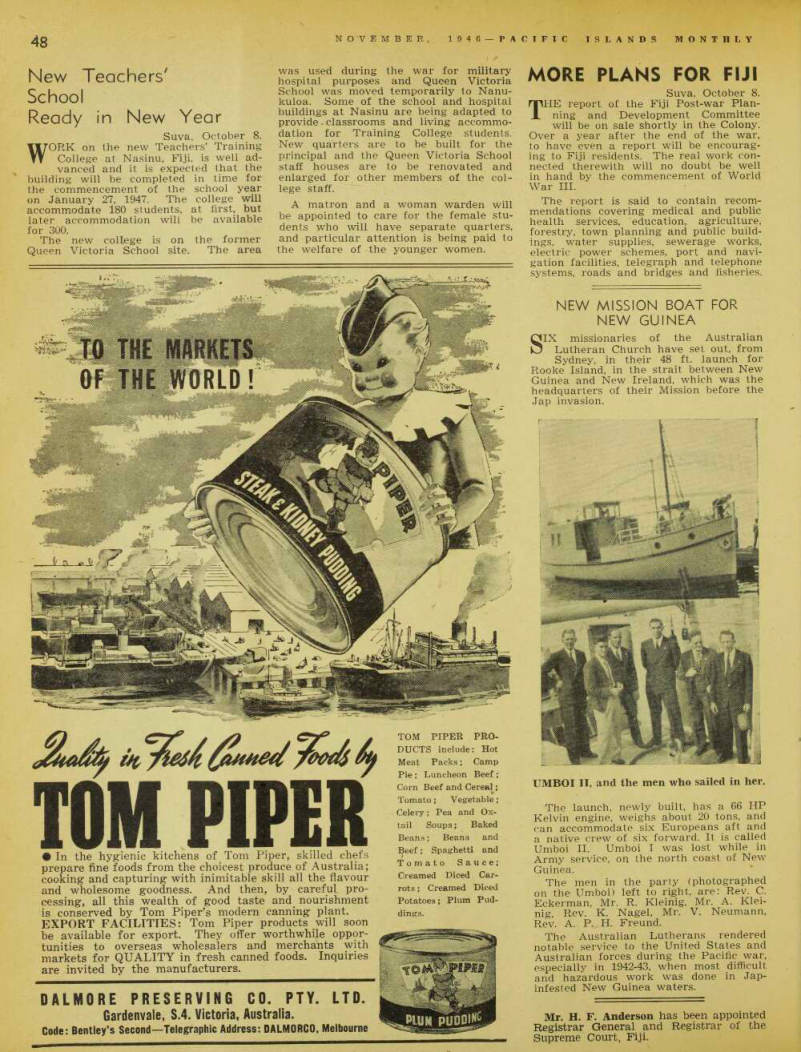
School Ready in New Year
Suva, October 8.
WORK on the new Teachers’ Training College at Nasinu, Fiji, is well ad vanced and it is expected that the building will be completed in time for the commencement of the school year on January 27, 1947. The college will accommodate 180 students, at first, but later accommodation will be available for 300.
The new college is on the former Queen Victoria School site. The area
was used during the war for military hospital purposes and Queen Victoria School was moved temporarily to Nanu kuloa. Some of the school and hospital buildings at Nasinu are being adapted to provide - classrooms and living accommo dation for Training College students.
New quarters are to be built for the principal and the Queen Victoria School staff houses are to be renovated and enlarged for other members of the col lege staff.
A matron and a woman warden will be appointed to care for the female stu dents who will have separate quarters, and particular attention is being paid to the welfare of the younger women.
More Plans For Fiji
Suva, October 8.
THE report of the Fiji Post-war Plan ning and Development Committee will be on sale shortly in the Colony.
Over a year after the end of the war, to have even a report will be encourag ing to Fiji residents. The real work con nected therewith will no doubt be, well in hand by the commencement of World War 111.
The report is said to contain recom mendations covering medical and public health services, education, agriculture, forestry, town planning and public build ings, water supplies, sewerage works, electric power schemes, port and navi gation facilities, telegraph and telephone systems, roads and bridges and fisheries.
New Mission Boat For
New Guinea
SIX missionaries of the Australian Lutheran Church have set out, from Sydney, in their 48 ft. launch for Rooke Island, in the strait between New Guinea and New Ireland, which was the headquarters of their Mission before the Jap invasion.
The launch, newly built, has a 66 HP Kelvin engine, weighs about 20 tons, and can accommodate six Europeans aft and a native crew of six forward. It is called Umboi 11. Umboi I was lost while in Army service, on the north coast of New Guinea.
The men in the party (photographed on the Umboi) left to right, are: Rev. C.
Eckerman, Mr. R. Kleinig, Mr. A. Klei nig, Rev. K. Nagel, Mr. V. Neumann, Rev. A. P. H. Freund.
The Australian Lutherans rendered notable service to the United States and Australian forces during the Pacific war, especially in 1942-43, when most difficult and hazardous work was done in Jap infested New Guinea waters.
Mr. H. F. Anderson has been appointed Registrar General and Registrar of the Supreme Court, Fiji.
UMBOI II, and the men who sailed in her.
Advertisements & other items, p. 50 (2 items)
48
NOVEMBER, 1946 PACIFIC ISLANDS MONTH I. Y
Tom Piper
a 1 0
RLD
3 r A * & m i Jv -is It & - J
i*t Ji£J>
TOM PIPER
• In the hygienic kitchens of Tom Piper, skilled chefs prepare fine foods from the choicest produce of Australia; cooking and capturing with inimitable skill all the flavour and wholesome goodness. And then, by careful processing, all this wealth of good taste and nourishment is conserved by Tom Piper’s modern canning plant.
EXPORT FACILITIES: Tom Piper products will soon be available for export. They offer worthwhile opportunities to overseas wholesalers and merchants with markets for QUALITY in fresh canned foods. Inquiries are invited by the manufacturers.
DALMORE PRESERVING CO. PTY. LTD.
Gardenvale, 5.4. Victoria, Australia.
Code: Bentley’s Second—Telegraphic Address: DALMORCO, Melbourne
TOM PIPER PRO-
DUCTS include: Hot Meat Packs; Camp Pie ; Luncheon Beef ; Corn Beef and Cereal; • Tomato; Vegetable; Celery; Pea and Oxtail Soups; Baked Beans; Beans and Beef; Spaghetti and Tomato Sauce; Creamed Diced Carrots ; Creamed Diced Potatoes; Plum Puddings. ira & to ■A
Finschhafen
Dodging The Japs Behind
More About Coast-Watching in New Guinea in 1942-43
A FURTHER instalment of the story by Rev. A. P. H. Freund, Lutheran Missionary. He was one of an organisation of civilians, officials and Mis sionaries, who fought the Japs in the jungles of New Guinea prior to the com ing of the Austral-American forces.
IN the October instalment of my story, I told how my mates and visitors had left, and I had settled down to what I thought would be a stretch of routine work on Sattelberg.
Then, suddenly, the Japanese landed at Finschhafen. This was on December 19, 1942, over a year after the attack on Pearl Harbour, and eleven months after they had captured Rabaul.
I was awakened about 4 a.m. by the thunder of bombs. On going out to in vestigate, I saw a few parachute flares, in the final stages of their descent off the coast, north of Finschhafen, and heard a few more bombs; and then the aircraft flew off.
I returned to bed believing that the American bombers must have found a ship or some other target in that area.
At daybreak, I awoke with that inex plicable feeling that something was wrong somewhere. Outside I saw two cruisers slowly proceeding up the coast.
It was nothing new to see Japanese war ships passing; but, suddenly, it dawned on me that these were so close inshore that they had probably just come out from Finschhafen harbour. Turning my telescope in that direction, I saw a launch running across the harbour —and realised that 1 had received neighbours during the night.
My ideas of monotonous routine work were suddenly dispelled. Quick and un pleasant decisions had to be reached.
We were the forward eyes of the Army. The first instinctive reaction to any new situation was naturally to in form headquarters. The second duty was to make sure that our radio equip ment, code, etc., and ourselves, did not fall into enemy hands. It may sound like boasting, but it is merely a plain fact that it would have been very diffi cult, if not impossible, to replace us.
And, finally, if possible, we had to try to prevent the enemy from finding evi dence that we were in the area.
BUT things did not run too smoothly.
The first hitch was an atmospheric “blackout,” making it impossible to raise headquarters. The success of the rest depended on how soon the enemy came up to Sattelberg. I knew that if they hurried, they could arrive in about four hours after they landed at Finsch hafen.
Assuming that they landed about the time I heard the bombing during the night, I figured that anything after 8 a.m. they could be there. I soon noticed that the natives, though they were not in a panic, were definitely nervy.
Between vain calls, to try to raise headquarters, I grabbed a few tins of meat and other foodstuffs, got the natives to saddle a horse, and called for carriers. I managed to get sufficient together to take the radio set, charging motor, fuel, etc., besides my small supply of food and emergency pack of clothing, medical requirements and mosquito net, on the first stage of my withdrawal.
It was dangerous to leave the rest of our food and equipment behind as tell tale evidence, but it could not be helped.
I asked the head mission teacher to try to get everything out of the house into the
bush, and either hide it there or else bring it after me in due time if the Japanese delayed in coming up. Here after I intended to operate among the hill tribes behind Finschhafen.
About a mile or so from Sattelberg I called a halt, and assembled the radio set to try again to make contact with headquarters.
It must have been a strange sight. The various components of the set stood on the muddy ground beside the track, some almost hidden by grass. I had tied one end of the aerial to the stump of a tree on a small embankment. There was nothing suitable to which to tie the other end, so I got a native to hold it.
But he soon tired, letting the wire sag, so I induced another to hold it up in the middle with the aid of the distilled water bottle, to ensure insulation. Even then, the aerial was only about three feet off the ground.
What a thrill it was to hear the oper ator at Port Moresby reply at once! As so often happens,- the atmospheric con ditions had returned to normal soon after 7 a.m. I sent in my report and received a message, which, when decoded, told me that Madang had also been occu pied that same night, and that I was to warn Douglas and the airmen.
Just before he closed down the Moresby operator made the remark, “Your signals are not the best this morn ing.” If he had seen the aerial almost on the ground, and myself kneeling amidst the various units of the set, he would probably have wondered that the signals went out at all.
“Conditions are not always ideal,” I replied, leaving the rest to his imagina tion.
Then I heard 'some tinkling. Looking round I noticed that the horse, tied up nearby, had moved round till its hind legs were among the scattered equip ment. It had dragged its hoof over the hydrometer and was standing three inches from it —and the hydrometer was unharmed!
NEAR the next village my carriers left me. Evidently they wanted to go back and see to the safety of their own belongings and dependents, in case the Japanese came up.
I managed to get some new carriers, but not sufficient, so I strapped two units of the radio set into the stirrup leathers and led the horse.
Not many miles further on I again had to get new carriers at another vil lage, and there was considerable delay.
So the village that was reached towards evening was not many miles from Sat telberg.
I lay down in a hut without walls (in case I had to make a quick getaway).
My pack was beside me, my boots on my feet, and the rifle under my head. The horse was tied up only a few feet away, where there was, fortunately, good grass.
I had asked the village heads to make quite sure there would be sufficient car riers ready for an early start. But the news of the Japanese landing at Finsch hafen, besides the usual rumours which were doubtless circulating like wildfire, had made these people fidgety; and when an American heavy bomber, evidently on
the look-out for signs of the enemy, circled low around the village, there was a general stampede. Result: no carriers available next morning.
Then followed several days of gradual progress, with delays due to difficulty in obtaining carriers. During these days headquarters informed me that, in view of the new developments, my two mates, Pursehouse and McColl, had been in structed to rejoin' me, and we were to concentrate on the Finschhafen area.
ON the morning of Christmas Eve, headquarters passed me a message, but I had no time to decode it, be cause the carriers were all waiting. I had to dismantle the set immediately the call was finished and hurry after the carriers.
Then I made the acquaintance of the first of those heart-breaking gorges which scar most of the interior of the Huon Peninsula, and climbing down and out of which was to become a common occurrence with us in the ensuing months.
About half-way up the other side of this 2,000 ft. gorge I made a halt for a rest. Here was an opportunity to decode the message.
“Obst"killed, Butteris captured . . .” were the words that gradually came out letter by letter.
W/O. G. A. Obst, a fellow-South Aus tralian, who had been a lay-worker in the Finschhafen mission for about twenty years, whose friendship and hos pitality we had frequently experienced on our trips to the mainland, who had joined the Army the same day as we had, who had taken part in the New Britain evacuation with us, and who was one of our party in the Madang area, had fallen in the service of his country at Cape Gloucester while engaged there on similar duties to ours. Sad tidings indeed, especially on the day which brings us anew the Glad Tidings of Great Joy.
At Kulungtufu, the crowds were as sembling for Christmas Eve. This was one of those mission centres with a large iron-roofed church, at which a head mis sion teacher (native) was stationed. Just before sundown the bell rang, and the crowds began to stream up the little knoll on which the church stood. There were probably a thousand or more, all wearing the best loin-cloths and dresses that they still possessed, and the moving mass of reds, blues, greens, yellows and white had a dazzling effect.
The native language used in this area is not the same as we used on our own mission field,. A teacher who speaks both tongues sat beside me and gave a run ning, whispered translation of the vari ous addresses. At least three or four teachers spoke.
To see this multitude of natives in a a land where war had been going on for almost a year with great ferocity, where normal life and activities had ceased, celebrating Christmas reverently and wholeheartedly, to hear the addresses and the vigorous singing, was the best antidote to that morning’s sad news. It is in situations like this that one learns to value the fact of having a Saviour from sin Who comforts and helps.
And when one realised that govern ment control had ceased among these people almost a year ago .and then to see them living peaceful, law-abiding lives, was certainly a tribute to Chris tianity.
IHAD now reached what I considered a comparatively safe area. My next task was to see whether our stores and equipment could be saved from Sat telberg,and to find out what I could about Japanese activities.
Leaving the radio set at a small vil lage not far from Kulungtufu, I scouted back. I now required only three carriers, and their loads were exceptionally light, so in one day we travelled a distance that had taken us two days on the way out, including the climb down and out of the river gorge.
On reaching our destination that night we were told that the native head mis sion teacher had managed to get all our stores and equipment away from Sattel berg and that everything was being brought after me.
Later, I learned that the Japanese had delayed two days before coming up. The natives had not only taken our things out, but they had also removed all evi dence of recent occupation of the houses, with the result that the Japs, after a thorough look through all the buildings, returned to Finschhafen, evidently satis fied that there was nothing suspicious.
The foregoing should show clearly how untruthful are such stories as the one put over the ABC some time later, alleging that “Lutheran missionaries in New Guinea had been training the natives to help the Japanese.”
I had to wait no more than half a day when the carriers began to arrive.
What joy to see my box of tools again, without which we would often have been in difficulties. To be able to have a drink of tea or coffee again, after ten days, was also a real pleasure.
Before I knew that our supplies had been saved, I had conserved my small meat supply, and had at one stage gone for six days without opening a tin. Now I again had several cases of meat before me.
What had arrived required about forty carriers, but there was less difficulty now in obtaining them, for the natives were gradually getting over the apprehension caused by the new Japanese move. Two days later I was back where I had left the radio, and found that Pursehouse had arrived about an hour before me.
Under such circumstances it is quite a thrill to see a white fellow-man again.
McColl had been left at a village two days’ trek back. It was not wise to have both our radios and all our supplies too close to the enemy areas.
AFTER a day spent in selecting and packing requirements for the next move, Pursehouse and I set out, tak ing the radio along. It will help to understand our problems of movement when I explain that even on good tracks with easy grades it required at least eight sturdy carriers to transport the radio set with its batteries, charging motor, fuel and accessories. On bad tracks it required twelve or more. And we certainly struck the bad tracks now.
We crossed the gorge again, not by the main track, but on one not used \;ery frequently, where slithering on steep and slushy by-ways, stumbling over roots and logs overgrown with grass, and break ing through the jungle where fallen trees blocked the track, was the order of the day.
Oiir clothing was saturated with sweat, mud and rain. Our boots, waterlogged and thickly coated with mud, were heavy as lead.
We Diet a party of natives who were clearing out from the Finschhafen area, and they warned us to leave the area altogether, since the Japanese were looking for us. We doubted their story and went on.
When we had, in our opinion, gone far enough, we settled down in a village for a few days. By piecing together bits of information obtained from numerous natives, we gathered that the Japs were not patrolling far afield from Finsch hafen, and that mainly to buy food. They were evidently consolidating at Finsch hafen. Though the natives were strictly kept outside the Jap base, we were able to get an approximate idea of the loca tion of anti-aircraft and naval guns.
Since it would have been looking for trouble to stay in one place too long, we moved back again, arriving where we had left the rest of our outfit a fortnight after we had started on this patrol.
By this time we were running short of benzine and certain foodstuffs. So we de cided to go back to where McColl was, since he was arranging for our require ments to be dropped by parachute. To reach him we had to cross another gorge, similar to the one with which we were now so familiar, but with a climb of about 3,000 ft. on the other side in stead of 2,000 ft.
After this, another day brought us to McColl at Ogeramnang. Two days be fore we reached him he had had the ex citement of a Liberator dropping several parachute loads of supplies.
WE now settled down to rest and go over our clothing and equipment, making the necessary repairs and adjustments.
After nine days, Pursehouse and Mc- Coll set out on another patrol. They had formed a plan of scouting right back to Sattelberg—and further, if possible.
They travelled light and did not take Mac’s teleradio along. When nearly a fortnight had elapsed, I became anxioqs about them. But after sixteen days, they returned. Pursehouse’s knee had given out, and the return journey had been slow and painful. Otherwise everything had gone smoothly.
Among other things, McColl had one night sneaked right down to the old mis sion airstrip, between Heldsbach and Finschhafen. His purpose was to dis prove a vicious rumour. Someone had reported that Wagner had had the air strip cleared, in preparation for the Jap landing. We were asked to investigate.
Pursehouse immediately recognised this as but another one of the nasty fab rications, evidently inspired by some hateful purpose, of which quite a number had come under his notice during the months that he was Officer in Charge at Finschhafen, before the Japanese en tered the war.
Little more than a week before the
Japs landed at Finschhafen, I myself had been on that airstrip, looking for a stray parachute and load. The biggest part of the strip was then covered with grass and weeds up to six feet high. And we knew that the facts were the very op posite of the rumour.
The local natives, being used to the idea that the airstrip had to be kept clear in normal times, had come to Wag ner and suggested that they would cut the grass and undergrowth. He had told them not to do it. And when McColl went to inspect it, as referred to above, he found the growth just as we had known it in previous months.
Pursehouse also did a night-time “snoop.” He followed a back track down to Finschhafen, which brought him near the rear of the hospital area. The facts that emerged from both these and other investigations showed that the Japs were fortifying the Finschhafen area, but that they had no permanent outposts, and were not beginning any native adminis tration.
Pursehouse and McColl brought back with them a plan for future activities, which brought the Japanese hornet-nest upon us and nearly ended in our des truction. But that will have to form the subject of the next article.
Advertisements & other items, pp. 51-52 (1 item)
GO., Inc.
A. G. ANDREWS
244 California Street, San Francisco 11,
U,S.A.
Wholesalers
□ Competitive Quotations on Merchandise of Every Description. □ Thoroughly Conversant With Island T rade. □ Bankers; Bank of America, San Francisco.
Cables: ANDINC, San Prancismo.
iSiANDTR^!^o
AUCKLAND, NE*!^
Cable Address.
" CHURSHIP,” Auckland Codes: BENTLEY’S 2nd Phase BENTLEY'S Complete Phase Postal:
C.P.O. BOX 1548
rw y PEACE BRINGS A NEW ERA TO THE PACIFIC We are catering thoroughly for Island trade and can fulfil your order with competitive merchandise
R. H. CHURCH & SON
Merchants & Island Traders 27 Queen St., Auckland, N.Z.
Refer your order to us for New Zealand’s Island famous products -r
Tax-Freedom In Territories
Letter to the Editor ACCORDING to the Commonwealth Gazette of July 23, 1946, the follow ing officers are required by ONE De partment (Agriculture) of the Papua- New Guinea Administration: Chief of Division, £852-£950.
District Agricultural Officer, £636-£7OB.
District Agricultural Officer. £516-£636.
Animal Husbandry—Chief of Division, £852-£950.
Veterinary Officer, £7BO-£852.
Animal Husbandry Officer, £7BO-£852.
Vet. Officer, £636-£7OB.
Animal Husbandry Officer, £636-£7OB.
Tobacco Specialist, £7BO-£852.
Assistant Agronomist, £516-£636.
Native Project Manager, £426-£516.
What in heaven’s name are they all going to do?
I notice that the following is a condi tion of appointment: “Income Tax As sessment Act does not apply.”
Why should men on a much smaller salary in Australia be heavily taxed so that these men in the Territories should enjoy tax-freedom and all sorts of Gov ernmental privileges? I hear that they even get supplies of atebrin at cheaper rates than are available to non-official civilians. It is a scandal.
I am, etc.,
Old Papuan.
Rice Production in Fiji
100 Per cent. Increase Over 15 Years
Suva, October 1.
ACCORDING to figures recently re leased by the local Department of Agriculture, rice production in the Colony of Fiji has been doubled since 1931. But consumption has increased with production, and during the last 18 months, restrictions have had to be in troduced in order to save food for other parts of the hungry world.
Between 1921 and 1931, the annual pro duction of rice in Fiji was an average 8,500 tons, from 12,000 acres. During this period, an annual average of 1,500 tons of rice were imported as well.
In the following 10 year period produc tion was increased and in 1934 the Col ony was considered self-supporting ,in rice.
By 1938, 16,400 acres were under rice cultivation and after the outbreak of the war, production was again stepped up.
The following are details of acreage and production during the past four years:
Assistance given by the Department of Agriculture in the development of rice cultivation, has included the intro duction, propagation and distribution of improved varieties, advisory field work, distribution of seed and the development of new areas.
Abnormal demand for rice within the Colony of recent years has been caused by the presence of troops in Fiji, changes of food habits and restricted imports of alternative foods such as flours, sharps and pulses.
Acres Tons 1942 .. . 22.000 12,000 1944 .. .. . . 28,244 15,458 1945 .. . 23,810 14,943 1946 .. . 26,773 17,446
Apc Resume Oil Prospecting
Australasian petroleum com pany PTY.. LTD., reports that dril ling of the deep, test well at Kariava in Papua, was resumed on October 15.
Prior to the suspension of operations early in 1942. a depth of 5,400 feet had been reached.
It is also reported that Dr. S. M. Lees, Chief Geologist, Anglo-Iranian Oil Com pany Ltd., is at present visiting the areas being prospected in -the Territory by Australasian Petroleum Company Pty.
Ltd.
Apathy And Frustration
In Rabaul
From Our Own Correspondent RABAUL, October 12.
IT is expected that, in time, a new aero drome will be built near Kabakaul near Kokopo) but when 4 this will be done is not known. Kabakaul' is, of course, a shambles but there is a great concen tration of men and equipment there— the former apparently just drifting about.
The whole area around Rabaul remains in a state of neglect, and an atmosphere of apathy prevails everywhere. Men go around dirty, unshaven and unkempt, and apparently do not care how things go. No one is willing to take responsi bility for anything.
Liquor is unprocurable at any of the stores, yet this writer has never before seen drink playing such a demoralising part in the Territory. There must be a large black-market store of it somewhere.
At all events, many are imbibing “jungle juice of some kind freely—and unwisely.
How The Money Goes
mHERE is comment on the way in which JL Australian money is being spent on the Australian. military forces here. The latest films are being flown in for the entertainment of the troops at enormous expense. The GOC, Bth Military District, maintains an impressive establishment, with a very fine yacht, two cars, a jeep and an aeroplane. No one knows the why or wherefore of it—excent that it all seems quite unnecessary—the war was over a year ago. But the poor old Aus tralian tax payer is paying for it.
Advertisements & other items, p. 53 (1 item)
Australian Aluminium Company
Livestock for Islands
People who Intend to take Stock to New Guinea are hereby notified that I have on hand the right class of
Cattle —
Mules—
Horses
to suit both the Climate and the Pastures of the Territories.
When shipping Is available, I can deliver, on the ship In Cairns or Townsville, Stock Intended for any of the Pacific Islands. Including Netherlands Indies, Singapore and the Philippines.
I will take all care of Stock and will be responsible for their delivery on the Ship In Sound Condition.
For further particulars, apply to
J. J. TOOGOOD
Rolllngstone, via Townsville, Queensland.
Orders accepted through any Stock Agent, or Bank, In Cairns or Townsville, or direct.
AL1.43. c This Company supplies Aluminium and its Alloys to all specifications and for every commercial application where these give better service over other metals.
PLATE
BAR
SHEET
WIRE
STRIP . SLABS
SECTIONS
CIRCLES
FORGINGS
TUBING . ROD .
ALLOY INGOT.
Please Consult our Technical Service Department regarding your Light Metal Problems.
AUSTRALIAN ALUMINIUM COMPANY
PROPRIETARY LIMITED
' INCORPORATE!} in the
OF VICTORIA)
GENERAL OFFICES AND FABRICATION DIVISION: SRANVI i L E. SYDNEY. N.S.W.
The Good Work of Late
W. W. Bolton A Tribute by an Old Friend
THE passing of Mr. W. W. Bolton, MA, of Papeete, (reported in the Sep tember PIM) will have come as a shock to his many friends in the Pacific (writes Eric Ramsden, from New Ztealand, to the editor). Mr. Bolton’s particular field in Tahitian historical research was the Mission period. To his task he brought unique gifts of scholarship: naturally, he was proud of his Cambridge degree. At the University he also dis tinguished himself as an athlete.
On one occasion, he told me, he approached the late Sir Maui Pomare, then Minister in charge of the Cook Islands, for the post of schoolmaster at Niue. “What are your qualifications?” inquired the Maori Minister. The latter’s degree, by the way, was American. “MA of Cambridge,” replied the applicant.
Recalling the incident years later when we met in Tahiti he remarked: “That satisfied him. I obtained the job!”
I doubt if there is anyone else who possessed such knowledge as did Mr.
Bolton of the early LMS missionaries and their often tragic histories. It was he who sought out, at much personal effort, the resting places of several of them.
It was due to him that the mother Society, in England, sent out appropriately worded tombstone’s. In several instances all knowledge of the burial plots had been lost.
It was Mr. Bolton we must thank for rediscovering the site of the first church at Matavai. Well do I recall the day he took me. in the company of Charles B. Nordhoff, the American novelist, to that spot, and pointed to the only sur viving stone.
On another occasion, we visited the grave of Henry Nott. The way in which he scrambled over the wall that sur
rounded the adjacent family plot of the Royal Pomares occasioned, I was told later, some consternation in the district.
Probably his action was accounted that of an eccentric Englishman. Anyway, the fact remains that he had friends in all parts of the island.
STERN, austere, something of a recluse, beneath a typically British exterior, he was uncompromising in his judgments. Historical accuracy was a passion with him. Nothing that he wrote was ever slipshod. Social life had no appeal for him: he was not a club man.
In a small community where, on occasion, international rivalries are apt to prevail, he kept himself aloof from factions. To the French he was invariably courteous.
Nevertheless, he was British to the back bone. With his background he could not have been otherwise.
For many years, he worked on a history of Tahiti. I do hope that an opportunity will be provided for the publication of his manuscript. There were, naturally, difficulties in the way of its appearance during his lifetime. Mr. Bolton never forgot that he was the guest of the French in Tahiti.
The island, its climate, and its way of living, suited him: he desired not only to live there but to die there. The gods were kind to him. To the end he was vouchsafed good health, and he retained his intellectual interests. Beyond that he asked nothing of life. mo a friend with similar tastes in 1 research he was, naturally, a posi tive mine of information. It was a delight to walk with him, to share his companionship.
One day he took me to Pauranie, the cemetery outside Papeete. There he told me the story of a former British airman, once the boon companion of Robert Keable, the English writer. The plot in which he rested had not been purchased outright. It is the French practice, after
a few years, if the money is not forth coming, to remove the body and convert it into manure. Which, after all, is quite a sensible procedure—but something that is, nevertheless, somewhat repugnant to many British folk. Mr. Bolton was one oi those British nationals resident in Tahiti who was endeavouring to raise the several hundred francs necessary so that the bones of his compatriot could rest undisturbed.
Later, we clambered up a grassy knoll, not far from the elaborate memorial to the Abbe Rougier, who, like my old friend, was also a scholar.
“That is where I shall rest.” said Mr.
Bolton, pointing with his walking stick.
The plot had not only been reserved, but paid for.
Tt is a lovely spot. Below, masses of rich, tropical vegitation, and the Bay of Papeete, with Motu-uta, once the island retreat of Queen Pomare IV, silhouetted in the setting sun against the rugged, mountainous outline of Moorea. A strange resting place, some may think, for an English scholar and gentleman. But who will deny him the right of selection?
There, I trust, he will rest in peace, in the warmth of the Tahitian sunshine, a canopy of blue sky above, and below on the reef the murmur of the Pacific that he loved, to lull him to sleep.
The New Zealand corvette, HMNZS Arbutus, which is at present on a cruise covering New Zealand Islands Territories in the Pacific, was expected to arrive in Suva on November 23.
The “Monterey” which called at Suva, Fiji, on October 11, lifted 954 cases of bananas, 1,025 cases of pineapples, 44 sacks of peanuts, 320 sacks of coconut meal and 310 sacks of rice-bran for New Zealand and 457 sacks of green ginger for Australia.
Advertisements & other items, pp. 54-56 (2 items)
i
0 S 3
J.A.D.GIBSON AND COMPANY PTY LIMITED
O
GREEN LABEL
FIRST GRADE
‘MW' 364 Kent Street Sydney. DARBY STREETS
EYE LOTION
For Inflamed Eyes and Eyelids ... Sold Everywhere H.Rose4Co..Pty,ltd.. Kinq Street. Sydney.
H.R.I. Career Training Accountancy and Commerce- Accountancy, Secretaryship Cost Accountancy Bankers’ Institute Exams.
Insurance Examinations Local Government Exams.
Bookkeeping (all grades) Effective Correspondence Psychology Industrial Psychology Economics Distribution- Selling and Sales Man’g’menr Marketing and Advertising Practical Retail Selling Ticket. Showcard Writing Business Administration- Business Administration Merchandising Management Foremanship & Ind’l Man’g’t General Education- Public Service Grade, School.
Police & Nurses’ Exams.
H.R.I. tutorial service is proved by the winning of more honours than all coaches in Australasia combined.
The Key
to Earning Power
SOMETIMES men think that a general education or an elementary knowledge of business is enough to get ahead. But experience soon teaches that thorough, specialised training is just as necessary for success in business as it is in the professions of Law, Medicine or Dentistry. If you are interested in the many opportunities in the Business World , . . if you would like responsibility, success and economic security . . you should commence training NOW —in some specialised business subject. Write for H.R.I. “Guide to Careers in Business” today!
H.R.I. is available always to help and advise * ambitious men and women. Write or wire for particulars and career information.
Homingway
Robertson Institute
(Founded and owned by Hemingway & Robertson Pty. Ltd.) Professional Tutors Consulting Accountants 126 a CHALFONT CHBRS., 142 PHILLIP ST., SYDNEY 126 a BANK HOUSE . . . BANK PLACE . . .-MELBOURNE and at all Capital Cities, Newcastle and Launceston
To Hemingway Robertson Institute.
Please send your 9 6-page handbook "Guide to Careers in Business.”
Name Age Address Interested in 126a/779
H. J. HEINZ CO. PTY. LTD.
extend the season’s &reetin&s to all &ood friends and customers.
WANTED TO BUY—QUALITY GUNS AND RIFLES
HIGHEST PRICES GIVEN. WILL ALSO EXCHANGE GUNS.
New .303 Short Service Barrels, without Sights and Platform, £2/15/- each.
Postage extra.
SI L RO H U Quality Firearms and Fishing Tackle. 148 ELIZABETH STREET (Near Market St.) SYDNEY.
’PHONE: MA 3540.
FOSTERS
LAGER
BREWED BY
CARLTON & UNITED BREWERIES LTD.
53
PACIFIC ISLANDS MON. THLY NOVEMBER, 1946
ERUPTION ON NIUAFO'OU
(Continued from page 28)
Notes from Lae, TNG
From Our Own Correspondent W Lae, October 26.
E are to have a school at Lae—in fact, two schools. The Roman Catholic Mission from Sek, Madang, within 24 hours of their representative arriving in Lae, had secured some tem porary building for that purpose, and the school will be in operation before Christmas, complete with a staff of sisters, and with a priest in charge.
The Administration has also decided to open a school, and an Education De partment representative recently arrived here to go into the matter, and after two public meetings a Parents and Citi zens’ Association was formed as a pre liminary measure in opening a school for Europeans. Asiatic and Native Schools are also being considered.
Residents are gradually removing from the outlying parts into Lae, and it is astonishing how folks dig in and make themselves comfortable with the aid of a few “frills” in former war buildings.
FEWER jeeps are seen about these days; most have been parked, as those who possessed them could show no receipt. What remains after spare parts have been salvaged from them, will be sold to the public, so by buying five it may be possible to make up one that will go.
Salvage benzine is now running short, and blackmarket prices have risen con siderably. Some people are buying ben zine in the open market at a price which staggers those who invested in huge, six-wheler trucks as runabouts. Trucks owned by natives, who paid £6O each for them (against a few shillings paid by Southern buyers, who were allowed to come here and pick the eyes out of car parks) are gradually being abandoned through lack of spare parts. It is just a matter of time and they will be off the road.
Trade stores are springing ujjt every where, in order to scoop the cash from the native who, because of increased wages, must now pay more for his goods —a law of economics that applies to all, irrespective of race. The native will tell you that he is not as well off now as he was in pre-war days, when he could buy rice at 4 lbs a 1/-; good unbleached calico at 6d per yard (now 1/9); matches at 30 boxes for 1/-; axes from 6/- (now 25/-); large 14in. knives for 5/- (now 10/-) —and so on. The export duty on essential foodstuffs from Australia, plus import duty, has hit everyone very hard —especially the natives who buy rice.
Quite a few Europeans who are not temperamentally suited to this country are gradually leaving. A large number of military men who hopefully obtained their discharge here, now find that their future lies in the big cities —so they pack their gear and leave. Thus we shall eventually return to pre-war conditions in which industry will again be built up by those who, in the past, made this country worthwhile.
LAE has no matches, tobacco, beer, sugar, and many other every-day commodities, and it is felt that until we again have our own Administration, we will be short of everything, in order to supply Moresby. Even our short rice supply has been reshipped to the Seat of Government, leaving us with insufficient to meet our own needs.
The South Seas Evangelical Mission, operating in BSI, has sold its motor schooner “Evangel” about 25 tons, to the Rev. J. E. Goldie, for the Solomon Islands Methodists Mission, The Evangelical Mission intends to build a new boat in Sydney for its work in the Islands.
Advertisements & other items, p. 56 (1 item)
54
l946—F A C I F I C ISLANDS MONTHLY
The Other Side of the Papua-N
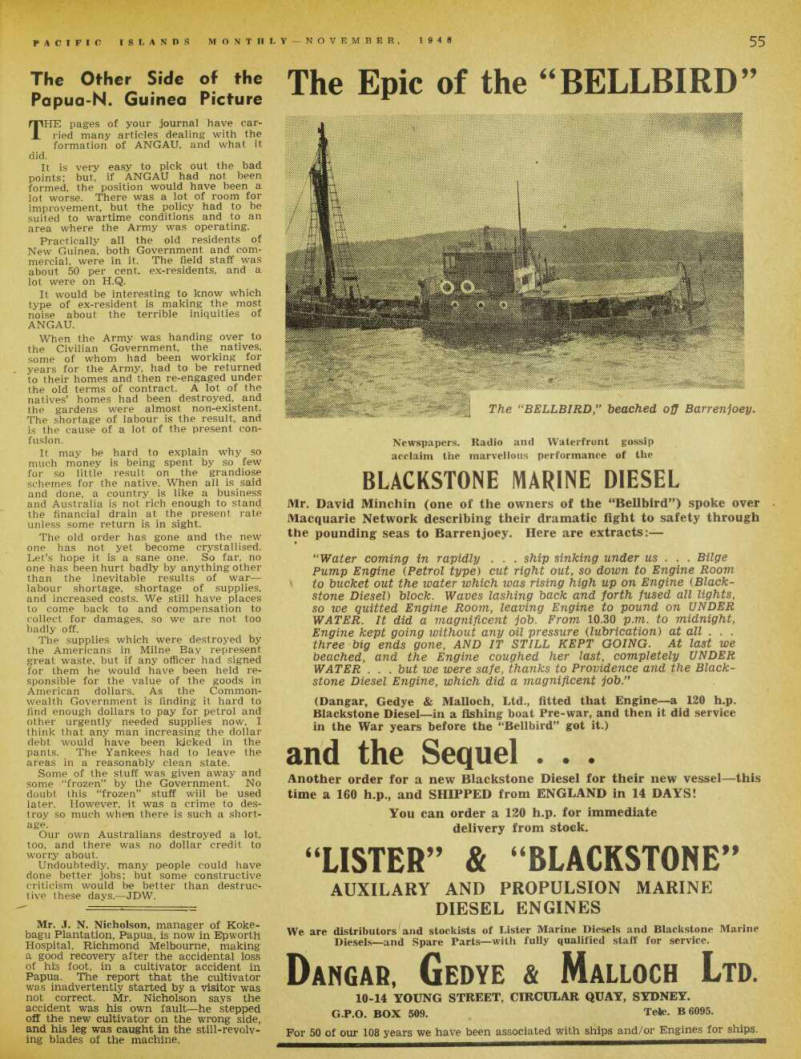
Papua-N. Guinea Picture
THE pages of your journal have car ried many articles dealing with the formation of ANGAU, and what it did.
It is very easy to pick out the bad points; but, if ANGAU had not been formed, the position would have been a lot worse. There was a lot of room for improvement, but the policy had to be suited to wartime conditions and to an area where the Army was operating.
Practically all the old residents of New Guinea, both Government and com mercial. were in it. The field staff was about 50 per cent ex-residents, and a lot were on H.Q.
It would be interesting to know which type of ex-resident is making the most noise about the terrible iniquities of
Angau.
When the Army was handing over to the Civilian Government, the natives, some of whom had been working for years for the Army, had to be returned to their homes and then re-engaged under the old terms of contract. A lot of the natives’ homes had been destroyed, and the gardens were almost non-existent.
The shortage of labour is the result, and is the cause of a lot of the present con fusion.
It may be hard to explain why so much money is being spent by so few for so little result on the grandiose schemes for the native. When all is said and done, a country is like a business and Australia is not rich enough to stand the financial drain at the present rate unless some return is in sight.
The old order has gone and the new one has not yet become crystallised.
Let’s hope it is a sane one. So far, no one has been hurt badly by anything other than the inevitable results of war — labour shortage, shortage of supplies, and increased costs. We still have places to come back to and compensation to collect for damages, so we are not too badly off.
The supplies which were destroyed by the Americans in Milne Bay represent great waste, but if any officer had signed for them he would have been held re sponsible for the value of the goods in American dollars. As the Common wealth Government is finding it hard to find enough dollars to pay for petrol and other urgently needed supplies now, I think that any man increasing the dollar debt would have been kicked in the pants. The Yankees had to leave the areas in a reasonably clean state.
Some of the stuff was given away and some “frozen” by the Government. No doubt this “frozen” stuff wiil be used later. However, it was a crime to des troy so much when there is such a short age.
Our own Australians destroyed a lot, too, and there was no dollar credit to worry about.
Undoubtedly, many people could have done better jobs; but some constructive criticism would be better than destruc tive these days.—JDW.
Mr. J. N. Nicholson, manager of Koke bagu Plantation, Papua, is now in Epworth Hospital, Richmond Melbourne, making a good recovery after the accidental loss of his foot, in a cultivator accident in Papua. The report that the cultivator was inadvertently started by a visitor was not correct. Mr. Nicholson says the accident was his own fault—he stepped off the new cultivator on the wrong side, and his leg was caught in the still-revolv ing blades of the machine.
Advertisements & other items, pp. 57-58 (2 items)
55
ACIFIC ISLANDS MONT II LY NOVEMBER. 1948
Dangab, Gedye & Malloch Ltd.
The Epic of the “BELLBIRD
99
ms:Sm
mm The “BELLBIRD ” beached off Barrenjoey.
Newspapers. Radio and Waterfront gossip acclaim the marvellous performance of the
BLACKSTONE MARINE DIESEL
Mr. David Minchin (one of the owners of the “Bellbird”) spoke over Macquarie Network describing their dramatic fight to safety through the pounding seas to Barrenjoey. Here are extracts: — “Water coming in ravidly . . . ship sinking under us .. . Bilge Pump Engine (Petrol type) cut right out, so down to Engine Room to bucket out the water which was rising high up on Engine ( Blackstone Diesel ) block. Waves lashing back and forth fused all lights, so we quitted Engine Room, leaving Engine to pound on UNDER WATER. It did a magnificent job. From 10.30 p.m. to midnight, Engine kept going without any oil pressure ( lubrication) at all . . . three big ends gone, AND IT STILL KEPT GOING. At last we beached, and the Engine coughed her last, completely UNDER WATER . . . but we were safe, thanks to Providence and the Blackstone Diesel Engine, which did a magnificent job. ,y (Dangar, Gedye & Malloch, Ltd., fitted that Engine—a 120 h.p.
Blackstone Diesel—in a fishing boat Pre-war, and then it did service in the War years before the “Bellbird” got it.)
and the Sequel . . .
Another order for a new Blackstone Diesel for their new vessel—this time a 160 h.p., and SHIPPED from ENGLAND in 14 DAYS!
You can order a 120 h.p. for immediate delivery from stock.
“LISTER” & “BLACKSTONE
AUXILARY AND PROPULSION MARINE
DIESEL ENGINES
We are distributors and stockists of Lister Marine Diesels and Blackstone Marine Diesels —and Spare Parts—with fully qualified staff for service.
Dangab, Gedye & Malloch Ltd.
10-14 YOUNG STREET, CIRCULAR QUAY, SYDNEY.
G.P.O. BOX 509. Tele. B 6095.
For 50 of our 108 years we have been associated with ships and/or Engines for ships.
The Twinkle in
Your Eye
COMES FROM ACTIVE
DIGESTION
Good normal digestive and liver activity means good, normal health and fitness. If you are becoming gloomy and feel tired out, the cause may be a congested state of your Intestinal tract. So many people are troubled with constipation, which, through the retention of waste in the digestive system, causes sick headache, biliousness, pimply skin. unpleasant breath, irritability, slackness and dull eyes.
Regain your bright and attractive appearance by banishing constipation with Pinkettes. Tiny, perfectly harmless, gentle yet effective, these famous laxative and liver pills painlessly exercise and strengthen the bowels, keep the food tract clean and active, stir the liver, and thus banish sick headache, bilious attacks, pimples, unpleasant breath and gloom. All chemists and stores sell Pinkettes, the perfect laxative * and liver pills.
Surprise Party For Samoan
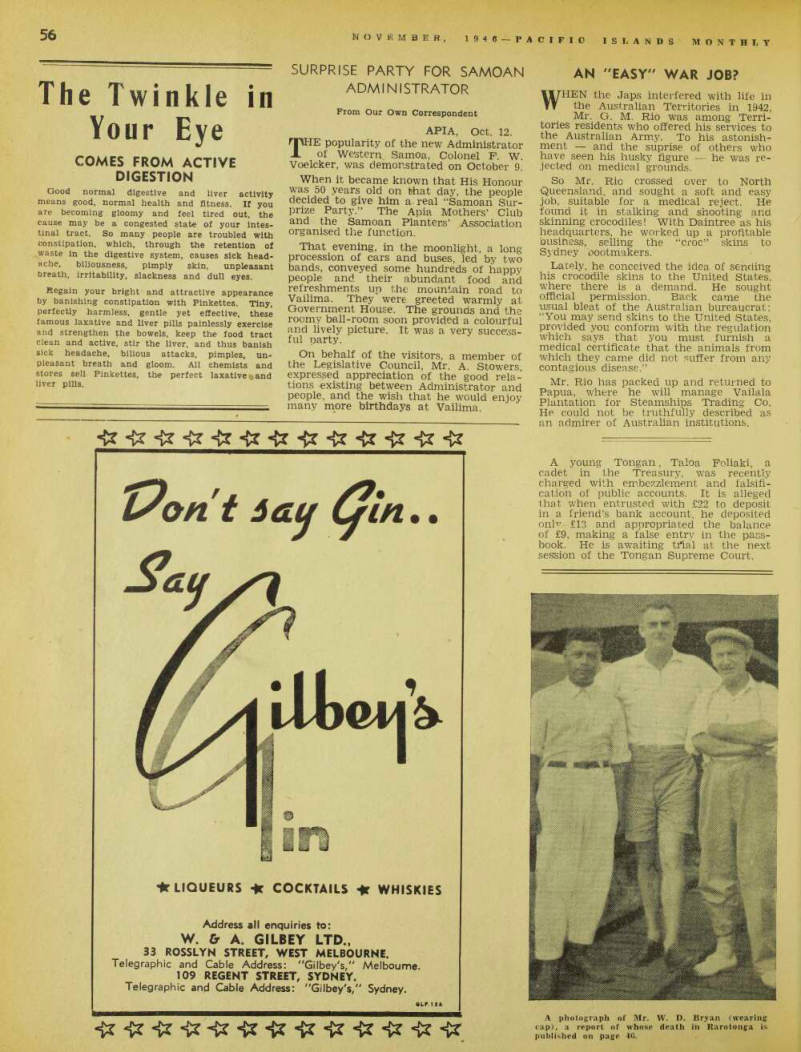
Administrator
From Our Own Correspondent
Apia, Oct. 12.
rE popularity of the new Administrator of Western Samoa, Colonel F. W.
Voelcker, was demonstrated on October 9.
When it became known that His Honour was 50 years old on that day, the people decided to give him a real “Samoan Sur prize Party.” The Apia Mothers’ Club and the Samoan Planters’ Association organised the function.
That evening, in the moonlight, a long procession of cars and buses, led by two bands, conveyed some hundreds of happy people and their abundant food and refreshments up the mountain road to Vailima. They were greeted warmly at Government House. The grounds and the roomy ball-room soon provided a colourful and lively picture. It was a very success ful party.
On behalf of the visitors, a member of the Legislative Council, Mr. A. Stowers, expressed appreciation of the good rela tions existing between Administrator and people, and the wish that he would enjoy many more birthdays at Vailima.
An "Easy" War Job?
WHEN the Japs interfered with life in the Australian Territories in 1942, Mr. G. M. Rio was among Terri tories residents who offered his services to the Australian Army. To his astonish ment and the suprise of others who have seen his husky figure he was re jected on medical grounds.
So Mr, Rio crossed over to North Queensland, and sought a soft and easy job, suitable for a medical reject. He found it in stalking and shooting and skinning crocodiles! With Daintree as his headquarters, he worked up a profitable business, selling the “croc” skins to Sydney bootmakers.
Lately, he conceived the idea of sending his crocodile skins to the United States, where there is a demand. He sought official permission. Back came the usual bleat of the Australian bureaucrat: “You may send skins to the United States, provided you conform with the regulation which says that you must furnish a medical certificate that the animals from which they came did not suffer from any contagious disease.”
Mr. Rio has packed up and returned to Papua, where he will manage Vailala Plantation for Steamships Trading Co.
He could not be truthfully described as an admirer of Australian institutions.
A young Tongan, Taloa Foliaki, a cadet in the Treasury, was recently charged with embezzlement and falsifi cation of public accounts. It is alleged that when entrusted with £22 to deposit in a friend’s bank account, he deposited onlv £l3 and appropriated the balance of £9, making a false entry in the pass book. He is awaiting trtal at the next session of the Tongan Supreme Court.
A photograph of Mr. W. D. Bryan (wearing cap), a report of whose death in Rarotonga is published on page 46.
The Dutch Consul in New Caledonia has appealed to Javanese awaiting repatriation to exercise patience and maintain order and discipline wliile con tinuing in their present employment.
Advertisements & other items, pp. 58-60 (3 items)
'Pont iau (fin..
Sc
lit
★ LIQUEURS ★ COCKTAILS ★ WHISKIES
Address all enquiries to:
W. & A. GILBEY LTD.,
33 ROSSLYN STREET, WEST MELBOURNE.
Telegraphic and Cable Address: "Gilbey's," Melbourne.
109 REGENT STREET, SYDNEY.
Telegraphic and Cable Address: "Gilbey's/' Sydney.
57
PACIFIC ISLANDS MONTHLY NOVEMBER, 1946
PACIFIC HEALTH SERVICE
(Continued from page 34)
54A Pitt St. Svdnev N.S.W.
IMPORTERS
EXPORTERS
,/'i tfiT ALL CLASSES OF MERCHANDISE PURCHASED FOR ISLAND CLIENTS
THROUGHOUT THE SOUTH-WEST PACIFIC.
ISLAND PRODUCE SOLD ON AUSTRALIAN AND OVERSEAS MARKETS
ON COMMISSION BASIS.
BANKERS: BANK OF N.S.W.
COMPTOIR NATIONAL
D ESCOMPTE DE PARIS
54a PITT ST. SVDNEV N.S.W.
CABLE ADDRESS;
“ROBERGILL"
PHONES BW 4782-B 1305
STAMPS
We buy collections, also all issues in quantity, either off or on paper. Top prices. Send registered mail.
Agents required in Pacific Islands, Papua and New Guinea to service covers and send mint stamps.
A. Willison, Box 128, Burnie, Tasmania.
Exodus From Tahiti
From Our Own Correspondent Papeete* September 10.
IT is reported here that over one thou sand Chinese are preparing to leave Tahiti for China. The Chinese Con sul-General is negotiating with a steam ship company for their transportation.
I am not informed in regard to their reasons for going.
The exodus of Europeans continues unabated. Nearly 200 Europeans de parted recently on the “Sagittaire” via Panama.
Another three score are about to de part on other steamers this month.
War Cemeteries in N
N. Guinea
Letter to the Editor THE article by a “Lae Resident,” in October PIM, entitled “Contrast in Cemeteries,” may give a wrong im pression. I was in the Australian War Graves Service in New Guinea.
It was intended to concentrate on large cemeteries in New Guinea, instead of having small ones at each place of fighting. Consequently, two Japanese cemeteries were constructed at Muschu Island (near Wewak) and another at Rabaul. The former holds over 1000 (buried) and 4000 in a shrine (cremated).
These remains are from the Wewak- Aitape-Lae areas. The reason why the Jap cemetery at Lae (a very small one) has not been lifted is that the Australian War Graves Service have had their hands full in establishing the graves of Australian and Indian dead in Lae War Cemetery. Lae cemetery now contains the remains from former cemeteries at Wewak, Madang, Salamaua, Finschhafen, etc. Port Moresby (Bomana) will be another large Australian War Cemetery, and the third Australian War Cemetery will be at Kokopo.
The AWGS has a very large job to fulfil; and, being short staffed and short of native labour, the work is slow and tedious.
Lae War Cemetery, when completed, will be a beautiful cemetery that will be a credit to the AWGS.
I am, etc.,
Ex-War Graves Soldier.
New Head Of Sic, Papua
IT is formally announced that Captain A. S. Fitch will retire from the posi tion of Chairman and Managing Dir ector of Steamships Trading Co, Ltd., Papua, after giving many years’ valuable service. Mr. Eric V. Crisp, who has had 20 years’ service with the company, has been appointed to Captain Fitch’s posi tion. Mr. H. J. Lockrey, A.F.1.A., has been appointed to fill the vacancy on the Board.
Captain Fitch’s resignation took effect as frt>m November 1.
Sunday Island Oranges
For Nz Market
TWELVE native labourers to tend the recently planted orange plantations on Sunday Island, in the Kermadec group, were brought from Niue Island by the NZ Government motor-vessel Maui Pomare, which called at the Kermadecs late in October. The development of the new industry on an island which has never been successfully colonised since its discovery in 1793 is expected to give this little-known New 4 Zealand dependency a prosperous economic future within ten years.
When a Public Works Department party went to Sunday Island in 1937 to set up a meteorological and radio station they found about 20 orange trees planted by early settlers. They were producing excellent fruit, although uncared for. The department has since planted several hundred trees which will begin bearing soon.
As the island is only 600 miles north east of New Zealand, which annexed it in 1887, it is hoped it will provide a valuable addition to the Dominion’s sources of
orange supplies.-
NZ Herald.
Advertisements & other items, pp. 60-62 (2 items)
Imperial
TIME OFF FROM
COOKING
/ m k c -r m m i 111 1 •••tv. f S -v v> What an idea to be able to serve up meals in 5 minutes! . . . Meals that will bring unanimous appetising pleasure—treats that you yourself will be able to sit down and enjoy.
IMPERIAL Good Foods are ready-cooked for you by expert chefs. Easy-to-serve. Specially processed to seal in the full flavour and keep EVER-FRESH.
Imperial
GOOD FOODS
W. ANGLISS 6\Co. (Aust.) Pty. Ltd.
Head Office: 5-7 O’Connell Street, Sydney, Australia.
Imperial
MEATREAT
★ Imperial
CAMP PIE
★ Imperial
HAMPE
★ Imperial
HOT MEALS
Pacific Islands Trading
COMPANY
Bankers: Bank of America (Main Office) San Francisco.
Cables:
PITCO
SAN FRANCISCO
244 CALIFORNIA STREET, SAN FRANCISCO, CAL, U.S.A.
EXPORTERS OF ;
BARBER CHAIRS.
TEXTILES.
CLOTHING.
LIQUOR.
ELECTRICAL GOODS.
FOODSTUFFS.
PRODUCE.
STATIONERY.
CARTRIDGES.
DRUGS.
PAPER PRODUCTS.
AUTOMOTIVE PARTS.
WIRE & NAILS.
BUILDING SUPPLIES.
RADIOS.
REFRIGERATORS.
AUTOMOBILES.
FARM MACHINERY.
TYPEWRITERS.
FIREARMS.
CHEMICALS.
MARINE HARDWARE.
CIGARETTES, TOBACCO.
HARDWARE.
FURNITURE.
IRON & STEEL PRODUCTS.
CANNED GOODS.
PAINTS.
NOVELTIES, NOTIONS.
LEAD PENCILS, ERASERS.
HEAVY EQUIPMENT.
FERTILIZERS.
TYRES, TUBES.
PREFABRICATED HOUSES.
QUOTATIONS ON REQUEST
“NATIONAL” ELECTRICAL APPLIANCES
MADE IN CANADA
TO THE TRADE ONLY
Kidney Trouble
and Backache
Gone in 1 Week
Flush Kidneys With Cystex and You’ll Feel Fine Cystex—the prescription of a famous doctor —improves faulty kidney action In double quick time, so, if you suffer from Rheumatism, Sciatica, Neuritis, Lumbago, Backache, Nervousness, Leg Pains, Dizziness, Circles under Eyes, frequent Headaches and colds, poor Energy and Appetite, Puffy Ankles or Interrupted Sleep, go to your chemist to-day for Cystex.
Cystex Helps Nature 3 Ways
The Cystex treatment is highly scientific, being specially compounded to soothe, tone and clean kidneys and bladder and to remove acids and poisons from your system safely, quickly and surely, yet contains no harsh, harmful or dangerous drugs. Cystex wo’-ks In these 3 ways to end your troubles:— (1) Starts killing the germs which are attacking your Kidneys, Bladder and urinary system In two hours, yet Is absolutely harmless to human tissue. (2) Gets rid of health-destroying, deadly poisonous acids with which your system has become saturated. (3) Strengthens and reinvigorates the kidneys, protects you from the ravages of diseaseattack on the delicate filter organism, and stimulates the entire system.
Feels a Different Woman
*T have been taking Cystex for Kidney and Bladder trouble and it has made a different woman of me. I am feeling splendid, can do all my work, run about and walk miles although I am 63 years of age. Cystex does all you claim for it.”—(Sgd.) M. L. Zessin, Thompson Estate, Brisbane.
Now Able to Walk Without Stick
“1 had Bladder complaint, pains in leg and back; m in fact, I had to use a walking stick, I have used two bottles of Cystex, now I have no pains anywhere. I consider Cystex the greatest medicine in the world for Kidney complaint.”—(Sgd.) J. McPherson, Nangeribone Station, N.S.W.
Guaranteed to Satisfy or Money Back Get Cystex from your chemist to-day. Give it a thorough test. Cystex is guaranteed to make you feel younger, stronger, better in every way, or your money back if you return the empty package. Act nowl Now in 2 sizes—l/-, 8/-.
This is a
GUARANTEED l ITCtOV
Treatment J
for Your Kidneys, Bladder, Rheumatism
PRODUCING UNIFORM GOOD RESULTS SINCE 1868
ALWAYS ASK FOR IT
Samoa—Tonga
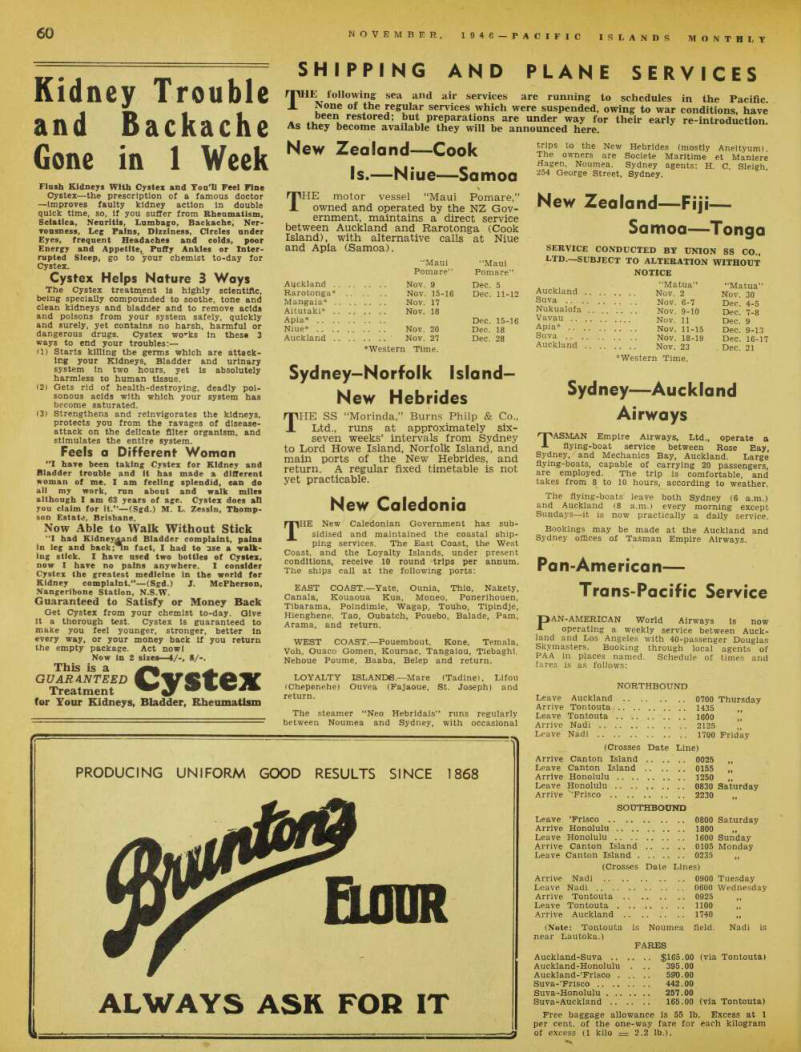
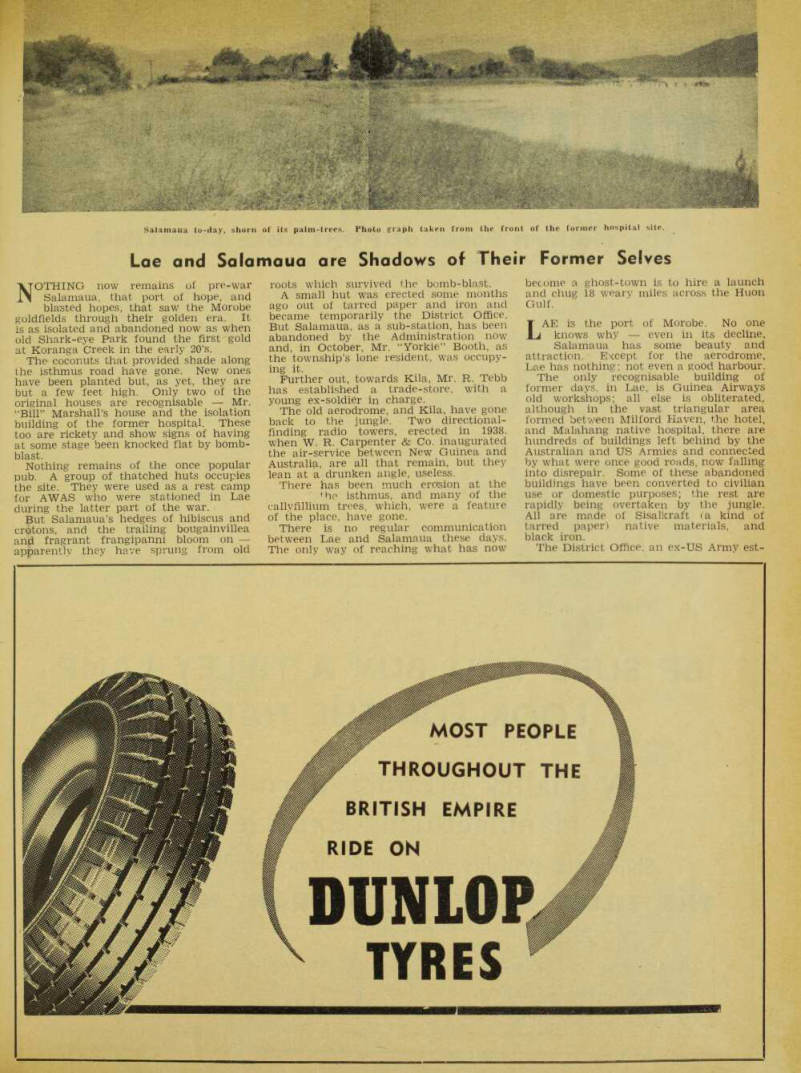
Shipping And Plane Services
fITHE following sea and air services are running to schedules in the Pacific X None of the regular services which were suspended, owing to war conditions, have « been restored; but preparations are under way for their early re-introduction.
As they become available they will be announced here.
New Zealand—Cook
Is.—Niue—Samoa
THE motor vessel “Maui Pomare,” owned and operated by the NZ Gov ernment, maintains a direct service between Auckland and Rarotonga (Cook Island), with alternative calls at Niue and Apia (Samoa).
Sydney-Norfolk Island-
New Hebrides
THE SS “Morinda,” Burns Philp & Co., Ltd., runs at approximately six seven weeks’ intervals from Sydney to Lord Howe Island, Norfolk Island, and main ports of the New Hebrides, and return. A regular fixed timetable is not
yet practicable.
New Caledonia
THE New Caledonian Government has sub sidised and maintained the coastal ship ping services. The East Coast, the West Coast, and the Loyalty Islands, under present conditions, receive 10 round trips per annum.
The ships call at the following ports: EAST COAST—Yate, Ounia, Thio, Nakety.
Canala, Kouaoua Kua, Moneo, Ponerihouen, Tibarama, Poindimie, Wagap, Touho, Tipindje, Hienghene, Tao, Oubatch, Pouebo, Balade, Pam, Arama, and return.
WEST COAST. —Pouembout, Kone, Temala, Voh, Ouaco Gomen, Koumac, Tangaiou, Tiebaghi, Nehoue Poume, Baaba, Belep and return.
LOYALTY ISLANDS.—Mare (Tadine), Lifou fChepenehe) Ouvea (Pajaoue, St. Joseph) and return.
The steamer “Neo Hebridais” runs regularly between Noumea and Sydney, with occasional
trips to the New Hebrides (mostly Aneityum).
The owners are Societe Maritime et Maniere Hagen, Noumea. Sydney agents: H. C Sleigh 254 George Street, Sydney.
New Zealand—Fiji—
Samoa—Tonga
Service Conducted By Union Ss Co.,
Ltd -—Subject To Alteration Without
Notice
Sydney—Auckland
Airways
TASMAN Empire Airways, Ltd., operate a flying-boat service between Rose Bay, Sydney, and Mechanics Bay, Auckland. Large flying-boats, capable of carrying 20 passengers, are employed. The trip is comfortable, and takes from 8 to 10 hours, according to weather.
The flying-boats leave both Sydney (6 a.m.) and Auckland (8 a.m.) every morning except Sundays—it is now practically a daily service.
Bookings may be made at the Auckland and Sydney offices of Tasman Empire Airways.
Pan-American—
Trans-Pacific Service
T 3 AN-AMERICAN World Airways is now operating a weekly service between Auck land and Los Angeles with 40-passenger Douglas Skymasters. Booking through local agents of PAA in places named. Schedule of times and fares is as follows:
Northbound
Leave Auckland 0700 Thursday Arrive Tontouta 1435 Leave Tontouta 1600 Arrive Nadi 2125 „ Leave Nadi 1700 Friday (Crosses Date Line) Arrive Canton Island 0025 „ Leave Canton Island 0155 „ Arrive Honolulu 1250 „ Leave Honolulu 0830 Saturday Arrive '’Frisco 2230 „
Southbound
Leave ’Frisco 0800 Saturday Arrive Honolulu 1800 „ Leave Honolulu 1600 Sunday Arrive Canton Island 0105 Monday Leave Canton Island 0235 „ (Crosses Date Lines) Arrive Nadi 0900 Tuesday Leave Nadi 0600 Wednesday Arrive Tontouta 0925 Leave Tontouta 1100 Arrive Auckland 1740 „ (Note: Tontouta is Noumea field. Nadi is near Lautoka.)
Fares
Auckland-Suva $165.00 (via Tontouta) Auckland-Honolulu . .. 395.00 Auckland-’Prisco 590.00 Suva-’Frisco 442.00 Suva-Honolulu 257.00 Suva-Auckland 165,00 (via Tontouta) Free baggage allowance is 55 lb. Excess at 1 per cent, of the one-way fare for each kilogram of excess (1 kilo = 2,2 lb,), v
“Maui “Maui Pomare’’
Pomare’’
Auckland . . .
Dec. 5 Rarotonga* .
Nov. 15-16 Dec. 11-12 Mangaia* ..
Nov. 17 Aitutaki* .. .
Nov. 18 Apia* Dec. 15-16 Niue* Nov. 20 Dec. 18 Auckland .. .
Nov. 27 ♦Western Time.
Dec. 28
“Matua” “Matua”
Auckland Nov. 2 Nov. 30 f T u Y a •• Nov. 6-7 Dec. 4-5 Nukualofa Nov. 9-10 Dec. 7-8 Va Y au Nov. 11 Dec. 9 ia * Nov. 11-15 Dec. 9-13 Suva Nov. 18-19 Dec. 16-17 Auckland Nov. 23 Dec. 21 Time.
(Note: For easy conversion to Australasian currency £1 should be counted as $3.)
Sydney—Queensland—
Port Moresby Airways
QANTAS Empire Airways, Ltd., employing DC3 planes, operate a regular service between Sydney, Port Moresby and Lae, and return, via Brisbane, Rockhampton, Townsville and Cairns.
Planes leave Sydney on Mondays, Wednesdays and Fridays at 10 a.m., and arrive at Lae at noon on Tuesdays, Thursdays and Saturdays.
Planes leave Lae at 5.45 a.m. on Wednesdays, Fridays and Sundays, and arrive in Sydney at 10 p.m., accomplishing the Lae-Sydney run in a day.
This is expected soon to become a daily service.
Bookings may be made at Qantas offices at any of the towns named. At present, berths are available only to passengers holding official per mits to visit Papua or New Guinea.
RNZAF Services In
Central Pacific
Nausori (Suva-Nadi (Western Fiji):
Plane leaves Nausori each Tuesday and Friday, returning same day. Single adult fare £3 (Fijian). Baggage, 351 b.
Laucala Bay (Suva)-Auckland: Flying
boat leaves Auckland for Fiji each Thursday, and returns on Friday. Single fare, £25/5/2 (F.). Baggage, 601 b.
FIJI - TONGA - SAMOA - COOK ISLANDS: A Dakota transport aircraft leaves Nausori each Friday for Western Samoa. On alternate Fridays the schedule includes Tonga and Cook Islands (Aitutaki and Rarotonga), an overnight stop being made at Apia, Western Samoa. Single adult fares: Fiji-Tonga, £6/12/11; Fiji-Samoa, £B/17/3; Fiji-Aitutaki or Rarotonga £lB/3/4.
Baggage, 601 b.
FIJI - NORFOLK ISLAND - NOUMEA - NEW ZEALAND: A Dakota transport aircraft leaves
Nausori weekly for Whenuapai, N.Z., via Norfolk Island. Once every four weeks Noumea is in cluded in the schedule and on this trip the departure from Nausori is Sunday. Otherwise the departure day is Monday. Because accom modation at Norfolk Island is limited special arrangements are necessary before through bookings can be accepted. Single adult fares: Fiji-Norfolk, £l6/7/11; Piji-Noumea, £l6/7/11; Fiji-New Zealand, £25/5/2. Baggage, 601 b.
Pacific Travellers
PASSENGERS from New Guinea air
ports to Australia by Qantas Air
ways on: OCT. 11: Mr. F. Hockin, Bishop H. Newton, Sister H. Rawling, Mr. B. Lettin, Mr. R. Thorns, Mr. H, Hollins, Mr. T. C. Norton, Mr. S. W.
Edmonds, Mr. C. Rodakis, Mr. R. Doyle, Mr. D.
Steele, Mr. E. Peterson, Mr. E. M. Peacock.
OCT. 13: Mr. S. W. Sheridan, Mr. R. Lorimer, Mr. R. A. Grocott, Mr. W. Higginson, Mr. J W. Peters, Mr. H. Buckleton, Mr. A Hodkinson, Mr. P. Jones, Mr. C. C. Herkes, F/Lt. G.
Fellowsmith, Mr. G. A. Radford, Mr. J. Curtis.
Mr. C. Burke.
OCT. 16; Mr. F. Fearon. Mr. I. Jenkins, Mr.
C. Forbes, Mr. H. L. Clark, Mr. J. W. Bartlett, Bishop H. Strong.
OCT. 20: Mrs. H. Doyle (and 2 children). Mr.
P. Bosgard, Mr. J. O’Donnell, Mr. K. Steen, Mr D. Tapsall, Mr. J. Gray, Capt. J. Johnson.
OCT. 23: Mr. J. Harper, Mr. W. Brotchie.
OCT. 25: Mr. L. S. Filmer, Mrs. S. P. Helton, Mr. N. C. Van R. Kool, Mr. S. L. Vallenga, Capt. H. J. Ahlers, Capt. N. W. Mathew, Mr. W.
Rowe.
OCT. 27: Mr. F. W. Torrington, Mr. M. Hauer.
OCT. 28; Mrs. B. M. Hindward, Capt. W.
Williams.
OCT. 30: Mr. D. V. Learmonth, Mr. M. D.
Donley, Mr. J. Findly, Mr. W. T. Adamson, Mr.
C: King, Mr. J. A. Louden, Mr. Myer, Mr. and Mrs. R. J. Giblett (and child), Mr. R. H. Doty, Mr. A. D. Owen, Mr. _W. F. Murray.
PASSENGERS who left Australia by Qantas Airways for New Guinea air
ports on:
OCT. 11: Mr. and Mrs. Sherer (and 2 children), Mr, S. D. Cash, Mrs. A. J. Brant (and infant), Dr. A. M. Hoeger, Mrs. F. E. Helbig (and 3
children), Mrs. W. White (and infant), Mrs. P.
C. Scope, Sister M. Adalberta, Sister M. Clara, Sister M. Severina, Sister M. Hortense, Mrs. D.
Tuckey.
OCT. 12: Mr. J. White, Mr. A. J. Shields, Mr.
W. P. Ryan, Mr. C. C. Ryder, Mr. B. E.
Matheson, Mr. K. Scott, Mrs. R. Graham, Mr.
N. Van R. Kool, Mr. S. L. Vellenga, Capt. H.
J. Ahlers, Dr. M. F, Giaessner, Mr. F. I.
Middleton, Mrs. T. Larkin, Mr. J. Richards, Mrs. M. E. D. Meares (and 2 children), Mrs. M.
Meares, Dr. H. G. Harding, Mr. R. T. Collings, Mr. C. A. Reason, Mr. J. Harvey, Mr. R. Gil lard, Mr. G. C. Edwards, Mr. s. A. Gow, Mr.
D. Beatson, Mrs. E. L. Corbett.
OCT. 16; Mr. G. T. Robins, Mr. T. E. Huxley, Mr. E. G. Collis, Capt. M. Mathers, Mr. K.
Williams, Mr. A. Burns, Mr. P. J. Jessup, Dr.
G. M. Lees, Mr. J. Gracey, Mr. G. K. Whit taker, Mr. A. M. Fraser, Mrs. A. Robinson, Mrs. McCormack (and 2 children), Mr. A. P, Muir.
OCT. 18: Mr. A. F. Skitch, Mrs. P. Kinsey, Mr. P, j. O’Connor, Mr. D. V. Faulkner, Miss P. M. Gray, Mr. J. White, Mr. R. B. Porch, Mr. J, Allan. Mr. J. C. Griffiths. Miss M. P.
Burton, Miss Z. R. Kinross, Mr. W. A. Douglas, Mr. G. H. Barrcroft, Mr. J. A. Peters.
OCT. 23; Mr. R. H. Hawke, Mr. V. C. Dixon, Mr. D. E. Ronald, Mr. E. A. Avery, Mrs. I. P.
Hanrahan (and child), Mr. P. M. Brown, Mr.
J. A. Robinson, Mr. G. J. McPhee, Mr. H. E.
Lovett-Cameron, Mr. W. Brown, Mr. R. A. Thrift, Mr. G. B. Clark, Mr. W. E. P. Luke, Mr. Hilder brand, Mr. F. de Hesselle.
OCT. 25: Mr. J. G. Sneddon, Mr. I. A. Holmes, Mr. A. R. Bruce, Mr. E. E. McKillop, Mr. F. R.
Davis, Capt. A. L. Hannaby, Mr. M. E. Flannery, Miss L. Handorf, Mrs. K. Angel, Mr. N. F.
Gray, Mr. J. M. Wamersly.
OCT. 30; Mrs. M. Gilbert, Capt. A. J. Judge, Mr. E. Bowden. Mr. W, J. McLaughlin, Mrs.
E. M. Gunther, Mr. F. Boulten, Mr. S. G. Ellis, Mr. H. E. George. Mr. J. J. Outrun, Mr. F. H.
Morgan. Mr. P. R. Hodge. Mr. K. C. Rich. Mr.
G. A. Davis, Mr. W, T. Summer, Mr. E. A, Dodds.
NOV. 1: Mr. H. Farrington, Mr. K. Gross, Mr.
A. T. Lovell. Mr. L, J Hodder, Mr. K Todd.
Miss B. B. Lowney, Miss L. M. Everyngham.
Miss A. K. Shoemark, Miss B E. Deuchar, Mr, G. E. Guthrie, Rev. W. G. Thomas, Mr. V. G.
Brown, Mr. G. Handerside, Mr. J. R. White, Mr. McKenna.
NOV. 2. Miss Salomi, Mr. A. A. Johnstone, Mr. and Mrs. W. R. Hanrahan, Mr. Zoffman, Mrs. S. F. Nicol (and 2 children). Mrs. W. E.
Bisshoff, Mrs. T. M. Price (and child). Mr. L.
L Lowney, Mrs, D. L. Clout, Mr. W. R. Crisp.
Miss Doyle.
PASSENGERS who left Sydney on SS “Morinda” on November 1 for: LORD HOWE ISLAND: Mr. and Mrs. F. Mor rell, Mr. and Mrs. S. A. Morgan (and 2 children». Mrs. E. M. Kain. Mrs. O. M. Smith land child), Mrs. P, Tagg. Mrs. Woolnough.
Mrs. N. King, Mrs. W R. Ross (and child).
Mr. F. E. Brown, Miss J. A. Meehan, Mr. and Mrs. R. F. Jones (and 2 children), Mr. H, Roxborough, Mr. C. Collins, Mr. F. E. White.
NORFOLK ISLAND: Miss B. Adams, Miss M.
Bailey, Mr, W. P. Quintel, Miss A. Menzies,
Mr. and Mrs. F. Hopley, Mr. J. Hodge, Mr. and Mrs. J. Boyle (and child), Mr. O. Olsson, Mr. and Mrs. D. Reynolds (and 3 children), Mr. D.
Scott, Mr. and Mrs. H. Swan, Mrs. W. Woods, Mr. t. Lee, Mr. and Mrs. H. Bellairs, Mrs. E Ingram.
NEW HEBRIDES: Mr. E. McKee, Mr. A.
Kraft, Mr. j. de Preville, Mr. and Mrs. B Edwards (and child), Master M. Millar, Mrs F Rclland, Mr. and Mrs. K. Mitchell, Mr. W.
Wenn, Miss J. Chalk, Miss M. Parent, Mr. D.
Gubbay, Sister Gwen, Mrs. M. Gresham, Mr. W.
Buffett, Mr. D. Ferris, Mr. Minto Hill.
PASSENGERS who arrived in Aus tralia by Qantas flying boat on Octo ber 10: FROM SUVA: Mr. F. W. Nicol, Mr. and Mrs.
R. Mitchell, Mr. F. H. Gardiner, Miss M. Wells, Miss L. Harvie, Mrs. M. Fulton (and child), Mr. Dullabh Makanji, Mr. A. D. Patel FROM NOUMEA: Mr. and Mrs. L. Galinis, Mrs. I. Harper, Mrs. A. Blay, Henry B. Cobure, Sister Zita Canon.
PASSENGERS who left Australia by Qantas flying boat on October 7: FOR SUVA: Mr. J. T. Collins, Mrs. J. T.
Collins, Mr Mohanlal Nanabhai, Mr. Chagan Gokal, Mr. Ratilal Laximadis, Mr. Chunilal Motiram, Mr. Chaganlal Motiram, Mr. Chunilal Gangaram, Mr. Ishwarlal Dahyabhai, Mr. R.
Kerkham, Mr. J. Hodgman, Miss E. M. Brown, Mr. P. A. Bunt, Mr. A. N. Sheaves, Mr. G. J Gow, Mr. A. A. Doherty, Mr. C. A. Creelman, Mr. J. V. Shearwin, Mrs. Shearwin. Mr. and Mrs. C. A. Jones (and 2 children), Mr. Clifford.
FOR NOUMEA: Mr H. B. Coburn.
PASSENGERS who left Suva for Auck
land and Sydney by “Monterey” on
October 11: Mr, and Mrs. K. Sands. Master Sands, Miss Sands, Mr. and Mrs. F. V. Miller, Master Miller, Mr. C. St. Julian, Mr. L. Brown, Mr.
A, R. Tarte, Mr. G. Young, Mr K. Regan, Master Regan, Mr. B. Southwick, Mr. Middle ton (Auck.i. Mr. G. Earle (Syd.), Mr. B. Kerk ham (Auck.), Mr. W. P, Ragg, Mr. K. Maesepp, Mr. T. A. Grainger, Mr W. R, Newton (Auck.), Mr. S. K. Simpson, the Rev. Father Jarre, Mr.
M. March, Mr. M. H. Bonde, Mr. C. Worth, Mr. W. H. Day, Mr. E. L. Stump, Mr. Johnston.
Mr. S. Hill. Mrs. A. L. Goss, Mrs. A. R. Tarte, Miss A. Robins, Mrs L. Browne, Mrs. J. Swin bourne, Mrs. U. Costello, Miss M. L. Oldman, Mrs. M. Maesepp, Mrs. W. P. Ragg, Miss R.
Ragg (and infant). Mrs. S. Johnston, Mrs. E, P. March, Master March, Mrs. V. A. Grainger (and infant), Miss Grainger, Master Grainger, Miss D. Hill, Mrs. F. L. Stump, Mrs. L. Reid, Master H. T. Reid, Miss R. Derrick, Miss A. M Uppill, Mrs. N. F. I. Patterson, Miss Paterson, Mrs. M. Regan, Miss E. Houng Lee (Auck.), Mrs.
Buswell (and infant), Mrs. M. A. Irvine, Mrs.
Heeney, Mr C. Liang (Auck.i.
PASSENGERS who left Australia by MV “Matua” on November 5: FOR SUVA: Mr. and Mrs. R. P. Andersen (and 2 children), Miss S. M. Arlidge, Mr. G. Arthur, Dr. S. T. Barnes, Mrs. B. H. M. Baker (and daughter), Miss C. S. L. Bogle, Mr. W. G.
Carey, Mr. L. M. Cropp, Miss A. J. M. Cronin, Mrs. H. Clarke (and child). Sister M. T. Cahill, Mr. J. E. Cauty, Mr. D B. Cole, Sister Damien Darcy, Rev. and Mrs. F. H. Delbridge (and 3 children), Miss M. S. Farland, Miss J. M. Foster, Mr. T. U. Gopalan, Miss D. M. Grainger, Dr. and Mrs. P. G. Griffiths (and one child), Mr.
D. R. Henderson, Miss M. P. M. Johnston, Miss M. A. Jennipgs, Bro. Jordan, Mr. and Mrs. E. W. Lee (and 2 children), Mr. K. J.
Lynch, Sister C. Lennon, Mrs. E. Lever, Dr. and Mrs. M. L. McCauley, Miss N. M. Low, Mr. N.
McKenzie, Mr. and Mrs. J. Murray (and daughter), Mrs. M. Maxwell, Mrs. A. G. Mansell, Mr. W. Morton, Miss N. Neubauer. Mr. and Mrs. S. J. Pollington, Sister James Pillion, Miss M. M. Paterson, Mrs. M. L. Rogers, Sister P.
M. Ross, Mrs. E. M. Stephens (and 3 children), Mr. C. G. K. Setten, Mr. and Mrs. D. D. Sugar, Mr. V. D. Sharma, Mrs. E. Sprott, Mr. and Mrs. D. T. Tilley (and 2 daughters), Dr. and Mrs. S. Upton. Mr. A. S. Williams, Mrs. M.
Workman (and daughter), Mrs. K. Willoughby, Miss M. G. Young, Mr. E. A. Stewart, Mr. J.
C. Stannard, Mr. M. Tikaram, Pte. S. Tabucala.
FOR APIA: Mr. T. W. Brunt, Mr. D. A.
Church, Mr. and Mrs. R. H. Carruthers, Miss P. T. Fabricius, Mr. J. W. Groves, Mrs. V.
Hart (and daughter), Mr. and Mrs. R. V. Mere dith, Miss L. Seumanutafa, Miss M. A. Sasse, Mr. and Mrs. D. Wiggle (and daughter).
FOR NUKUALOFA: Miss K. Cowley.
ROUND TRIP: Mr. A. V. Windsor.
(Continued on Page 78)
PASSENGERS who recently arrived in Auckland on MV “Matua” from Islands ports included: FROM NUKUALOFA: Mrs. A. Briggs (and 2 children), Mrs. V. Gallavin, Mr. F. Ilolahia (one child), Miss Mele Mapa, Miss M. Santos.
FROM VAVAU: Miss E. Sanft.
FROM APIA: Mr. G. Ah Mu, Mr. T. Brighouse, Mr. H. Brown, Mr. T. Brown, Mr. and Mrs. L.
Bower (and 3 children). Miss A. Bartley, Miss B. Boult, Rev. Father Bourke, Mrs. J. Cook, Mr. J. Clapham, Miss M. David, Mrs. A. Gibbs, Mr. F. Hicks, Mr. A. Higgie, Mr. H. Perkins, Mr. A. Pereira, Miss E. Putwain, Miss E. Rei man, Master A. Oldhaver, Mr. H. Roberts, Mr. and Mrs. W. Rarity, Mr. and Mrs. E. Retziaff, Miss E. Stanley, Miss M. Toomalatai, Mr. H.
Ulberg (one child), Mr.. W. Veitch, Mr. and Mrs. W. White (one child).
FROM SUVA; Mr. and Mrs. T. Andrews (and 2 children). Mr. M. Ali, Mr. A. Boyle, Mr. and Mrs. O. Breederlow (and 3 children), Mr. and Mrs. L. Bean (and 3 children), Mrs. L. Cameron, Miss M. Calderwood, Miss J. Conibear, Miss D.
Drummond, Miss M. Davies, Miss M. Donghty, Miss M. Evans, Mr. W. Henry, Mrs. N. Harness, Mr. A. Holder, Mrs. E. Jones (and 2 children), Mr. and Mrs. R. Lamberg (and 3> children), Mr. and Mrs. C. Lynch, Miss M. Maher, Mrs.
B. Proweller (and two daughters), Mr. and Mrs.
W. Pocock, Mrs. T. Robinson, Mrs. C. Robert son, Mrs. R. Speight, Mr. W. Spears, Miss L.
Shar, Mrs. M. Suckling, Mr. and Mrs. W.
Waddingham (and daughter).
Lists Received Late
PASSENGERS who left New Guinea
airports for Australia by Qantas
airliners on; NOVEMBER 6: Mr E. Wauchope, Mr. W. Mac- Gregor, Mr. J. Darcey, Mr. J. Eccleston.
NOVEMBER 8; Mr. C. A. M. Adelskold, Mr.
D. R. Wylie, Mr. D. S. Wylie, Mr. R. G. Mac lean, Dr. G. M Lees, Dr. K. Washington-Gray, Mr. K. Ashton.
November 11: Nil.
PASSENGERS who left Australia for
New Guinea airports by Qantas air
liners on: NOVEMBER 4; Mr. R. L. Dowe, Mr. W. D.
Dowe, Mr. R. Dalton, Mr E. E. Rogers, Capt.
A. G. Robinson, Mr. P. R. Boerger, Mrs. A. L.
Williams and infant, Mr. R. R. Coles, Mr. C A.
Brown, Sister Tierney, Mrs. N. S. Wilson, Mrs.
D. Tunks.
NOVEMBER 6: Mr. N. L. Saunders, Mr. H C.
Campbell, Mr. M. P. Hawke, Mr. I. R. Fernan dez, Mrs. Yabsley, Mr. G. A. Lanford, Mr K.
F. Dowe, Mr. B. J. Tegenza Mrs. Doering and infant, Mr. R. H. Clarke, Mr. G. C Griffiths, Mr. E. R. Snook, Miss Kennmu-erllier.
NOVEMBERS; Mi>.and Mrs. H. Pnopp and child, Mr. T. Sauriane, Mr J. A. Gray, Mr.
G. Riley, Mr. G. Lyon, Mr. F. R. Bowman, Mr.
F. R. Fowler, Mrs. R. Clarke, Mr. W W. Wat kins, Mr. S. W, Edmonds.
NOVEMBER 9: Mr. J. E. Carruthers, Mrs. J Thomas, Mr J. Read, Mr. K. C. McDonald, Mr!
R. M, Bates, Mrs. O. Nolan (2 children), Mr. J.
N. Walker, Mr. A. W. Anderson, Mr. C. Pappas, Mr. C Day, Mr. M. E. Ewing, Miss H. Smith, Mr. L. Smith, Mrs. Steele.
Advertisements & other items, pp. 63-64 (2 items)
Gii S E(%, N^
QUEENSLAND
INSURANCE
COMPANY
LIMITED
(Incorporated 1886 In Australia)
ASSETS EXCEED £4,000,000
Head Office:
QUEENSLAND
INSURANCE BUILDING,
80-82 PITT STREET, SYDNEY.
Specialists in South Seas Fire,
Marine Cr Accident Insurances
Apply to: —
YUL
Branch Office: I. B. Chalmers, Manager.
Burns Phllp (South Sea) Co., Ltd.
VILA.
Burns Philp (South Sea) Co.. Ltd.
Comptoirs Francals Des Nouvelles Hebrides (Marine).
NOUMEA.
L. & W. Johnston.
PORT MORESBY:
Burns, Philp & Co., Ltd.
W. A. Anderson, Resident Officer.
PAGO PAGO.
Burns Philp (South Sea) Co., Ltd.
G. H. C. Reid & Co.
OTHER SOUTH SEA ISLANDS.
Burns Philp (South Sea) Co., Ltd.
Also to any of the Company’s Offices in Australia or New Zealand.
GII S E(%, N^
TF DDITDDY OF MFW GUINEA
PHILIPS
RADIO
TERRITORY OF NEW GUINEA
WHOLESALE
MERCHANTS
GENERAL AGENTS
REMINGTON
TYPEWRITER
FORWARDING, SHIPPING AND CUSTOMS AGENTS
B.AJL.M.
PAINTS
Sole New Guinea Agents for: Commonwealth Insurance Company
UIJMJX
Pen and Pencil
Set by
MENUS
actual size A perfect gift for yourself and others —the new Venus pen with every essential writing feature of pens costing twice as much and —a smooth action, matching pencil. Venus Cuaranieed.
Obtainable at
PACIFIC ISLANDS TRADING
COMPANY
244 California Street, San Francisco.
Scott’s “Renown” Brand Rope,
Cordage and
Binder
Twine
of Every
Description
Cable Address: Ropeyard, Sydney.
SHS
4$
MANUFACTURED AT
MASCOT, N.S.W.
J. SCOTT
PTY. LTD.
Head Office and Store
163 CLARENCE STREET,
SYDNEY,
N.S.W.
62
NOVEMBER, 1946 FAC I.PIC ISLANDS MONTHLY
Lae and Salamaua are Shadows of Their Former Selves

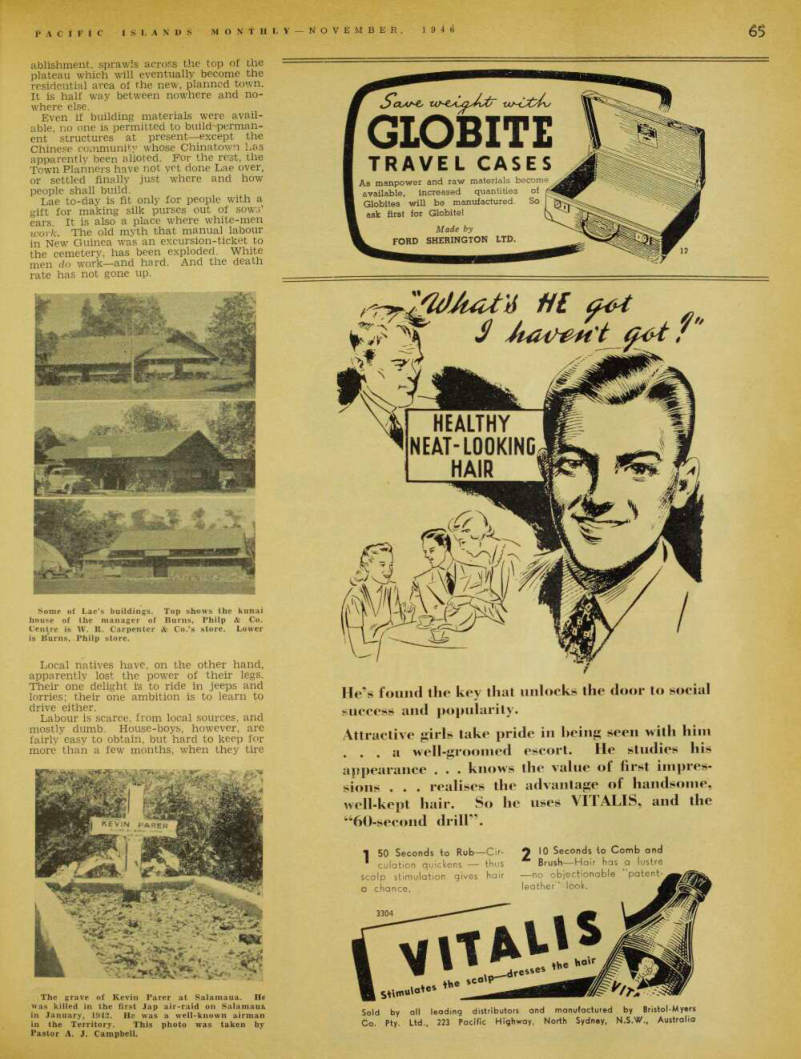
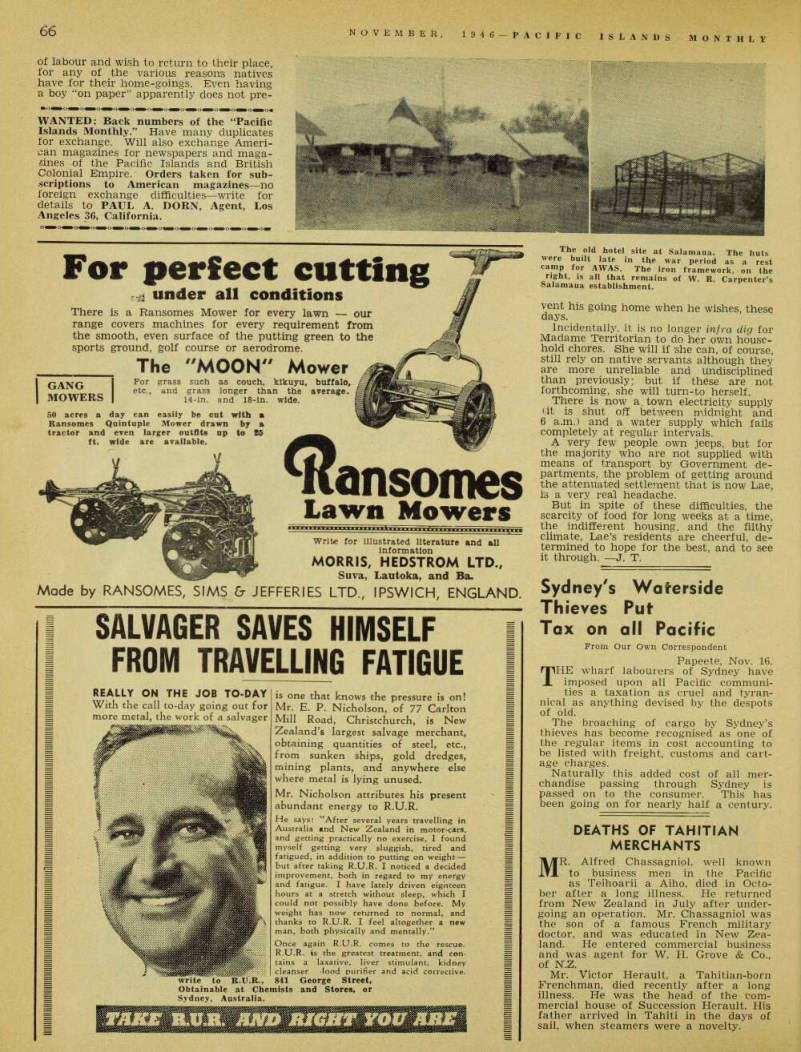
NOTHING now remains of pre-war Salamaua, that port of hope, and blasted hopes, that saw the Morobe goldfields through their golden era. It is as isolated and abandoned now as when old Shark-eye Park found the first gold at Koranga Creek in the early 20’s.
The coconuts that provided shade along tVip rond bavp Q’one New ones have been planted but, as yet, they are but a few feet high. Only two of the original houses are recognisable Mr.
“Bill” Marshall’s house and the isolation building of the former hospital These too are rickety and show signs of having at some stage been knocked flat by bombblast Nothing remains of the once popular pub A group of thatched huts occupies the site They were used as a rest camp for AW AS who were stationed in Lae during the latter part of the war.
But Salamaua’s hedges of hibiscus and crotons, and the trailing bougainvillea and fragrant frangipanni bloom on apparently they have sprung from old
roots which survived the bomb-blast.
A small hut was erected some months ago out of tarred paper and iron and became temporarily the District Office.
But Salamaua. as a sub-station, has been abandoned by the Administration now and, in October, Mr. "Yorkie” Booth, as the township’s lone resident, was occupy ing it.
Further out, towards Kila, Mr. R Tebb has established a trade-store, with a young ex-soldier in charge.
The old aerodrome, and Kila, have gone back to the jungle. Two directional finding radio towers, erected in 1938. when W. R. Carpenter & Co. inaugurated the air-service between New Guinea and Australia, are all that remain, but they lean at a drunken angle, useless.
There has been much erosion at the f he isthmus, and many of the callyfillium trees, which, were a feature of the place, have gone.
There is no regular communication between Lae and Salamaua these days.
The only way of reaching what has now
become a ghost-town is to hire a launch and chug 18 weary miles across the Huon Gulf, Mornhp No one T AE is the port of M Ld knows why even in its decline, Salamaua has some beauty and attractiom Except Lae has nothing, not even a good harbour, The only recognisable building of former days, in Lae, is Guinea Airways old workshops all else is obliterated, although in the vast triangular area formed between Milford Haven, the hotel, and Malahang native hospital, there are hundreds of buildings left behind by the Australian and US Armies and connected by what were once good roads, now falling into disrepair. Some of these abandoned buildings have been converted to civilian use or domestic purposes; the rest are rapidly being overtaken by the jungle.
All are made ol Sisalkraft (a kind of tarred paper) native materials, and black iron.
The District Office, an ex-US Army est
Salamaua to-day, shorn of its palm-trees. Photo graph taken from the front of the former hospital site.
ablishment, sprawls across the top of the plateau which will eventually become the residential area of the new, planned town.
It is half way between nowhere and no where else.
Even if building materials were avail able, no one is permitted to build-perman ent structures at present—except the Chinese community whose Chinatown Las apparently been alloted. For the re'st, the Town Planners have not yet done Lae over, or settled finally just where and how people shall build.
Lae to-day is fit only for people with a gift for making silk purses out of sows’ ears. It is also a place where white-men work. The old myth that manual labour in New Guinea was an excursion-ticket to the cemetery, has been exploded. White men do work —and hard. And the death rate has not gone up.
Local natives have, on the other hand, apparently lost the power of their legs.
Their one delight i's to ride in jeeps and lorries: their one ambition is to learn to drive either.
Labour is scarce, from local sources, and mostly dumb. House-boys, however, are fairly easy to obtain, but hard to keep for more than a few months, when they tire
Some of Lae’s buildings. Top shows the kunai house of the manager of Burns, Philp & Co.
Centre is W. R. Carpenter & Co.’s store. Lower is Burns, Philp store.
The grave of Kevin Parer at Salamaua. He was killed in the first Jap air-raid on Salamau[?] in January, 1942. He was a well-known airman in the Territory. This photo was taken by Pastor A. J. Campbell.
of labour and wish to return to their place, for any of the various reasons natives have for their home-goings. Even having a boy “on paper” apparently does not pre-
vent his going home when he wishes, these days.
Incidentally, it is no longer infra dig for Madame Territorian to do her own house hold chores. She will if 'she can, of course, still rely on native servants although they are more unreliable and undisciplined than previously; but if these are not forthcoming, she will turn-to herself.
There is now a. town electricity supply (it is shut off between midnight and 6 a.m.) and a water supply which fails completely at regular intervals.
A very few people own jeeps, but for the majority who are not supplied with means of transport by Government de partments, the problem of getting around the attenuated settlement that is now Lae, is a very real headache.
But in spite of these difficulties, the scarcity of food for long weeks at a time, the indifferent housing, and the filthy climate, Lae’s residents are cheerful, de termined to hope for the best, and to see
it through.
J.T.
The old hotel site at Salamaua. The huts were built late in the war period as a rest camp for AWAS. The iron framework, on the right, is all that remains of W. R. Carpenter’s Salamaua establishment.
Advertisements & other items, pp. 65-68 (1 item)
Dunlop
i
MOST PEOPLE
THROUGHOUT THE
BRITISH EMPIRE
RIDE ON
DUNLOP
TYRES
TILLEY LAMPS
BURN ORDINARY KEROSENE
The Modern Form of PORTABLE LIGHTING This photo shows a 300 c.p. Tilley Lamp for domestic use but there are also 5000 c.p. Floodlights, Outdoor Lamps, Radiators, etc. All burn ordinary kerosene.
Tilley Lamps are made only at
Hendon, England.
Because they are so successful copies of the TILLEY LAMPS are being marketed.
BE SURE YOU BUY A TILLEY LAMP
LOOK FOR THE NAME!
A quality product born of long
Manufacturing Experience
Shipments available four weeks from receipt of order THE TILLEY LAMP CO., HENDON, N.W.4, ENG.
REPRESENTATION :
MELBOURNE : T. H. Bentley, Pty. Ltd., 123-125 William Street, Melbourne, C.l.
TASMANIA : Mr. C. Sellars, 108 a Charles Street, Launceston.
FIJI : Mr. K. Witherington, 2 Burns Philp Buildings, Suva.
Table Lamp Model T.L. 13
ft? fryt / "
vVf
m
HEALTHY
NEAT-LOOKING
HAIR
/ \ (fC\ y S 15!
He’s found the key that unlocks the door to social success and popularity.
Attractive girls take pride in being seen with him . . . a well-groomed escort. He studies his appearance . . . knows the value of first impressions . . . realises the advantage of handsome, well-kept hair. So he uses VITALIS, and the “60-second drill”. 1 50 Seconds to Rub —Circulation quickens thus scalp stimulation gives hair a chance. 10 Seconds to Comb and Brush —Hair has a lustre —no objectionable "patentleather" look. 3304 the h°* r dresses ca\p^ u \o*es Stiw Sold by all leading distributors and manufactured by Bristol-Myers Co. Pty. Ltd., 223 Pacific Highway, North Sydney. N.S.W., Australia
WANTED: Back numbers of the “Pacific Islands Monthly.” Have many duplicates for exchange. Will also exchange American magazines for newspapers and magazines of the Pacific Islands and British Colonial Empire. Orders taken for subscriptions to American magazines —no foreign exchange difficulties —write for details to PAUL A. DORN, Agent, Los Angeles 36, California.
For perfect cutting
under all conditions
There is a Ransomes Mower for every lawn our range covers machines for every requirement from the smooth, even surface of the putting green to the sports ground, golf course or aerodrome.
The "MOON" Mower
GANG
MOWERS
For grass such as couch, klkuyu, buffalo, etc., and grass longer than the average. 14-in. and 18-ln. wide. 50 acres a day can easily be cut with a Ransomes Quintuple Mower drawn by a tractor and even larger outfits up to 15 ft. wide are available. <a I
ansomes
Lawn Mowers
Write for Illustrated literature and all Information
MORRIS, HEDSTROM LTD.,
Suva, Lautoka, and Ba.
Made by RANSOMES, SIMS b JEFFERIES LTD., IPSWICH, ENGLAND.
SALVAGER SAVES HIMSELF
FROM TRAVELLING FATIGUE
REALLY ON THE JOB TO-DAY
With the call to-day going out for more metal, the work of a salvager is one that knows the pressure is on!
Mr. E. P. Nicholson, of 77 Carlton Mill Road, Christchurch, is New
Zealand’s largest salvage merchant,
obtaining quantities of steel, etc.,
from sunken ships, gold dredges,
mining plants, and anywhere else
where metal is lying unused.
Mr. Nicholson attributes his present abundant energy to R.U.R.
He says: "After several years travelling in Australia and New Zealand in motor-cars, and getting practically no exercise, I found myself getting very sluggish, tired and fatigued, in addition to putting on weight— but after taking R.U.R. I noticed a decided improvement, both in regard to my energy and fatigue. I have lately driven eighteen hours at a stretch without sleep, which I could not possibly have done before. My weight has now returned to normal, and thanks to R.U.R. I feel altogether a new man, both physically and mentally.”
Once again R.U.R. comes to the rescue.
R.U.R. is the greatest treatment, and contains a laxative, liver stimulant, kidney cleanser lood purifier and acid corrective, rite to R.U.R., 841 George Street, Obtainable at Chemists and Stores, or Sydney, Australia.
MSICHTVOUMBE
Sydney's Waterside
Thieves Put Tax on all Pacific
From Our Own Correspondent Papeete, Nov. 16.
THE wharf labourers of Sydney have imposed upon all Pacific communi ties a taxation as cruel and tyran nical as anything devised by the despots of old.
The broaching of cargo by Sydney’s thieves has become recognised as one of the regular items in cost accounting to be listed with freight, customs and cart age charges.
Naturally this added cost of all mer chandise passing through Sydney is passed on to the consumer. This has been going on for nearly half a century.
Deaths Of Tahitian
Merchants
MR. Alfred Chassagniol, well known to business men in the Pacific as Teihoarii a Aiho, died in Octo ber after a long illness. He returned from New Zealand in July after under going an operation. Mr. Chassagniol was the son of a famous French military doctor, and was educated in New Zea land. He entered commercial business and was agent for W. H. Grove & Co., of N.Z.
Mr. Victor Herault, a Tahitian-born Frenchman, died recently after a long illness. He was the head of the com mercial house of Succession Herault, His father arrived in Tahiti in the days of sail, when steamers were a novelty.
Advertisements & other items, p. 68 (1 item)
66
NOVEMBER, 1946-FACIFIC ISLANDS MONTHLY
Rabaul Hospital Orderlies
Reported On Strike
Prom a Special Correspondent RABAUL, October 7.
THERE appears to be some sort of un official strike on here to-day among the Native Medical Orderlies. Native out-patients were, at any rate, unable to obtain medical attention this morning be cause the orderlies are alleged to have demanded equal pay to that of the Chinese hospital nurses, most of whom were widowed by the war. The native orderlies seem to think also that their meat ration is insufficient, although they are receiving double the issue prescribed on the new Administration food scale.
The New Order has, as yet, not affected the Native Police, who are doing their job with pre-war efficiency and winning the admiration of Territorians.
Religious Revival In
French Oceania
From Our Own Correspondent Papeete, August 20.
THE General Assembly of the Protest ant Church in French Oceania held its annual convocation during Aug ust, at Papeete. Every island of every archipelago in the Colony is represented by pastors or deacons.
The state of the Church in Oceania is very good indeed. Not only the elders but seriously-minded, educated men and women of the younger generation have become aware that the real values lie in a return to the customs of their grandfathers, which centred on the social as well as the religious life of the community in the district church and church meeting houses.
The handsome, solidly built church edifices which have been completed, or are in course of construction throughout the Colony, are visible evidences of this return to ancestral custom.
Pacific Islands Garden
Party
MRS. MARIE IRVINE, who writes of pioneer and other outstanding women, is also interested in the collection of rare and exquisite antiques.
Members of the Pacific Islands Society, late in October, accepted her hospitality and in ideal weather attended a garden party at her home in Double Bay, Syd ney.
There were representatives of most of the Empire countries at the party—cer tainly, someone from every Common wealth State and every corner of the Pacific—to inspect the cases of rare treasures and hear the story of prints and priceless crystal.
Th 6 president of the Society, Major C. A. Swinbourne, formerly of the G & E Islands administration, spoke in ap preciation of the party, and said what a pleasure it was for Islands people to meet and share such mutual interests.
Mrs. Irvine said that many of her household treasures had gone with the bombs in England, but she was pleased to have her guests share her interest in her antiques.
The five or six hundred bodies of US servicemen buried in the American cemetery three miles out of Noumea, New Caledonia, are being exhumed for reburial in the USA. the same is being done at other US cemeteries in the Pac ific.
New Caledonian economy is still on what one may call a war footing, with imports exceeding exports during the first seven months of the present year by over a hundred million francs. In spite of Newcastle coal, imports from the USA still exceed those from Aus-
tralia, though not by much. France is s tin ou t 0 f the race so far ag i m p or^s ronrerned but she took 191 million re concerned, but she took 121 million francs worth of the Colony s exports, mainly minerals for her reviving industries.
Advertisements & other items, p. 69 (1 item)
Shell
Allen Taylor & Co. Ltd.
COMMERCIAL ROAD, ROZELLE,
SYDNEY
Sowmillers and Wholesale Suppliers of Hardwoods for Constructional Purposes GIRDERS . . . PILES . . . POLES . . . SLEEPERS, Etc.
EXPORTING TO PACIFIC ISLANDS SINCE 1893
m A i t W/\ m m
YOU can
be 5Wf
K Of
SHELL
SHELL COMPANY
(PACIFIC ISLANDS) LTD.
(INCORPORATED IN GREAT BRITAIN)
Agents:
BURNS PHILP (South Sea) CO. LTD.
(5465 J)
An American Yacht In Rarotonga
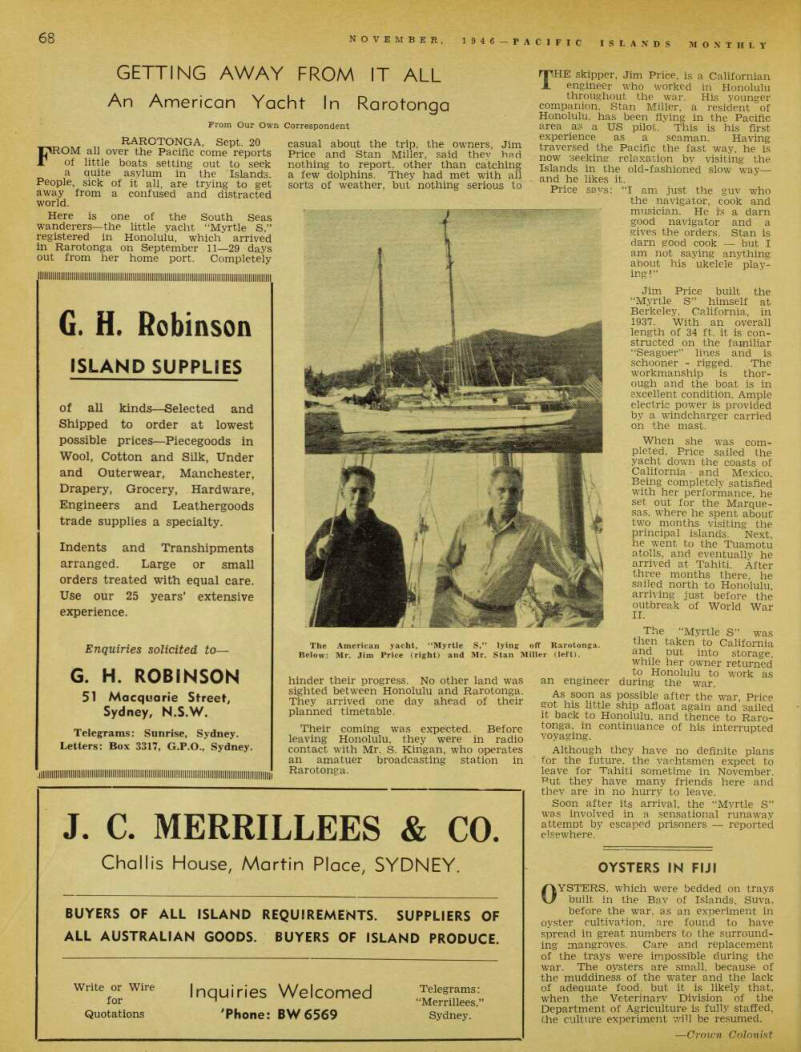
Getting Away From It All
From Our Own Correspondent
Rarotonga, Sept. 20
FROM all over the Pacific come reports of little boats setting out to seek a quite asylum in the Islands.
People, sick of it all, are trying to get away from a confused and distracted world.
Here is one of the South Seas wanderers—the little yacht “Myrtle S,” registered in Honolulu, which" arrived in Rarotonga on September 11—29 days out from her home port. Completely
casual about the trip, the owners, Jim Price and Stan Miller, said thev bad nothing to report, other than catching a few dolphins. They had met with all sorts of weather, but nothing serious to"
hinder their progress. No other land was sighted betwe'en Honolulu and Rarotonga.
They arrived one day ahead of their planned timetable.
Their coming was expected. Before leaving Honolulu, they were in radio contact with Mr. S. Kingan, who operates an amatuer broadcasting station in Rarotonga.
THE skipper, Jim Price, is a Californian engineer who worked in Honolulu throughout the war. His younger companion, Stan Miller, a resident of Honolulu, has been flying in the Pacific area as a US pilot. This is his first experience as a seaman. Having traversed the Pacific the fast way, he is now seeking relaxation by visiting the Islands in the old-fashioned slow way— and he likes it.
Price says: “I am just the guy who
the navigator, cook and musician. He is a darn good navigator and a gives the orders. Stan is darn good cook but I am not saying anything about his ukelele play ing ! ”
Jim Price built the “Myrtle S” himself at Berkeley, California, in 1937. With an overall length of 34 ft. it is con structed on the familiar “Seagoer” lines and is schooner - rigged. The workmanship is thor ough and the boat is in excellent condition. Ample electric power is provided by a windcharger carried on the mast.
When she was com pleted, Price sailed the yacht down the coasts of California • and Mexico.
Being completely satisfied with her performance, he set out for the Marque sas, where he spent abouf two months visiting the principal islands. Next, he went to the Tuamotu atolls, and eventually he arrived at Tahiti. After three months there, he sailed north to Honolulu, arriving just before the outbreak of World War The “Myrtle S” was then taken to California and put into storage, while her owner returned to Honolulu to work as
an engineer during the war.
As soon as possible after the war, Price got his little ship afloat again and sailed it back to Honolulu, and thence to Raro tonga, in continuance of his interrupted voyaging.
Although they have no definite plans for the future, the yachtsmen expect to leave for Tahiti sometime in November.
Put they have many friends here and they are in no hurry to leave.
Soon after its arrival, the “Mvrtle S” was involved in a sensational runaway attempt by escaped prisoners reported elsewhere.
The American yacht, “Myrtle S,” lying off Rarotonga.
Below: Mr. Jim Price (right) and Mr. Stan Miller (left).
Oysters In Fiji
OYSTERS, which were bedded on trays built in the Bay of Islands, Suva, before the war, as an experiment in oyster cultivation, are found to have spread in great numbers to the surround ing mangroves. Care and replacement of the trays were impossible during the war. The oysters are small, because of the muddiness of the water and the lack of adequate food, but it is likely that, when the Veterinary Division of the Department of Agriculture is fully staffed, the culture experiment will be resumed.
Crown Colonist
Advertisements & other items, p. 70 (1 item)
J. C. Merrillees & Co
G. H. Robinson
ISLAND SUPPLIES
of all kinds—Selected and Shipped to order at lowest possible prices—Piecegoods in Wool, Cotton and Silk, Under and Outerwear, Manchester, Drapery, Grocery, Hardware, Engineers and Leathergoods trade supplies a specialty.
Indents and Transhipments arranged. Large or small orders treated with equal care.
Use our 25 years’ extensive experience.
Enquiries solicited to—
G. H. ROBINSON
51 Macquarie Street, Sydney, N.S.W.
Telegrams: Sunrise, Sydney.
Letters: Box 3317, G.P.0., Sydney.
J. C. MERRILLEES & CO
Cha 11 is House, Martin Place, SYDNEY.
BUYERS OF ALL ISLAND REQUIREMENTS. SUPPLIERS OF ALL AUSTRALIAN GOODS. BUYERS OF ISLAND PRODUCE.
Write or Wire for Quotations
nquiries Welcomed
'Phone: 8W6569 Telegrams: “Merrillees,”
Sydney.
New Guinea's Hamstrung
Mining Companies
THE position disclosed by the Directors of Sandy Creek Gold Sluicing Ltd., in their last annual report, is typical of most of the gold-mining companies of New Guinea.
The company has an excellent property on the Morobe field; it has a sound directorate and staff, and substantial funds in cash; it is all ready to start min ing operations. But because Government policy has deprived it of native labour, and any prospect of getting labour, its enterprise is paralysed. “The position is so unsatisfactory at the present time,” say the directors, “that it is quite im possible to indicate when mining opera tions will be resumed.”
The company has an issued capital of £77,500 and a special reserve of £24,856, of which some £20,000 is in cash. It was a good money-spinner before the war, and could be again, if given half a chance.
Vernon Memorial Fund
A GROUP of Samarai friends of the late Dr. G. H. Vernon organised a memorial fund. Donations have been as follows:
£ s. d.
Already acknowledged
41 4 0 Dr. F. J. Williams, Melbourne 1 1 0 Total 42 5 0
Advertisements & other items, pp. 71-72 (2 items)
69
PACIFIC ISLANDS MONTHLY NOVEMBER, 1946
THE AUSTRALIAN TAXPAYER
PAYS
(Continued from page 12)
Tired,Sleepless
When Worried
AND YOU FEEL RUN-DOWN
Worry Is Inescapable. Everyone has a share of it more or less. The great trouble about worry Is that It plays havoc with your health and fitness if you let it. You become mentally and bodily weary, depressed; cannot sleep at night, lose appetite and begin to feel a nervous breakdown is impending. That starts the vicious circle. You worry, become run-down and nervy, and that makes you worry more than ever.
Meet your troubles all the way by reinvigorating your system and keeping it fit and well by taking Dr. Williams’ Pink Pills. These pills help to restore the red corpuscles and iron content of the blood to their normal quantity.
This enables life-giving oxygen and nourishment to be carried to the nerves, organs and tissues of the body. In that way you become invigorated, strengthened by Dr. Williams’ Pink Pills, the vague aches and pains disappear and you are fit again to deal confidently with all your worries. At chemists and stores.
Equal to the World’s Best
Throughout Australia and Overseas there is on ever-increasing demand for
COLONIAL & BRONTE
HIGH-GRADE CANNED MEATS
There is no better quality—none more wholesome.
TRADE MEATS FOR THE ISLANDS
order
“COLONIAL” BRAND
Roast, Corned and Boiled Beef Packed in 6,5, 4,3, 2, 1 lb. and 12 oz. tins.
Also Corned Beef in 12 oz. Taper Tins.
Roast, Corned and Boiled Mutton. 1 lb. and 12 oz. tins.
Choice Dripping
36 lb., 2 lb., 1 lb. tins, and 1 lb. packets. 8 1 tb NETT It ts*u
DELICIOUS
"BRONTE" HOT MEALS
Steak and Kidney Padding.
Beef Steak Padding.
Sausages and Tomato.
Sausages and Vegetable.
Lamb and Green Peas.
Corned Beef and Boston Beans with Tomato Sanoe.
Steak and Tomato.
Under present conditions it is wise to ensure that you have ample stocks of all our lines.
The Colonial Wholesale Meat Coy. Pty. Ltd.
30 GROSVENOR STREET, SYDNEY
**■■■ ■<■** m.
It isn't your ne
they II notice I
It’s a gift—the way you wear jewels for smart effect, but, even the loveliest trinkets fail to be effective when charm itself fades away.
Don't stop at washing away past perspiration. Guard against risk of future underarm odour. Let Mum give underarms the special care they need.
Mum smooths on in 30 seconds. Keeps you safe from offending underarm odour all day or evening.
Mum is harmless to skin and clothing; so quick and easy to use—even after dressing. hy take chances with your charm when you can trust Mum?
MUM
TAKES THE ODOUR OUT OF PERSPIRATION
Sold by all leading distributors and manufactured by Bristol-Myers Co. Pty. Ltd., 223 Pacific Highway. North Sydney, N.S.W., Australia
New Islands Air Services
AUSTRALIAN Civil Aviation Depart ment experts recently passed through Brisbane on their way to the Islands of the South-west Pacific.
They will investigate Islands airfields to decide which are suitable for the pro posed regional services to be operated by Qantas from Australia. (See October
Pim.)
The airfields to be visited include: Noumea, in New Caledonia.
Vile (Efate Island) and Espiritu Santo in the New Hebrides, Kieta, in Bougainville.
Honiara (Guadalcanal) in the British Solomons.
All were built during the war.
Advertisements & other items, p. 72 (1 item)
70
November, iiH-pjcine islands monthly
"CARGO-CULT"
(Continued from page 16)
Tonga
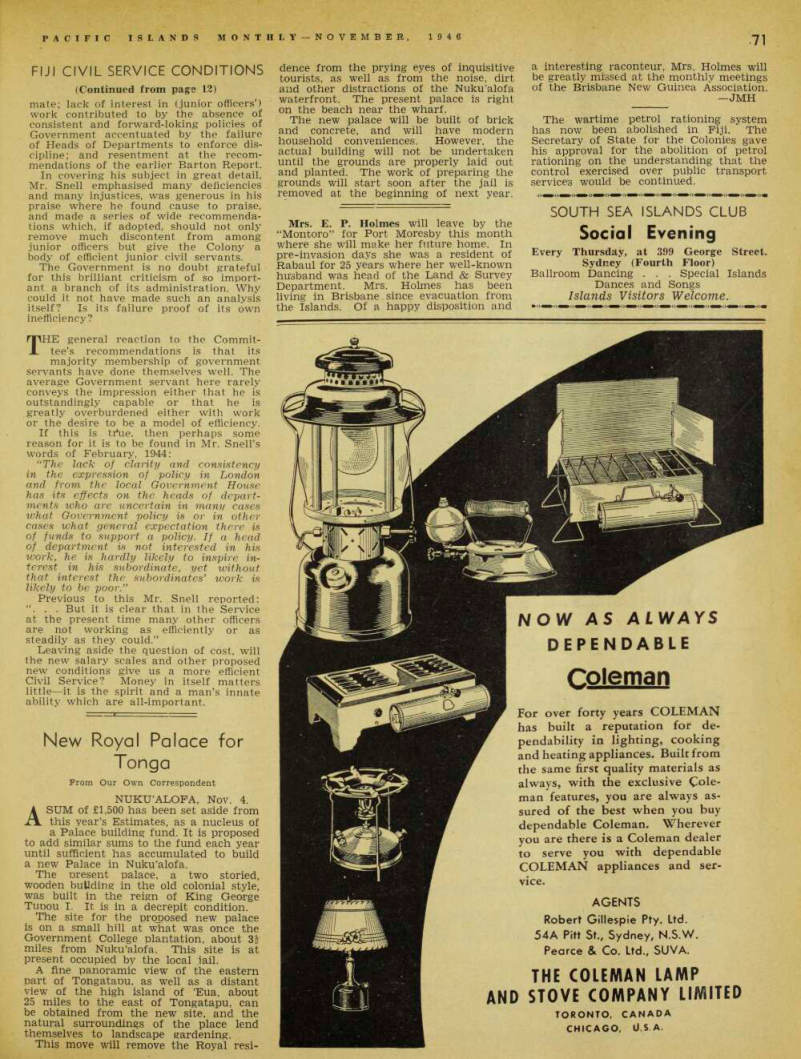
New Royal Palace for Tonga
From Our Own Correspondent
Nukualofa, Nov. 4.
A SUM of £1,500 has been set aside from this year’s Estimates, as a nucleus of a Palace building fund. It is proposed to add similar sums to the fund each year until sufficient has accumulated to build a new Palace in Nukualofa.
The nresent palace, a two storied, wooden building in the old colonial style, was built in the reign of King George Tunou I. It is in a decrepit condition.
The site for the proposed new palace is on a small hill at what was once the Government College plantation, about miles from Nuku’alofa. This site is at present occupied by the local jail.
A fine panoramic view of the eastern part of Tongatanu, as well as a distant view of the high island of ’Eua, about 25 miles to the east of Tongatapu, can be obtained from the new site, and the natural surroundings of the place lend themselves to landscape gardening.
This move will remove the Royal resi
dence from the prying eyes of inquisitive tourists, as well as from the noise, dirt and other distractions of the Nuku’alofa waterfront. The present palace is right on the beach near the wharf.
The new palace will be built of brick and concrete, and will have modern household conveniences. However, the actual building will not be undertaken until the grounds are properly laid out and planted. The work of preparing the grounds will start soon after the jail is removed at the beginning of next year.
Mrs. E. P. Holmes will leave by the “Montoro” for Port Moresby this month where she will make her future home. In pre-invasion days she was a resident of Rabaul for 25 years where her well-known husband was head of the Land & Survey Department. Mrs. Holmes has been living in Brisbane since evacuation from the Islands. Of a happy disposition and
a interesting raconteur, Mrs. Holmes will be greatly missed at the monthly meetings of the Brisbane New Guinea Association,
Jmh
The wartime petrol rationing system has now been abolished in Fiji. The Secretary of State for the Colonies gave his approval for the abolition of petrol rationing on the understanding that the control exercised over public transport services would be continued,
Advertisements & other items, p. 73 (2 items)
71
PACIFIC ISLANDS MONTHLY NOVEMBER, 1946
FIJI CIVIL SERVICE CONDITIONS
(Continued from page 12)
Coleman
SOUTH SEA ISLANDS CLUB
Social Evening
Every Thursday, at 399 George Street.
Sydney (Fourth Floor) Ballroom Dancing . . . Special Islands Dances and Songs Islands Visitors Welcome.
NOW AS ALWAYS
DEPENDABLE
Coleman
For over forty years COLEMAN has built a reputation for de-
pendability in lighting, cooking
and heating appliances. Built from the same first quality materials as always, with the exclusive Coleman features, you are always assured of the best when you buy dependable Coleman. Wherever you are there is a Coleman dealer to serve you with dependable COLEMAN appliances and service.
AGENTS
Robert Gillespie Pty. ltd. 54A Pitt St., Sydney, N.S.W.
Pearce & Co. Ltd., SUVA.
THE COLEMAN LAMP
AND STOVE COMPANY LIMITED
TORONTO, CANADA
CHICAGO, USA
Ng Administration Confers With Mission
Representatives
Wide Range of Plans Explained and Discussed
IN Port Moresby, between October 9 and 14, 35 representatives of Missions with stations in Papua and New Guinea, conferred with leading officers of the Provisional Administration, and were given detail's of the Government’s plans in relation to health, agriculture and education.
Many subjects were discussed. They included • ■ The organisation of medical services,
including the training of natives as Native Medical Practitioners, ■ Participation by the natives in the development of the economic resources of the Territory. ■ Training of natives for such vocations as teaching, technical and clerical work, ■ Educational and religious broad casting, The conference was opened by the Administrator (Colonel J. K. Murray).
He named the Director of Education (Mr.
W. C. Groves) as his deputy, to be in the chair, as required.
After the conference, it was stated officially that the discussion had been most successful, not only in the spirit of co-operation and mutual understanding that was evident as between Missions and Administration, but also between the different denominations represented.
SPECIAL sessions were devoted to Public Health. Dr. J. Gunther (Director of Public Health) was pres ent to outline the health programme.
The Director of Agriculture, Stock & Fisheries (Mr. W. Cottrell-Dormer) in a special session, outlined the long-range plan for native agricultural development.
He said the aim was to build up a com munity based on a type of rural peasant proprietorship, for nutritional improve ment as well as for economic purposes.
He said technical assistance would also be provided for European settlers.
Captain lan McDonald (representative of Post-War Reconstruction) was present at a special session, assisted by Mr. J.
Irvine (Reconstruction Liaison Officer in the Department of Education) in connec tion with proposals to apply the Common wealth Reconstruction Training Scheme to eligible and suitable natives.
After hearing the Department of Edu cation’s plans for early operation under this scheme including technical and clerical training the Missions agreed to allow their existing instructional faci lities to be used as auxiliary training centres. Detailed arrangements were dicussed.
Other senior Administration officers who attended included the Government Secre tary (Mr. R. Melrose); the Crown Law Officer (Mr. E. Bignold); and the Director of Forests (Mr. J. McAdam).
The secretarial work of the conference was done by Mr. Charles Julius (Research & Curriculum Officer of the Department of Education) assisted bv Mr. Peter Liv ingston (Education Officer for Broad casting) .
Other A dministration personnel attend ing included Messrs. F. N. Boisen, Area Education Officer, Rabaul: A. H. Buckland.
Education Officer in Charge. Central Native School. Sogeri; Mr. W. C. Steele, Senior Education Officer, who is in charge of arrangements connected with the edu cation of European children in the Terri tory: and Mr G. Stanton Crouch. Head teacher of the European School, Port Moresby.
The following were present for the 'mecial sessions on broadcasting:— Mr.
Basil Kirke, ABC Controller for External territories; Mr. Wilbur Reed. Manager of 9PA Port Moresby; and Mr. Mavnard lock. In these sessions, also, Mr. E. C.
Thrown (Divisional Engineer) ahd Mr.
Shane (Senior Technician of the PMG Denartment attached to 9PA) were pres ent as technical advisers.
AT the concluding session the Admin istrator said that he had been much impressed bv Mission work, particu larly bv the health and general well-being of children in Mission Schools. He referred to the great possibilities of agricultural development in the Territory.
Much could be done through experimental stations such as Kemp Welch. Aivura and Feravat. He suggested that the Missions, likewise, might experiment on their vari ous stations.
Bishop Strong, on behalf of Mission representatives, thanked His Honour for having called the conference, which would have excellent results. A sense of unity had been a notable achievement.
At the conclusion of the conference, while Bishon Wade occupied the Chair, the following resolution was moved by Bishop Strong, seconded by Rev. C. Man nering, and carried unanimously;
This Conference, representing all missions operating in the Territory of Papua-New Guinea, desires to express its sincere apprecia tion of the policy for education, health, agri culture and rehabilitation oulined to it by His Honour Colonel J. K. Murray, Adminis trator. and the directors of the various de partments of the Provisional Administration.
The Missons further express their gratitude to the Honourable E. Ward, the Minister for External Territories, for initiating this policy which they firmly believe, if faithfully and fully implemented, will ensure the spiritual and material advancement of the native peoples to whom Australia is so greatly in debted.
Mission Representatives
The following are the names of the Mission representatives who attended; ANGLICAN: Bishop Strong, Dogma; Rev. J D Bodger, Dogura; Sister Rawlings, Dogura.
ROMAN CATHOLIC: Bishop Wade, Northern Solomon Islands; Monsignor Hannan, Northern Solomon Islands; Monsignor Van Baar, Alexxs hafen; Rev. Father Van Baar, Alexishafen; Rev.
Father Hyland, Rabaul; Rev. Father Zwinge, Rabaul; Dr. Schuy, Rabaul; Rev. Father Cadoux, Yule Island; Rev. Father Taylor, Port Moresby; Brother Patrick, Port Moresby; Rev. Father Dwyer, Samarai; Rev. Father Earl, Samarai.
London Missionary Society; Rev. H. J.
Short, Hood Point, Papua; Rev. D. E. Ure, Port Moresby; Mrs. Ure, Port Moresby; Nurse Fair hall, Port Moresby; Rev. H. Rankin, Saroa, Papua; Rev. S. Rankin, Saroa; Rev. Nixon. Fife Bay. Papua.
METHODIST: Rev. J. R Andrew, Dobu, Papua; Mr. B. Brown, Dobu; Rev. W. Davies, Rabaul; Rev. C. Mannering, Rabaul.
LUTHERAN: Rev. Kuder, Lae; Rev. Helbig, Lae; Rev. Pietz, Lae.
SEVENTH DAY ADVENTIST: Pastor Mitchell, Port Moresby; Pastor Boehm, Port Moresby.
KWATO EXTENSION; Miss P. D. Abel, Sam arai: Mr. J. Smeeton, Samarai.
Unevangelised Fields Mission: Mr.
Sexton, Fly River, Papua.
Bamu River Mission: Mr. Lea, Port
Moresby,
Editorial Note:
Pampered Native and Helpless
European—a Bitter Contrast
rIS evidence of co-operation between Administration and Christian Mis sions, on an intelligent, long-range, co-ordinated plan, is excellent, so lar as it has gone. , No policy for the development of the Territories of Papua and New Guinea can hope to succeed unless there is behind it enough practical commonsense to make use, not only of the Missions’ far-reaching organisation, but also of the missionaries' long experience and frank understanding of native life and native character.
In the eyes of most people, missionaries are hopelessly unpractical idealists. But the missionaries of New Guinea, in both the pioneering and the war eras, dis closed a most helpful, workaday grip of the Territories’ most mundane affairs. It is in all ways a good thing that the prac tical hard-bitten men of the Missions should be given opportunity to bring the Administration’s corps of eager unblooded young idealists down to hard earth, and to earthy facts. It may be paradoxical: but it seems to the “PIM” that the mis sionaries main job will be to persuade the officials that the Fuzzy-wuzzies are not
angels.
rE most disheartening feature of all this is the consistency with which these worthy gentlemen ignore the claims of the unfortunate European settlers. For five days, the conference laboured to bring forth policies for the present and future welfare of the natives.
But, according to our report, neither missionary nor official spared five minutes to discuss the plight of the Territorians— those men and women now isolated in Papua and New Guinea, without any reliable service of either labour or trans port. without even reliable supplies of
common foodstuffs, ignored alike by idealistic Administrator and Socialistic Minister.
The natives, who ask little more than to be left alone, are being yearned over
by three hundred officials and swamped under millions of Australian taxpayers’ money. The European planters, traders and miners, who were encouraged during 25 years to put all they had and knew into hard pioneering work in the Terri tories, are being treated as if they were some kind of criminals, and denied nearly’ all the things they need to re-establish their homes and their industries.
One can only praise the careful, far reaching plans of the Administration for native education, health, and so forth; but how can such praise be warm while we have always before us the plight of the Europeans, struggling vainly for re habilitation against the obstacles created by Wardist Socialism?
Advertisements & other items, pp. 74-76 (1 item)
George J. Lockyer & Company
Engineering Supplies, General Hardware
Exporters and Merchants
Purchasing Agents. Manufacturers’ Representatives.
Electric Light Generating Plants.
Air Conditioning Plants.
Builders’ Hardware.
Marine Engineering Supplies.
Refrigeration Supplies.
Radios and Accessories.
Sanitation Equipment.
Automobile Spare Parts and Garage Accessories.
Abrasive Wheels.
Excavating Machinery.
Electrical Supplies.
Grinding and Pulverising Machinery.
Hydraulic Equipment.
Mechanical Engineering Requirements.
Mining and Quarrying Machinery.
Road and Building Machinery.
STEELS:
Constructional Alloy Steel.
Stainless Steel.
Special Constructional Steels.
Carbon Tool Steel.
High Speed Steel.
Alloy Tool Steel.
Forging.
Tungsten Carbide.
Mild Steel Bars. (Round, Flat, Square, Hex.) Angles and Tees.
Reinforcing Rods.
Sheets, Plates, Copper and Brass.
Sheets and Tubing, etc.
All communications to be addressed Bankers: to “The Secretary,” Commonwealth Bank of Australia, G.P.0., Box 4553, Sydney, Sydney.
Telegraphic and Cable Address: “LOCKMACH,” Sydney.
FAIRLIGHT STREET, FIVE DOCK, SYDNEY, N.S.W.
'Phone: UA7196
Steamships Trading
Company Limited
PORT MORESBY
SAMARAI
PAPUA.
WHOLESALE & RETAIL MERCHANTS, SHIPOWNERS,
PLANTERS, ENGINEERS fr SLIP PROPRIETORS.
Customs, Shipping, Insurance, and Forwarding Agents
MANAGING AGENTS AND VISITING REPRESENTA-
TIVES FOR COCONUT AND RUBBER ESTATES
SYDNEY REPRESENTATIVES: Nelson & Robertson Pty. Ltd., 12 Spring Street
Woven Wire for all Industry
COPRA DRYING TRAYS, FLOORS, Etc.
FRUIT DRYING TRAYS, MINING SCREENS
Heavy Mosquito Gauze in Phosphor Bronze and other Metals Impervious to Salt Sea Air.
WIRE DOOR MATS AND GENERAL WIRE WORKS
E. WRIGHT & CO. LTD.
Office and Works: 148-152 Cleveland Street. Sydney, N.S.W.
Telegraphic Address: "Wrlghtmake.” Chippendale.
VTT/W
f- Or £
TwCM
MVVVVVVVV
til*
c*r>
SwW^° c
G 0^ S
* U'I'VVV
«r\stov Set your face up for the day with COOL, soothing, whisker-subduing
INGRAM'S!
All over the world the Ingram's jar is the morning companion of men who appreciate easy shaving. Ingram's cools and smoothes the skin while it wilts the wiriest hair-growth. Moreover, Ingram's is most economical because so little is needed for a rich, thick, spreading lather.
INGRAM’S
(Jf)n
SHAVING CREAM
Manufactured by
BRISTOL-MYERS CO. PTY. LTD.
Sold by all leading distributors and manufactured by Bristol-Myers Co. Pty. Ltd., 223 Pacific Highway, North Sydney, N.S.W., Australia
AUSTRALIAN BOOKS
SUITABLE FOR XMAS GIFTS;
"VEIL OF TIME"
"VEIL OF TIME"
BY MORWELL HODGES.
Olden times live again in this delightful volume. Fascinating chapters deal with the early settlement of Van Diemen’s Land and the development of Tasmania; while later-day stories of Melbourne, Sydney, North Queensland and the South Seas are recounted in happy vein. Navigators, explorers, pioneers, prospectors, editors, pressmen, printers, showmen, a notorious forger and hosts of other interesting personages throng these pages—and all are real people; not imaginary characters of fiction.
Illustrated. Price 10/6
(postage 4d.)
"GIRL FOR GOLD"
"GIRL FOR GOLD"
BY MORWELL HODGES.
A rousing adventure-romance as redolent of Australia as the golden wattle.
The author has established a precedent by writing what may be termed the first all-Australian ‘Western” novel. Scenes are set in the famed Blacks’ Spur mountain district of Victoria, and the tale is rich in historical atmosphere and personalities.
Price 8/6 (postage 4d.)
Buy direct from
SOUTHERN MOON
PUBLICATIONS
Healesville, Victoria.
Death Of R. B. Roberts Of
Lautoka
THE death of Mr. Roy B. Roberts, a member of the Public Works Depart ment, Fiji, occurred suddenly in Lautoka on October 17.
He was a well-known and popular officer who first came to the Colony in 1923. Shortly before the war he was attached to the New Zealand Aerodrome Survey Unit in the Pacific Islands and later returned to the PWD as Executive Engineer, Lautoka.
He is survived by his wife and two young daughters.
Fungus?
rE “PIM” has an inquiry from a cor respondent which it cannot answer.
Perhaps one of our readers can supply the information.
Does anyone know if there is a market in Australia for fungus, which apparently produces a commodity used in medicine?
F’ungus gathered in Tonga can be sold in New Zealand at present at 1 8 per pound. Are their supplies of fungus in the Western Pacific islands? And has fungus any value in Australia?
About Islands People
Mr. Alex Wilson, Administrator of Norfolk Island, and formerly a member of the Australian Parliament, was a visitor to Canberra in November.
Mr. L. H. Trenn, who had been Resi dent Agent on Mangaia for four years, has been transferred to another part of the Cook Group. His successor on Mangaia had not been announced late in October.
Mr. William McKenzie has been ap pointed Superintendent of Native Schools in the Cook Islands.
Dr. C. A. Taylor, Director of the Tuber culosis Division of the New Zealand Department of Health was in Fiji in October to make a preliminary examina tion of problems connected with tuber culosis in the Colony, in the preparation for a full survey which is to be made in the near future. A sum of £14,000 has been allotted by the United Kingdom from the Colonial Development and Welfare Fund for carrying out the survey in Fiji, and a further £14,000 has been set aside for a similar survey in Western Pacific High Contmission Territories.
Miss Evelyn A. Downs, who was well known in the South Pacific as Principal of the Samoan Girls’ High School at Papauta, near Apia, in Western Samoa, has gone to Papua under the auspices of the London Missionary Society to under take special work connected with the education of native women and girls. She hopes eventually to establish in Papua a special school for Papuan native girls.
Miss Downs was 21 years in Samoa under the LMS; and in 1943 she went to Eng land on furlough. She then undertook overseas welfare work under the British War Office and in that capacity she served in uniform in Egypt and in India, until after the end of World War II. She spent a month in Canada before coming to Australia, where she had to wait several weeks for transport to Port Moresby. Miss Downs is the author of two books on life in Samoa— “The Bible and Drama,” and “Daughters of the Islands”—the latter published about a year ago.
Professor E. W. Gifford, an anthro pologist from California, USA, will visit Fiji about next February. He expects to make “an archaeological reconnaissance” of Viti Levu and Vanua Levu and to excavate certain sites where midden and cave deposits are likely to exist.
A Samoan radio operator, Itai, who, for some time had acted as postmaster at Fagamalo, Savai’i, was recently charged in Apia High Court with having in numerous cases stolen postal packets and sums of money from registered letters. A large stack of opened letters was discovered by the police under the mattress in his bedroom. He was found guilty on all charges and sentenced to two months’ imprisonment on each charge.
Messieurs Tupinier and Boyer, French Colonial inspectors, recently paid an offi cial visit to Caledonia and the New Heb rides.
Sister D. L. Beale, of Gladstone (Q.), returned recently to the Methodist Mission station in New Britain. At the outbreak of the war with Japan, Sister Beale was nursing at Vunairima, about 20 miles north of Rabaul. She was taken prisoner of war by the Japanese and interned in Japan. When she returns to New Britain she will live in a small two-roomed semi native house at Raluana, about 20 miles east of Rabaul, and will nurse in a tem porary hospital until the buildings lost
during the war are replaced.
Jmh.
Advertisements & other items, pp. 76-77 (3 items)
Broomfields Ltd.
Suppliers of
Building Hardware
General Hardware
Ship Chandlery
Paint Materials
WRITE DIRECT TO
Broomfields Ltd.
152 SUSSEX STREET, SYDNEY
Sole Agents for: P. H. MUNTZ & CO.’s 3-CROWN BRAND METAL
SHEATHING.
PEACOCK & BUCHANS’ ENGLISH READY-
MIXED PAINTS.
75
PACIFIC ISLANDS MONTHLY NOVEMBER, 1940
FIJI PROGRESS
(Continued from page 8)
Nelson & Robertson
COMPLEXION PERFECTION
WITH
BEAUTY PREPARATIONS
FOR
DISCRIMINATING WOMEN
WHO DESIRE
ALLURING LOVELINESS
Obtainable At All Stores.
Distributor:
GORDON K. SMITH
Beverley Hills, Sydney Bankers: Bank of N.S.W.
NELSON and ROBERTSON Pty. Ltd.
Established 1895
Shipowners - Brokers and
Islands Merchants
All classes merchandise purchased at Best Wholesale Prices. Original Invoices supplied to Island Clients. Cocoa Beans, Copra, Rubber, Trochus Shell and All Islands' Produce Sold on Commission.
Entrust your requirements to the firm with fifty years' practical experience in the Prompt attention given to all enquiries.
NELSON & ROBERTSON
12 SPRING STREET, SYDNEY, AUSTRALIA
Telegraphic Address: IVAN, SYDNEY.
Unhappy Rabaul
Pi'om a Special Correspondent Rabaul, October 29.
THE last of the Japanese prisoners of war are now awaiting shipment, They are to go on the “Hanazuki”— 700 of them.
The effect on the Production Control Board is likely to be embarrassing. As a result of Government policy, there is no indentured native labour available, and free native labour is unreliable and expensive. The Board had been using POW labour, and the Japs were excel lent workers.
Private employers, whose labour prob lems are endless, have no sympathy with the labour troubles of a Government concern like PCB. “Let the Government taste a little of its own medicine,” they say.
Kokopo Rehabilitation
NEWS that their old friend, Mr. Jim Ewen, will shortly arrive from Mad ang has been received with pleasure by Kokopo residents. He always was a good worker for the community; and, now that Kokopo Club is being revived, they feel that he will be the right man in the right place.
Mrs. Mildred Costello has done a fine job in the rehabilitation of Gire-Gire Plantation. That should be one of the first plantations into full production in the Kokopo district.
Young John Gilmore accepts the cur rent report that the “Reynella” still somewhere en route between Sydney and Rabaul—is so slow that another ship has been sent after her to revictual her. John has been very busy on the rehabilitation
of Put-Put Plantation, and has even given Ihe jeep a new coal of green paint.
Reason for his impatience? Mrs. John Gilmore and small daughter are on the “Reynella.”
Giant Snail Menace
WE certainly have a dangerous Jap legacy in the giant snails which the invaders started to cultivate here as an article of food.
The creatures are increasing by mil lions, and they seem to tackle any kind of vegetation.
Administration Troubles
AS an example of the arrogance and unruliness of native labour, we have the recent strike of native orderlies at the native hospital. After consider able argument, the Chinese nurses at the hospital decided to resign their positions; and, on condition that the Chinese nurses departed, the native orderlies agreed to remain. They also got an as surance that the medical officer, who was going to Port Moresby for a conference, would bring the orderlies’ grievances be fore the Administrator.
I have it on good authority that the Administration now pays out no less than £6,000 per month here for Chinese and half caste labour—an astonishing figure for Rabaul, which shows what New Guinea is likely to cost the Austra lian taxpayer.
There still is no indication of what the Administration intends to do in re lation to Rabaul—whether some sort of establishment is to be gradually built up here, or whether we are eventually to desert this region of perpetual earth quakes.
Food Suppliers—Public Protest
A PUBLIC meeting at the hostel here last night considered ways and means of getting essential supplies.
Speakers criticised the Administration sharply for its apparent indifference to wards our plight, and for the way in which officials interfere in Australia with our grocery orders. Butter, bacon, tob acco and other had been deleted in Australia our orders, with the explanation that ample supplies were available in Rabaul. If they are, no one knows where the supplies are located, and many people are on very short commons.
It was apparent from statements at the meeting that Rabaul people are suf fering great inconvenience through inter departmental friction and lack of co operation.
Lack of telephones and telephone at tendants is another matter which is causing great trouble here —especially in cases of serious illness.
It was reported that protests had been made to the Administrator against former enemy aliens being allowed to re turn to the Territories, to their former occupations and properties, while Terri tories planters, or their wives and fami lies, were being refused admittance on many and various and often very stupid excuses. The Administration had not even acknowledged the letter of protest.
The absence of an inter-island radio communication service for civilian use— the present service, is reserved for Gov ernment use only—was also discussed.
It was decided to send an urgent com munication to the Australian Prime Min ister, asking for help in various direc tions, and especially in relation to sup plies of essential food.
Advertisements & other items, pp. 78-80 (1 item)
C«Sallivai7 Pty* Lji*3L
ISLAND MERCHANTS
and AGENTS.
GENERAL MERCHANTS.
C«Sallivai7 Pty* Lji*3L
(i v ft* C; * Shippers °f types of * x ‘ Merchandise to the Pacific Islands • Representing Australian, British and American Manufacturers rrr r r fry r i
iujjmM
z?^~ i ir' • Sellers of Island Produce on Consignment Buyers for Leading Pacific Islands T raders
379 KENT ST., SYDNEY.
Cable & Telegraphic © Address : “Chasull ” Sydney. • Importers, Distributors and Manufacturers of
Foodstuffs, Softgoods,
Textiles, Hardware, Tobaccos, Wines and Spirts, etc. • "Ultima" Kerosene Stoves and Heating Appliances • Distributors of
High-grade Shirts,
Pyjamas and Clothing
tST
D\ i m: t U/ ® "Southern Queen"
Canned Fruits i • Forwarding and Transhipment Agents /a; \m
■urn
Hill's English Cigarettes When in Sydney, call and see us!
7 want you to try this one , Miss Gray, (soys t/?e Chemist) f it’s my best seller 1/ % -*!f IS2*~ r > V r Tv "Ipana is all it claims to be o really good tooth paste. Ipana won't work miracles, but it certainly will keep your teeth clean, white and sparkling."
Ipana freshens your mouth; cleans your teeth thoroughly and so defeats the germs that start decay. Its gentle agency reveals the natural brilliant polish of your teeth.
IPANA
When possible, give your teeth a good brushing with Ipana after every meal and always night and morning. Use an upand-down movement so that Ipana can get between the teeth. does all a tooth-paste CAN do for your teeth and gums A National Survey conducted throughout Australia showed that dentists choose Ipana for their personal use 3 to I over any other dentifrice.
- IPANA
TOOTH PASTE
3640 Sold by all leading d stribulors and manufactured by; BRISTOL-MYERS CO. PTY. LTD., 223 PACIFIC HIGHWAY, NORTH SYDNEY, N.S.W., AUSTRALIA
500,000
Men's Second-hand
JACKETS
and
TROUSERS
SUITABLE FOR PACIFIC
ISLANDS TRADE
Price: 4/- Each
Quick Shipment — Pressed Bales containing 1,000 Assorted Garments.
Establish Confirmed Credits for Payment for Any Quantity on Any English Bank.
M. NEWMAN
(Contractors) LTD.
Government Contractors
HEAP ST., MANCHESTER 7,
ENGLAND
Cable Address: Harbinger. Manchester.
Last Jap Pows Leave Rabaul
From Our Own Correspondent
Rabaul, Nov. 9.
A JAPANESE ship, the “Hanazuki,” sailed to-day with 700 Jap prisoners of war, on her way to Japan. This is the last of our Jap POW.
It was originally reported that the Japs would be shipped from the north coast; then that the Jap vessel had to go to Port Moresby for fuelling. Finally, she was fuelled here (it is supposed that the Navy did the job); and we imagine that that is the last we shall see of the gentle men of Nippon for a long time.
The “Reynella” (which took five weeks to get here from Sydney) is still here, unloading.
Advertisements & other items, p. 80 (2 items)
78
NOVEMBER, 1946-PACIFIC ISLANDS MONTHLY
PACIFIC TRAVELLERS
(Continued from page 62)
Swallow * Ariell
THOMAS SWALLOW
. . . Sugarmaster THE YEAR 1880 found the town of Cairns, Queensland, in a very parlous condition.
Trade had come almost to a standstill, when a man who was destined to change the w r hole course of the district’s future, arrived from Melbourne to select a site for sugar cultivation.
He was Mr. Thomas Swallow, well-known as managing par nor of Swallow & Ariell, then already recognised as Australia’s leading biscuit manufacturers. Within a few short years Mr. Swallow’s venture proved an outstanding success and not only ensured the prosperity of Queensland sugar fields, but also laid the foundations of Australia’s present pre-eminence in the Sugar industry.
Over the war years, Australia exported thousands of tons of the world’s finest quality sugar, high in glucose content and rich in nutritive value. And it is from the cream of this fine Australian cane crop that come the quality sugars used by Swallow & Ariell in the making of the biscuits, cakes and puddings so famous for the excellence of their ingredients and the consistently high standard of their quality.
,/tHE STORY BEHIND THE SWALLOW
Mk :: v I
SWALLOW * ARIELL
LIMITED
LEADERS IN THE RISCUIT INDUSTRY SINCE 1854 MAKERS ALSO OF THE FAMOUS SWALLOW <S Afl/ELL PLUM PUODINOS. CAKES, AND ICE CREA.V
in Tonga
Gilbertese May Settle in Tonga
From Our Own Correspondent
Nukualofa, Oct. 5.
AN offer is being made by the Tonga Government to settle one hundred Gilbert Islanders from the over populated G. and E. Colony in the King dom.
The matter was placed before the last session of Parliament and the motion was carried unanimously. The final decision was left for Queen Salote and the Privy Council, whose assent has now been given.
Although the population of the King dom is increasing rapidly, many of its islands which are suitable for habitation are still unsettled. Consequently, any area set aside for the use of new settlers would not diminish to any extent, the living space still available for the Tongans.
However, an interesting question would arise, namely, the national status of the new settlers. Whether they are to re tain the nationality of their country of origin, or become Tongan subjects by naturalisation is still not known. The proposed grant of free land to them would raise a legal problem also, as under the Tongan Constitution and Land Act, non- Tongans may acquire land under lease, but outright sale of land is absolutely prohibited, that being one of the binding covenants of the Constitution on which the wise and far-seeing King George I of Tonga insisted when he established the present constitutional government.
Naturalised Tcngans are, of course, en titled to all rights and privileges, obliga tions and duties to which natural-born Tongan subjects are entitled or subject to, with the exception that they are not entitled to the rights of free hereditary land as tax allotments.
To meet the situation, it is obvious that amending legislation is to be brought into effect.
One slow but certain solution of the problem, however, will be the natural absorption of the new settlers into the Tongan population by inter-marriage— the inevitable fate of all minority groups living within a larger population.
The close affinity of the Gilbertese and Tongans would hasten this process, since the two peoples are both branches of the Polynesian race.
It is interesting to note that surplus people from the Gilbert Islands have al ready been settled in the Phoenix Islands and on Rambe, a big island in the Fiji Group.
Laws For Trade Stores
In New Guinea
rE Trading with Natives Ordinance, 1946, was issued in Canberra in November.
It provides that only licensed persons may trade with natives in Papua-New Guinea and if such traders charge natives more than non-natives he may be fined £lOO. He must prominently display a list of all the goods he has to sell, and prices of same; and, where goods are sold by weight, the containers must display the net weight. The trader cannot refuse to sell his goods to a native if the native tenders the cash; and his store may be inspected by a DO or his deputy at any time, J
High Pearl Shell Prices
From Our Brisbane Correspondent LURED by the tales of adventure in the South Seas, and big money at present offering in the pearling in dustry, Cliff Conroy (an ex-Army Ser geant) of Brisbane, recently purchased a 48ft lighter at the Colmslie Naval Depot Sale for £5lO. He said he intended converting the vessel into a pearling lug ger and would employ two experienced native divers.
There is reported to be a shortage of pearling boats—no new ones have been built for six years. Consequently, double the usual price has to be paid for any boat of quality.
Reports indicate that Australians are using boats which have been left over by the Dutch Government. Some pearl shell is fetching up to £650 a ton!
Tongan's Narrow Escape
From Our Own Correspondent
Nukualofa, Nov. 4.
ONE of the two main masts of the Nukualofa wireless station collapsed recently while a Tongan workman was doing repairs to it.
The workman was working half-way up the mast, at about 60 feet, when he felt it giving way. He quickly loosened the rope with which he had been hauled up. and raced madly down just before it fell to the ground.
Fortunately he got clear of the mast and its tangled stays, and he suffered only slight shock.
It was later discovered that the mast had rotted through at its base.
Advertisements & other items, p. 81 (1 item)
dfdf
of the Breakfast i I « * P/7
SSS
We hope it will not he\ v . long before plenty of this '' favourite marmalade is available once again. Without it, breakfast seems to lose much of its enjoyment, for this chunky marmalade with the tonic flavour is everywhere regarded as “ The Aristocrat of the Breakfast Table.”
Made in the heart of the English countryside by CJII VERS & SONS Ltd. The Orchard Factory, Histon, Cambridge, England
CHIVERS
(f)ldc
Marmalade
Islands Produce
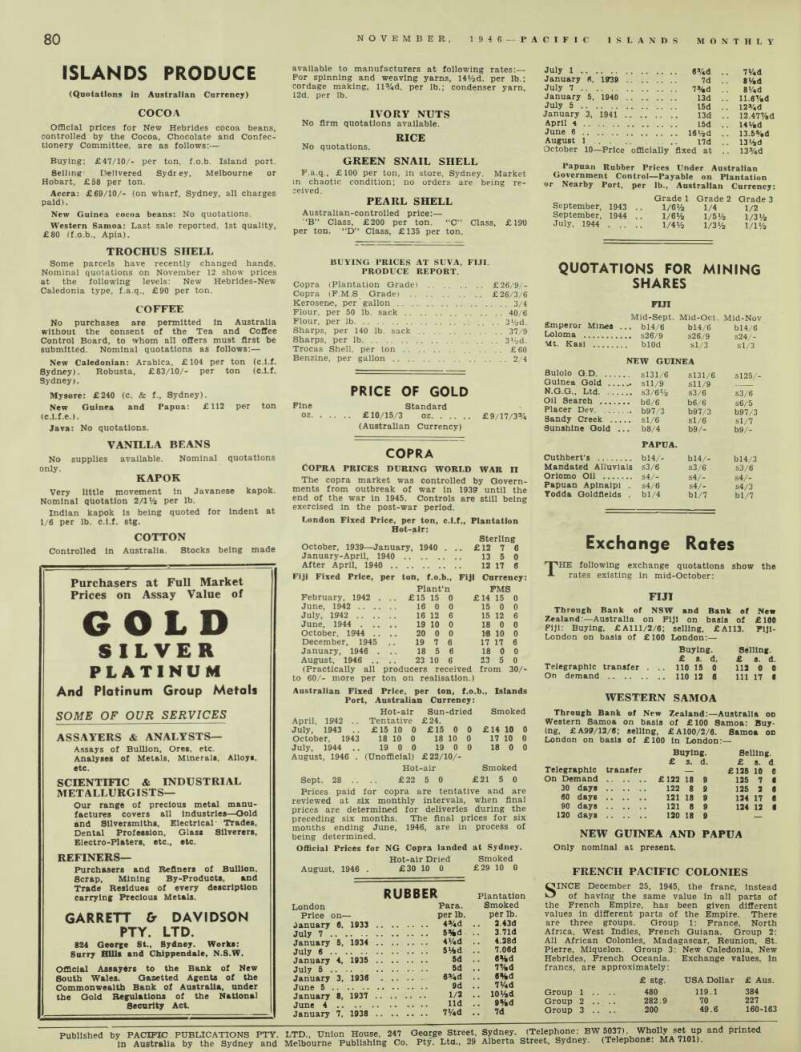
(Quotations in Australian Currency)
Cocoa
Official prices for New Hebrides cocoa beans, controlled by the Cocoa, Chocolate and Confec tionery Committee, are as follows; Buying: £47/10/- per ton, f.o.b. Island port.
Selling- Delivered Sydrey, Melbourne or Hobart, £5B per ton.
Accra: £69/10/- (on wharf, Sydney, all charges paid).
New Guinea cocoa beans: No quotations.
Western Samoa: Last sale reported, Ist quality, £BO (f.0.b., Apia).
Trochus Shell
Some parcels have recently changed hands.
Nominal quotations on November 12 show prices at the following levels: New Hebrides-New Caledonia type, f.a.q., £9O per ton.
Coffee
No purchases are permitted in Australia without the consent of the Tea and Coffee Control Board, to whom all offers must first be submitted. Nominal quotations as follows: New Caledonian: Arablca, £lO4 per ton (c.l.f.
Sydney). Robusta, £B3/10/- per ton (c.l.f, Sydney;.
Mysore: £240 (c. & f., Sydney).
New Guinea and Papua: £ll2 per ton (c.l.f, e.).
Java: No quotations.
Vanilla Beans
No supplies available. Nominal quotations only.
Kapok
Very little movement in Javanese kapok.
Nominal quotation 2/1 Vs per lb.
Indian kapok is being quoted for Indent at 1/6 per lb. c.l.f. stg.
Cotton
Controlled In Australia. Stocks being made
available to manufacturers at following rates:— For spinning and weaving yarns, HVad. per lb.; cordage making, ll%d. per lb.; condenser yarn, I2d. per lb.
Ivory Nuts
No firm quotations available.
Rice
No quotations.
Green Snail Shell
F.a.q., £lOO per ton, in store, Sydney. Market in chaotic condition; no orders are being re ceived.
Pearl Shell
Australian-controlled price:— "B” Class, £2OO per ton. “C” Class, £l9O per ton. “D” Class, £135 per ton.
Buying Prices At Suva, Fiji.
Produce Report.
Copra (Plantation Grade) £26/9/- Copra (F.M.S Gradei £26/3/6 Kerosene, per gallon 3/4 Flour, per 50 lb. sack 40/6 Flour, per lb 3V2d.
Sharps, per 140 lb. sack 37/9 Sharps, per lb SVbd.
Trocas Shell, per ton £6O Benzine, per gallon 2/4
Advertisements & other items, p. 82 (1 item)
Price Of Gold
Pine Standard . oz. . .. £9/17/33/4 (Australian Currency)
Copra
Prices During World
War Ii
The copra market was controlled by Governments from outbreak of war in 1939 until the end of the war in 1945. Controls are still being exercised in the post-war period.
London Fixed Price, per ton, c.I.f., Plantation Hot-air: Sterling October, 1939—January, 1940 ... £12 7 6 January-April, 1940 13 5 0 After April, 1940 12 17 6 Fiji Fixed Price, per ton, f.o.b., Fiji Currency; Plant’n PMS February, 1942 ... £15 15 0 £14 15 0 June. 1942 16 0 0 15 0 0 July. 1942 16 12 6 15 12 6 June. 1944 19 10 0 18 0 0 October, 1944 ... 20 0 0 1-8 10 0 December. 1945 .. 19 7 6 17 17 6 January, 1946 ... 18 5 6 18 0 0 August. 1946 ... 23 10 6 23 5 0 (Practically all producers received from 30/to 60/- more per ton on realisation.) Australian Fixed Price, per ton, f.o.b., Islands Port, Australian Currency: Hot-air Sun-dried April, 1942 .. Tentative £24.
July, 1943 .. £15 10 0 £15 0 0 October, 1943 18 10 0 18 10 0 July, 1944 .. 19 0 0 19 0 0 August, 1946 . (Unofficial) £22/10/- Smoked £14 10 0 17 10 0 18 0 0 Hot-air Smoked Sept. 28 .. .. £22 5 0 £21 5 0 Prices paid for copra are tentative and are reviewed at six monthly intervals, when final prices are determined for deliveries during the preceding six months. The final prices for six months ending June, 1946, are in process of being determined.
Official Prices for NG Copra landed at Sydney.
Hot-air Dried August, 1946 . £30 10 0 Smoked £29 10 0
Rubber
Plantation
Papuan Rubber Prices Under Australian Government Control—Payable on Plantation or Nearby Port, per lb., Australian Currency:
London Para.
Smoked Price onper lb. per lb.
January 8, 1933 .. .. ... 4 3 / 4 d 2.43d July 7 .. .. .. 6%d 3.71d January 5, 1934 .. .. ... 4Vid 4.28d July 6 .. .. .. 5ttd 7.06d January 4, 1935 .. .. ... 5d 6Hd July 5 . ... 5d 7%d January 3, 1936 . . . .. . 6%d 6Hd June 5 .. ... 9d 7V*d January 8, 1937 .. .. .. lOVid June 4 ,. .. .. lid 9%d January 7. 1938 .. .. ... 7>/«d 7d
July 1 .. 7V 4 d January B, 1838 7d av,d July 7 .. 8 Vid January 5, 1940 13d .. 11.6%d July 5 .. , .. \2V*6 January 3, 1941 . .. 12.47 7 / B d April 4 .. .. 14 i' 8 d June 6 .. . . 13.5%d August 1 .. 13‘/id October 10- -Price officially fixed at .. 13%d
Grade 1 Grade 2 Grade 3 September, 1943 .. 1/6 Vi 1/4 1/2 September, 1944 .. 1/6% l/5Vi l/3Vi July. 1944 1/4 Vi 1/3 Vi 1/1 y 2
Quotations For Mining
Shares
Fiji
Mid-Sept.
Mid-Oct.
Mid-Nov Emperor Mines . .. bl4/6 bl4/6 bl4/6 Loloma S26/9 s24/- Mt. Kasl . blOd sl/3 sl/3 Bulolo G.D
New Guinea
.. S131/6 S131/6 S125/- Guinea Gold sll/9 N.G.G.. Ltd .. S3/6V2 s3/6 s3/6 Oil Search b6/6 s6/5 Placer Dev - b97/3 b97/3 b97/3 Sandy Creek ... .. sl/6 sl/6 sl/7 Sunshine Gold .. ,. b8/4 b9/b9/- Cuthbert's
Papua.
.. bl4/bl4/bl4/3 Mandated Alluvlals s3/6 s3/6 s3/6 Orlomo Oil s4/s4/- Papuan Aplnalpl . s4/6 s4/s4/3 Yodda Goldfields . bl/4 bl/7 bl/7
Exchange Rates
THE following exchange quotations show the rates existing in mid-October:
Fiji
Through Bank of NSW and Bank of New Zealand;—Australia on FIJI on basis of £lOO FIJI: Buying, £Alll/2/6; selling. £AII3. PIJI - on basis of £lOO London:—
Western Samoa
Through Bank of New Zealand:—Australia on Western Samoa on basis of £lOO Samoa: Buy ing, £ A99/12/6; selling, £AIOO/2/6. Samoa on London on basis of £lOO in London:—
New Guinea And Papua
Only nominal at present.
French Pacific Colonies
SINCE December 25, 1945, the franc, Instead of having the same value in all parts of the French Empire, has been given different values in different parts of the Empire. There are three groups. Group 1: Prance, North Africa, West Indies, French Guiana. Group 2: All African Colonies, Madagascar, Reunion, St.
Pierre, Miquelon. Group 3: New Caledonia, New Hebrides, French Oceania. Exchange values, In francs, are approximately:
Buying.
Selling. £ s. d. £ s. d.
Telegraphic transfer . .. 110 15 0 112 0 0 On demand .. 110 12 6 111 17 6
Buying.
Selling. £ s. d. £ s. d Telegraphic transfer — £125 10 C On Demand £122 18 9 125 7 6 30 days 122 8 9 125 2 0 60 days 121 18 9 124 17 0 90 days 121 8 9 124 12 0 120 days 120 18 9 —
£ stg.
USA Dollar £ Aus.
Group 1 .. . 480 119.1 384 Group 2 .. . 282.9 70 227 Group 3 .. . 200 49.6 160-163
Advertisements & other items, pp. 82-84 (3 items)
80
NOVEMBER, 1946 PACIFIC ISLANDS MONTHLY
Published by PACIFIC PUBLICATIONS PTY. LTD., Union House, 247 George Street, Sydney, (Telephone: BW&nd prlnted In Australia by the Sydney and Melbourne Publishing Co. Pty. Ltd., 29 Alberta Street, Sydney. (Telephone. MA7101).
Gold
Purchasers at Full Market Prices on Assay Value of
SILVER
PLATINUM
And Platinum Group Metals
SOME OF OUR SERVICES
ASSAYERS & ANALYSTS—
Assays of Bullion, Ores, etc.
Analyses of Metals, Minerals, Alloys, etc.
SCIENTIFIC & INDUSTRIAL
METALLURGISTS—
Our range of precious metal manufactures covers all Industries—Gold and Silversmiths, Electrical- Trades, Dental Profession, Glass Sllverers, Electro-Platers, etc., etc.
REFINERS—
Purchasers and Refiners of Bullion, Scrap, Mining By-Products, and Trade Residues of every description carrying Precious Metals.
GARRETT Cr DAVIDSON
PTY. LTD.
824 George St., Sydney. Works: Surry Hills and Chippendale, N.S.W.
Official Assayers to the Bank of New South Wales. Gazetted Agents of the Commonwealth Bank of Australia, under the Gold Regulations of the National Security Act.
tropical thirst...
To quench a
{veritodl d"" ks
A COOi
X j r\n 10 * BOTriEO 8 v
° OT H LCO LIMITED
r* When you’re hot and tired, there is nothing quite so satisfying and thirst quenching as a long, cold glass of “K. 8.” Your friends and guests, too, will appreciate this really fine Lager, for “Everybody drinks K. 8.”
TOOTHS
LAGER
• Ja
MERCHANTS, & SHIP OWNERS
M Capital £1,000,000
ESTABLISHED 1914
COPRA MERCHANTS & MILLERS
BRANCHES THROUGHOUT THE PACIFIC ISLANDS
Buyers and exporters of all kinds of Islands produce. Copra Merchants and Millers.
Agents for Australian, European and American Manufacturers. Distributors of every description of merchandise.
Thirty years of Pacific Islands development and service.
REGULAR CARGO AND PASSENGER SERVICE BETWEEN EUROPE AND
PACIFIC ISLAND PORTS WAS ESTABLISHED BY
W. R. CARPENTER Cr CO. LTD.
Head Office: 16 O'CONNELL STREET,
SYDNEY.
Cable Address:
CAMOHE.
Telephone: BW 4421.
Postal Address: P.O. Box No. 168, Sydney.