Islands
Pacific
Monthly
October 18, 1946
Vol. Xvii. No. 3.
Established 1930.
[Registered at the by post as a newspaper ]
1/-
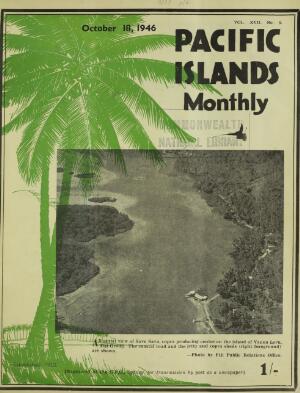
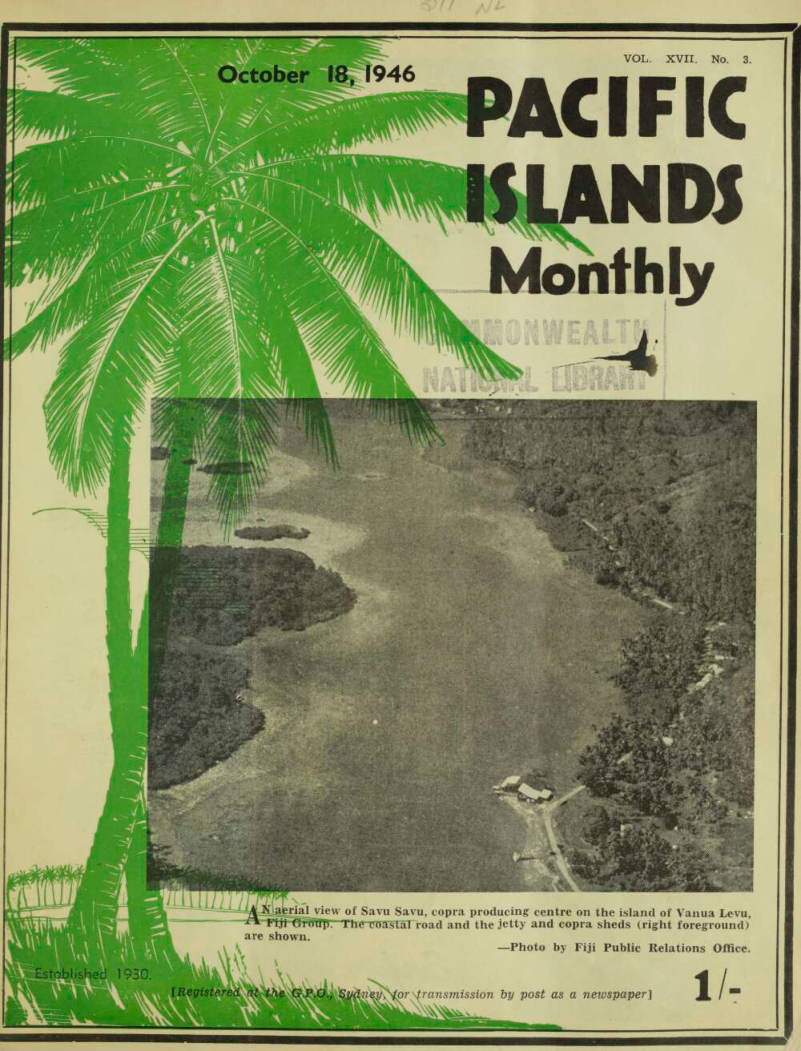
AN aerial view of Savu Savu, copra producing centre on the island of Vanua Levu, Fiji Group. The coastal road and the jetty and copra sheds (right foreground) are shown. —Photo by Fiji Public Relations Office.
Advertisements & other items, pp. 2-4 (1 item)
Smjute
<s / k 3* m
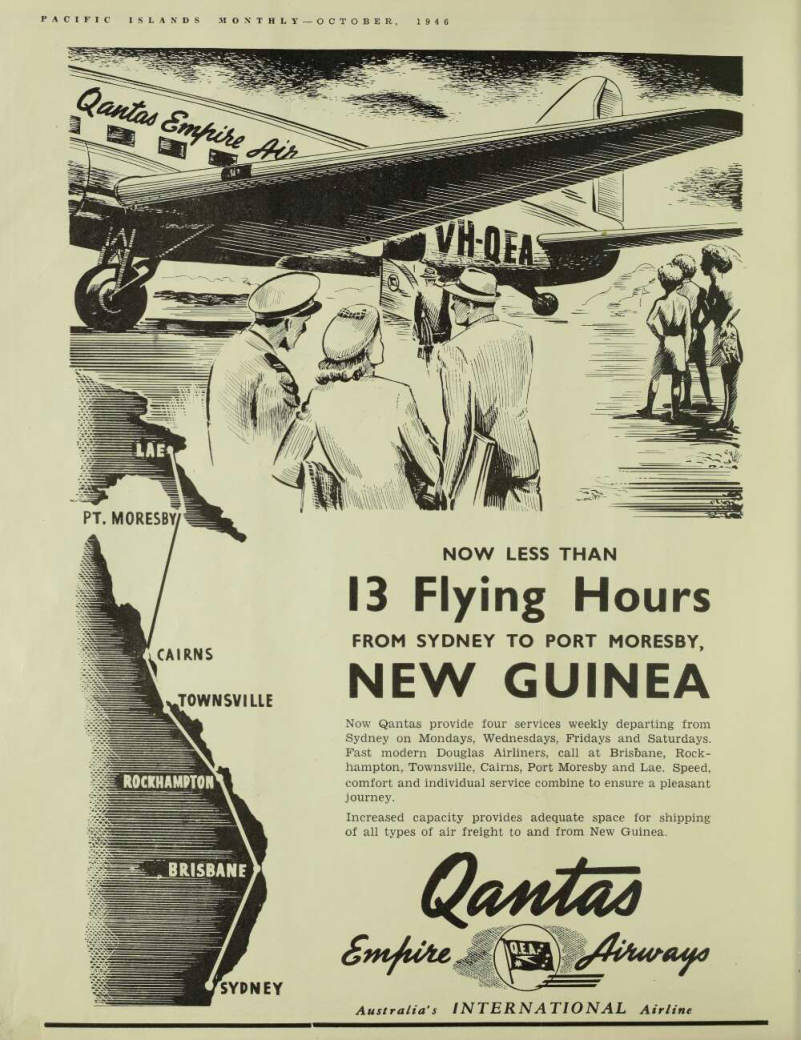
PT. MORESBY/
TOWNSVILLE
i «s
CAIRNS
■■ : Aa *2
NOW LESS THAN
13 Flying Hours
FROM SYDNEY TO PORT MORESBY,
NEW GUINEA
Now Qantas provide four services weekly departing from Sydney on Mondays, Wednesdays, Fridays and Saturdays.
Fast modern Douglas Airliners, call at Brisbane, Rockhampton, Townsville, Cairns, Port Moresby and Lae. Speed, comfort and individual service combine to ensure a pleasant journey.
Increased capacity provides adequate space for shipping of all types of air freight to and from New Guinea.
Smjute
SYDNEY
Australia’s INTERNATIONAL Airline
I / / v \ 11, Con be set up ready for use in a few seconds.
For its size this new Coleman Stove is amazing. Although only 8g in. high and 4i in. wide it boils a pint of water inside 5 minutes.
It is made of corrosion-resistant metal . . . lights instantly . . . needs no priming , . burns any kind of petrol and cannot spill fuel even when tipped over.
Telescopic case makes two handy cooking utensils. The pot supports at top fold in for packing.
Representatives for the Pacific Islands:
ROBERT GILLESPIE PTY. LTD.
54a PITT STREET, SYDNEY
PEARCE & CO
SUVA
FOR FIJI ISLANDS
LTD.
STRONGER-LIGHTER LONGER-LASTING
GLOBITE
SCHOOL CASES
>4ll
For Service
EXPORTERS - IMPORTERS
Contact
COMMONWEALTH TRADING CO. Pty. Ltd.
95 YORK STREET, SYDNEY
Phones: MA 4232, M 6969.
GENERAL MERCHANDISE, TRADE GOODS. CLOTHING, FOOD-
STUFFS, LIQUEURS. SPIRITS. WINES.
( hi shill in '(fin est
BOAT & YACHT
GEAR
<3 • • • t:
BROOMFIELDS LTD.
152 SUSSEX STREET, SYDNEY.
c 7 ., Anon+o for- p - H - MUNTZ & CO.’s 3-CROWN BRAND METAL SHEATHING. ooie a yerub jur. peacock & buchans’ English ready-mixed paints.
Miserable Rabaul
Shortage of Food
Prom Our Own Correspondent Rabaul, Oct. 6 LIVING conditions here in many re spects are miserable and uncomfort able. We should rank high in a competition for the most neglected com munity in the Australian Territories— and there would be many entrants.
The Alagna, which arrived a few days ago, was the first ship in from Australia since early August.
The food position here had been very grim. We had had no fresh meat for three weeks, and very little butter. Prices of both commodities advanced sharply.
We shall be very short of essential sup plies again before the Reynella arrives.
There is a persistent report that the Malaita, will arrive on October 8. and thenceforward will give us a regular service.
Earthquake
ON September 29, at 1.10 p.m., a severe earthquake occurred here, and caused several landslides. A bad slide can be seen on the side of Mount Vulcan, and there are large cracks in the ground thereabouts. The road from Kokopo to Rabaul was temporarily out of commis sion.
The earthquake is rated as intensity 7 to 8. Intensity 10 is maximum. Old hands say it was not as severe as that of January, 1941, but it certainly ranked next to it.
Bay Loo Company
MR. Les Clarke is here at present, winding up the affairs of the Bay Loo Company, of which his brother (lost in the Jap invasion in 1942) was manag ing director. Many of the Chinese share holders were killed by the Japs but their widows are now living here.
The New Britain Club —entrance fee, £5 and £5 annually—which appears to be modelled much on the lines of the old Rabaul Club, has been established.
Planters’ Liquor?
THERE is bitterness in the messes here, because no liquor can be got from • the merchants. Production Control Board has a good supply; but when BP’s and Carpenters applied, they were told it was being kept for the planters.
When the gratified planters hurried around, they were informed that it was reserved for the planters yet to come.
Now we are anxiously waiting to see how the new arrivals on the Reynella fare.
Ships for Rabaul
THE small Burns Philp liner Malaita is still in dock in Sydney. The repair work on her, under present indus trial conditions, is making painfully slow progress. She cannot sail until Novem ber. The present tentative timetable for the Australian Territories, as arranged by the Australian Shipping Board, provides for the following depar tures from Sydney; Duntroon, October 12, for Samarai and Rabaul.
Montoro, about October 22, for Port Moresby, Samarai, Lae and Madang.
Malaita, about November 7, for same ports as Montoro.
Montoro and Malaita will then carry on a fairly regular service to New Guinea mainland ports, but no decision yet has been reached about a regular service to Rabaul.
Carpenters' Finance:
Directors' Cautious Policy
THE issue of the annual report of W.
R. Carpenter & Co. Ltd. was greeted with something of a public howl from shareholders. The directors an nounced a net profit on the year ended June 30 of £67,726 (which is practically the same as last year), but they recom mended a dividend of only 5 per cent., which absorbs £38,750 (on an issued capi tal of £775,000) leaving £25,000 to be transferred to a special Contingency Fund.
As shareholders have been kept on short commons for several years, and there was an accumulated total of £191,552 in the P/L Account on June 30, and £201,598 in the bank, there was naturally a little irritation. Why should the directorate hang on to funds like this?
This Company was built up, in the last 25 years, by the long vision and shrewd trading of the Carpenter family; and therein probably lies the answer to the shareholders’ questions. Many of the trends which affected Pacific Islands trade since 1914 were foreseen by the dir ectors, and smartly provided for; and if those same directors see enough in the present disturbed condition of the world, and the present queer conditions in South Pacific politics, to justify a gen eral reserve of £200,000 and a Contin gency reserve of £25,000, they deserve to to allowed to have their way—at least until some of the clouds roll by.
The directors report that the allied company, Southern Pacific Insurance Company Ltd., made good progress and paid 8 per cent.; while W. R. Carpenter & Co. (Fiji) Ltd. also made progress and paid 121 per cent.
The Co’s operations in New Guinea have been resumed, per medium of the newly-registered W. R. Carpenter (New Guinea) Ltd. But, owing to lack of transport, there has been no resumption m Solomons or G. and E. Colony.
Death Of Mr. A. E. Spence
MR. A E. (Bert) Spence, who was a well-known and highly respected resident of New Guinea died in Sydney on September 26. following an operation. s Mr. Spence went to New Guinea in and, after spending some time in Rabaul, proceeded to the goldfields, where ne was continuously employed by New Guinea Goldfields Ltd., at Wau, until evacuated in 1942. He was best known for his activities in public affairs and he was a prominent and hardworking member of the RSSILA, the Masonic Lodge at Wau, the Buffaloes and the Wau Club. His death will be greatly former residents of the TNG Goldfields, Sir Alexander Grantham, Governor of Fiji, and High Commissioner for the Western Pacific, has accepted the post of Patron of the Pacific Islands Society, Sydney. The functions of the Society are mostlv cultural. Members meet regularly for the discussion of Pacific affairs, and about once a month they hear an address by some well-known man The present President is Major C. A.
Swmbourne, formerly of the G. and E.
Islands Colony.
Advertisements & other items, p. 5 (1 item)
spies sepvice
FOR DEALERS
STREAMLINE your purchasing channels by linking-up with the manufacturers of the following products through Victor Hyde Sales Service, Pacific Distributor. You benefit in three ways—YOU HAVE FEWER ACCOUNTS . . . YOU OBTAIN A FAIR QUOTA OF GOODS AVAILABLE . . . YOU OBTAIN THE SERVICES OF AN EFFICIENT ORGANISATION TO EXPEDITE DELIVERIES. And FULL DEALERS’ DISCOUNTS ARE
PASSED ON.
Catalogues and Price Lists are Available Now.
1. Sfromberg-Carlson Electrical Products:
m Air Circulators available now. 5-valve A.C. world-range Receivers available in November.
Available early in the New Year:
REFRIGERATORS, VACUUM
CLEANERS, WASHING MACH-
INES, FANS, AND MANY OTHER
ELECTRICAL UTILITIES.
2. Relidc Swiss Watches:
A />
3. Royal Hawaiian
COSMETICS
Imported Watches, complete in
cases, WATER PROOF, SHOCK
PROOF, FIFTEEN JEWELS, ideal
for Tropic conditions. Other models for ladies and gentlemen are also available. Complete lines of Spare Parts are carried and a Watch Repairing Service is extended to all dealers.
Cosmetics:
A complete line of Australian cosmetics, made by a leading manufacturer especially for export, at very competitive prices.
Samples sent upon request.
4. Multiple Incubators and Brooders:
A full range of Kerosene and Electric Incubators and Brooders are available for immediate delivery. The delivery of Settings of Eggs and Day-old Chicks can be arranged where practicable.
First-class breeders are willing to co-operate.
Metro Batteries:
A full range of Batteries will be available in the near future.
A SMALL SAMPLE ORDER CAN BE FILLED NOW!
ALL ORDERS, PREFERABLY THROUGH DEALERS, WILL BE
ACCEPTED. WRITE DIRECTLY TO:
a a 'oi
spies sepvice
TELEPHONE: 8W515/® SCOTTISH HOUSE® 19 BRIDGE STREET® SYDNEY® AUSTRALIA
Advertisers
Amalgamated Hatcheries ... 17 Angliss & Co. . . 53 Aust. Fishing In dustries ... 65 A. G. Andrews Co., Inc 51 Atkins Pty., Ltd., Wm 61 W. Baker, Jno. . . 71 Brown & Co., Ltd. 13 Brial & Ball ... 19 Brunton’s Flour . . 26 Burns, Philp Trust Co., Ltd 21 Broomfields ... 2 BP (SS) Co. . . . 13 Carlton & United Breweries, Ltd. . 36 Carpenter, Ltd., W.
R cov. iv.
Ceigoa Pty., Ltd. . 23 Chivers, Ltd. ... 56 Church, R. H., & Sons 60 Coleman Lamp & Stove Co 45 “Cysfcex” 60 Commonwealth Trading Co. Pty., Ltd 2 Crosse & Blackwell, Ltd 66 Dalmore Preserving 73 Donaghy & Sons . 72 Donald, Ltd., A. B. 62 Paul, A. Dorn . . 65 Dr. Williams Pink Pills 62 Dangar, Gedye & Malloch ... 23 Dunlop Rubber (A/sia), Ltd. . . 47 Eekhoff, H. G. . . 70 Electrolux Refrigerators . . 20 Ford Sherington Pty., Ltd 2 Foster Clark, Ltd. . 35 Garrett & Davidson 80 Gibson & Co., Ltd.,
j. A. D 48 Gillespie Pty., Ltd., Robert, . . . 1 & 34 R o b t. Gillespie (NG), Ltd. ... 63 Gilbey’s Gin ... 25 Gillespie’s Flour . . 64 Gough & Co., E. J. 51 Grand Pacific Hotel 4 Grove & Sons, W.
H 67 Heinz & Co. Pty., Ltd., H. J. . . . 69 Hemingway & Robertson ... 78 Horlicks Malted Milk 33 Hyde, Victor ... 3 Hutchinson & Co., Ltd 54
Ics 55
Ingram Shaving Cream 31 Ipana Tooth Paste . 27 Kopsen & Co., Ltd. 71 Lockyer, Geo. J. . 58 Merrillees, J. C. & Co 16 Miscellaneous, 74, 14, 76 “Mum” Deodorant . 57 “Mendaco” ... 76 Mcllraths Pty., Ltd. 14 Nelson & Robertson Pty., Ltd 46 Newman, M. ... 68 NSW Bookstall Co.
Pty., Ltd 28 “Nixoderm” ... 68 Pacific Islands Trading Co., 24, 59, 49 Pacific Islands Monthly ... 67 Pacific Is. Society . 69 “Pinkettes” ... 58 Proprietary Pro ducts 25 Papuan Electrical Co 24 Pyrox Pty., Ltd. . 29
Qantas Empire Air ways ... cov. ii.
Queensland Insur ance Co 26 Robinson, G. H. . 56 Rose’s Eye Lotion, l9. 61 Rohu, Sil 57
Rur 78
Scott, Ltd., J. . .28 Shell Co 16 Southern Pacific Insurance Co. . . 14 Steamships Trading Co., Ltd 49 Sullivan & Co., C. 55 Swallow & Ariell . 22 South Sea Islands Club 22 Taylor & Co., A. . 78 “Tenax” Soap . . 54 Tillock & Co., Ltd. 74 Thornycroft (Aust.) Pty., Ltd 52
Tooth & Co., Ltd cov. iii.
Toogood, J. J. . . 64 Tullochs Pty., Ltd. 79 Tilley’s Lamps . . 15 “V i t a 1 i s” Hair Tonic 75 Vacuum Oil Co., Ltd 18 Watson, Wm. H. . 32 Widdop, H.. & Co., Ltd 50 A. Willison ... 53 Wills, W. D. & H. 0 30 Wright & Company 70 Wright & Co., Ltd., E 63 Wunderlich, Ltd. . 72 Young Pty., Ltd., Harry J 77 Yorkshire Insur ance Co., Ltd. . 13
Contents
Shortage of Food in Rabaul 2 WRC Directors’ Cautious Policy ... 3 Editorial: “Socialism and Its Planners In South Pacific Territories” . . 5 Australian Pacific Research Council 7 « “Masingo Lo”—Anti-British Move ment in BSI 7 Fiji’s Indians May Be Repatriated .. 7 New Pacific Air Services 7 New WRC Shipping Routes 8 Moresby’s Housing Shortage Causes Trouble 9 The New New Guinea—A Survey by Judy Tudor 9 Qantas Passengers to N. Guinea .. 10 “Matua” Passengers 11 USA Control of Pacific Territories — Challenge by Mr. Ickes 12 Lae Goes on a Meat Bender 13 Harold Cooper for Nigeria ... 13
Ragtime Stevedoring in Madang ... 16 Bad Eruption at Niuafo’ou 17 South Seas Regional Commission Inaugural Meeting in 1947 .. .. 19 STC Shows Record Profit 21 Coveted Manus —How Sea and Air Base Was Seized and Built ... 22 W. Samoa Under the Microscope .. 25 Abemama, New Administrative Centre in G and E Colony 28 Fate of NG Missing Men 31 Coast Watching in N. Guinea .. .. 32 Territories’ Talk-Talk 37 A Planter’s Return to His Shattered Home 38 On the Edge of Civil War—Drama of New Caledonia in 1942 40 Costly Shipping in N. Guinea 45 G’ Air Hope to Fly Again in N. Guinea 48 Memorial for Late Dr. G. H. Vernon 49 New Treatment of Malaria 52 Machines to Replace Native Labour .. 53 Fiji’s Famous Pineapple Cup 54 Prosperity in W. Samoa 56 Cook Is. Politics 57 "Criticism of British Policy in BSI .. 58 When the Japs Looked Down on Moresby 60 Shipping and Plane Services :: Pacific Travellers 61-63 New Union Ships for Pacific Trade 64 Papuans in Boots 64 NG Scholarship Fund —More Dona tions 65 US Dead in Pacific 66 Fono Tackles Samoa’s Problems with Vigour 67 Marsters Clan —Death of William Marsters II 71 Free Labour in New Caledonia ... 73 US Anti-Malaria Control in Solomons 76 Markets. Commercial, e f c 80
Advertisements & other items, p. 6 (2 items)
4
OCtOfiEft, IM6-t Acme ISLANDS MoNtltLV
$0 )l
21 AS °' ,er ' , f ce os 6 r ° U . p»c>f' c ei W «*" r , tS» e 6r * Ae s^ *?*** w sv s?e c- ser, ' ce , . ce ntr e ° at* e " .„ SrO^ *• "°S. •»“•"‘o^x'’- 0 '
ira'<' eli C^' e>
.r |, P er
Set*
Pacific Islands Monthly
The Newspaper-Magazine of the South Seas
I Registered at the G.P.0., Sydney, for transmission by post as a newspaper .] Published Once Each Month and Circulated in Australia and New Zealand and in the following Pacific Territories and Islands Groups:
Australian Territory of Papua.
Mandated Territory (Australia) of New Guinea.
Australian Territory of Norfolk Island.
New Zealand Territory of Cook Islands.
Mandated Territory (NZ) of Western Samoa.
British Colony of FIJI.
British Solomon Islands Protectorate.
British Protectorate of Tongan Islands.
British Crown Colony of Gilbert and Ellice Islands.
Mandated Territory of Nauru.
British and Free French Condominium ol New Hebrides.
Free French Colony of New Caledonia.
Free French Colony of Oceania (Tahiti, etc.).
American Territory of Eastern Samoa.
American Territory of Hawaiian Islands.
Owned and Produced by Pacific Publications Pty. Ltd., Union House, 247 George Street, Sydney.
TFT FPFTONFS f General Office .. .. BW 5037 TELEPHONES Advertising Office . . .. B 7815
P.O. Box 3408 R
Registered Address for Telegrams, Radiograms, and Cables: “Pacpub”, Sydney.
Contributions.
Articles, Stories, and Photographs dealing with Pacific Islands subjects are Invited and will be paid for on publication.
Subscription Rates.
Per Annum, within British Empire, Prepaid, Post Free 10/- Per Annum, elsewhere, Prepaid, Post Free 12/6 Single Copies 1/-
Editor and Publisher:
R. W Robson, F.R.G.S.
General Office: Union House, 247 George Street, Sydney.
Advertising Manager: W. E. Rogers.
Telephone: BW 5037.
Printing House: 29 Alberta Street, Sydney.
Telephone: MA 4369.
Representative In Fiji.
Pacific Publications (Fiji), Ltd., Bank of NSW Building, Suva (same office as W. H. Grove & Sons, Ltd.). Stocks of Pacific Islands Monthly and Pacific Islands Yearbook on hand.
Representative In London.
J. T. Wallis, Coronation House, 4 Lloyds Avenue, London, E.C.3, from whom may be obtained copies of Pacific Islands Monthly, Pacific Is. Year Book, advertising schedules, etc.
Agents.
The following are authorised to receive sub scriptions for Pacific Islands Monthly:— Burns, Philp & Co., Ltd., and Burns Phllp (South Sea) Co., Ltd. All branches.
W. R. Carpenter <& Co., Ltd. All branches.
Morris, Hedstrom, Ltd. All branches.
Steamships Trading Co., Papua. All branches.
Whitten Bros., Ltd., Samaral, Papua.
B.N.G. Trading Co., Ltd., Port Moresby, Papua J. Muir, Suva, FIJI, Miss R. Castles, Suva, Fiji.
N. C. Mackenzie Hunt, Walnunu, Bua, FIJI.
Cook Islands Trading Co., Rarotonga, Cook la.
A. C. Rowland, Papeete, Tahiti.
Islands Branches and Representatives of W, H.
Grove & Sons, Ltd., Auckland, New Zealand.
Ed. Pentecost, Noumea, New Caledonia.
Societe Gubbay Kerr et Cie, Noumea, N. Caledonia.
Vol, XVII. No. 3.
October 18, 1946.
Prirp l/ Per Copy rnce p re pald: 10/- p.a
Pacific Territories
Socialism And Its Planners In the South Pacific Territories
AUSTRALIA, by a substantial maj ority, has returned to power the Chifley Labour Government, whose policy ranges from Gladstonian Lib eralism to the sharp pink of moderate Socialism. In consequence Australia —which is so happily placed in rela tion to the rest of the world that it might have entered upon a decade of such prosperity as it never before had known—will now probably experience a period of industrial and economic confusion.
However, that is “something b’long Australia.” The Australians in their wisdom have voted for that kind of government. Democracy has spoken— and that is the end of the argument, for another three years.
The tragedy of the Australian voters’ decision lies in the Australian Pacific Territories—Papua and New Guinea. When the Jap invasion came, at the end of 1941, there were 9,000 Europeans, mostly Australians, settled or profitably employed in those Ter ritories. Australia had assisted them to go there, encouraged them to re main, provided facilities for the pioneering activities of private enter prise, They were driven out by the Japanese. They naturally assumed, when Japan was defeated, that they would be encouraged and assisted to re-establish themselves.
BUT, in the meantime, an Austra lian Socialist Government had decided to introduce, to the Terri tories, a set-up entirely different from
anything previously known. Summed up, it meant that the interests of the natives should be paramount; that the profit motive and private enter prise should be discouraged; that, as far as possible, such industries as transportation and the distribution of goods should be Government mono polies; that the products of the Ter ritories should be marketed by the Government; and that the interests of the white residents should be con sidered only after these other matters had received attention.
Mr. E. J. Ward, a well known Aus tralian politician, who travels only one or two degrees to the right of Red, was the enthusiastic instrument of this Australian policy. He called to his aid an extraordinary line of academicians, anthropologists, mission directors and youthful theorists of the extreme Left; and, among them, they created the organisation that is running Papua-New Guinea to-day.
They are cultured, honest, sincere people; and they might have done well as a team if only they had had a leavening of that priceless know ledge that is based on actual experi ence. But, except for a few respected officials of the old regimes, there is not among them one practical man of Territories experience.
It is an undisputed fact that Min ister Ward and his satellites have not really used the services of one experi enced and prominent planter, trader, missionary or miner.
Nine thousand Territorians at first
would not believe that their life-work, their homes and their future were to be more or less sacrificed, so that Papua-New Guinea might be used as a guinea pig for the Socialistic ex periments of the Australian Govern ment and its team of happy anthrop ologists. But, having suffered the strange events of 1945-46, they believe it now.
They see their plantations idle, par alysed by lack of the labourers which Minister Ward sent home to their vil lages. They see their dwindling pro duction of copra seized by Mr. Ward’s Production Control Board, which pays them from £5 to £7 per ton under world parity. They see their gold-mines idle, because they can get neither labour nor transport. They see their shores denuded of vital shipping, be cause private shipowners are chased away, and the Administration cannot provide essential services. They see their freezers empty, and all prices soaring, for the same reasons.
Territorians had hoped for a change of Government in Australia. That has not come. Now they know exactly what they have to face. It is a pretty grim outlook. They, who had no voice in the election, whose affairs were never even mentioned on the hust ings, are forced to take what is given to them.
The verdict of the Australian elec tion has been accepted by the Chif ley Government as an endorsement of its policies; and the latter include the Papua-New Guinea policy. This means that the New Order in New Guinea will continue—with bells on!
IN due course, Canberra will get around to the encouragement of
production by Europeans in the Ter ritories—probably after model villages have been built, and elaborate and expensive plans have been put into operation for providing Fuzzy-wuzzy with medical services, education ser vices, agricultural services, and what not.
But Canberra, apparently, has no thought or intention of trying to make these Territories self-support ing. This elaborate Administration is being built up with Australian tax payers’ money; and Canberra assumes that funds thus provided by Australia will make the wheels go round in both Territories—which they will do for a couple of years, at least.
There will be plenty of money about for a while, and plenty of chances for the small trader and artisan, and the man who is producing for the local market. There is, for example, a good time ahead for the New Guinea Chi nese, who are unexcelled in those occupations. But there is nothing much in sight for the primary pro ducers.
If the bigger interests, planters and gold-miners, could have got into large production quickly, while the high prices lasted, they would have brougnt substantial economic benefits to New Guinea, in spite of the several handi caps imposed by the new-system gov ernment. But the chances now are all against them. To the disabilities under which they now suffer (lack of labour and transport, and huge im posts on their vital supplies) there is likely to be added, before they get any relief, various forms of direct and indirect taxation.
Within two or three years, the agri cultural products of Papua-New Guinea will begin to compete, in the world’s markets, with similar products from other tropical areas. That means that the prices of copra, rubber, cocoa, coffee, will be controlled by the usual economic factors. With the ad vantages he enjoyed up to 1941, the New Guinea planter could make some profit, in competition against the world. Under the conditions now being created in New Guinea, he has no hope of survival in a competitive market—unless he is liberally sub sidised by Australia.
Canberra, when it does get around to the encouragement of the tropical planting industry, probably will pro vide subsidies for Europeans. But how long will they last? Just as long as Australians are prepared to carry the burden of their now enormous taxa tion!
The prospects of the gold-mining industry are better, to the extent that gold should hold its value in the world’s tortured economy for many years. But if the gold-miners imagine that the gallant planners of Canberra are going to let them make the pro fits which their enterprise enjoyed between 1930 and 1940, they should stop, and look and listen. It will be an astonishing thing if the mining industry—now spending so lavishly and confidently upon the work of re habilitation—escapes new direct and indirect taxes.
THE plain fact seems to be that we are entering a new era in the Pacific Territories. This thing is not peculiar to New Guinea, or to the Pacific—it is part of a world-wide trend, which had its origin in the vast international disturbance started by Adolf Schickelgruber in 1939.
The change is more remarkable in New Guinea because there it is in such sharp contrast with the encour
agement and assistance formerly given to private enterprise in the Pacific Territories. But an exactly similar trend is to be seen in the Solomons and other groups under the control of the British Socialist Gov ernment, and in Samoa and the Cook Islands, controlled by Socialist New Zealand.
The general policy and design will become clearer when the conference to establish the South Seas Regional Commission (see article elsewhere) meets in Australia early in 1947.
Meanwhile, it can be seen that the gentlemen who now sit high in power in London, Canberra and Wellington
intend to do everything possible to lift the native standard of life in the Pacific Territories, and to discourage the activities of the big trading com panies, which—in the Socialist view— are “exploiters.” The events of the next twelve months will show whether the independent, individual istic, pioneering European is to have any future in the Islands, or whether he also is to be driven out. Present indications are that, while many Leftist bureaucrats would like to get rid of all non-official Europeans, the Europeans will remain, for the next 20 or 30 years, at least. Despite the Leftist planning of the eager young theorists who now direct the Admin istrations, it will be recognised that, for many years to come, European en terprise and management are neces sary to Pacific Islands economy.
"Viti" To Be Sold
RCS “Viti” which became one of the best known ships in Fiji waters dur ing the Pacific war, and the early days of peace, is to be offered for sale shortly.
She was built for the Fiji Government in Hong Kong and delivered in 1939.
She was to be used for official duties in the Fiji Group and neighbouring terri tories, but presumably the reason for her purchase then, now no longer exists.
“Viti” is of 307 tons and is at present under the command of Captain J. W.
Cummings. During the war she became a unit of the Royal New Zealand Navy and carried out much valuable - work in the Pacific. Since the end of hostilities, she has been engaged in running pas sengers betwen Suva and New Zealand and thus reducing the large waiting list of those requiring transport to and from the Colony.
“Viti” carried Sir Harry Luke (then Governor of Fiji), to Noumea in August 1940. Soon afterwards New Caledonians declared for Fighting France.
Advertisements & other items, p. 8 (2 items)
PIM" By Air
/I
Lower Postage Rate Sought
u-uinew is infrequent (papers dated July were being delivered in Lae in October), the proprietors of “Pacific Islands Monthly” have arranged experimental shipments of the journal as air-freight to Port Moresby and Lac.
Air-freight per pound is 3/- to Port Moresby and 3/9 to Lae. This substantially increases the retail price of the air-carried “PIM” 2 i copies of which weigh lib. Arrangements have been made with Burns Philp & Co. and Steamships Trading Co., Port Moresby, and Burns Philp and Co., Lae, to t handle these trial shipments. Retail price in the stores in Port Moresby is 2/3 per copy, and in Lae 2/6.
PIM is published about 18th of each month. Copies should be available in Moresby and Lae stores two or three days thereafter.
One PIM, carried as air freight, costs about 1/2. One PIM, posted by air mail, costs 3/li for transport alone —making the total cost (cost of journal, plus air mail postage ) 4/- to Papua or New Guinea, as against 2/3 and 2/6 per copy, if carried in bulk and sold through the stores.
Some subscribers, in order to get the journal by air mail, are now paying us 4/- per copy. We are trying to get this obvious anomaly removed.
If we can get a reasonable concession, all copies of PIM for subscribers will go by air—not only to Papua and New Guinea, but to all Territories with Sydney airways connections.
Subscribers who are prepared to pay 4/- per copy for immediate air mail delivery should write to us at once, and it will be arranged. But we hope to obtain a much lower rate soon, when all readers will be advised.
PACIFIC PUBLICATIONS PTY. LTD.,
BECAUSE
surface mail to New P.O. Box 3408, Sydney.
Xmas Present
“WHERE THE TRADE WINDS
BLOW” will be published at the end of November.
It will ccntain, in Bcok Perm, the best Stories, Sketches. Humorous Articles and Pictures published in the “Pacific Islands Monthly” during several years—especially tales of the Pacific War. The book was edited, and the matter selected, by R. W. Robson and Judy Tudor.
This large volume, printed on heavy paper, well-bound in cloth, generously illustrated, will be sold for 8/6 —all Booksellers and Islands Stores.
“Where the Trade Winds Blow” will be a Welcome Christmas Present for your friends. Send 9/- (8 6 plus 6d. postage) to the Publishers, and we will post the book to any address you wish, with a card enclosed conveying your Christmas Greetings.
Publishers :
PACIFIC PUBLICATIONS PTY., LTD.,
Union House, 247 George Street,
SYDNEY.
"Masinga Lo"
Anti-British Native Movement Is Sweeping Over Solomons
AN anti-European, independence move ment has swept over Malaita, and is affecting the natives in Guadal canal and San Cristoval, in the British Solomon Islands. The movement is so strong that it is causing anxiety. About 40,000 natives nearly half the total popu lation in the Solomons, live on Malaita.
The movement started at the southern end of Malaita about three years ago.
Some believe that Communists among the United States forces instigated it. Very large numbers of Americans passed through the Solomons, and their general attitude was anti-British Imperialism.
The movement is not anti-Christian, but it is definitely anti-British. The natives insist that they shall be freed from British administration, and govern themselves. , „ The movement is called “Masinga Lo —believed to be native pronunciation of “Marxist Law.” Both Christian and heathen communities are behind it. Its followers are quite unfriendly even aggressive to white strangers generally.
The head of Masinga Lo is a Mission educated native, a former Government chief, called Timothy George. He signs his decrees “Timothy George, Rex” which has not got exactly a Communistic touch.
All natives are being practically com pelled to join Masinga Lo. One promi nent native who lived near the Admin istration station on Malaita would not join, and he was savagely attacked. He was rescued, after a sharp fight, by District Officer Foster and his native police, and 40 of the aggressors were arrested and gaoled. The strength and tact being displayed in an ugly situation, by DO Foster, a young Englishman, are warmly praised.
The speed with which the movement, having conquered Malaita, is spreading in adjoining islands, is disconcerting.
No attempt has been made to reestab lish the BSI planting industry, and there are very few Europeans in the group now.
There are no stores not even Chinese traders. Most of the Chinese have de parted.
Some observers say that the High Com missioner for the Western Pacific should make up his mind about the Solomons.
If the European planters and traders are
not to be encouraged to return, the con tinued occupation of the Group by the British is only a useless expense. It might as well be handed over to Masinga Lo, and the rule of Timothy George, Rex.
Repatriated
Fiji's Indians May Be Repatriated
IT is reported that the position of the Indian community in Fiji, in relation to the future of that Colony, has been under consideration by the British Imper ial authorities; and that the possibility of repatriating the Fiji Indians is being examined.
There are in Fiji over 100,000 of both Indians and Fijians, and the Indians are increasing in number much faster than the natives. The welfare of the Fijians always has been the care of the British; and the certainty that, within a few de cades, the Indians will be getting ready to push the natives into the sea has given the Government a great deal of unhap piness.
At first, the proposal (made several years ago) to remove the Indians from the Group to India was not even considered.
But events of the last ten years have al tered the outlook very much. India has claimed, and been granted, independence; and the care of communities like the In dians of Fiji is now the responsibility of India, rather than of Britain. Further, the Fiji Indians forfeited any claim to special consideration during World War 11, when they declined to help the British in any way—in contrast with the Fijians, who gave distinguished services as fight ers and as workers.
It looks like a very thorny problem for consideration by the South Seas Regional Council if and when that body is created.
The Queensland New Guinea Associa tion is considerably below its former numerical strength. Once with a mem bership of 70 it has now only about 17.
Many Territorians have returned to the Islands, and a number are now residing permanently in Queensland. A few, how ever, are undecided what to do; they lament the passing of old days and old ways.
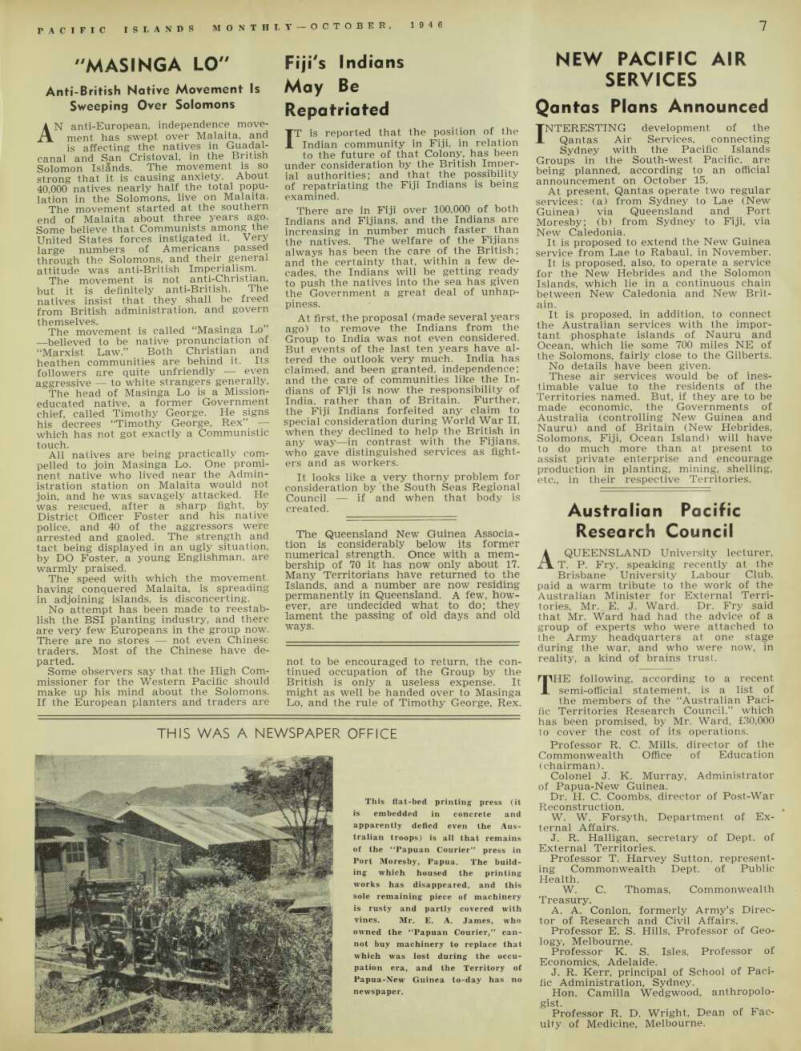
This Was A Newspaper Office
This flat-bed printing press (it is embedded in concrete and apparently defied even the Aus tralian troops) is all that remains of the “Papuan Courier” press in Port Moresby, Papua. The build ing which housed the printing works has disappeared, and this sole remaining piece of machinery is rusty and partly covered with vines. Mr. E. A. James, who owned the “Papuan Courier,” can not buy machinery to replace that which was lost during the occu pation era, and the Territory of Papua-New Guinea to-day has no newspaper.
Qantas Plans Announced
New Pacific Air
Services
INTERESTING development of the Qantas Air Services, connecting Sydney with the Pacific Islands Groups in the South-west Pacific, are being planned, according to an official announcement on October 15.
At present, Qantas operate two regular services: (a) from Sydney to Lae (New Guinea) via Queensland and Port Moresby; (b) from Sydney to Fiji, via New Caledonia.
It is proposed to extend the New Guinea service from Lae to Rabaul, in November.
It is proposed, also, to operate a service for the New Hebrides and the Solomon Islands, which lie in a continuous chain between New Caledonia and New Brit ain.
It is proposed, in addition, to connect the Australian services with the impor tant phosphate islands of Nauru and Ocean, which lie some 700 miles NE of the Solomons, fairly close to the Gilberts.
No details have been given.
These air services would be of ines timable value to the residents of the Territories named. But, if they are to be made economic, the Governments of Australia (controlling New Guinea and Nauru) and of Britain (New Hebrides, Solomons, Fiji, Ocean Island) will have to do much more than at present to assist private enterprise and encourage production in planting, mining, shelling, etc., in their respective Territories.
Australian Pacific
Research Council
A QUEENSLAND University lecturer, T. P. Fry, speaking recently at the Brisbane University Labour Club, paid a warm tribute to the work of the Australian Minister for External Terri tories, Mr. E. J. Ward. Dr. Fry said that Mr. Ward had had the advice of a group of experts who were attached to the Army headquarters at one stage during the war, and who were now, in reality, a kind of brains trust. fTHHE following, according to a recent J, semi-official statement, is a list of the members of the “Australian Paci fic Territories Research Council,” which has been promised, by Mr. Ward, £30,000 to cover the cost of its operations.
Professor R. C. Mills, director of the Commonwealth Office of Education (chairman).
Colonel J. K. Murray, Administrator of Papua-New Guinea.
Dr. H. C. Coombs, director of Post-War Reconstruction.
W. W. Forsyth, Department of Ex ternal Affairs.
J. R. Halligan, secretary of Dept, of External Territories.
Professor T. Harvey Sutton, represent ing Commonwealth Dept, of Public Health.
W. C. Thomas, Commonwealth Treasury.
A. A. Conlon, formerly Army’s Direc tor of Research and Civil Affairs.
Professor E. S. Hills, Professor of Geo logy, Melbourne.
Professor K. S. Isles, Professor of Economics, Adelaide.
J. R. Kerr, principal of School of Paci fic Administration, Sydney.
Hon. Camilla Wedgwood, anthropolo gist.
Professor R. D. Wright, Dean of Fac ulty of Medicine, Melbourne.
New Wrc Line
10,000-Tons Ships on a Round-the- Pacific Schedule
WITH two 10,000-tons ships recently acquired, and with two others soon to be taken over, Messrs. W. R. Car penter & Co. Ltd. have inaugurated a new trans-Pacific shipping service, run ning between Western Canada, the South Pacific and the Orient.
The ships are the Rabaul (which takes the place of the freighter Rabaul. sunk in the war) and the Lautoka. They each carry 12 passengers.
The vessels are to leave Vancouver and other Canadian ports at regular in tervals (every two months, in the begin ning) and run to Fiji, New Zealand and Australian ports, as required. Thence they will go to Eastern Asiatic ports; and they will return to Canada via the Philippines. Their main cargo will be copra.
Carpenter establishments now include copra crushing mills in Canada; a large processing mill in Walu Bay, Suva; and a dessicated coconut factory at Madang (now under construction on an island near Madang) and it is apparent that the shipping line will run in connection therewith.
The company’s once flourishing dessi cated coconut and coir fibre factory at Pondo (north coast of New Britain) was completely destroyed in the war, and no salvage or rehabilitation has been attempted. The manager, Mr. Evensen, and his assistant, Mr. Korn, lost their lives.
Inaugurating the new service, the Rabaul was expected to sail from Van couver for Suva in mid-October. The Lautoka should follow in December.
The WRC Line was originally estab lished in the middle thirties with three ships, the Rabaul. the Salamaua and the Suva, and they gave useful freight ser vice for some years. The re-established WRC Line will employ bigger ships on a regular schedule.
Information Wanted
WOULD anyone knowing the where abouts of Arthur Cant, of Maravovo Lagoon, British Solomon Islands, and known to have served in US small ships, but not heard of since January, 1946, please communicate with either his sister. Miss Nellie Cant, “Earlsferry,”
Walton-on-the-Hill, Surrey, England; or Miss Cant, c/o Mr. B. G. Challis, Sea combe House, Seacliff, South Australia?
Suva Pro-Cathedral
THE 60th anniversary of its dedication was celebrated in September by Holy Trinity Pro-Cathedral, Suva.
The present Bishop in Polynesia is Rt.
Rev. L. S. Kempthorne, who was con secrated in 1923. The first Church of England priest in Fiji was the Rev. Wil liam Floyd, who settled in Levuka in 1870.
He was an Irishman who was ordained by Bishop Perry (first Bishop of Melbourne) about 80 years ago.
Mr. Charles Arthur Banks, well-known in pre-war New Guinea, has been ap pointed Lieutenant Governor of the Province of British Columbia, Canada.
Mr. Banks, who had been Managing- Director of Placer Development Limited and of that Company’s associated com panies from their inception, was during the war representative in England of the Canadian Department of Munitions and Supply.
Moresby's Housing Shortage Causes
Trouble
MUCH of the discontent which exists in the Public Service in Port Moresby (and other parts of the pro visional territory of Papua-New Guinea to a lesser degree) is caused by housing shortages and lack of other reasonable amenities.
As was reported in September “PIM.”
Moresby public servants held a protest meeting in August, to discuss, among other things, the extraordinary length of time apparently necessary to complete the 40-odd Government houses that had, at that date, been under construction for eight months. John Stubbs and Sons, of Sydney, are the contractors who are building the houses.
The protest meeting, however, was somewhat of a damp squib—the fact that it made the Sydney Sunday papers’ headlines notwithstanding.
The meeting was called by the presi dents of the Papuan and New Guinea Public Service Associations and was for members of the Provisional Administra tion. The meeting was well attended by public servants (90 per cent, of whom remained, as usual, inarticulate); by the Administrator; and by the heads of vari ous departments.
At the commencement of the meeting, Mr. L. Odgers (NG Public Servants’ As sociation) rose and suggested that, as the Administrator was a busy man, the meeting be adjourned while he addressed those present; later he (the Administra tor) could leave and the business of the meeting could proceed.
The Administrator, however, was not so lightly disposed of; he said that as a member of the Provisional Administra tion he insisted on being permitted to remain, and the chairman, probably out of his depth, consented. Technically, the Administrator is divorced from the public service in that the Administration has a special function and he is not a member of the public service of the Pro visional or any administration.
However, the meeting was then thrown open to discussion, during which there was, as already reported, some plain speaking by the articulate min ority.
OPINION is divided in the Territory on the appearance of the Adminis trator at a meeting called for the plain purpose of discussing and dissect ing him and his administration. But whether it was or was not etiquette his presence certainly cut the ground from under the feet of the rank and file, although he in turn was forced to listen to some frank criticism.
This discussion should perhaps have cleared the air. Indications are, how ever, that it left the important issues very much as they were. Public service grievances remained unmet, apart from the announcement that a Common wealth Public Service inspector would visit the Territory at the end of Septem ber to inquire into wages, conditions, etc.
The next move is again up to the public servants, but it is highly unlikely that they will actually strike, as has been suggested in sections of the Aus tralian press.
As a class, public servants (possibly because they are good citizens) are re luctant to take direct action, and although there is undeniable unrest in New Guinea and much off-stage mutter ing, it probably will remain at that.
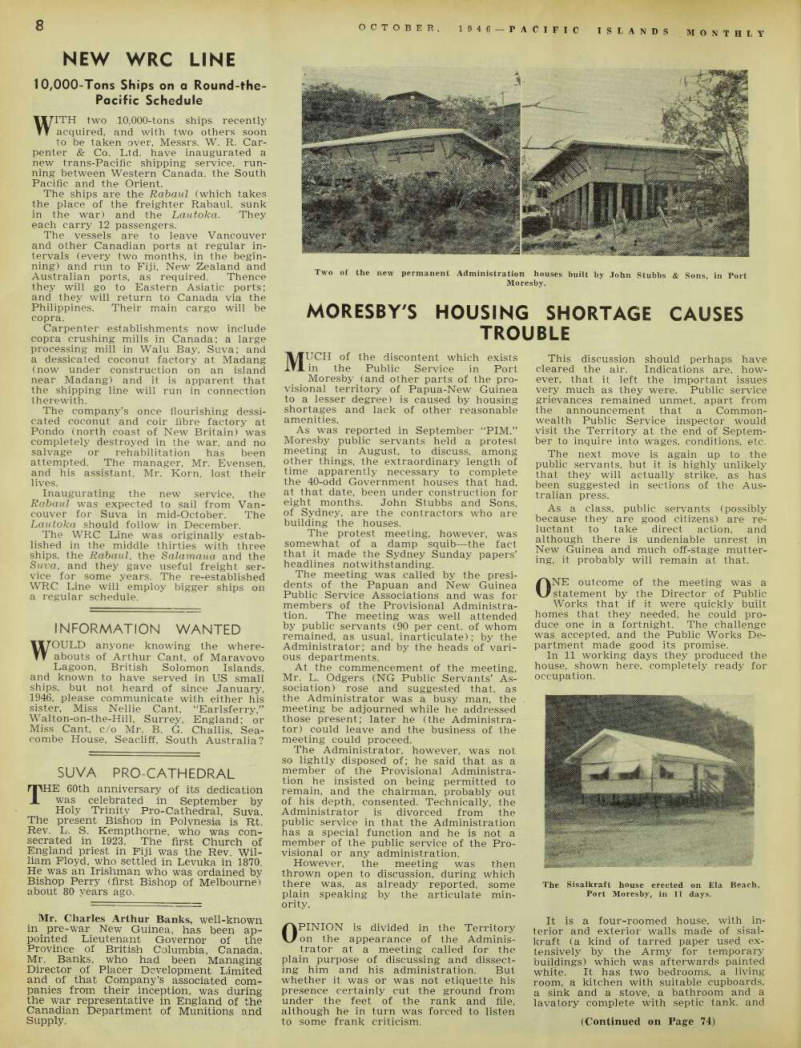
ONE outcome of the meeting was a statement by the Director of Public Works that if it were quickly built homes that they needed, he could pro duce one in a fortnight. The challenge was accepted, and the Public Works De partment made good its promise.
In 11 working days they produced the house, shown here, completely ready for occupation.
It is a four-roomed house, with in terior and exterior walls made of sisal kraft (a kind of tarred paper used ex tensively by the Army for temporary buildings) which was afterwards painted white. It has two bedrooms, a living room, a kitchen with suitable cupboards, a sink and a stove, a bathroom and a lavatory complete with septic tank, and
(Continued on Page 74)
Two of the new permanent Administration houses built by John Stubbs & Sons, in Port Moresby.
The Sisalkraft house erected on Ela Beach, Port Moresby, in 11 days.
is connected to light and power mains.
The house is erected on Ela Beach, near the native hospital, and presumably will be used by someone connected with that establishment.
Price for the “paper”-house was not divulged, but it can be assumed that it cost many times less than the £2OOO - Stubbs’ houses, which are only slightly more livable. The Public Works Department is not, however, to go on building these temporary dwellings. It is believed that local native builders will be asked to put in a tender for their construction if it is decided to build more of them.
Although “temporary,” they are built on a good timber frame, with excellent
flooring and roofing. The sisalkraft will last at least two years; but cement sheets, when available, can easily be ap plied over the paper walls which would then provide insulation.
THE permanent houses (shown on page 8), are of fibro-cement sheets. Shut ters also are of flbro—which effect ively excludes all light and most of the air.
They come in two or three-bedroom types, with lounge, kitchen and bath room, all under one roof. Pre-war cost in the territory would probably be about £4OO.
The location of these dwellings can only be described as quaint.
The house designed for Dr. John Gun ther, for example, is supported by long piles in front, while the rear nestles snugly into the good earth. Dr. Gun ther, however, may be an enthusiastic rock gardener, in which case he will have fine scope for building a diminish ing series of terraces down the perpen dicular drop from his front door.
Contractor Stubbs, too, is no doubt having headaches in procuring supplies; it is stated that Australia will export to New Guinea only four stoves per month; and timber also is difficult to obtain. On the other hand, it should be pointed out that in recent months at least two special ships were employed carrying sawn timber from Cairns (Queensland) to Alexishafen, in New Guinea, for the Catholic Mission there. What the Cath olic Mission can manage, John Stubbs and Sons, with the help of the Adminis tration, surely can do.
More And More People
IT is hard to decide whether Port Moresby, in relation to housing, is worse off in comparison with the rest of the territory, or better off.
In Moresby, it is seemingly impossible to build oneself a grass hut or repair a disintegrating Army building. In the rest of the Territory, it is not only pos sible to have a grass hut or an Army shed, but it is the only way in which to get a roof over one’s head. One thing is certain, however; there are more
wails in Moresby, in regard to housing, than in the rest of Papua-New Guinea combined. We repeat; perhaps this is because in the outposts a man who is at all handy, can make a habitable dwelling for himself; but in more civilised Moresby he has to put further strain on the already overcrowded accommodation.
Every ship and plane brings more people. As a solution to the problem of where they all will go, someone has sug gested that they crawl into the holes in the woodwork.
Port Moresby Hotels
THE Hotel Moresby is catering well for the travelling public and is also sup plying hundreds of extra meals for those who have sleeping accommodation, but no means of cooking food. The “Top Hotel,” which also belongs to Burns Philp & Co. and which was ready for occupation when the balloon went up in 1942, is now an empty shell —all its ex pensive fittings and furniture disap peared during the occupation as com pletely as though they had never been.
During the war, this fine building ap pears to have been an officers’ club, and the Australians and/or Americans who occupied it converted it to their own peculiar uses. Where an extra entrance to a room was deemed necessary, a hole was roughly hacked there; when electric fittings were to be removed, they were torn out by their roots; toilets were re moved from their external fittings and filled with indescribable rubbish.
To-day, therefore, the hotel that was to give Papua a touch of civilized luxury is a great, empty, echoing barn, serving no purpose. The contract has been signed for repairs and it will eventually be furnished again and put into commis sion; but that will be many, many moons hence, at the present rate of progress in the Territory.
When it is habitable, it will be capable of housing New Guinea’s travelling public and will probably house perman ent residents as well. At present, the Moresby Hotel caters only for the trav elling public and no permanent guests are taken.
The New New Guinea
Its Depressing Present and Its Curiously Uncertain Future A Survey by Judy Tudor
WHEN I returned to New Guinea after several years’ absence, at the begin ning of September, I went with what I believed was an open mind.
Because I felt that I knew my Tern torians, I was prepared to discount some of their grievances; because I believed that the New Order could not be wholly wrong, I was prepared to see good in its aims. Somewhere, I hoped, there was a middle road.
When I had been in Port Moresby two hours, a man whose opinion I value said “I don’t know what it all adds up to. I don’t 'know where we are going; or where the Administration is going. I’ve been here months and I’ve got no answer. But perhaps you, with feminine intuition, may see something I can’t.”
Intuition failed to fill that bill; and there were times when I wished mightily for a crystal ball—nothing less seemed likely to provide an answer to some of the frustrations and disorganisation which I encountered in the complicated business of living in that country.
However, I still feel that, with perse verance, we can find a middle road.
Articles dealing with certain angles of Territory’s life to-day will appear in this and subsequent issues of the journal.
This present article is meant as a gen eral survey, and an honest attempt to see the light.
IN Port Moresby, the administration centre is at Konedobu, formerly ANGAU headquarters and situated just below Government House. It is sep arated from the township by about two miles of road and an ocean of doubt, distrust and plain misunderstanding.
Generally I found that the people in Port Moresby were more discontented, knew less and therefore worried more about the Administration’s intentions than Territorians further afield, who had much of their time taken up with the stern business of building a house, gett ing, food and fighting a personal battle with transport difficulties.
In the outports much —as always de pends upon the good commonsense of the District Officer.
There appears in Moresby to be no contact —social, mental or otherwise —between the inner ring of the Administra tion and the ordinary citizen. One high official told me that there actually was no one in the township for the Adminis trator and Mrs. Murray to know. I find that hard to believe.
I found the Administrator and his wife charming, but I met many o her charm ing people in Moresby whose IQ rating is sufficiently high to warrant their in clusion in even the most rarified circles.
In a communistic state, of course, it may be an ideal arrangement for the inner circle to plan and the mob to fol low without question. In a place like New Guinea it is not desirable —particularly now, when it is obvious that it is going to take the best efforts of all sec tions of the community to pull the place out of the slough of despond into which it has sunk.
If the Administration knows its plans —which some openly doubt —then there is ho harm in explaining them to the people. Even if they are distasteful, it is better that than to be in a perpetual state of doubt.
Most people to-day, even in the Ad
ministration itself, instinctively are an tagonistic to the Administration Policy although they often do not know what they are being antagonistic about. A good public relations officer might help close that breach. At present, the place thrives on rumours, most of them with no basis in truth.
The time for the re-establishment of the Legislative Council is long overdue, too. There should be representatives on it of all sections of the community -in cluding native if possible. It is essential that New Guinea people should be allowed some expression of thought.
I HAD every assistance from the Ad ministrator and Administration offi cials, and I talked with various of the departmental heads, particularly those connected with native health, agriculture and education.
Briefly, all are proceeding with plans based on the supposition that large Gov ernment grants will be forthcoming from Australia. One departmental chief is of the opinion that if Australia will not make the grants indefinitely, then the United Nations will. Perhaps he has more insight into the workings of UNO than I; but, personally, I should not like to depend much' on finance from that quarter.
As for the plans themselves: they are good plans, in tune with similar practices in other native countries overseas and are, in fact, only putting into effect what was promised as long ago as the time of the annexation of Papua.
But they are plans of the future—of 20, 30 and 50 years hence depending upon how long it takes the New Guinea native to adapt himself to civilisation.
Little is actually being done by any of these departments. In native health, for example, I doubt very much whether the service is up to 1939 standard. The Department is carrying on the 44 hos pitals established by ANGAU; but there is a shortage of European staff and few facilities for training native practitioners at present.
The same can be said of education which must be an even slower process— and of agriculture.
The plans of the Agricultural Depart ments are extraordinarily detailed and far-reaching. They will be in full oper ation in about 50 years, I should judge; but in the meantime —what?
IT needs no crystal ball to see that, as far as Europeans are concerned, the writing is on the wall in the Pacific anyhow, and their days there are num bered. That is plain in Samoa, Tonga and Fiji to-day, and what is happening there is inevitable in New Guinea. Time and progress are going to take care of that. But, in the interval, would it not have been better to quickly re-establish those industries that were already well rooted in the Territory, even though they were run by Europeans?
Mr. W. Cottrell-Dormer, Director of Agriculture, told me that the present agricultural policy is not to get rid of Europeans. On the contrary, he said, the Australian Government is all in fav our of encouraging the planters, already established, as in this way the native will learn by example. He says that he has discussed the matter with the Min ister, and that the Minister, too, is sym
pathetic towards European planting. The Europeans, however, would like to hear Mr. Ward’s assurance of that from Can berra; and I think, too, that it would clear the air considerably if Mr. Cottrell- Dormer, on behalf of the Administration, made a speech to that effect over the Moresby radio network.
Planters perhaps strangely in view of this assurance are still labouring under the impression that their efforts to produce, or even to re-establish them selves, are of no particular interest to the Administration or the Australian Government. If it is otherwise, then they should be told. A little encourage ment hurts no one.
Briefly, the Government’s economic plan (when the native has been edu cated and made reasonably fit) will be based on native, and not European, agri culture. It is, for example, hoped to establish large tea estates on Mt. Hagen, which ultimately will be run for and by the natives: but even the most optim istic estimates put the full-flowering of this project at 30 years from now.
In the interval, and until such time as the native is ready to take over, the country’s economy must be based on Euro pean enterprise, or on grants made by the Australian Government—in other words, must be paid for by the Austra lian taxpayer. The taxpayer is at pre sent footing the bill, and judging by the results of the recent election, is prepared to go on doing so for the next three years at least.
It seems, however, an illogical way of running a country which could very easily be self-supporting. Prices for copra, rubber, cocoa, coffee and gold are high, and most other Pacific territories are enjoying boom times.
AWAY from Moresby, there is another picture. No permanent building can be erected in the townships until the Town Planners permit it —and the Town Planners have been in the Territory for months now without producing any plans. While they wait, everyone, includ ing Administration officials, goes on living in converted army barracks, grass huts, old stores and anything else that provides a roof.
Lae is possibly the most depressing
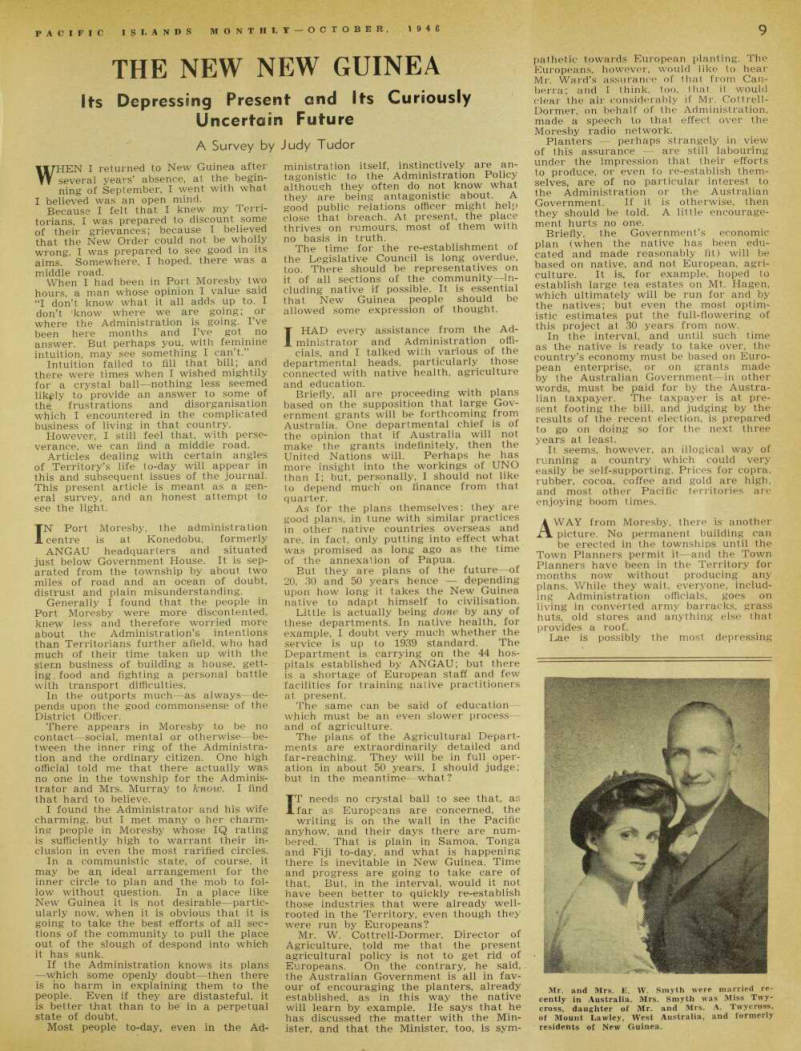
Mr. and Mrs. E. W. Smyth were married re cently in Australia. Mrs. Smyth was Miss Twy cross, daughter of Mr. and Mrs. A. Twycross, of Mount Lawley, West Australia, and formerly residents of New Guinea.
part of the Territory, both because of its climate, which is foul, and the scat tered nature of the naturally unattrac tive township. Lae, without gold exports, seems to have no reason for existence.
Madang is battered, but still beautiful.
Local plantation labour has only re cently been paid off, but some copra is still being cut.
At least one plantation owner there is working out his labour difficulties by going in for a sort of share-farming busi ness with the local villages. The success of this depends, ultimately, of course, upon what the natives can buy with their money. Money of itself is and never was much use to a native but he will work so long as he has some specific purpose in view.
Here, too, in Madang, W. R. Carpenter & Co. Ltd., are going ahead with a pro ject that should bring prosperity to the township.
ON the goldfields, only Bulolo Gold Dredging are making any notable pro gress. They have gone into the busi ness of re-establishment in a systematic manner, and are getting results.
New Guinea Goldfields .Ltd. are also busy, but their results are so far not perceptible to the naked eye.
The smaller shows are still at a stand still, most of them waiting for equipment and machinery and most of them exist ing on war damage insurance payments.
Equipment for sluicing, and labour to build the water races, are still unpro curable.
No gold is being produced at all in the goldfields area (although it should be a national asset at this time of dollars shortages) except, perhaps, by a few alluvial miners in a small way.
Mining ordinances are still suspended in New Guinea and it is impossible, to date, to sell gold even when or if it is won. Except on the two largest com panies' properties, the greatest activity in the Wau-Bulolo district is the plant ing of kau-kau and other vegetables, against the day perhaps when it might be practical and economic to hire a, line of boys for mining operations.
AND, now, what of the Territorians themselves? In spite of all their dif ficulties, the continual frustration which they meet at every turn, the ex tremely bad living conditions, the fact that they have to start all over again, and the deep disillusion that anyone but a clod must feel on returning to the Ter ritory, they manage to be more cheerful than one would suppose.
Most of them derive contentment from the mere fact that they are back again in their own country. It will take a mighty lot to dislodge them, no matter what obstacles, natural and otherwise, rear up in their path.
Characteristically, they are tackling their problems each in his own individual fashion.' All give a helping hand to the other fellow, but there is no suggestion of banding together for the common cause —although there are causes enough to start half a dozen small revo lutions.
The Pacific Territories Association, which did a good job in Australia while the Territorians were isolated there as “evacuees,” has died a natural death.
From the moment its affairs were wound up in Sydney, it disappeared from human ken and no one has suggested resurrect ing it.
In any other community, union might be strength. In New Guinea, I doubt it; the people are not built that way.
Many who have gone back with their old iron-clad ideas intact are finding the going tough. Most, however, have been able to adjust their minds to changing
times, and I would back these latter against any New Order. If they can weather the next 12 months, then I irhagine they will have carved another niche for themselves. But New Guinea will not be for their children, or their children’s children.
IN conclusion, here are some outstand ing impressions of a four weeks’ visit: GENERAL: Frustration.
Most Respected Official: Mr.
K. McMullen, formerly of District Ser vices, TNG, and now seconded to PCB.
BIGGEST MYSTERY: The functions and purpose of H. lan Hogbin and Miss Camilla Wedgwood, anthropologists. The general opinion is that if it is experts the Administrator needs, then he has them in his own departments.
Biggest Disappointment: Com
monwealth Disposals Commission.
GREATEST NEED: Shipping; and someone to stop planning long enough to fill in the holes in the roads, keep the power stations functioning, the water services running, transport on the roads and the temporary houses and quarters from entirely disintegrating.
BIGGEST MOAN (in outports): No beer.
These and other matters will be dis cussed in subsequent articles.
Death Of Mr. B. Manly
Mr, Burnell Manly, Who Had
established a flourishing and ex randino- industry in Tahiti, prepar ing coconut fibre for exnort to the United States, died suddenlv on August 16. Thus, a prominent and popular figure was removed from the Papeete Anglo- American community.
Mr. Manly arrived m Papeete about 1940, snd married a daughter of Mr. and Mrs. Max Bopp du Pont, of Papeete. A year ago, he imported the necessary machinery from America and successfully established the business of exporting coconut fibre, and he had been given authority to bring in more machinery.
Mr. and Mrs. Manlv were visiting the island of Makatea when he suddenly became ill and died from heart failure.
TT i<? bodv was brought to Papeete and his funeral there was largely attended.
Contrast In Cemeteries
Letter to the Editor IT grieves me to see the Australian War Cemetery at Lae, with about 1400 graves in it and the Japanese War Cemetery, with a large conspicuous notice outside, holding only about 140 of the enemy.
Natives may argue that, though we won the war we lost ten times as many men as the Japs, and this could have a bad effect upon the white man’s prestige.
Either the Japanese War Cemetery at Lae should be allowed to revert to the jungle, or the bodies should be cremated and the ashes returned to Japan, to be placed in the national shrine for war heroes.
I am, etc.,
Lae Resident.
Lae, 149/46.
FU. Lieut. Don Aidnev, DFC, one of the members of Fiji’s RAF Contingent, left England by the “Rangitata” on September 11. on the first stage of his return to Fiji.
Qantas Passengers
To New Guinea
SOME Island travellers who left Aus tralia for New Guinea by air during September were:
Mr. John Eastgate, a member of a family of early settlers in the Colony of Fiji, died at the Colonial War Memorial Hospital, Suva on September 27.
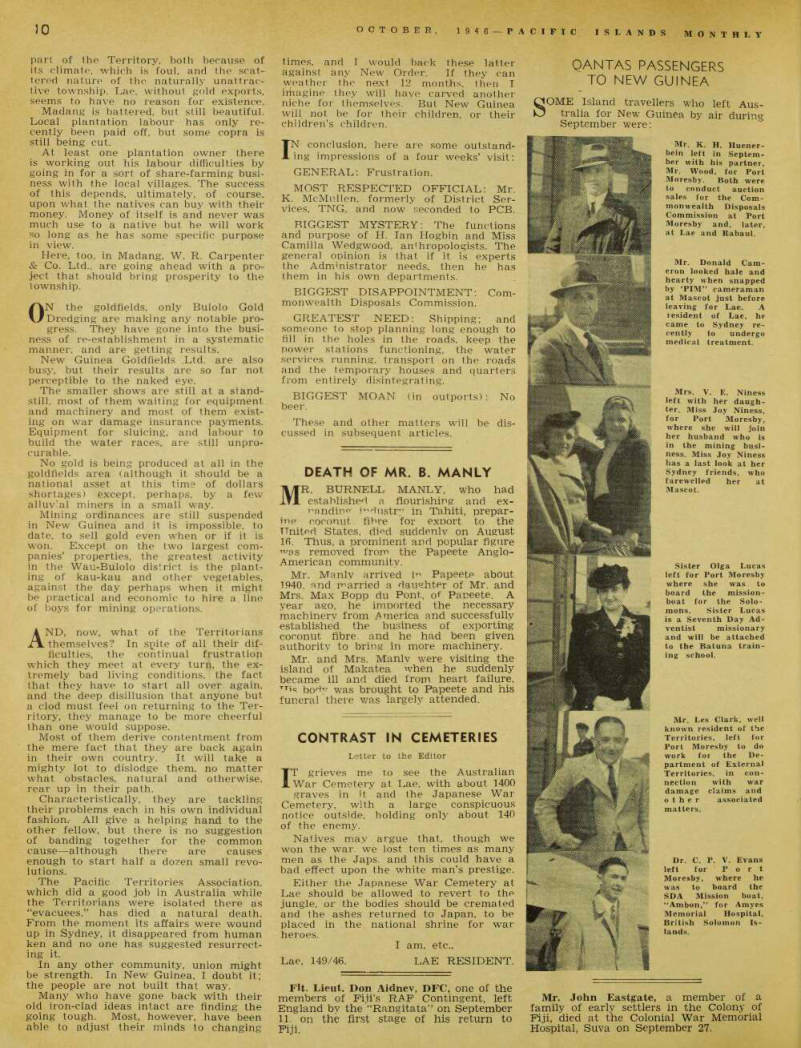
Mr. K. H. Huener bein left in Septem ber with his partner, Mr. Wood, for Port Moresby. Both were to conduct auction sales for the Com monwealth Disposals Commission at Port Moresby and, later, at Lae and Rabaul.
Mr. Donald Cam eron looked hale and hearty when snapped by ‘PIM” cameraman at Mascot just before leaving for Lae. A resident of Lae, he came to Sydney re cently to undergo medical treatment.
Mrs. V. E. Niness left with her daugh ter, Miss Joy Niness, for Port Moresby, where she will join her husband who is in the mining busi ness. Miss Joy Niness has a last look at her Sydney friends, who farewelled her at Mascot.
Sister Olga Lucas left for Port Moresby where she was to board the mission boat for the Solo mons. Sister Lucas is a Seventh Day Ad ventist missionary and will be attached to the Batuna train ing school.
Mr. Les Clark, well known resident of the Territories, left for Port Moresby to do work for the De partment of External Territories, in con nection with war damage claims and other associated matters.
Dr. C. P. V. Evans left for Port Moresby, where he was to board the SDA Mission boat, “Ambon,” for Amyes Memorial Hospital, British Solomon Is lands.
King's Medal For
C. H. Meen
FOR outstanding courage in the cause of freedom, the King’s Medal has been awarded to Mr. C. H. Meen (Hoi Meen Chin) a Chinese resident of Rabaul, New Guinea, and formerly employed by the Administration there.
The citation says: “Hoi Meen Chin was interned with a small group of Chinese in Japanese occupied Rabaul.
“With a complete disregard for per sonal risk, he managed to make contact with Lieut. H. M. Wright, of Allied In telligence, and began intelligence work for the Allies.
“In 1943, at great risk, he sent detailed written information and maps by runner to the Australian Intelligence Bureau which enabled Allied forces to make suc cessful air attacks on Japanese installa tions.
“While still in Japanese hands, he assisted in hiding two stranded American airmen at Sumsum, and at great per sonal risk arranged for guides to take them to an Australian camp, from which they, were safely evacuated.”
Mr. Meen is a keen photographer, and many of his photos and news stories have appeared in the PIM.
Manus Civilians Presumed
Dead
NO one yet has thrown any light upon the fate of the few European civi lians who were in Manus when the Jap invasion occurred in 1942, and who completely disappared. The best known of them was Mr. Munster, who owned a large coconut plantation.
The following members of the Lieben zell Mission, who were in Manus, were last heard of in 1943: Mr. and Mrs. Doepke.
Mr. and Mrs. J. Gareis and child.
Sister M. Molnar.
It has been reported, through native channels, that all*these people were sent away in a ship by the Japs. There seems little doubt now that they are all dead.
Mr. H. Sabben, OBE, Retires
From Fiji Service
AFTER 39 years in the Government service in Fiji—l 3 of them on Gov ernment ships in and around the group—Mr. H. Sabben has retired. His last position was that of mechanical en gineer in the Public Works Department.
Mr. Sabben was born in Levuka 60 years ago; educated there, and in Aus tralia; joined the service of the AUSN Company; and transferred to the Fiji service in 1907.
When World War II came, Mr. Sabben was commissioned as a captain, in charge of the Transport Company in Fiji.
The distinguished work which he did in that position resulted, in 1943, in his hav ing the OBE (Officer of the Order of the British Empire) conferred upon him.
Mr. K, W. March, left Suva by air last Friday for New Zealand on the first stage of a journey to China where he will hold discussions with high officials of the Chinese Government. Mr. March has been Chairman of the Kup Min Tang party in Fiji for 18 years.
September "Matua"
Passengers From Suva By
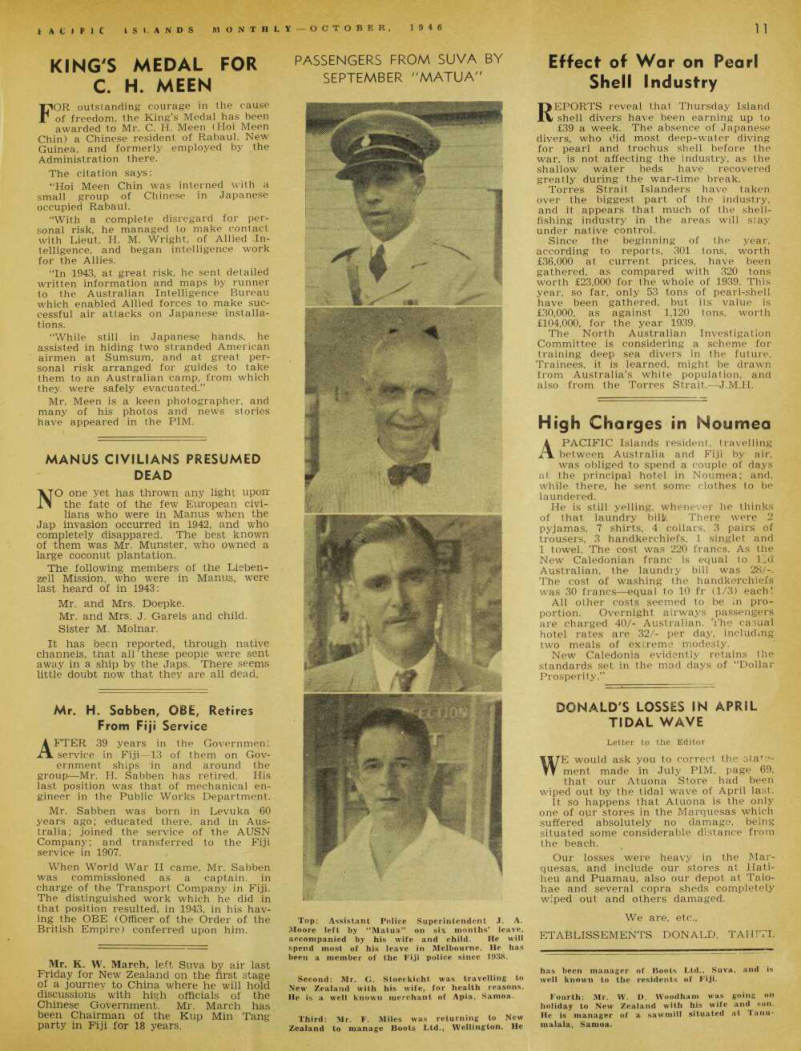
Top: Assistant Police Superintendent J. A.
Moore left by “Matua” on six months’ leave, accompanied by his wife and child. He will spend most of his leave in Melbourne. He has been a member of the Fiji police since 1938.
Second; Mr. G. Stoeckicht was travelling to New Zealand with his wife, for health reasons.
He is a well known merchant of Apia, Samoa.
Third: Mr. F. Miles was returning to New Zealand to manage Boots Ltd., Wellington. He
has been manager of Boots Ltd., Suva, and is well known to the residents of Fiji.
Fourth: Mr. W. D. Woodham was going on holiday to New Zealand with his wife and son.
He is manager of a sawmill situated at Tanu malala, Samoa.
Shell Industry
Effect of War on Pearl Shell Industry
REPORTS reveal that Thursday Island shell divers have been earning up to £39 a week. The absence of Japanese divers, who did most deep-water diving for pearl and trochus shell before the war, is not affecting the industry, as the shallow water beds have recovered greatly during the war-time break.
Torres Strait Islanders have taken over the biggest part of the industry, and it appears that much of the shell fishing industry in the areas will stay under native control.
Since the beginning of the year, according to reports, 301 tons, worth £36,000 at current prices, have been gathered, as compared with 320 tons worth £23,000 for the whole of 1939. This year, so far, only 53 tons of pearl-shell have been gathered, but its value is £30,000, as against 1,120 tons, worth £104,000, for the year 1939.
The North Australian Investigation Committee is considering a scheme for training deep sea divers in the future.
Trainees, it is learned, might be drawn from Australia’s white population, and
also from the Torres Strait.
J.M.H.
High Charges in Noumea
A PACIFIC Islands resident, travelling between Australia and Fiji by air, was obliged to spend a couple of days at the principal hotel in Noumea; and, while there, he sent some clothes to be laundered.
He is still yelling, whenever he thinks of that laundry bill/. There were 2 pyjamas, 7 shirts, 4 collars, 3 pairs of trousers, 3 handkerchiefs, 1 singlet and 1 towel. The cost was 220 francs. As the New Caledonian franc is equal to lid Australian, the laundry bill was 28/-.
The cost of washing the handkerchiefs was 30 francs—equal to 10 fr (1/3) each!
All other costs seemed to be in pro portion. Overnight airways passengers are charged 40/- Australian. The casual hotel rates are 32/- per day, including two meals of extreme modesty.
New Caledonia evidently retains the standards set in the mad days of “Dollar Prosperity.”
Advertisements & other items, p. 13 (2 items)
11
iAC m ( ISLANDS MONTHLY— OCTOBER, 1946
Donald's Losses In April
TIDAL WAVE
Letter to the Editor WE would ask you to correct the statement made in July PIM, page 69, that our Atuona Store had been wiped out by the tidal wave of April last.
It so happens that Atuona is the only one of our stores in the Marquesas which suffered absolutely no damage, being situated some considerable distance from the beach.
Our losses were heavy in the Marquesas, and include our stores at Hatiheu and Puamau, also our depot at Taiohae and several copra sheds completely wiped out and others damaged.
We are, etc.,
ETABLISSEMENTS DONALD, TAHITI.
Territories

Usa Control Of Pacific
Unexpected Fierce Challenge by Mr. Ickes
THE United States Navy at present i? responsible for the Administration of the following Territories of the Pacific: The Islands of American (or East ern) Samoa, population 13,000, which were taken over in 1899 under the Samoan settlement between Great Britain, United States and Germany.
The island of Guam, taken from Spain in 1898; population 23,000.
The several archipelagoes grouped under the names of Marshalls, Caro lines and Mariana, total native popu lation about 50,000, plus about 70,000 Japanese; annexed by Japan about 1935 after Japan had held them as a League of Nations Mandate since 1921; taken from Japan by the United States in World War 11.
Guam and Samoa have been held and administered as American naval stations for over 40 years.
During the past two years, the United States Navy has been making active pre parations for the efficient administration of the Marshalls, Caroline and Marianas.
Administrative officers are being trained in a special school in California. A special school for the training of native medical officers has been established in Guam.
Now there is developing, within the United States, a fierce controversy as to whether the United States should admin ister these various Territories; or whether they should be placed at the disposal of the Trusteeship Council of UNO. The argument of the people op posing Navy control is shown in the following summary of a speech by Mr.
Harold Ickes (former Roosevelt Minister, and well known as a hotheaded Radi cal) before the Institute of Ethnic Af fairs and Institute of Pacific Relations, late in September.
Ickes described naval rule in Samoa and Guam as “grotesque, inefficient, tyrannical, not wantonly cruel, but faithless to pledges given.”
LAST year the Preparatory Commis sion of the United Nations brought pressure on all nations holding man dated areas, to declare their intention to trustee them under the United Nations. In February, five of the seven nations holding mandated areas declared their intention to enter into trusteeship agreements to the United Nations. They were the United Kingdom, New Zealand, Australia, Belgium and France. Two nations held out —South Africa and the United States.
The official pressure to designate the Japanese mandated and other islands as “strategic areas” in their entirety or to annex them outright, emanates from the Navy, declared Ickes, and is motivated in good measure by the Navy’s desire to have exclusive responsibility for govern ing the population of these areas.
The Naval governments of Guam and Samoa had become a naval tradition and it was partly in defiant, defence of this tradition and without regard to security considerations that the Navy sought to govern the other Pacific islands.
“The history of American Samoa and Guam furnishes one answer to the mys tery of our delay in the matter of trus teeships,” he went on. The Navy’s ambi tious preparations to rule permanently, by naval absolutism, the civilian popula
tions of the Padihc Islands, furnishes another.
“We took Guam from Spain in 1898.
By the Treaty of Paris we obligated ourselves to establish, by Act of Congress, ‘the civil rights and political status’ c f the people of Guam. Within a year th > naval government had abolished all of the very considerable home rule Guam had enjoyed under Spain.”
He tendered the following list of “undemocratic” practices: ® Prohibition in American Samoa of the native practice of going from village to village in little parties for games, feasts, marriages, and funerals. • Prohibition, again in Samoa, of funeral feasts. • Prohibition in Guam of Roman Catholic religious ceremonies and exiling of Catholic priests. • Prohibition of use of the Chamorro language in Government or in schools. ® Intensification of wage discrimination in Guam—poverty wages for natives, and much higher wages for Americans. • Subjecting Guamanians to arrest, trial and sentence for any offence up to and including a capital one, without presentation or indictment by Grand Jury,
without jury trial by employing rump Naval Courts and boards.
SAMOA came voluntarily under United States control in 1899, on the basis of an express understanding that Samoans would be given civil status and a rule of law.
“The Samoans are a less patient folk than the Guamanians,” said Mr. Ickes, “and in the early 1920’s their petitioning for their denied rights became an up roar, though without physical violence.
Their leaders were charged with ‘con spiracy’ and thrown into gaol.
“Large numbers of the 23,000 Guam anians subsist as squatters in shacks and hovels built from dunnage lumber, pack ing cases, canvas and salvaged sheet metal. Meanwhile, the navy is building for its class-conscious officers an 18-hole 6000-yard golf course with water hazards and sand traps.
“Naval absolutism sneers at every Constitutional guarantee. It permits the inhabitants of Guam to be subject to arrest, trial and sentence for any offence up to and including a capital one, with out presentment or indictment by a grand jury, without jury trial, in a naval court.
“The houses of the dependent people can be en ered and searched without a warrant, and they can be—and are — ordered from their houses and lands at any hour of the day or night. They exist under a perpetual curfew law.
“Now the navy proposes to extend
(Continued on page ;o)
these abuses into the newly acquired Pacific islands, although Australia and New Zealand have already declared their intention of trusteeing nearby islands which also have international status.
“The navy is arbitrary, dictatorial and totally disregardful of civilian rights.
“Democracy will enter on its swift de cline if we do not firmly adhere to the principle that our armed forces are for defence in times of war and not for civilian administration in times of peace.”
WE know nothing about conditions in Guam; but, so far as Eastern Samoa is concerned, we can state positively that there exists a picture very different from that painted in such gloomy col ours by the unhappy Mr. Ickes.
Representatives of the PIM have been in and near American Samoa on many
occasions during the last 15 years; and never once have been heard, through native or European channels, any sug gestion that the American Samoans were misgoverned or oppressed. On the contrary, American Samoa is regarded as one of the best governed and happiest communities in the South Seas. In con trast with Western Samoa, there had been no agitation in American Samoa against the administrative officials, and the achievements of the United States Navy in native welfare (especially health and education) have at times been warmly praised.
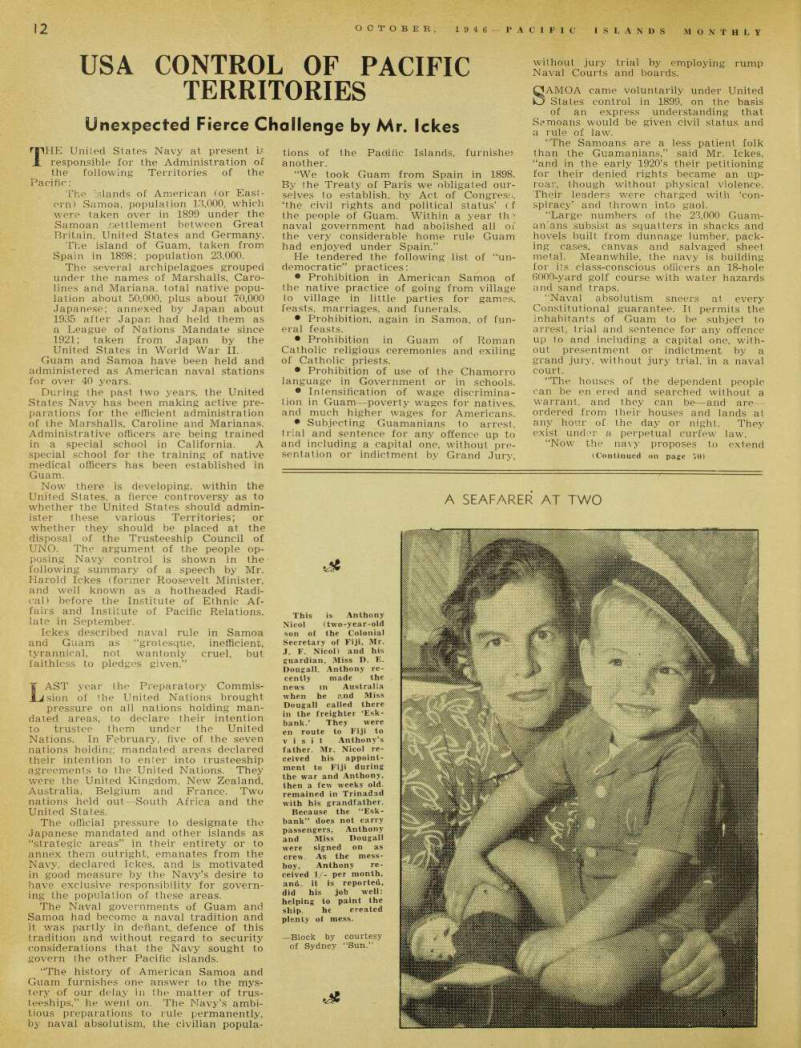
A Seafarer At Two
This is Anthony Nicol (two-year-old son of the Colonial Secretary of Fiji, Mr.
J. F. Nicol) and his guardian, Miss D. E.
Dougall. Anthony re cently made the news in Australia when he and Miss Dougall called there in the freighter ‘Esk bank.’ They were en route to Fiji to visit Anthony’s father. Mr. Nicol re ceived his appoint ment to Fiji during the war and Anthony, then a few weeks old. remained in Trinadad with his grandfather.
Because the “Esk bank” does not carry passengers, Anthony and Miss Dougall were signed on as crew. As the mess boy, Anthony re ceived 1/- per month, and, it is reported, did his job well: helping to paint the ship, he created plenty of mess. —Block by courtesy of Sydney "Sun.”
Bender
L`Ae Goes On A Meat
But No Beer Yet!
Lae, October 3.
THE September “Montoro” brought about 60 tons of freezer cargo to Lae—and nothing else. Twenty tons of this was for the hotel; the rest went into BP’s freezer —it was calculated that it would serve the district until the next “Montoro” was due.
But someone miscalculated the dis trict’s meat hunger. Within the first week the local population—including the Chinese community—had purchased 40 pounds of meat per head! To-day the freezer is again empty.
Even allowing for the fact that there had been no. fresh meat in the township for months, 40 lbs per head in one week seems an impossible feat. Apparently the large purchases are the result of panic-buying and domestic refrigerators in the area must now be overloaded —and a domestic refrigerator will not keep meat indefinitely.
No other foodstuffs came on the “Mon toro.” Groceries, canned goods, beer, etc., are expected on the “Reynella,” which should be in about October 12. Store shelves are practically bare, and rice and trade meats are unobtainable. Employ ers are feeding their boys on bread at 2/- per 4 lb loaf —and anything else they can get—no encouragement to have a line of boys, even if they were procur able.
The elaborate ration scale set out by the Administration is a farce while essential goods, which go towards making it, are unobtainable.
But despite the shortages of rice, meat, sugar and matches in Lae, shipments of these commodities have recently been sent from here to Moresby. No one knows why the needs of Moresby, which had had food ships, should be consid ered greater than those of Lae and other centres.
Most Territorians, when they came back, brought several months’ stores with them; but it seems unfortunate that the large stocks held by Common wealth Disposals Commission here could not have been utilised in some way.
One resident who returned in May in terviewed the local branch of the CDC and intimated that he would be inter ested in anything up to £lOOO worth of ex-Army stores. He was haughtily told that CDC was not interested in “small orders” —anything below £3OOO was not worth considering.
No one actually goes hungry in Lae, but canned food is deadly monotonous and definitely non-morale-building.
Important Nigerian Job
Harold Cooper For Important Nigerian Job
From Our Own Correspondent Suva. Oct. 2.
POPULAR Harold Cooper, of the Gov ernment Secretary's staff, Suva, Fiji, has been appointed Administrative Officer in Nigeria, from which post he will be seconded to that of Public Rela tions Officer (rumoured to carry a salary of £1,400 per annum). Mr. and Mrs.
Cooper expect to leave Fiji late in Octo ber.
Mr. Cooper has been in Fiji since April, 1940. During the war he organised Information Services in the Colony and as Information Officer, Fiji and Western Pacific, he made several tours of Pacific battle areas and wrote a number of des patches which were widely published and which later provided material for a book which was commissioned by the Ministry of Information.
Mr. Cooper later visited the United States, where he lectured on the war effort of the people of British territories in the South-West Pacific.
Mr. J. W. Beagley, director of the observatory at Apia, Western Samoa, arrived in Auckland in October for dis cussions with the NZ Department of Scientific and Industrial Research.
Advertisements & other items, p. 15 (1 item)
ffiLasinjliCTL.
THE
YORKSHIRE
INSURANCE
CO. LTD.
(Incorporated in England)
FIRE
ACCIDENT
MARINE
FIRE POLICIES ISSUED
IN PAPUA
All information from —
E. A. JAMES,
PORT MORESBY.
BURNS PHILP
(SOUTH SEA) CO. LTD.
Inc. In Fiji Island Traders and Shipowners Registered Office:
SUVA
FIJI
Also Branches at: Fiji: Levuka, Lautoka, Labasa, Ba, Sigatoka, Rotuma. \\ Tonga: Nukualofa, Haapai, Vavau. nx Samoa: Apia, Pago Pago (American Samoa). nx Solomons: Makambo, Gizo, Faisi.
New Hebrides: Vila.
Code Address: Gilberts; Tarawa.
“Burnsouth k . Norfolk Is. Niue. Wallis Is. Futuna Is.
u
IhTi
M mt
ffiLasinjliCTL.
Sole Australian Concessionaries :
GEORGE BROWN & CO. PTY
267 Clarence Street, Sydney.
LTD.
The Ultimate factory has made the change-over from its wartime set-up.
Designs for the new models are now completed and production is about to commence.
These models should be available early in 1946—they will be well worth waiting for. Watch for further announcements.
SERVICE: Servicing of all kinds of radio sets, amplifiers and Rola speakers will continue to be available.
Correction
IT was reported here, in a recent issuq in reference to the death of Mr. Peter Kyllert, of New Guinea, that his family was part-native. This was com pletely an error, caused by a misunder standing of the statement that when Mr. Kyllert, escaped from the Japs, he brought with him a part-native family.
Mr. Kyllert, some years ago, married a highly-respected European lady, Mrs.
Gahn, a widow; and she accompanied him to Sydney and was with him when his unexpected death occurred.
Celebrates 21st Birthday
Suva Bowling Club Celebrates 21st Birthday
By “Jack High”
THE Suva Bowling Club’s 21st birthday fell on July 10, 1946. The function was attended by a fully representa tive gathering. In the unavoidable ab sence of the Governor (Sir Alexander Grantham) His Honor the Chief Justice, Sir Claude Seton, was the principal speaker.
Mr. G. F. Grahame, the Club’s first president, also addressed the gathering and described the club’s early days.
Other speakers included the 1945-6 pre sident, Mr, R. W. Steward, and Mr. J. H.
Millett, a past president.
The birthday cake was cut by Lady Seton —twenty-one candles having been
previously extinguished by the Club’s vet eran member, Captain T. H. Lippitt.
Known to many bowlers in the South Pacific, the club’s greens, situated among gardens at the edge of Suva Harbour, must be among the most picturesque in the world.
On December 22, 1924, a general meet ing of members decided to authorise the issue of 40 loan-certificates of £5 each.
One certificate went to the late Mr. S. G.
Davey, on January 10, 1925, and later became the first trophy to be played for on the Club’s green.
The land on which the club’s first green was laid had been reclaimed in 1924. Before that, the sea reached a point close to the present entrance to the club’s grounds. The green was opened by the late Sir Eyre Hutson, on July 11, 1925; and on that day the club came offi cially into existence. Mr. G. F. Grahame was first president and Mr. W. M. Cald well was secretary. The foundation mem bers numbered 86, about 30 of whom are living in Fiji to-day. All the members of the 1927 committee were foundation members.
The greens of the Suva Bowling Club, situated among tropical gardens on the edge of the lagoon, are among the most beautiful in the world.
The Club celebrated its 21st birthday on July 10, 1946. The photograph shows Lady Seton, wife of the Chief Justice of Fiji, cutting the birthday cake. A description of the ceremony is published below.
Death Of Former Suva
Harbourmaster
THE death of Captain E. W. G.
Twentyman occurred in Suva on Sep tember 22. He was one of Fiji’s best known seafaring men.
Captain Twentyman was born at sea in the Bay of Biscay in 1868, educated in South Africa and then served in sail and steam, gaining master’s certificates in both.
In 1910 he entered the Fiji Govern ment Service as master of the steam yacht “Ranadi,” holding that post until 1914, when he was appointed Harbour master, Levuka. In World War I he served with the Royal Navy and in 1920 he brought the new Fiji Government vessel, “Pioneer,” from England. In De cember, 1920, he was appointed Harbour master, Suva, a post he held until he retired in 1935.
Advertisements & other items, pp. 16-18 (2 items)
Mcilrath’S
The City Mutual Life Assurance Society Limited, Hunter Street, Sydney. It is the intention of this Society on or after the 7th November, 1946, to issue a Special Policy in lieu of Policy No. 135319 on the life of the late Eric Henry Fitzroy Mitchell late of Rabaul, which is declared to have been lost. C. A. Ralph, General Manager.
SPECIALISING
IN
PACIFIC ISLAND INSURANCES
FIRE MOTOR VEHICLE
MARINE HULLS AND CARGO
EMPLOYER’S LIABILITY
GUARANTEES including those for —
DYNAMITE PERMITS.
RECRUITERS’ LICENCES.
DEFERRED WAGES
AND ALL OTHER CLASSES ARRANGED
AT LOWEST CURRENT RATES.
Established Agencies:
VV. R. CARPENTER & CO., LTD.
Throughout the Territory of New Guinea.
SOUTHERN PACIFIC INSURANCE
CO., LTD.
HEAD OFFICE; 60 HUNTER STREET.
SYDNEY.
McILRATH’S
For High Quality Food
at Competitive Prices
Full stocks canned Meats, Vegetables and Soups in small packings now available. Also Wines and Sparkling Apple Cider.
WRITE FOR PRICED COPY OF OUR STANDARD GROCERY ORDER-
ALL GENERAL LINES INCLUDED
McILRATH'S PTY. LTD.
Export Department,
202 PITT ST., SYDNEY, AUSTRALIA
Tilley Lamps
BURN ORDINARY KEROSENE
The Modern Form of PORTABLE LIGHTING Be you buy a
TILLEY
STORM LANTERNS \ Look for the name!
TABLE LAMPS
SUSPENSION LAMPS
RADIATORS
INSPECTION LAMPS
WALL LAMPS
FLOODLIGHT PROJECTORS
300 C.P.
Storm Lantern
Tilley Lamps are made only at
Hendon, England.
Be sure you buy a TILLEY Look for the name !
Shipments four weeks from receipt of order.
THE TILLEY LAMP CO., HENDON,
5,000 C.P.
Floodlight Projector
1.W.4, ENG.
REPRESENTATION :
MELBOURNE : T. H. Bentley, Pty. Ltd., 123-125 William Street, Melbourne, C.
TASMANIA : Mr. C. Sellars, 108 a Charles Street, Launceston.
FIJI : Mr. K. Witherington, 2 Burns Philp Buildings, Suva.
J. C. MERRILLEES & CO.
Challis House, Martin Place, SYDNEY.
BUYERS OF ALL ISLAND REQUIREMENTS. SUPPLIERS OF ALL AUSTRALIAN GOODS. BUYERS OF ISLAND PRODUCE.
Write or Wire Inquiries Welcomed Telegrams: for “Merrillees,”
Quotations 'Phone: BW 6569 Sydney.
/ts Dray-free
yet TOUGH
In tropic heat
\ iu Mi BSv- .'TShTk ;.y% > 8! i*r i
SHELL
MOTOR OIL
SHELL COMPANY (PACIFIC ISLANDS) LTD.
(Incorporated in Great Britain) Agents: BURNS PHILP (South Sea) Co. Ltd."
Stevedoring In
Ragtime
Madang
"Montoro" Leaves Copra
Behind
October 1. 11THEN the “Montoro” left Madang at TT five minutes past midnight on Sunday, Sept. 29, 1,500 bags of copra which the Production Control Board had ready for loading were left behind.
“Montoro” had been in port since the previous Sunday—exactly one week—and, as reported elsewhere in this issue, had approximately 1,800 tons of cargo to shift.
It was calculated that, at the present rate of stevedoring in the Territory this would take six days; but the con fusion, delay and exasperation in Madang outdid even the most pessimistic esti mates.
By Thursday night—the 26th—it was evident that, at the rate at which load ing was being carried out, there was no chance of getting the ship away by mid night, and it was a case of staying idly in port on Sunday and resuming loading on Monday, or of sailing without a full cargo. The District Labour Officer had already made it clear that he would not permit the natives to work the ship on the Sunday.
“Montoro” consumes 12 tons of coal per day while in port, and delays at other ports had already made it necessary for her to go to Bowen, Qld., on the return trip to Australia in order to take on coal.
It had also become necessary to put in somewhere for water. Water had not been available in Moresby, Lae or Madang owing to breakdowns in water services, or drought. Captain Wilding expected to go into Milne Bay, Papua, to take on water for the return trip.
On Friday the captain stated that he was willing to stay the necessary extra time and load all the copra if the various authorities were willing to work on after midnight on Saturday until loading was completed; but, if this were not possible, then, in view of the coal and water situa tion and the necessity of maintaining some sort of schedule, he would leave at midnight on Saturday.
“Montoro” sailed at five minutes past midnight and 1,500 bags of badly needed copra remained behind!
Administration officials and ordinary Territorians alike all wail loudly that shipping services from Australia (and the consequent slow arrival of supplies) is one of the greatest nightmares of the present era in the Territory.
Yet there seemed in Madang to be no great agitation on the part of any indi vidual or section of the community to get the “Montoro” loaded and quickly away—although by doing so it would ensure an earlier return of the ship. No one (except Captain and officers, and some passengers who had grilled in Madang for a week) manifested the slightest degree of annoyance when it seemed that the ship would be there in Madang well on into the next week.
Perhaps the fact that cold beer was available in the ship’s bar, but was non existent on shore, had something to do with that attitude.
MADANG’S bottleneck could be partly cleared in either of two ways.
One would be the construction of a Customs shed right at the wharf, where it was before the blitz. This, could be a temporary structure built quickly from
(Continued on page 69)
the tons of material left behind by the Army.
Alternatively (but not so good) tram lines could be put in from the wharf to the sheds now in use about two hun dred yards up the road.
Both would do away with the lorries, in which goods are now transported and which, being in a state of acute disre pair, are more often than not out of commission. During this last visit of the “Montoro,” there were seldom more than three trucks in operation at one time, consequents the ship’s winches, instead of being used to the fullest extent, were idle for three-parts of their time.
TRUCKS are either Administration property, or hired from privae con cerns or individuals. No one with any regard for their vehicles will hire them out to be driven by the native drivers. This also puts a brake on pro ceedings.
It is said by the ship’s officers that the only time that there was efficient stevedoring in Madang was on one occasion when they were transporting Australian Servicemen back to Australia.
Soldiers, informed that the sooner the ship was cleared, the sooner they would be home, turned to with a will, manned the trucks and shifted the cargo in record time.
Another improvement would be to arm each native working in the hold with a hook for pulling bags of copra into posi tion. Their feeble attempts to granple with these large bags are calculated to drive officers to blasphemy, or worse.
It is rumoured that all stevedoring will
revert to private firms in the New Year.
This will be the greatest improvement of all. At present there are three or four Government Departments with a hand in proceedings, and none of them shows the slightest willingness to co operate with any other.
It was noted, however, that after the Captain’s ultimatum, work on the wharves and ship went on at increased tempo, and all of the cargo might have been lifted had not the local power station given up the ghost early on Sat urday evening. Copra sheds were then illuminated solely by the headlights of trucks.
Advertisements & other items, p. 18 (1 item)
16
OCTOBER, 1946 PACIFIC ISLANDS MONTHL*
Ninth Since 1853
Bad Eruption At
Niuafo'ou
THE island of Niuafo’ou (“Tin-can Island”) an outlier of the Tongan Group, about 400 miles from Nukua lofa, has again been devastated by a vol canic eruption.
The outburst was first reported on Monday, September 16, by the pilot of a RNZAF plane flying between Auckland and Samoa. The island’s radio had been put out of action by the first volcanic shock.
The pilot, attracted by much smoke, flew over and saw what was happening.
Lava was creeping across the northern part of the island, which is 31 miles long by three miles wide. The administrative village and landing place at Agaha, on the north coast, had been overwhelmed.
People, gathered on a bare space inland, a former lavafield, had spelled out the letters SOS by laying cloths on the ground.
The Tongan Government vessel “Hifo fua,” which had that day arrived at Nukualofa from Niuafo’ou, was imme diately ordered back, with supplies, and she arrived on September 21. Other ships nearby were asked by radio to call and give any help necessary.
They reported on September 23 that the eruption, and damage by lava, had been serious along the northern coast.
All Government buildings, the radio station, the stores, copra sheds, boats, and the Mission buildings had been des troyed. The craters still were smoking, but the eruptions had died down.
There had been no loss of life, and the main food crops had escaped.
Since Europeans made contact with this region, there have been nine vol canic eruptions on Niuafo’ou —in 1853, 1867, 1886, 1912, 1929, 1935, 1936, 1943 and 1946. The worst were 1853, 1886, 1929 and 1946. Niuafo’ou once was famed as a garden island, but these various lava flows have destroyed all the famous plantations and gardens except the areas towards the north-east. There is still enough undespoiled ground left to support the 1200 native people, how ever.
Because there is no sheltered anchor age, passing vessels used to deliver the mail in a sealed tin to a swimmer, who came out from the boats’ landing-place, pushing a sealed tin-can with the out going mail. Thus, Niuafo’ou became fam ous among world’s philatelists for its “Tincan” mail.
Iron Ore In Fiji
THE Fiji Deparment of Mines has planned a thorough survey of iron ore deposits in Nadroga and Navosa Provinces. Prospectors expect to use recently secured magnetic equipment in making the survey.
Samples of large boulders of magnetite ore and ochre lying on the surface were treated before the war and revealed good percentages of iron ore. Further inves tigation will now be undertaken to deter mine the nature of the ore and the depth of the deposits.
Although the Fiji Government is be lieved anxious to have the deposits worked, local mining men doubt the suc cess of the project inasmuch as there is no domestic production of coal for smelt ing purposes.
Madang is the End
End of the Line But There is No Accommodation for Travellers Yet
Madang, September 28.
MADANG is now the terminal point of the Australia-New Guinea ship ping service, and consequently the jumping-off place for points north and west. But there is no accomodation in Madang for the travelling public, and there is therefore much inconvenience for people transhipping at this port.
The old hotel is gone, of course—even the tiled floor is no more. Rumour has it that the tiles were used to line the last resting place of a brace of Jap admirals (and/or generals).
On the last trip of the “Montoro,” when the ship was in port for just on a week, transhipping passengers, by the good graces of the skinper and the local
agents, were permitted to remain on board for five days. After that they had to make their own arrangements.
Mrs. N. Corlass and her two children, who were waiting for an inter-island ship to Manus, were looked after bv Mrs. H.
Evans. Mrs. A. Smythe, wife of the medical officer in Manus, was given one of the hospital huts a pretty cold welcome for a newcomer to the country.
Mr. and Mrs. W. Royal, en route to Wewak, also were accommodated in one of the hospital huts. Mr. and Mrs. R.
Tutty, who were going to Manus, dug themselves in in an abandoned Red Shield hut.
There seems no reasonable solution to Madang’s problem of catering for the travelling public. Madang is a small town and at the present time does not warrant a hotel: there would be small profit for a private individual in running a hostel or rest-house.
The only alternative to the present haphazard arrangement seems to be the establishment of a Government rest camp. But, unless the energetic District Officer takes it upon himself to do some thing, there is little likelihood of this.
Sydney Ng Women's Club
(JOMING events arranged by the Club for all Territorians still in Sydney are:
Friday . November 22.—Housie-
Housie night at the Club Rooms, 77 King Street, Sydney.
Monday, December Iq.—Chil
dren's Christmas Party at the Club Rooms. As many children have note returned to the Islands, the Club's guest list is of little use , and mem bers are asked to send in the names of any Territorian children under 13 who would like to attend the party.
Donations, either cash or gifts for the children, would also be ivelcome.
Saturday, December 21 .—Adults'
Christmas Party. Further details will be published in the “PIM" at a later date.
As well as these fixtures, Terri torians are welcome at the Club Rooms every Thursday morning, when the members meet together over a cup of morning tea.
Advertisements & other items, pp. 19-20 (1 item)
Day-Old
Chicks
BY AIR
Amalgamated Hatcheries
(Reg.) of Bankstown, near Sydney, N.S.W., have made arrangements with Qantas Airways and other air services for the dispatch of limited numbers of chicks by
FLYING BOAT TO
PORT MORESBY,
LAE,
NOUMEA,
SUVA,
and all other islands of the Pacific served by present AND PROJECTED air services.
Amalgamated Hatcheries are the largest distributors of dayold chicks in Australia, last year over 1,000,000 Ochicks being sold by us in N.S.W. alone.
Our scientific method of packing and dispatch has resulted in a loss of less than 1 per cent, of chicks sent by flying-boat.
If any chicks in your consignment arrive dead, we will replace them frees provided the extra freight is paid by the purchaser.
Chicks available are R.1.R., Austrolorps, and W.L. We only dispatch unsexed chicks.
Price, £lO per 100, landed at your airport (subject to reduction or increase in accordance with current air freights ).
These chicks are the cream of Australia’s stock, produced under ultra - violet rays to guard against disease; the adult stock is blood-tested monthly by veterinary officers and each individual order carries a N.S.W.
Government certificate that the chicks are healthy and from tested stock.
Payment for chicks should be made by draft with the order, or credit arranged through our Bankers, the Bank of Adelaide, George Street, Sydney.
WRITE BY AIR-MAIL OR
CABLE.
AMALGAMATED
HATCHERIES
BANKSTOWN, N.S.W.
'I
VACUUM
QUALITY PRODUCT
High volatility and unsurpassed anti-knock quality makes Plume the best petrol you can buy. Try a tankfull and
.. r XL P 4625
prove it tor yourselt.
VACUUM OIL COMPANY I'!,'.
South Sea Regional Commission
Inaugural Meeting Early in 1947
A CONFERENCE will shortly be held in Australia to set up the South Seas Regional Commission. Australia and New Zealand have invited the Governments of the United Kingdom, the United States, France and the Netherlands to a conference, to be held for this purpose early in 1947.
This statement was officially made on September 27 by Dr. Evatt, Australian Minister for External Territories.
THE Governments mentioned, in re sponse to informal approaches (Dr.
Evatt continued) recently expressed their desire to join with Australia and New Zealand in forming a regional ad visory organisation for the promotion of welfare in the Islands territories in the South and South-west Pacific. Formal invitations have now been issued to them.
The project of a Regional Advisory Commission, for co-operation in regard to territories in the South and South west Pacific area, has been advocated by the Australian and New Zealand Govern ments since the Canberra Conference of January, 1944.
Following upon discussions of the pro ject between the Australian Prime Min ister, Dr. Evatt, and United Kingdom and New Zealand Ministers in London, last May, inquiries were made of the Gov ernments of the United States, France and Netherlands, all of which have direct territorial interests and responsi bilities in the area. All Governments concerned indicated their interest in the work of such a Commission, and their willingness to join in a conference for the purpose of establishing the South Seas Commission in the near future.
Dr.* Evatt emphasised that the pro posed Commission would not deal with questions of defence or security, and would not interfere in political matters.
The main functions of the Commission will be to advise the member Govern ments in regard to the promotion of native welfare, and the economic devel opment of the Islands territories of the area. Mutual co-operation and exchange of information and views between mem ber governments will undoubtedly assist materially the organisation of health and education services for the native peoples, and improve standards of native welfare generally.
DR. Evatt indicated that the territories concerned will be those lying gener ally south of the Equator and east wards from and including Dutch New Guinea to the French Establishments (Tahiti, etc.).
The Australian and New Zealand Gov ernments are gratified at the encourag ing reception given to the plan by the other Governments concerned. The Aus tralian and New Zealand Governments have consistently emphasised the need for such a body in the South Pacific areas. Their views on the subject were clearly expressed in the Australian-New Zealand Agreement of January, 1944.
“The Australian Government,” said Dr.
Evatt, “has always stressed the necessity for planning and co-operation by all Gov ernments interested in the welfare of the peoples of the South Seas. It believes that the South Seas Commission will greatly help the Governments concerned in dealing with economic difficulties, such as those experienced in the thirties when contracting markets and falling prices had devastating effedts on the economic life and welfare of the Pacific Islands peoples.
“In carrying out its objectives the Commission will bring together the ideas and experience of those who pos sess first-hand knowledge of South Seas Territories. Administrators, anthropolo
gists, medical officers, economists, mis sionaries, planters and traders —all can contribute to the effectiveness of the work of the Commission in ensuring that the native peoples, for whom membpr Governments of the Commission are re sponsible, are assisted to improve their standards of living, to develop their ways of life and adjust themselves to the changing conditions of the post-war Pacific world.’,’
NG. Bank Exchange
All Territorians who bank with “the Wales”— and most of them have a deep x'ooted prejudice about banking any where else—will welcome its return to the Territory, even if it has not got be yond Port Moresby at the moment. Bank exchange with Australia for BNSW cus tomers forced to negotiate transfers through the Commonwealth Bank has been 10/- per £lOO. With their own bank it will cost only 5/-,
Advertisements & other items, pp. 21-22 (1 item)
Brial & Ball
• If For Inflamed Eyes and Eyelids ... Sold Everywhere H.Rose&Co..Pty..Ud.. Kmq Street, Sydney.
•i'«: 1 M:;s ■■ ’■ iK'. :4V* ■ -.5
MACARONI
•••> A\ ❖ v & * ■ m
/VERMICELLI
mm ■ ii Sole Distributing Agents for the Pacific Islands:
BRIAL & BALL
528 COLLINS STREET,
MELBOURNE.
’Phone: MU 4837.
1 BOND STREET,
SYDNEY.
’Phone: B 7371.
Modern Refrigeration for the South Sea Islands
The ELECTROLUX KEROSENE OPERATED
REFRIGERATOR
MARVEL
OF
MODERN
SCIENCE
THE
MIRACLE
OF
ICE
FROM
HEAT
ELECTROLUX offers economical, modern and completely efficient
REFRIGERATION FOR ISLANDS' HOMES.
FREEZES CONTINUOUSLY WHILE SMALL LAMP BURNS.
Freezing controlled by simply regulating height of flame. Uses only f gallon of kerosene per week.
MOTORLESS ... NO PARTS TO GET OUT OF ORDER.
MODEL LKSSO
Capacity: 8.5 cubic feet.
GUARANTEED FOR TWO YEARS
• Write to your Local Distributor for prices and full details.
OBTAINABLE FROM ALL W. R. CARPENTER & CO. LTD.
BRANCHES THROUGHOUT THE ISLANDS
Representation in Papua and New Hebrides.
Papua
Stc Shows Record
Profit
Trade and Politics In Papua
A GOOD profit, allowing 7 h per cent, on both ordinary and preference capi tal, was made by Steamships Trading Co. Ltd. of Papua in the year ended July 31.
But the Co. is not happy. The basis of all the increased trading is merely the lavish distribution in the Territory of Australian Government funds; whereas, in the view of those best qualified to judge, there can be no sound prosperity in a country that does not earn substan tial funds from its own resources and industries.
The history of the Co. during World War II is told in the following figures from its balance-sheets:
♦Grouped with stores, etc., in war years.
The Co. was making sound and rapid progress in 1939, and until war struck New Guinea. Then all its establishments were overwhelmed, its ships were seized and its stocks were looted. The story of the grim tenacity of its directors, who hung on in Port Morebsy and fought the Army and all its myrmidons, and so saved their property, has been told be fore. By 1944, the Co. had got enough out of compensation payments to wipe off its creditors, provide for its pref, dividend, and put £30,000 in the bank, while still keeping alive its War Damage claims for over £40,000.
In the following two years, the Co. has obtained another £40,000 in war damage payments, has built up its stocks of merchandise, has a substantial sum in the bank, and shows the record profit, for the last financial year, of £32,000.
But it is not allowed to run shipping services, and it cannot get labour for its plantations.
This Co’s chief weakness now is that its operations are confined to one Terri tory, and so it is at the mercy of one Government, whenever that Government may elect to go haywire. Most other big Pacific trading companies spread their operations over two or more Territories and, if threatened by one irresponsible administration, they can usually find sanctuary under another.
Mdlle. Jacqueline Tallec, the charming daughter of the Governor of New Cale donia, accompanied by Madame Pourcade, wife of the Chef de Cabinet, Noumea, arrived in Papeete in August, having flown from Noumea to Bora Bora. They paid Tahiti a brief visit, and returned by plane to New Caledonia.
The death has occurred of Mr. George Tuckey, a patrol officer in New Guinea.
His only brother was killed in the fighting in New Guinea in 1945.
1939. 1944. 1946. £ £ £ Issued Capital 142.000 143,633 168,858 Reserves .. 34,800 61,752 104,092 Creditors . .. 45,211 7,925 28,571 Stores and Installations 84.232 44,233 47,863 Merchandise* . 64,723 — 102,277 Investments 8,431 40,079 46.973 Plantations .. 31,473 50,616 64,426 Debtors .. 37,492 3,769 28.543 At Bank .. — 30.000 18,543 Profit 17,994 7.340 32,014 War Damage and Army Claims .. .. — . 46.415 3,254
Advertisements & other items, p. 23 (1 item)
Considered
'THAT
The
HAVE YOU
CONSIDERED
THIS CODICIL?
By adding a simple codicil to your Will you can guard against difficulties and loss which might arise should your Executor die or become incapacitated.
By means of such a codicil you can name Burns Philp Trust Co. Ltd. as joint Executor with your present appointee or, if you wish, as sole Executor. In this way you gain positive assurance of continuous and sound administration and are relieved of a serious anxiety. The Company will willingly forward full particulars.
DIRECTORS:
Lewis Armstrong. James Burns. Joseph Mitchell.
R. J. Nosworthy. P. T. W. Black.
MANAGER: L. S. Parker.
SECRETARY: E. R. Overton, AJ.I.A.
BURNS PHILP TRUST
COMPANY LIMITED
7 BRIDGE STREET, SYDNEY
’Phone: 8U5901. BOX 543, G.P.O, SYDNEY.
B.P. 2-45
Coveted Manus
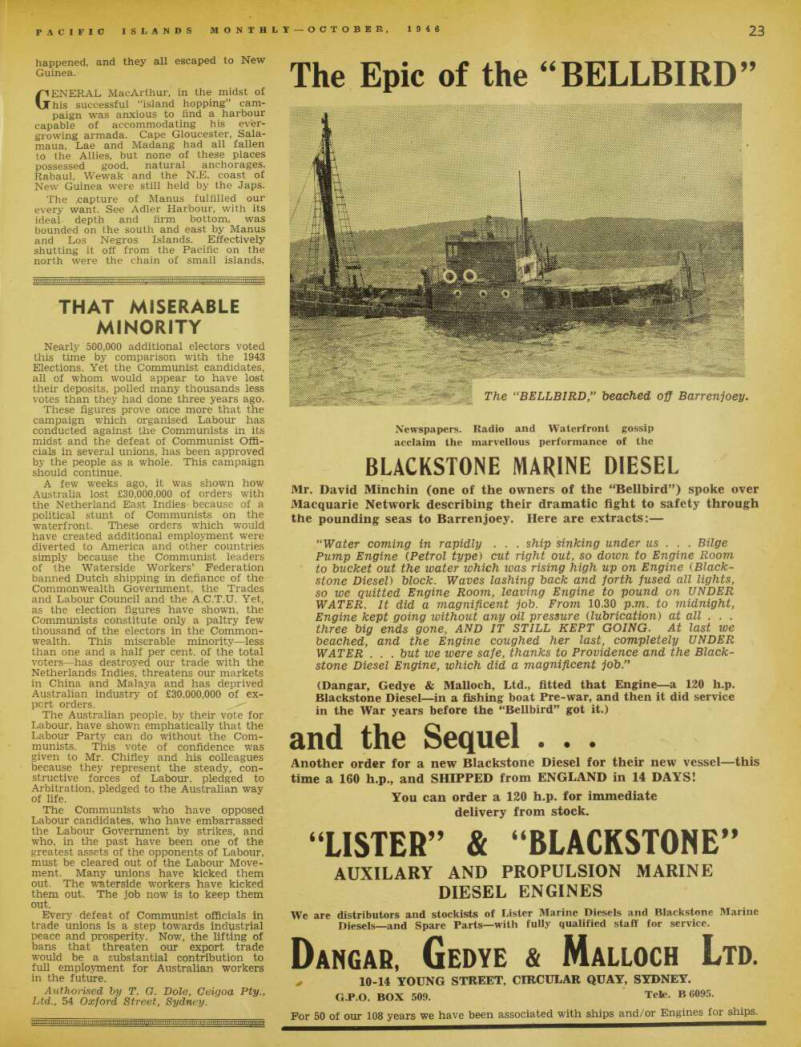
How The Mighty Sea and Air Base Was Seized and Built
From Our Special Correspondent
THE Admiralty Islands, more commonly known as Manus, appear frequently in the news these days.
Recaptured by combined US and Australian forces early in 1944, after two ye%rs of Jap occupation, the potentialsties of the excellent harbour there were quickly realised and exploited. In eight months the US Navy had transformed this once little-known group into a firstclass naval base.
According to reports, the US wish to continue the use of Manus as a base.
Negotiations are in progress between tinner™ and America yarding the ™ 7 - The writer knows the Manus group inoL V oi the Tew who
TaTded with the invZina FirsTuS Cav-
ai™ Division on “D” Day February 29 mvislon on u uay ’ temuar y THE dawn had not yet come when we scrambled into the destroyer’s boats and awaited the signal to make for the beach.
Three miles to the west could be seen the blur that was Los Negros, the second largest island of the Admiralty Group.
Our beach-head was in Hyane Harbour — on the west coast of Los Negros.
Timed to the split-second, the bombardment of our protecting warships
suddenly shattered the stillness, and our boats raced for the beach. The Ist US Cavalry Division were away to their first action—and four Australians were with them.
We four had known Manus before the war, and had been selected to act as guides and native leaders for the opera tions. Robinson and Hoggard were in the first boat ashore, while Booker and McCarthy followed in the second. In the action that followed, Robinson and Dick Booker were to earn richly-merited
Dcm’S.
By May, 1944, the Jap resistance had folded up and the command of the group passed from the Army to the US Navy.
Xt was clear that Manus was a qrize worth havin s: and > already, the Ameri cans were vi g° rousl y the founda tions of a naval base on the shores of See Adler Harbour.
The Admiralty Group is known as Manus District, and is part of New Guinea which has been administered by Australia since 1914. Its principal islands, Manus and Los Negros, are situated about 200 miles N.E. of Wewak (on the New Guinea mainland) but the group comprises many small islands, scattered over an area of thousands of square miles. The largest island, Manus, is about 40 miles by 10 miles. Los Negros is sep arated from Manus by a mere channel, about 100 yards wide.
Three hundred miles west of Manus lie the isolated islands of Matty and Aua —while, about half way, are the atolls of the Hermits, Maron and Pelalhun.
Lying some 300 miles N.W. of Manus are the lonely Anchorite Islands. The Anchorites are a few miles from the Equator and are the northernmost out posts of Australian administration.
To the east and south of Manus are Pak, Tong, Rambutyo, Lou and Baluan, volcanic islands that ' unexpectedly jut out of the sea.
Copra, beche-de-mer and trochus (mother of pearl) fishing were the chief industries of the group in pre-war days.
There was but one town, Lorengau, on the N.E. coast of Manus, and this was also the headquarters of the District Officer.
The natives of Manus are the most physically attractive and certainly the most intelligent of all the peoples of New Guinea. The great majority are coastal dwellers and are expert canoeists and boatmen. With the exception of Matty and Aua islands, the natives are of Melanesian stock. The people of Matty and Aua differ in appearance and culture —they are of Polynesian origin and have long wavy hair, instead of the usual fuzzy mop of the New Guinea people.
The population of the Admiralties is about 11,000, of whom 8000 live at Manus and Los Negros Islands.
This large archipelago was defended by only 25 Australian soldiers when the Japanese occupied Manus early- in 1942.
Completely cut off from New Guinea mainland and New Britain at the enemy’s first onward swoop, those gal lant few had small change of surviving against the thousands of Japs that poured into Manus. But the miracle
happened, and they all escaped to New Guinea.
GENERAL MacArthur, in the midst of his successful “island hopping” cam paign was anxious to find a harbour capable of accommodating his ever growing armada. Cape Gloucester, Sala maua, Lae and Madang had all fallen to the Allies, but none of these places possessed good, natural anchorages.
Rabaul, Wewak and the N.E. coast of New Guinea were still held by the Japs.
The capture of Manus fulfilled our every want. See Adler Harbour, with its ideal depth and firm bottom, was bounded on the south and east by Manus and Los Negros Islands. Effectively shutting it off from the Pacific on the north were the chain of small islands,
Koruniat, Ndrilo. Hauwei and Pityilu. On the western side, dangerous reefs forbade entrance on that flank.
The single entrance to this stronghold was the narrow, easily-defended channel between Hauwei and Ndrilo Islands.
There was thus approximately 32 square miles of anchorage within these natural defences. The strategical possibilities of the place were enormous and it is a wonder that the enemy did not endeavour to exploit it. Still, they had Rabaul.
Here was the harbour where the Philippines invasion fleet could be assembled preparatory to the leap at the enemy’s throat, at Leyte.
Tyj-y-, T , , , ...
HE Japanese had done very little to improve Manus. As in pre-war days, there were neither roads nor wharves The US forces, aided by RAAF (who landed shortly after “D” Day) lost no
time in fortifying and exploiting the natural resources of Manus and Los Negros.
In a few short days, Momote aero drome was enlarged and in operation. In the next few months, aerodromes and strips were completed at Mokerang, Pityilu and Ponam; and, in the mean time, the shores of See Adler Harbour were cleared of jungle, roads constructed and bridges built. Wharves capable of handling 15,000-ton ships were built; while hundreds of warehouses, stores, workshops and barracks sprang up liter ally overnight—for the work went on in feverish haste.
I had seen the extent of Allied instal lations at Port Moresby, Milne Bay, Lae and Cape Gloucester, but they were shaded by the magnitude of men and materials that poured into Manus during the first 12 months.
Two floating docks, capable of taking battleships up to 80,000 tons, were towed to the harbour in pieces. Working day and night, these were assembled and ready for use in an unbelievably short time.
Smaller docks followed; while a com plete submarine dockyard and Catalina base were built, and operating, before the year was half done.
In the meantime, hundreds of bull dozers ate their way into the yellow-clay hills at Lorengau and Lombrum, to make room for still more barracks, offices, messes and workshops. It was fortunate that the Jap air forces at Rabaul and Wewak were broken, for the blazing arc lamps at See Adler Harbour could be seen 50 miles out at sea, as the increasing work went on.
THE amenities were not neglected— swimming pools, baseball grounds, theatres and clubs were carved out of beach and jungle. The movie theatre at Lorengau was scooped out of the hill side, giving perfect view and audition to- an audience of 5000, seated in the bowl of this amphitheatre. But this did not accommodate a tenth of the nightly audience —in addition, there were at least 20 other theatres.
The Fleet Officers’ Club was the best that I had seen —and I include Singapore —and it was only one of three at Manus.
Built on the beach, it had the look of a Hollywood country club. An enormous
bar ran its inside length; but, if you preferred, you could be served by white coated negroes as you sat under green and white awnings on the lido outside.
Two bands played daily, and I was told that this club served 7000 naval officers every day.
Still the work of construction went on. To protect fully the western side of the Harbour, a boom was thrown across the water, joining Pityilu Island and Manus.
By this time, harbour and hinterland had all the appearance of a busy city.
Motor traffic was increasing, as hundreds of miles of roads were completed, and a bridge joining Los Negros and Manus Islands was in course of construction.
Regular ferry services, with their attend ant crowds, brought memories of Sydney Harbour, as men travelled between the harbour islands and to anchored ships.
THE might of the Allied navies pre sented itself as one looked across the teeming harbour. I, who had never seen a modern battleship, one day saw 11, anchored at See Adler, and the line of attendant cruisers and destroyers ap peared endless.
Many aircraft carriers lay off Pityilu and the RAN ships “Australia” and “Shropshire” were distinctive with their three levelled funnels and unbroken hull lines. “Arunta” and “Warramunga” rested and took on provisions before that final thrust at the Philippines and Japan.
Soon after, “Australia” was to return, battered but undaunted, with her con trol structure crooked and blackened, after an attack by Jap suicide planes.
One day I counted over 60 ships at anchor at Manus —and all of them were of 10,000 tons, or over. I was told that this mighty base was now two-thirds the size of Pearl Harbour.
The war has been fought and won. The docks, installations and aerodrome is of Manus still remain—as do the graves of Americans and Australians (for the RAAF fought also at Manus). Regard less of what nation maintains Manus, let us pray that it will be maintained as a bastion to ensure our peace.
Advertisements & other items, pp. 24-26 (1 item)
Swmov 4 Ariell
ENGLAND v. AUSTRALIA
Above is an impression, based on an early print, of the famous Melbourne Cricket Ground which in March 1877 was the scene of the first official Test Match between England and Australia.
According to repons, the first Test Match was a gala event, reaching a peak of interest bn St. Patrick’s Day, Saturday 17th March, 1877, when the ground was filled with 10,000 spectators.
Following a funher Australian victory at the Oval on Augast 29th, 1882, the “Sporting Times” (known more familiarly as the “Pink’Un”) published its classic epitaph to English cricket on September 12th, 1882. Complete with black edged border, the epitaph read, “In affectionate remembrance of English cricket . . . the body will be cremated and the ashes taken to Australia" Hence was born the term “The Ashes.” which ‘has identified every series of English and Australian Test matches since that date.
Since the first Test was played, in 1877 Australia has won 57 matches, England 55, and 31 have been drawn The last series before the war was played in England in 1938, in which Australia was successful in retaining the Ashes.
Although the fact is not recorded, it is more than probable that Swallow & Ariell biscuits were served to the teams during the customary refreshment breaks in at least the early Tests, for the famous firm of Swallow & Ariell was the pioneer biscuit baker of Australia, and its products were as highly regarded then as they are today.
fad-
.. ■ y
NO. 6 OF A SERIES
a, v * -#*l
SERVING AUSTRALIA
IN PEACE AND WAR
% rf. m
iijt
» f
SWmOV 4 ARIELL
LEADERS IN THE BISCUIT INDUSTRY SINCE 1854 MAKERS ALSU IF THE FAMOUS SWALLOW S ARIELL PLUM PUDDINGS. CAKES, 4NO ICE CREAM
The Epic of the “BELLBIRD”
mm ',, 'rv' <!& P „ 'jbm* „ The “BELLBIRD” beached off Barrenjoey. ■.: :•>;•. ‘’■ ’■ **' .v v - , :•»> Newspapers. Radio and Waterfront gossip acclaim the marvellous performance of the
BLACKSTONE MARINE DIESEL
Mr. David Minchin (one of the owners of the “Bellbird”) spoke over Macquarie Network describing their dramatic fight to safety through the pounding seas to Barrenjoey. Here are extracts: — “Water coming in rapidly . . . ship sinking under us . . . Bilge Pump Engine (Petrol type ) cut right out, so down to Engine Room to bucket out the water which was rising high up on Engine ( Blackstone Diesel) block. Waves lashing back and forth fused all lights, so we quitted Engine Room, leaving Engine to pound on UNDER WATER. It did a magnificent job. From 10.30 p.m. to midnight, Engine kept going without any oil pressure ( lubrication) at all . . . three big ends gone, AND IT STILL KEPT GOING. At last we beached, and the Engine coughed her last, completely UNDER WATER . . . but we were safe, thanks to Providence and the Blackstone Diesel Engine, which did a magnificent job.” (Dangar, Gedye & Malloch, Ltd., fitted that Engine—a 120 h.p.
Blackstone Diesel—in a fishing boat Pre-war, and then it did service in the War years before the “Belibird” got it.)
and the Sequel . . .
Another order for a new Blackstone Diesel for their new vessel —this time a 160 h.p., and SHIPPED from ENGLAND in 14 DAYS!
You can order a 120 h.p. for immediate delivery from stock.
“LISTER” & “BLACKSTONE”
AUXILARY AND PROPULSION MARINE
DIESEL ENGINES
We are distributors and stockists of Lister Marine Diesels and Blackstone Marine Diesels—and Spare Parts—with fully qualified staff for service.
Dangar, Gedye & Malloch Ltd.
10-14 YOUNG STREET, CIRCULAR QUAY, SYDNEY.
G.P.O. BOX 509. Tele. B 6095.
For 50 of our 108 years we have been associated with ships and/or Engines for ships.
THAT MISERABLE
MINORITY
Nearly 500,000 additional electors voted this time by comparison with the 1943 Elections. Yet the Communist candidates, all of whom would appear to have lost their deposits, polled many thousands less votes than they had done three years ago.
These figures prove once more that the campaign which organised Labour has conducted against the Communists in its midst and the defeat of Communist Officials in several unions, has been approved by the people as a whole. This campaign should continue.
A few weeks ago, it was shown how Australia lost £30,000,000 of orders with the Netherland East Indies because of a political stunt of Communists on the waterfront. These orders which would have created additional employment were diverted to America and other countries simply because the Communist leaders of the Waterside Workers’ Federation banned Dutch shipping in defiance of the Commonwealth Government, the Trades and Labour Council and the A.C.T.U. Yet, as the election figures have shown, the Communists constitute only a paltry few thousand of the electors in the Commonwealth. This miserable minority—less than one and a half per cent, of the total voters —has destroyed our trade with the Netherlands Indies, threatens our markets in China and Malaya and has deprived Australian industry of £30,000,000 of export orders.
The Australian people, by their vote for Labour, have shown emphatically that the Labour Party can do without the Communists. This vote of confidence was given to Mr. Chifley and his colleagues because they represent the steady, constructive forces of Labour, pledged to Arbitration, pledged to the Australian way of life.
The Communists who have opposed Labour candidates, who have embarrassed the Labour Government by strikes, and who, in the past have been one of the greatest assets of the opponents of Labour, must be cleared out of the Labour Movement. Many unions have kicked them out. The waterside workers have kicked them out. The job now is to keep them out.
Every defeat of Communist officials in trade unions is a step towards industrial peace and prosperity. Now, the lifting of bans that threaten our export trade would be a substantial contribution to full employment for Australian workers in the future.
Authorised by T. G. Dole, Ceigoa Pty., Ltd., 54 Oxford Street, Sydney.
LOOK !
1 - +
KOCH'S BARBER CHAIRS
Obtainable Soon
PACIFIC ISLANDS TRADING
COMPANY
244 California St., San Francisco, Cal.
Papuan Electrical Co.
PORT MORESBY
Consult Us For All Your Electrical Requirements
ELECTRICAL INSTALLATIONS AND REPAIRS—SUPPLIERS
OF ALL ELECTRICAL APPLIANCES AND EQUIPMENT-
IRONS, JUGS, TOASTERS, REFRIGERATORS, FANS,
MOTORS, Etc.
ESTIMATES GIVEN PROMPTLY.
W. Conolly, Manager.
Apply, P. 0., Port Moresby.
Clubs For Young Fiji
Farmers Planned
for young farmers in Fiji*, to be J developed on the lines of the young farmers organisations in New Zea land, but adapted to the needs of the various races in the Colony, are being advocated editorially by the Fiji Times.
To give tangible encouragement to the proposal, the proprietor of the newspaper, Mr. Alport Barker, has offered to donate a challenge trophy for the winning club exhibitor, if there is sufficient support to warrant a young farmers’ club section at the annual Fiji Agricultural Show.
Mr. J. M. Gillespie, who was New Zea land’s first Commissioner of Police in Samoa, and was later Resident Commis sioner on Savaii, died recently in Well ington. He was a cousin of Rudyard Kipling, and he served in the Boer War.
Miss Lois McHarg, of St. Marys, Tas mania, was married at Lae, New Guinea, on September 7, to Flying Officer Greg Duff, of the RAAF. Mesdames J. Long, W. Edwards and W. Fleming assisted at the wedding, and Mr. and Mrs. H. T.
Hammond, on behalf of the bride’s parents, received about 80 guests. The young couple are to live in Lae.
Mr. F. Stock, of the Fiji GPO, left in October for the Gold Coast, where he will be Accountant in the Post & Tele
graph Department.
Received
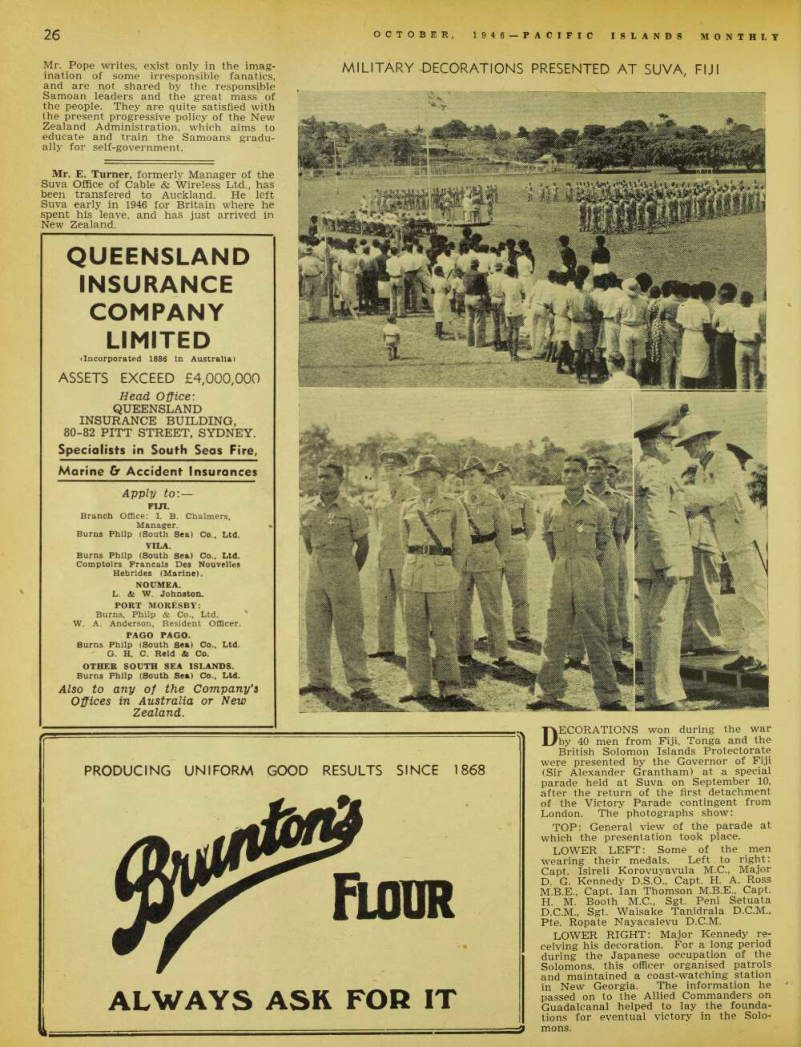
W. Samoa Under The Microscope
Chicago "Tribune's" Attentions Are Not Well Received
Prom Our Own Correspondent
Apia, Sept. 23.
IN June last, two newspaper correspon dents paid a fleeting visit to Western Samoa and, as a result, the Territory has been in the journalistic limelight in such newspapers as the Auckland Star, New Zealand, and the Chicago Tribune —widely divergent and remote in place of publication and in attitude and policy.
Mr. Clive Tidmarsh, Auckland Star representative, has in a series of four articles captioned “Western Samoa needs a new deal,” “Health and education ser vices are behind the times in Western Samoa,” “American influences in Samoa are strong,” “Native timbers in Samoa for N.Z. market?” and “New Zealanders own rich nest-egg in Western Samoa,” reviewed the present and past activities of New Zealand in Western Samoa and freely criticised the shortcomings of New Zealand Administration.
At the same time, the writer has sup plied some sensible and constructive criticism and suggestions for improve ments in Government policy. He has de served the thanks of all inhabitants of Western Samoa by impressing on the New Zealand people and Government the grievances and the needs of the Terri tory and by making it clear that West ern Samoa is absolutely self-supporting and does not owe New Zealand a penny, neither does she require any financial assistance for future development. The inhabitants of Western Samoa, Euro
peans and Samoans, should therefore certainly have the right to be consulted and considered in political, economic and financial matters affecting their interests.
WHILE Mr. Tidmarsh’s articles have earned favourable comment in Samoa, this is not the case with the articles published by the Chicago Tri bune representative, Mr. Quentin Pope.
Pope, when in Samoa, was given the cold shoulder by officials as well as by residents, as he was obviously looking for trouble and scandal in tune with the well-known anti-British attitude of his employers.
Pope accused New Zealand of exploit ing Samoa through the New Zealand Re paration Estates and through the banana trade monopoly. He also represents the Samoans as claiming that they never ceased to be an independent nation, and that New Zealand, in holding Samoa, is violating solemn pledges given by Bri tain, America and Germany. Further more, that the German surrender did not mean that sovereignty was to be trans ferred, as Germany never held Samoa.
These statements the Prime Minister of New Zealand has rightly described as “just another instance of journalistic pandering to the anti-British Common wealth complex of the Chicago Tribune Mr. Fraser also declared that New Zea land has never made one penny out of Samoa, nor is there any wish to do so.
It is true, however, that the Samoans have asked the New Zealand Govern ment to transfer the profits of the New Zealand Reparation Estates to the Samoan Treasury, to assist in public ex penditure; and so far as is known the New Zealand Government has agreed to do so.
The claims of the Samoans, of which
Mr. Pope writes, exist only in the imag ination of some irresponsible fanatics, and are not shared by the responsible Samoan leaders and the great mass of the people. They are quite satisfied with the present progressive policy of the New Zealand Administration, which aims to educate and train the Samoans gradu ally for self-government.
Mr. E. Turner, formerly Manager of the Suva Office of Cable & Wireless Ltd., has been transfered to Auckland. He left Suva early in 1946 for Britain where he spent his leave, and has just arrived in New Zealand.
Advertisements & other items, pp. 27-28 (1 item)
W. & A. Gilbey Ltd.
COMPLEXION PERFECTION
WITH
i
DISCRIMINATING WOMEN
ALLURING LOVELINESS
• Obtainable At All Stores.
Distributor:
GORDON K. SMITH
Beverley Hills, Sydney
FOR
WHO DESIRE
DON'T SAY (p I DON'T SAY fp |% T DON'T SAY C 1 «lIV DON'T SAY ft SAY fp I f% T DON'T SAY DON'T SAY ft 1 1\ DO J DON'T SAY ft |\ T ft I M DON'T SAY ft/ SAY DON'T SAY ft I]\ DOT f *'<*' e 'm: mT m ary B I, 11% DON'T SAY 1/ 1 MMMMM MY C wwv* •~wvvs y I ?V
ft 1 M DON'T SAY
DON'T SAY ft 1
ft I M DON'T SAY
DON'T SAY ft ( ft
ft I N DON'T SAY ft I j\ DON'fT DON'T SAY GIN DON'T SAY GIN DON'T S AY * Ll Ou H e A6 To °Ur n e
C OQ
**Al
SAY
cs * ydn
W HI
I IN
e y SK,p r ish
'T SAY
S a
DON'T
Telegrams and Cables: “GILBEYS,” Melbourne.
Address all inquiries to:
W. & A. GILBEY LTD.
33 ROSSLYN STREET, WEST MELBOURNE. 109 REGENT STREET, SYDNEY.
Telegrams and Cables: “GILBEYS.” Sydney.
QUEENSLAND
INSURANCE
COMPANY
LIMITED
• Incorporated 1886 In Australia)
ASSETS EXCEED £4,000,000
Head Office :
QUEENSLAND
INSURANCE BUILDING,
80-82 PITT STREET, SYDNEY.
Specialists in South Seas Fire,
Marine Gr Accident Insurances
Apply to:—
Fin.
Branch Office; 1. B. Chalmers.
Manager.
Burns Phllp (South Sea) Co., Ltd.
VILA.
Burns Philp (South Sea) Co., Ltd.
Comptoirs Prancais Des Nouvelles Hebrides (Marine).
NOUMEA.
L. <k W. Johnston.
PORT MORESBY:
Burns, Philp & Co., Ltd.
W. A, Anderson, Resident Officer.
PAGO PAGO.
Burns Philp (South Sea) Co.. Ltd.
G. H. C. Reid & Co.
OTHER SOUTH SEA ISLANDS.
Burns Philp (South Sea) Co., Ltd.
Also to any of the Company's Offices in Australia or New Zealand.
PRODUCING UNIFORM GOOD RESULTS SINCE 1868
ALWAYS ASK FOR IT
Military Decorations Presented At Suva, Fiji
Decorations won during the war by 40 men from Fiji, Tonga and the British Solomon Islands Protectorate were presented by the Governor of Fiji (Sir Alexander Grantham) at a special parade held at Suva on September 10, after the return of the first detachment of the Victory Parade contingent from London. The photographs show: TOP: General view of the parade at which the presentation took place.
LOWER LEFT: Some of the men wearing their medals. Left to right: Capt. Isireli Korovuyavula M.C., Major D. G. Kennedy D. 5.0., Capt. H. A. Ross M.8.E., Capt. lan Thomson M.8.E., Capt.
H. M. Booth M.C., Sgt. Peni Setuata D.C.M., Sgt. Waisake Tanidrala D.C.M., Pte. Ropate Nayacalevu D.C.M.
LOWER RIGHT; Major Kennedy re ceiving his decoration. For a long period during the Japanese occupation of the Solomons, this officer organised patrols and maintained a coast-watching station in New Georgia. The information he passed on to the Allied Commanders on Guadalcanal helped to lay the founda tions for eventual victory in the Solo mons.
Advertisements & other items, p. 29 (2 items)
27
I ACIFIC ISLANDS MONTHLY OCTOBER, 1946
Ipana
"I'm sure if you use it once. Miss Barry, you'll always use it” . . . (says the Chemist) wm £ n . . because you'll find Ipana refreshingly different. Ipana won't work miracles, but it
WILL CLEAN YOUR TEETH
thoroughly and make them look their brightest and best."
IPANA
does all a tooth paste CAN do for your teeth and gums It cannot restore teeth that need a dentist's care, but Ipana does help to preserve your teeth by keeping them clean and white and glistening. Food particles are less likely to lodge against teeth so thoroughly cleaned. A good up-and-down brushing with Ipana after every meal is an excellent way to keep your teeth sound and healthy and
brilliantly gleaming.
Even dentists themselves choose Ipana for their personal use 3 to I over any other dentifrice. A National Survey revealed this fact for guidance.
IPANA TOOTH PASTE
Sold by all leading distributors and manufactured by: BRISTOL-MYERS CO. PTY. LTD., 223 PACIFIC HIGHWAY, NORTH SYDNEY. N.S.W., AUSTRALIA 3574 A
Achievement By Samoan
Soldiers' Mothers
Apia, October 1. rE Mothers’ Club of Apia, Samoa, was founded in 1943, when Mrs. M, Jessop, mother of 4 sons in the New Zealand armed forces, and a few other Apia ladies, realised that something should be done to welcome and assist our fighting men of Samoa when they returned home. The Mothers’ Club was formed to give “Welcome Home” func tions and collect funds to make presenta tions to returned soldiers. About 50 ladies joined the club, which gradually became a popular institution.
The attendances were particularly large and credit is due to the organising genius of Mrs. M. Jessop, Mrs. C. King, Mrs.
Godinet and their willing band of hard workers.
The Mothers’ Club, terminating its war activities, announced the results of 3 years’ war service. Of a total of £1,051 collected by the Club, the Club paid out £492 in expenses for dances and enter tainments, while the balance of £559 was presented to soldiers from Samoa. The families of 4 soldiers killed in action received £lO each, and 25 soldiers received £lO each on their return home. 10 soldier sons of members, not returned home, received £lO each. 19 sons of parents in Samoa (non-members of the Club) re
ceived £5 each. In all 59 soldiers from Samoa received presentations. The Mothers’ Club donated £1 each to Samoan boys' who enlisted in Fiji, and made a contribution of £5O towards the Apia Ex- Servicemen’s Associations’ Memorial Tablet.
in Fiji
New Education Facilities in Fiji
PLANS have been made for the estab lishment of a new Government Teachers’ Training College at the former Queen Victoria School site at Nasinu, near Suva, Fiji.
The site was used during the war for a military hospital, and use is to be made of some of the hospital buildings, to gether with the original Queen Victoria School buildings, in setting up the new College. Accomodation will be provided for 180 students, but provision has been made for expansion later to take 240.
Before the war, the Government Teachers’ Training College was at Nata bua, near Lautoka. In 1940, the College was taken over as a military camp, and the school moved to the Methodist Training Institute at Davuilevu.
Queen Victoria School is still in a temporary home at Nanukuloa, but it is proposed to re-establish it about ten miles from Lodoni.
Abemama
New Administrative Centre For G and E Colony
rpHE new administrative establishment X of the Gilbert and Ellice Islands Colony, which was formerly at Ocean Island, is to be at Abemama Atoll, in the Gilbert group; and preparations are afoot to erect the necessary buildings.
There is little community of interest be tween Ocean Island and the G & E Col ony. But on Ocean, owing to the large phosphate workings under the British Phosphate Commission, there is a large European community; and it was found convenient to have the administrative establishment there also—communication with the atolls being maintained by the motor yachts “Nimanoa” and “Kia-Kia.”
The Residency building on Ocean was one of the largest and finest in the South Seas.
The Pacific War almost entirely de stroyed this set-up. During the Japs’ two years’ occupation of the Gilberts, the installations and buildings on Ocean were smashed; the Residency was practically demolished; the secondary establishment at Tarawa Atoll was completely destroyed; and the useful vessel “Nimanoa” was sunk. It became necessary to rebuild, not only the G and E Colony establishments, but also the British Phosphate establish ments on Ocean and Nauru islands.
Apparently, it has been decided to sep arate the Ocean Island set-up from the G and E Colony administrative set-up; and, for this purpose, one of the Gilbert Islands atolls has been selected as the site of the future administration.
The choice lay between Butaritari, Tarawa and Abemama, each of which has a good lagoon capable of sheltering large ships. Butaritari probably is the best, but it is too far north; the main islet at Tarawa, which formerly housed a con siderable establishment, was stripped bare by the Japs, when they prepared for the terrible Battle of Tarawa; so the obvious choice was Abemama. There was one other possibility—Tabiteua, a large atoll, and the most heavily populated of all. It has more than one claim to notice —but probably its lagoon does not offer the same shipping accommodation as Abe mama.
It is reported that the plans for Abemama include the erection of 30 houses for Europeans, 70 houses for natives, and the provision of a light and power station, water supply and a sewer age system.
Thanks To
Rev. A. P. H. Freund
(A Letter to the Editor) PERMIT me, through the medium of your paper, to express my appre ciation of the article written by Rev. A. P. H. Freund in your August issue.
Knowing the Territory in question very well, and the men who have been men tioned in the report, lam glad Mr Freund so ably placed the expedition of March, 1942, before your readers. I feel that he thereby cleared us of a lot of mis-apprehensions created by previous reports, I do not think that the gallant deeds done by the New Guinea Volun teers have been sufficiently recognised.
Let me therefore thank the writer for his report, especially for the high praise he gives to the captain and his associates who undertook such a dangerous task.
I am etc.,
V. Roschade.
Blackwood, SA, 23/9/46.
Advertisements & other items, p. 30 (2 items)
28
OCTOBER, 1946 PACIFIC ISLANDS MONTttLt
Cordage and
Periodicals . . . Trade Journals
American, English and Australian Periodicals and Trade Journals posted direct to you.
The N.S.W. Bookstall Co. Pty., Limited can supply all available overseas and local subscription magazines. Subscription Lists Available Let us know your requirements. on Application.
N.S.W. BOOKSTALL COMPANY PTY., LTD.
Market and Castlereagh Streets, Sydney, AUSTRALIA.
Scott’s “Renown” Brand Rope,
Cordage and
Binder
Cable Address Ropeyard, Sydney. ; *
Twine
of Every
Description
MANUFACTURED AT
MASCOT, N.S.W.
By
J. SCOTT
PTY. LTD.
Head Office and Store
163 CLARENCE STREET,
SYDNEY,
N.S.W.
Regular Product of Samoa
Papain
From Our Own Correspondent APIA, September 24.
TSHE suggestion in the recent article in the “PIM,” “Why Not Papain from Pacific Pawpaws?” that nothing of this sort is now being done in the Pacific Islands, is incorrect.
For nearly 40 years papain has been produced in Western Samoa, in fairly large quantities. In 1937, for instance, we exported 1,770 lb., of an estimated value of £37s—half to United States and half to Europe. The export is still going on, to United States and Canada.
The principal producer, during the whole of this period, has been Mr. K.
Meyer, of Siusega, who has trained some of his Chinese plantation workers to dry the papain on sheets of glass, in small dryers, heated by kerosene. The finished product is packed in ordinary 4-gallon kerosene or benzine tins, and soldered air tight.
The tapping of the pawpaws is done by Samoan women and girls, who are paid a fixed rate per pound for the raw juice.
As pawpaws grow wild and quickly, and in great profusion on any new land cleared for cultivation, the production of papain could be a useful by-product for any tropical planter.
On September 24, the Governor of American Samoa, Captain H. A. Hauser, USN, with a large party, arrived in Apia, Western Samoa, on his first official visit since the war. An official reception and dance took place at the Administrator’s residence at Vailima.
"Freedom" Under The Condominium
Condominium
(A Letter to the Editor) IHAVE no wish to enter into a contro versy on the vexed subject of New Hebrides administration, but I would suggest to my friend Captain Hilder that, perhaps, the impressions of an experi enced administrative officer who recently occupied almost all senior posts on the British side of the Condominium might be more reliable than those of a ship’s officer who some 10 years ago called, on occasion, at many ports in the group.
Might I, however, thank the Captain for generously admitting that the facts set out by me were correct, even if my con clusions do not agree with his own.
Actually, to my mind. Captain Hilder’s bright article and his cheerful admissions amount to a greater indictment of the Condominium system than my effort.
Captain Hilder, however, does make a great mistake when he assumes that as a “pompous public servant’’ I appear to be in favour of the introduction of more officials to this benighted group. On the contrary. I feel, that the Condominium system has resulted in far too much duplication of officialdom, with the natural result that stagnation has ensued.
I wonder if Captain Hilder can visu alise the state of affairs that would re sult if the ship he commands were run on similar lines two captains, two chief engineers, and every other post dunlicated. Certainly, there would be « lot of freedom on a ship like that, for everything would end in chaos.
No. Captain Hilder. what I want to see is this wretched Condominium system thrown into the discard: and. that be impossible, then a reduction in the number of officials and an increase in
their efficiency.
For instance, the number of Joint Regulations issued during the War years became so great that it was impossible for the average citizen to follow them or keep their purport in mind. Yet prose cutions for breach of these regulations were quite common, especially on the British side. The French mostly treated them with their usual levity.
I am .afraid that Captain Hilder is apt to confuse the freedom which, he says, existed in his own time, with the license which was apparent in my own This was especially rampant in the liquor trade; but, judging from my friend’s views on freedom he probably would have been delighted in the care-free way in which French operator, under the nose of authority, sold quantities of Australian spirits to American Gl’s at anything up to £7 a bottle! Those were the days of freedom, alright. Vive la Condominium!
I am etc.,
Alexander Rentoul.
Cremorne, Sydney, 26/9/46.
No Coal For Fiji
THE failure of Australian miners to produce enough coal to meet all demands, owing to strikes and other troubles, has created new problems in Fiji, where various installations depend upon Australian coal supplies. Some Public Works engines have been switched over to the less satisfactory firewood—others are being closed down.
As the Australian coalfields position is not likely to improve, Fiji should seri ously consider the introduction of alter native sources of power. If there is no fuel substitute for coal, as a source of power, it might be possible to harness some of the big streams on Viti Levu. and get hydro-electric power.
Advertisements & other items, pp. 31-32 (1 item)
The Last Word
4 IM I At \F
in 16m.m. Sound Film Projectors!
Victor Animotophones, the world's finest 16 mm. sound motion picture projectors, ore proudly presented to Australia by Pyrox Pty. Ltd. This superb equipment provides perfect clarity of vision and high fidelity of sound, combined with portability, ease of operation and moderate cost.
Victor Animotophones are equipped with the latest controls and devices for easy setting up—simple threading—starting— reversing—stopping—still projection—silent speed and sound speed for professionally perfect projection, microphone and pick-up. In addition to a super sound optical system, high fidelity amplifiers, swing-out lens mount, and magnificent illumination, * with complete safety, Victor Animotophones include these exclusive features: Patented film trip and dual flexo pawls to protect film; offset film loop, and spira-draft lamphouse for cool operation and lamp economy.
The Victor Animatophone is the ideal projector for modern training and entertainment. Full particulars supplied and demonstration gladly arranged by the Australian Licensees.
atm a
one
PYRftY PTY ITH CR> QUEENSBERRY Cr DRUMMOND STS., MELB. F 9121, rinUA ril. LIU. 18 ALBION STREET, SYDNEY. M 2271. « ♦ %% rx. m
PG2. HP
<r r: ■=?-c Artist’s impression of an
ATOMIC HELICOPTER
. . . future air express.
TIME MOVES FAST
but it will always
CAPSTAN
Missing Men Of
N. Guinea
Some Further Light on Their Fate
AN Australian officer , who was POW in Japan 1942-1945, wrote the follow ing in a private letter from Rabaul, dated August 23: I HAVE just seen a copy of the PIM of June, 1946, and I was surprised to note the following names shewn offici ally under “Missing—fate unknown”: DICKSON, J. F. At Manila, on my way back to Australia in September, 1945, I submitted an official notification of death, stating that this man died of dysentery in the prison camp at Rabaul in March, 1942. I understand that a similar statement was supplied by Chap lain J. L. May, AIF, who conducted the burial service. On my return to Aus tralia I met Mrs. Dickson and conveyed the sad news to her personally.
WILLMETT, W. P. This man was definitely of the party which left Mala guna Prison Camp on 22nd June, ’42, to join what I understand was the “Monte video Maru.” His name was included in the list of civilians supplied by me on reaching Manila, and the same informa tion was conveyed officially to Sydney in October, 1945.
A good portion of my first two weeks in Australia was spent in going from department to department, calling on firm after firm, people after people, doing my small best to clean up some of the clouds obscuring the fate of the Rabaul folk, and it is more than disap pointing to find that even now such glaring mistakes are still being made.
With regard to the following, I can understand them shown as “fate un known,” as my information only showed the position in 1942: Bachman, Badger, Beaumont, Chaun cey, Evensen, Fitzgibbon, Korn, Sher wood and Ostrom (initials unknown) were left behind at Malaguna Camp when AIF officers were moved out to Japan, in July, 1942.
Harvey, Mrs. Harvey and son, Manson and Parker were brought to the Mala guna camp for a few days about May, 1942; then taken from the camp, and we did not see them again, but were told by the Japanese that they had been executed for espionage.
Merrell, A.—Could this be J. F. Morel, who joined up with the Ist Indep. Co. when they endeavoured to make their getaway from New Ireland in the “In duna Star,” was captured with them, and was also in the “Montevideo Maru” party?
The above information was also con veyed to officialdom —not once, but sev eral times, either in Manila, Sydney or Melbourne.
Samoan Church Funds
"Evaporate"
From Our Own Correspondent Apia, September 24. fT\HE Samoans have collected large X sums for new churches in the last few years. In some cases, the funds have evaporated into thin air. In one case a village congragation deposited £BOO with a local trader who when asked for it could repay only £5OO. In another case, the village community had hidden a large amount of church money in a hole in the ground, but when they wanted to dig it up again all traces of it had disappeared.
Radio Broadcasts For Western Samoa
Western Samoa
From our own correspondent , „ Apia, October 1.
AMONG Administration projects an nounced at the recent Fono of Faipule is the creation of a Samoan Broadcasting Service, and the installation of receiving sets with loud speakers in all Samoan villages. The receiving sets are to be paid for by the villages, but the administration will undertake in stallation and upkeep.
It is intended to broadcast official announcements, debates of the Legisla tive Council and news in the Samoan and English languages, besides Samoan music and dancing, singing by individual artists
and choirs, band music and transmissions from records.
The superintendent of Apia wireless station has already commenced broad casting more or less as an experiment, and the results have been encouraging.
The Administrator (Colonel F. W. Voel cker) and the Fautua (High Chiefs) have given addresses over the radio.
Up to August 21, £4,788 had been raised in Fiji for the Fiji Gifts to Britain Fund. The Fijian natives are showing their customary generosity—no less than £620 has been subscribed by natives living in Suva. . Lieut. R. Genge, Flying Officer Theo Hansen and Trooper W. Sachs, returned recently to their homes in Fiji.
Advertisements & other items, p. 33 (1 item)
Ingram’S
Set your face up for the day with COOL, soothing, whisker-subduing
INGRAM'S!
All over the world the Ingram's jar is the morning companion of men who appreciate easy shaving. Ingram s cools and smoothes the skin while it wilts the wiriest hair-growth. Moreover, Ingram's is most economical because so little is needed for a rich, thick, spreading lather.
INGRAM’S
SHAVING CREAM
Manufactured by
BRISTOL-MYERS CO, PTY. LTD.
Sold by all leading distributors and manufactured by Bristol-Myers Co. Pty. Ltd., 223 Pacific Highway, North Sydney, N.S.W., Australia
Coast Watching In New Guinea
How Officials, Missionaries and Traders Carried On In 1942
IN this instalment, Rev. A. P. H. Freund, Lutheran Missionary, continues his account of how a loose organisation of civilians, missionaries and officials, risk ing their lives far behind the Jap lines, kept a watch over enemy movements in 1942, while the American-Australian attack was being built up.
rE Wareo Mission station, some 8 to 10 miles north of Finschhafen, and by a rough guess, some 1,500 feet above sea-level, has a bracing climate.
The violence of the South-east, and the red clay, which is particularly sticky in the season of almost daily rain, were two features that did not please us so well during our four-months’ stay. By an arrangement with the native teachers in charge of the station, we got all the milk (enough even for butter) and eggs we required—for the Mission cows, fowls and ducks were still there.
The natives from nearby villages were eager to get their share of the few trade goods we had, so they supplied us with plenty of vegetables. There were some good “shoot boys” among the locals, so once a week or fortnight a wild pig would be brought in. We always sterilised some of the meat with the mission equipment, so that we did not often have to touch our small stock of tinned meat. And our bread-baking efforts were always a great success.
With all tha£ and the natives most friendly and helpful, we had quite a pleasant life at Wareo. But we knew that if the Japs suspected our presence they could soon obtain all details, for the bayonet and other things are very efficient
information-extractors. There were often tense moments, at night, when “foot steps” awakened us—until a grunt, or the crunch, crunch of a grazing cow, in dicated that our visitors were four-legged.
Our instructions were to report all ships, aircraft and anything else we could learn about the enemy. But, right from the outset, we were kept so busy report ing planes that within a few days we received orders to report only large flights going in the direction of Moresby. And since all the Japs were apparently going to Lae first, our aircraft-reporting ended.
And ships were scarce. On June 25, 1942, we reported a freighter, and were later officially notified that it had been sunk when approaching Lae. On August 28, two more were spotted, but we never heard whether they had been despatched.
We Hear Tulagi Battle
SOME excitement was provided on August 8. Pursehouse had been for some days practising Morse reading or trying to pick up American bombers or fighters communicating with one another or their base. This day he got on to something that was really lively, and soon we caught enough information to see that the Americans were landing at Tulagi.
I cannot describe the whole action as
we heard it, but it was nearly as good as a ball-for-ball description of a test match, and far more exciting. And when the general order went over again and again, “Cease bombing Tulajgi, it has been occupied by our troops,” we cheered lustily.
We hoped this was the beginning of a general advance and that soon there would be a big push to wipe the Japs off the face of New Guinea. We even imagined ourselves as a reception com mittee for the incoming troops. Just as well we did not know that Guadalcanal and Tulagi were only an experiment, and that only after all the lessons had been applied and equipment perfected could we expect a general advance.
Mail Supplies And “Mac” -
ALTHOUGH we were in an out-of-the way place, we were not isolated. On July 3, the Army passed on by radio a message from my wife that my father had died just over three weeks previously.
And every few months mail would come through, most of the letters being two to four months old upon arrival. Some came seven or eight months after being written.
During this time, Harris began to get supplies and equipment dropped on the old Saidor air-strip and, in due time, sent a share to us. Thus, on September 23, when Pursehouse returned from the about 70 miles each way trek to Sio, to meet supplies sent down to us, I at last re ceived my first issue of military clothing, etc. By that time I had been serving for over seven months, A document also arrived indicating that two months pre viously I had become a Warrant Officer.
The supply of cigarette tobacco which also came along was quite a welcome change
from finely-shredded brus, which we had rolled in cigarette paper for three months.
The most important arrival on this occasion, however, was “Mac,” alias “ Oody,” otherwise Kenneth Hood Mc- Coll. He had been a plantation manager on Matty Island, one of the Western islands. Like Pursehouse and I, he had also been in the Coast Watching Organi sation as a civilian.
With a few others, who had been left behind when everyone else fled from that area, he had managed to get a broken down launch running. They came down to the New Guinea coast, and eventually reached Madang. Bill Tupling, who was later captured and beheaded in the Arawe area, on New Britain, was also in that party. By radio, Mac had joined the Navy, and was given the rank of Petty-Officer.
The last time I had a letter from him (some months before writing this article) he stated that he intended settling down on a sheep-station in Australia. He wields a good pen, so someone should induce him to write the story of their trip from Matty to Madang.
On October 7, we received a message from Harris that another lot of supplies and mail for us was about to leave for Sio, so next day I set off to meet it. When I reached Sio, the afternoon of the third day, nothing had arrived.
I had cached most of my food on the way, to lighten the carrier loads. I had to wait a whole week until Bell and Hall arrived. Olander and party were at Kiari, so I tried to get food from them. A flooded stream blocked the messengers for several days, but they managed to get through and back by the time I was reduced to the last scrap. By the time I returned to Wareo, a whole fortnight had elapsed.
Transfer To Sattelberg
FVE days after. my return we shifted over to Sattelberg. The change of seasons meant that now there would be less cloud and fog to hinder our ob servations from there. Living conditions deteriorated, for we obtained little milk and vegetables, and the hunters rarely brought a pig.
We now had to begin giving regular weather reports. And, since Mac also had a teleradio, we could practise reading Morse by transmitting to each other with disconnected aerials. Medical work among the natives also took some of our time.
It helped to keep the natives on our side.
This was recognised at headquarters, so NAB had been among the supplies dropped for us at Saidor.
On November 12, Pursehouse left on a final trip to Sio. Harris’s party had been formed into four groups, and they were leaving the Rai coast for the ill-fated undertaking of establishing watch-posts on various points of Nef Britain. They had divided up all the available supplies, and we were to get a share.
The day Pursehouse left he sent a note back to tell us the news of a Jap machine gun attack on a canoe and village at Taml.
Yanks Come At Last
ON November 15 we spotted the first American bombers—three Mitchells.
They were slowly cruising along the coast at low altitude. Over Finschhafen they circled. As they banked, my tele scope picked up the white stars on the tops of the wings. What a thrill! Dur ing all the preceding months, every one of the numerous planes coming within telescope range had shown that dirty red blotch on its side.
That was the beginning of a complete change during the next few weeks, so that soon it became almost a rarity to
see a Jap plane, while the Yanks were coming and going freely.
On November 19 we sighted and reported two Jap cruisers. Three days later four large destroyers passed up through Vitiaz Strait.
That evening after dark, about 7 o’clock we heard planes circling over Finsch hafen. Next came the vicious hiss and thunder of five bombs, dropped in quick succession. The shock of one of them could be distinctly felt where we were.
Next day, we learnt that they had been dropped around the village of Kamlaua, just on the northern outskirts of Finschhafen, and that an injured man had died of loss of blood.
Why had the Yanks dropped bombs there? A query to Moresby brought the reply that they had been bombing a destroyer 15 miles off Finschhafen. We wondered what would have happened if
the destroyer had been only seven miles off. With similar faulty navigation they would then probably have been bombing us at Sattelberg. Actually, we believe that they saw a fire in the village, thought the destroyer they were after was burning, and let fly.
Fireworks In Earnest
VTEXT day, November 24, about 5 p.m., li we were just twiddling with the dial - of our receiver, when suddenly we heard Bell, who was on our mission station at Awelkon (Rooke Island) coming in in a great hurry on the emergency fre quency.
Not knowing his key-word, we could not decipher his message, but he gave us the clue when, at the end of his mes sage he said, “Just a moment. I forgot something. Add to that message the words, ‘Course south-east.’ ”
Knowing where he was, those words could mean only one thing—namely, that a ship or ships were on their way down Vitiaz Strait, in our direction.
We kept our eyes peeled, hoping some thing would come into view before dark.
But our luck was out.
Just after Mac and I had finished our evening meal we heard bombers come growling over, and soon a line of flares just off the coast illuminated the heavens and the sea, to be replaced as soon as they had died down. At the same time, the rain of bombs began, usually in sticks of five. Soon one of the ships was burn ing.
The Jap ships had scattered, for it was not long before there were bombs burst ing in the direction of Tamigidu, and others in the direction of New Britain.
Neither ships nor planes were visible to us. From our “grandstand” position it was just an awe-inspiring fireworks dis play. Vicious anti-aircraft fire from the ships and streams of tracers from the planes added to the spectacle.
Within an hour the magazines on the burning destroyer began blowing up, so that at intervals of half an hour or so fierce sheets of flame shooting skywards replaced the red glow. If one could have forgotten that thousands of human lives were involved, it would certainly have been an outstanding entertainment.
The burning ship had made its way out to sea, as long as it could. Though it was evidently doomed, the Yanks were still dropping bombs on it. We timed one stick. There was a long interval, so that there was no possibility of a mistake.
From the time of the vivid blue flashes, till the five-fold thunder reached our ears, it took two and three-quarter min utes. Calculating on the speed of sound, we found that they had burst just about forty miles away. Even at that distance they were quite loud enough.
By 10 p.m., the bombing was over. So Mac and I went in to play cards. While one dealt, the other would go out to keep an eye on the burning ship. The ex plosions had ceased by now. Somewhere about 11.30 it disappeared. We missed the final explosion.
Information obtained from Moresby showed that five destroyers had been try ing to get to Lae. This was part of the Japs’ desperate efforts to break through our aerial blockade. Three of the five were claimed sunk, while the other two escaped north-westwards.
Luck Of Two Survivors
DURING the action we realised that losses were probably inflicted on our side also. Sure enough, next fore noon a native runner brought a note from Rev. A. Wagner, the German missionary still at Heldsbach, that two American airmen had come ashore during the night, that they were slightly injured, that he had bandaged and fed them and put them to bed, and that as soon as they were able to travel he would send them up to us.
We immediately sent a report to Moresby, and then Mac went down to help care for them.
Next afternoon they arrived with Mac.
Wagner had supplied the one with a horse and the other with a stretcher and c^rrisrs Wagner’s report that they were “two Americans” was not quite correct. One was a Brisbane boy from the Indooroo pilly area, Johnny Graham by name. He was a wireless air-gunner. The Ameri cans were short of radio men, so most of the planes in that particular bomber group had Australian wireless air-gunners.
The other was Joe Champagne. To use his own words, “My home is in Connecti
cut in a little town of about ten thousand inhabitants—Moosup by name.”
Both were still badly shaken. Their Mitchell had crashed a few miles off the coast. How they were thrown out or scrambled out they could not recollect.
When they came to the surface they found the rubber life raft ready inflated floating beside the sinking plane. They righted it and searched for other survivors. One of their mates floated by—dead. There was no sign of life anywhere. The plane was sinking fast, so they had to cast off.
They either did not know or did not trust the breaking strain of the line.
Neither had a knife. In the darkness they could not find the one in the raft equip ment. They tried to gnaw the rope through. It was too tough, so in des peration one of them opened with his teeth the hook which joined the line to the plane.
They had no idea of where they were, beyond that they were somewhere off the north coast of New Guinea. Neither did they know the distance or direction of land. Fortunately, there were thunder storms about, and a few brilliant flashes of lightning revealed the land. They settled down to paddle ashore, but Graham found now that he could not hold a paddle. His hands were badly cut. So he gave orders while Champagne paddled.
The coast between Finschhafen and Heldsbach is composed mainly of coral shelves on which, even in calm weather, the swell breaks constantly. Here they were heaved ashore, and Johnny Graham cut his feet and knees badly on the jagged coral, for he had lost his boots.
They sat on the rock till daylight.
Then they cut up the raft in an attempt to make some sort of footwear for Johnny.
Shorts were their only clothing. They did not even have caps. They removed the chocolate and other emergency rations and equipment from the raft and hid it.
Taking the paddles with them, they struck inland.
We, to whom New Guinea has become a second home, cannot imagine how these lads —only about twenty years old —felt.
The enemy might be close at hand. At any moment they might be captured or killed. There might be hostile natives.
Or they might be far from any human being, white, brown or yellow, with the prospect of foodless and guideless wan dering.
Less than half a mile inland they came out on the Finschhafen-Heldsbach Road.
Here they saw and were seen by a native, who took them to Wagner.
When they reached Sattelberg they were again fully clad in what we and Wagner had provided for them. The native teacher in charge at Sattelberg opened one of the guest-rooms attached to the old school-house. It was several chains from the house we were in. Next morning Johnny and Joe told us they .had been scared by every little noise dur ing the night, thinking the Japs were prowling around. They asked for a gun, so we gave them a .303 with a full maga zine next evening, and with that under Johnny’s bed they slept better thereafter.
A Drop For The Airmen
MEANWHILE, we had informed Mores by, and arrangements were made to drop equipment, clothing and food for the long overland trek of the airmen to Wau, via the coast to Bogadjim, the Ramu valley and the Markham. It was arranged that the drop take place on the mission airstrip near Heldsbach, but no definite date given.
On December 2 I went down to wait.
On the sth, three Mitchells came flying low and circled along the coast and out
to sea. But they would not come in over the strip, and eventually flew away without dropping anything. We later learned that they had really not seen the strip.
Next day, they were back again. But this time, as we learned from a note in one of the packages, Leigh Vial was with them to show them where to drop.
Great was the joy of Johnny and Joe when I returned. What thrilled them most were the automatic pistols and big, gleaming machets. What intrigued us a lot was the variety and clever arrangement of the emergency equipment. There was a whole range of little metal shells with patent caps, some containing fish lines and hooks, others with matches, quinine, salt, adhesive plaster and many other things.
But our guests figured that there should have been some other items besides. A check with Moresby revealed that they had dropped one bundle more than the number we had found. So on December
10 I went down again. I met a native who had found the bundle in the bush.
While I was opening it, and making up the loads for the carriers, a Jap plane came over. I had difficulty in hiding my horse among the short secondary bush.
He went down as far as Finschhafen and came" back over us again.
He or his twin had been over the pre vious day. I feared that he might then have seen the parachute hanging on the bushes and, since it was now missing, decided to investigate.
He kept flying back and forth, coming lower with each run, and keeping me busy dodging under and around the only pair of bushes bip- enough to hide the horse. Every time he came over I ex pected the machine-guns to start bark ing.
Then he made a slightly longer run down towards Langemak Bay. So I jumped on and galloped for the bigger timber. I was barely there when he
was over again, this time so much further inland that he was directly over me again. It looked suspicious. But after another short run back, he turned and flew off to the north.
Events nine days later indicated that he had been reconnoitring the area in preparation for the Jap landing.
Another Addition To Party
rpHE day before the drop, Pursehouse JL had returned from Sio. With him came Ken Douglas who. with Bert Olander, had been left on New Britain the time we helped to take off the rem nants of the Rabaul garrison.
After a few months the natives turned hostile. So Douglas and Olander retreat ed to the western end of New Britain.
Neumann and Smith were instructed to go over in our former mission pinnace, the “Awelkon,” to take them off. It was during the height of the South-east.
Neumann and the “Awelkon” had been through many a “Vitiaz dust-up” before, but this trip was the worst ever. They did not even know exactly where to find Douglas and Olander. More by instinct than anything else, they went right to them in the middle of the night, and cleared out with them.
Thereafter, Douglas had been with Harris at Yaula, and when Harris’s party was divided up for the New Britain watch-posts, Douglas was to be a mem ber of the ill-fated Cape Gloucester party.
But his old malady, asthma, came on in a bad form, so he was left with Purse
house when he met the parties at Sio, and thus came to us.
This was the solution of our problem.
We could not very well expect the air men, who had had no experience in New Guinea before, to get through to Wau.
None of us three could very well go along, especially since just at this time orders were received that Pursehouse and Mc- Coll should move along the mountains and establish a watch-post overlooking Lae. By sending the airmen out under the escort of Douglas, they had an ex perienced leader, and he had company and some one to care for him if he be came worse.
December 12 was a red-letter day. That day we were a “crowd” at dinner—seven in all. Wagner had come up to have some teeth drawn by Mac. That was the largest number of us ever together in that area.
Wagner
A FEW words will be in place on our relations with Wagner. Because he had gone into hiding when he saw that the Japs would probably soon invade, and that he might have been taken to Aus tralia for internment just before that would happen, he was suspected by people who knew no better of being pro-Japan ese. Though the Japs were theoretically the Allies of his nation, Wagner had no illusions about them. He knew that Jap anese domination in New Guinea would mean the end of mission work. Further more, he had no time for Nazism. His father-in-law was suffering in a concen tration camp in Germany as one of Hit ler’s victims. Harris, Pursehouse and McColl had gone into Wagner’s case carefully, and established the fact that when Wagner cleared out just before the order to go to Australia reached him, he had done so purely from the desire to stay at his mission work.
When Pursehouse and I arrived at Wareo, Pursehouse visited Wagner. Wag ner told him that he wanted to stay neutral. But it did not take long before it was apparent that he was neutral on our side. And he gave us to understand that if he heard cf any Jap movements in our direction we would certainly hear of it. We found later that he had im pressed on the natives around that area that they should help us wherever pos sible, and warn us of any danger.
That was why the Japs killed Wagner, despite his nationality, when they later got him into their control, and found out what he had done for us.
Departures
rE day after we had the. “crowd” to dinner, Pursehouse and McColl set out on their assignment behind Lae. Two days later Douglas and the airmen also left. That left me entirely alone.
As is only natural after two parties have selected and packed food and equip ment, there was fair disorder to straighten out. Work is good for a lonely man. Be sides keeping an eye on sea and air, maintaining “skeds” and giving weather reports, I had several busy days taking stock, packing and nailing up boxes, and going over my clothes and equipment “just in case.4’ Then I hoped to settle down to a pleasant time with books and the radio for companions.
Little did I realise how soon the Japs would have me moving. But that story will have to wait.
Mr. Richard de Lambert, who had been United States Consul in Tahiti for five years, left Papeete recently for Lima, Peru, where he is to be Secretary to the US Ambassador. Mr. and Mrs. de Lam bert made a host of friends in Tahiti.
Advertisements & other items, pp. 34-38 (1 item)
William H. Watson
ESTABLISHED 1930
RAROTONGA, COOK ISLANDS
Wholesale and Retail Trader
LICENSED STAMP DEALER
Agent For:—
BRITISH TRADERS 7 INSURANCE CO.
CORONA Gr L. C. SMITH TYPEWRITERS
KAISER Gr FRAZER MOTOR CARS
B.S.A. CYCLES AND MOTOR CYCLES
AMERICAN LEAD PENCIL CO.
WHITES AVIATION LTD.
Manufacturers of: FOOTWEAR, ALL CLASSES SUITABLE FOR NATIVE TRADING . . . M.O.P. PRODUCTS, INCLUDING ROUND EAR-RING BLANKS AND BUTTON BLANKS Exporter of: “Rarotonga” Hula-Skirts.
Sea-Shell Necklaces.
M.O.P. Jewellery.
Island Produce.
Wholesale and Retail Inquiries Invited.
Prepared to Consider Agencies tor all Class of Goods.
Importer of: Textiles.
General Hardware.
Fancy Goods.
General Merchandise.
Cable Address: “Watson” Rarotonga Bankers: Bank of New Zealand, Auckland.
NOBODY WANTED ME
I saw it happening day after
day. Old friends forgetting to
ring me . . . even avoiding me. m Xr V
WHERE'S HILDA?
I THOUGHT SHE
WAS COMING.
r IM GLAD SHE
DIDN'T. SHE'S A
REAL WET BLANKET
NOWADAYS !
r I OWE
HER A'PHONE
. CALL BUT...
BUT
LIKE ALL
THE OTHERS
SHE DIDN'T
I LOOK AWFUL
WONDER TIRED OUT
/ BEFORE I START THE
OAT. THIS CAN*T GO
ON . ID BETTER SEC
DR. LAWRENCE
r
S/X WEEKS
LATER
whos that m
WITH
HILDA ? S JOHN
HARDING
- THEY'RE
ENGAGED
9 ■ I £ m
REjiga
O
DOCTOR: ITS A VICIOUS
CIRCLE. YOU'VE BEEN WAKING
TIRED. GETTING MORE AND
MORE TIRED EVERY DAY,
AND FINALLY BECOME
RUN DOWN AND NERVY.
THE TROUBLE GOES BACK TO
YOUR SLEEP. WHILE YOU SLEEP
YOUR BODY GOES ON BURNING
UP ENERGY, AND WHEN THIS
ISN'T REPLACED YOU WAKE TIRED.,.
THEN THE TROUBLE STARTS . DRINK A
CUP OF HORLICKS BEFORE BED
AND REPLACE THAT ENERGY
Tired, nervy all the time?
Tiredness that starts when you get out of bed. Sudden fits of jumpy nerves. That awful, worn out, “don’t care” feeling. How does it start? Whilst you sleep!
Every night your body uses up energy. Heart and lungs go on working as you sleep. Naturally, if energy isn’t replaced, you wake tired, and that wornout feeling never leaves you. You need Horlicks to help replace that energy. After Horlicks you should wake refreshed, full of life and energy. Your grocer or chemist has Horlicks.
HORLICKS
Contains all essential food elements and necessary vitamins in their natural form.
IMPORTERS
EXPORTERS
All classes of merchandise purchased for Island clients throughout the South-west Pacific.
Island produce sold on Australian and overseas markets on a commission basis.
UM i
54a Pitt Street
I
Sydney
Cable Address : “ROBERGILL,” Sydney
r r \J sj />
LIKE A TRIFLE WITHOUT
Rich, velvet-smooth Foster Clark’s Creamy Custard is indeed essential for a trifle ... and the real enjoyment of other sweets, too! It’s always welcome! Would you like to try intriguing new recipes, which save on rationed butter?
Write for the free Foster Clark Recipe Book to Foster Clark (Aust.) Ltd.. Dept. R. 8.. Red fern, N.S.W., enclosing 2\d. post.
FOSTER CLARK’S
Myp
FCI 5
VICTORIA
BITTER
ALE
O
•IEII• IT
CARLTON & UNITED BREWERIES LTI.
v.l
Magazine Section
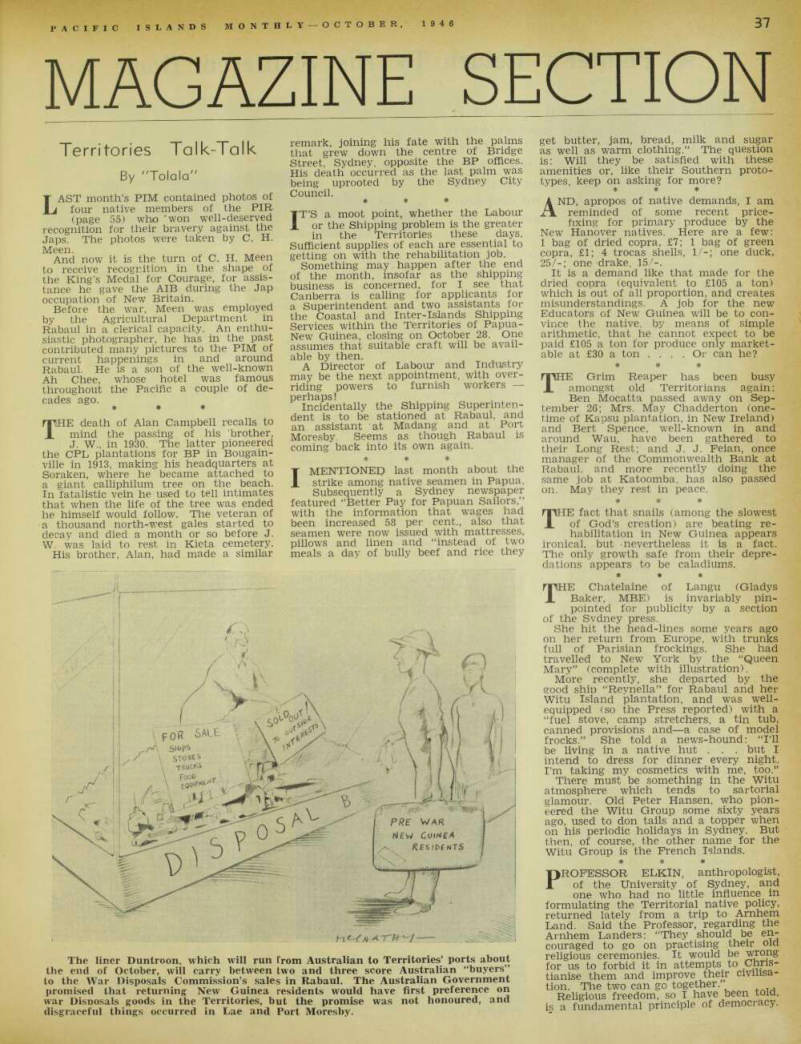
Territories Talk-Talk
By "Tolala"
LAST month’s PIM contained photos of f (naee wto ™won recognition for their bravery against the Ja p en The photos were taken by C. H.
And now it is the turn of C. H. Meen to receive recognition in the shape of the King’s Medal for Courage, for assis tnnrp he save the AIB during the Jap Spation of New Britain Before the war, Meen was employed h v the Agricultural Department in Rabaul in a clerical capacity. An enthu siastic photographer, he has in the past contributed many pictures to the PIM of current happenings in and around Rabaul. He is a son of the well-known Ah Chee, whose hotel was famous throughout the Pacific a couple of de rades ago L e * * ♦ r_ , - A1 E death of Alan Campbell recalls to mind the passing of his brother
the C^Pl/plantations Tor BP in Kite-
So£k'eV"hf berari 9 tta a ch e ed to a giant calliphilum tree on the beach.
In fatalistic vein he used to tell intimates that when the life of the tree was ended he himself would follow. The veteran of a thousand north-west gales started to decay and died a month or so before J.
W. was laid to rest in Kieta cemetery, His brother, Alan, had made a similar
remark, joining his fate with the palms that grew down the centre of Bridge Street, Sydney, opposite the BP offices.
His death occurred as the last palm was being uprooted by the Sydney City Council. * * * JT’S a moot point, whether the Labour 1 or Shipping problem greater Suffl I c n ient t^ ppl / e e s r " t °each areetlentol y to getting on with the rehabilitation job.
Something may happen after the end of the month insofar as the s^PP^g business is concerned, for I see that Canberra is calling for applicants for a Superintendent and two assistants ; for the Coastal and Inter-Islands Shipping Services within the Territories of Papua- New Guinea cl ° s f ir *£ u? ’oJqii assumes that suitable craft will be avail able by then. , mdn^rv A Director of may be the next appointment, with over riding powers to furnish workers perhaps! . , Incidentally the Shipping Supermten dent is to be stationed at Rabaul, and an assistant at M adang and at Port Moresby Seems as though Rabaul is comin S back “ to its , own a f in ' 1 MENTIONED last month about the 1 strike among native seamen in Papua.
Subsequently a Sydney newspaper featured “Better Pay for Papuan Sailors, with the information that wages had been increased 58 per cent., also that seamen were now issued with mattresses, pillows and linen and “instead of two meals a day of bully beef and rice they
get butter, jam, bread, milk and sugar as well as warm clothing.” The question is: Will they be satisfied with these amenities or, like their Southern proto types, keep on asking for more? ♦ ♦ ♦ AND, apropos of native demands, I am reminded of some recent price fixing for primary produce by the New Hanover natives. Here are a few: 1 bag of dried copra, £7; 1 bag of green copra, £1; 4 trocas shells, 1/-; one duck, 25/-; one drake, 15/-.
It is a demand like that made for the dried copra (equivalent to £lO5 a ton) which is out of all proportion, and creates misunderstandings. A job for the new Educators of New Guinea will be to con vince the native, by means of simple arithmetic, that he cannot expect to be paid £lO5 a ton for produce only market able at £3O a ton ... Or can he? * ♦ ♦ rE Grim Reaper has been busy amongst old Territorians again: Ben Mocatta passed away on Sep tember 26; Mrs. May Chadderton (one time of Kapsu plantation, in New Ireland) and Bert Spence, well-known in and around Wau, have been gathered to their Long Rest; and J. J. Feian, once manager of the Commonwealth Bank at Rabaul, and more recently doing the same job at Katoomba, has also passed on. May they rest in peace, ♦ * ♦ rE fact that snails (among the slowest of God’s creation) are beating re habilitation in New Guinea appears ironical, but nevertheless it is a fact.
The only growth safe from their depre dations appears to be caladiums. ♦ • * rE Chatelaine of Langu (Gladys Baker, MBE) is invariably pin pointed for publicity by a section of the Sydney press.
She hit the head-lines some years ago on her return from Europe, with trunks full of Parisian frockings. She had travelled to New York by the “Queen Mary” (complete with illustration).
More recently, she departed by the good shin “Reynella” for Rabaul and her Witu Island plantation, and was well equipped (so the Press reported) with a “fuel stove, camp stretchers, a tin tub, canned provisions and—a case of model frocks.” She told a news-hound: “I’ll be living in a native hut . . . but I intend to dress for dinner every night.
I’m taking my cosmetics with me, too.”
There must be something in the Witu atmosphere which tends to sartorial glamour. Old Peter Hansen, who pion eered the Witu Group some sixty years ago, used to don tails and a topper when on his periodic holidays in Sydney. But then, of course, the other name for the Witu Group is the French Islands. * ♦ ♦
PROFESSOR ELKIN, anthropologist,
of the University of Sydney, and one who had no little influence in formulating the Territorial native policy, returned lately from a trip to Arnhem Land. Said the Professor, regarding the Arnhem Landers: “They should be en couraged to go on practising their old religious ceremonies. It would be wrong for us to forbid it in attempts to Chris tianise them and improve their civilisa tion. The two can go together.
Religious freedom, so I have been tom, is a fundamental principle of democracy.
The liner Duntroon, which will run from Australian to Territories’ ports about the end of October, will carry between two and three score Australian “buyers” to the War Disposals Commission’s sales in Rabaul. The Australian Government promised that returning New Guinea residents would have first preference on war Disposals goods in the Territories, but the promise was not honoured, and disgraceful things occurred in Lae and Port Moresby.
Advertisements & other items, p. 39 (1 item)
37
PACIFIC ISLANDS MONTHLY— O C T O B E R , 1946
A Planter’s Return To His Shattered Home
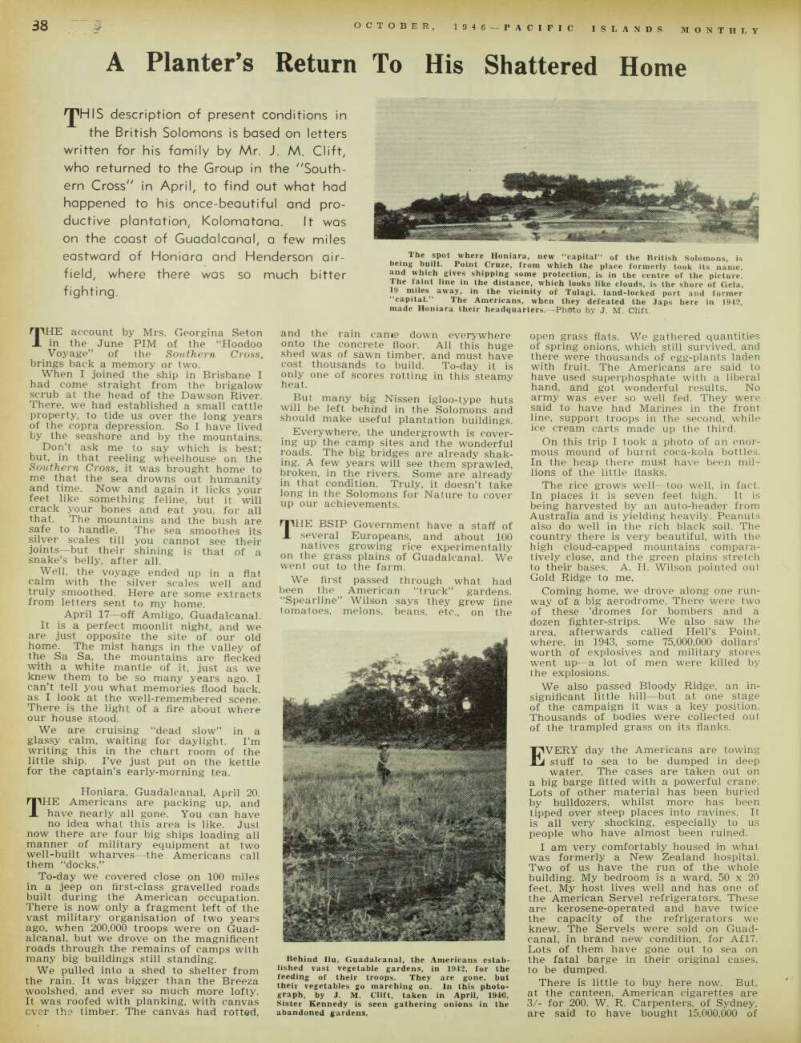
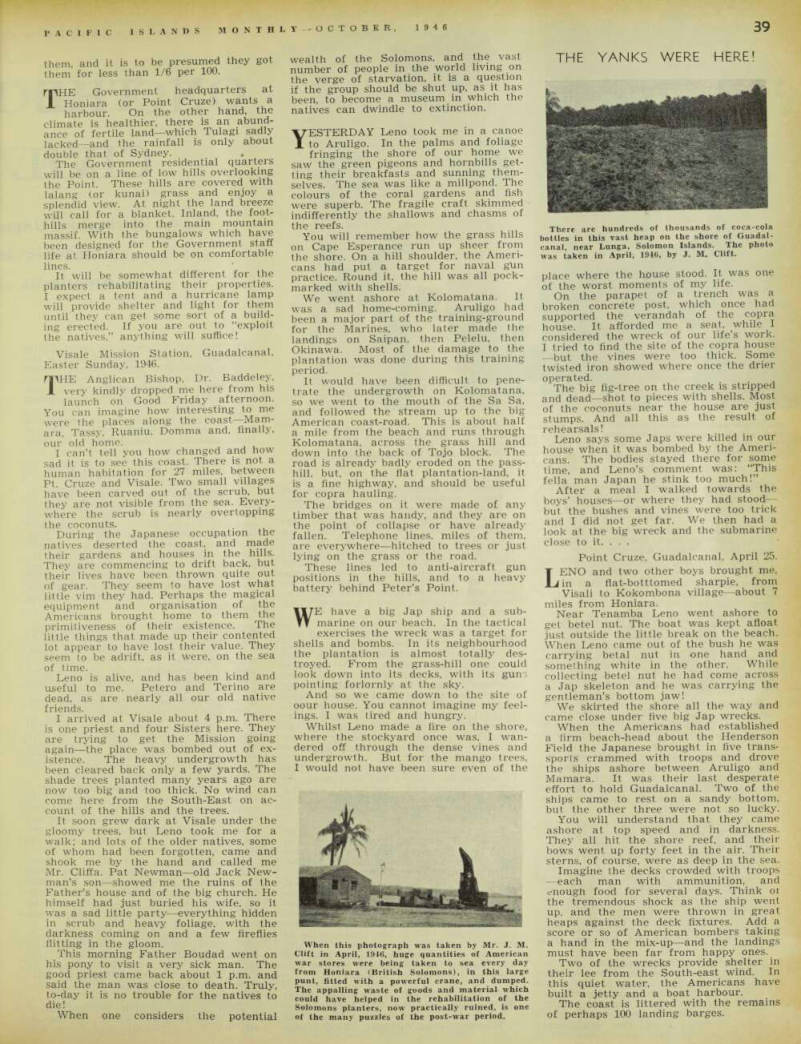
rpms description of present conditions in the British Solomons is based on letters written for his family by Mr. J. M. Clift, who returned to the Group in the "South ern Cross" in April, to find out what had happened to his once-beautiful and pro ductive plantation, Kolomatana. It was on the coast of Guadalcanal, a few miles eastward of Honiara and Henderson air field, where there was so much bitter fighting.
THE account by Mrs. Georgina Seton in the June PIM of the “Hoodoo Voyage” of the Southern Cross, brings back a memory or two.
When I joined the ship in Brisbane I had come straight from the brigalow scrub at the head of the Dawson River.
There, we had established a small cattle property, to tide us over the long years of the copra depression. So I have lived by the seashore and by the mountains.
Don’t ask me to say which is best; but, in that reeling wheelhouse on the Southern Cross, it was brought home to me that the sea drowns out humanity and time. Now and again it licks your feet like something feline, but it will crack your bones and eat you, for all that. The mountains and the bush are safe to handle. The sea smoothes its silver scales till you cannot see their joints—but their shining is that of a snake’s belly, after all.
Well, the voyage ended up in a flat calm with the silver scales well and truly smoothed. Here are some extracts from letters sent to my home.
April 17 —off Amligo, Guadalcanal.
It is a perfect moonlit night, and we are just opposite the site of our old home. The mist hangs in the valley of the Sa Sa, the mountains are flecked with a white mantle of it, just as we knew them to be so many years ago. I can’t tell you what memories flood back, as I look at the well-remembered scene.
There is the light of a fire about where our house stood.
We are cruising “dead slow” in a glassy calm, waiting for daylight. I’m writing this in the chart room of the little ship. I've just put on the kettle for the captain’s early-morning tea.
Honiara, Guadalcanal, April 20.
THE Americans are packing up, and have nearly all gone. You can have no idea what this area is like. Just now there are four big ships loading all manner of military equipment at two well-built wharves —the Americans call them “docks.”
To-day we covered close on 100 miles in a jeep on first-class gravelled roads built during the American occupation.
There is now only a fragment left of the vast military organisation of two years ago, when 200,000 troops were on Guad alcanal, but we drove on the magnificent roads through the remains of camps with many big buildings still standing.
We pulled into a shed to shelter from the rain. It was bigger than the Breeza woolshed, and ever so much more lofty.
It was roofed with planking, with canvas ever the timber. The canvas had rotted,
and the rain came down everywhere onto the concrete floor. All this huge shed was of sawn timber, and must have cost thousands to build. To-day it is only one of scores rotting in this steamy heat.
But many big Nissen igloo-type huts will be left behind in the Solomons and should make useful plantation buildings.
Everywhere, the undergrowth is cover ing up the camp sites and the wonderful roads. The big bridges are already shak ing. A few years will see them sprawled, broken, in the rivers. Some are already in that condition. Truly, it doesn’t take long in the Solomons for Nature to cover up our achievements.
THE BSIP Government have a staff of several Europeans, and about 100 natives growing rice experimentally on the grass plains of Guadalcanal. We went out to the farm.
We first passed through what had been the American “truck” gardens.
“Spearline” Wilson says they grew fine tomatoes, melons, beans, etc,, on the
open grass flats. We gathered quantities of spring onions, which still survived, and there were thousands of egg-plants laden with fruit. The Americans are said to have used superphosphate with a liberal hand, and got wonderful results. No army was ever so well fed. They were said to have had Marines in the front line, support troops in the second, while ice cream carts made up the third.
On this trip I took a photo of an enor mous mound of burnt coca-kola bottles.
In the heap there must have been mil lions of the little flasks.
The rice grows well —too well, in fact.
In places it is seven feet high. It is being harvested by an auto-header from Australia and is yielding heavily. Peanuts also do well in the rich black soil. The country there is very beautiful, with the high cloud-capped mountains compara tively close, and the green plains stretch to their bases. A. H. Wilson pointed out Gold Ridge to me.
Coming home, we drove along one run way of a big aerodrome. There were two of these ’dromes for bombers and a dozen fighter-strips. We also saw the area, afterwards called Hell’s Point, where, in 1943, some 75,000,000 dollars’ worth of explosives and military stores went up—a lot of men were killed by the explosions.
We also passed Bloody Ridge, an in significant little hill—but at one stage of the campaign it was a key position.
Thousands of bodies were collected out of the trampled grass on its flanks.
EVERY day the Americans are towing stuff to sea to be dumped in deep water. The cases are taken out on a big barge fitted with a powerful crane.
Lots of other material has been buried by bulldozers, whilst more has been tipped over steep places into ravines. It is all very shocking, especially to us people who have almost been ruined.
I am very comfortably housed in what was formerly a New Zealand hospital.
Two of us have the run of the whole building. My bedroom is a ward, 50 x 20 feet. My host lives well and has one of the American Servel refrigerators. These are kerosene-operated and have twice the capacity of the refrigerators we knew. The Servels were sold on Guad canal, in brand new condition, for A£l7.
Lots of them have gone out to sea on the fatal barge in their original cases, to be dumped.
There is little to buy here now. But, at the canteen, American cigarettes are 3/- for 200. W. R. Carpenters, of Sydney, are said to have bought 15,000,000 of
Behind Ilu, Guadalcanal, the Americans estab lished vast vegetable gardens, in 1942, for the feeding of their troops. They are gone, but their vegetables go marching on. In this photo graph, by J. M. Clift, taken in April, 1946, Sister Kennedy is seen gathering onions in the abandoned gardens.
The spot where Honiara, new “capital” of the British Solomons, is being built. Point Cruze, from which the place formerly took its name, and which gives shipping some protection, is in the centre of the picture.
The faint line in the distance, which looks like clouds, is the shore of Gela, 19 miles away, in the vicinity of Tulagi, land-locked port and former “capital.” The Americans, when they defeated the Japs here in 1942, made Honiara their headquarters. —Photo by J. M. Clift.
them, and it is to be presumed they got them for less than 1/6 per 100.
THE Government headquarters at Honiara (or Point Cruze) wants a harbour. On the other hand, the climate is healthier, there is an abund ance of fertile land—which Tulagi sadly lacked—and the rainfall is only about double that of Sydney.
The Government residential quarters will be on a line of low hills overlooking the Point. These hills are covered with lalang (or kunai) grass and enjoy a splendid view. At night the land breeze will call for a blanket. Inland, the foot hills merge into the main mountain massif. With the bungalows which have been designed for the Government staff life at Honiara should be on comfortable lines.
It will be somewhat different for the planters rehabilitating their properties.
I expect a tent and a hurricane lamp will provide shelter and light for them until they can get some sort of a build ing erected. If you are out to “exploit the natives,” anything will suffice!
Visale Mission Station, Guadalcanal, Easter Sunday, 1946.
THE Anglican Bishop. Dr. Baddeley, very kindly dropped me here from his launch on Good Friday afternoon.
You can imagine how interesting to me were the places along the coast—Mam ara. Tassy, Ruaniu, Domma and, finally, our old home.
I can’t tell you how changed and how sad it is to see this coast. There is not a human habitation for 27 miles, between Pt. Cruze and Visale. Two small villages have been carved out of the scrub, but they are not visible from the sea. Every where the scrub is nearly overtopping the coconuts.
During the Japanese occupation the natives deserted the coast, and made their gardens and houses in the hills.
They are commencing to drift back, but their lives have been thrown quite out of gear. They seem to have lost what little vim they had. Perhaps the magical equipment and organisation of the Americans brought home to them the primitiveness of their existence. The little things that made up their contented lot appear to have lost their value. They seem to be adrift, as it were, on the sea of time.
Leno is alive, and has been kind and useful to me. Petero and Terino are dead, as are nearly all our old native friends.
I arrived at Visale about 4 p.m. There is one priest and four Sisters here. They are trying to get the Mission going again—the place was bombed out of ex istence. The heavy undergrowth has been cleared back only a few yards. The shade trees planted many years ago are now too big and too thick. No wind can come here from the South-East on ac count of the hills and the trees.
It soon grew dark at Visale under the gloomy trees, but Leno took me for a walk; and lots of the older natives, some of whom had been forgotten, came and shook me by the hand and called me Mr. Cliffa. Pat Newman —old Jack New man’s son —showed me the ruins of the Father’s house and of the big church. He himself had just buried his wife, so it was a sad little party—everything hidden in scrub and heavy foliage, with the darkness coming on and a few fireflies flitting in the gloom.
This morning Father Boudad went on his pony to visit a very sick man. The good priest came back about 1 p.m. and said the man was close to death. Truly, to-day it is no trouble for the natives to die!
When one considers the potential
wealth of the Solomons, and the vast number of people in the world living on the verge of starvation, it is a question if the group should be shut up, as it has been, to become a museum in which the natives can dwindle to extinction.
YESTERDAY Leno took me in a canoe to Aruligo. In the palms and foliage fringing the shore of our home we saw the green pigeons and hornbills get ting their breakfasts and sunning them selves. The sea was like a millpond. The colours of the coral gardens and fish were superb. The fragile craft skimmed indifferently the shallows and chasms of the reefs.
You will remember how the grass hills on Cape Esperance run up sheer from the shore. On a hill shoulder, the Ameri cans had put a target for naval gUn practice. Round it, the hill was all pock marked with shells.
We went ashore at Kolomatana. It was a sad home-coming. Aruligo had been a major part of the training-ground for the Marines, who later made the landings on Saipan, then Pelelu, then Okinawa. Most of the damage to the plantation was done during this training period.
It would have been difficult to pene trate the undergrowth on Kolomatana, so we went to the mouth of the Sa Sa, and followed the stream up to the big American coast-road. This is about half a mile from the beach and runs through Kolomatana, across the grass hill and down into the back of Tojo block. The road is already badly eroded on the pass hill, but, on the flat plantation-land, it is a fine highway, and should be useful for copra hauling.
The bridges on it were made of any timber that was handy, and they are on the point of collapse or have already fallen. Telephone lines, miles of them, are everywhere—hitched to trees or just lying on the grass or the road.
These lines led to anti-aircraft gun positions in the hills, and to a heavy battery behind Peter’s Point.
WE have a big Jap ship and a sub marine on our beach. In the tactical exercises the wreck was a target for shells and bombs. In its neighbourhood the plantation is almost totally des troyed. From the grass-hill one could look down into its decks, with its gun; pointing forlornly at the sky.
And so we came down to the site of oour house. You cannot imagine my feel ings. I was tired and hungry.
Whilst Leno made a fire on the shore, where the stockyard once was, I wan dered off through the dense vines and undergrowth. But for the mango trees, I would not have been sure even of the
place where the house stood. It was one of the worst moments of my life.
On the parapet of a trench was a broken concrete post, which once had supported the verandah of the copra house. It afforded me a seat, while I considered the wreck of our life’s work.
I tried to find the site of the copra house but the vines were too thick. Some twisted iron showed where once the drier operated.
The big fig-tree on the creek is stripped and dead —shot to pieces with shells. Most of the coconuts near the house are just stumps. And all this as the result of rehearsals!
Leno says some Japs were killed in our house when it was bombed by the Ameri cans. The bodies stayed there for some time, and Leno’s comment was: “This fella man Japan he stink too much!”
After a meal I walked towards the boys’ houses —or where they had stood — but the bushes and vines were too trick and I did not get far. We then had a look at the big wreck and the submarine close to it. . . .
Point Cruze, Guadalcanal, April 25.
LENO and two other boys brought me, in a flat-botttomed sharpie, from Visali to Kokombona village—about 7 miles from Honiara.
Near Tenamba Leno went ashore to get betel nut. The boat was kept afloat just outside the little break on the beach.
When Leno came out of the bush he was carrying betal nut in one hand and something white in the other. While collecting betel nut he had come across a Jap skeleton and he was carrying the gentleman’s bottom jaw!
We skirted the shore all the way and came close under five big Jap wrecks.
When the Americans had established a firm beach-head about the Henderson Field the Japanese brought in five trans sports crammed with troops and drove the ships ashore between Aruligo and Mamara. It was their last desperate effort to hold Guadalcanal. Two of the ships came to rest on a sandy bottom, but the other three were not so lucky.
You will understand that they came ashore at top speed and in darkness.
They all hit the shore reef, and their bows went up forty feet in the air. Their sterns, of course, were as deep in the sea.
Imagine the decks crowded with troops —each man with ammunition, and enough food for several days. Think or the tremendous shock as the ship went up, and the men were thrown in great heaps against the deck fixtures. Add a score or so of American bombers taking a hand in the mix-up—and the landings must have been far from happy ones.
Two of the wrecks provide shelter in their lee from the South-east wind. In this quiet water, the Americans have built a jetty and a boat harbour.
The coast is littered with the remains of perhaps 100 landing barges.
When this photograph was taken by Mr. J. M.
Clift in April, 1946, huge quantities of American war stores were being taken to sea every day from Honiara (British Solomons), in this large punt, fitted with a powerful crane, and dumped.
The appalling waste of goods and material which could have helped in the rehabilitation of the Solomons planters, now practically ruined, is one of the many puzzles of the post-war period.
The Yanks Were Here!
There are hundreds of thousands of coca-cola bottles in this vast heap on the shore of Guadal canal, near Lunga, Solomon Islands. The photo was taken in April, 1946, by J. M. Clift.
On The Edge Of
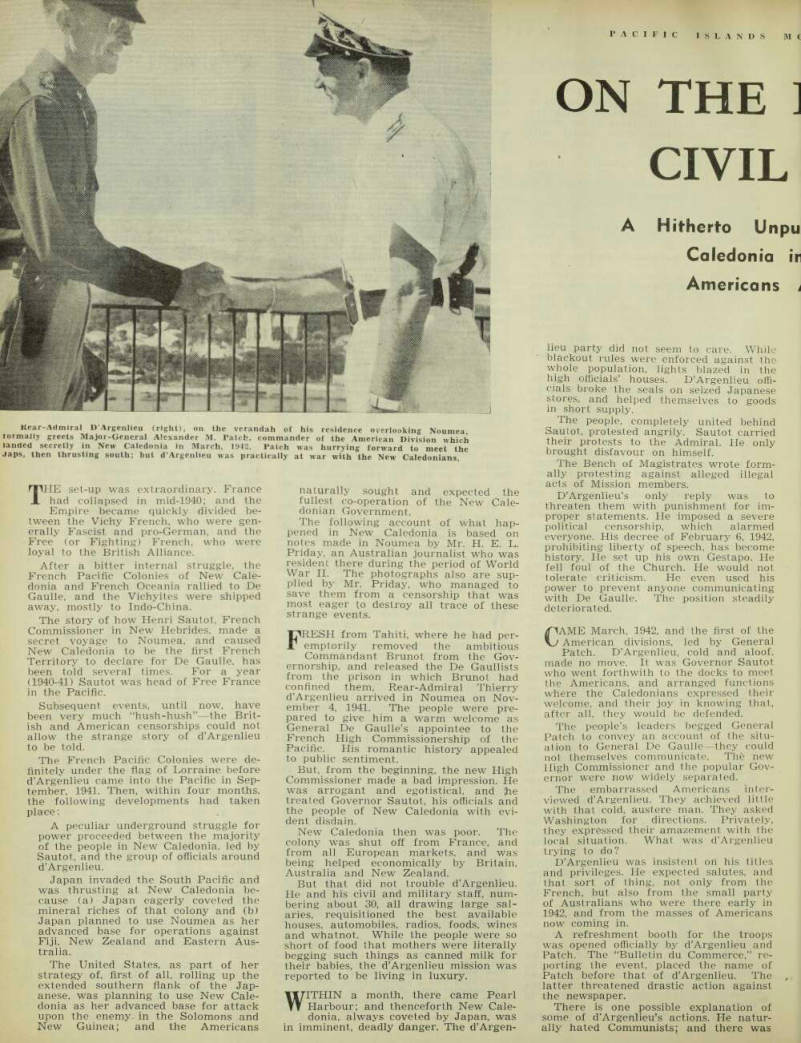
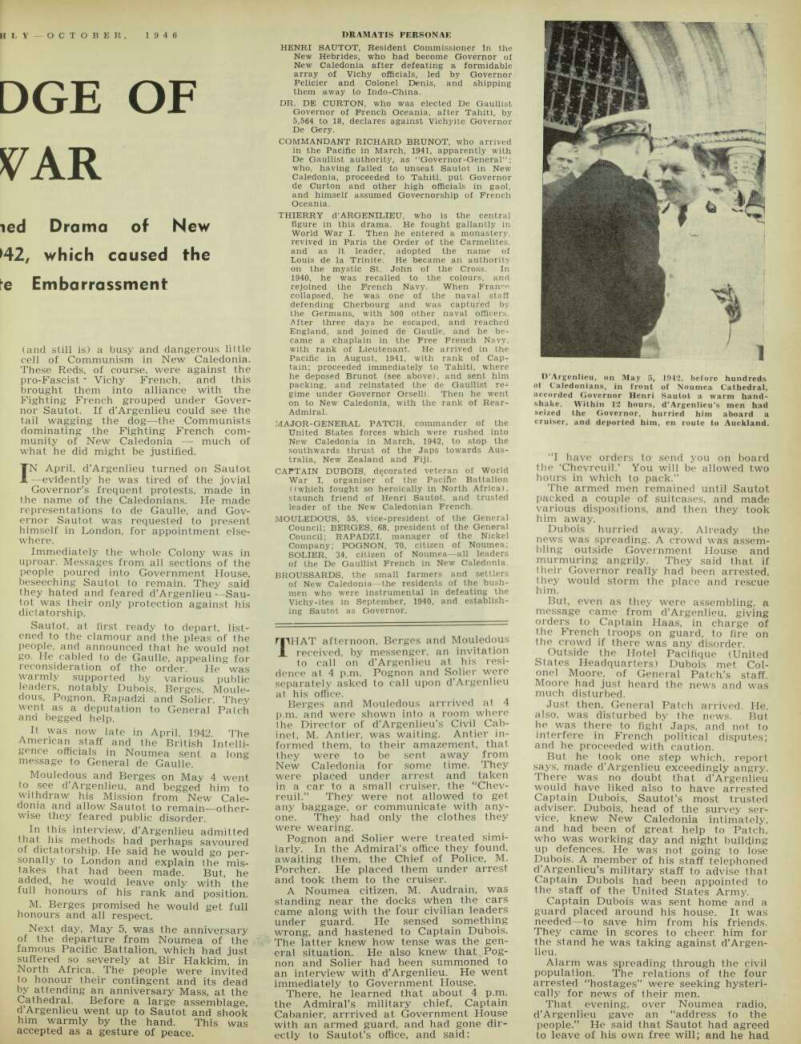
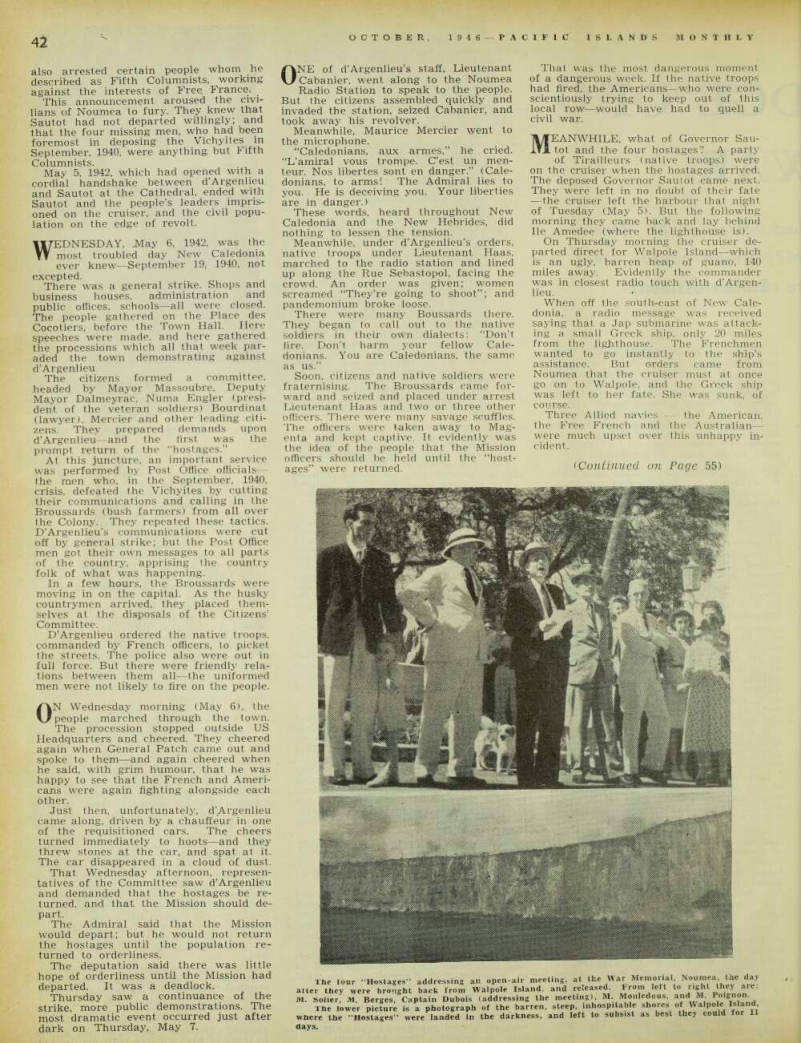
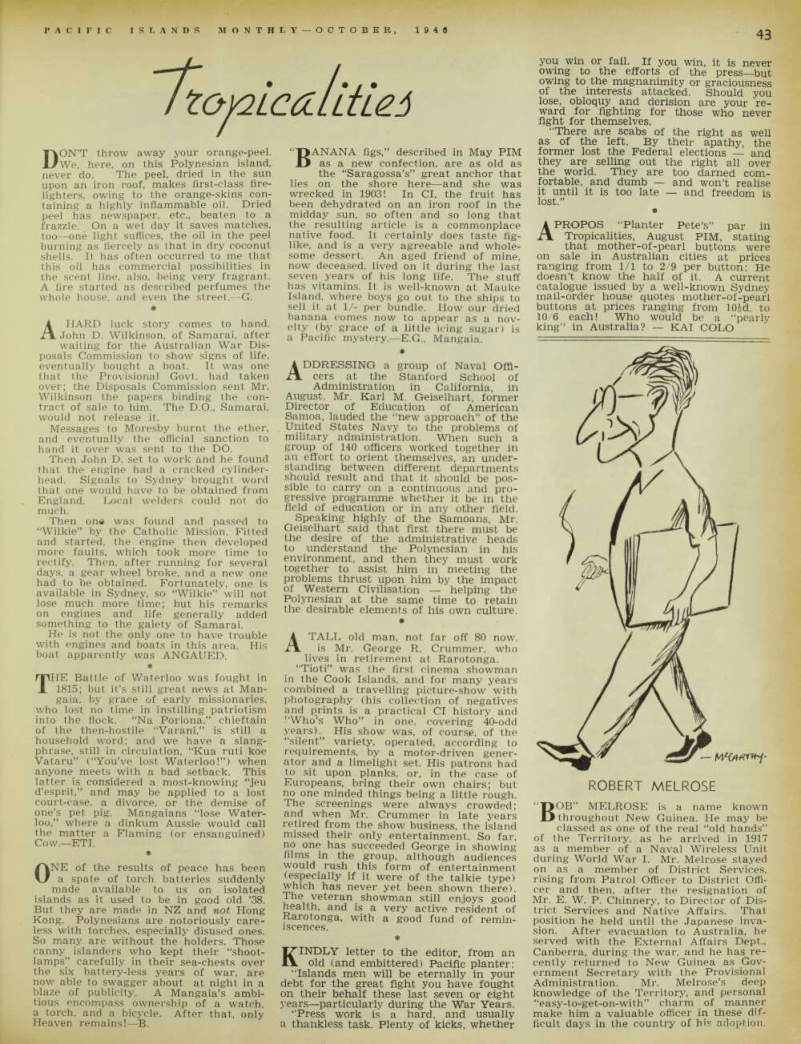
Civil War
A Hitherto Unpu[?]ed Drama of New Caledonia in 1942, which coused the Americans Embarrossment
THE set-up was extraordinary. France had collapsed in mid-1940; and the Empire became quickly divided be tween the Vichy French, who were gen erally Fascist and pro-German, and the Free (or Fighting) French, who were loyal to the British Alliance.
After a bitter internal struggle, the French Pacific Colonies of New Cale donia and French Oceania rallied to De Gaulle, and the Vichyites were shipped away, mostly to Indo-China.
The story of how Henri Sautot, French Commissioner in New Hebrides, made a secret voyage to Noumea, and caused New Caledonia to be the first French Territory to declare for De Gaulle, has been told several times. For a year (1940-41) Sautot was head of Free France in the Pacific.
Subsequent events, until now, have been very much “hush-hush” —the Brit ish and American censorships could not allow the strange story of d’Argenlieu to be told.
The French Pacific Colonies were de finitely under the flag of Lorraine before d’Argenlieu came into the Pacific in Sep tember, 1941. Then, within four months, the following developments had taken place: A peculiar underground struggle for power proceeded between the majority of the people in New Caledonia, led by Sautot, and the group of officials around d’Argenlieu.
Japan invaded the South Pacific and was thrusting at New Caledonia be cause (a) Japan eagerly coveted the mineral riches of that colony and (b) Japan planned to use Noumea as her advanced base for operations against Fiji, New Zealand and Eastern Aus tralia.
The United States, as part of her strategy of, first of all, rolling up the extended southern flank of the Jap anese, was planning to use New Cale donia as her advanced base for attack upon the enemy, in the Solomons and New Guinea; and the Americans
lieu party did not seem to care. While blackout rules were enforced against the whole population, lights blazed in the high officials’ houses. D’Argenlieu offi cials broke the seals on seized Japanese stores, and helped themselves to goods in short supply.
The people, completely united behind Sautot, protested angrily. Sautot carried their protests to the Admiral. He only brought disfavour on himself.
The Bench of Magistrates wrote form ally protesting against alleged illegal acts of Mission members.
D’Argenlieu’s only reply was to threaten them with punishment for im proper statements. He imposed a severe political censorship, which alarmed everyone. His decree of February 6, 1942, prohibiting liberty of speech, has become history. He set up his own Gestapo. He fell foul of the Church. He would not tolerate criticism. He even used his power to prevent anyone communicating with De Gaulle. The position steadily deteriorated.
CAME March, 1942, and the first of the American divisions, led by General Patch. D’Argenlieu, cold and aloof, made no move. It was Governor Sautot who went forthwith to the docks to meet the Americans, and arranged functions where the Caledonians expressed their welcome, and their joy in knowing that, after all, they would be defended.
The people’s leaders begged General Patch to convey an account of the situ ation to General De Gaulle —they could not themselves communicate. The new High Commissioner and the popular Gov ernor were now widely separated.
The embarrassed Americans inter viewed d’Argenlieu. They achieved little with that cold, austere man. They asked Washington for directions. Privately, they expressed their amazement with the local situation. What was d’Argenlieu trying to do?
D’Argenlieu was insistent on his titles and privileges. He expected salutes, and that sort of thing, not only from the French, but also from the small party of Australians who were there early in 1942, and from the masses of Americans now coming in.
A refreshment booth for the troops was opened officially by d’Argenlieu and Patch. The “Bulletin du Commerce,” re porting the event, placed the name of Patch before that of d’Argenlieu. The latter threatened drastic action against the newspaper.
There is one possible explanation of some of d’Argenlieu’s actions. He natur ally hated Communists; and there was
naturally sought and expected the fullest co-operation of the New Cale donian Government.
The following account of what hap pened in New Caledonia is based on notes made in Noumea by Mr. H. E. L.
Friday, an Australian journalist who was resident there during the period of World War 11. The photographs also are sup plied by Mr. Friday, who managed to save them from a censorship that was most eager to destroy all trace of these strange events.
FRESH from Tahiti, where he had per emptorily removed the ambitious Commandant Brunot from the Gov ernorship, and released the De Gaullists from the prison in which Brunot had confined them, Rear-Admiral Thierry d’Argenlieu arrived in Noumea on Nov ember 4, 1941. The people were pre pared to give him a warm welcome as General De Gaulle’s appointee to the French High Commissionership of the Pacific. His romantic history appealed to public sentiment.
But, from the beginning, the new High Commissioner made a bad impression. He was arrogant and egotistical, and jhe treated Governor Sautot, his officials and the people of New Caledonia with evi dent disdain.
New Caledonia then was poor. The colony was shut off from France, and from all European markets, and was being helped economically by Britain, Australia and New Zealand.
But that did not trouble d’Argenlieu.
He and his civil and military staff, num bering about 30, all drawing large sal aries, requisitioned the best available houses, automobiles, radios, foods, wines and whatnot. While the people were so short of food that mothers were literally begging such things as canned milk for their babies, the d’Argenlieu mission was reported to be living in luxury.
WITHIN a month, there came Pearl Harbour; and thenceforth New Cale donia, always coveted by Japan, was in imminent, deadly danger. The d’Argen
Kear-Admiral D'Argenlieu (right), on the verandah of his residence overlooking Noumea, formally greets Major-General Alexander M. Patch, commander of the American Division which landed secretly in New Caledonia in March, 1042. Patch was hurrying forward to meet the Japs, then thrusting south; but d’Argenlieu was practically at war with the New Caledonians.
(and still is) a busy and dangerous little cell of Communism in New Caledonia.
These Reds, of course, were against the pro-Fascist * Vichy French, and this brought them into alliance with the Fighting French grouped under Gover nor Sautot. If d’Argenlieu could see the tail wagging the dog—the Communists dominating the Fighting French com munity of New Caledonia much of what he did might be justified.
IN April, d’Argenlieu turned on Sautot —evidently he was tired of the jovial Governor’s frequent protests, made in the name of the Caledonians. He made representations to de Gaulle, and Gov ernor Sautot was requested to present himself in London, for appointment else where.
Immediately the whole Colony was in uproar. Messages from all sections of the people poured into Government House, beseeching Sautot to remain. They said they hated and feared d’Argenlieu —Sau tot was their only protection against his
dictatorship.
Sautot, at first ready to depart, list ened to the clamour and the pleas of the people, and announced that he would not go. He cabled to de Gaulle, appealing for reconsideration of the order. He was warmly supported by various public leaders, notably Dubois, Berges, Moule dous, Pognon, Rapadzi and Solier. They went as a deputation to General Patch and begged help.
It was now late in April, 1942. The American staff and the British Intelli gence officials in Noumea sent a long message to General de Gaulle.
Mouledous and Berges on May 4 went to see d’Argenlieu. and begged him to withdraw his Mission from New Cale donia and allow Sautot to remain—other wise they feared public disorder.
In this interview, d’Argenlieu admitted that his methods had perhaps savoured of dictatorship. He said he would go per sonally to London and explain the mis takes that had been made. But, he added,, he would leave only with the full honours of his rank and position.
M. Berges promised he would get full honours and all respect.
Next day, May 5, was the anniversary of the departure from Noumea of the famous Pacific Battalion, which had just suffered so severely at Bir Hakkim, in North Africa. The people were invited to honour their contingent and its dead by attending an anniversary Mass, at the Cathedral. Before a large assemblage, d’Argenlieu went up to Sautot and shook him warmly by the hand. This was accepted as a gesture of peace.
nnHAT afternoon, Berges and Mouledous X received, by messenger, an invitation to call on d’Argenlieu at his resi dence at 4 p.m. Pognon and Solier were separately asked to call upon d’Argenlieu at his office.
Berges and Mouledous arrrived at 4 p.m. and were shown into a room where the Director of d’Argenlieu’s Civil Cab inet, M. Antier, was waiting. Antier in formed them, to their amazement, that they were to be sent away from New Caledonia for some time. They were placed under arrest and taken in a car to a small cruiser, the “Chev reuil.” They were not allowed to get any baggage, or communicate with any one. They had only the clothes they were wearing.
Pognon and Solier were treated simi larly. In the Admiral’s office they found, awaiting them, the Chief of Police, M.
Porcher. He placed them under arrest and took them to the cruiser.
A Noumea citizen, M. Audrain, was standing near the docks when the cars came along with the four civilian leaders under guard. He sensed something wrong, and hastened to Captain Dubois.
The latter knew how tense was the gen eral situation. He also knew that Pog non and Solier had been summoned to an interview with d’Argenlieu. He went immediately to Government House.
There, he learned that about 4 p.m. the Admiral’s military chief, Captain Cabanier, arrrived at Government House with an armed guard, and had gone dir ectly to Sautot’s office, and said:
“I have orders to send you on hoard the ‘Chevreuil.’ You will be allowed two hours in which to pack.”
The armed men remained until Sautot packed a couple of suitcases, and made various dispositions, and then they took him away.
Dubois hurried away. Already the news was spreading. A crowd was assem bling outside Government House and murmuring angrily. They said that if their Governor really had been arrested, they would storm the place and rescue him.
But, even as they were assembling, a message came from d’Argenlieu, giving orders to Captain Haas, in charge of the French troops on guard, to fire on the crowd if there was any disorder.
Outside the Hotel Pacifique (United States Headquarters) Dubois met Col onel Moore, of General Patch’s staff.
Moore had just heard the news and was much disturbed.
Just then, General Patch arrived. He, also, was disturbed by the news. But he was there to fight Japs, and not to interfere in Frenqh political disputes; and he proceeded with caution.
But he took one step which, report says, made d’Argenlieu exceedingly angry.
There was no doubt that d’Argenlieu would have liked also to have arrested Captain Dubois, Sautot’s most trusted adviser. Dubois, head of the survey ser vice, knew New Caledonia intimately, and had been of great help to Patch, who was working day and night building up defences. He was not going to lose Dubois. A member of his staff telephoned d’Argenlieu’s military staff to advise that Captain Dubois had been appointed to the staff of the United States Army.
Captain Dubois was sent home and a guard placed around his house. It was needed—to save him from his friends.
They came in scores to cheer him for the stand he was taking against d’Argen lieu.
Alarm was spreading through the civil population. The relations of the four arrested “hostages” were seeking hysteri cally for news of their men.
That evening, over Noumea radio, d’Argenlieu gave an “address to the people.” He said that Sautot had agreed to leave of his own free will; and he had
D’Argenlieu. on May 5, 1942, before hundreds of Caledonians, in front of Noumea Cathedral, accorded Governor Henri Sautot a warm hand shake. Within 12 hours, d’Argenlieu’s men had seized the Governor, hurried him aboard a cruiser, and deported him, en route to Auckland.
also arrested certain people whom he described as Fifth Columnists, working against the interests of Free. France.
This announcement aroused the civi lians of Noumea to fury. They knew that Sautot had not departed willingly; and that the four missing men, who had been foremost in deposing the Vichyites in September, 1940, were anything but Fifth Columnists.
May 5, 1942, which had opened with a cordial handshake between d’Argenlieu and Sautot at the Cathedral, ended with Sautot and the people’s leaders impris oned on the cruiser, and the civil popu lation on the edge of revolt.
WEDNESDAY, May 6, 1942, was the most troubled day New Caledonia ever knew —September 19, 1940, not excepted.
There was a general strike. Shops and business houses, administration and public offices, schools—all were closed.
The people gathered on the Place des Cocotiers, before the Town Hall. Here speeches were made, and here gathered the processions which all that week par aded the town demonstrating against d’Argenlieu The citizens formed a committee, headed by Mayor Massoubre, Deputy Mayor Dalmeyrac, Numa Engler (presi dent of the veteran soldiers) Bourdinat (lawyer). Mercier and other leading citi zens. They prepared demands upon d’Argenlieu—and the first was the prompt return of the "hostages.”
At this juncture, an important service was performed by Post Office officials — the men who, in the September, 1940, crisis, defeated the Vichyites by cutting their communications and calling in the Broussards (bush farmers) from all over the Colony. They repeated these tactics.
D’Argenlieu’s communications were cut off by general strike; but the Post Office men got their own messages to all parts of the country, apprising the country folk of what was happening.
In a few hours, the Broussards were moving in on the capital. As the husky countrymen arrived, they placed them selves at the disposals of the Citizens’
Committee.
D’Argenlieu ordered the native troops, commanded by French officers, to picket the streets. The police also were out in full force. But there were friendly rela tions between them all —the uniformed men were not likely to fire on the people.
ON Wednesday morning (May 6), the people marched through the town.
The procession stopped outside US Headquarters and cheered. They cheered again when General Patch came out and spoke to them —and again cheered when he said, with grim humour, that he was happy to see that the French and Ameri cans were again fighting alongside each other.
Just then, unfortunately, d’Argenlieu came along, driven by a chauffeur in one of the requisitioned cars. The cheers turned immediately to hoots —and they threw stones at the car, and spat at it.
The car disappeared in a cloud of dust.
That Wednesday afternoon, represen tatives of the Committee saw d’Argenlieu and demanded that the hostages be re turned, and that the Mission should de part.
The Admiral said that the Mission would depart; but he would not return the hostages until the population re turned to orderliness.
The deputation said there was little hope of orderliness until the Mission had departed. It was a deadlock.
Thursday saw a continuance of the strike, more public demonstrations. The most dramatic event occurred just after dark on Thursday, May 7.
ONE of d’Argenlieu’s staff, Lieutenant Cabanier, went along to the Noumea Radio Station to speak to the people.
But the citizens assembled quickly and invaded the station, seized Cabanier, and took away his revolver.
Meanwhile, Maurice Mercier went to the microphone.
“Caledonians, aux armes,” he cried.
“L’amiral vous trompe. C’est un menteur. Nos libertes sont en danger.” (Caledonians, to arms! The Admiral lies to you. He is deceiving you. Your liberties are in danger.) These words, heard throughout New Caledonia and the New Hebrides, did nothing to lessen the tension.
Meanwhile, under d’Argenlieu’s orders, native troops under Lieutenant Haas, marched to the radio station and lined up along the Rue Sebastopol, facing the crowd. An order was given; women screamed “They’re going to shoot”; and pandemonium broke loose.
There were many Boussards there.
They began to call out to the native soldiers in their own dialects; “Don’t fire. Don’t harm your fellow Caledonians. You are Caledonians, the same as us.”
Soon, citizens and native soldiers were fraternising. The Broussards came forward and seized and placed under arrest Lieutenant Haas and two or three other officers. There were many savage scuffles.
The officers were taken away to Magenta and kept captive. It evidently was the idea of the people that the Mission officers should be held until the “host- WOTO roturnod.
That was the most dangerous moment of a dangerous week. If the native troops had fired, the- Americans —who were con scientiously trying to keep out of this local row—would have had to quell a civil war.
MEANWHILE, what of Governor Sau tot and the four hostages? A party of Tirailleurs (native troops) were on the cruiser when the hostages arrived.
The deposed Governor Sautot came next.
They were left in no doubt of their fate —the cruiser left the harbour that night of Tuesday (May 5). But the following morning they came back and lay behind He Amedee (where the lighthouse is).
On Thursday morning the cruiser de parted direct for Walpole Island—which is an ugly, barren heap of guano, 140 miles away. Evidently the commander was in closest radio touch with d’Argen lieu.
When off the south-east of New Cale donia, a radio message was received saying that a Jap submarine was attack ing a small Greek ship, only 20 miles from the lighthouse. The Frenchmen wanted to go instantly to the ship’s assistance. But orders came from Noumea that the cruiser must at once go on to Walpole, and the Gfieek ship was left to her fate. She was sunk, of course.
Three Allied navies the American, the Free French and the Australian — were much upset over this unhappy in cident.
(Continued on Page 55)
The tour “Hostages” addressing an open-air meeting, at the War Memorial Noumea, the day alter they were brought back from Walpole Island, and released. From left to th ey are: M. Solier, M. Berges, Captain Dubois (addressing the meeting), M. Mouledous, and M. Poignon.
The lower picture is a photograph of the barren, steep, inhospitable shores of Walpole Island, where the "Hostages” were landed in the darkness, and left to subsist as best they could for 11 days.
The cruiser arrived off Walpole Island’s bare, ugly, inhospitable shore at dusk. There is no place for ships. The four hostages were put into a boat; and, from the boat, they had to crawl along a plank, above a rough sea, to the shore.
They straddled the plank and ipulled themselves along by their hands—Pog non, aged *l2; Berges, 68; Mouledods (now dead) 55, and Soliej, a young mag istrate recently from Paris, in his 30’s.
Sautot, from the Chevreuil’s deck, watched his friends disappear—they had not a bit of baggage or food among them, and they did not know what fate held for them. The cruiser then set off for Auckland. It was a sad moment for popular Henri Sautot.
The four men, now in darkness, fol lowed the Tirailleurs up a steep, rocky pathway to the euano plateau, 250 feet above the sea. TJtterly exhausted, they were thrust into the old barracks of the coolie guano-workers, and given sacks filled with straw to sleep on. They were eleven days on that island, fed on canned food from the guano workers’ store.
BACK in Noumea, the position re mained tense. Some public services were restored, but there was constant danger of a clash between the angry civilians and the forces under the con trol of the Mission. With Sautot’s de parture, the administrative machinery now was under the direct control of High Commissioner d’Argenlieu.
Just why d’Argenlieu left Noumea is not clear—probably it was at the insti
gation of the embarrassed Americans.
United States armed forces, preparing for the attack upon the Japanese in the Solomons in -early August, were now pouring into New Caledonia, and the American commanders had no time to waste on NC politics.
Rear Admiral d’Argenlieu arrived by car at the Hotel Banuelos, in La Foa, some 40 miles out of Noumea. La Foa was the home town of Berges, one of the missing “hostages.”
The angry people of La Foa gathered, and a meeting was held. Then a depu tation approached the Admiral. M. Banu, the hotelkeeper, said: “Admiral, I arrest you in the name of the people of La Foa.”
The High Commissioner was then taken charge of by the Home Guard, and imprisoned in the same room, in the hotel annexe, which had housed Colonel Denis, when Sautot arrested him in Sep tember, 1940.
It probably was then that the Citizens’
Committee put up their ultimatum to d’Argenlieu. He was told that the host ages were to be immediately returned to their homes—or else!
D’Argenlieu informed them that that was impossible the hostages had been sent away.
There was some further discussion — and then “L’Amiral” (as he was gener ally known) was informed that he must return the hostages by noon on May 18.
The people would not wait a minute longer. They left no doubt in “L’Amiral’s” mind of what would happen if the men were not brought back.
D’Argenlieu was imprisoned by the indignant men of La Foa for only a short time. Details of this extraordinary in
cident are lacking; but there is no doubt that he was released within 24 hours.
He went on to a country house, in the mountains, and remained there for some days.
THE “Chevreuil” evidently received her orders. On her way back from Auck land, after landing Sautot (who went thence directly to London) she called at Walpole Island, picked up the four men, and landed them in the night of May 17, at Artillery Point, where Mission cars picked them up and took them to their homes.
Next day, a large public meeting was addressed by Captain Dubois and the four “hostages”; and a radiogram was sent to De Gaulle, asking again, and more urgently, for the recall of the d’Argenlieu Mission. Following an ex change of radiograms, it was decided that the Mission should depart. Many of the officials left at the end of May .
D’Argenlieu departed two months later, after spending some time in Aus tralia and New Hebrides.
THERE is little doubt that there would have been bloodshed on a num ber of occasions had it not been for the presence of the Americans, and the imminent danger of attack by the Japs. A man of d’Argenlieu’s tempera ment was the last who should have been sent to the South Pacific, where the people have freedom in the blood.
Back in London, d’Argenlieu remained in high favour with De Gaulle. He re tained his title of Rear-Admiral and (for some months) that of High Commissioner in the Pacific. He accompanied De Gaulle to the Casablanca Conference, and he was given command of the navy of Fighting France. An expedition which he led to Dakar was not successful. His mission to Canada, to change the opinions of the Vichy-minded French in Quebec, did not accomplish much. After peace came, he was sent out to be Gov ernor of French Indo-China; but he has not been successful there, and a recent report says he has returned to Europe.
Miss Lesley Miller, of the Secretariat staff of Suva, has left for Malaya, where she will be a Council reporter with the Government of the Malayan Union, at Kuala Lumpur.
Advertisements & other items, p. 42 (1 item)
Pacific Islands Mc
Dramatis Personae
HENRI SAUTOT, Resident Commissioner in the New Hebrides, who had become Governor of New Caledonia after defeating a formidable array of Vichy officials, led by Governor Pelicier and Colonel Denis, and shipping them away to Indo-China.
DR. DE CURTON, who was elected De Gaullist Governor of French Oceania, after Tahiti, by 5,564 to 18, declares against Vichyite Governor De Gery.
COMMANDANT RICHARD BRUNOT, who arrived in the Pacific in March, 1941, apparently with De Gaullist authority, as “Governor-General”; who, having failed to unseat Sautot in New Caledonia, proceeded to Tahiti, put Governor de Curton and other high officials in gaol, and himself assumed Governorship of French Oceania.
THIERRY d’ARGENILIEU, who is the central figure in this drama. He fought gallantly in World War I. Then he entered a monastery, revived in Paris the Order of the Carmelites, and as it leader, adopted the name of Louis de la Trinite. He became an authority on the mystic St. John of the Cross. In 1940, he was recalled to the colours, and rejoined the French Navy. When Franco collapsed, he was one of the naval staff defending Cherbourg and was captured by the Germans, with 500 other naval officers.
After three days he escaped, and reached England, and joined de Gaulle, and he be came a chaplain in the Free French Navy, with rank of Lieutenant. He arrived in the Pacific in August, 1941, with rank of Cap tain; proceeded immediately to Tahiti, where he deposed Brunot (see above), and sent him packing, and reinstated the de Gaullist re gime under Governor Orselli. Then he went on to New Caledonia, with the rank of Rear- Admiral.
MAJOR-GENERAL PATCH, commander of the United States forces which were rushed into New Caledonia in March, 1942, to stop the southwards thrust of the Japs towards Aus tralia, New Zealand and Fiji.
CAPTAIN DUBOIS, decorated veteran of World War I, organiser of the Pacific Battalion ((which fought so heroically in North Africa), staunch friend of Henri Sautot, and trusted leader of the New Caledonian French.
MOULEDOUS, 55, vice-president of the General Council; BERGES, 68, president of the General Council: RAPADZI, manager of the Nickel Company; POGNON, 70, citizen of Noumea; SOLIER, 34, citizen of Noumea—all leaders of the De Gaullist French in New Caledonia.
BROUSSARDS, the small farmers and settlers of New Caledonia—the residents of the bush men who were instrumental in defeating the Vichy-ites in September, 1940, and establish ing Sautot as Governor.
Advertisements & other items, p. 43 (1 item)
Dge Of
VAR
ned Drama of New >42, which caused the c Embarrassment
II LY OCTOBER, 1946
Tropicalities
DON’T throw away your orange-peel.
We, here, on this Polynesian island, never do. The peel, dried in the sun upon an iron roof, makes first-class fire lighters, owing to the orange-skins con taining a highly inflammable oil. Dried peel has newspaper, etc., beaten to a frazzle. On a wet day it saves matches, too —one light suffices, the oil in the peel burning as fiercely as that in dry coconut shells. It has often occurred to me that this oil has commercial possibilities in the scent line, also, being very fragrant.
A fire started as described perfumes the whole house, and even the street. —G. ♦ A HARD luck story comes to hand.
John D. Wilkinson, of Samarai, after waiting for the Australian War Dis posals Commission to show signs of life, eventually bought a boat. It was one that the Provisional Govt, had taken over; the Disposals Commission sent Mr.
Wilkinson the papers binding the con tract of sale to him. The D. 0., Samarai, would not release it.
Messages to Moresby burnt the ether, and eventually the official sanction to hand it over was sent to the DO.
Then John D. set to work and he found that the engine had a cracked cylinder head. Signals to Sydney brought word that one would have to be obtained from England. Local welders could not do much.
Then one was found and passed to “Wilkie” by the Catholic Mission. Fitted and started, the engine then developed more faults, which took more time to rectify. Then, after running for several days, a gear wheel broke, and a new one had to be obtained. Fortunately, one is available in Sydney, so “Wilkie” will not lose much more time; but his remarks on engines and life generally added something to the gaiety of Samarai.
He is not the only one to have trouble with engines and boats in this area. His boat apparently was ANGAUED. ♦ THE Battle of Waterloo was fought in 1815; but it’s still great news at Man gaia, by grace of early missionaries, who lost no time in instilling patriotism into the flock. “Na Poriona,” chieftain of the then-hostile “Varani,” is still a household word; and we have a slang phrase, still in circulation. “Kua ruti koe Vataru” (“You’ve lost Waterloo!”) when anyone meets with a bad setback. This latter is considered a most-knowing “jeu d’esprit,” and may be applied to a lost court-case, a divorce, or the demise of one’s pet pig. Mangaians “lose Water loo,” where a dinkum Aussie would call the matter a Flaming (or ensanguined) Cow.—ETI. ♦ ONE of the results of peace has been a spate of torch batteries suddenly made available to us on isolated islands as it used to be in good old ’3B.
But they are made in NZ and not Hong Kong. Polynesians are notoriously care less with torches, especially disused ones.
So many are without the holders. Those canny islanders who kept their “shoot lamps” carefully in their sea-chests over the six battery-less years of war, are now able to swagger about at night in a blaze of publicity. A Mangaia’s ambi tious encompass ownership of a watch, a torch, and a bicycle. After that, only Heaven remains!—B.
“I>ANANA figs,” described in May PIM O as a new confection, are as old as the “Saragossa’s” great anchor that lies on the shore here —and she was wrecked in 1903! In Cl, the fruit has been dehydrated on an iron roof in the midday sun, so often and so long that the resulting article is a commonplace native food. It certainly does taste fig like, and is a very agreeable and whole some dessert. An aged friend of mine, now deceased, lived on it during the last seven years of his long life. The stuff has vitamins. It is well-known at Mauke Island, where boys go out to the ships to sell it at 1/- per bundle. How our dried banana comes now to appear as a nov elty (by grace of a little icing sugar) is a Pacific mystery.—E.G., Mangaia. * ADDRESSING a group of Naval Offi cers at the Stanford School of Administration in California, in August, Mr. Karl M. Geiselhart, former Director of Education of American Samoa, lauded the “new approach” of the United States Navy to the problems of military administration. When such a group of 140 officers worked together in an effort to orient themselves, an under standing between different departments should result and that it should be pos sible to carry on a continuous and pro gressive programme whether it be in the field of education or in any other field.
Speaking highly of the Samoans, Mr.
Geiselhart said that first there must be the desire of the administrative heads to understand the Polynesian in his environment, and then they must work together to assist him in meeting the problems thrust upon him by the impact of Western Civilisation helping the Polynesian at the same time to retain the desirable elements of his own culture. • A TALL old man, not far off 80 now. is Mr. George R. Crummer, who lives in retirement at Rarotonga.
“Tioti” was the first cinema showman in the Cook Islands, and for many years combined a travelling picture-show with photography (his collection of negatives and prints is a practical Cl history and “Who’s Who” in one, covering 40-odd years). His show was, of course, of the “silent” variety, operated, according to requirements, by a motor-driven gener ator and a limelight set. His patrons had to sit upon planks, or, in the case of Europeans, bring their own chairs; but no one minded things being a little rough.
The screenings were always crowded; and when Mr. Crummer in late years retired from the show business, the island missed their only entertainment. So far, no one has succeeded George in showing films in the group, although audiences would rush this form of entertainment (especially if it were of the talkie type) which has never yet been shown there).
The veteran showman still enjoys good health, and is a very active resident of Rarotonga, with a good fund of remin iscences. ♦ KINDLY letter to the editor, from an old (and embittered) Pacific planter; “Islands men will be eternally in your debt for the great fight you have fought on their behalf these last seven or eight years—particularly during the War Years.
“Press work is a hard, and usually a thankless task. Plenty of kicks, whether
you win or fail. If you win, it is never owing to the efforts of the press—but owing to the magnanimity or graciousness of the interests attacked. Should you lose, obloquy and derision are your re ward for fighting for those who never fight for themselves.
“There are scabs of the right as well as of the left. By their apathy, the former lost the Federal elections and they are selling out the right all over the world. They are too darned com fortable, and dumb and won’t realise it until it is too late and freedom is lost.” • APROPOS “Planter Pete’s” par in Tropicalities, August PIM, stating that mother-of-pearl buttons were on sale in Australian cities at prices ranging from 1/1 to 2/9 per button: He doesn’t know the half of it. A current catalogue issued by a well-known Sydney mail-order house quotes mother-of-pearl buttons at prices ranging from to 10 6 each! Who would be a “pearly king” in Australia? KAI COLO
T>OB” MELROSE is a name known O throughout New Guinea. He may be classed as one of the real “old hands” of the Territory, as he arrived in 1917 as a member of a Naval Wireless Unit during World War I. Mr. Melrose stayed on as a member of District Services, rising from Patrol Officer to District Offi cer and then, after the resignation of Mr. E. W. P. Chinnery, to Director of Dis trict Services and Native Affairs. That position he held until the Japanese inva sion. After evacuation to Australia, he served with the External Affairs Dept., Canberra, during the war, and he has re cently returned to New Guinea as Gov ernment Secretary with the Provisional Administration. Mr. Melrose’s deep knowledge of the Territory, and personal “easy-to-get-on-with” charm of manner make him a valuable officer in these dif ficult days in the country of his adoption.
Robert Melrose
Broadcasting In Fiji
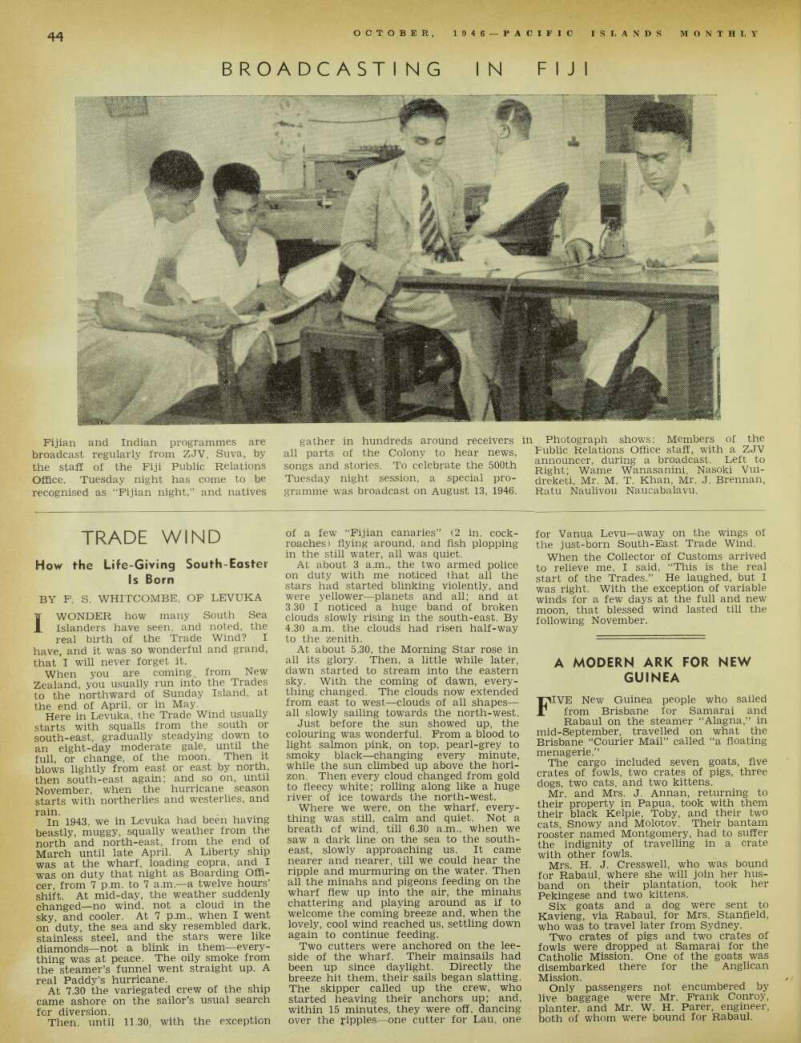
Fijian and Indian programmes are broadcast regularly from ZJV, Suva, by the staff of the Fiji Public Relations Office. Tuesday night has come to be recognised as “Fijian night,” and natives
gather in hundreds around receivers all parts of the Colony to hear news, songs and stories. To celebrate the 500th Tuesday night session, a special pro gramme was broadcast on August 13, 1946.
in Photograph shows: Members of the Public Relations Office staff, with a ZJV announcer, during a broadcast. Left to Right; Wame Wanasanini, Nasoki Vui dreketi, Mr. M. T. Khan, Mr. J. Brennan, Ratu Naulivou Naucabalavu.
Trade Wind
How the Life-Giving South-Easter Is Born
By F. S. Whitcombe, Of Levuka
I WONDER how many South Sea Islanders have seen, and noted, the real birth of the Trade Wind? I have, and it was so wonderful and grand, that I will never forget it.
When you are coming from New Zealand, you usually run into the Trades to the northward of Sunday Island, at the end of April, or in May.
Here in Levuka, the Trade Wind usually starts with squalls from the south or south-east, gradually steadying down to an eight-day moderate gale, until the full, or change, of the moon. Then it blows lightly from east or east by north, then south-east again; and so on, until November, when the hurricane season starts with northerlies and westerlies, and rain.
In 1943, we in Levuka had been having beastly, muggy, squally weather from the north and north-east, from the end of March until late April. A Liberty ship was at the wharf, loading copra, and I was on duty that night as Boarding Offi cer, from 7 p.m. to 7 a.m—a twelve hours’ shift. At mid-day, the weather suddenly changed—no wind, not a cloud in the sky, and cooler. At 7 p.m., when I went on duty, the sea and sky resembled dark, stainless steel, and the stars were like diamonds—not a blink in them—every thing was at peace. The oily smoke from the steamer’s funnel went straight up. A real Paddy’s hurricane.
At 7.30 the variegated crew of the ship came ashore on the sailor’s usual search for diversion.
Then, until 11.30, with the exception
of a few “Fijian canaries” (2 in. cock roaches) flying around, and fish plopping in the still water, all was quiet.
At about 3 a.m., the two armed police on duty with me noticed that all the stars had started blinking violently, and were yellower—planets and all; and at 3.30 I noticed a huge band of broken clouds slowly rising in the south-east. By 4.30 a.m. the clouds had risen half-way to the zenith.
At about 5.30, the Morning Star rose in all its glory. Then, a little while later, dawn started to stream into the eastern sky. With the coming of dawn, every thing changed. The clouds now extended from east to west —clouds of all shapes— all slowly sailing towards the north-west.
Just before the sun showed up, the colouring was wonderful. From a blood to light salmon pink, on top, pearl-grey to smoky black—changing every minute, while the sun climbed up above the hori zon. Then every cloud changed from gold to fleecy white; rolling along like a huge river of ice towards the north-west.
Where we were, on the wharf, every thing was still, calm and quiet. Not a breath of wind, till 6.30 a.m., when we saw a dark line on the sea to the south east, slowly approaching us. It came nearer and nearer, till we could hear the ripple and murmuring on the water. Then all the minahs and pigeons feeding on the wharf flew up into the air, the minahs chattering and playing around as if to welcome the coming breeze and, when the lovely, cool wind reached us, settling down again to continue feeding.
Two cutters were anchored on the lee side of the wharf. Their mainsails had been up since daylight. Directly the breeze hit them, their sails began slatting.
The skipper called up the crew, who started heaving their anchors up; and, within 15 minutes, they were off, dancing over the ripples—one cutter for Lau, one
for Vanua Levu —away on the wings of the just-born South-East Trade Wind.
When the Collector of Customs arrived to relieve me, I said, “This is the real start of the Trades.” He laughed, but I was right. With the exception of variable winds for a few days at the full and new moon, that blessed wind lasted till the following November.
A Modern Ark For New
Guinea
FIVE New Guinea people who sailed from Brisbane for Samarai and Rabaul on the steamer “Alagna,” in mid-September, travelled on what the Brisbane “Courier Mail” called “a floating menagerie.”
The cargo included seven goats, five crates of fowls, two crates of pigs, three dogs, two cats, and two kittens.
Mr. and Mrs. J. Annan, returning to their property in Papua, took with them their black Kelpie, Toby, and their two cats, Snowy and Molotov. Their bantam rooster named Montgomery, had to suffer the indignity of travelling in a crate with other fowls.
Mrs. H. J. Cresswell, who was bound for Rabaul, where she will join her hus band on their plantation, took her Pekingese and two kittens.
Six goats and a dog were sent to Kavieng, via Rabaul, for Mrs. Stanfield, who was to travel later from Sydney.
Two crates of pigs and two crates of fowls were dropped at Samarai for the Catholic Mission. One of the goats was disembarked there for the Anglican Mission.
Only passengers not encumbered by live baggage were Mr. Frank Conroy, planter, and Mr. W. H. Parer, engineer, both of whom were bound for Rabaul.
New Guinea
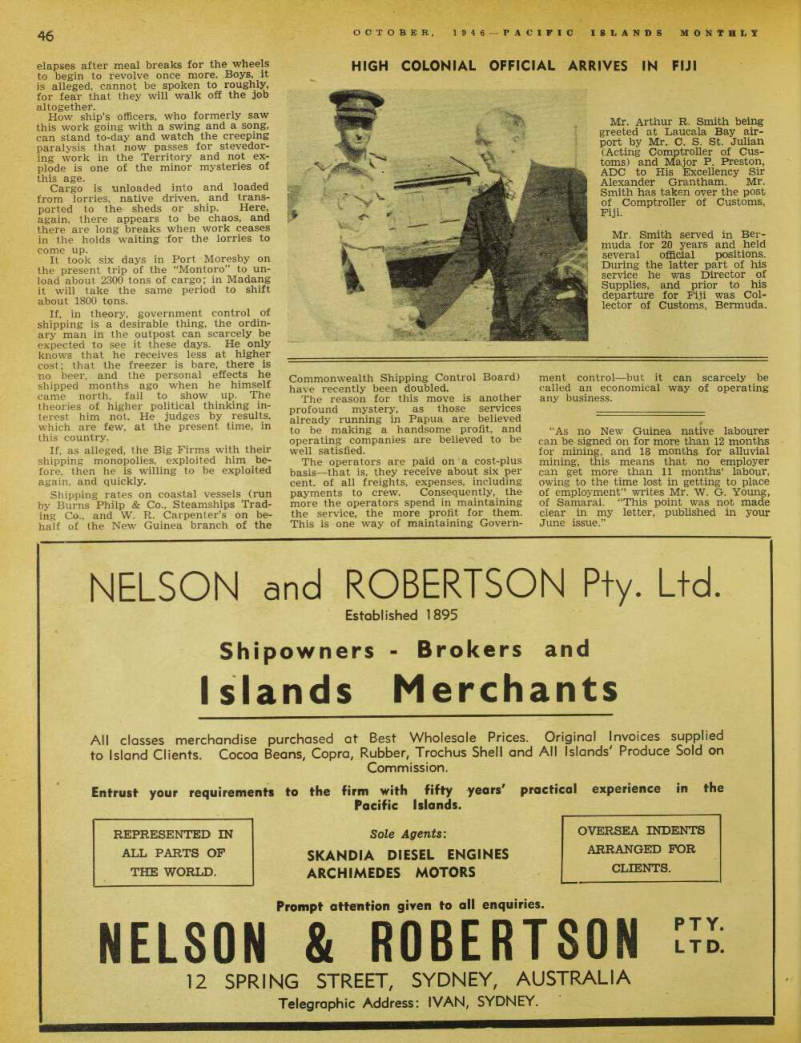
Costly And Inefficient Shipping In
Outstanding Example of Socialist Government Control
From a Special Correspondent
Madang, September 24.
IT is rumoured up here that the “Mal aita” which has been in dock in Syd ney since 1943, when she was damaged by a Jap torpedo off Port Moresby, will be back in commission in October, and will take over the Sydney-Port Moresby- Lae-Madang run. The “Montoro” will go on a new schedule which will take in Port Moresby, Samarai, Rabaul and Buka.
With labour conditions in New Guinea and Australia as they are at present, these ships will not be able to complete the round trip under two months. This will give Port Moresby and Samarai a ship every month and the other ports a ship every two months.
Both ships will, of course, be run by the Commonwealth Shipping Board.
The “Bulolo” has now been sold to the British Admiralty and will not be seen again in these waters; there is no indications.as to when or if any new ships will be available. . - There is, in fact, no inducement for Burns Philp or anyone else with ship ping interests tied to Australia, to pur chase new ships or to improve services.
Consequently, New Guinea is receiving to-day? the most inefficient shipping ser vice in her history.
Australian Unionism notoriously has an antipathy for coloured labour; but the “ Montoro” is, nevertheless, now worked by an Indian crew, although pre viously she had only Australians. rhe Indians, with the limited facilities avail able, probably do a better job, and more cheerfully, than Australians of the pre sent era; but the general standard of service to New Guinea is poor and, if the running of this ship is any criterion of Government control, then the sooner the service reverts to 100 per cent, pri vate enterprise, the better.
IT can be said that the “Montoro” is an old 'ship and that “conditions” (what ever that all-embracing term may be interpreted to mean) militate against pre-war comfort. It might be instructive, however, if the Shipping Board could see something of the Union Company service provided from Auckland (New Zealand) for Fiji, Tonga and Samoa. Over a year ago, this company, although their ship was hopelessly overcrowded, was maintaining a service that was almost at pre-war standard.
By comparison, the New Guinea ser vice, 12 months after the end of the war, is pitiful. There are, for example, now no facilities in any of the New Guinea ports for attending to ship laun dry.
The “Montoro’s” linen would remain soiled if it were not for the good offices of the District Officer, Madang, who has made it his personal task to hunt up a few boys to do the job. At this moment, hundreds of pillow slips, towels and sheets flap furiously on long lines in the District Officer’s backyard. If this were not so, presumably the southbound pas sengers would be using the unwashed linen of the forward journey.
“Montoro”. has no forced-draught sys tem of ventilation; but she has a number of inside cabins which in the tropics be come miniature sweatboxes. /Formerly, the cabins were made approximately
habitable by electric fans. Now these fans are gone. They have been removed. it is alleged, for the use of the European crew of another Australian ship. “Mon toro” to-day, of course, is carrying more passengers than ever before.
The food is adequate; but it is Aus tralian austerity food, and cooked and served with little imagination.
THE creature comforts of passengers, however, can be dismissed as rela tively unimportant. The major pur
pose of the New Guinea service was and is to bring food supplies and materials to New Guinea; this is more than ever necessary to-day when the Administra tion, the natives and the Europeans are struggling to rehabilitate themselves.
Without a reasonably efficient service between New Guinea ports and Australia, the best efforts of the whole community must wither and die.
Formerly, all ships in New Guinea ports were worked by private labour lines. To-day all stevedoring is done by the Administration with any labour that is available.
Consequently, it is slow, badly directed and untrained for the job. Two shifts are worked —from 8 a.m. to 4 p.m. with an hour’s break at noon; and from 4 p.m. until midnight with an hour’s break at 6 p.m. Formerly the shifts covered the full 24 hours.
Labour on the ship is excruciatingly slow; and anything up to half an hour
elapses after meal breaks for the wheels to begin to revolve once more. Boys, it is alleged, cannot be spoken to roughly, for fear that they will walk off the job altogether.
How ship’s officers, who formerly saw this work going with a swing and a song, can stand to-day and watch the creeping paralysis that now passes for stevedor ing work in the Territory and not ex plode is one of the minor mysteries of this age.
Cargo is unloaded into and loaded from lorries, native driven, and trans ported to the sheds or ship. Here, again, there appears to be chaos, and there are long breaks when work ceases in the holds waiting for the lorries to come up.
It took six days in Port Moresby on the present trip of the “Montoro” to un load about 2300 tons of cargo; in Madang it will take the same period to shift about 1800 tons.
If, in theory, government control of shipping is a desirable thing, the ordin ary man in the outpost can scarcely be expected to see it these days. He only knows that he receives less at higher cost; that the freezer is bare, there is no beer, and the personal effects he shipped months ago when he himself came north, fail to show up. The theories of higher political thinking in terest him not. He judges by results, which are few, at the present time, in this country.
If, as alleged, the Big Firms with their shipping monopolies, exploited him be fore, then he is willing to be exploited again, and quickly.
Shipping rates on coastal vessels (run by Burns Philp & Co., Steamships Trad ing Co., and W. R. Carpenter’s on be half of the New Guinea branch of the
Commonwealth Shipping Control Board) have recently been doubled.
The reason for this move is another profound mystery, as those services already running in Papua are believed to be making a handsome profit, and operating companies are believed to be well satisfied.
The operators are paid on a cost-plus basis —that is, they receive about six per cent, of all freights, expenses, including payments to crew. Consequently, the more the operators spend in maintaining the service, the more profit for them.
This is one way of maintaining Govern
ment control —but it can scarcely be called an economical way of operating any business.
“As no New Guinea native labourer can be signed on for more than 12 months for mining, and 18 months for alluvial mining, this means that no employer can get more than 11 months’ labour, owing to the time lost in getting to place of employment” writes Mr. W. G. Young, of Samarai. “This point was not made clear in my letter, published in your June issue.”
Advertisements & other items, p. 47 (1 item)
•“'C^ coaMWi
w A S M waYS
QQ\gSSS9O
ars COLBMAH
,ot over fort? ** V>uiU a . rOcA^S haS a baity io Ugbttog ’ BuUt peodab' „_ o Uaoces- D d beatiog qu ality ®afr o® *e s»® e *}*b the e*' Uetiai* aS a W {eawtes» V oU
I of *' *f
... “a.pooJ.b""";
*’::r,oo
•“'C^ coaMWi
3J£ -*
AGENTS
Robert Gillespie Pty. Ltd. 54A Pitt St., Sydney, N.S.W Pearce & Co. Ltd., SUVA.
) THE COLEMAN LAMP
AND STOVE COMPANY LIMITED
TORONTO, CANADA
CHICAGO USA
High Colonial Official Arrives In Fiji
Mr. Arthur R. Smith being greeted at Laucala Bay air port by Mr. C. S. St. Julian (Acting Comptroller of Cus toms) and Major P. Preston, ADC to His Excellency Sir Alexander Grantham. Mr.
Smith has taken over the post of Comptroller of Customs, Fiji.
Mr. Smith served in Ber muda for 20 years and held several official positions.
During the latter part of his service he was Director of Supplies, and prior to his departure for Fiji was Col lector of Customs, Bermuda.
Advertisements & other items, p. 48 (1 item)
Nelson & Robertson
NELSON and ROBERTSON Pty. Ltd.
Established 1895
Shipowners - Brokers and
Islands Merchants
All classes merchandise purchased at Best Wholesale Prices. Original Invoices supplied to Island Clients. Cocoa Beans, Copra, Rubber, Trochus Shell and All Islands' Produce Sold on Commission.
Entrust your requirements to the firm with fifty years' practical experience in the Pacific Islands.
NELSON & ROBERTSON
12 SPRING STREET, SYDNEY, AUSTRALIA
Telegraphic Address; IVAN, SYDNEY.
Tahiti Honours Three Brothers Of Famous School
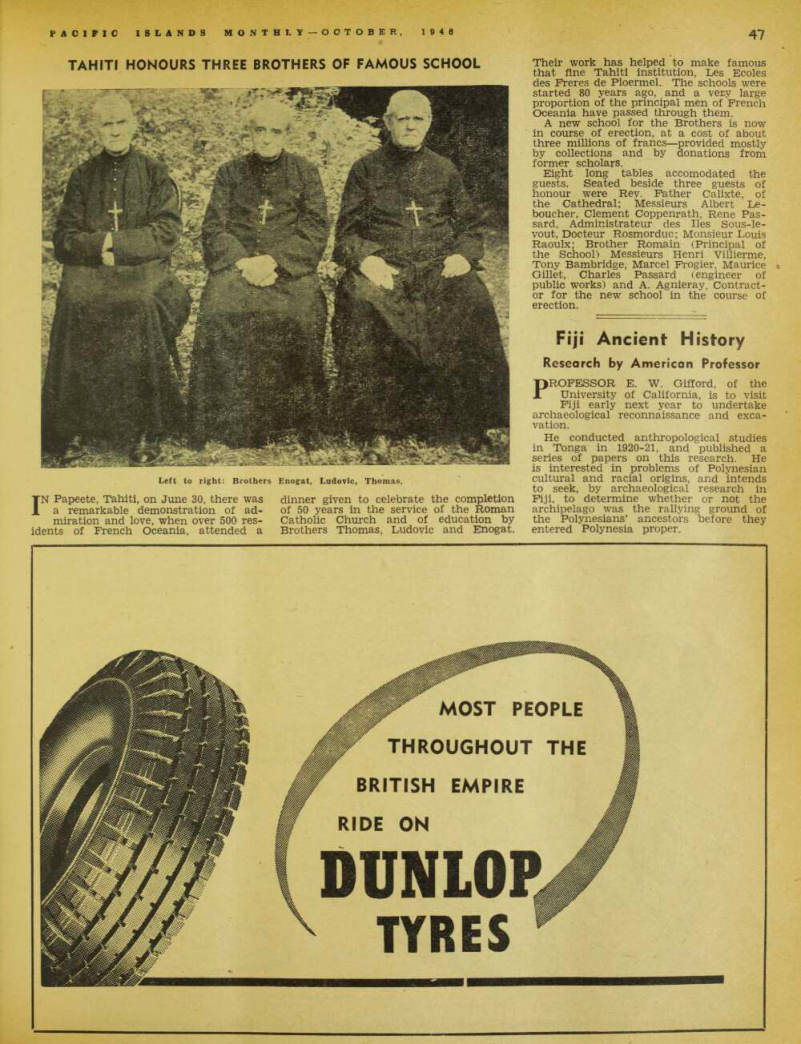
IN Papeete, Tahiti, on June 30, there was a remarkable demonstration of admiration and love, when over 500 residents of French Oceania, attended a
dinner given to celebrate the completion of 50 years in the service of the Roman Catholic Church and of education by Brothers Thomas, Ludovic and Enogat.
Their work has helped to make famous that fine Tahiti institution, Les Ecoles des Freres de Ploermel. The schools were started 80 years ago, and a very large proportion of the principal men of French Oceania have passed through them.
A new school for the Brothers is now in course of erection, at a cost of about three millions of francs—provided mostly by collections and by donations from former scholars.
Eight long tables accomodated the guests. Seated beside three guests of honour were Rev. Father Calixte, of the Cathedral; Messieurs Albert Le boucher, Clement Coppenrath, Rene Pas sard, Administrates des lies Sous-le vout, Docteur Rosmorduc; Monsieur Louis Raoulx; Brother Romain (Principal of the School) Messieurs Henri Villierme, Tony Bambridge, Marcel Frogier, Maurice Gillet, Charles Passard (engineer of public works) and A. Agnieray, Contract or for the new school in the course of erection.
Left to right: Brothers Enogat, Ludovic, Thomas.
Fiji Ancient History
Research by American Professor
PROFESSOR E. W. Gifford, of the University of California, is to visit Fiji early next year to undertake archaeological reconnaissance and exca vation.
He conducted anthropological studies in Tonga in 1920-21, and published a series of papers on this research. He is interested in problems of Polynesian cultural and racial origins, and intends to seek, by archaeological research in Fiji, to determine whether or not the archipelago was the rallying ground of the Polynesians’ ancestors before they entered Polynesia proper.
Advertisements & other items, p. 49 (2 items)
47
MONTHLY— OCTOBER, 1948
PACIFIC ISLANDS MONT
Dunlop.
i
MOST PEOPLE
THROUGHOUT THE
BRITISH EMPIRE
RIDE ON
DUNLOP.
TYRES
G'Air Hope to Fly Again in
NG
Prom Our Own Correspondent Lae, October 1.
GUINEA Airways, who put New Guinea on the map away back in the '2o’s by opening up the Morobe goldfield, hope to recommence operations in New Guinea at an early date.
Mr. “Bunny” Hammond has been liv ing in Lae since early this year, watch ing GA interests, but prolonged negotia tions with the Australian Department of Civil Aviation have held up their plans for re-establishment. Only planes of a certain type are acceptable to the De partment, since Australia became party to the international airways organisa tion which fixes standards for all air craft, airfields, etc.
It is expected that planes of the ap proved type will be forthcoming shortly and GA will then commence business.
The Junkers and Ford machines which they operated before the war are now no more. Those that reached the Aus tralian mainland when the Japanese in vaded the Territory were taken over by the RAAF and, it is alleged, recently converted to scrap.
TERRITORIANS will be glad to see the return of the old firm that did so much to open up the Mandated Ter ritory—and not entirely for sentimental reasons. Passenger rates on international airways are prohibitive at present, and competition might bring them down. The fare from Lae to Wewak about 325 miles airline—is £4O return. The fare from Lae to Madang, a distance of about 150 miles, is £lO single. These fares are approximately three times greater than those prevailing on the mainland of Aus tralia —which seems excessive, even allowing for greater maintenance costs
and greater climatic and geographical hazards.
Mandated Airlines is the only company operating internal airlines at present.
With headquarters at Lae, they run ser vices to Wewak, via Madang, and to Wau and the Ramu. They use Dragon planes.
Qantas Airways also intend ultimately to operate internal passenger and freight planes in the Territory, but a date for the commencement of this service is so far indefinite.
The greatest aerial transport need in the Territory to-day is an extension of the Qantas Australian-New Guinea ser vice to Rabaul. Qantas is prepared to do this, but the Rabaul drome is not yet up to the requirements of the Depart ment of Civil Aviation; and the date when something will be done to remedy this and whose job it is, are included among those dark mysteries which one soon learns to accept without question in this country.
“Winkin’,” “Blinkin’” and “Nod” left Brisbane for New Guinea by the “Mon toro” on September 7. They are donkeys, and will be used by the London Mission ary Society, at Moru Mission, to carry medical supplies in the Owen Stanleys.
But for the waterside strike, the animals would have left by the “Montoro” in July.
A delegation from the Methodist Church in Australia, led by Rev. H. G.
Secomb (secretary-general of the Metho dist Conference) and Rev. A. R. Gar diner (general secretary, Methodist Over seas Mission) were given a warm welcome in Suva on August 25, when over 1,000 persons crowded into the Jubilee Church.
Rev. W. Green, chairman of the Metho dist Mission in Fiji, conducted the) service. The proceedings were in English and Fijian. The Fijian inter preter was Ratu Alipat# Naulivou, of the Public Relations Office.
Mr. Mcewan Badly Injured
At Lae
From Our Own Correspondent Lae, Septemebr 7. rpHE well-known New Guinea baker, X Mr. “Scottie” McEwan, aged 39, met with a bad accident on September 2.
Always a hard worker, Mr. McEwan was building a new bakery, to enable him to cope with the growing require ments of Lae and district, and the Gold fields. In assisting his men to place a 2 'h tons oven in position, he had got underneath to adjust a jack upon which the oven was resting, when another jack slipped, bringing the oven down upon him.
Many men worked frantically to ex tricate the stricken man, who was in great pain, and he was hurried to the local hospital. The diagnosis was a fractured spine and he was sent to Sydney on the plane on September 6. The residents of Lae and district received the news with distress, and hope that under expert medical care this popular Ter ritorian may soon be restored to health.
Mr. McEwan was admitted to the Scottish Hospital in Sydney on September 6, and is now under expert medical care.
An X-Ray examination on September 9 showed a bad fracture and dislocations, and the task of putting the patient on his feet again will be long and difficult.
May Have Been Caused By
Earthquake
The theory is held now by some that the accident was caused by a guria—a typical New Guinea earthquake. It seems certain that a marked earth tremor did occur at just about the time Mr.
McEwan was under the oven; and that would be sufficient to throw the heavy appliance off the supporting jacks. An outstanding example of sheer bad luck.
Advertisements & other items, p. 50 (1 item)
Green Label
Ui ramiimp sbv i
J.A.D.GIBSON AND COMPANY PTY LIMITED
o at
FIRST GRADE
364 Kent Street Sydney DARBY STREETS
Oppresively High
Trans-Pacific Air Fares Are Oppresively High
THE comment was made, in the_June issue of the “PIM,” that the single fare of £55, Auckland to Suva, an nounced by Pan American Airways, was very high, arid not likely to popularise Pacific air travel.
It has been pointed out that the amount of this fare is purely nominal. Despite the implications of the Bermuda Agree ment, and the fact that, in the original agreement between the New Zealand Government and Pan American Airways, provision had to be made for carrying passengers between Auckland and Pacific Island ports, Pan American Airways is not now permitted to pick up passengers in Auckland for Fiji.
Pan American Airways calculate their fares on a basis of 8 cents per mile. The distance from Auckland to Noumea, and from Noumea to Suva, is around 2,000 miles, equal to 160 dollars, or over £5O at present exchange rates.
If a powerful private company like Pan American Airways were given “an open go” on this Trans-Pacific air route, cheap rates would be introduced in quick time.
But the Socialistic Governments of Aus tralia, New Zealand and Britain have established a monopoly, in this sphere, and are determined to maintain very high rates.
The situation, like that in New Guinea relating to shipping, is Gilbertian. On the grounds that they are striking at monopolistic private enterprise, the Gov ernments have themselves grabbed the transport facilities; and now they are creating conditions so oppressive and ex pensive that the common people are praying for the return of the “monopo listic” private companies. That is especi ally the case in New Guinea.
Academic Survey of Australian Territories
Australian Territories
AN attempt to find some general prin ciples and a comprehensive plan in the present administration of Papua- New Guinea is made in an article, “Papua and Mandated New Guinea Today,” by Thomas Penberthy Fry, in the June issue of “Pacific Affairs,” a quarterly review published in New York.
Mr. Fry, who is senior lecturer at the Law School, in the University of Queens land, has written an impressive article, in which the ground has been surveyed with much thoroughness. Like most academicians, Mr. Fry finds much to praise in the plans of Mr. E. J. Ward, and the performances of Colonel J. K.
Murray. But even he, as a reasoning, logical man, has to admit that the rehab ilitation of European industries in the Territories is about the last thing Mr.
Ward has planned; and that, failing revenues from healthy industries, the elaborate plans made by Mr. Ward and his fellow-dreamers for the education, medical care and protection of the natives cannot be implemented except at enormous cost to the Australian taxpayer.
Mr. R. Katterns and Mr. H. Tattersall recently returned to Western Samoa, after war service abroad.
Memorial for Late
Dr. G. H. Vernon
A NUMBER of friends of the late Dr.
G. H. Vernon, of Papua, have sub scribed to a fund, to establish a memorial to one whom all Papuan res idents esteemed and loved. The memorial will include a suitable stone over the grave of Dr. Vernon, on Rogea Island, near Samarai.
One of those who initiated the fund, Mr. H. Bitmead, of Samarai, writes: “The old Doc left his mark on the Territory, and it can be said of him that he lived and died for others, both Europeans and natives. It is fitting that we, his friends, should wish to keep fresh the memory of a great old man who, like Another, ‘went about doing good’.”
The following is the list, up to date If anyone wishes to subscribe, the “Pacific Islands Monthly” will receive and ac knowledge the amount, and remit same in due course to Mr. Bitmead and the others who are arranging the memorial.
Mrs. Dobbin s n d n Mr. R. Bunting 9 9 n Bunting, Ltd tin Mr. j. Gough ;■;; -
Mr. Skelly • j
Mr. J. Armstrong , n n Mrs. B. Bunting inn Mrs. Austen inn Mr. A. Way ” J J J Mr. C. Rich inn Mr. E. Bremen 1 n 0 Mr. and Mrs. E. Turner . . 2 9 n Mr. A. Sklller inn Mr. G. Miller ... inn Mr. J. S. Legge V. V. V. ” 1 0 0 Mr. V. Gabriel .. 10 0 Burns, Philp, Samarai 2 2 n Mr. H. Bitmead " " 5 0 Q “Pacific Islands Monthly’ .. .. ’ .. 33 0 • Total 41 4 0 , An ., urgent plea that the memorial should take the form of a TB hospital m the Western Division of Papua is published in this issue. Dr. Vernon was keen!y interested in the health of the Gulf natives, and did much valuable work there.
There was a “rush” on the special Fiji Peace and Reconstruction stamps, when they were placed on sale on August 17.
In one day, £1,240 worth of stamps were sold.
Advertisements & other items, p. 51 (1 item)
Steamships Trading
Pen and Pencil
Set by
YEN US
s£9o “NoFedTw actual size A perfect gift for yourself and others —the new Venus pen with every essential writing feature of pens costing twice as much and —a smooth action, matching pencil. Venus Guaranteed.
Obtainable at
PACIFIC ISLANDS TRADING
COMPANY
244 California Street, San Francisco,
Steamships Trading
Company Limited
PORT MORESBY SAMARA! PAPUA.
WHOLESALE & RETAIL MERCHANTS, SHIPOWNERS,
PLANTERS, ENGINEERS & SLIP PROPRIETORS.
Customs, Shipping, Insurance, and Forwarding Agents.
MANAGING AGENTS AND VISITING REPRESENTA-
TIVES FOR COCONUT AND RUBBER ESTATES.
SYDNEY REPRESENTATIVES: Nelson & Robertson Pty. Ltd.. 12 Spring Street
Cocoa Tree Disease
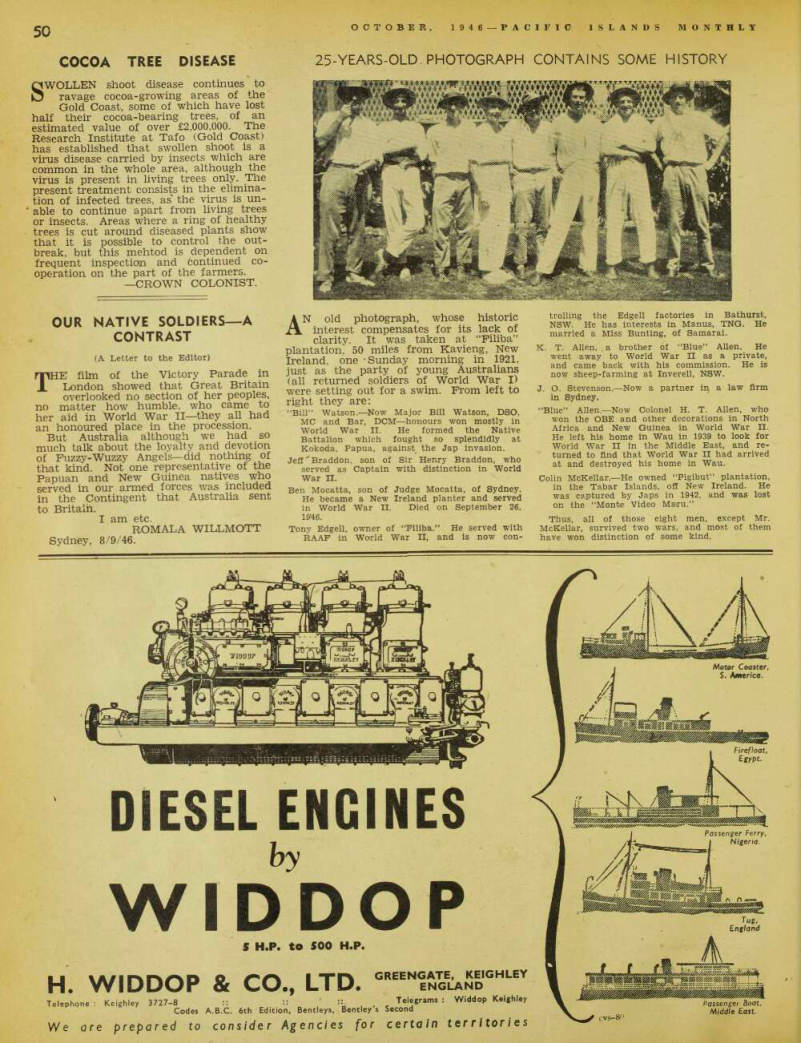
SWOLLEN shoot disease continues to ravage cocoa-growing areas of the Gold Coast, some of which have lost half their cocoa-bearing trees, of an estimated value of over £2,000,000. The Research Institute at Tafo (Gold Coast) has established that swollen shoot is a virus disease carried by insects which are common in the whole area, although the virus is present in living trees only. The present treatment consists in the elimina tion of infected trees, as' the virus is un able to continue apart from living trees or insects. Areas where a ring of healthy trees is cut around diseased plants show that it is possible to control the out break, but this mehtod is dependent on frequent inspection and Continued co operation on the part of the farmers.
Crown Colonist.
Our Native Soldiers—A
Contrast
(A Letter to the Editor) rE film of the Victory Parade in London showed that Great Britain overlooked no section of her peoples, no matter how humble, who came to her aid in World War ll—they all had an honoured place in the procession.
But Australia although we had so much talk about the loyalty and devotion of Fuzzy-Wuzzy Angels—did nothing of that kind. Not one representative of the Papuan and New Guinea natives who served in our armed forces was included in the Contingent that Australia sent to Britain.
I am etc.
Romala Willmott
Sydney, 8/9/46.
25-Years-Old Photograph Contains Some History
AN old photograph, whose historic
interest compensates for its lack of clarity. It was taken at “Piliba” plantation, 50 miles from Kavieng, New
Ireland, one -Sunday morning in 1921,
just as the party of young Australians (all returned soldiers of World War I) were setting out for a swim. From left to
right they are:
“Bill” Watson. —Now Major Bill Watson, DSO, MC and Bar, DCM —honours won mostly in World War 11. He formed the Native Battalion which fought so splendidly at Kokoda, Papua, against the Jap invasion.
Jeff'Braddon, son of Sir Henry Braddon, who served as Captain with distinction in World War H.
Ben Mocatta, son of Judge Mocatta, of Sydney.
He became a New Ireland planter and served in World War 11. Died on September 26, IS'46.
Tony Edgell, owner of “Flliba.” He served with RAAF in World War 11, and is now con
trolling the Edgell factories in Bathurst, NSW. He has interests in Manus, TNG. He married a Miss Bunting, of Samarai.
K. T. Allen, a brother of “Blue” Allen. He went away to World War II as a private, and came back with his commission. He is now sheep-farming at Inverell, NSW.
J. O. Stevenson. —Now a partner in a law firm in Sydney.
“Blue” Allen. —Now Colonel H. T. Allen, who won the OBE and other decorations in North Africa and New Guinea in World War 11.
He left his home in Wau in 1939 to look for World War II in the Middle East, and re turned to find that World War II had arrived at and destroyed his home in Wau.
Colin McKellar. —He owned “Pigibut” plantation, in the Tabar Islands, off New Ireland. He was captured by Japs in 1942, and was lost on the “Monte Video Maru.”
Thus, all of those eight men, except Mr.
McKellar, survived two wars, and most of them have won distinction of some kind.
Advertisements & other items, p. 52 (1 item)
Widdop
DIESEL ENGINES
5 H.P. to 500 H.P.
H. WIDDOP & CO., LTD.
Telephone : Keighley 3727-8 Codes A.B.C. 6th Edition. Bentleys, Bentley’s Second
GREENGATE, KEIGHLEY
ENGLAND
Telegrams : Widdop Keighley We are prepared to consider Agencies for certain territories
Broadcasting To
The Pacific
BBC Asks Residents For Reception Reports
IN a recent overseas broadcast from London, the head of the BBC’s Oucr seas Engineering department, Mr. L. W.
Hayes, outlined some of the problems of shortwave broadcasting from the United Kingdom to the Pacific, and invited listeners to send him reception reports that may be of help in rendering the ser vice even better. Here is what he said — IF you can hear what I am saying, he said, that is proof that the BBC’s Ser vice is coming through not too badly.
But by enlisting youri help we hope eventually to make your reception even better. We need reports telling us about reception at your end —not just that you receive this or that programme—but re ports giving us the wavelength on which you receive best at a particular time.
Right from the start of the Empire Service in 1932, we have been very for tunate in having as a correspondent Mr.
Caldwell, of Suva, who has sent us regu lar detailed technical information about the reception of the Pacific Service —and we are more than sorry that ill health has prevented his continuing to do so.
Secondly, it is most useful if you can give us comparisons between the differ ent wavelengths we have on the air at once—particularly if you find that a wavelength not intended for you is bet ter than one which is intended for you.
Thirdly, we would like to know how reception of the BBC compares with that from other shortwave stations.
NOW .for some of our problems and how we try to solve them. The short est transmission path to Tonga, for instance, is some 10,000 miles long. If the waves travel better over the South Polar regions than over the North Polar ones—and they do at certain times of day—then the transmission path is 14,000 miles long, and that does make it difficult to give you a good service. As you probably know, the shortwaves travel by a series of giant hops—or richochets. They bounce in between the surface of the earth and the ionosphere which is an outer layer in the atmo sphere, some 200 miles above the earth.
To reach Tonga some seven hops or rebounds are needed, and the conditions of reflection will be different at each of the hops, because the effect of the sun will be different.
That presents a special problem, be cause a wave of, say, 19 metres, which happens to be reflected particularly well at the first hop, may not be the right length of wave to be reflected at the
last, and so not reach you at all. On the other hand, a wave which would be reflected well at the last hop may not be the right length to be reflected the first time, and will not get anywhere at all. In either case, you get bad recep tion.
To give you the best choice of recep tion, we put several wavelengths on the air at the same time, but even so there are hours each day—which change throughout the year—when we cannot get through to you in the Pacific on any wavelength.
One way we have of tackling the prob lems is to change the overall timing of the Service approximately one hour per month, going earlier towards June and later towards December.
During the war, however, we adopted a simpler arrangement by extending the overall time of the Pacific Service, and by changing its time only twice a year.
That scheme seems to have proved satis factory, and is being continued.
NOW for one or two general points.
Some of our regular correspondents in the Islands have written to ask why we direct several wavelengths sim ultaneously to Australia and the Pacific Area, and why we cannot be more ex plicit about which of them should pro vide the best reception in any given locality. They ask if we are using sev eral waves in the hope that “something will get through."
That is to some extent true, as I ex plained just now; but let me assure list eners that if it were possible to be ex plicit on this matter we would gladly give full details. We would like to be able to. tell listeners —say, in Samoa — to listen on GSP in the 19 metres band at 8 p.m. for best reception; but, unfor tunately, for several reasons this is not possible.
It so happens that because of the rap idly changing conditions from darkness to daylight at this end, and from day light to darkness at your end, we need to transmit for part of the time over the South Polar regions, and for part of the time over the North Polar regions. Be cause conditions over each of these great distances vary from day to day, we arrange our schedule so as to have two wavelengths available over each path— that is, two in the south-westerly direc tion and two in the north-easterly direc tion —and then let you choose the one that reaches you best.
Of course, at any particular moment all these transmissions may be receivable simultaneously. You do not need me to tell you how large is the total area of the Pacific, and you can imagine that local reception conditions cannot be the same everywhere. The wavelength you get best will depend on the conditions existing at the time; so if your pet fre quency is below normal, do turn to one of the other frequencies in use.
IMUST just say a word about the morse code interference to many of our short wavelengths, which I am afraid increased a lot during the war years. An enormous number of wavelengths were
required to maintain the Armed Forces radio communications over such a large area as the Pacific, and although we made every effort to maintain BBC shortwave channels free of interference, we were not always successful. However, with the war over, we can look forward to this type of interference disappearing.
Here, again, information from you, especially when the call sign of the in terfering station can be given, is most valuable. You see, although the inter fering station is a nuisance to you it may not be audible in England, and conse quently we, at this end, cannot identify it and take action.
To sum up: we need your reports— please give the wavelength on which you get best reception and the time; tell us how the different wavelengths compare; let us know how reception of the BBC compares with other transmissions in the same waveband on the air at the same time; and, if you experience interference, try and identify the station causing it.
Write to The Director, Overseas En gineering Department, British Broadcast ing Corporation, London.
Advertisements & other items, p. 53 (2 items)
51
PACIFIC ISLANDS MONTH LY OCTOBER, 1946
CO., Inc.
A. G. ANDREWS
244 California Street, San Francisco 11,
U.S.A.
Wholesalers
□ Competitive Quotations on Merchandise of Every Description. □ Thoroughly Conversant With Island Trade. □ Bankers: Bank of America, San Francisco.
Cables: ANDINC, San Prancismo.
£ k ** 1 Bond Street, Sydney, Australia. £* sj) -Vy \ j TcL 841 ®7- B <>x 3615 G.P.O.
SUPPLIERS OF GENERAL MERCHANDISE TO LEADING FIRMS THROUGHOUT THE
PACIFIC ISLANDS
Exporters ... Importers . . Manufacturers' Representatives Bankers: Bank of N.B.W. Bank of Adelaide. Comptolr Nat. d’Eseompte de Paris.
Cable Address: "SEAFOODS,” SYDNEY, Codes: Bentley’s, 2nd and Oomp. Phrase; A.8.C., sth and ®th; Peterson, 2nd and 3rd; Banking; Acme.
Food Shortage In Samoa
Apia, September 24.
AMERICAN Samoa has been suffering from a severe food shortage, mainly due to the non-arrival of the Islands steamer “Matua” in August. Flour, rice, canned meats and native foodstuffs were extremely' scarce, and sometimes fantastic prices were offered for supplies.
As Western Samoa also ran short of supplies during the sarnie period, though to a much smaller degree, no relief was available from Apia, though large amounts of native foodstuffs were for warded to Pago Pago to relieve the situation somewhat.
Malaria
New Treatment of Malaria But May Create a Racial Menace
PALUDRINE malaria-killing and
preventive drug is a boon to the white races now but will one day aggravate their problems in the East.
When ample supplies of the drug are available to the world, the fear and effects of malaria will be conquered from India to China.
Then, according to an Army medical officer in Melbourne who has made a study of malaria and its treatment, political and racial difference will in crease in proportion to the Asiatic’s im proved physique, health and energy.
The day when the supplies would be available was not far away, he said.
Already Australia had more than suffi cient to meet the needs of her malaria sufferers.
Today it is being widely used with great success at Heidelberg Military Hospital to combat relapsing fever. Medical officers admit that the use of the drug has not completely left the experimental stage, but are confident that the new 14-day initial course about to be prescribed will be followed by a far lower incidence of relapses than has been experienced after atebrin and 10 day paludrine course in the past.
Patients are confined to bed as a pre cautionary measure during the first 14 days of their paludrine course, because during that period they are also treated withh another ‘drug, which is slightly toxic.
Thereafter, the patient is free to move as he chooses, providing he regularly
swallows two 100-milligram paludrine tablets each week for six months. By that time he should be cured of BT malaria.
Courses have been prescribed also for treating malignant malaria—the “killer” —but medical officers point out that al though an average of 14 men and women are reporting to Heidelberg every day with another drug, which is slightly ignant type has been very small since the end of the war in the islands.—Mel bourne Herald.
Import Licences Now
Necessary In New Guinea
Lae, Sept. 24.
HERE are many Territorians to-day who, feeling that they have had a raw deal, would willingly cut them selves off from Australia and be con sidered foreigners.
But the Australian Government likes to have it both ways. Territorians are charged foreign prices for all basic com modities—flour, tea, rice and such things that are supported by bounties for Aus tralian consumption—and, in addition, they now must have a licence from the local branch of the Department of Im port Procurement before they are per mitted to import goods or commodities from non-Australian sources.
This latest blessing was introduced in August.
It is said locally that shoes have be come a prohibited export in Australia and that no more shoes can be sent to the Territory. As no stocks are held in local stores, Territorians wonder what they are expected to do when their pre sent footwear wears out.
Advertisements & other items, p. 54 (1 item)
Tuok
OFF
m
f DB2 9 H.P. HEAVY
f DUTY MARINE ENGINE
Driving 1 1-\ x 16 in.
Propeller at 700 r.p.m. % Reliable % Efficient A Economical Stuart Turner
Generating Sets
1,000 Watt, 32 Volt.
Simple, Economical
IMMEDIATE DELIVERY
STERN GEAR MADE TO ORDER
GOOD DELIVERIES
Write for full particulars to —
Thornycroft (Aust.) Pty., Ltd. pyrmonTSw,
Cables: THORNMOTOR, Sydney.
Machines to Replace
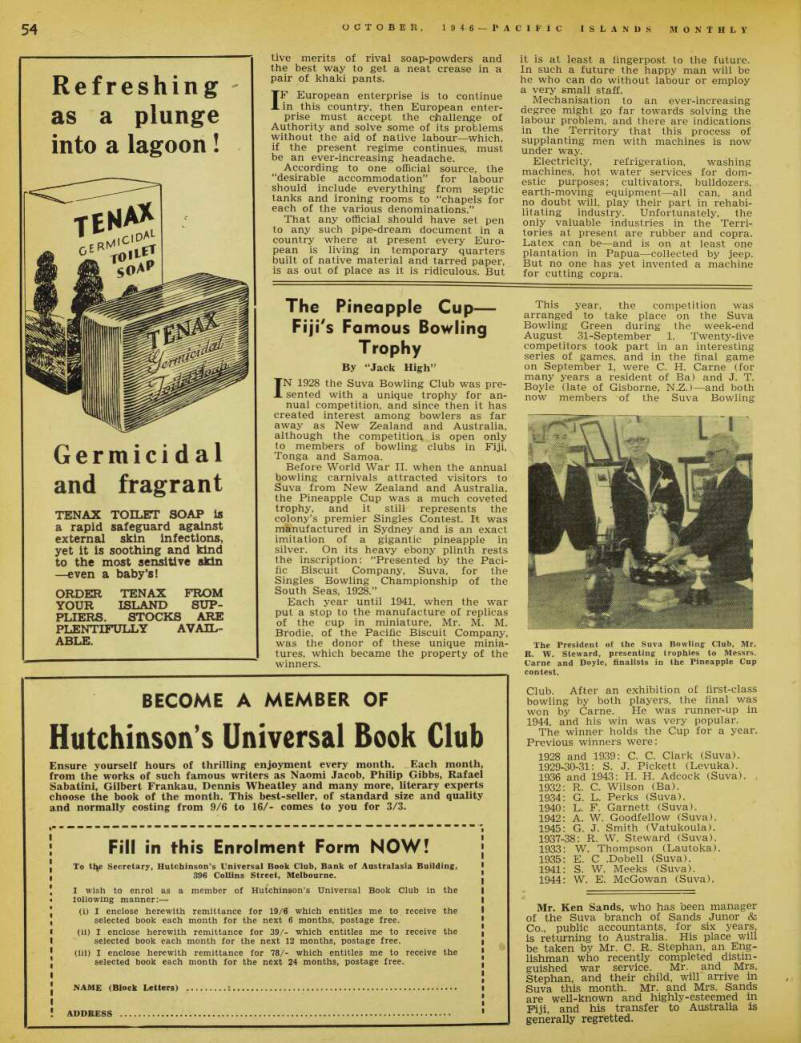
Native Labour Apparently The Only Solution to N. Guinea's Labour Problem
IT is estimated by “old hands” in Papua that the cost of native labour —that is, wages and food —is now three times greater than pre-war, and that if the Papua labour pool was maintained at the 1939 figure (about 12,000) the addi tional cost to Papua alone would be over a quarter of a million pounds.
Before the war, the weekly cost of a boy’s ration in Port Moresby was about four shillings. A boy’s ration to-day costs 12/6—when it can be obtained. The basis of the ration is still rice and meat.
Rice—which now comes from Australia— is four times the pre-war price; meat over twice as much as in 1939.
In addition there are many extras such as wholemeal, peas, beans or lentils, sugar, tea, animal fat and canned tomato juice where fresh fruit is un obtainable.
Ultimately, it is the native who suffers from these increased prices. Europeans prefer to pay their boys at the rate of about 15/- per week and have them feed themselves —a method of passing the re sponsibility that defeats the Australian Government’s aim to boost Fuzzy-wuz zie’s intake of calories.
Away from Port Moresby it is at pre sent virtually impossible to buy rice or trade-meat, a fact that constitutes a fine means of anti-Administration pro paganda.
“No got rice; no got meat. Lap-lap ’e sikis fella mark,” says Trader Tom; and, when Brown Brother complains, he can reply with a shrug and a certain amount of truth: “Fashion belong new fella Gov’ment.”
IT is stated by officers of the Native Labour Department that there are now 6,000 natives working either casu ally or by contract in Papua. Of these, over 3,000 are working for the Adminis tration. The whereabouts of the other 3,000 is a mystery to planters and others who are short-staffed. ‘No native working for the Administra tion can be “indentured”; and generally it is the job of the official in charge of native labour to endeavour to induce employers to try so-called free labour.
In actual practice both methods seem, to amount to the same thing. No legal action appears to be taken against a native who breaks his contract and where formerly he was taken to court and fined and made to make up the time which he had undertaken to work, now the contract is simply terminated and the labourer is permitted to go his merry way.
The signing-on, or paying-off of labour, of course is no longer in the hands of the various District Officers, but is done by a Native Labour Department whose specialised function it is. There seems no great enthusiasm on the part of offi cials appointed to this thankless job of go-between for bereft employers, the spoilt and/or bewildered natives, and Native Labour headquarters in Port Moresby.
So far the powers-that-be in Port Moresby have shown no signs of learn ing by experience, and, while asking for increased copra production, are going ahead with their policy of signing off Angau boys in the mistaken belief that “good employers will always get labour.”
If they are right in this contention, then it is interesting to note that when the signing-off debacle hit Madang only re cently, the two hardest-hit organisations
were (1) the Admniistration itself; and (2) the Roman Catholic Mission at Alex ishafen.
THE natives in Papua, on the whole, seem more normal, more willing and more cheerful than those on what is now called “the other side” the former Mandated Territory. There they are sullen, unsettled and are either un willing or too bewildered to go to work.
Possibly in time these natives too will settle down to something approaching the old order, but it is problematical whether the European who formerly de pended upon their labour will stay the distance.
One effect of labour shortage in the two Territories is that the old myth that
Europeans could not work here has been exploded. Men have found that they can do anything, from building houses to lumping cargo; and the wash-boy position is such that returning miners and planters can now discuss the rela
tive merits of rival soap-powders and the best way to get a neat crease in a pair of khaki pants.
IF European enterprise is to continue in this country, then European enter prise must accept the challenge of Authority and solve some of its problems without the aid of native labour —which, if the present regime continues, must be an ever-increasing headache.
According to one official source, the “desirable accommodation” for labour should include everything from septic tanks and ironing rooms to “chapels for each of the various denominations.”
That any official should have set pen to any such pipe-dream document in a country where at present every Euro pean is living in temporary quarters built of native material and tarred paper, is as out of place as it is ridiculous. But
it is at least a fingerpost to the future, In such a future the happy man will be he who can do without labour or employ Mechanisation to an ever-increasing de g re e might go far towards solving the labour problem, and there are indications in the Territory that this process of supplanting men with machines is now under way.
Electricity, refrigeration, washing machines, hot water services for dom estic purposes; cultivators, bulldozers, earth-moving equipment—all can, and no doubt will, play their part in rehabi litating industry. Unfortunately, the only valuable industries in the Terri tories at present are rubber and copra, Latex can be—and is on at least one plantation in Papua—collected by jeep, But no one has yet invented a machine for cutting copra.
Advertisements & other items, pp. 55-56 (1 item)
Imperial
STAMPS
We buy collections, also all issues in quantity, either off or on paper. Top prices. Send registered mail.
Agents required in Pacific Islands, Papua and New Guinea to service covers and send mint stamps.
A. Willison, Box 128, Burnie, Tasmania.
TIME OFF FROM
COOKING
/ ■■ m m r* c r m wW4 w- i «
min.
% i m njf m m m \: 'St*. #S 4*. »wvw»eeii^s!»g« What an idea to be able to serve up meals in 5 minutes! . . . Meals that will bring unanimous appetising pleasure—treats that you yourself will be able to sit down and enjoy.
IMPERIAL Good Foods are ready-cooked for you by expert chefs. Easy-to-serve. Specially processed to seal in the full flavour and keep EVER-FRESH.
Imperial
GOOD FOODS
W. ANGLISS & Co. (Aust.) Pty., Ltd.
Head Office: 5-7 O’Connell Street, Sydney, Australia.
Imperial
MEATREAT
★ Imperial
CAMP PIE
★ Imperial
HAMPE
★ Imperial
HOT MEALS
Refreshing -
as a plunge
into a lagoon!
of-jsss
SOAP
gjail £
Germicidal
and fragrant
TENAX TOILET SOAP is
a rapid safeguard against external skin infections, yet it is soothing and kind to the most sensitive skin —even a baby’s!
ORDER TENAX FROM
YOUR ISLAND SUP-
PLIERS. STOCKS ARE
PLENTIFULLY AVAIL-
ABLE.
BECOME A MEMBER OF
Hutchinson’s Universal Book Club
Ensure yourself hours of thrilling enjoyment every month. Each month, from the works of such famous writers as Naomi Jacob, Philip Gibbs, Rafael Sabatini, Gilbert Frankau, Dennis Wheatley and many more, literary experts choose the book of the month. This best-seller, of standard size and quality and normally costing from 9/6 to 16/- comes to you for 3/3.
Fill in this Enrolment Form NOW!
To Secretary, Hutchinson’s Universal Book Club, Bank of Australasia Building, 396 Collins Street, Melbourne.
I wish to enrol as a member of Hutchinson’s Universal Book Club in the following manner:— (i) I enclose herewith remittance for 19/6 which entitles me to receive the selected book each month for the next 6 months, postage free. (ii) I enclose herewith remittance for 39/- which entitles me to receive the selected book each month for the next 12 months, postage free. (iii) I enclose herewith remittance for 78/- which entitles me to receive the selected book each month for the next 24 months, postage free.
NAME (Block Letters)
! ADDRESS
Trophy
The Pineapple Cup— Fiji's Famous Bowling Trophy
By “Jack High”
IN 1928 the Suva Bowling Club was pre sented with a unique trophy for an nual competition, and since then it has created interest among bowlers as far away as New Zealand and Australia, although the competition is open only to members of bowling clubs in Fiji, Tonga and Samoa, Before World War 11. when the annual bowling carnivals attracted visitors to Suva from New Zealand and Australia, the Pineapple Cup was a much coveted trophy, and it still represents the colony’s premier Singles Contest. It was manufactured in Sydney and is an exact imitation of a gigantic pineapple in silver. On its heavy ebony plinth rests the inscription: “Presented by the Paci fic Biscuit Company, Suva, for the Singles Bowling Championship of the South Seas, 1928.”
Each year until 1941, when the war put a stop to the manufacture of replicas of the cup in miniature, Mr. M. M.
Brodie, of the Pacific Biscuit Company, was the donor of these unique minia tures, which became the property of the winners.
This year, the competition was arranged to take place on the Suva Bowling Green during the week-end August 31-September 1. Twenty-five competitors took part in an interesting series of games, and in the final game on September 1, were C. H. Came (for many years a resident of Ba) and J. T.
Boyle (late of Gisborne, N.Z.) —and both now members of the Suva Bowling
Club. After an exhibition of first-class bowling by both players, the final was won by Came. He was runner-up in 1944, and his win was very popular.
The winner holds the Cup for a year.
Previous winners were: 1928 and 1939: C. C. Clark (Suva). 1929-30-31: S. J. Pickett (Levuka). 1936 and 1943: H. H. Adcock (Suva). 1932: R. C. Wilson (Ba). 1934: G. L. Perks (Suva). 1940: L. F. Garnett (Suva). 1942: A. W. Goodfellow (Suva). 1945: G. J. Smith (Vatukoula). 1937-38: R. W. Steward (Suva). 1933: W. Thompson (Lautoka). 1935: E. C .Dobell (Suva). 1941: S. W. Meeks (Suva). 1944: W. E. McGowan (Suva).
Mr. Ken Sands, who has been manager of the Suva branch of Sands Junor & Co., public accountants, for six years, is returning to Australia. His place will be taken by Mr. C. R. Stephan, an Eng lishman who recently completed distin guished war service. Mr. and Mrs.
Stephan, and their child, will arrive in Suva this month. Mr. and Mrs. Sands are well-known and highly-esteemed in Fiji, and his transfer to Australia is
generally regretted.
The President of the Suva Bowling Club, Mr.
R. W. Steward, presenting trophies to Messrs.
Carne and Doyle, finalists in the Pineapple Cup contest.
Advertisements & other items, pp. 57-58 (2 items)
Strange Story of D'Argenlieu
55
Strange Story of D'Argenlieu Continued from Page 42
PACIFIC ISLANDS MONTHLY OCTOBER, 1946
When in Sydney, call and see us!
DON'T TELL ME
YOU NEVER HAD
A CHANCE!
I took an I.C.S. course, got ahead. But until you v -jl train yourself, how can you I , expect to handle a bigger ). job! Mail the coupon \ >s
the I.C.S. TODAY.
INTERNATIONAL CORRESPONDENCE SCHOOLS
140 Elizabeth Street, Sydney Dear Sirs — Please send me free prospectus showing how I can succeed in the occupation I have marked.
Advertising Accountancy Inst*.
Book keeping ... .Cost Accountancy Salesmanship Building Cont.
Architecture ...Roof, 8C Steel Sq.
Arch. Draw Build. Plan. Draw.
Carpentry —Ref. Eng. 8i Serv. lnd. Chemist ... Elect. Eng, or M.
Electronics ... Radio Eng. or Ser. ... Plastics ...Auto Mechanics Textiles Aero Dcs. 8C Eng.
Diesel Eng. Rayon Weaving Welding ...Comp. Mech. Eng.
Story Writing. ...Fitting 8C Turning Radio Play W Mech. D’sman. ... Com’cial Art Civil Engineering Sketching Showcards, Tickets Landscape Ptg. Shorthand, Typing Window Dress. General Education Dress Design Coach, any Exam.
If your subject is not above, write it here Address..
PAC.
ICS ICS, • I CS. • ICS
ISLAND MERCHANTS
and AGENTS.
GENERAL MERCHANTS.
379 KENT ST., SYDNEY
Cable & Telegraphic Address: “Chasull” Sydney. < X ; * Shippers of all types of Merchandise to the Pacific Islands • Representing Australian, British and American Manufacturers r -J iri • Buyers for Leading Pacific Islands Traders • Sellers of Island Produce on Consignment Importers, Distributors and Manufacturers of Foodstuffs, Softgoods, Textiles, Hardware, Tobaccos, Wines and Spirts, etc. iS • “Ultima” Kerosene Stoves and Heating Appliances • Distributors of High-grade Shirts, Pyjamas and Clothing 0 • “Southern Queen”
Canned Fruits • Forwarding and Transhipment Agents A. • Hill's English Cigarettes m When in Sydney, call and see us!
G. H. Robinson
ISLAND SUPPLIES
of all kinds—Selected and Shipped to order at lowest possible prices—Piecegoods in Wool, Cotton and Silk, Under and Outerwear, Manchester, Drapery, Grocery, Hardware, Engineers and Leathergoods trade supplies a specialty.
Indents and Transhipments arranged. Large or small orders treated with equal care.
Use our 25 years’ extensive experience.
Enquiries solicited to —
G. H. ROBINSON
51 Macquarie Street, Sydney, N.S.W.
Telegrams: Sunrise, Sydney.
Letters: Box 3317, G.P.0., Sydney.
From
Factory
in the
English
Orchards
has always come the finest jam it is possible to make. Freshness, allied to purity, alone can produce such perfection. From Chivers Orchards—adjoining the Factory come plump, luscious strawberries, with the warmth of the sun still on their
SSad
~Cv f 6 cw\^
CHIVERS
rosy-red cheeks, and many other English fruits “ just right”for preserving. No wonder Chivers Jams have a worldwide reputation for quality.
Supplies are still limited but shipments mil be resumed as soon as possible. . ;
ENGLISH
JAMS
Made in the heart of the English countryside by
CHIVERS & SONS Ltd.
The Orchard Factory, Histon, Cambridge, England 'AS.
U
Samoa
Prosperity In W.
From Our Own Correspondent Apia, Oct. 1 AN Apia firm has just completed de liveries under a contract for 120 tons of cocoa-beans to Palestine, at a very attractive price (about £135 per ton f.0.b.). The new contract price for plan tation, hot air-dried cocoa-beans of first grade quality is £135 per ton, or about £ll6 per ton paid to the planter. This means an advance of some £3O per ton on the last contract price (about £B6 per ton).
Given satisfactory weather conditions, the next cocoa crop should be a very good one.
A new factory for the manufacture, for export, of Samoan dehydrated ban anas (banana figs) has been opened re cently by the New Zealand Reparation Estates at Mulifanua Plantation.
The factory is situated at Vaibase (Vailele) Plantation. It is reported that the demand for the product in New Zea land is increasing rapidly and the NZRE is at present unable to fill all the orders.
Aloma Products Ltd., which was to have started a canning factory for coconut cream in July, has so far not begun operations, owing, it is reported, to the non-arrival of essential engine parts from England.
The recent appreciable increase in the price of copra may to some extent affect the economics of the enterprise.
There is marked building activity in Apia as well as in country districts.
New buildings now in progress include stores for O. F. Nelson & Co.; a building for I. H. Carruthers Ltd.; a concrete building for the Methodist Mission; and a church on the property of the Seventh Day Adventist Mission at Vaea.
Many new buildings already started had to be suspended through lack of lumber, cement and roofing iron.
Amongst such buildings are native churches in all districts of the islands.
Mrs. C. G. Chadderton
Dies In Sydney
mHE death occurred on September 9 X of Mrs. May Chadderton, widow of Mr. C. G. Chadderton, a well known plantation owner .of New Ireland. Mr.
Chadderton was interested in three plantations—Kapsu, which he owned; Lamerika, in which he was part owner with his brother; and Dalum, which was owned by Mrs. Chadderton.
Mr. Chadderton was overtaken by the invasion and his actual fate is still un known —but there seems little doubt that he was murdered by the Japs. Mrs.
Chadderton went to Sydney in 1941 and had lived ever since with her daughter at Dulwich Hill, Mrs. M. E. Carter. She was only 51 years old when she died very suddnely from a stroke.
Mr. and Mrs. Chadderton had lived in New Guinea'for over 20 years.
The Catholic Bishop of Rabaul, Right Rev. Leo Scharmach, well-known head of the Sacred Heart Mission in Britain, arrived in Sydney on a short visit at the end of September. Bishop Scharmach was in New Guinea during the whole period of the Japanese occu pation and was a prisoner of the Japs at Vunapope and elsewhere. He, along with other members of his Mission, suf fered great privations between 1942 and 1945.
Bitter Argument
About Cook Is. Politics
WRITING from Srinigar , Kashmir, India, Mr. H. Marshall sends a cut ting of a long article in “The States man” about “Unrest in the Cook Islands ” and makes some acid comment : ONE year ago, in Sigatoka, Fiji, the editor of PIM heard some comments on the administration of Cook Islands.
He was much amused! From the en closed cutting (Calcutta Statesman ) it appears that conditions in those Islands have become news.
The New Zealand Administration of the Cook Islands has just one policy—to do exactly nothing that would raise the status of the Islanders.
The Commissioner, whether competent or not, could do little under present con ditions. Antagonism to Europeans is growing all the time, and will continue to grow unless the exploitation of the Islanders is stopped.
It is indeed unfortunate that an orig inally pleasant people should have de veloped into the existing sulky commun ity. They could even follow the example of Samoa, where the effects of New Zea land rule were made evident some years ago. Nor is it entirely impossible for Cook Islands unrest to affect the Maoris in New Zealand.
One can only hope that publicity will force the New Zealand Government to institute reforms—or better, to hand the islands over to the Western Pacific High Commmission.
EDITORIAL NOTE: The article in The Statesman of July 17 is a Reuter message from Wellington, and, unhap pily, it appears to be based on the pro paganda and allegations of the Cook Islands Progressive Association, which has its headquarters in Auckland. The latter is an off-shoot of the Auckland General Labourers Union which is re garded as a Communist set-up.
Fijian Takes Charge of London Traffic
London Traffic
A NATIVE member of the Fiji Police, Vilise Nadaku, while in London with the Victory Contingent, was shown the organisation and establishments of the London Police; and, one day, was taken to the manually operated traffic lights in Kensington High Street.
The constable on duty explained the working of the signals and gave a five minutes’ demonstration.
Vilise then went into the control hut alone and for the next 20 minutes took charge of the signals. “Traffic was run ning heavily at the time but, to his credit, he manipulated the traffic as well as any of my own men,” said a police inspector.
The surprising sight of traffic control by a Fijian corporal in the busy Ken sington High Street, at eleven in the morning, was noticed by many vehicle drivers and passengers, including some German prisoners in lorries.
Rev. N. C. Watt. M. A., who was recently inducted in Brisbane as presi dent of the Queensland Conrega.tional Union was, before the war, attached to the London Missionary Society at Port Moresby for 15 months. He was in charge there of the Native Educational Centre.
Mrs. Charles Bates, who has been living in Melbourne, Vic., during the evacuation period recently left there and has now rejoined her husband in Rabaul.
The Queensland Government recently approved of the purchase of a trawler, at
£6,000, for carrying passengers and cargo for the Island Industries Board in the Torres Strait area, it is 62ft. long and its 225 h.p. diesel engine gives a range of 1,500 miles. It will carry 12 passengers and 50 tons of cargo, and will replace four luggers formerly used on this
service.-
Jmh.
Advertisements & other items, p. 59 (1 item)
“What’s the good of flowers . . .
WANTED TO BUY—QUALITY GUNS AND RIFLES
HIGHEST PRICES GIVEN. WILL ALSO EXCHANGE GUNS.
New .303 Short Service Barrels, without Sights and Platform, £2/15/- each.
Postage extra.
SI L RO H U Quality Firearms and Fishing Tackle. 143 ELIZABETH STREET (Near Market St.) SYDNEY. ’PHONE. MA 3540
h “What’s the good of flowers . . .
when I buy them for myself?”
“My friends say I look like a film star, but no one ever asks me out, much less sends me flowers.”
The trouble is that none of your friends are frank enough to tell you the real reason.
Men shun a girl who is not as fresh as a flower all the time.
Just a dab of smooth, harmless Mum under each arm will end your loneliness.
Thirty seconds with Mum will safeguard you
against offending all day or evening.
Get Mum to-day.
MUM
TAKES THE ODOUR OUT OF PERSPIRATION
Sold by all leading distributors and manufacturers by Bristol-Myers Co. Pty. Ltd., 223 Pacific Highway, North Sydney, N.S.W., Australia. 32748
New Governor Receives
Coveted Decoration
ON August 13, the new Governor of French Oceania, His Excellency Jean Camille Haumant, at a formal cere mony. in Papeete, was invested with the Cross of a Chevalier of the Legion of Honour.
Associated with.the many high French officials'who attended the ceremony was Mr. James Norman Hall, the famous American author, who is again a resi dent of Tahiti.
At the same ceremony, M. Teriierooi terai a Teriieroo, the veteran Chief of the District of Papenoo, was made an Officer of the Legion of Honour.
Mr. R. G. Garrett, who spent some months’ furlough in Melbourne recently, has now returned to Fanning Island.
Sharp Criticism Of British Policy
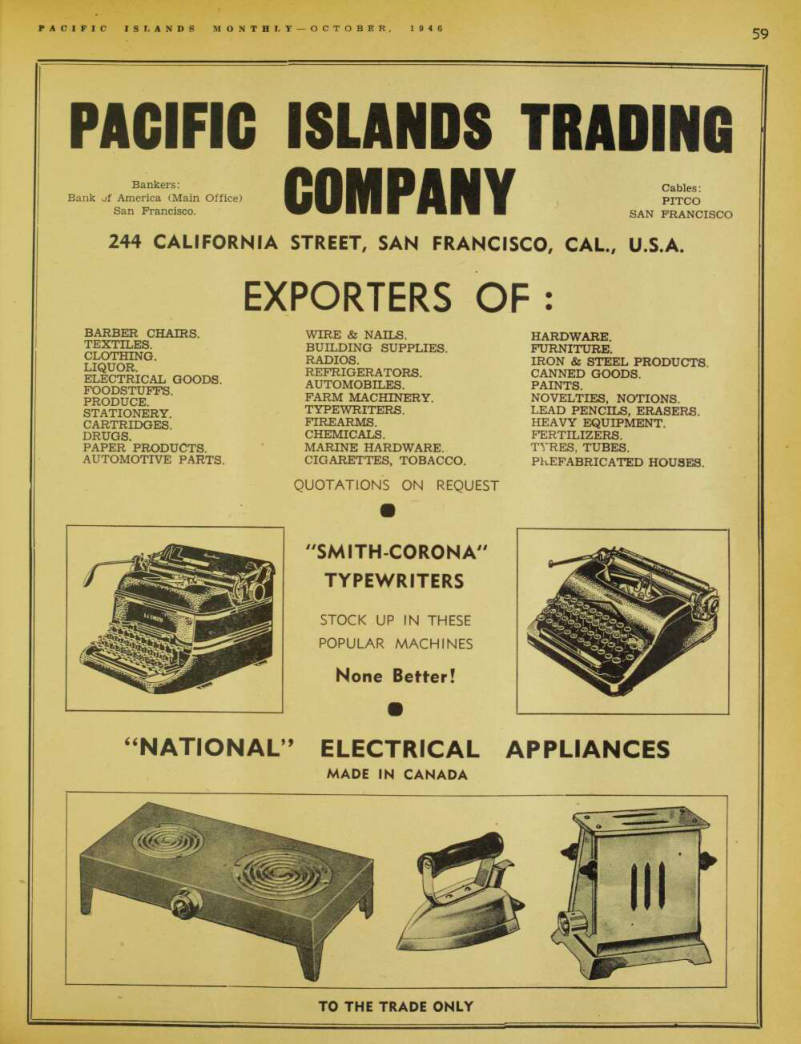
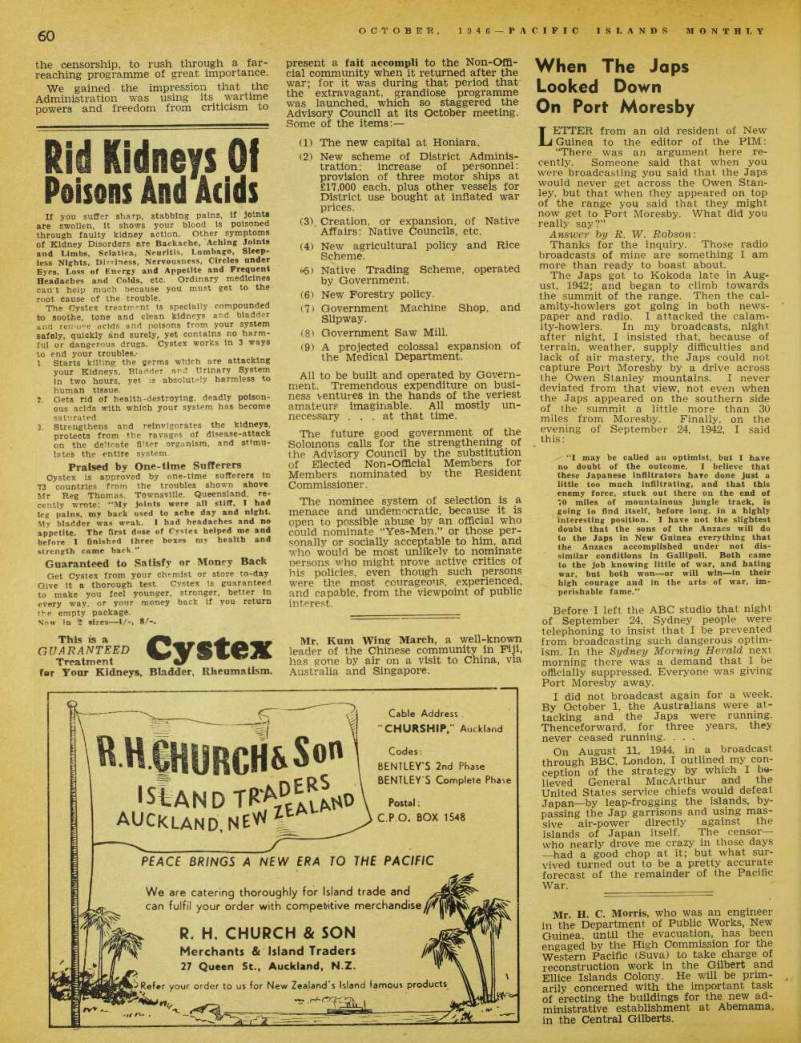
In Solomons
Anglo-African Officials Ignore Small Planters and Traders
By Leslie F. Gill, an old BSI Planter
AT its October, 1945 meeting, the British Solomon Islands Advisory Council voiced a popular protest when it criticised the Administration for not having convened the Council since November, 1941.
For four of the most vital years in the history of the Protectorate this commu nity of Europeans and Natives was disen franchised: Unnecessarily so, because two of the three non-official members were present in the Group and available throughout that period. There were capablle men available to take the place of the third, who at considerable public expense was brought from Australia to attend the Meeting. This gentleman had been absent from the Group for nearly four years, so had no knowledge of the greatly changed conditions which had resulted from the ravages of war in the Solomons.
Never was a Resident Commissioner more in need of advice than during the 1941-45 interregnum. That official, newly arrived from Africa, was surrounded by a group of (a) young administrative officers, some of whom were newly arrived youths; (b) others now full blown District Commissioners, were mere cadets in 1941; and (c) an official or two of the Old Guard of Tulagi, whose knowledge of the Solomons, outside of the Central area, was practically nil ► supplemented as his chief factotum by a New Zealand major of no tropical ex perience whatsoever, who arrived during the war, and who has since returned to NZ.
That is the set-up which ran the Solomons in the blackest years of its history. Valuable and very experienced officials were available; but, like several experienced civilians, they, apparently, were ignored. rE Resident Commissioner stated in Council —or implied that he and the High Commissioner had “con
saltations with representatives of non official opinion.” That may have been so as regards the Missions, and Big Busi ness, but it certainly was not true as regards the generality of the commercial interests and planters, who were con sistently ignored. (Incidentally, when will Governments learn that Missions and the major companies do not neces sarily represent all the interests in the Group? They certainly do not speak for the small companies, planters, and traders about half the planting and commercial interests in the Solomons.
This important section claims the right to be heard on all occasions. They are tired of being excluded.) It would be difficult to imagine a more exculsive and self-sufficient set-up than the above inexperienced official coterie.
It was the GOVERNMENT, and it KNEW.
Early in the piece, it conveyed the im pression that it neither wanted nor wel comed advice or information. In the province of Native Administration the general attitude to the experienced Old- Timers of these new officials was: “That is no concern of yours. We, heaven-sent appointees of the sublime Colonial Office, automatically know everything, and we are right, because we are the GOVERN MENT ... so please mind your own business.”
To which the writer, on one occasion, retorted to a Government fledging; “Pardon me, I am a citizen of long standing in this country, and would re mind you that in a British country the Administration of Justice is the concern of everyone, and not the prerogative of a privileged few,”
I told that officer and others that, when the military rule gave way to a civilian regime, they would find a very critical and lively interest taken by the public in their official actions.
PERHAPS, it might have been different had there been a High Commissioner of experience to guide and counsel the almost-new Regime in the Solomons.
But in the period under discussion there occurred two changes of High Commis sioners both from Africa.
We are becoming very tired of Africa — “Africa all over!” Africa is the spiritual home of our Senior Officials and the hoped-for Mecca of the Juniors.
Speaking to one of the District Com missioners on the question of why the natives turn to the Missions and the Old Timers instead of to the Government, I attributed, it to the fact that the natives regarded the officials as birds of passage, resting here temporarily on their flight from or to Africa.
The Official scornfully replied; “Who wants to spend his life in this dump?”
To which I rejoined; “Precisely! The missionaries and the planters wish nothing better than that, and the natives, who are not fools, recognise the fact and appreciate us accordingly ... as the natives of Papua did Governor Murray and his Officials.” mo those of us present in the Solomons I during those years of war, it seemed as if the Government was seizing the opportunity presented by the absence from the Group of the majority of the civilians and missionaries, and the gag ging of others by military regulations and
the censorship, to rush through a far reaching programme of great importance.
We gained the impression that the Administration was using its wartime powers and freedom from criticism to
present a fait accompli to the Non-Offi cial community when it returned after the war; for it was during that period that the extravagant, grandiose programme was launched, which so staggered the Advisory Council at its October meeting.
Some of the items:— (1) The new capital at Honiara. (2) New scheme of District Adminis tration; increase of personnel; provision of three motor ships at £17,000 each, plus other vessels for District use bought at inflated war prices. (3) Creation, or expansion, of Native Affairs; Native Councils, etc. (4) New agricultural policy and Rice Scheme. (5) Native Trading Scheme, operated by Government. (6) New Forestry policy. (7) Government Machine Shop, and Slipway. (8) Government Saw Mill. (9) A projected colossal expansion of the Medical Department.
All to be built and operated by Govern ment. Tremendous expenditure on busi ness ventures in the hands of the veriest amateurs imaginable. All mostly un necessary ... at that time.
The future good government of the Solomons calls for the strengthening of the Advisory Council by the substitution of Elected Non-Official Members for Members nominated by the Resident Commissioner.
The nominee system of selection is a menace and undemocratic, because it is open to possible abuse by an official who could nominate "Yes-Men," or those personally or socially acceptable to him, and who would be most unlikelv to nominate nersons who might prove active critics of his policies, even though such persons were the most courageous, experienced, and capable, from the viewpoint of public interest.
Mr. Kum Wing March, a well-known leader of the Chinese community in Fiji, has gone by air on a visit to China, via Australia and Singapore.
Advertisements & other items, pp. 60-62 (2 items)
George J. Lockyer & Company
The Twinkle in
Your Eye
COMES FROM ACTIVE
DIGESTION
Good normal digestive and liver activity means good, normal health and fitness. If you are becoming gloomy and feel tired out, the cause may be a congested state of your intestinal tract. So many people are troubled with constipation, which, through the retention of waste in the digestive system, causes sick headache, biliousness, pimply skin, unpleasant breath, irritability, slackness and dull eyes.
Regain your bright and attractive appearance by banishing constipation with Pinkettes. Tiny, perfectly harmless, gentle yet effective, these famous laxative and liver pills painlessly exercise and strengthen the bowels, keep the food tract clean and active, stir the liver, and thus banish sick headache, bilious attacks, pimples, unpleasant breath and gloom. All chemists and stores sell Pinkettes, the perfect laxative and liver pills.
George J. Lockyer & Company
Engineering Supplies, General Hardware
Exporters and Merchants
Purchasing Agents. Manufacturers' Representatives .
Electric Light Generating Plants. STEELS: Air Conditioning Plants.
Builders’ Hardware.
Marine Engineering Supplies.
Refrigeration Supplies.
Radios and Accessories.
Sanitation Equipment.
Automobile Spare Parts and Garage Accessories.
Abrasive Wheels.
Excavating Machinery.
Electrical Supplies.
Grinding and Pulverising Machinery.
Hydraulic Equipment.
Mechanical Engineering Requirements.
Mining and Quarrying Machinery.
Road and Building Machinery.
All communications to be addressed Bankers: to “The Secretary,” Commonwealth Bank of Australia, G.P.0., Box 4553, Sydney. Sydney.
Telegraphic and Cable Address: "LOCKMACH,” Sydney.
FAIRLIGHT STREET, FIVE DOCK, SYDNEY, N.S.W.
’Phone: UA7196 Constructional Alloy Steel.
Stainless Steel.
Special Constructional Steels.
Carbon Tool Steel.
High Speed Steel. • Alloy Tool Steel.
Forging.
Tungsten Carbide.
Mild Steel Bars. (Round, Flat, Square, Hex.) Angles and Tees.
Reinforcing Rods.
Sheets, Plates.
Copper and Brass.
Sheets and Tubing, etc.
Pacific Islands Trading
Bankers: Bank of America (Main Office) San Francisco.
Cables:
PITCO
SAN FRANCISCO
COMPANY
244 CALIFORNIA STREET, SAN FRANCISCO, CAL, U.S.A.
EXPORTERS OF :
BARBER CHAIRS.
TEXTILES.
CLOTHING.
LIQUOR.
ELECTRICAL GOODS.
FOODSTUFFS.
PRODUCE.
STATIONERY.
CARTRIDGES.
DRUGS.
PAPER PRODUCTS.
AUTOMOTIVE PARTS.
WIRE & NAILS.
BUILDING SUPPLIES.
RADIOS.
REFRIGERATORS.
AUTOMOBILES.
FARM MACHINERY.
TYPEWRITERS.
FIREARMS.
CHEMICALS.
MARINE HARDWARE.
CIGARETTES, TOBACCO.
QUOTATIONS ON REQUEST
SMITH-CORONA'
TYPEWRITERS
STOCK UP IN THESE
POPULAR MACHINES
None Better!
HARDWARE.
FURNITURE.
IRON & STEEL PRODUCTS.
CANNED GOODS.
PAINTS.
NOVELTIES, NOTIONS.
LEAD PENCILS, ERASERS.
HEAVY EQUIPMENT.
FERTILIZERS.
TYRES, TUBES.
PREFABRICATED HOUSES.
NATIONAL” ELECTRICAL APPLIANCES
MADE IN CANADA
TO THE TRADE ONLY
Rid Kidneys Of
Poisons And Acids
If you suffer sharp, stabbing pains, if joints are swollen, it shows your blood is poisoned through faulty kidney action. Other symptoms of Kidney Disorders are Backache, Aching Joints and Limbs, Sciatica, Neuritis, Lumbago, Sleepless Nights, Nervousness, Circles under Byes, Loss of Energy and Appetite and Frequent Headaches and Colds, etc. Ordinary medicines can't help much because you must get to the root cause of the trouble.
The Cystex treatment is specially compounded to soothe, tone and clean kidneys and bladder and remote acids and poisons from your system safely, quickly and surely, yet contains no harmful or dangerous drugs. Cystex works in 3 ways to end your troubles. 1. Starts killing the germs which are attacking your Kidneys. Bladder and Urinary System in two hours, yet is absolutely harmless to human tissue. 2. Gets rid of health-destroying, deadly poisonous acids with which your system has become saturated. 3. Strengthens and reinvigorates the kidneys, protects from the ravages of disease-attack on the delicate filter organism, and stimulates the entire system Praised by One-time Sufferers Cystex is approved by one-time sufferers in 73 countries from the troubles shown above.
Mr Reg Thomas, Townsville, Queensland, recently wrote: "My joints were all stiff, I had leg pains, my back used to ache day and night.
My bladder was weak. I had headaches and no appetite. The first dose of Cystex helped me and before I finished three boxes my health and strength came back."
Guaranteed to Satisfy or Money Back
Get Cystex from your chemist or store to-day Give It a thorough test. Cystex Is guaranteed to make you feel younger, stronger, better In every way. or your money back If you return the empty package.
New in 2 sizes—l/-, 8/-.
Cystex
for Your Kidneys, Bladder, Rheumatism.
ftH.|HURCH&Son
island
AUCKLAND,
tv* >u Cable Address .
“ CHURSHIP,” Auckland Codes: BENTLEY'S 2nd Phase BENTLEY S Complete Phase Postal;
C.P.O. BOX 1548
y PEACE BRINGS A NEW ERA TO THE PACIFIC We are catering thoroughly for Island trade and can fulfil your order with competitive merchandise
R. H. CHURCH & SON
Merchants & Island Traders 27 Queen St., Auckland, N.Z.
Refer your order to us for New Zealand’s Island famous products
On Port Moresby
When The Japs Looked Down On Port Moresby
LETTER from an old resident of New Guinea to the editor of the PIM: "There was an argument here recently. Someone said that when you were broadcasting you said that the Japs would never get across the Owen Stan ley, but that when they appeared on top of the range you said that they might now get to Port Moresby. What did you really say?"
Answer by R. W. Robson: Thanks for the inquiry. Those radio broadcasts of mine are something I am more than ready to boast about.
The Japs got to Kokoda late in Aug ust, 1942; and began to climb towards the summit of the range. Then the cal amity-howlers got going in both news paper and radio. I attacked the calam ity-howlers. In my broadcasts, night after night, I insisted that, because of terrain, weather, supply difficulties and lack of air mastery, the Japs could not capture Port Moresby by a drive across the Owen Stanley mountains. I never deviated from that view, not even when the Japs appeared on the southern side of the summit a little more than 30 miles from Moresby. Finally, on the evening of September 24, 1942, I said this: "I may be called an optimist, but I have no doubt of the outcome. I believe that these Japanese infiltrators have done just a little too much infiltrating, and that this enemy force, stuck out there on the end of 70 miles of mountainous jungle track, is going to find itself, before long, in a highly interesting position. I have not the slightest doubt that the sons of the Anzacs will do to the Japs in New Guinea everything that the Anzacs accomplished under not dis similar conditions in Gallipoli. Both came to the job knowing little of war, and hating war, but both won—or will win—in their high courage and in the arts of war, im perishable fame."
Before I left the ABC studio that night of September 24, Sydney people were telephoning to insist that I be prevented from broadcasting such dangerous optim ism. In the Sydney Morning Herald next morning there was a demand that I be officially suppressed. Everyone was giving Port Moresby away.
I did not broadcast again for a week.
By October 1, the Australians were at tacking and the Japs were running.
Thenceforward, for three years, they never ceased running. . . .
On August 11, 1944, in a broadcast through BBC, London, I outlined my con ception of the strategy by which I be lieved General MacArthur and the United States service chiefs would defeat Japan—by leap-frogging the islands, by passing the Jap garrisons and using mas sive air-power directly against the islands of Japan itself. The censor— who nearly drove me crazy in those days —had a good chop at it; but what sur vived turned out to be a pretty accurate forecast of the remainder of the Pacific War.
Mr. H. C. Morris, who was an engineer in the Department of Public Works, New Guinea, until the evacuation, has been engaged by the High Commission for the Western Pacific (Suva) to take charge of reconstruction work in the Gilbert and Ellice Islands Colony. He will be prim arily concerned with the important task of erecting the buildings for the new ad ministrative establishment at Abemama, in the Central Gilberts.
Sydney—Auckland
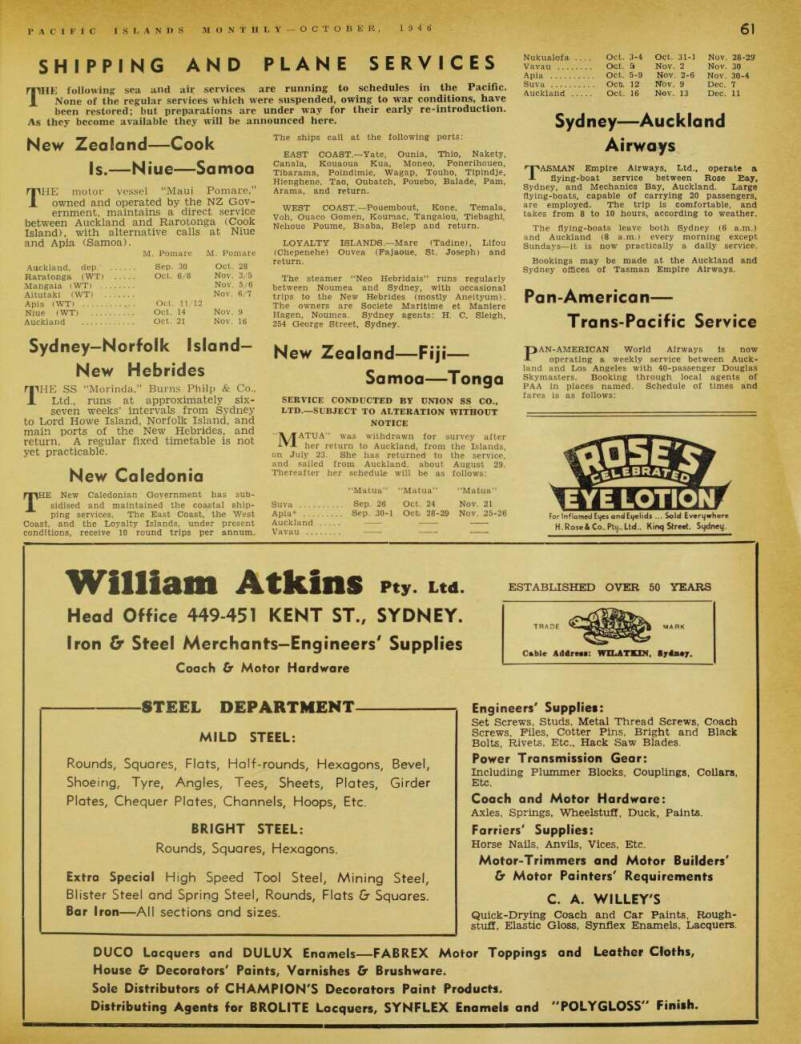
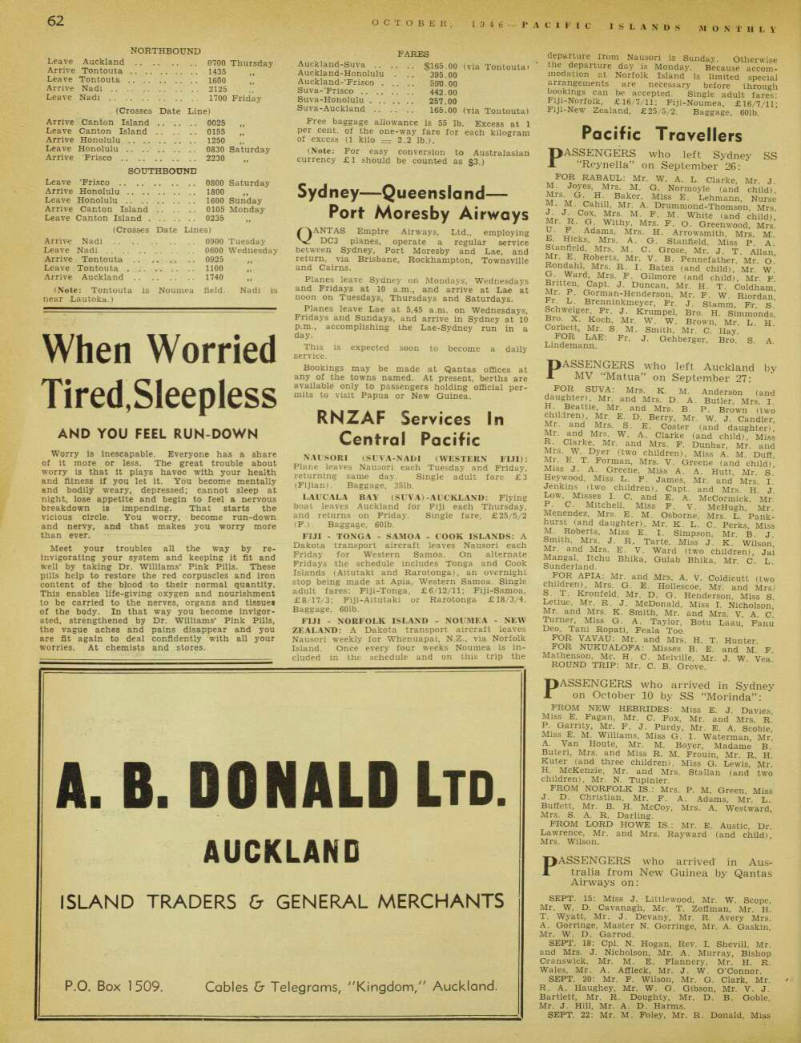
Shipping And Plane Services
THE following sea and air services are running to schedules in the Pacific.
None of the regular services which were suspended, owing to war conditions, have been restored; but preparations are under way for their early re-introduction.
As they become available they will be announced here.
New Zealand—Cook
Is.—Niue —Samoa
THE motor vessel “Maui Pomare,” owned and operated by the NZ Gov ernment, maintains a direct service between Auckland and Rarotonga (Cook Island), with alternative calls at Niue and Apia (Samoa).
Sydney—Norfolk Island-
New Hebrides
THE SS “Morinda,” Burns Philp & Co., Ltd., runs at approximately six seven weeks’ intervals from Sydney to Lord Howe Island, Norfolk Island, and main ports of the New Hebrides, and return. A regular fixed timetable is not yet practicable.
New Caledonia
THE New Caledonian Government has sub sidised and maintained the coastal ship ping services. The East Coast, the West Coast, and the Loyalty Islands, under present conditions, receive 10 round trips per annum.
The ships call at the following ports: EAST COAST.—Yate, Ounia, Thio, Nakety, Canala, Kouaoua Kua, Moneo, Ponerihouen, Tibarama, Poindimie, Wagap, Touho, Tipindje, Hienghene, Tao, Oubatch, Pouebo, Balade, Pam, Arama, and return.
WEST COAST. —Pouembout, Kone, Temala, Voh, Ouaco Gomen, Koumac, Tangaiou, Tiebaghl, Nehoue Poume, Baaba, Belep and return.
LOYALTY ISLANDS.—Mare (Tadine), Lifou (Chepenehe) Ouvea (Fajaoue, St. Joseph) and return.
The steamer “Neo Hebridais” runs regularly between Noumea and Sydney, with occasional trips to the New Hebrides (mostly Aneityum).
The owners are Societe Maritime et Maniere Hagen, Noumea. Sydney agents: H. C. Sleigh, 254 George Street, Sydney.
New Zealand—Fiji—
Samoa—Tonga
Service Conducted By Union Ss Co.,
Ltd.—Subject To Alteration Without
Notice
MATUA” was withdrawn for survey after her return to Auckland, from the Islands, on July 23. She has returned to the service, and sailed from Auckland, about August 29.
Thereafter her schedule will be as follows:
Sydney—Auckland
Airways
TASMAN Empire Airways, Ltd., operate a flying-boat service between Rose Bay, Sydney, and Mechanics Bay, Auckland. Large flying-boats, capable of carrying 20 passengers, are employed. The trip is comfortable, and takes from 8 to 10 hours, according to weather.
The flying-boats leave both Sydney (6 a.m.) and Auckland (8 a.m. I every morning except Sundays—it is now practically a daily service.
Bookings may be made at the Auckland and Sydney offices of Tasman Empire Airways.
Pan-American—
Trans-Pacific Service
PAN-AMERICAN World Airways is now operating a weekly service between Auck land and Los Angeles with 40-passenger Douglas Skymasters. Booking through local agents of PAA in places named. Schedule of times and fares is as follows:
M. Pomare M. Pomare Auckland, dep. . . .
Sep. 30 Oct. 28 Raratonga (WT) ..
Oct. 6/8 Nov. 3/5 Mangaia (WT) Nov. 5/6 Altutaki (WT) ...
Nov. 6/7 Apia (WT) Oct. 11/12 Niue (WT) Oct. 14 Nov. 9 Auckland Oct. 21 Nov. 16
“Matua” “Matua”
“Matua”
Suva ... Sep. 26 Oct. 24 Nov. 21 Apia* A nrlflnnH . . . Sep. 30-1 Ocb. 28-29 Nov. 25-26 auiMiiiiu . . .
Vavau .
Nukualofa ... Oct. 3-4 Oct. 31-1 Nov. 28-29 Vavau Oct. 9 Nov. 2 Nov. 30 Apia Oct. 5-9 Nov. 2-6 Nov. 30-4 Suva Ocb. 12 Nov. 9 Dec. 7 Auckland Oct. 16 Nov. 13 Dec. 11
Free baggage allowance is 55 lb. Excess at 1 per cent, of the one-way fare for each kilogram of excess (1 kilo = 2.2 lb.). (Note: For easy conversion to Australasian currency £1 should be counted as $3.)
Sydney—Queensland—
Port Moresby Airways
QANTAS Empire Airways, Ltd., employing DCS planes, operate a regular service between Sydney, Port Moresby and Lae, and return, via Brisbane, Rockhampton, Townsville and Cairns.
Planes leave Sydney on Mondays, Wednesdays and Fridays at 10 a.m., and arrive at Lae at noon on Tuesdays, Thursdays and Saturdays.
Planes leave Lae at 5.45 a.m. on Wednesdays, Fridays and Sundays, and arrive in Sydney at 10 p.m., accomplishing the Lae-Sydney run in a day.
This is expected soon to become a daily service.
Bookings may be made at Qantas offices at any of the towns named. At present, berths are available only to passengers holding official per mits to visit Papua or New Guinea.
RNZAF Services In
Central Pacific
Nausori (Sij Va-Nadi (Western Fiji):
Plane leaves Nausori each Tuesday and Friday, returning same day. Single adult fare £3 (Fijian). Baggage, 351 b.
Laucala Bay (Suva)-Auckland: Flying
boat leaves Auckland for Fiji each Thursday, and returns on Friday. Single fare, £25/5/2 (F. i. Baggage, 601 b.
FIJI - TONGA - SAMOA - COOK ISLANDS: A Dakota transport aircraft leaves Nausori each Friday for Western Samoa. On alternate Fridays the schedule includes Tonga and Cook Islands (Aitutaki and Rarotonga), an overnight stop being made at Apia, Western Samoa. Single adult fares; Fiji-Tonga, £6/12/11; Fiji-Samoa, £8 17/3; Fiji-Aitutaki or Rarotonga £lB/3/4.
Baggage, 601 b.
FIJI - NORFOLK ISLAND - NOUMEA - NEW ZEALAND: A Dakota transport aircraft leaves Nausori weekly for Whenuapai, N.Z., via Norfolk Island. Once every four weeks Noumea is in cluded in the schedule and on this trip the
de pa r ture from Nausori is Sunday. Otherwise the departure day is Monday. Because accom modation at Norfolk Island is limited special arrangements are necessary before through bookings can be accepted. Single adult fares: Fiji-Norfolk, £l6/7/11; Fiji-Noumea, £l6/7/11- Fiji-New Zealand, £25/5/2. Baggage, 601 b.
Pacific Travellers
PASSENGERS who left Sydney SS
“Reynella” on September 26;
FOR RABAUL: Mr. W. A. L. Clarke, Mr. J.
J °y es - Mr s. M. G. Normoyle (and child)’
Baker ’ Miss E - Lehmann, Nurse M. M. Cahill, Mr. A. Drummond-Thomson, Mrs ir J p C “’ Mr® M. F. M. White (and child) Wlthy ’ Mrs. F. O. Greenwood, Mrs. . Ad ams, Mrs. H. Arrowsmith, Mrs. M.
Mrs ' A - G - stan field, Miss P. A.
Stanfield, Mrs. M. C. Grose, Mr. J. T. Allan E - Rober ts. Mr. V. B. Pennefather, Mr. O.’
Rondah l Mrs. R. I. Bates (and child), Mr. W.
G. Ward, Mrs. F. Gilmore (and child), Mr. F Bntten, Capt. J. Duncan, Mr. H. T. Coldham Mr. P. Gorman-Henderson, Mr. F. W. Riordan, Fr L. Brenninkmeyer, Fr. J. Stamm, Fr S Schweiger Fr. j. Krumpel, Bro. H. Simmonds, Bro - Koch, Mr. W. W. Brown, Mr. L. H.
Corbett, Mr. S. M. Smith, Mr. C. Hay.
FOR LAE: Fr. J. Gehberger, Bro S A Lindemann.
PASSENGERS who left Auckland by
MV “Matua” on September 27: SUVA: Mrs. K. M. Anderson (and daughter), Mr. and Mrs. D. A. Butler, Mrs I H. Bcattm, Mr. and Mrs. B. P. Brown (two children), Mr. E. D. Berry, Mr. W. J. Candler Mr. and Mrs. S. E. Coster (and daughter),’
Mr. and Mrs. W. A. Clarke (and child), Miss R. Clarke, Mr. and Mrs. F. Dunbar, Mr. and Mis. W. Dyer (two children), Miss A. M Duff Mr. E. T. Forman, Mrs. V. Greene (and child)!
Miss J. A. Greene, Miss A. A. Hutt, Mr. S.
Heywood, Miss L. F. James, Mr. and Mrs I Jenkins itwo children), Capt. and Mrs. H. J.
Low, Misses I. C. and E. A. McCormick, Mr P. C. Mitchell, Miss F. V. McHugh, Mr.
Menendez, Mrs. E. M. Osborne, Mrs L. Pank hurst (and daughter), Mr. K. L. C. Perks. Miss M. Roberts, Miss E. I. Simpson, Mr. B. J Smith, Mrs. J. R, Tarte, Miss J. K. Wilson Mr. and Mrs. E. V. Ward (two children), Jai Mangal, Itchu Bhika, Gulab Bhika, Mr C L Sunderland.
FOR APIA: Mr. and Mrs. A. V. Coldicutt (two children), Mrs. G. E. Hollescoe, Mr. and Mrs. 1 S. T. Kronfeld, Mr. D. G. Henderson, Miss S.
Letiue, Mr. R, j. McDonald, Miss I. Nicholson, Mr. and Mrs. K. Smith, Mr. and Mrs. V. A. C.
Turner, Miss G. A. Taylor, Botu Laau," Panu Deo, Tani Ropati, Feala Too.
FOR VAVAU; Mr. and Mrs. H. T. Hunter.
FOR NUKUALOFA: Misses B. E. and M F Mathenson, Mr. H. C. Melville, Mr. J. W. Vea’
Round Trip; Mr. C. B. Grove.
PASSENGERS who arrived in Sydney
on October 10 by SS “Morinda”;
FROM NEW HEBRIDES: Miss E. J. Davies Miss E. Fagan, Mr. C. Fox, Mr. and Mrs r’
P. Garrity, Mr. F. J. Purdy, Mr. E. A. Scobie' Miss E. M. Williams, Miss G. I. Waterman, Mr.
A. Van Houte, Mr. M. Boyer, Madame B Buteri, Mrs. and Miss R. M, Frouin, Mr. R. H Kuter (and three children), Miss G. Lewis Mr H. McKenzie, Mr. and Mrs. Stallan (and two children), Mr. N. Tupinier.
FROM NORFOLK IS.: Mrs. P. M. Green, Miss J. D. Christian, Mr. F. A. Adams, Mr. L.
Buffett, Mr. B. H. McCoy, Mrs. A. Westward Mrs. S. A. R. Darling.
FROM LORD HOWE IS.: Mr. E. Austic, Dr.
Lawrence, Mr. and Mrs. Rayward (and child), Mrs. Wilson.
PASSENGERS who arrived in Aus
tralia from New Guinea by Qantas
Airways on:
SEPT. 15: Miss J. Littlewood, Mr. W. Scope, Mr. W. D. Cavanagh, Mr. T, Zoffman, Mr. H.
T. Wyatt, Mr. J. Devany, Mr. R. Avery Mrs.
A. Gorringe, Master N. Gorringe, Mr. A. Gaskin, Mr. W. D. Garrod.
SEPT. 18: Cpl. N. Hogan, Rev. I. Shevill, Mr. and Mrs. J. Nicholson, Mr. A. Murray, Bishop Oranswick, Mr. M. E. Flannery, Mr. H. R.
Wales, Mr. A. Affleck, Mr. J. W. O’Connor.
SEPT. 20: Mr. F. Wilson, Mr. G. Clark, Mr.
R. A. Haughey, Mr. W. G. Gibson, Mr. V. J.
Bartlett, Mr. R. Doughty, Mr. D, B. Goble, Mr. J. Hill, Mr. A. D. Harms.
SEPT. 22: Mr. M. Foley, Mr. R. Donald, Miss
Northbound
Leave Auckland .. , Arrive Tontouta .. ..
Leave Tontouta .. ..
Arrive Nadi Leave Nadi .. 2125 (Crosses Date Line) Arrive Canton Island Leave Canton Island Arrive Honolulu .. ..
Leave Honolulu .. ..
Arrive Frisco .. .. .. 0025 „ .. 0155 „ .. 1250 „ .. 2230
Southbound
Leave ’Frisco .. ..
Arrive Honolulu .. ..
Leave Honolulu .. ..
Arrive Canton Island Leave Canton Island . .. 1800 .. 1600 Sunday .. 0105 Monday 0235 (Crosses Date Lines) Arrive Nadi Leave Nadi Arrive Tontouta Leave Tontouta . ..
Arrive Auckland .. 0925 .. 1100 .. 1740 (Note: Tontouta is near Lautoka.) Noumea field. Nadi is
Fares
Auckland-Suva $165.00 (via Tontouta» Auckland-Honolulu . .. 395.00 Auckland-’Frisco 590.00 Suva-’Frisco 442.00 Suva-Honolulu 257 00 Suva-Auckland 165.00 (via Tontouta)
P. Fitzgerald, Mr. J. Thurston, Mr. G. Aumuller, Mr. and Mrs. J. Lyons (and daughter), Mrs.
C. Burton, Mrs. S. E. Marshall.
SEPT. 25; Capt. C. Ashley, Miss N. Heffenden, Mr. C. Evans, Mr. O. Bryen, Mr. R. Thrift, Dr.
T. Sherwin, Mr. R. Holshe, Bishop Shermack, Mr. R. Parsons, Capt. W. Williams.
SEPT. 27: Mr. J. McAdam, Mr. F. Landere.
SEPT. 29; Mr. N. Gray, Mr. W. Gurgess, Group Capt. G. Steege, Mr. N. Owers.
OCT. 2; Mr. R. B. O’Hara, Mr. H. G. Ivison, Mr. P. W. Smith, Mr. F. M. Lock, Mr. D.
Hainks, Mr. E. D. Sinclair, Mr. P. E. Crowe.
OCT. 4: Mr. R. E. Goddard, Mr. W. T.
Murray, Mr. W. M. Marshall, Mrs. J. Tudor, Mr. C. Christie, Mr. L. A. Brumby, Miss A. B.
Mitchell, Mr. P. Descouers, Mr. J. D. Haig, Mr.
R. C. McDuff, Mr. J. B. Sedgers.
OCT. 6: Col. A. J. Stewart, Lieut. Eldridge, Mr. T. N. Jolly, Mr. T. W. Bayliss, Mr. C. R.
Inglis, Mr. J. J. Shanaham.
OCT. 9: Mr. E. E. Shock, Mr. A. J. Moile, Mr. R. Murphy, Mr. L, A. Lea Wright, Mr. O.
Bullon.
PASSENGERS who left Australia for
New Guinea by Qantas Airways
on: SEPT. 16: Mr. K. Noblett, Mr. S. McKinnon, Mr. C. A. Adelskold. Mr. W. F. Scanned, Mrs.
N. C. Upson, Master Upson, Mr. E. F. Bishton, Mr. A. G. Easter, Mr. J. O. Clark, Mr. S.
Meyer, Mr. R. C. Cambridge, Mr. J. H. Palmer, Mr. C. W. Slattery, Mr. J. D. Haig, Mr. J. H.
Jones.
SEPT. 18: Mr. H. Archer, Mrs. I. Paul, Mrs.
M. O’Hara (and infant), Miss M. O’Hara (and three children), Mr. A. L. Clarke, Mr. A. J.
Peadon, Mr. E. W. Were, Mrs. E. W. Were, Mr. A. O. Berry, Mr. H. C. Nelson, Mr. T. W.
Jenkins, Mr. G. Smith, Mr. D. J. Foley.
SEPT. 20: Mr. R. W. Stirton, Mr. E. M.
Peacock, Mrs. R. H. Maxwell, Mrs. U. M.
Hansen, Mrs. M, W. Blanden (and two children), Rev. and Mrs. M. Nixon, Mr. R. Cordukes, Mr.
W. D. Mossman, F/S Gibson, Mr. Jackson, Mr.
Kin Thi Chann, Mr. Rosser.
SEPT. 23: Mr. D. L. Cameron, Mr. F. De La Cruz, Mr. B. R. Muir, Mr. P. L. Allen, Mr. C.
H. Wood, Mr. K. H. Huenerbein, Mrs. R. M.
Murray (and infant), Mrs. V. E. Niness, Miss J. Niness, Mrs. D. Hamilton, Mr. A. B. Smith, Mr. J. E. Leaven, Mr. G. G. Foxover, Mr. A.
J. Sharpe, Mr. J. A. Fames.
SEPT. 25: Rev. M. A. Warren, Mr. C. W.
Thomas, Mr. H. L. Clark, Mr. B. H. Stinear, Mr. C. P. Evans, Miss O. Lucas, Mr. A. J.
Gaskin.
SEPT. 27: Mr. M. A. Warner, Mr. Leong Hop, Mr. H. S. Hall, Mr. B. V. Morgan, Mr. W. H.
Scope, Mr. P. B. Chalmers, Mr. S. W. Cook, Mr. B. B. Perriman, Father N. Earl, Mr. B.
W. Kirke, Mr. D. H. Wall, Mr. J. H. Irvine, Mrs. S. E. Parray, Mrs. M. E. Hilbic.
SEPT. 30: Mr. W. P. Hunter, Mr. R. J.
Huxley, Mr. W. W. Ayers, Mr. S. R. Jones, Mr.
C. W. Baines, Miss S. Bigg, Mrs. A. Briggs (and infant), Mr. E. V. Crisp, Mr. W. J. Dupe, Mr. B. Fairfax-Ross.
OCT. 2: Mr. C. H. Blackman, Mr. T. K. Emery, Mr. B. L. Doble, Mrs. P. Jensen, Mr. A. J.
Wilson, Mr. H. G. Linden, Mrs. A. Fletcher, Mrs. M. Tonkin, Mrs. W. Whitehead, Mr. R. W.
Walsh, Mr. E. E. Chadwick, Mr. Goddard, Miss Toovey, Miss J. Smith.
OCT. 4: Mrs. O. G. Bone (and infant), Mr.
J. Sait, Mr, H. S. Gregory, Mr. and Mrs. H. T.
Allen.
OCT. 7: Mr. A. G. Emmett, Mr. I. H. Pater son, Mr. F. W. Torrington, Mrs. W. Simpson, Mr. J. W. Fisher-Rigg, Mr. K. McCallum, Miss J. M. Jackson, Mrs. H. E. French, Mr. J.
McAdam, Mrs. E, E. Moore, Mr. G. D.
McPherson, Mr. R. J. Lulham, Mr. Newman, Mr. Fayey, Mr. Ray.
OCT. 8; Miss G. Edwards, Miss'G. Burgess, Miss L. Hogg, Miss J. Fleming, Miss Y. Taylor, Mrs. A. Sperling, Mr. A'. Sperling, Mr. Frandis Devine, Mrs. N. Crealy, Mr. D. G. Kennedy, Miss J. M. Reeves, Miss J. Leslie, Mr. A. Lyall, Mr. F. R. Wilson, Mr. Cochran, Miss Heaphy.
OCT. 9: Mr. J. Dunbar-Reid, Capt. J. Johnson, Sister M. Ludovica, Sister M. Elie, Sister M.
Placide, Mr. H. L. Woolcott, Mr. P. R. Wool cott, Mrs. E. E. Hannemann (and infant), Mrs, D. H. Freyberg, Mrs. E. A. Scherle, Mrs. J. I.
Schneuker, Mr. J. A. Costelloe, Mrs. J. Mac- Gregor, Capt. W. Williams, Mr. N. White.
Advertisements & other items, pp. 63-64 (2 items)
61
PA Cl lie ISLANDS MONTHLY OCTOBER, 1948
William Atkins Ltd.
c eVEBRATg7S
EYE LOTION
For Inflamed Eyes and Eyelidi ... Sold Everywhere H. Rose& Co.. Pty.. Ltd.. Kinq Street. Sydney.
William Atkins Ltd.
Head Office 449-451 KENT ST., SYDNEY.
Iron & Steel Merchants—Engineers' Supplies
Coach & Motor Hardware
ESTABLISHED OVER 50 YEARS
Cable Address: WILATKJN, Sydney.
-STEEL DEPARTMENT
MILD STEEL:
Rounds, Squares, Flats, Half-rounds, Hexagons, Bevel, Shoeing, Tyre, Angles, Tees, Sheets, Plates, Girder Plates, Chequer Plates, Channels, Hoops, Etc.
BRIGHT STEEL;
Rounds, Squares, Hexagons.
Extra Special High Speed Tool Steel, Mining Steel, Blister Steel and Spring Steel, Rounds, Flats & Squares.
Bar Iron—All sections and sizes.
Engineers' Supplies: Set Screws, Studs, Metal Thread Screws, Coach Screws, Files, Cotter Pins, Bright and Black Bolts, Rivets, Etc., Hack Saw Blades.
Power Transmission Gear: Including Plummer Blocks, Couplings. Collars, Etc.
Coach and Motor Hardware: Axles, Springs, Wheelstuff, Duck, Paints.
Farriers' Supplies: Horse Nails, Anvils, Vices, Etc.
Motor-Trimmers and Motor Builders' & Motor Painters' Requirements
C. A. WILLEY'S
Quick-Drying Coach and Car Paints. Roughstuff, Elastic Gloss, Synflex Enamels. Lacquers.
DUCO Lacquers and DULUX Enamels—FAßßEX Motor Toppings and Leather Cloths, House & Decorators' Paints, Varnishes & Brushware.
Sole Distributors of CHAMPION'S Decorators Paint Products.
Distributing Agents for BROLITE Lacquers, SYNFLEX Enamels and "POLYGLOSS" Finish.
When Worried
Tired,Sleepless
AND YOU FEEL RUN-DOWN
Worry is Inescapable. Everyone has a share of it more or less. The great trouble about worry is that it plays havoc with your health and fitness if you let it. You become mentally and bodily weary, depressed; cannot sleep at night, lose appetite and begin to feel a nervous breakdown is impending. That starts the vicious circle. You worry, become run-down and nervy, and that makes you worry more than ever.
Meet your troubles all the way by reinvigorating your system and keeping it fit and well by taking Dr. Williams’ Pink Pills. These pills help to restore the red corpuscles and iron content of the blood to their normal quantity.
This enables life-giving oxygen and nourishment to be carried to the nerves, organs and tissues of the body. In that way you become invigorated, strengthened by Dr. Williams’ Pink Pills, the vague aches and pains disappear and you are fit again to deal confidently with all your worries. At chemists and stores.
A. B. DONALD Ltd.
AUCKLAND
ISLAND TRADERS & GENERAL MERCHANTS
P.O. Box 1509. Cables & Telegrams, "Kingdom," Auckland.
Census In Fiji
A CENSUS of Fiji was taken on the night of October 2. The schedules had to be printed in three languages English, Fijian and Hindustani (Nagari).
The statistics, to which much impor tance is attached, should be available within a short time
Advertisements & other items, pp. 65-66 (2 items)
Wholesale
Woven Wire for all Industry
COPRA DRYING TRAYS, FLOORS, Etc.
FRU'T DRYING TRAYS, MINING SCREENS.
Heavy Mosquito Gauze in Phosphor Bronze and other Metals Impervious to Salt Sea Air.
WIRE DOOR MATS AND GENERAL WIRE WORKS
E. WRIGHT & CO. LTD.
Office and Works; 148-152 Cleveland Street, Sydney, N.S.W.
Telegraphic Address: “Wrlghtmake,” Chippendale.
"“g?
TERRITORY OF NEW (
PHILIPS
RADIO
TERRITORY OF NEW GUINEA
WHOLESALE
MERCHANTS
GENERAL AGENTS
FORWARDING, SHIPPING AND CUSTOMS AGENTS
Sole New Guinea Agents for:
11.A.L.M.
PAINTS
Commonwealth Insurance Company
REMINGTON
TYPEWRITER
DCLCX
For The
New Union Ships For The Pacific Trade
mHE managing director of the Union X SS Co. Ltd.. Mr. J. N. Greenland, after his return recently from Britain and America, stated that the Co. has ordered the construction of eight cargo ships—three of 6,000 tons, four of 3,000, and one of 2,000. The Co. has purchased an oil-burning freighter of 10,000 tons, with accomodation for 12 passengers.
A number of these ships will be used in the pacific trade where, Mr. Greenland said, very extreme competition is expected.
The Canadian Australian liner “Aorangi,” undergoing slow re-conversion in Sydney (where material and skilled men are not plentiful) is expected to resume her trans-Pacific service in May, 1947.
The engagement was recently an nounced in Melbourne of Miss Betty Gascoigne, daughter of the late C. J.
Gascoigne, of Rabaul, and Mrs. Gascoigne, of Melbourne, to Mr. Peter Muller, of Prahran, Victoria.
Civilising Brown
Papuans In Boots,
or
Brother
IT was a pretty grey dawn. But typical of any Lae dawn, and it had been with us for 20 minutes.
On the airfield we sat on our personal gear as the plane warmed up, not very interested in the awakening of nature; our thoughts were still back in the beds we had recently left.
Suddenly a voice from somewhere be hind exclaimed: “Where are those blasted Papuans? Twenty minutes late already! Ought to leave them behind.”
Someone got into a jeep and went off, presumably to look for them. We sat on.
“How many going across this morn ing?” I asked.
“Fourteen —including half a dozen Papuans to Moresby,” a fellow voyager told me.
“ ‘Montoro’ went on Monday,” I re marked, but not very interested. “Why didn’t they go on that?”
“What, as deck passengers? Don’t be silly. Only the best is good enough— and all paid for by the poor fool Austra lian taxpayer.” Fellow Voyager warmed to his theme. “D’you know, these birds came across from Moresby about 10 days ago to work for the Administration. But it appears they just didn’t like the work.
So they go back, see? Round trip—£l3 a pop. Can you beat it?”
We couldn’t. Even for a New Order it seemed silly; and somewhat expensive.
WE waited some more, silently—except for F.V., who continued his narra tive. “These Qantas planes,” he said,, “they are the only god-damned civilized thing about New Guinea to-day.
They bring mail and news, and get us away quickly when we can’t take it any more. They are ours—or they were. Now they are converted to the use of natives.
Government round trippers.” If he had been an expectorating gent, I think he would have spat.
“You’re prejudiced,” I said. “Before
the war I often found myself crammed into a Moth plane alongside my personal boy, and I bet you have, too!”
“That’s different,” he said. “We paid for them then by the pound. Now they travel as equals. It makes fools of us and certainly makes fools of them. The poor cows—you can only feel pity for them, after all. Civilization —bah!”
Metaphorically he spat again.
Preceded by the jeep, the Papuans arrived in a truck. We stood up to take a look. Papuans are addressed in straight English. But these were not given that courtesy; they got straight Pidgin. “Hurry up there, you,” they were instructed. “What name this fella fashion me wait, wait along you . . .?”
They tumbled out and —shades of the top-hatted missionaries of old—l saw. A neat array of superior-type natives in clean lava-lavas and, maybe, shirts? Not on your life. Someone in his wisdom has decreed that natives shall, if they wish, go clothed as they wish.
They wished.
RACIAL prejudice vanished like a wisp of smoke in a strong breeze. We sat down and howled with mirth. “The poor bluddy cows!” repeated Fellow Voyager, with greater emphasis.' One lad had done himself up as a sailor. He wore a pair of wishy-washy blue dungarees, a dirty singlet and a much-battered sailor’s cap far back on his head. Another had a violent orange coloured shirt and a pair of very shrunken grey shorts hitched up with an old tie. Two had vari-coloured singlets and dirty shorts. One, sans shirt, had a pair of American sunglasses (at dawn!) and very long shorts falling down over his hips. But all had BOOTS.
What boots! Brand-new, shiny, orange yellow boots of tremendous size to cope with the splay feet of Fuzzy-wuzzy, dangling at the Papuans’ extremities like the manifestation of some strange and horrible disease—for Brown Brother, if his feet are large, has spindly shanks, with little muscle development.
The leather of the issue boots was un forgiving, unbending and unfortunate.
Our Brown Brothers therefore literally clomped along, harried .by Qantas offi cials, as they lifted up the giant boots and put ’em down, not with the free stride of a European used to footwear, but like strange insects that had inad vertently wandered onto flypaper.
But New Guinea democracy, even to day, goes so far and no further. We followed the Papuans into the plane, still chuqkling. The seats in which they were to sit were decently draped in army blankets, apparently to save them from contamination; and when tea and bis cuits were served aloft, the Papuans missed out.
We climbed above the cloud layers and flew smoothly across the Owen Stan leys to Moresby. I was almost sorry about the smoothness. I should have liked to have seen the Flight-steward’s face if our Brown Brothers had been
sick in his speckless airliner.
J.T.
Supplies Of Paludrine
rE Director of Public Health, in New Guinea, Dr. Gunther, has announced that there probably will be sufficient paludrine available for supplies to be issued to all members of the administra tive service in New Guinea, commencing early next year.
Paludrine (which is referred to else where) comes close to being the ideal anti-malarial drug. It kills the “bug,” if it is already in the system; two tablets per week are an effective preventive; and it produces no unpleasant after-effects.
Advertisements & other items, p. 66 (1 item)
Gillespie’S
Livestock for Islands
People who Intend to take Stock to New Guinea are hereby notified that I have on hand the right class of
Cattle—
Mules—
Horses
to suit both the Climate and the Pastures of the Territories.
When shipping ia available, I can deliver, on the ship in Cairns or Townsville, Stock intended for anv of the Pacific Islands, including Netherlands Indies, Singapore and the Philippines.
I will take all care of Stock and will be responsible for their delivery on the Ship in Sound Condition.
For further particulars, apply to
J. J. TOOGOOD
Rollingstone, via Townsville, Queensland.
Orders accepted through any Stock Agent, or Bank, in Cairns or Townsville, or direct.
GILLESPIE’S
The Flour
TRADE
MARK
of the Islands
- SYDNEY -
Scholarship Fund
More Donations To The Scholarship Fund Applications Now Being Received for 1947 Scholarship
THE Deed of Trust of the New Guinea Memorial Scholarship Trust Fund in augurated by the Melbourne New Guinea Women’s Association some months ago, has at last been drawn up and signed by the various trustees. It is a lengthy document and space consid erations do not permit its publication here. It can, however, be seen in its entirety at the offices of Pacific Publica tions Ltd., Union House, George Street.
Sydney, or obtained from the New Guinea Women’s Association in Melbourne.
Briefly, the conditions under which thc scholarship is awarded are that the suc cessful applicant must be the child of a European serviceman or civilian who lost his life in Papua or New Guinea as a result of enemy action. (Later, awards will be made from the children of ex-Servicemen and women residents of the Territories: and later still, from any children residing in the Territories.) The child must not be over the age of 14 years and 6 months at January 1 of the year for which the scholarship is awarded; and must have attended school in the State of Victoria for 12 months previously.
The scholarship is tenable for three years at any recognised secondary school and will be worth at least £3O per annum.
All details, entry forms etc., are ob tainable from the Secretary of the New Guinea Women’s Association, 7 Wilson
Street, Moonee Ponds, Victoria. It is understood that several applications have been lodged for the first scholar ship which will be awarded for the year beginning January 1, 1947.
In the meantime the Association is working hard for funds, and in this drive —particularly for the ball which was held on October 11—they have been assisted by members of the 2/22nd Bat talion Association. Many members of the 2/22nd also lost their lives in Rabaul, it will be remembered.
The Association would also like to place on record its appreciation of the work of Mr. Cyril E. Fyffe, formerly a solicitor of Rabaul and now a member of a Melbourne legal firm. He gave the Association, and particularly the Schol arship Committee, much help and advice and handled the large amount of legal work necessary in establishing the Fund. For this he refused to accept any fee.
DONATIONS to the Fund are still pouring in. Those received up to the end of September were; Amount previously acknowledged . £!)83 12 2 Mrs. S. Oaten, Stewart Street, Sey mour, Victoria 1 0 0 Mrs. M. N. Allsop, c/o Southern Pacific Insurance Co., 60 Hunter Street, Sydney 2 2 0 Mrs. B. Parry, 6 Woniara Avenue, Wahroonga, NSW 1 I 0 Mrs. Ann Walsh, “Gareloch,” Orara Road, North Manly, NSW 110 Mrs. J. J. Murphy, 25 Ascog Terrace, Toowong, Queensland 2 2 0 Mr. and Mrs. J. Cox, Flat 2, Brook wood, 32 Queens Road, Melbourne 110 Miss D. L. Beale, Epworth House, 61-63 Adelaide Street, Brisbane . . 2 0 0 Miss J. Olroyd-Harris, 25 Greenwich Road, South Greenwich Point,
Nsw 110
Mrs. John Walstab, 200 Kambrook Road, Caulfield, Victoria 2 2 0
Mrs. H. O. Townsend, Central Avenue, St. Lucia, Brisbane, Queensland 2 2 0 Mrs. M. C. Clark, “Inglewood,”
Wallacia, NSW 2 2 0 Mr. L. P. Youlden. 500 McArthur Street, Ballarat, Victoria 10 0 Mr. H. H. and Miss E. G. Cook, “Wairere,” 6 High Street Hornsby, NSW 2 2 0 Mr. and Mrs. T. K. Colquhoun, “Salamoa,” 16 Fredrick Street, Launceston, Tasmania 5 0 0 Rev. and Mrs. F. G. Lewis, 35 Pt.
Nepean Road, Cheltenham, Vic toria 1 1 0 Lady McNicoll, 87 Salisbury Road, Rose Bay, NSW 110 Mrs. A. Green, “Kermith,” 441 Glen ferrie Road, Hawthorn, Victoria 2 2 0 Miss B. Bath and Mrs. E. L. Turton, “Valetta,” 17 Tower Wycombe Road, Neutral Bay, NSW . . 110 Mrs. J. L. McLellan. Billabong, Weranga, via Dalby, Queensland . 10 0 Mrs. M. K. Vial, 7 Montague Street, East St. Kilda, S 2 10 0 Miss M. Field, 83 First Avenue, Mt.
Lawley, WA 116 Mr. K. W. Burston, Dylup Plantation, NG Estate, Madang, TNG . . 5 5 6 Miss June Ewen, Port Moresby, Papua-NG 2 2 0 Mrs. G. Evans, Port Moresby, Papua-NG , 2 2 0 Mrs. C. M. Haviland, 31 Alison Avenue, Lane Cove, NSW ... 220
(Continued Next Page)
Mrs. J. I. Cromie, Port Moresby, Papua-NG . . 5 5 0 Mrs, V. Pratt, 31 Alma Road, East St. Hilda, Victoria 110 Mr. McNeill, Bank NSW, Warragul, Victoria 550 Major and Mrs. D. H. Umphelby, No. 6 Albany Road, Toorak, Vic toria 10 0 0 Mr. and Mrs. L. C. Shoppee, Flat 4, 55 George Street, East Melbourne 2 2 0 Mrs. M. E. C. Doyle, 30 Fox Valley Road, Wahroonga, NSW 3 3 0 Mrs. Jean Roberts, Briarfield, Parkes Crescent, Faulcon Bridge, NSW . 10 0 Vacuum Oil Co., 29 Market Street, Melbourne 5 5 0 Mrs. L. Hosking, 16a Wooldridge Avenue, Mjllswood, SA 2 2 0 Adelaide New Guinea Women’s Club . 110 Claude Ross, 12 Wellington Street, Middle Brighton, Victoria ... 220 Mrs. Claude Ross, 12 Wellington.
Street, Middle Brighton, Victoria 110 Mr. and Mrs. L. C. Roberts, 16 The Chase Road, Turramurra, NSW . 2 2 0 Burns, Philp & Co., 7 Bridge Street, Sydney 50 0 0 Bulolo Gold Dredging, Ltd., Shell House, Sydney 25 0 0 Shell Co. of Aust., Ltd., 163 William Street, Melbourne 550 Mr. and Mrs. F. W. R. Godden, Shell House, Sydney 10 0 0 Dr. G. W. Broome, Ba, Fiji ... 220 Mrs. W. E. Bischoff, “Texas Flats,”
Greenknowe Avenue, Potts Point,
Nsw 110
W. R. Carpenter & Co., 16 O’Connell Street, Sydney 50 0 0 J. H. Bowring. “Bernarra,” Palms Avenue, Mildura, Victoria (Ex 2/22 Btn.) 110 £1,214 14 2
Mr. and Mrs. .1. Annan returned to their propertv at Port Moresby by the SS “Alagna” in September. Their belong ings included a black kelpie (Toby) and two cats (Snowy and Molotov).
Advertisements & other items, p. 67 (1 item)
CliTxt%alUui tfiafimg, JnduAJbdea £td.
WANTED: Back numbers of the “Pacific Islands Monthly.” Have many duplicates for exchange. Will also exchange American magazines for newspapers and magazines of the Pacific Islands and British Colonial Empire. Orders taken for subscriptions to American magazines—no foreign exchange difficulties —write for details to PAUL A. DORN, Agent, Los Angeles 36, California.
ISLAND CRAFT
TO
MODERN DESIGN
WOODEN FREIGHTERS,
TRAWLERS AND ISLAND
CRAFT.
VESSELS REPAIRED AND
REMODELLED.
AUSTRALIAN AGENTS FOR
GRAY MARINE PETROL AND
DIESEL ENGINES.
COPPERSMITHS, WELDERS
AND PLUMBERS.
MODERN SLIPWAY FACILITIES AVAILABLE
WRITE US FOR DESIGNS AND COMPLETE SHIPBUILDING INFORMATION. ©
CliTxt%alUui tfiafimg, JnduAJbdea £td.
INCORPORATING REG. ADAMS CLAYTON CO.,
Tel.: X 84475, XA 1731, JOHN STREET, BERRY'S BAY, NORTH SYDNEY. ALSO AT EDEN, N.S.W.
Work of Location and Repatriation
Us Dead In The Pacific
From a Special Correspondent
YANKS remaining out here in the South-west Pacific are down to a min imum nowadays. At Finschhafen there are two separate groups. One of about 24 members is looking after the Cemeteries and a like number of Air Force men are cleaning up equipment left behind.
The simplest method to do that was to just burn the warehouses, supplies and all. For two nights the sky in the vicinity of the drome was lit up like the afterglow of a successful air raid.
Near the old Kamloa village area, on the north side of the Bumi River, are the American Cemeteries—where, in a last silent formation represented by regi ments of white crosses ten thousand strong, are the men who went ashore fighting for a peace that we cannot ap preciate in that we still live in fear of another war'. Here are men of our Armed Forces who gave their lives in battle in the Northern Solomons, Bou gainville, New Britain, the Admiralties and all of New Guinea.
These US Armed Forces Cemeteries at Finschhafen represent one-fourth of our World War II Pacific fatalities. At pre sent five cemeteries constitute this tem porary national cemetery Cemetery One, the original Finschhafen Cemetery; and Cemeteries Two, Three, Four and Five, representing the consolidation of all USAF Cemeteries in the South-west Pacific.
Another temporary Cemetery for the South Pacific is at Guadalcanal.
THERE remains another job to be done before the silent ranks of this army are complete—that of recovering the men who fell and were buried in the field throughout these jungle islands— buried where they fell, if possible, or left in an isolated location, due to over whelming enemy action at the time.
Many Air Force personnel lost their lives through enemy action or operational dif ficulties, and crashed in remote moun tainous terrain, at which time recovery could not be accomplished due to lack of personnel or the fact that the crash occurred in enemy-occupied territory.
Many of these airmen have already been found and have been buried by Christian natives.
This work is now being done in con junction with the Australian War Graves Headquarters, Rabaul, and the Royal Australian Air Force Search Party, Six months to a year will elapse before this search work can be fully accomplished.
The locations of many crashed aircraft have been reported by missionaries, natives and district officers. Due to no witnesses being present in many instances, these reports are greatly appreciated.
To date there have been no plans made as to the repatriation date for Fin schafen Cemetery.
Among the passengers on the SS “Alagna” which left Brisbane for Rabaul, on September 13, were Mr. Frank Conroy, planter, and Mr. W. H. Parer, engineer.
Advertisements & other items, p. 68 (1 item)
Blackwell
B etter Buy
C> THE ORIGINAL
ROSSE &
BLACKWELL
M eat and Pastes
UNEXCELLED SINCE 1706
Maybe Later—Not
Yet!
NG Public Service Strength About the Same as Pre-war
Pt. Moresby, Sept. 13 PAPUA-NEW GUINEA residents who are apt to become agitated at what they believe is a greatly increased public service, will be surprised to know that, according to official figures, the public service strength is about 650. That figure is certainly no larger than the pre-war total of public servants from Papua and New Guinea combined.
Or it is no larger—yet. When the new administrative set-up gets into going order and is fully staffed it can be ex pected that the numbers will be largely increased.
At present the available staff is actu ally far too small to cope with re-estab lishment and the erection of even the framework of the sweeping “new order” plans. Possibly the jaundiced Territorian who believes hundreds of bureaucrats blossom where ten sufficed before is given that impression because of the larger concentration of men in the main centres, many of them in transit to other parts of the territory.
Such key departments as Health are very much understaffed, for the simple reason that the salaries and conditions offered by the Government are not cal culated to encourage capable men to leave civilisation. The Government evi dently believes that a missionising zeal should compensate men for small sal aries, high cost of living, isolation, bad housing and indifferent food. Come the depression—perhaps. But certainly not yet.
MEDICAL officers are being offered about £BOO, but they have no right of private practice. It is hoped even tually there will be about 40 medical officers in the two territories. At pre sent, there are about 10.
Medical assistants are resigning almost as frequently as new appointments are made. Appointees are frequently men who have had no previous experience of even elementary medical work, and have to be trained before they are of any assistance in the raw New Guinea bush.
Other departments are experiencing similar staff troubles.
IN an attempt to solve the staff prob lem, the administration has encour aged servicemen to take their dis charges in New Guinea and join the service. Many have availed themselves of the opportunity, as men who have not sufficient points for discharge in Aus tralia are accepted for discharge in the Territory if they will join the Adminis tration. Many of these work for a few months and then resign, either to go South or to go into more lucrative work in the Territories.
The Administration is finding that it is one thing to make extensive plans; another thing to find men who are pre pared, not to talk, but to do the hard, bullocking work that is necessary to get anything moving in the New Guinea territories to-day.
Three former residents of Fiji are reported to be attached to the Allied Control Commission in Germany. They are Sir Owen Corrie (former Chief Justice), Col. J. P. Magrane, and Mr. C.
M. Teulon (formerly of Public Works'*.
Fono Tackles Samoa's Problems With
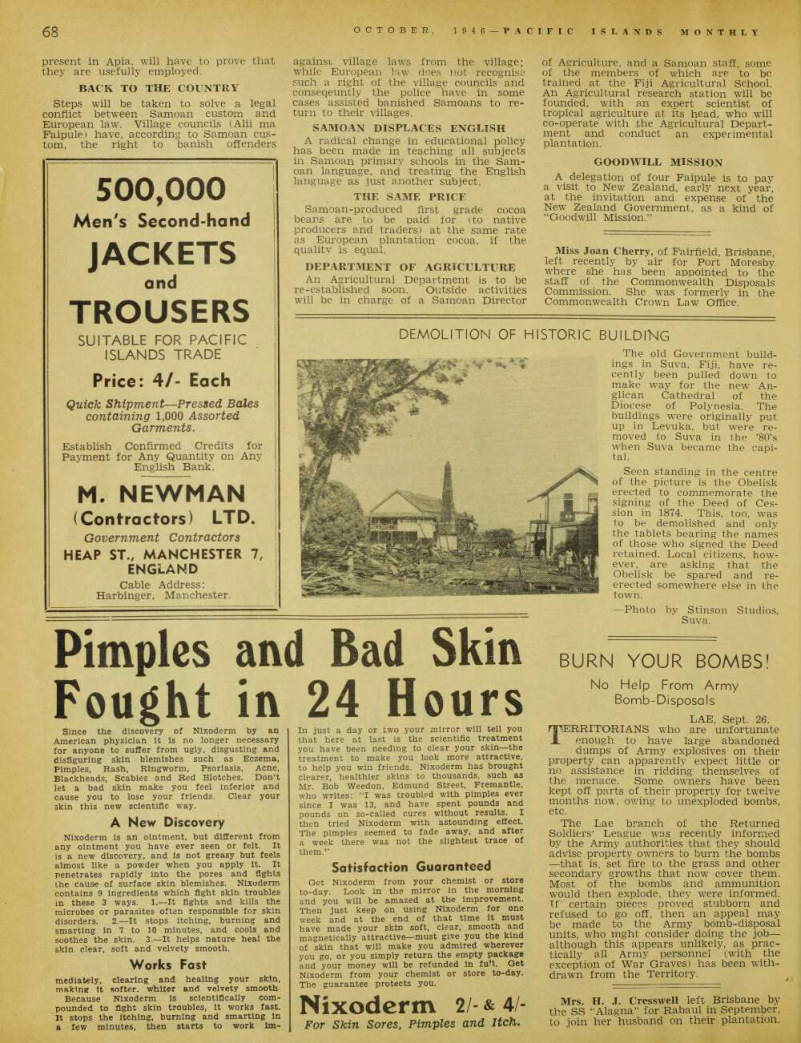
Vigour
From Our Own Correspondent
Apia, October 1 THE 1946 meeting of the Fono of Faipule has just taken place. The meeting, the first under the chair manship of the new Administrator, Colonel F. W. Voelcker, was one of the shortest on record, due to an appeal by the Administrator to confine the discus sions to essentials.
A large number of important remits and problems were discussed. The deli berations were characterised by a sincere spirit of friendly co-operation, and help ful and constructive advice and sugges tions on the side of the Samoan repre sentatives.
The latter were obviously impressed by the honest and straightforward attitude of the Administrator, who is giving the Samoans’ requests a full hearing and, whenever possible, complies with sensible and justified demands.
The following is a resume of the more important matters discussed.
New Roads
The New Zealand Government has argeed to make available £50,000 out of the accumulated profits of the New Zea land Reparations Estates for building new roads in Upolu and Savaii, particu larly the round-the-island coast road on Upolu.
Last Of The Chinese
Of about 200 remaining Chinese in dentured labourers (plantation workers'* some 120 want to return to China after the Peace Conference. The remaining 80 Chinese indentured labourers, who want to remain in Samoa, are mostly married to Samoan women, and have numerous offspring. The Fono at first objected to these 80 Chinese staying in the Ter ritory; but later agreed to their stay provided that thev continue working on European plantations and are barred from buying land or starting in business.
Samoan Produce
An application by the Fono, that the Administration purchase copra and cocoa-beans direct from the Samoans, was commented upon by the Adminis
trator, who pointed out that the Gov ernment at present strictlly controlled the prices paid by the merchants to the producers and that the Samoans would be no better off if the Government took over the purchase of copra and cocoa.
If. however, at some future time, the necessity should arise, the Government would reconsider the matter.
Legal Conflict
Steps are to be taken to move surplus Samoan population from Apia back to the country districts. Samoans living at
present in Apia, will have to prove that they are usefully employed.
Back To The Country
Steps will be taken to solve a legal conflict between Samoan custom and European law. Village councils (Alii ma Faipule) have, according to Samoan cus tom, the right to banish offenders
against village laws from the village; while European law does not recognise such a right of the village councils and conseqeuntly the police have in some cases assisted banished Samoans to re turn to their villages.
Samoan Displaces English
A radical change in educational policy has been made in teaching all subjects in Samoan primary schools in the Sam oan language, and treating the English language as just another subject.
The Same Price
Samoan-produced first grade cocoa beans are to be paid for (to native producers and traders) at the same rate as European plantation cocoa, if the quality is equal.
Department Of Agriculture
An Agricultural Department is to be re-established soon. * Outside activities will be in charge of a Samoan Director
of Agriculture, and a Samoan staff, some of the members of which are to be trained at the Fiji Agricultural School.
An Agricultural research station will be founded, with an expert scientist of tropical agriculture at its head, who will co-operate with the Agricultural Depart ment and conduct an experimental plantation.
Goodwill Mission
A delegation of four Faipule is to pay a visit to New Zealand, early next year, at the invitation and expense of the New Zealand Government, as a kind of “Goodwill Mission.”
Miss Joan Cherry, of Fairfield, Brisbane, left recently by air for Port Moresby where she has been appointed to the staff of the Commonwealth Disposals Commission. She was formerly in the Commonwealth Crown Law Office.
Advertisements & other items, pp. 69-70 (1 item)
W. H. Grove & Sons
Copies of
Pacific Islands Monthly
Can ALWAYS be obtained at the following; places:
SYDNEY;
T. L. Cordingley’s Bookstalls at Martin Place, outside G.P.0., near George Street; and at G.P.O. Colonnade, George Street end.
BRISBANE:
R. S. Macdonald, next G.P.0., Brisbane, Qld.
MELBOURNE:
McGill’s Authorised Newsagency, 183-5 Elizabeth Street, Melbourne.
AUCKLAND:
W. A. Webb. Waverley Hotel Bldgs., Queen Street, Auckland.
SUVA:
James A. Muir, Suva, Fiji; and Miss R. Castles, Victoria Parade, Suva, Fiji.
SEE ALSO LIST OF AGENTS ON
PAGE 7
W. H. GROVE & SONS
Limited Established 1896.
AUCKLAND
Island Traders. FO - Bo* 490 Telegraphic and Cable Address: “Grove”, Auckland.
Shippers of all classes of New Zealand products.
Representing English Manufacturers throughout the Cook and Society Islands, Fiji, Tonga, Samoa, Niue, New Caledonia, New Guinea, etc.
In FIJI os —W. H. Grove & Sons (Fiji) Ltd.
500,000
Men's Second-hand
JACKETS
and
TROUSERS
SUITABLE FOR PACIFIC
ISLANDS TRADE
Price: 4/- Each
Quick Shipment—Pressed Bales containing 1,000 Assorted Garments.
Establish Confirmed Credits for Payment for Any Quantity on Any English Bank.
M. NEWMAN
(Contractors) LTD.
Government Contractors
HEAP ST., MANCHESTER 7,
ENGLAND
Cable Address; Harbinger, Manchester.
Pimples and Bad Skin Fought in 24 Hours
In just a day or two your mirror will tell you that here at last is the scientific treatment you have been needing to clear your skin —the treatment to make you look more attractive, to help you win friends. Nixoderm has brought clearer, healthier skins to thousands, such as Mr. Bob Weedon, Edmund Street, Fremantle, who writes; “I was troubled with pimples ever since I was 13, and have spent pounds and pounds on so-called cures without results. I then tried Nixoderm with astounding effect.
The pimples seemed to fade away, and after a week there was not the slightest trace of them.”
Satisfaction Guaranteed
Get Nixoderm from your chemist or store to-day. Book in the mirror in the morning and you will be amazed at the improvement.
Then just keep on using Nixoderm for one week and at the end of that time it must have made your skin soft, clear, smooth and magnetically attractive—must give you the kind of skin that will make you admired wherever you go, or you simply return the empty package and your money will be refunded in full. Get Nixoderm from your chemist or store to-day.
The guarantee protects you.
Nixoderm 2 & 4/-
For Skin Sores, Pimples and Itch.
Since the discovery of Nixoderm by an American physician it is no longer necessary for anyone to suffer from ugly, disgusting and disfiguring skin blemishes such as Eczema, Pimples, Rash, Ringworm, Psoriasis, Acne, Blackheads, Scabies and Red Blotches. Don’t let a bad skin make you feel inferior and cause you to lose your friends. Clear your skin this new scientific way.
A New Discovery
Nixoderm is an ointment, but different from any ointment you have ever seen or felt. It is a new discovery, and is not greasy but feels almost like a powder when you apply it. It penetrates rapidly into the pores and fights ihe cause of surface skin blemishes. Nixoderm contains 9 ingredients which fight skin troubles in these 3 ways. I.—lt fights and kills the microbes or parasites often responsible for skin disorders. 2. —It stops itching, burning and smarting in 7 to 10 minutes, and cools and soothes the skin. 3.—lt helps nature heal the skin clear, soft and velvety smooth.
Works Fast
mediately, clearing and healing your skin, making It softer, whiter and velvety smooth Because Nixoderm is scientifically compounded to fight skin troubles, it works fast.
It stops the Itching, burning and smarting in a few minutes, then starts to work 1m-
Demolition Of Historic Building
The old Government build ings in Suva. Fiji, have re cently been pulled down to make way for the new An glican Cathedral of the Diocese of Polynesia. The buildings were originally put up in Levuka, but were re moved to Suva in the ’Bo’s when Suva became the capi tal.
Seen standing in the centre of the picture is the Obelisk erected to commemorate the signing of the Deed of Ces sion in 1874. This, too, was to be demolished and only the tablets bearing the names of those who signed the Deed retained. Local citizens, how ever, are asking that the Obelisk be spared and re erected somewhere else in the town. —Photo by Stinson Studios, Suva.
Burn Your Bombs!
No Help From Army Bomb-Disposals
LAE, Sept. 26.
TERRITORIANS who are unfortunate enough to have large abandoned dumps of Army explosives on their property can apparently expect little or no assistance in ridding themselves of the menace. Some owners have been kept off parts of their property for twelve months now, owing to unexploded bombs, etc.
The Lae branch of the Returned Soldiers’ League was recently informed by the Army authorities that they should advise property owners to burn the bombs —that is, set fire to the grass and other secondary growths that now cover them.
Most of the bombs and ammunition would then explode, they were informed.
If certain nieces proved stubborn and refused to go off, then an appeal may be made to the Army bomb-disposal units, who mght consider doing the job— although this appears unlikely, as prac tically all Army personnel (with the exception of War Graves) has been with drawn from the Territory.
Mrs. H. J. Cresswell left Brisbane by the SS “Alagna” for Rabaul in September, to join her husband on their plantation.
New Guinea Shipping Board
Appointments
IN a notice recently published in the Commonwealth Government Gazettte, applications were called for positions in the Coastal and Inter-Island Shipping Services in Papua-New Guinea.
The positions were: Superintendent salary up to £l,OOO per annum according to qualifications and experience.
Two assistant superintendents—salary between £636 and £7OB per annum accor ding to qualifications and experience.
Appointment was for only 12 months, and thereafter subject to three months’ notice on either side.
It is expected that the Superintendent will be stationed at Rabaul and the As sistant Superintendents at Madang and Port Moresby, but the appointees may be required to serve anywhere in the Territory of Papua-New Guinea.
Applicants should give full particulars of their age, experience and qualifica tions and whether married or single, and
should state the salary they require.
Copies only of references are required with the applications which must reach the Secretary, Department of External Territories, Canberra, A.C.T., on or be fore October 28, 1946.
Improved Fiji Revenues
Prom Our Own Correspondent FIJI’S gold production in 1945 was more than double that of the previous year, and was the highest since the peak year, 1941. Figures for the past six years are: 1940 111,000 oz. 1941 119,000 oz. 1942 91,000 oz. 1943 62,000 oz. 1944 40,000 oz. 1945 95,000 oz.
With gold up, copra up, and sugar production coming back to normal, our revenue will be up and this should justify a lower income tax.
Advertisements & other items, pp. 71-72 (2 items)
69
RAGTIME STEVEDORING IN
MADANG
(Continued from Page 16)
PACIFIC ISLANDS MONTHLY OCTOBER, 1946
Heinz
PACIFIC ISLANDS SOCIETY
Visitors from the Islands to Sydney (or those interested in Islands affairs), are advised to communicate with the honorary secretary of the above Society, which has been formed to study the history, traditions, economics, and political developments of the Pacific Islands.
Regular monthly meetings are held at History House, 8 Young Street, Sydney.
Address for Correspondence:
THE PACIFIC ISLANDS SOCIETY,
Box 2434 MM., G.P.0., Sydney.
* he HEINZ 57 appears upon products known the world over for their delightful flavour and pure, fine quality. Always ask for HEINZ.
HEINZ
H. G. EEKHOFF
LAE, NEW GUINEA
—EST. 1921
Miners', Manufacturers' and General Commission Agent As in the past, so in the future —
AT YOUR SERVICE
Whether for pleasure craft
or real work.specify
MW r\r:R
PROPELLER SHAFTING
-v -~4: fr :
WRSGHT AND COMPANY, 81
SOLE AUSTRALIAN DISTRIBUTORS OF MONEL
Monel is a registered trade-ms alloy, mined in Canada and n World-renowned for long, dependable service, Monel propeller shafts are: (1) exceptionally strong and tough, (2) highly resistant to fresh and salt water corrosion and 100% rustless, (3) extremely rigid, thereby reducing whip and vibration to a minimum.
Ask your boat builder to quote you for a Monel Shaft .. or 'phone
CLARENCE STREET, SYDNEY
’PHONE BX 1211 f 6 LINES)
rk covering a rich nickel rolled in Great Britain. " 1
Six Tongans Return From
London
Prom Our Own Correspondent
Nukualofa, Sept. 16.
THE six Tongan young men, members of the Tonga commando unit which saw active service in the Solomons, who went with the Fiji Contingent for the Victory Parade in London last July as representatives cf the Kingdom’s fighting forces, returned here this morning by plane from Suva.
Cn arrival in town from the aerodrome, the men marched with the Government band to the Palace, where they were wel comed by Queen Salote.
Frcm the Palace the parade proceeded to the flagstaff for the official welcome by the Premier and Ministers and the British Agent and Consul.
Later, the men were entertained in the Parliament building before they left for their various homes, where families and friends were eagerly waiting to hear tales of the wonders of the great cities beyond the seas which their boys had visited.
Sickness—And Empty Tanks
From Our Own Correspondent A WEAKNESS in Cook Island village life that needs adjusting is the lack of good drinking-water while an epid emic (as at present) makes this a vital need. The rain tanks are empty; and only “the river” —a dirty creek —remains to keep villagers’ buckets filled. No one seems to think that this muddy liquid re quires boiling; it is given to sick children straight from the pail. August is gener ally a “dry month” here; and this un satisfactory water supply further compli cates epidemic problems. The remedy lies in a programme of tank-building, to increase the catchments of pure rain water.
Bridegroom Is 4Th
Generation Papuan Officer
ON August 10, a wedding of unusual interest to Papua took place at St.
James Church of England, Too woomba, when Miss Florence Scroxton was married to Mr. Neville Chester. The grandfathers of both the young people were officers of the Papuan Administra tion; and Mr. Neville Chester is himself an Administration official, and the young couple will live in Port Moresby.
The bridegroom’s great-grandfather was the famous H. M. Chester who an nexed British New Guinea (now Papua) for the Australian State Governments more than sixty years ago, when there was danger that all New Guinea would be seized bv Germany. His son, and his grandson (Mr. Neville Chester’s father, Mr. W. N. Chester) have all been in the Papuan Government service.,
Advertisements & other items, p. 72 (1 item)
70
OCTOBER, 1946 PACIFIC ISLANDS MONTHLY
US CONTROL IN PACIFIC
(Continued from Page 12)
Marsters Clan
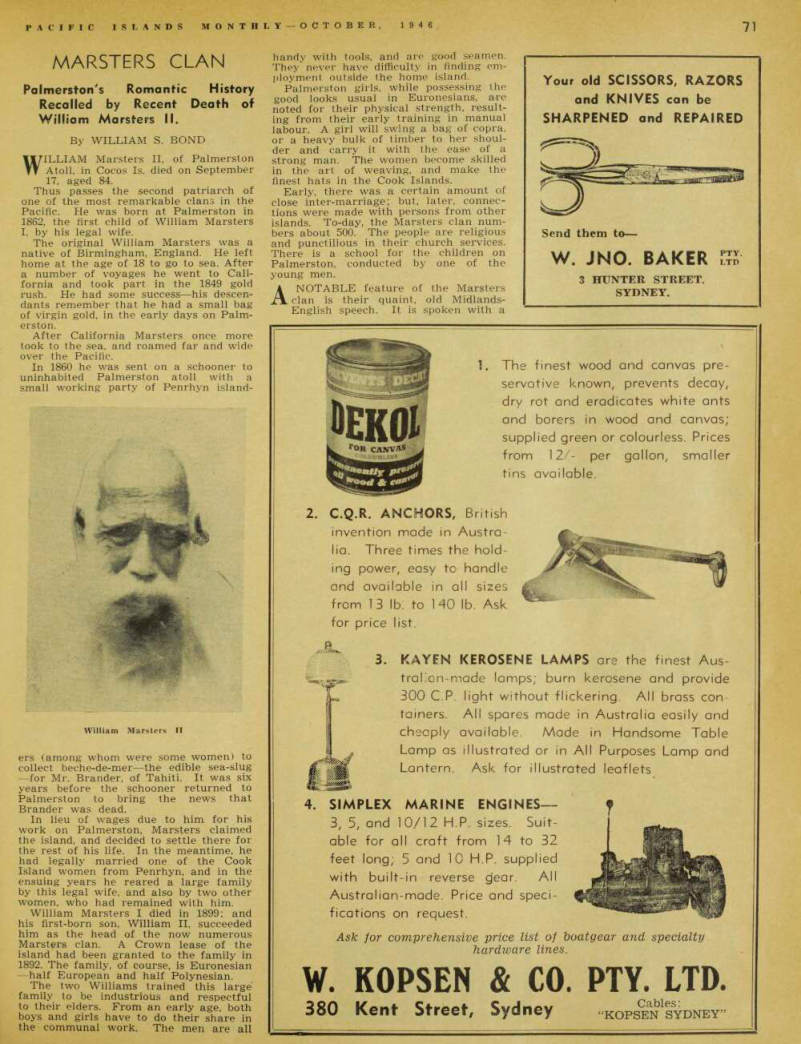
Palmerston's Romantic History Recalled by Recent Death of William Marsters II.
By William S. Bond
WILLIAM Marsters 11, of Palmerston Atoll, in Cocos Is. died on September 17, aged 84.
Thus passes the second patriarch of one of the most remarkable clans in the Pacific. He was born at Palmerston in 1862, the first child of William Marsters I, by his legal wife.
The original William Marsters was a native of Birmingham, England. He left home at the age of 18 to go to sea. After a number of voyages he went to Cali fornia and took part in the 1849 gold rush. He had some success—his descen dants remember that he had a small bag of virgin gold, in the early days on Palm erston.
After California Marsters once more took to the sea, and roamed far and wide over the Pacific.
In 1860 he was sent on a schooner to uninhabited Palmerston atoll with a small working party of Penrhyn island-
ers (among whom were some women) to collect beche-de-mer —the edible sea-slug —for Mr. Brander, of Tahiti. It was six years before the schooner returned to Palmerston to bring the news that Brander was dead.
In lieu of wages due to him for his work on Palmerston, Marsters claimed the island, and decided to settle there for the rest of his life. In the meantime, he had legally married one of the Cook Island women from Penrhyn, and in the ensuing years he reared a large family by this legal wife, and also by two other women, who had remained with him.
William Marsters I died in 1899: and his first-born son, William 11, succeeded him as the head of the now numerous Marsters clan. A Crown lease of the island had been granted to the family in 1892. The family, of course, is Euronesian —half European and half Polynesian.
The two Williams trained this large family to be industrious and respectful to their elders. From an early age, both boys and girls have to do their share in the communal work. The men are all
handy with tools, and are good seamen.
They never have difficulty in finding em ployment outside the home island.
Palmerston girls, while possessing the good looks usual in Euronesians, are noted for their physical strength, result ing from their early training in manual labour. A girl will swing a bag of copra, or a heavy bulk of timber to her shoul der and carry it with the ease of a strong man. The women become skilled in the art of weaving, and make the finest hats in the Cook Islands.
Early, there was a certain amount of close inter-marriage; but, later, connec tions were made with persons from other islands. To-day, the Marsters clan num bers about 500. The people are religious and punctilious in their church services.
There is a school for the children on Palmerston, conducted by one of the young men.
A NOTABLE feature of the Marsters clan is their quaint, old Midlands- English speech. It is spoken with a
William Marsters II
slow drawl, and is quite difficult to follow at first acquaintance.
At one time, the little colony was quite prosperous, partly on account of their own industry, but partly due to other people’s misfortunes. During the period of the Marsters occupation, there have been a number of ships wrecked on the atoll, and salvage from these vessels was valuable. Several of the ships carried cargoes of timber, and large quantities of salvaged timber were sold for ship ment to Rarotonga and other places.
Some of the timber was used for build ing a substantial village, complete with church. The houses were comfortably equipped with handsome furniture, and
a great variety of other fittings, saved from the wrecks.
IN 1926, the sea took back all that it had given. In that year, a bad hurri cane struck Palmerston, sweeping away practically the whole settlement and removing even a part of the islet on which it stood.
The people barely escaped with their lives, by crowding together on a small mound in the centre of the low-lying islet. This mound, which had been created by the excavation of an area for planting taro, has several times afforded a place of refuge from the sea, and is referred to as “the mountain.”
The big wooden church was carried bodily several hundred yards inland by the sea. Due to its substantial construc tion of heavy, full-length timbers, it re mained intact. With the church far re moved from its original position, there was no water supply, as this depended on catchment from the corrugated iron roof, run off into concrete cisterns.
The cisterns could not be moved —so the only way was to bring the church back to the cisterns. The islanders suc ceeded in jacking the church up on to a skidway of coconut trunks and working it back to its original position, with the aid of an old ship’s capstan and rope tackles There had been earlier disasters. In 1883, a hurricane destroyed all the coco nut trees and a fresh start had to be made. The tidal wave of 1914, which caused much trouble in the central Paci fic, damaged houses and crops on Palm erston.
SINCE 1926, there has been a continu ous series of misfortunes, several bad hurricanes in succession striking the island and making it impossible for the islanders to recover, with their resources so low.
The people depend almost entirely upon copra-making as a source of in come; but, with so much damage to the trees during the past twenty years, very little copra has been possible. They also
have to depend largely upon coconuts for their own food supply. Fish are plentiful, and the islanders are expert at smoking and salting. Palmerston pre served fish sells readily in Rarotonga, but lack of shipping handicaps this in dustry.
Palmerston is very isolated. With so little to sell at present, the islanders rarely get more than one visit in a year.
It is little wonder, therefore, that the community is steadily dwindling. As the children of the present generation grow up, they are anxious to see better oppor tunities in Rarotonga and other islands.
At the same time, all the Marsters re tain a great affection for Palmerston, and try to make a visit to the old home whenever possible.
When the schooner “Tiare Taporo” called at Palmerston in August, 1948, there were only 66 persons on the island, and more than half of these were chil dren of school age, or under. The schooner picked up a further 15 of this group and brought them on to Raro tonga.
The writer had the pleasure of visiting William Marsters, on Palmerston, on this occasion, only a few weeks before his death. The old man was mentally alert and still was the master of Palmerston.
He had a fine set of teeth, and could read without glasses. He was respected by all who knew him. The “Old Man” will be deeply mourned by the many members of the Marsters clan through out the Cook Islands.
Advertisements & other items, pp. 73-74 (1 item)
W. Kopsen & Co. Pty. Ltd.
Your old SCISSORS, RAZORS
and KNIVES con be
SHARPENED and REPAIRED
O Send them to—
W. JNO. BAKER EK
3 HUNTER STREET,
SYDNEY.
r OR
CJUtfVA*
1. The finest wood and canvas preservative known, prevents decay, dry rot and eradicates white ants and borers in wood and canvas; supplied green or colourless. Prices from 12/- per gallon, smaller tins available. 2. C.Q.R. ANCHORS, British invention made in Australia. Three times the holding power, easy to handle and available in all sizes from 13 lb. to 140 lb. Ask for price list. 8 3. KAYEN KEROSENE LAMPS are the finest Austral'an-made lamps; burn kerosene and provide 300 C.P. light without flickering. All brass containers. All spares made in Australia easily and cheaply available. Made in Handsome Table Lamp as illustrated or in All Purposes Lamp and Lantern. Ask for illustrated leaflets
4. SIMPLEX MARINE ENGINES—
3, 5, and 10/12 H.P. sizes. Suitable for all craft from 14 to 32 feet long; 5 and 10 H.P. supplied with built-in reverse gear. All Australian-made. Price and specifications on request.
Ask for comprehensive price list of hoatgear and specialty hardware lines.
W. KOPSEN & CO. PTY. LTD.
Cables •
“KOPSEN SYDNEY”
380 Kent Street, Sydney
KANGAROO BRAND
Ropes,
Cordage,
and Twines for every purpose Backed by 86 years of service Manufactured by:
M. DONAGHY AND SONS,
Pf-y. Lfd., Geelong and Sydney.
Representatives :
PEARCE AND CO.
LIMITED
P.O. BOX 237, SUVA
A SPACIOUS
ATTRACTIVE
"DURABESTOS"
HOME
T
FBIH
?\\'r rr TT n L/vuva [~ —— room .1..
iirw
mj ao:ao ■ o •P c3outpoor
O L/V/Nd
O O eS /g« 2263/5.
When you have an opportunity, visit our showrooms : BAPTIST
STREET, REDFERN.
Take the Crown St - West Kensington tram
from City,
2 BEDROOMS
AND A SUN-ROOM
provide sleeping accommodation for a family of five persons in this home, walled with DURABES- TOS" and roofed with
TERRA - COTTA TILES.
Write for scale plan to
WUNDERLICH LIMITED,
G.P.O. Box 474, SYDNEY,
N.S.W. Tel.: MX 2411.
Spook Exploded
Tongan Grave Mystery Explained
By F. T. Goedicke
THERE is an article in the December issue of the .New Digest, entitled “Cemetery Spook.” You may be interested in the explanation.
During my 60 years residence in Tonga I witnessed this phenomenon on several occasions. The first time was in 1885, at Haapai, in Tonga. I was returning home one moonlit night and, as I was passing a native cemetery, I saw a bright, white object, generally shapeless, apparently floating above a grave.
I should have been scared, but I was not. I had just spent two years among very primative savages of New Britain, and I had seen some terrible tortures inflicted by those cannibals. I had seen a European woman, tied up pig-fashion, rescued by her brother-in-law, Mr. R.
Parkinson, when she was about to be carried off into the bush, to be killed and eaten. So my nerves were in good order.
Twelve years later, when I was in Nukualofa, I was returning home from Kaopanga village one night when I met the Chief Medical Officer, Dr. McLennan, carrying a bundle of dry coconut leaves.
To my query of what was afoot he said “ Come along with me—l am going to send the devil to hell.”
He said that a “devil” had just been sighted over a grave in a nearby cemetery, and he wanted to show the people what the thing really was. He went into the cemetery, approached a grave over which the white thing floated, lit his coconut leaves, and threw them at the grave.
There was a sharp “Pop,” and a flare, and the white thing disappeared.
The doctor then explained that when the natives buried a corpse they filled the grave with white sea-sand. When decomposition began, under certain cir cumstances a gas formed, and this escaped through the sand and could be seen above the grave as a kind of vapour. It hap nened only occasionally, under certain conditions, and the gas usually was inflammable.
N. Caledonia
Free Labour In
War Destroyed Indenture System:: Grave Problem For Mining Companies
THE system of indentured Asiatic labour for New Caledonia, which was introduced 60 years to replace French convict labour, ended on July 5. 1945, when 10,000 Indo-Chinese and Indone sians were released from their labour contracts.
During the 60 years, New Caledonia experimented with Chinese, Japanese, Annamites, Tonkinese, Hindus, Javanese, but finally settled down with Tonkinese (with a few Annamites) and Javanese.
There were 3,000 of the former and 7,000 of the latter when the system ended.
The system had to be sternly discip lined, and the labour contracts were en forced by penal sanctions —fines and im prisonment. The average wage was 250 francs (about 30/- Australian) per month —which was 150 francs less than the wage usually paid to the undependable New Caledonian natives.
The Asiatics employed at the mines were paid more than the primitive native labourers employed in New Guinea; but they do not seem to have been as well fed and cared for. The Asiatics were allowed by the French to bring their women with them, and about one woman to four men arrived. Residential and social conditions were very bad.
The contract was for five years, and both the French and the Dutch (who supervised the contracts on behalf of the Javanese) insisted strictly on repatria tion. The system was sometimes criti cised by irresponsible Leftist writers, but generally it worked well enough.
WAR conditions destroyed the system.
There were 10,000 Asiatics in the Colony when the Japs invaded the South Pacific, and when their indentures expired between 1942 and 1944, they could not be repatriated. From 1942, New Caledonia was an important base for United States forces. The Americans spread around countless dollars, and all the trappings of Western democracy and freedom; and the Asiatics got a large share of both.
The Asiatics demanded cancellation of their labour contracts, and freedom of residence. The embarrassed French re fused both, and tried to keep the Asiatics under indenture. Both sides appealed, with growing urgency, to the Americans.
During 1943 and 1944 the situation stead ily worsened. The French used their armed forces against the Asiatics; the Asiatics retaliated with repeated strikes.
The Asiatics undoubtedly had griev ances in low pay, miserable living con ditions and continuance of the time-ex pired contracts, with their penal sanc tions. But, against them, were the facts that they were a poor, undesirable, illit erate class who required strict control; they originally were very glad to come from their wretched Asiatic slums to New Caledonia; it was vital to the Allied war effort that the production of min erals should continue; and —above all — they were merely instruments in the hands of a gang of Communist agitators, who somehow had found their way into the Colony. Their chief mouthpiece was a Madame Tunica, described as “the Colony’s Communist leader” who, at the present time, is a resident of King’s Cross, Sydney.
During the latter part of 1944 and early 1945, the Colony was convulsed by strikes. The newly-appointed Governor
Tallec handled the situation with strength and vigour; and he virtually compelled the General Council, by 11 to 4, to grant free residence to the Asiatics as from July 5, 1945.
After months of negotiation, a mini mum rate of wages was agreed upon be tween the now free Asiatics and the mining companies. It is about 1,675 francs (£5 Australian) per month, plus family allowances, improved housing, medical care, etc. The Asiatics gener ally, however, are eager to return to their own countries, as soon as transport is available.
If the mining industry is to continue in New Caledonia, the problem of pro
viding labour must be solved. The native Melanesian labour is inadequate —the supply, presumably, must come from Asia.
There now is a remarkable resemb lance between New Caledonia’s indus trial problem and that of every large Territory in the South Pacific.
Dr. C. E. Fox, who has been an active member of the Melanesian Mission in the British Solomon Islands for many years, arrived in Sydney early in October, He is due for medical attention and probably will have to undergo a minor operation.
Advertisements & other items, pp. 75-76 (1 item)
Tom Piper
% » / OF
ORLD
r V V JK J -s
smed'
TOM PIPER
TOM PIPER PRO-
DUCTS include: Hot Meat Packs; Camp Pie ; Luncheon Beef ; Corn Beef and Cereal; Tomato; Vegetable ; Celery; Pea and Oxtail Soups; Baked Beans; Beans and • In the hygienic kitchens of Tom Piper, skilled chefs prepare fine foods from the choicest produce of Australia; cooking and capturing with inimitable skill all the flavour and wholesome goodness. And then, by careful processing, all this wealth of good taste and nourishment is conserved by Tom Piper’s modern canning plant.
EXPORT FACILITIES: Tom Piper products will soon be available for export. They offer worthwhile opportunities to overseas wholesalers and merchants with markets for QUALITY in fresh canned foods. Inquiries are invited by the manufacturers.
DALMORE PRESERVING CO. PTY. LTD.
Gardenvale, 5.4. Victoria, Australia.
Code: Bentley’s Second —Telegraphic Address: DALMORCO, Melbourne Beef; Spaghetti and Tomato Sauce; Creamed Diced Carrots ; Creamed Diced Potatoes; Plum Puddings.
IPSR
TOM
.A.
Rz the Estate of PETER EDWARD RICHARD COE, late of Rabaul, Public Servant.
NOTICE is hereby given that the Public Trustee has this day elected to administer the Estate of the abovenamed deceased. (Will dated 6th December, 1940.1 PURSUANT to the Wills, Probate and Administration Act, 1898-1940; the Public Trustee Act, 1913-1942; Testator’s Family Maintenance and Guardianship of Infants Act, 1916-1938, and Trustee Act, 1925-1942, the PUBLIC TRUSTEE, the administrator of the Estate of the said PETER EDWARD RICHARD COE, who became missing on the Ist day of July, 1942, and is for Official purposes presumed to be dead, hereby gives notice that creditors and others having any claim against or to the Estate of the abovementioned deceased person, are required to send particulars of their claims to the Public Trustee at 19 O’Connell Street, Sydney, on or before the 7th day of December. 1946, at the expiration of which time the said Public Trustee will distribute the assets of the said deceased to the persons entitled, having regard only to the claims of which he then has notice.
DATED this 13th day of August, 1946.
M. C. NOTT,
Public Trustee.
ALL STOREKEEPERS HAVE—
AUNT
MARYS
BAKING POWDER
9 Aunt Mary's Baking Powder is now obtainable from your storekeeper. That's good news for you, especially as Aunt Mary's Baking Powder maintains the high quality which has stood the test of housewives for over 70 years.
There is no substitute for Aunt Mary's—There never will be.
Santo To Sydney With
A Sick Boy
DONALD PIETZ, the 7-years-old son of Pastor A. D. Pietz of the Seventh Day Adventist Mission, New Hebrides, was flown from Santo to Australia on October 13. The boy had been ill and in a coma for seven days.
A US Army plane picked Pastor Pietz and his son up in Santo. The plane flew direct to Brisbane where the lad was put on a plane for Sydney. In Sydney he was rushed to hospital in an attempt to save his life.
Mr. and Mrs. C. A. Jones and their two children left Brisbane for Suva by Qantas flying-boat on October 7. Mr. Jones, who wiil be attached to the British Colonial Service in Fiji was, in prewar days, in the Government service, New Guinea.
After living 19 years in Fiji, Sergeant F. W. Nichol passed through Brisbane recently in the Qantas flying-boat “Cori olanus,” on his way home to Sydney.
Sergeant Nichol, who was educated in Fiji, was employed by a building firm when war broke out. He served six years in the Fiji artillery.
W/O R. J. S. Kerkham, of the RAF Fiji contingent, was a passenger on the Qantas flying-boat for Suva on October 7/ He will resume his pre-war job with a merchant firm. During the war, he saw service in Burma.
Advertisements & other items, p. 76 (1 item)
74
OCTOBER, 1946 PACIFIC ISLANDS MONTHLY
PORT MORESBY'S HOUSING
PROBLEM
(Continued from Page 8)
Ng Natives For Suva
LATEST report about the New Guinea natives who are being groomed for the Central Medical School in Suva.
Fiji (see “PIM,” September) is that the numbers have now been whittled down to about three. Original number chosen from the whole of the Provisional Ter ritory was seven.
It is believed that the decision to send boys to Suva was made by a “higher authority” and is not favoured by the Director of Medical Services in New Guinea, who believes that the boys have not the necessary background or educa tion to take advantage of the Central Medical School course.
£100,000 Buried In The
Solomons
DURING the two years that the numer ous forces of the United States were in the Solomon Islands, they spent their dollars lavishly in purchasing service from the natives, in buying curios, and in other ways.
It is estimated by missionaries who know the Group well that the Americans left not less than £lOO,OOO, in cash, in the hands of the natives.
There are now no banking facilities whatever in the Solomons —not even trade stores which could act as bankers.
As a result, this cash now in native own ership has been hidden away by indiv idual owners —mostly buried.
Bsi Languages
Interesting Remnant In The Russells
AN experiment in the transplantation of communities in the British Solomon Islands in being watched with interest by Dr. C, E. Fox, a member of the Mel anesian Mission who has spent 45 years in the group. He has made a special study of the local languages and has com piled three dictionaries.
Because of the difficulty of obtaining local labour in the under-populated Solo mons, a number of Gilbertese are being taken to Cape Marsh (Russell Islands, near the centre of the group) where are a number of the best coconut planta tions. Men from the over-populated Gil berts make excellent labourers.
There are only about 200 indigenous natives remaining in the Russell Islands, and Dr. Fox says that they are a rem nant which it is difficult to identify. They speak a language which he describes as “strange, and quite unique it is like nothing known in the world —a most complicated thing, with inflections re sembling those of Latin and Greek.”
Dr. Fox (he is a Doctor of Literature) although he is nearly 70 years old, was a coast-watcher for the Americans during the war. Certain American officers were deeply interestd in his research work and his MSS. One American, who was making arrangements for the publication of Dr. Fox’s dictionaries, unfortunately lost his life in an air accident.
Mr. Jeffrey Carr, who has been attached for some years to the Vacuum Oil Company staff in Suva, Fiji, has joined Pan American World Airways. He left Suva last Thursday for San Fran cisco, where he is to be attached for two months to the divisional headquarters of the Company for further training in traffic management.
Thursday Island
MR. Doug. Wilson, formerly a Brisbane bookmaker, is now a steward on the SS “Wandana.” When he arrived at Thursday Island recently, he found that more than 200 people on the Island were hungry, and that beer was 4/- a bottle.
Things were slowly getting back to normal at TI, and the Army probably would have vacated the place in a few months. Shops and hotels were opening and pearl and trochus shell fishing were the main subjects of discussion. With luggers and divers still scarce, fishermen were getting very high prices for pearl shell; but, according lo Mr. Wilson, they had only touched at the fortunes lying on the oyester beds which had been idle for the six war years.
In the Suva Lawn Tennis Club’s 1946 Tournament, Miss Leone Sunderland has established a record by winning the Women’s Open Singles, the Women’s Club Singles, the Handicap Singles, (with Mr. E. W. Simms) the Open Mixed Doubles, and (with her mother, Mrs.
Sunderland) the Open Doubles and Handicap Doubles.
Advertisements & other items, p. 77 (1 item)
Admire -
POSITION WANTED
Young married man with general engineering and diesel experience seeks permanent position of any kind in Pacific Territories. First class references. Reply to W. J.
Rhodes, 18 Watson St., Neutral Bay, Sydney,
til
.* -,=3 1
WHAT WOMEN i
ADMIRE -
WELL-GROOMED® -fl
HAIR I ”
V A s 'Z; '3K> wr r i -tj Nine out of ten men dance as well as he does, hut women prefer the partnership of wellgroomed men . . . admire the easy correctness expressed in good-looking, non-greasy hair. You, 100, can make your hair a social asset with VITAL!S, and the 6 60-second drill.’ 5O Seconds to Rub—Circulation quickens thus scalp stimulation gives hair a chance. 2 10 Seconds to Comb and Brush—Hair has a lustre —no objectionable "patentleather" look. 3301 hair the dresses scalp— ulatcs * he y/> Stin> Sold by all leading distributors and manufactured by Bristol-Myers Co. Pty. Ltd., 223 Pacific Highway, North Sydney, N.S.W., Australia
Anti-Malaria Control
Notes On American Experiences In The Solomons
By G. R. Y.
THE landing of American Forces at Tenaru, Guadalcanal, took place on August 7, 1942, and the island was finally secured on February 9, 1943.
The first troops found few mosauitoes— August is a dry month in the Solomons and little malaria occurred. But the desperate military situation in September al KgMl t n o g to swamps,‘jungles and grass lands, in battle areas with shell holes. bomb craters and debris oi battle, malaria broke out in epidemic form. The local natives and the Japanese had made seed beds of malaria for the mosquitoes and there was little or no Malaria control.
The peak rate was in November 1942 — 1.800 cases of malaria per 1,000 per annum.
Bad conditions were aggravated by air r nir]c wViipVi mpflnt hours scent at nisht in and treSes, wdth mosqli -IXI IUA nuico a u yi
toes. Bad sanitation and loss of sleep took toll of the troops. There were 100,000 cases of malaria, an average of two attacks to each man—five time as many as battle casualties.
The Japanese also suffered badly with malaria. Being under battle conditions, they had little or no anti-malarial con trol. They had plenty of quinine (latterly, atebrine) insect repellant (with a cit ronella base) and mosquito nets. Cap tured records show their malaria rate at Munda and Kulambangra, February, 1943, was 1,600 cases per thousand per annum, and in Rabaul in April, 1943, 2,053 cases per thousand.
THE military situation prevented the start of control operations until November, 1942. Base sites were approved or condemned by medical offi cers, who picked out newer and healthier sites. Native camps were removed to a mile away from w T hite personnel where practicable. Huts were sprayed, jungles cleared and swamps drained or oiled.
Atebrine discipline was enforced. Officers saw that every man of their units took the allotted dose. Quarters and bath houses were sprayed and screened and patrols were required to carry mosquito nets with them. Long trousers and shirt sleeves buttoned down were required— in the open air between 6 p.m. and 6.30 a.m.
This brought the malaria figures down.
In October, 1944, the figure was 38 per thousand p.a.
Costs were high, naturally. An esti mate for the year for the SP Area was nearlv nine million dollars. Against this, an estimated loss for non-malaria control of 100,000 men was 2,240,000 days at eight dollars per day, some 18 million dollars.
The sick-rate for the South Pacific Area from October, 1942, to August, 1944, was 78,000 cases of malaria, primary and re lapsing, with the low mortality of 0.04 per cent.; 34 deaths were due to malaria.
SUPPRESSIVE treatment ordered for all troops was, per week, 0.1 gram daily of atebrine for six days, omit ting Sundays. Clinical treatment for non complicated attacks was 0.2 grams every six hours for five days, and then 0.1 gram three times a day for six days.
A small percentage of individuals showed intolerance to atebrine: but the effects invariably disappeared when the treatment was continued.
There is no evidence of toxicity from long-continued use and no medical evi dence that impotence or sterility is caused by taking this drug. No parasitic resistance to atebrine is known.
Faulty atebrine discipline should be looked for in the case of any increase in malaria rates. One or two individuals per thousand may have malaria and have relapses despite suppressive treatment.
There is no drug known that will pre vent mosquito-borne infection, but ate brin will suppress the disease.
In the early days of the Occupation confusion and uncertainty prevailed re garding the use and dosage of atebrine.
Some authorities had warned that ate brine should only be taken under medical supervision. The routine use of this drug, as a basic malarial drug, was ordered to conserve the rapidly dimin ishing stocks of quinine. This gave rise to the suspicion that atebrine was a drug more necessary than desirable.
Furthermore, suppressive doses were given to troops on shipboard, when ap proaching malarial islands. Seasickness, diarrhoea and emotional states were all attributed to atebrine. Later, when clinical cases were treated and relapses occurred, both medical men and others, accustomed to regarding quinine as a certain cure for malaria, were disillu sioned in regarding atebrine as a sub stitute. Atebrine discipline had not been enforced thoroughly and some soldiers, knowing that an attack of fever would mean their evacuation to a place of safety and comfort, made little effort to Tke their suppressive doses. Later when discipline tightened up, malaria was at least got under control.
Nine Papuan Soldiers Lost
In Cutter's Wreck
THE cutter “Jean,” which Mr. Tom Holland, of Madiri, Western Papua, had owned only a month, was wrecked in July, when it was carrying members of the disbanded Pacific Islands Battalion to their villages. Nine of the ex-soldiers were drowned.
An official inquiry into the accident was held, but it was found that no blame was attributable to anyone.
The plantation at Madiri is being run by Mrs. Holland Mr. Holland is over in Cape York district, in charge of a sawmill.
Unevangelised Mission In
Papua
THE Unevangelised Fields Mission, which has its headquarters at 75 Mildmay Park, London, now has 20 white missionaries working at six stations in Papua—Wasua (headquart ers), Madiri, Balimo, Awaba, Suki and Daviumba. . .
The organisation supports missionaries now at work in Belgian Congo, Brazil, and Haiti, as well as in Papua. The Australian headquarters are at 317 Col lins Street, Melbourne. The missionary personnel (now totalling 113) comprise members of the Anglican, Presbyterian, Methodist, Baptist and other Protestant churches.
Advertisements & other items, pp. 78-80 (3 items)
Asthma Curbed
Telephone: 280.
Cable; ENDEAVOUR, Mattancheri.
THE NATIONAL
AGENCIES LTD.
MATTANCHERI. COCHIN,
MALABAR COAST
EXPORTERS OF COIR ROPES,
MATS, MATTINGS, RUGS
AND CARPETS
Wanted Agents in unrepresented areas.
Enquiries Solicited.
Asthma Curbed In 3 Minutes
Since the discovery of Mendaco by a famous physician sufferers can get relief from Asthma. Mendaco does away with expensive Injections and offensive smokes.
All you oo is to take 2 tasteless tablets with meals and Mendaco starts circulating through the b)ood in 10 minutes. You breathe easily and freely. Your nerves relax, you get good, fresh, pure air into your lungs, and vigour returns.
Sleep Like a Baby
Thousands of former sufferers from Asthma say that the very first dose of Mendaco brought them glorious ease and comfort, and that they slept soundly the very first night. Then their vigour returned and they felt healthier and stronger, and 5 to 10 years younger The reason for this is that Mendaco acts in natural ways to overcome the effects of Asthma. (1) It removes the mucus or phlegm; (2) It relaxes thousands of tiny muscles in your bronchial tubes so that the air can get in and out of your lungs; (31 It promotes body vigour, and stimulates the building of rich, revitalised blood.
No Asthma for Five Years
Mendaco not only brings almost immediate results, free breathing and comfort and enables you to sleep, but also builds up the system to ward off future attacks. Mr.
J. R. writes; “I was almost dead with Asthma. Had lost 40 lbs. In weight, snf-
fered coughing every night—couldn’t sleep.
Mendaco stopped spasms first night. I have had no Asthma since in over 2 years.”
Mrs. A. W. writes; ‘‘l had Asthma for 25 years. After using Mendaco I can sleep all night and have not had an attack since taking it.” Mrs. G. E. C. writes: ‘‘l bless the day I first beard of Mendaco. What a godsend it is to a poor woman like me who for 35 years never knew what it was to have a good night’s rest. The constant fight between Asthma and sleep was wearing me down, but I feel now I want to forget my past suffering.”
Benefits Immediate
The very first dose of Mendaco goes right to work circulating through your blood and helping nature rid you of the effects of Asthma. Try Mendaco under an iron-clad money back guarantee. You be the judge.
If you don’t feel fully satisfied after taking Mendaco just return the package and the purchase price will be refunded. Get Mendaco from your chemist to-day and see how well you sleep to-night and how much better you will feel.
RELIEVES ASTHMA
Mendaco
Now in 2 sizes 6/- and 12/-
77
PACIFIC ISLA N 1) S MONTHLY OCTOBER, 1946
Harry J. Tomnq
ADVANX
for Everything in Rubber
Rubber Heels
Black rubber tack-on type with nail washers moulded into position.
Nails and screws included. Also available in women’s Cuban and Louis.
Hot Water Bags
Heavy gauge moulded rubber, each bag 10 in. x 8 in. Splash proof vulcanised filler neck, metal stop- 3er. Packed 1 Doz. to carton.
Water Proof Sheeting
Water proof rubber spread cloth 36 in. wide; sold in roll length only.
Various colours to special order, or your own material proofed if desired.
Vi
Both and Sink Plugs
Available in black rubber with noncorrosive metal insert. Sizes from U in. to 2 2- in. in 1/8 in. rise.
Rubber Hose and
Tubing
Each roll approximately 60 ft. in length and available in all standard sizes. Special or metric sizes can be supplied on request. Extruded fabricless hose in i in. I.D. also available. m
Sand and Sport Shoes
Within the range of Advanx rub ber footwear will be found a style to suit every customer group.
Featured here is a quick-selling, double-texture shoe with black crepe pattern sole, black foxing and toecap. Available in men’s 5 to 12, women’s 2 to 7.
Tufhide Soling Material
Black rubber sheets for footwear soling. Available in 1/8 in., 3/16 in and \ in. thicknesses and 1/16 in junction back.
ORDER THROUGH YOUR USUAL CHANNELS
Sole Pacific Islands selling representative:
HARRY J. TOMNQ
PIT. LTD.
POSTAL ADDRESS:
Box 3661 G.P.0., Sydney.
379 KENT STREET, SYDNEY,
BANKERS: BANK OF N.S.W.
CODES:
Bentley’s Comp.
Phrase.
Bentley’s 2nd Phrase.
Allen Taylor & Co. Ltd,
COMMERCIAL ROAD, ROZELLE,
SYDNEY
Sowmillers and Wholesale Suppliers of Hardwoods for Constructional Purposes GIRDERS . . . PILES . . . POLES . . . SLEEPERS, Etc.
EXPORTING TO PACIRC~ ISLANDS SINCE 1893
Your Future
A Carver in if nsi ness Offers
M p rnetienl Opportunities
1 F you think over those men who are enjoying big A positions and large incomes, you will soon realise that most of them are engaged in business pursuits . . . merchants, accountants, secretaries, bankers, and business managers of all kinds. But how did they get their start in business? The answer is simple.
First, by realising that business today offers the best opportunities for a successful career. Secondly, by training and qualifying in a chosen business subject.
If you would like to know how you too can take advantage of these practical opportunities . . . write to H.R.I. today.
H.R.I. is available always to help and advise ambitious men and women. Write or wire for particulars and career information.
ISel»eri*on Institute
(Founded and owned by Hemingway & Robertson Pty. Ltd ) Professional Tutors . . . Consulting Accountants 126 a CHALFONT CHBRS., 142 PHILLIP ST., SYDNEY 126 a BANK HOUSE . . . BANK PLACE . . . MELBOURNE and at all Capital Cities, Newcastle and Launceston
IDS
'4/
H.R.I. Career Training
Accountancy and Commerce- Accountancy. Secretaryship Cost Accountancy Bankers’ Institute Exams.
Insurance Examinations Local Government Exams.
Bookkeeping (all grades) Effective Correspondence Psychology Industrial Psychology Economics Distribution- Selling and Sales Man’g’ment Marketing and Advertising Practical Retail Selling Ticket. Showcard Writing Business Administration- Business Administration Merchandising Management Foremanship & Ind'l Man’g’t General Education- Public Service Grade. School.
Police & Nurses’ Exams.
H.R.I. tutorial service is proved by the winning of more honours than all coaches in Australasia combined.
To Hemingway Robertson Institute. I Please fend your 96-page handbook I Guide to Careers in Business ”
Name Age Address . I Interested in 126a/778
SALVAGER SAVES HIMSELF
FROM TRAVELLING FATIGUE
REALLY ON THE JOB TO-DAY
With the call to-day going out for more metal, the work of a salvager is one that knows the pressure is on!
Mr. E. P. Nicholson, of 77 Carlton
Mill Road, Christchurch, is New
Zealand’s largest salvage merchant,
obtaining quantities of steel, etc.,
from sunken ships, gold dredges,
mining plants, and anywhere else
where metal is lying unused.
Mr. Nicholson attributes his present
abundant energy to R.U.R.
He says: "After several years travelling in Australia md New Zealand in motor-cars and getting practically no exercise, I found myself getting very sluggish, tired and fatigued, in addition to putting on weight but after raking R.U.R. I noticed a decided improvement, both in regard to my energy and fatigue. I have lately driven eignteen hours at a stretch without sleep, which I could not possibly have done before. My weight has now returned to normal, and thanks to R.U.R. I feel altogether a new man, both physically and mentally.”
Once again R.U.R. comes to the rescue.
R.U.R. is the greatest treatment, and con tains a laxative, liver stimulant, kidney cleanser !ood purifier and acid corrective.
Obtainable at Chemists and Stores, or write to R.U.R., 841 George Street, Svdney, Australia.
Pioneer Missionary
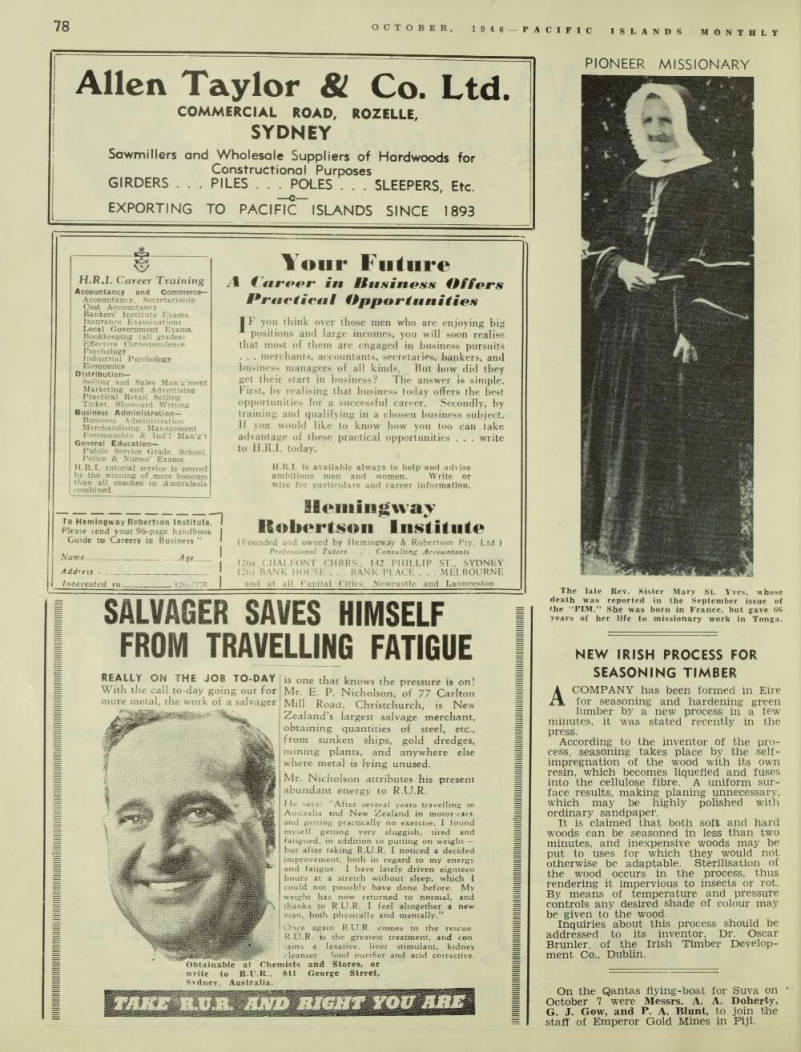
The late Rev. Sister Mary St. Yves, whose death was reported in the September issue of the “PIM.” She was born in France, but gave 66 years of her life to missionary work in Tonga.
New Irish Process For
Seasoning Timber
A COMPANY has been formed in Eire for seasoning and hardening green lumber by a new process in a few minutes, it was stated recently in the press.
According to the inventor of the pro cess, seasoning takes place by the self impregnation of the wood with its own resin, which becomes liquefied and fuses into the cellulose fibre. A uniform sur face results, making planing unnecessary, which may be highly polished with ordinary sandpaper.
It is claimed that both soft and hard woods can be seasoned in less than two minutes, and inexpensive woods may be put to uses for which they would not otherwise be adaptable. Sterilisation of the wood occurs in the process, thus rendering it impervious to insects or rot.
By means of temperature and pressure controls any desired shade of colour may be given to the wood.
Inquiries about this process should be addressed to its inventor, Dr. Oscar Brunler, of the Irish Timber Develop ment Co., Dublin.
On the Qantas flying-boat for Suva on October 7 were Messrs. A. A. Doherty, G. J. Gow, and P. A. Blunt, to join the staff of Emperor Gold Mines in Fiji.
Advertisements & other items, p. 81 (1 item)
Tullocms pty. ltd.
m m %
Achievement in
ECONO-STEEL”
—the "nail-to-steel" technique
“ECONO-STEEL”—“Economical Construction Operations in Steel” is the new building frame and technique developed by Tulloch’s Pty. Ltd. to meet the present-day timber-brick shortage, and has reached such a stage in production that it is fast becoming standard practice—evidence of this being tentative acceptance within the Ordinance 71 of the Local Government Act (1919). of
jjov Outstanding beauty-
fa varied ** hom e e and mak e Mondays t p .iti.
Visiting Hon p 0 stat ion-
-1 00 Yards ico \ tOV o^° \n Vise iC c^o sp c in *\©n \x* c A VACATION HOME—So simple that it can be put together by man or woman—a universal building frame of Steel Studs and Trusses, to which any sheet material may be nailed direct. Cutting and fitting on site is eliminated. i
GRAZIER AND IN-
DUSTRIALIST will
find in this economical structure of Steel —a portable and demountable building frame designed to suit their particular requirements. The covering of the frame may be by any orthodox material—Asbestos-cementflat or corrugated, etc.
These units are delivered in crates ready to unfold and connect together with bracing, purlins and girts, to make up the building of your requirements.
Tullocms pty. ltd.
RHODES, SYDNEY, N.S.W., AUSTRALIA
Cable; TULSTEEL, Sydney.
Islands Produce
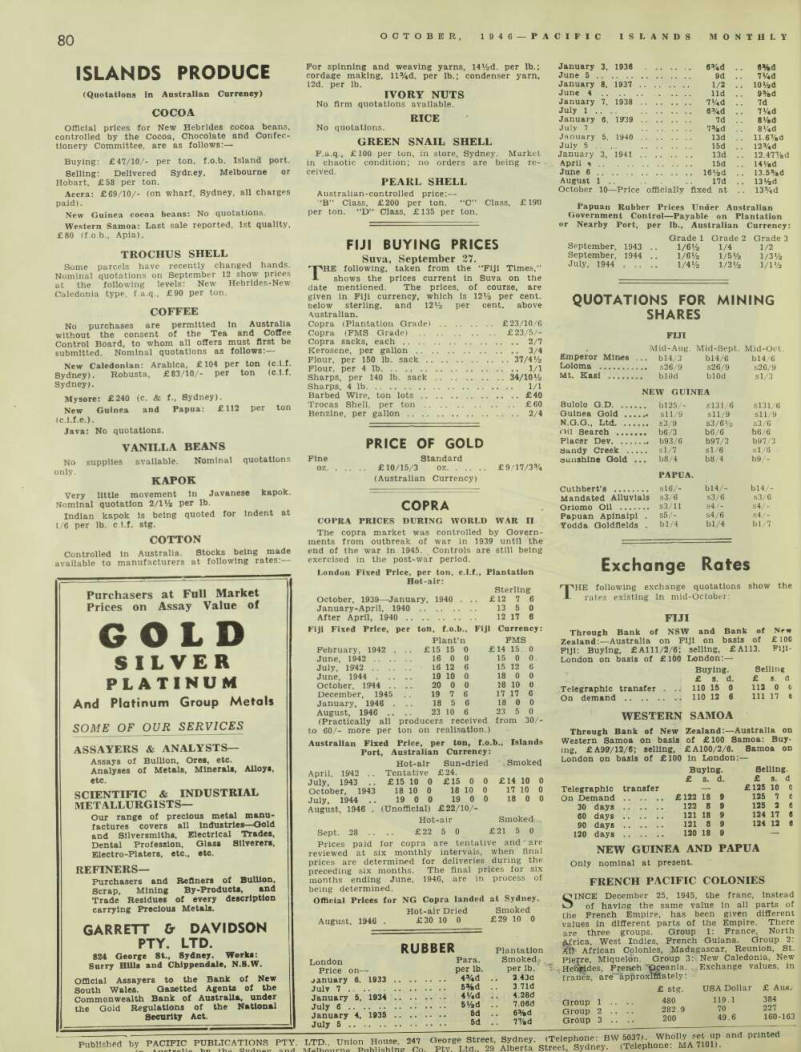
(Quotations In Australian Currency)
Cocoa
Official prices for New Hebrides cocoa beans, controlled by the Cocoa, Chocolate and Confec tionery Committee, are as follows; — Buying: £47/10/- per ton, f.o.b. Island port.
Selling: Delivered Sydney. Melbourne or Hobart, £5B per ton.
Accra: £69/10/- (on wharf, Sydney, all charges paid).
New Guinea cocoa beans: No quotations.
Western Samoa; Last sale reported, Ist quality, £BO (f ob., Apia).
Trochus Shell
Some parcels have recently changed hands.
Nominal quotations on September 12 show prices at the following levels: New Hebrides-New Caledonia type, f.a.q., £9O per ton.
Coffee
No purchases are permitted in Australia without the consent of the Tea and Coffee Control Board, to whom all offers must first be submitted. Nominal quotations as follows: New Caledonian; Arablca, £lO4 per ton (c.l.f.
Sydney). Robusta, £B3/10/- per ton (c.l.f.
Sydney).
Mysore: £240 (c. & f., Sydney).
New Guinea and Papua; £ll2 per ton (c.1.f.e.).
Java: No quotations.
Vanilla Beans
No supplies available. Nominal quotations only.
Kapok
Very little movement in Javanese kapok.
Nominal quotation 2/1 Vt per lb.
Indian kapok Is being quoted for Indent at 1/6 per lb. c.l.f. stg.
Cotton
Controlled In Australia. Stocks being made available to manufacturers at following rates;—
For spinning and weaving yarns, HVfed. per lb.; cordage making, ll%d. per lb.; condenser yarn, 12d. per lb.
Ivory Nuts
No firm quotations available.
Rice
No quotations.
Green Snail Shell
F.a.q., £lOO per ton, in store, Sydney. Market in chaotic condition; no orders are being re ceived.
Pearl Shell
Australian-controlled price:— *B” Class, £2OO per ton. "C” Class, £l9O per ton. ”D” Class, £135 per ton.
Fiji Buying Prices
Suva, September 27.
THE following, taken from the “Fiji Times,” shows the prices current in Suva on the date mentioned. The prices, of course, are given in Fiji currency, which is 12% per cent, below sterling, and 12 Vi per cent, above Australian.
Copra (Plantation Grade) £23/10/6 Copra (FMS Grade) £23/5/- Copra sacks, each 2/7 Kerosene, per gallon 3/4 Flour, per 150 lb. sack 37/4 Vi Flour, per 4 lb 1/1 Sharps, per 140 lb. sack 34/10Vi Sharps, 4 lb 1/1 Barbed Wire, ton lots £4O Trocas Shell, per ton £6O Benzine, per gallon 2/4
Advertisements & other items, p. 82 (1 item)
Price Of Gold
Fine Standard oz £lO/15/3 oz £9/17/3% (Australian Currency)
RUBBER Plantation
Copra
Copra Prices During World War Ii
The copra market was controlled by Govern ments from outbreak of war in 1939 until the end of the war in 1945. Controls are still being exercised in the post-war period.
London Fixed Price, per ton, c.1.f., Plantation Hot-air: Sterling October, 1939 —January, 1940 ... £l2 7 6 January-April, 1940 13 5 0 After April, 1940 12 17 6 Fiji Fixed Price, per ton, f.0.b., Fiji Currency:
Australian Fixed Price, per ton, f.0.b., Islands Port, Australian Currency: Hot-air Sun-dried Smoked April, IS'42 .. Tentative £24.
July, 1943 .. £l5 10 0 £l5 0 0 £l4 10 0 October, 1943 18 10 0 18 10 0 17 10 0 July, 1944 .. 19 0 0 19 0 0 18 0 0 August, 1946 . (Unofficial) £22/10/- Hot-air Smoked...
Sept. 28 .. .. £22 5 0 £2l 5 0 Prices paid for copra are tentative and are reviewed at six monthly intervals, when final prices are determined for deliveries during the preceding six months. The final prices for six months ending June, 1946, are in process of being determined.
Official Prices for NG Copra landed at Sydney.
Hot-air Dried Smoked August, 1946 . £3O 10 0 £29 10 0
Papuan Rubber Prices Under Australian Government Control—Payable on Plantation or Nearby Port, per lb., Australian Currency:
Plant’n
Pms
February, 1942 .. £15 15 0 £14 15 0 June, 1942 . . . 16 0 0 15 0 0 July, 1942 .. .. 16 12 6 15 12 6 June, 1944 . . 19 10 0 18 0 0 October, 1944 . . .. 20 0 0 1-8 10 0 December, 1945 19 7 6 17 17 6 January, 1946 . 18 5 6 18 0 0 August, 1946 23 10 6 23 5 0 (Practically all producers received from 30/to 60/- more per ton on realisation.)
RUBBER Plantation
London Para. Smoked.
Price on— per lb. per lb, January 6. 1933 4 3 /4d .. 2.43d July 7 .. .. 5%d 3.71d January 5, 1934 4V4d .. 4.28d July 6 5 Vad . . 7.06d January 4. 1935 Bd .. 6%d July 5 Sd 7 /« d
January 3, 1936 6%d 6%d June 5 9d 7V«d January 8. 1937 . 1/2 .. lOVad June 4 lid 9%d January 7, 1938 . 7V«d 7d July 1 7Vid January 6. 1939 . 7d 8Vad July 7 7 3 /ad 8V 4 d January 5. 1940 . 13d .. 11.6%d July 5 . 15d .. 12 3 /»d January 3, 1941 . 13d .. 12.47 7 / a d April * I5d .. 14Vad June 6 16V 2 d .. 13.5 9 /ed August 1 . 17d .. 13M«d October 10- -Price officially fixed at . . 13%d
Grade 1 Grade 2 Grade 3 September, 1943 . 1/6 Vi 1/4 1/2 September, 1944 . i/ey 2 1/5 y 2 1/3 y 2 July, 1944 ... 1/4 Vz 1/3 y 2 i/i y 2
Quotations For Mining
Shares
Fiji
Mid-Aug.
Mid-Sept.
Mid-Oct.
Emperor Mines . .. bl4/3 bl4/6 bl4/6 Loloma S26/9 S26/9 Mt. Kasl blOd blOd sl/3 Bulolo G.D
New Guinea
.. bl25/- S131/6 S131/6 Guinea Gold sll/9 sll/9 N.G.G., Ltd S3/6V2 s3/6 on Search b6/6 b6/6 Placer Dev b97/3 b97/3 Sandy Creek ... sl/7 sl/6 sl/6 sunshine Gold .. .. b8/4 b8/4 b9/- Cuthbert’s
Papua.
.. sl6/bl4/bl4/- Mandated Alluvlals s3/6 s3/6 s3/6 Orlomo Oil ... s3/ll s4/s4/- Papuan Aplnaipi . s5/s4/6 S4/- Yodda Goldfields . bl/4 bl/4 bl/7
Exchange Rates
THE following exchange quotations show the rates existing in mid-October;
Fiji
Through Bank of NSW and Bank of Nr* Zealand: —Australia on Fiji on basis of £ 10C FIJI: Buying, £Alll/2/6; selling, £AII3. FIJI - on basis of £lOO London: —
Western Samoa
Through Bank of New Zealand:—Australia on Western Samoa on basis of £lOO Samoa: Buy ing. £A99/12/6; selling, £AIOO/2/6. Samoa on London on basis of £lOO in London: —
New Guinea And Papua
Only nominal at present.
French Pacific Colonies
SINCE December 25, 1945, the franc, instead of having the same value in all parts of the French Empire, has been given different values in different parts of the Empire. There are three groups. Group 1: Prance, North Africa, West Indies, French Guiana. Group 2: /Tff African Colonies, Madagascar, Reunion, St.
Pierre, Miquelon. Group 3; New Caledonia, New He&des, French ■'Oceania. Exchange values, in francs, are~Sp^roxmlately:
Buying. Selling £ s. d. £ s. d Telegraphic transfer ... 110 15 0 112 0 o On demand 110 12 6 111 17 fc
Buying.
Selling. £ s. d. £ s. d Telegraphic transfer — £125 10 0 On Demand £122 18 9 125 7 e 30 days 122 8 9 125 2 « 60 days 121 18 9 124 17 6 90 days 121 8 9 124 12 e 120 days 120 18 9 —
£ stg. USA Dollar £ Aus.
Group 1 .. .. 480 119.1 384 Group 2 . . .. 282.9 70 227 Group 3 .. .. 200 49.6 160-163
Advertisements & other items, pp. 82-84 (3 items)
80
OCTOBER, 1946 PACIFIC ISLANDS MONTHLY
Published by PACIFIC PUBLICATIONS PTY. LTD., Union House, 247 George Street, Sydney. iTelephoxiei BW MaiL Who set up and printed fUDiisneu uy r™ Pnhiishlne Co. Ptv. Ltd.. 29 Alberta Street, Sydney. (Telepnone. ma uud.
Gold
Purchasers at Full Market Prices on Assay Value of
SILVER
PLATINUM
And Platinum Group Metals
SOME OF OUR SERVICES
ASSAYERS & ANALYSTS—
Assays of Bullion, Ores, etc.
Analyses of Metals, Mineral*. Alloy*, etc.
SCIENTIFIC & INDUSTRIAL
METALLURGISTS—
Our range of precious metal manufactures covers all Industries—Gold and Silversmiths, Electrical Trades, Dental Profession, Glass Sllverers, Electro-Platers, etc., etc.
REFINERS—
Purchasers and Refiners of Bullion, Scrap, Mining By-Products, and Trade Residues of every description carrying Precious Metals.
GARRETT & DAVIDSON
PTY. LTD.
824 George St., Sydney. Works: Sorry Hills and Chippendale, N.S.W.
Official Assayers to the Bank of New South Wales. Gazetted Agents of the Commonwealth Bank of Australia, under the Gold Regulations of the National Security Act.
tropical thirst...
To quench a
*** mslr m 15 .4 r $ V: v • m o~' M nn «■» When you’re hot and tired,
there is nothing quite so satisfying
and thirst quenching as a long, cold glass of “K. 8.” Yonr friends and guests, too, will ap-
preciate this really fine
Lager, for “Everybody
drinks K. 8,"
TOOTH'S
LAGER
M
ERCHANTS
. 8c SHIP OWNERS
Capital £1,000,000
ESTABLISHED 1914
COPRA MERCHANTS & MILLERS
BRANCHES THROUGHOUT THE PACIFIC ISLANDS
Buyers and exporters of all kinds of Islands produce. Copra Merchants and Millers.
Agents for Australian, European and American Manufacturers. Distributors of every description of merchandise.
Thirty years of Pacific Islands development and service.
IN LONDON:
W. R. Carpenter & Co. (London), Ltd., Coronation House, 4 Lloyd’s Avenue, London, E.C. ★
THE W.R.C. LINE
THE FIRST DIRECT AND
DISTRIBUTING
AGENTS FOR :
Ford Motor Company of Canada.
Electrolux Refrigerators.
T. G. & C. Bolinders (Engines).
Chrysler Corporation.
Westinghouse Electrical Co.
Caterpillar Tractors.
Etc., Etc.
REGULAR CARGO AND PASSENGER SERVICE BETWEEN EUROPE AND
PACIFIC ISLAND PORTS WAS ESTABLISHED BY
W. R. CARPENTER & CO. LTD.
Head Office: 16 O'CONNELL STREET, SYDNEY.
Cable Address:
CAMOHE.
Telephone: Postal Address: BW 4421. P.O. Box No. 168, Sydney.