Islands
Pacific
Monthly
September 19, 1946
Vol. Xvii. No. 2.
Established 1930.
[Registered at the G.P.Q, $ by post as a newspaper ]
1/-
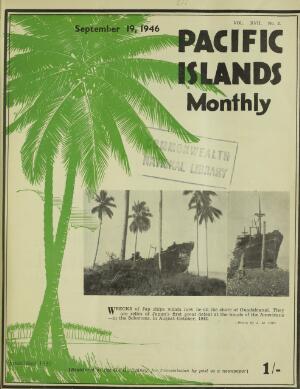
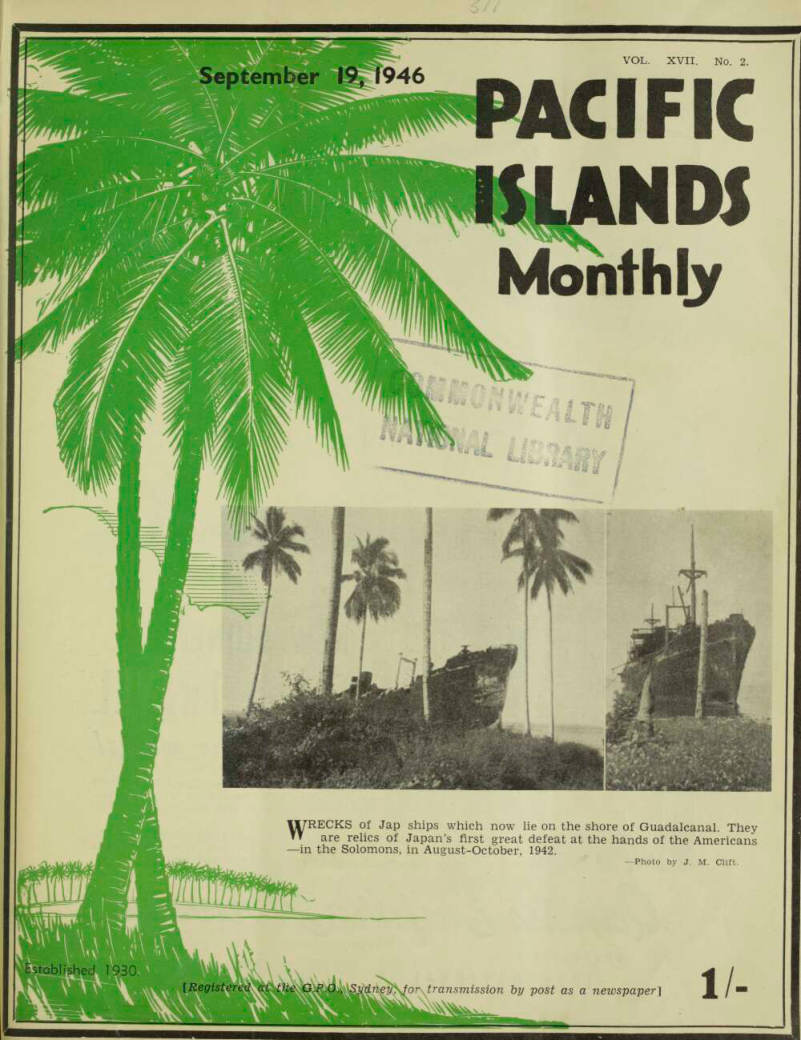
WRECKS of Jap ships which now lie on the shore of Guadalcanal. They are relics of Japan’s first great defeat at the hands of the Americans in the Solomons, in August-October, 1942.
Photo by J. M. Clift.
Advertisements & other items, pp. 2-4 (1 item)
Qaida*
& ?W V
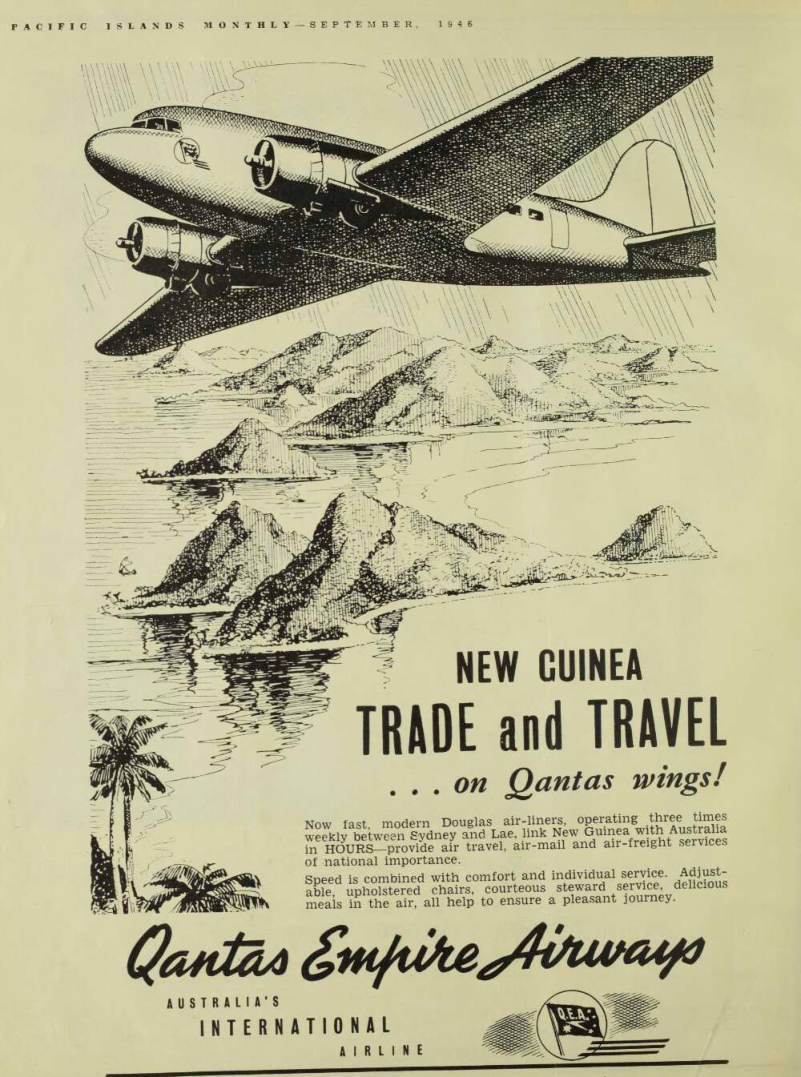
NEW GUINEA
TRADE and TRAVEL
... on Qantas wings!
Now fast modern Douglas air-liners, operating three times weekly between Sydney and Lae, link New Guinea_with in HOURS —provide air travel, air-mail and air-freight servic of national importance.
Sneed is combined with comfort and individual service. Adjustable, d upholstered chairs, courteous steward service. delicious meals in the air, all help to ensure a pleasant journey.
Qaida*
AUSTRALIA’S
INTERNATIONAL
airline
DAYLIGHT
The outstanding features in all Coleman’s Lanterns have proved their value by active performance over forty years.
Coleman’s Petrol and Kerosene Lamps in 300 and 500 C.P.
DARK
\ % / TT s s s mmm sy S / Coleman’s Petrol or Kerosene Lamp with large enamelled reflector.
Coleman’s Kerosene Table Lamp can be used as hanging Lamp Coleman Lanterns are made stronger to last longer:
Pyrex heat-resisting globes
protect the mantles . . . . pressure-tested brass fonts that will not rust . . builtin automatic tip-cleaning needles . . . shut-off valves to avoid constant repumping each time lantern is
lighted. Safe, Steady Brilli-
ance in or out of doors. u Representatives for the Pacific Islands:
ROBERT GILLESPIE PTY. LTD. PEARCELTD
540 PITT STREET, SYDNEY FOR FIJI ISLANDS
Day-Old
Chicks
BY AIR
Amalgamated Hatcheries
(Reg.) of Bankstown, near Sydney, N.S.W., have made arrangements with Qantas Airways and other air services for the dispatch of limited numbers of chicks by
FLYING BOAT TO
PORT MORESBY,
LAE,
NOUMEA,
SUVA,
and all other islands of the Pacific served by present AND PROJECTED air services.
Amalgamated Hatcheries are the largest distributors of dayold chicks in Australia, last year over 1,000,000 Ochicks being sold by us in N.S.W. alone.
Our scientific method of packing and dispatch has resulted in a loss of less than 1 per cent, of chicks sent by flying-boat.
If any chicks in your consignment arrive dead, we will replace them frees provided the extra freight is paid by the purchaser.
Chicks available are R.1.R., Austrolorps, and W.L. We only dispatch unsexed chicks.
Price, £lO per 100, landed at your airport (subject to reduction or increase in accordance with current air freights ).
These chicks are the cream of Australia’s stock, produced under ultra - violet rays to guard against disease; the adult stock is blood-tested monthly by veterinary officers and each individual order carries' a N.S.W.
Government certificate that the chicks are healthy and from tested stock.
Payment for chicks should be made by draft with the order, or credit arranged through our Bankers, the Bank of Adelaide, George Street, Sydney.
WRITE BY AIR-MAIL OR
CABLE.
AMALGAMATED
HATCHERIES
BANKSTOWN, N.S.W.
About Pacific People
Travellers By The "Montoro"
Fit. Lieut. Don Aidney, a member of the RAF, Contingent from Fiji, is at present in London awaiting demobilisation. He expects to return to Suva shortly.
Another member of the Contingent, Fit.
Lieut. Tim Nicholls, was due in Auckland by the “Akaroa” at the end of August.
Mrs. Jeanette Jackson, wife of the canteen manager on HMS Achilles, is a visitor to Tahiti. She formerly was a Miss Thompson, of Papeete, and is related to the present Mayor (M. Alfred Poroi) and Mr. Oscar G. Nordman.
Father A. Stemper has been waiting in Sydney for a boat to Rabaul, where he will conduct a flying service for his mission, with another flying priest. They recently bought a plane from the Aus tralian War Disposals Commission.
Mr. E. G. Theodore, left Brisbane for Suva by Quantas flying-boat “Coriolanus” on August 27. He was accompanied by his daughter, Mrs. M. Hoban, and his two grandchildren, Marie and Peter. Mr.
Theodore recently attended the Empire Press Conference in London.
Mr. R. M. Farlovv, until recently Assis tant District Officer at Lae, New Guinea, has resigned from the Administrative Service, and returned to Australia. Mr.
Farlow has been in the New Guinea Administrative Service for upwards of 20 years, and he saw service during World War 11.
Mrs. Marguerite Mersman, wife of Mr.
Scudder Mersman, United States vice consul in Tahiti, died in San Francisco on July 10. She formerly was Miss Ridell, a well-known resident of Papeete. Much sympathy has gone out to Mr. Mersman, who is held in high regard in Tahiti.
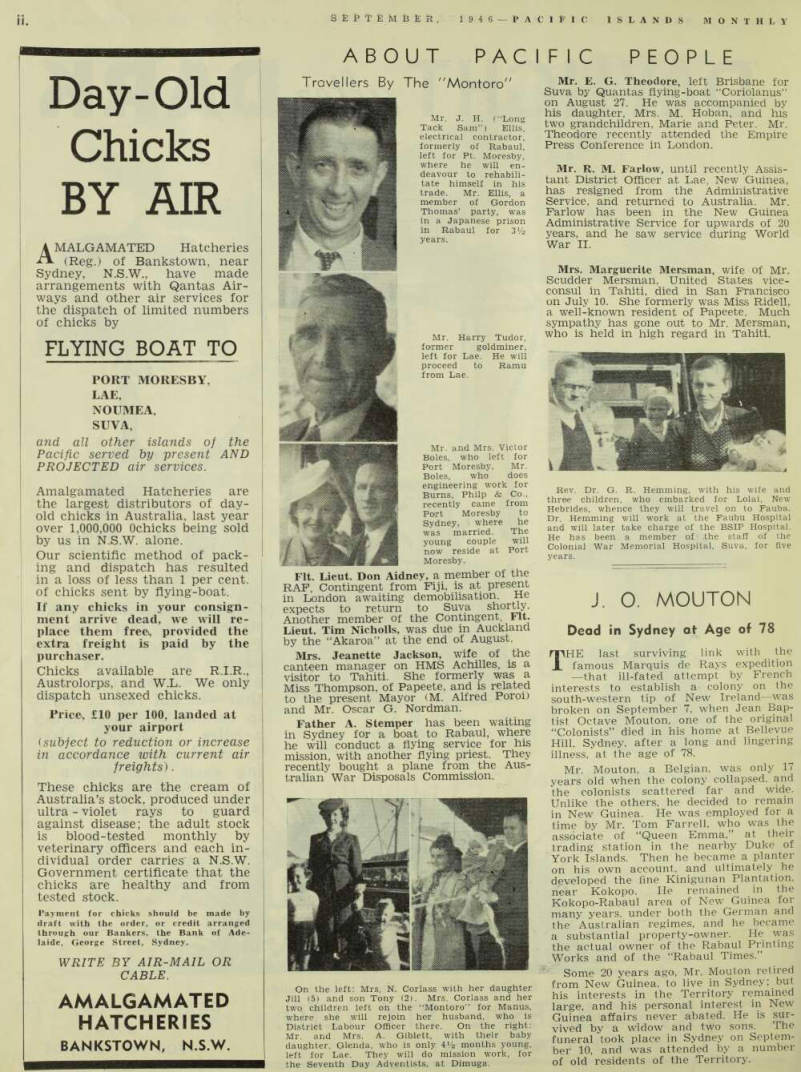
On the left: Mrs. N. Corlass with her daughter Jill (5) and son Tony (2). Mrs. Corlass and her two children left on the “Montoro” for Manus, where she will rejoin her husband, who is District Labour Officer there. On the right: Mr. and Mrs. A. Giblett, with their baby daughter. Glenda, who is only 4 ½ months young, left for Lae. They will do mission work, for the Seventh Day Adventists, at Dimuga.
Mr. J. H. (“Long Tack Sam”) Ellis, electrical contractor, formerly of Rabaul, left for Pt. Moresby, where he will en deavour to rehabili tate himself in his trade. Mr. Ellis, a member of Gordon Thomas’ party, was in a Japanese prison in Rabaul for 3½ years.
Mr. Harry Tudor, former goldminer, left for Lae. He will proceed to Ramu from Lae.
Mr. and Mrs. Victor Boles, who left for Port Moresby. Mr.
Boles, who does engineering work for Burns, Philp & Co., recently came from Port Moresby to Sydney, where he was married. The young couple will now reside at Port Moresby.
Rev. Dr. G. R. Hemming, with his wife and three children, who embarked for Lolai, New Hebrides, whence they will travel on to Fauba.
Dr. Hemming will work at the Faubu Hospital and will later take charge of the BSIP Hospital.
He has been a member of the staff of the Colonial War Memorial Hospital, Suva, for five years.
J. O. Mouton
Dead in Sydney at Age of 78
THE last surviving link with the famous Marquis de Rays expedition —that ill-fated attempt by French interests to establish a colony on the south-western tip of New Ireland —was broken on September 7, when Jean Bap tist Octave Mouton, one of the original “Colonists” died in his home at Bellevue Hill, Sydney, after a long and lingering illness, at the age of 78.
Mr. Mouton, a Belgian, was only 17 years old when the colony collapsed, and the colonists scattered far and wide.
Unlike the others, he decided to remain in New Guinea. He was employed for a time by Mr. Tom Farrell, who was the associate of “Queen Emma,” at their trading station in the nearby Duke of York Islands. Then he became a planter on his own account, and ultimately he developed the fine Kinigunan Plantation, near Kokopo. He remained in the Kokopo-Rabaul area of New Guinea for many years, under both the German and the Australian regimes, and he became a substantial property-owner. He was the actual owner of the Rabaul Printing Works and of the “Rabaul Times.”
Some 20 years ago, Mr. Mouton retired from New Guinea, to live in Sydney; but his interests in the Territory remained large, and his personal interest in New Guinea affairs never abated. He is sur vived by a widow and two sons. The funeral took place in Sydney on Septem ber 10, and was attended by a number of old residents of the Territory.
Advertisements & other items, pp. 5-6 (1 item)
Hfirrt J. Tow
"PEERLESS" WHEEL TOYS
With Christmas in the offing demands for toys will be greater. Take this opportunity of renewing your stocks of “Peerless” ready selling articles. Only limited supplies are available now, but we hope to fill Christmas orders during the coming months.
BAXTER &
CO. PTY. LTD.
Watch!
Genuinely handmade in comfort fitting designs, these shoes and slippers show quality and beautiful workmanship. Men’s dancing pumps, slippers and tan welts are available for restocking— order these good selling lines NOW, for future deliveries.
In September we will
be announcing goods
manufactured by the
Advanx Tyre and Rub-
ber Co. Pty., Ltd. Watch
tor this announcement
you will find the
goods you have been
needing.
PECKS
PASTES
Manufactured by Harry Peck & Co. (Aust.) Pty., Ltd.
Prepared from the choicest Australian primary products, Pecks never compromise where quality and purity are concerned. Poultry, fish and meat pastes are ideal for light meals in hot climates. Restock from this varied array of attractive pastes.
DRI-GLO TOWELS
from
Commonwealth Weaving Mills
Pty,, Ltd.
These quality towels are reaching most bathrooms in the Pacific Islands—Double wear, obtained by using a base of twofold yarn, combined with fadeless and attractive colours make this towel a best-seller. Order NOW while we have stocks available.
ORDER THROUGH YOUR USUAL CHANNELS:
HfIRRT J. TOW
POSTAL ADDRESS:
Box 3661 G.P.0., Sydney.
379 KENT STREET, SYDNEY.
BANKERS: BANK OP N.S.W.
FIT. LTD.
CODES:
Bent W’s Comp.
Plir&SG Bentley’s 2nd Phrase.
Allen Taylor & Co. Ltd.
COMMERCIAL ROAD, ROZELLE,
SYDNEY
Sawmillers and Wholesale Suppliers of Hardwoods for Constructional Purposes GIRDERS . . . PILES . . . POLES . . . SLEEPERS, Etc.
EXPORTING TO PACIFIC ISLANDS SINCE 1893
For Service
EXPORTERS - IMPORTERS
Contact
1
COMMONWEALTH TRADING CO. Pty. Ltd.
95 YORK STREET, SYDNEY
Phones: MA4232, M 6969.
GENERAL MERCHANDISE, TRADE GOODS, CLOTHING. FOOD-
STUFFS, LIQUEURS. SPIRITS, WINES.
c tiufzal id’s
BOAT & YACHT
GEAR
c
BROOMFIELDS LTD.
152 SUSSEX STREET, SYDNEY.
C 7/J A norite tnr- p - H - MUNTZ & CO.’s 3-CROWN BRAND METAL SHEATHING. zoic Agems jot. peacock & buchans’ English ready-mixed paints.
Captain Fitch Gets His Slip
Back Again
AFTER years of appeal and argument, the Australian naval authorities at last have returned to Steamship Trading Co., Ltd., of Papua, the naval slip which the Co. built there in the late thirties, and which the occupying Australian forces seized soon after they settled in.
The use of the slip by the Navy was a reasonable and understandable thing while the Pacific War was being fought.
But it was neither fair nor reasonable after the war had moved away, and while the Socialist gentlemen at Can berra were taking advantage of post-war confusion to establish a non-private enterprise set-up in the Territories.
Canberra was resolute to direct and control all private shipping in those waters (thus robbing Steamships Trad ing Co. and Burns Philp of a large sec tion of their business); and all coastal ships were seized accordingly; and so (argued Canberra) what did STC want with a slip, anyway?
However, the Co’s managing director, Captain Fitch, kept pegging away; and now he has been given his slip back again.
This may be an empty gesture. A slip is not much use to private enterprise if there are no ships to go on it. On the other hand, it may mean that the plan to “socialise” coastal shipping is being abandoned. If that is so, the slip will be very busy, for under Socialist control, the coastal shipping of these Territories has very sadly deteriorated.
Civilisation Returns To
Tng
rE Lae Social and Sports Club was officially formed and launched recently. Having a balance in hand of some £39 (derived from a dance held at the Hotel Cecil on July 29) it was decided to hold another dance, August 24.
Mr. C. C. Becket, was unanimously elected President, and a good worhiig committee was elected to support him. Tennis, cricket, swimming and so forth are being inaugurated, and a lot of work faces the committee in providing grounds for these sports and baths for the swimming.
AN enjoyable dance, under the auspices of the Lae Social & Sports Club, was held in the Recreation Hall at Hotel Cecil, Lae, on August 24. It marked the first function of the kind since the Club was officially formed. The committee had the hall tastefully decorated and the floor in good order for dancing.
Supper was provided by the ladies, and it stands to their credit that so tasty a variety of savouries and sweets was laid before the guests in this land of “no plenty.” Such functions are marked by the delightful frocking of the ladies — and the inability of the males to appear in anything approaching pre-war attire. —Own Correspondent.
En Route For Old India
BABULAL Ranchhod, a nine-years-old
Indian boy, arrived in Brisbane recently from Fiji by flying-boat.
He was on his way to India to have his first hair-cut. , , , Babulal is heir to Dahyabha Ranchhod, a tailor and draper, of Levuka. The ceremony will be carried out with full religious rites at Bombay.
Tribute to Terrifrorians
Letter to the Editor THE “Montoro” sailed from Brisbane for New Guinea on Saturday, Sep tember 7. It carried a number of evacuees back to the Islands. Of the original number of Territorians who were evacuated to Brisbane early in 1942, a number still remain. Many, how ever. have decided to reside permanently in Queensland.
It was my privilege and pleasure to have met a few Territorians in Brisbane; and during my many conversations with them, discovered none belonging to what politicians call the “slave-driving” or “blackbirding” class. I found them a friendly, tolerant and sympathetic people, with marked loyalty to the Aus tralian Commonwealth.
I met by few of the gentler sex. But they were gentle; and though they had lived in the tropics for some years, were no less refined and feminine than their sisters of the mainland. Indeed, they spoke in a soft, natural voice, developed probably through years of contact with the natives —a pleasant change from the irritating affectation of many main landers.
The menfolk were true to label. Broad of vision, industrious, enterprising and adventurous. More. I found that the pioneering spirit is not dead. All they had asked for was to be unshackled from all restrictions on progress. They wanted liberty to expand to the full their initia tive and individuality. All were imbued with the one purpose in life —to so develop the rich, unlimited resources of New Guinea as to make it yet another State of the great Australian Common wealth.
I shall miss my friendly chats with these people. They rekindled my fire of adventure, which had not been aglow since early youth.
The “Montoro” was nearing the mouth of the Brisbane River before I knew it bad left the wharf. It was then too late for me to give them the warm hand clasp and wish them God-speed.
But I intend to visit the Islands in the near future. Especially do I want to see Lae. hallowed spot of the immortal dead.
So. until then, my Territorian friends.
Aloha!
I am, etc,,
Brisbane.
J. M. Henry.
12/9/46.
"Winter" Is Early In Tahiti
From Our Own Correspondent Papeete, July 24.
THE boisterous South Wind has blown the Antarctic climate to the very threshold of Tahiti. By day. we shiver in our unheated houses. By night we sleen under heavy blankets.
Inter-island schooners report very rough seas when they pass out of the protection of the leeward side of high islands. This year, the cold season has begun two months before the usual period.
Reported that oversea shins are now being “chinned ” (removal of old rust, and naint from nlates) by Fijian workmen in Suva harbour instead of—as customary —in Sydney. Reason given is that the temneramehtal waterside workers of Svdney—the cultured gentlemen who dictate Australia’s foreign nolicv will not work in the holds of shins while they are being chipped, because it is too noisy.
Advertisements & other items, pp. 7-8 (1 item)
Dangad. Gedye & Malloch Ltd.
The Epic of the “BELLBIRD
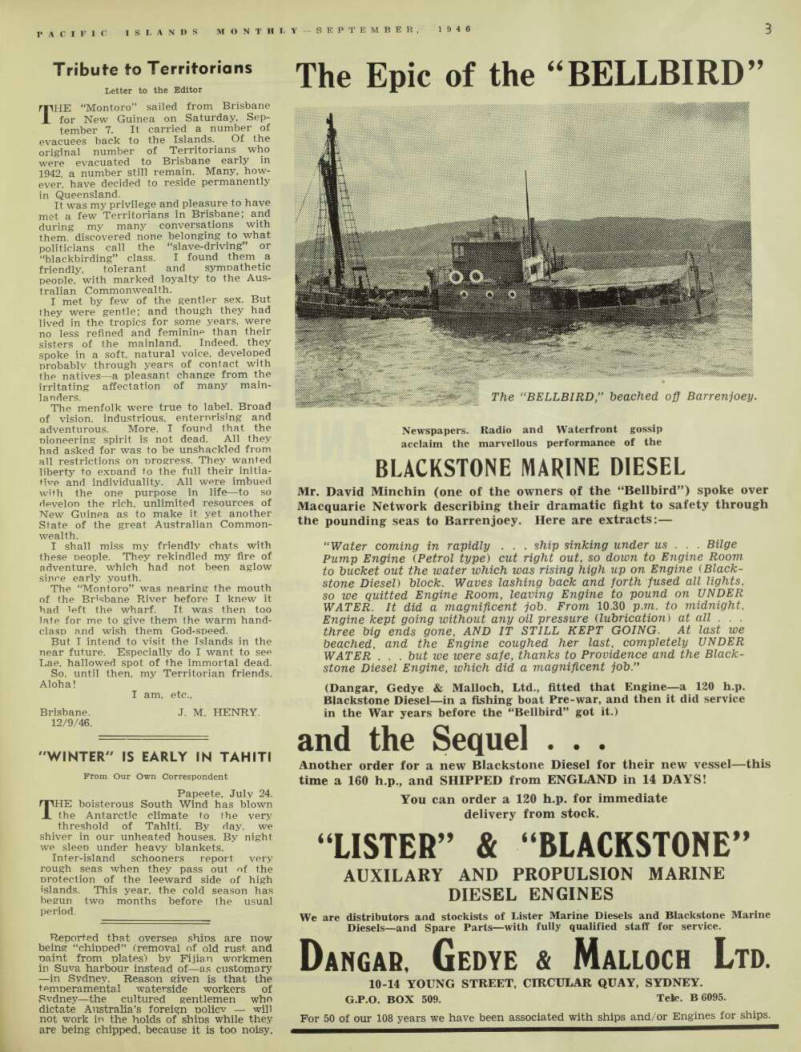
11 m 111 Tfte “BELLBIRD” beached off Barrenjoey.
Newspapers. Radio and Waterfront gossip acclaim the marvellous performance of the
BLACKSTONE MARINE DIESEL
Mr. David Minchin (one of the owners of the “Bellbird”) spoke over Macquarie Network describing their dramatic fight to safety through the pounding seas to Barrenjoey. Here are extracts: — “Water coming in rapidly . . . ship sinking under us .. . Bilge Pump Engine (Petrol type) cut right out , so down to Engine Room to bucket out the water which was rising high up on Engine ( Blackstone Diesel) block. Waves lashing back and forth fused all lights, so we quitted Engine Room , leaving Engine to pound on UNDER WATER. It did a magnificent job. From 10.30 p.m. to midnight, Engine kept going without any oil pressure ( lubrication ) at all .. . three big ends gone, AND IT STILL KEPT GOING. At last we beached, and the Engine coughed her last, completely UNDER WATER . . . but we were safe, thanks to Providence and the Blackstone Diesel Engine, which did a magnificent job ” (Dangar, Gedye & Malloch, Ltd., fitted that Engine—a 120 h.p.
Blackstone Diesel—in a fishing boat Pre-war, and then it did service in the War years before the “Bellbird” got it.)
and the Sequel . . .
Another order for a new Blackstone Diesel for their new vessel —this time a 160 h.p., and SHIPPED from ENGLAND in 14 DAYS!
You can order a 120 h.p. for immediate delivery from stock.
“LISTER” & “BLACKSTONE”
AUXILARY AND PROPULSION MARINE
DIESEL ENGINES
We are distributors and stockists of Lister Marine Diesels and Blackstone Marine Diesels—and Spare Parts—with fully qualified staff for service.
Dangad. Gedye & Malloch Ltd.
10-14 YOUNG STREET, CIRCULAR QUAY, SYDNEY.
G.P.O. BOX 509. Tele. B 6095.
For 50 of our 108 years we have been associated with ships and/or Engines for ships.
'Em
PLUME
FOR
MORE MILES
AND
EXTRA POWER
Easier starting added power—greater mileage per gallon - That's why Plume is the best motor spirit you can buy. vacuum oil
Suva Medical School
Late News From Australian Territories
New Guinea Natives For Suva Medical School
Pt. Moresby, Sept. 12 SEVEN young natives of Papua and New Guinea are being chosen by the Mission bodies, in co-operation with the Administration, for preparatory training, prior to their being sent to the Central Medical School, Suva, to be edu cated as Native Medical Practitioners.
Some people are of opinion that the native educational standard here is so low that the selected lads will be under a great handicap in Suva. It is pointed out, however, that native lads from Solo mons and New Hebrides, with no better education basis, have almost invariably done well in the four years’ course in Suva.
It is hoped here that the Territories of Papua and New Guinea, which have over one million natives, eventually will have their own training establishment, somewhat on the lines of the famous Fiji institution.
An interesting compilation, entitled “British Policy in the Exploration of the South Pacific, 1699-1793,” was read to the members of the Royal Australian Historical Society, in Sydney, on August 27, by Mr. J. M. Ward, MA. His argu ment that a definite British policy directed what were apparently isolated and unco-ordinated explorations, extend ing over one hundred years, threw new light upon several hitherto unexplained aspects of the early history of the South Pacific.
Food Short In N. Guinea
Lae, Sept. 14 THERE is a shortage of food just now in the Lae and Morobe district; and we learn with dismay that the “Rey nella,” which was to bring substantial shipments, will not now leave Sydney until the 20th. The “Montro Montoro” should be here about the 18th, and that will ease the situation.
Australians Remain In
Territory
MANY Australian soldiers are taking their discharges here, and remain ing on in the Territory, rather than go to Australia, where they have no cer tainty of getting a suitable job.
It appears to be the policy of the Ad ministration to take as many of these lads as possible onto the staff of the Public Works Department.
Captain A. S. Fitch, founder of Steam ship Trading Co. Ltd., of Papua, has decided to retire from the managing directorship of his Company about March, 1947; and then he probably will enjoy a world tour and a long deferred visit to Old England. His Company was already well established before World War II; but it was in danger of crippling losses when evacuation was ordered in 1942, before the advancing Jap invasion. That it came through that critical period in good shape was due largely to Captain Fitch and his co-directors, who person ally spent most of the war years in Port Moresby guarding their property as best they could.
Plantation Manager's
Strange Accident
THE manager of Kokebagu Plantation, Papua, Mr. J. N. Nicholson, is now in Port Moresby Hospital, making a good recovery, after losing part of his leg in an extraordinary accident.
He had been taking a personal part in the establishment of an experimental rice-growing plot, and had been operat ing a cultivator, which had been im ported for the special purpose. Mr.
Nicholson had finished for the day. and had stepped off the machine, apparently on the side where the blades are. A visitor, who was deeply interested in the machine, climbed up on it and somehow started it again; and, before Mr. Nichol son could get out of the way, the revolv ing blades had cut off one of his feet, below the ankle.
The Rev R. Rankin, of the LMS, was able to give him first aid quickly; and then Mr Rankin and Mrs. Nicholson brought him 40 miles into Port Moresby in a motor lorry, which had to be ferried over a river on canoes. They arrived the following morning, with their patient in fairly good shape.
Mr. Harrison W. Smith, an American botanist who has lived in Tahiti since 1921, and whose garden home at Papeari is celebrated for its beauty, was invested in July with the cross of a Chevalier of the Legion of Honour. The Governor explained formally that this was in recognition of the fine botanical work done in Tahiti by Mr. Harrison Smith, especially in introducing to the Colony many useful and beautiful plants.
Advertisements & other items, p. 9 (1 item)
Crosse &
SM bmj cmk tk iest
(g&g * =
ESTAB .
CROSSE &BIACKWELL(Mf« Co)Lid;
LONDON ENGLAND .
PREPARED I"'.'
10 ozsnett GREAT BRITAIN
PICCALILLI
THE ORIGINAL
Crosse & Blackwell’s world-famous food products unexcelled since 1706.
Crosse &
BLACKWELL
C B
Advertisers
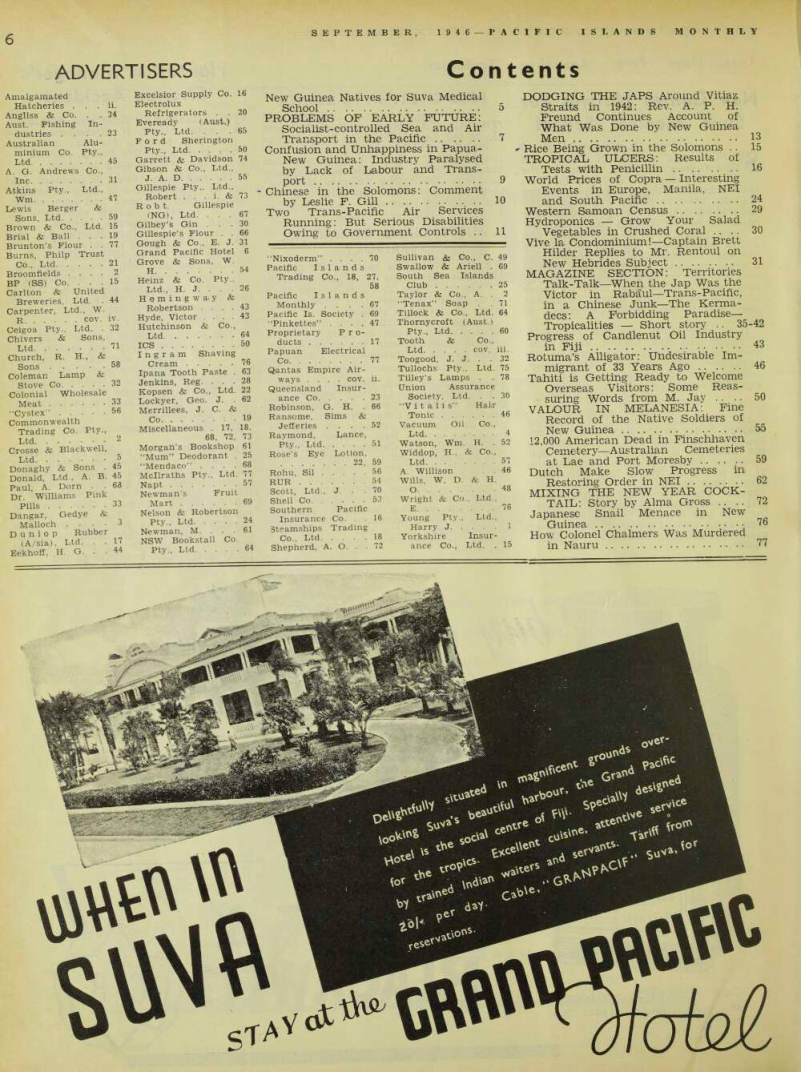
Amalgamated Hatcheries . . . ii.
Angliss & Co. . . 34 Aust. Fishing In dustries ... 23 Australian Alu minium Co. Pty., Ltd 45 A. G. Andrew's Co., Inc 31 Atkins Pty., Ltd., Wm 47 Lewis Berger & Sons, Ltd 59 Brown & Co., Ltd. 15 Brial & Ball ... 19 Brunton’s Flour . . 77 Burns, Philp Trust Co., Ltd 21 Broomfields ... 2
Bp (Ss) Co. . . 15
Carlton & United Breweries, Ltd. . 44 Carpenter, Ltd., W. r cov. iv.
Ceigoa Pty.. Ltd. . 32 Chivers & Sons, Ltd 11 Church, R. H., & Sons 58 Coleman Lamp & Stove Co 32 Colonial Wholesale Meat 33 “Cystex” 56 Commonwealth Trading Co. Pty., Ltd 2 Crosse & Blackwell,
Ltd J
Donaghy & Sons . 45 Donald, Ltd., A. B. 45 Paul, A. Dorn . • 68 Dr. Williams Pink Pills 33 Dangar, Gedye & Malloch ... 3 Dunlop Rubber (A/sia), Ltd. . • 17 Eekhoff, H. G. . • 44
Excelsior Supply Co. 16 Electrolux Refrigerators . . 20 Eveready (Aust.) Pty., Ltd. ... 65 Ford Sherington Pty., Ltd 50 Garrett & Davidson 74 Gibson & Co., Ltd.,
J. A. D 55
Gillespie Pty., Ltd., Robert ... i. & 73 R o b t. Gillespie (NG), Ltd. ... 67 Gilbey’s Gin ... 30 Gillespie’s Flour . . 66 Gough & Co.. E. J. 31 Grand Pacific Hotel 6 Grove & Sons, W.
H 54 Heinz & Co. Pty..
Ltd., H. J. . 26 Hemingwa- y & Robertson ... 43 Hyde, Victor ... 43 Hutchinson & Co., Ltd 64
Ics 50
Ingram Shaving Cream 76 Ipana Tooth Paste . 63 Jenkins, Reg. ... 28 Kopsen & Co., Ltd. 22 Lockyer, Geo. J. 62 Merrillees, J. C. & Co 19 Miscellaneous . 17, 18. 68, 72. 73 Morgan’s Bookshop 61 “Mum” Deodorant . 25 “Mendaco" ... 68 Mcllraths Pty., Ltd. 77 Napt -57 Newman's Fruit Mart 69 Nelson & Robertson Pty.. Ltd 24 Newman, M. ... 61 NSW Bookstall Co.
Pty., Ltd 64
“Nixoderm” ... 70 Pacific Islands Trading Co., 18, 27, 58 Pacific Islands Monthly ... 67 Pacific Is. Society . 69 “Pinkettes” ... 47 Proprietary Pro ducts 17 Papuan Electrical Co 77 Qantas Empire Air ways ... cov. ii.
Queensland Insur ance Co 23 Robinson, G. H. . 66 Ransome, Sims & Jefferies ... 52 Raymond, Lance, Pty., Ltd 51 Rose’s Eye Lotion, 22, 59 Rohu, Sil 56
Rur 54
Scott, Ltd,, J. - 70 Shell Co 53 Southern Pacific Insurance Co. . . 16 Steamships Trading Co.. Ltd 18 Shepherd, A. O. . .72
Sullivan & Co., C. 49 Swallow & Ariell . 69 South Sea Islands Club 25 Taylor & Co., A. . 2 “Tenax” Soap . 71 Tillock & Co., Ltd. 64 Thornycroft (Aust.) Pty., Ltd 60 Tooth & Co., Ltd cov. iii.
Toogood, J. J. . . 32 Tullochs Pty., Ltd. 75 Tilley’s Lamps . . 78 Union Assurance Society. Ltd. . . 30 “V i t a 1 i s” Hair Tonic 46 Vacuum Oil Co., Ltd 4 Watson, Wm. H. . 52 Widdop, H.. & Co., Ltd 57 A. Willison . 46 Wills, W. D. & H. 0 48 Wright & Co., Ltd,, E 76 Young Pty., Ltd., Harry J 1 Yorkshire Insur ance Co., Ltd. . 15
Contents
New Guinea Natives for Suva Medical School 5
Problems Of Early Future:
Socialist-controlled Sea and Air Transport in the Pacific 7 Confusion and Unhappiness in Papua- New Guinea: Industry Paralysed by Lack of Labour and Trans port 9 Chinese in the Solomons: Comment by Leslie F. Gill 10 Two Trans-Pacific Air Services Running; But Serious Disabilities Owing to Government Controls .. 11
DODGING THE JAPS Around Vitiaz Straits in 1942; Rev. A. P. H.
Freund Continues Account of What Was Done by New Guinea Men 13 Rice Being Grown in the Solomons .. 15 TROPICAL ULCERS: Results of Tests with Penicillin 16 World Prices of Copra Interesting Events in Europe, Manila, NEI and South Pacific 24 Western Samoan Census 29 Hydroponics Grow Your Salad Vegetables in Crushed Coral ... 30 Vive la Condominium! —Captain Brett Hilder Replies to Mr. Rentoul on New Hebrides Subject 31 MAGAZINE SECTION: Territories Talk-Talk—When the Jap Was the Victor in Rabaul—Trans-Pacific, in a Chinese Junk—The Kerma decs: A Forbidding Paradise— Tropicalities Short story .. 35-42 Progress of Candlenut Oil Industry in Fiji 43 Rotuma’s Alligator: Undesirable Im migrant of 33 Years Ago 46 Tahiti is Getting Ready to Welcome Overseas Visitors; Some Reas suring Words from M. Jay .. .. 50
Valour In Melanesia: Fine
Record of the Native Soldiers of New Guinea 55 12,000 American Dead in Finschhaven Cemetery—Australian Cemeteries at Lae and Port Moresby 59 Dutch Make Slow Progress in Restoring Order in NEI 62
Mixing The New Year Cock
TAIL: Story by Alma Gross ... 72 Japanese Snail Menace in New Guinea 76 How Colonel Chalmers Was Murdered in Nauru 77
Advertisements & other items, p. 10 (1 item)
sT ,V<t^
ii
vtv
n% m ‘ P4t ' f A \0 „ ti' 6 ■ r> ”
Su^ s , w ies^ e 4 w , < Ke od »\ «**" co , d oe. **" tad «
t .ce^ C "
- ■ r a\t' e(l C»’°' e ’ . 9* **■ 00»
Pacific Islands Monthly
The Newspaper-Magazine of the South Seas [Registered at the G.P.0., Sydney, for transmission by post as a .]
Published Once Each Month and Circulated in Australia and New Zealand and in the following Pacific Territories and Islands Groups:
Australian Territory of Papua.
Mandated Territory (Australia) of New Guinea.
Australian Territory of Norfolk Island.
New Zealand Territory of Cook Islands.
Mandated Territory (NZ) of Western Samoa.
British Colony of Fiji.
British Solomon Islands Protectorate.
British Protectorate of Tongan Islands.
British Crown Colony of Gilbert and Ellice Islands.
Mandated Territory of Nauru.
British and Free French Condominium of New Hebrides.
Free French Colony of New Caledonia.
Free French Colony of Oceania (Tahiti, etc.).
American Territory of Eastern Samoa, American Territory of Hawaiian Islands.
Owned and Produced by Pacific Publications Pty. Ltd., Union House, 247 George Street, Sydney.
C General Office .. .. BW 5037 TELEPHONES Advertising Office .. .. B 7815
P.O. Box 3408 R
Registered Address for Telegrams, Radiograms, and Cables; "Pacpub”, Sydney.
Contributions.
Articles, Stories, and Photographs dealing with Pacific Islands subjects are invited and will be paid for on publication.
Subscription Rates.
Per Annum, within British Empire, Prepaid, Post Free lfl /"
Per Annum, elsewhere, Prepaid, Post Free 12/6 Single Copies */“
Editor and Publisher;
R. W Robson, P.R.G.S.
General Office: Union House, 247 George Street, Sydney.
Advertising Manager: W. E. Rogers.
Telephone: BW 5037.
Printing House: 29 Albert Street, Sydney.
Telephone: MA 4369.
Representative In Fiji.
Pacific Publications (Fiji), Ltd., Bank of NSW Building, Suva (same office as W. H. Grove & Sons, Ltd.). Stocks of Pacific Islands Monthly and Pacific Islands Yearbook on hand.
Representative In London.
J. T Wallis, Coronation House, 4 Lloyds Avenue, London, E.C.3, from whom may be obtained copies of Pacific Islands Monthly, Pacific Is. Year Book, advertising schedules, etc.
Agents.
The following are authorised to receive sub scriptions for Pacific Islands Monthly;— Burns, Philp & Co., Ltd., and Burns Philp (South Sea) Co.. Ltd. All branches.
W. R. Carpenter & Co., Ltd. All branches.
Morris, Hedstrom, Ltd. All branches.
Steamships Trading Co., Papua. All branches.
Whitten Bros., Ltd., Samarai, Papua.
B.N.G. Trading Co., Ltd. r Port Moresby, Papua.
J. Muir, Suva, Fiji.
Miss R. Castles, Suva, Fiji.
N. C. Mackenzie Hunt, Walnunu, Bua, FIJI.
Cook Islands Trading Co., Rarotonga, Cook Is.
A. C. Rowland. Papeete, Tahiti.
Islands Branches and Representatives of W. H.
Grove & Sons, Ltd., Auckland, New Zealand.
Ed. Pentecost, Noumea, New Caledonia.
Societe Gubbay Kerr et Cie, Noumea, N. Caledonia.
Vol. XVII. No. 2.
September 19, 1946.
Onra 1/m Per Copy ''lCS Prepaid: 10/- p.a.
Socialist-Controlled Sea and Air
Transport In the Pacific
THE importance of sea and air trans portation in the future of the Pacific Territories cannot be exagger ated. General economic conditions to-day throughout the South Pacific, and the particular muddle in the Aus tralian Territories in the South-west, show what happens when transporta tion is withheld, or is limited, or mis handled.
There is a tendency, clearly seen since September, 1945, to remove Pacific transportation facilities, both sea and air, from the hands of private enterprise into the control of Social istic Governments. If that becomes a recognised policy, and is persisted with, the economic effect throughout the Pacific Territories will be bad. In trying to escape from one evil— monopolistic control —the countries concerned almost certainly will create another, and a worse one.
There is no escaping the fact that the shipping lines which served the Pacific Territories in the 20 or 30 years prior to World War II were more or less controlled by combines and cartels; and no one can defend a monopoly.
Our young Communists will present a hundred reasons why trading for orofit is an undesirable thing—and two or three of those reasons do hold water. But “production, distribution and exchange” by private enterprise is an old as man himself, and the sys tem is permanently embedded in humanity’s way of life, Anyone who
argues otherwise is a visionary, blind to history and deaf to science. Pri vate enterprise—another way of de scribing individualism, or personal freedom —must be subject to some sort of check, however; otherwise, liberty becomes license, and freedom, oppression. In our system, trading for profit is supposed to be controlled, and human greed and selfishness checked, by open competition. Re move that competition, and the evils that are created by greed and selfish ness appear.
We are all familiar with the evils created by monopolies in trade. But how many see exactly the same evils, in another shape, in the industrial troubles which are convulsing the post-war world?
For the present, there are far more jobs than there are workers. Conse quently, workers do not value their jobs. Consequently, for every worker who is naturally- conscientious and diligent, there is another who is lazy, inefficient and undependable. Lack of competition for jobs has destroyed industrial discipline and created, among the workers, exactly the same evil as was created among the em ployers by lack of competition for custom —namely, indifference to the welfare of the people as a whole.
THE pre-war shipping services of the Pacific were always efficient; but the absence of competitive freight and passenger rates created the belief —
practically universal —that the ship ping companies had combined to pro tect themselves against competition, and that the protection and mainten ance of their profits was a paramount consideration in all their relations with the public. The shipping com panies did nothing to remove that impression; and so they now must face a widespread attack upon their interests by Socialist Governments.
The leader of the attack here is the Socialist Government of Australia, whose influence is paramount in the South-west Pacific. Burns Philp & Co., who normally maintain services between Australia and adjoining Territories, are not allowed to run their ships to New Guinea and Papua.
The “Montoro” carries on the service; but, under some wartime regulation, the Australian Government is the nominal owner of the “Montoro,” and the ship is run by BP’s as agents for the Government.
Burns Philp & Co., as the big ship owner right at hand, is being attacked and harried by Socialism. The fact that Burns Philp & Co., as the eager instrument of Australian private en terprise, probably did more than any other factor between 1860 and 1920 to bring the South-west Pacific under the British flag, does not count at all, in these days.
New Guinea inter-island shipping is now a closed State monopoly. No shipowner may run a vessel of more than 25 tons within the wide Austra lian-Pacific Territories; and private owners of smaller vessels may not carry passengers or goods for hire.
The result is almost incredible con fusion and hardship within the Terri
tories of Papua and New Guinea—see article elsewhere in this issue. Goods cannot reach the people in the Terri tories who are awaiting rehabilitation; planters and their families cannot get out to their plantations; the few native labourers available cannot be moved to the places where they are wanted; and —worst of all —the copra which is being made under great diffi culties in outlying places cannot be shipped in to the collecting ports.
Lack of shipping has gravely em barrassed the Territories of Papua and New Guinea; and has practically paralysed the British Solomon Islands, once a rich copra-producer, and now doing nothing.
BUT it is in the development of the new system of air transportation that the interference of Socialist Gov ernments is likely to most gravely affect the Pacific communities. The Governments seem determined not only to keep out private enterprise, and run the services themselves, but also to use their territorial landing rights to cripple any possible competi tion from United States interests.
For the fact that the Socialist Gov ernments have gone so far with their plans, without any active public pro test, private enterprises interested in aviation have only themselves to blame. When it was seen, 15 years ago, that trans-ocean aviation was likely to become a competitor of the hitherto unchallengeable shipping lines, the shipping interests got very busy, and obtained a commanding share in all aviation transport com panies which seemed likely to affect their operations. The result is that to-day practically every private trans ocean air-trancport company is dom inated by capital provided by shipping interests. There is little possibility that air competition will force any substantial cuts in sea freights or passenger rates.
These facts are quite well-known to a cynical public; and when the people put Socialist Governments into power, it is only natural that the Socialists should be ready to challenge the shipping companies’ plans to dominate the private air transporta tion companies.
BUT the Governments, having the Socialistic approach to such mat ters, have proceeded to organise their own airlines, instead of insisting on free enterprise and fair competition among the private air transport com panies. The Socialist Governments of Britain, Australia and New Zealand, led and largely directed by the Aus tralians, have launched a new airline between Australia and Canada, under conditions which clearly cut out any possibility of competition from any other British airline, and which aim at crippling the. Pan American airline, over the same route.
Thus, in trying to get away from certain of the evils, of the private en terprise system, we are presented with a system which opens the way to the creation of other and greater evils.
State-controlled monopolies have
never been of any use to the public; and, in the nature of things, they never can be. The best service to the public, judged on efficiency and cost, is that supplied by private enterprise, on a profit motive, in a free and com petitive market. In cost of running, and in efficiency, State-controlled railways cannot be compared with railways privately-owned and oper ated. The collapse of the Australian State-owned shipping line, in the ’twenties, merely emphasised the fact that overseas shipping never has been efficiently controlled by Governments.
TRANSPORT is a thing vitally im portant to all communities, and especially to Pacific Islands communi ties. In that respect, the Islands, in the two decades between wars, handicapped by the appearance of shipping monopolies. The appearance of air transportation gave ground for hope that, with the provision of increased facilities and the return of competition, we should be incalculably better off.
The advent of British Common wealth Airlines Ltd., crashing into the Pacific transportation field with a State-owned monopoly, is a bad augury for the future. The first thing that we learn about the new service is that the single fare from Australia to Canada is the excessive amount of £A2I4. The next is that PAA may not undercut that figure. The next is that the Co., as part of its policy of fight ing private enterprise, cannot set down or pick up passengers in Ameri can Territory, like Hawaii or San Francisco. The whole set-up is wrong and ridiculous, and promises to be of little direct benefit to the Pacific Ter ritories.
From the point of view of Pacific Territories development, Australia is the outstanding sinner in all these things. That is because of extraord inary political conditions in Australia itself. The New Zealand Socialist Government plays a busy second fiddle for Australia. A general elec tion is pending in both countries.
Changes of government would at least open up new avenues of hope for the South Pacific Territories.
Bank Of Nsw Returns To
Papua
Port Moresby, Sept. 12 THE Bank of New South Wales finally has been given a permit to resume operations in the Territories. Evid ently, Canberra had to abandon its idea that New Guinea and Papua should be reserved for Socialism and the Com monwealth Bank, Mr. Charles Cox has just arrived here and, as soon as he can secure premises, the old “Wales” will resume business.
Mr. Cox was on the Port Moresby staff of the Bank of NSW before the Jap in vasion.
Mrs. G. A. Loudon and Miss Judy Loudon, wife and daughter of the well known Papua rubber-planter, will leave for the United States at the end of September, where Miss Loudon will marry an American Serviceman whom she met during the war years.
NZ Air Services In South Central Pacific
South Central Pacific
THE following details of the Air Ser vices now being run in the Central South Pacific by the New Zealand Air Force are published for general in formation. All fares are given in Fiji currency (one Australian or NZ f is
equal to 17/6 Fijian).
Nausori (near Suva) —Nadi (near Lautoka) A Dominie aircraft leaves Nausori for Nadi each Tuesday and Friday, returning the same day. Single adult fare: £3, including transport between Nausori and Suva and between Nadi and Lautoka. Baggage allowance for each adult: 35 lb.
Laucala Bay (Suva) —Auckland A Sunderland flying-boat arrives from Auck land each Thursday and leaves Laucala Bay on the following day. Single adult fare, £25/5/2; baggage allowance, 60 lb.
Fiji—Tonga—Samoa—Cook Islands A Dakota transport aircraft leaves Nausori each Friday for Western Samoa. On alternative Fridays the schedule includes Tonga and Cook Islands (Aitutaki and Rarotonga), an overnight stop being made at Apia, Western Samoa. Single adult fares: Fiji-Tonga, £6/12/11; Piji-Samoa, £B/17/3; Fiji-Aitutaki or Rarotonga, £ 18/3/4; baggage allowance, 60 lb.
Fiji —Norfolk Island —Noumea —New Zealand A Dakota transport aircraft leaves Nausori weekly for Whenuapai, NZ, via Norfolk Island.
Once every four weeks Noumea is included in the schedule, and on this trip the departure day from Nausori is Sunday. Otherwise the depar ture day is Monday.
Because accommodation at Norfolk Island is limited special arrangements are necessary be fore through bookings can be accepted.
Single adult fares: Fiji-Norfolk, £l6/7/11; Fiji- Noumea, £l6/7/11; Fiji-New Zealand, £25/5/2; baggage allowance, 60 lb.
General Children under 3, travelling with an adult and not occupying a seat—no charge. Children aged 3 or more, but under 12—half adult fare.
Excess baggage and express freight are carried on all services.
For any further information apply to the Air Movements Officer, RNZAF, Laucala Bay, Suva, Fiji.
Indignant Public
Servants In Port Moresby
Pt. Moresby, Sept. 11 SHARP discontent at failure of the Ad ministration to provide reasonable amenities of life—especially housing —was voiced at meetings of the public servants here during the past two or three weeks. Public servants also are resentful because a reclassification of the service, allegedly promised by Mr. J.
R. Halligan (Secretary of the Depart ment) when he was in Port Moresby three months ago, has not been ordered by the Minister.
The Administrator (Colonel J. K. Mur ray) went along to one of the meetings —rather unexpectedly —and there was some frank and open discussion which, it was hoped, would clear the air.
Many of the senior public servants, who were suspended at the beginning of the Jap invasion, and who are now back on this Provisional staff, have been “roughing it” for nearly five years, and they naturally feel that they are entitled now to a little special consideration. (The “Sunday Sun” (Sydney) of Sept. 15 states that the civil servants are threatening to strike; that Administra tor Murray tried to quash their meeting and, when they insisted on meeting, he went along to "intimidate” them; and that statements by Minister Ward (that “there were no complaints,” and “a noisy minority” was responsible for the trouble, were “scorned” and “derided.”
A Territorian who arrived in Sydney on 16th inst. described “Sun” report as
“exaggerated.”)
for Territories"
"Much Better Treatment for Territories"
Addressing approximately 3,000 people in the Brisbane City Hall recently, Mr. R. G. Menzies (Leader of the Australian Opposition) in answer to a question, replied that the Australian Pacific Territories would be assured of much better treatment than they had been getting from the Labour Govern ment, if his party won the Australian elections.
Where Are
The Polynesians of Hawaii?
From Our Own Correspondent Papeete, Aug. 10 THIS writer has been a faithful listener of the proceedings at the weekly de bates of the Honolulu Civic Forum.
He has heard interesting and lively discussions of the various problems of Hawaii, such as: the campaign for State hood; automobile parking in downtown Honolulu: the apparently unsolvable housing shortage; the hoodlums who infest the highways of the metropolis; the insolence toward Europeans of Jap anese shopkeepers; the urgent need for several thousand labourers from the Philippine Islands to work the planta tions; and (during a debate on the honky-tonk question) that immortal phrase, spoken by one of the orators, that refusal to grant liquor licenses to aliens is “unchristian”!
But never on any occasion during the months I have listened, have I heard any mention of or even remote reference to, the Polynesian inhabitants of Hawaii.
Here, before our eyes, is a concrete example of the ruthless blotting out of a noble race, in a whole archipelago, within the space of half a century, by those time-honoured and much ap plauded New England Yankee methods of infiltration, firewater, and eviction.
These honourable methods worked ad mirably in clearing the fertile New Eng land lands of Pequot, Narraganset and other Indians; nor have they failed of complete success in Hawaii.
The modern respectable white resident of Hawaii pays honour to the great Kamehameha; but there remain none of his own blood to do him reverence.
"Wintry" Weather In
Western Samoa
From Our Own Correspondent APIA, August 12.
SAMOA recently had the coldest spell the oldest residents can remember.
Apia Observatory has announced that the lowest temperature recorded at the Observatory at Mulinu’u since July, 1931, was recorded on the morning of July 19—the thermometer reading 66.5.
The lowest minimum temperature ever recorded in Apia was in August, 1917, when the thermometer read only 63.0 The normal July temperature is 77.1.
An unpleasant result of the abnormally cold weather was a widespread epidemic of colds, coughs, catarrh and dengue fever, affecting old and young, Europeans and Samoans. The whole of Apia beach has been sniffling for the last four weeks and the sale of cough mixtures and ’flu remedies has reached previously unknown dimensions.
Papua-N. Guinea
Confusion, Unhappiness In
Industry Paralysed By Lack of Labour and Transport
INNUMERABLE communications from
non-official Europeans in Papua and New Guinea outline the same general story of conditions there. Summed up, the position appears to be -as follows: The Papua-New Guinea Provisional Administration, with an apparently endless staff and unlimited funds, is creating elaborate administrative mach inery and making vast plans for the future. But— The Administration’s plans—evidently as the result of Canberra policy—are concerned mostly with the natives and. to a great extent, ignore the needs of the Europeans, The Europeans are concerned mostly with production copra, rubber, gold, oil, etc. Anything that the Territories can produce can be sold most profitably.
But the Administration seems to give far more thought to the social and cul tural conditions of the natives, than to the need for encouraging profitable pro duction through European channels.
THERE is a great shortage of native labour, which has persisted ever since Mr. Ward, late in 1945 and early in 1946, cancelled all native labour contracts. One experienced observer in Port Moresby says; ‘With various kinds of officials arriving now in every plane, I am beginning to wonder whether there will be enough labour in the whole country to supply Administration needs.”
It is reported that 21 plantations in the Madang area of New Guinea, capable of producing 700 tons of copra a month, are idle now through lack of labour.
Generally speaking, all industrial enterprise in the Territories is paralysed through lack of labour.
Except for Bulolo Gold Dredging Ltd, who have special resources, it is not expected that any of the goldmining concerns in New Guinea will get back into production until late in 1947.
Even if labour could be got, it is likely that industry generally would still be paralysed through lack of transport.
There are no small ships to carry on the usual coastal work. This is the result of another of the plans of Mr Ward of Canberra. Islands shipping, both inter-island and oversea, is to be a Government monopoly in future. No private owner can run vessels of more than 25 tons along the coast, for paid traffic: and no privately-owned vessel under 25 tons can carry any cargo or passengers except its own. The Admin istration has not supplied anything like enough boats.
There are large numbers of boats lying idle and unattended (and rapidly deteriorating) in the various ports, awaiting sale by the War Disposals Com mission.
SO little is being done for Europeans by the Administration that much local feeling and bitterness is engen dered. One report says that, of the 600 civilians in Port Moresby, about 400 are compelled to eat at hotels and messes, because of the lack of housing facilities.
Houses of poor quality cost at least £2,200. Tea is 4/4 per lb. butter 3/- per 1 lb tin.
Barracks, built by the PCB in Rabaul, give shelter to about 15 men. There is
ho other accommodation in Rabaul where, owing to lack of ships, many people are awaiting transport to their plantations.
Goods or the Territories are heavily taxed before leaving Australia. Before they enter the Territories, they pay another ad valorem tariff of 10 per cent.
Rations for natives cost three times what they did before the war.
Yet, while necessary goods are so heavily taxed, the Administration will not allow more than £22/10/ for the decreasing amount of copra produced. (It is shown elsewhere in this issue that the world value of copra is not less than £3O per ton, Australian f.0.b.) The same applies to Papuan rubber, for which the Administration pays 1/8 lb less than is being paid in USA for synthetic.
THE indifference of the Administration towards simple economic considera tion is shown by the fact that the Government coconut plantation of Sai baira, which last year produced 900 tons of copra, has not made one ton of copra for eight months. Yet the world is cry ing out for copra.
There is great activity in all distri buting business in the Territories — stores, freezers, bakeries, and so forth — but this is all based on the Australian funds which are being poured in through the Administration. This is economic lunacy, and cannot go on indefinitely.
The Administration’s concern for natives, in contrast with indifference towards Europeans, is shown by various incidents reported. Yule Island radioed that a native was seriously ill. An RAAF Catalina, with a crew of five men, was sent immediately, and brought the sick man to Port, where an ambulance was waiting. Most praiseworthy. But just about that time a man in New Guinea reported that Port Moresby was inclined to prevent the return to the Territory of his son, an old resident, who had lived most of his life in New Guinea, who had fought in the NGVR, but who is now condemned to a certain amount of hospital treatment.
Mr. Ward recently sent, direct from New Guinea, a former Labour politician and Minister, Mr. Arthur Blakely, who is now some sort of labour inspector.
He arrived in Lae to inquire about native labour conditions, to see whether an inquiry by a Royal Commission should not be recommended.
Mr. Blakely was no stranger. He was there before the Pacific War, and it is believed that his reports to Canberra created the impression among people of Mr. Ward’s viewpoint that drastic inter ference with native labour laws in New Guinea was desirable. Fortunately, in Lae, Inspector Blakely met some of the genuine old hands Mick Leahy, Spec Wharton, Bill Money, Dick Tebb, etc., and he was left in no doubt concerning the real state of native labour affairs in the Territories.
But we understand he did not report verbatim to Minister Ward.
PC Board Plan Collapses
THE most discouraging development of the month, however, has relation to the Production Control Board.
It will be remembered that, in April,
the Board was reconstituted, so that it comprised Mr Clarrie Archer, as chair man; Colonel H. T. Allen, QBE, as pro duction member; Mr. F. L. Mackenzie as finance member; and Mr. A. J. Gaskin, as commerce member. It appeared that these men—all ohJ Territorians. trusted by the great majority of civilians there —had had interviews with Minister Ward, and had been given to understand that they would be allowed to virtually take charge in the Territories of the numerous tasks connected with the re patriation of returned soldiers and the rehabilitation of Europeans generally. It seemed an excellent plan, and was cordi ally received by all classes. (For all the details, see May PIM.) That set-up lasted just three months.
In mid-August, Colonel Allen arrived in Sydney, and visited Canberra, and made no secret of the fact that he had re signed. He gave no details, but it was apparent that he had met with nothing but frustration and disapponitment.
Canberra reports that Colonel Allen is still a member of the Board. Colonel Allen says nothing—except that he has nothing to do with the Board. He has bought a property at Vunakanau, in the Toma district, on high country some 14 miles outside of Rabaul. There he will carry on planting and trading, together with an indenting business in Rabaul; and he expects to leave for Rabaul at the end of September. Colonel Allen, before he left for active service in 1939, was running a valuable gold-mine near Wau, and he would like to return there.
But, he says, lack of labour and trans port puts that out of the question for some time.
Meanwhile, it was reported that Mr MacKenzie was retiring from the Board in September, in order to rejoin the Commonwealth Bank; and that Mr Gaskin, disappointed and disheartened, wished to retire, but had been persuaded to carry on until the end of the year.
The Production Control Board, which was to have done so much for the re habilitation of the Territorians. has become a mere figurehead, an append age of Canberra attached to the Admin istration.
BECAUSE of members’ unwillingness to talk, it has been difficult to find the real causes of this quick collapse of what, in April, appeared to be the most promising Territories development of the post-war era.
It is probable that the nigger which upset the woodpile and ruined the PCB plan, was the War Disposals Commission —a mysterious Australian set-up which apparently has extraordinary powers, and so far has done as it pleases, irres pective of what Canberra wants.
It was War Disposals which created the original scandal —the wholesale dis persal at Lae and thereabouts of vast quantities of goods, which .would have been invaluable in assisting in the re habilitation of Territorians. They were sold with something approaching reck lessness, to anyone who came along — and anyone was usually some dealer from Australia.
The New Guinea Returned Soldiers, angry and indignant, obtained from Mr Ward, at Canberra, in March, 1946, an undertaking that such sales would cease, and that the Administration, and Terri •torians generally, would have first pref erence in all future sales. That was the basis of the PCB plan.
War Disposals, obviously jealous of PCB powers, ignored all requests, and went their own sweet way. All that the
(Continued on page 68)
PCB wanted to do, to help in rehabilita tion, was obstructed. A large quantity of trade tobacco was sold to the Catholic Missions at 5/3 per pound, though the current price in Rabaul was double that.
An understanding that returned soldiers should have first choice of trucks for sale was ignored, and the Chinese were given first choice. Special facilities to
buy and ship goods were given to mysterious personages who came in by plane from Australia to Lae, and were flown around by the special plane of the War Disposals Commmission.
Colonel Allen, apparently, stood as much of it as he could; and then he departed, and made a personal report to Canberra. He had been on active service since 1939, and he was not going to waste the precious years on muddling and in trigue. Some day, he may be persuaded to tell his story.
IN August, the Rabaul Branch of the Returned Soldiers held an angry meeting and sent a long cablegram to the Australian Prime Minister, Mr Chif ley. They complained strongly that the promise given them in March was being ignored by the War Disposals Commis sion; that goods were being sold and shipped away; that “local returned men had lost all confidence in Disposal Com mission’s organisation, in view of recent irregular sales”; and that rehabilitation was being retarded owing to preference being given to certain organisations and to Asiatics.
This telegram brought quick action.
The two principal officers of the War Disposals Commission in Rabaul disap peared, and others put in their places.
Mr Ken McMullen, the highly respected District Officer at Rabaul, who appar ently had done his utmost to assist in the PCB plan, was transferred to Port Moresby, to act as liaison officer between the Administrator and the War Disposals people; Mr. J. H. McDonald, another sound man, was sent to be DO at Rabaul; and all sales at Rabaul, except motor transport, were suspended, pending fur ther inquiry.
The latest information from Rabaul is that the Returned Soldiers are now being treated well, and Asiatics and natives are no longer given preference over them.
There are indications in other direc tions that War Disposals control has been revised. For months, Chinese, Malays and natives have been running jeeps around Lae, while the European residents, unable to get motor vehicles, had to thumb rides around the widely scattered place. War Disposals have
suddenly reached out and taken over their jeeps, and the transport position seems to be changing very much.
BUT the whole situation remains un happy and chaotic —and will remain so until Canberra policy is altered, and native labour and inter-island trans port become available.
The appearance of young, arrogant, long-haired officials in the Administra tion service, described as “Socialistic disciples and convinced anthropologists,” is resented by the civilians who know and understand the country. One such gentleman has risen to a high place in a Department which has much to do with native labour; and to his influence is ascribed the fact that so few natives are offering themselves for labour.
The great majority of officials are of a fine type, and are held in high regard.
But there are many newcomers whom the “old hands” find intolerable, and whom they describe in most discourteous terms.
Advertisements & other items, p. 13 (1 item)
9
PACIFIC ISLANDS MO N T al Lt ' BE p T B R, 1946
Solomons
The Chinese In
the
Some Outspoken Comment
by
Leslie F. Gill, Bsi Planter
In recent months no less than 55 Chinese residents of the Solomons — mostly traders—have left the Group for China, and do not propose to return. They took with them some £60,000 —much of it the result of pro fitable trading during the Dollar In vasion. News item from August, 1946,
Pim.
SCENE: A crowded Chinese store in Gizo, BSI.
TIME; The Fall of Hongkong to the
Japanese . . . evening.
After the radio had told the fateful news, a stunned silence fell upon the assembled Cantonese, broken soon by the scornful remarks of a young Chinese trader in pidgin: “No gammon! British say he strong fella. He got plenty man-a-war, plenty soldier, plenty aeroplane. China no got plenty something belong fight. But he win him Japan. Japan try three year for take Canton, but no can do, China stop him. But Japan take Hongkong in six weeks from the British. What name?”
That is the sympathy extended to Britain in her dark hour by one of her Allies’ subjects, an individual who had prospered in a British country.
A few months passed, bringing the Dollar Invasion. An apparently well founded report was current in wartime which said that a young Chinese be sought a loan from the BSI Government at Honiara to finance his entry into a curio-trading business at Guadalcanal.
Granted—to the amazement of all hands, who thought the Government would never grant such an unheard-of request, particularly as there were British traders who would have jumped at such an opportunity, and have found the finance (a modest sum) themselves.
Within eighteen months that Celestial had made a fortune. This could be cited as an example of the most-favoured treatment accorded the Chinese over the years in the BSI, which made the British traders assert that it was a disability to be a British subject in that British coun try. The saying that Malaya was a Native country, administered by the British for the benefit of the Chinese, was applicable to the Solomons also.
THE Chinese are not pioneers. They are camp-followers, or “squatters,” who move into a country like locusts, after it has been made safe by others — usually the British. They take all and give very little.
In the Solomons they set up their political society, and largely remained unnaturalised ... a separate bloc, with thoughts turned ever China-wards, not caring for the future of the country.
They did not train natives in trades or commercial occupations, employing them solely as unskilled labourers. And the Government did nothing about it.
The nattives turned to the European traders for training, and did not turn in
vain. Towards the end of the pre-war period the natives became alarmed at the incursion of Chinese into all the minor trading avenues which they con sidered, with their advancing education, should have provided opportunities for themselves. Natives are keen traders, and were going increasingly into trade, so resented finding their legitimate expansion blocked by the Chinese.
THEN came the war. The Europeans and the Natives fought to the limit.
Though China had been at war for years with Japan, yet I do not recollect any eligible young Chinese leaving the Solomons to fight for his country. That job was left to the natives and the whites and the folks at home in China.
The local Chinese war effort was on a par with that of the Indians in Fiji.
When will we British wake up to these Asiatic blocs in our Colonies? They give us lip service, but have no real regard for or loyalty to us. It, is because I realise the menace of the situation that I advo cate Australian Control of these Islands.
The Colonial Office, to state it baldly, is simply not Asia-minded.
BETWEEN World Wars I and II the Chinese influx started and grew to a flood in the Solomons. In that period we witnessed the phenomenon of the Chinese population, with the assistance of the Government, grow till it approached that of the European. In the process practically all of the white pioneer traders were eliminated.
During the war, the Government set up native trade stores under its Trade Rehabilitation Scheme. In the Western Solomons, these were capably staffed by native storekeepers trained by myself and Burns Philp in peace time.
But, in the Eastern Solomons, certain Chinese were given such appointments, which sometimes they combined with, profitable curio-making and trading.
Some European traders would have been glad of such jobs, but Eastern Solomons Officials have ever been blind when it is a matter of giving a British whiteman preference over a Chinese alien.
Is there any nation but the British which consistently boosts the foreigner at the expense of its own subject? If there is, I should like to hear of it.
Opinion in the Solomons is that this is so, because Officialdom’s conscience is so uneasy at the raw deal accorded Britishers, that it would like to see the last of them and thjeir protestations.
Foreigners are much easier to live with.
They are more flattering and servile: and do not talk about their rights.
As a measure of the extent to which the Advisory Council is out of touch with realities in the Solomons, due to the nominee system of Non-Official Mem bers, it is only necessary to mention that, to my knowledge, no debate has ever taken place in the Council on the most startling change in our history.
I refer to the profound alteration in the non-Native population of the coun try in the between-wars years, whereby alien Chinese have so increased as to approximate the white population in numbers.
That surely is a subject important enough for any legislature to discuss: that, and its implications as regards future British Control of these Islands and the welfare of the Natives and their opportunities for development.
The Advisory Council will discuss everything from the Main Drain down wards, but never gets around to the most important of all—the Chinese Ques tion.
Advertisements & other items, p. 14 (1 item)
10
SEPTEMBE il\ 194 6 PACIFIC ISLANDS MONt H L Y
Now Running
Two Trans-Pacific Air Services
BCP Cannot Get Agreement With America
THHERE were interesting developments in Trans-Pacific air services during the month.
Pan American Airways service (Los Angeles-Honolulu-Fiji- Auckland) which was discontinued in July, when the American Aero nautical Board grounded all Constellations for investigation, as the result of an accident in USA, was resumed on August 30, when a plane departed from Los Angeles for Honolulu. The service will be on a weekly schedule, and will be carried on, for the present, by Douglas Clippers.
British fortnightly Trans-Pacific air service was inaugurated on September 1 5, when the Skymaster "Warana" left Melbourne for Van couver, via Fiji, Hawaii and San Francisco. § A conference representing the Air Departments of Britain, Australia, New Zealand and Fiji met in Wellington, NZ, in August, and discussed various matters relating to control of ground services, aero dromes, weather services, etc., in South Pacific.
September 10, the air mail rates between Australia and United States were reduced from 4/- to 2/6 per half-ounce.
Some features of these Trans-Pacific Air developments are discussed in our principal article on page 7.
The Bcp Service
THERE was extraordinary delay in launching the BCP Line (British Commonwealth Pacific Airlines Ltd).
The inaugural flight was expected months ago, when the British, Austra lian and New Zealand Government dele gates, at their conference in Wellington, NZ, in March, 1946, decided to form the Company and carry on the service.
Cause of the delay, of course, was the failure of the British delegates to reach agreement with the United States Gov ernment concerning reciprocal landing rights in the Pacific. The Americans would not grant landing and passenger carrying facilities in Hawaii and San Francisco unless the Australians and New Zealanders granted similar rights to American interests.
It appears that Britain and New Zealand left these delicate negotiations to Australia; and Australian views apparently were presented by Dr Evatt and Mr Drakeford, than whom few less suitable persons for the job can be imag ined. The result was a foregone conclu sion.
The BCP planes can only land and re fuel in Hawaii and San Francisco, but they cannot trade. Their United States bound passengers, even if they are Americans, must be carried on to Van couver, and returned to ’Frisco by another service at BCP expense! An American, travelling by BCP planes to Australia, must join the plane at Van couver, even if he lives in ’Frisco.
As BCP will not be able to obtain planes for another year, at least, the new service (fortnightly, for the present) will be carried on by the Skymasters of Australian National Airways. Under ANA operation, the planes will leave Melbourne at 4 pm, Sydney at 8 pm; arrive in Suva in early morning; spend a full day in Fiji; fly on to Hawaii via Canton Island; spend a day and a night in Honolulu; fly on to San Francisco, arriving there in early morning; and fly on to Vancouver in daylight.
The actual flying-time will be 42 hours; the elapsed time from Australia to Canada will be 4 days; and the fare
will be the astonishingly high figure of £214, single.
The return trip will occupy about the same time. The first plane, the Sky master “Warana,” which left on Sep tember 15, is expected back in Australia on September 25.
Paa Service
THE reappearance of the Pan Ameri can Airways weekly service at the beginning of September was wel comed in Fiji and New Caledonia, where the several facilities it provides were sadly missed in July and August.
The PAA Douglas Clippers fly Los Angeles-Honolulu-Canton Is.-Nadi (Fiji)- Noumea-Auckland, and return the same way. Their fares are equal to the rates fixed by the British Governments for the Australia-Vancouver trip, £214 Austra lian. These rates presumably were forced upon PAA by the British Com monwealth Governments, because PAA. a year ago, was confident it could run to a much cheaper schedule.
Experts Confer In Nz
THE appearance of a group of experts in New Zealand in August, to confer regarding flying conditions in the
Pacific, was confusing to many people— especially those misguided gentlemen who thought that the development of air transport is a matter for private enterprise. They could not understand where the experts came into the Pacific Air picture.
The Socialist Governments of Britain, Australia and New Zealand, in an effort to keep Pacific air transport under Gov ernmental control, sent delegates to a conference in Wellington, NZ, in March, 1946, They set up what they call the South Pacific Air Transport Council; and, to advise the Council in technical matters, two committees were formed, one a Committee of Air Navigation and Ground Organisation; and the other a Committee on Meteorology. It was decided that these two committees should meet jointly in Wellington on August 15. The members of the commit tees thus called together were: AUSTRALIA —A. Hepburn (leader), D.
Ross, E. C. Betts, S. G. Williamson, D. G.
Anderson, D. J. Anderson, W. A. Dyer and H. Easwan (secretary).
BRITAIN Wing-Commander L. L.
Johnson and E. Evans (Air Ministry Meteorologist).
FIJI —Flight-Lieut. R. Dyer (Meteoro logist) and R. C. Farquhar (Fiji Post and Telegraphs).
NEW ZEALAND—Names not pub lished, but they included Wing-Comman der Bray, RNZAF Commander in Fiji.
The British officials, three Australians and a New Zealand official assembled in Auckland on August 11, and flew in a special craft to Fiji, where in the ensu ing two days they made a survey of the conditions in which they were interested —and especailly the rival claims of Nadi and Nausori airports.
The meetings of the two committees commenced in Wellington on August 15, and dealt with numerous matters relat ing to air services within the South Paci fic area, such as communication facili ties, radio navigation aids, aerodrome requirements, search and rescue organi-
An ANA Skymaster In Flight
sations, staffing and equipment of the joint South Pacific meterological organi sation and the priority and control of meteorological installations.
It was officially announced that the recommendations of these committees to the South Pacific Air Transport Council will be considered in Australia in Febru ary, at the South Pacific Route Service Organisation Service, held under the auspices of PICAO (Provisional Inter national Civil Air Organisation).
FIJI TO BE CROSSROADS OF THE AIR DURING the deliberations in New Zealand, in August, it was stated by a New Zealand Government spokes man that “Fiji will be the centre of the British Pacific network of services—a key spot,” connecting with United States and French territories.
It is hoped that, out of all these discus sions, there will come some finality re garding the location of what is to be the international airport in Fiji. The present uncertainty, as between Nadi and Nausori, should not continue.
An interesting sidelight is seen in the PAA announcement, of August 28, that that Company in future will use Nadi, on the opposite side of Viti Levu to Suva, instead of Nausori, 12 miles from Suva.
Three weeks before that, Mr. Harold Gatty, regional manager of PAA, stated that he was having great difficulty in finding suitable accommodation in Suva and Nausori for the 17 members of PAA staff in Fiji, quite apart from the prob lem of providing hotel accommodation for travellers. He made representations to the Fiji Government, but nothing seems to have come of them.
There is ample accommodation, of a kind, at Nadi, where up to 1945 there was a very large military camp. But there is a lack of all the usual city amenities, and international travellers will not like it much. Nadi is about as far from the town of Lautoka as Nau sori is from Suva.
Advertisements & other items, p. 15 (1 item)
Glossary for Persons Interested
In South Pacific Aviation.
PAA —Pan American Airways BCP —British Commonwealth Pacific Airlines Ltd.
SPATC —South Pacific Air Transport Council PICAO —Provisional Interna tional Civil Air Organisation
Post-War Fervour In Old
Tahiti
Papeete, July 20. rpHE French liner “Sagittaire,” on both X her inward and outward voyages recently, brought excitement to Tahiti.
When she arrived in the Pass at day break one Sunday morning, a few weeks ago, she brought back to us nearly all the volunteers who left here on the troop ship “Monowai” in April, 1941, to fight for Free France. It was a great occasion.
From 50 miles at sea, the previous night, those on the ship could see our flashing signs of welcome.
An illuminated Cross de Lorraine dom inated the illuminations here. Other signs were “Maeva” and “Manava,” both meaning “welcome/’ On the ■ Customs Shed were signs “Bienvenue” and “lao rana oe Tamarii Tahiti.” As the liner came in, our guns roared a salute.
There were formal official greeting at the quayside, followed by enthusiastic scenes as the returned men were greeted by their eager relations. As each man came down the gangway, he was crowned with Leis. and garlands of flowers. The celebrations lasted many days.
When the “Sagittaire” came back on her return voyage, for Marseilles, in July, she carried 550 people, and another 150 joined her here. Again there were colour ful ceremonies on the quayside—this time, of farewell. In addition to 700 people, the liner carried a heavy cargo of nickel from New Caledonia, and 4,000 tons of Tahiti copra.
For Tonga
Two New Industries
From Our Own Correspondent
Nuku’Alofa, July 22.
mwo new projects, one a juice-extract- X ing station and the other a shark fishing depot, which promise econ omic benefits to Tongans, were estab -1 shed in the Kingdom recently by two New Zealand companies. The former is s t Vava’u where the majority of the Kingdom’s oranges grow, and the fishery i t Ha’apai.
There are bright prospects for these new industries. The extracting station is expected to absorb the enormous sur plus of the annual orange crop which used to fall to waste on the ground for lack of export facilities.
On its first two days fishing the depot’s launch caught over fifty full-sized sharks.
Tongan fishermen are also getting their equipment ready for the shark fishing season.
In Australia
Ocean Is. Phosphate Arrives In Australia
THE first shipment of Ocean Island phosphate since the Pacific war started arrived in Melbourne on August 29, on the steamer “Triona.” Un loading of the 9000-ton load began immediately as the supplies of Makatea (French Oceania) phosphate, upon which Victoria has had to rely, were practically exhausted.
Mr. A. H. Gaze, general manager for the British Phosphate Commission, said that “Triona” had now begun regular runs to Nauru and Ocean Island, and that next year a record tonnage of phos phate would be exported from the two phosphate islands.
Magistrates
Two New Tongan
From Our Own Correspondent Nukualofa. August 8.
AFTER a lapse of several years, the Tongan Government has decided to re-establish the posts of Police Magistrate at Niuafo’ou and Niuatoputapu —the two mmost northerly outposts of the Kingdom, more commonly known as “Tin can” Island of philatelic fame, and the Keppels, respectively.
The magistrate at Vava’u, Tu’uhetoka (who will be relieved by S. Taimani, one of the two Magistrates at present in Tongatapu) is to be transferred to Niuatoputapu.
Conforming to its new policy of filling the posts of Police Magistrates from quali fied practising Tongan lawyers, the Gov ernment appointed T. Maile Tonga, a lawyer and member of the newly-formed Tongan Law Society, as well as a Repre sentative for Tongatapu in the Legisla tive Assembly, to the new post at Niafo’ou.
Mesdames Adams and Sterling, two refugees from Thursday Island who have been living in Brisbane, had the good fortune recently to win a substantial cash prize in a newspaper competition.
Mrs. Adams, who is a widow, intends using the money when setting up home again on the Island.
Mr. Gorton, who was British Consul in Tahiti for many years, and who latterly lived there in retirement, died in Tahiti a few weeks ago.
On, At Great Age of 88
Mr. W. W. Bolton Passes On, At Great Age of 88
DEEP regret was expressed among all classes of people in Tahiti when it was known that the scholarly old Englishman, Mr. W. W. Bolton, MA, had passed away, on Sunday, July 28, at the great age of 88. He had lived in retire ment in Tahiti for many years, and had devoted himself to historical research, so that he became an authority on the early history of the Pacific Islands gen erally, and of French Oceania in par-
ticular. Many of Mr.
Bolton’s articles were published in the Paci fic Islands Monthly; and on several occa sions we referred to him, quite success fully, difficult in quiries on Pacific his tory which we had received from learned bodies in other coun tries.
After he had passed 80, Mr. Bolton cele brated his birthdays by going off on a long hike, through the de lightful countryside.
He usually wrote, for us, a cheery message, at the conclusion of his 30 or 40 miles’ tramp. This picture is a snapshot 'taken on his 88th birthday, a few weeks before he died.
Mr. Bolton was loved by all who knew him. One old
friend writes; “The gentle serenity of his spirit commanded the affection of all who came within its companionship. I once asked him: ‘How do you sustain your charity of judgment, your purity of ideal, your serenity, in a world that is crashing about us?’ He replied; ‘Be cause, my dear friend, I have a song in my heart.’ ”
Restored
Air Service Restored To NG Goldfield
Lae, Sept. 1.
WEDNESDAY, August 28, saw the in auguration of the first post-war scheduled air service from Lae to Wau launched by Mandated Air Lines.
The first plane left Lae drome at 8 a.m. with passengers and mail and re turned at 11 a.m.
At present the service is a weekly one; but traffic probably will soon warrant an increase. Most people travelling to the Goldfields prefer planes to the rigours and discomforts of travel by the road in its present state. Given a good road, the opportunity of seeing the many scenic beauties en route might appeal to some, especially newcomers.
Heavy cargo must continue to go by road, but the air service will give Gold fielders an opportunity of receiving their bread, rice and perishable food in a fresh condition.
Mr. James Ivor Ball, chief engineer of the Colonial Sugar Refining Company’s refinery. New Farm, Brisbane, passed away recently. Some years ago he was on the staff of the CSR Company in Fiji.
Splendid Choral
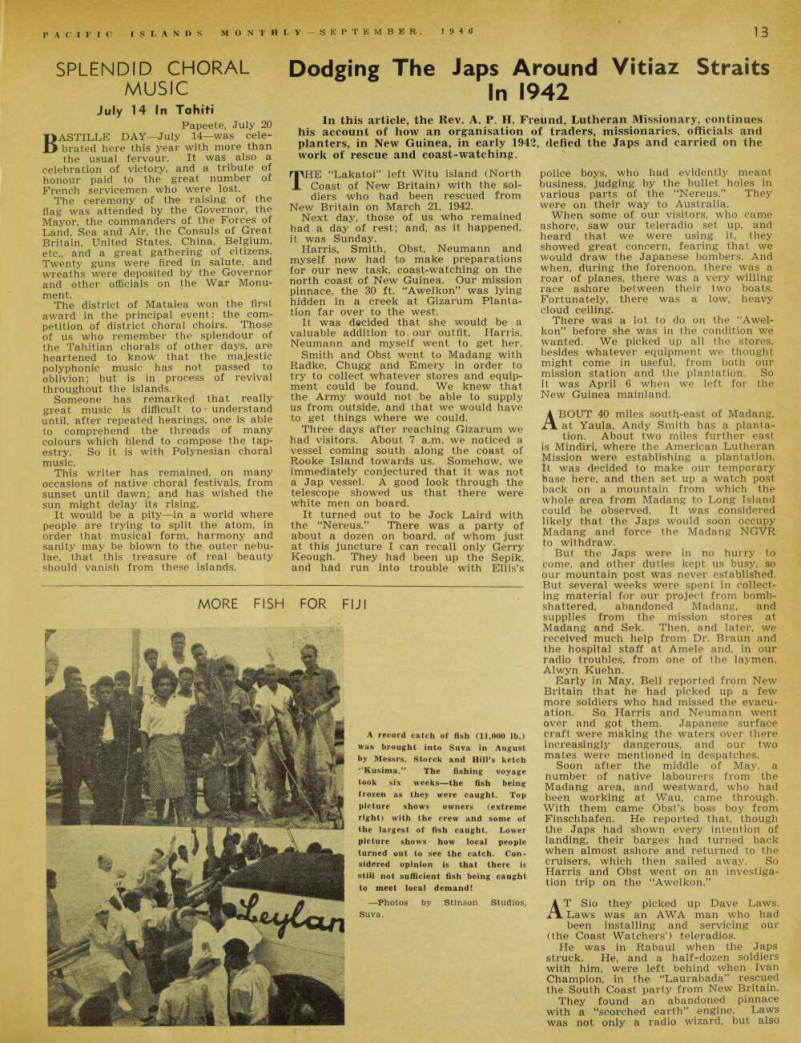
Music
July 14 In Tahiti
Papeete, July 20 BASTILLE DAY—July 14—was cele brated here this year with more than the usual fervour. It was also a celebration of victory, and a tribute of honour paid to the great number of French servicemen who were lost.
The ceremony of the raising of the flag was attended by the Governor, the Mayor, the commanders of the Forces of Land, Sea and Air, the Consuls of Great Britain, United States, China, Belgium, etc., and a great gathering of citizens.
Twenty guns were fired in salute, and wreaths were deposited by the Governor and other officials on the War Monu ment.
The district of Mataiea won the first award in the principal event; the com petition of district choral choirs. Those of us who remember the splendour of the Tahitian chorals of other days, are heartened to know that the majestic polyphonic music has not passed to oblivion; but is in process of revival throughout the islands.
Someone has remarked that really great music is difficult to' understand until, after repeated hearings, one is able to comprehend the threads of many colours which blend to compose the tap estry. So it is with Polynesian choral music.
This writer has remained, on many occasions of native choral festivals, from sunset until dawn; and has wished the sun might delay its rising.
It would be a pity—in a world where people are trying to split the atom, in order that musical form, harmony and sanity may be blown to the outer nebu lae, that this treasure of real beauty should vanish from these islands.
More Fish For Fiji
A record catch of fish (11,000 lb.) was brought into Suva in August by Messrs. Storck and Hill’s ketch “Kusima.” The fishing voyage took six weeks—the fish being frozen as they were caught. Top picture shows owners (extreme right) with the crew and some of the largest of fish caught. Lower picture shows how local people turned out to see the catch. Con sidered opinion is that there is still not sufficient fish being caught to meet local demand!
Photos by Stinson Studios, Suva.
Dodging The Japs Around Vitiaz Straits
In 1942
In this article > the Rev - A - p H - Freund, Lutheran Missionary, continues his account of how an organisation of traders, missionaries, officials and planters, in New Guinea, in early 1942, defied the Japs and carried on the work of rescue and coast-watching.
THE “Lakatoi” left Witu island (North Coast of New Britain) with the sol diers who had been rescued from New Britain on March 21, 1942.
Next day, those of us who remained had a day of rest; and, as it happened, it was Sunday.
Harris, Smith, Obst, Neumann and myself now had to make preparations for our new task, coast-watching on the north coast of New Guinea. Our mission pinnace, the 30 ft. “Awelkon” was lying hidden in a creek at Gizarum Planta tion far over to the west.
It was decided that she would be a valuable addition to. our outfit. Harris, Neumann and myself went to get her.
Smith and Obst went to Madang with Radke, Chugg and Emery in order to try to collect whatever stores and equip ment could be found. We knew that the Army would not be able to supply us from outside, and that we would have to get things where we could.
Three days after reaching Gizarum we had visitors. About 7 a.m. we noticed a vessel coming south along the coast of Rooke Island towards us. Somehow, we immediately conjectured that it was not a Jap vessel. A good look through the telescope showed us that there were white men on board.
It turned out to be Jock Laird with the “Nereus.” There was a party of about a dozen on board, of whom just at this juncture I can recall only Gerry Keough. They had been up the Sepik, and had run into trouble with Ellis’s
police boys, who had evidently meant business, judging by the bullet holes in various parts of the “Nereus.” They were on their way to Australia.
When some of our visitors, who came ashore, saw our teleradio set up, and heard that we were using it, they showed great concern, fearing that we would draw the Japanese bombers. And when, during the forenoon, there was a roar of planes, there was a very willing race ashore between their two boats.
Fortunately, there was a low, heavy cloud ceiling.
There was a lot to do on the “Awel kon” before she was in the condition we wanted. We picked up all the stores, besides whatever equipment we thought might come in useful, from both our mission station and the plantation. So it was April 6 when we left for the New Guinea mainland.
ABOUT 40 miles south-east of Madang, at Yaula, Andy Smith has a planta tion. About two miles further east is Mindiri, where the American Lutheran Mission were establishing a plantation.
It was decided to make our temporary base here, and then set up a watch post back on a mountain from which the whole area from Madang to Long Island could be observed. It was considered likely that the Japs would soon occupy Madang and force the Madang NGVR to withdraw.
But the Japs were in no hurry to come, and other duties kept us busy, so our mountain post was never established.
But several weeks were spent in collect ing material for our project from bomb shattered, abandoned Madang, and supplies from the mission stores at Madang and Sek. Then, and later, we received much help from Dr. Braun and the hospital staff at Amele and, in our radio troubles, from one of the laymen, Alwyn Kuehn.
Early in May, Bell reported from New Britain that he had picked up a few more soldiers who had missed the evacu ation. So Harris and Neumann went over and got them. Japanese surface craft were making the waters over there increasingly dangerous, and our two mates were mentioned in despatches.
Soon after the middle of May, a number of native labourers from the Madang area, and westward, who had been working at Wau, came through.
With them came Obst’s boss boy from Finschhafen. He reported that, though the Japs had shown every intention of landing, their barges had turned back when almost ashore and returned to the cruisers, which then sailed away. So Harris and Obst went on an investiga tion trip on the “Awelkon.”
AT Sio they picked up Dave Laws, Laws was an AWA man who had been installing and servicing our (the Coast Watchers’) teleradios.
He was in Rabaul when the Japs struck. He, and a half-dozen soldiers with him, were left behind when Ivan Champion, in the “Laurabada” rescued the South Coast party from New Britain.
They found an abandoned pinnace with a “scorched earth” engine. Laws was not only a radio wizard, but also
an excellent mechanic and ~a tireless worker. With little more than his bare hands he fixed up the engine, and carried benzine on his own back for miles from some place where it had been abandoned.
One night, they set out for Papua.
After a few hours, the distributor broke down. With scrap material and an old file he repaired it. But his navigation cannot have been good, and the strong current up through Vitiaz Straits was evidently unknown to him. So they landed at Sio, about 200 miles west of where they intended to go.
At Finschhafen, Harris, Obst and Laws found Pursehouse’s teleradio not very badly smashed. Soon Laws had it working. That gave our party a second radio.
In the mission store, a large supply of foodstuffs was still intact. Harris radioed for Neumann to come with the “Umboi” to get them.
Pursehouse and some of the soldiers who had been brought over by Rev.
Moore on March 3 were out in the mountains, where they had withdrawn when the Japs seemed about to land. A messenger was sent out to them, and they came in.
They and Laws, with his men, came along to our area. After Laws had fixed up my teleradio, which had developed a serious defect, he and the soldiers were taken to Bogadjim, from where they walked overland and reached Australia.
IT was now decided to set up a watch station in the Finschhafen area, and Pursehouse and myself were detailed for that task.
On June 13 we set out, Obst taking us on the “Awelkon.” The south-east was a bit troublesome, so we hugged the coast to get whatever shelter the head lands offered.
Off Wandokai, near Cape Fortification, we were just about to round one of these headlands when nine Jap bombers, flying low, passed about a mile out to sea. We promptly turned and made for a cove we had just passed.
We had just reached it, when the bombers turned and came straight at us.
Anchor was dropped and the native crew ordered to lower the boat. They took one look at the approaching bombers, dived overboard and swam ashore.
Pursehouse, Obst and I followed.
I am a poor swimmer. Besides, I was weak from a bout of malaria the previ ous day. Just when I was completely exhausted I turned upright—and my feet touched bottom while my nose was level with the surface. As I floundered out and fell in a heap on the pebbles, the bombers roared overhead, completely ignoring us. Nearly drowned for nothing!
We now decided to travel no further by pinnace. Obst and the native crew swam back, and all our stores and equip ment were landed. We did not even have an opportunity of saying farewell to Obst, for he hurried away lest other Jap planes came to investigate.
We never saw him again, for he was later killed at Cape Gloucester.
NEXT morning, I set off by land. Car riers were scarce, so Pursehouse stayed till he could get more. Just before I left, a Jap ship passed out at sea. Fortunately, our carriers did not see it, or they might have panicked.
Next day, when nearing what was later known as Scarlet Beach, we met some natives who were coming from Finschhafen. They told us that the Japs had sent word that in three days they would come to the Finschhafen area for cattle. Since I had had to be on the watch all along the track lest there
were Japs about, the report of these natives at least assured me that there were none —and as for their coming in three days’ time —well, I would wait and see.
We had selected Wareo mission station, overlooking Finschhafen and the sea, as our post. Sattelberg has a much better view of the area, giving an out look even into Vitiaz Straits, but at that season it is fog-bound far too often for an observation post. So for the time being we would have to be content with second-best.
Pursehouse arrived the next day. The native mission teachers gave us a friendly reception, and soon we were established in the mission house, with house boys and all complete.
And what we saw of Jap planes and ships, and other experiences, will have to be told in another section.
British Officials
In The British Solomons
Letter to the Editor A SAYING was current amongst the Old Timers during the war that if the old Tulagi set-up was re-estab lished, then we had lost the war.
The incredible has happened. Tulagi ism, and all that it stands for, is again entrenched in the British Solomons at Honiara. So abandon hope for a better future, all you pioneers and struggling planters!
The writer, with recent first-hand knowledge, had no doubts. The treat ment accorded the homing 14 BSI Resi dents per the “Southern Cross” in April, by Honiara Officialdom (August PIM) should shatter any remaining illusions held by others.
Perhaps one of the most pathetic aspects of human relationships is the doggedness with which poor humans cling to faith and hope in a cause which has already crumbled to decay. Year after year, decade after decade, men in the Solomons have struggled on, buoyed up by the hope that British Justice would at last be done to them, stead fastly refusing to believe that ignorance, selfishness, and apathy would always prevail against them.
Now they know exactly where they stand. The official leopard does not change its spots. Tulagi is still Tulagi, even at Honiara!
A HEART-CRY from the “Southern Cross”; “The hours passed. No official came to welcome us. Official dom, in fact, gave us the impression that they hated us. We, in turn, decided that we did not much like the stiff English rulers . . .”
What did they expect? The extended hand and a welcoming smile? Surely they knew better than that! Official smiles and favours are only for the great of the earth, or pals. Who were these voyagers who had just come home through the perils of the sea? Only a band of non-official heroes and pioneers who had helped to make the Solomons safe for officials to live in.
Some of them were broken in fortune, but were game enough to come back to face it all again in the land they loved.
None of them had wealth, or favours to bestow ... so the cold Official “brush off” for them, Honiara was running true to type—Tulagi type.
A FEW months ago a District Commis sioner, an Englishman, asked a Mission chief in the Solomons; “Why do Australians hate the English?” He should have said: “Some Englishmen of the Official type.”
The answer, of course, is that Aus tralians have a profound respect and affection for the great majority of Eng lishmen —perhaps the finest race Earth has bred. But Englishmen join Austra lians —and Americans —in voicing their criticism, amounting to contempt, almost, of a certain type of British official who hides his inefficient futility behind a facade of superior condescension, cold hostility, and snobbishness. This is the type which should be kept at Home.
Instead of being ambassadors of Empire, they are the most disruptive force of Empire good relationships—and of American as well —for numerous Ameri can officers in the Solomons expressed the same sentiments that are being stated herein.
During the war, a precious plan was incubated in Fiji which aimed at per manently excluding all commercial and planting interests from the Solomons, by making the Group a close preserve for Officials and Missionaries. The war having got the planters and traders out, they were to be kept out.
The plan was strangled at birth by the Higher-Ups. But it revealed the hand of Fiji officialdom. Baffled in that direction, it should not be expected that the same officialdom will show any cor dial desire to help rehabilitate and assist those it tried to eliminate.
I am, etc.,
Caulfield, Vic.
Leslie F. Gill.
28/8/46.
No Labour In The Solomons
(From a Planter in the Solomon Islands) CONDITIONS here at the moment (end of July) are far from bright. There is no labour available, and our Administration gives us no help. It appears that the native councils are holding out for higher wages, and have put a Tambu on all recruiting. One report that has reached me is that the leaders have threatened to outlaw any native who makes a labour engagement, and will seize his garden and any prop erty that he leaves behind him.
The Pacific Franc
A REPORT that the Pacific franc had been brought into line, for inter national exchange purposes, with the Metropolitan franc caused a great stir in Tahiti in July. In terms of inter national exchange, the Pacific franc is twice as valuable as the franc of France.
The report was officially denied. It is believed to have arisen as the result of some reform proposed by the French Minister for Finance.
The Apia “Mothers’ Club” which for the last 2’A years has organised welcome-home dances for returning soldiers of Samoa and has made presentations to every known Samoa-born soldier who has been on active service overseas, wound up its operations with a dance on August 1. A very large and representative crowd, in cluding the Administer, Colonel F. W.
Voelcker, spent an enjoyable evening at the “Tivoli Theatre.” The Mothers’ Club is to continue activities in future as a purely social club.
Rice is Being Grown in the Solomons
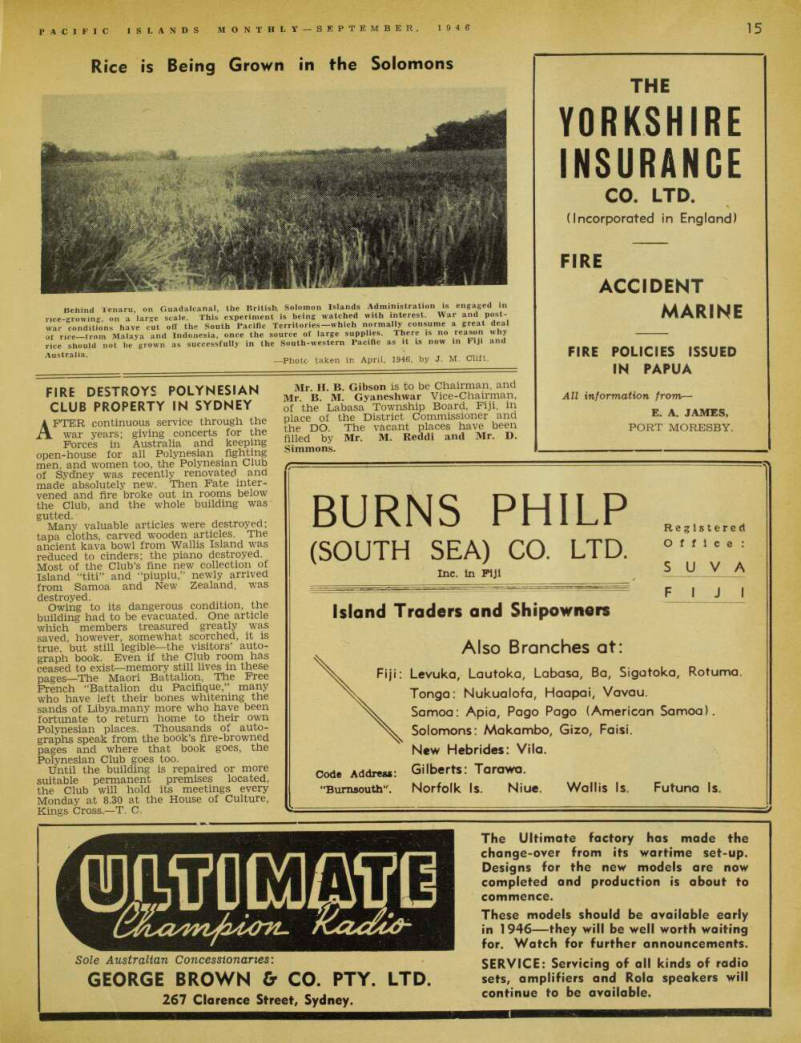
Behind Tenaru, on Guadalcanal, the British, Solomon Islands Administration is engaged in rice-growing, on a large scale. This experiment is being watched with interest. War and Post war conditions have cut off the South Pacific Territories-which normally consume a great deal of r ice from Malaya and Indonesia, once the source of large supplies. There is no reason why rice should not be grown as successfully in the South-western Pacific as it is now in Fiji and Australia. Photo taken in April, 1946, by J. M. Clift.
Fire Destroys Polynesian
Club Property In Sydney
AFTER continuous service through the war years; giving concerts for the Forces in Australia and keeping open-house for all Polynesian fighting men, and women too, the Polynesian Club of Sydney was recently renovated and made absolutely new. Then Fate inter vened and fire broke out in rooms below the Club, and the whole building was gutted.
Many valuable articles were destroyed; tapa cloths, carved wooden articles. The ancient kava bowl from Wallis Island was reduced to cinders; the piano destroyed.
Most of the Club’s fine new collection of Island “titi” and “piupiu,” newly arrived from Samoa and New Zealand, was destroyed.
Owing to its dangerous condition, the building had to be evacuated. One article which members treasured greatly was saved, however, somewhat scorched, it is true, but still legible—the visitors’ auto graph book. Even if the Club room has ceased to exist —memory still lives in these pages—The Maori Battalion, The Free French “Battalion du Pacifique,” many who have left their bones whitening the sands of Libya,many more who have been fortunate to return home to their own Polynesian places. Thousands of auto graphs speak from the book’s fire-browned pages and where that book goes, the Polynesian Club goes too.
Until the building is repaired or more suitable permanent premises located, the Club will hold its meetings every Monday at 8.30 at the House of Culture, Kings Cross. —T. C.
Mr. H. B. Gibson is to be Chairman, and Mr. B. M. Gyaneshwar Vice-Chairman, of the Labasa Township Board. Fiji, in place of the District Commissioner and the DO. The vacant places have been filled by Mr. M. Reddi and Mr. D.
Simmons.
Advertisements & other items, pp. 19-20 (1 item)
Burns Philp
THE
YORKSHIRE
INSURANCE
CO. LTD.
\ (Incorporated in England)
FIRE
ACCIDENT
MARINE
FIRE POLICIES ISSUED
IN PAPUA
All information from —
E. A. JAMES,
PORT MORESBY.
BURNS PHILP
(SOUTH SEA) CO. LTD.
Inc. In Fiji Registered Office :
SUVA
FIJI
Island Traders and Shipowners Also Branches at: Levuka, Lautoka, Labasa, Ba, Sigatoka, Rotuma.
Tonga: Nukualofa, Haapai, Vavau.
Samoa: Apia, Pago Pago (American Samoa).
Solomons: Makambo, Gizo, Faisi.
New Hebrides: Vila, code Addreu: Gilberts; Tarawa.
"Burnsouth". Norfolk Is. Niue. Wallis Is. Futuna Is.
Fi|
sr I m M I U Sole Australian Concessionaries :
GEORGE BROWN fir CO. PTY. LTD.
267 Clarence Street, Sydney.
The Ultimate factory has made the change-over from its wartime set-up.
Designs for the new models are now completed and production is about to commence.
These models should be available early in 1946 —they will be well worth waiting for. Watch for further announcements.
SERVICE: Servicing of all kinds of radio sets, amplifiers and Roia speakers will continue to be available.
SPECIALISING
IN
PACIFIC ISLAND INSURANCES
FIRE MOTOR VEHICLE
MARINE HULLS AND CARGO
EMPLOYER’S LIABILITY
GUARANTEES including those for —
DYNAMITE PERMITS.
RECRUITERS’ LICENCES.
DEFERRED WAGES
AND ALL OTHER CLASSES ARRANGED
AT LOWEST CURRENT RATES.
Established Agencies:
W. R. CARPENTER & CO., LTD.
Throughout the Territory of New Guinea.
SOUTHERN PACIFIC INSURANCE
CO., LTD.
HEAD OFFICE: 60 HUNTER STREET,
SYDNEY.
The Most Extensive Manufacturers in the British Empire of
RUBBER STAMPS,
INKS, STENCILS,
Marking Devices,
ACME STAMP PADS
OFFICE & STATIONERY SUPPLIES
ms We also Manufacture & Supply a Complete Line of
LIMEWASHING AND
SPRAYING MACHINES
for all purposes.
Let ns know your requirements and we will quote by return.
WRITE FOR OUR GENERAL CATALOGUE
Limewashing Machine
EXCELSIOR SUPPLY CO. PTY. LTD.
278 Post Office Place,
MELBOURNE, VIC.
HEAD OFFICE :
160 BROADWAY,
Formerly known as George St.. West,
SYDNEY, N.S.W.
50 Victoria Street,
WELLINGTON, N.Z.
Tropical Ulcers
Result of Tests With Penicillin
By John W. Wilkinson, of Samarai
TOWARDS the latter end of the Ameri can Forces’ stay in Milne Bay, several of the doctors became very interested in the possibilities of Penicillin for medical work among the natives, and managed to make enough penicillin available for a test to be carried out on over 50 cases of tropical ulcers. The re sults from three of the cases are given below as they are typical of the others.
The Penicillin was applied topically in strength, approx. 300 units to lee distilled water. Dressings were done at 8 a.m., and a second application of the solution to the gauze dressings was made at 4 p.m., without disturbing the dressings. Com plete recovery in each case has been dramatic, and with much less treatment and in much less time than is usual.
Ordinarily, these cases would have re quired treatment for at least two months.
General treatment in each case was;— Mist Ferri et Ammon Cit Drachms iv. tds.
Cod Liver Oil „ iv. tds.
Vitamin Bi 2 tabs „ Ascorbic Acid 2 tabs
Also 3 1.V.1. of Neoassvenobillon at bi weekly intervals were given, dosage at rate of .6 Gm. per adult.
First Case
PEIWANI, female adult, aged about 32, married, several children, general condi tion good. Village on Sariba.
Admitted 29/11/45. Tropical Ulcer about 4 in. x 21 in., left shin above ankle.
Chronic. No healing. Caused by break down of old scar of previous ulcer on same site, which was healed about one year ago. Somewhat punched out ap pearance. By 3/12/45, tissue at base of Tropical Ulcer was pink and granulating up, edge healing in rapidly. 5/12/45 — split skin graft to area, penicillin dressings on graft. 13/12 45—graft taken well.
Penicillin dressings b.d. 14/12/45 —dusted with Sulphanilamide powder; cod-liver oil and vaseline dressing. 19/12/45 —discharged.
Second Case
BENARUA, half-caste child, lived in village since birth, aged about ten years.
Village on Sagarai.
Admitted 1/12/45. Tropical Ulcer on lower third of right leg. Size 2I in. x li in., of recent origin, very dirty, fungating.
By 4/12/45, ulcer clean and fungations settled down in healthy surface. Snlit skin graft, penicillin dressings. Patient discharged 15/12/45. This is the quickest complete recovery from Tropical Ulcer noted to date at this hospital.
Third Case
TIMOTEO, male child about 9. Village on Fife Bay.
Admitted 1/12/45. Extensive Tropical Ulcer, front of right leg, size about 3 i in. x 21 in. Of long standing, had been very deeplv punched out, no doubt partly exposing some of the periosteum of the tibia at one time. On admittance Tropical Ulcer was very dirty and had a base of uneven granulation issue. Some healing had taken place, patient being admitted from a mission hospital where he had been receiving treatment for three months. By 4/12/45, clean, edges healing in fast, base still uneven. 5/12/45 —split skin graft attempted, penicillin dressing. 15/1/45 —graft taken generally, but three small areas of infection. Dressed with penicillin and cod-liver oil and vaseline.
Redressed 18/12/45. 21/12/45 nicely healed—discharged.
During the whole period, there were no toxic reactions noted in any case. Since returning to this area I have seen some of the cases which were treated and there has been no breakdown of the ulcer after six months although the natives have been carrying out normal activities m the VillSiffGS The Americans considered the penicillin was too old to use. Since then, I have seen some more of the same batch used, with good results, although it has not been kept in a refrigerator for over seven months. It may not be of much use as injections, being so old, but it has still enough power to act well on ulcers.
At the time of making the tests I was an EMA in charge of a hospital, but I am not a doctor by any means. At present, I am not doing medical work and I am making these results public in the hope that some benefit may result generally. , .. Penicillin is much safer than the Sulpha drugs, and I am sorry to see that some of the more toxic of the buipna drugs are on sale to anyone who may wish to try their hand in their use.
Considerable damage can result from their use by inexperienced hands. Also, if the correct dosage is not given, the germs acquire a tolerance to the drug.
The new Comptroller of Fiji Customs, Mr. A. R. Smith, arrived in Suva by air in August.
Tongan Home Guard
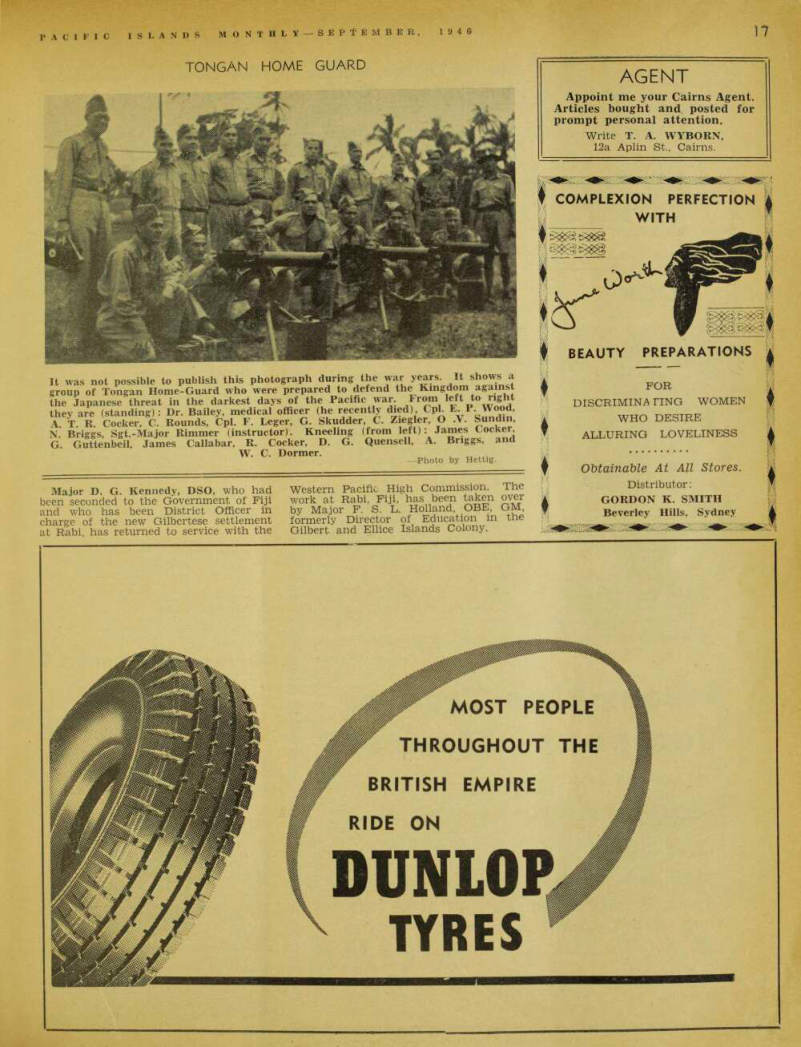
Major D. G. Kennedy, DSO, who had been seconded to the Government of Fiji and who has been District Officer in charge of the new Gilbertese settlement at Rabi, has returned to service with the
Western Pacific High Commission. The work at Rabi, Fiji, has been taken over by Major F. S. L. Holland OBE, gm formerly Director of Education in the Gilbert and Ellice Islands Colony.
It was not possible to publish this photograph during the war years. It shows a group of Tongan Home-Guard who were prepared to defend the Kingdom against the Japanese threat in the darkest days of the Pacific war. Firom left to right they are (standing): Dr. Bailey, medical officer (he recently died), Cpl. E. P. Wood, A. T. R. Cocker, C. Rounds, Cpl. F. Leger, G. Skudder, C. Ziegler, O .V. Sundm, N. Briggs, Sgt.-Major Rimmer (instructor). Kneeling (from left): James Cocker, G. Guttenbeil, James Callabar, R. Cocker, D. G. Quensell, A. Briggs, and W. C. Dormer.
Photo by Hettig.
Ex-members of No. 100 Squadron (Australia’s First Beaufort Torpedo- Bomber Squadron) who are interested in joining the newly-formed No. 100 Squadron Association, are requested to write to the Hon. Secretary, Mr. R. J.
Gow, 14 Athol Street, Coogee, Sydney, who will be pleased to give them any information desired.
Advertisements & other items, pp. 21-22 (1 item)
Dunloe
AGENT
Appoint me your Cairns Agent.
Articles bought and posted for prompt personal attention.
Write T. A. WYBORN, 12a Aplin St., Cairns.
COMPLEXION PERFECTION
WITH
f BEAUTY PREPARATIONS
FOR
DISCRIMINA TING WOMEN
WHO DESIRE
ALLURING LOVELINESS
Obtainable At All Stores.
Distributor:
GORDON K. SMITH
Beverley Hills, Sydney
MOST PEOPLE
THROUGHOUT THE
BRITISH EMPIRE
RIDE ON
DUNLOE
TYRES
WANTED
Returned soldier with wife and child urgently requires Flat or Cottage. Are you leaving One?
Please ring Barber, MX 1748, to 5 p.m.
LOOK !
KOCH'S BARBER CHAIRS
Obtainable Soon
PACIFIC ISLANDS TRADING
COMPANY
244 California St., San Francisco, Cal.
Steamships Trading
Company Limited
PORT MORESBY
SAMARAI
PAPUA.
WHOLESALE Cr RETAIL MERCHANTS, SHIPOWNERS,
PLANTERS, ENGINEERS & SLIP PROPRIETORS.
Customs, Shipping, Insurance, and Forwarding Agents.
MANAGING AGENTS AND VISITING REPRESENTA-
TIVES FOR COCONUT AND RUBBER ESTATES.
SYDNEY REPRESENTATIVES: Nelson & Robertson Pty. Ltd., 12 Spring Street.
Circle of Ignorance
Native Labour Muddle in New Guinea is a Vicious Circle of Ignorance
Letter to the Editor
THE policy of the present “set-up” in New Guinea is hard to understand.
With one voice, the Administration tells the natives, “You need not work”; and, in the same breath, informs them that “we are going to establish Agricultural Schools for you, in order that you may learn how to plant up taro.” In other words, “you need not work,” and “we are teaching you how to work.”
Naturally, this is a bit confusing to natives whose forbears planted their gardens for thousands of years, long before anthropologists were even contemplated.
During the years of war, the native was ‘•pushed around” at the beck and call of all of us. He did not know who was who, and there were few who understood his outlook. There were none he could “lean on,” or to whom he could confide.
To-day, he wants just to be left alone, and he should be free to do as he pleases, as in times past. If he desires to work for his old employer, he should be allowed to do so. On the other hand, if he does not want to return to his “place”—usually for some good reason—he should not be forced. He still is, as in the past, a free native nauve. . , . , .
He usually knows what is good for h m, and resents (as we do) others out o touch with his environment assuming the role of protector.
If an employer is considered to be below standard in his treatment of employees, the native has the sense to keep from him, and to spread his reputation far and wide. On the other hand, where an employer is “in tune” with the native, and understands his make-up, the reverse is the case—he finds no lack or natives who are willing to work for him, as in times past.
Day after day, natives come in to our centre and ask, “What time master belong me come back?” In every case, their “masters” have been old hands with ex-
cellent reputation and outlook as regards their treatment of indentured servants, who do not forget easily.
Natives often refer to “the good time before”—they easily differentiate between their pre-war conditions, and the present.
A native recently asked me, when told he could not obtain rice, as it was now too expensive, “What time old Guv’ment come up”?
Daily, small things one observes in the native attitude suggest a certain amount of mental unrest.
All Government Departments complain of “labour shortage”; and the condition of roads, and the rapid growth of weeds, is proof of this.
On the other hand, many of the old employers of labour have been unable to engage their former boys, owing to the high costs of native issues. Meat is now 100 per cent, higher than pre-war; laplap material is 1/8 per yard, against 6d; rice is 100 per cent, higher; and, with the export duty of 1/3 per pound on tea, im posed by the Tea Board, the result, as it effects the native, is catastrophic.
The situation seems to be illustrated by that famous fable about “grasping the shadow for the substance.” The present policy seems to have been designed for the future conditions, in regard to native needs, while the present and immediate needs of the native are regarded as of secondary importance, as shown in the high cost of food essential to his exist ence (unless he is willing to plant gardens, which the average sophisticated native is not).
The present unhappy set up is due not so much to calculated cussedness, as to lack of knowledge and understanding.
I am,
R. Abaul.
New Britain, 16th August, 1946.
An Appreciation of R.L.S.
(Letter from Mr. Abdul Razzak, of Ba, Fiji, who worked with Robert Louis Stevenson at Vailima, Samoa, 60 years ago. Mr. Razzak is now totally blind, and the letter was writ ten by his son.) I WAS impressed by Mr. F. S. Whit combe’s letter in the “Fiji Times” of 17/l/’45, and the para., “Links with RLS,” in the May, 1946 issue of the PIM.
I wish to express my gratitude to Mr.
Whitcombe, who always remembers my name when he is on the topic of R.L.S.
To readers of the PIM, the following may prove of interest. I first became as sociated with R.L.S in 1892, at Vailima.
I remained in his service for 3 years.
Although I am nearing the 88th mile stone, I can still recall with ease those happy days, and the friendliness with which guests were received at Vailima by the great author. I remember most clearly the occasions when the master used to celebrate his birthday. He would spare nothing to make it a gala occasion.
In this regard I fully substantiate Mr.
Whitcombe when he says, “anyone who knew R.L.S. would never forget him.”
R.L.S. was a great man, and memories of my connection with him will live in
me forever.
Abdul Razzak.
Narovurovu, Ba, Fiji. 2/8/1946.
Ng Scholarship
First Award Will Be For 1947
THE Melbourne New Guinea Women’s
Association reports that although
the Deed of Trust covering the memorial scholarship for children of deceased New Guinea soldiers or POWs, is not yet finalised, the first scholarship will definitely be awarded for the 1947 academic year.
Children should not be more than at January 1, 1947, should have attended a shool in Victoria for the previous 12 months and be the son or daughter of a New Guinea or Papua resident who lost his life through enemy action. The 1947 scholarchip will be worth £3O a year, tenable for three years at a State sec ondary school or any approved registered secondary school. Parents with eligible children should apply at once for further details to the secretary of the NG Women’s Association, 7 Wilson Street, Moonee Ponds, Victoria, W 4.
There could be no more fitting memorial to fallen New Guinea men than this attempt to guard the welfare of New Guinea children. More funds are neces sary, in order that scholarship benefits be extended to children residing in other States. With this in view the Women’s Association is working hard for their Bird of Paradise Ball, to be held in the St.
Kilda Town Hall, Melbourne on October 11. At the same time, generous donations are coming along from Territorians and Territories organisations and business houses.
Contributions to August 31, were;— Previously acknowledge including transfer from POW Account . . . . £BBB 15 0 Mrs. M. A. Goodwyn, “Currandale,”
Jandowoe, Queensland 5 0 6 Capt. and Mrs. J. McGregor Dowsett, 38 Evans Street, Belmont, Gee long 5 5 0 Mrs. H. Holland, 2083 Malvern Road, East Malvern, Victoria 2 2 0 Mrs. W. J. Read, 161 Princes High way, Dandenong, Victoria ... 550 Mrs. H. A. Gregory, 80 Cromwell Road, South Yarra, Victoria 2 2 0 Mrs. H. A. Gregory (Proceeds Party) 4 10 0 Mr. and Mrs. J. Devany, 31 Mother well Street, Hawksburn, Victoria 5 5 0 Mr. F. R. Barnett, 17 Marlborough Road, North Caulfield, Victoria . . 110 Mrs. L. Dockrill, 576 Anzac Parade, Kingsford, NSW 100 Dr. N. Fisher, Department Supply and Development, Geological Branch, Canberra 550 Mrs. C. A. Beaumont, 98 Annandale Street, Annandale, NSW .._ .. .. 110 0 Mr. and Mrs. A. E. Ray, 2 Furtuna Street, Hunter’s Hill, NSW ... 232 Yorkshire Insurance Co., 26 Queen Street, Melbourne 10 10 0 Austin Ireland, Lae, New Guinea . . 5 0 0 Paddy Morrissey, Lae, New Guinea 3 0 0 Arch Shields, Lae, New Guinea 3 0 0 E. Serafini, Lae, New Guinea ... 200 Wally Coutts, Lae, New Guinea 7 0 0 Mrs A. J. Poole, 9 Beach Street, Kogarah, NSW 110 A. J. Gaskin, c/o ANGPCB, Port Moresby 10 0 0 Mrs. G. Griggs, Box 6, PO, Vinifera, Victoria 1® ® Mr. and Mrs. H. L. Cameron, “Meril bah,” Lome, Victoria 2 2 0 Mr. and Mrs. J. Milligan, corner Burke and Central Park Roads, East Malvern, Victoria 2 2 0 “Sno” Blackley, c/o Gold & Power, Lae, New Guinea 330 Bill Bailey, c/o W. R. Carpenter & Co., Lae, New Guinea 5 0 0 Sundries ® £983 12 2 Contributions to the Fiji Gifts to Bri tain Fund are still mounting. Total at mid-August was £4,322, and this amount was considerably increased by a Button- Day, in Suva on August 15.
Advertisements & other items, pp. 23-24 (2 items)
19
pacific islands monthl y—septembeß, 1946
Brial & Ball
J. C. MERRILLEES & CO.
Chall is House, Martin Place, SYDNEY.
BUYERS OF ALL ISLAND REQUIREMENTS. SUPPLIERS OF ALL AUSTRALIAN GOODS. BUYERS OF ISLAND PRODUCE.
Write or Wire for Quotations
Inquiries Welcomed
'Phone: BW 6569 Telegrams: “Merrillees,”
Sydney.
Sole Distributing Agents for the Pacific Islands:
BRIAL & BALL
528 COLLINS STREET, 1 BOND STREET,
MELBOURNE. SYDNEY.
’Phone: MU4837. Thone: 87371.
Modern Refrigeration for the South Sea Islands
The ELECTROLUX kerosene operated
REFRIGERATOR
MARVEL
OF
MODERN
SCIENCE
h 11
THE
MIRACLE
OF
ICE
FROM
HEAT
ELECTROLUX
OFFERS ECONOMICAL, MODERN AND COMPLETELY EFFICIENT
REFRIGERATION FOR ISLANDS' HOMES.
FREEZES CONTINUOUSLY WHILE SMALL LAMP BURNS.
Freezing controlled by simply regulating height of flame. Uses only gallon of kerosene per week MOTORLESS ... NO PARTS TO GET OUT OF ORDER.
MODEL LKSSO
Capacity: 8.5 cubic feet.
GUARANTEED FOR TWO YEARS
• Write to your Local Distributor for prices and full details.
OBTAINABLE FROM ALL W. R. CARPENTER & CO. LTD.
BRANCHES THROUGHOUT THE ISLANDS
Representation in Papua and New Hebrides.
Post-War Impressions of
At Rabaul And
Kavieng
Post-War Impressions of NG Centres
( By Top-Sergeant Robert T. Smith , of US Armed Forces Cemeteries Detachment)
RABAUL harbor was filled with ships, most of them Australian Corvettes that are patrolling the waters around the islands as mine-sweepers.
Our ship slid into the middle of a salute to the King’s birthday anniversary.
The ship was directed to the old Niowa dock which seemed to be the only one that the larger ships can use, so our time was limited. During our ten days’ stay several large ships tied up there, Toboi is also used but by smaller inter island boats, while the old Government Wharf was terribly burned out: only trawlers were at it. I could not help but think what a magnificent receptacle the harbour was for the hundreds of tons of Allied bombs dropped there.
Rabaul was very dusty and very busy with many jeeps and lorries rushing about. An M.P. directed traffic at the bottom of Tunnel Hill road. Tunnell Hill is still an appropriate .name, in that the cliff-like walls of the road are a mass of Jap burrows; some of them large enough for vehicles.
The one-time beautiful (Eastwest) boulevard has had the east portion of the large shade trees cut down by the Japanese. Mango road (north-south, Rabaul proper was still shaded, but a bit rough for fast driving. The remains of the Burns Philp building is standing like the ancient Greek acropolis, the white columns at ease in rooflessness.
Chinatown, in its present temporary state, looked a slum area, crowded with Chinese, natives and Malays.
Our main objective was the Austra lian Temporary War Cemetery in the vicinity of Korere Mission, to disinter some 53 graves of American airmen there.
We made a short stop at the Mandres Mission jetty in Ataliklikun Bay—or what was left of the jetty. If it hadn’t been for two natives and 11 dogs appear ing on the beach, we would never have found our way into the new but make shift Kulit village.
Our next stop was in Henry Reid Bay, at the old Tol plantation, which now can boast a dock fit for the best of seagoing ships, also a fine airstrip that was never used.
AFTER a short visit to Cape Narum, on the East coast of New Ireland, we proceeded to Kavieng, in New Ireland, half as large as Rabaul, but twice as beautiful! Mr. Roberts, the District Officer, was most helpful to our party.
The wonderful highway was greatly appreciated and we used it for some 50 miles. Bomb craters, numerous in the immediate vicinity of Kavieng, had been filled in and, except for the apparent number of bombings of each of the bridge areas, the trip down the island was a beautiful sight.
There are only about three jeeps in Kavieng, so there should be no traffic problems; yet I could not help worry ing, as our native driver sped along at 30 and 40 miles, that perhaps one of the other two jeeps might be coming just as fast around the next bend.
Our chauffeur was a back-seat driver’s
nightmare. His laplap was continually blowing out of place, and seemed more important than the steering-wheel. He also had the habit of relieving a con gested left nasal passage with his right thumb. I constantly kept on the alert for any sign of the left thumb going into action.
The Chinese and Malays of Chinatown were most hospitable. I enjoyed several evenings with old Moni, a Malay.
Advertisements & other items, pp. 25-26 (1 item)
a major anxiety
- • ijl
Relief from
Even the most expert and conscientious individual executor is subject to accident, illness and incapacitation.
Continuity of administration and uninterrupted attention to your estate and your beneficiaries are of paramount importance. Both can be positively assured by appointing this Company your sole Executor or as co-Executor with your present appointee. An interesting explanatory booklet will be forwarded on request.
DIRECTORS:
Lewis Armstrong. lames Burns. Joseph Mitchell.
R. J. Nosworthy. P. T. W. Black.
MANAGER: L. S. Parker.
SECRETARY: E. R. Overton, A.F.I.A.
BURNS PHILP TRUST
COMPANY LIMITED
7 BRIDGE STREET, SYDNEY
TELEPHONE: BU 5901. Box 543, G.P.0., Sydney \ BP 1.45 - -- '
THAT
The
EYE LOTION
For Inflamed Eyes and Eyelids ... Sold Everywhere H. Rose& Co..Pty.. Ltd.. Kinq Street. Sydney.
AUGUST
DON'T WAIT
TILL THIS
HAPPENS.
£l. J I & . a Invited Trade Inquiries
DEKOL
Guards Wood and Canvas from the Ravages of White Ants, Borers, Dry Rot, Mifdew, etc.
DEKOL penetrates deeply, permanently protecting wood and fabrics from rot and attacks by fungi and insects. It is ( simple to apply and when dry can be painted and varnished. DEKOL also prevents attack by marine borers on wood immersed in sea water.
PRICE 12/- GAL (4 gal. tins). 14/6 GAL. (I gal. tins).
Fully descriptive leaflet available on request. Dekol should be used in every home and on every estate and will save pounds per year in damage and expensive replacements.
KAYEN
KEROSENE LAMPS
Reliable, efficient Australian-made pressure vapour lamps, providing a full 300 candlepower of steady, unflickering light at a cost of U pints lighting kerosene in 10 hours.
Popular all-purpose lamp, illustrated, may be used as a hanging lamp, storm lantern or table lamp. Absolutely wind-proof, rainproof and insect-proof. Easily operated and require little maintenance or replacement of spare parts. Practically all parts, including tank, are made of brass to withstand tropical atmospheric conditions, and each lamp is fully tested before despatch. Fully illustrated descriptive leaflet available on request. Also available in handsome tall table design suitable for lounge and dining-room.
W. Kopsen & Co.
Pty. Ltd.
376-382 KENT STREET, SYDNEY
CABLES: KOPSEN, SYDNEY.
’Phone MA6336 (7 lines). Est. 1878.
Extraordinary Plague of Big Snails
Big Snails
The Japanese invaders have been ousted, but Kavieng is still the victim of another invader. Japanese troops intro duced a giant land snail as a source of food, and now the snail is looking for a source of food. This silent invader is slowly but surely oozing his way inland, destroying vegetation as he goes. At night the roads are covered with them, and in the day the crushed remains lie rotting in the sun.
Everywhere are the empty shells of those destroyed by natural enemies, yet their numbers are increasing. No one excepting the Japanese have cared to place them on the daily menu.
Meanwhile, until an Australian scientist discovers a counter-destroyer, there is nothing that can be done to stop them.
Driving down the highway one after noon in our jeep, we wqre halted at Put Put by native sentries who immediately began peering all through the jeep, under the hood and under the vehicle.
I inquired as to what was the idea and was told it was a precautionary measure to keep the snail invasion at a snail’s pace.
We were also shown what is called “Blue Hole,” a miniature Carlsbad Caverns. Although natives once referred to it as “pies masalai” the Japs, using it as a source of water, chased out the masalai, and the natives do not fear it now. It was a very impressive spot, something I had never before seen.
I was also amazed at the numerous varieties of fish to be caught around Kavieng and the inexpensive delicacies such as the giant kindam and kuka. One kindam was a meal for our ship’s officers. , The Japanese also left a good airstrip which Mr. Roberts has repaired. Many Japanese fighter and bomber planes still stand in the revetments, although the lot of them are but a shrapnel-riddled shell of the one-time dreaded raider that gave me many a miserable night on Bougain ville and Guadalcanal.
Manus and Los Negros, next on our mission, were not very interesting. Lor engau still harbors a US Navy base, and Los Negros an air strip. There is a wonderful highway now, which bridges the Loniu Passage between the two islands.
Leaving Manus, we made one short stop at Cape Gloucester which, in spite of the battles that were fought there, had as beautiful a landscape as any place we had visited.
Escaped Prisoners
Recaptured
(From our own Correspondent ) Nukualofa, August 5 THE five male prisoners who escaped from Mataki’eua Prison at the end of July were recently recaptured by the police near the village of Ha’asini on Tongatapu.
A number of youths from Ha’asini vil lage, who went down to the beach to spear fish by torchlight, discovered the escapees and two of them rode on horse back to the aerodrome at Fua’amotu, sev eral miles away, and informed the police by telephone.
It is recalled that six other Tongan prisoners escaped from Tongatapu in a small boat last year. After living for some months on the uninhabited volcanic islands of Hungatonga and Hungaha’apai, to the north-west of Tongatapu, three of them decided to return to Tongatapu to steal a cutter but were blown off their course and landed on the rarely-visited island of Vatoa, southernmost of the Lau Group of Fiji and several hundred miles to the westward of Tonga. There they pretended to be Tongan fishermen.
i,ore qTg-n-westnorth-oern
The prisoners stayed at Vatao and were treated kindly by the inhabitants until a ship from Lomoloma (where the news of the escaped Tongan prisoners was known) called at Vatoa and picked them up. At Suva they were identified and im prisoned for some weeks for failure to pay fines for landing on Fijian soil with out a permit. They were finally returned to Tonga on the “Matua.”
Of their three companions who re mained at the island of Hungaha’apai, one had fallen off a precipice while bird-hunt ing and had been killed; the remaining two were brought back to Tonga on the Government despatch vessel “Hifofua.
Advertisements & other items, p. 26 (1 item)
22
SEPTEMBER, 1946 PACIFIC ISLANDS MdKtBU
Urgently Wanted in the
Small Ships Get
Rich Reward
Urgently Wanted in the Islands
THE appearance in the Central Pacific of an Australian ketch which, under her captain and owner, is running a pro fitable passenger and cargo service be tween the outer islands of a certain group, gives an indication of opportunities which exist generally in the Pacific to day.
The whole of the South Pacific Island groups are desperately short of shipping— of large ships, which maintain communi cation between the Territories and the outside world; and of small ships, which normally run inter-island.
The position is acute in New Guinea : where the muddled Socialistic thinkers oi Canberra have succeeded in putting out of operation practically all those small ships which normally carried on inter island services. The planters and traders are paralysed through lack of transport —and scores of little vessels, held up for their various purposes by Australian Gov ernment instrumentalities, are lying idle in the principal ports.
In other Territories there is a shortage of small ships, through war conditions.
By one means and another, some men with boats large enough to undertake inter-island services have been able to get away from Australia and New Zealand and they are now reaping a rich harvest.
In some of the Territories—more especi ally those controlled by Australia and New Zealand —an attempt is being made to discourage private enterprise and establish State-owned shipping services.
Private owners of small ships are tabu in New Guinea. But in spite of this a number of private owners have appeared and their arrival has been greeted en thusiastically by planters, traders and private people generally who are most eager to obtain transport, and sick unto death of Government interference.
Bell Of Hms "Fiji"
A SHIP’S silver bell, bought by the people of Fiji in 1939 for presenta tion to HMS Fiji, arrived back in Suva by the “Taranaki” early in August.
The bell, with other gifts intended for the cruiser, was never formally presented to HMS Fiji, as war broke out before the vessel was completed, and in 1941 she was lost in the Battle for Crete.
The gifts remained in the United King dom during the war, but are now to be kept in the Colony until another Royal Navy ship is named “Fiji.”
Ddt And Malaria
THE spraying of DDT monthly since last November in the North-Central Province of Gold Coast has resulted in the reduction of the incidence of mal aria to a remarkable degree, says Mr.
R. Aluvihare, Government Agent, in a report to the Minister of Health. Mr.
Aluvihare sugggests that, along with the spraying, the oiling of the rivers should be carried out, and that jeeps should be employed to penetrate into the remote, roadless villages of the Province for the purpose of spraying them with DDT. He considers that, with such a campaign carried out vigorously, it would be pos sible to eliminate malaria from the North-Central Province within about five years. —Crown Colonist.
Advertisements & other items, p. 27 (1 item)
Ctuatxaiian ‘JLifiUu} £td.
QUEENSLAND
INSURANCE
COMPANY
LIMITED
(Incorporated 1886 in Australia)
ASSETS EXCEED £4,000,000
Head Office :
QUEENSLAND
INSURANCE BUILDING,
80-82 PITT STREET, SYDNEY.
Specialists in South Seos Fire,
Marine tr Accident Insurances
Apply to:—
FUL
Branch Office: I. B. Chalmers, Manager.
Burns Philp (South Sea) Co.. Ltd.
VILA.
Burns Philp (South Sea) Co., Ltd.
Comptoirs Prancals Des Nouvelles Hebrides (Marine).
NOUMEA.
L. & W. Johnston.
PORT MORESBY:
Burns, Philp & Co., Ltd.
W. A. Anderson, Resident Officer.
PAGO PAGO.
Burns Philp (South Sea) Co., Ltd.
G. H. C. Reid & Co.
OTHER SOUTH SEA ISLANDS.
Burns Philp (South Sea) Co., Ltd.
Also to any of the Company’s Offices in Australia or Hew
ISLAND CRAFT
TO
MODERN DESIGN
WOODEN FREIGHTERS,
TRAWLERS AND ISLAND
CRAFT.
VESSELS REPAIRED AND
REMODELLED.
m
AUSTRALIAN AGENTS FOR
GRAY MARINE PETROL AND
DIESEL ENGINES.
COPPERSMITHS, WELDERS
AND PLUMBERS.
MODERN SLIPWAY FACILITIES AVAILABLE
WRITE US FOR DESIGNS AND COMPLETE SHIPBUILDING INFORMATION.
A A F !
Ctuatxaiian ‘JLifiUu} £td.
Tel.: XB 4475, XA 1731.
INCORPORATING REG. ADAMS CLAYTON CO.,
JOHN STREET, BERRY'S BAY, NORTH SYDNEY.
ALSO AT EDEN, N.S.W.
World Prices Of Copra
US—Philippines Agreement Stabilises the Market For Year or Two
SLOWLY and steadily, the world’s copra market has taken some shape and stability. For months, so great has been the confusion in world economy, it was difficult to get any idea of nec,s re o a f the U indnlt^ Pra ’ PTOS ‘ pects of the indust y.
Now as the result of the agreement made between Britain and Ceylon a few months ago (under which Ceylon this year receives about £37 Australian per ton) and the more recent agreement between the United States and the Philippine Government, it is possible to make an intelligent guess at the future.
The price of first-grade copra should not fall much below £3O (Aus.) per ton. f.0.b., for a year or two. This is an immens'e improvement on the disastrous rates of 1930-39.
But the high price will not last, once Netherlands Indies and Philippines are back into full production. Unilever—undamaged by World War 11, and apparently as well and pugnacious as ever— will see to that.
Philippines Copra Agreement
UNDER the terms of the American- Philippines Copra Purchase Agreement signed on August 8 in Manila. the Philippines Government has agreed to sell the entire exportable surplus of of copra and coconut oil to the Commodity Credit Corporation (or its designee) for one year, beginning July 1. 1946. The price is 103.50 dollars per long ton. f.o.b.
ocean carrier. Price of coconut oil will be 7 1/8 cents per pound f.o.b. Philippine ports. This will allow importation of copra and coconut oil within the exist ing price ceilings set by OPA.
In . * ddltion T Govern ' ment has agreed not to place any re sanctions upon the production or export Q f copra to the US. All purchases for foreign claimants will be handled by the United States and the Philippines Gov eminent will issue export licenses only to the US or its designee. Purchases for foreign claimants with International Emergency Food Council allocations will be made by the Fats and Oils Branch of the United States Production and Mar keting Administration, normal commercial channels. All copra imported f°V use . in the w . lll 136 purchased by private importers, with control through import licenses.
Shipments of Philippines copra and coconut oil have risen steadily since January, reaching a high of about 60,000 tons in July almost equalling pre-war tonnages.
The remar k a ble recovery of the Phil ippine copra industry has been due to the close co-operation between the two nations for the purpose of increasing the world’s short supply of fats and oils.
The United States furnished inter-island boats to carry copra to market, incentive goods such as textiles to encourage copra collections, and equipment to aid in harvesting and drying copra. Much
of the groundwork resulting in increased shipments was due to the efforts of the Copra Export Management Corporation.
Before the expiration of the agree ment on July 1, 1947, shipments are ex pected to be near the pre-war levels of 1935-39.
More Copra For Europe
WE have received the following mes sage from a special correspondent in London, dated August 21: “We gather, from information received from Philippine merchants, that the United States crushers are getting as much copra as they can. use, and are coming to the point where they are unable themselves completely to absorb the present production, owing to the re strictions on the sale of their coconut oil, while their storage capacity for copra and coconut oil is limited. . . .
From this, it would appear that more Philippine copra will be coming to Europe.”
Normally, more than two-thirds of the world’s copra production came from the Philippine Islands and the Netherlands Indies. All production outside the Phil ippines and the Indies (which were in Jap occupation) therefore was greatly stimulated by the demands of the Allies during 1942-45 —except in New Guinea and the Solomons.
Now, Philippines production is nearly back to normal. New Guinea is stagger ing along under Australian Socialist in terference, and making a sorry job of copra production. Netherlands Indies still are torn by revolutionary influences, and little copra is being produced there.
Europe is still in a sad state; but Europe should be able to consume all the copra that can be made available from the Philippines and other sources, for at
least a year or two. But as soon as the Dutch restore order in the Indies, and Indies copra is again available for Europe, the world price may begin to sag. That should not be before 1948.
Disparity In Prices
At present, there is much disparity in prices. Here is a comparison of what appears to be the f.o.b. price in various places, reduced to Australian currency.
We do not guarantee accuracy to within fl or £2, but it gives an idea of what is ruling: Per Ton Aust.
Ceylon (paid by Britain, for one year, from June, 1946) £37 New Guinea (paid by Australian Government through Produc tion Control Board) ;• • 221 Philippines (paid by US, through Commodity Credit Corporation for year) 33 Fiji (paid by British Government, through Fiji Government) 26 There is much variation in quality of copra—Ceylon being about the world’s best. But that does not explain the wide variation in prices. Both New Guinea and Fiji seem to be getting a raw deal.
The Australian authorities say they are trying to build up a reserve pool for the benefit of the New Guinea pro ducers. If the New Guinea producers are wise, and have learned anything from political history, they will insist onget ting the full value of their product now.
The worst feature of the whole set up is seen in New Guinea. Instead of New Guinea copra production increasing steadily, to get the benefit of the world market —which will never be better —and to assist in the rehabilitation of the war shattered Territory, the production of copra has declined sharply in the last six or nine months. This is the result of Socialist interference with the Terri tory’s economy—seen in the absence of essential transport, and the disappear ance of the native labour force.
Nei Copra For America
It was announced in Washington on August 18, that the Netherlands Indies Government had agreed to sell and ex port the surplus copra of the East Indies to the United States Commercial Credit Corporation.
This agreement evidently complements that made with the Philippines Govern ment on August 8.
Advertisements & other items, p. 28 (1 item)
Nelson & Robertson "I
NELSON and ROBERTSON Pty. Ltd.
Established 1895
Shipowners - Brokers and
Islands Merchants
All classes merchandise purchased at Best Wholesale Prices. Original Invoices supplied to Island Clients. Cocoa Beans, Copra, Rubber, Trochus Shell and All Islands' Produce Sold on Commission.
Entrust your requirements to the firm with fifty years' practical experience in the Pacific Islands.
Prompt attention given to all enquiries.
NELSON & ROBERTSON "i
12 SPRING STREET, SYDNEY, AUSTRALIA
Telegraphic Address: IVAN, SYDNEY.
W. Samoa Ships Copra To
England
From Our Own Correspondent APIA, August 12.
WESTERN Samoa is bearing part of the responsibility of supplying England with fats. In July, the British steamer “Hazelbank” loaded 750 tons of copra, while the “Teviotbank” left direct for England on August 12 with another 1,000 tons of Samoan copra.
The greater portion of the year’s copra crop has been bought by the British Gov ernment, while smaller portions have been sold to New Zealand and Canada.
Regular copra shipments will now go forward every month to England direct.
At the Sacred Heart Cathederal, Suva, on July 26, Miss Madelaine Grace Kerk ham, elder daughter of Mr. and Mrs. R. C.
Kerkham of Suva, was married to Flight- Sgt. W. R. Kearns of New Zealand. A re ception was later held in the Grand Pacific Hotel.
India Now Wants Copra
INDIA’S rapid industrialisation has re suited in a keen demand for Ceylon’s products as raw materials. India’s consuming capacity for Ceylon copra, for instance, is definitely greater to-day than it was in the pre-war period, owing to the fact that the number of oil mills and soap factories has increased consid erably, said Ceylon’s Trade Commis sioner in Bombay in an interview with the Ceylon News. More factories are to be established in the near future for the manufacture of high-grade soap, mar garine, vegetable tallow, etc., and India’s and India’s needs for substantial quan tities of copra and coconut oil place her in a position to absorb a major portion of the Island’s copra output.
A new Price Control Committee for Suva, Fiji, has now been appointed. Its members are the Controller of Prices, (chairman); Mr. C. W. Aidney (repre senting the Suva Chamber of Commerce; Mr. N. D. Patel (representing the Suva Indian Chamber of Commerce); Mr. D.
Dudley; Mr. D. M. N. McFarlane; Mr. W.
Gatward and Mrs. J. P. Mullins,
Advertisements & other items, p. 29 (2 items)
25
PACIFIC ISLANDS MONiIt L Y SEPTEMBER, 1946
“What’s the good of flowers . . .
SOUTH SEA ISLANDS CLUB
Social Evening
Every Thursday, at 399 George Street.
Sydney (Fourth Floor) Ballroom Dancing . . . Special Islands Dances and Songs Islands Visitors Welcome.
“What’s the good of flowers . . .
when I buy them for myself?”
“My friends say I look like a film star, but no one ever asks me out, much less sends me flowers.”
The trouble is that none of your friends are frank enough to tell you the real reason.
Men shun a girl who is not as fresh as a flower all the time.
Just a dab of smooth, harmless Mum under each arm will end your loneliness.
Thirty seconds with Mum will safeguard you against offending all day or evening.
Get Mum to-day.
MUM
TAKES THE ODOUR OUT OF PERSPIRATION
Sold by all leading distributors and manufacturers by Bristol-Myers Co. Pty. Ltd., 223 Pacific Highway, North Sydney, N.S.W., Australia. 32748
Territories' Future
Awaits Australian Poll
SOON after this issue goes to press, the Australian general election will be held, and on the result of that elec tion will depend the immediate future of the, Australian Pacific Territories of Papua and New Guinea.
Papua-New Guinea (as the jointly ad ministered area is now called) is at pre sent being governed in accordance with three separate and distinct principles, as follow: • Because the Socialist Government is trying to check inflation by excessive taxation, and because the huge funds derived from that taxation have to be spent somewhere. Australia is spending millions of pounds per annum on the Papua-New Guinea Administration. • Papua-New Guinea is to be devel oped for the natives, and not for the benefit of European settlers. • Wherever possible, the profit mot ive (private enterprise) is to be dis couraged, and State instrumentalities substituted.
If the Chifley Government is returned to power, that combination of policies will be continued.
If the Chifley Government is defeated, and a Government led by Messrs. Men zies and Fadden takes over, all three policies will be revised. Excessive taxa tion in Australia will be discontinued, in favour of a policy of taking care of in flation by increased production; this will mean a sharp decrease in the unneces sary expenditure of public funds in the Territories; and European enterprise in
the Territories will be encouraged, so as to make the Administration at least partly self-supporting.
The following statement was included in Mr. Menzies policy speech: “We believe that we must maintain Australia’s right, to defend the Territories, such as Papua and New Guinea, over which she now exercises dominion or mandate.
“But our first duty to these Territories is to develop them. This development requires two things. The first is an Aus tralian Territories Service corresponding to the British Colonial Service, which will provide a constant stream of skilled local administrators.
“The second is a realisation that these Territories cannot be developed unless steps are taken to make local industries prosperous, which means a fair deal to both the planter and the native labour he employs.”
Death Of Pioneer
Missionary
mHE recent death in Haapai, Tonga, of J. the Rev. Sister Mary St. Yves, brings to a close a life that was devoted to others.
She was born in France in 1857, and in 1880 came to Tonga via Australia in the mission ship “John Williams.” From that time onwards, in her convent at Haapai, her life was devoted to the girls who came to the Catholic Mission school, but at the same time she endeared herself to all other sections of the community.
A correspondent writes that at her burial everyone, irrespective of creed, paid her deep homage, suddenly realising that with her passing Haapai and Tonga had lost a great missionary.
Too Many Trades Stores
Now
From Our Own Correspondent APIA, August 12.
RECENTLY a large number of Euro pean and Samoan traders have been fined in Apia High Court for pur chasing and taking delivery of cocobeans which were not of good quality. A num ber of Samoan producers have also been fined for offering inferior cocoabeans for sale.
These proscutions have been a neces sary warning against a growing tendency to accept or sell inferior products and thereby endanger the good reputation Samoan cocoabeans and Samoan copra have enjoyed in the past.
During the last few years many new trading stations have been opened up in all outside districts and particularly in the immediate neighbourhood of Apia.
The result has been keen competition among the traders, and a tendency to permit trade debts and later, in order to secure payment of these debts, to accept inferior quality copra and cocoa. In the suburbs of Apia there are sometimes half a dozen trading stations within an easy walk of five minutes, but the purchasing power of the Samoans living in the neigh bourhood would normally support two stores only.
This unhealthy state of affairs is cer tain to result in disaster for many of the traders later on due to unrecoverable native debts and lack of trade.
Mr. W. Bruce Ball, who was a District Officer in New Guinea when the Japs invaded New Guinea, and who retired on superannuation, is now a resident of Whitstable, Kent, England.
Advertisements & other items, pp. 30-31 (1 item)
Heinz
57 appears upon products known the world over for their delightful flavour and pure, fine quality. Always ask for HEINZ.
PACIFIC ISLANDS TRADING
COMPANY
Bankers: Bank of America (Main Office) San Francisco.
Cables:
PITCO
SAN FRANCISCO
244 CALIFORNIA STREET, SAN FRANCISCO, CAL., U.S.A,
EXPORTERS OF :
BARBER CHAIRS.
TEXTILES.
CLOTHING.
LIQUOR.
ELECTRICAL GOODS.
FOODSTUFFS.
PRODUCE.
STATIONERY.
CARTRIDGES.
DRUGS.
PAPER PRODUCTS.
AUTOMOTIVE PARTS.
WIRE & NAILS.
BUILDING SUPPLIES.
RADIOS.
REFRIGERATORS.
AUTOMOBILES.
FARM MACHINERY.
TYPEWRITERS.
FIREARMS.
CHEMICALS.
MARINE HARDWARE.
CIGARETTES, TOBACCO.
QUOTATIONS ON REQUEST
HARDWARE.
FURNITURE.
IRON & STEEL PRODUCTS.
CANNED GOODS.
PAINTS.
NOVELTIES, NOTIONS.
LEAD PENCILS, ERASERS.
HEAVY EQUIPMENT.
FERTILIZERS.
TYRES, TUBES.
PREFABRICATED HOUSES.
66
NATIONAL" ELECTRICAL APPLIANCES
MADE IH CANADA
TO THE TRADE ONLY
lnd Sfe Cook Islands’
Political Factions in New Zealand Still Squabble Over Cook Is. Affairs
ATTEMPTS by the New Zealand Lahour Government to introduce industrial organisation to Cook Islands’ native workers, are not having a smooth passage.
Now, after three separate missions of inquiry one by the Parliamentary Under-Secretary to the Prime Minister, and a third by representatives of the New Zealand Federation of Labour the issue shows signs of being reduced to a clear clash between the Socialist leaders of the Dominion’s industrial organisation, and the near-Communist Auckland Generad Labourers’ Union which has taken an uninvited part in the proceedings.
Developments preceding the departure of the Federation of Labour delegation, to the Cooks, also the result of that delegation, have been reported in previous issues of the “PIM.” The two representatives were Mr. T. F. Anderson, secretary of the Auckland branch of the Auckland Seamman’s Union and Mr K. Baxter, secretary of the federation. uuatp to oconservative
lnd Sfe Cook Islands’
Progressive Association which, according to reports in Auckland, has no real entitv outside the Auckland trades union gr o U p Spokesmen of both organisations were prompt to express their views—not in open criticism but in a demand that the Labourers’ Union secretary, Mr. T. Potter and the Progressive Association secretary, Mr. A. Henry, should both accompany the party to Rarotonga.
The Government, forced into belated and unwilling recognition of the Pro gressive Association, countered this pro posal by announcing that a representative would be welcomed, but only if he were an Islander and not a European. This made provision for Mr. Henry, but not for Mr. Potter. , It was not an acceptable plan for the ambitious Auckland group. As reported in August “PIM,” neither Mr. Henry nor Mr. Potter went. And in declining the offer they indicated that a delegation without them would be cold-shouldered by members of the Progressive Association —claimed to be 3,ooo—in the Islands.
On their return from Rarotonga, Mr.
Baxter anc *. M. r - Anderson reported success in them mission to negotiate new wages scales £ or the .wp rker s- The new which began with an increase of 1/- (to 6/-) per day for unskilled labour, were, they said, approved by the Government.
The workers were very pleased with the outcome and were forming a union which would, be registered to enuble them to take of the machinery pro vided for the orderly settlement of future disputes.
The delegates referred the fact that their task had been made difficult because the Cook Islands Progressive Association headquarters at Auckland had sent a message to its Rarotonga branch expressing lack of confidence in the
representatives.
However, no real reference to the clash for the industrial control of the island workers was made until several weeks
after the return of Anderson and Baxter when on August 12, the delegates made a report in which they said; “There is no doubt in our minds that some delegates of the Federation of Labour conference, while expressing verbal loyalty to its decisions, give real allegiance to the policy and programme of the Communist Party. In our opinion the policy pursued by Auckland head quarters of the Cook Islands Progressive Association is influenced by a programme and propaganda from other sources. That programme and policy are not in accord ance with the Federation of Labour’s conception of trade unionism in the Cook Islands.”
The delegates stated that the result of their visit to the Islands was that the workers passed a resolution in favour of applying for the formation and registra tion of an industrial union. Referring to a fee of 1/6, which was stated to have been paid by Rarotongan workers for membership cards of the Auckland Labourers’ Union, they added: “So far as we are aware, the secretary of the union Mr. Potter, has never informed the Auck land Trades Council that he was en rolling workers at Rarotonga into his union. His action in so doing appears to call for an explanation.”
Editorial Note
IN reply later to the Federation of Labour delegates, Mr. Potter denied that workers at Rarotonga had paid 1/6 each for membership cards to the Labourers’ Union—that, on the contrary, they had been issued free. Mr. Henry said that he had wanted to go to Raro tonga but he had honoured the Associa tion’s wish that he should not go without Mr. Potter. “I was not to gotdn any case as an equal,” he added, “but as an interpreter.”
Against Malaria
Success of French Inoculation Against Malaria
AT a meeting of the permanent medi cal committee of UNRRA, the report presented by the committee of ex perts was unanimously accepted. This report recognises the “international im portance” of French techniques of in oculation against malaria. The serum was prepared by the Pasteur Institute at Dakar (West Africa).
The permanent medical committee has recognised the Pasteur Institute at Dakar as the international centre of the fight against malaria.
Until now, the Americans refused to admit the claims of the French tech nique of inoculation against malaria. As a result of exhaustive experiments undertaken by the American medical authorities, however, they have modified their point of view. —French Official News.
Correction
IN our June issue, we reported that Mr.
Hugh Beach and Mr. Luff had re turned to Daru, Western Papua, and “were prepared to charge certain high Service personnel with theft of valuable goods from Daru.”
Mr. Beach writes to say that the para graph is incorrect, damaging, and mali cious. He had never made any statement to this effect, and does not know how the report arose.
We regret any annoyance or embar rassment which may have been uninten tionally caused by the publication of the report.
Advertisements & other items, p. 32 (1 item)
Jenkin’S
BOX 100
SUVA, FIJI
THE LEADING STORE FOR ISLAND
CURIOS AND SOUVENIRS
We con supply— Tortoiseshell Goods in bracelets, necklets, brooches.
Tortoiseshell Watch-Bands —made to measure.
Tortoiseshell, with "Cat's Eye" Mountings, in bracelets, necklets, brooches, ear drops. • "Cat's Eyes" set in Silver Filigree, in sets of necklace and bracelet.
We can also supply Tappa Cloth.
Fiji-made Novelties in Large Variety.
QUALITY GOODS AT
REASONABLE PRICES
Write for Our Descriptive Catalogue.
We Will Gladly Forward One.
How to Finance Better
Medical Services Reader Suggests Fijian Lottery
(A Letter to the Editor) IF local public opinion is correct, Dr.
Kenneth James Gilchrist, who re cently arrived in the Colony to take up his appointment as surgeon specialist at the Colonial War Memorial Hospital, Suva, faces two main difficulties: short age of senior nursing staff, and inade quately trained native nurses.
Lately the Medical Department has been criticised because of poor nursing at the Colonial War Memorial Hospital, inadequacies in the training of local girls as nurses, and lack of medical service in country districts. It would be safe to say, however, that most parts of the Empire suffer, not only from serious shortages of doctors and nurses, but also from the public’s customary reluctance to provide the necessary funds for ade quate medical services.
This Colony recruits its senior nursing and specialist staff, down to staff nurses, from New Zealand. Native nurses, in or out of training, staff the wards, and bright, cheery souls they are. But owing to their poor elementary education, and happy-go-lucky native temperament, they are not to be compared with, nor should they be expected to measure up to, the New Zealand or Australian nurse with her sound training. Therefore they re quire constant supervision. But our Euro pean senior nurses, who are both over worked and underpaid, lack the neces sary time —and many of them lack a cer tain necessary understanding of the native mind—so that poor nursing re sults.
The Lautoka hospital lacks adequate accommodation for European maternity cases: the Suva hospital admits European mid-wifery patients only when the con dition is abnormal, and there is no special accommodation for either mothers or in fants.
The medical staff, which is aware of these deficiencies, can claim that the re medy lies with the public—let the hos pitals be provided with more money for a larger and a better-paid and better trained staff, and better nursing will re sult.
The last argument is sound, but can the Colony’s medical services be made really first-class if the Medical Depart ment carries on, as Fiji’s Mecffcal De partment has for so long, with an act ing Director? Colonial administration defipitely does not lend itself to innova tions by acting heads of departments.
From the experience of other coun tries, it would seem that a State lottery could very well be conducted here for the maintenance and improvement of our hospitals. This was recently suggested in the Legislative Council by the Hon.
H. H. Ragg.
But no doubt the whole question is ade quately provided for in the Colony’s un revealed and mystical Post-War Develop ment Plan!
Suva, Fiji. I am, etc.,
August 14, 1946.
“White Fijian.”
The engagement is announced of Miss Beryl (Betty) Frazer, younger daughter of Mr. and Mrs. T. N. Frazer, of Balwyn, Melbourne, (formerly, Wau, New Guinea), to Mr. Harry Leslie, only son of Mr. and Mrs. H. D. Leslie, Prill Park Station, Euston, NSW. Miss Frazer was a member of the Administration Staff in Wau, prior to the evacuation.
European Status
5,000 Persons of European Status Final Details of W. Samoa Census
From Our Own Correspondent APIA, Afgust 13.
FINAL details of the 1945 Census of Western Samoa shows that there are 5,399 persons of “European status” in the Territory.
For census purposes these have been grouped as follows: Pure European 359 Chinese-Samoan 806 European-Samoan 4,171 Others 63 5,399 It is interesting to note that the Part- European population is composed mainly of members of a limited number of families, representing the descendants, to the third and fourth generation, of some old European pioneers. Twenty-two families, each with from 34 to 172 mem bers, provide 1,293 persons out of the total European-Samoan population of 4,171.
The largest family is the Stowers fam ily with 172 members; next is the Hunt family with 89 members, and the Fruean family and the Betham family with 81 and 70 members respectively.
It is reported in Sydney that Levers Pacific Plantations Ltd., have sold to the Solomon Islands Administration a large slice of their freehold lands at Lunga, on Guadalcanal, alongside the new admin istrative centre of Honiara. The ground is said to extend from the Manatanai River, to Kookum and Lunga,
Josua Bogidrau, a Fijian, is now on his way to England where he is to be at tached for a year, and possibly longer, to the London University’s School of Oriental and African Studies. He will help to prepare a course in the Fijian language for Colonial Service appointees, and will also with preliminary arrangements for linguistic research work which the school intends to undertake later in Fiji.
Advertisements & other items, pp. 33-34 (1 item)
A >tfy
6 ' Ll IAE f
TERRITORY OF NEW GUINE/
%/V£
PHILIPS
RADIO
TERRITORY OF NEW GUINEA
WHOLESALE
MERCHANTS
GENERAL AGENTS
A >tfy
REMINGTON
TYPEWRITER
FORWARDING, SHIPPING AND CUSTOMS AGENTS
So le New Guinea Agents for;
11.A.L.N1.
PAINTS
Commonwealth Insurance Company
IMICX
UNION
ASSURANCE SOCIETY LTD.
(Incorporated in England )
FIRE ACCIDENT
FIJI A. E. PEARCE & CO.
RABAUL COLYER WATSON
(New Guinea) Ltd.
APIA, SAMOA P. W. GLOVER.
N. S. WALES 109 PITT STREET,
SYDNEY.
S. Morrison, Mgr.
CONTROLLING OFFICE—
-413 Collins St., MELBOURNE
GEORGE W. GIDDY.
Resident Manager.
DON'T SAY <i I N DON'T SAT fp Ift DON'T SAY I
ft I IN DON'T SAY
'VW • SMgO6. “V'
DON'T SAY ® 1
fp I M DON'T SAY
DON'T SAY © I M
G I M DON'T SAY
oftoa&. A ™ ■ 1 M
fi M DON'T SAY
DON'T SAY GIN
® 1 N DOH'T.SAY
T
DON'T SAY GIM
G I N DON'T SAY
DON'T SAY G 1 N
gON'T SAY GIN DON'T SAY
jps is T
SAY
DON
DON
jri tl
SAY
DON
M D Y S AY TO c o c KT *tLs s ya ne
DON
T
SAY
M T D T
GL—SH
Grow Your Salad
Vegetables in Crushed Coral!
British Scientists 7 Aid To Atoll Dwellers
fITHE science of hydroponics—that is, X growing plants without soil—has made some progress since last we heard of it before World War 11.
An American, Dr. W. F. Gericke, orig inally introduced the system of growing plants commercially in shallow tanks containing a solution of all the inorganic salts that supply growth to a living plant.
In his method, the tanks that held the solution were covered with a wire mesh which supported the plants, and Dr. Ger icke, and American stations on barren islands out in the Pacific and Atlantic, claimed spectacular success for this form of soil-less gardening. However, there were even more conspicuous failures in this revolutionary method of cultivation and this was put down, generally, to the fact that the roots of plants so grown are continually immersed in the solu tion and do not get sufficient oxygen.
As a counter to this, a new method has been tried by British scientists, and so far with success. This is to grow the plants in sand, gravel, crushed coral, or cinders, the chemical solution being sprayed on from above at fairly frequent intervals, or pumped up mechanically from the bottom of the “garden.” When the solution drains away the plants are sufficiently aerated, but some of the solu tion remains behind to last the plants until the next application.
When hydroponics were first introduced to a sceptical world about 1937, it was claimed that this new method was
superior to growing them in good, old fashioned soil, and that eventually it would revolutionise agriculture. There was, it was claimed, no digging, no pests, no weeding and no watering. All that was necessary was a shallow tank of water, some chemicals and the necessary seeds.
However, it is doubtful if soil-less cul tivation will ever be adopted generally, except in places where lack of water and fertile soil makes ordinary gardening im possible.
Experiments have already been made with success at RAF stations in the Middle East and in the Persian Gulf area, where fresh vegetables are unpro curable. The new methods should be admirable on Pacific atolls, where there is plenty of decomposed coral but very little else. The original “wet” method was being tried out in the Gilbert and Ellice Colony in 1941, and no doubt those who again find their lot cast among the Line isles will be anxious to try the newest method of getting some variety into their standard diet of cans, fish and coconuts.
After 40 years’ service with the Fiji Government, Mr. W. M. Caldwell retired at the begining of August. He had reached retiring age at the outbreak of war but agreed to stay on until he could be replaced. He began his Service career as a postal clerk and retired as Assistant Commissioner for Island Revenue.
Flight Lieutenants Ron Crook and Tim Nicholls. of the RAF contingent from Fiji left the United Kingdom on their way home, on the “Akaroa” on July 26.
Flight Lieut. Trevor Hansen is also home ward bound. He is travelling on the “Dominion Monarch” with the returning Fiji Victory Parade contingent.
Vive La Condominium !
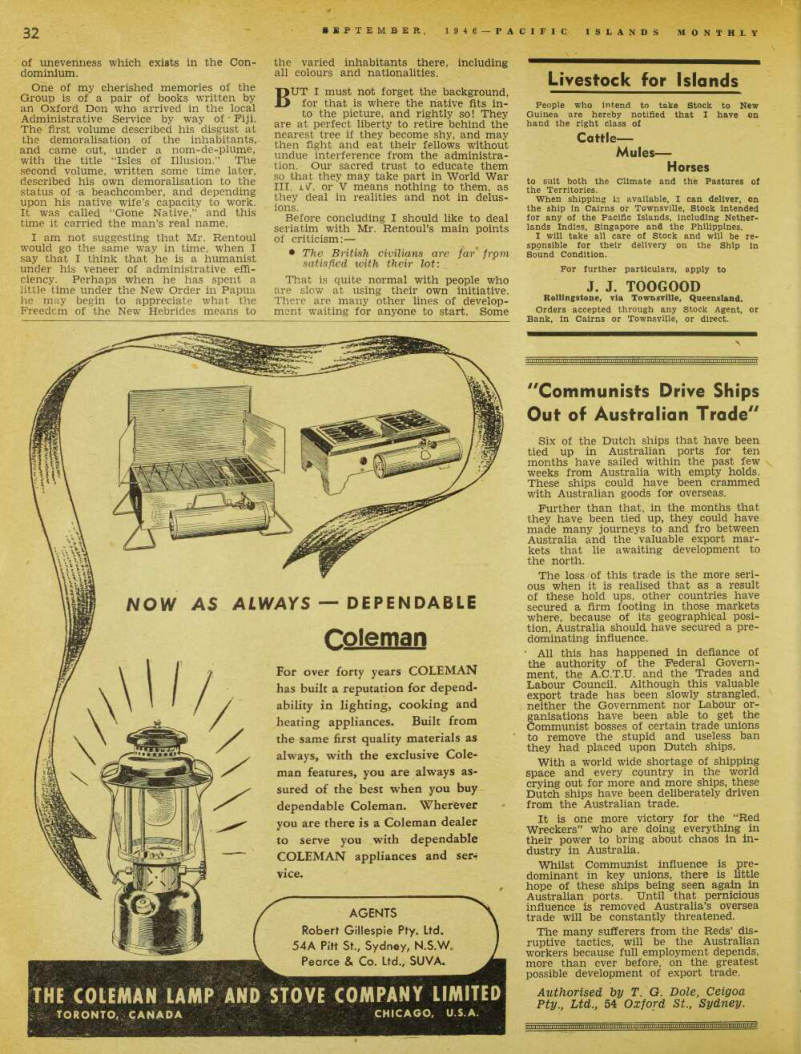
Captain Brett Hilder replies to the conclusions reached hy Mr. Alexander Rentoul in his article in the June “PIM,” under the heading, “Divide the Pandemonium.”
I HAVE no disagreement with the facts which Mr. Rentoul so clearly and fearlessly sets out in his attempt to discredit the Condominium; but I think he has come to the wrong conclusions.
He has only lightly sketched in his hopeless solution, which would be a tragic piece of mal-adrfiinistration indeed; To cut off the southern islands of Er romanga, Tanna, and Aneytium would leave them without any shipping connec tion with Australia, as they could not support a ship of their own. They would thus drop into oblivion except to phila telists. When they came under Can berra, their population of one dozen Euro peans would get proportionate considera tion with the neglected Northern Terri tory and Norfolk Island, with its 1000 inhabitants.
The rest of the Group, now predomin antly French, was built upon plantations which were all founded by British Aus tralians, who sold out at good prices when artificial conditions were turned against them. While the Condominium lasts there is always the possibility of condi tions turning again to favour Australian settlers. But once the main part of the Group goes completely French it becomes a close preserve of France, and even British shipping can no longer call econ
omically.
BEFORE I give my evaluation of the Joint Government, I should like to say that my service there was, like Mr. Rentoul’s, of nearly two years’ dura tion. My occupation as second mate of the inter-island steamer “Makambo” took me to over 100 ports of call and to the farthest corners of the Group. That was ten years ago, but the conditions appear to be no worse now, than they were then.
My study of the varied people of the group, with their romantic histories, and their commercial activities, soon con vinced me that the territory, with its in effective government, was a home-from home to those to whom liberty is dear., That statement is, of course, made from the point of view of a freedom-loving citizen. Mr. Rentoul has spoken from the ivory tower of the administrator, whose views on administration are that there should be more of it. His cure for all evils is more and stricter administration.
If the Group is poverty-stricken, then call in the professors and experts—who will want to spend millions of pounds in pampering the natives —and to the bot tomless pit with commercial enterprises!
The New Hebrides just growed, like Topsy, into a Condominium, and eventu
ally achieved for its condition a legal status—granted with great reluctance by England. (Most irregular, old man!).
Due to the inscrutable ways of provi dence, it has turned out an unqualified success, both politically and socially. It has not done brilliantly in the economic field, but this may have been due to the abolition of the slave-trade, and the more recent lack of administrative co operation in the grog-trade and the gun trade. In New South Wales, we find the vital industries of horse-racing, boxing, and the liquor-trade all receiving active support from the Government.
Compared with that temporary crown of international co-operation, the UNO, the Condominium is a miracle of har mony and tolerance. Mr. Rentoul has described the economic conditions which have operated against the British settlers for many years. What armed fury would have arisen in places like Palestine, Ire land, India or Fiji, if such discrimination were shown to a section of the commun ity?
After the racial troubles in such coun tries, we should point with pride to the naturally incompatible French and Brit ish living in comparative happiness. In cidents are rare between the two nation alities, despite the provocative effect of large quantities of Australian wine and beer. The courtesy prevalent between the two races is not due to anything in the way of repressions, for such un healthy growths do not flourish in the free air of the Hebrides.
If the Group could be remodelled as an ideal democracy, it would come to much the same thing as now, with maj ority rule (French) and adequate free dom and consideration to the minority (British).
Under the present nominal equality, French dominance and British appease ment are only a reflection of correct values. As to the Gilbertian set-up of the government, there are few people who dislike the works of W. S. Gilbert, although he must have been very un popular with pompous public servants who may have felt the sting of truth in his caricatures. I find more truth in Gilbert than in the Statutes of the Realm.
At the Blackwell wedding in Vila, in 1933, the British Resident remarked that marriage was largely a matter of give and-take, like the Condominium; and he wished the couple at least the same success as the Joint Agreement. Some marriages, of course, develop into all giv ing on one side and take on the other,
but such marriages are better than many others which end in divorce and still better again than the separation which Mr. Rentoul prescribes for the same sort
of unevenness which exists in the Condominium.
One of my cherished memories of the
AdiSnistmUve Service
Ttefirstvolume described hYsdiseust at the demoraStion ofthe inhabhants aSd came out, under a nom-de-plume,’ with the title “Isles of Illusion.” The second volume, written some time later, described his own demoralisation to the status of-a beachcomber, and depending upon his native wife’s capacity to work.
It was called “Gone Native,” and this timp it mrripri thp rpnl name time it carried the mans real name.
I am not suggesting that Mr. Rentoul ™ u \ d S° say that I think that he is a humanist under his veneer of administrative efficiency. Perhaps when he has spent a little time under the New Order in Papua he may begin to appreciate what the Freedcm of the New Hebrides means to
the varied inhabitants there, including all colours and nationalities. jy VT T must t forget the background, ** for that is where the native fits in to the P icture > and rightly so! They are at P erfect liberty to retire behind the nearest tree if become sh y> and ma y and eat their fellows without ue mt(^rferencie from the a^imstra hQ ,° t V r p^ ed JS fr? so that they^ aka P a T* '* n they deal in reamfes andnot in deius jrJfJ deal m reallties and not m delus „ T ... , - , Before concluding I should like to deal seriatim with Mr. Rentoul’s main points of criticism: — • British civilians are far from satisfied with their lot: ; That is quite normal with people who are slow at using their own initiative, There are many other lines of develop ment waiting for anyone to start. Some
of these would not require indentured labour, nor any skilled labour beyond some of the many desperate dozens of ex-Servicemen in Australia. • The natives are neglected.
This is splendid. No exploitation, no forced labour, no pampering by trade unionism and Eddie Ward. Just left alone to their own sweet devices, but free to earn some money by some very casual labour whenever they want to.
This “laissez-faire” policy is my ideal of an enlightened native policy. Bravo! • The French carry on in their usual happy-go-lucky fashion, breaking most laws to their own great profit and content.
The British have always done the same to a great extent, or they would have lost their place in the Group years ago. But they don’t rush up to the British Agent and tell him how they are beating the Frenchman at his own game. And the Agent only serves the French side when hounds the British who compete in illegal trades. • And the sun shines on the just and the unjust alike.
Then let us be thankful for the sun, and the sea, and the rain, that they are not administrators who believe in their Divine Right to rule, as did Charles mark I. His head went into the basket, and that’s where this article will go, if I don’t stick to the point.
MAY God preserve the New Hebrides from a Great Prosperity, for with wealth comes envy, and squabbling, and more Government control, and gone will be our Hebrides, the haven of the
free. May it remain the one place where vice is not vicious, where shame is un known, and where scandal is but an in telligent interest in human affairs. And may all the Gods save it from Canberra!
Long may the two flags fly at equal height over the Condominium!
Advertisements & other items, pp. 35-36 (1 item)
CO., Inc.
A. G. ANDREWS
244 California Street, San Francisco 11,
U.S.A.
Wholesalers
□ Competitive Quotations on Merchandise of Every Description. □ Thoroughly Conversant With Island T rade. □ Bankers; Bank of America, San Francisco.
Cables: ANDINC, San Prancismo.
f*. k 9* 1 Bond Street, Sydney, Australia. f Vj \JIJ l j J"J TeL B 4167. Box 3615 G.P.O.
SUPPLIERS OF GENERAL MERCHANDISE TO LEADING FIRMS THROUGHOUT THE
PACIFIC ISLANDS
Exporter* ... Importer* ... Manufacturers' Representatives Banker*: Bank of NJS.W. Bank of Adelaide. Comptolr Nat. d’Escompte de Paris.
Cable Address: “SEAFOODS,” SYDNEY.
Code*: Bentley’*, 2nd and Comp. Phraac; A.8.C., sth and 6th; Peterson, 2nd and 3rd; Banking; Acme.
Livestock for Islonds
People who intend to take Stock to New Guinea are hereby notified that I have on hand the right class of
Cattle—
Mules—
Horses
to suit both the Climate and the Pastures of the Territories.
When shipping 13 available, I can deliver, on the ship in Cairns or Townsville, Stock intended for any of the Pacific Islands, including Netherlands Indies, Singapore and the Philippines.
I will take all care of Stock and will be responsible for their delivery on the Ship in Sound Condition.
For further particulars, apply to
J. J. TOOGOOD
Rollingstone, via Townsville, Queensland.
Orders accepted through any Stock Agent, or Bank, in Cairns or Townsville, or direct.
NOW AS ALWAYS DEPENDABLE
a-"
Coleman
\ / \ / \ \ For over forty years COLEMAN has built a reputation for dependability in lighting, cooking and heating appliances. Built from the same first quality materials as always, with the exclusive Coleman features, you are always assured of the best when you buy dependable Coleman. Wherever you are there is a Coleman dealer to serve you with dependable COLEMAN appliances and service.
AGENTS
Robert Gillespie Pty. Ltd. 54A Pitt St., Sydney, N.S.W t Pearce & Co. Ltd., SUVA.
THE COLEMAN LAMP AND STOVE COMPANY LIMITED
TORONTO, CANADA
CHICAGO, U.S.A.
"Communists Drive Ships
Out of Australian Trade"
Six of the Dutch ships that have been tied up in Australian ports for ten months have sailed within the past few weeks from Australia with empty holds.
These ships could have been crammed with Australian goods for overseas.
Further than that, in the months that they have been tied up, they could have made many journeys to and fro between Australia and the valuable export markets that lie awaiting development to the north.
The loss of this trade is the more serious when it is realised that as a result of these hold ups, other countries have secured a firm footing in those markets where, because of its geographical position, Australia should have secured a predominating influence.
All this has happened in defiance of the authority of the Federal Government, the A.C.T.U. and the Trades and Labour Council. Although this valuable export trade has been slowly strangled, neither the Government nor Labour organisations have been able to get the ommunist bosses of certain trade unions to remove the stupid and useless ban they had placed upon Dutch ships.
With a world wide shortage of shipping space and every country in the world crying out for more and more ships, these Dutch ships have been deliberately driven from the Australian trade.
It is one more victory for the "Red Wreckers" who are doing everything in their power to bring about chaos in industry in Australia.
Whilst Communist influence is predominant in key unions, there is little hope of these ships being seen again in Australian ports. Until that pernicious influence is removed Australia’s oversea trade will be constantly threatened.
The many sufferers from the Reds’ disruptive tactics, will be the Australian workers because full employment depends, more than ever before, on the greatest possible development of export trade.
Authorised by T. G. Dole, Ceigoa
Pty., Ltd., 54 Oxford St., Sydney.
Australia's Interest In
Portuguese Timor
APART from New Guinea, the Islands Territory nearest to the Australian mainland is the Portuguese section of Timor, which contains 7,300 square miles and 450,000 Indonesians.
It has little economic, but great strategical importance. Japan planned to use it as a base for attack on Australia, and Japanese forces occupied it —ignoring the neutrality of Portugal—in January, 1942.
It had been hoped, that as part of the post-war settlement, Australia might purchase this Territory from Portugal.
It is not generally known that, at Canberra on March 27, 1946, the Aus tralian Government announced it had signed, with Portugal, an agreement that Australia would lay no claim to Portu guese Timor. Although Australian troops fought the Japs there, and' the Japs in Timor finally surrendered to the Australians there in September, 1945.
It is understood that recognition of Portuguese sovereignty in Timor was one of the conditions under which Britain was granted by Portugal the use of a base in the Azores, in the very critical days of the Battle of the Atlantic.
The engagement was recently an nounced in Suva of Miss Lee Houn, second daughter of Mr. and Mrs. Lee Houn, to Mr. J. B. Chin, of Massachusetts, USA, who recently arrived in the Colony from the United States. The couple first met when Mr. Chin was stationed in Fiji with the American Forces.
Advertisements & other items, p. 37 (1 item)
Tired,Sleepless
When Worried
AND YOU FEEL RUN-DOWN
Worry is Inescapable. Everyone has a share of it more or less. The great trouble about worry is that it plays havoc with your health and fitness if you let it. You become mentally and bodily weary, depressed; cannot sleep at night, lose appetite and begin to feel a nervous breakdown is Impending. That starts the vicious circle. You worry, become run-down and nervy, and that makes you worry more than ever.
Meet your troubles all the way by re- Invigorating your system and keeping it fit and well by taking Dr. Williams’ Pink Pills. These pills help to restore the red corpuscles and iron content of the blood to their normal quantity.
This enables life-giving oxygen and nourishment to be carried to the nerves, organs and tissue* of the body. In that way you become invigorated, strengthened by Dr. Williams’ Pink Pills, the vague aches and pains disappear and you are fit again to deal confidently with all your worries. At chemists and stores.
Equal to the World’s Best
Throughout Australia and Overseas there is an ever-increasing demand for
COLONIAL & BRONTE
HIGH-GRADE CANNED MEATS
There is no better quality—none more wholesome. •
TRADE MEATS FOR THE ISLANDS
order
“COLONIAL” BRAND
Roast, Corned and Boiled Beef Packed in 6,5, 4, 3. 2, 1 lb. and 12 oz. tins.
Also Corned Beef in 12 oz. Taper Tins.
Roast, Corned and Boiled Mutton. 1 lb. and 12 oz. tins.
Choice Dripping
36 » 2 lb., 1 lb. tins, and 1 lb. packets. 1
DELICIOUS
BRONTE" HOT MEALS
Steak and Kidney Pudding.
Beef Steak Pudding.
Sausages and Tomato.
Sausages and Vegetable.
Lamb and Green Peas.
Corned Beef and Boston Beans with Tomato Sauce.
Steak and Tomato.
Under present conditions it is wise to ensure that you have ample stocks of all our lines.
The Colonial Wholesale Meat Coy. Pty. Ltd.
30 GROSVENOR STREET, SYDNEY
Engineer-Optician
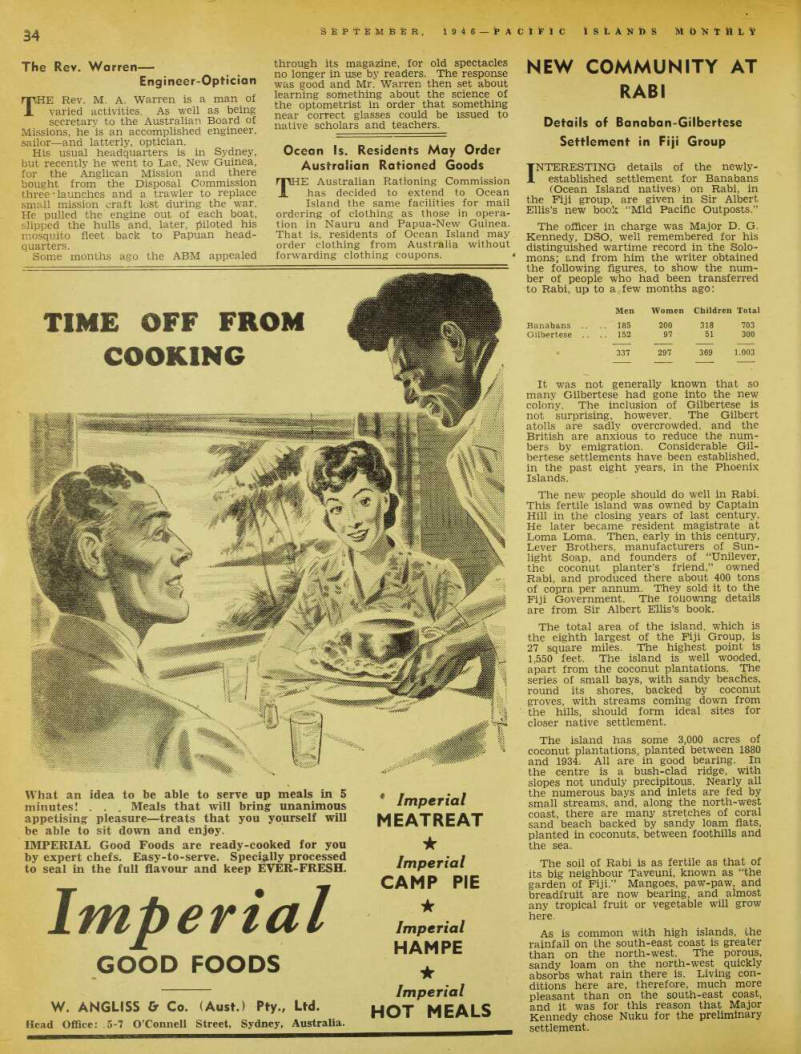
The Rev. Warren— Engineer-Optician
rE Rev. M. A. Warren is a man of varied activities. As well as being secretary to the Australian Board of Missions, he is an accomplished engineer, sailor —and latterly, optician.
His usual headquarters is in Sydney, but recently he Ttfent to Lae, New Guinea, for the Anglican Mission and there bought from the Disposal Commission three • launches and a trawler to replace small mission craft lost during the war.
He pulled the engine out of each boat, slipped the hulls and, later, piloted his mosquito fleet back to Papuan head quarters.
Some months ago the ABM appealed
through its magazine, for old spectacles n o longer in use by readers. The response was g ood and Mr warren then set about learning something about the science of tho optometrist in order that something near correct g i asses could be issued to na ti ve scholars and teachers.
Ocean Is. Residents May Order
Australian Rationed Goods
fITHE Australian Rationing Commission A has decided to extend to Ocean Island the same facilities for mail ordering of clothing as those in opera tion in Nauru and Papua-New Guinea.
That is, residents of Ocean Island may order clothing from Australia without forwarding clothing coupons.
New Community At
Rabi
Details of Banaban-Gilbertese Settlement in Fiji Group
INTERESTING details of the newly established settlement for Banabans (Ocean Island natives) on Rabi, in the Fiji group, are given in Sir Albert Ellis’s new book “Mid Pacific Outposts.”
The officer in charge was Major D. G.
Kennedy, DSO, well remembered for his distinguished wartime record in the Solo mons; and from him the writer obtained the following figures, to show the num ber of people who had been transferred to Rabi, up to a few months ago;
It was not generally known that so many Gilbertese had gone into the new colony. The inclusion of Gilbertese is not surprising, however. The Gilbert atolls are sadly overcrowded, and the British are anxious to reduce the num bers by emigration. Considerable Gil bertese settlements have been established, in the past eight years, in the Phoenix Islands.
The new people should do well in Rabi.
This fertile island was owned by Captain Hill in the closing years of last century.
He later became resident magistrate at Loma Loma. Then, early in this century, Lever Brothers, manufacturers of Sun light Soap, and founders of “Unilever, the coconut planter’s friend,” owned Rabi, and produced there about 400 tons of copra per annum. They sold it to the Fiji Government. The following details are from Sir Albert Ellis’s book.
The total area of the island, which is the eighth largest of the Fiji Group, is 27 square miles. The highest point is 1,550 feet. The island is well wooded, apart from the coconut plantations. The series of small bays, with sandy beaches, round its shores, backed by coconut groves, with streams coming down from the hills, should form ideal sites for closer native settlement.
The island has some 3,000 acres of coconut plantations, planted between 1880 and 1934. All are in good bearing. In the centre is a bush-clad ridge, with slopes not unduly precipitous. Nearly all the numerous bays and inlets are fed by small streams, and, along the north-west coast, there are many stretches of coral sand beach backed by sandy loam flats, planted in coconuts, between foothills and the sea.
The soil of Rabi is as fertile as that of its big neighbour Taveuni, known as “the garden of Fiji.” Mangoes, paw-paw, and breadfruit are now bearing, and almost any tropical fruit or vegetable will grow here.
As is common with high islands, the rainfall on the south-east coast is greater than on the north-west. The porous, sandy loam on the north-west quickly absorbs what rain there is. Living con ditions here are, therefore, much more pleasant than on the south-east coast, and it was for this reason that Major Kennedy chose Nuku for the preliminary settlement.
Men Women Children Total Banabans .. 185 200 318 703 Gilbertese ... 152 97 51 300 ♦ 337 297 369 1.003
Advertisements & other items, p. 38 (1 item)
Imperial
TIME OFF FROM
COOKING
m m m c -r in #■ m m W- \ What an idea to be able to serve up meals in 5 minutes! . . . Meals that will bring unanimous appetising pleasure—treats that you yourself will be able to sit down and enjoy.
IMPERIAL Good Foods are ready-cooked for you by expert chefs. Easy-to-serve. Specially processed to seal in the full flavour and keep EVER-FRESH.
Imperial
GOOD FOODS
W. ANGLISS & Co. (Aust.) Pty., Ltd.
Head Office: 5-7 O’Connell Street, Sydney, Australia. * Imperial
MEATREAT
★ Imperial
CAMP PIE
★ Imperial
HAMPE
★ Imperial
HOT MEALS
Magazine Section
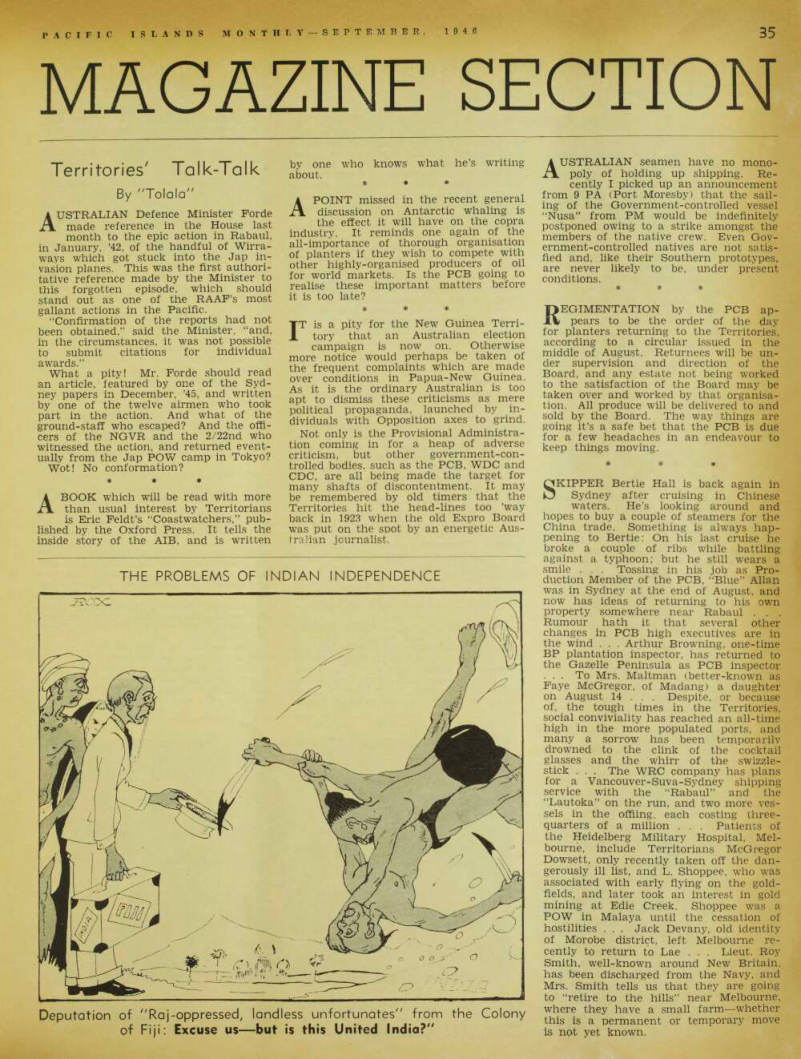
Territories' Talk-Talk
By "Tolala"
AUSTRALIAN Defence Minister Forde made reference in the House last month to the epic action in Rabaul, in January, ’42, of the handful of Wirra ways which got stuck into the Jap in vasion planes. This was the first authori tative reference made by the Minister to this forgotten episode, which should stand out as one of the RAAF’s most gallant actions in the Pacific.
“Confirmation of the reports had not been obtained,” said the Minister, “and, in the circumstances, it was not possible to submit citations for individual awards.”
What a pity! Mr. Forde should read an article, featured by one of the Syd ney papers in December, ’45, and written by one of the twelve airmen who took part in the action. And what of the ground-staff who escaped? And the offi cers of the NGVR and the 2/22nd who witnessed the action, and returned event ually from the Jap POW camp in Tokyo?
Wot! No conformation? * ♦ * A BOOK which will be read with more than usual interest by Territorians is Eric Feldt’s “Coastwatchers,” pub lished by the Oxford Press. It tells the inside story of the AIB, and is written
ou ° t ne who knows what he ' s wriUns * ♦ * . POINT missed in the recent general discussion on Antarctic whaling is . the effect it will have on the copra industry It reminds one again of the all-importance of thorough of planters if they wish to compete with other highly-organised producers of oil for world markets. Is the PCB going to realise these important matters befoie it is too late? * * * j T ig a pity f or the New Guinea Terri- J. tory that an Australian election pamnaien is now on Otherwise more c T 0 P tkl would perhaps’ be takeT^S As 14 is the ordinary Australian is too apt to dismiss these criticisms as mere cal propaganda, launched by in dividuals with Opposition axes to grind, . Not only is the Provisional Admimstra tion coming in for a heap of adverse criticism, but other government-con trolled bodies, such as the PCB, WDC and CDC, are all being made the target for many shafts of discontentment. It may be remembered by old timers that the Territories hit the head-lines too ’way back in 1923 when the old Expro Board was put on the spot by an energetic Aus tralian journalist.
AUSTRALIAN seamen have no mono poly of holding up shipping. Re cently I picked up an announcement from 9 PA (Port Moresby) that the sail ing of the Government-controlled vessel “Nusa” from PM would be indefinitely postponed owing to a strike amongst the members of the native crew. Even Gov ernment-controlled natives are not satis fied and, like their Southern prototypes, are never likely to be, under present conditions. * ♦ ♦ Regimentation by the pcb ap pears to be the order of the day for planters returning to the Territories, according to a circular issued in the middle of August, Returnees will be un der supervision and direction of the Board, and any estate not being worked to the satisfaction of the Board may be taken over and worked by that organisa tion. All produce will be delivered to and sold by the Board. The way things are going it’s a safe bet that the PCB is due for a few headaches in an endeavour to keep things moving. ♦ * * SKIPPER Bertie Hall is back again in Sydney after cruising in Chinese waters. He’s looking around and hopes to buy a couple of steamers for the China trade. Something is always hap pening to Bertie: On his last cruise he broke a couple of ribs while battling against a typ'hoon; but he still wears a smile . . . Tossing in his job as Pro duction Member of the PCB. “Blue” Allan was in Sydney at the end of August, and now has ideas of returning to his own property somewhere near Rabaul . . .
Rumour hath it that several other changes in PCB high executives are in the wind . . . Arthur Browning, one-time BP plantation inspector, has returned to the Gazelle Peninsula as PCB inspector ... To Mrs. Maltman (better-known as Faye McGregor, of Madang) a daughter on August 14 . . . Despite, or because of, the tough times in the Territories, social conviviality has reached an all-time high in the more populated ports, and many a sorrow has been temporarilv drowned to the clink of the cocktail glasses and the whirr of the swizzle stick . . . The WRC company has plans for a Vancouver-Suva-Sydney shipping service with the “Rabaul” and the “Lautoka” on the run, and two more ves sels in the offiing, each costing three quarters of a million . . . Patients of the Heidelberg Military Hospital, Mel bourne, include Territorians McGregor Dowsett, only recently taken off the dan gerously ill list, and L. Shoppee, who was associated with early flying on the gold fields, and later took an interest in gold mining at Edie Creek. Shoppee was a POW in Malaya until the cessation of hostilities . . . Jack Devany, old identity of Morobe district, left Melbourne re cently to return to Lae . . . Lieut. Roy Smith, well-known around New Britain, has been discharged from the Navy, and Mrs. Smith tells us that they are going to “retire to the hills” near Melbourne, where they have a small farm—whether this is a permanent or temporary move is not yet known.
Advertisements & other items, p. 39 (1 item)
The Problems Of Indian Independence
Deputation of "Raj-oppressed, landless unfortunates" from the Colony of Fiji: Excuse us —but is this United India?"
When The Jap Was The Victor Of Rabaul
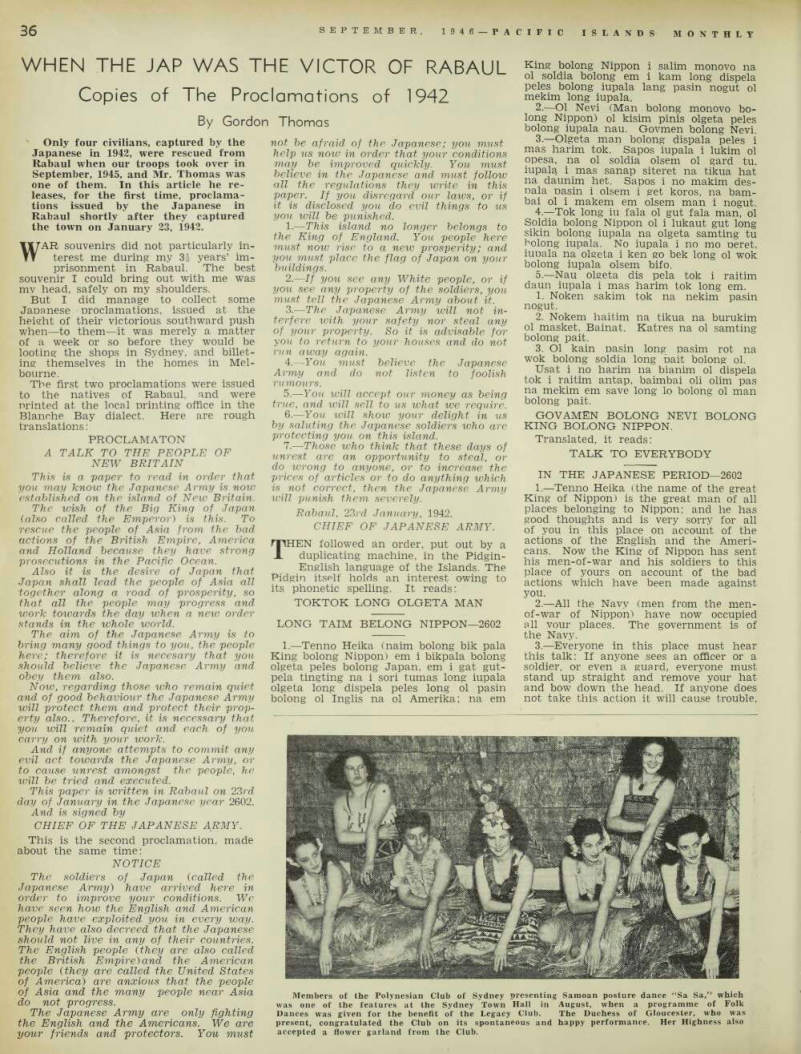
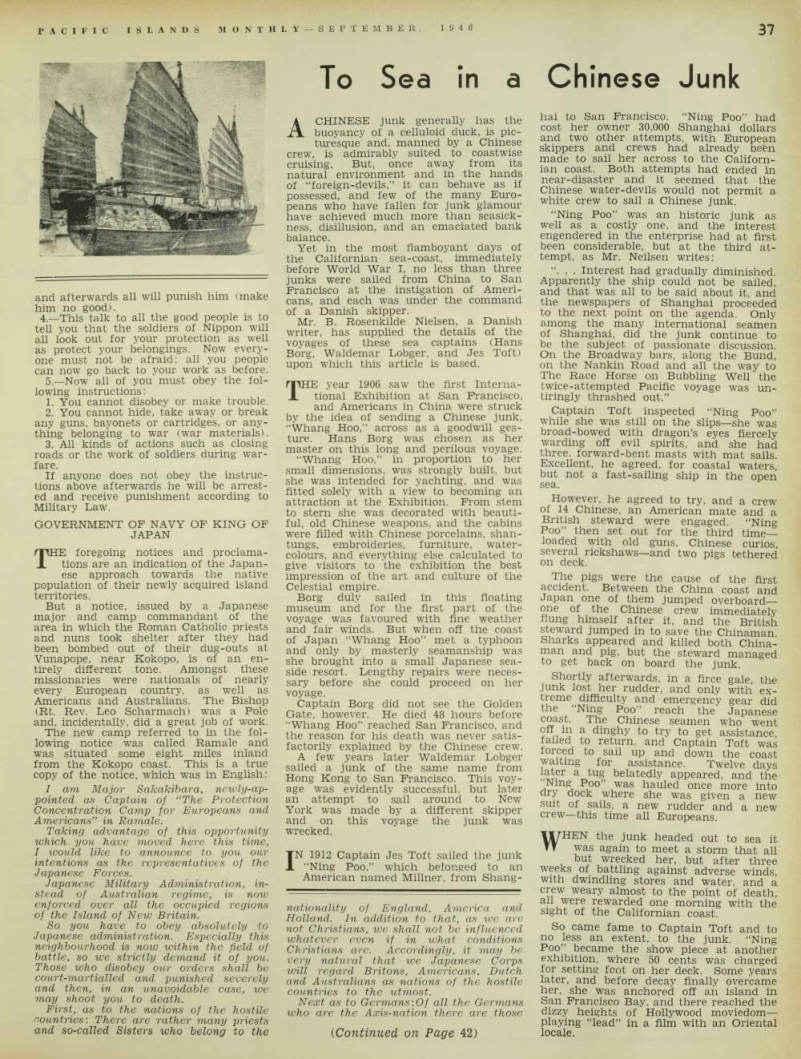
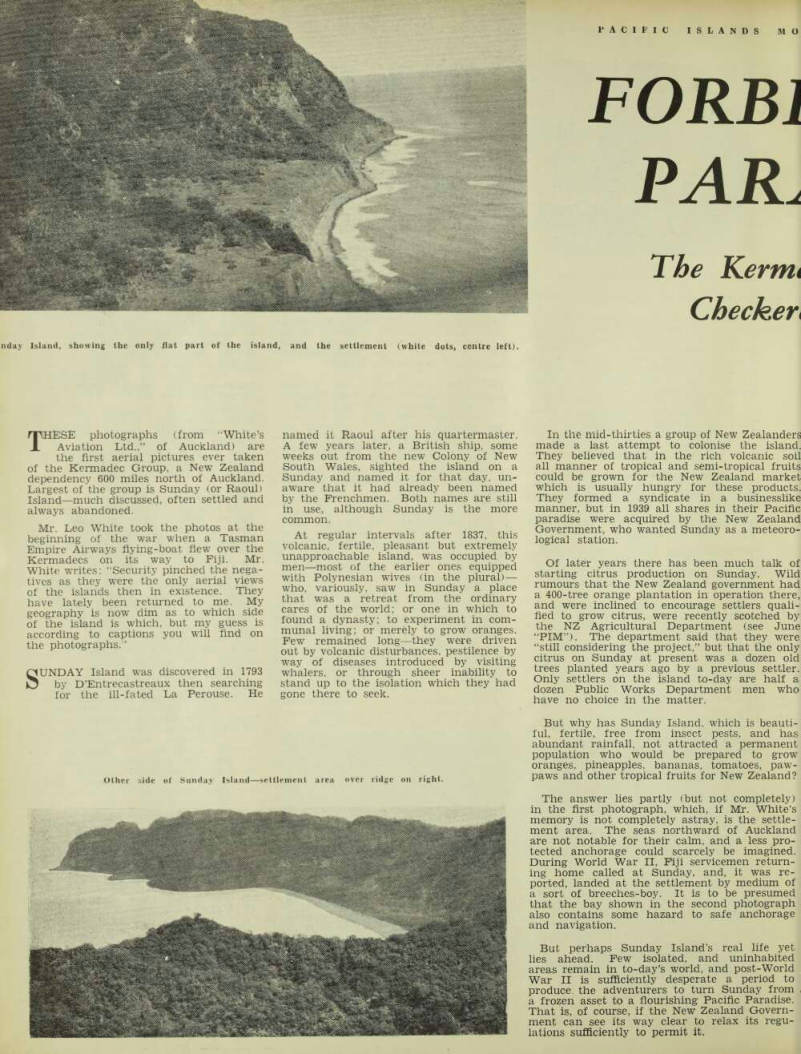
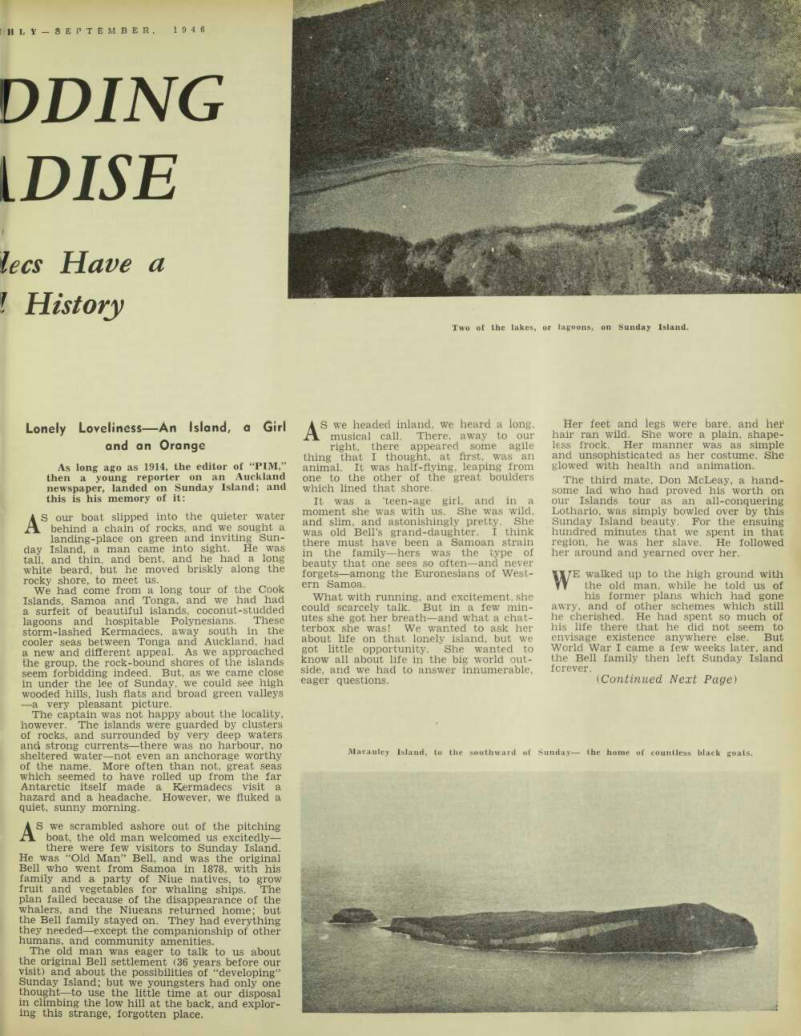
Copies of The Proclamations of 1942
By Gordon Thomas
Only four civilians, captured by the Japanese in 1942, were rescued from Rabaul when our troops took over in September, 1945, and Mr. Thomas was one of them. In this article he re leases, for the first time, proclama tions issued by the Japanese in Rabaul shortly after they captured the town on January 23, 1942.
WAR souvenirs did not particularly in terest me during my 31 years’ im prisonment in Rabaul. The best souvenir I could bring out with me was my head, safely on my shoulders.
But I did manage to collect some Japanese proclamations, issued at the heieht of their victorious southward push when —to them—it was merely a matter of a week or so before they would be looting the shops in Sydney, and billet ing themselves in the homes in Mel bourne.
The first two proclamations were issued to the natives of Rabaul. and were printed at the local printing office in the Blanche Bay dialect. Here are rough translations:
Proclamaton
A Talk To The People Of
New Britain
This is a paper to read in order that you may know the Japanese Army is now established on the island of New Britain.
The wish of the Big King of Japan (also called the Emperor) is this. To rescue the people of Asia from the bad actions of the British Empire, America and Holland because they have strong prosecutions in the Pacific Ocean.
Also it is the desire of Japan that Japan shall lead the people of Asia all together along a road of prosperity, so that all the people may progress and work towards the day when a new order stands in the whole world.
The aim of the Japanese Army is to bring many good things to you, the people here; therefore it is necesary that you should believe the Japanese Army and obey them also.
Now, regarding those who remain quiet and of good behaviour the Japanese Army will protect them and protect their prop erty also.. Therefore, it is necessary that you will remain quiet and each of you carry on with your work.
And if anyone attempts to commit any evil act towards the Japanese Army, or to cause unrest amongst the people, he will be tried and executed.
This paper is written in Rabaul on 23rd day of January in the Japanese year 2602.
And is signed by
Chief Of The Japanese Army.
This is the second proclamation, made about the same time:
Notice
The soldiers of Japan (called the Japanese Army) have arrived here in order to improve your conditions. We have seen how the English and American people have exploited you in every way.
They have also decreed that the Japanese should not live in any of their countries.
The English people (they are also called the British Empire) and the American people (they are called the United States of America) are anxious that the people of Asia and the many people near Asia do not progress.
The Japanese Army are only fighting the English and the Americans. We are your friends and protectors. You must
King bolong Nippon i salim monovo na ol soldia bolong em i kam long dispela peles bolong iupala lang pasin nogut ol mekim long iupala. 2. —Ol Nevi (Man bolong monovo bo long Nippon) ol kisim pinis olgeta peles bolong iupala nau. Govmen bolong Nevi. 3. —Olgeta man bolong dispala peles i mas harim tok. Sapos iupala i lukim ol opesa, na ol soldia olsem ol gard tu, i mas sanap siteret na tikua hat na daunim het. Sapos i no makim des nala nasin i olsem i get koros, na bam bai ol i makem em olsem man i nogut. 4. Tok long iu fala ol gut fala man, ol Soldia bolong Nippon ol i lukaut gut long sikin bolong iupala na olgeta samting tu bolong iupala. No iupala i no mo oeret, iuoala na olgeta i ken go bek long ol wok bolong iupala olsem bifo. 5. —Nau olgeta dis pela tok i raitim daun iupala i mas harim tok long em. 1. Noken sakim tok na nekim pasin nogut. 2. Nokem haitim na tikua na burukim ol masket, Bainat. Katres na ol samting bolong pait. 3. Ol kain pasin long pasim rot na wok bolong soldia long bait bolong 01.
Usat i no harim na bianim ol dispela tok i raitim antap, baimbai oli olim pas na mekim em save long lo bolong ol man bolong pait.
Govamen Bolong Nevi Bolong
King Bolong Nippon.
Translated, it reads:
Talk To Everybody
In The Japanese Period-2602
1. —Tenno Heika (the name of the great King of Nippon) is the great man of all places belonging to Nippon; and he has good thoughts and is very sorry for all of you in this place on account of the actions of the English and the Ameri cans. Now the King of Nippon has sent his men-of-war and his soldiers to this place of yours on account of the bad actions which have been made against you. 2. —All the Navy (men from the men of-war of Nippon) have now occupied all your places. The government is of the Navy. 3. —Everyone in this place must hear this talk: If anyone sees an officer or a soldier, or even a guard, everyone must stand up straight and remove your hat and bow down the head. If anyone does not take this action it will cause trouble,
not be afraid of the Japanese; you must help its now in order that your conditions may be improved quickly. You must believe in the Japanese and must follow all the regulations they write in this paper. If you disregard our laws, or if it is disclosed you do evil things to us you will be punished. 1. —This island no longer belongs to the King of England. You people here must now rise to a new prosperity; and you must place the flag of Japan on your buildings. 2. —lf you see any White people, or if you see any property of the soldiers, you must tell the Japanese Army about it. 3. —The Japanese Army will not in terfere with your safety nor steal any of your property. So it is advisable for you to return to your houses and do not run away again. 4. —You must believe the Japanese Army and do not listen to foolish rumours. 5. —You will accept our money as being true, and will sell to us what we require. 6. —You will show your delight in us by saluting the Japanese soldiers who are protecting you on this island. 7. —Those who think that these days of unrest are an opportunity to steed, or do wrong to anyone, or to increase the prices of articles or to do anything which is not correct, then the Japanese Army will punish them severely.
Rahaid. 23 rd January, 1942.
Chief Of Japanese Army.
THEN followed an order, put out by a duplicating machine, in the Pidgin- English language of the Islands. The Pidgin itself holds an interest owing to its phonetic spelling. It reads:
Toktok Long Olgeta Man
Long Taim Belong Nippon—26O2
I.—Tenno Heika (naim bolong bik pala King bolong Nippon) em i bikpala bolong olgeta peles bolong Japan, em i gat gut pela tingting na i sori tumas long iupala olgeta long dispela peles long ol pasin bolong ol Inglis na ol Amerika; na em
Members of the Polynesian Club of Sydney presenting Samoan posture dance “Sa Sa,” which was one of the features at the Sydney Town Hall in August, when a programme of Folk Dances was given for the benefit of the Legacy Club. The Duchess of Gloucester, who was present, congratulated the Club on its spontaneous and happy performance. Her Highness also accepted a flower garland from the Club.
and afterwards all will punish him (make him no good). 4.—This talk to all the good people is to tell you that the soldiers of Nippon will all look out for your protection as well as protect your belongings. Now every one must not be afraid: all you people can now go back to your work as before. s.—Now all of you must obey the fol lowing Instructions: 1. You cannot disobey or make trouble. 2. You cannot hide, take away or break any guns, bayonets or cartridges, or any thing belonging to war (war materials). 3. All kinds of actions such as closing roads or the work of soldiers during war fare.
If anyone does not obey the instruc tions above afterwards he will be arrest ed and receive punishment according to Military Law.
Government Of Navy Of King Of
Japan
rE foregoing notices and proclama tions are an indication of the Japan ese approach towards the native population of their newly acquired island territories.
But a notice, issued by a Japanese major and camp commandant of the area in which the Roman Catholic priests and nuns took shelter after they had been bombed out of their dug-outs at Vunapope, near Kokopo, is of an en tirely different tone. Amongst these missionaries were nationals of nearly every European country, as well as Americans and Australians. The Bishop (Rt. Rev. Leo Scharmach) was a Pole and, incidentally, did a great job of work.
The new camp referred to in the fol lowing notice was called Ramale and was situated some eight miles inland from the Kokopo coast. This is a true copy of the notice, which was in English: I am Major Sakakibara, newly-ap pointed as Captain of “The Protection Concentration Camp for Europeans and Americans” in Ramale.
Taking advantage of this opportunity which you have moved here this time, I would like to announce to you our intentions as the representatives of the Japanese Forces.
Japanese Military Administration, in stead of Australian regime, is now enforced over all the occupied regions of the Island of New Britain.
So you have to obey absolutely to Japanese administration. Especially this neighbourhood is now within the field of battle, so we strictly demand it of you.
Those who disobey our orders shall be court-martialled and punished severely and then, in an unavoidable case, we may shoot you to death.
First, as to the nations of the hostile countries: There are rather many priests and so-called Sisters who belong to the
nationality of England, America and Holland. In addition to that, as we are not Christians, we shall not be influenced whatever even if in what conditions Christians are. Accordingly, it may be very natural that we Japanese Corps will regard Britons, Americans, Dutch and Australians as nations of the hostile countries to the utmost.
Next as to Germans:Of all the Germans who are the Axis-nation there are those
(Continued on Page 42)
who have carried out hostile action against us, and who it is no exaggeration to say have clearly a hostile character.
So that, to confess the truth, we must pay attention for these men, hut we do not want to pay regard to past events in conformity with the faithfulness and consciousness to the Aids nation.
If one of you happen to carry out a hostile action in the future, we hope such things will never happen, we will not punish only the man, but also, as the faint responsibility, punish all of you in the name of “Mission.”
By reason of living together with the nations of the hostile countries, military authorities have concentrated Germans within this fence under the necessity of Military Operations.
And we will protect yourselves and escort you to the enemy in the necessary range.
Hereby it will be prohibited to go out of the fence and streams without any military permission.
Suppose there are those who go out of the fence and stream without any military permission, they shall be punished severely and those who run away in the same condition shall be shot.
However Japan originally loves justice and consciousness, and also is courteous on humanity.
So that, as long as there will be no
espionage activity, even if you are the anti-Axis nation, we will never treat you with such tortures as British and American, Australian Corps has dealt with the internees, our fellow-countrymen in their countries.
You must lead a life inside this limited boundary, but we shall give you freedom in the limit and guarantee your daily life in some range and supplement the minimum for your living materials, But as we are fighting now, the principle is to work yourselves and to be self supporting in the best way you can.
Accordingly, we will permit you to work on the farm permitted and give farm by request.
You ought to understand well the above-mentioned items and we demand your absolute submission to the military orders.
The 2nd July, 1944.
Captain of the Protection and Concentration Gamp for Europeans and Americans
Major Sakakibara.
They are good souvenirs—these docu ments from behind the lines; for they tell me, better than all the Samurai swords or shell-cases, what lay in the minds of those erst>while victorious Nip ponese when they lauded it over the native and white peoples of New Britain.
To Sea in a Chinese Junk
A CHINESE junk generally has the buoyancy of a celluloid duck, is pic turesque and, manned by a Chinese crew, is admirably suited to coastwise cruising. But, once away from its natural environment and in the hands of “foreign-devils,” it can behave as if possessed, and few of the many Euro peans who have fallen for junk glamour have achieved much more than seasick ness, disillusion, and an emaciated bank balance.
Yet in the most flamboyant days of the Californian sea-coast, immediately before World War I, no less than three junks were sailed from China to San Francisco at the instigation of Ameri cans, and each was under the command of a Danish skipper.
Mr. B. Rosenkilde Nielsen, a Danish writer, has supplied the details of the voyages of these sea captains (Hans Borg. Waldemar Lobger, and Jes Toft) upon which this article is based.
THE year 1906 saw the first Interna tional Exhibition at San Francisco, and Americans in China were struck by the idea of sending a Chinese junk, “Whang Hoo,” across as a goodwill ges ture. Hans Borg was chosen as her master on this long and perilous voyage.
“Whang Hoo,” in proportion to her small dimensions, was strongly built, but she was intended for yachting, and was fitted solely with a view to becoming an attraction at the Exhibition. From stem to stem she was decorated with beauti ful, old Chinese weapons, and the cabins were filled with Chinese porcelains, shan tungs, embroideries, furniture, water colours, and everything else calculated to give visitors to the exhibition the best impression of the art and culture of the Celestial empire.
Borg duly sailed in this floating museum and for the first part of the voyage was favoured with fine weather and fair winds. But when off the coast of Japan “Whang Hoo” met a typhoon and only by masterly seamanship was she brought into a small Japanese sea side resort. Lengthy repairs were neces sary before she could proceed on her voyage.
Captain Borg did not see the Golden Gate, however. He died 48 hours before "Whang Hoo” reached San Francisco, and the reason for his death was never satis factorily explained by the Chinese crew.
A few years later Waldemar Lobger sailed a junk of the same name from Hong Kong to San Francisco. This voy age was evidently successful, but later an attempt to sail around to New York was made by a different skipper and on this voyage the junk was wrecked.
IN 1912 Captain Jes Toft sailed the junk “Ning Poo,” which belonged to an American named Millner, from Shang
hai to San Francisco. “Ning Poo” had cost her owner 30,000 Shanghai dollars and two other attempts, with European skippers and crews had already been made to sail her across to the Californ ian coast. Both attempts had ended in near-disaster and it seemed that the Chinese water-devils would not permit a white crew to sail a Chinese junk.
“Ning Poo” was an historic junk as well as a costly one, and the interest engendered in the enterprise had at first been considerable, but at the third at tempt, as Mr. Neilsen writes: “. . . Interest had gradually diminished.
Apparently the ship could not be sailed, and that was all to be said about it, and the newspapers of Shanghai proceeded to the next point on the agenda. Only among the many international seamen of Shanghai, did the junk continue to be the subject of passionate discussion.
On the Broadway bars, along the Bund, on the Nankin Road and all the way to The Race Horse on Bubbling Well the twice-attempted Pacific voyage was un tiringly thrashed out.”
Captain Toft inspected “Ning Poo” while she was still on the slips—she was broad-bowed with dragon’s eyes fiercely warding off evil spirits, and she had three, forward-bent masts with mat sails.
Excellent, he agreed, for coastal waters, but not a fast-sailing ship in the open sea.
However, he agreed to try, and a crew of 14 Chinese, an American mate and a British steward were engaged. “Ning Poo” then set out for the third time loaded with old guns, Chinese curios, several rickshaws—and two pigs tethered on deck.
The pigs were the cause of the first accident. Between the China coast and Japan one of them jumped overboard— one of the Chinese crew immediately flung himself after it, and the British steward jumped in to save the Chinaman Sharks appeared and killed both China man and pig, but the steward managed to get back on board the junk.
Shortly afterwards, in a firce gale, the junk lost her rudder, and only with ex treme difficulty and emergency gear did the “Ning Poo” reach the Japanese coast. The Chinese seamen who went f dinghy to try to get assistance, failed to return, and Captain Toft was forced to sail up and down the coast waiting for assistance. Twelve days later a tug belatedly appeared, and the Ning Poo” was hauled once more into dry dock where she was given a new suit of sails, a new rudder and a new crew—this time all Europeans.
WHEN the junk headed out to sea it was again to meet a storm that all but wrecked her, but after three weeks of battling against adverse winds, with dwindling stores and water, and a crew weary almost to the point of death, all were rewarded one morning with the sight of the Californian coast.
So came fame to Captain Toft and to no less an extent, to the junk. “Ning Poo” became the show piece at another exhibition, where 50 cents was charged for setting foot on her deck. Some years later, and before decay finally overcame her, she was anchored off an island in San Francisco Bay. and there reached the dizzy heights of Hollywood moviedom — playing “lead” in a film with an Oriental locale.
Forbidding
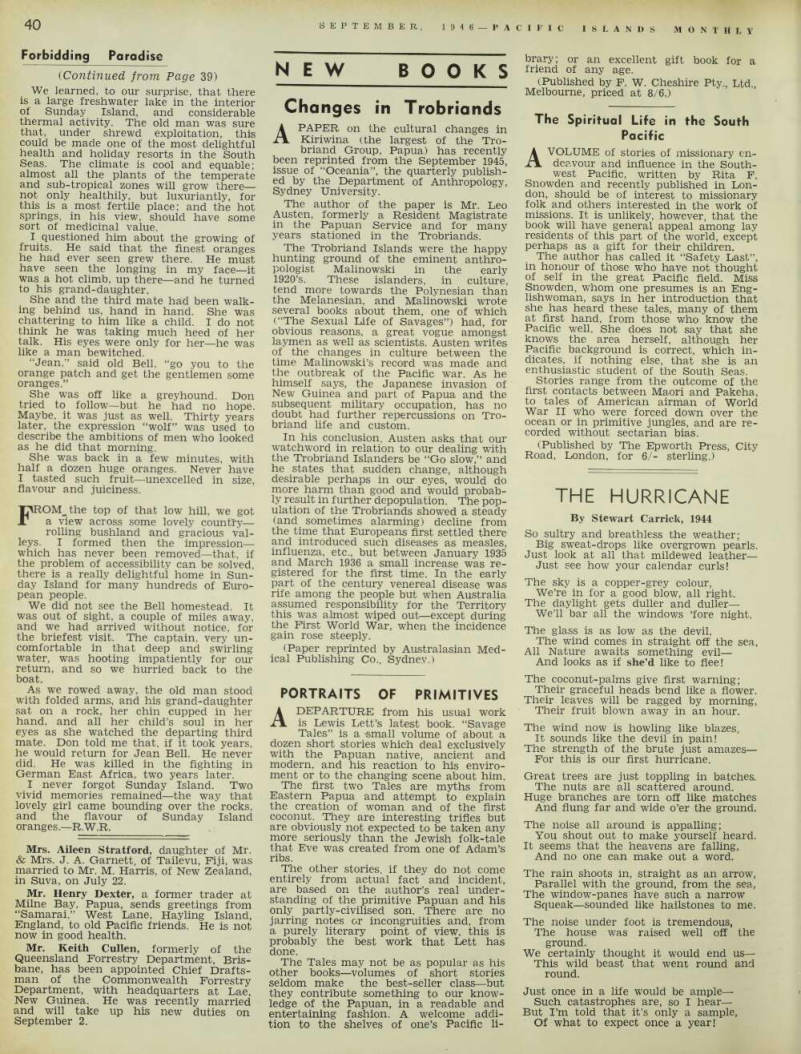
Paradise
The Kerm decs Have a Checker History
THESE photographs (from "White’s
Aviation Ltd.,” of Auckland) are the first aerial pictures ever taken of the Kermadec Group, a New Zealand dependency 600 miles north of Auckland.
Largest of the group is Sunday (or Raoul) Island—much discussed, often settled and always abandoned.
Mr. Leo White took the photos at the beginning of the war when a Tasman Empire Airways flying-boat flew over the Kermadecs on its way to Fiji. Mr.
White writes; “Security pinched the nega tives as they were the only aerial views of the islands then in existence. They have lately been returned to me. My geography is now dim as to which side of the island is which, but my guess is according to captions you will find on the photographs. ’
SUNDAY Island was discovered in 1793 by D’Entrecastreaux then searching for the ill-fated La Perouse. He
named it Raoul after his quartermaster.
A few years later, a British ship, some weeks out from the new Colony of New South Wales, sighted the island on a Sunday and named it for that day, un aware that it had already been named by the Frenchmen. Both names are still in use, although Sunday is the more common.
At regular intervals after 1837, this volcanic, fertile, pleasant but extremely unapproachable island, was occupied by men—most of the earlier ones equipped with Polynesian wives (in the plural)— who, variously, saw in Sunday a place that was a retreat from the ordinary cares of the world; or one in which to found a dynasty; to experiment in com munal living; or merely to grow oranges.
Few remained long—they were driven out by volcanic disturbances, pestilence by way of diseases introduced by visiting whalers, or through sheer inability to stand up to the isolation which they had gone there to seek.
In the mid-thirties a group of New Zealanders made a last attempt to colonise the island.
They believed that in the rich volcanic soil all manner of tropical and semi-tropical fruits could be grown for the New Zealand market which is usually hungry for these products.
They formed a syndicate in a businesslike manner, but in 1939 all shares in their Pacific paradise were acquired by the New Zealand Government, who wanted Sunday as a meteoro logical station.
Of later years there has been much talk of starting citrus production on Sunday. Wild rumours that the New Zealand government had a 400-tree orange plantation in operation there, and were inclined to encourage settlers quali fied to grow citrus, were recently scotched by the NZ Agricultural Department (see June “PIM”). The department said that they were “still considering the project,” but that the only citrus on Sunday at present was a dozen old trees planted years ago by a previous settler.
Only settlers on the island to-day are half a dozen Public Works Department men who have no choice in the matter.
But why has Sunday Island, which is beauti ful, fertile, free from insect pests, and has abundant rainfall, not attracted a permanent population who would be prepared to grow oranges, pineapples, bananas, tomatoes, paw paws and other tropical fruits for New Zealand?
The answer lies partly (but not completely) in the first photograph, which, if Mr. White’s memory is not completely astray, is the settle ment area. The seas northward of Auckland are not notable for their calm, and a less pro tected anchorage could scarcely be imagined.
During World War 11, Fiji servicemen return ing home called at Sunday, and, it was re ported, landed at the settlement by medium of a sort of breeches-boy. It is to be presumed that the bay shown in the second photograph also contains some hazard to safe anchorage and navigation.
But perhaps Sunday Island’s real life yet lies ahead. Few isolated, and uninhabited areas remain in to-day’s world, and post-World War II is sufficiently desperate a period to produce, the adventurers to turn Sunday from , a frozen asset to a flourishing Pacific Paradise.
That is, of course, if the New Zealand Govern ment can see its way clear to relax its regu lations sufficiently to permit it.
[?]nday Island, showing the only flat part of the island, and the settlement (white dots, centre left).
Other side of Sunday Island—settlement area over ridge on right.
Lonely Loveliness —An Island, a Girl
and an Orange
As long ago as 1914, the editor of “PIM,” then a young reporter on an Auckland newspaper, landed on Sunday Island; and this is his memory of it: AS our boat slipped into the quieter water behind a chain of rocks, and we sought a landing-place on green and inviting Sun day Island, a man came into sight. He was tall, and thin, and bent, and he had a long white beard, but he moved briskly along the rocky shore, to meet us.
We had come from a long tour of the Cook Islands, Samoa and Tonga, and we had had a surfeit of beautiful islands, coconut-studded lagoons and hospitable Polynesians. These storm-lashed Kermadecs, away south in the cooler seas between Tonga and Auckland, had a new and different appeal. As we approached tTie group, the rock-bound shores of the islands seem forbidding indeed. But, as we came close in under the lee of Sunday, we could see high wooded hills, lush flats and broad green valleys —a very pleasant picture.
The captain was not happy about the locality, however. The islands were guarded by clusters of rocks, and surrounded by very deep waters and strong currents —there was no harbour, no sheltered water —not even an anchorage worthy of the name. More often than not, great seas which seemed to have rolled up from the far Antarctic itself made a Kermadecs visit a hazard and a headache. However, we fluked a quiet, sunny morning.
AS we scrambled ashore out of the pitching boat, the old man welcomed us excitedly— there were few visitors to Sunday Island.
He was “Old Man” Bell, and was the original Bell who went from Samoa in 1878, with his family and a party of Niue natives, to grow fruit and vegetables for whaling ships. The plan failed because of the disappearance of the whalers, and the Niueans returned home; but the Bell family stayed on. They had everything they needed —except the companionship of other humans, and community amenities.
The old man was eager to talk to us about the original Bell settlement (36 years before our visit) and about the possibilities of “developing”
Sunday Island; but we youngsters had only one thought—to use the little time at our disposal in climbing the low hill at the back, and explor ing this strange, forgotten place.
AS we headed inland, we heard a long, musical call. There, away to our right, there appeared some agile thing that I thought, at first, was an animal. It was half-flying, leaping from one to the other of the great boulders which lined that shore.
It was a ’teen-age girl, and in a moment she was with us. She was wild, and slim, and astonishingly pretty. She was old Bell’s grand-daughter. I think there must have been a Samoan strain in the family—hers was the type of beauty that one sees so often —and never forgets—among the Euronesians of West ern Samoa.
What with running, and excitement, she could scarcely talk. But in a few min utes she got her breath —and what a chat terbox she was! We wanted to ask her about life on that lonely island, but we got little opportunity. She wanted to know all about life in the big world out side, and we had to answer innumerable, eager questions.
Her feet and legs were bare, and her hair ran wild. She wore a plain, shape less frock. Her manner was as simple and unsophisticated as her costume. She glowed with health and animation.
The third mate, Don McLeay, a hand some lad who had proved his worth on our Islands tour as an all-conquering Lothario, was simply bowled over by this Sunday Island beauty. For the ensuing hundred minutes that we spent in that region, he was her slave. He followed her around and yearned over her.
WE walked up to the high ground with the old man. while he told us of his former plans which had gone awry, and of other schemes which still he cherished. He had spent so much of his life there that he did not seem to envisage existence anywhere else. But World War I came a few weeks later, and the Bell family then left Sunday Island forever, (Continued Next Page )
Two of the lakes, or lagoons, on Sunday Island.
Macauley Island, to the southward of Sunday—the home of countless black goats.
We learned, to our surprise, that there is a large freshwater lake in the interior of Sunday Island, and considerable thermal activity. The old man was sure that, under shrewd exploitation, this could be made one of the most delightful health and holiday resorts in the South Seas. The climate is cool and equable; almost all the plants of the temperate and sub-tropical zones will grow there— not only healthily, but luxuriantly, for this is a most fertile place; and the hot springs, in his view, should have some sort of medicinal value.
I questioned him about the growing of fruits. He said that the finest oranges he had ever seen grew there. He must have seen the longing in my face—it was a hot climb, up there—and he turned to his grand-daughter.
She and the third mate had been walk ing behind us, hand in hand. She was chattering to him like a child. I do not think he was taking much heed of her talk. His eyes were only for her—he was like a man bewitched.
“Jean,” said old Bell, “go you to the orange patch and get the gentlemen some oranges.”
She was off like a greyhound. Don tried to follow—but he had no hope.
Maybe, it was just as well. Thirty years later, the expression “wolf” was used to describe the ambitions of men who looked as he did that morning.
She was back in a few minutes, with half a dozen huge oranges. Never have I tasted such fruit—unexcelled in size, flavour and juiciness. rOM_the top of that low hill, we got a view across some lovely country— rolling bushland and gracious val leys. I formed then the impression— which has never been removed—that, if the problem of accessibility can be solved, there is a really delightful home in Sun day Island for many hundreds of Euro pean people.
We did not see the Bell homestead. It was out of sight, a couple of miles away, and we had arrived without notice, for the briefest visit. The captain, very un comfortable in that deep and swirling water, was hooting impatiently for our return, and so we hurried back to the boat.
As we rowed away, the old man stood with folded arms, and his grand-daughter sat on a rock, her chin cupped in her hand, and all her child’s soul in her eyes as she watched the departing third mate. Don told me that, if it took years, he would return for Jean Bell. He never did. He was killed in the fighting in German East Africa, two years later.
I never forgot Sunday Island. Two vivid memories remained—the way that lovely girl came bounding over the rocks, and the flavour of Sunday Island oranges.—R.W.R.
Mrs. Aileen Stratford, daughter of Mr. & Mrs. J. A. Garnett, of Tailevu, Fiji, was married to Mr. M. Harris, of New Zealand, in Suva, on July 22.
Mr. Henry Dexter, a former trader at Milne Bay, Papua, sends greetings from “Samarai,” West Lane, Hayling Island, England, to old Pacific friends. He is not now in good health.
Mr. Keith Cullen, formerly of the Queensland Forrestry Department, Bris bane, has been appointed Chief Drafts man of the Commonwealth Forrestry Department, with headquarters at Lae, New Guinea. He was recently married and will take up his new duties on September 2.
Advertisements & other items, pp. 42-43 (2 items)
Pacific Islands Mo
Doing
WISE
1 lees Have a I History
HL V - SEPTEMBER, 1946
Changes in Trobriands
New Books
A PAPER on the cultural changes in Kiriwina (the largest of the Tro briand Group, Papua) has recently been reprinted from the September 1945, issue of “Oceania”, the quarterly publish ed by the Department of Anthropology, Sydney University.
The author of the paper is Mr. Leo Austen, formerly a Resident Magistrate in the Papuan Service and for many years stationed in the Trobriands.
The Trobriand Islands were the happy hunting ground of the eminent anthro pologist Malinowski in the early 1920’5. These islanders, in culture, tend more towards the Polynesian than the Melanesian, and Malinowski wrote several books about them, one of which (“The Sexual Life of Savages”) had, for obvious reasons, a great vogue amongst laymen as well as scientists. Austen writes of the changes in culture between the time Malinowski’s record was made and the outbreak of the Pacific war. As he himself says, the Japanese invasion of New Guinea and part of Papua and the subsequent military occupation, has no doubt had further repercussions on Tro briand life and custom.
In his conclusion, Austen asks that our watchword in relation to our dealing with the Trobriand Islanders be “Go slow,” and he states that sudden change, although desirable perhaps in our eyes, would do more harm than good and would probab ly result in further depopulation. The pop ulation of the Trobriands showed a steady (and sometimes alarming) decline from the time that Europeans first settled there and introduced such diseases as measles, influenza, etc., but between January 1935 and March 1936 a small increase was re gistered for the first time. In the early part of the century venereal disease was rife among the people but when Australia assumed responsibility for the Territory this was almost wiped out—except during the First World War, when the incidence gain rose steeply. (Paper reprinted by Australasian Med ical Publishing Co., Sydney.)
Portraits Of Primitives
A DEPARTURE from his usual work is Lewis Lett’s latest book. “Savage Tales” is a small volume of about a dozen short stories which deal exclusively with the Papuan native, ancient and modern, and his reaction to his enviro ment or to the changing scene about him.
The first two Tales are myths from Eastern Papua and attempt to explain the creation of woman and of the first coconut. They are interesting trifles but are obviously not expected to be taken any more seriously than the Jewish folk-tale that Eve was created from one of Adam’s ribs.
The other stories, if they do not come entirely from actual fact and incident, are based on the author’s real under standing of the primitive Papuan and his only partly-civilised son. There are no jarring notes or incongruities and, from a purely literary point of view, this is probably the best work that Lett has done.
The Tales may not be as popular as his other books—volumes of short stories seldom make the best-seller class—but they contribute something to our know ledge of the Papuan, in a readable and entertaining fashion. A welcome addi tion to the shelves of one’s Pacific li
brary; or an excellent gift book for a friend of any age. (Published by F. W. Cheshire Pty., Ltd., Melbourne, priced at 8/6,)
The Spiritual Life in the South
Pacific
A VOLUME of stories of missionary en deavour and influence in the South west Pacific, written by Rita F.
Snowden and recently published in Lon don, should be of interest to missionary folk and others interested in the work of missions. It is unlikely, however, that the book will have general appeal among lay residents of this part of the world, except perhaps as a gift for their children.
The author has called it “Safety Last”, in honour of those who have not thought of self in the great Pacific field. Miss Snowden, whom one presumes is an Eng lishwoman, says in her introduction that she has heard these tales, many of them at first hand, from those who know the Pacific well. She does not say that she knows the area herself, although her Pacific background is correct, which in dicates, if nothing else, that she is an enthusiastic student of the South Seas.
Stories range from the outcome of the first contacts between Maori and Pakeha, to tales of American airman of World War II who were forced down over the ocean or in primitive jungles, and are re corded without sectarian bias. (Published by The Epworth Press, City Road, London, for 6/- sterling.)
The Hurricane
By Stewart Carrick, 1944
So sultry and breathless the weather; Big sweat-drops like overgrown pearls.
Just look at all that mildewed leather— Just see how your calendar curls!
The sky is a copper-grey colour, We’re in for a good blow, all right.
The daylight gets duller and duller— We’ll bar all the windows ’fore night.
The glass is as low as the devil, The wind comes in straight off the sea, All Nature awaits something evil— And looks as if she’d like to flee!
The coconut-palms give first warning; Their graceful heads bend like a flower.
Their leaves will be ragged by morning, Their fruit blown away in an hour.
The wind now is howling like blazes, It sounds like the devil in pain!
The strength of the brute just amazes— For this is our first hurricane.
Great trees are just toppling in batches.
The nuts are all scattered around.
Huge branches are torn off like matches And flung far and wide o’er the ground.
The noise all around is appalling; You shout out to make yourself heard.
It seems that the heavens are falling, And no one can make out a word.
The rain shoots in, straight as an arrow, Parallel with the ground, from the sea, The window-panes have such a narrow Squeak—sounded like hailstones to me.
The noise under foot is tremendous, The house was raised well off the ground.
We certainly thought it would end us — This wild beast that went round and round.
Just once in a life would be ample— Such catastrophes are, so I hear— But I’m told that it’s only a sample, Of what to expect once a year!
Advertisements & other items, pp. 44-46 (2 items)
40
SEPTEMBER., 1946 PACIFIC ISLANDS MONTHLY
Forbidding Paradise (Continued from Page 39)
TropicaLities
IN August, we remarked, incautiously, that the infant son of Mr. and Mrs.
Bob Bunting, of Samarai, was prob ably the first white baby born in Papua since the Jap invasion. How wrong we were! We since have been informed, offi cially, that the following babies can put in a claim, prior to that of the infant Bunting: Richard James Horne, born at Wasua on May 13; Roland Twyman, born at Suki on May 25; and Graeme Theodore Hoel, born on July 22, on the mission station at Madiri. For the moment, the honours remain with Master Horne. * * * THE Government of Fiji must have a blind faith in the spirit of adventure of Australian tradesmen; certainly they don’t believe in appealing to their baser, mercenary instincts. At the same time, Australians who still believe that they can “get rich quick in the Islands” must be sadly disillusioned.
How come? Because of an advertise ment which appeared recently in a Sydney daily and which stated that a position existed for a compositor in the government printing office in Suva, at a commencing salary of £240 per annum — plus certain allowances and a favourable exchange which brings it up to around about £290 (Aust).
The award rate for compositors in Australia is a little over £3so—and as all tradesmen are scarcer than hen’s teeth at present, the award rate is the exception rather than the rule.
Even allowing for Australia’s punishing income tax, the Suva job cannot be regarded as a financial plum. However, there is always an Aussie who is willing to try anything once, and a life of adven ture in the glamorous South Seas is sure to get some takers. —“Scotty.” ♦ * ♦ THE villain still pursued her! But I had better make it clear at the commencement that she was a Swiss Saanen nanny-goat, of the hornless type.
The villain of the piece was a raffish old grey ruffian, a horned mongrel Billy, of local breed, by no means comely. He wouldn’t leave Nanny alone. I got tired of saving her from the Fate Worse Than Death. So I beaned Billy with a brick,
and he cried quits. He’s a drum skin now; and takes his revenge on my ear drums.
Our Mangaia goats are going off again, one regrets to record. The fine animals imported ten years ago, to improve the breed, and kept tethered to prevent mesalliances have not escaped the atten tions of beared Don Juans of the bush.
Their offspring mostly have horns.
Reminds me of my farm-hand days!
I was napping on the hay-wain when up rushes old Jimmy the Cowman, bawling: “Quick, Ted, get the hay fork— Buttercup’s being betrayed!” “Tukapa Koko.” * * * TIEN years and 500 performances is not a bad life for any radio programme, yet that is the record of the regular Tuesday night “Fijian Session” that is broadcast by the Fiji Broadcasting Com pany from ZJV, Suva.
The original session was given by Mr.
R. H. Lester, a officer of the Native Affairs branch, in June 1936 and it was designed to interest Europeans living in the Fijian Group, or neighbouring islands, in the songs of Fiji. However, it wasn’t long before it was evident that the listeners who were attracted by the session were Fijians who began to make a practice of gathering on verandahs of friends and employers to hear the programme.
By 1937 the hour’s session was broad cast wholly in Fijian and was designed for Fijian listeners’, and by 1938 the Government assumed responsibility for the hour of songs and educational talks.
When war came, news sessions were added to the broadcasts and it is said “names of battlefields and of modern weapons began to creep freely into the vocabularies of Fijian listeners.”
The Fijian Information Office (now called the Public Relations Office) took control of all Fijian programmes in 1943 and this office has also purchased 40 re ceiving sets and placed them at strategic points throughout the Colony in order to increase the number of listeners.
At the special session on August 13, to mark the 500th performance, greetings were heard from the Governor of Fiji and a number of past “Ratu Walesis—
Ratu Walesi is the Fijian name given to those who are or have been responsible for the special Fijian programmes. * ♦ * rE American-Tahitian author, Mr.
Charles B. Nordhoff, now a resi dent of California, in a letter to the editor of PIM, says that three films, based on Nordhoff & Hall stories, are now under (or close to) production in Hollywood—“ Pitcairn Island.” which will be called “Christian of the Bounty”; “Botany Bay,” a story of early Australia; and “The High Barbaree.” The tragic story of Fletcher Christian should make a particularly good film. * * * I FIND Mr. Van den Bergh (a high executive of Unilever) has a grie vance : that some people, including BBC announcers, pronounce the word “marjarine,” (says a London writer).
The “g” should be hard, he maintains, because the word is from the Greek margarites, meaning a pearl—at one stage in the manufacture an emulsion of milk and fats is formed that looks like pearls. “But,” says Mr. Van den Bergh, with satisfaction, “the number of people pronouncing the soft ‘g’ is growing steadily less.” * * * rE English magazine “Illustrated” of June 22, contains an article headed “Scrounger de Luxe.”
The article is about Miss Elizabeth Hennings, daughter of Mr. and Mrs. G.
Hennings of Naitauba, Fiji, and refers to the difficulty Miss Hennings finds in getting dress materials and accessories for those taking part in British films.
Miss Hennings’s job is to “dress” films at Denham Studios, work which, the author of the article says, “means any thing from converting a brocade curtain into a luxurious ball dress to finding proper Tibetian footwear.”
Among the films for which she has planned wardrobes are Squadron Leader X, Escape to Danger. Yellow Canary.
Hotel Reserve, Caesar and Cleopatra and Carnival.
She is at present supervising the costumes for Great Expectations. Fiji Public Relations Office Bulletin. * * * LATEST wise-crack going the rounds here in New Guinea, concerns the order of priority (to give it a polite name) which obtains in our New Order.
This is stated to be: Commonwealth Disposals Commission.
Administration.
Missions.
Civilians.
Chinese.
Natives.
Returned Soldiers. —“A” * * * r plant or not to plant, and what to plant, has for so long been a leading topic hereabouts. Citrus fruit planting has lagged in favour of tomato planting, which provides an exciting gamble on the open market. Now some one has discovered a project more profit able than either, A radio experimenter, engaged in im portant research work, wished to carry an overhead power line to his new hillside station. Seeking permission to erect on native owned property half a dozen posts on which to carry the cable, he was informed that he might do so —at a rental of 2/6 per pole per month. The young man felt that 2/6 per month for a piece of land four inches square was a little excessive and sought an altern ative route.
He next inquired into the possibility of planting the poles alongside a bush
road. The owner had no objections what ever.
“Payment? Good gracious no! Who would think of asking payment just to plant a few poles along the side of a bush road? Why I wouldn’t dream of asking a penny—not one single penny— but just put the electric light on at my house, will you?”—W.B.
Jfc TIMES have changed in New Guinea!
Mrs. Madge Hammond, wife of popular “Bunny” Hammond, is again housekeeping in Lae. The other dav. a boy came to the back door, selling bananas. Mrs. Hammond decided that she would have a bunch, and tendered two sticks of tobacco, the usual price in pre-Jap days.
“No got!” said the bov. “Me want rice.”
The surprised Mrs. Hammond went to her kitchen, and returned with a couple of pannikins of rice.
“No got!” protested Fuzzy-Wuzzy. “Me like drum.”
The idea of a drum of rice for a small bunch of bananas offended the careful housekeeper. The merchant was told to hop it, and he departed.
A little later, down at the wharf, where the “Salamaua” was unloading, Mr. and Mrs. Hammond saw this boy with three drums of rice. Later still, they passed the RAAF barracks. Native boys were bartering bunches of bananas for drums of rice. The troops wanted the bananas — and the Government which pays them has abundance of rice.
And that is how New Guinea is being done over by the military for the re turning Territorians. * * * POLYNESIANS of Mangaia Island, in the Lower Cooks, have a very dis tinctive physiognomy, the “Mangaia face” being remarkable for the unusual length of the eyelid (quite twice that of a European) as measured from brow to lash. Mangaian eyes are large, and more prominent in the socket than is the case with other tribes. Professor Peter Buck, when he was acting RA of the islands in 1930, observed this peculiarity; upon tak ing measurements he found an amazing uniformity of size and proportion in the features of the entire population. (Euro nesians. of course, inherit all the distinc tive traits.) The nrotrusion of the eye is very notice able: the lids forming, as it were, a pouch for the optic, which gets little protection from the" eye-socket. In the days of tribal war, eye-wounds must have been very frequent!—E.G. sfc ONE of the most popular features in the weekly native session in Motu from Station 9PA (Port Moresby) was the Hanuabada Pore Porena Choir, of 30 natives, directed by a native choirmaster.
Mararie, and singing native songs harmonised by him. Two of their most successful numbers sprang from the Jap anese invasion.
When the Japs bombed Moresby, la number of natives we re evacuated by sea to other villages down the coast. During the journey they spontaneously broke into a lament. Mararie, who was on the boat, remembered the tune, and after wards harmonised it and taught it to his choir. Another song, Pore Porena, is a native lament for their own people who were killed during the first savage bomb ing of Moresby.
The ABC supplied some four-part male voice part-songs in tonic sol-fa for use by this choir. They were sent up from
Sydney.—H.E.L.P.
The Festive Plum-Pudding
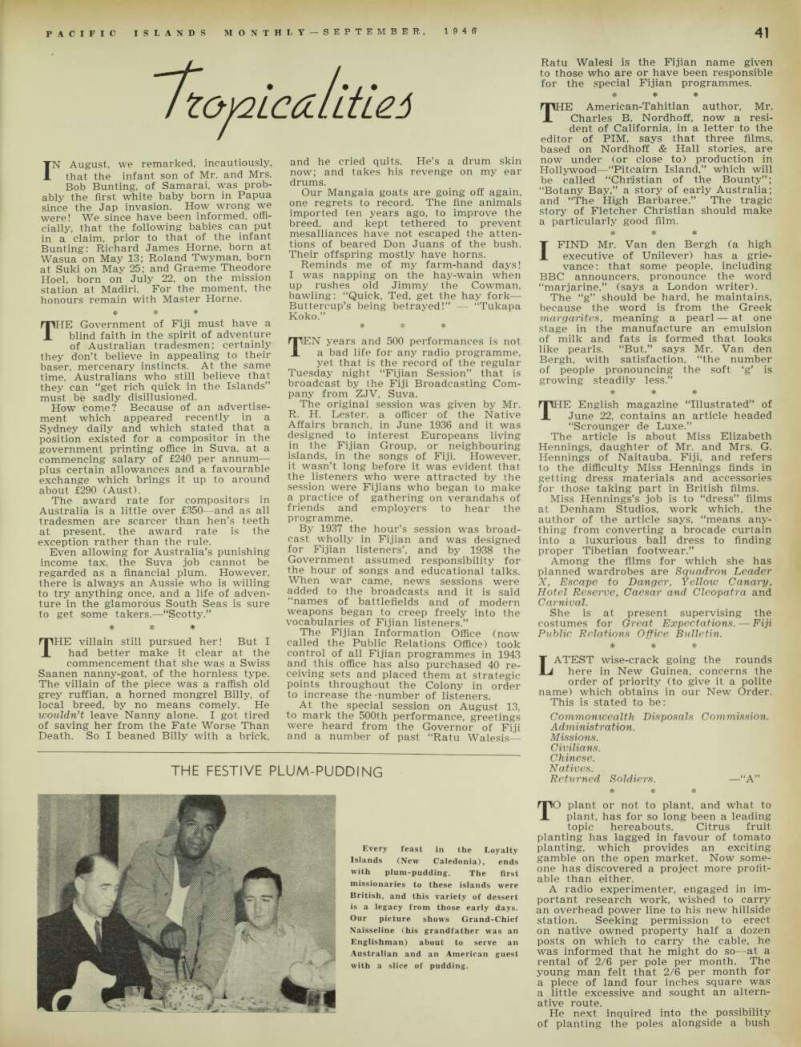
Every feast in the Loyalty Islands (New Caledonia), ends with plum-pudding. The first missionaries to these islands were British, and this variety of dessert is a legacy from those early days.
Our picture shows Grand-Chief Naisseline (his grandfather was an Englishman) about to serve an Australian and an American guest with a slice of pudding.
Cash On Delivery
By "Tui Navosa"
SOME years ago the Native Medical Practitioner in charge of the Gov ernment Hospital at Tarawa was a Fijian named Sowani, and amongst his many accomplishments was that of play ing a very good hand of poker. At the time Tarawa was used extensively by trading schooners, and the anchorage in the lagoon was a good one except when a northerly wind was blowing. Then, land ing by boat at the coral-slab wharf which ran out due north from the village, was difficult.
Clear of the village and close to the beach lay Sowani’s house —large, cool, native-built—and here the mates and supercargoes of traders lying in the lagoon would foregather in the evenings.
So much so that the large verandah on one side of the house became a club to them. Here was played many a game of poker in which Sowani joined.
One evening there were two schooners lying off the village, but a strong north erly was blowing, so that the officers could not get ashore—at least not without a thorough wetting. There was, however, no reason why they should not visit each other; and so it happened that four of the regular poker school found themselves together.
A game was suggested and one said, “I wish we had a fifth; a pity Sowani isn’t here.”
All agreed, but how to get him to come off?
“I know,” said the mate, “I’ll send him a note to say there’s been an accident on board. One of my boys will take it. They don’t mind a soaking.”
The plan was acted upon and half an hour later Sowani received a dripping native seaman and the following note;
A. S. “Matea.”
Dear Sowani, — There has been a rotten accident on board and one of our seamen has bro ken his leg by falling down the main
hatch. Please come off, if you can, and look after him.
Yours sincerely
Bill Robinson, Mate.
SOWANI called out his boatmen, pre pared a splint and other items in a waterproof case and, with some di fficulty (and wet through) finally arrived on board. He received a noisy and cheerful welcome!
“Hurray, we’ve got you.” “Come on, now we’ll have a game.” “Have a drink to warm you up?”
Sowani was a good poker player, and his face showed no sign of the annoyance he felt. He quietly took his drink and his seat at the table and the game began. rE NEXT morning Sowani handed me the following document: To Messrs. Cook, Bright, Ltd.
From: Dr. Sowani, To professional services on board the Auxiliary Schooner “Matea” £3/3/-.
“Did you have to go out last night?”
I asked.
“Yes, and I had to turn out my spe cial boats’ crew to get there. With the north wind blowing it was a bad night to launch a boat from the beach. A very dark night, also.”
A very fair charge, I thought, and I said I would forward the account to the Company’s manager.
Sowani smiled and said “Thank you, sir, I felt you would agree. But I have not told you the whole story. There was no accident on board, and these young fellows tricked me into going off in order to complete the number for a game of poker.”
“Well,” said I, “they can pay for their little joke now, in any case.”
“Excuse me, Sir, they have partly done that already.” He put five pounds in cash on the table. “This is what I won off them. Will you please put it to my Savings Bank Account?”
Advertisements & other items, p. 46 (1 item)
42
WHEN THE JAPS WERE VICTORS IN RABAUL (Continued from Page 37)
SEPTEMBER, 1946 PACIFIC ISLANDS MONTHLY
Candlenut Oil Industry
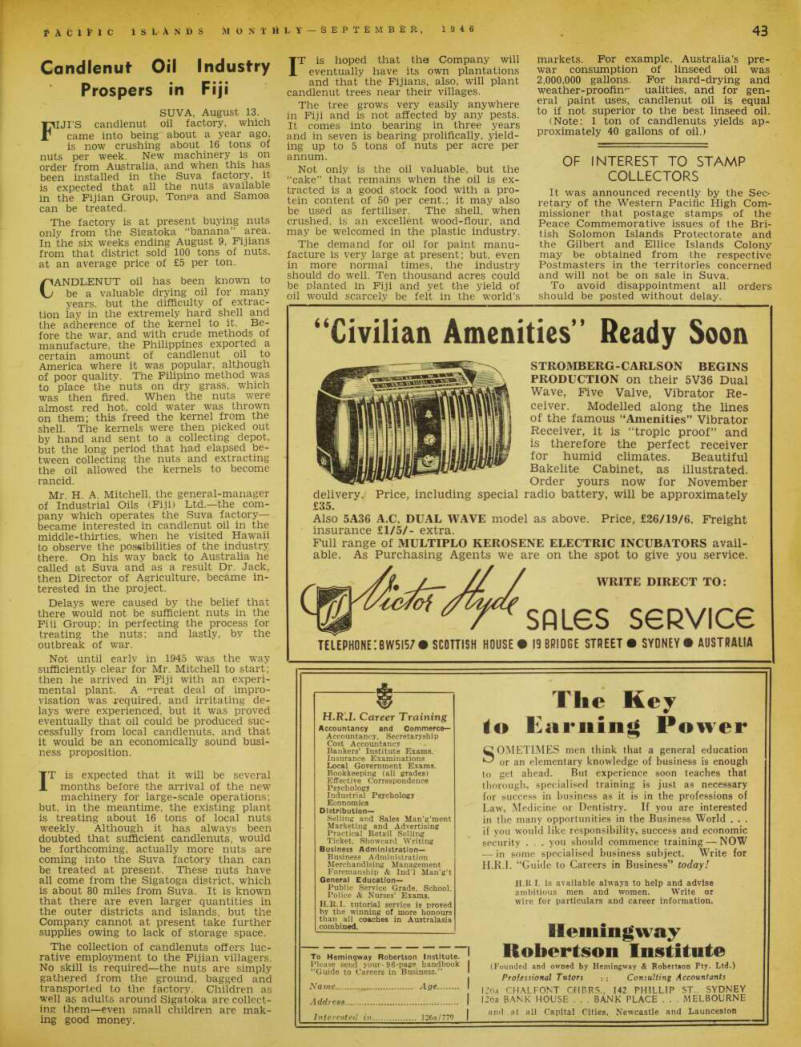
Prospers in Fiji
SUVA, August 13.
FIJI’S candlenut oil factory, which came into being about a year ago, is now crushing about 16 tons of nuts per week. New machinery is on order from Australia, and when this has been installed in the Suva factory, it is expected that all the nuts available in the Fijian Group, Tonga and Samoa can be treated.
The factory is at present buying nuts only from the Sieatoka “banana” area.
In the six weeks ending August 9, Fijians from that district sold 100 tons of nuts, at an average price of £5 per ton.
CANDLENUT oil has been known to be a valuable drying oil for many years, but the difficulty of extrac tion lay in the extremely hard shell and the adherence of the kernel to it. Be fore the war, and with crude methods of manufacture, the Philippines exported a certain amount of candlenut oil to America where it was popular, although of poor quality. The Filipino method was to place the nuts on dry grass, which was then fired. When the nuts were almost red hot, cold water was thrown on them; this freed the kernel from the shell. The kernels were then picked out by hand and sent to a collecting depot, but the long period that had elapsed be tween collecting the nuts and extracting the oil allowed the kernels to become rancid.
Mr. H. A. Mitchell, the general-manager of Industrial Oils (Fiji) Ltd.—the com pany which operates the Suva factory— became interested in candlenut oil in the middle-thirties, when he visited Hawaii to observe the possibilities of the industry there. On his way back to Australia he called at Suva and as a result Dr. Jack, then Director of Agriculture, became in terested in the project.
Delays were caused by the belief that there would not be sufficient nuts in the Fili Group: in perfecting the process for treating the nuts; and lastly, by the outbreak of war.
Not until early in 1945 was the way sufficiently clear for Mr. Mitchell to start; then he arrived in Fiji with an experi mental plant. A "reat deal of impro visation was required, and irritating de lays were experienced, but it was proved eventually that oil could be produced suc cessfully from local candlenuts, and that it would be an economically sound busi ness proposition.
IT is expected that it will be several months before the arrival of the new machinery for large-scale operations; but, in the meantime, the existing plant is treating about 16 tons of local nuts weekly. Although it has always been doubted that sufficient candlenuts, would be forthcoming, actually more nuts are coming into the Suva factory than can be treated at present. These nuts have all come from the Sigatoga district, which is about 80 miles from Suva. It is known that there are even larger quantities in the outer districts and islands, but the Company cannot at present take further supplies owing to lack of storage space.
The collection of candlenuts offers luc rative employment to the Fijian villagers.
No skill is required—the nuts are simply gathered from the ground, bagged and transported to the factory. Children as well as adults around Sigatoka arc collect ins: them—even small children are mak ing good money.
IT is hoped that the Company will eventually have its own plantations and that the Fijians, also, will plant candlenut trees near their villages.
The tree grows very easily anywhere in Fiji and is not affected by any pests.
It comes into bearing in three years and in seven is bearing prolifically, yield ing up to 5 tons of nuts per acre per annum.
Not only is the oil valuable, but the “cake” that remains when the oil is ex tracted is a good stock food with a pro tein content of 50 per cent.; it may also be used as fertiliser. The shell, when crushed, is an excellent wood-flour, and may be welcomed in the plastic industry.
The demand for oil for paint manu facture is very large at present; but, even in more normal times, the industry should do well. Ten thousand acres could be planted in Fiji and yet the yield of oil would scarcely be felt in the world’s
markets. For example, Australia’s pre war consumption of linseed oil was 2,000,000 gallons. For hard-drying and weather-proofm" ualities, and for gen eral paint uses, candlenut oil is equal to if not superior to the best linseed oil. (Note: 1 ton of candlenuts yields ap proximately 40 gallons of oil.)
Of Interest To Stamp
Collectors
It was announced recently by the Sec retary of the Western Pacific High Com missioner that postage stamps of the Peace Commemorative issues of the Bri tish Solomon Islands Protectorate and the Gilbert and Ellice Islands Colony may be obtained from the respective Postmasters in the territories concerned and will not be on sale in Suva.
To avoid disappointment all orders should be posted without delay.
Mr. Howard Hayden, Director of Educa tifpn, Barbados, has been appointed Director of Education, Fiji, in succession to Mr. A. H. Phillips who will be retiring shortly. The date of Mr. Hayden’s arrival in Fiji is not yet known.
Dissatisfied with post-war conditions in New Guinea, Mr. and Mrs. Herbert Hughes are expected to return to Mel bourne shortly. They went back to the Islands only recently but prior to tjie Japanese invasion, they had been living in New Guinea for approximately 30 years.
Territorian Alex, Berry, who was mar ried recently to Miss Joy Strangman Taylor (ex-WAAF), will return to New Guinea shortly. He was a prisoner of war in Malaya and, in prewar days, was in the employ of W. R. Carpenter and Company.
Advertisements & other items, pp. 47-48 (2 items)
43
PACIFIC ISLANDS MONi'tiLY-SEHEMBEft, 194 6
“Civilian Amenities ’ Ready Soon
STROMBERG-CARLSON BEGINS
PRODUCTION on their 5V36 Dual Wave, Five Valve, Vibrator Receiver. Modelled along the lines of the famous “Amenities” Vibrator Receiver, it is “tropic proof” and is therefore the perfect receiver for humid climates. Beautiful Bakelite Cabinet, as illustrated.
Order yours now for November delivery. Price, including special radio battery, will be approximately £35.
Also 5A36 A.C. DUAL WAVE model as above. Price, £26/19/6. Freight insurance £l/5/- extra.
Full range of MULTIPLO KEROSENE ELECTRIC INCUBATORS available. As Purchasing Agents we are on the spot to give you service.
WRITE DIRECT TO:
spues seßvice
TELEPHONE 18W5157* SCOTTISH HOUSE • 19 BRIDGE STREET* SYDNEY • AUSTRALIA s of *2
9 H.R.I. Career Training Accountancy and Commerce- Accountancy. Secretaryship Cost Accountancy Bankers’ Institute Exams.
Insurance Examinations Local Government Exams.
Bookkeeping (all grades) Effective Correspondence Psychology Industrial Psychology Economics Distribution- Selling and Sales Man’g’ment Marketing and Advertising Practical Retail Selling Ticket. Showcard Writing Business Administration- Business Administration Merchandising Management Foremanship & IndT Man’g’t General Education- Public Service Grade. School.
Police & Nurses’ Exams.
H.R.I. tutorial service is proved by the winning of more honours than all coaches in Australasia combined.
To Hemingway Robertson Institute.
Please send your- 96-page handbook “Guide to Careers in Business.”
Name Age Address Interested in 126a/779
The Key
lo Earning Power
SOMETIMES men think that a general education or an elementary knowledge of business is enough to get ahead. But experience soon teaches that thorough, specialised training is just as necessary for success in business as it is in the professions of Law, Medicine or Dentistry. If you are interested in the many opportunities in the Business World . . . if you would like responsibility, success and economic security . . . you should commence training NOW —in some specialised business subject. Write for H.R.I. “Guide to Careers in Business” today!
H.K I. Is available always to help and advise ambitious men and women. Write or wire for particulars and career information.
Hemingway
Robertson Institute
(Founded and owned by Hemingway & Robertson Pty. Ltd.) Professional Tutors ; : Consulting Accountants 126 a CHALFONT GHBRS., 142 PHILLIP ST., SYDNEY 126 a BANK HOUSE . . . BANK PLACE . . . MELBOURNE and at all Capital Cities, Newcastle and Launceston
H. G. EEKHOFF
LAE, NEW GUINEA
—EST. 1921-
Miners', Manufacturers' and General Commission Agent As in the past, so in the future—
AT YOUR SERVICE
FOSTERS
CARLTON
BREWED BY
UNITED BREWERIES LTD.
Tonga Greets the "Meline"
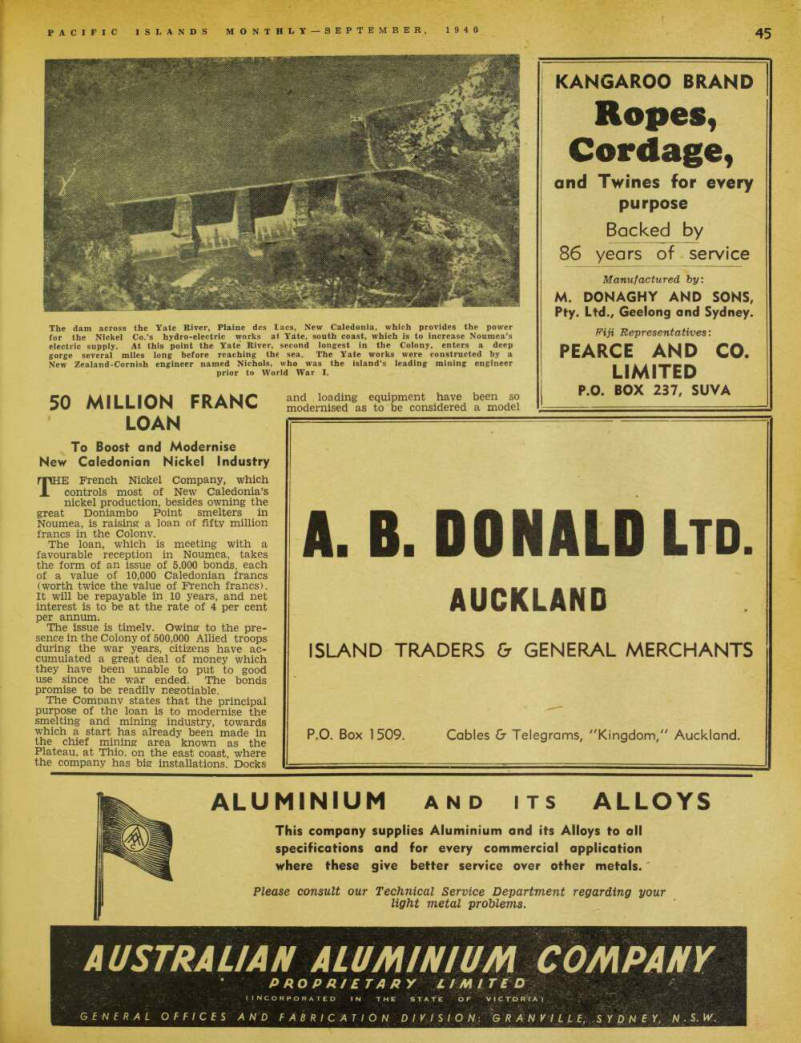
"Meline"
year the Seventh-day Adven
tist organisation purchased in
Sydney a yacht for mission service.
“The Endeavour ,” as she was called then, is forty feet six inches overall, with a 12 ft. 6 in. beam, and weighs 15 tons. She was shipped to Fiji early this year, and later was sailed to Tonga by Pastor W. G. Ferris and a Fijian crew. Mr. Ferris, in a personal
letter, says:
LEAVING Fiji at 5 p.m. we sailed south all night, passing the Lau group, and by daylight all was well. We checked our position and headed for the last speck of land to be seen. We passed this at midday, and then set course for Tonga Tabu. We were a party of five and there was plenty to do. I calculated that we would reach Tonga at 1 p.m. the next day. The boys found it difficult to believe my calculations, so they kept a sharp look-out for land. At 10 a.m. we saw the smoke ascending from the distant volcanoes to the north of Tonga Tabu and at 12 noon I took a sight of the sun and calculated that we were just seven miles from Tonga. As the island is low-lying we couldn’t see land. Half an hour later a boy up the mast sighted land, and what a shout!
We were true on our course, and it was a thrill to find that the sextant was correct and that a small dot of land in mid-Pacific could be found.
A round of feasts followed our arrival, and the grandest and most important occasion was the visit of the Queen to the ship and a celebration of the ship’s arrival in Tongan waters.
The ship was decorated with bunting from stem to stern and topmast. The Queen’s flag flew grandly from' the top of the mast. We built a special gangway and painted it white for the Queen to walk on. Tapa cloth was laid from the road to the boat. The children from the Beulah School formed a guard of honour from the car to the boat, and the European mission staff waited on board as 2 p.m. drew near. When the royal car drove up, greetings were exchanged, the Tongan National Anthem was sung, and the Queen was escorted through the crowd to the ship, where a seat of tapa cloth had been prepared. A service followed in which leading members of the staff took part and I then presented Her Majesty with a copy of the new book, “God’s Way Out.” She accepted it graciously, and asked that, if the name of the boat were changed, her gift in return should be the name “Meline” which means “Peace.”
Our members sent a large feast to the palace. A replica of the ship about ten feet long was beautifully decorated and laden with cakes, pies, and other good things for the Queen’s table. The life-boats were filled with sweets. The Queen was delighted.
The Queen sent back a piece of tapa cloth 200 yards long and 20 feet wide.
This was divided between the Fijian boys, and we also got a piece. We also have a beautiful white mat which came as a gift from the Queen.
The “Meline” is now giving valiant service among the islands of the Tongan group.
The dam across the Yate River, Plaine des Lacs, New Caledonia, which provides the power for the Nickel Co.’s hydro-electric works at Yate, south coast, which is to increase Noumea’s electric supply. At this point the Yate River, second longest in the Colony, enters a deep gorge several miles long before reaching the sea. The Yate works were constructed by a New Zealand-Cornish engineer named Nichols, who was the island’s leading mining engineer prior to World War I.
50 Million Franc
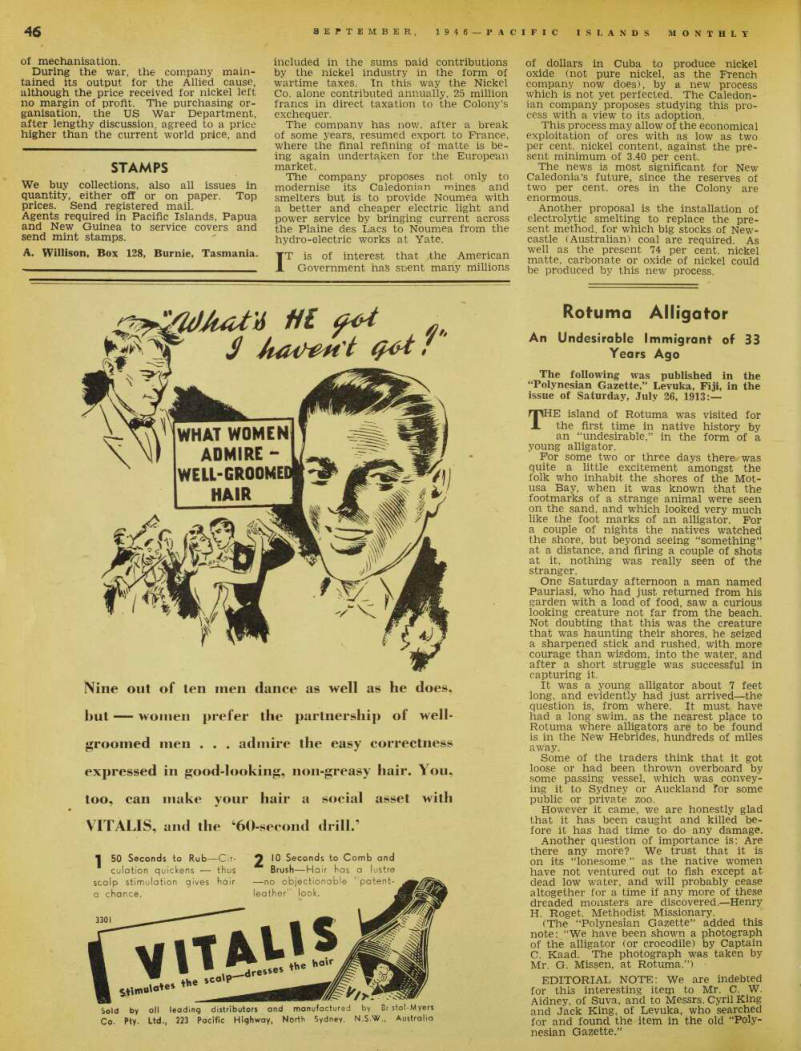
Loan
To Boost and Modernise New Caledonian Nickel Industry
mHE French Nickel Company, which JL controls most of New Caledonia’s nickel production, besides owning the great Doniambo Point smelters in Noumea, is raising a loan of fifty million francs in the Colony.
The loan, which is meeting with a favourable reception in Noumea, takes the form of an issue of 5,000 bonds, each of a value of 10,000 Caledonian francs (worth twice the value of French francs).
It will be repayable in 10 years, and net interest is to be at the rate of 4 per cent per annum.
The issue is timelv. Owing to the pre sence in the Colony of 500,000 Allied troops during the war years, citizens have ac cumulated a great deal of money which they have been unable to put to good use since the war ended. The bonds promise to be readilv negotiable.
The Companv states that the principal purpose of the loan is to modernise the smelting and mining industry, towards which a start has already been made in the chief mining area known as the Plateau, at Thio. on the east coast, where the company has big installations. Docks
and loading equipment have been so modernised as to be considered a model
of mechanisation.
During the war, the company main tained its output for the Allied cause, although the price received for nickel left no margin of profit. The purchasing or ganisation, the US War Department, after lengthy discussion, agreed to a price higher than the current world price, and
included in the sums paid contributions by the nickel industry in the form of wartime taxes. In this way the Nickel Co. alone contributed annually, 25 million francs in direct taxation to the Colony’s exchequer.
The company has now. after a break of some years, resumed export to France, where the final refining of matte is be ing again undertaken for the European market.
The company proposes not only to modernise its Caledonian mines and smelters but is to provide Noumea with a better and cheaper electric light and power service by bringing current across the Plaine des Lacs to Noumea from the hydro-electric works at Yate.
IT is of interest that the American Government has spent many millions
of dollars in Cuba to produce nickel oxide (not pure nickel, as the French company now does), by a new process which is not yet perfected. The Caledon ian company proposes studying this pro cess with a view to its adoption.
This process may allow of the economical exploitation of ores with as low as two per cent, nickel content, against the pre sent minimum of 3.40 per cent.
The news is most significant for New Caledonia’s future, since the reserves of two per cent, ores in the Colony are enormous.
Another proposal is the installation of electrolytic smelting to replace the pre sent method, for which big stocks of New castle (Australian) coal are required. As well as the present 74 per cent, nickel matte, carbonate or oxide of nickel could be produced by this new process.
Advertisements & other items, pp. 49-50 (1 item)
A. B. Donald Ltd.
KANGAROO BRAND
Ropes,
Cordage,
and Twines for every purpose Backed by 86 years of service Manufactured hy :
M. DONAGHY AND SONS,
Pty. Ltd., Geelong and Sydney.
Fiji Representatives:
PEARCE AND CO.
LIMITED
P.O. BOX 237, SUVA
A. B. DONALD Ltd.
AUCKLAND
ISLAND TRADERS & GENERAL MERCHANTS
P.O. Box 1509. Cables £r Telegrams, "Kingdom," Auckland.
ALUMINIUM and its ALLOYS
This company supplies Aluminium and its Alloys to all specifications and for every commercial application where these give better service over other metals.
Please consult our Technical Service Department regarding your light metal problems.
AUSTRALIAN ALUMINIUM COMPANY
P no PR! £ TA RLIMITED
(INCORPORATED IN THE STATE OF VICTORIA)
GENERAL OFFICES AND FABRICATION DIVISION : GRANVILLE. SYDNEY. N■S. W.
STAMPS
We buy collections, also all issues in quantity, either off or on paper. Top prices. Send registered mail.
Agents required in Pacific Islands, Papua and New Guinea to service covers and send mint stamps.
A. Willison, Box 128, Burnie, Tasmania.
j Juliet (f*tf
i f \
WHAT WOMEN 1
ADMIRE -
WE LI-GROOMED* •'•T
HAIR I
* c SD u I k*i ■m:\ /«*8 f 4 Nine out of ten men dance as well as he does, but women prefer the partnership of wellgroomed men . . . admire the easy correctness expressed in good-looking, non-greasy hair. You, too, can make your hair a social asset with VITALIS, and the 6 60-second drill.’ 150 Seconds to Rub —Cir- 2 Seconds to Comb and culation quickens thus Brush —Hair has a lustre scalp stimulation gives hair —no objectionable "patenta chance. leather” look. 3301 hair the dresses scalp— the Stimu' a * cs *v> Sold by all leading distributors and manufactured by Br stol-Myers Co. Pty. Ltd., 223 Pacific Highway, North Sydney, N.S.W., Australia
Rotuma Alligator
An Undesirable Immigrant of 33 Years Ago
The following was published in the “Polynesian Gazette,” Levuka, Fiji, in the issue of Saturday, July 26, 1913: rE island of Rotuma was visited for the first time in native history by an “undesirable,” in the form of a young alligator.
For some two or three days there was quite a little excitement amongst the folk who inhabit the shores of the Mot usa Bay, when it was known that the footmarks of a strange animal were seen on the sand, and which looked very much like the foot marks of an alligator. For a couple of nights the natives watched the shore, but beyond seeing “something” at a distance, and firing a couple of shots at it, nothing was really seen of the stranger.
One Saturday afternoon a man named Pauriasi, who had just returned from his garden with a load of food, saw a curious looking creature not far from the beach.
Not doubting that this was the creature that was haunting their shores, he seized a sharpened stick and rushed, with more courage than wisdom, into the water, and after a short struggle was successful in capturing it.
It was a young alligator about 7 feet long, and evidently had just arrived—the question is, from where. It must have had a long swim, as the nearest place to Rotuma where alligators are to be found is in the New Hebrides, hundreds of miles away.
Some of the traders think that it got loose or had, been thrown overboard by some passing vessel, which was convey ing it to Sydney or Auckland for some public or private zoo.
However it came, we are honestly glad that it has been caught and killed be fore it has had time to do any damage.
Another question of importance is: Are there any more? We trust that it is on its “lonesome,” as the native women have not ventured out to fish except at dead low water, and will probably cease altogether for a time if any more of these dreaded monsters are discovered.—Henry H. Roget. Methodist Missionary. (The “Polynesian Gazette” added this note: “We have been shown a photograph of the alligator (or crocodile) by Captain C. Kaad. The photograph was taken by Mr. G. Missen, at Rotuma.”) EDITORIAL NOTE: We are indebted for this interesting item to Mr. C. W.
Aidney, of Suva, and to Messrs. Cyril King and Jack King, of Levuka, who searched for and found the item in the old “Poly nesian Gazette.”
Tongan Assembly Passes
New Laws
From Our Own Correspondent
Nuku’Alofa, July 25.
rnHE 1946 session of the Tongan Legis- X lative Assembly was closed to-day.
Queen Salote Tupou was unable to attend the closing ceremony, and was re presented by Crown Prince Tupouto’a- Tungi, who read the Closing Address.
Among new enactments passed during the session was an amendment to the election law providing for nomination of candidates for the Legislative Assembly.
Hitherto electors could vote for anyone.
The amendment requires that nomina tion of each candidate shall be made by thirty or more electors on payment of a £5 deposit, to be refunded if a candidate receives 20 per cent, or more of the total votes for his electoral district. The bill also provides for the keeping of an elec toral roll for each electoral district.
Another measure enacted was an amendment to the marriage law author ising magistrates to solemnize marriages, which hitherto have been performed solely by minister of religion. Since Ton gans are notorious sticklers for estab lished practice and matters of form, the bill was stronely opposed. To their way of thinking this new departure is nothing less than sacrilege.
The ad valorem Customs duty was re duced from 20 per cent, to 15 per cent, for British goods, and from 40 per cent, to 33 1/3 per cent, for foreign goods. This was effected because the Estimates show the surplus of £33,337 for 1944-45.
Fieures for the 1946-47 Estimates show revenue and expenditure as £116,870 and £113.060 respectively. The main sources of revenue, as estimated, are Customs £59,500; native taxes, £14,000; and other branches £43,370.
The main heads of expenditure as esti mated are personal emoluments £47,176; other charges £43,119; and public works, £21,830. (The £1 note in Tonga is practically at par with New Zealand and Australian currency, which is 25 per cent, under sterling.)
Census in Fiji in October
Suva, August 15.
A CENSUS will be taken here on the night of October 2. Mr. John Gittins is Census Commissioner in charge of operations.
Specimen copies of the census schedule are being placed in prominent positions in centres throughout the Colony so that as many people as possible will have an opportunity to familiarise them selves with the forms before the event.
Filling in census schedules is not op tional. Every occupier of a dwelling must complete a schedule for that dwelling.
Schedules will be delivered before the evening of October 2, but if a particular household is accidentally missed the person in charge must take steps to get a form from the nearest Census official.
Samoan Cocoabeans
THOUGH the price offered by overseas buyers for Samoan cocoa-beans is from £125 to £135, Apia shippers have still to fill contracts with an fob price of £95 per ton.
When these contracts expire the new cocoa price for first grade cocoabeans will probably be about £ll6 per ton —an in crease to the Samoan planter of about £3O against the rate he is receiving “on the plantation” at present.
The French Colonial Ministry is asking the Pacific Colonies, including Tahiti, for information as to the possibilities for young Frenchmen who wished to emigrate.
It is realised that the possibilities in Tahiti are limited.
New Zealand occupation troops for Japan, numbering 2,500 called in on Suva en route to Tokio on August 5. They were all aboard the transport “Chitral” and had had a stormy passage from New Zealand.
Advertisements & other items, pp. 51-52 (3 items)
47
PACIFIC ISLANDS M O NTttLY SEPTEMBER, 1946
Your Eye
The Twinkle in
COMES FROM ACTIVE
DIGESTION
Good normal digestive and liver activity means good, normal health and fitness. If you are becoming gloomy and feel tired out, the cause may be a congested state of your Intestinal tract. So many people are troubled with constipation, which, through the retention of waste In the digestive system, causes sick headache, biliousness, pimply skin, unpleasant breath, irritability, slackness and dull eyes.
Regain your bright and attractive appearance by banishing constipation with Plnkettes. Tiny, perfectly harmless, gentle yet effective, these famous laxative and liver pills painlessly exercise and strengthen the bowels, keep the food tract clean and active, stir the liver, and thus banish sick headache, bilious attacks, pimples, unpleasant breath and gloom. All chemists and stores sell Pinkettes, the perfect laxative and liver pills.
William Atkins n,. u«.
Head Office 449-451 KENT ST., SYDNEY.
Iron & Sfeel Merchants-Engineers' Supplies
ESTABLISHED OVER 50 YEARS
Coach tr Motor Hardware Cable Address: WTLATKIN, Sydney.
STEEL DEPARTMENT
MILD STEEL:
Rounds, Squares, Flats, Half-rounds, Hexagons, Bevel, Shoeing, Tyre, Angles, Tees, Sheets, Plates, Girder Plates, Chequer Plates, Channels, Hoops, Etc.
BRIGHT STEEL:
Rounds, Squares, Hexagons.
Extra Special High Speed Tool Steel, Mining Steel, Blister Steel and Spring Steel, Rounds, Flats Gr Squares.
Bar Iron—All sections and sizes.
Engineers' Supplies: Set Screws, Studs, Metal Thread Screws, Coach Screws, Files, Cotter Pins, Bright and Black Bolts, Rivets, Etc., Hack Saw Blades.
Power Transmission Gear: Including Plummer Blocks, Couplings, Collars, Etc.
Coach and Motor Hardware: Axles, Springs, Wheelstuff, Duck, Paints.
Farriers' Supplies: Horse Nails, Anvils, Vices, Etc.
Motor-Trimmers and Motor Builders' & Motor Painters' Requirements
C. A. WILLEY'S
Quick-Drying Coach and Car Paints, Roughstuff, Elastic Gloss, Synflex Enamels, Lacquers.
DUCO Lacquers and DULUX Enamels—FAßßEX Motor Toppings and Leather Cloths, House & Decorators' Paints, Varnishes & Brushware.
Sole Distributors of CHAMPION'S Decorators Point Products.
Distributing Agents for BROLITE Lacquers, SYNFLEX Enamels and "POLYGLOSS" Finish.
All over the British Empire, every minute of every day, more and more smokers are saying, "Better buy Capstan (tobacco and cigarettes)—they're blended better."
CAPSTAN
TOBACCO and CIGARETTES
48
SEPTEMBER, 1946 PACIFIC ISLANDS MONTHLV
Colonial Service
and Old School Tie
( Contributed ) ENGLAND’S Foreign Office has been criticised as being still manned by diplomats of the old school. Her Colonial Office has been under fire for not tackling quickly enough much-needed reforms in our wide Colonial Empire.
It is suggested that, while Tory diplo mats are half-heartedly carrying out Mr.
Bevin’s directions in foreign affairs, the Colonies still are being administered by officials unsympathetic to Socialistic ideals. No doubt it is just as easy to find a Tory diplomat as it is to discover an upper-grade non-socialistic clerk in the Colonial Office; but such a one should, at least, not be allowed to be even the oc casional mouthpiece of his department.
In the BBC’s “Calling the Islands” pro gramme last May a Mr. Trafford Smith,a young gentleman* from the Colonial Office, after indulging himself in some biographical detail which showed that he began life in what, to quote him, “you might call the lower middle class,” his parents having been, “frankly working class and made their way up a little,” stated that, being good at “exams,” he was grist to his elementary school’s mill, and that, in 1935 he finally graduated from the “real life” of selling dress materials, and store-guiding, at Harrods, into the Civil Service.
He went on to say that “now-a-days the jobs (in the Civil Service), both here and overseas, go to the people with the
right qualifications, whoever they are, and quite irrespective of origin or social position.”
At this point he said he imagined he saw “some wry smiles” on his listeners’ faces, and had he been able to listen he might have heard it said that Australians and New Zealanders are the logical people for the acquisition of the “right quali fications” to enable them to fill admini strative posts in the Pacific.
But the old, offensive, stodgy, Tory mentality of Mr. Trafford-Smith was re vealed when he continued: “. . . but surely, when you come to think about it, it is clear that to draw your colonial administrators from a more highly-de veloped country overseas ,and to let them maintain their contacts with it by peri odical visits on leave, it is in the long run an .advantage, and not a disadvantage, to the less-developed colonial territories they serve. Such territories have much to gain from the man whose mind and outlook have been formed at a centre of civilisation (Harrods?), always provided that he has the ability to adapt himself successfully to local conditions.”
NO British Government expects its officials to change their policies with their bosses, but their public utter ances should coincide with Government policy and not appear to support a policy which, having borne some inefficiency and much disaffection, has been aband oned.
If Mr. Trafford Smith had been pre sent when his new boss, Mr. George Hall, Secretary of State for the Colonies, opened the Colonial debate in the House of Commons on July 10, only 2 months after this self-revealing Pacific broad
cast, he would not have heard it said that our colonial administrators should be recruited only from among Englishmen with the right qualifications, but among “selected candidates —whether from the Colonies or the United Kingdom or the Dominions.”
IT is not suggested that all English officers are to be disparaged, or that our Pacific colonial service is grossly in efficient. But if there is to be the pro mised “revolution” in the Colonies, the first evidence of it should be almost total recruitment of senior Colonial officers from neighbouring Dominions and the Colonies themselves.
Take Fiji, for example. Is there any reason why that Colony, so distant from Whitehall, should be staffed according to the present system? Why should not the Governor, the Chief Justice and the Colonial Sectary only be appointed from the United Kingdom; and other posts be filled as suggested above by officers prepared to spend their admini strative lives, and holidays, in the Paci fic, without being shuffled around the Colonial Empire or having public moneys wasted on them in the form of expensive passage grants to the United Kingdom?
The American steamer “Flyaway” from San Francisco recently called in at Apia, W. Samoa, with 100 tons of general cargo and 300 tons of Canadian lumber. She lifted 5,000 cases of bananas, 200 tons of cocoa beans and 200 tons of copra for Auckland, New Zealand. The Apia call had been arranged by the New Zealand Government to replace the usual monthly trip of the “Matua” which had been laid up for her annual August overhaul.
Mr. G. E. L. Lord, from Somaliland, has been appointed Government Auditor, Fiji.
Mr. Ragnar Hyne, formerly of the British Solomon Islands Protectorate, and for a time a resident of Fiji, has been appointed Attorney General, Sierra Leone.
Major F. G. L. Holland, of the Western Pacific High Commission, has been ap pointed District Officer at Rabi (the new settlement of Ocean Islanders in the Fiji Group) in succession to Major D. G.
Kennedy who is returning to Suva.
Advertisements & other items, pp. 53-54 (1 item)
Pip) Ltd
ISLAND MERCHANTS
and AGENTS.
GENERAL MERCHANTS.
Pip) Ltd
C.Sallivan
9 Shippers of all types of Merchandise to the Pacific Islands 1 Representing Australian, British and American Manufacturers 9 Buyers for Leading Pacific Islands T,aders 9 Sellers of Island Produce on Consignment
379 KENT ST., SYDNEY
Cable & Telegraphic Address : (i Chasuliy Sydney.
Importers, Distributors and Manufacturers of Foodstuffs, Softgoods, • Textiles, Hardware, Tobaccos, Wines and Spirts, etc. yif • "Ultima" Kerosene Stoves and Heating Appliances • Distributors of High-grade Shirts, Pyjamas and Clothing 4/ 9 "Southern Queen' Canned Fruits 9 Forwarding and
Transhipment Agents
/4x * * s English Cigarettes //(''' n) : if. a.- (/ When in Sydney, call and see us!
Initiative
Concentration
Xervice
These are qualities that have placed over 5 million I.C.S. students on the road to success through home training.
I.C.S. holds the key to YOUR future.
Fill In the coupon and mail NOW. An enquiry costs nothing. Over 400 courses.
INTERNATIONAL CORRESPONDENCE SCHOOLS
140 Elizabeth Street, Sydney Dear Sirs — Please send me free prospectus showing how I can succeed in the occupation I have marked.
Advertising Accountancy Inst.
Book Keeping Cost Accountancy Salesmanship Building Cent.
Architecture Roof 8C Steel Sq.
Arch. Draw. Build. Plan Draw.
Carpentry Ref. Eng. 8C Serv.
Ind. Chemist Elect. Eng. or M.
Electronics Radio Eng. or Serv.
Plastics Auto Mechanics Textiles Aero Des. & Eng.
Diesel Eng. Rayon Weaving Welding Comp. Mech. Eng.
Story Writing Fitting 8C Turning Radio Plays Mech. D’sman.
Com. Art Civil Engineering Sketching Showcards, Tickets Landscape Ptg Shorthand, Typing Wind. Dress General Education Dress Design Coach, any Exam.
If your subject is not above, write it here Name Address
aw * W,
»-*2i«4i?r3 •• ■csrj.j
I' w manutac^ 1 beM ® a Everv^" 5 ' P erTn "' al Good S>otos lfl> .
Obiaioaioio QB? «*««>». C *SES Mad© toy , gI*O bITE W»» ucw ' e %wi«« te onlV SVX)I^
Overseas Visitors
Tahiti Getting Ready To Welcome
By M. Jay, President, Syndicate d’Initiative de Tahiti
THE numerous criticisms of Tahiti made by your correspondent in the last few months require an answer.
We are thankful to Mr. Mackinlay, of Sydney, who so generously took up the defence of Tahiti “which he does not know,” says he, “but whe're things cannot be as bad as the correspondent says.”
We first must deny the statements you have made, that “Tahiti is closed” and “European visitors are not wanted.”
Tahiti, on the contrary, is doing its best to be ready for the tourists. But all the plans decided on cannot be given just now, from sheer lack of facilities.
Nevertheless, your correspondent ought to have said something about our en larged wharf and our. new custom-house with its large hall for the reception of passengers. He ought to have mentioned all the work done for the improvement of the roads, which in .some places are cut into the rocks along the sea—work in which the Navy took an active part.
Your correspondent should have made a point of giving a detailed report about the new tourist attraction of Tahiti; The Mountain resort.
This mountain station has been the work of the Army, under the command of Colonel Bouillon, while preparing de fences for an enemy who never came.
The soldiers also constructed for peace time.
About five miles of mountain road have been built, giving access to a station 2,200 ft. high, where visitors can rent very comfortable bungalows and have their meals at a restaurant. From the dining room and its terrace, visitors can enjoy a splendid view over Papeete and its surroundings.
Leaving this station, a good path leads to one of the summits of the island (6,773 ft.) from which the sightseer com
mands an unforgettable panorama over Tahiti and the surrounding islands.
This is an exceptional attraction for the tourist in Tahiti who, from now, will be able to go easily and with the neces sary comfort to admire the natural beauties,,of inland Tahiti.
But, of all this, there is not a word in your correspondent’s reports. He satisfies himself by telling us that Tahiti population is “hostile” to foreigners; that Tahitians organise “passive resistance” against white people; and he produces, as a proof, the fact .that Tahitians name tourists by a word “which in their language designates a crab.”
WE wonder how your correspondent could have been so badly mistaken.
Tahitians give the utmost impor tance to pronunciation. They do not care much about spelling—writing being for them a very recent innovation introduced by white people—as long as words have different pronunciations, they are, for the natives, as different as day and night.
An example will make this clear. The word “parau” means “oyster shell.” The same word,, slightly differently pro nounced, means “speech.” “Papaa” means “crab.” With a slight difference in pronunciation, it means “stranger.”
The stranger has no more connection with “crab” than the oyster has with “speech.”
The flexibility of Tahitians’ voice and the extreme sensitivity of their ear are well known, hence the charm of their songs. The slightest change of pronun ciation has for Tahitians a tremendous importance. A word slightly mispro nounced loses all its meaning or gives place to confusion —and in both cases to endless laughs.
Even Tahitian women have not escaped our gallant criticism. The tourist is warned about the big deception waiting for him as far as nice womanly profiles are concerned. “A gigantic waistline soon spells death to romance.”
If it is true, generally speaking, that Tahitian women, upon ageing, have a strong tendency to outpass the canon of sheer beauty, is there any reason for refusing to look at and denying admira tion to those charming Tahitian girls, graceful and slender as young banana sprouts?
If we know that a flower will soon fade, is there any argument against our en joying its beauty, when in early bloom?
If “a column of exploring red ants” happens to camp at your quarters, is there any obligation for you to denounce the beauty of surrounding nature? mAHITI is a very quiet country. There 1 are a few trucks bringing, every morning, passengers and goods to the market of Papeete. But even those useful trucks have been incriminated, by your journal. No sufficient excuse has been found for them in their being so picturesque, with their crowded and smiling passengers (twice as many as there should be) under a roof supporting an enormous load of all kinds of food: fei, fish, pigs, fowls, baskets of vegetables and a rich variety of man-made products, from bicycles to canoes.
The passengers are cleanly dressed, their hair shining with “monoi.” Let us clearly understand that they intend this day to be a feast-day, as was yes terday, and as will be to-morrow. They are always ready to laugh at the first opportunity along the road. If they knew
that, while passing by, they have just “spoiled the sleep” of your correspondent, their laugh would momentarily cover the noise of “the horn and free exhaust” —a good-humoured laugh, meaning no offence. . . .
The war held many people in Tahiti longer than they intended to stay. So there is nothing really surprising if to-day these persons show some eagerness to rejoin their countries and families. Is this sufficient for the correspondent to describe them as disillusioned tourists “. . . so eager to get away to any place which would not be a South Sea island?”
Tahiti is a country where optimism is the rule. Its race is young and careless, even to childishness. But do not be mistaken. These children possess a striking art of living, and a natural gaiety and friendliness which make them a people eminently sociable, hospitable and in every respect amiable.
To understand Tahiti rightly and dis cuss it without bias you must possess in yourself some youthfulness of heart.
No Australian Tax on Servicemen's
Dollars
A DECISION of interest to many Ter ritorial was given by the High Court of Australia on August 15, according to “Sydney Morning Herald” report: An Australian who was employed by the United States forces in New Guinea, and paid by the United States, is not liable to pay income tax to the Austra lian Department of Taxation for the period during which he was absent from Australia.
This, of course, applies not only to ser vice in New Guinea, but also in any of the Pacific Islands.
of Convicted Official
Petition for the Release of Convicted Official
Nuku’Alofa, July 20.
A PETITION has been signed by many hundreds of people for the release under probation of T. T. Toutaiolepo.
He was formerly official interpreter and translator for the Supreme Court, Land Court, Police Court, Privy Council. Cab inet and Parliament, and was sentenced in June. 1946, to 18 months’ imprison ment for embezzlement of £152 of Gov ernment funds. Presiding Judge was J. B.
Thomson, Puisne Judge of Fiji, acting as Chief Justice of Tonga.
This petition is a clear indication of the trend of public opinion. It was dis closed at the hearing that by holding three, and later, four con-joint posts, whose combined salaries when they were held by separate officers, were about £630 annually, accused, whose salary range was £ll5/£175, was responsible for sav ing about £7,000 in salary to the Tonga Government during the 13 years of his service. He had unsuccessfully asked for increased salary on several occasions.
Another unusual fact which came to light at the trial was the failure to have accused’s books audited for four years.
This omission, as was rightly stressed by the defence, contributed in no small measure to the temptation offered to accused.
Since his offence was committed dur ing 1945, at the very zenith of the ex treme hardships created by the abnormal conditions of war time, it was stressed that the feeding and clothing of his large family—a wife and five growing child ren—on his meagre income was, indeed, a serious problem—a problem so grave that it preyed heavily on his mind to
such an extent that his mental and moral outlook was affected.
Finally, as a precedent on which a strong plea for probation was made, a case of a high chief was cited. This high chief, while Governor of the Ha’apai Group, was convicted of larceny of pub lic funds in 1929 and was placed under two years’ probation.
In Toutaiolepo’s favour (it was point ed out) that although the two cases are parallel, they differ in circumstances. The strong temptation and extreme hardships which accused had to face did not exist in the case of the Governor. Conse quently the sentence created, unfortun ately, a wrong but harmful impression on the public—namely, that although there is one law for both chiefs and commoners, yet it is enforced with leni ency in the case of the former, but strictly in that of the latter.
New Set Up In Malaya
WHAT the Secretary of State for the Colonies described in the House of Commons on July 9 as “informal discussions of an exploratory character” have been going on between the Gov ernor-General of the Malayan Union and Singapore and the Malay Rulers, follow owinp- upon several proposals, put for ward with the Secretary of State’s authority, “designed to meet Malay feel ings.”
Early in July the Singapore Corres pondent of “The Times” reported “sub stantial modifications of the Malayan Union plan,” and stated that a Malayan Federation was to be substituted for the Malayan Union and a High Commissioner for the. Governor. He added that the Sultans had gladly accepted these pro posals.—CßOWN COLONIST.
Advertisements & other items, p. 55 (1 item)
lan ray
You Sell Customer Satisfaction
when you sell —
METAL PRODUCTS PTY. LTD.
ALUMINIUM KITCHEN UTENSILS
SAUCEPANS
FRYING PANS
CUTLET PANS
• OMELETTE PANS
• BOILERS
• BREAD BINS
Made from heavy-gauge aluminium with hakelite handles and knobs in a full range of sizes.
Other Lanray Products you will find profitable to handle are “Primus-type”
Stoves and Blow Lamps. Both are based on Swedish standards of manufacture and finished in highly polished brass.
Write to-day for price list and
particulars.
i * Hr ... % “Always look * 4: for the Lanray Brand ”
SOLE WHOLESALE
DISTRIBUTORS
LANCE RAYMOND PTY. LTD.
11 Hargrave Street, Sydney Shell Corner, Melbourne King House, Queen Street, Brisbane
Tahitian Motor Hogs
From Our Own Correspondent
Papeete, July 1.
A SHOCKING motor accident, which took the life of one of our honoured and beloved residents, has awakened thoughtful people to the peril which men aces every traveller on the highways of Tahiti from the hoodlum drivers of Papeete. , „ , There are no side paths. Every pede
strian must use the common highway.
These roadways are narrow. Most of the turns and intersections are obscured by high hedges. Anyone endowed with con sideration for the safety of others is aware that 10 kilometres an hour in the settlements, and an average of 20 an hour in the country, are the maximum speeds at which his car is to be kept under con trol against any of the numerous emer gencies. Only a hoodlum. would drive a car at a speed which would smother pede
strians in a cloud of dust.
Unhappily, this is precisely what the hoodlums of Papeete delight to do.
Another merry pastime of this illustri ous fraternity is to circulate around the Cathedral and the Paofai Church at times of religious services, with horns blowing and motors roaring.
The law is strict enough. But the hood lums—like hoodlums elsewhere—possess the uncanny instinct of knowing where the police are, and where they are not.
On an island of the area of Tahiti there is no excuse for unsafe driving.
At a moderate speed, one’s car arrives at the most distant places—Tautira or Tea huupoo—within three hours.
Old New Guinea Club
Has Anyone a Copy of the Rules?
HAS anyone got a copy of the rules of the New Guinea Club, which was one of the best-known institutions of Rabaul before that town was com pletely destroyed in the Japanese in vasion? If so, a copy of the rules (or the loan of a copy) would be gratefully received by Mr. Les Clark, c/o Depart ment of External Territories, Australia House, Carrington Street, Sydney, who represents a group of New Guineaites who are making preparations to restore The New Guinea Club and rebuild the club-house.
The New Guinea Club, in its heyday, had 600 members; and its cool, handsome building in the former “Garden City” was well-known to every visitor to the Terri tory.
Anyone in possession of a copy of the rules' is invited to kindly communicate with Mr. Clark,
Advertisements & other items, p. 56 (2 items)
52
SEPTEMBER, 1946 PACIFIC ISLANDS MONl’flL*
William H. Watson
PLOUGHS for EVERY PLANTER
There is a Ransomes Plough for every planter. For nearly 150 years Ransomes have been leaders in plough design, and to-day they offer a range for animal and tractor draught covering all possible requirements. Whether a light steel plough or a tractor disc plough weighing more than 3 tons is required, there is a Ransomes model which will give complete satisfaction.
THE
a
CUB
PLOUGH
Mtansomes
Write for illustrated catalogues and all information. Ask also for particulars of our lawn mowers, aerodrome equipment, etc
MORRIS, HEDSTROM LTD.
Suva, Lautoka and Ba.
Made by; RANSOMES, SIMS & JEFFERIES LTD., IPSWICH, ENG.
ESTABLISHED 1930
WILLIAM H. WATSON
RAROTONGA, COOK ISLANDS
Wholesale and Retail "Trader
LICENSED STAMP DEALER
Agent For:—
BRITISH TRADERS' INSURANCE CO.
CORONA & L. C. SMITH TYPEWRITERS
KAISER & FRAZER MOTOR CARS
B.S.A. CYCLES AND MOTOR CYCLES
AMERICAN LEAD PENCIL CO.
WHITES AVIATION LTD.
Manufacturers of: FOOTWEAR, ALL CLASSES SUITABLE FOR NATIVE TRADING . . . M.O.P. PRODUCTS, INCLUDING ROUND EAR-RING BLANKS AND BUTTON BLANKS Exporter of: “Rarotonga” Hula-Skirts.
Sea-Shell Necklaces.
M.O.P. Jewellery.
Island Produce.
Cable Address: “Watson” Rarotonga Wholesale and Retail Inquiries Invited.
Prepared to Consider Agencies lor all Class of Goods.
Bankers: Importer of: Textiles.
General Hardware.
Fancy Goods.
General Merchandise.
Bank of New Zealand, Auckland.
Fiji and the West Indies
Some Sriking Comparisons
UNHAPPY social and economic condi tions in the West Indies caused them to be investigated by a Royal Commission in 1938. The Commission recognised the pressing need for large expenditure on social services and de velopment and recommended the estab lishment, for this purpose, of a West Indian Welfare Fund to be financed by an annual grant of £1,000,000 from the Imperial Exchequer for a period of 20 years and of a special organisation to administer this fund under the charge of a Comptroller.
Sir Frank Stockdale, KCMG, CBE, who reported on agriculture in Fiji in 1937, was appointed to this position.
Bearing in mind that the Royal Com mission found that “most of the main social and economic defects of the West Indies have, in broad outline, been knowru and deplored for many years, and have been the subject of numerous enquiries,”
Sir Frank Stockdale’s latest report con tains many striking statements which could just as easily have been made of Fiji. It is not suggested that Fiji’s social and economic conditions are com pareable with those of the West Indies but many of the observations are re markably apposite to this Colony and make interesting reading.
THE most illustrative references are set out below, without comment.
For “West Indies” “Fiji” can be substituted: General Background. —The main prob lems in the West Indies, despite the differing conditions in the several colonies, centre around — (iii) the wastage which has taken place of natural resources; (iv) the limitation of the acreage of land suitable for agriculture; (vi) poor housing and sanitation; (viii) an educational system in need of overhaul; (ix) the lack of public appreciation of the fact that the area cannot support social standards modelled on those of wealthier com munities and that a full life and good companionship can be built up in accord with the general economy of the area; (x) a general need for improvements and developments in local gov ernment and community acti vities.
Industry & Tourists. —lncreased local industrial development must be contem plated and efforts made to encourage a greatly expanded tourist trade. . .
The tourist trade is capable of very greatly increased expansion, and this should provide both additional employ ment and wealth.
Land. —Slowly but surely it is becoming recognised throughout the West Indies that the chief asset is the land, and that measures must be taken to save it from destructive processes, to rehabilitate certain areas and to intensify production methods generally if the increasing populations are to find their livelihood from it. . . .It is generally agreed that greatly improved and more experienced advisory and educational services are necessary for the farmers, both large and small.
Education. —There is no doubt that there is a keen desire throughout the West Indies that the educational system should be remodelled and that provision should be made for adequate accom modation and equipment in the schools. .
The problem (of providing the neces
sary funds) is of the simple condition of human arrangements that he who would be master in his own house must be able to meet his bills.
Economic. —War conditions have aggravated deficiencies and created difficulties. . . .More money has been in circulation, but the standard of living has, over the whole area, not advanced very materially, . . . The tendency has been for the values of assets such as land and houses to rise considerably and in a few places there has been some speculation in land and house property. . . .
The aim of economic policy in the West Indies should be directed towards the raising of the standard of living of the mass of the people.
Cost of Living. —Cost of living has increased but most of the cost-of-living indexes in the West Indies are in varying degrees and in different respects, defective. They are not comparable one with another. Rates of salaries and wages, including war bonuses, have, however,
risen and most Governments have in creased the salaries and wages of their officials and employees, Agriculture. —The evidence on the whole seems to show that when rates of pay are raised in agriculture, workers tend to do less x work rather than more, They seem to want to work for shorter periods or to be content with a certain weekly amount of money, enough to cover their needs at their accustomed low plane of living, and to do only enough work to earn that amount, Production. —lt should not be over looked that the West Indies are not cheap producers. The cost of getting a job done is frequently much higher, in con sequence of the lower scale of output per unit of time, than it is in England. . . .An improved standard of living in the West Indies and general economic security can only be achieved if efficiency of production is striven for consistently, Administration. Special reference should be made to the general shortage
of experienced and skilled officers in many of the departments of the West Indian Governments and to the paucity of fully trained staff throughout.
Philosophy of Living. —Most people in moist, hot, tropical climates do not want to work very energetically for long hours: they seem to prefer to be satisfied with a lower standard of living and more leisure and they would, it appears, rather take life easily than add to their material comforts.
The appointment of Mr. B. E. V.
Parham as senior Agricultural Officer in the Department of Agriculture was gaz etted early in August.
Advertisements & other items, pp. 57-58 (1 item)
Symbol of
% a x
Service
THE SHELL COMPANY OF AUSTRALIA, LIMITED. (Inc. in Great Britain).
G469m.
W. H.GROVE A SONS
Limited Established 1896.
AUCKLAND
Ulond Traders, r 0 801 494 Telegraphic and Cable Address: “Grove", Auckland.
Shippers of all classes of New Zealand products.
Representing English Manufacturers throughout the Cook and Society Islands, Fiji, Tonga, Samoa, Niue, New Caledonia, New Guinea, etc.
In FIJI as—W. H. Grove & Sons (Fiji) Ltd.
ONCE LIFTED FROM BED & CHAIR
At 76 Still Rides and Works
FREE FROM PAIN OF
RHEUMATISM
Once again a letter tells about wonderful relief from pain brought by R.U.R. to a sufferer from excruciating rheumatism.
This time 76 years old Mr. H.
R. Jones writes as follows; — "Rheumatism became so bad that I could not sleep at night and my joints began to swell . . . when I sat or lay down I had to be lifted up until one day I gave R.U.R. a trial. At 76 I am now able to ride and do my usual work again with sheep and cattle.”
Many other people suffering from rheumatism, lumbago, sciatica, kidney troubles and similar ailments do not realise that most of such disorders owe their origin to faulty elimination.
But many more have found a safe, natural remedy in R.U.R., which helps reduce uric acid formations and cleanses the bloodstream of diseasespreading poisons and wastes.
R.U.R. has succeeded in many marvellous cases such as that of Mr.
Jones. It is the only treatment which Or write to R.U.R., 841 at the same time contains a laxative, liver stimulant, kidney cleanser, blood purifier and acid corrective. R.U.R. is bound to do you good. Take R.U.R. regularly for a while. Smaller size, 4/- the money-back guaranteed full treatment, 7/6. Obtainable at all chemists and stores.
George Street, Sydney.
Ddt And Malaria
PREPARATORY to an anti-malarial campaign financed by the Colonial Development and Welfare Fund, ex periments with DDT are being carried out in one of the worst malarial regions in the island of Mauritius. This is a most interesting project, and one that may have far-reaching results on the country’s economy as well as on the popu lation’s health, and therefore its work ing capacity.—CßOWN COLONIST.
A daughter was recently born in Samarai, Papua, to Mr. and Mrs. Nicholls of the Anglican Mission.
Pearling Industry
Islanders' Demand For Improvement In Pearling Industry
AT a conference held recently in the Brisbane Trades Hall, Thursday Islanders engaged in the pearling industry, demanded better working con ditions and higher wages.
The conference was attended by a number of Islanders who have been work ing in various parts of Queensland since they were evacuated from TI during the war.
The Islanders claimed that their “keep” consisted of bully-beef, rice, flour and sometimes golden syrup; that the con ditions on the boats were bad; that there was no provision for amenities or even adequate accommodation; that the nor mal hours worked were before sunrise until after sunset, and that although they had claimed it, the men seldom received workers’ compensation for accidents.
The Islanders also the Trades and Labour Council to assist them to get Australian naturalisation, and to form unions covering their callings so that they could get the same wages and con ditions as white men doing similar work.
They were informed that their requests had been placed before the Minister for External Territories (Mr. Ward) asking that something be done to protect them from exploitation.
A RECENT article in “Fisheries News letter” stated that better and larger fishing craft and improved ship board and shore amenities would have to be provided by pearling masters. The use of mother ships as tenders to fleets of luggers was suggested.
It was claimed that Torres Strait natives had successfully manned the lug gers during the war period and, in addi tion to obtaining shell for military pur poses, had fished quantities of gold-lip shell for use as currency in New Guinea.
It was urged that improvement in the operations of the pearly fishery be made, that risks be reduced, and that the yield per unit of effort and of cost, increased. —“Pearl.”
Rice in Relation To Rehabilitation
Rehabilitation
From a Special Correspondent LAE, August 23.
EVEN if one has a line of boys, these days, the greatest rehabilitation headache is not over. The problem of feeding them is a large one, with rice (which makes up the bulk of their issue) at about four times its pre-war price.
Due to the fact that rice these days comes from Australia, instead of the East, and due also to the fact that Aus tralia insists upon levying an “export duty” upon it, rice on the beach in Lae is now £5l/10/- per ton. Up on the gold fields it is £6O per ton.
Mr. P. C. Pollard—who, before evacua tion was a leading member of the local Labour Party—has informed residents that he has been in personal touch with the Minister on the subject of rice ex port tax rebates, and that Mr. Ward is “looking into it.”
One can only hope that Mr. Ward takes a good 100k —and then sees the light.
Dr. J. Taylor, Medical Officer of Health, Suva, has left the Colony for the United Kingdom on leave.
Fine Record Of New Guinea Native Soldiers
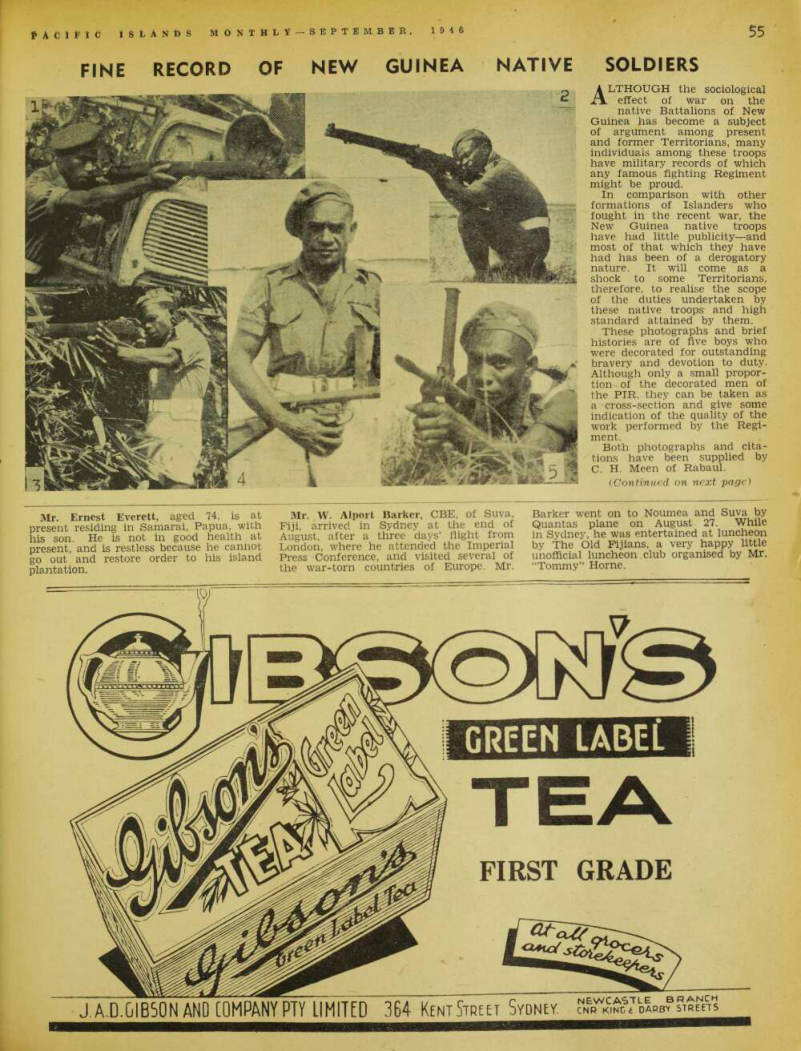
Although the sociological effect of war on the native Battalions of New Guinea has become a subject of argument among present and former Territorians, many individuals among these troops have military records of which any famous fighting Regiment might be proud.
In comparison with other formations of Islanders who fought in the recent war, the New Guinea native troops have had little publicity—and most of that which they have had has been of a derogatory nature. It will come as a shock to some Territorians, therefore, to realise the scope of the duties undertaken by these native troops and high standard attained by them.
These photographs and brief histories are of five boys who were decorated for outstanding bravery and devotion to duty.
Although only a small propor tion of the decorated men of the PIR. they can be taken as a cross-section and give some indication of the quality of the work performed by the Regi ment.
Both photographs and cita tions have been supplied by C. H. Meen of Rabaul.
(Continued on next page)
Mr. Ernest Everett, aged 74, is at present residing in Samarai, Papua, with his son. He is not in good health at present, and is restless because he cannot go out and restore order to his island plantation.
Mr. W. Alport Barker, CBE, of Suva, Fiji, arrived in Sydney at the end of August, after a three days’ flight from London, where he attended the Imperial Press Conference, and visited several of the war-torn countries of Europe. Mr.
Barker went on to Noumea and Suva by Quantas plane on August 27. While in Sydney, he was entertained at luncheon by The Old Fijians, a very happy little unofficial luncheon club organised by Mr.
“Tommy” Horne.
(1) SGT.-MAJOR MATPI is a native of Manus Island, and was formerly employed by the Lands Department in Rabaul. He escaped from the Japanese and enlisted in January, 1943, with the Papuan Infantry Battalion. He fonght at Kokoda, Salamaua and Finschhafen (where he was wounded), and is credited with killing 110 Japanese. On one occasion, in the company of another native soldier, he was cut off from his unit. % He fought his way back by killing 44 of the enemy—six of them by clubbing them with his rifle when he had run out of ammunition. He later performed similar feats.
He was awarded the Distinguished Conduct Medal for bravery and distinguished service outside the requirements of duty. (2) SGT.-MAJOR BENGARI is a native of the Waria, and was formerly employed by the Bulolo Gold Dredging Co., Ltd. He enlisted in the PIR in 1942. He saw action at Salamaua, and once, when Australian troops were stopped by Japanese machine-guns, operating from a fox-hole, Bengari volunteered and dashed for ward alone, armed with an Owen gun and
grenades and, in spite of enemy Are, wiped out every Japanese with his grenades, thus enabling the Australians to advance. For outstanding courage and devotion to duty he was awarded the Military Medal in 1943. He has an officially confirmed kill of 100 Japanese to his credit. (3) CORPORAL YAL is a native of Siassi, New Britain, and was formerly employed by a miner at Bulolo, He enlisted with the PIR at Siassi, and fought in New Guinea and New Britain. Once, during the fighting in the Ramu area, he was advancing with his platoon under the charge of an Australian officer when they were ambushed by the Japanese, and the officer was seriously wounded. In the face of heavy fire, and at the risk of his own life, Cpl. Yal went forward into the open, alone, and carried the officer to safety. For this act he was men tioned in despatches. (4) SGT. RAYMOND is a native of New Ire land and, before the war, was employed by the Administration in Kavieng. He escaped from there on the schooner “Guinia” and, with four natives and seven Europeans, reached Tulagi just before the Japanese landed there in 1942. Later in the year he was at Vila, New Hebrides, and here he enlisted in the AIB. In 1943 he carried out a dangerous mission in enemy-occupied New Ireland and there, under great difficulties, he rescued two Australian officers and successfully brought them back to the Britisti Solomon Islands. He was mentioned in despatches for saving these officers, although he continued to display outstanding bravery in other actions.
He took part in the fighting on Guadalcanal and also at Manus, Bougainville and New Britain. (5) SGT.-MAJOR TAPIOLI is a native of Arawe, New Britain. He was formerly employed by the Department of Agriculture, Rabaul. He enlisted in the PIR in 1942. He fought in the campaigns in New Guinea, New Britain, and Bougainville, and, while attached to an American platoon at Nassau Bay, Tambu Bay, and at Salamaua, he led numerous patrols from which valuable information was gained. On one of these patrols he killed seven Japanese single handed; and, on another, again single-handed, he attacked a pill-box and killed three Jap machine-gunners. These actions enabled the Americans to advance. He is credited with killing a total of 74 of the enemy. He was awarded the Military Medal for “extraordinary heroism and firm faith in the face of all danger.”
Advertisements & other items, pp. 59-60 (1 item)
Green Label
J.A.D.GIBSON AND COMPANY PTY LIMITED
FIRST GRADE
at-o^ <*Mc( 364 Kent Street Sydney.
Kidney Trouble
and Backache
Gone in 1 Week
Flush Kidneys With Cystex and You'll Feel Fine Cystex—the prescription of a famous doctor —improves faulty kidney action in double quick time, so, if you suffer from Rheumatism, Sciatica, Neuritis, Lumbago, Backache, Nervousness, Leg Pains, Dizziness, Circles under Eyes, frequent Headaches and colds, poor Energy and Appetite, Puffy Ankles or Interrupted Sleep, go to your chemist to-day for Cystex.
Cystex Helps Nature 3 Ways
The Cystex treatment is highly scientific, being specially compounded to soothe, tone and clean kidneys and bladder and to remove acids and poisons from your system safely, quickly and surely, yet contains no harsh, harmful or dangerous drugs. Cystex wo-ks in these 3 ways to end your troubles; — (1) Starts killing the germs which are attacking your Kidneys, Bladder and urinary system in two hours, yet is absolutely harmless to human tissue. (2) Gets rid of health-destroying, deadly poisonous acids with which your system has become saturated. (3) Strengthens and reinvigorates the kidneys, • protects you from the ravages of diseaseattack on the delicate filter organism, and stimulates the entire system.
Feels a Different Woman
“I have been taking Cystex for Kidney and Bladder trouble and it has made a different woman of me. I am feeling splendid, can do all mv work, run about and walk miles although I am 63 years of age. Cystex does all you claim for it.”—(Sgd.) M. L. Zessin, Thompson Estate, Brisbane.
Now Able to Walk Without Stick
“I had Kidney and Bladder complaint, pains in leg and back; in fact, I had to use a walking stick. I have used two bottles of Cystex, now I have no pains anywhere. I consider Cystex the greatest medicine in the world for Kidney complaint."—(Sgd.) J. McPherson, Nangeribone Station, N.S.W.
Guaranteed to Satisfy or Money Back
Get Cystex from your chemist to-day. Give it a thorough test. Cystex is guaranteed to make you feel younger, stronger, better in every way, or your money back If you return the empty package. Act nowl Now in 2 sizes—l/-, 8/-.
This is a
GUARANTEED
Treatment
for Your Kidneys.
Cystex
, Bladder, Rheumatism
w 1
WANTED TO BUY—QUALITY GUNS AND RIFLES
HIGHEST PRICES GIVEN. WILL ALSO EXCHANGE GUNS.
New .303 Short Service Barrels, without Sights and Platform, £2/15/- each.
Postage extra.
SI L ROH U Quality Firearms and Fishing Tackle. 143 ELIZABETH STREET (Near Market St.) SYDNEY. PHONE: MA 3540.
Tongan Premier
Remarries
Nukualofa, August 22.
A WEDDING of public interest took place here to-day when the Premier of Tonga, the Hon. High Chief Ata, was married to a young Tongan woman named Fualupe Manavahetau. Premier Ata’s new bride is a distant cousin of his first wife, who died in 1945. .
It has been rumoured locally that tne Premier will retire from office at the end of this year, but there is no confirmation of this from official circles.
If he does retire, Tongans hope that his succession will be a man with progres sive ideas and it is felt that there could be no happier choice than that of Crown Prince Tupouto’a-Tungi who at present fills admirably the positions of Minister of Education and Health. The Crown Prince is a graduate in Arts of Sydney University and has, as well, fine qualities of leadership.
Mr. C. A. M. Adelskold, who has been at the head office of, W. R. Carpenter & Co. Ltd., for some time, has gone to the Wewak branch, New Guinea. He did a good job, during the war years, as secre tary of the Pacific Territories Association.
You Can’T Have
Manus!
Australia to America
SOMETHING significant has been said during the month about the great American-built base in the Admiralty Islands (Manus), north of New Guinea mainland.
The Americans, in their prosecution of the Pacific War, created at Lorengau (at the eastern end of the big island of Manus) and on adjoining Negros Island, the biggest air and sea base in the Pacific, south of the Equator.
When the war was over, United States showed little concern about the several smaller bases built in the Solomons, New Hebrides and elsewhere; but they did indicate, at>all times, a readiness to take over the powerful Manus base, if that could be arranged.
The matter has been under discussion for some time. The Australian Socialist Government, taking a completely un realistic view of a delicate situation, has shown reluctance to permit the Ameri cans any sovereign rights in Manus (although Manus actually is part of the Mandated Territory, which Australia herself holds in trust, anyway).
Finally, on September 5, evidently in an electioneering frenzy, the Australian Prime Minister told a Brisbane meeting that his Government was determined to retain control of Manus, because “it might be needed some day as a base in a war not involving America.”
The Australian Minister, Dr. Evatt — notable mostly for his peregrinations across the world, telling various Govern ments how to manage their affairs, while industrial conditions in his own country have been falling into chaos —announced that “the Australian Government would never consent to handing over an inch of territory under its control.”
About the same time, in United States, Senator Warren Magnuson said that United States would ask UNO for sole trusteeship over Manus Island, when the disposition of the League of Nations Mandates in the .Pacific came before that body.
Editorial Note.
THESE Australian Labour Ministers appear to suffer under strange delu sions of grandeur a condition for which medical science has a special name. Their attitude towards the United States is not only stupid—it is fantastic.
The Pacific is surrounded by four con tinents —one overcrowded, two well populated, one empty. The Continent of Asia is overcrowded, almost beyond description. One quarter of the human race is packed into India and Indonesia; another quarter into China. By com parison, all the rich and fertile lands in the Pacific, south of the equator, are empty. The continent of Australia con tains only 11 million people. East Indies lie like a chain of stepping-stones be tween Asia and Australia.
The white communities of the South Pacific have no possible hope of survival unless the United States assumes guardianship of the Pacific. Without American help, what could Australia do against the overwhelming masses of Asia? About as much as Australia did in 1942, when the Japanese avalanche was rolling southwards!
That is no reflection upon Australian courage or military prowess. The point is that, in comparison with the human masses in Asia and in North America, Australia simply doesn’t count. (Continued on Next Page)
Unaided and alone, Australia could no nothing against an attack from the direction of Asia —whether Chinese, or Russian, or Jap, or Indonesian —even if she had a dozen bases like Manus at her command. Britain would help if she could—but every military strategist to-day agrees that Britain’s position in Europe now is “exceedingly vulnerable.”
Then why, in the name of plain commonsense, does Australia not now make common cause with the Ameri cans. who are her friends, and who saved her in 1942, and not only assist America in her wish to control the Manus base, but make available to America any other territory which the American strategists believe is necessary for the effective policing of the Pacific?
The Australian Prime Minister offers the feeble argument that the Manus base might be needed by Australia in some war in which America was not involved. It may be taken as funda mental that the small Australian nation has no chance of survival in any Pacific war in which America is not involved.
She may as well face plain facts.
There is nothing more extraordinary in international affairs to-day than the spectacle of Australia, with a population smaller than London or New York, posing as a Great Power, under the direction of Mr. Chifley and Dr. Evatt, During the past three years, it has opened legations, ministries, commissions, consulates and agencies in nearly every country in the world, at a cost which has been carefully hidden, but which must be colossal. Evidently, it is intended also to maintain a large army, navy and air force. And now it is sug gested that Australia, alone, can run huge bases like Manus.
The whole set-up seems like something out of dreamland. It has a suggestion of paranoia. How much longer will the unfortunate Australian taxpayer, already very heavily burdened, put up with it? —
R.W.R.
Knight
Not a "Millionaire"
Knight A Gentle Denial From Sir Maynard Hedstrom
IN an article describing the romantic career of Sir John Maynard Hedstrom, head of Morris Hedstrom Ltd. pub lished in August, we said that the well known Fiji merchant “was regarded as anything from semi to full millionaire.”
On September 3, I received the fbllow ing characteristic radiogram: “Dear Robson —I greatly appreciate the kindly remarks in the article appear ing in your August issue; but I should be much obliged if you would be good enough, in your next issue, to publish a brief notice informing your readers that I did not see the article prior to publi cation, and that I do not claim to be even a ‘dollar millionaire,' much less a millionaire in pounds. Kind regards.—
Maynard Hedstrom.”
I can only express the hope that Sir Maynard does not find the term offen sive. “Millionaire” was used in a poetic rather than a literal sense, to indicate great financial success.
Sir Maynard did not see the article before publication—in fact, he knew nothing about it. I guessed that, if it was shown to him before printing, he would try to suppresss it!—R.W.R.
Mr. Buster Noble, formerly of Stephens Aviation, Wau, is in Geelong, Vic., where he will organise a survey flight over Central Australia for the purpose of obtaining photographs for the Geograph ical Magazine.
The engagement has recently been an nounced of Miss Beatrix Kroening, younger daughter of Dr. and Mrs. B.
Kroening, of “Toboroi,” Kieta, TNG, to Mr. James Linsley Tandy, of Chatswood,
Nsw.
Advertisements & other items, p. 61 (1 item)
Widd O P
HEALTH
HORIZON
—a New Magazine of special interest to Oversea Readers
SEPTEMBER ISSUE:
DECLINE & RECOVERY IN THE
PACIFIC
Dr. V. W. T. McGusty
FOOD HORIZON
Sir R. George Stapledon
DISEASES, TOO. ARE LIVING
Dr. G. Marshall Findly
HEALTH AND FARMING IN THE
TROPICS
A. J. Wakefield Five Shillings a Year for Four Issues.
HEALTH HORIZON
Tavistock House North, Tavistock Square, London, W.C.I.
/ Motor Coaste S. Amenta. t Egyp Passenger Ferry I Nigeria / a n Tug.
England
DIESEL ENGINES
WIDD O P
5 HUP. to 500 H.P.
H. WIDDOP & CO., LTD. ?^ , iSa»ar ,H “ T Telephone : Keighley 3727-8 ;r :: ;; Telegrams : Widdop Keighley Codes A.B.C. 6th Edition. Bentleys, Bentley’s Second We are prepared to consider Agencies for certain territories Passenger Boat, Middle East.
Chinese In Tahiti
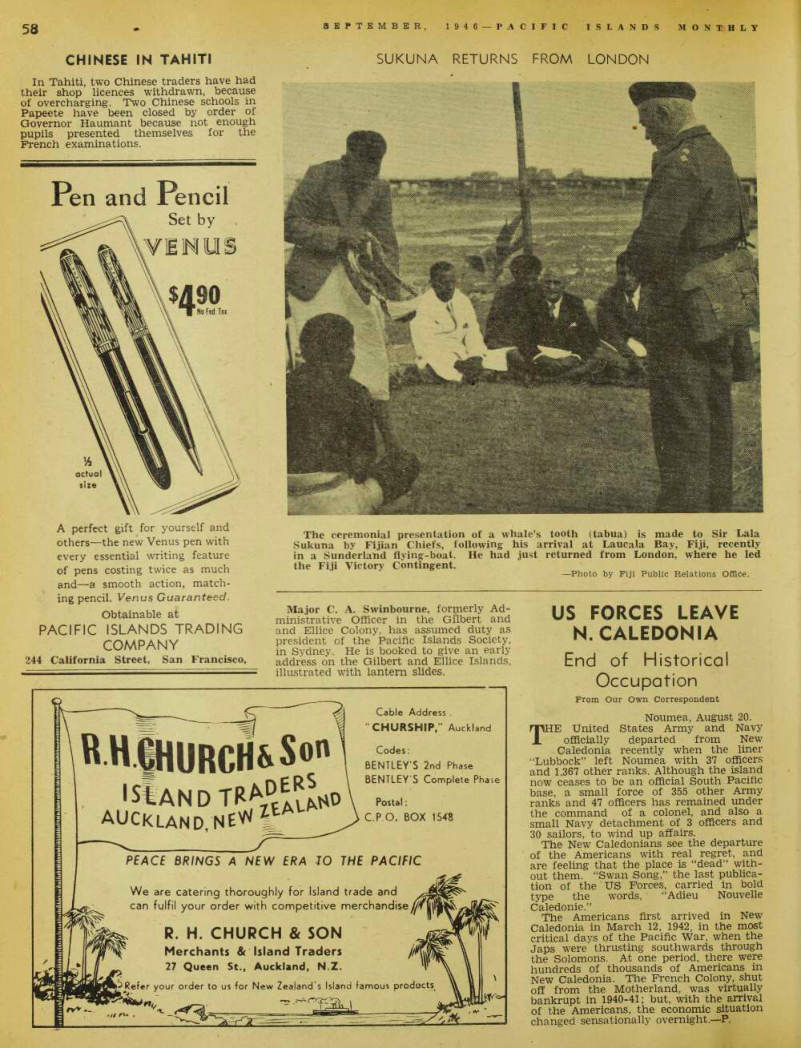
In Tahiti, two Chinese traders have had their shop licences withdrawn, because of overcharging. Two Chinese schools in Papeete have been closed by order of Governor Haumant because not enough pupils presented themselves for the French examinations.
Major C. A. Swinbourne, formerly Ad ministrative Officer in the Gilbert and and Ellice Colony, has assumed duty as president of the Pacific Islands Society, in Sydney. He is booked to give an early address on the Gilbert and Ellice Islands, illustrated with lantern slides.
Sukuna Returns From London
The ceremonial presentation of a whale’s tooth (tabua) is made to Sir Lala Sukuna by Fijian Chiefs, following his arrival at Laucala Bay, Fiji, recently in a Sunderland flying-boat. He had just returned from London, where he led the Fiji Victory Contingent.
Photo by Fiji Public Relations Office.
Occupation
Us Forces Leave
N. Caledonia
End of Historical Occupation
From Our Own Correspondent Noumea, August 20. rE United States Army and Navy officially departed from New Caledonia recently when the liner “Lubbock” left Noumea with 37 officers and 1,367 other ranks. Although the island now ceases to be an official South Pacific base, a small force of 355 other Army ranks and 47 officers has remained under the command of a colonel, and also a small Navy detachment of 3 officers and 30 sailors, to wind up affairs.
The New Caledonians see the departure of the Americans with real regret, and are feeling that the place is “dead” with out them. “Swan Song,” the last publica tion of the US Forces, carried in bold type the words, “Adieu Nouvelle Caledonie.”
The Americans first arrived in New Caledonia in March 12, 1942, in the most critical days of the Pacific War, when the Japs were thrusting southwards through the Solomons. At one period, there were hundreds of thousands of Americans in New Caledonia. The French Colony, shut off from the Motherland, was virtually bankrupt in 1940-41; but, with the arrival of the Americans, the economic situation changed sensationally overnight.—P.
Advertisements & other items, p. 62 (1 item)
Rhfhurch&Son
Pen and Pencil
Set by
k YiNUi
$490 No ffld 1 actual sue A perfect gift for yourself and others —the new Venus pen with every essential writing feature of pens costing twice as much and —a smooth action, matching pencil. Venus Guaranteed.
Obtainable at
PACIFIC ISLANDS TRADING
COMPANY
244 California Street, San Francisco,
RHfHURCH&Son
ISIAND trader
AUCKLAND,
rw Cable Address .
CHURSHIP,” Auckland Codes: BENTLEY’S 2nd Phase BENTLEY S Complete Phase Postal:
CP O. BOX 1548
S PEACE BRINGS A NEW ERA TO THE PACIFIC We are catering thoroughly for Island trade and can fulfil your order with competitive merchandise
R. H. CHURCH & SON
Merchants & Island Traders 27 Queen St., Auckland, N.Z.
Refer your order to us for New Zealand’s Island famous products lei:-;
American Dead
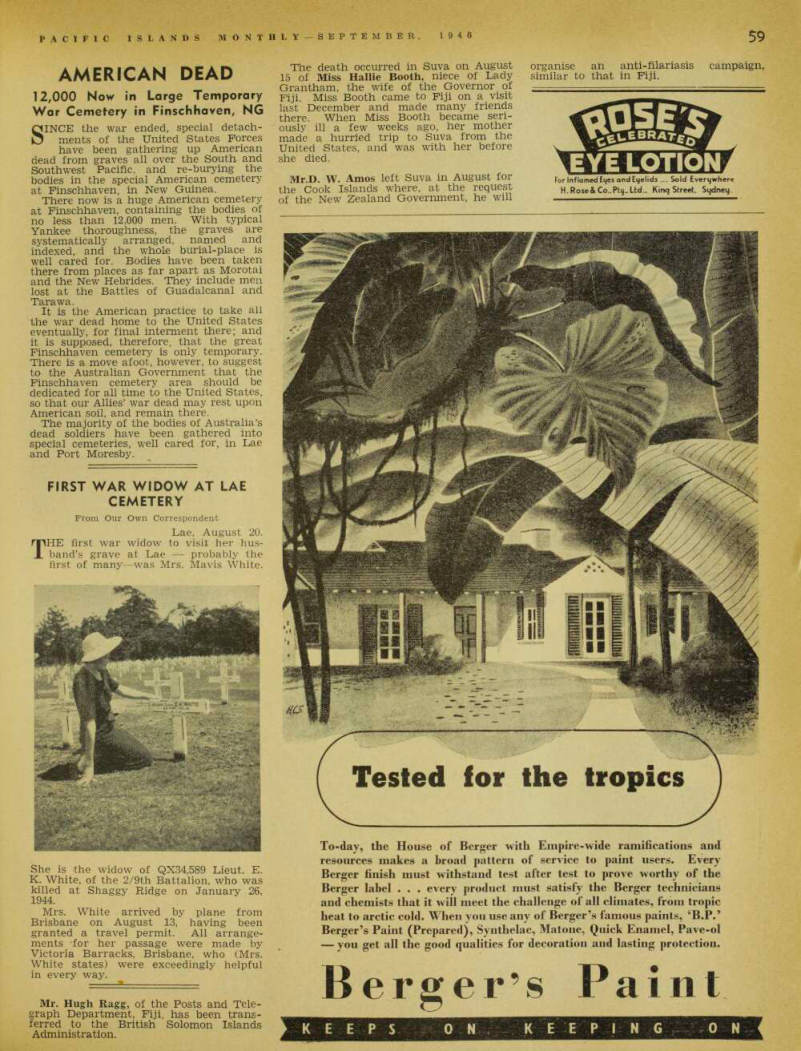
12,000 Now in Large Temporary War Cemetery in Finschhaven, NG
SINCE the war ended, special detach ments of the United States Forces have been gathering up American dead from graves all over the South and Southwest Pacific, and re-burying the bodies in the special American cemetery at Finschhaven, in New Guinea.
There now is a huge American cemetery at Finschhaven, containing the bodies of no less than 12,000 men. With typical Yankee thoroughness, the graves are systematically arranged, named and indexed, and the whole burial-place is well cared for. Bodies have been taken there from places as far apart as Morotai and the New Hebrides. They include men lost at the Battles of Guadalcanal and Tarawa.
It is the American practice to take all the war dead home to the United States eventually, for final interment there; and it is supposed, therefore, that the great Finschhaven cemetery is only temporary.
There is a move afoot, however, to suggest to the Australian Government that the Finschhaven cemetery area should be dedicated for all time to the United States, so that our Allies’ war dead may rest upon American soil, and remain there.
The majority of the bodies of Australia’s dead soldiers have been gathered into special cemeteries, well cared for, in Lae and Port Moresby.
First War Widow At Lae
Cemetery
From Our Own Correspondent Lae, August 20.
THE first war widow to visit her hus band’s grave at Lae probably the first of many—was Mrs. Mavis White.
She is the widow of QX34.589 Lieut. E.
K. White, of the 2/9th Battalion, who was killed at Shaggy Ridge on January 26, 1944.
Mrs. White arrived by plane from Brisbane on August 13, having been granted a travel permit. All arrange ments for her passage were made by Victoria Barracks, Brisbane, who (Mrs.
White states) were exceedingly helpful in every way. g Mr. Hugh Ragg, of the Posts and Tele graph Department, Fiji, has been trans ferred to the British Solomon Islands Administration.
The death occurred In Suva on August 15 of Miss Hallie Booth, niece of Lady Grantham, the wife of the Governor of Fiji. Miss Booth came to Fiji on a visit last December and made many friends there. When Miss Booth became seri ously ill a few weeks ago, her mother made a hurried trip to Suva from the United States, and was with her before she died.
Mr.D. W. Amos left Suva in August for the Cook Islands where, at the request of the New Zealand Government, he will
organise an anti-filariasis campaign, similar to that in Fiji.
Advertisements & other items, p. 63 (2 items)
59
ACIFIC ISLANDS MONTHLY SEPTEMBER, 1946
Berger’s Paint
6 nr For Inflamed Eyes and Eyelids ... Sold Everywhere H. Rose & Co.. Pty.. Ltd.. Kiny Street. Sydney.
m Sr B 8 SB II S 5 ii II B m
Tested lor the tropics
To-day, the House of Berger with Empire-wide ramifications and resources makes a broad pattern of service to paint users. Every Berger finish must withstand test after test to prove worthy of the Berger label . , . every product must satisfy the Berger technicians and chemists that it will meet the challenge of all climates, from tropic heat to arctic cold. When you use any of Berger’s famous paints, ‘B.P.’
Berger’s Paint (Prepared), Synthelac, Matone, Quick Enamel, Pave-ol you get all the good qualities for decoration and lasting protection.
Berger’s Paint
KE EPS ON KEEPING ON
Visitors To Fiji
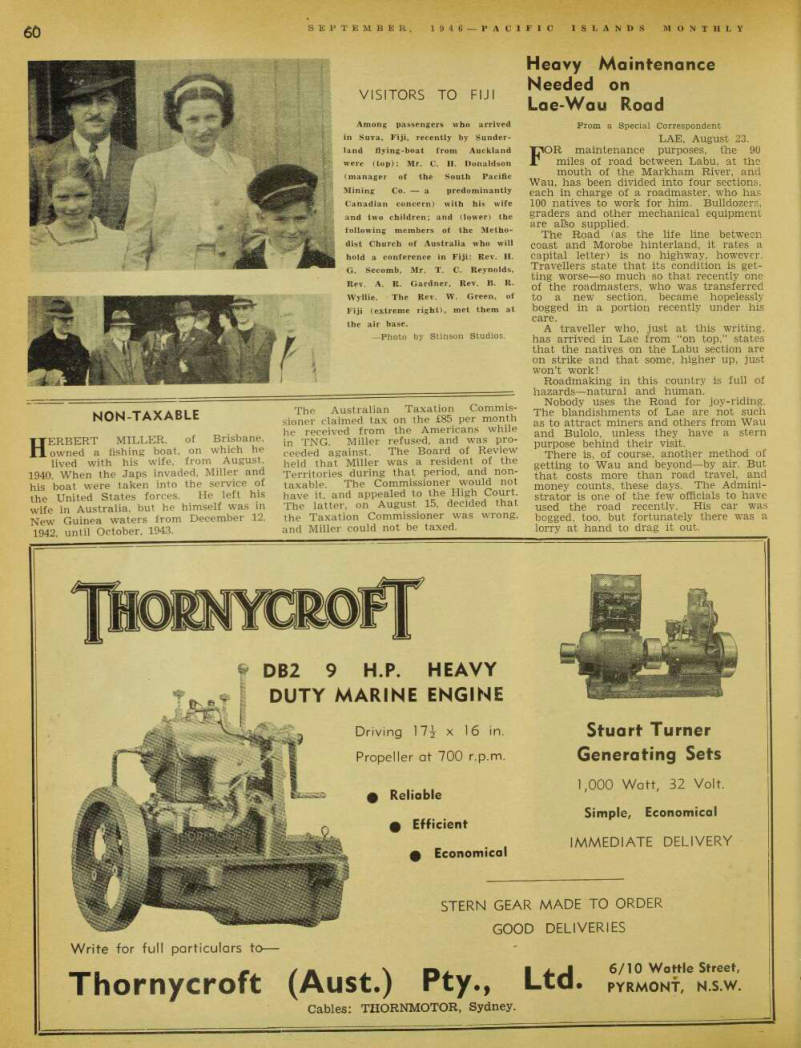
Among passengers who arrived in Suva, Fiji, recently by Sunder land flying-boat from Auckland were (top): Mr. C. H. Donaldson (manager of the South Pacific Mining Co. a predominantly Canadian concern) with his wife and two children; and (lower) the following members of the Metho dist Church of Australia who will hold a conference in Fiji: Rev. H.
G. Secomb, Mr. T. C. Reynolds, Rev. A. R. Gardner, Rev. B. R.
Wyllie. The Rev. W. Green, of Fiji (extreme right), met them at the air base.
Photo by Stinson Studios.
Non Taxable
HERBERT MILLER. of Brisbane, owned a fishing boat, on which he lived with his wife, from August, 1940. When the Japs invaded, Miller and his boat were taken into the service of the United States forces. He left his wife in Australia, but he himself was in New Guinea waters from December 12. 1942, until October, 1943.
The Australian Taxation Commis sioner claimed tax on the £B5 per month he received from the Americans while in TNG. Miller refused, and was pro ceeded against. The Board of Review held that Miller was a resident of the Territories during that period, and non taxable. The Commissioner would not have it, and appealed to the High Court.
The latter, on August 15, decided that the Taxation Commissioner was wrong, and Miller could not be taxed.
Heavy Maintenance
Needed on Lae-Wau Road
From a Special Correspondent LAE, August 23.
FOR maintenance purposes, the 90 miles of road between Labu, at the mouth of the Markham River, and Wau, has been divided into four sections, each in charge of a roadmaster, who has 100 natives to work for him. Bulldozers, graders and other mechanical equipment are afto supplied.
The Road (as the life line between coast and Morobe hinterland, it rates a capital letter) is no highway, however.
Travellers state that its condition is get ting worse—so much so that recently one of the roadmasters, who was transferred to a new section, became hopelessly bogged in a portion recently under his care.
A traveller who, just at this writing, has arrived in Lae from “on top,” states that the natives on the Labu section are on strike and that some, higher up, just won’t work!
Roadmaking in this country is full of hazards —natural and human.
Nobody uses the Road for joy-riding.
The blandishments of Lae are not such as to attract miners and others from Wau and Bulolo, unless they have a stern purpose behind their visit.
There is, of course, another method of getting to Wau and beyond—by air. But that costs more than road travel, and money counts, these days. The Admini strator is one of the few officials to have used the road recently. His car was bogged, too, but fortunately there was a lorry at hand to drag it out.
Advertisements & other items, p. 64 (1 item)
Thornycroft (Aust.) Pty., Ltd.
mwf
¥ a a
DB2 9 H.P. HEAVY
DUTY MARINE ENGINE
Driving Ili x 16 in.
Propeller at 700 r.p.m. 9 Reliable 9 Efficient m Economical Stuart Turner
Generating Sets
1,000 Watt, 32 Volt.
Simple, Economical
IMMEDIATE DELIVERY
STERN GEAR MADE TO ORDER
GOOD DELIVERIES
Write for full particulars tc
Thornycroft (Aust.) Pty., Ltd.
6/10 Wattle Street,
PYRMONT, N.S.W.
Cables: TIIORNMOTOR, Sydney.
Apia's "Black-Gang"
Now in Gaol
From Our Own Correspondent APIA, August 12.
APIA has now a Hollywood-flavoured criminal element, organised for theft and burglary on the grand scale.
This was revealed recently when Chief Judge J. R. Herd tried five members of the “Black Gang”—so called because they had gone to the rather unnecessary length of smearing their faces with charcoal.
In Apia High Court on July 23. the five were charged with burglary and theft from the Apia branch of Burns Philp (SS) Co. Ltd.
Evidence showed that they had en tered Burns Philp’s premises on at least nine occasions, raining entrance through a window in the bulk store, which the gang leader, Malele, who worked in the bulk store, had conveniently opened.
The plunder consisted of jewellery, clothes, hardware, prints, clothes and other merchandise, which was removed through a tennis court at the back of the bulk store and loaded on horses. The value of the stolen property was estab lished at £435, of which over £3OO has been recovered.
All the accused pleaded guilty and were sentenced—the ring-leader, Malele, to a total of years’ imprisonment; the four others. Topeto, Solofa Westerlund, Maiki and Meafua, to 2 years’ imprisonment each.
BEFORE Chief Judge Herd and four assessors on July 25, a Samoan. Avia, of Fagae’e. was found guilty of hav ing killed on January 4, 1946, a Samoan
village chief, Va’a, of the same village and thereby committed manslaughter.
The offence was committed during a quarrel at a village cricket match, when the accused hit the older man with a cricket bat. He was sentenced to five years’ imprisonment.
French Governor And
Us Forces
MONSIEUR Christien Laigret, Governor of New Caledonia from Sept. 1943, to February, 1944, and more recently Governor of the North-West African col ony of Mauretania, has been appointed Governor of the Middle Congo.
M. Laigret became unpopular with the Americans in New Caledonia because he criticised their discipline, charging the negro troops with molesting French women.
M. Laigret made his charges at a Press conference which US correspondents had requested. He praised the good conduct of the New Zealand Army 3rd Division and the 400 Australian commandos.
Asked how many “incidents” were being reported in which Americans were in volved, he replied: “About one a day.”
The US commmand denied bad behavi our of their servicemen, and held up the US correspondents’ reports for several days.
Washington sent a high ranking Army inspector to Noumea,and the US island commander, Major General Lincoln, de parted. His assistant, a Lieut.-Col., who had acted as censor and who was most unpopular with the French, was sent away. After the appointment of Briga dier-General William I. Rose as Island Commander, a most tactful and lovable man, with a fine war career in the Heb rides and the Solomons, relations between
the Americans and the French greatly improved.—P.
Advertisements & other items, p. 65 (1 item)
World Books
500,000
Men's Second-hand
JACKETS
and
TROUSERS
SUITABLE FOR PACIFIC
ISLANDS TRADE
Price: 4/- Each
Quick Shipment—Pressed Bales containing 1,000 Assorted Garments.
Establish Confirmed Credits for Payment for Any Quantity on Any English Bank.
M. NEWMAN
(Contractors) LTD.
Government Contractors
HEAP ST., MANCHESTER 7,
ENGLAND
Cable Address: Harbinger, Manchester.
Year-round Reading
enjoyment with
WORLD BOOKS
in de-luxe
editions.
QTART now to build your own personal library with these lovely de-luxe editions.
Beautifully bound in buckram, you get your “World Books” for only 5/6 each irrespective of the regular selling price of the books. Subscription rates cover all costs including postage and cost of the books. Lodge your order early. Only a limited number of new subscribers can be enrolled each month.
SUBSCRIPTION
RATES
6 Months:
£l/16/- 111 ws
BOOKS TO BE
RELEASED—
October : “These Were the Days” hy M. Davenport November: “Left Hand, Right Hand” hy O. Sitwell December: “The Ballad and the Source” hy R. Lehmann January: “The Commodore” hy C. S. Forester February; “Eliabeth and Leicester” hy R. Waldman March: “Collected Kipling Ctories” by R. Kipling CUT OUT THIS COUPON AND MAIL TO-DAY. - - MORGAN'S BOOK SHOP, 9 CASTLEREAGH STREET, SYDNEY, N.S.W.
Please enrol me as a member of "World Books." I enclose £ / / 12 Months:
£3/12/- (inc.)
My name is
Address
“P.1.M." (19/9/46).
Slow Progress Of Dutch In Restoring Nei
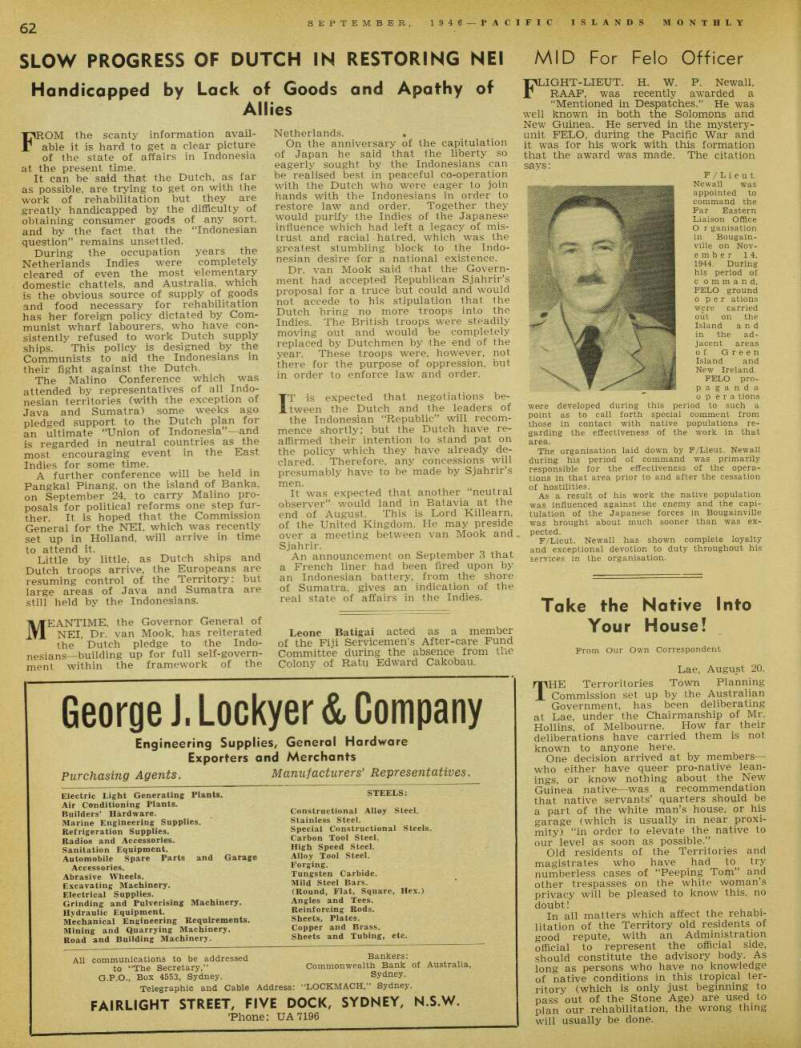
Handicapped by Lack of Goods and Apathy of Allies
FROM the scanty information avail able it is hard to get a clear picture of the state of affairs in Indonesia at the present time.
It can be said that the Dutch, as far as possible, are trying to get on with the work of rehabilitation but they are greatly handicapped by the difficulty of obtaining consumer goods of any sort, and by the fact that the “Indonesian question” remains unsettled.
During the occupation years the Netherlands Indies were completely cleared of even the most 'elementary domestic chattels, and Australia, which is the obvious source of supply of goods and food necessary for rehabilitation has her foreign policy dictated by Com munist wharf labourers, who have con sistently refused to work Dutch supply ships. ‘ This policy is designed by the Communists to aid the Indonesians in their fight against the Dutch.
The Malino Conference which was attended by representatives of all Indo nesian territories (with the exception of Java and Sumatra) some weeks ago pledged support to the Dutch plan for an ultimate “Union of Indonesia”—and is regarded in neutral countries as the most encouraging event in the East Indies for some time.
A further conference will be held in Pangkal Pinang, on the island of Banka, on September 24, to carry Malino pro posals for political reforms one step fur ther. It is hoped that the Commission General for the NEI, which was recently set up in Holland, will arrive in time to attend it.
Little by little, as Dutch ships and Dutch troops arrive, the Europeans are resuming control of the Territory; but large areas of Java and Sumatra are still held by the Indonesians.
MEANTIME, the Governor General of NEI, Dr. van Mook, has reiterated the Dutch pledge to the Indo nesians— building up for full self-govern ment within the framework of the
Netherlands. • On the anniversary of the capitulation of Japan he said that the liberty so eagerly sought by the Indonesians can be realised best in peaceful co-operation with the Dutch who were eager to join hands with the Indonesians in order to restore law and order. Together they would purify the Indies of the Japanese influence which had left a legacy of mis trust and racial hatred, which was the greatest stumbling block to the Indo nesian desire for a national existence.
Dr. van Mook said that the Govern ment had accepted Republican Sjahrir’s proposal for a truce but could and would not accede to his stipulation that the Dutch bring no more troops into the Indies. The British troops were steadily moving out and would be completely replaced by Dutchmen by the end of the year. These troops were, however, not there for the purpose of oppression, but in order to enforce law and order.
IT is expected that negotiations be tween the Dutch and the leaders of the Indonesian “Republic” will recom mence shortly; but the Dutch have re affirmed their intention to stand pat on the policy which they have already de clared. Therefore, any concessions will presumably have to be made by Sjahrir’s men.
It was expected that another “neutral observer” would land in Batavia at the end of August. This is Lord Killearn, of the United Kingdom. He may preside over a meeting between van Mook and Sjahrir.
An announcement on September 3 that a French liner had been fired upon by an Indonesian battery, from the shore of Sumatra, gives an indication of the real state of affairs in the Indies.
Leone Batigai acted as a member of the Fiji Servicemen’s After-care Fund Committee during the absence from the Colony of Ratu Edward Cakobau.
MID For Felo Officer
TTttJGHT-LIEUT. H. W. P. Newall, J; RAAF, was recently awarded a "Mentioned in Despatches.” He was well known in both the Solomons and New Guinea. He served in the mystery unit FELO, during the Pacific War and it was for his work with this formation that the award was made. The citation says:
F / L i e u t.
Newall was appointed to command the Far Eastern Liaison Office O r ganisation in Bougain ville on Nov ember 14, 1944. During his period of c o m m a n d, FELO ground o p e r ations were carried out on the Island and in the ad jacent areas of Green Island and New Ireland.
FELO pro paga n d a opera tions
were developed during this period to such a point as to call forth special comment from those in contact with native populations re garding the effectiveness of the work in that area.
The organisation laid down by P/Lieut. Newall during his period of command was primarily responsible for the effectiveness of the opera tions in that area prior to and after the cessation of hostilities.
As a result of his work the native population was influenced against the enemy and the capi tulation of the Japanese forces in Bougainville was brought about much sooner than was ex pected.
F/Lieut. Newall has shown complete loyalty and exceptional devotion to duty throughout his services in the organisation.
Take the Native Into Your House!
Your House!
From Our Own Correspondent Lae, August 20.
THE Terroritories Town Planning Commission set up by the Australian Government, has been deliberating at Lae, under the Chairmanship of Mr.
Hollins, of Melbourne. How far their deliberations have carried them is not known to anyone here.
One decision arrived at by members— who either have queer pro-native lean ings, or know nothing about the New Guinea native —was a recommendation that native servants’ quarters should be a part of the white man’s house, or his garage (which is usually in near proxi mity) “in order to elevate the native to our level as soon as possible.”
Old residents of the Territories and magistrates who have had to try numberless cases of “Peeping Tom” and other trespasses on the white woman’s privacy will be pleased to know this, no doubt!
In all matters which affect the rehabi litation of the Territory old residents of good repute, with an Administration official to represent the official side, should constitute the advisory body. As long as persons who have no knowledge of native conditions in this tropical ter ritory (which is only just beginning to pass out of the Stone Age) are used to plan our rehabilitation, the wrong thing will usually be done.
Advertisements & other items, pp. 66-68 (2 items)
George J. Lockyer & Company
Engineering Supplies, General Hardware
Exporters and Merchants
Purchasing Agents. Manufacturers’ Representatives.
Electric Light Generating Plants.
Air Conditioning Plants.
Builders’ Hardware.
Marine Engineering Supplies.
Refrigeration Supplies.
Radios and Accessories.
Sanitation Equipment.
Automobile Spare Parts and Garage Accessories.
Abrasive Wheels.
Excavating Machinery.
Electrical Supplies.
Grinding and Pulverising Machinery.
Hydraulic Equipment.
Mechanical Engineering Requirements.
Mining and Quarrying Machinery.
Road and Building Machinery.
STEELS:
Constructional Alloy Steel.
Stainless Steel.
Special Constructional Steels.
Carbon Tool Steel.
High Speed Steel.
Alloy Tool Steel.
Forging, Tungsten Carbide.
Mild Steel Bars. (Round, Flat, Square, Hex.) Angles and Tees.
Reinforcing Rods.
Sheets, Plates.
Copper and Brass.
Sheets and Tubing, etc.
All communications to be addressed to “The Secretary,”
G.P.0., Box 4553, Sydney.
Telegraphic and Cable Address: Bankers: Commonwealth Bank of Australia, Sydney. ‘LOCKMACH,” Sydney.
FAIRLIGHT STREET, FIVE DOCK, SYDNEY, N.S.W.
’Phone: UA 7196
Ipana
I'm sure if you use it once. Miss Barry, you'll always use it" ... (says the Chemist) A m .
V j . . because you'll find Ipana refreshingly different. Ipana won't work miracles, but it
WILL CLEAN X OUR TEETH
thoroughly and make them look their brightest and best."
IPANA
does all a tooth paste CAN do for your teeth and gums It cannot restore teeth that need a dentist's care, but Ipana does help to preserve your teeth by keeping them clean and white and glistening. Food particles are less likely to lodge against teeth so thoroughly cleaned. A good up-and-down brushing with Ipana after every meal is an excellent way to keep your teeth sound and healthy and
brilliantly gleaming.
Even dentists themselves choose Ipana for their personal use 3 to I over any other dentifrice. A National Survey revealed this fact for your guidance.
IPANA TOOTH PASTE
Sold by all leading distributors and manufactured by: BRISTOL-MYERS CO. PTY. LTD., 223 PACIFIC HIGHWAY, NORTH SYDNEY, N.S.W., AUSTRALIA
Periodicals . . . Trade Journals
American, English and Australian Periodicals and Trade Journals posted direct to you.
The N.S.W. Bookstall Co. Pty., Limited can supply all available overseas and local subscription magazines. Subscription Lists Available Let us know your requirements. on Application.
N.S.W. BOOKSTALL COMPANY PTY., LTD.
Market and Castlereagh Streets, Sydney, AUSTRALIA.
BECOME A MEMBER OF
Hutchinson’s Universal Book Club
Ensure yourself hours of thrilling enjoyment every month. Each month, from the works of such famous writers as Naomi Jacob, Philip Gibbs, Rafael Sabatini, Gilbert Frankau, Dennis Wheatley and many more, literary experts choose the book of the month. This best-seller, of standard size and quality and normally costing from 9/6 to 16/- comes to you for 3/3.
Fill in this Enrolment Form NOW!
To the Secretary, Hutchinson’s Universal Book Club, Bank of Australasia Building, 396 Collins Street, Melbourne. \ I wish to enrol as a member of Hutchinson’s Universal Book Club in the . following manner:— J (i) I enclose herewith remittance for 19/6 which entitles me to receive the selected book each month for the next 6 months, postage free. • (ii) 1 enclose herewith remittance for 39/- which entitles me to receive the I selected book each month for the next 12 months, postage free. * (iii) I enclose herewith remittance for 78/- which entitles me to receive the selected book each month for the next 24 months, postage free.
NAME (Block Letters)
ADDRESS
You should not- experience any
difficulty in obtaining supplies
AUNT
MARYS
BAKING POWDER
always ensures success, when used with any good plain flour. Crusty, light scones, flaky pie-crust and pastry, even textured, light sponges and cookies are certain when you use AUNT MARY'S BAKING POWDER.
Famous for over 70 years! AVAILABLE EVERYWHERE.
Picked Up
Seven Lucky Men Picked Up From Stormy Seas
Papeete, July 9.
WHEN the S.S. “Sagittaire” arrived Papeete on July 3, she had on board seven U.S. Marine Corps aviators, who had been rescued from their rubber boat two days West of Tahiti, in the neighbourhood of Aitutaki (in the Cook Islands).
The Marines left Samoa by plane, to fly to Aitutaki. North of the Cooks they ran into a black To’erau storm, which destroyed visibility, and they could not get any idea of their position. When their petrol became exhausted, they were forced down and took to their rubber boats three in one and four in the other.
Fortunately, the “Sagittaire” was coming from Noumea to Papeete and, even more fortunately, she was able to pick up the aviators’ S.O.S. and direction signals, and located the rubber boats.
The seven were taken aboard, given medical attention, and were brought to Papeete safe and sound.
A plane from Samoa arrived at Papeete on July 3, and took the Marines back to their base on July 4.
The Marines were 12 hours on the water, and can count themselves lucky.
More "Investigation" Of
Ng Native Labour
Prom Our Own Correspondent Lae, August 20.
UNDER the heading of “Native Labour Wages” a notice was published by the ADO, Lae, calling all employers of Native Labour to a general meeting at the District Office, on August 15, to meet Mr. A. Blakely, “senior arbitration inspec tor,” who arrived here “for the purpose of conducting an investigation into the adequacy of minimum monthly wage payable to native labourers.”
As many as could leave their occupa tions attended. So far the investigation has only taken the form of a debate, and views have been expressed by many employers of native labour.
Mr. Blakely has stated that anything proceeding out of his visit is only of a preliminary nature, and will be followed by a Royal Commission.
One wonders why a Royal Commission could not have commenced and concluded the “investigation” without the expense (to the taxpayers of Australia) of a pre liminary canter by the Senior Arbitration Inspector!
The Hon. A. Blakely (he was once a Labour Minister, hence the “Hon.”) will be rembered by the pre-war mining com munity for his visit to Wau about 1941, when a compulsory Miners’ Union was instituted in the face of the strongest opposition by a majority of miners, individual and otherwise.
It would be interesting to know whether Mr. Ward was influenced by Mr.
Blakely, in introducing his disastrous native labour policy, which has practically paralysed the Territories.
Mrs. E. Leyer, accompanied by her young son, Bevan, left Brisbane by the “Montoro,” in August for New Guinea.
One of the first batch of evacuees to leave the Islands by plane, Mrs. Leyer had been residing in Brisbane since 1941.
Her husband returned to the Territory some time ago.
Advertisements & other items, p. 68 (1 item)
64
SEPTEMBER, 1946—rACIFIC ISLANDS MONTHLY
Sydney—Queensland—
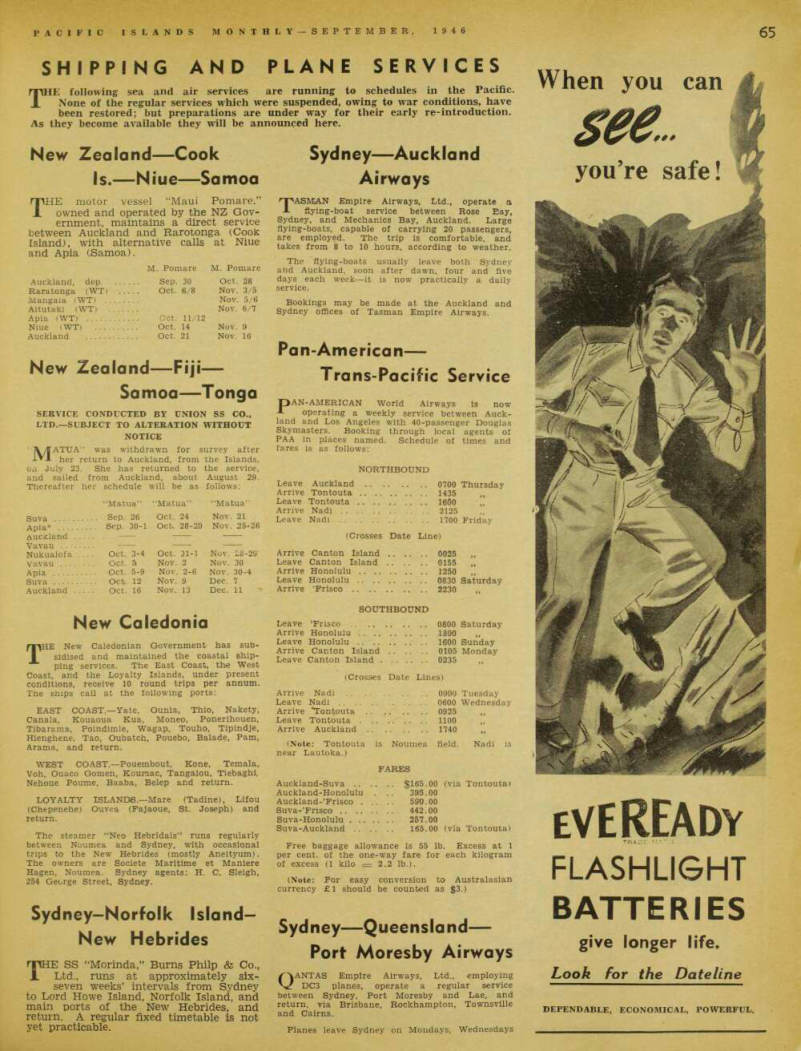
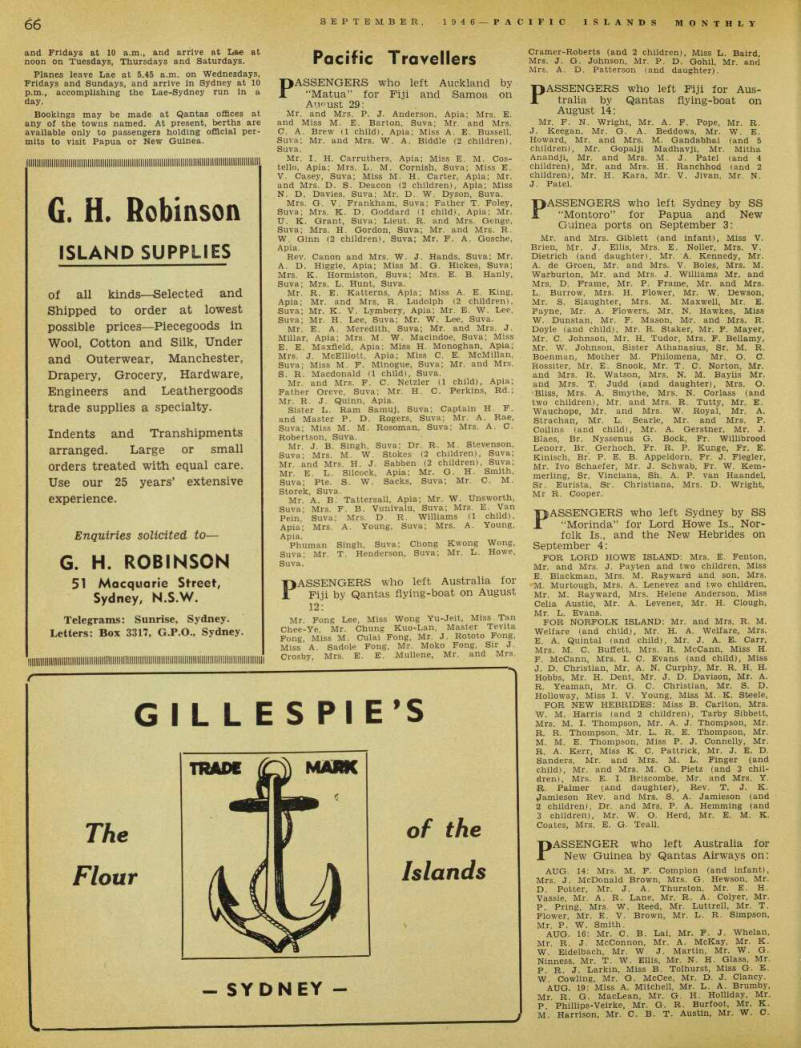
Shipping And Plane Services
rE following sea and air services are running to schedules in the Pacific.
None of the regular services which were suspended, owing to war conditions, have been restored; but preparations are under way for their early re-introduction.
As they become available they will be announced here.
New Zealand —Cook
Is.—Niue—Samoa
THE motor vessel “Maui Pomare,” owned and operated by the NZ Gov ernment, maintains a direct service between Auckland and Rarotonga (Cook Island), with alternative calls at Niue and Apia (Samoa).
New Zealand—Fiji—
Samoa—Tonga
Service Conducted By Union Ss Co.,
Ltd.—Subject To Alteration Without
Notice
MATUA” was withdrawn for survey after her return to Auckland, from the Islands, on July 23. She has returned to the service, and sailed from Auckland, about August 29.
Thereafter her schedule will be as follows:
New Caledonia
rE New Caledonian Government has sub sidised and maintained the coastal ship ping services. The East Coast, the West Coast, and the Loyalty Islands, under present conditions, receive 10 round trips per annum.
The ships call at the following ports: EAST COAST.—Yate, Ounia, Thio, Nakety, Canala, Kouaoua Kua, Moneo, Ponerihouen, Tibarama, Poindimie, Wagap, Touho, Tipindje, Hienghene, Tao, Oubatch, Pouebo, Balade, Pam, Arama, and return.
WEST COAST.—Pouembout, Kone, Temala, Voh, Ouaco Gomen, Kouraac, Tangaiou, Tiebaghi, Nehoue Poume, Baaba, Belep and return.
LOYALTY ISLANDS.—Mare (Tadine), Lifou (Chepenehe) Ouvea (Fajaoue, St. Joseph) and return.
The- steamer “Neo Hebridais” runs regularly between Noumea and Sydney, with occasional trips to the New Hebrides (mostly Aneityum).
The owners are Societe Maritime et Maniere Hagen, Noumea. Sydney agents; H. C. Sleigh, 254 George Street, Sydney.
Sydney-Norfoik Island-
New Hebrides
rE SS “Morinda,” Burns Philp & Co., Ltd., runs at approximately seven weeks’ intervals from Sydney to Lord Howe Island, Norfolk Island, and main ports of the New Hebrides, and return. A regular fixed timetable is not
yet practicable.
Sydney—Auckland
Airways
Tasman Empire Airways, Ltd., operate a flying-boat service between Rose Bay, Sydney, and Mechanics Bay, Auckland. Large flying-boats, capable of carrying 20 passengers, are employed. The trip is comfortable, and takes from 8 to 10 hours, according to weather.
The flying-boats usually leave both Sydney and Auckland, soon after dawn, four and five days each week—it is now practically a daily service.
Bookings may be made at the Auckland and Sydney offices of Tasman Empire Airways.
Pan-American—
Trans-Pacific Service
pAN-AMERICAN World Airways is now operating a weekly service between Auck land and Los Angeles with 40-passenger Douglas Skymasters. Booking through local agents of PAA in places named. Schedule of times and fares is as follows:
Free baggage allowance is 55 lb. Excess at 1 per cent, of the one-way fare for each kilogram of excess (1 kilo = 2.2 lb.), (Note: For easy conversion to Australasian currency £1 should be counted as $3.)
Sydney—Queensland—
Port Moresby Airways
Q ANT AS Empire Airways, Ltd., employing DCS planes, operate a regular service between Sydney, Port Moresby and Lae, and return, via Brisbane, Rockhampton, Townsville and Cairns.
Planes leave Sydney on Mondays, Wednesdays
M. Pomare M. Pomare Auckland, dep.
Sep. 30 Oct. 28 Kara tonga (WTi Oct. 6/8 Nov. 3/5 Mangaia 1WT1 Nov. 5/6 Aitutaki 1WT1 . ...
Nov. 6/7 Apia IWT) Oct. 11/12 Niue (WT) Oct. 14 Nov. 9 Auckland Nov. 16
“Matua”
“Matua”
“Matua”
Suva Sep. 26 Oct. 24 Nov. 21 Apia* . . Sep. 30-1 Oct. 28-29 Nov. 25-26 Auckland .. . .. , — — Vavau — — — Nukualofa . .
Oct. 3-4 Oct. 31-1 Nov. 2.S-29 - Vavau Oct. 5 Nov. 2 Nov. 30 Apia Oct. 5-9 Nov. 2-6 Nov. 30-4 Suva Nov. 9 Dec. 7 Auckland Oct. 16 Nov. 13 Dec. 11
Northbound
Leave Auckland .. .
Arrive Tontouta .. ..
Leave Tontouta .. ..
Arrive Nadi Leave Nadi 1435 1600 2125 (Crosses Date Line) Arrive Canton Island Leave Canton Island Arrive Honolulu .. ..
Leave Honolulu .. ..
Arrive ’Frisco .. .. 0025 „ 0155 .. 1250 „
Southbound
Leave ’Frisco Arrive Honolulu .. ..
Leave Honolulu .. ..
Arrive Canton Island Leave Canton Island . 1800 0235 (Crosses Date Lines) Arrive Nadi Leave Nadi Arrive Tontouta .. , Leave Tontouta . ..
Arrive Auckland 0900 Tuesday 0925 noo 1740 (Note: Tontouta is near Lautoka.) Noumea field.
Nadi is
Fares
Auckland-Suva .. ..
Auckland-Honolulu .
Auckland-’Frisco . ..
Suva-’Frisco Suva-Honolulu .. $165.00 (via 395.00 5&D.00 442.00 257.00 Tontouta* Suva-Auckland .. .. 165.00 (via Tontouta)
and Fridays at 10 a.m., and arrive at Lae at noon on Tuesdays, Thursdays and Saturdays.
Planes leave Lae at 5.45 a.m. on Wednesdays, Fridays and Sundays, and arrive in Sydney at 10 p.m., accomplishing the Lae-Sydney run in a day.
Bookings may be made at Qantas offices at any of the towns named. At present, berths are available only to passengers holding official per mits to visit Papua or New Guinea.
Advertisements & other items, pp. 69-70 (1 item)
Eveready
When you can
see
00 0 safe you re at i as X
eVEREADy
trade-m.-~:«
FLASHLIGHT
BATTERIES
give longer life.
Look for the Dateline
DEPENDABLE, ECONOMICAL, POWERFUL.
G. H. Robinson
ISLAND SUPPLIES
of all kinds—Selected and Shipped to order at lowest possible prices—Piecegoods in Wool, Cotton and Silk, Under and Outerwear, Manchester, Drapery, Grocery, Hardware, Engineers and Leathergoods trade supplies a specialty.
Indents and Transhipments arranged. Large or small orders treated with equal care.
Use our 25 years’ extensive experience.
Enquiries solicited to —
G. H. ROBINSON
51 Macquarie Street,
Sydney, N.S.W.
Telegrams: Sunrise, Sydney.
Letters: Box 3317, G.P.0., Sydney.
GILLESPIE’S
The Flour
MARK
TRADE
of the Islands
- SYDNEY -
Pacific Travellers
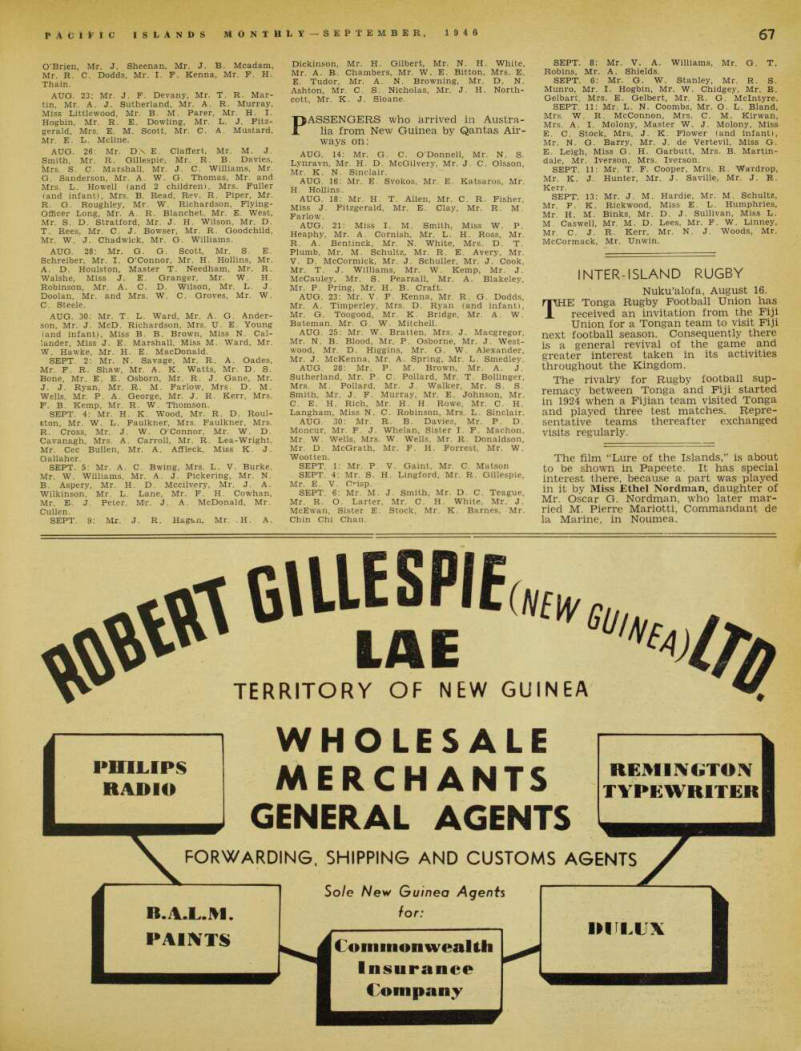
PASSENGERS who left Auckland by “Matua” for Fiji and Samoa on August 29: Mr. and Mrs. P. J. Anderson, Apia; Mrs. E. and Miss M. E. Barton, Suva; Mr. and Mrs.
C. A. Brew (1 child), Apia; Miss A. E. Bussell, Suva; Mr. and Mrs. W. A. Biddle (2 children), Suva.
Mr. I. H. Carruthers, Apia; Miss E. M. Cos tello, Apia; Mrs. L. M. Cornish, Suva; Miss E.
V. Casey, Suva; Miss M. H. Carter, Apia; Mr. and Mrs. D. S. Deacon (2 children), Apia; Miss N. D. Davies, Suva; Mr. D. W. Dyson, Suva.
Mrs. G. V. Frankham, Suva; Father T. Foley, Suva; Mrs. K. D. Goddard (1 child), Apia; Mr.
U. K. Grant, Suva; Lieut. R. and Mrs. Genge, Suva; Mrs. H. Gordon, Suva; Mr. and Mrs. R.
W. Ginn (2 children), Suva; Mr. F. A. Gosche, Apia.
Rev. Canon and Mrs. W. J. Hands, Suva; Mr.
A. D. Higgle, Apia; Miss M. G. Hickes, Suva; Mrs. K. Hormiston, Suva; Mrs. E. B. Hanly, Suva; Mrs. L. Hunt, Suva.
Mr. R. E. Katterns, Apia; Miss A. E. King, Apia; Mr. and Mrs. R. Ludolph (2 children), Suva; Mr. K. V. Lymbery, Apia; Mr. E. W. Lee, Suva; Mr. H. Lee, Suva; Mr. W. Lee, Suva.
Mr. E. A. Meredith, Suva; Mr. and Mrs. J.
Millar, Apia; Mrs. M. W. Macindoe, Suva; Miss E. E. Maxfield, Apia; Miss H. Monoghan, Apia; Mrs. J. McElliott, Apia; Miss C. E. McMillan, Suva; Miss M. F. Minogue, Suva; Mr. and Mrs.
S. R. Macdonald (1 child), Suva.
Mr. and Mrs. F. C. Netzler (1 child), Apia; Father Oreve, Suva; Mr. H. C. Perkins, Rd.; Mr. R. J. Quinn, Apia.
Sister L. Ram Samuj, Suva; Captain H. F. and Master P. D. Rogers, Suva; Mr. A. Rae, Suva; Miss M. M. Rosoman, Suva; Mrs. A. C.
Robertson, Suva.
Mr J. B. Singh, Suva; Dr. R. M. Stevenson, Suva; Mrs. M. W. Stokes (2 children), Suva; Mr. and Mrs. H. J. Sabben (2 children), Suva; Mr. E. L. Silcock, Apia; Mr. G. H. Smith, Suva; Pte. S. W. Sacks, Suva; Mr. C. M.
Storek, Suva.
Mr. A. B. Tattersall, Apia; Mr. W. Unsworth, Suva; Mrs. F. B. Vunivalu, Suva; Mrs. E. Van Pein, Suva; Mrs. D. R. Williams (1 child), Apia; Mrs. A. Young, Suva; Mrs. A. Young, Apia.
Phuman Singh, Suva; Chong Kwong Wong, Suva: Mr. T. Henderson, Suva; Mr. L. Howe, Suva.
PASSENGERS who left Australia for
Fiji by Qantas flying-boat on August
12: Mr. Fong Lee, Miss Wong Yu-Jeit, Miss Tan Chee-Ye, Mr. Chung Kuo-Lan, Master Tevita Fong, Miss M. Culai Fong, Mr. J. Rototo Fong, Miss A. Sadole Fong, Mr. Moko Fong, Sir J.
Crosby, Mrs. E. E. Mullene, Mr. and Mrs.
Cramer-Roberts (and 2 children), Miss L. Baird, Mrs. J. G. Johnson, Mr. P. D. Gohil, Mr. and Mrs. A. D. Patterson (and daughter).
PASSENGERS who left Fiji for Aus
tralia by Qantas flying-boat on
August 14;
Mr. F. N. Wright, Mr. A. F. Pope, Mr. R.
J. Keegan, Mr. G. A. Beddows, Mr. W. E.
Howard, Mr. and Mrs. M. Gandabhai (and 5 children), Mr. Gopalji Madhavji, Mr. Mitha Anandji, Mr. and Mrs. M. J. Patel (and 4 children), Mr. and Mrs. H. Ranchhod (and 2 children), Mr. H. Kara, Mr. V. Jivan, Mr. N.
J. Patel.
PASSENGERS who left Sydney by SS
“Montoro” for Papua and New Guinea ports on September 3: Mr. and Mrs. Giblett (and infant), Miss V.
Brien, Mr. J. Ellis, Mrs. E. Noller, Mrs. V.
Dietrich (and daughter), Mr. A. Kennedy, Mr.
A. de Groen, Mr. and Mrs. V. Boles, Mrs. M.
Warburton, Mr. and Mrs. J. Williams Mr. and Mrs. D. Frame, Mr. P. Frame, Mr. and Mrs.
L. Burrow, Mrs. H. Flower, Mr. W. Dewson, Mr. S. Slaughter, Mrs. M. Maxwell, Mr. E.
Payne, Mr. A. Flowers, Mr. N. Hawkes, Miss W. Dunstan, Mr. F. Mason, Mr. and Mrs. R.
Doyle (and child), Mr. R. Staker, Mr. F. Mayer, Mr. C. Johnson, Mr. H. Tudor, Mrs. F. Bellamy, Mr. W. Johnson, Sister Athanasius, Sr. M. R.
Boenman, Mother M. Philomena, Mr. O. C.
Rossiter, Mr. E. Snook, Mr. T. C. Norton, Mr. and Mrs. R. Watson, Mrs. N. M. Baylis Mr. and Mrs. T. Judd (and daughter), Mrs. O.
'Bliss, Mrs. A. Smythe, Mrs. N. Corlass (and two children), Mr. and Mrs. R. Tutty, Mr. E.
Wauchope, Mr. and Mrs. W. Royal, Mr. A.
Strachan, Mr. L. Searle, Mr. and Mrs. P.
Collins (and child), Mr. A. Gerstner, Mr. J.
Blaes, Br. Nyssenus G. Bock, Fr. Willibrood Lenorr, Br. Gerhoch, Fr. R. P. Kunge, Fr. E.
Kinisch, Br. P. E. B. Appeldorn, Fr. J. Fiegler, Mr. Ivo Schaefer, Mr. J. Schwab, Fr. W. Kem merling, Sr. Vinciana, Sh. A. P. van Haandel, Sr. Eurista, Sr. Christiana, Mrs. D. Wright, Mr R. Cooper.
PASSENGERS who left Sydney by SS
“Morinda” for Lord Howe Is., Nor folk Is., and the New Hebrides on
September 4:
FOR LORD HOWE ISLAND: Mrs. E. Fenton, Mr. and Mrs. J. Payten and two children, Miss E. Blackman, Mrs. M. Rayward and son, Mrs.
M. Murtough, Mrs. A. Lenevez and two children, Mr. M. Rayward, Mrs. Helene Anderson, Miss Celia Austic, Mr. A. Levenez, Mr. H. Clough, Mr. L, Evans.
FOR NORFOLK ISLAND: Mr. and Mrs. R. M.
Welfare (and child), Mr. H. A. Welfare, Mrs.
E. A. Quintal (and child), Mr. J. A. E. Carr, Mrs. M. C. Buffett, Mrs. R. McCann, Miss H.
F. McCann, Mrs. I. C. Evans (and child), Miss J. D. Christian, Mr. A. N. Curphy, Mr. R. H. H.
Hobbs, Mr. H. Dent, Mr. J. D. Davison, Mr. A.
R. Yeaman, Mr. G. C. Christian, Mr. S. D.
Holloway, Miss I. V. Young, Miss M. K. Steele, FOR NEW HEBRIDES: Miss B. Carlton, Mrs.
W. M. Harris (and 2 children), Tarby Sibbett, Mrs. M. I. Thompson, Mr. A. J. Thompson, Mr.
R. R. Thompson, Mr. L. R. E. Thompson, Mr.
M. M. E. Thompson, Miss P. J. Connelly, Mr.
R. A. Kerr, Miss K. C. Pattrick, Mr. J. E. D.
Sanders, Mr. and Mrs. M. L. Finger (and child), Mr. and Mrs. M. G. Pietz (and 3 chil dren), Mrs. E. I. Briscombe, Mr. and Mrs. Y.
R. Palmer (and daughter). Rev. T. J. K.
Jamieson Rev. and Mrs. S. A. Jamieson (and 2 children), Dr. and Mrs. P. A. Hemming (and 3 children), Mr. W. O. Herd, Mr. E. M. K.
Coates, Mrs. E. G. Teall.
PASSENGER who left Australia for
New Guinea by Qantas Airways on:
AUG. 14: Mrs. M. F. Compion (and infant), Mrs. J. McDonald Brown, Mrs. G. Hewson, Mr.
D. Potter, Mr. J. A. Thurston, Mr. E. H.
Vassie, Mr. A. R. Lane, Mr. R. A. Colyer, Mr.
P. Pring, Mrs. W. Reed, Mr. Luttrell, Mr. T.
Flower, Mr. E. V. Brown, Mr. L. R. Simpson, Mr. P. W. Smith.
AUG. 16: Mr. C. B. Lai, Mr. F. J. Whelan, Mr. R. J. McConnon, Mr. A. McKay, Mr. K.
W. Eidelbach, Mr. W. J. Martin, Mr. W. G.
Ninness, Mr. T. W. Ellis, Mr. N. H. Glass, Mr.
P. R. J. Larkin, Miss B. Tolhurst, Miss G. E.
W Cowling, Mr. G. McGee, Mr. D. J. Clancy.
AUG. 19: Miss A. Mitchell, Mr. L. A. Brumby, Mr R. G. Mac Lean, Mr. G. H. Holliday, Mr.
P. Phillips-Veirke, Mr. G. R. Burfoot, Mr. K.
M. Harrison, Mr. C. B. T. Austin, Mr. W. C.
O’Brien, Mr. J. Sheenan, Mr. J. B. Mcadam, Mr. R. C. Dodds, Mr. I. F. Kenna, Mr. F. H.
Thain.
AUG. 23: Mr. J. F. Devany, Mr. T. R. Mar tin, Mr. A. J. Sutherland, Mr. A. R. Murray, Miss Littlewood, Mr. B. M. Parer, Mr. H. I.
Hogbin, Mr. R. E. Dowling, Mr. L. J. Fitz gerald, Mrs. E. M. Scott, Mr. C. A. Mustard, Mr, E. L. Mcline.
AUG. 26: Mr. D.s E. Claffert, Mr. M. J.
Smith, Mr. R. Gillespie, Mr. R. B. Davies, Mrs, S. C. Marshall, Mr. J. C. Williams, Mr.
G. Sanderson, Mr. A. W. G. Thomas. Mr. and Mrs. L. Howell (and 2 children), Mrs. Fuller (and infant), Mrs. B. Read, Rev. R. Piper, Mr.
R. G. Roughley, Mr. W. Richardson, Flying- Officer Long, Mr. A. R. Blanchet, Mr. E. West, Mr. S. D. Stratford, Mr. J. H. Wilson, Mr. D.
T. Rees, Mr. C. J. Bowser, Mr, R. Goodchild, Mr. W. J. Chadwick, Mr. G. Williams.
AUG. 28: Mr. G. G. Scott, Mr. S. E.
Schreiber, Mr. I. O’Connor, Mr. H. Hollins, Mr.
A. D. Houlston, Master T. Needham, Mr. R.
Walshe, Miss J. E. Granger, Mr. W. H.
Robinson, Mr. A. C. D. Wilson, Mr. L. J.
Doolan, Mr. and Mrs. W. C. Groves, Mr. W.
C. Steele.
AUG. 30: Mr. T. L. Ward, Mr. A. G. Ander son, Mr. J. McD. Richardson, Mrs. U. E. Young (and infant), Miss B. B. Brown, Miss N. Cal lander, Miss J. E. Marshall, Miss M. Ward, Mr.
W. Hawke, Mr. H. E. MacDonald.
SEPT. 2: Mr. N. Savage, Mr. R. A. Oades, Mr. F. R. Shaw, Mr. A. K. Watts, Mr. D. S.
Bone, Mr. E. E. Osborn, Mr. R. J. Gane, Mr.
J. J. Ryan, Mr. R. M. Farlow, Mrs. D. M.
Wells, Mr. P. A. George, Mr. J. R. Kerr, Mrs.
P. B. Kemp, Mr. R. W. Thomson.
SEPT. 4: Mr. H. K. Wood, Mr. R. D. Roul eton, Mr. W. L. Faulkner, Mrs. Faulkner, Mrs.
R. Cross, Mr. J. W. O’Connor, Mr. W. D.
Cavanagh, Mrs. A. Carroll, Mr. R. Lea-Wright, Mr. Cec Bullen, Mr. A. Affleck, Miss K. J.
Gallaher.
SEPT. 5: Mr. A. C. Bwing, Mrs. L. V. Burke, Mr. W. Williams, Mr. A. J. Pickering, Mr. N.
B. Aspery, Mr. H. D. Mccilvery, Mr. J. A.
Wilkinson, Mr. L. Lane, Mr. F. H. Cowhan, Mr. B. J. Peter, Mr. J. A. McDonald, Mr.
Cullen.
SEPT. 9: Mr. J. R. Hagan, Mr. .H. A.
Dickinson, Mr. H. Gilbert, Mr. N. H. White, Mr. A. B. Chambers, Mr. W. E. Bitton, Mrs. E.
E. Tudor, Mr. A. N. Browning, Mr. D. N.
Ashton, Mr. C. S. Nicholas, Mr. J. H. North cott, Mr. K. J. Sloane.
PASSENGERS who arrived in Austra lia from New Guinea by Qantas Air ways on: AUG. 14: Mr. G. C. O’Donnell, Mr. N. S.
Lynravn, Mr. H. D. McGilvery, Mr. J. C. Olsson, Mr. K. N. Sinclair.
AUG. 16; Mr. E. Svokos, Mr. E. Katsaros, Mr.
H. Hollins.
AUG. 18: Mr. H. T. Allen, Mr. C. R. Fisher, Miss J. Fitzgerald, Mr. E. Clay, Mr. R. M.
Farlow.
AUG. 21: Miss I. M. Smith, Miss W. P.
Heaphy, Mr. A. Cornish, Mr. L. H. Ross, Mr.
R. A. Bentinck, Mr. N. White, Mrs. D. T.
Plumb, Mr. M. Schultz, Mr. R. E. Avery, Mr.
V. D. McCormick, Mr. J. Schuller, Mr. J. Cook, Mr. T. J. Williams, Mr. W. Kemp, Mr. J.
McCauley, Mr. S. Pearsall, Mr. A. Blakeley, Mr. P. Pring, Mr. H. B. Craft.
AUG. 23: Mr. V. F. Kenna, Mr. R. G. Dodds, Mr. A. Timperley, Mrs. D. Ryan (and infantl, Mr. G. Toogood, Mr. K. Bridge, Mr. A. W.
Bateman, Mr. G. W. Mitchell.
AUG. 25: Mr. W. Bratten, Mrs. J. Macgregor, Mr. N. B. Blood, Mr. P. Osborne, Mr. J. West wood, Mr. D. Higgins, Mr. G. W. Alexander, Mr. J. McKenna, Mr. A. Spring, Mr. L. Smedley.
AUG. 28: Mr. P. M. Brown, Mr. A. J.
Sutherland, Mr. P. C. Pollard, Mr. T. Bollinger, Mrs. M. Pollard, Mr. J. Walker, Mr. S. S.
Smith, Mr. J. F. Murray, Mr. E. Johnson, Mr.
C. E. H. Rich, Mr. H. H. Rowe, Mr. C. H.
Langham, Miss N. C. Robinson, Mrs. L. Sinclair.
AUG. 30; Mr. R. B. Davies, Mr. P. D.
Moncur, Mr. F. J. Whelan, Sister I. F. Machon, Mr. W. Wells, Mrs. W. Wells, Mr. R. Donaldson, Mr. D. McGrath, Mr. F. H. Forrest, Mr. W.
Wootten.
SEPT. 1: Mr. P. V. Gaint, Mr. C. Matson SEPT. 4: Mr. S. H. Lingford, Mr. R. Gillespie, Mr, E. V. Cnsp.
SEPT. 6; Mr. M. J. Smith, Mr. D. C. Teague, Mr. R. O. Larter, Mr. C. H. White, Mr. J.
McEwan, Sister E. Stock, Mr. K. Barnes, Mr.
Chin Chi Chan.
SEPT. 8: Mr. V. A. Williams, Mr. G. T.
Robins, Mr. A. Shields.
SEPT. 6: Mr. G. W. Stanley, Mr. R. S.
Munro, Mr. I. Hogbin, Mr. W. Chidgey, Mr. B.
Gelbart, Mrs. E. Gelbert, Mr. R. G. Mclntyre.
SEPT. 11; Mr. L. N. Coombs, Mr. O. L. Bland, Mrs. W. R. McConnon, Mrs. C. M. Kirwan, Mrs. A. I. Molony, Master W. J. Molony, Miss E. C. Stock, Mrs. J. K. Flower (and infant), Mr. N. G. Barry, Mr. J. de Vertevil, Miss G.
E. Leigh, Miss G. H. Garbutt, Mrs. B. Martin dale, Mr. Iverson, Mrs. Iverson.
SEPT. 11: Mr. T. F. Cooper, Mrs. R. Wardrop, Mr. K. J. Hunter, Mr. J. Saville, Mr. J. R.
Kerr.
SEPT. 13: Mr. J. M. Hardie, Mr. M. Schultz, Mr. F. K. Rickwood, Miss E. L. Humphries, Mr. H. M. Binks, Mr. D. J. Sullivan, Miss L.
M, Caswell, Mr. M. D. Lees, Mr. F. W. Linney, Mr C. J. R. Kerr, Mr. N. J. Woods, Mr.
McCormack, Mr. Unwin.
Inter-Island Rugby
Nuku’alofa, August 16. rE Tonga Rugby Football Union has received an invitation from the Fiji Union for a Tongan team to visit Fiji next football season. Consequently there is a general revival of the game and greater interest taken in its activities throughout the Kingdom.
The rivalry for Rugby football sup remacy between Tonga and Fiji started in 1924 when a Fijian team visited Tonga and played three test matches. Repre sentative teams thereafter exchanged visits regularly.
The film “Lure of the Islands,” is about to be shown in Papeete. It has special interest there, because a part was played in it by Miss Ethel Nordman, daughter of Mr. Oscar G. Nordman, who later mar ried M. Pierre Mariotti, Commandant de la Marine, in Noumea.
Advertisements & other items, pp. 71-72 (1 item)
Giiiespif
-U 1 I HE
(HIW
LAE
TERRITORY OF NEW GUINEA
A)
tty
PHILIPS
RADIO
WHOLESALE
MERCHANTS
GENERAL AGENTS
REMINGTON
TYPEWRITER
FORWARDING, shipping and customs agents
R.A.L.M.
PAINTS
Sole New Guinea Agents for: Commonwealth Insurance Company
IHM\
WANTED: Back numbers of the “Pacific Islands Monthly.” Have many duplicates for exchange. Will also exchange American magazines for newspapers and magazines of the Pacific Islands and British Colonial Empire. Orders taken for subscriptions to American magazines—no foreign exchange difficulties—write for details to PAUL A. DORN, Agent, Los Ar 'Teles 36, California.
IN THE SUPREME COURT OF NEW
SOUTH WALES PROBATE JURISDIC-
TION. Re Will of JACK WILLIAM
TREVITT late of Eastwood in the State of New South Wales and Rabaul in the Territory of New Guinea Missionary deceased. Probate granted by Supreme Court of New South Wales on 27th June 1946. PURSUANT to the Wills, Probate and Administration Act. 1898—1940 (Testator’s Family Maintenance and Guardianship of Infants Act, 1916-1938, and Trustee Act 1925-1940) Melville Trevitt and John Channon Rishworth the executrix and executor of the Will of the said Jack William Trevitt who died on the Ist day of July 1942 hereby give notice that creditors and others having any claim against or to the estate of the said deceased. are required to send particulars of their claims to the said executrix and executor in care of the undersigned W. E.
Scotter & J. C. Rishworth at their office hereunder mentioned on or before the 15th dav nf November 1946 at the expiration of which time the said executrix and executor will distribute the assets of the said deceased to the persons entitled, having regard only to the claims of which they then have notice.
Dated this 7th day of September 1946.
W. E. SCOTTER & J. C. RISHWORTH.
Proctors, 79 Elizabeth Street, Sydney.
Asthma, Bronchitis Coughing, Curbed in 3 Minutes
spasms first night and he has had none since in over two years.
Money Back Guarantee
The very first dose of Mendaco goes right to work circulating through your blood and helping nature relieve you of the effects of Asthma. Try Mendaco under an iron-clad money back gaurantee. You be the judge. If you don’t feel fully satisfied after taking Mendaco just return the empty package and the full purchase price will be refunded. Get Mendaco from your chemist to-day and see how well you sleep to-night and how much better you feel to-morrow. The guarantee protect/
RELIEVES ASTHMA
Mendaco
Now in 2 sizes ... 6/- and 12/-
Do you have attacks of Asthma or Bronchitis so bad that you can’t sleep? Do you feel weak, unable to work, and have to be careful not to take cold and can’t eat certain foods?
No matter how long you have suffered or what you have tried, there is new hope for you In a doctor’s prescription called Mendaco.
No dopes, no smokes, no injections, no atomizer.
All you do Is take two tasteless tablets at meals and In 3 minutes Mendaco starts working through your blood, aiding nature to remove phlegm, promote free easy breathing and bring sound sleep the first night, so that you soon feel years younger and stronger.
No Asthma in 2 Years
Mendaco not only brings almost Immediate comfort and free breathing but builds up the system to ward off future attacks. For instance, J. Richards, Hamilton, Ont., Canada, had lost 40 lbs., suffered coughing every night, couldn’t sleep. Mendaco stopped Asthma
Administration And The
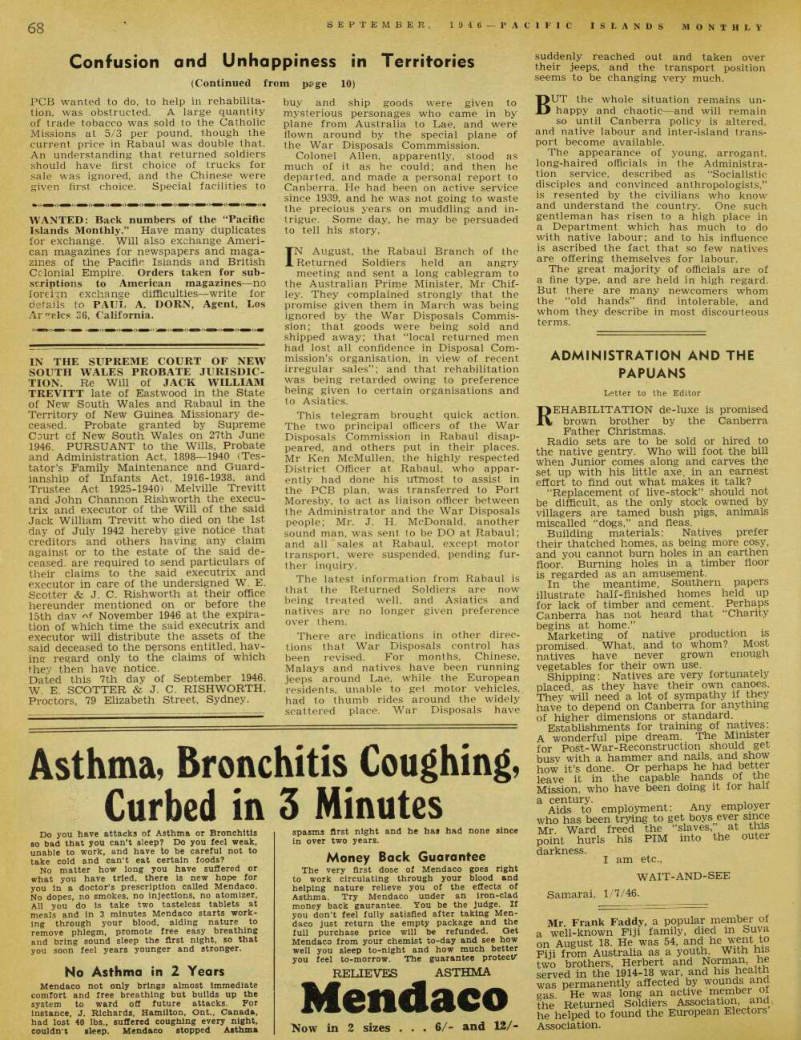
Papuans
Letter to the Editor
Rehabilitation de-iuxe is promised
brown brother by the Canberra Father Christmas.
Radio sets are to be sold or hired to the native gentry. Who will foot the bill when Junior comes along and carves the set up with his little axe, in an earnest effort to find out what makes it talk?
“Replacement of live-stock” should not be difficult, as the only stock owned by villagers are tamed bush pigs, animals miscalled “dogs,” and fleas.
Building materials: Natives prefer their thatched homes, as being more cosy, and you cannot burn holes in an earthen floor. Burning holes in a timber floor is regarded as an amusement.
In the meantime, Southern papers illustrate half-finished homes held up for lack of timber and cement. Perhaps Canberra has not heard that “Charity begins at home.”
Marketing of native production is promised. What, and to whom? Most natives have never grown enough vegetables for their own use.
Shipping: Natives are very fortunately placed as they have their own canoes.
They will need a lot of sympathy if they have to depend on Canberra for anything of higher dimensions or standard.
Establishments for training of natives: A wonderful pipe dream. The Minister for Post-War-Reconstruction should get busy with a hammer and nails, and show how it’s done. Or perhaps he had better leave it in the capable hands of the Mission, who have been doing it for half £t century.
Aids to employment; Any emptoyer who has been trying to get boys ever since Mr. Ward freed the “slaves, at this point hurls his PIM into the outer darkness.
I am etc.,
Wait-And-See
Samarai, 1/7/46.
Mr. Frank Faddy, a popular member of a well-known Fiji family, died in buya on August 18. He was 54, and he went to Fiji from Australia as a youth. With his two brothers, Herbert and Norman, he served in the 1914-18 war, and his health was permanently affected by wounds and gas. He was long an active member of the Returned Soldiers Association, and he helped to found the European Electors Association.
Advertisements & other items, p. 72 (1 item)
Confusion and Unhappiness in Territories
(Continued from psge 10)
Australian Labourites and New Guinea Servicemen

Some Phrases That Should Not Be Forgotten
FOR purposes of record, if for no other reason, we reprint here, from the Australian “Hansard,” some of the utterances regarding New Guinea resi dents made in the Australian Parliament by gentlemen who describe themselves as Labour members.
Our first quotation is as follows: “It is amusing to hear people say that we shall not give up New Guinea. To these people I would say that if it should become necessary to defend our Man dated Territory, they should defend it themselves.”
The date was November, 1938, and the speaker was the Hon. E. J. Ward, now Australia’s Minister for External Terri tories, and the gentleman largely respon sible for present conditions in Papua and New Guinea.
The 1943 elections brought into Parlia ment a curious Labour Party specimen called Bryson; and this is what Mr.
Bryson had to say on July 19, 1945, when he was supporting Mr. Ward’s Papua- New Guinea Provisional Administration Bill: “I am not prepared to support white men in New Guinea, whether they be ex-soldiers or not, making large profits by means of slave labour. The sugges tion has been made that the white settlers in these territories are acting as a buffer between Australia and potential enemies.
That argument should not have been introduced, because the statement is incorrect. When the Japanese attacked the islands to the north of Australia the only fight that was put up there was by our soldiers.
“When the Japanese invaded New
Guinea the white settlers left as quickly as they could. We have also heard of the valorous conduct of certain black troops in New Guinea, and also black carriers. Their labour should not be exploited by people who go to New Guinea for the sole purpose of making profits at the expense of the natives.”
Mr. Rankin: That is a rotten statement.
Mr. Bryson: It is true.
Mr. Rankin: Sentimental talk at the expense of the ex-Servicemen who have suffered considerable loss!
Mr. Bryson There is no sentiment about it. We have heard sentimental references to “the poor soldier-planters” who settled in New Guinea, but they went there for one purpose only. The former residents of New Guinea set out to exploit the country and make as much profit as possible for themselves.
Mr. White: They are pioneers. Why not give them credit for it?
Mr. Bryson: I give them credit for that but while they are exploiting the resources of the territory there is no reason why they should employ slave labour.
A little later, Mr. Abbott (Liberal) said: The member for Bourke (Bryson) made a slanderous reflection on the courage of the white planters of New Guinea and the white population generally. He said that the planters in New Guinea and Papua left as hurriedly as possible and fled to the mainland.
Mr. Chambers - And so they did!
Mr. Abbott: The member for Adelaide may repeat that statement till he is blue in the face, but he will not convince me of the truth of it. The report of Mr.
Barry, KC. does not bear it out. Some
of the elderlv men may have left, but a great many settlers fought gallantly in the New Guinea Rifles, and others served as guides to the Australian troops when they arrived.
THE “Sydney Bulletin” (which is the only Australian newspaper compe tent and prepared to discuss Pacific Islands affairs the commentaries of others are mostly ludicrous) refers to the slanders of Bryson and Chambers in a recent issue, when reviewing “Green Armour,” a book about the New Guinea campaigns, by Osmar White, recently published. White, a distinguished war correspondent, has paid a great tribute to the men of New Guinea, ‘ a raggle taggle army of miners, foresters and
civil servants, called to the colours on the day of Pearl Harbour.” Here is only one._ of many such quotations taken White’s book and published in the Huiletin”; It describes the conditions m the Morobe region in July, 1942.
“White men available for service in the area totalled about 800. Many of the New Guinea Volunteer Rifles were beyond military age, but could not be spared because local, knowledge was so precious. Of these 800, only about 300 were fit to fight. The commandos were going down in droves with malaria, dysentery, pneumonia and infected sores.
Ammunition and foodstuffs were getting very short. ...”
“The men had done an astonishing an d h €ro i c j 0 b. They had bluffed more than 12,000 enemy troops into believing that the hinterland was held by strong forces. The guerrilla patrols had been so active that the Japanese dared not venture more than a few miles inland f o r fear of being picked off one by one or wiped out by ambushes. Even more important than that, the guerrillas had maintained watching stations of such efficiency that not a single enemy air craft could land on or take off from the
Markham valley or the Salamaua air field without the fact being reported al most immediately to Moresby.
“Debilitated by fever, half-starved, liv ing under the worst conditions of war, the men of New Guinea and the tough green youngsters who belatedly reinforced them had already done service which should make their country deeply proud and grateful.”
One of the most depressing things seen in the immediate post-war period was the spectacle of the war-torn Territories, and the Territorians who fought and suffered there so gallantly, being “pushed around” by Wards and Brysons and Chambers, who never have vouchsafed them a word of admiration, and whose only concern is to impose upon them some form of Socialistic tyranny, cal culated to discourage their natural initiative and enterprise.
Advertisements & other items, pp. 73-74 (1 item)
S ctl
ARISTOCRAT GIFTS
offered from utilitarian goods range demonstrating high-class Indian craftsmanship.
Apply for details by air-mail
to NEWMAN’S FRUIT MART,
Srinagar, Kashmir, India.
PACIFIC ISLANDS SOCIETY
Visitors from the Islands to Sydney (or those interested in Islands affairs), are advised to communicate with the honorary secretary of the above Society, which has been formed to study the history, traditions, economics, and political developments of the Pacific Islands.
Regular monthly meetings are held at History House, 8 Young Street. Sydney.
Address for Correspondence:
THE PACIFIC ISLANDS SOCIETY.
Box 2434 MM., G.P.0., Sydney.
S ctl
Hoi**
We're very important people ... we Biscuit Tins. The sooner we're back home at Swallow & Ariell's, the sooner we’ll return to your shelves, brim-full of those fast-selling biscuits your customers love so much.
SWALLOW & ARIELL
LIMITED
LEADERS IN THE BISCUIT INDUSTRY SINCE 1854 MAKERS ALSO OF THE FAMOUS SWALLOW & ARIELL PLUM PUODINOS. CAKES. AND ICE CREAM On account of the acute shortage of tinplate.
Swallow & Ariell request their many customers to return all empty Swallow <& Ariell tins immediately. Check and return your empty tins today . . . that's the way to ensure regular and
speedy supplies of crunchy-crisp Swallow <&
Ariell biscuits.
SA—T2 H
Scott’s “Renown” Brand Rope,
Cordage and
Binder
Twine
of Every
Description
Cable Address Ropeyard.
Sydney.
MM
MANUFACTURED AT
MASCOT. N.S.W.
By
J. SCOTT
PTY. LTD.
Head Office and Store
163 CLARENCE STREET,
SYDNEY,
N.S.W.
Itching Skin Germs Killed in 3 Days
Praised by Doctors
Dr. T. A, Ellis, well-known physician of Toronto, Canada, recently stated: “Skin disorders caused by parasites, as many are, yield to Nixoderm. These parasites are invisible to the naked eye. They eat away the skin, forming ugly eruptions. Ordinary ointments or remedies fall completely, or give only temporary results because they do not reach the cause of the condition. It is this value about Nixoderm in attacking parasites which impresses me most favorably, and explains in large measure the success it enjoys over many stubborn cases.”
Guaranteed Results
Get Nixoderm to-day. Put it to the test. In a few minutes you will find that the Itching has stopped, and in 24 hours you can see for yourself that your skin is clearer. And it is guaranteed that, within one week, Nixoderm must make your skin soft, clear, smooth and attractive or money back on return of empty package. Get Nixoderm from your chemist or store to-day. The guarantee protects you. So don’t delay. Get Nixoderm to-day.
Nixoderm 2/-**
For Skin Sores, Pimples and Itch.
Thanks to the discovery of an American physician, it is now possible to kill and remove the true cause of most skin troubles. Your skin has nearly 50 million tiny seams and pores where invisible germs and parasites can hide, and which are the true cause of terrible Itching. Cracking, Peeling, Burning, Ringworm.
Acne, Psoriasis, Blackheads, Pimples, Foot Itch and other disfiguring blemishes.
Blemishes such as these make you look and feel embarrassed, unattractive and handicapped in life, both socially and in business. You can’t get rid of these disfigurements with ordinary treatments, which give only temporary relief, because they do not kill the germs or parasites responsible for your trouble. .
New Discovery Kills Cause
Former skin sufferers throughout the world are now praising Nixoderm, the discovery of a leading American skin specialist. This remarkable new preparation quickly penetrates into the pores of the skin and kills the germs and parasites responsible for your trouble in 7 minutes, stopping the itch almost instantly. At the same time, this wonderful preparation acts as a tonic and skin food, so that as the cause of your trouble is removed, your skin becomes soft, smooth and clear. This clear, healthy complexion will give you new charm and make it easy to win friends.
Surplus
£6 Million War Damage Surplus Who Will Benefit?
IT is expected that the Australia War Damage Fund will have a surplus of £6 million pounds after all War Damage claims have been met. However, no decision has been made as to how the Government will dispose of the money.
Total contributions to the fund by Aus tralian and Territories property owners, during the Pacific war period, was £13,000,000. Damage to property in New estimated at £6,750,000 of which £2,300,000 has already been paid out as compen sation. The original claims were expected to total between £lO,OOO and £12,000,000.
Residents of Papua and New Guinea will watch the disposal of the surplus funds with great interest. Although Territorians are agreed that the Austra lian War Damage Commission has given them the fairest deal of all Government Departments, it is pointed out that War Damage valuations are based on pre- Pacific War figures, and make no allow ance for the fact that the Australian pound is now worth about 12/- in com parison with its 1940 value. In addition, Territorians who have found it virtually impossible to rehabilitate themselves in Mr. Ward’s new New Guinea have been living largely on their War Damage compensation.
The allocation of surplus funds will now, of course, be left until after the election on September 28. If the present Govern ment is returned it will probably then be used to finance some further fancy socialisation plans.
Miss T. M. O’Brien, who was attached to the Provisional Administration at Port Moresby, is now at Madang. Her sister is Mrs. Cahill, of “Wagoi” Plantation, outside Madang.
Miss Margaret Smith, of Suva, arrived in Brisbane recently by flying-boat. She was on her way to Calcutta, where she was to marry Mr. Robin Taylor. Miss Smith met her fiance on a voyage from England, in 1939. She is the daughter of a well-known European restaurant proprietor, of Suva.
M. Georges Ahnne, recently elected deputy to represent the Colony of French Oceania at the new National Assembly in Paris, arrived in Suva by the “Thor” in August, and went on to Europe, via America by air. M. Ahnne is an attorney practising" in Papeete, and he is held in high regard in Tahiti. He succeeds M.
Charles Vernier in the National Assembly.
Trans-Pacific Airways Some Day!
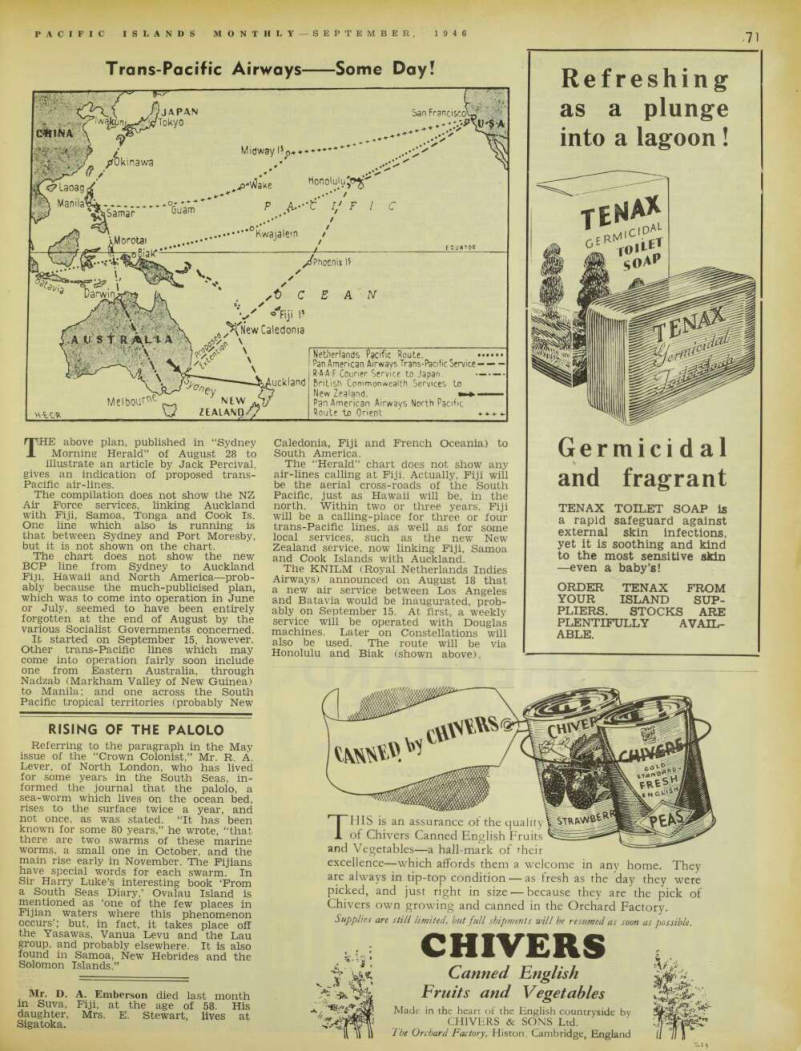
THE above plan, published in “Sydney Morning Herald” of August 28 to illustrate an article by Jack Percival, gives an indication of proposed trans pacific air-lines.
The compilation does not show the NZ Air Force services, linking Auckland with Fiji, Samoa, Tonga and Cook Is.
One line which also is running is that between Sydney and Port Moresby, but it is not shown on the chart.
The chart does not show the new BCP line from Sydney to Auckland Fiji, Hawaii and North America —probably because the much-publicised plan, which was to come into operation in June or July, seemed to have been entirely forgotten at the end of August by the various Socialist Governments concerned.
It started on September 15, however.
Other trans-Pacific lines which may come into operation fairly soon include one from Eastern Australia, through Nadzab (Markham Valley of New Guinea) to Manila; and one across the South Pacific tropical territories (probably New
Caledonia, Fiji and French Oceania) to South America.
The “Herald” chart does not show any air-lines calhng at Fiji. Actually, Fiji will be the aerial cross-roads of the South Pacific, just as Hawaii will be, in the north. Within two or three years, Fiji will be a calling-place for three or four trans-Pacific lines, as well as for some local services, such as the new New Zealand service, now linking Fiji, Samoa and Cook Islands with Auckland.
The KNILM (Royal Netherlands Indies Airways) announced on August 18 that a new air service between Los Angeles and Batavia would be inaugurated, prob ably on September 15. At first, a weekly service will be operated with Douglas machines. Later on Constellations will also be used. The route will be via Honolulu and Biak (shown above)
Rising Of The Palolo
Referring to the paragraph in the May issue of the “Crown Colonist,” Mr. R. A.
Lever, of North London, who has lived for some years in the South Seas, in formed the journal that the palolo, a sea-worm which lives on the ocean bed, rises to the surface twice a year, and not once, as was stated. “It has been known for some 80 years,” he wrote, “that there are two swarms of these marine worms, a small one in October, and the main rise early in November. The Fijians have special words for each swarm. In Sir Harry Luke’s interesting book ‘From a South Seas Diary,’ Ovalau Island is mentioned as ‘one of the few places in Fijian waters where this phenomenon occurs’; but, in fact, it takes place off the Yasawas, Vanua Levu and the Lau group, and probably elsewhere. It is also found in Samoa, New Hebrides and the Solomon Islands.”
Mr. D. A. Emberson died last month in Suva, Fiji, at the age of 58. His daughter, Mrs. E. Stewart, lives at Sigatoka.
Advertisements & other items, p. 75 (1 item)
Chivers
Refreshing
as a plunge
into a lagoon!
CIDAL
rm
let
roi
$OA p
Germicidal
and fragrant
TENAX TOILET SOAP is
a rapid safeguard against external skin infections, yet it is soothing and kind to the most sensitive skin —even a baby’s!
ORDER TENAX FROM
YOUR ISLAND SUP-
PLIERS. STOCKS ARE
PLENTIFULLY AVAIL-
ABLE.
& |H6^ t* THIS is an assurance of the quality of Chivers Canned English Fruits " and Vegetables—a hall-mark of their excellence—which affords them a welcome in any home. They are always in tip-top condition —as fresh as the day they were picked, and just right in size because they are the pick of Chivers own growing and canned in the Orchard Factory.
Supplies are still limited, but full shipments mil he resumed as soon as possible
CHIVERS
Canned English
Fruits and Vegetables
Made in the heart of the English countryside by
CHIVERS & SONS Ltd.
The Orchard Factory, Histon, Cambridge, England
SIC
? dfc. m &•
"Forgotten" Garrison On
Wallis Island
Noumea, August 20.
THE Bulletin of Commerce, Noumea, recently drew attention to a “for gotten” garrison of 17 soldiers and their families, sent to Wallis Island in the dark days of four years ago, when M.
Sautot was Governor of New Caledonia.
As a result, the “Cap Tarifa” has been sent to bring them back to Noumea.
M. Fourcade, one of the Civil service chiefs in Noumea, has also gone to Wallis to report on conditions there.
The US Forces, for some time, had a forward weather station on the highest point of Wallis Island, which lies north wards of Fiji and Samoa.
Mixing The New Year Cocktail
By Alma Gross
MAUD SHERMAN sipped the cocktail.
Then added more Italian and white of egg. Why all this fuss, she thought.
Jimmy Frost, of Louvena, wouldn’t have his eyes open yet, after his Christ mas celebrations. And if Jean and Bob Freeman managed to make a safe voy age across the strait, in that unsea worthy “float” of theirs —which one day really would founder—they would be so fortified by beer that it would not mat ter whether the cocktail was made of barley-water or pea-soup.
New Year celebrations always were like a gathering of the halt and blind. So many Christmases in the tropics!
Wouldn’t it be grand to have the next one South! With plays, pictures and parties, where new faces appeared, and new wit blossomed.
Hadn’t she listened to the same old joke of Jimmy Frost’s for eight Christ mases? The one about the missionary and the Christmas gin. Yes, she was ready for a regular devout Christmas, with thoughts of angels and shepherds, the Babe and the manger, and the mes sage of “Peace on Earth, Goodwill to wards Men.”
Maud admitted that she was not look ing forward to this New Year party. Al ready she had argued with her husband about the space in the “icy-ball”—as to what was to be allotted to drink, and what to meat. If, instead of Jimmy Frost from Louvena, those bright young Mur rays from Lindfield were coming? She had met the Murrays last leave, and they had been such fun. If Jean and Bob Freeman’s place could be taken by the Archers from New Guinea? She would give anything, almost her soul, for one new face.
MAUD pulled herself together in time to prevent a double dose of gin poisoning her efforts. Her con
science stood beside her like a severe school-mistress.
What about that time when her hus band was prone with fever, and she was terrified that it might be biackwater, or cerebral? They had a bad labour-line then. A dozen ooys who lormed a treacherous core among the others. They knew her husband was delirious, that she was alone among them. They became arrogant, and refused to worx, fighting among themselves, the bullies terrorising the faithful ones into revolt against pet ticoat government.
There was that awful evening when about 20 of them had crowded onto the verandah, demanding more tobacco, more meat. Maud had managed to get a run ner with a message to Jimmy Frost.
She remembered how this little man, five feet four, thin, and frail, had walked among the mob of well-fed, sulky boys.
The little “Revenge” and her fight against the Spaniards, had nothing on Jimmy Frost. He looked them over, and before his cold blue stare, the arrogant dark eyed rebels dropped their gaze. He called them the names they most hated, and they slunk off to work—sulkily, but to work. No, that day, the Murrays from Lindfield could not have held a candle to Jimmy Frost.
And Jean and Bob Freeman. Could anyone laugh off the dangers of drown ing as those two did? Wnenever it was rough weather, or a squall was blowing the strait into a writhing monster, then Maud always bet her husband that the Freemans were on their way to pay a call, and Maud would tell the cookie to prepare for their visit. Sometimes they came because they were short of rations, or just for a talk. And no matter how fierce the weather, Bob Freeman never came alone.
“Drowning’s a good death, and I don’t want to be a widow.” Jean’s joke had as many whiskers as that of Jimmy Frost about the Christmas gin.
IF, thought Maud, I had a stock joke, too, perhaps this mood would not now be spoiling my New Year. And she began to amuse herself by wondering what her stock joke should be.
What was characteristic of herself?
Ray Winter! She pushed the name from her mind but it kept recurring. Ray Winter! Why, when she was seeking humour, must she keep thinking of tragedy. It was two years since that; surely she had laid the ghost.
Last Christmas they had missed him.
Missed his arty talk —which being quite above the orbit of their general know ledge, had given them grist for little smiles among themselves. Ray always took their digs with good humour, and the statement that they were of the earth, earthy!
Ray had been the struggling owner of a neighbouring plantation. Perhaps the spot was unhealthy, or Ray not so husky as the rest of them, but he always seemed the one to be down with fever. Then, early one morning, his boys had brought him to the Shermans. He was rolled in a blanket on the back of his truck, and Maud thought he was already dead. They did what they could for him, sending a message to the Freemans to bring their schooner and take him to Tulagi. While they waited for the Freemans the min utes were as long as years, and soon Maud knew that it would be too late for Ray.
Through that watch, when Ray, too, knew that the Freemans would arrive too late, he had wanted some spiritual help,
but in her agitation Maud could not find her prayer book; she could only murmur a few hymns.
What a crude coffin it was. And her husband had made a poor clergyman.
Misty-eyed with weariness and grief, he had fumbled through the prayer book— found later in the place in which it was always kept—and started on the wrong service. He had gone quite a way before Maud’s numbed mind had realised the mistake.
Why was she thinking of this? Should this be the joke to tell at all her social gatherings? She knew that many men had been buried in deal coffins, some times branded “packed for a tropical climate”! She knew that men laughed over these funerals —laughed before they returned to the fever-infested swamps!
Laughd because they thought they might be next.
Yes, she could make quite a good joke.
The coffin, which wasn’t without its cracks! And perhaps her husband had started on the service of public baptism!
Yes, she could work it into quite a good joke. If only it hadn’t been Ray. If it hadn’t been a friend.
MAUD gave the cocktail a final shake.
She knew all the New Year toasts and resolutions.
“Here’s to the next bottle.”
“I think nr give it up.”
“When?”
“Not here, please. Out on the lawn if you feel that way.”
They were as old as the Christmas jokes; but Maud did not mind any more.
Her mouth had returned to its accus tomed good-humoured lines. She smoothed her brown hair, which once a fortnight her husband trimmed in a
short, straight bob. Her brown eyes were soft, and believing. She was nearly forty, but she didn’t care, so neither did her friends. She poured herself a drink, and held the glass to the light.
The sun had set behind the high west ern hills, and the soft hues of sunset were spreading across the bay. The water was still and tranquil. The leap of a small fish seemed a commotion. The soft pad of the cookie boy’s feet was in tune with the low conversation of the waves on the beach. The Old Year was dying quietly, perhaps a little sullen that it could not stay longer. A bank of purple clouds was gathering on the eastern hori zon. Surely not an omen for the New Year!
Maud pledged her toast now. Later, at the traditional midnight, there would be high-pitched laughter, and gaiety, whe ther forced or real. But this, for Maud, was the witching hour of the day. The hour when she knew she had a soul.
The light plaved like little stars in the amber liquid of her drink.
“To this New Year of 1939—and to friendship! Come dancing or come death Peace or war. To friendship.” She pledged and drank her toast. “And it isn’t a bad cocktail, either,” she thought and smiled in her own peculiar twinkling way.
She pondered upon the after-effects of the drink, “Nice. Not too tame, and not too fierce. Moderate—in fact, quite a happy combination for a New Year cocktail”— and she laughed happily— for she had no way of sipping, or judging the potency of the cocktail that men were mixing in Berlin!
The Fiji School Journal has paid a warm tribute to Mr. A. H. Phillips, who has retired from the Directorship of Education, after rendering the Colony very distinguished service. The Journal praises the courage with which Mr.
Phillips attacked the problems inevitable in a young country, which is trying to create in 50 years standard and traditions, which, in other countries, have required centuries. Mr. Phillips recently left Suva for New Zealand.
Advertisements & other items, pp. 76-77 (2 items)
A. O. Shephard
IN THE SUPREME COURT OF NEW
SOUTH WALES PROBATE JURISDIC-
TION. Re Will of ROBERT EDWARD
COOK late of Hornsby in the State of New South Wales and Rabaul in the Territory of New Guinea Accountant deceased. Probate granted by Supreme Court of New South Wales on 16th July 1946. PURSUANT to the Wills, Probate and Administration Act 1898-1940 (Testator’s Family Maintenance and Guardianship of Infants Act, 1916-1938, and Trustee Act 1925-1940) Ralph Newberry Cook and John Channon Rishworth the executors of the Will of the said Robert Edward Cook who died on the Ist day of July 1942 hereby give notice that creditors and others having any claim against or to the estate of the said deceased, are required to send particulars of their claims to the said executors in care of the undersigned W. E. Scotter & J. C.
Rishworth at their office hereunder mentioned on or before the 15th day of November 1946 at the expiration of which time the said executors will distribute the assets of the said deceased to the persons or. Htled, having regard only to the claims of which they then have notice.
Dated this 7th day of September 1946.
W. E. SCOTTER & J. C. RISHWORTH Proctors 79 Elizabeth Street, SYDNEY.
A. O. SHEPHARD
GENERAL MERCHANT & EXPORTER
SOLE EXPORTER FOR JOHN GILMOUR & CO. PTY., LTD.
Gilmour's Delicious Desserts
• TAPIOCA DESSERT * LEMON CUSTARD
POWDER
* BANANA CUSTARD RASPBERRY CUSTARD
POWDER POWDER
Delicious Flavours :: Attractive Colours
ALSO:
Gilmour's Olive Oil Shampoo
Order from your own agent or from : A. O. SHEPHARD, 379 KENT ST., SYDNEY Phones: Code Address: MA 8179, MA 1142 “Chrisshep,” Sydney.
Robert Gillespie Ptv Ltd
Special Offer
SEED OF NEW FRUITS &
VEGETABLES
Specially recommended to ensure a supply of luscious fruit and healthful vegetables during both WET & dry seasons. (1) One Packet REED’S HYBRID “PEACH-TOMATO.” Large, handsome, luscious fruit; specially bred for
the TROPICS.
(2) HUNZA HEALTH SPINACH. Non-
bitter, large succulent leaves.
(3) The HUNZA CUCUMBER-BEAN. A
vine yielding a big supply of Cucumber-size delicious-eating green beans. (4) The CAPE-GOOSEBERRY. Dessertfruiting back-door shrub. An ideal berry fruit, either fresh, or for Pies and Preserves.
Post 5/- M.O. to
CHARLES REED, APIA, SAMOA
HORTICULTURIST,
and receive the four Packets, Prst Paid. This offer may not be repeated.
IMPORTERS
EXPORTERS
s ALL CLASSES OF MERCHANDISE PURCHASED FOR ISLAND CLIENTS
THROUGHOUT THE SOUTH-WEST PACIFIC.
ISLAND PRODUCE SOLD ON AUSTRALIAN AND OVERSEAS MARKETS
ON COMMISSION BASIS.
ROBERT GILLESPIE PTV LTD
BANKERS: BANK OF N.S.W.
COMPTOIR NATIONAL
D ESCOMPTE DE PARIS
54a PITT ST. SVDNEV N.S.W.
CABLE ADDRESS:
•ROBERGILL"
PHONES BW 4782-B 1305
Islands Produce
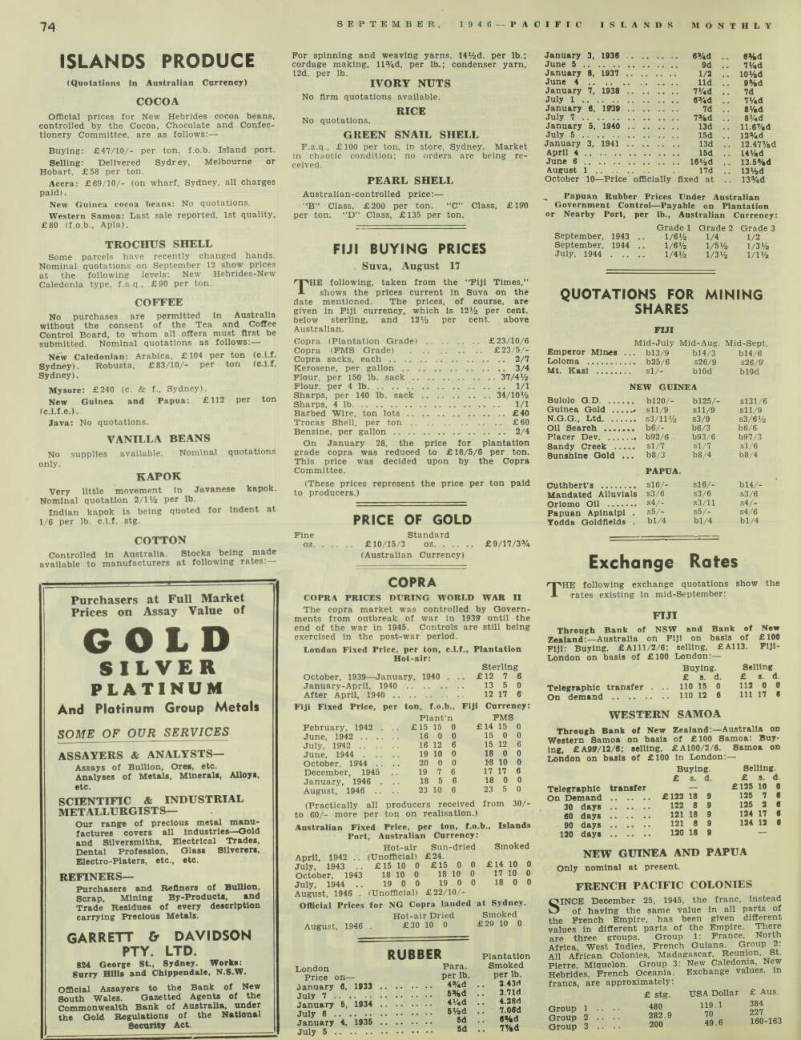
(Quotations in Australian Currency)
Cocoa
Official prices for New Hebrides cocoa beans, controlled by the Cocoa, Chocolate and Confec tionery Committee, are as follows: — Buying; £47/10/- per ton, f.o.b. Island port.
Selling: Delivered Sydney, Melbourne or Hobart, £5B per ton.
Accra: £69/10/- (on wharf, Sydney, all charges paid).
New Guinea cocoa beans: No quotations.
Western Samoa: Last sale reported, Ist quality, £BO (f.0.b., Apia).
Trochus Shell
Some parcels have recently changed hands.
Nominal quotations on September 12 show prices at the following levels: New Hebrides-New Caledonia type, f.a.q., £9O per ton.
Coffee
No purchases are permitted in Australia without the consent of the Tea and Coffee Control Board, to whom all offers must first be submitted. Nominal quotations as follows: — New Caledonian: Arabica. £lO4 per ton (c.i.f.
Sydney). Robusta, £B3/10/- per ton (c.i.f.
Sydney).
Mysore; £240 (c. & f., Sydney).
New Guinea and Papua: £ll2 per ton (c.i.f.e.).
Java: No quotations.
Vanilla Beans
No supplies available. Nominal quotations only.
Kapok
Very little movement in Javanese kapok.
Nominal quotation 2/1% per lb.
Indian kapok is being quoted for indent at 1/6 per lb. c.i.f. stg.
Cotton
Controlled in Australia. Stocks being made available to manufacturers at following rates; —
For spinning and weaving yarns, 14%d. per lb.; cordage making, ll%d. per lb.; condenser yarn, 12d. per lb.
Ivory Nuts
No firm quotations available.
Rice
No quotations.
Green Snail Shell
F.a.q., £lOO per ton, in store, Sydney. Market in chaotic condition; no orders are being re ceived.
Pearl Shell
Australian-controlled price:— "B” Class, £2OO per ton. "C” Class, £l9O per ton. "D” Class, £135 per ton.
Fiji Buying Prices
Suva, August 17
THE following, taken from the "Fiji Times,” shows the prices current in Suva on the date mentioned. The prices, of course, are given in Fiji currency, which is 12% per cent, below sterling, and 12 % per cent. above Australian.
Copra (Plantation Grade) £23/10/6 Copra (PMS Grade) £23/5/- Copra sacks, each 2/7 Kerosene, per gallon 3/4 Flour, per 150 lb. sack 37/4% Flour, per 4 lb 1/1 Sharps, per 140 lb. sack 34/10% Sharps, 4 lb 1/1 Barbed Wire, ton lots £4O Trocas Shell, per ton £6O Benzine, per gallon 2/4 On January 28, the price for plantation grade copra was reduced to £ 18/5/6 per ton.
This price was decided upon by the Copra Committee. (These prices represent the price per ton paid to producers.)
Advertisements & other items, p. 78 (1 item)
Price Of Gold
Pine Standard oz £lO/15/3 oz £9/17/3% (Australian Currency)
Copra
Prices During World War Ii
The copra market was controlled by Govern ments from outbreak of war in 1939 until the end of the war in 1945. Controls are still being exercised in the post-war period.
London Fixed Price, per ton, c.l.f., Plantation Hot-air: Sterling October. 1939 —January, 1940 ... £12 7 6 January-April, 1940 13 5 0 After April, 1940 12 17 6 Fiji Fixed Price, per ton, f.o.b., Fiji i Currency: Plant’n
Fms
February, 1942 ... £ 15 15 0 £14 15 0 June, 1942 16 0 0 15 0 0 July, 1942 16 12 6 15 12 6 June. 1944 19 10 0 18 0 0 October. 1944 ... 20 0 0 1-8 10 0 December, 1945 .. 19 7 6 17 17 6 January, 1946 ... 18 5 6 18 0 0 August, 1946 . . . . 23 10 6 23 5 0 (Practically all producers received from 30/to 60/- more per ton on realisation.) Australian Fixed Price, per ton, f.o.b.. Islands Port, Australian Currency; Hot-air Sun-dried Smoked April, 1942 .. (Unofficial) £24. £14 10 0 July, 1943 £15 10 0 £15 0 0 October, 1943 18 10 0 18 10 0 17 10 0 July, 1944 .. 19 0 0 19 0 0 18 0 0 August, 1946 . (Unofficial) £22/10/- Official Prices for NG Copra landed at Sydney.
Hot-air Dried Smoked August, 1946 . £30 10 0 £29 10 0
Rubber
Plantation
London Para.
Smoked Price onper lb. per lb.
January 6. 1933 . . .. .. .. 4 3 /id , 2.43d .. .. 5%d , 3.71d January 5, July 6 ..
Tanntirv 4 1934 .. .. 4V 4 d , .. 4.28d .. .. 5Vad , 7.06d 1935 .. • • .. .. 5d 8Hd jaiuuu j »f July 5 .. .. .. 5d 7%d
January 3. 1936 6 3 /4d .. 8Hd June 5 9d . .
January 8. 1937 .. 1/2 .. lOttd June 4 lid .. 9%d January 7, 1938 . 7 , /id .. 7d July 1 . 6 3 /4d ..
Ivaa
January 6. 1939 . 7d .. 8V.d July 7 , 7»/.d .. avid January 5. 1940 . 13d .. 11.6 7 /sd July 5 , 15d .. 12 3 /4d January 3. 1941 . 13d .. 12.47 7 /ad April 4 15d .. 14V«d June 6 16>/ a d .. 13.5 s /«d August 1 . 17d .. 13Mid October 10- -Price officially fixed at .. 13%d „ Papuan Rubber Prices Under Australian Government Control—Payable on Plantation or Nearby Port, per lb., Australian Currency: Grade 1 Grade 2 Grade 3 September, 1943 I/6V2 1/4 1/2 September, 1944 I/6V2 l/5»/2 I/31/2 July. 1944 . .. 1/4 1/2 1/3V2 1/11/2
Quotations For Mining
Shares
Fiji
Mid-July Mid-Aug.
Mid-Sept.
Emperor Mines . .. bl3/9 bl4/3 bl4/6 Loloma $26/9 S26/& Mt. Kasl . si/blOd blOd
New Guinea
Bulolo G.D .. bl20/bl25/- S131/6 Guinea Gold ,.« sll/9 sll/9 sll/9 N.G.G., Ltd s3/9 s3/6V 2 Oil Search .. b6/b6/3 b6/6 Placer Dev ... b92/6 b93/6 b97/3 Sandy Creek ... .. sl/7 sl/7 sl/6 Sunshine Gold . .. b8/3 b8/4 b8/4
Papua
Cuthbert’s .. sl6/- Sl6/bl4/- Mandated Alluvials s3/6 s3/6 s3/6 Orlomo Oil S3/11 s4/- Papuan Aplnalpl . s5/s5/s4/6 Yodda Goldfields . bl/4 bl/4 bl/4
Exchange Rates
THE following exchange quotations show the ■rates existing in mid-September:
Fiji
Through Bank of NSW and Bank of Now Zealand: —Australia on FIJI on basis of £lOO Fiji: Buying. £Alll/2/6: selling. £AII3. PIJI - on basis of £lOO London: —
Western Samoa
Through Bank of New Zealand; —Australia on Western Samoa on basis of £100 Samoa: Buy ing, £ A99/12/6; selling. £A100/2/6, Samoa on London on basis of £100 in London; —
New Guinea And Papua
Only nominal at present.
French Pacific Colonies
SINCE December 25, 1945, the franc, instead of having the same value In all parts of the French Empire, has been given different values in different parts of the Empire. There are three groups. Group 1; Prance. North Africa, West Indies, French Guiana. Group 2: All African Colonies, Madagascar, Reunion, St.
Pierre, Miquelon. Group 3: New Caledonia, New Hebrides, French Oceania. Exchange values, in francs, are approximately;
Buying.
Selling £ s. d. £ s. d.
Telegraphic transfer . .. 110 15 0 112 0 0 On demand . . 110 12 6 111 17 •
Buying.
Selling. £ s. d. £ s. d.
Telegraphic transfer — £125 10 0 On Demand £122 18 9 125 7 8 30 days 122 8 9 125 2 6 60 days 121 18 9 124 17 8 90 days 121 8 9 124 12 8 120 days 120 18 9 —
£ stg. USA Dollar £ Aus.
Group 1 4M 119.1 384 Soup 3 200 49.6 160-163
Advertisements & other items, pp. 78-80 (3 items)
Gold
Purchasers at Full Market Prices on Assay Value of
SILVER
PLATINUM
And Platinum Group Metals
SOME OF OUR SERVICES
ASSAYERS & ANALYSTS—
Assays of Bullion, Ores, etc.
Analyses of Metals, Minerals, AUoys, etc.
SCIENTIFIC & INDUSTRIAL
METALLURGISTS—
Our range of precious metal manufactures covers all Industries —Gold and Silversmiths. Electrical Trades, Dental Profession, Glass Sllverers, Electro-Platers, etc., etc.
REFINERS—
Purchasers and Refiners of Bullion, Scrap. Mining By-Products, and Trade Residues of every description carrying Precious Metals.
GARRETT & DAVIDSON
PTY. LTD.
824 George St., Sydney. Works: Sorry Hills and Chippendale, N.S.W.
Official Assayers to the Bank of New South Wales. Gazetted Agents of the Commonwealth Bank of Australia, under the Gold Regulations of the National Security Act.
75
PACIFIC ISLANDS MONTH LY SEPTEMBER, 1946
Econo-Steel
* - I ■ 11 * ‘t £ ** i i ** DESTRUCTION: All that remained th bus ,„ess Samoa, A/rcv 31 Because there w* M y . were undamaged. Re adjacent buildings to Nelson’s ment. t <6
would have prevented this
TROPICAL DWELLINGS, NATIVE LABOUR
HUTS, DRYING AND STORAGE SHEDS may be built in "Econo-Steel" and be resistant to fire, and ail the well-known ravages to a building frame.
"Econo-Steel" is designed for low cost export, each member making up the frame of a building is "nestable" for simplified safe packing.
An enquiry mailed to the Building Dept, of Tulloch's Pty., Ltd., will have in return mail, a brochure that will guide you in building problems of to-day.
Tullocks p: y l™
RHODES, SYDNEY, N.S.W.
AUSTRALIA
Cable TULSTEEL Sydney.
Woven Wire for all Industry
COPRA DRYING TRAYS, FLOORS, Etc.
FRU'T DRYING TRAYS, MINING SCREENS.
Heavy Mosquito Gauze in Phosphor Bronze and other Metals Impervious to Salt Sea Air.
WIRE DOOR MATS AND GENERAL WIRE WORKS
E. WRIGHT & CO. LTD.
Office and Works: 148-152 Cleveland Street, Sydney, N.S.W.
Telegraphic Address: “Wrlghtmake.” Chippendale.
~\\mM \\\" ««»
MVVVVVV
It*
\ Con
\\sw\W^
\\ <* vmvfc 6° «b\stO'- -ws Set your face up for the day with COOL, soothing, whisker-subduing
INGRAM'S!
All over the world the Ingram's jar is the morning companion of men who appreciate easy shaving. Ingram's cools and smoothes the skin while it wilts the wiriest hair-growth. Moreover, Ingram's is most economical because so little is needed tor a rich, thick, spreading lather.
INGRAM’S
SHAVING CREAM
Manufactured by
BRISTOL-MYERS CO. PTY. LTD.
Sold by all leading distributors and manufactured by Bristol-Myers Co. Pty. Ltd., 223 Pacific Highway, North Sydney, N.S.W., Australia
Jap Snail Menace In
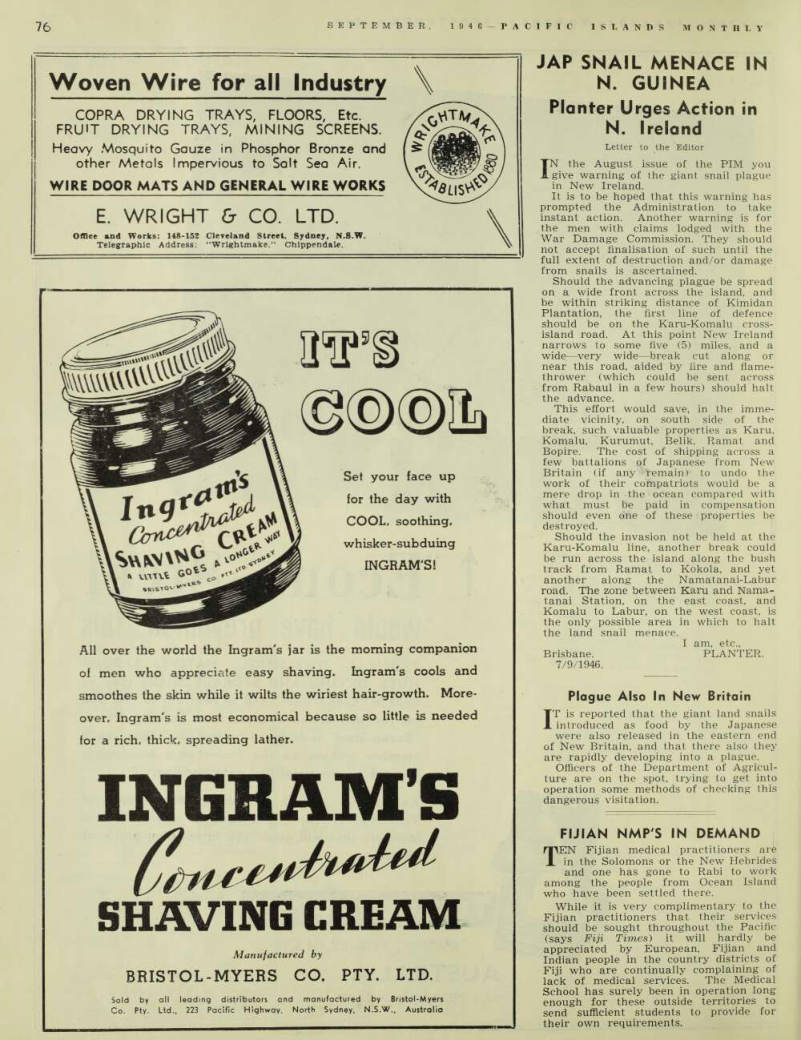
N. Guinea
Planter Urges Action in N. Ireland
Letter to the Editor IN the August issue of the PIM you give warning of the giant snail plague in New Ireland.
It is to be hoped that this warning has prompted the Administration to take instant action. Another warning is for the men with claims lodged with the War Damage Commission. They should not accept finalisation of such until the full extent of destruction and/or damage from snails is ascertained.
Should the advancing plague be spread on a wide front across the island, and be within striking distance of Kimidan Plantation, the first line of defence should be on the Karu-Komalu cross island road. At this point New Ireland narrows to some five (5) miles, and a wide—very wide —break cut along or near this road, aided by fire and flame thrower (which could be sent across from Rabaul in a few hours) should halt the advance.
This effort would save, in the imme diate vicinity, on south side of the break, such valuable properties as Karu, Komalu, Kurumut, Belik, Ramat and Bopire. The cost of shipping across a few battalions of Japanese from New Britain (if any remain) to undo the work of their compatriots would be a mere drop in the ocean compared with what must be paid in compensation should even one of these properties be destroyed.
Should the invasion not be held at the Karu-Komalu line, another break could be run across the island along the bush track from Ramat to Kokola, and yet another along the Namatanai-Labur road. The zone between Karu and Nama tanai Station, on the east coast, and Komalu to Labur, on the west coast, is the only possible area in which to halt the land snail menace.
I am, etc..
Brisbane.
Planter.
7/9/1946.
Plague Also In New Britain
IT is reported that the giant land snails introduced as food by the Japanese were also released in the eastern end of New Britain, and that there also they are rapidly developing into a plague.
Officers of the Department of Agricul ture are on the spot, trying to get into operation some methods of checking this dangerous visitation.
Fijian Nmp's In Demand
TEN Fijian medical practitioners arb in the Solomons or the New Hebrides and one has gone to Rabi to work among the people from Ocean Island who have been settled there.
While it is very complimentary to the Fijian practitioners that their services should be sought throughout the Pacific (says Fiji Times) it will hardly be appreciated by European, Fijian and Indian people in the country districts of Fiji who are continually complaining of lack of medical services. The Medical School has surely been in operation long enough for these outside territories to send sufficient students to provide for their own requirements.
Nauru Tragedy
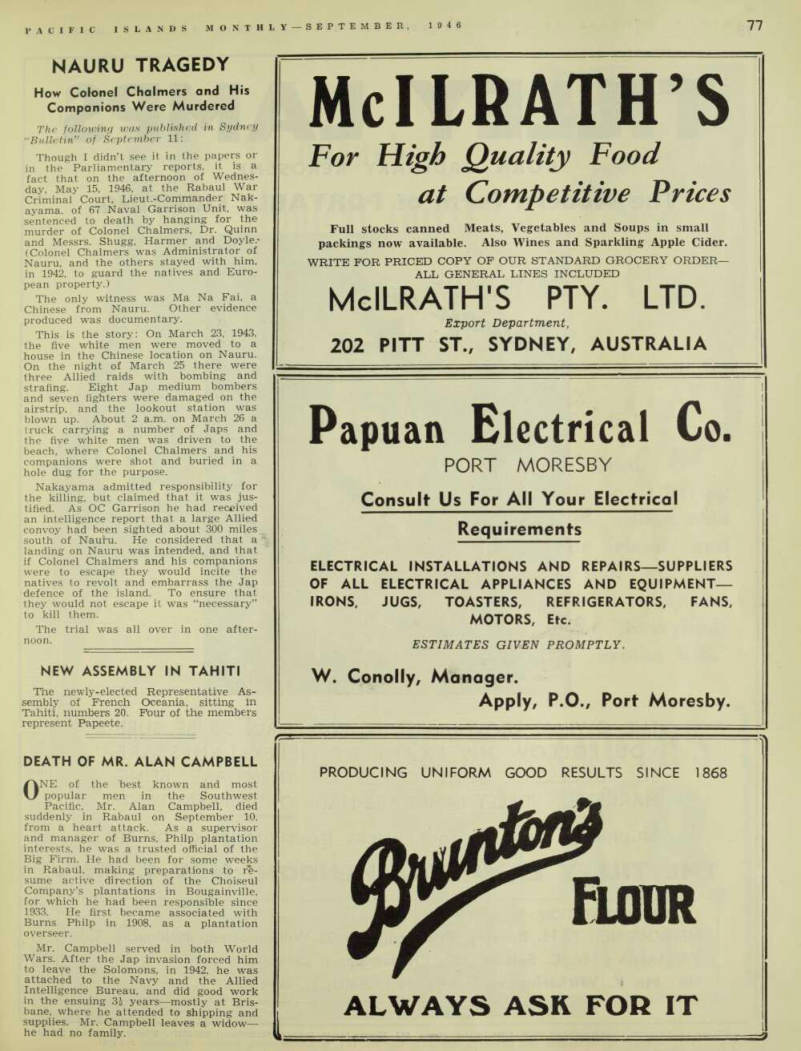
How Colonel Chalmers and His Companions Were Murdered
The following was published in Sydney “ Bulletin” of September 11; Though I didn’t see it in the papers or in the Parliamentary reports, it is a fact that on the afternoon of Wednes day. May 15, 1946, at the Rabaul War Criminal Court, Lieut.-Commander Nak ayama, of 67 Naval Garrison Unit, was sentenced to death by hanging for the murder of Colonel Chalmers, Dr. Quinn and Messrs. Shugg, Harmer and Doyle.* (Colonel Chalmers was Administrator of Nauru, and the others stayed with him, in 1942, to guard the natives and Euro pean property.) The only witness was Ma Na Fai. a Chinese from Nauru. Other evidence produced was documentary.
This is the story: On March 23, 1943, the five white men were moved to a house in the Chinese location on Nauru.
On the night of March 25 there were three Allied raids with bombing and strafing. Eight Jap medium bombers and seven fighters were damaged on the airstrip, and the lookout station was blown up. About 2 a.m. on March 26 a truck carrying a number of Japs and the five white men was driven to the beach, where Colonel Chalmers and his companions were shot and buried in a hole dug for the purpose.
Nakayama admitted responsibility for the killing, but claimed that it was jus tified. As OC Garrison he had received an intelligence report that a large Allied convoy had been sighted about 300 miles south of Nauru. He considered that a landing on Nauru was intended, and that if Colonel Chalmers and his companions were to escape they would incite the natives to revolt and embarrass the Jap defence of the island. To ensure that they would not escape it was “necessary” to kill them.
The trial was all over in one after noon.
Advertisements & other items, p. 81 (1 item)
New Assembly In Tahiti
The newly-elected Representative As sembly of French Oceania, sitting in Tahiti, numbers 20. Four of the members represent Papeete.
Death Of Mr. Alan Campbell
ONE of the best known and most popular men in the Southwest Pacific, Mr. Alan Campbell, died suddenly in Rabaul on September 10. from a heart attack. As a supervisor and manager of Burns, Philp plantation interests, he was a trusted official of the Big Firm. He had been for some weeks in Rabaul, making preparations to re sume active direction of the Choiseul Company’s plantations in Bougainville, for which he had been responsible since 1933. He first became associated with Burns Philp in 1908, as a plantation overseer.
Mr. Campbell served in both World Wars. After the Jap invasion forced him to leave the Solomons, in 1942, he was attached to the Navy and the Allied Intelligence Bureau, and did good work in the ensuing 31 years—mostly at Bris bane, where he attended to shipping and supplies. Mr. Campbell leaves a widow — he had no family.
Advertisements & other items, pp. 81-84 (2 items)
Mcilrath S
For High Quality Food
at Competitive Prices
Full stocks canned Meats, Vegetables and Soups in small packings now available. Also Wines and Sparkling Apple Cider.
WRITE FOR PRICED COPY OF OUR STANDARD GROCERY ORDER-
ALL GENERAL LINES INCLUDED
McILRATH'S PTY. LTD.
Export Department,
202 PITT ST., SYDNEY, AUSTRALIA
Papuan Electrical Co.
PORT MORESBY
Consult Us For All Your Electricol Requirements
ELECTRICAL INSTALLATIONS AND REPAIRS—SUPPLIERS
OF ALL ELECTRICAL APPLIANCES AND EQUIPMENT-
IRONS, JUGS, TOASTERS, REFRIGERATORS, FANS,
MOTORS, Etc.
ESTIMATES GIVEN PROMPTLY.
W. Conolly, Manager.
Apply, P. 0., Port Moresby.
PRODUCING UNIFORM GOOD RESULTS SINCE 1868
Floor
ALWAYS ASK FOR IT
TILLEY LAMPS
BURN ORDINARY KEROSENE
The Modern Form of PORTABLE LIGHTING
p » m TlttEY Of H THE OWL IS PROVERBIALLY A WISE BIRD, SO BE SURE YOU FOLLOW HIS EXAMPLE! TILLEY LAMPS ARE SO SUCCESSFUL THAT COPIES OF THEM ARE BEING MARKETED. TILLEY LAMPS ARE MADE ONLY IN ENGLAND Shipments available four weeks from receipt of order THE TILLEY LAMP CO., HENDON, N.W.4, ENG.
REPRESENTATION :
MELBOURNE : T. H. Bentley, Pty. Ltd., 123-125 William Street. Melbourne. Cl.
TASMANIA : Mr. C. Sellars, 108 a Charles Street, Launceston.
FIJI : Mr. K. Witherington, 2 Burns Philp Buildings, Suva.
To quench a
tropical thirst...
*** When you’re hot and tired, there is nothing quite so satisfying and thirst quenching as a long, cold glass of “K. 8.” Your friends and nng k s> ■■m I />' guests, 100, will appreciate this really fine
Lager, for ‘’Everybody
drinks K.B.’-
TOOTH'S
LAGER
Capital £1,000,000
ESTABLISHED 1914
COPRA MERCHANTS & MILLERS
BRANCHES THROUGHOUT THE PACIFIC ISLANDS
Buyers and exporters of all kinds of Islands produce. Copra Merchants and Millers.
Agents for Australian, European and American Manufacturers. Distributors of every description of merchandise.
Thirty years of Pacific Islands development and service.
REGULAR CARGO
PACIFIC
IN LONDON:
W. R. Carpenter & Co. (London), Ltd,, Coronation House, 4 Lloyd’s Avenue, London, E.C.
THE W.R.C. LINE
THE FIRST DIRECT AND
AND PASSENGER SERVICE
ISLAND PORTS WAS ESTABLISHED BY
DISTRIBUTING
AGENTS FOR :
Ford Motor Company of Canada.
Electrolux Refrigerators.
T. G. & C. Bolinders (Engines).
Chrysler Corporation.
Westinghouse Electrical Co.
Caterpillar Tractors.
Etc., Etc.
BETWEEN EUROPE AND
W. R. CARPENTER & CO. LTD.
Head Office: 16 O'CONNELL STREET, SYDNEY.
Cable Address:
CAMOHE.
Telephone: BW 4421.
Postal Address: P.O. Box No. 168, Sydney.
78
SEPTEMBER, 1946 PACIFIC ISLANDS MONTHLY
Published by PACIFIC PUBLICATIONS PTY. LTD.. Union House, 247 George Street, Sydney. (Telephone: BW 5 ® 37)^. 0! !J A s si n VF and prlnted in Australia by the Sydney and Melbourne Publishing Co. Pty. Ltd., 29 Alberta Street, Sydney. (Telephone. MA7101).